WO2021070502A1 - 高延性モリブデン合金材 - Google Patents
高延性モリブデン合金材 Download PDFInfo
- Publication number
- WO2021070502A1 WO2021070502A1 PCT/JP2020/032395 JP2020032395W WO2021070502A1 WO 2021070502 A1 WO2021070502 A1 WO 2021070502A1 JP 2020032395 W JP2020032395 W JP 2020032395W WO 2021070502 A1 WO2021070502 A1 WO 2021070502A1
- Authority
- WO
- WIPO (PCT)
- Prior art keywords
- zirconia
- alloy material
- mass
- molybdenum alloy
- content
- Prior art date
- Legal status (The legal status is an assumption and is not a legal conclusion. Google has not performed a legal analysis and makes no representation as to the accuracy of the status listed.)
- Ceased
Links
Images


Classifications
-
- C—CHEMISTRY; METALLURGY
- C22—METALLURGY; FERROUS OR NON-FERROUS ALLOYS; TREATMENT OF ALLOYS OR NON-FERROUS METALS
- C22C—ALLOYS
- C22C32/00—Non-ferrous alloys containing at least 5% by weight but less than 50% by weight of oxides, carbides, borides, nitrides, silicides or other metal compounds, e.g. oxynitrides, sulfides, whether added as such or formed in situ
-
- C—CHEMISTRY; METALLURGY
- C22—METALLURGY; FERROUS OR NON-FERROUS ALLOYS; TREATMENT OF ALLOYS OR NON-FERROUS METALS
- C22C—ALLOYS
- C22C27/00—Alloys based on rhenium or a refractory metal not mentioned in groups C22C14/00 or C22C16/00
- C22C27/04—Alloys based on tungsten or molybdenum
-
- B—PERFORMING OPERATIONS; TRANSPORTING
- B22—CASTING; POWDER METALLURGY
- B22F—WORKING METALLIC POWDER; MANUFACTURE OF ARTICLES FROM METALLIC POWDER; MAKING METALLIC POWDER; APPARATUS OR DEVICES SPECIALLY ADAPTED FOR METALLIC POWDER
- B22F3/00—Manufacture of workpieces or articles from metallic powder characterised by the manner of compacting or sintering; Apparatus specially adapted therefor ; Presses and furnaces
- B22F3/12—Both compacting and sintering
- B22F3/14—Both compacting and sintering simultaneously
Definitions
- the molybdenum alloy material contains molybdenum, zirconia (ZrO 2 ) and yttria (Y 2 O 3 ), and the content of zirconia is 0.7% by mass or more and 13.6% by mass or less, and the content of yttria is that of zirconia.
- the content is 0.03 times or more and 0.08 times or less, and in X-ray diffraction, the peak height of the (11-1) plane of the zirconia tetragonal T and the peak of the (111) plane of the zirconia tetragonal M
- the ratio to height (11-1) / (111) is 10 or more.
- FIG. 1 is a diagram showing a sintered body 200 and a test piece 100 extending in the x direction cut out from the sintered body 200.
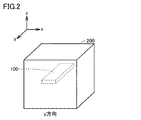
- FIG. 2 is a diagram showing a sintered body 200 and a test piece 100 extending in the y direction cut out from the sintered body 200.
- FIG. 3 is a diagram showing a sintered body 200 and a test piece 100 extending in the z direction cut out from the sintered body 200.
- Patent Document 1 describes in paragraphs [0110] to [0113] that a molybdenum plate having a thickness of 0.2 mm, an outer shape of 2.1 mm, a length of 7 mm, and a cup shape having good drawability was obtained. The elongation of this molybdenum alloy material is small.
- Paragraph number [0127] discloses that the elongation is 10-12% when the angle with respect to the elongation direction is 0 °, 16-18% when it is 45 °, and 6.0-8.0% when it is 90 °. Has been done.
- Patent Document 1 the plastic working of Patent Document 1 is cold working. As a result, the slip surfaces of the (111) plane are accumulated. Then, ductility anisotropy occurs, and the elongation in a certain direction is enhanced, but the problem that the elongation in the direction orthogonal to it is small remains, and the improvement in ductility cannot be overcome.
- the present inventor has found that ductility is improved by dispersing a large amount of zirconia (ZrO 2 ) in a molybdenum alloy in a tetragonal state.
- the conventional molybdenum alloy material cannot disperse a large amount of tetragonal zirconia in the Mo alloy.
- the Mo alloy material has a problem that the elongation at room temperature is small, or the elongation in one direction is high but the elongation in the other direction is small. In rolled materials, the elongation in one direction is high, but the elongation in the other direction is small. The elongation of the molybdenum alloy material in which unstabilized or partially stabilized zirconia is dispersed is small.
- the highly ductile molybdenum alloy material can be used for plastic working of complicated shapes.
- a molybdenum alloy material having high ductility is desired as a measure against cracking of a holder for a hot extrusion die, a cold extrusion die, and the like.
- Ceria (CeO 2 ), Calcia (CaO), and Magnesia (MgO) also show the same effect as yttria. Therefore, yttria may be replaced with at least one of ceria, calcia and magnesia.
- the content of zirconia is 0.7% by mass or more and 13.6% by mass or less. Within this range, high elongation (the average value in the X, Y, and Z directions is 30% or more) can be obtained.
- the content of zirconia is 1.3% by mass or more and 8.2% by mass or less. More preferably, it is 1.3% by mass or more and 5% by mass or less.
- the average value of elongation in the X, Y, and Z directions is preferably 35% or more, more preferably 40% or more. If the content of zirconia is less than 0.7% by mass, the amount of zirconia is small and the transformation strengthening is difficult to function. When the content of zirconia exceeds 13.6% by mass, zirconia aggregates and becomes a base point of cracks.
- the coefficient a is 0.03 or more and 0.08 or less. When the coefficient a is less than 0.03, a part of zirconia becomes monoclinic. When the coefficient a exceeds 0.08, a part of zirconia becomes cubic.
- the total amount is preferably 0.01% by mass or less. If it exceeds 0.01% by mass, impurities may be the starting point of fracture and the mechanical properties may be deteriorated.
- Zirconia is measured by the ICP (Inductively Coupled Plasma) method.
- Zirconium in the molybdenum alloy was measured using ICPS-8100 type (Shimadzu Corporation), and the converted value was obtained assuming that the total amount of zirconium was zirconia.
- Yttria is measured by the ICP method. Y in the Mo alloy was measured using ICPS-8100 type (Shimadzu Corporation), and the converted value was obtained assuming that Y was totally yttria.
- Molybdenum was obtained according to the analysis method for molybdenum materials (JIS H 1404: 2001), and from the whole, aluminum, calcium, chromium, copper, iron, magnesium, manganese, nickel, lead, tin, silicon, sodium, It excludes the contents of potassium, ittoria and zirconia.
- the ratio (11-1) / (111) of the peak height of the (11-1) plane of the zirconia tetragonal T to the peak height of the (111) plane of the zirconia monoclinic crystal M is 10 or more. Within this range, the room temperature elongation can be increased.
- the shape of the measurement sample is a rectangular parallelepiped of 10 x 20 x 2 mm. This rectangular parallelepiped is cut out from the sintered body, and the measurement surface is electropolished by the following method, and then XRD (X-ray difficulty) measurement is performed.
- XRD X-ray difficulty
- the method of electropolishing is as follows. A mixed solution of methyl alcohol (95%) 100 cm 3 , sulfuric acid (1.84 g / cm 3 ) 10 cm 3 , and hydrofluoric acid (40%) 1 cm 3 is used as the electrolytic solution. A stainless steel cathode was used as the electrode, and a DC current of 50-60 V was passed through 10-20 Sec.
- the XRD measurement method is as follows.
- the setting conditions are X-ray tube: Cu tube, primary side optical system (solar slit 0.04 rad, PDS fixed 1/2 °, mask 15 mm, ASS 1 °), light receiving side optical system (FASS 8 mm, solar slit 0.04 rad, Filter Ni, X-ray detector PIXcel), X-ray output was set to 50 mA, 40 kV.
- the measurement conditions were start angle 20 °, end angle 70 °, step size 0.02, and time per step 20s.
- the average value of elongation of the molybdenum alloy material in the three directions is preferably 30% or more. It is more preferably 35% or more, still more preferably 40% or more. Within this range, forging and drawing workability to complicated shapes are improved.
- FIG. 1 is a diagram showing a sintered body 200 and a test piece 100 extending in the x direction cut out from the sintered body 200.
- FIG. 2 is a diagram showing a sintered body 200 and a test piece 100 extending in the y direction cut out from the sintered body 200.
- FIG. 3 is a diagram showing a sintered body 200 and a test piece 100 extending in the z direction cut out from the sintered body 200. As shown in FIGS. 1 to 3, the test piece 100 was cut out from a substantially central portion of the cubic sintered body 200.
- each test piece 100 After polishing the surface of each test piece 100 with # 800 SiC abrasive paper, it is set in an Instron universal testing machine (model number 5867 type), and the crosshead speed is 0 at room temperature (20 degrees) in the atmospheric atmosphere. A tensile test was performed at .32 mm / min. The maximum stress and elongation at break were determined from the stress-strain diagram obtained by the tensile test.
- the average tensile strength of the Mo alloy material in the three directions is preferably 650 MPa or more. Within this range, it can be used for members that require strength, such as holders for hot extrusion dies.
- the density of the Mo alloy material is preferably 95% or more. If the density is less than 95%, the void becomes the starting point and cracks occur, so that the ductility may not be improved.
- Manufacturing method of Mo alloy material (1) Refer to sample 3 and other sample conditions (Table 1).
- the mixed slurry was dried using a hot plate at 80-100 ° C. in an air atmosphere with stirring. This step from weighing to drying was repeated "number of times" in Table 1 to obtain a predetermined amount of powder. For sample numbers 2, 4 to 23, the same steps from weighing to drying were repeated "number of times" in Table 1 to obtain a predetermined amount of powder. For sample number 1, only Mo was weighed according to Table 1.
- the sintering temperature is preferably 1700-1900 ° C. If it exceeds this, the crystal grains may become coarse and the ductility may decrease.
- YSZ As YSZ, YSZ (TZ-3YS-E) powder manufactured by Tosoh Co., Ltd. having a surface area of 7 m 2 / g was used. [mixture] 985.7 g of Mo powder and 14.3 g of YSZ powder were weighed.
- the sintering temperature is preferably 1700-1900 ° C. If it exceeds this, the crystal grains may become coarse and the ductility may decrease.
- a zirconia powder manufactured by Nippon Kagaku Ceramics Co., Ltd. with an Fsss particle size of 20 nm by the Fisher method was used.
- Ball mill mixing was performed using a planetary ball mill manufactured by FRITSCH. Weighed powder, balls (material: cemented carbide, ⁇ 8 mm balls 160 g, ⁇ 40 mm balls 737 g) and alcohol were put into a pot and mixed in an air atmosphere for 50 hours. After mixing, it was naturally dried in the air. This weighing and mixing step was repeated for the “number of ball mills” in Table 3 to obtain a predetermined amount of powder.
- the powder compact was sintered in a hydrogen atmosphere at a temperature of 1000 ° C. for 2 hours. Furthermore the green compact H 2 -Ar gas mixture (H 2: 10vol%) atmosphere, and sintered for 1 hour at a temperature 1600 ° C..
- the sintered body was pressurized by HIP (Hot Isostatic Pressing) under the conditions of an argon atmosphere, a temperature of 1500 ° C., and a pressure of 100 MPa for 1 hour. Then, the sintered body was heat-treated in a hydrogen-argon mixed gas at a temperature of 1400 ° C. for 1 hour. As a result, a molybdenum alloy material was obtained.
- Molybdenum alloy materials were obtained for Sample Nos. 24 to 27 and 29 by the same method.
- YSZ was used instead of zirconia.
- YSZ YSZ (TZ-3YS-E) powder manufactured by Tosoh Co., Ltd. having a surface area of 7 m 2 / g was used.
- T / M ratio (XRD peak intensity ratio of alloy) means the peak height of the (11-1) plane of the zirconia tetragonal T and the peak of the (111) plane of the zirconia monoclinic crystal M. The ratio to the height (11-1) / (111) is shown.
- the molybdenum alloys of sample numbers 1 to 30 were used as sintered bodies 200 as shown in FIGS. 1 to 3, and a test piece 100 was cut out from the sintered body 200, and the elongation at break and the maximum stress were measured. The results are shown in Tables 7 to 9.
- the content of zirconia is 0.7% by mass or more and 13.6% by mass or less
- the content of yttria is 0.03 times or more and 0.08 times or less of the content of zirconia
- X the ratio (11-1) / (111) of the peak height of the (11-1) plane of the zirconia tetragonal T to the peak height of the (111) plane of the zirconia monoclinic crystal M is 10 or more. It was found that there was an excellent elongation at break and a high level of maximum stress.
Landscapes
- Chemical & Material Sciences (AREA)
- Engineering & Computer Science (AREA)
- Materials Engineering (AREA)
- Mechanical Engineering (AREA)
- Metallurgy (AREA)
- Organic Chemistry (AREA)
- Compositions Of Oxide Ceramics (AREA)
Priority Applications (1)
| Application Number | Priority Date | Filing Date | Title |
|---|---|---|---|
| JP2021550436A JPWO2021070502A1 (https=) | 2019-10-08 | 2020-08-27 |
Applications Claiming Priority (2)
| Application Number | Priority Date | Filing Date | Title |
|---|---|---|---|
| JP2019-185321 | 2019-10-08 | ||
| JP2019185321 | 2019-10-08 |
Publications (1)
| Publication Number | Publication Date |
|---|---|
| WO2021070502A1 true WO2021070502A1 (ja) | 2021-04-15 |
Family
ID=75437128
Family Applications (1)
| Application Number | Title | Priority Date | Filing Date |
|---|---|---|---|
| PCT/JP2020/032395 Ceased WO2021070502A1 (ja) | 2019-10-08 | 2020-08-27 | 高延性モリブデン合金材 |
Country Status (2)
| Country | Link |
|---|---|
| JP (1) | JPWO2021070502A1 (https=) |
| WO (1) | WO2021070502A1 (https=) |
Cited By (3)
| Publication number | Priority date | Publication date | Assignee | Title |
|---|---|---|---|---|
| CN113718151A (zh) * | 2021-08-09 | 2021-11-30 | 西安交通大学 | 一种纳米复合氧化物弥散强化钼合金及其制备方法 |
| CN114277274A (zh) * | 2021-12-28 | 2022-04-05 | 河南科技大学 | 一种双峰晶粒钼合金的制备方法 |
| CN115505809A (zh) * | 2022-10-25 | 2022-12-23 | 如皋市电光源钨钼制品有限公司 | 一种线切割用高强度耐用钼丝及其生产工艺 |
Citations (3)
| Publication number | Priority date | Publication date | Assignee | Title |
|---|---|---|---|---|
| JPS63199843A (ja) * | 1987-02-13 | 1988-08-18 | Natl Res Inst For Metals | モリブデンまたはその合金とジルコニアの複合成形体およびその製造法 |
| JPH06316705A (ja) * | 1993-01-27 | 1994-11-15 | Toho Kinzoku Kk | 焼成用治具 |
| WO2018056330A1 (ja) * | 2016-09-20 | 2018-03-29 | クラレノリタケデンタル株式会社 | ジルコニア組成物、仮焼体及び焼結体、並びにそれらの製造方法 |
-
2020
- 2020-08-27 JP JP2021550436A patent/JPWO2021070502A1/ja active Pending
- 2020-08-27 WO PCT/JP2020/032395 patent/WO2021070502A1/ja not_active Ceased
Patent Citations (3)
| Publication number | Priority date | Publication date | Assignee | Title |
|---|---|---|---|---|
| JPS63199843A (ja) * | 1987-02-13 | 1988-08-18 | Natl Res Inst For Metals | モリブデンまたはその合金とジルコニアの複合成形体およびその製造法 |
| JPH06316705A (ja) * | 1993-01-27 | 1994-11-15 | Toho Kinzoku Kk | 焼成用治具 |
| WO2018056330A1 (ja) * | 2016-09-20 | 2018-03-29 | クラレノリタケデンタル株式会社 | ジルコニア組成物、仮焼体及び焼結体、並びにそれらの製造方法 |
Cited By (3)
| Publication number | Priority date | Publication date | Assignee | Title |
|---|---|---|---|---|
| CN113718151A (zh) * | 2021-08-09 | 2021-11-30 | 西安交通大学 | 一种纳米复合氧化物弥散强化钼合金及其制备方法 |
| CN114277274A (zh) * | 2021-12-28 | 2022-04-05 | 河南科技大学 | 一种双峰晶粒钼合金的制备方法 |
| CN115505809A (zh) * | 2022-10-25 | 2022-12-23 | 如皋市电光源钨钼制品有限公司 | 一种线切割用高强度耐用钼丝及其生产工艺 |
Also Published As
| Publication number | Publication date |
|---|---|
| JPWO2021070502A1 (https=) | 2021-04-15 |
Similar Documents
| Publication | Publication Date | Title |
|---|---|---|
| US5591685A (en) | Superplastic silicon carbide sintered body | |
| Wang et al. | Grain boundary films in rare‐earth‐glass‐based silicon nitride | |
| JP6637956B2 (ja) | 焼結されたセラミック材料、焼結されたセラミック材料を得るための粉末組成物、その製造方法及びセラミック部品 | |
| JP6400478B2 (ja) | 耐磨耗性部材 | |
| Li et al. | Microstructure and mechanical properties of ZrO2 (Y2O3)–Al2O3 nanocomposites prepared by spark plasma sintering | |
| WO2021070502A1 (ja) | 高延性モリブデン合金材 | |
| KR101794410B1 (ko) | 고 열전도도 질화규소 소결체 및 이의 제조 방법 | |
| JP2009173502A (ja) | 多結晶MgO焼結体及びその製造方法、並びにスパッタリング用MgOターゲット | |
| CN114180980A (zh) | 一种自增韧99氧化铝陶瓷基板及其制备方法 | |
| JP4254222B2 (ja) | ジルコニア粉末 | |
| JP6160986B1 (ja) | セラミックス焼結体 | |
| WO2022176766A1 (ja) | タングステン線およびそれを用いたタングステン線加工方法並びに電解線 | |
| JP2010095393A (ja) | 耐食性に優れたセラミックス製熱処理用部材およびその製造方法 | |
| JP4951753B2 (ja) | 炭化ケイ素焼結体の製造方法 | |
| Abden et al. | Microstructure and mechanical properties of ZrO2–40 wt% Al2O3 composite ceramics | |
| EP4549414A1 (en) | Method for producing sintered body | |
| JP2001019538A (ja) | アルミナ系複合セラミックス及びその製造方法 | |
| JPH07157362A (ja) | 高強度および高靭性を有する酸化アルミニウム基セラミックス | |
| Łada et al. | Microstructure Characterization of Composite from ZrO2–Ti System | |
| US20240190774A1 (en) | Ceramic sintered body and ceramic powder | |
| JP2001114555A (ja) | 耐熱衝撃性アルミナ焼結体及びそれよりなる熱処理用部材 | |
| Yurdakul et al. | Highly tough and hard zirconia-based composites derived from 3Y-TZP and 12ce-tzp powders by co-doping approach | |
| JPH11278928A (ja) | 複合系セラミックス材料 | |
| Yoshimatsu et al. | Mechanical properties of zirconia-alumina composite ceramics prepared from Zr-Al metallo-organic compounds | |
| JPH0558742A (ja) | 窒化珪素基セラミツクスの製造法 |
Legal Events
| Date | Code | Title | Description |
|---|---|---|---|
| 121 | Ep: the epo has been informed by wipo that ep was designated in this application |
Ref document number: 20875514 Country of ref document: EP Kind code of ref document: A1 |
|
| ENP | Entry into the national phase |
Ref document number: 2021550436 Country of ref document: JP Kind code of ref document: A |
|
| NENP | Non-entry into the national phase |
Ref country code: DE |
|
| 122 | Ep: pct application non-entry in european phase |
Ref document number: 20875514 Country of ref document: EP Kind code of ref document: A1 |