WO2021044575A1 - 冷却装置 - Google Patents
冷却装置 Download PDFInfo
- Publication number
- WO2021044575A1 WO2021044575A1 PCT/JP2019/034957 JP2019034957W WO2021044575A1 WO 2021044575 A1 WO2021044575 A1 WO 2021044575A1 JP 2019034957 W JP2019034957 W JP 2019034957W WO 2021044575 A1 WO2021044575 A1 WO 2021044575A1
- Authority
- WO
- WIPO (PCT)
- Prior art keywords
- cooling
- heat transfer
- cooling jacket
- cooling device
- transfer member
- Prior art date
- Legal status (The legal status is an assumption and is not a legal conclusion. Google has not performed a legal analysis and makes no representation as to the accuracy of the status listed.)
- Ceased
Links
Images





Classifications
-
- H—ELECTRICITY
- H01—ELECTRIC ELEMENTS
- H01S—DEVICES USING THE PROCESS OF LIGHT AMPLIFICATION BY STIMULATED EMISSION OF RADIATION [LASER] TO AMPLIFY OR GENERATE LIGHT; DEVICES USING STIMULATED EMISSION OF ELECTROMAGNETIC RADIATION IN WAVE RANGES OTHER THAN OPTICAL
- H01S3/00—Lasers, i.e. devices using stimulated emission of electromagnetic radiation in the infrared, visible or ultraviolet wave range
- H01S3/02—Constructional details
- H01S3/04—Arrangements for thermal management
- H01S3/0407—Liquid cooling, e.g. by water
-
- G—PHYSICS
- G02—OPTICS
- G02B—OPTICAL ELEMENTS, SYSTEMS OR APPARATUS
- G02B7/00—Mountings, adjusting means, or light-tight connections, for optical elements
- G02B7/18—Mountings, adjusting means, or light-tight connections, for optical elements for prisms; for mirrors
- G02B7/181—Mountings, adjusting means, or light-tight connections, for optical elements for prisms; for mirrors with means for compensating for changes in temperature or for controlling the temperature; thermal stabilisation
- G02B7/1815—Mountings, adjusting means, or light-tight connections, for optical elements for prisms; for mirrors with means for compensating for changes in temperature or for controlling the temperature; thermal stabilisation with cooling or heating systems
-
- H—ELECTRICITY
- H10—SEMICONDUCTOR DEVICES; ELECTRIC SOLID-STATE DEVICES NOT OTHERWISE PROVIDED FOR
- H10W—GENERIC PACKAGES, INTERCONNECTIONS, CONNECTORS OR OTHER CONSTRUCTIONAL DETAILS OF DEVICES COVERED BY CLASS H10
- H10W40/00—Arrangements for thermal protection or thermal control
- H10W40/70—Fillings or auxiliary members in containers or in encapsulations for thermal protection or control
- H10W40/73—Fillings or auxiliary members in containers or in encapsulations for thermal protection or control for cooling by change of state
-
- H—ELECTRICITY
- H01—ELECTRIC ELEMENTS
- H01S—DEVICES USING THE PROCESS OF LIGHT AMPLIFICATION BY STIMULATED EMISSION OF RADIATION [LASER] TO AMPLIFY OR GENERATE LIGHT; DEVICES USING STIMULATED EMISSION OF ELECTROMAGNETIC RADIATION IN WAVE RANGES OTHER THAN OPTICAL
- H01S3/00—Lasers, i.e. devices using stimulated emission of electromagnetic radiation in the infrared, visible or ultraviolet wave range
- H01S3/02—Constructional details
- H01S3/04—Arrangements for thermal management
- H01S3/0401—Arrangements for thermal management of optical elements being part of laser resonator, e.g. windows, mirrors, lenses
-
- H—ELECTRICITY
- H10—SEMICONDUCTOR DEVICES; ELECTRIC SOLID-STATE DEVICES NOT OTHERWISE PROVIDED FOR
- H10W—GENERIC PACKAGES, INTERCONNECTIONS, CONNECTORS OR OTHER CONSTRUCTIONAL DETAILS OF DEVICES COVERED BY CLASS H10
- H10W40/00—Arrangements for thermal protection or thermal control
- H10W40/40—Arrangements for thermal protection or thermal control involving heat exchange by flowing fluids
- H10W40/47—Arrangements for thermal protection or thermal control involving heat exchange by flowing fluids by flowing liquids, e.g. forced water cooling
Definitions
- the present invention relates to a cooling device for cooling an optical diffraction element or the like.
- An optical diffraction element represented by a Fresnel lens is an optical component that converts a pattern of light intensity by utilizing its properties as a wave of light, and is used in various industrial fields.
- a Fresnel lens collects light having a certain wavelength by utilizing the fact that it has periodicity at a wavelength pitch.
- a Fresnel lens is generally a thinned version of a thick lens.
- many diffractive elements that change the shape of the light beam by utilizing wave engineering have been developed and used at present.
- Non-Patent Document 1 one of the applications of this technology is a high-power laser, which has been used in an optical system for a laser resonator and an optical system for laser beam transmission.
- Typical continuous output high-power lasers are gas dynamic lasers and chemical lasers, both of which are characterized by an oscillation wavelength in the infrared region and a long wavelength. For this reason, it has been developed as a heat ray laser, and the mirror material is a metal reflector. In the infrared region, a high reflectance mirror such as a dielectric multilayer film cannot be formed, so there is 2% absorption. For example, when the output of the laser device is in the megawatt class, a heat input of 20 k is constantly present at 2% absorption, and thermal destruction becomes serious.
- the heat radiating radiator for cooling the laser mirror which is a heat source
- the cooling mechanism becomes large in scale, and the usage pattern is limited.
- the present invention has been made to solve the above problems, and an object of the present invention is to provide a compact cooling device that more efficiently cools a diffraction element or the like used in a high-power laser. ..
- the cooling device has a cooling jacket provided with a fixing portion to which an element to be cooled is fixed, an inflow port through which the cooling fluid flows into the cooling jacket, and a cooling fluid flowing out from the cooling jacket. It is arranged so as to be in contact with the cooling fluid in the cooling jacket while being in contact with the outlet and the element fixed to the fixed portion, and conducts heat between the cooling fluid in the cooling jacket and the fixed portion.
- the heat transfer member is provided with a mechanism for improving heat conduction between the cooling fluid in the cooling jacket and the fixing portion via the heat transfer member.
- the present invention since a mechanism for improving heat conduction between the cooling fluid in the cooling jacket and the fixed portion via the heat transfer member is provided, it is used for a high power laser. It is possible to provide a small-sized cooling device that more efficiently cools the diffracting element or the like.
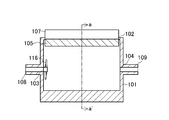
- FIG. 1A is a cross-sectional view showing the configuration of the cooling device according to the first embodiment of the present invention.
- FIG. 1B is a cross-sectional view showing the configuration of the cooling device according to the first embodiment of the present invention.
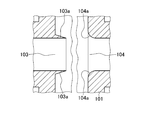
- FIG. 1C is a cross-sectional view showing a partial configuration of the cooling device according to the first embodiment of the present invention.
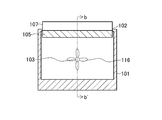
- FIG. 2A is a cross-sectional view showing the configuration of the cooling device according to the second embodiment of the present invention.
- FIG. 2B is a cross-sectional view showing the configuration of the cooling device according to the second embodiment of the present invention.
- FIG. 3 is a cross-sectional view showing the configuration of the cooling device according to the third embodiment of the present invention.
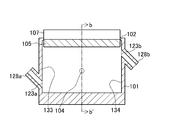
- FIG. 4A is a cross-sectional view showing the configuration of the cooling device according to the fourth embodiment of the present invention.
- FIG. 4B is a cross-sectional view showing the configuration of the cooling device according to the fourth embodiment of the present invention.
- FIG. 5A is a cross-sectional view showing the configuration of the cooling device according to the fifth embodiment of the present invention.
- FIG. 5B is a cross-sectional view showing the configuration of the cooling device according to the fifth embodiment of the present invention.
- FIG. 6 is a cross-sectional view showing the configuration of the cooling device according to the sixth embodiment of the present invention.
- FIG. 1B shows a cross section of the aa'line of FIG. 1A.
- FIG. 1A shows a cross section of the line bb'of FIG. 1B.
- This cooling device includes a cooling jacket 101 that houses a cooling fluid.
- the cooling jacket 101 includes a fixing portion 102 to which the element 107 to be cooled is fixed.
- the element 107 is, for example, a diffraction element.
- the cooling jacket 101 is a jig provided with a fixing portion 102 for fixing the element 107, and the shape, material, installation angle, size, length, and weight of the cooling device are not limited. Further, the fixing method in the fixing portion 102 is not limited. As an example, the cooling jacket 101 has a rectangular parallelepiped shape and includes a mechanism for fixing the element 107 on a certain surface (fixing portion 102) so as to sandwich the element 107. A path for circulating a cooling fluid is provided inside the cooling jacket 101, and the element 107 fixed to the fixing portion 102 can be cooled.
- the cooling jacket 101 may be sized to match the size of the element 107, and can be miniaturized.
- this cooling device includes an inflow port 103 in which the cooling fluid flows into the cooling jacket 101, and an outflow port 104 in which the cooling fluid flows out from the inside of the cooling jacket 101.
- the inflow port 103 is provided on a first surface perpendicular to the surface of the fixing portion 102 of the cooling jacket 101, and the outlet 104 is a second surface perpendicular to the surface of the fixing portion 102 of the cooling jacket 101, which is different from the first surface. It is provided in.
- the inflow joint pipe 108 is connected to the inflow port 103
- the outflow joint pipe 109 is connected to the outflow port 104.
- the shape, material, angle, size, etc. of the inflow joint pipe 108 and the outflow joint pipe 109 are not limited.
- the shapes of the inflow joint pipe 108 and the outflow joint pipe 109 are long enough to attach a fastener for fixing the hose. It can be formed into a columnar shape having an outer diameter of r.
- the inflow port 103 and the outflow port 104 can have different openings such as shape and size.
- the inflow port 103 and the outflow port 104 can have different inner diameters.
- the inner diameter of the outlet 104 is larger than that of the inlet 103, it is possible to reduce the pipeline resistance at the outlet 104.
- the cooling fluid is a liquid, it is possible to prevent a decrease in the outflow amount without increasing the inflow amount. That is, the cooling fluid is more easily circulated.
- the shape, material, angle, size, etc. of the inflow joint pipe 108 and the outflow joint pipe 109 can be different from each other.
- the inner diameter of the inflow port 103 larger than the inner diameter of the inflow joint pipe 108, it is possible to reduce the pipeline resistance at the inflow and increase the inflow amount.
- the diameter of the inflow joint pipe 108 can be different from the diameter of the inflow port 103.
- the diameter of the outflow joint pipe 109 can be different from the diameter of the outlet 104.
- the shape of the inlet of the outflow port 104 can be a curved surface 104a (FIG. 1C).
- a loss occurs at the outflow port 104 which is the inlet of the outflow joint pipe 109.
- the cross-sectional shape of the outflow port 104 which is the inlet of the outflow joint pipe 109, should not be made a right angle, but the pipe diameter should be gradually increased so that the cross-sectional shape draws a curved surface. Is desirable.
- the inflow port 103 has a shape that increases the loss in order to prevent backflow.
- the inflow port 103 at which the outlet of the inflow joint pipe 108 serves may be provided with a portion 103a that enters inside the boundary surface.
- the cooling fluid is a refrigerant supplied by an external device such as a chiller (not shown), and is composed of one or more of a liquid, a gas, or a solid.
- the cooling fluid passes through the circulation path from the external device, flows into the cooling jacket 101 from the inflow port 103 via the inflow joint pipe 108, flows out from the outflow port 104, and passes through the circulation path through the outflow joint pipe 109. It circulates to an external device.
- this cooling device is arranged so as to be in contact with the cooling fluid in the cooling jacket 101 in a state of being in contact with the element 107 fixed to the fixing portion 102, and the cooling fluid and the fixing portion in the cooling jacket 101.
- a heat transfer member 105 for conducting heat with and from 102 is provided.
- the heat transfer member 105 is in contact with the element 107 and the cooling fluid in order to transfer the heat from the element 107 to the cooling fluid inside the cooling jacket 101.
- the heat transfer member 105 and the element 107 may be integrated or separated.
- the shape, material, angle, size, weight, etc. of the heat transfer member 105 are not limited, but it is desirable that the heat transfer member 105 is made of a material having a high melting point and thermal conductivity. Further, it is desirable that the area of the portion in contact with the element 107 and the cooling fluid is large. For example, by coating the back surface of the element 107 with a material having a high melting point and thermal conductivity (for example, SiC), the heat transfer member 105 can be formed, and the heat from the element 107 is efficiently transferred to the cooling fluid. can do.
- a material having a high melting point and thermal conductivity for example, SiC
- the cooling device has a rod shape (cylindrical shape) as a mechanism for improving heat conduction between the cooling fluid in the cooling jacket 101 and the fixing portion 102 via the heat transfer member 105.
- the member 106 extends in a direction perpendicular to the direction in which the cooling fluid flows inside the cooling jacket 101, and is parallel to the surface of the fixing portion 102.
- the first surface provided with the inflow port 103 is the surface 131
- the second surface provided with the outflow port 104 is the surface 132, which are arranged facing each other.
- the member 106 is erected between the surface 133 and the surface 134.
- the surface 133 and the surface 134 are surfaces perpendicular to the surface of the fixed portion 102 and face each other. Further, the surface 133 and the surface 134 are adjacent to the surface 131 and the surface 132.
- the member 106 is a fluid obstruction portion (turbulence generation mechanism) that obstructs the flow of the cooling fluid, and is a portion that generates turbulence.
- the shape, material, angle, size, weight, arrangement, etc. of the member 106 are not limited.
- the columnar member 106 is arranged in the vicinity of the heat transfer member 105 inside the cooling jacket 101. Inside the cooling jacket 101, a cooling fluid flows along the heat transfer member 105 from the surface of the heat transfer member 105 to the surface facing the heat transfer member 105, or from the surface facing the heat transfer member 105 to the surface of the heat transfer member 105. Since the member 106 is arranged so as to block the flow, the cooling fluid that has passed through the member 106 generates a turbulent flow. Since the heat transfer coefficient is increased by this turbulent flow, the heat transfer member 105 in the vicinity of the member 106 is cooled, and the element 107 can be cooled more efficiently.
- heat transfer by a cooling fluid is a phenomenon in which energy is transported by moving an object having heat energy.
- Q (W) be the amount of energy transferred by heat transfer by the cooling fluid
- T w (K) be the temperature of the wall (heat transfer member 105)
- T f (K) be the temperature of the cooling fluid
- the heat transfer coefficient h is affected not only by the physical properties of the cooling fluid, but also by the strength and style of the flow.
- the magnitude of turbulence (here, the magnitude of turbulence due to turbulence) is expressed by the Reynolds number. A flow different from the global flow occurs, that is, if there is a velocity difference in the fluid, the flow is turbulent, and if the turbulence becomes large, turbulence occurs.
- FIG. 2B shows a cross section of the aa'line of FIG. 2A.
- FIG. 2A shows a cross section of the line bb'of FIG. 2B.
- This cooling device includes a cooling jacket 101, an inflow port 103, an outflow port 104, and a heat transfer member 105. These configurations are the same as those in the first embodiment described above, and the cooling jacket 101 includes a fixing portion 102 to which the element 107 to be cooled is fixed. Further, an inflow joint pipe 108 is connected to the inflow port 103, and an outflow joint pipe 109 is connected to the outflow port 104.
- the cooling device is a rotary blade (stirring) as a mechanism for improving heat conduction between the cooling fluid in the cooling jacket 101 and the fixing portion 102 via the heat transfer member 105.
- Child 116.
- the rotor 116 is arranged, for example, in the vicinity of the inflow port 103.
- the rotary blade 116 is a fluid obstacle portion that is made movable.
- the rotary blade 116 can cause a rotational motion in the cooling fluid that has flowed into the cooling jacket 101 from the inflow port 103.
- the cooling fluid is agitated by the rotational movement of the rotary blade 116, and the heat transfer efficiency in the heat transfer member 105 is increased. Further, by changing the rotation direction of the rotary blade 116 in a short time by automatic control, the stirring is stronger and the heat transfer efficiency is increased.
- This cooling device includes a cooling jacket 101, an inflow port 113, an outflow port 104, and a heat transfer member 105. Similar to the first embodiment described above, the cooling jacket 101 includes a fixing portion 102 to which the element 107 to be cooled is fixed. Further, an inflow joint pipe 118 is connected to the inflow port 113, and an outflow joint pipe 109 is connected to the outflow port 104.
- the cooling device has an inflow joint pipe 118 as a mechanism for improving heat conduction between the cooling fluid in the cooling jacket 101 and the fixing portion 102 via the heat transfer member 105.
- the direction of the pipe shaft is the direction of the heat transfer member 105.
- the flow of the cooling fluid flowing in from the inflow port 113 is the surface of the heat transfer member 105. It will be in a state of hitting directly.
- the cooling fluid to be cooled can be brought into contact with the heat transfer member 105 while suppressing the decrease in temperature.
- the temperature difference between the cooling fluid and the heat transfer member 105 can be made larger, and the heat flow rate can also be made larger.
- the cooling fluid flows in from the inflow port 113 diagonally with respect to the normal direction of the surface 131, turbulent flow can be generated inside the cooling jacket 101.
- turbulent flow can be generated inside the cooling jacket 101.
- the flow velocity of the cooling fluid inside the cooling jacket 101 becomes slower due to frictional resistance as it is closer to the wall surface, and becomes faster as it is farther from the wall surface.
- the cooling fluid having a large flow velocity always flows into the place near the wall surface from the inflow port 113, so that a speed difference is generated and a turbulent flow is generated.
- the direction of the pipe shaft of the inflow joint pipe 118 is the direction of the heat transfer member 105 on the surface adjacent to the surface 131 where the inflow port 113 is provided.
- FIG. 4B shows a cross section of the aa'line of FIG. 4A.
- FIG. 4A shows a cross section of the bb'line of FIG. 4B.
- This cooling device includes a cooling jacket 101, an inflow port 103, an outflow port 104, and a heat transfer member 105. These configurations are the same as those in the first embodiment described above, and the cooling jacket 101 includes a fixing portion 102 to which the element 107 to be cooled is fixed.
- an inflow port 123a In the fourth embodiment, an inflow port 123a, an inflow port 123b, and two inflow ports are provided.
- One inflow port 123a is provided on a surface (first surface) 133 perpendicular to the surface 132 where the outflow port 104 of the cooling jacket 101 is provided, and the other inflow port 123b is a surface facing the surface 133 (third surface).
- Surface Surface
- the inflow joint pipe 128a connected to the inflow port 123a has the direction of the pipe shaft in the direction of the surface of the cooling jacket 101 facing the heat transfer member 105, and the inflow joint pipe 128b connected to the inflow port 123b is the pipe shaft.
- the direction is the direction in which the heat transfer member 105 is arranged.
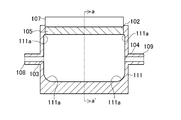
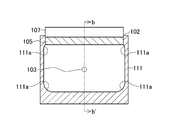
- FIG. 5B shows a cross section of the aa'line of FIG. 5A.
- FIG. 5A shows a cross section of the line bb'of FIG. 5B.
- This cooling device includes a cooling jacket 111, an inflow port 103, an outflow port 104, and a heat transfer member 105.
- the cooling jacket 111 includes a fixing portion 102 to which the element 107 to be cooled is fixed.
- an inflow joint pipe 108 is connected to the inflow port 103, and an outflow joint pipe 109 is connected to the outflow port 104. Except for the cooling jacket 111, it is the same as that of the first embodiment described above.
- the inner corner 111a of the cooling jacket 111 is rounded as a mechanism for improving the heat conduction between the cooling fluid in the cooling jacket 111 and the fixing portion 102 via the heat transfer member 105.
- the cross-sectional shape inside the cooling jacket 111 is substantially elliptical.
- the energy loss of the cooling fluid is reduced, the flow velocity of the cooling fluid of the cooling jacket 111 is increased, and the cooling fluid is easily mixed. As a result, the movement of the cooling fluid increases inside the cooling jacket 111, and the heat flow rate also increases.
- This cooling device includes a cooling jacket 101, an inflow port 103, an outflow port 104, and a heat transfer member 105. These configurations are the same as those in the first embodiment described above, and the cooling jacket 101 includes a fixing portion 102 to which the element 107 to be cooled is fixed. Further, an inflow joint pipe 108 is connected to the inflow port 103, and an outflow joint pipe 109 is connected to the outflow port 104.
- the cooling device is a heat transfer member 105 as a mechanism for improving heat conduction between the cooling fluid in the cooling jacket 101 and the fixing portion 102 via the heat transfer member 105.
- a plurality of fins 126 are provided on the surface of the cooling jacket 101 facing the inside.
- the fin 126 is, for example, a columnar structure.
- the fin 126 can be made of, for example, the same material as the heat transfer member 105.
- the material of the heat transfer member 105 is SiC
- the thickness of the heat transfer member 105 is 1 mm
- the cooling fluid is water
- the heat transfer member 105 and the heat transfer area between the cooling fluid and the heat transfer member 105 are 100 cm 2 .
- the thermal conductivity of SiC is 200 (W / mK)
- the heat transfer rate by the water flowing from about 300 ⁇ 10000 W / m 2 K.
- the transfer efficiency between the cooling fluid and the heat transfer member 105 can be increased.
- the thermal resistance of the heat transfer member 105 is 0.05 (K / W), and it is between the cooling fluid (water) and the heat transfer member 105.
- the thermal resistance of is 5 (K / W). Since the heat flow rate (W) is represented by the temperature difference / thermal resistance, if the temperature difference is 100 (K), the heat flow rate is about 20 W.
- the thermal resistance between the cooling fluid and the heat transfer member 105 becomes 1 /. It becomes 40, and the heat flow becomes about 570 W, which can be increased.
- the rod-shaped member extending in the direction perpendicular to the flow direction of the cooling fluid inside the cooling jacket and connected to the inflow port is a rod-shaped member parallel to the surface of the fixed portion.
- the joint tube whose tube axis is the direction of the heat transfer member two inlets, a cooling jacket with rounded internal corners, a stirrer provided inside the cooling jacket, and cooling of the heat transfer member.
- a mechanism to improve heat conduction between the cooling fluid in the cooling jacket and the fixed part via the heat transfer member, such as fins provided on the surface facing the inside of the jacket, is provided, so a high-power laser It is possible to provide a small cooling device that more efficiently cools the diffractometer and the like used in the above.
Landscapes
- Physics & Mathematics (AREA)
- Electromagnetism (AREA)
- Optics & Photonics (AREA)
- Engineering & Computer Science (AREA)
- Plasma & Fusion (AREA)
- General Physics & Mathematics (AREA)
- Cooling Or The Like Of Semiconductors Or Solid State Devices (AREA)
Priority Applications (3)
| Application Number | Priority Date | Filing Date | Title |
|---|---|---|---|
| US17/640,028 US20220320812A1 (en) | 2019-09-05 | 2019-09-05 | Cooling Device |
| PCT/JP2019/034957 WO2021044575A1 (ja) | 2019-09-05 | 2019-09-05 | 冷却装置 |
| JP2021543886A JPWO2021044575A1 (https=) | 2019-09-05 | 2019-09-05 |
Applications Claiming Priority (1)
| Application Number | Priority Date | Filing Date | Title |
|---|---|---|---|
| PCT/JP2019/034957 WO2021044575A1 (ja) | 2019-09-05 | 2019-09-05 | 冷却装置 |
Publications (1)
| Publication Number | Publication Date |
|---|---|
| WO2021044575A1 true WO2021044575A1 (ja) | 2021-03-11 |
Family
ID=74852722
Family Applications (1)
| Application Number | Title | Priority Date | Filing Date |
|---|---|---|---|
| PCT/JP2019/034957 Ceased WO2021044575A1 (ja) | 2019-09-05 | 2019-09-05 | 冷却装置 |
Country Status (3)
| Country | Link |
|---|---|
| US (1) | US20220320812A1 (https=) |
| JP (1) | JPWO2021044575A1 (https=) |
| WO (1) | WO2021044575A1 (https=) |
Citations (8)
| Publication number | Priority date | Publication date | Assignee | Title |
|---|---|---|---|---|
| JPS60120401U (ja) * | 1984-01-25 | 1985-08-14 | 株式会社日立製作所 | 反射ミラ− |
| JP2005142242A (ja) * | 2003-11-05 | 2005-06-02 | Japan Science & Technology Agency | 固体レーザー装置 |
| US20100118902A1 (en) * | 2008-11-12 | 2010-05-13 | Metal Industries Research & Development Centre | Unitized cooling module for laser diode array |
| JP2011054675A (ja) * | 2009-08-31 | 2011-03-17 | Hamamatsu Photonics Kk | 固体レーザ装置 |
| JP2013041051A (ja) * | 2011-08-12 | 2013-02-28 | Gigaphoton Inc | 波長変換装置、固体レーザ装置およびレーザシステム |
| JP2015185601A (ja) * | 2014-03-20 | 2015-10-22 | 三菱重工業株式会社 | レーザ発振冷却装置 |
| CN105281198A (zh) * | 2014-05-30 | 2016-01-27 | 中国科学院理化技术研究所 | 一种半导体激光器的热管理装置 |
| JP2017207235A (ja) * | 2016-05-18 | 2017-11-24 | 株式会社Nttファシリティーズ | 発熱体冷却システム |
Family Cites Families (12)
| Publication number | Priority date | Publication date | Assignee | Title |
|---|---|---|---|---|
| AU2003207882A1 (en) * | 2002-03-08 | 2003-09-22 | Koninklijke Philips Electronics N.V. | A device for generating x-rays having a liquid metal anode |
| US20070020107A1 (en) * | 2005-06-29 | 2007-01-25 | Ioan Sauciuc | High pressure pump for cooling electronics |
| US7307841B2 (en) * | 2005-07-28 | 2007-12-11 | Delphi Technologies, Inc. | Electronic package and method of cooling electronics |
| EP2306548B1 (en) * | 2008-07-26 | 2018-11-07 | LG Chem, Ltd. | Medium or large battery pack case with excellent cooling efficiency |
| JP5644767B2 (ja) * | 2009-09-29 | 2014-12-24 | 日本電気株式会社 | 電子機器装置の熱輸送構造 |
| JP2011165870A (ja) * | 2010-02-09 | 2011-08-25 | Toyota Motor Corp | パワーモジュール |
| JP5515947B2 (ja) * | 2010-03-29 | 2014-06-11 | 株式会社豊田自動織機 | 冷却装置 |
| US20120145361A1 (en) * | 2010-12-13 | 2012-06-14 | Nuventix Inc. | Apparatus and method for enhanced heat transfer |
| US20130068606A1 (en) * | 2011-09-15 | 2013-03-21 | Heatcraft Refrigeration Products Llc | Fluid agitator for use in an immersion cooler |
| US10729040B2 (en) * | 2015-09-14 | 2020-07-28 | Mitsubishi Electric Corporation | Cooler, power conversion apparatus, and cooling system |
| JP6844499B2 (ja) * | 2017-10-24 | 2021-03-17 | 三菱電機株式会社 | 冷却装置及びこれを備えた半導体モジュール |
| JP6939481B2 (ja) * | 2017-11-30 | 2021-09-22 | 富士通株式会社 | 冷却ジャケット及び電子機器 |
-
2019
- 2019-09-05 JP JP2021543886A patent/JPWO2021044575A1/ja active Pending
- 2019-09-05 WO PCT/JP2019/034957 patent/WO2021044575A1/ja not_active Ceased
- 2019-09-05 US US17/640,028 patent/US20220320812A1/en not_active Abandoned
Patent Citations (8)
| Publication number | Priority date | Publication date | Assignee | Title |
|---|---|---|---|---|
| JPS60120401U (ja) * | 1984-01-25 | 1985-08-14 | 株式会社日立製作所 | 反射ミラ− |
| JP2005142242A (ja) * | 2003-11-05 | 2005-06-02 | Japan Science & Technology Agency | 固体レーザー装置 |
| US20100118902A1 (en) * | 2008-11-12 | 2010-05-13 | Metal Industries Research & Development Centre | Unitized cooling module for laser diode array |
| JP2011054675A (ja) * | 2009-08-31 | 2011-03-17 | Hamamatsu Photonics Kk | 固体レーザ装置 |
| JP2013041051A (ja) * | 2011-08-12 | 2013-02-28 | Gigaphoton Inc | 波長変換装置、固体レーザ装置およびレーザシステム |
| JP2015185601A (ja) * | 2014-03-20 | 2015-10-22 | 三菱重工業株式会社 | レーザ発振冷却装置 |
| CN105281198A (zh) * | 2014-05-30 | 2016-01-27 | 中国科学院理化技术研究所 | 一种半导体激光器的热管理装置 |
| JP2017207235A (ja) * | 2016-05-18 | 2017-11-24 | 株式会社Nttファシリティーズ | 発熱体冷却システム |
Also Published As
| Publication number | Publication date |
|---|---|
| US20220320812A1 (en) | 2022-10-06 |
| JPWO2021044575A1 (https=) | 2021-03-11 |
Similar Documents
| Publication | Publication Date | Title |
|---|---|---|
| US7096934B2 (en) | Heat exchanger | |
| US8933860B2 (en) | Active cooling of high speed seeker missile domes and radomes | |
| US8408281B2 (en) | System, method, and apparatus for pulsed-jet-enhanced heat exchanger | |
| Zhimin et al. | The optimum thermal design of microchannel heat sinks | |
| CN112005147B (zh) | 过滤设备和方法 | |
| JP6258236B2 (ja) | 流体温度およびフローの制御のための方法および装置 | |
| IE20060839A1 (en) | A cooling device | |
| JP4304576B2 (ja) | 熱輸送装置及び電子機器 | |
| WO2021044575A1 (ja) | 冷却装置 | |
| JP2005327795A (ja) | 放熱器 | |
| WO2020152822A1 (ja) | 冷却装置 | |
| EA014801B1 (ru) | Устройство охлаждения для электроаппаратуры | |
| JP2006046868A (ja) | 放熱器およびヒートパイプ | |
| JP7481635B2 (ja) | 冷却装置 | |
| CN218296868U (zh) | 一种散热组件及其散热装置 | |
| EP3301391B1 (en) | A heat transfer structure | |
| RU2509970C1 (ru) | Радиатор | |
| Vetrovec et al. | Testing of active heat sink for advanced high-power laser diodes | |
| JP2022189543A (ja) | 熱交換器用ピンフィンおよび熱交換器 | |
| WO2023286631A1 (ja) | 筐体具備装置 | |
| Merdan et al. | CFD Analysis for Different Types of Fins to Enhancement the Heat Transfer Rate Through A Cross Flow Heat Exchanger | |
| WO2023286624A1 (ja) | 筐体具備装置 | |
| RANGA PRASAD | ASSESSMENT OF ANNULAR FLOW BOILING IN THE CONTEXT OF COMPUTATIONAL FLUID DYNAMICS (CFD) SIMULATIONS, EXPERIMENTS, AND EXISTING CORRELATIONS | |
| Prasad | Assessment of Annular Flow Boiling in the Context of Computational Fluid Dynamics (CFD) Simulations, Experiments, and Existing Correlations | |
| LONG | DEVELOPMENT OF A MICROCHANNEL HEAT SINK FOR THERMAL MANAGEMENT |
Legal Events
| Date | Code | Title | Description |
|---|---|---|---|
| 121 | Ep: the epo has been informed by wipo that ep was designated in this application |
Ref document number: 19944406 Country of ref document: EP Kind code of ref document: A1 |
|
| ENP | Entry into the national phase |
Ref document number: 2021543886 Country of ref document: JP Kind code of ref document: A |
|
| NENP | Non-entry into the national phase |
Ref country code: DE |
|
| 122 | Ep: pct application non-entry in european phase |
Ref document number: 19944406 Country of ref document: EP Kind code of ref document: A1 |