WO2021039799A1 - 硬化性組成物 - Google Patents
硬化性組成物 Download PDFInfo
- Publication number
- WO2021039799A1 WO2021039799A1 PCT/JP2020/032052 JP2020032052W WO2021039799A1 WO 2021039799 A1 WO2021039799 A1 WO 2021039799A1 JP 2020032052 W JP2020032052 W JP 2020032052W WO 2021039799 A1 WO2021039799 A1 WO 2021039799A1
- Authority
- WO
- WIPO (PCT)
- Prior art keywords
- group
- meth
- polymer
- curable composition
- acid
- Prior art date
- Legal status (The legal status is an assumption and is not a legal conclusion. Google has not performed a legal analysis and makes no representation as to the accuracy of the status listed.)
- Ceased
Links
Images
Classifications
-
- C—CHEMISTRY; METALLURGY
- C08—ORGANIC MACROMOLECULAR COMPOUNDS; THEIR PREPARATION OR CHEMICAL WORKING-UP; COMPOSITIONS BASED THEREON
- C08F—MACROMOLECULAR COMPOUNDS OBTAINED BY REACTIONS ONLY INVOLVING CARBON-TO-CARBON UNSATURATED BONDS
- C08F265/00—Macromolecular compounds obtained by polymerising monomers on to polymers of unsaturated monocarboxylic acids or derivatives thereof as defined in group C08F20/00
- C08F265/04—Macromolecular compounds obtained by polymerising monomers on to polymers of unsaturated monocarboxylic acids or derivatives thereof as defined in group C08F20/00 on to polymers of esters
- C08F265/06—Polymerisation of acrylate or methacrylate esters on to polymers thereof
-
- C—CHEMISTRY; METALLURGY
- C08—ORGANIC MACROMOLECULAR COMPOUNDS; THEIR PREPARATION OR CHEMICAL WORKING-UP; COMPOSITIONS BASED THEREON
- C08F—MACROMOLECULAR COMPOUNDS OBTAINED BY REACTIONS ONLY INVOLVING CARBON-TO-CARBON UNSATURATED BONDS
- C08F120/00—Homopolymers of compounds having one or more unsaturated aliphatic radicals, each having only one carbon-to-carbon double bond, and only one being terminated by only one carboxyl radical or a salt, anhydride, ester, amide, imide or nitrile thereof
- C08F120/02—Monocarboxylic acids having less than ten carbon atoms; Derivatives thereof
- C08F120/10—Esters
- C08F120/12—Esters of monohydric alcohols or phenols
-
- C—CHEMISTRY; METALLURGY
- C08—ORGANIC MACROMOLECULAR COMPOUNDS; THEIR PREPARATION OR CHEMICAL WORKING-UP; COMPOSITIONS BASED THEREON
- C08F—MACROMOLECULAR COMPOUNDS OBTAINED BY REACTIONS ONLY INVOLVING CARBON-TO-CARBON UNSATURATED BONDS
- C08F2/00—Processes of polymerisation
- C08F2/44—Polymerisation in the presence of compounding ingredients, e.g. plasticisers, dyestuffs, fillers
-
- C—CHEMISTRY; METALLURGY
- C08—ORGANIC MACROMOLECULAR COMPOUNDS; THEIR PREPARATION OR CHEMICAL WORKING-UP; COMPOSITIONS BASED THEREON
- C08F—MACROMOLECULAR COMPOUNDS OBTAINED BY REACTIONS ONLY INVOLVING CARBON-TO-CARBON UNSATURATED BONDS
- C08F20/00—Homopolymers and copolymers of compounds having one or more unsaturated aliphatic radicals, each having only one carbon-to-carbon double bond, and only one being terminated by only one carboxyl radical or a salt, anhydride, ester, amide, imide or nitrile thereof
- C08F20/02—Monocarboxylic acids having less than ten carbon atoms, Derivatives thereof
- C08F20/10—Esters
- C08F20/12—Esters of monohydric alcohols or phenols
- C08F20/16—Esters of monohydric alcohols or phenols of phenols or of alcohols containing two or more carbon atoms
- C08F20/18—Esters of monohydric alcohols or phenols of phenols or of alcohols containing two or more carbon atoms with acrylic or methacrylic acids
-
- C—CHEMISTRY; METALLURGY
- C08—ORGANIC MACROMOLECULAR COMPOUNDS; THEIR PREPARATION OR CHEMICAL WORKING-UP; COMPOSITIONS BASED THEREON
- C08F—MACROMOLECULAR COMPOUNDS OBTAINED BY REACTIONS ONLY INVOLVING CARBON-TO-CARBON UNSATURATED BONDS
- C08F20/00—Homopolymers and copolymers of compounds having one or more unsaturated aliphatic radicals, each having only one carbon-to-carbon double bond, and only one being terminated by only one carboxyl radical or a salt, anhydride, ester, amide, imide or nitrile thereof
- C08F20/02—Monocarboxylic acids having less than ten carbon atoms, Derivatives thereof
- C08F20/10—Esters
- C08F20/26—Esters containing oxygen in addition to the carboxy oxygen
- C08F20/28—Esters containing oxygen in addition to the carboxy oxygen containing no aromatic rings in the alcohol moiety
-
- C—CHEMISTRY; METALLURGY
- C08—ORGANIC MACROMOLECULAR COMPOUNDS; THEIR PREPARATION OR CHEMICAL WORKING-UP; COMPOSITIONS BASED THEREON
- C08F—MACROMOLECULAR COMPOUNDS OBTAINED BY REACTIONS ONLY INVOLVING CARBON-TO-CARBON UNSATURATED BONDS
- C08F222/00—Copolymers of compounds having one or more unsaturated aliphatic radicals, each having only one carbon-to-carbon double bond, and at least one being terminated by a carboxyl radical and containing at least one other carboxyl radical in the molecule; Salts, anhydrides, esters, amides, imides, or nitriles thereof
- C08F222/10—Esters
- C08F222/12—Esters of phenols or saturated alcohols
- C08F222/14—Esters having no free carboxylic acid groups, e.g. dialkyl maleates or fumarates
-
- C—CHEMISTRY; METALLURGY
- C08—ORGANIC MACROMOLECULAR COMPOUNDS; THEIR PREPARATION OR CHEMICAL WORKING-UP; COMPOSITIONS BASED THEREON
- C08F—MACROMOLECULAR COMPOUNDS OBTAINED BY REACTIONS ONLY INVOLVING CARBON-TO-CARBON UNSATURATED BONDS
- C08F222/00—Copolymers of compounds having one or more unsaturated aliphatic radicals, each having only one carbon-to-carbon double bond, and at least one being terminated by a carboxyl radical and containing at least one other carboxyl radical in the molecule; Salts, anhydrides, esters, amides, imides, or nitriles thereof
- C08F222/30—Nitriles
- C08F222/32—Alpha-cyano-acrylic acid; Esters thereof
-
- C—CHEMISTRY; METALLURGY
- C08—ORGANIC MACROMOLECULAR COMPOUNDS; THEIR PREPARATION OR CHEMICAL WORKING-UP; COMPOSITIONS BASED THEREON
- C08F—MACROMOLECULAR COMPOUNDS OBTAINED BY REACTIONS ONLY INVOLVING CARBON-TO-CARBON UNSATURATED BONDS
- C08F290/00—Macromolecular compounds obtained by polymerising monomers on to polymers modified by introduction of aliphatic unsaturated end or side groups
- C08F290/08—Macromolecular compounds obtained by polymerising monomers on to polymers modified by introduction of aliphatic unsaturated end or side groups on to polymers modified by introduction of unsaturated side groups
- C08F290/12—Polymers provided for in subclasses C08C or C08F
-
- C—CHEMISTRY; METALLURGY
- C08—ORGANIC MACROMOLECULAR COMPOUNDS; THEIR PREPARATION OR CHEMICAL WORKING-UP; COMPOSITIONS BASED THEREON
- C08F—MACROMOLECULAR COMPOUNDS OBTAINED BY REACTIONS ONLY INVOLVING CARBON-TO-CARBON UNSATURATED BONDS
- C08F299/00—Macromolecular compounds obtained by interreacting polymers involving only carbon-to-carbon unsaturated bond reactions, in the absence of non-macromolecular monomers
-
- C—CHEMISTRY; METALLURGY
- C08—ORGANIC MACROMOLECULAR COMPOUNDS; THEIR PREPARATION OR CHEMICAL WORKING-UP; COMPOSITIONS BASED THEREON
- C08G—MACROMOLECULAR COMPOUNDS OBTAINED OTHERWISE THAN BY REACTIONS ONLY INVOLVING UNSATURATED CARBON-TO-CARBON BONDS
- C08G59/00—Polycondensates containing more than one epoxy group per molecule; Macromolecules obtained by polymerising compounds containing more than one epoxy group per molecule using curing agents or catalysts which react with the epoxy groups
- C08G59/14—Polycondensates modified by chemical after-treatment
-
- C—CHEMISTRY; METALLURGY
- C08—ORGANIC MACROMOLECULAR COMPOUNDS; THEIR PREPARATION OR CHEMICAL WORKING-UP; COMPOSITIONS BASED THEREON
- C08G—MACROMOLECULAR COMPOUNDS OBTAINED OTHERWISE THAN BY REACTIONS ONLY INVOLVING UNSATURATED CARBON-TO-CARBON BONDS
- C08G59/00—Polycondensates containing more than one epoxy group per molecule; Macromolecules obtained by polymerising compounds containing more than one epoxy group per molecule using curing agents or catalysts which react with the epoxy groups
- C08G59/18—Macromolecules obtained by polymerising compounds containing more than one epoxy group per molecule using curing agents or catalysts which react with the epoxy groups ; e.g. general methods of curing
- C08G59/40—Macromolecules obtained by polymerising compounds containing more than one epoxy group per molecule using curing agents or catalysts which react with the epoxy groups ; e.g. general methods of curing characterised by the curing agents used
-
- C—CHEMISTRY; METALLURGY
- C08—ORGANIC MACROMOLECULAR COMPOUNDS; THEIR PREPARATION OR CHEMICAL WORKING-UP; COMPOSITIONS BASED THEREON
- C08G—MACROMOLECULAR COMPOUNDS OBTAINED OTHERWISE THAN BY REACTIONS ONLY INVOLVING UNSATURATED CARBON-TO-CARBON BONDS
- C08G75/00—Macromolecular compounds obtained by reactions forming a linkage containing sulfur with or without nitrogen, oxygen, or carbon in the main chain of the macromolecule
- C08G75/02—Polythioethers
- C08G75/04—Polythioethers from mercapto compounds or metallic derivatives thereof
- C08G75/045—Polythioethers from mercapto compounds or metallic derivatives thereof from mercapto compounds and unsaturated compounds
-
- C—CHEMISTRY; METALLURGY
- C08—ORGANIC MACROMOLECULAR COMPOUNDS; THEIR PREPARATION OR CHEMICAL WORKING-UP; COMPOSITIONS BASED THEREON
- C08K—Use of inorganic or non-macromolecular organic substances as compounding ingredients
- C08K5/00—Use of organic ingredients
- C08K5/04—Oxygen-containing compounds
-
- C—CHEMISTRY; METALLURGY
- C08—ORGANIC MACROMOLECULAR COMPOUNDS; THEIR PREPARATION OR CHEMICAL WORKING-UP; COMPOSITIONS BASED THEREON
- C08K—Use of inorganic or non-macromolecular organic substances as compounding ingredients
- C08K5/00—Use of organic ingredients
- C08K5/36—Sulfur-, selenium-, or tellurium-containing compounds
- C08K5/37—Thiols
-
- C—CHEMISTRY; METALLURGY
- C08—ORGANIC MACROMOLECULAR COMPOUNDS; THEIR PREPARATION OR CHEMICAL WORKING-UP; COMPOSITIONS BASED THEREON
- C08L—COMPOSITIONS OF MACROMOLECULAR COMPOUNDS
- C08L33/00—Compositions of homopolymers or copolymers of compounds having one or more unsaturated aliphatic radicals, each having only one carbon-to-carbon double bond, and only one being terminated by only one carboxyl radical, or of salts, anhydrides, esters, amides, imides or nitriles thereof; Compositions of derivatives of such polymers
- C08L33/04—Homopolymers or copolymers of esters
Definitions
- the present invention relates to curable compositions. More specifically, the present invention relates to a curable composition having excellent curing reactivity.
- a polymer compound having a reactive functional group in the side chain causes a cross-linking reaction by energy rays or heat and gives a good cured product, so that it is industrially versatile and useful. It is used in a wide range of applications such as agents, paints, inks, and resists.
- a polymer compound having a cyclic ether group such as an epoxy group or a (meth) acryloyl group proceeds to be cured in the presence of a compound that generates cations or radicals by irradiation or heating with energy rays.
- the cross-linking reaction of a hydroxyl group and an isocyanate group or a carboxyl group and an oxazolyl group proceeds by heating.
- Patent Document 1 contains a vinyl ether group-containing polymer having a specific structure and a specific compound that generates cations or radicals when irradiated with energy rays, so that bubbles can be generated even when cured by irradiation with energy rays. Described is a curable composition that does not form, has extremely high curing performance by irradiation with energy rays, and can obtain a high-quality cured product.
- Patent Document 2 has sufficient photocurability by containing a cationically polymerizable compound, an acrylic resin having a cationically polymerizable functional group, and a photocationic polymerization initiator in predetermined ranges.
- a cationically polymerizable compound an acrylic resin having a cationically polymerizable functional group
- a photocationic polymerization initiator in predetermined ranges.
- Polycarbonate which is difficult to adhere, and a photocurable resin composition having sufficient adhesiveness to a hard plastic typified by PET are described.
- curable compositions As described above, various curable compositions have been proposed so far. However, in the conventional curable composition, there is still room for improvement in the curing reactivity. Further, if the curable composition can be sufficiently cured in both energy ray curing and thermosetting to give a desired cured product, the curable composition can be applied to a wider range of applications. it can.
- the present invention has been made in view of the above situation, and an object of the present invention is to provide a curable composition that exhibits excellent curing reactivity by both energy ray curing and thermosetting.
- the present inventor has found that a polymer having a specific structural unit and a specific range of molecular weight distribution (weight average molecular weight / number average molecular weight), a polymerizable compound and / or a curing catalyst. It has been found that a curable composition having excellent curing reactivity can be obtained by including the above, and the present invention has been completed.
- the present invention is a curable composition containing a polymer (A), a polymerizable compound (B) and / or a curing catalyst (C), and the polymer (A) has the following general formula (A). It is a curable composition having a structural unit represented by 1) and having a molecular weight distribution (weight average molecular weight / number average molecular weight) of 1.0 to 4.0.
- R 1 represents a hydrogen atom or a methyl group.
- R 2 and R 3 represent the same or different hydrogen atom or an organic group.
- R 4 represents a hydrogen atom or an organic group.
- N represents a hydrogen atom or an organic group. , Represents an integer of 2 or more.
- the present invention is also a curable composition containing the polymer (A), the polymerizable compound (B) and / or the curing catalyst (C), and the polymer (A) is described by the following general formula (2).
- a curable composition which is a group transfer polymer of a monomer component containing vinyl ether group-containing (meth) acrylic acid esters.
- R 1 represents a hydrogen atom or a methyl group.
- R 2 and R 3 represent the same or different hydrogen atom or an organic group.
- R 4 represents a hydrogen atom or an organic group.
- N represents a hydrogen atom or an organic group. Represents an integer greater than or equal to 1.
- the weight average molecular weight of the polymer (A) is preferably 5000 to 1,000,000.
- the curing catalyst (C) is preferably at least one selected from the group consisting of a cationic curing catalyst and a radical curing catalyst.
- the polymerizable compound (B) is at least selected from the group consisting of vinyl ether compounds, cyclic ether compounds, (meth) acrylic acid esters, carboxylic acid compounds, maleimide compounds, alcohols, and thiols. It is preferably one kind.
- the polymerizable compound (B) is preferably at least one selected from the group consisting of a methylene malonic acid diester compound and an ⁇ -cyanoacrylic acid ester.
- the polymerizable compound (B) is preferably an acid group-containing alkali-soluble resin and / or a resin having a group that generates an acid group by heat or acid.
- the curable composition is at least one selected from the group consisting of coating agents, adhesives, adhesives, resists, paints, printing ink compositions, electronic parts, and optical parts. Is preferable.
- the present invention also relates to the curability described above for producing at least one selected from the group consisting of coating agents, pressure-sensitive adhesives, adhesives, resists, paints, printing ink compositions, electronic components, and optical components.
- coating agents pressure-sensitive adhesives, adhesives, resists, paints, printing ink compositions, electronic components, and optical components.
- the curable composition of the present invention has the above-mentioned structure, it has excellent curing reactivity.
- the curable composition of the present invention is suitably used for various applications such as pressure-sensitive adhesives, adhesives, printing ink compositions, resist compositions, coating agents, and molding materials.
- (meth) acrylic acid means “acrylic acid and / or methacrylic acid”
- (meth) acrylate means “acrylate and / or methacrylate”.
- Curable composition (1) The first curable composition of the present invention (hereinafter, also referred to as “curable composition (1)”) includes a polymer (A), a polymerizable compound (B) and / or a curing catalyst (C).
- the polymer (A) has a structural unit represented by the following general formula (1) and has a molecular weight distribution (weight average molecular weight / number average molecular weight) of 1.0 to 4.0. It is a feature.
- R 1 represents a hydrogen atom or a methyl group.
- R 2 and R 3 represent the same or different hydrogen atom or an organic group.
- R 4 represents a hydrogen atom or an organic group.
- N represents a hydrogen atom or an organic group. , Represents an integer of 2 or more.
- the curable composition (1) of the present invention has excellent curing reactivity in addition to containing a polymer having a vinyl ether group having very high reactivity, and is sufficient for the curing reaction to proceed efficiently. It is presumed that an amount of vinyl ether group is present in the polymer. In the conventional polymer having a vinyl ether group in the side chain, a part of the vinyl ether group reacts at the time of producing the polymer, and the polymer is coupled to each other from the reaction, or the polymer chain is separated from the main chain. Since it is grafted, the molecular weight distribution becomes large. In this case, the vinyl ether group is consumed in the polymer, and the content of the vinyl ether group in the polymer becomes insufficient.
- the polymer whose molecular weight distribution is controlled within the above-mentioned predetermined range is a polymer having a sufficient content of vinyl ether groups in the polymer, and by using such a polymer, a curable composition can be obtained. It is considered that excellent curing reactivity can be exhibited.
- the polymer (A) contains a gel component when synthesized by radical polymerization, for example, a cured product having a desired shape such as a flat coating film cannot be obtained, or a cured product cannot be obtained.
- the polymer in which the molecular weight distribution of the polymer (A) is controlled within a predetermined range suppresses the generation of gel components, so that a good cured product can be obtained. it can.
- the polymer (A) used in the curable composition (1) of the present invention has a structural unit represented by the above general formula (1) (hereinafter, also referred to as “structural unit (a1)”).
- the molecular weight distribution (weight average molecular weight / number average molecular weight) is 1.0 to 4.0.
- R 1 represents a hydrogen atom or a methyl group.
- R 2 and R 3 represent the same or different hydrogen atoms or organic groups.
- the organic group represented by R 2 or R 3 include a chain or cyclic monovalent hydrocarbon group having 1 to 20 carbon atoms, and at least a part of the atoms constituting the hydrocarbon group. Examples thereof include those substituted with a halogen atom, an oxygen atom, a nitrogen atom or a sulfur atom.
- Examples of the chain hydrocarbon group include a linear or branched aliphatic hydrocarbon group.
- Examples of the aliphatic hydrocarbon group include saturated hydrocarbon groups such as alkyl groups and unsaturated hydrocarbon groups such as alkenyl groups, and preferably saturated hydrocarbon groups.
- Specific examples of the above aliphatic hydrocarbon group include, for example, a methyl group, an ethyl group, an n-propyl group, an iso-propyl group, an n-butyl group, a tert-butyl group, a sec-butyl group, a pentyl group and an isopentyl group.
- Examples of the cyclic hydrocarbon group include an alicyclic hydrocarbon group and an aromatic hydrocarbon group.
- Examples of the alicyclic hydrocarbon group include cycloalkyl groups such as cyclopropyl group, cyclobutyl group, cyclopentyl group, cyclohexyl group, cycloheptyl group, cyclooctyl group, cyclododecyl group, adamantyl group and norbornyl group. Be done.
- aromatic hydrocarbon group examples include aromatic hydrocarbon groups such as a phenyl group, a naphthyl group, a biphenyl group, a methoxyphenyl group, a trichlorophenyl group, an ethylphenyl group, a trill group, a xsilyl group and a benzyl group. ..
- halogen atom chlorine, bromine, or fluorine is preferable, and fluorine is more preferable.
- the organic groups include an alkyl group having 1 to 10 carbon atoms, a cycloalkyl group having 3 to 10 carbon atoms, an alkyl halide group having 1 to 5 carbon atoms, and an aromatic hydrocarbon group having 6 to 12 carbon atoms.
- an alkyl group having 1 to 6 carbon atoms, an alkyl halide group having 1 to 5 carbon atoms, or an aromatic hydrocarbon group having 6 to 11 carbon atoms is more preferable, and an alkyl group having 1 to 2 carbon atoms and an aromatic hydrocarbon group having 1 to 2 carbon atoms are preferable.
- An alkyl halide group of 1 to 2 and an aromatic hydrocarbon group having 6 to 8 carbon atoms are more preferable.
- R 4 represents a hydrogen atom or an organic group.
- the organic group represented by R 4 include the same organic groups represented by R 2 and R 3 described above.
- R 4 is preferably a chain or cyclic hydrocarbon group having 1 to 11 carbon atoms, an alkyl group having 1 to 10 carbon atoms, a cycloalkyl group having 3 to 10 carbon atoms, and 6 to 6 carbon atoms. It is more preferably an aromatic hydrocarbon group of 11, and further preferably an alkyl group having 1 to 3 carbon atoms.
- n is an integer of 2 or more.
- the polymer having the structural unit (a1) can be obtained, for example, by polymerizing a monomer component containing vinyl ether group-containing (meth) acrylic acid esters represented by the following general formula (2).
- R 1, R 2, R 3 and R 4 are respectively the same as R 1, R 2, R 3 and R 4 in the general formula (1).
- n represents an integer of 2 or more.
- vinyl ether group-containing (meth) acrylic acid esters represented by the general formula (2) include, for example, 2- (2-vinyloxyethoxy) ethyl (meth) acrylic acid. Can be done.
- the polymer (A) may have only one type of the structural unit (a1), or may have two or more types.
- the content ratio of the structural unit (a1) in the polymer (A) is preferably 1 to 100 mol% with respect to 100 mol% of the total structural units.
- the content ratio of the structural unit (a1) is more preferably 4 mol% or more, and more preferably 8 mol% or more, in that it can increase the crosslink density and impart solvent resistance, hardness, etc. to the cured product. More preferred.
- the content ratio of the structural unit (a1) is preferably 95 mol% or less, more preferably 90 mol% or less. When two or more types are included as the structural unit (a1), the content ratio is the total content ratio of the two or more types.
- the polymer (A) may further have another structural unit (a2).
- the other structural unit (a2) include structural units derived from polymerizable monomers other than the vinyl ether group-containing (meth) acrylic acid esters.
- the other polymerizable monomers include polymerizable monomers having an electron deficiency double bond, which can be appropriately selected depending on the purpose and use of the polymer to be produced.
- polymerizable monomer having an electron-deficient double bond examples include methyl (meth) acrylate, ethyl (meth) acrylate, n-propyl (meth) acrylate, and (meth) acrylic. Acid i-propyl, (meth) acrylic acid n-butyl, (meth) acrylic acid s-butyl, (meth) acrylic acid t-butyl, (meth) acrylic acid n-amyl, (meth) acrylic acid s-amyl, T-amyl (meth) acrylate, n-hexyl (meth) acrylate, 2-ethylhexyl (meth) acrylate, isodecyl (meth) acrylate, tridecyl (meth) acrylate, octyl (meth) acrylate, (meth) ) Isooctyl acrylate, (meth) lauryl acrylate, stearyl
- Ether group-containing (meth) acrylic acid esters Halogen-containing (meth) acrylic acid esters such as trifluoroethyl (meth) acrylate, octafluoropentyl (meth) acrylate, heptadecafluorodecyl (meth) acrylate, and perfluorooctylethyl (meth) acrylate; (Meta) acrylamide, N, N-dimethyl (meth) acrylamide, N, N-dimethylaminopropyl (meth) acrylamide, N-isopropyl (meth) acrylamide, N-methylol (meth) acrylamide, N (meth) acrylate, Nitrogen atom-containing polymerizable monomers such as N'-dimethylaminoethyl, N-phenylmaleimide, N-cyclohexylmaleimide, 2-isopropenyl-2-oxazoline; Ethylene glycol
- the other polymerizable monomer preferably has 1 to 22 carbon atoms, more preferably 1 to 18 carbon atoms, and further preferably 3 to 15 carbon atoms.
- the polymer (A) may have only one type of the other structural unit (a2), or may have two or more types.
- the content ratio of the structural unit (a2) in the polymer (A) is preferably 0 to 99 mol% with respect to 100 mol% of the total structural units.
- the content ratio of the structural unit (a2) is 5 mol% in that various physical properties derived from the structural unit (a2) such as flexibility, adhesion, stability, and heat resistance can be imparted to the cured product. More preferably, it is more preferably 10 mol% or more, further preferably 96 mol% or less, and further preferably 92 mol% or less.
- the content ratio is the total content ratio of the two or more types.
- the content ratios of the structural units (a1) and (a2) are the reaction rates of the vinyl ether group-containing (meth) acrylic acid ester and other monomers using gas chromatography, liquid chromatography, 1 H-HMR, or the like. It can be obtained by a method of comparing the ratio or the corresponding integrated value of 1 H-NMR.
- the polymer (A) preferably has a terminal group derived from a silane compound having a carbon-carbon double bond at the end of the main chain.
- a silane compound having a carbon-carbon double bond as a polymerization initiator
- the polymerization initiation side end of the main chain of the polymer Is formed with a group derived from the above-mentioned silane compound having a carbon-carbon double bond.
- Group transfer polymerization is a type of anionic polymerization in which a monomer is polymerized using the silane compound having a carbon-carbon double bond as a polymerization initiator, as described later, and the silane compound having the carbon-carbon double bond is By adding to the (meth) acrylic group of the vinyl ether group-containing (meth) acrylic acid esters described above or the polymerizable monomer having an electron-deficient double bond giving the structural unit (a2), carbon as described later -A structure derived from a silane compound having a carbon double bond is formed at the terminal, and at the same time, a new silyl ketene acetal is formed at the growth terminal side of the polymer.
- a vinyl ether group-containing (meth) acrylic acid ester or a polymerizable monomer having an electron-deficient double bond that gives the structural unit (a2) is further polymerized on the formed silyl ketene acetal.
- the silyl ketene acetal at the growth end is transferred to the end of the polymer molecule one after another to obtain a polymer.
- the terminal group derived from the silane compound having a carbon-carbon double bond for example, the structure represented by the following general formulas (3), (4) or (5) is preferably mentioned.
- R 5 and R 6 represent a hydrogen atom or an organic group, which are the same or different .
- R 7 represents an organic group.
- R 5 , R 6 and R 7' represent the same or different hydrogen atom or organic group.
- R 5 , R 6 and R 7' represent the same or different hydrogen atom or organic group.
- the general formula (3), (4) and (5), examples of the organic groups represented by R 5 and R 6, may be mentioned the same ones as the organic groups described above, inter alia, 1 to 12 carbon atoms It is preferably a hydrocarbon group of.
- the hydrocarbon group include an alkyl group, an alkenyl group, a cycloalkyl group, a cycloalkenyl group, an aromatic hydrocarbon group and the like.
- at least a part of the atoms constituting the hydrocarbon group may be substituted with an oxygen atom, a nitrogen atom or a sulfur atom, or one or more of the hydrogen atoms constituting the hydrocarbon group.
- the hydrocarbon groups represented by R 5 and R 6 represents an alkyl group having 1 to 6 carbon atoms, a cycloalkyl group, a haloalkyl group, more preferably an aromatic hydrocarbon group, carbon number 1 to 6 Is more preferably an alkyl group or a cycloalkyl group, further preferably an alkyl group having 1 to 6 carbon atoms, and particularly preferably a methyl group or an ethyl group.
- the organic group represented by R 7 and R 7 ' for example, there may be mentioned the same as the organic groups described above, among them, preferably a hydrocarbon group having 1 to 22 carbon atoms, atoms 1 More preferably, it is an alkyl group of ⁇ 12, cycloalkyl group, aromatic hydrocarbon group, methyl group, ethyl group, propyl group, butyl group, tert-butyl group, adamantyl group, cyclohexyl group, 2-ethylhexyl group, It is more preferably a phenyl group, and particularly preferably a methyl group, an ethyl group or a tert-butyl group.
- At least a part of the atoms constituting the above-mentioned hydrocarbon group may be substituted with an oxygen atom, a nitrogen atom or a sulfur atom, or the above-mentioned hydrocarbon.
- One or more of the hydrogen atoms constituting the group may be substituted with a halogen atom such as a fluorine atom, a chlorine atom or a bromine atom; a hydroxyl group; or a substituent such as an alkoxy group.
- the plurality of R 7's may be the same or different.
- R 5 and R 6 or R 6 and R 7 or R 7 ' may be combined to form a ring structure.
- the ring structure include an alicyclic hydrocarbon structure such as cycloalkyl such as cyclohexyl and cyclopentyl; an oxygen-containing heterocyclic structure such as a dihydrofuran ring, a tetrahydrofuran ring, a dihydropyran ring, and a tetrahydropyran ring; ..
- the polymerization initiator is silyl ketene acetal represented by the general formula (7) described later, or represented by the general formula (8).
- the vinylsilane compound and the allylsilane compound represented by the general formula (9) are used, the obtained polymer has a structure represented by the above general formula (3), general formula (4) and general formula (5), respectively. It has a main chain terminal.
- the polymer (A) has a main chain having a terminal group derived from silyl ketene acetal represented by the general formula (3) in that the molecular weight distribution is easily controlled when obtained by group transfer polymerization. It is preferable to have.
- the polymer (A) may also have a terminal structure represented by the following general formula (6).
- the polymer can be imparted with a desired function.
- the polymer (A) has a terminal group derived from a silane compound having a carbon-carbon double bond at one end (first end) of the main chain, and the other end (second end). It is preferable to have a terminal structure represented by the following general formula (6).
- R 1 represents a hydrogen atom or a methyl group.
- R 2 and R 3 represent the same or different hydrogen atom or an organic group.
- R 4 represents a hydrogen atom or an organic group.
- X represents a hydrogen atom or an organic group.
- N represents an integer of 2 or more.
- R 1, R 2, R 3 and R 4 are respectively the same as R 1, R 2, R 3 and R 4 in the general formula (1).
- X represents a hydrogen atom, a halogen atom, an alkyl group, a hydroxymethyl group, an allyl group or a propargyl group.
- the alkyl group is preferably an alkyl group having 1 to 8 carbon atoms, and more preferably an alkyl group having 1 to 6 carbon atoms.
- X is preferably a hydrogen atom in that the terminal group of the polymer can be unified, and is preferably a propargyl group in that it is easy to impart a function to the polymer, thereby enhancing the stability of the polymer. In terms of points, it is preferably an alkyl group.
- the polymer (A) has a molecular weight distribution (weight average molecular weight / number average molecular weight) of 1.0 to 4.0. Since the polymer (A) has the structural unit (a1) and the molecular weight distribution described above, it is possible to have excellent curing reactivity and suppress variations in various physical properties as a cured product. ..
- the molecular weight distribution of the polymer (A) is preferably 3.5 or less, more preferably 3.0 or less, and even more preferably 2.0 or less.
- the molecular weight distribution is also referred to as "dispersity".
- the weight average molecular weight of the polymer (A) has a range suitable for various uses, but is preferably 5000 to 1,000,000.
- the weight average molecular weight of the polymer (A) is more preferably 10,000 or more, more preferably 20,000 or more, and 800,000 or less in terms of handleability of the polymer in terms of durability. Is more preferable, and more preferably 600,000 or less.
- the weight average molecular weight and the number average molecular weight of the polymer (A) can be measured by using a gel permeation chromatography (GPC) method, and specifically, it is determined by the method described in Examples described later. Can be done.
- the molecular weight distribution can be calculated and obtained by dividing the weight average molecular weight by the number average molecular weight.
- the amount of the insoluble content of the polymer (A) is preferably 10% by mass or less, more preferably 5% by mass or less, and 1% by mass or less, based on 100% by mass of the polymer. It is more preferably present, and particularly preferably 0.5% by mass or less. If the amount of the insoluble matter is large, the shape of the cured product of the curable composition may be deteriorated or the strength of the cured product may be lowered, for example, a flat coating film cannot be obtained.
- the insoluble component is a gel component contained in the polymer, preferably a component insoluble in ethyl acetate, toluene or tetrahydrofuran, and has a solubility at 25 ° C.
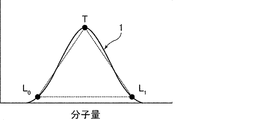
- the maximum value point of the differential molecular weight distribution curve is T.
- the point 5% high of T on the differential molecular weight distribution curve is L 0 and L 1 from the low molecular weight side
- the ratio (X / Y) of the molecular weight distribution curve to the area (Y) of the portion surrounded by the line connecting L 0 to L 1 is preferably 0.8 to 2.0. It can be said that gelation of the polymer is suppressed when the polymer satisfies the ratio in the above range.
- FIG. 1 shows a schematic diagram of a differential molecular weight distribution curve obtained by measurement by the GPC method, and T, L 0 , and L 1 described above.
- the measurement conditions of the GPC are the same as those described in Examples described later.
- the content of the polymer (A) is preferably 5 to 100% by mass with respect to 100% by mass of the total solid content of the curable composition, the crosslink density is increased, and the cured product has solvent resistance and hardness. It is more preferably 10% by mass or more, and further preferably 15% by mass or more, in that the above can be imparted.
- the content of the polymer (A) is more preferably 99.9% by mass or less, and further preferably 95% by mass or less, based on 100% by mass of the total solid content of the curable composition. preferable.
- a "total solid content amount” means the total amount of components forming a cured product (components excluding a solvent or the like that volatilizes when the cured product is formed and a curing catalyst).
- the content of the polymer (A) is such that the solvent resistance can be good, and the total solid content of the curable composition is 100. It is preferably 1 to 50% by mass, more preferably 2 to 40% by mass, and further preferably 5 to 30% by mass with respect to the mass%.
- the method for producing the polymer (A) is not particularly limited as long as it is a method capable of producing the polymer (A) having the above-mentioned constitution, but the polymer (A) can be efficiently produced.
- the method of producing by group transfer polymerization of the above-mentioned monomer component containing vinyl ether group-containing (meth) acrylic acid esters is preferable.
- group transfer polymerization a polymer obtained by polymerizing only the (meth) acryloyl group of vinyl ether group-containing (meth) acrylic acid esters can be efficiently produced. Further, according to this method, the amount of gel component (insoluble matter) contained in the obtained polymer can be suppressed to a low level.
- Group transfer polymerization is a type of anionic polymerization in which a monomer is polymerized using a silane compound having a carbon-carbon double bond such as silyl ketene acetal as a polymerization initiator.
- a silane compound having a carbon-carbon double bond is added to the (meth) acryloyl group of vinyl ether group-containing (meth) acrylic acid esters, and the silyl ketene acetal at the growth end of the newly formed polymer is weighted one after another.
- a polymer is obtained by moving to the end of the coalesced molecule.
- the polymerization reaction of vinyl ether group-containing (meth) acrylic acid esters can be carried out in a temperature range such as room temperature, which is relatively easy to control. Moreover, the above polymerization reaction can be carried out without having to strictly control the amount of water in the reaction system. Further, by using the above polymerization, it is possible to produce a vinyl ether group-containing (meth) acrylic acid ester polymer with less impurities generated and a vinyl ether group remaining at a high conversion rate.
- a production method using the group transfer polymerization will be described below.
- a monomer component containing the above-mentioned vinyl ether group-containing (meth) acrylic acid esters is grouped in the presence of a silane compound having a carbon-carbon double bond and a catalyst. It is preferable to include a step of transfer polymerization.
- any two of the above-mentioned monomer component, catalyst, and silane compound having a carbon-carbon double bond are charged in a reaction vessel, and the remaining one is added. Then, the polymerization starts.
- the order in which these are added is not particularly limited, and the polymerization can be started by adding them by any method.
- the silane compound having a carbon-carbon double bond, the catalyst, and the monomer component may be added in the total amount to be used at one time, or may be continuously added in small amounts. , May be added in several batches.
- the molecular weight of the polymer obtained by polymerizing the monomer component is the type and amount of the monomer component, the type and amount of the silane compound having the carbon-carbon double bond, and the type and amount of the catalyst. , It can be appropriately controlled depending on the type and amount of the solvent used.
- the amount of the silane compound having a carbon-carbon double bond to be used is not particularly limited as long as a desired polymer can be obtained, but it is simply used in that the polymer can be produced more efficiently. It is preferably 1 ⁇ 10 -4 to 10 mol%, more preferably 1 ⁇ 10 -3 to 5 mol%, and further preferably 1 ⁇ 10 -2-1 mol% with respect to the polymer component. ..
- the amount of the catalyst used is not particularly limited as long as a desired polymer can be obtained, but 1 ⁇ with respect to the monomer component used, in that the polymer can be produced more efficiently. It is preferably 10 -4 to 10 mol%, more preferably 1 ⁇ 10 -3 to 5 mol%, and even more preferably 1 ⁇ 10 -2-1 mol%.
- the above-mentioned polymerization reaction can be carried out without using a solvent, but it is preferable to use a solvent.
- the solvent to be used is not limited as long as it can dissolve the raw material, the catalyst, the polymerization initiator, and the polymer, but an aprotic solvent is preferable because the polymerization reaction can proceed efficiently.
- solvent used in the present invention include aromatic hydrocarbon solvents such as toluene, xylene and benzene; aliphatic hydrocarbon solvents such as hexane, pentane, heptane and cyclohexane; acetone and methyl ethyl ketone.
- Ketone solvents such as methylisobutylketone; halogenated hydrocarbon solvents such as chlorobenzene, dichloromethane, chloroform, 1,2-dichloroethane; nitrile solvents such as acetonitrile, propionitrile and valeronitrile; methyl acetate, ethyl acetate, acetic acid Ester solvents such as isopropyl and butyl acetate; amide solvents such as dimethylformamide (DMF), dimethylacetamide and N-methylpyrrolidone; diethyl ether, diisopropyl ether, 1,2-dimethoxyethane (DME), 1,4-dioxane , Tetrahydrofuran (THF), tetrahydropyran (THP), anisole, diethylene glycol dimethyl ether (digrim), diethylene glycol ethyl ether (carbitol), cyclopentylmethyl ether (CPME) and other
- the above-mentioned solvent includes aromatic hydrocarbon-based solvent, aliphatic hydrocarbon-based solvent, ketone-based solvent, halogenated hydrocarbon-based solvent, ether-based solvent, in that the polymerization reaction can proceed more efficiently. It is preferably at least one selected from the group consisting of an ester solvent and a nitrile solvent, and more preferably an aromatic hydrocarbon solvent, an ether solvent, and an ester solvent.
- the above solvent may be used alone or in combination of two or more.
- the amount of the solvent used is preferably 10 to 10000% by mass, more preferably 50 to 5000% by mass, and further preferably 100 to 1000% by mass with respect to 100% by mass of the total amount of the monomer components used. ..
- the oxygen concentration in the solvent at the start of the polymerization is preferably 1000 ppm or less.
- the oxygen concentration in the solvent at the start of polymerization is within the above range, the activity of the silane compound having a carbon-carbon double bond, the catalyst, etc. is less likely to decrease, so that the polymerization reaction proceeds more satisfactorily.
- the desired polymer can be produced more efficiently.
- the oxygen concentration is more preferably 800 ppm or less, and further preferably 0 to 500 ppm.
- the oxygen concentration can be measured with a Polaro dissolved oxygen meter.
- the water content in the solvent at the start of the polymerization is preferably 1000 ppm or less.
- the amount of water in the solvent at the start of polymerization is within the above range, the silane compound having a carbon-carbon double bond is less likely to be decomposed and the activity of the catalyst or the like is less likely to decrease, so that the polymerization reaction is better.
- the desired polymer can be produced more efficiently.
- the water content is more preferably 500 ppm or less, and further preferably 300 ppm or less. The water content can be measured by the Karl Fischer titer measuring method.
- the reaction temperature in the above polymerization is not particularly limited, but is preferably -20 to 100 ° C, more preferably -10 to 50 ° C, and 0 to 30 ° C from the viewpoint of controlling the molecular weight and molecular weight distribution and maintaining the catalytic activity. More preferred. Further, from the viewpoint of reducing the production cost, it is one of the preferable forms of the production method of the present invention to include a step of polymerizing at room temperature ⁇ 20 ° C.
- the reaction time is not particularly limited, but is preferably 10 minutes to 48 hours, more preferably 30 minutes to 36 hours, still more preferably 1 to 24 hours.
- the reaction atmosphere in the above polymerization may be the atmosphere, but is preferably the atmosphere of an inert gas such as nitrogen or argon. Further, the oxygen concentration in the atmosphere in the above polymerization is preferably 10,000 ppm or less, more preferably 1000 ppm or less, and further preferably 100 ppm or less.
- the polymer obtained by the above polymerization reaction has a silyl ketene acetal structure or an enolate anion structure containing a silyl group of a polymerization initiator at the end of the main chain, and water, alcohol, or acid is added to the reaction system.
- the polymerization reaction may be stopped by converting the silyl ketene acetal or enolate anion at one end of the polymer into a carboxylic acid or ester.
- the alcohol include methanol, ethanol, 1-propanol, 2-propanol, 1-butanol, 2-butanol and the like.
- the acid examples include inorganic acids such as hydrochloric acid, sulfuric acid and phosphoric acid, and organic acids such as acetic acid and benzoic acid.
- the amount of water, alcohol or acid used is not particularly limited, but is preferably 1 to 1000 mol, more preferably 1 to 100 mol, and further preferably 1 to 10 mol with respect to 1 mol of the silane compound having a carbon-carbon double bond to be used. Is.
- an electrophile may be added in place of the water, alcohol, or acid.
- the desired functional group can be introduced and the polymerization reaction can be stopped.
- the electrophile include halogens such as iodine and bromine, imide compounds of succinate halogenated, alkyl halides, allyl halides, propargyl halogenated, aldehydes and acid chlorides.
- the amount of the electrophile used is not particularly limited, but is preferably 0.5 to 1.5 mol, more preferably 0.6 to 1.3 mol, and even more preferably 0, with respect to 1 mol of the silyl ketene acetal to be used. It is 8 to 1.2 mol.
- the monomer component used in the above production method, the silane compound having a carbon-carbon double bond, and the catalyst will be described.
- Examples of the monomer component include a monomer into which the structural unit (a1) can be introduced and a monomer into which the structural unit (a2) can be introduced.
- Examples of the monomer into which the structural unit (a1) can be introduced include the vinyl ether group-containing (meth) acrylic acid esters described above.
- Examples of the monomer into which the structural unit (a2) can be introduced include the other polymerizable monomers described above. The content of each of the above-mentioned monomers may be appropriately set so as to obtain a polymer having a structural unit in a desired content ratio range.
- silane compound having a carbon-carbon double bond examples include the following general formula (7):
- R 5 and R 6 represent the same or different hydrogen atom or organic group.
- R 7 , R 8 , R 9 and R 10 represent the same or different organic group.
- R 5 and R 6 or R 6 and R 7 may be combined to form a ring structure.
- R 8 , R 9 and R 10 two or more of them are combined to form a ring structure. May be.
- Cyril ketene acetal represented by, the following general formula (8):
- R 5 , R 6 and R 7' represent the same or different hydrogen atom or organic group.
- R 8 , R 9 and R 10 represent the same or different organic group.
- R 5 And R 6 or R 6 and R 7' may combine to form a ring structure.
- R 8 , R 9 and R 10 two or more of them are combined to form a ring structure. May be.
- One kind or two or more kinds of allylsilane compounds represented by are preferably mentioned.
- silyl ketene acetal is more preferable because the polymerization can proceed efficiently.
- R 5 and R 6 are the same or different, represent a hydrogen atom or an organic group.
- R 5 and R 6 the above-mentioned general formula (3), (4), it includes the same ones respectively with R 5 and R 6 in (5).
- the 'as is aforementioned general formula (3), (4), (5) R 7 and R 7 in' R 7 and R 7 include the same ones respectively.
- R 8 , R 9 and R 10 represent organic groups, which are the same or different.
- Examples of the organic group represented by R 8 , R 9 and R 10 include the same organic groups as those described above, but among them, a hydrocarbon group having 1 to 12 carbon atoms and an alkoxy group are preferable. It is more preferably a hydrocarbon group or an alkoxy group having 1 to 6 carbon atoms, and further preferably a methyl group, an ethyl group, an isopropyl group, a tert-butyl group, a phenyl group, a methoxy group or an ethoxy group.
- the hydrocarbon group represented by R 8 , R 9 and R 10 at least a part of the atoms constituting the hydrocarbon group may be replaced with an oxygen atom, a nitrogen atom or a sulfur atom.
- One or more of the hydrogen atoms constituting the above hydrocarbon group may be substituted with a halogen atom such as a fluorine atom, a chlorine atom or a bromine atom; a hydroxyl group; a substituent such as an alkoxy group.
- Specific examples of the group represented by ⁇ SiR 8 R 9 R 10 in the general formulas (7), (8) and (9) include, for example, a trimethylsilyl group, a triethylsilyl group, and a triisopropylsilyl group.
- Examples thereof include a triisobutylsilyl group, a tert-butyldimethylsilyl group, a triphenylsilyl group, a methyldiphenylsilyl group, a dimethylphenylsilyl group, a trimethoxysilyl group and a triethoxysilyl group.
- a trimethylsilyl group, a triethylsilyl group, a triisopropylsilyl group, a tert-butyldimethylsilyl group, a triethoxysilyl group and a triphenylsilyl group are preferable because they are easily available and synthesized.
- silyl ketene acetal represented by the above general formula (7) examples include methyl (trimethylsilyl) dimethyl ketene acetal, methyl (trimethylsilyl) diisopropyl ketene acetal, methyl (triethylsilyl) dimethyl ketene acetal, and methyl (trimethylsilyl) dimethyl ketene acetal.
- methyl (trimethylsilyl) dimethylketene acetal methyl (triisopropylsilyl) dimethylketene acetal, and ethyl (trimethylsilyl) dimethylketene acetal are preferable from the viewpoint of easy availability, easy synthesis, and stability.
- the silyl ketene acetal may be used alone or in combination of two or more.
- vinylsilane compound represented by the general formula (8) examples include vinyltrimethylsilane, 1-trimethylsilylhexene, 1-trimethylsilyloctene, 1-trimethylsilyl-1-phenylethylene, and 1-trimethylsilyl-2.
- allylsilane compound represented by the general formula (9) examples include 3- (trimethylsilyl) -1-propene, 3- (triethylsilyl) -1-propene, and 3- (dimethylethylsilyl).
- those that act as basic catalysts such as blended bases and Lewis bases are preferable, and inorganic bases such as alkali metal hydroxides and alkaline earth metal hydroxides; trialkylamines, pyridines and the like Organic bases; etc.
- inorganic bases such as alkali metal hydroxides and alkaline earth metal hydroxides; trialkylamines, pyridines and the like Organic bases; etc.
- an organophosphorus compound, an N-heterocyclic carbene, a fluorine ion-containing compound, and a cyclic amine can be used to more efficiently polymerize the vinyl ether group-containing (meth) acrylic acid esters. At least one selected from the group consisting of the compound and the ammonium salt compound is preferable.
- organic phosphorus compound examples include 1-tert-butyl-4,4,4-tris (dimethylamino) -2,2-bis [tris (dimethylamino) phosphoranilideneamino] -2 ⁇ 5 , 4 ⁇ 5- Catenadi (phosphazene) (phosphazene base P4-t-BuP 4 ), 1-tert-octyl-4,4,5-tris (dimethylamino) -2,2-bis [tris (dimethylamino) phosphoranilideneamino]- 2 ⁇ 5 , 4 ⁇ 5 -catenadi (phosphazene) (phosphazene base P4-tooct), 1-tert-butyl-2,2,4,4,4-pentakis (dimethylamino) -2 ⁇ 5 , -4 ⁇ 5 -catenadi (phosphazene) ) (phosphazene base P2-t-Bu), 1- ethyl
- the phosphazene base P4-t-BuP 4 2,8,9-triisobutyl-2,5,8,9-tetraaza-1 is strong in basicity and can effectively activate silyl ketene acetal.
- -Phosphabicyclo [3,3,3] undecane is preferred.
- N-heterocyclic carbene examples include 1,3-dimethylimidazole-2-imidazole, 1,3-diethylimidazole-2-iriden, 1,3-di-tert-butylimidazole-2-iriden, 1, 3-Di-Cyclohexylimidazole-2-imidazole, 1,3-di-isopropylimidazole-2-imidazole, 1,3-di (1-adamantyl) imidazole-2-imidazole, 1,3-di-mesityl imidazole- 2-Iliden and the like can be mentioned.
- 1,3-di-tert-butylimidazol-2-imidazole and 1,3-di-isopropylimidazol-2-imidazole are preferable because they can effectively activate the silyl ketene acetal.
- fluorine ion-containing compound examples include tetra-n-butylammonium fluoride (TBAF), tris (dimethylamino) sulfonium bifluoride (TASHF 2 ), hydrogen fluoride-pyridine, tetrabutylammonium bifluoride, and fluorine. Examples thereof include potassium hydrogen dioxide. Among them, tetra-n-butylammonium fluoride (TBAF), tetrabutylammonium bifluoride, and tris (dimethylamino) sulfonium bifluoride are available because they are easily available and silyl ketene acetal can be effectively activated. (TASHF 2 ) is preferred.
- Examples of the cyclic amine compound include 1,8-diazabicyclo [5.4.0] undec-7-ene, 1,5-diazabicyclo [4.3.0] non-5-ene, and 7-methyl-1. , 5,7-Triazabicyclo [4.4.0] Deca-5-ene and the like.
- ammonium salt compound examples include tetrabutylammonium bisacetate, tetrabutylammonium acetate, tetrabutylammonium benzoate, tetrabutylammonium bisbenzoate, tetrabutylammonium metachlorobenzoate, tetrabutylammonium cyanate, tetrabutylammonium methoxyde, and tetra.
- Butylammonium thiolate, tetrabutylammonium vibromide, and the ammonium cations of these ammonium salt compounds are tetramethylammonium, triethylammonium, benzyltributylammonium, N-methyl-N-butylpiperidinium, N-methyl-N- Examples thereof include those changed to a butylpyrrolidinium cation and those changed to a pyridinium cation.
- the above catalyst may be used alone or in combination of two or more.
- other components may be used in addition to the above-mentioned components as long as the effects of the present invention are not affected.
- the other components include known additives such as a polymerization initiator, a chain transfer agent, a polymerization accelerator, and a polymerization inhibitor that are usually used in a polymerization reaction. These can be appropriately selected as needed.
- the production method may include steps other than the polymerization reaction step.
- steps other than the polymerization reaction step include a aging step, a neutralizing step, a deactivating step of a polymerization initiator and a chain transfer agent, a diluting step, a drying step, a concentration step, a purification step and the like. These steps can be performed by a known method.
- the polymer (A) is preferably produced by the above-mentioned production method. That is, the polymer (A) is preferably a group transfer polymer of a monomer component containing vinyl ether group-containing (meth) acrylic acid esters represented by the general formula (2).
- the conversion rate of the monomer component used for the polymerization is very high, and the amount of residual monomer can be very small.
- the polymer (A) is produced by radical polymerization, even if a polymer in which the molecular weight distribution of the polymer is controlled within the above-mentioned predetermined range can be obtained without gelation, the monomer remains. However, since it is difficult to control the amount thereof, the reproducibility of the manifestation of physical properties of the obtained cured product may decrease.
- the content of the residual monomer of the polymer (A) is preferably 10% by mass or less, more preferably 5% by mass or less, and 0 to 3% by mass with respect to 100% by mass of the polymer. Is even more preferable.
- the content of the residual monomer can be measured by 1 H-NMR, gas chromatography, liquid chromatography, or gel permeation chromatography.
- the polymerizable compound used in the present invention is not particularly limited as long as it is a compound capable of cross-linking the polymer (A), but among them, a vinyl ether compound is capable of efficiently reacting with a vinyl ether group.
- Cyclic ether compound, (meth) acrylic acid ester, carboxylic acid compound, maleimide compound, alcohol, and at least one selected from the group consisting of thiol is preferable.
- a vinyl ether compound, a cyclic ether compound and a thiol are more preferable, and a vinyl ether compound and a cyclic ether compound are further preferable. Only one kind of the above-mentioned polymerizable compound may be used, or two or more kinds thereof may be used in combination.
- vinyl ether compound examples include methyl vinyl ether, ethyl vinyl ether, n-propyl vinyl ether, n-butyl vinyl ether, hexyl vinyl ether, octyl vinyl ether, decyl vinyl ether, ethyl hexyl vinyl ether, methoxyethyl vinyl ether, ethoxyethyl vinyl ether, chloroethyl vinyl ether, 1-.
- Alkyl vinyl ethers such as methyl-2,2-dimethylpropyl vinyl ether, 2-ethylbutyl vinyl ether, hydroxyethyl vinyl ether, diethylene glycol vinyl ether, dimethylaminoethyl vinyl ether, diethylaminoethyl vinyl ether, butylaminoethyl vinyl ether, benzyl vinyl ether, tetrahydrofurfuryl vinyl ether; vinyl Vinyl aryl ethers such as phenyl ethers, vinyl tril ethers, vinyl chlorophenyl ethers, vinyl-2,4-dichlorophenyl ethers, vinyl naphthyl ethers and vinyl anthranil ethers; alicyclic compounds such as cyclohexyl vinyl ethers and cyclohexanedimethanol monovinyl ethers.
- vinyl ether Containing vinyl ether; Allyl group-containing vinyl ether such as allyl vinyl ether; Polyfunctional divinyl ether such as diethylene glycol divinyl ether, triethylene glycol divinyl ether, 1,4-butanediol divinyl ether, 1,4-cyclohexanedimethanol divinyl ether; etc. Can be mentioned.
- the molecular weight of the vinyl ether compound is preferably 10,000 or less.
- cyclic ether compound examples include a compound containing an epoxy group, an oxetane compound, a compound having a tetrahydrofuran ring, and cyclic ether group-containing (meth) acrylic acid esters similar to the above-mentioned polymerizable monomer. ..
- Specific examples of the cyclic ether compound include monofunctional epoxy resins such as n-butyl glycidyl ether, 2-ethylhexyl glycidyl ether, phenyl glycidyl ether, and 1,2-epoxycyclohexane; hexanediol diglycidyl ether and tetraethylene glycol diglycidyl.
- Bifunctional epoxy resins such as ether, bisphenol A diglycidyl ether, bisphenol F diglycidyl ether, monoallyl diglycidyl isocyanuric acid, glycidyl methacrylate; trimethylpropan triglycidyl ether, sorbitol polyglycidyl ether, 1,3-bis (N, Polyfunctional epoxy resins such as N-diglycidylaminoethyl) benzene, novolac type epoxy resin, tetrakisphenol ethane type epoxy resin; 1,2-epoxy-4-vinylcyclohexane, 3', 4'-epoxycyclohexylmethyl-3, Epoxy resin having an alicyclic oxylan ring such as 4-epoxycyclohexanecarboxylate, 3,4-epoxycyclohexylmethylmethacrylate; 3-ethyl-3-hydroxymethyloxetane, 3-ethyl-3-phenoxymethyloxe
- Examples of the (meth) acrylic acid ester include methyl (meth) acrylate, butyl (meth) acrylate, isoamyl (meth) acrylate, lauryl (meth) acrylate, isobornyl (meth) acrylate, and dicyclopentenyl (meth) acrylate.
- carboxylic acid compound examples include succinic acid, malonic acid, maleic acid, adipic acid, malic acid, tartaric acid, azobenzene-4,4'-dicarboxylic acid, cyclohexane-1,4-dicarboxylic acid, citric acid, and trimerit.
- examples thereof include compounds having two or more functional groups in the molecule such as acid and benzene 1,3,5-tricarboxylic acid; and polymers containing a carboxyl group in the side chain such as poly (meth) acrylic acid.
- the molecular weight of the carboxylic acid compound is preferably 10,000 or less.
- maleimide compound examples include N-phenylmaleimide, N-cyclohexylmaleimide, N, N'-tetramethylene bismaleimide, bisphenol A bis (4-maleimide phenyl ether), 4,4'-diphenylmethane bismaleimide, and m-.
- the molecular weight of the maleimide compound is preferably 10,000 or less.
- Examples of the alcohol include ethylene glycol, propylene glycol, 1,3-propanediol, 1,4-butanediol, 1,6-hexanediol, 1,7-heptanediol, pentaeristol, trimethylpropane, and tri.
- Examples thereof include compounds having.
- the molecular weight of the alcohol is preferably 10,000 or less.
- thiol examples include 1,2-ethanedithiol, 1,3-propanedithiol, 2,4,6-trimercapto-triazine, 2-dibutylamino-4,6-dimercapto-triazine, and 1,4-bis.
- examples thereof include compounds having two or more thiol groups in the molecule, such as (3-mercaptobutylyloxy) butane and pentaerythritol tetrakis (3-mercaptobutyrate). Further, it may be a compound containing at least one carboxyl group and one thiol group in the molecule, such as mercaptoacetic acid and 3-mercaptopropionic acid.
- the molecular weight of the thiol is preferably 10,000 or less.
- the polymerizable compound is also preferably a methylenemalonic acid diester compound in that it can be cured at a low temperature.
- the methylene malonic acid diester compound include a diester compound represented by the following general formula (10) and a polyfunctional methylene malonic acid diester in which a plurality of methylene malonic acid diesters are bonded.
- R 11 and R 12 represent the same or different hydrogen atoms or hydrocarbon groups having 1 to 15 carbon atoms, or R 11 and R 12 together have carbon atoms. It forms 3 to 15 divalent hydrocarbon groups.
- R 13 and R 14 represent monovalent organic groups having 1 to 30 carbon atoms, which are the same or different.
- polyfunctional methylenemalonic acid diester examples include a reaction product obtained by reacting a diester compound represented by the general formula (10) with a polyhydric alcohol under conditions in which a transesterification reaction occurs between the two.
- a compound represented by the following general formula (11) or (12) can be mentioned.
- R 11 and R 12 represent the same or different hydrogen atoms or hydrocarbon groups having 1 to 15 carbon atoms, or R 11 and R 12 have a carbon number together. It forms a divalent hydrocarbon group of 3 to 15.
- R 13 represents a monovalent organic group having 1 to 30 carbon atoms.
- R 15 represents an n-valent organic group.
- N represents the formula. (11) represents the number of structural units in parentheses contained in (11), and represents an integer of 2 or more. Even if a plurality of R 11 , R 12 , and R 13 in the equation (11) are the same as each other. , May be different.)
- R 11 and R 12 represent the same or different hydrogen atoms or hydrocarbon groups having 1 to 15 carbon atoms, or R 11 and R 12 together have carbon atoms. It forms a divalent hydrocarbon group of 3 to 15.
- R 13 represents a monovalent organic group having 1 to 30 carbon atoms.
- R 16 represents a divalent organic group.
- R 17 represents a divalent organic group. It represents a hydroxyl group or a monovalent organic group.
- M represents the number of structural units in parentheses contained in the formula (12) and represents an integer of 2 or more. A plurality of R 11 , R 12 and R 16 May be the same as or different from each other.
- the number of carbon atoms of the hydrocarbon group represented by R 11 and R 12 is preferably 1 to 10, and more preferably 1 to 5.
- the hydrocarbon group represented by R 11 and R 12 include a methyl group, an ethyl group, an n-butyl group, an n-pentyl group (amyl group), an n-hexyl group, an n-heptyl group, and an n-octyl group.
- n-nonyl group n-decyl group, n-undecyl group, n-dodecyl group, n-tridecyl group, n-tetradecyl group, n-pentadecyl group, isopropyl group, 2-methylbutyl group, isoamyl group, 3, 3-Dimethylbutyl group, 2-ethylbutyl group, 2-ethyl-2-methylpropyl group, isoheptyl group, isooctyl group, 2-ethylhexyl group, 2-propylpentyl group, neononyl group, 2-ethylheptyl group, 2-propyl Hexyl group, 2-butylpentyl group, isodecyl group, neodecyl group, 2-ethyloctyl group, 2-propylheptyl group, 2-butylhexyl group, isounde
- R 11 and R 12 may be at least one of hydrogen atom, both may be hydrogen atom but, R 11 and R 12 It is preferable that both of them are hydrogen atoms.
- the R 11 and R 12 may also have R 11 and R 12 together to form a divalent hydrocarbon group having 3 to 15 carbon atoms.
- the number of carbon atoms of the divalent hydrocarbon group is preferably 4 to 12, more preferably 5 to 9.
- Specific examples of the divalent hydrocarbon group include 1,3-propylene group, 1,4-butylene group, 1,5-pentylene group, 1,6-hexylene group, 1,5-hexylene group and the like. Be done.
- R 13 and R 14 are the same or different monovalent organic groups.
- the organic group include a monovalent hydrocarbon group and a monovalent heteroatom-containing group, which may have one or more substituents.
- substituents include an alkoxy group, a hydroxyl group, a nitro group, an azide group, a cyano group, an acyl group, an acyloxy group, a carboxyl group, a heterocyclic group, an ester group and the like, and these are further substituted with a substituent. May be good.
- the number of substituents of R 13 and R 14 is not limited, but is preferably 5 or less, and more preferably 3 or less, respectively.
- the carbon atoms of R 13 and R 14 are 1 to 30, preferably 1 to 20, more preferably 1 to 15, further preferably 1 to 10, and 1 to 6. Is particularly preferred.
- R 13 and R 14 have 1 or 2 or more substituents, it is preferable that the number of carbon atoms including the substituents is in the above range of carbon atoms, respectively.
- the monovalent hydrocarbon group may be either a monovalent aliphatic hydrocarbon group or an aromatic hydrocarbon group, and the aliphatic hydrocarbon group is a linear aliphatic hydrocarbon group or a branched chain. It may be either an aliphatic hydrocarbon group or an alicyclic hydrocarbon group. Further, the aliphatic hydrocarbon group may be either a saturated aliphatic hydrocarbon group or an unsaturated aliphatic hydrocarbon group.
- the alicyclic hydrocarbon group is a group having a cyclic aliphatic hydrocarbon moiety, and may have a linear or branched aliphatic hydrocarbon moiety.
- the aromatic hydrocarbon group is a group having an aromatic ring and may have an aliphatic moiety.
- Examples of the aliphatic hydrocarbon group include the above-mentioned aliphatic hydrocarbon group and a group similar to the alicyclic hydrocarbon group.
- examples of the aromatic hydrocarbon group include groups similar to those of the aromatic hydrocarbon group described above. Of these, an aliphatic hydrocarbon group is preferable, and a saturated aliphatic hydrocarbon group is more preferable.
- Examples of the monovalent heteroatom-containing group include a polyalkylene oxide group and a polyester group.
- R 13 and R 14 may be combined to form a divalent organic group having 3 to 30 carbon atoms.
- the number of carbon atoms of the divalent organic group is preferably 3 to 10, and more preferably 3 to 6.
- the divalent organic group include a divalent hydrocarbon group, and specific examples of the divalent hydrocarbon group include 2,2-propylene group, 1,3-propylene group and 1,4. Examples thereof include a-butylene group, a 1,5-pentylene group, a 1,6-hexylene group and a 1,5-hexylene group.
- the divalent organic group may be a group in which one or more hydrogen atoms of a divalent hydrocarbon group having 3 to 15 carbon atoms are substituted with a substituent.
- substituents include the same groups as the above-mentioned substituents in R 13 and R 14 .
- the divalent organic group preferably has 1 to 5 substituents, and more preferably 1 to 3 substituents.
- the divalent organic group may be a divalent heteroatom-containing group, and examples of the divalent heteroatom-containing group include a polyalkylene oxide and a polyester group.
- R 15 in the general formula (11) is an n-valent organic group, a divalent or more organic groups, for example, is preferably a residue obtained by removing two or more hydroxyl groups from the polyol.
- the polyol include glycerin, polyglycerin, a compound obtained by adding alkylene glycol to glycerin, erythritol, xylitol, sorbitol, trimethylolpropane, pentaerythritol, dipentaerythritol and the like.
- the upper limit of n is not particularly limited, but is preferably 100 or less, more preferably 12 or less, and further preferably 6 or less.
- the number of carbon atoms of the n-valent organic group represented by R 15 is preferably 1 to 30, more preferably from 1 to 20, more preferably 1 to 15, is 1 to 10 Is particularly preferred.
- R 16 in the above general formula (12) is a divalent organic group.
- the divalent organic group represented by R 16 include the same group as the above-mentioned divalent organic group, but preferably, a residue obtained by removing two hydroxyl groups from the diol, polyalkylene glycol. Residues obtained by removing two hydroxyl groups from the above can be mentioned.
- the diol or polyalkylene glycol include ethylene glycol, butylene glycol, polyethylene glycol, polypropylene glycol and the like.
- the divalent organic group represented by R 16 preferably has 1 to 30 carbon atoms, more preferably 1 to 20 carbon atoms, further preferably 1 to 15 carbon atoms, and 1 to 10 carbon atoms. Is particularly preferred.
- R 17 in the above general formula (12) represents a hydroxyl group or a monovalent organic group.
- the monovalent organic group represented by R 17 is not particularly limited, and examples thereof include the same group as the monovalent organic group represented by R 13 and R 14 described above.
- R 17 is preferably a hydroxyl group or a group represented by the following general formula (13).
- R 11 and R 12 represent the same or different hydrogen atoms or hydrocarbon groups having 1 to 15 carbon atoms, or R 11 and R 12 have a carbon number together. It forms a divalent hydrocarbon group of 3 to 15.
- R 14 represents a monovalent organic group having 1 to 30 carbon atoms.
- R 11, R 12, and R 14 include those similar to the R 11, R 12, R 14 which respectively described above.
- diester compound represented by the above general formula (10) examples include methylpropyl methylene malate, dihexyl methylene malate, dicyclohexyl methylene malate, diisopropyl methylene malate, butyl methyl methylene malate, and ethoxy methylene malate.
- Examples thereof include mentylmethyl acid, 2-phenylpropylethyl methylene malate, 3-phenylpropyl
- ⁇ -cyanoacrylic acid ester can also be preferably used.
- ⁇ -cyanoacrylic acid ester conventionally known ⁇ -cyanoacrylic acid ester can be used, and specifically, methyl- ⁇ -cyanoacrylic acid ester, ethyl- ⁇ -cyanoacrylic acid ester, propyl- Alkyl and cycloalkyl- ⁇ -cyanoacrylic acid esters such as ⁇ -cyanoacrylic acid ester, butyl- ⁇ -cyanoacrylic acid ester, cyclohexyl- ⁇ -cyanoacrylic acid ester; allyl- ⁇ -cyanoacrylic acid ester, metallicyl- ⁇ Alkenyl and cycloalkenyl- ⁇ -cyanoacrylic acid esters such as -cyanoacrylic acid ester, cyclohexenyl- ⁇ -cyanoacrylic acid ester; alkynyl- ⁇ -cyanoacrylic acid ester such as propangyl- ⁇ -cyanoacryl
- alkyl and cycloalkyl- ⁇ -cyanoacrylic acid esters are preferable, and ethyl- ⁇ -cyanoacrylic acid esters are more preferable, from the viewpoint of performance and cost.
- the molecular weight of the ⁇ -cyanoacrylic acid ester is preferably 10,000 or less.
- a compound capable of reacting with a vinyl ether group to form a crosslinked structure can also be used.
- the content of the polymerizable compound (B) is 1 to 95 with respect to 100% by mass of the total solid content of the curable composition. It is preferably by mass%, more preferably 10 to 90% by mass.
- an acid group-containing alkali-soluble resin (b1) and / or a resin having a group that generates an acid group by heat or acid (b2) can also be preferably used.
- the polymer (A) can react with the acid group contained in the resin, and the curable composition of the present invention can be cured even under relatively low temperature curing conditions of 200 ° C. or lower. Can be sufficiently advanced.
- Acid group-containing alkali-soluble resin (b1) (hereinafter, also referred to as “resin (b1)”) is a polymer having an acid group. By having an acid group, it becomes alkali-soluble.
- the acid group include functional groups that neutralize with alkaline water, such as a carboxyl group, a phenolic hydroxyl group, a carboxylic acid anhydride group, a phosphoric acid group, and a sulfonic acid group, and only one of these is present. It may be used, or it may have two or more types. Of these, a carboxyl group or a carboxylic acid anhydride group is preferable, and a carboxyl group is more preferable.
- the resin (b1) preferably has the structural unit (b1-1) having an acid group described above.
- Examples of the method for obtaining the polymer having the structural unit (b1-1) include a method (1) of polymerizing a monomer component containing an acid group-containing monomer and a simple method containing an epoxy group-containing monomer. After the polymer component is polymerized to obtain a polymer containing an epoxy group, the epoxy group is opened by adding an acid group of an acid group-containing monomer to the epoxy group, and the epoxy group is generated at that time.
- the structural unit (b1-1) is a structural unit derived from an acid group-containing monomer.
- an acid group-containing monomer is reacted with a structural unit derived from an epoxy group-containing monomer, and then a polybasic acid or a polybasic acid anhydride is further reacted. It is a structural unit containing a carboxyl group generated by the above.
- the structural unit (b1-1) is preferably a structural unit derived from an acid group-containing monomer.
- Examples of the acid group-containing monomer include compounds having the above-mentioned acid group and a polymerizable double bond (carbon-carbon double bond) in the molecule.
- Examples of the polymerizable double bond include a (meth) acryloyl group, a vinyl group, an allyl group, and a metharyl group. Of these, the (meth) acryloyl group is preferable.
- the acid group-containing monomer examples include unsaturated monocarboxylic acids such as (meth) acrylic acid, crotonic acid, silicic acid, and vinyl benzoic acid; maleic anhydride, fumaric acid, itaconic acid, and citraconic acid.
- unsaturated monocarboxylic acids such as (meth) acrylic acid, crotonic acid, silicic acid, and vinyl benzoic acid
- maleic anhydride fumaric acid, itaconic acid, and citraconic acid.
- Unsaturated polyvalent carboxylic acids such as mesaconic acid; unsaturated groups and carboxyl groups such as ⁇ -carboxyethyl (meth) acrylate, monosuccinate (2-acryloyloxyethyl), monosuccinate (2-methacryloyloxyethyl) Long-chain unsaturated monocarboxylic acids with an extended chain between them; unsaturated acid anhydrides such as maleic anhydride and citraconic anhydride; and not containing phosphate groups such as light ester P-1M (manufactured by Kyoeisha Chemical Co., Ltd.) Saturated compounds; etc.
- unsaturated groups and carboxyl groups such as ⁇ -carboxyethyl (meth) acrylate, monosuccinate (2-acryloyloxyethyl), monosuccinate (2-methacryloyloxyethyl) Long-chain unsaturated monocarboxylic acids with an extended chain between them; unsaturated acid an
- carboxylic acid-based monomers unsaturated monocarboxylic acids, unsaturated polyvalent carboxylic acids, long-chain unsaturated monocarboxylic acids, unsaturated acid anhydrides
- the acid group-containing monomer is more preferably an unsaturated monocarboxylic acid, and even more preferably a (meth) acrylic acid.
- Examples of the epoxy group-containing monomer include compounds having an epoxy group and the above-mentioned polymerizable double bond in the molecule, and epoxy group-containing (meth) acrylate is preferable.
- Examples of the epoxy group-containing monomer include glycidyl (meth) acrylate, ⁇ -methylglycidyl (meth) acrylate, ⁇ -ethylglycidyl (meth) acrylate, vinylbenzyl glycidyl ether, allyl glycidyl ether, and (meth). ) Acrylic acid (3,4-epoxide cyclohexyl) methyl, vinylcyclohexene oxide and the like can be mentioned.
- glycidyl (meth) acrylate and methyl (3,4-epoxycyclohexyl) methyl (meth) acrylate are preferable, and glycidyl (meth) acrylate is more preferable.
- polybasic acid or polybasic acid anhydride examples include polybasic acids such as succinic acid, maleic acid, phthalic acid, and tetrahydrophthalic acid; succinic anhydride (also known as succinic anhydride), maleic anhydride, and anhydrous.
- Dibasic acid anhydrides such as phthalic acid, tetrahydrophthalic anhydride, hexahydrophthalic anhydride, methyltetrahydrophthalic anhydride, methylhexahydrophthalic anhydride, endomethylenetetrahydrophthalic anhydride, methylendomethylenetetrahydrophthalic anhydride, and itaconic anhydride.
- polybasic acid anhydrides such as trimellitic acid anhydrides. Of these, polybasic acid anhydride is preferable.
- the resin (b1) may have only one type of the structural unit (b1-1), or may have two or more types.
- the content ratio of the structural unit (b1-1) is preferably 3% by mass or more with respect to 100% by mass of the total structural unit of the resin (b1) in terms of maintaining appropriate developability. It is more preferably mass% or more, further preferably 7 mass% or more, preferably 40 mass% or less, more preferably 30 mass% or less, and 20 mass% or less. Is even more preferable.
- the resin (b1) is preferably a polymer having a ring structure in the main chain.
- the heat resistance of the resin (b1) can be improved.
- the ring structure include an imide ring, a tetrahydrofuran ring, and a lactone ring.
- the resin (b1) further has a structural unit (b1-2) having a ring structure in the main chain.
- Examples of the monomer into which the structural unit (b1-2) can be introduced include a monomer having a double bond-containing ring structure in the molecule and a polymer having a ring structure in the main chain by cyclization polymerization. Examples thereof include a monomer that forms a ring structure and a monomer that forms a ring structure after polymerization.
- N-substituted maleimide-based monomers dialkyl-2,2'-(oxydimethylene) diacrylate-based monomers
- at least one monomer selected from the group consisting of ⁇ - (unsaturated alkoxyalkyl) acrylate-based monomers is preferable, and N-substituted maleimide-based monomers are further excellent in heat-resistant colorability.
- at least one monomer selected from the group consisting of dialkyl-2,2'-(oxydimethylene) diacrylate-based monomers is more preferable.
- N-substituted maleimide-based monomer examples include N-cyclohexylmaleimide, N-phenylmaleimide, N-methylmaleimide, N-ethylmaleimide, N-isopropylmaleimide, Nt-butylmaleimide, and N-dodecylmaleimide.
- Examples thereof include N-benzylmaleimide and N-naphthylmaleimide, and one or more of these can be used. Of these, N-phenylmaleimide and N-benzylmaleimide are preferable, and N-benzylmaleimide is particularly preferable, from the viewpoint of transparency.
- N-benzylmaleimide examples include benzylmaleimide; alkyl-substituted benzylmaleimide such as p-methylbenzylmaleimide and p-butylbenzylmaleimide; phenolic hydroxyl-substituted benzylmaleimide such as p-hydroxybenzylmaleimide; o-chlorobenzylmaleimide. , O-Dichlorobenzylmaleimide, halogen-substituted benzylmaleimide such as p-dichlorobenzylmaleimide; and the like.
- dialkyl-2,2'-(oxydimethylene) diacrylate-based monomer examples include 2,2'-[oxybis (methylene)] bisacrylic acid and dialkyl-2,2'-[oxybis (methylene)]. )] examples thereof include compounds such as bis-2-propenoate and dialkyl-2,2'-[oxybis (methylene)] bis-2-propenoate in which at least one of the ester moieties contains a tertiary carbon. Among these, it is preferable to use, for example, dimethyl-2,2'-[oxybis (methylene)] bis-2-propenoate from the viewpoints of transparency, dispersibility, industrial availability, and the like.
- Examples of the ⁇ - (unsaturated alkoxyalkyl) acrylate-based monomer include ⁇ -allyloxymethylacrylate, methyl ⁇ -allyloxymethylacrylate, ethyl ⁇ -allyloxymethylacrylate, and ⁇ -allyloxymethyl.
- alkyl- ( ⁇ -allyloxymethyl) acrylate-based monomer for example, methyl- ( ⁇ -allyloxymethyl) acrylate or the like is used from the viewpoint of transparency, dispersibility, and easy availability in the industry. Is preferable.
- the ⁇ - (unsaturated alkoxyalkyl) acrylate-based monomer can be produced, for example, by the production method disclosed in International Publication No. 2010/114077.
- 2- (hydroxyalkyl) acrylic acid alkyl ester is also preferably mentioned.
- the 2- (hydroxyalkyl) acrylic acid alkyl ester can react with (meth) acrylic acid to form a lactone ring structure in the main chain.
- Examples of the 2- (hydroxyalkyl) acrylate alkyl ester include 2- (1-hydroxyalkyl) acrylate alkyl ester, 2- (2-hydroxyalkyl) acrylate alkyl ester, and the like. , 2- (1-Hydroxymethyl) methyl acrylate, 2- (1-hydroxymethyl) ethyl acrylate, 2- (1-hydroxymethyl) isopropyl acrylate, 2- (1-hydroxymethyl) n-butyl acrylate , 2-Butyl of 2- (1-hydroxymethyl) acrylate, 2-ethylhexyl 2- (1-hydroxymethyl) acrylate and the like. Of these, methyl 2- (1-hydroxymethyl) acrylate and ethyl 2- (1-hydroxymethyl) acrylate are preferable.
- the resin (b1) may have only one type of the structural unit (b1-2), or may have two or more types.
- the content ratio of the structural unit (b1-2) is 5% by mass or more with respect to 100% by mass of the total structural unit of the resin (b1) in that heat resistance and solvent resistance can be improved. It is preferably 8% by mass or more, more preferably 10% by mass or more, preferably 35% by mass or less, more preferably 30% by mass or less, and 25% by mass or less. It is more preferable to have.
- the resin (b1) may have other structural units (b1-3) other than the structural units (b1-1) and (b1-2) described above.
- Examples of the other structural unit (b1-3) include structural units derived from the following monomers.
- the structural unit (b1-3) is from the group consisting of the hydroxyl group-containing monomer, the (meth) acrylic acid ester monomer, the aromatic vinyl-based monomer, and the epoxy group-containing monomer. It is preferably a structural unit derived from at least one selected monomer.
- the resin (b1) may have only one type of the structural unit (b1-3), or may have two or more types.
- the content ratio of the structural unit (b1-3) is preferably 50% by mass or more, preferably 60% by mass, based on 100% by mass of the total structural unit of the resin (b1) in that the developability is good. % Or more, more preferably 70% by mass or more, further preferably 92% by mass or less, more preferably 90% by mass or less, and further preferably 85% by mass or less. preferable.
- the content ratio of each structural unit can be appropriately set according to the use and purpose of the curable composition of the present invention.
- the resin (b1) preferably further has an epoxy group.
- the resin (b1) further has an epoxy group the curability of the curable composition of the present invention can be improved, and a more excellent cured product can be provided with solvent resistance.
- the resin (b1) having an epoxy group can be obtained by polymerizing a monomer component containing the epoxy group-containing monomer described above.
- the epoxy equivalent of the resin (b1) is preferably 100 or more and 20000 or less, and 200 or more and 8000 or less in terms of good solvent resistance. More preferably, it is more preferably 500 or more and 5000 or less.
- the epoxy equivalent can be obtained by dividing the amount of resin by the number of moles of epoxy groups contained in the resin.
- the acid value of the resin (b1) is preferably 20 to 230 mgKOH / g.
- the acid value is more preferably 30 to 200 mgKOH / g, and even more preferably 40 to 180 mgKOH / g.
- the acid value is a value obtained by measuring by a neutralization titration method using a KOH solution.
- the weight average molecular weight of the resin (b1) is not particularly limited and may be appropriately set according to the purpose and application of the curable composition, but is preferably 1000 to 100,000, preferably 2000 to 50,000. More preferably, it is more preferably 4000 to 30000.
- the molecular weight distribution (weight average molecular weight / number average molecular weight) of the resin (b1) is preferably 1.0 to 4.0, more preferably 1.1 to 3.5, and 1.5 to 4.5. It is more preferably 3.0.
- the weight average molecular weight and the molecular weight distribution are values obtained by measuring by gel permeation chromatography (GPC), and can be specifically obtained by the method described in Examples described later.
- the resin (b1) may have a polymerizable double bond in the side chain.
- the curability of the resin (b1) can be improved.
- the polymerizable double bond include the above-mentioned polymerizable double bond. Of these, a (meth) acryloyl group is preferable in terms of reactivity.
- the double bond equivalent is preferably 200 to 8000 g / equivalent, more preferably 250 to 5000 g / equivalent, and 300 to 300 to. More preferably, it is 1500 g / equivalent.
- the double bond equivalent is the mass of the solid content of the resin solution per 1 mol of the double bond of the resin (b1).
- the mass of the solid content of the resin solution is the sum of the mass of the monomer component constituting the resin (b1) and the mass of the polymerization inhibitor.
- the double bond equivalent can be obtained by dividing the mass (g) of the resin solid content of the resin solution by the double bond amount (mol) of the resin.
- the amount of the double bond of the resin can be determined from the amount of the acid group-containing monomer used in the polymerization and the compound having a functional group capable of binding to the acid group and a polymerizable double bond. Examples of the functional group to which the acid group can be bonded include a hydroxyl group and an epoxy group. It can also be measured using various analyzes such as titration and elemental analysis, NMR and IR, and differential scanning calorimetry.
- a polymer having at least the structural unit (b1-1) and, if necessary, the structural units (b1-2) and (b1-3) can be obtained.
- the method is not particularly limited, and examples thereof include a method of polymerizing a monomer component containing a monomer into which the above-mentioned structural units (b1-1) to (b1-3) can be introduced by a known method.
- the production methods described in paragraphs [0039] to [0062] of JP-A-2015-42697 can be mentioned.
- the content of the resin (b1) is preferably 10 to 60% by mass, more preferably 20 to 50% by mass, and 30 to 45% by mass, based on 100% by mass of the total solid content of the curable composition. It is more preferably%.
- Resin having a group that produces an acid group by heat or acid examples include a resin having a structure or group in which an acid group is generated by the action of heat or acid.
- examples of the structure or group in which an acid group is generated by the action of heat or acid include a tertiary carbon-containing group, a group in which an acid group is blocked by a vinyl ether compound, and a protecting group such as a t-butyl group and an acetyl group. Examples thereof include a group in which a phenolic hydroxyl group is protected.
- the tertiary carbon-containing group is preferably a ⁇ COO * R 18 (R 18 represents a monovalent organic group, and the carbon atom bonded to O * is a tertiary carbon atom).
- R 18 represents a monovalent organic group, and the carbon atom bonded to O * is a tertiary carbon atom.
- the groups represented are mentioned.
- R 18 of the -COO * R 18 represents a monovalent organic group, the carbon atom bonded to O * is a tertiary carbon atom.
- the tertiary carbon atom means a carbon atom in which there are three other carbon atoms bonded to the carbon atom.
- the monovalent organic group preferably includes a monovalent chain, branched or cyclic saturated or unsaturated hydrocarbon group having 1 to 91 carbon atoms.
- the organic group may have a substituent.
- the carbon number of R 18 is more preferably 1 to 50 carbon atoms, further preferably 1 to 35 carbon atoms, even more preferably 1 to 20 carbon atoms, and particularly preferably 1 to 12 carbon atoms. Most preferably, it has 1 to 9 carbon atoms.
- R 18 can preferably be represented by ⁇ C (R 19 ) (R 20 ) (R 21 ).
- R 19 , R 20 , and R 21 are preferably the same or different hydrocarbon groups having 1 to 30 carbon atoms.
- the hydrocarbon group may be a saturated hydrocarbon group, an unsaturated hydrocarbon group, a cyclic structure, or a substituent. Further, R 19 , R 20 and R 21 may be connected to each other at the terminal sites to form an annular structure.
- the tertiary carbon-containing group it is preferable that at least one of the adjacent carbon atoms of the tertiary carbon atom is bonded to a hydrogen atom.
- R 18 is a group represented by -C (R 19 ) (R 20 ) (R 21 )
- at least one of R 19 , R 20 and R 21 has one or more hydrogen atoms.
- the carbon atom is contained and the carbon atom is bonded to the tertiary carbon atom.
- the R 19 , R 20 and R 21 are the same or different, preferably saturated hydrocarbon groups having 1 to 15 carbon atoms, more preferably saturated hydrocarbon groups having 1 to 10 carbon atoms, and even more preferably carbon. It is a saturated hydrocarbon group having a number of 1 to 5, particularly preferably a saturated hydrocarbon group having 1 to 3 carbon atoms.
- the R 18 is preferably a t-butyl group or a t-amyl group.
- a tertiary carbon-containing monomer may be used as a monomer component.
- Preferred examples of the tertiary carbon-containing monomer include t-butyl (meth) acrylate and t-amyl (meth) acrylate.
- Examples of the group in which the acid group is blocked by the vinyl ether compound include a group in which the vinyl ether compound is bonded to the acid group such as a carboxyl group.
- Examples of the vinyl ether compound include aliphatic groups such as methyl vinyl ether, ethyl vinyl ether, i-propyl vinyl ether, n-propyl vinyl ether, n-butyl vinyl ether, i-butyl vinyl ether, t-butyl vinyl ether, 2-ethylhexyl vinyl ether and cyclohexyl vinyl ether.
- Examples thereof include vinyl ether compounds and cyclic ether compounds such as dihydropyran that can open the ring to produce vinyl ether. Among the above vinyl ether compounds, dihydropyran is preferable because the protecting group is easily removed at a lower temperature.
- the group in which the acid group is blocked by the above dihydropyran is preferably a group represented by the following formula.
- Examples of the group in which the phenolic hydroxyl group is protected by the protecting group such as the t-butyl group or the acetyl group preferably includes a group represented by the following formula.
- n represents the number of substituents and is an integer of 1 to 5.
- the group represented by the above formula is, for example, subjected to a reaction in a solvent under an acid catalyst such as hydrochloric acid or sulfuric acid at a temperature of 50 to 150 ° C. for 1 to 30 hours to remove the protecting group and generate an acid group. Will be done.
- an acid catalyst such as hydrochloric acid or sulfuric acid at a temperature of 50 to 150 ° C. for 1 to 30 hours to remove the protecting group and generate an acid group. Will be done.
- the group in which the acid group is blocked by the above dihydropyran is preferable in that the acid group can be generated at a lower temperature.
- the resin (b2) preferably includes a resin having a structural unit (b2-1) represented by the following general formula (14). ..
- R 22 represents a hydrogen atom or a methyl group.
- Y represents a direct bond or a divalent organic group.
- A represents a group whose acid group is generated by heat or acid.
- R 22 represents a hydrogen atom or a methyl group.
- R 22 is preferably a methyl group in that it has good heat resistance.
- Y represents a direct bond or a divalent organic group.
- divalent organic group examples include a divalent hydrocarbon group which may have a substituent.
- divalent hydrocarbon group examples include an alkylene group, a cycloalkylene group, an arylene group and the like. In the above-mentioned divalent hydrocarbon group, at least one of the atoms constituting the hydrocarbon group may be substituted with an oxygen atom, a nitrogen atom, or a sulfur atom.
- substituent examples include a hydroxyl group, an alkoxy group, a halogen atom and the like.
- Y is preferably a direct bond.
- A represents a group in which an acid group is generated by heat or acid.
- Examples of the group in which an acid group is generated by the above-mentioned heat or acid include the same structure or group in which an acid group is generated by the action of the above-mentioned heat or acid.
- the resin (b2) may have only one type of the structural unit (b2-1), or may have two or more types.
- the content ratio of the structural unit (b2-1) is preferably 5% by mass or more with respect to 100% by mass of the total structural unit of the resin (b2) in that the solvent resistance is good. It is more preferably mass% or more, further preferably 15 mass% or more, preferably 80 mass% or less, more preferably 70 mass% or less, and preferably 60 mass% or less. More preferred.
- the resin (b2) is preferably a polymer having a ring structure in the main chain. By having a ring structure in the main chain, the heat resistance of the resin (b2) can be improved. Examples of the ring structure include the same ring structure as described in the structural unit (b1-2) described above.
- the resin (b2) preferably further has a structural unit (b2-2) having a ring structure in the main chain. Examples of the monomer into which the structural unit (b2-2) can be introduced include the same monomer as the monomer into which the structural unit (b1-2) can be introduced.
- the resin (b2) may have only one type of the structural unit (b2-2), or may have two or more types.
- the content ratio of the structural unit (b2-2) is 5% by mass or more with respect to 100% by mass of the total structural unit of the resin (b2) in that it has good heat resistance and solvent resistance. It is preferably 8% by mass or more, more preferably 10% by mass or more, preferably 35% by mass or less, more preferably 30% by mass or less, and 25% by mass or less. It is more preferable to have.
- the resin (b2) may further have other structural units (b2-3) in addition to the above-mentioned structural units (b2-1) and (b2-2). Good.
- the other structural unit (b2-3) include the same structural unit as the other structural unit (b1-3) described above.
- the structural unit (b2-3) is selected from the group consisting of a hydroxyl group-containing monomer, a (meth) acrylic acid ester monomer, an aromatic vinyl-based monomer, and an epoxy group-containing monomer. It is preferably a structural unit derived from at least one monomer.
- the resin (b2) may have only one type of the structural unit (b2-3), or may have two or more types.
- the content ratio of the structural unit (b2-3) is preferably 15% by mass or more, preferably 20% by mass, based on 100% by mass of the total structural unit of the resin (b2) in terms of improving developability. % Or more, more preferably 30% by mass or more, preferably 95% by mass or less, more preferably 90% by mass or less, and further preferably 85% by mass or less. preferable.
- the content ratio of each structural unit can be appropriately designed according to the use and purpose of the curable composition of the present invention.
- the resin (b2) preferably further has an epoxy group.
- the resin (b2) further has an epoxy group the curability of the curable composition can be improved, and a more excellent cured product can be provided with solvent resistance.
- the resin (b2) having an epoxy group can be obtained by polymerizing a monomer component containing the epoxy group-containing monomer described above.
- the acid value of the resin (b2) is preferably 20 to 230 mgKOH / g.
- the acid value is more preferably 30 to 200 mgKOH / g, and even more preferably 40 to 180 mgKOH / g.
- the acid value is a value obtained by measuring by a neutralization titration method using a KOH solution.
- the weight average molecular weight of the resin (b2) is not particularly limited and may be appropriately set according to the purpose and application of the curable composition of the present invention, but is preferably 1000 to 100,000, preferably 2000 to 50000. More preferably, it is more preferably 4000 to 30,000.
- the molecular weight distribution (weight average molecular weight / number average molecular weight) of the resin (b2) is not particularly limited, but is preferably 1.0 to 4.0, more preferably 1.1 to 3.5. , 1.5 to 3.0, more preferably.
- the weight average molecular weight and the molecular weight distribution of the polymer are values obtained by measuring by gel permeation chromatography (GPC), and can be specifically obtained by the method described in Examples described later.
- the resin (b2) may have a polymerizable double bond in the side chain. By having a polymerizable double bond in the side chain, the curability of the resin (b2) can be improved.
- the polymerizable double bond those similar to those in the resin (b1) described above are preferably mentioned.
- the double bond equivalent thereof is preferably a double bond equivalent in the same range as the resin (b1) described above.
- a method for producing the resin (b2) a method capable of obtaining a polymer having at least the structural unit (b2-1) and, if necessary, the structural units (b2-2) and (b2-3).
- the method is not particularly limited, and examples thereof include a method of polymerizing a monomer component containing a monomer into which the above-mentioned structural units (b2-1) to (b2-3) can be introduced by a known method. Further, a protecting group may be added to the acid group after polymerizing the monomer component containing the acid group-containing monomer. The amount of each monomer can be appropriately adjusted so that the content of each structural unit in the polymer is in a desired range.
- the polymerization method is not particularly limited, and examples thereof include the same method as the method for producing the resin (b1).
- the content of the resin (b2) is preferably 10 to 60% by mass, more preferably 20 to 50% by mass, and 30 to 45% by mass, based on 100% by mass of the total solid content of the curable composition. It is more preferably%.
- the total content of the resin (b1) and the resin (b2) is 1 to 50% by mass based on 100% by mass of the total solid content of the curable composition. It is preferable that it is 3 to 40% by mass, and further preferably 5 to 35% by mass.
- the resin (b2) may have the acid group described above.
- the resin (b) may have a group that generates an acid group by the heat or the acid and the acid group described above.
- the polymerizable compound includes the vinyl ether compound, the cyclic ether compound, the (meth) acrylic acid ester, the carboxylic acid compound, the acid group-containing alkali-soluble resin, the resin having a group that generates an acid group by heat or acid, the maleimide compound, and the alcohol. , And at least one selected from the group consisting of thiols is preferred.
- the curing catalyst used in the present invention is not particularly limited, but preferably, at least one selected from the group consisting of a cationic curing catalyst and a radical curing catalyst can be mentioned.
- a cationic curing catalyst is preferable because the cross-linking reaction of the vinyl ether group proceeds rapidly.
- thermal latent or photolatent ones can be used depending on the embodiment.
- Lewis acid or Bronsted acid itself can be used as a cation curing catalyst. Only one of these catalysts may be used, or two or more of these catalysts may be used in combination.
- the thermal latent cation curing catalyst is not particularly limited, and known catalysts can be used. These are compounds that cannot generate a practical amount of cationically active species by light irradiation, and the temperature at which cationically active species are generated is preferably 40 ° C. to 200 ° C., more preferably 60 ° C. to 180 ° C. 80 ° C. to 150 ° C. is more preferable.
- the thermal latent cation curing catalyst include a nonionic curing catalyst and an ionic curing catalyst.
- the nonionic curing catalyst includes a Lewis acid portion such as an organic boron compound, a nitrogen-containing compound such as amine and pyridine, a phosphorus-containing compound such as phosphine, and a sulfur-containing compound such as sulfide.
- a Lewis acid portion such as an organic boron compound, a nitrogen-containing compound such as amine and pyridine, a phosphorus-containing compound such as phosphine, and a sulfur-containing compound such as sulfide.
- a Lewis acid portion such as an organic boron compound, a nitrogen-containing compound such as amine and pyridine, a phosphorus-containing compound such as phosphine, and a sulfur-containing compound such as sulfide.
- examples thereof include compounds composed of a combination with a Lewis base portion such as.
- examples of the ionic curing catalyst include (4-hydroxyphenyl) benzylmethylsulfonium, (4-hydroxyphenyl) methyl-o-tolylsulfonium, and (4-acetoxyphenyl) benzylmethyl.
- Cones such as sulfonium and diphenylmethylsulfonium, tetrafluoroborate, hexafluorophosphate, triphenylhexafluorophosphate, hexafluoroarsenate, hexafluoroantimonate, tetrakis (pentafluorophenyl) borate, bis (trifluoromethanesulfonyl) imide, Examples thereof include compounds composed of a combination with an anion such as tricyanomethanide.
- the photolatent cationic curing catalyst is not particularly limited, and known ones can be used, and examples thereof include a nonionic curing catalyst and an ionic curing catalyst.
- examples of the nonionic curing catalyst include nitrobenzyl ester, sulfonic acid derivative, phosphoric acid ester, phenol sulfonic acid ester, diazonaphthoquinone, N-hydroxyimide phosphonate and the like.
- Examples of the ionic curing catalyst include diphenyliodonium, 4-methoxydiphenyliodonium, bis (4-methylphenyl) iodonium, 4-isopropyl-4'-methyldiphenyliodonium, and bis (4-tert-butylphenyl) iodonium.
- a photoacid generator can also be used as the photolatent cation curing catalyst, and examples of such a compound include an onium salt compound, a sulfone compound, a sulfonic acid ester compound, a quinonediazide compound, a sulfonimide compound, and a diazomethane. Examples include compounds.
- At least one selected from the group consisting of an onium salt compound, a sulfonimide compound, and a diazomethane compound is preferable, an onium salt compound is more preferable, and a triarylsulfonium salt is further preferable. preferable.
- Examples of the onium salt compound include diaryliodonium salt, triarylsulfonium salt, and triarylphosphonium salt.
- diallyl iodonium salt examples include Bluesil PI2074 (manufactured by Elkem), diphenyliodonium tetrafluoroborate, diphenyliodonium hexafluorophosphonate, diphenyliodonium hexafluoroantimonate, diphenyliodonium hexafluoroarsenate, and diphenyliodonium trifluoromethane.
- Diphenyliodonium salts such as sulfonate, diphenyliodonium trifluoroacetate, diphenyliodonium-p-toluenesulfonate; 4-methoxyphenylphenyliodonium tetrafluoroborate, 4-methoxyphenylphenyliodonium hexafluorophosphonate, 4-methoxyphenylphenyliodonium hexa Fluoroantimonate, 4-methoxyphenylphenyliodonium hexafluoroarsenate, 4-methoxyphenylphenyliodonium trifluoromethanesulfonate, 4-methoxyphenylphenyliodonium trifluoroacetate, 4-methoxyphenylphenyliodonium-p-toluenesulfonate, etc.
- 4-methoxyphenylphenyl iodonium salt bis (4-tert-butylphenyl) iodonium tetrafluoroborate, bis (4-tert-butylphenyl) iodonium hexafluorophosphonate, bis (4-tert-butylphenyl) iodonium hexafluoroantimonate , Bis (4-tert-butylphenyl) iodonium hexafluoroarsenate, bis (4-tert-butylphenyl) iodonium trifluoromethanesulfonate, bis (4-tert-butylphenyl) iodonium trifluoroacetate, bis (4-tert) Examples thereof include bis (4-tert-butylphenyl) iodonium salt such as -butylphenyl) iodonium-p-toluenesulfonate.
- triarylsulfonium salt examples include triphenylsulfonium tetrafluoroborate, triphenylsulfonium hexafluorophosphonate, triphenylsulfonium hexafluoroantimonate, triphenylsulfonium hexafluoroarsenate, triphenylsulfonium trifluoromethanesulfonate, and triphenyl.
- Triphenyl sulfonium salts such as sulfonium trifluoroacetate, triphenyl sulfonium-p-toluene sulfonate; 4-methoxyphenyl diphenyl sulfonium tetrafluoroborate, 4-methoxyphenyl diphenyl sulfonium hexafluorophosphonate, 4-methoxyphenyl diphenyl sulfonium hexafluoroantimo 4-methoxyphenyldiphenylsulfonium hexafluoroarsenate, 4-methoxyphenyldiphenylsulfonium trifluoromethanesulfonate, 4-methoxyphenyldiphenylsulfonium trifluoroacetate, 4-methoxyphenyldiphenylsulfonium-p-toluenesulfonate, etc.
- Methoxyphenyl diphenyl sulfonium salt 4-phenylthiophenyl diphenyl sulfonium tetrafluoroborate, 4-phenyl thiophenyl diphenyl sulfonium hexafluorophosphonate, 4-phenyl thiophenyl diphenyl sulfonium hexafluoroantimonate, 4-phenyl thiophenyl diphenyl sulfonium hexafluoroarce Nate, 4-phenylthiophenyldiphenylsulfonium trifluoromethanesulfonium, 4-phenylthiophenyldiphenylsulfonium trifluoroacetate, 4-phenylthiophenyldiphenylsulfonium salt such as 4-phenylthiophenyldiphenylsulfonium-p-toluenesulfonate, etc. Can be mentioned.
- triarylphosphonium salt examples include triphenylphosphonium tetrafluoroborate, triphenylphosphonium hexafluorophosphonate, triphenylphosphonium hexafluoroantimonate, triphenylphosphonium hexafluoroarsenate, triphenylphosphonium trifluoromethanesulfonate, and triphenyl.
- Triphenylphosphonium salts such as phosphonium trifluoroacetate, triphenylphosphonium-p-toluenesulfonate; 4-methoxyphenyldiphenylphosphonium tetrafluoroborate, 4-methoxyphenyldiphenylphosphonium hexafluorophosphonate, 4-methoxyphenyldiphenylphosphonium hexafluoroantimo Nate, 4-methoxyphenyldiphenylphosphonium hexafluoroarsenate, 4-methoxyphenyldiphenylphosphonium trifluoromethanesulfonate, 4-methoxyphenyldiphenylphosphonium trifluoroacetate, 4-methoxyphenyldiphenylphosphonium-p-toluenesulfonate, etc.
- Methoxyphenyl diphenylphosphonium salt tris (4-methoxyphenyl) phosphonium tetrafluoroborate, tris (4-methoxyphenyl) phosphonium hexafluorophosphonate, tris (4-methoxyphenyl) phosphonium hexafluoroantimonate, tris (4-methoxyphenyl) Tris (4) such as phosphonium hexafluoroarsenate, tris (4-methoxyphenyl) phosphonium trifluoromethanesulfonate, tris (4-methoxyphenyl) phosphonium trifluoroacetate, tris (4-methoxyphenyl) phosphonium-p-toluenesulfonate -Methenylphenyl) Phenyl phosphonium salt and the like.
- sulfoneimide compound examples include N- (trifluoromethylsulfonyloxy) succinimide, N- (trifluoromethylsulfonyloxy) phthalimide, N- (trifluoromethylsulfonyloxy) diphenylmaleimide, and N- (trifluoromethylsulfonyloxy).
- diazomethane compound examples include bis (trifluoromethylsulfonyl) diazomethane, bis (cyclohexylsulfonyl) diazomethane, bis (phenylsulfonyl) diazomethane, bis (p-toluenesulfonyl) diazomethane, methylsulfonyl-p-toluenesulfonyldiazomethane, 1 -Cyclohexylsulfonyl-1-1,1-dimethylethylsulfonyl) diazomethane, bis (1,1-dimethylethylsulfonyl) diazomethane and the like can be mentioned.
- thermal latent radical curing catalyst examples include cumene hydroperoxide, dicumyl peroxide, diisopropylbenzene peroxide, di-t-butyl peroxide, lauryl peroxide, benzoyl peroxide, and t-butylperoxyisopropyl carbonate.
- Photolatent radical curing catalyst examples include 2,2-dimethoxy-2-phenylacetophenone, 1-hydroxycyclohexylphenylketone (“IRGACURE184”, manufactured by BASF), 2-hydroxy-2-methyl-1-1.
- Alkylphenones such as phenylpropanone, 2-methyl-1- [4- (methylthio) phenyl] -2-morpholinopropanone, 2-benzyl-2- (dimethylamino) -4'-morpholinobtyrophenone; 2,4 , 6-trimethylbenzoyl-diphenylphosphine oxide, acylphosphine oxides such as bis (2,4,6-trimethylbenzoyl) diphenylphosphine oxide; methyl benzoylate; 2-Methyl-1- [4- (Methylthio) Phenyl] -2-morpholinopropan-1-one ("IRGACURE907", manufactured by BASF), 2-benzyl-2-dimethylamino-1- (4-morpholino) Phenyl) -butanone-1 ("IRGACURE369", manufactured by BASF), 2-dimethylamino-2- (4-methyl-benzyl) -1- (4-morpholin-4-yl-
- Oxime-based compounds such as "DAROCUR MBF” (manufactured by BASF); 1-hydroxy-cyclohexyl-phenyl-ketone ("IRGACURE184", manufactured by BASF), 2-hydroxy-2-methyl-1-phenyl-propane-1 -On ("DAROCUR1173", manufactured by BASF), 1- [4- (2-hydroxyethoxy) -phenyl] -2-hydroxy-2-methyl-1-propane-1-one ("IRGACURE2959", manufactured by BASF) ), 2-Hydroxy-1- ⁇ 4- [4- (2-hydroxy-2-methyl-propionyl) -benzyl] -phenyl ⁇ -2-methyl-propane-1-one ("IRGACURE127”, manufactured by BASF) , [1-Hydroxy-cyclohexyl-phenyl-ketone + benzophenone] ("IRGACURE500”, manufactured by BASF) and other hydroketone compounds; 1,2-octanedione, 1- [4
- the content of the curing catalyst (C) is 0.01 to 10 parts by mass with respect to 100 parts by mass of the polymer (A). It is preferably 0.1 to 5 parts by mass, and further preferably 0.5 to 3 parts by mass.
- the content of the curing catalyst (C) is based on 100% by mass of the total solid content of the curable composition of the present invention. , 0.3 to 20% by mass, more preferably 0.5 to 10% by mass, and even more preferably 1 to 8% by mass.
- the content of the curing catalyst (C) is the total solid content of the curable composition of the present invention. It is preferably 0.3 to 20% by mass, more preferably 0.5 to 10% by mass, and even more preferably 1 to 8% by mass with respect to 100% by mass.
- the curable composition (1) of the present invention may further contain other components in addition to the above-mentioned components.
- the other components include polymerizable compounds other than those described above, epoxy compounds, solvents, chain transfer agents, dispersants, antioxidants, leveling agents, inorganic fine particles, coupling agents, curing agents, and curing aids.
- plasticizers plasticizers, polymerization inhibitors, UV absorbers, defoaming agents, antistatic agents, antiaging agents, wettability improvers, adhesion imparting agents, coloring materials (pigments, dyes), heat resistance improvers, development aids,
- One or more optional fillers thermosetting resins, matting agents, slip agents, surface modifiers, rocking aids, quinone diazide compounds, polyvalent phenol compounds, cationic polymerizable compounds, thermoacid generators, etc.
- Ingredients can be mentioned. These may be appropriately selected from known ones according to the purpose and use of the curable composition. In addition, the amount used can be set as appropriate.
- the curable composition (1) of the present invention preferably contains the above-mentioned other polymerizable compounds.
- the above-mentioned other polymerizable compound By further containing the above-mentioned other polymerizable compound, it is possible to provide a cured product having excellent various physical properties such as solvent resistance, mechanical strength, and heat resistance in addition to curability.
- the above other polymerizable compounds can be polymerized by irradiation with active energy rays such as free radicals, electromagnetic waves (for example, infrared rays, ultraviolet rays, X-rays, etc.), electron beams, etc., and are also polymerizable unsaturated bonds (polymerizable unsaturated groups).
- Specific examples of the other polymerizable compounds include monofunctional polymerizations other than the above-mentioned polymerizable compound (B) described in paragraphs [0077] to [0085] of JP-A-2015-42697. Examples thereof include sex compounds and polyfunctional polymerizable compounds.
- the polyfunctional polymerizable compound is preferably a polyfunctional (meth) acrylate compound, a polyfunctional urethane (meth) acrylate compound, or a (meth) acryloyl group from the viewpoints of reactivity, economy, availability, and the like.
- examples include compounds having a (meth) acryloyl group, such as contained isocyanurate compounds, and more preferably, polyfunctional (meth) acrylate compounds.
- the curable composition becomes more excellent in photosensitivity and curability, and a cured product having even higher hardness and high transparency can be obtained.
- the polyfunctional polymerizable compound it is more preferable to use a trifunctional or higher functional (meth) acrylate compound.
- the content of the other polymerizable compound is not particularly limited as long as the effect of the present invention is exhibited, and may be appropriately set.
- the curable composition can have an appropriate viscosity. It is preferably 5 to 60% by mass, more preferably 10 to 50% by mass, based on 100% by mass of the total solid content of the substance.
- the curable composition (1) of the present invention preferably contains an epoxy compound.
- the epoxy compound When the epoxy compound is contained, cationic polymerization proceeds, the cross-linking reaction becomes easier to proceed, and a cured product having excellent solvent resistance can be provided.
- the epoxy compound include compounds having a polymerizable double bond with an epoxy group, and examples thereof include the above-mentioned epoxy group-containing monomer.
- the content of the epoxy compound is preferably 1 to 50% by mass, more preferably 2 to 40% by mass, still more preferably 5 to 30% by mass, based on 100% by mass of the total solid content of the curable composition. It is mass%.
- Curable composition (2) The second curable composition of the present invention (hereinafter, also referred to as "curable composition (2)”) includes a polymer (A), a polymerizable compound (B) and / or a curing catalyst (C).
- the polymer (A) is a group transfer polymer of a monomer component containing vinyl ether group-containing (meth) acrylic acid esters represented by the following general formula (2). It is characterized by being.
- R 1 represents a hydrogen atom or a methyl group.
- R 2 and R 3 represent the same or different hydrogen atom or an organic group.
- R 4 represents a hydrogen atom or an organic group.
- N represents a hydrogen atom or an organic group. Represents an integer greater than or equal to 1.
- the group transfer polymer is obtained by group transfer polymerization, it is possible to obtain a cured product having a desired shape or a cured product having a desired shape with a small amount of insoluble matter. it can. Further, since the amount of the residual monomer is small, the reproducibility of the physical characteristics of the obtained cured product is improved.
- the group transfer polymer has the same structural unit as the structural unit (a1) except that n is an integer of 1 or more in the structural unit (a1) represented by the general formula (1) described above. It is preferable to have.
- the polymer (A) used in the curable composition (2) has the same structural unit as the polymer (A) used in the curable composition (1) except that it has the structural unit described above. May further have.
- the physical characteristics such as various molecular weights, insoluble contents, and residual monomer amounts of the polymer (A) used in the curable composition (2) and the content in the curable composition are the curable composition (1).
- vinyl ether group-containing (meth) acrylic acid esters represented by the above-mentioned general formula (2) as monomer components.
- Examples of vinyl ether group-containing (meth) acrylic acid esters in which n is an integer of 1 or more in the above general formula (2) include 2- (2-vinyloxyethoxy) ethyl (meth) acrylic acid and (meth). 2-Vinyloxyethyl acrylate and the like are preferable.
- the curable composition (2) may further contain other components.
- the other component include the same components as those used in the curable composition (1).
- the method for producing the curable compositions (1) and (2) of the present invention is not particularly limited, and for example, various known mixers and dispersers such as bead mills, ball mills, kneaders, and blenders can be used for the above-mentioned components. It can be prepared by mixing and dispersing using. Further, another solvent may be added to the solvent obtained by removing the solvent used for the production after the polymer is produced, and mixed with each component. In addition, it may further include other steps that are usually performed. For example, when a coloring material is contained, a coloring material composition may be prepared in advance using a solvent, a dispersant, or the like, and then mixed with each of the above-mentioned components.
- various known mixers and dispersers such as bead mills, ball mills, kneaders, and blenders can be used for the above-mentioned components. It can be prepared by mixing and dispersing using. Further, another solvent may be added to the solvent obtained by removing the solvent used
- the curable composition is coated on a substrate, and the coated material is dried, heated, or irradiated with active energy rays.
- a method of curing the coating material to form a cured film by combining these can be mentioned.
- the base material is not particularly limited, and examples thereof include a known base material made of wood, glass, various plastics, or a combination thereof.
- the coating method is not particularly limited, and a known method such as gravure coating, roll coating, bar coating, applicator, and inkjet can be used.
- the drying or heating method may be appropriately selected from known methods according to the composition, purpose and application of the curable composition, but is preferably carried out at, for example, 50 to 300 ° C, preferably 60 to 200 ° C. Is more preferable.
- the drying and heating time is preferably 1 minute to 72 hours, more preferably 20 minutes to 24 hours.
- the activation energy beam irradiation can be performed by a known method using active energy rays such as infrared rays, ultraviolet rays, X-rays, and electron beams.
- active energy rays such as infrared rays, ultraviolet rays, X-rays, and electron beams.
- the irradiation amount can be appropriately set according to the composition and application of the curable composition.
- the curable compositions (1) and (2) of the present invention may be used as a molding material.
- the molding method is not particularly limited, and can be appropriately selected from known methods such as injection molding, extrusion molding, and 3D printer, depending on the composition, purpose, or application of the curable composition.
- the thickness thereof may be appropriately designed according to the purpose and application, but is usually preferably 1 ⁇ m to 5 mm.
- the curable compositions (1) and (2) of the present invention are excellent in curing reactivity with active energy rays and heat.
- the curable compositions (1) and (2) of the present invention are pressure-sensitive adhesives, adhesives, printing ink compositions, 3D printer compositions, resist compositions, sealing materials, releasability, fingerprint adhesion prevention, etc.
- Various coating agents with functions such as water repellency, hydrophilicity, hard coat, antifouling, antistatic, and insulating properties, various functional paints for automobiles, buildings / structures, industrial use, packaging, etc., surface protection It can be suitably used for various molding materials such as sheets, substrates, lenses, electronic parts, optical films, and optical parts.
- the curable compositions (1) and (2) of the present invention can be suitably used as a resist composition, and more preferably as a color filter composition.
- a method for producing and using the curable compositions (1) and (2) of the present invention suitable as a composition for resist the methods described in paragraphs [0120] to [0140] of JP-A-2015-42697. Can be mentioned.
- part means “part by mass”
- % means “% by mass”.
- ⁇ X / Y ratio> In the differential molecular weight distribution curve obtained by measuring the molecular weight of the polymer by the GPC method, as shown in FIG. 1, the point of the maximum value is T, and the point 5% higher than T on the differential molecular weight distribution curve is defined as T.
- the area (Y) of the curved portion was obtained, and the ratio (X / Y) was calculated.
- ⁇ Acid value> 3 g of the polymer solution was precisely weighed, dissolved in a mixed solvent of 90 g of acetone and 10 g of water, and titrated using a 0.1 N KOH aqueous solution as a titration solution. Titration was performed using an automatic titrator (trade name: COM-555, manufactured by Hiranuma Sangyo Co., Ltd.), and the acid value per 1 g of solid content (mgKOH / g) was determined from the acid value of the solution and the solid content of the solution.
- an automatic titrator trade name: COM-555, manufactured by Hiranuma Sangyo Co., Ltd.
- the mixture was stirred at room temperature for 5 hours, and then the reaction solution was passed through a silica gel column to remove the catalyst.
- the obtained solution was concentrated to obtain a VEEM polymer.
- a peak derived from vinyl ether was confirmed at around 6.5 ppm, and it was found from the integrated value that all vinyl ether groups remained. No VEEM as a monomer was observed, and the insoluble content contained in the polymer was 0%.
- the weight average molecular weight of the obtained polymer was 42,000, the number average molecular weight was 25,000, and the molecular weight distribution (Mw / Mn) was 1.7.
- the X / Y value of the polymer was 1.16. 100 parts by mass of ethyl acetate was added thereto to prepare a 50% by mass polymer solution.
- the catalyst was removed by diluting with ethyl acetate and passing through a silica gel short column.
- the polymer concentration of the obtained solution was concentrated and adjusted to obtain a VEEM-MMA copolymer solution having a polymer concentration of 50%.
- a peak derived from vinyl ether was confirmed, and it was found from the integrated value that all vinyl ether groups remained. No monomers VEEM and MMA were observed, and the insoluble content contained in the copolymer was 0%.
- the weight average molecular weight of the copolymer was 15,000, the number average molecular weight was 12800, and the molecular weight distribution (weight average molecular weight / number average molecular weight) was 1.17.
- the X / Y value of the above copolymer was 1.37.
- the weight average molecular weight of the obtained copolymer was 27600, the number average molecular weight was 10600, and the molecular weight distribution (Mw / Mn) was 2.61.
- the X / Y value of the above copolymer was 1.11.
- VEEA (2-Vinyloxyethoxy) ethyl acrylate
- the weight average molecular weight of the obtained VEEA polymer was 19,400, the number average molecular weight was 7,600, and the molecular weight distribution (Mw / Mn) was 2.57.
- the X / Y value of the VEEA polymer was 1.04.
- the reaction solution was stirred under the same conditions for 5 hours.
- the obtained solution was diluted with ethyl acetate, passed through a silica gel short column, and concentrated under reduced pressure to obtain a polymer composition containing a VEEM-CHMA copolymer.
- the VEEM and CHMA used for the polymerization were completely consumed.
- the insoluble content contained in the obtained copolymer was 0%.
- the weight average molecular weight of the copolymer was 6900, the number average molecular weight was 6272, and the molecular weight distribution (Mw / Mn) was 1.1.
- the X / Y value of the VEEM-CHMA copolymer was 1.20.
- a mixture of 14.7 parts of monomethyl ether and 2.0 parts of t-butylperoxy-2-ethylhexanoate was prepared by stirring, and 1.0 part of n-dodecyl mercaptan and propylene were placed in a dropping tank (B).
- a mixture of 6.1 parts of glycol monomethyl ether acetate with stirring was prepared. After the temperature of the reaction vessel reached 90 ° C., the dropping was started from the dropping tank over 3 hours while maintaining the same temperature, and polymerization was carried out. After the dropping was completed, the temperature was maintained at 90 ° C. for 30 minutes, the temperature was raised to 115 ° C., and aging was performed for 90 minutes.
- a mixture of 2.0 parts of t-butylperoxy-2-ethylhexanoate and 2.0 parts of t-butylperoxy-2-ethylhexanoate was prepared, and 2.0 parts of n-dodecyl mercaptan and 2.0 parts of propylene glycol monomethyl ether acetate 31 were placed in a dropping tank (B). .
- a mixture of 3 parts with stirring was prepared. After the temperature of the reaction vessel reached 90 ° C., the dropping was started from the dropping tank over 3 hours while maintaining the same temperature, and polymerization was carried out. After the dropping was completed, the temperature was maintained at 90 ° C. for 30 minutes, the temperature was raised to 115 ° C., and aging was performed for 90 minutes.
- the obtained curable composition was coated on a PET film (7 cm ⁇ 21 cm) subjected to a single-sided easy-adhesion treatment to a thickness of 25 ⁇ m using a bar coater, and left at room temperature for about 10 to 20 minutes. After that, the coated film is UV-cured under the irradiation energy conditions shown in Table 1 or thermosetting under the curing conditions shown in Tables 2 to 3 using the UV irradiation device FUSION UV manufactured by Heleus. To obtain a cured coating film.
- the obtained cured coating film was rubbed 20 times with Kimwipe (manufactured by Nippon Paper Crecia Co., Ltd.) impregnated with acetone, and the degree of curing was confirmed according to the following evaluation criteria. The results are shown in Tables 1 to 3. (Evaluation criteria) ⁇ : The cured coating film did not dissolve. ⁇ : Rubbing marks remained or swelled on the cured coating film. X: The cured coating film was whitened or dissolved.
- BMI-2300 Phenylmethane maleimide, manufactured by Daiwa Kasei Kogyo Co., Ltd.
- PI2074 Bluesil TM PI2074, manufactured by Elkem Irg184: IRUGACURE184 (1-hydroxycyclohexyl-phenylketone, manufactured by BASF)
- the curable compositions of Examples were excellent in curing reactivity in both ultraviolet curing and thermosetting, and provided a good cured product with less energy. Further, the curable composition of the example has a curing reaction even when compared with a comparative example of a curable composition containing a polymer (GMA) having an epoxy group in the side chain, which is common among cationic curable compounds. It turned out to be excellent in sex.
- GMA polymer having an epoxy group in the side chain
- the photocuring reactivity of the VEEM polymer obtained in Production Example 1 and the VEEM-MMA copolymer obtained in Production Example 2 was evaluated by the following method. Also, as a control, seroxide 2021P (3', 4'-epoxycyclohexylmethyl-3,4-epoxycyclohexanecarboxylate, manufactured by Daicel Co., Ltd.) and trimethylolpropane triacrylate (TMPTA) are used in the same manner. The curing reactivity was evaluated.
- FIG. 2 shows the DSC curve of the photocationically cured sample.
- the epoxy compound which is a comparative control, continued to generate heat due to the curing reaction for a while even after the calorific value reached its peak.
- the exothermic peak was steep and the curing reaction was completed in a short time. From these, it was found that the polymer containing a vinyl ether group has excellent curing reactivity.
- FIG. 3 shows the DSC curve of the photoradical cured sample. From FIG. 3, it was found that the VEEM polymer has the same level of photoradical curability as the polyfunctional acrylate compound.
- the curability of the curable composition was evaluated above, the physical characteristics of the coating film formed by the curable composition are also important in practical use. Therefore, further, using the curable composition of the example, the adhesion and pencil hardness of the cured coating film were evaluated by the following methods.
- the cured coating film for evaluation a cured coating film formed by the same method as the cured coating film used in the above-mentioned ⁇ acetone rubbing test> was used.
- ⁇ Pencil hardness test> The scratch hardness of the coating film was evaluated according to JIS K5600-5-4 using the cured coating film for evaluation.
- the electric pencil hardness tester No. 553-M manufactured by Yasuda Seiki Seisakusho Co., Ltd.
- the pencil used was manufactured by Mitsubishi Pencil Co., Ltd.
- Table 4 shows the hardness of the hardest pencil that does not cause scratches (plastic deformation).
- the cured coating film formed by using the curable composition of the example had excellent adhesion to the PET film, good pencil hardness, and excellent performance.
- Example 1 (Examples 29 to 30, Comparative Example 10) Each component was mixed so as to have the composition shown in Table 5 to obtain a curable composition.
- the blending amount in the table is a solid content conversion amount.
- the pigment dispersion 1 in the table was prepared by the following method.
- Preparation Example 1 Preparation of Pigment Dispersion 1 12.9 parts of propylene glycol monomethyl ether acetate, 0.4 parts of Disparon DA-7301 as a dispersant, and C.I. I. Pigment Green 58, 2.25 copies, and C.I. I. Pigment Yellow 138 was mixed in 1.5 parts and dispersed in a paint shaker for 3 hours to obtain Pigment Dispersion 1 (solid content 22% by mass).
- the solvent resistance of the obtained curable composition was evaluated by the following method. The results are shown in Table 5.
- ⁇ Solvent resistance> The curable composition is spin-coated on a 5 cm square glass substrate, dried at 100 ° C. for 3 minutes, exposed at 60 mJ using a high-pressure mercury lamp, and heat-treated (post-cured) at 110 ° C. for 40 minutes to obtain a film thickness. A cured film of 5 ⁇ m was obtained. Then, the cured film was immersed in 20 g of 1-methyl-2-pyrrolidone (NMP) at 40 ° C. for 10 minutes and then taken out, and the immersion liquid (NMP) after the cured film was taken out was a spectrophotometer UV3100 (Shimadzu Corporation). The absorbance was measured with (manufactured by). The larger the absorbance value, the more the coloring material was eluted in the immersion liquid, and it was evaluated that the solvent resistance of the curable composition was low.
- NMP 1-methyl-2-pyrrolidon
Landscapes
- Chemical & Material Sciences (AREA)
- Health & Medical Sciences (AREA)
- Chemical Kinetics & Catalysis (AREA)
- Medicinal Chemistry (AREA)
- Polymers & Plastics (AREA)
- Organic Chemistry (AREA)
- General Chemical & Material Sciences (AREA)
- Addition Polymer Or Copolymer, Post-Treatments, Or Chemical Modifications (AREA)
- Macromonomer-Based Addition Polymer (AREA)
- Polymerisation Methods In General (AREA)
- Graft Or Block Polymers (AREA)
- Epoxy Resins (AREA)
- Confectionery (AREA)
- Heterocyclic Carbon Compounds Containing A Hetero Ring Having Oxygen Or Sulfur (AREA)
- Glass Compositions (AREA)
Abstract
Description
例えば、エポキシ基のような環状エーテル基や(メタ)アクリロイル基を有する高分子化合物は、エネルギー線の照射又は加熱により、カチオン又はラジカルを発生する化合物の存在下において硬化が進行することが知られている。また、ヒドロキシル基とイソシアネート基やカルボキシル基とオキサゾリル基は加熱によって架橋反応が進行することが知られている。
例えば、特許文献1には、特定の構造を有するビニルエーテル基含有重合体と、エネルギー線の照射にてカチオン又はラジカルを発生する特定の化合物を含むことにより、エネルギー線の照射による硬化においても気泡が生成しない上、エネルギー線の照射による硬化性能が著しく高く、良質の硬化物が得られる、硬化性組成物が記載されている。


なお、以下において記載する本発明の個々の好ましい形態を2つ以上組み合わせたものもまた、本発明の好ましい形態である。
また、本明細書において、「(メタ)アクリル酸」は、「アクリル酸及び/又はメタクリル酸」を意味し、「(メタ)アクリレート」は、「アクリレート及び/又はメタクリレート」を意味する。
本発明の第一の硬化性組成物(以下、「硬化性組成物(1)」とも称する。)は、重合体(A)と、重合性化合物(B)及び/又は硬化触媒(C)とを含み、上記重合体(A)は、下記一般式(1)で表される構造単位を有し、分子量分布(重量平均分子量/数平均分子量)が1.0~4.0であることを特徴とする。

<重合体(A)>
本発明の硬化性組成物(1)において使用する重合体(A)は、上記一般式(1)で表される構造単位(以下、「構造単位(a1)」とも称する。)を有し、分子量分布(重量平均分子量/数平均分子量)が1.0~4.0である。
上記一般式(1)において、R2及びR3は、同一又は異なって、水素原子又は有機基を表す。
R2又はR3で表される有機基としては、例えば、炭素数1~20の鎖状又は環状の1価の炭化水素基、及び、上記炭化水素基を構成する原子の少なくとも一部を、ハロゲン原子、酸素原子、窒素原子又は硫黄原子に置換したもの等が挙げられる。
上記脂肪族炭化水素基としては、アルキル基等の飽和炭化水素基、アルケニル基等の不飽和炭化水素基が挙げられ、好ましくは飽和炭化水素基が挙げられる。
上記脂肪族炭化水素基の具体例としては、例えば、メチル基、エチル基、n-プロピル基、iso-プロピル基、n-ブチル基、tert-ブチル基、sec-ブチル基、ペンチル基、イソペンチル基、ネオペンチル基、ヘキシル基、2-メチルペンチル基、3-メチルペンチル基、2,2-ジメチルブチル基、2,3-ジメチルブチル基、ヘプチル基、2-メチルヘキシル基、3-メチルヘキシル基、2,2-ジメチルペンチル基、2,3-ジメチルペンチル基、2,4-ジメチルペンチル基、3-エチルペンチル基、2,2,3-トリメチルブチル基、オクチル基、メチルヘプチル基、ジメチルヘキシル基、2-エチルヘキシル基、3-エチルヘキシル基、トリメチルペンチル基、3-エチル-2-メチルペンチル基、2-エチル-3-メチルペンチル基、2,2,3,3-テトラメチルブチル基、ノニル基、メチルオクチル基、3,7-ジメチルオクチル基、ジメチルヘプチル基、3-エチルヘプチル基、4-エチルヘプチル基、トリメチルヘキシル基、3,3-ジエチルペンチル基、デシル基、ウンデシル基、ドデシル基、トリデシル基、テトラデシル基、ペンタデシル基、ヘキサデシル基、ヘプタデシル基、オクタデシル基、ノナデシル基、エイコシル基等のアルキル基;ビニル基、n-プロペニル基、イソプロペニル基、1-ブテニル基、2-ブテニル基、1-ペンテニル基、2-ペンテニル基、2-メチル-1-ブテニル基、2-メチル-2-ブテニル基、3-メチル-1-ブテニル基、1-ヘキセニル基、2-ヘキセニル基、1-ヘプテニル基、2-ヘプテニル基、1-オクテニル基、又は、2-オクテニル基等のアルケニル基;等が挙げられる。
上記脂環式炭化水素基としては、例えば、シクロプロピル基、シクロブチル基、シクロペンチル基、シクロヘキシル基、シクロヘプチル基、シクロオクチル基、シクロドデシル基、アダマンチル基、ノルボルニル基等のシクロアルキル基等が挙げられる。
上記芳香族炭化水素基としては、例えば、フェニル基、ナフチル基、ビフェニル基、メトキシフェニル基、トリクロロフェニル基、エチルフェニル基、トリル基、キシリル基、ベンジル基等の芳香族炭化水素基が挙げられる。
上記ハロゲン原子としては、塩素、臭素、又はフッ素が好ましく、フッ素がより好ましい。
R4で表される有機基としては、例えば、上述したR2及びR3で表される有機基と同じものを挙げることができる。なかでも、R4は、炭素数1~11の鎖状又は環状の炭化水素基であることが好ましく、炭素数1~10のアルキル基、炭素数3~10のシクロアルキル基、炭素数6~11の芳香族炭化水素基であることがより好ましく、炭素数1~3のアルキル基であることが更に好ましい。
上記一般式(1)において、nは、2以上の整数である。

なお、上記構造単位(a1)として2種以上含む場合は、上記含有割合は、その2種以上の合計含有割合である。
上記他の重合性単量体としては、例えば、電子不足二重結合を有する重合性単量体が挙げられ、これらは製造する重合体の目的、用途に応じて適宜選択することができる。
(メタ)アクリル酸2-ヒドロキシエチル、(メタ)アクリル酸2-ヒドロキシプロピル、(メタ)アクリル酸3-ヒドロキシプロピル、(メタ)アクリル酸4-ヒドロキシブチル、カプロラクトン変性ヒドロキシ(メタ)アクリレート、(メタ)アクリル酸4-ヒドロキシメチルシクロヘキシルメチル等の水酸基含有(メタ)アクリル酸エステル類;
(メタ)アクリル酸グリシジル、(メタ)アクリル酸(3,4-エポキシシクロヘキシル)メチル、(メタ)アクリル酸テトラヒドロフルフリル、(メタ)アクリル酸(3-エチルオキセタン-3-イル)メチル等の環状エーテル基含有(メタ)アクリル酸エステル類;
(メタ)アクリル酸トリフルオロエチル、(メタ)アクリル酸オクタフルオロペンチル、(メタ)アクリル酸ヘプタデカフルオロデシル、(メタ)アクリル酸パーフロロオクチルエチル等のハロゲン含有(メタ)アクリル酸エステル類;
(メタ)アクリルアミド、N,N-ジメチル(メタ)アクリルアミド、N,N-ジメチルアミノプロピル(メタ)アクリルアミド、N-イソプロピル(メタ)アクリルアミド、N-メチロール(メタ)アクリルアミド、(メタ)アクリル酸N,N’-ジメチルアミノエチル、N-フェニルマレイミド、N-シクロヘキシルマレイミド、2-イソプロペニル-2-オキサゾリン等の窒素原子含有重合性単量体類;
エチレングリコールジ(メタ)アクリレート、ジエチレングリコールジ(メタ)アクリレート、トリエチレングリコールジ(メタ)アクリレート、ポリエチレングリコールジ(メタ)アクリレート、1,4-ブタンジオールジ(メタ)アクリレート、1,6-ヘキサンジオールジ(メタ)アクリレート、ポリプロピレングリコールジ(メタ)アクリレート、ペンタエリスリトールトリ(メタ)アクリレート等の多官能性重合性単量体類;
2-(メタ)アクリロイルオキシエチルイソシアネート、(メタ)アクリロイルイソシアネート等のイソシアネート基含有重合性単量体類;
4-(メタ)アクリロイルオキシ-2,2,6,6-テトラメチルピペリジン、1-(メタ)アクリロイル-4-シアノ-4-(メタ)アクリロイルアミノ-2,2,6,6-テトラメチルピペリジン等の紫外線安定性重合性単量体類;
メチレンブチロラクトン、メチルメチレンブチロラクトン等の重合性環状ラクトン単量体類;(メタ)アクリロニトリル;無水マレイン酸;
1,4-ジオキサスピロ[4,5]デカ-2-イルメタアクリル酸、(メタ)アクリロイルモルホリン、テトラヒドロフルフリルアクリレート、4-(メタ)アクリロイルオキシメチル-2-メチル-2-エチル-1,3-ジオキソラン、4-(メタ)アクリロイルオキシメチル-2-メチル-2-イソブチル-1,3-ジオキソラン、4-(メタ)アクリロイルオキシメチル-2-メチル-2-シクロヘキシル-1,3-ジオキソラン、4-(メタ)アクリロイルオキシメチル-2,2-ジメチル-1,3-ジオキソラン、アルコキシ化フェニルフェノール(メタ)アクリレート;等が挙げられる。
なお、上記構造単位(a2)として2種以上含む場合は、上記含有割合は、その2種以上の合計含有割合である。



上記炭化水素基としては、アルキル基、アルケニル基、シクロアルキル基、シクロアルケニル基、芳香族炭化水素基等が挙げられる。上記炭化水素基は、上記炭化水素基を構成する原子の少なくとも一部が、酸素原子、窒素原子又は硫黄原子に置換されていてもよいし、上記炭化水素基を構成する水素原子の一つ以上が、フッ素原子、塩素原子、臭素原子等のハロゲン原子;水酸基;アルコキシ基等の置換基で置換されていてもよい。
なかでも、R5及びR6で表される炭化水素基は、炭素数1~6のアルキル基、シクロアルキル基、ハロアルキル基、芳香族炭化水素基であることがより好ましく、炭素数1~6のアルキル基、シクロアルキル基であることが更に好ましく、炭素数1~6のアルキル基であることが更により好ましく、メチル基、エチル基であることが特に好ましい。
R7及びR7’で表される上記炭化水素基は、上記炭化水素基を構成する原子の少なくとも一部が、酸素原子、窒素原子又は硫黄原子に置換されていてもよいし、上記炭化水素基を構成する水素原子の一つ以上が、フッ素原子、塩素原子、臭素原子等のハロゲン原子;水酸基;アルコキシ基等の置換基で置換されていてもよい。
複数あるR7’は、同一であってもよいし、異なっていてもよい。
なかでも、上記重合体(A)は、グループトランスファー重合で得られた場合に分子量分布が制御されやすい点で、主鎖に、上記一般式(3)で表されるシリルケテンアセタール由来の末端基を有することが好ましい。

上記Xは、なかでも、重合体の末端基を統一できる点では水素原子であることが好ましく、重合体に機能を付与しやすい点ではプロパルギル基であることが好ましく、重合体の安定性を高める点ではアルキル基であることが好ましい。
上記重合体(A)の分子量分布は、3.5以下であることが好ましく、3.0以下であることがより好ましく、2.0以下であることが更に好ましい。なお、上記分子量分布は、「分散度」とも称される。
上記重合体(A)の重量平均分子量は、耐久性の点で、10000以上であることがより好ましく、20000以上であることが更に好ましく、重合体の取り扱い性の点で、800000以下であることがより好ましく、600000以下であることが更に好ましい。
不溶分の量が多くなると、平坦な塗膜が得られない等、硬化性組成物の硬化物の形状が悪くなったり、硬化物の強度が低下したりするおそれがある。
上記不溶分とは、重合体に含まれるゲル成分であり、好ましくは酢酸エチル、トルエン又はテトラヒドロフランに対して不溶な成分であり、25℃での溶解度が、酢酸エチル、トルエン又はテトラヒドロフラン100gに対して0.5g以下、好ましくは0.1g以下である。
上記不溶分の量は、上記重合体の濃度が約33質量%となるように、酢酸エチル、トルエン又はテトラヒドロフランを加え、室温で充分に攪拌した後、孔径4μmのフィルターに通し、そのフィルター上に残った不溶分の乾燥後の質量を(b)とし、初期の重合体の質量を(a)とした場合に、(b)/(a)×100より求めることができる。
なお、図1に、GPC法により測定して得られる微分分子量分布曲線の概略図と、上記T、L0、L1を示す。
上記GPCの測定条件は、後述する実施例に記載の方法と同様である。
なお、本明細書において、「固形分総量」とは、硬化物を形成する成分(硬化物の形成時に揮発する溶媒等や硬化触媒を除く成分)の総量を意味する。
上記重合体(A)を製造する方法としては、上述した構成を有する重合体(A)を製造することができる方法であれば、特に限定されないが、上記重合体(A)を効率良く製造することができる点で、上述したビニルエーテル基含有(メタ)アクリル酸エステル類を含む単量体成分をグループトランスファー重合することにより製造する方法が好ましい。グループトランスファー重合を行うことにより、ビニルエーテル基含有(メタ)アクリル酸エステル類の(メタ)アクリロイル基のみを重合反応させた重合体を効率良く製造することができる。また、この方法によれば、得られる重合体に含まれるゲル成分(不溶分)の量を低く抑えることができる。
このようなグループトランスファー重合を用いることにより、ビニルエーテル基含有(メタ)アクリル酸エステル類の重合反応を、室温等の、制御が比較的容易な温度範囲で行うことができる。また、反応系内の水分量を厳密に制御する必要もなく、上記重合反応を行うことができる。更に、上記重合を用いれば、不純物の生成が少なく、高転化率でビニルエーテル基を残存させたままビニルエーテル基含有(メタ)アクリル酸エステル重合体を製造することができる。
上記重合体(A)の製造方法は、上述したビニルエーテル基含有(メタ)アクリル酸エステル類を含む単量体成分を、炭素-炭素二重結合を有するシラン化合物、及び、触媒の存在下でグループトランスファー重合する工程を含むことが好ましい。
また、上記炭素-炭素二重結合を有するシラン化合物、触媒、及び、単量体成分は、それぞれ、使用する全量を一度に添加してもよいし、少量ずつ連続的に添加してもよいし、数回に分けて添加してもよい。
なかでも、重合反応がより一層効率良く進行し得る点で、上記溶媒としては、芳香族炭化水素系溶媒、脂肪族炭化水素系溶媒、ケトン系溶媒、ハロゲン化炭化水素系溶媒、エーテル系溶媒、エステル系溶媒、及びニトリル系溶媒からなる群より選択される少なくとも1種であることが好ましく、芳香族炭化水素系溶媒、エーテル系溶媒、エステル系溶媒であることがより好ましい。
上記溶媒は、1種単独で用いても、2種以上を組み合わせて用いてもよい。
上記酸素濃度は、ポーラロ方式溶存酸素計により測定することができる。
上記水分量は、カールフィッシャー水分測定法により測定することができる。
反応時間は、特に制限されないが、10分~48時間が好ましく、30分~36時間がより好ましく、1~24時間が更に好ましい。
また上記重合における雰囲気中の酸素濃度は、10000ppm以下であることが好ましく、1000ppm以下であることがより好ましく、100ppm以下であることが更に好ましい。
上記アルコールとしては、例えば、メタノール、エタノール、1-プロパノール、2-プロパノール、1-ブタノール、2-ブタノール等が挙げられる。
上記酸としては、例えば、塩酸、硫酸、リン酸等の無機酸や、酢酸、安息香酸等の有機酸が挙げられる。
水、アルコール又は酸の使用量としては特に制限されないが、使用する炭素-炭素二重結合を有するシラン化合物1molに対し、好ましくは1~1000mol、より好ましくは1~100mol、更に好ましくは1~10molである。
上記求電子剤の使用量としては、特に限定されないが、使用するシリルケテンアセタール1molに対し、好ましくは0.5~1.5mol、より好ましくは0.6~1.3mol、更に好ましくは0.8~1.2molである。
上記各単量体の含有量は、所望の含有割合範囲の構造単位を有する重合体が得られるよう、適宜設定するとよい。
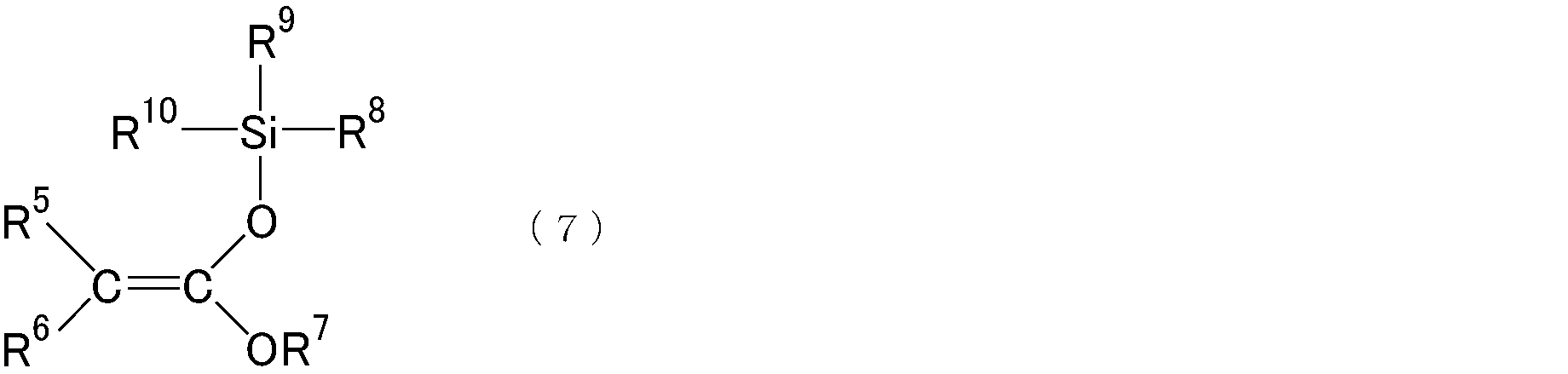
で表されるシリルケテンアセタール、下記一般式(8):

で表されるビニルシラン化合物、及び、下記一般式(9):
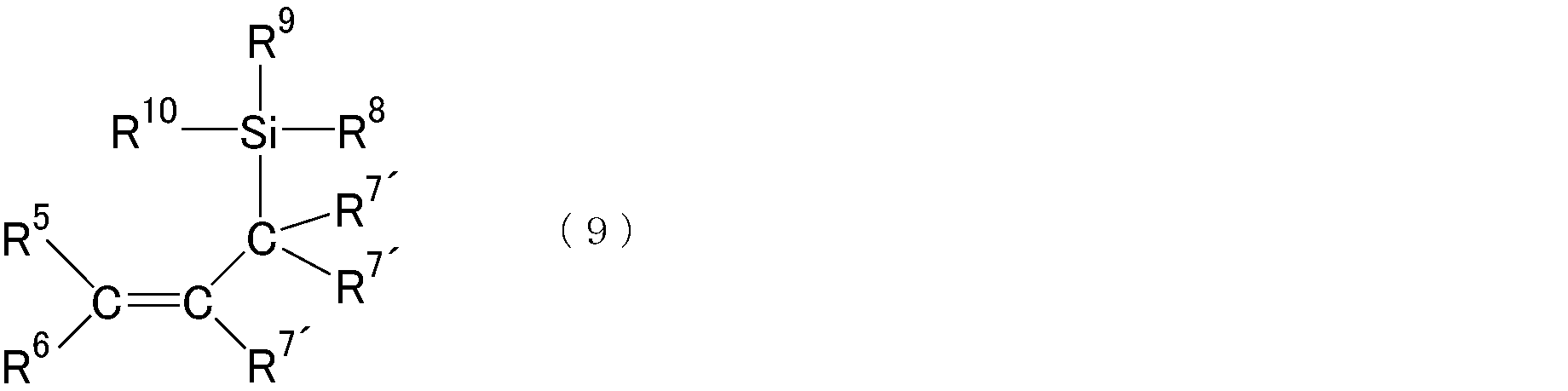
で表されるアリルシラン化合物の1種又は2種以上が好ましく挙げられる。
上記R5及びR6としては、上述した一般式(3)、(4)、(5)中のR5及びR6とそれぞれ同じものが挙げられる。
上記R7及びR7’としては、上述した一般式(3)、(4)、(5)中のR7及びR7’とそれぞれ同じものが挙げられる。
R8、R9及びR10で表される有機基としては、上述した有機基と同じものが挙げられるが、なかでも、炭素数1~12の炭化水素基、アルコキシ基であることが好ましく、炭素数1~6の炭化水素基、アルコキシ基であることがより好ましく、メチル基、エチル基、イソプロピル基、tert-ブチル基、フェニル基、メトキシ基、エトキシ基であることが更に好ましい。
これらの中でも、入手容易である点や合成容易な点、また安定性の点から、メチル(トリメチルシリル)ジメチルケテンアセタール、メチル(トリイソプロピルシリル)ジメチルケテンアセタール、エチル(トリメチルシリル)ジメチルケテンアセタールが好ましい。
上記シリルケテンアセタールは、1種のみ用いてもよいし、2種以上を組み合わせて用いてもよい。
なかでも、上記触媒としては、上記ビニルエーテル基含有(メタ)アクリル酸エステル類の重合をより一層効率良く行うことができる点で、有機リン化合物、N-ヘテロ環カルベン、フッ素イオン含有化合物、環状アミン化合物、及び、アンモニウム塩化合物からなる群より選択される少なくとも一種が好ましい。これらの特定の触媒を使用する場合、ビニルエーテル基含有(メタ)アクリル酸エステル類において、ビニルエーテル基のカチオン重合やビニルエーテルの分解が起こりにくく、(メタ)アクリロイル基のみをより一層効率良く重合させることができる。
一方、上記重合体(A)をラジカル重合で製造した場合、ゲル化させずに、重合体の分子量分布が上記の所定範囲に制御された重合体を得ることができたとしても、モノマーが残存し、またその量の制御が困難であるため、得られる硬化物の物性発現の再現性が低下するおそれがある。
上記重合体(A)の残存モノマーの含有量は、重合体100質量%に対して10質量%以下であることが好ましく、5質量%以下であることがより好ましく、0~3質量%であることが更に好ましい。
残存モノマーの含有量は、1H-NMRやガスクロマトグラフィー、液体クロマトグラフィー、ゲルパーミエーションクロマトグラフィーにより測定することができる。
本発明において使用する重合性化合物としては、上記重合体(A)を架橋しうる化合物であれば、特に限定されないが、なかでも、ビニルエーテル基と効率的に反応することができる点で、ビニルエーテル化合物、環状エーテル化合物、(メタ)アクリル酸エステル、カルボン酸化合物、マレイミド化合物、アルコール、及び、チオールからなる群より選択される少なくとも一種が好ましい。なかでも、上記重合性化合物としては、ビニルエーテル化合物、環状エーテル化合物、チオールがより好ましく、ビニルエーテル化合物、環状エーテル化合物が更に好ましい。
上記重合性化合物は、1種のみ使用してもよいし、2種以上を組み合わせて使用してもよい。
上記ビニルエーテル化合物の分子量は10000以下であることが好ましい。
上記環状エーテル化合物の具体例としては、n-ブチルグリシジルエーテル、2-エチルヘキシルグリシジルエーテル、フェニルグリシジルエーテル、1,2-エポキシシクロヘキサン等の単官能エポキシ樹脂;ヘキサンジオールジグリシジルエーテル、テトラエチレングリコールジグリシジルエーテル、ビスフェノールA ジグリシジルエーテル、ビスフェノールF ジグリシジルエーテル、モノアリルジグリシジルイソシアヌル酸、グリシジルメタクリレート等の2官能エポキシ樹脂;トリメチロールプロパントリグリシジルエーテル、ソルビトールポリグリシジルエーテル、1,3-ビス(N,N-ジグリシジルアミノエチル)ベンゼン、ノボラック型エポキシ樹脂、テトラキスフェノールエタン型エポキシ樹脂等の多官能エポキシ樹脂;1,2-エポキシ-4-ビニルシクロヘキサン、3’,4’-エポキシシクロヘキシルメチル-3,4-エポキシシクロヘキサンカルボキシレート、3,4-エポキシシクロヘキシルメチルメタアクリレート等の脂環式オキシラン環を有するエポキシ樹脂;3-エチル-3-ヒドロキシメチルオキセタン、3-エチル-3-フェノキシメチルオキセタン、3-エチル-3-(2-エチルヘキシロキシメチル)オキセタン、3-エチル(トリエトキシシリルプロポキシメチル)オキセタン、3-シクロヘキシルオキシメチル-3-エチル-オキセタン等の単官能オキセタン樹脂;ビス(3-エチル-3-オキセタニルメチル)エーテル、1,4-ビス{〔(3-エチル-3-オキセタニル)メトキシ〕メチル}ベンゼン等の2官能オキセタン樹脂;トリメチロールプロパントリス(3-エチル-3-オキセタニルメチル)エーテル、ペンタエリスリトールトリス(3-エチル-3-オキセタニルメチル)エーテル、ペンタエリスリトールテトラキス(3-エチル-3-オキセタニルメチル)エーテル、ジペンタエリスリトールペンタキス(3-エチル-3-オキセタニルメチル)エーテル等の多官能オキセタン樹脂等が挙げられる。
上記環状エーテル化合物の分子量は10000以下であることが好ましい。
上記(メタ)アクリル酸エステルの分子量は10000以下であることが好ましい。
上記カルボン酸化合物の分子量は10000以下であることが好ましい。
上記マレイミド化合物の分子量は10000以下であることが好ましい。
上記アルコールの分子量は10000以下であることが好ましい。
上記チオールの分子量は10000以下であることが好ましい。
上記メチレンマロン酸ジエステル化合物としては、例えば、下記一般式(10)で表されるジエステル化合物や、メチレンマロン酸ジエステルが複数結合した多官能メチレンマロン酸ジエステルが挙げられる。

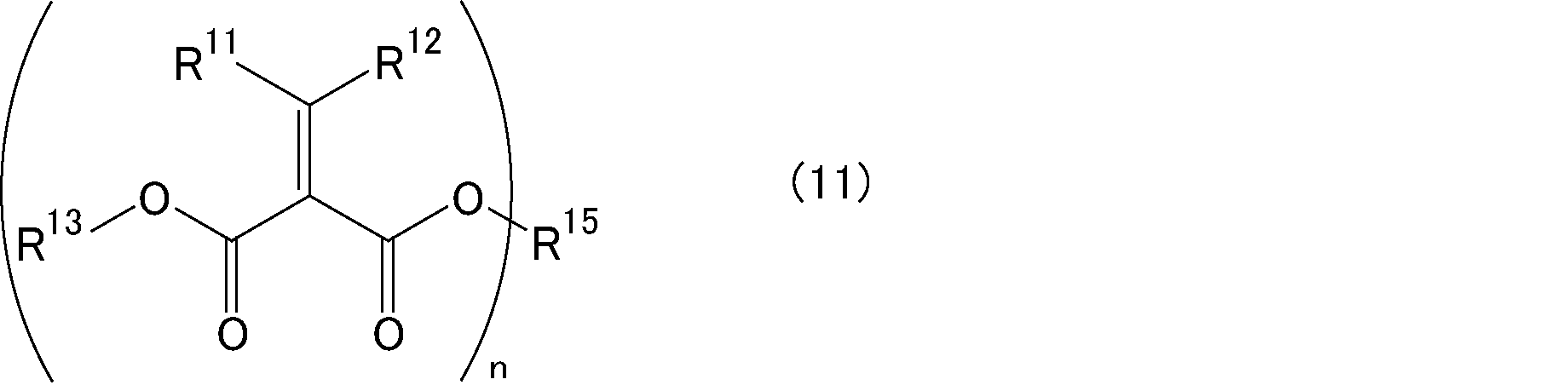

R11及びR12で表される炭化水素基としては、例えば、メチル基、エチル基、n-ブチル基、n-ペンチル基(アミル基)、n-ヘキシル基、n-ヘプチル基、n-オクチル基、n-ノニル基、n-デシル基、n-ウンデシル基、n-ドデシル基、n-トリデシル基、n-テトラデシル基、n-ペンタデシル基、イソプロピル基、2-メチルブチル基、イソアミル基、3,3-ジメチルブチル基、2-エチルブチル基、2-エチル-2-メチルプロピル基、イソヘプチル基、イソオクチル基、2-エチルヘキシル基、2-プロピルペンチル基、ネオノニル基、2-エチルヘプチル基、2-プロピルヘキシル基、2-ブチルペンチル基、イソデシル基、ネオデシル基、2-エチルオクチル基、2-プロピルヘプチル基、2-ブチルヘキシル基、イソウンデシル基、ネオウンデシル基、2-エチルノニル基、2-プロピルオクチル基、2-ブチルヘプチル基、2-ペンチルヘキシル基、イソドデシル基、ネオドデシル基、2-エチルデシル基、2-プロピルノニル基、2-ブチルオクチル基、2-ペンチルヘプチル基、イソトリデシル基、ネオトリデシル基、2-エチルウンデシル基、2-プロピルデシル基、2-ブチルオクチル基、2-ペンチルオクチル基、2-ヘキシルヘプチル基、イソテトラデシル基、ネオテトラデシル基、2-エチルドデシル基、2-プロピルウンデシル基、2-ブチルデシル基、2-ペンチルノニル基、2-ヘキシルオクチル基、イソペンタデシル基、ネオペンタデシル基、シクロヘキシルメチル基、ベンジル基等が挙げられる。
上記2価の炭化水素基の具体例としては、1,3-プロピレン基、1,4-ブチレン基、1,5-ペンチレン基、1,6-ヘキシレン基、1,5-ヘキシレン基等が挙げられる。
R13及びR14の有する置換基の数に制限はないが、それぞれ5個以下であることが好ましく、3個以下であることがより好ましい。
R13及びR14が1又は2以上の置換基を有する場合には、置換基を含めた炭素数がそれぞれ上記炭素数の範囲であることが好ましい。
上記脂環式炭化水素基は、環状の脂肪族炭化水素部分を有する基であって、直鎖又は分岐鎖の脂肪族炭化水素部分を有していてもよい。
上記芳香族炭化水素基は、芳香環を有する基であって、脂肪族部分を有していてもよい。
また、上記芳香族炭化水素基としては、上述した芳香族炭化水素基と同様の基等が挙げられる。
なかでも、脂肪族炭化水素基が好ましく、飽和脂肪族炭化水素基がより好ましい。
上記2価の有機基としては、2価の炭化水素基が挙げられ、上記2価の炭化水素基の具体例といては、2,2-プロピレン基、1,3-プロピレン基、1,4-ブチレン基、1、5-ペンチレン基、1,6-ヘキシレン基、1,5-ヘキシレン基等が挙げられる。
上記2価の有機基は、2価のヘテロ原子含有基であってもよく、上記2価のヘテロ原子含有基としては、ポリアルキレンオキシド、ポリエステル基等が挙げられる。
上記ポリオールとしては、例えば、グリセリン、ポリグリセリン、グリセリンにアルキレングリコールを付加した化合物、エリトリトール、キシリトール、ソルビトール、トリメチロールプロパン、ペンタエリトリトール、ジペンタエリスリトール等が挙げられる。
nの上限は特に限定されないが、100以下であることが好ましく、12以下であることがより好ましく、6以下であることが更に好ましい。
R16で表される2価の有機基としては、例えば、上述した2価の有機基と同じ基等が挙げられるが、好ましくは、ジオールから2個の水酸基を除いた残基、ポリアルキレングリコールから2個の水酸基を除いた残基等が挙げられる。
上記ジオール又はポリアルキレングリコールとしては、例えば、エチレングリコール、ブチレングリコール、ポリエチレングリコール、ポリプロピレングリコール等が挙げられる。
R17で表される1価の有機基としては、特に限定されず、例えば、上述したR13及びR14で表される1価の有機基と同じ基等を挙げることができる。
R17は、水酸基、又は、下記一般式(13)で表される基であることが好ましい。
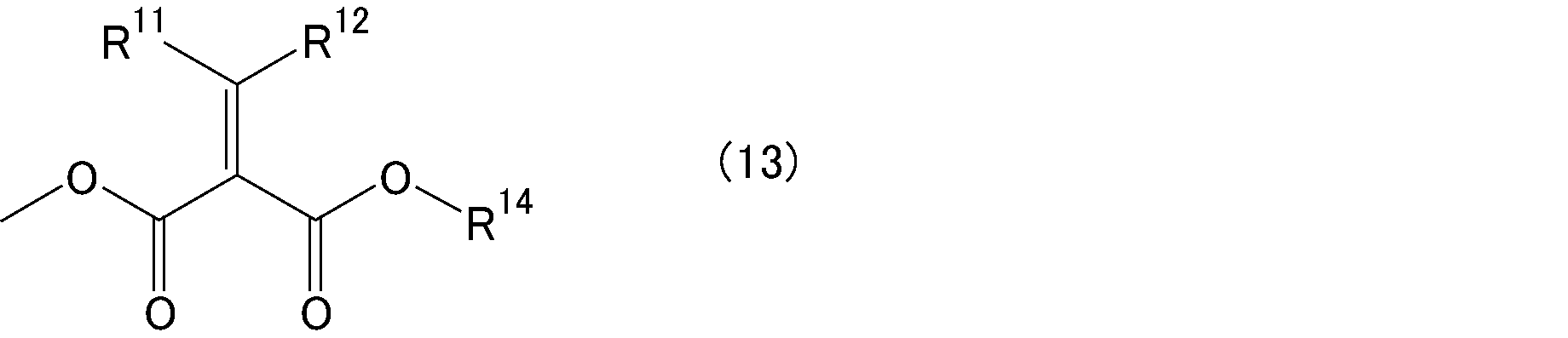
上記メチレンマロン酸ジエステル化合物の分子量は10000以下であることが好ましい。
上記α-シアノアクリル酸エステルとしては、従来公知のα-シアノアクリル酸エステルが使用可能であり、具体的には、メチル-α-シアノアクリル酸エステル、エチル-α-シアノアクリル酸エステル、プロピル-α-シアノアクリル酸エステル、ブチル-α-シアノアクリル酸エステル、シクロヘキシル-α-シアノアクリル酸エステル等のアルキル及びシクロアルキル-α-シアノアクリル酸エステル;アリル-α-シアノアクリル酸エステル、メタリル-α-シアノアクリル酸エステル、シクロヘキセニル-α-シアノアクリル酸エステル等のアルケニル及びシクロアルケニル-α-シアノアクリル酸エステル;プロパンギル-α-シアノアクリル酸エステル等のアルキニル-α-シアノアクリル酸エステル;フェニル-α-シアノアクリル酸エステル、トルイル-α-シアノアクリル酸エステル等のアリール-α-シアノアクリル酸エステル;ヘテロ原子を含有するメトキシエチル-α-シアノアクリル酸エステル、エトキシエチル-α-シアノアクリル酸エステル、フルフリル-α-シアノアクリル酸エステル;ケイ素を含有するトリメチルシリルメチル-α-シアノアクリル酸エステル、トリメチルシリルエチル-α-シアノアクリル酸エステル、トリメチルシリルプロピル-α-シアノアクリル酸エステル、ジメチルビニルシリルメチル-α-シアノアクリル酸エステル;等が挙げられる。なかでも、性能的、コスト的な観点から、アルキル及びシクロアルキル-α-シアノアクリル酸エステルが好ましく、エチル-α-シアノアクリル酸エステルがより好ましい。
上記α-シアノアクリル酸エステルの分子量は10000以下であることが好ましい。
酸基含有アルカリ可溶性樹脂(b1)(以下、「樹脂(b1)」とも称する。)は、酸基を有する重合体である。酸基を有することにより、アルカリ可溶性となる。
上記酸基としては、例えば、カルボキシル基、フェノール性水酸基、カルボン酸無水物基、リン酸基、スルホン酸基等、アルカリ水と中和反応する官能基が挙げられ、これらの1種のみを有していてもよいし、2種以上有していてもよい。なかでも、カルボキシル基又はカルボン酸無水物基が好ましく、カルボキシル基がより好ましい。
上記樹脂(b1)は、上述した酸基を有する構造単位(b1-1)を有することが好ましい。
上記構造単位(b1-1)を有する重合体を得る方法としては、例えば、酸基含有単量体を含む単量体成分を重合する方法(1)や、エポキシ基含有単量体を含む単量体成分を重合して、エポキシ基を含む重合体を得た後、そのエポキシ基に酸基含有単量体の酸基を付加反応させることにより、エポキシ基を開環し、その際に発生した水酸基に多塩基酸又は多塩基酸無水物を反応させてカルボキシル基を生じさせる方法(2)等が挙げられ、又は、これらを組み合わせた方法であってもよい。
上記方法(1)では、上記構造単位(b1-1)は、酸基含有単量体由来の構造単位である。上記方法(2)では、上記構造単位(b1-1)は、エポキシ基含有単量体由来の構造単位に酸基含有単量体を反応させ、更に多塩基酸又は多塩基酸無水物を反応させて生じたカルボキシル基を含む構造単位である。
なかでも、上記構造単位(b1-1)は、酸基含有単量体由来の構造単位であることが好ましい。
上記エポキシ基含有単量体としては、例えば、(メタ)アクリル酸グリシジル、(メタ)アクリル酸β-メチルグリシジル、(メタ)アクリル酸β-エチルグリシジル、ビニルベンジルグリシジルエーテル、アリルグリシジルエーテル、(メタ)アクリル酸(3,4-エポキシシクロヘキシル)メチル、ビニルシクロヘキセンオキシド等が挙げられる。なかでも、(メタ)アクリル酸グリシジル、(メタ)アクリル酸(3,4-エポキシシクロヘキシル)メチルが好ましく、(メタ)アクリル酸グリシジルがより好ましい。
上記樹脂(b1)は、主鎖に環構造を有する重合体であることが好ましい。主鎖に環構造を有することにより、上記樹脂(b1)の耐熱性を向上させることができる。上記環構造としては、イミド環、テトラヒドロフラン環、ラクトン環等が挙げられる。これらの環構造を有するために、上記樹脂(b1)は、主鎖に環構造を有する構造単位(b1-2)を更に有することが好ましい。
上記樹脂(b1)は、上述した構造単位(b1-1)及び(b1-2)以外の、他の構造単位(b1-3)を有してもよい。
上記他の構造単位(b1-3)としては、例えば、下記の単量体由来の構造単位が挙げられる。
(メタ)アクリル酸2-ヒドロキシエチル、(メタ)アクリル酸2-ヒドロキシプロピル、(メタ)アクリル酸3-ヒドロキシプロピル、(メタ)アクリル酸2-ヒドロキシブチル、(メタ)アクリル酸3-ヒドロキシブチル、(メタ)アクリル酸4-ヒドロキシブチル、(メタ)アクリル酸2,3-ヒドロキシプロピル等のヒドロキシアルキル(メタ)アクリレート等の水酸基含有単量体;
(メタ)アクリル酸メチル、(メタ)アクリル酸エチル、(メタ)アクリル酸n-プロピル、(メタ)アクリル酸i-プロピル、(メタ)アクリル酸n-ブチル、(メタ)アクリル酸s-ブチル、(メタ)アクリル酸n-アミル、(メタ)アクリル酸s-アミル、(メタ)アクリル酸n-ヘキシル、(メタ)アクリル酸2-エチルヘキシル、(メタ)アクリル酸イソデシル、(メタ)アクリル酸トリデシル、(メタ)アクリル酸オクチル、(メタ)アクリル酸イソオクチル、(メタ)アクリル酸ラウリル、(メタ)アクリル酸ステアリル、(メタ)アクリル酸ベンジル、(メタ)アクリル酸フェニル、(メタ)アクリル酸イソボルニル、(メタ)アクリル酸アダマンチル、(メタ)アクリル酸トリシクロデカニル、(メタ)アクリル酸シクロヘキシル、(メタ)アクリル酸ジシクロペンタニル、(メタ)アクリル酸2-メトキシエチル、(メタ)アクリル酸2-エトキシエチル、(メタ)アクリル酸テトラヒドロフルフリル、(メタ)アクリル酸N,N-ジメチルアミノエチル、1,4-ジオキサスピロ[4,5]デカ-2-イルメタアクリル酸、(メタ)アクリロイルモルホリン、4-(メタ)アクリロイルオキシメチル-2-メチル-2-エチル-1,3-ジオキソラン、4-(メタ)アクリロイルオキシメチル-2-メチル-2-イソブチル-1,3-ジオキソラン、4-(メタ)アクリロイルオキシメチル-2-メチル-2-シクロヘキシル-1,3-ジオキソラン、4-(メタ)アクリロイルオキシメチル-2,2-ジメチル-1,3-ジオキソラン等の(メタ)アクリル酸エステル単量体;
スチレン、ビニルトルエン、α-メチルスチレン、メトキシスチレン等の芳香族ビニル系単量体;
(メタ)アクリル酸グリシジル、(メタ)アクリル酸β-メチルグリシジル、(メタ)アクリル酸β-エチルグリシジル、ビニルベンジルグリシジルエーテル、アリルグリシジルエーテル、(メタ)アクリル酸(3,4-エポキシシクロヘキシル)メチル、ビニルシクロヘキセンオキシド等のエポキシ基含有単量体;
N,N-ジメチル(メタ)アクリルアミド、N-メチロール(メタ)アクリルアミド等の(メタ)アクリルアミド類;
ポリスチレン、ポリメチル(メタ)アクリレート、ポリエチレンオキシド、ポリプロピレンオキシド、ポリシロキサン、ポリカプロラクトン、ポリカプロラクタム等の重合体分子鎖の片末端に(メタ)アクリロイル基を有するマクロモノマー類;
1,3-ブタジエン、イソプレン、クロロプレン等の共役ジエン類;
酢酸ビニル、プロピオン酸ビニル、酪酸ビニル、安息香酸ビニル等のビニルエステル類;
メチルビニルエーテル、エチルビニルエーテル、プロピルビニルエーテル、ブチルビニルエーテル、2-エチルヘキシルビニルエーテル、n-ノニルビニルエーテル、ラウリルビニルエーテル、シクロヘキシルビニルエーテル、メトキシエチルビニルエーテル、エトキシエチルビニルエーテル、メトキシエトキシエチルビニルエーテル、メトキシポリエチレングリコールビニルエーテル、2-ヒドロキシエチルビニルエーテル、4-ヒドロキシブチルビニルエーテル等のビニルエーテル類;
N-ビニルピロリドン、N-ビニルカプロラクタム、N-ビニルイミダゾール、N-ビニルモルフォリン、N-ビニルアセトアミド等のN-ビニル化合物類;
(メタ)アクリル酸イソシアナトエチル、アリルイソシアネート等の不飽和イソシアネート類;等。
上記樹脂(b1)が上記構造単位(b1-3)を2種以上含む場合、各構造単位の含有割合は、本発明の硬化性組成物の用途、目的に応じて適宜設定することができる。
エポキシ基を有する上記樹脂(b1)は、上述したエポキシ基含有単量体を含む単量体成分を重合することにより得ることができる。
上記酸価は、KOH溶液を用いた中和滴定法により測定して得られる値である。
上記重量平均分子量及び分子量分布は、ゲルパーミエーションクロマトグラフィー法(GPC)により測定して得られる値であり、具体的には、後述する実施例に記載の方法により求めることができる。
熱もしくは酸により酸基を生成する基を有する樹脂(b2)としては、熱又は酸の作用により、酸基が生成される構造又は基を有する樹脂が挙げられる。
熱又は酸の作用により、酸基が生成される構造又は基としては、例えば、3級炭素含有基、ビニルエーテル化合物により酸基がブロック化された基、t-ブチル基やアセチル基等の保護基によりフェノール性水酸基が保護された基、等が挙げられる。
R18の炭素数は、より好ましくは炭素数1~50であり、更に好ましくは炭素数1~35であり、更により好ましくは炭素数1~20であり、特に好ましくは炭素数1~12であり、最も好ましくは炭素数1~9である。
上記R19、R20及びR21は、同一又は異なって、炭素数1~15の飽和炭化水素基であることが好ましく、より好ましくは炭素数1~10の飽和炭化水素基、更に好ましくは炭素数1~5の飽和炭化水素基、特に好ましくは炭素数1~3の飽和炭化水素基である。
上記R18は、好ましくはt-ブチル基、t-アミル基である。
上記ビニルエーテル化合物としては、例えば、メチルビニルエーテル、エチルビニルエーテル、i-プロピルビニルエーテル、n-プロピルビニルエーテル、n-ブチルビニルエーテル、i-ブチルビニルエーテル、t-ブチルビニルエーテル、2-エチルヘキシルビニルエーテル、シクロヘキシルビニルエーテル等の脂肪族ビニルエーテル化合物や、ジヒドロピラン等の、開環してビニルエーテルを生じうる環状エーテル化合物等が挙げられる。
上記ビニルエーテル化合物のなかでも、より低温で保護基が脱離しやすい点で、ジヒドロピランが好ましい。
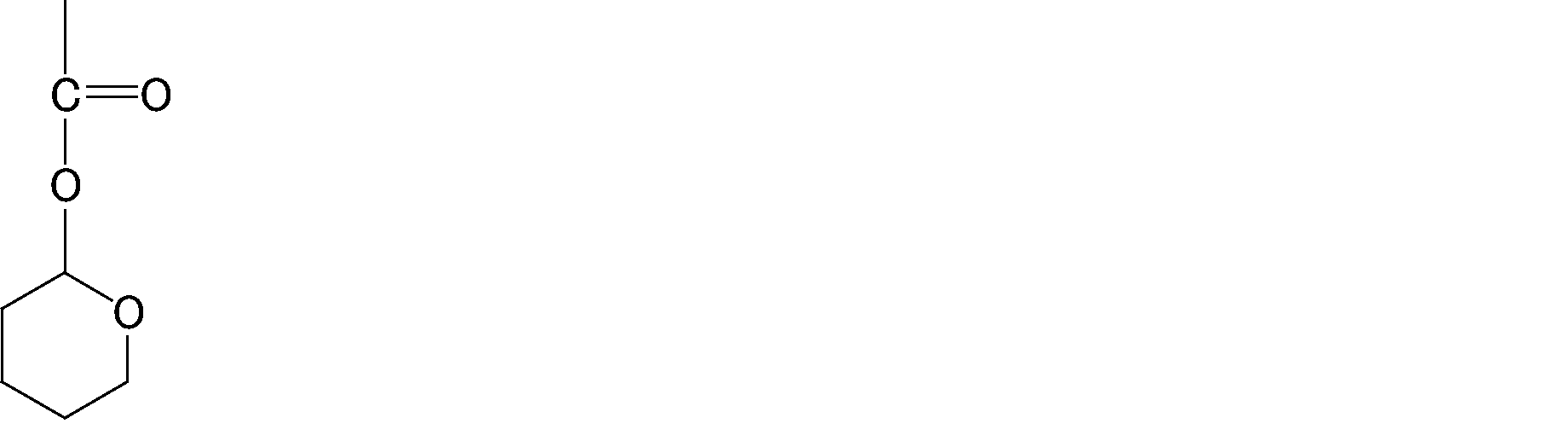
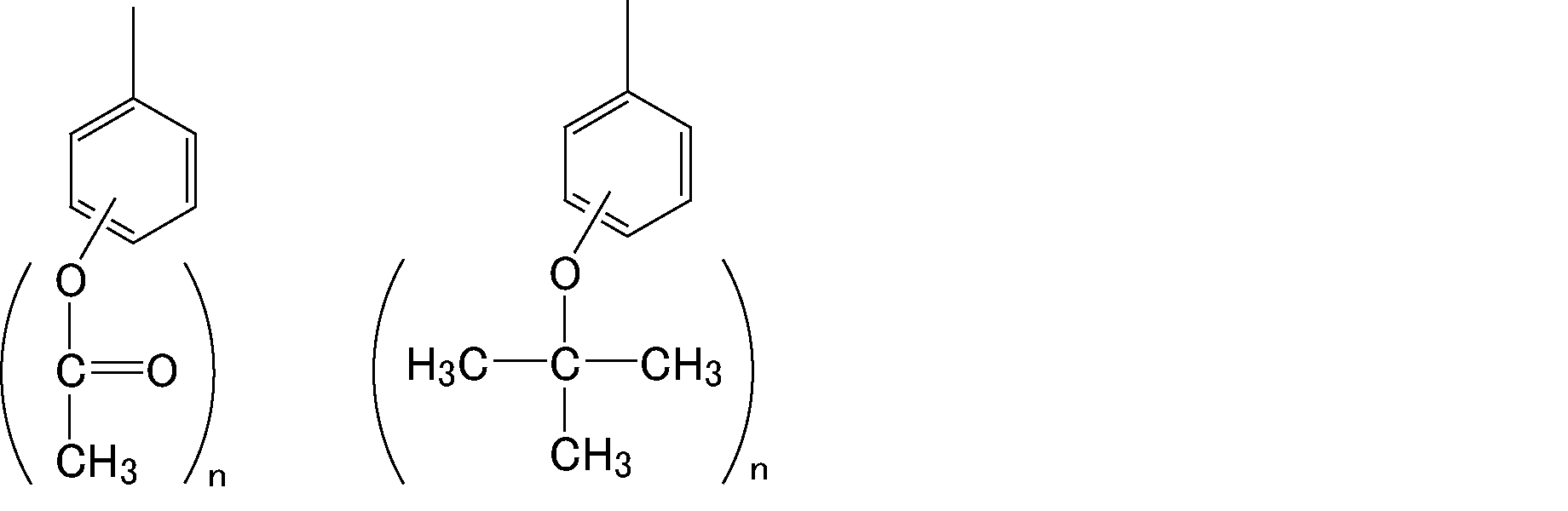
上記樹脂(b2)としては、好ましくは、下記一般式(14)で表される構造単位(b2-1)を有する樹脂が挙げられる。
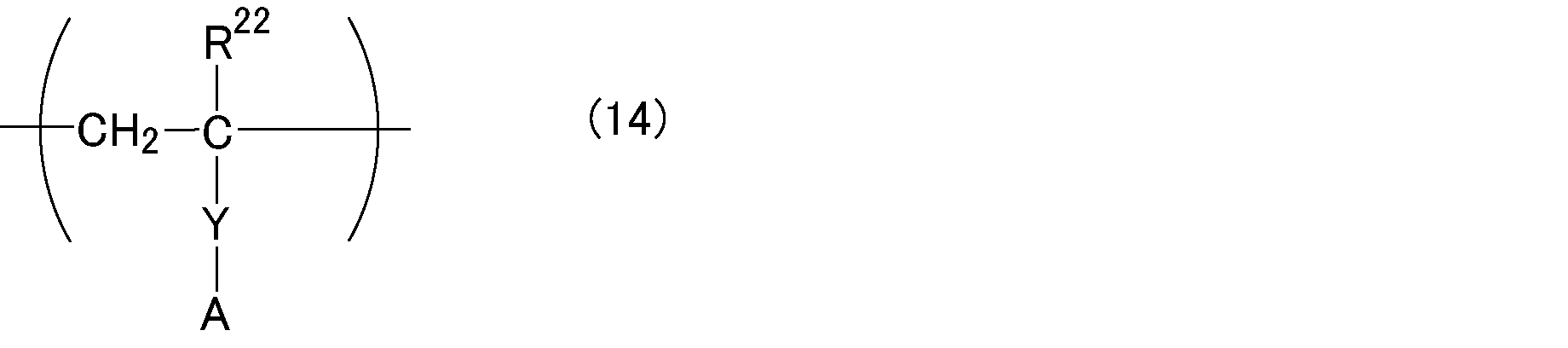
上記一般式(14)において、R22は、水素原子又はメチル基を表す。なかでも、耐熱性が良好である点で、R22は、メチル基であることが好ましい。
Yは、直接結合、又は、2価の有機基を表す。
上記2価の炭化水素基は、当該炭化水素基を構成する原子の少なくとも1つが、酸素原子、窒素原子、又は硫黄原子に置換されていてもよい。
上記置換基としては、水酸基、アルコキシ基、ハロゲン原子等が挙げられる。
Yは、直接結合であることが好ましい。
上記熱又は酸により酸基が生成される基としては、上述した熱又は酸の作用により、酸基が生成される構造又は基と同じものを挙げることができる。
上記樹脂(b2)は、主鎖に環構造を有する重合体であることが好ましい。主鎖に環構造を有することにより、上記樹脂(b2)の耐熱性を向上させることができる。上記環構造としては、上述した構造単位(b1-2)に記載の環構造と同様のものが挙げられる。上記樹脂(b2)は、主鎖に環構造を有する構造単位(b2-2)を更に有することが好ましい。
上記構造単位(b2-2)を導入しうる単量体としては、上述した構造単位(b1-2)を導入しうる単量体と同じ単量体を挙げることができる。
上記樹脂(b2)は、上記構造単位(b2-2)を1種のみ有していてもよいし、2種以上を有していてもよい。
上記樹脂(b2)は、上述した構造単位(b2-1)及び(b2-2)以外に、他の構造単位(b2-3)を更に有していてもよい。
上記他の構造単位(b2-3)としては、上述した他の構造単位(b1-3)と同様の構造単位が挙げられる。
なかでも、上記構造単位(b2-3)は、水酸基含有単量体、(メタ)アクリル酸エステル単量体、芳香族ビニル系単量体、及び、エポキシ基含有単量体からなる群より選択される少なくとも1種の単量体由来の構造単位であることが好ましい。
上記樹脂(b2)が上記構造単位(b2-3)を2種以上含む場合、各構造単位の含有割合は、本発明の硬化性組成物の用途、目的に応じて適宜設計することができる。
エポキシ基を有する上記樹脂(b2)は、上述したエポキシ基含有単量体を含む単量体成分を重合することにより得ることができる。
上記酸価は、KOH溶液を用いた中和滴定法により測定して得られる値である。
上記重合体の重量平均分子量及び分子量分布は、ゲルパーミエーションクロマトグラフィー法(GPC)により測定して得られる値であり、具体的には、後述する実施例に記載の方法により求めることができる。
上記重合性二重結合としては、上述した樹脂(b1)におけるものと同様のものが好ましく挙げられる。上記樹脂(b2)が側鎖に重合性二重結合を有する場合、その二重結合当量も、上述した樹脂(b1)と同様の範囲の二重結合当量が好ましく挙げられる。
各単量体の量は、重合体における各構造単位の含有量が所望の範囲となるよう適宜調整することができる。
重合方法としては、特に制限されず、上記樹脂(b1)の製造方法と同様の方法が挙げられる。
上記樹脂(b1)と樹脂(b2)を併用する場合、上記樹脂(b1)と樹脂(b2)との合計含有量は、硬化性組成物の固形分総量100質量%中、1~50質量%であることが好ましく、3~40質量%であることがより好ましく、5~35質量%であることが更に好ましい。
本発明において使用する硬化触媒としては、特に限定されないが、好ましくは、カチオン硬化触媒、及び、ラジカル硬化触媒からなる群より選択される少なくとも一種を挙げることができる。なかでも、ビニルエーテル基の架橋反応が速やかに進行する点で、カチオン硬化触媒が好ましい。
カチオン硬化触媒、ラジカル硬化触媒のどちらの場合も、実施形態に応じて、熱潜在性又は光潜在性のものを用いることもできる。また、ルイス酸やブレンステッド酸そのものをカチオン硬化触媒として用いることもできる。これらの触媒は、1種のみ使用してもよいし、2種以上を組み合わせて使用してもよい。
上記熱潜在性カチオン硬化触媒としては、特に限定されず、公知のものを用いることができる。これらは、光照射によっては実用的な量のカチオン活性種を発生し得ない化合物であり、カチオン活性種を発生する温度は、40℃~200℃が好ましく、60℃~180℃がより好ましく、80℃~150℃が更に好ましい。上記熱潜在性カチオン硬化触媒として、非イオン性の硬化触媒と、イオン性の硬化触媒が挙げられる。
上記光潜在性カチオン硬化触媒としては、特に限定されず、公知のものを用いることができ、非イオン性の硬化触媒とイオン性の硬化触媒が挙げられる。上記非イオン性の硬化触媒としては、例えば、ニトロベンジルエステル、スルホン酸誘導体、リン酸エステル、フェノールスルホン酸エステル、ジアゾナフトキノン、N-ヒドロキシイミドホスホナート等が挙げられる。上記イオン性の硬化触媒としては、例えば、ジフェニルヨードニウム、4-メトキシジフェニルヨードニウム、ビス(4-メチルフェニル)ヨードニウム、4-イソプロピル-4’-メチルジフェニルヨードニウム、ビス(4-tert-ブチルフェニル)ヨードニウム、ビス(ドデシルフェニル)ヨードニウム、ジフェニル-4-チオフェノキシフェニルスルホニウム、ビス〔4-(ジフェニルスルフォニオ)-フェニル〕スルフィド、ビス〔4-(ジ(4-(2-ヒドロキシエチル)フェニル)スルホニオ)-フェニル〕スルフィド、4-クロロフェニルジフェニルスルホニウム、トリフェニルスルホニウム、η5-2,4-(シクロペンタジェニル)〔1,2,3,4,5,6-η-(メチルエチル)ベンゼン〕-Fe(1+)等のカチオンと、テトラフルオロボレート、ヘキサフルオロホスフェート、トリフェニルヘキサフルオロホスフェート、ヘキサフルオロアルセネート、ヘキサフルオロアンチモネート、テトラキス(ペンタフルオロフェニル)ボレート等のアニオンとの組み合わせからなる化合物が挙げられる。また、必要に応じてチオキサントン等の光増感剤を添加しても良い。
上記熱潜在性ラジカル硬化触媒としては、例えば、クメンハイドロパーオキサイド、ジクミルパーオキサイド、ジイソプロピルベンゼンパーオキサイド、ジ-t-ブチルパーオキサイド、ラウリルパーオキサイド、ベンゾイルパーオキサイド、t-ブチルパーオキシイソプロピルカーボネート、t-ブチルパーオキシ-2-エチルヘキサノエート、t-アミルパーオキシ-2-エチルヘキサノエート等の有機過酸化物;2,2’-アゾビス(イソブチロニトリル)、1,1’-アゾビス(シクロヘキサンカルボニトリル)、2,2’-アゾビス(2,4-ジメチルバレロニトリル)、ジメチル2,2’-アゾビス(2-メチルプロピオネート)等のアゾ化合物;等が挙げられる。
上記光潜在性ラジカル硬化触媒としては、例えば、2,2-ジメトキシ-2-フェニルアセトフェノン、1-ヒドロキシシクロヘキシルフェニルケトン(「IRGACURE184」、BASF社製)、2-ヒドロキシ-2-メチル-1-1フェニルプロパノン、2-メチル-1-[4-(メチルチオ)フェニル]-2-モルホリノプロパノン、2-ベンジル-2-(ジメチルアミノ)-4’-モルホリノブチロフェノン等のアルキルフェノン類;2,4,6-トリメチルベンゾイル-ジフェニルホスフィンオキサイド、ビス(2,4,6-トリメチルベンゾイル)ジフェニルホスフィンオキサイド等のアシルホスフィンオキサイド類;ベンゾイルぎ酸メチル;
2-メチル-1-[4-(メチルチオ)フェニル]-2-モルフォリノプロパン-1-オン(「IRGACURE907」、BASF社製)、2-ベンジル-2-ジメチルアミノ-1-(4-モルフォリノフェニル)-ブタノン-1(「IRGACURE369」、BASF社製)、2-ジメチルアミノ-2-(4-メチル-ベンジル)-1-(4-モルフォリン-4-イル-フェニル)-ブタン-1-オン(「IRGACURE379」、BASF社製)等のアミノケトン系化合物;2,2-ジメトキシ-1,2-ジフェニルエタン-1-オン(「IRGACURE651」、BASF社製)、フェニルグリオキシリックアシッドメチルエステル(「DAROCUR MBF」、BASF社製)等のベンジルケタール系化合物;1-ヒドロキシ-シクロヘキシル-フェニル-ケトン(「IRGACURE184」、BASF社製)、2-ヒドロキシ-2-メチル-1-フェニル-プロパン-1-オン(「DAROCUR1173」、BASF社製)、1-[4-(2-ヒドロキシエトキシ)-フェニル]-2-ヒドロキシ-2-メチル-1-プロパン-1-オン(「IRGACURE2959」、BASF社製)、2-ヒドロキシ-1-{4-[4-(2-ヒドロキシ-2-メチル-プロピオニル)-ベンジル]-フェニル}-2-メチル-プロパン-1-オン(「IRGACURE127」、BASF社製)、[1-ヒドロキシ-シクロヘキシル-フェニル-ケトン+ベンゾフェノン](「IRGACURE500」、BASF社製)等のハイドロケトン系化合物;1,2-オクタンジオン,1-[4-(フェニルチオ)フェニル]-,2-(O-ベンゾイルオキシム)](「OXE01」、BASF社製)、エタノン,1-[9-エチル-6-(2-メチルベンゾイル)-9H-カルバゾール-3-イル]-,1-(0-アセチルオキシム)(「OXE02」、BASF社製)、1,2-オクタンジオン、1-[4-(フェニルチオ)-,2-,(O-ベンゾイルオキシム)]、エタノン(「OXE03」、BASF社製)、1-[9-エチル-6-(2-メチルベンゾイル)-9H-カルバゾール-3-イル]-,1-(O-アセチルオキシム)(「OXE04」、BASF社製))等のオキシムエステル系化合物;ベンゾフェノン系化合物;ベンゾイン系化合物;チオキサントン系化合物;ハロメチル化トリアジン系化合物;ハロメチル化オキサジアゾール系化合物;ビイミダゾール系化合物;チタノセン系化合物;安息香酸エステル系化合物;アクリジン系化合物;等が挙げられる。
本発明の硬化性組成物(1)は、上記他の重合性化合物を含むことが好ましい。上記他の重合性化合物を更に含むことにより、硬化性に加え、耐溶剤性、機械的強度、耐熱性等の各種物性にも優れた硬化物を与えることができる。
上記他の重合性化合物は、フリーラジカル、電磁波(例えば赤外線、紫外線、X線等)、電子線等の活性エネルギー線の照射等により重合し得る、重合性不飽和結合(重合性不飽和基とも称す)を有する低分子化合物であり、例えば、重合性不飽和基を分子中に1つ有する単官能の化合物と、2個以上有する多官能の化合物が挙げられる。
上記他の重合性化合物の具体例としては、例えば、特開2015-42697号公報の段落[0077]~[0085]に記載される、上述した重合性化合物(B)以外の、単官能の重合性化合物や多官能の重合性化合物が挙げられる。
本発明の硬化性組成物(1)は、エポキシ化合物を含むことが好ましい。エポキシ化合物を含むと、カチオン重合が進行し、架橋反応がより進行しやすくなり、耐溶剤性に優れた硬化物を与えることができる。
上記エポキシ化合物としては、エポキシ基と重合性二重結合を有する化合物が挙げられ、例えば、上述したエポキシ基含有単量体が挙げられる。
上記エポキシ化合物の含有量は、硬化性組成物の固形分総量100質量%に対して、好ましくは1~50質量%であり、より好ましくは2~40質量%であり、更に好ましくは5~30質量%である。
本発明の第二の硬化性組成物(以下、「硬化性組成物(2)」とも称する。)は、重合体(A)と、重合性化合物(B)及び/又は硬化触媒(C)とを含む硬化性組成物であって、上記重合体(A)は、下記一般式(2)で表されるビニルエーテル基含有(メタ)アクリル酸エステル類を含む単量体成分のグループトランスファー重合物であることを特徴とする。

このようなグループトランスファー重合物を含む硬化性組成物もまた、硬化反応性に優れる。
上記一般式(2)においてnが1以上の整数である、ビニルエーテル基含有(メタ)アクリル酸エステル類としては、例えば、(メタ)アクリル酸2-(2-ビニロキシエトキシ)エチル、(メタ)アクリル酸2-ビニロキシエチル等が好ましく挙げられる。
本発明の硬化性組成物(1)及び(2)の製造方法としては特に限定されず、例えば、上述した各成分を、ビーズミル、ボールミル、ニーダー、ブレンダー等の公知の各種混合機や分散機を用いて混合分散することによって調製することができる。また、重合体を製造した後に製造に用いた溶剤を脱溶剤したものに別の溶剤を加え、各成分と混合してもよい。また、通常行われる他の工程を更に含むものであってもよい。例えば、色材を含む場合、溶媒や分散剤等を用いて色材組成物を予め調製し、次いで、上述した各成分と混合してもよい。
本発明の硬化性組成物(1)及び(2)の使用方法としては、例えば、基材上に、上記硬化性組成物を塗布し、塗布物を乾燥、加熱、又は活性エネルギー線を照射、あるいはこれらの組み合わせにより、塗布物を硬化させて硬化膜を形成する方法等が挙げられる。
本発明の硬化性組成物(1)及び(2)は、活性エネルギー線や熱による硬化反応性に優れる。本発明の硬化性組成物(1)及び(2)は、粘着剤、接着剤、印刷用インク組成物、3Dプリンタ用組成物、レジスト用組成物、シール材、離型性、指紋付着防止、撥水、親水、ハードコート、防汚、帯電防止、絶縁性等の機能を付与した各種コーティング剤、自動車用、建築・構造物用、工業用、パッケージング用等の各種機能性塗料、表面保護シート、基板、レンズ、電子部品、光学フィルム、光学部品等の各種成形材料等の用途に好適に使用することができる。
重合体の各種物性について、下記の方法で測定した。
得られた重合体を、テトラヒドロフランで溶解・希釈し、孔径0.45μmのフィルターで濾過したものを、下記ゲルパーミエーションクロマトグラフィー(GPC)装置、及び条件で測定した。
装置:HLC-8020GPC(東ソー株式会社製)
溶出溶媒:テトラヒドロフラン
標準物質:標準ポリスチレン(東ソー株式会社製)
分離カラム:TSKgel SuperHM-M、TSKgel SuperH-RC(東ソー株式会社製)
なお、重合体B-1、B-2については、分離カラムとして、TSKgel SuperHZM-M、TSKgel SuperH-RC(東ソー株式会社製)を使用した。
得られた重合体について、下記の条件で1H-NMR測定を行った。
装置:アジレント・テクノロジー社製核磁気共鳴装置(600MHz)
測定溶媒:重クロロホルム
サンプル調製:得られた重合体の数mg~数十mgを測定溶媒に溶解した。
得られた重合体約2~3gに、固形分が約33質量%となるよう酢酸エチルを添加し、室温で充分に攪拌した後、得られた溶液を孔径が4μmのフィルターに通した。フィルター上の残渣を更に約7~10gの酢酸エチルを用いて洗浄した後、残渣を室温で5分間乾燥させ、乾燥後の残渣の質量(b)を測定した。重合体の質量を(a)とし、下記式より、不溶分率を算出した。
不溶分率(質量%)=(b)/(a)×100
上記の重合体のGPC法による分子量測定で得られた微分分子量分布曲線において、図1に示すように、最大値の点をTとし、上記微分分子量分布曲線上Tの5%高さの点を低分子量側からL0及びL1とした場合の、T-L0-L1で囲まれた三角形の面積(X)と、上記微分分子量分布曲線とL0-L1を結ぶ線で囲まれた部分の面積(Y)とを求め、比(X/Y)を算出した。
重合体溶液をアルミカップに約1gはかり取り、アセトン約3gを加えて溶解させた後、常温で自然乾燥させた。そして、熱風乾燥機(商品名:PHH-101、エスペック社製)を用い、真空下170℃で1.5時間乾燥した後、デシケータ内で放冷し、質量を測定した。その質量減少量から、重合体溶液の固形分(質量%)を計算した。
重合体溶液を3g精秤し、アセトン90gと水10gの混合溶媒に溶解させ、0.1NのKOH水溶液を滴定液として用いて滴定した。滴定は、自動滴定装置(商品名:COM-555、平沼産業社製)を用いて行い、溶液の酸価と溶液の固形分から固形分1g当たりの酸価(mgKOH/g)を求めた。
(製造例1)
<メタクリル酸2-(2-ビニロキシエトキシ)エチル重合体の製造>
50mLのシュレンクフラスコに、脱水テトラヒドロフラン(230質量部)、メチル(トリメチルシリル)ジメチルケテンアセタール(0.9質量部)、テトラブチルアンモニウムベンゾエート(0.02質量部)を入れ、窒素気流下、室温で攪拌しながら、メタクリル酸2-(2-ビニロキシエトキシ)エチル(以下、「VEEM」と称する。)(100質量部)を10分間かけて滴下した。滴下終了後、室温で5時間攪拌した後、反応溶液をシリカゲルカラムに通すことで触媒を除去した。得られた溶液を濃縮し、VEEM重合体を得た。得られた重合体を1H-NMRで確認したところ、6.5ppm付近にビニルエーテル由来のピークを確認し、積分値からビニルエーテル基がすべて残存していることが分かった。
モノマーであるVEEMは観測されず、重合体に含まれる不溶分は0%であった。
得られた重合体の重量平均分子量は42000、数平均分子量は25000であり、分子量分布(Mw/Mn)は1.7であった。また、重合体のX/Yの値は1.16であった。
これに100質量部の酢酸エチルを加え、50質量%の重合体溶液を調製した。
<メタクリル酸2-(2-ビニロキシエトキシ)エチル-メタクリル酸メチル共重合体の製造>
500mLのフラスコに、脱水テトラヒドロフラン(200質量部)、メチル(トリメチルシリル)ジメチルケテンアセタール(1.7質量部)、テトラブチルアンモニウムベンゾエート(0.02質量部)を入れた。窒素気流下、20℃で撹拌しながら、モノマー混合液(VEEM(20質量部)、メタクリル酸メチル(以下、「MMA」と称する。)(90質量部))をゆっくり滴下した。5時間攪拌した後、酢酸エチルで希釈し、シリカゲルショートカラムに通すことで触媒を除去した。得られた溶液の重合体濃度を濃縮・調整し、重合体濃度50%のVEEM-MMA共重合体溶液を得た。得られた共重合体を1H-NMRで確認したところ、ビニルエーテル由来のピークを確認し、積分値からビニルエーテル基がすべて残存していることが分かった。モノマーであるVEEM、MMAは観測されず、共重合体に含まれる不溶分は0%であった。上記共重合体の構造単位の割合は、VEEM/MMA=11/89(モル%)であった。また、上記共重合体の重量平均分子量は15000、数平均分子量は12800、分子量分布(重量平均分子量/数平均分子量)は、1.17であった。上記共重合体のX/Yの値は1.37であった。
<メタクリル酸2-(2-ビニロキシエトキシ)エチル-メタクリル酸メチル共重合体の製造>
フラスコにVEEM(100質量部)、MMA(50質量部)、脱水テトラヒドロフラン(350質量部)、メチル(トリメチルシリル)ジメチルケテンアセタール(2質量部)を入れ、窒素気流下、室温で攪拌しながらホスファゼン塩基P4-t-Bu(0.8Mトルエン溶液、2.5質量部)を加えた。室温で終夜(約20時間)攪拌した後、少量のメタノールを加え、反応溶液を濃縮し、VEEM-MMA共重合体を含む重合体組成物を得た。
得られた重合体組成物を1H-NMRで確認したところ、6.5ppm付近にビニルエーテル由来のピークを確認し、積分値からビニルエーテル基がすべて残存していることが分かった。このことから、VEEMのメタクリロイル基のみが重合した重合体が得られたことが確認された。一方、モノマーであるVEEMのピークは確認されなかった。共重合体に含まれる不溶分は0%であった。上記共重合体の構造単位の割合は、VEEM/MMA=50/50(モル%)であった。
また、得られた共重合体の重量平均分子量は27600、数平均分子量は10600であり、分子量分布(Mw/Mn)は、2.61であった。上記共重合体のX/Yの値は1.11であった。
<アクリル酸2-(2-ビニロキシエトキシ)エチル重合体の製造>
フラスコにアクリル酸2-(2-ビニロキシエトキシ)エチル(以下、「VEEA」と称する。)(100質量部)、脱水トルエン(180質量部)、メチル(トリメチルシリル)ジメチルケテンアセタール(1質量部)を入れ、窒素気流下、30℃で攪拌しながらホスファゼン塩基P4-t-Bu(0.8Mトルエン溶液、2質量部)を加えた。30℃で終夜(約24時間)攪拌した後、少量のメタノールを加え、反応溶液を濃縮し、VEEA重合体を含む重合体組成物を得た。
得られた重合体組成物を1H-NMRで確認したところ、6.5ppm付近にビニルエーテル由来のピークを確認し、積分値からビニルエーテル基がすべて残存していることが分かった。このことから、VEEAのアクリロイル基のみが重合した重合体が得られたことが確認された。一方、モノマーであるVEEAのピーク(6.5ppm、6.2ppm、及び5.8ppm付近のピーク)は確認されなかった。重合体に含まれる不溶分は0%であった。また、得られたVEEA重合体の重量平均分子量は19400、数平均分子量は7600であり、分子量分布(Mw/Mn)は、2.57であった。上記VEEA重合体のX/Yの値は1.04であった。
<メタクリル酸2-(2-ビニロキシエトキシ)エチル-メタクリル酸シクロヘキシル共重合体の製造>
20℃恒温槽に浸したフラスコ中、脱水テトラヒドロフラン(400質量部)、メチル(トリメチルシリル)ジメチルケテンアセタール(6質量部)、安息香酸テトラブチルアンモニウム(0.1質量部)の混合物に、VEEM(100質量部)とメタクリル酸シクロヘキシル(以下、「CHMA」と称する。)(100質量部)の混合物を窒素気流下にて10分間かけて滴下した。滴下終了後、反応溶液を同条件にて5時間撹拌した。得られた溶液を酢酸エチルで希釈し、シリカゲルショートカラムに通してから減圧濃縮することでVEEM-CHMA共重合体を含む重合体組成物を得た。
得られた重合体組成物を1H-NMRにて確認したところ、重合に用いられたVEEM及びCHMAは完全に消費されていた。得られた共重合体に含まれる不溶分は0%であった。
また、上記共重合体の重量平均分子量は6900、数平均分子量は6272であり、分子量分布(Mw/Mn)は、1.1であった。上記VEEM-CHMA共重合体のX/Yの値は1.20であった。
<メタクリル酸グリシジル重合体の製造>
温度計、不活性ガス導入管、還流冷却器を備えた4つ口フラスコに、メタクリル酸グリシジル(以下、「GMA」と称する。)(30質量部)、メチルエチルケトン(以下、「MEK」と称する。)(70質量部)を加え反応溶液とした。バブリングによって反応溶液中に窒素ガスを通じ、3時間脱気を行った後、不活性ガス導入管から窒素ガスを流通させながら反応溶液を70℃まで昇温し、重合開始剤(アゾビスイソブチロニトリル:AIBN)(0.34質量部)のMEK溶液(5質量部)を反応溶液にゆっくり加えた。その後同温で20時間撹拌し、室温まで放冷後MEK(100質量部)を加えて重合体溶液を得た。この重合体溶液を、ヘキサンを用いて再沈殿することによりGMA重合体を得た。得られた重合体の重量平均分子量は125800、数平均分子量は23200、分子量分布(Mw/Mn)は5.42であった。
<重合体B-1の製造>
温度計、攪拌機、ガス導入管、冷却管及び滴下槽導入口を備えた反応槽に、プロピレングリコールモノメチルエーテルアセテート81.9部、プロピレングリコールモノメチルエーテル37.7部を仕込み、窒素置換した後、加熱して90℃まで昇温した。他方、滴下槽(A)として、ビーカーにN-ベンジルマレイミド10.0部、メタクリル酸-t-ブチル70.0部、メタクリル酸20.0部、プロピレングリコールモノメチルエーテルアセテート34.2部、プロピレングリコールモノメチルエーテル14.7部、及びt-ブチルパーオキシ-2-エチルヘキサノエート2.0部を攪拌混合したものを準備し、滴下槽(B)に、n-ドデシルメルカプタン1.0部、プロピレングリコールモノメチルエーテルアセテート6.1部を攪拌混合したものを準備した。反応槽の温度が90℃になった後、同温度を保持しながら、滴下槽から3時間かけて滴下を開始し、重合を行った。滴下終了後30分間90℃を保った後、115℃まで昇温し、90分間熟成を行った。その後、室温まで冷却した後、GMAを16.5部、触媒としてジメチルベンジルアミン0.4部、重合禁止剤としてトパノールを0.2部仕込み、110℃7時間反応させ、重合体溶液B-1(固形分39.8%)を得た。得られた重合体の重量平均分子量は15000、分子量分布(Mw/Mn)は2.5、酸価は60mgKOH/gであった。
<重合体B-2の製造>
温度計、攪拌機、ガス導入管、冷却管及び滴下槽導入口を備えた反応槽に、プロピレングリコールモノメチルエーテルアセテート201.0部を仕込み、窒素置換した後、加熱して90℃まで昇温した。他方、滴下槽(A)として、ビーカーにN-ベンジルマレイミド10.0部、CHMA43.6部、メタクリル酸-2-ヒドロキシエチル30.0部、GMA16.4部、プロピレングリコールモノメチルエーテルアセテート30.0部、及びt-ブチルパーオキシ-2-エチルヘキサノエート2.0部を攪拌混合したものを準備し、滴下槽(B)に、n-ドデシルメルカプタン2.0部、プロピレングリコールモノメチルエーテルアセテート31.3部を攪拌混合したものを準備した。反応槽の温度が90℃になった後、同温度を保持しながら、滴下槽から3時間かけて滴下を開始し、重合を行った。滴下終了後30分間90℃を保った後、115℃まで昇温し、90分間熟成を行った。その後、室温まで冷却した後、無水コハク酸11.5部、触媒としてジメチルベンジルアミン0.3部を仕込み、60℃3時間反応させ、重合体溶液B-2(固形分28.8%)を得た。得られた重合体の重量平均分子量は10000、分子量分布(Mw/Mn)は2.8、酸価は68mgKOH/gであった。
<硬化性組成物の製造>
上記で得られた重合体溶液と、重合性化合物、及び、硬化触媒をそれぞれ表1~3に示すような配合で混合し、硬化性組成物を得た。なお、表中の配合量は、固形分換算量である。
得られた硬化性組成物を、片面易接着処理を施したPETフィルム(7cm×21cm)に、バーコータを利用して25μmの厚さになるように塗工し、室温で10~20分間程度放置した後、塗工物を、へレウス社製紫外線照射装置FUSION UVを使用して、表1に記載の照射エネルギー条件で紫外線硬化させるか、又は、表2~3に記載の硬化条件で熱硬化させて、硬化塗膜を得た。得られた硬化塗膜に、アセトンを染み込ませたキムワイプ(日本製紙クレシア株式会社製)で20回ラビングし、下記の評価基準にて、硬化度合を確認した。結果を表1~3に示す。
(評価基準)
○:硬化塗膜は溶解せず。
△:硬化塗膜にラビング痕が残るか、又は膨潤した。
×:硬化塗膜が白化又は溶解した。
BMI-2300:フェニルメタンマレイミド、大和化成工業株式会社製
PI2074:BluesilTM PI2074、Elkem社製
Irg184:IRUGACURE184(1-ヒドロキシシクロヘキシル-フェニルケトン、BASF社製)
ポリアクリル酸(Mw5000):アルドリッチ製
FRONZA B5200XP:SIRRUS社製
サンエイドSI150L:三新化学工業株式会社製
サンエイドSI110L:三新化学工業株式会社製
サンエイドSI100L:三新化学工業株式会社製
有機ホウ素化合物:FX-TP-BC-PC-AD-57103、株式会社日本触媒製
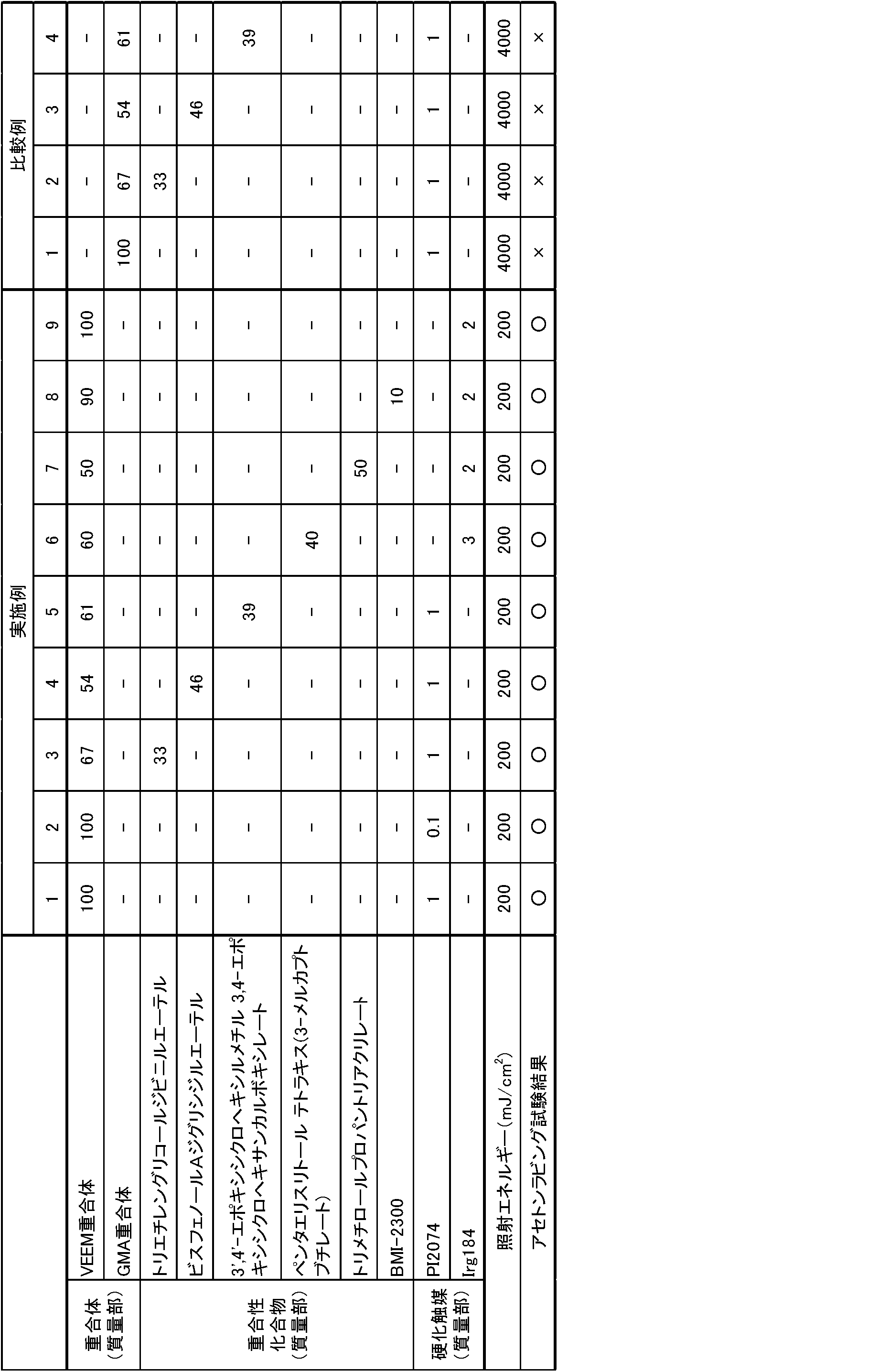
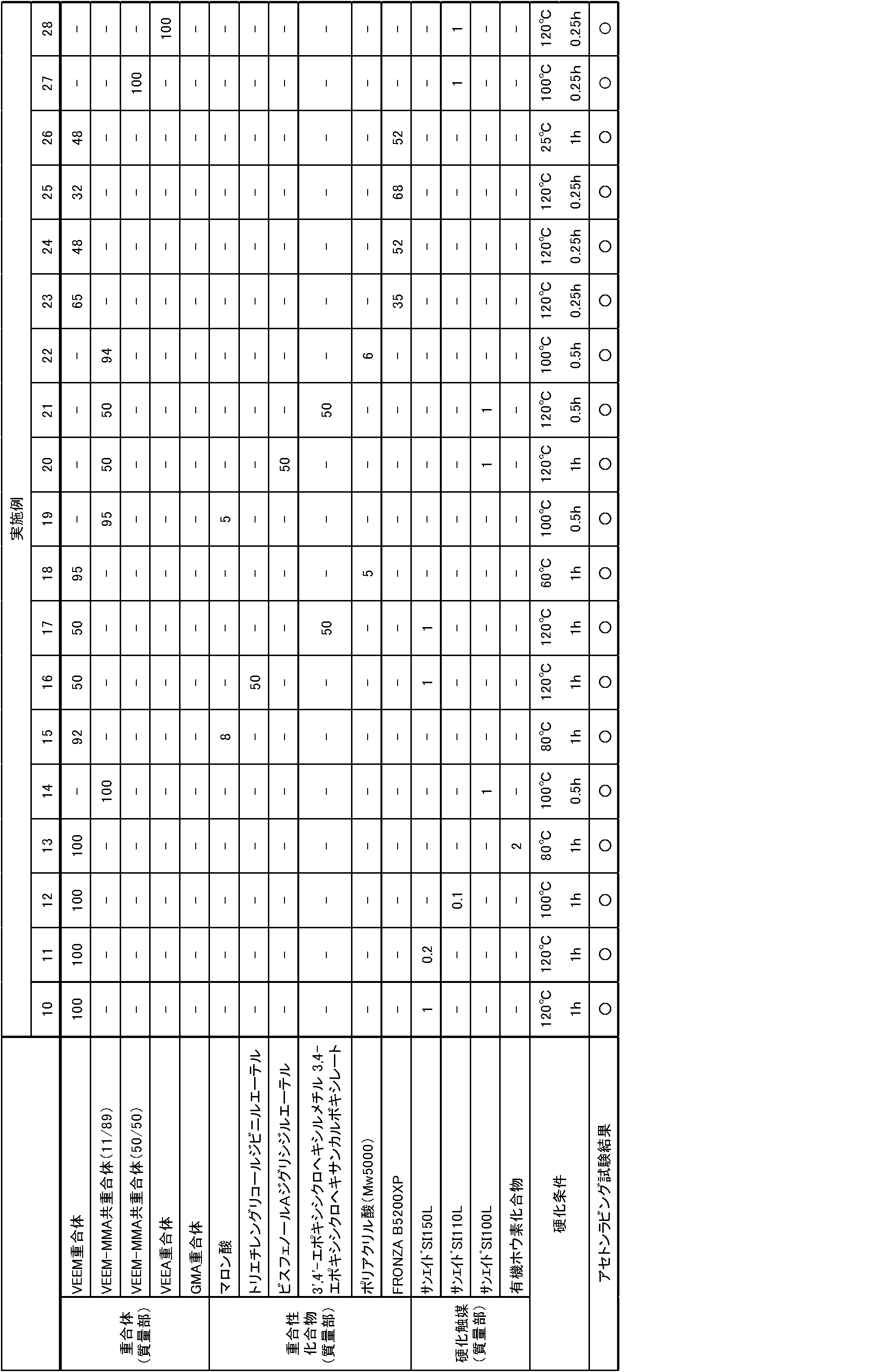
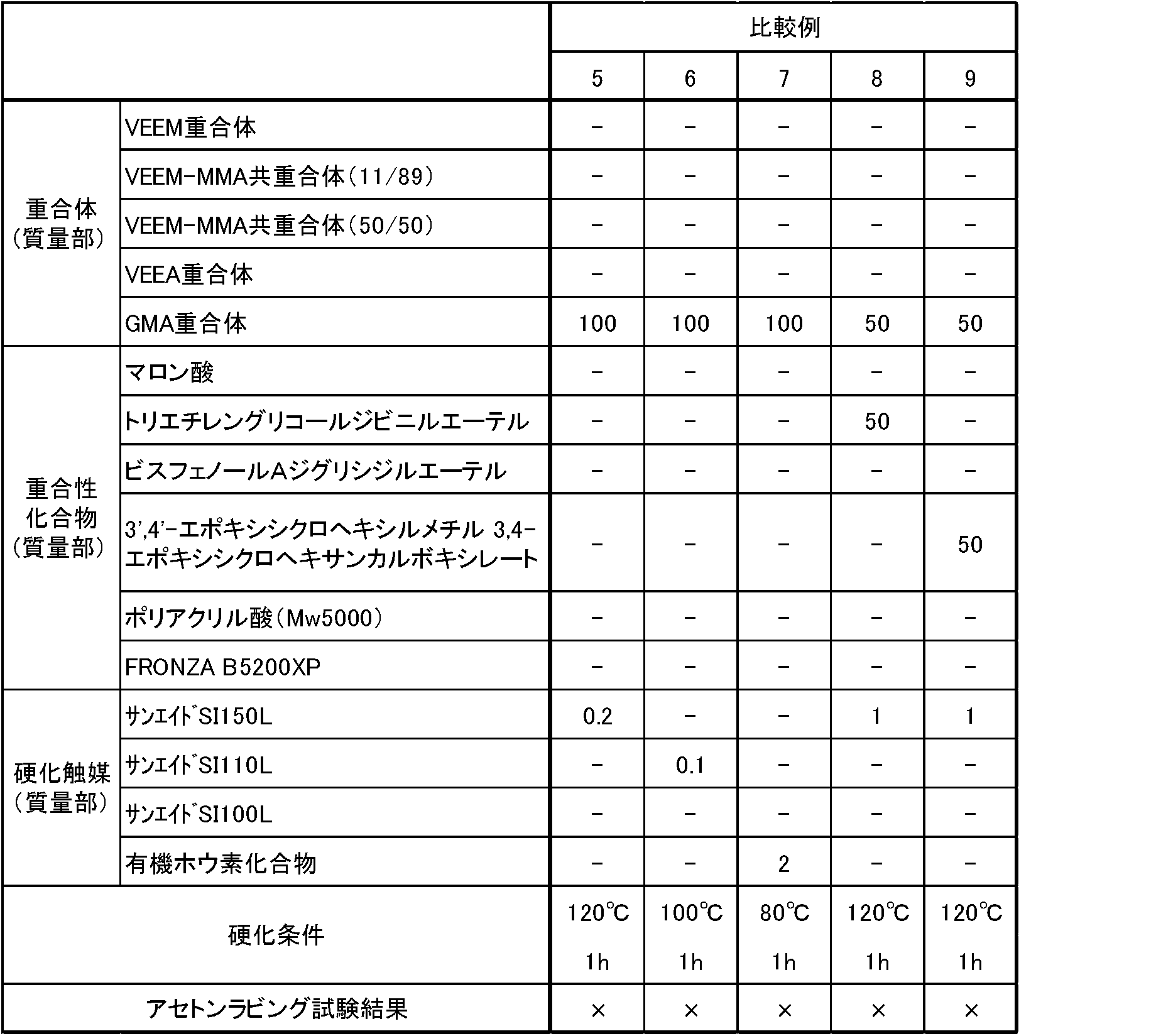
また、実施例の硬化性組成物は、比較例である、カチオン硬化性化合物の中でも一般的なエポキシ基を側鎖に有する重合体(GMA)を含む硬化性組成物と比較しても硬化反応性に優れることがわかった。
製造例1で得られたVEEM重合体、及び、製造例2で得られたVEEM-MMA共重合体について、下記の方法により、光硬化反応性を評価した。また、対照として、セロキサイド2021P(3’,4’-エポキシシクロヘキシルメチル-3,4-エポキシシクロヘキサンカルボキシレート、株式会社ダイセル製)と、トリメチロールプロパントリアクリレート(TMPTA)を使用して、同様に光硬化反応性を評価した。
装置:NETZSCH DSC 204F1 Phoenix
方法:容器にサンプルを1~2mgはかりとり、装置にセットしたのち、窒素雰囲気下、サンプル温度を25℃に保ちながら10mW/cm2の光(光源:キセノンランプ、フィルターなし)を5分間照射し、その間の反応発熱量の変化を測定した。
光カチオン硬化サンプルとして、VEEM-MMA共重合体40質量%のプロピレンカーボネート溶液、又は、エポキシ化合物(セロキサイド2021P)に、光カチオン硬化触媒としてBluesilTM PI2074(Elkem社製)を固形分に対し1質量%を混合したものを用いた。
また、光ラジカル硬化サンプルとして、VEEM重合体50質量%のプロピレンカーボネート溶液、又は、TMPTAに、光ラジカル開始剤としてIrg184を固形分に対し2質量%を混合したものを用いた。測定結果を図2及び図3に示す。
なお、評価用の硬化塗膜には、上述した<アセトンラビング試験>で用いた硬化塗膜と同様の方法にて形成した硬化塗膜を用いた。
上記評価用の硬化塗膜を用い、旧JIS-K5400に準じて、硬化塗膜のPETフィルムに対する密着性を評価した。すなわち、硬化塗膜の上から、1mm間隔で11本の切込みを入れた後、90℃向きを変えて同様に11本の切込みを入れ、10マス四方の碁盤目を作成した。切り込みは塗膜を貫通し、PETフィルムを貫通しない程度とした。碁盤目を完全に覆うようにセロハンテープを貼付け、よく擦って密着させた。その後、テープの端をもって45度の角度で一気に剥がした。テープを剥がした後に、PETフィルム上に残ったマス目の数を数えた。残ったマス目の数が多いほど密着性が高いと判断する。結果を表4に示す。
上記評価用の硬化塗膜を用い、JIS K5600-5-4に従って、塗膜のひっかき硬度を評価した。測定装置として、電動式鉛筆硬度試験機No.553-M(株式会社安田精機製作所製)を使用し、鉛筆は三菱鉛筆株式会社製のものを用いた。キズ痕(塑性変形)を生じない、最も硬い鉛筆の硬度を表4に示した。

表5に示す配合となるように、各成分を混合して、硬化性組成物を得た。なお、表中の配合量は、固形分換算量である。また、表中の顔料分散体1は、下記の方法で調製した。
(調製例1)
顔料分散体1の調製
プロピレングリコールモノメチルエーテルアセテートを12.9部、分散剤としてディスパロンDA-7301を0.4部、色材としてC.I.ピグメントグリーン58を2.25部、及び、C.I.ピグメントイエロー138を1.5部混合し、ペイントシェーカーにて3時間分散することで顔料分散体1(固形分22質量%)を得た。
イルガキュアOXE02:エタノン,1-[9-エチル-6-(2-メチルベンゾイル)-9H-カルバゾール-3-イル]-,1-(0-アセチルオキシム)(BASF社製)
<耐溶剤性>
硬化性組成物を5cm角のガラス基板上にスピンコートし、100℃で3分間乾燥後、高圧水銀灯を用いて60mJで露光を行い、110℃で40分間熱処理(後硬化)を行い、膜厚5μmの硬化膜を得た。そして、その硬化膜を1-メチル-2-ピロリドン(NMP)20gに40℃で10分間浸漬した後取り出し、硬化膜を取り出した後の浸漬液(NMP)について、分光光度計UV3100(島津製作所社製)で吸光度を測定した。吸光度の値が大きいほど、浸漬液中に色材が多く溶出したことを示し、硬化性組成物の耐溶剤性が低いと評価した。

Claims (9)
- 重合体(A)と、重合性化合物(B)及び/又は硬化触媒(C)とを含む硬化性組成物であって、
該重合体(A)は、下記一般式(1)で表される構造単位を有し、分子量分布(重量平均分子量/数平均分子量)が1.0~4.0であることを特徴とする硬化性組成物。

- 重合体(A)と、重合性化合物(B)及び/又は硬化触媒(C)とを含む硬化性組成物であって、
該重合体(A)は、下記一般式(2)で表されるビニルエーテル基含有(メタ)アクリル酸エステル類を含む単量体成分のグループトランスファー重合物であることを特徴とする硬化性組成物。

- 前記重合体(A)の重量平均分子量は、5000~1000000であることを特徴とする請求項1又は2に記載の硬化性組成物。
- 前記硬化触媒(C)は、カチオン硬化触媒、及び、ラジカル硬化触媒からなる群より選択される少なくとも一種であることを特徴とする請求項1~3のいずれかに記載の硬化性組成物。
- 前記重合性化合物(B)は、ビニルエーテル化合物、環状エーテル化合物、(メタ)アクリル酸エステル、カルボン酸化合物、マレイミド化合物、アルコール、及び、チオールからなる群より選択される少なくとも一種であることを特徴とする請求項1~4のいずれかに記載の硬化性組成物。
- 前記重合性化合物(B)は、メチレンマロン酸ジエステル化合物、及び、α-シアノアクリル酸エステルからなる群より選択される少なくとも一種であることを特徴とする請求項1~4のいずれかに記載の硬化性組成物。
- 前記重合性化合物(B)は、酸基含有アルカリ可溶性樹脂、及び/又は、熱もしくは酸により酸基を生成する基を有する樹脂からなる群より選択される少なくとも一種であることを特徴とする請求項1~4のいずれかに記載の硬化性組成物。
- コーティング剤用、粘着剤用、接着剤用、レジスト用、塗料用、印刷用インク組成物用、電子部品用、及び、光学部品用からなる群より選択される少なくとも一種であることを特徴とする請求項1~7のいずれかに記載の硬化性組成物。
- コーティング剤、粘着剤、接着剤、レジスト、塗料、印刷用インク組成物、電子部品、及び、光学部品からなる群より選択される少なくとも一種を製造するための、請求項1~7のいずれかに記載の硬化性組成物の使用。
Priority Applications (3)
| Application Number | Priority Date | Filing Date | Title |
|---|---|---|---|
| KR1020227005480A KR102812445B1 (ko) | 2019-08-27 | 2020-08-25 | 경화성 조성물 |
| CN202080060289.XA CN114341215B (zh) | 2019-08-27 | 2020-08-25 | 固化性组合物 |
| JP2021542940A JP7240509B2 (ja) | 2019-08-27 | 2020-08-25 | 硬化性組成物 |
Applications Claiming Priority (6)
| Application Number | Priority Date | Filing Date | Title |
|---|---|---|---|
| JP2019154623 | 2019-08-27 | ||
| JP2019-154623 | 2019-08-27 | ||
| JP2019210603 | 2019-11-21 | ||
| JP2019-210603 | 2019-11-21 | ||
| JP2020041298 | 2020-03-10 | ||
| JP2020-041298 | 2020-03-10 |
Publications (1)
| Publication Number | Publication Date |
|---|---|
| WO2021039799A1 true WO2021039799A1 (ja) | 2021-03-04 |
Family
ID=74684172
Family Applications (1)
| Application Number | Title | Priority Date | Filing Date |
|---|---|---|---|
| PCT/JP2020/032052 Ceased WO2021039799A1 (ja) | 2019-08-27 | 2020-08-25 | 硬化性組成物 |
Country Status (5)
| Country | Link |
|---|---|
| JP (1) | JP7240509B2 (ja) |
| KR (1) | KR102812445B1 (ja) |
| CN (1) | CN114341215B (ja) |
| TW (1) | TWI778408B (ja) |
| WO (1) | WO2021039799A1 (ja) |
Cited By (1)
| Publication number | Priority date | Publication date | Assignee | Title |
|---|---|---|---|---|
| WO2023120355A1 (ja) * | 2021-12-21 | 2023-06-29 | 株式会社日本触媒 | アルカリ可溶性樹脂、感光性樹脂組成物及びその硬化物 |
Families Citing this family (2)
| Publication number | Priority date | Publication date | Assignee | Title |
|---|---|---|---|---|
| WO2022030445A1 (ja) * | 2020-08-03 | 2022-02-10 | 株式会社日本触媒 | 共重合体、共重合体溶液、感光性樹脂組成物、硬化物、共重合体の製造方法、及び、共重合体溶液の製造方法 |
| CN113667362B (zh) * | 2021-08-27 | 2022-04-12 | 浙江东方齐心钢业集团有限公司 | 一种耐高温不锈钢无缝钢管及其表面处理工艺 |
Citations (8)
| Publication number | Priority date | Publication date | Assignee | Title |
|---|---|---|---|---|
| US4943648A (en) * | 1988-04-01 | 1990-07-24 | E. I. Du Pont De Nemours And Company | Initiators for group transfer polymerization |
| JPH06100628A (ja) * | 1992-09-21 | 1994-04-12 | Nippon Oil & Fats Co Ltd | ビニルエーテル基含有ポリマー及びその製造方法 |
| JPH06256426A (ja) * | 1993-03-01 | 1994-09-13 | Nippon Oil & Fats Co Ltd | ビニルエーテル基含有重合体の製造方法 |
| JPH06298884A (ja) * | 1993-04-09 | 1994-10-25 | Nippon Oil & Fats Co Ltd | 硬化性組成物 |
| JP2004099705A (ja) * | 2002-09-06 | 2004-04-02 | Nippon Shokubai Co Ltd | ビニルエーテル基を有する重合体の製造方法及び該重合体の水溶液又は水分散液、並びに、それを含んでなる硬化性組成物 |
| JP2004302216A (ja) * | 2003-03-31 | 2004-10-28 | Nippon Shokubai Co Ltd | レジストパターン被覆用重合体 |
| WO2009110503A1 (ja) * | 2008-03-05 | 2009-09-11 | 株式会社日本触媒 | 重合体、硬化性樹脂組成物、硬化物、及び物品 |
| WO2019240049A1 (ja) * | 2018-06-11 | 2019-12-19 | 株式会社日本触媒 | ビニルエーテル基含有(メタ)アクリル酸エステル重合体の製造方法、ビニルエーテル基含有(メタ)アクリル酸エステル重合体、及び重合体組成物 |
Family Cites Families (4)
| Publication number | Priority date | Publication date | Assignee | Title |
|---|---|---|---|---|
| JP4667145B2 (ja) | 2004-07-22 | 2011-04-06 | 三井化学株式会社 | 光硬化型樹脂組成物及びそれからなるプラスチック用樹脂組成物 |
| JP4648066B2 (ja) | 2005-04-25 | 2011-03-09 | 大阪有機化学工業株式会社 | 第3級アルコールの製造方法 |
| PL2325270T3 (pl) * | 2007-10-24 | 2013-02-28 | Agfa Nv | Utwardzalne ciecze i tusze do zastosowań w zabawkach i w opakowaniach żywności |
| JP6907856B2 (ja) * | 2016-10-04 | 2021-07-21 | 信越化学工業株式会社 | (メタ)アクリル酸トリイソプロピルシリルと(メタ)アクリル酸誘導体の共重合体およびその製造方法 |
-
2020
- 2020-08-25 KR KR1020227005480A patent/KR102812445B1/ko active Active
- 2020-08-25 WO PCT/JP2020/032052 patent/WO2021039799A1/ja not_active Ceased
- 2020-08-25 CN CN202080060289.XA patent/CN114341215B/zh active Active
- 2020-08-25 JP JP2021542940A patent/JP7240509B2/ja active Active
- 2020-08-27 TW TW109129355A patent/TWI778408B/zh active
Patent Citations (8)
| Publication number | Priority date | Publication date | Assignee | Title |
|---|---|---|---|---|
| US4943648A (en) * | 1988-04-01 | 1990-07-24 | E. I. Du Pont De Nemours And Company | Initiators for group transfer polymerization |
| JPH06100628A (ja) * | 1992-09-21 | 1994-04-12 | Nippon Oil & Fats Co Ltd | ビニルエーテル基含有ポリマー及びその製造方法 |
| JPH06256426A (ja) * | 1993-03-01 | 1994-09-13 | Nippon Oil & Fats Co Ltd | ビニルエーテル基含有重合体の製造方法 |
| JPH06298884A (ja) * | 1993-04-09 | 1994-10-25 | Nippon Oil & Fats Co Ltd | 硬化性組成物 |
| JP2004099705A (ja) * | 2002-09-06 | 2004-04-02 | Nippon Shokubai Co Ltd | ビニルエーテル基を有する重合体の製造方法及び該重合体の水溶液又は水分散液、並びに、それを含んでなる硬化性組成物 |
| JP2004302216A (ja) * | 2003-03-31 | 2004-10-28 | Nippon Shokubai Co Ltd | レジストパターン被覆用重合体 |
| WO2009110503A1 (ja) * | 2008-03-05 | 2009-09-11 | 株式会社日本触媒 | 重合体、硬化性樹脂組成物、硬化物、及び物品 |
| WO2019240049A1 (ja) * | 2018-06-11 | 2019-12-19 | 株式会社日本触媒 | ビニルエーテル基含有(メタ)アクリル酸エステル重合体の製造方法、ビニルエーテル基含有(メタ)アクリル酸エステル重合体、及び重合体組成物 |
Cited By (3)
| Publication number | Priority date | Publication date | Assignee | Title |
|---|---|---|---|---|
| WO2023120355A1 (ja) * | 2021-12-21 | 2023-06-29 | 株式会社日本触媒 | アルカリ可溶性樹脂、感光性樹脂組成物及びその硬化物 |
| JPWO2023120355A1 (ja) * | 2021-12-21 | 2023-06-29 | ||
| JP7688727B2 (ja) | 2021-12-21 | 2025-06-04 | 株式会社日本触媒 | アルカリ可溶性樹脂、感光性樹脂組成物及びその硬化物 |
Also Published As
| Publication number | Publication date |
|---|---|
| TW202115140A (zh) | 2021-04-16 |
| CN114341215A (zh) | 2022-04-12 |
| CN114341215B (zh) | 2024-12-27 |
| JPWO2021039799A1 (ja) | 2021-03-04 |
| KR102812445B1 (ko) | 2025-05-23 |
| TWI778408B (zh) | 2022-09-21 |
| KR20220038407A (ko) | 2022-03-28 |
| JP7240509B2 (ja) | 2023-03-15 |
Similar Documents
| Publication | Publication Date | Title |
|---|---|---|
| JP6923130B2 (ja) | ペルオキシエステル基を有するベンゾフェノン誘導体、該化合物を含有する重合性組成物およびその硬化物、当該硬化物の製造方法 | |
| JP6970922B2 (ja) | ペルオキシシンナメート誘導体、該化合物を含有する重合性組成物およびその硬化物、並びに当該硬化物の製造方法 | |
| JP7031605B2 (ja) | ペルオキシシンナメート誘導体、該化合物を含有する重合性組成物 | |
| WO2018221177A1 (ja) | トリアジンペルオキシド誘導体、該化合物を含有する重合性組成物 | |
| JP7240509B2 (ja) | 硬化性組成物 | |
| KR20200078476A (ko) | 화합물, 조성물, 경화물 및 경화물의 제조 방법 | |
| JP2017066240A (ja) | アルカリ可溶性樹脂及び感光性樹脂組成物 | |
| JP2017142475A (ja) | 着色硬化性樹脂組成物及びその硬化膜 | |
| CN116057088A (zh) | 共聚物、共聚物溶液、感光性树脂组合物、固化物、共聚物的制造方法以及共聚物溶液的制造方法 | |
| JP7572810B2 (ja) | 硬化性樹脂組成物、及び、その用途 | |
| JP2016035564A (ja) | 硬化性樹脂組成物及びカラーフィルタ | |
| JP7688727B2 (ja) | アルカリ可溶性樹脂、感光性樹脂組成物及びその硬化物 | |
| US12006386B2 (en) | Alkali soluble, photo-curable and thermo-curable copolymer, and photosensitive resin composition, photosensitive resin film and color filter using the same | |
| JP7265018B2 (ja) | 硬化性組成物 | |
| JP6381192B2 (ja) | アルカリ可溶性樹脂の製造方法 | |
| ES2989662T3 (es) | Composición de resina fotocurable, tinta y pintura | |
| JP2017058627A (ja) | 感光性樹脂組成物及びその硬化膜 | |
| JP7190294B2 (ja) | 共重合体、該共重合体を含む硬化性樹脂組成物、及びその硬化物 | |
| JP7362445B2 (ja) | コーティング用組成物 | |
| JP6377928B2 (ja) | アルカリ可溶性樹脂を含むレジスト組成物及びその保存方法 | |
| JP2023057930A (ja) | ラジカル重合性重合体および感光性組成物 | |
| JP7436255B2 (ja) | 接着剤組成物 | |
| JP7724677B2 (ja) | シラン化合物、シロキサン化合物、その製造方法、及び、硬化性樹脂組成物 | |
| JP2025069810A (ja) | ラジカル重合性重合体及び感光性樹脂組成物 | |
| JP2023049678A (ja) | 感光性樹脂組成物、及び、その用途 |
Legal Events
| Date | Code | Title | Description |
|---|---|---|---|
| 121 | Ep: the epo has been informed by wipo that ep was designated in this application |
Ref document number: 20856668 Country of ref document: EP Kind code of ref document: A1 |
|
| ENP | Entry into the national phase |
Ref document number: 2021542940 Country of ref document: JP Kind code of ref document: A |
|
| ENP | Entry into the national phase |
Ref document number: 20227005480 Country of ref document: KR Kind code of ref document: A |
|
| NENP | Non-entry into the national phase |
Ref country code: DE |
|
| 122 | Ep: pct application non-entry in european phase |
Ref document number: 20856668 Country of ref document: EP Kind code of ref document: A1 |
|
| WWG | Wipo information: grant in national office |
Ref document number: 202080060289.X Country of ref document: CN |