WO2021001896A1 - ヒータアッセンブリ及び香味吸引器 - Google Patents
ヒータアッセンブリ及び香味吸引器 Download PDFInfo
- Publication number
- WO2021001896A1 WO2021001896A1 PCT/JP2019/026147 JP2019026147W WO2021001896A1 WO 2021001896 A1 WO2021001896 A1 WO 2021001896A1 JP 2019026147 W JP2019026147 W JP 2019026147W WO 2021001896 A1 WO2021001896 A1 WO 2021001896A1
- Authority
- WO
- WIPO (PCT)
- Prior art keywords
- channel
- aerosol
- heater assembly
- atomization chamber
- assembly according
- Prior art date
- Legal status (The legal status is an assumption and is not a legal conclusion. Google has not performed a legal analysis and makes no representation as to the accuracy of the status listed.)
- Ceased
Links
Images






Classifications
-
- A—HUMAN NECESSITIES
- A24—TOBACCO; CIGARS; CIGARETTES; SIMULATED SMOKING DEVICES; SMOKERS' REQUISITES
- A24F—SMOKERS' REQUISITES; MATCH BOXES; SIMULATED SMOKING DEVICES
- A24F40/00—Electrically operated smoking devices; Component parts thereof; Manufacture thereof; Maintenance or testing thereof; Charging means specially adapted therefor
- A24F40/40—Constructional details, e.g. connection of cartridges and battery parts
- A24F40/48—Fluid transfer means, e.g. pumps
- A24F40/485—Valves; Apertures
-
- A—HUMAN NECESSITIES
- A24—TOBACCO; CIGARS; CIGARETTES; SIMULATED SMOKING DEVICES; SMOKERS' REQUISITES
- A24F—SMOKERS' REQUISITES; MATCH BOXES; SIMULATED SMOKING DEVICES
- A24F40/00—Electrically operated smoking devices; Component parts thereof; Manufacture thereof; Maintenance or testing thereof; Charging means specially adapted therefor
- A24F40/40—Constructional details, e.g. connection of cartridges and battery parts
- A24F40/46—Shape or structure of electric heating means
-
- A—HUMAN NECESSITIES
- A24—TOBACCO; CIGARS; CIGARETTES; SIMULATED SMOKING DEVICES; SMOKERS' REQUISITES
- A24F—SMOKERS' REQUISITES; MATCH BOXES; SIMULATED SMOKING DEVICES
- A24F40/00—Electrically operated smoking devices; Component parts thereof; Manufacture thereof; Maintenance or testing thereof; Charging means specially adapted therefor
- A24F40/20—Devices using solid inhalable precursors
Definitions
- the present invention relates to a heater assembly and a flavor aspirator.
- Flavor aspirators include a heater that atomizes the aerosol source, an atomization chamber that has at least part of the aerosol channel created by the heater heating the aerosol source, and an intake channel that supplies air to the atomization chamber from the inlet. And (for example, Patent Document 1-3).
- the first feature is a heater assembly, a heater that atomizes the aerosol source and a mist that extends along a predetermined direction as at least a part of the aerosol channel through which the aerosol generated by the heater heating the aerosol source.
- the aerosolization chamber and the intake channel for supplying air from the inlet to the atomization chamber are provided, and the intake channel extends along the predetermined direction and has a first channel communicating with the inlet and the predetermined channel.
- a second channel extending from the first channel along an intersection direction intersecting the predetermined direction and a third channel extending from the second channel along the predetermined direction.
- the gist is that it includes channels.
- the second feature is that, in the first feature, the third channel is adjacent to the atomization chamber in the crossing direction.
- the third feature is that, in the first feature or the second feature, the second channel has a shape extending along the inner circumference or the outer circumference of the aerosol channel.
- the fourth feature is that in the third feature, the second channel includes a channel extending in the first direction along the inner circumference or the outer circumference of the aerosol channel and the second channel along the inner circumference or the outer circumference of the aerosol channel.
- the gist is to include a channel extending in the second direction opposite to the one direction.
- the fifth feature is that, in the third feature, the second channel has a shape that extends spirally along the inner or outer circumference of the aerosol channel.
- the heater assembly has a first end provided on the side where air flows from the intake channel into the atomization chamber. It comprises a second end provided on the side where the aerosol flows out of the atomization chamber, and the third channel is adjacent to the atomization chamber in the range between the first end and the second end.
- the gist is that it is provided at the position.
- the seventh feature is that in any one of the first to sixth features, the aerosol source is a columnar article having a columnar shape, and the atomization chamber accommodates the columnar article and at the same time.
- the gist is that the columnar article is supported by a first end provided on the side where air flows from the intake channel into the atomization chamber.
- the eighth feature is that in any one of the first to seventh features, when air is sucked from the inlet, the atomizing chamber directs the flow of air in the third channel.
- the gist is to guide the aerosol generated from the aerosol source in the opposite direction of.
- the ninth feature is the seventh feature or the eighth feature that cites the seventh feature, wherein at least a part of the second channel is the columnar article with the columnar article inserted into the atomization chamber.
- the gist is that it is composed of the outer sides of the article.
- the tenth feature is the seventh feature or the eighth feature that cites the seventh feature, wherein the heater assembly is a cylinder provided along the outer side surface of the columnar member at a position adjacent to the second channel. It is a gist that the shape member is provided, and at least a part of the second channel is composed of the outer side surface of the tubular member.
- the eleventh feature is that in any one of the first feature to the tenth feature, the inlet is provided side by side with the outlet from which the aerosol is derived in the crossing direction.
- the twelfth feature is that in the eleventh feature, the heater assembly includes a color member having a cavity forming at least a part of the aerosol channel.
- the thirteenth feature is that in the twelfth feature, at least a part of the second channel is composed of the color member.
- the twelfth feature is the twelfth feature or the thirteenth feature, the gist of which the cavity of the collar member includes at least a part of the aerosol channel and the first channel.
- a fifteenth feature is that in any one of the first to fourteenth features, the heater assembly comprises a vessel having a cavity including the atomization chamber and the third channel. ..
- the 16th feature is a flavor aspirator having a heater assembly of any one of the 1st to 15th features.
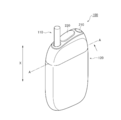
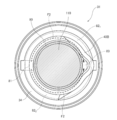
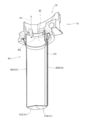
- FIG. 1 is a diagram showing a flavor aspirator 100 according to an embodiment.
- FIG. 2 is a diagram showing a flavor aspirator 100 according to an embodiment.
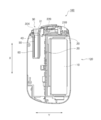
- FIG. 3 is a cross-sectional view of the generator 120 according to the embodiment.
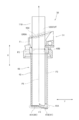
- FIG. 4 is a cross-sectional view showing the heater assembly 30 according to the embodiment.
- FIG. 5 is a cross-sectional view showing the heater assembly 30 according to the embodiment.
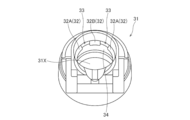
- FIG. 6 is a diagram showing a color member 31 according to the embodiment.
- FIG. 7 is a diagram showing a color member 31 according to the embodiment.
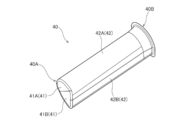
- FIG. 8 is a diagram showing a container 40 according to the embodiment.
- FIG. 9 is a diagram showing a container 40 according to the embodiment.
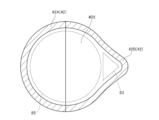
- FIG. 10 is a cross-sectional view showing the container 40 according to the embodiment.
- FIG. 11 is a diagram showing a second channel 82 according to the embodiment.
- FIG. 12 is a diagram for explaining an aerosol leak according to the embodiment.
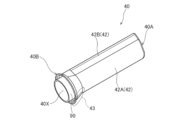
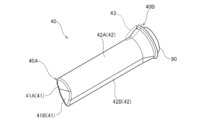
- FIG. 13 is a diagram for explaining the tubular member 90 according to the first modification.
- FIG. 14 is a diagram for explaining the tubular member 90 according to the first modification.
- FIG. 15 is a diagram for explaining the tubular member 90 according to the first modification.
- FIG. 16 is a diagram showing a second channel 82 according to the first modification.
- FIG. 17 is a diagram for explaining an aerosol leak according to the first modification.
- the heater assembly includes a heater that atomizes an aerosol source and an atomization chamber that extends along a predetermined direction as at least a part of an aerosol channel through which the aerosol generated by the heater heating the aerosol source.
- the atomization chamber is provided with an intake channel for supplying air from an inlet.
- the intake channel extends along the predetermined direction, and in a cross-sectional view of the first channel communicating with the inlet and the heater assembly along the predetermined direction, the intake channel extends from the first channel along the intersection direction.
- a second channel extending from the second channel and a third channel extending from the second channel along the predetermined direction are included.
- the intake channel has a crank shape including the first channel, the second channel and the third channel. According to such a configuration, even if it is assumed that an aerosol backflow occurs from the atomization chamber toward the inlet, bending from the third channel to the second channel and from the second channel to the first channel Because the bending of the intake channel increases the resistance of the intake channel, the temperature of the aerosol flowing back through the intake channel can be reduced by the pressure loss.
- FIG. 1 is a diagram showing a state in which the columnar member 110 is not inserted
- FIG. 2 is a diagram showing a state in which the columnar member 110 is inserted.
- the flavor aspirator 100 includes a columnar member 110 constituting an aerosol source and a generator 120 for generating an aerosol from the columnar member 110.
- the flavor aspirator 100 produces an aerosol without burning.
- the flavor aspirator 100 may be referred to as a heating type or non-combustion type flavor aspirator.
- the flavor aspirator 100 may be a portable aspirator.
- the columnar member 110 is a member that at least constitutes an aerosol source of an individual, and has a columnar shape extending along a predetermined direction X.
- the columnar member 110 may be composed of chopped tobacco, a molded product obtained by molding the tobacco raw material into granules, a molded product obtained by molding the tobacco raw material into a sheet, or the like.
- the columnar member 110 may include a wrapping material that is wound around an individual aerosol source.
- the columnar member 110 may have a filter.
- the columnar member 110 may generate an aerosol with heating, and may include an aerosol source containing various polyols such as glycerin, propylene glycol, or 1,3-butanediol in order to promote the generation of the aerosol.
- the columnar member 110 may be composed of a plant other than tobacco (for example, mint, herbs, etc.).
- the columnar member 110 may contain a fragrance such as menthol.
- the generation device 120 has an operation unit 210 that turns on the power of the generation device 120, and a lid 220 that closes the opening 30X provided in the heater assembly 30 described later.
- the operation unit 210 may have a function of turning off the power of the generation device 120.
- the lid 220 is slidable and exposes the opening 30X when the columnar member 110 is inserted.
- the lid 220 may be configured to be rotatable. Details of the generator 120 will be described later (see FIG. 3).
- FIG. 3 is a cross-sectional view of the generator 120 according to the embodiment.
- the AA cross section shown in FIG. 1 is shown.
- the generator 120 includes a battery 10, a control circuit 20, and a heater assembly 30.
- the battery 10 stores the electric power used in the generator 120.
- the battery 10 is a lithium ion battery.
- the battery 10 may be rechargeable by an external power source.
- the control circuit 20 is composed of a CPU, a memory, and the like, and controls the operation of the generator 120.
- the control circuit 20 starts heating the columnar member 110 when the power of the generator 120 is turned on by the operation unit 210.
- the control circuit 20 may stop heating the columnar member 110 when a certain period of time has elapsed from the start of heating.
- the control circuit 20 may stop heating the columnar member 110 when the puff operation is performed a certain number of times from the start of heating.
- the control circuit 20 may stop heating the columnar member 110 when the power of the generator 120 is turned off by the operation unit 210.
- the puffing motion may be detected by a sensor (not shown).
- the sensor may be provided on the bottom plate portion 41 (for example, the separation portion 41B) described later.
- the heater assembly 30 generates an aerosol by heating the columnar member 110.
- the heater assembly 30 has an opening 30X, and the columnar member 110 is inserted into the heater assembly 30 through the opening 30X.
- the heater assembly 30 includes a collar member 31, a container 40, and a heater 50.
- the heater assembly 30 may have a heat insulating member 60. However, the heat insulating member 60 does not have to be a part of the heater assembly 30. Since the details of the color member 31 and the container 40 will be described later, the heater 50 and the heat insulating member 60 will be mainly described here.
- the heater 50 is arranged on the outer side surface of the container 40.
- the heater 50 is arranged so as to cover at least a part of the outer side surface (peripheral surface) of the container 40.
- the heater 50 atomizes the aerosol source.
- the heater 50 heats the columnar member 110 housed in the container 40.
- FIG. 3 illustrates a case where the heater 50 is arranged on the outer side surface of the container 40.
- the heater 50 may be composed of a base material made of a film such as polyimide and a heating element made of a resistance heating element such as metal.
- the heating element may be sandwiched between the two substrates.
- the metal constituting the heating element may be one or more metals selected from nickel alloy, chromium alloy, stainless steel and platinum rhodium.
- the heat insulating member 60 is arranged so as to cover the container 40 on the outside of the heater 50.
- the heat insulating member 60 may be a vacuum heat insulating member having a double structure.
- the heat insulating member 60 may be made of a heat insulating material such as airgel or silicon.
- FIGS. 4 and 5 are cross-sectional views showing a heater assembly 30 according to the embodiment.
- FIG. 4 shows the heater assembly 30 in the AA cross section shown in FIG. 1, and is a diagram showing a state in which the columnar member 110 is inserted.
- FIG. 5 shows the heater assembly 30 in the AA cross section shown in FIG. 2, and is a diagram showing a state in which the columnar member 110 is not inserted.
- the heater 50 and the heat insulating member 60 described above are omitted.
- the heater assembly 30 includes a collar member 31 and a container 40.
- the color member 31 has a tubular shape and is made of, for example, a synthetic resin having plasticity.
- the collar member 31 has an opening 30X for receiving the columnar member 110.
- the opening 30X includes an inlet 120IN for introducing air into the heater assembly 30 and an outlet 120OUT for guiding the aerosol from the heater assembly 30 with the columnar member 110 inserted into the heater assembly 30.
- the outlet 120OUT is a portion occupied by the columnar member 110.
- the inlet 120IN is a portion that is not occupied by the columnar member 110.
- the opening 30X is larger than the inlet 120IN and the outlet 120OUT so that the columnar member 110 can be easily inserted.
- the color member 31 may function as an insertion guide for the columnar member 110.
- the inlet 120IN is provided alongside the outlet 120OUT in the intersection direction Y that intersects the predetermined direction X.
- the crossing direction Y may be considered as a direction having an angle of ⁇ 45 ° to 45 ° as compared with the direction orthogonal to the predetermined direction X.
- the container 40 has a shape extending along a predetermined direction X.
- the container 40 is a member that accommodates the columnar member 110 that is inserted via the collar member 31.
- the container 40 is composed of a heat conductive member (for example, a metal such as SUS (Steel Use Stainless)).
- the container 40 has a portion occupied by the columnar member 110 (hereinafter referred to as an atomization chamber) with the columnar member 110 inserted.
- the container 40 has a first end 40A provided on the side where air flows from the intake channel (first channel 81 to fourth channel 84 in FIG. 5) to the atomization chamber (fifth channel 85 in FIG. 5). It has a second end 40B provided on the side where air flows out from the atomization chamber.
- the container 40 has a bottom plate portion 41 and a tubular portion 42.
- the bottom plate portion 41 closes the first end 40A. That is, the container 40 has a cup shape composed of a bottom plate portion 41 and a tubular portion 42.
- the container 40 may be integrally molded by a method such as drawing of a metal plate.
- the bottom plate portion 41 has a pedestal portion 41A and a separation portion 41B at the first end 40A. Specifically, the pedestal portion 41A is in contact with the bottom surface of the columnar member 110 with the columnar member 110 inserted, and supports the columnar member 110.
- the separating portion 41B has a shape protruding in a direction of separating from the bottom surface of the columnar member 110, and is separated from the bottom surface of the columnar member 110. Since the portion occupied by the columnar member 110 is the atomization chamber, the pedestal portion 41A may be considered to form a part of the atomization chamber.
- the separated portion 41B may be considered to form a part of the intake channel (fourth channel 84 in FIG. 5).
- the heater assembly 30 has a first channel 81, a second channel 82, a third channel 83, a fourth channel 84, a fifth channel 85, and a sixth channel 86. ..
- the first channel 81 is a channel that extends along the predetermined direction X and communicates with the inlet 120IN.
- the second channel is a channel extending from the first channel 81 along the intersection direction Y intersecting the predetermined direction X in the cross-sectional view of the heater assembly 30 along the predetermined direction X.
- the third channel 83 is a channel extending from the second channel 82 along a predetermined direction X.
- the fourth channel 84 is a channel communicating from the third channel 83 to the fifth channel 85.
- the fifth channel 85 and the sixth channel 86 are channels that extend along the predetermined direction X and communicate with the outlet 120 OUT.
- the first channel 81 to the fourth channel constitute an intake channel that supplies air from the inlet 120IN to the atomization chamber (the fifth channel 85 in FIG. 5).
- the fifth channel 85 and the sixth channel 86 constitute an aerosol channel (hereinafter referred to as an aerosol channel) generated by heating the aerosol source (here, the columnar member 110) by the heater 50.
- the fifth channel 85 constitutes an atomization chamber that forms at least a portion of the aerosol channel.
- the aerosol channel is the columnar member 110 itself.
- the atomization chamber is a portion of the aerosol channel to which heating by the heater 50 contributes. Therefore, the atomization chamber is a portion occupied by the columnar member 110 in the cavity of the container 40.
- the third channel 83 is adjacent to the atomization chamber (the fifth channel in FIG. 5) in the crossing direction Y.
- the third channel 83 is provided at a position adjacent to the atomization chamber in the range between the first end 40A and the second end 40B in the predetermined direction X. In other words, the third channel 83 may be provided over the entire range of the container 40 in the predetermined direction X.
- the third channel 83 is a portion of the cavity of the container 40 that is not occupied by the columnar member 110.
- the air flowing into the first channel 81 from the inlet 120IN passes through the first channel 81 as an air flow F1 along the predetermined direction X.
- the air flowing into the second channel 82 from the first channel 81 passes through the second channel 82 as an air flow F2 along the crossing direction Y.
- the air flowing into the third channel 83 from the second channel 82 passes through the third channel 83 as an air flow F3 along the predetermined direction X.
- the air guided from the third channel 83 to the fifth channel 85 passes through the fourth channel 84 as an air flow F4.
- Fifth, the air flowing into the fifth channel 85 passes through the fifth channel 85 and the sixth channel 86 as an aerosol flow F5 after being mixed with the aerosol generated from the columnar member 110.
- the direction of the aerosol flow F5 in the fifth channel 85 and the sixth channel 86 is opposite to the direction of the air flow F3 in the third channel. That is, when air is sucked from the inlet 120IN, the atomization chamber (fifth channel 85) guides the aerosol generated from the columnar member 110 in the direction opposite to the direction of the air flow in the third channel.
- FIG. 6 and 7 are views showing the color member 31 according to the embodiment.
- the collar member 31 has a cavity 31X including the above-mentioned first channel 81, second channel 82, and sixth channel 86.
- the cavity 31X communicates with the opening 30X (ie, inlet 120IN and outlet 120OUT).
- the cavity 31X communicates with the third channel 83 and the fifth channel 85 (cavity 40X described later).
- the collar member 31 has a protrusion portion 32, a notch portion 33, and a wall body 34.
- the protruding portion 32 is a portion that protrudes inward of the cavity 31X from the wall body 34.
- the protruding portion 32 is provided so as to come into contact with the outer side surface of the columnar member 110 in a state where the columnar member 110 is inserted into the cavity 31X.
- the protrusion portion 32A and the protrusion portion 32B are provided as the protrusion portion 32 will be illustrated.
- the protruding portion 32A is continuous along the outer circumference of the cavity 31X.
- the notch portion 33 is provided between the protrusion portion 32A and the protrusion portion 32B.
- the notch portion 33 constitutes a first channel 81 through which air flowing in from the inlet 120IN passes.
- the wall body 34 has a tubular shape and constitutes at least a part of the cavity 31X.
- the wall body 34 is located closer to the container 40 than the protrusion 32 and the notch 33.
- the wall body 34 is provided so as to be separated from the outer side surface of the columnar member 110. In other words, a gap is provided between the inner side surface of the wall body 34 and the outer side surface of the columnar member 110.
- the inner side surface of the wall body 34 and the outer side surface of the columnar member 110 form a second channel 82 through which air flowing in from the notch portion 33 passes.
- FIG. 10 is a diagram showing a BB cross section shown in FIG.
- the container 40 has a cavity 40X including the above-mentioned third channel 83, fourth channel 84, and fifth channel 85.
- the cavity 40X communicates with the cavity 31X of the collar member 31.
- the container 40 has a bottom plate portion 41 and a tubular portion 42.
- the bottom plate portion 41 has a pedestal portion 41A and a separation portion 41B at the first end 40A.
- the pedestal portion 41A comes into contact with the bottom surface of the columnar member 110 with the columnar member 110 inserted into the cavity 40X. That is, the pedestal portion 41A supports the columnar member 110.
- the separating portion 41B is separated from the bottom surface of the columnar member 110 with the columnar member 110 inserted into the cavity 40X.
- the first end 40A is not limited to the structure shown in the drawing, and may have any structure as long as it can support the bottom surface of the columnar member 110 or its vicinity at least partially.
- the tubular portion 42 partitions the cavity 40X and has a holding portion 42A and a separating portion 42B.
- the holding portion 42A comes into contact with the outer side surface of the columnar member 110 with the columnar member 110 inserted into the cavity 40X.
- the holding portion 42A may be considered as a member that partitions the atomization chamber.
- the separating portion 42B is separated from the outer side surface of the columnar member 110 with the columnar member 110 inserted into the cavity 40X. That is, a gap is provided between the inner side surface of the separated portion 42B and the outer side surface of the columnar member 110.
- the heater 50 described above can be provided at least at a position corresponding to the holding portion 42A on the outer side surface (peripheral surface) of the tubular portion 42.
- the heater 50 can extend at least a part over the entire length of the tubular portion 42 in the predetermined direction X.
- the inner side surface of the separated portion 42B of the tubular portion 42 and the outer side surface of the columnar member 110 form a third channel 83 through which the air flowing in from the second channel 82 passes.
- the separated portion 41B of the bottom plate portion 41 constitutes a fourth channel 84 through which air guided from the third channel 83 to the fifth channel 85 passes. It may be considered that a part of the bottom surface of the columnar member 110 and a part of the separated portion 42B of the tubular portion 42 also constitute the fourth channel 84.
- the pedestal portion 41A of the bottom plate portion 41 and the holding portion 42A of the tubular portion 42 form a fifth channel 85 (that is, an atomization chamber).
- the cavity 40X includes a third channel 83 and a fifth channel 85.
- the third channel 83 and the fifth channel 85 are partitioned.
- the third channel 83 is a portion not occupied by the columnar member 110 in the cavity 40X
- the fifth channel 85 is a portion occupied by the columnar member 110 in the cavity 40X.
- FIG. 11 is a diagram showing a second channel 82 according to the embodiment.
- FIG. 11 is a diagram showing a CC cross section shown in FIG.
- the second channel 82 is a channel that communicates the first channel 81 and the third channel 83.
- the second channel 82 is the first channel 81 along the intersection direction Y intersecting the predetermined direction X. It is a channel extending from.
- the second channel 82 is formed between the inner side surface of the wall body 34 of the collar member 31 and the outer side surface of the columnar member 110. It may be considered that the second end 40B of the container 40 constitutes at least a part of the second channel 82.
- the second channel 82 has a shape extending along the outer circumference of the aerosol channel (ie, columnar member 110 or sixth channel 86).
- the second channel 82 includes a channel 82 1 extending in a first direction along the inner periphery of the aerosol channel, extending in a second direction opposite the first direction along the inner periphery of the aerosol channel Channel 82 2 and.
- FIG. 12 is a diagram for explaining an aerosol leak according to the embodiment.
- FIG. 12 is a cross-sectional perspective view of the heater assembly 30.
- the first channel 81, the second channel 82, and the third channel 83 do not function as intake channels, but function as aerosol channels.
- the first channel 81, the second channel 82, and the third channel 83 do not function as intake channels, but function as aerosol channels.
- a case where aerosol leakage occurs a case where the user performs a blowing operation without performing a suction operation can be considered.
- the aerosol generated from the atomization chamber passes through the third channel 83 as an aerosol flow R3 along a predetermined direction X. Subsequently, the aerosol flowing into the second channel 82 from the third channel 83 passes through the second channel 82 as the aerosol flow R2 along the crossing direction Y. The aerosol flowing into the first channel 81 from the second channel 82 passes through the first channel 81 as an aerosol flow R1 along the predetermined direction X. In this way, the aerosol leaks from the inlet 120IN.
- the aerosol flowing back through the intake channel repeatedly bends from the aerosol flow R3 to the aerosol flow R2 and from the aerosol flow R2 to the aerosol flow R1. Therefore, the temperature of the aerosol flowing back through the intake channel can be lowered by the pressure loss.
- the aerosol flow R3 collides with the protruding portion 32 of the collar member 31 to generate a turbulent flow. Since heat exchange with the wall surface of the collar member 31 is promoted by such turbulent flow, a decrease in the temperature of the aerosol can be expected.
- the aerosol flow R2 collides with the wall body 34 of the collar member 31 to generate a turbulent flow. Such turbulence may also contribute to lowering the temperature of the aerosol.
- the intake channel has a crank shape that includes a first channel 81, a second channel 82, and a third channel 83. According to such a configuration, even when it is assumed that the aerosol flows back from the atomization chamber toward the inlet 120IN, the bending from the third channel 83 to the second channel 82 and the bending from the second channel 82 to the second channel 82 Since the bending to the first channel 81 increases the resistance of the intake channel, the temperature of the aerosol flowing back through the intake channel can be lowered by the pressure loss.
- the heater assembly 30 has a tubular member provided along the outer side surface of the columnar member 110 at a position adjacent to the second channel 82.
- FIG. 13 is a cross-sectional view of the heater assembly 30.
- 14 and 15 are perspective views showing the container 40. In FIGS. 14 and 15, in addition to the container 40, the above-mentioned tubular member 90 is shown.
- the heater assembly 30 has a tubular member 90.
- the tubular member 90 may be made of a thermally conductive member (for example, a metal such as SUS (Steel Use Stainless)).
- the tubular member 90 may be made of the same member as the container 40.
- the tubular member 90 is provided at a position adjacent to the second channel 82.
- the tubular member 90 is provided along the outer side surface of the columnar member 110. In other words, the inner side surface of the tubular member 90 partitions the fifth channel 85 described above.
- the container 40 has a tapered portion 43 that extends outward toward the second end 40B.
- the tapered portion 43 is provided so as to be continuous with the holding portion 42A other than the separated portion 42B in the predetermined direction X.
- the tapered portion 43 holds the tubular member 90 so that the inner side surface of the tubular member 90 is aligned with the inner side surface of the holding portion 42A. That is, the tubular member 90 comes into contact with the container 40 at the tapered portion 43.
- the tubular member 90 is separated from the separated portion 42B.
- a gap is provided between the tubular member 90 and the separated portion 42B.
- the tubular member 90 may include a portion that overlaps the container 40 in the crossing direction Y.
- the tubular member 90 may include a portion that overlaps a part of the tapered portion 43, or may include a portion that overlaps the separated portion 42B.
- FIG. 16 is a diagram showing a second channel 82 according to the first modification.
- FIG. 16 is a diagram showing a DD cross section shown in FIG.
- the second channel 82 is a channel that communicates the first channel 81 and the third channel 83.
- the second channel 82 is the first channel 81 along the intersecting direction Y intersecting the predetermined direction X. It is a channel extending from.
- the second channel 82 is formed by the outer side surface of the tubular member 90.
- the second channel 82 is formed between the inner side surface of the wall body 34 of the collar member 31 and the outer side surface of the tubular member 90.
- the second channel 82 may be formed between the inner side surface of the holding portion 42A of the container 40 and the outer side surface of the tubular member 90.
- the second channel 82 has a shape that extends along the outer circumference of the aerosol channel (ie, tubular member 90).
- the second channel 82 includes a channel 82 1 extending in a first direction along the inner periphery of the aerosol channel, extending in a second direction opposite the first direction along the inner periphery of the aerosol channel Channel 82 2 and.
- FIG. 17 is a diagram for explaining an aerosol leak according to the first modification.
- FIG. 17 is a cross-sectional perspective view of the heater assembly 30.
- the mechanism for aerosol leakage is the same as in FIG. 12 described above. However, it should be noted that the aerosol flowing back through the second channel 82 (aerosol flow R2) passes outside the tubular member 90.
- At least a part of the second channel 82 is composed of the tubular member 90. According to such a configuration, at least a part of the second channel 82 is isolated from the columnar member 110, so that the cooling efficiency of the aerosol flowing back through the intake channel is improved. For example, the cooling efficiency can be expected to be improved by forming the tubular member 90 with the heat conductive member.
- the second channel 82 the channel extending in two directions (including channel 82 1 and channel 822 (see FIGS. 11 and 16)).
- the second channel 82 includes a channel extending in one direction (e.g., any one of channels 82 1 and channel 822) may have.
- the second channel 82 may have a shape that extends spirally along the outer circumference of the aerosol channel (columnar member 110 or tubular member 90). According to such a configuration, since the channel length of the second channel 82 becomes long, the cooling efficiency of the aerosol flowing back through the intake channel is improved.
- the second channel 82 has a shape extending along the outer circumference of the aerosol channel (columnar member 110 or tubular member 90).
- the second channel 82 may have a shape extending along the inner circumference of the aerosol channel.
- the second channel 82 may be arranged inside the sixth channel 86 described above, and the second channel 82 may be partitioned from the sixth channel 86 by a partition wall or the like.
- the heater 50 may be provided only in the holding portion 42A of the container 40 without being provided in the separated portion 42B of the container 40. According to such a configuration, since the heater 50 is not arranged in the portion of the columnar member 110 that does not contribute to heating (the portion adjacent to the third channel 83), the decrease in the cooling efficiency of the aerosol flowing back through the third channel 83 is suppressed. Will be done.
- the heater 50 is arranged on the outer side surface of the container 40 in the embodiment and the like.
- the heater 50 may be arranged on the inner side surface of the container 40.
- the heater 50 may have a shape that can be inserted into the columnar member 110.
- one cavity 40X included in the container 40 includes the third channel 83 and the fifth channel 85.
- the third channel 83 and the fifth channel 85 may be provided as separate cavities partitioned by a partition wall or the like.
- one cavity 31X of the collar member 31 includes a first channel 81, a second channel 82 and a sixth channel 86.
- the first channel 81, the second channel 82, and the sixth channel 86 may be provided as separate cavities partitioned by a partition wall or the like.
- the heater assembly 30 has one channel group as a channel group including the first channel 81, the second channel 82, and the third channel 83, although the second channel 82 includes a branch.
- the embodiment is not limited to this.
- the heater assembly 30 may have two or more channel groups. In such a case, the two or more channel groups may have a form that does not communicate with each other. Alternatively, the group of two or more channels may share at least a part of the channels.
- the heater assembly 30 may have two or more first channels 81 and a second channel 82 communicating with both of the two or more first channels 81. In such a case, the heater assembly 30 may have one third channel 83 or two or more third channels 83.
- the aerosol source may be liquid.
- a liquid holding member such as a wick is arranged in the atomization chamber, and the aerosol source held by the liquid holding member is heated by the heater.
- a solid flavor source eg, a tobacco source
Landscapes
- Containers And Packaging Bodies Having A Special Means To Remove Contents (AREA)
- Disinfection, Sterilisation Or Deodorisation Of Air (AREA)
- Cigarettes, Filters, And Manufacturing Of Filters (AREA)
- Electrostatic Spraying Apparatus (AREA)
Priority Applications (16)
| Application Number | Priority Date | Filing Date | Title |
|---|---|---|---|
| JP2021529574A JP7208394B2 (ja) | 2019-07-01 | 2019-07-01 | ヒータアッセンブリ及び香味吸引器 |
| ES22215920T ES3026765T3 (en) | 2019-07-01 | 2019-07-01 | Container assembly and smoking system |
| EP19935945.6A EP3995011B1 (en) | 2019-07-01 | 2019-07-01 | Heater assembly and flavor inhaler |
| PL19935945.6T PL3995011T3 (pl) | 2019-07-01 | 2019-07-01 | Zespół podgrzewacza i inhalator aromatów |
| ES19935945T ES3004044T3 (en) | 2019-07-01 | 2019-07-01 | Heater assembly and flavor inhaler |
| PL22215920.4T PL4186379T3 (pl) | 2019-07-01 | 2019-07-01 | Zespół pojemnika i system do palenia |
| HUE19935945A HUE069175T2 (hu) | 2019-07-01 | 2019-07-01 | Hevítõegység és aromainhalátor |
| EP25153800.5A EP4520200A3 (en) | 2019-07-01 | 2019-07-01 | Container assembly and smoking system |
| PCT/JP2019/026147 WO2021001896A1 (ja) | 2019-07-01 | 2019-07-01 | ヒータアッセンブリ及び香味吸引器 |
| HUE22215920A HUE071231T2 (hu) | 2019-07-01 | 2019-07-01 | Tartály elrendezés és dohányzó rendszer |
| EP22215920.4A EP4186379B1 (en) | 2019-07-01 | 2019-07-01 | Container assembly and smoking system |
| TW108130457A TW202102145A (zh) | 2019-07-01 | 2019-08-26 | 加熱器總成及香味吸嚐器 |
| JP2022069198A JP7116854B2 (ja) | 2019-07-01 | 2022-04-20 | ヒータアッセンブリ及び香味吸引器 |
| JP2023000413A JP7453428B2 (ja) | 2019-07-01 | 2023-01-05 | ヒータアッセンブリ及び香味吸引器 |
| JP2024034513A JP7695432B2 (ja) | 2019-07-01 | 2024-03-07 | ヒータアッセンブリ及び香味吸引器 |
| JP2025094620A JP2025122245A (ja) | 2019-07-01 | 2025-06-06 | ヒータアッセンブリ及び香味吸引器 |
Applications Claiming Priority (1)
| Application Number | Priority Date | Filing Date | Title |
|---|---|---|---|
| PCT/JP2019/026147 WO2021001896A1 (ja) | 2019-07-01 | 2019-07-01 | ヒータアッセンブリ及び香味吸引器 |
Publications (1)
| Publication Number | Publication Date |
|---|---|
| WO2021001896A1 true WO2021001896A1 (ja) | 2021-01-07 |
Family
ID=74100454
Family Applications (1)
| Application Number | Title | Priority Date | Filing Date |
|---|---|---|---|
| PCT/JP2019/026147 Ceased WO2021001896A1 (ja) | 2019-07-01 | 2019-07-01 | ヒータアッセンブリ及び香味吸引器 |
Country Status (7)
| Country | Link |
|---|---|
| EP (3) | EP4520200A3 (https=) |
| JP (4) | JP7208394B2 (https=) |
| ES (2) | ES3026765T3 (https=) |
| HU (2) | HUE071231T2 (https=) |
| PL (2) | PL3995011T3 (https=) |
| TW (1) | TW202102145A (https=) |
| WO (1) | WO2021001896A1 (https=) |
Cited By (3)
| Publication number | Priority date | Publication date | Assignee | Title |
|---|---|---|---|---|
| CN117479852A (zh) * | 2021-11-11 | 2024-01-30 | 韩国烟草人参公社 | 气溶胶生成装置 |
| JP2024520723A (ja) * | 2021-07-21 | 2024-05-24 | ケーティー アンド ジー コーポレイション | エアロゾル生成装置 |
| RU2837965C2 (ru) * | 2021-11-11 | 2025-04-07 | Кейтиэндджи Корпорейшн | Устройство для генерирования аэрозоля |
Citations (5)
| Publication number | Priority date | Publication date | Assignee | Title |
|---|---|---|---|---|
| JP2001521123A (ja) | 1997-10-16 | 2001-11-06 | フィリップ・モーリス・プロダクツ・インコーポレイテッド | 電気喫煙システムのヒータ取付具 |
| JP2006505281A (ja) | 2002-11-08 | 2006-02-16 | フィリップ・モーリス・プロダクツ・ソシエテ・アノニム | パフ検知のための内部マニホルドを有する電気加熱式タバコ喫煙システム |
| JP2015504667A (ja) | 2012-01-03 | 2015-02-16 | フィリップ・モーリス・プロダクツ・ソシエテ・アノニム | 空気流が改善されたエアロゾル発生装置及びシステム |
| JP2018511317A (ja) * | 2015-03-23 | 2018-04-26 | 雲南中煙工業有限責任公司 | 電子タバコ喫煙機能を有する電気加熱式タバコ喫煙装置 |
| WO2018122389A1 (en) * | 2016-12-30 | 2018-07-05 | Jt International S.A. | Aerosol generating apparatus, aerosol generating system and method of generating an aerosol |
Family Cites Families (11)
| Publication number | Priority date | Publication date | Assignee | Title |
|---|---|---|---|---|
| US5613505A (en) | 1992-09-11 | 1997-03-25 | Philip Morris Incorporated | Inductive heating systems for smoking articles |
| GB2507102B (en) | 2012-10-19 | 2015-12-30 | Nicoventures Holdings Ltd | Electronic inhalation device |
| GB201423318D0 (en) | 2014-12-29 | 2015-02-11 | British American Tobacco Co | Cartridge for use with apparatus for heating smokable material |
| US20170055583A1 (en) | 2015-08-31 | 2017-03-02 | British American Tobacco (Investments) Limited | Apparatus for heating smokable material |
| TW201742555A (zh) | 2016-05-13 | 2017-12-16 | 英美煙草(投資)有限公司 | 用以加熱可吸菸材料之裝置(二) |
| CN107772540B (zh) * | 2016-08-29 | 2021-11-02 | 卓尔悦欧洲控股有限公司 | 烤烟电子烟及其烟锅结构 |
| CN110494053B (zh) | 2017-04-11 | 2022-05-31 | 韩国烟草人参公社 | 气溶胶生成装置 |
| CN207040891U (zh) * | 2017-06-21 | 2018-02-27 | 深圳市合元科技有限公司 | 具有环绕式气流通道的雾化器和电子烟 |
| CN207220159U (zh) | 2017-08-16 | 2018-04-13 | 湖南中烟工业有限责任公司 | 烟雾抽吸系统及其雾化组件和混合型电子烟 |
| CN115530429A (zh) * | 2017-10-30 | 2022-12-30 | 韩国烟草人参公社 | 气溶胶生成装置 |
| JPWO2019208536A1 (ja) | 2018-04-26 | 2021-02-12 | 日本たばこ産業株式会社 | ヒータアッセンブリ及び容器 |
-
2019
- 2019-07-01 EP EP25153800.5A patent/EP4520200A3/en active Pending
- 2019-07-01 WO PCT/JP2019/026147 patent/WO2021001896A1/ja not_active Ceased
- 2019-07-01 HU HUE22215920A patent/HUE071231T2/hu unknown
- 2019-07-01 EP EP19935945.6A patent/EP3995011B1/en active Active
- 2019-07-01 PL PL19935945.6T patent/PL3995011T3/pl unknown
- 2019-07-01 ES ES22215920T patent/ES3026765T3/es active Active
- 2019-07-01 HU HUE19935945A patent/HUE069175T2/hu unknown
- 2019-07-01 JP JP2021529574A patent/JP7208394B2/ja active Active
- 2019-07-01 EP EP22215920.4A patent/EP4186379B1/en active Active
- 2019-07-01 PL PL22215920.4T patent/PL4186379T3/pl unknown
- 2019-07-01 ES ES19935945T patent/ES3004044T3/es active Active
- 2019-08-26 TW TW108130457A patent/TW202102145A/zh unknown
-
2023
- 2023-01-05 JP JP2023000413A patent/JP7453428B2/ja active Active
-
2024
- 2024-03-07 JP JP2024034513A patent/JP7695432B2/ja active Active
-
2025
- 2025-06-06 JP JP2025094620A patent/JP2025122245A/ja active Pending
Patent Citations (5)
| Publication number | Priority date | Publication date | Assignee | Title |
|---|---|---|---|---|
| JP2001521123A (ja) | 1997-10-16 | 2001-11-06 | フィリップ・モーリス・プロダクツ・インコーポレイテッド | 電気喫煙システムのヒータ取付具 |
| JP2006505281A (ja) | 2002-11-08 | 2006-02-16 | フィリップ・モーリス・プロダクツ・ソシエテ・アノニム | パフ検知のための内部マニホルドを有する電気加熱式タバコ喫煙システム |
| JP2015504667A (ja) | 2012-01-03 | 2015-02-16 | フィリップ・モーリス・プロダクツ・ソシエテ・アノニム | 空気流が改善されたエアロゾル発生装置及びシステム |
| JP2018511317A (ja) * | 2015-03-23 | 2018-04-26 | 雲南中煙工業有限責任公司 | 電子タバコ喫煙機能を有する電気加熱式タバコ喫煙装置 |
| WO2018122389A1 (en) * | 2016-12-30 | 2018-07-05 | Jt International S.A. | Aerosol generating apparatus, aerosol generating system and method of generating an aerosol |
Cited By (5)
| Publication number | Priority date | Publication date | Assignee | Title |
|---|---|---|---|---|
| JP2024520723A (ja) * | 2021-07-21 | 2024-05-24 | ケーティー アンド ジー コーポレイション | エアロゾル生成装置 |
| JP7743542B2 (ja) | 2021-07-21 | 2025-09-24 | ケーティー アンド ジー コーポレイション | エアロゾル生成装置 |
| CN117479852A (zh) * | 2021-11-11 | 2024-01-30 | 韩国烟草人参公社 | 气溶胶生成装置 |
| EP4312615A4 (en) * | 2021-11-11 | 2024-10-02 | KT&G Corporation | AEROSOL GENERATING DEVICE |
| RU2837965C2 (ru) * | 2021-11-11 | 2025-04-07 | Кейтиэндджи Корпорейшн | Устройство для генерирования аэрозоля |
Also Published As
| Publication number | Publication date |
|---|---|
| EP3995011A4 (en) | 2023-03-15 |
| JP2023036937A (ja) | 2023-03-14 |
| EP4520200A2 (en) | 2025-03-12 |
| HUE071231T2 (hu) | 2025-08-28 |
| JP7208394B2 (ja) | 2023-01-18 |
| EP3995011B1 (en) | 2024-09-04 |
| ES3004044T3 (en) | 2025-03-11 |
| JP7695432B2 (ja) | 2025-06-18 |
| EP4186379C0 (en) | 2025-02-19 |
| PL4186379T3 (pl) | 2025-06-16 |
| EP4186379B1 (en) | 2025-02-19 |
| JP2024059999A (ja) | 2024-05-01 |
| EP3995011A1 (en) | 2022-05-11 |
| TW202102145A (zh) | 2021-01-16 |
| EP4520200A3 (en) | 2025-05-07 |
| EP4186379A1 (en) | 2023-05-31 |
| HUE069175T2 (hu) | 2025-02-28 |
| PL3995011T3 (pl) | 2025-02-03 |
| ES3026765T3 (en) | 2025-06-12 |
| JPWO2021001896A1 (https=) | 2021-01-07 |
| JP7453428B2 (ja) | 2024-03-19 |
| EP3995011C0 (en) | 2024-09-04 |
| JP2025122245A (ja) | 2025-08-20 |
Similar Documents
| Publication | Publication Date | Title |
|---|---|---|
| JP7695432B2 (ja) | ヒータアッセンブリ及び香味吸引器 | |
| JP6972296B2 (ja) | エアロゾル生成装置 | |
| EP3984390A1 (en) | Electronic atomization device and atomizer having same | |
| JPWO2019208536A1 (ja) | ヒータアッセンブリ及び容器 | |
| JP7724961B2 (ja) | 電子霧化装置及び電子霧化システム | |
| JP7728972B2 (ja) | 電子霧化装置及び電子霧化システム | |
| CN109105958A (zh) | 发热组件、雾化芯、雾化器及电子烟 | |
| EP3360430B1 (en) | Electronic cigarette and atomizer thereof | |
| KR20260003373A (ko) | 분무기 및 분무기를 포함하는 에어로졸 발생 시스템 | |
| CN110613166A (zh) | 电子雾化装置及其雾化组件、烟弹管 | |
| JP2022522779A (ja) | 蒸気供給システム用の流れ誘導部材 | |
| CN219125369U (zh) | 雾化装置及电子烟 | |
| CN209628629U (zh) | 电子烟 | |
| CN216293058U (zh) | 电子烟雾化组件及电子烟 | |
| WO2023019703A1 (zh) | 雾化芯组件、电子烟雾化装置及电子烟 | |
| CN216961539U (zh) | 用于电子烟的烟弹和电子烟 | |
| JP7116854B2 (ja) | ヒータアッセンブリ及び香味吸引器 | |
| JP2021532729A (ja) | エアロゾル生成装置 | |
| CN214156229U (zh) | 一种电子雾化器 | |
| CN115989901A (zh) | 一种电子烟雾化装置及电子烟 | |
| CN219125368U (zh) | 雾化装置及电子烟 | |
| CN218043796U (zh) | 发热模块、雾化组件及电子雾化器 | |
| CN216906865U (zh) | 气溶胶生成装置 | |
| CN118252284A (zh) | 雾化组件、雾化器及电子雾化装置 | |
| CN222303104U (zh) | 电子雾化装置 |
Legal Events
| Date | Code | Title | Description |
|---|---|---|---|
| 121 | Ep: the epo has been informed by wipo that ep was designated in this application |
Ref document number: 19935945 Country of ref document: EP Kind code of ref document: A1 |
|
| ENP | Entry into the national phase |
Ref document number: 2021529574 Country of ref document: JP Kind code of ref document: A |
|
| NENP | Non-entry into the national phase |
Ref country code: DE |
|
| ENP | Entry into the national phase |
Ref document number: 2019935945 Country of ref document: EP Effective date: 20220201 |