WO2020256151A1 - 精製ガスの製造方法及び精製ガス製造装置 - Google Patents
精製ガスの製造方法及び精製ガス製造装置 Download PDFInfo
- Publication number
- WO2020256151A1 WO2020256151A1 PCT/JP2020/024308 JP2020024308W WO2020256151A1 WO 2020256151 A1 WO2020256151 A1 WO 2020256151A1 JP 2020024308 W JP2020024308 W JP 2020024308W WO 2020256151 A1 WO2020256151 A1 WO 2020256151A1
- Authority
- WO
- WIPO (PCT)
- Prior art keywords
- gas
- washing water
- carbon dioxide
- heavy metal
- crude gas
- Prior art date
- Legal status (The legal status is an assumption and is not a legal conclusion. Google has not performed a legal analysis and makes no representation as to the accuracy of the status listed.)
- Ceased
Links
Images



Classifications
-
- B—PERFORMING OPERATIONS; TRANSPORTING
- B01—PHYSICAL OR CHEMICAL PROCESSES OR APPARATUS IN GENERAL
- B01D—SEPARATION
- B01D53/00—Separation of gases or vapours; Recovering vapours of volatile solvents from gases; Chemical or biological purification of waste gases, e.g. engine exhaust gases, smoke, fumes, flue gases, aerosols
- B01D53/14—Separation of gases or vapours; Recovering vapours of volatile solvents from gases; Chemical or biological purification of waste gases, e.g. engine exhaust gases, smoke, fumes, flue gases, aerosols by absorption
-
- B—PERFORMING OPERATIONS; TRANSPORTING
- B01—PHYSICAL OR CHEMICAL PROCESSES OR APPARATUS IN GENERAL
- B01D—SEPARATION
- B01D53/00—Separation of gases or vapours; Recovering vapours of volatile solvents from gases; Chemical or biological purification of waste gases, e.g. engine exhaust gases, smoke, fumes, flue gases, aerosols
- B01D53/34—Chemical or biological purification of waste gases
- B01D53/46—Removing components of defined structure
- B01D53/64—Heavy metals or compounds thereof, e.g. mercury
-
- C—CHEMISTRY; METALLURGY
- C10—PETROLEUM, GAS OR COKE INDUSTRIES; TECHNICAL GASES CONTAINING CARBON MONOXIDE; FUELS; LUBRICANTS; PEAT
- C10K—PURIFYING OR MODIFYING THE CHEMICAL COMPOSITION OF COMBUSTIBLE GASES CONTAINING CARBON MONOXIDE
- C10K1/00—Purifying combustible gases containing carbon monoxide
- C10K1/08—Purifying combustible gases containing carbon monoxide by washing with liquids; Reviving the used wash liquors
- C10K1/10—Purifying combustible gases containing carbon monoxide by washing with liquids; Reviving the used wash liquors with aqueous liquids
Definitions
- the present invention relates to a method for producing a purified gas obtained by purifying a crude gas derived from waste and a device for producing a purified gas.
- Wastes such as industrial wastes and general wastes are known to be gasified by thermal decomposition (see Patent Document 1 etc.). According to this method, by thermally decomposing the waste, a synthetic gas containing a large amount of carbon monoxide and hydrogen can be obtained. Waste-derived gases such as syngas can be used for various purposes, and attempts have been made to convert them into valuable resources such as ethanol using, for example, a microbial catalyst, a metal catalyst, or the like.
- Waste contains miscellaneous components, and the synthetic gas obtained from waste also contains many impurities. Therefore, it is necessary to remove impurities from the synthetic gas derived from waste and purify it.
- a method for removing impurities a method using a scrubber is widely known.
- a synthetic gas obtained from waste is washed with a scrubber, desulfurized to recover hydrogen sulfide contained in the crude gas as sulfur, and the obtained purification is performed.
- the gas can be used by burning it as a fuel gas in a gas utilization facility (see, for example, Patent Document 2).
- Patent Document 2 a crude gas containing a heavy metal component is washed with a scrubber with washing water of acidic water, whereby a heavy metal component such as lead (Pb) and a chlorine content contained in the crude gas are described. Discloses a purification method for performing acid cleaning that is dissolved in cleaning water.
- Acid cleaning is effective as a method for purifying crude gas containing heavy metal components, but when acid-soluble heavy metal components are contained in the washing water, the acidity of the washing water decreases (pH rises). Therefore, the heavy metal removing ability cannot be maintained. In order to maintain the ability to remove heavy metals, it is necessary to maintain the acidity, and a pH adjuster must be added to maintain the acidity, which is costly.
- the present invention has been made in view of the above-mentioned conventional problems, and in acid cleaning for removing a heavy metal component from a crude gas containing an acid-soluble heavy metal component, the washing water is washed by dissolving carbon dioxide in the washing water. It is an object of the present invention to provide a method for producing purified gas and an apparatus for producing purified gas capable of maintaining the acidity of the substance and maintaining the ability to remove heavy metals.
- the present inventor has found that the above problems can be solved by setting the concentration of dissolved carbon dioxide in the washing water to a predetermined value or more, and has completed the following invention. That is, the present invention provides the following [1] to [8].
- [1] A method for producing a purified gas, which obtains a purified gas by removing at least a part of the heavy metal component from a crude gas derived from waste containing an acid-soluble heavy metal component using a scrubber. In the scrubber, at least the washing water in which carbon dioxide is dissolved is brought into contact with the crude gas to remove at least a part of the heavy metal component from the crude gas, and the concentration D 1 of the dissolved carbon dioxide in the washing water is determined.
- a method for producing a purified gas which is 0.72 L / kg or more.
- [5] The method for producing a purified gas according to any one of [1] to [4], wherein the washing water dissolves carbon dioxide contained in the crude gas in the washing water.
- [6] The method for producing a purified gas according to any one of [1] to [5], wherein the crude gas is a synthetic gas.
- At least the washing water in which carbon dioxide is dissolved is brought into contact with the crude gas to remove at least a part of the heavy metal component from the crude gas, and the concentration D 1 of the dissolved carbon dioxide in the washing water is 0.
- a refined gas production device having a capacity of .72 L / kg or more.
- FIG. 1 shows a refined gas production apparatus according to the first embodiment of the present invention.
- the refined gas production apparatus 10 includes a crude gas generation facility 11 and a scrubber 12.
- the crude gas generation facility 11 is a facility that produces a crude gas G1 which is a waste-derived gas.
- the crude gas G1 generated by the crude gas generation facility 11 is introduced into the scrubber 12.
- the scrubber 12 purifies the introduced crude gas G1 to obtain the purified gas G2.
- the crude gas generation facility 11 is provided with a device for burning and pyrolyzing waste, and includes, for example, one or two or more combustion furnaces, pyrolysis furnaces, reforming furnaces, heating furnaces, melting furnaces, plasma gasification furnaces, and the like. Be prepared.
- the waste may be industrial waste or general waste such as household waste, and is not particularly limited as long as it is a flammable substance such as tires, biomass, wood chips, plastics, paper, and food waste. ..
- the crude gas G1 is a waste-derived gas obtained by burning, thermally decomposing, or the like the waste in the crude gas generation facility 11.
- the crude gas G1 is a gas containing carbon dioxide because it is a gas derived from waste as described above, and is preferably a synthetic gas. Since the synthetic gas constituting the crude gas G1 contains impurities such as acid-soluble heavy metal components as described later, it is referred to as "crude synthetic gas" here.
- the crude syngas may be obtained by, for example, pyrolyzing the waste in a pyrolysis furnace, or by thermally decomposing it in a pyrolysis furnace and then further reducing the carbon content in a reforming furnace. You may. Further, degassing treatment or the like may be performed in a heating furnace or the like before thermal decomposition in the thermal decomposition furnace.
- the crude syngas contains carbon monoxide and hydrogen, and usually also carbon dioxide.
- Syngas contains, for example, 10 to 45% by volume of carbon monoxide, 10 to 50% by volume of hydrogen, 2 to 40% by volume of carbon dioxide, and 5 to 67% by volume of nitrogen and 0. It may contain about 5 to 20% by volume and about 5 to 40% by volume of water.
- the crude gas G1 contains an acid-soluble heavy metal component in addition to the above gas.
- the heavy metal component contained in the crude gas G1 is a substance having solubility in acidic washing water, and is a component capable of forming a carbonate by contacting with washing water in which carbon dioxide is dissolved. Specific examples thereof include oxides of heavy metals such as lead, copper, chromium, zinc, manganese, iron, nickel and cadmium.
- the scrubber 12 can suitably perform acid cleaning of the crude gas G1 containing heavy metal components such as lead, copper, chromium, zinc, manganese, iron, nickel and cadmium, and in particular, the acid of the crude gas G1 containing lead. Cleaning can be performed more preferably.
- the washing water is brought into contact with the crude gas G1 to remove at least a part of the acid-soluble heavy metal component from the crude gas G1.
- the washing water at least washing water in which carbon dioxide is dissolved in water is used. By dissolving at least carbon dioxide in the washing water, the acid-soluble heavy metal component contained in the crude gas G1 can be removed, and the acid-soluble heavy metal component is efficiently removed from the crude gas G1. ..
- the concentration D 1 of dissolved carbon dioxide in the washing water is 0.72 L / kg or more. If the concentration D 1 is less than 0.72 L / kg, the heavy metal removing ability is low, and the heavy metal component cannot be efficiently removed from the crude gas G1.
- the concentration D 1 of dissolved carbon dioxide in the washing water is preferably 1.0 L / kg or more, more preferably 1.1 L / kg or more, and 1.2 L / kg or more, from the viewpoint of improving the heavy metal removing ability. It is more preferably kg or more, and the closer it is to saturated dissolved carbon dioxide, the better.
- the concentration D 1 of dissolved carbon dioxide in the washing water exceeds 2.0 L / kg, the metal parts of the scrubber 12 are corroded, and it is difficult to stably operate the process of obtaining the purified gas G2. It becomes. From this viewpoint, the concentration D 1 of dissolved carbon dioxide in the washing water is preferably 1.8 L / kg or less, more preferably 1.7 L / kg or less, and 1.6 L / kg or less. Is even more preferable.
- the washing water has a concentration of dissolved carbon dioxide D 1 (L / kg) and a crude gas from the viewpoint of efficiently removing heavy metal components from the crude gas G1 and from the viewpoint of suppressing corrosion of the scrubber 12 and improving stable operation. It is preferable that the relationship with the concentration D 2 (g / L) of the heavy metal component contained in G1 satisfies the following formula (1). 7.5 ⁇ D 1 / D 2 ⁇ 21 (1) From the viewpoint of efficiently removing heavy metal components from the crude gas, the washing water is preferably 10.5 ⁇ D 1 / D 2 , more preferably 11.4 ⁇ D 1 / D 2 . It is more preferable that 6 ⁇ D 1 / D 2 . Wash water, from the viewpoint of improving the suppressing stable operation of the corrosion of the scrubber 12 is preferably D 1 / D 2 ⁇ 19, more preferably D 1 / D 2 ⁇ 18, D 1 / It is more preferable that D 2 ⁇ 17.
- the concentration D 2 of the heavy metal component contained in the crude gas G1 is preferably 0.01 g / L or more and 100 g / L or less, more preferably 0.02 g / L or more and 50 g / L or less, and 0.05 g. It is more preferably / L or more and 20 g / L or less.
- concentration D 2 of heavy metal components contained in the crude gas G1 is the concentration measured by inductively coupled plasma mass spectrometer (ICP-MS) and ion chromatography (IC) or the like.
- the washing water preferably has a pH of 2 or more and 4 or less, more preferably 2 or more and 3.5 or less, and 2 or more. It is more preferable to adjust to 3 or less.
- the concentration D 1 and pH of the dissolved carbon dioxide in the washing water mean the concentration D 1 of the dissolved carbon dioxide in the washing water when it comes into contact with the crude gas G1.
- the concentration of dissolved carbon dioxide just prior to contact with the exhaust gas G1, i.e., refers to the concentration D 1 of the dissolved carbon dioxide in the washing water sprayed from the nozzle 15 to be described later.
- the washing water is brought into contact with the exhaust gas G1 in a stored state as in the third embodiment described later, it means the concentration of dissolved carbon dioxide in the stored washing water.
- the dissolved carbon dioxide concentration D 1 may be measured by a known dissolved carbon dioxide measuring device.
- the pH may be measured with a pH meter.
- the purified gas G2 purified by the scrubber 12 contains, for example, carbon dioxide and carbon monoxide, and is converted into an organic compound such as ethanol by a reactor (not shown) or the like. Further, the purified gas G2 is preferably a synthetic gas, and is more preferably converted into an organic compound such as ethanol by either a gas-utilizing microorganism or a metal catalyst. Before being converted into organic compounds by the reactor, the purified gas G2 is a dust remover such as a bag filter, various adsorption filters such as an activated carbon filter, a denitration reaction tower, a desulfurization reaction tower, and various cleaning devices such as PSA and TSA. After further purification in, it may be sent to a reactor (not shown). In addition, a water removing device for removing the water contained after passing through the scrubber 12 can be provided.
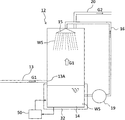
- the scrubber 12 is a scrubber for cleaning the crude gas G1, and a storage portion 14 is provided at the bottom thereof and a nozzle 15 is provided at the upper portion thereof. Washing water WS is stored in the storage unit 14. The nozzle 15 sprays the cleaning water WS into the scrubber 12.
- the introduction path 13, the circulation path 16, the discharge path 20, and the like are connected to the scrubber 12.
- the introduction path 13 is a path for introducing the crude gas G1 into the scrubber 12, and the introduction port 13A of the introduction path 13 is provided above the liquid level of the washing water WS stored inside the scrubber 12.
- the discharge path 20 is provided above the scrubber 12, and the purified gas G2 obtained by being purified by the scrubber 12 is discharged.
- the scrubber 12 is further provided with a temperature control device 32, and can control the temperature of the washing water WS.
- the temperature control device 32 has a temperature measuring unit (not shown) and can measure the temperature of the washing water WS.
- the temperature measuring unit is not particularly limited as long as it can measure the temperature of the washing water WS, and for example, a thermoelectric pair or the like can be adopted.
- the temperature control device 32 adjusts the temperature of the washing water WS based on the temperature of the washing water WS measured by the temperature measuring unit.
- the temperature control device 32 is, for example, a device that adjusts the washing water WS stored in the storage unit 14, and can use a jacket or the like that is provided around the storage unit 14 and allows a medium to flow inside. In the present embodiment, by providing the temperature control device 32, the temperature of the washing water WS can be maintained within a predetermined range described later.
- the storage unit 14 is provided with a stirring means such as a stirring blade, and the washing water WS stored in the storage unit 14 may or may not be stirred by the stirring means.
- the wash water WS stored in the storage unit 14 is sent to the nozzle 15 provided on the upper part of the scrubber 12 via the circulation path 16.
- a pump 19 is provided in the circulation path 16, and the washing water WS is pumped to the nozzle 15 by the pump 19. Then, the washing water WS is sprayed downward from the nozzle 15 inside the scrubber 12.
- the crude gas G1 introduced into the scrubber 12 from the introduction port 13A rises inside the scrubber 12 while in contact with the washing water WS sprayed from the nozzle 15, and is discharged as purified gas G2 from the discharge path 20.
- the crude gas G1 comes into contact with the washing water WS, at least a part of the acid-soluble heavy metal component contained in the crude gas G1 is removed, and the crude gas G1 is discharged as the purified gas G2 from the discharge path 20.
- washing water WS in contact with the crude gas G1, as described above, by the concentration D 1 of the dissolved carbon dioxide is within a predetermined range, the acid solubility of heavy metals contained in the crude gas G1 Ingredients are removed efficiently.
- the area between the cleaning water stored in the storage unit 14 and the nozzle 15 is a contact region where the cleaning water WS sprayed from the nozzle 15 and the crude gas G1 come into contact with each other.
- a porous body (not shown) or the like may be arranged in the contact region in order to increase the contact area between the washing water WS and the crude gas G1.
- the cleaning water WS sprayed from the nozzle 15 drops to the storage unit 14 while in contact with the crude gas G1, is stored in the storage unit 14, and is used again as the cleaning water WS. Further, the acid-soluble heavy metal component contained in the crude gas G1 is mixed into the washing water WS while becoming a carbonate of the heavy metal by coming into contact with carbon dioxide dissolved in the washing water WS, and thereby, from the crude gas G1. Will be removed. Heavy metal carbonates are generally insoluble in water and are mixed into the wash water WS as a solid component.
- the crude gas G1 is a gas derived from waste and contains a large amount of carbon dioxide. Therefore, the washing water WS sprayed from the nozzle 15 dissolves carbon dioxide when it comes into contact with the crude gas G1. Therefore, the concentration D 1 of dissolved carbon dioxide in the washing water WS can be increased or maintained. Therefore, even if the washing water WS comes into contact with an acid-soluble substance contained in the crude gas G1, it is possible to prevent the concentration D 1 of the dissolved carbon dioxide from decreasing. In general, the solubility of carbon dioxide in water increases with temperature decrease.
- the temperature of the washing water WS is preferably adjusted to 0 ° C. or higher and 10 ° C. or lower, more preferably 2 ° C. or higher and 10 ° C. or lower, and 5 ° C. or higher and 10 ° C. or lower. More preferred.
- the carbon dioxide dissolved in the washing water WS is may be composed only of carbon dioxide from the crude gas G1, in such at the start of operation, only the carbon dioxide from the crude gas G1 density D 1 sufficiently Since it cannot be increased, carbon dioxide may be dissolved in water in advance.
- the temperature of the cleaning water WS can be maintained within the above temperature range before and after the contact with the crude gas G1.
- the temperature of the washing water WS is uniform in the system of the scrubber 12, and if the temperature in the storage unit 14 is within the above range, the temperature in the nozzle 15 is also within the above range.
- the temperature of the crude gas G1 introduced into the scrubber 12 is not particularly limited, but is preferably set to a certain temperature or lower so that the temperature of the washing water WS is hardly raised by the crude gas G1.
- the temperature of the crude gas G1 is preferably 80 ° C. or lower, more preferably 0 to 50 ° C., and even more preferably 0 to 30 ° C.
- the temperature of the crude gas G1 means the temperature of the crude gas G1 immediately before coming into contact with the washing water WS, and the temperature at the introduction port 13A of the introduction path 13 may be measured.
- the pressure inside the scrubber 12 is preferably near normal pressure. By setting the pressure inside the scrubber 12 to near normal pressure, it is not necessary to use pressure-resistant equipment or the like, so that the equipment can be simplified.
- the pressure near normal pressure is, for example, about 0.08 to 0.12 MPa in absolute pressure.
- the washing water WS mixed with the acid-soluble heavy metal component is returned to the scrubber 12 after the mixed acid-soluble heavy metal component is removed by the heavy metal removing device 50 provided in the scrubber 12.
- the heavy metal removing device 50 is not particularly limited as long as it can remove the acid-soluble heavy metal component mixed in the washing water WS, and for example, a filtration device or the like can be adopted.
- carbon dioxide is added to the cleaning water in the acid cleaning for removing the heavy metal component from the crude gas containing the acid-soluble heavy metal component.
- the acidity of the washing water can be maintained and the heavy metal removing ability can be maintained, so that a highly accurate purified gas can be supplied.
- the purified gas producing apparatus controls the concentration measuring apparatus 31 for detecting the concentration D 1 of dissolved carbon dioxide in the wash water WS and the temperature control apparatus 32 based on the data of the detected concentration D 1. It further includes a control unit 40.
- the concentration measuring device 31 is not particularly limited as long as it can measure the dissolved carbon dioxide concentration D 1 of the washing water WS, and for example, a dissolved carbon dioxide measuring device or the like can be adopted.
- the control unit 40 receives the data regarding the concentration D 1 of the dissolved carbon dioxide in the washing water WS measured by the concentration measuring device 31, and determines whether the concentration D 1 of the dissolved carbon dioxide is within the above-mentioned predetermined range. If the determination result is within the predetermined range, the data for maintaining the status quo is transmitted to the temperature control device 32. On the other hand, when the determination result is out of the predetermined range, the data regarding the temperature adjustment of the washing water WS is transmitted to the temperature control device 32.
- the temperature control device 32 controls the temperature of the washing water WS based on the transmitted data. Specifically, when the concentration D 1 of dissolved carbon dioxide in the washing water WS is less than the lower limit of the above range, the temperature of the washing water WS is adjusted to be lowered. Further, when the concentration D 1 of dissolved carbon dioxide in the washing water WS exceeds the upper limit of the above range, the temperature of the washing water WS is adjusted to be raised.
- the concentration measuring device 31 is not necessarily crude gas It is not necessary to measure the carbon dioxide concentration D 1 in the washing water WS when it comes into contact with G1, and it is preferable to measure the carbon dioxide concentration at a position that can be evaluated to be the same as the concentration D 1 . Therefore, for example, as shown in FIG. 3, the concentration measuring device 31 may be arranged in the circulation path 16 to measure the concentration of dissolved carbon dioxide in the washing water WS circulating in the circulation path 16.
- the temperature of the washing water WS is controlled by the control unit 40, so that the concentration D 1 of the dissolved carbon dioxide in the washing water WS measured by the concentration measuring device 31 is within the above-mentioned predetermined range.
- the control unit 40 controls the temperature of the washing water WS. Therefore, the concentration D 1 of the dissolved carbon dioxide can be controlled to be within the above-mentioned predetermined range.
- a heavy metal component concentration measuring device (not shown) for measuring the concentration D 2 of the heavy metal component contained in the crude gas G1 may be provided.
- the concentration D 2 of the heavy metal component may be measured by, for example, an inductively coupled plasma mass spectrometer (ICP-MS), ion chromatography (IC) or the like.
- the washing water WS stored in the storage unit 12 is circulated and sprayed from the nozzle 15 on the upper part of the scrubber 12, but in the scrubber 62 of the present embodiment, the nozzle is omitted.
- the wash water WS stored in the storage unit 64 is not circulated and remains stored in the storage unit 64.
- the introduction port 63A of the introduction path 63 is arranged below the liquid level of the washing water WS stored in the storage unit 64.
- the crude gas G1 introduced from the introduction path 63 is introduced into the washing water WS stored in the storage unit 64.
- the crude gas G1 passes through the cleaning water WS stored in the storage unit 64, so that the crude gas G1 is brought into contact with the cleaning water WS.
- the washing water WS stored in the storage unit 64 may be agitated by a stirring blade or the like.
- the crude gas G1 By passing the crude gas G1 through the washing water WS in the storage unit 64, at least a part of the acid-soluble heavy metal component contained in the crude gas G1 was removed, and the acid-soluble heavy metal component was removed.
- the crude gas G1 is discharged from the discharge port 20 as the refined gas G2. Further, the crude gas G1, as described above, carbon dioxide containing a large amount, the washing water WS carbon dioxide dissolves by contact with the crude gas G1, the concentration D 1 of the dissolved carbon dioxide in the washing water WS is It is possible to prevent the concentration D 1 of dissolved carbon dioxide from decreasing even if the gas increases and comes into contact with an acid-soluble substance contained in the crude gas G1.
- the solubility of carbon dioxide in water can be increased by lowering the temperature of the washing water WS in the storage unit 64, and the concentration D 1 of dissolved carbon dioxide in the washing water can be set as described above. It is possible to adjust to the range of.
- the temperature of the washing water WS in the storage unit 64 may be set in the temperature range as described above, preferably 0 ° C. or higher and 10 ° C. or lower, more preferably 2 ° C. or higher and 10 ° C. or lower, and further preferably 5 ° C. or higher and 10 ° C. Adjust to °C or less.
- the temperature of the wash water WS in the storage unit 64 can be controlled by the temperature control device 72. As the temperature control device 72, for example, a jacket provided around the storage unit 64 and in which a medium flows can be used.
- the scrubber 62 is provided with a temperature control device 72, and can control the temperature of the washing water WS stored in the storage unit 64.
- the temperature control device 72 has a temperature measuring unit (not shown), and can measure the temperature of the washing water WS.
- the temperature control device 72 adjusts the temperature of the washing water WS stored in the storage unit 64 based on the temperature of the washing water WS measured by the temperature measuring unit. Since the details of the temperature measuring unit and the temperature control device are the same as those of the first and second embodiments described above, the description thereof will be omitted.
- the same effect as the refined gas production method and the refined gas production apparatus according to the first embodiment can be obtained. ..
- a control unit and a concentration measuring device are provided, and the concentration D 1 of the dissolved carbon dioxide in the washing water WS is controlled by the control unit. It may be adjusted within the above-mentioned predetermined range.
- the temperature control device 32 is shown as a jacket provided around the storage unit 14, but may be provided in the circulation path 16 as shown in FIG.
- the temperature control device 32 may be provided around the storage unit 14 and in the circulation path 16 in combination, and by using the temperature control device 32 in combination, the temperature of the washing water WS can be adjusted more accurately.
- the concentration D 1 of the dissolved carbon dioxide in the washing water WS showed manner be controlled to be within a predetermined range mentioned above
- the concentration D 1 of the dissolved carbon dioxide in the washing water WS depends not only on the temperature of the washing water described above but also on the pressure in the scrubber 12, instead of controlling the temperature of the washing water WS.
- the pressure in the scrubber 12 can be controlled by a known pressure urging means, and examples thereof include a means for providing a compressor (not shown) in the introduction path 13.
- the compressor is operated by a power source such as a motor, and can increase the pressure inside the scrubber 12 by compressing the crude gas G1 introduced from the introduction port 13A into the scrubber 12.
- a power source such as a motor
- the compressor can increase the pressure inside the scrubber 12 by compressing the crude gas G1 introduced from the introduction port 13A into the scrubber 12.
- the pressure inside the scrubber 12 is preferably adjusted to 0.01 to 1 MPa, more preferably 0.02 to 0.5 MPa, from the viewpoint of maintaining the concentration D 1 of dissolved carbon dioxide in the washing water WS. , It is more preferable to adjust to 0.05 to 0.3 MPa.
- the temperature of the washing water WS is controlled and the pressure in the scrubber is controlled as a means for controlling the concentration D 1 of the dissolved carbon dioxide in the washing water WS so as to be within the above-mentioned predetermined range.
- these may be adopted alone or both may be adopted.
- both controlling the temperature of the washing water WS and controlling the pressure inside the scrubber are adopted, when the pressure inside the scrubber is controlled to a high pressure of, for example, about 0.05 to 0.20 MPa in absolute pressure.
- the temperature of the washing water WS is preferably adjusted to 0 ° C. or higher and 10 ° C. or lower, more preferably 2 ° C. or higher and 10 ° C. or lower, and further preferably 5 ° C. or higher and 10 ° C. or lower.
- the acidity of the washing water WS is maintained and the heavy metal removing ability is maintained by dissolving carbon dioxide, but in addition to dissolving carbon dioxide.
- Hydrogen chloride, sulfuric acid, nitric acid and other acidic substances may be dissolved in the washing water WS.
Landscapes
- Chemical & Material Sciences (AREA)
- Engineering & Computer Science (AREA)
- Chemical Kinetics & Catalysis (AREA)
- General Chemical & Material Sciences (AREA)
- Oil, Petroleum & Natural Gas (AREA)
- Analytical Chemistry (AREA)
- Combustion & Propulsion (AREA)
- Organic Chemistry (AREA)
- Biomedical Technology (AREA)
- Environmental & Geological Engineering (AREA)
- Health & Medical Sciences (AREA)
- Treating Waste Gases (AREA)
- Gas Separation By Absorption (AREA)
- Industrial Gases (AREA)
Abstract
酸溶解性の重金属成分を含有する粗ガスから重金属成分を除去する酸洗浄において、洗浄水に二酸化炭素を溶存させることで洗浄水の酸性度を維持し、重金属除去能力を維持することができる精製ガスの製造方法及び精製ガス製造装置を提供する。 酸溶解性の重金属成分を含有する、廃棄物由来の粗ガスから、スクラバを用いて前記重金属成分の少なくとも一部を除去して、精製ガスを得る精製ガスの製造方法であって、前記スクラバにおいて、少なくとも二酸化炭素を溶存させた洗浄水を前記粗ガスに接触させて、前記重金属成分の少なくとも一部を前記粗ガスから除去し、前記洗浄水における溶存二酸化炭素の濃度D1は、0.72L/kg以上である、精製ガスの製造方法。
Description
本発明は、廃棄物に由来する粗ガスを精製して得られる精製ガスの製造方法及び精製ガス製造装置に関する。
産業廃棄物、一般廃棄物などの各種廃棄物は、熱分解により、ガス化する技術が知られている(特許文献1等参照)。この方法によれば、廃棄物を熱分解することで、一酸化炭素と水素を多く含む合成ガスなどが得られる。合成ガスなどの廃棄物由来のガスは、種々の用途に利用可能であり、例えば、微生物触媒、金属触媒などを用いて、エタノールなどの有価物に変換することが試みられている。
廃棄物には雑多な成分が含まれ、廃棄物から得られる合成ガスにも、数多くの不純物が含まれる。そのため、廃棄物由来の合成ガスは、不純物を取り除いて精製する必要がある。不純物を取り除く方法としては、スクラバを使用する方法が広く知られている。
スクラバを用いて不純物を取り除く方法としては、例えば、廃棄物から得られる合成ガスをスクラバで洗浄することで、脱硫処理して粗ガス中に含まれる硫化水素を硫黄として回収し、得られた精製ガスをガス利用設備で燃料ガスとして燃焼させて利用することができる(例えば、特許文献2参照)。そして、特許文献2には、重金属成分を含有する粗ガスに対して、スクラバにて酸性水の洗浄水によって洗浄することで、粗ガス中に含まれる鉛(Pb)等の重金属成分と塩素分は洗浄水中に溶け込ませる酸洗浄を行う精製法が開示されている。
スクラバを用いて不純物を取り除く方法としては、例えば、廃棄物から得られる合成ガスをスクラバで洗浄することで、脱硫処理して粗ガス中に含まれる硫化水素を硫黄として回収し、得られた精製ガスをガス利用設備で燃料ガスとして燃焼させて利用することができる(例えば、特許文献2参照)。そして、特許文献2には、重金属成分を含有する粗ガスに対して、スクラバにて酸性水の洗浄水によって洗浄することで、粗ガス中に含まれる鉛(Pb)等の重金属成分と塩素分は洗浄水中に溶け込ませる酸洗浄を行う精製法が開示されている。
重金属成分を含有する粗ガスを精製する方法として、酸洗浄することは有効であるが、酸溶解性の重金属成分が洗浄水中に含有すると、洗浄水の酸性度が低下(pHが上昇)してしまうため、重金属除去能力を維持することができなくなる。重金属除去能力を維持するためには、酸性度を維持することを要し、酸性度を維持するためにpH調整剤を添加しなければならず、コストがかかる問題がある。
本発明は、上記従来の課題を鑑みてなされたものであり、酸溶解性の重金属成分を含有する粗ガスから重金属成分を除去する酸洗浄において、洗浄水に二酸化炭素を溶存させることで洗浄水の酸性度を維持し、重金属除去能力を維持することができる精製ガスの製造方法及び精製ガス製造装置を提供することを課題とする。
本発明者は、鋭意検討の結果、洗浄水における溶存二酸化炭素の濃度を所定値以上とすることで、上記課題を解決できることを見出し、以下の本発明を完成させた。すなわち、本発明は、以下の[1]~[8]を提供する。
[1]酸溶解性の重金属成分を含有する、廃棄物由来の粗ガスから、スクラバを用いて前記重金属成分の少なくとも一部を除去して、精製ガスを得る精製ガスの製造方法であって、前記スクラバにおいて、少なくとも二酸化炭素を溶存させた洗浄水を前記粗ガスに接触させて、前記重金属成分の少なくとも一部を前記粗ガスから除去し、前記洗浄水における溶存二酸化炭素の濃度D1は、0.72L/kg以上である、精製ガスの製造方法。
[2]前記溶存二酸化炭素の濃度D1と前記粗ガスに含有する前記重金属成分の濃度D2との関係が下記式(1)を満たす、[1]の精製ガスの製造方法。
7.5 ≦ D1/D2 ≦ 21 (1)
[3]前記洗浄水の温度を0℃以上10℃以下に調整する、[1]又は[2]の精製ガスの製造方法。
[4]前記洗浄水のpHを2以上4以下に調整する、[1]~[3]のいずれかの精製ガスの製造方法。
[5]前記洗浄水は、前記粗ガスに含まれる二酸化炭素を洗浄水に溶解させる、[1]~[4]のいずれかの精製ガスの製造方法。
[6]前記粗ガスが合成ガスである、[1]~[5]のいずれかの精製ガスの製造方法。
[7]前記重金属成分は鉛を含む、[1]~[6]のいずれかのガス処理方法。
[8]酸溶解性の重金属成分を含有する、廃棄物由来の粗ガスから、スクラバを用いて前記重金属成分の少なくとも一部を除去して、精製ガスを得る精製ガス製造装置であって、前記スクラバにおいて、少なくとも二酸化炭素を溶存させた洗浄水を前記粗ガスに接触させて、前記重金属成分の少なくとも一部を前記粗ガスから除去し、前記洗浄水における溶存二酸化炭素の濃度D1は、0.72L/kg以上である、精製ガス製造装置。
[1]酸溶解性の重金属成分を含有する、廃棄物由来の粗ガスから、スクラバを用いて前記重金属成分の少なくとも一部を除去して、精製ガスを得る精製ガスの製造方法であって、前記スクラバにおいて、少なくとも二酸化炭素を溶存させた洗浄水を前記粗ガスに接触させて、前記重金属成分の少なくとも一部を前記粗ガスから除去し、前記洗浄水における溶存二酸化炭素の濃度D1は、0.72L/kg以上である、精製ガスの製造方法。
[2]前記溶存二酸化炭素の濃度D1と前記粗ガスに含有する前記重金属成分の濃度D2との関係が下記式(1)を満たす、[1]の精製ガスの製造方法。
7.5 ≦ D1/D2 ≦ 21 (1)
[3]前記洗浄水の温度を0℃以上10℃以下に調整する、[1]又は[2]の精製ガスの製造方法。
[4]前記洗浄水のpHを2以上4以下に調整する、[1]~[3]のいずれかの精製ガスの製造方法。
[5]前記洗浄水は、前記粗ガスに含まれる二酸化炭素を洗浄水に溶解させる、[1]~[4]のいずれかの精製ガスの製造方法。
[6]前記粗ガスが合成ガスである、[1]~[5]のいずれかの精製ガスの製造方法。
[7]前記重金属成分は鉛を含む、[1]~[6]のいずれかのガス処理方法。
[8]酸溶解性の重金属成分を含有する、廃棄物由来の粗ガスから、スクラバを用いて前記重金属成分の少なくとも一部を除去して、精製ガスを得る精製ガス製造装置であって、前記スクラバにおいて、少なくとも二酸化炭素を溶存させた洗浄水を前記粗ガスに接触させて、前記重金属成分の少なくとも一部を前記粗ガスから除去し、前記洗浄水における溶存二酸化炭素の濃度D1は、0.72L/kg以上である、精製ガス製造装置。
本発明によれば、酸溶解性の重金属成分を含有する粗ガスから重金属成分を除去する酸洗浄において、洗浄水に二酸化炭素を溶存させることで洗浄水の酸性度を維持し、重金属除去能力を維持することができる精製ガスの製造方法及び精製ガス製造装置を提供することができる。
(第1の実施形態)
次に、本発明について実施形態を用いて説明する。
図1は、本発明の第1の実施形態に係る精製ガス製造装置を示す。精製ガス製造装置10は、粗ガス生成設備11と、スクラバ12を備える。粗ガス生成設備11は、廃棄物由来ガスである粗ガスG1を生成する設備である。粗ガス生成設備11で生成された粗ガスG1は、スクラバ12に導入される。スクラバ12は、導入された粗ガスG1を精製し、精製ガスG2を得る。
次に、本発明について実施形態を用いて説明する。
図1は、本発明の第1の実施形態に係る精製ガス製造装置を示す。精製ガス製造装置10は、粗ガス生成設備11と、スクラバ12を備える。粗ガス生成設備11は、廃棄物由来ガスである粗ガスG1を生成する設備である。粗ガス生成設備11で生成された粗ガスG1は、スクラバ12に導入される。スクラバ12は、導入された粗ガスG1を精製し、精製ガスG2を得る。
粗ガス生成設備11は、廃棄物を燃焼、熱分解する装置を備え、例えば、燃焼炉、熱分解炉、改質炉、加熱炉、溶融炉、プラズマガス化炉等を1つ又は2つ以上備える。廃棄物としては、産業廃棄物でもよいし、家庭ごみなどの一般廃棄物でもよく、例えば、タイヤ、バイオマス、木質チップ、プラスチック、紙類、食料廃棄物など、可燃性物質であれば特に限定されない。粗ガスG1は、粗ガス生成設備11において廃棄物を燃焼、熱分解などさせることで得られる廃棄物由来ガスである。
粗ガスG1は、上記のとおり廃棄物由来のガスであることにより二酸化炭素を含有するガスであり、中でも合成ガスであることが好ましい。なお、粗ガスG1を構成する合成ガスは、後述するように酸溶解性の重金属成分などの不純物を含むので、ここでは、「粗合成ガス」という。粗合成ガスは、廃棄物が例えば熱分解炉において熱分解されることで得られてもよいし、熱分解炉にて熱分解された後に改質炉においてさらに低炭素化されるなどで得られてもよい。また、熱分解炉にて熱分解する前に加熱炉などにおいて脱ガス処理などがされてもよい。
粗合成ガスは、一酸化炭素及び水素を含み、通常はさらに二酸化炭素も含む。合成ガスは、例えば、一酸化炭素を10~45体積%、水素を10~50体積%、二酸化炭素を2~40体積%を含み、また、さらに窒素を5~67体積%、酸素を0.5~20体積%、水を5~40体積%程度含んでもよい。
粗合成ガスは、一酸化炭素及び水素を含み、通常はさらに二酸化炭素も含む。合成ガスは、例えば、一酸化炭素を10~45体積%、水素を10~50体積%、二酸化炭素を2~40体積%を含み、また、さらに窒素を5~67体積%、酸素を0.5~20体積%、水を5~40体積%程度含んでもよい。
粗ガスG1は、上記ガス以外にも、酸溶解性の重金属成分を含有する。粗ガスG1に含有する重金属成分は、酸性の洗浄水に対して溶解性を有する物質であり、二酸化炭素を溶存する洗浄水と接触することで炭酸塩を形成し得る成分である。具体的には、鉛、銅、クロム、亜鉛、マンガン、鉄、ニッケル及びカドミウム等の重金属の酸化物などが挙げられる。
スクラバ12は、鉛、銅、クロム、亜鉛、マンガン、鉄、ニッケル及びカドミウム等の重金属成分を含有する粗ガスG1の酸洗浄を好適に行うことができ、特に、鉛を含む粗ガスG1の酸洗浄をより好適に行うことができる。
スクラバ12は、鉛、銅、クロム、亜鉛、マンガン、鉄、ニッケル及びカドミウム等の重金属成分を含有する粗ガスG1の酸洗浄を好適に行うことができ、特に、鉛を含む粗ガスG1の酸洗浄をより好適に行うことができる。
スクラバ12では、洗浄水を粗ガスG1に接触させ、酸溶解性の重金属成分の少なくとも一部が粗ガスG1から除去される。ここで、洗浄水としては、少なくとも二酸化炭素を水に溶存させた洗浄水を使用する。洗浄水は、少なくとも二酸化炭素を溶存させていることで、粗ガスG1に含まれる酸溶解性の重金属成分を除去することができ、酸溶解性の重金属成分が効率的に粗ガスG1から取り除かれる。
洗浄水における溶存二酸化炭素の濃度D1は、0.72L/kg以上であることを特徴とする。濃度D1が0.72L/kg未満であると、重金属除去能力が低く、効率よく粗ガスG1から重金属成分を除去することができない。洗浄水における溶存二酸化炭素の濃度D1は、重金属除去能力を向上させる観点から、1.0L/kg以上であることが好ましく、1.1L/kg以上であることがより好ましく、1.2L/kg以上であることがさらに好ましく、飽和溶存二酸化炭素に近ければ近いほどよい。
一方、洗浄水における溶存二酸化炭素の濃度D1が、2.0L/kgを超えると、スクラバ12の金属製部品を腐食させてしまい、精製ガスG2を得る工程を安定的に稼働することが困難となる。この観点から、洗浄水における溶存二酸化炭素の濃度D1は、1.8L/kg以下であることが好ましく、1.7L/kg以下であることがより好ましく、1.6L/kg以下であることがさらに好ましい。
なお、本明細書における溶存二酸化炭素の濃度D1でいう体積(L)は、温度を20℃、圧力を1atmとしたときの二酸化炭素の気体の体積を示すものである。
一方、洗浄水における溶存二酸化炭素の濃度D1が、2.0L/kgを超えると、スクラバ12の金属製部品を腐食させてしまい、精製ガスG2を得る工程を安定的に稼働することが困難となる。この観点から、洗浄水における溶存二酸化炭素の濃度D1は、1.8L/kg以下であることが好ましく、1.7L/kg以下であることがより好ましく、1.6L/kg以下であることがさらに好ましい。
なお、本明細書における溶存二酸化炭素の濃度D1でいう体積(L)は、温度を20℃、圧力を1atmとしたときの二酸化炭素の気体の体積を示すものである。
洗浄水は、効率よく粗ガスG1から重金属成分を除去する観点、及び、スクラバ12の腐食を抑制し安定稼働性を向上させる観点から、溶存二酸化炭素の濃度D1(L/kg)と粗ガスG1に含有する重金属成分の濃度D2(g/L)との関係が下記式(1)を満たすことが好ましい。
7.5 ≦ D1/D2 ≦ 21 (1)
洗浄水は、効率よく粗ガスから重金属成分を除去する観点から、10.5 ≦ D1/D2であることが好ましく、11.4 ≦ D1/D2であることがより好ましく、12.6 ≦ D1/D2であることがさらに好ましい。洗浄水は、スクラバ12の腐食を抑制し安定稼働性を向上させる観点から、D1/D2 ≦ 19であることが好ましく、D1/D2 ≦ 18であることがより好ましく、D1/D2 ≦ 17であることがさらに好ましい。
7.5 ≦ D1/D2 ≦ 21 (1)
洗浄水は、効率よく粗ガスから重金属成分を除去する観点から、10.5 ≦ D1/D2であることが好ましく、11.4 ≦ D1/D2であることがより好ましく、12.6 ≦ D1/D2であることがさらに好ましい。洗浄水は、スクラバ12の腐食を抑制し安定稼働性を向上させる観点から、D1/D2 ≦ 19であることが好ましく、D1/D2 ≦ 18であることがより好ましく、D1/D2 ≦ 17であることがさらに好ましい。
粗ガスG1に含有する重金属成分の濃度D2は、0.01g/L以上100g/L以下であることが好ましく、0.02g/L以上50g/L以下であることがより好ましく、0.05g/L以上20g/L以下であることがさらに好ましい。粗ガスG1に含有する重金属成分の濃度D2が上記範囲であれば、本発明の精製ガス製造装置によって効率よく粗ガスG1に含有する重金属成分を除去することが可能となる。
なお、粗ガスG1に含有する重金属成分の濃度D2は、誘導結合プラズマ質量分析計(ICP-MS)及びイオンクロマトグラフィー(IC)等により測定された濃度である。
なお、粗ガスG1に含有する重金属成分の濃度D2は、誘導結合プラズマ質量分析計(ICP-MS)及びイオンクロマトグラフィー(IC)等により測定された濃度である。
洗浄水は、効率よく粗ガスG1から重金属成分を除去する観点から、洗浄水のpHを2以上4以下に調整することが好ましく、2以上3.5以下に調整することがより好ましく、2以上3以下に調整することがさらに好ましい。
本発明において、洗浄水における溶存二酸化炭素の濃度D1及びpHは、粗ガスG1に接触する際の洗浄水における溶存二酸化炭素の濃度D1を意味する。したがって、本実施形態では、溶存二酸化炭素の濃度は、排ガスG1に接触する直前、すなわち、後述するノズル15から噴霧された洗浄水の溶存二酸化炭素の濃度D1を意味する。また、洗浄水が、後述する第3の実施形態のように貯留された状態で排ガスG1に接触させる態様においては、貯留される洗浄水の溶存二酸化炭素の濃度を意味する。
なお、溶存二酸化炭素の濃度D1の測定は、公知の溶存二酸化炭素測定装置で測定すればよい。また、pHは、pHメータで測定すればよい。
なお、溶存二酸化炭素の濃度D1の測定は、公知の溶存二酸化炭素測定装置で測定すればよい。また、pHは、pHメータで測定すればよい。
スクラバ12で精製された精製ガスG2は、例えば二酸化炭素、さらには一酸化炭素などを含み、図示しない反応器などにてエタノールなどの有機化合物に変換される。また、精製ガスG2は、好ましくは合成ガスであり、ガス資化性微生物又は金属触媒のいずれかにより、エタノールなどの有機化合物に変換されることがより好ましい。
精製ガスG2は、反応器にて有機化合物に変換される前に、バグフィルタなどの煤塵除去装置、活性炭フィルタなどの各種吸着フィルタ、脱硝反応塔、脱硫反応塔、PSA及びTSAなどの各種清浄装置にてさらに浄化された後、反応器(図示しない)に送られてもよい。その他にスクラバ12を通過後に含まれる水分を除去する為の水分除去装置を設けることもできる。
精製ガスG2は、反応器にて有機化合物に変換される前に、バグフィルタなどの煤塵除去装置、活性炭フィルタなどの各種吸着フィルタ、脱硝反応塔、脱硫反応塔、PSA及びTSAなどの各種清浄装置にてさらに浄化された後、反応器(図示しない)に送られてもよい。その他にスクラバ12を通過後に含まれる水分を除去する為の水分除去装置を設けることもできる。
以下、本実施形態のスクラバ12の詳細について、図2を用いてより詳細に説明する。スクラバ12は、粗ガスG1を洗浄するための洗浄塔であり、その底部に貯留部14が設けられるとともに、上部にノズル15が設けられる。貯留部14には、洗浄水WSが貯留されている。ノズル15は、スクラバ12内部に洗浄水WSを噴霧する。
スクラバ12には、導入路13、循環路16、排出路20などが接続される。導入路13は、スクラバ12に粗ガスG1を導入するため経路であり、導入路13の導入口13Aは、スクラバ12の内部に貯留された洗浄水WSの液面よりも上方に設けられる。排出路20は、スクラバ12の上部に設けられ、スクラバ12で精製されて得られた精製ガスG2が排出される。
スクラバ12には、さらに温度制御装置32が備えられ、洗浄水WSの温度を制御することができる。温度制御装置32には、温度測定部(図示せず)を有し、洗浄水WSの温度を測定することができる。温度測定部としては、洗浄水WSの温度を測定することができるものであれば特に限定はなく、例えば、熱電対等を採用することができる。温度制御装置32は、温度測定部で測定した洗浄水WSの温度に基づいて、洗浄水WSの温度を調整する。
温度制御装置32は、例えば、貯留部14に貯留された洗浄水WSを調整する装置であって、貯留部14の周囲に設けられ、内部に媒体が流されるジャケットなどを使用することができる。本実施形態では、温度制御装置32が設けられることで、洗浄水WSの温度が後述する所定の範囲内に維持することができる。
温度制御装置32は、例えば、貯留部14に貯留された洗浄水WSを調整する装置であって、貯留部14の周囲に設けられ、内部に媒体が流されるジャケットなどを使用することができる。本実施形態では、温度制御装置32が設けられることで、洗浄水WSの温度が後述する所定の範囲内に維持することができる。
貯留部14には、撹拌翼などの撹拌手段が設けられ、撹拌手段によって、貯蔵部14に貯留された洗浄水WSを撹拌してもよいし、しなくてもよい。
貯留部14に貯留された洗浄水WSは、循環路16を介して、スクラバ12の上部に設けられたノズル15に送られる。循環路16には、例えばポンプ19が設けられ、洗浄水WSは、ポンプ19によってノズル15に圧送される。そして、洗浄水WSは、スクラバ12の内部において、ノズル15から下方に向けて噴霧される。
スクラバ12内部に導入口13Aから導入された粗ガスG1は、ノズル15から噴霧された洗浄水WSに接触しつつ、スクラバ12内部において上昇し、排出路20から精製ガスG2として排出される。粗ガスG1は、洗浄水WSに接触することで、粗ガスG1に含まれる酸溶解性の重金属成分の少なくとも一部が除去され、排出路20から精製ガスG2として排出される。
本実施形態では、粗ガスG1に接触する洗浄水WSは、上記したように、溶存二酸化炭素の濃度D1が所定の範囲内となることで、粗ガスG1に含有される酸溶解性の重金属成分が効率的に除去される。
スクラバ12内部において、貯留部14に貯留される洗浄水とノズル15の間は、ノズル15から噴霧された洗浄水WSと粗ガスG1とが接触する接触領域となる。接触領域には、洗浄水WSと粗ガスG1との接触面積を増大させるために多孔質体(図示しない)などが配置されてもよい。
本実施形態では、粗ガスG1に接触する洗浄水WSは、上記したように、溶存二酸化炭素の濃度D1が所定の範囲内となることで、粗ガスG1に含有される酸溶解性の重金属成分が効率的に除去される。
スクラバ12内部において、貯留部14に貯留される洗浄水とノズル15の間は、ノズル15から噴霧された洗浄水WSと粗ガスG1とが接触する接触領域となる。接触領域には、洗浄水WSと粗ガスG1との接触面積を増大させるために多孔質体(図示しない)などが配置されてもよい。
ノズル15から噴霧された洗浄水WSは、粗ガスG1と接触しながら、貯留部14まで落下し、貯留部14に貯留され、再度、洗浄水WSとして使用される。また、粗ガスG1に含まれる酸溶解性の重金属成分は、洗浄水WSに溶解される二酸化炭素に接触することで重金属の炭酸塩となりつつ洗浄水WSに混入され、それにより、粗ガスG1から除去される。重金属の炭酸塩は、一般的には、水に対して不溶であり、固体分として洗浄水WSに混入される。
粗ガスG1は、廃棄物由来のガスであり、二酸化炭素を多く含有し、したがって、ノズル15から噴霧された洗浄水WSは、粗ガスG1に接触することで二酸化炭素が溶解する。そのため、洗浄水WSにおける溶存二酸化炭素の濃度D1を上昇又は維持することができる。よって、洗浄水WSが粗ガスG1に含まれる酸溶解性の物質と接触しても、溶存二酸化炭素の濃度D1が低下することを防止できる。
一般的に、水に対する二酸化炭素の溶解度は、温度低下とともに上昇する。したがって、本実施形態では、洗浄水WSの温度を低くすることで、水に対する二酸化炭素の溶解度を上昇させることができ、上記した所定の溶存二酸化炭素の濃度D1に調整することが可能となる。具体的には、洗浄水WSの温度は、0℃以上10℃以下に調整することが好ましく、2℃以上10℃以下に調整することがより好ましく、5℃以上10℃以下に調整することがさらに好ましい。
なお、洗浄水WSに溶存する二酸化炭素は、粗ガスG1由来の二酸化炭素のみから構成されてもよいが、運転開始時などにおいては、粗ガスG1由来の二酸化炭素のみでは濃度D1を十分に高くできないので、予め水に二酸化炭素を溶存させておいてもよい。
一般的に、水に対する二酸化炭素の溶解度は、温度低下とともに上昇する。したがって、本実施形態では、洗浄水WSの温度を低くすることで、水に対する二酸化炭素の溶解度を上昇させることができ、上記した所定の溶存二酸化炭素の濃度D1に調整することが可能となる。具体的には、洗浄水WSの温度は、0℃以上10℃以下に調整することが好ましく、2℃以上10℃以下に調整することがより好ましく、5℃以上10℃以下に調整することがさらに好ましい。
なお、洗浄水WSに溶存する二酸化炭素は、粗ガスG1由来の二酸化炭素のみから構成されてもよいが、運転開始時などにおいては、粗ガスG1由来の二酸化炭素のみでは濃度D1を十分に高くできないので、予め水に二酸化炭素を溶存させておいてもよい。
また、溶存二酸化炭素の濃度D1を上記のように上昇させ、高く維持するためには、粗ガスG1に接触する際のみならず、接触後においても、洗浄水WSの温度を低くする必要がある。一旦、溶解した二酸化炭素が洗浄水WSから抜けることを防止するためである。そのため、本実施形態のように、洗浄水WSを循環させて排ガスG1に接触させる場合には、洗浄水WSの温度は、粗ガスG1に接触する前後において、上記温度範囲内に維持することが好ましく、具体的には、ノズル15から噴霧された洗浄水WSの温度、及び貯留部14における洗浄水WSの温度をいずれも上記温度範囲内に調整することが好ましい。ただし、通常、スクラバ12の系内において洗浄水WSの温度は一様であり、貯留部14における温度を上記範囲内とすると、ノズル15における温度も上記範囲内となる。
また、スクラバ12に導入される粗ガスG1の温度は、特に限定されないが、粗ガスG1によって洗浄水WSの温度が殆ど上昇しないように、一定温度以下とすることが好ましい。粗ガスG1の温度は、具体的には、80℃以下であることが好ましく、0~50℃であることがより好ましく、0~30℃であることがさらに好ましい。なお、粗ガスG1の温度とは、洗浄水WSに接触する直前の粗ガスG1の温度を意味し、導入路13の導入口13Aにおける温度を測定すればよい。
スクラバ12の内部の圧力は、常圧付近であることが好ましい。スクラバ12内部の圧力を常圧付近とすることで、耐圧設備などを使用しなくてよいことから、設備を簡素化できる。なお、常圧付近の圧力とは、絶対圧力で例えば0.08~0.12MPa程度である。
酸溶解性の重金属成分が混入した洗浄水WSは、スクラバ12に備えられた重金属除去装置50によって、混入した酸溶解性の重金属成分を除去した後に、スクラバ12へ戻される。重金属除去装置50は、洗浄水WS中に混入した酸溶解性の重金属成分を除去できるものであれば特に限定はなく、例えば、濾過装置等を採用することができる。
本発明の第1の実施形態に係る精製ガスの製造方法及び精製ガス製造装置によれば、酸溶解性の重金属成分を含有する粗ガスから重金属成分を除去する酸洗浄において、洗浄水に二酸化炭素を溶存させることで洗浄水の酸性度を維持し、重金属除去能力を維持することができるので、精度の高い精製ガスを供給することができる。
(第2の実施形態)
次に、本発明の第2の実施形態を説明する。以下では、第2の実施形態について、第1の実施形態と重複するものについては説明を省略し、第1の実施形態との相違点を説明する。
第2の実施形態における精製ガス製造装置は、洗浄水WSにおける溶存二酸化炭素の濃度D1を検出する濃度測定装置31と、検出された濃度D1のデータに基づいて温度制御装置32を制御する制御部40とをさらに備える。濃度測定装置31としては、洗浄水WSの溶存二酸化炭素の濃度D1を測定することができるものであれば特に限定はなく、例えば、溶存二酸化炭素測定装置等を採用することができる。
次に、本発明の第2の実施形態を説明する。以下では、第2の実施形態について、第1の実施形態と重複するものについては説明を省略し、第1の実施形態との相違点を説明する。
第2の実施形態における精製ガス製造装置は、洗浄水WSにおける溶存二酸化炭素の濃度D1を検出する濃度測定装置31と、検出された濃度D1のデータに基づいて温度制御装置32を制御する制御部40とをさらに備える。濃度測定装置31としては、洗浄水WSの溶存二酸化炭素の濃度D1を測定することができるものであれば特に限定はなく、例えば、溶存二酸化炭素測定装置等を採用することができる。
制御部40は、濃度測定装置31で測定した洗浄水WSの溶存二酸化炭素の濃度D1に関するデータを受信し、溶存二酸化炭素の濃度D1が上述の所定範囲内にあるか判定する。判定結果が所定範囲内である場合は、温度制御装置32に現状維持のデータを送信する。一方、判定結果が所定範囲外である場合は、温度制御装置32に洗浄水WSの温度調整に関するデータを送信する。温度制御装置32は、送信されるデータに基づいて、洗浄水WSの温度を制御する。
具体的には、洗浄水WSにおける溶存二酸化炭素の濃度D1が上記範囲の下限未満となった場合には、洗浄水WSの温度を下げる調整を行う。また、洗浄水WSにおける溶存二酸化炭素の濃度D1が上記範囲の上限を超えた場合には、洗浄水WSの温度を上げる調整を行う。
具体的には、洗浄水WSにおける溶存二酸化炭素の濃度D1が上記範囲の下限未満となった場合には、洗浄水WSの温度を下げる調整を行う。また、洗浄水WSにおける溶存二酸化炭素の濃度D1が上記範囲の上限を超えた場合には、洗浄水WSの温度を上げる調整を行う。
重金属成分を効率的に除去する観点から、粗ガスG1に接触する際の洗浄水WSにおける二酸化炭素の濃度D1を上記範囲内に調整する必要があるが、濃度測定装置31は、必ずしも粗ガスG1に接触する際の洗浄水WSにおける二酸化炭素の濃度D1を測定する必要はなく、その濃度D1と同一と評価できる位置において二酸化炭素の濃度を測定するとよい。したがって、例えば、図3に示すように、濃度測定装置31を循環路16に配設し、循環路16を循環する洗浄水WSの溶存二酸化炭素の濃度を測定してもよい。
以上のように、本実施形態では、制御部40によって、洗浄水WSの温度を制御することで、濃度測定装置31で測定した洗浄水WSの溶存二酸化炭素の濃度D1が上述の所定範囲内となるように制御することができる。具体的には、濃度測定装置31で測定した洗浄水WSの溶存二酸化炭素の濃度D1に変動があり上述の所定範囲外となった場合でも、制御部40が洗浄水WSの温度を制御することで、溶存二酸化炭素の濃度D1が上述の所定範囲内となるように制御することができる。
さらに、本実施形態では、粗ガスG1に含有する重金属成分の濃度D2を測定する重金属成分濃度測定装置(図示せず)を設けてもよい。重金属成分濃度測定装置を設けることで、D1/D2が上記範囲内となるように洗浄水WSの溶存二酸化炭素の濃度D1を調整することが容易となる。重金属成分の濃度D2は、例えば誘導結合プラズマ質量分析計(ICP-MS)及びイオンクロマトグラフィー(IC)等で測定すればよい。
さらに、本実施形態では、粗ガスG1に含有する重金属成分の濃度D2を測定する重金属成分濃度測定装置(図示せず)を設けてもよい。重金属成分濃度測定装置を設けることで、D1/D2が上記範囲内となるように洗浄水WSの溶存二酸化炭素の濃度D1を調整することが容易となる。重金属成分の濃度D2は、例えば誘導結合プラズマ質量分析計(ICP-MS)及びイオンクロマトグラフィー(IC)等で測定すればよい。
(第3の実施形態)
次に、本発明の第3の実施形態を説明する。以下では、第3の実施形態について、第1の実施形態と重複するものについては説明を省略し、第1の実施形態との相違点を説明する。
上記した第1の実施形態のスクラバ12では、貯留部12に貯留された洗浄水WSは循環されてスクラバ12上部のノズル15から噴霧されたが、本実施形態のスクラバ62では、ノズルは省略され、貯留部64に貯留された洗浄水WSは循環されず、貯留部64で貯留されたままである。そして、導入路63の導入口63Aは、貯留部64に貯留された洗浄水WSの液面よりも下方に配置される。
したがって、導入路63から導入された粗ガスG1は、貯留部64に貯留された洗浄水WS中に導入される。これにより、粗ガスG1は、貯留部64に貯留された洗浄水WSを通過することで、粗ガスG1を洗浄水WSに接触させることになる。
なお、第1の実施形態と同様に、第3の実施形態でも、貯留部64に貯留された洗浄水WSは、撹拌翼などにより撹拌してもよい。
次に、本発明の第3の実施形態を説明する。以下では、第3の実施形態について、第1の実施形態と重複するものについては説明を省略し、第1の実施形態との相違点を説明する。
上記した第1の実施形態のスクラバ12では、貯留部12に貯留された洗浄水WSは循環されてスクラバ12上部のノズル15から噴霧されたが、本実施形態のスクラバ62では、ノズルは省略され、貯留部64に貯留された洗浄水WSは循環されず、貯留部64で貯留されたままである。そして、導入路63の導入口63Aは、貯留部64に貯留された洗浄水WSの液面よりも下方に配置される。
したがって、導入路63から導入された粗ガスG1は、貯留部64に貯留された洗浄水WS中に導入される。これにより、粗ガスG1は、貯留部64に貯留された洗浄水WSを通過することで、粗ガスG1を洗浄水WSに接触させることになる。
なお、第1の実施形態と同様に、第3の実施形態でも、貯留部64に貯留された洗浄水WSは、撹拌翼などにより撹拌してもよい。
粗ガスG1は、貯留部64にて洗浄水WSを通過することで、粗ガスG1に含有される酸溶解性の重金属成分の少なくとも一部が除去され、酸溶解性の重金属成分が除去された粗ガスG1は、精製ガスG2として排出口20から排出される。また、粗ガスG1には、上記の通り、二酸化炭素を大量に含有し、洗浄水WSは粗ガスG1に接触することで二酸化炭素が溶解し、洗浄水WSにおける溶存二酸化炭素の濃度D1が上昇し、また、粗ガスG1に含まれる酸溶解性の物質と接触しても、溶存二酸化炭素の濃度D1が低下することを防止できる。ここで、本実施形態でも、貯留部64における洗浄水WSの温度を低くすることで、水に対する二酸化炭素の溶解度を上昇させることができ、洗浄水における溶存二酸化炭素の濃度D1を上記した所定の範囲に調整することが可能となる。貯留部64における洗浄水WSの温度は、上記したとおりの温度範囲に設定すればよく、好ましくは0℃以上10℃以下、より好ましくは2℃以上10℃以下に、さらに好ましくは5℃以上10℃以下に調整する。
貯留部64における洗浄水WSの温度は、温度制御装置72によって制御することができる。温度制御装置72は、例えば、貯留部64の周囲に設けられ、内部に媒体が流されるジャケットなどが使用できる。
貯留部64における洗浄水WSの温度は、温度制御装置72によって制御することができる。温度制御装置72は、例えば、貯留部64の周囲に設けられ、内部に媒体が流されるジャケットなどが使用できる。
スクラバ62には、温度制御装置72が備えられ、貯留部64に貯留された洗浄水WSの温度を制御することができる。温度制御装置72には、温度測定部(図示せず)を有し、洗浄水WSの温度を測定することができる。温度制御装置72は、温度測定部で測定した洗浄水WSの温度に基づいて、貯留部64に貯留された洗浄水WSの温度を調整する。温度測定部及び温度制御装置の詳細は、上記した第1及び第2の実施形態と同様であるのでその説明は省略する。
本発明の第3の実施形態に係る精製ガスの製造方法及び精製ガス製造装置によれば、第1の実施形態に係る精製ガスの製造方法及び精製ガス製造装置と同等の効果を得ることができる。
なお、第3の実施形態においても、上記した第2の実施形態と同様に、制御部と、濃度測定装置が設けられ、制御部の制御により、洗浄水WSの溶存二酸化炭素の濃度D1が上記した所定の範囲内に調整されるようにしてもよい。
なお、第3の実施形態においても、上記した第2の実施形態と同様に、制御部と、濃度測定装置が設けられ、制御部の制御により、洗浄水WSの溶存二酸化炭素の濃度D1が上記した所定の範囲内に調整されるようにしてもよい。
(その他の実施の形態)
例えば、第1及び第2の実施形態では、温度制御装置32は貯留部14の周囲に設けられたジャケットとして示したが、図5に示すように、循環路16に設けてもよい。循環路16に温度制御装置32を設けることで、より一層、粗ガスG1に接触する直前での洗浄水WSの温度を正確に調整できる。なお、温度制御装置32は、貯留部14の周囲に設けるものと、循環路16に設けるものを併用してもよく、併用することで洗浄水WSの温度調整をより正確に行うことができる。
例えば、第1及び第2の実施形態では、温度制御装置32は貯留部14の周囲に設けられたジャケットとして示したが、図5に示すように、循環路16に設けてもよい。循環路16に温度制御装置32を設けることで、より一層、粗ガスG1に接触する直前での洗浄水WSの温度を正確に調整できる。なお、温度制御装置32は、貯留部14の周囲に設けるものと、循環路16に設けるものを併用してもよく、併用することで洗浄水WSの温度調整をより正確に行うことができる。
また、第1及び第2の実施形態において、洗浄水WSの温度を制御することで、洗浄水WSの溶存二酸化炭素の濃度D1が上述の所定範囲内となるように制御する態様を示したが、洗浄水WSにおける溶存二酸化炭素の濃度D1は、上記した洗浄水の温度に依存する以外に、スクラバ12内の圧力にも依存するので、洗浄水WSの温度を制御することに代えて、スクラバ12内の圧力の制御により行うことができる。スクラバ12内の圧力の制御は、公知の圧力付勢手段で行うことができ、例えば、導入路13に圧縮機(図示しない)を設ける手段が挙げられる。圧縮機は、例えばモーター等の動力源によって作動し、スクラバ12内部に導入口13Aから導入される粗ガスG1を圧縮することによりスクラバ12内部の圧力を上昇させることができる。
洗浄水WSにおける溶存二酸化炭素の濃度D1が上記範囲外となった場合の具体的調整としては、洗浄水WSにおける溶存二酸化炭素の濃度D1が上記範囲の下限未満となった場合には、スクラバ12内の圧力を上げる調整を行う。また、洗浄水WSにおける溶存二酸化炭素の濃度D1が上記範囲の上限を超えた場合には、スクラバ12内の圧力を下げる調整を行う。
スクラバ12内部の圧力は、洗浄水WSにおける溶存二酸化炭素の濃度D1を維持する観点から、0.01~1MPaに調整することが好ましく、0.02~0.5MPaに調整することがより好ましく、0.05~0.3MPaに調整することがさらに好ましい。
洗浄水WSにおける溶存二酸化炭素の濃度D1が上記範囲外となった場合の具体的調整としては、洗浄水WSにおける溶存二酸化炭素の濃度D1が上記範囲の下限未満となった場合には、スクラバ12内の圧力を上げる調整を行う。また、洗浄水WSにおける溶存二酸化炭素の濃度D1が上記範囲の上限を超えた場合には、スクラバ12内の圧力を下げる調整を行う。
スクラバ12内部の圧力は、洗浄水WSにおける溶存二酸化炭素の濃度D1を維持する観点から、0.01~1MPaに調整することが好ましく、0.02~0.5MPaに調整することがより好ましく、0.05~0.3MPaに調整することがさらに好ましい。
また、洗浄水WSの溶存二酸化炭素の濃度D1が上述の所定範囲内となるように制御する手段として、洗浄水WSの温度を制御すること、及び、スクラバ内の圧力を制御することを示したが、これらは単独で採用してもよく、両方を共に採用してもよい。
洗浄水WSの温度を制御すること、及び、スクラバ内の圧力を制御することの両方を採用した場合、スクラバ内の圧力が絶対圧力で例えば0.05~0.20MPa程度の高圧に制御した時は、洗浄水WSの温度を0℃以上10℃以下に調整することが好ましく、2℃以上10℃以下に調整することがより好ましく、5℃以上10℃以下に調整することがさらに好ましい。
洗浄水WSの温度を制御すること、及び、スクラバ内の圧力を制御することの両方を採用した場合、スクラバ内の圧力が絶対圧力で例えば0.05~0.20MPa程度の高圧に制御した時は、洗浄水WSの温度を0℃以上10℃以下に調整することが好ましく、2℃以上10℃以下に調整することがより好ましく、5℃以上10℃以下に調整することがさらに好ましい。
また、第1~第3の実施形態において、二酸化炭素を溶存させることで洗浄水WSの酸性度を維持し、重金属除去能力を維持することを示したが、二酸化炭素を溶存させることに加えて、塩化水素、硫酸、硝酸などのその他の酸性物質を洗浄水WSに溶解させてもよい。その他の酸性物質を洗浄水WSに溶解させることにより、より一層、粗ガスG1から重金属成分を除去する能力を維持しやすくなる。
10:精製ガス製造装置
11:粗ガス生成設備
12,62:スクラバ
13,63:導入路
13A,63A:導入口
14,64:貯留部
16:循環路
19:ポンプ
20:排出路
31:濃度測定装置
32:温度制御装置
40:制御部
50:重金属除去装置
11:粗ガス生成設備
12,62:スクラバ
13,63:導入路
13A,63A:導入口
14,64:貯留部
16:循環路
19:ポンプ
20:排出路
31:濃度測定装置
32:温度制御装置
40:制御部
50:重金属除去装置
Claims (8)
- 酸溶解性の重金属成分を含有する、廃棄物由来の粗ガスから、スクラバを用いて前記重金属成分の少なくとも一部を除去して、精製ガスを得る精製ガスの製造方法であって、
前記スクラバにおいて、少なくとも二酸化炭素を溶存させた洗浄水を前記粗ガスに接触させて、前記重金属成分の少なくとも一部を前記粗ガスから除去し、
前記洗浄水における溶存二酸化炭素の濃度D1は、0.72L/kg以上である、精製ガスの製造方法。 - 前記溶存二酸化炭素の濃度D1と前記粗ガスに含有する前記重金属成分の濃度D2との関係が下記式(1)を満たす、請求項1に記載の精製ガスの製造方法。
7.5 ≦ D1/D2 ≦ 21 (1) - 前記洗浄水の温度を0℃以上10℃以下に調整する、請求項1又は2に記載の精製ガスの製造方法。
- 前記洗浄水のpHを2以上4以下に調整する、請求項1~3のいずれか1項に記載の精製ガスの製造方法。
- 前記洗浄水は、前記粗ガスに含まれる二酸化炭素を洗浄水に溶解させる、請求項1~4のいずれか1項に記載の精製ガスの製造方法。
- 前記粗ガスが合成ガスである、請求項1~5のいずれか1項に記載の精製ガスの製造方法。
- 前記重金属成分は鉛を含む、請求項1~6のいずれか1項に記載のガス処理方法。
- 酸溶解性の重金属成分を含有する、廃棄物由来の粗ガスから、スクラバを用いて前記重金属成分の少なくとも一部を除去して、精製ガスを得る精製ガス製造装置であって、
前記スクラバにおいて、少なくとも二酸化炭素を溶存させた洗浄水を前記粗ガスに接触させて、前記重金属成分の少なくとも一部を前記粗ガスから除去し、
前記洗浄水における溶存二酸化炭素の濃度D1は、0.72L/kg以上である、精製ガス製造装置。
Priority Applications (1)
| Application Number | Priority Date | Filing Date | Title |
|---|---|---|---|
| JP2021526961A JP7463364B2 (ja) | 2019-06-21 | 2020-06-22 | 精製ガスの製造方法及び精製ガス製造装置 |
Applications Claiming Priority (2)
| Application Number | Priority Date | Filing Date | Title |
|---|---|---|---|
| JP2019-115619 | 2019-06-21 | ||
| JP2019115619 | 2019-06-21 |
Publications (1)
| Publication Number | Publication Date |
|---|---|
| WO2020256151A1 true WO2020256151A1 (ja) | 2020-12-24 |
Family
ID=74040517
Family Applications (1)
| Application Number | Title | Priority Date | Filing Date |
|---|---|---|---|
| PCT/JP2020/024308 Ceased WO2020256151A1 (ja) | 2019-06-21 | 2020-06-22 | 精製ガスの製造方法及び精製ガス製造装置 |
Country Status (2)
| Country | Link |
|---|---|
| JP (1) | JP7463364B2 (ja) |
| WO (1) | WO2020256151A1 (ja) |
Citations (6)
| Publication number | Priority date | Publication date | Assignee | Title |
|---|---|---|---|---|
| JPH11221434A (ja) * | 1998-02-04 | 1999-08-17 | Mitsui Mining & Smelting Co Ltd | Co2 含有ガス中のh2 sの除去方法 |
| JP2006213535A (ja) * | 2005-02-01 | 2006-08-17 | Jfe Engineering Kk | 廃棄物をガス化溶融炉で処理する際に発生する塩水からの塩製造方法及び装置 |
| JP2014125577A (ja) * | 2012-12-27 | 2014-07-07 | Biomass Energy Kk | 生成ガスの製造方法、製造装置及びタール除去装置 |
| JP2016182560A (ja) * | 2015-03-26 | 2016-10-20 | Jfeエンジニアリング株式会社 | 焼却灰処理装置、廃棄物焼却装置、焼却灰処理方法及び廃棄物焼却方法 |
| JP2018058042A (ja) * | 2016-10-06 | 2018-04-12 | 積水化学工業株式会社 | 合成ガスの浄化処理方法及び装置 |
| JP2019072678A (ja) * | 2017-10-17 | 2019-05-16 | Jfeエンジニアリング株式会社 | アルミニウム含有廃棄物の処理方法 |
Family Cites Families (1)
| Publication number | Priority date | Publication date | Assignee | Title |
|---|---|---|---|---|
| JP3924822B2 (ja) * | 1996-10-31 | 2007-06-06 | 太平洋セメント株式会社 | 灰塵の洗浄処理方法およびその装置 |
-
2020
- 2020-06-22 WO PCT/JP2020/024308 patent/WO2020256151A1/ja not_active Ceased
- 2020-06-22 JP JP2021526961A patent/JP7463364B2/ja active Active
Patent Citations (6)
| Publication number | Priority date | Publication date | Assignee | Title |
|---|---|---|---|---|
| JPH11221434A (ja) * | 1998-02-04 | 1999-08-17 | Mitsui Mining & Smelting Co Ltd | Co2 含有ガス中のh2 sの除去方法 |
| JP2006213535A (ja) * | 2005-02-01 | 2006-08-17 | Jfe Engineering Kk | 廃棄物をガス化溶融炉で処理する際に発生する塩水からの塩製造方法及び装置 |
| JP2014125577A (ja) * | 2012-12-27 | 2014-07-07 | Biomass Energy Kk | 生成ガスの製造方法、製造装置及びタール除去装置 |
| JP2016182560A (ja) * | 2015-03-26 | 2016-10-20 | Jfeエンジニアリング株式会社 | 焼却灰処理装置、廃棄物焼却装置、焼却灰処理方法及び廃棄物焼却方法 |
| JP2018058042A (ja) * | 2016-10-06 | 2018-04-12 | 積水化学工業株式会社 | 合成ガスの浄化処理方法及び装置 |
| JP2019072678A (ja) * | 2017-10-17 | 2019-05-16 | Jfeエンジニアリング株式会社 | アルミニウム含有廃棄物の処理方法 |
Also Published As
| Publication number | Publication date |
|---|---|
| JPWO2020256151A1 (ja) | 2020-12-24 |
| JP7463364B2 (ja) | 2024-04-08 |
Similar Documents
| Publication | Publication Date | Title |
|---|---|---|
| CN107922213A (zh) | 水处理系统、发电成套设备及水处理系统的控制方法 | |
| TW200916181A (en) | Method of treating emission gas | |
| US11198828B2 (en) | Process for hydrogen sulfide scrubbing and method for ferric ion regeneration | |
| WO2013073662A1 (ja) | 直接還元鉄製造システム | |
| JP2004067849A (ja) | 湿式ガス精製方法 | |
| CN100469419C (zh) | 分段式钠钙双碱法脱硫工艺及其装置 | |
| JP2013108109A (ja) | 直接還元鉄製造システム | |
| KR101351317B1 (ko) | 코크스 오븐 가스 및 제철 부생가스를 이용한 환원가스의 제조방법 | |
| JP4747382B1 (ja) | 排煙浄化処理方法 | |
| JP2010001175A (ja) | アルミン酸ナトリウムと水素との生成方法 | |
| Wang et al. | A new concept of desulfurization: the electrochemically driven and green conversion of SO2 to NaHSO4 in aqueous solution | |
| Borgquist et al. | Mercaptan removal with electroscrubbing pilot | |
| WO2020256151A1 (ja) | 精製ガスの製造方法及び精製ガス製造装置 | |
| SE450953B (sv) | Vatoxidationsforfarande | |
| JP2003220316A (ja) | ガス精製方法、ガス精製システム及び発電システム | |
| JP5050947B2 (ja) | 廃棄物の処理方法 | |
| CN101389568A (zh) | 优化克劳斯装置运行的方法 | |
| CN116920570A (zh) | 选择性分离co2的脱硫液、高浓度h2s的脱硫方法及装置 | |
| JP5980652B2 (ja) | 過硫酸塩処理装置、過硫酸塩処理方法、酸化還元電位測定装置及び酸化還元電位測定方法 | |
| JP5995678B2 (ja) | 酸化剤処理方法及び酸化剤処理装置 | |
| CN101663080A (zh) | 排气处理方法 | |
| US20130259740A1 (en) | System for treating selenium-containing liquid, wet flue gas desulfurization device, and method for treating selenium-containing liquid | |
| CN105329859A (zh) | 一种含硫尾气的处理工艺 | |
| JPH11128659A (ja) | 石炭ガス化プラントの起動排ガス処理装置 | |
| KR20060038763A (ko) | 습식 탈유공정 설비에서의 정제약품 공급장치 및 방법 |
Legal Events
| Date | Code | Title | Description |
|---|---|---|---|
| 121 | Ep: the epo has been informed by wipo that ep was designated in this application |
Ref document number: 20825884 Country of ref document: EP Kind code of ref document: A1 |
|
| ENP | Entry into the national phase |
Ref document number: 2021526961 Country of ref document: JP Kind code of ref document: A |
|
| NENP | Non-entry into the national phase |
Ref country code: DE |
|
| 122 | Ep: pct application non-entry in european phase |
Ref document number: 20825884 Country of ref document: EP Kind code of ref document: A1 |