WO2020218151A1 - (メタ)アクリル系組成物、それを含む塗料および硬化体 - Google Patents
(メタ)アクリル系組成物、それを含む塗料および硬化体 Download PDFInfo
- Publication number
- WO2020218151A1 WO2020218151A1 PCT/JP2020/016718 JP2020016718W WO2020218151A1 WO 2020218151 A1 WO2020218151 A1 WO 2020218151A1 JP 2020016718 W JP2020016718 W JP 2020016718W WO 2020218151 A1 WO2020218151 A1 WO 2020218151A1
- Authority
- WO
- WIPO (PCT)
- Prior art keywords
- carbon atoms
- group
- general formula
- groups
- meth
- Prior art date
- Legal status (The legal status is an assumption and is not a legal conclusion. Google has not performed a legal analysis and makes no representation as to the accuracy of the status listed.)
- Ceased
Links
Classifications
-
- C—CHEMISTRY; METALLURGY
- C09—DYES; PAINTS; POLISHES; NATURAL RESINS; ADHESIVES; COMPOSITIONS NOT OTHERWISE PROVIDED FOR; APPLICATIONS OF MATERIALS NOT OTHERWISE PROVIDED FOR
- C09D—COATING COMPOSITIONS, e.g. PAINTS, VARNISHES OR LACQUERS; FILLING PASTES; CHEMICAL PAINT OR INK REMOVERS; INKS; CORRECTING FLUIDS; WOODSTAINS; PASTES OR SOLIDS FOR COLOURING OR PRINTING; USE OF MATERIALS THEREFOR
- C09D133/00—Coating compositions based on homopolymers or copolymers of compounds having one or more unsaturated aliphatic radicals, each having only one carbon-to-carbon double bond, and at least one being terminated by only one carboxyl radical, or of salts, anhydrides, esters, amides, imides, or nitriles thereof; Coating compositions based on derivatives of such polymers
- C09D133/04—Homopolymers or copolymers of esters
- C09D133/14—Homopolymers or copolymers of esters of esters containing halogen, nitrogen, sulfur or oxygen atoms in addition to the carboxy oxygen
-
- C—CHEMISTRY; METALLURGY
- C09—DYES; PAINTS; POLISHES; NATURAL RESINS; ADHESIVES; COMPOSITIONS NOT OTHERWISE PROVIDED FOR; APPLICATIONS OF MATERIALS NOT OTHERWISE PROVIDED FOR
- C09D—COATING COMPOSITIONS, e.g. PAINTS, VARNISHES OR LACQUERS; FILLING PASTES; CHEMICAL PAINT OR INK REMOVERS; INKS; CORRECTING FLUIDS; WOODSTAINS; PASTES OR SOLIDS FOR COLOURING OR PRINTING; USE OF MATERIALS THEREFOR
- C09D7/00—Features of coating compositions, not provided for in group C09D5/00; Processes for incorporating ingredients in coating compositions
- C09D7/40—Additives
- C09D7/60—Additives non-macromolecular
- C09D7/63—Additives non-macromolecular organic
-
- C—CHEMISTRY; METALLURGY
- C08—ORGANIC MACROMOLECULAR COMPOUNDS; THEIR PREPARATION OR CHEMICAL WORKING-UP; COMPOSITIONS BASED THEREON
- C08F—MACROMOLECULAR COMPOUNDS OBTAINED BY REACTIONS ONLY INVOLVING CARBON-TO-CARBON UNSATURATED BONDS
- C08F2/00—Processes of polymerisation
- C08F2/44—Polymerisation in the presence of compounding ingredients, e.g. plasticisers, dyestuffs, fillers
-
- C—CHEMISTRY; METALLURGY
- C08—ORGANIC MACROMOLECULAR COMPOUNDS; THEIR PREPARATION OR CHEMICAL WORKING-UP; COMPOSITIONS BASED THEREON
- C08F—MACROMOLECULAR COMPOUNDS OBTAINED BY REACTIONS ONLY INVOLVING CARBON-TO-CARBON UNSATURATED BONDS
- C08F20/00—Homopolymers and copolymers of compounds having one or more unsaturated aliphatic radicals, each having only one carbon-to-carbon double bond, and only one being terminated by only one carboxyl radical or a salt, anhydride, ester, amide, imide or nitrile thereof
- C08F20/02—Monocarboxylic acids having less than ten carbon atoms, Derivatives thereof
- C08F20/10—Esters
- C08F20/26—Esters containing oxygen in addition to the carboxy oxygen
- C08F20/30—Esters containing oxygen in addition to the carboxy oxygen containing aromatic rings in the alcohol moiety
-
- C—CHEMISTRY; METALLURGY
- C08—ORGANIC MACROMOLECULAR COMPOUNDS; THEIR PREPARATION OR CHEMICAL WORKING-UP; COMPOSITIONS BASED THEREON
- C08F—MACROMOLECULAR COMPOUNDS OBTAINED BY REACTIONS ONLY INVOLVING CARBON-TO-CARBON UNSATURATED BONDS
- C08F220/00—Copolymers of compounds having one or more unsaturated aliphatic radicals, each having only one carbon-to-carbon double bond, and only one being terminated by only one carboxyl radical or a salt, anhydride ester, amide, imide or nitrile thereof
- C08F220/02—Monocarboxylic acids having less than ten carbon atoms; Derivatives thereof
- C08F220/10—Esters
- C08F220/26—Esters containing oxygen in addition to the carboxy oxygen
- C08F220/30—Esters containing oxygen in addition to the carboxy oxygen containing aromatic rings in the alcohol moiety
-
- C—CHEMISTRY; METALLURGY
- C08—ORGANIC MACROMOLECULAR COMPOUNDS; THEIR PREPARATION OR CHEMICAL WORKING-UP; COMPOSITIONS BASED THEREON
- C08F—MACROMOLECULAR COMPOUNDS OBTAINED BY REACTIONS ONLY INVOLVING CARBON-TO-CARBON UNSATURATED BONDS
- C08F222/00—Copolymers of compounds having one or more unsaturated aliphatic radicals, each having only one carbon-to-carbon double bond, and at least one being terminated by a carboxyl radical and containing at least one other carboxyl radical in the molecule; Salts, anhydrides, esters, amides, imides, or nitriles thereof
- C08F222/10—Esters
- C08F222/1006—Esters of polyhydric alcohols or polyhydric phenols
- C08F222/102—Esters of polyhydric alcohols or polyhydric phenols of dialcohols, e.g. ethylene glycol di(meth)acrylate or 1,4-butanediol dimethacrylate
- C08F222/1025—Esters of polyhydric alcohols or polyhydric phenols of dialcohols, e.g. ethylene glycol di(meth)acrylate or 1,4-butanediol dimethacrylate of aromatic dialcohols
-
- C—CHEMISTRY; METALLURGY
- C08—ORGANIC MACROMOLECULAR COMPOUNDS; THEIR PREPARATION OR CHEMICAL WORKING-UP; COMPOSITIONS BASED THEREON
- C08F—MACROMOLECULAR COMPOUNDS OBTAINED BY REACTIONS ONLY INVOLVING CARBON-TO-CARBON UNSATURATED BONDS
- C08F222/00—Copolymers of compounds having one or more unsaturated aliphatic radicals, each having only one carbon-to-carbon double bond, and at least one being terminated by a carboxyl radical and containing at least one other carboxyl radical in the molecule; Salts, anhydrides, esters, amides, imides, or nitriles thereof
- C08F222/10—Esters
- C08F222/1006—Esters of polyhydric alcohols or polyhydric phenols
- C08F222/106—Esters of polycondensation macromers
- C08F222/1063—Esters of polycondensation macromers of alcohol terminated polyethers
-
- C—CHEMISTRY; METALLURGY
- C09—DYES; PAINTS; POLISHES; NATURAL RESINS; ADHESIVES; COMPOSITIONS NOT OTHERWISE PROVIDED FOR; APPLICATIONS OF MATERIALS NOT OTHERWISE PROVIDED FOR
- C09D—COATING COMPOSITIONS, e.g. PAINTS, VARNISHES OR LACQUERS; FILLING PASTES; CHEMICAL PAINT OR INK REMOVERS; INKS; CORRECTING FLUIDS; WOODSTAINS; PASTES OR SOLIDS FOR COLOURING OR PRINTING; USE OF MATERIALS THEREFOR
- C09D133/00—Coating compositions based on homopolymers or copolymers of compounds having one or more unsaturated aliphatic radicals, each having only one carbon-to-carbon double bond, and at least one being terminated by only one carboxyl radical, or of salts, anhydrides, esters, amides, imides, or nitriles thereof; Coating compositions based on derivatives of such polymers
-
- C—CHEMISTRY; METALLURGY
- C09—DYES; PAINTS; POLISHES; NATURAL RESINS; ADHESIVES; COMPOSITIONS NOT OTHERWISE PROVIDED FOR; APPLICATIONS OF MATERIALS NOT OTHERWISE PROVIDED FOR
- C09D—COATING COMPOSITIONS, e.g. PAINTS, VARNISHES OR LACQUERS; FILLING PASTES; CHEMICAL PAINT OR INK REMOVERS; INKS; CORRECTING FLUIDS; WOODSTAINS; PASTES OR SOLIDS FOR COLOURING OR PRINTING; USE OF MATERIALS THEREFOR
- C09D4/00—Coating compositions, e.g. paints, varnishes or lacquers, based on organic non-macromolecular compounds having at least one polymerisable carbon-to-carbon unsaturated bond ; Coating compositions, based on monomers of macromolecular compounds of groups C09D183/00 - C09D183/16
-
- C—CHEMISTRY; METALLURGY
- C09—DYES; PAINTS; POLISHES; NATURAL RESINS; ADHESIVES; COMPOSITIONS NOT OTHERWISE PROVIDED FOR; APPLICATIONS OF MATERIALS NOT OTHERWISE PROVIDED FOR
- C09D—COATING COMPOSITIONS, e.g. PAINTS, VARNISHES OR LACQUERS; FILLING PASTES; CHEMICAL PAINT OR INK REMOVERS; INKS; CORRECTING FLUIDS; WOODSTAINS; PASTES OR SOLIDS FOR COLOURING OR PRINTING; USE OF MATERIALS THEREFOR
- C09D5/00—Coating compositions, e.g. paints, varnishes or lacquers, characterised by their physical nature or the effects produced; Filling pastes
-
- C—CHEMISTRY; METALLURGY
- C08—ORGANIC MACROMOLECULAR COMPOUNDS; THEIR PREPARATION OR CHEMICAL WORKING-UP; COMPOSITIONS BASED THEREON
- C08K—Use of inorganic or non-macromolecular organic substances as compounding ingredients
- C08K5/00—Use of organic ingredients
- C08K5/04—Oxygen-containing compounds
- C08K5/06—Ethers; Acetals; Ketals; Ortho-esters
Definitions
- the present invention relates to a (meth) acrylic composition and a paint containing the same.
- the present invention also relates to a cured product of this composition.
- Patent Document 1 a specific ratio of o-phenylbenzyl acrylate (OPBA; or 2-phenylbenzyl acrylate) and p-phenylbenzyl acrylate (PPBA; or 4-phenylbenzyl acrylate), which are isomers of phenylbenzyl acrylate.
- OPBA o-phenylbenzyl acrylate
- PPBA p-phenylbenzyl acrylate
- Patent Document 2 describes that a composition having a high refractive index and a low viscosity can be obtained by mixing a phenylbenzyl acrylate with a bifunctional (meth) acrylate or a diphenyl derivative.
- Patent Documents 3 to 7 describe that a phenoxybenzyl (meth) acrylate and a polyfunctional (meth) acrylate having a high refractive index (fluorene-based bisphenol derivative or bisphenol A derivative) are mixed to obtain a resin composition for an optical material. Has been done.
- Japanese Unexamined Patent Publication No. 2012-82387 Japanese Unexamined Patent Publication No. 2012-82386 JP-A-2010-248358 Japanese Unexamined Patent Publication No. 2011-126991 Japanese Unexamined Patent Publication No. 2012-219205 Japanese Unexamined Patent Publication No. 2013-53310 Japanese Unexamined Patent Publication No. 2014-185337
- compositions having a high refractive index and a low viscosity have been proposed so far.
- monofunctional (meth) acrylates having a low viscosity often have a low refractive index
- monofunctional (meth) acrylates having a high refractive index have the effect of lowering the viscosity of a polyfunctional (meth) acrylate having a high refractive index. May not be obtained sufficiently.
- such a composition needs to be stored at room temperature or lower (specifically, 0 ° C. or lower) in principle in order to prevent a polymerization reaction or the like from occurring during storage. In that case, the composition should be stored in the composition. Crystals may precipitate, making it difficult to store at low temperatures.
- Y is a branched alkylene group having 2 to 6 carbon atoms, a cycloalkylene group having 6 to 10 carbon atoms, or an arylene group having 6 to 10 carbon atoms
- R 1 is a hydrogen atom or a methyl group
- R 4 and R 5 independently have a linear alkyl group having 1 to 10 carbon atoms, a branched alkyl group having 3 to 10 carbon atoms, a cyclic alkyl group having 3 to 10 carbon atoms, and 1 to 10 carbon atoms.
- R 6 and R 7 each independently have a hydrogen atom, a linear alkyl group having 1 to 10 carbon atoms, a branched alkyl group having 3 to 10 carbon atoms, a cyclic alkyl group having 3 to 10 carbon atoms, and 1 carbon atom.
- [3] The mass ratio of the content of the (meth) acrylate represented by the general formula (1) to the content of the compound represented by the general formula (2) is 65:35 to 85:15, [1]. Or the composition according to [2].
- [4] The composition according to any one of [1] to [3], wherein a and b are integers of 0 to 5 in the general formula (2).
- [5] The composition according to any one of [1] to [4], wherein R 6 and R 7 are phenyl groups, biphenyl groups or phenoxy groups in the general formula (2).
- [6] The composition according to [5], wherein a, b, c and d are all 1 in the general formula (2).
- R 10 and R 11 independently have a hydrogen atom, an alkyl group having 1 to 20 carbon atoms, an alkoxyl group having 1 to 20 carbon atoms, a cycloalkyl group having 3 to 20 carbon atoms, and a cycloalkoxyl group having 5 to 20 carbon atoms. Selected from groups, aryl groups with 6 to 20 carbon atoms, aryloxy groups with 6 to 20 carbon atoms, and halogen atoms.
- R 12 is a hydrogen atom or a methyl group
- X represents any structure of the group consisting of single bond, -O-, -S-, -SO-, -SO 2- , -CO- and the following general formulas (4) to (7)
- Y and Z are independently branched alkylene groups having 2 to 6 carbon atoms, cycloalkylene groups having 6 to 10 carbon atoms, or arylene groups having 6 to 10 carbon atoms
- p and q are independently integers from 0 to 4.
- R 13 and R 14 are independently hydrogen atoms, halogen atoms, alkyl groups having 1 to 20 carbon atoms which may have substituents, alkoxy groups having 1 to 5 carbon atoms which may have substituents, and substituents.
- R 15 and R 16 have a hydrogen atom, a halogen atom, an alkyl group having 1 to 20 carbon atoms which may have a substituent, and a carbon number which may have a substituent, respectively.
- alkoxy groups 1 to 5 alkoxy groups, aryl groups having 6 to 12 carbon atoms which may have substituents, alkenyl groups which may have substituents and carbons which may have 2 to 5 carbon atoms and carbons which may have substituents.
- Each of the substituents is independently a halogen atom, an alkyl group having 1 to 20 carbon atoms, or an aryl group having 6 to 12 carbon atoms.
- R 17 to R 20 independently have a hydrogen atom, a Haguchigen, an alkyl group having 1 to 20 carbon atoms which may have a substituent, and a carbon which may have a substituent. It may have an alkoxy group having the number 1 to 5, an aryl group having 6 to 12 carbon atoms which may have a substituent, an alkenyl group having 2 to 5 carbon atoms which may have a substituent, and a substituent.
- Each of the substituents is independently a halogen atom, an alkyl group having 1 to 20 carbon atoms, or an aryl group having 6 to 12 carbon atoms.
- R 21 to R 30 are independently hydrogen atoms or alkyl groups having 1 to 3 carbon atoms.
- [8] The composition according to [7], which contains 20% by weight to 80% by weight of a multivalent vinyl-based monomer represented by the general formula (3) with respect to the total weight of the composition.
- [9] The composition according to [7] or [8], wherein X has a structure represented by the general formula (4) or a structure represented by the general formula (5) in the general formula (3).
- composition according to any one of [1] to [9], which is an active energy ray-curable composition [11] A paint containing the composition according to any one of [1] to [10]. [12] A cured product obtained by curing the composition according to any one of [1] to [10].
- a composition having a low viscosity, a high refractive index at the time of curing, and suppressed crystal precipitation when stored at a low temperature and a coating material containing the same.
- a cured product of the above composition can also be provided.
- Y is a branched alkylene group having 2 to 6 carbon atoms, a cycloalkylene group having 6 to 10 carbon atoms, or an arylene group having 6 to 10 carbon atoms
- R 1 is a hydrogen atom or a methyl group
- R 4 and R 5 independently have a linear alkyl group having 1 to 10 carbon atoms, a branched alkyl group having 3 to 10 carbon atoms, a cyclic alkyl group having 3 to 10 carbon atoms, and 1 to 10 carbon atoms.
- R 6 and R 7 each independently have a hydrogen atom, a linear alkyl group having 1 to 10 carbon atoms, a branched alkyl group having 3 to 10 carbon atoms, a cyclic alkyl group having 3 to 10 carbon atoms, and 1 carbon atom.
- the composition of the present invention containing the (meth) acrylate having the structure of the general formula (1) and the compound having the structure of the general formula (2) in a predetermined mass ratio has a low viscosity and a high viscosity at the time of curing. It has a refractive index and can suppress the precipitation of crystals when stored at a low temperature.
- the presence of a predetermined amount of the compound having the structure of the general formula (2) with respect to the (meth) acrylate having the structure of the general formula (1) lowers the viscosity of the composition. Not only that, it is considered that the growth of crystals is also suppressed.
- the refractive index of the composition of the present invention is 1. When measured at a measurement wavelength of 589 nm and a measurement temperature of 23 ° C. using a multi-wavelength Abbe refractometer DR-M2 (manufactured by Atago Co., Ltd.). It is preferably 580 or more, more preferably 1.585 or more, and even more preferably 1.590 or more.
- the viscosity of the composition of the present invention is preferably less than 10,000 mPa ⁇ s, more preferably 5 when measured at a measurement temperature of 25 ° C. using an E-type viscometer (TV-22 type). It is 000 mPa ⁇ s or less, more preferably 5 to 2,100 mPa ⁇ s.
- R 2 and R 3 are independently hydrogen atoms, linear alkyl groups having 1 to 10 carbon atoms, branched alkyl groups having 3 to 10 carbon atoms, cyclic alkyl groups having 3 to 10 carbon atoms, and the like. It is a linear alkoxy group having 1 to 10 carbon atoms, a branched alkoxy group having 3 to 10 carbon atoms, a cyclic alkoxy group having 3 to 10 carbon atoms, a phenyl group or a biphenyl group. Alternatively, R 2 and R 3 may be linked to each other to form a cyclic alkyl group having 3 to 10 carbon atoms together with the carbon atom to which they are bonded. Preferably, both R 2 and R 3 are hydrogen atoms.
- Y is an alkylene group having 2 to 6 carbon atoms, a cycloalkylene group having 6 to 10 carbon atoms, or an arylene group having 6 to 10 carbon atoms which may be branched.
- R 1 is a hydrogen atom or a methyl group, preferably a hydrogen atom.
- R 4 and R 5 independently have a linear alkyl group having 1 to 10 carbon atoms, a branched alkyl group having 3 to 10 carbon atoms, a cyclic alkyl group having 3 to 10 carbon atoms, and 1 to 10 carbon atoms. It is a linear alkoxy group, a branched alkoxy group having 3 to 10 carbon atoms, a cyclic alkoxy group having 3 to 10 carbon atoms, a halogen atom, a phenyl group or a biphenyl group.
- n is an integer of 1 to 2, preferably 1.
- p is an integer of 0 to 4, preferably an integer of 0 to 2, and more preferably 0.
- q is an integer of 0 to 5, preferably an integer of 0 to 2, and more preferably 0. More preferably, both p and q are 0.
- Examples of the (meth) acrylate represented by the general formula (1) include 4-phenylbenzyl (meth) acrylate, 3-phenylbenzyl (meth) acrylate, 2-phenylbenzyl (meth) acrylate, and 4-biphenylbenzyl.
- 2-phenylbenzyl (meth) acrylate, 4-phenylbenzyl (meth) acrylate, 4-phenoxybenzyl (meth) acrylate and 4-benzylbenzyl (meth) acrylate are preferable, and 2 is more preferable.
- 2-phenylbenzyl (meth) acrylate, 4-phenylbenzyl acrylate, 4-phenoxybenzyl (meth) acrylate and 4-benzylbenzyl (meth) acrylate are preferable, and 2 is more preferable.
- 2-phenylbenzyl (meth) acrylate, 4-phenylbenzyl (meth) acrylate, 4-phenoxybenzyl (meth) acrylate and 4-benzylbenzyl (meth) acrylate are preferable, and 2 is more preferable.
- the mass ratio of the content of the (meth) acrylate represented by the general formula (1) contained in the composition of the present invention to the content of the compound represented by the general formula (2) described later exceeds 60:40. And less than 90:10. By keeping the mass ratio of these compounds within the above range, it is possible to effectively suppress the precipitation of crystals during low-temperature storage while having a high refractive index and low viscosity.
- the mass ratio is preferably 65:35 to 85:15, more preferably 68:32 to 82:18.
- the mass ratio of the content of the (meth) acrylate represented by the general formula (1) contained in the composition of the present invention to the content of the compound represented by the general formula (2) described later. May be 70:30 to 89:11, 75:25 to 86:14, 78:22 to 84:16 or 84:16 to 86:14.
- R 6 and R 7 independently have a hydrogen atom, a linear alkyl group having 1 to 10 carbon atoms, a branched alkyl group having 3 to 10 carbon atoms, a cyclic alkyl group having 3 to 10 carbon atoms, and 1 carbon atom.
- R 6 and R 7 are phenyl, biphenyl or phenoxy groups.
- R 8 is a linear alkylene group having 1 to 10 carbon atoms or a branched alkylene group having 3 to 10 carbon atoms
- R 9 is a linear alkyleneoxy group or carbon having 1 to 10 carbon atoms. It is a branched alkyleneoxy group of the number 3 to 10, and s is an integer of 1 to 5.
- a and b are independently integers of 0 to 10, preferably integers of 0 to 5, and more preferably 1 or 2.
- c and d are independently integers of 0 to 5, preferably integers of 0 to 3, and more preferably 0 or 1. When c is 0, it means that R 6 is not substituted on the benzene ring. The same applies to d.
- a, b, c and d are all 1.
- -(R 9 ) s H is-(CH 2 CH 2 O) -H,-(CH 2 CH 2 O) 2- H,-(CH 2 CH (CH 3 ) O)- It is preferably H or ⁇ (CH 2 CH (CH 3 ) O) 2 ⁇ H.
- Examples of the compound represented by the general formula (2) include oxybis (methylene) dibenzene, 4,4'-oxybis (methylene) dibiphenyl, 3,3'-oxybis (methylene) dibiphenyl, and 2,2'. -Oxybis (methylene) dibiphenyl, oxybis (methylene) dibenzene, oxydibenzene, 4,4'-oxydibiphenyl, 3,3'-oxydibiphenyl, 2,2'-oxydibiphenyl, 4,4'- Examples thereof include (oxybis (methylene)) bis (phenoxybenzene), 3,3'-(oxybis (methylene)) bis (phenoxybenzene), and 2,2'-(oxybis (methylene)) bis (phenoxybenzene). .. These can be used alone or in combination of two or more. Of these, 4,4'-oxybis (methylene) dibiphenyl, oxybis (methylene) dibenzene or oxydibenzene is preferable
- the compound represented by the general formula (2) may be contained in a predetermined amount in the composition of the present invention, regardless of its origin. Therefore, the compound represented by the general formula (2) may be added in a predetermined amount to the (meth) acrylate represented by the general formula (1), or the (meth) acrylate represented by the general formula (1) may be added. May be present in the composition of the present invention by adjusting the synthesis conditions so that the compound represented by the general formula (2) is also produced at the same time when the compound is synthesized.
- composition of the present invention can be copolymerized with the (meth) acrylate represented by the above general formula (1), if desired, and is represented by the following general formula (3).
- a valent vinyl-based monomer can be further contained.
- R 10 and R 11 are independently hydrogen atoms, alkyl groups having 1 to 20 carbon atoms, alkoxyl groups having 1 to 20 carbon atoms, cycloalkyl groups having 3 to 20 carbon atoms, and carbon atoms. It is selected from a cycloalkoxyl group of 5 to 20, an aryl group having 6 to 20 carbon atoms, an aryloxy group having 6 to 20 carbon atoms, and a halogen atom, preferably a hydrogen atom.
- R 12 is a hydrogen atom or a methyl group.
- X represents any structure in the group consisting of single bond, -O-, -S-, -SO-, -SO 2- , -CO- and the following general formulas (4) to (7).
- Y and Z are independently branched alkylene groups having 2 to 6 carbon atoms, cycloalkylene groups having 6 to 10 carbon atoms, or arylene groups having 6 to 10 carbon atoms.
- p and q are independently integers from 0 to 4, preferably both p and q are 0 or 1.
- R 13 and R 14 are independently hydrogen atoms, halogen atoms, alkyl groups having 1 to 20 carbon atoms which may have substituents, alkoxy groups having 1 to 5 carbon atoms which may have substituents, and substituents.
- R 13 and R 14 are both hydrogen atoms.
- c represents an integer of 1 to 20, preferably an integer of 1 to 10, and more preferably an integer of 1 to 5.
- R 15 and R 16 are independent hydrogen atoms, halogen atoms, alkyl groups having 1 to 20 carbon atoms which may have substituents, alkoxy groups having 1 to 5 carbon atoms which may have substituents, and substituents. From an aryl group having 6 to 12 carbon atoms which may have a group, an alkenyl group having 2 to 5 carbon atoms which may have a substituent, and an aralkyl group having 7 to 17 carbon atoms which may have a substituent.
- R 15 and R 16 are bonded to each other to form a carbocycle or heterocycle having 1 to 20 carbon atoms, and the substituents are independently halogen atoms and carbons, respectively. It is an alkyl group having a number of 1 to 20 or an aryl group having 6 to 12 carbon atoms.
- both R 15 and R 16 are hydrogen atoms.
- R 17 to R 20 are independent hydrogen atoms, Haguchigen, an alkyl group having 1 to 20 carbon atoms which may have a substituent, and an alkoxy group having 1 to 5 carbon atoms which may have a substituent.
- R 17 and R 18 and R 19 and R 20 are bonded to each other to form a carbocycle or heterocycle having 1 to 20 carbon atoms, respectively, and the substituent is Each is independently a halogen atom, an alkyl group having 1 to 20 carbon atoms, or an aryl group having 6 to 12 carbon atoms.
- both R 17 to R 20 are hydrogen atoms.
- R 21 to R 30 are independently hydrogen atoms or alkyl groups having 1 to 3 carbon atoms. Preferably, both R 21 to R 30 are hydrogen atoms.
- X has a structure represented by the general formula (4) or a structure represented by the general formula (5).
- Examples of the polyhydric vinyl monomer represented by the general formula (3) include 9,9-bis [4- (2- (meth) acryloyloxyethoxy) phenyl] fluorene and 4,4'-isopropi. Redendiphenol di (meth) acrylate, 2,2'-bis [4- (2- (meth) acryloyloxyethoxy) phenyl] propane, bis [4- (2- (meth) acryloyloxyethoxy) phenyl] methane, 1,1'-bis [4- (2- (meth) acryloyloxyethoxy) phenyl] methane, bis [4- (2- (meth) acryloyloxyethoxy) phenyl] ether, bis [4- (2- (meth) acryloyloxyethoxy) phenyl] ) Acryloyloxyethoxy) phenyl] sulfoxide, bis [4- (2- (meth) acryloy
- 9,9-bis [4 -(2- (Meta) acryloyloxyethoxy) phenyl] fluorene 4,4'-isopropyridene diphenol di (meth) acrylate, ethoxylated bisphenol A diacrylate and 2,2'-bis [4- (2- (2- (2- (2- ( Meta) acryloyloxyethoxy) phenyl] propane is preferred, and ethoxylated bisphenol A diacrylate and 9,9-bis [4- (2- (meth) acryloyloxyethoxy) phenyl] fluorene are more preferred.
- polyhydric vinyl monomers represented by 3 those commercially available include, for example, ABE-300, A-BPE-4, A-BPEF manufactured by Shin-Nakamura Chemical Industry Co., Ltd., and Kyoeisha Chemical Co., Ltd. Examples thereof include light acrylate BP-4EAL manufactured by the company, biscoat # 700HV manufactured by Shin-Nakamura Chemical Industry Co., Ltd., FA-324A manufactured by Hitachi Kasei Co., Ltd., but are not limited thereto.
- the blending amount of the polyvalent vinyl monomer represented by the general formula (3) is preferably 20% by weight to 80% by weight, preferably 30% by weight to 80% by weight, based on the total weight of the composition of the present invention. Is more preferable, and 40% by weight to 80% by weight is further preferable. By blending 20% by weight to 80% by weight of the polyvalent vinyl-based monomer, sufficient cross-linking can proceed with a processable viscosity and a high refractive index.
- the composition of the present invention may contain various arbitrary additives depending on the intended use without departing from the gist of the present invention.
- additives include at least one additive selected from the group consisting of heat stabilizers, antioxidants, flame retardants, flame retardants, UV absorbers, mold release agents and colorants.
- the blending amount of the additive is 0.005 parts by mass to 0.% by mass with respect to 100 parts by mass in total of the (meth) acrylate represented by the general formula (1) and the compound represented by the general formula (2). It is preferably 1 part by mass, more preferably 0.01 part by mass to 0.05 part by mass.
- composition of the present invention can be produced by any known method, and may be produced by simply mixing the above-mentioned constituent components.
- composition of the present invention can be cured by various methods. Although details will be described later, the composition of the present invention is preferably an active energy ray-curable composition.
- the paint of the present invention comprises the above composition.
- the coating material of the present invention can be mainly used for applications such as a coating agent for an optical member and a hard coating agent.
- a wetting agent such as a silicone or an acrylic compound may be added to the paint in order to help wet the surfaces of various base materials.
- Suitable wetting agents include BYK331, BYK333, BYK340, BYK347, BYK348, BYK378, BYK380, BYK381 and the like, which are available from Big Chemie. When these are added, the range of 0.01 to 2.0% by mass is preferable based on the total mass of the coating material.
- a tackifier such as xylene resin, terpene resin, phenol resin, rosin resin may be added to the paint as needed.
- a tackifier such as xylene resin, terpene resin, phenol resin, rosin resin may be added to the paint as needed.
- the range of 0.01 to 2.0% by mass is preferable based on the total mass of the coating material.
- a coupling agent such as a silane coupling agent or a titanium coupling agent may be added to the paint.
- the range is preferably 0.01 to 5.0% by mass based on the total mass of the coating material.
- inorganic fillers such as silica, alumina, mica, talc, aluminum flakes and glass flakes may be added to the paint. When these are added, the range is preferably 0.01 to 10.0% by mass based on the total mass of the coating material.
- the paint of the present invention when applied to a general base material such as metal, concrete, or plastic, in order to help the bubbles generated during stirring and mixing and application disappear, the paint may be made of a silicone-based or acrylic compound.
- Antifoaming agent may be added. Suitable antifoaming agents include BYK019, BYK052, BYK065, BYK066N, BYK067N, BYK070, BYK080, etc., which can be obtained from Big Chemie, but BYK065 is particularly preferable. When these are added, the range is preferably 0.01 to 3.0% by mass based on the total mass of the coating material.
- the coating material of the present invention contains, if necessary, rust preventive additives such as zinc phosphate, iron phosphate, calcium molybdenate, vanadium oxide, water-dispersed silica, fumed silica, phthalocyanine-based organic pigment, and condensed polycyclic organic.
- rust preventive additives such as zinc phosphate, iron phosphate, calcium molybdenate, vanadium oxide, water-dispersed silica, fumed silica, phthalocyanine-based organic pigment, and condensed polycyclic organic.
- a required amount of each component such as an organic pigment such as a pigment and an inorganic pigment such as titanium oxide, zinc oxide, calcium carbonate, barium sulfate, alumina, and carbon black may be added.
- Examples of the coating format for applying the coating material of the present invention onto various substrates include bar coater coating, Mayer bar coating, air knife coating, gravure coating, reverse gravure coating, microgravure coating, and micro.
- Commonly used paint types such as reverse gravure coater coating, die coater coating, slot die coater coating, vacuum die coater coating, dip coating, spin coating coating, spray coating, and brush coating. Both can be used. Roll coating or spray coating is preferred.
- the cured product of the present invention is a cured product obtained by curing the above composition.
- the cured product of the present invention has a measurement wavelength of 589 nm and a measurement temperature of 23 ° C. when measured using a multi-wavelength Abbe refractive index meter DR-M2 (manufactured by Atago Co., Ltd.). It has a high refractive index. Further, the cured product of the present invention preferably has a high refractive index of 1.585 or more, and more preferably 1.590 or more.
- the cured product according to one aspect of the present invention is (A) A polymer containing a structural unit derived from the (meth) acrylate represented by the general formula (1), or A copolymer containing a structural unit derived from a (meth) acrylate represented by the general formula (1) and a structural unit derived from a multivalent vinyl monomer represented by the general formula (3), (B) Including the compound represented by the general formula (2)
- the mass ratio of the structural unit derived from the (meth) acrylate represented by the general formula (1) to the compound represented by the general formula (2) is more than 60:40 and less than 90:10. It is a cured product.
- X, Y, R 1 , R 4 , R 5 , m, n, p and q in the general formula (1) are the same as those of the composition of the present invention, respectively.
- R 6 , R 7 , a, b, c and d in the general formula (2), and R 10 , R 11 , R 12 , X, Y, Z, p and q in the general formula (3) are also shown, respectively. It is the same as that of the composition of the present invention.
- the structural unit derived from the (meth) acrylate represented by the general formula (1) indicates a structural unit having the structure of the following formula (1a).
- the structural unit derived from the multivalent vinyl monomer represented by the general formula (3) indicates a structural unit having the structure of the following formula (3a).
- X, Y, R 1 , R 4 , R 5 , m, n, p and q in the general formula (1a) correspond to those in the general formula (1), respectively, and R in the general formula (3a).
- 10 , R 11 , R 12 , X, Y, Z, p and q correspond to those of the general formula (3).
- the cured product of the present invention is obtained by curing the composition of the present invention as described above.
- the method of curing is not particularly limited, and various known methods may be used.
- the composition of the present invention may be cured by photopolymerization by irradiating with active energy rays.
- active energy ray means ultraviolet rays, electron beams, ion beams, X-rays, and the like.
- composition of the present invention When the composition of the present invention is cured by active energy rays, a photopolymerization initiator is not always necessary. However, when a photopolymerization initiator is added, for example, Irgacure® 2959 (1- [4- (2-hydroxyethoxy) phenyl] -2-hydroxy-2-methyl-1-, available from Ciba).
- a photopolymerization initiator for example, Irgacure® 2959 (1- [4- (2-hydroxyethoxy) phenyl] -2-hydroxy-2-methyl-1-, available from Ciba).
- Irgacure® 184 (1-hydroxycyclohexylphenylketone), Irgacure® 500 (1-hydroxycyclohexylphenylketone, benzoylene), Irgacure® 651 (2,2-dimethoxy) -1,2-Diphenylethane-1-one), Irgacure® 369 (2-benzyl-2-dimethylamino-1- (4-morpholinophenyl) butanone-1), Irgacure® 907 (registered trademark) 2-Methyl-1 [4-methylthiophenyl] -2-morpholinopropan-1-one, Irgacure® 819 (bis (2,4,6-trimethylbenzoyl) -phenylphosphine oxide, Irgacure® ) 1800 (bis (2,6-dimethoxybenzoyl) -2,4,4-trimethyl-pentylphosphine oxide, 1-hydroxy-cyclo
- Parts and “%” in the examples represent “parts by mass” and “% by mass”, respectively.
- composition Viscosity The viscosity of the composition obtained by the method described below was measured using an E-type viscometer (TV-22 type) at a measurement temperature of 25 ° C.
- Refractive index of the composition The composition obtained by the method described below is measured at a measurement wavelength of 589 nm and a measurement temperature of 23 ° C. using a multi-wavelength Abbe refraction meter DR-M2 (manufactured by Atago Co., Ltd.). It was measured.
- Refractive index of cured product The cured product of the composition obtained by the method described below was measured using a multi-wavelength Abbe refractive index meter DR-M2 (manufactured by Atago Co., Ltd.) at a measurement wavelength of 589 nm and a measurement temperature of 23. Measured at ° C.
- Glass transition temperature The glass transition temperature of the cured product of the composition obtained by the method described below was measured using DSC6200 (manufactured by Seiko Instruments Co., Ltd.) according to JIS-K-7121.
- Example A Evaluation of the effect of the compound represented by the general formula (2) on the composition>
- the following procedure is carried out.
- the compositions of Example A1 and Comparative Example A1 were obtained.
- the (meth) acrylate represented by the general formula (1) the following formula: 4-Phenylbenzyl acrylate of No. 1 was prepared according to Production Example 1 and used as Comparative Example A1.
- Example A1 solidified. Therefore, the melting point could not be confirmed at a temperature of 0 ° C. or higher.
- DSC differential scanning calorimeter
- Example B Evaluation of a composition and a cured product further containing the compound represented by the general formula (3)>
- 4-phenylbenzyl acrylate represented by the general formula (1) and 4,4'-oxybis (methylene) dibiphenyl represented by the general formula (2) as a compound represented by the general formula (3),
- the following formula: A compound of (m + n 4 in the formula) (A-BPE-4 manufactured by Shin Nakamura Chemical Industry Co., Ltd.) was added to obtain a composition (Example B1 and Comparative Example B1).
- a conveyor-type ultraviolet irradiation device U-0303 (manufactured by GS Yuasa Co., Ltd., using a high-pressure mercury lamp, lamp output: 80 W / cm) is set so that the integrated light amount is 500 mj / cm 2 for each composition. , Conveyor speed: 3 m / min) was used to irradiate ultraviolet rays to obtain a cured product.
- Table 2 The composition and physical properties of each are summarized in Table 2 below.
- the precipitation of crystals was evaluated by whether or not the precipitation of crystals could be visually confirmed one month after the composition was placed in a constant temperature bath set at 5 ° C. Furthermore, a conveyor-type ultraviolet irradiation device U-0303 (manufactured by GS Yuasa Co., Ltd., using a high-pressure mercury lamp, lamp output: 80 W / cm) is set so that the integrated light amount is 500 mj / cm 2 for each composition. , Conveyor speed: 3 m / min) was used to irradiate ultraviolet rays to obtain a cured product. The composition and physical properties of each are summarized in Table 3 below.
- Example C Evaluation of the ratio and characteristics of the compound represented by the general formula (2)> To evaluate the relationship between the mass ratio of these compounds and the characteristics of the composition in a composition containing the (meth) acrylate represented by the general formula (1) and the compound represented by the general formula (2). , A plurality of samples in which the mass ratio of the (meth) acrylate represented by the general formula (1) and the compound represented by the general formula (2) were changed were prepared (Examples C1 and C2 and Comparative Examples C1, C2 and C3). 4-Phenylbenzyl acrylate was used as the (meth) acrylate represented by the general formula (1), and 4,4'-oxybis (methylene) dibiphenyl was used as the compound represented by the general formula (2).
- the mass ratio of the content of the (meth) acrylate represented by the general formula (1) to the content of the compound represented by the general formula (2) exceeds 60:40 and 90: It can be seen that when it is less than 10, precipitation of crystals is effectively suppressed while maintaining a high refractive index.
- Example D Evaluation of the effect of various compounds represented by the general formula (2)>
- the following compounds (2A: oxydibenzene), (2B: oxybis (methylene) dibenzene) and (2C: 4,4'-oxybis (methylene) dibiphenyl) are used as the compounds represented by the general formula (2). And evaluated.
- Example A 4-phenylbenzyl acrylate was used as the (meth) acrylate represented by the general formula (1), and the compounds (2A), (2B) or (2C) were used in the mass ratio shown in Table 5 below.
- the refractive index and crystal precipitation of the obtained composition were evaluated, and the results are summarized in Table 5.
- Example D1 and Example D2 both had a viscosity equal to or lower than that of 4-phenylbenzyl acrylate.
- Example E Evaluation of the effect of the compound represented by the general formula (2) on the composition>
- Examples E1 and Examples shown in Table 6 follow the same procedure as in Example A except that the ratio of the compound represented by the general formula (2) to the (meth) acrylate represented by the general formula (1) is changed.
- the composition of E2 was obtained.
- the refractive index and viscosity of the compositions of Examples E1 and E2 were evaluated, respectively, and the precipitation of crystals was also evaluated.
- the precipitation of crystals was evaluated by whether or not the precipitation of crystals could be visually confirmed one month after the composition was placed in a constant temperature bath set at 5 ° C. Further, the compositions of Examples E1 and E2 were cooled to 0 ° C.
- Example F Evaluation of a composition and a cured product further containing the compound represented by the general formula (3)> Examples F1 and Examples shown in Table 7 in the same procedure as in Example B except that the ratio of the compound represented by the general formula (2) to the (meth) acrylate represented by the general formula (1) was changed. The composition of F2 was obtained. As the compound represented by the general formula (3), 9,9-bis [4- (2- (meth) acryloyloxyethoxy) phenyl] fluorene was used. The physical properties of each composition were measured, and the precipitation of crystals was also evaluated.
- the precipitation of crystals was evaluated by whether or not the precipitation of crystals could be visually confirmed one month after the composition was placed in a constant temperature bath set at 5 ° C. Furthermore, a conveyor-type ultraviolet irradiation device U-0303 (manufactured by GS Yuasa Co., Ltd., using a high-pressure mercury lamp, lamp output: 80 W / cm) is set so that the integrated light amount is 500 mj / cm 2 for each composition. , Conveyor speed: 3 m / min) was used to irradiate ultraviolet rays to obtain a cured product. The composition and physical properties of each are summarized in Table 7 below.
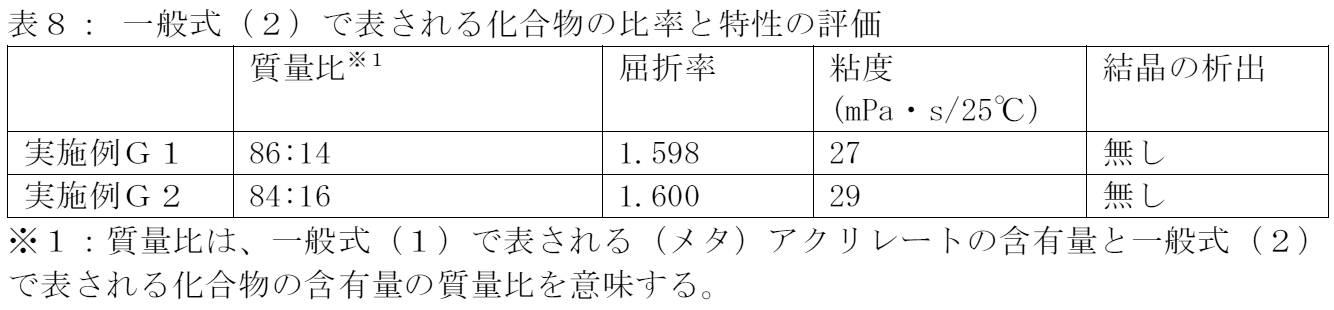
- Example G Evaluation of the ratio and characteristics of the compound represented by the general formula (2)>
- Examples G1 and Examples shown in Table 8 follow the same procedure as in Example C except that the ratio of the compound represented by the general formula (2) to the (meth) acrylate represented by the general formula (1) is changed.
- a composition of G2 was obtained.
- 4-Phenylbenzyl acrylate was used as the (meth) acrylate represented by the general formula (1)
- 4,4'-oxybis (methylene) dibiphenyl was used as the compound represented by the general formula (2).
- the refractive index and crystal precipitation of the compositions of these examples were evaluated.
- the precipitation of crystals was evaluated by whether or not the precipitation of crystals could be visually confirmed one month after the composition was placed in a constant temperature bath set at 5 ° C. The results are shown in Table 8 below.
Landscapes
- Chemical & Material Sciences (AREA)
- Organic Chemistry (AREA)
- Life Sciences & Earth Sciences (AREA)
- Engineering & Computer Science (AREA)
- Materials Engineering (AREA)
- Wood Science & Technology (AREA)
- Health & Medical Sciences (AREA)
- Chemical Kinetics & Catalysis (AREA)
- Medicinal Chemistry (AREA)
- Polymers & Plastics (AREA)
- Addition Polymer Or Copolymer, Post-Treatments, Or Chemical Modifications (AREA)
- Paints Or Removers (AREA)
- Organic Low-Molecular-Weight Compounds And Preparation Thereof (AREA)
- Polymerisation Methods In General (AREA)
Abstract
本発明は、粘度が低く、硬化時に高い屈折率を有し、かつ、低温で保管した際に結晶の析出が長期間抑えられる組成物、およびそれを含む塗料を提供するものである。本発明の一態様によれば、一般式(1)で表される(メタ)アクリレートと、一般式(2)で表される化合物とを含み、一般式(1)で表される(メタ)アクリレートの含有量と一般式(2)で表される化合物の含有量の質量比が、60:40を超え、かつ、90:10未満である、組成物が提供される。
Description
本発明は、(メタ)アクリル系組成物、およびそれを含む塗料に関する。また、本発明は、この組成物の硬化体にも関する。
近年、光学用オーバーコート剤、ハードコート剤、反射防止膜、眼鏡レンズ、光ファイバー、光導波路、ホログラム等の光学部品には、加工・生産性に優れる点から樹脂材料が広く用いられている。さらに光学部品の分野では小型化や薄型化の傾向が高まっており、それに伴い、屈折率の高い材料が求められている。そして、そのような要求に対しては、硬化時に高屈折率を有する樹脂組成物を含む塗料が広く用いられている。一方、そのような塗料は一般的に比較的粘度が高いという特徴があるため、薄く塗布することが困難である場合があった。そこでこの点を改良した粘度の低い組成物が提案されている。
例えば、特許文献1では、フェニルベンジルアクリレートの異性体であるo-フェニルベンジルアクリレート(OPBA;あるいは2-フェニルベンジルアクリレート)とp-フェニルベンジルアクリレート(PPBA;あるいは4-フェニルベンジルアクリレート)を特定の比率で混合することによって、高屈折率かつ低粘度の組成物が提案されている。また、特許文献2では、フェニルベンジルアクリレートと二官能(メタ)アクリレートまたはジフェニル誘導体を混合することによって、高屈折率かつ低粘度の組成物が得られると記載されている。
特許文献3~7では、フェノキシベンジル(メタ)アクリレートと高屈折率を有する多官能(メタ)アクリレート(フルオレン系ビスフェノール誘導体やビスフェノールA誘導体)を混合し、光学材料用樹脂組成物を得ることが記載されている。
以上のように、これまで高屈折率かつ低粘度の種々の組成物が提案されている。しかし、粘度の低い単官能(メタ)アクリレートは屈折率が低いことが多く、他方、屈折率が高い単官能(メタ)アクリレートでは、高屈折率を有する多官能(メタ)アクリレートの粘度を下げる効果が十分に得られない場合がある。さらに、このような組成物は保管中に重合反応等が生じることを防止するために、原則として室温以下(具体的には0℃以下)で保管する必要があるが、その場合組成物中に結晶が析出してしまい、低温で保管することが難しい場合があった。
上記のような状況から、現在、高屈折率かつ低粘度であり、低温保管時における結晶の析出が抑制された(メタ)アクリレート組成物が求められている。
本発明者らは、鋭意検討を行った結果、特定の構造を有する(メタ)アクリレートと下記一般式(2)

で表される化合物とを所定の質量比で配合することで、高屈折率かつ低粘度であり、低温保管時における結晶の析出が抑制された(メタ)アクリレート組成物が得られることを見出し、本発明に至った。
すなわち本発明は、以下に記載する特徴を有するものである。
[1]
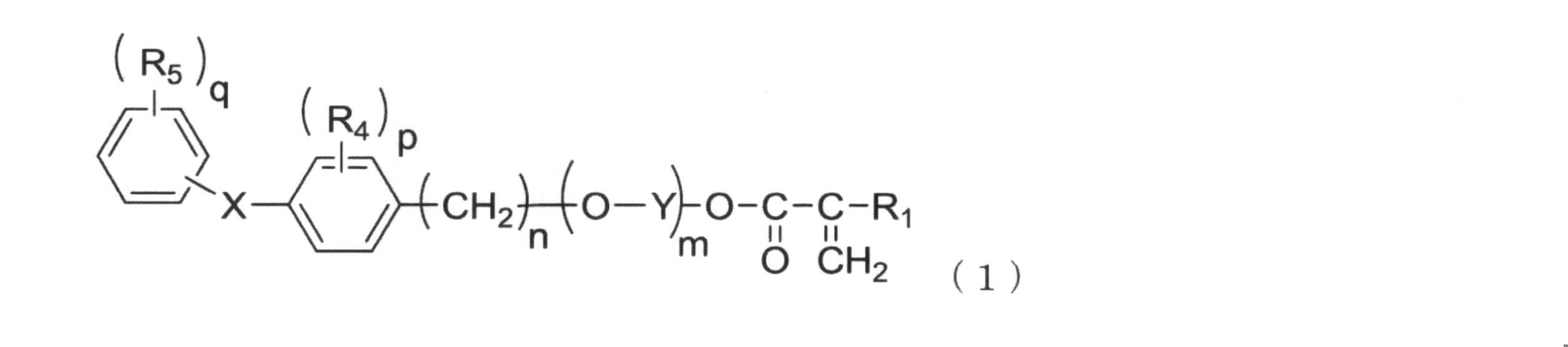
(A)下記一般式(1)で表される(メタ)アクリレートと、
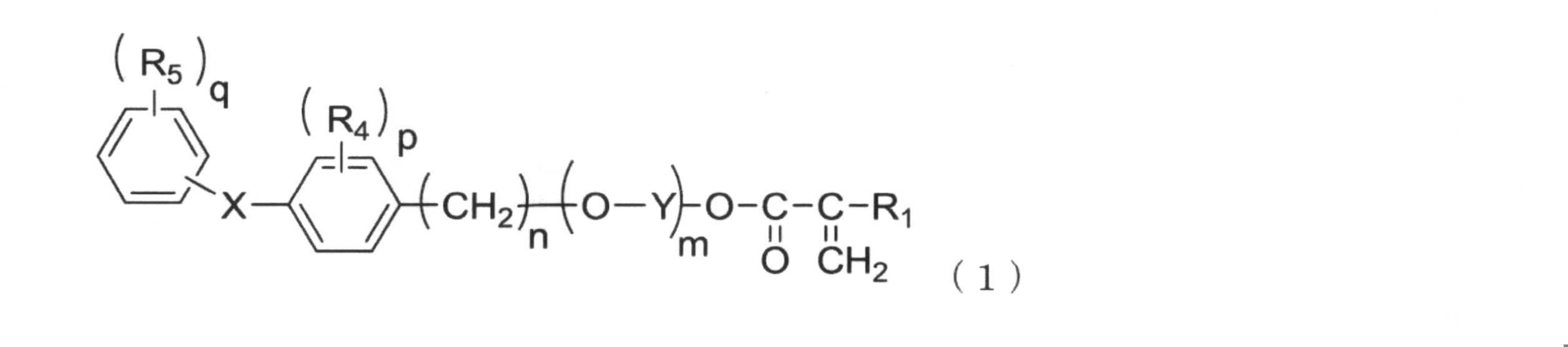
[一般式(1)中、
Xは、単結合、-C(R2)(R3)-、-C(=O)-、-O-、-OC(=O)-、-OC(=O)O-、-S-、-SO-、-SO2-およびこれらの任意の組み合わせからなる群から選択される二価の基であり(ここで、R2およびR3は、各々独立に、水素原子、炭素数1~10の直鎖状アルキル基、炭素数3~10の分岐状アルキル基、炭素数3~10の環状アルキル基、炭素数1~10の直鎖状アルコキシ基、炭素数3~10の分岐状アルコキシ基、炭素数3~10の環状アルコキシ基、フェニル基またはビフェニル基であり;あるいは、R2およびR3は、相互に連結して、これらが結合する炭素原子と一緒になって炭素数3~10の環状アルキル基を形成していてもよい);
Yは、分岐していてもよい炭素数2~6のアルキレン基、炭素数6~10のシクロアルキレン基、または炭素数6~10のアリーレン基であり;
R1は、水素原子またはメチル基であり;
R4およびR5は、各々独立に、炭素数1~10の直鎖状アルキル基、炭素数3~10の分岐状アルキル基、炭素数3~10の環状アルキル基、炭素数1~10の直鎖状アルコキシ基、炭素数3~10の分岐状アルコキシ基、炭素数3~10の環状アルコキシ基、ハロゲン原子、フェニル基またはビフェニル基であり;
mは、0~10の整数であり;
nは、1~2の整数であり;
pは、0~4の整数であり;
qは、0~5の整数である]
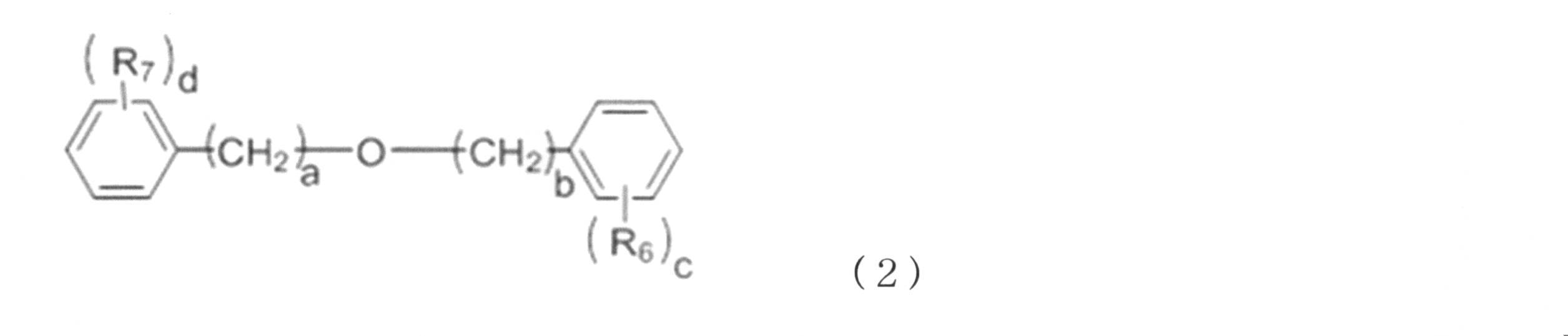
(B)下記一般式(2)で表される化合物と
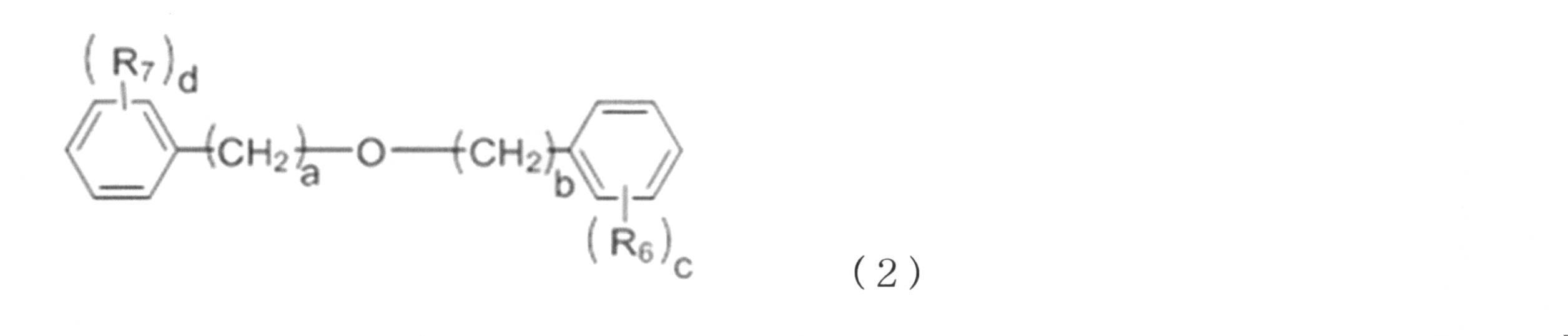
[一般式(2)中、
R6、R7は、それぞれ独立に、水素原子、炭素数1~10の直鎖状アルキル基、炭素数3~10の分岐状アルキル基、炭素数3~10の環状アルキル基、炭素数1~10の直鎖状アルコキシ基、炭素数3~10の分岐状アルコキシ基、炭素数3~10の環状アルコキシ基、ハロゲン原子、フェニル基、ビフェニル基、フェノキシ基、-R8OH、または-(R9)sHであり(ここで、R8は、炭素数1~10の直鎖状アルキレン基または炭素数3~10の分岐状アルキレン基であり、R9は、炭素数1~10の直鎖状アルキレンオキシ基または炭素数3~10の分岐状アルキレンオキシ基であり、sは、1~5の整数である);
a、bは、それぞれ独立に、0~10の整数であり;
c、dは、それぞれ独立に、0~5の整数である]
を含み、
前記一般式(1)で表される(メタ)アクリレートの含有量と前記一般式(2)で表される化合物の含有量の質量比が、60:40を超え、かつ、90:10未満である、組成物。
[2]
前記一般式(1)中、pおよびqが共に0である、[1]に記載の組成物。
[3]
前記一般式(1)で表される(メタ)アクリレートの含有量と前記一般式(2)で表される化合物の含有量の質量比が、65:35~85:15である、[1]または[2]に記載の組成物。
[4]
前記一般式(2)中、aおよびbが0~5の整数である、[1]~[3]のいずれかに記載の組成物。
[5]
前記一般式(2)中、R6およびR7がフェニル基、ビフェニル基またはフェノキシ基である、[1]~[4]のいずれかに記載の組成物。
[6]
前記一般式(2)中、a、b、cおよびdがいずれも1である、[5]に記載の組成物。
[7]
前記一般式(1)で表される(メタ)アクリレートとの共重合が可能な、下記一般式(3)で表される多価ビニル系単量体をさらに含む、[1]~[6]のいずれかに記載の組成物。

[一般式(3)中、
R10およびR11は、それぞれ独立に、水素原子、炭素数1~20のアルキル基、炭素数1~20のアルコキシル基、炭素数3~20のシクロアルキル基、炭素数5~20のシクロアルコキシル基、炭素数6~20のアリール基、炭素数6~20のアリールオキシ基、およびハロゲン原子から選択され、
R12は、水素原子またはメチル基であり;
Xは、単結合、-O-、-S-、-SO-、-SO2-、-CO-および下記一般式(4)~(7)からなる群のうち、いずれかの構造を表し;
YおよびZは、それぞれ独立に、分岐していてもよい炭素数2~6のアルキレン基、炭素数6~10のシクロアルキレン基、または炭素数6~10のアリーレン基であり;
pおよびqは、それぞれ独立に、0~4の整数である。]
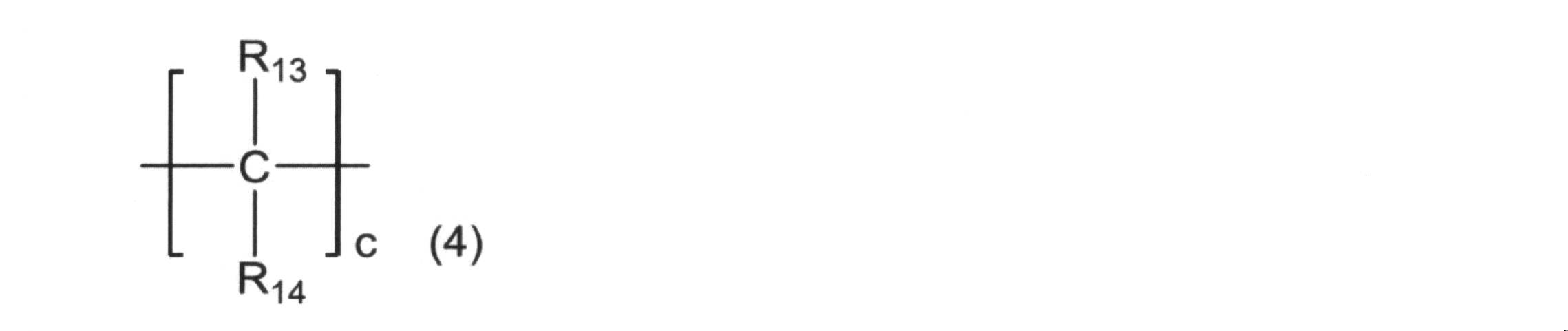
[一般式(4)中、
R13およびR14はそれぞれ独立に水素原子、ハロゲン原子、置換基を有してもよい炭素数1~20のアルキル基、置換基を有してもよい炭素数1~5のアルコキシ基、置換基を有してもよい炭素数6~12のアリール基、置換基を有してもよい炭素数2~5のアルケニル基、および置換基を有してもよい炭素数7~17のアラルキル基からなる群のうちいずれかを表し;
前記置換基はそれぞれ独立に、ハロゲン原子、炭素数1~20のアルキル基、または炭素数6~12のアリール基であり;
cは1~20の整数を表す。]
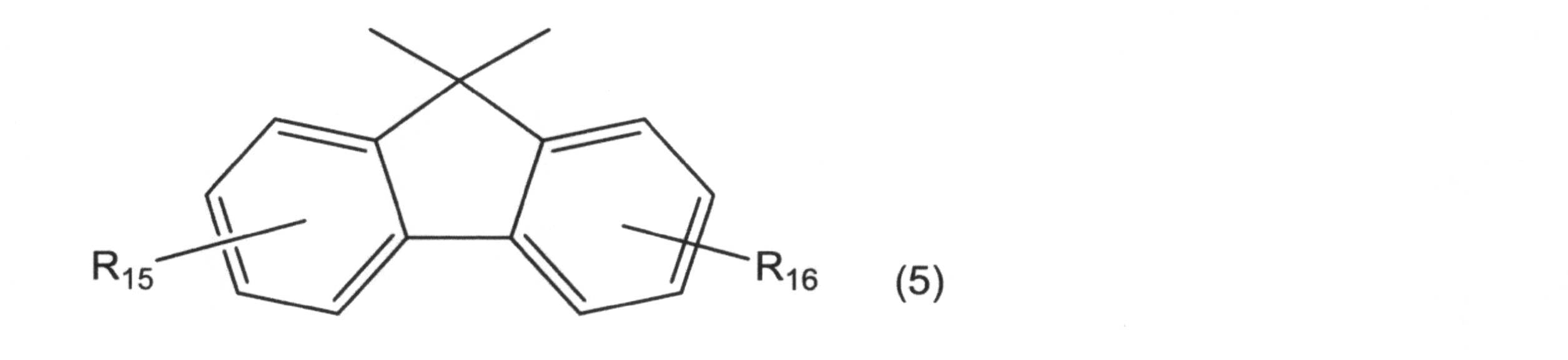
[一般式(5)中、R15およびR16はそれぞれ独立に水素原子、ハロゲン原子、置換基を有してもよい炭素数1~20のアルキル基、置換基を有してもよい炭素数1~5のアルコキシ基、置換基を有してもよい炭素数6~12のアリール基、置換基を有してもよい炭素数2~5のアルケニル基および置換基を有してもよい炭素数7~17のアラルキル基からなる群のうちいずれかを表すか、または、R15およびR16はそれぞれ互いに結合して、炭素数1~20の炭素環若しくは複素環を形成し;
前記置換基はそれぞれ独立に、ハロゲン原子、炭素数1~20のアルキル基、または炭素数6~12のアリール基である。]

[一般式(6)中、R17~R20はそれぞれ独立に水素原子、ハ口ゲン、置換基を有してもよい炭素数1~20のアルキル基、置換基を有してもよい炭素数1~5のアルコキシ基、置換基を有してもよい炭素数6~12のアリール基、置換基を有してもよい炭素数2~5のアルケニル基および置換基を有してもよい炭素数7~17のアラルキル基からなる群のうちいずれかを表すか、または、R17およびR18並びにR19およびR20は、それぞれ互いに結合して、炭素数1~20の炭素環若しくは複素環を形成し;
前記置換基はそれぞれ独立に、ハロゲン原子、炭素数1~20のアルキル基、または炭素数6~12のアリール基である。]

[一般式(7)中、R21~R30はそれぞれ独立に水素原子または炭素数1~3のアルキル基である。]
[8]
前記組成物の総重量に対して、前記一般式(3)で表される多価ビニル系単量体を20重量%~80重量%含む、[7]に記載の組成物。
[9]
前記一般式(3)中、Xが一般式(4)で示される構造または一般式(5)で示される構造を有する、[7]または[8]に記載の組成物。
[10]
活性エネルギー線硬化性組成物である、[1]~[9]のいずれかに記載の組成物。
[11]
[1]~[10]のいずれかに記載の組成物を含む塗料。
[12]
[1]~[10]のいずれかに記載の組成物が硬化されてなる硬化体。
[1]
(A)下記一般式(1)で表される(メタ)アクリレートと、
Xは、単結合、-C(R2)(R3)-、-C(=O)-、-O-、-OC(=O)-、-OC(=O)O-、-S-、-SO-、-SO2-およびこれらの任意の組み合わせからなる群から選択される二価の基であり(ここで、R2およびR3は、各々独立に、水素原子、炭素数1~10の直鎖状アルキル基、炭素数3~10の分岐状アルキル基、炭素数3~10の環状アルキル基、炭素数1~10の直鎖状アルコキシ基、炭素数3~10の分岐状アルコキシ基、炭素数3~10の環状アルコキシ基、フェニル基またはビフェニル基であり;あるいは、R2およびR3は、相互に連結して、これらが結合する炭素原子と一緒になって炭素数3~10の環状アルキル基を形成していてもよい);
Yは、分岐していてもよい炭素数2~6のアルキレン基、炭素数6~10のシクロアルキレン基、または炭素数6~10のアリーレン基であり;
R1は、水素原子またはメチル基であり;
R4およびR5は、各々独立に、炭素数1~10の直鎖状アルキル基、炭素数3~10の分岐状アルキル基、炭素数3~10の環状アルキル基、炭素数1~10の直鎖状アルコキシ基、炭素数3~10の分岐状アルコキシ基、炭素数3~10の環状アルコキシ基、ハロゲン原子、フェニル基またはビフェニル基であり;
mは、0~10の整数であり;
nは、1~2の整数であり;
pは、0~4の整数であり;
qは、0~5の整数である]
(B)下記一般式(2)で表される化合物と
R6、R7は、それぞれ独立に、水素原子、炭素数1~10の直鎖状アルキル基、炭素数3~10の分岐状アルキル基、炭素数3~10の環状アルキル基、炭素数1~10の直鎖状アルコキシ基、炭素数3~10の分岐状アルコキシ基、炭素数3~10の環状アルコキシ基、ハロゲン原子、フェニル基、ビフェニル基、フェノキシ基、-R8OH、または-(R9)sHであり(ここで、R8は、炭素数1~10の直鎖状アルキレン基または炭素数3~10の分岐状アルキレン基であり、R9は、炭素数1~10の直鎖状アルキレンオキシ基または炭素数3~10の分岐状アルキレンオキシ基であり、sは、1~5の整数である);
a、bは、それぞれ独立に、0~10の整数であり;
c、dは、それぞれ独立に、0~5の整数である]
を含み、
前記一般式(1)で表される(メタ)アクリレートの含有量と前記一般式(2)で表される化合物の含有量の質量比が、60:40を超え、かつ、90:10未満である、組成物。
[2]
前記一般式(1)中、pおよびqが共に0である、[1]に記載の組成物。
[3]
前記一般式(1)で表される(メタ)アクリレートの含有量と前記一般式(2)で表される化合物の含有量の質量比が、65:35~85:15である、[1]または[2]に記載の組成物。
[4]
前記一般式(2)中、aおよびbが0~5の整数である、[1]~[3]のいずれかに記載の組成物。
[5]
前記一般式(2)中、R6およびR7がフェニル基、ビフェニル基またはフェノキシ基である、[1]~[4]のいずれかに記載の組成物。
[6]
前記一般式(2)中、a、b、cおよびdがいずれも1である、[5]に記載の組成物。
[7]
前記一般式(1)で表される(メタ)アクリレートとの共重合が可能な、下記一般式(3)で表される多価ビニル系単量体をさらに含む、[1]~[6]のいずれかに記載の組成物。
R10およびR11は、それぞれ独立に、水素原子、炭素数1~20のアルキル基、炭素数1~20のアルコキシル基、炭素数3~20のシクロアルキル基、炭素数5~20のシクロアルコキシル基、炭素数6~20のアリール基、炭素数6~20のアリールオキシ基、およびハロゲン原子から選択され、
R12は、水素原子またはメチル基であり;
Xは、単結合、-O-、-S-、-SO-、-SO2-、-CO-および下記一般式(4)~(7)からなる群のうち、いずれかの構造を表し;
YおよびZは、それぞれ独立に、分岐していてもよい炭素数2~6のアルキレン基、炭素数6~10のシクロアルキレン基、または炭素数6~10のアリーレン基であり;
pおよびqは、それぞれ独立に、0~4の整数である。]
R13およびR14はそれぞれ独立に水素原子、ハロゲン原子、置換基を有してもよい炭素数1~20のアルキル基、置換基を有してもよい炭素数1~5のアルコキシ基、置換基を有してもよい炭素数6~12のアリール基、置換基を有してもよい炭素数2~5のアルケニル基、および置換基を有してもよい炭素数7~17のアラルキル基からなる群のうちいずれかを表し;
前記置換基はそれぞれ独立に、ハロゲン原子、炭素数1~20のアルキル基、または炭素数6~12のアリール基であり;
cは1~20の整数を表す。]
前記置換基はそれぞれ独立に、ハロゲン原子、炭素数1~20のアルキル基、または炭素数6~12のアリール基である。]
前記置換基はそれぞれ独立に、ハロゲン原子、炭素数1~20のアルキル基、または炭素数6~12のアリール基である。]
[8]
前記組成物の総重量に対して、前記一般式(3)で表される多価ビニル系単量体を20重量%~80重量%含む、[7]に記載の組成物。
[9]
前記一般式(3)中、Xが一般式(4)で示される構造または一般式(5)で示される構造を有する、[7]または[8]に記載の組成物。
[10]
活性エネルギー線硬化性組成物である、[1]~[9]のいずれかに記載の組成物。
[11]
[1]~[10]のいずれかに記載の組成物を含む塗料。
[12]
[1]~[10]のいずれかに記載の組成物が硬化されてなる硬化体。
本発明によると、粘度が低く、硬化時に高い屈折率を有し、かつ、低温で保管した際に結晶の析出が抑制された組成物、およびそれを含む塗料を提供することができる。また、本発明によると上記組成物の硬化体を提供することもできる。
以下、本発明の実施の形態について、詳細に説明する。
<組成物>
本発明の組成物は、(A)下記一般式(1)で表される(メタ)アクリレートと、

[一般式(1)中、
Xは、単結合、-C(R2)(R3)-、-C(=O)-、-O-、-OC(=O)-、-OC(=O)O-、-S-、-SO-、-SO2-およびこれらの任意の組み合わせからなる群から選択される二価の基であり(ここで、R2およびR3は、各々独立に、水素原子、炭素数1~10の直鎖状アルキル基、炭素数3~10の分岐状アルキル基、炭素数3~10の環状アルキル基、炭素数1~10の直鎖状アルコキシ基、炭素数3~10の分岐状アルコキシ基、炭素数3~10の環状アルコキシ基、フェニル基またはビフェニル基であり;あるいは、R2およびR3は、相互に連結して、これらが結合する炭素原子と一緒になって炭素数3~10の環状アルキル基を形成していてもよい);
Yは、分岐していてもよい炭素数2~6のアルキレン基、炭素数6~10のシクロアルキレン基、または炭素数6~10のアリーレン基であり;
R1は、水素原子またはメチル基であり;
R4およびR5は、各々独立に、炭素数1~10の直鎖状アルキル基、炭素数3~10の分岐状アルキル基、炭素数3~10の環状アルキル基、炭素数1~10の直鎖状アルコキシ基、炭素数3~10の分岐状アルコキシ基、炭素数3~10の環状アルコキシ基、ハロゲン原子、フェニル基またはビフェニル基であり;
mは、0~10の整数であり;
nは、1~2の整数であり;
pは、0~4の整数であり;
qは、0~5の整数である]
(B)下記一般式(2)で表される化合物と

[一般式(2)中、
R6、R7は、それぞれ独立に、水素原子、炭素数1~10の直鎖状アルキル基、炭素数3~10の分岐状アルキル基、炭素数3~10の環状アルキル基、炭素数1~10の直鎖状アルコキシ基、炭素数3~10の分岐状アルコキシ基、炭素数3~10の環状アルコキシ基、ハロゲン原子、フェニル基、ビフェニル基、-R8OH、または-(R9)sHであり(ここで、R8は、炭素数1~10の直鎖状アルキレン基または炭素数3~10の分岐状アルキレン基であり、R9は、炭素数1~10の直鎖状アルキレンオキシ基または炭素数3~10の分岐状アルキレンオキシ基であり、sは、1~5の整数である);
a、bは、それぞれ独立に、0~10の整数であり;
c、dは、それぞれ独立に、0~5の整数である]
を含み、
一般式(1)で表される(メタ)アクリレートの含有量と一般式(2)で表される化合物の含有量の質量比が、60:40を超え、かつ、90:10未満である。
本発明の組成物は、(A)下記一般式(1)で表される(メタ)アクリレートと、
Xは、単結合、-C(R2)(R3)-、-C(=O)-、-O-、-OC(=O)-、-OC(=O)O-、-S-、-SO-、-SO2-およびこれらの任意の組み合わせからなる群から選択される二価の基であり(ここで、R2およびR3は、各々独立に、水素原子、炭素数1~10の直鎖状アルキル基、炭素数3~10の分岐状アルキル基、炭素数3~10の環状アルキル基、炭素数1~10の直鎖状アルコキシ基、炭素数3~10の分岐状アルコキシ基、炭素数3~10の環状アルコキシ基、フェニル基またはビフェニル基であり;あるいは、R2およびR3は、相互に連結して、これらが結合する炭素原子と一緒になって炭素数3~10の環状アルキル基を形成していてもよい);
Yは、分岐していてもよい炭素数2~6のアルキレン基、炭素数6~10のシクロアルキレン基、または炭素数6~10のアリーレン基であり;
R1は、水素原子またはメチル基であり;
R4およびR5は、各々独立に、炭素数1~10の直鎖状アルキル基、炭素数3~10の分岐状アルキル基、炭素数3~10の環状アルキル基、炭素数1~10の直鎖状アルコキシ基、炭素数3~10の分岐状アルコキシ基、炭素数3~10の環状アルコキシ基、ハロゲン原子、フェニル基またはビフェニル基であり;
mは、0~10の整数であり;
nは、1~2の整数であり;
pは、0~4の整数であり;
qは、0~5の整数である]
(B)下記一般式(2)で表される化合物と
R6、R7は、それぞれ独立に、水素原子、炭素数1~10の直鎖状アルキル基、炭素数3~10の分岐状アルキル基、炭素数3~10の環状アルキル基、炭素数1~10の直鎖状アルコキシ基、炭素数3~10の分岐状アルコキシ基、炭素数3~10の環状アルコキシ基、ハロゲン原子、フェニル基、ビフェニル基、-R8OH、または-(R9)sHであり(ここで、R8は、炭素数1~10の直鎖状アルキレン基または炭素数3~10の分岐状アルキレン基であり、R9は、炭素数1~10の直鎖状アルキレンオキシ基または炭素数3~10の分岐状アルキレンオキシ基であり、sは、1~5の整数である);
a、bは、それぞれ独立に、0~10の整数であり;
c、dは、それぞれ独立に、0~5の整数である]
を含み、
一般式(1)で表される(メタ)アクリレートの含有量と一般式(2)で表される化合物の含有量の質量比が、60:40を超え、かつ、90:10未満である。
上記のように一般式(1)の構造を有する(メタ)アクリレートと一般式(2)の構造を有する化合物とを所定の質量比で含む本発明の組成物は、粘度が低く、硬化時に高い屈折率を有し、かつ、低温で保管した際に結晶の析出を抑制することができる。理論に拘束されるものではないが、一般式(1)の構造を有する(メタ)アクリレートに対して一般式(2)の構造を有する化合物が所定量存在することで、組成物の粘度が下がるだけでなく、結晶の成長も抑制されていると考えられる。
本発明の組成物の屈折率は、多波長アッべ屈折率計DR-M2(株式会社アタゴ社製)を用いて、測定波長:589nm、測定温度:23℃にて測定した場合に、1.580以上であることが好ましく、より好ましくは1.585以上であり、さらに好ましくは1.590以上である。
本発明の組成物の粘度は、E型粘度計(TV-22型)を用いて、測定温度:25℃で測定した場合に10,000mPa・s未満であることが好ましく、より好ましくは、5,000mPa・s以下であり、さらに好ましくは、5~2,100mPa・sである。
以下、本発明の組成物に含まれる各成分について、順に説明する。
1.(メタ)アクリレート
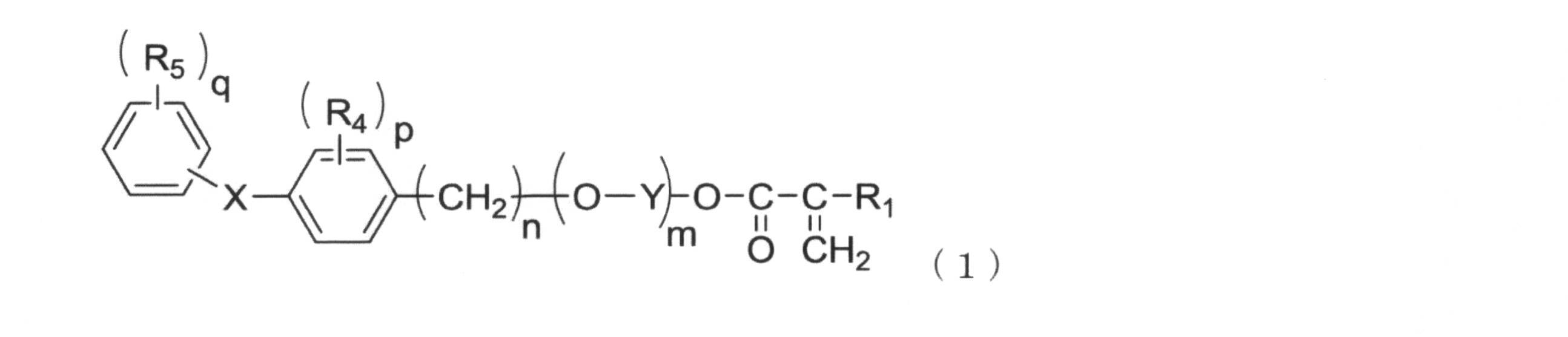
本発明の組成物に用いられる(メタ)アクリレートは下記一般式(1)で表される構造を有する。

1.(メタ)アクリレート
本発明の組成物に用いられる(メタ)アクリレートは下記一般式(1)で表される構造を有する。
式(1)中、Xは、単結合、-C(R2)(R3)-、-C(=O)-、-O-、-OC(=O)-、-OC(=O)O-、-S-、-SO-、-SO2-およびこれらの任意の組み合わせからなる群から選択される二価の基であり、好ましくは、単結合、-C(R2)(R3)-、-O-、およびこれらの任意の組み合わせからなる群から選択される二価の基である。ここで、R2およびR3は、各々独立に、水素原子、炭素数1~10の直鎖状アルキル基、炭素数3~10の分岐状アルキル基、炭素数3~10の環状アルキル基、炭素数1~10の直鎖状アルコキシ基、炭素数3~10の分岐状アルコキシ基、炭素数3~10の環状アルコキシ基、フェニル基またはビフェニル基である。あるいは、R2およびR3は、相互に連結して、これらが結合する炭素原子と一緒になって炭素数3~10の環状アルキル基を形成していてもよい。好ましくは、R2およびR3は、共に水素原子である。
Yは、分岐していてもよい炭素数2~6のアルキレン基、炭素数6~10のシクロアルキレン基、または炭素数6~10のアリーレン基である。
R1は、水素原子またはメチル基であり、好ましくは水素原子である。
R4およびR5は、各々独立に、炭素数1~10の直鎖状アルキル基、炭素数3~10の分岐状アルキル基、炭素数3~10の環状アルキル基、炭素数1~10の直鎖状アルコキシ基、炭素数3~10の分岐状アルコキシ基、炭素数3~10の環状アルコキシ基、ハロゲン原子、フェニル基またはビフェニル基である。
R4およびR5は、各々独立に、炭素数1~10の直鎖状アルキル基、炭素数3~10の分岐状アルキル基、炭素数3~10の環状アルキル基、炭素数1~10の直鎖状アルコキシ基、炭素数3~10の分岐状アルコキシ基、炭素数3~10の環状アルコキシ基、ハロゲン原子、フェニル基またはビフェニル基である。
mは、0~10の整数であり、好ましくは0~5の整数であり、より好ましくは0である。
nは、1~2の整数であり、好ましくは1である。
pは、0~4の整数であり、好ましくは0~2の整数であり、より好ましくは0である。
qは、0~5の整数であり、好ましくは0~2の整数であり、より好ましくは0である。
さらに好ましくは、pおよびqが共に0である。
nは、1~2の整数であり、好ましくは1である。
pは、0~4の整数であり、好ましくは0~2の整数であり、より好ましくは0である。
qは、0~5の整数であり、好ましくは0~2の整数であり、より好ましくは0である。
さらに好ましくは、pおよびqが共に0である。
上記一般式(1)で表される(メタ)アクリレートとしては、例えば、4-フェニルベンジル(メタ)アクリレート、3-フェニルベンジル(メタ)アクリレート、2-フェニルベンジル(メタ)アクリレート、4-ビフェニルベンジル(メタ)アクリレート、3-ビフェニルベンジル(メタ)アクリレート、2-ビフェニルベンジル(メタ)アクリレート、4-ベンジルベンジル(メタ)アクリレート、3-ベンジルベンジル(メタ)アクリレート、2-ベンジルベンジル(メタ)アクリレート、4-フェネチルベンジル(メタ)アクリレート、3-フェネチルベンジル(メタ)アクリレート、2-フェネチルベンジル(メタ)アクリレート、4-フェネチルフェネチル(メタ)アクリレート、3-フェネチルフェネチル(メタ)アクリレート、2-フェネチルフェネチル(メタ)アクリレート、4-(4-メチルフェニル)ベンジル(メタ)アクリレート、3-(4-メチルフェニル)ベンジル(メタ)アクリレート、2-(4-メチルフェニル)ベンジル(メタ)アクリレート、4-(4-メトキシフェニル)ベンジル(メタ)アクリレート、3-(4-メトキシフェニル)ベンジル(メタ)アクリレート、2-(4-メトキシフェニル)ベンジル(メタ)アクリレート、4-(4-ブロモフェニル)ベンジル(メタ)アクリレート、3-(4-ブロモフェニル)ベンジル(メタ)アクリレート、2-(4-ブロモフェニル)ベンジル(メタ)アクリレート、4-ベンゾイルベンジル(メタ)アクリレート、3-ベンゾイルベンジル(メタ)アクリレート、2-ベンゾイルベンジル(メタ)アクリレート、4-(フェニルスルフィニル)ベンジル(メタ)アクリレート、3-(フェニルスルフィニル)ベンジル(メタ)アクリレート、2-(フェニルスルフィニル)ベンジル(メタ)アクリレート、4-(フェニルスルフォニル)ベンジル(メタ)アクリレート、3-(フェニルスルフォニル)ベンジル(メタ)アクリレート、2-(フェニルスルフォニル)ベンジル(メタ)アクリレート、4-((フェノキシカルボニル)オキシ)ベンジル(メタ)アクリレート、3-((フェノキシカルボニル)オキシ)ベンジル(メタ)アクリレート、2-((フェノキシカルボニル)オキシ)ベンジル(メタ)アクリレート、4-(((メタ)アクリロキシ)メチル)フェニルベンゾエート、3-(((メタ)アクリロキシ)メチル)フェニルベンゾエート、2-(((メタ)アクリロキシ)メチル)フェニルベンゾエート、フェニル4-(((メタ)アクリロキシ)メチル)ベンゾエート、フェニル3-(((メタ)アクリロキシ)メチル)ベンゾエート、フェニル2-(((メタ)アクリロキシ)メチル)ベンゾエート、4-(1-フェニルシクロヘキシル)ベンジル(メタ)アクリレート、3-(1-フェニルシクロヘキシル)ベンジル(メタ)アクリレート、2-(1-フェニルシクロヘキシル)ベンジル(メタ)アクリレート、4-フェノキシベンジル(メタ)アクリレート、3-フェノキシベンジル(メタ)アクリレート、2-フェノキシベンジル(メタ)アクリレート、4-(フェニルチオ)ベンジル(メタ)アクリレート、3-(フェニルチオ)ベンジル(メタ)アクリレート、2-(フェニルチオ)ベンジル(メタ)アクリレートおよび3-メチル-4-(2-メチルフェニル)ベンジルメタクリレートを挙げることができる。これらは、1種単独で、または2種以上を組み合わせて用いることができる。これらのうち、好ましくは、2-フェニルベンジル(メタ)アクリレート、4-フェニルベンジル(メタ)アクリレート、4-フェノキシベンジル(メタ)アクリレートおよび4-ベンジルベンジル(メタ)アクリレートであり、より好ましくは、2-フェニルベンジルアクリレート、4-フェニルベンジルアクリレート、4-フェノキシベンジルアクリレートおよび4-ベンジルベンジルアクリレートである。
本発明の組成物に含まれる一般式(1)で表される(メタ)アクリレートの含有量と後述の一般式(2)で表される化合物の含有量の質量比は、60:40を超え、かつ、90:10未満である。これらの化合物の質量比を上記の範囲内に抑えることで、高屈折率かつ低粘度でありながら、低温保管時の結晶の析出を効果的に抑制することができる。上記質量比は、好ましくは65:35~85:15であり、より好ましくは68:32~82:18である。
本発明の一態様において、本発明の組成物に含まれる一般式(1)で表される(メタ)アクリレートの含有量と後述の一般式(2)で表される化合物の含有量の質量比は、70:30~89:11、75:25~86:14、78:22~84:16または84:16~86:14であってもよい。
2.一般式(2)で表される化合物
本発明の組成物に用いられる一般式(2)で表される化合物は下記の構造を有する。
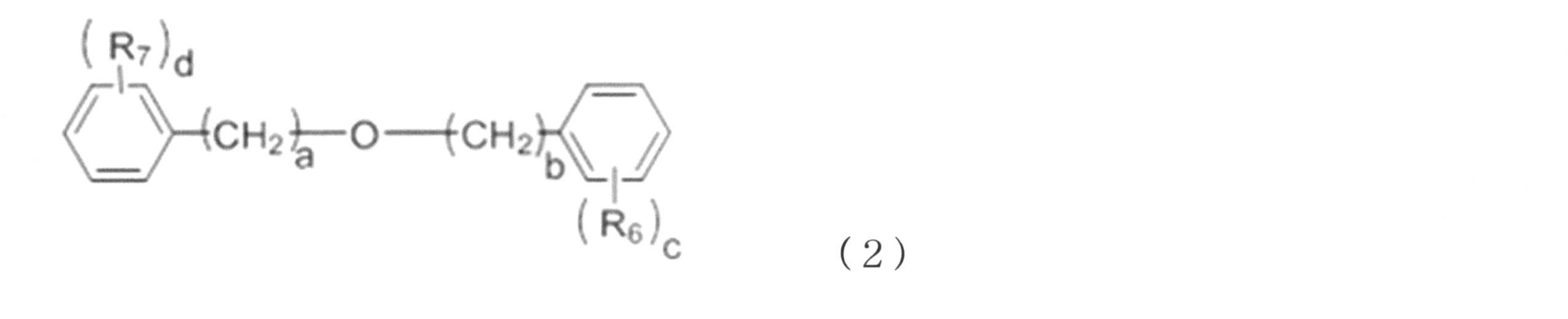
本発明の組成物に用いられる一般式(2)で表される化合物は下記の構造を有する。
一般式(2)中、
R6、R7は、それぞれ独立に、水素原子、炭素数1~10の直鎖状アルキル基、炭素数3~10の分岐状アルキル基、炭素数3~10の環状アルキル基、炭素数1~10の直鎖状アルコキシ基、炭素数3~10の分岐状アルコキシ基、炭素数3~10の環状アルコキシ基、ハロゲン原子、フェニル基、ビフェニル基、フェノキシ基、-R8OH、または-(R9)sHであり、好ましくは水素原子、炭素数1~10の直鎖状アルキル基、フェニル基、ビフェニル基またはフェノキシ基であり、より好ましくは、フェニル基、ビフェニル基またはフェノキシ基である。本発明の好ましい一態様において、R6およびR7がフェニル基、ビフェニル基またはフェノキシ基である。
ここで、R8は、炭素数1~10の直鎖状アルキレン基または炭素数3~10の分岐状アルキレン基であり、R9は、炭素数1~10の直鎖状アルキレンオキシ基または炭素数3~10の分岐状アルキレンオキシ基であり、sは、1~5の整数である。
a、bは、それぞれ独立に、0~10の整数であり、好ましくは0~5の整数であり、より好ましくは1または2である。
c、dは、それぞれ独立に、0~5の整数であり、好ましくは0~3の整数であり、より好ましくは0または1である。cが0の場合、ベンゼン環にR6が置換していないことを意味する。dについても同様である。
本発明の好ましい一態様において、a、b、cおよびdがいずれも1である。
R6、R7は、それぞれ独立に、水素原子、炭素数1~10の直鎖状アルキル基、炭素数3~10の分岐状アルキル基、炭素数3~10の環状アルキル基、炭素数1~10の直鎖状アルコキシ基、炭素数3~10の分岐状アルコキシ基、炭素数3~10の環状アルコキシ基、ハロゲン原子、フェニル基、ビフェニル基、フェノキシ基、-R8OH、または-(R9)sHであり、好ましくは水素原子、炭素数1~10の直鎖状アルキル基、フェニル基、ビフェニル基またはフェノキシ基であり、より好ましくは、フェニル基、ビフェニル基またはフェノキシ基である。本発明の好ましい一態様において、R6およびR7がフェニル基、ビフェニル基またはフェノキシ基である。
ここで、R8は、炭素数1~10の直鎖状アルキレン基または炭素数3~10の分岐状アルキレン基であり、R9は、炭素数1~10の直鎖状アルキレンオキシ基または炭素数3~10の分岐状アルキレンオキシ基であり、sは、1~5の整数である。
a、bは、それぞれ独立に、0~10の整数であり、好ましくは0~5の整数であり、より好ましくは1または2である。
c、dは、それぞれ独立に、0~5の整数であり、好ましくは0~3の整数であり、より好ましくは0または1である。cが0の場合、ベンゼン環にR6が置換していないことを意味する。dについても同様である。
本発明の好ましい一態様において、a、b、cおよびdがいずれも1である。
式(2)中、-(R9)sHが、-(CH2CH2O)-H、-(CH2CH2O)2-H、-(CH2CH(CH3)O)-H、または-(CH2CH(CH3)O)2-Hであることが好ましい。
上記一般式(2)で表される化合物としては、例えば、オキシビス(メチレン)ジベンゼン、4,4’-オキシビス(メチレン)ジビフェニル、3,3’-オキシビス(メチレン)ジビフェニル、2,2’-オキシビス(メチレン)ジビフェニル、オキシビス(メチレン)ジベンゼン、オキシジベンゼン、4,4’-オキシジビフェニル、3,3’-オキシジビフェニル、2,2’-オキシジビフェニル、4,4’-(オキシビス(メチレン))ビス(フェノキシベンゼン)、3,3’-(オキシビス(メチレン))ビス(フェノキシベンゼン)、2,2’-(オキシビス(メチレン))ビス(フェノキシベンゼン)を挙げることができる。これらは、1種単独で、または2種以上を組み合わせて用いることができる。これらのうち、好ましくは、4,4’-オキシビス(メチレン)ジビフェニル、オキシビス(メチレン)ジベンゼンまたはオキシジベンゼンである。
一般式(2)で表される化合物は、本発明の組成物中に所定量含まれていればよく、その由来は問わない。したがって、一般式(2)で表される化合物を一般式(1)で表される(メタ)アクリレートに所定量添加してもよく、あるいは、一般式(1)で表される(メタ)アクリレートを合成する際に同時に一般式(2)で表される化合物も生成するように合成条件を調整することで本発明の組成物中に存在させてもよい。
3.多価ビニル系単量体
本発明の組成物は、所望により、上記一般式(1)で表される(メタ)アクリレートとの共重合が可能な、下記一般式(3)で表される多価ビニル系単量体をさらに含むことができる。

本発明の組成物は、所望により、上記一般式(1)で表される(メタ)アクリレートとの共重合が可能な、下記一般式(3)で表される多価ビニル系単量体をさらに含むことができる。
式(3)中、R10およびR11は、それぞれ独立に、水素原子、炭素数1~20のアルキル基、炭素数1~20のアルコキシル基、炭素数3~20のシクロアルキル基、炭素数5~20のシクロアルコキシル基、炭素数6~20のアリール基、炭素数6~20のアリールオキシ基、およびハロゲン原子から選択され、好ましくは水素原子である。
R12は、水素原子またはメチル基である。
Xは、単結合、-O-、-S-、-SO-、-SO2-、-CO-および下記一般式(4)~(7)からなる群のうち、いずれかの構造を表す。
YおよびZは、それぞれ独立に、分岐していてもよい炭素数2~6のアルキレン基、炭素数6~10のシクロアルキレン基、または炭素数6~10のアリーレン基である。
pおよびqは、それぞれ独立に、0~4の整数であり、好ましくはpおよびqは共に0または1である。
R12は、水素原子またはメチル基である。
Xは、単結合、-O-、-S-、-SO-、-SO2-、-CO-および下記一般式(4)~(7)からなる群のうち、いずれかの構造を表す。
YおよびZは、それぞれ独立に、分岐していてもよい炭素数2~6のアルキレン基、炭素数6~10のシクロアルキレン基、または炭素数6~10のアリーレン基である。
pおよびqは、それぞれ独立に、0~4の整数であり、好ましくはpおよびqは共に0または1である。
下記式(4)中、

R13およびR14はそれぞれ独立に水素原子、ハロゲン原子、置換基を有してもよい炭素数1~20のアルキル基、置換基を有してもよい炭素数1~5のアルコキシ基、置換基を有してもよい炭素数6~12のアリール基、置換基を有してもよい炭素数2~5のアルケニル基、および置換基を有してもよい炭素数7~17のアラルキル基からなる群のうちいずれかを表し、ここで、置換基はそれぞれ独立に、ハロゲン原子、炭素数1~20のアルキル基、または炭素数6~12のアリール基である。好ましくはR13およびR14は共に水素原子である。
cは1~20の整数を表し、好ましくは1~10の整数、より好ましくは1~5の整数を表す。
cは1~20の整数を表し、好ましくは1~10の整数、より好ましくは1~5の整数を表す。
下記式(5)中、
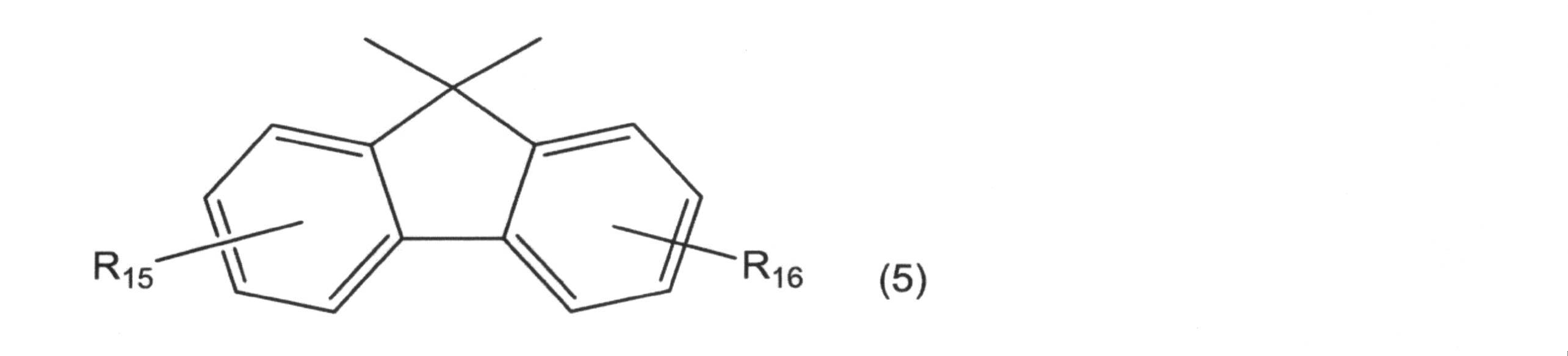
R15およびR16はそれぞれ独立に水素原子、ハロゲン原子、置換基を有してもよい炭素数1~20のアルキル基、置換基を有してもよい炭素数1~5のアルコキシ基、置換基を有してもよい炭素数6~12のアリール基、置換基を有してもよい炭素数2~5のアルケニル基および置換基を有してもよい炭素数7~17のアラルキル基からなる群のうちいずれかを表すか、または、R15およびR16はそれぞれ互いに結合して、炭素数1~20の炭素環若しくは複素環を形成し、置換基はそれぞれ独立に、ハロゲン原子、炭素数1~20のアルキル基、または炭素数6~12のアリール基である。好ましくは、R15およびR16は共に水素原子であることが好ましい。
下記式(6)中、
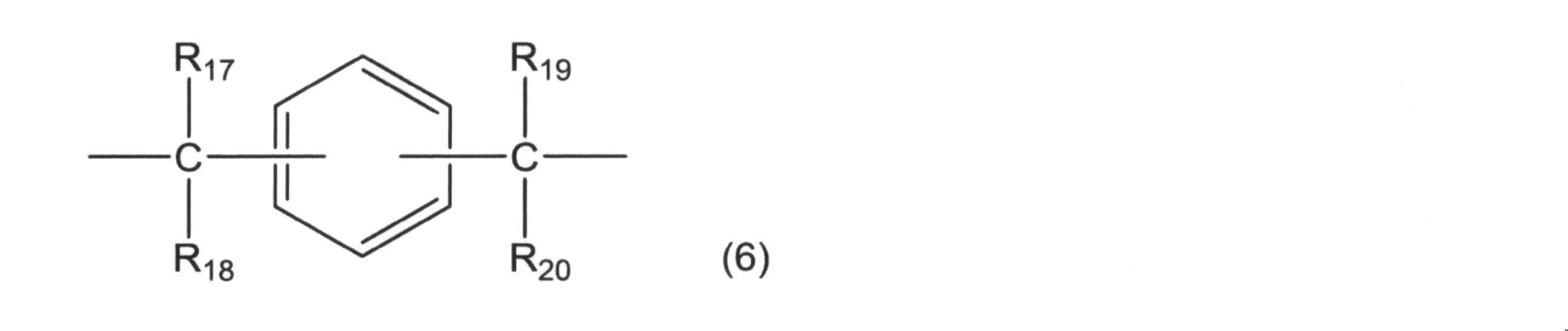
R17~R20はそれぞれ独立に水素原子、ハ口ゲン、置換基を有してもよい炭素数1~20のアルキル基、置換基を有してもよい炭素数1~5のアルコキシ基、置換基を有してもよい炭素数6~12のアリール基、置換基を有してもよい炭素数2~5のアルケニル基および置換基を有してもよい炭素数7~17のアラルキル基からなる群のうちいずれかを表すか、または、R17およびR18並びにR19およびR20は、それぞれ互いに結合して、炭素数1~20の炭素環若しくは複素環を形成し、置換基はそれぞれ独立に、ハロゲン原子、炭素数1~20のアルキル基、または炭素数6~12のアリール基である。好ましくは、R17~R20は共に水素原子である。
下記式(7)中、
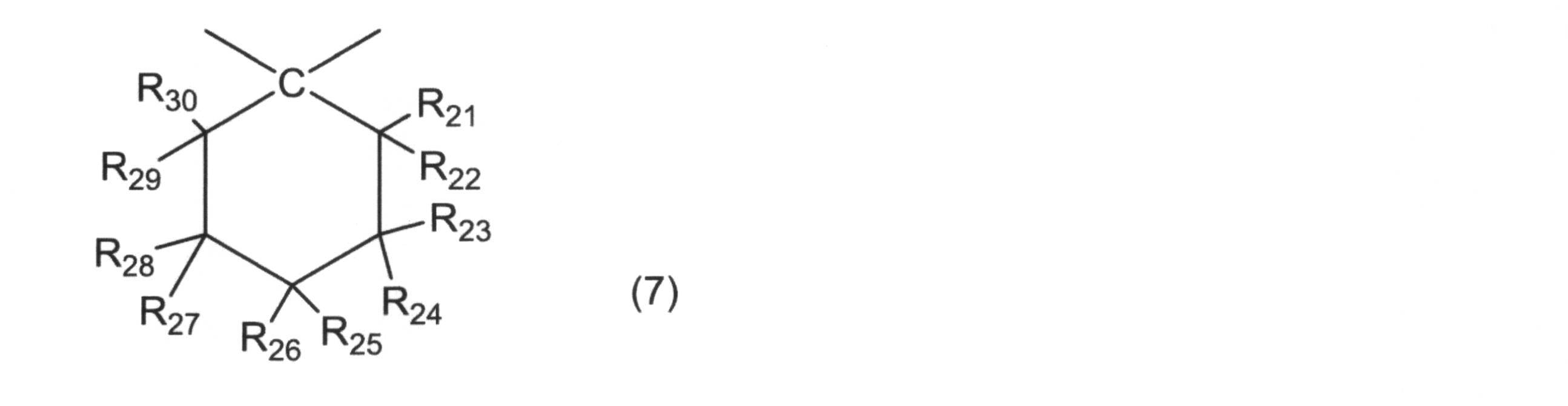
R21~R30はそれぞれ独立に水素原子または炭素数1~3のアルキル基である。好ましくは、R21~R30は共に水素原子である。
上記式(3)中、Xが一般式(4)で示される構造または一般式(5)で示される構造を有することが好ましい。
上記一般式(3)で表される多価ビニル系単量体としては、例えば、9,9-ビス[4-(2-(メタ)アクリロイルオキシエトキシ)フェニル]フルオレン、4,4’-イソプロピリデンジフェノールジ(メタ)アクリレート、2,2’-ビス[4-(2-(メタ)アクリロイルオキシエトキシ)フェニル]プロパン、ビス[4-(2-(メタ)アクリロイルオキシエトキシ)フェニル]メタン、1,1’-ビス[4-(2-(メタ)アクリロイルオキシエトキシ)フェニル]メタン、ビス[4-(2-(メタ)アクリロイルオキシエトキシ)フェニル]エーテル、ビス[4-(2-(メタ)アクリロイルオキシエトキシ)フェニル]スルフォキシド、ビス[4-(2-(メタ)アクリロイルオキシエトキシ)フェニル]スルファイド、ビス(4-(2-(メタ) (メタ)アクリロイルオキシエトキシ)フェニル]スルホン、ビス(4-(2-(メタ)アクリロイルオキシエトキシ)フェニル]ケトン、エトキシ化ビスフェノールAジアクリレートおよび4,4’-ジ(メタ)アクリロイルオキシビフェニル、等が挙げられる。中でも、9,9-ビス[4-(2-(メタ)アクリロイルオキシエトキシ)フェニル]フルオレン、4,4’-イソプロピリデンジフェノールジ(メタ)アクリレート、エトキシ化ビスフェノールAジアクリレートおよび2,2’-ビス[4-(2-(メタ)アクリロイルオキシエトキシ)フェニル]プロパンが好ましく、エトキシ化ビスフェノールAジアクリレートおよび9,9-ビス[4-(2-(メタ)アクリロイルオキシエトキシ)フェニル]フルオレンがより好ましい。また、上記一般式(3)で表される多価ビニル系単量体のうち市販されているものとしては、例えば、新中村化学工業株式会社製のABE-300やA-BPE-4、A-BPEF、共栄社化学株式会社製のライトアクリレートBP-4EAL、新中村化学工業株式会社製のビスコート#700HV、日立化成株式会社製のFA-324A等が挙げられるが、これらに限定されるものではない。
一般式(3)で表される多価ビニル系単量体の配合量は、本発明の組成物の総重量に対して、20重量%~80重量%が好ましく、30重量%~80重量%がより好ましく、40重量%~80重量%がさらに好ましい。多価ビニル系単量体を20重量%~80重量%配合させることで、加工可能な粘度で、かつ高屈折率で、十分な架橋を進行させることができる。
4.任意の添加剤
本発明の組成物は、上記の構成成分以外に、本発明の主旨を逸脱しない範囲で用途に応じて種々の任意の添加剤を含むことができる。そのような添加剤としては、熱安定剤、酸化防止剤、難燃剤、難燃助剤、紫外線吸収剤、離型剤および着色剤から成る群から選択される少なくとも1種類の添加剤が例示される。添加剤の配合量は、上記一般式(1)で表される(メタ)アクリレートと上記一般式(2)で表される化合物の合計100質量部に対して、0.005質量部~0.1質量部であることが好ましく、0.01質量部~0.05質量部であることがより好ましい。
本発明の組成物は、上記の構成成分以外に、本発明の主旨を逸脱しない範囲で用途に応じて種々の任意の添加剤を含むことができる。そのような添加剤としては、熱安定剤、酸化防止剤、難燃剤、難燃助剤、紫外線吸収剤、離型剤および着色剤から成る群から選択される少なくとも1種類の添加剤が例示される。添加剤の配合量は、上記一般式(1)で表される(メタ)アクリレートと上記一般式(2)で表される化合物の合計100質量部に対して、0.005質量部~0.1質量部であることが好ましく、0.01質量部~0.05質量部であることがより好ましい。
本発明の組成物は、公知の任意の方法によって製造することができ、上述の構成成分を単純に混合することによって製造してもよい。
本発明の組成物は、種々の方法によって硬化することができる。詳細については後述するが、本発明の組成物は、好ましくは、活性エネルギー線硬化性組成物である。
<塗料>
本発明の塗料は、上記の組成物を含んでなる。本発明の塗料は主に、光学部材用のコート剤やハードコート剤等の用途に用いることができる。
本発明の塗料は、上記の組成物を含んでなる。本発明の塗料は主に、光学部材用のコート剤やハードコート剤等の用途に用いることができる。
本発明の塗料をプラスチックなど一般的な基材に塗布する場合においては、各種基材の表面の湿潤を助けるために、塗料中に、シリコーンあるいはアクリル系化合物といった湿潤剤を添加してもよい。適切な湿潤剤としては、ビックケミー社から入手し得るBYK331、BYK333、BYK340、BYK347、BYK348、BYK378、BYK380、BYK381などがある。これらを添加する場合には、塗料の全質量を基準として0.01~2.0質量%の範囲が好ましい。
また、各種材料に対する粘着性を向上させるために、塗料中に、必要に応じてキシレン樹脂、テルペン樹脂、フェノール樹脂、ロジン樹脂などの粘着付与剤を添加してもよい。これらを添加する場合には、塗料の全質量を基準として0.01~2.0質量%の範囲が好ましい。
各種材料に対する接着性を向上させるために、塗料中にシランカップリング剤、チタンカップリング剤などのカップリング剤を添加してもよい。これらを添加する場合には、塗料の全質量を基準として0.01~5.0質量%の範囲が好ましい。
また、耐衝撃性などの諸性能を向上させるために、塗料中にシリカ、アルミナ、マイカ、タルク、アルミニウムフレーク、ガラスフレークなどの無機フィラーを添加してもよい。これらを添加する場合には、塗料の全質量を基準として0.01~10.0質量%の範囲が好ましい。
さらに、本発明の塗料を金属やコンクリート、プラスチックなど一般的な基材に塗布する場合においては、撹拌混合や塗布時に発生する泡の消失を助けるため、塗料中に、シリコーン系あるいはアクリル系化合物からなる消泡剤を添加してもよい。適切な消泡剤としては、ビックケミー社から入手し得るBYK019、BYK052、BYK065、BYK066N、BYK067N、BYK070、BYK080などが挙げられるが、特にBYK065が好ましい。これらを添加する場合には、塗料の全質量を基準として0.01~3.0質量%の範囲が好ましい。
本発明の塗料には、必要に応じてリン酸亜鉛、リン酸鉄、モリブデン酸カルシウム、酸化バナジウム、水分散シリカ、ヒュームドシリカなどの防錆添加剤、フタロシアニン系有機顔料、縮合多環系有機顔料などの有機顔料、酸化チタン、酸化亜鉛、炭酸カルシウム、硫酸バリウム、アルミナ、カーボンブラックなどの無機顔料などの各成分を必要量添加してもよい。
本発明の塗料を各種基材上に塗布する際の塗装形式としては、例えば、バーコーター塗工、メイヤーバー塗工、エアナイフ塗工、グラビア塗工、リバースグラビア塗工、マイクログラビア塗工、マイクロリバースグラビアコーター塗工、ダイコーター塗工、スロットダイコーター塗工、バキュームダイコーター塗工、ディップ塗工、スピンコート塗工、スプレー塗工、はけ塗りなどの一般的に使用される塗装形式のいずれも使用され得る。ロール塗布又はスプレー塗布が好ましい。
<硬化体>
本発明の硬化体は、上記の組成物を硬化させてなる硬化体である。本発明の硬化体は、多波長アッべ屈折率計DR-M2(株式会社アタゴ社製)を用いて、測定波長:589nm、測定温度:23℃にて測定した場合に、1.580以上の高い屈折率を有する。また、本発明の硬化体は、1.585以上の高い屈折率を有するのが好ましく、1.590以上の高い屈折率を有するのがより好ましい。
本発明の硬化体は、上記の組成物を硬化させてなる硬化体である。本発明の硬化体は、多波長アッべ屈折率計DR-M2(株式会社アタゴ社製)を用いて、測定波長:589nm、測定温度:23℃にて測定した場合に、1.580以上の高い屈折率を有する。また、本発明の硬化体は、1.585以上の高い屈折率を有するのが好ましく、1.590以上の高い屈折率を有するのがより好ましい。
本発明の一態様における硬化体は、
(A)一般式(1)で表される(メタ)アクリレートから誘導される構成単位を含む重合体、または
一般式(1)で表される(メタ)アクリレートから誘導される構成単位と一般式(3)で表される多価ビニル系単量体から誘導される構成単位とを含む共重合体と、

(B)一般式(2)で表される化合物とを含み、

一般式(1)で表される(メタ)アクリレートから誘導される構成単位と一般式(2)で表される化合物の質量比が60:40を超え、かつ、90:10未満であるである硬化体である。
(A)一般式(1)で表される(メタ)アクリレートから誘導される構成単位を含む重合体、または
ここで、一般式(1)におけるX、Y、R1、R4、R5、m、n、pおよびqは、それぞれ本発明の組成物のものと同様である。また、一般式(2)におけるR6、R7、a、b、cおよびd、ならびに一般式(3)におけるR10、R11、R12、X、Y、Z、pおよびqも、それぞれ本発明の組成物のものと同様である。
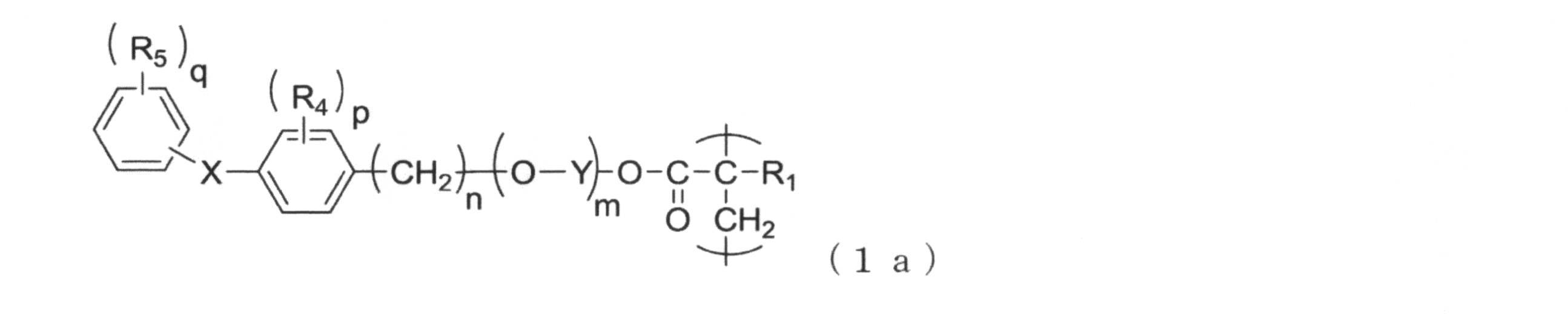
なお、一般式(1)で表される(メタ)アクリレートから誘導される構成単位とは、下記式(1a)の構造を有する構成単位を示し、
一般式(3)で表される多価ビニル系単量体から誘導される構成単位とは、下記式(3a)の構造を有する構成単位を示す。

ここで、一般式(1a)におけるX、Y、R1、R4、R5、m、n、pおよびqは、それぞれ一般式(1)のものと対応し、一般式(3a)におけるR10、R11、R12、X、Y、Z、pおよびqは、一般式(3)のものと対応する。
本発明の硬化体は、上記の通り、本発明の組成物を硬化することによって得られる。ここで、硬化を行う方法は特に限定されず、種々の公知の方法によって行ってもよい。例えば、本発明の組成物は、活性エネルギー線を照射することによる光重合によって硬化させてもよい。本明細書において、「活性エネルギー線」とは、紫外線、電子線、イオンビーム、およびX線等を意味する。
本発明の組成物を活性エネルギー線により硬化させる場合、光重合開始剤は必ずしも必要でない。しかし、光重合開始剤を添加する場合、例えば、Ciba社から入手可能なIrgacure(登録商標)2959(1-[4-(2-ヒドロキシエトキシ)フェニル]-2-ヒドロキシ-2-メチル-1-プロパン-1-オン、Irgacure(登録商標)184(1-ヒドロキシシクロヘキシルフェニルケトン)、Irgacure(登録商標)500(1-ヒドロキシシクロヘキシルフェニルケトン、ベンゾフェノン)、Irgacure(登録商標)651(2,2-ジメトキシ-1,2-ジフェニルエタン-1-オン)、Irgacure(登録商標)369(2-ベンジル-2-ジメチルアミノ-1-(4-モルフォリノフェニル)ブタノン-1)、Irgacure(登録商標)907(2-メチル-1[4-メチルチオフェニル]-2-モルフォリノプロパン-1-オン、Irgacure(登録商標)819(ビス(2,4,6-トリメチルベンゾイル)-フェニルフォスフィンオキサイド、Irgacure(登録商標)1800(ビス(2,6-ジメトキシベンゾイル)-2,4,4-トリメチル-ペンチルフォスフィンオキサイド,1-ヒドロキシ-シクロヘキシル-フェニル-ケトン)、Irgacure(登録商標)1800(ビス(2,6-ジメトキシベンゾイル)-2,4,4-トリメチル-ペンチルフォスフィンオキサイド,2-ヒドロキシ-2-メチル-1-フェニル-1-プロパン-1-オン)、Irgacure(登録商標)OXE01(1,2-オクタンジオン,1-[4-(フェニルチオ)フェニル]-2-(O-ベンゾイルオキシム)、Darocur(登録商標)1173(2-ヒドロキシ-2-メチル-1-フェニル-1-プロパン-1-オン)、Darocur(登録商標)1116、1398、1174及び1020、CGI242(エタノン,1-[9-エチル-6-(2-メチルベンゾイル)-9H-カルバゾール-3-イル]-1-(O-アセチルオキシム)、BASF社から入手可能なLucirinTPO(2,4,6-トリメチルベンゾイルジフェニルホスフィンオキサイド)、Lucirin TPO-L(2,4,6-トリメチルベンゾイルエトキシフェニルホスフィンオキサイド)、日本シイベルヘグナー社から入手可能なESACURE1001M(1-[4-ベンゾイルフェニルスルファニル]フェニル]-2-メチル-2-(4-メチルフェニルスルホニル)プロパン-1-オン、旭電化社から入手可能なアデカオプトマー(登録商標)N-1414(カルバゾール・フェノン系)、アデカオプトマー(登録商標)N-1717(アクリジン系)、アデカオプトマー(登録商標)N-1606(トリアジン系)、三和ケミカル製のTFE-トリアジン(2-[2-(フラン-2-イル)ビニル]-4,6-ビス(トリクロロメチル)-1,3,5-トリアジン)、三和ケミカル製のTME-トリアジン(2-[2-(5-メチルフラン-2-イル)ビニル]-4,6-ビス(トリクロロメチル)-1,3,5-トリアジン)、三和ケミカル製のMP-トリアジン(2-(4-メトキシフェニル)-4,6-ビス(トリクロロメチル)-1,3,5-トリアジン)、ミドリ化学製TAZ-113(2-[2-(3,4-ジメトキシフェニル)エテニル]-4,6-ビス(トリクロロメチル)-1,3,5-トリアジン)、ミドリ化学製TAZ-108(2-(3,4-ジメトキシフェニル)-4,6-ビス(トリクロロメチル)-1,3,5-トリアジン)、ベンゾフェノン、4,4’-ビスジエチルアミノベンゾフェノン、メチル-2-ベンゾフェノン、4-ベンゾイル-4’-メチルジフェニルスルフィド、4-フェニルベンゾフェノン、エチルミヒラーズケトン、2-クロロチオキサントン、2-メチルチオキサントン、2-イソプロピルチオキサントン、4-イソプロピルチオキサントン、2,4-ジエチルチオキサントン、1-クロロ-4-プロポキシチオキサントン、2-メチルチオキサントン、チオキサントンアンモニウム塩、ベンゾイン、4,4’-ジメトキシベンゾイン、ベンゾインメチルエーテル、ベンゾインエチルエーテル、ベンゾインイソプロピルエーテル、ベンゾインイソブチルエーテル、ベンジルジメチルケタール、1,1,1-トリクロロアセトフェノン、ジエトキシアセトフェノンおよびジベンゾスベロン、o-ベンゾイル安息香酸メチル、2-ベンゾイルナフタレン、4-ベンゾイルビフェニル、4-ベンゾイルジフェニルエーテル、1,4-ベンゾイルベンゼン、ベンジル、10-ブチル-2-クロロアクリドン、[4-(メチルフェニルチオ)フェニル]フェニルメタン)、2-エチルアントラキノン、2,2-ビス(2-クロロフェニル)4,5,4’,5’-テトラキス(3,4,5-トリメトキシフェニル)1,2’-ビイミダゾール、2,2-ビス(o-クロロフェニル)4,5,4’,5’-テトラフェニル-1,2’-ビイミダゾール、トリス(4-ジメチルアミノフェニル)メタン、エチル-4-(ジメチルアミノ)ベンゾエート、2-(ジメチルアミノ)エチルベンゾエート、ブトキシエチル-4-(ジメチルアミノ)ベンゾエート、等が挙げられる。これらの光重合開始剤は単独で使用してもよいし、2種以上組み合せて用いてもよい。また、これらの光重合開始剤の添加量は、組成物中、0.01質量%~15質量%、好ましくは0.1質量%~10質量%の範囲である。
以下、本発明について実施例を参照して詳述するが、本発明の技術的範囲はこれに限定されるものではない。実施例中の「部」および「%」は、それぞれ「質量部」および「質量%」を表す。
また、実施例および比較例における各物性の測定は、以下の方法により行った。
1.組成物粘度
下記に記載の方法で得られる組成物の粘度を、E型粘度計(TV-22型)を用いて、測定温度:25℃で測定した。
下記に記載の方法で得られる組成物の粘度を、E型粘度計(TV-22型)を用いて、測定温度:25℃で測定した。
2.組成物の屈折率
下記に記載の方法で得られる組成物を、多波長アッべ屈折率計DR-M2(株式会社アタゴ社製)を用いて、測定波長:589nm、測定温度:23℃にて測定した。
下記に記載の方法で得られる組成物を、多波長アッべ屈折率計DR-M2(株式会社アタゴ社製)を用いて、測定波長:589nm、測定温度:23℃にて測定した。
3.硬化物の屈折率
下記に記載の方法で得られる組成物の硬化体を、多波長アッべ屈折率計DR-M2(株式会社アタゴ社製)を用いて、測定波長:589nm、測定温度:23℃にて測定した。
下記に記載の方法で得られる組成物の硬化体を、多波長アッべ屈折率計DR-M2(株式会社アタゴ社製)を用いて、測定波長:589nm、測定温度:23℃にて測定した。
4.ガラス転移温度
下記に記載の方法で得られる組成物の硬化体のガラス転移温度を、DSC6200(セイコーインスツル株式会社製)を用いて、JIS-K-7121に準じて測定した。
下記に記載の方法で得られる組成物の硬化体のガラス転移温度を、DSC6200(セイコーインスツル株式会社製)を用いて、JIS-K-7121に準じて測定した。
5.実施例に用いた化合物の製造
<製造例1>
空気雰囲気下、500mlセパラブルフラスコにビフェニルメチルアルコール90g、アクリル酸メチル156g、重合禁止剤として4-メトキシフェノール0.4g、エステル交換触媒としてチタンテトライソプロポキシド0.82gを加えて、90℃で6時間撹拌をした。その間、生成するメタノールは系外に除去した。冷却後、精製水10gを添加して、触媒を加水分解後、蒸留することで水分やアクリル酸メチルを除去した。その後、沈澱をろ過し、4-フェニルベンジルアクリレートを単離した。収率は99.5%であった。
<製造例1>
空気雰囲気下、500mlセパラブルフラスコにビフェニルメチルアルコール90g、アクリル酸メチル156g、重合禁止剤として4-メトキシフェノール0.4g、エステル交換触媒としてチタンテトライソプロポキシド0.82gを加えて、90℃で6時間撹拌をした。その間、生成するメタノールは系外に除去した。冷却後、精製水10gを添加して、触媒を加水分解後、蒸留することで水分やアクリル酸メチルを除去した。その後、沈澱をろ過し、4-フェニルベンジルアクリレートを単離した。収率は99.5%であった。
<製造例2>
窒素雰囲気下、300mlセパラブルフラスコにビフェニルメチルアルコール10g、パラトルエンスルホン酸0.1g、メチルシクロヘキサンを90g加えて、105℃で18時間撹拌をした。その間、水は系外に除去した。冷却後、析出する固体を、水、メタノールで洗浄して、濾別することで4,4’-オキシビス(メチレン)ジビフェニルを単離した。収率は82%であった。
窒素雰囲気下、300mlセパラブルフラスコにビフェニルメチルアルコール10g、パラトルエンスルホン酸0.1g、メチルシクロヘキサンを90g加えて、105℃で18時間撹拌をした。その間、水は系外に除去した。冷却後、析出する固体を、水、メタノールで洗浄して、濾別することで4,4’-オキシビス(メチレン)ジビフェニルを単離した。収率は82%であった。
<実施例A:一般式(2)で表される化合物が組成物に与える影響の評価>
一般式(2)で表される化合物を一般式(1)で表される(メタ)アクリレートに所定の質量比で混合して得た組成物の特性を評価するために、次の手順で実施例A1と比較例A1の組成物を得た。
まず、一般式(1)で表される(メタ)アクリレートとして、下記式:

の4-フェニルベンジルアクリレートを製造例1に従って用意し、比較例A1とした。次いで、4-フェニルベンジルアクリレートに、一般式(2)で表される化合物として、製造例2に従って用意した下記式:

の4,4’-オキシビス(メチレン)ジビフェニルを、80:20の質量比で添加して組成物を得て、実施例A1とした。比較例A1と実施例A1の屈折率および粘度をそれぞれ評価し、併せて、結晶の析出についても評価した。結晶の析出は5℃に設定した恒温槽に組成物を入れて1ヶ月後に結晶の析出が目視で確認できるか否かによって評価した。また、比較例A1と実施例A1の組成物を0℃まで冷却して融点(凝固点)を確認したが(示差走査熱量計(DSC)を用いて測定)、実施例A1の組成物は凝固しなかったため、0℃以上の温度では融点は確認できなかった。結果を下記の表1に示す。

一般式(2)で表される化合物を一般式(1)で表される(メタ)アクリレートに所定の質量比で混合して得た組成物の特性を評価するために、次の手順で実施例A1と比較例A1の組成物を得た。
まず、一般式(1)で表される(メタ)アクリレートとして、下記式:
<実施例B:一般式(3)で表される化合物をさらに含む組成物および硬化体の評価>
一般式(1)で表される4-フェニルベンジルアクリレートと一般式(2)で表される4,4’-オキシビス(メチレン)ジビフェニルに加え、一般式(3)で表される化合物として、下記式:

(式中、m+n=4)の化合物(新中村化学工業製A-BPE-4)を添加して組成物を得た(実施例B1および比較例B1)。さらに各組成物に対して積算光量500mj/cm2の紫外線照射量となるように設定したコンベアタイプの紫外線照射装置U-0303(株式会社GSユアサ製、高圧水銀ランプ使用、ランプ出力:80W/cm、コンベアスピード:3m/min)を用いて紫外線を照射して硬化体を得た。それぞれの組成と物性を下記の表2にまとめる。
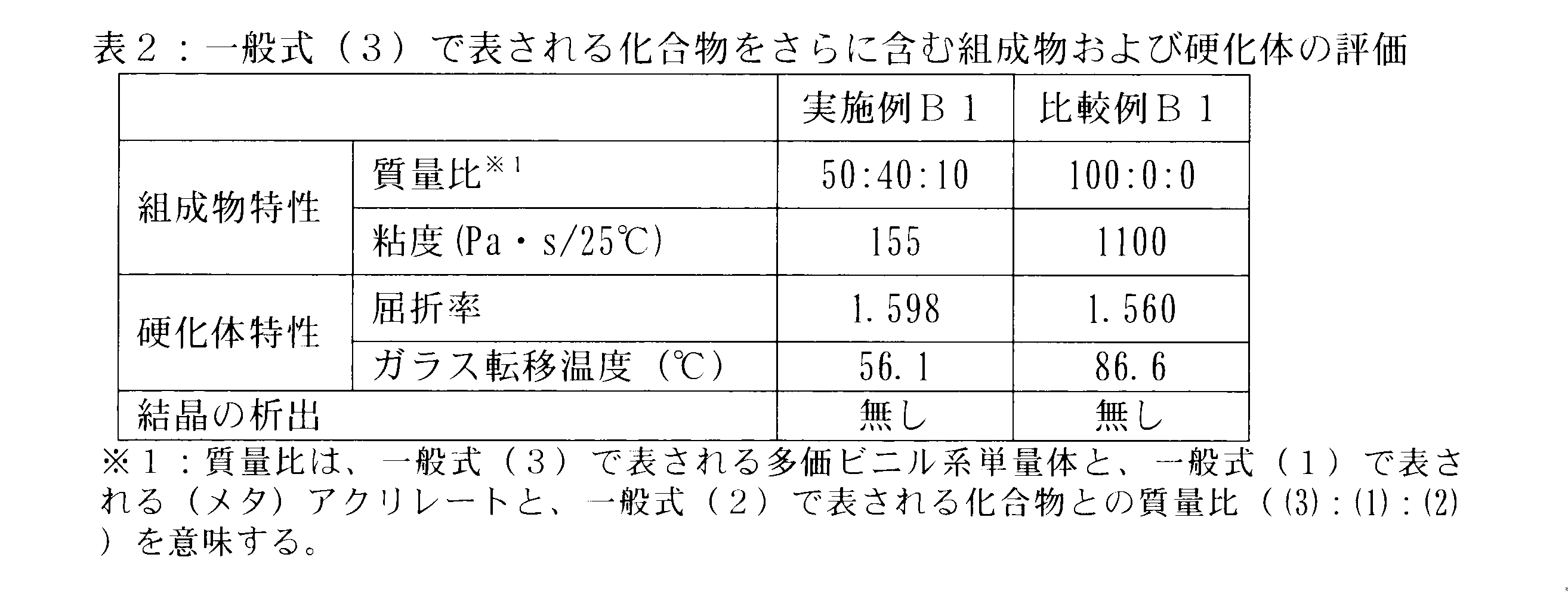
一般式(1)で表される4-フェニルベンジルアクリレートと一般式(2)で表される4,4’-オキシビス(メチレン)ジビフェニルに加え、一般式(3)で表される化合物として、下記式:
次いで、一般式(3)で表される化合物として、下記式:

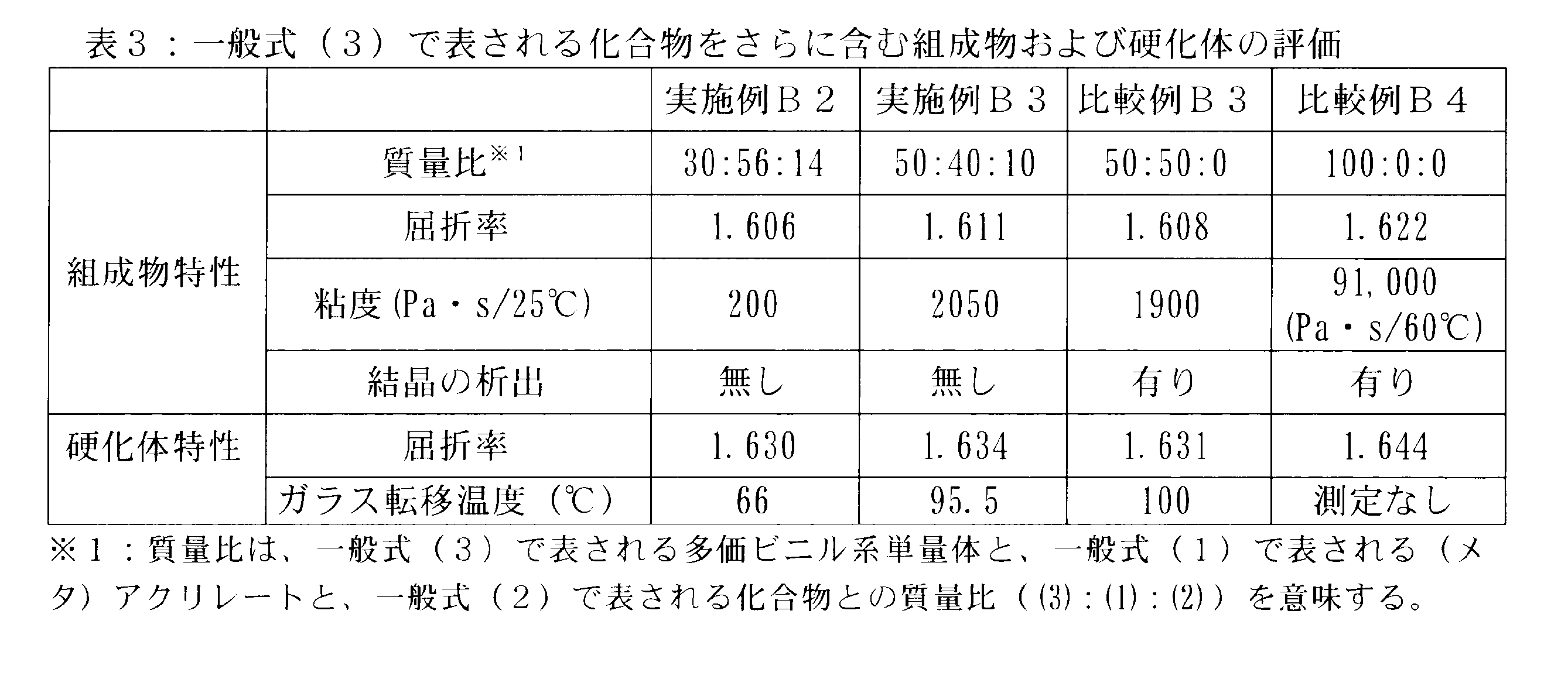
の9,9-ビス[4-(2-(メタ)アクリロイルオキシエトキシ)フェニル]フルオレンを添加して、実施例B1、比較例B1および比較例B2と同様に組成物を得た(実施例B2、実施例B3および比較例B3)。また、比較例B4として、9,9-ビス[4-(2-(メタ)アクリロイルオキシエトキシ)フェニル]フルオレン単体も用意した。各組成物の物性を測定し、併せて結晶の析出についても評価した。結晶の析出は5℃に設定した恒温槽に組成物を入れて1ヶ月後に結晶の析出が目視で確認できるか否かによって評価した。さらに各組成物に対して積算光量500mj/cm2の紫外線照射量となるように設定したコンベアタイプの紫外線照射装置U-0303(株式会社GSユアサ製、高圧水銀ランプ使用、ランプ出力:80W/cm、コンベアスピード:3m/min)を用いて紫外線を照射して硬化体を得た。それぞれの組成と物性を下記の表3にまとめる。
<実施例C:一般式(2)で表される化合物の比率と特性の評価>
一般式(1)で表される(メタ)アクリレートと一般式(2)で表される化合物とを含む組成物における、これらの化合物の質量比と組成物の特性との関係を評価するために、一般式(1)で表される(メタ)アクリレートと一般式(2)で表される化合物の質量比を変えた複数の試料を用意した(実施例C1およびC2ならびに比較例C1、C2およびC3)。一般式(1)で表される(メタ)アクリレートとしては4-フェニルベンジルアクリレートを用い、一般式(2)で表される化合物としては4,4’-オキシビス(メチレン)ジビフェニルを用いた。これらの実施例・比較例の組成物の屈折率と結晶の析出について評価した。結晶の析出は5℃に設定した恒温槽に組成物を入れて1ヶ月後に結晶の析出が目視で確認できるか否かによって評価した。結果を下記の表4に示す。
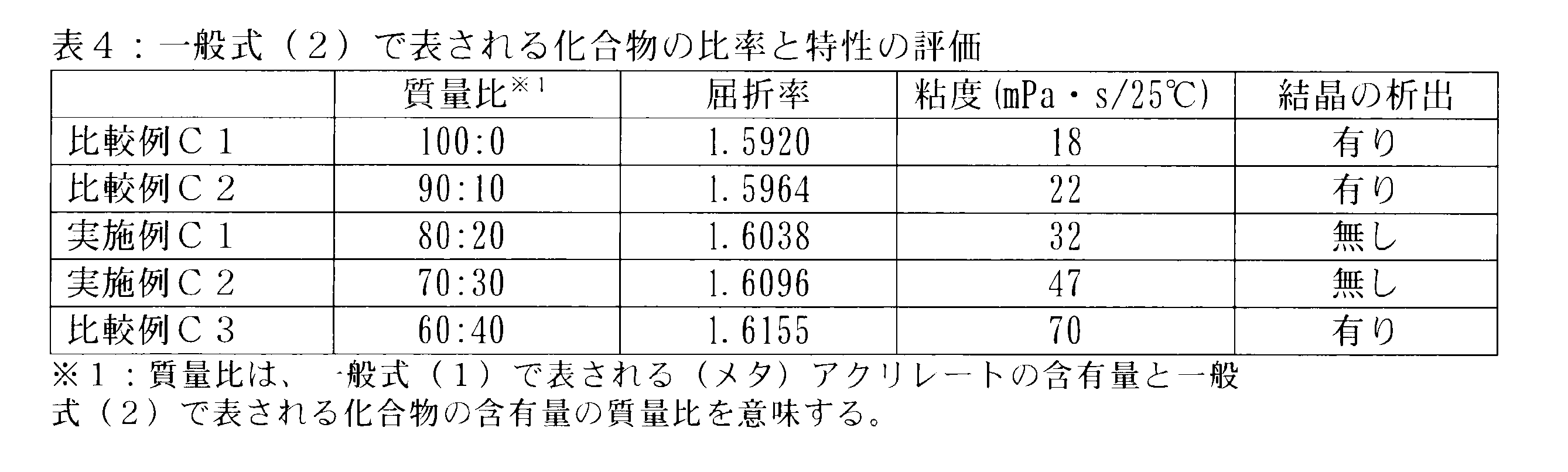
一般式(1)で表される(メタ)アクリレートと一般式(2)で表される化合物とを含む組成物における、これらの化合物の質量比と組成物の特性との関係を評価するために、一般式(1)で表される(メタ)アクリレートと一般式(2)で表される化合物の質量比を変えた複数の試料を用意した(実施例C1およびC2ならびに比較例C1、C2およびC3)。一般式(1)で表される(メタ)アクリレートとしては4-フェニルベンジルアクリレートを用い、一般式(2)で表される化合物としては4,4’-オキシビス(メチレン)ジビフェニルを用いた。これらの実施例・比較例の組成物の屈折率と結晶の析出について評価した。結晶の析出は5℃に設定した恒温槽に組成物を入れて1ヶ月後に結晶の析出が目視で確認できるか否かによって評価した。結果を下記の表4に示す。
上記の結果から、一般式(1)で表される(メタ)アクリレートの含有量と一般式(2)で表される化合物の含有量の質量比が、60:40を超え、かつ、90:10未満である場合に、高い屈折率を維持しつつ、結晶の析出が効果的に抑制されることが分かる。
<実施例D:一般式(2)で表される種々の化合物による効果の評価>
一般式(2)で表される化合物として、下記の化合物(2A:オキシジベンゼン)、(2B:オキシビス(メチレン)ジベンゼン)および(2C:4,4’-オキシビス(メチレン)ジビフェニル)を用いて評価を行った。
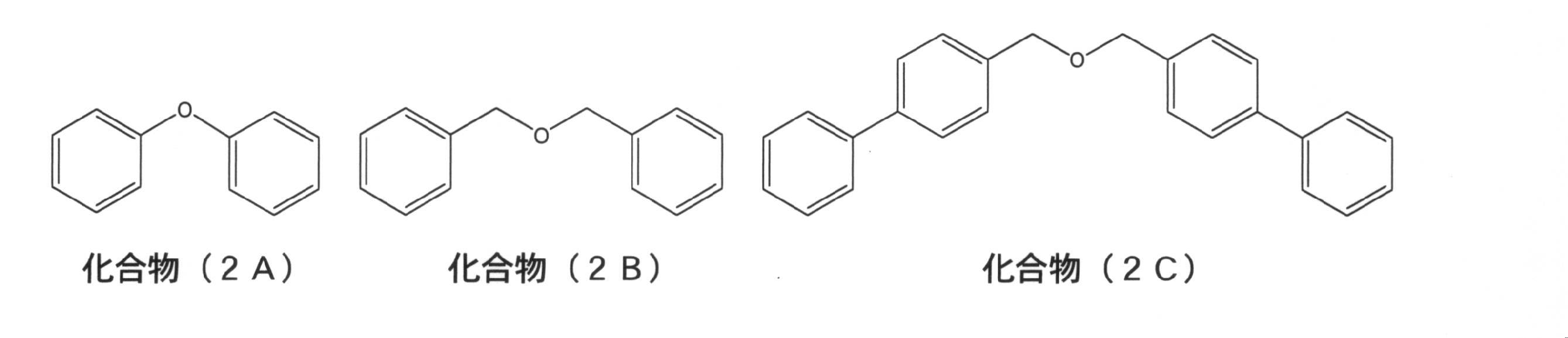
一般式(2)で表される化合物として、下記の化合物(2A:オキシジベンゼン)、(2B:オキシビス(メチレン)ジベンゼン)および(2C:4,4’-オキシビス(メチレン)ジビフェニル)を用いて評価を行った。
実施例Aと同様に、一般式(1)で表される(メタ)アクリレートとして4-フェニルベンジルアクリレートを用い、下記の表5に示す質量比で化合物(2A)、(2B)または(2C)とブレンドして組成物を得た。なお、表5において、質量比が「(1):(2A)=80:20」とは、4-フェニルベンジルアクリレートと化合物(2A)のブレンドにおけるそれぞれの化合物の質量比が80:20であることを意味する。化合物(2B)および(2C)についても同様である。得られた組成物の屈折率と結晶の析出について評価し、結果を表5にまとめた。結晶の析出は5℃に設定した恒温槽に組成物を入れて1ヶ月後に結晶の析出が目視で確認できるか否かによって評価した。また、化合物(2A)と化合物(2B)はいずれも室温で液体であるため、実施例D1と実施例D2の組成物はいずれも4-フェニルベンジルアクリレートと同等かそれ以下の粘度であった。
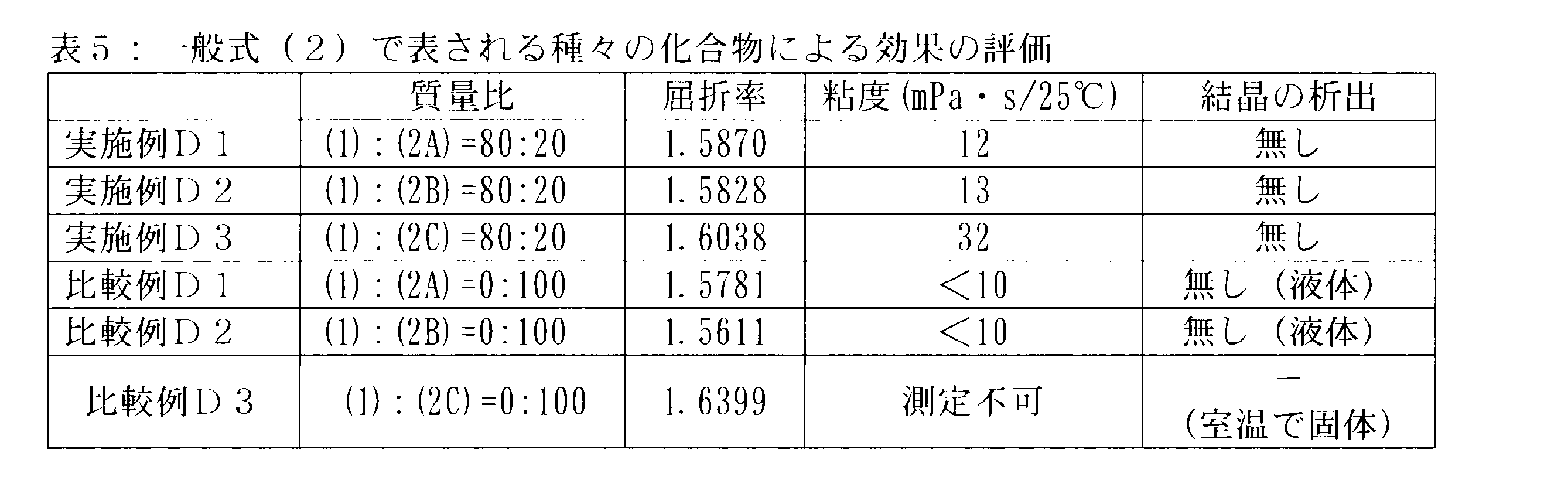
上記の結果から、一般式(2)の化合物として種々の化合物を用いた場合も高い屈折率を維持しつつ、結晶の析出が効果的に抑制されることが分かった。なお、化合物(2A)と(2B)は単体で5℃において液体であり、結晶も析出しなかったが、化合物(2C)は単体では5℃において固体であった。低温において固体となるような化合物(2C)を用いた場合であっても、本発明の組成物の結晶の析出を効果的に抑制することができた点は予想外であり、驚くべきことであった。
<実施例E:一般式(2)で表される化合物が組成物に与える影響の評価>
一般式(2)で表される化合物と一般式(1)で表される(メタ)アクリレートとの比率を変更した以外は実施例Aと同じ手順で表6に記載の実施例E1と実施例E2の組成物を得た。実施例E1と実施例E2の組成物の屈折率および粘度をそれぞれ評価し、併せて、結晶の析出についても評価した。結晶の析出は5℃に設定した恒温槽に組成物を入れて1ヶ月後に結晶の析出が目視で確認できるか否かによって評価した。また、実施例E1と実施例E2の組成物を0℃まで冷却して融点(凝固点)を確認したが(示差走査熱量計(DSC)を用いて測定)、実施例E1と実施例E2の組成物は凝固しなかったため、0℃以上の温度では融点は確認できなかった。結果を下記の表6に示す。

一般式(2)で表される化合物と一般式(1)で表される(メタ)アクリレートとの比率を変更した以外は実施例Aと同じ手順で表6に記載の実施例E1と実施例E2の組成物を得た。実施例E1と実施例E2の組成物の屈折率および粘度をそれぞれ評価し、併せて、結晶の析出についても評価した。結晶の析出は5℃に設定した恒温槽に組成物を入れて1ヶ月後に結晶の析出が目視で確認できるか否かによって評価した。また、実施例E1と実施例E2の組成物を0℃まで冷却して融点(凝固点)を確認したが(示差走査熱量計(DSC)を用いて測定)、実施例E1と実施例E2の組成物は凝固しなかったため、0℃以上の温度では融点は確認できなかった。結果を下記の表6に示す。
<実施例F:一般式(3)で表される化合物をさらに含む組成物および硬化体の評価>
一般式(2)で表される化合物と一般式(1)で表される(メタ)アクリレートとの比率を変更した以外は実施例Bと同じ手順で表7に記載の実施例F1と実施例F2の組成物を得た。一般式(3)で表される化合物としては9,9-ビス[4-(2-(メタ)アクリロイルオキシエトキシ)フェニル]フルオレンを用いた。各組成物の物性を測定し、併せて結晶の析出についても評価した。結晶の析出は5℃に設定した恒温槽に組成物を入れて1ヶ月後に結晶の析出が目視で確認できるか否かによって評価した。さらに各組成物に対して積算光量500mj/cm2の紫外線照射量となるように設定したコンベアタイプの紫外線照射装置U-0303(株式会社GSユアサ製、高圧水銀ランプ使用、ランプ出力:80W/cm、コンベアスピード:3m/min)を用いて紫外線を照射して硬化体を得た。それぞれの組成と物性を下記の表7にまとめる。
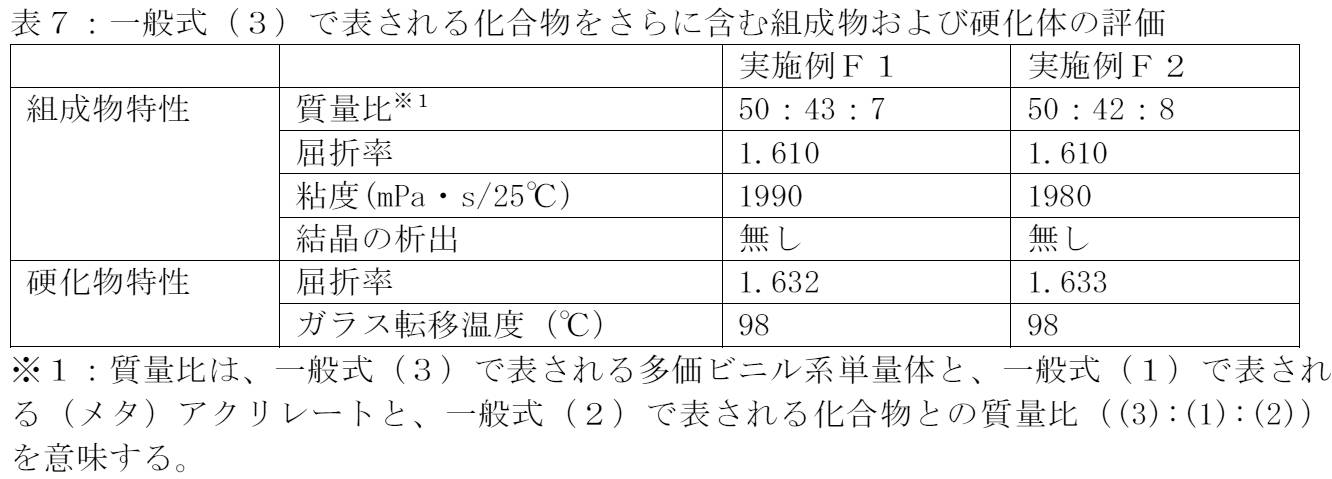
一般式(2)で表される化合物と一般式(1)で表される(メタ)アクリレートとの比率を変更した以外は実施例Bと同じ手順で表7に記載の実施例F1と実施例F2の組成物を得た。一般式(3)で表される化合物としては9,9-ビス[4-(2-(メタ)アクリロイルオキシエトキシ)フェニル]フルオレンを用いた。各組成物の物性を測定し、併せて結晶の析出についても評価した。結晶の析出は5℃に設定した恒温槽に組成物を入れて1ヶ月後に結晶の析出が目視で確認できるか否かによって評価した。さらに各組成物に対して積算光量500mj/cm2の紫外線照射量となるように設定したコンベアタイプの紫外線照射装置U-0303(株式会社GSユアサ製、高圧水銀ランプ使用、ランプ出力:80W/cm、コンベアスピード:3m/min)を用いて紫外線を照射して硬化体を得た。それぞれの組成と物性を下記の表7にまとめる。
<実施例G:一般式(2)で表される化合物の比率と特性の評価>
一般式(2)で表される化合物と一般式(1)で表される(メタ)アクリレートとの比率を変更した以外は実施例Cと同じ手順で表8に記載の実施例G1と実施例G2の組成物を得た。一般式(1)で表される(メタ)アクリレートとしては4-フェニルベンジルアクリレートを用い、一般式(2)で表される化合物としては4,4’-オキシビス(メチレン)ジビフェニルを用いた。これらの実施例の組成物の屈折率と結晶の析出について評価した。結晶の析出は5℃に設定した恒温槽に組成物を入れて1ヶ月後に結晶の析出が目視で確認できるか否かによって評価した。結果を下記の表8に示す。
一般式(2)で表される化合物と一般式(1)で表される(メタ)アクリレートとの比率を変更した以外は実施例Cと同じ手順で表8に記載の実施例G1と実施例G2の組成物を得た。一般式(1)で表される(メタ)アクリレートとしては4-フェニルベンジルアクリレートを用い、一般式(2)で表される化合物としては4,4’-オキシビス(メチレン)ジビフェニルを用いた。これらの実施例の組成物の屈折率と結晶の析出について評価した。結晶の析出は5℃に設定した恒温槽に組成物を入れて1ヶ月後に結晶の析出が目視で確認できるか否かによって評価した。結果を下記の表8に示す。
Claims (12)
- (A)下記一般式(1)で表される(メタ)アクリレートと、
Xは、単結合、-C(R2)(R3)-、-C(=O)-、-O-、-OC(=O)-、-OC(=O)O-、-S-、-SO-、-SO2-およびこれらの任意の組み合わせからなる群から選択される二価の基であり(ここで、R2およびR3は、各々独立に、水素原子、炭素数1~10の直鎖状アルキル基、炭素数3~10の分岐状アルキル基、炭素数3~10の環状アルキル基、炭素数1~10の直鎖状アルコキシ基、炭素数3~10の分岐状アルコキシ基、炭素数3~10の環状アルコキシ基、フェニル基またはビフェニル基であり;あるいは、R2およびR3は、相互に連結して、これらが結合する炭素原子と一緒になって炭素数3~10の環状アルキル基を形成していてもよい);
Yは、分岐していてもよい炭素数2~6のアルキレン基、炭素数6~10のシクロアルキレン基、または炭素数6~10のアリーレン基であり;
R1は、水素原子またはメチル基であり;
R4およびR5は、各々独立に、炭素数1~10の直鎖状アルキル基、炭素数3~10の分岐状アルキル基、炭素数3~10の環状アルキル基、炭素数1~10の直鎖状アルコキシ基、炭素数3~10の分岐状アルコキシ基、炭素数3~10の環状アルコキシ基、ハロゲン原子、フェニル基またはビフェニル基であり;
mは、0~10の整数であり;
nは、1~2の整数であり;
pは、0~4の整数であり;
qは、0~5の整数である]
(B)下記一般式(2)で表される化合物と
R6、R7は、それぞれ独立に、水素原子、炭素数1~10の直鎖状アルキル基、炭素数3~10の分岐状アルキル基、炭素数3~10の環状アルキル基、炭素数1~10の直鎖状アルコキシ基、炭素数3~10の分岐状アルコキシ基、炭素数3~10の環状アルコキシ基、ハロゲン原子、フェニル基、ビフェニル基、フェノキシ基、-R8OH、または-(R9)sHであり(ここで、R8は、炭素数1~10の直鎖状アルキレン基または炭素数3~10の分岐状アルキレン基であり、R9は、炭素数1~10の直鎖状アルキレンオキシ基または炭素数3~10の分岐状アルキレンオキシ基であり、sは、1~5の整数である);
a、bは、それぞれ独立に、0~10の整数であり;
c、dは、それぞれ独立に、0~5の整数である]
を含み、
前記一般式(1)で表される(メタ)アクリレートの含有量と前記一般式(2)で表される化合物の含有量の質量比が、60:40を超え、かつ、90:10未満である、組成物。 - 前記一般式(1)中、pおよびqが共に0である、請求項1に記載の組成物。
- 前記一般式(1)で表される(メタ)アクリレートの含有量と前記一般式(2)で表される化合物の含有量の質量比が、65:35~85:15である、請求項1または2に記載の組成物。
- 前記一般式(2)中、aおよびbが0~5の整数である、請求項1~3のいずれか1項に記載の組成物。
- 前記一般式(2)中、R6およびR7がフェニル基、ビフェニル基またはフェノキシ基である、請求項1~4のいずれか1項に記載の組成物。
- 前記一般式(2)中、a、b、cおよびdがいずれも1である、請求項5に記載の組成物。
- 前記一般式(1)で表される(メタ)アクリレートとの共重合が可能な、下記一般式(3)で表される多価ビニル系単量体をさらに含む、請求項1~6のいずれか1項に記載の組成物。

R10およびR11は、それぞれ独立に、水素原子、炭素数1~20のアルキル基、炭素数1~20のアルコキシル基、炭素数3~20のシクロアルキル基、炭素数5~20のシクロアルコキシル基、炭素数6~20のアリール基、炭素数6~20のアリールオキシ基、およびハロゲン原子から選択され、
R12は、水素原子またはメチル基であり;
Xは、単結合、-O-、-S-、-SO-、-SO2-、-CO-および下記一般式(4)~(7)からなる群のうち、いずれかの構造を表し;
YおよびZは、それぞれ独立に、分岐していてもよい炭素数2~6のアルキレン基、炭素数6~10のシクロアルキレン基、または炭素数6~10のアリーレン基であり;
pおよびqは、それぞれ独立に、0~4の整数である。]

R13およびR14はそれぞれ独立に水素原子、ハロゲン原子、置換基を有してもよい炭素数1~20のアルキル基、置換基を有してもよい炭素数1~5のアルコキシ基、置換基を有してもよい炭素数6~12のアリール基、置換基を有してもよい炭素数2~5のアルケニル基、および置換基を有してもよい炭素数7~17のアラルキル基からなる群のうちいずれかを表し;
前記置換基はそれぞれ独立に、ハロゲン原子、炭素数1~20のアルキル基、または炭素数6~12のアリール基であり;
cは1~20の整数を表す。]

前記置換基はそれぞれ独立に、ハロゲン原子、炭素数1~20のアルキル基、または炭素数6~12のアリール基である。]

それぞれ互いに結合して、炭素数1~20の炭素環若しくは複素環を形成し;
前記置換基はそれぞれ独立に、ハロゲン原子、炭素数1~20のアルキル基、または炭素数6~12のアリール基である。]

- 前記組成物の総重量に対して、前記一般式(3)で表される多価ビニル系単量体を20重量%~80重量%含む、請求項7に記載の組成物。
- 前記一般式(3)中、Xが一般式(4)で示される構造または一般式(5)で示される構造を有する、請求項7または8に記載の組成物。
- 活性エネルギー線硬化性組成物である、請求項1~9のいずれか1項に記載の組成物。
- 請求項1~10のいずれか1項に記載の組成物を含む塗料。
- 請求項1~10のいずれか1項に記載の組成物が硬化されてなる硬化体。
Priority Applications (3)
| Application Number | Priority Date | Filing Date | Title |
|---|---|---|---|
| US17/605,047 US11326073B1 (en) | 2019-04-24 | 2020-04-16 | (meth)acrylic composition, paint and curing agent comprising same |
| KR1020217037486A KR102424019B1 (ko) | 2019-04-24 | 2020-04-16 | (메트)아크릴계 조성물, 그것을 포함하는 도료 및 경화체 |
| CN202080030210.9A CN113710750B (zh) | 2019-04-24 | 2020-04-16 | (甲基)丙烯酸系组合物、包含它的涂料和固化物 |
Applications Claiming Priority (2)
| Application Number | Priority Date | Filing Date | Title |
|---|---|---|---|
| JP2019-083005 | 2019-04-24 | ||
| JP2019083005A JP6799633B2 (ja) | 2019-04-24 | 2019-04-24 | (メタ)アクリル系組成物、それを含む塗料および硬化体 |
Publications (1)
| Publication Number | Publication Date |
|---|---|
| WO2020218151A1 true WO2020218151A1 (ja) | 2020-10-29 |
Family
ID=72942512
Family Applications (1)
| Application Number | Title | Priority Date | Filing Date |
|---|---|---|---|
| PCT/JP2020/016718 Ceased WO2020218151A1 (ja) | 2019-04-24 | 2020-04-16 | (メタ)アクリル系組成物、それを含む塗料および硬化体 |
Country Status (6)
| Country | Link |
|---|---|
| US (1) | US11326073B1 (ja) |
| JP (1) | JP6799633B2 (ja) |
| KR (1) | KR102424019B1 (ja) |
| CN (1) | CN113710750B (ja) |
| TW (1) | TWI747242B (ja) |
| WO (1) | WO2020218151A1 (ja) |
Citations (3)
| Publication number | Priority date | Publication date | Assignee | Title |
|---|---|---|---|---|
| WO2016108491A1 (ko) * | 2014-12-30 | 2016-07-07 | 에스케이씨코오롱피아이 주식회사 | 가교형 수용성 열가소성 폴리아믹산을 이용한 열융착 다층 폴리이미드 필름, 및 이의 제조방법 |
| WO2017135066A1 (ja) * | 2016-02-05 | 2017-08-10 | 三菱瓦斯化学株式会社 | 光拡散剤、光拡散性樹脂組成物および成形体 |
| WO2018025537A1 (ja) * | 2016-08-03 | 2018-02-08 | 三菱瓦斯化学株式会社 | (メタ)アクリル系組成物、それを含む塗料および硬化体 |
Family Cites Families (13)
| Publication number | Priority date | Publication date | Assignee | Title |
|---|---|---|---|---|
| US7683203B2 (en) * | 2004-11-04 | 2010-03-23 | Adeka Corporation | Polymerizable compound and composition containing the polymerizable compound |
| JP5220464B2 (ja) * | 2008-04-12 | 2013-06-26 | 三菱瓦斯化学株式会社 | 多層積層体 |
| JP2010186979A (ja) * | 2008-12-03 | 2010-08-26 | Fujifilm Corp | インプリント用硬化性組成物、パターン形成方法およびパターン |
| JP5508754B2 (ja) | 2009-04-15 | 2014-06-04 | 共栄社化学株式会社 | 光学材料用樹脂組成物 |
| JP5427012B2 (ja) | 2009-12-17 | 2014-02-26 | 共栄社化学株式会社 | 光学材料用樹脂組成物 |
| JP2012082386A (ja) | 2010-09-14 | 2012-04-26 | Dic Corp | 光学材料用高屈折組成物およびその硬化物 |
| JP5753721B2 (ja) | 2011-04-11 | 2015-07-22 | 共栄社化学株式会社 | 光学材料用樹脂組成物及びその成形体 |
| JP6017222B2 (ja) | 2011-08-11 | 2016-10-26 | 大阪ガスケミカル株式会社 | フルオレン骨格を有する多官能性(メタ)アクリレートを含む硬化性組成物およびその硬化物 |
| JP6231904B2 (ja) * | 2013-02-25 | 2017-11-15 | 大阪ガスケミカル株式会社 | 硬化性組成物およびその硬化物 |
| WO2015053145A1 (ja) * | 2013-10-07 | 2015-04-16 | 三菱瓦斯化学株式会社 | (メタ)アクリル系共重合体、樹脂組成物及びその成形体 |
| JP6166479B2 (ja) * | 2013-12-04 | 2017-07-19 | ノバルティス アーゲー | 高い屈折率および最小限のグリスニングを有する軟質アクリル材料 |
| EP3279259A4 (en) * | 2015-03-30 | 2018-10-31 | Mitsubishi Gas Chemical Company, Inc. | Resin composition and molded object obtained therefrom |
| JP2018039941A (ja) * | 2016-09-09 | 2018-03-15 | 株式会社クラレ | (メタ)アクリル系ブロック共重合体組成物 |
-
2019
- 2019-04-24 JP JP2019083005A patent/JP6799633B2/ja active Active
-
2020
- 2020-04-16 CN CN202080030210.9A patent/CN113710750B/zh active Active
- 2020-04-16 US US17/605,047 patent/US11326073B1/en active Active
- 2020-04-16 KR KR1020217037486A patent/KR102424019B1/ko active Active
- 2020-04-16 WO PCT/JP2020/016718 patent/WO2020218151A1/ja not_active Ceased
- 2020-04-21 TW TW109113281A patent/TWI747242B/zh active
Patent Citations (3)
| Publication number | Priority date | Publication date | Assignee | Title |
|---|---|---|---|---|
| WO2016108491A1 (ko) * | 2014-12-30 | 2016-07-07 | 에스케이씨코오롱피아이 주식회사 | 가교형 수용성 열가소성 폴리아믹산을 이용한 열융착 다층 폴리이미드 필름, 및 이의 제조방법 |
| WO2017135066A1 (ja) * | 2016-02-05 | 2017-08-10 | 三菱瓦斯化学株式会社 | 光拡散剤、光拡散性樹脂組成物および成形体 |
| WO2018025537A1 (ja) * | 2016-08-03 | 2018-02-08 | 三菱瓦斯化学株式会社 | (メタ)アクリル系組成物、それを含む塗料および硬化体 |
Also Published As
| Publication number | Publication date |
|---|---|
| JP6799633B2 (ja) | 2020-12-16 |
| JP2020180188A (ja) | 2020-11-05 |
| KR102424019B1 (ko) | 2022-07-22 |
| CN113710750A (zh) | 2021-11-26 |
| TWI747242B (zh) | 2021-11-21 |
| US11326073B1 (en) | 2022-05-10 |
| KR20210143335A (ko) | 2021-11-26 |
| TW202104301A (zh) | 2021-02-01 |
| US20220145118A1 (en) | 2022-05-12 |
| CN113710750B (zh) | 2022-07-12 |
Similar Documents
| Publication | Publication Date | Title |
|---|---|---|
| JP6327408B1 (ja) | (メタ)アクリル系組成物、それを含む塗料および硬化体 | |
| JP5522200B2 (ja) | コーティング膜 | |
| JP7292663B2 (ja) | 硬化性組成物およびこれを含む光学部材 | |
| WO2023190204A1 (ja) | 爪用光硬化性組成物 | |
| JP6799633B2 (ja) | (メタ)アクリル系組成物、それを含む塗料および硬化体 | |
| JP5621749B2 (ja) | 剥離紙用放射線硬化性シリコーン組成物 | |
| TWI772579B (zh) | (甲基)丙烯酸系組成物的製造方法、包含(甲基)丙烯酸系組成物的塗料及硬化體 | |
| JP7758511B2 (ja) | 硬化性樹脂組成物および硬化物 | |
| KR20150102864A (ko) | 실세스퀴옥산 복합 고분자 및 이의 제조방법 | |
| KR20210124274A (ko) | 광경화성 실리콘 수지 조성물 및 그것을 경화시킨 실리콘 수지 성형체, 및 상기 성형체의 제조 방법 | |
| JP7688900B2 (ja) | 光重合性組成物、重合体、及び重合体の製造方法 | |
| JP2004323741A (ja) | 光及び熱硬化性シルフェニレン組成物及びその硬化物 | |
| JP2009091465A (ja) | 硬化性組成物および成形体 | |
| WO2017033970A1 (ja) | デバイスの製造方法及び組成物 | |
| WO2024068708A1 (en) | Radiation-curable resin composition used for manufacturing three-dimensional mold | |
| JP2025139143A (ja) | 樹脂組成物、硬化物、その硬化物の製造方法及び化合物 | |
| WO2025238104A1 (en) | Resin composition for a radiation-curing additive manufacturing process, particularly for a lithographic manufacturing process |
Legal Events
| Date | Code | Title | Description |
|---|---|---|---|
| 121 | Ep: the epo has been informed by wipo that ep was designated in this application |
Ref document number: 20796423 Country of ref document: EP Kind code of ref document: A1 |
|
| NENP | Non-entry into the national phase |
Ref country code: DE |
|
| ENP | Entry into the national phase |
Ref document number: 20217037486 Country of ref document: KR Kind code of ref document: A |
|
| 122 | Ep: pct application non-entry in european phase |
Ref document number: 20796423 Country of ref document: EP Kind code of ref document: A1 |