WO2020196392A1 - 構造体、光学フィルタ、固体撮像素子、画像表示装置および赤外線センサ - Google Patents
構造体、光学フィルタ、固体撮像素子、画像表示装置および赤外線センサ Download PDFInfo
- Publication number
- WO2020196392A1 WO2020196392A1 PCT/JP2020/012683 JP2020012683W WO2020196392A1 WO 2020196392 A1 WO2020196392 A1 WO 2020196392A1 JP 2020012683 W JP2020012683 W JP 2020012683W WO 2020196392 A1 WO2020196392 A1 WO 2020196392A1
- Authority
- WO
- WIPO (PCT)
- Prior art keywords
- group
- mass
- infrared absorbing
- less
- atom
- Prior art date
- Legal status (The legal status is an assumption and is not a legal conclusion. Google has not performed a legal analysis and makes no representation as to the accuracy of the status listed.)
- Ceased
Links
Images
Classifications
-
- G—PHYSICS
- G02—OPTICS
- G02B—OPTICAL ELEMENTS, SYSTEMS OR APPARATUS
- G02B5/00—Optical elements other than lenses
- G02B5/20—Filters
-
- G—PHYSICS
- G02—OPTICS
- G02B—OPTICAL ELEMENTS, SYSTEMS OR APPARATUS
- G02B5/00—Optical elements other than lenses
- G02B5/20—Filters
- G02B5/22—Absorbing filters
-
- G—PHYSICS
- G09—EDUCATION; CRYPTOGRAPHY; DISPLAY; ADVERTISING; SEALS
- G09F—DISPLAYING; ADVERTISING; SIGNS; LABELS OR NAME-PLATES; SEALS
- G09F9/00—Indicating arrangements for variable information in which the information is built-up on a support by selection or combination of individual elements
- G09F9/30—Indicating arrangements for variable information in which the information is built-up on a support by selection or combination of individual elements in which the desired character or characters are formed by combining individual elements
-
- H—ELECTRICITY
- H10—SEMICONDUCTOR DEVICES; ELECTRIC SOLID-STATE DEVICES NOT OTHERWISE PROVIDED FOR
- H10F—INORGANIC SEMICONDUCTOR DEVICES SENSITIVE TO INFRARED RADIATION, LIGHT, ELECTROMAGNETIC RADIATION OF SHORTER WAVELENGTH OR CORPUSCULAR RADIATION
- H10F39/00—Integrated devices, or assemblies of multiple devices, comprising at least one element covered by group H10F30/00, e.g. radiation detectors comprising photodiode arrays
- H10F39/10—Integrated devices
- H10F39/12—Image sensors
Definitions
- the present invention relates to a structure having a near-infrared absorbing layer containing a near-infrared absorbing dye and a color filter layer containing a chromatic dye.
- the present invention also relates to an optical filter including a structure, a solid-state image sensor, an image display device, and an infrared sensor.
- CCD charge coupling element
- CMOS complementary metal oxide semiconductor
- Patent Document 1 a solid image of a structure having a near-infrared absorbing layer containing a near-infrared absorbing dye and a color filter layer containing a chromatic dye arranged adjacent to the near-infrared absorbing layer in the thickness direction is captured. It is described that it is used for elements and the like.
- the near-infrared absorbing layer a layer containing a near-infrared absorbing dye is used.
- a squarylium compound is known as one of the near-infrared absorbing dyes.
- Patent Documents 2 and 3 describe a squarylium compound having a specific structure, which is a near-infrared absorbing dye.
- an object of the present invention is to provide a structure, an optical filter, a solid-state image sensor, an image display device, and an infrared sensor in which the occurrence of unevenness in near-infrared shielding property is suppressed even after heating for a long period of time.
- the present invention provides: ⁇ 1> A near-infrared absorbing layer containing a near-infrared absorbing dye represented by the following formula (SQ1) and It has a color filter layer containing a chromatic color dye arranged adjacent to the near infrared ray absorbing layer, and has.
- the color filter layer has two or more colored pixels, and at least one of the two or more colored pixels is a structure containing a basic dye derivative;
- Rs 119 and Rs 120 each independently represent a substituent and represent a substituent.
- a 1 and A 2 independently represent an oxygen atom or -N (Rs 125 )-, respectively.
- Rs 121 to Rs 125 independently represent a hydrogen atom or a substituent, respectively.
- E 1 is a carbon atom
- E 2 is a carbon atom
- ns30 and ns31 independently represent integers from 0 to 5, respectively. If ns30 is 2 or more, plural Rs 119, which may be the same or different and may form a ring two Rs 119 between among the plurality of Rs 119 is coupled to, If ns31 is 2 or more, plural Rs 120, which may be the same or different and may form a ring by bonding two Rs 120 between among the plurality of Rs 120, If ns32 is 2, the two Rs 121 may be the same or different and may form a ring together two Rs 121 is coupled to, If ns33 is 2, the two Rs 122 may be the same or different and may form a ring together two Rs 122 is coupled to, Ar 100 represents an arylene group or a heteroarylene group, ns100 represents an integer of 0 to 2.
- ⁇ 2> The structure according to ⁇ 1>, wherein the near-infrared absorbing dye represented by the above formula (SQ1) is a near-infrared absorbing dye represented by the formula (SQ2);
- L 41 to L 44 independently represent an alkylene group, an alkynylene group, an arylene group, a heterocyclic group, or a divalent group in which two or more of these are bonded.
- 2- A 41 and A 42 independently represent an oxygen atom or -N ( RN2 )-, respectively.
- RN1 and RN2 independently represent a hydrogen atom, an alkyl group, or an aryl group, respectively.
- Rs 141 and Rs 142 each independently represent a substituent and represent a substituent.
- ns41 and ns42 independently represent integers from 0 to 5, respectively.
- ns41 is 2 or more
- plural Rs 141 may be the same or different and be two Rs 141 are bonded to each other among the plurality of Rs 141 to form a ring
- ns42 is 2 or more
- plural Rs 142 which may be the same or different and may form a ring by bonding two Rs 142 between among the plurality of Rs 142;
- L 41 ⁇ L 44 is an alkylene group
- Z 41 and Z 42 is a single bond
- a 41 and A 42 is -N (R N2) - in the case, Ns41 and ns42 of at least one of an integer from 1 to 5 Is.
- M 2 represents inorganic or organic cation
- RX1 ⁇ RX3 independently represents a hydrogen atom, an alkyl group, an aryl group, an acyl group or a heterocyclic group, and RX1 and RX2 may be bonded to each other to form a ring
- Rs 21 to Rs 28 Of Rs 31 to Rs 38 , adjacent groups may be bonded to each other to form a ring; If Q 1 is a nitrogen atom, Rs 21 does not exist, if Q 4 is a nitrogen atom, Rs 24 does not exist, if Q 5 is a nitrogen atom, Rs 25 does not exist, and Q 8 is a nitrogen atom.
- the color filter layer has at least red pixels, blue pixels, and green pixels.
- the red pixel contains 50% by mass or more of a chromatic dye and a basic dye derivative in total.
- ⁇ 6> The structure according to any one of ⁇ 1> to ⁇ 5>, wherein the near-infrared absorbing layer contains an acidic dye derivative.
- ⁇ 7> The structure according to ⁇ 6>, wherein the acidic dye derivative is a squarylium compound.
- ⁇ 9> A solid-state image sensor including the structure according to any one of ⁇ 1> to ⁇ 7>.
- ⁇ 10> An image display device including the structure according to any one of ⁇ 1> to ⁇ 7>.
- ⁇ 11> An infrared sensor including the structure according to any one of ⁇ 1> to ⁇ 7>.
- the present invention it is possible to provide a structure, an optical filter, a solid-state image sensor, an image display device, and an infrared sensor in which the occurrence of unevenness in near-infrared shielding property is suppressed even after heating for a long period of time.
- the numerical range represented by using "-" means a range including the numerical values before and after "-" as the lower limit value and the upper limit value.
- the notation not describing substitution and non-substitution also includes a group having a substituent (atomic group) as well as a group having no substituent (atomic group).
- the "alkyl group” includes not only an alkyl group having no substituent (unsubstituted alkyl group) but also an alkyl group having a substituent (substituted alkyl group).
- exposure includes not only exposure using light but also drawing using particle beams such as an electron beam and an ion beam, unless otherwise specified.
- the light used for exposure include the emission line spectrum of a mercury lamp, far ultraviolet rays typified by an excima laser, extreme ultraviolet rays (EUV light), X-rays, active rays such as electron beams, or radiation.
- EUV light extreme ultraviolet rays
- active rays such as electron beams, or radiation.
- (meth) acrylate represents both acrylate and methacrylate, or either
- (meth) acrylic represents both acrylic and methacrylic, or either.
- Allyl represents both allyl and methacrylic, or either, and“ (meth) acryloyl ”represents both acryloyl and methacrylic, or either.
- the weight average molecular weight and the number average molecular weight are defined as polystyrene-equivalent values in gel permeation chromatography (GPC) measurements.
- GPC gel permeation chromatography
- Mw weight average molecular weight
- Mn number average molecular weight
- HLC-8220 manufactured by Tosoh Corporation
- TSKgel Super AWM-H manufactured by Tosoh Corporation
- the term pigment means a compound that is difficult to dissolve in a solvent. For example, the solubility of the pigment in 100 g of water at 23 ° C.
- the solubility in 100 g of propylene glycol monomethyl ether acetate at 23 ° C. are preferably less than 0.1 g, more preferably 0.01 g or less.
- the term "process” not only refers to an independent process, but also refers to the term as long as the intended action of the process is achieved even if it cannot be clearly distinguished from other processes. include.
- the structure of the present invention includes a near-infrared absorbing layer containing a near-infrared absorbing dye represented by the formula (SQ1), and a color filter layer containing a chromatic dye arranged adjacent to the near-infrared absorbing layer.
- the color filter layer is characterized in that it has two or more colored pixels, and at least one of the two or more colored pixels contains a basic dye derivative.
- the spectroscopy of the near-infrared absorbing layer Fluctuations in characteristics can be suppressed, and therefore, the occurrence of unevenness in near-infrared shielding property can be suppressed.
- the reason why such an effect can be obtained is unknown, but the near-infrared absorbing layer contains the near-infrared absorbing dye represented by the formula (SQ1), and at least one of the colored pixels of the color filter layer is colored. It is presumed that this is because the inclusion of the basic dye derivative could suppress the decomposition and modification of the near-infrared absorbing dye and the movement of the near-infrared absorbing dye to the color filter layer side due to heating.
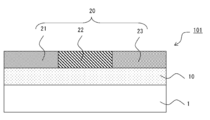
- FIG. 1 shows a first embodiment of the structure of the present invention.
- reference numeral 1 is a support.
- the material of the support 1 is not particularly limited. It can be selected as appropriate according to the application.
- a substrate made of a material such as silicon, non-alkali glass, soda glass, Pyrex (registered trademark) glass, or quartz glass can be mentioned.
- An organic film, an inorganic film, or the like may be formed on these substrates.
- a substrate made of resin can also be used as the support.
- a charge coupling element (CCD), a complementary metal oxide semiconductor (CMOS), a transparent conductive film, or the like may be formed on the support.
- CCD charge coupling element
- CMOS complementary metal oxide semiconductor
- a black matrix that separates each pixel may be formed on the support.
- an undercoat layer may be provided on the support in order to improve the adhesion with the upper layer, prevent the diffusion of substances, or flatten the surface of the substrate.
- the structure 101 is provided with a near-infrared absorbing layer 10 on the support 1.
- the near-infrared absorbing layer 10 contains a near-infrared absorbing dye represented by the formula (SQ1).
- the near-infrared absorbing dye represented by the formula (SQ1) is preferably a pigment.
- Rs 119 and Rs 120 each independently represent a substituent and represent a substituent.
- a 1 and A 2 independently represent an oxygen atom or -N (Rs 125 )-, respectively.
- Rs 121 to Rs 125 independently represent a hydrogen atom or a substituent, respectively.
- ns30 and ns31 independently represent integers from 0 to 5, respectively.
- ns30 is 2 or more, plural Rs 119, which may be the same or different and may form a ring two Rs 119 between among the plurality of Rs 119 is coupled to, If ns31 is 2 or more, plural Rs 120, which may be the same or different and may form a ring by bonding two Rs 120 between among the plurality of Rs 120, If ns32 is 2, the two Rs 121 may be the same or different and may form a ring together two Rs 121 is coupled to, If ns33 is 2, the two Rs 122 may be the same or different and may form a ring together two Rs 122 is coupled to, Ar 100 represents an arylene group or a heteroarylene group, ns100 represents an integer of 0 to 2.
- Examples of the substituent represented by Rs 119 and Rs 120 include the group described in Substituent T described later as the substituent, and a halogen atom, an alkyl group, a sulfo group and -SO 3 M are preferable.
- M represents an inorganic or organic cation.
- the inorganic or organic cation represented by M known ones can be adopted without limitation. For example, alkali metal ions (Li + , Na + , K +, etc.), ammonium ions, imidazolium ions, pyridinium ions, phosphonium ions and the like can be mentioned.
- halogen atom examples include a fluorine atom, a chlorine atom, a bromine atom and an iodine atom.
- the number of carbon atoms of the alkyl group is preferably 1 to 20, more preferably 1 to 15, further preferably 1 to 8, further preferably 1 to 5, and particularly preferably 1 to 3.
- the alkyl group may be linear, branched or cyclic, preferably linear or branched, more preferably linear.
- the alkyl group may have a substituent or may be unsubstituted. Examples of the substituent include the group described in Substituent T described later.
- a 1 and A 2 independently represent an oxygen atom or -N (Rs 125 )-, preferably -N (Rs 125 )-.
- Examples of the substituent represented by Rs 121 to Rs 125 include the group described in Substituent T described later.
- Rs 123 to Rs 125 are preferably hydrogen atoms, alkyl groups, or aryl groups, and more preferably hydrogen atoms. Further, it is preferable that Rs 121 to Rs 125 are independent substituents.
- the ring formed by bonding Rs 121 to each other and the ring formed by bonding Rs 122 to each other may be a hydrocarbon ring or a heterocycle. Further, the hydrocarbon ring and the heterocycle may be an aromatic ring or a non-aromatic ring.
- the hydrocarbon ring and the heterocycle may be a monocyclic ring or a condensed ring.
- the ring formed by bonding Rs 121 to each other and the ring formed by bonding Rs 122 to each other are preferably fused rings, and more preferably three or more fused rings.
- the ring formed by bonding Rs 121 to each other and the ring formed by bonding Rs 122 to each other may further have a substituent. Examples of the substituent include the group described in Substituent T described later.
- ns30 and ns31 each independently represent an integer of 0 to 5, preferably 0 to 4, more preferably 0 to 3, even more preferably 0 to 2, and even more preferably 0 or 1. If ns30 is 2 or more, plural Rs 119, which may be the same or different and may form a ring two Rs 119 between among the plurality of Rs 119 is coupled to, NS31 for but 2 or more, plural Rs 120, which may be the same or different and may form a ring two Rs 120 between among the plurality of Rs 120 is bonded to.
- the ring formed by bonding Rs 119 to each other and the ring formed by bonding Rs 120 to each other may be a hydrocarbon ring or a heterocycle.
- the hydrocarbon ring and the heterocycle may be an aromatic ring or a non-aromatic ring. Further, the hydrocarbon ring and the heterocycle may be a monocyclic ring or a condensed ring.
- the ring formed by bonding Rs 119 to each other and the ring formed by bonding Rs 120 to each other are preferably a 5-membered ring or a 6-membered ring hydrocarbon ring or a heterocyclic ring. Alternatively, it is more preferably a 6-membered hydrocarbon ring.
- Ar 100 represents an arylene group or a heteroarylene group.
- the arylene group and the heteroarylene group may be a monocyclic ring or a condensed ring.
- the arylene group and the heteroarylene group are preferably groups represented by any of the following formulas (Ar-1) to (Ar-7).
- Xa 1 to Xa 8 independently represent a sulfur atom, an oxygen atom or an NRx a
- Rx a represents a hydrogen atom or a substituent
- * represents a bond. Examples of the substituent represented by Rx a include the group described in Substituent T described later.
- Ns100 represents an integer of 0 to 2, preferably 0 or 1, and more preferably 0.
- the near-infrared absorbing dye represented by the formula (SQ1) is preferably a near-infrared absorbing dye represented by the formula (SQ2).
- L 41 to L 44 independently represent an alkylene group, an alkynylene group, an arylene group, a heterocyclic group, or a divalent group in which two or more of these are bonded.
- a 41 and A 42 independently represent an oxygen atom or -N ( RN2 )-, respectively.
- RN1 and RN2 independently represent a hydrogen atom, an alkyl group, or an aryl group, respectively.
- Rs 141 and Rs 142 each independently represent a substituent and represent a substituent.
- ns41 and ns42 independently represent integers from 0 to 5, respectively.
- ns41 is 2 or more
- plural Rs 141 may be the same or different and be two Rs 141 are bonded to each other among the plurality of Rs 141 to form a ring
- ns42 is 2 or more
- plural Rs 142 which may be the same or different and may form a ring by bonding two Rs 142 between among the plurality of Rs 142;
- L 41 ⁇ L 44 is an alkylene group
- Z 41 and Z 42 is a single bond
- a 41 and A 42 is -N (R N2) - in the case, Ns41 and ns42 of at least one of an integer from 1 to 5 Is.
- L 41 to L 44 each independently represent an alkylene group, an alkynylene group, an arylene group, a heterocyclic group, or a divalent group in which two or more of these are bonded.
- the number of carbon atoms of the alkylene group is preferably 1 to 20, more preferably 1 to 15, further preferably 1 to 8, further preferably 1 to 5, and particularly preferably 1 to 3.
- the alkylene group may be linear, branched or cyclic.
- the alkylene group may have a substituent or may be unsubstituted. Examples of the substituent include the group described in Substituent T described later.
- the number of carbon atoms of the alkynylene group is preferably 2 to 20, more preferably 2 to 12, and particularly preferably 2 to 8.
- the alkynylene group may be either linear or branched.
- the alkynylene group may have a substituent or may be unsubstituted. Examples of the substituent include the group described in Substituent T described later.
- the number of carbon atoms of the arylene group is preferably 6 to 30, more preferably 6 to 20, and even more preferably 6 to 12.
- the arylene group may have a substituent or may be unsubstituted. Examples of the substituent include the group described in Substituent T described later.
- the heterocyclic group is preferably a monocyclic heterocyclic group or a condensed ring heterocyclic group having a condensation number of 2 to 8, and a monocyclic heterocyclic group or a condensed ring heterocyclic group having a condensation number of 2 to 4 is more preferable.
- a monocyclic heterocyclic group is more preferred.
- the number of heteroatoms constituting the ring of the heterocyclic group is preferably 1 to 3.
- the hetero atom constituting the ring of the heterocyclic group is preferably a nitrogen atom, an oxygen atom or a sulfur atom, and more preferably a nitrogen atom.
- the heterocyclic group is preferably a 5-membered ring or a 6-membered ring.
- the number of carbon atoms constituting the ring of the heterocyclic group is preferably 3 to 30, more preferably 3 to 18, and even more preferably 3 to 12.
- the heterocyclic group may have a substituent or may be unsubstituted. Examples of the substituent include the group described in Substituent T described later.
- Each of L 41 to L 44 is preferably an arylene group or a heterocyclic group independently, and more preferably an arylene group.
- a 41 and A 42 independently represent an oxygen atom or ⁇ N ( RN2 ) ⁇ , and are preferably ⁇ N ( RN2 ) ⁇ .
- RN2 is preferably a hydrogen atom.
- the number of carbon atoms of the alkyl group represented by RN1 and RN2 is preferably 1 to 20, more preferably 1 to 15, further preferably 1 to 8, further preferably 1 to 5, and particularly preferably 1 to 3.
- the alkyl group may be linear, branched or cyclic, preferably linear or branched, more preferably linear.
- the alkyl group may have a substituent or may be unsubstituted. Examples of the substituent include the group described in Substituent T described later.
- the aryl group represented by RN1 and RN2 preferably has 6 to 30 carbon atoms, more preferably 6 to 20 carbon atoms, and even more preferably 6 to 12 carbon atoms.
- the aryl group may have a substituent or may be unsubstituted. Examples of the substituent include the group described in Substituent T described later.
- Examples of the substituent represented by Rs 141 and Rs 142 include the group described in Substituent T described later, and halogen atoms, alkyl groups, sulfo groups and -SO 3 M are preferable.
- M represents an inorganic or organic cation.
- the inorganic or organic cation represented by M known ones can be adopted without limitation.
- alkali metal ions Li + , Na + , K +, etc.
- ammonium ions imidazolium ions, pyridinium ions, phosphonium ions and the like can be mentioned.
- Examples of the halogen atom include a fluorine atom, a chlorine atom, a bromine atom and an iodine atom.
- the number of carbon atoms of the alkyl group is preferably 1 to 20, more preferably 1 to 15, further preferably 1 to 8, further preferably 1 to 5, and particularly preferably 1 to 3.
- the alkyl group may be linear, branched or cyclic, preferably linear or branched, more preferably linear.
- the alkyl group may have a substituent or may be unsubstituted. Examples of the substituent include the group described in Substituent T described later.
- ns41 and ns42 each independently represent an integer of 0 to 5, preferably 0 to 4, more preferably 0 to 3, even more preferably 0 to 2, and even more preferably 0 or 1. If ns41 is 2 or more, plural Rs 141 may be the same or different and be two Rs 141 are bonded to each other among the plurality of Rs 141 to form a ring, Ns42 for but 2 or more, plural Rs 142, which may be the same or different and each other two Rs 142 may be bonded to form a ring out of a plurality of Rs 142.
- the ring formed by bonding Rs 141 to each other and the ring formed by bonding Rs 142 to each other may be a hydrocarbon ring or a heterocycle.
- the hydrocarbon ring and the heterocycle may be an aromatic ring or a non-aromatic ring. Further, the hydrocarbon ring and the heterocycle may be a monocyclic ring or a condensed ring.
- the ring formed by bonding Rs 141 to each other and the ring formed by bonding Rs 142 to each other are preferably a 5- or 6-membered hydrocarbon ring or a heterocycle, and are preferably 5-membered rings. Alternatively, it is more preferably a 6-membered hydrocarbon ring.
- the near-infrared absorbing dye represented by the formula (SQ1) is preferably a near-infrared absorbing dye represented by the formula (SQ3).
- Q 1 , Q 4 , Q 5 , Q 8 , Q 11 , Q 14 , Q 15 and Q 18 each independently represent a carbon or nitrogen atom
- Rs 1 to Rs 5 and Rs 11 to Rs 15 independently represent a hydrogen atom, an alkyl group, a sulfo group, -SO 3 M 1 or a halogen atom
- M 1 represents an inorganic or organic cation
- Rs 2 And Rs 3 , Rs 12 and Rs 13 may combine with each other to form a ring
- Rs 21 to Rs 28 and Rs 31 to Rs 38 are independently hydrogen atoms, alkyl groups, alkenyl groups, aryl groups, aralkyl groups, alkoxy groups, aryloxy groups, hydroxy groups, -NR X1 RX2 , and sulfo groups.
- M 2 represents inorganic or organic cation
- RX1 ⁇ RX3 independently represents a hydrogen atom, an alkyl group, an aryl group, an acyl group or a heterocyclic group, and RX1 and RX2 may be bonded to each other to form a ring
- Rs 21 to Rs 28 Of Rs 31 to Rs 38 , adjacent groups may be bonded to each other to form a ring; If Q 1 is a nitrogen atom, Rs 21 does not exist, if Q 4 is a nitrogen atom, Rs 24 does not exist, if Q 5 is a nitrogen atom, Rs 25 does not exist, and Q 8 is a nitrogen atom.
- Q 1 , Q 4 , Q 5 , Q 8 , Q 11 , Q 14 , Q 15 and Q 18 are carbon atoms from the viewpoint of various resistances such as heat resistance and light resistance.
- the number of carbon atoms of the alkyl group represented by Rs 1 to Rs 5 and Rs 11 to Rs 15 is preferably 1 to 20, more preferably 1 to 15, further preferably 1 to 8, further preferably 1 to 5, and 1 to 1. 3 is particularly preferable.
- the alkyl group may be linear, branched or cyclic, preferably linear or branched, more preferably linear.
- the alkyl group may have a substituent or may be unsubstituted. Examples of the substituent include the group described in Substituent T described later.
- M 1 represented by Rs 1 to Rs 5 and Rs 11 to Rs 15
- known inorganic or organic cations of M 1 can be adopted without limitation.
- alkali metal ions Li + , Na + , K +, etc.
- ammonium ions imidazolium ions, pyridinium ions, phosphonium ions and the like can be mentioned.
- Examples of the halogen atom represented by Rs 1 to Rs 5 and Rs 11 to Rs 15 include a fluorine atom, a chlorine atom, a bromine atom, and an iodine atom.
- the ring formed may be a hydrocarbon ring or a heterocycle.
- the hydrocarbon ring and the heterocycle may be an aromatic ring or a non-aromatic ring.
- the hydrocarbon ring and the heterocycle may be a monocyclic ring or a condensed ring.
- the ring formed is preferably a 5- or 6-membered hydrocarbon ring or a heterocycle, and more preferably a 5- or 6-membered hydrocarbon ring.
- Rs 1 to Rs 5 are hydrogen atoms, or four of Rs 1 to Rs 5 are hydrogen atoms, one is a sulfo group, and -SO 3 M 1. Alternatively, it is preferably a halogen atom. Among these, it is particularly preferable that Rs 1 to Rs 5 are hydrogen atoms, or four of Rs 1 to Rs 5 are hydrogen atoms and one is a sulfo group or a halogen atom. Further, in Rs 11 to Rs 15 , from the viewpoint of imparting resistance, Rs 11 to Rs 15 are hydrogen atoms, or four of Rs 11 to Rs 15 are hydrogen atoms and one is a sulfo group, -SO 3.
- Rs 11 to Rs 15 are hydrogen atoms, or four of Rs 11 to Rs 15 are hydrogen atoms and one is a sulfo group or a halogen atom.
- the alkyl and alkoxy groups represented by Rs 21 to Rs 28 and Rs 31 to Rs 38 have preferably 1 to 20 carbon atoms, more preferably 1 to 15 carbon atoms, further preferably 1 to 8 carbon atoms, and even more preferably 1 to 5 carbon atoms. 1 to 3 are particularly preferable.
- the alkyl group and the alkoxy group may be linear, branched or cyclic, preferably linear or branched, and more preferably linear.
- the alkyl group and the alkoxy group may have a substituent or may be unsubstituted. Examples of the substituent include the group described in Substituent T described later.
- the carbon number of the alkenyl group represented by Rs 21 to Rs 28 and Rs 31 to Rs 38 is preferably 2 to 20, more preferably 2 to 12, and particularly preferably 2 to 8.
- the alkenyl group may be either a straight chain or a branched chain, and a straight chain is preferable.
- the alkenyl group may have a substituent or may be unsubstituted. Examples of the substituent include the group described in Substituent T described later.
- the aryl group and aryloxy group represented by Rs 21 to Rs 28 and Rs 31 to Rs 38 preferably have 6 to 30 carbon atoms, more preferably 6 to 20 carbon atoms, and even more preferably 6 to 12 carbon atoms.
- the aryl group and the aryloxy group may have a substituent or may be unsubstituted. Examples of the substituent include the group described in Substituent T described later.
- the carbon number of the aralkyl group represented by Rs 21 to Rs 28 and Rs 31 to Rs 38 is preferably 7 to 40, more preferably 7 to 30, and even more preferably 7 to 25.
- M 2 represented by Rs 21 to Rs 28 and Rs 31 to Rs 38
- known inorganic or organic cations of M 2 can be adopted without limitation.
- alkali metal ions Li + , Na + , K +, etc.
- ammonium ions imidazolium ions, pyridinium ions, phosphonium ions and the like can be mentioned.
- Examples of the halogen atom represented by Rs 21 to Rs 28 and Rs 31 to Rs 38 include a fluorine atom, a chlorine atom, a bromine atom, and an iodine atom.
- Rs 21 ⁇ Rs 28, Rs 31 ⁇ Rs 38 is represented, -NR X1 R X2, -SO 2 NR X1 R X2, in -COOR X3 and -CONR X1 R X2, R X1 ⁇ R X3 each independently, Represents a hydrogen atom, an alkyl group, an aryl group, an acyl group or a heterocyclic group.
- the alkyl group represented by RX1 to RX3 has preferably 1 to 20 carbon atoms, more preferably 1 to 15 carbon atoms, further preferably 1 to 8 carbon atoms, further preferably 1 to 5 carbon atoms, and particularly preferably 1 to 3 carbon atoms.
- the alkyl group may be linear, branched or cyclic, preferably linear or branched, more preferably linear.
- the alkyl group may have a substituent or may be unsubstituted. Examples of the substituent include the group described in Substituent T described later.
- the aryl group represented by RX1 to RX3 preferably has 6 to 30 carbon atoms, more preferably 6 to 20 carbon atoms, and even more preferably 6 to 12 carbon atoms.
- the aryl group may have a substituent or may be unsubstituted. Examples of the substituent include the group described in Substituent T described later.
- Heterocyclic group R X1 ⁇ R X3 represents the heterocyclic group is preferably a condensed heterocyclic group or the number of fused monocyclic 2-8, monocyclic heterocyclic group or fused number of 2 to 4 condensed
- a ring heterocyclic group is more preferred, and a monocyclic heterocyclic group is even more preferred.
- the number of heteroatoms constituting the ring of the heterocyclic group is preferably 1 to 3.
- the hetero atom constituting the ring of the heterocyclic group is preferably a nitrogen atom, an oxygen atom or a sulfur atom, and more preferably a nitrogen atom.
- the heterocyclic group is preferably a 5-membered ring or a 6-membered ring.
- the number of carbon atoms constituting the ring of the heterocyclic group is preferably 3 to 30, more preferably 3 to 18, and even more preferably 3 to 12.
- the heterocyclic group may have a substituent or may be unsubstituted. Examples of the substituent include the group described in Substituent T described later. Specific examples of the heterocyclic group include a pyridinyl group and the like. The pyridinyl group may have a substituent.
- Examples of the acyl group represented by RX1 to RX3 include a formyl group, an alkylcarbonyl group, and an arylcarbonyl group.
- the alkylcarbonyl group preferably has 2 to 20 carbon atoms, more preferably 2 to 15 carbon atoms, and even more preferably 2 to 8 carbon atoms.
- the arylcarbonyl group preferably has 7 to 30 carbon atoms, more preferably 7 to 20 carbon atoms, and even more preferably 7 to 12 carbon atoms.
- the alkyl moiety of the alkylcarbonyl group and the aryl moiety of the arylcarbonyl group may have a substituent or may be unsubstituted. Examples of the substituent include the group described in Substituent T described later.
- R X1 and R X2 may be bonded to each other to form a ring.
- the ring formed is preferably a 5-membered ring or a 6-membered ring.
- adjacent groups may be bonded to each other to form a ring.
- the ring formed may be a hydrocarbon ring or a heterocycle.
- the hydrocarbon ring and the heterocycle may be an aromatic ring or a non-aromatic ring.
- the hydrocarbon ring and the heterocycle may be a monocyclic ring or a condensed ring.
- the ring formed is preferably a 5- or 6-membered hydrocarbon ring or a heterocycle, and more preferably a 5- or 6-membered hydrocarbon ring.
- Rs 21 ⁇ Rs 28, Rs 31 ⁇ Rs 38 are each independently a hydrogen atom, an alkyl group, hydroxy group, -NR X1 R X2, a sulfo group, -SO 3 M 2, -COOR X3 , a nitro group or a halogen atom Is preferable, and a hydrogen atom is more preferable.
- Substituents T include halogen atom, cyano group, nitro group, alkyl group, alkenyl group, alkynyl group, aryl group, heterocyclic group, -ORt 1 , -CORt 1 , -COORt 1 , -OCORt 1 , -NRt 1 Rt 2 , -NHCORt 1 , -CONRt 1 Rt 2 , -NHCONRT 1 Rt 2 , -NHCOORt 1 , -SRt 1 , -SO 2 Rt 1 , -SO 2 ORt 1 , -NHSO 2 Rt 1 , -SO 2 NRt 1 Included are Rt 2 and -SO 3 Mt 1 .
- Rt 1 and Rt 2 independently represent a hydrogen atom, an alkyl group, an alkenyl group, an alkynyl group, an aryl group or a heterocyclic group, respectively. Rt 1 and Rt 2 may be combined to form a ring. Mt 1 represents an inorganic or organic cation.
- halogen atom examples include a fluorine atom, a chlorine atom, a bromine atom and an iodine atom.
- the number of carbon atoms of the alkyl group is preferably 1 to 20, more preferably 1 to 15, and even more preferably 1 to 8.
- the alkyl group may be linear, branched or cyclic, preferably linear or branched.
- the alkenyl group preferably has 2 to 20 carbon atoms, more preferably 2 to 12 carbon atoms, and particularly preferably 2 to 8 carbon atoms.
- the alkenyl group may be either linear or branched.
- the alkynyl group preferably has 2 to 40 carbon atoms, more preferably 2 to 30 carbon atoms, and particularly preferably 2 to 25 carbon atoms.
- the alkynyl group can be either linear or branched.
- the aryl group preferably has 6 to 30 carbon atoms, more preferably 6 to 20 carbon atoms, and even more preferably 6 to 12 carbon atoms.
- the heterocyclic group is preferably a monocyclic heterocyclic group or a condensed ring heterocyclic group having a condensation number of 2 to 8, and a monocyclic heterocyclic group or a condensed ring heterocyclic group having a condensation number of 2 to 4 is more preferable. preferable.
- the number of heteroatoms constituting the ring of the heterocyclic group is preferably 1 to 3.
- the hetero atom constituting the ring of the heterocyclic group is preferably a nitrogen atom, an oxygen atom or a sulfur atom.
- the heterocyclic group is preferably a 5-membered ring or a 6-membered ring.
- the number of carbon atoms constituting the ring of the heterocyclic group is preferably 3 to 30, more preferably 3 to 18, and even more preferably 3 to 12.
- the alkyl group, alkenyl group, alkynyl group, aryl group and heterocyclic group may have a substituent or may be unsubstituted. Examples of the substituent include the substituent described in the above-mentioned Substituent T.
- Examples of the inorganic or organic cation represented by Mt 1 include alkali metal ions (Li + , Na + , K +, etc.), ammonium ions, imidazolium ions, pyridinium ions, phosphonium ions, and the like.
- the cation is delocalized and exists.
- the cation exists delocalized as follows.
- the near-infrared absorbing dye represented by the formula (SQ1) is preferably a compound having a maximum absorption wavelength in the wavelength range of 700 to 1300 nm, and preferably a compound having a maximum absorption wavelength in the wavelength range of 700 to 1000 nm. More preferred.
- the near-infrared absorbing dye represented by the formula (SQ1) include a compound having the following structure, a compound described in paragraph Nos. 0224 to 0341 of JP-A-2019-011455, paragraph of International Publication No. 2018/230486. Examples thereof include the compounds described in Nos. 0221 to 0377.
- the content of the near-infrared absorbing dye represented by the formula (SQ1) in the near-infrared absorbing layer 10 is preferably 1% by mass or more, preferably 3% by mass or more, and 5% by mass or more. Is even more preferable.
- the upper limit of the content of the near-infrared absorbing dye is preferably 50% by mass or less, more preferably 45% by mass or less, and further preferably 40% by mass or less.
- the near-infrared absorbing layer may contain only one kind of near-infrared absorbing dye represented by the formula (SQ1), or may contain two or more kinds. When two or more types are contained, it is preferable that the total amount thereof is within the above range.
- the near-infrared absorbing layer 10 can contain a near-infrared absorbing agent other than the near-infrared absorbing dye represented by the formula (SQ1).
- Other near-infrared absorbers include pyrolopyrrole compounds, cyanine compounds, squarylium compounds, phthalocyanine compounds, naphthalocyanine compounds, quaterylene compounds, merocyanine compounds, croconium compounds, oxonor compounds, iminium compounds, dithiol compounds, triarylmethane compounds, and pyromethene. Examples thereof include compounds, azomethine compounds, anthraquinone compounds, dibenzofuranone compounds, dithiolene metal complexes, metal oxides, and metal borides.
- the content of the other near-infrared absorber in the near-infrared absorbing layer 10 is preferably 50 parts by mass or less, preferably 40 parts by mass or less, based on 100 parts by mass of the near-infrared absorbing dye represented by the formula (SQ1). It is more preferably 30 parts by mass or less, and further preferably 30 parts by mass or less. Further, the total content of the near-infrared absorbing dye represented by the formula (SQ1) and the other near-infrared absorbing agent in the near-infrared absorbing layer 10 is preferably 1% by mass or more, preferably 3% by mass or more. Is preferable, and 5% by mass or more is more preferable.
- the upper limit of the total content is preferably 50% by mass or less, more preferably 45% by mass or less, and further preferably 40% by mass or less.
- the near-infrared absorbing layer may contain only one type of other near-infrared absorbing agent, or may contain two or more types. When two or more types are contained, it is preferable that the total amount thereof is within the above range.
- the near-infrared absorbing layer 10 does not substantially contain other near-infrared absorbing agents.
- the fact that the near-infrared absorber is substantially not contained means that the content of the other near-infrared absorber in the near-infrared absorbing layer 10 is 0.5% by mass or less, and is 0.1% by mass. It is preferably less than or equal to, more preferably 0.05% by mass or less, and particularly preferably not containing other near-infrared absorbers.
- the near-infrared absorbing layer 10 can contain a dye derivative.
- the dye derivative may be either an acidic dye derivative or a basic dye derivative, but is preferably an acidic dye derivative from the viewpoint of dispersibility of the near-infrared absorbing dye represented by the formula (SQ1). It is also preferable that the acidic dye derivative is a squarylium compound. Further, the squarylium compound is preferably a compound having a ⁇ -conjugated plane including a partial structure represented by (SQ-a) described later.
- Examples of the acidic dye derivative include compounds in which an acid group is bonded to the dye skeleton.
- Examples of the acid group include a sulfo group, a carboxyl group, a phosphoric acid group, a boronic acid group, a sulfonimide group, a sulfonamide group and salts thereof.
- Atoms or groups of atoms constituting the salt include alkali metal ions (Li + , Na + , K +, etc.), alkaline earth metal ions (Ca 2+ , Mg 2+, etc.), ammonium ions, imidazolium ions, pyridinium ions, etc. Examples include phosphonium ions.
- a sulfo group, a carboxyl group, a phosphoric acid group, a boronic acid group, a sulfonimide group, a sulfonamide group and salts thereof are preferable, and a sulfo group, a carboxyl group, a phosphate group and a sulfonimide group , Sulfonamide groups and salts thereof are more preferred, sulfo groups, carboxyl groups, and salts thereof are even more preferred, and sulfo groups are particularly preferred.
- Examples of the basic dye derivative include compounds in which a basic group is bonded to the dye skeleton.
- Examples of the basic group include an amino group, a pyridinyl group and a salt thereof, a salt of an ammonium group, and a phthalimide methyl group.
- Examples of the atom or atomic group constituting the salt include hydroxide ion, halogen ion, carboxylic acid ion, sulfonic acid ion, and phenoxide ion.
- an amino group, a pyridinyl group and a salt thereof, a salt of an ammonium group, and a phthalimide methyl group are preferable, an amino group and a phthalimide methyl group are more preferable, and an amino group is further preferable.
- the dye derivative is preferably a compound represented by the formula (B1).
- the acidic dye derivative is preferably a compound in which X of the formula (B1) is represented by an acid group.
- the basic dye derivative is preferably a compound in which X in the formula (B1) is represented by a basic group.
- P represents the dye skeleton
- L represents a single bond or linking group
- X represents an acid group or basicity
- m represents an integer of 1 or more
- n represents an integer of 1 or more.
- the plurality of Ls and Xs may be different from each other, and when n is 2 or more, the plurality of Xs may be different from each other.
- the pigment skeleton represented by P in the formula (B1) includes squarylium pigment skeleton, pyrolopyrrolop pigment skeleton, diketopyrrolopyrrole pigment skeleton, quinacridone pigment skeleton, anthraquinone pigment skeleton, dianthraquinone pigment skeleton, benzoisoindole pigment skeleton, and thiazine.
- Indigo pigment skeleton, azo pigment skeleton, quinophthalocyanine pigment skeleton, phthalocyanine pigment skeleton, naphthalocyanine pigment skeleton, dioxazine pigment skeleton, perylene pigment skeleton, perinone pigment skeleton, benzoimidazolone pigment skeleton, benzothiazole pigment skeleton, benzoimidazolone pigment skeleton and benzo Oxazole pigment skeleton is mentioned, and at least one selected from squarylium pigment skeleton, pyrolopyrrolop pigment skeleton, diketopyrrolopyrrole pigment skeleton, phthalocyanine pigment skeleton, quinacridone pigment skeleton, and benzoimidazolone pigment skeleton is preferable, and squarylium pigment skeleton is more preferable. preferable.
- the linking groups represented by L in the formula (B1) include 1 to 100 carbon atoms, 0 to 10 nitrogen atoms, 0 to 50 oxygen atoms, 1 to 200 hydrogen atoms, and 0 to 20 atoms.
- a group consisting of the sulfur atom of. For example, hydrocarbon group, heterocyclic group, -O-, -S-, -CO-, -COO-, -OCO-, -SO 2- , -NR L- , -NR L CO-, -CONR L- , -NR L SO 2- , -SO 2 NR L- and a group consisting of a combination thereof.
- RL represents a hydrogen atom, an alkyl group or an aryl group.
- the hydrocarbon group may be an aliphatic hydrocarbon group or an aromatic hydrocarbon group.
- the hydrocarbon group include an alkylene group, an arylene group, or a group obtained by removing one or more hydrogen atoms from these groups.
- the alkylene group preferably has 1 to 30 carbon atoms, more preferably 1 to 15 carbon atoms, and even more preferably 1 to 10 carbon atoms.
- the alkylene group may be linear, branched or cyclic. Further, the cyclic alkylene group may be either monocyclic or polycyclic.
- the number of carbon atoms of the arylene group is preferably 6 to 18, more preferably 6 to 14, and even more preferably 6 to 10.
- the heterocyclic group is preferably a single ring or a condensed ring having 2 to 4 condensation numbers.
- the number of heteroatoms constituting the ring of the heterocyclic group is preferably 1 to 3.
- the hetero atom constituting the ring of the heterocyclic group is preferably a nitrogen atom, an oxygen atom or a sulfur atom.
- the number of carbon atoms constituting the ring of the heterocyclic group is preferably 3 to 30, more preferably 3 to 18, and even more preferably 3 to 12.
- the hydrocarbon group and the heterocyclic group may have a substituent. Examples of the substituent include the groups listed in the above-mentioned Substituent T.
- the alkyl group represented by RL preferably has 1 to 20 carbon atoms, more preferably 1 to 15 carbon atoms, and even more preferably 1 to 8 carbon atoms.
- the alkyl group may be linear, branched or cyclic, preferably linear or branched, more preferably linear.
- the alkyl group represented by RL may further have a substituent. Examples of the substituent include the above-mentioned substituent T.
- the number of carbon atoms of the aryl group represented by RL is preferably 6 to 30, more preferably 6 to 20, and even more preferably 6 to 12.
- the aryl group represented by RL may further have a substituent. Examples of the substituent include the above-mentioned substituent T.
- the dye derivative contained in the near-infrared absorption layer 10 is preferably a compound having a maximum absorption wavelength in the wavelength range of 700 to 1200 nm, and preferably a compound having a maximum absorption wavelength in the wavelength range of 700 to 1100 nm. It is also preferable that the compound has a maximum absorption wavelength in the range of 700 to 1000 nm.
- a dye derivative having a maximum absorption wavelength in the above wavelength range can easily have a spread of the ⁇ plane close to that of the near-infrared absorbing dye represented by the formula (SQ1), and adsorption of the near-infrared absorbing dye represented by the formula (SQ1). The property is improved, and it is easy to obtain better dispersion stability.
- the dye derivative contained in the near-infrared absorbing layer 10 is preferably a compound having a ⁇ -conjugated plane having the same structure as the ⁇ -conjugated plane contained in the near-infrared absorbing dye represented by the formula (SQ1). Further, the number of ⁇ electrons contained in the ⁇ -conjugated plane of the pigment derivative is preferably 8 to 100.
- the upper limit is preferably 90 or less, and more preferably 80 or less.
- the lower limit is preferably 10 or more, and more preferably 12 or more.
- the dye derivative contained in the near-infrared absorbing layer 10 has a ⁇ -conjugated plane containing a partial structure represented by the following formula (SQ-a), or a portion represented by the following formula (CR-a). It is also preferable that the compound has a ⁇ -conjugated plane containing a structure, and more preferably a compound having a ⁇ -conjugated plane containing a partial structure represented by the following formula (SQ-a). In the above equation, the wavy line represents the bond.
- the dye derivative contained in the near-infrared absorbing layer 10 is preferably at least one selected from a compound represented by the following formula (Syn1) and a compound represented by the following formula (Syn2), and is represented by the formula (Syn1). It is more preferable that the compound is to be used.
- Rsy 1 and Rsy 2 independently represent organic groups
- L 1 represents a single bond or p1 + 1 valent group
- a 1 represents an acid group or basicity
- p1 and q1 represent acid groups or basics, respectively. Independently represents an integer of 1 or more. If p1 is 2 or more, a plurality of A 1 may be the same or different. If q1 is 2 or more, a plurality of L 1 and A 1 may be the same or different.
- Rsy 3 and Rsy 4 independently represent organic groups
- L 2 represents a single bond or p2 + 1 valent group
- a 2 represents an acid group or basicity
- p2 and q2 represent acid groups or basics, respectively. Independently represents an integer greater than or equal to 1. If p2 is 2 or more, plural A 2 may be the same or different. If q2 is 2 or more, the plurality of L 2 and A 2 may be the same or may be different.
- the organic groups represented by Rsy 1 and Rsy 2 of the formula (Syn1) and the organic groups represented by Rsy 3 and Rsy 4 of the formula (Syn2) include aryl groups, heteroaryl groups, and the following formulas (R1) to (R7).
- the group represented by is mentioned.
- R 1 to R 3 independently represent a hydrogen atom or a substituent
- As 3 represents a heteroaryl group
- n r1 represents an integer of 0 or more
- R 1 and R 2 May be bonded to each other to form a ring
- R 1 and As 3 may be bonded to each other to form a ring
- R 2 and R 3 may be bonded to each other to form a ring.
- n r1 is 2 or more
- the plurality of R 2 and R 3 may be the same or different
- * represents a bond.
- ring Z 1 represents an aromatic heterocycle or a fused ring containing an aromatic heterocycle, which may have one or more substituents
- ring Z 2 is one or more. It represents a 4- to 9-membered hydrocarbon ring or heterocycle which may have a substituent, and when rings Z 1 and Z 2 have a plurality of substituents, the plurality of substituents may be the same. It may be different, and * represents a bond.
- R 11 to R 14 independently represent a hydrogen atom or a substituent, and even if two adjacent groups of R 11 to R 14 are bonded to each other to form a ring.
- R 20 represents an aryl or heteroaryl group
- R 21 represents a substituent
- X 10 represents CO or SO 2 .
- R 22 and R 23 independently represent a hydrogen atom or a substituent, R 22 and R 23 may be bonded to each other to form a ring, and X 20 is an oxygen atom. , Sulfur atom, NR 24 , selenium atom or tellurium atom, R 24 represents a hydrogen atom or a substituent, and when X 20 is NR 24 , R 24 and R 22 bond with each other to form a ring.
- n r2 represents an integer of 0 to 5, and when n r2 is 2 or more, a plurality of R 22s may be the same or different, and two of the plurality of R 22s may be used.
- R 22 may be bonded to each other to form a ring, and * represents a bond.
- R 35 to R 38 independently represent hydrogen atoms or substituents, and R 35 and R 36 , R 36 and R 37 , and R 37 and R 38 combine with each other to form a ring. * May represent a bond.
- R 39 to R 45 represent hydrogen atoms or substituents independently of each other, R 39 and R 45 , R 40 and R 41 , R 40 and R 42 , R 42 and R 43 , R. 43 and R 44 , R 44 and R 45 may be combined with each other to form a ring, and * represents a bond.
- X 21 represents a ring structure
- R 46 to R 50 represent hydrogen atoms or substituents independently of each other
- R 47 and R 48 can be bonded to each other to form a ring.
- * represents a bond.
- Examples of the p1 + 1 valent group represented by L 1 in the formula (Syn 1 ) and the p2 + 1 valent group represented by L 2 in the formula (Syn 2 ) include the group described as the linking group represented by L in the above formula (B1). Be done.
- Specific examples of the dye derivative include compounds having the following structures. Further, in the following structural formula, Ph is a phenyl group. Specific examples of the dye derivative include Japanese Patent Application Laid-Open No. 56-118462, Japanese Patent Application Laid-Open No. 63-264674, Japanese Patent Application Laid-Open No. 01-2170777, Japanese Patent Application Laid-Open No. 03-099661, and Japanese Patent Application Laid-Open No. 03-026767. Japanese Patent Application Laid-Open No. 03-153780, Japanese Patent Application Laid-Open No. 03-045662, Japanese Patent Application Laid-Open No. 04-285669, Japanese Patent Application Laid-Open No. 06-145546, Japanese Patent Application Laid-Open No.
- the content of the dye derivative in the near-infrared absorbing layer 10 is preferably 1 to 30% by mass.
- the lower limit of the content is preferably 3% by mass or more, and more preferably 5% by mass or more.
- the upper limit of the content is preferably 29% by mass or less, more preferably 25% by mass or less, and further preferably 20% by mass or less.
- the content of the near-infrared absorbing dye and the dye derivative represented by the formula (SQ1) in the near-infrared absorbing layer 10 is preferably 1 to 70% by mass.
- the lower limit of the content is preferably 3% by mass or more, and more preferably 5% by mass or more.
- the upper limit of the content is preferably 60% by mass or less, more preferably 55% by mass or less, and further preferably 50% by mass or less. Further, it is preferable to contain 1 to 50 parts by mass of the dye derivative with respect to 100 parts by mass of the near-infrared absorbing dye represented by the formula (SQ1).
- the lower limit of the content is preferably 5 parts by mass or more, and more preferably 10 parts by mass or more.
- the upper limit of the content is preferably 40 parts by mass or less, more preferably 30 parts by mass or less, and further preferably 25 parts by mass or less.
- the near-infrared absorbing layer 10 may contain only one type of dye derivative, or may contain two or more types. When two or more types are contained, it is preferable that the total amount thereof is within the above range.
- the near-infrared absorbing layer 10 can be formed by using a composition for forming a near-infrared absorbing layer, which will be described later.
- the thickness of the near-infrared absorbing layer 10 is preferably 20 ⁇ m or less, more preferably 10 ⁇ m or less, and even more preferably 5 ⁇ m or less.
- the lower limit is preferably 0.1 ⁇ m or more, more preferably 0.2 ⁇ m or more, and even more preferably 0.3 ⁇ m or more.
- the near-infrared absorbing layer 10 more preferably has a maximum absorption wavelength in the wavelength range of 700 to 1300 nm, and further preferably has a maximum absorption wavelength in the range of 700 to 1000 nm.
- the ratio A 1 / A 2 between the absorbance A 1 and absorbance A 2 at the maximum absorption wavelength in the wavelength 500nm is preferably 0.08 or less, more preferably 0.04 or less.
- the near-infrared absorbing layer preferably satisfies at least one of the following (T1) to (T4), and more preferably all of (T1) to (T4).
- the transmittance of light having a wavelength of 400 nm is preferably 70% or more, more preferably 80% or more, further preferably 85% or more, and particularly preferably 90% or more.
- the transmittance of light having a wavelength of 500 nm is preferably 70% or more, more preferably 80% or more, further preferably 90% or more, and particularly preferably 95% or more.
- the transmittance of light having a wavelength of 600 nm is preferably 70% or more, more preferably 80% or more, further preferably 90% or more, and particularly preferably 95% or more.
- the transmittance of light having a wavelength of 650 nm is preferably 70% or more, more preferably 80% or more, further preferably 90% or more, and particularly preferably 95% or more.
- the near-infrared absorbing layer 10 preferably has a transmittance of 70% or more, more preferably 80% or more, and further preferably 90% or more in the entire range of wavelengths of 400 to 650 nm. Further, it is preferable that the transmittance at at least one point in the wavelength range of 700 to 1000 nm is 20% or less.
- a color filter layer 20 containing a chromatic color dye is laminated on the near infrared ray absorbing layer 10.
- the color filter layer 20 has two or more colored pixels, and at least one colored pixel of the two or more colored pixels contains a basic dye derivative. Examples of the basic dye derivative include those described above.
- Examples of the colored pixels in the color filter layer 20 include red pixels, green pixels, blue pixels, yellow pixels, cyan pixels, magenta pixels, and the like.
- the color filter layer 20 has colored pixels 21, 21, and 23 of three colors, but the colored pixels of the color filter layer 20 may have only two colors. Often, there may be four or more colors.
- the chromatic color pigment contained in the color filter layer 20 examples include a red pigment, a green pigment, a blue pigment, a yellow pigment, a purple pigment, and an orange pigment.
- the chromatic dye may be a pigment or a dye. Pigments and dyes may be used in combination. Further, the pigment may be either an inorganic pigment or an organic pigment. Further, as the pigment, an inorganic pigment or a material in which a part of the organic-inorganic pigment is replaced with an organic chromophore can be used. Hue design can be facilitated by replacing inorganic pigments and organic-inorganic pigments with organic chromophores.
- the average primary particle size of the pigment is preferably 1 to 200 nm.
- the lower limit is preferably 5 nm or more, more preferably 10 nm or more.
- the upper limit is preferably 180 nm or less, more preferably 150 nm or less, and even more preferably 100 nm or less.
- the primary particle size of the pigment can be determined from the image photograph obtained by observing the primary particles of the pigment with a transmission electron microscope. Specifically, the projected area of the primary particles of the pigment is obtained, and the corresponding circle-equivalent diameter is calculated as the primary particle diameter of the pigment.
- the average primary particle diameter in the present invention is an arithmetic mean value of the primary particle diameter for the primary particles of 400 pigments.
- the primary particles of the pigment refer to independent particles without aggregation.
- the chromatic dye contained in the color filter layer 20 preferably contains a pigment.
- the content of the pigment in the chromatic dye contained in the color filter layer 20 is preferably 50% by mass or more, more preferably 70% by mass or more, and further preferably 80% by mass or more. It is particularly preferably 90% by mass or more. Examples of the pigment include those shown below.
- a halogenated zinc phthalocyanine pigment having an average of 10 to 14 halogen atoms in one molecule, an average of 8 to 12 bromine atoms, and an average of 2 to 5 chlorine atoms.
- Specific examples include the compounds described in International Publication No. 2015/118720.
- the compound described in Chinese Patent Application No. 106909027, the phthalocyanine compound having a phosphoric acid ester described in International Publication No. 2012/10395 as a ligand, and the like can also be used.
- an aluminum phthalocyanine compound having a phosphorus atom can also be used. Specific examples include the compounds described in paragraphs 0022 to 0030 of JP2012-247591A and paragraph numbers 0047 of JP2011-157478A.
- the yellow pigment the pigment described in JP-A-2008-074985, the compound described in JP-A-2008-074987, the quinophthalone compound described in JP-A-2013-061622, and the like.
- Pigments described in JP-A-2018-203798, pigments described in JP-A-2018-062578, quinophthalone-based yellow pigments described in JP-A-2018-155881, JP-A-2018-0626444 , The quinophthalone compound described in Japanese Patent No. 6432077, and the pigment described in Japanese Patent No. 6443711 can also be used.
- the diketopyrrolopyrrole compound described in WO2012 / 102399, the diketopyrrolopyrrole compound described in WO2012 / 117965, the naphtholazo compound described in JP2012-229344 can also be used. it can.
- red pigment a compound having a structure in which an aromatic ring group having an oxygen atom, a sulfur atom or a nitrogen atom bonded to the aromatic ring is bonded to a diketopyrrolopyrrole skeleton can also be used. it can.
- dyes there are no particular restrictions on the dye, and known dyes can be used.
- pyrazole azo system anilino azo system, triarylmethane system, anthraquinone system, anthrapyridone system, benzylidene system, oxonol system, pyrazolotriazole azo system, pyridone azo system, cyanine system, phenothiazine system, pyrrolopyrazole azomethine system, xanthene system
- phthalocyanine-based benzopyran-based, indigo-based, and pyrromethene-based dyes.
- the thiazole compound described in JP2012-158649A, the azo compound described in JP2011-184493, and the azo compound described in JP2011-145540 can also be preferably used.
- the yellow dye the quinophthalone compounds described in paragraphs 0011 to 0034 of JP2013-054339A, the quinophthalone compounds described in paragraphs 0013 to 0058 of JP2014-026228, and the like can also be used.
- the content of the chromatic pigment in the colored pixels 21, 22, 23 of the color filter layer 20 is preferably 20% by mass or more, more preferably 25% by mass or more, further preferably 30% by mass or more, and 40% by mass. % Or more is even more preferable, 45% by mass or more is even more preferable, and 50% by mass or more is particularly preferable.
- the upper limit is preferably 80% by mass or less, more preferably 75% by mass or less.
- the colored pixel may contain only one kind of chromatic color dye, or may contain two or more kinds of chromatic pigments. When two or more types are contained, it is preferable that the total amount thereof is within the above range.
- At least one of the two or more colored pixels may contain a basic dye derivative. That is, one colored pixel of two or more colored pixels may contain a basic dye derivative, and the remaining colored pixels may not contain a basic dye derivative. Further, an acidic dye derivative may be contained instead of the basic dye derivative.
- each of the colored pixels of each color in the case of FIG. 1, each of the colored pixels 21, 22, and 23) contains a basic dye derivative because the effect of the present invention can be obtained more remarkably. Is preferable.
- the content of the basic dye derivative in the colored pixel is preferably 1 to 40% by mass.
- the lower limit of the content is preferably 3% by mass or more, and more preferably 5% by mass or more.
- the upper limit of the content is preferably 30% by mass or less, more preferably 25% by mass or less, and further preferably 20% by mass or less. Further, it is preferable to contain 1 to 50 parts by mass of the basic dye derivative with respect to 100 parts by mass of the chromatic dye.
- the lower limit is preferably 5 parts by mass or more, and more preferably 10 parts by mass or more.
- the upper limit of the content is preferably 40% by mass or less, more preferably 30% by mass or less, and further preferably 25% by mass or less.
- the color filter layer 20 has at least red pixels, blue pixels and green pixels, and the red pixels contain a basic dye derivative. According to this aspect, the occurrence of unevenness in the near-infrared shielding property can be suppressed more effectively.
- the red pixel preferably contains 20% by mass or more of the chromatic dye, more preferably 30% by mass or more, and further preferably 40% by mass or more.
- the upper limit is preferably 70% by mass or less, more preferably 65% by mass or less, and further preferably 60% by mass or less.
- the red pixel preferably contains 50% by mass or more of the chromatic dye and the basic dye derivative in total, more preferably 52% by mass or more, and further preferably 55% by mass or more.
- the upper limit is preferably 70% by mass or less, more preferably 65% by mass or less, further preferably 63% by mass or less, and particularly preferably 60% by mass or less.
- the red pixel preferably contains 1 to 50 parts by mass of the basic dye derivative with respect to 100 parts by mass of the chromatic dye.
- the lower limit is preferably 5 parts by mass or more, more preferably 10 parts by mass or more, and further preferably 15 parts by mass or more.
- the upper limit of the content is preferably 40 parts by mass or less, more preferably 30 parts by mass or less, and further preferably 20 parts by mass or less.
- the chromatic color dye contained in the red pixel preferably contains at least the red dye.
- the red dye may be either a pigment or a dye, but is preferably a pigment from the viewpoint of heat resistance and light resistance.
- the chromatic color dye contained in the red pixel can include a chromatic color dye other than the red dye. Examples of the chromatic pigment other than the red pigment include the above-mentioned chromatic pigments, and yellow pigments and orange pigments are preferable.
- the content of the red dye in the chromatic color dye contained in the red pixel is preferably 20 to 100% by mass, more preferably 30 to 100% by mass, and further preferably 40 to 100% by mass. preferable.
- the green pixel does not have to contain the basic dye derivative, but it is preferable that the green pixel contains the basic dye derivative because the effect of the invention can be obtained more remarkably.
- the green pixel preferably contains 20% by mass or more of the chromatic dye, more preferably 30% by mass or more, and further preferably 40% by mass or more.
- the upper limit is preferably 70% by mass or less, more preferably 65% by mass or less, and further preferably 60% by mass or less.
- the green pixel preferably contains 50% by mass or more of the chromatic dye and the basic dye derivative in total, more preferably 52% by mass or more, and further preferably 55% by mass or more.
- the upper limit is preferably 70% by mass or less, more preferably 65% by mass or less, further preferably 63% by mass or less, and particularly preferably 60% by mass or less.
- the green pixel preferably contains 1 to 50 parts by mass of a dye derivative (preferably a basic dye derivative) with respect to 100 parts by mass of the chromatic dye.
- the lower limit is preferably 5 parts by mass or more, more preferably 10 parts by mass or more, and further preferably 15 parts by mass or more.
- the upper limit of the content is preferably 40 parts by mass or less, more preferably 30 parts by mass or less, and further preferably 20 parts by mass or less.
- the chromatic dye contained in the green pixel preferably contains at least the green dye.
- the green dye may be either a pigment or a dye, but is preferably a pigment from the viewpoint of heat resistance and light resistance.
- the chromatic color dye contained in the green pixel can include a chromatic color dye other than the green dye.
- the chromatic pigment other than the green pigment include the above-mentioned chromatic pigment, and the yellow pigment is preferable.
- the content of the green dye in the chromatic color dye contained in the green pixel is preferably 20 to 100% by mass, more preferably 30 to 100% by mass, and further preferably 40 to 100% by mass. preferable.
- the blue pixel does not have to contain the basic dye derivative, but preferably contains the basic dye derivative because the effect of the invention can be obtained more remarkably.
- the blue pixel preferably contains 20% by mass or more of the chromatic dye, more preferably 30% by mass or more, and further preferably 40% by mass or more.
- the upper limit is preferably 70% by mass or less, more preferably 65% by mass or less, and further preferably 60% by mass or less.
- the blue pixel preferably contains 50% by mass or more of the chromatic dye and the basic dye derivative in total, more preferably 52% by mass or more, and further preferably 55% by mass or more.
- the upper limit is preferably 70% by mass or less, more preferably 65% by mass or less, further preferably 63% by mass or less, and particularly preferably 60% by mass or less.
- the blue pixel preferably contains 1 to 50 parts by mass of a dye derivative (preferably a basic dye derivative) with respect to 100 parts by mass of the chromatic dye.
- the lower limit is preferably 5 parts by mass or more, more preferably 10 parts by mass or more, and further preferably 15 parts by mass or more.
- the upper limit of the content is preferably 40 parts by mass or less, more preferably 30 parts by mass or less, and further preferably 20 parts by mass or less.
- the chromatic color dye contained in the blue pixel preferably contains at least the blue dye.
- the blue dye may be either a pigment or a dye, but is preferably a pigment from the viewpoint of heat resistance and light resistance.
- the chromatic color dye contained in the blue pixel can include a chromatic color dye other than the blue dye. Examples of the chromatic color dye other than the blue dye include the above-mentioned chromatic color dye, and a purple colorant is preferable.
- the content of the blue dye in the chromatic color dye contained in the blue pixel is preferably 20 to 100% by mass, more preferably 30 to 100% by mass, and further preferably 40 to 100% by mass. preferable.
- Each colored pixel of the color filter layer 20 can be formed by using a colored pixel forming composition described later.
- the size (width) of each of the colored pixels 21, 22, and 23 of the color filter layer 20 is preferably 0.5 to 20.0 ⁇ m.
- the lower limit is preferably 0.6 ⁇ m or more, and more preferably 0.8 ⁇ m or more.
- the upper limit is preferably 10.0 ⁇ m or less, more preferably 5.0 ⁇ m or less, further preferably 2.0 ⁇ m or less, even more preferably 1.8 ⁇ m or less, and 1.4 ⁇ m. The following is even more preferable.
- the thickness of each of the colored pixels 21, 22, and 23 of the color filter layer 20 is preferably 20 ⁇ m or less, more preferably 10 ⁇ m or less, and even more preferably 5 ⁇ m or less.
- the lower limit is preferably 0.1 ⁇ m or more, more preferably 0.2 ⁇ m or more, and even more preferably 0.3 ⁇ m or more.
- the structure of the present invention may be provided with an oxygen shielding film on the color filter layer 20.
- the oxygen shielding film may be in contact with the color filter layer 20, or another layer may be interposed between the color filter layer 20 and the oxygen shielding film. Examples of the other layer include a flattening layer and a lens agent.
- the oxygen shielding film is preferably arranged on the outermost layer of the structure because it suppresses antireflection between the air layer and the lens agent.
- the oxygen shielding film is an inorganic material such as SiO 2 , SiN, Al 2 O 3 , CaO, Fe 2 O 3 , MgO, Ga 2 O, ZrO 2 , TiO 2 , CaF 2 , or tetraethoxysilane or tetraethyl orthosilicate.
- Tetramethoxysilane, ethyltriethoxysilane, methyltrimethoxysilane and other alkoxy group-containing compounds, organic polymers and the like can be used.
- organic polymers examples include polyvinyl alcohol (PVA), polyvinylpyrrolidone, polyacrylamides, water-soluble polyamides, water-soluble salts of polyacrylic acid, polymers of polyvinyl ether and maleic anhydride, ethylene oxide polymers, ethyl cellulose, and hydroxyethyl cellulose.
- PVA polyvinyl alcohol
- polyvinylpyrrolidone polyacrylamides
- water-soluble polyamides water-soluble salts of polyacrylic acid
- polymers of polyvinyl ether and maleic anhydride ethylene oxide polymers
- ethyl cellulose ethyl cellulose
- hydroxyethyl cellulose hydroxyethyl cellulose.
- Cellulose such as a water-soluble salt of carboxyethyl cellulose, gum arabic, alkoxysilane-based polymer containing alkoxysilane, and a mixture of two or more thereof.
- the film thickness of the oxygen shielding film is preferably 10 ⁇ m or less, more preferably 5 ⁇ m or less, and even more preferably 1 ⁇ m or less.
- the lower limit of the film thickness of the oxygen shielding film is not particularly specified, but can be, for example, 0.05 ⁇ m or more.
- the oxygen permeability of the oxygen shielding film is preferably 200 ml / m 2 ⁇ day ⁇ atm or less, more preferably 150 ml / m 2 ⁇ day ⁇ atm or less, and 100 ml / m 2 ⁇ day ⁇ atm or less. It is particularly preferable to have. The lower limit is not particularly limited, but 0 ml / m 2 ⁇ day ⁇ atm is preferable.
- the oxygen permeability of the oxygen shielding film can be measured, for example, as follows. Orbis Fair Laboratories Japan Inc. model 3600 is used as the oxygen electrode. As the electrode diaphragm, polyfluoroalkoxy (PFA) 2956A is used.
- Silicone grease (SH111, manufactured by Toray Dow Corning Co., Ltd.) is thinly applied to the electrode diaphragm, a thin film material to be measured is attached on the thin film, and the oxygen concentration value is measured. It has been confirmed that the silicone grease coating film does not affect the oxygen permeability. Next, the oxygen permeability (ml / m 2 ⁇ day ⁇ atm) with respect to the oxygen concentration value is converted.
- the structure of the present invention may further have a copper-containing layer, a dielectric multilayer film, an ultraviolet absorbing layer, and the like.
- the ultraviolet absorbing layer include the absorbing layers described in paragraphs 0040 to 0070 and 0119 to 0145 of International Publication No. 2015/09960.
- the dielectric multilayer film include the dielectric multilayer films described in paragraphs 0255 to 0259 of JP-A-2014-041318.
- a glass substrate made of copper-containing glass (copper-containing glass substrate) or a layer containing a copper complex (copper complex-containing layer) can also be used.
- the copper-containing glass substrate include copper-containing phosphate glass and copper-containing fluoride glass.
- Examples of commercially available copper-containing glass products include NF-50 (manufactured by AGC Techno Glass Co., Ltd.), BG-60, BG-61 (all manufactured by Schott AG), CD5000 (manufactured by HOYA Corporation), and the like.
- the color filter layer 20 is laminated on the near-infrared absorbing layer 10, but the stacking order of the near-infrared absorbing layer 10 and the color filter layer 20 may be interchanged. .. That is, each layer may be laminated on the support 1 in the order of the color filter layer 20 and the near infrared ray absorbing layer 10. Further, an intermediate layer may be provided between the near infrared ray absorbing layer 10 and the color filter layer 20.
- the near-infrared absorbing layer 10 and the color filter layer 20 may be adjacent in the thickness direction or in the plane direction (vertical direction in the thickness direction), but are preferably adjacent in the thickness direction. When they are adjacent to each other in the thickness direction, it is preferable that the near-infrared absorbing layer 10 and the color filter layer 20 are laminated in this order on the support 1, as shown in FIG.
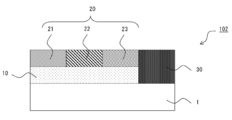
- FIG. 2 shows a second embodiment of the structure of the present invention.
- the structure 102 is provided with a near-infrared absorbing layer 10 and a near-infrared transmitting filter layer 30 on the support 1.
- a color filter layer 20 is laminated on the near-infrared absorbing layer 10.
- the support 1, the near-infrared absorbing layer 10 and the color filter layer 20 have the same meanings as those described in the first embodiment.
- the near-infrared ray transmitting filter layer 30 is a filter layer that transmits at least a part of near infrared rays.
- the near-infrared transmitting filter layer 30 is preferably a filter layer that blocks at least a part of visible light and transmits at least a part of near-infrared light.
- the near-infrared transmissive filter layer 30 has a maximum transmittance of 20% or less (preferably 15% or less, more preferably 10% or less) in the wavelength range of 400 to 640 nm, and transmits in the wavelength range of 1100 to 1300 nm.
- a filter layer satisfying the spectral characteristics in which the minimum value of the rate is 70% or more (preferably 75% or more, more preferably 80% or more) is preferable.
- the near-infrared transmission filter layer 30 is preferably a filter layer that satisfies any of the following spectral characteristics (IP1) to (IP4).
- IP1 The maximum value of the transmittance in the wavelength range of 400 to 640 nm is 20% or less (preferably 15% or less, more preferably 10% or less), and the minimum value of the transmittance in the wavelength range of 800 to 1300 nm is.
- a filter layer of 70% or more preferably 75% or more, more preferably 80% or more.
- IP2 The maximum value of the transmittance in the wavelength range of 400 to 750 nm is 20% or less (preferably 15% or less, more preferably 10% or less), and the minimum value of the transmittance in the wavelength range of 900 to 1300 nm is.
- a filter layer of 70% or more preferably 75% or more, more preferably 80% or more).
- IP3 The maximum value of the transmittance in the wavelength range of 400 to 830 nm is 20% or less (preferably 15% or less, more preferably 10% or less), and the minimum value of the transmittance in the wavelength range of 1000 to 1300 nm is.
- a filter layer of 70% or more (preferably 75% or more, more preferably 80% or more).
- IP4 The maximum value of the transmittance in the wavelength range of 400 to 950 nm is 20% or less (preferably 15% or less, more preferably 10% or less), and the minimum value of the transmittance in the wavelength range of 1100 to 1300 nm is.
- a filter layer of 70% or more preferably 75% or more, more preferably 80% or more).
- the near-infrared transmission filter layer can be formed by using the compositions described in JP-A-2014-130338, JP-A-2013-077009, International Publication No. 2015/166779 and the like.
- composition for forming a near-infrared absorbing layer Next, a composition for forming a near-infrared absorbing layer will be described. This composition for forming a near-infrared absorbing layer is preferably used for forming a near-infrared absorbing layer of the structure of the present invention.
- the composition for forming a near-infrared absorbing layer contains a near-infrared absorbing dye represented by the above-mentioned formula (SQ1).
- the content of the near-infrared absorbing dye represented by the formula (SQ1) is preferably 1% by mass or more, and preferably 3% by mass or more, based on the total solid content of the composition for forming the near-infrared absorbing layer. It is more preferably 5% by mass or more.
- the upper limit of the content of the near-infrared absorbing dye is preferably 50% by mass or less, more preferably 45% by mass or less, and further preferably 40% by mass or less.
- the composition for forming a near-infrared absorbing layer may contain only one kind of near-infrared absorbing dye represented by the formula (SQ1), or may contain two or more kinds. When two or more types are contained, it is preferable that the total amount thereof is within the above range.
- the composition for forming a near-infrared absorbing layer can contain a near-infrared absorbing agent other than the near-infrared absorbing dye represented by the formula (SQ1).
- Other near-infrared absorbers include pyrolopyrrole compounds, cyanine compounds, squarylium compounds, phthalocyanine compounds, naphthalocyanine compounds, quaterylene compounds, merocyanine compounds, croconium compounds, oxonor compounds, iminium compounds, dithiol compounds, triarylmethane compounds, and pyromethene.
- Examples thereof include compounds, azomethine compounds, anthraquinone compounds, dibenzofuranone compounds, dithiolene metal complexes, metal oxides, and metal borides.
- the content of the other near-infrared absorbing agent is preferably 50 parts by mass or less, more preferably 40 parts by mass or less, based on 100 parts by mass of the near-infrared absorbing dye represented by the formula (SQ1). It is more preferably 30 parts by mass or less. Further, the total content of the near-infrared absorbing dye represented by the formula (SQ1) and the other near-infrared absorbing agent is 1% by mass or more in the total solid content of the composition for forming the near-infrared absorbing layer.
- the composition for forming a near-infrared absorbing layer may contain only one kind of other near-infrared absorbing agent, or may contain two or more kinds. When two or more types are contained, it is preferable that the total amount thereof is within the above range.
- the composition for forming a near-infrared absorbing layer does not substantially contain other near-infrared absorbing agents.
- substantially free of other near-infrared absorbers means that the content of other near-infrared absorbers in the total solid content of the composition for forming a near-infrared absorbing layer is 0.5% by mass or less. However, it is preferably 0.1% by mass or less, more preferably 0.05% by mass or less, and particularly preferably not containing other near-infrared absorbers.
- the composition for forming a near-infrared absorbing layer can contain a dye derivative.
- the dye derivative may be either an acidic dye derivative or a basic dye derivative, but is preferably an acidic dye derivative from the viewpoint of pigment dispersibility.
- the details of the dye derivative include those described above, and the compound represented by the above formula (B1) is preferable.
- the content of the dye derivative is preferably 1 to 30% by mass in the total solid content of the composition for forming a near-infrared absorbing layer.
- the lower limit of the content is preferably 3% by mass or more, and more preferably 5% by mass or more.
- the upper limit of the content is preferably 29% by mass or less, more preferably 25% by mass or less, and further preferably 20% by mass or less.
- the content of the near-infrared absorbing dye and the dye derivative represented by the formula (SQ1) is preferably 1 to 70% by mass in the total solid content of the composition for forming the near-infrared absorbing layer.
- the lower limit of the content is preferably 3% by mass or more, and more preferably 5% by mass or more.
- the upper limit of the content is preferably 60% by mass or less, more preferably 55% by mass or less, and further preferably 50% by mass or less. Further, it is preferable to contain 1 to 50 parts by mass of the dye derivative with respect to 100 parts by mass of the near-infrared absorbing dye represented by the formula (SQ1).
- the lower limit of the content is preferably 5 parts by mass or more, and more preferably 10 parts by mass or more.
- the upper limit of the content is preferably 40 parts by mass or less, more preferably 30 parts by mass or less, and further preferably 25 parts by mass or less.
- the composition for forming a near-infrared absorbing layer may contain only one type of dye derivative, or may contain two or more types. When two or more types are contained, it is preferable that the total amount thereof is within the above range.
- the composition for forming a near-infrared absorbing layer preferably contains a polymerizable compound.
- a polymerizable compound a compound that can be polymerized by the action of radicals is preferable. That is, the polymerizable compound is preferably a radically polymerizable compound.
- the polymerizable compound is preferably a compound having one or more ethylenically unsaturated bond-containing groups, more preferably a compound having two or more ethylenically unsaturated bond-containing groups, and contains an ethylenically unsaturated bond. It is more preferable that the compound has three or more groups.
- the upper limit of the number of ethylenically unsaturated bond-containing groups is, for example, preferably 15 or less, and more preferably 6 or less.
- the ethylenically unsaturated bond-containing group include a vinyl group, a styrene group, a (meth) allyl group, a (meth) acryloyl group, and the like, and a (meth) acryloyl group is preferable.
- the polymerizable compound is preferably a (meth) acrylate compound having 3 to 15 functionalities, and more preferably a (meth) acrylate compound having 3 to 6 functionalities.
- polymerizable compound examples include paragraph numbers 0905 to 0108 of JP2009-288705A, paragraphs 0227 of JP2013-209760A, paragraphs 0254 to 0257 of JP2008-292970, and JP-A.
- Examples include the compounds described in the publication, the contents of which are incorporated herein.
- the polymerizable compound may be in either a monomer or a polymer form, but a monomer is preferable.
- the monomer-type polymerizable compound preferably has a molecular weight of 100 to 3000.
- the upper limit is preferably 2000 or less, and more preferably 1500 or less.
- the lower limit is preferably 150 or more, more preferably 250 or more.
- the polymerizable compound is a compound having substantially no molecular weight distribution.
- a compound having a degree of dispersion (weight average molecular weight (Mw) / number average molecular weight (Mn)) of 1.0 to 1.5 is preferable. More preferably 1.0 to 1.3.
- dipentaerythritol triacrylate (commercially available KAYARAD D-330; manufactured by Nippon Kayaku Co., Ltd.), dipentaerythritol tetraacrylate (commercially available KAYARAD D-320; Nihon Kayaku Co., Ltd.) ), Dipentaerythritol penta (meth) acrylate (commercially available KAYARAD D-310; manufactured by Nippon Kayaku Co., Ltd.), dipentaerythritol hexa (meth) acrylate (commercially available KAYARAD DPHA; Nippon Kayaku) NK ester A-DPH-12E manufactured by Shin-Nakamura Chemical Industry Co., Ltd., and a structure in which these (meth) acryloyl groups are bonded via ethylene glycol and / or propylene glycol residues.
- trimethylolpropane tri (meth) acrylate trimethylolpropane propyleneoxy-modified tri (meth) acrylate, trimethylolpropane ethyleneoxy-modified tri (meth) acrylate, and isocyanurate ethyleneoxy-modified tri (meth) acrylate.
- a trifunctional (meth) acrylate compound such as pentaerythritol trimethylolpropane (meth) acrylate.
- Commercially available trifunctional (meth) acrylate compounds include Aronix M-309, M-310, M-321, M-350, M-360, M-313, M-315, M-306, and M-305.
- M-303, M-452, M-450 manufactured by Toagosei Co., Ltd.
- a compound having an acid group can also be used.
- the polymerizable compound in the unexposed portion can be easily removed during development, and the generation of development residue can be suppressed.
- the acid group include a carboxyl group, a sulfo group, a phosphoric acid group and the like, and a carboxyl group is preferable.
- Examples of commercially available products of the polymerizable compound having an acid group include Aronix M-305, M-510, M-520, and Aronix TO-2349 (manufactured by Toagosei Co., Ltd.).
- the acid value of the polymerizable compound having an acid group is preferably 0.1 to 40 mgKOH / g, and more preferably 5 to 30 mgKOH / g.
- a compound having a caprolactone structure can also be used.
- Polymerizable compounds having a caprolactone structure are commercially available from Nippon Kayaku Co., Ltd. as the KAYARAD DPCA series, and examples thereof include DPCA-20, DPCA-30, DPCA-60, and DPCA-120.
- a polymerizable compound having an alkyleneoxy group can also be used.
- the polymerizable compound having an alkyleneoxy group is preferably a polymerizable compound having an ethyleneoxy group and / or a propyleneoxy group, more preferably a polymerizable compound having an ethyleneoxy group, and having 4 to 20 ethyleneoxy groups 3 to 3 to A hexafunctional (meth) acrylate compound is more preferred.
- Commercially available products of the polymerizable compound having an alkyleneoxy group include SR-494, which is a tetrafunctional (meth) acrylate having four ethyleneoxy groups manufactured by Sartomer, and a trifunctional (meth) having three isobutyleneoxy groups. Examples thereof include KAYARAD TPA-330, which is an acrylate.
- a polymerizable compound having a fluorene skeleton can also be used.
- examples of commercially available products of the polymerizable compound having a fluorene skeleton include Ogsol EA-0200 and EA-0300 (manufactured by Osaka Gas Chemical Co., Ltd., a (meth) acrylate monomer having a fluorene skeleton).
- the polymerizable compound it is also preferable to use a compound that does not substantially contain an environmentally regulated substance such as toluene.
- an environmentally regulated substance such as toluene.
- commercially available products of such compounds include KAYARAD DPHA LT and KAYARAD DPEA-12 LT (manufactured by Nippon Kayaku Co., Ltd.).
- Examples of the polymerizable compound include urethane acrylates as described in JP-A-48-041708, JP-A-51-0371993, JP-A-02-032293, and JP-A-02-016765.
- Urethane compounds having an ethylene oxide-based skeleton described in Japanese Patent Publication No. 58-049860, Japanese Patent Publication No. 56-017654, Japanese Patent Publication No. 62-039417, and Japanese Patent Publication No. 62-039418 are also suitable.
- a polymerizable compound having an amino structure or a sulfide structure in the molecule described in JP-A-63-277653, JP-A-63-260909, and JP-A-01-105238.
- the polymerizable compounds are UA-7200 (manufactured by Shin Nakamura Chemical Industry Co., Ltd.), DPHA-40H (manufactured by Nippon Kayaku Co., Ltd.), UA-306H, UA-306T, UA-306I, AH-600, Commercially available products such as T-600, AI-600, and LINK-202UA (manufactured by Kyoeisha Chemical Co., Ltd.) can also be used.
- the content of the polymerizable compound is preferably 0.1 to 40% by mass based on the total solid content of the composition for forming a near-infrared absorbing layer.
- the lower limit is preferably 0.5% by mass or more, and more preferably 1% by mass or more.
- the upper limit is preferably 30% by mass or less, more preferably 20% by mass or less.
- the composition for forming a near-infrared absorbing layer may contain only one type of polymerizable compound, or may contain two or more types. When two or more types are contained, it is preferable that the total amount thereof is within the above range.
- the composition for forming a near-infrared absorbing layer can contain a compound having an epoxy group (hereinafter, also referred to as an epoxy compound).
- the epoxy compound include monofunctional or polyfunctional glycidyl ether compounds, polyfunctional aliphatic glycidyl ether compounds, and compounds having an alicyclic epoxy group.
- the epoxy compound is preferably a compound having 1 to 100 epoxy groups in one molecule.
- the upper limit of the epoxy group may be 10 or less, or 5 or less.
- the lower limit is preferably two or more.
- the epoxy compound may be a low molecular weight compound (for example, a molecular weight of less than 1000) or a high molecular weight compound (macromolecule) (for example, a molecular weight of 1000 or more, and in the case of a polymer, a weight average molecular weight of 1000 or more).
- the weight average molecular weight of the epoxy compound is preferably 2000 to 100000.
- the upper limit of the weight average molecular weight is preferably 10,000 or less, more preferably 5000 or less, and even more preferably 3000 or less.
- Examples of commercially available epoxy compounds include EHPE3150 (manufactured by Daicel Corporation), EPICLON N-695 (manufactured by DIC Corporation), and ADEKA Glycyrrol ED-505 (manufactured by ADEKA Corporation). Further, as the epoxy compound, it is described in paragraph numbers 0034 to 0036 of JP2013-011869A, paragraph numbers 0147 to 0156 of JP-A-2014-0435556, and paragraph numbers 0085-0092 of JP-A-2014-089408. It is also possible to use the compound.
- the content of the epoxy compound is preferably 0.1 to 40% by mass in the total solid content of the composition for forming a near-infrared absorbing layer.
- the lower limit is preferably 0.5% by mass or more, and more preferably 1% by mass or more.
- the upper limit is preferably 30% by mass or less, more preferably 20% by mass or less.
- the composition for forming a near-infrared absorbing layer may contain only one type of epoxy compound, or may contain two or more types of epoxy compounds. When two or more types are contained, it is preferable that the total amount thereof is within the above range.
- Photopolymerization Initiator When the composition for forming a near-infrared absorbing layer contains a polymerizable compound, it is preferable to further contain a photopolymerization initiator.
- the photopolymerization initiator is not particularly limited and may be appropriately selected from known photopolymerization initiators. For example, a compound having photosensitivity to light rays in the ultraviolet region to the visible region is preferable.
- the photopolymerization initiator is preferably a photoradical polymerization initiator.
- photopolymerization initiator examples include halogenated hydrocarbon derivatives (for example, compounds having a triazine skeleton, compounds having an oxadiazole skeleton, etc.), acylphosphine compounds, hexaarylbiimidazoles, oxime compounds, organic peroxides, and thio compounds. , Ketone compounds, aromatic onium salts, ⁇ -hydroxyketone compounds, ⁇ -aminoketone compounds and the like.
- the photopolymerization initiator includes trihalomethyltriazine compound, benzyldimethylketal compound, ⁇ -hydroxyketone compound, ⁇ -aminoketone compound, acylphosphine compound, phosphine oxide compound, metallocene compound, oxime compound, and triarylimidazole. It is preferably a dimer, an onium compound, a benzothiazole compound, a benzophenone compound, an acetophenone compound, a cyclopentadiene-benzene-iron complex, a halomethyloxaziazole compound and a 3-aryl substituted coumarin compound, and an oxime compound and an ⁇ -hydroxyketone compound.
- ⁇ -Aminoketone compound, and acylphosphine compound are more preferable, and an oxime compound is further preferable.
- an oxime compound is further preferable.
- the photopolymerization initiator include compounds described in paragraphs 0065 to 0111 of JP-A-2014-130173 and JP-A-6301489, the contents of which are incorporated in the present specification.
- Examples of commercially available ⁇ -hydroxyketone compounds include Omnirad 184, Omnirad 1173, Omnirad 2959, and Omnirad 127 (all manufactured by IGM Resins BV).
- Examples of commercially available ⁇ -aminoketone compounds include Omnirad 907, Omnirad 369, Omnirad 369E, and Omnirad 379EG (all manufactured by IGM Resins BV).
- Examples of commercially available acylphosphine compounds include Omnirad819 and OmniradTPO (all manufactured by IGM Resins BV).
- Examples of the oxime compound include the compounds described in JP-A-2001-233842, the compounds described in JP-A-2000-080068, the compounds described in JP-A-2006-342166, and J. Am. C. S. The compound according to Perkin II (1979, pp. 1653-1660), J. Mol. C. S. The compound described in Perkin II (1979, pp. 156-162), the compound described in Journal of Photopolymer Science and Technology (1995, pp. 202-232), the compound described in JP-A-2000-066385.
- oxime compound examples include 3-benzoyloxyiminobutane-2-one, 3-acetoxyiminovtan-2-one, 3-propionyloxyiminobutane-2-one, 2-acetoxyiminopentane-3-one, 2-acetoxyimino-1-phenylpropane-1-one, 2-benzoyloxyimino-1-phenylpropan-1-one, 3- (4-toluenesulfonyloxy) iminobutane-2-one, and 2-ethoxycarbonyloxy Examples thereof include imino-1-phenylpropane-1-one.
- IRGACURE-OXE01 IRGACURE-OXE02, IRGACURE-OXE03, IRGACURE-OXE04 (above, manufactured by BASF), TR-PBG-304 (manufactured by Joshu Powerful Electronics New Materials Co., Ltd.), ADEKA PTOMER N-1919.
- a photopolymerization initiator 2 manufactured by ADEKA Corporation and described in JP2012-014502A.
- the oxime compound it is also preferable to use a compound having no coloring property or a compound having high transparency and being hard to discolor.
- Examples of commercially available products include ADEKA ARKULS NCI-730, NCI-831, and NCI-930 (all manufactured by ADEKA Corporation).
- an oxime compound having a fluorene ring can also be used as the photopolymerization initiator.
- Specific examples of the oxime compound having a fluorene ring include the compounds described in JP-A-2014-137466.
- an oxime compound having a skeleton in which at least one benzene ring of the carbazole ring is a naphthalene ring can also be used.
- Specific examples of such an oxime compound include the compounds described in International Publication No. 2013/083505.
- an oxime compound having a fluorine atom can also be used as the photopolymerization initiator.
- Specific examples of the oxime compound having a fluorine atom are described in the compounds described in JP-A-2010-262028, the compounds 24, 36-40 described in JP-A-2014-500852, and JP-A-2013-164471. Compound (C-3) and the like.
- an oxime compound having a nitro group can be used as the photopolymerization initiator.
- the oxime compound having a nitro group is also preferably a dimer.
- Specific examples of the oxime compound having a nitro group include the compounds described in paragraphs 0031 to 0047 of JP2013-114249A and paragraphs 0008-0012 and 0070-0079 of JP2014-137466. Examples thereof include the compound described in paragraphs 0007 to 0025 of Japanese Patent No. 4223071, ADEKA ARKULS NCI-831 (manufactured by ADEKA Corporation).
- an oxime compound having a benzofuran skeleton can also be used as the photopolymerization initiator.
- Specific examples include OE-01 to OE-75 described in International Publication No. 2015/036910.
- the oxime compound is preferably a compound having a maximum absorption wavelength in the wavelength range of 350 to 500 nm, and more preferably a compound having a maximum absorption wavelength in the wavelength range of 360 to 480 nm.
- the molar extinction coefficient of the oxime compound at a wavelength of 365 nm or a wavelength of 405 nm is preferably high, more preferably 1000 to 300,000, further preferably 2000 to 300,000, and more preferably 5000 to 200,000, from the viewpoint of sensitivity. It is particularly preferable to have.
- the molar extinction coefficient of a compound can be measured using a known method. For example, it is preferable to measure at a concentration of 0.01 g / L using an ethyl acetate solvent with a spectrophotometer (Cary-5 spectrophotometer manufactured by Varian).
- a bifunctional or trifunctional or higher functional photoradical polymerization initiator may be used as the photopolymerization initiator.
- a photoradical polymerization initiator two or more radicals are generated from one molecule of the photoradical polymerization initiator, so that good sensitivity can be obtained.
- the crystallinity is lowered, the solubility in a solvent or the like is improved, the precipitation is less likely to occur with time, and the stability of the coloring composition with time can be improved.
- Specific examples of the bifunctional or trifunctional or higher functional photoradical polymerization initiators include JP-A-2010-527339, JP-A-2011-524436, International Publication No.
- the photopolymerization initiator contains an oxime compound and an ⁇ -aminoketone compound.
- the ⁇ -aminoketone compound is preferably 50 to 600 parts by mass, more preferably 150 to 400 parts by mass with respect to 100 parts by mass of the oxime compound.
- the content of the photopolymerization initiator is preferably 0.1 to 40% by mass, more preferably 0.5 to 30% by mass, and further preferably 1 to 20% by mass in the total solid content of the composition for forming a near-infrared absorbing layer. preferable.
- the content of the photopolymerization initiator is within the above range, the sensitivity and pattern forming property are excellent.
- the composition for forming a near-infrared absorbing layer may contain only one type of photopolymerization initiator, or may contain two or more types of photopolymerization initiators. When two or more types are contained, it is preferable that the total amount thereof is within the above range.
- the composition for forming a near-infrared absorbing layer preferably contains a resin.
- the resin is blended, for example, for the purpose of dispersing particles such as pigments in the composition and for the purpose of a binder.
- a resin mainly used for dispersing particles such as pigments is also referred to as a dispersant.
- such an application of the resin is an example, and the resin can be used for a purpose other than such an application.
- the weight average molecular weight (Mw) of the resin is preferably 2000 to 2000000.
- the upper limit is preferably 1,000,000 or less, and more preferably 500,000 or less.
- the lower limit is preferably 3000 or more, and more preferably 5000 or more.
- the resin examples include (meth) acrylic resin, epoxy resin, en-thiol resin, polycarbonate resin, polyether resin, polyarylate resin, polysulfone resin, polyethersulfone resin, polyphenylene resin, polyarylene ether phosphine oxide resin, and polyimide resin.
- examples thereof include polyamideimide resin, polyolefin resin, cyclic olefin resin, polyester resin, and styrene resin. One of these resins may be used alone, or two or more thereof may be mixed and used.
- the cyclic olefin resin a norbornene resin is preferable from the viewpoint of improving heat resistance.
- Examples of commercially available norbornene resins include the ARTON series manufactured by JSR Corporation (for example, ARTON F4520).
- Examples of the epoxy resin include an epoxy resin which is a glycidyl etherified product of a phenol compound, an epoxy resin which is a glycidyl etherified product of various novolak resins, an alicyclic epoxy resin, an aliphatic epoxy resin, a heterocyclic epoxy resin, and a glycidyl ester type.
- Epoxy resin glycidylamine-based epoxy resin, epoxy resin obtained by glycidylizing halogenated phenols, condensate of silicon compound having an epoxy group and other silicon compounds, polymerizable unsaturated compound having an epoxy group and other Examples thereof include a copolymer with another polymerizable unsaturated compound.
- the epoxy resins are Marproof G-0150M, G-0105SA, G-0130SP, G-0250SP, G-1005S, G-1005SA, G-1010S, G-2050M, G-01100, G-01758 (NOF). Epoxy group-containing polymer manufactured by Co., Ltd.) can also be used. Further, as the resin, the resin described in the examples of International Publication No.
- the resin has an ethylenically unsaturated bond-containing group in the side chain, particularly a (meth) acryloyl group
- the main chain and the ethylenically unsaturated bond-containing group are via a divalent linking group having an alicyclic structure. It is also preferable that they are bonded.
- an alkali-soluble resin can also be used. Since the composition for forming a near-infrared absorbing layer contains an alkali-soluble resin, the developability of the composition for forming a near-infrared absorbing layer is improved, and a pattern is formed by a photolithography method using the composition for forming a near-infrared absorbing layer. In some cases, the generation of development residue can be effectively suppressed.
- the alkali-soluble resin include resins having an acid group. Examples of the acid group include a carboxyl group, a phosphoric acid group, a sulfo group, a phenolic hydroxy group and the like, and a carboxyl group is preferable.
- the alkali-soluble resin may have only one type of acid group or two or more types. The alkali-soluble resin can also be used as a dispersant.
- the alkali-soluble resin preferably contains a repeating unit having an acid group in the side chain, and more preferably contains 5 to 70 mol% of the repeating unit having an acid group in the side chain in all the repeating units of the resin.
- the upper limit of the content of the repeating unit having an acid group in the side chain is preferably 50 mol% or less, and more preferably 30 mol% or less.
- the lower limit of the content of the repeating unit having an acid group in the side chain is preferably 10 mol% or more, more preferably 20 mol% or more.
- the alkali-soluble resin is also preferably an alkali-soluble resin having a polymerizable group.
- the polymerizable group include a (meth) allyl group and a (meth) acryloyl group.
- the alkali-soluble resin having a polymerizable group is preferably a resin containing a repeating unit having a polymerizable group in the side chain and a repeating unit having an acid group in the side chain.
- the alkali-soluble resin is a monomer component containing a compound represented by the following formula (ED1) and / or a compound represented by the following formula (ED2) (hereinafter, these compounds may be referred to as "ether dimer”). It is also preferable to include the derived repeating unit.
- R 1 and R 2 each independently represent a hydrocarbon group having 1 to 25 carbon atoms which may have a hydrogen atom or a substituent.
- R represents a hydrogen atom or an organic group having 1 to 30 carbon atoms.
- the alkali-soluble resin preferably contains a repeating unit derived from the compound represented by the following formula (X).
- R 1 represents a hydrogen atom or a methyl group
- R 2 represents an alkylene group having 2 to 10 carbon atoms
- R 3 represents a hydrogen atom or a benzene ring and may contain 1 to 20 carbon atoms.
- n represents an integer from 1 to 15.
- the acid value of the alkali-soluble resin is preferably 30 to 500 mgKOH / g.
- the lower limit is preferably 50 mgKOH / g or more, and more preferably 70 mgKOH / g or more.
- the upper limit is preferably 400 mgKOH / g or less, more preferably 300 mgKOH / g or less, and even more preferably 200 mgKOH / g or less.
- alkali-soluble resin examples include resins having the following structures.
- Me represents a methyl group.
- the composition for forming a near-infrared absorbing layer contains a resin having a basic group.
- the basic group include an amino group and an ammonium base.
- the resin having a basic group may further have an acid group in addition to the basic group.
- a resin having a basic group is preferably used as a dispersant for a compound represented by the formula (SQ1). When the resin having a basic group further has an acid group, such a resin is also an alkali-soluble resin.
- the resin having a basic group examples include a resin having a tertiary amino group and a quaternary ammonium base.
- a resin having a tertiary amino group and a quaternary ammonium base is preferably used as a dispersant for the compound represented by the formula (SQ1).
- the resin having a tertiary amino group and a quaternary ammonium base is preferably a resin having a repeating unit having a tertiary amino group and a repeating unit having a quaternary ammonium base.
- the resin having a tertiary amino group and a quaternary ammonium base may further have a repeating unit having an acid group.
- the resin having a tertiary amino group and a quaternary ammonium base preferably has a block structure.
- the resin having a tertiary amino group and a quaternary ammonium base preferably has an amine value of 10 to 250 mgKOH / g and a quaternary ammonium salt value of 10 to 90 mgKOH / g, and an amine value of 50 to 200 mgKOH. More preferably, it is / g and the quaternary ammonium salt value is 10 to 50 mgKOH / g.
- the weight average molecular weight (Mw) of the resin having a tertiary amino group and a quaternary ammonium base is preferably 3000 to 300,000, and more preferably 5000 to 30000.
- the resin having a tertiary amino group and a quaternary ammonium base is an ethylenically unsaturated monomer having a tertiary amino group, an ethylenically unsaturated monomer having a quaternary ammonium base, and other ethylenically if necessary. It can be produced by copolymerizing an unsaturated monomer.
- Examples of the ethylenically unsaturated monomer having a tertiary amino group and the ethylenically unsaturated monomer having a quaternary ammonium base are those described in Paragraphs 0150 to 0170 of International Publication No. 2018/230486. This content is incorporated herein by reference.
- the resin having a basic group it is also preferable that the resin contains a nitrogen atom in the main chain.
- This resin is also preferably used as a dispersant for the compound represented by the formula (SQ1).
- Resins containing a nitrogen atom in the main chain are poly (lower alkyleneimine) -based repeating units, polyallylamine-based repeating units, polydialylamine-based repeating units, and metaxylene diamine-epichlorohydrin polycondensate-based. It is preferable to include a repeating unit and a repeating unit having at least one nitrogen atom selected from the polyvinylamine-based repeating unit.
- the oligoimine-based resin is a resin having a repeating unit having a partial structure X having a functional group of pKa14 or less and a repeating unit having a side chain containing an oligomer chain or a polymer chain Y having 40 to 10,000 atoms. Is preferable.
- the oligoimine-based resin may further have a repeating unit having an acid group.
- the description in paragraphs 0102 to 0166 of JP2012-255128A can be referred to, and this content is incorporated in the present specification.
- the composition for forming a near-infrared absorbing layer may also contain a resin as a dispersant, and preferably contains a resin as a dispersant.
- the dispersant include an acidic dispersant (acidic resin) and a basic dispersant (basic resin).
- the acidic dispersant (acidic resin) represents a resin in which the amount of acid groups is larger than the amount of basic groups.
- the acidic dispersant (acidic resin) is preferably a resin in which the amount of acid groups accounts for 70 mol% or more when the total amount of the amount of acid groups and the amount of basic groups is 100 mol%, and is substantially an acid. A resin consisting only of groups is more preferable.
- the acid group contained in the acidic dispersant (acidic resin) is preferably a carboxyl group.
- the basic dispersant (basic resin) represents a resin in which the amount of basic groups is larger than the amount of acid groups.
- the basic dispersant (basic resin) is preferably a resin in which the amount of basic groups exceeds 50 mol% when the total amount of the amount of acid groups and the amount of basic groups is 100 mol%.
- the dispersant used in the composition for forming a near-infrared absorbing layer is preferably a resin having a basic group, and more preferably a basic dispersant.
- the resin used as the dispersant examples include the above-mentioned resin having a tertiary amino group and a quaternary ammonium base, an oligoimine resin, and the like. Further, the resin used as the dispersant is preferably a graft resin. Examples of the graft resin include a resin having a repeating unit having a graft chain. The graft resin may further have a repeating unit having an acid group. For details of the graft resin, the description in paragraphs 0025 to 0094 of JP2012-255128A can be referred to, and the content thereof is incorporated in the present specification. Further, the resin used as the dispersant is preferably a resin containing a repeating unit having an acid group.
- the resin used as the dispersant is preferably a resin having a structure in which a plurality of polymer chains are bonded to the core portion.
- resins include dendrimers (including star-shaped polymers).
- specific examples of the dendrimer include the polymer compounds C-1 to C-31 described in paragraphs 0196 to 0209 of JP2013-043962.
- the above-mentioned alkali-soluble resin can also be used as a dispersant.
- the dispersant is also available as a commercially available product, and specific examples thereof include Disperbyk-111 (manufactured by BYK Chemie) and Solspers 76500 (manufactured by Nippon Lubrizol Co., Ltd.). Further, the dispersant described in paragraphs 0041 to 0130 of JP2014-130338A can also be used, and the contents thereof are incorporated in the present specification.
- the resin content is preferably 1 to 50% by mass in the total solid content of the composition for forming a near-infrared absorbing layer.
- the lower limit is preferably 5% by mass or more, more preferably 7% by mass or more.
- the upper limit is preferably 40% by mass or less, more preferably 30% by mass or less.
- the content of the resin having a basic group is 1 with respect to 100 parts by mass of the compound represented by the formula (SQ1). ⁇ 100 parts by mass is preferable.
- the upper limit is preferably 80 parts by mass or less, and more preferably 60 parts by mass or less.
- the lower limit is preferably 2.5 parts by mass or more, and more preferably 5 parts by mass or more.
- the content of the resin having a basic group in the resin contained in the resin composition is preferably 10 to 70% by mass, more preferably 20 to 65% by mass, and 25 to 60% by mass. Is more preferable.
- the content of the alkali-soluble resin is preferably 1 to 50% by mass in the total solid content of the composition for forming a near-infrared absorbing layer.
- the lower limit is preferably 5% by mass or more, more preferably 7% by mass or more.
- the upper limit is preferably 40% by mass or less, more preferably 30% by mass or less.
- the content of the alkali-soluble resin in the resin contained in the composition for forming a near-infrared absorbing layer is preferably 1 to 100% by mass, more preferably 3 to 100% by mass, and 5 to 100% by mass. It is more preferably by mass%.
- the content of the resin as a dispersant is preferably 1 to 100 parts by mass with respect to 100 parts by mass of the pigment.
- the upper limit is preferably 80 parts by mass or less, and more preferably 60 parts by mass or less.
- the lower limit is preferably 2.5 parts by mass or more, and more preferably 5 parts by mass or more.
- the composition for forming a near-infrared absorbing layer may contain only one type of resin, or may contain two or more types of resin. When two or more types are contained, it is preferable that the total amount thereof is within the above range.
- Epoxy curing agent When the composition for forming a near-infrared absorbing layer contains an epoxy compound, it is preferable to further contain an epoxy curing agent.
- the epoxy curing agent include amine compounds, acid anhydride compounds, amide compounds, phenol compounds, polyvalent carboxylic acids, thiol compounds and the like.
- a polyvalent carboxylic acid is preferable from the viewpoint of heat resistance and transparency of the cured product, and a compound having two or more carboxylic acid anhydride groups in the molecule is most preferable.
- Specific examples of the epoxy curing agent include butanedioic acid.
- the compounds described in paragraphs 0072 to 0078 of JP-A-2016-07720 can also be used, and the contents thereof are incorporated in the present specification.
- the content of the epoxy curing agent is preferably 0.01 to 20 parts by mass, more preferably 0.01 to 10 parts by mass, still more preferably 0.1 to 6.0 parts by mass with respect to 100 parts by mass of the epoxy compound. ..
- the composition for forming a near-infrared absorbing layer may contain only one type of epoxy curing agent, or may contain two or more types. When two or more types are contained, it is preferable that the total amount thereof is within the above range.
- the composition for forming a near-infrared absorbing layer preferably contains a solvent.
- a solvent an organic solvent is preferable.
- the organic solvent include ester solvents, ketone solvents, alcohol solvents, amide solvents, ether solvents, hydrocarbon solvents and the like.
- paragraph number 0223 of WO 2015/166779 can be referred to, the contents of which are incorporated herein by reference.
- an ester solvent substituted with a cyclic alkyl group and a ketone solvent substituted with a cyclic alkyl group can also be preferably used.
- organic solvent examples include polyethylene glycol monomethyl ether, dichloromethane, methyl 3-ethoxypropionate, ethyl 3-ethoxypropionate, ethyl cellosolve acetate, ethyl lactate, diethylene glycol dimethyl ether, butyl acetate, methyl 3-methoxypropionate, 2 -Heptanone, cyclohexanone, cyclohexyl acetate, cyclopentanone, ethyl carbitol acetate, butyl carbitol acetate, propylene glycol monomethyl ether, propylene glycol monomethyl ether acetate, 3-methoxy-N, N-dimethylpropanamide, 3-butoxy-N , N-Dimethylpropanamide and the like.
- aromatic hydrocarbons (benzene, toluene, xylene, ethylbenzene, etc.) as organic solvents may need to be reduced for environmental reasons (for example, 50 mass ppm (parts) with respect to the total amount of organic solvent. Per million) or less, 10 mass ppm or less, 1 mass ppm or less)
- the content of the solvent is preferably 10 to 97% by mass with respect to the total amount of the composition for forming the near-infrared absorbing layer.
- the lower limit is preferably 30% by mass or more, more preferably 40% by mass or more, further preferably 50% by mass or more, further preferably 60% by mass or more, and 70% by mass. The above is particularly preferable.
- the upper limit is preferably 96% by mass or less, and more preferably 95% by mass or less.
- the composition for forming a near-infrared absorbing layer may contain only one type of solvent, or may contain two or more types of solvent. When two or more types are contained, it is preferable that the total amount thereof is within the above range.
- the composition for forming a near-infrared absorbing layer can contain a polymerization inhibitor.
- the polymerization inhibitor include hydroquinone, p-methoxyphenol, di-tert-butyl-p-cresol, pyrogallol, tert-butylcatechol, benzoquinone, 4,4'-thiobis (3-methyl-6-tert-butylphenol), and the like.
- examples thereof include 2,2'-methylenebis (4-methyl-6-t-butylphenol) and N-nitrosophenylhydroxyamine salt (ammonium salt, primary cerium salt, etc.), and p-methoxyphenol is preferable.
- the content of the polymerization inhibitor is preferably 0.0001 to 5% by mass based on the total solid content of the composition for forming a near-infrared absorbing layer.
- the composition for forming a near-infrared absorbing layer may contain only one type of polymerization inhibitor, or may contain two or more types. When two or more types are contained, it is preferable that the total amount thereof is within the above range.
- the composition for forming a near-infrared absorbing layer can contain a silane coupling agent.
- the silane coupling agent means a silane compound having a hydrolyzable group and other functional groups.
- the hydrolyzable group refers to a substituent that is directly linked to a silicon atom and can form a siloxane bond by at least one of a hydrolysis reaction and a condensation reaction. Examples of the hydrolyzable group include a halogen atom, an alkoxy group, an acyloxy group and the like, and an alkoxy group is preferable. That is, the silane coupling agent is preferably a compound having an alkoxysilyl group.
- Examples of the functional group other than the hydrolyzable group include a vinyl group, a styryl group, a (meth) acryloyl group, a mercapto group, an epoxy group, an oxetanyl group, an amino group, a ureido group, a sulfide group, an isocyanate group and a phenyl group. Etc., and (meth) acryloyl group and epoxy group are preferable.
- Examples of the silane coupling agent include the compounds described in paragraphs 0018 to 0036 of JP2009-288703A and the compounds described in paragraphs 0056 to 0066 of JP2009-242604A. Incorporated into the specification.
- the content of the silane coupling agent is preferably 0.01 to 15.0% by mass, more preferably 0.05 to 10.0% by mass, based on the total solid content of the composition for forming a near-infrared absorbing layer.
- the composition for forming a near-infrared absorbing layer may contain only one type of silane coupling agent, or may contain two or more types. When two or more types are contained, it is preferable that the total amount thereof is within the above range.
- the composition for forming a near-infrared absorbing layer can contain a surfactant.
- a surfactant various surfactants such as a fluorine-based surfactant, a nonionic surfactant, a cationic surfactant, an anionic surfactant, and a silicon-based surfactant can be used.
- the surfactant the surfactant described in paragraph Nos. 0238 to 0245 of International Publication No. 2015/166779 is mentioned, and the content thereof is incorporated in the present specification.
- the surfactant is preferably a fluorine-based surfactant.
- a fluorine-based surfactant in the composition for forming a near-infrared absorbing layer, the liquid characteristics (particularly, fluidity) can be further improved, and the liquid saving property can be further improved. It is also possible to form a film having a small thickness unevenness.
- the fluorine content in the fluorine-based surfactant is preferably 3 to 40% by mass, more preferably 5 to 30% by mass, and particularly preferably 7 to 25% by mass.
- a fluorine-based surfactant having a fluorine content within this range is effective in terms of uniformity of coating film thickness and liquid saving property, and has good solubility in the composition.
- fluorine-based surfactant examples include the surfactants described in paragraphs 0060 to 0064 of Japanese Patent Application Laid-Open No. 2014-041318 (paragraphs 0060 to 0064 of the corresponding International Publication No. 2014/017669) and the like, JP-A-2011- The surfactants described in paragraphs 0117 to 0132 of JP 132503 are mentioned and their contents are incorporated herein by reference.
- Commercially available products of fluorine-based surfactants include, for example, Megafuck F171, F172, F173, F176, F177, F141, F142, F143, F144, R30, F437, F475, F479, F482, F554, F780, EXP, MFS.
- the fluorine-based surfactant has a molecular structure having a functional group containing a fluorine atom, and an acrylic compound in which a portion of the functional group containing a fluorine atom is cut off and the fluorine atom volatilizes when heat is applied.
- fluorine-based surfactants include Megafvck DS series manufactured by DIC Corporation (The Chemical Daily (February 22, 2016), Nikkei Sangyo Shimbun (February 23, 2016)), for example, Megafvck. DS-21 can be mentioned.
- fluorine-based surfactant it is also preferable to use a polymer of a fluorine atom-containing vinyl ether compound having a fluorinated alkyl group or a fluorinated alkylene ether group and a hydrophilic vinyl ether compound as the fluorine-based surfactant.
- a fluorine-based surfactant include the fluorine-based surfactant described in JP-A-2016-216602, the contents of which are incorporated in the present specification.
- the fluorine-based surfactant a block polymer can also be used.
- the fluorine-based surfactant has a repeating unit derived from a (meth) acrylate compound having a fluorine atom and 2 or more (preferably 5 or more) alkyleneoxy groups (preferably ethyleneoxy groups and propyleneoxy groups) (meth).
- a fluorine-containing polymer compound containing a repeating unit derived from an acrylate compound can also be preferably used.
- the fluorine-containing surfactants described in paragraphs 0016 to 0037 of JP-A-2010-032698 and the following compounds are also exemplified as the fluorine-based surfactants used in the present invention.
- the weight average molecular weight of the above compounds is preferably 3000-50000, for example 14000.
- % indicating the ratio of the repeating unit is mol%.
- a fluorine-based surfactant a fluorine-containing polymer having an ethylenically unsaturated bond-containing group in the side chain can also be used.
- the compounds described in paragraphs 0050 to 0090 and paragraph numbers 0289 to 0295 of JP2010-164965, Megafuck RS-101, RS-102, RS-718K manufactured by DIC Corporation, RS-72-K and the like can be mentioned.
- the fluorine-based surfactant the compounds described in paragraphs 0015 to 0158 of JP2015-117327A can also be used.
- Nonionic surfactants include glycerol, trimethylolpropane, trimethylolethane, their ethoxylates and propoxylates (eg, glycerol propoxylates, glycerol ethoxylates, etc.), polyoxyethylene lauryl ethers, polyoxyethylene stearyl ethers, etc.
- Examples of the silicon-based surfactant include Torre Silicone DC3PA, Torre Silicone SH7PA, Torre Silicone DC11PA, Torre Silicone SH21PA, Torre Silicone SH28PA, Torre Silicone SH29PA, Torre Silicone SH30PA, Torre Silicone SH8400 (all, Toray Dow Corning Co., Ltd.). ), TSF-4440, TSF-4300, TSF-4445, TSF-4460, TSF-4452 (above, manufactured by Momentive Performance Materials), KP-341, KF-6001, KF-6002 (above, (Shin-Etsu Silicone Co., Ltd.), BYK307, BYK323, BYK330 (all manufactured by Big Chemie) and the like.
- the content of the surfactant is preferably 0.001% by mass to 5.0% by mass, more preferably 0.005 to 3.0% by mass, based on the total solid content of the composition for forming a near-infrared absorbing layer.
- the composition for forming a near-infrared absorbing layer may contain only one type of surfactant, or may contain two or more types of surfactants. When two or more types are contained, it is preferable that the total amount thereof is within the above range.
- the composition for forming a near-infrared absorbing layer can contain an ultraviolet absorber.
- the ultraviolet absorber include conjugated diene compounds, aminodiene compounds, salicylate compounds, benzophenone compounds, benzotriazole compounds, acrylonitrile compounds, hydroxyphenyltriazine compounds, indol compounds, and triazine compounds. Specific examples of such compounds include paragraph numbers 0038 to 0052 of JP2009-217221A, paragraph numbers 0052 to 0072 of JP2012-208374A, and paragraph numbers 0317 to JP2013-068814A. 0334, the compounds described in paragraph numbers 0061 to 0080 of JP2016-162946 are mentioned, and their contents are incorporated in the present specification.
- Examples of commercially available ultraviolet absorbers include UV-503 (manufactured by Daito Chemical Co., Ltd.).
- examples of the benzotriazole compound include the MYUA series made by Miyoshi Oil & Fat Co., Ltd. (The Chemical Daily, February 1, 2016).
- the ultraviolet absorber the compounds described in paragraphs 0049 to 0059 of Japanese Patent No. 6268967 can also be used.
- the content of the ultraviolet absorber is preferably 0.01 to 10% by mass, more preferably 0.01 to 5% by mass, based on the total solid content of the composition for forming a near-infrared absorbing layer.
- the composition for forming a near-infrared absorbing layer may contain only one kind of ultraviolet absorber, or may contain two or more kinds. When two or more types are contained, it is preferable that the total amount thereof is within the above range.
- the composition for forming a near-infrared absorbing layer may be a sensitizer, a curing accelerator, a filler, a thermosetting accelerator, a thermosetting inhibitor, a plasticizer, an adhesion accelerator and other auxiliaries (for example, as required). It may contain conductive particles, fillers, defoamers, flame retardants, leveling agents, peeling accelerators, antioxidants, fragrances, surface tension modifiers, chain transfer agents, etc.). Examples of these components include materials described in paragraphs 0101 to 0104, 0107 to 0109, etc. of JP-A-2008-250074. Examples of the antioxidant include a phenol compound, a phosphite ester compound, and a thioether compound.
- a phenol compound having a molecular weight of 500 or more, a phosphite ester compound having a molecular weight of 500 or more, or a thioether compound having a molecular weight of 500 or more is more preferable. These may be used in mixture of 2 or more types.
- any phenol compound known as a phenolic antioxidant can be used.
- Preferred phenolic compounds include hindered phenolic compounds. In particular, a compound having a substituent at a site (ortho position) adjacent to the phenolic hydroxyl group is preferable.
- the antioxidant is also preferably a compound having a phenol group and a phosphite ester group in the same molecule.
- a phosphorus-based antioxidant can also be preferably used.
- a phosphorus-based antioxidant tris [2-[[2,4,8,10-tetrakis (1,1-dimethylethyl) dibenzo [d, f] [1,3,2] dioxaphosfepine-6 -Il] Oxy] Ethyl] amine, Tris [2-[(4,6,9,11-tetra-tert-butyldibenzo [d, f] [1,3,2] dioxaphosfepin-2-yl] ) Oxy] ethyl] amines and ethylbis phosphite (2,4-di-tert-butyl-6-methylphenyl) include at least one compound selected from the group.
- the content of the antioxidant is preferably 0.01 to 20% by mass, more preferably 0.3 to 15% by mass, based on the total solid content of the composition for forming a near-infrared absorbing layer.
- the antioxidant may be of only one type or of two or more types. In the case of two or more types, the total amount is preferably in the above range.
- the viscosity (23 ° C.) of the composition for forming a near-infrared absorbing layer is preferably 1 to 100 mPa ⁇ s, for example, when a film is formed by coating.
- the lower limit is more preferably 2 mPa ⁇ s or more, and further preferably 3 mPa ⁇ s or more.
- the upper limit is more preferably 50 mPa ⁇ s or less, further preferably 30 mPa ⁇ s or less, and particularly preferably 15 mPa ⁇ s or less.
- composition for forming colored pixels is preferably used for forming colored pixels of the color filter layer of the structure of the present invention.
- Examples of the types of colored pixels include red pixels, green pixels, blue pixels, yellow pixels, cyan pixels, magenta pixels, and the like.
- the composition for forming colored pixels used for forming red pixels is also referred to as a composition for forming red pixels. The same applies to the colored pixel forming composition used for colored pixels of other colors.
- the composition for forming colored pixels contains a chromatic dye.
- the chromatic color dye include those described in the above-mentioned color filter layer.
- the chromatic pigment is preferably a pigment.
- the type and content of the chromatic dye to be contained in the composition for forming colored pixels can be appropriately selected according to the type of colored pixels to be formed.
- the composition for forming a red pixel preferably contains at least a red dye as a chromatic color dye.
- the composition for forming a red pixel preferably further contains at least one selected from a yellow pigment and an orange pigment, and more preferably contains at least an orange pigment.
- the content of the red dye in the chromatic dye is preferably 20 to 100% by mass, more preferably 30 to 100% by mass, and even more preferably 40 to 100% by mass.
- the composition for forming a green pixel contains at least a green dye as a chromatic color dye.
- the composition for forming a green pixel preferably further contains a yellow pigment.
- the content of the green dye in the chromatic dye is preferably 20 to 100% by mass, more preferably 30 to 100% by mass, and even more preferably 40 to 100% by mass.
- the composition for forming a blue pixel preferably contains at least a blue dye as a chromatic color dye.
- the composition for forming a blue pixel preferably further contains a purple pigment.
- the content of the blue dye in the chromatic dye is preferably 20 to 100% by mass, more preferably 30 to 100% by mass, and even more preferably 40 to 100% by mass.
- the content of the chromatic dye is preferably 20% by mass or more, more preferably 25% by mass or more, further preferably 30% by mass or more, and more preferably 40% by mass or more in the total solid content of the composition for forming colored pixels. Even more preferably, it is even more preferably 45% by mass or more, and particularly preferably 50% by mass or more.
- the upper limit is preferably 80% by mass or less, more preferably 75% by mass or less.
- the composition for forming colored pixels may contain only one kind of chromatic dye, or may contain two or more kinds. When two or more types are contained, it is preferable that the total amount thereof is within the above range.
- the content of the chromatic dye in the total solid content of the composition for forming a red pixel is preferably 20% by mass or more, more preferably 30% by mass or more, and 40% by mass or more. Is more preferable.
- the upper limit is preferably 70% by mass or less, more preferably 65% by mass or less, and further preferably 60% by mass or less.
- the content of the chromatic dye in the total solid content of the composition for forming green pixels is preferably 20% by mass or more, more preferably 30% by mass or more, and 40% by mass or more. More preferred.
- the upper limit is preferably 70% by mass or less, more preferably 65% by mass or less, and further preferably 60% by mass or less.
- the content of the chromatic dye in the total solid content of the blue pixel forming composition is preferably 20% by mass or more, more preferably 30% by mass or more, and 40% by mass or more. Is more preferable.
- the upper limit is preferably 70% by mass or less, more preferably 65% by mass or less, and further preferably 60% by mass or less.
- the composition for forming colored pixels can further contain a dye derivative.
- the dye derivative include an acidic dye derivative and a basic dye derivative, and a basic dye derivative is preferable.
- the composition for forming a red pixel preferably contains a basic dye derivative. Details of the dye derivative include those described above.
- the content of the dye derivative in the total solid content of the colored pixel forming composition is preferably 1 to 40% by mass.
- the lower limit of the content is preferably 3% by mass or more, and more preferably 5% by mass or more.
- the upper limit of the content is preferably 30% by mass or less, more preferably 25% by mass or less, and further preferably 20% by mass or less. Further, it is preferable to contain 1 to 50 parts by mass of the dye derivative with respect to 100 parts by mass of the chromatic dye.
- the lower limit of the content is preferably 5 parts by mass or more, and more preferably 10 parts by mass or more.
- the upper limit of the content is preferably 40 parts by mass or less, more preferably 30 parts by mass or less, and further preferably 25 parts by mass or less.
- the content of the basic dye derivative in the total solid content of the composition for forming colored pixels is preferably 1 to 40% by mass.
- the lower limit of the content is preferably 3% by mass or more, and more preferably 5% by mass or more.
- the upper limit of the content is preferably 30% by mass or less, more preferably 25% by mass or less, and further preferably 20% by mass or less. Further, it is preferable to contain 1 to 50 parts by mass of the basic dye derivative with respect to 100 parts by mass of the chromatic dye.
- the lower limit of the content is preferably 5 parts by mass or more, and more preferably 10 parts by mass or more.
- the upper limit of the content is preferably 40 parts by mass or less, more preferably 30 parts by mass or less, and further preferably 25 parts by mass or less.
- the total content of the chromatic dye and the basic dye derivative in the total solid content of the composition for forming red pixels is preferably 50% by mass or more, preferably 52% by mass or more. More preferably, 55% by mass or more is further preferable.
- the upper limit is preferably 70% by mass or less, more preferably 65% by mass or less, further preferably 63% by mass or less, and particularly preferably 60% by mass or less.
- the composition for forming a red pixel preferably contains 1 to 50 parts by mass of a basic dye derivative with respect to 100 parts by mass of the chromatic dye.
- the upper limit is preferably 40 parts by mass or less, more preferably 30 parts by mass or less, and further preferably 25 parts by mass or less.
- the lower limit is preferably 5 parts by mass or more, more preferably 10 parts by mass or more, and further preferably 15 parts by mass or more.
- the composition for forming a green pixel may or may not contain a dye derivative. It preferably contains a dye derivative, and more preferably contains a basic dye derivative.
- the total content of the chromatic dye and the dye derivative (preferably a basic dye derivative) in the total solid content of the green pixel forming composition is 50% by mass or more is preferable, 52% by mass or more is more preferable, and 55% by mass or more is further preferable.
- the upper limit is preferably 70% by mass or less, more preferably 65% by mass or less, further preferably 63% by mass or less, and particularly preferably 60% by mass or less.
- the composition for forming green pixels preferably contains 1 to 50 parts by mass of a basic dye derivative with respect to 100 parts by mass of the chromatic dye.
- the upper limit is preferably 40 parts by mass or less, more preferably 30 parts by mass or less, and further preferably 25 parts by mass or less.
- the lower limit is preferably 5 parts by mass or more, more preferably 10 parts by mass or more, and further preferably 15 parts by mass or more.
- the composition for forming a blue pixel may or may not contain a dye derivative. It preferably contains a dye derivative, and more preferably contains a basic dye derivative.
- the blue pixel forming composition contains a dye derivative
- the total content of the chromatic dye and the dye derivative (preferably a basic dye derivative) in the total solid content of the blue pixel forming composition is 50% by mass or more is preferable, 52% by mass or more is more preferable, and 55% by mass or more is further preferable.
- the upper limit is preferably 70% by mass or less, more preferably 65% by mass or less, further preferably 63% by mass or less, and particularly preferably 60% by mass or less.
- the composition for forming a blue pixel preferably contains 1 to 50 parts by mass of a basic dye derivative with respect to 100 parts by mass of the chromatic dye.
- the upper limit is preferably 40 parts by mass or less, more preferably 30 parts by mass or less, and further preferably 25 parts by mass or less.
- the lower limit is preferably 5 parts by mass or more, more preferably 10 parts by mass or more, and further preferably 15 parts by mass or more.
- the composition for forming a yellow pixel, the composition for forming a cyan color pixel, and the composition for forming a magenta color pixel may also contain a dye derivative or may not contain a dye derivative. It preferably contains a dye derivative, and more preferably contains a basic dye derivative.
- the composition for forming colored pixels preferably contains a resin.
- the resin include those described in the section of resin of the composition for forming a near-infrared absorbing layer described above.
- the composition for forming colored pixels can also contain a resin as a dispersant, and preferably contains a resin as a dispersant.
- the resin as the dispersant is preferably a resin having an acid group, and more preferably an acidic dispersant.
- the content of the resin is preferably 1 to 50% by mass in the total solid content of the composition for forming colored pixels.
- the lower limit is preferably 5% by mass or more, more preferably 7% by mass or more.
- the upper limit is preferably 40% by mass or less, more preferably 30% by mass or less.
- the content of the alkali-soluble resin is preferably 1 to 50% by mass in the total solid content of the composition for forming colored pixels.
- the lower limit is preferably 5% by mass or more, more preferably 7% by mass or more.
- the upper limit is preferably 40% by mass or less, more preferably 30% by mass or less.
- the content of the alkali-soluble resin in the resin contained in the composition for forming colored pixels is preferably 1 to 100% by mass, more preferably 3 to 100% by mass, and 5 to 100% by mass. Is more preferable.
- the content of the resin as a dispersant is preferably 1 to 100 parts by mass with respect to 100 parts by mass of the pigment.
- the upper limit is preferably 80 parts by mass or less, and more preferably 60 parts by mass or less.
- the lower limit is preferably 2.5 parts by mass or more, and more preferably 5 parts by mass or more.
- the composition for forming colored pixels may contain only one type of resin, or may contain two or more types of resin. When two or more types are contained, it is preferable that the total amount thereof is within the above range.
- the composition for forming colored pixels further includes a polymerizable compound, an epoxy compound, a photopolymerization initiator, an epoxy curing agent, a solvent, a polymerization inhibitor, a silane coupling agent, a surfactant, an ultraviolet absorber, an antioxidant and the like. Can be contained. These specific examples and contents are the same as those described in the above-mentioned composition for forming a near-infrared absorbing layer.
- the viscosity (23 ° C.) of the composition for forming colored pixels is preferably 1 to 100 mPa ⁇ s, for example, when a film is formed by coating.
- the lower limit is more preferably 2 mPa ⁇ s or more, and further preferably 3 mPa ⁇ s or more.
- the upper limit is more preferably 50 mPa ⁇ s or less, further preferably 30 mPa ⁇ s or less, and particularly preferably 15 mPa ⁇ s or less.
- the storage container for each of the above-mentioned compositions is not particularly limited, and a known storage container can be used.
- a storage container for the purpose of suppressing impurities from being mixed into raw materials and compositions, a multi-layer bottle in which the inner wall of the container is composed of 6 types and 6 layers of resin and a bottle in which 6 types of resin are composed of 7 layers are used. It is also preferable to use it. Examples of such a container include the container described in JP-A-2015-123351.
- the inner wall of the container is preferably made of glass or stainless steel for the purpose of preventing metal elution from the inner wall of the container, improving the storage stability of the composition, and suppressing deterioration of the components.
- compositions can be prepared by mixing the above-mentioned components.
- all the components may be dissolved or dispersed in a solvent at the same time to prepare the composition, or if necessary, two or more solutions or dispersions in which each component is appropriately mixed may be prepared in advance. They may be prepared and mixed at the time of use (at the time of application) to prepare a composition.
- a near-infrared absorbing layer is formed on the support using the composition for forming a near-infrared absorbing layer, and then the composition for forming colored pixels is used on the near-infrared absorbing layer to form each color.
- Colored pixels are formed to form a color filter layer, or colored pixels of each color are formed on a support using a composition for forming colored pixels to form a color filter layer, and then a color filter layer is formed. It can be produced by forming a near-infrared absorbing layer on the composition for forming a near-infrared absorbing layer.
- examples of the support to which each composition is applied include the support described in the above-mentioned blindness of the structure.
- a known method can be used as a method of applying the above composition.
- a drop method drop cast
- a slit coating method for example, a spray method; a roll coating method; a rotary coating method (spin coating); a casting coating method; a slit and spin method; a pre-wet method (for example, JP-A-2009-145395).
- Methods described in the publication Inkjet (for example, on-demand method, piezo method, thermal method), ejection system printing such as nozzle jet, flexographic printing, screen printing, gravure printing, reverse offset printing, metal mask printing, etc.
- Various printing methods; transfer method using a mold or the like; nanoimprint method and the like can be mentioned.
- the application method for inkjet is not particularly limited, and for example, the method shown in "Expandable / Usable Inkjet-Infinite Possibilities Seen in Patents-, Published in February 2005, Sumi Betechno Research" (especially from page 115). (Page 133), and the methods described in JP-A-2003-262716, JP-A-2003-185831, JP-A-2003-261827, JP-A-2012-126830, JP-A-2006-169325, and the like. Can be mentioned.
- the composition layer formed by applying the above composition may be dried (prebaked).
- the prebaking temperature is preferably 150 ° C. or lower, more preferably 120 ° C. or lower, and even more preferably 110 ° C. or lower.
- the lower limit can be, for example, 50 ° C. or higher, or 80 ° C. or higher.
- the prebaking time is preferably 10 seconds to 3000 seconds, more preferably 40 to 2500 seconds, and even more preferably 80 to 220 seconds. Drying can be performed on a hot plate, an oven, or the like.
- a pattern may be formed on the composition layer formed by applying the above composition.
- Examples of the pattern forming method include a pattern forming method using a photolithography method and a pattern forming method using a dry etching method.
- the pattern forming method in the photolithography method is developed by exposing the composition layer formed by applying each composition in a pattern (exposure step) and removing the composition layer in the unexposed portion. It is preferable to include a step of forming a pattern (development step). If necessary, a step of baking the developed pattern (post-baking step) may be provided. Hereinafter, each step will be described.
- the composition layer is exposed in a pattern.
- the composition layer can be exposed in a pattern by exposing the composition layer through a mask having a predetermined mask pattern using a stepper exposure machine, a scanner exposure machine, or the like. As a result, the exposed portion can be cured.
- Examples of radiation (light) that can be used for exposure include g-line and i-line. Further, light having a wavelength of 300 nm or less (preferably light having a wavelength of 180 to 300 nm) can also be used. Examples of the light having a wavelength of 300 nm or less include KrF line (wavelength 248 nm), ArF line (wavelength 193 nm), and KrF line (wavelength 248 nm) is preferable. Further, a long wave light source having a diameter of 300 nm or more can also be used.
- pulse exposure is an exposure method of a method in which light irradiation and pause are repeated in a short cycle (for example, millisecond level or less).
- the pulse width is preferably 100 nanoseconds (ns) or less, more preferably 50 nanoseconds or less, and even more preferably 30 nanoseconds or less.
- the lower limit of the pulse width is not particularly limited, but may be 1 femtosecond (fs) or more, and may be 10 femtoseconds or more.
- the frequency is preferably 1 kHz or higher, more preferably 2 kHz or higher, and even more preferably 4 kHz or higher.
- the upper limit of the frequency is preferably 50 kHz or less, more preferably 20 kHz or less, and further preferably 10 kHz or less.
- Maximum instantaneous intensity is preferably at 50000000W / m 2 or more, more preferably 100000000W / m 2 or more, more preferably 200000000W / m 2 or more.
- the upper limit of the maximum instantaneous intensity is preferably at 1000000000W / m 2 or less, more preferably 800000000W / m 2 or less, further preferably 500000000W / m 2 or less.
- the pulse width is the time during which light is irradiated in the pulse period.
- the frequency is the number of pulse cycles per second.
- the maximum instantaneous illuminance is the average illuminance within the time during which the light is irradiated in the pulse period.
- the pulse cycle is a cycle in which light irradiation and pause in pulse exposure are one cycle.
- Irradiation dose for example, preferably 0.03 ⁇ 2.5J / cm 2, more preferably 0.05 ⁇ 1.0J / cm 2.
- the oxygen concentration at the time of exposure can be appropriately selected, and in addition to the operation in the atmosphere, for example, in a low oxygen atmosphere having an oxygen concentration of 19% by volume or less (for example, 15% by volume, 5% by volume, or substantially). It may be exposed in an oxygen-free environment) or in a high oxygen atmosphere (for example, 22% by volume, 30% by volume, or 50% by volume) in which the oxygen concentration exceeds 21% by volume.
- the exposure illuminance can be set as appropriate, and is usually selected from the range of 1000 W / m 2 to 100,000 W / m 2 (for example, 5000 W / m 2 , 15,000 W / m 2 , or 35,000 W / m 2 ). Can be done. Oxygen concentration and exposure illuminance may appropriately combined conditions, for example, illuminance 10000 W / m 2 at an oxygen concentration of 10 vol%, oxygen concentration of 35 vol% can be such illuminance 20000W / m 2.
- the composition layer in the unexposed portion of the composition layer after exposure is developed and removed to form a pattern.
- the development and removal of the composition layer in the unexposed portion can be performed using a developing solution.
- the composition layer of the unexposed portion in the exposure step is eluted in the developing solution, and only the photocured portion remains on the support.
- the temperature of the developing solution is preferably, for example, 20 to 30 ° C.
- the development time is preferably 20 to 180 seconds. Further, in order to improve the residue removability, the steps of shaking off the developing solution every 60 seconds and further supplying a new developing solution may be repeated several times.
- Examples of the developing solution include organic solvents and alkaline developing solutions, and alkaline developing solutions are preferably used.
- the alkaline developer an alkaline aqueous solution (alkaline developer) obtained by diluting an alkaline agent with pure water is preferable.
- the alkaline agent include ammonia, ethylamine, diethylamine, dimethylethanolamine, diglycolamine, diethanolamine, hydroxyamine, ethylenediamine, tetramethylammonium hydroxide, tetraethylammonium hydroxide, tetrapropylammonium hydroxide, and tetrabutylammonium hydroxide.
- Ethyltrimethylammonium hydroxide Ethyltrimethylammonium hydroxide, benzyltrimethylammonium hydroxide, dimethylbis (2-hydroxyethyl) ammonium hydroxide, choline, pyrrole, piperidine, 1,8-diazabicyclo [5.4.0] -7-undecene and other organic substances.
- alkaline compounds examples include alkaline compounds and inorganic alkaline compounds such as sodium hydroxide, potassium hydroxide, sodium carbonate, sodium hydrogencarbonate, sodium silicate and sodium metasilicate.
- the alkaline agent a compound having a large molecular weight is preferable in terms of environment and safety.
- the concentration of the alkaline agent in the alkaline aqueous solution is preferably 0.001 to 10% by mass, more preferably 0.01 to 1% by mass.
- the developer may further contain a surfactant.
- a surfactant a nonionic surfactant is preferable.
- the developer may be once produced as a concentrated solution and diluted to a concentration required for use.
- the dilution ratio is not particularly limited, but can be set in the range of, for example, 1.5 to 100 times. It is also preferable to wash (rinse) with pure water after development.
- the rinsing is performed by supplying the rinsing liquid to the developed composition layer while rotating the support on which the developed composition layer is formed. It is also preferable to move the nozzle for discharging the rinse liquid from the central portion of the support to the peripheral edge of the support. At this time, when moving the nozzle from the central portion of the support to the peripheral portion, the nozzle may be moved while gradually reducing the moving speed. By rinsing in this way, in-plane variation of rinsing can be suppressed. Further, the same effect can be obtained by gradually reducing the rotation speed of the support while moving the nozzle from the central portion to the peripheral portion of the support.
- Additional exposure treatment and post-baking are post-development curing treatments to complete the curing.
- the heating temperature in the post-baking is, for example, preferably 100 to 240 ° C, more preferably 200 to 240 ° C.
- Post-baking can be performed on the developed film in a continuous or batch manner by using a heating means such as a hot plate, a convection oven (hot air circulation dryer), or a high frequency heater so as to meet the above conditions. ..
- the light used for the exposure is preferably light having a wavelength of 400 nm or less. Further, the additional exposure process may be performed by the method described in Korean Patent Publication No. 10-2017-0122130.
- the composition layer formed by applying the above composition on the support is cured to form a cured product layer, and then the photoresist layer patterned on the cured product layer is formed. Then, using the patterned photoresist layer as a mask, the cured product layer can be dry-etched with an etching gas. In forming the photoresist layer, it is preferable to perform a prebaking treatment.
- the description in paragraphs 0010 to 0067 of JP2013-064993A can be referred to, and this content is incorporated in the present specification.
- the optical filter of the present invention includes the above-mentioned structure of the present invention.
- the optical filter of the present invention can be used for solid-state imaging devices such as CCD (charge coupling element) and CMOS (complementary metal oxide semiconductor), and various devices such as infrared sensors and image display devices.
- CCD charge coupling element
- CMOS complementary metal oxide semiconductor
- the solid-state image sensor of the present invention has the structure of the present invention described above.
- the configuration of the solid-state image sensor of the present invention is not particularly limited as long as it has the structure of the present invention and functions as a solid-state image sensor. For example, the following configuration can be mentioned.
- a solid-state image sensor CCD (charge coupling element) image sensor, CMOS (complementary metal oxide semiconductor) image sensor, etc.
- a transfer electrode made of polysilicon or the like.
- the structure has the structure of the present invention on the device protective film.
- a structure having a condensing means for example, a microlens or the like; the same applies hereinafter
- a condensing means for example, a microlens or the like; the same applies hereinafter
- a structure having a condensing means under the structure of the present invention (the side close to the support), or on the structure of the present invention. It may be configured to have a light collecting means or the like.
- the image display device of the present invention includes the structure of the present invention.
- Examples of the image display device include a liquid crystal display device and an organic electroluminescence (organic EL) display device.
- organic EL organic electroluminescence
- the image display device for example, “Electronic Display Device (Akio Sasaki, Kogyo Chosakai Co., Ltd., published in 1990)", “Display Device (Junaki Ibuki, Sangyo Tosho Co., Ltd., 1989)” Issuance) ”and so on.
- the liquid crystal display device is described in, for example, “Next Generation Liquid Crystal Display Technology (edited by Tatsuo Uchida, Kogyo Chosakai Co., Ltd., published in 1994)”.
- the liquid crystal display device to which the present invention can be applied is not particularly limited, and for example, it can be applied to various types of liquid crystal display devices described in the above-mentioned "next-generation liquid crystal display technology".
- the image display device may have a white organic EL element.
- the white organic EL element preferably has a tandem structure.
- Japanese Patent Application Laid-Open No. 2003-045676 supervised by Akiyoshi Mikami, "Frontiers of Organic EL Technology Development-High Brightness, High Precision, Long Life, Know-how Collection-", Technical Information Association, It is described on pages 326 to 328, 2008 and the like.
- the spectrum of white light emitted by the organic EL element preferably has a strong maximum emission peak in the blue region (430 to 485 nm), the green region (530 to 580 nm), and the yellow region (580 to 620 nm). In addition to these emission peaks, those having a maximum emission peak in the red region (650 to 700 nm) are more preferable.
- the infrared sensor of the present invention includes the structure of the present invention described above.
- the configuration of the infrared sensor is not particularly limited as long as it functions as an infrared sensor.
- the mixed solution having the following composition is mixed for 2 hours with a bead mill (high pressure disperser NANO-3000-10 with decompression mechanism (manufactured by Nippon BEE Co., Ltd.)) using zirconia beads having a diameter of 0.3 mm. Each dispersion was prepared.
- the values shown in the table below are parts by mass.
- IR dyes 1 to 16 Compounds IR-1 to IR-16 having the following structures
- (Dye derivative) Derivative 1 Compound with the following structure (basic dye derivative)
- Derivative 2 Compound with the following structure (acid dye derivative)
- Derivative 3 A compound having the following structure (acid dye derivative)
- Derivative 4 Compound with the following structure (acid dye derivative)
- Derivative 5 Compound with the following structure (acid dye derivative)
- Derivative 6 A compound having the following structure (basic dye derivative)
- Derivative 7 Compound with the following structure (acid dye derivative)
- Derivative 8 Compound with the following structure (acid dye derivative)
- Derivative 9 Compound with the following structure (acid dye derivative)
- Dispersant 1 Resin having the following structure (weight average molecular weight 16800, the numerical value added to the repeating unit of the main chain is the molar ratio, and the numerical value added to the repeating unit of the side chain indicates the number of repeating units of the repeating unit).
- Dispersant 2 Resin having the following structure (weight average molecular weight 20000, the numerical value added to the repeating unit of the main chain is the molar ratio, and the numerical value added to the repeating unit of the side chain indicates the number of repeating units of the repeating unit).
- Dispersant 3 Resin having the following structure (weight average molecular weight 20000, the numerical value added to the repeating unit of the main chain is the molar ratio, and the numerical value added to the repeating unit of the side chain indicates the number of repeating units of the repeating unit).
- Dispersant 4 Resin having the following structure (weight average molecular weight 22900, the numerical value added to the repeating unit of the main chain is the molar ratio, and the numerical value added to the repeating unit of the side chain indicates the number of repeating units of the repeating unit).
- Dispersant 6 Solsperse 36000 (manufactured by Nippon Lubrizol Co., Ltd.)
- IR composition ⁇ Preparation of composition for forming near-infrared absorbing layer (IR composition)>
- the raw materials shown in the table below are mixed and stirred at the ratio (parts by mass) shown in the table below, and then filtered through a nylon filter (manufactured by Nippon Pole Co., Ltd.) having a pore size of 0.45 ⁇ m to obtain an IR composition. Prepared.
- the values shown in the table below are parts by mass.
- Resin Resin having the following structure (weight average molecular weight 41400, the numerical value added to the repeating unit of the main chain is the molar ratio).
- Resin 1 Resin having the following structure (weight average molecular weight 20000, the numerical value added to the repeating unit of the main chain is the molar ratio, and the numerical value added to the repeating unit of the side chain indicates the number of repeating units of the repeating unit).
- Resin 2 Resin having the following structure (weight average molecular weight 11000, the numerical value added to the repeating unit of the main chain is the molar ratio).
- Resin 3 Resin having the following structure (weight average molecular weight 12100, the numerical value added to the repeating unit is the molar ratio).
- Polymerizable compound Polymerizable Compound 1: NK Ester A-TMMT (manufactured by Shin Nakamura Chemical Industry Co., Ltd.)
- Photopolymerization initiator Photopolymerization initiator
- Photopolymerization Initiator 1 IRGACURE-OXE02 (manufactured by BASF)
- Photopolymerization Initiator 2 IRGACURE-OXE01 (manufactured by BASF)
- Photopolymerization Initiator 3 Compound with the following structure
- UV absorber 1 UV-503 (manufactured by Daito Kagaku Co., Ltd.)
- Antioxidant Antioxidant 1: Neo Heliopan 357 (manufactured by Symrise)
- Polymerization inhibitor 1 Polymerization inhibitor 1: p-methoxyphenol
- Epoxy compound 1 Epoxy compound 1: EHPE-3105 (manufactured by Daicel Corporation)
- Surfactant 2 KF-6001 (manufactured by Shinetsu Silicone Co., Ltd.)
- IR composition near-infrared absorbing layer forming composition
- the near-infrared absorbing layer forming composition (IR composition) described in the table below is applied onto a glass substrate by a spin coating method so that the film thickness after film formation becomes 1.0 ⁇ m, and then a hot plate is used. Then, it was heated at 100 ° C. for 2 minutes. Next, the entire surface was exposed with an exposure amount of 1000 mJ / cm 2 using an i-line stepper exposure apparatus FPA-3000i5 + (manufactured by Canon Inc.). Next, using a hot plate, it was heated at 200 ° C. for 5 minutes to form a near-infrared absorbing layer.
- FPA-3000i5 + manufactured by Canon Inc.
- the Green composition described in the table below is applied onto the near-infrared absorbing layer by a spin coating method so that the film thickness after film formation is 1.0 ⁇ m, and then 100 using a hot plate. It was heated at ° C. for 2 minutes.
- an i-line stepper exposure apparatus FPA-3000i5 + manufactured by Canon Inc.
- exposure was performed at an exposure amount of 1000 mJ / cm 2 through a mask having an ISLAND pattern of 1 cm square.
- paddle development was carried out at 23 ° C. for 60 seconds using a 0.3% by mass aqueous solution of tetramethylammonium hydroxide (TMAH). Then, it was rinsed with a spin shower and then washed with pure water.
- TMAH tetramethylammonium hydroxide
- the green pixels were formed on the near-infrared absorbing layer by heating at 200 ° C. for 5 minutes.
- the Red composition and the Blue composition shown in the table below were also sequentially patterned to form red pixels and blue pixels, respectively, to form a color filter layer having green pixels, red pixels, and blue pixels. In this way, a structure in which a color filter layer having a Bayer pattern of green pixels, red pixels, and blue pixels is laminated on the near-infrared absorbing layer is manufactured.
- an ultraviolet-visible near-infrared spectrophotometer (U-4100, manufactured by Hitachi High-Technologies Corporation) was used to set the light transmittance of the green pixel area, red pixel area, and blue pixel area at a wavelength of 400 to 1300 nm. Measured in the range.
- the transmittance in the wavelength range of 400 to 1300 nm after heating of the green pixel area, the red pixel area and the blue pixel area was measured.
- the difference in transmittance in the wavelength range of 700 to 1000 nm between the green pixel area, red pixel area and blue pixel area of the structure after heating is calculated, and the difference between the green pixel area, red pixel area and blue pixel area in the above range is calculated.
- the total value ( ⁇ T) of the difference in transmittance was obtained, and the near-infrared shading unevenness was evaluated. The smaller the value of ⁇ T, the smaller the shading unevenness.
- the judgment criteria are as follows. A: ⁇ T ⁇ 2% B: 2% ⁇ ⁇ T ⁇ 5% C: 5% ⁇ ⁇ T
- Support 10 Near infrared ray absorbing layer 20: Color filter layer 21 to 23: Colored pixel 30: Near infrared ray transmitting filter layer 101, 102: Structure
Landscapes
- Physics & Mathematics (AREA)
- General Physics & Mathematics (AREA)
- Optics & Photonics (AREA)
- Engineering & Computer Science (AREA)
- Theoretical Computer Science (AREA)
- Optical Filters (AREA)
- Solid State Image Pick-Up Elements (AREA)
- Devices For Indicating Variable Information By Combining Individual Elements (AREA)
Abstract
所定の近赤外線吸収色素を含む近赤外線吸収層と、近赤外線吸収層と隣接して配置された有彩色色素を含むカラーフィルタ層と、を有する構造体。カラーフィルタ層は、2色以上の着色画素を有し、かつ、2色以上の着色画素のうち少なくとも1色の着色画素は塩基性色素誘導体を含む。構造体を含む光学フィルタ、固体撮像素子、画像表示装置および赤外線センサ。
Description
本発明は、近赤外線吸収色素を含む近赤外線吸収層と有彩色色素を含むカラーフィルタ層とを有する構造体に関する。また、構造体を含む光学フィルタ、固体撮像素子、画像表示装置および赤外線センサに関する。
ビデオカメラ、デジタルスチルカメラ、カメラ機能付き携帯電話などには、カラー画像の固体撮像素子である、CCD(電荷結合素子)や、CMOS(相補型金属酸化膜半導体)が用いられている。これら固体撮像素子は、その受光部において赤外線に感度を有するシリコンフォトダイオードを使用している。このため、近赤外線吸収層を設けて視感度補正を行うことがある。
例えば、特許文献1には、近赤外線吸収色素を含む近赤外線吸収層と、近赤外線吸収層と厚み方向で隣接して配置された有彩色色素を含むカラーフィルタ層とを有する構造体を固体撮像素子などに用いることが記載されている。
また、近赤外線吸収層としては、近赤外線吸収色素を含むものなどが用いられている。近赤外線吸収色素の一つとして、スクアリリウム化合物が知られている。また、特許文献2、3には、近赤外線吸収色素である特定の構造のスクアリリウム化合物が記載されている。
本発明者が近赤外線吸収層上にカラーフィルタ層を積層した構造体について鋭意検討したところ、このような構造体を長期間加熱すると、構造体の面方向で近赤外線遮蔽性のムラが生じやすい傾向にあることが分かった。
よって、本発明の目的は、長期間加熱後も近赤外線遮蔽性のムラの発生が抑制された構造体、光学フィルタ、固体撮像素子、画像表示装置および赤外線センサを提供することにある。
本発明者の検討によれば、後述する構造体を用いることで上記目的を達成できることを見出し、本発明を完成するに至った。本発明は以下を提供する。
<1> 下記式(SQ1)で表される近赤外線吸収色素を含む近赤外線吸収層と、
上記近赤外線吸収層と隣接して配置された有彩色色素を含むカラーフィルタ層と、を有し、
上記カラーフィルタ層は、2色以上の着色画素を有し、かつ、上記2色以上の着色画素のうち少なくとも1色の着色画素は塩基性色素誘導体を含む、構造体;
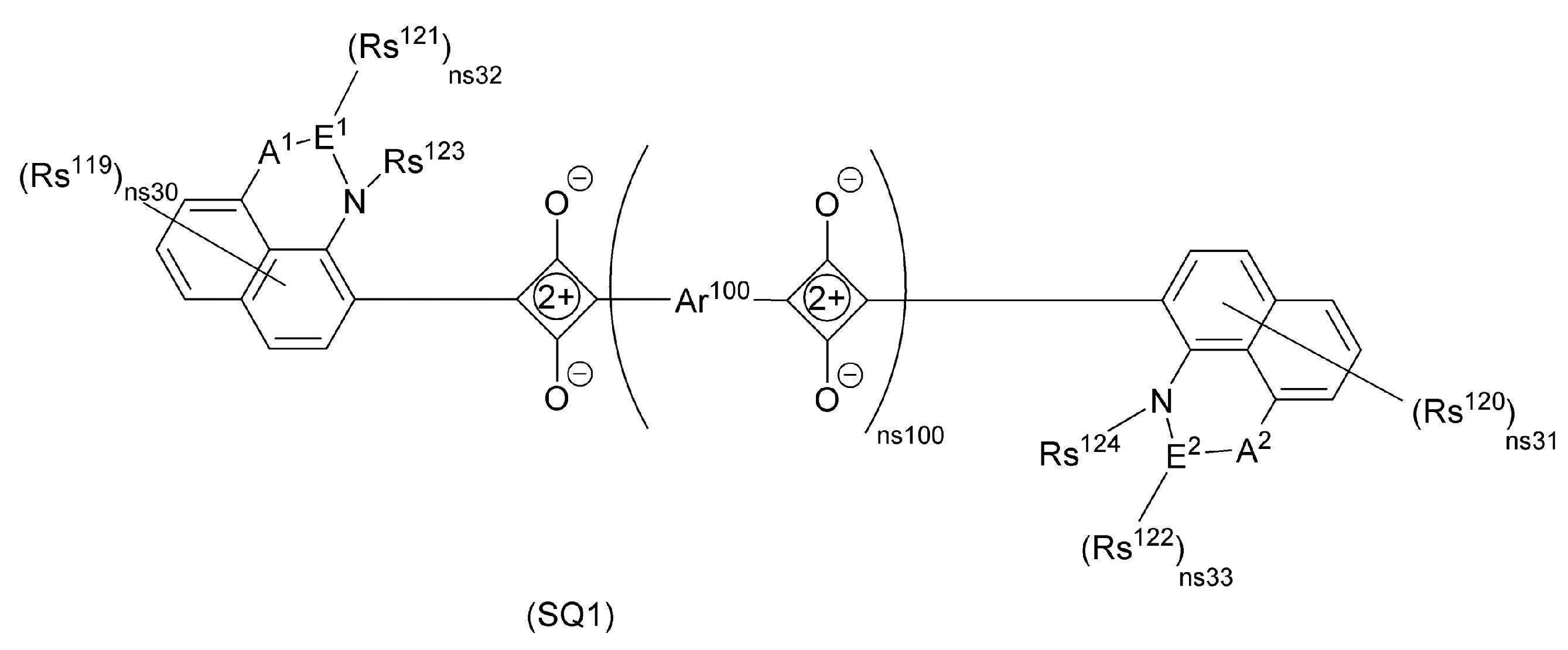
式中、Rs119およびRs120はそれぞれ独立して置換基を表し、
A1およびA2は、それぞれ独立して、酸素原子または-N(Rs125)-を表し、
Rs121~Rs125はそれぞれ独立して、水素原子または置換基を表し、
E1およびE2はそれぞれ独立に炭素原子、ホウ素原子または-C(=O)-を表し、
E1が炭素原子の場合にはns32は2であり、ホウ素原子の場合にはns32は1であり、-C(=O)-の場合にはns32は0であり、
E2が炭素原子の場合にはns33は2であり、ホウ素原子の場合にはns33は1であり、-C(=O)-の場合にはns33は0であり、
ns30およびns31はそれぞれ独立に0~5の整数を表し、
ns30が2以上の場合は、複数のRs119は、同一であっても異なっていてもよく、複数のRs119のうち2個のRs119同士が結合して環を形成してもよく、
ns31が2以上の場合は、複数のRs120は、同一であっても異なっていてもよく、複数のRs120のうち2個のRs120同士が結合して環を形成してもよく、
ns32が2の場合は、2個のRs121は同一であっても異なっていてもよく、2個のRs121同士が結合して環を形成してもよく、
ns33が2の場合は、2個のRs122は同一であっても異なっていてもよく、2個のRs122同士が結合して環を形成してもよく、
Ar100はアリーレン基またはヘテロアリーレン基を表し、
ns100は0~2の整数を表す。
<2> 上記式(SQ1)で表される近赤外線吸収色素が、式(SQ2)で表される近赤外線吸収色素である、<1>に記載の構造体;
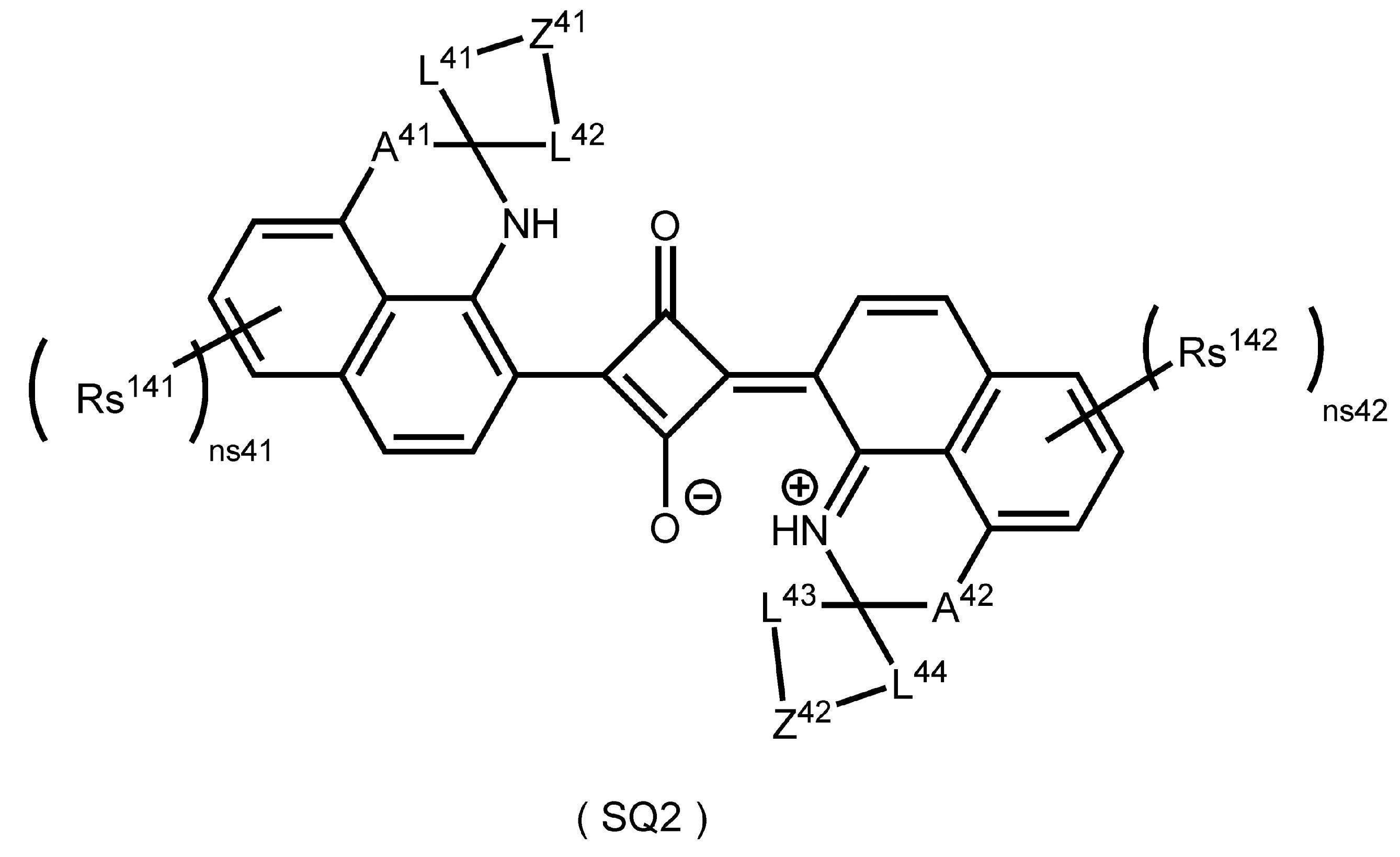
式中、L41~L44はそれぞれ独立に、アルキレン基、アルキニレン基、アリーレン基、複素環基、又は、これらを2以上結合した二価の基を表し、
Z41およびZ42はそれぞれ独立に、単結合、-O-、-C(=O)-、-S-、-N(RN1)-、-S(=O)-、又は、-S(=O)2-を表し、
A41およびA42は、それぞれ独立して酸素原子または-N(RN2)-を表し、
RN1およびRN2は、それぞれ独立して水素原子、アルキル基、又は、アリール基を表し、
Rs141およびRs142は、それぞれ独立して置換基を表し、
ns41およびns42はそれぞれ独立して0~5の整数を表し、
ns41が2以上の場合は、複数のRs141は、同一であっても異なっていてもよく、複数のRs141のうち2個のRs141同士が結合して環を形成してもよく、
ns42が2以上の場合は、複数のRs142は、同一であっても異なっていてもよく、複数のRs142のうち2個のRs142同士が結合して環を形成してもよい;
ただし、L41~L44がアルキレン基で、Z41およびZ42が単結合で、A41およびA42が-N(RN2)-の場合、ns41およびns42の少なくとも一方は1~5の整数である。
<3> 上記式(SQ1)で表される近赤外線吸収色素が、式(SQ3)で表される近赤外線吸収色素である、<1>に記載の構造体;
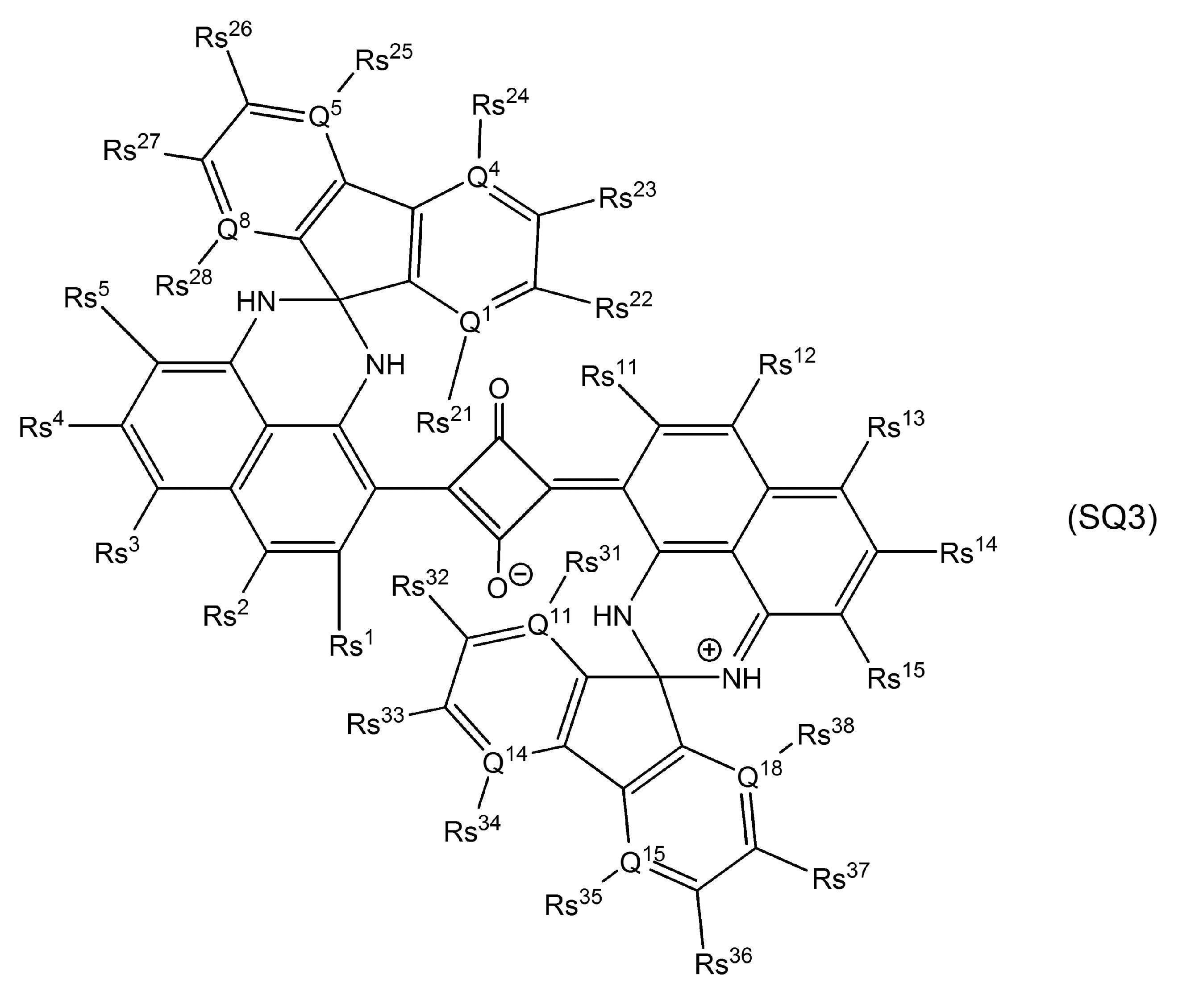
式中、Q1、Q4、Q5、Q8、Q11、Q14、Q15およびQ18は、それぞれ独立に、炭素原子又は窒素原子を表す;
Rs1~Rs5、Rs11~Rs15は、それぞれ独立に、水素原子、アルキル基、スルホ基、-SO3M1又はハロゲン原子を表し、M1は無機又は有機のカチオンを表し、Rs2とRs3、Rs12とRs13は互いに結合して環を形成してもよい;
Rs21~Rs28、Rs31~Rs38は、それぞれ独立に、水素原子、アルキル基、アルケニル基、アリール基、アラルキル基、アルコキシ基、アリールオキシ基、ヒドロキシ基、-NRX1RX2、スルホ基、-SO3M2、-SO2NRX1RX2、-COORX3、-CONRX1RX2、ニトロ基、シアノ基又はハロゲン原子を表し、M2は無機又は有機のカチオンを表し、RX1~RX3は、それぞれ独立に、水素原子、アルキル基、アリール基、アシル基又は複素環基を表し、RX1とRX2は互いに結合して環を形成してもよく、Rs21~Rs28、Rs31~Rs38のうち、隣接する基同士は互いに結合して環を形成してもよい;
Q1が窒素原子の場合、Rs21は存在せず、Q4が窒素原子の場合、Rs24は存在せず、Q5が窒素原子の場合、Rs25は存在せず、Q8が窒素原子の場合、Rs28は存在せず、Q11が窒素原子の場合、Rs31は存在せず、Q14が窒素原子の場合、Rs34は存在せず、Q15が窒素原子の場合、Rs35は存在せず、Q18が窒素原子の場合、Rs38は存在しない。
<4> 上記カラーフィルタ層は、赤色画素、青色画素および緑色画素を少なくとも有し、
上記赤色画素は塩基性色素誘導体を含む、<1>~<3>のいずれか1つに記載の構造体。
<5> 上記赤色画素は有彩色色素と塩基性色素誘導体とを合計で50質量%以上含む、<4>に記載の構造体。
<6> 上記近赤外線吸収層は酸性色素誘導体を含む、<1>~<5>のいずれか1つに記載の構造体。
<7> 上記酸性色素誘導体がスクアリリウム化合物である、<6>に記載の構造体。
<8> <1>~<7>のいずれか1つに記載の構造体を含む光学フィルタ。
<9> <1>~<7>のいずれか1つに記載の構造体を含む固体撮像素子。
<10> <1>~<7>のいずれか1つに記載の構造体を含む画像表示装置。
<11> <1>~<7>のいずれか1つに記載の構造体を含む赤外線センサ。
<1> 下記式(SQ1)で表される近赤外線吸収色素を含む近赤外線吸収層と、
上記近赤外線吸収層と隣接して配置された有彩色色素を含むカラーフィルタ層と、を有し、
上記カラーフィルタ層は、2色以上の着色画素を有し、かつ、上記2色以上の着色画素のうち少なくとも1色の着色画素は塩基性色素誘導体を含む、構造体;
A1およびA2は、それぞれ独立して、酸素原子または-N(Rs125)-を表し、
Rs121~Rs125はそれぞれ独立して、水素原子または置換基を表し、
E1およびE2はそれぞれ独立に炭素原子、ホウ素原子または-C(=O)-を表し、
E1が炭素原子の場合にはns32は2であり、ホウ素原子の場合にはns32は1であり、-C(=O)-の場合にはns32は0であり、
E2が炭素原子の場合にはns33は2であり、ホウ素原子の場合にはns33は1であり、-C(=O)-の場合にはns33は0であり、
ns30およびns31はそれぞれ独立に0~5の整数を表し、
ns30が2以上の場合は、複数のRs119は、同一であっても異なっていてもよく、複数のRs119のうち2個のRs119同士が結合して環を形成してもよく、
ns31が2以上の場合は、複数のRs120は、同一であっても異なっていてもよく、複数のRs120のうち2個のRs120同士が結合して環を形成してもよく、
ns32が2の場合は、2個のRs121は同一であっても異なっていてもよく、2個のRs121同士が結合して環を形成してもよく、
ns33が2の場合は、2個のRs122は同一であっても異なっていてもよく、2個のRs122同士が結合して環を形成してもよく、
Ar100はアリーレン基またはヘテロアリーレン基を表し、
ns100は0~2の整数を表す。
<2> 上記式(SQ1)で表される近赤外線吸収色素が、式(SQ2)で表される近赤外線吸収色素である、<1>に記載の構造体;
Z41およびZ42はそれぞれ独立に、単結合、-O-、-C(=O)-、-S-、-N(RN1)-、-S(=O)-、又は、-S(=O)2-を表し、
A41およびA42は、それぞれ独立して酸素原子または-N(RN2)-を表し、
RN1およびRN2は、それぞれ独立して水素原子、アルキル基、又は、アリール基を表し、
Rs141およびRs142は、それぞれ独立して置換基を表し、
ns41およびns42はそれぞれ独立して0~5の整数を表し、
ns41が2以上の場合は、複数のRs141は、同一であっても異なっていてもよく、複数のRs141のうち2個のRs141同士が結合して環を形成してもよく、
ns42が2以上の場合は、複数のRs142は、同一であっても異なっていてもよく、複数のRs142のうち2個のRs142同士が結合して環を形成してもよい;
ただし、L41~L44がアルキレン基で、Z41およびZ42が単結合で、A41およびA42が-N(RN2)-の場合、ns41およびns42の少なくとも一方は1~5の整数である。
<3> 上記式(SQ1)で表される近赤外線吸収色素が、式(SQ3)で表される近赤外線吸収色素である、<1>に記載の構造体;
Rs1~Rs5、Rs11~Rs15は、それぞれ独立に、水素原子、アルキル基、スルホ基、-SO3M1又はハロゲン原子を表し、M1は無機又は有機のカチオンを表し、Rs2とRs3、Rs12とRs13は互いに結合して環を形成してもよい;
Rs21~Rs28、Rs31~Rs38は、それぞれ独立に、水素原子、アルキル基、アルケニル基、アリール基、アラルキル基、アルコキシ基、アリールオキシ基、ヒドロキシ基、-NRX1RX2、スルホ基、-SO3M2、-SO2NRX1RX2、-COORX3、-CONRX1RX2、ニトロ基、シアノ基又はハロゲン原子を表し、M2は無機又は有機のカチオンを表し、RX1~RX3は、それぞれ独立に、水素原子、アルキル基、アリール基、アシル基又は複素環基を表し、RX1とRX2は互いに結合して環を形成してもよく、Rs21~Rs28、Rs31~Rs38のうち、隣接する基同士は互いに結合して環を形成してもよい;
Q1が窒素原子の場合、Rs21は存在せず、Q4が窒素原子の場合、Rs24は存在せず、Q5が窒素原子の場合、Rs25は存在せず、Q8が窒素原子の場合、Rs28は存在せず、Q11が窒素原子の場合、Rs31は存在せず、Q14が窒素原子の場合、Rs34は存在せず、Q15が窒素原子の場合、Rs35は存在せず、Q18が窒素原子の場合、Rs38は存在しない。
<4> 上記カラーフィルタ層は、赤色画素、青色画素および緑色画素を少なくとも有し、
上記赤色画素は塩基性色素誘導体を含む、<1>~<3>のいずれか1つに記載の構造体。
<5> 上記赤色画素は有彩色色素と塩基性色素誘導体とを合計で50質量%以上含む、<4>に記載の構造体。
<6> 上記近赤外線吸収層は酸性色素誘導体を含む、<1>~<5>のいずれか1つに記載の構造体。
<7> 上記酸性色素誘導体がスクアリリウム化合物である、<6>に記載の構造体。
<8> <1>~<7>のいずれか1つに記載の構造体を含む光学フィルタ。
<9> <1>~<7>のいずれか1つに記載の構造体を含む固体撮像素子。
<10> <1>~<7>のいずれか1つに記載の構造体を含む画像表示装置。
<11> <1>~<7>のいずれか1つに記載の構造体を含む赤外線センサ。
本発明によれば、長期間加熱後も近赤外線遮蔽性のムラの発生が抑制された構造体、光学フィルタ、固体撮像素子、画像表示装置および赤外線センサを提供することができる。
以下において、本発明の内容について詳細に説明する。
本明細書において、「~」を用いて表される数値範囲は「~」の前後に記載される数値を下限値および上限値として含む範囲を意味する。
本明細書における基(原子団)の表記において、置換および無置換を記していない表記は、置換基を有さない基(原子団)と共に置換基を有する基(原子団)をも包含する。例えば、「アルキル基」とは、置換基を有さないアルキル基(無置換アルキル基)のみならず、置換基を有するアルキル基(置換アルキル基)をも包含する。
本明細書において、「露光」とは、特に断らない限り、光を用いた露光のみならず、電子線、イオンビーム等の粒子線を用いた描画も含む。また、露光に用いられる光としては、水銀灯の輝線スペクトル、エキシマレーザに代表される遠紫外線、極紫外線(EUV光)、X線、電子線等の活性光線または放射線が挙げられる。
本明細書において、「(メタ)アクリレート」は、アクリレートおよびメタクリレートの双方、または、いずれかを表し、「(メタ)アクリル」は、アクリルおよびメタクリルの双方、または、いずれかを表し、「(メタ)アリル」は、アリルおよびメタリルの双方、または、いずれかを表し、「(メタ)アクリロイル」は、アクリロイルおよびメタクリロイルの双方、または、いずれかを表す。
本明細書において、重量平均分子量および数平均分子量は、ゲルパーミエーションクロマトグラフィ(GPC)測定でのポリスチレン換算値として定義される。本明細書において、重量平均分子量(Mw)および数平均分子量(Mn)は、例えば、HLC-8220(東ソー(株)製)を用い、カラムとしてTSKgel Super AWM―H(東ソー(株)製、6.0mmID(内径)×15.0cm)を用い、溶離液として10mmol/L リチウムブロミドNMP(N-メチルピロリジノン)溶液を用いることによって求めることができる。
本明細書において、近赤外線とは波長700~2500nmの光(電磁波)をいう。
本明細書において、全固形分とは、組成物の全成分から溶剤を除いた成分の総質量をいう。
本明細書において、顔料とは、溶剤に対して溶解しにくい化合物を意味する。例えば、顔料は、23℃の水100gに対する溶解度および23℃のプロピレングリコールモノメチルエーテルアセテート100gに対する溶解度がいずれも0.1g未満であることが好ましく、0.01g以下であることがより好ましい。
本明細書において、「工程」との語は、独立した工程を表すだけではなく、他の工程と明確に区別できない場合であってもその工程の所期の作用が達成されれば、本用語に含まれる。
本明細書において、「~」を用いて表される数値範囲は「~」の前後に記載される数値を下限値および上限値として含む範囲を意味する。
本明細書における基(原子団)の表記において、置換および無置換を記していない表記は、置換基を有さない基(原子団)と共に置換基を有する基(原子団)をも包含する。例えば、「アルキル基」とは、置換基を有さないアルキル基(無置換アルキル基)のみならず、置換基を有するアルキル基(置換アルキル基)をも包含する。
本明細書において、「露光」とは、特に断らない限り、光を用いた露光のみならず、電子線、イオンビーム等の粒子線を用いた描画も含む。また、露光に用いられる光としては、水銀灯の輝線スペクトル、エキシマレーザに代表される遠紫外線、極紫外線(EUV光)、X線、電子線等の活性光線または放射線が挙げられる。
本明細書において、「(メタ)アクリレート」は、アクリレートおよびメタクリレートの双方、または、いずれかを表し、「(メタ)アクリル」は、アクリルおよびメタクリルの双方、または、いずれかを表し、「(メタ)アリル」は、アリルおよびメタリルの双方、または、いずれかを表し、「(メタ)アクリロイル」は、アクリロイルおよびメタクリロイルの双方、または、いずれかを表す。
本明細書において、重量平均分子量および数平均分子量は、ゲルパーミエーションクロマトグラフィ(GPC)測定でのポリスチレン換算値として定義される。本明細書において、重量平均分子量(Mw)および数平均分子量(Mn)は、例えば、HLC-8220(東ソー(株)製)を用い、カラムとしてTSKgel Super AWM―H(東ソー(株)製、6.0mmID(内径)×15.0cm)を用い、溶離液として10mmol/L リチウムブロミドNMP(N-メチルピロリジノン)溶液を用いることによって求めることができる。
本明細書において、近赤外線とは波長700~2500nmの光(電磁波)をいう。
本明細書において、全固形分とは、組成物の全成分から溶剤を除いた成分の総質量をいう。
本明細書において、顔料とは、溶剤に対して溶解しにくい化合物を意味する。例えば、顔料は、23℃の水100gに対する溶解度および23℃のプロピレングリコールモノメチルエーテルアセテート100gに対する溶解度がいずれも0.1g未満であることが好ましく、0.01g以下であることがより好ましい。
本明細書において、「工程」との語は、独立した工程を表すだけではなく、他の工程と明確に区別できない場合であってもその工程の所期の作用が達成されれば、本用語に含まれる。
<構造体>
本発明の構造体は、式(SQ1)で表される近赤外線吸収色素を含む近赤外線吸収層と、近赤外線吸収層と隣接して配置された有彩色色素を含むカラーフィルタ層と、を有し、カラーフィルタ層は、2色以上の着色画素を有し、かつ、2色以上の着色画素のうち少なくとも1色の着色画素は塩基性色素誘導体を含むことを特徴とする。
本発明の構造体は、式(SQ1)で表される近赤外線吸収色素を含む近赤外線吸収層と、近赤外線吸収層と隣接して配置された有彩色色素を含むカラーフィルタ層と、を有し、カラーフィルタ層は、2色以上の着色画素を有し、かつ、2色以上の着色画素のうち少なくとも1色の着色画素は塩基性色素誘導体を含むことを特徴とする。
本発明の構造体によれば、後述する実施例に示されるように、長期間高温での加熱処理(例えば、150℃で1000時間の加熱処理など)を行っても、近赤外線吸収層の分光特性の変動を抑制でき、そのため、近赤外線遮蔽性のムラの発生を抑制できる。このような効果が得られる理由は不明であるが、近赤外線吸収層が式(SQ1)で表される近赤外線吸収色素を含み、かつ、カラーフィルタ層の着色画素のうち少なくとも1色の着色画素が塩基性色素誘導体を含むことにより、加熱に伴う近赤外線吸収色素の分解や変性、カラーフィルタ層側への近赤外線吸収色素の移動などを抑制できたためであると推測される。
また、本発明者の検討によれば、式(SQ1)で表される近赤外線吸収色素を含む近赤外線吸収層上にカラーフィルタ層を積層した構造体を長期間高温で加熱処理すると、カラーフィルタ層の赤色画素の領域について、他の色相の着色画素の領域よりも近赤外線遮蔽性のムラが生じやすい傾向にあることを見出した。したがって、赤色画素に塩基性色素誘導体を含有させることで、近赤外線遮蔽性のムラの発生をより効果的に抑制することができる。以下、本発明の構造体について、図面を併せて参照しながら説明する。
(第1の実施形態)
図1に本発明の構造体の第1の実施形態を示す。図1において、符号1は支持体である。支持体1の材料としては特に限定はない。用途に応じて適宜選択できる。例えば、シリコン、無アルカリガラス、ソーダガラス、パイレックス(登録商標)ガラス、石英ガラスなどの材質で構成された基板が挙げられる。これらの基板上には、有機膜や無機膜などが形成されていてもよい。また、支持体としては、樹脂で構成された基板を用いることもできる。また、支持体上には、電荷結合素子(CCD)、相補型金属酸化膜半導体(CMOS)、透明導電膜などが形成されていてもよい。また、支持体上には、各画素を隔離するブラックマトリクスが形成されている場合もある。また、支持体上には、必要により、上部の層との密着性改良、物質の拡散防止或いは基板表面の平坦化のために下塗り層を設けてもよい。また、支持体としてガラス基板を用いる場合においては、ガラス基板上に無機膜を形成したり、ガラス基板を脱アルカリ処理して用いることが好ましい。この態様によれば、異物の発生が抑制された膜を製造しやすい。
図1に本発明の構造体の第1の実施形態を示す。図1において、符号1は支持体である。支持体1の材料としては特に限定はない。用途に応じて適宜選択できる。例えば、シリコン、無アルカリガラス、ソーダガラス、パイレックス(登録商標)ガラス、石英ガラスなどの材質で構成された基板が挙げられる。これらの基板上には、有機膜や無機膜などが形成されていてもよい。また、支持体としては、樹脂で構成された基板を用いることもできる。また、支持体上には、電荷結合素子(CCD)、相補型金属酸化膜半導体(CMOS)、透明導電膜などが形成されていてもよい。また、支持体上には、各画素を隔離するブラックマトリクスが形成されている場合もある。また、支持体上には、必要により、上部の層との密着性改良、物質の拡散防止或いは基板表面の平坦化のために下塗り層を設けてもよい。また、支持体としてガラス基板を用いる場合においては、ガラス基板上に無機膜を形成したり、ガラス基板を脱アルカリ処理して用いることが好ましい。この態様によれば、異物の発生が抑制された膜を製造しやすい。
図1に示されるように、この構造体101は、支持体1上に近赤外線吸収層10が設けられている。近赤外線吸収層10は、式(SQ1)で表される近赤外線吸収色素を含む。式(SQ1)で表される近赤外線吸収色素は顔料であることが好ましい。

式中、Rs119およびRs120はそれぞれ独立して置換基を表し、
A1およびA2は、それぞれ独立して、酸素原子または-N(Rs125)-を表し、
Rs121~Rs125はそれぞれ独立して、水素原子または置換基を表し、
E1およびE2はそれぞれ独立に炭素原子、ホウ素原子または-C(=O)-を表し、
E1が炭素原子の場合にはns32は2であり、ホウ素原子の場合にはns32は1であり、-C(=O)-の場合にはns32は0であり、
E2が炭素原子の場合にはns33は2であり、ホウ素原子の場合にはns33は1であり、-C(=O)-の場合にはns33は0であり、
ns30およびns31はそれぞれ独立に0~5の整数を表し、
ns30が2以上の場合は、複数のRs119は、同一であっても異なっていてもよく、複数のRs119のうち2個のRs119同士が結合して環を形成してもよく、
ns31が2以上の場合は、複数のRs120は、同一であっても異なっていてもよく、複数のRs120のうち2個のRs120同士が結合して環を形成してもよく、
ns32が2の場合は、2個のRs121は同一であっても異なっていてもよく、2個のRs121同士が結合して環を形成してもよく、
ns33が2の場合は、2個のRs122は同一であっても異なっていてもよく、2個のRs122同士が結合して環を形成してもよく、
Ar100はアリーレン基またはヘテロアリーレン基を表し、
ns100は0~2の整数を表す。
A1およびA2は、それぞれ独立して、酸素原子または-N(Rs125)-を表し、
Rs121~Rs125はそれぞれ独立して、水素原子または置換基を表し、
E1およびE2はそれぞれ独立に炭素原子、ホウ素原子または-C(=O)-を表し、
E1が炭素原子の場合にはns32は2であり、ホウ素原子の場合にはns32は1であり、-C(=O)-の場合にはns32は0であり、
E2が炭素原子の場合にはns33は2であり、ホウ素原子の場合にはns33は1であり、-C(=O)-の場合にはns33は0であり、
ns30およびns31はそれぞれ独立に0~5の整数を表し、
ns30が2以上の場合は、複数のRs119は、同一であっても異なっていてもよく、複数のRs119のうち2個のRs119同士が結合して環を形成してもよく、
ns31が2以上の場合は、複数のRs120は、同一であっても異なっていてもよく、複数のRs120のうち2個のRs120同士が結合して環を形成してもよく、
ns32が2の場合は、2個のRs121は同一であっても異なっていてもよく、2個のRs121同士が結合して環を形成してもよく、
ns33が2の場合は、2個のRs122は同一であっても異なっていてもよく、2個のRs122同士が結合して環を形成してもよく、
Ar100はアリーレン基またはヘテロアリーレン基を表し、
ns100は0~2の整数を表す。
Rs119およびRs120が表す置換基としては、置換基としては後述する置換基Tで説明した基が挙げられ、ハロゲン原子、アルキル基、スルホ基および-SO3Mが好ましい。Mは無機又は有機のカチオンを表す。Mが表す無機又は有機のカチオンとしては、公知のものが制限なく採用できる。例えば、アルカリ金属イオン(Li+、Na+、K+など)、アンモニウムイオン、イミダゾリウムイオン、ピリジニウムイオン、ホスホニウムイオンなどが挙げられる。ハロゲン原子としては、フッ素原子、塩素原子、臭素原子、ヨウ素原子が挙げられる。アルキル基の炭素数は、1~20が好ましく、1~15がより好ましく、1~8が更に好ましく、1~5がより一層好ましく、1~3が特に好ましい。アルキル基は、直鎖、分岐、環状のいずれでもよく、直鎖または分岐が好ましく、直鎖がより好ましい。アルキル基は置換基を有していてもよく、無置換であってもよい。置換基としては後述する置換基Tで説明した基が挙げられる。
A1およびA2は、それぞれ独立して、酸素原子または-N(Rs125)-を表し、-N(Rs125)-であることが好ましい。
Rs121~Rs125が表す置換基としては、後述する置換基Tで説明する基が挙げられる。Rs123~Rs125は、水素原子、アルキル基、又は、アリール基であることが好ましく、水素原子であることがより好ましい。また、Rs121~Rs125はそれぞれ独立して置換基であることが好ましい。
E1およびE2はそれぞれ独立に炭素原子、ホウ素原子または-C(=O)-を表し、炭素原子を表すことが好ましい。また、E1が炭素原子で、かつ、2個のRs121同士が結合して環を形成しており、E2が炭素原子で、かつ、2個のRs122同士が結合して環を形成していることがより好ましい。Rs121同士が結合して形成される環、および、Rs122同士が結合して形成される環としては、炭化水素環であってもよく、複素環であってもよい。また、炭化水素環および複素環は、芳香族環であってもよく、非芳香族環であってもよい。また、炭化水素環および複素環は、単環であってもよく、縮合環であってもよい。Rs121同士が結合して形成される環、および、Rs122同士が結合して形成される環としては、縮合環であることが好ましく、3環以上の縮合環であることがより好ましい。また、Rs121同士が結合して形成される環、および、Rs122同士が結合して形成される環は、さらに置換基を有していてもよい。置換基としては、後述する置換基Tで説明する基が挙げられる。
ns30およびns31はそれぞれ独立に0~5の整数を表し、0~4が好ましく、0~3がより好ましく、0~2が更に好ましく、0または1がより一層好ましい。ns30が2以上の場合は、複数のRs119は、同一であっても異なっていてもよく、複数のRs119のうち2個のRs119同士が結合して環を形成してもよく、ns31が2以上の場合は、複数のRs120は、同一であっても異なっていてもよく、複数のRs120のうち2個のRs120同士が結合して環を形成してもよい。Rs119同士が結合して形成される環、および、Rs120同士が結合して形成される環は、炭化水素環であってもよく、複素環であってもよい。また、炭化水素環および複素環は、芳香族環であってもよく、非芳香族環であってもよい。また、炭化水素環および複素環は、単環であってもよく、縮合環であってもよい。Rs119同士が結合して形成される環、および、Rs120同士が結合して形成される環は、5員環若しくは6員環の炭化水素環または複素環であることが好ましく、5員環若しくは6員環の炭化水素環であることがより好ましい。
Ar100はアリーレン基またはヘテロアリーレン基を表す。アリーレン基およびヘテロアリーレン基は、単環であってもよく、縮合環であってもよい。アリーレン基およびヘテロアリーレン基としては、下記式(Ar-1)~(Ar-7)のいずれかで表される基であることが好ましい。

式中、Xa1~Xa8はそれぞれ独立して、硫黄原子、酸素原子またはNRxaを表し、Rxaは水素原子または置換基を表し、*は結合手を表す。Rxaが表す置換基としては、後述する置換基Tで説明する基が挙げられる。
ns100は0~2の整数を表し、0または1が好ましく、0がより好ましい。
式(SQ1)で表される近赤外線吸収色素は、式(SQ2)で表される近赤外線吸収色素であることが好ましい。

式中、L41~L44はそれぞれ独立に、アルキレン基、アルキニレン基、アリーレン基、複素環基、又は、これらを2以上結合した二価の基を表し、
Z41およびZ42はそれぞれ独立に、単結合、-O-、-C(=O)-、-S-、-N(RN1)-、-S(=O)-、又は、-S(=O)2-を表し、
A41およびA42は、それぞれ独立して酸素原子または-N(RN2)-を表し、
RN1およびRN2は、それぞれ独立して水素原子、アルキル基、又は、アリール基を表し、
Rs141およびRs142は、それぞれ独立して置換基を表し、
ns41およびns42はそれぞれ独立して0~5の整数を表し、
ns41が2以上の場合は、複数のRs141は、同一であっても異なっていてもよく、複数のRs141のうち2個のRs141同士が結合して環を形成してもよく、
ns42が2以上の場合は、複数のRs142は、同一であっても異なっていてもよく、複数のRs142のうち2個のRs142同士が結合して環を形成してもよい;
ただし、L41~L44がアルキレン基で、Z41およびZ42が単結合で、A41およびA42が-N(RN2)-の場合、ns41およびns42の少なくとも一方は1~5の整数である。
Z41およびZ42はそれぞれ独立に、単結合、-O-、-C(=O)-、-S-、-N(RN1)-、-S(=O)-、又は、-S(=O)2-を表し、
A41およびA42は、それぞれ独立して酸素原子または-N(RN2)-を表し、
RN1およびRN2は、それぞれ独立して水素原子、アルキル基、又は、アリール基を表し、
Rs141およびRs142は、それぞれ独立して置換基を表し、
ns41およびns42はそれぞれ独立して0~5の整数を表し、
ns41が2以上の場合は、複数のRs141は、同一であっても異なっていてもよく、複数のRs141のうち2個のRs141同士が結合して環を形成してもよく、
ns42が2以上の場合は、複数のRs142は、同一であっても異なっていてもよく、複数のRs142のうち2個のRs142同士が結合して環を形成してもよい;
ただし、L41~L44がアルキレン基で、Z41およびZ42が単結合で、A41およびA42が-N(RN2)-の場合、ns41およびns42の少なくとも一方は1~5の整数である。
L41~L44はそれぞれ独立に、アルキレン基、アルキニレン基、アリーレン基、複素環基、又は、これらを2以上結合した二価の基を表す。アルキレン基の炭素数は、1~20が好ましく、1~15がより好ましく、1~8が更に好ましく、1~5がより一層好ましく、1~3が特に好ましい。アルキレン基は、直鎖、分岐、環状のいずれでもよい。アルキレン基は置換基を有していてもよく、無置換であってもよい。置換基としては後述する置換基Tで説明した基が挙げられる。アルキニレン基の炭素数は、2~20が好ましく、2~12がより好ましく、2~8が特に好ましい。アルキニレン基は直鎖、分岐のいずれでもよい。アルキニレン基は置換基を有していてもよく、無置換であってもよい。置換基としては後述する置換基Tで説明した基が挙げられる。アリーレン基の炭素数は、6~30が好ましく、6~20がより好ましく、6~12が更に好ましい。アリーレン基は置換基を有していてもよく、無置換であってもよい。置換基としては後述する置換基Tで説明した基が挙げられる。複素環基は、単環の複素環基または縮合数が2~8の縮合環の複素環基が好ましく、単環の複素環基または縮合数が2~4の縮合環の複素環基がより好ましく、単環の複素環基が更に好ましい。複素環基の環を構成するヘテロ原子の数は1~3が好ましい。複素環基の環を構成するヘテロ原子は、窒素原子、酸素原子または硫黄原子が好ましく、窒素原子がより好ましい。複素環基は、5員環または6員環が好ましい。複素環基の環を構成する炭素原子の数は3~30が好ましく、3~18がより好ましく、3~12がより好ましい。複素環基は置換基を有していてもよく、無置換であってもよい。置換基としては後述する置換基Tで説明した基が挙げられる。
L41~L44はそれぞれ独立に、アリーレン基または複素環基であることが好ましく、アリーレン基であることがより好ましい。
Z41およびZ42はそれぞれ独立に、単結合、-O-、-C(=O)-、-S-、-N(RN1)-、-S(=O)-、又は、-S(=O)2-を表し、単結合であることが好ましい。
A41およびA42は、それぞれ独立して酸素原子または-N(RN2)-を表し、-N(RN2)-であることが好ましい。RN2は水素原子であることが好ましい。
RN1およびRN2が表すアルキル基の炭素数は、1~20が好ましく、1~15がより好ましく、1~8が更に好ましく、1~5がより一層好ましく、1~3が特に好ましい。アルキル基は、直鎖、分岐、環状のいずれでもよく、直鎖または分岐が好ましく、直鎖がより好ましい。アルキル基は置換基を有していてもよく、無置換であってもよい。置換基としては後述する置換基Tで説明した基が挙げられる。RN1およびRN2が表すアリール基の炭素数は、6~30が好ましく、6~20がより好ましく、6~12が更に好ましい。アリール基は置換基を有していてもよく、無置換であってもよい。置換基としては後述する置換基Tで説明した基が挙げられる。
Rs141およびRs142が表す置換基としては、置換基としては後述する置換基Tで説明した基が挙げられ、ハロゲン原子、アルキル基、スルホ基および-SO3Mが好ましい。Mは無機又は有機のカチオンを表す。Mが表す無機又は有機のカチオンとしては、公知のものが制限なく採用できる。例えば、アルカリ金属イオン(Li+、Na+、K+など)、アンモニウムイオン、イミダゾリウムイオン、ピリジニウムイオン、ホスホニウムイオンなどが挙げられる。ハロゲン原子としては、フッ素原子、塩素原子、臭素原子、ヨウ素原子が挙げられる。アルキル基の炭素数は、1~20が好ましく、1~15がより好ましく、1~8が更に好ましく、1~5がより一層好ましく、1~3が特に好ましい。アルキル基は、直鎖、分岐、環状のいずれでもよく、直鎖または分岐が好ましく、直鎖がより好ましい。アルキル基は置換基を有していてもよく、無置換であってもよい。置換基としては後述する置換基Tで説明した基が挙げられる。
ns41およびns42はそれぞれ独立して0~5の整数を表し、0~4が好ましく、0~3がより好ましく、0~2が更に好ましく、0または1がより一層好ましい。ns41が2以上の場合は、複数のRs141は、同一であっても異なっていてもよく、複数のRs141のうち2個のRs141同士が結合して環を形成してもよく、ns42が2以上の場合は、複数のRs142は、同一であっても異なっていてもよく、複数のRs142のうち2個のRs142同士が結合して環を形成してもよい。Rs141同士が結合して形成される環、および、Rs142同士が結合して形成される環は、炭化水素環であってもよく、複素環であってもよい。また、炭化水素環および複素環は、芳香族環であってもよく、非芳香族環であってもよい。また、炭化水素環および複素環は、単環であってもよく、縮合環であってもよい。Rs141同士が結合して形成される環、および、Rs142同士が結合して形成される環は、5員環若しくは6員環の炭化水素環または複素環であることが好ましく、5員環若しくは6員環の炭化水素環であることがより好ましい。
式(SQ1)で表される近赤外線吸収色素は、式(SQ3)で表される近赤外線吸収色素であることが好ましい。

式中、Q1、Q4、Q5、Q8、Q11、Q14、Q15およびQ18は、それぞれ独立に、炭素原子又は窒素原子を表す;
Rs1~Rs5、Rs11~Rs15は、それぞれ独立に、水素原子、アルキル基、スルホ基、-SO3M1又はハロゲン原子を表し、M1は無機又は有機のカチオンを表し、Rs2とRs3、Rs12とRs13は互いに結合して環を形成してもよい;
Rs21~Rs28、Rs31~Rs38は、それぞれ独立に、水素原子、アルキル基、アルケニル基、アリール基、アラルキル基、アルコキシ基、アリールオキシ基、ヒドロキシ基、-NRX1RX2、スルホ基、-SO3M2、-SO2NRX1RX2、-COORX3、-CONRX1RX2、ニトロ基、シアノ基又はハロゲン原子を表し、M2は無機又は有機のカチオンを表し、RX1~RX3は、それぞれ独立に、水素原子、アルキル基、アリール基、アシル基又は複素環基を表し、RX1とRX2は互いに結合して環を形成してもよく、Rs21~Rs28、Rs31~Rs38のうち、隣接する基同士は互いに結合して環を形成してもよい;
Q1が窒素原子の場合、Rs21は存在せず、Q4が窒素原子の場合、Rs24は存在せず、Q5が窒素原子の場合、Rs25は存在せず、Q8が窒素原子の場合、Rs28は存在せず、Q11が窒素原子の場合、Rs31は存在せず、Q14が窒素原子の場合、Rs34は存在せず、Q15が窒素原子の場合、Rs35は存在せず、Q18が窒素原子の場合、Rs38は存在しない。
Rs1~Rs5、Rs11~Rs15は、それぞれ独立に、水素原子、アルキル基、スルホ基、-SO3M1又はハロゲン原子を表し、M1は無機又は有機のカチオンを表し、Rs2とRs3、Rs12とRs13は互いに結合して環を形成してもよい;
Rs21~Rs28、Rs31~Rs38は、それぞれ独立に、水素原子、アルキル基、アルケニル基、アリール基、アラルキル基、アルコキシ基、アリールオキシ基、ヒドロキシ基、-NRX1RX2、スルホ基、-SO3M2、-SO2NRX1RX2、-COORX3、-CONRX1RX2、ニトロ基、シアノ基又はハロゲン原子を表し、M2は無機又は有機のカチオンを表し、RX1~RX3は、それぞれ独立に、水素原子、アルキル基、アリール基、アシル基又は複素環基を表し、RX1とRX2は互いに結合して環を形成してもよく、Rs21~Rs28、Rs31~Rs38のうち、隣接する基同士は互いに結合して環を形成してもよい;
Q1が窒素原子の場合、Rs21は存在せず、Q4が窒素原子の場合、Rs24は存在せず、Q5が窒素原子の場合、Rs25は存在せず、Q8が窒素原子の場合、Rs28は存在せず、Q11が窒素原子の場合、Rs31は存在せず、Q14が窒素原子の場合、Rs34は存在せず、Q15が窒素原子の場合、Rs35は存在せず、Q18が窒素原子の場合、Rs38は存在しない。
Q1、Q4、Q5、Q8、Q11、Q14、Q15およびQ18は、炭素原子であることが、耐熱性や耐光性などの各種耐性の観点で好ましい。
Rs1~Rs5、Rs11~Rs15が表すアルキル基の炭素数は、1~20が好ましく、1~15がより好ましく、1~8が更に好ましく、1~5がより一層好ましく、1~3が特に好ましい。アルキル基は、直鎖、分岐、環状のいずれでもよく、直鎖または分岐が好ましく、直鎖がより好ましい。アルキル基は置換基を有していてもよく、無置換であってもよい。置換基としては後述する置換基Tで説明した基が挙げられる。
Rs1~Rs5、Rs11~Rs15が表す-SO3M1において、M1の無機又は有機のカチオンとしては、公知のものが制限なく採用できる。例えば、アルカリ金属イオン(Li+、Na+、K+など)、アンモニウムイオン、イミダゾリウムイオン、ピリジニウムイオン、ホスホニウムイオンなどが挙げられる。
Rs1~Rs5、Rs11~Rs15が表すハロゲン原子としては、フッ素原子、塩素原子、臭素原子、ヨウ素原子が挙げられる。
Rs2とRs3、Rs12とRs13は互いに結合して環を形成してもよい。形成される環は、炭化水素環であってもよく、複素環であってもよい。また、炭化水素環および複素環は、芳香族環であってもよく、非芳香族環であってもよい。また、炭化水素環および複素環は、単環であってもよく、縮合環であってもよい。形成される環は、5員環若しくは6員環の炭化水素環または複素環であることが好ましく、5員環若しくは6員環の炭化水素環であることがより好ましい。
Rs1~Rs5は、耐性付与の観点から、Rs1~Rs5が水素原子であるか、または、Rs1~Rs5のうち4つが水素原子で、1つがスルホ基、-SO3M1もしくはハロゲン原子であることが好ましい。これらの中でも、Rs1~Rs5が水素原子であるか、または、Rs1~Rs5のうち4つが水素原子であり、1つがスルホ基もしくはハロゲン原子であることが特に好ましい。また、Rs11~Rs15は、耐性付与の観点から、Rs11~Rs15が水素原子であるか、または、Rs11~Rs15のうち4つが水素原子で、1つがスルホ基、-SO3M1もしくはハロゲン原子であることが好ましい。これらの中でも、Rs11~Rs15が水素原子であるか、または、Rs11~Rs15のうち4つが水素原子であり、1つがスルホ基もしくはハロゲン原子であることが特に好ましい。
Rs21~Rs28、Rs31~Rs38が表すアルキル基およびアルコキシ基の炭素数は、1~20が好ましく、1~15がより好ましく、1~8が更に好ましく、1~5がより一層好ましく、1~3が特に好ましい。アルキル基およびアルコキシ基は、直鎖、分岐、環状のいずれでもよく、直鎖または分岐が好ましく、直鎖がより好ましい。アルキル基およびアルコキシ基は置換基を有していてもよく、無置換であってもよい。置換基としては後述する置換基Tで説明した基が挙げられる。
Rs21~Rs28、Rs31~Rs38が表すアルケニル基の炭素数は、2~20が好ましく、2~12がより好ましく、2~8が特に好ましい。アルケニル基は直鎖、分岐のいずれでもよく、直鎖が好ましい。アルケニル基は置換基を有していてもよく、無置換であってもよい。置換基としては後述する置換基Tで説明した基が挙げられる。
Rs21~Rs28、Rs31~Rs38が表すアリール基およびアリールオキシ基の炭素数は、6~30が好ましく、6~20がより好ましく、6~12が更に好ましい。アリール基およびアリールオキシ基は置換基を有していてもよく、無置換であってもよい。置換基としては後述する置換基Tで説明した基が挙げられる。
Rs21~Rs28、Rs31~Rs38が表すアラルキル基の炭素数は、7~40が好ましく、7~30がより好ましく、7~25が更に好ましい。
Rs21~Rs28、Rs31~Rs38が表す-SO3M2において、M2の無機又は有機のカチオンとしては、公知のものが制限なく採用できる。例えば、アルカリ金属イオン(Li+、Na+、K+など)、アンモニウムイオン、イミダゾリウムイオン、ピリジニウムイオン、ホスホニウムイオンなどが挙げられる。
Rs21~Rs28、Rs31~Rs38が表すハロゲン原子としては、フッ素原子、塩素原子、臭素原子、ヨウ素原子が挙げられる。
Rs21~Rs28、Rs31~Rs38が表す、-NRX1RX2、-SO2NRX1RX2、-COORX3及び-CONRX1RX2において、RX1~RX3は、それぞれ独立に、水素原子、アルキル基、アリール基、アシル基又は複素環基を表す。
RX1~RX3が表すアルキル基の炭素数は、1~20が好ましく、1~15がより好ましく、1~8が更に好ましく、1~5がより一層好ましく、1~3が特に好ましい。アルキル基は、直鎖、分岐、環状のいずれでもよく、直鎖または分岐が好ましく、直鎖がより好ましい。アルキル基は置換基を有していてもよく、無置換であってもよい。置換基としては後述する置換基Tで説明した基が挙げられる。
RX1~RX3が表すアリール基の炭素数は、6~30が好ましく、6~20がより好ましく、6~12が更に好ましい。アリール基は置換基を有していてもよく、無置換であってもよい。置換基としては後述する置換基Tで説明した基が挙げられる。
RX1~RX3が表す複素環基は、単環の複素環基または縮合数が2~8の縮合環の複素環基が好ましく、単環の複素環基または縮合数が2~4の縮合環の複素環基がより好ましく、単環の複素環基が更に好ましい。複素環基の環を構成するヘテロ原子の数は1~3が好ましい。複素環基の環を構成するヘテロ原子は、窒素原子、酸素原子または硫黄原子が好ましく、窒素原子がより好ましい。複素環基は、5員環または6員環が好ましい。複素環基の環を構成する炭素原子の数は3~30が好ましく、3~18がより好ましく、3~12がより好ましい。複素環基は置換基を有していてもよく、無置換であってもよい。置換基としては後述する置換基Tで説明した基が挙げられる。複素環基の具体例としては、ピリジニル基などが挙げられる。ピリジニル基は置換基を有していてもよい。
RX1~RX3が表すアシル基としては、ホルミル基、アルキルカルボニル基、アリールカルボニル基が挙げられる。アルキルカルボニル基の炭素数は、2~20が好ましく、2~15がより好ましく、2~8が更に好ましい。アリールカルボニル基の炭素数は、7~30が好ましく、7~20がより好ましく、7~12が更に好ましい。アルキルカルボニル基のアルキル部位、および、アリールカルボニル基のアリール部位は、置換基を有していてもよく、無置換であってもよい。置換基としては後述する置換基Tで説明した基が挙げられる。
-NRX1RX2、-SO2NRX1RX2及び-CONRX1RX2において、RX1とRX2は互いに結合して環を形成してもよい。形成される環は、5員環または6員環であることが好ましい。
Rs21~Rs28、Rs31~Rs38のうち、隣接する基同士は互いに結合して環を形成してもよい。形成される環は、炭化水素環であってもよく、複素環であってもよい。また、炭化水素環および複素環は、芳香族環であってもよく、非芳香族環であってもよい。また、炭化水素環および複素環は、単環であってもよく、縮合環であってもよい。形成される環は、5員環若しくは6員環の炭化水素環または複素環であることが好ましく、5員環若しくは6員環の炭化水素環であることがより好ましい。
Rs21~Rs28、Rs31~Rs38は、それぞれ独立に、水素原子、アルキル基、ヒドロキシ基、-NRX1RX2、スルホ基、-SO3M2、-COORX3、ニトロ基又はハロゲン原子であることが好ましく、水素原子であることがより好ましい。
(置換基T)
置換基Tとしては、ハロゲン原子、シアノ基、ニトロ基、アルキル基、アルケニル基、アルキニル基、アリール基、複素環基、-ORt1、-CORt1、-COORt1、-OCORt1、-NRt1Rt2、-NHCORt1、-CONRt1Rt2、-NHCONRt1Rt2、-NHCOORt1、-SRt1、-SO2Rt1、-SO2ORt1、-NHSO2Rt1、-SO2NRt1Rt2および-SO3Mt1が挙げられる。Rt1およびRt2は、それぞれ独立に、水素原子、アルキル基、アルケニル基、アルキニル基、アリール基または複素環基を表す。Rt1とRt2が結合して環を形成してもよい。Mt1は無機又は有機のカチオンを表す。
置換基Tとしては、ハロゲン原子、シアノ基、ニトロ基、アルキル基、アルケニル基、アルキニル基、アリール基、複素環基、-ORt1、-CORt1、-COORt1、-OCORt1、-NRt1Rt2、-NHCORt1、-CONRt1Rt2、-NHCONRt1Rt2、-NHCOORt1、-SRt1、-SO2Rt1、-SO2ORt1、-NHSO2Rt1、-SO2NRt1Rt2および-SO3Mt1が挙げられる。Rt1およびRt2は、それぞれ独立に、水素原子、アルキル基、アルケニル基、アルキニル基、アリール基または複素環基を表す。Rt1とRt2が結合して環を形成してもよい。Mt1は無機又は有機のカチオンを表す。
ハロゲン原子としては、フッ素原子、塩素原子、臭素原子、ヨウ素原子が挙げられる。
アルキル基の炭素数は、1~20が好ましく、1~15がより好ましく、1~8が更に好ましい。アルキル基は、直鎖、分岐および環状のいずれでもよく、直鎖または分岐が好ましい。
アルケニル基の炭素数は、2~20が好ましく、2~12がより好ましく、2~8が特に好ましい。アルケニル基は直鎖および分岐のいずれでもよい。
アルキニル基の炭素数は、2~40が好ましく、2~30がより好ましく、2~25が特に好ましい。アルキニル基は直鎖および分岐のいずれでもよい。
アリール基の炭素数は、6~30が好ましく、6~20がより好ましく、6~12が更に好ましい。
複素環基は、単環の複素環基または縮合数が2~8の縮合環の複素環基が好ましく、単環の複素環基または縮合数が2~4の縮合環の複素環基がより好ましい。複素環基の環を構成するヘテロ原子の数は1~3が好ましい。複素環基の環を構成するヘテロ原子は、窒素原子、酸素原子または硫黄原子が好ましい。複素環基は、5員環または6員環が好ましい。複素環基の環を構成する炭素原子の数は3~30が好ましく、3~18がより好ましく、3~12がより好ましい。
アルキル基、アルケニル基、アルキニル基、アリール基および複素環基は、置換基を有していてもよく、無置換であってもよい。置換基としては、上述した置換基Tで説明した置換基が挙げられる。
Mt1が表す無機又は有機のカチオンとしては、アルカリ金属イオン(Li+、Na+、K+など)、アンモニウムイオン、イミダゾリウムイオン、ピリジニウムイオン、ホスホニウムイオンなどが挙げられる。
アルキル基の炭素数は、1~20が好ましく、1~15がより好ましく、1~8が更に好ましい。アルキル基は、直鎖、分岐および環状のいずれでもよく、直鎖または分岐が好ましい。
アルケニル基の炭素数は、2~20が好ましく、2~12がより好ましく、2~8が特に好ましい。アルケニル基は直鎖および分岐のいずれでもよい。
アルキニル基の炭素数は、2~40が好ましく、2~30がより好ましく、2~25が特に好ましい。アルキニル基は直鎖および分岐のいずれでもよい。
アリール基の炭素数は、6~30が好ましく、6~20がより好ましく、6~12が更に好ましい。
複素環基は、単環の複素環基または縮合数が2~8の縮合環の複素環基が好ましく、単環の複素環基または縮合数が2~4の縮合環の複素環基がより好ましい。複素環基の環を構成するヘテロ原子の数は1~3が好ましい。複素環基の環を構成するヘテロ原子は、窒素原子、酸素原子または硫黄原子が好ましい。複素環基は、5員環または6員環が好ましい。複素環基の環を構成する炭素原子の数は3~30が好ましく、3~18がより好ましく、3~12がより好ましい。
アルキル基、アルケニル基、アルキニル基、アリール基および複素環基は、置換基を有していてもよく、無置換であってもよい。置換基としては、上述した置換基Tで説明した置換基が挙げられる。
Mt1が表す無機又は有機のカチオンとしては、アルカリ金属イオン(Li+、Na+、K+など)、アンモニウムイオン、イミダゾリウムイオン、ピリジニウムイオン、ホスホニウムイオンなどが挙げられる。
なお、式(SQ1)においてカチオンは、非局在化して存在している。例えば、下記構造の化合物において、カチオンは以下のように非局在化して存在している。
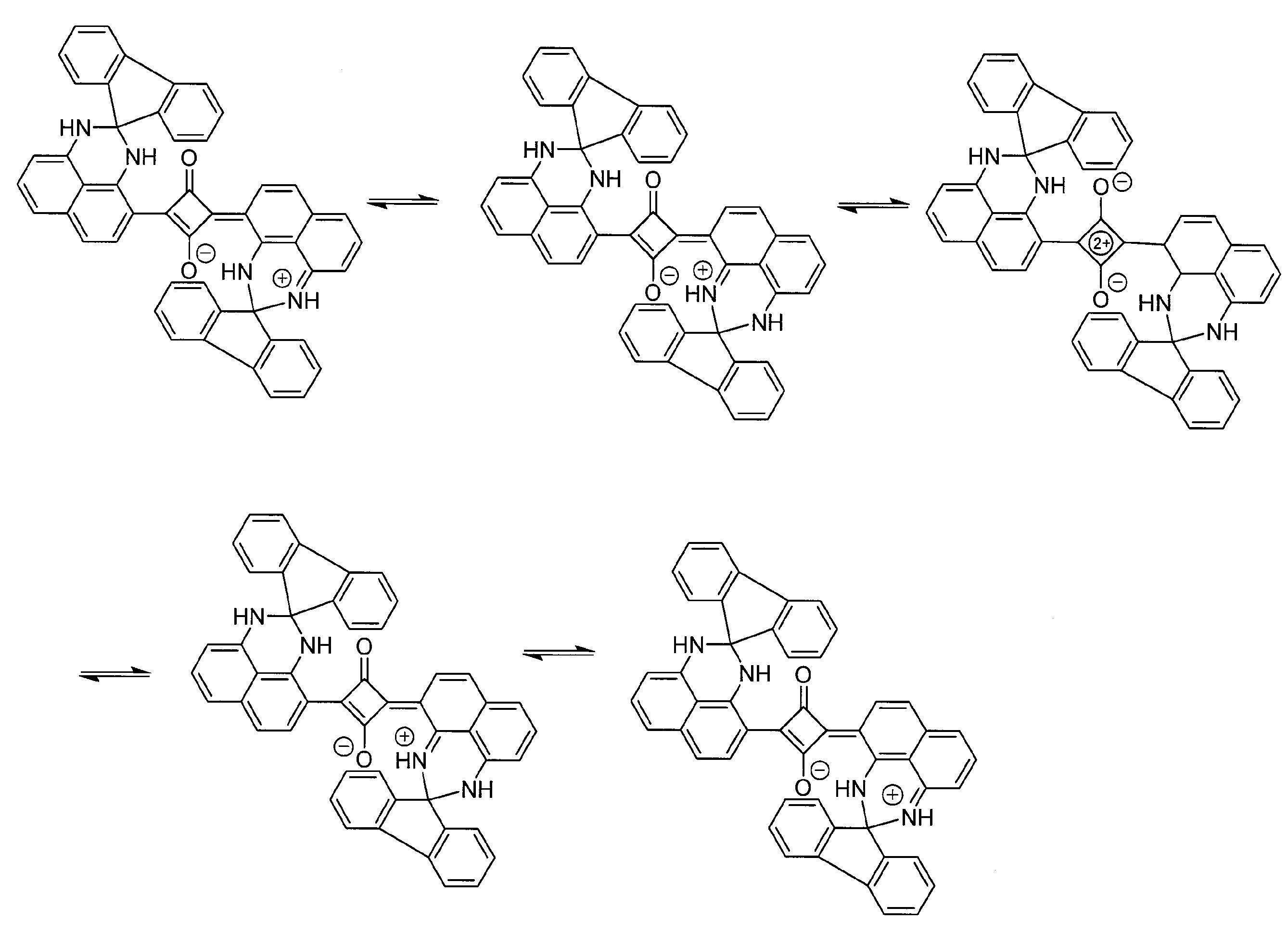
式(SQ1)で表される近赤外線吸収色素は、波長700~1300nmの範囲に極大吸収波長を有する化合物であることが好ましく、波長700~1000nmの範囲に極大吸収波長を有する化合物であることがより好ましい。
式(SQ1)で表される近赤外線吸収色素の具体例としては、下記構造の化合物、特開2019-011455号公報の段落番号0224~0341に記載の化合物、国際公開第2018/230486号の段落番号0221~0377に記載の化合物が挙げられる。
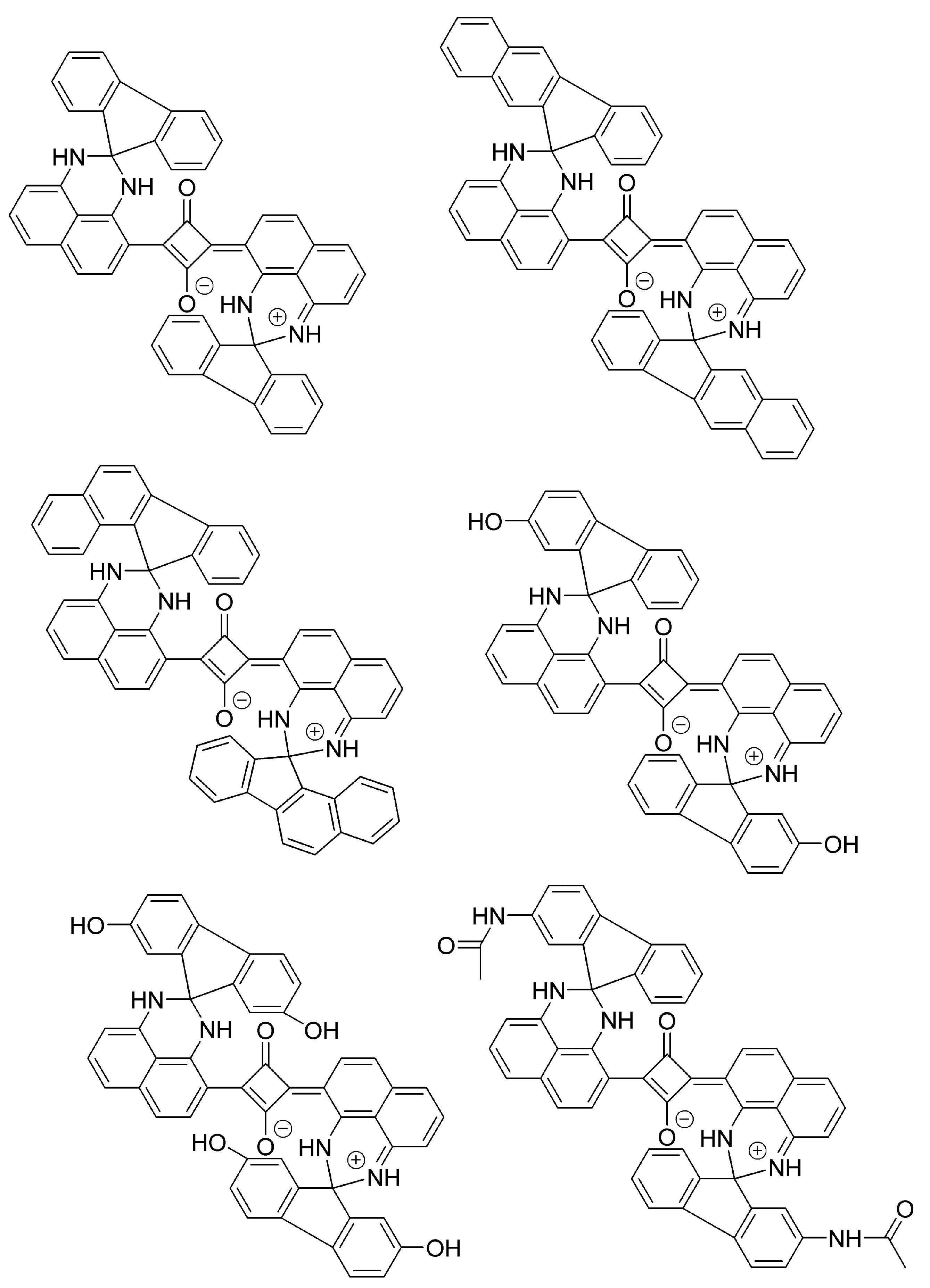


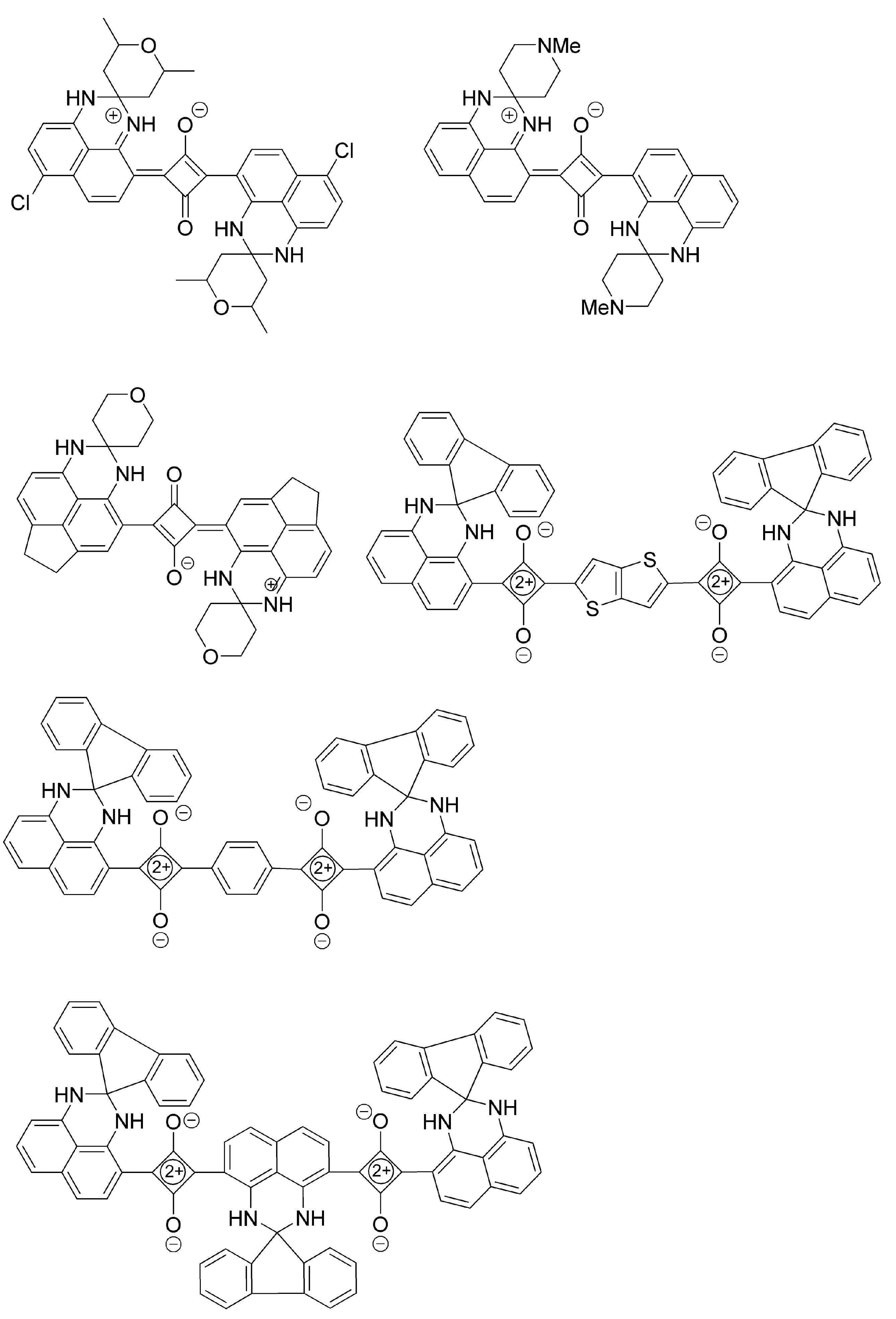
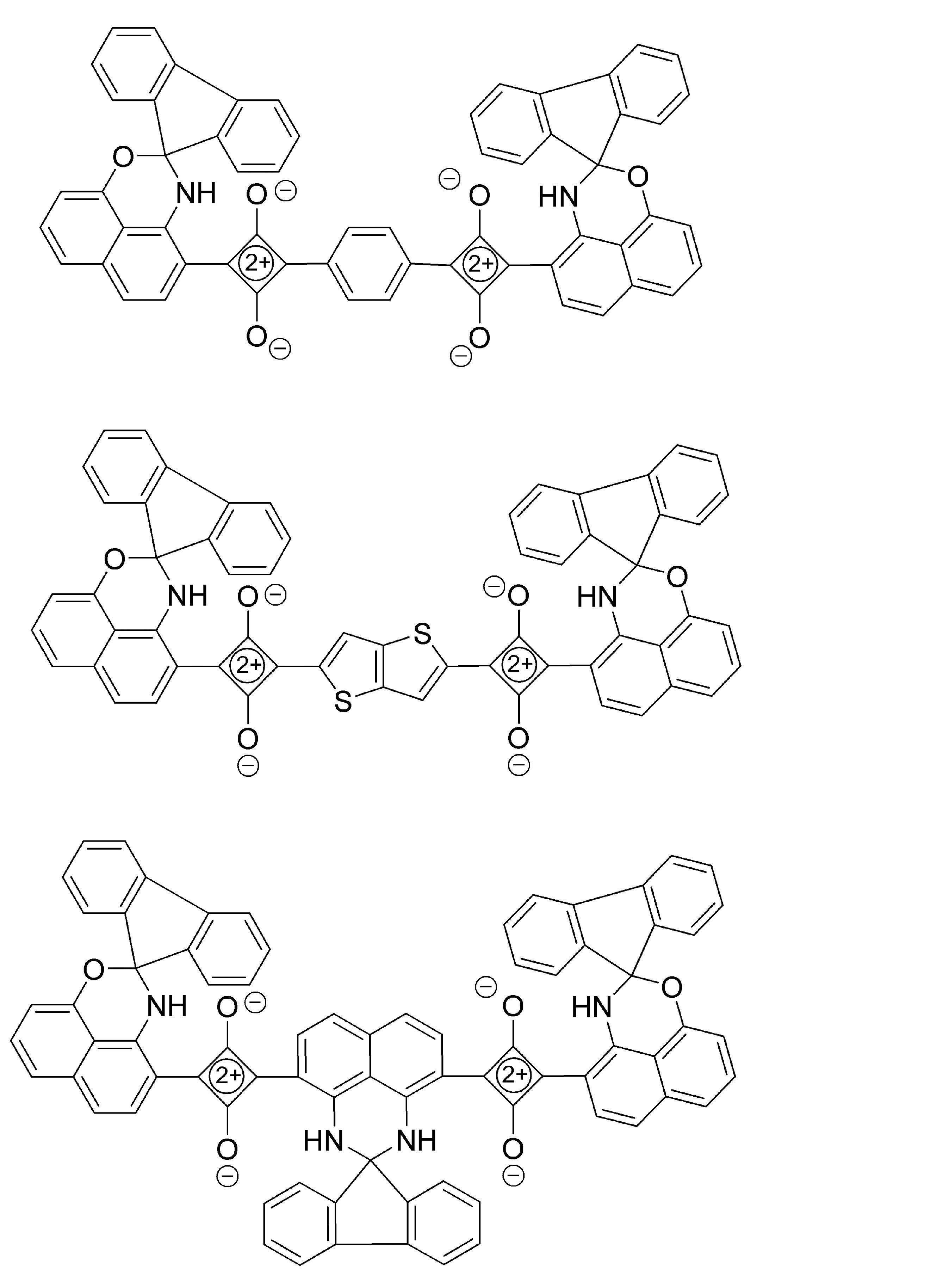
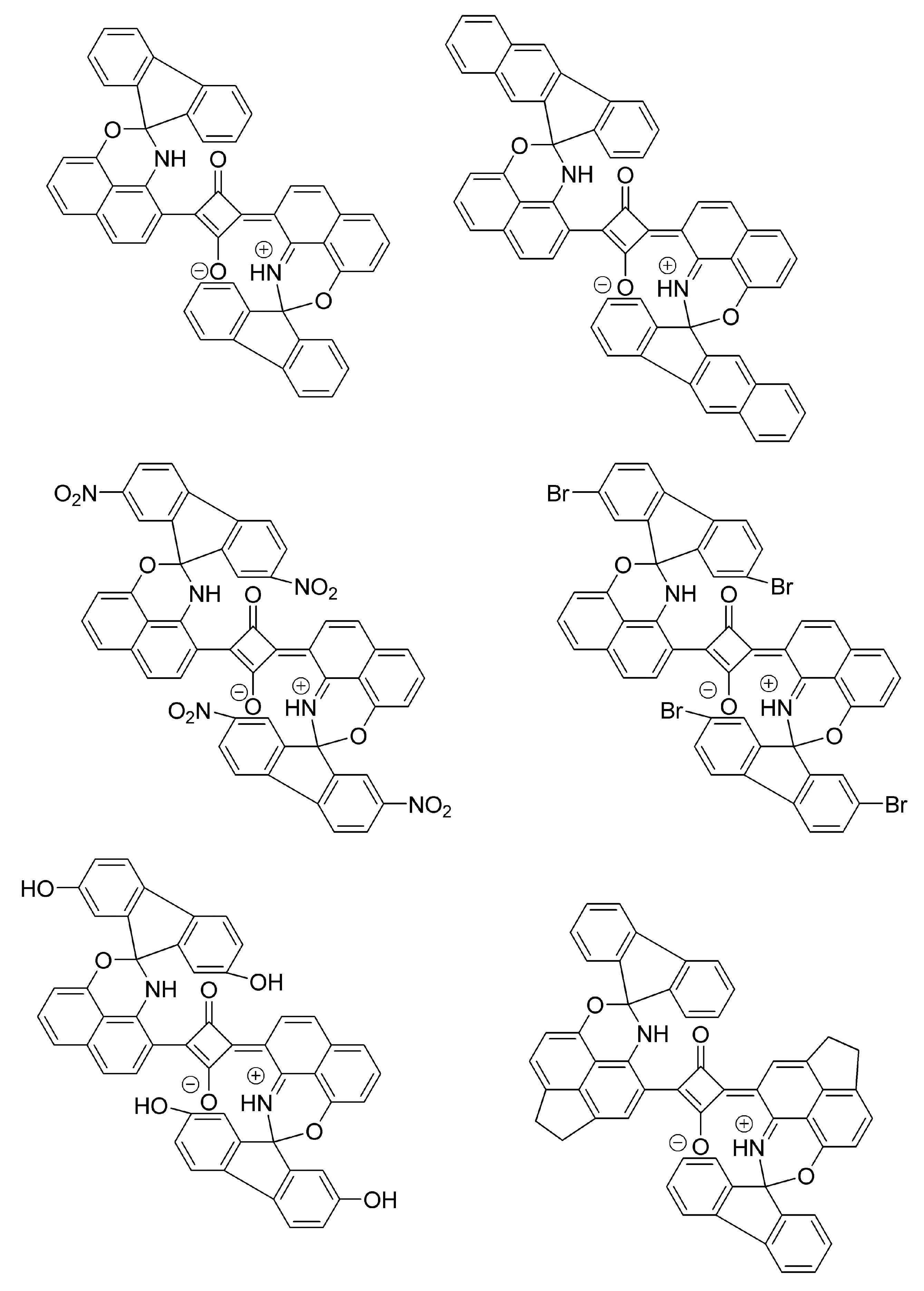
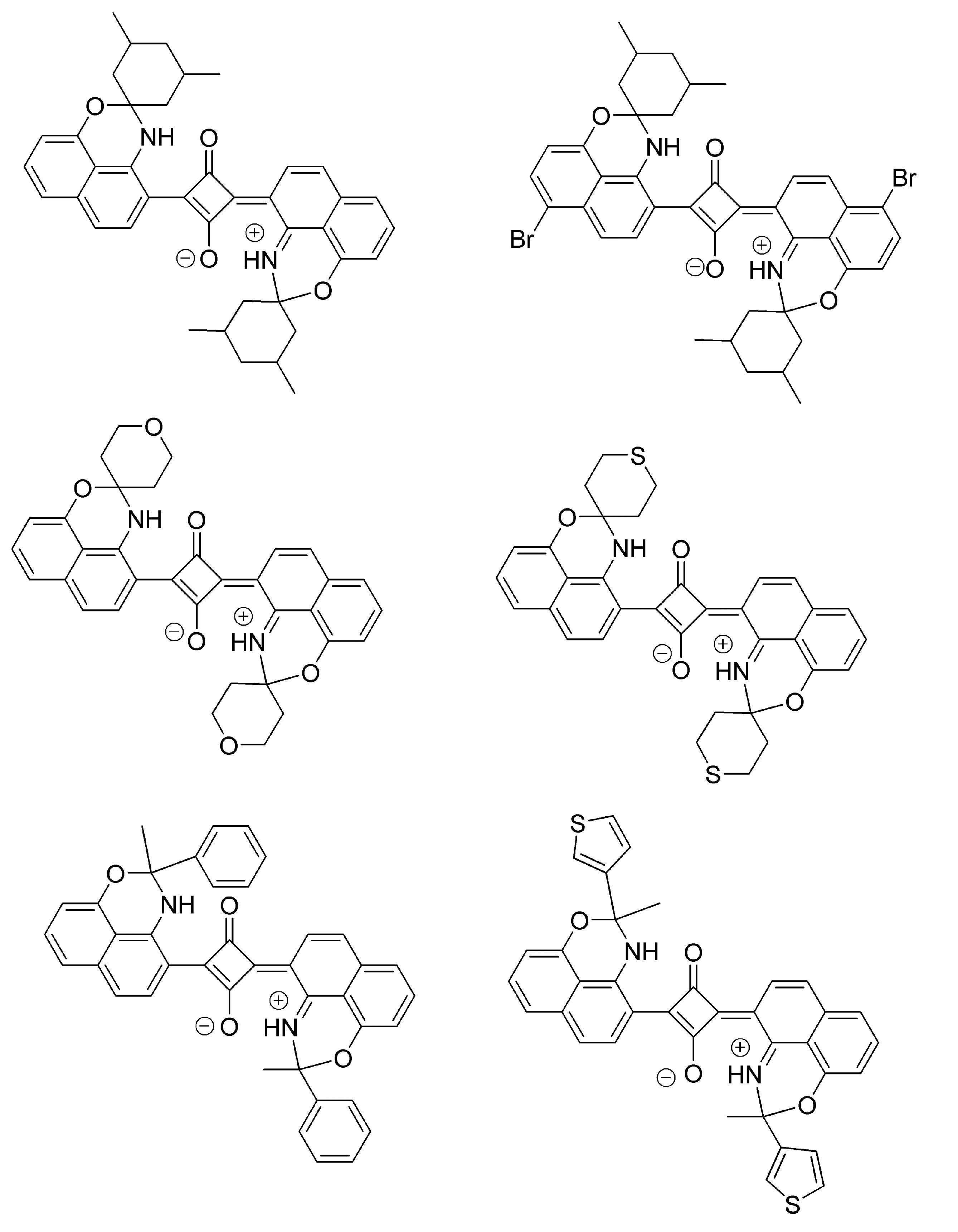
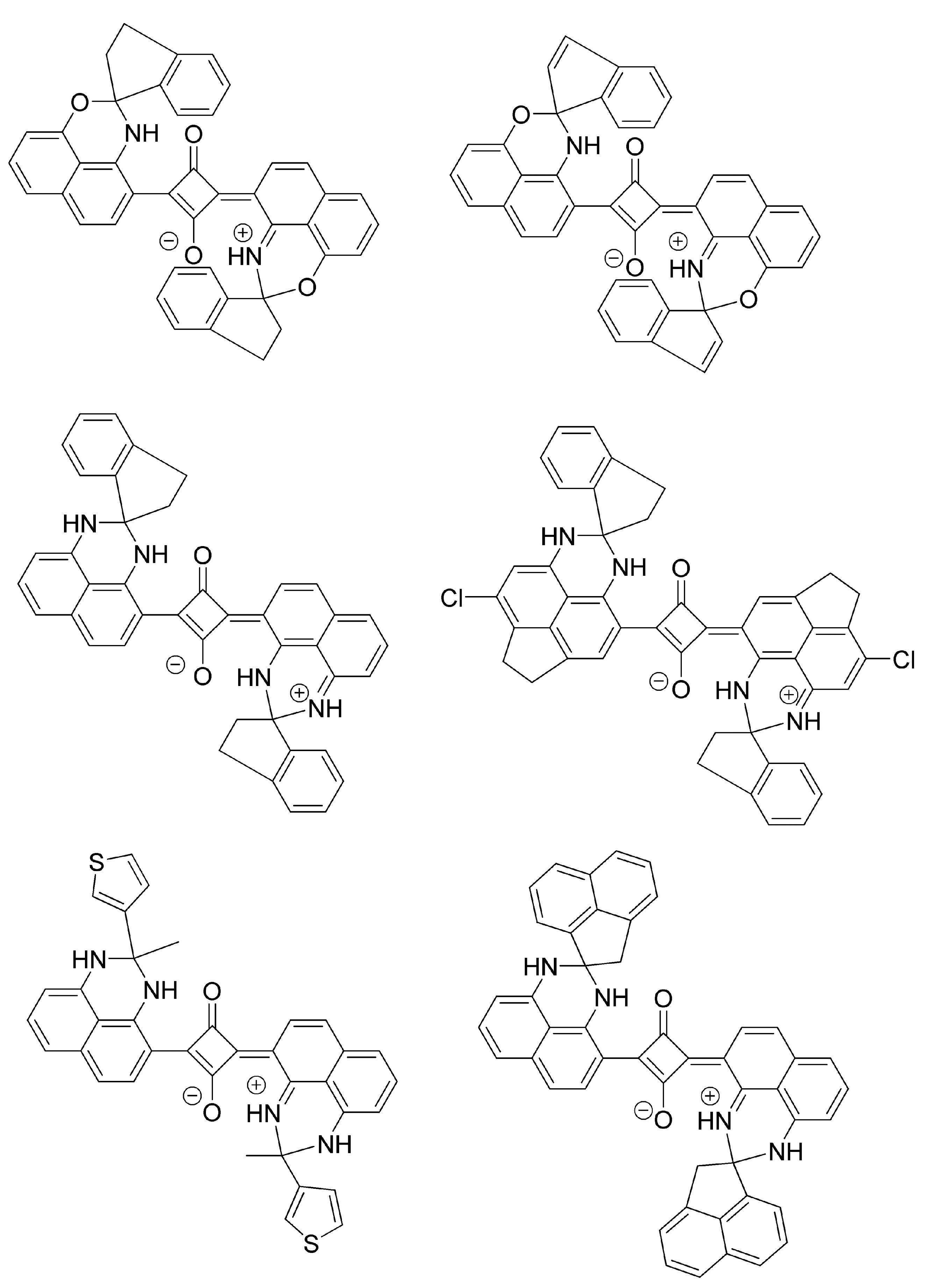

近赤外線吸収層10中の式(SQ1)で表される近赤外線吸収色素の含有量は、1質量%以上であることが好ましく、3質量%以上であることが好ましく、5質量%以上であることが更に好ましい。また、近赤外線吸収色素の含有量の上限は、50質量%以下であることが好ましく、45質量%以下であることがより好ましく、40質量%以下であることが更に好ましい。近赤外線吸収層は式(SQ1)で表される近赤外線吸収色素を1種のみ含んでいてもよく、2種以上含んでいてもよい。2種以上含む場合は、それらの合計量が上記範囲となることが好ましい。
近赤外線吸収層10は、式(SQ1)で表される近赤外線吸収色素以外の他の近赤外線吸収剤を含有することができる。他の近赤外線吸収剤としては、ピロロピロール化合物、シアニン化合物、スクアリリウム化合物、フタロシアニン化合物、ナフタロシアニン化合物、クアテリレン化合物、メロシアニン化合物、クロコニウム化合物、オキソノール化合物、イミニウム化合物、ジチオール化合物、トリアリールメタン化合物、ピロメテン化合物、アゾメチン化合物、アントラキノン化合物、ジベンゾフラノン化合物、ジチオレン金属錯体、金属酸化物、金属ホウ化物等が挙げられる。
近赤外線吸収層10中の他の近赤外線吸収剤の含有量は、式(SQ1)で表される近赤外線吸収色素の100質量部に対して50質量部以下であることが好ましく、40質量部以下であることがより好ましく30質量部以下であることが更に好ましい。また、近赤外線吸収層10中の式(SQ1)で表される近赤外線吸収色素と他の近赤外線吸収剤との合計の含有量は、1質量%以上であることが好ましく、3質量%以上であることが好ましく、5質量%以上であることが更に好ましい。上記合計の含有量の上限は、50質量%以下であることが好ましく、45質量%以下であることがより好ましく、40質量%以下であることが更に好ましい。近赤外線吸収層は他の近赤外線吸収剤を1種のみ含んでいてもよく、2種以上含んでいてもよい。2種以上含む場合は、それらの合計量が上記範囲となることが好ましい。
また、近赤外線吸収層10は他の近赤外線吸収剤を実質的に含有しないことも好ましい。他の近赤外線吸収剤を実質的に含有しないとは、近赤外線吸収層10中における他の近赤外線吸収剤の含有量が0.5質量%以下であることを意味し、0.1質量%以下であることが好ましく、0.05質量%以下であることがより好ましく、他の近赤外線吸収剤を含有しないことが特に好ましい。
近赤外線吸収層10は、色素誘導体を含有することができる。色素誘導体は、酸性色素誘導体及び塩基性色素誘導体のいずれでもよいが、式(SQ1)で表される近赤外線吸収色素の分散性の観点から酸性色素誘導体であることが好ましい。また、酸性色素誘導体はスクアリリウム化合物であることも好ましい。また、スクアリリウム化合物は、後述する(SQ-a)で表される部分構造を含むπ共役平面を有する化合物であることが好ましい。
酸性色素誘導体としては、色素骨格に、酸基が結合した化合物が挙げられる。酸基としては、スルホ基、カルボキシル基、リン酸基、ボロン酸基、スルホンイミド基、スルホンアミド基及びこれらの塩が挙げられる。塩を構成する原子または原子団としては、アルカリ金属イオン(Li+、Na+、K+など)、アルカリ土類金属イオン(Ca2+、Mg2+など)、アンモニウムイオン、イミダゾリウムイオン、ピリジニウムイオン、ホスホニウムイオンなどが挙げられる。酸性色素誘導体の酸基としては、スルホ基、カルボキシル基、リン酸基、ボロン酸基、スルホンイミド基、スルホンアミド基及びこれらの塩が好ましく、スルホ基、カルボキシル基、リン酸基、スルホンイミド基、スルホンアミド基及びこれらの塩がより好ましく、スルホ基、カルボキシル基、及びこれらの塩が更に好ましく、スルホ基が特に好ましい。
塩基性色素誘導体としては、色素骨格に、塩基性基が結合した化合物が挙げられる。塩基性基としては、アミノ基、ピリジニル基およびその塩、アンモニウム基の塩、並びにフタルイミドメチル基が挙げられる。塩を構成する原子または原子団としては、水酸化物イオン、ハロゲンイオン、カルボン酸イオン、スルホン酸イオン、フェノキシドイオンなどが挙げられる。塩基性基としては、アミノ基、ピリジニル基およびその塩、アンモニウム基の塩、並びにフタルイミドメチル基が好ましく、アミノ基、フタルイミドメチル基がより好ましく、アミノ基が更に好ましい。
色素誘導体としては、式(B1)で表される化合物であることが好ましい。また、酸性色素誘導体は式(B1)のXが酸基で表される化合物であることが好ましい。また、塩基性色素誘導体は式(B1)のXが塩基性基で表される化合物であることが好ましい。

式(B1)のPが表す色素骨格としては、スクアリリウム色素骨格、ピロロピロール色素骨格、ジケトピロロピロール色素骨格、キナクリドン色素骨格、アントラキノン色素骨格、ジアントラキノン色素骨格、ベンゾイソインドール色素骨格、チアジンインジゴ色素骨格、アゾ色素骨格、キノフタロン色素骨格、フタロシアニン色素骨格、ナフタロシアニン色素骨格、ジオキサジン色素骨格、ペリレン色素骨格、ペリノン色素骨格、ベンゾイミダゾロン色素骨格、ベンゾチアゾール色素骨格、ベンゾイミダゾール色素骨格およびベンゾオキサゾール色素骨格が挙げられ、スクアリリウム色素骨格、ピロロピロール色素骨格、ジケトピロロピロール色素骨格、フタロシアニン色素骨格、キナクリドン色素骨格、ベンゾイミダゾロン色素骨格から選ばれる少なくとも1種が好ましく、スクアリリウム色素骨格がより好ましい。
式(B1)のLが表す連結基としては、1~100個の炭素原子、0~10個の窒素原子、0~50個の酸素原子、1~200個の水素原子、および0~20個の硫黄原子から成り立つ基が挙げられる。例えば、炭化水素基、複素環基、-O-、-S-、-CO-、-COO-、-OCO-、-SO2-、-NRL-、-NRLCO-、-CONRL-、-NRLSO2-、-SO2NRL-およびこれらの組み合わせからなる基が挙げられる。RLは水素原子、アルキル基またはアリール基を表す。炭化水素基は脂肪族炭化水素基であってもよく、芳香族炭化水素基であってもよい。炭化水素基としては、アルキレン基、アリーレン基、またはこれらの基から水素原子を1個以上除いた基が挙げられる。アルキレン基の炭素数は、1~30が好ましく、1~15がより好ましく、1~10がさらに好ましい。アルキレン基は、直鎖、分岐、環状のいずれであってもよい。また、環状のアルキレン基は、単環、多環のいずれであってもよい。アリーレン基の炭素数は、6~18が好ましく、6~14がより好ましく、6~10がさらに好ましい。複素環基は、単環または縮合数が2~4の縮合環が好ましい。複素環基の環を構成するヘテロ原子の数は1~3が好ましい。複素環基の環を構成するヘテロ原子は、窒素原子、酸素原子または硫黄原子が好ましい。複素環基の環を構成する炭素原子の数は3~30が好ましく、3~18がより好ましく、3~12がより好ましい。炭化水素基および複素環基は置換基を有していてもよい。置換基としては、上述した置換基Tで挙げた基が挙げられる。また、RLが表すアルキル基の炭素数は1~20が好ましく、1~15がより好ましく、1~8が更に好ましい。アルキル基は、直鎖、分岐、環状のいずれでもよく、直鎖または分岐が好ましく、直鎖がより好ましい。RLが表すアルキル基はさらに置換基を有していてもよい。置換基としては上述した置換基Tが挙げられる。RLが表すアリール基の炭素数は、6~30が好ましく、6~20がより好ましく、6~12が更に好ましい。RLが表すアリール基はさらに置換基を有していてもよい。置換基としては上述した置換基Tが挙げられる。
近赤外線吸収層10に含まれる色素誘導体は、波長700~1200nmの範囲に極大吸収波長を化合物であることも好ましく、波長700~1100nmの範囲に極大吸収波長を有する化合物であることも好ましく、波長700~1000nmの範囲に極大吸収波長を有する化合物であることも好ましい。上記波長の範囲に極大吸収波長を有する色素誘導体は、π平面の広がりが式(SQ1)で表される近赤外線吸収色素と近づけやすくでき、式(SQ1)で表される近赤外線吸収色素の吸着性が向上し、より優れた分散安定性が得られやすい。また、近赤外線吸収層10に含まれる色素誘導体は、式(SQ1)で表される近赤外線吸収色素に含まれるπ共役平面と同一の構造のπ共役平面を有する化合物であることも好ましい。また、顔料誘導体のπ共役平面に含まれるπ電子の数は8~100個であることが好ましい。上限は、90個以下であることが好ましく、80個以下であることがより好ましい。下限は10個以上であることが好ましく、12個以上であることがより好ましい。また、近赤外線吸収層10に含まれる色素誘導体は、下記式(SQ-a)で表される部分構造を含むπ共役平面を有するか、または、下記式(CR-a)で表される部分構造を含むπ共役平面を有する化合物であることも好ましく、下記式(SQ-a)で表される部分構造を含むπ共役平面を有する化合物であることがより好ましい。

上記式中、波線は結合手を表す。
近赤外線吸収層10に含まれる色素誘導体は、下記式(Syn1)で表される化合物および下記式(Syn2)で表わされる化合物から選ばれる少なくとも1種であることも好ましく、式(Syn1)で表される化合物であることがより好ましい。
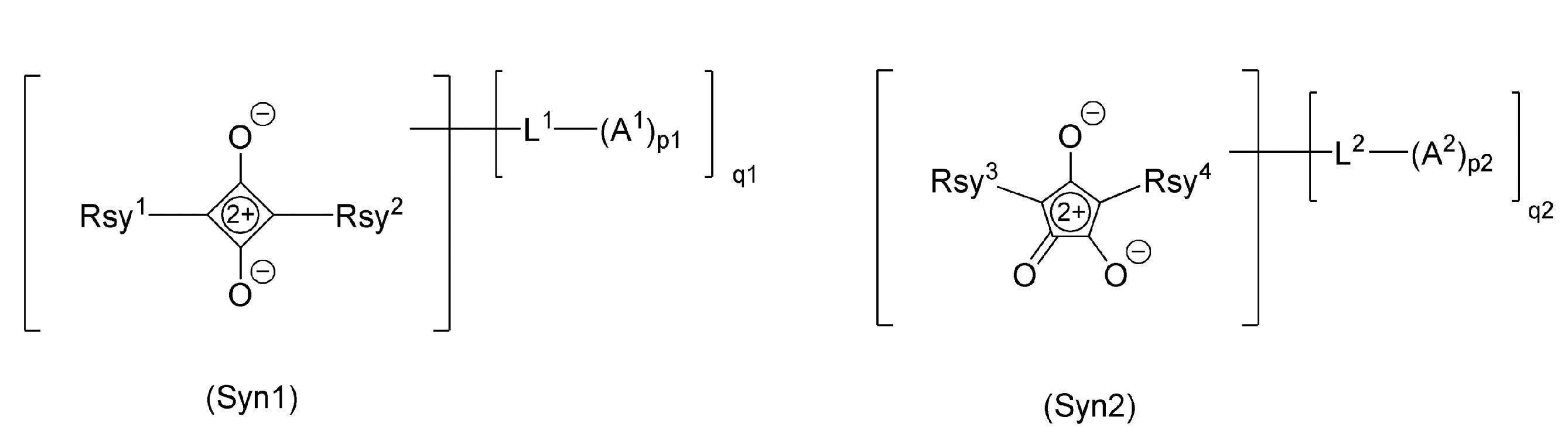
式(Syn1)中、Rsy1およびRsy2はそれぞれ独立して有機基を表し、L1は単結合またはp1+1価の基を表し、A1は酸基または塩基性を表し、p1およびq1はそれぞれ独立して1以上の整数を表す。p1が2以上の場合、複数のA1は同一であってもよく、異なっていてもよい。q1が2以上の場合、複数のL1およびA1は同一であってもよく、異なっていてもよい。
式(Syn2)中、Rsy3およびRsy4はそれぞれ独立して有機基を表し、L2は単結合またはp2+1価の基を表し、A2は酸基または塩基性を表し、p2およびq2はそれぞれ独立して1以上の整数を表す。p2が2以上の場合、複数のA2は同一であってもよく、異なっていてもよい。q2が2以上の場合、複数のL2およびA2は同一であってもよく、異なっていてもよい。
式(Syn1)のRsy1およびRsy2が表す有機基、並びに、式(Syn2)のRsy3およびRsy4が表す有機基としては、アリール基、ヘテロアリール基、下記式(R1)~(R7)で表される基が挙げられる。

式(R1)中、R1~R3は、それぞれ独立して水素原子または置換基を表し、As3はヘテロアリール基を表し、nr1は、0以上の整数を表し、R1とR2は、互いに結合して環を形成してもよく、R1とAs3は、互いに結合して環を形成してもよく、R2とR3は、互いに結合して環を形成してもよく、nr1が2以上の場合、複数のR2およびR3はそれぞれ同一であってもよく、異なっていてもよく、*は結合手を表す。
式(R2)中、環Z1は1つまたは複数の置換基を有していてもよい、芳香族複素環または芳香族複素環を含む縮合環を表し、環Z2は1つまたは複数の置換基を有していてもよい、4~9員の炭化水素環または複素環を表し、環Z1および環Z2が複数の置換基を有する場合、複数の置換基は同一であっても異なっていてもよく、*は結合手を表す。
式(R3)中、R11~R14はそれぞれ独立して、水素原子または置換基を表し、R11~R14のうち隣接する二つの基同士は互いに結合して環を形成していてもよく、R20はアリール基またはヘテロアリール基を表し、R21は置換基を表し、X10はCOまたはSO2を表す。
式(R4)中、R22およびR23は、それぞれ独立して水素原子または置換基を表し、R22とR23は、互いに結合して環を形成してもよく、X20は、酸素原子、硫黄原子、NR24、セレン原子またはテルル原子を表し、R24は水素原子または置換基を表し、X20がNR24である場合、R24とR22は互いに結合して環を形成してもよく、nr2は、0~5の整数を表し、nr2が2以上の場合、複数のR22は同一であってもよく、異なっていてもよく、複数のR22のうち2個のR22同士が結合して環を形成してもよく、*は結合手を表す。
式(R5)中、R35~R38はそれぞれ独立して水素原子または置換基を表し、R35とR36、R36とR37、R37とR38は、互いに結合して環を形成してもよく、*は結合手を表す。
式(R6)中、R39~R45は互いに独立して、水素原子または置換基を表し、R39とR45、R40とR41、R40とR42、R42とR43、R43とR44、R44とR45は、互いに結合して環を形成してもよく、*は結合手を表す。
式(R7)中、X21は環構造を表し、R46~R50は互いに独立して、水素原子または置換基を表し、R47とR48は、互いに結合して環を形成してもよく、*は結合手を表す。
式(R7)中、X21は環構造を表し、R46~R50は互いに独立して、水素原子または置換基を表し、R47とR48は、互いに結合して環を形成してもよく、*は結合手を表す。
式(Syn1)のL1が表すp1+1価の基、および、式(Syn2)のL2が表すp2+1価の基としては、上述した式(B1)のLが表す連結基として説明した基が挙げられる。
色素誘導体の具体例としては、例えば下記構造の化合物が挙げられる。また、以下の構造式中、Phはフェニル基である。また、色素誘導体の具体例としては、特開昭56-118462号公報、特開昭63-264674号公報、特開平01-217077号公報、特開平03-009961号公報、特開平03-026767号公報、特開平03-153780号公報、特開平03-045662号公報、特開平04-285669号公報、特開平06-145546号公報、特開平06-212088号公報、特開平06-240158号公報、特開平10-030063号公報、特開平10-195326号公報、国際公開第2011/024896号の段落番号0086~0098、国際公開第2012/102399号の段落番号0063~0094に記載の化合物も挙げられ、これらの内容は本明細書に組み込まれる。

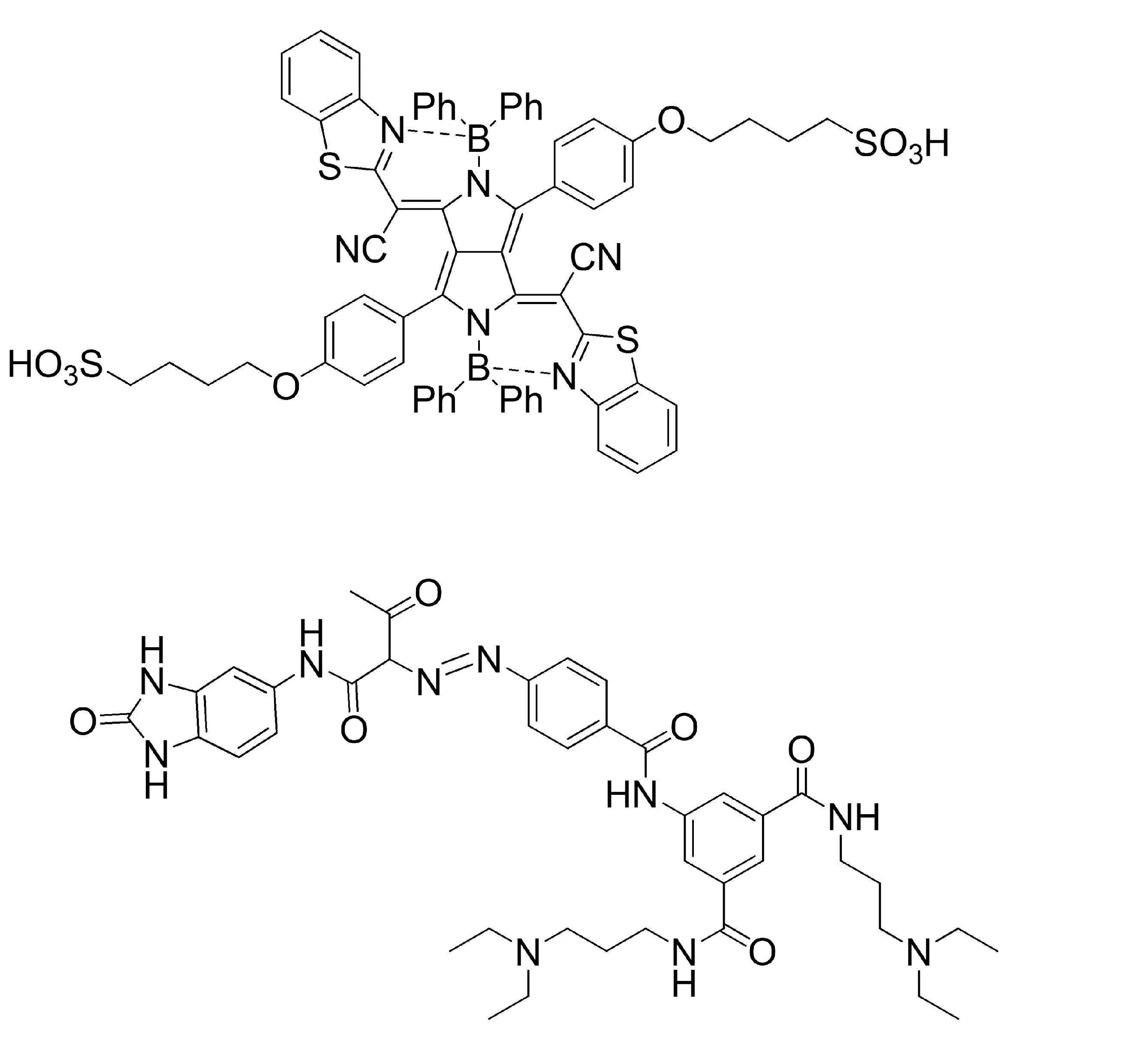
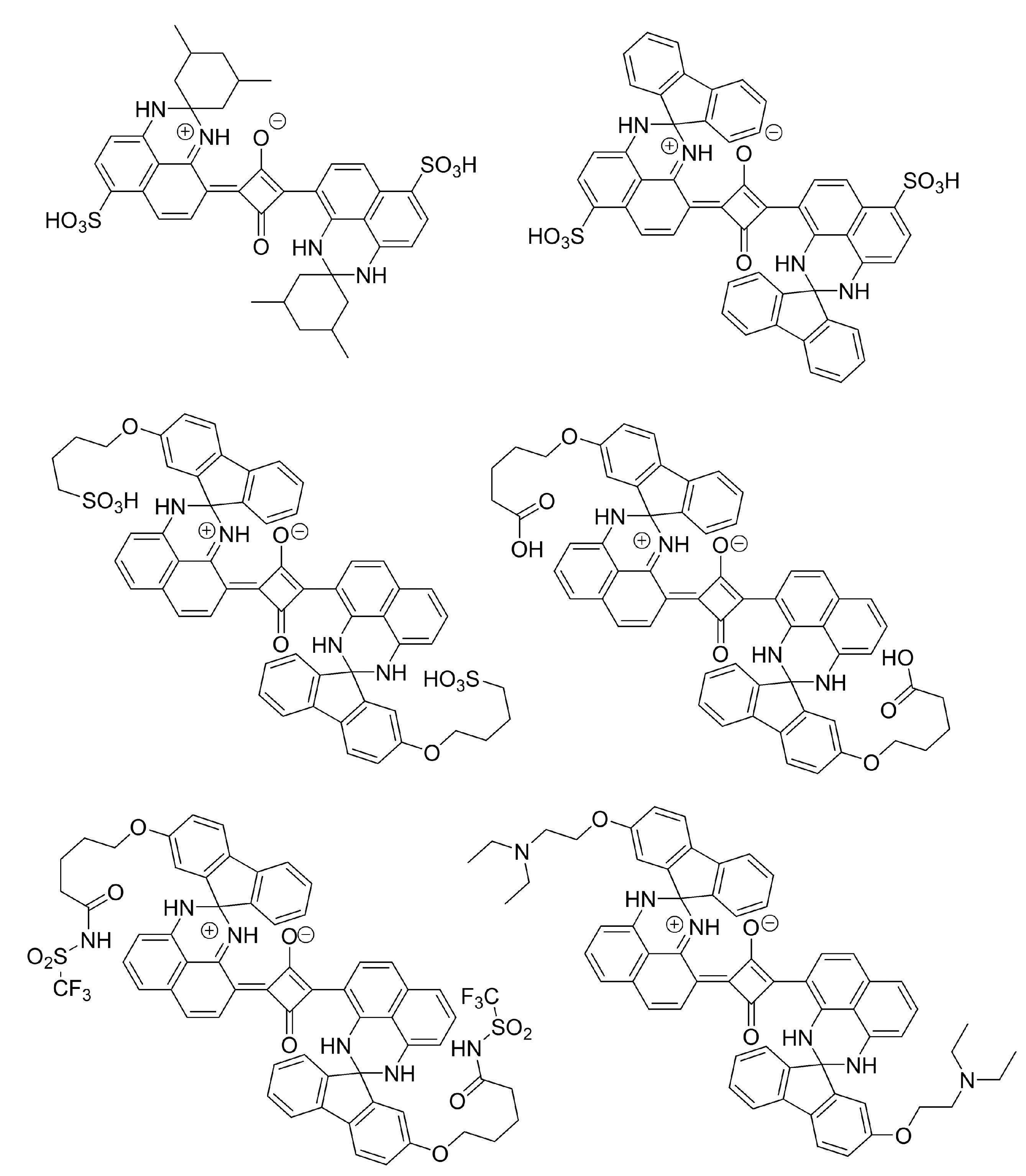


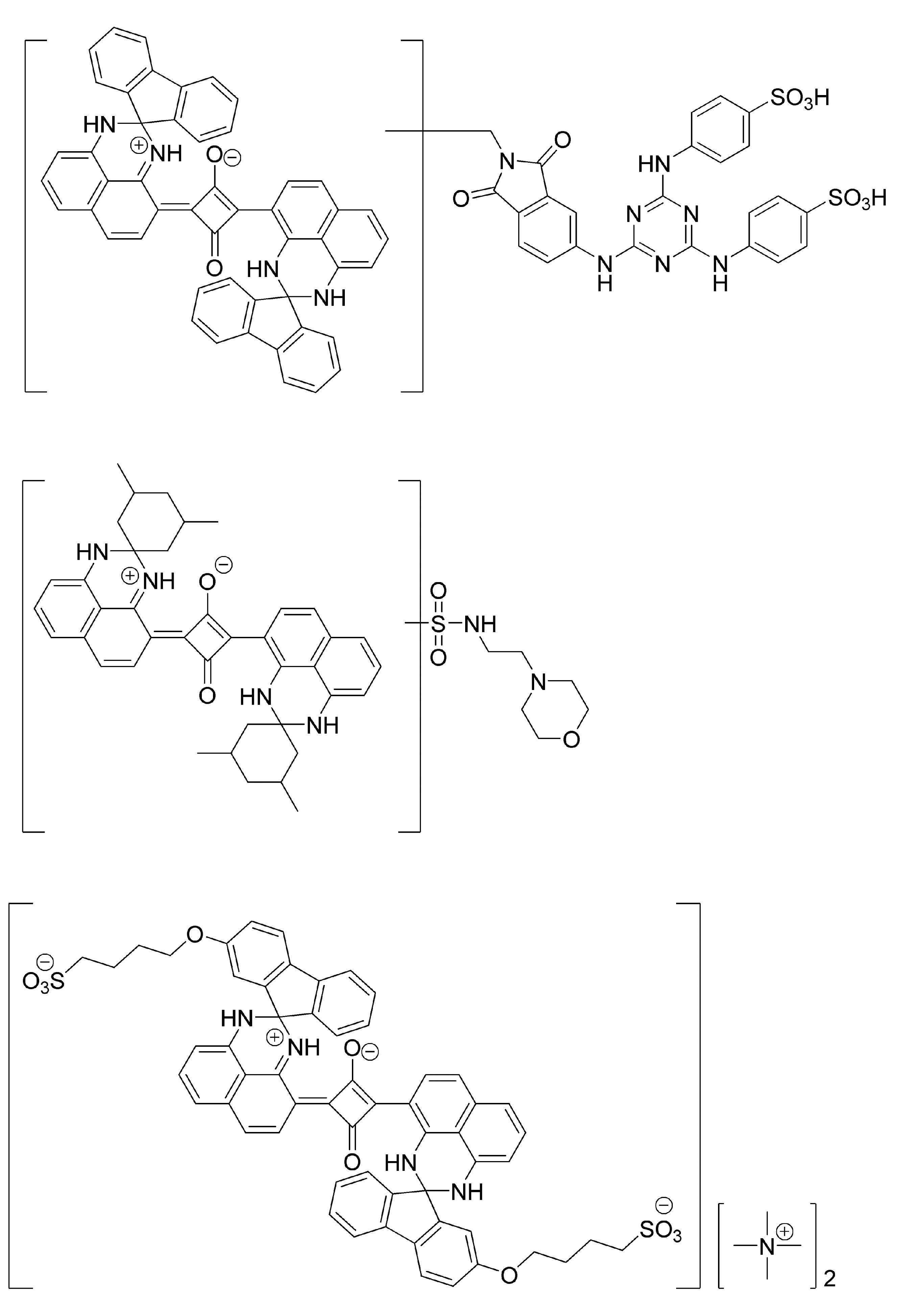

近赤外線吸収層10中の色素誘導体の含有量は、1~30質量%であることが好ましい。含有量の下限は3質量%以上であることが好ましく、5質量%以上であることが更に好ましい。また、含有量の上限は、29質量%以下であることが好ましく、25質量%以下であることがより好ましく、20質量%以下であることが更に好ましい。
また、近赤外線吸収層10中の式(SQ1)で表される近赤外線吸収色素と色素誘導体の含有量は、1~70質量%であることが好ましい。含有量の下限は3質量%以上であることが好ましく、5質量%以上であることが更に好ましい。含有量の上限は、60質量%以下であることが好ましく、55質量%以下であることがより好ましく、50質量%以下であることが更に好ましい。
また、式(SQ1)で表される近赤外線吸収色素の100質量部に対して色素誘導体を1~50質量部含有することが好ましい。含有量の下限は5質量部以上であることが好ましく、10質量部以上であることが更に好ましい。含有量の上限は、40質量部以下であることが好ましく、30質量部以下であることがより好ましく、25質量部以下であることが更に好ましい。
近赤外線吸収層10は色素誘導体を1種のみ含んでいてもよく、2種以上含んでいてもよい。2種以上含む場合は、それらの合計量が上記範囲となることが好ましい。
また、近赤外線吸収層10中の式(SQ1)で表される近赤外線吸収色素と色素誘導体の含有量は、1~70質量%であることが好ましい。含有量の下限は3質量%以上であることが好ましく、5質量%以上であることが更に好ましい。含有量の上限は、60質量%以下であることが好ましく、55質量%以下であることがより好ましく、50質量%以下であることが更に好ましい。
また、式(SQ1)で表される近赤外線吸収色素の100質量部に対して色素誘導体を1~50質量部含有することが好ましい。含有量の下限は5質量部以上であることが好ましく、10質量部以上であることが更に好ましい。含有量の上限は、40質量部以下であることが好ましく、30質量部以下であることがより好ましく、25質量部以下であることが更に好ましい。
近赤外線吸収層10は色素誘導体を1種のみ含んでいてもよく、2種以上含んでいてもよい。2種以上含む場合は、それらの合計量が上記範囲となることが好ましい。
近赤外線吸収層10は、後述する近赤外線吸収層形成用組成物を用いて形成することができる。
近赤外線吸収層10の厚さは、20μm以下が好ましく、10μm以下がより好ましく、5μm以下がさらに好ましい。下限は、0.1μm以上が好ましく、0.2μm以上がより好ましく、0.3μm以上が更に好ましい。
近赤外線吸収層10は、波長700~1300nmの範囲に極大吸収波長を有することがより好ましく、700~1000nmの範囲に極大吸収波長を有することがさらに好ましい。また、波長500nmにおける吸光度A1と極大吸収波長における吸光度A2との比率A1/A2は、0.08以下であることが好ましく、0.04以下であることがより好ましい。また、近赤外線吸収層は、以下の(T1)~(T4)のうちの少なくとも1つの条件を満たすことが好ましく、(T1)~(T4)のすべての条件を満たすことがさらに好ましい。
(T1)波長400nmの光の透過率は70%以上が好ましく、80%以上がより好ましく、85%以上がさらに好ましく、90%以上が特に好ましい。
(T2)波長500nmの光の透過率は70%以上が好ましく、80%以上がより好ましく、90%以上がさらに好ましく、95%以上が特に好ましい。
(T3)波長600nmの光の透過率は70%以上が好ましく、80%以上がより好ましく、90%以上がさらに好ましく、95%以上が特に好ましい。
(T4)波長650nmの光の透過率は70%以上が好ましく、80%以上がより好ましく、90%以上がさらに好ましく、95%以上が特に好ましい。
(T1)波長400nmの光の透過率は70%以上が好ましく、80%以上がより好ましく、85%以上がさらに好ましく、90%以上が特に好ましい。
(T2)波長500nmの光の透過率は70%以上が好ましく、80%以上がより好ましく、90%以上がさらに好ましく、95%以上が特に好ましい。
(T3)波長600nmの光の透過率は70%以上が好ましく、80%以上がより好ましく、90%以上がさらに好ましく、95%以上が特に好ましい。
(T4)波長650nmの光の透過率は70%以上が好ましく、80%以上がより好ましく、90%以上がさらに好ましく、95%以上が特に好ましい。
近赤外線吸収層10は、波長400~650nmの全ての範囲での透過率が70%以上であることが好ましく、80%以上であることがより好ましく、90%以上であることが更に好ましい。また、波長700~1000nmの範囲の少なくとも1点での透過率が20%以下であることが好ましい。
図1に示されるように、この構造体101は、近赤外線吸収層10上に有彩色色素を含むカラーフィルタ層20が積層されている。本発明の構造体では、カラーフィルタ層20は、2色以上の着色画素を有し、2色以上の着色画素のうち少なくとも1色の着色画素は塩基性色素誘導体を含んでいる。塩基性色素誘導体としては上述したものが挙げられる。
カラーフィルタ層20における着色画素としては、赤色画素、緑色画素、青色画素、黄色画素、シアン色画素、マゼンタ色画素などが挙げられる。なお、図1に示す構造体101では、カラーフィルタ層20は3色の着色画素21、21、23を有しているが、カラーフィルタ層20が有する着色画素は、2色のみであってもよく、4色以上であってもよい。
カラーフィルタ層20に含まれる有彩色色素としては、赤色色素、緑色色素、青色色素、黄色色素、紫色色素およびオレンジ色色素などが挙げられる。有彩色色素は、顔料であってもよく、染料であってもよい。顔料と染料とを併用してもよい。また、顔料は、無機顔料、有機顔料のいずれでもよい。また、顔料には、無機顔料または有機-無機顔料の一部を有機発色団で置換した材料を用いることもできる。無機顔料や有機-無機顔料を有機発色団で置換することで、色相設計をしやすくできる。
顔料の平均一次粒子径は、1~200nmが好ましい。下限は5nm以上が好ましく、10nm以上がより好ましい。上限は、180nm以下が好ましく、150nm以下がより好ましく、100nm以下が更に好ましい。なお、本発明において、顔料の一次粒子径は、顔料の一次粒子を透過型電子顕微鏡により観察し、得られた画像写真から求めることができる。具体的には、顔料の一次粒子の投影面積を求め、それに対応する円相当径を顔料の一次粒子径として算出する。また、本発明における平均一次粒子径は、400個の顔料の一次粒子についての一次粒子径の算術平均値とする。また、顔料の一次粒子とは、凝集のない独立した粒子をいう。
カラーフィルタ層20に含まれる有彩色色素は、顔料を含むものであることが好ましい。カラーフィルタ層20に含まれる有彩色色素中における顔料の含有量は、50質量%以上であることが好ましく、70質量%以上であることがより好ましく、80質量%以上であることが更に好ましく、90質量%以上であることが特に好ましい。顔料としては以下に示すものが挙げられる。
カラーインデックス(C.I.)Pigment Yellow 1,2,3,4,5,6,10,11,12,13,14,15,16,17,18,20,24,31,32,34,35,35:1,36,36:1,37,37:1,40,42,43,53,55,60,61,62,63,65,73,74,77,81,83,86,93,94,95,97,98,100,101,104,106,108,109,110,113,114,115,116,117,118,119,120,123,125,126,127,128,129,137,138,139,147,148,150,151,152,153,154,155,156,161,162,164,166,167,168,169,170,171,172,173,174,175,176,177,179,180,181,182,185,187,188,193,194,199,213,214,215,228,231,232(メチン系),233(キノリン系)等(以上、黄色顔料)、
C.I.Pigment Orange 2,5,13,16,17:1,31,34,36,38,43,46,48,49,51,52,55,59,60,61,62,64,71,73等(以上、オレンジ色顔料)、
C.I.Pigment Red 1,2,3,4,5,6,7,9,10,14,17,22,23,31,38,41,48:1,48:2,48:3,48:4,49,49:1,49:2,52:1,52:2,53:1,57:1,60:1,63:1,66,67,81:1,81:2,81:3,83,88,90,105,112,119,122,123,144,146,149,150,155,166,168,169,170,171,172,175,176,177,178,179,184,185,187,188,190,200,202,206,207,208,209,210,216,220,224,226,242,246,254,255,264,270,272,279,294(キサンテン系、Organo Ultramarine、Bluish Red),295(アゾ系),296(アゾ系)等(以上、赤色顔料)、
C.I.Pigment Green 7,10,36,37,58,59,62,63等(以上、緑色顔料)、
C.I.Pigment Violet 1,19,23,27,32,37,42,60(トリアリールメタン系),61(キサンテン系)等(以上、紫色顔料)、
C.I.Pigment Blue 1,2,15,15:1,15:2,15:3,15:4,15:6,16,22,29,60,64,66,79,80,87(モノアゾ系),88(メチン系)等(以上、青色顔料)。
C.I.Pigment Orange 2,5,13,16,17:1,31,34,36,38,43,46,48,49,51,52,55,59,60,61,62,64,71,73等(以上、オレンジ色顔料)、
C.I.Pigment Red 1,2,3,4,5,6,7,9,10,14,17,22,23,31,38,41,48:1,48:2,48:3,48:4,49,49:1,49:2,52:1,52:2,53:1,57:1,60:1,63:1,66,67,81:1,81:2,81:3,83,88,90,105,112,119,122,123,144,146,149,150,155,166,168,169,170,171,172,175,176,177,178,179,184,185,187,188,190,200,202,206,207,208,209,210,216,220,224,226,242,246,254,255,264,270,272,279,294(キサンテン系、Organo Ultramarine、Bluish Red),295(アゾ系),296(アゾ系)等(以上、赤色顔料)、
C.I.Pigment Green 7,10,36,37,58,59,62,63等(以上、緑色顔料)、
C.I.Pigment Violet 1,19,23,27,32,37,42,60(トリアリールメタン系),61(キサンテン系)等(以上、紫色顔料)、
C.I.Pigment Blue 1,2,15,15:1,15:2,15:3,15:4,15:6,16,22,29,60,64,66,79,80,87(モノアゾ系),88(メチン系)等(以上、青色顔料)。
また、緑色顔料として、1分子中のハロゲン原子数が平均10~14個であり、臭素原子数が平均8~12個であり、塩素原子数が平均2~5個であるハロゲン化亜鉛フタロシアニン顔料を用いることもできる。具体例としては、国際公開第2015/118720号に記載の化合物が挙げられる。また、緑色顔料として中国特許出願第106909027号明細書に記載の化合物、国際公開第2012/102395号に記載のリン酸エステルを配位子として有するフタロシアニン化合物などを用いることもできる。
また、青色顔料として、リン原子を有するアルミニウムフタロシアニン化合物を用いることもできる。具体例としては、特開2012-247591号公報の段落番号0022~0030、特開2011-157478号公報の段落番号0047に記載の化合物が挙げられる。
また、黄色顔料として、特開2008-074985号公報に記載されている顔料、特開2008-074987号公報に記載されている化合物、特開2013-061622号公報に記載されているキノフタロン化合物、特開2013-181015号公報に記載されているキノフタロン化合物、特開2014-085565号公報に記載されている着色剤、特開2016-145282号公報に記載されている顔料、特開2017-201003号公報に記載されている顔料、特開2017-197719号公報に記載されている顔料、特開2017-171912号公報の段落番号0011~0062、0137~0276に記載されている顔料、特開2017-171913号公報の段落番号0010~0062、0138~0295に記載されている顔料、特開2017-171914号公報の段落番号0011~0062、0139~0190に記載されている顔料、特開2017-171915号公報の段落番号0010~0065、0142~0222に記載されている顔料、特開2017-197640号公報に記載されているキノフタロン化合物、特開2018-040835号公報に記載されているキノフタロン系顔料、特開2018-203798号公報に記載されている顔料、特開2018-062578号公報に記載されている顔料、特開2018-155881号公報に記載されているキノフタロン系黄色顔料、特開2018-062644号公報に記載されている化合物、特許6432077号公報に記載されているキノフタロン化合物、特許6443711号公報に記載されている顔料を用いることもできる。
赤色顔料として、特開2017-201384号公報に記載の構造中に少なくとも1つ臭素原子が置換したジケトピロロピロール化合物、特許第6248838号の段落番号0016~0022に記載のジケトピロロピロール化合物、国際公開第2012/102399号に記載のジケトピロロピロール化合物、国際公開第2012/117965号に記載のジケトピロロピロール化合物、特開2012-229344号公報に記載のナフトールアゾ化合物などを用いることもできる。また、赤色顔料として、芳香族環に対して、酸素原子、硫黄原子または窒素原子が結合した基が導入された芳香族環基がジケトピロロピロール骨格に結合した構造を有する化合物を用いることもできる。
染料としては特に制限はなく、公知の染料が使用できる。例えば、ピラゾールアゾ系、アニリノアゾ系、トリアリールメタン系、アントラキノン系、アントラピリドン系、ベンジリデン系、オキソノール系、ピラゾロトリアゾールアゾ系、ピリドンアゾ系、シアニン系、フェノチアジン系、ピロロピラゾールアゾメチン系、キサンテン系、フタロシアニン系、ベンゾピラン系、インジゴ系、ピロメテン系等の染料が挙げられる。また、特開2012-158649号公報に記載のチアゾール化合物、特開2011-184493号公報に記載のアゾ化合物、特開2011-145540号公報に記載のアゾ化合物も好ましく用いることができる。また、黄色染料として、特開2013-054339号公報の段落番号0011~0034に記載のキノフタロン化合物、特開2014-026228号公報の段落番号0013~0058に記載のキノフタロン化合物などを用いることもできる。
カラーフィルタ層20の着色画素21、22、23中の有彩色色素の含有量は、20質量%以上が好ましく、25質量%以上であることがより好ましく、30質量%以上が更に好ましく、40質量%以上がより一層好ましく、45質量%以上であることが更に一層好ましく、50質量%以上であることが特に好ましい。上限は、80質量%以下が好ましく、75質量%以下がより好ましい。着色画素は有彩色色素を1種のみ含んでいてもよく、2種以上含んでいてもよい。2種以上含む場合は、それらの合計量が上記範囲となることが好ましい。
本発明の構造体において、カラーフィルタ層20は、2色以上の着色画素のうち少なくとも1色の着色画素は塩基性色素誘導体を含んでいればよい。すなわち、2色以上の着色画素の1色の着色画素が塩基性色素誘導体を含み、残りの着色画素は塩基性色素誘導体を含んでいなくてもよい。また、塩基性色素誘導体のかわりに酸性色素誘導体を含んでいてもよい。なかでも、本発明の効果がより顕著に得られやすいという理由から、各色の着色画素のそれぞれ(図1の場合、着色画素21、22、23のそれぞれ)が塩基性色素誘導体を含んでいることが好ましい。
また、着色画素が塩基性色素誘導体を含む場合は、着色画素中の塩基性色素誘導体の含有量は、1~40質量%であることが好ましい。含有量の下限は3質量%以上であることが好ましく、5質量%以上であることが更に好ましい。また、含有量の上限は、30質量%以下であることが好ましく、25質量%以下であることがより好ましく、20質量%以下であることが更に好ましい。また、有彩色色素の100質量部に対して塩基性色素誘導体を1~50質量部含有することが好ましい。下限は5質量部以上であることが好ましく、10質量部以上であることが更に好ましい。また、含有量の上限は、40質量%以下であることが好ましく、30質量%以下であることがより好ましく、25質量%以下であることが更に好ましい。
本発明の構造体においては、カラーフィルタ層20は、赤色画素、青色画素および緑色画素を少なくとも有し、赤色画素が塩基性色素誘導体を含むことが好ましい。この態様によれば、近赤外線遮蔽性のムラの発生をより効果的に抑制することができる。
赤色画素は、有彩色色素を20質量%以上含むことが好ましく、30質量%以上含むことがより好ましく、40質量%以上含むことが更に好ましい。上限は、70質量%以下が好ましく、65質量%以下がより好ましく、60質量%以下が更に好ましい。
また、赤色画素は有彩色色素と塩基性色素誘導体とを合計で50質量%以上含むことが好ましく、52質量%以上含むことがより好ましく、55質量%以上含むことが更に好ましい。上限は、70質量%以下が好ましく、65質量%以下がより好ましく、63質量%以下が更に好ましく、60質量%以下が特に好ましい。
また、赤色画素は有彩色色素の100質量部に対して、塩基性色素誘導体を1~50質量部含有することが好ましい。下限は5質量部以上であることが好ましく、10質量部以上であることがより好ましく、15質量部以上であることが更に好ましい。また、含有量の上限は、40質量部以下であることが好ましく、30質量部以下であることがより好ましく、20質量部以下であることが更に好ましい。
また、赤色画素は有彩色色素と塩基性色素誘導体とを合計で50質量%以上含むことが好ましく、52質量%以上含むことがより好ましく、55質量%以上含むことが更に好ましい。上限は、70質量%以下が好ましく、65質量%以下がより好ましく、63質量%以下が更に好ましく、60質量%以下が特に好ましい。
また、赤色画素は有彩色色素の100質量部に対して、塩基性色素誘導体を1~50質量部含有することが好ましい。下限は5質量部以上であることが好ましく、10質量部以上であることがより好ましく、15質量部以上であることが更に好ましい。また、含有量の上限は、40質量部以下であることが好ましく、30質量部以下であることがより好ましく、20質量部以下であることが更に好ましい。
赤色画素に含まれる有彩色色素は、赤色色素を少なくとも含むことが好ましい。赤色色素は、顔料および染料のいずれでもよいが、耐熱性および耐光性の観点から顔料であることが好ましい。赤色画素に含まれる有彩色色素は、赤色色素以外の有彩色色素を含むことができる。赤色色素以外の有彩色色素としては、上述した有彩色色素が挙げられ、黄色色素およびオレンジ色色素が好ましい。赤色画素に含まれる有彩色色素中における赤色色素の含有量は、20~100質量%であることが好ましく、30~100質量%であることがより好ましく、40~100質量%であることが更に好ましい。
緑色画素は塩基性色素誘導体を含んでいなくてもよいが、発明の効果がより顕著に得られやすいという理由から、塩基性色素誘導体を含んでいることが好ましい。
緑色画素は、有彩色色素を20質量%以上含むことが好ましく、30質量%以上含むことがより好ましく、40質量%以上含むことが更に好ましい。上限は、70質量%以下が好ましく、65質量%以下がより好ましく、60質量%以下が更に好ましい。
また、緑色画素は、有彩色色素と塩基性色素誘導体とを合計で50質量%以上含むことが好ましく、52質量%以上含むことがより好ましく、55質量%以上含むことが更に好ましい。上限は、70質量%以下が好ましく、65質量%以下がより好ましく、63質量%以下が更に好ましく、60質量%以下が特に好ましい。
また、緑色画素は有彩色色素の100質量部に対して、色素誘導体(好ましくは塩基性色素誘導体)を1~50質量部含有することが好ましい。下限は5質量部以上であることが好ましく、10質量部以上であることがより好ましく、15質量部以上であることが更に好ましい。また、含有量の上限は、40質量部以下であることが好ましく、30質量部以下であることがより好ましく、20質量部以下であることが更に好ましい。
また、緑色画素に含まれる有彩色色素は、緑色色素を少なくとも含むことが好ましい。緑色色素は、顔料および染料のいずれでもよいが、耐熱性および耐光性の観点から顔料であることが好ましい。緑色画素に含まれる有彩色色素は、緑色色素以外の有彩色色素を含むことができる。緑色色素以外の有彩色色素としては、上述した有彩色色素が挙げられ、黄色色素であることが好ましい。緑色画素に含まれる有彩色色素中における緑色色素の含有量は、20~100質量%であることが好ましく、30~100質量%であることがより好ましく、40~100質量%であることが更に好ましい。
また、緑色画素は、有彩色色素と塩基性色素誘導体とを合計で50質量%以上含むことが好ましく、52質量%以上含むことがより好ましく、55質量%以上含むことが更に好ましい。上限は、70質量%以下が好ましく、65質量%以下がより好ましく、63質量%以下が更に好ましく、60質量%以下が特に好ましい。
また、緑色画素は有彩色色素の100質量部に対して、色素誘導体(好ましくは塩基性色素誘導体)を1~50質量部含有することが好ましい。下限は5質量部以上であることが好ましく、10質量部以上であることがより好ましく、15質量部以上であることが更に好ましい。また、含有量の上限は、40質量部以下であることが好ましく、30質量部以下であることがより好ましく、20質量部以下であることが更に好ましい。
また、緑色画素に含まれる有彩色色素は、緑色色素を少なくとも含むことが好ましい。緑色色素は、顔料および染料のいずれでもよいが、耐熱性および耐光性の観点から顔料であることが好ましい。緑色画素に含まれる有彩色色素は、緑色色素以外の有彩色色素を含むことができる。緑色色素以外の有彩色色素としては、上述した有彩色色素が挙げられ、黄色色素であることが好ましい。緑色画素に含まれる有彩色色素中における緑色色素の含有量は、20~100質量%であることが好ましく、30~100質量%であることがより好ましく、40~100質量%であることが更に好ましい。
青色画素は塩基性色素誘導体を含んでいなくてもよいが、発明の効果がより顕著に得られやすいという理由から、塩基性色素誘導体を含んでいることが好ましい。
青色画素は、有彩色色素を20質量%以上含むことが好ましく、30質量%以上含むことがより好ましく、40質量%以上含むことが更に好ましい。上限は、70質量%以下が好ましく、65質量%以下がより好ましく、60質量%以下が更に好ましい。
また、青色画素は、有彩色色素と塩基性色素誘導体とを合計で50質量%以上含むことが好ましく、52質量%以上含むことがより好ましく、55質量%以上含むことが更に好ましい。上限は、70質量%以下が好ましく、65質量%以下がより好ましく、63質量%以下が更に好ましく、60質量%以下が特に好ましい。
また、青色画素は有彩色色素の100質量部に対して、色素誘導体(好ましくは塩基性色素誘導体)を1~50質量部含有することが好ましい。下限は5質量部以上であることが好ましく、10質量部以上であることがより好ましく、15質量部以上であることが更に好ましい。また、含有量の上限は、40質量部以下であることが好ましく、30質量部以下であることがより好ましく、20質量部以下であることが更に好ましい。
また、青色画素に含まれる有彩色色素は、青色色素を少なくとも含むことが好ましい。青色色素は、顔料および染料のいずれでもよいが、耐熱性および耐光性の観点から顔料であることが好ましい。青色画素に含まれる有彩色色素は、青色色素以外の有彩色色素を含むことができる。青色色素以外の有彩色色素としては、上述した有彩色色素が挙げられ、紫色着色剤であることが好ましい。青色画素に含まれる有彩色色素中における青色色素の含有量は、20~100質量%であることが好ましく、30~100質量%であることがより好ましく、40~100質量%であることが更に好ましい。
青色画素は、有彩色色素を20質量%以上含むことが好ましく、30質量%以上含むことがより好ましく、40質量%以上含むことが更に好ましい。上限は、70質量%以下が好ましく、65質量%以下がより好ましく、60質量%以下が更に好ましい。
また、青色画素は、有彩色色素と塩基性色素誘導体とを合計で50質量%以上含むことが好ましく、52質量%以上含むことがより好ましく、55質量%以上含むことが更に好ましい。上限は、70質量%以下が好ましく、65質量%以下がより好ましく、63質量%以下が更に好ましく、60質量%以下が特に好ましい。
また、青色画素は有彩色色素の100質量部に対して、色素誘導体(好ましくは塩基性色素誘導体)を1~50質量部含有することが好ましい。下限は5質量部以上であることが好ましく、10質量部以上であることがより好ましく、15質量部以上であることが更に好ましい。また、含有量の上限は、40質量部以下であることが好ましく、30質量部以下であることがより好ましく、20質量部以下であることが更に好ましい。
また、青色画素に含まれる有彩色色素は、青色色素を少なくとも含むことが好ましい。青色色素は、顔料および染料のいずれでもよいが、耐熱性および耐光性の観点から顔料であることが好ましい。青色画素に含まれる有彩色色素は、青色色素以外の有彩色色素を含むことができる。青色色素以外の有彩色色素としては、上述した有彩色色素が挙げられ、紫色着色剤であることが好ましい。青色画素に含まれる有彩色色素中における青色色素の含有量は、20~100質量%であることが好ましく、30~100質量%であることがより好ましく、40~100質量%であることが更に好ましい。
カラーフィルタ層20の各着色画素は、後述する着色画素形成用組成物を用いて形成することができる。
本発明の構造体において、カラーフィルタ層20の各着色画素21、22、23のサイズ(幅)は0.5~20.0μmであることが好ましい。下限は、0.6μm以上であることが好ましく、0.8μm以上であることがより好ましい。上限は、10.0μm以下であることが好ましく、5.0μm以下であることがより好ましく、2.0μm以下であることが更に好ましく、1.8μm以下であることがより一層好ましく、1.4μm以下であることが更に一層好ましい。
本発明の構造体において、カラーフィルタ層20の各着色画素21、22、23の厚さは、20μm以下が好ましく、10μm以下がより好ましく、5μm以下がさらに好ましい。下限は、0.1μm以上が好ましく、0.2μm以上がより好ましく、0.3μm以上が更に好ましい。
図示しないが、本発明の構造体は、カラーフィルタ層20上に酸素遮蔽膜が設けられていてもよい。酸素遮蔽膜は、カラーフィルタ層20と接していてもよく、カラーフィルタ層20と酸素遮蔽膜との間に他の層が介在していてもよい。他の層としては、平坦化層、レンズ剤などが挙げられる。酸素遮蔽膜は空気層とレンズ剤間の反射防止を抑制するという理由から構造体の最外層に配置されていることが好ましい。
酸素遮蔽膜は、SiO2、SiN、Al2O3、CaO、Fe2O3、MgO、Ga2O、ZrO2、TiO2、CaF2などの無機材料や、テトラエトキシシラン、オルトチタン酸テトラエチル、テトラメトキシシラン、エチルトリエトキシシラン、メチルトリメトキシシランなどのアルコキシ基含有化合物や、有機ポリマーなどを用いて形成することができる。有機ポリマーとしては、ポリビニルアルコール(PVA)、ポリビニルピロリドン、ポリアクリルアミド類、水溶性ポリアミド、ポリアクリル酸の水溶性塩、ポリビニルエーテルと無水マレイン酸との重合体、エチレンオキサイド重合体、エチルセルロース、ヒドロキシエチルセルロース、カルボキシエチルセルロースの水溶性塩等のセルロース類、アラビアゴム、含アルコキシシラン基ポリマー等やこれらの2種以上の混合物が挙げられる。
酸素遮蔽膜の膜厚は、10μm以下であることが好ましく、5μm以下であることがより好ましく、1μm以下であることがより好ましい。酸素遮蔽膜の膜厚の下限値は、特に定めるものではないが、例えば0.05μm以上とすることができる。
酸素遮蔽膜の酸素透過率は、200ml/m2・day・atm以下であることが好ましく、150ml/m2・day・atm以下であることがより好ましく、100ml/m2・day・atm以下であることが特に好ましい。下限は特に限定されないが、0ml/m2・day・atmが好ましい。酸素遮蔽膜の酸素透過率は、例えば、以下のようにして測定することができる。酸素電極としてオービスフェアラボラトリーズジャパンインク製model3600を使用する。電極隔膜としては、ポリフルオロアルコキシ(PFA)2956Aを使用する。電極隔膜にシリコーングリス(SH111、東レダウコーニング(株)製)を薄く塗布し、その上に測定する薄膜材料を貼付し、酸素濃度値を測定する。なお、シリコーングリスの塗布膜は、酸素透過率に影響を与えないことが確認されている。次に、酸素濃度値に対する酸素透過率(ml/m2・day・atm)を換算する。
酸素遮蔽膜については、特開2014-089408号公報の段落番号0153~0162の記載を参酌でき、この内容は本明細書に組み込まれる。
本発明の構造体は、さらに、銅を含有する層、誘電体多層膜、紫外線吸収層などを有していてもよい。紫外線吸収層としては、例えば、国際公開第2015/099060号の段落番号0040~0070、0119~0145に記載された吸収層が挙げられる。誘電体多層膜としては、特開2014-041318号公報の段落番号0255~0259に記載された誘電体多層膜が挙げられる。銅を含有する層としては、銅を含有するガラスで構成されたガラス基板(銅含有ガラス基板)や、銅錯体を含む層(銅錯体含有層)を用いることもできる。銅含有ガラス基板としては、銅を含有する燐酸塩ガラス、銅を含有する弗燐酸塩ガラスなどが挙げられる。銅含有ガラスの市販品としては、NF-50(AGCテクノグラス(株)製)、BG-60、BG-61(以上、ショット社製)、CD5000(HOYA(株)製)等が挙げられる。
なお、図1に示す構造体101は、近赤外線吸収層10上にカラーフィルタ層20が積層されているが、近赤外線吸収層10とカラーフィルタ層20との積層順序が入れ替えられていてもよい。すなわち、支持体1上に、カラーフィルタ層20、近赤外線吸収層10の順に各層が積層されていてもよい。また、近赤外線吸収層10とカラーフィルタ層20の間に中間層を有していてもよい。近赤外線吸収層10およびカラーフィルタ層20は厚み方向で隣接していてもよく、平面方向(厚み方向の垂直方向)に隣接していてもよいが、厚み方向で隣接していることが好ましい。厚み方向で隣接する場合、図1に示すように、支持体1上に、近赤外線吸収層10、カラーフィルタ層20の順に各層が積層されていることが好ましい。
(第2の実施形態)
図2に本発明の構造体の第2の実施形態を示す。この構造体102は、支持体1上に、近赤外線吸収層10と、近赤外線透過フィルタ層30とが設けられている。そして、近赤外線吸収層10上には、カラーフィルタ層20が積層している。
図2に本発明の構造体の第2の実施形態を示す。この構造体102は、支持体1上に、近赤外線吸収層10と、近赤外線透過フィルタ層30とが設けられている。そして、近赤外線吸収層10上には、カラーフィルタ層20が積層している。
支持体1、近赤外線吸収層10およびカラーフィルタ層20については、第1の実施形態で説明したものと同義である。
近赤外線透過フィルタ層30は、近赤外線の少なくとも一部を透過させるフィルタ層である。近赤外線透過フィルタ層30は、可視光の少なくとも一部を遮光し、近赤外線の少なくとも一部を透過させるフィルタ層であることが好ましい。近赤外線透過フィルタ層30としては、波長400~640nmの範囲における透過率の最大値が20%以下(好ましくは15%以下、より好ましくは10%以下)であり、波長1100~1300nmの範囲における透過率の最小値が70%以上(好ましくは75%以上、より好ましくは80%以上)である分光特性を満たしているフィルタ層などが好ましく挙げられる。近赤外線透過フィルタ層30は、以下の(IP1)~(IP4)のいずれかの分光特性を満たしているフィルタ層であることが好ましい。
(IP1):波長400~640nmの範囲における透過率の最大値が20%以下(好ましくは15%以下、より好ましくは10%以下)であり、波長800~1300nmの範囲における透過率の最小値が70%以上(好ましくは75%以上、より好ましくは80%以上)であるフィルタ層。
(IP2):波長400~750nmの範囲における透過率の最大値が20%以下(好ましくは15%以下、より好ましくは10%以下)であり、波長900~1300nmの範囲における透過率の最小値が70%以上(好ましくは75%以上、より好ましくは80%以上)であるフィルタ層。
(IP3):波長400~830nmの範囲における透過率の最大値が20%以下(好ましくは15%以下、より好ましくは10%以下)であり、波長1000~1300nmの範囲における透過率の最小値が70%以上(好ましくは75%以上、より好ましくは80%以上)であるフィルタ層。
(IP4):波長400~950nmの範囲における透過率の最大値が20%以下(好ましくは15%以下、より好ましくは10%以下)であり、波長1100~1300nmの範囲における透過率の最小値が70%以上(好ましくは75%以上、より好ましくは80%以上)であるフィルタ層。
(IP2):波長400~750nmの範囲における透過率の最大値が20%以下(好ましくは15%以下、より好ましくは10%以下)であり、波長900~1300nmの範囲における透過率の最小値が70%以上(好ましくは75%以上、より好ましくは80%以上)であるフィルタ層。
(IP3):波長400~830nmの範囲における透過率の最大値が20%以下(好ましくは15%以下、より好ましくは10%以下)であり、波長1000~1300nmの範囲における透過率の最小値が70%以上(好ましくは75%以上、より好ましくは80%以上)であるフィルタ層。
(IP4):波長400~950nmの範囲における透過率の最大値が20%以下(好ましくは15%以下、より好ましくは10%以下)であり、波長1100~1300nmの範囲における透過率の最小値が70%以上(好ましくは75%以上、より好ましくは80%以上)であるフィルタ層。
近赤外線透過フィルタ層としては、特開2014-130338号公報、特開2013-077009号公報、国際公開第2015/166779号などに記載された組成物を用いて形成することができる。
<近赤外線吸収層形成用組成物>
次に、近赤外線吸収層形成用組成物について説明する。この近赤外線吸収層形成用組成物は、本発明の構造体の近赤外線吸収層を形成することに好ましく用いられる。
次に、近赤外線吸収層形成用組成物について説明する。この近赤外線吸収層形成用組成物は、本発明の構造体の近赤外線吸収層を形成することに好ましく用いられる。
<<式(SQ1)で表される近赤外線吸収色素>>
近赤外線吸収層形成用組成物は、上述した式(SQ1)で表される近赤外線吸収色素を含有する。式(SQ1)で表される近赤外線吸収色素の含有量は、近赤外線吸収層形成用組成物の全固形分中、1質量%以上であることが好ましく、3質量%以上であることが好ましく、5質量%以上であることが更に好ましい。また、近赤外線吸収色素の含有量の上限は、50質量%以下であることが好ましく、45質量%以下であることがより好ましく、40質量%以下であることが更に好ましい。近赤外線吸収層形成用組成物は式(SQ1)で表される近赤外線吸収色素を1種のみ含んでいてもよく、2種以上含んでいてもよい。2種以上含む場合は、それらの合計量が上記範囲となることが好ましい。
近赤外線吸収層形成用組成物は、上述した式(SQ1)で表される近赤外線吸収色素を含有する。式(SQ1)で表される近赤外線吸収色素の含有量は、近赤外線吸収層形成用組成物の全固形分中、1質量%以上であることが好ましく、3質量%以上であることが好ましく、5質量%以上であることが更に好ましい。また、近赤外線吸収色素の含有量の上限は、50質量%以下であることが好ましく、45質量%以下であることがより好ましく、40質量%以下であることが更に好ましい。近赤外線吸収層形成用組成物は式(SQ1)で表される近赤外線吸収色素を1種のみ含んでいてもよく、2種以上含んでいてもよい。2種以上含む場合は、それらの合計量が上記範囲となることが好ましい。
<<他の近赤外線吸収剤>>
近赤外線吸収層形成用組成物は、式(SQ1)で表される近赤外線吸収色素以外の他の近赤外線吸収剤を含有することができる。他の近赤外線吸収剤としては、ピロロピロール化合物、シアニン化合物、スクアリリウム化合物、フタロシアニン化合物、ナフタロシアニン化合物、クアテリレン化合物、メロシアニン化合物、クロコニウム化合物、オキソノール化合物、イミニウム化合物、ジチオール化合物、トリアリールメタン化合物、ピロメテン化合物、アゾメチン化合物、アントラキノン化合物、ジベンゾフラノン化合物、ジチオレン金属錯体、金属酸化物、金属ホウ化物等が挙げられる。他の近赤外線吸収剤の含有量は、式(SQ1)で表される近赤外線吸収色素の100質量部に対して50質量部以下であることが好ましく、40質量部以下であることがより好ましく30質量部以下であることが更に好ましい。また、式(SQ1)で表される近赤外線吸収色素と他の近赤外線吸収剤との合計の含有量は、近赤外線吸収層形成用組成物の全固形分中、1質量%以上であることが好ましく、3質量%以上であることが好ましく、5質量%以上であることが更に好ましい。また、上記合計の含有量の上限は、50質量%以下であることが好ましく、45質量%以下であることがより好ましく、40質量%以下であることが更に好ましい。近赤外線吸収層形成用組成物は他の近赤外線吸収剤を1種のみ含んでいてもよく、2種以上含んでいてもよい。2種以上含む場合は、それらの合計量が上記範囲となることが好ましい。
近赤外線吸収層形成用組成物は、式(SQ1)で表される近赤外線吸収色素以外の他の近赤外線吸収剤を含有することができる。他の近赤外線吸収剤としては、ピロロピロール化合物、シアニン化合物、スクアリリウム化合物、フタロシアニン化合物、ナフタロシアニン化合物、クアテリレン化合物、メロシアニン化合物、クロコニウム化合物、オキソノール化合物、イミニウム化合物、ジチオール化合物、トリアリールメタン化合物、ピロメテン化合物、アゾメチン化合物、アントラキノン化合物、ジベンゾフラノン化合物、ジチオレン金属錯体、金属酸化物、金属ホウ化物等が挙げられる。他の近赤外線吸収剤の含有量は、式(SQ1)で表される近赤外線吸収色素の100質量部に対して50質量部以下であることが好ましく、40質量部以下であることがより好ましく30質量部以下であることが更に好ましい。また、式(SQ1)で表される近赤外線吸収色素と他の近赤外線吸収剤との合計の含有量は、近赤外線吸収層形成用組成物の全固形分中、1質量%以上であることが好ましく、3質量%以上であることが好ましく、5質量%以上であることが更に好ましい。また、上記合計の含有量の上限は、50質量%以下であることが好ましく、45質量%以下であることがより好ましく、40質量%以下であることが更に好ましい。近赤外線吸収層形成用組成物は他の近赤外線吸収剤を1種のみ含んでいてもよく、2種以上含んでいてもよい。2種以上含む場合は、それらの合計量が上記範囲となることが好ましい。
近赤外線吸収層形成用組成物は他の近赤外線吸収剤を実質的に含有しないことも好ましい。他の近赤外線吸収剤を実質的に含有しないとは、近赤外線吸収層形成用組成物の全固形分中における他の近赤外線吸収剤の含有量が0.5質量%以下であることを意味し、0.1質量%以下であることが好ましく、0.05質量%以下であることがより好ましく、他の近赤外線吸収剤を含有しないことが特に好ましい。
<<色素誘導体>>
近赤外線吸収層形成用組成物は、色素誘導体を含有することができる。色素誘導体は、酸性色素誘導体及び塩基性色素誘導体のいずれでもよいが、顔料分散性の観点理由から酸性色素誘導体であることが好ましい。色素誘導体の詳細については、上述したものが挙げられ、上述した式(B1)で表される化合物であることが好ましい。
近赤外線吸収層形成用組成物は、色素誘導体を含有することができる。色素誘導体は、酸性色素誘導体及び塩基性色素誘導体のいずれでもよいが、顔料分散性の観点理由から酸性色素誘導体であることが好ましい。色素誘導体の詳細については、上述したものが挙げられ、上述した式(B1)で表される化合物であることが好ましい。
色素誘導体の含有量は、近赤外線吸収層形成用組成物の全固形分中1~30質量%であることが好ましい。含有量の下限は3質量%以上であることが好ましく、5質量%以上であることが更に好ましい。含有量の上限は、29質量%以下であることが好ましく、25質量%以下であることがより好ましく、20質量%以下であることが更に好ましい。
また、式(SQ1)で表される近赤外線吸収色素と色素誘導体の含有量は、近赤外線吸収層形成用組成物の全固形分中1~70質量%であることが好ましい。含有量の下限は3質量%以上であることが好ましく、5質量%以上であることが更に好ましい。含有量の上限は、60質量%以下であることが好ましく、55質量%以下であることがより好ましく、50質量%以下であることが更に好ましい。
また、式(SQ1)で表される近赤外線吸収色素の100質量部に対して色素誘導体を1~50質量部含有することが好ましい。含有量の下限は5質量部以上であることが好ましく、10質量部以上であることが更に好ましい。含有量の上限は、40質量部以下であることが好ましく、30質量部以下であることがより好ましく、25質量部以下であることが更に好ましい。
近赤外線吸収層形成用組成物は色素誘導体を1種のみ含んでいてもよく、2種以上含んでいてもよい。2種以上含む場合は、それらの合計量が上記範囲となることが好ましい。
また、式(SQ1)で表される近赤外線吸収色素と色素誘導体の含有量は、近赤外線吸収層形成用組成物の全固形分中1~70質量%であることが好ましい。含有量の下限は3質量%以上であることが好ましく、5質量%以上であることが更に好ましい。含有量の上限は、60質量%以下であることが好ましく、55質量%以下であることがより好ましく、50質量%以下であることが更に好ましい。
また、式(SQ1)で表される近赤外線吸収色素の100質量部に対して色素誘導体を1~50質量部含有することが好ましい。含有量の下限は5質量部以上であることが好ましく、10質量部以上であることが更に好ましい。含有量の上限は、40質量部以下であることが好ましく、30質量部以下であることがより好ましく、25質量部以下であることが更に好ましい。
近赤外線吸収層形成用組成物は色素誘導体を1種のみ含んでいてもよく、2種以上含んでいてもよい。2種以上含む場合は、それらの合計量が上記範囲となることが好ましい。
<<重合性化合物>>
近赤外線吸収層形成用組成物は、重合性化合物を含有することが好ましい。重合性化合物としては、ラジカルの作用により重合可能な化合物が好ましい。すなわち、重合性化合物は、ラジカル重合性化合物であることが好ましい。重合性化合物は、エチレン性不飽和結合含有基を1個以上有する化合物であることが好ましく、エチレン性不飽和結合含有基を2個以上有する化合物であることがより好ましく、エチレン性不飽和結合含有基を3個以上有する化合物であることがさらに好ましい。エチレン性不飽和結合含有基の個数の上限は、例えば、15個以下が好ましく、6個以下がより好ましい。エチレン性不飽和結合含有基としては、ビニル基、スチレン基、(メタ)アリル基、(メタ)アクリロイル基などが挙げられ、(メタ)アクリロイル基が好ましい。重合性化合物は、3~15官能の(メタ)アクリレート化合物であることが好ましく、3~6官能の(メタ)アクリレート化合物であることがより好ましい。重合性化合物の具体例としては、特開2009-288705号公報の段落番号0095~0108、特開2013-029760号公報の段落0227、特開2008-292970号公報の段落番号0254~0257、特開2013-253224号公報の段落番号0034~0038、特開2012-208494号公報の段落番号0477、特開2017-048367号公報、特許第6057891号公報、特許第6031807号公報、特開2017-194662号公報に記載されている化合物が挙げられ、これらの内容は本明細書に組み込まれる。
近赤外線吸収層形成用組成物は、重合性化合物を含有することが好ましい。重合性化合物としては、ラジカルの作用により重合可能な化合物が好ましい。すなわち、重合性化合物は、ラジカル重合性化合物であることが好ましい。重合性化合物は、エチレン性不飽和結合含有基を1個以上有する化合物であることが好ましく、エチレン性不飽和結合含有基を2個以上有する化合物であることがより好ましく、エチレン性不飽和結合含有基を3個以上有する化合物であることがさらに好ましい。エチレン性不飽和結合含有基の個数の上限は、例えば、15個以下が好ましく、6個以下がより好ましい。エチレン性不飽和結合含有基としては、ビニル基、スチレン基、(メタ)アリル基、(メタ)アクリロイル基などが挙げられ、(メタ)アクリロイル基が好ましい。重合性化合物は、3~15官能の(メタ)アクリレート化合物であることが好ましく、3~6官能の(メタ)アクリレート化合物であることがより好ましい。重合性化合物の具体例としては、特開2009-288705号公報の段落番号0095~0108、特開2013-029760号公報の段落0227、特開2008-292970号公報の段落番号0254~0257、特開2013-253224号公報の段落番号0034~0038、特開2012-208494号公報の段落番号0477、特開2017-048367号公報、特許第6057891号公報、特許第6031807号公報、特開2017-194662号公報に記載されている化合物が挙げられ、これらの内容は本明細書に組み込まれる。
重合性化合物は、モノマー、ポリマーのいずれの形態であってもよいがモノマーが好ましい。モノマータイプの重合性化合物は、分子量が100~3000であることが好ましい。上限は、2000以下が好ましく、1500以下がより好ましい。下限は、150以上が好ましく、250以上がより好ましい。また、重合性化合物は、分子量分布を実質的に有さない化合物であることも好ましい。ここで、分子量分布を実質的に有さない化合物としては、化合物の分散度(重量平均分子量(Mw)/数平均分子量(Mn))が、1.0~1.5である化合物が好ましく、1.0~1.3がより好ましい。
重合性化合物としては、ジペンタエリスリトールトリアクリレート(市販品としてはKAYARAD D-330;日本化薬(株)製)、ジペンタエリスリトールテトラアクリレート(市販品としてはKAYARAD D-320;日本化薬(株)製)、ジペンタエリスリトールペンタ(メタ)アクリレート(市販品としてはKAYARAD D-310;日本化薬(株)製)、ジペンタエリスリトールヘキサ(メタ)アクリレート(市販品としてはKAYARAD DPHA;日本化薬(株)製、NKエステルA-DPH-12E;新中村化学工業(株)製)、およびこれらの(メタ)アクリロイル基がエチレングリコールおよび/またはプロピレングリコール残基を介して結合している構造の化合物(例えば、サートマー社から市販されている、SR454、SR499)が好ましい。また、重合性化合物としては、ジグリセリンEO(エチレンオキシド)変性(メタ)アクリレート(市販品としてはM-460;東亞合成製)、ペンタエリスリトールテトラアクリレート(新中村化学工業(株)製、NKエステルA-TMMT)、1,6-ヘキサンジオールジアクリレート(日本化薬(株)製、KAYARAD HDDA)、RP-1040(日本化薬(株)製)、アロニックスTO-2349(東亞合成(株)製)、NKオリゴUA-7200(新中村化学工業(株)製)、8UH-1006、8UH-1012(大成ファインケミカル(株)製)、ライトアクリレートPOB-A0(共栄社化学(株)製)などを用いることもできる。
また、重合性化合物として、トリメチロールプロパントリ(メタ)アクリレート、トリメチロールプロパンプロピレンオキシ変性トリ(メタ)アクリレート、トリメチロールプロパンエチレンオキシ変性トリ(メタ)アクリレート、イソシアヌル酸エチレンオキシ変性トリ(メタ)アクリレート、ペンタエリスリトールトリ(メタ)アクリレートなどの3官能の(メタ)アクリレート化合物を用いることも好ましい。3官能の(メタ)アクリレート化合物の市販品としては、アロニックスM-309、M-310、M-321、M-350、M-360、M-313、M-315、M-306、M-305、M-303、M-452、M-450(東亞合成(株)製)、NKエステル A9300、A-GLY-9E、A-GLY-20E、A-TMM-3、A-TMM-3L、A-TMM-3LM-N、A-TMPT、TMPT(新中村化学工業(株)製)、KAYARAD GPO-303、TMPTA、THE-330、TPA-330、PET-30(日本化薬(株)製)などが挙げられる。
重合性化合物は、酸基を有する化合物を用いることもできる。酸基を有する重合性化合物を用いることで、現像時に未露光部の重合性化合物が除去されやすく、現像残渣の発生を抑制できる。酸基としては、カルボキシル基、スルホ基、リン酸基等が挙げられ、カルボキシル基が好ましい。酸基を有する重合性化合物の市販品としては、アロニックスM-305、M-510、M-520、アロニックスTO-2349(東亞合成(株)製)等が挙げられる。酸基を有する重合性化合物の酸価は、0.1~40mgKOH/gであることが好ましく、5~30mgKOH/gであることがより好ましい。
重合性化合物は、カプロラクトン構造を有する化合物を用いることもできる。カプロラクトン構造を有する重合性化合物は、例えば、日本化薬(株)からKAYARAD DPCAシリーズとして市販されており、DPCA-20、DPCA-30、DPCA-60、DPCA-120等が挙げられる。
重合性化合物は、アルキレンオキシ基を有する重合性化合物を用いることもできる。アルキレンオキシ基を有する重合性化合物は、エチレンオキシ基および/またはプロピレンオキシ基を有する重合性化合物が好ましく、エチレンオキシ基を有する重合性化合物がより好ましく、エチレンオキシ基を4~20個有する3~6官能(メタ)アクリレート化合物がさらに好ましい。アルキレンオキシ基を有する重合性化合物の市販品としては、例えばサートマー社製のエチレンオキシ基を4個有する4官能(メタ)アクリレートであるSR-494、イソブチレンオキシ基を3個有する3官能(メタ)アクリレートであるKAYARAD TPA-330などが挙げられる。
重合性化合物は、フルオレン骨格を有する重合性化合物を用いることもできる。フルオレン骨格を有する重合性化合物の市販品としては、オグソールEA-0200、EA-0300(大阪ガスケミカル(株)製、フルオレン骨格を有する(メタ)アクリレートモノマー)などが挙げられる。
重合性化合物としては、トルエンなどの環境規制物質を実質的に含まない化合物を用いることも好ましい。このような化合物の市販品としては、KAYARAD DPHA LT、KAYARAD DPEA-12 LT(日本化薬(株)製)などが挙げられる。
重合性化合物としては、特公昭48-041708号公報、特開昭51-037193号公報、特公平02-032293号公報、特公平02-016765号公報に記載されているようなウレタンアクリレート類や、特公昭58-049860号公報、特公昭56-017654号公報、特公昭62-039417号公報、特公昭62-039418号公報に記載されたエチレンオキサイド系骨格を有するウレタン化合物も好適である。また、特開昭63-277653号公報、特開昭63-260909号公報、特開平01-105238号公報に記載された分子内にアミノ構造やスルフィド構造を有する重合性化合物を用いることも好ましい。また、重合性化合物は、UA-7200(新中村化学工業(株)製)、DPHA-40H(日本化薬(株)製)、UA-306H、UA-306T、UA-306I、AH-600、T-600、AI-600、LINC-202UA(共栄社化学(株)製)などの市販品を用いることもできる。
重合性化合物の含有量は、近赤外線吸収層形成用組成物の全固形分中、0.1~40質量%が好ましい。下限は、0.5質量%以上が好ましく、1質量%以上がより好ましい。上限は、30質量%以下が好ましく、20質量%以下がより好ましい。近赤外線吸収層形成用組成物は重合性化合物を1種のみ含んでいてもよく、2種以上含んでいてもよい。2種以上含む場合は、それらの合計量が上記範囲となることが好ましい。
<<エポキシ化合物>>
近赤外線吸収層形成用組成物は、エポキシ基を有する化合物(以下、エポキシ化合物ともいう)を含有することができる。エポキシ化合物としては、単官能または多官能グリシジルエーテル化合物、多官能脂肪族グリシジルエーテル化合物、脂環式エポキシ基を有する化合物などが挙げられる。エポキシ化合物は、エポキシ基を1分子に1~100個有する化合物であることが好ましい。エポキシ基の上限は、10個以下とすることもでき、5個以下とすることもできる。下限は、2個以上が好ましい。エポキシ化合物は、低分子化合物(例えば、分子量1000未満)でもよいし、高分子化合物(macromolecule)(例えば、分子量1000以上、ポリマーの場合は、重量平均分子量が1000以上)でもよい。エポキシ化合物の重量平均分子量は、2000~100000が好ましい。重量平均分子量の上限は、10000以下が好ましく、5000以下がより好ましく、3000以下が更に好ましい。
近赤外線吸収層形成用組成物は、エポキシ基を有する化合物(以下、エポキシ化合物ともいう)を含有することができる。エポキシ化合物としては、単官能または多官能グリシジルエーテル化合物、多官能脂肪族グリシジルエーテル化合物、脂環式エポキシ基を有する化合物などが挙げられる。エポキシ化合物は、エポキシ基を1分子に1~100個有する化合物であることが好ましい。エポキシ基の上限は、10個以下とすることもでき、5個以下とすることもできる。下限は、2個以上が好ましい。エポキシ化合物は、低分子化合物(例えば、分子量1000未満)でもよいし、高分子化合物(macromolecule)(例えば、分子量1000以上、ポリマーの場合は、重量平均分子量が1000以上)でもよい。エポキシ化合物の重量平均分子量は、2000~100000が好ましい。重量平均分子量の上限は、10000以下が好ましく、5000以下がより好ましく、3000以下が更に好ましい。
エポキシ化合物の市販品としては、EHPE3150((株)ダイセル製)、EPICLON N-695(DIC(株)製)、アデカグリシロール ED-505((株)ADEKA製)などが挙げられる。また、エポキシ化合物としては、特開2013-011869号公報の段落番号0034~0036、特開2014-043556号公報の段落番号0147~0156、特開2014-089408号公報の段落番号0085~0092に記載された化合物を用いることもできる。
エポキシ化合物の含有量は、近赤外線吸収層形成用組成物の全固形分中、0.1~40質量%が好ましい。下限は、0.5質量%以上が好ましく、1質量%以上がより好ましい。上限は、30質量%以下が好ましく、20質量%以下がより好ましい。また、近赤外線吸収層形成用組成物が、重合性化合物とエポキシ化合物とを含む場合、両者の質量比は、重合性化合物:エポキシ化合物=100:1~100:400が好ましく、100:1~100:100がより好ましい。近赤外線吸収層形成用組成物はエポキシ化合物を1種のみ含んでいてもよく、2種以上含んでいてもよい。2種以上含む場合は、それらの合計量が上記範囲となることが好ましい。
<<光重合開始剤>>
近赤外線吸収層形成用組成物が重合性化合物を含む場合、更に光重合開始剤を含有することが好ましい。光重合開始剤としては、特に制限はなく、公知の光重合開始剤の中から適宜選択することができる。例えば、紫外線領域から可視領域の光線に対して感光性を有する化合物が好ましい。光重合開始剤は、光ラジカル重合開始剤であることが好ましい。
近赤外線吸収層形成用組成物が重合性化合物を含む場合、更に光重合開始剤を含有することが好ましい。光重合開始剤としては、特に制限はなく、公知の光重合開始剤の中から適宜選択することができる。例えば、紫外線領域から可視領域の光線に対して感光性を有する化合物が好ましい。光重合開始剤は、光ラジカル重合開始剤であることが好ましい。
光重合開始剤としては、ハロゲン化炭化水素誘導体(例えば、トリアジン骨格を有する化合物、オキサジアゾール骨格を有する化合物など)、アシルホスフィン化合物、ヘキサアリールビイミダゾール、オキシム化合物、有機過酸化物、チオ化合物、ケトン化合物、芳香族オニウム塩、α-ヒドロキシケトン化合物、α-アミノケトン化合物などが挙げられる。光重合開始剤は、露光感度の観点から、トリハロメチルトリアジン化合物、ベンジルジメチルケタール化合物、α-ヒドロキシケトン化合物、α-アミノケトン化合物、アシルホスフィン化合物、ホスフィンオキサイド化合物、メタロセン化合物、オキシム化合物、トリアリールイミダゾールダイマー、オニウム化合物、ベンゾチアゾール化合物、ベンゾフェノン化合物、アセトフェノン化合物、シクロペンタジエン-ベンゼン-鉄錯体、ハロメチルオキサジアゾール化合物および3-アリール置換クマリン化合物であることが好ましく、オキシム化合物、α-ヒドロキシケトン化合物、α-アミノケトン化合物、および、アシルホスフィン化合物から選ばれる化合物であることがより好ましく、オキシム化合物であることが更に好ましい。光重合開始剤としては、特開2014-130173号公報の段落0065~0111、特許第6301489号公報に記載された化合物が挙げられ、この内容は本明細書に組み込まれる。
α-ヒドロキシケトン化合物の市販品としては、Omnirad184、Omnirad1173、Omnirad2959、Omnirad127(以上、IGM Resins B.V.社製)などが挙げられる。α-アミノケトン化合物の市販品としては、Omnirad907、Omnirad369、Omnirad369E、及び、Omnirad379EG(以上、IGM Resins B.V.社製)などが挙げられる。アシルホスフィン化合物の市販品としては、Omnirad819、OmniradTPO(以上、IGM Resins B.V.社製)などが挙げられる。
オキシム化合物としては、特開2001-233842号公報に記載の化合物、特開2000-080068号公報に記載の化合物、特開2006-342166号公報に記載の化合物、J.C.S.Perkin II(1979年、pp.1653-1660)に記載の化合物、J.C.S.Perkin II(1979年、pp.156-162)に記載の化合物、Journal of Photopolymer Science and Technology(1995年、pp.202-232)に記載の化合物、特開2000-066385号公報に記載の化合物、特開2000-080068号公報に記載の化合物、特表2004-534797号公報に記載の化合物、特開2006-342166号公報に記載の化合物、特開2017-019766号公報に記載の化合物、特許第6065596号公報に記載の化合物、国際公開第2015/152153号に記載の化合物、国際公開第2017/051680号に記載の化合物、特開2017-198865号公報に記載の化合物、国際公開第2017/164127号の段落番号0025~0038に記載の化合物、国際公開第2013/167515号に記載の化合物などが挙げられる。オキシム化合物の具体例としては、3-ベンゾイルオキシイミノブタン-2-オン、3-アセトキシイミノブタン-2-オン、3-プロピオニルオキシイミノブタン-2-オン、2-アセトキシイミノペンタン-3-オン、2-アセトキシイミノ-1-フェニルプロパン-1-オン、2-ベンゾイルオキシイミノ-1-フェニルプロパン-1-オン、3-(4-トルエンスルホニルオキシ)イミノブタン-2-オン、及び2-エトキシカルボニルオキシイミノ-1-フェニルプロパン-1-オンなどが挙げられる。市販品としては、IRGACURE-OXE01、IRGACURE-OXE02、IRGACURE-OXE03、IRGACURE-OXE04(以上、BASF社製)、TR-PBG-304(常州強力電子新材料有限公司製)、アデカオプトマーN-1919((株)ADEKA製、特開2012-014052号公報に記載の光重合開始剤2)が挙げられる。また、オキシム化合物としては、着色性が無い化合物や、透明性が高く変色し難い化合物を用いることも好ましい。市販品としては、アデカアークルズNCI-730、NCI-831、NCI-930(以上、(株)ADEKA製)などが挙げられる。
本発明において、光重合開始剤として、フルオレン環を有するオキシム化合物を用いることもできる。フルオレン環を有するオキシム化合物の具体例としては、特開2014-137466号公報に記載の化合物が挙げられる。
また、光重合開始剤として、カルバゾール環の少なくとも1つのベンゼン環がナフタレン環となった骨格を有するオキシム化合物を用いることもできる。そのようなオキシム化合物の具体例としては、国際公開第2013/083505号に記載の化合物が挙げられる。
本発明において、光重合開始剤として、フッ素原子を有するオキシム化合物を用いることもできる。フッ素原子を有するオキシム化合物の具体例としては、特開2010-262028号公報に記載の化合物、特表2014-500852号公報に記載の化合物24、36~40、特開2013-164471号公報に記載の化合物(C-3)などが挙げられる。
本発明において、光重合開始剤として、ニトロ基を有するオキシム化合物を用いることができる。ニトロ基を有するオキシム化合物は、二量体とすることも好ましい。ニトロ基を有するオキシム化合物の具体例としては、特開2013-114249号公報の段落番号0031~0047、特開2014-137466号公報の段落番号0008~0012、0070~0079に記載されている化合物、特許4223071号公報の段落番号0007~0025に記載されている化合物、アデカアークルズNCI-831((株)ADEKA製)が挙げられる。
本発明において、光重合開始剤として、ベンゾフラン骨格を有するオキシム化合物を用いることもできる。具体例としては、国際公開第2015/036910号に記載されるOE-01~OE-75が挙げられる。
本発明において好ましく使用されるオキシム化合物の具体例を以下に示すが、本発明はこれらに限定されるものではない。
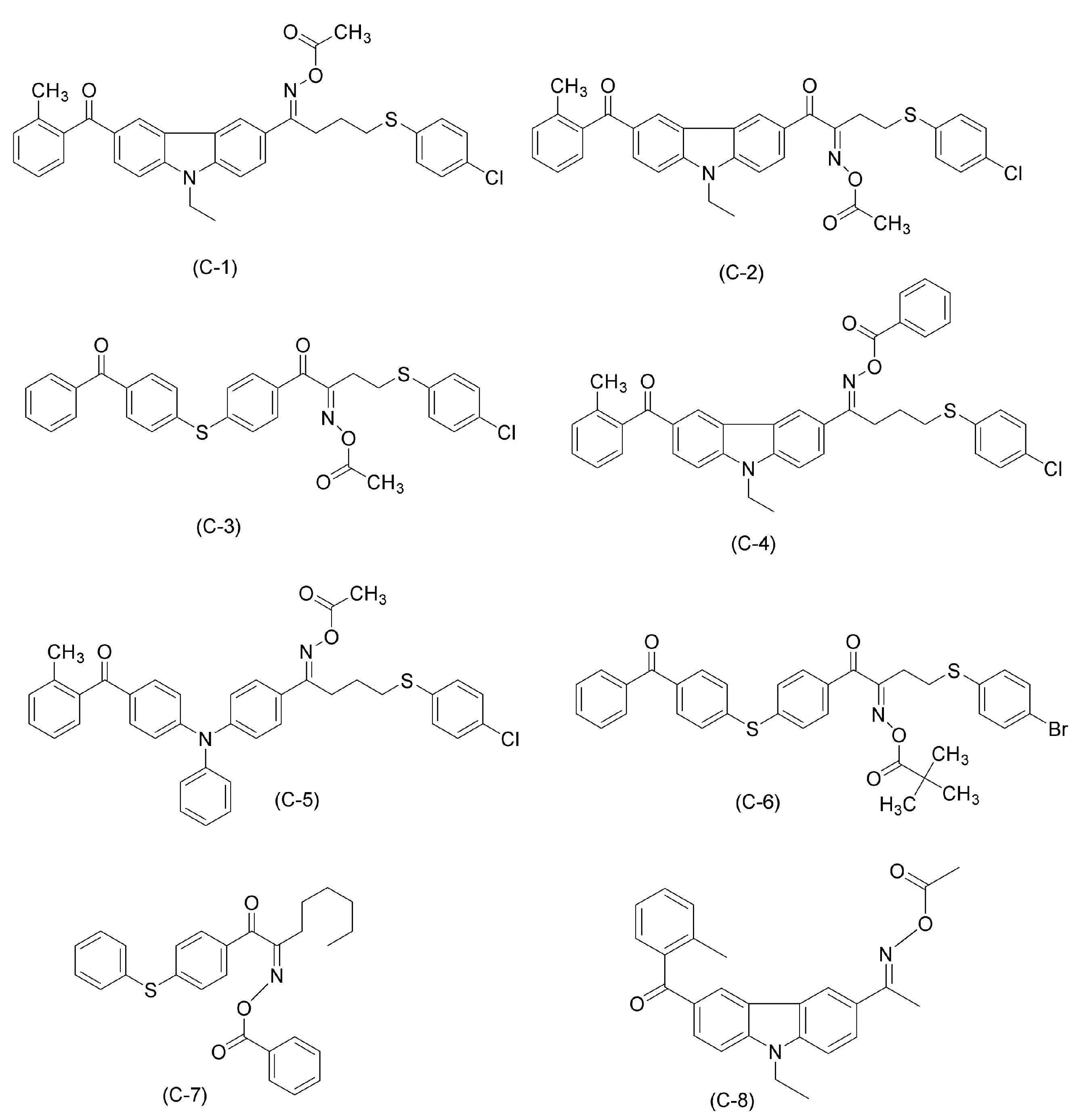

オキシム化合物は、波長350~500nmの範囲に極大吸収波長を有する化合物が好ましく、波長360~480nmの範囲に極大吸収波長を有する化合物がより好ましい。また、オキシム化合物の波長365nm又は波長405nmにおけるモル吸光係数は、感度の観点から、高いことが好ましく、1000~300000であることがより好ましく、2000~300000であることが更に好ましく、5000~200000であることが特に好ましい。化合物のモル吸光係数は、公知の方法を用いて測定することができる。例えば、分光光度計(Varian社製Cary-5 spectrophotometer)にて、酢酸エチル溶媒を用い、0.01g/Lの濃度で測定することが好ましい。
光重合開始剤としては、2官能あるいは3官能以上の光ラジカル重合開始剤を用いてもよい。そのような光ラジカル重合開始剤を用いることにより、光ラジカル重合開始剤の1分子から2つ以上のラジカルが発生するため、良好な感度が得られる。また、非対称構造の化合物を用いた場合においては、結晶性が低下して溶剤などへの溶解性が向上して、経時で析出しにくくなり、着色組成物の経時安定性を向上させることができる。2官能あるいは3官能以上の光ラジカル重合開始剤の具体例としては、特表2010-527339号公報、特表2011-524436号公報、国際公開第2015/004565号、特表2016-532675号公報の段落番号0407~0412、国際公開第2017/033680号の段落番号0039~0055に記載されているオキシム化合物の2量体、特表2013-522445号公報に記載されている化合物(E)および化合物(G)、国際公開第2016/034963号に記載されているCmpd1~7、特表2017-523465号公報の段落番号0007に記載されているオキシムエステル類光開始剤、特開2017-167399号公報の段落番号0020~0033に記載されている光開始剤、特開2017-151342号公報の段落番号0017~0026に記載されている光重合開始剤(A)などが挙げられる。
光重合開始剤は、オキシム化合物とα-アミノケトン化合物とを含むことも好ましい。両者を併用することで、現像性が向上し、矩形性に優れたパターンを形成しやすい。オキシム化合物とα-アミノケトン化合物とを併用する場合、オキシム化合物100質量部に対して、α-アミノケトン化合物が50~600質量部が好ましく、150~400質量部がより好ましい。
光重合開始剤の含有量は、近赤外線吸収層形成用組成物の全固形分中0.1~40質量%が好ましく、0.5~30質量%がより好ましく、1~20質量%が更に好ましい。光重合開始剤の含有量が上記範囲であれば、感度およびパターン形成性に優れる。近赤外線吸収層形成用組成物は光重合開始剤を1種のみ含んでいてもよく、2種以上含んでいてもよい。2種以上含む場合は、それらの合計量が上記範囲となることが好ましい。
<<樹脂>>
近赤外線吸収層形成用組成物は、樹脂を含有することが好ましい。樹脂は、例えば、顔料などの粒子を組成物中で分散させる用途やバインダーの用途で配合される。なお、主に顔料などの粒子を分散させるために用いられる樹脂を分散剤ともいう。ただし、樹脂のこのような用途は一例であって、このような用途以外の目的で樹脂を使用することもできる。
近赤外線吸収層形成用組成物は、樹脂を含有することが好ましい。樹脂は、例えば、顔料などの粒子を組成物中で分散させる用途やバインダーの用途で配合される。なお、主に顔料などの粒子を分散させるために用いられる樹脂を分散剤ともいう。ただし、樹脂のこのような用途は一例であって、このような用途以外の目的で樹脂を使用することもできる。
樹脂の重量平均分子量(Mw)は、2000~2000000が好ましい。上限は、1000000以下が好ましく、500000以下がより好ましい。下限は、3000以上が好ましく、5000以上がより好ましい。
樹脂としては、(メタ)アクリル樹脂、エポキシ樹脂、エン・チオール樹脂、ポリカーボネート樹脂、ポリエーテル樹脂、ポリアリレート樹脂、ポリスルホン樹脂、ポリエーテルスルホン樹脂、ポリフェニレン樹脂、ポリアリーレンエーテルホスフィンオキシド樹脂、ポリイミド樹脂、ポリアミドイミド樹脂、ポリオレフィン樹脂、環状オレフィン樹脂、ポリエステル樹脂、スチレン樹脂などが挙げられる。これらの樹脂から1種を単独で使用してもよく、2種以上を混合して使用してもよい。環状オレフィン樹脂としては、耐熱性向上の観点からノルボルネン樹脂が好ましい。ノルボルネン樹脂の市販品としては、例えば、JSR(株)製のARTONシリーズ(例えば、ARTON F4520)などが挙げられる。エポキシ樹脂としては、例えばフェノール化合物のグリシジルエーテル化物であるエポキシ樹脂、各種ノボラック樹脂のグリシジルエーテル化物であるエポキシ樹脂、脂環式エポキシ樹脂、脂肪族系エポキシ樹脂、複素環式エポキシ樹脂、グリシジルエステル系エポキシ樹脂、グリシジルアミン系エポキシ樹脂、ハロゲン化フェノール類をグリシジル化したエポキシ樹脂、エポキシ基をもつケイ素化合物とそれ以外のケイ素化合物との縮合物、エポキシ基を持つ重合性不飽和化合物とそれ以外の他の重合性不飽和化合物との共重合体等が挙げられる。また、エポキシ樹脂は、マープルーフG-0150M、G-0105SA、G-0130SP、G-0250SP、G-1005S、G-1005SA、G-1010S、G-2050M、G-01100、G-01758(日油(株)製、エポキシ基含有ポリマー)などを用いることもできる。また、樹脂は、国際公開第2016/088645号の実施例に記載の樹脂を用いることもできる。また、樹脂が側鎖にエチレン性不飽和結合含有基、特に(メタ)アクリロイル基を有する場合、主鎖とエチレン性不飽和結合含有基とが脂環構造を有する2価の連結基を介して結合していることも好ましい。
樹脂としては、アルカリ可溶性樹脂を用いることもできる。近赤外線吸収層形成用組成物がアルカリ可溶性樹脂を含むことにより、近赤外線吸収層形成用組成物の現像性が向上し、近赤外線吸収層形成用組成物を用いてフォトリソグラフィ法でパターン形成した際においては、現像残渣の発生などを効果的に抑制できる。アルカリ可溶性樹脂としては、酸基を有する樹脂が挙げられる。酸基としては、カルボキシル基、リン酸基、スルホ基、フェノール性ヒドロキシ基などが挙げられ、カルボキシル基が好ましい。アルカリ可溶性樹脂が有する酸基は、1種のみであってもよいし、2種以上であってもよい。なお、アルカリ可溶性樹脂は、分散剤として用いることもできる。
アルカリ可溶性樹脂は、酸基を側鎖に有する繰り返し単位を含むことが好ましく、酸基を側鎖に有する繰り返し単位を樹脂の全繰り返し単位中5~70モル%含むことがより好ましい。酸基を側鎖に有する繰り返し単位の含有量の上限は、50モル%以下であることが好ましく、30モル%以下であることがより好ましい。酸基を側鎖に有する繰り返し単位の含有量の下限は、10モル%以上であることが好ましく、20モル%以上であることがより好ましい。
アルカリ可溶性樹脂は、重合性基を有するアルカリ可溶性樹脂であることも好ましい。重合性基としては、(メタ)アリル基、(メタ)アクリロイル基等が挙げられる。重合性基を有するアルカリ可溶性樹脂は、側鎖に重合性基を有する繰り返し単位と、側鎖に酸基を有する繰り返し単位とを含む樹脂であることが好ましい。
アルカリ可溶性樹脂は、下記式(ED1)で示される化合物および/または下記式(ED2)で表される化合物(以下、これらの化合物を「エーテルダイマー」と称することもある。)を含むモノマー成分に由来する繰り返し単位を含むことも好ましい。
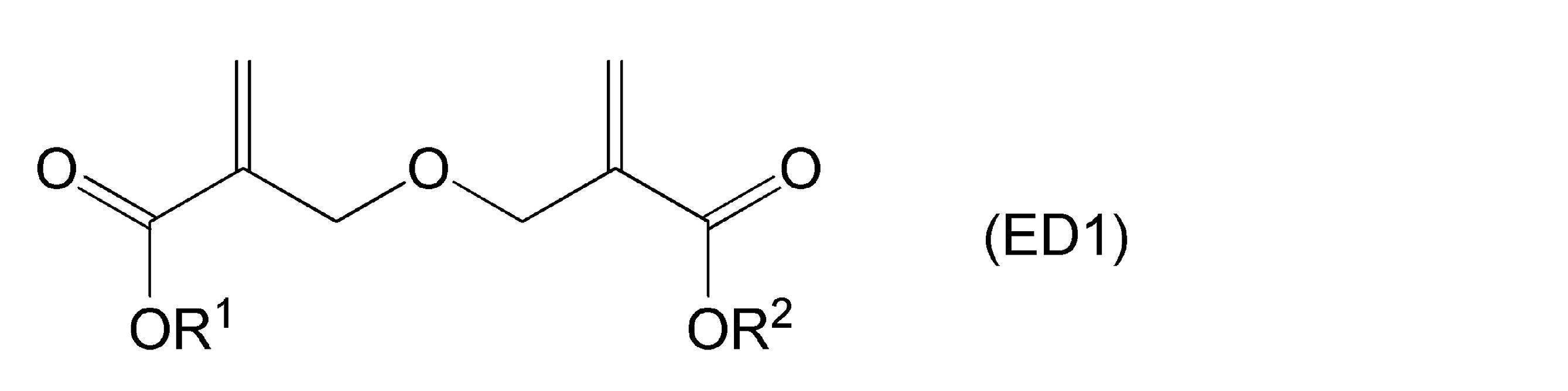
式(ED1)中、R1およびR2は、それぞれ独立して、水素原子または置換基を有していてもよい炭素数1~25の炭化水素基を表す。

式(ED2)中、Rは、水素原子または炭素数1~30の有機基を表す。式(ED2)の詳細については、特開2010-168539号公報の記載を参酌でき、この内容は本明細書に組み込まれる。
エーテルダイマーの具体例としては、例えば、特開2013-029760号公報の段落番号0317の記載を参酌することができ、この内容は本明細書に組み込まれる。
アルカリ可溶性樹脂は、下記式(X)で示される化合物に由来する繰り返し単位を含むことも好ましい。
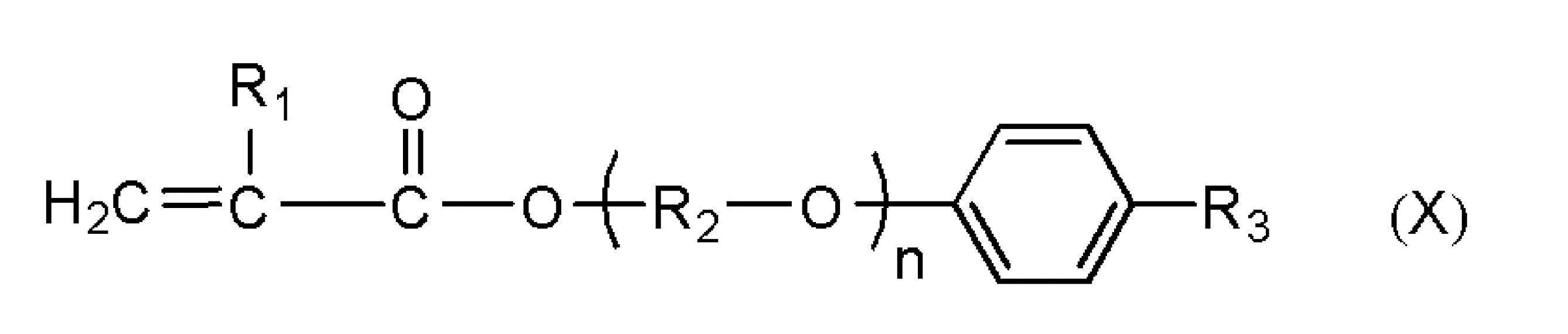
式(X)中、R1は、水素原子またはメチル基を表し、R2は炭素数2~10のアルキレン基を表し、R3は、水素原子またはベンゼン環を含んでもよい炭素数1~20のアルキル基を表す。nは1~15の整数を表す。
アルカリ可溶性樹脂については、特開2012-208494号公報の段落番号0558~0571(対応する米国特許出願公開第2012/0235099号明細書の段落番号0685~0700)の記載、特開2012-198408号公報の段落番号0076~0099の記載を参酌でき、これらの内容は本明細書に組み込まれる。
アルカリ可溶性樹脂の酸価は、30~500mgKOH/gが好ましい。下限は、50mgKOH/g以上が好ましく、70mgKOH/g以上がより好ましい。上限は、400mgKOH/g以下が好ましく、300mgKOH/g以下がより好ましく、200mgKOH/g以下が更に好ましい。
アルカリ可溶性樹脂の具体例としては、例えば下記構造の樹脂などが挙げられる。以下の構造式中、Meはメチル基を表す。
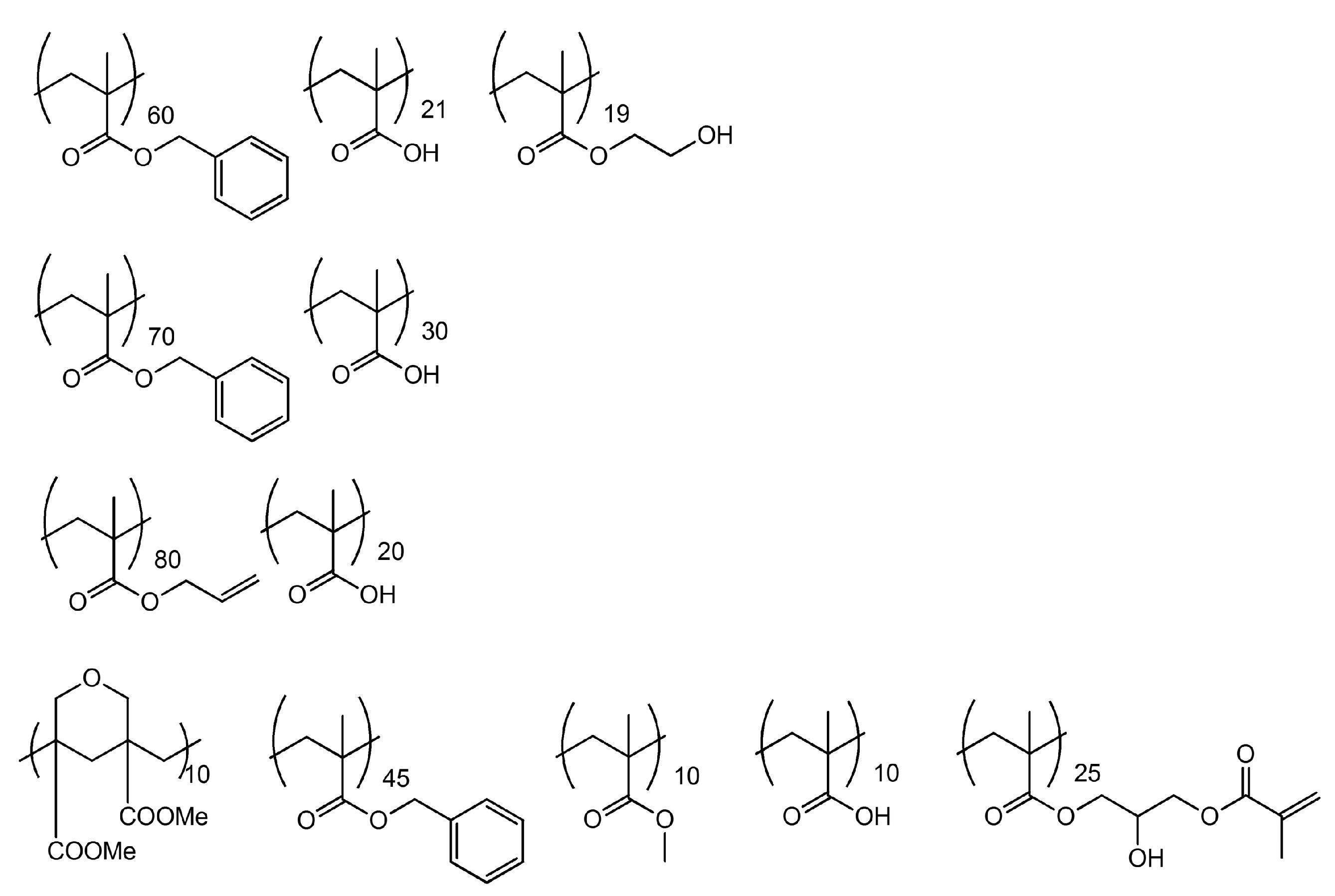
近赤外線吸収層形成用組成物は、塩基性基を有する樹脂を含むことも好ましい。塩基性基としては、アミノ基、アンモニウム塩基などが挙げられる。塩基性基を有する樹脂は塩基性基の他に酸基を更に有していてもよい。塩基性基を有する樹脂は式(SQ1)で表される化合物の分散剤として好ましく用いられる。なお、塩基性基を有する樹脂が更に酸基を有する場合、このような樹脂はアルカリ可溶性樹脂でもある。
塩基性基を有する樹脂としては、3級アミノ基と4級アンモニウム塩基とを有する樹脂が挙げられる。3級アミノ基と4級アンモニウム塩基とを有する樹脂は式(SQ1)で表される化合物の分散剤として好ましく用いられる。3級アミノ基と4級アンモニウム塩基とを有する樹脂は、3級アミノ基を有する繰り返し単位と4級アンモニウム塩基を有する繰り返し単位とを有する樹脂であることが好ましい。また、3級アミノ基と4級アンモニウム塩基とを有する樹脂はさらに酸基を有する繰り返し単位を有していてもよい。3級アミノ基と4級アンモニウム塩基とを有する樹脂は、ブロック構造を有していることも好ましい。3級アミノ基と4級アンモニウム塩基とを有する樹脂は、そのアミン価が、10~250mgKOH/g、且つ4級アンモニウム塩価が10~90mgKOH/gであるものが好ましく、アミン価が50~200mgKOH/g、且つ4級アンモニウム塩価が10~50mgKOH/gであるものがより好ましい。3級アミノ基と4級アンモニウム塩基とを有する樹脂の重量平均分子量(Mw)は3000~300000であることが好ましく、5000~30000であることがより好ましい。3級アミノ基と4級アンモニウム塩基を有する樹脂は、3級アミノ基を有するエチレン性不飽和単量体、4級アンモニウム塩基を有するエチレン性不飽和単量体、及び必要に応じてその他エチレン性不飽和単量体を共重合して製造できる。3級アミノ基を有するエチレン性不飽和単量体、4級アンモニウム塩基を有するエチレン性不飽和単量体については、国際公開第2018/230486号の段落番号0150~0170に記載されたものが挙げられ、この内容は本明細書に組み込まれる。
また、塩基性基を有する樹脂としては、主鎖に窒素原子を含む樹脂であることも好ましい。この樹脂も式(SQ1)で表される化合物の分散剤として好ましく用いられる。主鎖に窒素原子を含む樹脂(以下、オリゴイミン系樹脂ともいう)は、ポリ(低級アルキレンイミン)系繰り返し単位、ポリアリルアミン系繰り返し単位、ポリジアリルアミン系繰り返し単位、メタキシレンジアミン-エピクロルヒドリン重縮合物系繰り返し単位、及びポリビニルアミン系繰り返し単位から選択される少なくとも1種の窒素原子を有する繰り返し単位を含むことが好ましい。また、オリゴイミン系樹脂としては、pKa14以下の官能基を有する部分構造Xを有する繰り返し単位と、原子数40~10000のオリゴマー鎖又はポリマー鎖Yを含む側鎖を有する繰り返し単位とを有する樹脂であることが好ましい。オリゴイミン系樹脂はさらに酸基を有する繰り返し単位を有していてもよい。オリゴイミン系樹脂については、特開2012-255128号公報の段落番号0102~0166の記載を参酌でき、この内容は本明細書に組み込まれる。
近赤外線吸収層形成用組成物は、分散剤としての樹脂を含むこともでき、分散剤としての樹脂を含むことが好ましい。分散剤は、酸性分散剤(酸性樹脂)、塩基性分散剤(塩基性樹脂)が挙げられる。ここで、酸性分散剤(酸性樹脂)とは、酸基の量が塩基性基の量よりも多い樹脂を表す。酸性分散剤(酸性樹脂)は、酸基の量と塩基性基の量の合計量を100モル%としたときに、酸基の量が70モル%以上を占める樹脂が好ましく、実質的に酸基のみからなる樹脂がより好ましい。酸性分散剤(酸性樹脂)が有する酸基は、カルボキシル基が好ましい。また、塩基性分散剤(塩基性樹脂)とは、塩基性基の量が酸基の量よりも多い樹脂を表す。塩基性分散剤(塩基性樹脂)は、酸基の量と塩基性基の量の合計量を100モル%としたときに、塩基性基の量が50モル%を超える樹脂が好ましい。
近赤外線吸収層形成用組成物に用いられる分散剤は、塩基性基を有する樹脂であることが好ましく、塩基性分散剤であることがより好ましい。
近赤外線吸収層形成用組成物に用いられる分散剤は、塩基性基を有する樹脂であることが好ましく、塩基性分散剤であることがより好ましい。
分散剤として用いる樹脂としては、上述した、3級アミノ基と4級アンモニウム塩基とを有する樹脂、オリゴイミン系樹脂などが挙げられる。また、分散剤として用いる樹脂は、グラフト樹脂であることも好ましい。グラフト樹脂としては、グラフト鎖を有する繰り返し単位を有する樹脂が挙げられる。グラフト樹脂はさらに酸基を有する繰り返し単位を有していてもよい。グラフト樹脂の詳細は、特開2012-255128号公報の段落番号0025~0094の記載を参酌でき、この内容は本明細書に組み込まれる。また、分散剤として用いる樹脂は、酸基を有する繰り返し単位を含む樹脂であることも好ましい。また、分散剤として用いる樹脂は、コア部に複数個のポリマー鎖が結合した構造の樹脂であることも好ましい。このような樹脂としては、例えばデンドリマー(星型ポリマーを含む)が挙げられる。また、デンドリマーの具体例としては、特開2013-043962号公報の段落番号0196~0209に記載された高分子化合物C-1~C-31などが挙げられる。また、上述したアルカリ可溶性樹脂を分散剤として用いることもできる。
分散剤は、市販品としても入手可能であり、そのような具体例としては、Disperbyk-111(BYKChemie社製)、ソルスパース76500(日本ルーブリゾール(株)製)などが挙げられる。また、特開2014-130338号公報の段落番号0041~0130に記載された分散剤を用いることもでき、この内容は本明細書に組み込まれる。
樹脂の含有量は、近赤外線吸収層形成用組成物の全固形分中1~50質量%が好ましい。下限は、5質量%以上が好ましく、7質量%以上がより好ましい。上限は、40質量%以下が好ましく、30質量%以下がより好ましい。
また、近赤外線吸収層形成用組成物が塩基性基を有する樹脂を含有する場合、塩基性基を有する樹脂の含有量は、式(SQ1)で表される化合物100質量部に対して、1~100質量部が好ましい。上限は、80質量部以下が好ましく、60質量部以下がより好ましい。下限は、2.5質量部以上が好ましく、5質量部以上がより好ましい。また、樹脂組成物に含まれる樹脂中における塩基性基を有する樹脂の含有量は、10~70質量%であることが好ましく、20~65質量%であることがより好ましく、25~60質量%であることが更に好ましい。
また、近赤外線吸収層形成用組成物がアルカリ可溶性樹脂を含有する場合、アルカリ可溶性樹脂の含有量は、近赤外線吸収層形成用組成物の全固形分中1~50質量%が好ましい。下限は、5質量%以上が好ましく、7質量%以上がより好ましい。上限は、40質量%以下が好ましく、30質量%以下がより好ましい。また、近赤外線吸収層形成用組成物に含まれる樹脂中におけるアルカリ可溶性樹脂の含有量は、1~100質量%であることが好ましく、3~100質量%であることがより好ましく、5~100質量%であることが更に好ましい。
また、近赤外線吸収層形成用組成物が分散剤としての樹脂を含有する場合、分散剤としての樹脂の含有量は、顔料100質量部に対して、1~100質量部が好ましい。上限は、80質量部以下が好ましく、60質量部以下がより好ましい。下限は、2.5質量部以上が好ましく、5質量部以上がより好ましい。
近赤外線吸収層形成用組成物は樹脂を1種のみ含んでいてもよく、2種以上含んでいてもよい。2種以上含む場合は、それらの合計量が上記範囲となることが好ましい。
<<エポキシ硬化剤>>
近赤外線吸収層形成用組成物がエポキシ化合物を含む場合、エポキシ硬化剤をさらに含むことが好ましい。エポキシ硬化剤としては、例えばアミン系化合物、酸無水物系化合物、アミド系化合物、フェノール系化合物、多価カルボン酸、チオール化合物などが挙げられる。エポキシ硬化剤としては耐熱性、硬化物の透明性という観点から多価カルボン酸が好ましく、分子内に二つ以上のカルボン酸無水物基を有する化合物が最も好ましい。エポキシ硬化剤の具体例としては、ブタン二酸などが挙げられる。エポキシ硬化剤は、特開2016-075720号公報の段落番号0072~0078に記載の化合物を用いることもでき、この内容は本明細書に組み込まれる。
近赤外線吸収層形成用組成物がエポキシ化合物を含む場合、エポキシ硬化剤をさらに含むことが好ましい。エポキシ硬化剤としては、例えばアミン系化合物、酸無水物系化合物、アミド系化合物、フェノール系化合物、多価カルボン酸、チオール化合物などが挙げられる。エポキシ硬化剤としては耐熱性、硬化物の透明性という観点から多価カルボン酸が好ましく、分子内に二つ以上のカルボン酸無水物基を有する化合物が最も好ましい。エポキシ硬化剤の具体例としては、ブタン二酸などが挙げられる。エポキシ硬化剤は、特開2016-075720号公報の段落番号0072~0078に記載の化合物を用いることもでき、この内容は本明細書に組み込まれる。
エポキシ硬化剤の含有量は、エポキシ化合物の100質量部に対し、0.01~20質量部が好ましく、0.01~10質量部がより好ましく、0.1~6.0質量部がさらに好ましい。近赤外線吸収層形成用組成物はエポキシ硬化剤を1種のみ含んでいてもよく、2種以上含んでいてもよい。2種以上含む場合は、それらの合計量が上記範囲となることが好ましい。
<<溶剤>>
近赤外線吸収層形成用組成物は、溶剤を含有することが好ましい。溶剤としては有機溶剤が好ましい。有機溶剤としては、エステル系溶剤、ケトン系溶剤、アルコール系溶剤、アミド系溶剤、エーテル系溶剤、炭化水素系溶剤などが挙げられる。これらの詳細については、国際公開第2015/166779号の段落番号0223を参酌でき、この内容は本明細書に組み込まれる。また、環状アルキル基が置換したエステル系溶剤、環状アルキル基が置換したケトン系溶剤も好ましく用いることもできる。有機溶剤の具体例としては、ポリエチレングリコールモノメチルエーテル、ジクロロメタン、3-エトキシプロピオン酸メチル、3-エトキシプロピオン酸エチル、エチルセロソルブアセテート、乳酸エチル、ジエチレングリコールジメチルエーテル、酢酸ブチル、3-メトキシプロピオン酸メチル、2-ヘプタノン、シクロヘキサノン、酢酸シクロヘキシル、シクロペンタノン、エチルカルビトールアセテート、ブチルカルビトールアセテート、プロピレングリコールモノメチルエーテル、プロピレングリコールモノメチルエーテルアセテート、3-メトキシ-N,N-ジメチルプロパンアミド、3-ブトキシ-N,N-ジメチルプロパンアミドなどが挙げられる。ただし有機溶剤としての芳香族炭化水素類(ベンゼン、トルエン、キシレン、エチルベンゼン等)は、環境面等の理由により低減したほうがよい場合がある(例えば、有機溶剤全量に対して、50質量ppm(parts per million)以下とすることもでき、10質量ppm以下とすることもでき、1質量ppm以下とすることもできる)
近赤外線吸収層形成用組成物は、溶剤を含有することが好ましい。溶剤としては有機溶剤が好ましい。有機溶剤としては、エステル系溶剤、ケトン系溶剤、アルコール系溶剤、アミド系溶剤、エーテル系溶剤、炭化水素系溶剤などが挙げられる。これらの詳細については、国際公開第2015/166779号の段落番号0223を参酌でき、この内容は本明細書に組み込まれる。また、環状アルキル基が置換したエステル系溶剤、環状アルキル基が置換したケトン系溶剤も好ましく用いることもできる。有機溶剤の具体例としては、ポリエチレングリコールモノメチルエーテル、ジクロロメタン、3-エトキシプロピオン酸メチル、3-エトキシプロピオン酸エチル、エチルセロソルブアセテート、乳酸エチル、ジエチレングリコールジメチルエーテル、酢酸ブチル、3-メトキシプロピオン酸メチル、2-ヘプタノン、シクロヘキサノン、酢酸シクロヘキシル、シクロペンタノン、エチルカルビトールアセテート、ブチルカルビトールアセテート、プロピレングリコールモノメチルエーテル、プロピレングリコールモノメチルエーテルアセテート、3-メトキシ-N,N-ジメチルプロパンアミド、3-ブトキシ-N,N-ジメチルプロパンアミドなどが挙げられる。ただし有機溶剤としての芳香族炭化水素類(ベンゼン、トルエン、キシレン、エチルベンゼン等)は、環境面等の理由により低減したほうがよい場合がある(例えば、有機溶剤全量に対して、50質量ppm(parts per million)以下とすることもでき、10質量ppm以下とすることもでき、1質量ppm以下とすることもできる)
溶剤の含有量は、近赤外線吸収層形成用組成物の全量に対し、10~97質量%であることが好ましい。下限は、30質量%以上であることが好ましく、40質量%以上であることがより好ましく、50質量%以上であることがさらに好ましく、60質量%以上であることがより一層好ましく、70質量%以上であることが特に好ましい。上限は、96質量%以下であることが好ましく、95質量%以下であることがより好ましい。近赤外線吸収層形成用組成物は溶剤を1種のみ含んでいてもよく、2種以上含んでいてもよい。2種以上含む場合は、それらの合計量が上記範囲となることが好ましい。
<<重合禁止剤>>
近赤外線吸収層形成用組成物は、重合禁止剤を含有することができる。重合禁止剤としては、ハイドロキノン、p-メトキシフェノール、ジ-tert-ブチル-p-クレゾール、ピロガロール、tert-ブチルカテコール、ベンゾキノン、4,4’-チオビス(3-メチル-6-tert-ブチルフェノール)、2,2’-メチレンビス(4-メチル-6-t-ブチルフェノール)、N-ニトロソフェニルヒドロキシアミン塩(アンモニウム塩、第一セリウム塩等)が挙げられ、p-メトキシフェノールが好ましい。重合禁止剤の含有量は、近赤外線吸収層形成用組成物の全固形分中、0.0001~5質量%が好ましい。近赤外線吸収層形成用組成物は重合禁止剤を1種のみ含んでいてもよく、2種以上含んでいてもよい。2種以上含む場合は、それらの合計量が上記範囲となることが好ましい。
近赤外線吸収層形成用組成物は、重合禁止剤を含有することができる。重合禁止剤としては、ハイドロキノン、p-メトキシフェノール、ジ-tert-ブチル-p-クレゾール、ピロガロール、tert-ブチルカテコール、ベンゾキノン、4,4’-チオビス(3-メチル-6-tert-ブチルフェノール)、2,2’-メチレンビス(4-メチル-6-t-ブチルフェノール)、N-ニトロソフェニルヒドロキシアミン塩(アンモニウム塩、第一セリウム塩等)が挙げられ、p-メトキシフェノールが好ましい。重合禁止剤の含有量は、近赤外線吸収層形成用組成物の全固形分中、0.0001~5質量%が好ましい。近赤外線吸収層形成用組成物は重合禁止剤を1種のみ含んでいてもよく、2種以上含んでいてもよい。2種以上含む場合は、それらの合計量が上記範囲となることが好ましい。
<<シランカップリング剤>>
近赤外線吸収層形成用組成物は、シランカップリング剤を含有することができる。本発明において、シランカップリング剤は、加水分解性基とそれ以外の官能基とを有するシラン化合物を意味する。また、加水分解性基とは、ケイ素原子に直結し、加水分解反応および縮合反応の少なくともいずれかによってシロキサン結合を生じ得る置換基をいう。加水分解性基としては、例えば、ハロゲン原子、アルコキシ基、アシルオキシ基などが挙げられ、アルコキシ基が好ましい。すなわち、シランカップリング剤は、アルコキシシリル基を有する化合物が好ましい。また、加水分解性基以外の官能基としては、例えば、ビニル基、スチリル基、(メタ)アクリロイル基、メルカプト基、エポキシ基、オキセタニル基、アミノ基、ウレイド基、スルフィド基、イソシアネート基、フェニル基などが挙げられ、(メタ)アクリロイル基およびエポキシ基が好ましい。シランカップリング剤は、特開2009-288703号公報の段落番号0018~0036に記載の化合物、特開2009-242604号公報の段落番号0056~0066に記載の化合物が挙げられ、これらの内容は本明細書に組み込まれる。
近赤外線吸収層形成用組成物は、シランカップリング剤を含有することができる。本発明において、シランカップリング剤は、加水分解性基とそれ以外の官能基とを有するシラン化合物を意味する。また、加水分解性基とは、ケイ素原子に直結し、加水分解反応および縮合反応の少なくともいずれかによってシロキサン結合を生じ得る置換基をいう。加水分解性基としては、例えば、ハロゲン原子、アルコキシ基、アシルオキシ基などが挙げられ、アルコキシ基が好ましい。すなわち、シランカップリング剤は、アルコキシシリル基を有する化合物が好ましい。また、加水分解性基以外の官能基としては、例えば、ビニル基、スチリル基、(メタ)アクリロイル基、メルカプト基、エポキシ基、オキセタニル基、アミノ基、ウレイド基、スルフィド基、イソシアネート基、フェニル基などが挙げられ、(メタ)アクリロイル基およびエポキシ基が好ましい。シランカップリング剤は、特開2009-288703号公報の段落番号0018~0036に記載の化合物、特開2009-242604号公報の段落番号0056~0066に記載の化合物が挙げられ、これらの内容は本明細書に組み込まれる。
シランカップリング剤の含有量は、近赤外線吸収層形成用組成物の全固形分中0.01~15.0質量%が好ましく、0.05~10.0質量%がより好ましい。近赤外線吸収層形成用組成物はシランカップリング剤を1種のみ含んでいてもよく、2種以上含んでいてもよい。2種以上含む場合は、それらの合計量が上記範囲となることが好ましい。
<<界面活性剤>>
近赤外線吸収層形成用組成物は、界面活性剤を含有することができる。界面活性剤としては、フッ素系界面活性剤、ノニオン系界面活性剤、カチオン系界面活性剤、アニオン系界面活性剤、シリコン系界面活性剤などの各種界面活性剤を使用することができる。界面活性剤については、国際公開第2015/166779号の段落番号0238~0245に記載された界面活性剤が挙げられ、この内容は本明細書に組み込まれる。
近赤外線吸収層形成用組成物は、界面活性剤を含有することができる。界面活性剤としては、フッ素系界面活性剤、ノニオン系界面活性剤、カチオン系界面活性剤、アニオン系界面活性剤、シリコン系界面活性剤などの各種界面活性剤を使用することができる。界面活性剤については、国際公開第2015/166779号の段落番号0238~0245に記載された界面活性剤が挙げられ、この内容は本明細書に組み込まれる。
界面活性剤は、フッ素系界面活性剤であることが好ましい。近赤外線吸収層形成用組成物にフッ素系界面活性剤を含有させることで液特性(特に、流動性)がより向上し、省液性をより改善することができる。また、厚みムラの小さい膜を形成することもできる。
フッ素系界面活性剤中のフッ素含有率は、3~40質量%が好適であり、より好ましくは5~30質量%であり、特に好ましくは7~25質量%である。フッ素含有率がこの範囲内であるフッ素系界面活性剤は、塗布膜の厚さの均一性や省液性の点で効果的であり、組成物中における溶解性も良好である。
フッ素系界面活性剤としては、特開2014-041318号公報の段落番号0060~0064(対応する国際公開第2014/017669号の段落番号0060~0064)等に記載の界面活性剤、特開2011-132503号公報の段落番号0117~0132に記載の界面活性剤が挙げられ、これらの内容は本明細書に組み込まれる。フッ素系界面活性剤の市販品としては、例えば、メガファックF171、F172、F173、F176、F177、F141、F142、F143、F144、R30、F437、F475、F479、F482、F554、F780、EXP、MFS-330(以上、DIC(株)製)、フロラードFC430、FC431、FC171(以上、住友スリーエム(株)製)、サーフロンS-382、SC-101、SC-103、SC-104、SC-105、SC-1068、SC-381、SC-383、S-393、KH-40(以上、旭硝子(株)製)、PolyFox PF636、PF656、PF6320、PF6520、PF7002(以上、OMNOVA社製)等が挙げられる。
また、フッ素系界面活性剤は、フッ素原子を含有する官能基を持つ分子構造を有し、熱を加えるとフッ素原子を含有する官能基の部分が切断されてフッ素原子が揮発するアクリル系化合物も好適に使用できる。このようなフッ素系界面活性剤としては、DIC(株)製のメガファックDSシリーズ(化学工業日報(2016年2月22日)、日経産業新聞(2016年2月23日))、例えばメガファックDS-21が挙げられる。
また、フッ素系界面活性剤は、フッ素化アルキル基またはフッ素化アルキレンエーテル基を有するフッ素原子含有ビニルエーテル化合物と、親水性のビニルエーテル化合物との重合体を用いることも好ましい。このようなフッ素系界面活性剤は、特開2016-216602号公報に記載されたフッ素系界面活性剤が挙げられ、この内容は本明細書に組み込まれる。
フッ素系界面活性剤は、ブロックポリマーを用いることもできる。フッ素系界面活性剤は、フッ素原子を有する(メタ)アクリレート化合物に由来する繰り返し単位と、アルキレンオキシ基(好ましくはエチレンオキシ基、プロピレンオキシ基)を2以上(好ましくは5以上)有する(メタ)アクリレート化合物に由来する繰り返し単位と、を含む含フッ素高分子化合物も好ましく用いることができる。また、特開2010-032698号公報の段落番号0016~0037に記載されたフッ素含有界面活性剤や、下記化合物も本発明で用いられるフッ素系界面活性剤として例示される。
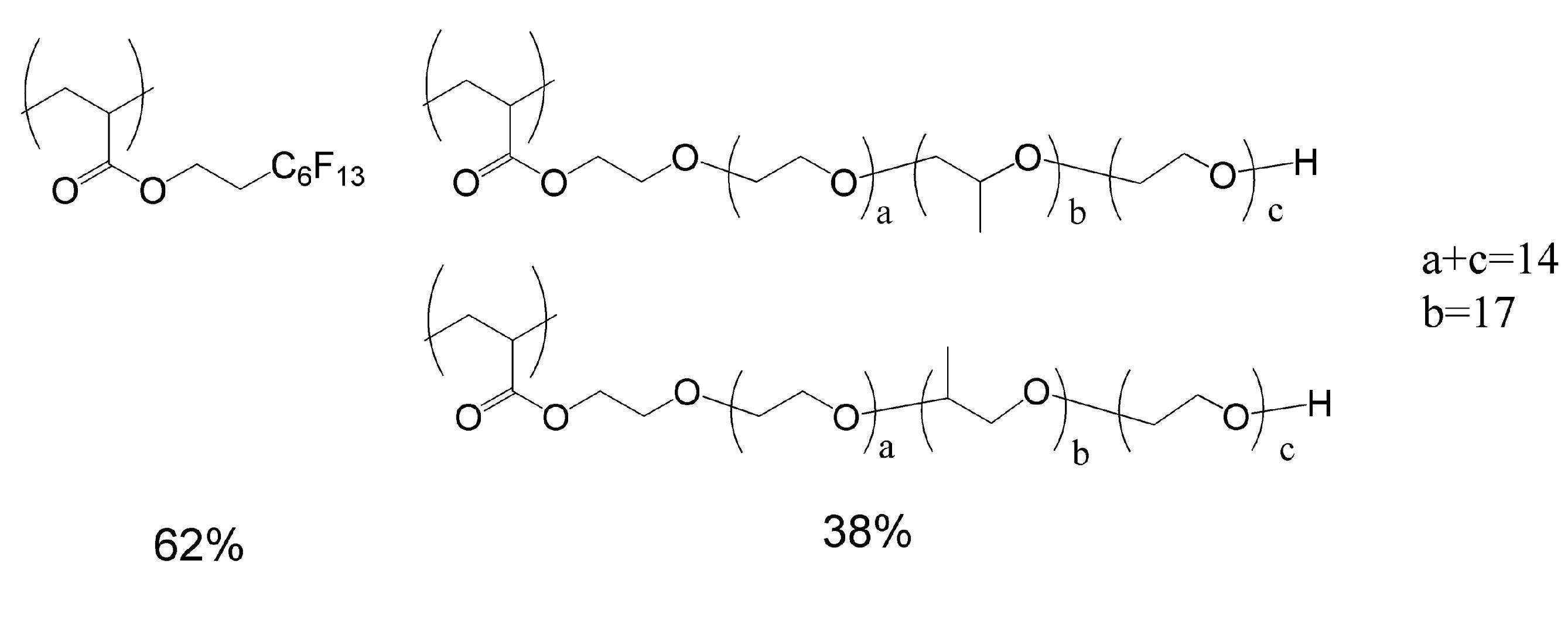
上記の化合物の重量平均分子量は、好ましくは3000~50000であり、例えば、14000である。上記の化合物中、繰り返し単位の割合を示す%はモル%である。
また、フッ素系界面活性剤は、エチレン性不飽和結合含有基を側鎖に有する含フッ素重合体を用いることもできる。具体例としては、特開2010-164965号公報の段落番号0050~0090および段落番号0289~0295に記載された化合物、DIC(株)製のメガファックRS-101、RS-102、RS-718K、RS-72-K等が挙げられる。また、フッ素系界面活性剤は、特開2015-117327号公報の段落番号0015~0158に記載の化合物を用いることもできる。
ノニオン系界面活性剤としては、グリセロール、トリメチロールプロパン、トリメチロールエタン並びにそれらのエトキシレート及びプロポキシレート(例えば、グリセロールプロポキシレート、グリセロールエトキシレート等)、ポリオキシエチレンラウリルエーテル、ポリオキシエチレンステアリルエーテル、ポリオキシエチレンオレイルエーテル、ポリオキシエチレンオクチルフェニルエーテル、ポリオキシエチレンノニルフェニルエーテル、ポリエチレングリコールジラウレート、ポリエチレングリコールジステアレート、ソルビタン脂肪酸エステル、プルロニックL10、L31、L61、L62、10R5、17R2、25R2(BASF社製)、テトロニック304、701、704、901、904、150R1(BASF社製)、ソルスパース20000(日本ルーブリゾール(株)製)、NCW-101、NCW-1001、NCW-1002(和光純薬工業(株)製)、パイオニンD-6112、D-6112-W、D-6315(竹本油脂(株)製)、オルフィンE1010、サーフィノール104、400、440(日信化学工業(株)製)などが挙げられる。
シリコン系界面活性剤としては、例えば、トーレシリコーンDC3PA、トーレシリコーンSH7PA、トーレシリコーンDC11PA、トーレシリコーンSH21PA、トーレシリコーンSH28PA、トーレシリコーンSH29PA、トーレシリコーンSH30PA、トーレシリコーンSH8400(以上、東レ・ダウコーニング(株)製)、TSF-4440、TSF-4300、TSF-4445、TSF-4460、TSF-4452(以上、モメンティブ・パフォーマンス・マテリアルズ社製)、KP-341、KF-6001、KF-6002(以上、信越シリコーン株式会社製)、BYK307、BYK323、BYK330(以上、ビックケミー社製)等が挙げられる。
界面活性剤の含有量は、近赤外線吸収層形成用組成物の全固形分中0.001質量%~5.0質量%が好ましく、0.005~3.0質量%がより好ましい。近赤外線吸収層形成用組成物は界面活性剤を1種のみ含んでいてもよく、2種以上含んでいてもよい。2種以上含む場合は、それらの合計量が上記範囲となることが好ましい。
<<紫外線吸収剤>>
近赤外線吸収層形成用組成物は、紫外線吸収剤を含有することができる。紫外線吸収剤としては、共役ジエン化合物、アミノジエン化合物、サリシレート化合物、ベンゾフェノン化合物、ベンゾトリアゾール化合物、アクリロニトリル化合物、ヒドロキシフェニルトリアジン化合物、インドール化合物、トリアジン化合物などが挙げられる。このような化合物の具体例としては、特開2009-217221号公報の段落番号0038~0052、特開2012-208374号公報の段落番号0052~0072、特開2013-068814号公報の段落番号0317~0334、特開2016-162946号公報の段落番号0061~0080に記載された化合物が挙げられ、これらの内容は本明細書に組み込まれる。紫外線吸収剤の市販品としては、例えば、UV-503(大東化学(株)製)などが挙げられる。また、ベンゾトリアゾール化合物としては、ミヨシ油脂製のMYUAシリーズ(化学工業日報、2016年2月1日)が挙げられる。また、紫外線吸収剤は、特許第6268967号公報の段落番号0049~0059に記載された化合物を用いることもできる。紫外線吸収剤の含有量は、近赤外線吸収層形成用組成物の全固形分中0.01~10質量%が好ましく、0.01~5質量%がより好ましい。近赤外線吸収層形成用組成物は紫外線吸収剤を1種のみ含んでいてもよく、2種以上含んでいてもよい。2種以上含む場合は、それらの合計量が上記範囲となることが好ましい。
近赤外線吸収層形成用組成物は、紫外線吸収剤を含有することができる。紫外線吸収剤としては、共役ジエン化合物、アミノジエン化合物、サリシレート化合物、ベンゾフェノン化合物、ベンゾトリアゾール化合物、アクリロニトリル化合物、ヒドロキシフェニルトリアジン化合物、インドール化合物、トリアジン化合物などが挙げられる。このような化合物の具体例としては、特開2009-217221号公報の段落番号0038~0052、特開2012-208374号公報の段落番号0052~0072、特開2013-068814号公報の段落番号0317~0334、特開2016-162946号公報の段落番号0061~0080に記載された化合物が挙げられ、これらの内容は本明細書に組み込まれる。紫外線吸収剤の市販品としては、例えば、UV-503(大東化学(株)製)などが挙げられる。また、ベンゾトリアゾール化合物としては、ミヨシ油脂製のMYUAシリーズ(化学工業日報、2016年2月1日)が挙げられる。また、紫外線吸収剤は、特許第6268967号公報の段落番号0049~0059に記載された化合物を用いることもできる。紫外線吸収剤の含有量は、近赤外線吸収層形成用組成物の全固形分中0.01~10質量%が好ましく、0.01~5質量%がより好ましい。近赤外線吸収層形成用組成物は紫外線吸収剤を1種のみ含んでいてもよく、2種以上含んでいてもよい。2種以上含む場合は、それらの合計量が上記範囲となることが好ましい。
<<その他成分>>
近赤外線吸収層形成用組成物は、必要に応じて、増感剤、硬化促進剤、フィラー、熱硬化促進剤、熱重合禁止剤、可塑剤、密着促進剤およびその他の助剤類(例えば、導電性粒子、充填剤、消泡剤、難燃剤、レベリング剤、剥離促進剤、酸化防止剤、香料、表面張力調整剤、連鎖移動剤など)を含有してもよい。これらの成分は、特開2008-250074号公報の段落番号0101~0104、0107~0109等に記載された素材が挙げられる。また、酸化防止剤としては、フェノール化合物、亜リン酸エステル化合物、チオエーテル化合物などが挙げられる。酸化防止剤としては、分子量500以上のフェノール化合物、分子量500以上の亜リン酸エステル化合物または分子量500以上のチオエーテル化合物がより好ましい。これらは2種以上を混合して使用してもよい。フェノール化合物としては、フェノール系酸化防止剤として知られる任意のフェノール化合物を使用することができる。好ましいフェノール化合物としては、ヒンダードフェノール化合物が挙げられる。特に、フェノール性水酸基に隣接する部位(オルト位)に置換基を有する化合物が好ましい。また、酸化防止剤は、同一分子内にフェノール基と亜リン酸エステル基を有する化合物も好ましい。また、酸化防止剤は、リン系酸化防止剤も好適に使用することができる。リン系酸化防止剤としてはトリス[2-[[2,4,8,10-テトラキス(1,1-ジメチルエチル)ジベンゾ[d,f][1,3,2]ジオキサホスフェピン-6-イル]オキシ]エチル]アミン、トリス[2-[(4,6,9,11-テトラ-tert-ブチルジベンゾ[d,f][1,3,2]ジオキサホスフェピン-2-イル)オキシ]エチル]アミン、および亜リン酸エチルビス(2,4-ジ-tert-ブチル-6-メチルフェニル)からなる群から選ばれる少なくとも1種の化合物が挙げられる。これらは、市販品として入手できる。例えば、アデカスタブ AO-20、アデカスタブ AO-30、アデカスタブ AO-40、アデカスタブ AO-50、アデカスタブ AO-50F、アデカスタブ AO-60、アデカスタブ AO-60G、アデカスタブ AO-80、アデカスタブ AO-330((株)ADEKA)などが挙げられる。酸化防止剤の含有量は、近赤外線吸収層形成用組成物の全固形分中0.01~20質量%であることが好ましく、0.3~15質量%であることがより好ましい。酸化防止剤は、1種類のみでもよく、2種類以上でもよい。2種類以上の場合は、合計量が上記範囲となることが好ましい。
近赤外線吸収層形成用組成物は、必要に応じて、増感剤、硬化促進剤、フィラー、熱硬化促進剤、熱重合禁止剤、可塑剤、密着促進剤およびその他の助剤類(例えば、導電性粒子、充填剤、消泡剤、難燃剤、レベリング剤、剥離促進剤、酸化防止剤、香料、表面張力調整剤、連鎖移動剤など)を含有してもよい。これらの成分は、特開2008-250074号公報の段落番号0101~0104、0107~0109等に記載された素材が挙げられる。また、酸化防止剤としては、フェノール化合物、亜リン酸エステル化合物、チオエーテル化合物などが挙げられる。酸化防止剤としては、分子量500以上のフェノール化合物、分子量500以上の亜リン酸エステル化合物または分子量500以上のチオエーテル化合物がより好ましい。これらは2種以上を混合して使用してもよい。フェノール化合物としては、フェノール系酸化防止剤として知られる任意のフェノール化合物を使用することができる。好ましいフェノール化合物としては、ヒンダードフェノール化合物が挙げられる。特に、フェノール性水酸基に隣接する部位(オルト位)に置換基を有する化合物が好ましい。また、酸化防止剤は、同一分子内にフェノール基と亜リン酸エステル基を有する化合物も好ましい。また、酸化防止剤は、リン系酸化防止剤も好適に使用することができる。リン系酸化防止剤としてはトリス[2-[[2,4,8,10-テトラキス(1,1-ジメチルエチル)ジベンゾ[d,f][1,3,2]ジオキサホスフェピン-6-イル]オキシ]エチル]アミン、トリス[2-[(4,6,9,11-テトラ-tert-ブチルジベンゾ[d,f][1,3,2]ジオキサホスフェピン-2-イル)オキシ]エチル]アミン、および亜リン酸エチルビス(2,4-ジ-tert-ブチル-6-メチルフェニル)からなる群から選ばれる少なくとも1種の化合物が挙げられる。これらは、市販品として入手できる。例えば、アデカスタブ AO-20、アデカスタブ AO-30、アデカスタブ AO-40、アデカスタブ AO-50、アデカスタブ AO-50F、アデカスタブ AO-60、アデカスタブ AO-60G、アデカスタブ AO-80、アデカスタブ AO-330((株)ADEKA)などが挙げられる。酸化防止剤の含有量は、近赤外線吸収層形成用組成物の全固形分中0.01~20質量%であることが好ましく、0.3~15質量%であることがより好ましい。酸化防止剤は、1種類のみでもよく、2種類以上でもよい。2種類以上の場合は、合計量が上記範囲となることが好ましい。
近赤外線吸収層形成用組成物の粘度(23℃)は、例えば、塗布により膜を形成する場合、1~100mPa・sであることが好ましい。下限は、2mPa・s以上がより好ましく、3mPa・s以上がさらに好ましい。上限は、50mPa・s以下がより好ましく、30mPa・s以下がさらに好ましく、15mPa・s以下が特に好ましい。
<着色画素形成用組成物>
次に、着色画素形成用組成物について説明する。この着色画素形成用組成物は、本発明の構造体のカラーフィルタ層の着色画素を形成することに好ましく用いられる。着色画素の種類としては、赤色画素、緑色画素、青色画素、黄色画素、シアン色画素、マゼンタ色画素などが挙げられる。以下、赤色画素形成に用いられる着色画素形成用組成物のことを、赤色画素形成用組成物ともいう。他色の着色画素に用いられる着色画素形成用組成物についても、同様である。
次に、着色画素形成用組成物について説明する。この着色画素形成用組成物は、本発明の構造体のカラーフィルタ層の着色画素を形成することに好ましく用いられる。着色画素の種類としては、赤色画素、緑色画素、青色画素、黄色画素、シアン色画素、マゼンタ色画素などが挙げられる。以下、赤色画素形成に用いられる着色画素形成用組成物のことを、赤色画素形成用組成物ともいう。他色の着色画素に用いられる着色画素形成用組成物についても、同様である。
<<有彩色色素>>
着色画素形成用組成物は、有彩色色素を含有する。有彩色色素としては、上述したカラーフィルタ層で説明したものが挙げられる。有彩色色素としては顔料であることが好ましい。着色画素形成用組成物に含有させる有彩色色素の種類および含有量については、形成する着色画素の種類に応じて適宜選択することができる。
着色画素形成用組成物は、有彩色色素を含有する。有彩色色素としては、上述したカラーフィルタ層で説明したものが挙げられる。有彩色色素としては顔料であることが好ましい。着色画素形成用組成物に含有させる有彩色色素の種類および含有量については、形成する着色画素の種類に応じて適宜選択することができる。
例えば、赤色画素形成用組成物は、有彩色色素として赤色色素を少なくとも含むことが好ましい。赤色画素形成用組成物は、更に黄色色素およびオレンジ色色素から選ばれる少なくとも1種を含有することも好ましく、オレンジ色色素を少なくとも含むことがより好ましい。有彩色色素中における赤色色素の含有量は、20~100質量%であることが好ましく、30~100質量%であることがより好ましく、40~100質量%であることが更に好ましい。
また、緑色画素形成用組成物は、有彩色色素として緑色色素を少なくとも含むことが好ましい。緑色画素形成用組成物は、更に黄色色素を含有することも好ましい。また、有彩色色素中における緑色色素の含有量は、20~100質量%であることが好ましく、30~100質量%であることがより好ましく、40~100質量%であることが更に好ましい。
また、青色画素形成用組成物は、有彩色色素として青色色素を少なくとも含むことが好ましい。青色画素形成用組成物は、更に紫色色素を含有することも好ましい。また、有彩色色素中における青色色素の含有量は、20~100質量%であることが好ましく、30~100質量%であることがより好ましく、40~100質量%であることが更に好ましい。
有彩色色素の含有量は、着色画素形成用組成物の全固形分中20質量%以上が好ましく、25質量%以上であることがより好ましく、30質量%以上が更に好ましく、40質量%以上がより一層好ましく、45質量%以上であることが更に一層好ましく、50質量%以上であることが特に好ましい。上限は、80質量%以下が好ましく、75質量%以下がより好ましい。着色画素形成用組成物は有彩色色素を1種のみ含んでいてもよく、2種以上含んでいてもよい。2種以上含む場合は、それらの合計量が上記範囲となることが好ましい。
また、赤色画素形成用組成物の場合、赤色画素形成用組成物の全固形分中における有彩色色素の含有量は、20質量%以上が好ましく、30質量%以上がより好ましく、40質量%以上が更に好ましい。上限は、70質量%以下が好ましく、65質量%以下がより好ましく、60質量%以下が更に好ましい。
また、緑色画素形成用組成物の場合、緑色画素形成用組成物の全固形分中における有彩色色素の含有量は20質量%以上が好ましく、30質量%以上がより好ましく、40質量%以上が更に好ましい。上限は、70質量%以下が好ましく、65質量%以下がより好ましく、60質量%以下が更に好ましい。
また、青色画素形成用組成物の場合、青色画素形成用組成物の全固形分中における有彩色色素の含有量は、20質量%以上が好ましく、30質量%以上がより好ましく、40質量%以上が更に好ましい。上限は、70質量%以下が好ましく、65質量%以下がより好ましく、60質量%以下が更に好ましい。
<<色素誘導体>>
着色画素形成用組成物は、更に色素誘導体を含有することができる。色素誘導体としては、酸性色素誘導体及び塩基性色素誘導体が挙げられ、塩基性色素誘導体であることが好ましい。なかでも、赤色画素形成用組成物は、塩基性色素誘導体を含むことが好ましい。色素誘導体の詳細については、上述したものが挙げられる。
着色画素形成用組成物は、更に色素誘導体を含有することができる。色素誘導体としては、酸性色素誘導体及び塩基性色素誘導体が挙げられ、塩基性色素誘導体であることが好ましい。なかでも、赤色画素形成用組成物は、塩基性色素誘導体を含むことが好ましい。色素誘導体の詳細については、上述したものが挙げられる。
着色画素形成用組成物が色素誘導体を含む場合、着色画素形成用組成物の全固形分中の色素誘導体の含有量は、1~40質量%であることが好ましい。含有量の下限は3質量%以上であることが好ましく、5質量%以上であることが更に好ましい。含有量の上限は、30質量%以下であることが好ましく、25質量%以下であることがより好ましく、20質量%以下であることが更に好ましい。また、有彩色色素の100質量部に対して色素誘導体を1~50質量部含有することが好ましい。含有量の下限は5質量部以上であることが好ましく、10質量部以上であることが更に好ましい。含有量の上限は、40質量部以下であることが好ましく、30質量部以下であることがより好ましく、25質量部以下であることが更に好ましい。
また、着色画素形成用組成物の全固形分中の塩基性色素誘導体の含有量は、1~40質量%であることが好ましい。含有量の下限は3質量%以上であることが好ましく、5質量%以上であることが更に好ましい。含有量の上限は、30質量%以下であることが好ましく、25質量%以下であることがより好ましく、20質量%以下であることが更に好ましい。また、有彩色色素の100質量部に対して塩基性色素誘導体を1~50質量部含有することが好ましい。含有量の下限は5質量部以上であることが好ましく、10質量部以上であることが更に好ましい。含有量の上限は、40質量部以下であることが好ましく、30質量部以下であることがより好ましく、25質量部以下であることが更に好ましい。
また、赤色画素形成用組成物の場合、赤色画素形成用組成物の全固形分中の有彩色色素と塩基性色素誘導体との合計の含有量は50質量%以上が好ましく、52質量%以上がより好ましく、55質量%以上が更に好ましい。上限は、70質量%以下が好ましく、65質量%以下がより好ましく、63質量%以下が更に好ましく、60質量%以下が特に好ましい。また、赤色画素形成用組成物は有彩色色素の100質量部に対して、塩基性色素誘導体を1~50質量部含有することが好ましい。上限は、40質量部以下であることが好ましく、30質量部以下であることがより好ましく、25質量部以下であることが更に好ましい。下限は、5質量部以上であることが好ましく、10質量部以上であることがより好ましく、15質量部以上であることが更に好ましい。
緑色画素形成用組成物は、色素誘導体を含有していてもよく、色素誘導体を含有していなくてもよい。色素誘導体を含有することが好ましく、塩基性色素誘導体を含有することがより好ましい。また、緑色画素形成用組成物が色素誘導体を含有する場合、緑色画素形成用組成物の全固形分中の有彩色色素と、色素誘導体(好ましくは塩基性色素誘導体)との合計の含有量は50質量%以上が好ましく、52質量%以上がより好ましく、55質量%以上が更に好ましい。上限は、70質量%以下が好ましく、65質量%以下がより好ましく、63質量%以下が更に好ましく、60質量%以下が特に好ましい。
また、緑色画素形成用組成物は有彩色色素の100質量部に対して、塩基性色素誘導体を1~50質量部含有することが好ましい。上限は、40質量部以下であることが好ましく、30質量部以下であることがより好ましく、25質量部以下であることが更に好ましい。下限は、5質量部以上であることが好ましく、10質量部以上であることがより好ましく、15質量部以上であることが更に好ましい。
また、緑色画素形成用組成物は有彩色色素の100質量部に対して、塩基性色素誘導体を1~50質量部含有することが好ましい。上限は、40質量部以下であることが好ましく、30質量部以下であることがより好ましく、25質量部以下であることが更に好ましい。下限は、5質量部以上であることが好ましく、10質量部以上であることがより好ましく、15質量部以上であることが更に好ましい。
青色画素形成用組成物は、色素誘導体を含有していてもよく、色素誘導体を含有していなくてもよい。色素誘導体を含有することが好ましく、塩基性色素誘導体を含有することがより好ましい。また、青色画素形成用組成物が色素誘導体を含有する場合、青色画素形成用組成物の全固形分中の有彩色色素と、色素誘導体(好ましくは塩基性色素誘導体)との合計の含有量は50質量%以上が好ましく、52質量%以上がより好ましく、55質量%以上が更に好ましい。上限は、70質量%以下が好ましく、65質量%以下がより好ましく、63質量%以下が更に好ましく、60質量%以下が特に好ましい。また、青色画素形成用組成物は有彩色色素の100質量部に対して、塩基性色素誘導体を1~50質量部含有することが好ましい。上限は、40質量部以下であることが好ましく、30質量部以下であることがより好ましく、25質量部以下であることが更に好ましい。下限は、5質量部以上であることが好ましく、10質量部以上であることがより好ましく、15質量部以上であることが更に好ましい。
黄色画素形成用組成物、シアン色画素形成用組成物、マゼンタ色画素形成用組成物についても、色素誘導体を含有していてもよく、色素誘導体を含有していなくてもよい。色素誘導体を含有することが好ましく、塩基性色素誘導体を含有することがより好ましい。
<<樹脂>>
着色画素形成用組成物は、樹脂を含有することが好ましい。樹脂としては、上述した近赤外線吸収層形成用組成物の樹脂の項で説明したものが挙げられる。
着色画素形成用組成物は、樹脂を含有することが好ましい。樹脂としては、上述した近赤外線吸収層形成用組成物の樹脂の項で説明したものが挙げられる。
着色画素形成用組成物は、樹脂としては、アルカリ可溶性樹脂を用いることが好ましい。また、着色画素形成用組成物は、分散剤としての樹脂を含むこともでき、分散剤としての樹脂を含むことが好ましい。分散剤としての樹脂は、酸基を有する樹脂であることが好ましく、酸性分散剤であることがより好ましい。
樹脂の含有量は、着色画素形成用組成物の全固形分中1~50質量%が好ましい。下限は、5質量%以上が好ましく、7質量%以上がより好ましい。上限は、40質量%以下が好ましく、30質量%以下がより好ましい。
また、アルカリ可溶性樹脂の含有量は、着色画素形成用組成物の全固形分中1~50質量%が好ましい。下限は、5質量%以上が好ましく、7質量%以上がより好ましい。上限は、40質量%以下が好ましく、30質量%以下がより好ましい。また、着色画素形成用組成物に含まれる樹脂中におけるアルカリ可溶性樹脂の含有量は、1~100質量%であることが好ましく、3~100質量%であることがより好ましく、5~100質量%であることが更に好ましい。
また、着色画素形成用組成物が分散剤としての樹脂を含有する場合、分散剤としての樹脂の含有量は、顔料100質量部に対して、1~100質量部が好ましい。上限は、80質量部以下が好ましく、60質量部以下がより好ましい。下限は、2.5質量部以上が好ましく、5質量部以上がより好ましい。
着色画素形成用組成物は樹脂を1種のみ含んでいてもよく、2種以上含んでいてもよい。2種以上含む場合は、それらの合計量が上記範囲となることが好ましい。
<<その他の成分>>
着色画素形成用組成物は、更に、重合性化合物、エポキシ化合物、光重合開始剤、エポキシ硬化剤、溶剤、重合禁止剤、シランカップリング剤、界面活性剤、紫外線吸収剤、酸化防止剤などを含有することができる。これらの具体例および含有量については、上述した近赤外線吸収層形成用組成物で説明した具体例および含有量と同様である。
着色画素形成用組成物は、更に、重合性化合物、エポキシ化合物、光重合開始剤、エポキシ硬化剤、溶剤、重合禁止剤、シランカップリング剤、界面活性剤、紫外線吸収剤、酸化防止剤などを含有することができる。これらの具体例および含有量については、上述した近赤外線吸収層形成用組成物で説明した具体例および含有量と同様である。
着色画素形成用組成物の粘度(23℃)は、例えば、塗布により膜を形成する場合、1~100mPa・sであることが好ましい。下限は、2mPa・s以上がより好ましく、3mPa・s以上がさらに好ましい。上限は、50mPa・s以下がより好ましく、30mPa・s以下がさらに好ましく、15mPa・s以下が特に好ましい。
<組成物の収容容器>
上述した各組成物の収容容器としては、特に限定はなく、公知の収容容器を用いることができる。また、収容容器として、原材料や組成物中への不純物混入を抑制することを目的に、容器内壁を6種6層の樹脂で構成する多層ボトルや6種の樹脂を7層構造にしたボトルを使用することも好ましい。このような容器としては、例えば特開2015-123351号公報に記載の容器が挙げられる。また、容器の内壁は、容器内壁からの金属溶出を防ぎ、組成物の保存安定性を高めたり、成分変質を抑制するなど目的で、ガラス製やステンレス製などにすることも好ましい。
上述した各組成物の収容容器としては、特に限定はなく、公知の収容容器を用いることができる。また、収容容器として、原材料や組成物中への不純物混入を抑制することを目的に、容器内壁を6種6層の樹脂で構成する多層ボトルや6種の樹脂を7層構造にしたボトルを使用することも好ましい。このような容器としては、例えば特開2015-123351号公報に記載の容器が挙げられる。また、容器の内壁は、容器内壁からの金属溶出を防ぎ、組成物の保存安定性を高めたり、成分変質を抑制するなど目的で、ガラス製やステンレス製などにすることも好ましい。
<組成物の調製方法>
上述した各組成物は、前述の成分を混合して調製できる。組成物の調製に際しては、全成分を同時に溶剤に溶解または分散して組成物を調製してもよいし、必要に応じては、各成分を適宜配合した2つ以上の溶液または分散液をあらかじめ調製し、使用時(塗布時)にこれらを混合して組成物として調製してもよい。
上述した各組成物は、前述の成分を混合して調製できる。組成物の調製に際しては、全成分を同時に溶剤に溶解または分散して組成物を調製してもよいし、必要に応じては、各成分を適宜配合した2つ以上の溶液または分散液をあらかじめ調製し、使用時(塗布時)にこれらを混合して組成物として調製してもよい。
<構造体の製造方法>
本発明の構造体は、支持体上に、近赤外線吸収層形成用組成物を用いて近赤外線吸収層を形成し、次いで、近赤外線吸収層上に着色画素形成用組成物を用いて各色の着色画素を形成してカラーフィルタ層を形成するか、あるいは、支持体上に、着色画素形成用組成物を用いて各色の着色画素を形成してカラーフィルタ層を形成し、次いで、カラーフィルタ層上に近赤外線吸収層形成用組成物を用いて近赤外線吸収層を形成することで製造できる。また、近赤外線吸収層とカラーフィルタ層との構造体を形成した後、この構造体上に、酸素遮蔽膜を更に形成することも好ましい。このようにすることで、近赤外線吸収層とカラーフィルタ層との構造体上に、酸素遮蔽膜が形成された構造体を製造することができる。
本発明の構造体は、支持体上に、近赤外線吸収層形成用組成物を用いて近赤外線吸収層を形成し、次いで、近赤外線吸収層上に着色画素形成用組成物を用いて各色の着色画素を形成してカラーフィルタ層を形成するか、あるいは、支持体上に、着色画素形成用組成物を用いて各色の着色画素を形成してカラーフィルタ層を形成し、次いで、カラーフィルタ層上に近赤外線吸収層形成用組成物を用いて近赤外線吸収層を形成することで製造できる。また、近赤外線吸収層とカラーフィルタ層との構造体を形成した後、この構造体上に、酸素遮蔽膜を更に形成することも好ましい。このようにすることで、近赤外線吸収層とカラーフィルタ層との構造体上に、酸素遮蔽膜が形成された構造体を製造することができる。
構造体の製造方法において、各組成物を適用する支持体としては、上述した構造体の盲目で説明した支持体が挙げられる。
上記組成物の適用方法としては、公知の方法を用いることができる。例えば、滴下法(ドロップキャスト);スリットコート法;スプレー法;ロールコート法;回転塗布法(スピンコーティング);流延塗布法;スリットアンドスピン法;プリウェット法(例えば、特開2009-145395号公報に記載されている方法);インクジェット(例えばオンデマンド方式、ピエゾ方式、サーマル方式)、ノズルジェット等の吐出系印刷、フレキソ印刷、スクリーン印刷、グラビア印刷、反転オフセット印刷、メタルマスク印刷法などの各種印刷法;金型等を用いた転写法;ナノインプリント法などが挙げられる。インクジェットでの適用方法としては、特に限定されず、例えば「広がる・使えるインクジェット-特許に見る無限の可能性-、2005年2月発行、住ベテクノリサーチ」に示された方法(特に115ページ~133ページ)や、特開2003-262716号公報、特開2003-185831号公報、特開2003-261827号公報、特開2012-126830号公報、特開2006-169325号公報などに記載の方法が挙げられる。
上記組成物を適用して形成した組成物層は、乾燥(プリベーク)してもよい。プリベークを行う場合、プリベーク温度は、150℃以下が好ましく、120℃以下がより好ましく、110℃以下がさらに好ましい。下限は、例えば、50℃以上とすることができ、80℃以上とすることもできる。プリベーク時間は、10秒~3000秒が好ましく、40~2500秒がより好ましく、80~220秒がさらに好ましい。乾燥は、ホットプレート、オーブン等で行うことができる。
上記組成物を適用して形成した組成物層に対して、パターンを形成してもよい。パターン形成方法としては、フォトリソグラフィ法を用いたパターン形成方法や、ドライエッチング法を用いたパターン形成方法が挙げられる。
(フォトリソグラフィ法でパターン形成する場合)
フォトリソグラフィ法でのパターン形成方法は、各組成物を適用して形成した組成物層に対しパターン状に露光する工程(露光工程)と、未露光部の組成物層を除去することにより現像してパターンを形成する工程(現像工程)と、を含むことが好ましい。必要に応じて、現像されたパターンをベークする工程(ポストベーク工程)を設けてもよい。以下、各工程について説明する。
フォトリソグラフィ法でのパターン形成方法は、各組成物を適用して形成した組成物層に対しパターン状に露光する工程(露光工程)と、未露光部の組成物層を除去することにより現像してパターンを形成する工程(現像工程)と、を含むことが好ましい。必要に応じて、現像されたパターンをベークする工程(ポストベーク工程)を設けてもよい。以下、各工程について説明する。
<<露光工程>>
露光工程では組成物層をパターン状に露光する。例えば、組成物層に対し、ステッパー露光機やスキャナ露光機などを用いて、所定のマスクパターンを有するマスクを介して露光することで、パターン状に露光することができる。これにより、露光部分を硬化することができる。
露光工程では組成物層をパターン状に露光する。例えば、組成物層に対し、ステッパー露光機やスキャナ露光機などを用いて、所定のマスクパターンを有するマスクを介して露光することで、パターン状に露光することができる。これにより、露光部分を硬化することができる。
露光に際して用いることができる放射線(光)としては、g線、i線等が挙げられる。また、波長300nm以下の光(好ましくは波長180~300nmの光)を用いることもできる。波長300nm以下の光としては、KrF線(波長248nm)、ArF線(波長193nm)などが挙げられ、KrF線(波長248nm)が好ましい。また、300nm以上の長波な光源も利用できる。
また、露光に際して、光を連続的に照射して露光してもよく、パルス的に照射して露光(パルス露光)してもよい。なお、パルス露光とは、短時間(例えば、ミリ秒レベル以下)のサイクルで光の照射と休止を繰り返して露光する方式の露光方法のことである。パルス露光の場合、パルス幅は、100ナノ秒(ns)以下であることが好ましく、50ナノ秒以下であることがより好ましく、30ナノ秒以下であることが更に好ましい。パルス幅の下限は、特に限定はないが、1フェムト秒(fs)以上とすることができ、10フェムト秒以上とすることもできる。周波数は、1kHz以上であることが好ましく、2kHz以上であることがより好ましく、4kHz以上であることが更に好ましい。周波数の上限は50kHz以下であることが好ましく、20kHz以下であることがより好ましく、10kHz以下であることが更に好ましい。最大瞬間照度は、50000000W/m2以上であることが好ましく、100000000W/m2以上であることがより好ましく、200000000W/m2以上であることが更に好ましい。また、最大瞬間照度の上限は、1000000000W/m2以下であることが好ましく、800000000W/m2以下であることがより好ましく、500000000W/m2以下であることが更に好ましい。なお、パルス幅とは、パルス周期における光が照射されている時間のことである。また、周波数とは、1秒あたりのパルス周期の回数のことである。また、最大瞬間照度とは、パルス周期における光が照射されている時間内での平均照度のことである。また、パルス周期とは、パルス露光における光の照射と休止を1サイクルとする周期のことである。
照射量(露光量)は、例えば、0.03~2.5J/cm2が好ましく、0.05~1.0J/cm2がより好ましい。露光時における酸素濃度については適宜選択することができ、大気下で行う他に、例えば酸素濃度が19体積%以下の低酸素雰囲気下(例えば、15体積%、5体積%、または、実質的に無酸素)で露光してもよく、酸素濃度が21体積%を超える高酸素雰囲気下(例えば、22体積%、30体積%、または、50体積%)で露光してもよい。また、露光照度は適宜設定することが可能であり、通常1000W/m2~100000W/m2(例えば、5000W/m2、15000W/m2、または、35000W/m2)の範囲から選択することができる。酸素濃度と露光照度は適宜条件を組み合わせてよく、例えば、酸素濃度10体積%で照度10000W/m2、酸素濃度35体積%で照度20000W/m2などとすることができる。
<<現像工程>>
次に、露光後の組成物層における未露光部の組成物層を現像除去してパターンを形成する。未露光部の組成物層の現像除去は、現像液を用いて行うことができる。これにより、露光工程における未露光部の組成物層が現像液に溶出し、光硬化した部分だけが支持体上に残る。現像液の温度は、例えば、20~30℃が好ましい。現像時間は、20~180秒が好ましい。また、残渣除去性を向上するため、現像液を60秒ごとに振り切り、さらに新たに現像液を供給する工程を数回繰り返してもよい。
次に、露光後の組成物層における未露光部の組成物層を現像除去してパターンを形成する。未露光部の組成物層の現像除去は、現像液を用いて行うことができる。これにより、露光工程における未露光部の組成物層が現像液に溶出し、光硬化した部分だけが支持体上に残る。現像液の温度は、例えば、20~30℃が好ましい。現像時間は、20~180秒が好ましい。また、残渣除去性を向上するため、現像液を60秒ごとに振り切り、さらに新たに現像液を供給する工程を数回繰り返してもよい。
現像液は、有機溶剤、アルカリ現像液などが挙げられ、アルカリ現像液が好ましく用いられる。アルカリ現像液としては、アルカリ剤を純水で希釈したアルカリ性水溶液(アルカリ現像液)が好ましい。アルカリ剤としては、例えば、アンモニア、エチルアミン、ジエチルアミン、ジメチルエタノールアミン、ジグリコールアミン、ジエタノールアミン、ヒドロキシアミン、エチレンジアミン、テトラメチルアンモニウムヒドロキシド、テトラエチルアンモニウムヒドロキシド、テトラプロピルアンモニウムヒドロキシド、テトラブチルアンモニウムヒドロキシド、エチルトリメチルアンモニウムヒドロキシド、ベンジルトリメチルアンモニウムヒドロキシド、ジメチルビス(2-ヒドロキシエチル)アンモニウムヒドロキシド、コリン、ピロール、ピペリジン、1,8-ジアザビシクロ[5.4.0]-7-ウンデセンなどの有機アルカリ性化合物や、水酸化ナトリウム、水酸化カリウム、炭酸ナトリウム、炭酸水素ナトリウム、ケイ酸ナトリウム、メタケイ酸ナトリウムなどの無機アルカリ性化合物が挙げられる。アルカリ剤は、分子量が大きい化合物の方が環境面および安全面で好ましい。アルカリ性水溶液のアルカリ剤の濃度は、0.001~10質量%が好ましく、0.01~1質量%がより好ましい。また、現像液は、さらに界面活性剤を含有していてもよい。界面活性剤としては、ノニオン系界面活性剤が好ましい。現像液は、移送や保管の便宜などの観点より、一旦濃縮液として製造し、使用時に必要な濃度に希釈してもよい。希釈倍率は特に限定されないが、例えば1.5~100倍の範囲に設定することができる。また、現像後純水で洗浄(リンス)することも好ましい。また、リンスは、現像後の組成物層が形成された支持体を回転させつつ、現像後の組成物層へリンス液を供給して行うことが好ましい。また、リンス液を吐出させるノズルを支持体の中心部から支持体の周縁部に移動させて行うことも好ましい。この際、ノズルの支持体中心部から周縁部へ移動させるにあたり、ノズルの移動速度を徐々に低下させながら移動させてもよい。このようにしてリンスを行うことで、リンスの面内ばらつきを抑制できる。また、ノズルを支持体中心部から周縁部へ移動させつつ、支持体の回転速度を徐々に低下させても同様の効果が得られる。
現像後、乾燥を施した後に追加露光処理や加熱処理(ポストベーク)を行うことが好ましい。追加露光処理やポストベークは、硬化を完全なものとするための現像後の硬化処理である。ポストベークにおける加熱温度は、例えば100~240℃が好ましく、200~240℃がより好ましい。ポストベークは、現像後の膜を、上記条件になるようにホットプレートやコンベクションオーブン(熱風循環式乾燥機)、高周波加熱機等の加熱手段を用いて、連続式あるいはバッチ式で行うことができる。追加露光処理を行う場合、露光に用いられる光は、波長400nm以下の光であることが好ましい。また、追加露光処理は、韓国公開特許第10-2017-0122130号公報に記載された方法で行ってもよい。
(ドライエッチング法でパターン形成する場合)
ドライエッチング法でのパターン形成は、上記組成物を支持体上に適用して形成した組成物層を硬化して硬化物層を形成し、次いで、この硬化物層上にパターニングされたフォトレジスト層を形成し、次いで、パターニングされたフォトレジスト層をマスクとして硬化物層に対してエッチングガスを用いてドライエッチングするなどの方法で行うことができる。フォトレジスト層の形成においては、プリベーク処理を施すことが好ましい。ドライエッチング法でのパターン形成については、特開2013-064993号公報の段落番号0010~0067の記載を参酌でき、この内容は本明細書に組み込まれる。
ドライエッチング法でのパターン形成は、上記組成物を支持体上に適用して形成した組成物層を硬化して硬化物層を形成し、次いで、この硬化物層上にパターニングされたフォトレジスト層を形成し、次いで、パターニングされたフォトレジスト層をマスクとして硬化物層に対してエッチングガスを用いてドライエッチングするなどの方法で行うことができる。フォトレジスト層の形成においては、プリベーク処理を施すことが好ましい。ドライエッチング法でのパターン形成については、特開2013-064993号公報の段落番号0010~0067の記載を参酌でき、この内容は本明細書に組み込まれる。
<光学フィルタ>
次に、本発明の光学フィルタについて説明する。本発明の光学フィルタは、上述した本発明の構造体を含む。本発明の光学フィルタは、CCD(電荷結合素子)やCMOS(相補型金属酸化膜半導体)などの固体撮像素子や、赤外線センサ、画像表示装置などの各種装置に用いることができる。
次に、本発明の光学フィルタについて説明する。本発明の光学フィルタは、上述した本発明の構造体を含む。本発明の光学フィルタは、CCD(電荷結合素子)やCMOS(相補型金属酸化膜半導体)などの固体撮像素子や、赤外線センサ、画像表示装置などの各種装置に用いることができる。
<固体撮像素子>
本発明の固体撮像素子は、上述した本発明の構造体を有する。本発明の固体撮像素子の構成としては、本発明の構造体を有する構成であり、固体撮像素子として機能する構成であれば特に限定はない。例えば、以下のような構成が挙げられる。
本発明の固体撮像素子は、上述した本発明の構造体を有する。本発明の固体撮像素子の構成としては、本発明の構造体を有する構成であり、固体撮像素子として機能する構成であれば特に限定はない。例えば、以下のような構成が挙げられる。
基板上に、固体撮像素子(CCD(電荷結合素子)イメージセンサ、CMOS(相補型金属酸化膜半導体)イメージセンサ等)の受光エリアを構成する複数のフォトダイオードおよびポリシリコン等からなる転送電極を有し、フォトダイオードおよび転送電極上にフォトダイオードの受光部のみ開口した遮光膜を有し、遮光膜上に遮光膜全面およびフォトダイオード受光部を覆うように形成された窒化シリコン等からなるデバイス保護膜を有し、デバイス保護膜上に、本発明の構造体を有する構成である。さらに、デバイス保護膜上であって、本発明の構造体の下(支持体に近い側)に集光手段(例えば、マイクロレンズ等。以下同じ)を有する構成や、本発明の構造体上に集光手段を有する構成等であってもよい。
<画像表示装置>
本発明の画像表示装置は、本発明の構造体を含む。画像表示装置としては、液晶表示装置や有機エレクトロルミネッセンス(有機EL)表示装置などが挙げられる。画像表示装置の定義や詳細については、例えば「電子ディスプレイデバイス(佐々木昭夫著、(株)工業調査会、1990年発行)」、「ディスプレイデバイス(伊吹順章著、産業図書(株)平成元年発行)」などに記載されている。また、液晶表示装置については、例えば「次世代液晶ディスプレイ技術(内田龍男編集、(株)工業調査会、1994年発行)」に記載されている。本発明が適用できる液晶表示装置に特に制限はなく、例えば、上記の「次世代液晶ディスプレイ技術」に記載されている色々な方式の液晶表示装置に適用できる。画像表示装置は、白色有機EL素子を有するものであってもよい。白色有機EL素子としては、タンデム構造であることが好ましい。有機EL素子のタンデム構造については、特開2003-045676号公報、三上明義監修、「有機EL技術開発の最前線-高輝度・高精度・長寿命化・ノウハウ集-」、技術情報協会、326~328ページ、2008年などに記載されている。有機EL素子が発光する白色光のスペクトルは、青色領域(430~485nm)、緑色領域(530~580nm)および黄色領域(580~620nm)に強い極大発光ピークを有するものが好ましい。これらの発光ピークに加えさらに赤色領域(650~700nm)に極大発光ピークを有するものがより好ましい。
本発明の画像表示装置は、本発明の構造体を含む。画像表示装置としては、液晶表示装置や有機エレクトロルミネッセンス(有機EL)表示装置などが挙げられる。画像表示装置の定義や詳細については、例えば「電子ディスプレイデバイス(佐々木昭夫著、(株)工業調査会、1990年発行)」、「ディスプレイデバイス(伊吹順章著、産業図書(株)平成元年発行)」などに記載されている。また、液晶表示装置については、例えば「次世代液晶ディスプレイ技術(内田龍男編集、(株)工業調査会、1994年発行)」に記載されている。本発明が適用できる液晶表示装置に特に制限はなく、例えば、上記の「次世代液晶ディスプレイ技術」に記載されている色々な方式の液晶表示装置に適用できる。画像表示装置は、白色有機EL素子を有するものであってもよい。白色有機EL素子としては、タンデム構造であることが好ましい。有機EL素子のタンデム構造については、特開2003-045676号公報、三上明義監修、「有機EL技術開発の最前線-高輝度・高精度・長寿命化・ノウハウ集-」、技術情報協会、326~328ページ、2008年などに記載されている。有機EL素子が発光する白色光のスペクトルは、青色領域(430~485nm)、緑色領域(530~580nm)および黄色領域(580~620nm)に強い極大発光ピークを有するものが好ましい。これらの発光ピークに加えさらに赤色領域(650~700nm)に極大発光ピークを有するものがより好ましい。
<赤外線センサ>
本発明の赤外線センサは、上述した本発明の構造体を含む。赤外線センサの構成としては、赤外線センサとして機能する構成であれば特に限定はない。
本発明の赤外線センサは、上述した本発明の構造体を含む。赤外線センサの構成としては、赤外線センサとして機能する構成であれば特に限定はない。
以下に実施例を挙げて本発明をさらに具体的に説明する。以下の実施例に示す材料、使用量、割合、処理内容、処理手順等は、本発明の趣旨を逸脱しない限り、適宜、変更することができる。従って、本発明の範囲は以下に示す具体例に限定されるものではない。なお、特に断りのない限り、「部」および「%」は、質量基準である。また、構造式中におけるMeはメチル基を表し、Phはフェニル基を表す。
<分散液の調製>
下記組成の混合液を、0.3mm径のジルコニアビーズを使用して、ビーズミル(減圧機構付き高圧分散機NANO-3000-10(日本ビーイーイー(株)製))で、2時間、混合して、各分散液を調製した。下記表に記載の数値は質量部である。
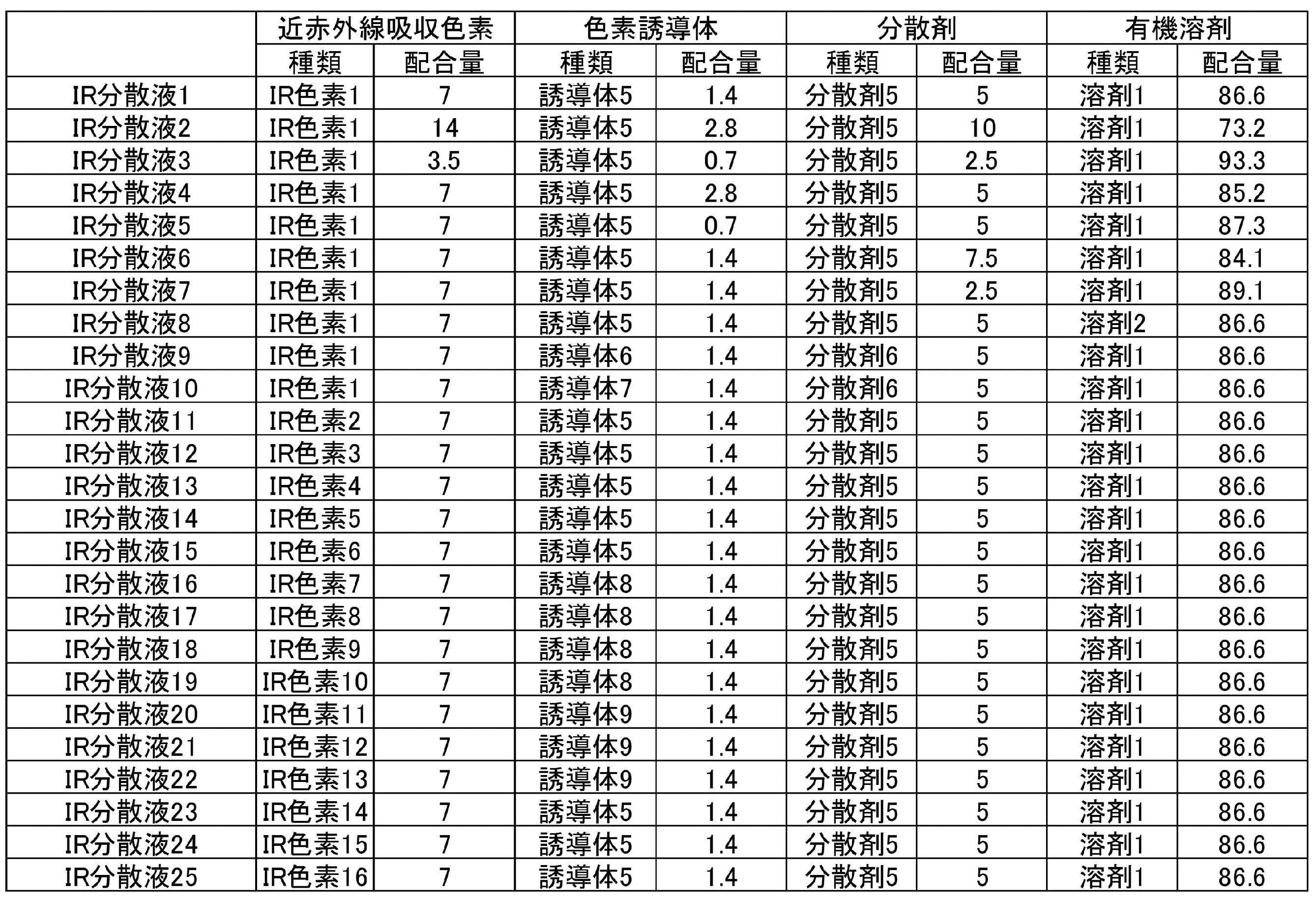

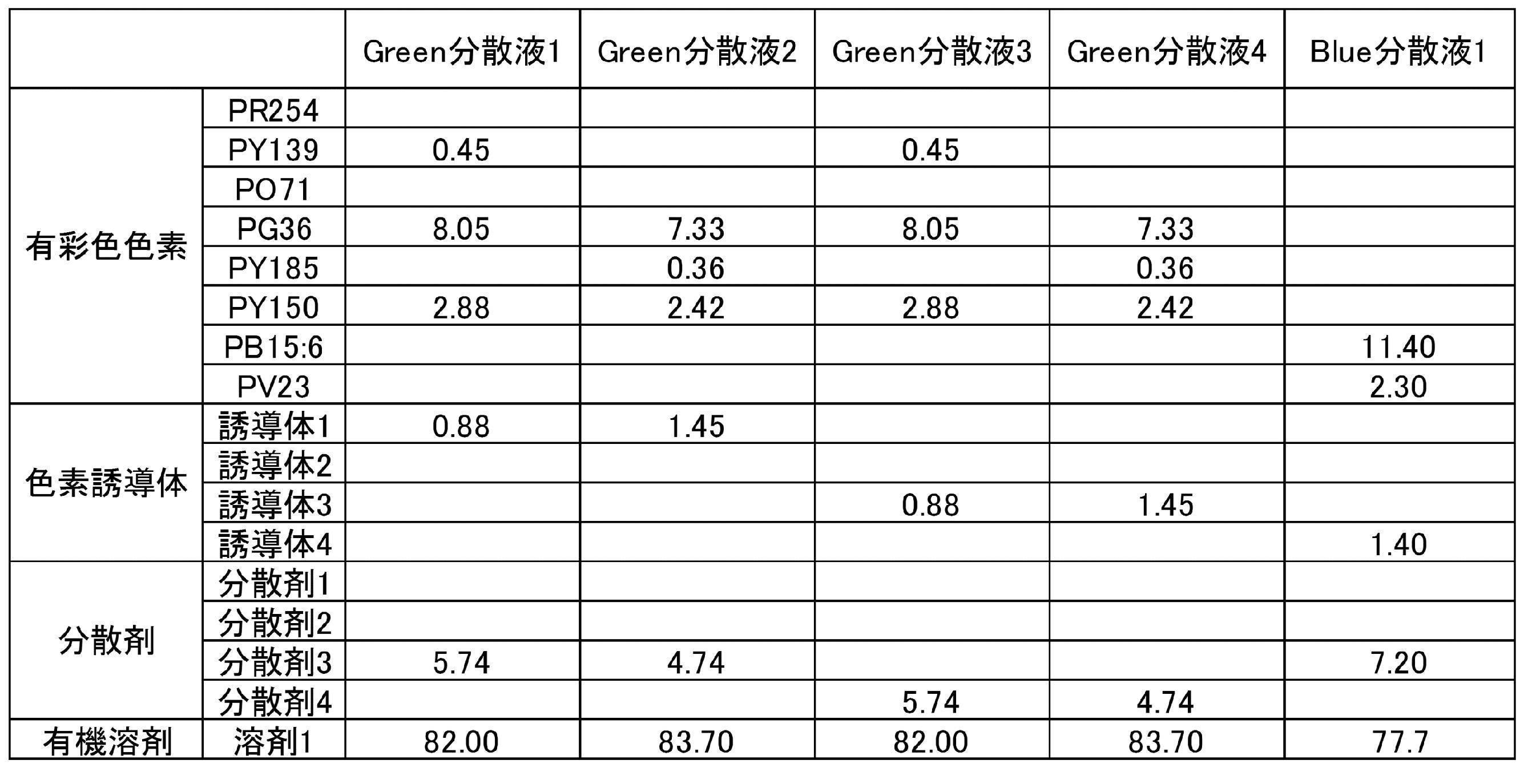
下記組成の混合液を、0.3mm径のジルコニアビーズを使用して、ビーズミル(減圧機構付き高圧分散機NANO-3000-10(日本ビーイーイー(株)製))で、2時間、混合して、各分散液を調製した。下記表に記載の数値は質量部である。
上記表に記載の原料は以下の通りである。
(近赤外線吸収色素)
IR色素1~16:下記構造の化合物IR-1~IR-16


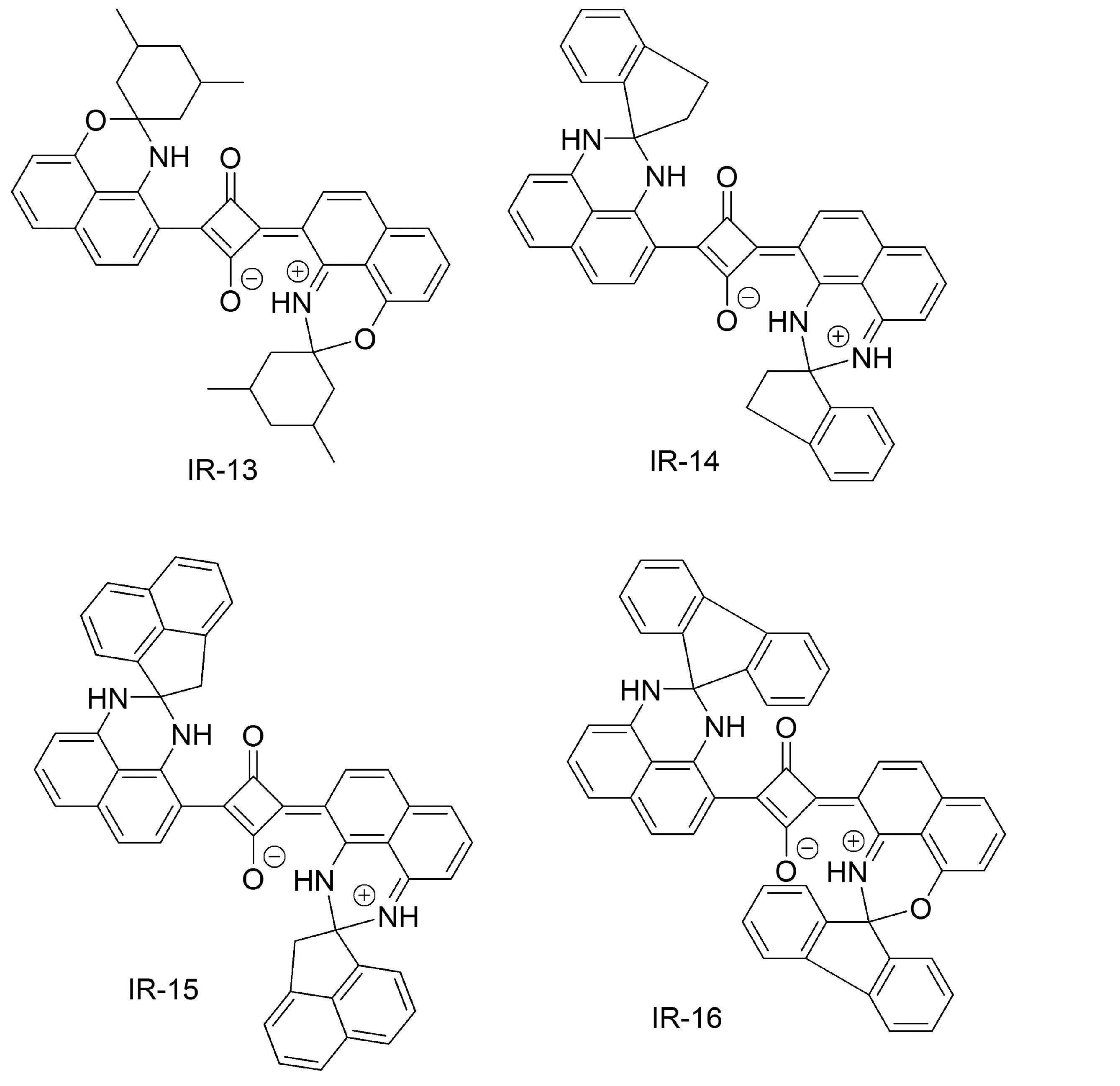
(近赤外線吸収色素)
IR色素1~16:下記構造の化合物IR-1~IR-16
(有彩色色素)
PR254 : C.I.Pigment Red254
PO71 : C.I.Pigment Orange71
PY139 : C.I.Pigment Yellow139
PY150 : C.I.Pigment Yellow150
PY185 : C.I.Pigment Yellow185
PG36 : C.I.Pigment Green36
PB15:6 : C.I.Pigment Blue15:6
PV23 : C.I.Pigment Violet23
PR254 : C.I.Pigment Red254
PO71 : C.I.Pigment Orange71
PY139 : C.I.Pigment Yellow139
PY150 : C.I.Pigment Yellow150
PY185 : C.I.Pigment Yellow185
PG36 : C.I.Pigment Green36
PB15:6 : C.I.Pigment Blue15:6
PV23 : C.I.Pigment Violet23
(色素誘導体)
誘導体1:下記構造の化合物(塩基性色素誘導体)
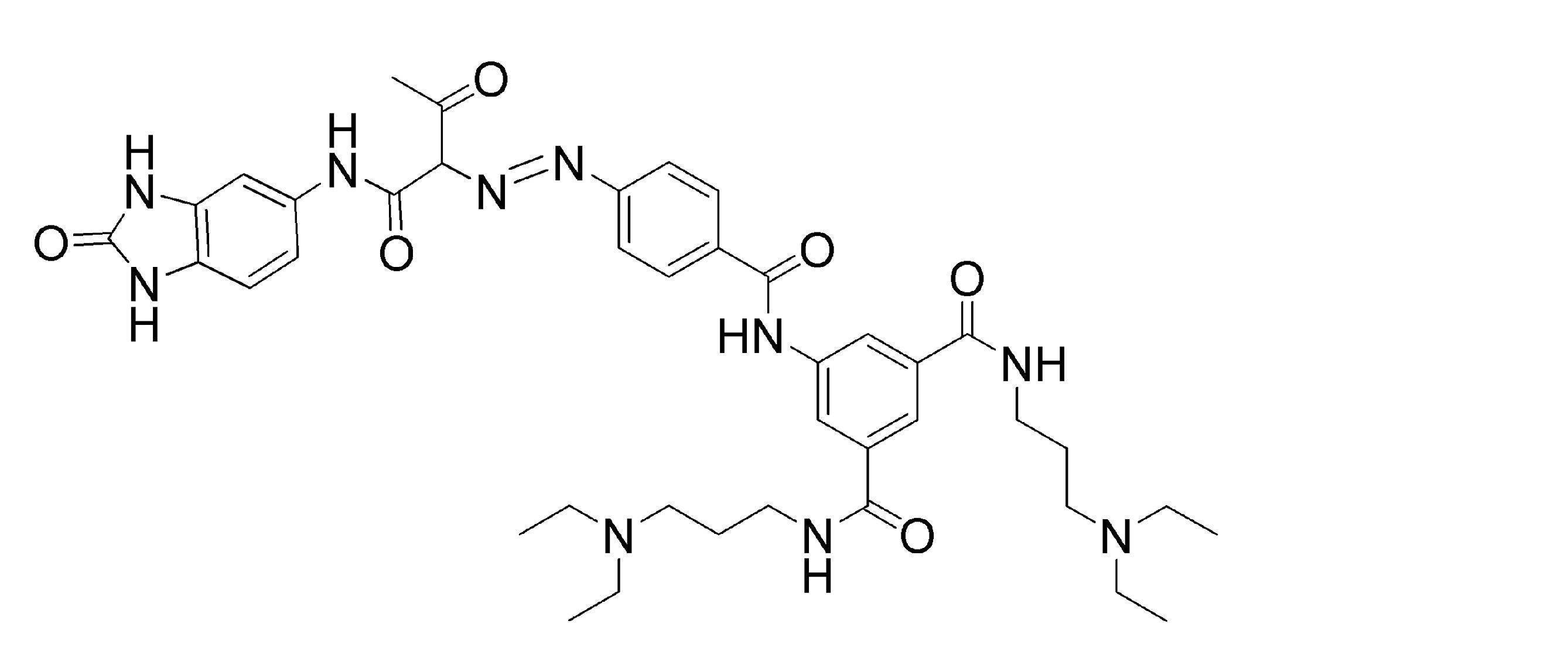
誘導体2:下記構造の化合物(酸性色素誘導体)

誘導体3:下記構造の化合物(酸性色素誘導体)

誘導体4:下記構造の化合物(酸性色素誘導体)
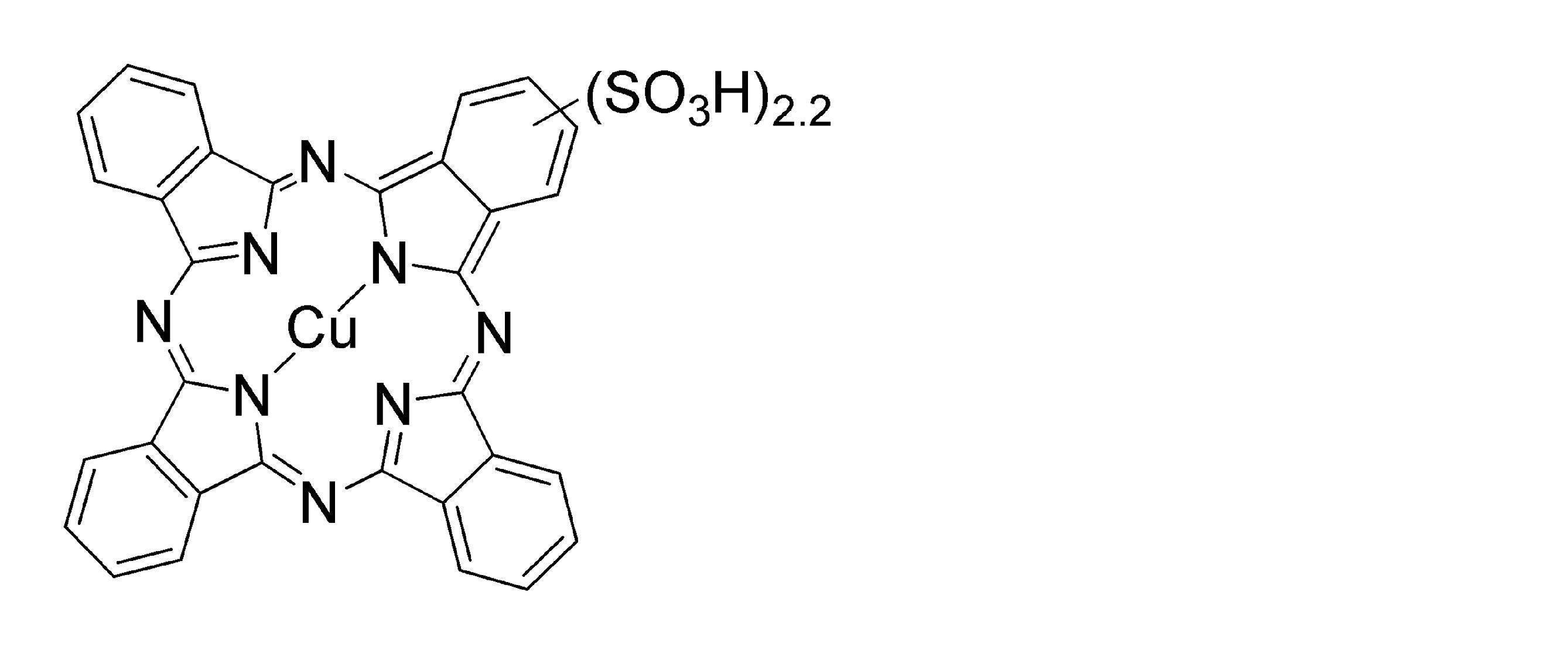
誘導体5:下記構造の化合物(酸性色素誘導体)
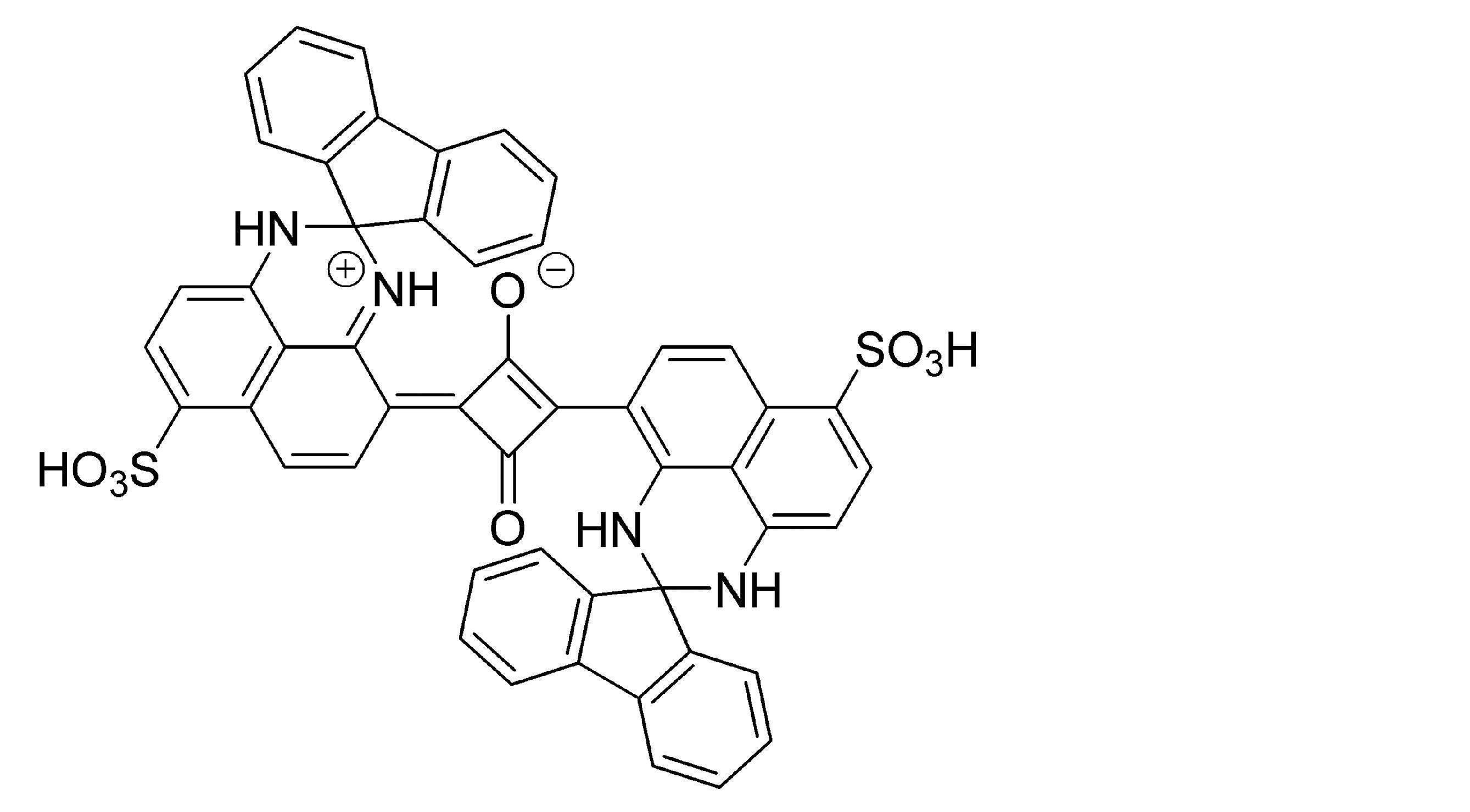
誘導体6:下記構造の化合物(塩基性色素誘導体)

誘導体7:下記構造の化合物(酸性色素誘導体)
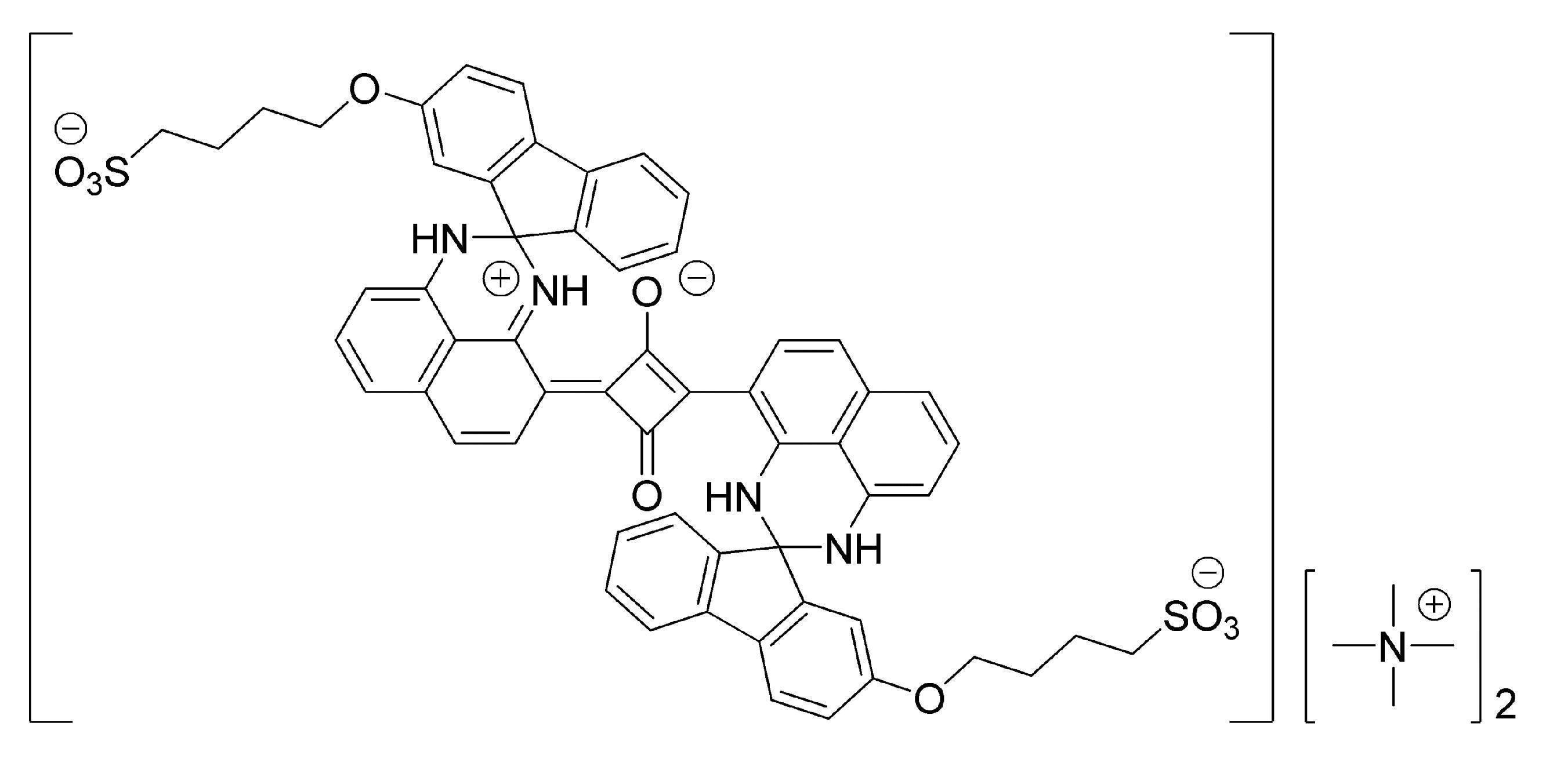
誘導体8:下記構造の化合物(酸性色素誘導体)

誘導体9:下記構造の化合物(酸性色素誘導体)

誘導体1:下記構造の化合物(塩基性色素誘導体)
(分散剤)
分散剤1:下記構造の樹脂(重量平均分子量 16800、主鎖の繰り返し単位に付記した数値はモル比であり、側鎖の繰り返し単位に併記される数値は、繰り返し単位の繰り返し数を示す。)
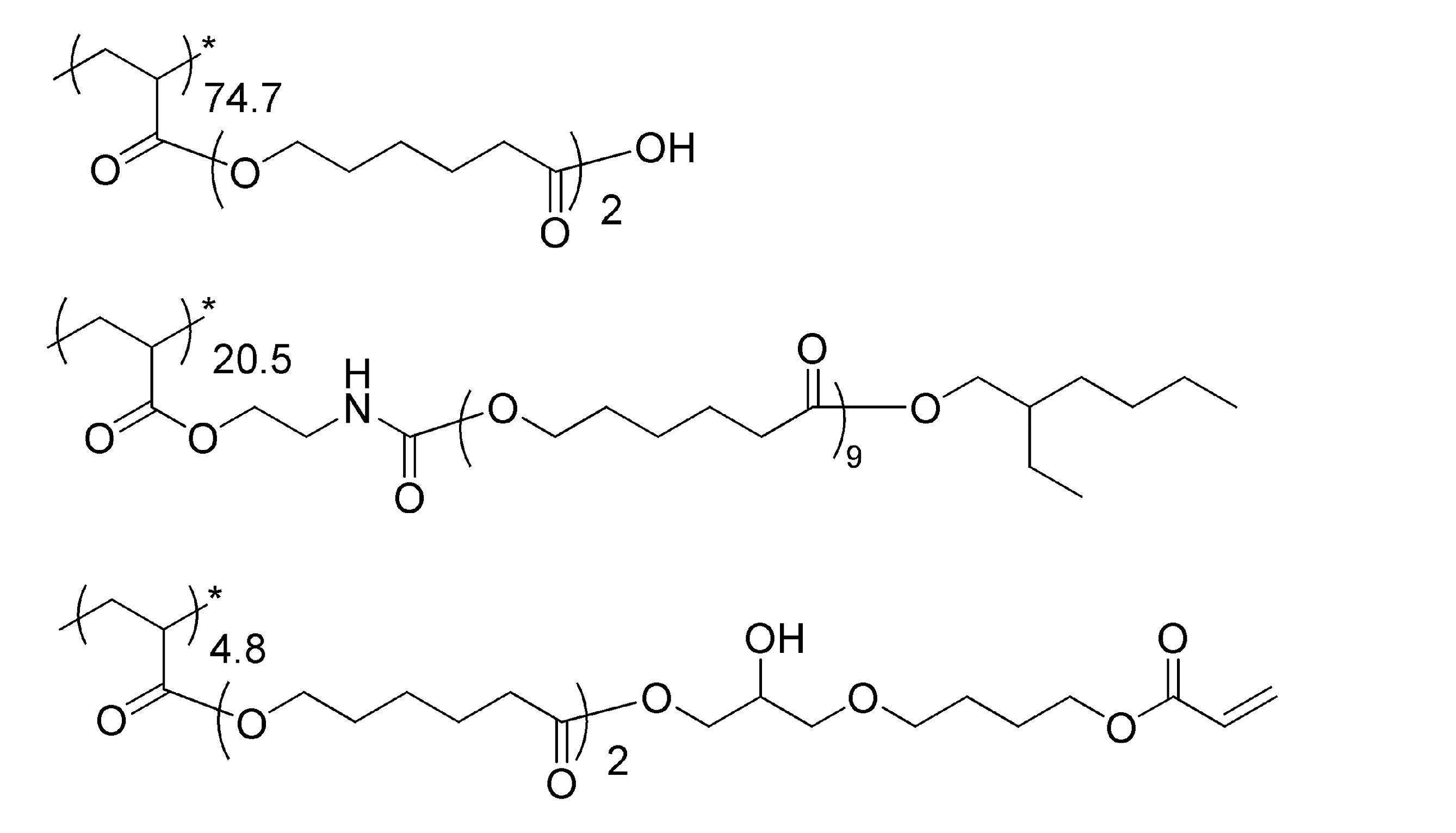
分散剤2:下記構造の樹脂(重量平均分子量20000、主鎖の繰り返し単位に付記した数値はモル比であり、側鎖の繰り返し単位に併記される数値は、繰り返し単位の繰り返し数を示す。)

分散剤3:下記構造の樹脂(重量平均分子量20000、主鎖の繰り返し単位に付記した数値はモル比であり、側鎖の繰り返し単位に併記される数値は、繰り返し単位の繰り返し数を示す。)

分散剤4:下記構造の樹脂(重量平均分子量22900、主鎖の繰り返し単位に付記した数値はモル比であり、側鎖の繰り返し単位に併記される数値は、繰り返し単位の繰り返し数を示す。)
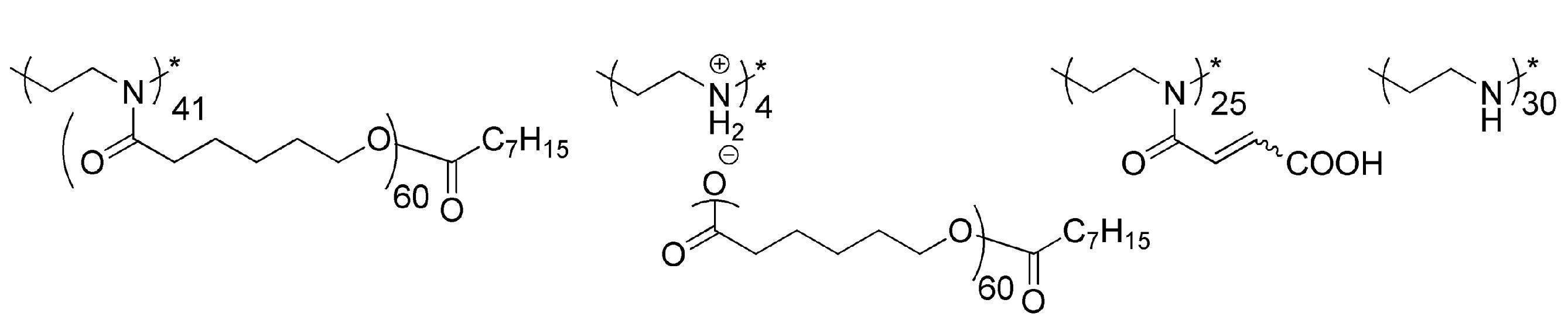
分散剤5:下記構造のブロック型樹脂(アミン価=90mgKOH/g、4級アンモニウム塩価=30mgKOH/g、重量平均分子量=9800)。主鎖に付記した数値は繰り返し単位のモル比を表す。

分散剤6:ソルスパース36000(日本ルーブリゾール(株)製)
分散剤1:下記構造の樹脂(重量平均分子量 16800、主鎖の繰り返し単位に付記した数値はモル比であり、側鎖の繰り返し単位に併記される数値は、繰り返し単位の繰り返し数を示す。)
(有機溶剤)
溶剤1:プロピレングリコールメチルエーテルアセテート(PGMEA)
溶剤2:シクロヘキサノン
溶剤1:プロピレングリコールメチルエーテルアセテート(PGMEA)
溶剤2:シクロヘキサノン
<近赤外線吸収層形成用組成物(IR組成物)の調製>
下記の表に示す原料を、下記の表に示す割合(質量部)で混合および撹拌した後、孔径0.45μmのナイロン製フィルタ(日本ポール(株)製)でろ過して、IR組成物を調製した。下記表に記載の数値は質量部である。

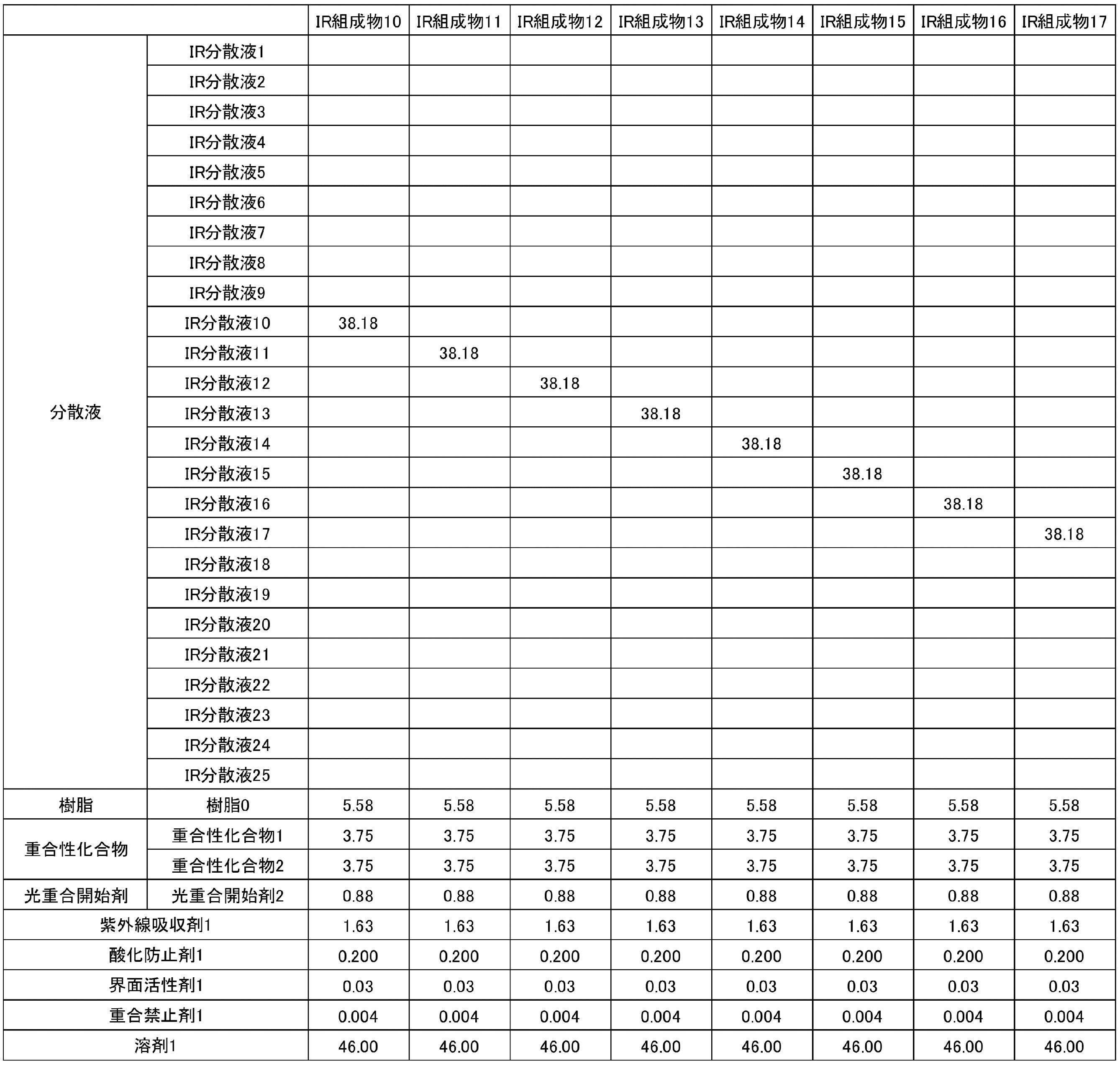
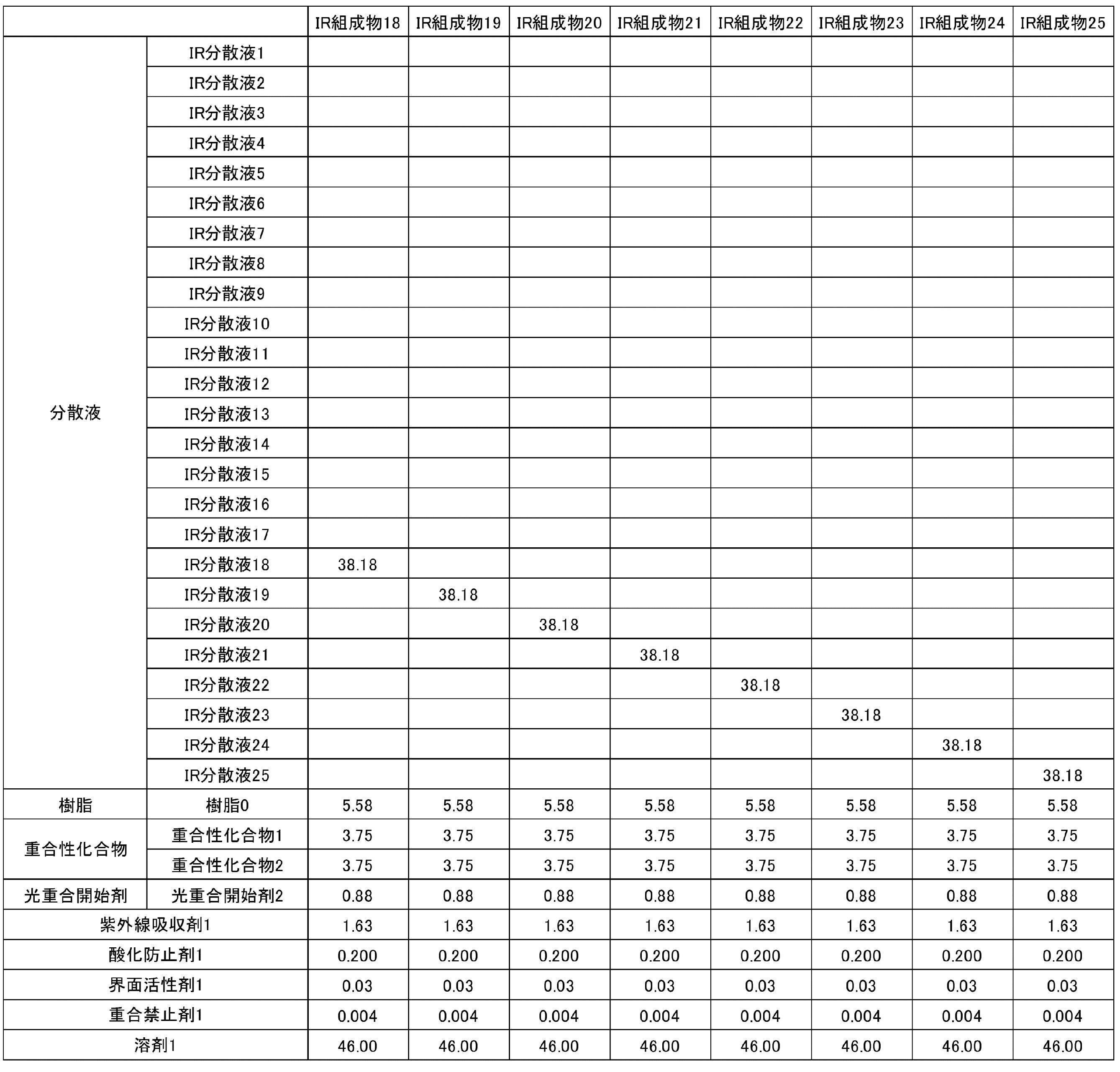
下記の表に示す原料を、下記の表に示す割合(質量部)で混合および撹拌した後、孔径0.45μmのナイロン製フィルタ(日本ポール(株)製)でろ過して、IR組成物を調製した。下記表に記載の数値は質量部である。
<着色画素形成用組成物(Red組成物、Green組成物、Blue組成物)の調製>
下記の表に示す原料を、下記の表に示す割合(質量部)で混合および撹拌した後、孔径0.45μmのナイロン製フィルタ(日本ポール(株)製)でろ過して、Red組成物、Green組成物およびBlue組成物を調製した。下記表に記載の数値は質量部である。
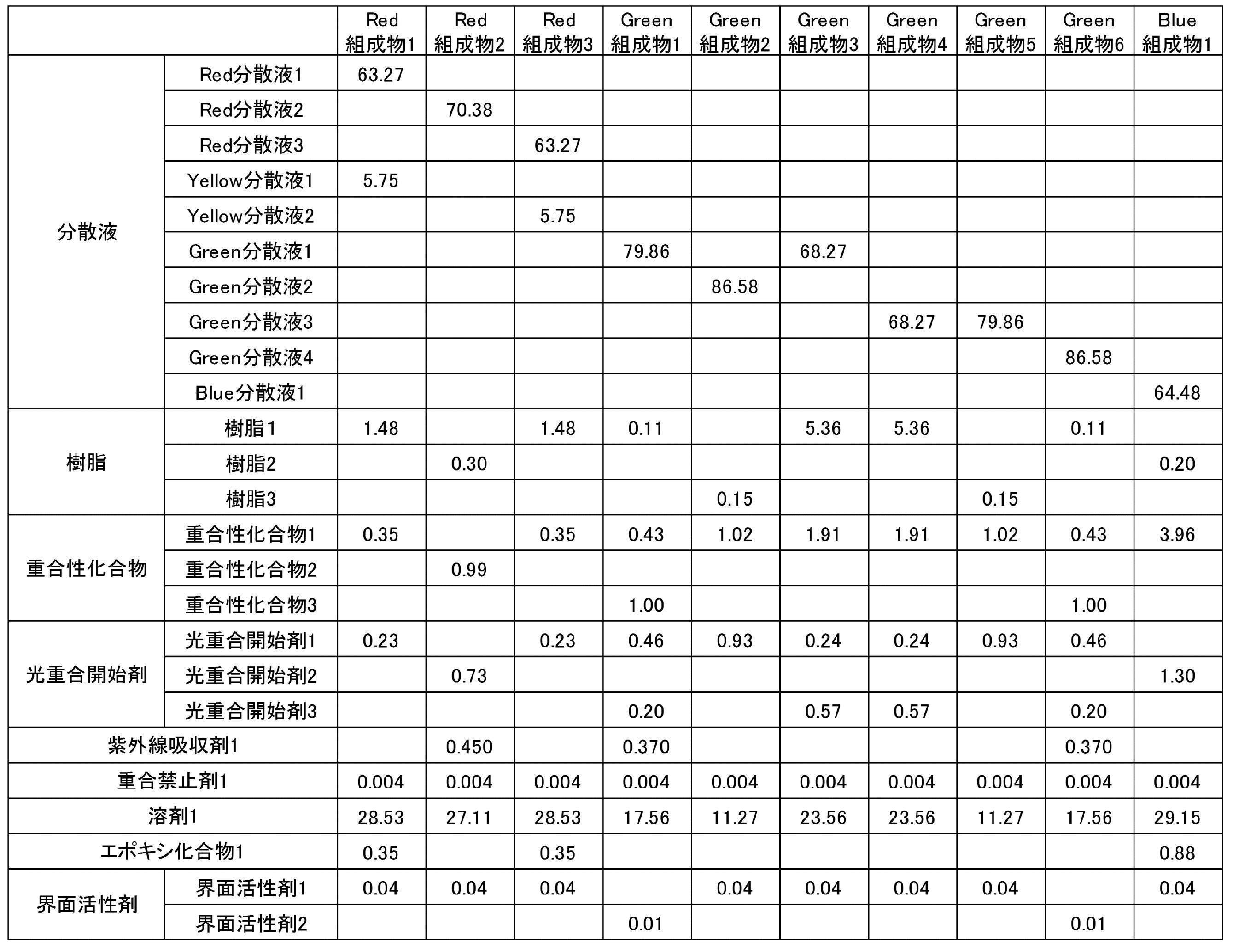
下記の表に示す原料を、下記の表に示す割合(質量部)で混合および撹拌した後、孔径0.45μmのナイロン製フィルタ(日本ポール(株)製)でろ過して、Red組成物、Green組成物およびBlue組成物を調製した。下記表に記載の数値は質量部である。
上記表に記載の原料は以下の通りである。
(分散液)
IR分散液1~25、Red分散液1~3、Yellow分散液1~2、Green分散液1~4、Blue分散液1:上記で調製した分散液
IR分散液1~25、Red分散液1~3、Yellow分散液1~2、Green分散液1~4、Blue分散液1:上記で調製した分散液
(樹脂)
樹脂0:下記構造の樹脂(重量平均分子量41400、主鎖の繰り返し単位に付記した数値はモル比である。)

樹脂1:下記構造の樹脂(重量平均分子量20000、主鎖の繰り返し単位に付記した数値はモル比であり、側鎖の繰り返し単位に併記される数値は、繰り返し単位の繰り返し数を示す。)

樹脂2:下記構造の樹脂(重量平均分子量11000、主鎖の繰り返し単位に付記した数値はモル比である。)

樹脂3:下記構造の樹脂(重量平均分子量12100、繰り返し単位に付記した数値はモル比である。)
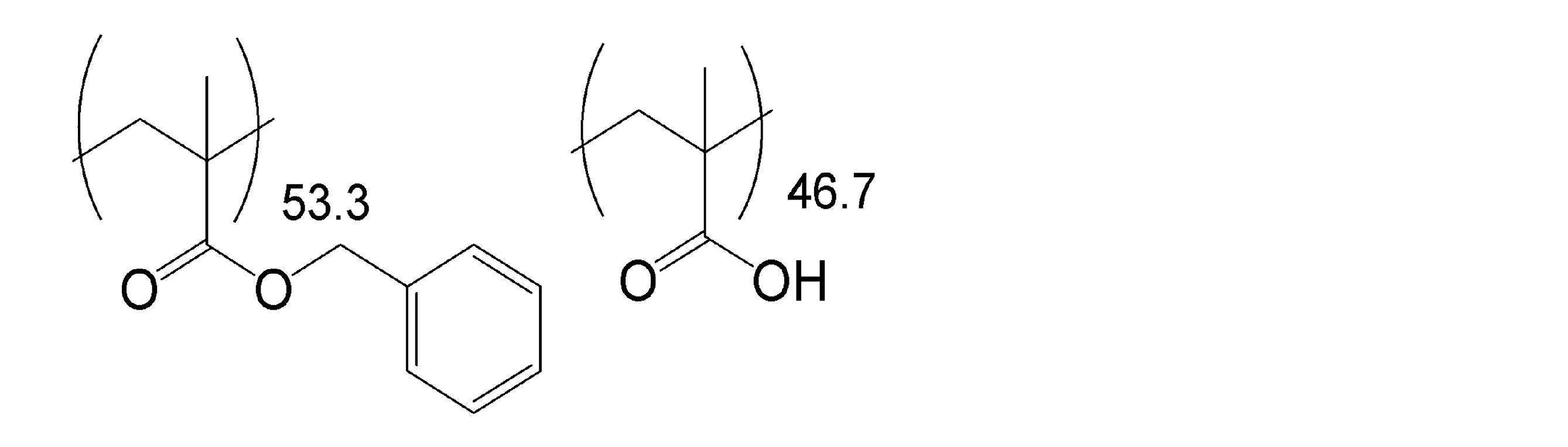
樹脂0:下記構造の樹脂(重量平均分子量41400、主鎖の繰り返し単位に付記した数値はモル比である。)
(重合性化合物)
重合性化合物1:NKエステルA-TMMT(新中村化学工業(株)製)
重合性化合物2:NKエステルA-DPH-12E (新中村化学工業(株)製)
重合性化合物3:KAYARAD DPHA(日本化薬(株)製)
重合性化合物1:NKエステルA-TMMT(新中村化学工業(株)製)
重合性化合物2:NKエステルA-DPH-12E (新中村化学工業(株)製)
重合性化合物3:KAYARAD DPHA(日本化薬(株)製)
(光重合開始剤)
光重合開始剤1:IRGACURE-OXE02(BASF社製)
光重合開始剤2:IRGACURE-OXE01(BASF社製)
光重合開始剤3:下記構造の化合物
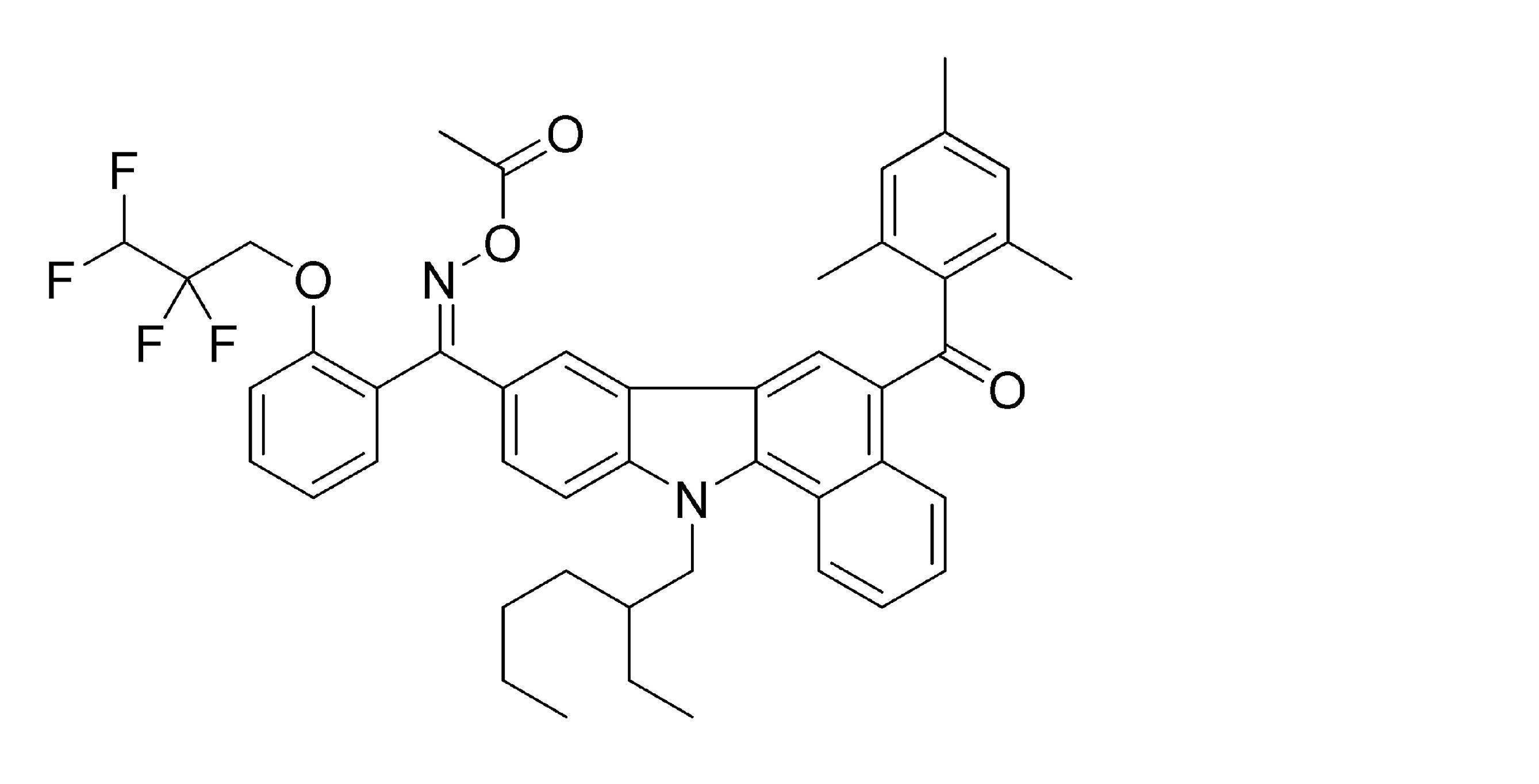
光重合開始剤1:IRGACURE-OXE02(BASF社製)
光重合開始剤2:IRGACURE-OXE01(BASF社製)
光重合開始剤3:下記構造の化合物
(紫外線吸収剤)
紫外線吸収剤1:UV-503(大東化学(株)製)
紫外線吸収剤1:UV-503(大東化学(株)製)
(酸化防止剤)
酸化防止剤1:Neo Heliopan357(Symrise製)
酸化防止剤1:Neo Heliopan357(Symrise製)
(重合禁止剤)
重合禁止剤1:p-メトキシフェノール
重合禁止剤1:p-メトキシフェノール
(エポキシ化合物)
エポキシ化合物1:EHPE-3105((株)ダイセル製)
エポキシ化合物1:EHPE-3105((株)ダイセル製)
(界面活性剤)
界面活性剤1:下記構造の化合物(Mw=14000、下記の式中、繰り返し単位の割合を示す%はモル%である。)

界面活性剤2:KF-6001(信越シリコーン(株)製)
界面活性剤1:下記構造の化合物(Mw=14000、下記の式中、繰り返し単位の割合を示す%はモル%である。)
(溶剤)
溶剤1:PGMEA
溶剤1:PGMEA
<構造体の製造1>
ガラス基板上に、下記表に記載の近赤外線吸収層形成用組成物(IR組成物)を製膜後の膜厚が1.0μmになるようにスピンコート法で塗布し、その後ホットプレートを用いて、100℃で2分間加熱した。次いで、i線ステッパー露光装置FPA-3000i5+(Canon(株)製)を用い、1000mJ/cm2の露光量で全面露光した。次に、ホットプレートを用いて、200℃で5分間加熱し、近赤外線吸収層を形成した。
次に、近赤外線吸収層上に、下記表に記載のGreen組成物を、製膜後の膜厚が1.0μmになるように、スピンコート法で塗布し、その後ホットプレートを用いて、100℃で2分間加熱した。次いで、i線ステッパー露光装置FPA-3000i5+(Canon(株)製)を用い、1000mJ/cm2の露光量で、1cm四方のISLANDパターンを有するマスクを介して露光した。次いで、水酸化テトラメチルアンモニウム(TMAH)0.3質量%水溶液を用い、23℃で60秒間パドル現像を行った。その後、スピンシャワーにてリンスを行い、さらに純水にて水洗した。次いで、ホットプレートを用い、200℃で5分間加熱することで、近赤外線吸収層上に緑色画素を形成した。同様に下記表に記載のRed組成物、及びBlue組成物についても順次パターニングし、赤色画素および青色画素をそれぞれ形成して、緑色画素、赤色画素および青色画素を有するカラーフィルタ層を形成した。このようにして、近赤外線吸収層上に緑色画素、赤色画素および青色画素のベイヤーパターンを有するカラーフィルタ層が積層された構造体を製造した。
ガラス基板上に、下記表に記載の近赤外線吸収層形成用組成物(IR組成物)を製膜後の膜厚が1.0μmになるようにスピンコート法で塗布し、その後ホットプレートを用いて、100℃で2分間加熱した。次いで、i線ステッパー露光装置FPA-3000i5+(Canon(株)製)を用い、1000mJ/cm2の露光量で全面露光した。次に、ホットプレートを用いて、200℃で5分間加熱し、近赤外線吸収層を形成した。
次に、近赤外線吸収層上に、下記表に記載のGreen組成物を、製膜後の膜厚が1.0μmになるように、スピンコート法で塗布し、その後ホットプレートを用いて、100℃で2分間加熱した。次いで、i線ステッパー露光装置FPA-3000i5+(Canon(株)製)を用い、1000mJ/cm2の露光量で、1cm四方のISLANDパターンを有するマスクを介して露光した。次いで、水酸化テトラメチルアンモニウム(TMAH)0.3質量%水溶液を用い、23℃で60秒間パドル現像を行った。その後、スピンシャワーにてリンスを行い、さらに純水にて水洗した。次いで、ホットプレートを用い、200℃で5分間加熱することで、近赤外線吸収層上に緑色画素を形成した。同様に下記表に記載のRed組成物、及びBlue組成物についても順次パターニングし、赤色画素および青色画素をそれぞれ形成して、緑色画素、赤色画素および青色画素を有するカラーフィルタ層を形成した。このようにして、近赤外線吸収層上に緑色画素、赤色画素および青色画素のベイヤーパターンを有するカラーフィルタ層が積層された構造体を製造した。
(近赤外線遮光ムラ評価)
構造体について、紫外可視近赤外分光光度計(U-4100、(株)日立ハイテクノロジーズ製)を用いて、緑色画素エリア、赤色画素エリアおよび青色画素エリアの光透過率を波長400~1300nmの範囲で測定した。
次に、この構造体を、150℃の温度で1000時間加熱した後、緑色画素エリア、赤色画素エリアおよび青色画素エリアの加熱後の波長400~1300nmの範囲における透過率を測定した。
加熱後の構造体の緑色画素エリア、赤色画素エリアおよび青色画素エリアにおける、波長700~1000nmの範囲における透過率の差を算出し、上記範囲における緑色画素エリア、赤色画素エリアおよび青色画素エリア間の透過率の差の合算値(ΔT)を求めて、近赤外線遮光ムラを評価した。ΔTの値が小さいほうが遮光ムラが小さいことを意味する。判断基準は以下の通りである。
A:ΔT<2%
B:2%≦ΔT<5%
C:5%≦ΔT
構造体について、紫外可視近赤外分光光度計(U-4100、(株)日立ハイテクノロジーズ製)を用いて、緑色画素エリア、赤色画素エリアおよび青色画素エリアの光透過率を波長400~1300nmの範囲で測定した。
次に、この構造体を、150℃の温度で1000時間加熱した後、緑色画素エリア、赤色画素エリアおよび青色画素エリアの加熱後の波長400~1300nmの範囲における透過率を測定した。
加熱後の構造体の緑色画素エリア、赤色画素エリアおよび青色画素エリアにおける、波長700~1000nmの範囲における透過率の差を算出し、上記範囲における緑色画素エリア、赤色画素エリアおよび青色画素エリア間の透過率の差の合算値(ΔT)を求めて、近赤外線遮光ムラを評価した。ΔTの値が小さいほうが遮光ムラが小さいことを意味する。判断基準は以下の通りである。
A:ΔT<2%
B:2%≦ΔT<5%
C:5%≦ΔT
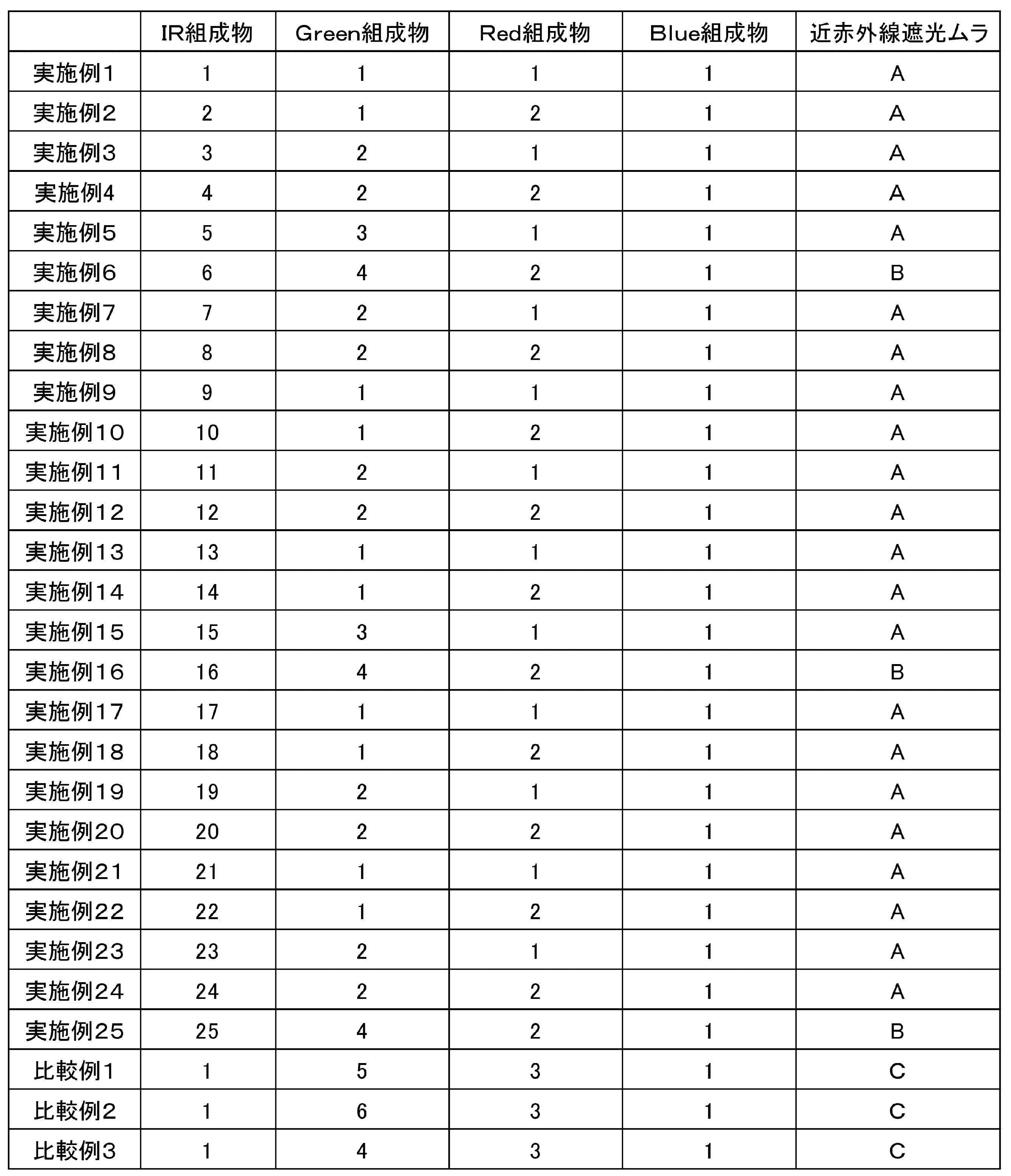
実施例の構造体は、いずれも近赤外線遮光ムラが抑制されていた。各実施例において、ガラス基板上にカラーフィルタ層を形成し、カラーフィルタ層上に近赤外線吸収層を形成して構造体を製造した場合であっても、各実施例と同様の効果が得られた。実施例1において、重合禁止剤を除いて同様に評価した場合であっても、実施例1と同様の効果が得られた。
1:支持体
10:近赤外線吸収層
20:カラーフィルタ層
21~23:着色画素
30:近赤外線透過フィルタ層
101、102:構造体
10:近赤外線吸収層
20:カラーフィルタ層
21~23:着色画素
30:近赤外線透過フィルタ層
101、102:構造体
Claims (11)
- 下記式(SQ1)で表される近赤外線吸収色素を含む近赤外線吸収層と、
前記近赤外線吸収層と隣接して配置された有彩色色素を含むカラーフィルタ層と、を有し、
前記カラーフィルタ層は、2色以上の着色画素を有し、かつ、前記2色以上の着色画素のうち少なくとも1色の着色画素は塩基性色素誘導体を含む、構造体;

A1およびA2は、それぞれ独立して、酸素原子または-N(Rs125)-を表し、
Rs121~Rs125はそれぞれ独立して、水素原子または置換基を表し、
E1およびE2はそれぞれ独立に炭素原子、ホウ素原子または-C(=O)-を表し、
E1が炭素原子の場合にはns32は2であり、ホウ素原子の場合にはns32は1であり、-C(=O)-の場合にはns32は0であり、
E2が炭素原子の場合にはns33は2であり、ホウ素原子の場合にはns33は1であり、-C(=O)-の場合にはns33は0であり、
ns30およびns31はそれぞれ独立に0~5の整数を表し、
ns30が2以上の場合は、複数のRs119は、同一であっても異なっていてもよく、複数のRs119のうち2個のRs119同士が結合して環を形成してもよく、
ns31が2以上の場合は、複数のRs120は、同一であっても異なっていてもよく、複数のRs120のうち2個のRs120同士が結合して環を形成してもよく、
ns32が2の場合は、2個のRs121は同一であっても異なっていてもよく、2個のRs121同士が結合して環を形成してもよく、
ns33が2の場合は、2個のRs122は同一であっても異なっていてもよく、2個のRs122同士が結合して環を形成してもよく、
Ar100はアリーレン基またはヘテロアリーレン基を表し、
ns100は0~2の整数を表す。 - 前記式(SQ1)で表される近赤外線吸収色素が、式(SQ2)で表される近赤外線吸収色素である、請求項1に記載の構造体;
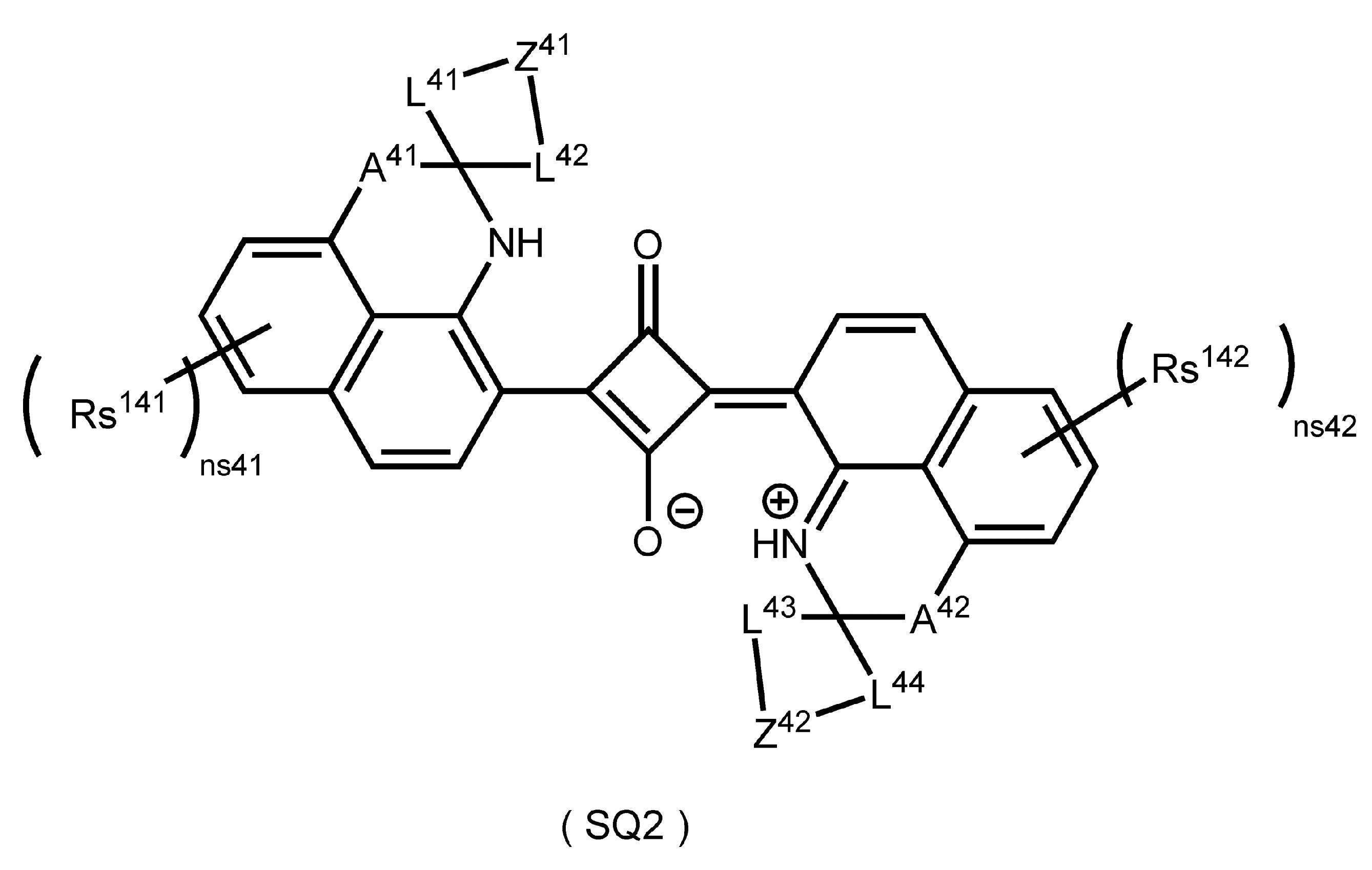
Z41およびZ42はそれぞれ独立に、単結合、-O-、-C(=O)-、-S-、-N(RN1)-、-S(=O)-、又は、-S(=O)2-を表し、
A41およびA42は、それぞれ独立して酸素原子または-N(RN2)-を表し、
RN1およびRN2は、それぞれ独立して水素原子、アルキル基、又は、アリール基を表し、
Rs141およびRs142は、それぞれ独立して置換基を表し、
ns41およびns42はそれぞれ独立して0~5の整数を表し、
ns41が2以上の場合は、複数のRs141は、同一であっても異なっていてもよく、複数のRs141のうち2個のRs141同士が結合して環を形成してもよく、
ns42が2以上の場合は、複数のRs142は、同一であっても異なっていてもよく、複数のRs142のうち2個のRs142同士が結合して環を形成してもよい;
ただし、L41~L44がアルキレン基で、Z41およびZ42が単結合で、A41およびA42が-N(RN2)-の場合、ns41およびns42の少なくとも一方は1~5の整数である。 - 前記式(SQ1)で表される近赤外線吸収色素が、式(SQ3)で表される近赤外線吸収色素である、請求項1に記載の構造体;
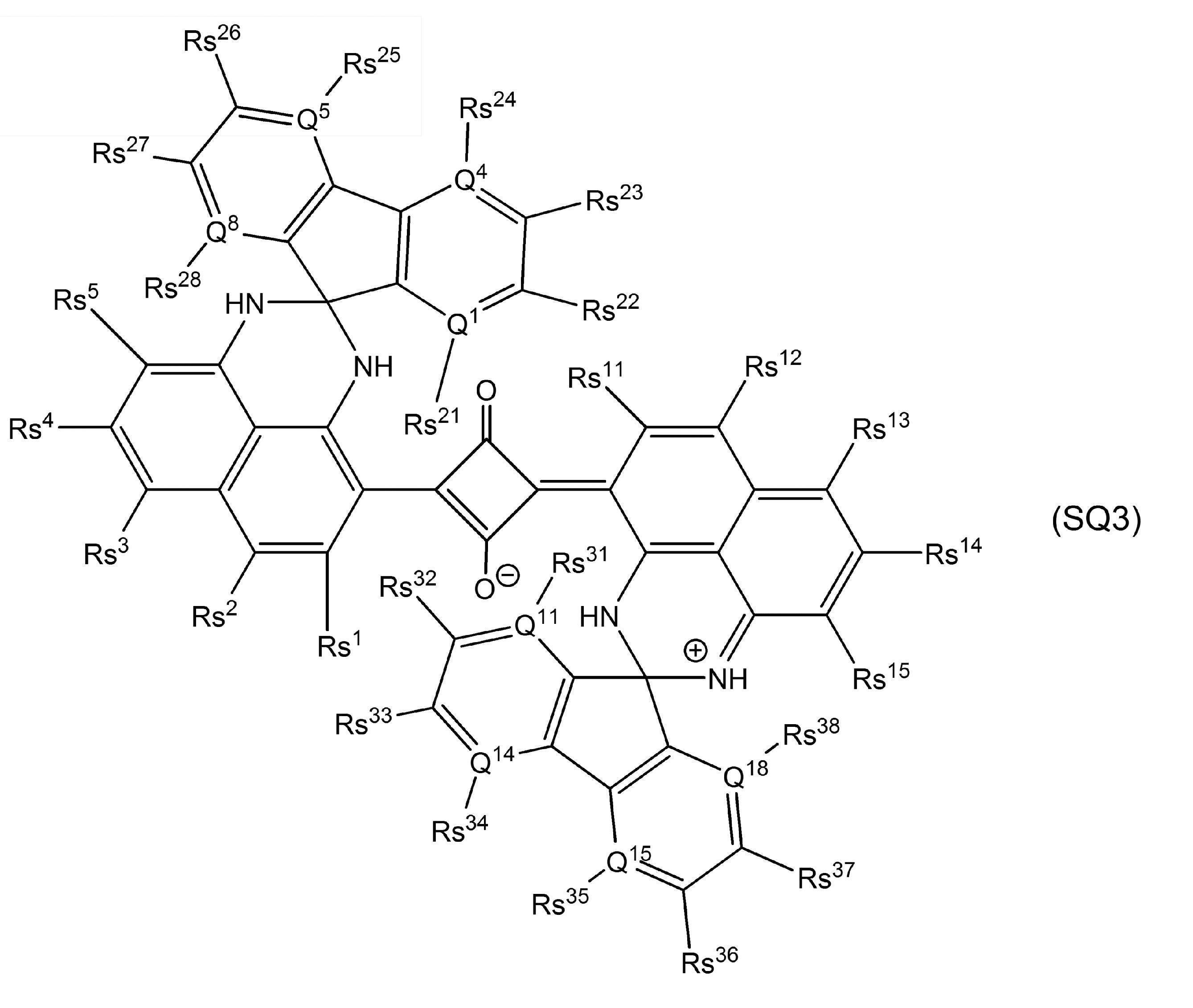
Rs1~Rs5、Rs11~Rs15は、それぞれ独立に、水素原子、アルキル基、スルホ基、-SO3M1又はハロゲン原子を表し、M1は無機又は有機のカチオンを表し、Rs2とRs3、Rs12とRs13は互いに結合して環を形成してもよい;
Rs21~Rs28、Rs31~Rs38は、それぞれ独立に、水素原子、アルキル基、アルケニル基、アリール基、アラルキル基、アルコキシ基、アリールオキシ基、ヒドロキシ基、-NRX1RX2、スルホ基、-SO3M2、-SO2NRX1RX2、-COORX3、-CONRX1RX2、ニトロ基、シアノ基又はハロゲン原子を表し、M2は無機又は有機のカチオンを表し、RX1~RX3は、それぞれ独立に、水素原子、アルキル基、アリール基、アシル基又は複素環基を表し、RX1とRX2は互いに結合して環を形成してもよく、Rs21~Rs28、Rs31~Rs38のうち、隣接する基同士は互いに結合して環を形成してもよい;
Q1が窒素原子の場合、Rs21は存在せず、Q4が窒素原子の場合、Rs24は存在せず、Q5が窒素原子の場合、Rs25は存在せず、Q8が窒素原子の場合、Rs28は存在せず、Q11が窒素原子の場合、Rs31は存在せず、Q14が窒素原子の場合、Rs34は存在せず、Q15が窒素原子の場合、Rs35は存在せず、Q18が窒素原子の場合、Rs38は存在しない。 - 前記カラーフィルタ層は、赤色画素、青色画素および緑色画素を少なくとも有し、
前記赤色画素は塩基性色素誘導体を含む、請求項1~3のいずれか1項に記載の構造体。 - 前記赤色画素は有彩色色素と塩基性色素誘導体とを合計で50質量%以上含む、請求項4に記載の構造体。
- 前記近赤外線吸収層は酸性色素誘導体を含む、請求項1~5のいずれか1項に記載の構造体。
- 前記酸性色素誘導体がスクアリリウム化合物である、請求項6に記載の構造体。
- 請求項1~7のいずれか1項に記載の構造体を含む光学フィルタ。
- 請求項1~7のいずれか1項に記載の構造体を含む固体撮像素子。
- 請求項1~7のいずれか1項に記載の構造体を含む画像表示装置。
- 請求項1~7のいずれか1項に記載の構造体を含む赤外線センサ。
Priority Applications (1)
| Application Number | Priority Date | Filing Date | Title |
|---|---|---|---|
| JP2021509385A JP7145314B2 (ja) | 2019-03-28 | 2020-03-23 | 構造体、光学フィルタ、固体撮像素子、画像表示装置および赤外線センサ |
Applications Claiming Priority (2)
| Application Number | Priority Date | Filing Date | Title |
|---|---|---|---|
| JP2019-063500 | 2019-03-28 | ||
| JP2019063500 | 2019-03-28 |
Publications (1)
| Publication Number | Publication Date |
|---|---|
| WO2020196392A1 true WO2020196392A1 (ja) | 2020-10-01 |
Family
ID=72611000
Family Applications (1)
| Application Number | Title | Priority Date | Filing Date |
|---|---|---|---|
| PCT/JP2020/012683 Ceased WO2020196392A1 (ja) | 2019-03-28 | 2020-03-23 | 構造体、光学フィルタ、固体撮像素子、画像表示装置および赤外線センサ |
Country Status (3)
| Country | Link |
|---|---|
| JP (1) | JP7145314B2 (ja) |
| TW (1) | TW202041604A (ja) |
| WO (1) | WO2020196392A1 (ja) |
Citations (6)
| Publication number | Priority date | Publication date | Assignee | Title |
|---|---|---|---|---|
| JPS6322837B2 (ja) * | 1973-10-09 | 1988-05-13 | Norudeisuku Fuieerufuaburiku As | |
| JP2012194521A (ja) * | 2011-02-28 | 2012-10-11 | Toyo Ink Sc Holdings Co Ltd | カラーフィルタ用赤色着色組成物、およびカラーフィルタ |
| JP2012224718A (ja) * | 2011-04-18 | 2012-11-15 | Dainichiseika Color & Chem Mfg Co Ltd | 顔料分散剤及びその製造方法、顔料着色剤組成物、並びにカラーフィルター用顔料着色剤組成物 |
| JP2015052778A (ja) * | 2013-08-05 | 2015-03-19 | 富士フイルム株式会社 | 着色感光性樹脂組成物、硬化膜、カラーフィルタ、カラーフィルタの製造方法、固体撮像素子および画像表示装置 |
| WO2018101189A1 (ja) * | 2016-11-30 | 2018-06-07 | 富士フイルム株式会社 | 顔料分散液、硬化性組成物、膜、近赤外線カットフィルタ、固体撮像素子、画像表示装置、および、赤外線センサ |
| JP2019011455A (ja) * | 2016-12-27 | 2019-01-24 | 東洋インキScホールディングス株式会社 | スクアリリウム化合物及びその用途 |
Family Cites Families (1)
| Publication number | Priority date | Publication date | Assignee | Title |
|---|---|---|---|---|
| JP6322837B1 (ja) | 2017-06-13 | 2018-05-16 | 東洋インキScホールディングス株式会社 | スクアリリウム色素及びその用途 |
-
2020
- 2020-03-23 WO PCT/JP2020/012683 patent/WO2020196392A1/ja not_active Ceased
- 2020-03-23 JP JP2021509385A patent/JP7145314B2/ja active Active
- 2020-03-24 TW TW109109704A patent/TW202041604A/zh unknown
Patent Citations (6)
| Publication number | Priority date | Publication date | Assignee | Title |
|---|---|---|---|---|
| JPS6322837B2 (ja) * | 1973-10-09 | 1988-05-13 | Norudeisuku Fuieerufuaburiku As | |
| JP2012194521A (ja) * | 2011-02-28 | 2012-10-11 | Toyo Ink Sc Holdings Co Ltd | カラーフィルタ用赤色着色組成物、およびカラーフィルタ |
| JP2012224718A (ja) * | 2011-04-18 | 2012-11-15 | Dainichiseika Color & Chem Mfg Co Ltd | 顔料分散剤及びその製造方法、顔料着色剤組成物、並びにカラーフィルター用顔料着色剤組成物 |
| JP2015052778A (ja) * | 2013-08-05 | 2015-03-19 | 富士フイルム株式会社 | 着色感光性樹脂組成物、硬化膜、カラーフィルタ、カラーフィルタの製造方法、固体撮像素子および画像表示装置 |
| WO2018101189A1 (ja) * | 2016-11-30 | 2018-06-07 | 富士フイルム株式会社 | 顔料分散液、硬化性組成物、膜、近赤外線カットフィルタ、固体撮像素子、画像表示装置、および、赤外線センサ |
| JP2019011455A (ja) * | 2016-12-27 | 2019-01-24 | 東洋インキScホールディングス株式会社 | スクアリリウム化合物及びその用途 |
Also Published As
| Publication number | Publication date |
|---|---|
| JP7145314B2 (ja) | 2022-09-30 |
| JPWO2020196392A1 (ja) | 2020-10-01 |
| TW202041604A (zh) | 2020-11-16 |
Similar Documents
| Publication | Publication Date | Title |
|---|---|---|
| US11467491B2 (en) | Near-infrared absorbing photosensitive composition, cured film, optical filter, method for forming pattern, laminate, solid-state imaging element, image display device, and infrared sensor | |
| JP7142711B2 (ja) | 近赤外線吸収性組成物、分散液の製造方法、膜、光学フィルタ、パターン形成方法、積層体、固体撮像素子、画像表示装置及び赤外線センサ | |
| JP7045456B2 (ja) | 着色組成物、膜、カラーフィルタ、カラーフィルタの製造方法、固体撮像素子及び画像表示装置 | |
| JP2024009929A (ja) | 着色感光性組成物、膜、カラーフィルタ、固体撮像素子および画像表示装置 | |
| TW202026677A (zh) | 組成物、膜、濾光器、積層體、固體攝像元件、圖像顯示裝置及紅外線感測器 | |
| WO2021157501A1 (ja) | 着色組成物、膜、光学フィルタ、固体撮像素子及び画像表示装置 | |
| JP7095091B2 (ja) | 感光性組成物、膜、カラーフィルタ、固体撮像素子及び画像表示装置 | |
| JP7635358B2 (ja) | 着色組成物、膜、カラーフィルタおよび固体撮像素子 | |
| JP7290731B2 (ja) | 着色組成物、膜、光学フィルタ、固体撮像素子及び画像表示装置 | |
| JP7080325B2 (ja) | 硬化性組成物、膜、カラーフィルタ、カラーフィルタの製造方法、固体撮像素子および画像表示装置 | |
| JPWO2020022247A1 (ja) | 硬化性組成物、硬化性組成物の製造方法、膜、カラーフィルタ、カラーフィルタの製造方法、固体撮像素子および画像表示装置 | |
| WO2021149596A1 (ja) | 着色組成物、膜、光学フィルタ、固体撮像素子及び画像表示装置 | |
| WO2021172142A1 (ja) | 着色感光性組成物、硬化物、カラーフィルタ、固体撮像素子、画像表示装置、及び、非対称ジケトピロロピロール化合物 | |
| WO2020184245A1 (ja) | 着色組成物、膜、カラーフィルタ、固体撮像素子及び画像表示装置 | |
| JP7112592B2 (ja) | 樹脂組成物、膜、近赤外線カットフィルタ、近赤外線透過フィルタ、固体撮像素子、画像表示装置および赤外線センサ | |
| JP7285932B2 (ja) | 着色組成物、膜、カラーフィルタ、固体撮像素子及び画像表示装置 | |
| JP7626345B2 (ja) | 樹脂組成物、膜、近赤外線カットフィルタ、近赤外線透過フィルタ、固体撮像素子、画像表示装置および赤外線センサ | |
| JP7284184B2 (ja) | 着色組成物、膜、カラーフィルタの製造方法、カラーフィルタ、固体撮像素子及び画像表示装置 | |
| JP7145314B2 (ja) | 構造体、光学フィルタ、固体撮像素子、画像表示装置および赤外線センサ | |
| WO2021256116A1 (ja) | 赤外線吸収組成物、膜、光学フィルタ、固体撮像素子、画像表示装置および赤外線センサ | |
| JP7302014B2 (ja) | 着色組成物、膜、カラーフィルタ、固体撮像素子および画像表示装置 | |
| JP7389900B2 (ja) | マゼンタ色感光性樹脂組成物、膜、カラーフィルタ、固体撮像素子及び画像表示装置 | |
| WO2023042605A1 (ja) | 組成物、膜、光学フィルタ、固体撮像素子、画像表示装置および赤外線センサ | |
| WO2022004683A1 (ja) | 着色組成物、膜、カラーフィルタ、固体撮像素子および画像表示装置 |
Legal Events
| Date | Code | Title | Description |
|---|---|---|---|
| 121 | Ep: the epo has been informed by wipo that ep was designated in this application |
Ref document number: 20777621 Country of ref document: EP Kind code of ref document: A1 |
|
| ENP | Entry into the national phase |
Ref document number: 2021509385 Country of ref document: JP Kind code of ref document: A |
|
| NENP | Non-entry into the national phase |
Ref country code: DE |
|
| 122 | Ep: pct application non-entry in european phase |
Ref document number: 20777621 Country of ref document: EP Kind code of ref document: A1 |