WO2020195236A1 - 樹脂組成物、樹脂付銅箔、誘電体層、銅張積層板、キャパシタ素子及びキャパシタ内蔵プリント配線板 - Google Patents
樹脂組成物、樹脂付銅箔、誘電体層、銅張積層板、キャパシタ素子及びキャパシタ内蔵プリント配線板 Download PDFInfo
- Publication number
- WO2020195236A1 WO2020195236A1 PCT/JP2020/004882 JP2020004882W WO2020195236A1 WO 2020195236 A1 WO2020195236 A1 WO 2020195236A1 JP 2020004882 W JP2020004882 W JP 2020004882W WO 2020195236 A1 WO2020195236 A1 WO 2020195236A1
- Authority
- WO
- WIPO (PCT)
- Prior art keywords
- resin
- resin composition
- weight
- parts
- dielectric layer
- Prior art date
- Legal status (The legal status is an assumption and is not a legal conclusion. Google has not performed a legal analysis and makes no representation as to the accuracy of the status listed.)
- Ceased
Links
Images
Classifications
-
- C—CHEMISTRY; METALLURGY
- C08—ORGANIC MACROMOLECULAR COMPOUNDS; THEIR PREPARATION OR CHEMICAL WORKING-UP; COMPOSITIONS BASED THEREON
- C08K—Use of inorganic or non-macromolecular organic substances as compounding ingredients
- C08K3/00—Use of inorganic substances as compounding ingredients
- C08K3/18—Oxygen-containing compounds, e.g. metal carbonyls
- C08K3/24—Acids; Salts thereof
-
- C—CHEMISTRY; METALLURGY
- C08—ORGANIC MACROMOLECULAR COMPOUNDS; THEIR PREPARATION OR CHEMICAL WORKING-UP; COMPOSITIONS BASED THEREON
- C08K—Use of inorganic or non-macromolecular organic substances as compounding ingredients
- C08K3/00—Use of inorganic substances as compounding ingredients
- C08K3/18—Oxygen-containing compounds, e.g. metal carbonyls
- C08K3/20—Oxides; Hydroxides
- C08K3/22—Oxides; Hydroxides of metals
-
- B—PERFORMING OPERATIONS; TRANSPORTING
- B32—LAYERED PRODUCTS
- B32B—LAYERED PRODUCTS, i.e. PRODUCTS BUILT-UP OF STRATA OF FLAT OR NON-FLAT, e.g. CELLULAR OR HONEYCOMB, FORM
- B32B15/00—Layered products comprising a layer of metal
- B32B15/04—Layered products comprising a layer of metal comprising metal as the main or only constituent of a layer, which is next to another layer of the same or of a different material
- B32B15/043—Layered products comprising a layer of metal comprising metal as the main or only constituent of a layer, which is next to another layer of the same or of a different material of metal
-
- B—PERFORMING OPERATIONS; TRANSPORTING
- B32—LAYERED PRODUCTS
- B32B—LAYERED PRODUCTS, i.e. PRODUCTS BUILT-UP OF STRATA OF FLAT OR NON-FLAT, e.g. CELLULAR OR HONEYCOMB, FORM
- B32B15/00—Layered products comprising a layer of metal
- B32B15/20—Layered products comprising a layer of metal comprising aluminium or copper
-
- C—CHEMISTRY; METALLURGY
- C08—ORGANIC MACROMOLECULAR COMPOUNDS; THEIR PREPARATION OR CHEMICAL WORKING-UP; COMPOSITIONS BASED THEREON
- C08G—MACROMOLECULAR COMPOUNDS OBTAINED OTHERWISE THAN BY REACTIONS ONLY INVOLVING UNSATURATED CARBON-TO-CARBON BONDS
- C08G59/00—Polycondensates containing more than one epoxy group per molecule; Macromolecules obtained by polymerising compounds containing more than one epoxy group per molecule using curing agents or catalysts which react with the epoxy groups
- C08G59/18—Macromolecules obtained by polymerising compounds containing more than one epoxy group per molecule using curing agents or catalysts which react with the epoxy groups ; e.g. general methods of curing
- C08G59/40—Macromolecules obtained by polymerising compounds containing more than one epoxy group per molecule using curing agents or catalysts which react with the epoxy groups ; e.g. general methods of curing characterised by the curing agents used
- C08G59/62—Alcohols or phenols
- C08G59/621—Phenols
-
- C—CHEMISTRY; METALLURGY
- C08—ORGANIC MACROMOLECULAR COMPOUNDS; THEIR PREPARATION OR CHEMICAL WORKING-UP; COMPOSITIONS BASED THEREON
- C08L—COMPOSITIONS OF MACROMOLECULAR COMPOUNDS
- C08L61/00—Compositions of condensation polymers of aldehydes or ketones; Compositions of derivatives of such polymers
- C08L61/04—Condensation polymers of aldehydes or ketones with phenols only
- C08L61/06—Condensation polymers of aldehydes or ketones with phenols only of aldehydes with phenols
-
- C—CHEMISTRY; METALLURGY
- C08—ORGANIC MACROMOLECULAR COMPOUNDS; THEIR PREPARATION OR CHEMICAL WORKING-UP; COMPOSITIONS BASED THEREON
- C08L—COMPOSITIONS OF MACROMOLECULAR COMPOUNDS
- C08L63/00—Compositions of epoxy resins; Compositions of derivatives of epoxy resins
-
- C—CHEMISTRY; METALLURGY
- C08—ORGANIC MACROMOLECULAR COMPOUNDS; THEIR PREPARATION OR CHEMICAL WORKING-UP; COMPOSITIONS BASED THEREON
- C08L—COMPOSITIONS OF MACROMOLECULAR COMPOUNDS
- C08L77/00—Compositions of polyamides obtained by reactions forming a carboxylic amide link in the main chain; Compositions of derivatives of such polymers
-
- C—CHEMISTRY; METALLURGY
- C08—ORGANIC MACROMOLECULAR COMPOUNDS; THEIR PREPARATION OR CHEMICAL WORKING-UP; COMPOSITIONS BASED THEREON
- C08L—COMPOSITIONS OF MACROMOLECULAR COMPOUNDS
- C08L79/00—Compositions of macromolecular compounds obtained by reactions forming in the main chain of the macromolecule a linkage containing nitrogen with or without oxygen or carbon only, not provided for in groups C08L61/00 - C08L77/00
- C08L79/04—Polycondensates having nitrogen-containing heterocyclic rings in the main chain; Polyhydrazides; Polyamide acids or similar polyimide precursors
- C08L79/08—Polyimides; Polyester-imides; Polyamide-imides; Polyamide acids or similar polyimide precursors
-
- C—CHEMISTRY; METALLURGY
- C09—DYES; PAINTS; POLISHES; NATURAL RESINS; ADHESIVES; COMPOSITIONS NOT OTHERWISE PROVIDED FOR; APPLICATIONS OF MATERIALS NOT OTHERWISE PROVIDED FOR
- C09D—COATING COMPOSITIONS, e.g. PAINTS, VARNISHES OR LACQUERS; FILLING PASTES; CHEMICAL PAINT OR INK REMOVERS; INKS; CORRECTING FLUIDS; WOODSTAINS; PASTES OR SOLIDS FOR COLOURING OR PRINTING; USE OF MATERIALS THEREFOR
- C09D163/00—Coating compositions based on epoxy resins; Coating compositions based on derivatives of epoxy resins
-
- H—ELECTRICITY
- H01—ELECTRIC ELEMENTS
- H01G—CAPACITORS; CAPACITORS, RECTIFIERS, DETECTORS, SWITCHING DEVICES, LIGHT-SENSITIVE OR TEMPERATURE-SENSITIVE DEVICES OF THE ELECTROLYTIC TYPE
- H01G4/00—Fixed capacitors; Processes of their manufacture
- H01G4/002—Details
- H01G4/005—Electrodes
- H01G4/008—Selection of materials
-
- H—ELECTRICITY
- H01—ELECTRIC ELEMENTS
- H01G—CAPACITORS; CAPACITORS, RECTIFIERS, DETECTORS, SWITCHING DEVICES, LIGHT-SENSITIVE OR TEMPERATURE-SENSITIVE DEVICES OF THE ELECTROLYTIC TYPE
- H01G4/00—Fixed capacitors; Processes of their manufacture
- H01G4/002—Details
- H01G4/018—Dielectrics
- H01G4/06—Solid dielectrics
- H01G4/14—Organic dielectrics
-
- H—ELECTRICITY
- H01—ELECTRIC ELEMENTS
- H01G—CAPACITORS; CAPACITORS, RECTIFIERS, DETECTORS, SWITCHING DEVICES, LIGHT-SENSITIVE OR TEMPERATURE-SENSITIVE DEVICES OF THE ELECTROLYTIC TYPE
- H01G4/00—Fixed capacitors; Processes of their manufacture
- H01G4/002—Details
- H01G4/018—Dielectrics
- H01G4/06—Solid dielectrics
- H01G4/14—Organic dielectrics
- H01G4/18—Organic dielectrics of synthetic material, e.g. derivatives of cellulose
-
- H—ELECTRICITY
- H01—ELECTRIC ELEMENTS
- H01G—CAPACITORS; CAPACITORS, RECTIFIERS, DETECTORS, SWITCHING DEVICES, LIGHT-SENSITIVE OR TEMPERATURE-SENSITIVE DEVICES OF THE ELECTROLYTIC TYPE
- H01G4/00—Fixed capacitors; Processes of their manufacture
- H01G4/002—Details
- H01G4/018—Dielectrics
- H01G4/20—Dielectrics using combinations of dielectrics from more than one of groups H01G4/02 - H01G4/06
-
- H—ELECTRICITY
- H01—ELECTRIC ELEMENTS
- H01G—CAPACITORS; CAPACITORS, RECTIFIERS, DETECTORS, SWITCHING DEVICES, LIGHT-SENSITIVE OR TEMPERATURE-SENSITIVE DEVICES OF THE ELECTROLYTIC TYPE
- H01G4/00—Fixed capacitors; Processes of their manufacture
- H01G4/33—Thin- or thick-film capacitors (thin- or thick-film circuits; capacitors without a potential-jump or surface barrier specially adapted for integrated circuits, details thereof, multistep manufacturing processes therefor)
-
- H—ELECTRICITY
- H05—ELECTRIC TECHNIQUES NOT OTHERWISE PROVIDED FOR
- H05K—PRINTED CIRCUITS; CASINGS OR CONSTRUCTIONAL DETAILS OF ELECTRIC APPARATUS; MANUFACTURE OF ASSEMBLAGES OF ELECTRICAL COMPONENTS
- H05K1/00—Printed circuits
- H05K1/02—Details
- H05K1/03—Use of materials for the substrate
- H05K1/0313—Organic insulating material
- H05K1/0353—Organic insulating material consisting of two or more materials, e.g. two or more polymers, polymer + filler, + reinforcement
- H05K1/0373—Organic insulating material consisting of two or more materials, e.g. two or more polymers, polymer + filler, + reinforcement containing additives, e.g. fillers
-
- B—PERFORMING OPERATIONS; TRANSPORTING
- B32—LAYERED PRODUCTS
- B32B—LAYERED PRODUCTS, i.e. PRODUCTS BUILT-UP OF STRATA OF FLAT OR NON-FLAT, e.g. CELLULAR OR HONEYCOMB, FORM
- B32B2255/00—Coating on the layer surface
- B32B2255/06—Coating on the layer surface on metal layer
-
- B—PERFORMING OPERATIONS; TRANSPORTING
- B32—LAYERED PRODUCTS
- B32B—LAYERED PRODUCTS, i.e. PRODUCTS BUILT-UP OF STRATA OF FLAT OR NON-FLAT, e.g. CELLULAR OR HONEYCOMB, FORM
- B32B2255/00—Coating on the layer surface
- B32B2255/26—Polymeric coating
-
- B—PERFORMING OPERATIONS; TRANSPORTING
- B32—LAYERED PRODUCTS
- B32B—LAYERED PRODUCTS, i.e. PRODUCTS BUILT-UP OF STRATA OF FLAT OR NON-FLAT, e.g. CELLULAR OR HONEYCOMB, FORM
- B32B2307/00—Properties of the layers or laminate
- B32B2307/20—Properties of the layers or laminate having particular electrical or magnetic properties, e.g. piezoelectric
- B32B2307/204—Di-electric
-
- B—PERFORMING OPERATIONS; TRANSPORTING
- B32—LAYERED PRODUCTS
- B32B—LAYERED PRODUCTS, i.e. PRODUCTS BUILT-UP OF STRATA OF FLAT OR NON-FLAT, e.g. CELLULAR OR HONEYCOMB, FORM
- B32B2307/00—Properties of the layers or laminate
- B32B2307/70—Other properties
- B32B2307/732—Dimensional properties
-
- B—PERFORMING OPERATIONS; TRANSPORTING
- B32—LAYERED PRODUCTS
- B32B—LAYERED PRODUCTS, i.e. PRODUCTS BUILT-UP OF STRATA OF FLAT OR NON-FLAT, e.g. CELLULAR OR HONEYCOMB, FORM
- B32B2457/00—Electrical equipment
- B32B2457/08—PCBs, i.e. printed circuit boards
-
- B—PERFORMING OPERATIONS; TRANSPORTING
- B32—LAYERED PRODUCTS
- B32B—LAYERED PRODUCTS, i.e. PRODUCTS BUILT-UP OF STRATA OF FLAT OR NON-FLAT, e.g. CELLULAR OR HONEYCOMB, FORM
- B32B2457/00—Electrical equipment
- B32B2457/16—Capacitors
-
- C—CHEMISTRY; METALLURGY
- C08—ORGANIC MACROMOLECULAR COMPOUNDS; THEIR PREPARATION OR CHEMICAL WORKING-UP; COMPOSITIONS BASED THEREON
- C08K—Use of inorganic or non-macromolecular organic substances as compounding ingredients
- C08K3/00—Use of inorganic substances as compounding ingredients
- C08K3/18—Oxygen-containing compounds, e.g. metal carbonyls
- C08K3/20—Oxides; Hydroxides
- C08K3/22—Oxides; Hydroxides of metals
- C08K2003/2206—Oxides; Hydroxides of metals of calcium, strontium or barium
-
- C—CHEMISTRY; METALLURGY
- C08—ORGANIC MACROMOLECULAR COMPOUNDS; THEIR PREPARATION OR CHEMICAL WORKING-UP; COMPOSITIONS BASED THEREON
- C08K—Use of inorganic or non-macromolecular organic substances as compounding ingredients
- C08K3/00—Use of inorganic substances as compounding ingredients
- C08K3/18—Oxygen-containing compounds, e.g. metal carbonyls
- C08K3/20—Oxides; Hydroxides
- C08K3/22—Oxides; Hydroxides of metals
- C08K2003/2237—Oxides; Hydroxides of metals of titanium
-
- C—CHEMISTRY; METALLURGY
- C08—ORGANIC MACROMOLECULAR COMPOUNDS; THEIR PREPARATION OR CHEMICAL WORKING-UP; COMPOSITIONS BASED THEREON
- C08L—COMPOSITIONS OF MACROMOLECULAR COMPOUNDS
- C08L2203/00—Applications
- C08L2203/20—Applications use in electrical or conductive gadgets
-
- H—ELECTRICITY
- H01—ELECTRIC ELEMENTS
- H01G—CAPACITORS; CAPACITORS, RECTIFIERS, DETECTORS, SWITCHING DEVICES, LIGHT-SENSITIVE OR TEMPERATURE-SENSITIVE DEVICES OF THE ELECTROLYTIC TYPE
- H01G4/00—Fixed capacitors; Processes of their manufacture
- H01G4/002—Details
- H01G4/018—Dielectrics
- H01G4/06—Solid dielectrics
- H01G4/08—Inorganic dielectrics
- H01G4/12—Ceramic dielectrics
- H01G4/1209—Ceramic dielectrics characterised by the ceramic dielectric material
- H01G4/1218—Ceramic dielectrics characterised by the ceramic dielectric material based on titanium oxides or titanates
-
- H—ELECTRICITY
- H01—ELECTRIC ELEMENTS
- H01G—CAPACITORS; CAPACITORS, RECTIFIERS, DETECTORS, SWITCHING DEVICES, LIGHT-SENSITIVE OR TEMPERATURE-SENSITIVE DEVICES OF THE ELECTROLYTIC TYPE
- H01G4/00—Fixed capacitors; Processes of their manufacture
- H01G4/002—Details
- H01G4/018—Dielectrics
- H01G4/06—Solid dielectrics
- H01G4/08—Inorganic dielectrics
- H01G4/12—Ceramic dielectrics
- H01G4/1209—Ceramic dielectrics characterised by the ceramic dielectric material
- H01G4/1218—Ceramic dielectrics characterised by the ceramic dielectric material based on titanium oxides or titanates
- H01G4/1227—Ceramic dielectrics characterised by the ceramic dielectric material based on titanium oxides or titanates based on alkaline earth titanates
-
- H—ELECTRICITY
- H01—ELECTRIC ELEMENTS
- H01G—CAPACITORS; CAPACITORS, RECTIFIERS, DETECTORS, SWITCHING DEVICES, LIGHT-SENSITIVE OR TEMPERATURE-SENSITIVE DEVICES OF THE ELECTROLYTIC TYPE
- H01G4/00—Fixed capacitors; Processes of their manufacture
- H01G4/002—Details
- H01G4/018—Dielectrics
- H01G4/06—Solid dielectrics
- H01G4/08—Inorganic dielectrics
- H01G4/12—Ceramic dielectrics
- H01G4/1209—Ceramic dielectrics characterised by the ceramic dielectric material
- H01G4/1254—Ceramic dielectrics characterised by the ceramic dielectric material based on niobium or tungsteen, tantalum oxides or niobates, tantalates
-
- H—ELECTRICITY
- H05—ELECTRIC TECHNIQUES NOT OTHERWISE PROVIDED FOR
- H05K—PRINTED CIRCUITS; CASINGS OR CONSTRUCTIONAL DETAILS OF ELECTRIC APPARATUS; MANUFACTURE OF ASSEMBLAGES OF ELECTRICAL COMPONENTS
- H05K1/00—Printed circuits
- H05K1/02—Details
- H05K1/03—Use of materials for the substrate
- H05K1/0313—Organic insulating material
- H05K1/032—Organic insulating material consisting of one material
- H05K1/0326—Organic insulating material consisting of one material containing O
-
- H—ELECTRICITY
- H05—ELECTRIC TECHNIQUES NOT OTHERWISE PROVIDED FOR
- H05K—PRINTED CIRCUITS; CASINGS OR CONSTRUCTIONAL DETAILS OF ELECTRIC APPARATUS; MANUFACTURE OF ASSEMBLAGES OF ELECTRICAL COMPONENTS
- H05K2201/00—Indexing scheme relating to printed circuits covered by H05K1/00
- H05K2201/02—Fillers; Particles; Fibers; Reinforcement materials
- H05K2201/0203—Fillers and particles
- H05K2201/0206—Materials
- H05K2201/0209—Inorganic, non-metallic particles
Definitions
- the present invention relates to a resin composition, a copper foil with a resin, a dielectric layer, a copper-clad laminate, a capacitor element, and a printed wiring board with a built-in capacitor.
- a resin composition used for manufacturing a copper-clad laminate or a printed wiring board As a resin composition used for manufacturing a copper-clad laminate or a printed wiring board, a resin composition for a printed wiring board with a built-in capacitor is known. When the resin composition is cured, it functions as a dielectric layer in the capacitor.
- Patent Document 1 Japanese Unexamined Patent Publication No. 2002-164253
- the dielectric layer composed of the first dielectric layer and the second dielectric layer is narrowed between the first conductive layer and the second conductive layer.
- the held capacitor material is disclosed, and it is described that the first dielectric layer and / or the second dielectric layer is composed of a polymer resin such as a polyimide resin containing a filler such as barium titanate. ing.
- Patent Document 2 Japanese Patent No. 571603 describes an epoxy resin of about 10% by weight or more and about 60% by weight or less, a dielectric filler of about 20% by weight or more and about 90% by weight or less, and about 0.1% by weight or more.
- An electrical article comprising a polymeric dielectric composition comprising about 10% by weight or less of a diaminodiphenylsulfone curing agent is disclosed.
- Patent Document 3 Japanese Unexamined Patent Publication No. 2002-309200 describes (A) an aromatic epoxy resin liquid at room temperature having two or more epoxy groups in one molecule, (B) an epoxy curing agent, and (C) weight.
- An adhesive film in which an epoxy resin composition containing a phenoxy resin having an average molecular weight of 5000 or more and 100,000 or less and (D) a high dielectric constant inorganic filler is layered on a support base film is disclosed, and the above (C) It is also described that the component has a bisphenol S skeleton and that the component (D) above can be barium titanate.
- JP-A-2002-164253 Japanese Patent No. 571603 JP-A-2002-309200
- Printed wiring boards are widely used in electronic communication devices such as portable electronic devices.
- reduction of noise in printed wiring boards has become an issue as portable electronic communication devices and the like have become lighter, thinner, shorter, smaller, and more sophisticated.
- Capacitors are important to enable noise reduction, but in order to achieve high performance, such capacitors are desired to be small and thin enough to be incorporated in the inner layer of a printed wiring board.
- high capacitance is desired. Therefore, in order to improve the performance of electronic communication devices such as portable electronic devices, it is desired to secure a high capacitance without increasing the thickness of the capacitor with a built-in printed wiring board. It is also desirable for the capacitor to ensure the adhesion (that is, circuit adhesion) and withstand voltage between the resin layer (dielectric layer) and the circuit.
- the resin for a dielectric layer as disclosed in Patent Document 1 Japanese Unexamined Patent Publication No. 2002-164253
- a polymer such as a polyimide resin
- such a polymer component has a large molecular weight and therefore has high fluidity. Low. Therefore, it is necessary to apply a high pressure during press molding, and as a result, the load on the processing apparatus increases.
- the polymer component is eliminated, the circuit adhesion tends to decrease.
- there is a trade-off between circuit adhesion and withstand voltage and it is inherently difficult to achieve both. Therefore, a resin composition capable of achieving high capacitance, excellent circuit adhesion, and excellent withstand voltage resistance without a polymer (or even if the polymer content is low) is desired.
- the present inventors have recently used a resin composition containing bisphenol S, an epoxy resin curing agent having a phenolic hydroxyl group, and an epoxy resin together with a dielectric filler as a dielectric layer of a capacitor to increase the capacitance. It was also found that the withstand voltage can be significantly improved while ensuring excellent circuit adhesion.
- an object of the present invention is to provide a resin composition capable of significantly improving withstand voltage while ensuring high capacitance and excellent circuit adhesion when used as a dielectric layer of a capacitor. There is.
- the resin composition Bisphenol S, an epoxy resin curing agent having a phenolic hydroxyl group, and a binder component containing an epoxy resin, Dielectric filler and A resin composition comprising the above is provided.
- a copper foil with a resin which comprises a copper foil and the resin composition provided on at least one surface of the copper foil.
- a dielectric layer in which the resin composition is a cured layer is provided.
- a copper-clad laminate comprising a first copper foil, the dielectric layer, and a second copper foil in this order is provided.
- a capacitor element having the dielectric layer is provided.
- a printed wiring board with a built-in capacitor having the dielectric layer is provided.
- the resin composition of the present invention contains a binder component and a dielectric filler.
- This binder component includes bisphenol S, an epoxy resin curing agent having a phenolic hydroxyl group, and an epoxy resin.
- This binder component includes bisphenol S, an epoxy resin curing agent having a phenolic hydroxyl group, and an epoxy resin.
- the conventional resin composition containing a polymer has low fluidity, and it is necessary to apply a high pressure during press molding, and as a result, the load on the processing apparatus increases.
- the polymer if the polymer is eliminated, the circuit adhesion tends to decrease.
- the above-mentioned problems associated with the use of the polymer can be solved by blending bisphenol S as it is (without prepolymerizing) with an epoxy resin or the like as an unreacted monomer.
- the resin composition of the present invention it is possible to realize a capacitor exhibiting high capacitance, excellent circuit adhesion and excellent withstand voltage even without a polymer (or even if the polymer content is low). Can be done.
- Bisphenol S is a compound blended as an unreacted monomer in the resin composition of the present invention, and brings about the advantage that the above-mentioned properties of the present invention can be realized without a polymer or with a low polymer content. That is, bisphenol S is generally polymerized in the form of a bisphenol S-type phenoxy resin or the like and blended in the resin composition, but in the resin composition of the present invention, it is intentionally blended as a monomer as it is. The mechanism by which bisphenol S contributes to the realization of the above-mentioned properties is not always clear, but since the sulfur atom contained in the molecule of bisphenol S has excellent adhesion to copper, it is not necessary to add a polymer to the resin composition.
- the content of bisphenol S in the resin composition is preferably 20 parts by weight or more and 40 parts by weight or less, more preferably 20 parts by weight or more and 37 parts by weight or less, still more preferably 25 parts by weight, based on 100 parts by weight of the binder component.
- weight or more and 37 parts by weight or less particularly preferably 25 parts by weight or more and 35 parts by weight or less.
- the resin composition of the present invention contains an amount of epoxy resin corresponding to the concentration of phenolic hydroxyl groups of bisphenol S.
- the epoxy resin curing agent having a phenolic hydroxyl group functions as a curing agent for the epoxy resin, and is not particularly limited as long as it can be used for electrical and electronic material applications, but preferably three or more per molecule. It has a phenolic hydroxyl group.
- an epoxy resin curing agent having a phenolic hydroxyl group By using an epoxy resin curing agent having a phenolic hydroxyl group, the withstand voltage resistance of the dielectric layer obtained by curing the resin composition can be significantly improved.
- the epoxy resin curing agent having a phenolic hydroxyl group include phenol novolac resin, cresol novolak resin, bisphenol A, allylated bisphenol A, bisphenol F, bisphenol A novolak resin, vinylphenol copolymer resin and the like.
- epoxy resin curing agent having a phenolic hydroxyl group examples include a triazine ring-containing novolac resin which is a polycondensate of the above-mentioned phenols, aldehydes and a compound having a triazine ring, and is preferable.
- Naftor / Cresol type phenolic resin (Meiwa Kasei Co., Ltd., MEH-7000), Trisphenol methane type phenolic resin (Meiwa Kasei Co., Ltd., MEH-7500), Biphenyl aralkyl type phenol resin (Meiwa Kasei Co., Ltd., MEHC- 7851), phenol novolac resin (manufactured by DIC Co., Ltd., TD-2090), polyparavinyl phenol resin (manufactured by Maruzen Petrochemical Co., Ltd., Marcalinker M), etc., and particularly preferably trisphenol methane type phenol resin. ..
- the content of the epoxy resin curing agent having a phenolic hydroxyl group in the resin composition is preferably 1 part by weight or more and 25 parts by weight or less, and more preferably 2 parts by weight or more and 20 parts by weight with respect to 100 parts by weight of the binder component. It is less than or equal to parts by weight, more preferably 3 parts by weight or more and 18 parts by weight or less.
- the content of the epoxy resin curing agent having a phenolic hydroxyl group can be appropriately determined according to the content of bisphenol S and the content of the epoxy resin determined in consideration of the content thereof.
- the epoxy resin is not particularly limited as long as it has two or more epoxy groups in the molecule and can be used for electrical and electronic material applications. As described above, the epoxy resin is blended into the resin composition of the present invention without reacting with bisphenol S.
- the content of the epoxy resin in the resin composition may be appropriately determined in consideration of the content of bisphenol S, and is not particularly limited, but is 30 parts by weight or more and 80 parts by weight or less with respect to 100 parts by weight of the binder component. Is preferable, and more preferably 40 parts by weight or more and 70 parts by weight or less.
- epoxy resins include bisphenol A type epoxy resin, bisphenol F type epoxy resin, bisphenol S type epoxy resin, phenol novolac type epoxy resin, biphenyl type epoxy resin, biphenyl aralkyl type epoxy resin, biphenyl novolac type epoxy resin, and cresol novolac.
- examples thereof include type epoxy resin, alicyclic epoxy resin, glycidylamine type epoxy resin, naphthalene type epoxy resin, anthracene type epoxy resin, dicyclopentadiene type epoxy resin and any combination thereof. From the viewpoint of reducing the load on the processing apparatus during press molding, a low molecular weight epoxy resin that is liquid at room temperature (for example, 25 ° C.) is preferable.
- an aromatic epoxy resin or a polyfunctional epoxy resin is preferable, and a bisphenol A type epoxy resin, a phenol novolac type epoxy resin, a naphthalene type epoxy resin, a cresol novolac type epoxy resin or It is a biphenyl novolac type epoxy resin.
- the resin composition of the present invention can realize a capacitor exhibiting high capacitance, excellent circuit adhesion and excellent withstand voltage even without a polymer (or even if the polymer content is low). is there. Therefore, the resin composition of the present invention can be free of polymer components.
- the fluidity of the resin composition is high. Therefore, it is not necessary to apply high pressure during press molding when curing the resin composition, and the load on the processing apparatus can be reduced.
- the resin composition according to the preferred embodiment of the present invention is processed by press molding at 5 kgf / cm 2 , 70 ° C. for 5 minutes without evacuation without generating voids. be able to.
- the resin composition of the present invention may further contain a polymer component before curing.
- the content of the polymer component in the resin composition is preferably 0 parts by weight or more and less than 30 parts by weight, more preferably 0 parts by weight or more and 25 parts by weight or less, still more preferably, with respect to 100 parts by weight of the binder component. Is 0 parts by weight or more and 20 parts by weight or less, particularly preferably 0 parts by weight or more and 15 parts by weight or less, and most preferably 0 parts by weight or more and 10 parts by weight or less. Within the above range, it is possible to improve the circuit adhesion and reduce the load on the processing apparatus without the need to apply high pressure during press molding of the resin composition.
- the polymer component is not particularly limited as long as it can be used for electrical and electronic material applications.
- preferred polymer components include polyimide resins, polyamide resins, polyamideimide resins and any combination thereof.
- the polyimide resin is not particularly limited as long as the desired dielectric properties, adhesion and heat resistance can be obtained, but the polyimide resin is soluble in an organic solvent because it can form a varnish and a coating film that are well compatible with the epoxy resin. (Hereinafter referred to as organic solvent-soluble polyimide) is preferable.
- organic solvent-soluble polyimide preferably has a solubility parameter (SP value) of 7.0 or more and 17.0 or less.
- organic solvents include methyl ethyl ketone, toluene, xylene, N-methylpyrrolidone, dimethylacetamide, dimethylformamide, cyclopentanone, cyclohexanone, cyclohexane, methylcyclohexane, ethylene glycol, ethylene glycol dimethyl ether, ethylene glycol acetate, And any combination thereof.
- a polyimide resin having at least one functional group capable of reacting with an epoxy group at the molecular terminal or side chain.
- the polyimide resin has at least one functional group selected from the group consisting of a carboxyl group, a sulfonic acid group, a thiol group, and a phenolic hydroxyl group as a functional group at the terminal or side chain thereof.
- a functional group selected from the group consisting of a carboxyl group, a sulfonic acid group, a thiol group, and a phenolic hydroxyl group as a functional group at the terminal or side chain thereof.
- Having such a functional group improves the solubility of the polyimide resin in an organic solvent and the compatibility with the epoxy resin.
- the polymerization reaction with the epoxy resin is promoted during the heat treatment, and the polymerization reaction between the polyimide resins is promoted, so that a cured product having higher heat resistance can be obtained. From this point, it is more preferable to use a polyimide resin having a carboxyl group as the functional group of the terminal or side chain.
- polyamide resin examples include aromatic polyamide resins.
- the aromatic polyamide resin contributes to the improvement of the heat resistance of the resin layer.
- the aromatic polyamide resin is synthesized by polycondensation of an aromatic diamine and a dicarboxylic acid.
- the aromatic diamine used for the above polycondensation include 3,4'-diaminodiphenyl ether, 4,4'-diaminodiphenyl ether, 4,4'-diaminodiphenylmethane, 3,3'-diaminodiphenylsulfone, and m-xylene diamine. , 3, 3'-Oxydianiline and the like and any combination thereof.
- dicarboxylic acid used for the above-mentioned reduced polymerization examples include oxalic acid, malonic acid, succinic acid, glutaric acid, adipic acid, pimelic acid, suberic acid, azelaic acid, sebacic acid, phthalic acid, isophthalic acid, and terephthalic acid. Fumaric acid and any combination thereof can be mentioned.
- the dicarboxylic acid is preferably an aromatic dicarboxylic acid in order to impart heat resistance to the aromatic polyamide resin in addition to circuit adhesion. Examples of the aromatic dicarboxylic acid are phthalic acid, isophthalic acid, and terephthalic acid. , Phthalic acid, and any combination thereof.
- an aromatic polyamide resin containing a phenolic hydroxyl group in the molecule is preferable.
- this aromatic polyamide resin may appropriately have a chemical bond in the molecule that imparts flexibility to the aromatic polyamide resin as a flexible chain as long as the heat resistance is not impaired, and crosslinks with the polyamide resin.
- a part of the sex polymer alloy may exist in an aggregated state.
- compounds that provide a chemical bond that imparts flexibility to an aromatic polyamide resin as a soft chain include butadiene, ethylene-propylene copolymer, styrene-butadiene copolymer, carboxylic acid butadiene copolymer, and acrylonitrile-.
- Examples thereof include butadiene copolymers, polyurethanes, polychloroprenes, and siloxanes.
- polyamide-imide resin examples include “Vilomax HR11NN” and “Vilomax HR16NN” manufactured by Toyobo Co., Ltd., and “HPC-5000” and “HPC-3010” manufactured by Hitachi Chemical Co., Ltd.
- the dielectric filler is a component that brings the desired high capacitance to the resin composition as the dielectric layer and is at least 2 selected from the group consisting of Ba, Ti, Sr, Pb, Zr, La, Ta and Bi. It is preferably a composite metal oxide containing seeds. Preferred examples of the composite metal oxide, high capacitance, and which can be incorporated into the resin composition BaTiO of the present invention 3, SrTiO 3, Pb (Zr , Ti) O 3, PbLaTiO 3, PbLaZrO, SrBi 2 Particles of Ta 2 O 9 and any combination thereof can be mentioned, more preferably BaTiO 3 .
- Pb (Zr, Ti) O 3 means Pb (Zr x Ti 1-x ) O 3 (0 ⁇ x ⁇ 1 in the formula, typically 0 ⁇ x ⁇ 1).
- the content of the dielectric filler (composite metal oxide) in the resin composition is preferably 70 parts by weight or more and 85 parts by weight or less, and more preferably 75 parts by weight or more and 85 parts by weight with respect to 100 parts by weight of the solid content of the resin composition. It is 7 parts by weight or less, more preferably 77 parts by weight or more and 82 parts by weight or less. Even if the binder component is liquid at room temperature (for example, epoxy resin), the one that solidifies by curing is included in the solid content of the above-mentioned resin composition.
- the particle size of the dielectric filler is not particularly limited, but the average particle size D 50 measured by the laser diffraction / scattering particle size distribution measurement is 0.01 ⁇ m from the viewpoint of maintaining the adhesion between the resin composition and the copper foil. It is preferably 2.0 ⁇ m or less, more preferably 0.05 ⁇ m or more and 1.0 ⁇ m or less, and further preferably 0.1 ⁇ m or more and 0.5 ⁇ m or less.
- the resin composition may further contain a filler dispersant.
- a filler dispersant By further containing the filler dispersant, the dispersibility of the dielectric filler can be improved when the resin varnish and the dielectric filler are kneaded.
- the filler dispersant known ones can be appropriately used and are not particularly limited. Examples of preferable filler dispersants include phosphonic acid-type, cationic-type, carboxylic acid-type, and anionic-type dispersants, which are ionic dispersants, as well as ether-type, ester-type, and sorbitan S-L types, which are nonionic dispersants.
- the resin composition may further contain a curing accelerator for epoxy resins.
- epoxy resin curing accelerators include imidazole-based curing accelerators, phosphorus compounds typified by triphenylphosphine, tertiary amine compounds typified by 2,4,6-tris (dimethylaminomethyl) phenol, and urea-based compounds.
- Epoxy resin curing accelerators and the like can be mentioned.
- the resin composition of the resin coated copper foil present invention is preferably used as the resin of the resin coated copper foil.
- a copper foil with a resin which comprises a copper foil and a resin composition provided on at least one surface of the copper foil.
- the resin composition is in the form of a resin layer, and the resin composition is applied to a copper foil by using a gravure coating method so that the thickness of the resin layer after drying becomes a predetermined value. Dry to obtain a copper foil with resin.
- the coating method is arbitrary, but in addition to the gravure coating method, a die coating method, a knife coating method, or the like can be adopted. In addition, it is also possible to apply using a doctor blade or a bar coater.
- the resin composition in the resin-attached copper foil is preferably semi-cured from the viewpoint of laminating two resin-attached copper foils so that the resin compositions face each other to form a dielectric layer.
- the thickness of the resin layer is not particularly limited as long as a desired capacitance can be secured when it is incorporated into a capacitor as a dielectric layer, but is preferably 0.1 ⁇ m or more and 15 ⁇ m or less, and more preferably 0.2 ⁇ m or more. It is 10 ⁇ m or less, particularly preferably 0.5 ⁇ m or more and 5 ⁇ m or less, and most preferably 1 ⁇ m or more and 4 ⁇ m or less. If the thickness is within these ranges, it is easy to realize a high capacitance, it is easy to form a resin layer by applying a resin composition, and it is easy to secure sufficient adhesion with a copper foil. There is.
- the copper foil may be an electrolytic foil or a metal foil as it is rolled (so-called raw foil), or may be in the form of a surface-treated foil in which at least one of the surfaces is surface-treated. May be good.
- the surface treatment is a variety of surface treatments performed to improve or impart some properties (for example, rust resistance, moisture resistance, chemical resistance, acid resistance, heat resistance and adhesion to a substrate) on the surface of a metal foil. It is possible.
- the surface treatment may be performed on at least one side of the metal foil or on both sides of the metal foil. Examples of the surface treatment performed on the copper foil include rust prevention treatment, silane treatment, roughening treatment, barrier formation treatment and the like.
- the ten-point average roughness Rzjis measured in accordance with JIS B0601-2001 on the surface of the copper foil on the resin layer side is preferably 2.0 ⁇ m or less, more preferably 1.5 ⁇ m or less, still more preferably 1. It is 0.0 ⁇ m or less, particularly preferably 0.5 ⁇ m or less. Within such a range, the thickness of the resin layer can be further reduced.
- the lower limit of the ten-point average roughness Rzjis on the surface of the copper foil on the resin layer side is not particularly limited, but from the viewpoint of improving the adhesion to the resin layer, Rzjis is preferably 0.005 ⁇ m or more, more preferably 0.01 ⁇ m or more. , More preferably 0.05 ⁇ m or more.
- the thickness of the copper foil is not particularly limited, but is preferably 0.1 ⁇ m or more and 100 ⁇ m or less, more preferably 0.5 ⁇ m or more and 70 ⁇ m or less, still more preferably 2 ⁇ m or more and 70 ⁇ m or less, and particularly preferably 5 ⁇ m or more and 70 ⁇ m or less. Most preferably, it is 10 ⁇ m or more and 35 ⁇ m or less. If the thickness is within these ranges, construction methods such as the MSAP (Modified Semi-Additive) Method, the SAP (Semi-Additive) Method, and the Subtractive Method, which are general pattern forming methods for wiring formation of printed wiring boards, It can be adopted.
- MSAP Modified Semi-Additive
- SAP Semi-Additive
- the resin-attached copper foil of the present invention has a resin layer on the copper foil surface of the carrier-attached copper foil provided with a release layer and a carrier in order to improve handleability. May be formed.
- the resin composition of the present invention is preferably cured to form a dielectric layer. That is, according to a preferred embodiment of the present invention, there is provided a dielectric layer, which is a layer obtained by curing the resin composition of the present invention.
- the resin composition may be cured by a known method, but it is preferably performed by a hot vacuum press.
- the thickness of the dielectric layer is not particularly limited as long as a desired capacitance can be secured, but is preferably 0.2 ⁇ m or more and 30 ⁇ m or less, more preferably 0.5 ⁇ m or more and 20 ⁇ m or less, and particularly preferably 1 ⁇ m or more and 10 ⁇ m or less. Most preferably, it is 2 ⁇ m or more and 6 ⁇ m or less. If the thickness is within these ranges, it is easy to realize a high capacitance, it is easy to form a resin layer by applying a resin composition, and it is easy to secure sufficient adhesion with a copper foil. There is.
- Copper-clad laminate The resin composition of the present invention or a dielectric layer containing the same is preferably applied to a copper-clad laminate. That is, according to a preferred embodiment of the present invention, there is provided a copper-clad laminate comprising a first copper foil, the above-mentioned dielectric layer, and a second copper foil in this order.
- a capacitor element containing the resin composition of the present invention as a dielectric layer or a printed wiring board with a built-in capacitor can be preferably manufactured.
- the method for producing the copper-clad laminate is not particularly limited, but for example, the copper-clad laminate is produced by laminating the above-mentioned two copper foils with resin so that the resin layers face each other and vacuum pressing at a high temperature. Can be done.
- Capacitor element and printed wiring board with built-in capacitor The resin composition of the present invention or the dielectric layer containing the same is preferably incorporated in the capacitor element. That is, according to a preferred embodiment of the present invention, a capacitor element having the above-mentioned dielectric layer is provided.
- the configuration of the capacitor element is not particularly limited, and a known configuration can be adopted.
- a particularly preferable form is a printed wiring board with a built-in capacitor, in which a capacitor or a dielectric layer thereof is incorporated as an inner layer portion of the printed wiring board. That is, according to a particularly preferable aspect of the present invention, there is provided a printed wiring board with a built-in capacitor having the above-mentioned dielectric layer.
- a capacitor element and a printed wiring board with a built-in capacitor can be efficiently manufactured based on a known method.
- the raw material components for the resin varnish were weighed according to the compounding ratio (weight ratio) shown in Table 1. Then, the cyclopentanone solvent was weighed, the raw material components for resin varnish and cyclopentanone were put into a flask, and the mixture was stirred at 60 ° C. After confirming that the resin varnish was transparent, the resin varnish was collected.
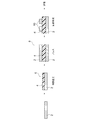
- the resin layer was coated with a bar coater so that the thickness of the resin layer was 1.5 ⁇ m, and then dried in an oven heated to 130 ° C. for 3 minutes to make the resin semi-cured. In this way, a copper foil 6 with a resin was obtained.
- circuit formation and evaluation One side of the obtained copper-clad laminate 8 was etched to form circuits 10 for various evaluations, and the following various evaluations were performed.
- ⁇ Evaluation 2 Capacitance> After etching one side of the copper-clad laminate 8 to form a circular circuit with a diameter of 0.5 inch (12.6 mm), a frequency of 1 kHz is used with an LCR meter (LCR HiTester 3532-50 manufactured by Hioki Electric Co., Ltd.). The capacitance was measured in. This measurement was performed according to IPC-TM-650 2.5.2. The results were as shown in Table 1.
Landscapes
- Chemical & Material Sciences (AREA)
- Engineering & Computer Science (AREA)
- Power Engineering (AREA)
- Organic Chemistry (AREA)
- Health & Medical Sciences (AREA)
- Polymers & Plastics (AREA)
- Medicinal Chemistry (AREA)
- Chemical Kinetics & Catalysis (AREA)
- Microelectronics & Electronic Packaging (AREA)
- Manufacturing & Machinery (AREA)
- Materials Engineering (AREA)
- Life Sciences & Earth Sciences (AREA)
- Wood Science & Technology (AREA)
- Compositions Of Macromolecular Compounds (AREA)
- Epoxy Resins (AREA)
- Laminated Bodies (AREA)
Priority Applications (2)
| Application Number | Priority Date | Filing Date | Title |
|---|---|---|---|
| JP2021508203A JP7412413B2 (ja) | 2019-03-27 | 2020-02-07 | 樹脂組成物、樹脂付銅箔、誘電体層、銅張積層板、キャパシタ素子及びキャパシタ内蔵プリント配線板 |
| US17/442,339 US12351698B2 (en) | 2019-03-27 | 2020-02-07 | Resin composition, copper foil with resin, dielectric layer, copper-clad laminate, capacitor element, and printed wiring board with built-in capacitor |
Applications Claiming Priority (2)
| Application Number | Priority Date | Filing Date | Title |
|---|---|---|---|
| JP2019-059816 | 2019-03-27 | ||
| JP2019059816 | 2019-03-27 |
Publications (1)
| Publication Number | Publication Date |
|---|---|
| WO2020195236A1 true WO2020195236A1 (ja) | 2020-10-01 |
Family
ID=72610728
Family Applications (1)
| Application Number | Title | Priority Date | Filing Date |
|---|---|---|---|
| PCT/JP2020/004882 Ceased WO2020195236A1 (ja) | 2019-03-27 | 2020-02-07 | 樹脂組成物、樹脂付銅箔、誘電体層、銅張積層板、キャパシタ素子及びキャパシタ内蔵プリント配線板 |
Country Status (3)
| Country | Link |
|---|---|
| US (1) | US12351698B2 (enExample) |
| JP (1) | JP7412413B2 (enExample) |
| WO (1) | WO2020195236A1 (enExample) |
Families Citing this family (1)
| Publication number | Priority date | Publication date | Assignee | Title |
|---|---|---|---|---|
| KR20220079327A (ko) * | 2020-12-04 | 2022-06-13 | 코닝 인코포레이티드 | 광추출 기판 및 이를 구비하는 유기발광장치 |
Citations (8)
| Publication number | Priority date | Publication date | Assignee | Title |
|---|---|---|---|---|
| JPH05208469A (ja) * | 1991-09-03 | 1993-08-20 | Matsushita Electric Works Ltd | 電気用積層板 |
| JPH09291473A (ja) * | 1996-04-23 | 1997-11-11 | Asahi Shiyueebell Kk | ガラスクロス |
| JP2002064111A (ja) * | 2000-08-21 | 2002-02-28 | Sumitomo Bakelite Co Ltd | 半導体用樹脂ペースト及びそれを用いた半導体装置 |
| JP2006123232A (ja) * | 2004-10-27 | 2006-05-18 | Mitsui Mining & Smelting Co Ltd | 誘電体フィラー含有樹脂層付銅箔及びその誘電体フィラー含有樹脂層付銅箔を用いて得られたプリント配線板 |
| JP2011219674A (ja) * | 2010-04-13 | 2011-11-04 | Sumitomo Bakelite Co Ltd | 回路基板用熱硬化樹脂性組成物 |
| JP2014012751A (ja) * | 2012-07-03 | 2014-01-23 | Hitachi Chemical Co Ltd | 熱硬化性樹脂組成物、及びこれを用いたプリプレグ、積層板、プリント配線板 |
| JP2017193655A (ja) * | 2016-04-21 | 2017-10-26 | Dic株式会社 | フッ素樹脂粒子分散体、樹脂組成物、金属張積層板、プリプレグ及び金属張積層板の製造方法 |
| WO2018003590A1 (ja) * | 2016-06-28 | 2018-01-04 | 住友ベークライト株式会社 | 熱硬化性樹脂組成物、キャリア付樹脂膜、プリント配線基板および半導体装置 |
Family Cites Families (7)
| Publication number | Priority date | Publication date | Assignee | Title |
|---|---|---|---|---|
| ES2367838T3 (es) * | 1998-09-10 | 2011-11-10 | JX Nippon Mining & Metals Corp. | Laminado que comprende una hoja de cobre tratada y procedimiento para su fabricación. |
| US6657849B1 (en) | 2000-08-24 | 2003-12-02 | Oak-Mitsui, Inc. | Formation of an embedded capacitor plane using a thin dielectric |
| JP2002309200A (ja) | 2001-04-17 | 2002-10-23 | Ajinomoto Co Inc | 接着フィルム |
| JP2005208469A (ja) | 2004-01-26 | 2005-08-04 | Konica Minolta Business Technologies Inc | 画像形成装置 |
| WO2005093763A1 (ja) * | 2004-03-29 | 2005-10-06 | Nippon Chemical Industrial Co., Ltd. | 複合誘電体材料用無機誘電体粉末及び複合誘電体材料 |
| JP5189901B2 (ja) | 2008-06-06 | 2013-04-24 | 花王株式会社 | 吸収性物品 |
| JP5716033B2 (ja) | 2009-11-06 | 2015-05-13 | スリーエム イノベイティブ プロパティズ カンパニー | 非ハロゲン化硬化剤を有する誘電体材料 |
-
2020
- 2020-02-07 JP JP2021508203A patent/JP7412413B2/ja active Active
- 2020-02-07 US US17/442,339 patent/US12351698B2/en active Active
- 2020-02-07 WO PCT/JP2020/004882 patent/WO2020195236A1/ja not_active Ceased
Patent Citations (8)
| Publication number | Priority date | Publication date | Assignee | Title |
|---|---|---|---|---|
| JPH05208469A (ja) * | 1991-09-03 | 1993-08-20 | Matsushita Electric Works Ltd | 電気用積層板 |
| JPH09291473A (ja) * | 1996-04-23 | 1997-11-11 | Asahi Shiyueebell Kk | ガラスクロス |
| JP2002064111A (ja) * | 2000-08-21 | 2002-02-28 | Sumitomo Bakelite Co Ltd | 半導体用樹脂ペースト及びそれを用いた半導体装置 |
| JP2006123232A (ja) * | 2004-10-27 | 2006-05-18 | Mitsui Mining & Smelting Co Ltd | 誘電体フィラー含有樹脂層付銅箔及びその誘電体フィラー含有樹脂層付銅箔を用いて得られたプリント配線板 |
| JP2011219674A (ja) * | 2010-04-13 | 2011-11-04 | Sumitomo Bakelite Co Ltd | 回路基板用熱硬化樹脂性組成物 |
| JP2014012751A (ja) * | 2012-07-03 | 2014-01-23 | Hitachi Chemical Co Ltd | 熱硬化性樹脂組成物、及びこれを用いたプリプレグ、積層板、プリント配線板 |
| JP2017193655A (ja) * | 2016-04-21 | 2017-10-26 | Dic株式会社 | フッ素樹脂粒子分散体、樹脂組成物、金属張積層板、プリプレグ及び金属張積層板の製造方法 |
| WO2018003590A1 (ja) * | 2016-06-28 | 2018-01-04 | 住友ベークライト株式会社 | 熱硬化性樹脂組成物、キャリア付樹脂膜、プリント配線基板および半導体装置 |
Also Published As
| Publication number | Publication date |
|---|---|
| JP7412413B2 (ja) | 2024-01-12 |
| US12351698B2 (en) | 2025-07-08 |
| JPWO2020195236A1 (enExample) | 2020-10-01 |
| US20220162418A1 (en) | 2022-05-26 |
Similar Documents
| Publication | Publication Date | Title |
|---|---|---|
| JP6769032B2 (ja) | 熱硬化性樹脂組成物、層間絶縁用樹脂フィルム、接着補助層付き層間絶縁用樹脂フィルム、及びプリント配線板 | |
| JP7656530B2 (ja) | 樹脂組成物、樹脂付銅箔、誘電体層、銅張積層板、キャパシタ素子及びキャパシタ内蔵プリント配線板 | |
| JP7212626B2 (ja) | プリント配線板用樹脂組成物、樹脂付銅箔、銅張積層板、及びプリント配線板 | |
| WO2021251288A1 (ja) | 両面銅張積層板 | |
| JP6809014B2 (ja) | 熱硬化性樹脂組成物、層間絶縁用樹脂フィルム、複合フィルム、プリント配線板及びその製造方法 | |
| JP7013444B2 (ja) | 樹脂組成物、樹脂付銅箔、誘電体層、銅張積層板、キャパシタ素子及びキャパシタ内蔵プリント配線板 | |
| JP7645822B2 (ja) | 樹脂積層体、誘電体層、樹脂付金属箔、キャパシタ素子及びキャパシタ内蔵プリント配線板 | |
| KR102126657B1 (ko) | 경화성 수지 조성물 | |
| JP7412413B2 (ja) | 樹脂組成物、樹脂付銅箔、誘電体層、銅張積層板、キャパシタ素子及びキャパシタ内蔵プリント配線板 | |
| JP2016056280A (ja) | 表面処理無機充填材、該無機充填材の製造方法、および該無機充填材を含有する樹脂組成物 | |
| JP7123786B2 (ja) | 樹脂組成物、樹脂付銅箔、誘電体層、銅張積層板、キャパシタ素子及びキャパシタ内蔵プリント配線板 | |
| JP6793705B2 (ja) | 樹脂付き金属箔及び樹脂付き金属箔の製造方法 | |
| JP2000104038A (ja) | 接着シート用組成物、接着シート、金属箔付き接着シート、及び積層板 | |
| WO2021090730A1 (ja) | 樹脂組成物及び樹脂付銅箔 | |
| JP2001206965A (ja) | 積層板 |
Legal Events
| Date | Code | Title | Description |
|---|---|---|---|
| 121 | Ep: the epo has been informed by wipo that ep was designated in this application |
Ref document number: 20778037 Country of ref document: EP Kind code of ref document: A1 |
|
| ENP | Entry into the national phase |
Ref document number: 2021508203 Country of ref document: JP Kind code of ref document: A |
|
| NENP | Non-entry into the national phase |
Ref country code: DE |
|
| 122 | Ep: pct application non-entry in european phase |
Ref document number: 20778037 Country of ref document: EP Kind code of ref document: A1 |
|
| WWG | Wipo information: grant in national office |
Ref document number: 17442339 Country of ref document: US |