WO2020189464A1 - 環状ポリアリーレンエーテルケトン組成物およびその製造方法 - Google Patents
環状ポリアリーレンエーテルケトン組成物およびその製造方法 Download PDFInfo
- Publication number
- WO2020189464A1 WO2020189464A1 PCT/JP2020/010681 JP2020010681W WO2020189464A1 WO 2020189464 A1 WO2020189464 A1 WO 2020189464A1 JP 2020010681 W JP2020010681 W JP 2020010681W WO 2020189464 A1 WO2020189464 A1 WO 2020189464A1
- Authority
- WO
- WIPO (PCT)
- Prior art keywords
- ether ketone
- cyclic
- polyarylene ether
- cyclic polyarylene
- chemical formula
- Prior art date
- Legal status (The legal status is an assumption and is not a legal conclusion. Google has not performed a legal analysis and makes no representation as to the accuracy of the status listed.)
- Ceased
Links
Classifications
-
- C—CHEMISTRY; METALLURGY
- C07—ORGANIC CHEMISTRY
- C07D—HETEROCYCLIC COMPOUNDS
- C07D321/00—Heterocyclic compounds containing rings having two oxygen atoms as the only ring hetero atoms, not provided for by groups C07D317/00 - C07D319/00
-
- C—CHEMISTRY; METALLURGY
- C08—ORGANIC MACROMOLECULAR COMPOUNDS; THEIR PREPARATION OR CHEMICAL WORKING-UP; COMPOSITIONS BASED THEREON
- C08G—MACROMOLECULAR COMPOUNDS OBTAINED OTHERWISE THAN BY REACTIONS ONLY INVOLVING UNSATURATED CARBON-TO-CARBON BONDS
- C08G65/00—Macromolecular compounds obtained by reactions forming an ether link in the main chain of the macromolecule
- C08G65/34—Macromolecular compounds obtained by reactions forming an ether link in the main chain of the macromolecule from hydroxy compounds or their metallic derivatives
- C08G65/38—Macromolecular compounds obtained by reactions forming an ether link in the main chain of the macromolecule from hydroxy compounds or their metallic derivatives derived from phenols
- C08G65/40—Macromolecular compounds obtained by reactions forming an ether link in the main chain of the macromolecule from hydroxy compounds or their metallic derivatives derived from phenols from phenols (I) and other compounds (II), e.g. OH-Ar-OH + X-Ar-X, where X is halogen atom, i.e. leaving group
Definitions
- the present invention relates to a cyclic polyarylene ether ketone composition and a method for producing the same.
- Polyarylene ether ketone has excellent mechanical properties, heat resistance, and chemical resistance, and is used for various purposes in the industrial field.
- a composite material in which a polymer is composited with a base material such as particles or fibers can have both the moldability of a resin and various properties of the base material, and is widely put into practical use in various applications.
- fiber reinforced plastics composed of polymers and reinforced fibers such as glass fiber and carbon fiber are expected to expand significantly in the future as materials for aircraft and automobiles.
- the cyclic oligomer of the polyarylene ether ketone has a high melting point and low fluidity when melted by heating, there is a problem that even the cyclic oligomer is difficult to invade the fiber material. Specifically, in order to heat and melt the cyclic oligomer of the polyarylene ether ketone and obtain the fluidity required for impregnation, heating exceeding 300 ° C. is required, and it is difficult to use a general molding machine. there were.
- Patent Document 1 a technique for lowering the melting point of a cyclic oligomer has been proposed (for example, Patent Document 1).
- this method it is possible to lower the melting point of the cyclic oligomer composition by preparing a cyclic oligomer composition containing a linear oligomer, but even if such a method is used, good fluidity is obtained at a temperature of 300 ° C. or lower. It was still difficult to obtain.
- the present invention has been made in view of the above circumstances, and an object of the present invention is to provide a cyclic polyarylene ether ketone composition having high fluidity at the time of heating and melting.
- the inventors of the present application show excellent fluidity at the time of heating and melting by controlling the ratio of the cyclic dimer component contained in the cyclic polyarylene ether ketone composition. They have found that a cyclic polyarylene ether ketone having excellent moldability can be obtained, and have completed the present invention.
- the cyclic polyarylene ether ketone composition of the present invention that solves the above problems is a cyclic polyarylene ether ketone composition containing at least a cyclic polyarylene ether ketone represented by the following chemical formula (I), and has the chemical formula (I).
- a cyclic polyarylene ether ketone composition having 80% by mass or more of cyclic bodies having 2 or more and 20 or less repeating units n in the chemical formula (I) with respect to the total amount of the cyclic polyarylene ether ketone shown, wherein the cyclic polyarylene ether ketone composition has the chemical formula (I).
- This is a cyclic polyarylene ether ketone composition in which the cyclic dimer component having a repeating unit n of 2 is 30% by mass or less with respect to the total amount of the cyclic polyarylene ether ketone represented by.
- X is an ether group or a ketone group
- Ar 1 , Ar 2 , and Ar 3 each represent an arylene group which may have a substituent.
- N is a positive integer.
- the cyclic dimer component having a repeating unit n of 2 is 0.01% by mass or more.
- the structure X in the chemical formula (I) is preferably an ether group.
- the method for producing a cyclic polyarylene ether ketone composition of the present invention for providing such a cyclic polyarylene ether ketone composition includes a step of dissolving a cyclic polyarylene ether ketone crude product in an ether-based solvent and a step of dissolving the cyclic polyarylene ether ketone crude product in an ether-based solvent. It is a method for producing a cyclic polyarylene ether ketone composition, which comprises a step of filtering out undissolved substances. Tetrahydrofuran is preferably used as the ether solvent.
- the present invention after impregnating the reinforcing fiber base material with a molding material obtained by impregnating the reinforcing fiber base material with the cyclic polyarylene ether ketone composition of the present invention and the cyclic polyarylene ether ketone composition of the present invention. , Includes a method for producing a fiber reinforced composite material in which a cyclic polyarylene ether ketone is ring-opened and polymerized.
- the cyclic polyarylene ether ketone composition of the present invention has excellent fluidity when melted by heating, and thus has excellent moldability. Therefore, the cyclic polyarylene ether ketone composition of the present invention exhibits excellent impregnation property at the time of molding the composite material, and therefore can be suitably used for the production of the composite material.
- a cyclic polyarylene ether ketone composition having excellent fluidity at the time of heating and melting and excellent moldability can be obtained.
- the cyclic polyarylene ether ketone composition of the present invention is a cyclic polyarylene ether ketone composition containing at least a cyclic polyarylene ether ketone represented by the following chemical formula (I).
- n is preferably 2 or more and 20 or less, more preferably 2 or more and 15 or less, and further preferably 2 or more and 10 or less. When n is in this range, it becomes a cyclic polyarylene ether ketone that is easily synthesized and easily impregnated into fibers and the like.
- n 2 or more, synthesis is easy, but when n is too large, the melting point of the cyclic polyarylene ether ketone tends to be high, and the efficiency of impregnation into fibers and the like tends to be lowered.
- the amount of the cyclic dimer component having the repeating unit n of 2 in the chemical formula (I) is the total amount of the cyclic polyarylene ether ketone represented by the chemical formula (I) in the cyclic polyarylene ether ketone composition. , 30% or less.
- the cyclic dimer component is preferably 20% or less, and more preferably 10% or less. Further, the cyclic dimer component is preferably contained in an amount of 0.01% or more.
- the cyclic dimer component also functions as a crystal nucleating agent for the polyarylene ether ketone, when the cyclic dimer component is contained in an amount of 0.01% or more, the cyclic polyarylene ether ketone composition is ring-opened and polymerized. This is preferable because the impact resistance of the obtained high molecular weight polyarylene ether ketone is improved.
- the amount of the cyclic dimer component in which the repeating unit n of the cyclic polyarylene ether ketone is 2 is not particularly limited, but can be controlled, for example, by using a solid-liquid separation method utilizing solvent solubility.
- a solid-liquid separation method utilizing solvent solubility.
- ether solvent tetrahydrofuran, diethyl ether, triethyl ether, diisopropyl ether, ethylene glycol monomethyl ether, ethylene glycol monoethyl ether, ethylene glycol monobutyl ether, 1,4-dioxane and 2-methoxy-2-methylpropane are preferably used. And tetrahydrofuran is particularly preferred.
- X in the chemical formula (I) is an ether group or a ketone group.
- the cyclic polyarylene ether ketone in which X in the chemical formula (I) is an ether group is also called cyclic polyarylene ether ether ketone (PEEK), and is obtained by copolymerization of a dihalogenated aromatic ketone compound and a dihydroxy aromatic compound. be able to.
- the cyclic polyarylene ether ketone in which X in the chemical formula (I) is a ketone group is also called a cyclic polyarylene ether ketone ketone (PEKK), and can be obtained by copolymerization of a dihalogenated acyl aromatic compound and a diaryl ether or the like. it can.
- Ar 1 , Ar 2 , and Ar 3 in the chemical formula (I) are arylene groups which may have substituents, respectively.
- the heat resistance of the high molecular weight polyarylene ether ketone obtained by ring-opening polymerization of the cyclic polyarylene ether ketone composition is that Ar 1 , Ar 2 , and Ar 3 are arylene groups (paraphenylene structure) bonded at the para position, respectively. It is preferable from the viewpoint of properties and mechanical properties.
- some of the arylene groups of Ar 1 and / or Ar 3 in the chemical formula (I) contain a cyclic polyarylene ether ketone which is an arylene group (metaphenylene structure) bonded at the meta position. May be good.
- the cyclic polyarylene ether ketone is a combination of a dihalogenated aromatic ketone compound and a dihydroxy aromatic compound, a combination of a dihalogenated aromatic ketone compound and a dihydroxy aromatic ketone compound, and a combination of a dihalogenated acyl aromatic compound and a diaryl ether. It can be obtained by carrying out a polymerization reaction or a polymerization reaction of an acyl hydroxy aromatic halide.
- the polymerization method is not particularly limited, and conventionally known polymerization methods such as solution polymerization, melt polymerization, suspension polymerization, and interfacial polymerization can be used.
- the cyclic polyarylene ether ketone of the present invention can also be obtained by heating and reacting a linear polyarylene ether ketone.
- Examples of the method for obtaining the cyclic polyarylene ether ketone include the following methods (a) to (g).
- C A method for producing by heating and reacting a mixture containing at least a linear polyarylene ether ketone, a dihalogenated aromatic ketone compound, a dihydroxy aromatic compound, a base and an organic polar solvent.
- (D) A production method by heating and reacting a mixture containing at least a linear polyarylene ether ketone, a dihalogenated acyl aromatic compound, a diaryl ether, a base and an organic polar solvent.
- (E) By heating and reacting a mixture containing at least a linear polyarylene ether ketone, a basic compound (preferably at least one of an inorganic alkali metal salt or an organic alkali metal salt), and an organic polar solvent.
- Production method A production method by heating and reacting a mixture containing at least a dihalogenated aromatic ketone compound, a dihydroxy aromatic ketone compound, a base, and an organic polar solvent.
- (G) A production method by heating and reacting a mixture containing at least a hydroxyhalogenated aromatic ketone compound, a base, and an organic polar solvent.
- dihalogenated aromatic ketone compound examples include difluorobenzophenone, dichlorobenzophenone, dibromobenzophenone and its derivatives. Above all, from the viewpoint of reactivity, it is preferable to use difluorobenzophenone. These dihalogenated aromatic ketone compounds may be used alone or as a mixture of two or more kinds.
- dihydroxyaromatic compound examples include hydroquinone (p-dihydroxybenzene), 2,5-toluenediol, p-xylene-2,5-diol, resorcinol (m-dihydroxybenzene) and the like. Above all, it is preferable to use hydroquinone.
- dihalogenated acyl aromatic compound examples include terephthaloyl chloride and its derivatives.
- diaryl ether examples include diphenyl ether and its derivatives.
- Examples of the base used in the production of cyclic polyarylene ether ketone include alkali metal carbonates such as lithium carbonate, sodium carbonate, potassium carbonate, rubidium carbonate and cesium carbonate, and carbonates of alkaline earth metals such as calcium carbonate, strontium carbonate and barium carbonate.
- alkali metal carbonates such as lithium carbonate, sodium carbonate, potassium carbonate, rubidium carbonate and cesium carbonate
- carbonates of alkaline earth metals such as calcium carbonate, strontium carbonate and barium carbonate.
- Bicarbonates of alkali metals such as salt, lithium hydrogen carbonate, sodium hydrogen carbonate, potassium hydrogen carbonate, rubidium hydrogen carbonate, cesium hydrogen carbonate, bicarbonate of alkaline earth metals such as calcium hydrogen carbonate, strontium hydrogen carbonate, barium hydrogen carbonate Salt or bicarbonate of alkali metal such as lithium hydroxide, sodium hydroxide, potassium hydroxide, rubidium hydroxide, cesium hydroxide, water of alkaline earth metal such as calcium hydroxide, strontium hydroxide, barium hydroxide Oxides can be mentioned, and among them, carbonates such as sodium carbonate and potassium carbonate, and bicarbonates such as sodium hydrogen carbonate and potassium hydrogen carbonate are preferable from the viewpoint of ease of handling and reactivity, and sodium carbonate and carbonate are preferable.
- Potassium is even more preferred, and bicarbonate is even more preferred. These may be used alone or in combination of two or more.
- these bases are preferably used in the form of anhydrous, but can also be used as a hydrate or an aqueous mixture.
- the aqueous mixture here refers to an aqueous solution, a mixture of an aqueous solution and a solid component, or a mixture of water and a solid component.
- the organic polar solvent used in the method for producing a cyclic polyarylene ether ketone is not particularly limited as long as it does not substantially cause an unfavorable side reaction such as inhibition of the reaction or decomposition of the produced cyclic polyarylene ether ketone.
- Specific examples of such an organic polar solvent include toluene, N-methyl-2-pyrrolidone (NMP), N-methylcaprolactam, N, N-dimethylformamide (DMF), N, N-dimethylacetamide (DMAc), and the like.
- Nitrogen-containing polar solvents such as 1,3-dimethyl-2-imidazolidinone (DMI), hexamethylphosphoramide, and tetramethylurea, sulfoxide sulfones such as dimethyl sulfoxide (DMSO), dimethyl sulfone, diphenyl sulfone, and sulfolane.
- sulfoxide sulfones such as dimethyl sulfoxide (DMSO), dimethyl sulfone, diphenyl sulfone, and sulfolane.
- solvents nitrile solvents such as benzonitrile, diaryl ethers such as diphenyl ether, ketones such as benzophenone and acetophenone, polyphosphoric acid and mixtures thereof.
- the amount of the organic polar solvent in the mixture in producing the cyclic polyarylene ether ketone is preferably 1.20 liters or more, more preferably 1.30 liters or more, based on 1.0 mol of the benzene ring component in the mixture. More preferably, it contains 1.50 liters or more, and particularly preferably 2.0 liters or more.
- the upper limit of the amount of the organic polar solvent in the mixture is not particularly limited, but is preferably 100 liters or less, more preferably 50 liters or less, and 20 liters or less with respect to 1.0 mol of the benzene ring component in the mixture. Is more preferable, and 10 liters or less is particularly preferable.
- the amount of base used in the method for producing a cyclic polyarylene ether ketone is preferably equal to or more than the equivalent amount as a stoichiometric ratio to the monomer.
- the reaction temperature cannot be uniquely determined because it varies depending on the type and amount of the raw material used, the base, the organic polar solvent, etc., but usually the range of 120 to 350 ° C. can be exemplified.
- the reaction time cannot be unconditionally specified because it depends on the type and amount of the raw material used or the reaction temperature, but is preferably 0.1 hour or more, more preferably 0.5 hours or more, and further 1 hour or more. preferable.
- the atmosphere in the production is preferably a non-oxidizing atmosphere, preferably an inert atmosphere such as nitrogen, helium, and argon, and preferably a nitrogen atmosphere from the viewpoint of economy and ease of handling.
- the crude product of the cyclic polyarylene ether ketone obtained as described above is subjected to a solid-liquid separation treatment using an ether solvent.
- the cyclic polyarylene ether ketone crude product is dissolved in an ether solvent, and then the undissolved substance insoluble in the ether solvent is filtered off. Since the ether solvent has low solubility of the cyclic dimer component and high solubility of the cyclic component having a repeating unit n of 3 or more, the solid-liquid separation treatment is performed using the ether solvent to perform cyclic separation treatment.
- the cyclic dimer component contained in the polyarylene ether ketone composition can be adjusted to a desired amount.
- ether solvent tetrahydrofuran, diethyl ether, triethyl ether, diisopropyl ether, ethylene glycol monomethyl ether, ethylene glycol monoethyl ether, ethylene glycol monobutyl ether, 1,4-dioxane, 2-methoxy-2-methylpropane are used. It can be made, and tetrahydrofuran is particularly preferable.
- the heating temperature during the ring-opening polymerization reaction can be appropriately selected according to the composition and molecular weight of the cyclic polyarylene ether ketone and the environment during heating. From the viewpoint that the reaction can be carried out in a shorter time, 200 ° C. or higher is preferable, and 250 ° C. or higher is more preferable. On the other hand, from the viewpoint of suppressing side reactions such as decomposition reaction, the heating temperature is preferably 450 ° C. or lower, more preferably 400 ° C. or lower.
- the heating time can be appropriately selected according to various characteristics of the cyclic polyarylene ether ketone, heating temperature, and other conditions.
- the heating time is preferably 0.01 hours or more, more preferably 0.05 hours or more.
- 100 hours or less is preferable, 20 hours or less is more preferable, 10 hours or less is further preferable, 6 hours or less is further preferable, and 3 hours or less is further preferable.
- the preheating temperature is preferably in the temperature range of the ring-opening polymerization reaction heating temperature ⁇ 50 ° C., more preferably the temperature equal to or higher than the ring-opening polymerization reaction heating temperature, and at the ring-opening polymerization reaction heating temperature + 5 ° C. or higher. It is particularly preferable to have.
- the preheating time is preferably 1 minute or longer, more preferably 5 minutes or longer.
- the upper limit of the preheating time is not particularly limited, but is preferably 1 hour or less, and more preferably 30 minutes or less.
- a polymerization catalyst When ring-opening polymerization of a cyclic polyarylene ether ketone, a polymerization catalyst may be used if necessary.
- the polymerization catalyst is a catalyst for accelerating the ring-opening polymerization reaction of the cyclic polyarylene ether ketone, and is not particularly limited as long as it is a compound having such an effect.
- an alkali such as an inorganic alkali metal salt or an organic alkali metal salt.
- Metal salts can be used.
- the inorganic alkali metal salt include alkali metal halides such as sodium fluoride, potassium fluoride, cesium fluoride, and lithium chloride.
- organic alkali metal salt examples include alkali metal alkoxides such as sodium methoxide, potassium methoxide, sodium ethoxide, potassium ethoxide, sodium tert-butoxide and potassium tert-butoxide, or sodium phenoxide, potassium phenoxide and sodium-4.
- Alkoxide phenoxides such as -phenoxyphenoxide and potassium-4-phenoxyphenoxide
- alkali metal acetates such as lithium acetate, sodium acetate and potassium acetate can be exemplified.
- it is particularly preferable to use alkali metal phenoxide because it is easy to suppress a side reaction (crosslinking reaction) during ring-opening polymerization.
- These catalysts may be used alone or in combination of two or more. The reaction time can be reduced by performing ring-opening polymerization of the cyclic polyarylene ether ketone in the presence of these preferred catalysts.
- the amount of the polymerization catalyst used varies depending on the molecular weight of the target high molecular weight polyarylene ether ketone and the type of catalyst, but is usually set to 1 mol of the repeating unit of the chemical formula (I) which is the main constituent unit of the cyclic polyarylene ether ketone. On the other hand, it is 0.001 to 20 mol%, preferably 0.005 to 15 mol%, more preferably 0.01 to 10 mol%, and particularly preferably 0.1 to 1.5 mol%. By adding a catalyst amount in this preferable range, ring-opening polymerization of the cyclic polyarylene ether ketone tends to proceed in a short time.
- the method for adding the polymerization catalyst is not particularly limited, but a method of heating a polyarylene ether ketone to obtain a melt and mixing the polymerization catalyst with the melt, or a method of heating a mixture of the polyarylene ether ketone and the polymerization catalyst is heated.
- An example thereof is a method of making a melt.
- an antioxidant in combination with the above catalyst, if necessary.
- an antioxidant By using an antioxidant in combination, it is easy to suppress a side reaction (crosslinking reaction) during ring-opening polymerization, and a polyarylene ether ketone polymer having higher physical properties can be obtained.
- the antioxidant is not particularly limited, but one that captures radicals generated during the reaction is preferable. For example, 2,6-di-t-butylparacresol and 4,4'methylenebis (2,6-di) are preferable.
- phenolic compounds such as 4,4'-methylenebis (6-t-butyl-o-cresol), aliphatic amine compounds, 4,4'-dioctyldiphenylamine, phenyl- ⁇ -naphthylamine, phenothiazine, etc. Examples include aromatic amine compounds and sulfur compounds. Of these, phenolic compounds (phenolic antioxidants) are preferably used. As the phenolic antioxidant, it is preferable to use a hindered phenolic antioxidant having a substituent at the ortho position of the phenolic hydroxyl group.
- the hindered phenolic antioxidant does not need to have substituents at both ortho positions of the phenolic hydroxyl group, and even a semi-hindered phenolic antioxidant or a less hindered phenolic antioxidant may be used. Good.
- hindered phenolic antioxidants include triethylene glycol-bis [3- (3-t-butyl-5-methyl-4-hydroxyphenyl) propionate] and 1,6-hexanediol-bis- [ 3- (3,5-di-t-butyl-4-hydroxyphenyl) propionate], N, N'-hexamethylenebis (3,5-di-t-butyl-4-hydroxy-hydrocinnamamide), Pentaerythrityl-tetrakis [3- (3,5-di-t-butyl-4-hydroxyphenyl) propionate], octadecyl-3- (3,5-di-t-butyl-4-hydroxyphenyl) propionate, 1 , 3,5-tri
- the amount of the antioxidant added is preferably 0.01 to 10 wt%, more preferably 0.1 to 5 wt%, based on the amount of the cyclic polyarylene ether ketone charged.
- the molding material of the present invention is a molding material obtained by impregnating an arbitrary base material with the above-mentioned cyclic polyaryletherketone composition. By ring-opening polymerization of the cyclic polyaryletherketone in the molding material, a composite material using the polyaryletherketone as a matrix can be obtained.
- the base material the shape is not limited as long as it does not inhibit the ring-opening polymerization reaction of the cyclic polyaryletherketone. For example, particles, continuous fibers, long fibers, short fibers, non-woven fabrics, films and the like can be mentioned.
- a fiber-reinforced composite material can be obtained by impregnating a reinforcing fiber base material with the cyclic polyarylene ether ketone composition of the present invention and performing ring-opening polymerization.
- the reinforcing fiber base material may be impregnated with the cyclic polyarylene ether ketone composition, and ring-opening polymerization may be carried out at the same time.
- a molding material in which a reinforcing fiber base material is impregnated with a cyclic polyarylene ether ketone may be obtained as an intermediate.
- the cyclic polyarylene ether ketone composition may be used alone, and other than the cyclic polyarylene ether ketone, as long as the purpose is not impaired.
- Resin inorganic filler, flame retardant, conductivity-imparting agent, crystal nucleating agent, ultraviolet absorber, antioxidant, anti-vibration agent, antibacterial agent, insect repellent, deodorant, anti-coloring agent, heat stabilizer, release It may be used as a resin composition containing various additives such as a mold, an antioxidant, a plasticizer, a lubricant, a colorant, a pigment, a dye, a foaming agent, an antifoaming agent, and a coupling agent.
- the reinforcing fiber base material is not particularly limited, and for example, carbon fiber, glass fiber, aramid fiber, silicon carbide fiber, polyester fiber, ceramic fiber, alumina fiber, boron fiber, metal fiber, mineral fiber, rock fiber and slug fiber. And so on.
- carbon fiber is more preferable because it has good specific strength and specific elastic modulus, and a lightweight and high-strength fiber-reinforced composite material can be obtained.
- Polyacrylonitrile (PAN) -based carbon fibers are particularly preferable because of their excellent tensile strength.
- a PAN-based carbon fiber When a PAN-based carbon fiber is used as the reinforcing fiber, its tensile elastic modulus is preferably 100 to 600 GPa, more preferably 200 to 500 GPa, and particularly preferably 230 to 450 GPa.
- the tensile strength is preferably 2000 MPa to 10000 MPa, more preferably 3000 to 8000 MPa.
- the diameter of the carbon fiber is preferably 4 to 20 ⁇ m, more preferably 5 to 10 ⁇ m.
- the reinforcing fiber by forming it into a sheet shape.
- the reinforcing fiber sheet include a sheet in which a large number of reinforcing fibers are arranged in one direction, a bidirectional fabric such as plain weave and twill weave, a multi-axis fabric, a non-woven fabric, a mat, a knit, a braid, and a paper made from reinforcing fibers. Can be mentioned.
- a unidirectionally aligned sheet a bidirectional woven fabric, or a multi-axis woven fabric base material in which reinforcing fibers are formed into a sheet as continuous fibers because a fiber-reinforced composite material having more excellent mechanical properties can be obtained.
- the thickness of the sheet-shaped reinforcing fiber base material is preferably 0.01 to 3 mm, more preferably 0.1 to 1.5 mm.
- the content of the cyclic polyaryletherketone composition in the entire molding material is preferably 15 to 60% by mass based on the total mass of the molding material.
- the resin content is preferably 20 to 55% by mass, more preferably 25 to 50% by mass.
- the method of impregnating the reinforcing fiber base material with the cyclic polyaryletherketone composition is not particularly limited, and any conventionally known method can be adopted. Specifically, the hot melt method and the solvent method can be preferably adopted.
- a resin composition containing a cyclic polyaryl ether ketone is applied in the form of a thin film on a release paper to form a resin composition film, and the resin composition film is laminated on a reinforcing fiber base material.
- This is a method of impregnating the reinforcing fiber base material layer with the resin composition by heating under pressure.
- the method for forming the resin composition into a resin composition film is not particularly limited, and any conventionally known method can be used. Specifically, a resin composition film is obtained by casting and casting a resin composition on a support such as a paper pattern or a film using a die extrusion, an applicator, a reverse roll coater, a comma coater, or the like. Can be done.
- the resin temperature at the time of producing the film is appropriately determined according to the composition and viscosity of the resin composition. Specifically, the same temperature conditions as the mixing temperature in the method for producing the epoxy resin composition described above are preferably used.
- the impregnation of the resin composition into the reinforcing fiber base material layer may be performed once or may be performed in a plurality of times.
- the solvent method is a method in which a resin composition is made into a varnish using an appropriate solvent, and this varnish is impregnated in the reinforcing fiber base material layer.
- a hot melt method that does not use a solvent can be preferably produced.
- ring-opening polymerization is carried out to convert the cyclic polyarylene ether ketone into a high molecular weight polyarylene ether ketone to obtain a fiber reinforced composite material. Obtainable.
- the heating temperature during the ring-opening polymerization reaction can be appropriately selected according to the composition and molecular weight of the cyclic polyarylene ether ketone and the environment during heating. From the viewpoint that the reaction can be carried out in a shorter time, 200 ° C. or higher is preferable, and 250 ° C. or higher is more preferable. On the other hand, from the viewpoint of suppressing side reactions such as decomposition reaction, the heating temperature is preferably 450 ° C. or lower, more preferably 400 ° C. or lower.
- the heating time can be appropriately selected according to various characteristics of the cyclic polyarylene ether ketone, heating temperature, and other conditions.
- the heating time is preferably 0.01 hours or more, more preferably 0.05 hours or more.
- 100 hours or less is preferable, 20 hours or less is more preferable, 10 hours or less is further preferable, 6 hours or less is further preferable, and 3 hours or less is further preferable.
- the molding method of the fiber-reinforced composite material of the present invention is not particularly limited, but is excellent in productivity such as injection molding, resin transfer molding, reaction injection molding, autoclave molding, press molding, filament winding molding, stamping molding and the like. Examples thereof include molding methods, and these can be used in combination.
- the fiber-reinforced composite material of the present invention thus obtained can be suitably applied to applications such as automobiles, aircrafts, electric / electronic devices, sports / leisure goods, and the like.
- ⁇ Melting point> A differential scanning calorimetry device (DSC Q2000 manufactured by TA Instruments) was used as a measuring device, and measurement was performed from the melting peak. Measurements were carried out in a temperature range of 30 ° C. to 400 ° C. at a heating rate of 20 ° C./min under nitrogen inflow (20 ml / min).
- a melting point measuring meter (Melting Point B-545 manufactured by BUCHI) was used. The measurement was carried out in the temperature range from room temperature to 350 ° C. at a heating rate of 5 ° C./min, and the temperature at which the melted composition started to flow was visually confirmed.
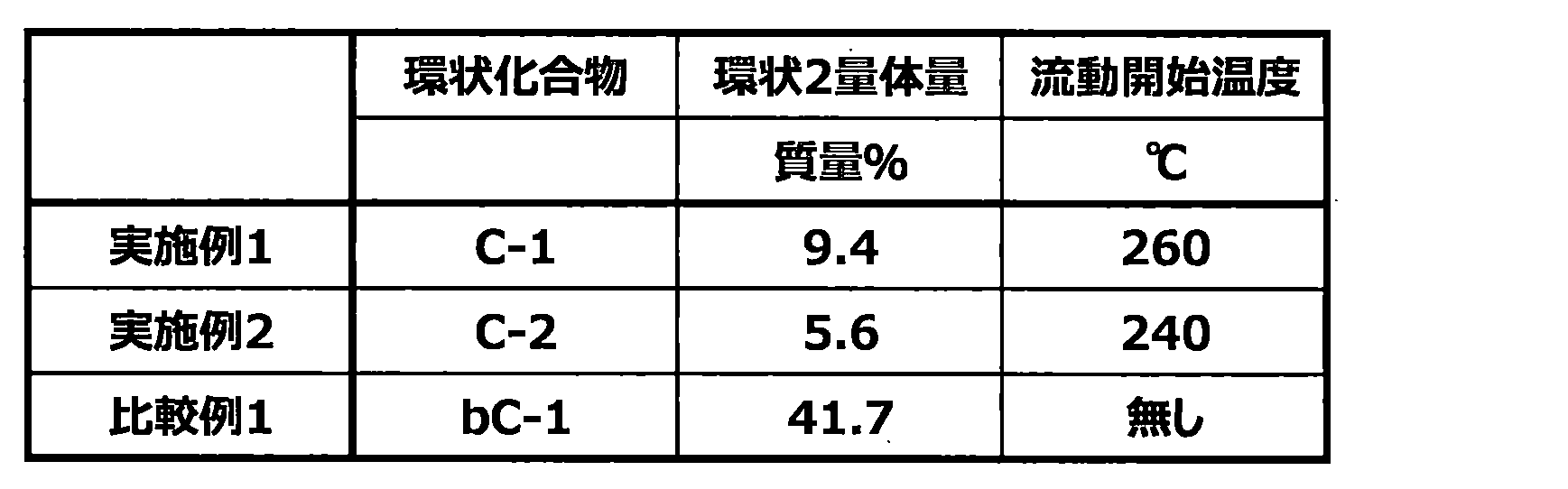
- Example 1 2.35 g of the cyclic compound (bC-1) obtained in Preparation Example 1 was dissolved in 235 g of tetrahydrofuran, and the mixture was stirred at room temperature for 10 minutes. The undissolved product was removed from the obtained solution by filtration, and tetrahydrofuran was removed using an evaporator to obtain 1.65 g of purified cyclic compound (C-1). Table 1 shows the ratio of the cyclic dimer component and the flow start temperature. In Example 1 in which the amount of the cyclic dimer component was 30% by mass or less, the composition started flowing at 260 ° C. and had excellent fluidity when invaded the fiber bundle.
- Example 2 1.65 g of the purified cyclic compound (C-1) obtained in Example 1 was dissolved in 50 g of tetrahydrofuran, and the mixture was stirred at room temperature for 10 minutes. The undissolved product was removed from the obtained solution by filtration, and tetrahydrofuran was removed using an evaporator to obtain 1.48 g of purified cyclic compound (C-2).
- Table 1 shows the ratio of the cyclic dimer component and the flow start temperature. In Example 2 in which the amount of the cyclic dimer component was 30% by mass or less, the composition started flowing at 240 ° C. and was very excellent in fluidity when invaded the fiber bundle.
- a polymerization reaction product (bP-1) 0.5 g of the cyclic compound (bC-1) and 0.013 g of cesium fluoride were mixed and heated at 300 ° C. for 30 minutes in a nitrogen atmosphere to obtain a polymerization reaction product (bP-1).
- the obtained polymerization reaction product (bP-1) was pulverized, weighed at 15 mg, stirred in 10 g of tetrahydrofuran for 10 minutes to extract the unreacted cyclic oligomer component, and liquid chromatography measurement was performed to confirm the unreacted cyclic oligomer component. Was not done.
- the melting point of the polymerization reaction product (bP-1) was measured by DSC measurement and found to be 353 ° C.
- Example 3 A polymerization reaction product (P-3) was obtained in the same manner as in Example 2 except that the polymerization temperature was set to 280 ° C. The obtained polymerization reaction product (P-3) was pulverized, weighed 15 mg, stirred in 10 g of tetrahydrofuran for 10 minutes to extract the unreacted cyclic oligomer component, and ion chromatographic measurement was performed to confirm the unreacted cyclic oligomer component. Was not done. Further, the melting point of the polymerization reaction product (P-3) was measured by DSC measurement and found to be 348 ° C., which maintained excellent heat resistance.
- a polymerization reaction product (bP-2) was obtained in the same manner as in Comparative Example 1 except that the polymerization temperature was set to 280 ° C.
- the obtained polymerization reaction product (bP-2) was pulverized, weighed 15 mg, stirred in 10 g of tetrahydrofuran for 10 minutes to extract the unreacted cyclic oligomer component, and ion chromatography measurement was performed to confirm the unreacted cyclic oligomer component.
- the melting point of the polymerization reaction product (bP-2) was measured by DSC measurement and found to be 338 ° C.
- Example 4 A polymerization reaction product (P-4) was obtained in the same manner as in Example 2 except that the polymerization time was 15 minutes.
- the obtained polymerization reaction product (P-4) was pulverized, weighed 15 mg, stirred in 10 g of tetrahydrofuran for 10 minutes to extract the unreacted cyclic oligomer component, and ion chromatography measurement was performed to confirm the unreacted cyclic oligomer component. was not done.
- the result of measuring the melting point of the polymerization reaction product (P-4) by DSC measurement was 344.5, and excellent heat resistance was maintained.
- the sulfuric acid solubility test of the polymerization reaction product (P-4) was carried out, the undissolved rate was 76.8%.
- Example 5 0.5 g of the purified cyclic compound (C-2) obtained in Example 2, 0.013 g of cesium fluoride, and 4,4'-butylidenebis (6-t-butyl-m) as a less hindered type phenolic antioxidant.
- -Cresol 5 mg was mixed and heated at 300 ° C. for 30 minutes in a nitrogen atmosphere to obtain a polymerization reaction product (P-5).
- the obtained polymerization reaction product (P-5) was pulverized, weighed in 15 mg, stirred in 10 g of tetrahydrofuran for 10 minutes to extract the unreacted cyclic oligomer component, and liquid chromatography measurement was performed to confirm the unreacted cyclic oligomer component.
- the melting point of the polymerization reaction product (P-5) was measured by DSC measurement and found to be 347 ° C., and excellent heat resistance was maintained.
- the sulfuric acid solubility test of the polymerization reaction product (P-5) was carried out, the undissolved ratio was 0%, and the cross-linking reaction in the polymerization reaction was sufficiently suppressed.
- Example 6 0.5 g of the purified cyclic compound (C-2) obtained in Example 2 and 0.011 g of potassium 4-phenylphenoxide were mixed and heated at 300 ° C. for 10 minutes in a nitrogen atmosphere to obtain a polymerization reaction product (P-). 6) was obtained. The obtained polymerization reaction product (P-6) was pulverized, weighed 15 mg, stirred in 10 g of tetrahydrofuran for 10 minutes to extract the unreacted cyclic oligomer component, and liquid chromatography measurement was performed to confirm the unreacted cyclic oligomer component. Was not done.
- the result of measuring the melting point of the polymerization reaction product (P-6) by DSC measurement was 351 ° C., and excellent heat resistance was maintained.
- the sulfuric acid solubility test of the polymerization reaction product (P-6) was carried out, the undissolved ratio was 0%, and the cross-linking reaction in the polymerization reaction was sufficiently suppressed.
- Example 7 0.5 g of the purified cyclic compound (C-2) obtained in Example 2 and 0.004 g of potassium 4-phenylphenoxide were mixed and heated at 300 ° C. for 30 minutes in a nitrogen atmosphere to obtain a polymerization reaction product (P-). 7) was obtained. The obtained polymerization reaction product (P-7) was pulverized, weighed in 15 mg, stirred in 10 g of tetrahydrofuran for 10 minutes to extract the unreacted cyclic oligomer component, and liquid chromatography measurement was performed to confirm the unreacted cyclic oligomer component. Was not done.
- the melting point of the polymerization reaction product (P-7) was measured by DSC measurement and found to be 349 ° C., which maintained excellent heat resistance.
- the sulfuric acid solubility test of the polymerization reaction product (P-7) was carried out, the undissolved ratio was 0%, and the cross-linking reaction in the polymerization reaction was sufficiently suppressed.
- Example 8 After preheating 0.5 g of the purified cyclic compound (C-2) obtained in Example 2 at 310 ° C. for 15 minutes in a nitrogen atmosphere, 0.004 g of potassium 4-phenylphenoxide was added to the purified cyclic compound (C-2). Addition and mixing. Then, the mixture was heated at 300 ° C. for 30 minutes in a nitrogen atmosphere to obtain a polymerization reaction product (P-8).
- the obtained polymerization reaction product (P-8) was pulverized, weighed at 15 mg, stirred in 10 g of tetrahydrofuran for 10 minutes to extract the unreacted cyclic oligomer component, and liquid chromatography measurement was performed to confirm the unreacted cyclic oligomer component. Was not done. Further, the melting point of the polymerization reaction product (P-8) was measured by DSC measurement and found to be 347 ° C., and excellent heat resistance was maintained. When the sulfuric acid solubility test of the polymerization reaction product (P-8) was carried out, the undissolved ratio was 0%, and the cross-linking reaction in the polymerization reaction was sufficiently suppressed.
- the resin pieces of the polymerization reaction product (P-7) obtained in Example 7 and the resin pieces of the polymerization reaction product (P-8) obtained in Example 8 were randomly cut, and the cut surface was cut with a digital microscope. Comparative observation was performed at (magnification magnification: 300 times).
- the resin piece of the polymerization reaction product (P-8) obtained in Example 8 has fewer pores in the cross section than the resin piece of the polymerization reaction product (P-7), and the cyclic compound is preheated by preheating. It was confirmed that a polymer having fewer internal defects could be obtained.
Landscapes
- Chemical & Material Sciences (AREA)
- Organic Chemistry (AREA)
- Health & Medical Sciences (AREA)
- Chemical Kinetics & Catalysis (AREA)
- Medicinal Chemistry (AREA)
- Polymers & Plastics (AREA)
- Compositions Of Macromolecular Compounds (AREA)
- Treatments For Attaching Organic Compounds To Fibrous Goods (AREA)
Abstract
本発明の目的は、加熱溶融時における流動性の高い環状ポリアリーレンエーテルケトン組成物を与えることである。 本発明の環状ポリアリーレンエーテルケトン組成物は、少なくとも化学式(I)で示される環状ポリアリーレンエーテルケトンを含む環状ポリアリーレンエーテルケトン組成物であり、化学式(I)で示される環状ポリアリーレンエーテルケトンの総量に対し、化学式(I)中の繰り返し単位nが2以上20以下の環状体を80質量%以上有する環状ポリアリーレンエーテルケトン組成物であって、化学式(I)で示される環状ポリアリーレンエーテルケトンの総量に対し、繰り返し単位nが2からなる環状2量体成分が30質量%以下である環状ポリアリーレンエーテルケトン組成物である。
Description
本発明は、環状ポリアリーレンエーテルケトン組成物およびその製造方法に関するものである。
ポリアリーレンエーテルケトンは機械物性、耐熱性、耐薬品性に優れ産業分野で様々な用途で利用されている。また、ポリマーを、粒子や繊維等の基材と複合化させた複合材料は、樹脂が有する成形性と基材が有する様々な特性を兼ねそなえることが可能となり、様々な用途で広く実用化されている。中でもポリマーと、ガラス繊維や炭素繊維などの強化繊維とからなる繊維強化プラスチックは、航空機や自動車用の素材として今後大きな広がりが期待される。
しかしながら、ポリアリーレンエーテルケトン等のスーパーエンジニアリングプラスチックは非常に高い融点を有しているため、繊維基材への均一な含浸が困難であるという問題があった。これらのポリマーの繊維基材への効率的な含浸方法として、比較的低分子の環状オリゴマーを基材の存在下で加熱溶融させ基材に環状オリゴマーを含侵させた後、環状オリゴマーを開環重合により高分子量化し複合材料を得る方法がある(例えば、非特許文献1)。しかしながら、ポリアリーレンエーテルケトンの環状オリゴマーは融点が高く、加熱溶融時に流動性が低いため、環状オリゴマーであっても繊維素材へ含侵しにくいという問題があった。具体的には、ポリアリーレンエーテルケトンの環状オリゴマーを加熱溶融し、含侵に必要な流動性を得るためには300℃を超える加熱が必要となり、一般的な成形機を使用することが困難であった。
この技術課題に対して、例えば環状オリゴマーの融点を下げる技術が提案されている(例えば、特許文献1)。本手法では線状オリゴマーを含む環状オリゴマー組成物とすることで環状オリゴマー組成物の融点を下げることが可能になるものの、このような手法を用いても、300℃以下の温度で良好な流動性を得ることは依然として困難であった。
本発明は、上記の事情を鑑みてなされたものであり、その目的は、加熱溶融時における流動性の高い環状ポリアリーレンエーテルケトン組成物を与えることである。
本願発明者らは上記の課題を解決すべく鋭意検討した結果、環状ポリアリーレンエーテルケトン組成物に含まれる環状2量体成分の割合を制御することで、加熱溶融時に優れた流動性を示す、成形性に優れた環状ポリアリーレンエーテルケトンが得られることを見出し、本願発明を完成するに至った。
即ち、上記課題を解決する本発明の環状ポリアリーレンエーテルケトン組成物は、少なくとも下記化学式(I)で示される環状ポリアリーレンエーテルケトンを含む環状ポリアリーレンエーテルケトン組成物であり、化学式(I)で示される環状ポリアリーレンエーテルケトンの総量に対し、化学式(I)中の繰り返し単位nが2以上20以下の環状体を80質量%以上有する環状ポリアリーレンエーテルケトン組成物であって、化学式(I)で示される環状ポリアリーレンエーテルケトンの総量に対し、繰り返し単位nが2からなる環状2量体成分が30質量%以下である環状ポリアリーレンエーテルケトン組成物である。
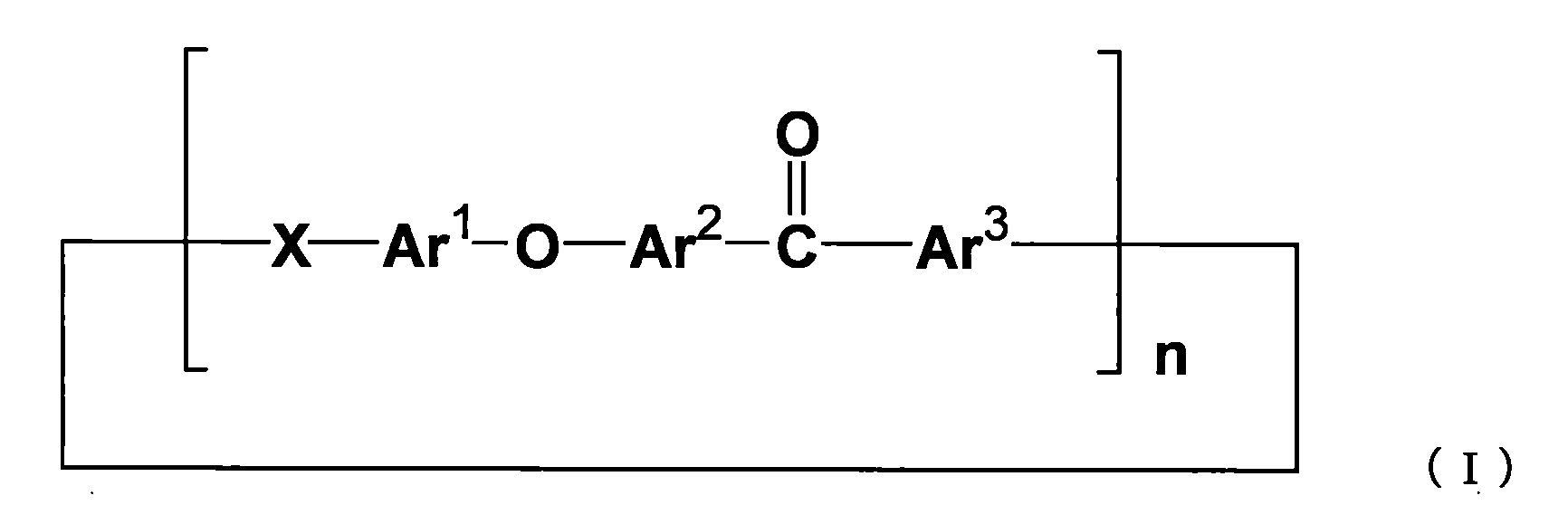
(ただし、Xはエーテル基またはケトン基であり、Ar1、Ar2、Ar3はそれぞれ置換基を有していても良いアリーレン基を表す。nは正の整数である。)
本発明において、繰り返し単位nが2の環状2量体成分が0.01質量%以上であることが好ましい。また、化学式(I)中の構造Xはエーテル基であることが好ましい。
本発明において、繰り返し単位nが2の環状2量体成分が0.01質量%以上であることが好ましい。また、化学式(I)中の構造Xはエーテル基であることが好ましい。
このような環状ポリアリーレンエーテルケトン組成物を与える本発明の環状ポリアリーレンエーテルケトン組成物の製造方法は、環状ポリアリーレンエーテルケトン粗成生物をエーテル系溶剤に溶解させる工程と、エーテル系溶剤に溶解しない未溶解物を濾別する工程を含む環状ポリアリーレンエーテルケトン組成物の製造方法である。エーテル系溶剤としてはテトラヒドロフランを用いることが好ましい。
本発明は、本発明の環状ポリアリーレンエーテルケトン組成物を、強化繊維基材に含浸させてなる成形材料および、本発明の環状ポリアリーレンエーテルケトン組成物を、強化繊維基材に含浸させた後、環状ポリアリーレンエーテルケトンを開環重合させる繊維強化複合材料の製造方法を包含する。
本発明の環状ポリアリーレンエーテルケトン組成物は、加熱溶融時に優れた流動性を有するため、成形性に優れる。そのため、本発明の環状ポリアリーレンエーテルケトン組成物は、複合材料の成形時に優れた含浸性を示すため、複合材料の製造に好適に用いることができる。
本発明の環状ポリアリーレンエーテルケトン組成物の製造方法によれば、加熱溶融時に優れた流動性を有し、成形性に優れた環状ポリアリーレンエーテルケトン組成物を得ることができる。
以下、本発明を実施するための形態の例について述べるが、本発明は以下の例に限定されるものではない。
<環状ポリアリーレンエーテルケトン>
本発明の環状ポリアリーレンエーテルケトン組成物は、少なくとも下記化学式(I)で表される環状ポリアリーレンエーテルケトンを含む環状ポリアリーレンエーテルケトン組成物である。
<環状ポリアリーレンエーテルケトン>
本発明の環状ポリアリーレンエーテルケトン組成物は、少なくとも下記化学式(I)で表される環状ポリアリーレンエーテルケトンを含む環状ポリアリーレンエーテルケトン組成物である。

(ただし、Xはエーテル基またはケトン基であり、Ar1、Ar2、Ar3はそれぞれ置換基を有していても良いアリーレン基を表す。nは正の整数である。)
化学式中nであらわされる繰り返し単位は2以上20以下であることが好ましく、2以上15以下がより好ましく、2以上10以下がさらに好ましい。nがこの範囲であると、合成しやすく、かつ、繊維などへ含浸しやすい環状ポリアリーレンエーテルケトンとなる。nが2以上であると合成しやすくなるが、nが大きすぎる場合、環状ポリアリーレンエーテルケトンの融点が高くなり繊維などへの含浸の効率性が低下しやすい傾向がある。
化学式中nであらわされる繰り返し単位は2以上20以下であることが好ましく、2以上15以下がより好ましく、2以上10以下がさらに好ましい。nがこの範囲であると、合成しやすく、かつ、繊維などへ含浸しやすい環状ポリアリーレンエーテルケトンとなる。nが2以上であると合成しやすくなるが、nが大きすぎる場合、環状ポリアリーレンエーテルケトンの融点が高くなり繊維などへの含浸の効率性が低下しやすい傾向がある。
本発明において、化学式(I)中の繰り返し単位nが2である環状2量体成分量は、環状ポリアリーレンエーテルケトン組成物中の化学式(I)で示される環状ポリアリーレンエーテルケトンの総量に対し、30%以下である。環状2量体成分が、この範囲であることで、加熱溶融時における流動性が優れた環状ポリアリーレンエーテルケトン組成物となる。環状2量体成分は、20%以下であることが好ましく、10%以下であることがより好ましい。また、環状2量体成分は、0.01%以上含まれることが好ましい。環状2量体成分は、ポリアリーレンエーテルケトンの結晶核剤としても機能するため、環状2量体成分が、0.01%以上含まれると、環状ポリアリーレンエーテルケトン組成物を開環重合して得られる高分子量ポリアリーレンエーテルケトンの耐衝撃性が向上するため好ましい。
環状ポリアリーレンエーテルケトンの繰り返し単位nが2である環状2量体成分量は、特に制限はないが、例えば、溶剤溶解性を利用した固液分離法を用いることで制御することができる。固液分離法で用いる溶剤としては、エーテル系溶剤を用いることが好ましい。エーテル系溶剤は、環状体2量体成分の溶解性が低く、繰り返し単位nが3以上の環状体成分の溶解性が高いため、環状体2量体成分の量を特に調整しやすい。エーテル系溶剤としては、テトラヒドロフラン、ジエチルエーテル、トリエチルエーテル、ジイソプロピルエーテル、エチレングリコールモノメチルエーテル、エチレングリコールモノエチルエーテル、エチレングリコールモノブチルエーテル、1,4‐ジオキサン、2-メトキシ-2-メチルプロパンを好ましく使用することができ、テトラヒドロフランが特に好ましい。
化学式(I)中のXは、エーテル基またはケトン基である。化学式(I)中のXが、エーテル基である環状ポリアリーレンエーテルケトンは、環状ポリアリーレンエーテルエーテルケトン(PEEK)とも呼ばれ、ジハロゲン化芳香族ケトン化合物とジヒドロキシ芳香族化合物の共重合などにより得ることができる。化学式(I)中のXが、ケトン基である環状ポリアリーレンエーテルケトンは、環状ポリアリーレンエーテルケトンケトン(PEKK)とも呼ばれ、ジハロゲン化アシル芳香族化合物とジアリールエーテルの共重合などにより得ることができる。
化学式(I)中の、Ar1、Ar2、Ar3はそれぞれ置換基を有していても良いアリーレン基である。Ar1、Ar2、Ar3はそれぞれパラ位で結合するアリーレン基(パラフェニレン構造)であることが、環状ポリアリーレンエーテルケトン組成物を開環重合して得られる高分子量ポリアリーレンエーテルケトンの耐熱性、機械特性の観点から好ましい。また、本発明では、化学式(I)中のAr1および/またはAr3の一部のアリーレン基が、メタ位で結合するアリーレン基(メタフェニレン構造)である環状ポリアリーレンエーテルケトンを含んでいてもよい。主鎖中にメタフェニレン構造が存在すると、ポリアリーレンエーテル鎖が屈曲するため、環状構造体を生成しやすくなる。主鎖中にメタフェニレン構造を導入する場合、化学式(I)のAr1またはAr3のすべてが、メタ位で結合している必要はなく、化学式(I)中の繰り返し単位の内の一部のAr1またはAr3がメタ位で結合するアリーレン基であれば良い。
<環状ポリアリーレンエーテルケトンの製造方法>
環状ポリアリーレンエーテルケトンは、ジハロゲン化芳香族ケトン化合物とジヒドロキシ芳香族化合物の組み合わせ、ジハロゲン化芳香族ケトン化合物とジヒドロキシ芳香族ケトン化合物の組み合わせ、ジハロゲン化アシル芳香族化合物とジアリールエーテルの組み合わせでの共重合反応、または、ハロゲン化アシルヒドロキシ芳香族の重合反応を行うことで得ることができる。重合方法としては特に制限なく、溶液重合、溶融重合、懸濁重合、界面重合等従来公知の重合方法を用いることができる。また、本発明の環状ポリアリーレンエーテルケトンは、線状ポリアリーレンエーテルケトンを加熱反応させることによっても得ることができる。
環状ポリアリーレンエーテルケトンは、ジハロゲン化芳香族ケトン化合物とジヒドロキシ芳香族化合物の組み合わせ、ジハロゲン化芳香族ケトン化合物とジヒドロキシ芳香族ケトン化合物の組み合わせ、ジハロゲン化アシル芳香族化合物とジアリールエーテルの組み合わせでの共重合反応、または、ハロゲン化アシルヒドロキシ芳香族の重合反応を行うことで得ることができる。重合方法としては特に制限なく、溶液重合、溶融重合、懸濁重合、界面重合等従来公知の重合方法を用いることができる。また、本発明の環状ポリアリーレンエーテルケトンは、線状ポリアリーレンエーテルケトンを加熱反応させることによっても得ることができる。
環状ポリアリーレンエーテルケトンを得る方法としては、例えば以下の(a)~(g)の方法が挙げられる。
(a)少なくともジハロゲン化芳香族ケトン化合物、ジヒドロキシ芳香族化合物、塩基、および有機極性溶媒を含む混合物を加熱して反応させることによる製造方法。
(b)少なくともジハロゲン化芳香族化合物、ジアリールエーテル、塩基、および有機極性溶媒を含む混合物を加熱して反応させることによる製造方法。
(c)少なくとも線状ポリアリーレンエーテルケトン、ジハロゲン化芳香族ケトン化合物、ジヒドロキシ芳香族化合物、塩基および有機極性溶媒を含む混合物を加熱して反応させることによる製造方法。
(d)少なくとも線状ポリアリーレンエーテルケトン、ジハロゲン化アシル芳香族化合物、ジアリールエーテル、塩基および有機極性溶媒を含む混合物を加熱して反応させることによる製造方法。
(e)少なくとも線状ポリアリーレンエーテルケトン、塩基性化合物(好ましくは、少なくとも無機アルカリ金属塩または有機アルカリ金属塩のいずれか1種類以上)、有機極性溶媒を含む混合物を加熱して反応させることによる製造方法。
(f)少なくともジハロゲン化芳香族ケトン化合物、ジヒドロキシ芳香族ケトン化合物、塩基、および有機極性溶媒を含む混合物を加熱して反応させることによる製造方法。
(g)少なくともヒドロキシハロゲン化芳香族ケトン化合物、塩基、および有機極性溶媒を含む混合物を加熱して反応させることによる製造方法。
(a)少なくともジハロゲン化芳香族ケトン化合物、ジヒドロキシ芳香族化合物、塩基、および有機極性溶媒を含む混合物を加熱して反応させることによる製造方法。
(b)少なくともジハロゲン化芳香族化合物、ジアリールエーテル、塩基、および有機極性溶媒を含む混合物を加熱して反応させることによる製造方法。
(c)少なくとも線状ポリアリーレンエーテルケトン、ジハロゲン化芳香族ケトン化合物、ジヒドロキシ芳香族化合物、塩基および有機極性溶媒を含む混合物を加熱して反応させることによる製造方法。
(d)少なくとも線状ポリアリーレンエーテルケトン、ジハロゲン化アシル芳香族化合物、ジアリールエーテル、塩基および有機極性溶媒を含む混合物を加熱して反応させることによる製造方法。
(e)少なくとも線状ポリアリーレンエーテルケトン、塩基性化合物(好ましくは、少なくとも無機アルカリ金属塩または有機アルカリ金属塩のいずれか1種類以上)、有機極性溶媒を含む混合物を加熱して反応させることによる製造方法。
(f)少なくともジハロゲン化芳香族ケトン化合物、ジヒドロキシ芳香族ケトン化合物、塩基、および有機極性溶媒を含む混合物を加熱して反応させることによる製造方法。
(g)少なくともヒドロキシハロゲン化芳香族ケトン化合物、塩基、および有機極性溶媒を含む混合物を加熱して反応させることによる製造方法。
ジハロゲン化芳香族ケトン化合物としては、例えば、ジフルオロベンゾフェノン、ジクロロベンゾフェノン、ジブロモベンゾフェノンおよびその誘導体などが挙げられる。中でも反応性の観点から、ジフルオロベンゾフェノンを用いることが好ましい。これらジハロゲン化芳香族ケトン化合物は単独の化合物を用いてもよいし、2種類以上の混合物として用いてもよい。
ジヒドロキシ芳香族化合物としては、ハイドロキノン(p-ジヒドロキシベンゼン)、2,5-トルエンジオール、p-キシレン‐2,5-ジオール、レゾルシノール(m-ジヒドロキシベンゼン)などが挙げられる。中でも、ハイドロキノンを用いることが好ましい。
ジハロゲン化アシル芳香族化合物としては、例えば、塩化テレフタロイルおよびその誘導体などが挙げられる。
ジアリールエーテルとしては、例えば、ジフェニルエーテル及びその誘導体などが挙げられる。
環状ポリアリーレンエーテルケトンの製造において用いる塩基としては、炭酸リチウム、炭酸ナトリウム、炭酸カリウム、炭酸ルビジウム、炭酸セシウムなどのアルカリ金属炭酸塩、炭酸カルシウム、炭酸ストロンチウム、炭酸バリウムなどのアルカリ土類金属の炭酸塩、炭酸水素リチウム、炭酸水素ナトリウム、炭酸水素カリウム、炭酸水素ルビジウム、炭酸水素セシウムなどのアルカリ金属の重炭酸塩、炭酸水素カルシウム、炭酸水素ストロンチウム、炭酸水素バリウムなどのアルカリ土類金属の重炭酸塩、または水酸化リチウム、水酸化ナトリウム、水酸化カリウム、水酸化ルビジウム、水酸化セシウムなどのアルカリ金属の水酸化物、水酸化カルシウム、水酸化ストロンチウム、水酸化バリウムなどのアルカリ土類金属の水酸化物を挙げることができ、なかでも取り扱いの容易さ・反応性の観点から炭酸ナトリウム、炭酸カリウムなどの炭酸塩、および炭酸水素ナトリウム、炭酸水素カリウムなどの重炭酸塩が好ましく、炭酸ナトリウム、炭酸カリウムがさらに好ましく、炭酸カリウムがよりいっそう好ましく用いられる。これらは単独で用いてもよいし、2種類以上を混合して用いても問題ない。また、これら塩基は無水物の形で用いることが好ましいが、水和物または水性混合物として用いることも可能である。なお、ここでの水性混合物とは水溶液、もしくは水溶液と固体成分の混合物、もしくは水と固体成分の混合物のことを指す。
環状ポリアリーレンエーテルケトンの製造方法において用いる有機極性溶媒としては、反応の阻害や生成した環状ポリアリーレンエーテルケトンの分解などの好ましくない副反応を実質的に引き起こさないものであれば特に制限はない。このような有機極性溶媒の具体例としては、トルエン、N-メチル-2-ピロリドン(NMP)、N-メチルカプロラクタム、N、N-ジメチルホルムアミド(DMF)、N、N-ジメチルアセトアミド(DMAc)、1、3-ジメチル-2-イミダゾリジノン(DMI)、ヘキサメチルホスホルアミド、テトラメチル尿素などの含窒素極性溶媒、ジメチルスルホキシド(DMSO)、ジメチルスルホン、ジフェニルスルホン、スルホランなどのスルホキシド・スルホン系溶媒、ベンゾニトリルなどのニトリル系溶媒、ジフェニルエーテルなどのジアリールエーテル類、ベンゾフェノン、アセトフェノンなどのケトン類、ポリリン酸およびこれらの混合物などが挙げられる。
環状ポリアリーレンエーテルケトンを製造する際の混合物中の有機極性溶媒の量は、好ましくは混合物中のベンゼン環成分1.0モルに対して1.20リットル以上、より好ましくは1.30リットル以上、さらに好ましくは1.50リットル以上、特に好ましくは2.0リットル以上含むものが望まれる。また、混合物中の有機極性溶媒量の上限に特に制限はないが、混合物中のベンゼン環成分1.0モルに対して100リットル以下であることが好ましく、50リットル以下がより好ましく、20リットル以下がさらに好ましく、10リットル以下が特に好ましい。
環状ポリアリーレンエーテルケトンの製造方法における塩基の使用量は、モノマーに対して化学量論的比率として当量以上が望ましい。反応温度は、使用した原料、塩基、有機極性溶媒などの種類、量によって多様化するため一意的に決めることはできないが、通常120~350℃の範囲が例示できる。反応時間は、使用した原料の種類や量、あるいは反応温度に依存するので一概に規定することはできないが、0.1時間以上が好ましく、0.5時間以上がより好ましく、1時間以上がさらに好ましい。一方、反応時間に特に上限はないが、40時間以内でも十分に反応が進行し、好ましくは10時間以内、より好ましくは6時間以内も採用できる。また、製造における雰囲気は非酸化性雰囲気下が望ましく、窒素、ヘリウム、およびアルゴンなどの不活性雰囲気下で行うことが好ましく、経済性および取り扱いの容易さから窒素雰囲気下で行うことが好ましい。
本発明の環状ポリアリーレンエーテルケトン組成物の製造方法は、上記のようにして得られた環状ポリアリーレンエーテルケトンの粗生成物を、エーテル系溶剤を用いて、固液分離処理を行う。具体的には、環状ポリアリーレンエーテルケトン粗成生物をエーテル系溶剤に溶解させた後、エーテル系溶剤に溶解しない未溶解物を濾別する。エーテル系溶剤は、環状体2量体成分の溶解性が低く、繰り返し単位nが3以上の環状体成分の溶解性が高いため、エーテル系溶剤を用いて固液分離処理を行うことで、環状ポリアリーレンエーテルケトン組成物に含まれる環状体2量体成分を、所望の量に調整することができる。エーテル系溶剤としては、テトラヒドロフラン、ジエチルエーテル、トリエチルエーテル、ジイソプロピルエーテル、エチレングリコールモノメチルエーテル、エチレングリコールモノエチルエーテル、エチレングリコールモノブチルエーテル、1,4‐ジオキサン、2-メトキシ-2-メチルプロパンを使用することができ、テトラヒドロフランが特に好ましい。
<ポリアリーレンエーテルケトンの製造方法>
本発明の環状ポリアリーレンエーテルケトン組成物を開環重合させることで、高分子量のポリアリーレンエーテルケトンに転化させることができる。
本発明の環状ポリアリーレンエーテルケトン組成物を開環重合させることで、高分子量のポリアリーレンエーテルケトンに転化させることができる。
開環重合反応の際の加熱温度は、環状ポリアリーレンエーテルケトンの組成や分子量、加熱時の環境に応じて適宜選択することができる。より短時間で反応を行える観点から、200℃以上が好ましく、250℃以上がより好ましい。一方、分解反応等の副反応を抑制する観点から、加熱温度は450℃以下が好ましく、400℃以下がより好ましい。加熱時間は、環状ポリアリーレンエーテルケトンの各種特性、加熱温度などの条件に応じて適宜選択することができる。環状ポリアリーレンエーテルケトンを十分転化させる観点から、加熱時間は0.01時間以上が好ましく、0.05時間以上がより好ましい。一方、分解反応等の副反応を抑制する観点から、100時間以下が好ましく20時間以下がより好ましく、10時間以下がさらに好ましく、6時間以下がさらに好ましく、3時間以下がさらに好ましい。
また、開環重合反応を行う前(触媒を添加する前)に、環状ポリアリーレンエーテルケトン組成物を、不活性雰囲気下もしくは減圧下で加熱(予備加熱)しておくことが好ましい。開環重合反応を行う前に予備加熱を行うことで、組成物中に含まれる低沸点の不純物を除去することができ、欠陥の少ない高分子量ポリアリーレンエーテルケトンを得ることができる。予備加熱温度は開環重合反応加熱温度±50℃の温度範囲であることが好ましく、開環重合反応加熱温度以上の温度であることがより好ましく、開環重合反応加熱温度+5℃以上の温度であることがとくに好ましい。予備加熱時間は1分以上が好ましく、5分以上がより好ましい。予備加熱時間の上限は特に制限はないが、1時間以下が好ましく30分以下がより好ましい。
環状ポリアリーレンエーテルケトンを開環重合させる場合、必要に応じて、重合触媒を用いてもよい。重合触媒は、環状ポリアリーレンエーテルケトンの開環重合反応を加速させるための触媒であり、かかる効果のある化合物であれば特に制限はなく、例えば、無機アルカリ金属塩または有機アルカリ金属塩などのアルカリ金属塩を用いることができる。無機アルカリ金属塩としてはフッ化ナトリウム、フッ化カリウム、フッ化セシウム、塩化リチウムなどのアルカリ金属ハロゲン化物を例示できる。また、有機アルカリ金属塩としては、ナトリウムメトキシド、カリウムメトキシド、ナトリウムエトキシド、カリウムエトキシド、ナトリウムtert-ブトキシド、カリウムtert-ブトキシドなどのアルカリ金属アルコキシドまたは、ナトリウムフェノキシド、カリウムフェノキシド、ナトリウム-4-フェノキシフェノキシド、カリウム-4-フェノキシフェノキシドなどのアルカリ金属フェノキシド、酢酸リチウム、酢酸ナトリウム、酢酸カリウムなどのアルカリ金属酢酸塩を例示することができる。これらの中でも、アルカリ金属フェノキシドを用いることが、開環重合の際の副反応(架橋反応)を抑制しやすいため、特に好ましい。これら触媒は単独で用いてもよいし、2種以上を混合して用いてもよい。環状ポリアリーレンエーテルケトンの開環重合をこれら好ましい触媒の存在下に行うことにより、反応時間を低減させることができる。
使用する重合触媒の量は、目的とする高分子量ポリアリーレンエーテルケトンの分子量ならびに触媒の種類により異なるが、通常、環状ポリアリーレンエーテルケトンの主要構成単位である化学式(I)の繰り返し単位1モルに対して、0.001~20モル%、好ましくは0.005~15モル%、さらに好ましくは0.01~10モル%であり、特に好ましくは0.1~1.5モル%である。この好ましい範囲の触媒量を添加することにより環状ポリアリーレンエーテルケトンの開環重合が短時間で進行する傾向にある。
重合触媒の添加方法に際しては、特に制限は無いが、ポリアリーレンエーテルケトンを加熱して溶融液とし、この溶融液に重合触媒を混合する方法や、ポリアリーレンエーテルケトンと重合触媒との混合物を加熱して溶融液とする方法などが例示できる。
環状ポリアリーレンエーテルケトンを開環重合させる場合、必要に応じて、上記の触媒と組み合わせて酸化防止剤を使用することも好ましい。酸化防止剤を併用することで、開環重合の際の副反応(架橋反応)を抑制しやすく、より高物性のポリアリーレンエーテルケトン重合体を得ることができる。酸化防止剤としては、特に制限はないが、反応中に発生するラジカルを捕捉するものが好ましく、例えば、2,6-ジ-t-ブチルパラクレゾール、4,4'メチレンビス(2,6-ジ-t-ブチルフェノール)、4,4'-メチレンビス(6-t-ブチル-o-クレゾール)などのフェノール系化合物、脂肪族アミン化合物、4,4'-ジオクチルジフェニルアミン、フェニル-α-ナフチルアミン、フェノチアジンなどの芳香族アミン化合物、硫黄化合物などが挙げられる。中でも、フェノール系化合物(フェノール系酸化防止剤)が好ましく用いられる。フェノール系酸化防止剤としては、フェノール性水酸基のオルト位に置換基を有するヒンダードフェノール系酸化防止剤を用いることが好ましい。ヒンダードフェノール系酸化防止剤としては、フェノール性水酸基の両オルト位に置換基を有している必要はなく、セミヒンダードフェノール系酸化防止剤、レスヒンダードフェノール系酸化防止剤であってもよい。このようなヒンダードフェノール系酸化防止剤としては、トリエチレングリコール-ビス[3-(3-t-ブチル-5-メチル-4-ヒドロキシフェニル)プロピオネート]、1,6-ヘキサンジオール-ビス-[3-(3,5-ジ-t-ブチル-4-ヒドロキシフェニル)プロピオネート]、N,N’-ヘキサメチレンビス(3,5-ジ-t-ブチル-4-ヒドロキシ-ヒドロシンナマミド)、ペンタエリスリチル-テトラキス[3-(3,5-ジ-t-ブチル-4-ヒドロキシフェニル)プロピオネート]、オクタデシル-3-(3,5-ジ-t-ブチル-4-ヒドロキシフェニル)プロピオネート、1,3,5-トリメチル-2,4,6-トリス(3,5-ジ-t-ブチ-4-ヒドロキシベンジル)ベンゼン、2,6-ジ-t-ブチル-4-エチルフェノール、2,2’-メチレンビス(4-メチル-6-t-ブチルフェノール)、4,4’-チオ-ビス(3-メチル-6-t-ブチルフェノール)、4,4’-ブチリデン-ビス(3-メチル-6-t-ブチルフェノール)、1,1,3-トリス(2-メチル-4-ヒドロキシ-5-t--ブチルフェニル)ブタン、1,3,5-トリス(4-ヒドロキシベンジル)ベンゼン、テトラキス[メチレン-3-(3,5’-ジ-t-ブチル-4’-ヒドロキシフェニルプロピオネート)]メタン、4,4’-ブチリデンビス(6-t-ブチル-m-クレゾール)等を挙げることができる。中でも、レスヒンダードフェノール系酸化防止剤を用いることがより好ましく、4,4’-ブチリデンビス(6-t-ブチル-m-クレゾール)が特に好ましい。
酸化防止剤を併用する場合、その添加量は、環状ポリアリーレンエーテルケトンの仕込み量に対して、0.01~10wt%であることが好ましく、0.1~5wt%であることがより好ましい。
本発明の成形材料は、上記の環状ポリアリールエーテルケトン組成物を任意の基材に含浸させてなる成形材料である。成形材料中の環状ポリアリールエーテルケトンを開環重合させることで、ポリアリールエーテルケトンをマトリックスとした複合材料を得ることができる。基材としては、環状ポリアリールエーテルケトンの開環重合反応を阻害しなければよく、形状に制限はない。例えば、粒子、連続繊維、長繊維、短繊維、不織布、フィルムなどが挙げられる。
本発明の環状ポリアリーレンエーテルケトン組成物を強化繊維基材に含浸させ開環重合させることにより、繊維強化複合材料を得ることができる。本発明の環状ポリアリーレンエーテルケトン組成物を用いて、繊維強化複合材料を製造する場合、環状ポリアリーレンエーテルケトン組成物を強化繊維基材に含浸させると同時に開環重合を行ってもよいし、環状ポリアリーレンエーテルケトンを強化繊維基材に含浸させた成形材料を中間体として得てもよい。
本発明の環状ポリアリーレンエーテルケトン組成物を用いて繊維強化複合材料を製造する場合、環状ポリアリーレンエーテルケトン組成物は単独で用いてもよく、目的を損なわない範囲で、環状ポリアリーレンエーテルケトン以外の樹脂や、無機充填材、難燃剤、導電性付与剤、結晶核剤、紫外線吸収剤、酸化防止剤、制振剤、抗菌剤、防虫剤、防臭剤、着色防止剤、熱安定剤、離型剤、帯電防止剤、可塑剤、滑剤、着色剤、顔料、染料、発泡剤、制泡剤、カップリング剤などの各種添加剤を含む樹脂組成物として用いてもよい。
強化繊維基材としては、特に制限はなく、例えば、炭素繊維、ガラス繊維、アラミド繊維、炭化ケイ素繊維、ポリエステル繊維、セラミック繊維、アルミナ繊維、ボロン繊維、金属繊維、鉱物繊維、岩石繊維及びスラッグ繊維などが挙げられる。
これらの強化繊維の中でも、炭素繊維、ガラス繊維、アラミド繊維が好ましい。比強度、比弾性率が良好で、軽量かつ高強度の繊維強化複合材料が得られる点で、炭素繊維がより好ましい。引張強度に優れる点でポリアクリロニトリル(PAN)系炭素繊維が特に好ましい。
強化繊維にPAN系炭素繊維を用いる場合、その引張弾性率は、100~600GPaであることが好ましく、200~500GPaであることがより好ましく、230~450GPaであることが特に好ましい。また、引張強度は、2000MPa~10000MPaであることが好ましく、3000~8000MPaであることがより好ましい。炭素繊維の直径は、4~20μmが好ましく、5~10μmがより好ましい。このような炭素繊維を用いることにより、得られる繊維強化複合材料の機械的性質を向上できる。
強化繊維はシート状に形成して用いることが好ましい。強化繊維シートとしては、例えば、多数本の強化繊維を一方向に引き揃えたシートや、平織や綾織などの二方向織物、多軸織物、不織布、マット、ニット、組紐、強化繊維を抄紙した紙を挙げることができる。これらの中でも、強化繊維を連続繊維としてシート状に形成した一方向引揃えシートや二方向織物、多軸織物基材を用いると、より機械物性に優れた繊維強化複合材料が得られるため好ましい。シート状の強化繊維基材の厚さは、0.01~3mmが好ましく、0.1~1.5mmがより好ましい。
成形材料全体における環状ポリアリールエーテルケトン組成物の含有率は、成形材料の全質量を基準として、15~60質量%であることが好ましい。樹脂含有率は、20~55質量%であることが好ましく、25~50質量%であることがより好ましい。
強化繊維基材に環状ポリアリールエーテルケトン組成物を含浸させる方法は、特に制限がなく、従来公知のいかなる方法も採用できる。具体的には、ホットメルト法や溶剤法が好適に採用できる。
ホットメルト法は、離型紙の上に、環状ポリアリールエーテルケトンを含む樹脂組成物を薄いフィルム状に塗布して樹脂組成物フィルムを形成し、強化繊維基材に該樹脂組成物フィルムを積層して加圧下で加熱することにより樹脂組成物を強化繊維基材層内に含浸させる方法である。
樹脂組成物を樹脂組成物フィルムにする方法としては、特に限定されるものではなく、従来公知のいずれの方法を用いることもできる。具体的には、ダイ押し出し、アプリケーター、リバースロールコーター、コンマコーターなどを用いて、離型紙やフィルムなどの支持体上に樹脂組成物を流延、キャストをすることにより樹脂組成物フィルムを得ることができる。フィルムを製造する際の樹脂温度は、樹脂組成物の組成や粘度に応じて適宜決定する。具体的には、前述のエポキシ樹脂組成物の製造方法における混合温度と同じ温度条件が好適に用いられる。樹脂組成物の強化繊維基材層内への含浸は1回で行ってもよいし、複数回に分けて行ってもよい。
溶剤法は、樹脂組成物を適当な溶媒を用いてワニス状にし、このワニスを強化繊維基材層内に含浸させる方法である。これらの従来法の中でも、溶剤を用いないホットメルト法により好適に製造することができる。
本発明の環状ポリアリーレンエーテルケトン組成物を強化繊維基材に含浸させた後、開環重合させ、環状ポリアリーレンエーテルケトンを高分子量のポリアリーレンエーテルケトンに転化させることにより、繊維強化複合材料を得ることができる。
開環重合反応の際の加熱温度は、環状ポリアリーレンエーテルケトンの組成や分子量、加熱時の環境に応じて適宜選択することができる。より短時間で反応を行える観点から、200℃以上が好ましく、250℃以上がより好ましい。一方、分解反応等の副反応を抑制する観点から、加熱温度は450℃以下が好ましく、400℃以下がより好ましい。加熱時間は、環状ポリアリーレンエーテルケトンの各種特性、加熱温度などの条件に応じて適宜選択することができる。環状ポリアリーレンエーテルケトンを十分転化させる観点から、加熱時間は0.01時間以上が好ましく、0.05時間以上がより好ましい。一方、分解反応等の副反応を抑制する観点から、100時間以下が好ましく20時間以下がより好ましく、10時間以下がさらに好ましく、6時間以下がさらに好ましく、3時間以下がさらに好ましい。
本発明の繊維強化複合材料の成形方法としては、特に限定しないが、例えば、射出成形、レジントランスファー成形、反応射出成形、オートクレーブ成形、プレス成形、フィラメントワインディング成形、スタンピング成形などの生産性に優れた成形方法が挙げられ、これらを組み合わせて用いることができる。
このようにして得られた本発明の繊維強化複合材料は、自動車、航空機、電気・電子機器、スポーツ・レジャー用品などの用途に好適に適用できる。
以下、実施例により本発明方法を更に詳しく具体的に説明する。ただし、これらの実施
例により本発明の範囲が限定されるものではない。
〔測定方法〕
<環状2量体量>
液体クロマトグラフィー測定によって得られるチャートを使用し、環状2量体に該当するピークの面積比から算出した。測定装置には液体クロマトグラフ(株式会社日立ハイテクノロジーズ製L-2000シリーズ)を用い、検出器にはL-2400(株式会社日立ハイテクノロジーズ製)を用い、検出波長は270nmとした。カラムにはMightysil RP-18GP150-4.6(関東化学株式会社製)を、移動相にはテトラヒドロフラン・0.1%トリフルオロ酢酸水溶液を用い、40℃の測定温度で測定を行った。
例により本発明の範囲が限定されるものではない。
〔測定方法〕
<環状2量体量>
液体クロマトグラフィー測定によって得られるチャートを使用し、環状2量体に該当するピークの面積比から算出した。測定装置には液体クロマトグラフ(株式会社日立ハイテクノロジーズ製L-2000シリーズ)を用い、検出器にはL-2400(株式会社日立ハイテクノロジーズ製)を用い、検出波長は270nmとした。カラムにはMightysil RP-18GP150-4.6(関東化学株式会社製)を、移動相にはテトラヒドロフラン・0.1%トリフルオロ酢酸水溶液を用い、40℃の測定温度で測定を行った。
<融点>
測定装置として示差式走査型熱量測定装置(TAインスツルメント社製 DSC Q2000)を用い、融解ピークより測定した。窒素流入下(20ml/分)、20℃/分の昇温速度で、30℃から400℃までの温度範囲で測定を行った。
測定装置として示差式走査型熱量測定装置(TAインスツルメント社製 DSC Q2000)を用い、融解ピークより測定した。窒素流入下(20ml/分)、20℃/分の昇温速度で、30℃から400℃までの温度範囲で測定を行った。
<流動開始温度>
測定装置として、融点測定計(BUCHI社製 Melting Point B-545)を用いた。5℃/分の昇温速度で室温から350℃までの温度範囲で測定を行い、融解した組成物が流動を開始する温度を目視で確認した。
測定装置として、融点測定計(BUCHI社製 Melting Point B-545)を用いた。5℃/分の昇温速度で室温から350℃までの温度範囲で測定を行い、融解した組成物が流動を開始する温度を目視で確認した。
<硫酸への溶解性>
重合反応物を約20mgg測り取り、その質量(W1)を測り取った。次いで、重合物に、97%硫酸20mlをサンプル管に配合し、マグネチックスターラーで、50℃の温度で60分撹拌した。攪拌後濾別し、濾過残渣を純水で洗浄した後、100℃で1時間乾燥し、乾燥後の残渣の質量(W2)を測定し、以下の式で未溶解率を計算した。
未溶解率(%)=W2/W1×100
W1:仕込み重合反応物の質量(g)
W2:溶解残渣の質量(g)
重合反応物を約20mgg測り取り、その質量(W1)を測り取った。次いで、重合物に、97%硫酸20mlをサンプル管に配合し、マグネチックスターラーで、50℃の温度で60分撹拌した。攪拌後濾別し、濾過残渣を純水で洗浄した後、100℃で1時間乾燥し、乾燥後の残渣の質量(W2)を測定し、以下の式で未溶解率を計算した。
未溶解率(%)=W2/W1×100
W1:仕込み重合反応物の質量(g)
W2:溶解残渣の質量(g)
<調整例1>
4,4′-ジフルオロベンゾフェノン24g、ヒドロキノン11g、無水炭酸カリウム2.28gをDMF1.5L、トルエン0.1Lに溶解させ140℃で1時間、145℃で4時間加熱攪拌を行った。反応終了後1%酢酸水300ml中70℃で30分洗浄後、洗浄後純水で洗浄し、ケーク状の粗成生物を得た。得られた粗成生物を、クロロホルムを用いソックスレー抽出により洗浄し7.8%の収率で環状化合物(bC-1)を得た。
4,4′-ジフルオロベンゾフェノン24g、ヒドロキノン11g、無水炭酸カリウム2.28gをDMF1.5L、トルエン0.1Lに溶解させ140℃で1時間、145℃で4時間加熱攪拌を行った。反応終了後1%酢酸水300ml中70℃で30分洗浄後、洗浄後純水で洗浄し、ケーク状の粗成生物を得た。得られた粗成生物を、クロロホルムを用いソックスレー抽出により洗浄し7.8%の収率で環状化合物(bC-1)を得た。
<実施例1>
調整例1で得られた環状化合物(bC-1)2.35gをテトラヒドロフラン235gに溶解させ、常温で10分間撹拌を行った。得られた溶液から未溶解物を濾過により取り除き、エバポレーターを用いてテトラヒドロフランを除き、精製環状化合物(C-1)1.65gを得た。環状2量体成分の割合と、流動開始温度を表1に示した。環状2量体成分の量を30質量%以下とした実施例1は、260℃で流動を開始し、繊維束への含侵時の流動性に優れた組成物であった。
調整例1で得られた環状化合物(bC-1)2.35gをテトラヒドロフラン235gに溶解させ、常温で10分間撹拌を行った。得られた溶液から未溶解物を濾過により取り除き、エバポレーターを用いてテトラヒドロフランを除き、精製環状化合物(C-1)1.65gを得た。環状2量体成分の割合と、流動開始温度を表1に示した。環状2量体成分の量を30質量%以下とした実施例1は、260℃で流動を開始し、繊維束への含侵時の流動性に優れた組成物であった。
続いて、得られた精製環状化合物(C-1)0.5gとフッ化セシウム0.013gを混合し、窒素雰囲気下にて300℃で30分間加熱し、重合反応物(P-1)を得た。得られた重合反応物(P-1)を粉砕し15mg秤量し、テトラヒドロフラン10g中で10分間撹拌し未反応環状オリゴマー成分を抽出し、液体クロマトグラフィー測定を行ったところ未反応環状オリゴマー成分は確認されなかった。また、重合反応物(P-1)の融点をDSC測定により測定した結果は353℃であり、優れた耐熱性を維持していた。
<実施例2>
実施例1で得られた精製環状化合物(C-1)1.65gをテトラヒドロフラン50gに溶解させ、常温で10分間撹拌を行った。得られた溶液から未溶解物を濾過により取り除き、エバポレーターを用いてテトラヒドロフランを除き、精製環状化合物(C-2)1.48gを得た。環状2量体成分の割合と、流動開始温度を表1に示した。環状2量体成分の量を30質量%以下とした実施例2は、240℃で流動を開始し、繊維束への含侵時の流動性に大変優れた組成物であった。
実施例1で得られた精製環状化合物(C-1)1.65gをテトラヒドロフラン50gに溶解させ、常温で10分間撹拌を行った。得られた溶液から未溶解物を濾過により取り除き、エバポレーターを用いてテトラヒドロフランを除き、精製環状化合物(C-2)1.48gを得た。環状2量体成分の割合と、流動開始温度を表1に示した。環状2量体成分の量を30質量%以下とした実施例2は、240℃で流動を開始し、繊維束への含侵時の流動性に大変優れた組成物であった。
続いて、得られた精製環状化合物(C-2)0.5gとフッ化セシウム0.013gを混合し、窒素雰囲気下にて300℃で30分間加熱し、重合反応物(P-2)を得た。得られた重合反応物(P-2)を粉砕し15mg秤量し、テトラヒドロフラン10g中で10分間撹拌し未反応環状オリゴマー成分を抽出し、液体クロマトグラフィー測定を行ったところ未反応環状オリゴマー成分は確認されなかった。また、重合反応物(P-2)の融点をDSC測定により測定した結果は354℃であり、優れた耐熱性を維持していた。
<比較例1>
調整例1で得られた環状化合物(bC-1)の環状2量体成分の割合を表1に示した。また、融点測定計で350℃まで観察したが、組成物の流動は確認できなかった。環状2量体成分の量が30質量%を超える比較例1は、繊維束への含侵時の流動性の悪い組成物であった。
調整例1で得られた環状化合物(bC-1)の環状2量体成分の割合を表1に示した。また、融点測定計で350℃まで観察したが、組成物の流動は確認できなかった。環状2量体成分の量が30質量%を超える比較例1は、繊維束への含侵時の流動性の悪い組成物であった。
続いて、環状化合物(bC-1)0.5gとフッ化セシウム0.013gを混合し、窒素雰囲気下にて300℃で30分間加熱し、重合反応物(bP-1)を得た。得られた重合反応物(bP-1)を粉砕し15mg秤量し、テトラヒドロフラン10g中で10分間撹拌し未反応環状オリゴマー成分を抽出し、液体クロマトグラフィー測定を行ったところ未反応環状オリゴマー成分は確認されなかった。また、重合反応物(bP-1)の融点をDSC測定により測定した結果は353℃であった。
<実施例3>
重合温度を280℃としたこと以外は実施例2と同様にして重合反応物(P-3)を得た。得られた重合反応物(P-3)を粉砕し15mg秤量し、テトラヒドロフラン10g中で10分間撹拌し未反応環状オリゴマー成分を抽出し、イオンクロマトグラフィー測定を行ったところ未反応環状オリゴマー成分は確認されなかった。また、重合反応物(P-3)の融点をDSC測定により測定した結果は348℃であり、優れた耐熱性を維持していた。
重合温度を280℃としたこと以外は実施例2と同様にして重合反応物(P-3)を得た。得られた重合反応物(P-3)を粉砕し15mg秤量し、テトラヒドロフラン10g中で10分間撹拌し未反応環状オリゴマー成分を抽出し、イオンクロマトグラフィー測定を行ったところ未反応環状オリゴマー成分は確認されなかった。また、重合反応物(P-3)の融点をDSC測定により測定した結果は348℃であり、優れた耐熱性を維持していた。
<比較例2>
重合温度を280℃としたこと以外は比較例1と同様にして重合反応物(bP-2)を得た。得られた重合反応物(bP-2)を粉砕し15mg秤量し、テトラヒドロフラン10g中で10分間撹拌し未反応環状オリゴマー成分を抽出し、イオンクロマトグラフィー測定を行ったところ未反応環状オリゴマー成分が確認された。また、重合反応物(bP-2)の融点をDSC測定により測定した結果は338℃であった。
重合温度を280℃としたこと以外は比較例1と同様にして重合反応物(bP-2)を得た。得られた重合反応物(bP-2)を粉砕し15mg秤量し、テトラヒドロフラン10g中で10分間撹拌し未反応環状オリゴマー成分を抽出し、イオンクロマトグラフィー測定を行ったところ未反応環状オリゴマー成分が確認された。また、重合反応物(bP-2)の融点をDSC測定により測定した結果は338℃であった。
<実施例4>
重合時間を15分としたこと以外は実施例2と同様にして重合反応物(P-4)を得た。得られた重合反応物(P-4)を粉砕し15mg秤量し、テトラヒドロフラン10g中で10分間撹拌し未反応環状オリゴマー成分を抽出し、イオンクロマトグラフィー測定を行ったところ未反応環状オリゴマー成分は確認されなかった。また、重合反応物(P-4)の融点をDSC測定により測定した結果は344.5であり、優れた耐熱性を維持していた。重合反応物(P-4)の硫酸溶解性試験を行ったところ、未溶解率は76.8%であった。
重合時間を15分としたこと以外は実施例2と同様にして重合反応物(P-4)を得た。得られた重合反応物(P-4)を粉砕し15mg秤量し、テトラヒドロフラン10g中で10分間撹拌し未反応環状オリゴマー成分を抽出し、イオンクロマトグラフィー測定を行ったところ未反応環状オリゴマー成分は確認されなかった。また、重合反応物(P-4)の融点をDSC測定により測定した結果は344.5であり、優れた耐熱性を維持していた。重合反応物(P-4)の硫酸溶解性試験を行ったところ、未溶解率は76.8%であった。
<実施例5>
実施例2で得られた精製環状化合物(C-2)0.5gとフッ化セシウム0.013g、レスヒンダードタイプフェノール系酸化防止剤として4,4’-ブチリデンビス(6-t-ブチル-m-クレゾール)5mgを混合し、窒素雰囲気下にて300℃で30分間加熱し、重合反応物(P-5)を得た。得られた重合反応物(P-5)を粉砕し15mg秤量し、テトラヒドロフラン10g中で10分間撹拌し未反応環状オリゴマー成分を抽出し、液体クロマトグラフィー測定を行ったところ未反応環状オリゴマー成分は確認されなかった。また、重合反応物(P-5)の融点をDSC測定により測定した結果は347℃であり、優れた耐熱性を維持していた。重合反応物(P-5)の硫酸溶解性試験を行ったところ、未溶解率は0%であり、重合反応での架橋反応は十分抑制されていた。
実施例2で得られた精製環状化合物(C-2)0.5gとフッ化セシウム0.013g、レスヒンダードタイプフェノール系酸化防止剤として4,4’-ブチリデンビス(6-t-ブチル-m-クレゾール)5mgを混合し、窒素雰囲気下にて300℃で30分間加熱し、重合反応物(P-5)を得た。得られた重合反応物(P-5)を粉砕し15mg秤量し、テトラヒドロフラン10g中で10分間撹拌し未反応環状オリゴマー成分を抽出し、液体クロマトグラフィー測定を行ったところ未反応環状オリゴマー成分は確認されなかった。また、重合反応物(P-5)の融点をDSC測定により測定した結果は347℃であり、優れた耐熱性を維持していた。重合反応物(P-5)の硫酸溶解性試験を行ったところ、未溶解率は0%であり、重合反応での架橋反応は十分抑制されていた。
<実施例6>
実施例2で得られた精製環状化合物(C-2)0.5gとカリウム4-フェニルフェノキシド0.011gを混合し、窒素雰囲気下にて300℃で10分間加熱し、重合反応物(P-6)を得た。得られた重合反応物(P-6)を粉砕し15mg秤量し、テトラヒドロフラン10g中で10分間撹拌し未反応環状オリゴマー成分を抽出し、液体クロマトグラフィー測定を行ったところ未反応環状オリゴマー成分は確認されなかった。また、重合反応物(P-6)の融点をDSC測定により測定した結果は351℃であり、優れた耐熱性を維持していた。重合反応物(P-6)の硫酸溶解性試験を行ったところ、未溶解率は0%であり、重合反応での架橋反応は十分抑制されていた。
実施例2で得られた精製環状化合物(C-2)0.5gとカリウム4-フェニルフェノキシド0.011gを混合し、窒素雰囲気下にて300℃で10分間加熱し、重合反応物(P-6)を得た。得られた重合反応物(P-6)を粉砕し15mg秤量し、テトラヒドロフラン10g中で10分間撹拌し未反応環状オリゴマー成分を抽出し、液体クロマトグラフィー測定を行ったところ未反応環状オリゴマー成分は確認されなかった。また、重合反応物(P-6)の融点をDSC測定により測定した結果は351℃であり、優れた耐熱性を維持していた。重合反応物(P-6)の硫酸溶解性試験を行ったところ、未溶解率は0%であり、重合反応での架橋反応は十分抑制されていた。
<実施例7>
実施例2で得られた精製環状化合物(C-2)0.5gとカリウム4-フェニルフェノキシド0.004gを混合し、窒素雰囲気下にて300℃で30分間加熱し、重合反応物(P-7)を得た。得られた重合反応物(P-7)を粉砕し15mg秤量し、テトラヒドロフラン10g中で10分間撹拌し未反応環状オリゴマー成分を抽出し、液体クロマトグラフィー測定を行ったところ未反応環状オリゴマー成分は確認されなかった。また、重合反応物(P-7)の融点をDSC測定により測定した結果は349℃であり、優れた耐熱性を維持していた。重合反応物(P-7)の硫酸溶解性試験を行ったところ、未溶解率は0%であり、重合反応での架橋反応は十分抑制されていた。
実施例2で得られた精製環状化合物(C-2)0.5gとカリウム4-フェニルフェノキシド0.004gを混合し、窒素雰囲気下にて300℃で30分間加熱し、重合反応物(P-7)を得た。得られた重合反応物(P-7)を粉砕し15mg秤量し、テトラヒドロフラン10g中で10分間撹拌し未反応環状オリゴマー成分を抽出し、液体クロマトグラフィー測定を行ったところ未反応環状オリゴマー成分は確認されなかった。また、重合反応物(P-7)の融点をDSC測定により測定した結果は349℃であり、優れた耐熱性を維持していた。重合反応物(P-7)の硫酸溶解性試験を行ったところ、未溶解率は0%であり、重合反応での架橋反応は十分抑制されていた。
<実施例8>
実施例2で得られた精製環状化合物(C-2)0.5gを窒素雰囲気下310℃で15分予備加熱した後、精製環状化合物(C-2)にカリウム4-フェニルフェノキシド0.004gを添加混合した。次いで、混合物を窒素雰囲気下にて300℃で30分間加熱し、重合反応物(P-8)を得た。得られた重合反応物(P-8)を粉砕し15mg秤量し、テトラヒドロフラン10g中で10分間撹拌し未反応環状オリゴマー成分を抽出し、液体クロマトグラフィー測定を行ったところ未反応環状オリゴマー成分は確認されなかった。また、重合反応物(P-8)の融点をDSC測定により測定した結果は347℃であり、優れた耐熱性を維持していた。重合反応物(P-8)の硫酸溶解性試験を行ったところ、未溶解率は0%であり、重合反応での架橋反応は十分抑制されていた。
実施例2で得られた精製環状化合物(C-2)0.5gを窒素雰囲気下310℃で15分予備加熱した後、精製環状化合物(C-2)にカリウム4-フェニルフェノキシド0.004gを添加混合した。次いで、混合物を窒素雰囲気下にて300℃で30分間加熱し、重合反応物(P-8)を得た。得られた重合反応物(P-8)を粉砕し15mg秤量し、テトラヒドロフラン10g中で10分間撹拌し未反応環状オリゴマー成分を抽出し、液体クロマトグラフィー測定を行ったところ未反応環状オリゴマー成分は確認されなかった。また、重合反応物(P-8)の融点をDSC測定により測定した結果は347℃であり、優れた耐熱性を維持していた。重合反応物(P-8)の硫酸溶解性試験を行ったところ、未溶解率は0%であり、重合反応での架橋反応は十分抑制されていた。
実施例7で得られた重合反応物(P-7)と、実施例8で得られた重合反応物(P-8)の樹脂片を、それぞれ無作為にカットし、切断面をデジタルマイクロスコープ(拡大倍率:300倍)で比較観察した。実施例8で得られた重合反応物(P-8)の樹脂片は、重合反応物(P-7)の樹脂片と比較し断面の空孔が少なく、環状化合物を予備加熱することで、より内部欠陥の少ない重合体が得られることが確認できた。
VAN RIJSWIJK K., BERSEE H.e.n.著、「Composites. Part A. Applied Science and Manufacturing」 Elsevier B.V. 、2007年3月発行、p.666~681
国際公開第2011/081080号
Claims (7)
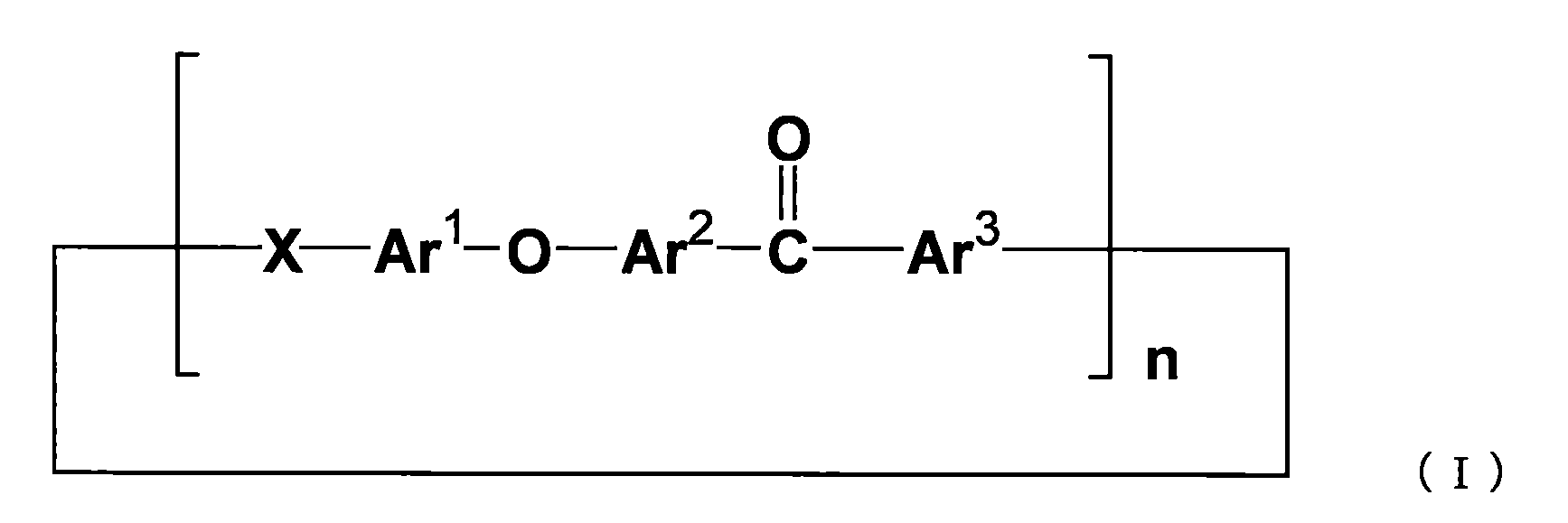
- 少なくとも下記化学式(I)で示される環状ポリアリーレンエーテルケトンを含む環状ポリアリーレンエーテルケトン組成物であり、
化学式(I)で示される環状ポリアリーレンエーテルケトンの総量に対し、化学式(I)中の繰り返し単位nが2以上20以下の環状体を80質量%以上有する環状ポリアリーレンエーテルケトン組成物であって、
化学式(I)で示される環状ポリアリーレンエーテルケトンの総量に対し、繰り返し単位nが2の環状2量体成分が30質量%以下であることを特徴とする環状ポリアリーレンエーテルケトン組成物。

- 繰り返し単位nが2の環状2量体成分が0.01質量%以上である請求項1記載の環状ポリアリーレンエーテルケトン組成物。
- 前記化学式(I)中の構造Xがエーテル基である請求項1または2に記載の環状ポリアリーレンエーテルケトン組成物。
- 少なくとも下記化学式(I)で示される環状ポリアリーレンエーテルケトンを含む環状ポリアリーレンエーテルケトン組成物であり、
化学式(I)で示される環状ポリアリーレンエーテルケトンの総量に対し、化学式(I)中のからなる繰り返し単位nが2以上20以下の環状体を80質量%以上有する環状ポリアリーレンエーテルケトン組成物の製造方法であって、
環状ポリアリーレンエーテルケトン粗成生物をエーテル系溶剤に溶解させる工程と、
エーテル系溶剤に溶解しない未溶解物を濾別する工程を含むことを特徴とする環状ポリアリーレンエーテルケトン組成物の製造方法。
- エーテル系溶剤がテトラヒドロフランである請求項4に記載の環状ポリアリーレンエーテルケトン組成物の製造方法。
- 請求項1~3のいずれか1項に記載の環状ポリアリーレンエーテルケトン組成物を、強化繊維基材に含浸させてなる成形材料。
- 請求項1~3のいずれか1項に記載の環状ポリアリーレンエーテルケトン組成物を、強化繊維基材に含浸させた後、環状ポリアリーレンエーテルケトンを開環重合させる繊維強化複合材料の製造方法。
Priority Applications (1)
| Application Number | Priority Date | Filing Date | Title |
|---|---|---|---|
| JP2021507256A JPWO2020189464A1 (ja) | 2019-03-18 | 2020-03-12 | 環状ポリアリーレンエーテルケトン組成物およびその製造方法 |
Applications Claiming Priority (2)
| Application Number | Priority Date | Filing Date | Title |
|---|---|---|---|
| JP2019049469 | 2019-03-18 | ||
| JP2019-049469 | 2019-03-18 |
Publications (1)
| Publication Number | Publication Date |
|---|---|
| WO2020189464A1 true WO2020189464A1 (ja) | 2020-09-24 |
Family
ID=72520905
Family Applications (1)
| Application Number | Title | Priority Date | Filing Date |
|---|---|---|---|
| PCT/JP2020/010681 Ceased WO2020189464A1 (ja) | 2019-03-18 | 2020-03-12 | 環状ポリアリーレンエーテルケトン組成物およびその製造方法 |
Country Status (3)
| Country | Link |
|---|---|
| JP (1) | JPWO2020189464A1 (ja) |
| TW (1) | TW202045584A (ja) |
| WO (1) | WO2020189464A1 (ja) |
Citations (2)
| Publication number | Priority date | Publication date | Assignee | Title |
|---|---|---|---|---|
| WO2011081080A1 (ja) * | 2009-12-28 | 2011-07-07 | 東レ株式会社 | 環式ポリフェニレンエーテルエーテルケトン組成物およびその製造方法 |
| WO2019181829A1 (ja) * | 2018-03-22 | 2019-09-26 | 帝人株式会社 | 環状ポリアリーレンエーテルケトンおよびその製造方法 |
-
2020
- 2020-03-12 WO PCT/JP2020/010681 patent/WO2020189464A1/ja not_active Ceased
- 2020-03-12 JP JP2021507256A patent/JPWO2020189464A1/ja active Pending
- 2020-03-17 TW TW109108709A patent/TW202045584A/zh unknown
Patent Citations (2)
| Publication number | Priority date | Publication date | Assignee | Title |
|---|---|---|---|---|
| WO2011081080A1 (ja) * | 2009-12-28 | 2011-07-07 | 東レ株式会社 | 環式ポリフェニレンエーテルエーテルケトン組成物およびその製造方法 |
| WO2019181829A1 (ja) * | 2018-03-22 | 2019-09-26 | 帝人株式会社 | 環状ポリアリーレンエーテルケトンおよびその製造方法 |
Non-Patent Citations (2)
| Title |
|---|
| BEN-HAIDA,A. ET AL.: "Synthesis of a Catechol-Based Poly(ether ether ketone) (''o-PEEK'') by Classical Step-Growth Polymerization and by Entropically Driven Ring-Opening Polymerization of Macrocyclic Oligomers", MACROMOLECULES, vol. 39, no. 19, 2006, pages 6467 - 6472, XP055730950 * |
| CHEN,M. ET AL.: "Large-Sized Macrocyclic Monomeric Precursors of Poly(ether ether ketone): Synthesis and Polymerization", MACROMOLECULES, vol. 29, no. 16, 1996, pages 5502 - 5504, XP000596760, DOI: 10.1021/ma9603589 * |
Also Published As
| Publication number | Publication date |
|---|---|
| JPWO2020189464A1 (ja) | 2021-12-16 |
| TW202045584A (zh) | 2020-12-16 |
Similar Documents
| Publication | Publication Date | Title |
|---|---|---|
| US9464170B2 (en) | Controlling crosslinking density and processing parameters of phthalonitriles | |
| TWI540150B (zh) | 苯并樹脂 | |
| KR100849280B1 (ko) | 사슬 결합에 맞춰 변성시킨 조성물 | |
| JP7189333B2 (ja) | 熱可塑性樹脂プリプレグ、その製造方法及び繊維強化複合材料 | |
| KR101995727B1 (ko) | 프탈로니트릴 수지 | |
| Kumar et al. | Epoxy benzoxazine based ternary systems of improved thermo-mechanical behavior for structural composite applications | |
| TW201348218A (zh) | 苯并□化物及含彼之組合物 | |
| ES3038029T3 (en) | Fiber reinforced thermoplastic matrix composite material | |
| KR20170065954A (ko) | 중합성 조성물 | |
| TW202000736A (zh) | 硬化性組成物 | |
| KR20180047217A (ko) | 화합물 | |
| KR20170101293A (ko) | 벤족사진 및 이를 함유하는 조성물 | |
| JP6633819B1 (ja) | 環状ポリアリーレンエーテルケトンおよびその製造方法 | |
| WO2020189464A1 (ja) | 環状ポリアリーレンエーテルケトン組成物およびその製造方法 | |
| KR102056593B1 (ko) | 프탈로니트릴 화합물 | |
| US12110364B2 (en) | Poly(arylene ether ketone) resin, method for producing the same, and molded article | |
| KR20180074043A (ko) | 프탈로니트릴 수지 | |
| JP7198657B2 (ja) | 芳香族ポリスルホン樹脂、エポキシ樹脂組成物、プリプレグ及び成形体 | |
| JP6839271B2 (ja) | 重合性組成物 | |
| KR20180059163A (ko) | 화합물 | |
| JP2024038779A (ja) | 芳香族ポリエーテルケトン樹脂、該樹脂の製造方法、該樹脂を含む組成物、成形体 | |
| CN111133025B (zh) | 环氧树脂、环氧树脂组合物、环氧树脂固化物及复合材料 | |
| EP3904426A1 (en) | Ternary resin blends | |
| CN118804944A (zh) | 芳香族聚醚、芳香族聚醚的制造方法、组合物和片材 | |
| WO2024085104A1 (ja) | ポリアリールエーテルケトン及びその製造方法、並びに樹脂組成物 |
Legal Events
| Date | Code | Title | Description |
|---|---|---|---|
| 121 | Ep: the epo has been informed by wipo that ep was designated in this application |
Ref document number: 20772564 Country of ref document: EP Kind code of ref document: A1 |
|
| ENP | Entry into the national phase |
Ref document number: 2021507256 Country of ref document: JP Kind code of ref document: A |
|
| NENP | Non-entry into the national phase |
Ref country code: DE |
|
| 122 | Ep: pct application non-entry in european phase |
Ref document number: 20772564 Country of ref document: EP Kind code of ref document: A1 |