WO2020189459A1 - 硬化性組成物、膜、光学フィルタ及びその製造方法、固体撮像素子、赤外線センサ、カメラモジュール、並びに、インクジェットインク - Google Patents
硬化性組成物、膜、光学フィルタ及びその製造方法、固体撮像素子、赤外線センサ、カメラモジュール、並びに、インクジェットインク Download PDFInfo
- Publication number
- WO2020189459A1 WO2020189459A1 PCT/JP2020/010666 JP2020010666W WO2020189459A1 WO 2020189459 A1 WO2020189459 A1 WO 2020189459A1 JP 2020010666 W JP2020010666 W JP 2020010666W WO 2020189459 A1 WO2020189459 A1 WO 2020189459A1
- Authority
- WO
- WIPO (PCT)
- Prior art keywords
- group
- curable composition
- present disclosure
- compound
- film
- Prior art date
- Legal status (The legal status is an assumption and is not a legal conclusion. Google has not performed a legal analysis and makes no representation as to the accuracy of the status listed.)
- Ceased
Links
- 0 CC1(CCc2c(c(C)c(cc3)C(C4=C)=C(*)C4=C(C=Cc4cccc(OC5(CCCC5)N)c44)C4=O)c3ccc2)CCCC1 Chemical compound CC1(CCc2c(c(C)c(cc3)C(C4=C)=C(*)C4=C(C=Cc4cccc(OC5(CCCC5)N)c44)C4=O)c3ccc2)CCCC1 0.000 description 3
Images

Classifications
-
- C—CHEMISTRY; METALLURGY
- C08—ORGANIC MACROMOLECULAR COMPOUNDS; THEIR PREPARATION OR CHEMICAL WORKING-UP; COMPOSITIONS BASED THEREON
- C08F—MACROMOLECULAR COMPOUNDS OBTAINED BY REACTIONS ONLY INVOLVING CARBON-TO-CARBON UNSATURATED BONDS
- C08F2/00—Processes of polymerisation
- C08F2/44—Polymerisation in the presence of compounding ingredients, e.g. plasticisers, dyestuffs, fillers
-
- C—CHEMISTRY; METALLURGY
- C08—ORGANIC MACROMOLECULAR COMPOUNDS; THEIR PREPARATION OR CHEMICAL WORKING-UP; COMPOSITIONS BASED THEREON
- C08F—MACROMOLECULAR COMPOUNDS OBTAINED BY REACTIONS ONLY INVOLVING CARBON-TO-CARBON UNSATURATED BONDS
- C08F290/00—Macromolecular compounds obtained by polymerising monomers on to polymers modified by introduction of aliphatic unsaturated end or side groups
- C08F290/08—Macromolecular compounds obtained by polymerising monomers on to polymers modified by introduction of aliphatic unsaturated end or side groups on to polymers modified by introduction of unsaturated side groups
- C08F290/12—Polymers provided for in subclasses C08C or C08F
-
- C—CHEMISTRY; METALLURGY
- C09—DYES; PAINTS; POLISHES; NATURAL RESINS; ADHESIVES; COMPOSITIONS NOT OTHERWISE PROVIDED FOR; APPLICATIONS OF MATERIALS NOT OTHERWISE PROVIDED FOR
- C09B—ORGANIC DYES OR CLOSELY-RELATED COMPOUNDS FOR PRODUCING DYES, e.g. PIGMENTS; MORDANTS; LAKES
- C09B23/00—Methine or polymethine dyes, e.g. cyanine dyes
- C09B23/14—Styryl dyes
-
- C—CHEMISTRY; METALLURGY
- C09—DYES; PAINTS; POLISHES; NATURAL RESINS; ADHESIVES; COMPOSITIONS NOT OTHERWISE PROVIDED FOR; APPLICATIONS OF MATERIALS NOT OTHERWISE PROVIDED FOR
- C09K—MATERIALS FOR MISCELLANEOUS APPLICATIONS, NOT PROVIDED FOR ELSEWHERE
- C09K3/00—Materials not provided for elsewhere
-
- G—PHYSICS
- G02—OPTICS
- G02B—OPTICAL ELEMENTS, SYSTEMS OR APPARATUS
- G02B5/00—Optical elements other than lenses
- G02B5/20—Filters
- G02B5/22—Absorbing filters
-
- H—ELECTRICITY
- H10—SEMICONDUCTOR DEVICES; ELECTRIC SOLID-STATE DEVICES NOT OTHERWISE PROVIDED FOR
- H10F—INORGANIC SEMICONDUCTOR DEVICES SENSITIVE TO INFRARED RADIATION, LIGHT, ELECTROMAGNETIC RADIATION OF SHORTER WAVELENGTH OR CORPUSCULAR RADIATION
- H10F39/00—Integrated devices, or assemblies of multiple devices, comprising at least one element covered by group H10F30/00, e.g. radiation detectors comprising photodiode arrays
- H10F39/10—Integrated devices
- H10F39/12—Image sensors
Definitions
- the present disclosure relates to a curable composition, a film, an optical filter and a method for manufacturing the same, a solid-state image sensor, an infrared sensor, a camera module, and an inkjet ink.
- color filters are colored photosensitive by containing a polyfunctional monomer, a photopolymerization initiator, an alkali-soluble resin and other components in a pigment dispersion composition such as a curable composition in which an organic pigment or an inorganic pigment is dispersed. It is used as a composition and is produced by a photolitho method or the like. It is known that a squarylium compound having a dihydroperimidine skeleton is used as the pigment. Examples of the conventional squarylium compound having a dihydroperimidine skeleton include those of Patent Document 1 below. Moreover, as an example of the conventional naphthoxadiazole squarylium compound, the one described in Patent Document 2 can be mentioned.
- Patent Document 1 describes a near-infrared absorbing dye [A] represented by the following general formula (1).
- General formula (1) a near-infrared absorbing dye [A] represented by the following general formula (1).
- R 1 to R 5 each independently contain a hydrogen atom, an alkyl group which may have a substituent, an aryl group which may have a substituent, an alkoxy group which may have a substituent, and a substituent. It represents an aryloxy group, a sulfo group, SO 3- M + , -SO 2 NR 6 R 7 , -COOR 6 , -CONR 6 R 7 , a nitro group, a cyano group, and a halogen atom which may have. At least one of 1 to R 5 represents a substituent other than a hydrogen atom.
- Each of X 1 to X 10 independently has a hydrogen atom, an alkyl group which may have a substituent, an alkenyl group which may have a substituent, an aryl group which may have a substituent, and a substituent. May have an aralkyl group, an alkoxy group which may have a substituent, an aryloxy group which may have a substituent, an amino group, a substituted amino group, a sulfo group, -SO 2 NR 6 R 7 , -COOR. Represents 6 , -CONR 6 R 7 , nitro group, cyano group, halogen atom.
- substituents may be bonded to each other to form a ring.
- M + represents an inorganic or organic cation
- R 6 and R 7 each independently represent a hydrogen atom and an alkyl group which may have a substituent.
- Patent Document 2 describes a naphthooxadinin squarylium compound represented by the following general formula (1).
- R 1 , R 2 , R 3 , R 4 , R 5 and R 6 represent a hydrogen atom, an alkyl group, a cycloalkyl group, an aryl group, a heterocyclic group or an aralkyl group, respectively, and R 1 and R 2 Alternatively, R 4 and R 5 may combine with each other to form a 5- or 6-membered ring.
- R 7 and R 8 are hydrogen atoms, alkyl groups having 1 to 8 carbon atoms, alkoxy groups having 1 to 6 carbon atoms, aryloxy groups, halogen atoms, alkoxycarbonyl groups, cyano groups, nitro groups, amino groups, It represents a sulfo group or a carboxyl group, and the sulfo group and the carboxyl group may be a salt, and n represents an integer of 1 to 3.
- Patent Document 1 Japanese Patent Application Laid-Open No. 2017-88765
- Patent Document 2 Japanese Patent Application Laid-Open No. 3996234
- a squarylium compound having a dihydroperimidine skeleton As a dye used in the formation of members such as color filters, a squarylium compound having a dihydroperimidine skeleton is known. However, as a result of diligent studies, the present inventors have found that a squarylium compound having a dihydroperimidine skeleton may not have sufficient moisture resistance in a membrane containing the above compound.
- An object to be solved by one embodiment of the present invention is to provide a curable composition having excellent moisture resistance of the obtained cured film. Further, the problem to be solved by another embodiment of the present invention is to provide a film using the curable composition, an optical filter and a method for manufacturing the same, a solid-state image sensor, an infrared sensor, a camera module, and an inkjet ink. It is to be.
- Means for solving the above problems include the following aspects. ⁇ 1> A curable composition containing a dye having a structure represented by the following formula (1) and a curable compound.
- R 1 to R 6 each independently represent a hydrogen atom or a substituent
- R 7 and R 8 each independently represent a substituent
- A represents O or NR 9
- R 9 represents a hydrogen atom or a substituent
- n1 and n2 each independently represent an integer of 0 to 5
- R 1 and R 2 may be bonded to each other to form a ring
- R 4 may be formed.
- R 5 may be combined with each other to form a ring.
- X 1 , X 2 , Y 1 and Y 2 are independently alkylene groups, alkynylene groups, cycloalkylene groups, arylene groups, heteroarylene groups, or divalent groups obtained by binding two or more of them.
- ⁇ 4> The curable composition according to ⁇ 3>, wherein one or more of X 1 , X 2 , Y 1 and Y 2 in the above formula (2) is a group having an aromatic ring or a hetero ring.
- ⁇ 5> The curable composition according to ⁇ 3> or ⁇ 4>, wherein Z 1 and Z 2 in the above formula (2) are single bonds.
- ⁇ 6> The curable composition according to any one of ⁇ 1> to ⁇ 5>, which further contains a photopolymerization initiator.
- ⁇ 8> The curable composition according to any one of ⁇ 1> to ⁇ 7>, which further contains a dispersant.
- a film comprising the curable composition according to any one of ⁇ 1> to ⁇ 8> or obtained by curing the curable composition.
- the optical filter according to ⁇ 10> which is an infrared cut filter or an infrared transmission filter.
- ⁇ 12> A solid-state image sensor having the film according to ⁇ 9>.
- ⁇ 13> An infrared sensor having the film according to ⁇ 9>.
- ⁇ 14> A step of applying the curable composition according to any one of ⁇ 1> to ⁇ 8> on a support to form a composition layer, and a step of exposing the composition layer in a pattern.
- a method for manufacturing an optical filter which comprises a step of developing and removing an unexposed portion to form a pattern.
- ⁇ 15> A step of applying the curable composition according to any one of ⁇ 1> to ⁇ 8> on a support to form a composition layer, and then curing to form a layer, on the layer.
- Manufacture of an optical filter including a step of forming a photoresist layer, a step of patterning the photoresist layer by exposure and development to obtain a resist pattern, and a step of dry etching the layer using the resist pattern as an etching mask.
- Method. ⁇ 16> A camera module having a solid-state image sensor and the optical filter according to ⁇ 10> or ⁇ 11>.
- ⁇ 17> An inkjet ink containing the curable composition according to any one of ⁇ 1> to ⁇ 8>.
- a curable composition having excellent moisture resistance of the obtained cured film. Further, according to another embodiment of the present invention, a film using the curable composition, an optical filter and a method for producing the same, a solid-state image sensor, an infrared sensor, a camera module, and an inkjet ink are provided.
- total solid content refers to the total mass of the components excluding the solvent from the total composition of the composition.
- solid content is a component excluding the solvent as described above, and may be, for example, a solid or a liquid at 25 ° C.
- the notation not describing substitution and non-substitution includes those having no substituent as well as those having a substituent.
- alkyl group includes not only an alkyl group having no substituent (unsubstituted alkyl group) but also an alkyl group having a substituent (substituted alkyl group).
- the term "exposure” as used herein includes not only exposure using light but also drawing using particle beams such as an electron beam and an ion beam. Further, as the light used for exposure, generally, the emission line spectrum of a mercury lamp, far ultraviolet rays typified by an excima laser, extreme ultraviolet rays (EUV light), X-rays, active rays such as electron beams, or radiation can be mentioned.
- EUV light extreme ultraviolet rays
- X-rays active rays
- (meth) acrylate” represents both acrylate and methacrylate, or either
- (meth) acrylic” represents both acrylic and methacrylic, or either.
- Acryloyl represents both acryloyl and / or methacrylic.
- Me in the chemical formula is a methyl group
- Et is an ethyl group
- Pr is a propyl group
- Bu is a butyl group
- Ac is an acetyl group
- Bn is a benzyl group
- Ph is a phenyl group.
- the term "process” is included in this term not only as an independent process but also as long as the desired action of the process is achieved even if it cannot be clearly distinguished from other processes. ..
- “% by mass” and “% by weight” are synonymous, and “parts by mass” and “parts by weight” are synonymous.
- a combination of two or more preferred embodiments is a more preferred embodiment.
- the transmittance in the present disclosure is the transmittance at 25 ° C. unless otherwise specified.
- the weight average molecular weight and the number average molecular weight are defined as polystyrene-equivalent values measured by gel permeation chromatography (GPC).
- the curable composition according to the present disclosure includes a dye having a structure represented by the following formula (1) (hereinafter, also referred to as "specific dye”) and a curable compound.
- R 1 to R 6 each independently represent a hydrogen atom or a substituent
- R 7 and R 8 each independently represent a substituent
- A represents O or NR 9
- R 9 represents a hydrogen atom or a substituent
- n1 and n2 each independently represent an integer of 0 to 5
- R 1 and R 2 may be bonded to each other to form a ring
- R 4 may be formed.
- R 5 may be combined with each other to form a ring.
- a cured film having excellent moisture resistance can be obtained.
- the squarylium compound having a dihydroperimidine skeleton may not have sufficient moisture resistance in the membrane containing the compound.
- the moisture resistance may not be sufficient when a film is formed. Therefore, as a result of diligent studies by the present inventors, a cured film having excellent moisture resistance can be obtained by using it in a curable composition containing a dye having a structure represented by the above formula (1) and a curable compound. Found to be obtained.
- the dye having the structure represented by the above formula (1) absorbs less in the wavelength range of 450 nm to 600 nm in the solution than the conventional squarylium dye having a dihydroperimidine skeleton, but the spectral broadening occurs at the time of film formation.
- the present inventors have found that there is a problem that the visible transparency is lowered.
- a cured film having excellent spectral characteristics can be obtained in the above embodiment.
- the width of the absorption spectrum (absorption band) becomes narrower.
- the absorption in the visible light region becomes small, the spectroscopic broadening due to film formation can be suppressed, and the spectral characteristics (visible transparency) are also excellent.
- the details are unknown, a cured film having excellent light resistance can be obtained.
- the conventional squarylium dye having a dihydroperimidine skeleton has many NH structures, the resin and the dye molecules are easily aggregated by hydrogen bonding with each other, so that aggregates (foreign substances) are generated and foreign matter defects are generated. Likely to happen.
- the dye having the structure represented by the above formula (1) has a small amount of NH, so that it is difficult to aggregate and has excellent foreign matter defect suppressing property.
- the specific dye used in the present disclosure is a dye having a structure represented by the above formula (1).
- the specific dye can be suitably used as an infrared absorbing dye.
- the specific dye is a dye (also referred to as a "colorant"), preferably a pigment or a dye, and more preferably a pigment.
- the pigment means a dye that is insoluble in a solvent.
- the dye refers to a dye that dissolves in a solvent.
- the pigment used in the present disclosure preferably has, for example, a dissolution amount in 100 g of propylene glycol monomethyl ether acetate at 25 ° C. and a dissolution amount in 100 g of water at 25 ° C. of 0.1 g or less.
- the dye used in the present disclosure preferably has at least one of a dissolved amount in 100 g of propylene glycol monomethyl ether acetate at 25 ° C. and a dissolved amount in 100 g of water at 25 ° C. exceeding 0.1 g and 1 g or more. More preferably, it is more preferably 5 g or more.
- the dye represented by the above formula (1) is described below when, for example, the naphthooxadinin ring structure and the squarylium structure are bonded at the ortho position of the amino group of the naphthooxadinin ring structure shown below. It may be represented by any of the resonance structure notations shown.
- the compounds shown below represent the same compounds except that the notation positions of the resonance structures of cations and anions are different.
- R 1 and R 2 in the formula (1) are independently substituents, or R 1 and R 2 are bonded to each other. It is preferable that a ring is formed, and it is more preferable that it is an alkyl group, an aryl group, or a heteroaryl group, or that R 1 and R 2 are bonded to each other to form a ring. It is further preferred that bonded to each other to form a ring R 1 and R 2, it is particularly preferable to combine with each other R 1 and R 2 form a ring having an aromatic ring structure.
- R 4 and R 5 in the formula (1) are independently substituents, or R 4 and R 5 are bonded to each other. It is preferable that a ring is formed, and it is more preferable that it is an alkyl group, an aryl group, or a heteroaryl group, or that R 4 and R 5 are bonded to each other to form a ring. It is further preferred that bonded together R 4 and R 5 form a ring, it is particularly preferable to bond together with R 4 and R 5 form a ring having an aromatic ring structure.
- R 1 and R 2 and R 4 and R 5 in the formula (1) are groups having the same structure.
- the total carbon number of R 1 and R 2 in the formula (1) is preferably 2 to 60, preferably 4 to 40, independently from the viewpoint of the spectral characteristics, light resistance and moisture resistance of the obtained cured film. This is more preferable, and 8 to 20 is particularly preferable.
- the total carbon number of R 4 and R 5 in the formula (1) is preferably 2 to 60, preferably 4 to 40, independently from the viewpoint of the spectral characteristics, light resistance and moisture resistance of the obtained cured film. Is more preferable, and 8 to 20 is particularly preferable.
- any one of R 1 , R 2 , R 4 and R 5 in the formula (1) is preferably a group having an aromatic ring or a heterocycle, and R 1 , one of R 2, R 4 and R 5 is more preferably a group having an aromatic ring. Further, from the viewpoint of the spectral characteristics of the obtained cured film, any one of R 1 and R 2 in the formula (1) is preferably a group having an aromatic ring or a heterocycle, and R 1 and R 2 It is more preferable that any one is a group having an aromatic ring.
- any one of R 4 and R 5 in the formula (1) is preferably a group having an aromatic ring or a heterocycle, and R 4 and R 5 It is more preferable that any one of them is a group having an aromatic ring.
- the rings formed by R 1 and R 2 or R 4 and R 5 bonded to each other are independently obtained from the viewpoint of the spectral characteristics of the obtained cured film, and the aliphatic ring, Alternatively, it is preferably a heteroaliphatic ring, more preferably a 5- or 6-membered aliphatic ring, or a 5- or 6-membered heteroaliphatic ring, and the aromatic ring is a condensed ring. It is more preferably a 5-membered or 6-membered aliphatic ring, or a 5-membered or 6-membered heteroaliphatic ring in which the aromatic ring is fused, and a 5-membered ring or a condensed aromatic ring.
- a 6-membered aliphatic ring is particularly preferable.
- the ring formed by R 1 and R 2 or R 4 and R 5 bonded to each other has an aromatic ring condensed from the viewpoint of the spectral characteristics of the obtained cured film. It is more preferable that it is an aliphatic ring, which may be used.
- the spectral characteristics, light resistance, and moisture resistance of the obtained cured film are independently obtained as a ring formed by R 1 and R 2 or R 4 and R 5 bonded to each other.
- R 3 and R 6 in the formula (1) are each independently preferably a hydrogen atom or an alkyl group from the viewpoint of the spectral characteristics, light resistance and moisture resistance of the obtained cured film, and are preferably a hydrogen atom or an alkyl group. It is more preferably a methyl group and particularly preferably a hydrogen atom. Further, from the viewpoint of the spectral characteristics, light resistance and moisture resistance of the obtained cured film, it is preferable that R 3 and R 6 in the formula (1) have the same group.
- R 7 and R 8 in the formula (1) are independently alkyl group, aryl group, heteroaryl group, halogen atom, carboxy group, hydroxy group, alkoxy group, allyloxy group, nitro group, cyano group, or sulfo group.
- n1 and n2 in the formula (1) are preferably integers of 0 to 2, and more preferably 0 or 1.
- n1 and n2 in the formula (1) have the same value. Further, when n1 and n2 in the formula (1) have the same value, it is preferable that the bonding positions of R 7 and R 8 in the formula (1) are the same positions in each naphthoxadiazole ring structure, respectively.
- a in the formula (1) is preferably O or NH from the viewpoint of the spectral characteristics, light resistance and moisture resistance of the obtained cured film, and the spectral characteristics, light resistance, moisture resistance and foreign matter defects of the obtained cured film. From the viewpoint of suppressivity, it is more preferably O. From the viewpoint of spectral characteristics, light resistance and moisture resistance of the obtained cured film, R 9 in the formula (1) is preferably a hydrogen atom or an alkyl group, and preferably a hydrogen atom or a methyl group. More preferably, it is a hydrogen atom. Further, the dye having the structure represented by the above formula (1) is preferably a compound having point symmetry from the viewpoint of the spectral characteristics, light resistance and moisture resistance of the obtained cured film. Further, the bond position of the squarylium structure in the formula (1) is preferably the same position of each naphthoxadiazole ring structure.
- the dye having the structure represented by the above formula (1) is a dye having the structure represented by the following formula (2) from the viewpoint of the spectral characteristics, light resistance, moisture resistance and foreign matter defect suppressing property of the obtained cured film. Is preferable.
- X 1 , X 2 , Y 1 and Y 2 are independently alkylene groups, alkynylene groups, cycloalkylene groups, arylene groups, heteroarylene groups, or divalent groups obtained by binding two or more of them.
- R 7, R 8, n1 and n2 in Formula (2) has the same meaning as R 7, R 8, n1 and n2 in Formula (1), a preferable embodiment thereof is also the same.
- one or more of X 1 , X 2 , Y 1 and Y 2 in the formula (2) is preferably a group having an aromatic ring or a heterocycle, and X. It is more preferable that one or more of 1 , X 2 , Y 1 and Y 2 are groups having an aromatic ring.
- X 1 and X 2 in the formula (2) are preferably an alkylene group, an arylene group, or a hetero-arylene group from the viewpoint of the spectral characteristics, light resistance and moisture resistance of the obtained cured film, and are arylene. It is more preferably a group or a heteroarylene group, further preferably an arylene group, particularly preferably a 1,2-phenylene group or a 2,3-naphthalenylene group, and particularly preferably a 1,2-phenylene group. Most preferably it is a group. Further, from the viewpoint of the spectral characteristics, light resistance and moisture resistance of the obtained cured film, it is preferable that X 1 and X 2 in the formula (2) are the same group.
- Y 1 and Y 2 in the formula (2) are each independently preferably an alkylene group, an arylene group, or a hetero-arylene group from the viewpoint of the spectral characteristics, light resistance and moisture resistance of the obtained cured film. More preferably, it is a group or an arylene group, a methylene group, an ethylene group, a 1,3-propylene group, a 1,2-cyclopentandyl group, a 1,2-cyclohexanediyl group, or a 1,2-phenylene. It is more preferably a group, and particularly preferably a 1,2-phenylene group.
- Y 1 and Y 2 in the formula (2) have the same group.
- X 1 , X 2 , Y 1 and Y 2 in the formula (2) may further have a substituent on the above group.
- substituent those mentioned above are preferably mentioned as the substituent in R 1 to R 9 .
- Z 1 and Z 2 in the formula (2) are independently, single bond, -O-, carbonyl group, -S-, or -S from the viewpoint of the spectral characteristics, light resistance and moisture resistance of the obtained cured film, respectively.
- R N in formula (2) is an alkyl group, or is preferably an aryl group, more preferably an alkyl group, particularly preferably a methyl group.
- the dye having the structure represented by the above formula (1) is a dye having the structure represented by the following formula (3) from the viewpoint of the spectral characteristics, light resistance, moisture resistance and foreign matter defect suppressing property of the obtained cured film. Is more preferable.
- R 7 and R 8 each independently represent a substituent
- n1 and n2 each independently represent an integer of 0 to 5
- R 10 to R 13 each independently represent a substituent.
- n3 to n6 independently represent an integer of 0 to 4.
- R 7, R 8, n1 and n2 in Formula (3) has the same meaning as R 7, R 8, n1 and n2 in Formula (1), a preferable embodiment thereof is also the same.
- R 10 to R 13 in the formula (3) are independently each of an alkyl group, an aryl group, a heteroaryl group, a halogen atom, a carboxy group, and a hydroxy group from the viewpoint of the spectral characteristics, light resistance, and moisture resistance of the obtained cured film.
- n3 to n6 in the formula (3) are preferably integers of 0 to 2, and more preferably 0 or 1.
- the maximum absorption wavelength of the specific dye is preferably in the wavelength range of 700 nm to 1,100 nm, more preferably in the wavelength range of 760 nm to 960 nm, and particularly preferably in the wavelength range of 760 nm to 850 nm. ..
- the maximum absorption wavelength is measured using a Cary5000 UV-Vis-NIR spectrophotometer (manufactured by Agilent Technologies, Inc.).
- the half-value width of the peak wavelength at the maximum absorption wavelength is preferably 2,000 cm -1 or less, more preferably 1,500Cm -1 or less, 1,350Cm - 1 or less is more preferable.
- the lower limit of the half width is not particularly limited, but is preferably 500 cm -1 or more.
- the full width at half maximum is measured using a Cary5000 UV-Vis-NIR spectrophotometer (manufactured by Agilent Technologies, Inc.).
- the molar extinction coefficient of the specific dye at the maximum absorption wavelength is preferably 1.0 ⁇ 10 5 L / (mol ⁇ cm) or more, and preferably 1.5 ⁇ 10 5 L / (mol ⁇ cm) or more. More preferred.
- the molar extinction coefficient is measured by using a Cary5000 UV-Vis-NIR spectrophotometer (manufactured by Agilent Technologies).
- the specific dye is preferably in a state of being dispersed in the form of particles. In the state of being dispersed in the form of particles, there is an advantage that the durability of the obtained cured film is improved. Further, in the case of the above-mentioned particulate and dispersed state, the specific dye is preferably a pigment. Further, the curable composition according to the present disclosure further contains a solvent described later, and in the curable composition, a dye having a structure represented by the above formula (1) is dispersed as particles in the solvent. It is preferably contained in.
- the curable composition according to the present disclosure preferably contains particles of a specific dye having a number average particle size of 1 nm to 500 nm, more preferably contains particles of a specific dye having a number average particle size of 10 nm to 200 nm, and the number average particles. It is particularly preferable to contain particles of a specific dye having a diameter of 10 nm to 100 nm.
- the number average particle size of the particles is 1 nm or more, the surface energy of the particles is small, so that the particles are less likely to aggregate, the particles are easily dispersed, and the dispersed state is easily maintained, which is preferable.
- the average particle size of particles shall be measured by arithmetic mean (number average) using MICROTRAC UPA 150 manufactured by Nikkiso Co., Ltd.
- the content of the specific dye in the curable composition according to the present disclosure is preferably 10% by mass to 70% by mass, more preferably 15% by mass to 60% by mass, and 20% by mass, based on the total solid content of the curable composition. More preferably, it is by mass% to 50% by mass.
- SQ-1 to SQ-53 which are specific examples of specific dyes, will be shown, but the present invention is not limited thereto.
- the method for producing the specific dye is not particularly limited, and can be appropriately produced by referring to a known production method.
- a diaminonaphthalene compound is induced to an aminohydroxynaphthalene compound, and the aminohydroxynaphthalene compound and a ketone compound are reacted to obtain a naphthooxadinine compound, which is obtained by converting 2 molar equivalents of naphthoxadinin compound and 1 molar equivalent of squaric acid (quartic acid). )
- a diaminonaphthalene compound is induced to an aminohydroxynaphthalene compound, and the aminohydroxynaphthalene compound and a ketone compound are reacted to obtain a naphthooxadinine compound, which is obtained by converting 2 molar equivalents of naphthoxadinin compound and 1 molar equivalent of squaric acid (quartic acid). )
- squaric acid quartic acid
- the crystal form can be adjusted by contacting with an organic solvent such as N, N-dimethylformamide, dimethyl sulfoxide, dimethylacetamide, N-methylpyrrolidone, tetrahydrofuran, 1,4-dioxane and the like. At that time, heating or cooling may be performed to adjust the particle size, or another solvent may be added before filtering.
- an organic solvent such as N, N-dimethylformamide, dimethyl sulfoxide, dimethylacetamide, N-methylpyrrolidone, tetrahydrofuran, 1,4-dioxane and the like.
- the curable composition according to the present disclosure is a curable composition from which a cured film is finally obtained by curing. Further, the curable composition according to the present disclosure is preferably a composition capable of forming a pattern of a cured film by pattern exposure, for example. That is, the curable composition according to the present disclosure is preferably a negative type composition. When the curable composition according to the present disclosure is a negative type composition, it is preferable to include, for example, a polymerization initiator, a polymerizable compound, and an alkali-soluble resin.
- the curable composition according to the present disclosure is a positive composition
- a photoacid generator for example, a polymer having a structural unit having an acid group protected by an acid-degradable group, and a polymer having a structural unit having an acid group protected by an acid-degradable group, and , A polymer having a structural unit having a crosslinkable group, and the like.
- a negative type composition for example, each component contained in the embodiment in which the curable composition according to the present disclosure is a negative type composition.
- each component described in International Publication No. 2014/003111 can be mentioned, and the preferred embodiment is also the same.
- the curable composition according to the present disclosure contains a curable compound.
- the curable compound that can be used in the present disclosure is preferably a polymerizable compound, more preferably an ethylenically unsaturated compound, and particularly preferably a compound having a terminal ethylenically unsaturated group.
- known compounds can be used without particular limitation. They have chemical forms such as, for example, monomers, prepolymers, ie dimers, trimers and oligomers, or mixtures thereof and copolymers thereof.
- Examples of the monomer and its copolymer include unsaturated carboxylic acids (for example, acrylic acid, methacrylic acid, itaconic acid, crotonic acid, isocrotonic acid, maleic acid, etc.), esters thereof, and amides, which are preferable. Is an ester of an unsaturated carboxylic acid and an aliphatic polyhydric alcohol compound, and an amide of an unsaturated carboxylic acid and an aliphatic polyvalent amine compound.
- unsaturated carboxylic acids for example, acrylic acid, methacrylic acid, itaconic acid, crotonic acid, isocrotonic acid, maleic acid, etc.
- esters thereof for example, esters thereof, and amides, which are preferable. Is an ester of an unsaturated carboxylic acid and an aliphatic polyhydric alcohol compound, and an amide of an unsaturated carboxylic acid and an aliphatic polyvalent amine compound.
- a dehydration condensation reaction product with a functional carboxylic acid is also preferably used.
- an unsaturated carboxylic acid ester having an electrophilic substituent such as an isocyanate group or an epoxy group
- An unsaturated carboxylic acid ester having a desorbing substituent such as a tosyloxy group or a substitution reaction product of amides with monofunctional or polyfunctional alcohols, amines and thiols is also suitable. Further, as another example, it is also possible to use a compound group in which unsaturated phosphonic acid, styrene, vinyl ether or the like is replaced with unsaturated carboxylic acid.
- the monomer of the ester of the aliphatic polyhydric alcohol compound and the unsaturated carboxylic acid include ethylene glycol diacrylate, triethylene glycol diacrylate, 1,3-butanediol diacrylate, and tetramethylene glycol as acrylic acid esters.
- methacrylic acid esters examples include tetramethylene glycol dimethacrylate, triethylene glycol dimethacrylate, neopentyl glycol dimethacrylate, trimethylpropantrimethacrylate, trimethylol ethanetrimethacrylate, ethylene glycol dimethacrylate, and 1,3-butanediol dimethacrylate.
- a urethane-based addition-polymerizable compound produced by using an addition reaction of an isocyanate group and a hydroxy group is also suitable, and specific examples thereof are described in, for example, Japanese Patent Publication No. 48-41708.
- Two or more polymerizable vinyl groups are contained in one molecule obtained by adding a vinyl monomer containing a hydroxy group represented by the following general formula (I) to a polyisocyanate compound having two or more isocyanate groups in one molecule. Examples thereof include vinyl urethane compounds.
- CH 2 C (R) COOCH 2 CH (R') OH (I) (However, R and R'indicate H or CH 3. )
- urethane acrylates such as those described in JP-A-51-37193, Toku-Kohei 2-32293, Toku-Kohei 2-16765, Toku-Kosho 58-49860, Toku-Kosho 56-176654, and Toku-Kosho Urethane compounds having an ethylene oxide-based skeleton described in Kosho 62-39417 and Tokusho 62-39418 are also suitable.
- examples of the polymerizable compound include the compounds described in paragraphs 0178 to 0190 of JP-A-2007-277514. Further, as the polymerizable compound, the epoxy compound described in JP-A-2015-187211 may be used.
- the content of the curable compound in the curable composition is preferably 1% by mass to 90% by mass and 5% by mass to 80% by mass with respect to the total solid content of the curable composition. Is more preferable, and 10% by mass to 70% by mass is further preferable. When the content of the polymerizable compound is within the above range, the curable composition is excellent in curability.
- the curable composition according to the present disclosure preferably further contains a polymerization initiator, and more preferably further contains a photopolymerization initiator.
- the photopolymerization initiator is not particularly limited as long as it has the ability to initiate the polymerization of the polymerizable compound, and can be appropriately selected from known photopolymerization initiators.
- a compound having photosensitivity to light rays in the ultraviolet region to the visible region is preferable. Further, it may be a compound that produces an active radical by causing some action with a photoexcited sensitizer.
- the photopolymerization initiator is preferably a photoradical polymerization initiator.
- the photopolymerization initiator examples include halogenated hydrocarbon derivatives (for example, compounds having a triazine skeleton, compounds having an oxadiazole skeleton, etc.), acylphosphine compounds, hexaarylbiimidazole, oxime compounds, organic peroxides, and the like.
- halogenated hydrocarbon derivatives for example, compounds having a triazine skeleton, compounds having an oxadiazole skeleton, etc.
- acylphosphine compounds examples include hexaarylbiimidazole, oxime compounds, organic peroxides, and the like.
- oxime compounds examples include thio compounds, ketone compounds, aromatic onium salts, ⁇ -hydroxyketone compounds and ⁇ -aminoketone compounds.
- the photopolymerization initiator includes trihalomethyltriazine compound, benzyldimethylketal compound, ⁇ -hydroxyketone compound, ⁇ -aminoketone compound, acylphosphine compound, phosphine oxide compound, metallocene compound, oxime compound, and triarylimidazole.
- Dimer, onium compounds, benzothiazole compounds, benzophenone compounds, acetophenone compounds, cyclopentadiene-benzene-iron complexes, halomethyloxaziazole compounds and 3-aryl substituted coumarin compounds are preferred, oxime compounds, ⁇ -hydroxyketone compounds, ⁇ - A compound selected from an aminoketone compound and an acylphosphine compound is more preferable, and an oxime compound is further preferable.
- the descriptions in paragraphs 0065 to 0111 of JP-A-2014-130173 and paragraphs 0274 to 0306 of JP-A-2013-29760 can be referred to, and these contents are incorporated in the present disclosure.
- Examples of commercially available ⁇ -hydroxyketone compounds include IRGACURE 184, DAROCUR 1173, IRGACURE 500, IRGACURE 2959, and IRGACURE 127 (all manufactured by BASF).
- Examples of commercially available ⁇ -aminoketone compounds include IRGACURE 907, IRGACURE 369, IRGACURE 379, and IRGACURE 379EG (all manufactured by BASF).
- Examples of commercially available acylphosphine compounds include IRGACURE 819 and DAROCUR TPO (all manufactured by BASF).
- Examples of the oxime compound include the compounds described in JP-A-2001-233842, the compounds described in JP-A-2000-80068, and the compounds described in JP-A-2006-342166.
- 2-acetoxyimino-1-phenylpropane-1-one 2-benzoyloxyimino-1-phenylpropane-1-one, 3- (4-toluenesulfonyloxy) iminobutane-2-one, and 2-ethoxy Examples thereof include carbonyloxyimino-1-phenylpropan-1-one.
- IRGACURE OXE01, IRGACURE OXE02, IRGACURE OXE03, and IRGACURE OXE04 are also preferably used.
- TRONLY TR-PBG-304 TRONLY TR-PBG-309
- TRONLY TR-PBG-305 manufactured by Changzhou Powerful Electronic New Materials Co., Ltd. (CHANGZHOU TRONLY NEW ELECTRONIC MATERIALS CO., LTD)
- ADEKA Arkuru ADEKA PUTMER N-1919 (Photopolymerization Initiator 2 of JP2012-14052A) (all manufactured by ADEKA Corporation).
- an oxime compound having a fluorene ring can also be used as the photopolymerization initiator.
- Specific examples of the oxime compound having a fluorene ring include the compounds described in JP-A-2014-137466. This content is incorporated in this disclosure.
- an oxime compound having a benzofuran skeleton can also be used as a photopolymerization initiator.
- Specific examples thereof include compounds OE-01 to OE-75 described in International Publication No. 2015/036910.
- an oxime compound having a skeleton in which at least one benzene ring of the carbazole ring is a naphthalene ring can also be used.
- Specific examples of such an oxime compound include the compounds described in International Publication No. 2013/083505.
- an oxime compound having a fluorine atom can also be used as the photopolymerization initiator.
- Specific examples of the oxime compound having a fluorine atom are described in the compounds described in JP-A-2010-262028, the compounds 24, 36-40 described in JP-A-2014-500852, and JP-A-2013-164471.
- Compound (C-3) and the like This content is incorporated in this disclosure.
- an oxime compound having a nitro group can be used as a photopolymerization initiator.
- the oxime compound having a nitro group is also preferably a dimer.
- Specific examples of the oxime compound having a nitro group include the compounds described in paragraphs 0031 to 0047 of JP2013-114249A, paragraphs 0008 to 0012 and 0070 to 0079 of JP2014-137466, and Patent No. 4223071. Examples thereof include the compounds described in paragraphs 0007 to 0025 of the publication, ADEKA ARKULS NCI-831 (manufactured by ADEKA Corporation) and the like.
- the oxime compound is preferably a compound having a maximum absorption wavelength in the wavelength region of 350 nm to 500 nm, and more preferably a compound having a maximum absorption wavelength in the wavelength region of 360 nm to 480 nm. Further, the oxime compound is preferably a compound having a large absorbance at wavelengths of 365 nm and 405 nm.
- the molar extinction coefficient of the oxime compound at a wavelength of 365 nm or 405 nm is preferably 1,000 to 300,000, more preferably 2,000 to 300,000, and 5,000 to 200. It is particularly preferably 000.
- the molar extinction coefficient of a compound can be measured using a known method. For example, it is preferable to measure at a concentration of 0.01 g / L using an ethyl acetate solvent with an ultraviolet-visible spectrophotometer (Cary-5 spectrophotometer manufactured by Varian).
- a bifunctional or trifunctional or higher functional photopolymerization initiator may be used as the photopolymerization initiator.
- Specific examples of such a photopolymerization initiator include paragraphs 0417 to 0412 of JP-A-2010-527339, JP-A-2011-524436, International Publication No. 2015/004565, and JP-A-2016-532675.
- the polymerization initiator may be used alone or in combination of two or more.
- the content of the polymerization initiator in the curable composition is preferably 0.1 to 50% by mass, more preferably 0.5 to 30% by mass, based on the total solid content of the composition. Particularly preferably, it is 1 to 20% by mass. In this range, good sensitivity and pattern formation can be obtained.
- the curable composition according to the present disclosure preferably contains at least one of alkali-soluble resins.
- the alkali-soluble resin is a polymer polymer having at least one group (for example, a molecule having an acrylic copolymer or a styrene copolymer as a main chain) that promotes alkali solubility in the molecule (preferably a molecule having an acrylic copolymer or a styrene copolymer as a main chain).
- Carboxy group, phosphoric acid group, sulfonic acid group, etc. can be appropriately selected from the alkali-soluble resins.
- it is soluble in an organic solvent and can be developed with a weak alkaline aqueous solution.
- a known radical polymerization method For the production of the alkali-soluble resin, for example, a known radical polymerization method can be applied. Polymerization conditions such as temperature, pressure, type and amount of radical initiator, type of solvent, etc. when producing an alkali-soluble resin by a radical polymerization method can be easily set by those skilled in the art, and the conditions are experimentally determined. You can also do it.
- a polymer polymer a polymer having a carboxylic acid in the side chain is preferable. For example, in JP-A-59-44615, Toku-Kosho 54-34327, Toku-Kosho 58-125777, Toku-Kosho 54-25957, JP-A-59-53836, and JP-A-59-71048.
- Methacrylic acid copolymers acrylic acid copolymers, itaconic acid copolymers, crotonic acid copolymers, maleic acid copolymers, partially esterified maleic acid copolymers, etc., as described, and side chains.
- examples thereof include an acidic cellulose derivative having a carboxylic acid, a polymer having a hydroxy group and an acid anhydride added thereto, and a polymer polymer having a (meth) acryloyl group in the side chain is also preferable.
- a copolymer of (meth) acrylic acid and another monomer copolymerizable therewith is particularly preferable.
- Other monomers copolymerizable with the above (meth) acrylic acid include (meth) acrylic acid esters, crotonic acid esters, vinyl esters, maleic acid diesters, fumaric acid diesters, and itaconic acid diesters. , (Meta) acrylamides, styrenes, vinyl ethers, vinyl ketones, olefins, maleimides, (meth) acrylonitrile and the like.
- (meth) acrylic acid esters examples include methyl (meth) acrylic acid, ethyl (meth) acrylic acid, n-propyl (meth) acrylic acid, isopropyl (meth) acrylic acid, and n-butyl (meth) acrylic acid.
- the weight average molecular weight of the alkali-soluble resin that can be used in the present disclosure is preferably 5,000 or more, more preferably 10,000 to 300,000, and the number average molecular weight is preferably 1,000 or more. Yes, more preferably in the range of 2,000 to 250,000.
- the degree of polydispersity is preferably in the range of 1.1 to 10, and more preferably in the range of 1.2 to 5.
- These alkali-soluble resins may be any of a random polymer, a block polymer, a graft polymer and the like.
- the alkali-soluble resin is also preferably an alkali-soluble resin having a polymerizable group.
- the polymerizable group include a (meth) allyl group and a (meth) acryloyl group.
- the alkali-soluble resin having a polymerizable group is preferably a resin containing a repeating unit having a polymerizable group in the side chain and a repeating unit having an acid group in the side chain.
- the alkali-soluble resin is a monomer component containing a compound represented by the following formula (ED1) and / or a compound represented by the following formula (ED2) (hereinafter, these compounds may be referred to as "ether dimer”). It is also preferable to include the derived structural repeating unit.
- R ED1 or R ED2 each independently represents a hydrocarbon group having 1 to 25 carbon atoms which may have a hydrogen atom or a substituent.
- R ED3 represents a hydrogen atom or an organic group having 1 to 30 carbon atoms.
- the description in JP-A-2010-168539 can be referred to, and the contents thereof are incorporated in the present specification.
- alkali-soluble resin examples include the compounds described in paragraphs 0162 to 0175 of JP-A-2007-277514.
- the content of the alkali-soluble resin in the curable composition is preferably 1% by mass to 20% by mass, more preferably 2% by mass to 15% by mass, based on the total solid content of the curable composition. Particularly preferably, it is 3% by mass to 12% by mass.
- the curable composition according to the present disclosure may contain a chromatic colorant.
- the chromatic colorant means a colorant other than the white colorant and the black colorant.
- the chromatic colorant is preferably a colorant having absorption in a wavelength range of 400 nm or more and less than 650 nm.
- the chromatic colorant examples include a red colorant, a green colorant, a blue colorant, a yellow colorant, a purple colorant, and an orange colorant.
- the chromatic colorant may be a pigment or a dye. Pigments and dyes may be used in combination. Further, the pigment may be either an inorganic pigment or an organic pigment. Further, as the pigment, an inorganic pigment or a material in which a part of the organic-inorganic pigment is replaced with an organic chromophore can be used. Hue design can be facilitated by replacing inorganic pigments and organic-inorganic pigments with organic chromophores.
- the average primary particle size of the pigment is preferably 1 nm to 200 nm.
- the lower limit is more preferably 5 nm or more, further preferably 10 nm or more.
- the upper limit is more preferably 180 nm or less, further preferably 150 nm or less, and particularly preferably 100 nm or less.
- the primary particle size of the pigment can be determined from an image photograph obtained by observing the primary particles of the pigment with a transmission electron microscope. Specifically, the projected area of the primary particles of the pigment is obtained, and the corresponding circle-equivalent diameter is calculated as the primary particle diameter of the pigment.
- the average primary particle diameter in the present disclosure is an arithmetic mean value of the primary particle diameter for the primary particles of 400 pigments.
- the primary particles of the pigment refer to independent particles without aggregation.
- the chromatic colorant preferably contains a pigment.
- the content of the pigment in the chromatic colorant is preferably 50% by mass or more, more preferably 70% by mass or more, further preferably 80% by mass or more, and 90% by mass or more. Is particularly preferred. Examples of the pigment include those shown below.
- a green pigment halogenation having an average number of halogen atoms in one molecule of 10 to 14, an average number of bromine atoms of 8 to 12, and an average number of chlorine atoms of 2 to 5.
- Zinc phthalocyanine pigments can also be used. Specific examples include the compounds described in International Publication No. 2015/118720. Further, as the green pigment, a compound described in Chinese Patent Application Publication No. 1069009027, a phthalocyanine compound having a phosphoric acid ester described in International Publication No. 2012/10395 as a ligand, and the like can also be used.
- an aluminum phthalocyanine compound having a phosphorus atom can also be used. Specific examples include the compounds described in paragraphs 0022 to 0030 of JP2012-247591A and paragraph numbers 0047 of JP2011-157478A.
- the yellow pigment the pigment described in JP-A-2008-074985, the compound described in JP-A-2008-074987, the quinophthalone compound described in JP-A-2013-061622, and the like.
- Pigments described in JP-A-2018-203798, pigments described in JP-A-2018-062578, quinophthalone-based yellow pigments described in JP-A-2018-155881, JP-A-2018-0626444 , The quinophthalone compound described in Japanese Patent No. 6432077, and the pigment described in Japanese Patent No. 6443711 can also be used.
- the compound described in JP-A-2018-062644 can also be used. This compound can also be used as a pigment derivative.
- the diketopyrrolopyrrole compound described in WO2012 / 102399, the diketopyrrolopyrrole compound described in WO2012 / 117965, the naphtholazo compound described in JP2012-229344 can also be used. it can.
- red pigment a compound having a structure in which an aromatic ring group having an oxygen atom, a sulfur atom or a nitrogen atom bonded to the aromatic ring is bonded to a diketopyrrolopyrrole skeleton can also be used. it can.
- a dye can also be used as the colorant.
- the dye is not particularly limited, and a known dye can be used.
- pyrazole azo system anilino azo system, triarylmethane system, anthraquinone system, anthrapyridone system, benzylidene system, oxonol system, pyrazolotriazole azo system, pyridone azo system, cyanine system, phenothiazine system, pyrrolopyrazole azomethine system, xanthene system
- Examples thereof include phthalocyanine-based, benzopyran-based, indigo-based, and pyrromethene-based dyes.
- the thiazole compound described in JP2012-158649A, the azo compound described in JP2011-184493, and the azo compound described in JP2011-145540 can also be preferably used.
- the yellow dye the quinophthalone compounds described in paragraphs 0011 to 0034 of JP2013-054339A, the quinophthalone compounds described in paragraphs 0013 to 0058 of JP2014-026228, and the like can also be used.
- the content of the chromatic colorant is preferably 1% by mass to 50% by mass with respect to the total solid content of the curable composition.
- the total amount thereof is preferably within the above range.
- the curable composition according to the present disclosure is a colorant that transmits near infrared rays (light having a wavelength in the near infrared region) and blocks visible light (light having a wavelength in the visible region) (hereinafter, coloring that blocks visible light). It can also contain an agent).
- a curable composition containing a colorant that blocks visible light is preferably used as a curable composition for forming a near-infrared transmission filter.
- the colorant that blocks visible light is preferably a colorant that absorbs light in the violet to red wavelength range. Further, in the present disclosure, the colorant that blocks visible light is preferably a colorant that blocks light in the wavelength region of 450 nm to 650 nm. Further, the colorant that blocks visible light is preferably a colorant that transmits light having a wavelength of 900 nm to 1,300 nm. In the present disclosure, the colorant that blocks visible light preferably satisfies at least one of the following requirements (A) and (B).
- B Contains an organic black colorant.
- Examples of the chromatic colorant include those described above.
- Examples of the organic black colorant include bisbenzofuranone compounds, azomethine compounds, perillene compounds, and azo compounds, and bisbenzofuranone compounds and perillene compounds are preferable.
- Examples of the bisbenzofuranone compound include the compounds described in JP-A-2010-534726, JP-A-2012-515233, and JP-A-2012-515234.
- Examples of the perillene compound include the compounds described in paragraphs 0016 to 0020 of JP-A-2017-226821, C.I. I. Pigment Black 31, 32 and the like can be mentioned.
- Examples of the azomethine compound include the compounds described in JP-A-1-1706601 and JP-A-2-0346664, and are available as, for example, "Chromofine Black A1103" manufactured by Dainichiseika Kogyo Co., Ltd.
- Examples of the combination of chromatic colorants when black is formed by the combination of two or more kinds of chromatic colorants include the following. (1) An embodiment containing a yellow colorant, a blue colorant, a purple colorant, and a red colorant. (2) An embodiment containing a yellow colorant, a blue colorant, and a red colorant. (3) An embodiment containing a yellow colorant, a purple colorant, and a red colorant. (4) An embodiment containing a yellow colorant and a purple colorant. (5) An embodiment containing a green colorant, a blue colorant, a purple colorant, and a red colorant. (6) An embodiment containing a purple colorant and an orange colorant. (7) An embodiment containing a green colorant, a purple colorant, and a red colorant. (8) An embodiment containing a green colorant and a red colorant.
- the ratio (mass ratio) of each colorant is preferably, for example, the following ratio.
- the yellow colorant is more preferably 0.1 to 0.3, the blue colorant is more preferably 0.1 to 0.5, and the purple colorant is more preferably 0.01 to 0.2.
- the red colorant is more preferably 0.1 to 0.5.
- the yellow colorant is more preferably 0.1 to 0.3, the blue colorant is more preferably 0.1 to 0.5, and the red colorant is more preferably 0.1 to 0.5. ..
- the curable composition may contain only one type of visible colorant, or may contain two or more types.
- the content of the visible colorant is preferably 0.1% by mass to 70% by mass, more preferably 0.5% by mass to 60% by mass, based on the total mass of the curable composition. It is more preferably from mass% to 50% by mass.
- the curable composition according to the present disclosure may contain a pigment derivative.
- the pigment derivative include compounds in which at least one group selected from the group consisting of an acid group, a basic group and a hydrogen-bonding group is bonded to the pigment skeleton.
- the acid group include a sulfo group, a carboxyl group, a phosphoric acid group, a boronic acid group, a sulfonimide group, a sulfonamide group and salts thereof, and a desalted structure of these salts.
- alkali metal ions Li + , Na + , K +, etc.
- alkaline earth metal ions Ca 2+ , Mg 2+, etc.
- ammonium ions imidazolium ions, pyridinium ions, etc.
- examples of the desalting structure of the salt include groups in which atoms or atomic groups forming a salt are eliminated from the salt.
- the desalting structure of a salt of a carboxyl group is a carboxylate group (-COO-).
- Examples of the basic group include an amino group, a pyridinyl group and salts thereof, and a desalted structure of these salts.
- Examples of the atom or atomic group constituting the salt include hydroxide ion, halide ion, carboxylic acid ion, sulfonic acid ion, and phenoxide ion.
- examples of the desalting structure of the salt include groups in which atoms or atomic groups forming a salt are eliminated from the salt.
- a hydrogen-bonding group is a group that interacts with a hydrogen atom. Specific examples of the hydrogen-bonding group include an amide group, a hydroxy group, -NHCONHR, -NHCOOR, and -OCONHR.
- R is preferably an alkyl group or an aryl group.
- Examples of the pigment derivative include a compound represented by the formula (B1).
- P represents the dye skeleton
- L represents a single bond or a linking group
- X represents an acid group, a basic group or a hydrogen bonding group
- m represents an integer of 1 or more
- n represents an integer of 1 or more. It represents an integer of 1 or more, and when m is 2 or more, a plurality of Ls and Xs may be different from each other, and when n is 2 or more, a plurality of Xs may be different from each other.
- the pigment skeleton represented by P includes squarylium pigment structure, pyrrolopyrrolop pigment skeleton, diketopyrrolopyrrole pigment skeleton, quinacridone pigment skeleton, anthraquinone pigment skeleton, dianthraquinone pigment skeleton, benzoisoindole pigment skeleton, thiazineindigo pigment skeleton, and azo.
- the structure is particularly preferred.
- the linking groups represented by L include 1 to 100 carbon atoms, 0 to 10 nitrogen atoms, 0 to 50 oxygen atoms, 1 to 200 hydrogen atoms, and 0 to 20.
- a group consisting of a single sulfur atom is preferable, and it may be unsubstituted or further having a substituent. Examples of the substituent include a substituent T described later.
- Substituents T include halogen atom, cyano group, nitro group, alkyl group, alkenyl group, alkynyl group, aryl group, heteroaryl group, -ORt 1 , -CORt 1 , -COORt 1 , -OCORt 1 , -NRt 1 Rt 2 , -NHCORt 1 , -CONRt 1 Rt 2 , -NHCONRT 1 Rt 2 , -NHCOORt 1 , -SRt 1 , -SO 2 Rt 1 , -SO 2 ORt 1 , -NHSO 2 Rt 1 or -SO 2 NRt 1 Rt 2 can be mentioned.
- Rt 1 and Rt 2 independently represent a hydrogen atom, an alkyl group, an alkenyl group, an alkynyl group, an aryl group or a heteroaryl group, respectively. Rt 1 and Rt 2 may be combined to form a ring.
- Examples of the acid group, basic group, and hydrogen-bonding group represented by X include the above-mentioned groups.
- the pigment derivative When a pigment-type compound is used as the near-infrared absorbing dye, the pigment derivative preferably has a maximum absorption wavelength in the wavelength range of 700 nm to 1,200 nm, and a maximum absorption wavelength in the wavelength range of 700 nm to 1,100 nm. It is also preferable that the compound has a maximum absorption wavelength in the wavelength range of 700 nm to 1,000 nm.
- a pigment derivative having a maximum absorption wavelength in the above wavelength range can easily have the spread of the ⁇ plane close to that of the near-infrared absorbing dye, improve the adsorptivity of the near-infrared absorbing dye, and easily obtain more excellent dispersion stability.
- the pigment derivative is preferably a compound containing an aromatic ring, and more preferably a compound containing a structure in which two or more aromatic rings are condensed. Further, the pigment derivative is preferably a compound having a ⁇ -conjugated plane, and more preferably a compound having a ⁇ -conjugated plane having the same structure as the ⁇ -conjugated plane contained in the near-infrared absorbing dye. Further, the number of ⁇ electrons contained in the ⁇ -conjugated plane of the pigment derivative is preferably 8 to 100. The upper limit is preferably 90 or less, and more preferably 80 or less. The lower limit is preferably 10 or more, and more preferably 12 or more. Further, the pigment derivative is preferably a compound having a ⁇ -conjugated plane containing a partial structure represented by the following formula (SQ-a).
- the wavy line part represents the connection position with other structures.
- the pigment derivative is also preferably a compound represented by the following formula (Syn1).
- Rsy 1 and Rsy 2 independently represent an organic group
- L 1 represents a single bond or a p1 + 1 valent group
- a 1 is a sulfo group, a carboxy group, a phosphoric acid group, and a boronic acid group.
- a sulfonimide group, a sulfonamide group, an amino group, a pyridinyl group, a salt thereof or a group selected from the desalted structure thereof, and p1 and q1 each independently represent an integer of 1 or more. If p1 is 2 or more, a plurality of A 1 may be the same or different. If q1 is 2 or more, a plurality of L 1 and A 1 may be the same or different.
- Examples of the organic group represented by Rsy 1 and Rsy 2 of the formula (Syn1) include an aryl group, a heteroaryl group, and a group represented by the following formula (R1).
- X 11 represents a ring structure
- a 11 represents O or NR 51
- R 46 to R 51 represent hydrogen atoms or substituents independently of each other
- R 47 and R 48 are They may be bonded to each other to form a ring
- * represents the bonding position with other structures.
- the p1 + 1 valent groups represented by L 1 in the formula (Syn1) include hydrocarbon groups, heterocyclic groups, -O-, -S-, -CO-, -COO-, -OCO-, -SO 2 -,-.
- RL represents a hydrogen atom, an alkyl group or an aryl group.
- the hydrocarbon group may be an aliphatic hydrocarbon group or an aromatic hydrocarbon group.
- Examples of the hydrocarbon group include an alkylene group, an arylene group, or a group obtained by removing one or more hydrogen atoms from these groups.
- the alkylene group preferably has 1 to 30 carbon atoms, more preferably 1 to 15 carbon atoms, and even more preferably 1 to 10 carbon atoms.
- the alkylene group may be linear, branched or cyclic.
- the cyclic alkylene group may be either monocyclic or polycyclic.
- the number of carbon atoms of the arylene group is preferably 6 to 18, more preferably 6 to 14, and even more preferably 6 to 10.
- the heterocyclic group is preferably a single ring or a condensed ring having 2 to 4 condensation numbers.
- the number of heteroatoms constituting the ring of the heterocyclic group is preferably 1 to 3.
- the hetero atom constituting the ring of the heterocyclic group is preferably a nitrogen atom, an oxygen atom or a sulfur atom.
- the number of carbon atoms constituting the ring of the heterocyclic group is preferably 3 to 30, more preferably 3 to 18, and even more preferably 3 to 12.
- the hydrocarbon group and the heterocyclic group may have a substituent. Examples of the substituent include the groups listed in the above-mentioned Substituent T.
- the alkyl group represented by RL preferably has 1 to 20 carbon atoms, more preferably 1 to 15 carbon atoms, and even more preferably 1 to 8 carbon atoms.
- the alkyl group may be linear, branched or cyclic, preferably linear or branched, more preferably linear.
- the alkyl group represented by RL may further have a substituent. Examples of the substituent include the above-mentioned substituent T.
- the number of carbon atoms of the aryl group represented by RL is preferably 6 to 30, more preferably 6 to 20, and even more preferably 6 to 12.
- the aryl group represented by RL may further have a substituent. Examples of the substituent include the above-mentioned substituent T.
- pigment derivative examples include compounds having the following structures, JP-A-56-118462, JP-A-63-264674, JP-A-1-2170777, JP-A-3-9961 and JP-A-3. -26767, Japanese Patent Application Laid-Open No. 3-153780, Japanese Patent Application Laid-Open No. 3-455662, Japanese Patent Application Laid-Open No. 4-285669, Japanese Patent Application Laid-Open No. 6-145546, Japanese Patent Application Laid-Open No. 6-212088, Japanese Patent Application Laid-Open No. 6-240158 No., Japanese Patent Application Laid-Open No. 10-30063, Japanese Patent Application Laid-Open No. 10-195326, Paragraphs 0083 to 098 of International Publication No. 2011/024896, Paragraphs 0063 to 0094 of International Publication No. 2012/102399, etc. Can be mentioned.
- the content of the pigment derivative is preferably 1 part by mass to 30 parts by mass and 3 parts by mass to 20 parts by mass with respect to 100 parts by mass of the pigment among the specific dye and the above-mentioned colorant. Parts by mass are more preferred.
- the curable composition according to the present disclosure may contain a specific dye and a dispersant for dispersing a pigment added as needed.
- the dispersant is not particularly limited, and a known dispersant can be used as the dispersant for the pigment.
- Polymer dispersants can be further classified into linear polymers, terminally modified polymers, graft-type polymers, and block-type polymers based on their structures.
- the polymer dispersant acts on the surface of the pigment to prevent reaggregation. Therefore, a terminal-modified polymer, a graft polymer, and a block polymer having an anchor site on the pigment surface can be mentioned as preferable structures.
- the dispersant described in paragraphs 0028 to 0124 of JP2011-070156 and the dispersant described in JP2007-277514 are also preferably used. These contents are incorporated in the present specification.
- the resin used as the dispersant is preferably a resin having a structure in which a plurality of polymer chains are bonded to the core portion.
- resins include dendrimers (including star-shaped polymers).
- specific examples of the dendrimer include polymer compounds C-1 to C-31 described in paragraphs 0196 to 0209 of JP2013-043962.
- the polymer dispersant is a graft copolymer. Since the graft copolymer has an affinity with a solvent due to the graft chain, it is excellent in the dispersibility of the pigment and the dispersion stability after aging.
- the description in paragraphs 0025 to 0094 of JP2012-255128A can be referred to, and the content thereof is incorporated in the present specification.
- examples of the graft copolymer include the resins described in paragraphs 0072 to 0094 of JP2012-255128A, the contents of which are incorporated in the present specification.
- a polymer dispersant having an ethylenically unsaturated group may be used as the polymer dispersant.
- the ethylenically unsaturated group include a vinyl group, a vinyloxy group, an allyl group, a metallicyl group, a (meth) acryloyl group, a vinylphenyl group, a cinnamoyl group and a maleimide group, and from the viewpoint of reactivity, a (meth) acryloyl group , Vinylphenyl group and maleimide group are preferable, (meth) acryloyl group is more preferable, and acryloyl group is particularly preferable.
- the dispersant is preferably an acidic dispersant (acidic resin) or a basic dispersant (basic resin).
- the acidic dispersant (acidic resin) represents a resin in which the amount of acid groups is larger than the amount of basic groups.
- the acidic dispersant (acidic resin) is preferably a resin in which the amount of acid groups accounts for 70 mol% or more when the total amount of the amount of acid groups and the amount of basic groups is 100 mol%, and is substantially an acid. A resin consisting only of groups is more preferable.
- the acid group contained in the acidic dispersant (acidic resin) is preferably a carboxyl group.
- the basic dispersant represents a resin in which the amount of basic groups is larger than the amount of acid groups.
- the basic dispersant (basic resin) is preferably a resin in which the amount of basic groups exceeds 50 mol% when the total amount of the amount of acid groups and the amount of basic groups is 100 mol%.
- Examples of the basic dispersant include resins having a tertiary amino group and a quaternary ammonium base.
- a resin having a tertiary amino group and a quaternary ammonium base is preferably used as a dispersant for a specific dye.
- the resin having a tertiary amino group and a quaternary ammonium base is preferably a resin having a constituent repeating unit having a tertiary amino group and a constituent repeating unit having a quaternary ammonium base.
- the resin having a tertiary amino group and a quaternary ammonium base may have a structural repeating unit further having an acid group.
- the resin having a tertiary amino group and a quaternary ammonium base preferably has a block structure.
- the resin having a tertiary amino group and a quaternary ammonium base preferably has an amine value of 10 mgKOH / g to 250 mgKOH / g and a quaternary ammonium salt value of 10 mgKOH / g to 90 mgKOH / g. It is more preferable that the amine value is 50 mgKOH / g to 200 mgKOH / g and the quaternary ammonium salt value is 10 mgKOH / g to 50 mgKOH / g.
- the weight average molecular weight (Mw) of the resin having a tertiary amino group and a quaternary ammonium base is preferably 3,000 to 300,000, more preferably 5,000 to 30,000.
- Resins having a tertiary amino group and a quaternary ammonium base include an ethylenically unsaturated compound having a tertiary amino group, an ethylenically unsaturated compound having a quaternary ammonium base, and other ethylenically as necessary. It can be produced by copolymerizing an unsaturated compound.
- Examples of the ethylenically unsaturated compound having a tertiary amino group and the ethylenically unsaturated compound having a quaternary ammonium base include those described in Paragraphs 0150 to 0170 of International Publication No. 2018/230486. The content is incorporated herein by reference.
- the resin contains a nitrogen atom in the main chain.
- This resin is also preferably used as a dispersant.
- Resins containing a nitrogen atom in the main chain are poly (lower alkyleneimine) -based constituent repeating units, polyallylamine-based constituent repeating units, polydialylamine-based constituent repeating units, and metaxylene diamine-epichlorohydrin weights. It preferably contains a structural repeating unit having at least one nitrogen atom selected from the group consisting of a condensate-based structural repeating unit and a polyvinylamine-based structural repeating unit.
- oligoimine-based resin a structural repeating unit having a partial structure X having a functional group of pKa14 or less and a structural repeating unit having a side chain containing an oligomer chain or a polymer chain Y having 40 to 10,000 atoms are included. It is preferably a resin having.
- the oligoimine-based resin may further have a structural repeating unit having an acid group.
- the description in paragraphs 0102 to 0166 of JP2012-255128A can be referred to, and this content is incorporated in the present specification.
- a commercially available product can also be used as the dispersant.
- the product described in paragraph 0129 of JP2012-137564A can also be used as a dispersant.
- Disperbyk-111 manufactured by BYK Chemie
- the resin described as the dispersant can also be used for purposes other than the dispersant. For example, it can also be used as a binder.
- the dispersant may be used alone or in combination of two or more.
- the content of the dispersant may be appropriately adjusted according to the pigment used, but is preferably 1 to 200 parts by mass with respect to 100 parts by mass of the total content of the specific dye and the pigment.
- the lower limit is preferably 5 parts by mass or more, and more preferably 10 parts by mass or more.
- the upper limit is preferably 150 parts by mass or less, and more preferably 100 parts by mass or less.
- the curable composition according to the present disclosure preferably contains a polymerization inhibitor from the viewpoint of storage stability.
- the polymerization inhibitor is not particularly limited, and a known polymerization inhibitor can be used.
- examples of the polymerization inhibitor include hydroquinone, p-methoxyphenol, di-t-butyl-p-cresol, pyrogallol, t-butylcatechol, benzoquinone, 4,4'-thiobis (3-methyl-6-t-butylphenol), and the like.
- the polymerization inhibitor may be used alone or in combination of two or more.
- the content of the polymerization inhibitor is preferably 0.1 ppm to 1,000 ppm, more preferably 1 ppm to 500 ppm, based on the total solid content of the curable composition. It is particularly preferably 1 ppm to 100 ppm.
- the curable composition according to the present disclosure may contain a solvent.
- the solvent include esters such as ethyl acetate, -n-butyl acetate, isobutyl acetate, amyl formate, isoamyl acetate, isobutyl acetate, butyl propionate, isopropyl butyrate, ethyl butyrate, butyl butyrate, alkyl esters, methyl lactate, and lactic acid.
- Ethyl methyl oxyacetate, ethyl oxyacetate, butyl oxyacetate, methyl methoxyacetate, ethyl methoxyacetate, butyl methoxyacetate, methyl ethoxyacetate, ethyl ethoxyacetate, and methyl 3-oxypropionate and ethyl 3-oxypropionate, etc.
- 3-Oxypropionic acid alkyl esters eg, methyl 3-methoxypropionate, ethyl 3-methoxypropionate, methyl 3-ethoxypropionate, ethyl 3-ethoxypropionate
- 2-Oxypropionic acid alkyl esters such as ethyl 2-oxypropionate and propyl 2-oxypropionate (eg, methyl 2-methoxypropionate, ethyl 2-methoxypropionate, propyl 2-methoxypropionate, 2- Methyl ethoxypropionate, ethyl 2-ethoxypropionate, methyl 2-oxy-2-methylpropionate, ethyl 2-oxy-2-methylpropionate, methyl 2-methoxy-2-methylpropionate, 2-ethoxy-2 -Ethyl propionate), as well as methyl pyruvate, ethyl pyruvate, propyl pyruvate,
- Ethers such as diethylene glycol dimethyl ether, tetrahydrofuran, ethylene glycol monomethyl ether, ethylene glycol monoethyl ether, methyl cellosolve acetate, ethyl cellosolve acetate, diethylene glycol monomethyl ether, diethylene glycol monoethyl ether, diethylene glycol monobutyl ether, propylene glycol methyl ether acetate, propylene glycol ethyl.
- aromatic hydrocarbons benzene, toluene, xylene, ethylbenzene, etc.
- organic solvents for environmental reasons (for example, 50 mass by mass with respect to the total mass of the organic solvent). It can be ppm (parts per million) or less, 10 mass ppm or less, or 1 mass ppm or less).
- methyl 3-ethoxypropionate, ethyl 3-ethoxypropionate, ethyl cellosolve acetate, ethyl lactate, diethylene glycol dimethyl ether, butyl acetate, methyl 3-methoxypropionate, 2-heptanone, cyclohexanone, ethylcarbitol acetate, butyl Carbitol acetate, propylene glycol methyl ether acetate and the like are suitable.
- the solvent may be used alone or in combination of two or more.
- an organic solvent having a low metal content it is preferable to use an organic solvent having a low metal content, and the metal content of the organic solvent is preferably, for example, 10 mass ppb (parts per parts) or less. If necessary, an organic solvent at the mass ppt (parts per fraction) level may be used, and such an organic solvent is provided by, for example, Toyo Gosei Co., Ltd. (The Chemical Daily, November 2015). 13th).
- Examples of the method for removing impurities such as metals from the organic solvent include distillation (molecular distillation, thin film distillation, etc.) and filtration using a filter.
- the filter pore diameter of the filter used for filtration is preferably 10 ⁇ m or less, more preferably 5 ⁇ m or less, and even more preferably 3 ⁇ m or less.
- the material of the filter is preferably polytetrafluoroethylene, polyethylene or nylon.
- the organic solvent may contain isomers (compounds having the same number of atoms but different structures). Further, only one kind of isomer may be contained, or a plurality of kinds may be contained.
- the content of peroxide in the organic solvent is preferably 0.8 mmol / L or less, and more preferably substantially free of peroxide.
- the total solid content of the curable composition according to the present disclosure varies depending on the coating method and the presence or absence of a solvent, but is preferably 1% by mass to 100% by mass, for example.
- the lower limit is more preferably 10% by mass or more.
- the curable composition according to the present disclosure may contain a sensitizer for the purpose of improving the radical generation efficiency of the radical initiator and lengthening the photosensitive wavelength.
- a sensitizer for the purpose of improving the radical generation efficiency of the radical initiator and lengthening the photosensitive wavelength.
- the sensitizer that can be used in the present disclosure it is preferable that the above-mentioned photopolymerization initiator is sensitized by an electron transfer mechanism or an energy transfer mechanism.
- Examples of the sensitizer that can be used in the present disclosure include those that belong to the compounds listed below and have an absorption wavelength in the wavelength region of 300 nm to 450 nm.
- Examples of preferable sensitizers include those belonging to the following compounds and having an absorption wavelength in the range of 330 nm to 450 nm.
- polynuclear aromatics eg, phenanthrene, anthracene, pyrene, perylene, triphenylene, 9,10-dialkoxyanthracene
- xanthenes eg, fluoressein, eosin, erythrosin, rhodamine B, rosebenzene
- thioxanthones eg, fluoressein, eosin, erythrosin, rhodamine B, rosebenzene
- the sensitizer may be used alone or in combination of two or more.
- the content of the sensitizer in the curable composition according to the present disclosure is 0.1 to 20% by mass with respect to the total solid content of the curable composition from the viewpoint of light absorption efficiency to a deep part and initial decomposition efficiency. Is preferable, and 0.5 to 15% by mass is more preferable.
- the curable composition according to the present disclosure may contain a cosensitizer.
- the co-sensitizer has an action of further improving the sensitivity of the sensitizing dye or the initiator to active radiation, or suppressing the polymerization inhibition of the polymerizable compound by oxygen.
- examples of the co-sensitizer include the compounds described in paragraphs 0233 to 0241 of JP-A-2007-277514.
- the content of these cosensitizers is 0.1% by mass to 30% by mass with respect to the mass of the total solid content of the curable composition from the viewpoint of improving the curing rate by balancing the polymerization growth rate and the chain transfer.
- the range is preferable, the range of 0.5% by mass to 25% by mass is more preferable, and the range of 1% by mass to 20% by mass is further preferable.
- the curable composition according to the present disclosure includes, if necessary, a fluoroorganic compound, a thermal polymerization inhibitor, a photopolymerization initiator, other fillers, polymer compounds other than alkali-soluble resins and dispersants, and surfactants. , Adhesion promoter, antioxidant, UV absorber, anti-aggregation agent and other various additives can be contained.
- Examples of other components include the compounds described in paragraphs 0238 to 0249 of JP-A-2007-277514.
- the curable composition according to the present disclosure can be prepared by mixing each of the above-mentioned components. Further, it is preferable to filter with a filter for the purpose of removing foreign substances and reducing defects.
- the filter can be used without particular limitation as long as it has been conventionally used for filtration purposes and the like.
- a fluororesin such as polytetrafluoroethylene (PTFE), a polyamide resin such as nylon (for example, nylon-6, nylon-6,6), and a polyolefin resin such as polyethylene and polypropylene (PP) (high density, ultrahigh molecular weight). ) Etc.) and the like.
- polypropylene including high-density polypropylene
- nylon is preferable.
- the pore size of the filter is preferably 0.01 ⁇ m to 7.0 ⁇ m, more preferably 0.01 ⁇ m to 3.0 ⁇ m, and even more preferably 0.05 ⁇ m to 0.5 ⁇ m. Within this range, it is possible to reliably remove fine foreign substances that hinder the preparation of uniform and smooth compositions in the subsequent step. Further, it is also preferable to use a fibrous filter medium, and examples of the filter medium include polypropylene fiber, nylon fiber, glass fiber and the like. Specifically, SBP type series (SBP008, etc.) and TPR type series (TPR002) manufactured by Roki Techno Co., Ltd.
- filters different filters may be combined. At that time, the filtration with the first filter may be performed only once or twice or more. Further, first filters having different pore diameters within the above-mentioned range may be combined. For the hole diameter here, the nominal value of the filter manufacturer can be referred to. As a commercially available filter, for example, it can be selected from various filters provided by Nippon Paul Co., Ltd. (DFA4201NXEY, etc.), Advantech Toyo Co., Ltd., Entegris Japan Co., Ltd., KITZ Micro Filter Co., Ltd., and the like. ..
- the curable composition according to the present disclosure can be liquid, for example, a film can be easily produced by applying the curable composition according to the present disclosure to a substrate or the like and drying it.
- the viscosity of the curable composition according to the present disclosure is preferably 1 mPa ⁇ s to 100 mPa ⁇ s from the viewpoint of coatability.
- the lower limit is more preferably 2 mPa ⁇ s or more, and further preferably 3 mPa ⁇ s or more.
- the upper limit is more preferably 50 mPa ⁇ s or less, further preferably 30 mPa ⁇ s or less, and particularly preferably 15 mPa ⁇ s or less.
- the use of the curable composition according to the present disclosure is not particularly limited.
- it can be preferably used for forming an infrared cut filter or the like.
- it is preferably used as an infrared cut filter on the light receiving side of the solid-state image sensor (for example, for an infrared cut filter for a wafer level lens), an infrared cut filter on the back surface side of the solid-state image sensor (opposite the light receiving side), and the like.
- it can.
- it can be preferably used as an infrared cut filter on the light receiving side of the solid-state image sensor.
- an infrared transmission filter capable of transmitting infrared rays having a specific wavelength or higher can be formed.
- an infrared transmission filter capable of transmitting infrared rays having a wavelength of 850 nm or more by blocking light from a wavelength of 400 nm to 850 nm.
- the curable composition according to the present disclosure is preferably stored in a storage container.
- a storage container for the purpose of preventing impurities from being mixed into raw materials and compositions, a multi-layer bottle in which the inner wall of the container is composed of 6 types and 6 layers of resin or a bottle in which 6 types of resin is composed of 7 layers may be used. preferable. Examples of these containers include the containers described in JP-A-2015-123351.
- the film according to the present disclosure is a film made of the curable composition according to the present disclosure or obtained by curing the curable composition. If the composition contains a solvent, it may be dried.
- the film according to the present disclosure can be preferably used as an infrared cut filter. It can also be used as a heat ray shielding filter or an infrared ray transmitting filter.
- the film according to the present disclosure may be used by being laminated on a support, or may be peeled off from the support and used.
- the film according to the present disclosure may have a pattern or may be a film having no pattern (flat film).
- the solvent may be removed, and it is not necessary to completely remove the solvent, and the amount of the solvent removed can be set as desired. Further, the above-mentioned curing may be performed as long as the hardness of the film is improved, but curing by polymerization is preferable.
- the thickness of the film according to the present disclosure can be appropriately adjusted according to the purpose.
- the thickness of the film is preferably 20 ⁇ m or less, more preferably 10 ⁇ m or less, and even more preferably 5 ⁇ m or less.
- the lower limit of the film thickness is preferably 0.1 ⁇ m or more, more preferably 0.2 ⁇ m or more, and even more preferably 0.3 ⁇ m or more.
- the film according to the present disclosure preferably has a maximum absorption wavelength in the wavelength range of 650 nm to 1,500 nm, more preferably has a maximum absorption wavelength in the wavelength range of 680 nm to 1,100 nm, and has a wavelength range of 700 nm to 850 nm. It is more preferable to have a maximum absorption wavelength.
- the film according to the present disclosure preferably satisfies at least one of the following (1) to (4), and the above (1) to (4). It is more preferable that all the conditions are satisfied.
- the transmittance at a wavelength of 400 nm is preferably 70% or more, more preferably 80% or more, further preferably 85% or more, and particularly preferably 90% or more.
- the transmittance at a wavelength of 500 nm is preferably 70% or more, more preferably 80% or more, further preferably 90% or more, and particularly preferably 95% or more.
- the transmittance at a wavelength of 600 nm is preferably 70% or more, more preferably 80% or more, further preferably 90% or more, and particularly preferably 95% or more.
- the transmittance at a wavelength of 650 nm is preferably 70% or more, more preferably 80% or more, further preferably 90% or more, and particularly preferably 95% or more.
- the film according to the present disclosure can also be used in combination with a color filter containing a chromatic colorant.
- the color filter can be produced by using a color curable composition containing a chromatic colorant.
- the chromatic colorant include the chromatic colorant described in the section of the curable composition according to the present disclosure.
- the coloring composition can further contain a resin, a polymerizable compound, a polymerization initiator, a surfactant, a solvent, a polymerization inhibitor, an ultraviolet absorber and the like. For these details, the above-mentioned materials can be mentioned, and these can be used.
- the color filter is arranged on the optical path of the film according to the present disclosure.
- the film and the color filter according to the present disclosure can be laminated and used as a laminated body.
- the film and the color filter according to the present disclosure may or may not be adjacent to each other in the thickness direction.
- the film according to the present disclosure may be formed on a support different from the support on which the color filter is formed.
- Other members for example, a microlens, a flattening layer, etc. constituting the solid-state image sensor may be interposed between the film and the color filter according to the disclosure.
- the infrared cut filter means a filter that transmits light having a wavelength in the visible region (visible light) and blocks at least a part of light having a wavelength in the near infrared region (infrared light).
- the infrared cut filter may transmit all the light having a wavelength in the visible region, and among the light having a wavelength in the visible region, the light having a specific wavelength region is passed through and the light having a specific wavelength region is blocked. It may be a thing.
- the color filter means a filter that passes light in a specific wavelength region and blocks light in a specific wavelength region among light having a wavelength in the visible region.
- the infrared transmission filter means a filter that blocks visible light and transmits at least a part of infrared rays.
- the film according to the present disclosure can be used for solid-state imaging devices such as CCD (charge coupling element) and CMOS (complementary metal oxide semiconductor), and various devices such as infrared sensors and image display devices.
- CCD charge coupling element
- CMOS complementary metal oxide semiconductor
- the film according to the present disclosure can be produced through a step of applying the curable composition according to the present disclosure.
- the composition is applied on a support.
- the support include a substrate made of a material such as silicon, non-alkali glass, soda glass, Pyrex (registered trademark) glass, and quartz glass.
- An organic film, an inorganic film, or the like may be formed on these substrates.
- the material of the organic film include the above-mentioned resin.
- a substrate made of the above-mentioned resin can also be used.
- the support may be formed with a charge coupling element (CCD), a complementary metal oxide semiconductor (CMOS), a transparent conductive film, or the like.
- the support may be formed with a black matrix that separates each pixel.
- the support may be provided with an undercoat layer for improving the adhesion with the upper layer, preventing the diffusion of substances, or flattening the surface of the substrate.
- an undercoat layer for improving the adhesion with the upper layer, preventing the diffusion of substances, or flattening the surface of the substrate.
- a known method can be used as a method for applying the composition.
- a dropping method drop casting
- a slit coating method for example, a spray method; a roll coating method; a rotary coating method (spin coating); a casting coating method; a slit and spin method; a pre-wet method (for example, JP-A-2009-145395).
- Methods described in the publication Inkjet (for example, on-demand method, piezo method, thermal method), ejection system printing such as nozzle jet, flexographic printing, screen printing, gravure printing, reverse offset printing, metal mask printing, etc.
- Various printing methods; transfer method using a mold or the like; nanoimprint method and the like can be mentioned.
- the application method for inkjet is not particularly limited, and for example, the method shown in "Expandable / Usable Inkjet-Infinite Possibilities Seen in Patents-, Published in February 2005, Sumi Betechno Research" (especially from page 115). (Page 133), and the methods described in JP-A-2003-262716, JP-A-2003-185831, JP-A-2003-261827, JP-A-2012-126830, JP-A-2006-169325, and the like. Can be mentioned.
- the composition layer formed by applying the composition may be dried (prebaked). Prebaking may not be required if the pattern is formed by a low temperature process.
- the prebaking temperature is preferably 150 ° C. or lower, more preferably 120 ° C. or lower, and even more preferably 110 ° C. or lower.
- the lower limit is, for example, preferably 50 ° C. or higher, and more preferably 80 ° C. or higher.
- the prebaking time is preferably 10 seconds to 3,000 seconds, more preferably 40 seconds to 2,500 seconds, and even more preferably 80 seconds to 220 seconds. Drying can be performed on a hot plate, an oven, or the like.
- the film manufacturing method according to the present disclosure may further include a step of forming a pattern.
- the pattern forming method include a pattern forming method using a photolithography method and a pattern forming method using a dry etching method.
- the film according to the present disclosure is used as a flat film, it is not necessary to perform the step of forming the pattern.
- the process of forming the pattern will be described in detail.
- the pattern forming method in the photolithography method includes a step of exposing the composition layer formed by applying the curable composition according to the present disclosure in a pattern (exposure step) and developing the composition layer of the unexposed portion. It is preferable to include a step of removing and forming a pattern (development step). If necessary, a step of baking the developed pattern (post-baking step) may be provided. Hereinafter, each step will be described.
- the composition layer is exposed in a pattern.
- the composition layer can be pattern-exposed by exposing the composition layer through a mask having a predetermined mask pattern using an exposure device such as a stepper.
- the exposed portion can be cured.
- the radiation (light) that can be used for exposure ultraviolet rays such as g-ray and i-line are preferable, and i-ray is more preferable.
- Irradiation dose (exposure dose) for example, preferably 0.03J / cm 2 ⁇ 2.5J / cm 2, more preferably 0.05J / cm 2 ⁇ 1.0J / cm 2, 0.08J / cm 2 ⁇ 0.5 J / cm 2 is particularly preferable.
- the oxygen concentration at the time of exposure can be appropriately selected, and in addition to the operation in the atmosphere, for example, in a low oxygen atmosphere having an oxygen concentration of 19% by volume or less (for example, 15% by volume, 5% by volume, substantially anoxic). ), Or in a high oxygen atmosphere where the oxygen concentration exceeds 21% by volume (for example, 22% by volume, 30% by volume, 50% by volume).
- the exposure intensity is can be set appropriately, preferably 1,000W / m 2 ⁇ 100,000W / m 2 ( e.g., 5,000W / m 2, 15,000W / m 2, 35,000W / It can be selected from the range of m 2 ).
- Oxygen concentration and exposure illuminance may appropriately combined conditions, for example, illuminance 10,000 W / m 2 at an oxygen concentration of 10 vol%, oxygen concentration of 35 vol% can be such illuminance 20,000W / m 2.
- the composition layer in the unexposed portion of the composition layer after exposure is developed and removed to form a pattern.
- the development and removal of the composition layer in the unexposed portion can be performed using a developing solution.
- the composition layer of the unexposed portion in the exposure step is eluted in the developing solution, and only the photocured portion remains on the support.
- the developing solution an alkaline developing solution that does not damage the underlying solid-state image sensor or circuit is desirable.
- the temperature of the developing solution is preferably, for example, 20 ° C to 30 ° C.
- the development time is preferably 20 seconds to 180 seconds. Further, in order to improve the residue removability, the steps of shaking off the developing solution every 60 seconds and further supplying a new developing solution may be repeated several times.
- alkaline agent used in the developing solution examples include aqueous ammonia, ethylamine, diethylamine, dimethylethanolamine, diglycolamine, diethanolamine, hydroxyamine, ethylenediamine, tetramethylammonium hydroxide, tetraethylammonium hydroxide, and tetrapropylammonium hydroxide.
- Organic alkalinity such as tetrabutylammonium hydroxide, benzyltrimethylammonium hydroxide, dimethylbis (2-hydroxyethyl) ammonium hydroxide, choline, pyrrol, piperidine, 1,8-diazabicyclo [5.4.0] -7-undecene.
- Examples thereof include compounds and inorganic alkaline compounds such as sodium hydroxide, potassium hydroxide, sodium carbonate, sodium hydrogencarbonate, sodium silicate and sodium metasilicate.
- an alkaline aqueous solution obtained by diluting these alkaline agents with pure water is preferably used.
- the concentration of the alkaline agent in the alkaline aqueous solution is preferably 0.001% by mass to 10% by mass, more preferably 0.01% by mass to 1% by mass.
- the surfactant include the surfactant described in the above-mentioned composition, and a nonionic surfactant is preferable.
- the developer may be once produced as a concentrated solution and diluted to a concentration required for use.
- the dilution ratio is not particularly limited, but can be set in the range of, for example, 1.5 by 100 times.
- a developer composed of such an alkaline aqueous solution it is preferable to wash (rinse) it with pure water after development.
- post-baking is a post-development heat treatment to complete the curing of the film.
- the post-baking temperature is preferably, for example, 100 ° C. to 240 ° C. From the viewpoint of film hardening, 200 ° C. to 230 ° C. is more preferable.
- the post-bake temperature is preferably 150 ° C. or lower, more preferably 120 ° C. or lower. It is preferably 100 ° C. or lower, more preferably 90 ° C.
- Post-baking should be performed on the developed film in a continuous or batch manner using a heating means such as a hot plate, a convection oven (hot air circulation dryer), or a high-frequency heater so that the above conditions are met. Can be done. Further, when the pattern is formed by the low temperature process, post-baking may not be performed, and a step of re-exposure (post-exposure step) may be added.
- a heating means such as a hot plate, a convection oven (hot air circulation dryer), or a high-frequency heater
- the composition layer formed by applying the composition on a support or the like is cured to form a cured product layer, and then the photoresist layer patterned on the cured product layer is formed. Then, using the patterned photoresist layer as a mask, the cured product layer can be dry-etched with an etching gas.
- the description in paragraphs 0010 to 0067 of JP2013-64993A can be referred to, and this content is incorporated in the present specification.
- the optical filter according to the present disclosure has a film according to the present disclosure.
- the optical filter according to the present disclosure can be preferably used as at least one optical filter selected from the group consisting of an infrared cut filter and an infrared transmission filter, and can be more preferably used as an infrared cut filter.
- a mode having a film according to the present disclosure and a pixel selected from the group consisting of red, green, blue, magenta, yellow, cyan, black and colorless is also a preferable mode of the optical filter according to the present disclosure.
- the laminate according to the present disclosure is a laminate having a film according to the present disclosure and a color filter containing a chromatic colorant.
- the infrared cut filter according to the present disclosure has a film according to the present disclosure.
- the infrared cut filter according to the present disclosure may be a filter that cuts only infrared rays having a wavelength of a part of the infrared region, or a filter that cuts the entire infrared region.
- Examples of the filter that cuts only infrared rays having a wavelength of a part of the infrared region include a near-infrared ray cut filter.
- Examples of near-infrared rays include infrared rays having a wavelength of 750 nm to 2,500 nm.
- the infrared cut filter according to the present disclosure is preferably a filter that cuts infrared rays in the wavelength range of 750 nm to 1,000 nm, and more preferably a filter that cuts infrared rays in the wavelength range of 750 nm to 1,200 nm. It is preferable that the filter cuts infrared rays having a wavelength of 750 nm to 1,500 nm.
- the infrared cut filter according to the present disclosure may further have a copper-containing layer, a dielectric multilayer film, an ultraviolet absorbing layer, and the like, in addition to the above film.
- the infrared cut filter according to the present disclosure further has at least a copper-containing layer or a dielectric multilayer film, it is easy to obtain an infrared cut filter having a wide viewing angle and excellent infrared shielding property. Further, the infrared cut filter according to the present disclosure can be made into an infrared cut filter having excellent ultraviolet shielding property by further having an ultraviolet absorbing layer.
- the ultraviolet absorbing layer for example, the absorbing layers described in paragraphs 0040 to 0070 and 0119 to 0145 of International Publication No. 2015/09960 can be referred to, and the contents thereof are incorporated in the present specification.
- the description in paragraphs 0255 to 0259 of JP2014-413118A can be referred to, and the contents thereof are incorporated in the present specification.
- a glass base material made of copper-containing glass (copper-containing glass base material) or a layer containing a copper complex (copper complex-containing layer) can also be used.
- the copper-containing glass base material include copper-containing phosphate glass and copper-containing fluoride glass.
- commercially available copper-containing glass products include NF-50 (manufactured by AGC Techno Glass Co., Ltd.), BG-60, BG-61 (all manufactured by Schott AG), CD5000 (manufactured by HOYA Corporation), and the like.
- the infrared cut filter according to the present disclosure can be used for solid-state imaging devices such as CCD (charge coupling element) and CMOS (complementary metal oxide semiconductor), and various devices such as infrared sensors and image display devices.
- CCD charge coupling element
- CMOS complementary metal oxide semiconductor
- the infrared cut filter according to the present disclosure is selected from the group consisting of the pixels (pattern) of the film obtained by using the curable composition according to the present disclosure, and red, green, blue, magenta, yellow, cyan, black and colorless.
- a mode having at least one kind of pixel (pattern) is also a preferred mode.
- the method for producing the optical filter according to the present disclosure is not particularly limited, but a step of applying the curable composition according to the present disclosure on a support to form a composition layer and a pattern of the composition layer. It is preferable that the method includes a step of exposing to the surface and a step of developing and removing the unexposed portion to form a pattern. Further, as a method for producing an optical filter according to the present disclosure, a step of applying the curable composition according to the present disclosure on a support to form a composition layer and curing to form a layer, on the above layer.
- the method includes a step of forming a photoresist layer, a step of patterning the photoresist layer by exposure and development to obtain a resist pattern, and a step of dry etching the layer using the resist pattern as an etching mask. Is also preferable.
- each step in the method for manufacturing an optical filter according to the present disclosure each step in the method for manufacturing a film according to the present disclosure can be referred to.
- the solid-state image sensor according to the present disclosure has the film according to the present disclosure.
- the configuration of the solid-state image sensor is not particularly limited as long as it has a film according to the present disclosure and functions as a solid-state image sensor. For example, the following configuration can be mentioned.
- a transfer electrode made of a plurality of photodiodes and polysilicon or the like constituting the light receiving area of the solid-state image sensor is provided, and light shielding made of tungsten or the like in which only the light receiving portion of the photodiode is opened on the photodiode and the transfer electrode.
- a configuration having a film, a device protective film made of silicon nitride or the like formed on the light-shielding film so as to cover the entire surface of the light-shielding film and a photodiode light-receiving portion, and a film according to the present disclosure on the device protective film. Is.
- a structure having a condensing means for example, a microlens or the like; the same applies hereinafter
- the color filter used in the solid-state image sensor may have a structure in which a film forming each pixel is embedded in a space partitioned by a partition wall, for example, in a grid pattern.
- the partition wall in this case preferably has a lower refractive index than each pixel. Examples of the imaging device having such a structure include the devices described in JP-A-2012-227478 and JP-A-2014-179757.
- the image display device has a film according to the present disclosure.
- the image display device include a liquid crystal display device and an organic electroluminescence (organic EL) display device.
- organic EL organic electroluminescence
- the image display device for example, “Electronic Display Device (Akio Sasaki, Kogyo Chosakai Co., Ltd., 1990)", “Display Device (Junaki Ibuki, Sangyo Tosho Co., Ltd., 1989)” ) ”And so on.
- the liquid crystal display device is described in, for example, “Next Generation Liquid Crystal Display Technology (edited by Tatsuo Uchida, published by Kogyo Chosakai Co., Ltd. in 1994)".
- the liquid crystal display device applicable to the present disclosure is not particularly limited, and can be applied to, for example, various types of liquid crystal display devices described in the above-mentioned "next-generation liquid crystal display technology".
- the image display device may have a white organic EL element.
- the white organic EL element preferably has a tandem structure.
- Japanese Patent Application Laid-Open No. 2003-45676 supervised by Akiyoshi Mikami, "Forefront of Organic EL Technology Development-High Brightness, High Precision, Long Life, Know-how Collection-", Technical Information Association, It is described on pages 326-328, 2008 and the like.
- the spectrum of white light emitted by the organic EL element preferably has a strong maximum emission peak in the blue region (430 nm-485 nm), the green region (530 nm-580 nm), and the yellow region (580 nm-620 nm). In addition to these emission peaks, those having a maximum emission peak in the red region (650 nm-700 nm) are more preferable.
- the infrared sensor according to the present disclosure has a film according to the present disclosure.
- the configuration of the infrared sensor is not particularly limited as long as it functions as an infrared sensor.
- an embodiment of the infrared sensor according to the present disclosure will be described with reference to the drawings.
- reference numeral 110 is a solid-state image sensor.
- the image pickup region provided on the solid-state image sensor 110 includes an infrared cut filter 111 and an infrared transmission filter 114. Further, a color filter 112 is laminated on the infrared cut filter 111.
- a microlens 115 is arranged on the incident light h ⁇ side of the color filter 112 and the infrared transmission filter 114.
- the flattening layer 116 is formed so as to cover the microlens 115.
- the infrared cut filter 111 can be formed by using the curable composition according to the present disclosure.
- the spectral characteristics of the infrared cut filter 111 are selected according to the emission wavelength of the infrared light emitting diode (infrared LED) used.
- the color filter 112 is a color filter on which pixels that transmit and absorb light of a specific wavelength in the visible region are formed, and is not particularly limited, and a conventionally known color filter for pixel formation can be used.
- a color filter in which red (R), green (G), and blue (B) pixels are formed is used.
- R red
- G green
- B blue
- the description in paragraphs 0214 to 0263 of JP2014-43556A can be referred to, and this content is incorporated in the present specification.
- the characteristics of the infrared transmission filter 114 are selected according to the emission wavelength of the infrared LED used.
- the infrared transmittance filter 114 preferably has a maximum value of the light transmittance in the film thickness direction in the wavelength range of 400 nm to 650 nm of 30% or less. It is more preferably% or less, further preferably 10% or less, and particularly preferably 0.1% or less. It is preferable that the transmittance satisfies the above conditions in the entire range of the wavelength range of 400 nm to 650 nm.
- the infrared transmittance filter 114 preferably has a minimum value of the light transmittance in the film thickness direction in the wavelength range of 800 nm or more (preferably 800 nm to 1,300 nm) of 70% or more, preferably 80% or more. More preferably, it is more preferably 90% or more.
- the above-mentioned transmittance preferably satisfies the above condition in a part of the wavelength range of 800 nm or more, and more preferably the above-mentioned condition at a wavelength corresponding to the emission wavelength of the infrared LED.
- the film thickness of the infrared transmission filter 114 is preferably 100 ⁇ m or less, more preferably 15 ⁇ m or less, further preferably 5 ⁇ m or less, and particularly preferably 1 ⁇ m or less.
- the lower limit is preferably 0.1 ⁇ m.
- the film thickness is measured by using a stylus type surface shape measuring device (DEKTAK150 manufactured by ULVAC) on the dried substrate having the film.
- the spectral characteristics of the film are values obtained by measuring the transmittance in the wavelength range of 300 nm to 1,300 nm using an ultraviolet-visible near-infrared spectrophotometer (U-4100 manufactured by Hitachi High-Technologies Corporation).
- the infrared transmittance filter 114 has a maximum value of the light transmittance in the film thickness direction in the wavelength range of 450 nm to 650 nm of 20% or less, and the film.
- the transmittance of light having a wavelength of 835 nm in the thickness direction of the film is 20% or less, and the minimum value of the transmittance of light in the thickness direction of the film in the wavelength range of 1,000 nm to 1,300 nm is 70% or more. Is preferable.
- an infrared cut filter (another infrared cut filter) different from the infrared cut filter 111 may be further arranged on the flattening layer 116.
- examples of other infrared cut filters include those having a copper-containing layer or at least a dielectric multilayer film. These details include those described above.
- a dual bandpass filter may be used as another infrared cut filter.
- the absorption wavelengths of the infrared transmission filter and the infrared cut filter used in the present disclosure are appropriately combined and used according to the light source used and the like.
- the camera module according to the present disclosure includes a solid-state image sensor and an infrared cut filter according to the present disclosure. Further, it is preferable that the camera module according to the present disclosure further includes a lens and a circuit for processing an image pickup obtained from the solid-state image sensor.
- the solid-state image sensor used in the camera module according to the present disclosure may be the solid-state image sensor according to the present disclosure or a known solid-state image sensor.
- the lens used in the camera module according to the present disclosure and the circuit for processing the image pickup obtained from the solid-state image sensor known ones can be used.
- the camera modules described in JP-A-2016-6476 or JP-A-2014-197190 can be referred to, and the contents thereof are incorporated in the present specification.
- the curable composition according to the present disclosure can be used as a heat shield material, a heat storage material, or a photothermal conversion material.
- the curable composition according to the present disclosure can also be used for paints, inkjet inks, or security inks.
- the compound according to the present disclosure is a compound having a structure represented by the following formula (1).
- the compound according to the present disclosure can be suitably used as a dye, and can be more preferably used as an infrared absorbing dye.
- R 1 to R 6 each independently represent a hydrogen atom or a substituent
- R 7 and R 8 each independently represent a substituent
- A represents O or NR 9
- R 9 represents a hydrogen atom or a substituent
- n1 and n2 each independently represent an integer of 0 to 5
- R 1 and R 2 may be bonded to each other to form a ring
- R 4 may be formed.
- R 5 may be combined with each other to form a ring.
- the compound having the structure represented by the formula (1) in the compound according to the present disclosure is the same as the dye having the structure represented by the above formula (1) in the curable composition according to the present disclosure, and is a preferred embodiment. Is the same.
- the molecular weight is the weight average molecular weight (Mw), and the ratio of the constituent units is a molar percentage, except for those specified specifically.
- Mw weight average molecular weight
- the weight average molecular weight (Mw) is a value measured as a polystyrene-equivalent value by a gel permeation chromatography (GPC) method.
- GPC gel permeation chromatography
- ⁇ Manufacturing of curable composition The raw materials shown in Table 1 or Table 2 below were mixed and filtered using a nylon filter having a pore size of 0.45 ⁇ m (manufactured by Nippon Pole Co., Ltd.) to prepare a curable composition.
- the dispersion the dispersion prepared as follows was used.
- the pigments, pigment derivatives, dispersants and solvent A of the types listed in the dispersion liquid column of Table 1 or Table 2 below are mixed by parts by mass described in the dispersion liquid column of Table 1 or Table 2 below, respectively. Further, 230 parts by mass of zirconia beads having a diameter of 0.3 mm was added, and dispersion treatment was performed for 5 hours using a paint shaker, and the beads were separated by filtration to produce a dispersion liquid.
- Resin 1 Cyclomer P (ACA) 230AA (acrylic polymer having an acryloyl group and a carboxy group, manufactured by Daicel Corporation)
- Curable Compound 1 Aronix M-350 (manufactured by Toagosei Co., Ltd.)
- Curable compound 2 Compound having the following structure (M1)
- Curable compound 3 Mixture of compound having the following structure (M2) (containing 55 mol% to 63 mol% of the left compound)
- Curable compound 4 Compound having the following structure (M3)
- Curable compound 5 Mixture of compound (M4) having the following structure (molar ratio of left compound to right compound is 7: 3)
- Photopolymerization initiator 1 Compound of the following structure (F1)
- Photopolymerization initiator 2 Compound of the following structure (F2)
- Photopolymerization initiator 3 Compound of the following structure (F3)
- Photopolymerization initiator 4 The following structure (F4)
- Compound Photopolymerization Initiator 5 CPI-100P (manufactured by Sun Appro Co., Ltd.)
- UV absorber 1 UV-503 (manufactured by Daito Kagaku Co., Ltd.)
- Ultraviolet absorber 2 A compound having the following structure (UV2)
- Surfactant 2 Futergent FTX-218 (manufactured by Neos Co., Ltd., fluorine-based surfactant)
- Surfactant 3 KF-6001 (Silicon-based surfactant manufactured by Shinetsu Silicone Co., Ltd.)
- the numerical value added to the main chain represents the molar ratio of the repeating unit.
- the numerical value added to the main chain represents the molar ratio of the repeating unit, and the numerical value added to the side chain represents the number of repeating units.
- the obtained film was irradiated with light of 20,000 lux through an ultraviolet cut filter with a xenon (Xe) lamp for 20 hours, and then before and after the light resistance test with a chromaticity meter MCPD-1000 (manufactured by Otsuka Electronics Co., Ltd.).
- the ⁇ Eab value of the color difference of was measured. The smaller the ⁇ Eab value, the better the light resistance.
- the ⁇ Eab value is a value obtained from the following color difference formula based on the CIE1976 (L * , a * , b * ) spatial color system (Japanese Color Society, New Edition, Color Science Handbook (1985), p.266). ..
- ⁇ Eab ⁇ ( ⁇ L * ) 2 + ( ⁇ a * ) 2 + ( ⁇ b * ) 2 ⁇ 1/2 ⁇ Criteria >> A: ⁇ Eab value ⁇ 2.5 B: 2.5 ⁇ ⁇ Eab value ⁇ 5 C: 5 ⁇ ⁇ Eab value ⁇ 10 D: 10 ⁇ ⁇ Eab value ⁇ 15
- Example 19 the same result was obtained when the same evaluation was performed except for the ultraviolet absorber. Similar results were obtained when the same evaluation was performed in Example 19 except for the surfactant. Similar results were obtained when the same evaluation was performed in Example 19 except for the polymerization inhibitor.
- Example 101 to 150 Using the curable compositions of Examples 1 to 50, 2 ⁇ m square patterns (infrared cut filters) were formed by the following methods.
- the curable compositions of Examples 1 to 6 formed a pattern by the following production method A
- Examples 7 to 50 formed a pattern by the following production method B.
- ⁇ Manufacturing method A> The curable compositions of Examples 1 to 6 were applied onto a silicon wafer by a spin coating method so that the film thickness after film formation was 1.0 ⁇ m. Then, using a hot plate, it was heated at 100 ° C. for 2 minutes. It was then heated at 200 ° C. for 5 minutes using a hot plate. Next, a 2 ⁇ m square pattern (infrared cut filter) was formed by a dry etching method.
- ⁇ Manufacturing method B> The curable compositions of Examples 7 to 50 were applied onto a silicon wafer by a spin coating method so that the film thickness after film formation was 1.0 ⁇ m. Then, using a hot plate, it was heated at 100 ° C. for 2 minutes. Next, using an i-line stepper exposure apparatus FPA-3000i5 + (manufactured by Canon Inc.), exposure was performed at 1,000 mJ / cm 2 through a mask with a 2 ⁇ m square dot pattern. Then, paddle development was carried out at 23 ° C. for 60 seconds using a 0.3% by mass aqueous solution of tetramethylammonium hydroxide (TMAH). Then, it was rinsed with a spin shower and further washed with pure water. Next, a 2 ⁇ m square pattern (infrared cut filter) was formed by heating at 200 ° C. for 5 minutes using a hot plate.
- TMAH tetramethylammonium hydroxide
- the Red composition was applied onto the pattern of the infrared cut filter by a spin coating method so that the film thickness after film formation was 1.0 ⁇ m. Then, using a hot plate, it was heated at 100 ° C. for 2 minutes. Next, using an i-line stepper exposure apparatus FPA-3000i5 + (manufactured by Canon Inc.), exposure was performed at 1,000 mJ / cm 2 through a mask with a 2 ⁇ m square dot pattern. Then, paddle development was carried out at 23 ° C. for 60 seconds using a 0.3% by mass aqueous solution of tetramethylammonium hydroxide (TMAH). Then, it was rinsed with a spin shower and further washed with pure water.
- TMAH tetramethylammonium hydroxide
- the Red composition was then patterned on the infrared cut filter pattern by heating at 200 ° C. for 5 minutes using a hot plate.
- the Green composition and the Blue composition were sequentially patterned to form red, green and blue coloring patterns (Bayer patterns).
- the Bayer pattern is a red element, two green elements, and one blue element, as disclosed in US Pat. No. 3,971,065.
- Elements and a 2 ⁇ 2 array of filter elements having one infrared transmission filter element were repeated to form a Bayer pattern.
- composition for forming an infrared transmission filter (the following composition 100 or composition 101) was applied onto the patterned film by a spin coating method so that the film thickness after film formation was 2.0 ⁇ m. Then, using a hot plate, it was heated at 100 ° C. for 2 minutes. Next, using an i-line stepper exposure apparatus FPA-3000i5 + (manufactured by Canon Inc.), exposure was performed at 1,000 mJ / cm 2 through a 2 ⁇ m square Bayer pattern mask. Then, paddle development was carried out at 23 ° C. for 60 seconds using a 0.3% by mass aqueous solution of tetramethylammonium hydroxide (TMAH).
- TMAH tetramethylammonium hydroxide
- the infrared transmission filter was patterned in the missing portion of the Bayer pattern of the infrared cut filter in which the coloring pattern was not formed.
- the obtained solid-state image sensor was irradiated with infrared rays by an infrared light emitting diode (infrared LED) in a low illuminance environment (0.001 lux), and an image was captured to evaluate the image performance.
- infrared LED infrared light emitting diode
- the Red composition, Green composition, Blue composition, and the composition for forming an infrared transmission filter used in Examples 101 to 150 are as follows.
- Red pigment dispersion 51.7 parts by mass Resin 6 (40% by mass PGMEA solution): 0.6 parts by mass Polymerizable compound 4: 0.6 parts by mass Photopolymerization initiator A: 0.3 parts by mass Surfactant 1 : 4.2 parts by mass PGMEA: 42.6 parts by mass
- Green pigment dispersion 73.7 parts by mass Resin 6 (40% by mass PGMEA solution): 0.3 parts by mass Polymerizable compound 1: 1.2 parts by mass Photopolymerization initiator A: 0.6 parts by mass Surface active agent 1 : 4.2 parts by mass UV absorber (UV-503, manufactured by Daito Kagaku Co., Ltd.): 0.5 parts by mass PGMEA: 19.5 parts by mass
- Blue pigment dispersion 44.9 parts by mass Resin 6 (40% by mass PGMEA solution): 2.1 parts by mass Polymerizable compound 1: 1.5 parts by mass Polymerizable compound 4: 0.7 parts by mass Photoinitiator A : 0.8 parts by mass Surfactant 1: 4.2 parts by mass PGMEA: 45.8 parts by mass
- composition for forming an infrared transmission filter The components having the following composition were mixed, stirred, and then filtered through a nylon filter (manufactured by Nippon Pole Co., Ltd.) having a pore size of 0.45 ⁇ m to prepare a composition for forming an infrared transmission filter.
- Pigment dispersion 2-1 1,000 parts by mass Polymerizable compound (dipentaerythritol hexaacrylate): 50 parts by mass Resin: 17 parts by mass Photopolymerization initiator (1- [4- (phenylthio) phenyl] -1,2 -Octandion-2- (O-benzoyloxime)): 10 parts by mass PGMEA: 179 parts by mass Alkali-soluble polymer F-1: 17 parts by mass (solid content concentration 35 parts by mass)
- This polymer had a polystyrene-equivalent weight average molecular weight of 9,700, a number average molecular weight of 5,700, and a Mw / Mn of 1.70.
- the raw materials used for the Red composition, the Green composition, the Blue composition, and the composition for forming an infrared transmission filter are as follows.
- a high-pressure disperser with a decompression mechanism NANO-3000-10 (manufactured by Nippon BEE Co., Ltd.) was used to perform dispersion treatment at a flow rate of 500 g / min under a pressure of 2,000 kg / cm 3 . This dispersion treatment was repeated 10 times to obtain a Red pigment dispersion.
- -Green pigment dispersion C. I. Pigment Green 36 at 6.4 parts by mass
- C.I. I. A mixed solution consisting of 5.3 parts by mass of Pigment Yellow 150, 5.2 parts by mass of a dispersant (Disperbyk-161, manufactured by BYK Chemie), and 83.1 parts by mass of PGMEA, bead mill (zirconia beads 0.3 mm diameter).
- a pigment dispersion was prepared by mixing and dispersing for 3 hours. After that, a high-pressure disperser with a decompression mechanism NANO-3000-10 (manufactured by Nippon BEE Co., Ltd.) was used to perform dispersion treatment at a flow rate of 500 g / min under a pressure of 2,000 kg / cm 3 . This dispersion treatment was repeated 10 times to obtain a Green pigment dispersion.
- Pigment dispersion 1-1 The mixed solution having the following composition is mixed and dispersed for 3 hours with a bead mill (high pressure disperser NANO-3000-10 with decompression mechanism (manufactured by Nippon BEE Co., Ltd.)) using zirconia beads having a diameter of 0.3 mm.
- a pigment dispersion liquid 1-1 To prepare a pigment dispersion liquid 1-1.
- Pigment dispersion 1-2 The mixed solution having the following composition is mixed and dispersed for 3 hours with a bead mill (high pressure disperser NANO-3000-10 with decompression mechanism (manufactured by Nippon BEE Co., Ltd.)) using zirconia beads having a diameter of 0.3 mm.
- the pigment dispersion liquid 1-2 was prepared.
- -Polymerizable compound 1 KAYARAD DPHA (mixture of dipentaerythritol hexaacrylate and dipentaerythritol pentaacrylate, manufactured by Nippon Kayaku Co., Ltd.)
- -Polymerizable compound 4 The following structure
- Polymerizable compound 5 The following structure (a mixture of the left compound and the right compound having a molar ratio of 7: 3)
- -Silane coupling agent A compound having the following structure.
- Et represents an ethyl group.
- Example 201 to 250 The following compositions were mixed, stirred, and then filtered through a nylon filter (manufactured by Nippon Pole Co., Ltd.) having a pore size of 0.45 ⁇ m to prepare the pattern-forming composition of Example 201.
- Curable composition of Example 1 22.67 parts by mass Pigment dispersion 2-1: 51.23 parts by mass Using the pattern-forming composition of Example 201, light resistance and light resistance and the same as in Example 1 When the foreign matter defect suppressing property was evaluated, the same effect as in Example 1 was obtained.
- the cured film obtained by using the pattern forming composition of Example 201 blocks light having a wavelength in the visible region and transmits at least a part of light having a wavelength in the near infrared region (near infrared ray). I was able to.
- the evaluation was carried out in the same manner as in Example 201 using the curable compositions of Examples 2 to 50 instead of the curable composition of Example 1, the same effects as those of Examples 2 to 50 were obtained. was gotten.
- Examples 251-300 The following compositions were mixed, stirred, and then filtered through a nylon filter (manufactured by Nippon Pole Co., Ltd.) having a pore size of 0.45 ⁇ m to prepare the pattern-forming composition of Example 202.
- Curable composition of Example 1 36.99 parts by mass Pigment dispersion 1-1: 46.5 parts by mass Pigment dispersion 1-2: 37.1 parts by mass Using the pattern-forming composition of Example 251 When the light resistance and the foreign matter defect suppressing property were evaluated in the same manner as in Example 1, the same effect as in Example 1 was obtained.
- the cured film obtained by using the pattern forming composition of Example 251 shields light having a wavelength in the visible region and transmits at least a part of light having a wavelength in the near infrared region (near infrared ray). I was able to.
- the evaluation was carried out in the same manner as in Example 251 using the curable compositions of Examples 2 to 50 instead of the curable composition of Example 1, the same effects as those of Examples 2 to 50 were obtained. was gotten.
- Example 301 In the above Examples 1 to 50, Examples 101 to 150, and Examples 200 to 300, the substrate is changed to another substrate (change to a silicon wafer in the case of a glass substrate, change to a glass substrate in the case of a silicon wafer). When evaluated in the same manner, the same effect as in the above-mentioned Examples was obtained.
- Example 401 -Making inkjet ink- Using 20 parts by mass of the dispersion liquid prepared by the same method as in Examples 7 to 50, the following components were stirred with a high-speed water-cooled stirrer to obtain ink compositions 7 to 50.
- -Light acrylate LA (acrylic acid lauryl ester: monofunctional acrylate): 20.4 parts-Actilane 421 (propoxylated neopentyl glycol diacrylate: bifunctional acrylate, manufactured by Akcross): 16.0 parts-Photomer 2017 (Photomer 2017) EChem UV diluent): 23.0 parts ⁇ Genorad 16 (Rahn stabilizer): 0.05 parts ⁇ Rapi-Cure DVE-3 (ISP Europe vinyl ether): 8.0 parts ⁇ Omnirad TPO H (Photopolymerization initiator manufactured by IGM Resins BV): 8.5 parts, Omnirad 907 (Photopolymerization initiator manufactured by IGM Resins BV): 4.0 parts, Byk 307 (consumed by BYK Chemie) Foaming agent): 0.05 parts
- the obtained ink compositions 7 to 50 are dropped onto a sheet made of polyvinyl chloride and irradiated by passing them under the light rays of an ultraviolet light emitting diode (UV-LED) at a specific speed to cure the ink.
- UV-LED ultraviolet light emitting diode
- the ink is ejected by a commercially available inkjet recording device having a piezo type inkjet nozzle, and the light emitting diode (UV-LED) for curing is NCCU033 manufactured by Nichia Corporation. There was.
- the LED outputs ultraviolet light having a wavelength of 365 nm from one chip, and when a current of about 500 mA is applied, light of about 100 mW is emitted from the chip. A plurality of these are arranged at intervals of 7 mm, and a power of 0.3 W / cm 2 can be obtained on the surface of the recording medium (hereinafter, also referred to as a medium).
- the time from drip to exposure and the exposure time can be changed depending on the media transport speed and the distance between the head and the LED in the transport direction. In this example, the exposure was performed about 0.5 seconds after the impact. The exposure energy on the media was adjusted to 1,500 mJ / cm 2 .
- the ink supply system of the inkjet recording device used for the evaluation consists of the original tank, supply piping, ink supply tank immediately before the inkjet head, filter, and piezo type inkjet head, and heats and heats from the ink supply tank to the inkjet head part.
- the temperature sensors were provided near the nozzles of the ink supply tank and the inkjet head, respectively, and the temperature was controlled so that the nozzle portion was always 70 ° C. ⁇ 2 ° C.
- the piezo type inkjet head was driven so that multi-size dots of 8 pl to 30 pl could be ejected at a resolution of 720 ⁇ 720 dpi.
- the dpi in the present disclosure represents the number of dots per 2.54 cm.
- 110 Solid-state image sensor
- 111 Infrared cut filter
- 112 Color filter
- 114 Infrared transmission filter
- 115 Microlens
- 116 Flattening layer
Landscapes
- Chemical & Material Sciences (AREA)
- Organic Chemistry (AREA)
- Physics & Mathematics (AREA)
- Health & Medical Sciences (AREA)
- Polymers & Plastics (AREA)
- Chemical Kinetics & Catalysis (AREA)
- Medicinal Chemistry (AREA)
- General Physics & Mathematics (AREA)
- Materials Engineering (AREA)
- Engineering & Computer Science (AREA)
- Optics & Photonics (AREA)
- Optical Filters (AREA)
- Solid State Image Pick-Up Elements (AREA)
- Ink Jet (AREA)
- Polymerisation Methods In General (AREA)
- Macromonomer-Based Addition Polymer (AREA)
Abstract
式(1)で表される構造である色素と、硬化性化合物とを含む硬化性組成物、並びに、上記硬化性組成物を用いた膜、光学フィルタ及びその製造方法、固体撮像素子、赤外線センサ、カメラモジュール、並びに、インクジェットインク。式(1)中、R1~R6はそれぞれ独立に、水素原子又は置換基を表し、R7及びR8はそれぞれ独立に、置換基を表し、Aは、O又はNR9を表し、R9は、水素原子又は置換基を表し、n1及びn2はそれぞれ独立に、0~5の整数を表し、R1とR2とは互いに結合して環を形成してもよく、また、R4とR5とは互いに結合して環を形成してもよい。
Description
本開示は、硬化性組成物、膜、光学フィルタ及びその製造方法、固体撮像素子、赤外線センサ、カメラモジュール、並びに、インクジェットインクに関する。
カラーフィルタ等の部材は、有機顔料や無機顔料を分散させた硬化性組成物等の顔料分散組成物に、多官能モノマー及び光重合開始剤、アルカリ可溶性樹脂及びその他成分を含有して着色感光性組成物とし、これを用いてフォトリソ法などにより製造されている。
上記顔料として、ジヒドロぺリミジン骨格を有するスクアリリウム化合物を用いることが知られている。
従来のジヒドロぺリミジン骨格を有するスクアリリウム化合物の例としては、下記特許文献1のものが挙げられる。
また、従来のナフトオキサジニンスクアリリウム化合物の例としては、特許文献2に記載のものが挙げられる。
上記顔料として、ジヒドロぺリミジン骨格を有するスクアリリウム化合物を用いることが知られている。
従来のジヒドロぺリミジン骨格を有するスクアリリウム化合物の例としては、下記特許文献1のものが挙げられる。
また、従来のナフトオキサジニンスクアリリウム化合物の例としては、特許文献2に記載のものが挙げられる。
特許文献1には、下記一般式(1)で表される近赤外線吸収色素[A]が記載されている。
一般式(1)
一般式(1)
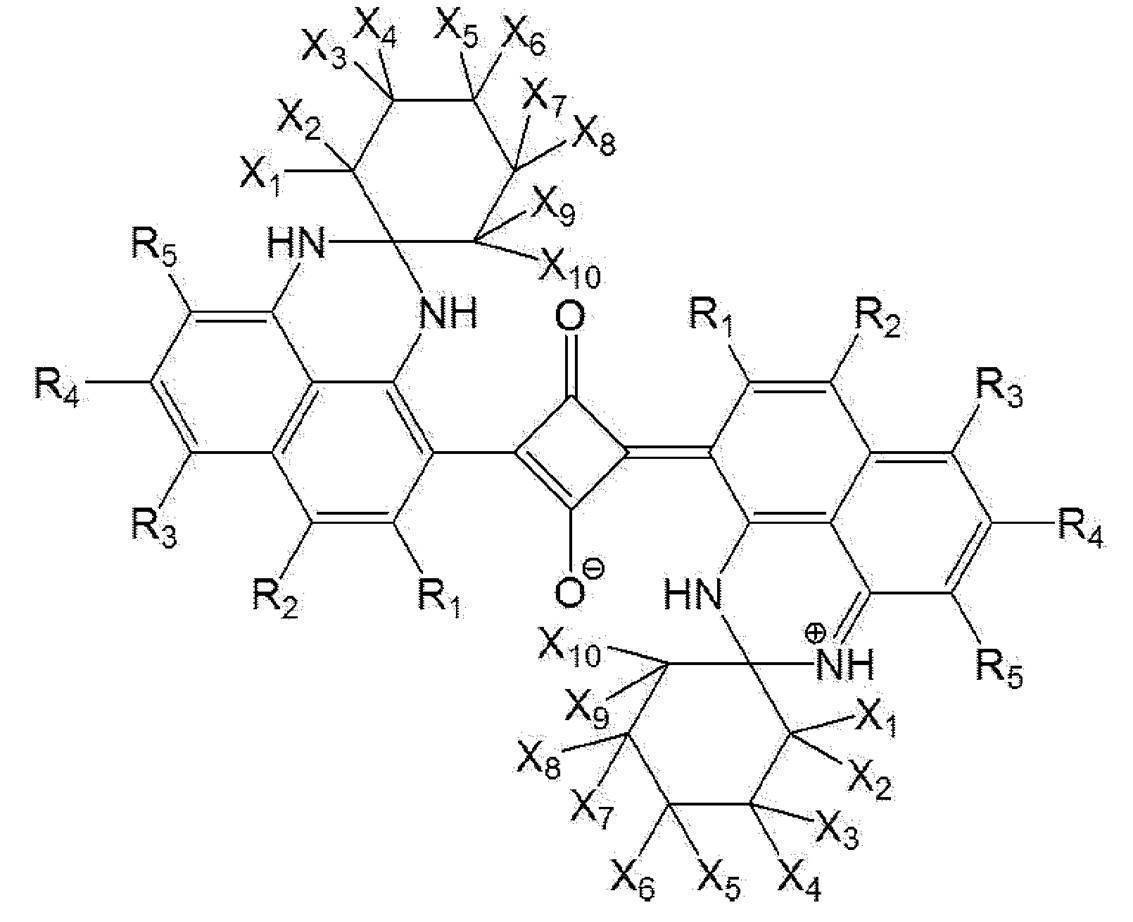
(R1~R5はそれぞれ独立に、水素原子、置換基を有してもよいアルキル基、置換基を有してもよいアリール基、置換基を有してもよいアルコキシ基、置換基を有してもよいアリールオキシ基、スルホ基、SO3-M+、-SO2NR6R7、-COOR6、-CONR6R7、ニトロ基、シアノ基、ハロゲン原子を表す。また、R1~R5のうち少なくとも1つは水素原子以外の置換基を表す。
X1~X10はそれぞれ独立に、水素原子、置換基を有してもよいアルキル基、置換基を有してもよいアルケニル基、置換基を有してもよいアリール基、置換基を有してもよいアラルキル基、置換基を有してもよいアルコキシ基、置換基を有してもよいアリールオキシ基、アミノ基、置換アミノ基、スルホ基、-SO2NR6R7、-COOR6、-CONR6R7、ニトロ基、シアノ基、ハロゲン原子を表す。X1~X10は、置換基同士が結合して環を形成してもよい。
M+は無機又は有機のカチオンを表し、R6、R7はそれぞれ独立に、水素原子、置換基を有してもよいアルキル基を表す。)
X1~X10はそれぞれ独立に、水素原子、置換基を有してもよいアルキル基、置換基を有してもよいアルケニル基、置換基を有してもよいアリール基、置換基を有してもよいアラルキル基、置換基を有してもよいアルコキシ基、置換基を有してもよいアリールオキシ基、アミノ基、置換アミノ基、スルホ基、-SO2NR6R7、-COOR6、-CONR6R7、ニトロ基、シアノ基、ハロゲン原子を表す。X1~X10は、置換基同士が結合して環を形成してもよい。
M+は無機又は有機のカチオンを表し、R6、R7はそれぞれ独立に、水素原子、置換基を有してもよいアルキル基を表す。)
特許文献2には、下記一般式(1)で表されるナフトオキサジニンスクアリリウム化合物が記載されている。
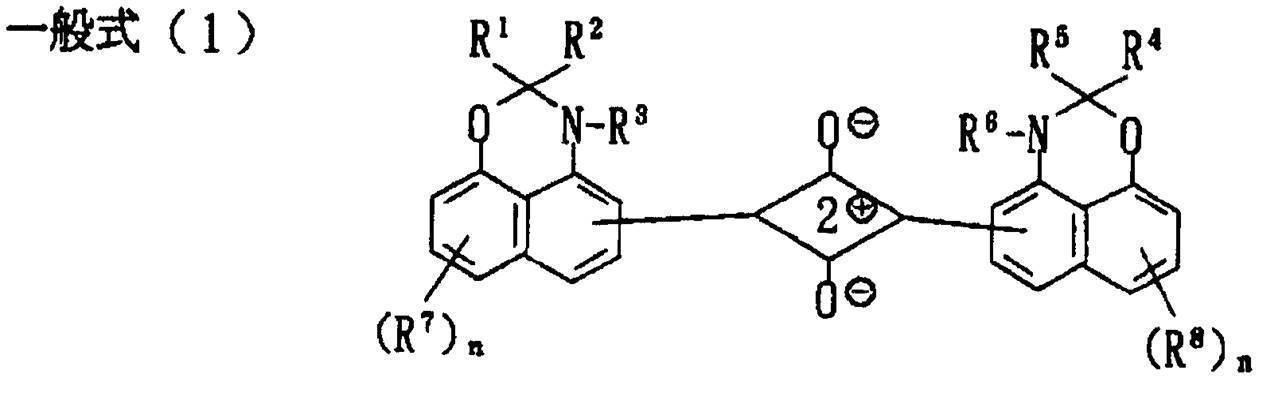
式中、R1、R2、R3、R4、R5及びR6は、それぞれ水素原子、アルキル基、シクロアルキル基、アリール基、ヘテロ環基又はアラルキル基を表し、R1とR2そして、又はR4とR5がお互いに結合し5又は6員環を形成してもよい。R7及びR8は水素原子、あるいは炭素原子数1から8のアルキル基、炭素原子数1から6のアルコキシ基、アリールオキシ基、ハロゲン原子、アルコキシカルボニル基、シアノ基、ニトロ基、アミノ基、スルホ基又はカルボキシル基を表し、スルホ基及びカルボキシル基は塩でもよく、nは1から3の整数を表す。
特許文献1:特開2017-88765号公報
特許文献2:特許第3996234号公報
特許文献2:特許第3996234号公報
カラーフィルタ等の部材の形成において用いられる色素として、ジヒドロぺリミジン骨格を有するスクアリリウム化合物が知られている。
しかし、本発明者らは、鋭意検討した結果、ジヒドロぺリミジン骨格を有するスクアリリウム化合物は、上記化合物を含む膜において、耐湿性が十分でない場合があることを見出した。
しかし、本発明者らは、鋭意検討した結果、ジヒドロぺリミジン骨格を有するスクアリリウム化合物は、上記化合物を含む膜において、耐湿性が十分でない場合があることを見出した。
本発明の一実施形態が解決しようとする課題は、得られる硬化膜の耐湿性に優れる硬化性組成物を提供することである。
また、本発明の他の実施形態が解決しようとする課題は、上記硬化性組成物を用いた膜、光学フィルタ及びその製造方法、固体撮像素子、赤外線センサ、カメラモジュール、並びに、インクジェットインクを提供することである。
また、本発明の他の実施形態が解決しようとする課題は、上記硬化性組成物を用いた膜、光学フィルタ及びその製造方法、固体撮像素子、赤外線センサ、カメラモジュール、並びに、インクジェットインクを提供することである。
上記課題を解決するための手段には、以下の態様が含まれる。
<1> 下記式(1)で表される構造である色素と、硬化性化合物とを含む硬化性組成物。
<1> 下記式(1)で表される構造である色素と、硬化性化合物とを含む硬化性組成物。

式(1)中、R1~R6はそれぞれ独立に、水素原子又は置換基を表し、R7及びR8はそれぞれ独立に、置換基を表し、Aは、O又はNR9を表し、R9は、水素原子又は置換基を表し、n1及びn2はそれぞれ独立に、0~5の整数を表し、R1とR2とは互いに結合して環を形成してもよく、また、R4とR5とは互いに結合して環を形成してもよい。
<2> 上記式(1)におけるR1、R2、R4及びR5のいずれか1つは、芳香環又は複素環を有する基である<1>に記載の硬化性組成物。
<3> 上記式(1)で表される構造である色素が、下記式(2)で表される構造である色素である<1>又は<2>に記載の硬化性組成物。
<3> 上記式(1)で表される構造である色素が、下記式(2)で表される構造である色素である<1>又は<2>に記載の硬化性組成物。

式(2)中、X1、X2、Y1及びY2はそれぞれ独立に、アルキレン基、アルキニレン基、シクロアルキレン基、アリーレン基、ヘテロアリーレン基、又は、これらを2以上結合した二価の基を表し、Z1及びZ2はそれぞれ独立に、単結合、-O-、カルボニル基、-S-、-N(RN)-、-S(=O)-、又は、-S(=O)2-を表し、RNは水素原子、アルキル基、又は、アリール基を表し、R7及びR8はそれぞれ独立に、置換基を表し、n1及びn2はそれぞれ独立に、0~5の整数を表す。
<4> 上記式(2)におけるX1、X2、Y1及びY2のうちの1つ以上が、芳香環又は複素環を有する基である<3>に記載の硬化性組成物。
<5> 上記式(2)におけるZ1及びZ2が、単結合である<3>又は<4>に記載の硬化性組成物。
<6> 光重合開始剤を更に含む<1>~<5>のいずれか1つに記載の硬化性組成物。
<7> 溶剤を更に含み、上記硬化性組成物中において、上記式(1)で表される構造である色素が粒子として上記溶剤に分散された状態で含まれる<1>~<6>のいずれか1つに記載の硬化性組成物。
<8> 分散剤を更に含む<1>~<7>のいずれか1つに記載の硬化性組成物。
<9> <1>~<8>のいずれか1つに記載の硬化性組成物からなる又は上記硬化性組成物を硬化してなる膜。
<10> <9>に記載の膜を有する光学フィルタ。
<11> 赤外線カットフィルタ又は赤外線透過フィルタである<10>に記載の光学フィルタ。
<12> <9>に記載の膜を有する固体撮像素子。
<13> <9>に記載の膜を有する赤外線センサ。
<14> <1>~<8>のいずれか1つに記載の硬化性組成物を支持体上に適用して組成物層を形成する工程と、上記組成物層をパターン状に露光する工程と、未露光部を現像除去してパターンを形成する工程と、を含む光学フィルタの製造方法。
<15> <1>~<8>のいずれか1つに記載の硬化性組成物を支持体上に適用して組成物層を形成し、硬化して層を形成する工程、上記層上にフォトレジスト層を形成する工程、露光及び現像することにより上記フォトレジスト層をパターニングしてレジストパターンを得る工程、並びに、上記レジストパターンをエッチングマスクとして上記層をドライエッチングする工程を含む光学フィルタの製造方法。
<16> 固体撮像素子と、<10>又は<11>に記載の光学フィルタとを有するカメラモジュール。
<17> <1>~<8>のいずれか1つに記載の硬化性組成物を含むインクジェットインク。
<5> 上記式(2)におけるZ1及びZ2が、単結合である<3>又は<4>に記載の硬化性組成物。
<6> 光重合開始剤を更に含む<1>~<5>のいずれか1つに記載の硬化性組成物。
<7> 溶剤を更に含み、上記硬化性組成物中において、上記式(1)で表される構造である色素が粒子として上記溶剤に分散された状態で含まれる<1>~<6>のいずれか1つに記載の硬化性組成物。
<8> 分散剤を更に含む<1>~<7>のいずれか1つに記載の硬化性組成物。
<9> <1>~<8>のいずれか1つに記載の硬化性組成物からなる又は上記硬化性組成物を硬化してなる膜。
<10> <9>に記載の膜を有する光学フィルタ。
<11> 赤外線カットフィルタ又は赤外線透過フィルタである<10>に記載の光学フィルタ。
<12> <9>に記載の膜を有する固体撮像素子。
<13> <9>に記載の膜を有する赤外線センサ。
<14> <1>~<8>のいずれか1つに記載の硬化性組成物を支持体上に適用して組成物層を形成する工程と、上記組成物層をパターン状に露光する工程と、未露光部を現像除去してパターンを形成する工程と、を含む光学フィルタの製造方法。
<15> <1>~<8>のいずれか1つに記載の硬化性組成物を支持体上に適用して組成物層を形成し、硬化して層を形成する工程、上記層上にフォトレジスト層を形成する工程、露光及び現像することにより上記フォトレジスト層をパターニングしてレジストパターンを得る工程、並びに、上記レジストパターンをエッチングマスクとして上記層をドライエッチングする工程を含む光学フィルタの製造方法。
<16> 固体撮像素子と、<10>又は<11>に記載の光学フィルタとを有するカメラモジュール。
<17> <1>~<8>のいずれか1つに記載の硬化性組成物を含むインクジェットインク。
本発明の一実施形態によれば、得られる硬化膜の耐湿性に優れる硬化性組成物が提供される。
また、本発明の他の実施形態によれば、上記硬化性組成物を用いた膜、光学フィルタ及びその製造方法、固体撮像素子、赤外線センサ、カメラモジュール、並びに、インクジェットインクが提供される。
また、本発明の他の実施形態によれば、上記硬化性組成物を用いた膜、光学フィルタ及びその製造方法、固体撮像素子、赤外線センサ、カメラモジュール、並びに、インクジェットインクが提供される。
以下において、本開示の内容について詳細に説明する。
本明細書において「全固形分」とは、組成物の全組成から溶剤を除いた成分の総質量をいう。また、「固形分」とは、上述のように、溶剤を除いた成分であり、例えば、25℃において固体であっても、液体であってもよい。
本明細書における基(原子団)の表記において、置換及び無置換を記していない表記は、置換基を有さないものとともに置換基を有するものをも包含するものである。例えば、「アルキル基」とは、置換基を有さないアルキル基(無置換アルキル基)のみならず、置換基を有するアルキル基(置換アルキル基)をも包含するものである。
本明細書において「露光」とは、特に断らない限り、光を用いた露光のみならず、電子線、イオンビーム等の粒子線を用いた描画も含む。また、露光に用いられる光としては、一般的に、水銀灯の輝線スペクトル、エキシマレーザに代表される遠紫外線、極紫外線(EUV光)、X線、電子線等の活性光線又は放射線が挙げられる。
本明細書において、「(メタ)アクリレート」は、アクリレート及びメタクリレートの双方、又は、いずれかを表し、「(メタ)アクリル」は、アクリル及びメタクリルの双方、又は、いずれかを表し、「(メタ)アクリロイル」は、アクリロイル及びメタクリロイルの双方、又は、いずれかを表す。
本明細書において、化学式中のMeはメチル基を、Etはエチル基を、Prはプロピル基を、Buはブチル基を、Acはアセチル基を、Bnはベンジル基を、Phはフェニル基をそれぞれ示す。
本明細書において「工程」との語は、独立した工程だけではなく、他の工程と明確に区別できない場合であってもその工程の所期の作用が達成されれば、本用語に含まれる。
また、本開示において、「質量%」と「重量%」とは同義であり、「質量部」と「重量部」とは同義である。
更に、本開示において、2以上の好ましい態様の組み合わせは、より好ましい態様である。
また、本開示における透過率は、特に断りのない限り、25℃における透過率である。
本明細書において、重量平均分子量及び数平均分子量は、ゲルパーミエーションクロマトグラフィ(GPC)により測定したポリスチレン換算値として定義される。
本明細書において「全固形分」とは、組成物の全組成から溶剤を除いた成分の総質量をいう。また、「固形分」とは、上述のように、溶剤を除いた成分であり、例えば、25℃において固体であっても、液体であってもよい。
本明細書における基(原子団)の表記において、置換及び無置換を記していない表記は、置換基を有さないものとともに置換基を有するものをも包含するものである。例えば、「アルキル基」とは、置換基を有さないアルキル基(無置換アルキル基)のみならず、置換基を有するアルキル基(置換アルキル基)をも包含するものである。
本明細書において「露光」とは、特に断らない限り、光を用いた露光のみならず、電子線、イオンビーム等の粒子線を用いた描画も含む。また、露光に用いられる光としては、一般的に、水銀灯の輝線スペクトル、エキシマレーザに代表される遠紫外線、極紫外線(EUV光)、X線、電子線等の活性光線又は放射線が挙げられる。
本明細書において、「(メタ)アクリレート」は、アクリレート及びメタクリレートの双方、又は、いずれかを表し、「(メタ)アクリル」は、アクリル及びメタクリルの双方、又は、いずれかを表し、「(メタ)アクリロイル」は、アクリロイル及びメタクリロイルの双方、又は、いずれかを表す。
本明細書において、化学式中のMeはメチル基を、Etはエチル基を、Prはプロピル基を、Buはブチル基を、Acはアセチル基を、Bnはベンジル基を、Phはフェニル基をそれぞれ示す。
本明細書において「工程」との語は、独立した工程だけではなく、他の工程と明確に区別できない場合であってもその工程の所期の作用が達成されれば、本用語に含まれる。
また、本開示において、「質量%」と「重量%」とは同義であり、「質量部」と「重量部」とは同義である。
更に、本開示において、2以上の好ましい態様の組み合わせは、より好ましい態様である。
また、本開示における透過率は、特に断りのない限り、25℃における透過率である。
本明細書において、重量平均分子量及び数平均分子量は、ゲルパーミエーションクロマトグラフィ(GPC)により測定したポリスチレン換算値として定義される。
(硬化性組成物)
本開示に係る硬化性組成物は、下記式(1)で表される構造である色素(以下、「特定色素」ともいう。)と、硬化性化合物とを含む。
本開示に係る硬化性組成物は、下記式(1)で表される構造である色素(以下、「特定色素」ともいう。)と、硬化性化合物とを含む。
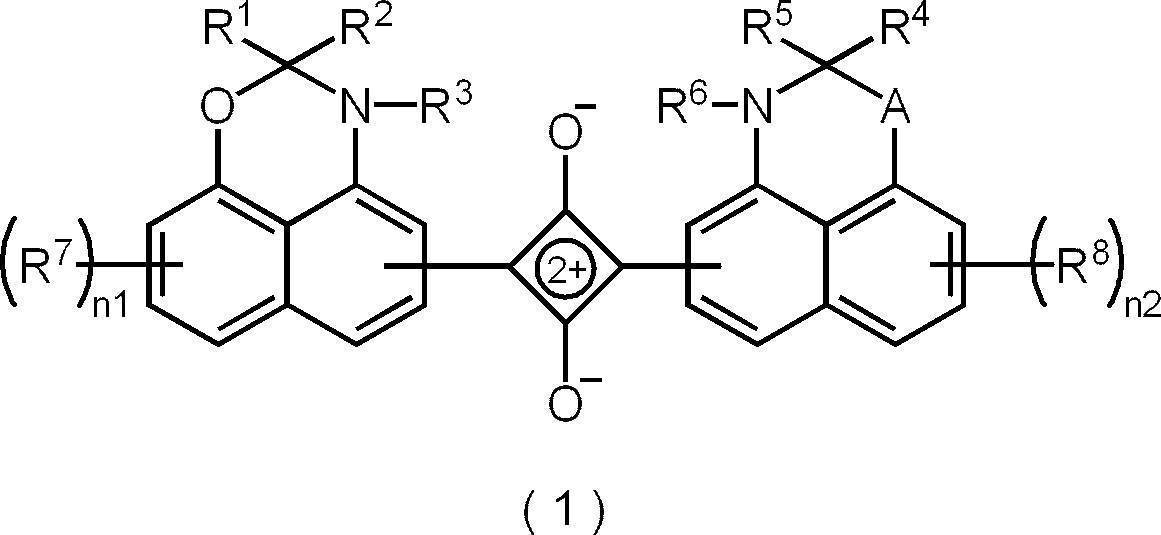
式(1)中、R1~R6はそれぞれ独立に、水素原子又は置換基を表し、R7及びR8はそれぞれ独立に、置換基を表し、Aは、O又はNR9を表し、R9は、水素原子又は置換基を表し、n1及びn2はそれぞれ独立に、0~5の整数を表し、R1とR2とは互いに結合して環を形成してもよく、また、R4とR5とは互いに結合して環を形成してもよい。
本開示に係る硬化性組成物を用いることにより、耐湿性に優れる硬化膜が得られる。
上述の通り、ジヒドロぺリミジン骨格を有するスクアリリウム化合物は、上記化合物を含む膜において、耐湿性が十分でない場合があった。
また、硬化性化合物を含まない、従来のナフトオキサジニンスクアリリウム化合物を含む組成物においても、膜を形成した場合、耐湿性が十分でない場合があった。
そこで、本発明者らが鋭意検討した結果、上記式(1)で表される構造である色素と、硬化性化合物とを含む硬化性組成物に用いることにより、耐湿性に優れた硬化膜が得られることを見出した。
上記効果が得られる理由は不明であるが、上記式(1)で表される構造であるナフトオキサジニン骨格を有するスクアリリウム色素を含むことにより、その機構の詳細は不明であるが、従来のジヒドロペリミジン骨格を有するスクアリリウム色素等に比べ、ナフトオキサジニン骨格の水に対する安定性及び疎水性、並びに、硬化性化合物の硬化に対する上記色素の影響等のため、硬化膜における上記色素の運動性が低く、水分子と接触確率が低下し、得られる硬化膜の耐湿性に優れると推定している。
上述の通り、ジヒドロぺリミジン骨格を有するスクアリリウム化合物は、上記化合物を含む膜において、耐湿性が十分でない場合があった。
また、硬化性化合物を含まない、従来のナフトオキサジニンスクアリリウム化合物を含む組成物においても、膜を形成した場合、耐湿性が十分でない場合があった。
そこで、本発明者らが鋭意検討した結果、上記式(1)で表される構造である色素と、硬化性化合物とを含む硬化性組成物に用いることにより、耐湿性に優れた硬化膜が得られることを見出した。
上記効果が得られる理由は不明であるが、上記式(1)で表される構造であるナフトオキサジニン骨格を有するスクアリリウム色素を含むことにより、その機構の詳細は不明であるが、従来のジヒドロペリミジン骨格を有するスクアリリウム色素等に比べ、ナフトオキサジニン骨格の水に対する安定性及び疎水性、並びに、硬化性化合物の硬化に対する上記色素の影響等のため、硬化膜における上記色素の運動性が低く、水分子と接触確率が低下し、得られる硬化膜の耐湿性に優れると推定している。
また、上記式(1)で表される構造である色素は、従来のジヒドロペリミジン骨格を有するスクアリリウム色素と比較し、溶液では450nm~600nmの波長範囲の吸収が少ないが、成膜時に分光ブロード化し、可視透明性が低下する問題があることを本発明者らは見出した。
本発明者らが鋭意検討した結果、上記態様であると、分光特性(可視透明性)にも優れる硬化膜が得られることを見出した。上記式(1)で表される構造である色素と、硬化性化合物とを含む硬化性組成物を、硬化させることにより、硬化膜における吸収スペクトル(吸収帯)がシャープになり、上記硬化膜における吸収スペクトル(吸収帯)の幅が狭くなると推定している。その結果、可視光領域の吸収は小さくなり、膜形成時による分光ブロード化を抑えることができ、分光特性(可視透明性)にも優れると推定している。
また、上記態様であると、詳細は不明であるが、耐光性にも優れる硬化膜が得られる。
本発明者らが鋭意検討した結果、上記態様であると、分光特性(可視透明性)にも優れる硬化膜が得られることを見出した。上記式(1)で表される構造である色素と、硬化性化合物とを含む硬化性組成物を、硬化させることにより、硬化膜における吸収スペクトル(吸収帯)がシャープになり、上記硬化膜における吸収スペクトル(吸収帯)の幅が狭くなると推定している。その結果、可視光領域の吸収は小さくなり、膜形成時による分光ブロード化を抑えることができ、分光特性(可視透明性)にも優れると推定している。
また、上記態様であると、詳細は不明であるが、耐光性にも優れる硬化膜が得られる。
更に、従来のジヒドロペリミジン骨格を有するスクアリリウム色素は、NH構造を多く有することから、樹脂や色素分子同士が水素結合することにより、凝集しやすいため、凝集体(異物)が生じ、異物欠陥が発生しやすい。
一方、上記式(1)で表される構造である色素は、NHが少ないことから、凝集しにくく、異物欠陥抑制性に優れる。
一方、上記式(1)で表される構造である色素は、NHが少ないことから、凝集しにくく、異物欠陥抑制性に優れる。
以下、本開示に係る硬化性組成物に含まれる各成分の詳細を説明する。
<特定色素>
本開示において用いられる特定色素は、上記式(1)で表される構造である色素である。特定色素は、赤外線吸収色素として好適に用いることができる。
また、特定色素は、色素(「着色剤」ともいう。)であり、顔料又は染料であることが好ましく、顔料であることがより好ましい。なお、本開示において、顔料とは、溶剤に不溶性の色素を意味する。また、染料とは、溶剤に溶解する色素を指す。
本開示に用いられる顔料は、例えば、25℃のプロピレングリコールモノメチルエーテルアセテ-ト100gに対する溶解量、及び、25℃の水100gに対する溶解量がいずれも0.1g以下であることが好ましく、0.05g以下であることがより好ましく、0.01g以下であることが更に好ましい。また、本開示に用いられる染料は、25℃のプロピレングリコールモノメチルエーテルアセテート100gに対する溶解量、及び、25℃の水100gに対する溶解量の少なくとも一方が0.1gを超えることが好ましく、1g以上であることがより好ましく、5g以上であることが更に好ましい。
本開示において用いられる特定色素は、上記式(1)で表される構造である色素である。特定色素は、赤外線吸収色素として好適に用いることができる。
また、特定色素は、色素(「着色剤」ともいう。)であり、顔料又は染料であることが好ましく、顔料であることがより好ましい。なお、本開示において、顔料とは、溶剤に不溶性の色素を意味する。また、染料とは、溶剤に溶解する色素を指す。
本開示に用いられる顔料は、例えば、25℃のプロピレングリコールモノメチルエーテルアセテ-ト100gに対する溶解量、及び、25℃の水100gに対する溶解量がいずれも0.1g以下であることが好ましく、0.05g以下であることがより好ましく、0.01g以下であることが更に好ましい。また、本開示に用いられる染料は、25℃のプロピレングリコールモノメチルエーテルアセテート100gに対する溶解量、及び、25℃の水100gに対する溶解量の少なくとも一方が0.1gを超えることが好ましく、1g以上であることがより好ましく、5g以上であることが更に好ましい。
また、上記式(1)で表される色素は、例えば、下記に示すナフトオキサジニン環構造のアミノ基のオルト位の位置において、ナフトオキサジニン環構造とスクアリリウム構造とが結合する場合、下記に示すいずれの共鳴構造の表記で表してもよい。下記に示す化合物は、カチオン及びアニオンの共鳴構造の表記位置が異なるだけで同一の化合物を表す。
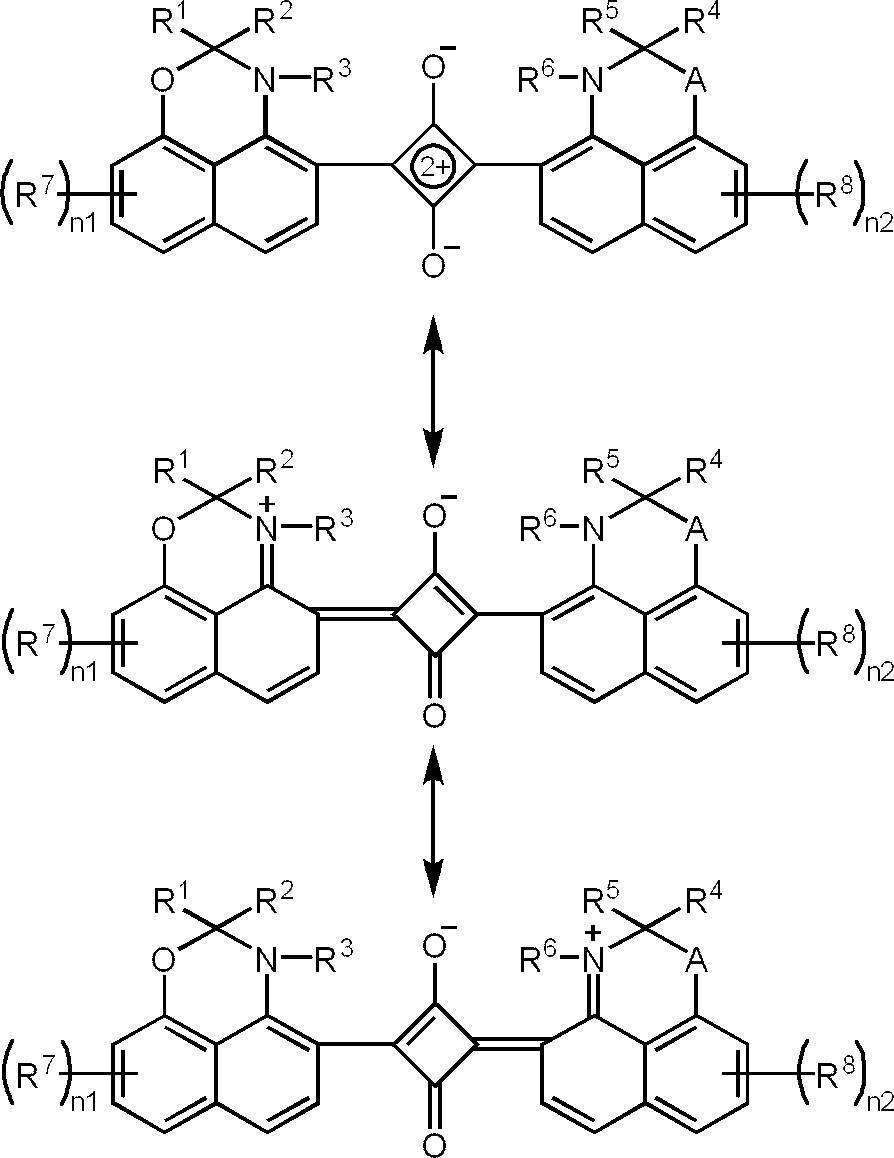
式(1)のR1~R9における置換基としては、水素原子よりも分子量が大きいものであればよく、アルキル基、アリール基、ヘテロアリール基、ハロゲン原子、カルボキシ基、アシル基、アシルオキシ基、アルコキシカルボニル基、アリーロキシカルボニル基、ヒドロキシ基、アルコキシ基、アリーロキシ基、第一級~第三級アミノ基、メルカプト基、アルキルチオ基、アリールチオ基、ニトロ基、シアノ基、スルホ基、第一級~第三級アミド基、及び、第一級~第三級アミノカルボニル基が挙げられる。また、上記置換基は、上記置換基又はオキソ基(=O)により更に置換されていてもよいし、2つ以上の上記置換基が結合し環を形成していてもよい。
得られる硬化膜の分光特性、耐光性及び耐湿性の観点から、式(1)におけるR1及びR2はそれぞれ独立に、置換基であるか、又は、R1とR2とは互いに結合して環を形成していることが好ましく、アルキル基、アリール基、若しくは、ヘテロアリール基であるか、又は、R1とR2とは互いに結合して環を形成していることがより好ましく、R1とR2とは互いに結合して環を形成していることが更に好ましく、R1とR2とは互いに結合して芳香環構造を有する環を形成していることが特に好ましい。
得られる硬化膜の分光特性、耐光性及び耐湿性の観点から、式(1)におけるR4及びR5はそれぞれ独立に、置換基であるか、又は、R4とR5とは互いに結合して環を形成していることが好ましく、アルキル基、アリール基、若しくは、ヘテロアリール基であるか、又は、R4とR5とは互いに結合して環を形成していることがより好ましく、R4とR5とは互いに結合して環を形成していることが更に好ましく、R4とR5とは互いに結合して芳香環構造を有する環を形成していることが特に好ましい。
また、得られる硬化膜の分光特性、耐光性及び耐湿性の観点から、式(1)におけるR1及びR2と、R4及びR5とは、同一構造の基であることが好ましい。
式(1)におけるR1及びR2の合計炭素数はそれぞれ独立に、得られる硬化膜の分光特性、耐光性及び耐湿性の観点から、2~60であることが好ましく、4~40であることがより好ましく、8~20であることが特にこのましい。
また、式(1)におけるR4及びR5の合計炭素数はそれぞれ独立に、得られる硬化膜の分光特性、耐光性及び耐湿性の観点から、2~60であることが好ましく、4~40であることがより好ましく、8~20であることが特にこのましい。
得られる硬化膜の分光特性、耐光性及び耐湿性の観点から、式(1)におけるR4及びR5はそれぞれ独立に、置換基であるか、又は、R4とR5とは互いに結合して環を形成していることが好ましく、アルキル基、アリール基、若しくは、ヘテロアリール基であるか、又は、R4とR5とは互いに結合して環を形成していることがより好ましく、R4とR5とは互いに結合して環を形成していることが更に好ましく、R4とR5とは互いに結合して芳香環構造を有する環を形成していることが特に好ましい。
また、得られる硬化膜の分光特性、耐光性及び耐湿性の観点から、式(1)におけるR1及びR2と、R4及びR5とは、同一構造の基であることが好ましい。
式(1)におけるR1及びR2の合計炭素数はそれぞれ独立に、得られる硬化膜の分光特性、耐光性及び耐湿性の観点から、2~60であることが好ましく、4~40であることがより好ましく、8~20であることが特にこのましい。
また、式(1)におけるR4及びR5の合計炭素数はそれぞれ独立に、得られる硬化膜の分光特性、耐光性及び耐湿性の観点から、2~60であることが好ましく、4~40であることがより好ましく、8~20であることが特にこのましい。
得られる硬化膜の分光特性の観点から、式(1)におけるR1、R2、R4及びR5のいずれか1つは、芳香環又は複素環を有する基であることが好ましく、R1、R2、R4及びR5のいずれか1つは、芳香環を有する基であることがより好ましい。
また、得られる硬化膜の分光特性の観点から、式(1)におけるR1及びR2のいずれか1つは、芳香環又は複素環を有する基であることが好ましく、R1及びR2のいずれか1つは、芳香環を有する基であることがより好ましい。
更に、得られる硬化膜の分光特性の観点から、式(1)におけるR4及びR5のいずれか1つは、芳香環又は複素環を有する基であることが好ましく、R4及びR5のいずれか1つは、芳香環を有する基であることがより好ましい。
また、得られる硬化膜の分光特性の観点から、式(1)におけるR1及びR2のいずれか1つは、芳香環又は複素環を有する基であることが好ましく、R1及びR2のいずれか1つは、芳香環を有する基であることがより好ましい。
更に、得られる硬化膜の分光特性の観点から、式(1)におけるR4及びR5のいずれか1つは、芳香環又は複素環を有する基であることが好ましく、R4及びR5のいずれか1つは、芳香環を有する基であることがより好ましい。
式(1)において、R1とR2とが、又は、R4とR5とが互いに結合して形成する環はそれぞれ独立に、得られる硬化膜の分光特性の観点から、脂肪族環、又は、複素脂肪族環であることが好ましく、5員環若しくは6員環の脂肪族環、又は、5員環若しくは6員環の複素脂肪族環であることがより好ましく、芳香環が縮環した5員環若しくは6員環の脂肪族環、又は、芳香環が縮環した5員環若しくは6員環の複素脂肪族環であることが更に好ましく、芳香環が縮環した5員環若しくは6員環の脂肪族環であることが特に好ましい。
また、式(1)において、R1とR2とが、又は、R4とR5とが互いに結合して形成する環は、得られる硬化膜の分光特性の観点から、芳香環が縮環していてもよい、脂肪族環であることがより好ましい。
また、式(1)において、R1とR2とが、又は、R4とR5とが互いに結合して形成する環は、得られる硬化膜の分光特性の観点から、芳香環が縮環していてもよい、脂肪族環であることがより好ましい。
式(1)において、R1とR2とが、又は、R4とR5とが互いに結合して形成する環としてはそれぞれ独立に、得られる硬化膜の分光特性、耐光性及び耐湿性の観点から、シクロペンタン環、シクロヘキサン環、ノルボルナン環、テトラヒドロフラン環、テトラヒドロピラン環、テトラヒドロチオフェン環、テトラヒドロチオフェンジオキシド環、テトラヒドロチオピラン環、テトラヒドロチオピランジオキシド環、ピロリジン環、ピペリジン環、インデン環、テトラリン環、ジヒドロベンゾフラン環、ジヒドロベンゾピラン環、ジヒドロベンゾチオフェン環、ジヒドロベンゾチオピラン環、オクタヒドロインドリジン環、フルオレン環、アザフルオレン環、ジアザフルオレン環、アセナフテン環、テトラヒドロフルオレン環、ヘキサヒドロベンゾペンタレン環、キサンテン環、チオキサンテン環、ベンゾフルオレン環、又は、ベンゾジアザフルオレン環であることが好ましく、インデン環、テトラリン環、ジヒドロベンゾフラン環、ジヒドロベンゾピラン環、ジヒドロベンゾチオフェン環、ジヒドロベンゾチオピラン環、フルオレン環、アザフルオレン環、ジアザフルオレン環、アセナフテン環、テトラヒドロフルオレン環、ヘキサヒドロベンゾペンタレン環、キサンテン環、チオキサンテン環、ベンゾフルオレン環、又は、ベンゾジアザフルオレン環であることがより好ましく、インデン環、テトラリン環、フルオレン環、テトラヒドロフルオレン環、ヘキサヒドロベンゾペンタレン環、又は、ベンゾフルオレン環であることが特に好ましい。
式(1)におけるR3及びR6はそれぞれ独立に、得られる硬化膜の分光特性、耐光性及び耐湿性の観点から、水素原子、又は、アルキル基であることが好ましく、水素原子、又は、メチル基であることがより好ましく、水素原子であることが特に好ましい。
また、得られる硬化膜の分光特性、耐光性及び耐湿性の観点から、式(1)におけるR3とR6とは、同じ基であることが好ましい。
また、得られる硬化膜の分光特性、耐光性及び耐湿性の観点から、式(1)におけるR3とR6とは、同じ基であることが好ましい。
式(1)におけるR7及びR8はそれぞれ独立に、アルキル基、アリール基、ヘテロアリール基、ハロゲン原子、カルボキシ基、ヒドロキシ基、アルコキシ基、アリーロキシ基、ニトロ基、シアノ基、又は、スルホ基であることが好ましく、アルキル基、ハロゲン原子、カルボキシ基、ヒドロキシ基、アルコキシ基、ニトロ基、シアノ基、又は、スルホ基であることがより好ましく、アルキル基、ハロゲン原子、ヒドロキシ基、アルコキシ基、ニトロ基、又は、スルホ基であることが更に好ましく、ハロゲン原子、ヒドロキシ基、アルコキシ基、ジアルキルアミノアルコキシ基、ニトロ基、又は、スルホ基であることが特に好ましい。
式(1)におけるn1及びn2はそれぞれ独立に、0~2の整数であることが好ましく、0又は1であることがより好ましい。
また、式(1)におけるn1及びn2は、同じ値であることが好ましい。
更に、式(1)におけるn1及びn2が同じ値である場合、式(1)におけるR7及びR8の結合位置はそれぞれ、各ナフトオキサジニン環構造の同じ位置であることが好ましい。
式(1)におけるn1及びn2はそれぞれ独立に、0~2の整数であることが好ましく、0又は1であることがより好ましい。
また、式(1)におけるn1及びn2は、同じ値であることが好ましい。
更に、式(1)におけるn1及びn2が同じ値である場合、式(1)におけるR7及びR8の結合位置はそれぞれ、各ナフトオキサジニン環構造の同じ位置であることが好ましい。
式(1)におけるAは、得られる硬化膜の分光特性、耐光性及び耐湿性の観点から、O又はNHであることが好ましく、得られる硬化膜の分光特性、耐光性、耐湿性及び異物欠陥抑制性の観点から、Oであることがより好ましい。
式(1)におけるR9は、得られる硬化膜の分光特性、耐光性及び耐湿性の観点から、水素原子、又は、アルキル基であることが好ましく、水素原子、又は、メチル基であることがより好ましく、水素原子であることが特に好ましい。
また、上記式(1)で表される構造である色素は、得られる硬化膜の分光特性、耐光性及び耐湿性の観点から、点対称を有する化合物であることが好ましい。
更に、式(1)におけるスクアリリウム構造の結合位置は、各ナフトオキサジニン環構造の同じ位置で結合していることが好ましい。
式(1)におけるR9は、得られる硬化膜の分光特性、耐光性及び耐湿性の観点から、水素原子、又は、アルキル基であることが好ましく、水素原子、又は、メチル基であることがより好ましく、水素原子であることが特に好ましい。
また、上記式(1)で表される構造である色素は、得られる硬化膜の分光特性、耐光性及び耐湿性の観点から、点対称を有する化合物であることが好ましい。
更に、式(1)におけるスクアリリウム構造の結合位置は、各ナフトオキサジニン環構造の同じ位置で結合していることが好ましい。
上記式(1)で表される構造である色素は、得られる硬化膜の分光特性、耐光性、耐湿性及び異物欠陥抑制性の観点から、下記式(2)で表される構造である色素であることが好ましい。
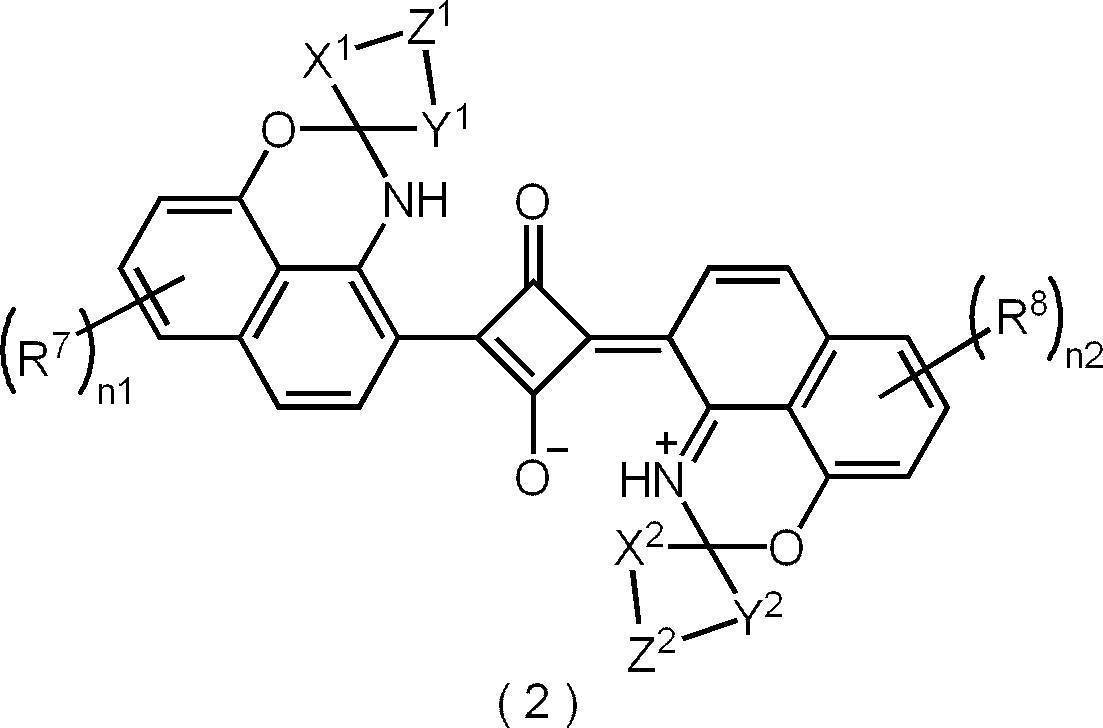
式(2)中、X1、X2、Y1及びY2はそれぞれ独立に、アルキレン基、アルキニレン基、シクロアルキレン基、アリーレン基、ヘテロアリーレン基、又は、これらを2以上結合した二価の基を表し、Z1及びZ2はそれぞれ独立に、単結合、-O-、カルボニル基、-S-、-N(RN)-、-S(=O)-、又は、-S(=O)2-を表し、RNは水素原子、アルキル基、又は、アリール基を表し、R7及びR8はそれぞれ独立に、置換基を表し、n1及びn2はそれぞれ独立に、0~5の整数を表す。
式(2)におけるR7、R8、n1及びn2は、式(1)におけるR7、R8、n1及びn2と同義であり、好ましい態様も同様である。
得られる硬化膜の分光特性の観点から、式(2)におけるX1、X2、Y1及びY2のうちの1つ以上は、芳香環又は複素環を有する基であることが好ましく、X1、X2、Y1及びY2のうちの1つ以上は、芳香環を有する基であることがより好ましい。
式(2)におけるX1及びX2はそれぞれ独立に、得られる硬化膜の分光特性、耐光性及び耐湿性の観点から、アルキレン基、アリーレン基、又は、ヘテロアリーレン基であることが好ましく、アリーレン基、又は、ヘテロアリーレン基であることがより好ましく、アリーレン基であることが更に好ましく、1,2-フェニレン基、又は、2,3-ナフタレニレン基であることが特に好ましく、1,2-フェニレン基であることが最も好ましい。
また、得られる硬化膜の分光特性、耐光性及び耐湿性の観点から、式(2)におけるX1とX2とは、同じ基であることが好ましい。
式(2)におけるY1及びY2はそれぞれ独立に、得られる硬化膜の分光特性、耐光性及び耐湿性の観点から、アルキレン基、アリーレン基、又は、ヘテロアリーレン基であることが好ましく、アルキレン基、又は、アリーレン基であることがより好ましく、メチレン基、エチレン基、1,3-プロピレン基、1,2-シクロペンタンジイル基、1,2-シクロヘキサンジイル基、又は、1,2-フェニレン基であることが更に好ましく、1,2-フェニレン基であることが特に好ましい。
また、得られる硬化膜の分光特性、耐光性及び耐湿性の観点から、式(2)におけるY1とY2とは、同じ基であることが好ましい。
更に、式(2)におけるX1、X2、Y1及びY2は、上記基に更に置換基を有していてもよい。置換基としては、R1~R9における置換基として上述したものが好ましく挙げられる。
式(2)におけるZ1及びZ2はそれぞれ独立に、得られる硬化膜の分光特性、耐光性及び耐湿性の観点から、単結合、-O-、カルボニル基、-S-、又は、-S(=O)2-であることが好ましく、単結合、-O-、又は、-S-であることがより好ましく、単結合であることが特に好ましい。
また、得られる硬化膜の分光特性、耐光性及び耐湿性の観点から、式(2)におけるZ1とZ2とは、同じ基であることが好ましい。
式(2)におけるRNは、アルキル基、又は、アリール基であることが好ましく、アルキル基であることがより好ましく、メチル基であることが特に好ましい。
得られる硬化膜の分光特性の観点から、式(2)におけるX1、X2、Y1及びY2のうちの1つ以上は、芳香環又は複素環を有する基であることが好ましく、X1、X2、Y1及びY2のうちの1つ以上は、芳香環を有する基であることがより好ましい。
式(2)におけるX1及びX2はそれぞれ独立に、得られる硬化膜の分光特性、耐光性及び耐湿性の観点から、アルキレン基、アリーレン基、又は、ヘテロアリーレン基であることが好ましく、アリーレン基、又は、ヘテロアリーレン基であることがより好ましく、アリーレン基であることが更に好ましく、1,2-フェニレン基、又は、2,3-ナフタレニレン基であることが特に好ましく、1,2-フェニレン基であることが最も好ましい。
また、得られる硬化膜の分光特性、耐光性及び耐湿性の観点から、式(2)におけるX1とX2とは、同じ基であることが好ましい。
式(2)におけるY1及びY2はそれぞれ独立に、得られる硬化膜の分光特性、耐光性及び耐湿性の観点から、アルキレン基、アリーレン基、又は、ヘテロアリーレン基であることが好ましく、アルキレン基、又は、アリーレン基であることがより好ましく、メチレン基、エチレン基、1,3-プロピレン基、1,2-シクロペンタンジイル基、1,2-シクロヘキサンジイル基、又は、1,2-フェニレン基であることが更に好ましく、1,2-フェニレン基であることが特に好ましい。
また、得られる硬化膜の分光特性、耐光性及び耐湿性の観点から、式(2)におけるY1とY2とは、同じ基であることが好ましい。
更に、式(2)におけるX1、X2、Y1及びY2は、上記基に更に置換基を有していてもよい。置換基としては、R1~R9における置換基として上述したものが好ましく挙げられる。
式(2)におけるZ1及びZ2はそれぞれ独立に、得られる硬化膜の分光特性、耐光性及び耐湿性の観点から、単結合、-O-、カルボニル基、-S-、又は、-S(=O)2-であることが好ましく、単結合、-O-、又は、-S-であることがより好ましく、単結合であることが特に好ましい。
また、得られる硬化膜の分光特性、耐光性及び耐湿性の観点から、式(2)におけるZ1とZ2とは、同じ基であることが好ましい。
式(2)におけるRNは、アルキル基、又は、アリール基であることが好ましく、アルキル基であることがより好ましく、メチル基であることが特に好ましい。
上記式(1)で表される構造である色素は、得られる硬化膜の分光特性、耐光性、耐湿性及び異物欠陥抑制性の観点から、下記式(3)で表される構造である色素であることがより好ましい。
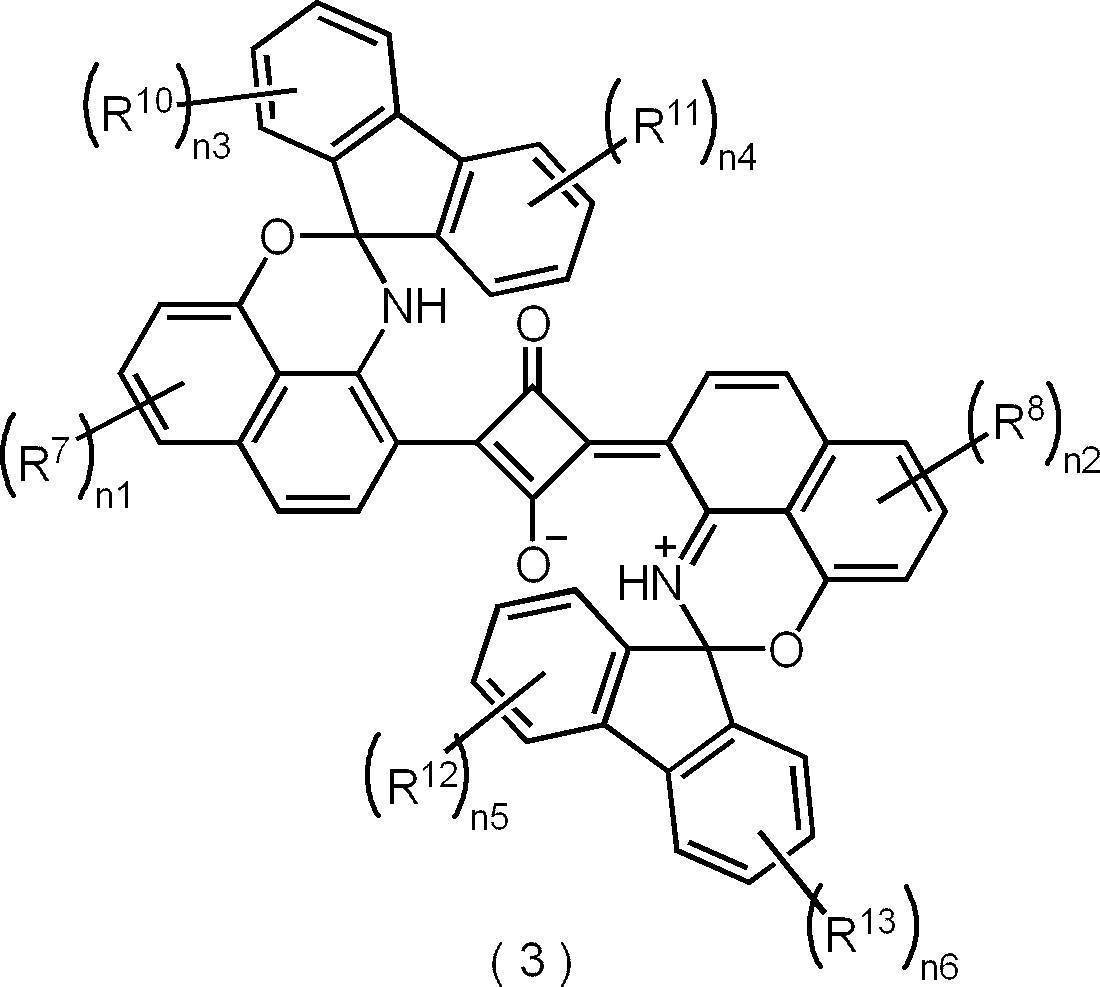
式(3)中、R7及びR8はそれぞれ独立に、置換基を表し、n1及びn2はそれぞれ独立に、0~5の整数を表し、R10~R13はそれぞれ独立に、置換基を表し、n3~n6はそれぞれ独立に、0~4の整数を表す。
式(3)におけるR7、R8、n1及びn2は、式(1)におけるR7、R8、n1及びn2と同義であり、好ましい態様も同様である。
式(3)におけるR10~R13はそれぞれ独立に、得られる硬化膜の分光特性、耐光性及び耐湿性の観点から、アルキル基、アリール基、ヘテロアリール基、ハロゲン原子、カルボキシ基、ヒドロキシ基、アルコキシ基、アリーロキシ基、ニトロ基、シアノ基、又は、スルホ基であることが好ましく、アルキル基、ハロゲン原子、カルボキシ基、ヒドロキシ基、アルコキシ基、ニトロ基、シアノ基、又は、スルホ基であることがより好ましく、アルキル基、ハロゲン原子、ヒドロキシ基、アルコキシ基、ニトロ基、又は、スルホ基であることが更に好ましく、ハロゲン原子、ヒドロキシ基、アルコキシ基、ジアルキルアミノアルコキシ基、ニトロ基、又は、スルホ基であることが特に好ましい。
式(3)におけるn3~n6はそれぞれ独立に、0~2の整数であることが好ましく、0又は1であることがより好ましい。
式(3)におけるR10~R13はそれぞれ独立に、得られる硬化膜の分光特性、耐光性及び耐湿性の観点から、アルキル基、アリール基、ヘテロアリール基、ハロゲン原子、カルボキシ基、ヒドロキシ基、アルコキシ基、アリーロキシ基、ニトロ基、シアノ基、又は、スルホ基であることが好ましく、アルキル基、ハロゲン原子、カルボキシ基、ヒドロキシ基、アルコキシ基、ニトロ基、シアノ基、又は、スルホ基であることがより好ましく、アルキル基、ハロゲン原子、ヒドロキシ基、アルコキシ基、ニトロ基、又は、スルホ基であることが更に好ましく、ハロゲン原子、ヒドロキシ基、アルコキシ基、ジアルキルアミノアルコキシ基、ニトロ基、又は、スルホ基であることが特に好ましい。
式(3)におけるn3~n6はそれぞれ独立に、0~2の整数であることが好ましく、0又は1であることがより好ましい。
〔極大吸収波長〕
特定色素の極大吸収波長は、700nm~1,100nmの波長範囲内にあることが好ましく、760nm~960nmの波長範囲内にあることがより好ましく、760nm~850nmの波長範囲内にあることが特に好ましい。
上記極大吸収波長は、Cary5000 UV-Vis-NIR分光光度計(アジレント・テクノロジー(株)製)を用いて測定される。
特定色素の極大吸収波長は、700nm~1,100nmの波長範囲内にあることが好ましく、760nm~960nmの波長範囲内にあることがより好ましく、760nm~850nmの波長範囲内にあることが特に好ましい。
上記極大吸収波長は、Cary5000 UV-Vis-NIR分光光度計(アジレント・テクノロジー(株)製)を用いて測定される。
〔半値幅〕
上記極大吸収波長の測定において得られた波長-吸光度曲線において、極大吸収波長における波長ピークの半値幅は、2,000cm-1以下が好ましく、1,500cm-1以下がより好ましく、1,350cm-1以下が更に好ましい。
上記半値幅の下限は、特に限定されないが、500cm-1以上であることが好ましい。
上記半値幅は、Cary5000 UV-Vis-NIR分光光度計(アジレント・テクノロジー(株)製)を用いて測定される。
上記極大吸収波長の測定において得られた波長-吸光度曲線において、極大吸収波長における波長ピークの半値幅は、2,000cm-1以下が好ましく、1,500cm-1以下がより好ましく、1,350cm-1以下が更に好ましい。
上記半値幅の下限は、特に限定されないが、500cm-1以上であることが好ましい。
上記半値幅は、Cary5000 UV-Vis-NIR分光光度計(アジレント・テクノロジー(株)製)を用いて測定される。
〔モル吸光係数〕
特定色素の極大吸収波長におけるモル吸光係数は、1.0×10⁵L/(mol・cm)以上であることが好ましく、1.5×105L/(mol・cm)以上であることがより好ましい。
上記モル吸光係数は、Cary5000 UV-Vis-NIR分光光度計(アジレント・テクノロジー社製)を用いてにより測定される。
特定色素の極大吸収波長におけるモル吸光係数は、1.0×10⁵L/(mol・cm)以上であることが好ましく、1.5×105L/(mol・cm)以上であることがより好ましい。
上記モル吸光係数は、Cary5000 UV-Vis-NIR分光光度計(アジレント・テクノロジー社製)を用いてにより測定される。
〔分散状態〕
本開示に係る硬化性組成物において、特定色素は、粒子状で分散された状態であることが好ましい。粒子状で分散された状態であると、得られる硬化膜の耐久性が向上するメリットがある。
また、上記粒子状で分散された状態である場合、特定色素は、顔料であることが好ましい。
更に、本開示に係る硬化性組成物は、後述する溶剤を更に含み、上記硬化性組成物中において、上記式(1)で表される構造である色素が粒子として上記溶剤に分散された状態で含まれることが好ましい。
本開示に係る硬化性組成物は、数平均粒径1nm~500nmの特定色素の粒子を含むことが好ましく、数平均粒径10nm~200nmの特定色素の粒子を含むことがより好ましく、数平均粒径10nm~100nmの特定色素の粒子を含むことが特に好ましい。粒子の数平均粒径が1nm以上であると、粒子の表面エネルギーが小さくなるため凝集しにくくなり、粒子分散が容易になると共に、分散状態を安定に保つのが容易になるため好ましい。また、粒子の数平均粒径が200nm以下であれば、粒子散乱の影響が少なくなり、吸収スペクトルがシャープになるため好ましい。
本開示において、特段の記載がない限り、粒子の平均粒径は、日機装(株)製のMICROTRAC UPA 150を用いて、算術平均(数平均)で測定するものとする。
本開示に係る硬化性組成物において、特定色素は、粒子状で分散された状態であることが好ましい。粒子状で分散された状態であると、得られる硬化膜の耐久性が向上するメリットがある。
また、上記粒子状で分散された状態である場合、特定色素は、顔料であることが好ましい。
更に、本開示に係る硬化性組成物は、後述する溶剤を更に含み、上記硬化性組成物中において、上記式(1)で表される構造である色素が粒子として上記溶剤に分散された状態で含まれることが好ましい。
本開示に係る硬化性組成物は、数平均粒径1nm~500nmの特定色素の粒子を含むことが好ましく、数平均粒径10nm~200nmの特定色素の粒子を含むことがより好ましく、数平均粒径10nm~100nmの特定色素の粒子を含むことが特に好ましい。粒子の数平均粒径が1nm以上であると、粒子の表面エネルギーが小さくなるため凝集しにくくなり、粒子分散が容易になると共に、分散状態を安定に保つのが容易になるため好ましい。また、粒子の数平均粒径が200nm以下であれば、粒子散乱の影響が少なくなり、吸収スペクトルがシャープになるため好ましい。
本開示において、特段の記載がない限り、粒子の平均粒径は、日機装(株)製のMICROTRAC UPA 150を用いて、算術平均(数平均)で測定するものとする。
〔含有量〕
本開示に係る硬化性組成物における、特定色素の含有量は、硬化性組成物の全固形分に対し、10質量%~70質量%が好ましく、15質量%~60質量%がより好ましく、20質量%~50質量%が更に好ましい。
本開示に係る硬化性組成物における、特定色素の含有量は、硬化性組成物の全固形分に対し、10質量%~70質量%が好ましく、15質量%~60質量%がより好ましく、20質量%~50質量%が更に好ましい。
以下、特定色素の具体例であるSQ-1~SQ-53を示すが、これに限定されるものではない。
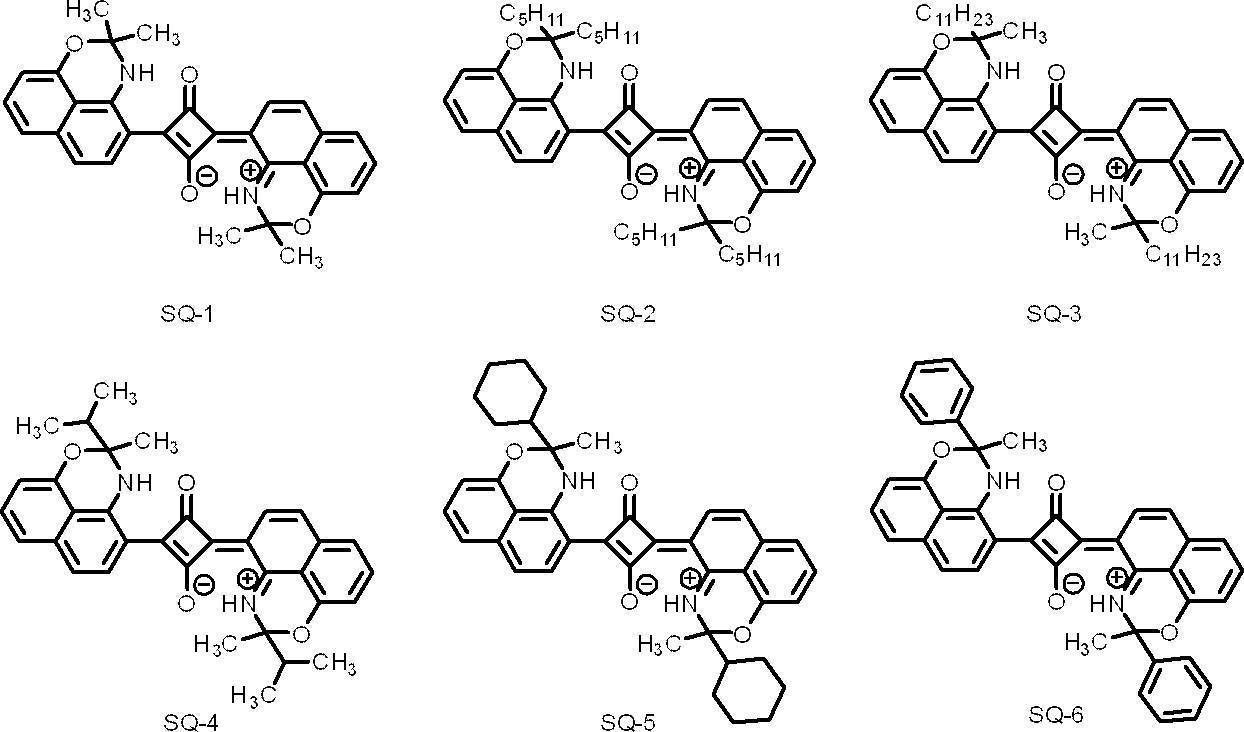
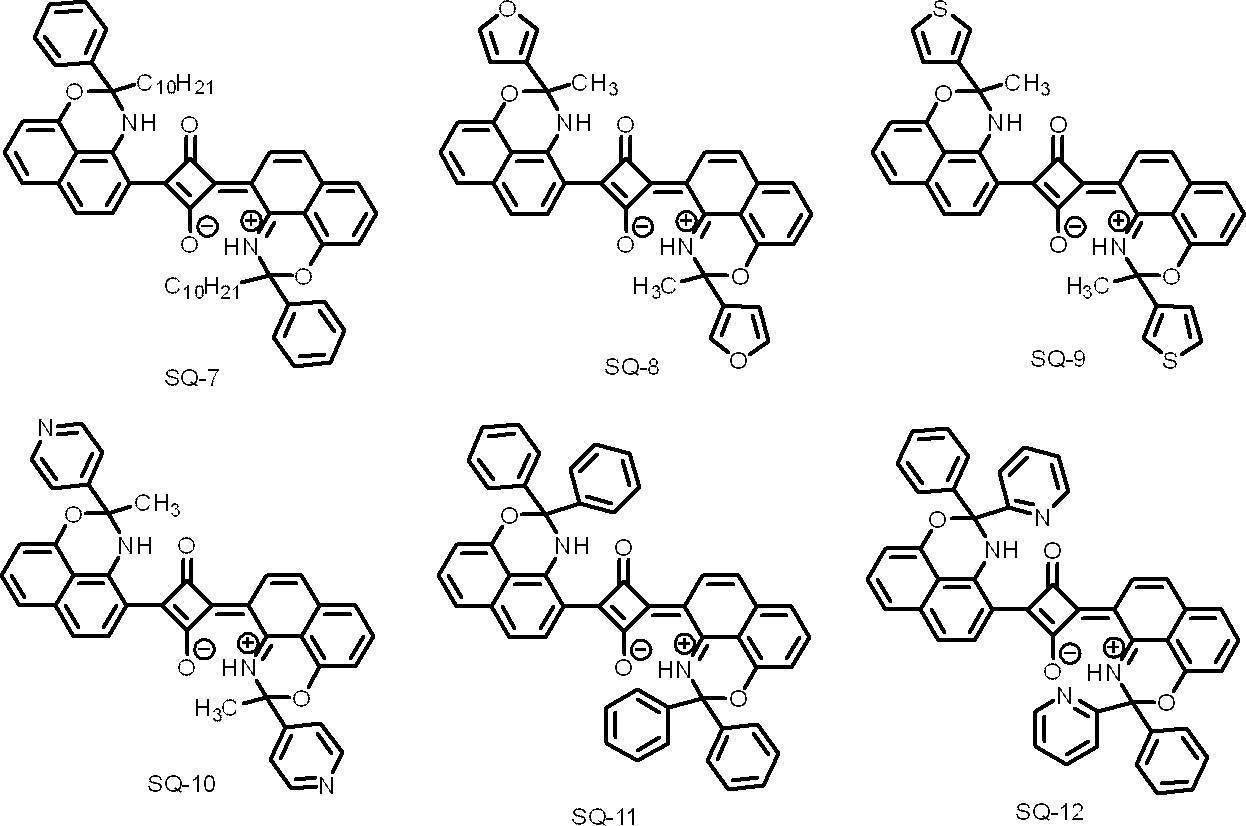
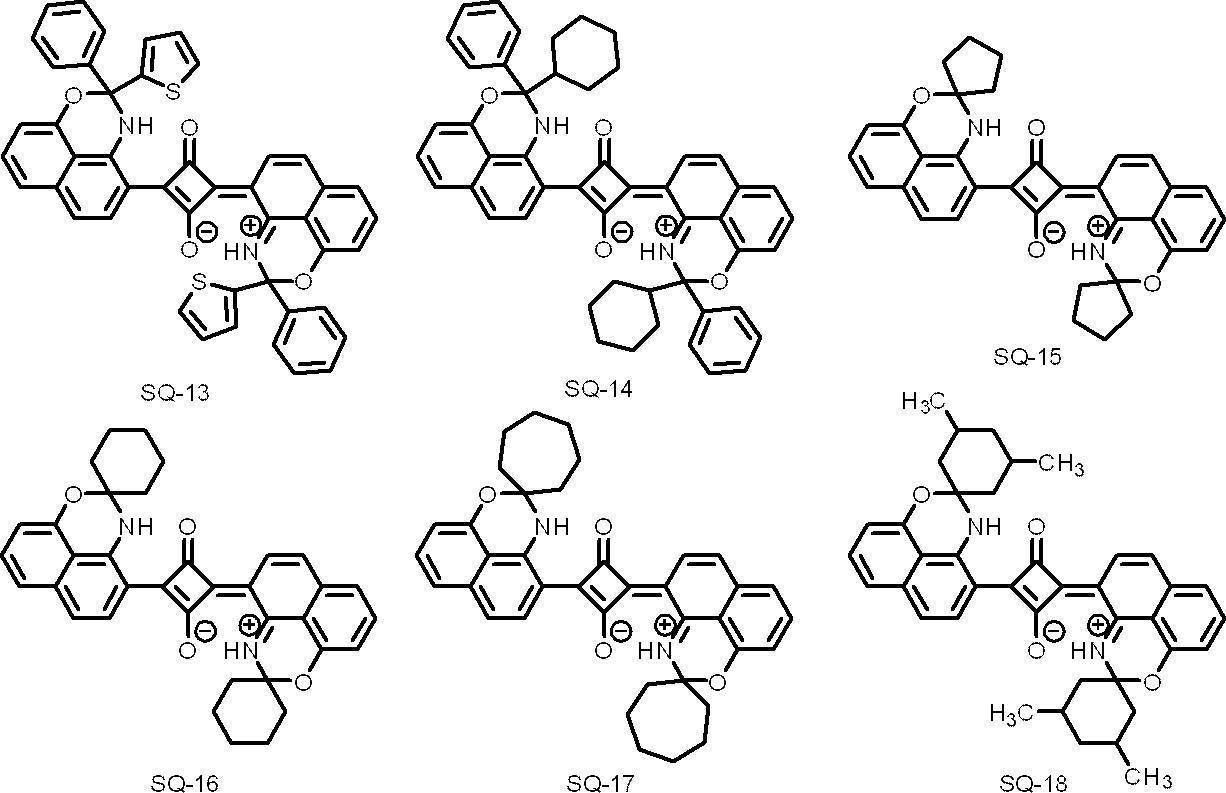


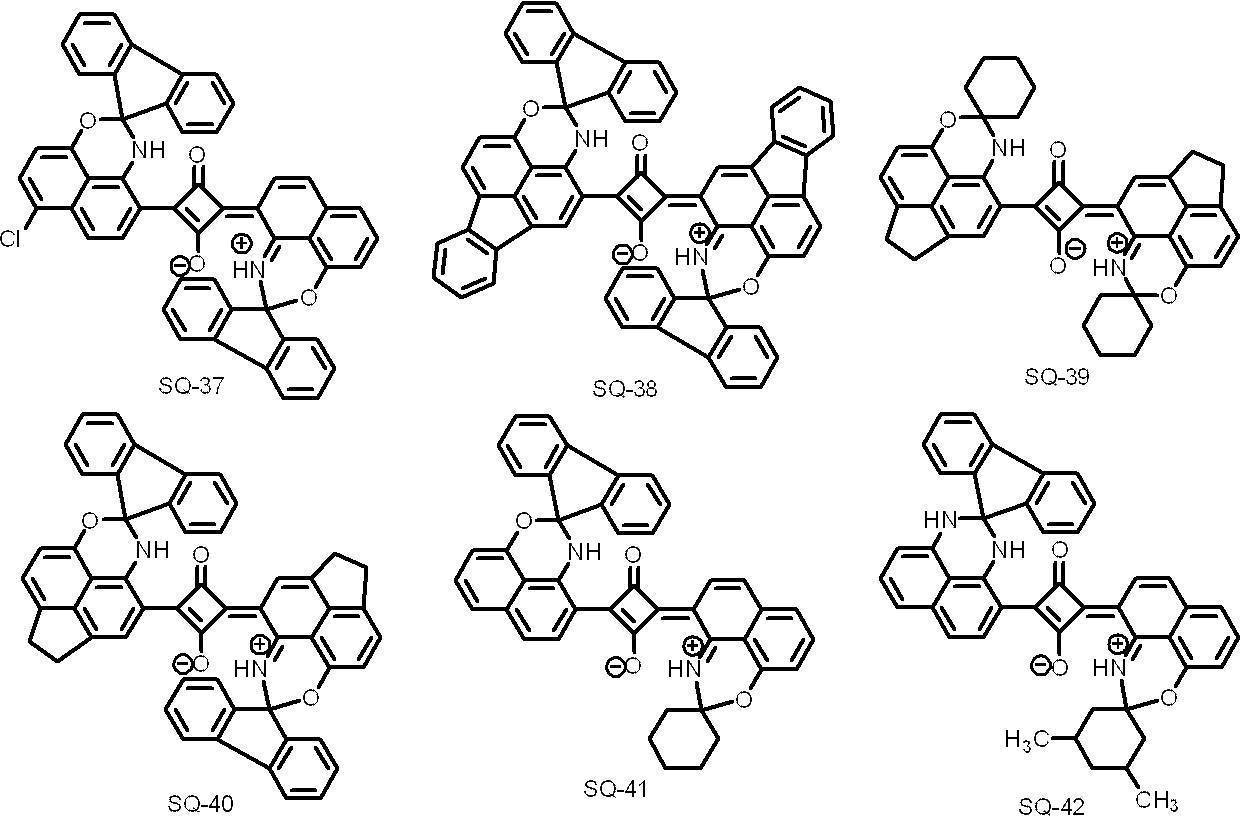
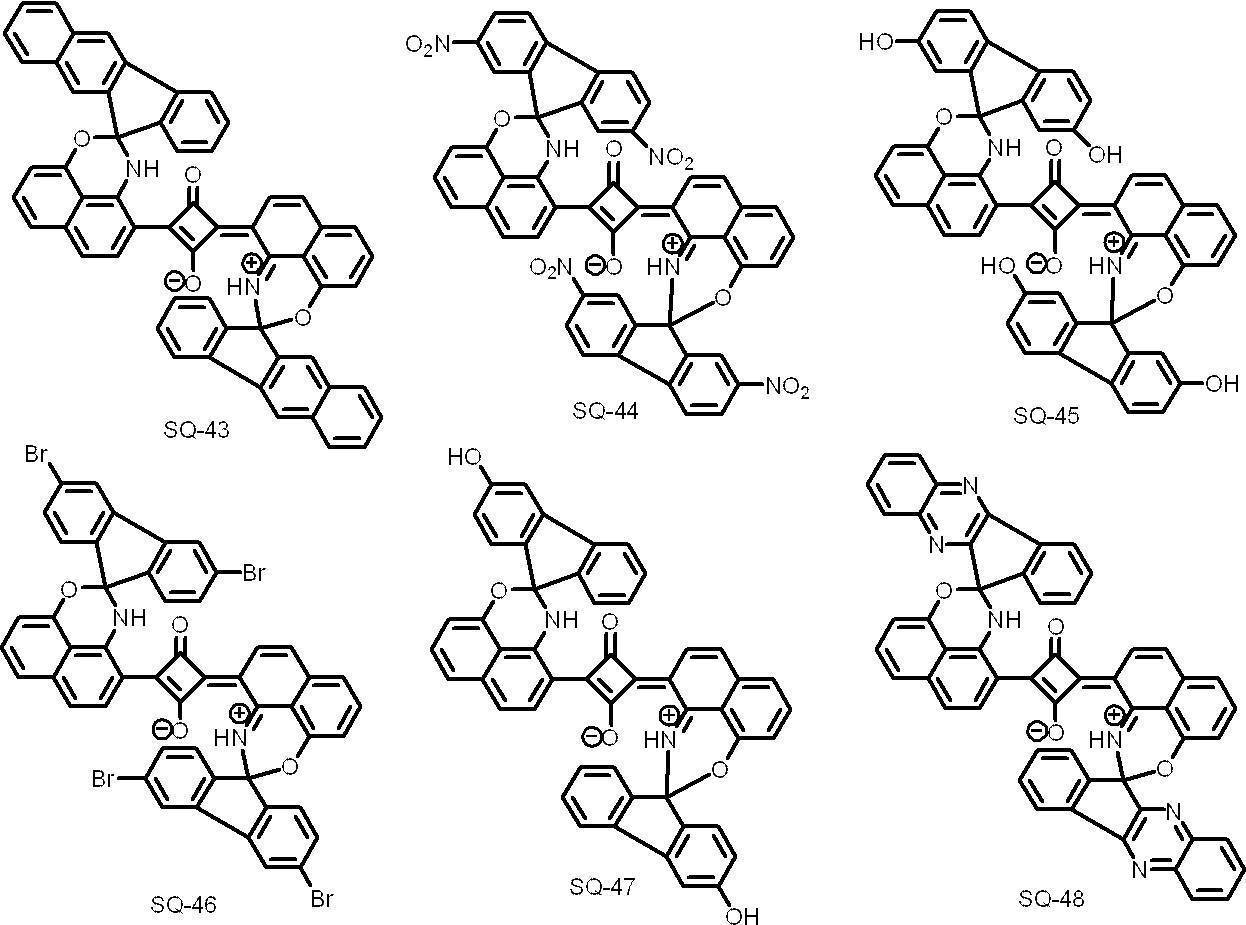

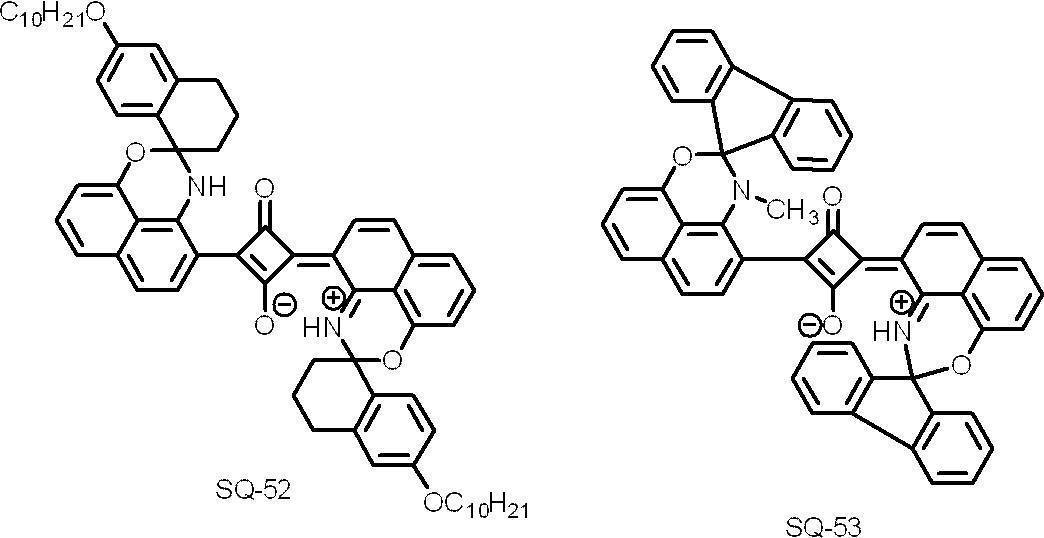
特定色素の製造方法としては、特に制限はなく、公知の製造方法を参照し適宜製造することができる。
例えば、ジアミノナフタレン化合物からアミノヒドロキシナフタレン化合物へ誘導し、アミノヒドロキシナフタレン化合物とケトン化合物とを反応させ、ナフトオキサジニン化合物とし、2モル当量のナフトオキサジニン化合物と1モル当量のスクアリン酸(四角酸)とを反応させる方法が好適に挙げられる。
例えば、ジアミノナフタレン化合物からアミノヒドロキシナフタレン化合物へ誘導し、アミノヒドロキシナフタレン化合物とケトン化合物とを反応させ、ナフトオキサジニン化合物とし、2モル当量のナフトオキサジニン化合物と1モル当量のスクアリン酸(四角酸)とを反応させる方法が好適に挙げられる。
〔結晶形の調整〕
上記式(1)で表される構造である色素の結晶形を調整する方法について説明する。
結晶形の調整は、N,N-ジメチルホルムアミド、ジメチルスルホキシド、ジメチルアセトアミド、N-メチルピロリドン、テトラヒドロフラン、1,4-ジオキサン等の有機溶剤へ接触させる方法が挙げられる。その際、粒子径の調整のために加熱又は冷却を行ってもよいし、濾別する前に別の溶媒を加えてもよい。
上記式(1)で表される構造である色素の結晶形を調整する方法について説明する。
結晶形の調整は、N,N-ジメチルホルムアミド、ジメチルスルホキシド、ジメチルアセトアミド、N-メチルピロリドン、テトラヒドロフラン、1,4-ジオキサン等の有機溶剤へ接触させる方法が挙げられる。その際、粒子径の調整のために加熱又は冷却を行ってもよいし、濾別する前に別の溶媒を加えてもよい。
<他の成分>
本開示に係る硬化性組成物は、最終的に硬化することにより硬化膜が得られる硬化性組成物である。
また、本開示に係る硬化性組成物は、例えば、パターン露光により硬化膜のパターンを形成することができる組成物であることが好ましい。すなわち、本開示に係る硬化性組成物はネガ型の組成物であることが好ましい。
本開示に係る硬化性組成物がネガ型の組成物である場合、例えば、重合開始剤と、重合性化合物と、アルカリ可溶性樹脂と、を含む態様が好ましい。
また、本開示に係る硬化性組成物がポジ型の組成物である場合、例えば、光酸発生剤と、酸基が酸分解性基で保護された基を有する構成単位を有する重合体、及び、架橋性基を有する構成単位を有する重合体、を含む態様が挙げられる。
以下、本開示に係る硬化性組成物がネガ型の組成物である態様において含まれる各成分物について記載する。
本開示に係る硬化性組成物がポジ型の組成物である態様において含まれる各成分については、国際公開第2014/003111号に記載の各成分が挙げられ、好ましい態様も同様である。
本開示に係る硬化性組成物は、最終的に硬化することにより硬化膜が得られる硬化性組成物である。
また、本開示に係る硬化性組成物は、例えば、パターン露光により硬化膜のパターンを形成することができる組成物であることが好ましい。すなわち、本開示に係る硬化性組成物はネガ型の組成物であることが好ましい。
本開示に係る硬化性組成物がネガ型の組成物である場合、例えば、重合開始剤と、重合性化合物と、アルカリ可溶性樹脂と、を含む態様が好ましい。
また、本開示に係る硬化性組成物がポジ型の組成物である場合、例えば、光酸発生剤と、酸基が酸分解性基で保護された基を有する構成単位を有する重合体、及び、架橋性基を有する構成単位を有する重合体、を含む態様が挙げられる。
以下、本開示に係る硬化性組成物がネガ型の組成物である態様において含まれる各成分物について記載する。
本開示に係る硬化性組成物がポジ型の組成物である態様において含まれる各成分については、国際公開第2014/003111号に記載の各成分が挙げられ、好ましい態様も同様である。
<硬化性化合物>
本開示に係る硬化性組成物は、硬化性化合物を含有する。
本開示に用いることができる硬化性化合物としては、重合性化合物であることが好ましく、エチレン性不飽和化合物であることがより好ましく、末端エチレン性不飽和基を有する化合物であることが特に好ましい。
このような化合物群としては、公知のものを特に限定なく用いることができる。
これらは、例えばモノマー、プレポリマー、すなわち2量体、3量体及びオリゴマー、又はそれらの混合物ならびにそれらの共重合体などの化学的形態をもつ。モノマー及びその共重合体の例としては、不飽和カルボン酸(例えば、アクリル酸、メタクリル酸、イタコン酸、クロトン酸、イソクロトン酸、マレイン酸など)や、そのエステル類、アミド類が挙げられ、好ましくは、不飽和カルボン酸と脂肪族多価アルコール化合物とのエステル、不飽和カルボン酸と脂肪族多価アミン化合物とのアミド類が用いられる。また、ヒドロキシル基やアミノ基、メルカプト基等の求核性置換基を有する不飽和カルボン酸エステル或いはアミド類と単官能若しくは多官能イソシアネート類或いはエポキシ類との付加反応物、及び単官能若しくは、多官能のカルボン酸との脱水縮合反応物等も好適に使用される。また、イソシアネート基や、エポキシ基等の親電子性置換基を有する不飽和カルボン酸エステル或いはアミド類と単官能若しくは多官能のアルコール類、アミン類、チオール類との付加反応物、更にハロゲン基や、トシルオキシ基等の脱離性置換基を有する不飽和カルボン酸エステル或いはアミド類と単官能若しくは多官能のアルコール類、アミン類、チオール類との置換反応物も好適である。また、別の例として、上記の不飽和カルボン酸の代わりに、不飽和ホスホン酸、スチレン、ビニルエーテル等に置き換えた化合物群を使用することも可能である。
本開示に係る硬化性組成物は、硬化性化合物を含有する。
本開示に用いることができる硬化性化合物としては、重合性化合物であることが好ましく、エチレン性不飽和化合物であることがより好ましく、末端エチレン性不飽和基を有する化合物であることが特に好ましい。
このような化合物群としては、公知のものを特に限定なく用いることができる。
これらは、例えばモノマー、プレポリマー、すなわち2量体、3量体及びオリゴマー、又はそれらの混合物ならびにそれらの共重合体などの化学的形態をもつ。モノマー及びその共重合体の例としては、不飽和カルボン酸(例えば、アクリル酸、メタクリル酸、イタコン酸、クロトン酸、イソクロトン酸、マレイン酸など)や、そのエステル類、アミド類が挙げられ、好ましくは、不飽和カルボン酸と脂肪族多価アルコール化合物とのエステル、不飽和カルボン酸と脂肪族多価アミン化合物とのアミド類が用いられる。また、ヒドロキシル基やアミノ基、メルカプト基等の求核性置換基を有する不飽和カルボン酸エステル或いはアミド類と単官能若しくは多官能イソシアネート類或いはエポキシ類との付加反応物、及び単官能若しくは、多官能のカルボン酸との脱水縮合反応物等も好適に使用される。また、イソシアネート基や、エポキシ基等の親電子性置換基を有する不飽和カルボン酸エステル或いはアミド類と単官能若しくは多官能のアルコール類、アミン類、チオール類との付加反応物、更にハロゲン基や、トシルオキシ基等の脱離性置換基を有する不飽和カルボン酸エステル或いはアミド類と単官能若しくは多官能のアルコール類、アミン類、チオール類との置換反応物も好適である。また、別の例として、上記の不飽和カルボン酸の代わりに、不飽和ホスホン酸、スチレン、ビニルエーテル等に置き換えた化合物群を使用することも可能である。
脂肪族多価アルコール化合物と不飽和カルボン酸とのエステルのモノマーの具体例としては、アクリル酸エステルとして、エチレングリコールジアクリレート、トリエチレングリコールジアクリレート、1,3-ブタンジオールジアクリレート、テトラメチレングリコールジアクリレート、プロピレングリコールジアクリレート、ネオペンチルグリコールジアクリレート、トリメチロールプロパントリアクリレート、トリメチロールプロパントリ(アクリロイルオキシプロピル)エーテル、トリメチロールエタントリアクリレート、ヘキサンジオールジアクリレート、1,4-シクロヘキサンジオールジアクリレート、テトラエチレングリコールジアクリレート、ペンタエリスリトールジアクリレート、ペンタエリスリトールトリアクリレート、ペンタエリスリトールテトラアクリレート、ジペンタエリスリトールジアクリレート、ジペンタエリスリトールヘキサアクリレート、ソルビトールトリアクリレート、ソルビトールテトラアクリレート、ソルビトールペンタアクリレート、ソルビトールヘキサアクリレート、トリ(アクリロイルオキシエチル)イソシアヌレート、ポリエステルアクリレートオリゴマー、イソシアヌル酸エチレンオキサイド(EO)変性トリアクリレート等がある。
メタクリル酸エステルとしては、テトラメチレングリコールジメタクリレート、トリエチレングリコールジメタクリレート、ネオペンチルグリコールジメタクリレート、トリメチロールプロパントリメタクリレート、トリメチロールエタントリメタクリレート、エチレングリコールジメタクリレート、1,3-ブタンジオールジメタクリレート、ヘキサンジオールジメタクリレート、ペンタエリスリトールジメタクリレート、ペンタエリスリトールトリメタクリレート、ペンタエリスリトールテトラメタクリレート、ジペンタエリスリトールジメタクリレート、ジペンタエリスリトールヘキサメタクリレート、ソルビトールトリメタクリレート、ソルビトールテトラメタクリレート、ビス〔p-(3-メタクリルオキシ-2-ヒドロキシプロポキシ)フェニル〕ジメチルメタン、ビス〔p-(メタクリルオキシエトキシ)フェニル〕ジメチルメタン等が挙げられる。
また、イソシアネート基とヒドロキシ基の付加反応を用いて製造されるウレタン系付加重合性化合物も好適であり、そのような具体例としては、例えば、特公昭48-41708号公報中に記載されている1分子に2個以上のイソシアネート基を有するポリイソシアネート化合物に、下記一般式(I)で示されるヒドロキシ基を含有するビニルモノマーを付加させた1分子中に2個以上の重合性ビニル基を含有するビニルウレタン化合物等が挙げられる。
CH2=C(R)COOCH2CH(R’)OH (I)
(ただし、R及びR’は、H又はCH3を示す。)
(ただし、R及びR’は、H又はCH3を示す。)
また、特開昭51-37193号、特公平2-32293号、特公平2-16765号に記載されているようなウレタンアクリレート類や、特公昭58-49860号、特公昭56-17654号、特公昭62-39417号、特公昭62-39418号記載のエチレンオキサイド系骨格を有するウレタン化合物類も好適である。更に、特開昭63-277653号、特開昭63-260909号、特開平1-105238号に記載される、分子内にアミノ構造やスルフィド構造を有する付加重合性化合物類を用いることによっては、非常に感光スピードに優れた硬化性組成物を得ることができる。
その他、重合性化合物としては、例えば、特開2007-277514号公報の段落0178~0190に記載の化合物が挙げられる。
また、重合性化合物としては、特開2015-187211号公報に記載のエポキシ化合物を用いてもよい
また、重合性化合物としては、特開2015-187211号公報に記載のエポキシ化合物を用いてもよい
硬化性化合物の硬化性組成物中における含有量としては、硬化性組成物の全固形分に対して、1質量%~90質量%であることが好ましく、5質量%~80質量%であることがより好ましく、10質量%~70質量%であることが更に好ましい。重合性化合物の含有量が上記範囲内であると、硬化性組成物の硬化性に優れる。
<重合開始剤>
本開示に係る硬化性組成物は、重合開始剤を更に含むことが好ましく、光重合開始剤を更に含むことがより好ましい。
光重合開始剤としては、重合性化合物の重合を開始する能力を有する限り、特に制限はなく、公知の光重合開始剤の中から適宜選択することができる。例えば、紫外線領域から可視領域の光線に対して感光性を有する化合物が好ましい。また、光励起された増感剤と何らかの作用を生じ、活性ラジカルを生成する化合物であってもよい。光重合開始剤は光ラジカル重合開始剤であることが好ましい。
本開示に係る硬化性組成物は、重合開始剤を更に含むことが好ましく、光重合開始剤を更に含むことがより好ましい。
光重合開始剤としては、重合性化合物の重合を開始する能力を有する限り、特に制限はなく、公知の光重合開始剤の中から適宜選択することができる。例えば、紫外線領域から可視領域の光線に対して感光性を有する化合物が好ましい。また、光励起された増感剤と何らかの作用を生じ、活性ラジカルを生成する化合物であってもよい。光重合開始剤は光ラジカル重合開始剤であることが好ましい。
光重合開始剤としては、例えば、ハロゲン化炭化水素誘導体(例えば、トリアジン骨格を有する化合物、オキサジアゾール骨格を有する化合物など)、アシルホスフィン化合物、ヘキサアリールビイミダゾール、オキシム化合物、有機過酸化物、チオ化合物、ケトン化合物、芳香族オニウム塩、α-ヒドロキシケトン化合物、α-アミノケトン化合物などが挙げられる。光重合開始剤は、露光感度の観点から、トリハロメチルトリアジン化合物、ベンジルジメチルケタール化合物、α-ヒドロキシケトン化合物、α-アミノケトン化合物、アシルホスフィン化合物、ホスフィンオキサイド化合物、メタロセン化合物、オキシム化合物、トリアリールイミダゾールダイマー、オニウム化合物、ベンゾチアゾール化合物、ベンゾフェノン化合物、アセトフェノン化合物、シクロペンタジエン-ベンゼン-鉄錯体、ハロメチルオキサジアゾール化合物及び3-アリール置換クマリン化合物が好ましく、オキシム化合物、α-ヒドロキシケトン化合物、α-アミノケトン化合物、及び、アシルホスフィン化合物から選ばれる化合物がより好ましく、オキシム化合物が更に好ましい。光重合開始剤については、特開2014-130173号公報の段落0065~0111、特開2013-29760号公報の段落0274~0306の記載を参酌でき、これらの内容は本開示に組み込まれる。
α-ヒドロキシケトン化合物の市販品としては、IRGACURE 184、DAROCUR 1173、IRGACURE 500、IRGACURE 2959、IRGACURE 127(以上、BASF社製)などが挙げられる。α-アミノケトン化合物の市販品としては、IRGACURE 907、IRGACURE 369、IRGACURE 379、及び、IRGACURE 379EG(以上、BASF社製)などが挙げられる。アシルホスフィン化合物の市販品としては、IRGACURE 819、DAROCUR TPO(以上、BASF社製)などが挙げられる。
オキシム化合物としては、例えば、特開2001-233842号公報に記載の化合物、特開2000-80068号公報に記載の化合物、特開2006-342166号公報に記載の化合物、J.C.S.Perkin II(1979年、pp.1653-1660)に記載の化合物、J.C.S.Perkin II(1979年、pp.156-162)に記載の化合物、Journal of Photopolymer Science and Technology(1995年、pp.202-232)に記載の化合物、特開2000-66385号公報に記載の化合物、特開2000-80068号公報に記載の化合物、特表2004-534797号公報に記載の化合物、特開2006-342166号公報に記載の化合物、特開2017-19766号公報に記載の化合物、特許第6065596号公報に記載の化合物、国際公開第2015/152153号に記載の化合物、国際公開第2017/051680号に記載の化合物などがあげられる。オキシム化合物の具体例としては、例えば、3-ベンゾイルオキシイミノブタン-2-オン、3-アセトキシイミノブタン-2-オン、3-プロピオニルオキシイミノブタン-2-オン、2-アセトキシイミノペンタン-3-オン、2-アセトキシイミノ-1-フェニルプロパン-1-オン、2-ベンゾイルオキシイミノ-1-フェニルプロパン-1-オン、3-(4-トルエンスルホニルオキシ)イミノブタン-2-オン、及び2-エトキシカルボニルオキシイミノ-1-フェニルプロパン-1-オンなどが挙げられる。オキシム化合物の市販品としては、IRGACURE OXE01、IRGACURE OXE02、IRGACURE OXE03、IRGACURE OXE04(以上、BASF社製)も好適に用いられる。また、TRONLY TR-PBG-304、TRONLY TR-PBG-309、TRONLY TR-PBG-305(常州強力電子新材料有限公司(CHANGZHOU TRONLY NEW ELECTRONIC MATERIALS CO.,LTD)製)、アデカアークルズNCI-930、アデカオプトマーN-1919(特開2012-14052号公報の光重合開始剤2)(以上、(株)ADEKA製)が挙げられる。
また上記以外のオキシム化合物として、カルバゾール環のN位にオキシムが連結した特表2009-519904号公報に記載の化合物、ベンゾフェノン部位にヘテロ置換基が導入された米国特許第7626957号明細書に記載の化合物、色素部位にニトロ基が導入された特開2010-15025号公報及び米国特許出願公開第2009/0292039号明細書に記載の化合物、国際公開第2009/131189号に記載のケトオキシム化合物、トリアジン骨格とオキシム骨格を同一分子内に含有する米国特許第7556910号明細書に記載の化合物、波長405nmに吸収極大を有し、g線光源に対して良好な感度を有する特開2009-221114号公報に記載の化合物などを用いてもよい。
本開示は、光重合開始剤として、フルオレン環を有するオキシム化合物を用いることもできる。フルオレン環を有するオキシム化合物の具体例としては、特開2014-137466号公報に記載の化合物が挙げられる。この内容は本開示に組み込まれる。
本開示は、光重合開始剤として、ベンゾフラン骨格を有するオキシム化合物を用いることもできる。具体例としては、国際公開第2015/036910号に記載の化合物OE-01~OE-75が挙げられる。
本開示は、光重合開始剤として、カルバゾール環の少なくとも1つのベンゼン環がナフタレン環となった骨格を有するオキシム化合物を用いることもできる。そのようなオキシム化合物の具体例としては、国際公開第2013/083505号に記載の化合物が挙げられる。
本開示は、光重合開始剤として、フッ素原子を有するオキシム化合物を用いることもできる。フッ素原子を有するオキシム化合物の具体例としては、特開2010-262028号公報に記載の化合物、特表2014-500852号公報に記載の化合物24、36~40、特開2013-164471号公報に記載の化合物(C-3)などが挙げられる。この内容は本開示に組み込まれる。
本開示は、光重合開始剤として、ニトロ基を有するオキシム化合物を用いることができる。ニトロ基を有するオキシム化合物は、二量体とすることも好ましい。ニトロ基を有するオキシム化合物の具体例としては、特開2013-114249号公報の段落0031~0047、特開2014-137466号公報の段落0008~0012、0070~0079に記載の化合物、特許第4223071号公報の段落0007~0025に記載の化合物、アデカアークルズNCI-831((株)ADEKA製)などが挙げられる。
本開示において好ましく使用されるオキシム化合物の具体例を以下に示すが、本開示はこれらに限定されるものではない。

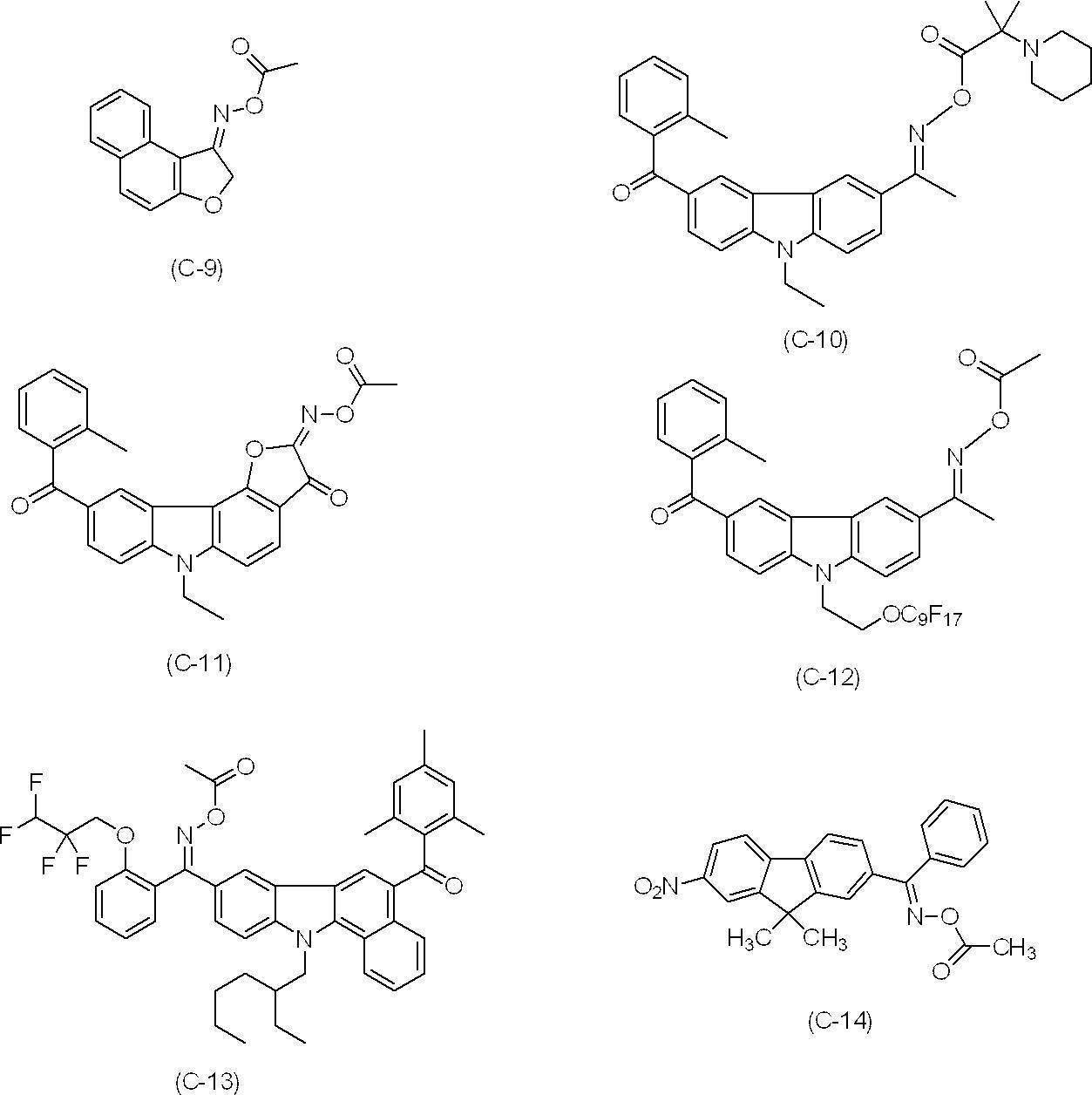
オキシム化合物は、350nm~500nmの波長領域に極大吸収波長を有する化合物が好ましく、360nm~480nmの波長領域に極大吸収波長を有する化合物がより好ましい。また、オキシム化合物は、波長365nm及び405nmの吸光度が大きい化合物が好ましい。
オキシム化合物の波長365nm又は405nmにおけるモル吸光係数は、感度の観点から、1,000~300,000であることが好ましく、2,000~300,000であることがより好ましく、5,000~200,000であることが特に好ましい。化合物のモル吸光係数は、公知の方法を用いて測定することができる。例えば、紫外可視分光光度計(Varian社製Cary-5 spectrophotometer)にて、酢酸エチル溶媒を用い、0.01g/Lの濃度で測定することが好ましい。
本開示は、光重合開始剤として、2官能あるいは3官能以上の光重合開始剤を用いてもよい。そのような光重合開始剤の具体例としては、特表2010-527339号公報、特表2011-524436号公報、国際公開第2015/004565号、特表2016-532675号公報の段落0417~0412、国際公開第2017/033680号の段落0039~0055に記載されているオキシム化合物の2量体や、特表2013-522445号公報に記載されている化合物(E)及び化合物(G)、国際公開第2016/034963号に記載されているCmpd1~7などが挙げられる。
重合開始剤は、1種単独で用いてもよいし、2種以上を併用して用いてもよい。
重合開始剤の硬化性組成物中における含有量としては、上記組成物の全固形分に対して、0.1~50質量%であることが好ましく、より好ましくは0.5~30質量%、特に好ましくは1~20質量%である。この範囲で、良好な感度とパターン形成性が得られる。
重合開始剤の硬化性組成物中における含有量としては、上記組成物の全固形分に対して、0.1~50質量%であることが好ましく、より好ましくは0.5~30質量%、特に好ましくは1~20質量%である。この範囲で、良好な感度とパターン形成性が得られる。
<アルカリ可溶性樹脂>
本開示に係る硬化性組成物は、アルカリ可溶性樹脂の少なくとも一種を含有することが好ましい。
アルカリ可溶性樹脂としては、高分子重合体であって、分子(好ましくは、アクリル系共重合体、スチレン系共重合体を主鎖とする分子)中に少なくとも1つのアルカリ可溶性を促進する基(例えば、カルボキシ基、リン酸基、スルホン酸基など)を有するアルカリ可溶性樹脂の中から適宜選択することができる。このうち、更に好ましくは、有機溶剤に可溶で弱アルカリ水溶液により現像可能なものである。
本開示に係る硬化性組成物は、アルカリ可溶性樹脂の少なくとも一種を含有することが好ましい。
アルカリ可溶性樹脂としては、高分子重合体であって、分子(好ましくは、アクリル系共重合体、スチレン系共重合体を主鎖とする分子)中に少なくとも1つのアルカリ可溶性を促進する基(例えば、カルボキシ基、リン酸基、スルホン酸基など)を有するアルカリ可溶性樹脂の中から適宜選択することができる。このうち、更に好ましくは、有機溶剤に可溶で弱アルカリ水溶液により現像可能なものである。
アルカリ可溶性樹脂の製造には、例えば公知のラジカル重合法による方法を適用することができる。ラジカル重合法でアルカリ可溶性樹脂を製造する際の温度、圧力、ラジカル開始剤の種類及びその量、溶媒の種類等々の重合条件は、当業者において容易に設定可能であり、実験的に条件を定めるようにすることもできる。
上記の高分子重合体としては、側鎖にカルボン酸を有するポリマーが好ましい。例えば、特開昭59-44615号、特公昭54-34327号、特公昭58-12577号、特公昭54-25957号、特開昭59-53836号、特開昭59-71048号の各公報に記載されているような、メタクリル酸共重合体、アクリル酸共重合体、イタコン酸共重合体、クロトン酸共重合体、マレイン酸共重合体、部分エステル化マレイン酸共重合体等、並びに側鎖にカルボン酸を有する酸性セルロース誘導体、ヒドロキシ基を有するポリマーに酸無水物を付加させたもの等が挙げられ、更に側鎖に(メタ)アクリロイル基を有する高分子重合体も好ましいものとして挙げられる。
上記の高分子重合体としては、側鎖にカルボン酸を有するポリマーが好ましい。例えば、特開昭59-44615号、特公昭54-34327号、特公昭58-12577号、特公昭54-25957号、特開昭59-53836号、特開昭59-71048号の各公報に記載されているような、メタクリル酸共重合体、アクリル酸共重合体、イタコン酸共重合体、クロトン酸共重合体、マレイン酸共重合体、部分エステル化マレイン酸共重合体等、並びに側鎖にカルボン酸を有する酸性セルロース誘導体、ヒドロキシ基を有するポリマーに酸無水物を付加させたもの等が挙げられ、更に側鎖に(メタ)アクリロイル基を有する高分子重合体も好ましいものとして挙げられる。
アルカリ可溶性樹脂として具体的には、特に(メタ)アクリル酸と、これと共重合可能な他の単量体と、の共重合体が好適である。
上記(メタ)アクリル酸と共重合可能な他の単量体としては、(メタ)アクリル酸エステル類、クロトン酸エステル類、ビニルエステル類、マレイン酸ジエステル類、フマル酸ジエステル類、イタコン酸ジエステル類、(メタ)アクリルアミド類、スチレン類、ビニルエーテル類、ビニルケトン類、オレフィン類、マレイミド類、(メタ)アクリロニトリルなどが挙げられる。
上記(メタ)アクリル酸と共重合可能な他の単量体としては、(メタ)アクリル酸エステル類、クロトン酸エステル類、ビニルエステル類、マレイン酸ジエステル類、フマル酸ジエステル類、イタコン酸ジエステル類、(メタ)アクリルアミド類、スチレン類、ビニルエーテル類、ビニルケトン類、オレフィン類、マレイミド類、(メタ)アクリロニトリルなどが挙げられる。
(メタ)アクリル酸エステル類の例としては、(メタ)アクリル酸メチル、(メタ)アクリル酸エチル、(メタ)アクリル酸n-プロピル、(メタ)アクリル酸イソプロピル、(メタ)アクリル酸n-ブチル、(メタ)アクリル酸イソブチル、(メタ)アクリル酸t-ブチル、(メタ)アクリル酸アミル、(メタ)アクリル酸n-ヘキシル、(メタ)アクリル酸シクロヘキシル、(メタ)アクリル酸t-ブチルシクロヘキシル、(メタ)アクリル酸2-エチルヘキシル、(メタ)アクリル酸t-オクチル、(メタ)アクリル酸ドデシル、(メタ)アクリル酸オクタデシル、(メタ)アクリル酸アセトキシエチル、(メタ)アクリル酸フェニル、(メタ)アクリル酸2-ヒドロキシエチル、(メタ)アクリル酸-2-ヒドロキシプロピル、(メタ)アクリル酸-3-ヒドロキシプロピル、(メタ)アクリル酸-4-ヒドロキシブチル、(メタ)アクリル酸2-メトキシエチル、(メタ)アクリル酸2-エトキシエチル、(メタ)アクリル酸2-(2-メトキシエトキシ)エチル、(メタ)アクリル酸3-フェノキシ-2-ヒドロキシプロピル、(メタ)アクリル酸-2-クロロエチル、(メタ)アクリル酸グリシジル、(メタ)アクリル酸-3,4-エポキシシクロヘキシルメチル、(メタ)アクリル酸ビニル、(メタ)アクリル酸-2-フェニルビニル、(メタ)アクリル酸-1-プロペニル、(メタ)アクリル酸アリル、(メタ)アクリル酸-2-アリロキシエチル、(メタ)アクリル酸プロパルギル、(メタ)アクリル酸ベンジル、(メタ)アクリル酸ジエチレングリコールモノメチルエーテル、(メタ)アクリル酸ジエチレングリコールモノエチルエーテル、(メタ)アクリル酸トリエチレングリコールモノメチルエーテル、(メタ)アクリル酸トリエチレングリコールモノエチルエーテル、(メタ)アクリル酸ポリエチレングリコールモノメチルエーテル、(メタ)アクリル酸ポリエチレングリコールモノエチルエーテル、(メタ)アクリル酸β-フェノキシエトキシエチル、(メタ)アクリル酸ノニルフェノキシポリエチレングリコール、(メタ)アクリル酸ジシクロペンテニル、(メタ)アクリル酸ジシクロペンテニルオキシエチル、(メタ)アクリル酸トリフルオロエチル、(メタ)アクリル酸オクタフルオロペンチル、(メタ)アクリル酸パーフルオロオクチルエチル、(メタ)アクリル酸ジシクロペンタニル、(メタ)アクリル酸トリブロモフェニル、(メタ)アクリル酸トリブロモフェニルオキシエチル、(メタ)アクリル酸-γ-ブチロラクトンなどが挙げられる。
本開示で使用しうるアルカリ可溶性樹脂の重量平均分子量としては、好ましくは5,000以上であり、更に好ましくは1万~30万の範囲であり、数平均分子量については好ましくは1,000以上であり、更に好ましくは2,000~25万の範囲である。多分散度(重量平均分子量/数平均分子量)は1.1~10の範囲が好ましく、更に好ましくは1.2~5の範囲である。
これらのアルカリ可溶性樹脂は、ランダムポリマー、ブロックポリマー、グラフトポリマー等いずれでもよい。
これらのアルカリ可溶性樹脂は、ランダムポリマー、ブロックポリマー、グラフトポリマー等いずれでもよい。
アルカリ可溶性樹脂は、重合性基を有するアルカリ可溶性樹脂であることも好ましい。重合性基としては、(メタ)アリル基、(メタ)アクリロイル基等が挙げられる。重合性基を有するアルカリ可溶性樹脂は、側鎖に重合性基を有する繰り返し単位と、側鎖に酸基を有する繰り返し単位とを含む樹脂であることが好ましい。
アルカリ可溶性樹脂は、下記式(ED1)で示される化合物及び/又は下記式(ED2)で表される化合物(以下、これらの化合物を「エーテルダイマー」と称することもある。)を含むモノマー成分に由来する構成繰り返し単位を含むことも好ましい。
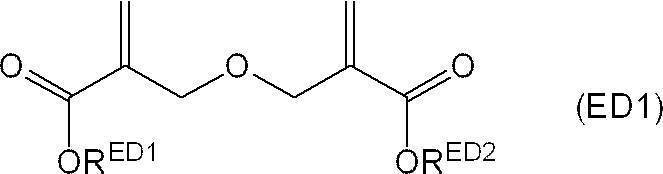
式(ED1)中、RED1又はRED2はそれぞれ独立に、水素原子又は置換基を有していてもよい炭素数1~25の炭化水素基を表す。
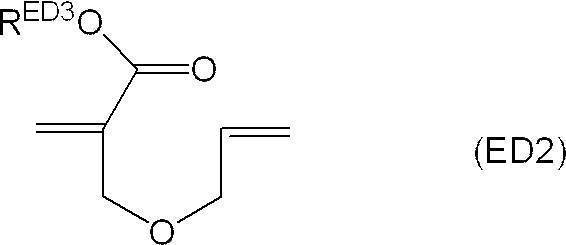
式(ED2)中、RED3は、水素原子又は炭素数1~30の有機基を表す。式(ED2)の詳細については、特開2010-168539号公報の記載を参酌でき、この内容は本明細書に組み込まれる。
エーテルダイマーの具体例としては、例えば、特開2013-029760号公報の段落0317の記載を参酌することができ、この内容は本明細書に組み込まれる。
その他、アルカリ可溶性樹脂としては、例えば、特開2007-277514号公報の段落0162~0175に記載の化合物が挙げられる。
アルカリ可溶性樹脂の硬化性組成物中における含有量としては、硬化性組成物の全固形分に対して、1質量%~20質量%が好ましく、より好ましくは2質量%~15質量%であり、特に好ましくは3質量%~12質量%である。
<有彩色着色剤>
本開示に係る硬化性組成物は、有彩色着色剤を含有することができる。本開示において、有彩色着色剤とは、白色着色剤及び黒色着色剤以外の着色剤を意味する。有彩色着色剤は、波長400nm以上650nm未満の範囲に吸収を有する着色剤が好ましい。
本開示に係る硬化性組成物は、有彩色着色剤を含有することができる。本開示において、有彩色着色剤とは、白色着色剤及び黒色着色剤以外の着色剤を意味する。有彩色着色剤は、波長400nm以上650nm未満の範囲に吸収を有する着色剤が好ましい。
有彩色着色剤としては、赤色着色剤、緑色着色剤、青色着色剤、黄色着色剤、紫色着色剤及びオレンジ色着色剤が挙げられる。有彩色着色剤は、顔料であってもよく、染料であってもよい。顔料と染料とを併用してもよい。また、顔料は、無機顔料、有機顔料のいずれでもよい。また、顔料には、無機顔料又は有機-無機顔料の一部を有機発色団で置換した材料を用いることもできる。無機顔料や有機-無機顔料を有機発色団で置換することで、色相設計をしやすくできる。
顔料の平均一次粒子径は、1nm~200nmが好ましい。下限は5nm以上がより好ましく、10nm以上が更に好ましい。上限は、180nm以下がより好ましく、150nm以下が更に好ましく、100nm以下が特に好ましい。顔料の平均一次粒子径が上記範囲であれば、樹脂組成物中における顔料の分散安定性が良好である。なお、本開示において、顔料の一次粒子径は、顔料の一次粒子を透過型電子顕微鏡により観察し、得られた画像写真から求めることができる。具体的には、顔料の一次粒子の投影面積を求め、それに対応する円相当径を顔料の一次粒子径として算出する。また、本開示における平均一次粒子径は、400個の顔料の一次粒子についての一次粒子径の算術平均値とする。また、顔料の一次粒子とは、凝集のない独立した粒子をいう。
有彩色着色剤は、顔料を含むものであることが好ましい。有彩色着色剤中における顔料の含有量は、50質量%以上であることが好ましく、70質量%以上であることがより好ましく、80質量%以上であることが更に好ましく、90質量%以上であることが特に好ましい。顔料としては以下に示すものが挙げられる。
カラーインデックス(C.I.)Pigment Yellow 1,2,3,4,5,6,10,11,12,13,14,15,16,17,18,20,24,31,32,34,35,35:1,36,36:1,37,37:1,40,42,43,53,55,60,61,62,63,65,73,74,77,81,83,86,93,94,95,97,98,100,101,104,106,108,109,110,113,114,115,116,117,118,119,120,123,125,126,127,128,129,137,138,139,147,148,150,151,152,153,154,155,156,161,162,164,166,167,168,169,170,171,172,173,174,175,176,177,179,180,181,182,185,187,188,193,194,199,213,214,215,228,231,232(メチン系),233(キノリン系)等(以上、黄色顔料)、
C.I.Pigment Orange 2,5,13,16,17:1,31,34,36,38,43,46,48,49,51,52,55,59,60,61,62,64,71,73等(以上、オレンジ色顔料)、
C.I.Pigment Red 1,2,3,4,5,6,7,9,10,14,17,22,23,31,38,41,48:1,48:2,48:3,48:4,49,49:1,49:2,52:1,52:2,53:1,57:1,60:1,63:1,66,67,81:1,81:2,81:3,83,88,90,105,112,119,122,123,144,146,149,150,155,166,168,169,170,171,172,175,176,177,178,179,184,185,187,188,190,200,202,206,207,208,209,210,216,220,224,226,242,246,254,255,264,270,272,279,294(キサンテン系、Organo Ultramarine、Bluish Red),295(アゾ系),296(アゾ系)等(以上、赤色顔料)、
C.I.Pigment Green 7,10,36,37,58,59,62,63等(以上、緑色顔料)、
C.I.Pigment Violet 1,19,23,27,32,37,42,60(トリアリールメタン系),61(キサンテン系)等(以上、紫色顔料)、
C.I.Pigment Blue 1,2,15,15:1,15:2,15:3,15:4,15:6,16,22,29,60,64,66,79,80,87(モノアゾ系),88(メチン系)等(以上、青色顔料)。
C.I.Pigment Orange 2,5,13,16,17:1,31,34,36,38,43,46,48,49,51,52,55,59,60,61,62,64,71,73等(以上、オレンジ色顔料)、
C.I.Pigment Red 1,2,3,4,5,6,7,9,10,14,17,22,23,31,38,41,48:1,48:2,48:3,48:4,49,49:1,49:2,52:1,52:2,53:1,57:1,60:1,63:1,66,67,81:1,81:2,81:3,83,88,90,105,112,119,122,123,144,146,149,150,155,166,168,169,170,171,172,175,176,177,178,179,184,185,187,188,190,200,202,206,207,208,209,210,216,220,224,226,242,246,254,255,264,270,272,279,294(キサンテン系、Organo Ultramarine、Bluish Red),295(アゾ系),296(アゾ系)等(以上、赤色顔料)、
C.I.Pigment Green 7,10,36,37,58,59,62,63等(以上、緑色顔料)、
C.I.Pigment Violet 1,19,23,27,32,37,42,60(トリアリールメタン系),61(キサンテン系)等(以上、紫色顔料)、
C.I.Pigment Blue 1,2,15,15:1,15:2,15:3,15:4,15:6,16,22,29,60,64,66,79,80,87(モノアゾ系),88(メチン系)等(以上、青色顔料)。
また、緑色顔料として、1分子中のハロゲン原子数が平均10個~14個であり、臭素原子数が平均8個~12個であり、塩素原子数が平均2個~5個であるハロゲン化亜鉛フタロシアニン顔料を用いることもできる。具体例としては、国際公開第2015/118720号に記載の化合物が挙げられる。また、緑色顔料として中国特許出願公開第106909027号明細書に記載の化合物、国際公開第2012/102395号に記載のリン酸エステルを配位子として有するフタロシアニン化合物などを用いることもできる。
また、青色顔料として、リン原子を有するアルミニウムフタロシアニン化合物を用いることもできる。具体例としては、特開2012-247591号公報の段落番号0022~0030、特開2011-157478号公報の段落番号0047に記載の化合物が挙げられる。
また、黄色顔料として、特開2008-074985号公報に記載されている顔料、特開2008-074987号公報に記載されている化合物、特開2013-061622号公報に記載されているキノフタロン化合物、特開2013-181015号公報に記載されているキノフタロン化合物、特開2014-085565号公報に記載されている着色剤、特開2016-145282号公報に記載されている顔料、特開2017-201003号公報に記載されている顔料、特開2017-197719号公報に記載されている顔料、特開2017-171912号公報の段落番号0011~0062、0137~0276に記載されている顔料、特開2017-171913号公報の段落番号0010~0062、0138~0295に記載されている顔料、特開2017-171914号公報の段落番号0011~0062、0139~0190に記載されている顔料、特開2017-171915号公報の段落番号0010~0065、0142~0222に記載されている顔料、特開2017-197640号公報に記載されているキノフタロン化合物、特開2018-040835号公報に記載されているキノフタロン系顔料、特開2018-203798号公報に記載されている顔料、特開2018-062578号公報に記載されている顔料、特開2018-155881号公報に記載されているキノフタロン系黄色顔料、特開2018-062644号公報に記載されている化合物、特許6432077号公報に記載されているキノフタロン化合物、特許第6443711号公報に記載されている顔料、を用いることもできる。
また、黄色顔料として、特開2018-062644号公報に記載の化合物を用いることもできる。この化合物は顔料誘導体としても使用可能である。
赤色顔料として、特開2017-201384号公報に記載の構造中に少なくとも1つ臭素原子が置換したジケトピロロピロール化合物、特許第6248838号の段落番号0016~0022に記載のジケトピロロピロール化合物、国際公開第2012/102399号に記載のジケトピロロピロール化合物、国際公開第2012/117965号に記載のジケトピロロピロール化合物、特開2012-229344号公報に記載のナフトールアゾ化合物などを用いることもできる。また、赤色顔料として、芳香族環に対して、酸素原子、硫黄原子又は窒素原子が結合した基が導入された芳香族環基がジケトピロロピロール骨格に結合した構造を有する化合物を用いることもできる。
本開示において、着色剤には染料を用いることもできる。染料としては特に制限はなく、公知の染料が使用できる。例えば、ピラゾールアゾ系、アニリノアゾ系、トリアリールメタン系、アントラキノン系、アントラピリドン系、ベンジリデン系、オキソノール系、ピラゾロトリアゾールアゾ系、ピリドンアゾ系、シアニン系、フェノチアジン系、ピロロピラゾールアゾメチン系、キサンテン系、フタロシアニン系、ベンゾピラン系、インジゴ系、ピロメテン系等の染料が挙げられる。また、特開2012-158649号公報に記載のチアゾール化合物、特開2011-184493号公報に記載のアゾ化合物、特開2011-145540号公報に記載のアゾ化合物も好ましく用いることができる。また、黄色染料として、特開2013-054339号公報の段落0011~0034に記載のキノフタロン化合物、特開2014-026228号公報の段落0013~0058に記載のキノフタロン化合物などを用いることもできる。
本開示に係る硬化性組成物が、有彩色着色剤を含有する場合、有彩色着色剤の含有量は、硬化性組成物の全固形分に対し、1質量%~50質量%が好ましい。本開示に係る硬化性組成物が、有彩色着色剤を2種以上含む場合、それらの合計量が上記範囲内であることが好ましい。
<近赤外線を透過させて可視光を遮光する着色剤>
本開示に係る硬化性組成物は、近赤外線(近赤外領域の波長の光)を透過させて可視光(可視領域の波長の光)を遮光する着色剤(以下、可視光を遮光する着色剤ともいう)を含有することもできる。可視光を遮光する着色剤を含む硬化性組成物は、近赤外線透過フィルタ形成用硬化性組成物として好ましく用いられる。
本開示に係る硬化性組成物は、近赤外線(近赤外領域の波長の光)を透過させて可視光(可視領域の波長の光)を遮光する着色剤(以下、可視光を遮光する着色剤ともいう)を含有することもできる。可視光を遮光する着色剤を含む硬化性組成物は、近赤外線透過フィルタ形成用硬化性組成物として好ましく用いられる。
本開示において、可視光を遮光する着色剤は、紫色から赤色の波長領域の光を吸収する着色剤であることが好ましい。また、本開示において、可視光を遮光する着色剤は、波長450nm~650nmの波長領域の光を遮光する着色剤であることが好ましい。また、可視光を遮光する着色剤は、波長900nm~1,300nmの光を透過する着色剤であることが好ましい。本開示において、可視光を遮光する着色剤は、以下の(A)及び(B)の少なくとも一方の要件を満たすことが好ましい。
(A):2種類以上の有彩色着色剤を含み、2種以上の有彩色着色剤の組み合わせで黒色を形成している。
(B):有機系黒色着色剤を含む。
(A):2種類以上の有彩色着色剤を含み、2種以上の有彩色着色剤の組み合わせで黒色を形成している。
(B):有機系黒色着色剤を含む。
有彩色着色剤としては、上述したものが挙げられる。有機系黒色着色剤としては、例えば、ビスベンゾフラノン化合物、アゾメチン化合物、ペリレン化合物、アゾ化合物などが挙げられ、ビスベンゾフラノン化合物、ペリレン化合物が好ましい。ビスベンゾフラノン化合物としては、特表2010-534726号公報、特表2012-515233号公報、特表2012-515234号公報などに記載の化合物が挙げられ、例えば、BASF社製の「Irgaphor Black」として入手可能である。ペリレン化合物としては、特開2017-226821号公報の段落0016~0020に記載の化合物、C.I.Pigment Black 31、32などが挙げられる。アゾメチン化合物としては、特開平1-170601号公報、特開平2-034664号公報などに記載の化合物が挙げられ、例えば、大日精化工業(株)製の「クロモファインブラックA1103」として入手できる。
2種以上の有彩色着色剤の組み合わせで黒色を形成する場合の、有彩色着色剤の組み合わせとしては、例えば以下が挙げられる。
(1)黄色着色剤、青色着色剤、紫色着色剤及び赤色着色剤を含有する態様。
(2)黄色着色剤、青色着色剤及び赤色着色剤を含有する態様。
(3)黄色着色剤、紫色着色剤及び赤色着色剤を含有する態様。
(4)黄色着色剤及び紫色着色剤を含有する態様。
(5)緑色着色剤、青色着色剤、紫色着色剤及び赤色着色剤を含有する態様。
(6)紫色着色剤及びオレンジ色着色剤を含有する態様。
(7)緑色着色剤、紫色着色剤及び赤色着色剤を含有する態様。
(8)緑色着色剤及び赤色着色剤を含有する態様。
(1)黄色着色剤、青色着色剤、紫色着色剤及び赤色着色剤を含有する態様。
(2)黄色着色剤、青色着色剤及び赤色着色剤を含有する態様。
(3)黄色着色剤、紫色着色剤及び赤色着色剤を含有する態様。
(4)黄色着色剤及び紫色着色剤を含有する態様。
(5)緑色着色剤、青色着色剤、紫色着色剤及び赤色着色剤を含有する態様。
(6)紫色着色剤及びオレンジ色着色剤を含有する態様。
(7)緑色着色剤、紫色着色剤及び赤色着色剤を含有する態様。
(8)緑色着色剤及び赤色着色剤を含有する態様。
各着色剤の比率(質量比)としては例えば以下の比率であることが好ましい。
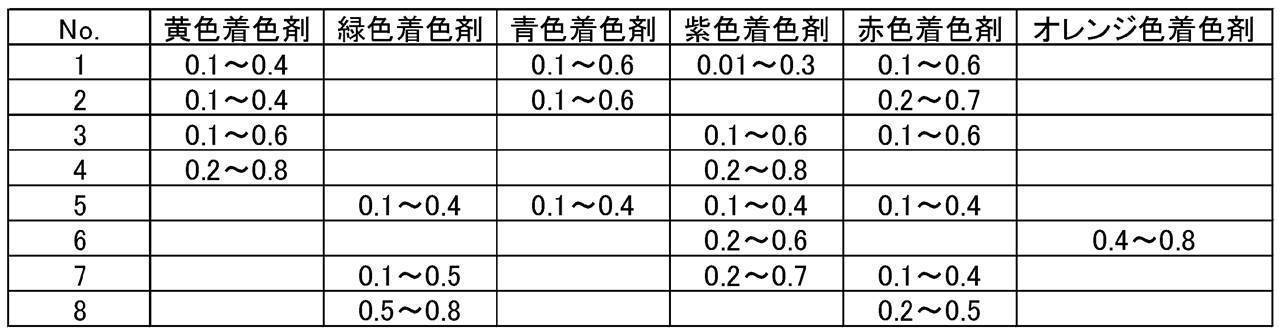
上記No.1において、黄色着色剤は0.1~0.3がより好ましく、青色着色剤は0.1~0.5がより好ましく、紫色着色剤は0.01~0.2であることがより好ましく、赤色着色剤は0.1~0.5であることがより好ましい。上記No.2において、黄色着色剤は0.1~0.3がより好ましく、青色着色剤は0.1~0.5がより好ましく、赤色着色剤は0.1~0.5であることがより好ましい。
硬化性組成物は、可視着色剤を1種のみ含んでいてもよく、2種以上含んでいてもよい。
可視着色剤の含有量は、硬化性組成物の全質量に対し、0.1質量%~70質量%であることが好ましく、0.5質量%~60質量%であることがより好ましく、1質量%~50質量%であることが更に好ましい。
可視着色剤の含有量は、硬化性組成物の全質量に対し、0.1質量%~70質量%であることが好ましく、0.5質量%~60質量%であることがより好ましく、1質量%~50質量%であることが更に好ましい。
<顔料誘導体>
本開示に係る硬化性組成物は、顔料誘導体を含有することができる。
顔料誘導体としては、色素骨格に、酸基、塩基性基及び水素結合性基よりなる群から選ばれる少なくとも1種の基が結合した化合物が挙げられる。酸基としては、スルホ基、カルボキシル基、リン酸基、ボロン酸基、スルホンイミド基、スルホンアミド基及びこれらの塩、並びにこれらの塩の脱塩構造が挙げられる。塩を構成する原子又は原子団としては、アルカリ金属イオン(Li+、Na+、K+など)、アルカリ土類金属イオン(Ca2+、Mg2+など)、アンモニウムイオン、イミダゾリウムイオン、ピリジニウムイオン、ホスホニウムイオンなどが挙げられる。また、上記塩の脱塩構造としては上記の塩から塩を形成する原子又は原子団が脱離した基が挙げられる。例えば、カルボキシル基の塩の脱塩構造は、カルボキシラート基(-COO-)である。塩基性基としては、アミノ基、ピリジニル基及びこれらの塩、並びに、これらの塩の脱塩構造が挙げられる。塩を構成する原子又は原子団としては、水酸化物イオン、ハロゲン化物イオン、カルボン酸イオン、スルホン酸イオン、フェノキシドイオンなどが挙げられる。また、上記塩の脱塩構造としては上記の塩から塩を形成する原子又は原子団が脱離した基が挙げられる。水素結合性基とは、水素原子を介して相互作用する基のことである。水素結合性基の具体例としては、アミド基、ヒドロキシ基、-NHCONHR、-NHCOOR、-OCONHRなどが挙げられる。Rはアルキル基又はアリール基であることが好ましい。
本開示に係る硬化性組成物は、顔料誘導体を含有することができる。
顔料誘導体としては、色素骨格に、酸基、塩基性基及び水素結合性基よりなる群から選ばれる少なくとも1種の基が結合した化合物が挙げられる。酸基としては、スルホ基、カルボキシル基、リン酸基、ボロン酸基、スルホンイミド基、スルホンアミド基及びこれらの塩、並びにこれらの塩の脱塩構造が挙げられる。塩を構成する原子又は原子団としては、アルカリ金属イオン(Li+、Na+、K+など)、アルカリ土類金属イオン(Ca2+、Mg2+など)、アンモニウムイオン、イミダゾリウムイオン、ピリジニウムイオン、ホスホニウムイオンなどが挙げられる。また、上記塩の脱塩構造としては上記の塩から塩を形成する原子又は原子団が脱離した基が挙げられる。例えば、カルボキシル基の塩の脱塩構造は、カルボキシラート基(-COO-)である。塩基性基としては、アミノ基、ピリジニル基及びこれらの塩、並びに、これらの塩の脱塩構造が挙げられる。塩を構成する原子又は原子団としては、水酸化物イオン、ハロゲン化物イオン、カルボン酸イオン、スルホン酸イオン、フェノキシドイオンなどが挙げられる。また、上記塩の脱塩構造としては上記の塩から塩を形成する原子又は原子団が脱離した基が挙げられる。水素結合性基とは、水素原子を介して相互作用する基のことである。水素結合性基の具体例としては、アミド基、ヒドロキシ基、-NHCONHR、-NHCOOR、-OCONHRなどが挙げられる。Rはアルキル基又はアリール基であることが好ましい。
顔料誘導体としては、式(B1)で表される化合物が挙げられる。

式(B1)中、Pは色素骨格を表し、Lは単結合又は連結基を表し、Xは酸基、塩基性基又は水素結合性基を表し、mは1以上の整数を表し、nは1以上の整数を表し、mが2以上の場合は複数のL及びXは互いに異なっていてもよく、nが2以上の場合は複数のXは互いに異なっていてもよい。
Pが表す色素骨格としては、スクアリリウム色素構造、ピロロピロール色素骨格、ジケトピロロピロール色素骨格、キナクリドン色素骨格、アントラキノン色素骨格、ジアントラキノン色素骨格、ベンゾイソインドール色素骨格、チアジンインジゴ色素骨格、アゾ色素骨格、キノフタロン色素骨格、フタロシアニン色素骨格、ナフタロシアニン色素骨格、ジオキサジン色素骨格、ペリレン色素骨格、ペリノン色素骨格、ベンゾイミダゾロン色素骨格、ベンゾチアゾール色素骨格、ベンゾイミダゾール色素骨格及びベンゾオキサゾール色素骨格よりなる群から選ばれる少なくとも1種が好ましく、スクアリリウム色素構造、ピロロピロール色素骨格、ジケトピロロピロール色素骨格、キナクリドン色素骨格及びベンゾイミダゾロン色素骨格よりなる群から選ばれる少なくとも1種がより好ましく、スクアリリウム色素構造が特に好ましい。
Lが表す連結基としては、1個~100個の炭素原子、0個~10個の窒素原子、0個~50個の酸素原子、1個~200個の水素原子、及び、0個~20個の硫黄原子からなる基が好ましく、無置換でもよく、置換基を更に有していてもよい。置換基としては、後述の置換基Tが挙げられる。
-置換基T-
置換基Tとしては、ハロゲン原子、シアノ基、ニトロ基、アルキル基、アルケニル基、アルキニル基、アリール基、ヘテロアリール基、-ORt1、-CORt1、-COORt1、-OCORt1、-NRt1Rt2、-NHCORt1、-CONRt1Rt2、-NHCONRt1Rt2、-NHCOORt1、-SRt1、-SO2Rt1、-SO2ORt1、-NHSO2Rt1又は-SO2NRt1Rt2が挙げられる。Rt1及びRt2は、それぞれ独立に、水素原子、アルキル基、アルケニル基、アルキニル基、アリール基又はヘテロアリール基を表す。Rt1とRt2が結合して環を形成してもよい。
-置換基T-
置換基Tとしては、ハロゲン原子、シアノ基、ニトロ基、アルキル基、アルケニル基、アルキニル基、アリール基、ヘテロアリール基、-ORt1、-CORt1、-COORt1、-OCORt1、-NRt1Rt2、-NHCORt1、-CONRt1Rt2、-NHCONRt1Rt2、-NHCOORt1、-SRt1、-SO2Rt1、-SO2ORt1、-NHSO2Rt1又は-SO2NRt1Rt2が挙げられる。Rt1及びRt2は、それぞれ独立に、水素原子、アルキル基、アルケニル基、アルキニル基、アリール基又はヘテロアリール基を表す。Rt1とRt2が結合して環を形成してもよい。
Xが表す酸基、塩基性基及び水素結合性基としては、上述した基が挙げられる。
近赤外線吸収色素として顔料タイプの化合物を用いる場合は、顔料誘導体は波長700nm~1,200nmの範囲に極大吸収波長を化合物であることも好ましく、波長700nm~1,100nmの範囲に極大吸収波長を有する化合物であることも好ましく、波長700nm~1,000nmの範囲に極大吸収波長を有する化合物であることも好ましい。上記波長の範囲に極大吸収波長を有する顔料誘導体は、π平面の広がりが近赤外線吸収色素と近づけやすくでき、近赤外線吸収色素の吸着性が向上し、より優れた分散安定性が得られやすい。
また、顔料誘導体は、芳香族環を含む化合物であることが好ましく、2以上の芳香族環が縮合した構造を含む化合物であることがより好ましい。
また、顔料誘導体はπ共役平面を有する化合物であることが好ましく、近赤外線吸収色素に含まれるπ共役平面と同一の構造のπ共役平面を有する化合物であることがより好ましい。
また、顔料誘導体のπ共役平面に含まれるπ電子の数は8個~100個であることが好ましい。上限は、90個以下であることが好ましく、80個以下であることがより好ましい。下限は10個以上であることが好ましく、12個以上であることがより好ましい。
また、顔料誘導体は、下記式(SQ-a)で表される部分構造を含むπ共役平面を有する化合物であることが好ましい。
また、顔料誘導体は、芳香族環を含む化合物であることが好ましく、2以上の芳香族環が縮合した構造を含む化合物であることがより好ましい。
また、顔料誘導体はπ共役平面を有する化合物であることが好ましく、近赤外線吸収色素に含まれるπ共役平面と同一の構造のπ共役平面を有する化合物であることがより好ましい。
また、顔料誘導体のπ共役平面に含まれるπ電子の数は8個~100個であることが好ましい。上限は、90個以下であることが好ましく、80個以下であることがより好ましい。下限は10個以上であることが好ましく、12個以上であることがより好ましい。
また、顔料誘導体は、下記式(SQ-a)で表される部分構造を含むπ共役平面を有する化合物であることが好ましい。
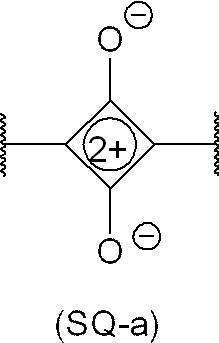
上記式中、波線部分は、他の構造との結合位置を表す。
顔料誘導体は、下記式(Syn1)で表される化合物であることも好ましい。

式(Syn1)中、Rsy1及びRsy2はそれぞれ独立に、有機基を表し、L1は単結合又はp1+1価の基を表し、A1はスルホ基、カルボキシ基、リン酸基、ボロン酸基、スルホンイミド基、スルホンアミド基、アミノ基、ピリジニル基、これらの塩又はこれらの脱塩構造から選ばれる基を表し、p1及びq1はそれぞれ独立に、1以上の整数を表す。p1が2以上の場合、複数のA1は同一であってもよく、異なっていてもよい。q1が2以上の場合、複数のL1及びA1は同一であってもよく、異なっていてもよい。
式(Syn1)のRsy1及びRsy2が表す有機基としては、アリール基、ヘテロアリール基、又は、下記式(R1)で表される基が挙げられる。

式(R1)中、X11は環構造を表し、A11はO又はNR51を表し、R46~R51は互いに独立に、水素原子又は置換基を表し、R47とR48とは、互いに結合して環を形成してもよく、*は他の構造との結合位置を表す。
式(Syn1)のL1が表すp1+1価の基としては、炭化水素基、複素環基、-O-、-S-、-CO-、-COO-、-OCO-、-SO2-、-NRL-、-NRLCO-、-CONRL-、-NRLSO2-、-SO2NRL-及びこれらの組み合わせからなる基が挙げられる。RLは水素原子、アルキル基又はアリール基を表す。炭化水素基は、脂肪族炭化水素基であってもよく、芳香族炭化水素基であってもよい。炭化水素基としては、アルキレン基、アリーレン基、又は、これらの基から水素原子を1個以上除いた基が挙げられる。アルキレン基の炭素数は、1~30が好ましく、1~15がより好ましく、1~10が更に好ましい。アルキレン基は、直鎖、分岐、環状のいずれであってもよい。また、環状のアルキレン基は、単環、多環のいずれであってもよい。アリーレン基の炭素数は、6~18が好ましく、6~14がより好ましく、6~10が更に好ましい。複素環基は、単環又は縮合数が2~4の縮合環が好ましい。複素環基の環を構成するヘテロ原子の数は、1~3が好ましい。複素環基の環を構成するヘテロ原子は、窒素原子、酸素原子又は硫黄原子が好ましい。複素環基の環を構成する炭素原子の数は、3~30が好ましく、3~18がより好ましく、3~12が更に好ましい。炭化水素基及び複素環基は置換基を有していてもよい。置換基としては、上述した置換基Tで挙げた基が挙げられる。また、RLが表すアルキル基の炭素数は1~20が好ましく、1~15がより好ましく、1~8が更に好ましい。アルキル基は、直鎖、分岐、環状のいずれでもよく、直鎖又は分岐が好ましく、直鎖がより好ましい。RLが表すアルキル基は更に置換基を有していてもよい。置換基としては上述した置換基Tが挙げられる。RLが表すアリール基の炭素数は、6~30が好ましく、6~20がより好ましく、6~12が更に好ましい。RLが表すアリール基は、更に置換基を有していてもよい。置換基としては上述した置換基Tが挙げられる。
顔料誘導体の具体例としては、下記構造の化合物、特開昭56-118462号公報、特開昭63-264674号公報、特開平1-217077号公報、特開平3-9961号公報、特開平3-26767号公報、特開平3-153780号公報、特開平3-45662号公報、特開平4-285669号公報、特開平6-145546号公報、特開平6-212088号公報、特開平6-240158号公報、特開平10-30063号公報、特開平10-195326号公報、国際公開第2011/024896号の段落0086~0098、国際公開第2012/102399号の段落0063~0094等に記載の化合物が挙げられる。
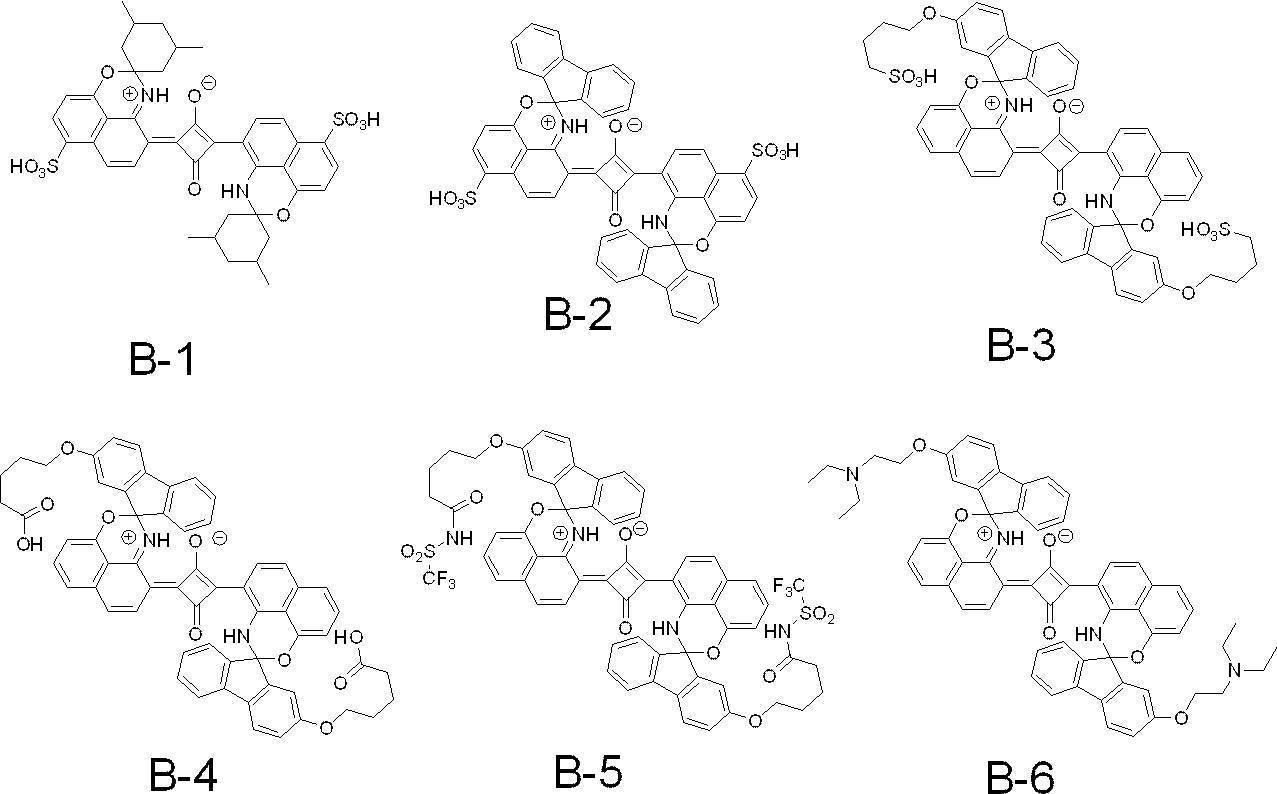
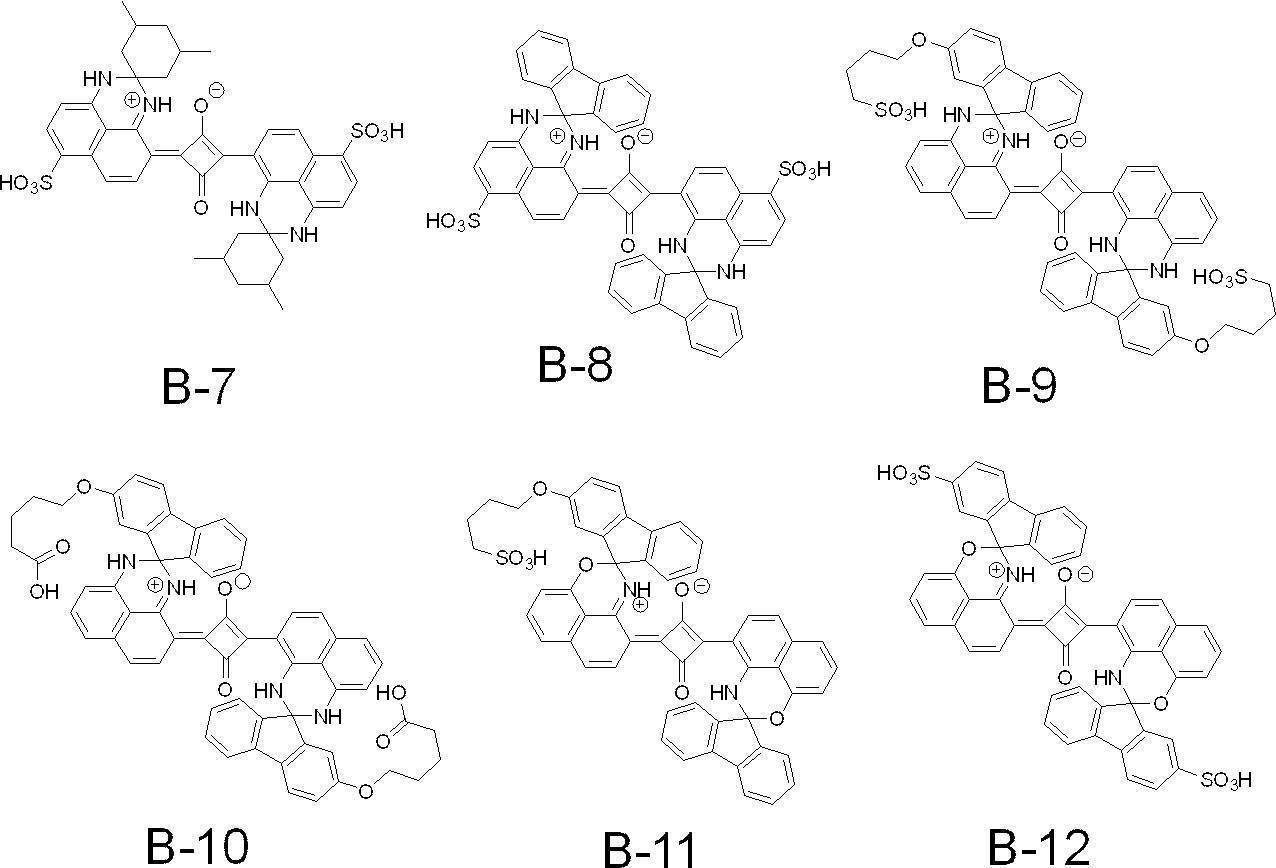
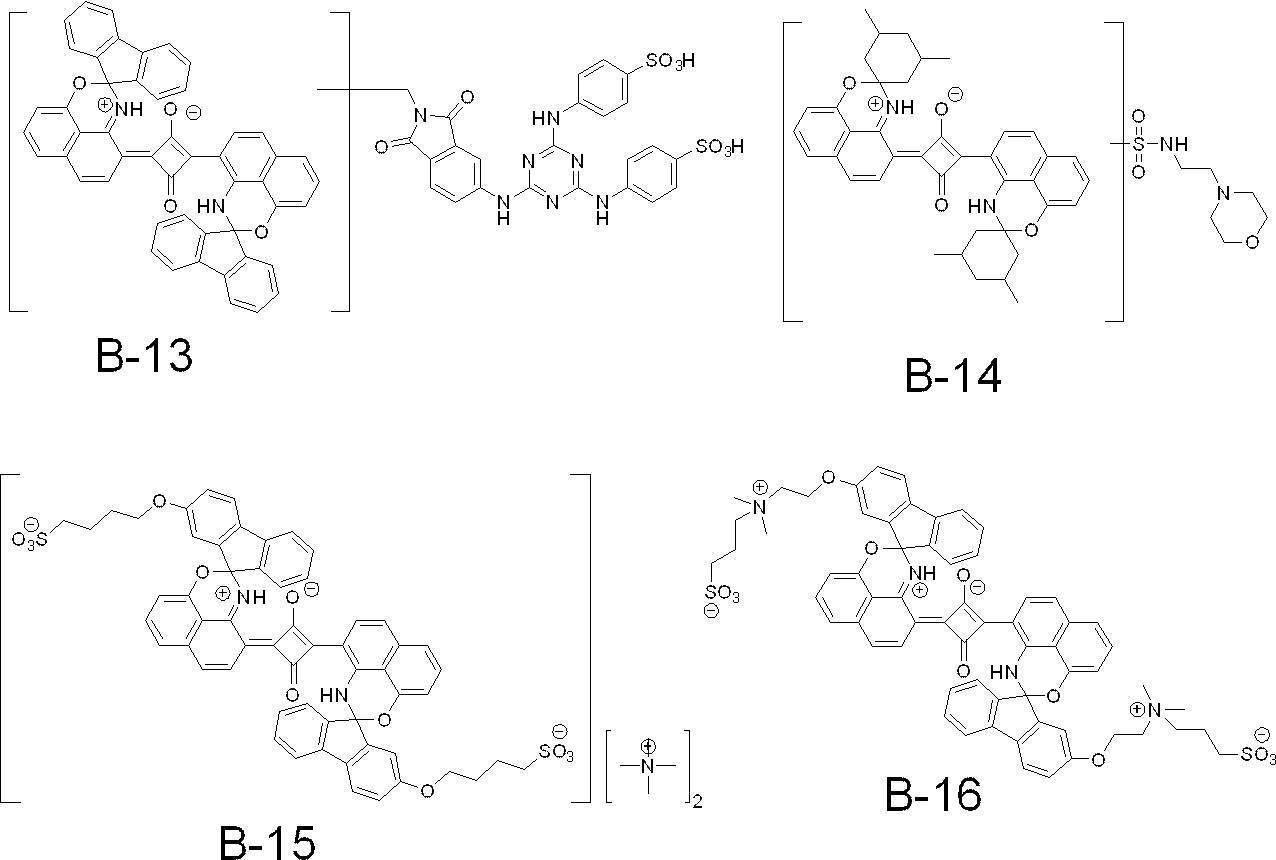

顔料誘導体は、1種のみを用いてもよいし、2種以上を併用してもよい。
硬化性組成物が顔料誘導体を含有する場合、顔料誘導体の含有量は、特定色素及び上記着色剤のうちの顔料100質量部に対し、1質量部~30質量部が好ましく、3質量部~20質量部がより好ましい。
硬化性組成物が顔料誘導体を含有する場合、顔料誘導体の含有量は、特定色素及び上記着色剤のうちの顔料100質量部に対し、1質量部~30質量部が好ましく、3質量部~20質量部がより好ましい。
<分散剤>
本開示に係る硬化性組成物は、特定色素、及び、必要に応じて添加される顔料を分散するための分散剤を含有してもよい。
分散剤としては、特に限定されず、顔料の分散剤として公知の分散剤を用いることができる。
本開示に係る硬化性組成物は、特定色素、及び、必要に応じて添加される顔料を分散するための分散剤を含有してもよい。
分散剤としては、特に限定されず、顔料の分散剤として公知の分散剤を用いることができる。
高分子分散剤は、その構造から更に直鎖状高分子、末端変性型高分子、グラフト型高分子、ブロック型高分子に分類することができる。高分子分散剤は、顔料の表面に吸着し、再凝集を防止するように作用する。そのため、顔料表面へのアンカー部位を有する末端変性型高分子、グラフト型高分子、ブロック型高分子を好ましい構造として挙げることができる。また、特開2011-070156号公報の段落0028~0124に記載の分散剤や特開2007-277514号公報に記載の分散剤も好ましく用いられる。これらの内容は本明細書に組み込まれる。また、分散剤として用いる樹脂は、コア部に複数個のポリマー鎖が結合した構造の樹脂であることも好ましい。このような樹脂としては、例えばデンドリマー(星型ポリマーを含む)が挙げられる。また、デンドリマーの具体例としては、特開2013-043962号公報の段落0196~0209に記載された高分子化合物C-1~C-31などが挙げられる。
高分子分散剤は、グラフト共重合体であることも好ましい。グラフト共重合体は、グラフト鎖によって溶剤との親和性を有するために、顔料の分散性、及び、経時後の分散安定性に優れる。グラフト共重合体の詳細は、特開2012-255128号公報の段落0025~0094の記載を参酌でき、この内容は本明細書に組み込まれる。また、グラフト共重合体としては特開2012-255128号公報の段落0072~0094に記載の樹脂が挙げられ、この内容は本明細書に組み込まれる。
また、高分子分散剤としては、エチレン性不飽和基を有する高分子分散剤を用いてもよい。エチレン性不飽和基としては、ビニル基、ビニロキシ基、アリル基、メタリル基、(メタ)アクリロイル基、ビニルフェニル基、シンナモイル基及びマレイミド基が挙げられ、反応性の観点から、(メタ)アクリロイル基、ビニルフェニル基、マレイミド基が好ましく、(メタ)アクリロイル基がより好ましく、アクリロイル基が特に好ましい。
分散剤は、酸性分散剤(酸性樹脂)又は塩基性分散剤(塩基性樹脂)であることが好ましい。ここで、酸性分散剤(酸性樹脂)とは、酸基の量が塩基性基の量よりも多い樹脂を表す。酸性分散剤(酸性樹脂)は、酸基の量と塩基性基の量の合計量を100モル%としたときに、酸基の量が70モル%以上を占める樹脂が好ましく、実質的に酸基のみからなる樹脂がより好ましい。酸性分散剤(酸性樹脂)が有する酸基は、カルボキシル基が好ましい。また、塩基性分散剤(塩基性樹脂)とは、塩基性基の量が酸基の量よりも多い樹脂を表す。塩基性分散剤(塩基性樹脂)は、酸基の量と塩基性基の量の合計量を100モル%としたときに、塩基性基の量が50モル%を超える樹脂が好ましい。
塩基性分散剤としては、第三級アミノ基と第四級アンモニウム塩基とを有する樹脂が挙げられる。第三級アミノ基と第四級アンモニウム塩基とを有する樹脂は特定色素の分散剤として好ましく用いられる。第三級アミノ基と第四級アンモニウム塩基とを有する樹脂は、第三級アミノ基を有する構成繰り返し単位と第四級アンモニウム塩基を有する構成繰り返し単位とを有する樹脂であることが好ましい。また、第三級アミノ基と第四級アンモニウム塩基とを有する樹脂は更に酸基を有する構成繰り返し単位を有していてもよい。第三級アミノ基と第四級アンモニウム塩基とを有する樹脂は、ブロック構造を有していることも好ましい。第三級アミノ基と第四級アンモニウム塩基とを有する樹脂は、そのアミン価が、10mgKOH/g~250mgKOH/g、且つ第四級アンモニウム塩価が10mgKOH/g~90mgKOH/gであるものが好ましく、アミン価が50mgKOH/g~200mgKOH/g、且つ第四級アンモニウム塩価が10mgKOH/g~50mgKOH/gであるものがより好ましい。第三級アミノ基と第四級アンモニウム塩基とを有する樹脂の重量平均分子量(Mw)は3,000~300,000であることが好ましく、5,000~30,000であることがより好ましい。第三級アミノ基と第四級アンモニウム塩基を有する樹脂は、第三級アミノ基を有するエチレン性不飽和化合物、第四級アンモニウム塩基を有するエチレン性不飽和化合物、及び必要に応じてその他エチレン性不飽和化合物を共重合して製造できる。第三級アミノ基を有するエチレン性不飽和化合物、第四級アンモニウム塩基を有するエチレン性不飽和化合物については、国際公開第2018/230486号の段落0150~0170に記載されたものが挙げられ、この内容は本明細書に組み込まれる。
また、塩基性分散剤としては、主鎖に窒素原子を含む樹脂であることも好ましい。この樹脂も分散剤として好ましく用いられる。主鎖に窒素原子を含む樹脂(以下、オリゴイミン系樹脂ともいう)は、ポリ(低級アルキレンイミン)系構成繰り返し単位、ポリアリルアミン系構成繰り返し単位、ポリジアリルアミン系構成繰り返し単位、メタキシレンジアミン-エピクロルヒドリン重縮合物系構成繰り返し単位、及びポリビニルアミン系構成繰り返し単位よりなる群から選択される少なくとも1種の窒素原子を有する構成繰り返し単位を含むことが好ましい。また、オリゴイミン系樹脂としては、pKa14以下の官能基を有する部分構造Xを有する構成繰り返し単位と、原子数40~10,000のオリゴマー鎖又はポリマー鎖Yを含む側鎖を有する構成繰り返し単位とを有する樹脂であることが好ましい。オリゴイミン系樹脂は更に酸基を有する構成繰り返し単位を有していてもよい。オリゴイミン系樹脂については、特開2012-255128号公報の段落0102~0166の記載を参酌でき、この内容は本明細書に組み込まれる。
分散剤としては市販品を用いることもできる。例えば、特開2012-137564号公報の段落0129に記載された製品を分散剤として用いることもできる。例えば、Disperbyk-111(BYKChemie社製)などが挙げられる。なお、上記分散剤として説明した樹脂は、分散剤以外の用途で使用することもできる。例えば、バインダーとして用いることもできる。
本開示において、分散剤は1種単独で使用してもよいし、2種以上を併用してもよい。
分散剤の含有量は、使用する顔料に応じて適宜調整すればよいが、特定色素及び顔料の合計含有量100質量部に対して1~200質量部が好ましい。下限は、5質量部以上が好ましく、10質量部以上がより好ましい。上限は、150質量部以下が好ましく、100質量部以下がより好ましい。
分散剤の含有量は、使用する顔料に応じて適宜調整すればよいが、特定色素及び顔料の合計含有量100質量部に対して1~200質量部が好ましい。下限は、5質量部以上が好ましく、10質量部以上がより好ましい。上限は、150質量部以下が好ましく、100質量部以下がより好ましい。
<重合禁止剤>
本開示に係る硬化性組成物は、保存安定性の観点から、重合禁止剤を含むことが好ましい。
重合禁止剤としては、特に限定されず、公知の重合禁止剤を用いることができる。
重合禁止剤としては、ハイドロキノン、p-メトキシフェノール、ジ-t-ブチル-p-クレゾール、ピロガロール、t-ブチルカテコール、ベンゾキノン、4,4’-チオビス(3-メチル-6-t-ブチルフェノール)、2,2’-メチレンビス(4-メチル-6-t-ブチルフェノール)、N-ニトロソフェニルヒドロキシアミン塩(アンモニウム塩、第一セリウム塩等)、2,2,6,6-テトラメチルピペリジン-1-オキシル等が挙げられる。なお、重合禁止剤は、酸化防止剤として機能することもある。
本開示に係る硬化性組成物は、保存安定性の観点から、重合禁止剤を含むことが好ましい。
重合禁止剤としては、特に限定されず、公知の重合禁止剤を用いることができる。
重合禁止剤としては、ハイドロキノン、p-メトキシフェノール、ジ-t-ブチル-p-クレゾール、ピロガロール、t-ブチルカテコール、ベンゾキノン、4,4’-チオビス(3-メチル-6-t-ブチルフェノール)、2,2’-メチレンビス(4-メチル-6-t-ブチルフェノール)、N-ニトロソフェニルヒドロキシアミン塩(アンモニウム塩、第一セリウム塩等)、2,2,6,6-テトラメチルピペリジン-1-オキシル等が挙げられる。なお、重合禁止剤は、酸化防止剤として機能することもある。
重合禁止剤は、1種単独で用いてもよいし、2種以上を併用して用いてもよい。
重合禁止剤の含有量は、保存安定性の観点から、硬化性組成物の全固形分に対して、0.1ppm~1,000ppmであることが好ましく、1ppm~500ppmであることがより好ましく、1ppm~100ppmであることが特に好ましい。
重合禁止剤の含有量は、保存安定性の観点から、硬化性組成物の全固形分に対して、0.1ppm~1,000ppmであることが好ましく、1ppm~500ppmであることがより好ましく、1ppm~100ppmであることが特に好ましい。
<溶剤>
本開示に係る硬化性組成物は、溶剤を含有してもよい。
溶剤としては、エステル類、例えば酢酸エチル、酢酸-n-ブチル、酢酸イソブチル、ギ酸アミル、酢酸イソアミル、酢酸イソブチル、プロピオン酸ブチル、酪酸イソプロピル、酪酸エチル、酪酸ブチル、アルキルエステル類、乳酸メチル、乳酸エチル、オキシ酢酸メチル、オキシ酢酸エチル、オキシ酢酸ブチル、メトキシ酢酸メチル、メトキシ酢酸エチル、メトキシ酢酸ブチル、エトキシ酢酸メチル、エトキシ酢酸エチル、並びに、3-オキシプロピオン酸メチル及び3-オキシプロピオン酸エチルなどの3-オキシプロピオン酸アルキルエステル類(例えば、3-メトキシプロピオン酸メチル、3-メトキシプロピオン酸エチル、3-エトキシプロピオン酸メチル、3-エトキシプロピオン酸エチル)、並びに、2-オキシプロピオン酸メチル、2-オキシプロピオン酸エチル、及び2-オキシプロピオン酸プロピルなどの2-オキシプロピオン酸アルキルエステル類(例えば、2-メトキシプロピオン酸メチル、2-メトキシプロピオン酸エチル、2-メトキシプロピオン酸プロピル、2-エトキシプロピオン酸メチル、2-エトキシプロピオン酸エチル、2-オキシ-2-メチルプロピオン酸メチル、2-オキシ-2-メチルプロピオン酸エチル、2-メトキシ-2-メチルプロピオン酸メチル、2-エトキシ-2-メチルプロピオン酸エチル)、並びに、ピルビン酸メチル、ピルビン酸エチル、ピルビン酸プロピル、アセト酢酸メチル、アセト酢酸エチル、2-オキソブタン酸メチル、2-オキソブタン酸エチル等;
本開示に係る硬化性組成物は、溶剤を含有してもよい。
溶剤としては、エステル類、例えば酢酸エチル、酢酸-n-ブチル、酢酸イソブチル、ギ酸アミル、酢酸イソアミル、酢酸イソブチル、プロピオン酸ブチル、酪酸イソプロピル、酪酸エチル、酪酸ブチル、アルキルエステル類、乳酸メチル、乳酸エチル、オキシ酢酸メチル、オキシ酢酸エチル、オキシ酢酸ブチル、メトキシ酢酸メチル、メトキシ酢酸エチル、メトキシ酢酸ブチル、エトキシ酢酸メチル、エトキシ酢酸エチル、並びに、3-オキシプロピオン酸メチル及び3-オキシプロピオン酸エチルなどの3-オキシプロピオン酸アルキルエステル類(例えば、3-メトキシプロピオン酸メチル、3-メトキシプロピオン酸エチル、3-エトキシプロピオン酸メチル、3-エトキシプロピオン酸エチル)、並びに、2-オキシプロピオン酸メチル、2-オキシプロピオン酸エチル、及び2-オキシプロピオン酸プロピルなどの2-オキシプロピオン酸アルキルエステル類(例えば、2-メトキシプロピオン酸メチル、2-メトキシプロピオン酸エチル、2-メトキシプロピオン酸プロピル、2-エトキシプロピオン酸メチル、2-エトキシプロピオン酸エチル、2-オキシ-2-メチルプロピオン酸メチル、2-オキシ-2-メチルプロピオン酸エチル、2-メトキシ-2-メチルプロピオン酸メチル、2-エトキシ-2-メチルプロピオン酸エチル)、並びに、ピルビン酸メチル、ピルビン酸エチル、ピルビン酸プロピル、アセト酢酸メチル、アセト酢酸エチル、2-オキソブタン酸メチル、2-オキソブタン酸エチル等;
エーテル類、例えばジエチレングリコールジメチルエーテル、テトラヒドロフラン、エチレングリコールモノメチルエーテル、エチレングリコールモノエチルエーテル、メチルセロソルブアセテート、エチルセロソルブアセテート、ジエチレングリコールモノメチルエーテル、ジエチレングリコールモノエチルエーテル、ジエチレングリコールモノブチルエーテル、プロピレングリコールメチルエーテルアセテート、プロピレングリコールエチルエーテルアセテート、プロピレングリコールプロピルエーテルアセテート等;ケトン類、例えばメチルエチルケトン、シクロヘキサノン、2-ヘプタノン、3-ヘプタノン等;芳香族炭化水素類、例えばトルエン、キシレン等が挙げられる。ただし、有機溶剤としての芳香族炭化水素類(ベンゼン、トルエン、キシレン、エチルベンゼン等)は、環境面等の理由により低減したほうがよい場合がある(例えば、有機溶剤の全質量に対して、50質量ppm(parts per million)以下とすることもでき、10質量ppm以下とすることもでき、1質量ppm以下とすることもできる。)。
これらのうち、3-エトキシプロピオン酸メチル、3-エトキシプロピオン酸エチル、エチルセロソルブアセテート、乳酸エチル、ジエチレングリコールジメチルエーテル、酢酸ブチル、3-メトキシプロピオン酸メチル、2-ヘプタノン、シクロヘキサノン、エチルカルビトールアセテート、ブチルカルビトールアセテート、プロピレングリコールメチルエーテルアセテート等が好適である。
溶剤は、単独で用いる以外に2種以上を組み合わせて用いてもよい。
溶剤は、単独で用いる以外に2種以上を組み合わせて用いてもよい。
本開示においては、金属含有量の少ない有機溶剤を用いることが好ましく、有機溶剤の金属含有量は、例えば10質量ppb(parts per billion)以下であることが好ましい。必要に応じて質量ppt(parts per trillion)レベルの有機溶剤を用いてもよく、そのような有機溶剤は、例えば、東洋合成工業(株)が提供している(化学工業日報、2015年11月13日)。
有機溶剤から金属等の不純物を除去する方法としては、例えば、蒸留(分子蒸留や薄膜蒸留等)やフィルタを用いたろ過を挙げることができる。ろ過に用いるフィルタのフィルタ孔径としては、10μm以下が好ましく、5μm以下がより好ましく、3μm以下が更に好ましい。フィルタの材質は、ポリテトラフルオロエチレン、ポリエチレン又はナイロンが好ましい。
有機溶剤は、異性体(原子数が同じであるが構造が異なる化合物)が含まれていてもよい。また、異性体は、1種のみが含まれていてもよいし、複数種含まれていてもよい。
有機溶剤中の過酸化物の含有率が0.8mmol/L以下であることが好ましく、過酸化物を実質的に含まないことがより好ましい。
本開示に係る硬化性組成物の全固形分は、塗布方法及び溶剤の有無により変更されるが、例えば、1質量%~100質量%であることが好ましい。下限は10質量%以上がより好ましい。
<増感剤>
本開示に係る硬化性組成物は、ラジカル開始剤のラジカル発生効率の向上、感光波長の長波長化の目的で、増感剤を含有していてもよい。本開示に用いることができる増感剤としては、上記した光重合開始剤に対し、電子移動機構又はエネルギー移動機構で増感させるものが好ましい。
本開示に係る硬化性組成物は、ラジカル開始剤のラジカル発生効率の向上、感光波長の長波長化の目的で、増感剤を含有していてもよい。本開示に用いることができる増感剤としては、上記した光重合開始剤に対し、電子移動機構又はエネルギー移動機構で増感させるものが好ましい。
本開示に用いることができる増感剤としては、以下に列挙する化合物類に属しており、且つ300nm~450nmの波長領域に吸収波長を有するものが挙げられる。
好ましい増感剤の例としては、以下の化合物類に属しており、かつ330nmから450nm域に吸収波長を有するものを挙げることができる。
例えば、多核芳香族類(例えば、フェナントレン、アントラセン、ピレン、ペリレン、トリフェニレン、9,10-ジアルコキシアントラセン)、キサンテン類(例えば、フルオレッセイン、エオシン、エリスロシン、ローダミンB、ローズベンガル)、チオキサントン類(イソプロピルチオキサントン、ジエチルチオキサントン、クロロチオキサントン)、シアニン類(例えばチアカルボシアニン、オキサカルボシアニン)、メロシアニン類(例えば、メロシアニン、カルボメロシアニン)、フタロシアニン類、チアジン類(例えば、チオニン、メチレンブルー、トルイジンブルー)、アクリジン類(例えば、アクリジンオレンジ、クロロフラビン、アクリフラビン)、アントラキノン類(例えば、アントラキノン)、スクアリウム類(例えば、スクアリウム)、アクリジンオレンジ、クマリン類(例えば、7-ジエチルアミノ-4-メチルクマリン)、ケトクマリン、フェノチアジン類、フェナジン類、スチリルベンゼン類、アゾ化合物、ジフェニルメタン、トリフェニルメタン、ジスチリルベンゼン類、カルバゾール類、ポルフィリン、スピロ化合物、キナクリドン、インジゴ、スチリル、ピリリウム化合物、ピロメテン化合物、ピラゾロトリアゾール化合物、ベンゾチアゾール化合物、バルビツール酸誘導体、チオバルビツール酸誘導体、アセトフェノン、ベンゾフェノン、ミヒラーズケトンなどの芳香族ケトン化合物、N-アリールオキサゾリジノンなどのヘテロ環化合物などが挙げられる。等が挙げられ、更に欧州特許第568,993号明細書、米国特許第4,508,811号明細書、同5,227,227号明細書、特開2001-125255号公報、特開平11-271969号公報等に記載の化合物等などが挙げられる。
好ましい増感剤の例としては、以下の化合物類に属しており、かつ330nmから450nm域に吸収波長を有するものを挙げることができる。
例えば、多核芳香族類(例えば、フェナントレン、アントラセン、ピレン、ペリレン、トリフェニレン、9,10-ジアルコキシアントラセン)、キサンテン類(例えば、フルオレッセイン、エオシン、エリスロシン、ローダミンB、ローズベンガル)、チオキサントン類(イソプロピルチオキサントン、ジエチルチオキサントン、クロロチオキサントン)、シアニン類(例えばチアカルボシアニン、オキサカルボシアニン)、メロシアニン類(例えば、メロシアニン、カルボメロシアニン)、フタロシアニン類、チアジン類(例えば、チオニン、メチレンブルー、トルイジンブルー)、アクリジン類(例えば、アクリジンオレンジ、クロロフラビン、アクリフラビン)、アントラキノン類(例えば、アントラキノン)、スクアリウム類(例えば、スクアリウム)、アクリジンオレンジ、クマリン類(例えば、7-ジエチルアミノ-4-メチルクマリン)、ケトクマリン、フェノチアジン類、フェナジン類、スチリルベンゼン類、アゾ化合物、ジフェニルメタン、トリフェニルメタン、ジスチリルベンゼン類、カルバゾール類、ポルフィリン、スピロ化合物、キナクリドン、インジゴ、スチリル、ピリリウム化合物、ピロメテン化合物、ピラゾロトリアゾール化合物、ベンゾチアゾール化合物、バルビツール酸誘導体、チオバルビツール酸誘導体、アセトフェノン、ベンゾフェノン、ミヒラーズケトンなどの芳香族ケトン化合物、N-アリールオキサゾリジノンなどのヘテロ環化合物などが挙げられる。等が挙げられ、更に欧州特許第568,993号明細書、米国特許第4,508,811号明細書、同5,227,227号明細書、特開2001-125255号公報、特開平11-271969号公報等に記載の化合物等などが挙げられる。
増感剤は、1種単独で用いてもよいし、2種以上を併用してもよい。
本開示に係る硬化性組成物中における増感剤の含有量は、深部への光吸収効率と開始分解効率の観点から、硬化性組成物の全固形分に対し、0.1~20質量%であることが好ましく、0.5~15質量%がより好ましい。
本開示に係る硬化性組成物中における増感剤の含有量は、深部への光吸収効率と開始分解効率の観点から、硬化性組成物の全固形分に対し、0.1~20質量%であることが好ましく、0.5~15質量%がより好ましい。
<共増感剤>
本開示に係る硬化性組成物は、共増感剤を含有してもよい。共増感剤は、増感色素や開始剤の活性放射線に対する感度を一層向上させる、あるいは酸素による重合性化合物の重合阻害を抑制する等の作用を有する。
本開示に係る硬化性組成物は、共増感剤を含有してもよい。共増感剤は、増感色素や開始剤の活性放射線に対する感度を一層向上させる、あるいは酸素による重合性化合物の重合阻害を抑制する等の作用を有する。
その他、共増感剤としては、例えば、特開2007-277514号公報の段落0233~0241に記載の化合物が挙げられる。
これら共増感剤の含有量は、重合成長速度と連鎖移動のバランスによる硬化速度の向上の観点から、硬化性組成物の全固形分の質量に対し、0.1質量%~30質量%の範囲が好ましく、0.5質量%~25質量%の範囲がより好ましく、1質量%~20質量%の範囲が更に好ましい。
<その他成分>
本開示に係る硬化性組成物には、必要に応じて、フッ素系有機化合物、熱重合防止剤、光重合開始剤、その他充填剤、アルカリ可溶性樹脂及び分散剤以外の高分子化合物、界面活性剤、密着促進剤、酸化防止剤、紫外線吸収剤、凝集防止剤などの各種添加物を含有することができる。
本開示に係る硬化性組成物には、必要に応じて、フッ素系有機化合物、熱重合防止剤、光重合開始剤、その他充填剤、アルカリ可溶性樹脂及び分散剤以外の高分子化合物、界面活性剤、密着促進剤、酸化防止剤、紫外線吸収剤、凝集防止剤などの各種添加物を含有することができる。
その他成分としては、例えば、特開2007-277514号公報の段落0238~0249に記載の化合物が挙げられる。
<硬化性組成物の調製>
本開示に係る硬化性組成物は、上述した各成分を混合することによって調製することができる。また、異物の除去や欠陥の低減などの目的で、フィルタでろ過することが好ましい。フィルタとしては、従来からろ過用途等に用いられているものであれば特に限定されることなく用いることができる。例えば、ポリテトラフルオロエチレン(PTFE)等のフッ素樹脂、ナイロン(例えばナイロン-6、ナイロン-6,6)等のポリアミド系樹脂、ポリエチレン、ポリプロピレン(PP)等のポリオレフィン樹脂(高密度、超高分子量を含む)等を用いたフィルタが挙げられる。これら素材の中でもポリプロピレン(高密度ポリプロピレンを含む)又はナイロンが好ましい。
フィルタの孔径は、0.01μm~7.0μmが好ましく、0.01μm~3.0μmがより好ましく、0.05μm~0.5μmが更に好ましい。この範囲とすることにより、後工程において均一及び平滑な組成物の調製を阻害する、微細な異物を確実に除去することが可能となる。また、ファイバ状のろ材を用いることも好ましく、ろ材としては例えばポリプロピレンファイバ、ナイロンファイバ、グラスファイバ等が挙げられ、具体的にはロキテクノ社製のSBPタイプシリーズ(SBP008など)、TPRタイプシリーズ(TPR002、TPR005など)、SHPXタイプシリーズ(SHPX003など)のフィルタカートリッジを用いることができる。
フィルタを使用する際、異なるフィルタを組み合わせてもよい。その際、第1のフィルタでのろ過は、1回のみでもよいし、2回以上行ってもよい。
また、上述した範囲内で異なる孔径の第1のフィルタを組み合わせてもよい。ここでの孔径は、フィルタメーカーの公称値を参照することができる。市販のフィルタとしては、例えば、日本ポール(株)(DFA4201NXEYなど)、アドバンテック東洋(株)、日本インテグリス(株)又は(株)キッツマイクロフィルタ等が提供する各種フィルタの中から選択することができる。
本開示に係る硬化性組成物は、上述した各成分を混合することによって調製することができる。また、異物の除去や欠陥の低減などの目的で、フィルタでろ過することが好ましい。フィルタとしては、従来からろ過用途等に用いられているものであれば特に限定されることなく用いることができる。例えば、ポリテトラフルオロエチレン(PTFE)等のフッ素樹脂、ナイロン(例えばナイロン-6、ナイロン-6,6)等のポリアミド系樹脂、ポリエチレン、ポリプロピレン(PP)等のポリオレフィン樹脂(高密度、超高分子量を含む)等を用いたフィルタが挙げられる。これら素材の中でもポリプロピレン(高密度ポリプロピレンを含む)又はナイロンが好ましい。
フィルタの孔径は、0.01μm~7.0μmが好ましく、0.01μm~3.0μmがより好ましく、0.05μm~0.5μmが更に好ましい。この範囲とすることにより、後工程において均一及び平滑な組成物の調製を阻害する、微細な異物を確実に除去することが可能となる。また、ファイバ状のろ材を用いることも好ましく、ろ材としては例えばポリプロピレンファイバ、ナイロンファイバ、グラスファイバ等が挙げられ、具体的にはロキテクノ社製のSBPタイプシリーズ(SBP008など)、TPRタイプシリーズ(TPR002、TPR005など)、SHPXタイプシリーズ(SHPX003など)のフィルタカートリッジを用いることができる。
フィルタを使用する際、異なるフィルタを組み合わせてもよい。その際、第1のフィルタでのろ過は、1回のみでもよいし、2回以上行ってもよい。
また、上述した範囲内で異なる孔径の第1のフィルタを組み合わせてもよい。ここでの孔径は、フィルタメーカーの公称値を参照することができる。市販のフィルタとしては、例えば、日本ポール(株)(DFA4201NXEYなど)、アドバンテック東洋(株)、日本インテグリス(株)又は(株)キッツマイクロフィルタ等が提供する各種フィルタの中から選択することができる。
<硬化性組成物の用途>
本開示に係る硬化性組成物は、液状とすることができるため、例えば、本開示に係る硬化性組成物を基材などに付与し、乾燥させることにより膜を容易に製造できる。
本開示に係る硬化性組成物の粘度は、塗布により膜を形成する場合は、塗布性の観点から、1mPa・s~100mPa・sであることが好ましい。下限は、2mPa・s以上がより好ましく、3mPa・s以上が更に好ましい。上限は、50mPa・s以下がより好ましく、30mPa・s以下が更に好ましく、15mPa・s以下が特に好ましい。
本開示に係る硬化性組成物は、液状とすることができるため、例えば、本開示に係る硬化性組成物を基材などに付与し、乾燥させることにより膜を容易に製造できる。
本開示に係る硬化性組成物の粘度は、塗布により膜を形成する場合は、塗布性の観点から、1mPa・s~100mPa・sであることが好ましい。下限は、2mPa・s以上がより好ましく、3mPa・s以上が更に好ましい。上限は、50mPa・s以下がより好ましく、30mPa・s以下が更に好ましく、15mPa・s以下が特に好ましい。
本開示に係る硬化性組成物の用途は、特に限定されない。例えば、赤外線カットフィルタなどの形成に好ましく用いることができる。例えば、固体撮像素子の受光側における赤外線カットフィルタ(例えば、ウエハーレベルレンズに対する赤外線カットフィルタ用など)、固体撮像素子の裏面側(受光側とは反対側)における赤外線カットフィルタなどに好ましく用いることができる。特に、固体撮像素子の受光側における赤外線カットフィルタとして好ましく用いることができる。また、本開示に係る硬化性組成物に対し、更に、可視光を遮光する着色剤を含有させることで、特定の波長以上の赤外線を透過可能な赤外線透過フィルタを形成することもできる。例えば、波長400nm~850nmまでを遮光し、波長850nm以上の赤外線を透過可能な赤外線透過フィルタを形成することもできる。
また、本開示に係る硬化性組成物は、収納容器に保管されることが好ましい。
収納容器として、原材料や組成物中への不純物の混入防止を目的に、容器内壁を6種6層の樹脂で構成する多層ボトルや6種の樹脂を7層構造にしたボトルを使用することも好ましい。これらの容器としては、例えば、特開2015-123351号公報に記載の容器が挙げられる。
収納容器として、原材料や組成物中への不純物の混入防止を目的に、容器内壁を6種6層の樹脂で構成する多層ボトルや6種の樹脂を7層構造にしたボトルを使用することも好ましい。これらの容器としては、例えば、特開2015-123351号公報に記載の容器が挙げられる。
(膜)
本開示に係る膜は、本開示に係る硬化性組成物からなる又は上記硬化性組成物を硬化してなる膜である。また、組成物が溶剤を含む場合には、乾燥を行ってもよい。本開示に係る膜は、赤外線カットフィルタとして好ましく用いることができる。また、熱線遮蔽フィルタや赤外線透過フィルタとして用いることもできる。本開示に係る膜は、支持体上に積層して用いてもよく、支持体から剥離して用いてもよい。本開示に係る膜は、パターンを有していてもよく、パターンを有さない膜(平坦膜)であってもよい。
本開示における「乾燥」は、溶剤を少なくとも一部除去すればよく、溶剤を完全に除去する必要はなく、所望に応じて、溶剤の除去量を設定することができる。
また、上記硬化は、膜の硬さが向上していればよいが、重合による硬化が好ましい。
本開示に係る膜は、本開示に係る硬化性組成物からなる又は上記硬化性組成物を硬化してなる膜である。また、組成物が溶剤を含む場合には、乾燥を行ってもよい。本開示に係る膜は、赤外線カットフィルタとして好ましく用いることができる。また、熱線遮蔽フィルタや赤外線透過フィルタとして用いることもできる。本開示に係る膜は、支持体上に積層して用いてもよく、支持体から剥離して用いてもよい。本開示に係る膜は、パターンを有していてもよく、パターンを有さない膜(平坦膜)であってもよい。
本開示における「乾燥」は、溶剤を少なくとも一部除去すればよく、溶剤を完全に除去する必要はなく、所望に応じて、溶剤の除去量を設定することができる。
また、上記硬化は、膜の硬さが向上していればよいが、重合による硬化が好ましい。
本開示に係る膜の厚さは、目的に応じて適宜調整できる。膜の厚さは20μm以下が好ましく、10μm以下がより好ましく、5μm以下が更に好ましい。膜の厚さの下限は0.1μm以上が好ましく、0.2μm以上がより好ましく、0.3μm以上が更に好ましい。
本開示に係る膜は、波長650nm~1,500nmの範囲に極大吸収波長を有することが好ましく、波長680nm~1,100nmの範囲に極大吸収波長を有することがより好ましく、波長700nm~850nmの範囲に極大吸収波長を有することが更に好ましい。
本開示に係る膜を赤外線カットフィルタとして用いる場合は、本開示に係る膜は以下の(1)~(4)のうちの少なくとも1つの条件を満たすことが好ましく、(1)~(4)の全ての条件を満たすことが更に好ましい。
(1)波長400nmでの透過率は70%以上が好ましく、80%以上がより好ましく、85%以上が更に好ましく、90%以上が特に好ましい。
(2)波長500nmでの透過率は70%以上が好ましく、80%以上がより好ましく、90%以上が更に好ましく、95%以上が特に好ましい。
(3)波長600nmでの透過率は70%以上が好ましく、80%以上がより好ましく、90%以上が更に好ましく、95%以上が特に好ましい。
(4)波長650nmでの透過率は70%以上が好ましく、80%以上がより好ましく、90%以上が更に好ましく、95%以上が特に好ましい。
(1)波長400nmでの透過率は70%以上が好ましく、80%以上がより好ましく、85%以上が更に好ましく、90%以上が特に好ましい。
(2)波長500nmでの透過率は70%以上が好ましく、80%以上がより好ましく、90%以上が更に好ましく、95%以上が特に好ましい。
(3)波長600nmでの透過率は70%以上が好ましく、80%以上がより好ましく、90%以上が更に好ましく、95%以上が特に好ましい。
(4)波長650nmでの透過率は70%以上が好ましく、80%以上がより好ましく、90%以上が更に好ましく、95%以上が特に好ましい。
本開示に係る膜は、有彩色着色剤を含むカラーフィルタと組み合わせて用いることもできる。カラーフィルタは、有彩色着色剤を含む着色硬化性組成物を用いて製造できる。有彩色着色剤としては、本開示に係る硬化性組成物の欄で説明した有彩色着色剤が挙げられる。着色組成物は、樹脂、重合性化合物、重合開始剤、界面活性剤、溶剤、重合禁止剤、紫外線吸収剤などを更に含有することができる。これらの詳細については、上述した材料が挙げられ、これらを用いることができる。
本開示に係る膜とカラーフィルタとを組み合わせて用いる場合、本開示に係る膜の光路上にカラーフィルタが配置されていることが好ましい。例えば、本開示に係る膜とカラーフィルタとを積層して積層体として用いることができる。積層体においては、本開示に係る膜とカラーフィルタとは、両者が厚み方向で隣接していてもよく、隣接していなくてもよい。本開示に係る膜とカラーフィルタとが厚み方向で隣接していない場合は、カラーフィルタが形成された支持体とは別の支持体に、本開示に係る膜が形成されていてもよく、本開示に係る膜とカラーフィルタとの間に、固体撮像素子を構成する他の部材(例えば、マイクロレンズ、平坦化層など)が介在していてもよい。
なお、本開示において、赤外線カットフィルタとは、可視領域の波長の光(可視光)を透過させ、近赤外領域の波長の光(赤外線)の少なくとも一部を遮光するフィルタを意味する。赤外線カットフィルタは、可視領域の波長の光をすべて透過するものであってもよく、可視領域の波長の光のうち、特定の波長領域の光を通過させ、特定の波長領域の光を遮光するものであってもよい。また、本開示において、カラーフィルタとは、可視領域の波長の光のうち、特定の波長領域の光を通過させ、特定の波長領域の光を遮光するフィルタを意味する。また、本開示において、赤外線透過フィルタとは、可視光を遮光し、赤外線の少なくとも一部を透過させるフィルタを意味する。
本開示に係る膜は、CCD(電荷結合素子)やCMOS(相補型金属酸化膜半導体)などの固体撮像素子や、赤外線センサ、画像表示装置などの各種装置に用いることができる。
<膜の製造方法>
次に、本開示に係る膜の製造方法について説明する。本開示に係る膜は、本開示に係る硬化性組成物を塗布する工程を経て製造できる。
次に、本開示に係る膜の製造方法について説明する。本開示に係る膜は、本開示に係る硬化性組成物を塗布する工程を経て製造できる。
本開示に係る膜の製造方法において、組成物は支持体上に塗布することが好ましい。支持体としては、例えば、シリコン、無アルカリガラス、ソーダガラス、パイレックス(登録商標)ガラス、石英ガラスなどの材質で構成された基板が挙げられる。これらの基板には、有機膜や無機膜など形成されていてもよい。有機膜の材料としては、例えば上述した樹脂が挙げられる。また、支持体としては、上述した樹脂で構成された基板を用いることもできる。また、支持体には、電荷結合素子(CCD)、相補型金属酸化膜半導体(CMOS)、透明導電膜などが形成されていてもよい。また、支持体には、各画素を隔離するブラックマトリクスが形成されている場合もある。また、支持体には、必要により、上部の層との密着性改良、物質の拡散防止或いは基板表面の平坦化のために下塗り層を設けてもよい。また、支持体としてガラス基板を用いる場合においては、ガラス基板上に無機膜を形成したり、ガラス基板を脱アルカリ処理して用いることが好ましい。この態様によれば、より異物の発生が抑制された膜を製造し易い。
組成物の塗布方法としては、公知の方法を用いることができる。例えば、滴下法(ドロップキャスト);スリットコート法;スプレー法;ロールコート法;回転塗布法(スピンコーティング);流延塗布法;スリットアンドスピン法;プリウェット法(たとえば、特開2009-145395号公報に記載されている方法);インクジェット(例えばオンデマンド方式、ピエゾ方式、サーマル方式)、ノズルジェット等の吐出系印刷、フレキソ印刷、スクリーン印刷、グラビア印刷、反転オフセット印刷、メタルマスク印刷法などの各種印刷法;金型等を用いた転写法;ナノインプリント法などが挙げられる。インクジェットでの適用方法としては、特に限定されず、例えば「広がる・使えるインクジェット-特許に見る無限の可能性-、2005年2月発行、住ベテクノリサーチ」に示された方法(特に115ページ~133ページ)や、特開2003-262716号公報、特開2003-185831号公報、特開2003-261827号公報、特開2012-126830号公報、特開2006-169325号公報などに記載の方法が挙げられる。
組成物を塗布して形成した組成物層は、乾燥(プリベーク)してもよい。低温プロセスによりパターンを形成する場合は、プリベークを行わなくてもよい。プリベークを行う場合、プリベーク温度は、150℃以下が好ましく、120℃以下がより好ましく、110℃以下が更に好ましい。下限は、例えば、50℃以上とすることが好ましく、80℃以上とすることがより好ましい。プリベーク温度を150℃以下で行うことにより、例えば、イメージセンサの光電変換膜を有機素材で構成した場合において、これらの特性をより効果的に維持することができる。
プリベーク時間は、10秒~3,000秒が好ましく、40秒~2,500秒がより好ましく、80秒~220秒が更に好ましい。乾燥は、ホットプレート、オーブン等で行うことができる。
プリベーク時間は、10秒~3,000秒が好ましく、40秒~2,500秒がより好ましく、80秒~220秒が更に好ましい。乾燥は、ホットプレート、オーブン等で行うことができる。
本開示に係る膜の製造方法においては、更にパターンを形成する工程を含んでいてもよい。パターン形成方法としては、フォトリソグラフィ法を用いたパターン形成方法や、ドライエッチング法を用いたパターン形成方法が挙げられる。なお、本開示に係る膜を平坦膜として用いる場合には、パターンを形成する工程を行わなくてもよい。以下、パターンを形成する工程について詳細に説明する。
-フォトリソグラフィ法でパターン形成する場合-
フォトリソグラフィ法でのパターン形成方法は、本開示に係る硬化性組成物を塗布して形成した組成物層に対しパターン状に露光する工程(露光工程)と、未露光部の組成物層を現像除去してパターンを形成する工程(現像工程)と、を含むことが好ましい。必要に応じて、現像されたパターンをベークする工程(ポストベーク工程)を設けてもよい。以下、各工程について説明する。
フォトリソグラフィ法でのパターン形成方法は、本開示に係る硬化性組成物を塗布して形成した組成物層に対しパターン状に露光する工程(露光工程)と、未露光部の組成物層を現像除去してパターンを形成する工程(現像工程)と、を含むことが好ましい。必要に応じて、現像されたパターンをベークする工程(ポストベーク工程)を設けてもよい。以下、各工程について説明する。
<<露光工程>>
露光工程では組成物層をパターン状に露光する。例えば、組成物層に対し、ステッパー等の露光装置を用いて、所定のマスクパターンを有するマスクを介して露光することで、組成物層をパターン露光することができる。これにより、露光部分を硬化することができる。露光に際して用いることができる放射線(光)としては、g線、i線等の紫外線が好ましく、i線がより好ましい。照射量(露光量)は、例えば、0.03J/cm2~2.5J/cm2が好ましく、0.05J/cm2~1.0J/cm2がより好ましく、0.08J/cm2~0.5J/cm2が特に好ましい。露光時における酸素濃度については適宜選択することができ、大気下で行う他に、例えば酸素濃度が19体積%以下の低酸素雰囲気下(例えば、15体積%、5体積%、実質的に無酸素)で露光してもよく、酸素濃度が21体積%を超える高酸素雰囲気下(例えば、22体積%、30体積%、50体積%)で露光してもよい。また、露光照度は適宜設定することが可能であり、好ましくは1,000W/m2~100,000W/m2(例えば、5,000W/m2、15,000W/m2、35,000W/m2)の範囲から選択することができる。酸素濃度と露光照度は適宜条件を組み合わせてよく、例えば、酸素濃度10体積%で照度10,000W/m2、酸素濃度35体積%で照度20,000W/m2などとすることができる。
露光工程では組成物層をパターン状に露光する。例えば、組成物層に対し、ステッパー等の露光装置を用いて、所定のマスクパターンを有するマスクを介して露光することで、組成物層をパターン露光することができる。これにより、露光部分を硬化することができる。露光に際して用いることができる放射線(光)としては、g線、i線等の紫外線が好ましく、i線がより好ましい。照射量(露光量)は、例えば、0.03J/cm2~2.5J/cm2が好ましく、0.05J/cm2~1.0J/cm2がより好ましく、0.08J/cm2~0.5J/cm2が特に好ましい。露光時における酸素濃度については適宜選択することができ、大気下で行う他に、例えば酸素濃度が19体積%以下の低酸素雰囲気下(例えば、15体積%、5体積%、実質的に無酸素)で露光してもよく、酸素濃度が21体積%を超える高酸素雰囲気下(例えば、22体積%、30体積%、50体積%)で露光してもよい。また、露光照度は適宜設定することが可能であり、好ましくは1,000W/m2~100,000W/m2(例えば、5,000W/m2、15,000W/m2、35,000W/m2)の範囲から選択することができる。酸素濃度と露光照度は適宜条件を組み合わせてよく、例えば、酸素濃度10体積%で照度10,000W/m2、酸素濃度35体積%で照度20,000W/m2などとすることができる。
<<現像工程>>
次に、露光後の組成物層における未露光部の組成物層を現像除去してパターンを形成する。未露光部の組成物層の現像除去は、現像液を用いて行うことができる。これにより、露光工程における未露光部の組成物層が現像液に溶出し、光硬化した部分だけが支持体上に残る。現像液としては、下地の固体撮像素子や回路などにダメージを与えない、アルカリ現像液が望ましい。現像液の温度は、例えば、20℃~30℃が好ましい。現像時間は、20秒~180秒が好ましい。また、残渣除去性を向上するため、現像液を60秒ごとに振り切り、更に新たに現像液を供給する工程を数回繰り返してもよい。
次に、露光後の組成物層における未露光部の組成物層を現像除去してパターンを形成する。未露光部の組成物層の現像除去は、現像液を用いて行うことができる。これにより、露光工程における未露光部の組成物層が現像液に溶出し、光硬化した部分だけが支持体上に残る。現像液としては、下地の固体撮像素子や回路などにダメージを与えない、アルカリ現像液が望ましい。現像液の温度は、例えば、20℃~30℃が好ましい。現像時間は、20秒~180秒が好ましい。また、残渣除去性を向上するため、現像液を60秒ごとに振り切り、更に新たに現像液を供給する工程を数回繰り返してもよい。
現像液に用いるアルカリ剤としては、例えば、アンモニア水、エチルアミン、ジエチルアミン、ジメチルエタノールアミン、ジグリコールアミン、ジエタノールアミン、ヒドロキシアミン、エチレンジアミン、テトラメチルアンモニウムヒドロキシド、テトラエチルアンモニウムヒドロキシド、テトラプロピルアンモニウムヒドロキシド、テトラブチルアンモニウムヒドロキシド、ベンジルトリメチルアンモニウムヒドロキシド、ジメチルビス(2-ヒドロキシエチル)アンモニウムヒドロキシド、コリン、ピロール、ピペリジン、1,8-ジアザビシクロ[5.4.0]-7-ウンデセンなどの有機アルカリ性化合物や、水酸化ナトリウム、水酸化カリウム、炭酸ナトリウム、炭酸水素ナトリウム、ケイ酸ナトリウム、メタケイ酸ナトリウムなどの無機アルカリ性化合物が挙げられる。現像液は、これらのアルカリ剤を純水で希釈したアルカリ性水溶液が好ましく使用される。アルカリ性水溶液のアルカリ剤の濃度は、0.001質量%~10質量%が好ましく、0.01質量%~1質量%がより好ましい。また、現像液には、界面活性剤を用いてもよい。界面活性剤の例としては、上述した組成物で説明した界面活性剤が挙げられ、ノニオン系界面活性剤が好ましい。現像液は、移送や保管の便宜などの観点より、一旦濃縮液として製造し、使用時に必要な濃度に希釈してもよい。希釈倍率は特に限定されないが、例えば1.5バイ~100倍の範囲に設定することができる。なお、このようなアルカリ性水溶液からなる現像液を使用した場合には、現像後純水で洗浄(リンス)することが好ましい。
現像後、乾燥を施した後に加熱処理(ポストベーク)を行うこともできる。ポストベークは、膜の硬化を完全なものとするための現像後の加熱処理である。ポストベークを行う場合、ポストベーク温度は、例えば100℃~240℃が好ましい。膜硬化の観点から、200℃~230℃がより好ましい。また、発光光源として有機エレクトロルミネッセンス(有機EL)素子を用いた場合や、イメージセンサの光電変換膜を有機素材で構成した場合は、ポストベーク温度は、150℃以下が好ましく、120℃以下がより好ましく、100℃以下が更に好ましく、90℃以下が特に好ましい。下限は、例えば、50℃以上とすることができる。ポストベークは、現像後の膜に対して、上記条件になるようにホットプレートやコンベクションオーブン(熱風循環式乾燥機)、高周波加熱機等の加熱手段を用いて、連続式あるいはバッチ式で行うことができる。また、低温プロセスによりパターンを形成する場合は、ポストベークは行わなくてもよく、再度露光する工程(後露光工程)を追加してもよい。
-ドライエッチング法でパターン形成する場合-
ドライエッチング法でのパターン形成は、組成物を支持体上などに塗布して形成した組成物層を硬化して硬化物層を形成し、次いで、この硬化物層上にパターニングされたフォトレジスト層を形成し、次いで、パターニングされたフォトレジスト層をマスクとして硬化物層に対してエッチングガスを用いてドライエッチングするなどの方法で行うことができる。フォトレジスト層の形成においては、更にプリベーク処理を施すことが好ましい。特に、フォトレジストの形成プロセスとしては、露光後の加熱処理、現像後の加熱処理(ポストベーク処理)を実施する形態が望ましい。ドライエッチング法でのパターン形成については、特開2013-64993号公報の段落0010~0067の記載を参酌でき、この内容は本明細書に組み込まれる。
ドライエッチング法でのパターン形成は、組成物を支持体上などに塗布して形成した組成物層を硬化して硬化物層を形成し、次いで、この硬化物層上にパターニングされたフォトレジスト層を形成し、次いで、パターニングされたフォトレジスト層をマスクとして硬化物層に対してエッチングガスを用いてドライエッチングするなどの方法で行うことができる。フォトレジスト層の形成においては、更にプリベーク処理を施すことが好ましい。特に、フォトレジストの形成プロセスとしては、露光後の加熱処理、現像後の加熱処理(ポストベーク処理)を実施する形態が望ましい。ドライエッチング法でのパターン形成については、特開2013-64993号公報の段落0010~0067の記載を参酌でき、この内容は本明細書に組み込まれる。
(光学フィルタ、及び、積層体)
本開示に係る光学フィルタは、本開示に係る膜を有する。
本開示に係る光学フィルタは、赤外線カットフィルタ及び赤外線透過フィルタよりなる群から選ばれた少なくとも1種の光学フィルタとして好ましく用いることができ、赤外線カットフィルタとしてより好ましく用いることができる。
また、本開示に係る膜と、赤、緑、青、マゼンタ、黄、シアン、黒及び無色よりなる群から選ばれる画素とを有する態様も本開示に係る光学フィルタの好ましい態様である。
また、本開示に係る積層体は、本開示に係る膜と、有彩色着色剤を含むカラーフィルタとを有する積層体である。
本開示に係る光学フィルタは、本開示に係る膜を有する。
本開示に係る光学フィルタは、赤外線カットフィルタ及び赤外線透過フィルタよりなる群から選ばれた少なくとも1種の光学フィルタとして好ましく用いることができ、赤外線カットフィルタとしてより好ましく用いることができる。
また、本開示に係る膜と、赤、緑、青、マゼンタ、黄、シアン、黒及び無色よりなる群から選ばれる画素とを有する態様も本開示に係る光学フィルタの好ましい態様である。
また、本開示に係る積層体は、本開示に係る膜と、有彩色着色剤を含むカラーフィルタとを有する積層体である。
本開示に係る赤外線カットフィルタは、本開示に係る膜を有する。
なお、本開示に係る赤外線カットフィルタは、赤外線領域の一部の波長の赤外線のみをカットするフィルタであっても、赤外線領域の全体をカットするフィルタであってもよい。赤外線領域の一部の波長の赤外線のみをカットするフィルタとしては、例えば、近赤外線カットフィルタが挙げられる。なお、近赤外線としては、波長750nm~2,500nmの赤外線が挙げられる。
また、本開示に係る赤外線カットフィルタは、波長750nm~1,000nmの範囲の赤外線をカットするフィルタであることが好ましく、波長750nm~1,200nmの範囲の赤外線をカットするフィルタであることがより好ましく、波長750nm~1,500nmの赤外線をカットするフィルタであることが更に好ましい。
本開示に係る赤外線カットフィルタは、上記膜の他に、更に、銅を含有する層、誘電体多層膜、紫外線吸収層などを有していてもよい。本開示に係る赤外線カットフィルタが、更に、銅を含有する層、又は、誘電体多層膜を少なくとも有することで、視野角が広く、赤外線遮蔽性に優れた赤外線カットフィルタが得られ易い。また、本開示に係る赤外線カットフィルタが、更に、紫外線吸収層を有することで、紫外線遮蔽性に優れた赤外線カットフィルタとすることができる。紫外線吸収層としては、例えば、国際公開第2015/099060号の段落0040~0070及び0119~0145に記載の吸収層を参酌でき、この内容は本明細書に組み込まれる。誘電体多層膜としては、特開2014-41318号公報の段落0255~0259の記載を参酌でき、この内容は本明細書に組み込まれる。銅を含有する層としては、銅を含有するガラスで構成されたガラス基材(銅含有ガラス基材)や、銅錯体を含む層(銅錯体含有層)を用いることもできる。銅含有ガラス基材としては、銅を含有する燐酸塩ガラス、銅を含有する弗燐酸塩ガラスなどが挙げられる。銅含有ガラスの市販品としては、NF-50(AGCテクノグラス(株)製)、BG-60、BG-61(以上、ショット社製)、CD5000(HOYA(株)製)等が挙げられる。
なお、本開示に係る赤外線カットフィルタは、赤外線領域の一部の波長の赤外線のみをカットするフィルタであっても、赤外線領域の全体をカットするフィルタであってもよい。赤外線領域の一部の波長の赤外線のみをカットするフィルタとしては、例えば、近赤外線カットフィルタが挙げられる。なお、近赤外線としては、波長750nm~2,500nmの赤外線が挙げられる。
また、本開示に係る赤外線カットフィルタは、波長750nm~1,000nmの範囲の赤外線をカットするフィルタであることが好ましく、波長750nm~1,200nmの範囲の赤外線をカットするフィルタであることがより好ましく、波長750nm~1,500nmの赤外線をカットするフィルタであることが更に好ましい。
本開示に係る赤外線カットフィルタは、上記膜の他に、更に、銅を含有する層、誘電体多層膜、紫外線吸収層などを有していてもよい。本開示に係る赤外線カットフィルタが、更に、銅を含有する層、又は、誘電体多層膜を少なくとも有することで、視野角が広く、赤外線遮蔽性に優れた赤外線カットフィルタが得られ易い。また、本開示に係る赤外線カットフィルタが、更に、紫外線吸収層を有することで、紫外線遮蔽性に優れた赤外線カットフィルタとすることができる。紫外線吸収層としては、例えば、国際公開第2015/099060号の段落0040~0070及び0119~0145に記載の吸収層を参酌でき、この内容は本明細書に組み込まれる。誘電体多層膜としては、特開2014-41318号公報の段落0255~0259の記載を参酌でき、この内容は本明細書に組み込まれる。銅を含有する層としては、銅を含有するガラスで構成されたガラス基材(銅含有ガラス基材)や、銅錯体を含む層(銅錯体含有層)を用いることもできる。銅含有ガラス基材としては、銅を含有する燐酸塩ガラス、銅を含有する弗燐酸塩ガラスなどが挙げられる。銅含有ガラスの市販品としては、NF-50(AGCテクノグラス(株)製)、BG-60、BG-61(以上、ショット社製)、CD5000(HOYA(株)製)等が挙げられる。
本開示に係る赤外線カットフィルタは、CCD(電荷結合素子)やCMOS(相補型金属酸化膜半導体)などの固体撮像素子や、赤外線センサ、画像表示装置などの各種装置に用いることができる。
本開示に係る赤外線カットフィルタは、本開示に係る硬化性組成物を用いて得られる膜の画素(パターン)と、赤、緑、青、マゼンタ、黄、シアン、黒及び無色よりなる群から選ばれる少なくとも1種の画素(パターン)とを有する態様も好ましい態様である。
本開示に係る光学フィルタの製造方法としては、特に制限はないが、本開示に係る硬化性組成物を支持体上に適用して組成物層を形成する工程と、上記組成物層をパターン状に露光する工程と、未露光部を現像除去してパターンを形成する工程と、を含む方法であることが好ましい。
また、本開示に係る光学フィルタの製造方法としては、本開示に係る硬化性組成物を支持体上に適用して組成物層を形成し、硬化して層を形成する工程、上記層上にフォトレジスト層を形成する工程、露光及び現像することにより上記フォトレジスト層をパターニングしてレジストパターンを得る工程、並びに、上記レジストパターンをエッチングマスクとして上記層をドライエッチングする工程を含む方法であることも好ましい。
本開示に係る光学フィルタの製造方法における各工程としては、本開示に係る膜の製造方法における各工程を参照することができる。
また、本開示に係る光学フィルタの製造方法としては、本開示に係る硬化性組成物を支持体上に適用して組成物層を形成し、硬化して層を形成する工程、上記層上にフォトレジスト層を形成する工程、露光及び現像することにより上記フォトレジスト層をパターニングしてレジストパターンを得る工程、並びに、上記レジストパターンをエッチングマスクとして上記層をドライエッチングする工程を含む方法であることも好ましい。
本開示に係る光学フィルタの製造方法における各工程としては、本開示に係る膜の製造方法における各工程を参照することができる。
(固体撮像素子)
本開示に係る固体撮像素子は、本開示に係る膜を有する。固体撮像素子の構成としては、本開示に係る膜を有する構成であり、固体撮像素子として機能する構成であれば特に限定はない。例えば、以下のような構成が挙げられる。
本開示に係る固体撮像素子は、本開示に係る膜を有する。固体撮像素子の構成としては、本開示に係る膜を有する構成であり、固体撮像素子として機能する構成であれば特に限定はない。例えば、以下のような構成が挙げられる。
支持体上に、固体撮像素子の受光エリアを構成する複数のフォトダイオード及びポリシリコン等からなる転送電極を有し、フォトダイオード及び転送電極上にフォトダイオードの受光部のみ開口したタングステン等からなる遮光膜を有し、遮光膜上に遮光膜全面及びフォトダイオード受光部を覆うように形成された窒化シリコン等からなるデバイス保護膜を有し、デバイス保護膜上に、本開示に係る膜を有する構成である。更に、デバイス保護膜上であって、本開示に係る膜の下(支持体に近い側)に集光手段(例えば、マイクロレンズ等。以下同じ)を有する構成や、本開示に係る膜上に集光手段を有する構成等であってもよい。また、固体撮像素子に用いられるカラーフィルタは、隔壁により例えば格子状に仕切られた空間に、各画素を形成する膜が埋め込まれた構造を有していてもよい。この場合の隔壁は各画素よりも低屈折率であることが好ましい。このような構造を有する撮像装置の例としては、特開2012-227478号公報、特開2014-179577号公報に記載の装置が挙げられる。
(画像表示装置)
本開示に係る画像表示装置は、本開示に係る膜を有する。画像表示装置としては、液晶表示装置や有機エレクトロルミネッセンス(有機EL)表示装置などが挙げられる。画像表示装置の定義や詳細については、例えば「電子ディスプレイデバイス(佐々木 昭夫著、(株)工業調査会 1990年発行)」、「ディスプレイデバイス(伊吹 順章著、産業図書(株)平成元年発行)」などに記載されている。また、液晶表示装置については、例えば「次世代液晶ディスプレイ技術(内田 龍男編集、(株)工業調査会 1994年発行)」に記載されている。本開示に適用できる液晶表示装置に特に制限はなく、例えば、上記の「次世代液晶ディスプレイ技術」に記載されている色々な方式の液晶表示装置に適用できる。画像表示装置は、白色有機EL素子を有するものであってもよい。白色有機EL素子としては、タンデム構造であることが好ましい。有機EL素子のタンデム構造については、特開2003-45676号公報、三上明義監修、「有機EL技術開発の最前線-高輝度・高精度・長寿命化・ノウハウ集-」、技術情報協会、326-328ページ、2008年などに記載されている。有機EL素子が発光する白色光のスペクトルは、青色領域(430nm-485nm)、緑色領域(530nm-580nm)及び黄色領域(580nm-620nm)に強い極大発光ピークを有するものが好ましい。これらの発光ピークに加え更に赤色領域(650nm-700nm)に極大発光ピークを有するものがより好ましい。
本開示に係る画像表示装置は、本開示に係る膜を有する。画像表示装置としては、液晶表示装置や有機エレクトロルミネッセンス(有機EL)表示装置などが挙げられる。画像表示装置の定義や詳細については、例えば「電子ディスプレイデバイス(佐々木 昭夫著、(株)工業調査会 1990年発行)」、「ディスプレイデバイス(伊吹 順章著、産業図書(株)平成元年発行)」などに記載されている。また、液晶表示装置については、例えば「次世代液晶ディスプレイ技術(内田 龍男編集、(株)工業調査会 1994年発行)」に記載されている。本開示に適用できる液晶表示装置に特に制限はなく、例えば、上記の「次世代液晶ディスプレイ技術」に記載されている色々な方式の液晶表示装置に適用できる。画像表示装置は、白色有機EL素子を有するものであってもよい。白色有機EL素子としては、タンデム構造であることが好ましい。有機EL素子のタンデム構造については、特開2003-45676号公報、三上明義監修、「有機EL技術開発の最前線-高輝度・高精度・長寿命化・ノウハウ集-」、技術情報協会、326-328ページ、2008年などに記載されている。有機EL素子が発光する白色光のスペクトルは、青色領域(430nm-485nm)、緑色領域(530nm-580nm)及び黄色領域(580nm-620nm)に強い極大発光ピークを有するものが好ましい。これらの発光ピークに加え更に赤色領域(650nm-700nm)に極大発光ピークを有するものがより好ましい。
(赤外線センサ)
本開示に係る赤外線センサは、本開示に係る膜を有する。赤外線センサの構成としては、赤外線センサとして機能する構成であれば特に限定はない。以下、本開示に係る赤外線センサの一実施形態について、図面を用いて説明する。
本開示に係る赤外線センサは、本開示に係る膜を有する。赤外線センサの構成としては、赤外線センサとして機能する構成であれば特に限定はない。以下、本開示に係る赤外線センサの一実施形態について、図面を用いて説明する。
図1において、符号110は、固体撮像素子である。固体撮像素子110上に設けられている撮像領域は、赤外線カットフィルタ111と、赤外線透過フィルタ114とを有する。また、赤外線カットフィルタ111上には、カラーフィルタ112が積層している。カラーフィルタ112及び赤外線透過フィルタ114の入射光hν側には、マイクロレンズ115が配置されている。マイクロレンズ115を覆うように平坦化層116が形成されている。
赤外線カットフィルタ111は、本開示に係る硬化性組成物を用いて形成することができる。赤外線カットフィルタ111の分光特性は、使用する赤外発光ダイオード(赤外LED)の発光波長に応じて選択される。
カラーフィルタ112は、可視領域における特定波長の光を透過及び吸収する画素が形成されたカラーフィルタであって、特に限定はなく、従来公知の画素形成用のカラーフィルタを用いることができる。例えば、赤色(R)、緑色(G)、青色(B)の画素が形成されたカラーフィルタなどが用いられる。例えば、特開2014-43556号公報の段落0214~0263の記載を参酌することができ、この内容は本明細書に組み込まれる
赤外線透過フィルタ114は、使用する赤外LEDの発光波長に応じてその特性が選択される。例えば、赤外LEDの発光波長が850nmである場合、赤外線透過フィルタ114は、膜の厚み方向における光透過率の、波長400nm~650nmの範囲における最大値が30%以下であることが好ましく、20%以下であることがより好ましく、10%以下であることが更に好ましく、0.1%以下であることが特に好ましい。この透過率は、波長400nm~650nmの範囲の全域で上記の条件を満たすことが好ましい。
赤外線透過フィルタ114は、膜の厚み方向における光透過率の、波長800nm以上(好ましくは800nm~1,300nm)の範囲における最小値が70%以上であることが好ましく、80%以上であることがより好ましく、90%以上であることが更に好ましい。上記の透過率は、波長800nm以上の範囲の一部で上記の条件を満たすことが好ましく、赤外LEDの発光波長に対応する波長で上記の条件を満たすことがより好ましい。
赤外線透過フィルタ114の膜厚は、100μm以下が好ましく、15μm以下がより好ましく、5μm以下が更に好ましく、1μm以下が特に好ましい。下限値は、0.1μmが好ましい。膜厚が上記範囲であれば、上述した分光特性を満たす膜とすることができる。
赤外線透過フィルタ114の分光特性、膜厚等の測定方法を以下に示す。
膜厚は、膜を有する乾燥後の基板を、触針式表面形状測定器(ULVAC社製DEKTAK150)を用いて測定する。
膜の分光特性は、紫外可視近赤外分光光度計((株)日立ハイテクノロジーズ製U-4100)を用いて、波長300nm~1,300nmの範囲において透過率を測定した値である。
赤外線透過フィルタ114の分光特性、膜厚等の測定方法を以下に示す。
膜厚は、膜を有する乾燥後の基板を、触針式表面形状測定器(ULVAC社製DEKTAK150)を用いて測定する。
膜の分光特性は、紫外可視近赤外分光光度計((株)日立ハイテクノロジーズ製U-4100)を用いて、波長300nm~1,300nmの範囲において透過率を測定した値である。
また、例えば、赤外LEDの発光波長が940nmである場合、赤外線透過フィルタ114は、膜の厚み方向における光の透過率の、波長450nm~650nmの範囲における最大値が20%以下であり、膜の厚み方向における、波長835nmの光の透過率が20%以下であり、膜の厚み方向における光の透過率の、波長1,000nm~1,300nmの範囲における最小値が70%以上であることが好ましい。
図1に示す赤外線センサにおいて、平坦化層116上には、赤外線カットフィルタ111とは別の赤外線カットフィルタ(他の赤外線カットフィルタ)が更に配置されていてもよい。他の赤外線カットフィルタとしては、銅を含有する層、又は、誘電体多層膜を少なくとも有するものなどが挙げられる。これらの詳細については、上述したものが挙げられる。また、他の赤外線カットフィルタとしては、デュアルバンドパスフィルタを用いてもよい。
また、また、本開示に用いられる赤外線透過フィルタ及び赤外線カットフィルタの吸収波長は、使用光源等に合わせて適宜組み合わせて用いられる。
また、また、本開示に用いられる赤外線透過フィルタ及び赤外線カットフィルタの吸収波長は、使用光源等に合わせて適宜組み合わせて用いられる。
(カメラモジュール)
本開示に係るカメラモジュールは、固体撮像素子と、本開示に係る赤外線カットフィルタとを有する。
また、本開示に係るカメラモジュールは、レンズ、及び、上記固体撮像素子から得られる撮像を処理する回路を更に有することが好ましい。
本開示に係るカメラモジュールに用いられる固体撮像素子としては、上記本開示に係る固体撮像素子であってもよいし、公知の固体撮像素子であってもよい。
また、本開示に係るカメラモジュールに用いられるレンズ、及び、上記固体撮像素子から得られる撮像を処理する回路としては、公知のものを用いることができる。
カメラモジュールの例としては、特開2016-6476号公報、又は、特開2014-197190号公報に記載のカメラモジュールを参酌でき、これらの内容は本明細書に組み込まれる。
本開示に係るカメラモジュールは、固体撮像素子と、本開示に係る赤外線カットフィルタとを有する。
また、本開示に係るカメラモジュールは、レンズ、及び、上記固体撮像素子から得られる撮像を処理する回路を更に有することが好ましい。
本開示に係るカメラモジュールに用いられる固体撮像素子としては、上記本開示に係る固体撮像素子であってもよいし、公知の固体撮像素子であってもよい。
また、本開示に係るカメラモジュールに用いられるレンズ、及び、上記固体撮像素子から得られる撮像を処理する回路としては、公知のものを用いることができる。
カメラモジュールの例としては、特開2016-6476号公報、又は、特開2014-197190号公報に記載のカメラモジュールを参酌でき、これらの内容は本明細書に組み込まれる。
本開示に係る硬化性組成物は、遮熱材料、蓄熱材料、又は、光熱変換材料として用いることができる。
また、本開示に係る硬化性組成物は、塗料、インクジェットインク、又は、セキュリティインクにも使用できる。
また、本開示に係る硬化性組成物は、塗料、インクジェットインク、又は、セキュリティインクにも使用できる。
(化合物)
本開示に係る化合物は、下記式(1)で表される構造を有する化合物である。
本開示に係る化合物は、色素として好適に用いることができ、赤外線吸収色素としてより好適に用いることができる。
本開示に係る化合物は、下記式(1)で表される構造を有する化合物である。
本開示に係る化合物は、色素として好適に用いることができ、赤外線吸収色素としてより好適に用いることができる。
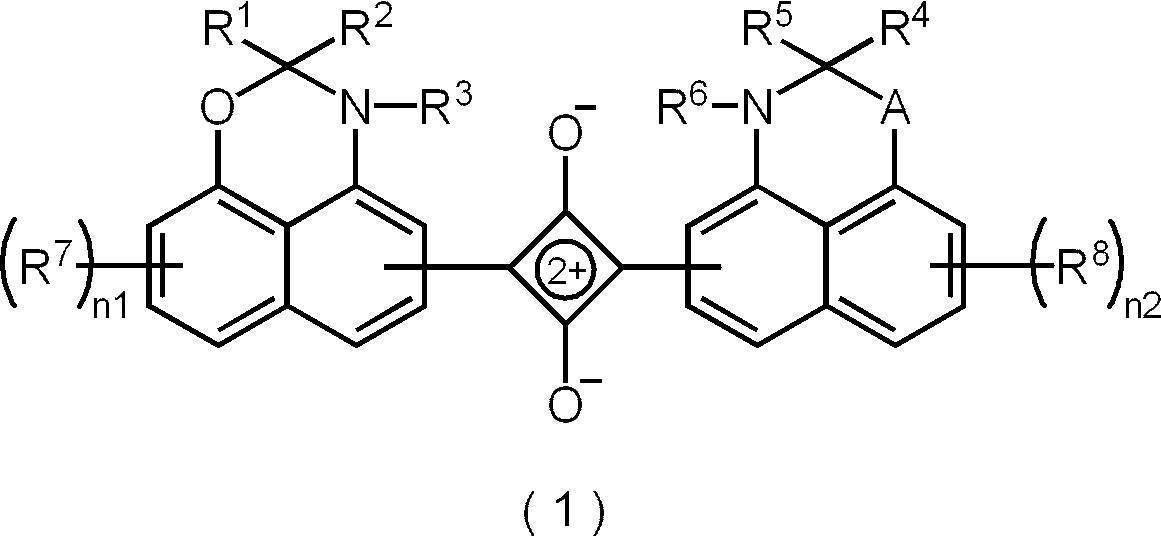
式(1)中、R1~R6はそれぞれ独立に、水素原子又は置換基を表し、R7及びR8はそれぞれ独立に、置換基を表し、Aは、O又はNR9を表し、R9は、水素原子又は置換基を表し、n1及びn2はそれぞれ独立に、0~5の整数を表し、R1とR2とは互いに結合して環を形成してもよく、また、R4とR5とは互いに結合して環を形成してもよい。
本開示に係る化合物における式(1)で表される構造を有する化合物は、本開示に係る硬化性組成物において上述した式(1)で表される構造を有する色素と同様であり、好ましい態様も同様である。
以下、実施例により本開示を詳細に説明するが、本開示はこれらに限定されるものではない。
本実施例において、「%」、「部」とは、特に断りのない限り、それぞれ「質量%」、「質量部」を意味する。なお、高分子化合物において、特別に規定したもの以外は、分子量は重量平均分子量(Mw)であり、構成構成単位の比率はモル百分率である。
重量平均分子量(Mw)は、ゲル浸透クロマトグラフィー(GPC)法によるポリスチレン換算値として測定した値である。
また、本実施例中、特定色素であるSQ-1~SQ-53は、上記具体例におけるQ-1~SQ-53とそれぞれ同義である。
本実施例において、「%」、「部」とは、特に断りのない限り、それぞれ「質量%」、「質量部」を意味する。なお、高分子化合物において、特別に規定したもの以外は、分子量は重量平均分子量(Mw)であり、構成構成単位の比率はモル百分率である。
重量平均分子量(Mw)は、ゲル浸透クロマトグラフィー(GPC)法によるポリスチレン換算値として測定した値である。
また、本実施例中、特定色素であるSQ-1~SQ-53は、上記具体例におけるQ-1~SQ-53とそれぞれ同義である。
<硬化性組成物の製造>
下記表1又は表2に記載の原料を混合して、孔径0.45μmのナイロン製フィルタ(日本ポール(株)製)を用いてろ過して、硬化性組成物を調製した。
なお、分散液は、以下のように調製した分散液を用いた。
下記表1又は表2の分散液の欄に記載の種類の顔料、顔料誘導体、分散剤及び溶剤Aを、それぞれ下記の表1又は表2の分散液の欄に記載の質量部で混合し、更に直径0.3mmのジルコニアビーズ230質量部を加えて、ペイントシェーカーを用いて5時間分散処理を行い、ビーズをろ過で分離して分散液を製造した。
下記表1又は表2に記載の原料を混合して、孔径0.45μmのナイロン製フィルタ(日本ポール(株)製)を用いてろ過して、硬化性組成物を調製した。
なお、分散液は、以下のように調製した分散液を用いた。
下記表1又は表2の分散液の欄に記載の種類の顔料、顔料誘導体、分散剤及び溶剤Aを、それぞれ下記の表1又は表2の分散液の欄に記載の質量部で混合し、更に直径0.3mmのジルコニアビーズ230質量部を加えて、ペイントシェーカーを用いて5時間分散処理を行い、ビーズをろ過で分離して分散液を製造した。
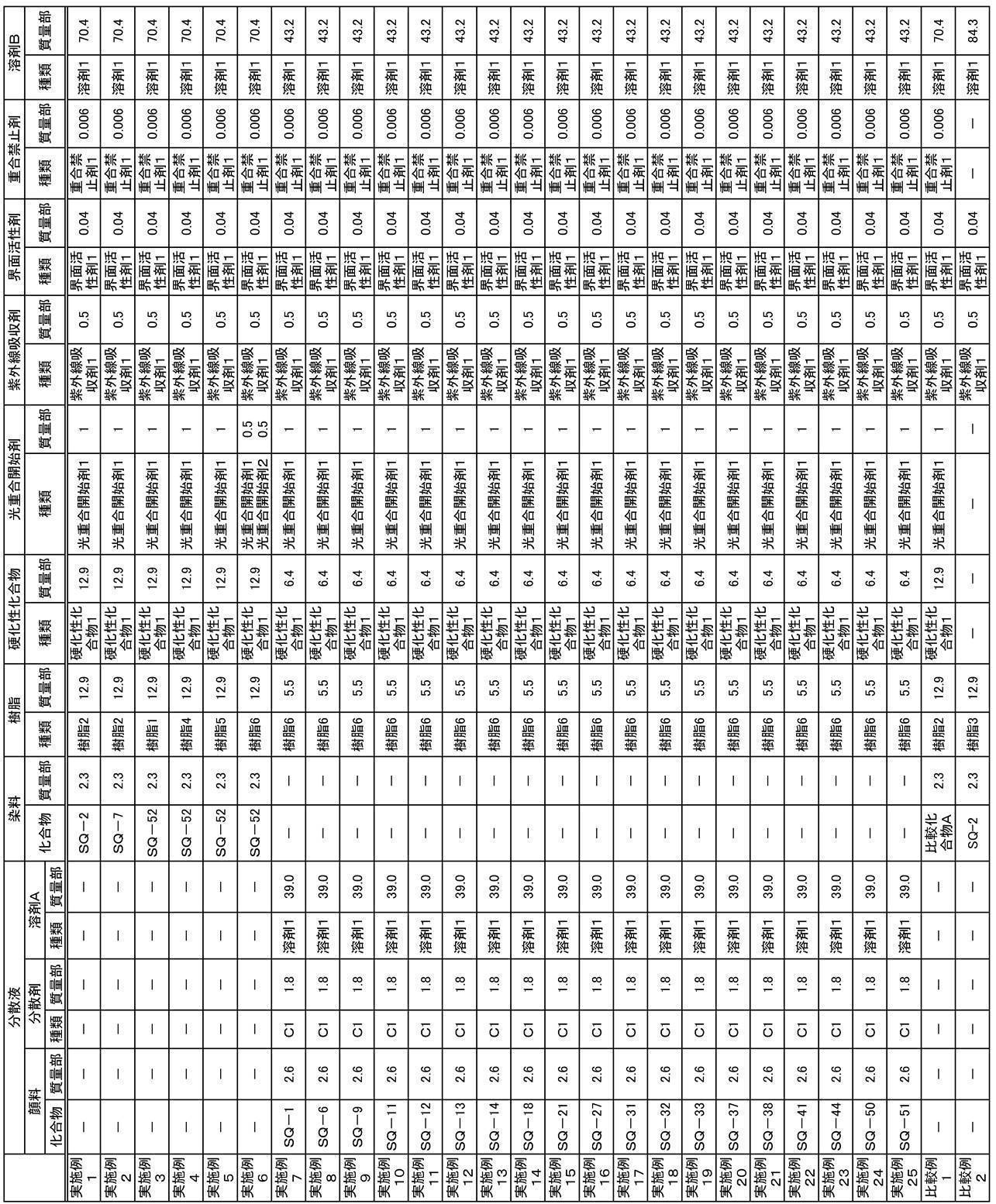
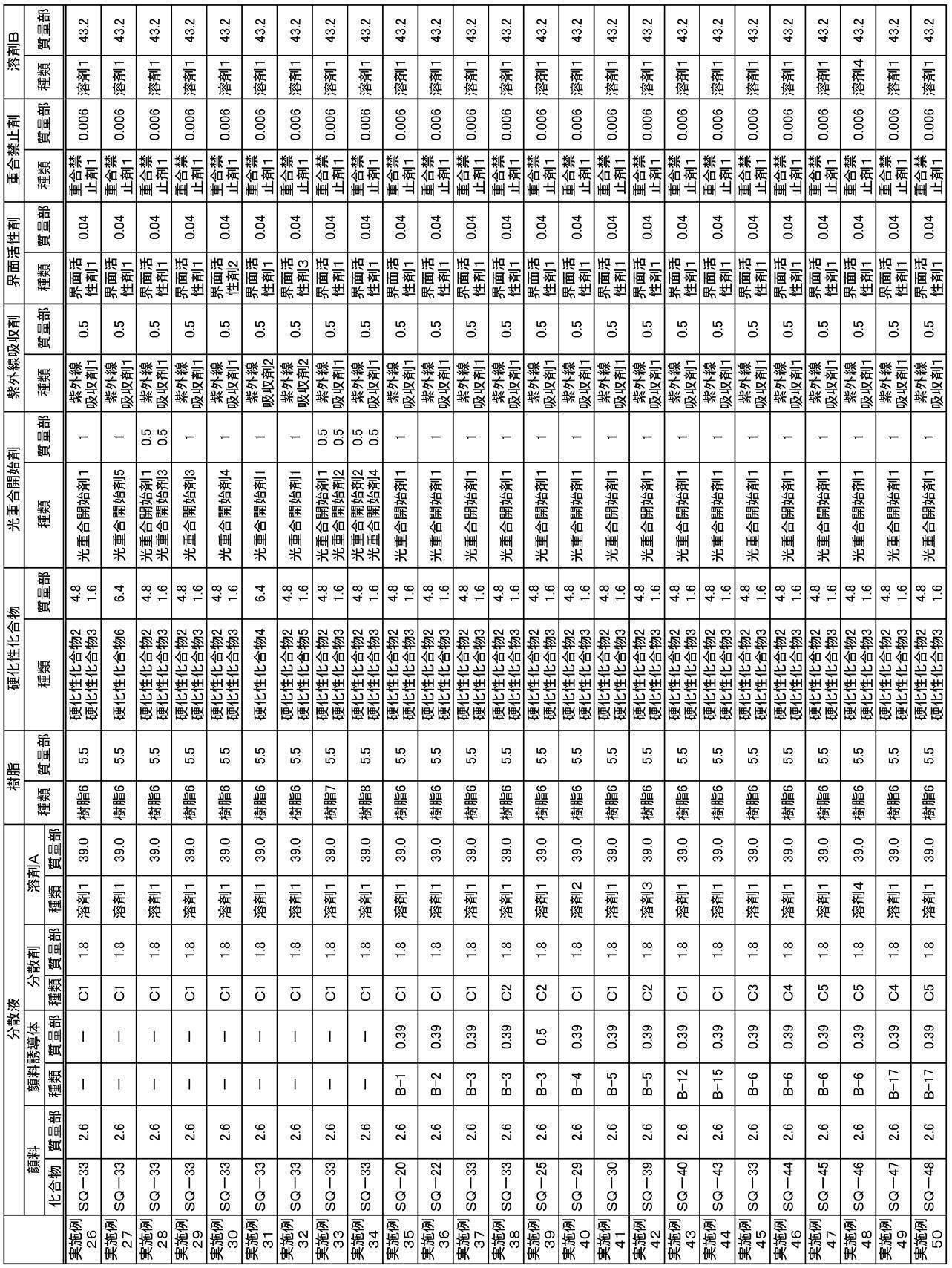
各硬化性組成物に用いた原料は、以下の通りである。
樹脂1:サイクロマーP(ACA)230AA(アクリロイル基とカルボキシ基とを有するアクリルポリマー、(株)ダイセル製)
樹脂2:アリルメタクリレート(AMA)とメタクリル酸(MAA)との共重合体(組成比(質量比):AMA/MAA=80/20、Mw=15,000)
樹脂3:ポリビニルブチラール
樹脂4:ARTON F4520(JSR(株)製、ノルボルネン樹脂、ガラス転移温度=164℃)
樹脂5:ネオプリム S-200(三菱ガス化学(株)製、ポリイミド樹脂、ガラス転移温度=300℃)
樹脂6:下記構造の樹脂。(主鎖に付記した数値はモル比である。Mw=10,000、酸価=69.2mgKOH/g)
樹脂1:サイクロマーP(ACA)230AA(アクリロイル基とカルボキシ基とを有するアクリルポリマー、(株)ダイセル製)
樹脂2:アリルメタクリレート(AMA)とメタクリル酸(MAA)との共重合体(組成比(質量比):AMA/MAA=80/20、Mw=15,000)
樹脂3:ポリビニルブチラール
樹脂4:ARTON F4520(JSR(株)製、ノルボルネン樹脂、ガラス転移温度=164℃)
樹脂5:ネオプリム S-200(三菱ガス化学(株)製、ポリイミド樹脂、ガラス転移温度=300℃)
樹脂6:下記構造の樹脂。(主鎖に付記した数値はモル比である。Mw=10,000、酸価=69.2mgKOH/g)

樹脂7:下記構造の樹脂(酸価=110mgKOH/g、重量平均分子量=10,000)。主鎖に付記した数値は繰り返し単位のモル比を表す。

樹脂8:下記構造の樹脂(酸価=184mgKOH/g、重量平均分子量=9,700)。主鎖に付記した数値は繰り返し単位のモル比を表す。

硬化性化合物1:アロニックスM-350(東亞合成(株)製)
硬化性化合物2:下記構造(M1)の化合物
硬化性化合物3:下記構造(M2)の化合物の混合物(左側化合物を55モル%~63モル%含有)
硬化性化合物4:下記構造(M3)の化合物
硬化性化合物5:下記構造の化合物(M4)の混合物(左側化合物と右側化合物とのモル比が7:3)
硬化性化合物2:下記構造(M1)の化合物
硬化性化合物3:下記構造(M2)の化合物の混合物(左側化合物を55モル%~63モル%含有)
硬化性化合物4:下記構造(M3)の化合物
硬化性化合物5:下記構造の化合物(M4)の混合物(左側化合物と右側化合物とのモル比が7:3)
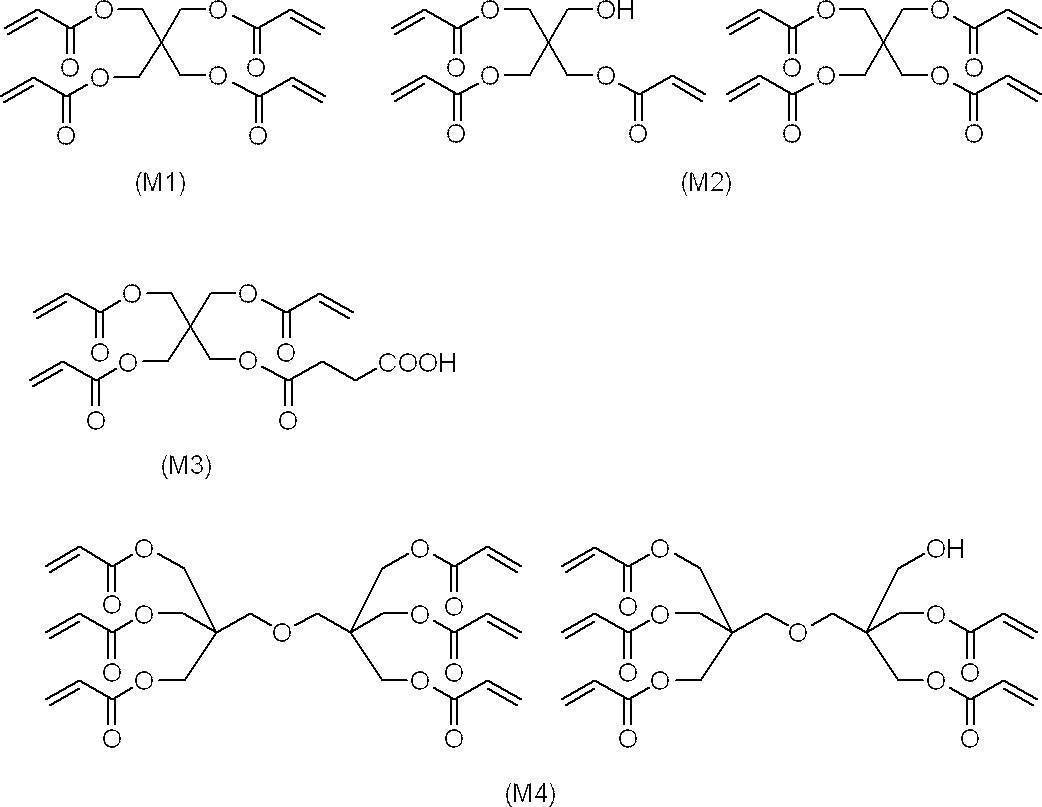
硬化性化合物6:デナコールEX-611(ナガセケムテックス(株)製)
光重合開始剤1:下記構造(F1)の化合物
光重合開始剤2:下記構造(F2)の化合物
光重合開始剤3:下記構造(F3)の化合物
光重合開始剤4:下記構造(F4)の化合物
光重合開始剤5:CPI-100P(サンアプロ(株)製)
光重合開始剤1:下記構造(F1)の化合物
光重合開始剤2:下記構造(F2)の化合物
光重合開始剤3:下記構造(F3)の化合物
光重合開始剤4:下記構造(F4)の化合物
光重合開始剤5:CPI-100P(サンアプロ(株)製)
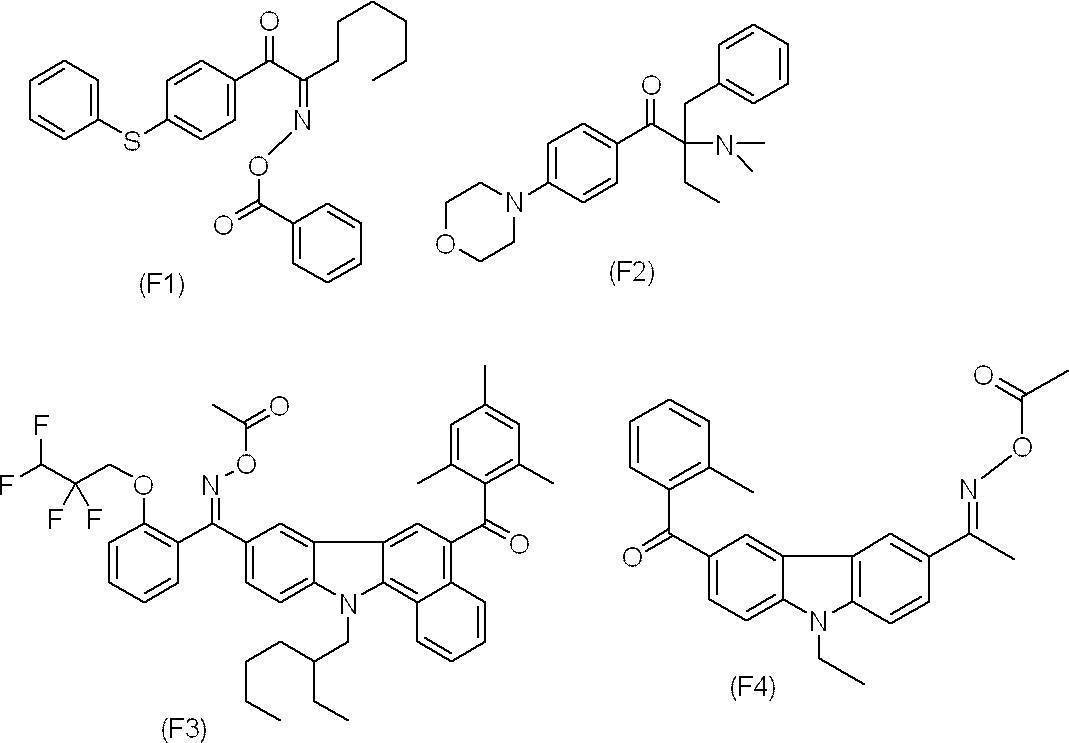
紫外線吸収剤1:UV-503(大東化学(株)製)
紫外線吸収剤2:下記構造(UV2)の化合物
紫外線吸収剤2:下記構造(UV2)の化合物
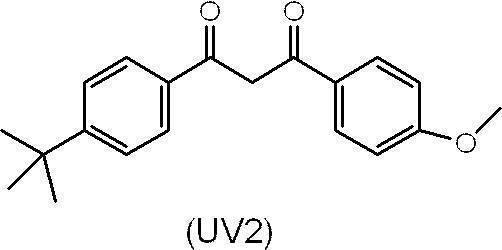
界面活性剤1:下記構造の化合物(Mw=14,000、構成繰り返し単位の割合を示す%はモル%である。)
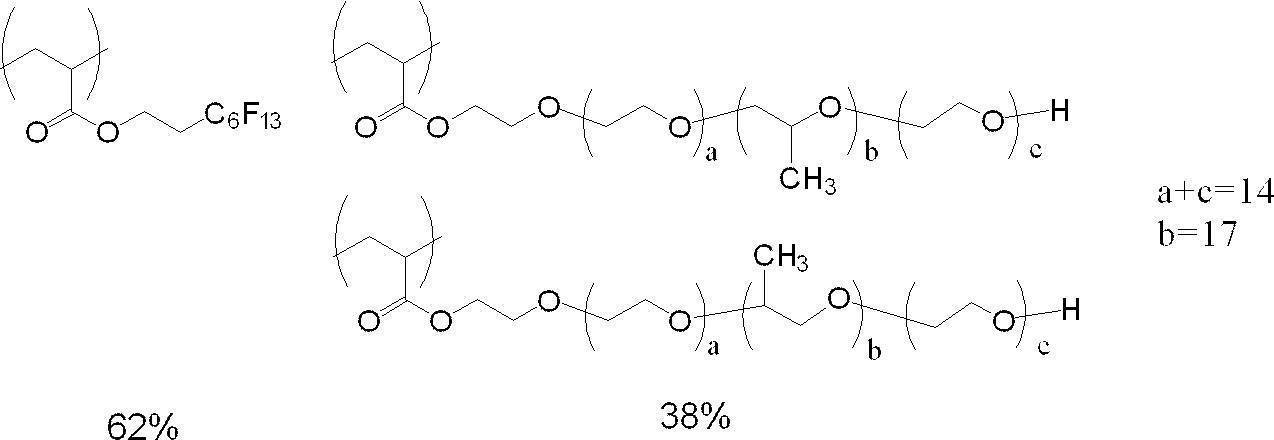
界面活性剤2:フタージェント FTX-218(ネオス(株)製、フッ素系界面活性剤)
界面活性剤3:KF-6001(信越シリコーン(株)製、シリコン系界面活性剤)
界面活性剤3:KF-6001(信越シリコーン(株)製、シリコン系界面活性剤)
-溶剤-
溶剤1:プロピレングリコールモノメチルエーテルアセテート(PGMEA)
溶剤2:シクロヘキサノン
溶剤3:酢酸ブチル
溶剤4:プロピレングリコールモノメチルエーテル(PGME)
溶剤1:プロピレングリコールモノメチルエーテルアセテート(PGMEA)
溶剤2:シクロヘキサノン
溶剤3:酢酸ブチル
溶剤4:プロピレングリコールモノメチルエーテル(PGME)
-分散剤-
C1:下記構造のブロック型樹脂(アミン価=90mgKOH/g、4級アンモニウム塩価=30mgKOH/g、重量平均分子量=9800)。主鎖に付記した数値は繰り返し単位のモル比を表す。
C1:下記構造のブロック型樹脂(アミン価=90mgKOH/g、4級アンモニウム塩価=30mgKOH/g、重量平均分子量=9800)。主鎖に付記した数値は繰り返し単位のモル比を表す。

C2:下記構造の樹脂。(主鎖に付記した数値はモル比であり、側鎖に付記した数値は繰り返し単位の数である。Mw=21,000、酸価=36.0mgKOH/g、アミン価47.0mgKOH/g)

C3:下記構造の樹脂(酸価=43mgKOH/g、重量平均分子量=9,000)。側鎖に付記した数値は繰り返し単位のモル比を表す。

C4:下記構造の樹脂。(主鎖に付記した数値はモル比であり、側鎖に付記した数値は繰り返し単位の数である。Mw=38,000、酸価=99.1mgKOH/g)

C5:下記構造の樹脂(酸価=85.0mgKOH/g、重量平均分子量=22000)。主鎖に付記した数値は繰り返し単位のモル比を表し、側鎖に付記した数値は、繰り返し単位の数を表す。

比較化合物A:下記化合物
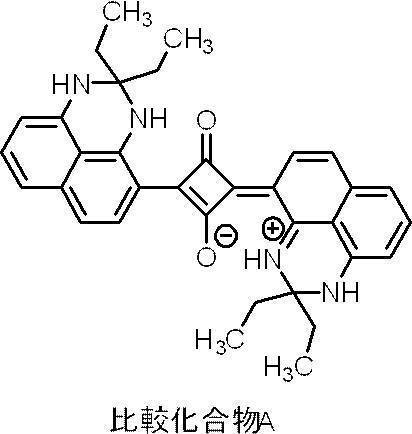
<硬化膜の作製>
<<作製例1:実施例1~50、及び、比較例1の硬化性組成物を用いた硬化膜の作製方法>>
各硬化性組成物を、ガラス基板(コーニング社製1737)上に、乾燥後の膜厚が1.0μmになるようにスピンコーターを用いて塗布し、100℃のホットプレートを用いて120秒間加熱処理(プリベーク)を行った。次いで、i線ステッパー露光装置FPA-3000i5+(キヤノン(株)製)を使用して、500mJ/cm2で全面露光した。次いで現像機(CD-2060、富士フイルムエレクトロニクスマテリアルズ(株)製)を用いて23℃で60秒間パドル現像を行い、次いで、純水でリンス処理し、次いで、スピン乾燥した。更に、200℃のホットプレートを用いて300秒間加熱処理(ポストベーク)を行い、硬化膜を得た。
<<作製例1:実施例1~50、及び、比較例1の硬化性組成物を用いた硬化膜の作製方法>>
各硬化性組成物を、ガラス基板(コーニング社製1737)上に、乾燥後の膜厚が1.0μmになるようにスピンコーターを用いて塗布し、100℃のホットプレートを用いて120秒間加熱処理(プリベーク)を行った。次いで、i線ステッパー露光装置FPA-3000i5+(キヤノン(株)製)を使用して、500mJ/cm2で全面露光した。次いで現像機(CD-2060、富士フイルムエレクトロニクスマテリアルズ(株)製)を用いて23℃で60秒間パドル現像を行い、次いで、純水でリンス処理し、次いで、スピン乾燥した。更に、200℃のホットプレートを用いて300秒間加熱処理(ポストベーク)を行い、硬化膜を得た。
<<作製例2:比較例2の樹脂組成物を用いた膜の作製方法>>
各樹脂組成物を、ガラス基材(コーニング社製1737)上に、乾燥後の膜厚が1.0μmになるようにスピンコーターを用いて塗布し、100℃のホットプレートを用いて120秒間加熱処理(プリベーク)を行った。次いで、200℃のホットプレートを用いて300秒間加熱処理(ポストベーク)を行い、膜を得た。
各樹脂組成物を、ガラス基材(コーニング社製1737)上に、乾燥後の膜厚が1.0μmになるようにスピンコーターを用いて塗布し、100℃のホットプレートを用いて120秒間加熱処理(プリベーク)を行った。次いで、200℃のホットプレートを用いて300秒間加熱処理(ポストベーク)を行い、膜を得た。
<分光特性の評価>
分光光度計(U-4100、(株)日立ハイテクノロジーズ製)を用いて得られた膜の400nm~1,100nmの波長範囲の吸収スペクトルを測定した。波長650nm~1,100nmにおける最大吸光度(Absλmax)を測定し、最大の吸光度を1とした時の、「波長450nm~600nmの平均吸光度」について、下記基準で評価した。この吸光度(Absλmax)を1としたときに、波長450nm~600nmの平均吸光度が小さいほど、急峻な分光形状を有しており、可視光領域の高い透明性と近赤外領域の高い遮蔽性とを両立しているため、優れた分光特性であると言える。
A:波長450nm~600nmの平均吸光度が0.05未満
B:波長450nm~600nmの平均吸光度が0.05以上0.1未満
C:波長450nm~600nmの平均吸光度が0.1以上0.2未満
D:波長450nm~600nmの平均吸光度が0.2以上
分光光度計(U-4100、(株)日立ハイテクノロジーズ製)を用いて得られた膜の400nm~1,100nmの波長範囲の吸収スペクトルを測定した。波長650nm~1,100nmにおける最大吸光度(Absλmax)を測定し、最大の吸光度を1とした時の、「波長450nm~600nmの平均吸光度」について、下記基準で評価した。この吸光度(Absλmax)を1としたときに、波長450nm~600nmの平均吸光度が小さいほど、急峻な分光形状を有しており、可視光領域の高い透明性と近赤外領域の高い遮蔽性とを両立しているため、優れた分光特性であると言える。
A:波長450nm~600nmの平均吸光度が0.05未満
B:波長450nm~600nmの平均吸光度が0.05以上0.1未満
C:波長450nm~600nmの平均吸光度が0.1以上0.2未満
D:波長450nm~600nmの平均吸光度が0.2以上
<耐光性の評価>
得られた膜に対し、キセノン(Xe)ランプにて紫外線カットフィルタを通して2万ルクスの光を20時間照射した後、色度計MCPD-1000(大塚電子(株)製)にて、耐光テスト前後の色差のΔEab値を測定した。ΔEab値の小さい方が耐光性が良好であることを示す。なお、ΔEab値は、CIE1976(L*,a*,b*)空間表色系による以下の色差公式から求められる値である(日本色彩学会編 新編色彩科学ハンドブック(昭和60年)p.266)。
ΔEab={(ΔL*)2+(Δa*)2+(Δb*)2}1/2
<<判定基準>>
A:ΔEab値<2.5
B:2.5≦ΔEab値<5
C:5≦ΔEab値<10
D:10≦ΔEab値<15
得られた膜に対し、キセノン(Xe)ランプにて紫外線カットフィルタを通して2万ルクスの光を20時間照射した後、色度計MCPD-1000(大塚電子(株)製)にて、耐光テスト前後の色差のΔEab値を測定した。ΔEab値の小さい方が耐光性が良好であることを示す。なお、ΔEab値は、CIE1976(L*,a*,b*)空間表色系による以下の色差公式から求められる値である(日本色彩学会編 新編色彩科学ハンドブック(昭和60年)p.266)。
ΔEab={(ΔL*)2+(Δa*)2+(Δb*)2}1/2
<<判定基準>>
A:ΔEab値<2.5
B:2.5≦ΔEab値<5
C:5≦ΔEab値<10
D:10≦ΔEab値<15
<耐湿性の評価>
得られた膜を、85℃、相対湿度85%の高温高湿下で48時間放置して耐湿試験を行った。耐湿試験前後の膜のそれぞれについて、分光光度計(U-4100、(株)日立ハイテクノロジーズ製)を用いて、波長650nm~1,100nmにおける最大吸光度(Absλmax)と、波長400nm~550nmにおける最小吸光度(Absλmin)とを測定し、「Absλmax/Absλmin」で表される吸光度比を求めた。
|{(耐湿試験前の膜の吸光度比-耐湿試験後の膜の吸光度比)/耐湿試験前の膜の吸光度比}×100|(%)で表される吸光度比変化率を、以下の基準で評価した。
A:吸光度比変化率≦3%
B:3%<吸光度比変化率6%
C:6%<吸光度比変化率≦10%
D:10%<吸光度比変化率
得られた膜を、85℃、相対湿度85%の高温高湿下で48時間放置して耐湿試験を行った。耐湿試験前後の膜のそれぞれについて、分光光度計(U-4100、(株)日立ハイテクノロジーズ製)を用いて、波長650nm~1,100nmにおける最大吸光度(Absλmax)と、波長400nm~550nmにおける最小吸光度(Absλmin)とを測定し、「Absλmax/Absλmin」で表される吸光度比を求めた。
|{(耐湿試験前の膜の吸光度比-耐湿試験後の膜の吸光度比)/耐湿試験前の膜の吸光度比}×100|(%)で表される吸光度比変化率を、以下の基準で評価した。
A:吸光度比変化率≦3%
B:3%<吸光度比変化率6%
C:6%<吸光度比変化率≦10%
D:10%<吸光度比変化率
<異物欠陥抑制性の評価>
実施例1~50、又は、比較例1の硬化性組成物を25℃で8週間保存、経時促進させた後、上記作製方法Aと同様の方法で硬化膜を作製した。
比較例2の樹脂組成物を25℃で8週間保存、経時促進させた後、上記作製方法Bと同様の方法で硬化膜を作製した。
得られた膜を、走査式電子顕微鏡を用いて、倍率30,000倍にて観察し、下記評価基準に従って評価した。
A:異物が全く確認されなかった。
B:異物がわずかに確認されたが、実用上問題のない程度であった。
C:異物が著しく確認された。
実施例1~50、又は、比較例1の硬化性組成物を25℃で8週間保存、経時促進させた後、上記作製方法Aと同様の方法で硬化膜を作製した。
比較例2の樹脂組成物を25℃で8週間保存、経時促進させた後、上記作製方法Bと同様の方法で硬化膜を作製した。
得られた膜を、走査式電子顕微鏡を用いて、倍率30,000倍にて観察し、下記評価基準に従って評価した。
A:異物が全く確認されなかった。
B:異物がわずかに確認されたが、実用上問題のない程度であった。
C:異物が著しく確認された。
評価結果を表3及び表4にまとめて示す。
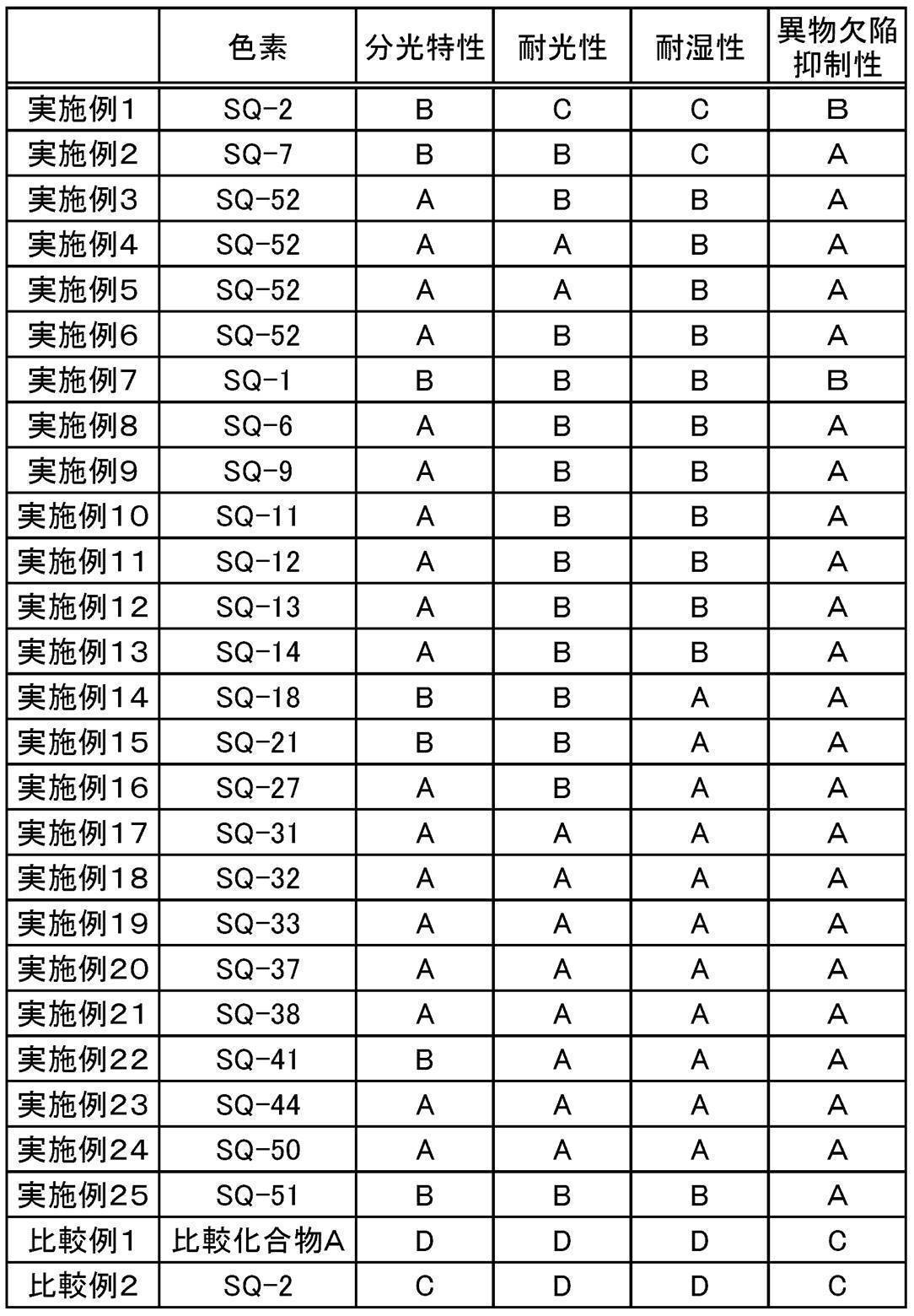
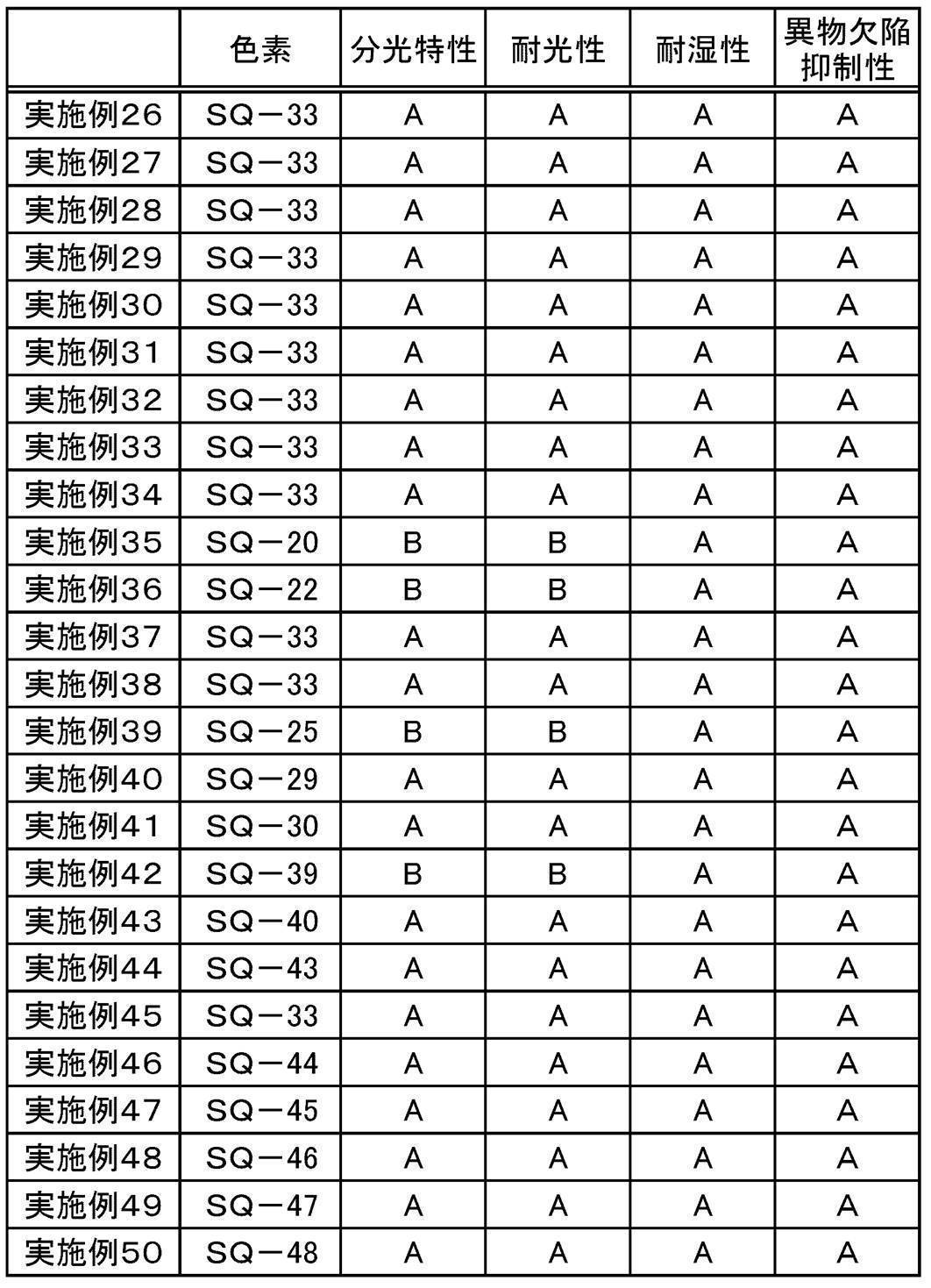
表3及び表4に記載の結果から、本開示に係る硬化性組成物である実施例1~実施例50の硬化性組成物は、比較例1又は比較例2の組成物に比べて、得られる硬化膜の耐湿性に優れることが明らかである。
更に、本開示に係る硬化性組成物である実施例1~実施例50の硬化性組成物は、得られる硬化膜における、分光特性、耐光性、及び、異物欠陥抑制性にも優れることがわかる。
更に、本開示に係る硬化性組成物である実施例1~実施例50の硬化性組成物は、得られる硬化膜における、分光特性、耐光性、及び、異物欠陥抑制性にも優れることがわかる。
実施例19において、紫外線吸収剤を除いて同様に評価した場合も同様の結果が得られた。実施例19において、界面活性剤を除いて同様に評価した場合も同様の結果が得られた。実施例19において、重合禁止剤を除いて同様に評価した場合も同様の結果が得られた。
(実施例101~150)
実施例1~実施例50の硬化性組成物を用い、下記手法にて2μm四方のパターン(赤外線カットフィルタ)をそれぞれ形成した。実施例1~実施例6の硬化性組成物は下記作製方法Aでパターンを形成し、実施例7~実施例50は下記作製方法Bでパターンを形成した。
実施例1~実施例50の硬化性組成物を用い、下記手法にて2μm四方のパターン(赤外線カットフィルタ)をそれぞれ形成した。実施例1~実施例6の硬化性組成物は下記作製方法Aでパターンを形成し、実施例7~実施例50は下記作製方法Bでパターンを形成した。
<作製方法A>
実施例1~実施例6の硬化性組成物を製膜後の膜厚が1.0μmになるように、シリコンウェハ上にスピンコート法で塗布した。その後ホットプレートを用いて、100℃で2分間加熱した。次いで、ホットプレートを用いて、200℃で5分間加熱した。次いでドライエッチング法により2μm四方のパターン(赤外線カットフィルタ)を形成した。
実施例1~実施例6の硬化性組成物を製膜後の膜厚が1.0μmになるように、シリコンウェハ上にスピンコート法で塗布した。その後ホットプレートを用いて、100℃で2分間加熱した。次いで、ホットプレートを用いて、200℃で5分間加熱した。次いでドライエッチング法により2μm四方のパターン(赤外線カットフィルタ)を形成した。
<作製方法B>
実施例7~実施例50の硬化性組成物を製膜後の膜厚が1.0μmになるようにシリコンウェハ上にスピンコート法で塗布した。次いで、ホットプレートを用いて、100℃で2分間加熱した。次いで、i線ステッパー露光装置FPA-3000i5+(キヤノン(株)製)を用い、1,000mJ/cm2で2μm四方のドットパターンのマスクを介して露光した。次いで、水酸化テトラメチルアンモニウム(TMAH)0.3質量%水溶液を用い、23℃で60秒間パドル現像を行った。その後、スピンシャワーにてリンスを行い、更に純水にて水洗した。次いで、ホットプレートを用いて、200℃で5分間加熱することで、2μm四方のパターン(赤外線カットフィルタ)を形成した。
実施例7~実施例50の硬化性組成物を製膜後の膜厚が1.0μmになるようにシリコンウェハ上にスピンコート法で塗布した。次いで、ホットプレートを用いて、100℃で2分間加熱した。次いで、i線ステッパー露光装置FPA-3000i5+(キヤノン(株)製)を用い、1,000mJ/cm2で2μm四方のドットパターンのマスクを介して露光した。次いで、水酸化テトラメチルアンモニウム(TMAH)0.3質量%水溶液を用い、23℃で60秒間パドル現像を行った。その後、スピンシャワーにてリンスを行い、更に純水にて水洗した。次いで、ホットプレートを用いて、200℃で5分間加熱することで、2μm四方のパターン(赤外線カットフィルタ)を形成した。
次に、赤外線カットフィルタのパターン上に、Red組成物を製膜後の膜厚が1.0μmになるようにスピンコート法で塗布した。次いで、ホットプレートを用いて、100℃で2分間加熱した。次いで、i線ステッパー露光装置FPA-3000i5+(キヤノン(株)製)を用い、1,000mJ/cm2で2μm四方のドットパターンのマスクを介して露光した。次いで、水酸化テトラメチルアンモニウム(TMAH)0.3質量%水溶液を用い、23℃で60秒間パドル現像を行った。その後、スピンシャワーにてリンスを行い、更に純水にて水洗した。次いで、ホットプレートを用いて、200℃で5分間加熱することで、赤外線カットフィルタのパターン上に、Red組成物をパターニングした。同様にGreen組成物、Blue組成物を順次パターニングし、赤、緑及び青の着色パターン(Bayerパターン)を形成した。
なお、Bayerパターンとは、米国特許第3,971,065号明細書に開示されているような、一個の赤色(Red)素子と、二個の緑色(Green)素子と、一個の青色(Blue)素子とを有する色フィルタ素子の2×2アレイを繰り返したパターンであるが、本実施例においては、一個の赤色(Red)素子と、一個の緑色(Green)素子と、一個の青色(Blue)素子と、一個の赤外線透過フィルタ素子を有するフィルタ素子の2×2アレイを繰り返したBayerパターンを形成した。
なお、Bayerパターンとは、米国特許第3,971,065号明細書に開示されているような、一個の赤色(Red)素子と、二個の緑色(Green)素子と、一個の青色(Blue)素子とを有する色フィルタ素子の2×2アレイを繰り返したパターンであるが、本実施例においては、一個の赤色(Red)素子と、一個の緑色(Green)素子と、一個の青色(Blue)素子と、一個の赤外線透過フィルタ素子を有するフィルタ素子の2×2アレイを繰り返したBayerパターンを形成した。
次に、上記パターン形成した膜上に、赤外線透過フィルタ形成用組成物(下記組成100又は組成101)を、製膜後の膜厚が2.0μmになるようにスピンコート法で塗布した。次いで、ホットプレートを用いて、100℃で2分間加熱した。次いで、i線ステッパー露光装置FPA-3000i5+(キヤノン(株)製)を用い、1,000mJ/cm2で2μm四方のBayerパターンのマスクを介して露光した。次いで、水酸化テトラメチルアンモニウム(TMAH)0.3質量%水溶液を用い、23℃で60秒間パドル現像を行った。その後、スピンシャワーにてリンスを行い、更に純水にて水洗した。次いで、ホットプレートを用いて、200℃で5分間加熱することで、赤外線カットフィルタのBayerパターンのうち、上記着色パターンが形成されていない抜け部分に、赤外線透過フィルタのパターニングを行った。これを公知の方法に従い固体撮像素子に組み込んだ。
得られた固体撮像素子について、低照度の環境下(0.001ルクス(Lux))で赤外発光ダイオード(赤外LED)により赤外線を照射し、画像の取り込みを行い、画像性能を評価した。実施例1~実施例50で得られたいずれの硬化性組成物を使用した場合でも、低照度の環境下であっても画像をはっきりと認識できた。
得られた固体撮像素子について、低照度の環境下(0.001ルクス(Lux))で赤外発光ダイオード(赤外LED)により赤外線を照射し、画像の取り込みを行い、画像性能を評価した。実施例1~実施例50で得られたいずれの硬化性組成物を使用した場合でも、低照度の環境下であっても画像をはっきりと認識できた。
実施例101~実施例150で使用したRed組成物、Green組成物、Blue組成物、及び、赤外線透過フィルタ形成用組成物は、以下の通りである。
-Red組成物-
下記成分を混合し、撹拌した後、孔径0.45μmのナイロン製フィルタ(日本ポール(株)製)でろ過して、Red組成物を調製した。
Red顔料分散液:51.7質量部
樹脂6(40質量%PGMEA溶液):0.6質量部
重合性化合物4:0.6質量部
光重合開始剤A:0.3質量部
界面活性剤1:4.2質量部
PGMEA:42.6質量部
下記成分を混合し、撹拌した後、孔径0.45μmのナイロン製フィルタ(日本ポール(株)製)でろ過して、Red組成物を調製した。
Red顔料分散液:51.7質量部
樹脂6(40質量%PGMEA溶液):0.6質量部
重合性化合物4:0.6質量部
光重合開始剤A:0.3質量部
界面活性剤1:4.2質量部
PGMEA:42.6質量部
-Green組成物-
下記成分を混合し、撹拌した後、孔径0.45μmのナイロン製フィルタ(日本ポール(株)製)でろ過して、Green組成物を調製した。
Green顔料分散液:73.7質量部
樹脂6(40質量%PGMEA溶液):0.3質量部
重合性化合物1:1.2質量部
光重合開始剤A:0.6質量部
界面活性剤1:4.2質量部
紫外線吸収剤(UV-503、大東化学(株)製):0.5質量部
PGMEA:19.5質量部
下記成分を混合し、撹拌した後、孔径0.45μmのナイロン製フィルタ(日本ポール(株)製)でろ過して、Green組成物を調製した。
Green顔料分散液:73.7質量部
樹脂6(40質量%PGMEA溶液):0.3質量部
重合性化合物1:1.2質量部
光重合開始剤A:0.6質量部
界面活性剤1:4.2質量部
紫外線吸収剤(UV-503、大東化学(株)製):0.5質量部
PGMEA:19.5質量部
-Blue組成物-
下記成分を混合し、撹拌した後、孔径0.45μmのナイロン製フィルタ(日本ポール(株)製)でろ過して、Blue組成物を調製した。
Blue顔料分散液:44.9質量部
樹脂6(40質量%PGMEA溶液):2.1質量部
重合性化合物1:1.5質量部
重合性化合物4:0.7質量部
光重合開始剤A:0.8質量部
界面活性剤1:4.2質量部
PGMEA:45.8質量部
下記成分を混合し、撹拌した後、孔径0.45μmのナイロン製フィルタ(日本ポール(株)製)でろ過して、Blue組成物を調製した。
Blue顔料分散液:44.9質量部
樹脂6(40質量%PGMEA溶液):2.1質量部
重合性化合物1:1.5質量部
重合性化合物4:0.7質量部
光重合開始剤A:0.8質量部
界面活性剤1:4.2質量部
PGMEA:45.8質量部
-赤外線透過フィルタ形成用組成物-
下記組成における成分を混合し、撹拌した後、孔径0.45μmのナイロン製フィルタ(日本ポール(株)製)でろ過して、赤外線透過フィルタ形成用組成物を調製した。
下記組成における成分を混合し、撹拌した後、孔径0.45μmのナイロン製フィルタ(日本ポール(株)製)でろ過して、赤外線透過フィルタ形成用組成物を調製した。
<組成100>
顔料分散液1-1:46.5質量部
顔料分散液1-2:37.1質量部
重合性化合物5:1.8質量部
樹脂6:1.1質量部
光重合開始剤B:0.9質量部
界面活性剤1:4.2質量部
重合禁止剤(p-メトキシフェノール):0.001質量部
シランカップリング剤:0.6質量部
PGMEA:7.8質量部
顔料分散液1-1:46.5質量部
顔料分散液1-2:37.1質量部
重合性化合物5:1.8質量部
樹脂6:1.1質量部
光重合開始剤B:0.9質量部
界面活性剤1:4.2質量部
重合禁止剤(p-メトキシフェノール):0.001質量部
シランカップリング剤:0.6質量部
PGMEA:7.8質量部
<組成101>
顔料分散液2-1:1,000質量部
重合性化合物(ジペンタエリスリトールヘキサアクリレート):50質量部
樹脂:17質量部
光重合開始剤(1-[4-(フェニルチオ)フェニル]-1,2-オクタンジオン-2-(O-ベンゾイルオキシム)):10質量部
PGMEA:179質量部
アルカリ可溶性重合体F-1:17質量部(固形分濃度35質量部)
顔料分散液2-1:1,000質量部
重合性化合物(ジペンタエリスリトールヘキサアクリレート):50質量部
樹脂:17質量部
光重合開始剤(1-[4-(フェニルチオ)フェニル]-1,2-オクタンジオン-2-(O-ベンゾイルオキシム)):10質量部
PGMEA:179質量部
アルカリ可溶性重合体F-1:17質量部(固形分濃度35質量部)
<アルカリ可溶性重合体F-1の合成例>
反応容器に、ベンジルメタクリレート14部、N-フェニルマレイミド12部、2-ヒドロキシエチルメタクリレート15部、スチレン10部及びメタクリル酸20部をプロピレングリコールモノメチルエーテルアセテート200部に溶解し、更に2,2’-アゾイソブチロニトリル3部及びα-メチルスチレンダイマー5部を投入した。反応容器内を窒素パージ後、撹拌及び窒素バブリングしながら80℃で5時間加熱し、アルカリ可溶性重合体F-1を含む溶液(固形分濃度35質量%)を得た。この重合体は、ポリスチレン換算の重量平均分子量が9,700、数平均分子量が5,700であり、Mw/Mnが1.70であった。
反応容器に、ベンジルメタクリレート14部、N-フェニルマレイミド12部、2-ヒドロキシエチルメタクリレート15部、スチレン10部及びメタクリル酸20部をプロピレングリコールモノメチルエーテルアセテート200部に溶解し、更に2,2’-アゾイソブチロニトリル3部及びα-メチルスチレンダイマー5部を投入した。反応容器内を窒素パージ後、撹拌及び窒素バブリングしながら80℃で5時間加熱し、アルカリ可溶性重合体F-1を含む溶液(固形分濃度35質量%)を得た。この重合体は、ポリスチレン換算の重量平均分子量が9,700、数平均分子量が5,700であり、Mw/Mnが1.70であった。
<顔料分散液2-1>
C.I.ピグメントブラック32を60部、C.I.ピグメントブルー15:6を20部、C.I.ピグメントイエロー139を20部、日本ルーブリゾール(株)製のソルスパース76500を80部(固形分濃度50質量%)、アルカリ可溶性重合体F-1を含む溶液を120部(固形分濃度35質量%)、プロピレングリコールモノメチルエーテルアセテートを700部混合し、ペイントシェーカーを用いて8時間分散し、着色剤分散液2-1を得た。
C.I.ピグメントブラック32を60部、C.I.ピグメントブルー15:6を20部、C.I.ピグメントイエロー139を20部、日本ルーブリゾール(株)製のソルスパース76500を80部(固形分濃度50質量%)、アルカリ可溶性重合体F-1を含む溶液を120部(固形分濃度35質量%)、プロピレングリコールモノメチルエーテルアセテートを700部混合し、ペイントシェーカーを用いて8時間分散し、着色剤分散液2-1を得た。
Red組成物、Green組成物、Blue組成物、及び、赤外線透過フィルタ形成用組成物に使用した原料は、以下の通りである。
・Red顔料分散液
C.I.Pigment Red 254を9.6質量部、C.I.Pigment Yellow 139を4.3質量部、分散剤(Disperbyk-161、BYKChemie社製)を6.8質量部、PGMEAを79.3質量部とからなる混合液を、ビーズミル(ジルコニアビーズ0.3mm径)により3時間混合及び分散して、顔料分散液を調製した。その後更に、減圧機構付き高圧分散機NANO-3000-10(日本ビーイーイー(株)製)を用いて、2,000kg/cm3の圧力下で流量500g/minとして分散処理を行った。この分散処理を10回繰り返し、Red顔料分散液を得た。
C.I.Pigment Red 254を9.6質量部、C.I.Pigment Yellow 139を4.3質量部、分散剤(Disperbyk-161、BYKChemie社製)を6.8質量部、PGMEAを79.3質量部とからなる混合液を、ビーズミル(ジルコニアビーズ0.3mm径)により3時間混合及び分散して、顔料分散液を調製した。その後更に、減圧機構付き高圧分散機NANO-3000-10(日本ビーイーイー(株)製)を用いて、2,000kg/cm3の圧力下で流量500g/minとして分散処理を行った。この分散処理を10回繰り返し、Red顔料分散液を得た。
・Green顔料分散液
C.I.Pigment Green 36を6.4質量部、C.I.Pigment Yellow 150を5.3質量部、分散剤(Disperbyk-161、BYKChemie社製)を5.2質量部、PGMEAを83.1質量部からなる混合液を、ビーズミル(ジルコニアビーズ0.3mm径)により3時間混合及び分散して、顔料分散液を調製した。その後更に、減圧機構付き高圧分散機NANO-3000-10(日本ビーイーイー(株)製)を用いて、2,000kg/cm3の圧力下で流量500g/minとして分散処理を行った。この分散処理を10回繰り返し、Green顔料分散液を得た。
C.I.Pigment Green 36を6.4質量部、C.I.Pigment Yellow 150を5.3質量部、分散剤(Disperbyk-161、BYKChemie社製)を5.2質量部、PGMEAを83.1質量部からなる混合液を、ビーズミル(ジルコニアビーズ0.3mm径)により3時間混合及び分散して、顔料分散液を調製した。その後更に、減圧機構付き高圧分散機NANO-3000-10(日本ビーイーイー(株)製)を用いて、2,000kg/cm3の圧力下で流量500g/minとして分散処理を行った。この分散処理を10回繰り返し、Green顔料分散液を得た。
・Blue顔料分散液
C.I.Pigment Blue 15:6を9.7質量部、C.I.Pigment Violet 23を2.4質量部、分散剤(Disperbyk-161、BYKChemie社製)を5.5部、PGMEAを82.4部からなる混合液を、ビーズミル(ジルコニアビーズ0.3mm径)により3時間混合及び分散して、顔料分散液を調製した。その後更に、減圧機構付き高圧分散機NANO-3000-10(日本ビーイーイー(株)製)を用いて、2,000kg/cm3の圧力下で流量500g/minとして分散処理を行った。この分散処理を10回繰り返し、Blue顔料分散液を得た。
C.I.Pigment Blue 15:6を9.7質量部、C.I.Pigment Violet 23を2.4質量部、分散剤(Disperbyk-161、BYKChemie社製)を5.5部、PGMEAを82.4部からなる混合液を、ビーズミル(ジルコニアビーズ0.3mm径)により3時間混合及び分散して、顔料分散液を調製した。その後更に、減圧機構付き高圧分散機NANO-3000-10(日本ビーイーイー(株)製)を用いて、2,000kg/cm3の圧力下で流量500g/minとして分散処理を行った。この分散処理を10回繰り返し、Blue顔料分散液を得た。
・顔料分散液1-1
下記組成の混合液を、0.3mm径のジルコニアビーズを使用して、ビーズミル(減圧機構付き高圧分散機NANO-3000-10(日本ビーイーイー(株)製))で、3時間、混合、分散して、顔料分散液1-1を調製した。
・赤色顔料(C.I.Pigment Red 254)及び黄色顔料(C.I.Pigment Yellow 139)からなる混合顔料:11.8質量部
・樹脂(Disperbyk-111、BYKChemie社製):9.1質量部
・PGMEA:79.1質量部
下記組成の混合液を、0.3mm径のジルコニアビーズを使用して、ビーズミル(減圧機構付き高圧分散機NANO-3000-10(日本ビーイーイー(株)製))で、3時間、混合、分散して、顔料分散液1-1を調製した。
・赤色顔料(C.I.Pigment Red 254)及び黄色顔料(C.I.Pigment Yellow 139)からなる混合顔料:11.8質量部
・樹脂(Disperbyk-111、BYKChemie社製):9.1質量部
・PGMEA:79.1質量部
・顔料分散液1-2
下記組成の混合液を、0.3mm径のジルコニアビーズを使用して、ビーズミル(減圧機構付き高圧分散機NANO-3000-10(日本ビーイーイー(株)製))で、3時間、混合、分散して、顔料分散液1-2を調製した。
・青色顔料(C.I.Pigment Blue 15:6)及び紫色顔料(C.I.Pigment Violet 23)からなる混合顔料:12.6質量部
・樹脂(Disperbyk-111、BYKChemie社製):2.0質量部
・樹脂A:3.3質量部
・シクロヘキサノン:31.2質量部
・PGMEA:50.9質量部
下記組成の混合液を、0.3mm径のジルコニアビーズを使用して、ビーズミル(減圧機構付き高圧分散機NANO-3000-10(日本ビーイーイー(株)製))で、3時間、混合、分散して、顔料分散液1-2を調製した。
・青色顔料(C.I.Pigment Blue 15:6)及び紫色顔料(C.I.Pigment Violet 23)からなる混合顔料:12.6質量部
・樹脂(Disperbyk-111、BYKChemie社製):2.0質量部
・樹脂A:3.3質量部
・シクロヘキサノン:31.2質量部
・PGMEA:50.9質量部
樹脂A:下記構造(Mw=14,000、各構成単位における比はモル比である。)

・重合性化合物1:KAYARAD DPHA(ジペンタエリスリトールヘキサアクリレートとジペンタエリスリトールペンタアクリレートとの混合物、日本化薬(株)製)
・重合性化合物4:下記構造
・重合性化合物4:下記構造

・重合性化合物5:下記構造(左側化合物と右側化合物とのモル比が7:3の混合物)

・樹脂6:下記構造(酸価:70mgKOH/g、Mw=11,000、各構成単位における比はモル比である。)

・光重合開始剤A:IRGACURE-OXE01(1-[4-(フェニルチオ)フェニル]-1,2-オクタンジオン-2-(O-ベンゾイルオキシム)、BASF社製)
・光重合開始剤B:下記構造
・光重合開始剤B:下記構造

・界面活性剤1:下記混合物(Mw=14,000)の1質量%PGMEA溶液。下記の式中、構成単位の割合を示す%(62%及び38%)の単位は、モル%である。
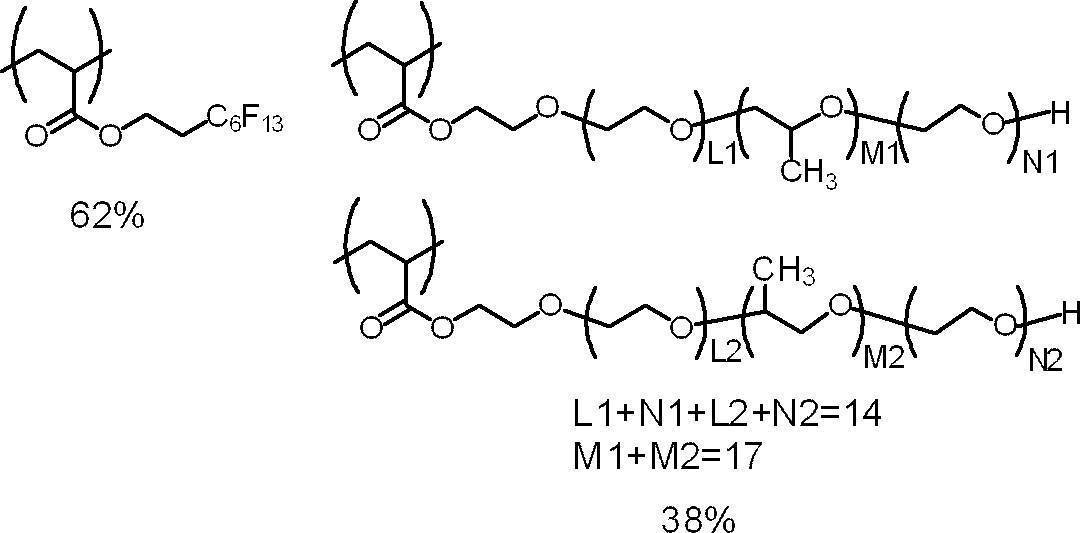
・シランカップリング剤:下記構造の化合物。以下の構造式中、Etはエチル基を表す。
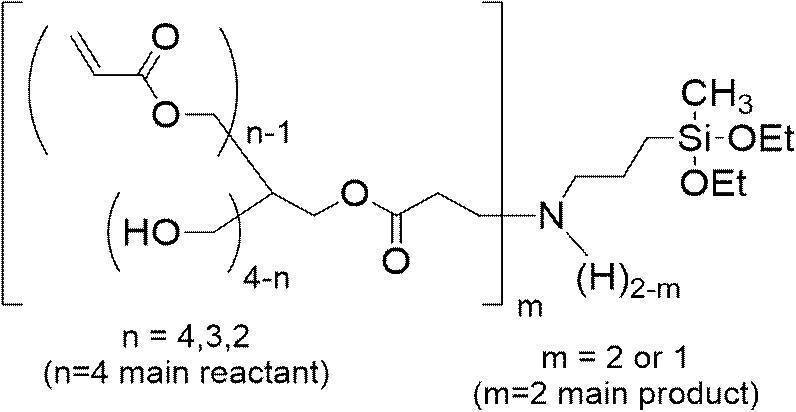
(実施例201~250)
下記組成を混合し、撹拌した後、孔径0.45μmのナイロン製フィルタ(日本ポール(株)製)でろ過して、実施例201のパターン形成用組成物を調製した。
実施例1の硬化性組成物:22.67質量部
顔料分散液2-1:51.23質量部
実施例201のパターン形成用組成物を用いて、実施例1と同様に耐光性、及び、異物欠陥抑制性の評価を行ったところ、実施例1と同様の効果が得られた。また、実施例201のパターン形成用組成物を用いて得られた硬化膜は、可視領域の波長の光を遮光し、近赤外領域の波長の光(近赤外線)の少なくとも一部を透過させることができた。実施例1の硬化性組成物の代わりに実施例2~実施例50の硬化性組成物を用いて実施例201と同様に評価を行ったところ、それぞれ実施例2~実施例50と同等の効果が得られた。
下記組成を混合し、撹拌した後、孔径0.45μmのナイロン製フィルタ(日本ポール(株)製)でろ過して、実施例201のパターン形成用組成物を調製した。
実施例1の硬化性組成物:22.67質量部
顔料分散液2-1:51.23質量部
実施例201のパターン形成用組成物を用いて、実施例1と同様に耐光性、及び、異物欠陥抑制性の評価を行ったところ、実施例1と同様の効果が得られた。また、実施例201のパターン形成用組成物を用いて得られた硬化膜は、可視領域の波長の光を遮光し、近赤外領域の波長の光(近赤外線)の少なくとも一部を透過させることができた。実施例1の硬化性組成物の代わりに実施例2~実施例50の硬化性組成物を用いて実施例201と同様に評価を行ったところ、それぞれ実施例2~実施例50と同等の効果が得られた。
(実施例251~300)
下記組成を混合し、撹拌した後、孔径0.45μmのナイロン製フィルタ(日本ポール(株)製)でろ過して、実施例202のパターン形成用組成物を調製した。
実施例1の硬化性組成物:36.99質量部
顔料分散液1-1:46.5質量部
顔料分散液1-2:37.1質量部
実施例251のパターン形成用組成物を用いて、実施例1と同様に耐光性、及び、異物欠陥抑制性の評価を行ったところ、実施例1と同様の効果が得られた。また、実施例251のパターン形成用組成物を用いて得られた硬化膜は、可視領域の波長の光を遮光し、近赤外領域の波長の光(近赤外線)の少なくとも一部を透過させることができた。実施例1の硬化性組成物の代わりに実施例2~実施例50の硬化性組成物を用いて実施例251と同様に評価を行ったところ、それぞれ実施例2~実施例50と同等の効果が得られた。
下記組成を混合し、撹拌した後、孔径0.45μmのナイロン製フィルタ(日本ポール(株)製)でろ過して、実施例202のパターン形成用組成物を調製した。
実施例1の硬化性組成物:36.99質量部
顔料分散液1-1:46.5質量部
顔料分散液1-2:37.1質量部
実施例251のパターン形成用組成物を用いて、実施例1と同様に耐光性、及び、異物欠陥抑制性の評価を行ったところ、実施例1と同様の効果が得られた。また、実施例251のパターン形成用組成物を用いて得られた硬化膜は、可視領域の波長の光を遮光し、近赤外領域の波長の光(近赤外線)の少なくとも一部を透過させることができた。実施例1の硬化性組成物の代わりに実施例2~実施例50の硬化性組成物を用いて実施例251と同様に評価を行ったところ、それぞれ実施例2~実施例50と同等の効果が得られた。
(実施例301)
上記実施例1~実施例50、実施例101~150、実施例200~300において、他の基板に変更し(ガラス基板の場合はシリコンウェハへ変更し、シリコンウェハの場合はガラス基板へ変更)、同様に評価した場合も、上記実施例と同様の効果が得られた。
上記実施例1~実施例50、実施例101~150、実施例200~300において、他の基板に変更し(ガラス基板の場合はシリコンウェハへ変更し、シリコンウェハの場合はガラス基板へ変更)、同様に評価した場合も、上記実施例と同様の効果が得られた。
(実施例401)
-インクジェットインクの作製-
実施例7~50と同様の方法で作製した分散液20質量部をそれぞれ用い、以下の成分と高速水冷式撹拌機により撹拌し、インク組成物7~50を得た。
・ライトアクリレートL-A(アクリル酸ラウリルエステル:単官能アクリレート):20.4部
・Actilane 421(プロポキシ化ネオペンチルグリコールジアクリレート:2官能アクリレート、Akcros社製):16.0部
・Photomer 2017(EChem社製UV希釈剤):23.0部
・Genorad 16(Rahn社製安定剤):0.05部
・Rapi-Cure DVE-3(ISP Europe社製ビニルエーテル):8.0部
・Omnirad TPO H(IGM Resins B.V.社製光重合開始剤):8.5部
・Omnirad 907(IGM Resins B.V.社製光重合開始剤):4.0部
・Byk 307(BYK Chemie社製消泡剤):0.05部
-インクジェットインクの作製-
実施例7~50と同様の方法で作製した分散液20質量部をそれぞれ用い、以下の成分と高速水冷式撹拌機により撹拌し、インク組成物7~50を得た。
・ライトアクリレートL-A(アクリル酸ラウリルエステル:単官能アクリレート):20.4部
・Actilane 421(プロポキシ化ネオペンチルグリコールジアクリレート:2官能アクリレート、Akcros社製):16.0部
・Photomer 2017(EChem社製UV希釈剤):23.0部
・Genorad 16(Rahn社製安定剤):0.05部
・Rapi-Cure DVE-3(ISP Europe社製ビニルエーテル):8.0部
・Omnirad TPO H(IGM Resins B.V.社製光重合開始剤):8.5部
・Omnirad 907(IGM Resins B.V.社製光重合開始剤):4.0部
・Byk 307(BYK Chemie社製消泡剤):0.05部
-インクジェットインクの印刷-
得られたインク組成物7~50をポリ塩化ビニル製のシート上に打滴し、紫外発光ダイオード(UV-LED)の光線下に特定の速度で通過させることにより照射を行って、インクを硬化させ、印刷物7~50を得た。
なお、本実施例では、インクの吐出は、ピエゾ型インクジェットノズルを有する市販のインクジェット記録装置により行い、硬化のための発光ダイオード(UV-LED)は、日亜化学工業(株)製NCCU033を用いた。上記LEDは1チップから波長365nmの紫外光を出力するものであって、約500mAの電流を通電することにより、チップから約100mWの光が発光される。これを7mm間隔に複数個配列し、被記録媒体(以下、メディアとも言う。)表面で0.3W/cm2のパワーが得られる。打滴後露光されるまでの時間、及び露光時間はメディアの搬送速度及びヘッドとLEDの搬送方向の距離により変更可能である。本実施例では着弾後、約0.5秒後に露光した。メディア上の露光エネルギーは1,500mJ/cm2に調整して行った。評価に使用したインクジェット記録装置のインク供給系は、元タンク、供給配管、インクジェットヘッド直前のインク供給タンク、フィルター、ピエゾ型のインクジェットヘッドから成り、インク供給タンクからインクジェットヘッド部分までを断熱及び加温を行った。温度センサーは、インク供給タンク及びインクジェットヘッドのノズル付近にそれぞれ設け、ノズル部分が常に70℃±2℃となるよう、温度制御を行った。ピエゾ型のインクジェットヘッドは、8pl~30plのマルチサイズドットを720×720dpiの解像度で射出できるよう駆動した。なお、本開示におけるdpiとは、2.54cm当たりのドット数を表す。
得られたインク組成物7~50をポリ塩化ビニル製のシート上に打滴し、紫外発光ダイオード(UV-LED)の光線下に特定の速度で通過させることにより照射を行って、インクを硬化させ、印刷物7~50を得た。
なお、本実施例では、インクの吐出は、ピエゾ型インクジェットノズルを有する市販のインクジェット記録装置により行い、硬化のための発光ダイオード(UV-LED)は、日亜化学工業(株)製NCCU033を用いた。上記LEDは1チップから波長365nmの紫外光を出力するものであって、約500mAの電流を通電することにより、チップから約100mWの光が発光される。これを7mm間隔に複数個配列し、被記録媒体(以下、メディアとも言う。)表面で0.3W/cm2のパワーが得られる。打滴後露光されるまでの時間、及び露光時間はメディアの搬送速度及びヘッドとLEDの搬送方向の距離により変更可能である。本実施例では着弾後、約0.5秒後に露光した。メディア上の露光エネルギーは1,500mJ/cm2に調整して行った。評価に使用したインクジェット記録装置のインク供給系は、元タンク、供給配管、インクジェットヘッド直前のインク供給タンク、フィルター、ピエゾ型のインクジェットヘッドから成り、インク供給タンクからインクジェットヘッド部分までを断熱及び加温を行った。温度センサーは、インク供給タンク及びインクジェットヘッドのノズル付近にそれぞれ設け、ノズル部分が常に70℃±2℃となるよう、温度制御を行った。ピエゾ型のインクジェットヘッドは、8pl~30plのマルチサイズドットを720×720dpiの解像度で射出できるよう駆動した。なお、本開示におけるdpiとは、2.54cm当たりのドット数を表す。
得られた印刷物7~50をそれぞれ用い実施例1と同様に分光特性、耐光性、耐湿性の評価を行っても、実施例7~実施例50と同様の効果が得られた。また、印刷画像は見た目に目立たず、高い不可視性を有していた。また、可視光カットフィルタを備えたCCDカメラにより観察すると印刷部と非印刷部の境界は鮮明に認識することができた。よって、本開示に係るインクジェットインクにより形成された近赤外線吸収画像は、見た目に目立たない情報表示用途として有用であることがわかった。
2019年3月19日に出願された日本国特許出願第2019-050758号の開示は、その全体が参照により本明細書に取り込まれる。
本明細書に記載された全ての文献、特許出願、及び、技術規格は、個々の文献、特許出願、及び、技術規格が参照により取り込まれることが具体的かつ個々に記された場合と同程度に、本明細書中に参照により取り込まれる。
本明細書に記載された全ての文献、特許出願、及び、技術規格は、個々の文献、特許出願、及び、技術規格が参照により取り込まれることが具体的かつ個々に記された場合と同程度に、本明細書中に参照により取り込まれる。
110:固体撮像素子、111:赤外線カットフィルタ、112:カラーフィルタ、114:赤外線透過フィルタ、115:マイクロレンズ、116:平坦化層
Claims (17)
- 下記式(1)で表される構造である色素と、
硬化性化合物とを含む
硬化性組成物。

式(1)中、R1~R6はそれぞれ独立に、水素原子又は置換基を表し、R7及びR8はそれぞれ独立に、置換基を表し、Aは、O又はNR9を表し、R9は、水素原子又は置換基を表し、n1及びn2はそれぞれ独立に、0~5の整数を表し、R1とR2とは互いに結合して環を形成してもよく、また、R4とR5とは互いに結合して環を形成してもよい。 - 前記式(1)におけるR1、R2、R4及びR5のいずれか1つは、芳香環又は複素環を有する基である請求項1に記載の硬化性組成物。
- 前記式(1)で表される構造である色素が、下記式(2)で表される構造である色素である請求項1又は請求項2に記載の硬化性組成物。

式(2)中、X1、X2、Y1及びY2はそれぞれ独立に、アルキレン基、アルキニレン基、シクロアルキレン基、アリーレン基、ヘテロアリーレン基、又は、これらを2以上結合した二価の基を表し、Z1及びZ2はそれぞれ独立に、単結合、-O-、カルボニル基、-S-、-N(RN)-、-S(=O)-、又は、-S(=O)2-を表し、RNは水素原子、アルキル基、又は、アリール基を表し、R7及びR8はそれぞれ独立に、置換基を表し、n1及びn2はそれぞれ独立に、0~5の整数を表す。 - 前記式(2)におけるX1、X2、Y1及びY2のうちの1つ以上が、芳香環又は複素環を有する基である請求項3に記載の硬化性組成物。
- 前記式(2)におけるZ1及びZ2が、単結合である請求項3又は請求項4に記載の硬化性組成物。
- 光重合開始剤を更に含む請求項1~請求項5のいずれか1項に記載の硬化性組成物。
- 溶剤を更に含み、前記硬化性組成物中において、前記式(1)で表される構造である色素が粒子として前記溶剤に分散された状態で含まれる請求項1~請求項6のいずれか1項に記載の硬化性組成物。
- 分散剤を更に含む請求項1~請求項7のいずれか1項に記載の硬化性組成物。
- 請求項1~請求項8のいずれか1項に記載の硬化性組成物からなる又は前記硬化性組成物を硬化してなる膜。
- 請求項9に記載の膜を有する光学フィルタ。
- 赤外線カットフィルタ又は赤外線透過フィルタである請求項10に記載の光学フィルタ。
- 請求項9に記載の膜を有する固体撮像素子。
- 請求項9に記載の膜を有する赤外線センサ。
- 請求項1~請求項8のいずれか1項に記載の硬化性組成物を支持体上に適用して組成物層を形成する工程と、
前記組成物層をパターン状に露光する工程と、
未露光部を現像除去してパターンを形成する工程と、を含む
光学フィルタの製造方法。 - 請求項1~請求項8のいずれか1項に記載の硬化性組成物を支持体上に適用して組成物層を形成し、硬化して層を形成する工程、
前記層上にフォトレジスト層を形成する工程、
露光及び現像することにより前記フォトレジスト層をパターニングしてレジストパターンを得る工程、並びに、
前記レジストパターンをエッチングマスクとして前記層をドライエッチングする工程を含む
光学フィルタの製造方法。 - 固体撮像素子と、請求項10又は請求項11に記載の光学フィルタとを有するカメラモジュール。
- 請求項1~請求項8のいずれか1項に記載の硬化性組成物を含むインクジェットインク。
Priority Applications (1)
| Application Number | Priority Date | Filing Date | Title |
|---|---|---|---|
| JP2021507251A JP7185015B2 (ja) | 2019-03-19 | 2020-03-11 | 硬化性組成物、膜、光学フィルタ及びその製造方法、固体撮像素子、赤外線センサ、カメラモジュール、並びに、インクジェットインク |
Applications Claiming Priority (2)
| Application Number | Priority Date | Filing Date | Title |
|---|---|---|---|
| JP2019050758 | 2019-03-19 | ||
| JP2019-050758 | 2019-03-19 |
Publications (1)
| Publication Number | Publication Date |
|---|---|
| WO2020189459A1 true WO2020189459A1 (ja) | 2020-09-24 |
Family
ID=72520361
Family Applications (1)
| Application Number | Title | Priority Date | Filing Date |
|---|---|---|---|
| PCT/JP2020/010666 Ceased WO2020189459A1 (ja) | 2019-03-19 | 2020-03-11 | 硬化性組成物、膜、光学フィルタ及びその製造方法、固体撮像素子、赤外線センサ、カメラモジュール、並びに、インクジェットインク |
Country Status (3)
| Country | Link |
|---|---|
| JP (1) | JP7185015B2 (ja) |
| TW (1) | TW202039700A (ja) |
| WO (1) | WO2020189459A1 (ja) |
Cited By (1)
| Publication number | Priority date | Publication date | Assignee | Title |
|---|---|---|---|---|
| WO2023219011A1 (ja) * | 2022-05-13 | 2023-11-16 | 富士フイルム株式会社 | インクジェット記録用インク、インクジェット記録方法、および、印画物 |
Citations (5)
| Publication number | Priority date | Publication date | Assignee | Title |
|---|---|---|---|---|
| JPH10158253A (ja) * | 1996-10-02 | 1998-06-16 | Fuji Photo Film Co Ltd | ナフトオキサジニンスクアリリウム化合物とそれを含む記録材料 |
| JP2000284403A (ja) * | 1999-03-30 | 2000-10-13 | Fuji Photo Film Co Ltd | 光消色性着色層を有する記録材料及び熱現像感光材料 |
| JP2003109676A (ja) * | 2001-09-27 | 2003-04-11 | Konica Corp | 光電変換材料用半導体、光電変換素子及び太陽電池 |
| JP2008250336A (ja) * | 1996-11-07 | 2008-10-16 | Fujifilm Corp | 反射防止フイルムおよびそれを用いたプラズマディスプレイ |
| JP2018203844A (ja) * | 2017-06-01 | 2018-12-27 | 東友ファインケム株式会社Dongwoo Fine−Chem Co., Ltd. | 着色樹脂組成物 |
-
2020
- 2020-03-11 WO PCT/JP2020/010666 patent/WO2020189459A1/ja not_active Ceased
- 2020-03-11 JP JP2021507251A patent/JP7185015B2/ja active Active
- 2020-03-17 TW TW109108660A patent/TW202039700A/zh unknown
Patent Citations (5)
| Publication number | Priority date | Publication date | Assignee | Title |
|---|---|---|---|---|
| JPH10158253A (ja) * | 1996-10-02 | 1998-06-16 | Fuji Photo Film Co Ltd | ナフトオキサジニンスクアリリウム化合物とそれを含む記録材料 |
| JP2008250336A (ja) * | 1996-11-07 | 2008-10-16 | Fujifilm Corp | 反射防止フイルムおよびそれを用いたプラズマディスプレイ |
| JP2000284403A (ja) * | 1999-03-30 | 2000-10-13 | Fuji Photo Film Co Ltd | 光消色性着色層を有する記録材料及び熱現像感光材料 |
| JP2003109676A (ja) * | 2001-09-27 | 2003-04-11 | Konica Corp | 光電変換材料用半導体、光電変換素子及び太陽電池 |
| JP2018203844A (ja) * | 2017-06-01 | 2018-12-27 | 東友ファインケム株式会社Dongwoo Fine−Chem Co., Ltd. | 着色樹脂組成物 |
Cited By (1)
| Publication number | Priority date | Publication date | Assignee | Title |
|---|---|---|---|---|
| WO2023219011A1 (ja) * | 2022-05-13 | 2023-11-16 | 富士フイルム株式会社 | インクジェット記録用インク、インクジェット記録方法、および、印画物 |
Also Published As
| Publication number | Publication date |
|---|---|
| TW202039700A (zh) | 2020-11-01 |
| JPWO2020189459A1 (ja) | 2021-11-25 |
| JP7185015B2 (ja) | 2022-12-06 |
Similar Documents
| Publication | Publication Date | Title |
|---|---|---|
| US11513439B2 (en) | Composition, film, near infrared cut filter, solid-state imaging element, image display device, and infrared sensor | |
| JP7004798B2 (ja) | 組成物、硬化物、カラーフィルタ、カラーフィルタの製造方法、固体撮像素子、画像表示装置、及び、化合物 | |
| JP7113907B2 (ja) | 組成物、膜、光学フィルタ、固体撮像素子、赤外線センサ、光学フィルタの製造方法、カメラモジュール、化合物、及び、分散組成物 | |
| JP7237166B2 (ja) | 組成物、膜、近赤外線カットフィルタ、パターン形成方法、積層体、固体撮像素子、赤外線センサ、画像表示装置、カメラモジュール、及び、化合物 | |
| WO2018061781A1 (ja) | ドライエッチング用組成物、キット、パターン形成方法および光学フィルタの製造方法 | |
| JP2024009929A (ja) | 着色感光性組成物、膜、カラーフィルタ、固体撮像素子および画像表示装置 | |
| JP7271692B2 (ja) | 近赤外吸収組成物、膜、光学フィルタ及びその製造方法、固体撮像素子、赤外線センサ、カメラモジュール、並びに、インクジェットインク | |
| JP7167350B2 (ja) | 組成物、膜、光学フィルタ及びその製造方法、固体撮像素子、赤外線センサ、カメラモジュール、並びに、化合物 | |
| JP7163481B2 (ja) | 着色感光性組成物、硬化物、カラーフィルタ、固体撮像素子及び画像表示装置 | |
| JP7147044B2 (ja) | 着色感光性組成物、硬化物、カラーフィルタ、固体撮像素子及び画像表示装置 | |
| WO2021039253A1 (ja) | 組成物、膜、光学フィルタ及びその製造方法、固体撮像素子、赤外線センサ、並びに、センサモジュール | |
| JP7094379B2 (ja) | 組成物、膜、光学フィルタ、固体撮像素子、赤外線センサ、光学フィルタの製造方法、カメラモジュール、化合物、及び、分散組成物 | |
| JP7185015B2 (ja) | 硬化性組成物、膜、光学フィルタ及びその製造方法、固体撮像素子、赤外線センサ、カメラモジュール、並びに、インクジェットインク | |
| JP7195407B2 (ja) | 組成物、膜、光学フィルタ及びその製造方法、固体撮像素子、赤外線センサ、並びに、カメラモジュール | |
| JP2024025792A (ja) | 赤外線吸収組成物、膜、光学フィルタ、固体撮像素子、画像表示装置および赤外線センサ | |
| WO2023162574A1 (ja) | 組成物、膜、光学フィルタ、固体撮像素子、画像表示装置、赤外線センサ、カメラモジュールおよび化合物 | |
| WO2023145699A1 (ja) | 赤外線吸収組成物、膜、光学フィルタ、固体撮像素子、画像表示装置、赤外線センサおよびカメラモジュール | |
| WO2023145700A1 (ja) | 赤外線吸収組成物、膜、光学フィルタ、固体撮像素子、画像表示装置、赤外線センサおよびカメラモジュール | |
| WO2022191044A1 (ja) | 組成物、膜、光学フィルタ、固体撮像素子、画像表示装置、赤外線センサ、カメラモジュール、化合物および赤外線吸収剤 | |
| JP2024039687A (ja) | 組成物、膜、光学フィルタ、固体撮像素子、化合物および赤外線吸収剤 | |
| WO2023176470A1 (ja) | 組成物、膜、光学フィルタ、固体撮像素子、画像表示装置、赤外線センサおよびカメラモジュール | |
| WO2023176609A1 (ja) | 組成物、膜、光学フィルタ、固体撮像素子、画像表示装置、赤外線センサ、カメラモジュールおよび化合物 | |
| WO2024057998A1 (ja) | 組成物、膜、光学フィルタ、固体撮像素子、画像表示装置、赤外線センサ、カメラモジュール、化合物および赤外線吸収剤 | |
| JP2024086188A (ja) | 樹脂組成物、膜、光学フィルタ、固体撮像素子、画像表示装置、および赤外線センサ | |
| WO2023286582A1 (ja) | 組成物、膜、光学フィルタ、固体撮像素子、画像表示装置、赤外線センサ、カメラモジュールおよび化合物 |
Legal Events
| Date | Code | Title | Description |
|---|---|---|---|
| 121 | Ep: the epo has been informed by wipo that ep was designated in this application |
Ref document number: 20773795 Country of ref document: EP Kind code of ref document: A1 |
|
| ENP | Entry into the national phase |
Ref document number: 2021507251 Country of ref document: JP Kind code of ref document: A |
|
| NENP | Non-entry into the national phase |
Ref country code: DE |
|
| 122 | Ep: pct application non-entry in european phase |
Ref document number: 20773795 Country of ref document: EP Kind code of ref document: A1 |