WO2020189445A1 - 熱伝導性組成物および半導体装置 - Google Patents
熱伝導性組成物および半導体装置 Download PDFInfo
- Publication number
- WO2020189445A1 WO2020189445A1 PCT/JP2020/010568 JP2020010568W WO2020189445A1 WO 2020189445 A1 WO2020189445 A1 WO 2020189445A1 JP 2020010568 W JP2020010568 W JP 2020010568W WO 2020189445 A1 WO2020189445 A1 WO 2020189445A1
- Authority
- WO
- WIPO (PCT)
- Prior art keywords
- conductive composition
- thermally conductive
- heat
- resin
- particles
- Prior art date
- Legal status (The legal status is an assumption and is not a legal conclusion. Google has not performed a legal analysis and makes no representation as to the accuracy of the status listed.)
- Ceased
Links
Images


Classifications
-
- C—CHEMISTRY; METALLURGY
- C08—ORGANIC MACROMOLECULAR COMPOUNDS; THEIR PREPARATION OR CHEMICAL WORKING-UP; COMPOSITIONS BASED THEREON
- C08K—Use of inorganic or non-macromolecular organic substances as compounding ingredients
- C08K3/00—Use of inorganic substances as compounding ingredients
- C08K3/02—Elements
- C08K3/08—Metals
-
- C—CHEMISTRY; METALLURGY
- C08—ORGANIC MACROMOLECULAR COMPOUNDS; THEIR PREPARATION OR CHEMICAL WORKING-UP; COMPOSITIONS BASED THEREON
- C08J—WORKING-UP; GENERAL PROCESSES OF COMPOUNDING; AFTER-TREATMENT NOT COVERED BY SUBCLASSES C08B, C08C, C08F, C08G or C08H
- C08J3/00—Processes of treating or compounding macromolecular substances
- C08J3/12—Powdering or granulating
- C08J3/128—Polymer particles coated by inorganic and non-macromolecular organic compounds
-
- C—CHEMISTRY; METALLURGY
- C08—ORGANIC MACROMOLECULAR COMPOUNDS; THEIR PREPARATION OR CHEMICAL WORKING-UP; COMPOSITIONS BASED THEREON
- C08K—Use of inorganic or non-macromolecular organic substances as compounding ingredients
- C08K5/00—Use of organic ingredients
- C08K5/0008—Organic ingredients according to more than one of the "one dot" groups of C08K5/01 - C08K5/59
- C08K5/0025—Crosslinking or vulcanising agents; including accelerators
-
- C—CHEMISTRY; METALLURGY
- C08—ORGANIC MACROMOLECULAR COMPOUNDS; THEIR PREPARATION OR CHEMICAL WORKING-UP; COMPOSITIONS BASED THEREON
- C08K—Use of inorganic or non-macromolecular organic substances as compounding ingredients
- C08K5/00—Use of organic ingredients
- C08K5/16—Nitrogen-containing compounds
- C08K5/34—Heterocyclic compounds having nitrogen in the ring
- C08K5/3442—Heterocyclic compounds having nitrogen in the ring having two nitrogen atoms in the ring
- C08K5/3445—Five-membered rings
-
- C—CHEMISTRY; METALLURGY
- C08—ORGANIC MACROMOLECULAR COMPOUNDS; THEIR PREPARATION OR CHEMICAL WORKING-UP; COMPOSITIONS BASED THEREON
- C08K—Use of inorganic or non-macromolecular organic substances as compounding ingredients
- C08K5/00—Use of organic ingredients
- C08K5/54—Silicon-containing compounds
- C08K5/541—Silicon-containing compounds containing oxygen
-
- C—CHEMISTRY; METALLURGY
- C08—ORGANIC MACROMOLECULAR COMPOUNDS; THEIR PREPARATION OR CHEMICAL WORKING-UP; COMPOSITIONS BASED THEREON
- C08L—COMPOSITIONS OF MACROMOLECULAR COMPOUNDS
- C08L101/00—Compositions of unspecified macromolecular compounds
-
- C—CHEMISTRY; METALLURGY
- C08—ORGANIC MACROMOLECULAR COMPOUNDS; THEIR PREPARATION OR CHEMICAL WORKING-UP; COMPOSITIONS BASED THEREON
- C08L—COMPOSITIONS OF MACROMOLECULAR COMPOUNDS
- C08L31/00—Compositions of homopolymers or copolymers of compounds having one or more unsaturated aliphatic radicals, each having only one carbon-to-carbon double bond, and at least one being terminated by an acyloxy radical of a saturated carboxylic acid, of carbonic acid or of a haloformic acid; Compositions of derivatives of such polymers
- C08L31/06—Homopolymers or copolymers of esters of polycarboxylic acids
-
- C—CHEMISTRY; METALLURGY
- C08—ORGANIC MACROMOLECULAR COMPOUNDS; THEIR PREPARATION OR CHEMICAL WORKING-UP; COMPOSITIONS BASED THEREON
- C08L—COMPOSITIONS OF MACROMOLECULAR COMPOUNDS
- C08L33/00—Compositions of homopolymers or copolymers of compounds having one or more unsaturated aliphatic radicals, each having only one carbon-to-carbon double bond, and only one being terminated by only one carboxyl radical, or of salts, anhydrides, esters, amides, imides or nitriles thereof; Compositions of derivatives of such polymers
-
- C—CHEMISTRY; METALLURGY
- C08—ORGANIC MACROMOLECULAR COMPOUNDS; THEIR PREPARATION OR CHEMICAL WORKING-UP; COMPOSITIONS BASED THEREON
- C08L—COMPOSITIONS OF MACROMOLECULAR COMPOUNDS
- C08L63/00—Compositions of epoxy resins; Compositions of derivatives of epoxy resins
-
- C—CHEMISTRY; METALLURGY
- C08—ORGANIC MACROMOLECULAR COMPOUNDS; THEIR PREPARATION OR CHEMICAL WORKING-UP; COMPOSITIONS BASED THEREON
- C08L—COMPOSITIONS OF MACROMOLECULAR COMPOUNDS
- C08L67/00—Compositions of polyesters obtained by reactions forming a carboxylic ester link in the main chain; Compositions of derivatives of such polymers
-
- C—CHEMISTRY; METALLURGY
- C09—DYES; PAINTS; POLISHES; NATURAL RESINS; ADHESIVES; COMPOSITIONS NOT OTHERWISE PROVIDED FOR; APPLICATIONS OF MATERIALS NOT OTHERWISE PROVIDED FOR
- C09K—MATERIALS FOR MISCELLANEOUS APPLICATIONS, NOT PROVIDED FOR ELSEWHERE
- C09K5/00—Heat-transfer, heat-exchange or heat-storage materials, e.g. refrigerants; Materials for the production of heat or cold by chemical reactions other than by combustion
- C09K5/08—Materials not undergoing a change of physical state when used
- C09K5/14—Solid materials, e.g. powdery or granular
-
- H—ELECTRICITY
- H10—SEMICONDUCTOR DEVICES; ELECTRIC SOLID-STATE DEVICES NOT OTHERWISE PROVIDED FOR
- H10W—GENERIC PACKAGES, INTERCONNECTIONS, CONNECTORS OR OTHER CONSTRUCTIONAL DETAILS OF DEVICES COVERED BY CLASS H10
- H10W40/00—Arrangements for thermal protection or thermal control
- H10W40/10—Arrangements for heating
-
- H—ELECTRICITY
- H10—SEMICONDUCTOR DEVICES; ELECTRIC SOLID-STATE DEVICES NOT OTHERWISE PROVIDED FOR
- H10W—GENERIC PACKAGES, INTERCONNECTIONS, CONNECTORS OR OTHER CONSTRUCTIONAL DETAILS OF DEVICES COVERED BY CLASS H10
- H10W40/00—Arrangements for thermal protection or thermal control
- H10W40/20—Arrangements for cooling
- H10W40/25—Arrangements for cooling characterised by their materials
-
- H—ELECTRICITY
- H10—SEMICONDUCTOR DEVICES; ELECTRIC SOLID-STATE DEVICES NOT OTHERWISE PROVIDED FOR
- H10W—GENERIC PACKAGES, INTERCONNECTIONS, CONNECTORS OR OTHER CONSTRUCTIONAL DETAILS OF DEVICES COVERED BY CLASS H10
- H10W72/00—Interconnections or connectors in packages
- H10W72/071—Connecting or disconnecting
-
- H—ELECTRICITY
- H10—SEMICONDUCTOR DEVICES; ELECTRIC SOLID-STATE DEVICES NOT OTHERWISE PROVIDED FOR
- H10W—GENERIC PACKAGES, INTERCONNECTIONS, CONNECTORS OR OTHER CONSTRUCTIONAL DETAILS OF DEVICES COVERED BY CLASS H10
- H10W72/00—Interconnections or connectors in packages
- H10W72/30—Die-attach connectors
-
- H—ELECTRICITY
- H10—SEMICONDUCTOR DEVICES; ELECTRIC SOLID-STATE DEVICES NOT OTHERWISE PROVIDED FOR
- H10W—GENERIC PACKAGES, INTERCONNECTIONS, CONNECTORS OR OTHER CONSTRUCTIONAL DETAILS OF DEVICES COVERED BY CLASS H10
- H10W72/00—Interconnections or connectors in packages
- H10W72/851—Dispositions of multiple connectors or interconnections
- H10W72/874—On different surfaces
- H10W72/884—Die-attach connectors and bond wires
-
- H—ELECTRICITY
- H10—SEMICONDUCTOR DEVICES; ELECTRIC SOLID-STATE DEVICES NOT OTHERWISE PROVIDED FOR
- H10W—GENERIC PACKAGES, INTERCONNECTIONS, CONNECTORS OR OTHER CONSTRUCTIONAL DETAILS OF DEVICES COVERED BY CLASS H10
- H10W74/00—Encapsulations, e.g. protective coatings
-
- H—ELECTRICITY
- H10—SEMICONDUCTOR DEVICES; ELECTRIC SOLID-STATE DEVICES NOT OTHERWISE PROVIDED FOR
- H10W—GENERIC PACKAGES, INTERCONNECTIONS, CONNECTORS OR OTHER CONSTRUCTIONAL DETAILS OF DEVICES COVERED BY CLASS H10
- H10W90/00—Package configurations
- H10W90/701—Package configurations characterised by the relative positions of pads or connectors relative to package parts
- H10W90/731—Package configurations characterised by the relative positions of pads or connectors relative to package parts of die-attach connectors
- H10W90/734—Package configurations characterised by the relative positions of pads or connectors relative to package parts of die-attach connectors between a chip and a stacked insulating package substrate, interposer or RDL
-
- H—ELECTRICITY
- H10—SEMICONDUCTOR DEVICES; ELECTRIC SOLID-STATE DEVICES NOT OTHERWISE PROVIDED FOR
- H10W—GENERIC PACKAGES, INTERCONNECTIONS, CONNECTORS OR OTHER CONSTRUCTIONAL DETAILS OF DEVICES COVERED BY CLASS H10
- H10W90/00—Package configurations
- H10W90/701—Package configurations characterised by the relative positions of pads or connectors relative to package parts
- H10W90/731—Package configurations characterised by the relative positions of pads or connectors relative to package parts of die-attach connectors
- H10W90/736—Package configurations characterised by the relative positions of pads or connectors relative to package parts of die-attach connectors between a chip and a stacked lead frame, conducting package substrate or heat sink
-
- H—ELECTRICITY
- H10—SEMICONDUCTOR DEVICES; ELECTRIC SOLID-STATE DEVICES NOT OTHERWISE PROVIDED FOR
- H10W—GENERIC PACKAGES, INTERCONNECTIONS, CONNECTORS OR OTHER CONSTRUCTIONAL DETAILS OF DEVICES COVERED BY CLASS H10
- H10W90/00—Package configurations
- H10W90/701—Package configurations characterised by the relative positions of pads or connectors relative to package parts
- H10W90/751—Package configurations characterised by the relative positions of pads or connectors relative to package parts of bond wires
- H10W90/754—Package configurations characterised by the relative positions of pads or connectors relative to package parts of bond wires between a chip and a stacked insulating package substrate, interposer or RDL
-
- H—ELECTRICITY
- H10—SEMICONDUCTOR DEVICES; ELECTRIC SOLID-STATE DEVICES NOT OTHERWISE PROVIDED FOR
- H10W—GENERIC PACKAGES, INTERCONNECTIONS, CONNECTORS OR OTHER CONSTRUCTIONAL DETAILS OF DEVICES COVERED BY CLASS H10
- H10W90/00—Package configurations
- H10W90/701—Package configurations characterised by the relative positions of pads or connectors relative to package parts
- H10W90/751—Package configurations characterised by the relative positions of pads or connectors relative to package parts of bond wires
- H10W90/756—Package configurations characterised by the relative positions of pads or connectors relative to package parts of bond wires between a chip and a stacked lead frame, conducting package substrate or heat sink
Definitions
- the present invention relates to a thermally conductive composition and a semiconductor device.
- Patent Document 1 describes a thermosetting resin composition for semiconductor adhesion containing a (meth) acrylic acid ester compound, a radical initiator, silver fine particles, silver powder and a solvent (Claim 1 of Patent Document 1).
- a thermosetting resin composition for semiconductor adhesion containing a (meth) acrylic acid ester compound, a radical initiator, silver fine particles, silver powder and a solvent (Claim 1 of Patent Document 1).
- the bonding between the semiconductor element and the metal substrate can be realized by the silver fine particles heated at 200 ° C. (paragraphs 0001, 0007, etc.).
- Patent Document 2 describes a resin paste composition containing an epoxy resin, a curing agent, a curing accelerator, a diluent, and silver powder (Table 1 of Patent Document 2).
- the resin paste composition is cured at 150 ° C., and the semiconductor element and the support member can be adhered to each other by a cured product such as an epoxy resin (paragraph 0038, etc.).
- the present inventor appropriately controls the thermal conductivity and the storage elasticity of the thermally conductive composition when the thermally conductive composition is used for adhering the semiconductor element and the supporting base material. By doing so, it was found that the thermal cycle characteristics of the semiconductor device can be improved.
- the type in which the semiconductor element and the supporting base material are bonded by joining the heat-treated silver particles (hereinafter referred to as the sintering type) can increase the thermal conductivity, but on the contrary, the storage elastic modulus becomes high. Moreover, the thermal cycle characteristics may deteriorate.
- the type in which the semiconductor element and the supporting base material are adhered by a cured component such as a cured epoxy resin (hereinafter referred to as a binder type) can suppress the storage elasticity to a low level, but on the contrary, the thermal conductivity is lowered. , There is a risk that the heat dissipation will decrease. That is, in the conventional sintering type and binder type, high thermal conductivity and low storage elastic modulus show a trade-off relationship, and both improvement of thermal conductivity and reduction of storage elastic modulus have not been sufficiently examined. There was.
- Binder resin and Monomer and Including A thermally conductive composition in which the metal particles are sintered to form a particle-connected structure by heat treatment.
- the thermal conductivity ⁇ (W / mK) measured according to the following procedure A and the storage elastic modulus E (GPa) at 25 ° C. measured according to the following procedure B are A thermally conductive composition satisfying the following formula (I) is provided. 0.35 ⁇ ⁇ / (E 2 ) ... Equation (I) (Procedure A)
- the heat conductive composition is heated from 30 ° C. to 200 ° C. over 60 minutes and then heat-treated at 200 ° C.
- the obtained heat-treated body is measured for thermal conductivity ⁇ (W / mK) at 25 ° C. by using a laser flash method.
- the heat conductive composition is heated from 30 ° C. to 200 ° C. over 60 minutes and then heat-treated at 200 ° C. for 120 minutes to obtain a heat-treated body.
- the storage elastic modulus E (MPa) at 25 ° C. is measured by using dynamic viscoelasticity measurement (DMA) at a frequency of 1 Hz.
- thermoly conductive composition having excellent thermal cycle characteristics and heat dissipation, and a semiconductor device using the same are provided.
- the thermally conductive composition of the present embodiment contains metal particles, a binder resin, and a monomer, and the metal particles undergo syntaration by heat treatment to form a particle-connected structure.
- ⁇ and E satisfy the following formula (I). 0.35 ⁇ ⁇ / (E 2 ) ... Equation (I)
- the adhesive layer formed by curing the thermally conductive composition has a higher thermal conductivity than the binder type because the particle connecting structure (sintering structure) of the metal particles is formed. It is considered that the storage elastic modulus is lower than that of the sintering type because it is high and the resin component such as the binder resin remains.
- metal-coated resin particles in which the surface of the resin particles is coated with metal as the metal particles, it is possible to appropriately reduce the storage elastic modulus while suppressing the decrease in the sinterability of the metal particles. ,Conceivable. Since this adhesive layer can bond the semiconductor element and the supporting base material by bonding metal particles or a binder resin, good adhesion can be realized.
- the lower limit of ⁇ / (E 2 ) is 0.35 or more, preferably 0.37 or more, and more preferably 0.40 or more. As a result, the thermal cycle characteristics can be improved.
- the upper limit of ⁇ / (E 2 ) may be, for example, 3.0 or less, 2.0 or less, or 1.5 or less.
- the lower limit of the thermal conductivity of the heat-treated body of the heat conductive composition in the thickness direction at 25 ° C. is, for example, 10 W / mK or more, preferably 15 W / mK or more, and more preferably 20 W / mK or more.
- the upper limit of the thermal conductivity of the heat-treated body of the heat conductive composition may be, for example, 200 W / mK or less, or 150 W / mK or less.
- the upper limit of the storage elastic modulus E (GPa) is, for example, 15.0 GPa or less, preferably 8.5 GPa or less, and more preferably 7.0 GPa or less. This makes it possible to further enhance the thermal cycle characteristics.
- the lower limit of the storage elastic modulus E (GPa) is not particularly limited, but may be, for example, 0.1 GPa or more, or 0.5 GPa or more.
- the resin content in the heat-treated body obtained by the following procedure is, for example, 10% by mass or more and 30% by mass or less, preferably 12% by mass or more and 29% by mass or less, based on 100% by mass of the heat-treated body. ..
- the heat conductive composition is heated from 30 ° C. to 200 ° C. over 60 minutes and then heat-treated at 200 ° C. for 120 minutes to obtain a heat-treated body.
- the resin content can be calculated by measuring the weight of the obtained heat-treated body and subtracting the weight of silver contained from the weight.
- the resin component subject to the resin content include a resin component derived from a binder resin and a resin component derived from metal-coated resin particles, and one or both of these may be included.
- the combined use of a sintering type composition system and a binder type composition system, the use of metal-coated resin particles, and the appropriate selection of metal particles such as their particle size and content are the above-mentioned ⁇ . / (E 2 ), ⁇ , and the residual amount of the resin can be mentioned as factors for setting the desired numerical range.
- the thermally conductive composition of the present embodiment can be used for various purposes, but can be applied to applications where heat dissipation and adhesiveness of electronic components such as semiconductor elements are required.
- the thermally conductive composition can be used to intervene between an electronic component such as a semiconductor element and a metal member such as a lead frame to form an adhesive layer for adhering them. ..
- Such an adhesive layer is composed of a heat-treated body of a heat conductive composition.
- the thermal cycle characteristics in the semiconductor device can be improved by using the adhesive layer composed of the heat-treated body of the heat conductive composition.
- high heat dissipation of the semiconductor element can be realized.
- the high heat dissipation can be stably realized.
- the thermally conductive composition of the present embodiment contains the binder resin and the monomer together with the metal particles.
- the monomer volatilizes and the volume of the composition shrinks due to heating stress is applied in the direction in which the metal particles approach each other, the interface between the metal particles disappears, and the connected structure of the metal particles Is considered to be formed.
- the binder resin or the cured resin product of the binder resin and the curing agent, the monomer, or the like remains inside or the outer periphery of the connecting structure during the syntaring of such metal particles. It is also conceivable that the curing reaction produces a force that causes a plurality of metal particles to aggregate.
- an adhesive layer containing a particle-connected structure of metal particles and a resin component composed of a binder resin, a cured product thereof, resin particles in the metal-coated resin particles, and the like is realized. it can.
- the thermally conductive composition of the present embodiment contains metal particles.
- the metal particles can be sintered by heat treatment to form a particle connecting structure (sintering structure).
- metal particles metal-coated resin particles, particles made of metal, or the like can be used.
- the metal particles may contain either metal-coated resin particles or particles made of metal, but it is more preferable to include both.
- the metal-coated resin particles By using the metal-coated resin particles, it is possible to appropriately reduce the storage elastic modulus while suppressing the decrease in the sinterability of the metal particles. By using the particles made of the metal, it is possible to appropriately increase the thermal conductivity while improving the sinterability of the metal particles.
- the metal-coated resin particles are composed of resin particles and a metal formed on the surface of the resin particles. That is, the metal-coated resin particles may be particles in which the surface of the resin particles is coated with a metal layer.
- the term "covering the surface of the resin particles with a metal layer” refers to a state in which the metal layer covers at least a part of the surface of the resin particles, and covers the entire surface of the resin particles.
- the present invention is not limited to, and may include, for example, a mode in which the metal layer partially covers the surface or a mode in which the entire surface is covered when viewed from a specific cross section.
- the metal layer preferably covers the entire surface surface when viewed from a specific cross section, and more preferably covers the entire surface surface of the particles.
- the metal in the metal-coated resin particles can include, for example, one or more selected from the group consisting of silver, gold, nickel, and tin. These may be used alone or in combination of two or more. Alternatively, an alloy containing these metals as a main component may be used. Among these, silver can be used from the viewpoint of sintering property and thermal conductivity.
- the resin material constituting the resin particles (core resin particles) in the metal-coated resin particles examples include silicone, acrylic, phenol, polystyrene, melamine, polyamide, and polytetrafluoroethylene. These may be used alone or in combination of two or more. Resin particles can be composed of polymers using these. The polymer may be a homopolymer or a copolymer containing these as a main component. From the viewpoint of elastic properties and heat resistance, silicone resin particles or acrylic resin particles may be used as the resin particles.
- the silicone resin particles may be particles composed of organopolysiloxane obtained by polymerizing organochlorosilanes such as methylchlorosilane, trimethyltrichlorosilane, and dimethyldichlorosilane, and have a structure in which the organopolysiloxane is further three-dimensionally crosslinked. Silicone resin particles as the basic skeleton may be used.
- various functional groups can be introduced into the structure of the silicone resin particles, and the functional groups that can be introduced include an epoxy group, an amino group, a methoxy group, a phenyl group, a carboxyl group, a hydroxyl group, an alkyl group, and a vinyl group. Examples thereof include, but are not limited to, mercapto groups.
- another low stress modifier may be added to the silicone resin particles as long as the characteristics are not impaired.
- low-stress modifiers that can be used in combination include butadiene styrene rubber, butadiene acrylonitrile rubber, polyurethane rubber, polyisoprene rubber, acrylic rubber, fluororubber, liquid organopolysiloxane, liquid synthetic rubber such as liquid polybutadiene, and the like. , Not limited to these.
- the shape of the resin particles is not particularly limited and may be spherical, but may be irregular shapes other than spherical, for example, flat, plate-shaped, or needle-shaped.
- the shape of the metal-coated resin particles is formed spherically, it is preferable that the shape of the resin particles used is also spherical.
- the spherical shape is not limited to a perfect true sphere, but also includes a shape close to a sphere such as an ellipse and a shape having some irregularities on the surface.
- the lower limit of the specific gravity of the metal-coated resin particles is, for example, 2 or more, preferably 2.5 or more, and further preferably 3 or more. As a result, the thermal conductivity and conductivity of the adhesive layer can be further improved. Further, the upper limit of the specific gravity of the metal-coated resin particles is, for example, 10 or less, preferably 9 or less, and more preferably 8 or less. Thereby, the dispersibility of the particles can be improved.
- the specific gravity may be the specific gravity of the metal particles including the metal-coated resin particles and the particles made of metal.
- the metal-coated resin particles may be monodisperse particles or polydisperse particles. Further, the metal-coated resin particles may have one peak in the particle size frequency distribution, or may have two or more peaks.
- the particles made of the above metal may be particles made of one or more kinds of metal materials, and the core portion and the surface layer portion may be made of the same or different metal materials.
- the metallic material can include, for example, one or more selected from the group consisting of silver, gold, and copper. These may be used alone or in combination of two or more. Alternatively, an alloy containing these metals as a main component may be used. Among these, silver can be used from the viewpoint of sintering property and thermal conductivity.
- the shape of the particles made of the metal may be, for example, spherical or flaky.
- the particles made of the metal may contain either one or both of spherical particles and flake-shaped particles.
- the metal particles includes silver-coated silicone resin particles as the metal-coated resin particles, and silver particles as particles made of metal.
- silver-coated acrylic resin particles may be used from the viewpoint of elastic properties.
- particles containing a metal component other than silver, such as gold particles and copper particles can be used in combination for the purpose of promoting syntaring or reducing the cost.
- the lower limit of the average particle diameter D 50 of the metal-coated resin particles may be, for example, 0.5 ⁇ m or more, preferably 1.5 ⁇ m or more, and more preferably 2.0 ⁇ m or more. Thereby, the storage elastic modulus can be reduced.
- the upper limit of the average particle diameter D 50 of the metal-coated resin particles may be, for example, 20 ⁇ m or less, 15 ⁇ m or less, or 10 ⁇ m or less. Thereby, the thermal conductivity can be enhanced.
- the average particle diameter D 50 of the metal coated resin particles may be used as the average particle diameter D 50 of the silver-coated silicone resin particles or silver-coated acrylic resin particles.
- the lower limit of the average particle diameter D 50 of the particles made of the metal is, for example, 0.8 ⁇ m or more, preferably 1.0 ⁇ m or more, and more preferably 1.2 ⁇ m or more. Thereby, the thermal conductivity can be enhanced.
- the upper limit of the average particle diameter D 50 of the particles made of the metal is, for example, 7.0 ⁇ m or less, preferably 5.0 ⁇ m or less, and more preferably 4.0 ⁇ m or less. Thereby, the sinterability between the metal particles can be improved. In addition, the uniformity of sintering can be improved.
- the average particle diameter D 50 of the particles composed of the metal may be used as the average particle diameter D 50 of the silver particles.
- the average particle diameter D 50 of the metal particles for example, using a Sysmex Corporation flow particle image analyzer FPIA (registered trademark) -3000 can be determined by performing a particle image measurement. More specifically, the particle size of the metal particles can be determined by measuring the volume-based median diameter using the above device.
- FPIA registered trademark
- the content of the metal-coated resin particles is, for example, 1% by mass to 50% by mass, preferably 3% by mass to 45% by mass, and more preferably 5% by mass to 40% by mass with respect to the entire metal particles (100% by mass). It is mass%.
- the content of the metal particles is 1% by mass to 98% by mass, preferably 30% by mass to 95% by mass, and more preferably 50% by mass to 90% by mass with respect to the entire heat conductive composition (100% by mass). %.
- the thermal conductivity can be enhanced.
- the value to the above upper limit or less By setting the value to the above upper limit or less, the coatability and the work-made product at the time of pasting can be improved.
- "to" means that an upper limit value and a lower limit value are included unless otherwise specified.
- the heat conductive composition contains a binder resin.
- the binder resin may contain one or more selected from the group consisting of epoxy resin, acrylic resin, and allyl resin. These may be used alone or in combination of two or more.
- binder resin examples include acrylic resins such as acrylic oligomers and acrylic polymers; epoxy resins such as epoxy oligomers and epoxy polymers; and allyl resins such as allyl oligomers and allyl polymers. These may be used alone or in combination of two or more.
- an epoxy resin having two or more epoxy groups in the molecule may be used.
- This epoxy resin may be liquid at 25 ° C. Thereby, the handleability of the heat conductive composition can be improved. Moreover, the curing shrinkage can be appropriately adjusted.
- epoxy resin examples include, for example, trisphenol methane type epoxy resin; hydrogenated bisphenol A type liquid epoxy resin; bisphenol F type liquid epoxy resin such as bisphenol-F-diglycidyl ether; orthocresol novolac type epoxy resin, and the like. Can be mentioned. These may be used alone or in combination of two or more. Among these, hydrogenated bisphenol A type liquid epoxy resin or bisphenol F type liquid epoxy resin may be used. As the bisphenol F type liquid epoxy resin, for example, bisphenol-F-diglycidyl ether can be used.
- an acrylic resin having two or more acrylic groups in the molecule may be used.
- This acrylic resin may be liquid at 25 ° C.
- the acrylic resin one obtained by (co) polymerizing an acrylic monomer can be used.
- the method of (co) polymerization is not limited, and a known method using a general polymerization initiator and chain transfer agent such as solution polymerization can be used.
- allyl resin an allyl resin having two or more allyl groups in one molecule may be used.
- This allyl resin may be liquid at 25 ° C.
- the allyl resin examples include an allyl ester resin obtained by reacting a dicarboxylic acid, an allyl alcohol, and a compound having an allyl group.
- the dicarboxylic acid specifically, oxalic acid, malonic acid, succinic acid, glutaric acid, adipic acid, pimelic acid, suberic acid, azelaic acid, sebacic acid, maleic acid, fumaric acid, phthalic acid, Examples thereof include tetrahydrophthalic acid and hexahydrophthalic acid.
- the compound having an allyl group include polyether having an allyl group, polyester, polycarbonate, polyacrylate, polymethacrylate, polybutadiene, and a butadiene acrylonitrile copolymer.
- the lower limit of the content of the binder resin is, for example, 1 part by mass or more, preferably 2 parts by mass or more, and more preferably 3 parts by mass or more with respect to 100 parts by mass of the heat conductive composition. As a result, the adhesion to the adherend can be improved.
- the upper limit of the content of the binder resin is, for example, 15 parts by mass or less, preferably 12 parts by mass or less, and more preferably 10 parts by mass or less with respect to 100 parts by mass of the heat conductive composition. As a result, it is possible to suppress a decrease in thermal conductivity.
- the thermally conductive composition contains a monomer.
- the monomer may contain one or more selected from the group consisting of glycol monomers, acrylic monomers, epoxy monomers and maleimide monomers. These may be used alone or in combination of two or more.
- the volatilization state of the above-mentioned heat conductive composition after heat treatment can be adjusted.
- the above-mentioned monomers may be subjected to a curing reaction to adjust the curing shrinkage state.
- glycol monomer a dihydric alcohol having two hydroxy groups in the molecule and the two hydroxy groups bonded to different carbon atoms; two or more alcohol condensations of the dihydric alcohol.
- the compound; the hydrogen atom in the hydroxyl group of the alcohol-condensed compound is replaced with an organic group having 1 to 30 carbon atoms to form an alkoxy group.
- glycol monomer examples include ethylene glycol, ethylene glycol monomethyl ether, ethylene glycol monoethyl ether, ethylene glycol mono n-propyl ether, ethylene glycol monoisopropyl ether, ethylene glycol mono n-butyl ether, and ethylene glycol monoisobutyl.
- Ethylene ethylene glycol monohexyl ether, ethylene glycol mono2-ethylhexyl ether, ethylene glycol monoallyl ether, ethylene glycol monophenyl ether, ethylene glycol monobenzyl ether, diethylene glycol, diethylene glycol monomethyl ether, diethylene glycol monoethyl ether, diethylene glycol monon-propyl Ether, Diethylene glycol monoisopropyl ether, Diethylene glycol monon-butyl ether, Diethylene glycol monoisobutyl ether, Diethylene glycol monohexyl ether, Diethylene glycol mono2-ethylhexyl ether, Diethylene glycol monobenzyl ether, Triethylene glycol, Triethylene glycol monomethyl ether, Triethylene glycol monoethyl Ether, Triethylene Glycol Mono n-Butyl Ether, Tetraethylene Glycol, Tetratylene Glycol Monomethyl, Tetratylene Glycol Monoethy
- the lower limit of the boiling point of the glycol monomer is, for example, preferably 100 ° C. or higher, more preferably 130 ° C. or higher, further preferably 150 ° C. or higher, and even more preferably 170 ° C. or higher. , 190 ° C. or higher is particularly preferable.
- the upper limit of the boiling point of the glycol monomer may be, for example, 400 ° C. or lower, or 350 ° C. or lower.
- the boiling point of the glycol monomer indicates the boiling point under atmospheric pressure (101.3 kPa).
- the acrylic monomer examples include a monomer having a (meth) acrylic group in the molecule.
- the (meth) acrylic group refers to an acrylic group and a methacrylic group.
- the acrylic monomer may be a monofunctional acrylic monomer having only one (meth) acrylic group in the molecule, or a polyfunctional acrylic monomer having two or more (meth) acrylic groups in the molecule. Good.
- the monofunctional acrylic monomer examples include 2-phenoxyethyl (meth) acrylate, ethyl (meth) acrylate, n-butyl (meth) acrylate, isobutyl (meth) acrylate, tert-butyl (meth) acrylate, and isoamyl.
- polyfunctional acrylic monomer examples include ethylene glycol di (meth) acrylate, trimethylpropantri (meth) atacrylate, propoxylated bisphenol A di (meth) acrylate, and hexane-1,6-diol bis (2-methyl).
- acrylic monomer a monofunctional acrylic monomer or a polyfunctional acrylic monomer may be used alone, or a monofunctional acrylic monomer and a polyfunctional acrylic monomer may be used in combination.
- acrylic monomer for example, it is preferable to use a polyfunctional acrylic monomer alone.
- the epoxy monomer is a monomer having an epoxy group in the molecule.
- the epoxy monomer may be a monofunctional epoxy monomer having only one epoxy group in the molecule, or a polyfunctional epoxy monomer having two or more epoxy groups in the molecule.
- the monofunctional epoxy monomer examples include 4-tert-butylphenylglycidyl ether, m, p-cresylglycidyl ether, phenylglycidyl ether, and cresylglycidyl ether.
- polyfunctional epoxy monomer examples include bisphenol compounds such as bisphenol A, bisphenol F, and biphenol or derivatives thereof; hydrogenated bisphenol A, hydrogenated bisphenol F, hydrogenated biphenol, cyclohexanediol, cyclohexanedimethanol, and the like.
- Diols having an alicyclic structure such as sidilohexane diethanol or derivatives thereof; aliphatic diols such as butanediol, hexanediol, octanediol, nonanediol, decanediol or epoxidized derivatives thereof; Trifunctional ones having a trihydroxyphenylmethane skeleton and an aminophenol skeleton; and polyfunctional ones obtained by epoxidizing phenol novolac resin, cresol novolac resin, phenol aralkyl resin, biphenyl aralkyl resin, naphthol aralkyl resin and the like.
- the maleimide monomer is a monomer having a maleimide ring in the molecule.
- the maleimide monomer may be a monofunctional maleimide monomer having only one maleimide ring in the molecule, or a polyfunctional maleimide monomer having two or more maleimide rings in the molecule.
- Specific examples of the maleimide monomer include polytetramethylene ether glycol-di (2-maleimide acetate).
- the lower limit of the content of the monomer is, for example, 0.5 parts by mass or more, preferably 1.0 part by mass or more, and more preferably 2.0 parts by mass or more with respect to 100 parts by mass of the heat conductive composition. ..
- the upper limit of the content of the monomer is, for example, 10 parts by mass or less, preferably 7 parts by mass or less, and more preferably 5 parts by mass or less with respect to 100 parts by mass of the heat conductive composition.
- the thermally conductive composition may contain a curing agent, if necessary.
- the curing agent has a reactive group that reacts with a functional group in a monomer or a binder resin.
- the reactive group for example, one that reacts with a functional group such as an epoxy group, a maleimide group, or a hydroxyl group may be used.
- the monomer contains an epoxy monomer and / or the binder resin contains an epoxy resin
- a phenol resin-based curing agent or an imidazole-based curing agent may be used as the curing agent.
- phenol resin-based curing agent examples include novolak-type phenol resins such as phenol novolac resin, cresol novolak resin, bisphenol novolak resin, and phenol-biphenyl novolak resin; polyvinylphenol; and polyfunctionality such as triphenylmethane-type phenol resin.
- Type phenol resin modified phenol resin such as terpen-modified phenol resin and dicyclopentadiene-modified phenol resin; phenol aralkyl type having phenylene skeleton and / or biphenylene skeleton, phenylene and / or naphthol aralkyl resin having biphenylene skeleton
- Phenolic resins bisphenol compounds such as bisphenol A and bisphenol F (dihydroxydiphenylmethane) (phenol resins having a bisphenol F skeleton); compounds having a biphenylene skeleton such as 4,4'-biphenol and the like can be mentioned. These may be used alone or in combination of two or more. Among these, a phenol aralkyl resin may be used, and a phenol / paraxylylene dimethyl ether polycondensate may be used as the phenol aralkyl resin.
- imidazole-based curing agent examples include 2-phenyl-1H-imidazole-4,5-dimethanol, 2-phenyl-4-methyl-5-hydroxymethylimidazole, 2-methylimidazole, and 2-phenylimidazole.
- 2,4-Diamino-6- [2-methylimidazolyl- (1)]-ethyl-s-triazine, 2-undecylimidazole, 2-heptadecylimidazole, 2,4-diamino-6- [2-methyl Imidazolyl- (1)]-ethyl-s-triazine isocyanuric acid adduct, 2-phenylimidazole isocyanuric acid adduct, 2-methylimidazole isocyanuric acid adduct, 1-cyanoethyl-2-phenylimidazolium trimerite, 1- Examples thereof include cyanoethyl-2-undecylimidazolium trimellitate. These may be used alone or in combination of two or more.
- the content of the curing agent may be, for example, 5 parts by mass to 50 parts by mass or 20 parts by mass to 40 parts by mass with respect to 100 parts by mass of the binder resin in the heat conductive composition.
- the content of the curing agent may be, for example, 1 part by mass to 40 parts by mass with respect to 100 parts by mass of the epoxy resin in the heat conductive composition or 100 parts by mass of the total of the epoxy resin and the epoxy monomer. It may be 10 parts by mass to 35 parts by mass.
- the thermally conductive composition may contain a radical polymerization initiator.
- a radical polymerization initiator an azo compound, a peroxide or the like can be used.
- peroxide examples include bis (1-phenyl-1-methylethyl) peroxide, 1,1-bis (1,1-dimethylethyl peroxy) cyclohexane, methylethylketone peroxide, cyclohexane peroxide, and acetylacetone peroxide.
- the heat conductive composition may contain a curing accelerator.
- the curing accelerator can accelerate the reaction between the binder resin or the monomer and the curing agent.
- the curing accelerator include phosphorus atom-containing compounds such as organic phosphine, tetra-substituted phosphonium compound, phosphobetaine compound, adduct of phosphine compound and quinone compound, and adduct of phosphonium compound and silane compound; Amidines and tertiary amines such as dicyandiamide, 1,8-diazabicyclo [5.4.0] undecene-7, benzyldimethylamine; nitrogen atom-containing compounds such as the amidine or the quaternary ammonium salt of the tertiary amines. Be done. These may be used alone or in combination of two or more.
- the thermally conductive composition may contain a silane coupling agent.
- the silane coupling agent can improve the adhesion between the adhesion layer using the thermally conductive composition and the base material or the semiconductor element.
- silane coupling agent examples include vinyl silanes such as vinyl trimethoxysilane and vinyl triethoxysilane; 2- (3,4-epoxycyclohexyl) ethyltrimethoxysilane, 3-glycidyloxypropyltrimethoxysilane, 3 -Epoxysilanes such as glycidoxypropylmethyldimethoxysilane, 3-glycidoxypropyltrimethoxysilane, 3-glycidoxypropylmethyldiethoxysilane, 3-glycidoxypropyltriethoxysilane; p-styryltrimethoxysilane Styrylsilanes such as 3-methacryloxypropylmethyldimethoxysilane, 3-methacryloxypropyltrimethoxysilane, 3-methacryloxypropylmethyldiethoxysilane, methacrylsilanes such as 3-methacryloxypropyltriethoxysilane; 3-
- Acrylic silanes such as (trimethoxysilyl) propyl, 3-acryloxypropyltrimethoxysilane; N-2- (aminoethyl) -3-aminopropylmethyldimethoxysilane, N-2- (aminoethyl) -3-aminopropyl Trimethoxysilane, 3-aminopropyltrimethoxysilane, 3-aminopropyltriethoxysilane, 3-triethoxysilyl-N- (1,3-dimethyl-butylidene) propylamine, N-phenyl- ⁇ -aminopropyltrimethoxy Aminosilanes such as silanes; isocyanuratesilanes; alkylsilanes; ureidosilanes such as 3-ureidopropyltrialkoxysilanes; mercaptosilanes such as 3-mercaptopropylmethyldimethoxysilanes and 3-mercap
- the thermally conductive composition may contain a plasticizer.
- Low stress can be achieved by adding a plasticizer.
- the plasticizer include silicone compounds such as silicone oil and silicone rubber; polybutadiene compounds such as polybutadiene maleic anhydride adduct; and acrylonitrile butadiene copolymer compounds. These may be used alone or in combination of two or more.
- the heat conductive composition may contain other components in addition to the above-mentioned components, if necessary.
- other components include solvents.
- the solvent is not particularly limited, and is, for example, ethyl alcohol, propyl alcohol, butyl alcohol, pentyl alcohol, hexyl alcohol, heptyl alcohol, octyl alcohol, nonyl alcohol, decyl alcohol, ethylene glycol monomethyl ether, ethylene glycol monoethyl ether, and ethylene glycol.
- Ketones ethyl acetate, butyl acetate, diethyl phthalate, dibutyl phthalate, acetoxietan, methyl butyrate, methyl hexanoate, methyl octanate, methyl decanoate, methyl cellosolve acetate, ethylene glycol monobutyl ether acetate, propylene glycol monomethyl ether acetate, 1 , 2-Diacetoxyethane, tributyl phosphate, tricredyl phosphate or tripentyl phosphate and other esters; tetrahydrofuran, dipropyl ether, ethylene glycol dimethyl ether, ethylene glycol diethyl ether, ethylene glycol dibutyl ether, propylene glycol dimethyl ether, ethoxyethyl ether , 1,2-bis (2-diethoxy) ethane or 1,2-bis (2-methoxyethoxy) ethane and other est
- the fluidity of the heat conductive composition can be controlled, and for example, the workability of the paste-like heat conductive composition can be improved.
- sintering can be promoted by shrinkage during heating.
- the solvents by using a solvent having a relatively high boiling point, preferably a solvent having a boiling point higher than the curing temperature, voids are generated in the adhesive layer obtained by heat-treating the thermally conductive composition. Can be suppressed.
- the boiling point of this high boiling point solvent may be, for example, 180 ° C. to 450 ° C., or 200 ° C. to 400 ° C.
- thermoly conductive composition of the present embodiment a method for producing the thermally conductive composition of the present embodiment.
- a method for producing the heat conductive composition a method of mixing the above-mentioned raw material components is used.
- a known method can be used for mixing, and for example, a three-roll or a mixer can be used.
- the obtained mixture may be further defoamed.
- defoaming for example, the mixture may be allowed to stand under vacuum.
- the semiconductor device of this embodiment will be described.
- the semiconductor device includes a base material and a semiconductor element mounted on the base material via an adhesive layer obtained by heat-treating the heat conductive composition.
- an adhesive layer having excellent heat dissipation and adhesion By using an adhesive layer having excellent heat dissipation and adhesion, a semiconductor device having excellent reliability can be realized.
- the adhesive layer can be applied to various adherends.
- the adherend include semiconductor elements such as ICs and LSIs; base materials such as lead frames, BGA substrates, mounting substrates, and semiconductor wafers; heat dissipation members such as heat spreaders and heat sinks.
- FIG. 1 is a cross-sectional view showing an example of a semiconductor device according to the present embodiment.
- the semiconductor device 100 according to the present embodiment comprises a base material 30 and a semiconductor element 20 mounted on the base material 30 via an adhesive layer 10 (diatack material) which is a heat-treated body of a heat conductive composition. Be prepared.
- the semiconductor element 20 and the base material 30 are electrically connected via, for example, a bonding wire 40 or the like. Further, the semiconductor element 20 is sealed with, for example, a sealing resin 50.
- the lower limit of the thickness of the adhesive layer 10 is, for example, preferably 5 ⁇ m or more, more preferably 10 ⁇ m or more, and further preferably 20 ⁇ m or more. As a result, the heat capacity of the heat-treated body of the heat conductive composition can be improved, and the heat dissipation can be improved. Further, the upper limit of the thickness of the adhesive layer 10 may be, for example, 100 ⁇ m or less, or 50 ⁇ m or less.
- the base material 30 is, for example, a lead frame.
- the semiconductor element 20 is mounted on the die pad 32 or the base material 30 via the adhesive layer 10. Further, the semiconductor element 20 is electrically connected to the outer lead 34 (base material 30) via, for example, a bonding wire 40.
- the base material 30 which is a lead frame is composed of, for example, 42 alloys and a Cu frame.
- the base material 30 may be an organic substrate or a ceramic substrate.
- the organic substrate is preferably composed of, for example, an epoxy resin, a cyanate resin, a maleimide resin, or the like.
- the surface of the base material 30 may be coated with a metal such as silver or gold. Thereby, the adhesiveness between the adhesive layer 10 and the base material 30 can be improved.
- FIG. 2 is a modification of FIG. 1 and is a cross-sectional view showing an example of the semiconductor device 100 according to the present embodiment.
- the base material 30 is, for example, an interposer.
- the base material 30 that is an interposer for example, a plurality of solder balls 52 are formed on the other surface on the opposite side to the one on which the semiconductor element 20 is mounted.
- the semiconductor device 100 is connected to another wiring board via the solder ball 52.
- the heat conductive composition is applied onto the base material 30, and then the semiconductor element 20 is arranged on the heat conductive composition. That is, the base material 30, the heat conductive composition, and the semiconductor element 20 are laminated in this order.
- the method for applying the thermally conductive composition is not limited, and specifically, a dispensing method, a printing method, an inkjet method, or the like can be used.
- the heat conductive composition is pre-cured and post-cured to obtain a heat-treated body (cured product).
- ⁇ Thermal conductive composition Each raw material component was mixed according to the blending amount shown in Table 1 below to obtain a varnish. The obtained varnish, solvent, and metal particles were blended according to the blending amounts shown in Table 1 below, and kneaded with a three-roll mill at room temperature to prepare a paste-like thermally conductive composition.
- (Plasticizer) -Plasticizer 1 Allyl resin (manufactured by Kanto Chemical Co., Inc., polymer of bis (2-propenyl) 1,2-cyclohexanedicarboxylic acid and propane-1,2-diol)
- Silane coupling agent -Silane coupling agent 1: 3- (trimethoxysilyl) propyl methacrylate (manufactured by Shin-Etsu Chemical Co., Ltd., KBM-503P)
- Silane coupling agent 2 3-glycidyloxypropyltrimethoxysilane (manufactured by Shin-Etsu Chemical Co., Ltd., KBM-403E)
- (Curing accelerator) -Imidazole hardener 1 2-phenyl-1H-imidazole-4,5-dimethanol (manufactured by Shikoku Chemicals Corporation, 2PHZ-PW)
- solvent butyl propylene triglycol (BFTG)
- -Silver particle 1 Silver powder (manufactured by DOWA Hightech, AG-DSB-114, spherical, D 50 : 1 ⁇ m)
- -Silver particle 2 Silver powder (manufactured by Fukuda Metal Leaf Powder Industry Co., Ltd., HKD-16, flake-shaped, D 50 : 2 ⁇ m)
- -Silver-coated resin particles 1 Silver-plated silicone resin particles (manufactured by Mitsubishi Materials, heat-resistant 2 ⁇ m product, spherical shape, d50: 2 ⁇ m, specific gravity: 4.3, silver weight ratio 80 wt%, resin weight ratio 20 wt%)
- -Silver-coated resin particles 2 Silver-plated silicone resin particles (manufactured by Mitsubishi Materials, heat-resistant / surface-treated 2 ⁇ m product, spherical shape, D 50 : 2 ⁇ m, specific gravity: 4.3, silver weight ratio 80 wt%, resin weight ratio 20 wt%)
- thermally conductive composition Using the obtained thermally conductive composition, the following physical properties were measured and the evaluation items were evaluated.
- the obtained thermally conductive composition was heated from 30 ° C. to 200 ° C. over 60 minutes and then heat-treated at 200 ° C. for 120 minutes to obtain a heat-treated body having a thickness of 1 mm.
- the heat diffusion coefficient ⁇ in the thickness direction of the heat-treated body was measured by using a laser flash method. The measurement temperature was 25 ° C.
- the specific heat Cp was measured by differential scanning calorimetry (DSC) measurement, and the density ⁇ measured according to JIS-K-6911 was measured. Using these values, the thermal conductivity ⁇ was calculated based on the following formula.
- the evaluation results are shown in Table 2 below.
- the unit is W / (m ⁇ K).
- Thermal conductivity ⁇ [W / (m ⁇ K)] ⁇ [m 2 / sec] ⁇ Cp [J / kg ⁇ K] ⁇ ⁇ [g / cm 3 ]
- the obtained thermally conductive composition was heated from 30 ° C. to 200 ° C. over 60 minutes, and then heat-treated at 200 ° C. for 120 minutes to obtain a heat-treated body.
- the storage elastic modulus E (MPa) at 25 ° C. was measured by dynamic viscoelasticity measurement (DMA) at a frequency of 1 Hz using a measuring device (DMS6100 manufactured by Hitachi High-Tech Science Co., Ltd.).
- a copper lead frame and a silicon chip (length 2 mm ⁇ width 2 mm, thickness 0.35 mm) were prepared. Next, the obtained heat conductive composition was applied to the silicon chip so as to have a coating thickness of 25 ⁇ 10 ⁇ m, and a copper lead frame was placed on the coating thickness. A laminate in which a silicon chip, a heat conductive composition, and a copper lead frame were laminated in this order was produced. Next, the obtained laminate was heated in the air from 30 ° C. to 200 ° C. for 60 minutes, and then heat-treated at 200 ° C. for 120 minutes to cure the thermally conductive composition in the laminate. .. Next, using a scanning electron microscope (SEM), the cross section of the heat-treated body of the heat-conductive composition in the laminated body was observed, and the state was evaluated.
- SEM scanning electron microscope
- the silver particle connecting structure was formed in all of Examples 1 to 7. It was also confirmed in the cross-sectional image that the silver particle connecting structure contained a plurality of substantially circular resin particles, and that the metal layer (silver layer) on the surface of the resin particles and the silver particle connecting structure were connected. Was done. Further, it was confirmed that the cured product of the binder resin exists in the silver particle connecting structure so as to cover the silver in a portion other than silver.
- the obtained thermally conductive composition was heated from 30 ° C. to 200 ° C. over 60 minutes and then heat-treated at 200 ° C. for 120 minutes to obtain a heat-treated body.
- the resin content derived from the binder resin and the silver-coated resin particles was measured as follows.
- the resin content in the heat-treated body was defined as the resin content (mass%).
- the resin content was calculated by measuring the weight of the obtained heat-treated body and subtracting the weight of silver contained from the weight.
- Thermal cycle test The obtained thermally conductive composition was applied onto a silver-plated substrate, and a 3.5 ⁇ 3.5 mm silicon chip (only Comparative Example 1 was silver-plated on the surface, the others were not plated) was placed on the substrate, and 30 The temperature was raised from ° C. to 200 ° C. over 60 minutes, and then heat treatment was performed at 200 ° C. for 120 minutes to cure and bond.
- the silicon chip / substrate after joining was sealed with a sealing material EME-G700ML-C (manufactured by Sumitomo Bakelite) to obtain a sample.
- the obtained sample was placed in a high temperature and high humidity bath of 85 C / 60% RH, treated for 168 hours, and then subjected to a reflow treatment at 260 ° C.
- the sample after the reflow treatment is put into a temperature cycle tester TSA-72ES (manufactured by ESPEC), and 2000 cycles are processed with 150 ° C. 10 minutes ⁇ 25 ° C. 10 minutes ⁇ -65 ° C. 10 minutes ⁇ 25 ° C. 10 minutes as one cycle. Was done. After that, the presence or absence of peeling was confirmed by SAT (ultrasonic flaw detection). In Table 1, those without peeling are marked with ⁇ , and those with peeling are marked with x.
- thermally conductive compositions of Examples 1 to 7 were superior in temperature cycle property as compared with Comparative Example 1 and heat dissipation property as compared with Comparative Example 2.
- the heat conductive composition of such an example it is possible to realize a semiconductor device that stably exhibits high heat dissipation and has excellent durability during use.
Landscapes
- Chemical & Material Sciences (AREA)
- Chemical Kinetics & Catalysis (AREA)
- Organic Chemistry (AREA)
- Health & Medical Sciences (AREA)
- Medicinal Chemistry (AREA)
- Polymers & Plastics (AREA)
- Engineering & Computer Science (AREA)
- Inorganic Chemistry (AREA)
- Physics & Mathematics (AREA)
- Combustion & Propulsion (AREA)
- Thermal Sciences (AREA)
- Materials Engineering (AREA)
- Cooling Or The Like Of Semiconductors Or Solid State Devices (AREA)
- Adhesives Or Adhesive Processes (AREA)
- Compositions Of Macromolecular Compounds (AREA)
- Epoxy Resins (AREA)
Abstract
Description
特許文献1には、(メタ)アクリル酸エステル化合物、ラジカル開始剤、銀微粒子、銀粉および溶剤を含む半導体接着用熱硬化型樹脂組成物が記載されている(特許文献1の請求項1)。200℃加熱した銀微粒子によって、半導体素子と金属基板との接合が実現できるとの記載がある(段落0001、0007等)。
一方、硬化処理したエポキシ樹脂などの硬化成分によって半導体素子と支持基材とを接着するタイプ(以下、バインダータイプという。)は、貯蔵弾性率を低く抑えられるものの、反対に熱伝導率が低下し、放熱性が低下する恐れがある。
すなわち、これまでのシンタリングタイプやバインダータイプは、高熱伝導率と低貯蔵弾性率とがトレードオフの関係を示し、熱伝導率の向上および貯蔵弾性率の低減の両立が十分に検討されずにいた。
さらに検討を進めた結果、かかる指標であるλ/(E2)の数値範囲を適切に選択し、このような熱伝導性組成物を半導体素子と支持基材とを接着に使用することで、半導体装置のサーマルサイクル特性および放熱性を向上できることを見出し、本発明を完成するに至った。
金属粒子と、
バインダー樹脂と、
モノマーと、
を含み、
熱処理により前記金属粒子がシンタリングを起こして粒子連結構造を形成する熱伝導性組成物であって、
当該熱伝導性組成物を用いて、下記の手順Aに従って測定される熱伝導率λ(W/mK)と、下記の手順Bに従って測定される25℃の貯蔵弾性率E(GPa)とが、下記の式(I)を満たす、熱伝導性組成物が提供される。
0.35≦λ/(E2) ・・式(I)
(手順A)
当該熱伝導性組成物を、30℃から200℃まで60分間かけて昇温し、次いで200℃で120分間熱処理し、厚さ1mmの熱処理体を得る。得られた熱処理体について、レーザーフラッシュ法を用いて、25℃における熱伝導率λ(W/mK)を測定する。
(手順B)
当該熱伝導性組成物を、30℃から200℃まで60分間かけて昇温し、次いで200℃で120分間熱処理し熱処理体を得る。得られた熱処理体について、周波数1Hzでの動的粘弾性測定(DMA)を用いて、25℃における貯蔵弾性率E(MPa)を測定する。
基材と、
上記の熱伝導性組成物を熱処理して得られる接着層を介して前記基材上に搭載された半導体素子と、
を備える、半導体装置が提供される。
本実施形態の熱伝導性組成物は、金属粒子と、バインダー樹脂と、モノマーと、を含み、熱処理により金属粒子がシンタリングを起こして粒子連結構造を形成するものである。
当該熱伝導性組成物において、下記の手順Aに従って測定される熱伝導率をλ(W/mK)とし、下記の手順Bに従って測定される25℃の貯蔵弾性率をE(GPa)としたとき、λおよびEが下記の式(I)を満たすものである。
0.35≦λ/(E2) ・・式(I)
当該熱伝導性組成物を、30℃から200℃まで60分間かけて昇温し、次いで200℃で120分間熱処理し、厚さ1mmの熱処理体を得る。得られた熱処理体について、レーザーフラッシュ法を用いて、25℃における熱伝導率λ(W/mK)を測定する。
(手順B)
当該熱伝導性組成物を、30℃から200℃まで60分間かけて昇温し、次いで200℃で120分間熱処理し熱処理体を得る。得られた熱処理体について、周波数1Hzでの動的粘弾性測定(DMA)を用いて、25℃における貯蔵弾性率E(MPa)を測定する。
なお、この接着層は、金属粒子の接合やバインダー樹脂によって、半導体素子と支持基材との接着可能であるため、良好な密着性を実現できる。
(手順)
当該熱伝導性組成物を、30℃から200℃まで60分間かけて昇温し、次いで200℃で120分間熱処理して、熱処理体を得る。
樹脂含有量は、得られた熱処理体の重量を測定し、その重量から含まれる銀の重量を引くことで算出できる。
樹脂含有量の対象となる樹脂分には、バインダー樹脂由来の樹脂分、金属コート樹脂粒子由来の樹脂分が挙げられ、これらのいずれか一方または両方が含まれていてよい。
詳細なメカニズムは定かではないが、加熱によって、モノマーが揮発して組成物の体積が収縮すると、金属粒子同士が近づく方向に応力がかかり、金属粒子同士の界面が消失し、金属粒子の連結構造が形成される、と考えられる。そして、このような金属粒子のシンタリングの際、バインダー樹脂、あるいはバインダー樹脂と硬化剤やモノマー等との樹脂硬化物が、連結構造の内部または外周に残存すると、考えられる。また、硬化反応によって、複数の金属粒子が凝集するような力が生じることも、考えられる。
本実施形態の熱伝導性組成物は、金属粒子を含む。この金属粒子は、熱処理によって、シンタリングを起こし、粒子連結構造(シンタリング構造)を形成できる。
この中でも、熱伝導性の観点から、金属層が、特定の断面から見たときの表面全面を覆っていることが好ましく、粒子の表面全面を覆っていることがさらに好ましい。
弾性特性や耐熱性の観点から、上記樹脂粒子は、シリコーン樹脂粒子やアクリル樹脂粒子を用いてもよい。
なお、本実施形態では、特性を損なわない範囲で他の低応力改質剤をこのシリコーン樹脂粒子に添加しても構わない。併用できる他の低応力改質剤としては、ブタジエンスチレンゴム、ブタジエンアクリロニトリルゴム、ポリウレタンゴム、ポリイソプレンゴム、アクリルゴム、フッ素ゴム、液状オルガノポリシロキサン、液状ポリブタジエン等の液状合成ゴム等が挙げられるが、これらに限定されるものではない。
銀コートシリコーン樹脂粒子の他にも、弾性特性の観点から、銀コートアクリル樹脂粒子を用いてもよい。銀粒子の他にも、たとえばシンタリングを促進する、あるいは低コスト化等の目的で金粒子や銅粒子等の、銀以外の金属成分を含む粒子を併用することが可能である。
本明細書中、「~」は、特に明示しない限り、上限値と下限値を含むことを表す。
上記熱伝導性組成物は、バインダー樹脂を含む。
上記バインダー樹脂は、エポキシ樹脂、アクリル樹脂、およびアリル樹脂からなる群より選択される1種以上を含むことができる。これらを単独で用いても2種以上を組み合わせて用いてもよい。
なお、重量平均分子量が1万未満のものをオリゴマー、重量平均分子量が1万以上のものをポリマーとする。
この中でも、水添ビスフェノールA型液状エポキシ樹脂またはビスフェノールF型液状エポキシ樹脂を用いてもよい。ビスフェノールF型液状エポキシ樹脂として、例えば、ビスフェノール-F-ジグリシジルエーテルを用いることができる。
上記アクリル樹脂として、具体的には、アクリルモノマーを(共)重合したものを用いることができる。ここで、(共)重合の方法としては限定されず、溶液重合など、一般的な重合開始剤および連鎖移動剤を用いる公知の方法を用いることができる。
ここで、上記ジカルボン酸としては、具体的には、しゅう酸、マロン酸、コハク酸、グルタル酸、アジピン酸、ピメリン酸、スベリン酸、アゼライン酸、セバシン酸、マレイン酸、フマル酸、フタル酸、テトラヒドロフタル酸、ヘキサヒドロフタル酸などが挙げられる。また、上記アリル基を備える化合物としては、具体的には、アリル基を備えるポリエーテル、ポリエステル、ポリカーボネート、ポリアクリレート、ポリメタクリレート、ポリブタジエン、ブタジエンアクリロニトリル共重合体などが挙げられる。
上記熱伝導性組成物は、モノマーを含む。
上記モノマーは、グリコールモノマー、アクリルモノマー、エポキシモノマーおよびマレイミドモノマーからなる群から選ばれる一または二以上を含むことができる。これらを単独で用いても2種以上を組み合わせて用いてもよい。
上記モノマーを用いることで、加熱処理したとの上記熱伝導性組成物の揮発状態を調整できる。また、バインダー樹脂や硬化剤との組み合わせを適切に選択することで、上記モノマーとこれらを硬化反応させ、硬化収縮状態を調整してもよい。
なお、グリコールモノマーの沸点とは、大気圧下(101.3kPa)における沸点を示す。
ここで、(メタ)アクリル基とは、アクリル基及びメタアクリル基を示す。
上記アクリルモノマーは、分子中に(メタ)アクリル基を1つのみ備える単官能アクリルモノマーであってもよいし、分子中に(メタ)アクリル基を2つ以上備える多官能アクリルモノマーであってもよい。
上記エポキシモノマーは、分子中にエポキシ基を1つのみ備える単官能エポキシモノマーであってもよいし、分子中にエポキシ基を2つ以上備える多官能エポキシモノマーであってもよい。
上記マレイミドモノマーは、分子中に、マレイミド環を1つのみ備える単官能マレイミドモノマーであってもよいし、分子中にマレイミド環を2つ以上備える多官能マレイミドモノマーであってもよい。
上記マレイミドモノマーとして、具体的には、ポリテトラメチレンエーテルグリコール-ジ(2-マレイミドアセテート)などが挙げられる。
上記熱伝導性組成物は、必要に応じて、硬化剤を含んでもよい。
上記硬化剤は、モノマーやバインダー樹脂中の官能基と反応する反応性基を有する。反応性基は、例えば、エポキシ基、マレイミド基、ヒドロキシル基などの官能基と反応するものを用いてもよい。
この中でも、フェノールアラルキル樹脂を用いてもよく、フェノールアラルキル樹脂として、フェノール・パラキシリレンジメチルエーテル重縮合物を用いてもよい。
また、上記硬化剤の含有量は、熱伝導性組成物中のエポキシ樹脂100質量部、またはエポキシ樹脂およびエポキシモノマーの合計100質量部に対して、例えば、1質量部~40質量部でもよく、10質量部~35質量部でもよい。
上記熱伝導性組成物は、ラジカル重合開始剤を含んでもよい。
上記ラジカル重合開始剤として、アゾ化合物、過酸化物などを用いることができる。
上記熱伝導性組成物は、硬化促進剤を含んでもよい。
上記硬化促進剤は、バインダー樹脂またはモノマーと、硬化剤との反応を促進させることができる。
上記熱伝導性組成物は、シランカップリング剤を含んでもよい。
上記シランカップリング剤は、熱伝導性組成物を用いた密着層と基材あるいは半導体素子との密着性を向上できる。
上記熱伝導性組成物は、可塑剤を含んでもよい。可塑剤を添加することで、低応力化を実現できる。
上記可塑剤として、具体的には、シリコーンオイル、シリコーンゴム等のシリコーン化合物;ポリブタジエン無水マレイン酸付加体などのポリブタジエン化合物;アクリロニトリルブタジエン共重合化合物などを挙げることができる。これらを単独で用いても2種以上を組み合わせて用いてもよい。
上記熱伝導性組成物は、上述した成分以外にも、必要に、その他の成分を含んでもよい。その他の成分として、例えば、溶剤が挙げられる。
上記熱伝導性組成物の製造方法として、上述した原料成分を混合する方法が用いられる。混合は、公知の方法を用いることができるが、例えば、3本ロール、ミキサーなどを用いることができる。
なお、得られた混合物について、さらに脱泡を行ってもよい。脱泡は、例えば、混合物を真空下に静置してもよい。
本実施形態の半導体装置について説明する。
上記半導体装置は、基材と、上記の熱伝導性組成物を熱処理して得られる接着層を介して基材上に搭載された半導体素子と、を備えるものである。放熱性や密着性に優れた接着層を用いることで、信頼性に優れた半導体装置を実現できる。
図1は、本実施形態に係る半導体装置の一例を示す断面図である。
本実施形態にかかる半導体装置100は、基材30と、熱伝導性組成物の熱処理体である接着層10(ダイアタッチ材)を介して基材30上に搭載された半導体素子20と、を備える。
半導体素子20と基材30は、たとえばボンディングワイヤ40等を介して電気的に接続される。また、半導体素子20は、たとえば封止樹脂50により封止される。
また、接着層10の厚さの上限は、例えば、100μm以下としてもよく、50μm以下としてもよい。
なお、基材30の表面は、例えば、銀、金などの金属により被膜されていてもよい。これにより、接着層10と、基材30との接着性を向上できる。
本変形例に係る半導体装置100において、基材30は、たとえばインターポーザである。インターポーザである基材30のうち、半導体素子20が搭載される一面と反対側の他面には、たとえば複数の半田ボール52が形成される。この場合、半導体装置100は、半田ボール52を介して他の配線基板へ接続されることとなる。
本実施形態に係る半導体装置の製造方法の一例について説明する。
まず、基材30の上に、熱伝導性組成物を塗工し、次いで、その上に半導体素子20を配置する。すなわち、基材30、熱伝導性組成物、半導体素子20がこの順で積層される。熱伝導性組成物を塗工する方法としては限定されないが、具体的には、ディスペンシング、印刷法、インクジェット法などを用いることができる。
次いで、熱伝導性組成物を前硬化及び後硬化することで、熱伝導性組成物を熱処理体(硬化物)とする。前硬化及び後硬化といった熱処理により、熱伝導性組成物中の銀粒子が凝集し、複数の銀粒子同士の界面が消失してなる熱伝導層が接着層10中に形成される。これにより、接着層10を介して、基材30と、半導体素子20とが接着される。次いで、半導体素子20と基材30を、ボンディングワイヤ40を用いて電気的に接続する。次いで、半導体素子20を封止樹脂50により封止する。これにより半導体装置を製造することができる。
下記の表1に示す配合量に従って、各原料成分を混合し、ワニスを得た。
得られたワニス、溶剤、金属粒子を、下記の表1に示す配合量に従って配合し、常温で、3本ロールミルで混練して、ペースト状の熱伝導性組成物を作製した。
(バインダー樹脂)
・エポキシ樹脂1:ビスフェノールF型液状エポキシ樹脂(日本化薬社製、RE-303S)
・硬化剤1:ビスフェノールF骨格を有するフェノール樹脂(室温25℃で固体、DIC製、DIC-BPF)
・アクリル粒子1:メタクリル系樹脂粒子(積水化成品工業社製、IBM-2)
(モノマー)
・アクリルモノマー1:2-フェノキシエチルメタクリレート(共栄社化学社製、ライトエステル PO)
・アクリルモノマー2:1,4-シクロヘキサンジメタノールモノアクリレート(三菱ケミカル社製、CHDMMA)
・アクリルモノマー3:エチレングリコールジメタクリレート(共栄化学社製、ライトエステルEG)
・可塑剤1:アリル樹脂(関東化学社製、1,2-シクロヘキサンジカルボン酸ビス(2-プロペニル)とプロパン-1,2-ジオールとの重合体)
・シランカップリング剤1:メタクリル酸3-(トリメトキシシリル)プロピル(信越化学工業社製、KBM-503P)
・シランカップリング剤2:3-グリシジルオキシプロピルトリメトキシシラン(信越化学工業社製、KBM-403E)
・イミダゾール硬化剤1:2-フェニル-1H-イミダゾール-4,5-ジメタノール(四国化成工業社製、2PHZ-PW)
・ラジカル重合開始剤1:ジクミルパーオキサイド(化薬アクゾ社製、パーカドックスBC)
・溶剤1:ブチルプロピレントリグリコール(BFTG)
・銀粒子1:銀粉(DOWAハイテック社製、AG-DSB-114、球状、D50:1μm)
・銀粒子2:銀粉(福田金属箔粉工業社製、HKD-16、フレーク状、D50:2μm)
・銀コート樹脂粒子1:銀メッキシリコーン樹脂粒子(三菱マテリアル社製、耐熱2μm品、球形状、d50:2μm、比重:4.3、銀の重量比率80wt%、樹脂の重量比率20wt%)
・銀コート樹脂粒子2:銀メッキシリコーン樹脂粒子(三菱マテリアル社製、耐熱・表面処理2μm品、球形状、D50:2μm、比重:4.3、銀の重量比率80wt%、樹脂の重量比率20wt%)
・銀コート樹脂粒子3:銀メッキシリコーン樹脂粒子(三菱マテリアル社製、耐熱・表面処理4μm品、球形状、D50:4μm、比重:3.8、銀の重量比率75wt%、樹脂の重量比率25wt%)
・銀コート樹脂粒子4:銀メッキシリコーン樹脂粒子(三菱マテリアル社製、耐熱・表面処理10μm品、球形状、D50:10μm、比重:2.3、銀の重量比率50wt%、樹脂の重量比率50wt%)
・銀コート樹脂粒子5:銀メッキアクリル樹脂粒子(山王社製、SANSILVER-8D、球形状、D50:8μm、単分散粒子、比重:2.4、銀の重量比率50wt%、樹脂の重量比率50wt%)
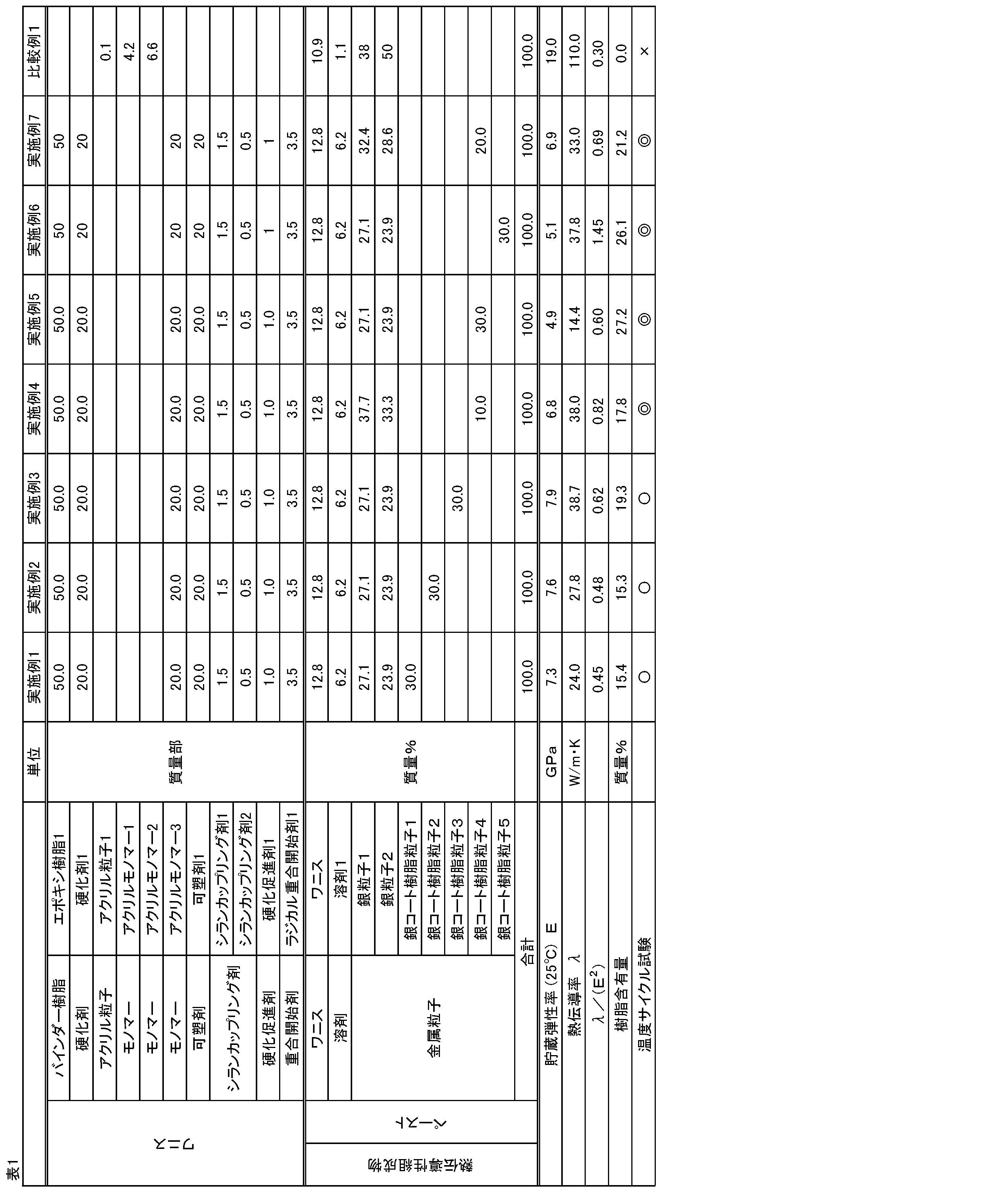
得られた熱伝導性組成物を、30℃から200℃まで60分間かけて昇温し、次いで200℃で120分間熱処理し、厚さ1mmの熱処理体を得た。次いで、レーザーフラッシュ法を用いて、熱処理体の厚み方向の熱拡散係数αを測定した。なお、測定温度は25℃とした。
さらに、示差走査熱量(Differential scanning calorimetry:DSC)測定により比熱Cpを測定し、また、JIS-K-6911に準拠して測定した密度ρを測定した。これらの値を用いて、以下の式に基づいて、熱伝導率λを算出した。
評価結果を下記表2に示す。なお、単位はW/(m・K)である。
熱伝導率λ[W/(m・K)]=α[m2/sec]×Cp[J/kg・K]×ρ[g/cm3]
得られた熱伝導性組成物を、30℃から200℃まで60分間かけて昇温し、次いで200℃で120分間熱処理し熱処理体を得た。得られた熱処理体について、測定装置(日立ハイテクサイエンス社製、DMS6100)を用いて、周波数1Hzでの動的粘弾性測定(DMA)で、25℃における貯蔵弾性率E(MPa)を測定した。
銅リードフレームと、シリコンチップ(長さ2mm×幅2mm、厚み0.35mm)とを準備した。次いで、シリコンチップに、得られた熱伝導性組成物を塗布厚み25±10μmとなるように塗布し、その上に銅リードフレームを配置した。シリコンチップ、熱伝導性組成物、銅リードフレームがこの順で積層してなる積層体を作製した。
次いで、得られた積層体を、大気下で、30℃から200℃まで60分間かけて昇温し、次いで200℃で120分間熱処理を行い、積層体中の熱伝導性組成物を硬化させた。
次いで、走査型電子顕微鏡(SEM)を用いて、積層体中の熱伝導性組成物の熱処理体の断面を観察し、その状態を評価した。
得られた熱伝導性組成物を、30℃から200℃まで60分間かけて昇温し、次いで200℃で120分間熱処理して、熱処理体を得た。得られた熱処理体において、バインダー樹脂および銀コート樹脂粒子由来の樹脂分を、以下のようにして測定した。熱処理体中における樹脂分の含有量を、樹脂含有量(質量%)とした。
樹脂含有量は、得られた熱処理体の重量を測定し、その重量から含まれる銀の重量を引くことで算出した。
得られた熱伝導性組成物を表面銀メッキの基板上に塗布し、上から3.5×3.5mmのシリコンチップ(比較例1のみ表面銀メッキ、それ以外はメッキなし)を乗せ、30℃から200℃まで60分間かけて昇温し、次いで200℃で120分間熱処理して硬化・接合させた。
接合後のシリコンチップ・基板を封止材EME-G700ML-C(住友ベークライト製)で封止し、サンプルを得た。
得られたサンプルを、85C/60%RHの高温高湿槽に入れて、168時間処理し、その後260℃のリフロー処理にかけた。
リフロー処理後のサンプルを、温度サイクル試験機TSA-72ES(エスペック製)に投入し、150℃10分→25℃10分→-65℃10分→25℃10分を1サイクルとして、2000サイクル処理を行った。
その後、SAT(超音波探傷)により剥離の有無を確認した。
表1中、剥離がないものを○、剥離があるものを×と表記した。
可塑剤(ポリブタジエン無水マレイン酸付加体、Cray Valley社製、RICOBOND1731)2.43質量部、アクリル樹脂(アクリル酸系重合物、東亞合成社製、UG4035)4.38質量部、アリル樹脂(1,2-シクロヘキサンジカルボン酸ビス(2-プロペニル)とプロパン-1,2-ジオールとの重合体、関東化学社製)6.57質量部、硬化促進剤(ジシアンジアミド誘導体、ADEKA社製、EH-3636AS)0.05質量部、アクリルモノマー(1.6ヘキサンジオールジメタクリレート、共栄社化学社製、ライトエステル 1.6HX)2.92質量部、アクリルモノマー(2-フェノキシエチルメタクリレート、共栄社化学社製、ライトエステル PO)8.03質量部、カップリング剤(メタクリル酸3-(トリメトキシシリル)プロピル、信越化学工業社製、KBM-503P)0.12質量部、カップリング剤(3-グリシジルオキシプロピルトリメトキシシラン、信越化学工業社製、KBM-403E)0.24質量部、重合開始剤(1,1-ビス(1,1-ジメチルエチルペルオキシ)シクロヘキサン、日油社製、パーヘキサ C(S))0.24質量部を混合し、ワニスを得た。
得られたワニスに、銀粉(DOWAハイテック社製、AG-DSB-114、球状、D50:1μm)75.00質量部を配合し、常温で、3本ロールミルで混練して、ペースト状の熱伝導性組成物を作製した。
上述の測定方法で得られた熱伝導率(λ)が1W/m・K、25℃における貯蔵弾性率(E)が3GPaであった。算出されたλ/(E2)は、0.11であった。
実施例1~7の熱伝導性組成物を用いることにより、比較例2と比べて、半導体パッケージの不良発生率を低減できることが分かった。
Claims (17)
- 金属粒子と、
バインダー樹脂と、
モノマーと、
を含み、
熱処理により前記金属粒子がシンタリングを起こして粒子連結構造を形成する熱伝導性組成物であって、
当該熱伝導性組成物を用いて、下記の手順Aに従って測定される熱伝導率λ(W/mK)と、下記の手順Bに従って測定される25℃の貯蔵弾性率E(GPa)とが、下記の式(I)を満たす、熱伝導性組成物。
0.35≦λ/(E2) ・・式(I)
(手順A)
当該熱伝導性組成物を、30℃から200℃まで60分間かけて昇温し、次いで200℃で120分間熱処理し、厚さ1mmの熱処理体を得る。得られた熱処理体について、レーザーフラッシュ法を用いて、25℃における熱伝導率λ(W/mK)を測定する。
(手順B)
当該熱伝導性組成物を、30℃から200℃まで60分間かけて昇温し、次いで200℃で120分間熱処理し熱処理体を得る。得られた熱処理体について、周波数1Hzでの動的粘弾性測定(DMA)を用いて、25℃における貯蔵弾性率E(MPa)を測定する。 - 請求項1に記載の熱伝導性組成物であって、
下記の手順により得られた熱処理体中の樹脂含有量が、前記熱処理体100質量%に対して、10質量%以上30質量%以下である、
熱伝導性組成物。
(手順)
当該熱伝導性組成物を、30℃から200℃まで60分間かけて昇温し、次いで200℃で120分間熱処理して、熱処理体を得る。 - 請求項1または2に記載の熱伝導性組成物であって、
前記金属粒子は、銀、金、および銅からなる群から選択される一種以上の金属材料からなる粒子を含む、熱伝導性組成物。 - 請求項1~3のいずれか一項に記載の熱伝導性組成物であって、
前記バインダー樹脂は、エポキシ樹脂、アクリル樹脂、およびアリル樹脂からなる群より選択される1種以上を含む、熱伝導性組成物。 - 請求項1~4のいずれか一項に記載の熱伝導性組成物であって、
硬化剤を含む、熱伝導性組成物。 - 請求項5に記載の熱伝導性組成物であって、
前記硬化剤は、フェノール樹脂系硬化剤またはイミダゾール系硬化剤を含む、熱伝導性組成物。 - 請求項1~6のいずれか一項に記載の熱伝導性組成物であって、
前記モノマーは、グリコールモノマー、アクリルモノマー、エポキシモノマー、およびマレイミドモノマーからなる群から選択される一種以上を含む、熱伝導性組成物。 - 請求項1~7のいずれか一項に記載の熱伝導性組成物であって、
ラジカル重合開始剤を含む、熱伝導性組成物。 - 請求項1~8のいずれか一項に記載の熱伝導性組成物であって、
シランカップリング剤を含む、熱伝導性組成物。 - 請求項1~9のいずれか一項に記載の熱伝導性組成物であって、
可塑剤を含む、熱伝導性組成物。 - 請求項1~10のいずれか一項に記載の熱伝導性組成物であって、
前記金属粒子は、金属コート樹脂粒子および金属からなる粒子を含む、熱伝導性組成物。 - 請求項11に記載の熱伝導性組成物であって、
前記金属コート樹脂粒子の比重が、2以上10以下である、熱伝導性組成物。 - 請求項11または12に記載の熱伝導性組成物であって、
前記金属コート樹脂粒子の平均粒子径D50が、0.5μm以上20μm以下である、熱伝導性組成物。 - 請求項11~13のいずれか一項に記載の熱伝導性組成物であって、
前記金属コート樹脂粒子の含有量は、金属粒子100質量%中、1質量%以上50質量%以下である、熱伝導性組成物。 - 請求項11~14のいずれか一項に記載の熱伝導性組成物であって、
前記金属コート樹脂粒子中の樹脂粒子を構成する樹脂材料が、シリコーン、アクリル、フェノール、ポリスチレン、メラミン、ポリアミド、及びポリテトラフルオロエチレンからなる群から選ばれる一または二以上を含む、熱伝導性組成物。 - 請求項1~15のいずれか一項に記載の熱伝導性組成物であって、
溶剤を含む、熱伝導性組成物。 - 基材と、
請求項1~16のいずれか一項に記載の熱伝導性組成物を熱処理して得られる接着層を介して前記基材上に搭載された半導体装置。
Priority Applications (4)
| Application Number | Priority Date | Filing Date | Title |
|---|---|---|---|
| KR1020217033312A KR102893534B1 (ko) | 2019-03-20 | 2020-03-11 | 열전도성 조성물 및 반도체 장치 |
| JP2021507239A JP6927455B2 (ja) | 2019-03-20 | 2020-03-11 | 熱伝導性組成物および半導体装置 |
| CN202080023194.0A CN113632219A (zh) | 2019-03-20 | 2020-03-11 | 导热性组合物和半导体装置 |
| MYPI2021005399A MY205477A (en) | 2019-03-20 | 2020-03-11 | Thermally conductive composition and semiconductor device |
Applications Claiming Priority (2)
| Application Number | Priority Date | Filing Date | Title |
|---|---|---|---|
| JP2019-052707 | 2019-03-20 | ||
| JP2019052707 | 2019-03-20 |
Publications (1)
| Publication Number | Publication Date |
|---|---|
| WO2020189445A1 true WO2020189445A1 (ja) | 2020-09-24 |
Family
ID=72519844
Family Applications (1)
| Application Number | Title | Priority Date | Filing Date |
|---|---|---|---|
| PCT/JP2020/010568 Ceased WO2020189445A1 (ja) | 2019-03-20 | 2020-03-11 | 熱伝導性組成物および半導体装置 |
Country Status (6)
| Country | Link |
|---|---|
| JP (1) | JP6927455B2 (ja) |
| KR (1) | KR102893534B1 (ja) |
| CN (1) | CN113632219A (ja) |
| MY (1) | MY205477A (ja) |
| TW (1) | TWI828881B (ja) |
| WO (1) | WO2020189445A1 (ja) |
Cited By (1)
| Publication number | Priority date | Publication date | Assignee | Title |
|---|---|---|---|---|
| WO2022113923A1 (ja) * | 2020-11-25 | 2022-06-02 | 住友ベークライト株式会社 | 銀含有ペーストおよび接合体 |
Families Citing this family (2)
| Publication number | Priority date | Publication date | Assignee | Title |
|---|---|---|---|---|
| KR20230059532A (ko) | 2021-10-26 | 2023-05-03 | 주식회사 엘지에너지솔루션 | 전지 모듈 및 이를 포함하는 전지팩 |
| EP4558550A1 (de) * | 2022-07-21 | 2025-05-28 | Wacker Chemie AG | Wärmeleitfähiger kunststoff |
Citations (8)
| Publication number | Priority date | Publication date | Assignee | Title |
|---|---|---|---|---|
| JP2005509293A (ja) * | 2001-10-18 | 2005-04-07 | ハネウエル・インターナシヨナル・インコーポレーテツド | 焼結金属フレーク |
| JP2015185807A (ja) * | 2014-03-26 | 2015-10-22 | 住友ベークライト株式会社 | ダイアタッチペースト、および半導体装置 |
| WO2017006854A1 (ja) * | 2015-07-08 | 2017-01-12 | 住友ベークライト株式会社 | 熱伝導性組成物、半導体装置、半導体装置の製造方法、および放熱板の接着方法 |
| JP2017025186A (ja) * | 2015-07-21 | 2017-02-02 | 住友ベークライト株式会社 | 熱伝導性樹脂組成物、回路基板用積層体、回路基板および半導体装置 |
| JP2017130358A (ja) * | 2016-01-20 | 2017-07-27 | 住友ベークライト株式会社 | 導電性ペースト、および導電性ペーストの硬化体の製造方法 |
| WO2017138255A1 (ja) * | 2016-02-10 | 2017-08-17 | 古河電気工業株式会社 | 導電性接着フィルムおよびこれを用いたダイシング・ダイボンディングフィルム |
| JP2017171844A (ja) * | 2016-03-25 | 2017-09-28 | 住友ベークライト株式会社 | ペースト状接着剤組成物、半導体装置、半導体装置の製造方法および放熱板の接着方法 |
| JP2018095682A (ja) * | 2016-12-08 | 2018-06-21 | 住友ベークライト株式会社 | ペースト状接着剤組成物および電子装置 |
Family Cites Families (4)
| Publication number | Priority date | Publication date | Assignee | Title |
|---|---|---|---|---|
| JP2000239616A (ja) | 1999-02-24 | 2000-09-05 | Hitachi Chem Co Ltd | 樹脂ペースト組成物及びこれを用いた半導体装置 |
| JP5567636B2 (ja) | 2012-10-05 | 2014-08-06 | 京セラケミカル株式会社 | 半導体接着用熱硬化型樹脂組成物及び半導体装置 |
| SG11201705967TA (en) * | 2015-01-29 | 2017-08-30 | Sumitomo Bakelite Co | Paste-like adhesive composition, semiconductor device, method for manufacturing semiconductor device, and method for bonding heatsink |
| WO2017014238A1 (ja) * | 2015-07-21 | 2017-01-26 | 住友ベークライト株式会社 | 熱伝導性樹脂組成物、熱伝導性シートおよび半導体装置 |
-
2020
- 2020-03-11 CN CN202080023194.0A patent/CN113632219A/zh active Pending
- 2020-03-11 KR KR1020217033312A patent/KR102893534B1/ko active Active
- 2020-03-11 WO PCT/JP2020/010568 patent/WO2020189445A1/ja not_active Ceased
- 2020-03-11 MY MYPI2021005399A patent/MY205477A/en unknown
- 2020-03-11 JP JP2021507239A patent/JP6927455B2/ja active Active
- 2020-03-17 TW TW109108757A patent/TWI828881B/zh active
Patent Citations (8)
| Publication number | Priority date | Publication date | Assignee | Title |
|---|---|---|---|---|
| JP2005509293A (ja) * | 2001-10-18 | 2005-04-07 | ハネウエル・インターナシヨナル・インコーポレーテツド | 焼結金属フレーク |
| JP2015185807A (ja) * | 2014-03-26 | 2015-10-22 | 住友ベークライト株式会社 | ダイアタッチペースト、および半導体装置 |
| WO2017006854A1 (ja) * | 2015-07-08 | 2017-01-12 | 住友ベークライト株式会社 | 熱伝導性組成物、半導体装置、半導体装置の製造方法、および放熱板の接着方法 |
| JP2017025186A (ja) * | 2015-07-21 | 2017-02-02 | 住友ベークライト株式会社 | 熱伝導性樹脂組成物、回路基板用積層体、回路基板および半導体装置 |
| JP2017130358A (ja) * | 2016-01-20 | 2017-07-27 | 住友ベークライト株式会社 | 導電性ペースト、および導電性ペーストの硬化体の製造方法 |
| WO2017138255A1 (ja) * | 2016-02-10 | 2017-08-17 | 古河電気工業株式会社 | 導電性接着フィルムおよびこれを用いたダイシング・ダイボンディングフィルム |
| JP2017171844A (ja) * | 2016-03-25 | 2017-09-28 | 住友ベークライト株式会社 | ペースト状接着剤組成物、半導体装置、半導体装置の製造方法および放熱板の接着方法 |
| JP2018095682A (ja) * | 2016-12-08 | 2018-06-21 | 住友ベークライト株式会社 | ペースト状接着剤組成物および電子装置 |
Cited By (4)
| Publication number | Priority date | Publication date | Assignee | Title |
|---|---|---|---|---|
| WO2022113923A1 (ja) * | 2020-11-25 | 2022-06-02 | 住友ベークライト株式会社 | 銀含有ペーストおよび接合体 |
| JPWO2022113923A1 (ja) * | 2020-11-25 | 2022-06-02 | ||
| JP7392876B2 (ja) | 2020-11-25 | 2023-12-06 | 住友ベークライト株式会社 | 銀含有ペーストおよび接合体 |
| TWI889941B (zh) * | 2020-11-25 | 2025-07-11 | 日商住友電木股份有限公司 | 含銀糊及接合體 |
Also Published As
| Publication number | Publication date |
|---|---|
| KR102893534B1 (ko) | 2025-12-02 |
| TWI828881B (zh) | 2024-01-11 |
| CN113632219A (zh) | 2021-11-09 |
| JP6927455B2 (ja) | 2021-09-01 |
| MY205477A (en) | 2024-10-23 |
| TW202045680A (zh) | 2020-12-16 |
| JPWO2020189445A1 (ja) | 2021-09-13 |
| KR20210143812A (ko) | 2021-11-29 |
Similar Documents
| Publication | Publication Date | Title |
|---|---|---|
| JP6927455B2 (ja) | 熱伝導性組成物および半導体装置 | |
| JP2017171844A (ja) | ペースト状接着剤組成物、半導体装置、半導体装置の製造方法および放熱板の接着方法 | |
| JP6950848B2 (ja) | 半導体パッケージに用いる熱伝導性組成物 | |
| JP7264211B2 (ja) | 熱伝導性組成物および半導体装置 | |
| JP2021082640A (ja) | 導電性ペーストおよび半導体装置 | |
| WO2019167824A1 (ja) | ペースト状接着剤組成物及び半導体装置 | |
| JP2022069401A (ja) | ペースト状組成物、高熱伝導性材料、および半導体装置 | |
| JP6566177B1 (ja) | ペースト状接着剤組成物及び半導体装置 | |
| CN115023453B (zh) | 膏状树脂组合物、高导热性材料和半导体装置 | |
| JP7392876B2 (ja) | 銀含有ペーストおよび接合体 | |
| WO2023276690A1 (ja) | 導電性樹脂組成物、高熱伝導性材料および半導体装置 | |
| JP2025059814A (ja) | 熱伝導性ペースト、半導体装置、及び半導体装置の製造方法 | |
| JP2025080102A (ja) | 熱伝導性ペースト、半導体装置、及び半導体装置の製造方法 | |
| JP2025005956A (ja) | 導電性ペースト、高熱伝導性材料および半導体装置 | |
| WO2022202434A1 (ja) | 導電性ペーストおよび半導体装置 |
Legal Events
| Date | Code | Title | Description |
|---|---|---|---|
| 121 | Ep: the epo has been informed by wipo that ep was designated in this application |
Ref document number: 20773865 Country of ref document: EP Kind code of ref document: A1 |
|
| ENP | Entry into the national phase |
Ref document number: 2021507239 Country of ref document: JP Kind code of ref document: A |
|
| NENP | Non-entry into the national phase |
Ref country code: DE |
|
| ENP | Entry into the national phase |
Ref document number: 20217033312 Country of ref document: KR Kind code of ref document: A |
|
| 122 | Ep: pct application non-entry in european phase |
Ref document number: 20773865 Country of ref document: EP Kind code of ref document: A1 |