WO2020184389A1 - 吸水性樹脂粒子 - Google Patents
吸水性樹脂粒子 Download PDFInfo
- Publication number
- WO2020184389A1 WO2020184389A1 PCT/JP2020/009479 JP2020009479W WO2020184389A1 WO 2020184389 A1 WO2020184389 A1 WO 2020184389A1 JP 2020009479 W JP2020009479 W JP 2020009479W WO 2020184389 A1 WO2020184389 A1 WO 2020184389A1
- Authority
- WO
- WIPO (PCT)
- Prior art keywords
- water
- resin particles
- absorbent resin
- gel
- amount
- Prior art date
- Legal status (The legal status is an assumption and is not a legal conclusion. Google has not performed a legal analysis and makes no representation as to the accuracy of the status listed.)
- Ceased
Links
Images



Classifications
-
- B—PERFORMING OPERATIONS; TRANSPORTING
- B01—PHYSICAL OR CHEMICAL PROCESSES OR APPARATUS IN GENERAL
- B01J—CHEMICAL OR PHYSICAL PROCESSES, e.g. CATALYSIS OR COLLOID CHEMISTRY; THEIR RELEVANT APPARATUS
- B01J20/00—Solid sorbent compositions or filter aid compositions; Sorbents for chromatography; Processes for preparing, regenerating or reactivating thereof
- B01J20/22—Solid sorbent compositions or filter aid compositions; Sorbents for chromatography; Processes for preparing, regenerating or reactivating thereof comprising organic material
- B01J20/26—Synthetic macromolecular compounds
- B01J20/261—Synthetic macromolecular compounds obtained by reactions only involving carbon to carbon unsaturated bonds
-
- C—CHEMISTRY; METALLURGY
- C08—ORGANIC MACROMOLECULAR COMPOUNDS; THEIR PREPARATION OR CHEMICAL WORKING-UP; COMPOSITIONS BASED THEREON
- C08J—WORKING-UP; GENERAL PROCESSES OF COMPOUNDING; AFTER-TREATMENT NOT COVERED BY SUBCLASSES C08B, C08C, C08F, C08G or C08H
- C08J3/00—Processes of treating or compounding macromolecular substances
- C08J3/12—Powdering or granulating
- C08J3/16—Powdering or granulating by coagulating dispersions
-
- A—HUMAN NECESSITIES
- A61—MEDICAL OR VETERINARY SCIENCE; HYGIENE
- A61F—FILTERS IMPLANTABLE INTO BLOOD VESSELS; PROSTHESES; DEVICES PROVIDING PATENCY TO, OR PREVENTING COLLAPSING OF, TUBULAR STRUCTURES OF THE BODY, e.g. STENTS; ORTHOPAEDIC, NURSING OR CONTRACEPTIVE DEVICES; FOMENTATION; TREATMENT OR PROTECTION OF EYES OR EARS; BANDAGES, DRESSINGS OR ABSORBENT PADS; FIRST-AID KITS
- A61F13/00—Bandages or dressings; Absorbent pads
- A61F13/15—Absorbent pads, e.g. sanitary towels, swabs or tampons for external or internal application to the body; Supporting or fastening means therefor; Tampon applicators
- A61F13/45—Absorbent pads, e.g. sanitary towels, swabs or tampons for external or internal application to the body; Supporting or fastening means therefor; Tampon applicators characterised by the shape
- A61F13/49—Absorbent pads, e.g. sanitary towels, swabs or tampons for external or internal application to the body; Supporting or fastening means therefor; Tampon applicators characterised by the shape specially adapted to be worn around the waist, e.g. diapers, nappies
- A61F13/49007—Form-fitting, self-adjusting disposable diapers
-
- A—HUMAN NECESSITIES
- A61—MEDICAL OR VETERINARY SCIENCE; HYGIENE
- A61F—FILTERS IMPLANTABLE INTO BLOOD VESSELS; PROSTHESES; DEVICES PROVIDING PATENCY TO, OR PREVENTING COLLAPSING OF, TUBULAR STRUCTURES OF THE BODY, e.g. STENTS; ORTHOPAEDIC, NURSING OR CONTRACEPTIVE DEVICES; FOMENTATION; TREATMENT OR PROTECTION OF EYES OR EARS; BANDAGES, DRESSINGS OR ABSORBENT PADS; FIRST-AID KITS
- A61F13/00—Bandages or dressings; Absorbent pads
- A61F13/15—Absorbent pads, e.g. sanitary towels, swabs or tampons for external or internal application to the body; Supporting or fastening means therefor; Tampon applicators
- A61F13/53—Absorbent pads, e.g. sanitary towels, swabs or tampons for external or internal application to the body; Supporting or fastening means therefor; Tampon applicators characterised by the absorbing medium
-
- A—HUMAN NECESSITIES
- A61—MEDICAL OR VETERINARY SCIENCE; HYGIENE
- A61L—METHODS OR APPARATUS FOR STERILISING MATERIALS OR OBJECTS IN GENERAL; DISINFECTION, STERILISATION OR DEODORISATION OF AIR; CHEMICAL ASPECTS OF BANDAGES, DRESSINGS, ABSORBENT PADS OR SURGICAL ARTICLES; MATERIALS FOR BANDAGES, DRESSINGS, ABSORBENT PADS OR SURGICAL ARTICLES
- A61L15/00—Chemical aspects of, or use of materials for, bandages, dressings or absorbent pads
- A61L15/16—Bandages, dressings or absorbent pads for physiological fluids such as urine or blood, e.g. sanitary towels, tampons
- A61L15/22—Bandages, dressings or absorbent pads for physiological fluids such as urine or blood, e.g. sanitary towels, tampons containing macromolecular materials
- A61L15/24—Macromolecular compounds obtained by reactions only involving carbon-to-carbon unsaturated bonds; Derivatives thereof
-
- A—HUMAN NECESSITIES
- A61—MEDICAL OR VETERINARY SCIENCE; HYGIENE
- A61L—METHODS OR APPARATUS FOR STERILISING MATERIALS OR OBJECTS IN GENERAL; DISINFECTION, STERILISATION OR DEODORISATION OF AIR; CHEMICAL ASPECTS OF BANDAGES, DRESSINGS, ABSORBENT PADS OR SURGICAL ARTICLES; MATERIALS FOR BANDAGES, DRESSINGS, ABSORBENT PADS OR SURGICAL ARTICLES
- A61L15/00—Chemical aspects of, or use of materials for, bandages, dressings or absorbent pads
- A61L15/16—Bandages, dressings or absorbent pads for physiological fluids such as urine or blood, e.g. sanitary towels, tampons
- A61L15/22—Bandages, dressings or absorbent pads for physiological fluids such as urine or blood, e.g. sanitary towels, tampons containing macromolecular materials
- A61L15/26—Macromolecular compounds obtained otherwise than by reactions only involving carbon-to-carbon unsaturated bonds; Derivatives thereof
-
- A—HUMAN NECESSITIES
- A61—MEDICAL OR VETERINARY SCIENCE; HYGIENE
- A61L—METHODS OR APPARATUS FOR STERILISING MATERIALS OR OBJECTS IN GENERAL; DISINFECTION, STERILISATION OR DEODORISATION OF AIR; CHEMICAL ASPECTS OF BANDAGES, DRESSINGS, ABSORBENT PADS OR SURGICAL ARTICLES; MATERIALS FOR BANDAGES, DRESSINGS, ABSORBENT PADS OR SURGICAL ARTICLES
- A61L15/00—Chemical aspects of, or use of materials for, bandages, dressings or absorbent pads
- A61L15/16—Bandages, dressings or absorbent pads for physiological fluids such as urine or blood, e.g. sanitary towels, tampons
- A61L15/42—Use of materials characterised by their function or physical properties
- A61L15/60—Liquid-swellable gel-forming materials, e.g. super-absorbents
-
- B—PERFORMING OPERATIONS; TRANSPORTING
- B01—PHYSICAL OR CHEMICAL PROCESSES OR APPARATUS IN GENERAL
- B01J—CHEMICAL OR PHYSICAL PROCESSES, e.g. CATALYSIS OR COLLOID CHEMISTRY; THEIR RELEVANT APPARATUS
- B01J20/00—Solid sorbent compositions or filter aid compositions; Sorbents for chromatography; Processes for preparing, regenerating or reactivating thereof
- B01J20/22—Solid sorbent compositions or filter aid compositions; Sorbents for chromatography; Processes for preparing, regenerating or reactivating thereof comprising organic material
- B01J20/26—Synthetic macromolecular compounds
-
- B—PERFORMING OPERATIONS; TRANSPORTING
- B01—PHYSICAL OR CHEMICAL PROCESSES OR APPARATUS IN GENERAL
- B01J—CHEMICAL OR PHYSICAL PROCESSES, e.g. CATALYSIS OR COLLOID CHEMISTRY; THEIR RELEVANT APPARATUS
- B01J20/00—Solid sorbent compositions or filter aid compositions; Sorbents for chromatography; Processes for preparing, regenerating or reactivating thereof
- B01J20/22—Solid sorbent compositions or filter aid compositions; Sorbents for chromatography; Processes for preparing, regenerating or reactivating thereof comprising organic material
- B01J20/26—Synthetic macromolecular compounds
- B01J20/265—Synthetic macromolecular compounds modified or post-treated polymers
- B01J20/267—Cross-linked polymers
-
- B—PERFORMING OPERATIONS; TRANSPORTING
- B01—PHYSICAL OR CHEMICAL PROCESSES OR APPARATUS IN GENERAL
- B01J—CHEMICAL OR PHYSICAL PROCESSES, e.g. CATALYSIS OR COLLOID CHEMISTRY; THEIR RELEVANT APPARATUS
- B01J20/00—Solid sorbent compositions or filter aid compositions; Sorbents for chromatography; Processes for preparing, regenerating or reactivating thereof
- B01J20/28—Solid sorbent compositions or filter aid compositions; Sorbents for chromatography; Processes for preparing, regenerating or reactivating thereof characterised by their form or physical properties
- B01J20/28014—Solid sorbent compositions or filter aid compositions; Sorbents for chromatography; Processes for preparing, regenerating or reactivating thereof characterised by their form or physical properties characterised by their form
- B01J20/28047—Gels
-
- C—CHEMISTRY; METALLURGY
- C08—ORGANIC MACROMOLECULAR COMPOUNDS; THEIR PREPARATION OR CHEMICAL WORKING-UP; COMPOSITIONS BASED THEREON
- C08F—MACROMOLECULAR COMPOUNDS OBTAINED BY REACTIONS ONLY INVOLVING CARBON-TO-CARBON UNSATURATED BONDS
- C08F120/00—Homopolymers of compounds having one or more unsaturated aliphatic radicals, each having only one carbon-to-carbon double bond, and only one being terminated by only one carboxyl radical or a salt, anhydride, ester, amide, imide or nitrile thereof
- C08F120/02—Monocarboxylic acids having less than ten carbon atoms; Derivatives thereof
- C08F120/04—Acids; Metal salts or ammonium salts thereof
- C08F120/06—Acrylic acid; Methacrylic acid; Metal salts or ammonium salts thereof
-
- C—CHEMISTRY; METALLURGY
- C08—ORGANIC MACROMOLECULAR COMPOUNDS; THEIR PREPARATION OR CHEMICAL WORKING-UP; COMPOSITIONS BASED THEREON
- C08F—MACROMOLECULAR COMPOUNDS OBTAINED BY REACTIONS ONLY INVOLVING CARBON-TO-CARBON UNSATURATED BONDS
- C08F2/00—Processes of polymerisation
- C08F2/001—Multistage polymerisation processes characterised by a change in reactor conditions without deactivating the intermediate polymer
-
- C—CHEMISTRY; METALLURGY
- C08—ORGANIC MACROMOLECULAR COMPOUNDS; THEIR PREPARATION OR CHEMICAL WORKING-UP; COMPOSITIONS BASED THEREON
- C08F—MACROMOLECULAR COMPOUNDS OBTAINED BY REACTIONS ONLY INVOLVING CARBON-TO-CARBON UNSATURATED BONDS
- C08F2/00—Processes of polymerisation
- C08F2/12—Polymerisation in non-solvents
- C08F2/16—Aqueous medium
- C08F2/18—Suspension polymerisation
- C08F2/20—Suspension polymerisation with the aid of macromolecular dispersing agents
-
- C—CHEMISTRY; METALLURGY
- C08—ORGANIC MACROMOLECULAR COMPOUNDS; THEIR PREPARATION OR CHEMICAL WORKING-UP; COMPOSITIONS BASED THEREON
- C08F—MACROMOLECULAR COMPOUNDS OBTAINED BY REACTIONS ONLY INVOLVING CARBON-TO-CARBON UNSATURATED BONDS
- C08F265/00—Macromolecular compounds obtained by polymerising monomers on to polymers of unsaturated monocarboxylic acids or derivatives thereof as defined in group C08F20/00
- C08F265/02—Macromolecular compounds obtained by polymerising monomers on to polymers of unsaturated monocarboxylic acids or derivatives thereof as defined in group C08F20/00 on to polymers of acids, salts or anhydrides
-
- C—CHEMISTRY; METALLURGY
- C08—ORGANIC MACROMOLECULAR COMPOUNDS; THEIR PREPARATION OR CHEMICAL WORKING-UP; COMPOSITIONS BASED THEREON
- C08F—MACROMOLECULAR COMPOUNDS OBTAINED BY REACTIONS ONLY INVOLVING CARBON-TO-CARBON UNSATURATED BONDS
- C08F8/00—Chemical modification by after-treatment
- C08F8/14—Esterification
-
- C—CHEMISTRY; METALLURGY
- C08—ORGANIC MACROMOLECULAR COMPOUNDS; THEIR PREPARATION OR CHEMICAL WORKING-UP; COMPOSITIONS BASED THEREON
- C08J—WORKING-UP; GENERAL PROCESSES OF COMPOUNDING; AFTER-TREATMENT NOT COVERED BY SUBCLASSES C08B, C08C, C08F, C08G or C08H
- C08J3/00—Processes of treating or compounding macromolecular substances
- C08J3/02—Making solutions, dispersions, lattices or gels by other methods than by solution, emulsion or suspension polymerisation techniques
- C08J3/03—Making solutions, dispersions, lattices or gels by other methods than by solution, emulsion or suspension polymerisation techniques in aqueous media
- C08J3/075—Macromolecular gels
-
- C—CHEMISTRY; METALLURGY
- C08—ORGANIC MACROMOLECULAR COMPOUNDS; THEIR PREPARATION OR CHEMICAL WORKING-UP; COMPOSITIONS BASED THEREON
- C08J—WORKING-UP; GENERAL PROCESSES OF COMPOUNDING; AFTER-TREATMENT NOT COVERED BY SUBCLASSES C08B, C08C, C08F, C08G or C08H
- C08J3/00—Processes of treating or compounding macromolecular substances
- C08J3/24—Crosslinking, e.g. vulcanising, of macromolecules
- C08J3/245—Differential crosslinking of one polymer with one crosslinking type, e.g. surface crosslinking
-
- G—PHYSICS
- G01—MEASURING; TESTING
- G01N—INVESTIGATING OR ANALYSING MATERIALS BY DETERMINING THEIR CHEMICAL OR PHYSICAL PROPERTIES
- G01N33/00—Investigating or analysing materials by specific methods not covered by groups G01N1/00 - G01N31/00
- G01N33/44—Resins; Plastics; Rubber; Leather
- G01N33/442—Resins; Plastics
-
- A—HUMAN NECESSITIES
- A61—MEDICAL OR VETERINARY SCIENCE; HYGIENE
- A61F—FILTERS IMPLANTABLE INTO BLOOD VESSELS; PROSTHESES; DEVICES PROVIDING PATENCY TO, OR PREVENTING COLLAPSING OF, TUBULAR STRUCTURES OF THE BODY, e.g. STENTS; ORTHOPAEDIC, NURSING OR CONTRACEPTIVE DEVICES; FOMENTATION; TREATMENT OR PROTECTION OF EYES OR EARS; BANDAGES, DRESSINGS OR ABSORBENT PADS; FIRST-AID KITS
- A61F13/00—Bandages or dressings; Absorbent pads
- A61F13/15—Absorbent pads, e.g. sanitary towels, swabs or tampons for external or internal application to the body; Supporting or fastening means therefor; Tampon applicators
- A61F13/53—Absorbent pads, e.g. sanitary towels, swabs or tampons for external or internal application to the body; Supporting or fastening means therefor; Tampon applicators characterised by the absorbing medium
- A61F2013/530481—Absorbent pads, e.g. sanitary towels, swabs or tampons for external or internal application to the body; Supporting or fastening means therefor; Tampon applicators characterised by the absorbing medium having superabsorbent materials, i.e. highly absorbent polymer gel materials
-
- A—HUMAN NECESSITIES
- A61—MEDICAL OR VETERINARY SCIENCE; HYGIENE
- A61F—FILTERS IMPLANTABLE INTO BLOOD VESSELS; PROSTHESES; DEVICES PROVIDING PATENCY TO, OR PREVENTING COLLAPSING OF, TUBULAR STRUCTURES OF THE BODY, e.g. STENTS; ORTHOPAEDIC, NURSING OR CONTRACEPTIVE DEVICES; FOMENTATION; TREATMENT OR PROTECTION OF EYES OR EARS; BANDAGES, DRESSINGS OR ABSORBENT PADS; FIRST-AID KITS
- A61F13/00—Bandages or dressings; Absorbent pads
- A61F13/15—Absorbent pads, e.g. sanitary towels, swabs or tampons for external or internal application to the body; Supporting or fastening means therefor; Tampon applicators
- A61F13/53—Absorbent pads, e.g. sanitary towels, swabs or tampons for external or internal application to the body; Supporting or fastening means therefor; Tampon applicators characterised by the absorbing medium
- A61F2013/530481—Absorbent pads, e.g. sanitary towels, swabs or tampons for external or internal application to the body; Supporting or fastening means therefor; Tampon applicators characterised by the absorbing medium having superabsorbent materials, i.e. highly absorbent polymer gel materials
- A61F2013/530583—Absorbent pads, e.g. sanitary towels, swabs or tampons for external or internal application to the body; Supporting or fastening means therefor; Tampon applicators characterised by the absorbing medium having superabsorbent materials, i.e. highly absorbent polymer gel materials characterized by the form
- A61F2013/530591—Absorbent pads, e.g. sanitary towels, swabs or tampons for external or internal application to the body; Supporting or fastening means therefor; Tampon applicators characterised by the absorbing medium having superabsorbent materials, i.e. highly absorbent polymer gel materials characterized by the form in granules or particles
-
- B—PERFORMING OPERATIONS; TRANSPORTING
- B01—PHYSICAL OR CHEMICAL PROCESSES OR APPARATUS IN GENERAL
- B01J—CHEMICAL OR PHYSICAL PROCESSES, e.g. CATALYSIS OR COLLOID CHEMISTRY; THEIR RELEVANT APPARATUS
- B01J2220/00—Aspects relating to sorbent materials
- B01J2220/40—Aspects relating to the composition of sorbent or filter aid materials
- B01J2220/48—Sorbents characterised by the starting material used for their preparation
- B01J2220/4812—Sorbents characterised by the starting material used for their preparation the starting material being of organic character
-
- B—PERFORMING OPERATIONS; TRANSPORTING
- B01—PHYSICAL OR CHEMICAL PROCESSES OR APPARATUS IN GENERAL
- B01J—CHEMICAL OR PHYSICAL PROCESSES, e.g. CATALYSIS OR COLLOID CHEMISTRY; THEIR RELEVANT APPARATUS
- B01J2220/00—Aspects relating to sorbent materials
- B01J2220/50—Aspects relating to the use of sorbent or filter aid materials
- B01J2220/68—Superabsorbents
-
- C—CHEMISTRY; METALLURGY
- C08—ORGANIC MACROMOLECULAR COMPOUNDS; THEIR PREPARATION OR CHEMICAL WORKING-UP; COMPOSITIONS BASED THEREON
- C08J—WORKING-UP; GENERAL PROCESSES OF COMPOUNDING; AFTER-TREATMENT NOT COVERED BY SUBCLASSES C08B, C08C, C08F, C08G or C08H
- C08J2333/00—Characterised by the use of homopolymers or copolymers of compounds having one or more unsaturated aliphatic radicals, each having only one carbon-to-carbon double bond, and only one being terminated by only one carboxyl radical, or of salts, anhydrides, esters, amides, imides, or nitriles thereof; Derivatives of such polymers
- C08J2333/02—Homopolymers or copolymers of acids; Metal or ammonium salts thereof
Definitions
- the present invention relates to water-absorbent resin particles.
- Water-absorbent resin is used in the field of hygiene products. Specifically, it is used as a material for an absorber contained in an absorbent article such as a diaper (for example, Patent Documents 1 and 2).
- An object of the present invention is to provide water-absorbent resin particles capable of reducing the amount of reversion in an absorbent article.
- the inventors of the present application have found that, surprisingly, the higher the outflow property of the swelling gel, the smaller the amount of reversion in the absorbent article.
- the water-absorbent resin particles of the present invention have a gel outflow test force of 5 to 14 N measured by the following method.
- Gel outflow test force measuring method A swollen gel is prepared by allowing the water-absorbent resin particles to absorb 29 times the amount of physiological saline as the water-absorbent resin particles under stirring. 20 g of the swelling gel is evenly placed in a cylinder having an inner diameter of 5 cm and a hole having a diameter of 5 mm at the bottom.
- the swelling gel in the cylinder is compressed at a rate of 10 mm / min using a jig having a diameter of 4.9 cm, and the test force at the time when a part of the swelling gel flows out from the hole at the bottom of the cylinder is subjected to a gel outflow test. Record as force.
- the water-absorbent resin particles preferably have a physiological saline water retention amount of 30 to 60 g / g.
- the water-absorbent resin particles preferably have a physiological saline water absorption amount of 15 ml / g or more for 2 hours under a load of 4.14 kPa.
- the present invention also provides an absorber containing water-absorbent resin particles.
- the present invention also provides an absorbent article comprising the above absorber.
- the absorbent article may be a diaper.
- the present invention also comprises allowing water-absorbent resin particles to absorb 29 times the amount of physiological saline of the water-absorbent resin particles under stirring to prepare a swelling gel, and having a hole with a diameter of 5 mm at the bottom and an inner diameter of 5 cm.
- 20 g of the swelling gel is evenly placed in the cylinder, and the swelling gel in the cylinder is compressed at a rate of 10 mm / min using a jig having a diameter of 4.9 cm, and a part of the swelling gel is a part of the bottom of the cylinder.
- a method for measuring a gel outflow test force which comprises recording the test force at the time of outflow from the hole as a gel outflow test force.
- the present invention also provides a method for producing water-absorbent resin particles, which comprises selecting water-absorbent resin particles having a gel outflow test force of 5 to 14 N measured by the above-mentioned measuring method.
- the present invention also provides a method for reducing the amount of reversion of an absorbent article, including setting the gel outflow test force of the water-absorbent resin particles measured by the above measuring method to 5 to 14 N.
- the present invention provides water-absorbent resin particles capable of reducing the amount of reversion in an absorbent article.
- Water-soluble means that it exhibits a solubility in water of 5% by mass or more at 25 ° C.
- the materials exemplified in the present specification may be used alone or in combination of two or more.
- the content of each component in the composition means the total amount of the plurality of substances present in the composition when a plurality of substances corresponding to each component are present in the composition, unless otherwise specified.
- physiological saline refers to an aqueous solution of NaCl having a concentration of 0.9% by mass unless otherwise specified.
- the water-absorbent resin particles according to this embodiment have a gel outflow test force of 5 to 14 N measured by the following method.
- Gel outflow test force measuring method A swollen gel is prepared by allowing the water-absorbent resin particles to absorb 29 times the amount of physiological saline as the water-absorbent resin particles under stirring. 20 g of the swelling gel is evenly placed in a cylinder having an inner diameter of 5 cm and a hole having a diameter of 5 mm at the bottom.
- the swelling gel in the cylinder is compressed at a rate of 10 mm / min using a jig having a diameter of 4.9 cm, and the test force at the time when a part of the swelling gel flows out from the hole at the bottom of the cylinder is subjected to a gel outflow test. Record as force.
- a more specific measurement method will be shown in Examples described later.
- the water-absorbent resin particles according to the present embodiment may have a gel outflow test force of 13.5 N or less, 13 N or less, and 12.5 N or less.
- the gel outflow test force of the water-absorbent resin particles may be, for example, 6N or more, 7N or more, 8N or more, and 10N or more.
- the water retention amount of the physiological saline of the water-absorbent resin particles according to the present embodiment is preferably in the following range.
- the amount of water retained is preferably 30 g / g or more, 35 g / g or more, 40 g / g or more, 43 g / g or more, or 45 g / g or more from the viewpoint of easily obtaining an excellent permeation rate in an absorbent article.
- the amount of water retained is 80 g / g or less, 75 g / g or less, 70 g / g or less, 65 g / g or less, 60 g / g or less, 55 g / g or less, 52 g / g or less from the viewpoint of easily obtaining an excellent permeation rate in an absorbent article. It is preferably g or less, or 50 g / g or less. From these viewpoints, the water retention amount is preferably 30 to 80 g / g, more preferably 40 to 65 g / g.
- the water retention amount may be the water retention amount at room temperature (25 ° C. ⁇ 2 ° C.). The amount of water retained can be measured by the method described in Examples described later.
- the 2-hour value of the physiological saline water absorption amount (water absorption amount under load) of the water-absorbent resin particles according to the present embodiment under a load of 4.14 kPa may be, for example, 15 ml / g or more, 18 ml / g or more, or It may be 20 ml / g or more.
- the amount of physiological saline absorbed under a load of 4.14 kPa may be, for example, 35 ml / g or less, 30 ml / g or less, or 25 ml / g or less. 4.
- the amount of saline water absorbed under a load of 14 kPa is measured by the method described in Examples described later.
- Examples of the shape of the water-absorbent resin particles include substantially spherical, crushed, and granular shapes.
- the medium particle size of the water-absorbent resin particles may be 250 to 850 ⁇ m, 300 to 700 ⁇ m, or 300 to 600 ⁇ m.
- the water-absorbent resin particles according to the present embodiment may have a desired particle size distribution when polymer particles are obtained by the production method described later, but an operation such as particle size adjustment using classification by a sieve is performed. The particle size distribution may be adjusted accordingly.
- the water-absorbent resin particles according to the present embodiment can include, for example, a crosslinked polymer formed by polymerizing a monomer containing an ethylenically unsaturated monomer.
- the crosslinked polymer has a monomer unit derived from an ethylenically unsaturated monomer. That is, the water-absorbent resin particles according to the present embodiment can have a structural unit derived from an ethylenically unsaturated monomer.
- Examples of the method for polymerizing the above-mentioned monomer include a reverse phase suspension polymerization method, an aqueous solution polymerization method, a bulk polymerization method, and a precipitation polymerization method.
- the reverse phase suspension polymerization method or the aqueous solution polymerization method is preferable from the viewpoint of ensuring good water absorption characteristics of the obtained water-absorbent resin particles and facilitating control of the polymerization reaction.
- a reverse phase suspension polymerization method will be described as an example as a method for polymerizing an ethylenically unsaturated monomer.
- the ethylenically unsaturated monomer is preferably water-soluble, for example, (meth) acrylic acid and a salt thereof, 2- (meth) acrylamide-2-methylpropanesulfonic acid and a salt thereof, (meth) acrylamide, N. , N-dimethyl (meth) acrylamide, 2-hydroxyethyl (meth) acrylate, N-methylol (meth) acrylamide, polyethylene glycol mono (meth) acrylate, N, N-diethylaminoethyl (meth) acrylate, N, N-diethylamino Examples thereof include propyl (meth) acrylate and diethylaminopropyl (meth) acrylamide.
- the amino group may be quaternized.
- Functional groups such as carboxyl groups and amino groups contained in the above-mentioned monomers can function as functional groups capable of cross-linking in the surface cross-linking step described later.
- These ethylenically unsaturated monomers may be used alone or in combination of two or more.
- the ethylenically unsaturated monomer is selected from the group consisting of (meth) acrylic acid and its salts, acrylamide, methacrylamide, and N, N-dimethylacrylamide. It preferably contains at least one compound, and more preferably contains at least one compound selected from the group consisting of (meth) acrylic acid and salts thereof, and acrylamide. From the viewpoint of further enhancing the water absorption characteristics, the ethylenically unsaturated monomer further preferably contains at least one compound selected from the group consisting of (meth) acrylic acid and salts thereof.
- the monomer some monomers other than the above ethylenically unsaturated monomer may be used. Such a monomer can be used, for example, by mixing with an aqueous solution containing the ethylenically unsaturated monomer.
- the amount of the ethylenically unsaturated monomer used is the total amount of the monomers (the total amount of the monomers for obtaining the water-absorbent resin particles. For example, the total amount of the monomers giving the structural unit of the crosslinked polymer. The same shall apply hereinafter). It may be 70 to 100 mol%, 80 to 100 mol%, 90 to 100 mol%, 95 to 100 mol%, or 100 mol%.
- (meth) acrylic acid and a salt thereof may be 70 to 100 mol%, 80 to 100 mol%, 90 to 100 mol%, 95 to 100 mol%, or 100 mol% with respect to the total amount of the monomer. May be.
- “Ratio of (meth) acrylic acid and its salt” means the ratio of the total amount of (meth) acrylic acid and its salt.
- the water-absorbent resin particles containing a crosslinked polymer having a structural unit derived from the ethylenically unsaturated monomer, wherein the ethylenically unsaturated monomer is used.
- At least one compound selected from the group consisting of (meth) acrylic acid and salts thereof, and the ratio of (meth) acrylic acid and its salts is based on the total amount of monomers for obtaining water-absorbent resin particles. It is possible to provide water-absorbent resin particles in an amount of 70 to 100 mol%.
- the ethylenically unsaturated monomer is usually preferably used as an aqueous solution.
- concentration of the ethylenically unsaturated monomer in an aqueous solution containing an ethylenically unsaturated monomer (hereinafter referred to as a monomer aqueous solution) may be usually 20% by mass or more and a saturation concentration or less, and 25 to 70% by mass. It is preferably 30 to 55% by mass, more preferably.
- Examples of the water used include tap water, distilled water, ion-exchanged water and the like.
- the aqueous monomer solution may be used by neutralizing the acid group with an alkaline neutralizer.
- the degree of neutralization of an ethylenically unsaturated monomer by an alkaline neutralizing agent is an ethylenically unsaturated monomer from the viewpoint of increasing the osmotic pressure of the obtained water-absorbent resin particles and further enhancing water absorption characteristics such as water retention. It is 10 to 100 mol%, preferably 50 to 90 mol%, more preferably 60 to 80 mol% of the acidic groups in the body.
- alkaline neutralizing agent examples include alkali metal salts such as sodium hydroxide, sodium carbonate, sodium hydrogencarbonate, potassium hydroxide and potassium carbonate; ammonia and the like. These alkaline neutralizers may be used in the form of an aqueous solution in order to simplify the neutralization operation.
- the above-mentioned alkaline neutralizer may be used alone or in combination of two or more. Neutralization of the acid group of the ethylenically unsaturated monomer can be carried out, for example, by adding an aqueous solution of sodium hydroxide, potassium hydroxide or the like to the monomer aqueous solution and mixing them.
- an aqueous monomer solution is dispersed in a hydrocarbon dispersion medium in the presence of a surfactant, and an ethylenically unsaturated monomer is polymerized using a radical polymerization initiator or the like. Will be done.
- surfactant examples include nonionic surfactants and anionic surfactants.
- nonionic surfactant examples include sorbitan fatty acid ester, polyglycerin fatty acid ester, sucrose fatty acid ester, polyoxyethylene sorbitan fatty acid ester, polyoxyethylene glycerin fatty acid ester, sorbitol fatty acid ester, polyoxyethylene sorbitol fatty acid ester, and poly.
- examples include ether and polyethylene glycol fatty acid ester.
- the anionic surfactant include fatty acid salts, alkylbenzene sulfonates, alkylmethyl taur phosphates, polyoxyethylene alkylphenyl ether sulfates, polyoxyethylene alkyl ether sulfonates, and phosphorus of polyoxyethylene alkyl ethers.
- surfactants are selected from the viewpoints that the W / O type reverse phase suspension is in a good state, water-absorbent resin particles are easily obtained with a suitable particle size, and are industrially easily available. It is preferable to contain at least one compound selected from the group consisting of sorbitan fatty acid ester, polyglycerin fatty acid ester and sucrose fatty acid ester. Further, from the viewpoint of improving the water absorption characteristics of the obtained water-absorbent resin particles, it is more preferable that the surfactant contains a sucrose fatty acid ester. These surfactants may be used alone or in combination of two or more.
- the amount of the surfactant is preferably 0.05 to 10 parts by mass with respect to 100 parts by mass of the ethylenically unsaturated monomer aqueous solution from the viewpoint of obtaining a sufficient effect on the amount used and being economical. , 0.08 to 5 parts by mass, more preferably 0.1 to 3 parts by mass.
- a polymer-based dispersant may be used in combination with the above-mentioned surfactant.
- the polymer dispersant include maleic anhydride-modified polyethylene, maleic anhydride-modified polypropylene, maleic anhydride-modified ethylene / propylene copolymer, maleic anhydride-modified EPDM (ethylene / propylene / diene / terpolymer), and anhydrous.
- polymer-based dispersants in particular, from the viewpoint of monomer dispersion stability, maleic anhydride-modified polyethylene, maleic anhydride-modified polypropylene, maleic anhydride-modified ethylene / propylene copolymer, and maleic anhydride -Ethethylene copolymer, maleic anhydride / propylene copolymer, maleic anhydride / ethylene / propylene copolymer, polyethylene, polypropylene, ethylene / propylene copolymer, oxidized polyethylene, oxidized polypropylene, oxidized ethylene / propylene It is preferable to use a copolymer.
- These polymer-based dispersants may be used alone or in combination of two or more.
- the amount of the polymer-based dispersant should be 0.05 to 10 parts by mass with respect to 100 parts by mass of the ethylenically unsaturated monomer aqueous solution from the viewpoint of obtaining a sufficient effect on the amount used and being economical. Is more preferable, 0.08 to 5 parts by mass is more preferable, and 0.1 to 3 parts by mass is further preferable.
- the radical polymerization initiator is preferably water-soluble, and is, for example, a persulfate such as potassium persulfate, ammonium persulfate, sodium persulfate; methyl ethyl ketone peroxide, methyl isobutyl ketone peroxide, di-t-butyl peroxide, t.
- a persulfate such as potassium persulfate, ammonium persulfate, sodium persulfate
- methyl ethyl ketone peroxide methyl isobutyl ketone peroxide
- di-t-butyl peroxide di-t-butyl peroxide
- -Peroxides such as butyl cumylperoxide, t-butylperoxyacetate, t-butylperoxyisobutyrate, t-butylperoxypivalate, and hydrogen peroxide; 2,2'-azobis (2-amidino) Propane) 2 hydrochloride, 2,2'-azobis [2- (N-phenylamidino) propane] 2 hydrochloride, 2,2'-azobis [2- (N-allylamidino) propane] 2 hydrochloride, 2, 2'-azobis [2- (2-imidazolin-2-yl) propane] dihydrochloride, 2,2'-azobis ⁇ 2- [1- (2-hydroxyethyl) -2-imidazolin-2-yl] propane ⁇ 2 hydrochloride, 2,2'-azobis ⁇ 2-methyl-N- [1,1-bis (hydroxymethyl) -2-hydroxyethyl] propionamide ⁇ , 2,2'-azobis [2-methyl-N -(
- radical polymerization initiators may be used alone or in combination of two or more.
- 2,2'-azobis ⁇ 2- [1- (2-hydroxyethyl) -2-imidazolin-2-yl] propane ⁇ 2 hydrochloride is preferred
- 2,2'-azobis (2-2'-azobis (2-) Amidinopropane) dihydrochloride 2,2'-azobis [2- (2-imidazolin-2-yl) propane] dihydrochloride
- At least one azo compound selected from the group consisting of hydrochloride is
- the amount of the radical polymerization initiator used may be 0.00005 to 0.01 mol per 1 mol of the ethylenically unsaturated monomer.
- the amount of the radical polymerization initiator used is 0.00005 mol or more, the polymerization reaction does not require a long time and is efficient.
- the amount used is 0.01 mol or less, a rapid polymerization reaction tends not to occur.
- the above radical polymerization initiator can also be used as a redox polymerization initiator in combination with a reducing agent such as sodium sulfite, sodium hydrogen sulfite, ferrous sulfate, and L-ascorbic acid.
- a reducing agent such as sodium sulfite, sodium hydrogen sulfite, ferrous sulfate, and L-ascorbic acid.
- the chain transfer agent may be contained in the aqueous ethylenically unsaturated monomer used for the polymerization.
- examples of the chain transfer agent include hypophosphates, thiols, thiol acids, secondary alcohols, amines and the like.
- a thickener may be contained in the aqueous ethylenically unsaturated monomer used for the polymerization.
- the thickener include hydroxyethyl cellulose, hydroxypropyl cellulose, methyl cellulose, carboxymethyl cellulose, polyacrylic acid, polyacrylic acid (partial) neutralized product, polyethylene glycol, polyacrylamide, polyethyleneimine, dextrin, sodium alginate, and polyvinyl alcohol. , Polyvinylpyrrolidone, polyethylene oxide and the like can be used. If the stirring speed at the time of polymerization is the same, the higher the viscosity of the aqueous ethylenically unsaturated monomer solution, the larger the medium particle size of the obtained particles tends to be.
- hydrocarbon dispersion medium examples include chain aliphatic hydrocarbons such as n-hexane, n-heptane, 2-methylhexane, 3-methylhexane, 2,3-dimethylpentane, 3-ethylpentane, and n-octane.
- Alicyclic hydrocarbons such as cyclohexane, methylcyclohexane, cyclopentane, methylcyclopentane, trans-1,2-dimethylcyclopentane, cis-1,3-dimethylcyclopentane, trans-1,3-dimethylcyclopentane;
- aromatic hydrocarbons such as benzene, toluene and xylene.
- hydrocarbon dispersion media may be used alone or in combination of two or more.
- the hydrocarbon dispersion medium may contain at least one compound selected from the group consisting of chain aliphatic hydrocarbons having 6 to 8 carbon atoms and alicyclic hydrocarbons having 6 to 8 carbon atoms.
- the hydrocarbon dispersion medium may contain n-heptane, cyclohexane, or both.
- commercially available exol heptane manufactured by ExxonMobil: containing 75 to 85% of n-heptane and isomeric hydrocarbons
- ExxonMobil containing 75 to 85% of n-heptane and isomeric hydrocarbons
- the amount of the hydrocarbon dispersion medium used is preferably 30 to 1000 parts by mass and 40 to 500 parts by mass with respect to 100 parts by mass of the monomer aqueous solution from the viewpoint of appropriately removing the heat of polymerization and facilitating the control of the polymerization temperature. Parts are more preferable, and 50 to 300 parts by mass are further preferable.
- the amount of the hydrocarbon dispersion medium used is 30 parts by mass or more, the polymerization temperature tends to be easily controlled.
- the amount of the hydrocarbon dispersion medium used is 1000 parts by mass or less, the productivity of polymerization tends to be improved, which is economical.
- internal cross-linking may occur by self-cross-linking during polymerization, but internal cross-linking may be further performed by using an internal cross-linking agent to control the water absorption characteristics of the water-absorbent resin particles.
- the internal cross-linking agent used include di or tri (meth) acrylic acid esters of polyols such as ethylene glycol, propylene glycol, trimethylolpropane, glycerin, polyoxyethylene glycol, polyoxypropylene glycol and polyglycerin; Unsaturated polyesters obtained by reacting the above polyols with unsaturated acids such as maleic acid and fumaric acid; bis (meth) acrylamides such as N, N'-methylenebis (meth) acrylamide; polyepoxides and (meth) Di or tri (meth) acrylic acid esters obtained by reacting with acrylic acid; di (meth) obtained by reacting polyisocyanates such as tolylene diisocyanate and hexamethylene diiso
- Acrylic acid carbamil esters compounds having two or more polymerizable unsaturated groups such as allylated starch, allylated cellulose, diallyl phthalate, N, N', N''-triallyl isocyanurate, divinylbenzene; (poly) ) Polyglycidyl such as ethylene glycol diglycidyl ether, (poly) propylene glycol diglycidyl ether, (poly) glycerin diglycidyl ether, (poly) glycerin triglycidyl ether, (poly) propylene glycol polyglycidyl ether, polyglycerol polyglycidyl ether, etc.
- Polyglycidyl such as ethylene glycol diglycidyl ether, (poly) propylene glycol diglycidyl ether, (poly) glycerin diglycidyl ether, (poly) glycerin triglycidyl
- Haloepoxy compounds such as epichlorohydrin, epibromhydrin, ⁇ -methylepicrolhydrin; isocyanate compounds such as 2,4-tolylene diisocyanate and hexamethylene diisocyanate, and the like, which have two or more reactive functional groups. ..
- a polyglycidyl compound more preferably a diglycidyl ether compound, (poly) ethylene glycol diglycidyl ether, (poly) propylene glycol diglycidyl ether, (poly). It is particularly preferable to use glycerin diglycidyl ether.
- These cross-linking agents may be used alone or in combination of two or more.
- the amount of the internal cross-linking agent is adjusted per mole of the ethylenically unsaturated monomer from the viewpoint that the water-soluble property is suppressed by appropriately cross-linking the obtained polymer and a sufficient water absorption amount is exhibited. It is preferably 0 to 0.03 mol, more preferably 0.00001 to 0.01 mol, and even more preferably 0.00002 to 0.005 mol.
- the oil phase containing the above components can be mixed and heated under stirring to carry out reverse phase suspension polymerization in an aqueous system in oil.
- a monomer aqueous solution containing an ethylenically unsaturated monomer is dispersed in a hydrocarbon dispersion medium in the presence of a surfactant and, if necessary, a polymer-based dispersant.
- a surfactant and, if necessary, a polymer-based dispersant may be before or after the addition of the aqueous monomer solution as long as it is before the start of the polymerization reaction.
- the reaction mixture obtained in the first step polymerization reaction after the first step reverse phase suspension polymerization is subjected to an ethylenically unsaturated single amount.
- the body may be added and mixed, and the reverse phase suspension polymerization of the second and subsequent steps may be carried out in the same manner as in the first step.
- the above-mentioned radical polymerization initiator and internal cross-linking agent are added to the reverse phase suspension in each stage of the second and subsequent stages.
- reverse phase suspension polymerization Based on the amount of ethylenically unsaturated monomer added during polymerization, it is possible to carry out reverse phase suspension polymerization by adding within the range of the molar ratio of each component to the above-mentioned ethylenically unsaturated monomer. preferable.
- An internal cross-linking agent may be used in the reverse phase suspension polymerization in each of the second and subsequent stages, if necessary. When an internal cross-linking agent is used, it is added within the range of the molar ratio of each component to the above-mentioned ethylenically unsaturated monomer based on the amount of the ethylenically unsaturated monomer provided in each stage, and the suspension is reversed. It is preferable to carry out turbid polymerization.
- the temperature of the polymerization reaction varies depending on the radical polymerization initiator used, but by advancing the polymerization rapidly and shortening the polymerization time, the efficiency is improved and the heat of polymerization is easily removed to carry out the reaction smoothly. From the viewpoint, 20 to 150 ° C. is preferable, and 40 to 120 ° C. is more preferable.
- the reaction time is usually 0.5-4 hours.
- the completion of the polymerization reaction can be confirmed, for example, by stopping the temperature rise in the reaction system. As a result, the polymer of the ethylenically unsaturated monomer is usually obtained in the state of a hydrogel.
- cross-linking may be performed after polymerization by adding a cross-linking agent to the obtained hydrogel polymer and heating it.
- a cross-linking agent By carrying out cross-linking after polymerization, the degree of cross-linking of the hydrogel polymer can be increased, and the water absorption characteristics can be more preferably improved.
- cross-linking agent for performing post-polymerization cross-linking examples include polyols such as ethylene glycol, propylene glycol, 1,4-butanediol, trimethylolpropane, glycerin, polyoxyethylene glycol, polyoxypropylene glycol, and polyglycerin; Compounds having two or more epoxy groups such as (poly) ethylene glycol diglycidyl ether, (poly) propylene glycol diglycidyl ether, and (poly) glycerin diglycidyl ether; epichlorohydrin, epibromhydrin, ⁇ -methylepicrolhydrin, etc.
- polyols such as ethylene glycol, propylene glycol, 1,4-butanediol, trimethylolpropane
- glycerin polyoxyethylene glycol, polyoxypropylene glycol, and polyglycerin
- Compounds having two or more epoxy groups such as (poly) ethylene glycol
- Haloepoxy compounds compounds having two or more isocyanate groups such as 2,4-tolylene diisocyanate and hexamethylene diisocyanate; oxazoline compounds such as 1,2-ethylene bisoxazoline; carbonate compounds such as ethylene carbonate; bis [N , N-di ( ⁇ -hydroxyethyl)] hydroxyalkylamide compounds such as adipamide can be mentioned.
- polyglycidyl compounds such as (poly) ethylene glycol diglycidyl ether, (poly) glycerin diglycidyl ether, (poly) glycerin triglycidyl ether, (poly) propylene glycol polyglycidyl ether, and polyglycerol polyglycidyl ether are available. preferable.
- These cross-linking agents may be used alone or in combination of two or more.
- the amount of the cross-linking agent used for the post-polymerization cross-linking is such that the obtained hydrogel-like polymer is appropriately cross-linked to exhibit suitable water absorption characteristics, and the amount is determined per mole of the ethylenically unsaturated monomer. It is preferably 0 to 0.03 mol, more preferably 0 to 0.01 mol, and even more preferably 0.00001 to 0.005 mol.
- the time for adding the cross-linking after the polymerization may be after the polymerization of the ethylenically unsaturated monomer used for the polymerization, and in the case of the multi-stage polymerization, it is preferably added after the multi-stage polymerization.
- the cross-linking agent for post-polymerization cross-linking is used. From the viewpoint of water content (described later), it is preferable to add in the region of [water content ⁇ 3% by mass immediately after polymerization].
- drying is performed in order to remove water from the obtained hydrogel polymer. Drying gives polymer particles containing a polymer of ethylenically unsaturated monomers.
- a drying method for example, (a) in a state where the hydrogel-like polymer is dispersed in a hydrocarbon dispersion medium, co-boiling distillation is performed by heating from the outside, and the hydrocarbon dispersion medium is refluxed to remove water. Examples thereof include (b) a method of taking out the hydrogel polymer by decantation and drying under reduced pressure, and (c) a method of filtering the hydrogel polymer with a filter and drying under reduced pressure. Of these, the method (a) is preferably used because of its simplicity in the manufacturing process.
- a powdery inorganic flocculant is added into the system.
- a flocculant the particle size of the obtained water-absorbent resin particles can be increased.
- powdered inorganic flocculants include silica, zeolite, bentonite, aluminum oxide, talc, titanium dioxide, kaolin, clay, hydrotalcite, etc. Among them, silica, aluminum oxide, talc from the viewpoint of coagulation effect. Alternatively, kaolin is preferable.
- the powdery inorganic flocculant is previously dispersed in a hydrocarbon dispersion medium or water of the same type as that used in the polymerization, and then stirred.
- a method of mixing in a hydrocarbon dispersion medium containing a hydrogel is preferable.
- the surface portion of the hydrogel polymer may be crosslinked (surface crosslinked) using a crosslinking agent in the drying step or any subsequent step.
- the surface cross-linking is preferably performed at a timing when the hydrogel polymer has a specific water content.
- the time of surface cross-linking is preferably when the water content of the hydrogel polymer is 5 to 50% by mass, more preferably 10 to 40% by mass, and even more preferably 15 to 35% by mass.
- the water content (mass%) of the water-containing gel polymer is calculated by the following formula.
- Moisture content [Ww / (Ww + Ws)] x 100
- Ww When a powdered inorganic flocculant, a surface cross-linking agent, etc. are mixed in an amount obtained by subtracting the amount of water discharged to the outside of the system by the drying step from the amount of water contained in the aqueous liquid before polymerization in the entire polymerization step. The amount of water in the hydrogel polymer to which the amount of water used as needed is added.
- Ws A solid content calculated from the amount of materials such as an ethylenically unsaturated monomer, a cross-linking agent, and an initiator that constitute a hydrogel polymer.
- Examples of the surface cross-linking agent for performing surface cross-linking include compounds having two or more reactive functional groups.
- Examples thereof include polyols such as ethylene glycol, propylene glycol, 1,4-butanediol, trimethylolpropane, glycerin, polyoxyethylene glycol, polyoxypropylene glycol, polyglycerin; (poly) ethylene glycol diglycidyl ether, Polyglycidyl compounds such as (poly) glycerin diglycidyl ether, (poly) glycerin triglycidyl ether, trimethylpropan triglycidyl ether (poly) propylene glycol polyglycidyl ether, (poly) glycerol polyglycidyl ether; epichlorohydrin, epibrom hydrin , Haloepoxy compounds such as ⁇ -methylepicrolhydrin; isocyanate compounds such as 2,4-tolylene diisocyanate
- polyglycidyl compounds such as (poly) ethylene glycol diglycidyl ether, (poly) glycerin diglycidyl ether, (poly) glycerin triglycidyl ether, (poly) propylene glycol polyglycidyl ether, and polyglycerol polyglycidyl ether are available. More preferred. These surface cross-linking agents may be used alone or in combination of two or more.
- the amount of the surface cross-linking agent is usually 1 mol of the ethylenically unsaturated monomer used for the polymerization from the viewpoint of appropriately cross-linking the obtained hydrogel polymer to exhibit suitable water absorption characteristics.
- the ratio is 0.00001 to 0.02 mol, preferably 0.00005 to 0.01 mol, and more preferably 0.0001 to 0.005 mol.
- the amount of the surface cross-linking agent used is preferably 0.00001 mol or more. Further, it is preferably 0.02 mol or less from the viewpoint of increasing the water retention amount of the water-absorbent resin particles.
- the polymerization reaction can be carried out using various stirrers having stirring blades.
- a flat plate blade a lattice blade, a paddle blade, a propeller blade, an anchor blade, a turbine blade, a Faudler blade, a ribbon blade, a full zone blade, a max blend blade and the like can be used.
- the flat plate blade has a shaft (stirring shaft) and a flat plate portion (stirring portion) arranged around the shaft.
- the flat plate portion may have a slit or the like.
- the cross-linking reaction in the polymer particles can be easily performed uniformly, and the gel outflow test force can be set within a desired range suitable for the present invention while maintaining water absorption characteristics such as water retention. Easy to adjust.
- the water-absorbent resin particles according to the present embodiment may be composed of only polymer particles, but for example, an inorganic powder, a surfactant, an oxidizing agent, a reducing agent, a metal chelating agent, a radical chain inhibitor, and an antioxidant. , Antibacterial agents, deodorants, gel stabilizers, fluidity improvers (lubricants) and various additional ingredients can be further included. Additional components may be placed inside the polymer particles, on the surface of the polymer particles, or both.
- the water-absorbent resin particles according to the present embodiment preferably contain inorganic particles.
- the inorganic particles include silica particles such as amorphous silica.
- the amorphous silica may be hydrophilic amorphous silica.
- the inorganic particles can be arranged on the surface of the polymer particles.
- the inorganic particles here usually have a minute size as compared with the size of the polymer particles.
- the average particle size of the inorganic particles may be 0.1 to 50 ⁇ m, 0.5 to 30 ⁇ m, or 1 to 20 ⁇ m.
- the average particle size here can be a value measured by a dynamic light scattering method or a laser diffraction / scattering method.
- the amount of the inorganic particles added is within the above range, water-absorbent resin particles having good water-absorbing properties can be easily obtained.
- the fluidity of the water-absorbent resin particles can be improved by adding 0.05 to 5 parts by mass of amorphous silica as inorganic particles to 100 parts by mass of the polymer particles.
- the ratio of the inorganic particles to the mass of the polymer particles is 0.05% by mass or more, 0.1% by mass or more, 0.2% by mass or more, 0.5% by mass or more. , 1.0% by mass or more, or 1.5% by mass or more, 5.0% by mass or less, 3.5% by mass or less, 1.5% by mass or less, 1.0% by mass or less, 0 It may be 0.8% by mass or less, 0.5% by mass or less, or 0.3% by mass or less.
- the method for producing water-absorbent resin particles according to the present embodiment may include a step of selecting water-absorbent resin particles having a gel outflow test force of 5 to 14 N measured by the above method.
- the manufacturing method may include a step of measuring the gel outflow test force.
- the properties of the water-absorbent resin particles to be selected include the above-mentioned aspects of the water-absorbent resin particles (for example, the physiological saline water retention amount in a specific range, the physiological saline water absorption amount in a specific range under a load of 4.14 kPa for 2 hours). Etc.) may be satisfied.
- the water-absorbent resin particles according to the present embodiment have excellent absorbency of body fluids such as urine and blood.
- body fluids such as urine and blood.
- sanitary products such as disposable diapers, sanitary napkins and tampons, pet sheets, dog or cat toilet formulations and the like. It can be applied to fields such as animal excrement treatment materials.
- the water-absorbent resin particles according to the present embodiment can be suitably used for an absorber.
- the absorber according to the present embodiment contains water-absorbent resin particles.
- the content of the water-absorbent resin particles in the absorber is 100 to 1000 g (that is, 100 to 1000 g / m) per square meter of the absorber from the viewpoint of obtaining sufficient liquid absorption performance when the absorber is used for an absorbent article. 2 ) is preferable, more preferably 150 to 800 g / m 2 , still more preferably 200 to 700 g / m 2 .
- the content is preferably 100 g / m 2 or more from the viewpoint of exhibiting sufficient liquid absorption performance as an absorbent article and particularly suppressing liquid leakage.
- the content is preferably 1000 g / m 2 or less from the viewpoint of suppressing the occurrence of the gel blocking phenomenon, exhibiting the diffusion performance of the liquid as an absorbent article, and further improving the permeation rate of the liquid.
- the absorber may further include a fibrous material in addition to the water-absorbent resin particles.
- the absorber may be, for example, a mixture containing water-absorbent resin particles and a fibrous substance.
- the mass ratio of the water-absorbent resin particles in the absorber may be 2% by mass to 100% by mass, preferably 10% by mass to 80% by mass, based on the total of the water-absorbent resin particles and the fibrous material. , 20% by mass to 70% by mass, more preferably.
- the structure of the absorber may be, for example, a form in which the water-absorbent resin particles and the fibrous material are uniformly mixed, and the water-absorbent resin particles are sandwiched between the fibrous material formed in a sheet or layer. It may be in a form or in any other form.
- the fibrous material examples include finely pulverized wood pulp, cotton, cotton linter, rayon, cellulosic fibers such as cellulose acetate, and synthetic fibers such as polyamide, polyester, and polyolefin. Further, the fibrous material may be a mixture of the above-mentioned fibers.
- the fibers may be adhered to each other by adding an adhesive binder to the fibrous material.
- the adhesive binder include heat-sealing synthetic fibers, hot melt adhesives, adhesive emulsions and the like.
- the heat-bondable synthetic fiber examples include a total fusion type binder such as polyethylene, polypropylene, and an ethylene-propylene copolymer, and a non-total fusion type binder having a side-by-side or core-sheath structure of polypropylene and polyethylene.
- a total fusion type binder such as polyethylene, polypropylene, and an ethylene-propylene copolymer
- non-total fusion type binder having a side-by-side or core-sheath structure of polypropylene and polyethylene.
- hot melt adhesive examples include ethylene-vinyl acetate copolymer, styrene-isoprene-styrene block copolymer, styrene-butadiene-styrene block copolymer, styrene-ethylene-butylene-styrene block copolymer, and styrene-ethylene-propylene-styrene block copolymer.
- a combination of a base polymer such as amorphous polypropylene and a tackifier, a plasticizer, an antioxidant and the like.
- Adhesive emulsions include, for example, polymers of at least one monomer selected from the group consisting of methyl methacrylate, styrene, acrylonitrile, 2-ethylhexyl acrylate, butyl acrylate, butadiene, ethylene, and vinyl acetate. Be done. These adhesive binders may be used alone or in combination of two or more.
- the absorber according to the present embodiment may further contain additives such as inorganic powder (for example, amorphous silica), deodorant, pigment, dye, antibacterial agent, fragrance, and adhesive. With these additives, various functions can be imparted to the absorber.
- the absorber may contain inorganic powder in addition to the inorganic particles in the water-absorbent resin particles. Examples of the inorganic powder include silicon dioxide, zeolite, kaolin, clay and the like.
- the shape of the absorber according to the present embodiment is not particularly limited, and may be, for example, a sheet shape.
- the thickness of the absorber (for example, the thickness of the sheet-shaped absorber) may be, for example, 0.1 to 20 mm and 0.3 to 15 mm.
- the absorbent article according to the present embodiment may include, for example, a core wrap, a liquid permeable top sheet, and a liquid permeable back sheet in addition to the absorbent body.
- the core wrap retains the shape of the absorber.
- the liquid permeable top sheet is arranged on the outermost side on the side where the liquid to be absorbed enters.
- the liquid impermeable back sheet is arranged on the outermost side opposite to the side where the liquid to be absorbed enters.
- absorbent articles examples include diapers (for example, paper diapers), toilet training pants, incontinence pads, sanitary products (sanitary napkins, tampons, etc.), sweat pads, pet sheets, simple toilet materials, animal excrement treatment materials, and the like. ..
- FIG. 1 is a cross-sectional view showing an example of an absorbent article.
- the absorbent article 100 shown in FIG. 1 includes an absorbent body 10, core wraps 20a and 20b, a liquid permeable top sheet 30, and a liquid permeable back sheet 40.
- the liquid permeable back sheet 40, the core wrap 20b, the absorbent body 10, the core wrap 20a, and the liquid permeable top sheet 30 are laminated in this order.
- FIG. 1 there is a portion shown so that there is a gap between the members, but the members may be in close contact with each other without the gap.
- the absorber 10 has water-absorbent resin particles 10a and a fiber layer 10b containing a fibrous material.
- the water-absorbent resin particles 10a are dispersed in the fiber layer 10b.
- the core wrap 20a is arranged on one side of the absorber 10 (upper side of the absorber 10 in FIG. 1) in contact with the absorber 10.
- the core wrap 20b is arranged on the other side of the absorber 10 (lower side of the absorber 10 in FIG. 1) in contact with the absorber 10.
- the absorber 10 is arranged between the core wrap 20a and the core wrap 20b.
- the core wrap 20a and the core wrap 20b have, for example, a main surface having the same size as the absorber 10.
- the core wrap By using the core wrap, it is possible to maintain the shape-retaining property of the absorber and prevent the water-absorbent resin particles and the like constituting the absorber from falling off and flowing.
- the core wrap include non-woven fabrics, woven fabrics, tissues, synthetic resin films having liquid permeation holes, net-like sheets having meshes, and the like, and from the viewpoint of economy, tissues made by wet-molding crushed pulp are preferable. Used.
- the liquid permeable top sheet 30 is arranged on the outermost side on the side where the liquid to be absorbed enters.
- the liquid permeable top sheet 30 is arranged on the core wrap 20a in contact with the core wrap 20a.
- the liquid permeable back sheet 40 is arranged on the outermost side of the absorbent article 100 on the opposite side of the liquid permeable top sheet 30.
- the liquid impermeable back sheet 40 is arranged under the core wrap 20b in contact with the core wrap 20b.
- the liquid permeable top sheet 30 and the liquid permeable back sheet 40 have, for example, a main surface wider than the main surface of the absorber 10, and the liquid permeable top sheet 30 and the liquid permeable back sheet 40 have.
- the outer edge extends around the absorber 10 and the core wraps 20a, 20b.
- liquid permeable top sheet 30 examples include non-woven fabrics and porous sheets.
- non-woven fabric examples include thermal-bonded non-woven fabric, air-through non-woven fabric, resin-bonded non-woven fabric, spunbond non-woven fabric, melt-blow non-woven fabric, spunbond / melt-blow / spunbond non-woven fabric, air-laid non-woven fabric, spunlace non-woven fabric, point-bond non-woven fabric and the like.
- thermal bond non-woven fabrics, air-through non-woven fabrics, spunbond non-woven fabrics, and spunbond / melt blow / spunbond non-woven fabrics are preferably used.
- a resin or fiber known in the art can be used, and polyethylene (from the viewpoint of liquid permeability, flexibility and strength when used in an absorbent article, polyethylene ( Polyester such as PE), polypropylene (PP), polyethylene terephthalate (PET), polytrimethylene terephthalate (PTT), polyester such as polyethylene naphthalate (PEN), polyamide such as nylon, rayon, other synthetic resins or fibers, Examples include cotton, silk, linen and pulp (polyethylene) fibers.
- synthetic fibers are preferably used from the viewpoint of increasing the strength of the liquid permeable top sheet 30, and among them, polyolefin and polyester are preferable. These materials may be used alone or in combination of two or more kinds of materials.
- the non-woven fabric used for the liquid permeable top sheet 30 has appropriate hydrophilicity from the viewpoint of improving the liquid absorption performance of the absorbent article. From this point of view, it is preferable that the hydrophilicity when measured according to the "hydrophilicity of the non-woven fabric" described in International Publication No. 2011/086843 (based on the pulp and paper test method No. 68 (2000)) is 5 to 200. Those of 10 to 150 are more preferable.
- the non-woven fabric having such hydrophilicity among the above-mentioned non-woven fabrics, those in which the material itself exhibits appropriate hydrophilicity such as rayon fiber may be used, and hydrophobic chemicals such as polyolefin fiber and polyester fiber may be used.
- a fiber may be used which has been hydrophilized by a known method to impart an appropriate degree of hydrophilicity.
- Examples of the method for hydrophilizing chemical fibers include a method of obtaining a non-woven fabric by a spunbond method obtained by mixing a hydrophobic chemical fiber with a hydrophilic agent in a spunbonded non-woven fabric, and a spunbonded non-woven fabric using hydrophobic chemical fibers. Examples thereof include a method of accommodating a hydrophilic agent when producing the above, a method of impregnating the spunbonded non-woven fabric with a hydrophobic chemical fiber and then impregnating the hydrophilic agent.
- Hydrophilic agents include anionic surfactants such as aliphatic sulfonates and higher alcohol sulfates, cationic surfactants such as quaternary ammonium salts, polyethylene glycol fatty acid esters, polyglycerin fatty acid esters, and sorbitan fatty acids.
- Nonionic surfactants such as esters, silicone-based surfactants such as polyoxyalkylene-modified silicones, and stain-releasing agents made of polyester-based, polyamide-based, acrylic-based, and urethane-based resins are used.
- the non-woven fabric used for the liquid permeable top sheet 30 is appropriately bulky from the viewpoint of imparting good liquid permeability, flexibility, strength and cushioning property to the absorbent article and increasing the liquid penetration rate of the absorbent article. It is preferably high and has a large basis weight.
- the basis weight of the non-woven fabric is preferably 5 to 200 g / m 2 , more preferably 8 to 150 g / m 2 , and even more preferably 10 to 100 g / m 2 .
- the thickness of the non-woven fabric is preferably 20 to 1400 ⁇ m, more preferably 50 to 1200 ⁇ m, and even more preferably 80 to 1000 ⁇ m.
- the liquid impermeable back sheet 40 prevents the liquid absorbed by the absorber 10 from leaking from the back sheet 40 side to the outside.
- the liquid impermeable back sheet 40 is made of a liquid impermeable film mainly composed of a polyolefin resin such as polyethylene (PE) and polypropylene (PP), a breathable resin film, and a non-woven fabric such as spunbond or spunlace.
- PE polyethylene
- PP polypropylene
- a non-woven fabric such as spunbond or spunlace.
- a composite film to which the above resin films are bonded, a spunbond / melt blow / spunbond (SMS) non-woven fabric in which a water-resistant melt-blown non-woven fabric is sandwiched between high-strength spunbond non-woven fabrics can be used.
- the back sheet 40 should use a resin film having a basis weight of 10 to 50 g / m 2 mainly made of low density polyethylene (LDPE) resin. Can be done. In addition, when a breathable material is used, stuffiness during wearing is reduced, and discomfort given to the wearer can be reduced.
- LDPE low density polyethylene
- the magnitude relationship between the absorbent body 10, the core wraps 20a and 20b, the liquid permeable top sheet 30, and the liquid permeable back sheet 40 is not particularly limited, and is appropriately adjusted according to the use of the absorbent article and the like. Further, the method of retaining the shape of the absorber 10 by using the core wraps 20a and 20b is not particularly limited, and as shown in FIG. 1, the absorber may be sandwiched by a plurality of core wraps, and the absorber may be sandwiched by one core wrap. May be coated.
- the absorber 10 may be adhered to the liquid permeable top sheet 30.
- the liquid is guided to the absorbent body more smoothly, so that it is easy to obtain an excellent absorbent article by preventing liquid leakage.
- the absorber 10 is sandwiched or covered by the core wrap, it is preferable that at least the core wrap and the liquid permeable top sheet 30 are adhered to each other, and it is more preferable that the core wrap and the absorber 10 are adhered to each other.
- Examples of the bonding method include a method of applying a hot melt adhesive to the liquid permeable top sheet 30 at predetermined intervals in the width direction in a vertical stripe shape, a spiral shape, or the like, and bonding starch or carboxymethyl cellulose. , Polyvinyl alcohol, polyvinylpyrrolidone and other methods of bonding using a water-soluble binder selected from water-soluble polymers.
- a method of adhering by heat-sealing may be adopted.
- the present invention also provides a method for measuring the gel outflow test force of water-absorbent resin particles.
- the measuring method is to make a swelling gel by allowing the water-absorbent resin particles to absorb 29 times the amount of physiological saline as the water-absorbent resin particles under stirring, and to prepare a swelling gel, and a cylinder having an inner diameter of 5 cm having a hole with a diameter of 5 mm at the bottom. 20 g of the swelling gel is evenly placed in the cylinder, and the swelling gel in the cylinder is compressed at a rate of 10 mm / min using a jig having a diameter of 4.9 cm. This includes recording the test force at the time of outflow from the hole as the gel outflow test force. A more specific measurement method will be shown in Examples described later.
- the present invention also provides a method for reducing the amount of reversion of an absorbent article, including setting the gel outflow test force of the water-absorbent resin particles measured by the above-mentioned measuring method to 5 to 14 N. A more specific method for measuring the gel outflow test force is shown in Examples described later.
- the amount of saline water retention is set to 30 to 60 g / g, and the amount of water absorption of water-absorbent resin particles under a load of 4.14 kPa for 2 hours. May include setting 15 ml / g or more.
- An example of a specific method for producing the water-absorbent resin particles having these predetermined properties is as described above.
- the production conditions of the water-absorbent resin particles are selected so that the uniformity of cross-linking in the water-absorbent resin particles is high. Can be done.
- Example 1 A round-bottomed cylindrical separable flask having an inner diameter of 11 cm and an internal volume of 2 L equipped with a reflux condenser, a dropping funnel, a nitrogen gas introduction pipe, and a stirrer was prepared.
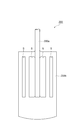
- the stirrer was equipped with a stirrer blade (flat blade) 200 whose outline is shown in FIG.
- the stirring blade 200 includes a shaft 200a and a flat plate portion 200b.
- the flat plate portion 200b is welded to the shaft 200a and has a curved tip.
- the flat plate portion 200b is formed with four slits S extending along the axial direction of the shaft 200a.
- the four slits S are arranged in the width direction of the flat plate portion 200b, the width of the two inner slits S is 1 cm, and the width of the two outer slits S is 0.5 cm.
- the length of the flat plate portion 200b is about 10 cm, and the width of the flat plate portion 200b is about 6 cm.
- 293 g of n-heptane was added as a hydrocarbon dispersion medium to the above-mentioned separable flask, and a maleic anhydride-modified ethylene-propylene copolymer (manufactured by Mitsui Chemicals Co., Ltd., High Wax 1105A) was added as a polymer-based dispersant.
- a mixture was obtained by adding 0.736 g.
- the dispersant was dissolved by heating the mixture to 80 ° C. with stirring, and then the mixture was cooled to 50 ° C.
- the prepared aqueous solution was added to the reaction solution in the separable flask, and the mixture was stirred for 10 minutes.
- 0.736 g of sucrose stearic acid ester (Mitsubishi Chemical Foods Co., Ltd., Ryoto Sugar Ester S-370, HLB: 3) was heat-dissolved in 6.62 g of n-heptane as a surfactant to prepare a surfactant solution.
- the surfactant solution was further added to the reaction solution, and the inside of the system was sufficiently replaced with nitrogen while stirring at a stirring speed of 425 rpm.
- the flask was immersed in a water bath at 70 ° C. to raise the temperature, and polymerization was carried out for 60 minutes to obtain a first-stage polymerization slurry solution.
- the inside of the separable flask system was cooled to 25 ° C. while stirring at a stirring speed of 650 rpm. Next, the entire amount of the aqueous solution in the second stage was added to the polymerized slurry solution in the first stage, and the inside of the system was replaced with nitrogen for 30 minutes. Then, the flask was immersed in a water bath at 70 ° C. again to raise the temperature, and the polymerization reaction was carried out for 60 minutes to obtain a hydrogel polymer.
- 0.589 g of a 45% by mass diethylenetriamine-5 sodium acetate aqueous solution was added to the hydrogel polymer after the second stage polymerization under stirring. Then, the flask was immersed in an oil bath set at 125 ° C., and 234.6 g of water was extracted from the system while refluxing n-heptane by azeotropic distillation of n-heptane and water. Then, 4.42 g (0.507 mmol) of a 2% by mass ethylene glycol diglycidyl ether aqueous solution was added to the flask as a surface cross-linking agent, and the flask was kept at 83 ° C. for 2 hours.
- n-heptane was evaporated at 125 ° C. and dried to obtain polymer particles (dried product).
- the polymer particles are passed through a sieve having an opening of 850 ⁇ m, and 0.2% by mass of amorphous silica (Oriental Silicas Corporation, Toxile NP-S) with respect to the mass of the polymer particles is mixed with the polymer particles.
- amorphous silica Oriental Silicas Corporation, Toxile NP-S
- 232.1 g of water-absorbent resin particles containing amorphous silica were obtained.
- the medium particle size of the water-absorbent resin particles was 355 ⁇ m.
- Example 2 233.0 g of water-absorbent resin particles were obtained in the same manner as in Example 1 except that the amount of water extracted to the outside of the system by azeotropic distillation was changed to 229.2 g.
- the medium particle size of the water-absorbent resin particles was 368 ⁇ m.
- Example 3 231.0 g of water-absorbent resin particles were obtained in the same manner as in Example 1 except that the amount of water extracted to the outside of the system by azeotropic distillation was changed to 224.3 g.
- the medium particle size of the water-absorbent resin particles was 342 ⁇ m.
- Example 4 232.3 g of water-absorbent resin particles were obtained in the same manner as in Example 1 except that the amount of water extracted to the outside of the system by azeotropic distillation was changed to 207.9 g.
- the medium particle size of the water-absorbent resin particles was 361 ⁇ m.
- hydroxylethyl cellulose (Sumitomo Seika Co., Ltd., HEC AW-15F) as a thickener
- 0.0736 g 0.0736 g (0.272 mmol) of potassium persulfate as a radical polymerization initiator
- ethylene glycol diglycidyl as an internal cross-linking agent.
- 0.010 g (0.057 mmol) of ether was added and dissolved to prepare an aqueous solution of the first stage.
- the prepared aqueous solution was added to the reaction solution in the separable flask, and the mixture was stirred for 10 minutes.
- 0.736 g of sucrose stearic acid ester (Mitsubishi Chemical Foods Co., Ltd., Ryoto Sugar Ester S-370, HLB: 3) was heat-dissolved in 6.62 g of n-heptane as a surfactant to prepare a surfactant solution.
- the surfactant solution was further added to the reaction solution, and the inside of the system was sufficiently replaced with nitrogen while stirring at a stirring speed of 550 rpm.
- the flask was immersed in a water bath at 70 ° C. to raise the temperature, and polymerization was carried out for 60 minutes to obtain a first-stage polymerization slurry solution.
- the entire amount of the aqueous solution of the second stage is added to the polymerized slurry solution of the first stage.
- the inside of the system was replaced with nitrogen for 30 minutes.
- the flask was again immersed in a water bath at 70 ° C. to raise the temperature, and the polymerization reaction was carried out for 60 minutes to obtain a hydrogel polymer.
- n-heptane was evaporated at 125 ° C. and dried to obtain polymer particles (dried product).
- the polymer particles are passed through a sieve having an opening of 850 ⁇ m, and 0.5% by mass of amorphous silica (Oriental Silicas Corporation, Toxile NP-S) with respect to the mass of the polymer particles is mixed with the polymer particles.
- amorphous silica Oriental Silicas Corporation, Toxile NP-S
- 230.6 g of water-absorbent resin particles containing amorphous silica were obtained.
- the medium particle size of the water-absorbent resin particles was 355 ⁇ m.
- the gel outflow test force the amount of saline water absorbed under load, the amount of saline water retained, the medium particle size, and the amount of reversion of the absorbent article were evaluated by the following methods. ..
- Test force measurement A small tabletop tester (EZtest, model number: EZ-SX) manufactured by Shimadzu Corporation and a measuring instrument shown in FIG. 3 were used to measure the gel outflow test force. The measurement was performed in an environment of 25 ° C. ⁇ 2 ° C. and a humidity of 50 ⁇ 10% (RH).
- the transparent acrylic cylinder 51 has a hole having a diameter of 3.0 cm in the center of the bottom surface, and has an inner diameter of 5.0 cm and an outer diameter of 6.0 cm.
- a metal disc 52 having a thickness of 3.0 mm and a diameter of 4.9 cm is contained in the cylinder 51.
- a tapered hole whose diameter expands toward both surfaces is provided in the central portion of the disk 52, and the minimum diameter of the hole is 5.0 mm and the maximum diameter is 8.0 mm.
- 20.0 g of the gel (swelling gel) of the swollen water-absorbent resin particles 10a was placed on the disc 52 in the cylinder 51, and the swollen gel was loosened with a spatula and arranged evenly in the cylinder 51.
- the swelling gel was compressed as follows.
- a jig 53 equipped with a disk having a diameter of 4.9 cm and a thickness of 1.2 cm at the tip of a handle having a length of 14 cm was attached to a load cell (load cell capacity: 50 N, manufactured by Shimadzu Corporation) of a small desktop tester.
- a type (manufactured by Shimadzu Corporation) with a direct 3.0 cm hole in the center was used as the measuring table of the testing machine.
- a cylinder 51 in which the swelling gel and the disc 52 were placed on the hole on the measuring table was placed directly under the jig 53 so that the bottom of the cylinder 51 was horizontal.
- the jig 53 was mounted so that the disk was parallel to the bottom of the cylinder 51.
- the jig 53 was manually lowered in the vertical direction until the tip of the jig 53 came into contact with the surface of the swollen gel and the test force slightly exceeded 0.01 N. Subsequent operations of the jig 53 mounted on the testing machine were performed by the Shimadzu autograph software Trapezium X (manufactured by Shimadzu Corporation). The jig 53 was further lowered in the vertical direction, and the load was applied to the swollen gel while increasing the load linearly. The gradient of load increase was 4.9 N / min. The jig 53 was stopped when the load cell sensed 4.9N. In order to reduce the void, 4.9N was maintained for 30 seconds after the jig 53 was stopped.
- the swollen gel was compressed toward the bottom of the cylinder 51, and the test force was measured.
- the test force at the time when the start of swelling gel outflow from the hole of the disk 52 was visually confirmed was defined as the gel outflow test force.
- FIG. 4 shows an example of the gel outflow test force measurement result.
- the displacement (moving distance) of the jig 53 increases, and the test force smoothly increases while the swelling gel is compressed.
- the test force that has been increasing smoothly will increase while repeating the increase and decrease.
- the time when the decrease in test force is first observed coincides with the time when it is visually confirmed that the swollen gel begins to flow out from the hole of the disc 52. That is, in the graph of FIG. 4, the gel outflow test force is the value of the test force peak immediately before the first decrease in the test force is observed, which is indicated by the arrow in the figure.
- Table 1 The results are shown in Table 1.
- the amount of physiological saline water absorption under a load of 4.14 kPa was measured using the measuring device outlined in FIG. The measurement was performed twice for one type of water-absorbent resin particles, and the average value was obtained.
- the measuring device includes a burette unit 1, a clamp 3, a conduit 5, a gantry 11, a measuring table 13, and a measuring unit 4 placed on the measuring table 13.
- the burette portion 1 includes a burette tube 21 on which a scale is described, a rubber stopper 23 for sealing the upper opening of the burette tube 21, a cock 22 connected to the tip of the lower portion of the burette tube 21, and a lower portion of the burette tube 21. It has an air introduction pipe 25 and a cock 24 connected to the burette.
- the burette portion 1 is fixed by a clamp 3.
- the flat plate-shaped measuring table 13 has a through hole 13a having a diameter of 2 mm formed in the central portion thereof, and is supported by a frame 11 having a variable height.
- the through hole 13a of the measuring table 13 and the cock 22 of the burette portion 1 are connected by a conduit 5.
- the inner diameter of the conduit 5 is 6 mm.
- the measuring unit 4 has a cylinder 31 made of acrylic resin, a polyamide mesh 32 adhered to one opening of the cylinder 31, and a weight 33 movable in the vertical direction in the cylinder 31.
- the cylinder 31 is placed on the measuring table 13 via the polyamide mesh 32.
- the inner diameter of the cylinder 31 is 20 mm.
- the opening of the polyamide mesh 32 is 75 ⁇ m (200 mesh).
- the weight 33 has a diameter of 19 mm and a mass of 119.6 g, and a load of 4.14 kPa can be applied to the water-absorbent resin particles 10a uniformly arranged on the polyamide mesh 32 as described later.
- the physiological saline water absorption capacity under a load of 4.14 kPa was measured by the measuring device shown in FIG. 5 in a room at 25 ° C. and a humidity of 50 ⁇ 10% (RH).
- the cock 22 and the cock 24 of the burette section 1 were closed, and 0.9 mass% physiological saline adjusted to 25 ° C. was put into the burette tube 21 through the opening at the upper part of the burette tube 21.
- the cock 22 and the cock 24 were opened after the upper opening of the burette tube 21 was sealed with the rubber stopper 23.
- the inside of the conduit 5 was filled with 0.9% by mass saline solution 50 to prevent bubbles from entering.
- the height of the measuring table 13 was adjusted so that the height of the water surface of the 0.9 mass% saline solution that reached the inside of the through hole 13a was the same as the height of the upper surface of the measuring table 13. After the adjustment, the height of the water surface of the 0.9 mass% saline solution 50 in the burette tube 21 was read by the scale of the burette tube 21, and the position was set as the zero point (reading value at 0 seconds).
- the measuring unit 4 0.10 g of water-absorbent resin particles 10a are uniformly arranged on the polyamide mesh 32 in the cylinder 31, a weight 33 is arranged on the water-absorbent resin particles 10a, and the cylinder 31 is centered on the cylinder 31. It was installed so as to coincide with the conduit port at the center of the measuring table 13. The amount of decrease in the saline solution in the bullet tube 21 2 hours after the water-absorbent resin particles 10a started to absorb the saline solution from the conduit 5 (that is, the amount of the saline solution absorbed by the water-absorbent resin particles 10a).
- a cotton bag (Membrod No. 60, width 100 mm ⁇ length 200 mm) weighing 2.0 g of water-absorbent resin particles was placed in a beaker containing 500 ml. Pour 500 g of 0.9 mass% sodium chloride aqueous solution (physiological saline) into a cotton bag containing water-absorbent resin particles at a time so that maco cannot be formed, tie the upper part of the cotton bag with a rubber ring, and let it stand for 30 minutes. The water-absorbent resin particles were swollen with.
- the cotton bag is dehydrated for 1 minute using a dehydrator (manufactured by Kokusan Co., Ltd., product number: H-122) set to have a centrifugal force of 167 G, and the cotton bag containing the swollen gel after dehydration is contained.
- the mass Wb (g) of the above was measured.
- the same operation was performed without adding the water-absorbent resin particles, the empty mass Wc (g) of the cotton bag when wet was measured, and the amount of physiological saline water retained was calculated from the following formula.
- Water-absorbent resin particles were placed in the best combined sieve and classified according to JIS Z8815 (1994) using a low-tap shaker (manufactured by Iida Seisakusho Co., Ltd.). After classification, the mass of the water-absorbent resin particles remaining on each sieve was calculated as a mass percentage with respect to the total amount, and the particle size distribution was obtained. The relationship between the mesh size of the sieve and the integrated value of the mass percentage of the water-absorbent resin particles remaining on the sieve was plotted on a logarithmic probability paper by integrating the particle size distribution on the sieve in order from the one having the largest particle size. By connecting the plots on the probability paper with a straight line, the particle size corresponding to the cumulative mass percentage of 50% by mass was defined as the medium particle size.
- an absorbent article for evaluation can be obtained. Obtained.
- the evaluation absorbent article is placed on a horizontal table so that the surface provided with the liquid permeable sheet faces the upper surface, and a 100 mL liquid injection cylinder having an inner diameter 3 cm inlet is used as the evaluation absorbent article. I put it in the center of. 80 ml of physiological saline was put into the cylinder at one time. The cylinder was removed from the absorbent article and the absorbent article was allowed to stand as it was. The same operation was performed 30 minutes (second time) and 60 minutes (third time) after the start of the first test solution injection using the measuring instrument at the same position as the first test solution.
Landscapes
- Chemical & Material Sciences (AREA)
- Health & Medical Sciences (AREA)
- Chemical Kinetics & Catalysis (AREA)
- Organic Chemistry (AREA)
- Life Sciences & Earth Sciences (AREA)
- General Health & Medical Sciences (AREA)
- Engineering & Computer Science (AREA)
- Medicinal Chemistry (AREA)
- Veterinary Medicine (AREA)
- Public Health (AREA)
- Epidemiology (AREA)
- Animal Behavior & Ethology (AREA)
- Polymers & Plastics (AREA)
- Dispersion Chemistry (AREA)
- Analytical Chemistry (AREA)
- Materials Engineering (AREA)
- Hematology (AREA)
- Biomedical Technology (AREA)
- Heart & Thoracic Surgery (AREA)
- Vascular Medicine (AREA)
- Physics & Mathematics (AREA)
- Food Science & Technology (AREA)
- Biochemistry (AREA)
- General Physics & Mathematics (AREA)
- Immunology (AREA)
- Pathology (AREA)
- General Chemical & Material Sciences (AREA)
- Absorbent Articles And Supports Therefor (AREA)
- Addition Polymer Or Copolymer, Post-Treatments, Or Chemical Modifications (AREA)
Priority Applications (5)
| Application Number | Priority Date | Filing Date | Title |
|---|---|---|---|
| JP2021504997A JP7561117B2 (ja) | 2019-03-08 | 2020-03-05 | 吸水性樹脂粒子 |
| EP20770928.8A EP3936533A4 (en) | 2019-03-08 | 2020-03-05 | WATER-ABSORBING RESIN PARTICLES |
| US17/436,389 US20220143575A1 (en) | 2019-03-08 | 2020-03-05 | Water absorbing resin particles |
| KR1020217031042A KR20210137068A (ko) | 2019-03-08 | 2020-03-05 | 흡수성 수지 입자 |
| CN202080019480.XA CN113544164A (zh) | 2019-03-08 | 2020-03-05 | 吸水性树脂颗粒 |
Applications Claiming Priority (2)
| Application Number | Priority Date | Filing Date | Title |
|---|---|---|---|
| JP2019-042882 | 2019-03-08 | ||
| JP2019042882 | 2019-03-08 |
Publications (1)
| Publication Number | Publication Date |
|---|---|
| WO2020184389A1 true WO2020184389A1 (ja) | 2020-09-17 |
Family
ID=72426240
Family Applications (1)
| Application Number | Title | Priority Date | Filing Date |
|---|---|---|---|
| PCT/JP2020/009479 Ceased WO2020184389A1 (ja) | 2019-03-08 | 2020-03-05 | 吸水性樹脂粒子 |
Country Status (6)
| Country | Link |
|---|---|
| US (1) | US20220143575A1 (https=) |
| EP (1) | EP3936533A4 (https=) |
| JP (1) | JP7561117B2 (https=) |
| KR (1) | KR20210137068A (https=) |
| CN (1) | CN113544164A (https=) |
| WO (1) | WO2020184389A1 (https=) |
Cited By (2)
| Publication number | Priority date | Publication date | Assignee | Title |
|---|---|---|---|---|
| WO2023100479A1 (ja) * | 2021-11-30 | 2023-06-08 | 住友精化株式会社 | 吸水性樹脂粒子及び吸収体 |
| WO2023189622A1 (ja) | 2022-03-30 | 2023-10-05 | 住友精化株式会社 | 吸水性樹脂粒子、吸収体、及び吸収性物品 |
Families Citing this family (2)
| Publication number | Priority date | Publication date | Assignee | Title |
|---|---|---|---|---|
| WO2020218167A1 (ja) | 2019-04-23 | 2020-10-29 | 住友精化株式会社 | 吸水性樹脂粒子 |
| CN115993427B (zh) * | 2023-02-16 | 2024-04-26 | 江苏亨通高压海缆有限公司 | 一种阻水带测试装置、系统及测试方法 |
Citations (8)
| Publication number | Priority date | Publication date | Assignee | Title |
|---|---|---|---|---|
| JP2006199805A (ja) | 2005-01-20 | 2006-08-03 | Asahi Kasei Chemicals Corp | アンモニウム塩含有吸水性樹脂、及びその製造方法 |
| WO2006123561A1 (ja) | 2005-05-16 | 2006-11-23 | Sumitomo Seika Chemicals Co., Ltd. | 吸水性樹脂粒子の製造方法、それにより得られる吸水性樹脂粒子、およびそれを用いた吸収体および吸収性物品 |
| WO2011086843A1 (ja) | 2010-01-13 | 2011-07-21 | 住友精化株式会社 | 吸水シート構成体 |
| WO2014038324A1 (ja) * | 2012-09-10 | 2014-03-13 | 住友精化株式会社 | 吸水性樹脂、吸収体及び吸収性物品 |
| WO2016006135A1 (ja) * | 2014-07-11 | 2016-01-14 | 住友精化株式会社 | 吸水性樹脂の製造方法 |
| WO2016006134A1 (ja) * | 2014-07-11 | 2016-01-14 | 住友精化株式会社 | 吸水性樹脂及び吸収性物品 |
| JP2016028113A (ja) * | 2014-07-11 | 2016-02-25 | 住友精化株式会社 | 吸水性樹脂及び吸水性樹脂の製造方法 |
| JP2016028117A (ja) * | 2014-07-11 | 2016-02-25 | 住友精化株式会社 | 吸水性樹脂の製造方法、吸水性樹脂、吸水剤、吸収性物品 |
Family Cites Families (6)
| Publication number | Priority date | Publication date | Assignee | Title |
|---|---|---|---|---|
| JP3720084B2 (ja) * | 1994-07-26 | 2005-11-24 | 株式会社日本触媒 | 吸水性樹脂およびその製造方法並びに吸水性物品 |
| CN102466589A (zh) * | 2010-11-01 | 2012-05-23 | 袁俊海 | 测定复合吸水材料溶胀倍率与凝胶强度关系的方法 |
| WO2016148153A1 (ja) * | 2015-03-16 | 2016-09-22 | 住友精化株式会社 | 吸水性樹脂および吸水剤 |
| EP3318324B1 (en) * | 2015-07-01 | 2021-08-25 | Nippon Shokubai Co., Ltd. | Particulate water absorbing agent |
| WO2018159801A1 (ja) * | 2017-03-02 | 2018-09-07 | 住友精化株式会社 | 吸水性樹脂、土壌保水材、及び農園芸材料 |
| CN110325562A (zh) * | 2017-03-29 | 2019-10-11 | 住友精化株式会社 | 吸水性树脂 |
-
2020
- 2020-03-05 CN CN202080019480.XA patent/CN113544164A/zh active Pending
- 2020-03-05 US US17/436,389 patent/US20220143575A1/en not_active Abandoned
- 2020-03-05 EP EP20770928.8A patent/EP3936533A4/en not_active Withdrawn
- 2020-03-05 WO PCT/JP2020/009479 patent/WO2020184389A1/ja not_active Ceased
- 2020-03-05 KR KR1020217031042A patent/KR20210137068A/ko not_active Withdrawn
- 2020-03-05 JP JP2021504997A patent/JP7561117B2/ja active Active
Patent Citations (8)
| Publication number | Priority date | Publication date | Assignee | Title |
|---|---|---|---|---|
| JP2006199805A (ja) | 2005-01-20 | 2006-08-03 | Asahi Kasei Chemicals Corp | アンモニウム塩含有吸水性樹脂、及びその製造方法 |
| WO2006123561A1 (ja) | 2005-05-16 | 2006-11-23 | Sumitomo Seika Chemicals Co., Ltd. | 吸水性樹脂粒子の製造方法、それにより得られる吸水性樹脂粒子、およびそれを用いた吸収体および吸収性物品 |
| WO2011086843A1 (ja) | 2010-01-13 | 2011-07-21 | 住友精化株式会社 | 吸水シート構成体 |
| WO2014038324A1 (ja) * | 2012-09-10 | 2014-03-13 | 住友精化株式会社 | 吸水性樹脂、吸収体及び吸収性物品 |
| WO2016006135A1 (ja) * | 2014-07-11 | 2016-01-14 | 住友精化株式会社 | 吸水性樹脂の製造方法 |
| WO2016006134A1 (ja) * | 2014-07-11 | 2016-01-14 | 住友精化株式会社 | 吸水性樹脂及び吸収性物品 |
| JP2016028113A (ja) * | 2014-07-11 | 2016-02-25 | 住友精化株式会社 | 吸水性樹脂及び吸水性樹脂の製造方法 |
| JP2016028117A (ja) * | 2014-07-11 | 2016-02-25 | 住友精化株式会社 | 吸水性樹脂の製造方法、吸水性樹脂、吸水剤、吸収性物品 |
Non-Patent Citations (1)
| Title |
|---|
| See also references of EP3936533A4 |
Cited By (2)
| Publication number | Priority date | Publication date | Assignee | Title |
|---|---|---|---|---|
| WO2023100479A1 (ja) * | 2021-11-30 | 2023-06-08 | 住友精化株式会社 | 吸水性樹脂粒子及び吸収体 |
| WO2023189622A1 (ja) | 2022-03-30 | 2023-10-05 | 住友精化株式会社 | 吸水性樹脂粒子、吸収体、及び吸収性物品 |
Also Published As
| Publication number | Publication date |
|---|---|
| JP7561117B2 (ja) | 2024-10-03 |
| KR20210137068A (ko) | 2021-11-17 |
| US20220143575A1 (en) | 2022-05-12 |
| EP3936533A4 (en) | 2022-11-16 |
| CN113544164A (zh) | 2021-10-22 |
| EP3936533A1 (en) | 2022-01-12 |
| JPWO2020184389A1 (https=) | 2020-09-17 |
Similar Documents
| Publication | Publication Date | Title |
|---|---|---|
| JP7588579B2 (ja) | 吸水性樹脂粒子、吸収体、吸収性物品、吸水性樹脂粒子の通液維持率の測定方法、及び吸水性樹脂粒子の製造方法 | |
| JP6856826B1 (ja) | 吸水性樹脂粒子 | |
| WO2020184389A1 (ja) | 吸水性樹脂粒子 | |
| WO2020122218A1 (ja) | 吸水性樹脂粒子、吸収体及び吸収性物品 | |
| JP7811844B2 (ja) | 吸水性樹脂粒子、吸収性物品、吸水性樹脂粒子を製造する方法、及び吸収体への生理食塩水の浸透速度を速める方法 | |
| JP2021058771A (ja) | 吸水性樹脂粒子、吸収性物品、吸水性樹脂粒子を製造する方法、及び吸収体の加圧下での吸収量を高める方法 | |
| US12274999B2 (en) | Water absorbent resin particles, absorbent, absorbent article and liquid suction power measurement method | |
| JPWO2020122202A1 (ja) | 吸収性物品 | |
| WO2020122215A1 (ja) | 吸水性樹脂粒子並びに吸収性物品及びその製造方法 | |
| WO2020184398A1 (ja) | 吸水性樹脂粒子及びその製造方法、吸収体、並びに、吸収性物品 | |
| JP6710303B1 (ja) | 吸収性物品及びその製造方法 | |
| US20220015958A1 (en) | Water absorbent resin particles and absorbent article | |
| WO2020122203A1 (ja) | 吸水性樹脂粒子、吸水性樹脂粒子の液体漏れ性の評価方法、及び吸水性樹脂粒子の製造方法並びに吸収性物品 | |
| JP7733572B2 (ja) | 吸水性樹脂粒子 | |
| JP2020121297A (ja) | 吸水性樹脂粒子、吸収体及び吸収性物品 | |
| JP7470496B2 (ja) | 粒子状吸水性樹脂組成物 | |
| JP6889811B2 (ja) | 吸水性樹脂粒子、吸収性物品、吸水性樹脂粒子を製造する方法、及び吸収性物品の液漏れを抑制する方法 | |
| WO2021049450A1 (ja) | 吸水性樹脂粒子 | |
| JP6752320B2 (ja) | 吸収性物品及びその製造方法 | |
| JP7143513B2 (ja) | 吸水性樹脂粒子及びその製造方法、吸収体、並びに、吸収性物品 | |
| JP6775051B2 (ja) | 吸収性物品 | |
| JP6775050B2 (ja) | 吸収性物品 | |
| JP7470494B2 (ja) | 吸水性樹脂粒子 | |
| WO2020218166A1 (ja) | 吸水性樹脂粒子 |
Legal Events
| Date | Code | Title | Description |
|---|---|---|---|
| 121 | Ep: the epo has been informed by wipo that ep was designated in this application |
Ref document number: 20770928 Country of ref document: EP Kind code of ref document: A1 |
|
| ENP | Entry into the national phase |
Ref document number: 2021504997 Country of ref document: JP Kind code of ref document: A |
|
| NENP | Non-entry into the national phase |
Ref country code: DE |
|
| ENP | Entry into the national phase |
Ref document number: 20217031042 Country of ref document: KR Kind code of ref document: A |
|
| ENP | Entry into the national phase |
Ref document number: 2020770928 Country of ref document: EP Effective date: 20211008 |