WO2020184045A1 - ホウ素除去装置及びホウ素除去方法、並びに、純水製造装置及び純水の製造方法 - Google Patents
ホウ素除去装置及びホウ素除去方法、並びに、純水製造装置及び純水の製造方法 Download PDFInfo
- Publication number
- WO2020184045A1 WO2020184045A1 PCT/JP2020/005551 JP2020005551W WO2020184045A1 WO 2020184045 A1 WO2020184045 A1 WO 2020184045A1 JP 2020005551 W JP2020005551 W JP 2020005551W WO 2020184045 A1 WO2020184045 A1 WO 2020184045A1
- Authority
- WO
- WIPO (PCT)
- Prior art keywords
- water
- reverse osmosis
- osmosis membrane
- pressure reverse
- treated
- Prior art date
- Legal status (The legal status is an assumption and is not a legal conclusion. Google has not performed a legal analysis and makes no representation as to the accuracy of the status listed.)
- Ceased
Links
Images


Classifications
-
- B—PERFORMING OPERATIONS; TRANSPORTING
- B01—PHYSICAL OR CHEMICAL PROCESSES OR APPARATUS IN GENERAL
- B01D—SEPARATION
- B01D61/00—Processes of separation using semi-permeable membranes, e.g. dialysis, osmosis or ultrafiltration; Apparatus, accessories or auxiliary operations specially adapted therefor
- B01D61/58—Multistep processes
-
- B—PERFORMING OPERATIONS; TRANSPORTING
- B01—PHYSICAL OR CHEMICAL PROCESSES OR APPARATUS IN GENERAL
- B01D—SEPARATION
- B01D61/00—Processes of separation using semi-permeable membranes, e.g. dialysis, osmosis or ultrafiltration; Apparatus, accessories or auxiliary operations specially adapted therefor
- B01D61/02—Reverse osmosis; Hyperfiltration ; Nanofiltration
- B01D61/025—Reverse osmosis; Hyperfiltration
-
- B—PERFORMING OPERATIONS; TRANSPORTING
- B01—PHYSICAL OR CHEMICAL PROCESSES OR APPARATUS IN GENERAL
- B01D—SEPARATION
- B01D61/00—Processes of separation using semi-permeable membranes, e.g. dialysis, osmosis or ultrafiltration; Apparatus, accessories or auxiliary operations specially adapted therefor
- B01D61/02—Reverse osmosis; Hyperfiltration ; Nanofiltration
- B01D61/025—Reverse osmosis; Hyperfiltration
- B01D61/026—Reverse osmosis; Hyperfiltration comprising multiple reverse osmosis steps
-
- B—PERFORMING OPERATIONS; TRANSPORTING
- B01—PHYSICAL OR CHEMICAL PROCESSES OR APPARATUS IN GENERAL
- B01D—SEPARATION
- B01D61/00—Processes of separation using semi-permeable membranes, e.g. dialysis, osmosis or ultrafiltration; Apparatus, accessories or auxiliary operations specially adapted therefor
- B01D61/42—Electrodialysis; Electro-osmosis ; Electro-ultrafiltration; Membrane capacitive deionization
- B01D61/44—Ion-selective electrodialysis
-
- C—CHEMISTRY; METALLURGY
- C02—TREATMENT OF WATER, WASTE WATER, SEWAGE, OR SLUDGE
- C02F—TREATMENT OF WATER, WASTE WATER, SEWAGE, OR SLUDGE
- C02F9/00—Multistage treatment of water, waste water or sewage
-
- B—PERFORMING OPERATIONS; TRANSPORTING
- B01—PHYSICAL OR CHEMICAL PROCESSES OR APPARATUS IN GENERAL
- B01D—SEPARATION
- B01D2311/00—Details relating to membrane separation process operations and control
- B01D2311/06—Specific process operations in the permeate stream
-
- B—PERFORMING OPERATIONS; TRANSPORTING
- B01—PHYSICAL OR CHEMICAL PROCESSES OR APPARATUS IN GENERAL
- B01D—SEPARATION
- B01D2311/00—Details relating to membrane separation process operations and control
- B01D2311/18—Details relating to membrane separation process operations and control pH control
-
- B—PERFORMING OPERATIONS; TRANSPORTING
- B01—PHYSICAL OR CHEMICAL PROCESSES OR APPARATUS IN GENERAL
- B01D—SEPARATION
- B01D2311/00—Details relating to membrane separation process operations and control
- B01D2311/26—Further operations combined with membrane separation processes
- B01D2311/2603—Application of an electric field, different from the potential difference across the membrane
-
- B—PERFORMING OPERATIONS; TRANSPORTING
- B01—PHYSICAL OR CHEMICAL PROCESSES OR APPARATUS IN GENERAL
- B01D—SEPARATION
- B01D2311/00—Details relating to membrane separation process operations and control
- B01D2311/26—Further operations combined with membrane separation processes
- B01D2311/2611—Irradiation
- B01D2311/2619—UV-irradiation
-
- B—PERFORMING OPERATIONS; TRANSPORTING
- B01—PHYSICAL OR CHEMICAL PROCESSES OR APPARATUS IN GENERAL
- B01D—SEPARATION
- B01D2311/00—Details relating to membrane separation process operations and control
- B01D2311/26—Further operations combined with membrane separation processes
- B01D2311/2623—Ion-Exchange
-
- C—CHEMISTRY; METALLURGY
- C02—TREATMENT OF WATER, WASTE WATER, SEWAGE, OR SLUDGE
- C02F—TREATMENT OF WATER, WASTE WATER, SEWAGE, OR SLUDGE
- C02F1/00—Treatment of water, waste water, or sewage
- C02F1/20—Treatment of water, waste water, or sewage by degassing, i.e. liberation of dissolved gases
-
- C—CHEMISTRY; METALLURGY
- C02—TREATMENT OF WATER, WASTE WATER, SEWAGE, OR SLUDGE
- C02F—TREATMENT OF WATER, WASTE WATER, SEWAGE, OR SLUDGE
- C02F1/00—Treatment of water, waste water, or sewage
- C02F1/30—Treatment of water, waste water, or sewage by irradiation
- C02F1/32—Treatment of water, waste water, or sewage by irradiation with ultraviolet light
-
- C—CHEMISTRY; METALLURGY
- C02—TREATMENT OF WATER, WASTE WATER, SEWAGE, OR SLUDGE
- C02F—TREATMENT OF WATER, WASTE WATER, SEWAGE, OR SLUDGE
- C02F1/00—Treatment of water, waste water, or sewage
- C02F1/42—Treatment of water, waste water, or sewage by ion-exchange
-
- C—CHEMISTRY; METALLURGY
- C02—TREATMENT OF WATER, WASTE WATER, SEWAGE, OR SLUDGE
- C02F—TREATMENT OF WATER, WASTE WATER, SEWAGE, OR SLUDGE
- C02F1/00—Treatment of water, waste water, or sewage
- C02F1/44—Treatment of water, waste water, or sewage by dialysis, osmosis or reverse osmosis
- C02F1/441—Treatment of water, waste water, or sewage by dialysis, osmosis or reverse osmosis by reverse osmosis
-
- C—CHEMISTRY; METALLURGY
- C02—TREATMENT OF WATER, WASTE WATER, SEWAGE, OR SLUDGE
- C02F—TREATMENT OF WATER, WASTE WATER, SEWAGE, OR SLUDGE
- C02F1/00—Treatment of water, waste water, or sewage
- C02F1/46—Treatment of water, waste water, or sewage by electrochemical methods
- C02F1/469—Treatment of water, waste water, or sewage by electrochemical methods by electrochemical separation, e.g. by electro-osmosis, electrodialysis, electrophoresis
- C02F1/4693—Treatment of water, waste water, or sewage by electrochemical methods by electrochemical separation, e.g. by electro-osmosis, electrodialysis, electrophoresis electrodialysis
- C02F1/4695—Treatment of water, waste water, or sewage by electrochemical methods by electrochemical separation, e.g. by electro-osmosis, electrodialysis, electrophoresis electrodialysis electrodeionisation
-
- C—CHEMISTRY; METALLURGY
- C02—TREATMENT OF WATER, WASTE WATER, SEWAGE, OR SLUDGE
- C02F—TREATMENT OF WATER, WASTE WATER, SEWAGE, OR SLUDGE
- C02F1/00—Treatment of water, waste water, or sewage
- C02F1/66—Treatment of water, waste water, or sewage by neutralisation; pH adjustment
-
- C—CHEMISTRY; METALLURGY
- C02—TREATMENT OF WATER, WASTE WATER, SEWAGE, OR SLUDGE
- C02F—TREATMENT OF WATER, WASTE WATER, SEWAGE, OR SLUDGE
- C02F2101/00—Nature of the contaminant
- C02F2101/10—Inorganic compounds
- C02F2101/108—Boron compounds
-
- C—CHEMISTRY; METALLURGY
- C02—TREATMENT OF WATER, WASTE WATER, SEWAGE, OR SLUDGE
- C02F—TREATMENT OF WATER, WASTE WATER, SEWAGE, OR SLUDGE
- C02F2101/00—Nature of the contaminant
- C02F2101/30—Organic compounds
-
- C—CHEMISTRY; METALLURGY
- C02—TREATMENT OF WATER, WASTE WATER, SEWAGE, OR SLUDGE
- C02F—TREATMENT OF WATER, WASTE WATER, SEWAGE, OR SLUDGE
- C02F2103/00—Nature of the water, waste water, sewage or sludge to be treated
- C02F2103/02—Non-contaminated water, e.g. for industrial water supply
- C02F2103/04—Non-contaminated water, e.g. for industrial water supply for obtaining ultra-pure water
-
- C—CHEMISTRY; METALLURGY
- C02—TREATMENT OF WATER, WASTE WATER, SEWAGE, OR SLUDGE
- C02F—TREATMENT OF WATER, WASTE WATER, SEWAGE, OR SLUDGE
- C02F2301/00—General aspects of water treatment
- C02F2301/06—Pressure conditions
- C02F2301/066—Overpressure, high pressure
-
- C—CHEMISTRY; METALLURGY
- C02—TREATMENT OF WATER, WASTE WATER, SEWAGE, OR SLUDGE
- C02F—TREATMENT OF WATER, WASTE WATER, SEWAGE, OR SLUDGE
- C02F2301/00—General aspects of water treatment
- C02F2301/08—Multistage treatments, e.g. repetition of the same process step under different conditions
Definitions
- the present invention relates to a boron removing apparatus and a boron removing method, and a pure water producing apparatus and a pure water producing method.
- an object of the present invention is to reduce the boron concentration in water.
- the present inventors have found that the boar concentration can be significantly reduced by adjusting the pH of the water to be treated supplied to the high-pressure reverse osmosis membrane device within a predetermined range. That is, the present invention includes a low-pressure reverse osmosis membrane device to which water to be treated is supplied, a pH adjusting device that adjusts the pH of the permeated water from the low-pressure reverse osmosis membrane device to 5.0 to 9.0. Boron removal having a high-pressure reverse osmosis membrane device to which pH-adjusted water adjusted by the pH adjusting device is supplied, and an electroregenerative deionizing device to which water permeated from the high-pressure reverse osmosis membrane device is supplied.
- the present invention relates to an apparatus and a method for removing boron using the apparatus.
- the present invention includes a low-pressure reverse osmosis membrane device to which water to be treated is supplied, a pH adjusting device that adjusts the pH of the permeated water from the low-pressure reverse osmosis membrane device to 5.0 to 9.0.
- a high-pressure reverse osmosis membrane device to which pH-adjusted water adjusted by the pH adjusting device is supplied, an electroregenerative deionizer to which water permeated from the high-pressure reverse osmosis membrane device is supplied, and the electroregenerative type.
- a pure water production device having an ultraviolet oxidizing device to which water treated by the deionization device is supplied and a cartridge polisher to which water treated by the ultraviolet oxidizing device is supplied, and production of pure water using the device. Regarding the method.
- a boron removing device and a boron removing method capable of significantly reducing the boron content are provided. Further, a pure water production apparatus capable of producing high-purity pure water and a pure water production method are provided.
- the boron removing device 100 includes a low-pressure reverse osmosis membrane device 30 to which the water to be treated 10 is supplied and a pH adjusting device 40 to which the permeated water of the low-pressure reverse osmosis membrane device 30 is supplied.
- the high-pressure reverse osmosis membrane device 50 in which the pH-adjusted water adjusted by the pH adjusting device is supplied via the pump 45, and the electroregenerative desorption type in which the permeated water of the high-pressure reverse osmosis membrane device 50 is supplied. It includes an ion device 60.
- the permeated water has a pH of 5 by the pH adjusting device 40.
- the pH is adjusted in a range exceeding 9.0, the boron blocking rate in the high-pressure reverse osmosis apparatus 50 is improved, but alkali leaks and the performance of the electroregenerative deionizer (EDI) 60 is deteriorated. Therefore, it is not preferable.
- the pH adjusting device 40 may directly inject the pH adjusting agent into the water in the line with a chemical injection pump, or may provide a tank on the line to add and mix the pH adjusting agent.
- the pH-adjusted water is supplied to the high-pressure reverse osmosis membrane device 50 by a pump 45 at a pressure of 1.0 to 4.0 MPa, preferably 1.5 to 2.0 MPa.
- the pure water production device 200 includes a low-pressure reverse osmosis membrane device 30 to which water to be treated is supplied and a pH adjusting device to which water permeated from the low-pressure reverse osmosis membrane device 30 is supplied. 40, a high-pressure reverse osmosis membrane device 50 in which pH-adjusted water adjusted by the pH adjusting device 40 is supplied via a pump 45, and electricity to which water permeated from the high-pressure reverse osmosis membrane device 50 is supplied.
- the regenerative deionizing device (EDI) 60, the ultraviolet oxidizing device (UV) 70 that performs ultraviolet oxidation treatment of the water treated by the electroregenerating deionizing device 60, and the water treated by the ultraviolet oxidizing device 70 are treated.
- the cartridge polisher 80 is provided. Then, in the water to be treated 10, suspended solids such as ionic components and organic substances in the water to be treated are removed by the low-pressure reverse osmosis membrane device 30, and then the permeated water has a pH of 5 by the pH adjusting device 40.
- the pH-adjusted water is treated with the high-pressure reverse osmosis apparatus 50 and the electroregenerative deionizer (EDI) 60 to efficiently remove boron.
- the total organic carbon (TOC) component remaining in the treated water is decomposed into organic acids and carbon dioxide by an ultraviolet oxidizing device (UV) 70, ion-exchanged by a cartridge polisher (CP) 80, and finally pure water 90 is produced.
- UV ultraviolet oxidizing device
- CP cartridge polisher
- pure water 90 is produced.
- pure water 90 is used as primary pure water and supplied to a subsystem to produce ultrapure water.
- a low-pressure membrane and an ultra-low-pressure membrane that can be operated at a relatively low pressure are preferably used.
- the low-pressure membrane and ultra-low-pressure membrane those having an effective pressure of 1 MPa and a permeation flux of pure water at a water temperature of 25 ° C. of 0.65 to 1.8 m / d, preferably 0.65 to 1.0 m / d are used. be able to.
- the permeated flux is the amount of permeated water divided by the area of the reverse osmosis membrane.
- the "effective pressure” is the effective pressure acting on the membrane, which is described in JIS K3802: 2015 “Membrane Term", which is obtained by subtracting the osmotic pressure difference and the secondary lateral pressure from the average operating pressure.
- the average operating pressure is an average value of the pressure of the membrane supply water (operating pressure) and the pressure of the concentrated water (concentrated water outlet pressure) on the primary side of the reverse osmosis membrane, and is expressed by the following formula.
- Average operating pressure (operating pressure + concentrated water outlet pressure) / 2
- the permeated flux per 1 MPa of effective pressure can be calculated from the information described in the catalog of the membrane manufacturer, for example, the amount of permeated water, the membrane area, the recovery rate at the time of evaluation, the NaCl concentration and the like.
- the average operating pressure / secondary pressure of the pressure vessel the quality of the water to be treated, the amount of permeated water, From the information such as the number of membranes, the permeation flux of the loaded membrane can be calculated.
- Examples of low-pressure to ultra-low-pressure reverse osmosis membranes include NITTO ES series (ES15-D8, ES20-U8) (trade name) and HYDRANAUTICS ESPA series (ESPAB, ESPA2, ESPA2-LD-MAX) (trade name).
- CPA series CPA5-MAX, CPA7-LD
- Toray TMG series TMG20-400, TMG20D-440
- TM700 series TM720-440, TM720D-440
- BW series BW30HR, BW30XFR-400 / 34i
- SG series SG30LE-440, SG30-400
- FORTILIFE CR100 trade name
- the permeation flux of pure water at an effective pressure of 1 MPa and a water temperature of 25 ° C. is 0.2 to 0.65 m / d.
- the effective pressure of the high-pressure reverse osmosis membrane is preferably 1.5 to 2.0 MPa.
- the boron blocking rate of the high-pressure reverse osmosis membrane can be sufficiently increased.
- the effective pressure is 2.0 MPa or more, a further effect of improving the boron blocking rate can be expected, but since it is necessary to increase the durable pressure of the apparatus, the equipment cost may increase.
- high-pressure reverse osmosis membrane examples include HYDRANAUTICS SWC series (SWC4, SWC5, SWC6) (trade name), Toray TM800 series (TM820V, TM820M) (trade name), and Dow Chemical SW series (SW30HRLE). , SW30ULE) (trade name) and the like.
- the reverse osmosis membrane device is composed of a reverse osmosis membrane module composed of members such as a reverse osmosis membrane and a flow path material, and one or more pressure vessels (vessels) loaded with one or more of them.
- a reverse osmosis membrane module composed of members such as a reverse osmosis membrane and a flow path material
- one or more pressure vessels vessels loaded with one or more of them.
- an amount of permeated water corresponding to the effective pressure can be obtained from the vessel.
- the water that does not permeate the membrane module and is concentrated in the vessel is discharged from the vessel as concentrated water.
- the shape of the reverse osmosis membrane module is not particularly limited, and a tubular type, spiral type, or hollow fiber type module can be used.
- each reverse osmosis membrane module is connected in series.
- the vessels can be installed in parallel or in series.
- the pumped water to be treated can be supplied to a plurality of vessels installed in parallel, and the permeated water and the concentrated water of each vessel can be merged and discharged from the apparatus.
- the concentrated water discharged from each vessel can be supplied to another vessel, which is a vessel configuration such as a so-called Christmas tree system.
- the module configuration and vessel configuration of these reverse osmosis membrane devices can be designed and selected appropriately according to the required permeated water quality, permeated water amount, water recovery rate, footprint, etc.
- An appropriate water recovery rate can be designed and selected according to the quality of the water to be treated, the required permeated water quality, the permeated water amount, the water recovery rate, the footprint, and the like.
- the recovery rate of the low-pressure reverse osmosis device is 50 to 90%, preferably 65 to 85%, and the recovery rate of the high-pressure reverse osmosis membrane device is 80 to 99%, preferably 85 to 95%.
- the water recovery rate of the high-pressure reverse osmosis membrane can be set to a high value because the impurity concentration is reduced by the low-pressure reverse osmosis membrane treatment.
- reverse osmosis membrane device chemicals (for example, reducing agent, pH adjuster, scale dispersant, bactericide, etc.) used in a general reverse osmosis membrane device can be used.
- chemicals for example, reducing agent, pH adjuster, scale dispersant, bactericide, etc.
- the EDI is partitioned by an ion exchange membrane and has a desalting chamber filled with an ion exchanger, a concentrating chamber for concentrating the desalted ions in the desalting chamber, and an anode and a cathode for energizing an current. It is a device having a device that simultaneously performs deionization (desalination) treatment of water to be treated by an ion exchanger and regeneration treatment of the ion exchanger by energizing and operating a current.
- the water to be treated that has passed through the EDI is desalted by an ion exchanger filled in the desalination chamber and discharged to the outside of the EDI as EDI-treated water.
- the concentrated water in which ions are concentrated is discharged to the outside as EDI concentrated water.
- the EDI recovery rate is not particularly limited, but is preferably 90 to 95%.
- the water recovery rate of this RO-EDI system is not particularly limited, but is 80 to 99%, preferably 85 to 95%. In this system, the concentrated water and EDI concentrated water of the high-pressure reverse osmosis apparatus are recovered, but the system is not concentrated, so that both a high system recovery rate and a water recovery rate can be satisfied.
- EDI a two-stage EDI treatment in which the EDI-treated water is further treated by EDI is preferable. This makes it possible to produce pure water with a further reduced boron concentration.
- the ultraviolet oxidizing device 70 is installed for the purpose of removing organic substances that could not be removed by the RO-EDI system. Therefore, it is preferable to use an ultraviolet oxidation device that irradiates ultraviolet rays containing a wavelength of 185 nm or less to perform ultraviolet oxidation treatment.
- the subsystem may also be equipped with an ultraviolet oxidizing device, but for example, in equipment where the TOC concentration of ultrapure water is required to be 1 ⁇ g / L or less, the primary pure with a relatively high dissolved oxygen (DO) concentration.
- DO dissolved oxygen
- the cartridge polisher 80 is a non-regenerative ion exchange device filled with an ion exchanger, and removes organic acids and carbon dioxide generated by the ultraviolet oxidizing device.
- the subsystem may also be equipped with a cartridge polisher, but by installing the CP device in the present application, it is possible to prevent the inflow of organic acids and carbon dioxide into the ultraviolet oxidizing device of the subsystem.
- the TOC concentration to be decomposed by the ultraviolet oxidizing device can be reduced, and the energy cost can be suppressed.
- the ion load on the CP device can be reduced, so that the replacement frequency can be reduced.
- a degassing membrane device (not shown) may be provided between the high-pressure reverse osmosis membrane device 50 and the EDI60. Since the carbonic acid load on the EDI can be reduced by providing the degassing membrane device, it can be expected to remove coexisting ions and improve the boron removal rate. Furthermore, if the DO concentration is excessively present, it becomes a radical scavenger for the ultraviolet oxidizing device and the TOC decomposition efficiency decreases. Therefore, a DO adjustment mechanism such as controlling the degree of vacuum on the gas side of the degassing membrane device and the flow rate of sweep gas is provided. It may be provided.
- the water to be treated used in the present invention is not particularly limited, but seawater desalinated treated water and sewage obtained by desalinating industrial water, groundwater, surface water, tap water, seawater, and seawater by a back-penetration method or an evaporation method.
- Sewage treated water various types of wastewater, for example, wastewater used in the semiconductor manufacturing process, and mixed water thereof.
- pretreatment such as coagulation / precipitation treatment, filtration treatment, softening treatment, decarboxylation treatment, activated carbon treatment and the like.
- the quality of the treated water of the high-pressure reverse osmosis membrane device obtained in the present invention is preferably satisfied with a conductivity of 2 ⁇ S / cm or less, a sodium concentration of 200 ppb or less, or both.
- EDI supply water When the sodium concentration of RO permeated water (EDI supply water) is high, the paired anions also leak from RO together with sodium. Therefore, the selectivity of boron in the ion exchange resin filled in the EDI is lowered, and the boron in the EDI-treated water cannot be sufficiently reduced.
- the quality of pure water obtained in the present invention is not particularly limited, and examples thereof include those having a specific resistance of 17 M ⁇ ⁇ cm or more, a boron concentration of 50 ppt or less, a silica concentration of 50 ppt or less, and a TOC concentration of 5 pppb or less.
- Examples 1 and 2 and Comparative Example 1 20 m 3 / h of water to be treated with 20 ppm of sodium, 10 ppm of calcium, 30 ppm of hydrogen carbonate ion, CaCO 3 , 10 ppm of ionic silica, 50 ppb of boron, and 0.5 ppm of TOC concentration, for about 50 hours using the apparatus shown in FIG. A water test was conducted. As the low-pressure reverse osmosis membrane (BWRO), CPA5-LD (trade name, manufactured by Hydranautics) was used, and the recovery rate was 80%.
- BWRO low-pressure reverse osmosis membrane
- CPA5-LD trade name, manufactured by Hydranautics
- SWRO high-pressure reverse osmosis membrane
- SW30HRLE-440 trade name, manufactured by Dow Chemical Co., Ltd.
- EDI-XP trade name, manufactured by Organo Corporation
- the operating current value was set to 5A.
- the sodium leak rate of SWRO permeated water at each pH of SWRO inlet water in Tables 1 to 3 is shown in FIG. From Tables 1 to 3 and FIG. 3, the boron concentration was reduced to 0.05 ppm (50 ppt) or less by adjusting the pH of the SWRO inlet water to 5.0 to 9.0, preferably 5.5 to 8.5. It can be seen that the prepared EDI-treated water can be obtained. Therefore, by adjusting the pH of the SWRO inlet water to a predetermined value, the concentration of sodium supplied to the EDI is lowered, and as a result, the removal rate of boron is improved.
- Example 3 Conductivity 3 [mu] S / cm, the boron concentration 14 ppb, silica concentration 23ppb, TOC concentration 13Ppb, inorganic carbon ⁇ (IC: Inorganic carbon) concentration 300 ppb, DO concentration 8 ppm, using the treatment water concentration of H 2 O 2 0 ppb, water flow velocity
- IC Inorganic carbon
- a water flow test was conducted in the order of the configurations of the EDI, the UV oxidizing device, and the CP device (resin tower) under the condition of 2 m 3 / h.
- the EDI is EDI-XP manufactured by Organo Corporation, and the recovery rate is 90%.
- the operating current value was set to 5A.
- the UV oxidizing device used was JPW manufactured by Nippon Photo Science.
- As the resin tower a cylindrical container made of acrylic (inner diameter 25 mm, height 600 mm) was used, and the container was filled with 200 ml of ion exchange resin (ESP-2: manufactured by Organo Corporation).
- ESP-2 manufactured by Organo Corporation
- Table 4 shows the water quality data after 2000 hours of water flow.
- the differential pressure in the EDI desalination chamber remained stable at the initial 0.16 MPa.
- the differential pressure in the EDI desalination chamber increased from the initial 0.16 MPa to 0.18 MPa, showing an increasing tendency. Further, the H 2 O 2 concentration was 25 ppb at the EDI inlet and 16 ppb at the EDI exit, and it was found that H 2 O 2 was consumed internally. Since it is presumed that the differential pressure rise is caused by the deterioration of the functional material inside the EDI, it may affect the boron removal rate in the future. It is considered that the target amount of water cannot be passed due to the concern that the pressure resistance of the EDI device will be exceeded and the pressure of the supply water is insufficient, and the operation was stopped because it was judged that it could not be adapted to the actual system.
Landscapes
- Engineering & Computer Science (AREA)
- Water Supply & Treatment (AREA)
- Chemical & Material Sciences (AREA)
- Chemical Kinetics & Catalysis (AREA)
- Nanotechnology (AREA)
- Organic Chemistry (AREA)
- Life Sciences & Earth Sciences (AREA)
- Environmental & Geological Engineering (AREA)
- Hydrology & Water Resources (AREA)
- Health & Medical Sciences (AREA)
- Urology & Nephrology (AREA)
- Separation Using Semi-Permeable Membranes (AREA)
- Physical Water Treatments (AREA)
- Water Treatment By Electricity Or Magnetism (AREA)
- Treatment Of Water By Ion Exchange (AREA)
Abstract
非処理水からホウ素を効率的に処理する装置および方法並びに純水製造装置および純水の製造方法を提供する。被処理水が供給される低圧型逆浸透膜装置と、前記低圧型逆浸透膜装置からの透過水のpHを5.0~9.0に調整するpH調整装置と、前記pH調整装置によってpH調整された調整水が供給される高圧型逆浸透膜装置と、前記高圧型逆浸透膜装置からの透過水が供給される電気再生式脱イオン装置と、を有するホウ素除去装置並びに該装置を用いたホウ素の除去方法を用いる。好ましくは、前記高圧型逆浸透膜装置からの透過水のナトリウム濃度が200ppb以下であり、前記電気再生式脱イオン装置の処理水のホウ素濃度が50ppt以下である。
Description
本発明は、ホウ素除去装置及びホウ素除去方法、並びに、純水製造装置及び純水の製造方法に関する。
従来から、半導体装置の製造工程や液晶装置の製造工程における洗浄水等の用途として、有機物、イオン成分、微粒子、細菌等が高度に除去された超純水等の純水が使用されている。特に、半導体装置を含む電子部品を製造する際には、その洗浄工程において多量の純水が使用されており、その水質に対する要求も年々高まっている。
例えば、微量の不純物としてホウ素の低減が求められている。このため、ホウ素濃度を低減することを目的として、従来海水淡水化で用いられるような高圧型逆浸透膜(高圧RO)とイオン交換装置を組み合わせた方法が提案されている(特許文献1)。
例えば、微量の不純物としてホウ素の低減が求められている。このため、ホウ素濃度を低減することを目的として、従来海水淡水化で用いられるような高圧型逆浸透膜(高圧RO)とイオン交換装置を組み合わせた方法が提案されている(特許文献1)。
しかし、特許文献1の方法では、被処理水に有機物等の懸濁物質が存在すると、RO膜汚染につながるため、RO膜の透過水量を低くして操作圧力を下げ低圧で運転する必要があり、高圧ROによるホウ素の除去率が低下するという問題があった。さらに、被処理水にナトリウムなどの他のイオン物質が存在すると、電気再生式脱イオン装置のホウ素除去率の低下を招き、ホウ素を極低濃度まで低減することができないという問題もあった。
そこで、本発明は、水中のホウ素濃度を低減することを課題とした。
そこで、本発明は、水中のホウ素濃度を低減することを課題とした。
本発明者らは、高圧型逆浸透膜装置に供給される被処理水のpHを所定の範囲に調整することにより、ホウ濃度を大きく低減できることを見出した。
すなわち、本発明は、被処理水が供給される低圧型逆浸透膜装置と、前記低圧型逆浸透膜装置からの透過水のpHを5.0~9.0に調整するpH調整装置と、前記pH調整装置によってpH調整された調整水が供給される高圧型逆浸透膜装置と、前記高圧型逆浸透膜装置からの透過水が供給される電気再生式脱イオン装置と、を有するホウ素除去装置及び前記装置を用いたホウ素除去方法に関する。
すなわち、本発明は、被処理水が供給される低圧型逆浸透膜装置と、前記低圧型逆浸透膜装置からの透過水のpHを5.0~9.0に調整するpH調整装置と、前記pH調整装置によってpH調整された調整水が供給される高圧型逆浸透膜装置と、前記高圧型逆浸透膜装置からの透過水が供給される電気再生式脱イオン装置と、を有するホウ素除去装置及び前記装置を用いたホウ素除去方法に関する。
また、本発明は、被処理水が供給される低圧型逆浸透膜装置と、前記低圧型逆浸透膜装置からの透過水のpHを5.0~9.0に調整するpH調整装置と、前記pH調整装置によってpH調整された調整水が供給される高圧型逆浸透膜装置と、前記高圧型逆浸透膜装置からの透過水が供給される電気再生式脱イオン装置と、前記電気再生式脱イオン装置で処理された水が供給される紫外線酸化装置と、前記紫外線酸化装置で処理された水が供給されるカートリッジポリッシャーと、を有する純水製造装置及び前記装置を用いた純水の製造方法に関する。
本発明によれば、ホウ素含有量を大幅に低減できるホウ素除去装置及びホウ素除去方法が提供される。また、高純度の純水を製造することができる純水製造装置及び純水の製造方法が提供される。
以下、図面を参照して本発明を説明するが、本発明は図面に記された構成に限定されるものではない。
図1において、本発明に係るホウ素除去装置100は、被処理水10が供給される低圧型逆浸透膜装置30と、前記低圧型逆浸透膜装置30の透過水が供給されるpH調整装置40と、前記pH調整装置によってpH調整された調整水がポンプ45を介して供給される高圧型逆浸透膜装置50と、前記高圧型逆浸透膜装置50の透過水が供給される電気再生式脱イオン装置60と、を備える。
そして、被処理水10は、前記低圧型逆浸透膜装置30によって被処理水中のイオン成分および有機物等の懸濁物質が除去され、次いで、その透過水が前記pH調整装置40によってpH=5.0~9.0、好ましくは、pH=5.5~8.5、さらに好ましくはpH=7.0~8.5に調整される。なおpH=9.0を超える範囲で調整した場合、前記高圧型逆浸透装置50におけるホウ素阻止率は向上するものの、アルカリがリークし前記電気再生式脱イオン装置(EDI)60の性能を低下させるため好ましくない。またpH=7.0~8.5に調整する場合は、水中の炭酸成分の大部分がイオン化するため、炭酸成分の阻止率が向上する。これにより前記電気再生式脱イオン装置(EDI)60の負荷が低減することで、ホウ素の除去率をさらに向上させることができる。その後、前記pH調整水が、前記高圧型逆浸透装置50及び前記電気再生式脱イオン装置(EDI)60よってホウ素が除去されることにより、ホウ素含有量が低減された処理水20が得られる。pH調整装置40は、図1に示すとおり、ライン中の水にpH調整剤を薬注ポンプで直接注入するものの他、ライン上にタンクを設けてpH調整剤を添加混合してもよい。前記pH調整水はポンプ45によって、圧力1.0~4.0MPa、好ましくは、1.5~2.0MPaで高圧型逆浸透膜装置50に供給される。
そして、被処理水10は、前記低圧型逆浸透膜装置30によって被処理水中のイオン成分および有機物等の懸濁物質が除去され、次いで、その透過水が前記pH調整装置40によってpH=5.0~9.0、好ましくは、pH=5.5~8.5、さらに好ましくはpH=7.0~8.5に調整される。なおpH=9.0を超える範囲で調整した場合、前記高圧型逆浸透装置50におけるホウ素阻止率は向上するものの、アルカリがリークし前記電気再生式脱イオン装置(EDI)60の性能を低下させるため好ましくない。またpH=7.0~8.5に調整する場合は、水中の炭酸成分の大部分がイオン化するため、炭酸成分の阻止率が向上する。これにより前記電気再生式脱イオン装置(EDI)60の負荷が低減することで、ホウ素の除去率をさらに向上させることができる。その後、前記pH調整水が、前記高圧型逆浸透装置50及び前記電気再生式脱イオン装置(EDI)60よってホウ素が除去されることにより、ホウ素含有量が低減された処理水20が得られる。pH調整装置40は、図1に示すとおり、ライン中の水にpH調整剤を薬注ポンプで直接注入するものの他、ライン上にタンクを設けてpH調整剤を添加混合してもよい。前記pH調整水はポンプ45によって、圧力1.0~4.0MPa、好ましくは、1.5~2.0MPaで高圧型逆浸透膜装置50に供給される。
次に、本発明に係る純水製造装置について説明する。図2において、本発明に係る純水製造装置200は、被処理水が供給される低圧型逆浸透膜装置30と、前記低圧型逆浸透膜装置30からの透過水が供給されるpH調整装置40と、前記pH調整装置40によってpH調整された調整水がポンプ45を介して供給される高圧型逆浸透膜装置50と、前記高圧型逆浸透膜装置50からの透過水が供給される電気再生式脱イオン装置(EDI)60と、前記電気再生式脱イオン装置60で処理された水を紫外線酸化処理する紫外線酸化装置(UV)70と、前記紫外線酸化装置70で処理された水を処理するカートリッジポリッシャー80と、を備える。
そして、被処理水10は、前記低圧型逆浸透膜装置30によって被処理水中のイオン成分および有機物等の懸濁物質が除去され、次いで、その透過水が前記pH調整装置40によってpH=5.0~9.0、好ましくは、pH=5.5~8.5に調整される。その後、前記pH調整水が、前記高圧型逆浸透装置50及び前記電気再生式脱イオン装置(EDI)60で処理されることによって効率的にホウ素が除去される。その処理水中に残存した全有機炭素(TOC)成分は紫外線酸化装置(UV)70により有機酸及び二酸化炭素に分解され、カートリッジポリッシャー(CP)80によりイオン交換処理され、最終的に純水90が製造される。半導体製造等においては、純水90を一次純水として、サブシステムに供給されて超純水が製造される。
そして、被処理水10は、前記低圧型逆浸透膜装置30によって被処理水中のイオン成分および有機物等の懸濁物質が除去され、次いで、その透過水が前記pH調整装置40によってpH=5.0~9.0、好ましくは、pH=5.5~8.5に調整される。その後、前記pH調整水が、前記高圧型逆浸透装置50及び前記電気再生式脱イオン装置(EDI)60で処理されることによって効率的にホウ素が除去される。その処理水中に残存した全有機炭素(TOC)成分は紫外線酸化装置(UV)70により有機酸及び二酸化炭素に分解され、カートリッジポリッシャー(CP)80によりイオン交換処理され、最終的に純水90が製造される。半導体製造等においては、純水90を一次純水として、サブシステムに供給されて超純水が製造される。
本発明で用いる低圧型逆浸透装置(BWRO装置)に使用される膜は、比較的低い圧力で運転が可能である低圧膜、超低圧膜が好適に使用される。
低圧膜、超低圧膜としては、有効圧力1MPa、水温25℃における純水の透過流束が0.65~1.8m/d、好ましくは0.65~1.0m/dのものを使用することができる。
低圧膜、超低圧膜としては、有効圧力1MPa、水温25℃における純水の透過流束が0.65~1.8m/d、好ましくは0.65~1.0m/dのものを使用することができる。
ここで、透過流束は、透過水量を逆浸透膜面積で割ったものである。「有効圧力」とは、JIS K3802:2015「膜用語」に記載の、平均操作圧から浸透圧差及び2次側圧を差し引いた、膜に働く有効な圧である。なお、平均操作圧は、逆浸透膜の1次側における膜供給水の圧力(運転圧力)と濃縮水の圧力(濃縮水出口圧力)の平均値であり、以下の式により表される。
平均操作圧=(運転圧力+濃縮水出口圧力)/2
有効圧力1MPaあたりの透過流束は、膜メーカーのカタログに記載の情報、例えば、透過水量、膜面積、評価時の回収率、NaCl濃度等から計算することができる。また、1つ又は複数の圧力容器に同一の透過流束である逆浸透膜が複数本装填されている場合、圧力容器の平均操作圧/2次側圧力、被処理水の水質、透過水量、膜本数等の情報より、装填された膜の透過流束を計算することができる。
平均操作圧=(運転圧力+濃縮水出口圧力)/2
有効圧力1MPaあたりの透過流束は、膜メーカーのカタログに記載の情報、例えば、透過水量、膜面積、評価時の回収率、NaCl濃度等から計算することができる。また、1つ又は複数の圧力容器に同一の透過流束である逆浸透膜が複数本装填されている場合、圧力容器の平均操作圧/2次側圧力、被処理水の水質、透過水量、膜本数等の情報より、装填された膜の透過流束を計算することができる。
低圧~超低圧型逆浸透膜としては、例えば、NITTO製ESシリーズ(ES15-D8、ES20-U8)(商品名)、HYDRANAUTICS製ESPAシリーズ(ESPAB、ESPA2、ESPA2-LD-MAX)(商品名)、CPAシリーズ(CPA5‐MAX、CPA7-LD)(商品名)、東レ製TMGシリーズ(TMG20‐400、TMG20D-440)(商品名)、TM700シリーズ(TM720-440、TM720D-440)(商品名)、ダウケミカル社製BWシリーズ(BW30HR、BW30XFR-400/34i)、SGシリーズ(SG30LE-440、SG30-400)(商品名)、FORTILIFE CR100(商品名)などが挙げられる。
本発明で用いる高圧型逆浸透膜装置(SWRO装置)に用いられる「高圧型」の定義としては、おおよそ、次の性質を示すものを挙げることができる。すなわち、有効圧力1MPa、水温25℃における純水の透過流束が0.2~0.65m/dのものである。高圧型逆浸透膜の有効圧力は、1.5~2.0MPaであることが好ましい。有効圧力を1.5MPa以上にすることで、高圧型逆浸透膜のほう素阻止率を十分に高めることができる。なお、有効圧力を2.0MPa以上にすることで更なるホウ素阻止率向上効果が見込めるが、装置の耐久圧力を高める必要があるため、設備費用が増加する場合がある。
高圧型逆浸透膜としては、例えば、HYDRANAUTICS社製SWCシリーズ(SWC4、SWC5、SWC6)(商品名)、東レ社製TM800シリーズ(TM820V、TM820M)(商品名)、ダウケミカル社製SWシリーズ(SW30HRLE、SW30ULE)(商品名)などが挙げられる。
次に、本発明に用いられる逆浸透膜装置について説明する。逆浸透膜装置は、逆浸透膜や流路材といった部材から構成された逆浸透膜モジュールと、それが一つ以上装填された、一つ以上の圧力容器(ベッセル)から構成される。膜モジュールが装填されたベッセルに被処理水を圧送することで、有効圧力に見合った量の透過水がベッセルから得られる。また、膜モジュールを透過せず、ベッセル内で濃縮された水は、濃縮水としてベッセルから排出される。逆浸透膜モジュールの形状に特に制限はなく、チューブラー型、スパイラル型、中空糸型モジュールを使用することができる。同一ベッセル内で複数の逆浸透膜モジュールを使用する場合は、各逆浸透膜モジュールは直列に接続される。逆浸透装置で複数本のベッセルを用いる場合、ベッセルは並列もしくは直列に設置することができる。たとえば、圧送された被処理水を、並列に設置された複数本のベッセルに供給し、各ベッセルの透過水および濃縮水を合流させて装置から排出することができる。さらに、各ベッセルから排出された濃縮水を、別のベッセルに供給する、いわゆるクリスマスツリー方式のようなベッセル構成にすることができる。
これら逆浸透膜装置のモジュール構成、ベッセル構成は、求められる透過水質、透過水量、水回収率、フットプリント等によって、適切なものを設計、選定することができる。
本発明で用いられる各逆浸透膜装置の水回収率は、各逆浸透膜装置の被処理水と、各逆浸透膜装置で得られる透過水の比率によって算出される。すなわち、各逆浸透膜装置の回収率=(各逆浸透膜装置により得られる透過水量)/(各逆浸透膜装置に供給される被処理水量)である。水回収率は、被処理水の水質、求められる透過水質、透過水量、水回収率、フットプリント等によって、適切なものを設計、選定することができる。これらに特に制限はないが、低圧型逆浸透装置の回収率は50~90%、好ましくは65~85%、高圧型逆浸透膜装置の回収率は80~99%、好ましくは85~95%である。特に、高圧型逆浸透膜の水回収率は、低圧型逆浸透膜処理により不純物濃度が低下していることから、高い値を設定することができる。
また、逆浸透膜装置では、一般的な逆浸透膜装置に用いられる薬品(例えば、還元剤、pH調整剤、スケール分散剤、殺菌剤等)を用いることができる。
次に、本発明に用いられるEDIについて説明する。EDIは、イオン交換膜にて区画され、イオン交換体が充填された脱塩室と、脱塩室にて脱塩されたイオンを濃縮する濃縮室と、電流を通電するための陽極と陰極を有する装置であり、電流を通電して運転することで、イオン交換体による被処理水の脱イオン化(脱塩)処理と、イオン交換体の再生処理とを同時に行う装置である。EDIに通水された被処理水は、脱塩室に充填されたイオン交換体によって脱塩され、EDI処理水としてEDI外部に排出される。同様に、イオン類が濃縮された濃縮水は、EDI濃縮水として外部に排出される。
EDIの回収率は、EDIに供給される被処理水量と、得られる処理水量によって算出される。すなわち、EDI回収率=(EDI処理水流量)/(EDI被処理水量)である。EDI回収率に特に制限はないが、90~95%であることが好ましい。
RO-EDIシステムの回収率は、被処理水量と、EDIによって得られる処理水量の比率によって算出される。すなわち、RO-EDIシステムの回収率=EDI処理水量/被処理水量である。本RO-EDIシステムの水回収率に特に制限はないが、80~99%、好ましくは85~95%である。本システムでは高圧型逆浸透装置の濃縮水、EDI濃縮水を回収しつつ、系内の濃縮がかからないため、高いシステム回収率と水回収率の両方を満足することができる。
EDIによる処理において、EDI処理水をさらにEDIで処理する2段EDI処理が好ましい。これにより、さらにホウ素濃度を低減した純水を製造することが可能となる。
紫外線酸化装置70は、RO-EDIシステムで除去できなかった有機物を除去する目的で設置される。そのため、185nm以下の波長を含む紫外線を照射して、紫外線酸化処理を行う紫外線酸化装置を用いることが好ましい。なお、サブシステムにおいても紫外線酸化装置を備える場合があるが、例えば超純水のTOC濃度として1μg/L以下が求められるような設備においては、溶存酸素(DO)濃度の比較的高い1次純水システムに紫外線酸化装置を設置することにより、全体としてのエネルギーコストを抑えることが可能となる。溶存酸素が存在することにより、紫外線照射により溶存酸素からヒドロキシラジカルや過酸化水素が生成し、TOC分解効率が向上することが期待できる。
紫外線酸化装置をEDIの前段に設置することも可能であるが、紫外線酸化装置で発生したラジカルの重合により生成した酸化性物質である過酸化水素がEDIのイオン交換樹脂を劣化させ性能低下を引き起こす可能性があるため、EDIの後段に設置することが好ましい。
紫外線酸化装置をEDIの前段に設置することも可能であるが、紫外線酸化装置で発生したラジカルの重合により生成した酸化性物質である過酸化水素がEDIのイオン交換樹脂を劣化させ性能低下を引き起こす可能性があるため、EDIの後段に設置することが好ましい。
カートリッジポリッシャー80は、イオン交換体が充填された非再生型のイオン交換装置であり、紫外線酸化装置で生成した有機酸や二酸化炭素を除去する。なお、サブシステムにおいてもカートリッジポリッシャーを備える場合があるが、本願におけるCP装置を設置することで、サブシステムの紫外線酸化装置への有機酸や二酸化炭素の流入を防ぐことができるため、サブシステムの紫外線酸化装置で分解すべきTOC濃度が低減でき、エネルギーコストを抑えることが可能となる。またCP装置へのイオン負荷も低減できるため交換頻度を削減できる。
また、高圧型逆浸透膜装置50とEDI60との間に、脱気膜装置(不図示)を設けてもよい。脱気膜装置を備えることによりEDIへの炭酸負荷が軽減できるため、共存イオンを除去しホウ素除去率を向上させることが期待できる。
さらに、DO濃度が大過剰に存在すると紫外線酸化装置に対してはラジカルスカベンジャーとなりTOC分解効率が低下するため、脱気膜装置の気体側の真空度やスイープガス流量を制御するといったDO調整機構を設けてもよい。
さらに、DO濃度が大過剰に存在すると紫外線酸化装置に対してはラジカルスカベンジャーとなりTOC分解効率が低下するため、脱気膜装置の気体側の真空度やスイープガス流量を制御するといったDO調整機構を設けてもよい。
本発明に用いられる被処理水としては、特に制限はないが、工水、地下水、表層水、水道水、海水、海水を逆浸透法または蒸発法等によって脱塩した海水淡水化処理水、下水、下水処理水、各種排水、例えば半導体製造工程で使用された排水、これらの混合水が挙げられる。なお、被処理水成分としては、導電率10~1000μS/cm、TDS=5~500ppm、ホウ素濃度10ppb~10ppm、尿素濃度1~100ppbのいずれか一つ以上を満たすことが好ましく、これらを満たさない場合は、凝集沈殿処理、ろ過処理、軟化処理、脱炭酸処理、活性炭処理、等の前処理を行うのが好ましい。
本発明で得られる高圧型逆浸透膜装置の処理水の水質としては、導電率2μS/cm以下、ナトリウム濃度200ppb以下、あるいはその両方を満たすことが好ましい。RO透過水(EDI供給水)のナトリウム濃度が高いと、対となるアニオンもナトリウムとともにROからリークする。そのため、EDIに充填されているイオン交換樹脂におけるホウ素の選択性が下がり、EDI処理水のホウ素が十分に低減できなくなる。また、本発明で得られる純水の水質としては、特に制限はないが、比抵抗17MΩ・cm以上、ホウ素濃度50ppt以下、シリカ濃度50ppt以下、TOC濃度5ppb以下のものを挙げることができる。
以下、実施例を用いて本発明をより詳細に説明するが、本発明は実施例に限定されるものではない。
[実施例1、2及び比較例1]
ナトリウム20ppm、カルシウム10ppm、炭酸水素イオン30ppmCaCO3、イオン状シリカ10ppm、ホウ素50ppb、TOC濃度0.5ppmの被処理水20m3/hに対し、図1に示す装置を用いて、約50時間の通水試験を実施した。低圧型逆浸透膜(BWRO)はCPA5-LD(商品名、Hydranautics社製)を用い、回収率80%とした。高圧型逆浸透膜(SWRO)はSW30HRLE-440(商品名、ダウケミカル社製)を用い、回収率90%とした。EDIはEDI-XP(商品名、オルガノ社製)を用い、回収率90%とした。運転電流値の設定は5Aとした。
ナトリウム20ppm、カルシウム10ppm、炭酸水素イオン30ppmCaCO3、イオン状シリカ10ppm、ホウ素50ppb、TOC濃度0.5ppmの被処理水20m3/hに対し、図1に示す装置を用いて、約50時間の通水試験を実施した。低圧型逆浸透膜(BWRO)はCPA5-LD(商品名、Hydranautics社製)を用い、回収率80%とした。高圧型逆浸透膜(SWRO)はSW30HRLE-440(商品名、ダウケミカル社製)を用い、回収率90%とした。EDIはEDI-XP(商品名、オルガノ社製)を用い、回収率90%とした。運転電流値の設定は5Aとした。
pH調整装置によりSWRO入口水のpHを5.5(実施例1)、8.5(実施例2)、9.5(比較例1)に変化させたときの、被処理水、SWRO入口水、SWRO透過水、EDI処理水の水質を測定した。各結果を表1~3にそれぞれ示す。

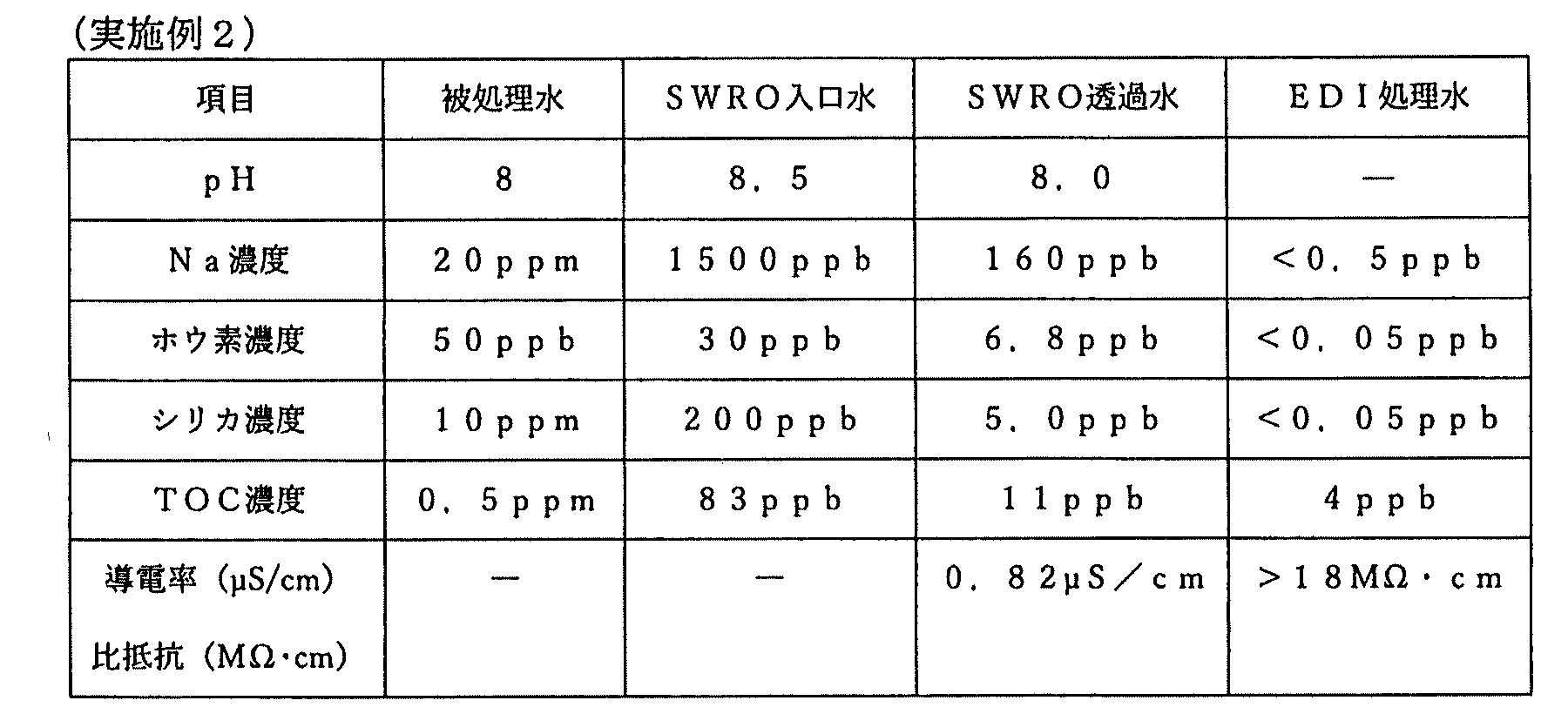
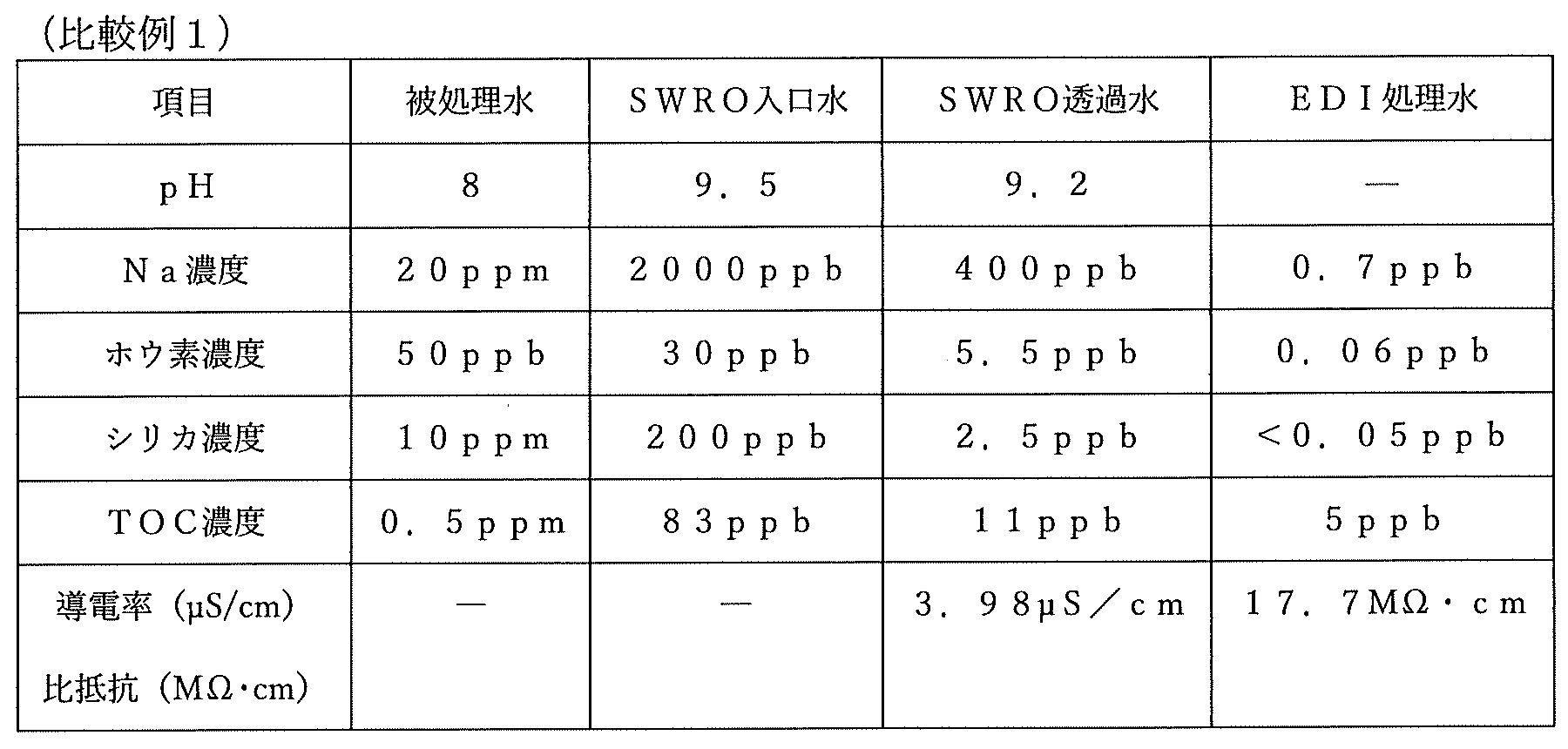
表1~3における、SWRO入口水の各pHにおけるSWRO透過水のナトリウムリーク率を図3に示す。表1~3及び図3より、SWRO入口水のpHを5.0~9.0、好ましくは5.5~8.5に調整することにより、ホウ素濃度を0.05ppm(50ppt)以下に低減されたEDI処理水が得られることがわかる。
したがって、SWRO入口水のpHを所定の値に調整することにより、EDIに供給されるナトリウム濃度が下がり、結果としてホウ素の除去率が向上する。
したがって、SWRO入口水のpHを所定の値に調整することにより、EDIに供給されるナトリウム濃度が下がり、結果としてホウ素の除去率が向上する。
[実施例3]
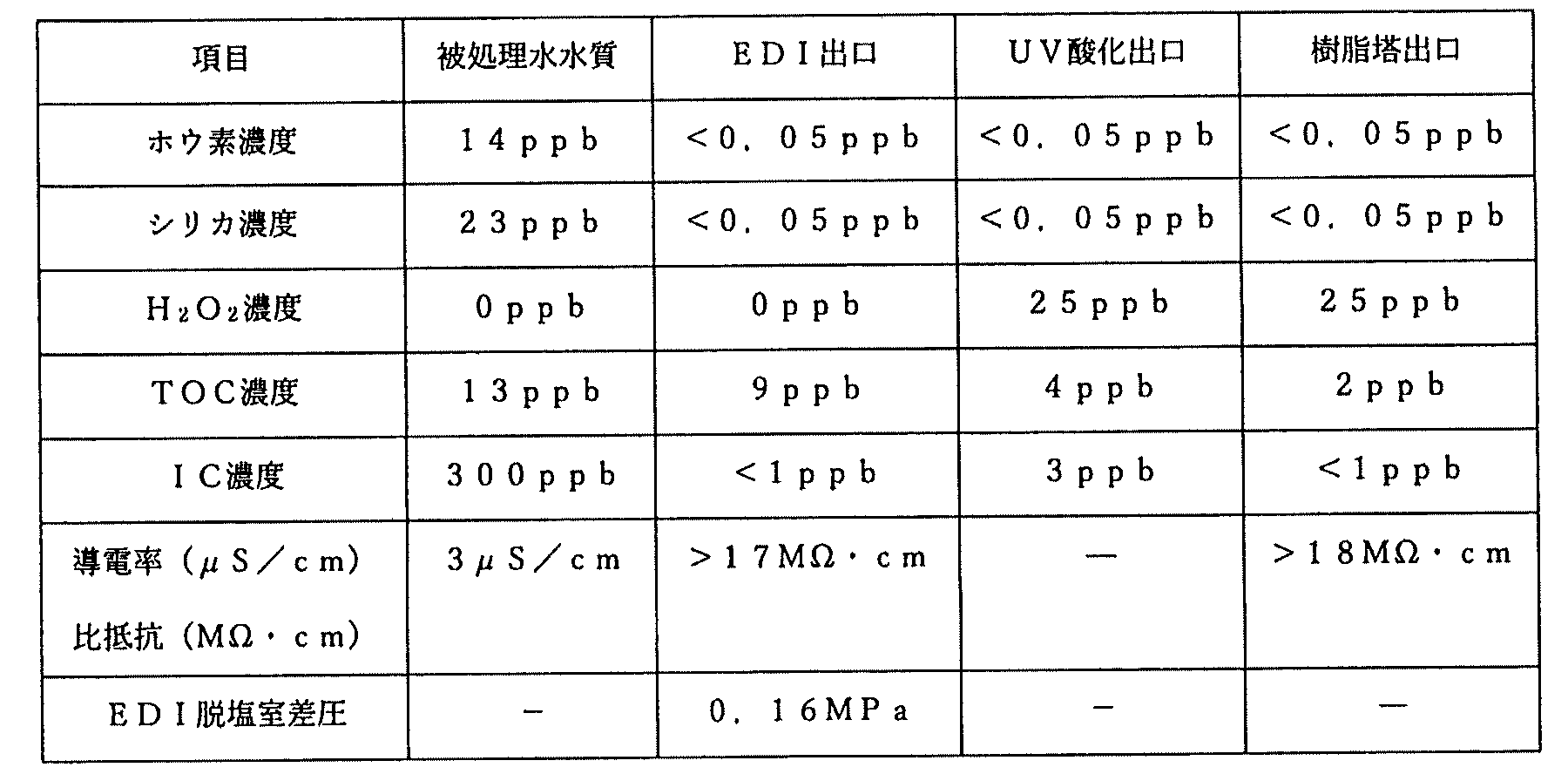
導電率3μS/cm、ホウ素濃度14ppb、シリカ濃度23ppb、TOC濃度13ppb、無機炭素※(IC:Inorganic carbon)濃度300ppb、DO濃度8ppm、H2O2濃度0ppbの被処理水を用い、通水流速2m3/hの条件にて、EDI、UV酸化装置、CP装置(樹脂塔)の構成の順で通水試験を行った。なおEDIはオルガノ株式会社製EDI-XP、回収率は90%。運転電流値の設定は5Aとした。UV酸化装置は日本フォトサイエンス製 JPWを利用した。樹脂塔としては、アクリル製の円筒容器(内径25mm、高さ600mm)を有し、この容器内にイオン交換樹脂を200ml(ESP-2:オルガノ社製)充填したものを用いた。なお樹脂塔へはUV酸化装置処理水の一部を分岐し12L/h(SV=60)で通水を行った。
通水2000時間後の各水質データを表4に示す。EDI脱塩室差圧は初期の0.16MPaのまま安定していた。
導電率3μS/cm、ホウ素濃度14ppb、シリカ濃度23ppb、TOC濃度13ppb、無機炭素※(IC:Inorganic carbon)濃度300ppb、DO濃度8ppm、H2O2濃度0ppbの被処理水を用い、通水流速2m3/hの条件にて、EDI、UV酸化装置、CP装置(樹脂塔)の構成の順で通水試験を行った。なおEDIはオルガノ株式会社製EDI-XP、回収率は90%。運転電流値の設定は5Aとした。UV酸化装置は日本フォトサイエンス製 JPWを利用した。樹脂塔としては、アクリル製の円筒容器(内径25mm、高さ600mm)を有し、この容器内にイオン交換樹脂を200ml(ESP-2:オルガノ社製)充填したものを用いた。なお樹脂塔へはUV酸化装置処理水の一部を分岐し12L/h(SV=60)で通水を行った。
通水2000時間後の各水質データを表4に示す。EDI脱塩室差圧は初期の0.16MPaのまま安定していた。
[比較例2]
導電率3μS/cm、ホウ素濃度14ppb、シリカ濃度23ppb、TOC濃度13ppb、無機炭素※(IC:Inorganic carbon)濃度300ppb、DO濃度8ppm、H2O2濃度0ppbの被処理水を用い、通水流速2m3/hの条件にて、UV酸化装置、EDIの順で通水試験を行った。なおUV酸化装置は日本フォトサイエンス製 JPWを利用した。EDIはオルガノ株式会社製EDI-XP、回収率は90%。運転電流値の設定は5Aとした。通水時間5000min後の結果を表5に示す。
EDI脱塩室差圧は初期の0.16MPaから0.18MPaとなり上昇傾向が見られた。また、H2O2濃度はEDI入口で25ppb、EDI出口で16ppbとなっており、内部でH2O2が消費されていることが分かった。EDI内部の機能材の劣化によりもたらされた差圧上昇であると推測されるため、将来的にホウ素除去率にも影響を及ぼす可能性がある。EDI装置の耐圧を超えてしまう懸念や、供給水の圧力不足により目的の水量が通水できない状況に至ると考えられ、実際のシステムへの適応も不可能と判断して運転を停止した。
導電率3μS/cm、ホウ素濃度14ppb、シリカ濃度23ppb、TOC濃度13ppb、無機炭素※(IC:Inorganic carbon)濃度300ppb、DO濃度8ppm、H2O2濃度0ppbの被処理水を用い、通水流速2m3/hの条件にて、UV酸化装置、EDIの順で通水試験を行った。なおUV酸化装置は日本フォトサイエンス製 JPWを利用した。EDIはオルガノ株式会社製EDI-XP、回収率は90%。運転電流値の設定は5Aとした。通水時間5000min後の結果を表5に示す。
EDI脱塩室差圧は初期の0.16MPaから0.18MPaとなり上昇傾向が見られた。また、H2O2濃度はEDI入口で25ppb、EDI出口で16ppbとなっており、内部でH2O2が消費されていることが分かった。EDI内部の機能材の劣化によりもたらされた差圧上昇であると推測されるため、将来的にホウ素除去率にも影響を及ぼす可能性がある。EDI装置の耐圧を超えてしまう懸念や、供給水の圧力不足により目的の水量が通水できない状況に至ると考えられ、実際のシステムへの適応も不可能と判断して運転を停止した。

10 被処理水
20 処理水
30 低圧型逆浸透膜装置(BWRO)
40 pH調整装置
45 ポンプ
50 高圧型逆浸透膜装置(SWRO)
60 電気再生式脱イオン装置(EDI)
70 紫外線酸化装置
80 カートリッジポリッシャー
90 純水
100 ホウ素除去装置
200 純水製造装置
20 処理水
30 低圧型逆浸透膜装置(BWRO)
40 pH調整装置
45 ポンプ
50 高圧型逆浸透膜装置(SWRO)
60 電気再生式脱イオン装置(EDI)
70 紫外線酸化装置
80 カートリッジポリッシャー
90 純水
100 ホウ素除去装置
200 純水製造装置
Claims (12)
- 被処理水が供給される低圧型逆浸透膜装置と、
前記低圧型逆浸透膜装置からの透過水のpHを5.0~9.0に調整するpH調整装置と、
前記pH調整装置によってpH調整された調整水が供給される高圧型逆浸透膜装置と、
前記高圧型逆浸透膜装置からの透過水が供給される電気再生式脱イオン装置と、
を有するホウ素除去装置。 - 前記高圧型逆浸透膜装置からの、透過水の導電率が2μs/cm以下もしくはナトリウム濃度が200ppb以下、またはそれらの両方を満たす、請求項1に記載のホウ素除去装置。
- 前記電気再生式脱イオン装置の処理水のホウ素濃度が50ppt以下である、請求項1又は請求項2に記載のホウ素除去装置。
- 被処理水が供給される低圧型逆浸透膜装置と、
前記低圧型逆浸透膜装置からの透過水のpHを5.0~9.0に調整するpH調整装置と、
前記pH調整装置によってpH調整された調整水が供給される高圧型逆浸透膜装置と、
前記高圧型逆浸透膜装置からの透過水が供給される電気再生式脱イオン装置と、
前記電気再生式脱イオン装置で処理された水が供給される紫外線酸化装置と、
前記紫外線酸化装置で処理された水が供給されるカートリッジポリッシャーと、
を有する純水製造装置。 - 前記高圧型逆浸透膜装置からの透過水の導電率が2μs/cm以下もしくはナトリウム濃度が200ppb以下、またはそれらの両方を満たす、請求項4に記載の純水製造装置。
- 純水のホウ素濃度が50ppt以下である、請求項4又は請求項5に記載の純水製造装置。
- (a)被処理水を低圧型逆浸透膜装置に供給するステップと、
(b)前記低圧型逆浸透膜装置からの透過水をpH調整装置に供給して、pHを5.0~9.0に調整するステップと、
(c)前記pHが調整された透過水を高圧型逆浸透装置に供給して処理するステップと、
(d)前記高圧逆浸透膜装置からの透過水を電気再生式脱イオン装置に供給して処理するステップと、
を有するホウ素の除去方法。 - 前記ステップ(c)において処理された水の導電率が2μs/cm以下もしくはナトリウム濃度が200ppb以下、またはそれらの両方を満たす、請求項7に記載の方法。
- 前記ステップ(d)において、処理水のホウ素濃度が50ppt以下である、請求項7又は請求項8に記載の方法。
- (a)被処理水を低圧型逆浸透膜装置に供給するステップと、
(b)前記低圧型逆浸透膜装置からの透過水をpH調整装置に供給して、pHを5.0~9.0に調整するステップと、
(c)前記pHが調整された透過水を高圧型逆浸透装置に供給して処理するステップと、
(d)前記高圧逆浸透膜装置からの透過水を電気再生式脱イオン装置に供給して処理するステップと、
(e)前記電気再生式脱イオン装置からの水を紫外線酸化装置に供給し、有機物を除去するステップと、
(f)前記有機物が除去された水をカートリッジポリッシャーに供給し、イオン交換処理して、純水を取り出すステップと、
を備える、純水の製造方法。 - 前記ステップ(c)において処理された水の導電率が2μs/cm以下もしくはナトリウム濃度が200ppb以下、またはそれらの両方を満たす、請求項10に記載の方法。
- 純水のホウ素濃度が50ppt以下である、請求項10又は請求項11に記載の方法。
Priority Applications (2)
| Application Number | Priority Date | Filing Date | Title |
|---|---|---|---|
| CN202080020655.9A CN113573799A (zh) | 2019-03-13 | 2020-02-13 | 硼除去装置和硼除去方法、以及纯水制造装置和纯水的制造方法 |
| US17/438,011 US12037276B2 (en) | 2019-03-13 | 2020-02-13 | Apparatus for removing boron, method for removing boron, apparatus for producing pure water and method for producing pure water |
Applications Claiming Priority (2)
| Application Number | Priority Date | Filing Date | Title |
|---|---|---|---|
| JP2019045328A JP7289206B2 (ja) | 2019-03-13 | 2019-03-13 | ホウ素除去装置及びホウ素除去方法、並びに、純水製造装置及び純水の製造方法 |
| JP2019-045328 | 2019-03-13 |
Publications (1)
| Publication Number | Publication Date |
|---|---|
| WO2020184045A1 true WO2020184045A1 (ja) | 2020-09-17 |
Family
ID=72427301
Family Applications (1)
| Application Number | Title | Priority Date | Filing Date |
|---|---|---|---|
| PCT/JP2020/005551 Ceased WO2020184045A1 (ja) | 2019-03-13 | 2020-02-13 | ホウ素除去装置及びホウ素除去方法、並びに、純水製造装置及び純水の製造方法 |
Country Status (5)
| Country | Link |
|---|---|
| US (1) | US12037276B2 (ja) |
| JP (1) | JP7289206B2 (ja) |
| CN (1) | CN113573799A (ja) |
| TW (1) | TWI829879B (ja) |
| WO (1) | WO2020184045A1 (ja) |
Cited By (4)
| Publication number | Priority date | Publication date | Assignee | Title |
|---|---|---|---|---|
| WO2021235107A1 (ja) * | 2020-05-20 | 2021-11-25 | オルガノ株式会社 | ホウ素除去装置及びホウ素除去方法、並びに、純水製造装置及び純水の製造方法 |
| WO2022074975A1 (ja) * | 2020-10-05 | 2022-04-14 | オルガノ株式会社 | 純水製造システムおよび純水製造方法 |
| JP2023070396A (ja) * | 2021-11-09 | 2023-05-19 | 栗田工業株式会社 | 多段逆浸透膜処理システム |
| WO2025088959A1 (ja) * | 2023-10-23 | 2025-05-01 | オルガノ株式会社 | 水処理装置およびその運転方法 |
Families Citing this family (5)
| Publication number | Priority date | Publication date | Assignee | Title |
|---|---|---|---|---|
| JP7610380B2 (ja) * | 2020-09-25 | 2025-01-08 | オルガノ株式会社 | 純水製造装置及び純水製造方法 |
| JP7171671B2 (ja) | 2020-10-22 | 2022-11-15 | 野村マイクロ・サイエンス株式会社 | 超純水製造システム及び超純水製造方法 |
| US12024444B1 (en) | 2023-06-16 | 2024-07-02 | Kirk M. Pumphrey | System and method for extracting boron from feed water |
| US12151943B1 (en) | 2023-06-16 | 2024-11-26 | Kirk M. Pumphrey | System and method for extracting boric acid from a boron solution |
| JP7672465B1 (ja) * | 2023-10-23 | 2025-05-07 | オルガノ株式会社 | 超純水製造装置及びその運用方法 |
Citations (3)
| Publication number | Priority date | Publication date | Assignee | Title |
|---|---|---|---|---|
| JP2011189298A (ja) * | 2010-03-16 | 2011-09-29 | Miura Co Ltd | 純水製造システム |
| JP2015020131A (ja) * | 2013-07-22 | 2015-02-02 | 栗田工業株式会社 | ホウ素含有水の処理方法及び装置 |
| JP2018183761A (ja) * | 2017-04-27 | 2018-11-22 | 野村マイクロ・サイエンス株式会社 | 超純水製造システム及び超純水製造方法 |
Family Cites Families (12)
| Publication number | Priority date | Publication date | Assignee | Title |
|---|---|---|---|---|
| US4574049B1 (en) * | 1984-06-04 | 1999-02-02 | Ionpure Filter Us Inc | Reverse osmosis system |
| US5766479A (en) * | 1995-08-07 | 1998-06-16 | Zenon Environmental Inc. | Production of high purity water using reverse osmosis |
| US8758720B2 (en) * | 1996-08-12 | 2014-06-24 | Debasish Mukhopadhyay | High purity water produced by reverse osmosis |
| JP2000202442A (ja) * | 1999-01-19 | 2000-07-25 | Sumitomo Chem Co Ltd | 硼素含有水中の硼素の分離回収方法 |
| WO2003031034A1 (en) * | 2001-10-05 | 2003-04-17 | Ionics, Incorporated | Control of water treatment system with low level boron detection |
| JP4172394B2 (ja) | 2002-01-22 | 2008-10-29 | 東レ株式会社 | 造水方法および造水装置 |
| US6858145B2 (en) * | 2002-09-12 | 2005-02-22 | Chemitreat Pte Ltd | Method of removing organic impurities from water |
| US6929748B2 (en) * | 2003-03-28 | 2005-08-16 | Chemitreat Pte Ltd | Apparatus and method for continuous electrodeionization |
| JP2009028695A (ja) * | 2007-07-30 | 2009-02-12 | Kurita Water Ind Ltd | 純水製造装置及び純水製造方法 |
| US8506685B2 (en) * | 2009-08-17 | 2013-08-13 | Celgard Llc | High pressure liquid degassing membrane contactors and methods of manufacturing and use |
| JP6228531B2 (ja) * | 2014-12-19 | 2017-11-08 | 栗田工業株式会社 | 超純水製造装置及び超純水製造方法 |
| JP6119886B1 (ja) * | 2016-01-28 | 2017-04-26 | 栗田工業株式会社 | 超純水製造装置および超純水製造装置の運転方法 |
-
2019
- 2019-03-13 JP JP2019045328A patent/JP7289206B2/ja active Active
-
2020
- 2020-02-13 CN CN202080020655.9A patent/CN113573799A/zh active Pending
- 2020-02-13 WO PCT/JP2020/005551 patent/WO2020184045A1/ja not_active Ceased
- 2020-02-13 US US17/438,011 patent/US12037276B2/en active Active
- 2020-02-27 TW TW109106384A patent/TWI829879B/zh active
Patent Citations (3)
| Publication number | Priority date | Publication date | Assignee | Title |
|---|---|---|---|---|
| JP2011189298A (ja) * | 2010-03-16 | 2011-09-29 | Miura Co Ltd | 純水製造システム |
| JP2015020131A (ja) * | 2013-07-22 | 2015-02-02 | 栗田工業株式会社 | ホウ素含有水の処理方法及び装置 |
| JP2018183761A (ja) * | 2017-04-27 | 2018-11-22 | 野村マイクロ・サイエンス株式会社 | 超純水製造システム及び超純水製造方法 |
Cited By (11)
| Publication number | Priority date | Publication date | Assignee | Title |
|---|---|---|---|---|
| WO2021235107A1 (ja) * | 2020-05-20 | 2021-11-25 | オルガノ株式会社 | ホウ素除去装置及びホウ素除去方法、並びに、純水製造装置及び純水の製造方法 |
| JP2021181069A (ja) * | 2020-05-20 | 2021-11-25 | オルガノ株式会社 | ホウ素除去装置及びホウ素除去方法、並びに、純水製造装置及び純水の製造方法 |
| JP7368310B2 (ja) | 2020-05-20 | 2023-10-24 | オルガノ株式会社 | ホウ素除去装置及びホウ素除去方法、並びに、純水製造装置及び純水の製造方法 |
| US12338152B2 (en) | 2020-05-20 | 2025-06-24 | Organo Corporation | Boron removal device and boron removal method, and pure water production device and pure water production method |
| WO2022074975A1 (ja) * | 2020-10-05 | 2022-04-14 | オルガノ株式会社 | 純水製造システムおよび純水製造方法 |
| JP2022060806A (ja) * | 2020-10-05 | 2022-04-15 | オルガノ株式会社 | 純水製造システムおよび純水製造方法 |
| CN116322948A (zh) * | 2020-10-05 | 2023-06-23 | 奥加诺株式会社 | 纯水制造系统以及纯水制造方法 |
| JP2023070396A (ja) * | 2021-11-09 | 2023-05-19 | 栗田工業株式会社 | 多段逆浸透膜処理システム |
| WO2023084902A1 (ja) * | 2021-11-09 | 2023-05-19 | 栗田工業株式会社 | 多段逆浸透膜処理システム |
| JP7363876B2 (ja) | 2021-11-09 | 2023-10-18 | 栗田工業株式会社 | 多段逆浸透膜処理システム |
| WO2025088959A1 (ja) * | 2023-10-23 | 2025-05-01 | オルガノ株式会社 | 水処理装置およびその運転方法 |
Also Published As
| Publication number | Publication date |
|---|---|
| JP7289206B2 (ja) | 2023-06-09 |
| US20220162104A1 (en) | 2022-05-26 |
| TW202039060A (zh) | 2020-11-01 |
| US12037276B2 (en) | 2024-07-16 |
| TWI829879B (zh) | 2024-01-21 |
| CN113573799A (zh) | 2021-10-29 |
| JP2020146619A (ja) | 2020-09-17 |
Similar Documents
| Publication | Publication Date | Title |
|---|---|---|
| JP7289206B2 (ja) | ホウ素除去装置及びホウ素除去方法、並びに、純水製造装置及び純水の製造方法 | |
| US12172917B2 (en) | Pure-water production device and pure-water production method | |
| US10526226B2 (en) | Ultrapure water production apparatus and ultrapure water production method | |
| US12338152B2 (en) | Boron removal device and boron removal method, and pure water production device and pure water production method | |
| CN109906206B (zh) | 水处理方法及装置 | |
| WO2021131360A1 (ja) | 純水製造方法、純水製造システム、超純水製造方法及び超純水製造システム | |
| WO2018096929A1 (ja) | 超純水製造方法及び超純水製造システム | |
| CN112424128A (zh) | 纯水制造系统及纯水制造方法 | |
| WO2021215099A1 (ja) | 排水処理方法、超純水製造方法及び排水処理装置 | |
| JP5782675B2 (ja) | 水処理方法及び超純水製造方法 | |
| KR20250095612A (ko) | 순수 제조 방법, 순수 제조 장치 및 초순수 제조 시스템 | |
| JP7405066B2 (ja) | 超純水製造装置及び超純水製造方法 | |
| JP7383141B2 (ja) | Toc除去装置及びtoc除去方法 | |
| WO2014010075A1 (ja) | 超純水製造装置 | |
| JP6728835B2 (ja) | 純水製造装置の運転方法 | |
| CN120019032A (zh) | 去除了硼的纯水的制造方法、纯水制造装置以及超纯水制造系统 | |
| Mizuniwa | TOC Removal Technology |
Legal Events
| Date | Code | Title | Description |
|---|---|---|---|
| 121 | Ep: the epo has been informed by wipo that ep was designated in this application |
Ref document number: 20770359 Country of ref document: EP Kind code of ref document: A1 |
|
| NENP | Non-entry into the national phase |
Ref country code: DE |
|
| 122 | Ep: pct application non-entry in european phase |
Ref document number: 20770359 Country of ref document: EP Kind code of ref document: A1 |