WO2020179567A1 - 化粧料、加温使用用化粧料および美容方法 - Google Patents
化粧料、加温使用用化粧料および美容方法 Download PDFInfo
- Publication number
- WO2020179567A1 WO2020179567A1 PCT/JP2020/007639 JP2020007639W WO2020179567A1 WO 2020179567 A1 WO2020179567 A1 WO 2020179567A1 JP 2020007639 W JP2020007639 W JP 2020007639W WO 2020179567 A1 WO2020179567 A1 WO 2020179567A1
- Authority
- WO
- WIPO (PCT)
- Prior art keywords
- cosmetic
- warming
- cosmetics
- cellulose
- mass
- Prior art date
- Legal status (The legal status is an assumption and is not a legal conclusion. Google has not performed a legal analysis and makes no representation as to the accuracy of the status listed.)
- Ceased
Links
Images


Classifications
-
- A—HUMAN NECESSITIES
- A45—HAND OR TRAVELLING ARTICLES
- A45D—HAIRDRESSING OR SHAVING EQUIPMENT; EQUIPMENT FOR COSMETICS OR COSMETIC TREATMENTS, e.g. FOR MANICURING OR PEDICURING
- A45D34/00—Containers or accessories specially adapted for handling liquid toiletry or cosmetic substances, e.g. perfumes
- A45D34/04—Appliances specially adapted for applying liquid, e.g. using roller or ball
-
- A—HUMAN NECESSITIES
- A61—MEDICAL OR VETERINARY SCIENCE; HYGIENE
- A61K—PREPARATIONS FOR MEDICAL, DENTAL OR TOILETRY PURPOSES
- A61K8/00—Cosmetics or similar toiletry preparations
- A61K8/02—Cosmetics or similar toiletry preparations characterised by special physical form
- A61K8/0241—Containing particulates characterized by their shape and/or structure
- A61K8/027—Fibers; Fibrils
-
- A—HUMAN NECESSITIES
- A61—MEDICAL OR VETERINARY SCIENCE; HYGIENE
- A61K—PREPARATIONS FOR MEDICAL, DENTAL OR TOILETRY PURPOSES
- A61K8/00—Cosmetics or similar toiletry preparations
- A61K8/18—Cosmetics or similar toiletry preparations characterised by the composition
- A61K8/72—Cosmetics or similar toiletry preparations characterised by the composition containing organic macromolecular compounds
- A61K8/73—Polysaccharides
- A61K8/731—Cellulose; Quaternized cellulose derivatives
-
- A—HUMAN NECESSITIES
- A61—MEDICAL OR VETERINARY SCIENCE; HYGIENE
- A61K—PREPARATIONS FOR MEDICAL, DENTAL OR TOILETRY PURPOSES
- A61K8/00—Cosmetics or similar toiletry preparations
- A61K8/18—Cosmetics or similar toiletry preparations characterised by the composition
- A61K8/72—Cosmetics or similar toiletry preparations characterised by the composition containing organic macromolecular compounds
- A61K8/84—Cosmetics or similar toiletry preparations characterised by the composition containing organic macromolecular compounds obtained by reactions otherwise than those involving only carbon-carbon unsaturated bonds
- A61K8/87—Polyurethanes
-
- A—HUMAN NECESSITIES
- A61—MEDICAL OR VETERINARY SCIENCE; HYGIENE
- A61Q—SPECIFIC USE OF COSMETICS OR SIMILAR TOILETRY PREPARATIONS
- A61Q19/00—Preparations for care of the skin
-
- A—HUMAN NECESSITIES
- A45—HAND OR TRAVELLING ARTICLES
- A45D—HAIRDRESSING OR SHAVING EQUIPMENT; EQUIPMENT FOR COSMETICS OR COSMETIC TREATMENTS, e.g. FOR MANICURING OR PEDICURING
- A45D2200/00—Details not otherwise provided for in A45D
- A45D2200/15—Temperature
- A45D2200/155—Heating or cooling means, i.e. for storing or applying cosmetic products at a predetermined temperature
-
- A—HUMAN NECESSITIES
- A61—MEDICAL OR VETERINARY SCIENCE; HYGIENE
- A61K—PREPARATIONS FOR MEDICAL, DENTAL OR TOILETRY PURPOSES
- A61K2800/00—Properties of cosmetic compositions or active ingredients thereof or formulation aids used therein and process related aspects
- A61K2800/10—General cosmetic use
-
- A—HUMAN NECESSITIES
- A61—MEDICAL OR VETERINARY SCIENCE; HYGIENE
- A61K—PREPARATIONS FOR MEDICAL, DENTAL OR TOILETRY PURPOSES
- A61K2800/00—Properties of cosmetic compositions or active ingredients thereof or formulation aids used therein and process related aspects
- A61K2800/40—Chemical, physico-chemical or functional or structural properties of particular ingredients
- A61K2800/41—Particular ingredients further characterized by their size
- A61K2800/413—Nanosized, i.e. having sizes below 100 nm
-
- A—HUMAN NECESSITIES
- A61—MEDICAL OR VETERINARY SCIENCE; HYGIENE
- A61K—PREPARATIONS FOR MEDICAL, DENTAL OR TOILETRY PURPOSES
- A61K2800/00—Properties of cosmetic compositions or active ingredients thereof or formulation aids used therein and process related aspects
- A61K2800/40—Chemical, physico-chemical or functional or structural properties of particular ingredients
- A61K2800/48—Thickener, Thickening system
-
- A—HUMAN NECESSITIES
- A61—MEDICAL OR VETERINARY SCIENCE; HYGIENE
- A61K—PREPARATIONS FOR MEDICAL, DENTAL OR TOILETRY PURPOSES
- A61K2800/00—Properties of cosmetic compositions or active ingredients thereof or formulation aids used therein and process related aspects
- A61K2800/40—Chemical, physico-chemical or functional or structural properties of particular ingredients
- A61K2800/54—Polymers characterized by specific structures/properties
-
- A—HUMAN NECESSITIES
- A61—MEDICAL OR VETERINARY SCIENCE; HYGIENE
- A61K—PREPARATIONS FOR MEDICAL, DENTAL OR TOILETRY PURPOSES
- A61K2800/00—Properties of cosmetic compositions or active ingredients thereof or formulation aids used therein and process related aspects
- A61K2800/80—Process related aspects concerning the preparation of the cosmetic composition or the storage or application thereof
- A61K2800/805—Corresponding aspects not provided for by any of codes A61K2800/81 - A61K2800/95
-
- A—HUMAN NECESSITIES
- A61—MEDICAL OR VETERINARY SCIENCE; HYGIENE
- A61K—PREPARATIONS FOR MEDICAL, DENTAL OR TOILETRY PURPOSES
- A61K2800/00—Properties of cosmetic compositions or active ingredients thereof or formulation aids used therein and process related aspects
- A61K2800/80—Process related aspects concerning the preparation of the cosmetic composition or the storage or application thereof
- A61K2800/87—Application Devices; Containers; Packaging
Definitions
- the present invention relates to a cosmetic containing a hydrophobic polyether urethane and cellulose nanofibers, a heated cosmetic containing a temperature-responsive polymer and a high temperature stable polymer, and a cosmetic method. It is a thing.
- Patent Document 1 describes a cosmetic containing cellulose nanocrystals and a water-soluble polymer such as a carboxyvinyl polymer, an alkyl methacrylate/acrylic acid copolymer, and a thickening polysaccharide.
- the concentration of the thickener increases due to volatilization of the solvent of the cosmetic. For this reason, stickiness caused by the thickener is remarkably generated, resulting in poor usability.
- the compounding amount of the thickener is increased, generally, the thixotropy of the cosmetic material is increased, so that the amount of the cosmetic material that can be used is decreased due to the increased adhesion of the cosmetic material to the wall surface of the container, and the suction failure by the dispenser occurs.
- sucking up with a dispenser there arises a problem that the cosmetic material is not sucked up continuously and the discharge is intermittent with air mixed.
- Cosmetics are stored in various container forms such as bottles, tubes, jars, mist dispensers, etc., but when developing cosmetics adjusted with water-soluble thickeners, in addition to the selection of thickeners, the container form It is important to design in consideration of.
- the viscosity of the cosmetics may decrease and the cosmetics may have a problem of stability such as dripping or separation during use.
- Patent Document 1 employs a specific water-soluble polymer in order to suppress the aggregation of fine cellulose to form a uniform cosmetic material, but increases the adhesion of the cosmetic material to the container wall surface and causes poor suction by a dispenser. No thickeners have been selected in relation to the container. On the other hand, in the field of cosmetics for warming use, there have been no studies on temperature-responsive water-soluble thickeners and improvement of high-temperature stability without disturbing the temperature-responsiveness.
- the present invention has been made in view of the above problems, and firstly, to eliminate the stickiness of the cosmetic by having a film property during drying, and to provide a cosmetic that is continuously sucked during the operation of the dispenser. The purpose is to do that. Secondly, it is an object of the present invention to provide a cosmetic for warming use which has high temperature stability while having temperature responsiveness. Another object of the present invention is to provide a beauty method for applying a cosmetic for warming use.
- the (A) hydrophobically modified polyether urethane is preferably a (PEG-240/decyltetradeceth-20/HDI) copolymer.
- PEG is an abbreviation for polyethylene glycol
- HDI is an abbreviation for hexamethylene diisocyanate.
- the (B) cellulose nanofiber is preferably a fine fibrous cellulose having a maximum fiber diameter of 1000 nm or less.
- the cosmetic of the present invention is preferably contained in a dispenser container.
- the cosmetic for heating use of the present invention is a cosmetic for heating use used for a device having a heating unit.
- a temperature-responsive polymer whose structure changes at 30 ° C or higher, A high-temperature stable polymer whose structure does not change below 70 ° C, water and, Is included.
- the temperature responsive polymer is (A) hydrophobically modified polyether urethane and the high temperature stable polymer is (B) cellulose nanofiber.
- the blending amount of the temperature responsive polymer is larger than the blending amount of the high temperature stable polymer and that the blending amount of the high temperature stable polymer is 0.1% by mass or more based on the total amount of the cosmetic.
- the (A) hydrophobically modified polyether urethane is preferably a (PEG-240/decyltetradeceth-/HDI) copolymer.
- the (B) cellulose nanofiber is preferably a fine fibrous cellulose having a maximum fiber diameter of 1000 nm or less.
- the warming cosmetic composition of the present invention is preferably used under a temperature condition of 30 to 70°C.
- the heat source of the heating unit is preferably a heater or a Peltier element.
- the device may be equipped with a spraying device.
- the device may be equipped with a probe.
- the device may be equipped with a tank for storing the cosmetic for warming use.
- the cosmetic method of the present invention is to apply the above-mentioned cosmetic for warming to the skin directly and/or indirectly in the form of a mist by controlling the temperature in the range of 40 to 70° C. with a heating unit.
- the cosmetic method of the present invention is to apply the above-mentioned cosmetic for warming to the skin directly and/or indirectly by controlling it in the temperature range of 30 to 48° C. with a heating unit.
- the cosmetic of the present invention is (A) Hydrophobic modified polyether urethane and (B) Cellulose nanofiber, (C) water, It is a cosmetic containing
- the amount of (A)+(B) is 2% by mass or less based on the total amount of cosmetics, so that filminess is imparted and stickiness is eliminated, and the dispenser is activated. It can be sucked up continuously.
- the cosmetic for heating use of the present invention is a cosmetic for heating use for use in a device having a heating part, A temperature-responsive polymer whose structure changes at 30 ° C or higher, A high-temperature stable polymer whose structure does not change below 70 ° C, water and, Since it contains, it can have high temperature stability while having temperature responsiveness.
- the cosmetic of the present invention is (A) Hydrophobic modified polyether urethane (hereinafter also simply referred to as (A)), (B) Cellulose nanofiber (hereinafter also simply referred to as (B)), (C) water, It is a cosmetic containing
- the mixing ratio of (A) and (B) is In the case of (A) ⁇ (B), the blending amount of (A) + (B) with respect to all cosmetics is 0.75% by mass or less.
- the hydrophobic-modified polyether urethane is a hydrophobic-modified polyether urethane represented by the following formula (I).
- This copolymer is an associative thickener and is known to have temperature responsiveness.
- the associative thickener is a copolymer having a hydrophilic base as a skeleton and a hydrophobic portion at the end, and refers to a copolymer in which the hydrophobic portions of the copolymer are associated with each other in an aqueous medium to exhibit a thickening effect.
- Such an associative thickener exhibits a thickening action by associating the hydrophobic parts of the copolymer with each other in an aqueous medium, and forming the hydrophilic part in a loop shape or a bridge shape.
- R 1 , R 2 and R 4 each independently represent an alkylene group having 2 to 4 carbon atoms or a phenylethylene group. Preferred is an alkylene group having 2 to 4 carbon atoms.
- R 3 represents an alkylene group having 1 to 10 carbon atoms which may have a urethane bond.
- R 5 represents a linear, branched or secondary alkyl group having 8 to 36 carbon atoms, preferably 12 to 24 carbon atoms.
- m is a number of 2 or more. It is preferably 2.
- h is a number of 1 or more. It is preferably 1.
- k is a number from 1 to 500.
- the number is preferably 100 to 300.
- n is a number from 1 to 200.
- the number is preferably 10 to 100.
- the hydrophobically modified polyether urethane represented by the above formula (I) can be prepared, for example, by R 1 -[(O—R 2 ) k —OH] m (wherein R 1 , R 2 , k and m are defined above). And one or more polyether polyols represented by R 3 —(NCO) h+1 (wherein R 3 and h are as defined above) or Two or more polyisocyanates, and one or more polyisocyanates represented by HO—(R 4 —O) n —R 5 (wherein R 4 , R 5 , and n are as defined above)
- a preferable example is a method of obtaining by reacting with an ether monoalcohol.
- R 1 to R 5 in the formula (I) are R 1 -[(O-R 2 ) k -OH] m , R 3 -(NCO) h+1 and HO-(R 4 -O used. ) Determined by n- R 5 .
- the polyether polyol compound represented by the above formula R 1 -[(OR 2 ) k- OH] m is an m-valent polyol containing ethylene oxide, propylene oxide, butylene oxide, alkylene oxide such as epichlorohydrin, styrene oxide and the like. It can be done by addition polymerization.
- the polyol is preferably a divalent to octavalent one, for example, a dihydric alcohol such as ethylene glycol, propylene glycol, butylene glycol, hexamethylene glycol, neopentyl glycol; glycerin, trioxyisobutane, 1,2,3- Butanetriol, 1,2,3-pentatriol, 2-methyl-1,2,3-propanetriol, 2-methyl-2,3,4-butanetriol, 2-ethyl-1,2,3-butanetriol 2,3,4-pentanetriol, 2,3,4-hexanetriol, 4-propyl-3,4,5-heptanetriol, 2,4-dimethyl-2,3,4-pentanetriol, pentamethylglycerin , Pentaglycerin, 1,2,4-butanetriol, 1,2,4-pentanetriol, trimethylolethane, trimethylolpropane, and other trihydric alcohols; pentaerythrito,
- R 2 is determined by the alkylene oxide, styrene oxide, etc. to be added, but it is particularly easy to obtain, and in order to exert an excellent effect, alkylene oxide or styrene oxide having 2 to 4 carbon atoms is used. preferable.
- the alkylene oxide, styrene oxide and the like to be added may be homopolymerized, two or more kinds of random polymerization or block polymerization.
- the method of addition may be a conventional method.
- the degree of polymerization k is 1 to 500.
- the proportion of ethylene groups in R 2 is preferably 50 to 100% by mass of the total R 2 .
- the molecular weight of R 1 -[(O—R 2 ) k —OH] m is preferably 500 to 100,000, particularly preferably 1000 to 50,000.
- the polyisocyanate represented by the above formula R 3 -(NCO) h+1 is not particularly limited as long as it has two or more isocyanate groups in the molecule. Examples thereof include aliphatic diisocyanate, aromatic diisocyanate, alicyclic diisocyanate, biphenyl diisocyanate, phenylmethane di-, tri-, and tetraisocyanate.
- Examples of the aliphatic diisocyanate include methylene diisocyanate, dimethylene diisocyanate, trimethylene diisocyanate, tetramethylene diisocyanate, pentamethylene diisocyanate, hexamethylene diisocyanate, dipropyl ether diisocyanate, 2,2-dimethylpentane diisocyanate, 3-methoxyhexane diisocyanate, Octamethylene diisocyanate, 2,2,4-trimethylpentane diisocyanate, nonamethylene diisocyanate, decamethylene diisocyanate, 3-butoxyhexane diisocyanate, 1,4-butylene glycol dipropyl ether diisocyanate, thiodihexyl diisocyanate, metaxylylene diisocyanate, paraxylyl Examples include diisocyanate and tetramethylxylylene diisocyanate.
- aromatic diisocyanate examples include metaphenylene diisocyanate, paraphenylene diisocyanate, 2,4-toluene diisocyanate, 2,6-toluene diisocyanate, dimethylbenzene diisocyanate, ethylbenzene diisocyanate, isopropylbenzene diisocyanate, trizine diisocyanate, 1,4-.
- aromatic diisocyanate examples include metaphenylene diisocyanate, paraphenylene diisocyanate, 2,4-toluene diisocyanate, 2,6-toluene diisocyanate, dimethylbenzene diisocyanate, ethylbenzene diisocyanate, isopropylbenzene diisocyanate, trizine diisocyanate, 1,4-.
- examples thereof include naphthalene diisocyanate, 1,5-naphthalene diisocyanate, 2,6-naphthal
- Examples of the alicyclic diisocyanate include hydrogenated xylylene diisocyanate and isophorone diisocyanate.
- biphenyl diisocyanate examples include biphenyl diisocyanate, 3,3'-dimethylbiphenyl diisocyanate, 3,3'-dimethoxybiphenyl diisocyanate and the like.
- diisocyanate of phenylmethane examples include diphenylmethane-4,4′-diisocyanate, 2,2′-dimethyldiphenylmethane-4,4′-diisocyanate, diphenyldimethylmethane-4,4′-diisocyanate, 2,5,2′.
- triisocyanate of phenylmethane examples include 1-methylbenzene-2,4,6-triisocyanate, 1,3,5-trimethylbenzene-2,4,6-triisocyanate, and 1,3,7-naphthalenetriisocyanate.
- Examples include thiophosphate and the like.
- polyisocyanate compound may be used as a dimer or trimer (isocyanurate bond) of these polyisocyanate compounds, or may be used as a biuret by reacting with an amine.
- a polyisocyanate having a urethane bond obtained by reacting these polyisocyanate compounds with a polyol can also be used.
- the polyol those having a valence of 2 to 8 are preferable, and the above-mentioned polyol is preferable.
- R 3 -(NCO) h+1 this polyisocyanate having a urethane bond is preferable.
- the polyether monoalcohol represented by the above formula HO- (R 4- O) n- R 5 is not particularly limited as long as it is a linear and branched chain or a secondary monohydric alcohol polyether.
- Such a compound can be obtained by addition-polymerizing an alkylene oxide such as ethylene oxide, propylene oxide, butylene oxide or epichlorohydrin, styrene oxide or the like to a linear or branched or secondary monohydric alcohol.
- the branched-chain alcohol referred to here is represented by the following formula (III).
- the secondary alcohol is represented by the following formula (IV).
- R 5 is a group excluding the hydroxyl group in the above formulas (II) to (IV).
- R 6 , R 7 , R 8 , R 10 and R 11 are hydrocarbon groups or fluorocarbon groups, for example, alkyl groups, alkenyl groups, alkylaryl groups, cycloalkyl groups. , Cycloalkenyl group, etc.
- alkyl group examples include methyl, ethyl, propyl, isopropyl, butyl, isobutyl, tert-butyl, pentyl, isopentyl, neopentyl, tert-pentyl, hexyl, heptyl, octyl, 2-ethylhexyl, nonyl, decyl, undecyl, dodecyl.
- Tridecyl isotridecyl, myristyl, palmityl, stearyl, isostearyl, icosyl, docosyl, tetracosyl, triacontyl, 2-octyldodecyl, 2-dodecylhexadecyl, 2-tetradecyloctadecyl, monomethyl-branched-isostearyl and the like.
- alkenyl group examples include vinyl, allyl, propenyl, isopropenyl, butenyl, pentenyl, isopentenyl, hexenyl, heptenyl, octenyl, nonenyl, decenyl, undecenyl, dodecenyl, tetradecenyl, oleyl and the like.
- alkylaryl group examples include phenyl, toluyl, xylyl, cumenyl, mesityl, benzyl, phenethyl, styryl, cinnamyl, benzhydryl, trityl, ethylphenyl, propylphenyl, butylphenyl, pentylphenyl, hexylphenyl, heptylphenyl, octylphenyl, nonyl.
- examples thereof include phenyl, ⁇ -naphthyl and ⁇ -naphthyl groups.
- Examples of the cycloalkyl group and cycloalkenyl group include a cyclopentyl, cyclohexyl, cycloheptyl, methylcyclopentyl, methylcyclohexyl, methylcycloheptyl, cyclopentenyl, cyclohexenyl, cycloheptenyl, methylcyclopentenyl, methylcyclohexenyl, methylcycloheptenyl group. And so on.
- R 9 is a hydrocarbon group or a fluorocarbon group, and examples thereof include an alkylene group, an alkenylene group, an alkylarylene group, a cycloalkylene group and a cycloalkenylene group.
- R 5 is a hydrocarbon group or a fluorocarbon group, preferably an alkyl group, and the total number of carbon atoms thereof is preferably 8 to 36, particularly preferably 12 to 24.
- the alkylene oxide, styrene oxide, etc. to be added may be homopolymerization, two or more kinds of random polymerization or block polymerization.
- the method of addition may be a normal method.
- the degree of polymerization n is 0 to 1000, preferably 1 to 200, and more preferably 10 to 200.
- the ratio of ethylene to total R 4 is preferably 50 to 100 wt% of the total R 4, more preferably, if it is 65-100 mass%, is good associative thickeners for the purposes of the present invention can get.
- the method for producing the copolymer represented by the above formula (I) is the same as the reaction between ordinary polyether and isocyanate, for example, heating at 80 to 90 ° C. for 1 to 3 hours to obtain the reaction. Can be done.
- R 1 -[(OR 2 ) k -OH] m a polyisocyanate represented by R 3 -(NCO) h+1 (b)
- R 3 -(NCO) h+1 (b) HO -(R 4- O)
- the main product is a cb-a-b-c-type copolymer represented by the formula (I), but other products are c-b-c type and c-b type.
- Copolymers such as-(ab) x -ab-c type may be produced as a by-product. In this case, it can be used in the present invention in the form of a mixture containing the copolymer of the formula (I) without separating the copolymer of the formula (I).
- a particularly preferred example is a hydrophobically modified polyether urethane having an INCI name of “(PEG-240/decyltetradeceth-20/HDI) copolymer (PEG-240/HDI COPOLYMER BISDECYLTE TRADECETH-20 ETHER)”.
- the copolymer is commercially available from ADEKA Co., Ltd. under the trade name "Adecanol GT-700”.
- Cellulose nanofibers mean fibers obtained by defibrating plant cell wall-derived cellulose fibers to the nano level, and are preferably fine fibrous cellulose having a maximum fiber diameter of 1000 nm or less. More specifically, it is a cellulose fiber having a number average fiber diameter of 2 to 100 nm, and the cellulose has a cellulose type I crystal structure, and the hydroxyl group at the C6 position of the glucose unit in the cellulose molecule is selectively oxidized. It is preferably a fine cellulose fiber that has been modified to an aldehyde group and a carboxyl group and has a carboxyl group content of 0.6 to 2.2 mmol / g.
- the above-mentioned cellulose fiber is a fiber obtained by surface-oxidizing a naturally-occurring cellulose solid raw material having a type I crystal structure to make it fine. That is, in the process of biosynthesis of natural cellulose, nanofibers called microfibrils are almost always formed first, and these are multibunched to form a higher-order solid structure. In order to weaken the hydrogen bond between the surfaces, which is the driving force of the above, a part of the hydroxyl group is oxidized and converted into an aldehyde group and a carboxyl group.
- the cellulose nanofibers have a maximum fiber diameter of 1000 nm or less, a number average fiber diameter of 2 to 100 nm, and preferably a number average fiber diameter of 3 to 80 nm from the viewpoint of dispersion stability. That is, when the number average fiber diameter is 2 nm or more, dissolution in the dispersion medium can be further suppressed, and when the number average fiber diameter is 100 nm or less, sedimentation of the cellulose fibers is suppressed, It is possible to sufficiently express the functionality by blending the cellulose fiber. Further, similarly, by setting the maximum fiber diameter to 1000 nm or less, it is possible to suppress the sedimentation of the cellulose fibers and sufficiently express the functionality by blending the cellulose fibers.
- the number average fiber diameter and maximum fiber diameter of cellulose nanofibers can be measured, for example, as follows. That is, water is added to the cellulose fibers to make the solid content of cellulose 1% by mass. This is dispersed using an ultrasonic homogenizer, a high-pressure homogenizer, a blender having a rotation speed of 15,000 rpm or higher, and then freeze-dried to prepare a sample. This can be observed by a scanning electron microscope (SEM) or the like, and the number average fiber diameter and the maximum fiber diameter of the cellulose fibers can be measured and calculated from the obtained image.
- SEM scanning electron microscope
- the hydroxyl group at the C6 position of the glucose unit in the cellulose molecule is selectively oxidized and modified into an aldehyde group and a carboxyl group, and the amount of the carboxyl group is 0.6 to 2.2 mmol / g. Is preferable. Further, from the viewpoint of shape retention performance and dispersion stability, the range of 0.6 to 2.0 mmol/g is particularly preferable. That is, when the amount of the carboxyl group is 0.6 mmol/g or more, the dispersion stability of the cellulose fiber can be further improved, sedimentation can be suppressed, and the amount of the carboxyl group is 2.2 mmol/g or less. With the presence, it is possible to suppress the sticky feeling while keeping the water solubility appropriate.
- the amount of carboxyl groups in cellulose nanofibers can be measured, for example, by potentiometric titration. That is, the dried cellulose fibers are dispersed in water, 0.01N sodium chloride aqueous solution is added, and the mixture is sufficiently stirred to disperse the cellulose fibers. Next, a 0.1 N hydrochloric acid solution was added until the pH reached 2.5 to 3.0, and a 0.04 N sodium hydroxide aqueous solution was added dropwise at a rate of 0.1 ml per minute, and an excessive pH was obtained from the obtained pH curve. The amount of carboxyl groups can be calculated from the difference between the neutralization point of hydrochloric acid and the neutralization point of the carboxyl groups derived from this cellulose fiber.
- the amount of the carboxyl group can be adjusted by controlling the amount of the co-oxidizing agent used in the oxidation step of the cellulose fiber and the reaction time, as described later.
- the cellulose nanofiber it is preferable that only the hydroxyl group at the C6 position of the glucose unit on the surface of the cellulose fiber is selectively oxidized to an aldehyde group and a carboxyl group. Whether or not only the hydroxyl group at the C6 position of the glucose unit on the surface of the cellulose fiber is selectively oxidized to the aldehyde group and the carboxyl group can be confirmed by, for example, the 13 C-NMR chart.
- the peak at 62 ppm corresponding to the C6 position of the primary hydroxyl group of the glucose unit which can be confirmed by the 13 C-NMR chart of cellulose before oxidation, disappears after the oxidation reaction, and instead a peak derived from a carboxyl group at 178 ppm. appear. In this way, it can be confirmed that only the C6-position hydroxyl group of the glucose unit is oxidized to the aldehyde group and the carboxyl group.
- Cellulose nanofibers can be produced, for example, as follows. That is, first, natural cellulose such as softwood pulp is dispersed in water to form a slurry, to which sodium bromide and an N-oxy radical catalyst are added, and sufficiently stirred to disperse and dissolve. Next, a co-oxidizing agent such as an aqueous solution of hypochlorous acid is added, and the reaction is carried out while dropping a 0.5N aqueous solution of sodium hydroxide so as to maintain the pH of 10.5 until no pH change is observed. The slurry obtained by the above reaction is purified by washing with water and filtration in order to remove unreacted raw materials, catalysts, etc.
- natural cellulose such as softwood pulp is dispersed in water to form a slurry, to which sodium bromide and an N-oxy radical catalyst are added, and sufficiently stirred to disperse and dissolve.
- a co-oxidizing agent such as an aqueous solution of hypochlorous acid is added, and the reaction is carried out while dropping
- the target product which is an aqueous dispersion of specific cellulose fibers whose surface is oxidized. be able to.
- a cosmetic having good transparency can be obtained by treating with a dispersing device having a strong dispersing force such as a high pressure homogenizer and an ultrahigh pressure homogenizer. ..
- N-oxy radical catalyst examples include 2,2,6,6-tetramethylpiperidinooxy radical (TEMPO) and 4-acetamido-TEMPO.
- TEMPO 2,2,6,6-tetramethylpiperidinooxy radical
- the N-oxy radical catalyst may be added in a catalytic amount, preferably in the range of 0.1 to 4 mmol/l, more preferably 0.2 to 2 mmol/l in the reaction aqueous solution.
- co-oxidizing agent examples include hypohalous acid or a salt thereof, halogenous acid or a salt thereof, perhalogenic acid or a salt thereof, hydrogen peroxide, perorganic acid and the like. These may be used alone or in combination of two or more. Of these, alkali metal hypohalites such as sodium hypochlorite and sodium hypobromite are preferable. And when using the said sodium hypochlorite, it is preferable at a reaction rate point to advance reaction in presence of alkali metal bromide, such as sodium bromide.
- the amount of the alkali metal bromide added is about 1 to 40 times, preferably about 10 to 20 times the molar amount of the N-oxy radical catalyst.
- the cellulose nanofiber may be a commercially available product, and examples thereof include those commercially available from Dai-ichi Kogyo Seiyaku Co., Ltd. under the trade name “Rheocrista C-2SP”.
- the blending ratio of the component (A) and the component (B) is 0.75% by mass or less in the blending amount of (A) + (B) with respect to the total cosmetics.
- the compounding amount of A)+(B) is 2% by mass or less.
- the blending amount of (A) + (B) with respect to the total cosmetics is more preferably 0.01 to 0. It is in the range of 75% by mass, and more preferably in the range of 0.1 to 0.5% by mass.
- the blending amount of (A)+(B) with respect to the total cosmetics is more preferably in the range of 0.02 to 1.75 mass %, and 0.2 to 1. More preferably, it is in the range of 5% by mass.
- the blending amount of (A)+(B) with respect to the total amount of cosmetics is more preferably in the range of 0.02 to 2% by mass, and 0.2 to 1.75% by mass. More preferably, it is in the range of%.
- the dispenser container is a container in which the contents of the container can be taken out by a predetermined amount by pressing a push button provided on the head without tilting the container.
- the cosmetic for heating use of the present invention is a cosmetic for heating use for use in a device having a heating part, A temperature-responsive polymer whose structure changes at 30 ° C or higher, A high temperature stable polymer that does not change its structure below 70°C, water and, Is included.
- a temperature-responsive polymer whose structure changes at 30 ° C or higher
- a high temperature stable polymer that does not change its structure below 70°C
- water and, Is included included.
- a temperature-responsive polymer whose structure changes at 30 ° C or higher means that the structure of the polymer expands and contracts at a temperature of 30 ° C. or higher. In particular, it means a polymer that undergoes a structural change in which the hydrophobic bonds in the polymer or between the molecules are strengthened and the polymer chains are aggregated.
- the temperature-responsive polymer By containing the temperature-responsive polymer, the viscosity of the cosmetic can be lowered by heating. It is more preferable that the temperature range in which the structure of the temperature-responsive polymer changes is 30 ° C. or higher and lower than 80 ° C.
- the temperature responsive polymer is (A) hydrophobically modified polyether urethane, and the details are the same as above.
- a high-temperature stable polymer whose structure does not change below 70 ° C means that the structure due to the polymer does not swell and shrink at a temperature of 70 ° C. or lower. In particular, it means a polymer that does not undergo structural changes without aggregation within or between the molecules at a temperature of 70 ° C. or lower.
- the viscosity of the cosmetic does not decrease due to heating, and the stability can be ensured without dripping or separating during use.
- the temperature range in which the structure of the high-temperature stability polymer does not change is more preferably 30 ° C. or higher and lower than 70 ° C.
- the high temperature stable polymer is (B) cellulose nanofiber, the details of which are the same as above.
- thermo-responsive polymer By using a temperature-responsive polymer and a high-temperature stable polymer in combination, it is possible to adjust the temperature-responsive cosmetics that maintain temperature stability before and after heating while maintaining a temperature response.
- the physical properties of each polymer before heating, the physical properties of each polymer are added, but after heating, the physical properties of the high temperature stable polymer are mainly expressed. Therefore, it is possible to provide a cosmetic material that can ensure high-temperature stability while imparting a change due to heating.
- the blending amount of the temperature responsive polymer is larger than the blending amount of the high temperature stable polymer and that the blending amount of the high temperature stable polymer is 0.1% by mass or more based on the total amount of the cosmetic. More preferably, it is in the range of 0.1 to 1% by mass.
- the thickening mechanism by blending the high temperature stable polymer can be sufficiently exhibited.
- the cosmetic for warming use of the present invention is preferably used under a temperature condition of 30 to 70°C, more preferably 36 to 66°C. When used under a temperature condition of 30 to 70° C., it is possible to obtain a highly effective feeling of the cosmetic material. Further, since the cosmetic for warming use of the present invention uses the temperature responsive polymer and the high temperature stable polymer in combination, the cosmetic does not drip during use even when heated, thus suppressing separation. can do.
- the heat source of the heating unit of the device using the warming cosmetic composition of the present invention is not particularly limited, but a heater, a Peltier element, or the like is preferable.
- the equipment that uses the cosmetic for heating is not particularly limited, but is equipped with a spraying device, for example, a dispenser equipped with a pump-type nozzle that can spray while keeping the inside of the container at atmospheric pressure.
- a spraying device for example, a dispenser equipped with a pump-type nozzle that can spray while keeping the inside of the container at atmospheric pressure.
- -Type sprayer aerosol-type sprayer that fills the container with propellant, ultrasonic sprayer that vibrates the mesh holes at high frequency, ultrasonic sprayer that creates a liquid column from the liquid surface, and mixes another liquid with cosmetics.
- Examples include a multi-fluid mixing type atomizer (whether the inside or outside of the device is mixed), an electrostatic type atomizer that makes a mist by an impact of an electrostatic pulse, an airbrush type atomizer that makes a mist by an air flow from a needle tip, and the like.
- the cosmetic for warming use of the present invention is applied to the skin directly and/or indirectly in the form of mist in the above-mentioned equipment, specifically in the fields of beauty salons and aesthetic medicine, household beauty equipment.
- Cosmetics can be applied to beauty methods used by controlling the temperature range of 40 to 70 ° C.
- the cosmetic for heating use of the present invention directly and / or indirectly applies the cosmetic to the skin by controlling the cosmetic to a temperature range of 30 to 48 ° C. by the above-mentioned device, specifically, a heating probe for heating. It can be used for the beauty method to be applied.
- An example of the method is to include a cosmetic for warming after warming and apply it to the skin.
- the cosmetics of the present invention and the cosmetics for warming use may be mixed with the components usually contained in cosmetics, and examples thereof include an aqueous component, an oily component and a powder.
- the cosmetics and cosmetics for warming of the present invention may have an emulsified structure by using an aqueous component as a main dispersion medium.
- the water-based ingredients include water and water-soluble ingredients.
- the water-soluble component include lower alcohols, humectants, water-soluble polymers (natural, semi-synthetic, synthetic, inorganic) and the like.
- the water-soluble polymer refers to a substance that is not for the purpose of thickening.
- Examples of the lower alcohol include ethanol, propanol, butanol, pentanol, hexanol and the like.
- moisturizers include glycerin, diethylene glycol, butylene glycol, polyethylene glycol, hexylene glycol, xylitol, sorbitol, maltitol, chondroitin sulfate, hyaluronic acid, mucoitin sulfate, caronic acid, atelocollagen, elastin, amino acids, nucleic acids, cholesteryl-12-.
- examples include hydroxy stearate, sodium lactate, bile salts, dl-pyrrolidone carboxylate, short-chain soluble collagen, diglycerin (EO)PO adducts, Issai rose extract, Astragalus membranaceus extract, Merrilot extract, etc.
- EO is an abbreviation for ethylene oxide
- PO is an abbreviation for propylene oxide.
- Natural water-soluble polymers include araavia gum, tragacanth gum, galactan, guar gum, locust bean gum, tamarind gum, carob gum, karaya gum, carrageenan, pectin, agar, quince seed (quince seed), algae colloid (duck extract), starch (rice, corn).
- xanthan gum dextran, succinoglycans, bullan and other microbial-based water-soluble polymers
- collagen, casein, albumin, gelatin and other animal-based water-soluble polymers Etc. are exemplified.
- Semi-synthetic water-soluble polymers include starch-based water-soluble polymers such as carboxymethyl starch and methyl hydroxypropyl starch; methyl cellulose, nitrocellulose, ethyl cellulose, methyl hydroxypropyl cellulose, hydroxyethyl cellulose, sodium cellulose sulfate, hydroxypropyl cellulose, carboxy. Examples thereof include cellulose-based water-soluble polymers such as methyl cellulose (CMC), crystalline cellulose and cellulose powder; and alginic acid-based water-soluble polymers such as sodium alginate and propylene glycol alginate.
- CMC methyl cellulose
- alginic acid-based water-soluble polymers such as sodium alginate and propylene glycol alginate.
- Examples of the synthetic water-soluble polymer include vinyl-based water-soluble polymers such as polyvinyl alcohol, polyvinyl methyl ether, polyvinyl pyrrolidone, and carboxyvinyl polymer (carbopol); polyethylene glycol 20,000, 4,000,000, 600, etc.
- Polyoxyethylene-based water-soluble polymers such as 000; copolymer-based water-soluble polymers such as polyoxyethylene-polyoxypropylene copolymers; acrylic-based water-soluble polymers such as sodium polyacrylate, polyethyl acrylate, and polyacrylamide
- polyethyleneimine, cationic polymer and the like are exemplified.
- inorganic water-soluble polymer examples include bentonite, AlMg silicate (veegum), laponite, hectorite, and silicic acid anhydride.
- hydrophobic powder or hydrophilic powder can be used as the powder component. Further, not only the powder itself is hydrophobic or hydrophilic, but the surface of the powder may be treated to be hydrophobic or hydrophilic.
- powder components include talc, kaolin, mica, sericite, muscovite, phlogopite, synthetic mica, phlogopite, biotite, lithia mica, permiculite, magnesium carbonate, calcium carbonate, aluminum silicate, and silica.
- any method can be used as long as it can impart water repellency, and the method is not limited, but for example, a vapor phase method, a liquid phase method, or an autoclave. Ordinary surface treatment methods such as a chemical method and a mechanochemical method can be used.
- the hydrophobizing agent is not particularly limited, but fatty acid dextrin-treated powder, trimethylsiloxysilicic acid-treated powder, fluorine-modified trimethylsiloxysilicic acid-treated powder, methylphenylsiloxysilicic acid-treated powder, fluorine-modified methylphenylsiloxysilicic acid-treated powder.
- Low-viscosity to high-viscosity oily polysiloxane-treated powders such as dimethylpolysiloxane, diphenylpolysiloxane, and methylphenylpolysiloxane, gum-like polysiloxane-treated powders, methylhydrogenpolysiloxane-treated powders, fluorine-modified methylhydrogenpolysiloxane-treated powders , Methyltrichlorosilane, methyltrialkoxysilane, hexamethyldisilane, dimethyldichlorosilane, dimethyldialkoxysilane, trimethylchlorosilane trimethylalkoxysilane and other organic silyl compounds or powders thereof treated with a fluorine-substituted compound, ethyltrichlorosilane, ethyl Trialkoxysilane, propyltrichlorosilane, propyltrialkoxysi
- the oily component to be blended in the cosmetics of the present invention and the cosmetics for warming use is not particularly limited as long as it is an oily component that can be usually blended in cosmetics, and for example, fats and oils, waxes, and hydrocarbon oils. , Higher fatty acids, higher alcohols, synthetic ester oils, silicone oils and the like.
- fats and oils examples include avocado oil, camellia oil, evening primrose oil, turtle oil, macadamia nut oil, corn oil, mink oil, olive oil, rapeseed oil, egg yolk oil, sesame oil, persic oil, wheat germ oil, southern oil, castor oil, linseed oil.
- oils and fats such as glycerin; cacao butter, coconut oil, horse fat, hardened coconut oil, palm oil, beef tallow, sheep fat, hardened beef tallow, palm kernel oil, pork fat, beef bone fat, sorghum kernel oil, hardened oil, beef leg
- oils and fats such as glycerin; cacao butter, coconut oil, horse fat, hardened coconut oil, palm oil, beef tallow, sheep fat, hardened beef tallow, palm kernel oil, pork fat, beef bone fat, sorghum kernel oil, hardened oil, beef leg
- solid fats and oils such as fats, wax, hydrogenated castor oil, and the like.
- waxes examples include beeswax, candelilla wax, cotton wax, carnauba wax, baby wax, squid wax, whale wax, montan wax, nukarou, lanolin, capoc wax, lanolin acetate, liquid lanolin, sugar cane, lanolin fatty acid isopropyl, hexyl laurate, reduced lanolin, jojo.
- Examples include barow, hard lanolin, shellac wax, POE lanolin alcohol ether, POE lanolin alcohol acetate, POE cholesterol ether, lanolin fatty acid polyethylene glycol, and POE hydrogenated lanolin alcohol ether.
- POE is an abbreviation for polyoxyethylene.
- hydrocarbon oils examples include liquid paraffin, ozokerite, squalene, pristane, paraffin, ceresin, squalene, petrolatum, and microcrystalline wax.
- higher fatty acids examples include lauric acid, myristic acid, palmitic acid, stearic acid, behenic acid, oleic acid, 12-hydroxystearic acid, undecylenic acid, tolic acid, isostearic acid, linoleic acid, linoleic acid, eicosapentaenoic acid. (EPA), docosahexaenoic acid (DHA), etc. are exemplified.
- higher alcohols include linear alcohols such as lauryl alcohol, cetyl alcohol, stearyl alcohol, behenyl alcohol, myristyl alcohol, oleyl alcohol, and cetostearyl alcohol; monostearyl glycerin ether (batyl alcohol), 2-decyltetradecinol, lanolin alcohol, Examples thereof include branched chain alcohols such as cholesterol, phytosterol, hexyldodecanol, isostearyl alcohol and octyldodecanol.
- Synthetic ester oils include isopropyl myristate, cetyl octanoate, octyldodecyl myristate, isopropyl palmitate, butyl stearate, hexyl laurate, myristyl myristate, decyl oleate, hexyldecyl dimethyloctanoate, cetyl lactate, myristyl lactate.
- silicone oil chain polysiloxanes such as dimethylpolysiloxane, methylphenylpolysiloxane and methylhydrogenpolysiloxane; cyclic polysiloxanes such as decamethylpolysiloxane, dodecamethylpolysiloxane and tetramethyltetrahydrogenpolysiloxane; 3 Examples include silicone resin and silicone rubber that form a three-dimensional network structure.
- the emulsifier may be an emulsifier that can be generally added to oil-in-water emulsion cosmetics.
- emulsifiers are preferably those composed of one or more HLB of 8 or more.
- POP alkyl ethers POE castor oil or hydrogenated castor oil derivatives
- POE beeswax lanolin derivatives alkanolamides
- POE propylene glycol fatty acid esters POE alkylamines, POE fatty acid amides
- Examples of other components that can be blended in addition to the components exemplified above include preservatives (ethylparaben, butylparaben, etc.); antiphlogistics (eg, glycyrrhizinic acid derivatives, glycyrrhetinic acid derivatives, salicylic acid derivatives, hinokitiol, zinc oxide, allantoin, etc.
- preservatives ethylparaben, butylparaben, etc.
- antiphlogistics eg, glycyrrhizinic acid derivatives, glycyrrhetinic acid derivatives, salicylic acid derivatives, hinokitiol, zinc oxide, allantoin, etc.
- Whitening agents for example, Yukinoshita extract, arbutin, etc.
- Various extracts for example, pearl oyster, laurel, shikon, peony, assembly, birch, sage, loquat, carrot, aloe, mallow, iris, grape, yochinin, loofah , Lily, saffron, senkyu, gypsum, hypericum, ononis, garlic, capsicum, chimpi, touki, seaweed, etc., activator (eg, royal jelly, photosensitizer, cholesterol derivative, etc.); blood circulation promoter (eg, nonyl acid pasylamide) , Nicotinic acid benzyl ester, nicotinic acid ⁇ -butoxyethyl ester, capsaicin, zingerone, cantalis tincture, ictamol, tannic acid, ⁇ -borneol, nicotinic acid tocophe
- Rheocrista C-2SP is a product containing 2% by mass of fine fibrous cellulose and 1% by mass of phenoxyethanol (preservative) in 97% by mass of water. Refers only to fine fibrous cellulose and does not contain water and preservatives contained in the product.
Landscapes
- Health & Medical Sciences (AREA)
- Life Sciences & Earth Sciences (AREA)
- Animal Behavior & Ethology (AREA)
- General Health & Medical Sciences (AREA)
- Public Health (AREA)
- Veterinary Medicine (AREA)
- Birds (AREA)
- Epidemiology (AREA)
- Dermatology (AREA)
- Cosmetics (AREA)
Abstract
【課題】べたつきを抑制し、ディスペンサ作動時において連続的に吸いあがる化粧料を提供する。また、温度応答性を有し、高温安定性の高い加温使用用化粧料を提供する。 【解決手段】 化粧料を、(A)疎水変性ポリエーテルウレタンと、(B)セルロースナノファイバーと、(C)水とを含有する化粧料であって、(A)と(B)の配合比率が、(A)<(B)の場合は、全化粧料に対する(A)+(B)の配合量が0.75質量%以下であり、(A)=(B)の場合は、全化粧料に対する(A)+(B)の配合量が1.75質量%以下であり、(A)>(B)の場合は、全化粧料に対する(A)+(B)の配合量が2質量%以下とする。また、加温使用用化粧料を、加熱部を有する機器に使用する加温使用用化粧料であって、30℃以上で構造変化する温度応答性高分子と、70℃以下では構造変化しない高温安定性高分子と、水とを含有するものとする。
Description
本発明は、疎水性ポリエーテルウレタンおよびセルロースナノファイバーを含有する化粧料、温度応答性高分子と高温安定性高分子を含有する加温して使用する加温使用用化粧料、および美容方法に関するものである。
従来より、化粧品には製剤の安定性や使用性の使い心地の向上を目的として水溶性増粘剤が配合されており、使用者の用途に合わせてその増粘剤の種類や配合量、組み合わせが調整されている。例えば、特許文献1にはセルロースナノクリスタルと、カルボキシビニルポリマー、メタクリル酸アルキル・アクリル酸コポリマー、増粘性多糖類といった水溶性高分子を含む化粧料が記載されている。
一般的に増粘剤を配合すると、その化粧料の溶媒の揮発により増粘剤濃度が上昇する。このため、増粘剤に起因するべたつきが顕著に生じ、使用性が悪くなる。また、増粘剤の配合量を増やすと、一般的には化粧料のチクソトロピー性が増加するため、容器壁面への化粧料の付着増加により使用できる量の減少、ディスペンサによる吸い上げ不良などが生じる。特に、ディスペンサによる吸い上げの際には、化粧料が連続的に吸いあがらずに空気が混ざった断続的な吐出となるという問題が生じる。
化粧料はボトルやチューブ、ジャー、ミストディスペンサー等といった様々な容器形態に収容されているが、水溶性増粘剤で調整された化粧品を開発するにあたっては、増粘剤の選定に加えて容器形態を考慮した設計が重要である。
ところで、従来より、常温での化粧料の使用より、加温して使用する方が高い効果実感が得られることが明らかになり、加温して使用する化粧料(以下、加温使用用化粧料ともいう)が開発され始めている。加温使用用化粧料には、温度により物性が変化する性質を利用して、使用感を制御した温度応答性のある基剤が適している。
しかしながら、単に従来の化粧料を加温して使用すると、化粧料の粘度が下がり使用中に垂れ落ちたり、分離する等の安定性に問題が生じる場合があり、使用者が満足できる使用条件を満たすには配合成分、特に化粧料の粘度を調整するための増粘剤を選定する必要がある。
加温使用用化粧料としては、水溶性増粘剤より調整された化粧料が開発されており、例えば、特許文献2には、温度応答性高分子と水溶性増粘剤の組み合わせにより、使用感を調整した化粧料が記載されている。
特許文献1は微細セルロースの凝集を抑制して均一な化粧料とするために、特定の水溶性高分子を採用したものであるが、容器壁面への化粧料の付着増加やディスペンサによる吸い上げ不良といった容器との関係で増粘剤は選択されていない。
一方、加温使用用化粧料の分野においては、温度応答性のある水溶性増粘剤と、その温度応答性を妨げずに高温安定性を向上させるという検討は何らなされていない。
一方、加温使用用化粧料の分野においては、温度応答性のある水溶性増粘剤と、その温度応答性を妨げずに高温安定性を向上させるという検討は何らなされていない。
本発明は上記課題に鑑みなされたものであり、第一に、乾燥の際に被膜性を有することで化粧料のべたつきをなくし、かつ、ディスペンサ作動時において連続的に吸いあがる化粧料を提供することを目的とするものである。
また、第二に、温度応答性を有しながら、高温安定性の高い加温使用用化粧料を提供することを目的とするものである。さらに、加温使用用化粧料を適用する美容方法を提供することも目的とするものである。
また、第二に、温度応答性を有しながら、高温安定性の高い加温使用用化粧料を提供することを目的とするものである。さらに、加温使用用化粧料を適用する美容方法を提供することも目的とするものである。
本発明の化粧料は、
(A)疎水変性ポリエーテルウレタンと、
(B)セルロースナノファイバーと、
(C)水と、
を含有する化粧料であって、
(A)疎水変性ポリエーテルウレタンと(B)セルロースナノファイバーの配合比率が、
(A)<(B)の場合は、全化粧料に対する(A)+(B)の配合量が0.75質量%以下であり、
(A)=(B)の場合は、全化粧料に対する(A)+(B)の配合量が1.75質量%以下であり、
(A)>(B)の場合は、全化粧料に対する(A)+(B)の配合量が2質量%以下である。
(A)疎水変性ポリエーテルウレタンと、
(B)セルロースナノファイバーと、
(C)水と、
を含有する化粧料であって、
(A)疎水変性ポリエーテルウレタンと(B)セルロースナノファイバーの配合比率が、
(A)<(B)の場合は、全化粧料に対する(A)+(B)の配合量が0.75質量%以下であり、
(A)=(B)の場合は、全化粧料に対する(A)+(B)の配合量が1.75質量%以下であり、
(A)>(B)の場合は、全化粧料に対する(A)+(B)の配合量が2質量%以下である。
(A)疎水変性ポリエーテルウレタンは、(PEG-240/デシルテトラデセス―20/HDI)コポリマーであることが好ましい。なお、PEGはポリエチレングリコールの、HDIはヘキサメチレンジイソシアネートの略語である。
(B)セルロースナノファイバーは、最大繊維径が1000nm以下である微細繊維状セルロースであることが好ましい。
本発明の化粧料はディスペンサ容器に収容してなることが好ましい。
本発明の加温使用用化粧料は、加熱部を有する機器に使用する加温使用用化粧料であって、
30℃以上で構造変化する温度応答性高分子と、
70℃以下では構造変化しない高温安定性高分子と、
水と、
を含有するものである。
30℃以上で構造変化する温度応答性高分子と、
70℃以下では構造変化しない高温安定性高分子と、
水と、
を含有するものである。
温度応答性高分子は(A)疎水変性ポリエーテルウレタンであり、高温安定性高分子は(B)セルロースナノファイバーであることが好ましい。
温度応答性高分子の配合量は高温安定性高分子の配合量よりも多く、かつ全化粧料に対する高温安定性高分子の配合量が0.1質量%以上であることが好ましい。
(A)疎水変性ポリエーテルウレタンは、(PEG-240/デシルテトラデセス―/HDI)コポリマーであることが好ましい。
(B)セルロースナノファイバーは、最大繊維径が1000nm以下である微細繊維状セルロースであることが好ましい。
本発明の加温使用用化粧料は、30~70℃の温度条件下で用いられることが好ましい。
加熱部の熱源はヒータまたはペルチェ素子であることが好ましい。
機器は噴霧装置を具備するものであってよい。
機器はプローブを具備するものであってよい。
機器は加温使用用化粧料を収容するタンクを具備するものであってよい。
本発明の美容方法は上記の加温使用用化粧料を40~70℃の温度範囲に加熱部で制御してミスト状で直接および/または間接的に皮膚に適用するものである。
本発明の美容方法は上記の加温使用用化粧料を30~48℃の温度範囲に加熱部で制御して直接および/または間接的に皮膚に適用するものである。
本発明の化粧料は、
(A)疎水変性ポリエーテルウレタンと、
(B)セルロースナノファイバーと、
(C)水と、
を含有する化粧料であって、
(A)疎水変性ポリエーテルウレタンと(B)セルロースナノファイバーの配合比率が、
(A)<(B)の場合は、全化粧料に対する(A)+(B)の配合量が0.75質量%以下であり、
(A)=(B)の場合は、全化粧料に対する(A)+(B)の配合量が1.75質量%以下であり、
(A)>(B)の場合は、全化粧料に対する(A)+(B)の配合量が2質量%以下であるので、被膜性が付与されてべたつきがなくなり、かつ、ディスペンサ作動時において連続的に吸いあがるものとすることができる。
(A)疎水変性ポリエーテルウレタンと、
(B)セルロースナノファイバーと、
(C)水と、
を含有する化粧料であって、
(A)疎水変性ポリエーテルウレタンと(B)セルロースナノファイバーの配合比率が、
(A)<(B)の場合は、全化粧料に対する(A)+(B)の配合量が0.75質量%以下であり、
(A)=(B)の場合は、全化粧料に対する(A)+(B)の配合量が1.75質量%以下であり、
(A)>(B)の場合は、全化粧料に対する(A)+(B)の配合量が2質量%以下であるので、被膜性が付与されてべたつきがなくなり、かつ、ディスペンサ作動時において連続的に吸いあがるものとすることができる。
本発明の加温使用用化粧料は、加熱部を有する機器に使用する加温使用用化粧料であって、
30℃以上で構造変化する温度応答性高分子と、
70℃以下では構造変化しない高温安定性高分子と、
水と、
を含有するものであるので、温度応答性を有しながら、高温安定性の高いものとすることができる。
30℃以上で構造変化する温度応答性高分子と、
70℃以下では構造変化しない高温安定性高分子と、
水と、
を含有するものであるので、温度応答性を有しながら、高温安定性の高いものとすることができる。
まず、本発明の化粧料について説明する。本発明の化粧料は、
(A)疎水変性ポリエーテルウレタン(以下単に(A)ともいう)と、
(B)セルロースナノファイバー(以下単に(B)ともいう)と、
(C)水と、
を含有する化粧料であって、
(A)と(B)の配合比率が、
(A)<(B)の場合は、全化粧料に対する(A)+(B)の配合量が0.75質量%以下であり、
(A)=(B)の場合は、全化粧料に対する(A)+(B)の配合量が1.75質量%以下であり、
(A)>(B)の場合は、全化粧料に対する(A)+(B)の配合量が2質量%以下である。
以下、各成分について説明する。
(A)疎水変性ポリエーテルウレタン(以下単に(A)ともいう)と、
(B)セルロースナノファイバー(以下単に(B)ともいう)と、
(C)水と、
を含有する化粧料であって、
(A)と(B)の配合比率が、
(A)<(B)の場合は、全化粧料に対する(A)+(B)の配合量が0.75質量%以下であり、
(A)=(B)の場合は、全化粧料に対する(A)+(B)の配合量が1.75質量%以下であり、
(A)>(B)の場合は、全化粧料に対する(A)+(B)の配合量が2質量%以下である。
以下、各成分について説明する。
(A)疎水変性ポリエーテルウレタン
(A)疎水変性ポリエーテルウレタンは下記式(I)で表される疎水変性ポリエーテルウレタンである。このコポリマーは会合性増粘剤で、温度応答性を有することが知られている。会合性増粘剤は、親水基部を骨格とし、末端に疎水性部分をもつコポリマーであり、水性媒体中でコポリマーの疎水性部分同士が会合し増粘作用を示すものをいう。このような会合性増粘剤は、水性媒体中でコポリマーの疎水性部分同士が会合し、親水部がループ状、ブリッジ状をなし、増粘作用を示す。
(A)疎水変性ポリエーテルウレタンは下記式(I)で表される疎水変性ポリエーテルウレタンである。このコポリマーは会合性増粘剤で、温度応答性を有することが知られている。会合性増粘剤は、親水基部を骨格とし、末端に疎水性部分をもつコポリマーであり、水性媒体中でコポリマーの疎水性部分同士が会合し増粘作用を示すものをいう。このような会合性増粘剤は、水性媒体中でコポリマーの疎水性部分同士が会合し、親水部がループ状、ブリッジ状をなし、増粘作用を示す。

上記式(I)中、R1、R2およびR4は、それぞれ独立に炭素原子数2~4のアルキレン基、またはフェニルエチレン基を示す。好ましくは炭素原子数2~4のアルキレン基である。
R3はウレタン結合を有していてもよい炭素原子数1~10のアルキレン基を示す。
R5は炭素原子数8~36、好ましくは12~24の、直鎖、分岐または2級のアルキル基を示す。
mは2以上の数である。好ましくは2である。
hは1以上の数である。好ましくは1である。
kは1~500の数である。好ましくは100~300の数である。
nは1~200の数である。好ましくは10~100の数である。
R3はウレタン結合を有していてもよい炭素原子数1~10のアルキレン基を示す。
R5は炭素原子数8~36、好ましくは12~24の、直鎖、分岐または2級のアルキル基を示す。
mは2以上の数である。好ましくは2である。
hは1以上の数である。好ましくは1である。
kは1~500の数である。好ましくは100~300の数である。
nは1~200の数である。好ましくは10~100の数である。
上記式(I)で表される疎水変性ポリエーテルウレタンは、例えば、R1-[(O-R2)k-OH]m(ここで、R1、R2、k、mは上記で定義したとおり)で表される1種または2種以上のポリエーテルポリオールと、R3-(NCO)h+1(ここで、R3、hは上記で定義したとおり)で表される1種または2種以上のポリイソシアネートと、HO-(R4-O)n-R5(ここで、R4、R5、nは上記で定義したとおり)で表される1種または2種以上のポリエーテルモノアルコールとを反応させることにより得る方法が好適例として挙げられる。
この場合、式(I)中のR1~R5は、用いるR1-[(O-R2)k-OH]m、R3-(NCO)h+1、HO-(R4-O)n-R5により決定される。上記3者の仕込み比は、特に限定されるものでないが、ポリエーテルポリオールおよびポリエーテルモノアルコール由来の水酸基と、ポリイソシアネート由来のイソシアネート基の比が、NCO/OH=0.8:1~1.4:1であるのが好ましい。
上記式R1-[(O-R2)k-OH]mで表されるポリエーテルポリオール化合物は、m価のポリオールにエチレンオキシド、プロピレンオキシド、ブチレンオキシド、エピクロルヒドリン等のアルキレンオキシド、スチレンオキシド等を付加重合することによりできる。
ここでポリオールとしては、2~8価のものが好ましく、例えばエチレングリコール、プロピレングリコール、ブチレングリコール、ヘキサメチレングリコール、ネオペンチルグリコール等の2価アルコール;グリセリン、トリオキシイソブタン、1,2,3-ブタントリオール、1,2,3-ペンタトリオール、2-メチル-1,2,3-プロパントリオール、2-メチル-2,3,4-ブタントリオール、2-エチル-1,2,3-ブタントリオール、2,3,4-ペンタントリオール、2,3,4-ヘキサントリオール、4-プロピル-3,4,5-ヘプタントリオール、2,4-ジメチル-2,3,4-ペンタントリオール、ペンタメチルグリセリン、ペンタグリセリン、1,2,4-ブタントリオール、1,2,4-ペンタントリオール、トリメチロールエタン、トリメチロールプロパン等の3価アルコール;ペンタエリスリトール、1,2,3,4-ペンタンテトロール、2,3,4,5-ヘキサンテトロール、1,2,4,5-ペンタンテトロール、1,3,4,5-ヘキサンテトロール等の4価のアルコール;アドニット、アラビット、キシリット等の5価アルコール;ジペンタエリスリトール、ソルビット、マンニット、イジット等の6価アルコール;ショ糖等の8価アルコール等が挙げられる。
また、付加させるアルキレンオキシド、スチレンオキシド等により、R2が決定されるが、特に入手が容易であり、優れた効果を発揮させるためには、炭素原子数2~4のアルキレンオキシドあるいはスチレンオキシドが好ましい。
付加させるアルキレンオキシド、スチレンオキシド等は単独重合、2種類以上のランダム重合あるいはブロック重合であってよい。付加の方法は通常の方法であってよい。重合度kは1~500である。R2に占めるエチレン基の割合は、好ましくは全R2の50~100質量%である。
R1-[(O-R2)k-OH]mの分子量は500~10万のものが好ましく、1000~5万のものが特に好ましい。
上記式R3-(NCO)h+1で表されるポリイソシアネートは、分子中に2個以上のイソシアネート基を有するものであれば特に限定されない。例えば、脂肪族ジイソシアネート、芳香族ジイソシアネート、脂環族ジイソシアネート、ビフェニルジイソシアネート、フェニルメタンのジ-、トリ-、テトライソシアネート等が挙げられる。
脂肪族ジイソシアネートとしては、例えば、メチレンジイソシアネート、ジメチレンジイソシアネート、トリメチレンジイソシアネート、テトラメチレンジイソシアネート、ペンタメチレンジイソシアネート、ヘキサメチレンジイソシアネート、ジプロピルエーテルジイソシアネート、2,2-ジメチルペンタンジイソシアネート、3-メトキシヘキサンジイソシアネート、オクタメチレンジイソシアネート、2,2,4-トリメチルペンタンジイソシアネート、ノナメチレンジイソシアネート、デカメチレンジイソシアネート、3-ブトキシヘキサンジイソシアネート、1,4-ブチレングリコールジプロピルエーテルジイソシアネート、チオジヘキシルジイソシアネート、メタキシリレンジイソシアネート、パラキシリレンジイソシアネート、テトラメチルキシリレンジイソシアネート等が挙げられる。
芳香族ジイソシアネートとしては、例えば、メタフェニレンジイソシアネート、パラフェニレンジイソシアネート、2,4-トリレンジイソシアネート、2,6-トリレンジイソシアネート、ジメチルベンゼンジイソシアネート、エチルベンゼンジイソシアネート、イソプロピルベンゼンジイソシアネート、トリジンジイソシアネート、1,4-ナフタレンジイソシアネート、1,5-ナフタレンジイソシアネート、2,6-ナフタレンジイソシアネート、2,7-ナフタレンジイソシアネート等が挙げられる。
脂環族ジイソシアネートとしては、例えば、水添キシリレンジイソシアネート、イソホロンジイソシアネート等が挙げられる。
ビフェニルジイソシアネートとしては、例えば、ビフェニルジイソシアネート、3,3’-ジメチルビフェニルジイソシアネート、3,3’-ジメトキシビフェニルジイソシアネート等が挙げられる。
フェニルメタンのジイソシアネートとしては、例えば、ジフェニルメタン-4,4’-ジイソシアネート、2,2’-ジメチルジフェニルメタン-4,4’-ジイソシアネート、ジフェニルジメチルメタン-4,4’-ジイソシアネート、2,5,2’,5’-テトラメチルジフェニルメタン-4,4’-ジイソシアネート、シクロヘキシルビス(4-イソシオントフェニル)メタン、3,3’-ジメトキシジフェニルメタン-4,4’-ジイソシアネート、4,4’-ジメトキシジフェニルメタン-3,3’-ジイソシアネート、4,4’-ジエトキシジフェニルメタン-3,3’-ジイソシアネート、2,2’-ジメチル-5,5’-ジメトキシジフェニルメタン-4,4’-ジイソシアネート、3,3’-ジクロロジフェニルジメチルメタン-4,4’-ジイソシアネート、ベンゾフェノン-3,3’-ジイソシアネート等が挙げられる。
フェニルメタンのトリイソシアネートとしては、例えば、1-メチルベンゼン-2,4,6-トリイソシアネート、1,3,5-トリメチルベンゼン-2,4,6-トリイソシアネート、1,3,7-ナフタレントリイソシアネート、ビフェニル-2,4,4’-トリイソシアネート、ジフェニルメタン-2,4,4’-トリイソシアネート、3-メチルジフェニルメタン-4,6,4’-トリイソシアネート、トリフェニルメタン-4,4’,4’’-トリイソシアネート、1,6,11-ウンデカントリイソシアネート、1,8-ジイソシアネート-4-イソシアネートメチルオクタン、1,3,6-ヘキサメチレントリイソシアネート、ビシクロヘプタントリイソシアネート、トリス(イソシアネートフェニル)チオホスフェート等が挙げられる。
また、これらのポリイソシアネート化合物のダイマー、トリマー(イソシアヌレート結合)で用いられてもよく、また、アミンと反応させてビウレットとして用いてもよい。
さらに、これらのポリイソシアネート化合物と、ポリオールを反応させたウレタン結合を有するポリイソシアネートも用いることができる。ポリオールとしては、2~8価のものが好ましく、前述のポリオールが好ましい。なお、R3-(NCO)h+1として3価以上のポリイソシアネートを用いる場合は、このウレタン結合を有するポリイソシアネートが好ましい。
上記式HO-(R4-O)n-R5で表されるポリエーテルモノアルコールは、直鎖および分岐鎖または2級の1価アルコールのポリエーテルであれば特に限定されない。このような化合物は、直鎖および分岐鎖または2級の1価アルコールにエチレンオキシド、プロピレンオキシド、ブチレンオキシド、エピクロルヒドリン等のアルキレンオキシド、スチレンオキシド等を付加重合することにより得ることができる。
ここでいう直鎖アルコールとは、下記式(II)で表される。
R6-OH (II)
R6-OH (II)
また、ここでいう分岐鎖アルコールとは、下記式(III)で表される。

また、2級アルコールとは、下記式(IV)で表される。

したがって、R5は、上記式(II)~(IV)において水酸基を除いた基である。上記式(II)~(IV)においてR6、R7、R8、R10およびR11は炭化水素基またはフッ素炭素基であり、例えば、アルキル基、アルケニル基、アルキルアリール基、シクロアルキル基、シクロアルケニル基等である。
アルキル基としては、例えば、メチル、エチル、プロピル、イソプロピル、ブチル、イソブチル、ターシャリブチル、ペンチル、イソペンチル、ネオペンチル、ターシャリペンチル、ヘキシル、ヘプチル、オクチル、2-エチルヘキシル、ノニル、デシル、ウンデシル、ドデシル、トリデシル、イソトリデシル、ミリスチル、パルミチル、ステアリル、イソステアリル、イコシル、ドコシル、テトラコシル、トリアコンチル、2-オクチルドデシル、2-ドデシルヘキサデシル、2-テトラデシルオクタデシル、モノメチル分岐-イソステアリル等が挙げられる。
アルケニル基としては、例えば、ビニル、アリル、プロペニル、イソプロペニル、ブテニル、ペンテニル、イソペンテニル、ヘキセニル、ヘプテニル、オクテニル、ノネニル、デセニル、ウンデセニル、ドデセニル、テトラデセニル、オレイル等が挙げられる。
アルキルアリール基としては、フェニル、トルイル、キシリル、クメニル、メシチル、ベンジル、フェネチル、スチリル、シンナミル、ベンズヒドリル、トリチル、エチルフェニル、プロピルフェニル、ブチルフェニル、ペンチルフェニル、ヘキシルフェニル、ヘプチルフェニル、オクチルフェニル、ノニルフェニル、α-ナフチル、β-ナフチル基等が挙げられる。
シクロアルキル基、シクロアルケニル基としては、例えば、シクロペンチル、シクロヘキシル、シクロヘプチル、メチルシクロペンチル、メチルシクロヘキシル、メチルシクロヘプチル、シクロペンテニル、シクロヘキセニル、シクロヘプテニル、メチルシクロペンテニル、メチルシクロヘキセニル、メチルシクロヘプテニル基等が挙げられる。
上記式(III)において、R9は炭化水素基、またはフッ化炭素基であり、例えば、アルキレン基、アルケニレン基、アルキルアリーレン基、シクロアルキレン基、シクロアルケニレン基等である。
また、R5は、炭化水素基またはフッ化炭素基であり、そのうちアルキル基であることが好ましく、さらにその合計の炭素原子数が8~36が好ましく、12~24が特に好ましい。
また、付加させるアルキレンオキシド、スチレンオキシド等は、単独重合、2種以上のランダム重合あるいはブロック重合であってよい。付加の方法は通常の方法であってよい。重合度nは0~1000であり、好ましくは1~200、さらに好ましくは10~200が良い。また、R4に占めるエチレン基の割合が、好ましくは全R4の50~100質量%、さらに好ましくは、65~100質量%であると、本発明の目的に良好な会合性増粘剤が得られる。
上記式(I)で表されるコポリマーを製造する方法としては、通常のポリエーテルとイソシアネートとの反応と同様にして、例えば、80~90℃で1~3時間加熱し、反応せしめて得ることができる。
また、R1-[(O-R2)k-OH]mで表されるポリエーテルポリオール(a)と、R3-(NCO)h+1で表されるポリイソシアネート(b)と、HO-(R4-O)n-R5で表されるポリエーテルモノアルコール(c)とを反応させる場合には、式(I)の構造のコポリマー以外のものも副生することがある。例えば、ジイソシアネートを用いた場合、主生成物としては式(I)で表されるc-b-a-b-c型のコポリマーが生成するが、その他、c-b-c型、c-b-(a-b)x-a-b-c型等のコポリマーが副生することがある。この場合、特に式(I)型のコポリマーを分離することなく、式(I)型のコポリマーを含む混合物の状態で本発明に使用することができる。
特に好ましい例として、INCI名称が「(PEG-240/デシルテトラデセス-20/HDI)コポリマー(PEG-240/HDI COPOLYMER BISDECYLTETRADECETH-20 ETHER)」である疎水変性ポリエーテルウレタンが挙げられる。当該コポリマーは、商品名「アデカノールGT-700」として株式会社ADEKAから市販されている。
(B)セルロースナノファイバー
セルロースナノファイバーは植物細胞壁由来のセルロース繊維をナノレベルにまで解繊した繊維を意味し、最大繊維径が1000nm以下である微細繊維状セルロースであることが好ましい。より詳細には、数平均繊維径が2~100nmのセルロース繊維であって、そのセルロースが、セルロースI型結晶構造を有するとともに、セルロース分子中のグルコースユニットのC6位の水酸基が選択的に酸化されてアルデヒド基およびカルボキシル基に変性されており、カルボキシル基の量が0.6~2.2mmol/gである、微細なセルロース繊維であることが好ましい。これは、上記セルロース繊維が、I型結晶構造を有する天然由来のセルロース固体原料を表面酸化し微細化した繊維であることを意味する。すなわち、天然セルロースの生合成の過程においては、ほぼ例外なくミクロフィブリルと呼ばれるナノファイバーがまず形成され、これらが多束化して高次な固体構造を構成するが、上記ミクロフィブリル間の強い凝集力の原動となっている表面間の水素結合を弱めるために、その水酸基の一部が酸化され、アルデヒド基およびカルボキシル基に変換されているものである。
セルロースナノファイバーは植物細胞壁由来のセルロース繊維をナノレベルにまで解繊した繊維を意味し、最大繊維径が1000nm以下である微細繊維状セルロースであることが好ましい。より詳細には、数平均繊維径が2~100nmのセルロース繊維であって、そのセルロースが、セルロースI型結晶構造を有するとともに、セルロース分子中のグルコースユニットのC6位の水酸基が選択的に酸化されてアルデヒド基およびカルボキシル基に変性されており、カルボキシル基の量が0.6~2.2mmol/gである、微細なセルロース繊維であることが好ましい。これは、上記セルロース繊維が、I型結晶構造を有する天然由来のセルロース固体原料を表面酸化し微細化した繊維であることを意味する。すなわち、天然セルロースの生合成の過程においては、ほぼ例外なくミクロフィブリルと呼ばれるナノファイバーがまず形成され、これらが多束化して高次な固体構造を構成するが、上記ミクロフィブリル間の強い凝集力の原動となっている表面間の水素結合を弱めるために、その水酸基の一部が酸化され、アルデヒド基およびカルボキシル基に変換されているものである。
ここで、セルロースナノファイバーを構成するセルロースがI型結晶構造を有することは、例えば、広角X線回折像測定により得られる回折プロファイルにおいて、2シータ=14~17°付近と、2シータ=22~23°付近の2つの位置に典型的なピークをもつことから同定することができる。
また、セルロースナノファイバーは、最大繊維径が1000nm以下で、かつ数平均繊維径が2~100nmであり、分散安定性の点から、好ましくは数平均繊維径が3~80nmである。すなわち、上記数平均繊維径が2nm以上であることで、分散媒体に溶解することをより抑制することができ、数平均繊維径が100nm以下とすることで、セルロース繊維の沈降を抑制して、セルロース繊維を配合することによる機能性を充分に発現させることができる。また、同様に、最大繊維径を1000nm以下とすることで、セルロース繊維の沈降を抑制して、セルロース繊維を配合することによる機能性を充分に発現させることができる。
セルロースナノファイバーの数平均繊維径および最大繊維径は、例えば、つぎのようにして測定することができる。すなわち、セルロース繊維に水を加え、セルロースの固形分を1質量%とする。これを、超音波ホモジナイザー,高圧ホモジナイザー,回転速度15,000rpm以上の能力を有するブレンダー等を用いて、分散させた後、凍結乾燥により試料を調製する。これを走査型電子顕微鏡(SEM)等により観察し、得られた画像からセルロース繊維の数平均繊維径および最大繊維径を測定し算出することができる。
セルロースナノファイバーは、セルロース分子中のグルコースユニットのC6位の水酸基が選択的に酸化されてアルデヒド基およびカルボキシル基に変性されており、カルボキシル基の量が0.6~2.2mmol/gであることが好ましい。さらに、保形性能、分散安定性の点から、特に好ましくは0.6~2.0mmol/gの範囲である。すなわち、上記カルボキシル基量が0.6mmol/g以上であることで、セルロース繊維の分散安定性をより良好なものとし、沈降を抑制することができ、カルボキシル基量が2.2mmol/g以下であることで、水溶性を適性に保ってべたついた使用感を抑制することができる。
セルロースナノファイバーのカルボキシル基量の測定は、例えば、電位差滴定により行うことができる。すなわち、乾燥させたセルロース繊維を水に分散させ、0.01Nの塩化ナトリウム水溶液を加えて、充分に撹拌してセルロース繊維を分散させる。つぎに、0.1Nの塩酸溶液をpH2.5~3.0になるまで加え、0.04Nの水酸化ナトリウム水溶液を毎分0.1mlの速度で滴下し、得られたpH曲線から過剰の塩酸の中和点と、このセルロース繊維由来のカルボキシル基の中和点との差から、カルボキシル基量を算出することができる。
なお、カルボキシル基量の調整は、後述するように、セルロース繊維の酸化工程で用いる共酸化剤の添加量や反応時間を制御することにより行うことができる。
セルロースナノファイバーは、セルロース繊維表面上のグルコースユニットのC6位の水酸基のみが選択的にアルデヒド基およびカルボキシル基に酸化されていることが好ましい。このセルロース繊維表面上のグルコースユニットのC6位の水酸基のみが選択的にアルデヒド基およびカルボキシル基に酸化されているかどうかは、例えば、13C-NMRチャートにより確認することができる。すなわち、酸化前のセルロースの13C-NMRチャートで確認できるグルコース単位の1級水酸基のC6位に相当する62ppmのピークが、酸化反応後は消失し、代わりに178ppmにカルボキシル基に由来するピークが現れる。このようにして、グルコース単位のC6位水酸基のみがアルデヒド基およびカルボキシル基に酸化されていることを確認することができる。
セルロースナノファイバーは、例えば、つぎのようにして作製することができる。すなわち、まず、針葉樹パルプ等の天然セルロースを、水に分散させてスラリー状としたものに、臭化ナトリウム、N-オキシラジカル触媒を加え、充分撹拌して分散、溶解させる。つぎに、次亜塩素酸水溶液等の共酸化剤を加え、pH10.5を保持するように0.5N水酸化ナトリウム水溶液を滴下しながらpH変化が見られなくなるまで反応を行なう。上記反応により得られたスラリーは未反応原料、触媒等を除去するために、水洗,濾過を行なうことにより精製し目的物とする、繊維表面が酸化された特定のセルロース繊維の水分散体を得ることができる。なお、化粧料としてより高い透明性が求められる場合、高圧ホモジナイザー,超高圧ホモジナイザー等の強力な分散力を有する分散装置を用いて処理することにより良好な透明性を持つ化粧料を得ることができる。
上記N-オキシラジカル触媒としては、例えば、2,2,6,6-テトラメチルピペリジノオキシラジカル(TEMPO)、4-アセトアミド-TEMPO等があげられる。上記N-オキシラジカル触媒の添加は、触媒量で充分であり、好ましくは0.1~4mmol/l、さらに好ましくは0.2~2mmol/lの範囲で反応水溶液に添加する。
また、上記共酸化剤としては、例えば、次亜ハロゲン酸またはその塩、亜ハロゲン酸またはその塩、過ハロゲン酸またはその塩、過酸化水素、過有機酸等があげられる。これらは単独でもしくは二種以上を併せて用いられる。なかでも、次亜塩素酸ナトリウム、次亜臭素酸ナトリウム等のアルカリ金属次亜ハロゲン酸塩が好ましい。そして、上記次亜塩素酸ナトリウムを使用する場合は、臭化ナトリウム等の臭化アルカリ金属の存在下で反応を進めることが、反応速度の点において好ましい。上記臭化アルカリ金属の添加量は、上記N-オキシラジカル触媒に対して約1~40倍モル量、好ましくは約10~20倍モル量である。
なお、セルロースナノファイバーは市販品を用いてもよく、例えば、商品名「レオクリスタC-2SP」として第一工業製薬株式会社から市販されているものを挙げることができる。
(A)成分と(B)成分の配合比率は、(A)<(B)の場合は、全化粧料に対する(A)+(B)の配合量が0.75質量%以下であり、(A)=(B)の場合は、全化粧料に対する(A)+(B)の配合量が1.75質量%以下であり、(A)>(B)の場合は、全化粧料に対する(A)+(B)の配合量が2質量%以下である。全化粧料に対する(A)+(B)の配合量がそれぞれ上記数値以下であることで、乾燥の際に被膜性が付与されることで化粧料のべたつきがなくなり、かつ、ディスペンサ作動時において連続的に吸いあがる化粧料とすることができる。
(A)成分と(B)成分の配合比率は、(A)<(B)の場合は、全化粧料に対する(A)+(B)の配合量が、より好ましくは0.01~0.75質量%の範囲であり、0.1~0.5質量%の範囲であることがより好ましい。(A)=(B)の場合は、全化粧料に対する(A)+(B)の配合量が、より好ましくは0.02~1.75質量%の範囲であり、0.2~1.5質量%の範囲であることがより好ましい。(A)>(B)の場合は、全化粧料に対する(A)+(B)の配合量が、より好ましくは0.02~2質量%の範囲であり、0.2~1.75質量%の範囲であることがより好ましい。
本発明の化粧料はディスペンサ作動時において連続的に吸いあがるため、ディスペンサ容器に収容する態様として好適に用いることができる。なお、ディスペンサ容器は、容器を傾けることなく頭部に設けられた押釦を押圧操作することにより、容器の内容物を所定量ずつ取り出せるようにした容器である。
続いて、本発明の加温使用用化粧料について説明する。本発明の加温使用用化粧料は、加熱部を有する機器に使用する加温使用用化粧料であって、
30℃以上で構造変化する温度応答性高分子と、
70℃以下では構造変化しない高温安定性高分子と、
水と、
を含有するものである。
以下、各成分について説明する。
30℃以上で構造変化する温度応答性高分子と、
70℃以下では構造変化しない高温安定性高分子と、
水と、
を含有するものである。
以下、各成分について説明する。
(30℃以上で構造変化する温度応答性高分子)
30℃以上で構造変化する温度応答性高分子(以下、単に温度応答性高分子ともいう)は、30℃以上の温度で高分子による構造体が膨潤収縮することを意味する。特に、高分子の分子内、あるいは分子間の疎水結合が強まりポリマー鎖が凝集する構造変化を起こす高分子を意味する。温度応答性高分子を含むことにより、加温による化粧料の粘度低下を起こすことができる。温度応答性高分子の構造変化する温度範囲は30℃以上80℃未満であるとより好ましい。
好ましくは、温度応答性高分子は(A)疎水変性ポリエーテルウレタンであり、その詳細は上記と同様である。
30℃以上で構造変化する温度応答性高分子(以下、単に温度応答性高分子ともいう)は、30℃以上の温度で高分子による構造体が膨潤収縮することを意味する。特に、高分子の分子内、あるいは分子間の疎水結合が強まりポリマー鎖が凝集する構造変化を起こす高分子を意味する。温度応答性高分子を含むことにより、加温による化粧料の粘度低下を起こすことができる。温度応答性高分子の構造変化する温度範囲は30℃以上80℃未満であるとより好ましい。
好ましくは、温度応答性高分子は(A)疎水変性ポリエーテルウレタンであり、その詳細は上記と同様である。
(70℃以下では構造変化しない高温安定性高分子)
70℃以下では構造変化しない高温安定性高分子(以下、単に高温安定性高分子ともいう)は、70℃以下の温度で高分子による構造体が膨潤収縮しないことを意味する。特に、70℃以下の温度ではその分子内、あるいは分子間での凝集が起こらず構造変化をしない高分子を意味する。高温安定性高分子を含むことにより、加温による化粧料の粘度低下はなく、使用中に垂れ落ちたり、分離したりすることがない、安定性を確保することができる。高温安定性高分子の構造変化しない温度範囲は30℃以上70℃未満であることがより好ましい。
好ましくは、高温安定性高分子は(B)セルロースナノファイバーであり、その詳細は上記と同様である。
70℃以下では構造変化しない高温安定性高分子(以下、単に高温安定性高分子ともいう)は、70℃以下の温度で高分子による構造体が膨潤収縮しないことを意味する。特に、70℃以下の温度ではその分子内、あるいは分子間での凝集が起こらず構造変化をしない高分子を意味する。高温安定性高分子を含むことにより、加温による化粧料の粘度低下はなく、使用中に垂れ落ちたり、分離したりすることがない、安定性を確保することができる。高温安定性高分子の構造変化しない温度範囲は30℃以上70℃未満であることがより好ましい。
好ましくは、高温安定性高分子は(B)セルロースナノファイバーであり、その詳細は上記と同様である。
温度応答性高分子と高温安定性高分子を併用することにより、加温前後でも高温安定性を担保しつつも温度応答する加温使用用化粧料を調整できる。特に、加温前では各々の高分子の物性が加算された状態であるが、加温後では高温安定性高分子の物性が主として発現される。そのため、加温による変化を付与しつつも、高温安定性を担保できる化粧料とすることができる。
温度応答性高分子の配合量は高温安定性高分子の配合量よりも多く、かつ全化粧料に対する高温安定性高分子の配合量が0.1質量%以上であることが好ましい。より好ましくは、0.1~1質量%の範囲である。高温安定性高分子の配合量が0.1質量%以上であることで、高温安定性高分子を配合することによる増粘機構を充分に発現させることができる。
本発明の加温使用用化粧料は、30~70℃の温度条件下、より好ましくは36~66℃の温度条件下で用いられることが好ましい。30~70℃の温度条件下で用いられることにより、化粧料の高い効果実感を得ることができる。また、本発明の加温使用用化粧料は温度応答性高分子と高温安定性高分子を併用しているので、加温しても化粧料が使用中に垂れ落ちることがなく、分離を抑制することができる。
本発明の加温使用用化粧料を使用する機器の加熱部の熱源は、特に限定されるものではないが、ヒータまたはペルチェ素子等が好ましい。
加温使用用化粧料を使用する機器は、特に限定されるものでないが、噴霧装置を具備するもの、例えば、容器の内部を大気圧に保持したままで噴霧可能なポンプ式ノズルを装着したディスペンサ式噴霧器や、噴射剤を容器内に充填するエアゾール式噴霧器、メッシュ孔を高周波数で振動させる超音波式噴霧器、液面から液柱を生成させる超音波式噴霧器、化粧料に別の液体を混合させる複流体混合式噴霧器(機器の内部、外部の混合を問わない)、静電パルスによる衝撃でミスト化させる静電式噴霧器、針先より空気流でミスト化させるエアブラシ式噴霧器等が挙げられる。また、エステティックサロンや美容医療分野、家庭用美容機器などとして用いられる皮膚への加温用温熱プローブを具備するもの、加温使用用化粧料を収容するタンクを具備するもの、また、そのタンクを加温する機器等が挙げられる。
本発明の加温使用用化粧料は、上記した機器、具体的にはエステティックサロンや美容医療分野、家庭用美容機器で化粧料をミスト状で直接および/または間接的に皮膚に適用する場合に、化粧料を40~70℃の温度範囲に制御して用いる美容方法に適用することができる。また、本発明の加温使用用化粧料は、上記した機器、具体的には加温用温熱プローブにより化粧料を30~48℃の温度範囲に制御して直接および/または間接的に皮膚に適用する美容方法に用いることができる。
ここで、間接的とは、上記した機器や加温使用用化粧料を適用する場合に、それ以外の化粧料や化粧用具などを介して皮膚に適用することを意味し、例えば、コットンに加温後の加温使用用化粧料を含ませ肌に適用することが挙げられる。
ここで、間接的とは、上記した機器や加温使用用化粧料を適用する場合に、それ以外の化粧料や化粧用具などを介して皮膚に適用することを意味し、例えば、コットンに加温後の加温使用用化粧料を含ませ肌に適用することが挙げられる。
本発明の化粧料および加温使用用化粧料には通常化粧料に配合する成分を配合してもよく、水性成分、油性成分、粉末等が挙げられる。また、本発明の化粧料および加温使用用化粧料は水性成分を主の分散媒として構成し、乳化構造を有してもよい。
水性成分としては、水や水溶性成分などが挙げられる。水溶性成分としては、例えば低級アルコール、保湿剤、水溶性高分子(天然、半合成、合成、無機)などが挙げられる。なお、水溶性高分子は増粘目的ではない物を指す。
低級アルコールとしては、エタノール、プロパノール、ブタノール、ペンタノール、ヘキサノールなどが例示される。
保湿剤としては、グリセリン、ジエチレングリコール、ブチレングリコール、ポリエチレングリコール、ヘキシレングリコール、キシリトール、ソルビトール、マルチトール、コンドロイチン硫酸、ヒアルロン酸、ムコイチン硫酸、カロニン酸、アテロコラーゲン、エラスチン、アミノ酸、核酸、コレステリル-12-ヒドロキシステアレート、乳酸ナトリウム、胆汁酸塩、dl-ピロリドンカルボン酸塩、短鎖可溶性コラーゲン、ジグリセリン(EO)PO付加物、イサイヨバラ抽出物、セイヨウノキギリソウ抽出物、メリロート抽出物などが例示される。なお、EOはエチレンオキサイド、POはプロピレンオキサイドの略語である。
天然の水溶性高分子としては、アラアビアガム、トラガカントガム、ガラクタン、グアーガム、ローカストビーンガム、タマリントガム、キャロブガム、カラヤガム、カラギーナン、ペクチン、カンテン、クインスシード(マルメロ)、アルゲコロイド(カッソウエキス)、デンプン(コメ、トウモロコシ、バレイショ、コムギ)、グリチルリチン酸等の植物系水溶性高分子;キサンタンガム、デキストラン、サクシノグリカン、ブルラン等の微生物系水溶性高分子;コラーゲン、カゼイン、アルブミン、ゼラチン等の動物系水溶性高分子などが例示される。
半合成水溶性高分子としては、カルボキシメチルデンプン、メチルヒドロキシプロピルデンプン等のデンプン系水溶性高分子;メチルセルロース、ニトロセルロース、エチルセルロース、メチルヒドロキシプロピルセルロース、ヒドロキシエチルセルロース、セルロース硫酸ナトリウム、ヒドロキシプロピルセルロース、カルボキシメチルセルロース(CMC)、結晶セルロース、セルロース末等のセルロース系水溶性高分子;アルギン酸ナトリウム、アルギン酸プロピレングリコールエステル等のアルギン酸系水溶性高分子などが例示される。
合成水溶性高分子としては、ポリビニルアルコール、ポリビニルメチルエーテル、ポリビニルピロリドン、カルボキシビニルポリマー(カーボポール)等のビニル系水溶性高分子;ポリエチレングリコール20,000、同4,000,000、同600,000等のポリオキシエチレン系水溶性高分子;ポリオキシエチレンポリオキシプロピレン共重合体等の共重合系水溶性高分子;ポリアクリル酸ナトリウム、ポリエチルアクリレート、ポリアクリルアミド等のアクリル系水溶性高分子のほか、ポリエチレンイミン、カチオンポリマーなどが例示される。
無機の水溶性高分子としては、ベントナイト、ケイ酸AlMg(ビーガム)、ラポナイト、ヘクトライト、無水ケイ酸などが例示される。
粉末成分としては、疎水性粉末、親水性粉末のいずれも用いることができる。また、粉末自体が疎水性、親水性のもののみならず、粉末表面を疎水化、親水化の処理をしてもよい。
粉末成分としては、例えばタルク、カオリン、雲母、絹雲母(セリサイト)、白雲母、金雲母、合成雲母、紅雲母、黒雲母、リチア雲母、パーミキュライト、炭酸マグネシウム、炭酸カルシウム、ケイ酸アルミニウム、ケイ酸バリウム、ケイ酸カルシウム、ケイ酸マグネシウム、ケイ酸ストロンチウム、タングステン酸金属塩、マグネシウム、シリカ、ゼオライト、硫酸バリウム、焼成硫酸カルシウム(焼セッコウ)、リン酸カルシウム、フッ素アパタイト、ヒドロキシアパタイト、セラミックパウダー、金属石鹸(ミリスチン酸亜鉛、パルミチン酸カルシウム、ステアリン酸アルミニウムなど)、ポリアミド樹脂粉末(ナイロン粉末)、ポリエチレン粉末、ポリメタクリル酸メチル粉末、ポリスチレン粉末、スチレンとアクリル酸の共重合体樹脂粉末、ベンゾグアナミン樹脂粉末、ポリ四フッ化エチレン粉末、セルロース粉末などの有機粉末や、トリメチルシルセスキオキサン粉末などのシリコーン粉末、窒化ホウ素等の無機粉末;二酸化チタン、酸化亜鉛等の無機白色顔料;酸化鉄(ベンガラ)、チタン酸鉄等の無機赤色系顔料;γ-酸化鉄等の無機褐色系顔料;黄酸化鉄、黄土等の無機黄色系顔料;黒酸化鉄、カーボンブラック、低次二酸化チタン等の無機黒色系顔料;マンゴバイオレット、バルトバイオレット等の無機紫色系顔料;酸化クロム、水酸化クロム、チタン酸コバルト等の無機緑色系顔料;群青、紺青等の無機青色系顔料;二酸化チタンコーテッドマイカ、二酸化チタンコーテッドオキシ塩化ビスマス、二酸化チタンコーテッドタルク、着色二酸化チタンコーテッドマイカ、オキシ塩化ビスマス、魚鱗箔等のパール顔料;アルミニウムパウダー、カッパーパウダー等の金属粉末顔料等が挙げられる。
これら粉末成分を疎水化処理する方法としては、疎水化処理方法としては、撥水性を付与できる方法であればいかなるものでもよく、その方法は問わないが、例えば気相法、液相法、オートクレーブ法、メカノケミカル法等、通常の表面処理方法を用いることができる。疎水化処理剤としては、特に限定されるものではないが、脂肪酸デキストリン処理粉末、トリメチルシロキシ珪酸処理粉末、フッ素変性トリメチルシロキシ珪酸処理粉末、メチルフェニルシロキシ珪酸処理粉末、フッ素変性メチルフェニルシロキシ珪酸処理粉末、ジメチルポリシロキサン、ジフェニルポリシロキサン、メチルフェニルポリシロキサン等の低粘度~高粘度油状ポリシロキサン処理粉末、ガム状ポリシロキサン処理粉末、メチルハイドロジェンポリシロキサン処理粉末、フッ素変性メチルハイドロジェンポリシロキサン処理粉末、メチルトリクロルシラン、メチルトリアルコキシシラン、ヘキサメチルジシラン、ジメチルジクロルシラン、ジメチルジアルコキシシラン、トリメチルクロルシラントリメチルアルコキシシラン等の有機シリル化合物あるいはそれらのフッ素置換体による処理粉末、エチルトリクロルシラン、エチルトリアルコキシシラン、プロピルトリクロルシラン、プロピルトリアルコキシシラン、ヘキシルトリクロルシラン、ヘキシルトリアルコキシシラン、長鎖アルキルトリクロルシラン、長鎖アルキルトリエトキシシラン等の有機変性シランあるいはそれらのフッ素置換体による処理粉末、アミノ変性ポリシロキサン処理粉末、フッ素変性ポリシロキサン処理粉末、フッ化アルキルリン酸処理粉末等が挙げられる。
本発明の化粧料および加温使用用化粧料に配合される油性成分は、通常化粧料に配合され得る油性成分であれば特に限定されるものでなく、例えば、油脂、ロウ類、炭化水素油、高級脂肪酸、高級アルコール、合成エステル油、シリコーン油等が挙げられる。
油脂としては、アボガド油、ツバキ油、月見草油、タートル油、マカデミアナッツ油、トウモロコシ油、ミンク油、オリーブ油、ナタネ油、卵黄油、ゴマ油、パーシック油、小麦胚芽油、サザンカ油、ヒマシ油、アマニ油、サフラワー油、綿実油、エノ油、大豆油、落花生油、茶実油、カヤ油、コメヌカ油、シナギリ油、日本キリ油、ホホバ油、胚芽油、トリグリセリン、トリオクタン酸グリセリン、トリイソパルミチン酸グリセリン等の液体油脂;カカオ脂、ヤシ油、馬脂、硬化ヤシ油、パーム油、牛脂、羊脂、硬化牛脂、パーム核油、豚脂、牛骨脂、モクロウ核油、硬化油、牛脚脂、モクロウ、硬化ヒマシ油等の固体油脂などが例示される。
ロウ類としては、ミツロウ、カンデリラロウ、綿ロウ、カルナウバロウ、ベイベリーロウ、イボタロウ、鯨ロウ、モンタンロウ、ヌカロウ、ラノリン、カポックロウ、酢酸ラノリン、液状ラノリン、サトウキビロウ、ラノリン脂肪酸イソプロピル、ラウリン酸ヘキシル、還元ラノリン、ジョジョバロウ、硬質ラノリン、セラックロウ、POEラノリンアルコールエーテル、POEラノリンアルコールアセテート、POEコレステロールエーテル、ラノリン脂肪酸ポリエチレングリコール、POE水素添加ラノリンアルコールエーテルなどが例示される。なお、POEはポリオキシエチレンの略語である。
炭化水素油としては、流動パラフィン、オゾケライト、スクワレン、プリスタン、パラフィン、セレシン、スクワレン、ワセリン、マイクロクリスタリンワックスなどが例示される。
高級脂肪酸としては、ラウリン酸、ミリスチン酸、パルミチン酸、ステアリン酸、ベヘン(ベヘニン)酸、オレイン酸、12-ヒドロキシステアリン酸、ウンデシレン酸、トール酸、イソステアリン酸、リノール酸、リノレイン酸、エイコサペンタエン酸(EPA)、ドコサヘキサエン酸(DHA)などが例示される。
高級アルコールとしては、ラウリルアルコール、セチルアルコール、ステアリルアルコール、ベヘニルアルコール、ミリスチルアルコール、オレイルアルコール、セトステアリルアルコール等の直鎖アルコール;モノステアリルグリセリンエーテル(バチルアルコール)、2-デシルテトラデシノール、ラノリンアルコール、コレステロール、フィトステロール、ヘキシルドデカノール、イソステアリルアルコール、オクチルドデカノール等の分枝鎖アルコールなどが例示される。
合成エステル油としては、ミリスチン酸イソプロピル、オクタン酸セチル、ミリスチン酸オクチルドデシル、パルミチン酸イソプロピル、ステアリン酸ブチル、ラウリン酸ヘキシル、ミリスチン酸ミリスチル、オレイン酸デシル、ジメチルオクタン酸ヘキシルデシル、乳酸セチル、乳酸ミリスチル、酢酸ラノリン、ステアリン酸イソセチル、イソステアリン酸イソセチル、12-ヒドロキシステアリル酸コレステリル、ジ-2-エチルヘキシル酸エチレングリコール、ジペンタエリスリトール脂肪酸エステル、モノイソステアリン酸N-アルキルグリコール、ジカプリン酸ネオペンチルグリコール、リンゴ酸ジイソステアリル、ジ-2-ヘプチルウンデカン酸グリセリン、トリ-2-エチルヘキシル酸トリメチロールプロパン、トリイソステアリン酸トリメチロールプロパン、テトラ-2-エチルヘキシル酸ペンタンエリスリトール、トリー2-エチルヘキシル酸グリセリン、トリイソステアリン酸トリメチロールプロパン、セチル2-エチルヘキサノエート、2-エチルヘキシルパルミテート、トリミリスチン酸グリセリン、トリ-2-ヘプチルウンデカン酸グリセライド、ヒマシ油脂肪酸メチルエステル、オレイン酸オイル、アセトグリセライド、パルミチン酸2-ヘプチルウンデシル、アジピン酸ジイソブチル、N-ラウロイル-L-グルタミン酸-2-クチルドデシルエステル、アジピン酸ジ-2-ヘプチルウンデシル、エチルラウレート、セバチン酸ジ-2-エチルヘキシル、ミリスチン酸2-ヘキシルデシル、パルミチン酸2-ヘキシルデシル、アジピン酸2-ヘキシルデシル、セバチン酸ジイソプロピル、コハク酸2-エチルヘキシル、酢酸エチル、酢酸ブチル、酢酸アミル、クエン酸トリエチル、クロタミトン(C13H17NO)などが例示される。
シリコーン油としては、ジメチルポリシロキサン、メチルフェニルポリシロキサン、メチルハイドロジェンポリシロキサン等の鎖状ポリシロキサン;デカメチルポリシロキサン、ドデカメチルポリシロキサン、テトラメチルテトラハイドロジェンポリシロキサン等の環状ポリシロキサン;3次元網目構造を形成しているシリコ-ン樹脂、シリコーンゴムなどが例示される。
乳化剤には、一般に水中油型の乳化化粧料に配合することのできる乳化剤を配合することができる。このような乳化剤としては、本発明ではHLB8以上である1種または2種以上から構成されるものが好適である。例えばグリセリン又はポリグリセリン脂肪酸エステル類、プロピレングリコール脂肪酸エステル類、POEソルビタン脂肪酸エステル類、POEソルビット脂肪酸エステル類、POEグリセリン脂肪酸エステル類、POE脂肪酸エステル類、POEアルキルエーテル類、POEアルキルフェニルエーテル類、POE・POPアルキルエーテル類、POEヒマシ油又は硬化ヒマシ油誘導体、POE蜜ロウ・ラノリン誘導体、アルカノールアミド類、POEプロピレングリコール脂肪酸エステル類、POEアルキルアミン、POE脂肪酸アミド類から選択される1種または2種以上を配合する。
上記例示した成分以外のその他の配合可能成分としては、例えば、防腐剤(エチルパラベン、ブチルパラベン等);消炎剤(例えば、グリチルリチン酸誘導体、グリチルレチン酸誘導体、サリチル酸誘導体、ヒノキチオール、酸化亜鉛、アラントイン等);美白剤(例えば、ユキノシタ抽出物、アルブチン等);各種抽出物(例えば、オウバク、オウレン、シコン、シャクヤク、センブリ、バーチ、セージ、ビワ、ニンジン、アロエ、ゼニアオイ、アイリス、ブドウ、ヨクイニン、ヘチマ、ユリ、サフラン、センキュウ、ショウキュウ、オトギリソウ、オノニス、ニンニク、トウガラシ、チンピ、トウキ、海藻等)、賦活剤(例えば、ローヤルゼリー、感光素、コレステロール誘導体等);血行促進剤(例えば、ノニル酸ワレニルアミド、ニコチン酸ベンジルエステル、ニコチン酸β-ブトキシエチルエステル、カプサイシン、ジンゲロン、カンタリスチンキ、イクタモール、タンニン酸、α-ボルネオール、ニコチン酸トコフェロール、イノシトールヘキサニコチネート、シクランデレート、シンナリジン、トラゾリン、アセチルコリン、ベラパミル、セファランチン、γ-オリザノール等);抗脂漏剤(例えば、硫黄、チアントール等);抗炎症剤(例えば、トラネキサム酸、チオタウリン、ヒポタウリン等);紫外線吸収剤等が挙げられる。ただしこれら例示に限定されるものでない。
以下に実施例を挙げて本発明をさらに具体的に説明するが、本発明はこれによってなんら限定されるものではない。配合量は特記しない限りすべて質量%である。
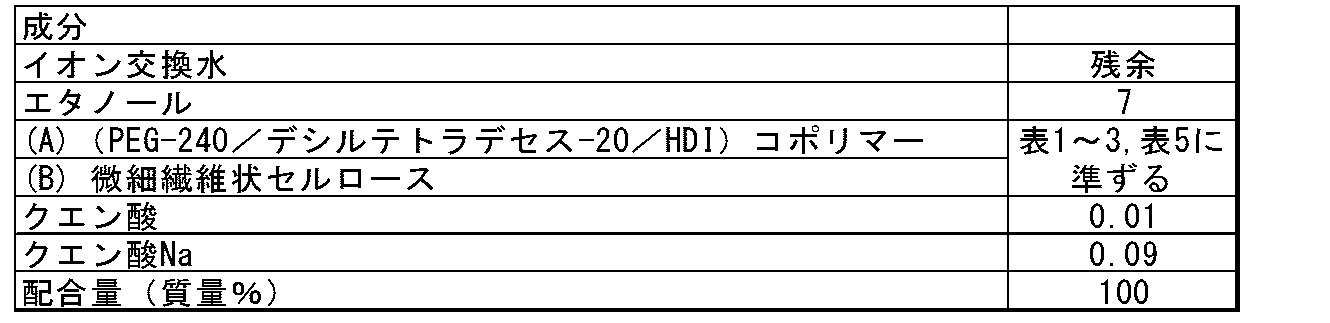
なお本実施例において、(A)および(B)は下記化合物を用いた。
(A):疎水変性ポリエーテルウレタン:上記式(I)に示すコポリマー(ただし式中、R1、R2、R4はそれぞれエチレン基、R3=ヘキサメチレン基、R5=2-ドデシルドデシル基、h=1、m=2、k=120、n=20)((PEG-240/デシルテトラデセス―20/HDI)コポリマー:「アデカノールGT-700」;株式会社ADEKA製)を用いた。
(B):セルロースナノファイバー:最大繊維径が1000nm以下である微細繊維状セルロース(「レオクリスタC-2SP」;第一工業製薬株式会社製)を用いた。なお、レオクリスタC-2SPは、2質量%の微細繊維状セルロース、1質量%のフェノキシエタノール(防腐剤)を97質量%の水中に含む製品であり、本明細書および表に記載している質量%は微細繊維状セルロースのみを指し、商品に含まれる水、防腐剤は含まれない。
[化粧料についての実施例]
全量に対し(A)のみ、(A)と(B)、および(B)のみがそれぞれ2質量%、1.75質量%、0.75質量%となるように、表4に示す処方にて化粧料を配合し、かつそれぞれの濃度において、(A)と(B)の配合比率が下記表1~3に示す比率となるように調製し、下記被膜試験、ディスペンサ試験を行った。評価結果を表1~3に示す。
全量に対し(A)のみ、(A)と(B)、および(B)のみがそれぞれ2質量%、1.75質量%、0.75質量%となるように、表4に示す処方にて化粧料を配合し、かつそれぞれの濃度において、(A)と(B)の配合比率が下記表1~3に示す比率となるように調製し、下記被膜試験、ディスペンサ試験を行った。評価結果を表1~3に示す。
(被膜試験)
φ50mmガラス製シャーレに各配合条件のサンプルを10g滴下し、表面を平面にした状態で50℃、24時間放置した後のサンプルの状態を以下の基準で判断した。
A:シャーレより固体としてサンプルを剥がせる
C:粘着性があってサンプルをシャーレから剥がせない
φ50mmガラス製シャーレに各配合条件のサンプルを10g滴下し、表面を平面にした状態で50℃、24時間放置した後のサンプルの状態を以下の基準で判断した。
A:シャーレより固体としてサンプルを剥がせる
C:粘着性があってサンプルをシャーレから剥がせない
(ディスペンサ試験)
0.7ml吐出のディスペンサで各配合条件のサンプルの連続的吐出を以下の基準で判断した。
A:空気が混入されずに連続的に吐出できる
B:5回以内の押圧操作で連続的に吐出できる
C:断続的にしか吐出できない
0.7ml吐出のディスペンサで各配合条件のサンプルの連続的吐出を以下の基準で判断した。
A:空気が混入されずに連続的に吐出できる
B:5回以内の押圧操作で連続的に吐出できる
C:断続的にしか吐出できない



被膜試験から(B)が配合されるとべたつきが抑制されることが分かった。これは表1に示す(A)単独の2質量%配合サンプルでは得られない結果である。また、ディスペンサ試験からは(A)の配合比率が高いほど(A)と(B)を高配合しても吐出できることが分かった。反対に(B)の配合比率が高い場合には吐出が困難になる。これは(B)の配合によって化粧料が不連続体、つまり、弾性体に近づくことを意味する。よって、(A)と(B)を組み合わせることで、(A)が高配合であっても、べたつきがなく、かつ、ディスペンサ吐出可能な製剤とすることができることがわかる。
すなわち、その組み合わせは
(A)<(B)の場合は、全化粧料に対する(A)+(B)の配合量が0.75質量%以下であり、
(A)=(B)の場合は、全化粧料に対する(A)+(B)の配合量が1.75質量%以下であり、
(A)>(B)の場合は、全化粧料に対する(A)+(B)の配合量が2質量%以下、が適正な値となる。
(A)<(B)の場合は、全化粧料に対する(A)+(B)の配合量が0.75質量%以下であり、
(A)=(B)の場合は、全化粧料に対する(A)+(B)の配合量が1.75質量%以下であり、
(A)>(B)の場合は、全化粧料に対する(A)+(B)の配合量が2質量%以下、が適正な値となる。
[加温使用用化粧料についての実施例]
全量に対し(A)のみ、(A)と(B)、および(B)のみが1質量%となるように、表4に示す処方にて化粧料を配合し、かつ(A)と(B)の配合比率が下記表5に示す比率となるように調製した。調製した各サンプルについて、アントンパール社製、応力制御型レオメーターMCR301を用いて動的粘弾性測定を行った。測定条件はφ25mm コーンプレートで温度30℃、60℃とし、ひずみを0.01から5000まで上昇させたときの貯蔵弾性率G’および損失弾性率G”を測定した。
全量に対し(A)のみ、(A)と(B)、および(B)のみが1質量%となるように、表4に示す処方にて化粧料を配合し、かつ(A)と(B)の配合比率が下記表5に示す比率となるように調製した。調製した各サンプルについて、アントンパール社製、応力制御型レオメーターMCR301を用いて動的粘弾性測定を行った。測定条件はφ25mm コーンプレートで温度30℃、60℃とし、ひずみを0.01から5000まで上昇させたときの貯蔵弾性率G’および損失弾性率G”を測定した。
一般的にG’>G”の場合(G”/G’=1以下の場合)は固体的な性質、G”>G’の場合(G”/G’=1以上の場合)には液体的な性質が優位な物性であると言われている。とくに、ひずみが小さい場合の性質は、垂れ落ちや分離の安定性に寄与することからひずみ値が1の時の物性値で判断した。
結果を表5および図1~5に示した。なお、図1のグラフの下に記載しているように、図1~5のグラフにおいて、●は30℃でのG’、○は30℃でのG”、▲は60℃でのG’、△は60℃でのG”を示している。
結果を表5および図1~5に示した。なお、図1のグラフの下に記載しているように、図1~5のグラフにおいて、●は30℃でのG’、○は30℃でのG”、▲は60℃でのG’、△は60℃でのG”を示している。

(A)(=温度応答性高分子)のみの場合には、温度が30℃から60℃に加温すると弾性率が下がり、損失弾性率G”優位が顕著となる(図1)。一方、(B)(=温度応答性高分子)のみの場合には、加温前後で弾性率の変化がなくその貯蔵弾性率G’は高い値を示す(図5)。(B)>(A)の場合には、(B)の物性が支配的で高い弾性率のまま加温前後で弾性率の変化は小さい(図4)。(A)>(B)の場合には、加温時に弾性率が下がり、かつ、高温時においても貯蔵弾性率G’は高く固体的な性質を維持した(図2)。(A)=(B)の場合は、加温前後で弾性率の変化がなかった(図3)。以上の結果から、加温時に粘度変化する使用感を制御しつつ、その温度安定性をよりよくするためには(A)>(B)のように、加温時に弾性率が下がりつつ、かつ、低いひずみ値においてG’>G”であることがより好ましいことがわかる。
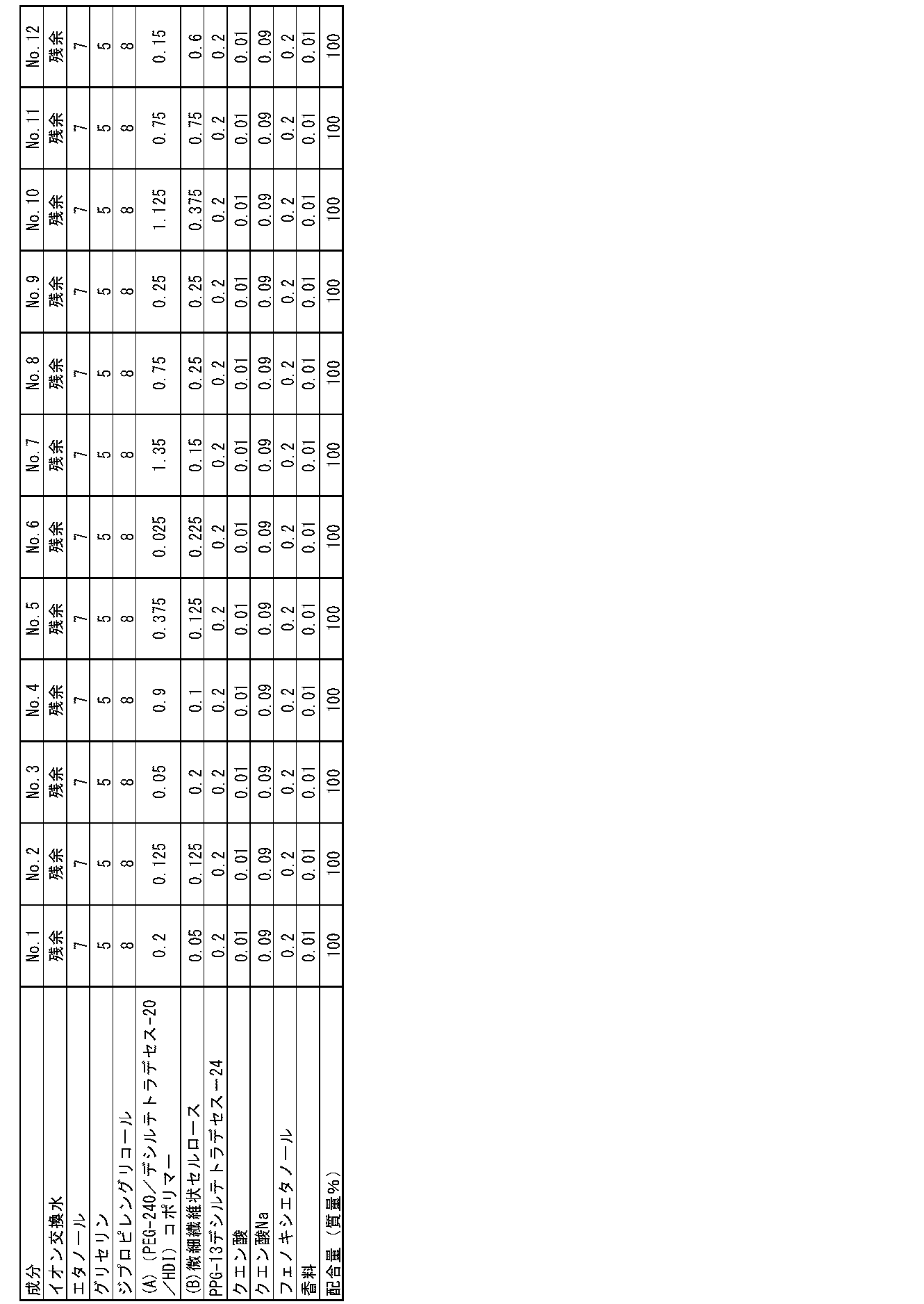
(水分散化粧料の処方例)
表6に示す処方で、イオン交換水以外の成分をイオン交換水に溶解、分散して水分散化粧料の処方例1~12を作製した。
表6に示す処方で、イオン交換水以外の成分をイオン交換水に溶解、分散して水分散化粧料の処方例1~12を作製した。
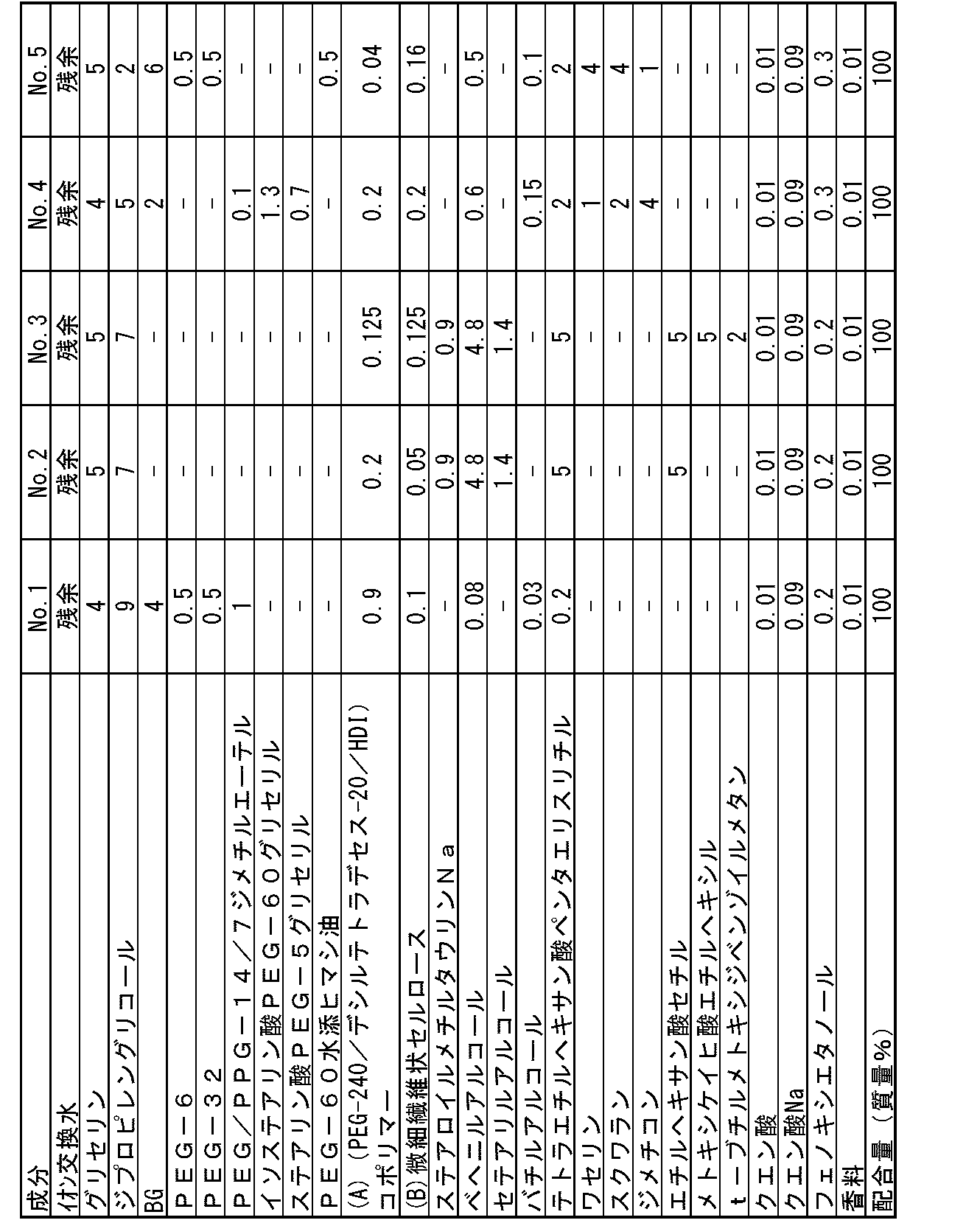
(乳化化粧料の処方例)
表7に示す処方で、油性成分、水性成分をそれぞれ溶解、混合後、水性成分に油性成分を混合して乳化させ、乳化化粧料の処方例1~5を作製した。
表7に示す処方で、油性成分、水性成分をそれぞれ溶解、混合後、水性成分に油性成分を混合して乳化させ、乳化化粧料の処方例1~5を作製した。
(粉末配合化粧料の処方例)
表8に示す処方で、油性成分、水性成分をそれぞれ溶解、混合後、油なじみのよい粉末は油性成分に、水なじみのよい粉末は水性成分に分散し、水性成分に油性成分を混合して乳化させ、粉末配合化粧料の処方例1~5を作製した。
表8に示す処方で、油性成分、水性成分をそれぞれ溶解、混合後、油なじみのよい粉末は油性成分に、水なじみのよい粉末は水性成分に分散し、水性成分に油性成分を混合して乳化させ、粉末配合化粧料の処方例1~5を作製した。

Claims (16)
- (A)疎水変性ポリエーテルウレタンと、
(B)セルロースナノファイバーと、
(C)水と、
を含有する化粧料であって、
前記(A)疎水変性ポリエーテルウレタンと前記(B)セルロースナノファイバーの配合比率が、
(A)<(B)の場合は、全化粧料に対する(A)+(B)の配合量が0.75質量%以下であり、
(A)=(B)の場合は、全化粧料に対する(A)+(B)の配合量が1.75質量%以下であり、
(A)>(B)の場合は、全化粧料に対する(A)+(B)の配合量が2質量%以下である化粧料。 - 前記(A)疎水変性ポリエーテルウレタンが、(PEG-240/デシルテトラデセス―20/HDI)コポリマーである請求項1記載の化粧料。
- 前記(B)セルロースナノファイバーが、最大繊維径が1000nm以下である微細繊維状セルロースである請求項1または2記載の化粧料。
- ディスペンサ容器に収容してなる請求項1、2または3項記載の化粧料。
- 加熱部を有する機器に使用する加温使用用化粧料であって、
30℃以上で構造変化する温度応答性高分子と、
70℃以下では構造変化しない高温安定性高分子と、
水と、
を含有する加温使用用化粧料。 - 前記温度応答性高分子が(A)疎水変性ポリエーテルウレタンであり、前記高温安定性高分子が(B)セルロースナノファイバーである請求項5記載の加温使用用化粧料。
- 前記温度応答性高分子の配合量が前記高温安定性高分子の配合量よりも多く、かつ全化粧料に対する前記高温安定性高分子の配合量が0.1質量%以上である請求項6記載の加温使用用化粧料。
- 前記(A)疎水変性ポリエーテルウレタンが、(PEG-240/デシルテトラデセス―/HDI)コポリマーである請求項6または7記載の加温使用用化粧料。
- 前記(B)セルロースナノファイバーが、最大繊維径が1000nm以下である微細繊維状セルロースである請求項6、7または8記載の加温使用用化粧料。
- 30~70℃の温度条件下で用いられる請求項5~9いずれか1項記載の加温使用用化粧料。
- 前記加熱部の熱源がヒータまたはペルチェ素子である請求項5~10いずれか1項記載の加温使用用化粧料。
- 前記機器が噴霧装置を具備する請求項5~11いずれか1項記載の加温使用用化粧料。
- 前記機器がプローブを具備する請求項5~11いずれか1項記載の加温使用用化粧料。
- 前記機器が前記加温使用用化粧料を収容するタンクを具備する請求項5~11いずれか1項記載の加温使用用化粧料。
- 請求項5~14のいずれか1項に記載の加温使用用化粧料を40~70℃の温度範囲に前記加熱部で制御してミスト状で直接および/または間接的に皮膚に適用する美容方法。
- 請求項5~14のいずれか1項に記載の加温使用用化粧料を30~48℃の温度範囲に前記加熱部で制御して直接および/または間接的に皮膚に適用する美容方法。
Priority Applications (2)
| Application Number | Priority Date | Filing Date | Title |
|---|---|---|---|
| CN202080018099.1A CN113518615B (zh) | 2019-03-04 | 2020-02-26 | 化妆料、加温使用化妆料及美容方法 |
| US17/434,829 US20220160615A1 (en) | 2019-03-04 | 2020-02-26 | Cosmetic, cosmetic for use in warmed state, and beauty method |
Applications Claiming Priority (2)
| Application Number | Priority Date | Filing Date | Title |
|---|---|---|---|
| JP2019038193A JP7263057B2 (ja) | 2019-03-04 | 2019-03-04 | 化粧料、加温使用用化粧料および美容方法 |
| JP2019-038193 | 2019-03-04 |
Publications (1)
| Publication Number | Publication Date |
|---|---|
| WO2020179567A1 true WO2020179567A1 (ja) | 2020-09-10 |
Family
ID=72337969
Family Applications (1)
| Application Number | Title | Priority Date | Filing Date |
|---|---|---|---|
| PCT/JP2020/007639 Ceased WO2020179567A1 (ja) | 2019-03-04 | 2020-02-26 | 化粧料、加温使用用化粧料および美容方法 |
Country Status (4)
| Country | Link |
|---|---|
| US (1) | US20220160615A1 (ja) |
| JP (2) | JP7263057B2 (ja) |
| CN (1) | CN113518615B (ja) |
| WO (1) | WO2020179567A1 (ja) |
Cited By (2)
| Publication number | Priority date | Publication date | Assignee | Title |
|---|---|---|---|---|
| WO2022190965A1 (ja) * | 2021-03-10 | 2022-09-15 | 株式会社 資生堂 | 美容方法 |
| CN116370353A (zh) * | 2023-03-15 | 2023-07-04 | 阳润科技(广东)有限公司 | 一种用于彩妆粉体的高分子纤维素微球及其制备工艺 |
Families Citing this family (4)
| Publication number | Priority date | Publication date | Assignee | Title |
|---|---|---|---|---|
| JP7565512B2 (ja) * | 2020-05-11 | 2024-10-11 | 熊本県 | 温度応答性材料およびこれを用いた遮光材 |
| WO2023286467A1 (ja) | 2021-07-13 | 2023-01-19 | パナソニックIpマネジメント株式会社 | 化粧料及び理美容機器 |
| JP2023132540A (ja) * | 2022-03-11 | 2023-09-22 | 株式会社 ナチュラル | 化粧用組成物 |
| WO2025213062A1 (en) * | 2024-04-05 | 2025-10-09 | Mary Kay Inc. | Cosmetic compositions and methods of using same |
Citations (2)
| Publication number | Priority date | Publication date | Assignee | Title |
|---|---|---|---|---|
| JP2005289935A (ja) * | 2004-04-02 | 2005-10-20 | Shiseido Co Ltd | ジェル状組成物 |
| JP2012240926A (ja) * | 2011-05-16 | 2012-12-10 | Shiseido Co Ltd | 加温使用用マッサージ用化粧料 |
Family Cites Families (4)
| Publication number | Priority date | Publication date | Assignee | Title |
|---|---|---|---|---|
| JP6113695B2 (ja) * | 2014-10-31 | 2017-04-12 | 株式会社 資生堂 | 弾力ジェル状組成物 |
| JP2017048181A (ja) * | 2015-09-01 | 2017-03-09 | 王子ホールディングス株式会社 | 化粧料 |
| JP5939695B1 (ja) * | 2015-12-16 | 2016-06-22 | 第一工業製薬株式会社 | 粘性水系組成物およびその製造方法 |
| JP6315219B2 (ja) * | 2016-09-16 | 2018-04-25 | 新機能科学株式会社 | 泡立ち性外用組成物 |
-
2019
- 2019-03-04 JP JP2019038193A patent/JP7263057B2/ja active Active
-
2020
- 2020-02-26 CN CN202080018099.1A patent/CN113518615B/zh active Active
- 2020-02-26 WO PCT/JP2020/007639 patent/WO2020179567A1/ja not_active Ceased
- 2020-02-26 US US17/434,829 patent/US20220160615A1/en not_active Abandoned
-
2023
- 2023-01-30 JP JP2023011969A patent/JP7472336B2/ja active Active
Patent Citations (2)
| Publication number | Priority date | Publication date | Assignee | Title |
|---|---|---|---|---|
| JP2005289935A (ja) * | 2004-04-02 | 2005-10-20 | Shiseido Co Ltd | ジェル状組成物 |
| JP2012240926A (ja) * | 2011-05-16 | 2012-12-10 | Shiseido Co Ltd | 加温使用用マッサージ用化粧料 |
Non-Patent Citations (4)
| Title |
|---|
| ANONYMOUS: "Adela no GT-730", vol. 3, no. 7, 26 August 2014 (2014-08-26), XP055737140, Retrieved from the Internet <URL:https://www.adeka.co.jp/chemical/catalog/pdf/adeka_gt730.pdf> [retrieved on 20200612] * |
| ANONYMOUS: "Better Tomorrow Cream", 20 July 2015 (2015-07-20), pages 1 - 5, XP009523409, Retrieved from the Internet <URL:https://www.gnpd.com/sinatra/recordpage/3284595/from_search/glejRolKKX/?page=1> * |
| ANONYMOUS: "Super Aqua Pack", 20 August 2014 (2014-08-20), pages 1 - 4, XP009523410, Retrieved from the Internet <URL:https://www.mintel.com> * |
| YOSUKE GOI: "Application of cellulose fiber to cosmetics", FRAGRANCE JOURNAL, vol. 44, no. 3, 2016, pages 54 - 57, XP009523466, ISSN: 0288-9803 * |
Cited By (3)
| Publication number | Priority date | Publication date | Assignee | Title |
|---|---|---|---|---|
| WO2022190965A1 (ja) * | 2021-03-10 | 2022-09-15 | 株式会社 資生堂 | 美容方法 |
| JPWO2022190965A1 (ja) * | 2021-03-10 | 2022-09-15 | ||
| CN116370353A (zh) * | 2023-03-15 | 2023-07-04 | 阳润科技(广东)有限公司 | 一种用于彩妆粉体的高分子纤维素微球及其制备工艺 |
Also Published As
| Publication number | Publication date |
|---|---|
| JP7263057B2 (ja) | 2023-04-24 |
| JP2023038388A (ja) | 2023-03-16 |
| JP7472336B2 (ja) | 2024-04-22 |
| US20220160615A1 (en) | 2022-05-26 |
| JP2020142991A (ja) | 2020-09-10 |
| CN113518615A (zh) | 2021-10-19 |
| CN113518615B (zh) | 2024-05-14 |
Similar Documents
| Publication | Publication Date | Title |
|---|---|---|
| JP7472336B2 (ja) | 化粧料、加温使用用化粧料および美容方法 | |
| RU2696488C2 (ru) | Упругая желеобразная композиция | |
| JP4825931B2 (ja) | 水中油型化粧料 | |
| US20190299032A1 (en) | Oil-In-Water Type Emulsion Cosmetic Composition | |
| JP3742984B2 (ja) | 油中水型乳化組成物 | |
| EP1847262B1 (en) | Cosmetic | |
| US12419825B2 (en) | Surface-hydrophobicized cellulose nanofibers for oily thickener, oily thickener composition containing same, cosmetics and hydrophobicized cellulose nanofiber complex for oily thickener containing same, oily thickener composition containing same, and cosmetics containing same | |
| JP4567585B2 (ja) | 化粧料 | |
| TW201841616A (zh) | 化粧品 | |
| JP2009234917A (ja) | 水中油型乳化組成物 | |
| JP6286138B2 (ja) | フルクトオリゴ糖脂肪酸エステル、および、化粧料 | |
| JP7637503B2 (ja) | シート状化粧料 | |
| JP6912232B2 (ja) | 粉体化粧料 | |
| JP2025024008A (ja) | 疎水化cnf分散体の製造方法、疎水化cnf油性成分含有体の製造方法 | |
| JP2022090803A (ja) | 皮膚化粧料 | |
| JP7721459B2 (ja) | 疎水性セルロースナノファイバー、該疎水性セルロースナノファイバー分散液、及び化粧料 | |
| JP2024004371A (ja) | 乳化組成物 | |
| JP6858510B2 (ja) | 油中水型乳化化粧料 | |
| WO2025142907A1 (ja) | 水中油型乳化化粧料組成物 | |
| JP2011132133A (ja) | エアゾール型メーキャップ用化粧料 | |
| HK1236822B (en) | Elastic jelly-like composition | |
| HK1158960B (en) | Oil-in-water cosmetic |
Legal Events
| Date | Code | Title | Description |
|---|---|---|---|
| 121 | Ep: the epo has been informed by wipo that ep was designated in this application |
Ref document number: 20765601 Country of ref document: EP Kind code of ref document: A1 |
|
| NENP | Non-entry into the national phase |
Ref country code: DE |
|
| 122 | Ep: pct application non-entry in european phase |
Ref document number: 20765601 Country of ref document: EP Kind code of ref document: A1 |