WO2020173346A1 - 一种辛波莫德的制备方法 - Google Patents
一种辛波莫德的制备方法 Download PDFInfo
- Publication number
- WO2020173346A1 WO2020173346A1 PCT/CN2020/075840 CN2020075840W WO2020173346A1 WO 2020173346 A1 WO2020173346 A1 WO 2020173346A1 CN 2020075840 W CN2020075840 W CN 2020075840W WO 2020173346 A1 WO2020173346 A1 WO 2020173346A1
- Authority
- WO
- WIPO (PCT)
- Prior art keywords
- formula
- compound
- carbonate
- solvent
- reaction
- Prior art date
- Legal status (The legal status is an assumption and is not a legal conclusion. Google has not performed a legal analysis and makes no representation as to the accuracy of the status listed.)
- Ceased
Links
- GEVORYAQBURKAG-UHFFFAOYSA-N CC(c1cc(C=C)c(CN(C2)CC2C(OC)=O)cc1)=O Chemical compound CC(c1cc(C=C)c(CN(C2)CC2C(OC)=O)cc1)=O GEVORYAQBURKAG-UHFFFAOYSA-N 0.000 description 2
- NBZBZASQAOASBB-UHFFFAOYSA-N CCc1c(CN(C2)CC2C(OC)=O)ccc(C(C)=O)c1 Chemical compound CCc1c(CN(C2)CC2C(OC)=O)ccc(C(C)=O)c1 NBZBZASQAOASBB-UHFFFAOYSA-N 0.000 description 2
- FVGRIBXXKVPCAR-UHFFFAOYSA-N CCc1c(CN(C2)CC2C(OC/[O]=C(\C)/c2cc(CC)c(CN(C3)CC3C(OC)=O)cc2)=O)ccc(C(C)=O)c1 Chemical compound CCc1c(CN(C2)CC2C(OC/[O]=C(\C)/c2cc(CC)c(CN(C3)CC3C(OC)=O)cc2)=O)ccc(C(C)=O)c1 FVGRIBXXKVPCAR-UHFFFAOYSA-N 0.000 description 1
Classifications
-
- C—CHEMISTRY; METALLURGY
- C07—ORGANIC CHEMISTRY
- C07D—HETEROCYCLIC COMPOUNDS
- C07D205/00—Heterocyclic compounds containing four-membered rings with one nitrogen atom as the only ring hetero atom
- C07D205/02—Heterocyclic compounds containing four-membered rings with one nitrogen atom as the only ring hetero atom not condensed with other rings
- C07D205/04—Heterocyclic compounds containing four-membered rings with one nitrogen atom as the only ring hetero atom not condensed with other rings having no double bonds between ring members or between ring members and non-ring members
Definitions
- the present invention relates to the field of medicine and chemical engineering, and in particular, to a preparation method of sipomomod.
- Siponimod (English name: Siponimod) is a second-generation S1P receptor modulator, which selectively acts on S1P1 and S1P5 receptors with EC50 of 0.39 nM and 0.98 nM, respectively, which is more effective than S1P2, S1P3 and S1P4 The receptor selectivity is more than 1000 times higher. Studies have shown that sipomomod can effectively delay the progression of disability in secondary multiple sclerosis.
- Part A The preparation process of Part A involves a diazotization reaction and is easy to spray or explode. It requires a total of 5 column chromatography purifications, which is inconvenient to operate and costly. The route is not suitable for industrial production.
- W02017120124A1 discloses a synthetic route for preparing Siponimod: the synthetic idea of Part B is consistent with the above route.
- Part A is based on 2-trifluoromethyl-4-bromobenzoic acid as the starting material through coupling, hydrogenation, reduction, Substitution and condensation are obtained; then the two fragments Part A and Part B are assembled, and then reacted with Part C to obtain Siponimod.
- the key fragment assembly idea of this route is consistent with the above route.
- an object of the present invention is to provide a method for preparing sipomomod.
- the method of the present invention can use 3-bromo-4-methylacetophenone as a starting material, undergo bromination, and azepine Cyclobutane-3-carboxylic acid methyl ester or its salt, ethylene trifluoroborate reaction, alkenyl reduction, hydrolysis and other steps to obtain sipomomod (the compound represented by formula VII).
- the first aspect of the present invention provides a method for preparing a compound of formula VII,
- N-(4-cyclohexyl-3-trifluoromethyl-benzyloxy)-ethyl acetimidate is sequentially stirred in the first acid and the first base, and the compound of formula VI is added The first reaction occurs and the compound of formula VII is prepared.
- the first solvent is selected from at least one of methanol, ethanol, isopropanol, tetrahydrofuran, dioxane, and ethylene glycol dimethyl ether. In some embodiments, the first solvent is selected from methanol.
- the first acid is selected from at least one of hydrochloric acid, sulfuric acid, perchloric acid, glacial acetic acid, and phosphoric acid, which is favorable for N-(4- Hydrolysis of ethyl cyclohexyl-3-trifluoromethyl-benzyloxy)-acetimidate.
- the first acid is selected from hydrochloric acid.
- the first base is selected from the group consisting of triethylamine, diisopropylethylamine, 2,6-dimethylpyridine, 4-dimethylaminopyridine, lithium carbonate, sodium carbonate, potassium carbonate At least one of cesium carbonate, sodium hydroxide, lithium hydroxide, potassium hydroxide, sodium methoxide, sodium ethoxide, calcium oxide, magnesium oxide, calcium carbonate, magnesium carbonate, and basic magnesium carbonate, which is beneficial to neutralizing the reaction system The excess acid.
- the first base is selected from triethylamine.
- the molar ratio of the first acid to the compound of formula VI is It is beneficial to complete the reaction of the compound of formula IV.
- the amount of the first base is an amount that can neutralize the remaining acid in the reaction system.
- the temperature of the first reaction is 0 ° C to 60 ° C. In some embodiments, the temperature of the first reaction is 20 ° C-40 ° C, which is beneficial to obtain the target product.
- the compound of formula V undergoes a second reaction with a second base in a second solvent to prepare a compound of formula VI.
- the second solvent is selected from at least one of methanol, ethanol, isopropanol, water, tetrahydrofuran, dioxane, and ethylene glycol dimethyl ether. In some embodiments, the second solvent is selected from methanol.
- the second base is selected from at least one of sodium hydroxide, potassium hydroxide, lithium hydroxide, and cesium carbonate.
- the second base is an aqueous base solution, which is beneficial to the hydrolysis of the compound of formula V.
- the second base is selected from sodium hydroxide.
- the temperature of the second reaction is 0 ° C-60 ° C.
- the temperature of the second reaction is 20 ° C-40 ° C.
- a method for preparing a compound of formula V including:
- the compound of formula IV is mixed with the first catalyst and the third solvent, and the third reaction occurs under the protection of hydrogen to prepare the compound of formula V.
- the first catalyst is selected from at least one of palladium on carbon, Raney nickel, ruthenium on carbon, rhodium on carbon, platinum on carbon, palladium black, and sponge platinum, which facilitates better catalytic reaction.
- the mass amount of the first catalyst is the mass of the compound IV or 515% of the mass of the compound IV.
- the third solvent is selected from at least one of methanol, ethanol, isopropanol, n-butanol, tetrahydrofuran, 2-methyltetrahydrofuran, dioxane, ethylene glycol dimethyl ether, and ethyl acetate.
- the third solvent is selected from methanol.
- the temperature of the third reaction is 0 ° C-60 ° C.
- the temperature of the third reaction is 20 ° C-40 ° C.
- a method for preparing a compound of formula IV including:
- the compound of formula III, ethylene trifluoroborate, the third base, and the second catalyst are mixed in the fourth solvent to generate the fourth reaction, and the compound of formula IV is prepared.
- the ethylene trifluoroborate is selected from potassium ethylene trifluoroborate or sodium ethylene trifluoroborate, which facilitates the preparation of the compound of formula IV with high yield.
- the molar ratio of the ethylene trifluoroborate to the compound of formula III is 1:1-4:1.
- the molar ratio of the ethylene trifluoroborate to the compound of formula III is 1:1-2:1.
- the third base is selected from sodium carbonate, or sodium bicarbonate, lithium carbonate, potassium carbonate, cesium carbonate, lithium hydroxide, sodium hydroxide, potassium hydroxide, calcium oxide, magnesium oxide, calcium carbonate , At least one of magnesium carbonate and basic magnesium carbonate. In some embodiments, the third base is selected from sodium carbonate.
- the molar ratio of the third base to the compound of formula III is 1:1-5:1.
- the molar ratio of the third base to the compound of formula III is 1:1-3:1.
- the second catalyst is selected from [i,r-bis(diphenylphosphino)ferrocene] palladium dichloride, dichloroditriphenylphosphine palladium, and tetrakistriphenylphosphine palladium At least one of palladium acetate and palladium chloride is beneficial to better catalyze the reaction.
- the molar ratio of the second catalyst to the compound of formula III is 0.01:1 to 0.20:1.
- the fourth solvent is at least one of water, toluene and ethanol.
- the temperature of the fourth reaction is 40 ° C-100 ° C.
- the temperature of the fourth reaction is 60 ° C-80 ° C.
- the molar ratio of the azetidine-3-methyl formate or its salt to the compound of formula II is 1:1-2:1.
- the fifth solvent is selected from dichloromethane, ethyl acetate, toluene, chloroform, carbon tetrachloride, acetonitrile, methanol, ethanol, isopropanol, n-butanol, benzene and nitromethane At least one of.
- the fifth solvent is selected from dichloromethane.
- the fourth base is selected from triethylamine, diisopropylethylamine, 2,6-dimethylpyridine, 4-dimethylaminopyridine, lithium carbonate, sodium carbonate, potassium carbonate At least one of cesium carbonate, sodium hydroxide, lithium hydroxide, potassium hydroxide, sodium methoxide, sodium ethoxide, calcium oxide, magnesium oxide, calcium carbonate, magnesium carbonate, and basic magnesium carbonate.
- the fourth base is selected from triethylamine.
- the temperature of the fifth reaction is 40 ° C-100 ° C.
- the temperature of the fifth reaction is 60 ° C-80 ° C.
- the compound of formula III, compound of formula IV, compound of formula v or compound of formula VI mentioned above is favorable for better preparation of compound of formula VII.
- the preparation method of sipomod provided by the present invention has high purity, high yield and low cost, and the method has simple operation and mild conditions.
- the intermediate compound with a new structure provides a method for preparing sipomod. New method of Germany. Definition of Terms In this specification, "eq" means equivalent.
- MS mass spectrometry
Landscapes
- Chemical & Material Sciences (AREA)
- Organic Chemistry (AREA)
- Organic Low-Molecular-Weight Compounds And Preparation Thereof (AREA)
- Low-Molecular Organic Synthesis Reactions Using Catalysts (AREA)
Abstract
本发明提供了一种辛波莫德的制备方法,属于医药化工领域;本发明所述方法可以3-溴-4-甲基苯乙酮为起始物料,经过溴化、与氮杂环丁烷-3-甲酸甲酯或其盐、乙烯三氟硼酸盐反应、烯基还原、水解等步骤后得到辛波莫德,是一种全新的制备辛波莫德的方法,该方法生产得到的产物纯度高,收率高,成本低,方法操作简单,工艺稳定的特点。
Description
一种辛波莫德的制备方法
技术领域 本发明涉及医药化工领域, 具体地, 涉及一种辛波莫德的制备方法。 背景技术 辛波莫德 (英文名: Siponimod)是一种二代 S1P受体调节剂,选择性作用于 S1P1和 S1P5受体, EC50 分别为 0.39 nM和 0.98 nM, 比作用于 S1P2, S1P3和 S1P4受体选择性高 1000倍以上。研究表明辛波莫德 可有效的延缓继发性多发性硬化症残疾程度进展。
辛波莫德的结构如式 VII所示:

式 VII。
现有技术中, 制备辛波莫德的方法己见报道, 文献 Briard E , Rudolph B , Desrayaud S , et al. MS565: A SPECT Tracer for Evaluating the Brain Penetration of BAF312 (Siponimod) [J]. ChemMedChem, 2015, 10(6): 1008-1018公开的一种制备 Siponimod的合成路线: 以 3 -漠 -4 -甲基苯乙酮为起始原料, 通过漠化、 水 解、偶联、氢化得到 Part B ; 以 2 -氯 -5 -溴甲基三氟甲苯为起始物料经缩合, 偶联得到 Part A; 之后将 Part A 与 Part B两个片段组装, 再与 Part C反应得到 Siponimod。
Part A的制备过程, 涉及重氮化反应, 容易喷料或爆炸, 总共需要 5次柱层析纯化, 操作不方便, 成 本高昂, 路线不适合工业化生产。
W02017120124A1公开的一种制备 Siponimod的合成路线:其 Part B的合成思路与上述路线一致, Part A是以 2 -三氟甲基 -4 -溴苯甲酸为起始物料经偶联、 氢化、 还原、 取代、 缩合得到; 之后将 Part A与 Part B 两个片段组装, 再与 Part C反应得到 Siponimod。 该路线的关键片段组装思路与上述路线一致。
鉴于现有技术中存在的问题, 开发其他无毒、 高效、 操作简便、 收率高的制备辛波莫德的方法显得更 为重要。 发明内容 本发明旨在至少在一定程度上解决相关技术中的技术问题之一。 为此, 本发明的一个目的在于提供一 种辛波莫德的制备方法, 本发明所述方法可以 以 3 -溴 -4 -甲基苯乙酮为起始物料, 经过溴化、 与氮杂环丁 烷 -3 -甲酸甲酯或其盐、乙烯三氟硼酸盐反应、烯基还原、水解等步骤后得到辛波莫德(式 VII所示化合物)。
本发明的第一方面, 提供一种制备式 VII化合物的方法,

包括, 在第一溶剂中, N-(4 -环己基 -3 -三氟甲基-苄氧基) -乙亚氨酸乙酯依次在第一酸、 第一碱中搅拌, 加入式 VI化合物发生第一反应, 制备得到式 VII化合物。
在一些实施方式中, 所述第一溶剂选自甲醇、 乙醇、 异丙醇、 四氢呋喃、 二恶烷和乙二醇二甲醚中的 至少一种。 在一些实施方式中, 所述第一溶剂选自甲醇。
在一些实施方式中, 所述第一酸选自盐酸、 硫酸、 高氯酸、 冰醋酸和憐酸中的至少一种, 有利于 N-(4 -
环己基 -3 -三氟甲基-苄氧基) -乙亚氨酸乙酯的水解。 在一些实施方式中, 所述第一酸选自盐酸。
在一些实施方式中, 所述第一碱选自三乙胺、 二异丙基乙胺、 2, 6 -二甲基吡陡、 4 -二甲氨基吡陡、 碳酸 锂、 碳酸钠、 碳酸钾、 碳酸铯、 氢氧化钠、 氢氧化锂、 氢氧化钾、 甲醇钠、 乙醇钠、 氧化钙、 氧化镁、 碳 酸钙、 碳酸镁和碱式碳酸镁中的至少一种, 有利于中和反应体系中过剩的酸。 在一些实施方式中, 所述第 一碱选自三乙胺。
在一些实施方式中, 所述第一酸与式 VI化合物的摩尔比为
 有利于使式 IV化合物反应消耗完 全。
在一些实施方式中, 所述第一碱的用量为能够中和反应体系中剩余酸的用量。
在一些实施方式中,所述第一反应的温度为 0°C -60 °C。在一些实施方式中,所述第一反应的温度为 20 °C -40 °C , 有利于获得目标产物。
本发明的第二方面, 提供一种式 VI化合物的制备方法, 包括,
 式 V 式 VI
式 V化合物在第二溶剂中与第二碱发生第二反应, 制备得到式 VI化合物。
在一些实施方式中, 所述第二溶剂选自甲醇、 乙醇、 异丙醇、 水、 四氢呋喃、 二恶烷和乙二醇二甲醚 中的至少一种。 在一些实施方式中, 所述第二溶剂选自甲醇。
在一些实施方式中, 所述第二碱选自氢氧化钠、 氢氧化钾、 氢氧化锂和碳酸铯中的至少一种。
在一些实施方式中, 所述第二碱为碱的水溶液, 有利于式 V化合物的水解。 在一些实施方式中, 所述 第二碱选自氢氧化钠。
在一些实施方式中, 所述第二反应的温度为 0°C-60°C。
在一些实施方式中, 所述第二反应的温度为 20°C-40°C。
本发明的第三方面, 提供一种式 V化合物的制备方法, 包括,

式 IV 式 V
式 IV化合物与第一催化剂和第三溶剂混合, 在氢气保护下发生第三反应, 制备得到式 V化合物。 在一些实施方式中, 所述第一催化剂选自钯碳、 雷尼镍、 钌碳、 铑碳、 铂碳、 钯黑和海绵铂中的至少 一种, 有利于更好地催化反应进行。
在一些实施方式中, 所述第一催化剂的质量用量为所述化合物 IV质量的 或者为所述化合物 IV质量的 5 15%。
在一些实施方式中, 所述第三溶剂选自甲醇、 乙醇、 异丙醇、 正丁醇、 四氢呋喃、 2 -甲基四氢呋喃、 二恶烷、 乙二醇二甲醚和乙酸乙酯中的至少一种。 在一些实施方式中, 所述第三溶剂选自甲醇。
在一些实施方式中, 所述第三反应的温度为 0°C-60°C。
在一些实施方式中, 所述第三反应的温度为 20°C-40°C。
本发明的第四方面, 提供一种式 IV化合物的制备方法, 包括,

式 III 式 IV
式 III化合物、 乙烯三氟硼酸盐、 第三碱、 第二催化剂在第四溶剂中混合发生第四反应, 制备得到式 IV化 合物。
在一些实施方式中, 所述乙烯三氟硼酸盐选自乙烯三氟硼酸钾或乙烯三氟硼酸钠, 有利于更好制备得 到高收率的式 IV化合物。
在一些实施方式中, 所述乙烯三氟硼酸盐与式 III化合物的摩尔比为 1 : 1-4: 1。
在一些实施方式中, 所述乙烯三氟硼酸盐与式 III化合物的摩尔比为 1 : 1-2: 1。
在一些实施方式中, 所述第三碱选自碳酸钠、 或碳酸氢钠、 碳酸锂、 碳酸钾、 碳酸铯、 氢氧化锂、 氢 氧化钠、 氢氧化钾、 氧化钙、 氧化镁、 碳酸钙、 碳酸镁和碱式碳酸镁中的至少一种。 在一些实施方式中, 所述第三碱选自碳酸钠。
在一些实施方式中, 所述第三碱与式 III化合物的摩尔比为 1 : 1-5: 1。
在一些实施方式中, 所述第三碱与式 III化合物的摩尔比为 1 : 1-3: 1。
在一些实施方式中, 所述第二催化剂选自[i,r-双(二苯基膦基)二茂铁]二氯化钯、 二氯二三苯基膦钯、 四三苯基膦钯、 乙酸钯和氯化钯中的至少一种, 有利于更好地催化反应进行。
在一些实施方式中, 所述第二催化剂与式 III化合物摩尔比为 0.01 : 1-0.20: 1。
在一些实施方式中, 所述第四溶剂为水、 甲苯和乙醇中的至少一种。
在一些实施方式中, 所述第四反应的温度为 40°C-100°C。
在一些实施方式中, 所述第四反应的温度为 60°C-80°C。
本发明的第五方面, 提供一种式 III化合物的制备方法, 包括,
式 II 式 III
式 II化合物、 氮杂环丁烷 -3 -甲酸甲酯或其盐和第五溶剂混合后, 加入第四碱发生第五反应, 制备得到 式 III化合物。
在一些实施方式中, 所述氮杂环丁烷 -3 -甲酸甲酯或其盐与式 II化合物的摩尔比为 1 : 1-2: 1。
在一些实施方式中, 所述第五溶剂选自二氯甲烷、 乙酸乙酯、 甲苯、 氯仿、 四氯化碳、 乙腈、 甲醇、 乙醇、 异丙醇、 正丁醇、 苯和硝基甲烷中的至少一种。 在一些实施方式中, 所述第五溶剂选自二氯甲烷。
在一些实施方式中, 所述第四碱选自三乙胺、 二异丙基乙胺、 2, 6 -二甲基吡陡、 4 -二甲氨基吡陡、 碳酸 锂、 碳酸钠、 碳酸钾、 碳酸铯、 氢氧化钠、 氢氧化锂、 氢氧化钾、 甲醇钠、 乙醇钠、 氧化钙、 氧化镁、 碳 酸钙、 碳酸镁和碱式碳酸镁中的至少一种。 在一些实施方式中, 所述第四碱选自三乙胺。
在一些实施方式中, 所述第五反应的温度为 40°C-100°C。
在一些实施方式中, 所述第五反应的温度为 60°C-80°C。
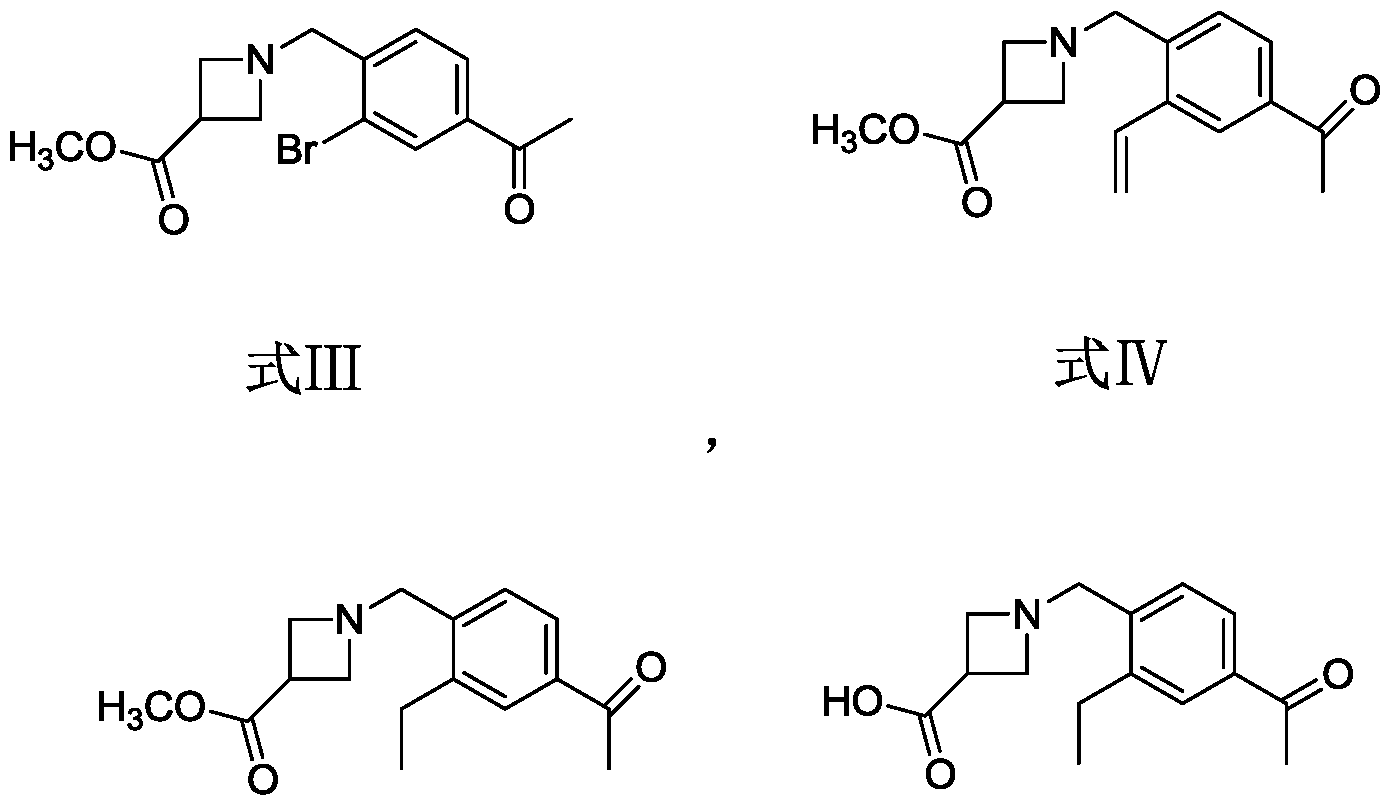
本发明的第五方面, 提供一种化合物, 如下式 III化合物、 式 IV化合物、 式 V化合物或式 VI化合物 所示:

上述式 III化合物、 式 IV化合物、 式 v化合物或式 VI化合物有利于更好地制备得到式 VII化合物。 本发明提供的辛波莫德的制备方法, 得到的产物纯度高, 收率高, 成本低, 且所述方法操作简单, 条 件温和, 用全新结构的中间体化合物提供了一种制备辛波莫德的新方法。
术语定义 本说明书中“eq”指当量。
本说明书中“g”指克。
本说明书中“室温”指 10°C〜 35°C。 具体实施方式 下面详细描述本发明的实施例。 下面描述的实施例是示例性的, 仅用于解释本发明, 而不能理解为对 本发明的限制。 实施例中未注明具体技术或条件的, 按照本领域内的文献所描述的技术或条件或者按照产 品说明书进行。 所用试剂或仪器未注明生产厂商者, 均为可以通过市购获得的常规产品。
为描述本发明, 以下列出了实施例。 但需要理解, 本发明不限于这些实施例, 只是提供实践本 发明的方法。
下面所描述的实施例, 除非其他方面表明所有的温度定为摄氏度。 试剂购买于商品供应商如
Aldrich Chemical Company, Arco Chemical Company and Alfa Chemical Company , 使用时都没有经过 进一步纯化, 除非其他方面表明。 一般的试剂从汕头西陇化工厂, 广东光华化学试剂厂, 广州化学 试剂厂, 天津好寓宇化学品有限公司, 天津市福晨化学试剂厂, 武汉鑫华远科技发展有限公司, 青 岛腾龙化学试剂有限公司, 和青岛海洋化工厂购买得到。
质谱 (MS) 数据的测定条件是: 电喷雾电离 (ESI)
H谱的测定条件: 400MHz, 氘代 DMSO或 CDC13。
实施例 1 式 n化合物的制备

室温下, 反应瓶中加入式 I化合物 2.0g、 过氧化二苯甲酰 114.2mg、 N-漠代琥珀酰亚胺 3.0g和 乙腈 16ml, 加入完毕后于升温至 80°C, 继续搅拌 4小时后, 停止反应, 反应液先用 10%甲酸钠溶液 萃灭, 随后于 35 °C下减压浓缩除去乙腈, 再用二氯甲烷(50ml)萃取,有机相后于 35 °C下除去溶剂, 浓缩得式 II化合物 2.13g, 收率 78.0%。
实施例 2 式 m化合物的制备
式 II 式 m
室温下,反应瓶中加入式 II化合物 6.0g、氮杂环丁烷 -3 -甲酸甲酯盐酸盐 4.1g和二氯甲烷 90ml, 加入完毕后于 25 °C搅拌反应, 随后加入三乙胺 5.4g, 继续搅拌 4小时后停止反应, 反应液于 35 °C下 减压浓缩, 最后得式 III化合物 5.47g, 收率 81.6%。 分析数据:
MS: [M+1]=326.10,
'H NMR (400 MHz, CDC13) 5 8.12 (s, 1H), 7.87 (d, / = 8.0 Hz, 1H), 7.52 (d, / = 8.0 Hz, 1H), 3.80 (s, 2H), 3.74 (s, 3H), 3.68 (t, / = 7.6 Hz, 2H), 3.49 (t, / = 7.0 Hz, 2H), 3.46 - 3.37 (m, 1H), 2.59 (s, 3H)„
实施例 3 式 IV化合物的制备
 式 III 式 IV
室温下, 反应瓶中加入式 III化合物 4.0g、 乙烯三氟硼酸钾 2.16g、 碳酸钠 3.92g和 180mg [1,1’-双 (二苯 基膦基)二茂铁]二氯化钯, 随后加入水 4ml、 乙醇 4ml和甲苯 44ml, 氮气保护下升温至 80 °C下搅拌, 反应 16小时后停止反应, 反应液于 35 °C下减压浓缩得式 IV化合物 2.67g, 收率 79.7%。 分析数据:
MS: [M+1]=274.2,
'H NMR (400 MHz, CDC13) 5 8.01 (s, 1H), 7.81 (d, / = 8.0 Hz, 2H), 7.39 (d, / = 8.0 Hz, 2H), 7.05 (dd, / = 10.8, 17.2 Hz, 1H), 5.75 (d, / = 17.2 Hz ,1H), 5.40 (d, / = 11.2 Hz, 1H), 3.71 (d, / = 4.0 Hz, 5H), 3.55 (s, 2H), 3.35 (d, / = 2.4 Hz, 3H), 2.61 (s, 3H)„
实施例 4 式 V化合物的制备
 式 IV 式 V
室温下, 反应瓶中加入式 IV化合物 l.Og、钯 /碳(5%) 100mg和甲醇 10ml, 于氢气环境下升温至 25°C 反应 4小时, 停止反应, 抽滤回收钮 /碳, 所得滤液于 35°C下减压浓缩, 最后得式 V化合物 0.98g, 收率 98.0%。 分析数据:
式 IV 式 V
室温下, 反应瓶中加入式 IV化合物 l.Og、钯 /碳(5%) 100mg和甲醇 10ml, 于氢气环境下升温至 25°C 反应 4小时, 停止反应, 抽滤回收钮 /碳, 所得滤液于 35°C下减压浓缩, 最后得式 V化合物 0.98g, 收率 98.0%。 分析数据:
MS:[M+1]=276.20,
'H NMR (400 MHz, CDC13) 5 7.79 (s, 1H), 7.75 (d, / = 8.0 Hz, 1H), 7.40 (d, / = 8.0 Hz, 1H), 3.70 (d, / =
17.6 Hz, 5H), 3.57 (s, 2H), 3.36 (s, 3H), 2.72 (dd, / = 7.6 Hz 15.2 Hz, 2H), 2.59 (s 3H), 1.25 (t, / = 7.6 Hz, 3H) 实施例 5 式 VI化合物的制备

室温下反应瓶中加入式 V化合物 0.5g、甲醇 5ml,至 25°C搅拌,随后向反应瓶中加入氢氧化钠(145.6mg) 和水 (4ml) 的混合液, 搅拌 15小时后停止反应, 反应液先在 40°C下减压浓缩除去甲醇, 随后向反应瓶 中加入水 10ml和乙酸乙酯 10ml, 分液后丢弃有机相, 向水相中加入甲醇 20ml, 40°C下减压浓缩除, 最后 得式 V化合物 410mg, 收率 86.31%。 分析数据:
MS:[M+1]=262.10,
'H NMR (400 MHz, D20) 5 7.73 (s, 1H), 7.69 (d, / = 8.0 Hz, 1H), 7.31 (d, / = 8.0 Hz, 1H), 4.25 (s, 2H), 4.05 (t, / = 10 Hz, 2H), 3.94 (t, / = 8.4 Hz, 2H), 3.47 - 3.29 (m, 1H), 2.61 (dd, / = 7.6 Hz 14.8 Hz, 2H), 1.07 (t, / = 7.6 Hz, 3H)„
实施例 6 式 vn化合物的制备

室温下, 反应瓶中加入 N-(4 -环己基 -3 -三氟甲基 -节氧基)-乙亚氨酸乙酯 14.2g、 70ml甲醇, 于 20°C搅 拌, 20分钟后加入 7.2g浓盐酸(36%), 继续搅拌 40min后加入 6.5g三乙胺,搅拌 20min后加入 lO.Og式 V化合物, 继续搅拌 22小时后停止反应, 反应液先在 40 °C下减压浓缩除去甲醇后得式 VII化合物 15.5g, 收率 79.5%。 分析数据:
MS:[M+1]=517.10。
在本说明书的描述中, 参考术语“一个实施例”、 “一些实施例”、 “示例”、 “具体示例”、 或“一些示例”
等的描述意指结合该实施例或示例描述的具体特征、 结构、 材料或者特点包含于本发明的至少一个实施例 或示例中。 在本说明书中, 对上述术语的示意性表述不必须针对的是相同的实施例或示例。 而且, 描述的 具体特征、 结构、 材料或者特点可以在任一个或多个实施例或示例中以合适的方式结合。 此外, 在不相互 矛盾的情况下, 本领域的技术人员可以将本说明书中描述的不同实施例或示例以及不同实施例或示例的特 征进行结合和组合。
尽管上面己经示出和描述了本发明的实施例, 可以理解的是, 上述实施例是示例性的, 不能理解为对 本发明的限制,本领域的普通技术人员在本发明的范围内可以对上述实施例进行变化、修改、替换和变型。
Claims
式 VI 式 w
包括, 在第一溶剂中, N-(4 -环己基 -3 -三氟甲基-苄氧基) -乙亚氨酸乙酯依次在第一酸、 第一碱中搅拌, 加入式 VI化合物发生第一反应, 制备得到式 VII化合物。
2. 根据权利要求 1所述的方法, 其特征在于, 所述第一溶剂选自甲醇、 乙醇、 异丙醇、 四氢呋喃、 二恶 烷和乙二醇二甲醚中的至少一种。
3. 根据权利要求 1所述的方法, 其特征在于, 所述第一酸选自盐酸、 硫酸、 高氯酸、 冰醋酸和憐酸中的 至少一种。
4. 根据权利要求 1所述的方法, 其特征在于, 所述第一碱选自三乙胺、 二异丙基乙胺、 2, 6 -二甲基吡陡、 4 -二甲氨基吡啶、 碳酸锂、 碳酸钠、 碳酸钾、 碳酸铯、 氢氧化钠、 氢氧化锂、 氢氧化钾、 甲醇钠、 乙 醇钠、 氧化钙、 氧化镁、 碳酸钙、 碳酸镁和碱式碳酸镁中的至少一种。
5. 根据权利要求 1所述的方法, 其特征在于, 所述第一酸与式 VI化合物的摩尔比为
 所述第一 碱的用量为能够中和反应体系中剩余酸的用量。
6. 根据权利要求 1所述的方法, 其特征在于, 所述第一反应的温度为 0°C-60°C。
7. 根据权利要求 1所述的方法, 其特征在于, 所述式 VI化合物的制备方法包括,

式 V化合物在第二溶剂中与第二碱发生第二反应, 制备得到式 VI化合物。
8. 根据权利要求 7所述的方法, 其特征在于, 所述第二溶剂选自甲醇、 乙醇、 异丙醇、 水、 四氢呋喃、 二恶烷和乙二醇二甲醚中的至少一种。
9. 根据权利要求 7所述的方法, 其特征在于, 所述第二碱选自氢氧化钠、 氢氧化钾、 氢氧化锂和碳酸铯 中的至少一种。
10.根据权利要求 7所述的方法, 其特征在于, 所述式 V化合物的制备方法包括,
式 iv 式 v 式 IV化合物与第一催化剂和第三溶剂混合, 在氢气保护下发生第三反应, 制备得到式 V化合物。
11.根据权利要求 10所述的方法, 其特征在于, 所述第一催化剂选自钯碳、 雷尼镍、 钌碳、 铑碳、 铂碳、 钯黑和海绵铂中的至少一种。
12.根据权利要求 11 所述的方法, 其特征在于, 所述第一催化剂的质量用量为所述化合物 IV 质量的 1 %-20%。
13.根据权利要求 10所述的方法, 其特征在于, 所述第三溶剂选自甲醇、 乙醇、 异丙醇、 正丁醇、 四氢呋 喃、 2 -甲基四氢呋喃、 二恶烷、 乙二醇二甲醚和乙酸乙酯中的至少一种。
14.根据权利要求 10所述的方法, 其特征在于, 所述式 IV化合物的制备方法包括,
 式 III 式 IV
式 III化合物、 乙烯三氟硼酸盐、 第三碱、 第二催化剂在第四溶剂中混合发生第四反应, 制备得到式 IV 化合物。
15.根据权利要求 14所述的方法, 其特征在于, 所述乙烯三氟硼酸盐选自乙烯三氟硼酸钾或乙烯三氟硼酸 钠。
16.根据权利要求 14所述的方法, 其特征在于, 所述乙烯三氟硼酸盐与式 III化合物的摩尔比为 1 : 1-2: 1。
17.根据权利要求 14所述的方法, 其特征在于, 所述第三碱选自碳酸钠、 碳酸氢钠、 碳酸锂、 碳酸钾、 碳 酸铯、 氢氧化锂、 氢氧化钠、 氢氧化钾、 氧化钙、 氧化镁、 碳酸钙、 碳酸镁和碱式碳酸镁中的至少一 种。
18.根据权利要求 14所述的方法, 其特征在于, 所述第三碱与式 III化合物的摩尔比为 1 : 1-3: 1。
19.根据权利要求 14所述的方法,其特征在于,所述第二催化剂选自[1,1’-双(二苯基膦基)二茂铁]二氯化钯、 二氯二三苯基膦钯、 四三苯基膦钯、 乙酸钯和氯化钯中的至少一种。
20.根据权利要求 14所述的方法, 其特征在于, 所述第二催化剂与式 III化合物的摩尔比为 0.01 : 1-0.20: 1。
21.根据权利要求 14所述的方法, 其特征在于, 所述第四溶剂为水、 甲苯和乙醇中的至少一种。
22.根据权利要求 14所述的方法, 其特征在于, 所述第四反应的温度为 40°C-100°C。
23.根据权利要求 14所述的方法, 其特征在于, 所述式 III化合物的制备方法包括,

式 II化合物、 氮杂环丁烷 -3 -甲酸甲酯或其盐和第五溶剂混合后, 加入第四碱发生第五反应, 制备得到 式 III化合物。
24.根据权利要求 23所述的方法, 其特征在于, 所述氮杂环丁烷 -3 -甲酸甲酯或其盐与式 II化合物的摩尔 比为 1 : 1-2: 1。
25.根据权利要求 23所述的方法, 其特征在于, 所述第五溶剂选自二氯甲烷、 乙酸乙酯、 甲苯、 氯仿、 四 氯化碳、 乙腈、 甲醇、 乙醇、 异丙醇、 正丁醇、 苯和硝基甲烷中的至少一种。
26.根据权利要求 23所述的方法, 其特征在于, 所述第四碱选自三乙胺、 二异丙基乙胺、 2, 6 -二甲基吡陡、 4 -二甲氨基吡啶、 碳酸锂、 碳酸钠、 碳酸钾、 碳酸铯、 氢氧化钠、 氢氧化锂、 氢氧化钾、 甲醇钠、 乙 醇钠、 氧化钙、 氧化镁、 碳酸钙、 碳酸镁和碱式碳酸镁中的至少一种。
27. 一种化合物, 如下式 III化合物、 式 IV化合物、 式 V化合物或式 VI化合物所示:
Priority Applications (1)
| Application Number | Priority Date | Filing Date | Title |
|---|---|---|---|
| CN202080011577.6A CN113382982B (zh) | 2019-02-25 | 2020-02-19 | 一种辛波莫德的制备方法 |
Applications Claiming Priority (2)
| Application Number | Priority Date | Filing Date | Title |
|---|---|---|---|
| CN201910137562.3 | 2019-02-25 | ||
| CN201910137562 | 2019-02-25 |
Publications (1)
| Publication Number | Publication Date |
|---|---|
| WO2020173346A1 true WO2020173346A1 (zh) | 2020-09-03 |
Family
ID=72239069
Family Applications (1)
| Application Number | Title | Priority Date | Filing Date |
|---|---|---|---|
| PCT/CN2020/075840 Ceased WO2020173346A1 (zh) | 2019-02-25 | 2020-02-19 | 一种辛波莫德的制备方法 |
Country Status (2)
| Country | Link |
|---|---|
| CN (1) | CN113382982B (zh) |
| WO (1) | WO2020173346A1 (zh) |
Cited By (2)
| Publication number | Priority date | Publication date | Assignee | Title |
|---|---|---|---|---|
| CN114835618A (zh) * | 2021-02-02 | 2022-08-02 | 广东东阳光药业有限公司 | 一种辛波莫德的制备方法 |
| CN118961964A (zh) * | 2024-08-22 | 2024-11-15 | 湖南省药品检验检测研究院 | 一种采用顶空毛细管气相色谱法测定西尼莫德有机溶剂残留量的方法 |
Citations (4)
| Publication number | Priority date | Publication date | Assignee | Title |
|---|---|---|---|---|
| CN1791395A (zh) * | 2003-05-19 | 2006-06-21 | Irm责任有限公司 | 免疫抑制剂化合物及组合物 |
| CN102256942A (zh) * | 2008-12-18 | 2011-11-23 | 诺瓦提斯公司 | 1-(4-{1-[(e)-4-环己基-3-三氟甲基-苄氧基亚氨基]-乙基}-2-乙基-苄基)-氮杂环丁烷-3-甲酸的新多晶型物 |
| CN104105687A (zh) * | 2012-02-03 | 2014-10-15 | 诺华股份有限公司 | 制备n-(4-环己基-3-三氟甲基-苄氧基)-乙亚氨酸乙酯的方法 |
| WO2017120124A1 (en) * | 2016-01-04 | 2017-07-13 | Auspex Pharmaceuticals, Inc. | Azetidine modulators of the sphingosine 1-phosphate receptor |
-
2020
- 2020-02-19 WO PCT/CN2020/075840 patent/WO2020173346A1/zh not_active Ceased
- 2020-02-19 CN CN202080011577.6A patent/CN113382982B/zh active Active
Patent Citations (4)
| Publication number | Priority date | Publication date | Assignee | Title |
|---|---|---|---|---|
| CN1791395A (zh) * | 2003-05-19 | 2006-06-21 | Irm责任有限公司 | 免疫抑制剂化合物及组合物 |
| CN102256942A (zh) * | 2008-12-18 | 2011-11-23 | 诺瓦提斯公司 | 1-(4-{1-[(e)-4-环己基-3-三氟甲基-苄氧基亚氨基]-乙基}-2-乙基-苄基)-氮杂环丁烷-3-甲酸的新多晶型物 |
| CN104105687A (zh) * | 2012-02-03 | 2014-10-15 | 诺华股份有限公司 | 制备n-(4-环己基-3-三氟甲基-苄氧基)-乙亚氨酸乙酯的方法 |
| WO2017120124A1 (en) * | 2016-01-04 | 2017-07-13 | Auspex Pharmaceuticals, Inc. | Azetidine modulators of the sphingosine 1-phosphate receptor |
Non-Patent Citations (1)
| Title |
|---|
| PAN, S. ET AL.: "Discovery of BAF312 (Siponimod), a Potent and Selective S1P Receptor Modulator.", ACS MEDICINAL CHEMISTRY LETTERS, vol. 4, no. 3, 4 January 2013 (2013-01-04), XP055263008, DOI: 20200514095635A * |
Cited By (2)
| Publication number | Priority date | Publication date | Assignee | Title |
|---|---|---|---|---|
| CN114835618A (zh) * | 2021-02-02 | 2022-08-02 | 广东东阳光药业有限公司 | 一种辛波莫德的制备方法 |
| CN118961964A (zh) * | 2024-08-22 | 2024-11-15 | 湖南省药品检验检测研究院 | 一种采用顶空毛细管气相色谱法测定西尼莫德有机溶剂残留量的方法 |
Also Published As
| Publication number | Publication date |
|---|---|
| CN113382982A (zh) | 2021-09-10 |
| CN113382982B (zh) | 2023-01-31 |
Similar Documents
| Publication | Publication Date | Title |
|---|---|---|
| EP2621888B1 (en) | Methods of synthesizing 2- substituted-1,4-benzenediamine | |
| US8076505B2 (en) | Process of preparing derivatives of 1-(2-halobiphenyl-4-yl)-cyclopropanecarboxylic acid | |
| HU228526B1 (hu) | Eljárás szubsztituált oktanoil-amid-származékok elõállítására, valamint az elõállításhoz alkalmazott közbensõ termékek | |
| US9056818B2 (en) | Process for the preparation of derivatives of 1-(2-halobiphenyl-4-yl)-cyclopropanecarboxylic acid | |
| WO2020173346A1 (zh) | 一种辛波莫德的制备方法 | |
| WO2023029979A1 (zh) | Glp-1受体激动剂中间体的制备方法 | |
| WO2016173551A1 (zh) | 伊格列净的制备方法 | |
| CN107428648A (zh) | 用于制备可用于合成美托咪定的诸如3‑芳基丁醛的化合物的方法 | |
| CN114195712B (zh) | 一种能够用来制备盐酸丙卡特罗的中间体及其制备方法 | |
| CN101247806B (zh) | 用于制备苯并咪唑化合物的SNAr方法 | |
| JP4161290B2 (ja) | ピリミジニルアルコール誘導体の製造方法及びその合成中間体 | |
| CN102633631B (zh) | 3-环丙基甲氧基-4-二氟甲氧基苯甲酸的制备方法 | |
| CN111349012B (zh) | 一种卤代芳烃类化合物的制备方法及其中间体 | |
| CN116217386B (zh) | 一种羧酸类化合物及其制备方法与应用 | |
| CN105237414B (zh) | ivacaftor中间体及其制备方法和用途 | |
| CN110627683A (zh) | 一种茚满酮中间体的制备方法 | |
| CA3108358C (en) | Preparation method for (1r,3s)-3-amino-1-cyclopentanol and salts thereof | |
| CN115536599A (zh) | 法匹拉韦中间体3,6-二氟-2-吡嗪甲腈的制备方法 | |
| CN103833553B (zh) | 用于制备阿戈美拉汀的中间体及相关制备方法 | |
| CN116178198A (zh) | 一种环丙氟虫胺的制备方法 | |
| JPS6327337B2 (zh) | ||
| EP3704100B1 (en) | Novel process for the preparation tavaborole and its intermediates | |
| CN120842097A (zh) | 一种非诺特罗新制备方法 | |
| JPS6128669B2 (zh) | ||
| JP2016108332A (ja) | アミノ化合物の製造方法 |
Legal Events
| Date | Code | Title | Description |
|---|---|---|---|
| 121 | Ep: the epo has been informed by wipo that ep was designated in this application |
Ref document number: 20762059 Country of ref document: EP Kind code of ref document: A1 |
|
| NENP | Non-entry into the national phase |
Ref country code: DE |
|
| 122 | Ep: pct application non-entry in european phase |
Ref document number: 20762059 Country of ref document: EP Kind code of ref document: A1 |