WO2020162615A1 - 光硬化性シリコーン樹脂組成物及びそれを硬化させたシリコーン樹脂成形体、並びに当該成形体の製造方法 - Google Patents
光硬化性シリコーン樹脂組成物及びそれを硬化させたシリコーン樹脂成形体、並びに当該成形体の製造方法 Download PDFInfo
- Publication number
- WO2020162615A1 WO2020162615A1 PCT/JP2020/004911 JP2020004911W WO2020162615A1 WO 2020162615 A1 WO2020162615 A1 WO 2020162615A1 JP 2020004911 W JP2020004911 W JP 2020004911W WO 2020162615 A1 WO2020162615 A1 WO 2020162615A1
- Authority
- WO
- WIPO (PCT)
- Prior art keywords
- silicone resin
- resin composition
- mass
- group
- photocurable
- Prior art date
- Legal status (The legal status is an assumption and is not a legal conclusion. Google has not performed a legal analysis and makes no representation as to the accuracy of the status listed.)
- Ceased
Links
Classifications
-
- C—CHEMISTRY; METALLURGY
- C08—ORGANIC MACROMOLECULAR COMPOUNDS; THEIR PREPARATION OR CHEMICAL WORKING-UP; COMPOSITIONS BASED THEREON
- C08F—MACROMOLECULAR COMPOUNDS OBTAINED BY REACTIONS ONLY INVOLVING CARBON-TO-CARBON UNSATURATED BONDS
- C08F290/00—Macromolecular compounds obtained by polymerising monomers on to polymers modified by introduction of aliphatic unsaturated end or side groups
- C08F290/02—Macromolecular compounds obtained by polymerising monomers on to polymers modified by introduction of aliphatic unsaturated end or side groups on to polymers modified by introduction of unsaturated end groups
- C08F290/06—Polymers provided for in subclass C08G
- C08F290/068—Polysiloxanes
-
- C—CHEMISTRY; METALLURGY
- C08—ORGANIC MACROMOLECULAR COMPOUNDS; THEIR PREPARATION OR CHEMICAL WORKING-UP; COMPOSITIONS BASED THEREON
- C08F—MACROMOLECULAR COMPOUNDS OBTAINED BY REACTIONS ONLY INVOLVING CARBON-TO-CARBON UNSATURATED BONDS
- C08F2/00—Processes of polymerisation
- C08F2/46—Polymerisation initiated by wave energy or particle radiation
- C08F2/48—Polymerisation initiated by wave energy or particle radiation by ultraviolet or visible light
-
- C—CHEMISTRY; METALLURGY
- C08—ORGANIC MACROMOLECULAR COMPOUNDS; THEIR PREPARATION OR CHEMICAL WORKING-UP; COMPOSITIONS BASED THEREON
- C08F—MACROMOLECULAR COMPOUNDS OBTAINED BY REACTIONS ONLY INVOLVING CARBON-TO-CARBON UNSATURATED BONDS
- C08F2/00—Processes of polymerisation
- C08F2/46—Polymerisation initiated by wave energy or particle radiation
- C08F2/48—Polymerisation initiated by wave energy or particle radiation by ultraviolet or visible light
- C08F2/50—Polymerisation initiated by wave energy or particle radiation by ultraviolet or visible light with sensitising agents
-
- C—CHEMISTRY; METALLURGY
- C08—ORGANIC MACROMOLECULAR COMPOUNDS; THEIR PREPARATION OR CHEMICAL WORKING-UP; COMPOSITIONS BASED THEREON
- C08F—MACROMOLECULAR COMPOUNDS OBTAINED BY REACTIONS ONLY INVOLVING CARBON-TO-CARBON UNSATURATED BONDS
- C08F230/00—Copolymers of compounds having one or more unsaturated aliphatic radicals, each having only one carbon-to-carbon double bond, and containing phosphorus, selenium, tellurium or a metal
- C08F230/04—Copolymers of compounds having one or more unsaturated aliphatic radicals, each having only one carbon-to-carbon double bond, and containing phosphorus, selenium, tellurium or a metal containing a metal
- C08F230/08—Copolymers of compounds having one or more unsaturated aliphatic radicals, each having only one carbon-to-carbon double bond, and containing phosphorus, selenium, tellurium or a metal containing a metal containing silicon
-
- C—CHEMISTRY; METALLURGY
- C08—ORGANIC MACROMOLECULAR COMPOUNDS; THEIR PREPARATION OR CHEMICAL WORKING-UP; COMPOSITIONS BASED THEREON
- C08F—MACROMOLECULAR COMPOUNDS OBTAINED BY REACTIONS ONLY INVOLVING CARBON-TO-CARBON UNSATURATED BONDS
- C08F290/00—Macromolecular compounds obtained by polymerising monomers on to polymers modified by introduction of aliphatic unsaturated end or side groups
Definitions
- the present invention relates to a photocurable silicone resin composition capable of obtaining a molded product excellent in high scratch resistance and transparency, and a three-dimensional crosslinked silicone resin molded product obtained by curing the same. ..
- Acrylic compositions are often used for these hard coat layers.
- Acrylic compositions are generally film-formed/cured by radical reaction by irradiation of active energy rays such as ultraviolet rays and electron beams, so that they can be cured at a low temperature for a short time, and toughness can be maintained by the resin composition to be blended, Widely used in paints and adhesives.
- the present inventors have made diligent studies on such a photocurable silicone resin composition, in particular, on a combination of a radically polymerizable unsaturated compound and a photopolymerization initiator in the composition, and as a result, a hydroxyl group as an unsaturated compound It was found that the above problems can be solved by blending a predetermined amount of the one containing a specific photopolymerization initiator, and preferably using a specific photosensitizer in a predetermined amount, and arrived at the present invention. ..
- the unsaturated compound (A2) is an unsaturated compound containing at least 20% by mass of a hydroxyl group
- the photocurable silicone resin composition is characterized in that the photopolymerization initiator (D) is blended in an amount of 0.1% by mass or more and less than 20% by mass with respect to the silicone resin composition (A).
- the unsaturated compound (A2) has —R 3 —CR 4 ⁇ CH 2 or —CR 4 ⁇ CH 2 (wherein R 3 is an alkylene group, an alkylidene group or —O) in the molecule.
- R 3 is an alkylene group, an alkylidene group or —O
- a non-silicone type polyfunctional unsaturated compound containing at least two unsaturated groups represented by a —C( ⁇ O)— group and R 4 represents a hydrogen atom or an alkyl group is preferable.
- the silicone resin (A1) has the general formula (1) [RSiO 3/2 ] n (1) [Wherein R is an organic functional group having a (meth)acryloyl group and n is 8, 10 or 12], and the main component is a polyorganosilsesquioxane having a cage structure in the structural unit. It is good that
- the photocurable silicone resin composition may further include a photopolymerization initiator (B) having a light path length of 0.01% by mass solution of 1 cm and a light transmittance of 90% or more at a wavelength of 360 nm.
- a photopolymerization initiator (B) is preferably a hydroxyphenyl ketone photopolymerization initiator.
- the photocurable silicone resin composition may further include a photosensitizer (C) having a 0.01% by mass solution having an optical path length of 1 cm and a light transmittance of 90% or more at a wavelength of 360 nm.
- a photosensitizer (C) is preferably a naphthalene-based photosensitizer.
- the photopolymerization initiator (D) having an optical path length of 1 cm and a light transmittance of less than 90% at a wavelength of 360 nm of the 0.01% by mass solution is an ⁇ -aminoalkylphenone photopolymerization initiator or an acylphosphine oxide photopolymerization initiator.
- the present invention is a silicone resin molded product obtained by radically copolymerizing and curing the above photocurable silicone resin composition.
- the present invention is a method for producing a silicone resin molded product, characterized in that the photocurable silicone resin composition is irradiated with an active energy ray in the atmosphere to perform radical copolymerization to obtain a silicone resin molded product. is there.
- a molded article having high scratch resistance, high transparency and high heat resistance can be obtained, and sufficient performance can be obtained even in the atmosphere. Therefore, for example, it is suitable as a surface protection member for various uses such as a display, a housing of a mobile device, a home electric appliance, an automobile interior material, and a building member.
- a photopolymerization initiator (D) having an optical path length of 0.01% by mass solution of 1 cm and a light transmittance at a wavelength of 360 nm of less than 90% is added to the silicone resin composition (A). It is contained in an amount of 0.1% by mass or more and less than 20% by mass.
- the silicone resin (A1) used in the present invention may be a known silicone-based resin, but in a preferred embodiment, it is represented by the general formula (1) and has a cage structure in its structural unit.
- the main component is an organosilsesquioxane (also referred to as a cage-type polyorganosilsesquioxane. Polyorganosilsesquioxane is also referred to as silsesquioxane).
- R is an organic functional group having a (meth)acryloyl group, and n is 8, 10 or 12.
- Examples of the organic functional group having a (meth)acryloyl group include groups represented by the following general formula (4).
- m is an integer of 1 to 3
- R 1 is a hydrogen atom or a methyl group.
- CH 2 CR 1 -COO-(CH 2 ) m- (4)
- Such a silicone resin has an organic functional group having a (meth)acryloyl group on a silicon atom in the molecule.
- Specific structures of the cage-type polyorganosilsesquioxane in which n in the general formula (1) is 8, 10 and 12 are as shown in the following structural formulas (5), (6) and (7), respectively.
- An example is a basket-shaped structure.
- R in the following formula represents the same as R in the general formula (1).
- such a silicone resin can be manufactured by the method described in Patent Document 3 or the like.
- a silicon compound represented by RSiX 3 is subjected to a hydrolysis reaction in the presence of a polar solvent and a basic catalyst and is partially condensed, and the obtained hydrolysis product is further reconstituted in the presence of a nonpolar solvent and a basic catalyst. It can be obtained by condensation.
- R is an organic functional group having a (meth)acryloyl group, specifically a group represented by the general formula (4), and X represents a hydrolyzable group.
- preferable R include 3-methacryloxypropyl group, methacryloxymethyl group and 3-acryloxypropyl group.
- the hydrolyzable group X is not particularly limited as long as it is a hydrolyzable group, and examples thereof include an alkoxyl group and an acetoxy group, but an alkoxyl group is preferable.
- the alkoxyl group include a methoxy group, an ethoxy group, an n- or i-propoxy group, and an n-, i- or t-butoxy group.
- a methoxy group is preferable because it has high reactivity.
- Preferred compounds among the silicon compounds represented by RSiX 3 are methacryloxymethyltriethoxysilane, methacryloxymethyltrimethoxysilane, 3-methacryloxypropyltrichlorosilane, 3-methacryloxypropyltrimethoxysilane and 3-methacryloxypropyltrimethoxysilane.
- Methacryloxypropyltriethoxysilane, 3-acryloxypropyltrimethoxysilane and 3-acryloxypropyltrichlorosilane may be mentioned. Above all, it is preferable to use 3-methacryloxypropyltrimethoxysilane, which is easy to obtain the raw material.
- Examples of the basic catalyst used in the hydrolysis reaction include alkali metal hydroxides such as potassium hydroxide, sodium hydroxide and cesium hydroxide, or tetramethylammonium hydroxide, tetraethylammonium hydroxide, tetrabutylammonium hydroxide, benzyl.
- alkali metal hydroxides such as potassium hydroxide, sodium hydroxide and cesium hydroxide
- tetramethylammonium hydroxide tetraethylammonium hydroxide, tetrabutylammonium hydroxide, benzyl.
- ammonium hydroxide salts such as trimethylammonium hydroxide and benzyltriethylammonium hydroxide.
- tetramethylammonium hydroxide is preferably used because of its high catalytic activity.
- the basic catalyst is usually used as an aqueous solution.
- the reaction temperature is preferably 0 to 60°C, more preferably 20 to 40°C.
- the reaction temperature is lower than 0° C.
- the reaction rate becomes slow and the hydrolyzable group remains in an unreacted state, resulting in a long reaction time.
- the temperature is higher than 60° C.
- the reaction rate is too fast, so that a complicated condensation reaction proceeds and, as a result, the hydrolysis product is increased in molecular weight.
- the reaction time is preferably 2 hours or more. If the reaction time is less than 2 hours, the hydrolysis reaction may not proceed sufficiently and the hydrolyzable group may remain in an unreacted state.
- the presence of water is essential for the hydrolysis reaction, but this can be supplied from an aqueous solution of a basic catalyst, or may be added as separate water.
- the amount of water is preferably at least an amount sufficient to hydrolyze the hydrolyzable group, and is preferably 1.0 to 1.5 times the theoretical amount.
- an organic polar solvent at the time of hydrolysis, and as the organic polar solvent, alcohols such as methanol, ethanol and 2-propanol, or another organic polar solvent can be used. Preferred are lower alcohols having 1 to 6 carbon atoms which are soluble in water, and it is more preferred to use 2-propanol.
- a non-polar solvent is used, the reaction system is not uniform, the hydrolysis reaction does not proceed sufficiently, and unreacted hydrolyzable groups remain, which is not preferable.
- water or water-containing reaction solvent For separation of water or a water-containing reaction solvent, means such as evaporation under reduced pressure can be adopted.
- a non-polar solvent to dissolve the hydrolysis reaction product, wash this solution with saline, etc., and then dry it with a desiccant such as anhydrous magnesium sulfate. It is possible to adopt means such as letting it occur.
- the hydrolysis reaction product can be recovered by separating the non-polar solvent by means such as evaporation, but if the non-polar solvent can be used as the non-polar solvent used in the next reaction, it is separated. No need.
- the hydrolysis product accompanying the condensation reaction of the hydrolysis product is usually a colorless viscous liquid having a number average molecular weight of 1400 to 5000.
- the hydrolysis product becomes an oligomer having a number average molecular weight of 1400 to 3000, which varies depending on the reaction conditions, and most, preferably almost all, of the hydrolyzable group X is replaced with an OH group, and most of the OH group, Preferably 95% or more is condensed.
- the hydrolysis product there are multiple types of cage-type, ladder-type, and random-type silsesquioxanes, and even for compounds having a cage-type structure, the percentage of the perfect cage-type structure is small, and Mainly an incomplete cage structure with a part open. Therefore, the hydrolysis product obtained by this hydrolysis is further heated in an organic solvent in the presence of a basic catalyst to condense (referred to as recondensation) the siloxane bond, and thus the silsesquioxy group having a cage structure.
- recondensation referred to as recondensation
- the procedure is as follows. That is, as described above, after the hydrolysis reaction is completed, water or a water-containing reaction solvent is separated, and then a recondensation reaction is carried out in the presence of a nonpolar solvent and a basic catalyst.
- the reaction temperature is preferably in the range of 100 to 200°C, and more preferably 110 to 140°C. If the reaction temperature is too low, a sufficient driving force for the recondensation reaction cannot be obtained and the reaction will not proceed. If the reaction temperature is too high, the (meth)acryloyl group may cause a self-polymerization reaction, so it is necessary to suppress the reaction temperature or add a polymerization inhibitor or the like.
- the reaction time is preferably 2 to 12 hours.
- the amount of the non-polar solvent used may be an amount sufficient to dissolve the hydrolysis reaction product, and the amount of the basic catalyst used is 0.1 to 10% by mass (wt%) based on the hydrolysis reaction product.
- the range is preferably.
- the non-polar solvent may be one that has little or no solubility in water, but a hydrocarbon solvent is preferable.
- hydrocarbon solvents include non-polar solvents having a low boiling point such as toluene, benzene and xylene. Of these, toluene is preferably used.
- the basic catalyst the basic catalyst used in the hydrolysis reaction can be used, and potassium hydroxide, sodium hydroxide, an alkali metal hydroxide such as cesium hydroxide, or tetramelammonium hydroxide, tetraethyl.
- ammonium hydroxide salts such as ammonium hydroxide, tetrabutylammonium hydroxide, benzyltrimethylammonium hydroxide, and benzyltriethylammonium hydroxide, but catalysts soluble in nonpolar solvents such as tetraalkylammonium are preferable.
- the hydrolysis product used for recondensation after washing with water, dehydration and concentration, but it can be used without performing washing with water or dehydration.
- water may be present, but it is not necessary to add it positively, and it is preferable to limit the water content to the level brought in from the basic catalyst solution.
- the hydrolysis product is not sufficiently hydrolyzed, a theoretical amount of water or more necessary for hydrolyzing the remaining hydrolyzable group is required, but usually the hydrolysis reaction is sufficient. To be done. After the recondensation reaction, the catalyst is washed with water, removed, and concentrated to obtain a silsesquioxane mixture.
- the obtained silsesquioxane mixture preferably has the same number of silicon atoms and the number of (meth)acryloyl groups in the molecule.
- the silsesquioxane mixture thus obtained varies depending on the reaction conditions and the state of the hydrolysis product, but the constituent components are multiple species of cage silsesquioxane of 70% or more of the whole, and the rest is the ladder.
- Type randomly crosslinked silsesquioxane.
- the cage silsesquioxane represented by the general formula (1) when used, a plurality of cage silsesquioxanes are 70 It is preferable to use silsesquioxane containing at least %. There is no difference in the effect obtained when the cage silsesquioxane content is 70% or more.
- the constituent components of the plurality of types of cage silsesquioxane are such that T8 represented by the general formula (5) is 20 to 40% and T10 represented by the general formula (6) is 40 to 50%.
- the component is T12 represented by the general formula (7).
- T8 can be separated and precipitated as needle-like crystals by leaving the silsesquioxane mixture at 20° C. or lower.
- the content of the cage silsesquioxane can be confirmed by using, for example, GPC or LC-MS.
- Such a silicone resin may be a mixture of T8 to T12, or may be a mixture of 1 or 2 of T8 or the like separated or concentrated, but is not limited to the silicone resin obtained by the above production method. Not a thing.
- This A1 is preferably blended in the photocurable silicone resin composition in an amount of 2.5 to 75% by mass.
- the unsaturated compound (A2) copolymerizable with the present silicone resin (A1) is an unsaturated compound containing at least 20% by mass of a hydroxyl group, and an unsaturated group At least one is included.
- the unsaturated group is —R 3 —CR 4 ⁇ CH 2 or —CR 4 ⁇ CH 2 [wherein R 3 represents an alkylene group, an alkylidene group or a —O—C( ⁇ O)— group, and R 4 represents Represents a hydrogen atom or an alkyl group].
- R 3 represents an alkylene group or an alkylidene group, it preferably has 1 to 6 carbon atoms
- R 4 is an alkyl group, it is preferably a methyl group.
- the unsaturated compound (A2) preferably contains 10 to 100% by mass of a polyfunctional unsaturated compound having two or more or three or more unsaturated groups. By blending such a polyfunctional unsaturated compound, a molded product having high surface hardness can be obtained.
- the polyfunctional unsaturated compound is preferably a non-silicone type compound having no silicon atom. Examples of the unsaturated compound containing a hydroxyl group among the polyfunctional unsaturated compounds include pentaerythritol triacrylate, glycerin dimethacrylate, dipentaerythritol pentaacrylate, dipentaerythritol tetraacrylate and the like.
- the distance between the molecules is shortened due to the interaction of the hydroxyl group, and the radical generated rapidly reacts with the double bond to improve the curing speed, and before the reaction between oxygen and the radical. Since radical polymerization proceeds, it is possible to suppress inhibition of curing by oxygen.
- the unsaturated compound (A2) blended in the silicone resin composition (A) is an unsaturated compound containing a hydroxyl group, and preferably 30% by mass or more of A2. Is preferably an unsaturated compound containing a hydroxyl group. Below this range, the effect of intermolecular interactions is diminished. There is no particular upper limit for the blending ratio, but if it exceeds 60% by mass, the increase in the oxygen inhibition suppressing effect will almost disappear.
- examples of the unsaturated compound containing no hydroxyl group include trimethylolpropane triacrylate, pentaerythritol tetraacrylate, and dipentaerythritol hexaacrylate.
- pentaerythritol, dipentaerythritol part or all of the hydroxy groups are modified with ethylene, glycols such as isopropylene, ⁇ -butyrolactone or the like, and all of the terminal hydroxy groups of the skeleton are further- R 3 —CR 4 ⁇ CH 2 or —CR 4 ⁇ CH 2 [wherein R 3 represents an alkylene group, an alkylidene group or a —O—C( ⁇ O)— group, and R 4 represents a hydrogen atom or an alkyl group. ]
- R 3 represents an alkylene group, an alkylidene group or a —O—C( ⁇ O)— group
- R 4 represents a hydrogen atom or an alkyl group.
- the compound etc. which were modified by the unsaturated group represented by these can also be used.
- urethane acrylate, acrylic copolymer acrylate and the like can be exemplified. Further, these polyfunctional unsaturated compounds and unsaturated compounds not containing a hydroxyl group may be used alone or in combination of two or more kinds.
- the unsaturated compound (A2) may be blended with a reactive monofunctional or other bifunctional monomer (unsaturated compound) as long as the surface hardness is not reduced.
- Monofunctional monomers include styrene, vinyl acetate, N-vinylpyrrolidone, butyl acrylate, 2-ethylhexyl acrylate, n-hexyl acrylate, cyclohexyl acrylate, n-decyl acrylate, isobornyl acrylate, dicyclopentenyloxyethyl acrylate, phenoxy. Examples thereof include ethyl acrylate and trifluoroethyl methacrylate.
- bifunctional monomers examples include tripropylene glycol diacrylate, 1,6-hexanediol diacrylate, bisphenol A diglycidyl ether diacrylate, tetraethylene glycol diacrylate, and hydroxypivalic acid neopentyl glycol diacrylate.
- the monofunctional monomer and other bifunctional monomers are contained in the unsaturated compound (A2) in an amount of preferably 20% by mass or less, more preferably 10% by mass or less. If the amount is more than 20% by mass, the surface hardness tends to decrease, which is not preferable.
- a mixture of the silicone resin (A1) and the unsaturated compound (A2) is referred to as a silicone resin composition (A), and the silicone resin composition (A) will be described later.
- the silicone resin (A1) and the unsaturated compound (A2) may be blended first, or the silicone resin (A1) and the unsaturated compound (A2), and the photopolymerization initiation described below.
- the agent (B), the photosensitizer (C) and/or the photopolymerization initiator (D) may be blended at the same time, and the order of blending is arbitrary. Further, as will be described later, the photocurable silicone resin composition of the present invention can contain various additives, but the order of compounding them is arbitrary.
- the photopolymerization initiator (D) used in the photocurable silicone resin composition of the present invention has an optical path length of 0.01% by mass solution of 1 cm, a light transmittance of less than 90% at a wavelength of 360 nm, and absorption in a long wavelength region. It is necessary to use a photopolymerization initiator that has.
- Such photopolymerization initiator (D) is preferably one selected from the group consisting of ⁇ -aminoalkylphenone photopolymerization initiators, phosphine oxide photopolymerization initiators and oxime ester photopolymerization initiators.
- the above photopolymerization initiators can be mentioned, and of these, it is more preferable to use an ⁇ -aminoalkylphenone photopolymerization initiator having high photocleavage efficiency.
- Specific examples of the ⁇ -aminoalkylphenone photopolymerization initiator include 2-methyl-1-[4-(methylthio)phenyl]-2-morpholinopropan-1-one, 2-benzyl-2-dimethylamino. -1-(4-morpholinophenyl)-butanone-1,2-dimethylamino-2-(4-methyl-benzyl)-1-(4-morpholin-4-yl-phenyl)-butan-1-one, etc. Can be illustrated.
- the blending amount is 0.1% by mass or more and less than 20% by mass with respect to the silicone resin composition (A).
- the range of 0.1 to 10% by mass relative to the silicone resin composition (A) is preferable, and in particular from the viewpoint of transparency (colorability), 0.1% by mass. % Or more and less than 5% by mass is more preferable, and 0.1 to 1% by mass is the most preferable range. If it is less than 0.1% by mass, the photocurable sensitivity is low and a cured product having sufficient hardness cannot be obtained. If it is 20% by mass or more, coloring tends to be strong.
- phosphine oxide-based and oxime ester-based photopolymerization initiators may be combined or used alone.
- Specific examples of the phosphine oxide photopolymerization initiator include bis(2,4,6-trimethylbenzoyl)-phenylphosphine oxide and 2,4,6-trimethylbenzoyl-diphenylphosphine oxide. ..
- the oxime ester-based photopolymerization initiator examples include ethanone, 1-[9-ethyl-6-(2-methylbenzoyl)-9H-carbazol-3-yl]-,1-(0- Acetyl oxime), 1,2-octanedione, 1-[4-(phenylthio)-,2-(O-benzoyl oxime)] and the like.
- the photopolymerization initiator (D) is used in a relatively small amount of 0.1 to 1% by mass based on the silicone resin composition (A), the photosensitizer described below is obtained from the viewpoint of photocurability. It is preferable to use (C) together.
- the photocurable silicone resin composition of the present invention may contain the following photopolymerization initiator (B) and photosensitizer (C).
- the photopolymerization initiator (B) used in the photocurable silicone resin composition of the present invention the optical path length of 0.01% by weight solution 1 cm, the light transmittance of wavelength 360nm is 90% or more, visible light It is preferable to use a highly transparent photopolymerization initiator that does not absorb in a region.
- a photopolymerization initiator (B) preferably, a hydroxyphenyl ketone-based photopolymerization initiator can be mentioned, and specific compounds include 1-hydroxy-cyclohexyl-phenyl-ketone and 2-hydroxy- 2-Methyl-1-phenylpropan-1-one, 1-[4-(2-hydroxyethoxy)-phenyl]-2-hydroxy-2-methyl-1-propan-1-one, 2-hydroxy-1- Examples include ⁇ 4-[4-(2-hydroxy-2-methylpropionyl)-benzyl]phenyl ⁇ -2-methylpropan-1-one.
- the blending amount is in the range of 1 to 10% by mass, preferably 3 to 10% by mass, based on the silicone resin composition (A). If it is less than 1% by mass, the effect of improving the photocurable sensitivity is low and the expected effect of improving the hardness cannot be obtained. Further, if it exceeds 10% by mass, coloring tends to be strong, and unreacted photopolymerization initiator may bleed out, so that it is preferably used within the above range. Further, a plurality of hydroxyphenyl ketone photopolymerization initiators may be combined in order to adjust photocurability and transparency.
- the optical path length of a 0.01 mass% solution is 1 cm
- the light transmittance at a wavelength of 360 nm is 90% or more
- the visible light range It is preferable to use a highly transparent photosensitizer that does not absorb light.
- naphthalene-based photosensitizers can be preferably mentioned, and specific compounds include 1,4-dimethoxynaphthalene, 1,4-diethoxynaphthalene, 1,4-di(n-propoxy)naphthalene or 1,4-di(i-propoxy)naphthalene, 2,6-dimethoxynaphthalene, 2,6-diethoxynaphthalene, 2,6-di(n-propoxy)naphthalene Alternatively, 2,6-di(i-propoxy)naphthalene and the like can be exemplified.
- the blending amount is in the range of 0.1 to 3% by mass, preferably 0.5 to 3% by mass with respect to the silicone resin composition (A). If it is less than 0.5% by mass, the effect of improving the sensitizer is not exhibited and the expected effect of improving hardness cannot be obtained. Further, if it exceeds 3% by mass, coloring tends to be strong, so that it is preferably used within the above range.
- a plurality of naphthalene-based photosensitizers may be combined in order to adjust photocurability and transparency.
- the hard coat layer is formed in an air atmosphere rather than in a nitrogen atmosphere from the viewpoint of productivity and safety.
- the photopolymerization initiator (D) Such an initiator having high photocleavage efficiency will be used. They cannot be used in a large amount because they are originally colored or have a property of easily discoloring under a weathering test. On the other hand, a non-colored initiator typified by the photopolymerization initiator (B) tends to lack sensitivity and the surface of the hard coat layer is insufficiently cured due to oxygen inhibition. Therefore, as described above, it is necessary to use a specific amount of the photopolymerization initiator (D).
- the sensitizer (C) By using the sensitizer (C) together, it is possible to make up for the lack of sensitivity, and at the same time, it is possible to cure at a low exposure dose, and by using the highly sensitive photopolymerization initiator (D) in the range with less coloring, the hard coat layer surface The effect of oxygen inhibition can be improved and scratch resistance can be improved.
- additives can be added to the photocurable silicone resin composition of the present invention within a range not departing from the object of the present invention.
- organic/inorganic fillers plasticizers, flame retardants, heat stabilizers, antioxidants, light stabilizers, UV absorbers, lubricants, antistatic agents, release agents, foaming agents, nucleating agents, colorants, Examples thereof include fluorescent whitening agents, crosslinking agents, dispersion aids, resin components and the like.
- the photocurable silicone resin molded product of the present invention can be produced by curing the photocurable silicone resin composition by irradiation with active energy rays such as visible light, ultraviolet rays and electron beams, and preferably, A cured molded article can be obtained by irradiating ultraviolet rays having a wavelength of 10 to 400 nm or visible light having a wavelength of 400 to 700 nm.
- the wavelength of the light used is not particularly limited, but near-ultraviolet light having a wavelength of 200 to 400 nm is particularly preferably used.
- a low pressure mercury lamp (output: 0.4 to 4 W/cm), a high pressure mercury lamp (40 to 160 W/cm), an ultra high pressure mercury lamp (173 to 435 W/cm), a metal halide lamp (80 to 160 W/cm) can be exemplified.
- a molded product silicon resin copolymer or cured product
- active energy rays such as light irradiation
- either an oxygen-shielding atmosphere or an air atmosphere may be used. It is preferable to carry out in an air atmosphere because it gives a good molded product even if it is polymerized and cured in an air atmosphere.
- the photocurable silicone resin composition of the present invention is injected into a mold having an arbitrary cavity shape and made of a transparent material such as quartz glass, and ultraviolet rays are irradiated by an ultraviolet lamp to perform polymerization and curing.
- a method of producing a molded body having a desired shape by removing from the mold, and when the mold is not used, for example, by using a doctor blade or a roll coater on a moving steel belt of the present invention A method of producing a sheet-shaped molded article by applying a photocurable silicone resin composition and polymerizing and curing with a UV lamp can be exemplified.
- the shape of the molded body is arbitrary and may be a film, a coating film or the like.
- This molded product is obtained by radically copolymerizing the photocurable silicone resin composition of the present invention.
- the molded product or cured product of the present invention is a three-dimensional cross-linked polymer, and in this case, the same molding and curing method as for the thermosetting resin can be adopted.
- the photocurable silicone resin composition of the present invention to various base materials such as polycarbonate, polymethylmethacrylate, polyethylene terephthalate (PET), metal plates, and glass, or by diluting with the various solvents.
- a method of forming a molded body as a hard coat film on the surface of a substrate can be exemplified. Specific examples thereof include a spraying method, a roller coating method, a bar coating method, a spray coating method, an air knife coating method, a spin coating method, a flow coating method, a curtain coating method and a dipping method.
- the coating film thickness is adjusted by the solid content concentration in consideration of the film thickness formed after drying and curing with an ultraviolet lamp.
- the drying temperature is set so that the substrate used is not deformed, and the drying time is preferably 1 hour or less from the viewpoint of productivity.
- the thickness of the hard coating film is 0.5 to 100 ⁇ m, preferably 1 to 60 ⁇ m.
- the thus obtained silicone resin molded product of the present invention has a pencil hardness (according to JIS K5600) of 2H or more, preferably 3H or more, and it is preferable that the scratch resistance is not damaged by a load of at least 500 g in a steel wool test. .. Further, it is preferably colorless and transparent, and the value of yellowness (YI) is less than 2, more preferably less than 1, and further preferably less than 0.8.
- the silicone resin used in the following examples was obtained by the method shown in the following synthesis example.
- silsesquioxane was a colorless viscous liquid soluble in various organic solvents.
- the light transmittance of a 0.01 mass% solution of the photopolymerization initiator and the photosensitizer was measured using a spectrophotometer (UV3600 manufactured by Shimadzu Corporation) and a borosilicate glass cell having an optical path length of 1 cm.
- the light transmittance at a wavelength of 360 nm was measured using propylene glycol monomethyl ether as a solvent and a reference.
- the description of the light transmittance shows the value measured by this method.
- KYARAD DPHA 48.75% Parts, 1-hydroxy-cyclohexyl phenyl ketone as a photopolymerization initiator (B) (B1, light transmittance 96.3%, Omnirad184 manufactured by IGM): 7.5 parts by mass, 1,4-diethoxy as a photosensitizer (C) Naphthalene (light transmittance 98.6%, Kawasaki Kasei Kogyo Anthracure-UVS-2171): 0.5 parts by mass, 2-methyl-1-[4-(methylthio)phenyl]-2-morpholino as photopolymerization initiator (D) Propan-1-one (D1, light transmittance 87.4%, Omnirad 907 manufactured by IGM): 0.75 parts by mass was mixed to obtain a transparent photocurable silicone resin composition.
- B light transmittance 96.3%, Omnirad184 manufactured by IGM
- C Naphthalene (light transmittance 98.6%, Kawasaki Kasei Kogyo Anthrac
- the obtained photocurable silicone resin composition 50 parts by mass, propylene glycol monomethyl ether: 50 parts by mass, and fluorine-based surface modifier: 1 part by mass were mixed, and the mixture was put in the atmosphere to form a PET substrate.
- (Thickness 250 ⁇ m) was cast (cast) to a thickness of 20 ⁇ m using a bar coater. This is dried at 60° C. for 10 minutes and then cured with a 30 W/cm high pressure mercury lamp at an integrated exposure dose of 1000 mJ/cm 2 to form a layer of a silicone resin molded body having a thickness of 10 ⁇ m on the PET substrate surface.
- a PET laminate test piece was obtained.
- YI measurement was performed using a spectrophotometer (UV3600 manufactured by Shimadzu Corp.) with the PET base material as a blank for determination.
- ⁇ : YI is less than 0.8 ⁇ : YI is 0.8 or more and less than 1.0 ⁇ : Y1 is 1.0 or more and less than 2.0 x: YI is 2.0 or more
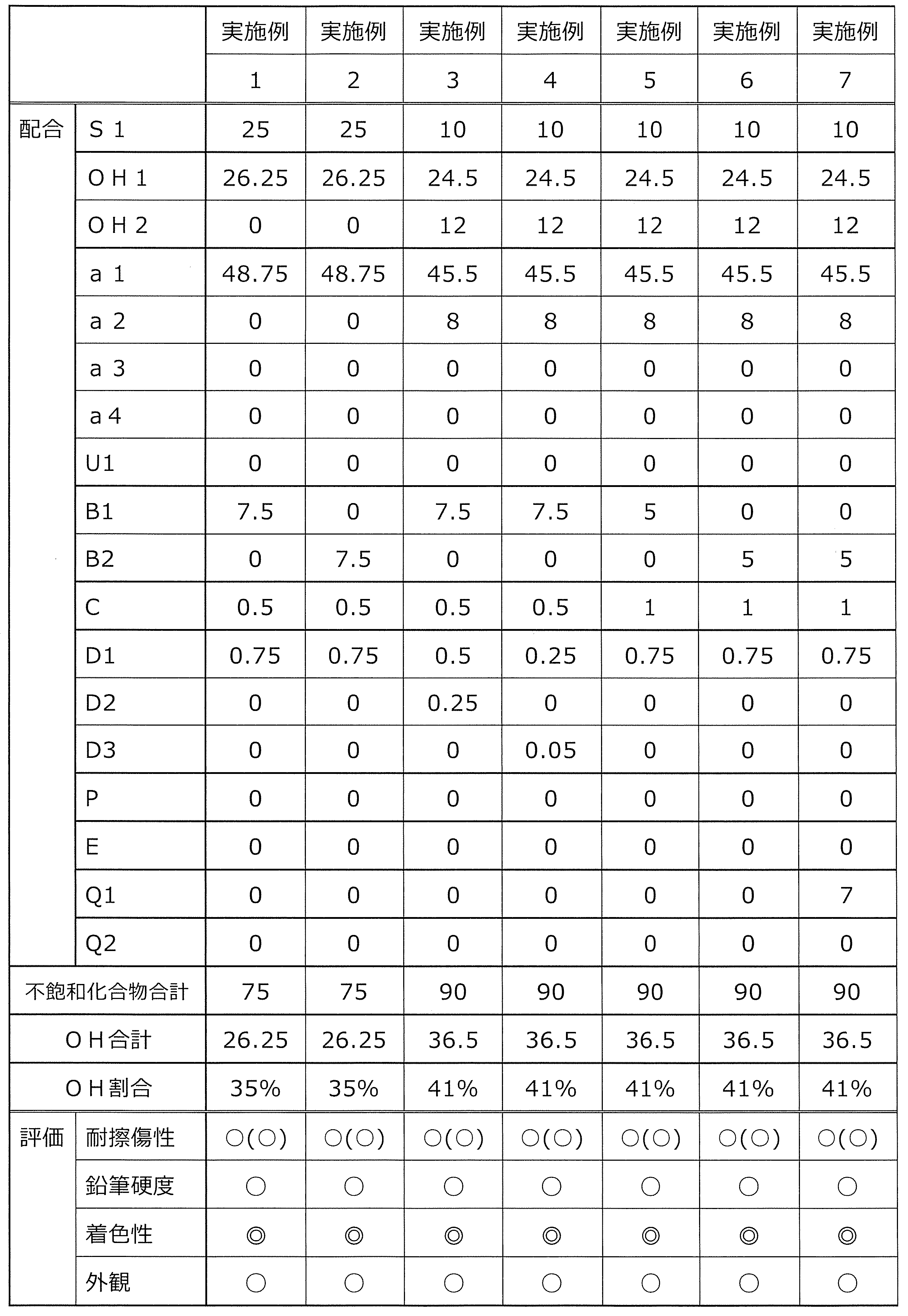
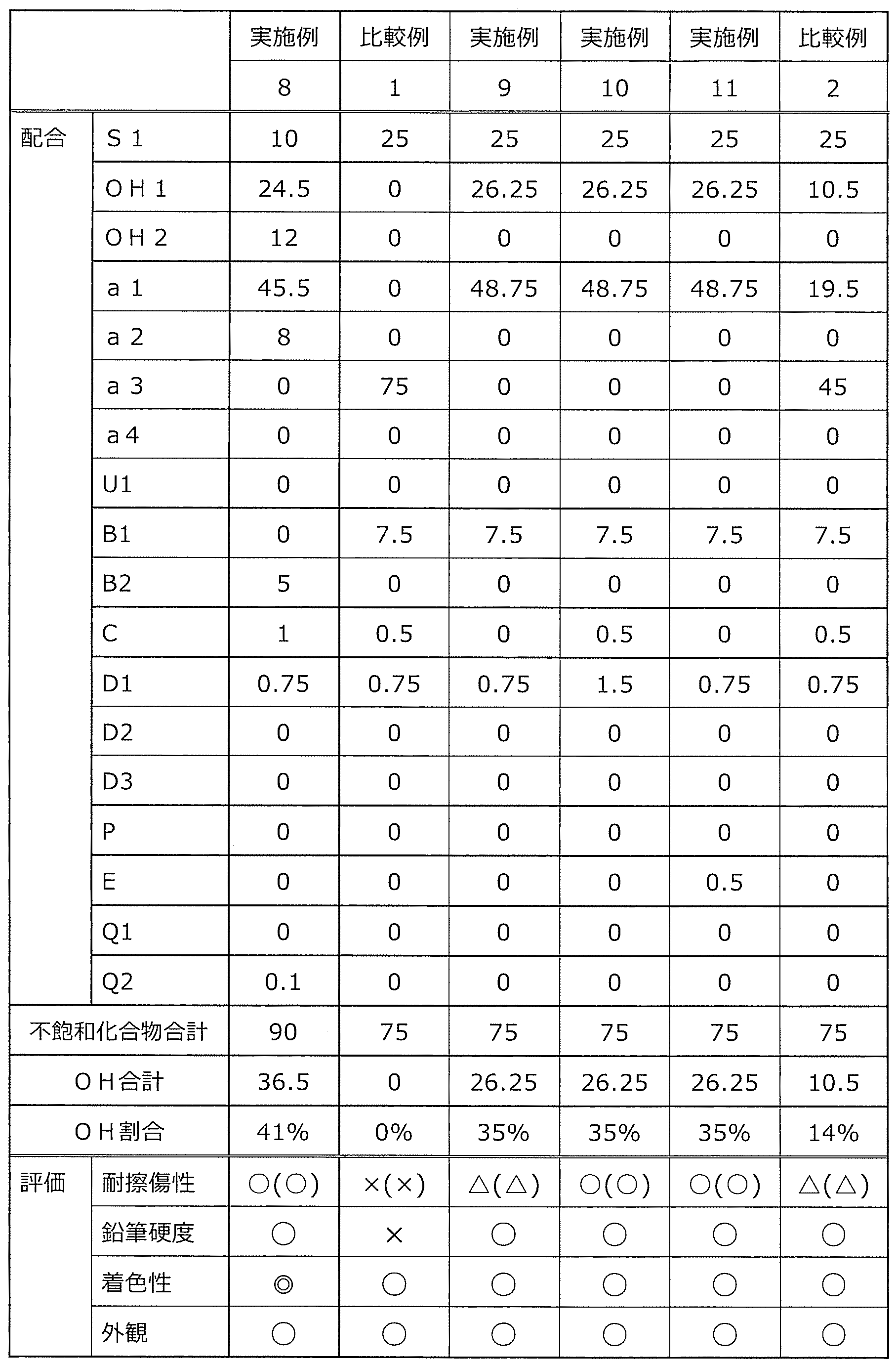
- Examples 2 to 11 and Comparative Examples 1 and 2 A PET laminate test piece having a surface on which a layer of a resin molded body was formed was obtained in the same manner as in Example 1 except that the blending composition was changed to the weight ratio shown in Tables 1 and 2. Then, the evaluation was performed in the same manner as in Example 1.
- KYARAD DPHA 48.75% Part, 2-methyl-1-[4-(methylthio)phenyl]-2-morpholinopropan-1-one (D1, light transmittance 87.4%, Omnirad907 manufactured by IGM) as a photopolymerization initiator (D): 8 mass The parts were mixed to obtain a transparent photocurable silicone resin composition.
- the obtained photocurable silicone resin composition 50 parts by mass, propylene glycol monomethyl ether: 50 parts by mass, and fluorine-based surface modifier: 1 part by mass were mixed, and the mixture was put in the atmosphere to form a PET substrate.
- (Thickness 250 ⁇ m) was cast (cast) to a thickness of 20 ⁇ m using a bar coater. This is dried at 60° C. for 10 minutes and then cured with a 30 W/cm high pressure mercury lamp at an integrated exposure dose of 1000 mJ/cm 2 to form a layer of a silicone resin molded body having a thickness of 10 ⁇ m on the PET substrate surface.
- a PET laminate test piece was obtained.
- YI measurement was performed using a spectrophotometer (UV3600 manufactured by Shimadzu Corp.) with the PET base material as a blank for determination.
- ⁇ : YI is less than 0.8 ⁇ : YI is 0.8 or more and less than 1.0 ⁇ : Y1 is 1.0 or more and less than 2.0 x: YI is 2.0 or more [Appearance]
- the appearance of the PET laminate test piece was visually determined.
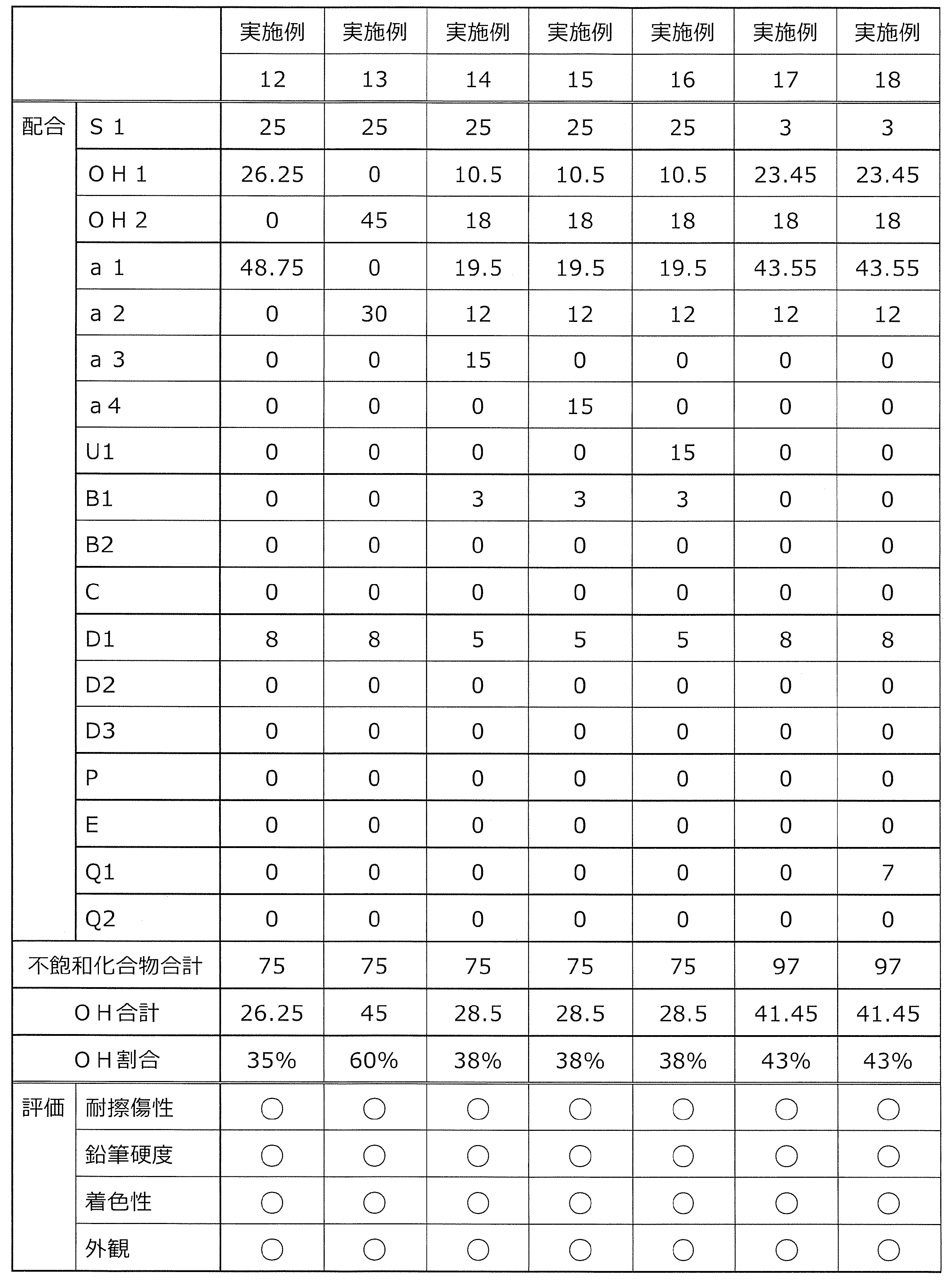
- Examples 13 to 19 and Comparative Examples 3 to 7 A PET laminate test piece obtained by forming a layer of a resin molded body on the surface was obtained in the same manner as in Example 12 except that the blending composition was changed to the weight ratio shown in Tables 3 and 4.
- B2 A photopolymerization initiator 2-hydroxy-1- ⁇ 4-[4-(2-hydroxy-2-methylpropionyl)-, which has a light path length of 1 cm in a 0.01 mass% solution and a light transmittance of 90% or more at a wavelength of 360 nm.
- Benzyl]phenyl ⁇ -2-methylpropan-1-one (light transmittance 96.0%, Omnirad 127 manufactured by IGM)
- C 0.01-mass% solution, 1-cm optical path length, photosensitizer with a light transmittance of 90% or more at a wavelength of 360 nm of 1,4-diethoxynaphthalene (light transmittance 98.6%, Kawasaki Kasei Kogyo Anthracure-UVS- 2171)
- D1 a photopolymerization initiator 2-methyl-1-[4-(methylthio)phenyl]-2-morpholinopropan-1-one having an optical path length of 1 cm in a 0.01 mass% solution and a light transmittance of less than 90% at a wavelength of 360 nm (Light transmittance 87.4%, Omnirad907 manufactured by IGM)
- D2 Photopolymerization initiator bis(2,4,6-trimethylbenzoyl)-phenylphosphine oxide (light transmitt
Landscapes
- Chemical & Material Sciences (AREA)
- Health & Medical Sciences (AREA)
- Chemical Kinetics & Catalysis (AREA)
- Medicinal Chemistry (AREA)
- Polymers & Plastics (AREA)
- Organic Chemistry (AREA)
- Macromonomer-Based Addition Polymer (AREA)
- Silicon Polymers (AREA)
Abstract
Description
シリコーン樹脂(A1)と、分子中に-R3-CR4=CH2又は-CR4=CH2〔但し、R3はアルキレン基、アルキリデン基又は-O-C(=O)-基を示し、R4は水素原子又はアルキル基を示す〕で表される不飽和基を少なくとも1個含むと共に前記シリコーン樹脂(A1)とラジカル共重合が可能な不飽和化合物(A2)とを、1:99~99:1の質量割合で配合したシリコーン樹脂組成物(A)と、
0.01質量%溶液の光路長1cm、波長360nmの光透過率が90%未満である光重合開始剤(D)とを含む光硬化性シリコーン樹脂組成物であり、
前記不飽和化合物(A2)は、その少なくとも20質量%以上が水酸基を含む不飽和化合物であり、
前記シリコーン樹脂組成物(A)に対して、光重合開始剤(D)が0.1質量%以上20質量%未満で配合されることを特徴とする光硬化性シリコーン樹脂組成物である。
[RSiO3/2]n (1)
〔但し、Rは(メタ)アクリロイル基を有する有機官能基であり、nは8、10又は12である〕で表され、構造単位中に籠型構造を有するポリオルガノシルセスキオキサンを主たる成分とするものであることがよい。
本発明の光硬化性シリコーン樹脂組成物は、シリコーン樹脂(A1)(以下、「本シリコーン樹脂」ともいう)と、分子中に-R3-CR4=CH2又は-CR4=CH2で表される不飽和基を少なくとも1個含み、前記シリコーン樹脂(A1)とラジカル共重合が可能な不飽和化合物(A2)(以下、単に、「不飽和化合物」ともいう)とを、A1:A2=1:99~99:1の質量割合で配合したシリコーン樹脂組成物(A)を含み、前記不飽和化合物(A2)の少なくとも20質量%以上が水酸基を含む不飽和化合物であり、また、このシリコーン樹脂組成物(A)に加えて、0.01質量%溶液の光路長1cm、波長360nmの光透過率が90%未満である光重合開始剤(D)をシリコーン樹脂組成物(A)に対して0.1質量%以上20質量%未満で含む。
一般式(1)において、Rは(メタ)アクリロイル基を有する有機官能基であって、nは8、10又は12である。(メタ)アクリロイル基を有する有機官能基としては、下記一般式(4)で表される基が挙げられる。一般式(4)中、mは1~3の整数であり、R1は水素原子又はメチル基である。
CH2=CR1‐COO-(CH2)m- (4)

前記不飽和基は、-R3-CR4=CH2又は-CR4=CH2〔但し、R3はアルキレン基、アルキリデン基又は-O-C(=O)-基を示し、R4は水素原子又はアルキル基を示す〕で表される。R3がアルキレン基、アルキリデン基である場合は、それらの炭素数は1~6であることが好ましく、R4がアルキル基である場合はメチル基が好ましい。
上記多官能不飽和化合物のうち水酸基を含む不飽和化合物としては、ペンタエリスリトールトリアクリレート、グリセリンジメタクリレート、ジペンタエリスリトールペンタアクリレート、ジペンタエリスリトールテトラアクリレート等を例示することが出来る。これらは分子中に水酸基を有するため水酸基の相互作用により分子間の距離が縮まることで発生したラジカルが速やかに二重結合と反応することで硬化速度が向上し、酸素とラジカルの反応より先にラジカル重合が進行することから、酸素による硬化阻害を抑制する事が可能になる。前記の通り、シリコーン樹脂組成物(A)に配合される不飽和化合物(A2)の20質量%以上が水酸基を含む不飽和化合物である必要があり、好ましくは、A2のうちの30質量%以上が水酸基を含む不飽和化合物であることがよい。この範囲を下回ると分子間の相互作用の効果が薄くなる。配合の上限は特にないが、60質量%を超えると酸素阻害抑制効果の上昇はほぼなくなる。
単官能モノマーや他の2官能モノマーは、上記不飽和化合物(A2)中に20質量%以下で含まれることが好ましく、より好ましくは10質量%以下である。20質量%よりも多く配合すると表面硬度が低下する傾向にあるので好ましくない。
配合の方法については、シリコーン樹脂(A1)と、不飽和化合物(A2)を先に配合してもよく、或いは、シリコーン樹脂(A1)と、不飽和化合物(A2)と、後記する光重合開始剤(B)、光増感剤(C)および/または光重合開始剤(D)とを同時に配合してもよく、配合の順番は任意である。また、後記するように、本発明の光硬化性シリコーン樹脂組成物には、各種添加剤を含むことができるが、これらの配合の順番も任意である。
ここで、本発明の光硬化性シリコーン樹脂組成物に用いられる光重合開始剤(B)としては、0.01質量%溶液の光路長1cm、波長360nmの光透過率が90%以上であり、可視光領域に吸収が無い透明性の高い光重合開始剤を用いることが好ましい。このような光重合開始剤(B)としては、好ましくはヒドロキシフェニルケトン系光重合開始剤を挙げることができ、具体的な化合物としては、1-ヒドロキシーシクロヘキシルーフェニル‐ケトン、2-ヒドロキシ-2-メチル-1-フェニルプロパン-1-オン、1-[4-(2-ヒドロキシエトキシ)-フェニル]-2-ヒドロキシ-2-メチル-1-プロパン-1-オン、2-ヒドロキシ-1-{4-[4-(2-ヒドロキシ-2-メチルプロピオニル)-ベンジル]フェニル}-2-メチルプロパン-1-オン等を例示できる。配合量としては、光硬化性と透明性の観点から、シリコーン樹脂組成物(A)に対して1~10質量%の範囲、好ましくは3~10質量%の範囲である。1質量%未満であると光硬化性の感度の向上効果が低く、期待する硬度向上効果が得られない。また10質量%を超えると着色が強くなる傾向があり、未反応の光重合開始剤がブリードアウトしてくることがあるため、上記の範囲で用いることが好ましい。また、光硬化性や透明性を調整するため複数のヒドロキシフェニルケトン系光重合開始剤を組み合わせてもよい。
成形体の形状は任意であり、フィルムや塗膜等であってもよい。この成形体は、本発明の光硬化性シリコーン樹脂組成物をラジカル共重合させて得られる。本発明の成形体または硬化物は、三次元架橋重合体であって、この場合、熱硬化性樹脂と同様な成形硬化法が採用できる。
このようにして得られる本発明のシリコーン樹脂成形体は、鉛筆硬度(JISK5600に準拠)が2H以上、好ましくは3H以上であり、耐擦傷性がスチールウール試験で少なくとも500g荷重で傷つかないことが好ましい。また、無色透明であることが好ましく、黄色度(YI)の値が2未満、より好ましくは1未満、さらに好ましくは0.8未満である。
撹拌機、滴下ロート、温度計を備えた反応容器に、溶媒として2-プロパノール(IPA)40mlと、塩基性触媒として5%テトラメチルアンモニウムヒドロキシド水溶液(TMAH水溶液)とを装入した。滴下ロートにIPA15mlと3-メタクリロキシプロピルトリメトキシシラン(MTMS:東レ・ダウコーニング・シリコーン株式会社製 SZ-6300)12.69gを入れ、反応容器を撹拌しながら、室温でMTMSのIPA溶液を30分かけて滴下した。MTMS滴下終了後、加熱することなく2時間撹拌した。2時間撹拌後、減圧下で溶媒を除去し、トルエン50mlで溶解した。反応溶液を飽和食塩水で中性になるまで水洗した後、無水硫酸マグネシウムで脱水した。無水硫酸マグネシウムをろ別し、濃縮することで加水分解生成物(シルセスキオキサン)を25.8g得た。このシルセスキオキサンは種々の有機溶剤に可溶な無色の粘性液体であった。
次に、撹拌機、ディンスターク、冷却管を備えた反応容器に上記で得られたシルセスキオキサン20.65gとトルエン82mlと10%TMAH水溶液3.0gとを入れ、徐々に加熱し水を留去した。更に130℃まで加熱しトルエンを還流温度で再縮合反応を行った。このときの反応溶液の温度は108℃であった。トルエン還流後2時間撹拌した後、反応を終了とした。反応溶液を飽和食塩水で中性になるまで水洗した後、無水硫酸マグネシウムで脱水した。無水硫酸マグネシウムをろ別し、濃縮することで目的物である籠型シルセスキオキサン(混合物)を18.77g得た。得られた籠型シルセスキオキサン(S1)は種々の有機溶剤に可溶な無色の粘性液体であった。
再縮合反応後の反応物の液体クロマトグラフィー分離後の質量分析を行ったところ、上記構造式(5)、(6)及び(7)の分子構造においてRをメタクリロイル基としたものに対してアンモニウムイオンが付いた分子イオンが確認され、構成比率はT8:T10:T12:その他が約2:4:1:3であり、籠型構造を主たる成分とするシリコーン樹脂であることが確認できる。なお、T8、T10、及びT12は、それぞれ式(5)、(6)及び(7)においてRをメタクリロイル基としたものに対応する。
光重合開始剤と光増感剤の0.01質量%溶液の光透過率は、分光光度計(島津製作所製UV3600)、光路長1cmのホウケイ酸ガラス製セルを用いて測定した。溶媒及びリファレンスには、プロピレングリコールモノメチルエーテルを用いて波長360nmの光透過率を測定した。以降、光透過率の記載は本法によって測定した値を示す。
合成例1で得たようなメタクリロイル基を全てのケイ素原子上に有した籠型シリコーン樹脂(S1):25質量部、水酸基を含むアクリレートとしてジペンタエリスリトールペンタアクリレート〔OH1、日本化薬(株)製 KYARAD DPHAに35質量%含まれる〕:26.25質量部、水酸基を含まないジペンタエリスリトールヘキサアクリレート〔a1、日本化薬(株)製 KYARAD DPHAに65質量%含まれる〕:48.75質量部、光重合開始剤(B)として1-ヒドロキシ-シクロヘキシルフェニルケトン(B1、光透過率96.3%、IGM社製Omnirad184):7.5質量部、光増感剤(C)として1,4-ジエトキシナフタレン(光透過率98.6%、川崎化成工業製アントラキュア―UVS-2171):0.5質量部、光重合開始剤(D)として2-メチル-1-[4-(メチルチオ)フェニル]-2-モルホリノプロパン-1-オン(D1、光透過率87.4%、IGM社製Omnirad907):0.75質量部を混合し、透明な光硬化性シリコーン樹脂組成物を得た。
[耐擦傷性]
PET積層体試験片を、#0000スチールウールを用いて荷重500g/cm2の荷重下で10往復試験を行い、目視で傷の本数を評価した。さらに、荷重1000g/cm2の荷重下で1000往復試験した際の傷の本数も評価し、この荷重1000g/cm2・1000往復試験の場合の結果は表1~2中にかっこ書きで示した。
〇:傷なし
△:10本未満の傷あり
×:10本以上の傷あり
PET積層体試験片について、JIS K 5600に準拠し、三菱鉛筆ユニを用いて750g荷重、45度の角度で引掻き、傷のつかない硬度を目視で判定した。
○:2H以上
×:2H未満
PET積層体試験片について、分光光度計(島津製作所製UV3600)を用いて、PET基材をブランクとしてYI測定を行い判定した。
◎:YIが0.8未満
○:YIが0.8以上、1.0未満
△:Y1が1.0以上、2.0未満
×:YIが2.0以上
PET積層体試験片について、目視にて外観を判定した。
○:異常無し
×:異物、表面性上不良が認められたもの
配合組成を表1及び表2に示す重量割合とした他は、実施例1と同様にして、表面に樹脂成形体の層を形成してなるPET積層体試験片を得た。その後、実施例1と同様に評価を行った。
合成例1で得たようなメタクリロイル基を全てのケイ素原子上に有した籠型シリコーン樹脂(S1):25質量部、水酸基を含むアクリレートとしてジペンタエリスリトールペンタアクリレート〔OH1、日本化薬(株)製 KYARAD DPHAに35質量%含まれる〕:26.25質量部、水酸基を含まないジペンタエリスリトールヘキサアクリレート〔a1、日本化薬(株)製 KYARAD DPHAに65質量%含まれる〕:48.75質量部、光重合開始剤(D)として2-メチル-1-[4-(メチルチオ)フェニル]-2-モルホリノプロパン-1-オン(D1、光透過率87.4%、IGM社製Omnirad907):8質量部を混合し、透明な光硬化性シリコーン樹脂組成物を得た。
[耐擦傷性]
PET積層体試験片を、#0000スチールウールを用いて荷重500g/cm2の荷重下で10往復試験を行い、目視で傷の本数を評価した。
〇:傷なし
△:10本未満の傷あり
×:10本以上の傷あり
[鉛筆硬度]
PET積層体試験片について、JIS K 5600に準拠し、三菱鉛筆ユニを用いて750g荷重、45度の角度で引掻き、傷のつかない硬度を目視で判定した。
○:2H以上
×:2H未満
[着色性]
PET積層体試験片について、分光光度計(島津製作所製UV3600)を用いて、PET基材をブランクとしてYI測定を行い判定した。
◎:YIが0.8未満
○:YIが0.8以上、1.0未満
△:Y1が1.0以上、2.0未満
×:YIが2.0以上
[外観]
PET積層体試験片について、目視にて外観を判定した。
○:異常無し
×:異物、表面性上不良が認められたもの
配合組成を表3及び表4に示す重量割合とした他は、実施例12と同様にして、表面に樹脂成形体の層を形成してなるPET積層体試験片を得た。
S1:合成例1で得られたシリコーン樹脂
OH1:ジペンタエリスリトールペンタアクリレート〔日本化薬(株)製KAYARAD DPHAに35質量%含まれる〕
a1:ジペンタエリスリトールヘキサアクリレート〔日本化薬(株)製KAYARAD DPHAに65質量%含まれる〕
OH2:ペンタエリスリトールトリアクリレート〔共栄社化学(株)製ライトアクリレートPE-3Aに60質量%含まれる〕
a2:ペンタエリスリトールテトラアクリレート〔共栄社化学(株)製ライトアクリレートPE-3Aに40質量%含まれる〕
a3:トリメチロールプロパントリアクリレート〔新中村化学(株)製A-TMPT〕
a4:ジメチロールトリシクロデカンジアクリレート〔共栄社化学(株)製ライトアクリレートDCP-A〕
U1:ウレタンアクリレートオリゴマー〔新中村化学(株)製UA-122P〕
B1:0.01質量%溶液の光路長1cm、波長360nmの光透過率が90%以上である光重合開始剤 1-ヒドロキシ-シクロヘキシルフェニルケトン(光透過率96.3%、IGM社製Omnirad184)
B2:0.01質量%溶液の光路長1cm、波長360nmの光透過率が90%以上である光重合開始剤 2-ヒドロキシ-1-{4-[4-(2-ヒドロキシ-2-メチルプロピオニル)-ベンジル]フェニル}-2-メチルプロパン-1-オン(光透過率96.0%、IGM社製Omnirad127)
C:0.01質量%溶液の光路長1cm、波長360nmの光透過率が90%以上である光増感剤 1,4-ジエトキシナフタレン(光透過率98.6%、川崎化成工業製アントラキュア―UVS-2171)
D1:0.01質量%溶液の光路長1cm、波長360nmの光透過率が90%未満である光重合開始剤 2-メチル-1-[4-(メチルチオ)フェニル]-2-モルホリノプロパン-1-オン(光透過率87.4%、IGM社製Omnirad907)
D2:0.01質量%溶液の光路長1cm、波長360nmの光透過率が90%未満である光重合開始剤 ビス(2,4,6-トリメチルベンゾイル)-フェニルフォスフィンオキサンド(光透過率66.5%、IGM社製Omnirad819)
D3:0.01質量%溶液の光路長1cm、波長360nmの光透過率が90%未満である光重合開始剤 エタノン, 1-[9-エチル-6-(2-メチルベンゾイル)-9H-カルバゾール-3-イル]-, 1-(O-アセチルオキシム)(光透過率1.5%、BASF社製Irgacure OXE02)
P:oxy-phenyl-acetic acid 2-[2-oxo-2-phenyl-acetoxy-ethoxy]-ethyl esterと、oxy-phenyl-acetic acid 2-[2-hydroxy-ethoxy]-ethyl esterとの混合物〔IGM(株)製Omnirad754〕
E:0.01質量%溶液の光路長1cm、波長360nmの光透過率が90%未満である光増感剤 9,10-ジエトキシアントラセン(光透過率2.0%、川崎化成工業製アントラキュア―UVS-1101)
Q1:ハロゲン系難燃剤(第一工業製薬製ピロガードSR-720N)
Q2:蛍光増白剤(BASF製TinopalOB)
不飽和化合物合計:不飽和化合物の合計量(質量部)
OH合計:水酸基を含む不飽和化合物の合計量(質量部)
OH割合:不飽和化合物のうち水酸基を含む不飽和化合物の割合(質量%)

Claims (10)
- シリコーン樹脂(A1)と、分子中に-R3-CR4=CH2又は-CR4=CH2〔但し、R3はアルキレン基、アルキリデン基又は-O-C(=O)-基を示し、R4は水素原子又はアルキル基を示す〕で表される不飽和基を少なくとも1個含むと共に前記シリコーン樹脂(A1)とラジカル共重合が可能な不飽和化合物(A2)とを、1:99~99:1の質量割合で配合したシリコーン樹脂組成物(A)と、
0.01質量%溶液の光路長1cm、波長360nmの光透過率が90%未満である光重合開始剤(D)とを含む光硬化性シリコーン樹脂組成物であり、
前記不飽和化合物(A2)は、その少なくとも20質量%以上が水酸基を含む不飽和化合物であり、
前記シリコーン樹脂組成物(A)に対して、光重合開始剤(D)が0.1質量%以上20質量%未満で配合されることを特徴とする光硬化性シリコーン樹脂組成物。 - 前記不飽和化合物(A2)は、その10~100質量%が、分子中に-R3-CR4=CH2又は-CR4=CH2〔但し、R3はアルキレン基、アルキリデン基又は-O-C(=O)-基を示し、R4は水素原子又はアルキル基を示す〕で表される不飽和基を少なくとも2個含む非シリコーン型の多官能不飽和化合物であることを特徴とする請求項1記載の光硬化性シリコーン樹脂組成物。
- 前記シリコーン樹脂(A1)が、一般式(1)
[RSiO3/2]n (1)
〔但し、Rは(メタ)アクリロイル基を有する有機官能基であり、nは8、10又は12である〕で表され、構造単位中に籠型構造を有するポリオルガノシルセスキオキサンを主たる成分とするものであることを特徴とする請求項1又は2に記載の光硬化性シリコーン樹脂組成物。 - さらに、0.01質量%溶液の光路長1cm、波長360nmの光透過率が90%以上である光重合開始剤(B)を含むことを特徴とする請求項1~3のいずれかに記載の光硬化性シリコーン樹脂組成物。
- 0.01質量%溶液の光路長1cm、波長360nmの光透過率が90%以上である光重合開始剤(B)が、ヒドロキシフェニルケトン系光重合開始剤であることを特徴とする請求項4に記載の光硬化性シリコーン樹脂組成物。
- さらに、0.01質量%溶液の光路長1cm、波長360nmの光透過率が90%以上である光増感剤(C)を含むことを特徴とする請求項1~5のいずれかに記載の光硬化性シリコーン樹脂組成物。
- 0.01質量%溶液の光路長1cm、波長360nmの光透過率が90%以上である光増感剤(C)が、ナフタレン系光増感剤であることを特徴とする請求項6に記載の光硬化性シリコーン樹脂組成物。
- 0.01質量%溶液の光路長1cm、波長360nmの光透過率が90%未満である光重合開始剤(D)が、α-アミノアルキルフェノン系光重合開始剤、フォスフィンオキサイド系光重合開始剤およびオキシムエステル系光重合開始剤からなる群から選ばれる1種以上の光重合開始剤であることを特徴とする請求項1~7のいずれかに記載の光硬化性シリコーン樹脂組成物。
- 請求項1~8のいずれかに記載の光硬化性シリコーン樹脂組成物を、ラジカル共重合させ硬化させて得られたシリコーン樹脂成形体。
- 請求項1~8のいずれかに記載の光硬化性シリコーン樹脂組成物に、大気下で活性エネルギー線を照射してラジカル共重合させてシリコーン樹脂成形体とすることを特徴とするシリコーン樹脂成形体の製造方法。
Priority Applications (3)
| Application Number | Priority Date | Filing Date | Title |
|---|---|---|---|
| JP2020571305A JPWO2020162615A1 (ja) | 2019-02-08 | 2020-02-07 | |
| KR1020217026301A KR20210124274A (ko) | 2019-02-08 | 2020-02-07 | 광경화성 실리콘 수지 조성물 및 그것을 경화시킨 실리콘 수지 성형체, 및 상기 성형체의 제조 방법 |
| CN202080012462.9A CN113396169A (zh) | 2019-02-08 | 2020-02-07 | 光硬化性硅酮树脂组合物及由其硬化成的硅酮树脂成形体以及所述成形体的制造方法 |
Applications Claiming Priority (4)
| Application Number | Priority Date | Filing Date | Title |
|---|---|---|---|
| JP2019021376 | 2019-02-08 | ||
| JP2019-021376 | 2019-02-08 | ||
| JP2019-180136 | 2019-09-30 | ||
| JP2019180136 | 2019-09-30 |
Publications (1)
| Publication Number | Publication Date |
|---|---|
| WO2020162615A1 true WO2020162615A1 (ja) | 2020-08-13 |
Family
ID=71946986
Family Applications (1)
| Application Number | Title | Priority Date | Filing Date |
|---|---|---|---|
| PCT/JP2020/004911 Ceased WO2020162615A1 (ja) | 2019-02-08 | 2020-02-07 | 光硬化性シリコーン樹脂組成物及びそれを硬化させたシリコーン樹脂成形体、並びに当該成形体の製造方法 |
Country Status (5)
| Country | Link |
|---|---|
| JP (1) | JPWO2020162615A1 (ja) |
| KR (1) | KR20210124274A (ja) |
| CN (1) | CN113396169A (ja) |
| TW (1) | TW202039608A (ja) |
| WO (1) | WO2020162615A1 (ja) |
Cited By (1)
| Publication number | Priority date | Publication date | Assignee | Title |
|---|---|---|---|---|
| WO2023120495A1 (ja) * | 2021-12-22 | 2023-06-29 | 日鉄ケミカル&マテリアル株式会社 | 光硬化性シリコーン樹脂組成物、その硬化物 |
Citations (4)
| Publication number | Priority date | Publication date | Assignee | Title |
|---|---|---|---|---|
| JPH0656948A (ja) * | 1992-08-13 | 1994-03-01 | Showa Denko Kk | 機能性有機分子が封入された透明固体樹脂およびその製造方法 |
| JP2008201818A (ja) * | 2007-02-16 | 2008-09-04 | Jsr Corp | 硬化性組成物、その硬化膜及び積層体 |
| JP2016216623A (ja) * | 2015-05-21 | 2016-12-22 | 荒川化学工業株式会社 | 紫外線硬化型コーティング剤組成物及びその硬化膜 |
| JP2018141104A (ja) * | 2017-02-28 | 2018-09-13 | 中国塗料株式会社 | 床材用活性エネルギー線硬化型樹脂組成物、被膜付き床材、被膜付き床材の製造方法および床材の汚染防止方法 |
Family Cites Families (9)
| Publication number | Priority date | Publication date | Assignee | Title |
|---|---|---|---|---|
| JP4256756B2 (ja) | 2002-09-30 | 2009-04-22 | 新日鐵化学株式会社 | 官能基を有するかご型シルセスキオキサン樹脂の製造方法 |
| DE602004031510D1 (de) | 2003-03-27 | 2011-04-07 | Nippon Steel Chemical Co | Silikonharzzusammensetzung und formkörper daraus |
| JP5000303B2 (ja) * | 2004-09-27 | 2012-08-15 | 新日鐵化学株式会社 | シリカ含有シリコーン樹脂組成物及びその成形体 |
| US8353410B2 (en) * | 2009-11-24 | 2013-01-15 | International Business Machines Corporation | Polymeric films made from polyhedral oligomeric silsesquioxane (POSS) and a hydrophilic comonomer |
| JP5698566B2 (ja) | 2011-03-08 | 2015-04-08 | 新日鉄住金化学株式会社 | シリコーン樹脂組成物及びその成形体 |
| JP2015214681A (ja) * | 2014-04-24 | 2015-12-03 | セントラル硝子株式会社 | 硬化性組成物、仮接着材およびこれらを用いた部材と基材の仮接着方法 |
| KR20160036872A (ko) * | 2014-09-26 | 2016-04-05 | 동우 화인켐 주식회사 | 입체 조형용 광경화성 수지 조성물 |
| JP7150433B2 (ja) * | 2017-12-28 | 2022-10-11 | 東京応化工業株式会社 | リワーク方法、及び酸性洗浄液 |
| JP7175092B2 (ja) * | 2018-03-16 | 2022-11-18 | 東京応化工業株式会社 | 光硬化性組成物及びパターン形成方法 |
-
2020
- 2020-02-07 CN CN202080012462.9A patent/CN113396169A/zh active Pending
- 2020-02-07 WO PCT/JP2020/004911 patent/WO2020162615A1/ja not_active Ceased
- 2020-02-07 JP JP2020571305A patent/JPWO2020162615A1/ja active Pending
- 2020-02-07 KR KR1020217026301A patent/KR20210124274A/ko not_active Withdrawn
- 2020-02-07 TW TW109103932A patent/TW202039608A/zh unknown
Patent Citations (4)
| Publication number | Priority date | Publication date | Assignee | Title |
|---|---|---|---|---|
| JPH0656948A (ja) * | 1992-08-13 | 1994-03-01 | Showa Denko Kk | 機能性有機分子が封入された透明固体樹脂およびその製造方法 |
| JP2008201818A (ja) * | 2007-02-16 | 2008-09-04 | Jsr Corp | 硬化性組成物、その硬化膜及び積層体 |
| JP2016216623A (ja) * | 2015-05-21 | 2016-12-22 | 荒川化学工業株式会社 | 紫外線硬化型コーティング剤組成物及びその硬化膜 |
| JP2018141104A (ja) * | 2017-02-28 | 2018-09-13 | 中国塗料株式会社 | 床材用活性エネルギー線硬化型樹脂組成物、被膜付き床材、被膜付き床材の製造方法および床材の汚染防止方法 |
Cited By (1)
| Publication number | Priority date | Publication date | Assignee | Title |
|---|---|---|---|---|
| WO2023120495A1 (ja) * | 2021-12-22 | 2023-06-29 | 日鉄ケミカル&マテリアル株式会社 | 光硬化性シリコーン樹脂組成物、その硬化物 |
Also Published As
| Publication number | Publication date |
|---|---|
| KR20210124274A (ko) | 2021-10-14 |
| CN113396169A (zh) | 2021-09-14 |
| JPWO2020162615A1 (ja) | 2020-08-13 |
| TW202039608A (zh) | 2020-11-01 |
Similar Documents
| Publication | Publication Date | Title |
|---|---|---|
| EP2360194B1 (en) | Siloxane resin composition and protective film for touch panel using same | |
| CN103819677B (zh) | 笼型倍半硅氧烷化合物、使用它的固化性树脂组合物和树脂固化物 | |
| US7345125B2 (en) | Silicone resin composition and molded product thereof | |
| US8530546B2 (en) | Curable composition comprising inorganic oxide microparticles that are surface-modified with maleimide groups | |
| TW200927794A (en) | Curing type composition containing alkoxysilane condensation compound | |
| JP7312543B2 (ja) | ガラス代替基材用耐候性ハードコート組成物、硬化物、及び積層体 | |
| WO2004085501A1 (ja) | シリコーン樹脂組成物及びその成形体 | |
| WO2013094585A1 (ja) | ガラス繊維複合化樹脂基板 | |
| TW201842081A (zh) | 硬化型組成物 | |
| KR102226670B1 (ko) | 실세스퀴옥산 화합물 및 변성 실리콘 화합물을 포함하는 임프린트 재료 | |
| JP5698566B2 (ja) | シリコーン樹脂組成物及びその成形体 | |
| WO2020162615A1 (ja) | 光硬化性シリコーン樹脂組成物及びそれを硬化させたシリコーン樹脂成形体、並びに当該成形体の製造方法 | |
| KR20130032658A (ko) | 자외선 경화성 코팅조성물 및 이를 이용한 고 경도 코팅막 | |
| JP2013221112A (ja) | 硬化性樹脂組成物 | |
| JP2020019870A (ja) | 光硬化性シリコーン樹脂組成物及びその成形体 | |
| JP7312544B2 (ja) | 金属用耐候性ハードコート組成物、硬化物、及び塗装金属基材 | |
| JP4736387B2 (ja) | 耐擦傷性及び反射防止性を有する積層体 | |
| JP7626141B2 (ja) | 樹脂組成物、硬化物及びその製造方法、並びに積層体 | |
| JP2013209576A (ja) | シリコーン樹脂組成物、シリコーン樹脂硬化物、及び表示装置 | |
| JP7628821B2 (ja) | 光硬化性シリコーン樹脂組成物及びそれを硬化させたシリコーン樹脂成形体、並びに当該成形体の製造方法 | |
| KR20170046678A (ko) | 임프린트재료 | |
| WO2023120495A1 (ja) | 光硬化性シリコーン樹脂組成物、その硬化物 | |
| JPH1053632A (ja) | 樹脂組成物、注型用組成物及びその硬化物 | |
| WO2021187381A1 (ja) | 硬化型組成物 |
Legal Events
| Date | Code | Title | Description |
|---|---|---|---|
| 121 | Ep: the epo has been informed by wipo that ep was designated in this application |
Ref document number: 20752206 Country of ref document: EP Kind code of ref document: A1 |
|
| DPE1 | Request for preliminary examination filed after expiration of 19th month from priority date (pct application filed from 20040101) | ||
| ENP | Entry into the national phase |
Ref document number: 2020571305 Country of ref document: JP Kind code of ref document: A |
|
| NENP | Non-entry into the national phase |
Ref country code: DE |
|
| ENP | Entry into the national phase |
Ref document number: 20217026301 Country of ref document: KR Kind code of ref document: A |
|
| 122 | Ep: pct application non-entry in european phase |
Ref document number: 20752206 Country of ref document: EP Kind code of ref document: A1 |
|
| WWW | Wipo information: withdrawn in national office |
Ref document number: 1020217026301 Country of ref document: KR |