WO2020149393A1 - 便臭を改善する物質を選択する方法、便臭を改善する組成物の製造方法、腎機能改善剤、および腎機能改善のための飲食品 - Google Patents
便臭を改善する物質を選択する方法、便臭を改善する組成物の製造方法、腎機能改善剤、および腎機能改善のための飲食品 Download PDFInfo
- Publication number
- WO2020149393A1 WO2020149393A1 PCT/JP2020/001430 JP2020001430W WO2020149393A1 WO 2020149393 A1 WO2020149393 A1 WO 2020149393A1 JP 2020001430 W JP2020001430 W JP 2020001430W WO 2020149393 A1 WO2020149393 A1 WO 2020149393A1
- Authority
- WO
- WIPO (PCT)
- Prior art keywords
- salacia
- renal function
- improving
- plant
- extract
- Prior art date
- Legal status (The legal status is an assumption and is not a legal conclusion. Google has not performed a legal analysis and makes no representation as to the accuracy of the status listed.)
- Ceased
Links
Classifications
-
- A—HUMAN NECESSITIES
- A23—FOODS OR FOODSTUFFS; TREATMENT THEREOF, NOT COVERED BY OTHER CLASSES
- A23L—FOODS, FOODSTUFFS OR NON-ALCOHOLIC BEVERAGES, NOT OTHERWISE PROVIDED FOR; PREPARATION OR TREATMENT THEREOF
- A23L33/00—Modifying nutritive qualities of foods; Dietetic products; Preparation or treatment thereof
- A23L33/10—Modifying nutritive qualities of foods; Dietetic products; Preparation or treatment thereof using additives
-
- A—HUMAN NECESSITIES
- A23—FOODS OR FOODSTUFFS; TREATMENT THEREOF, NOT COVERED BY OTHER CLASSES
- A23L—FOODS, FOODSTUFFS OR NON-ALCOHOLIC BEVERAGES, NOT OTHERWISE PROVIDED FOR; PREPARATION OR TREATMENT THEREOF
- A23L33/00—Modifying nutritive qualities of foods; Dietetic products; Preparation or treatment thereof
- A23L33/10—Modifying nutritive qualities of foods; Dietetic products; Preparation or treatment thereof using additives
- A23L33/105—Plant extracts, their artificial duplicates or their derivatives
-
- A—HUMAN NECESSITIES
- A61—MEDICAL OR VETERINARY SCIENCE; HYGIENE
- A61P—SPECIFIC THERAPEUTIC ACTIVITY OF CHEMICAL COMPOUNDS OR MEDICINAL PREPARATIONS
- A61P13/00—Drugs for disorders of the urinary system
- A61P13/12—Drugs for disorders of the urinary system of the kidneys
-
- G—PHYSICS
- G01—MEASURING; TESTING
- G01N—INVESTIGATING OR ANALYSING MATERIALS BY DETERMINING THEIR CHEMICAL OR PHYSICAL PROPERTIES
- G01N33/00—Investigating or analysing materials by specific methods not covered by groups G01N1/00 - G01N31/00
- G01N33/15—Medicinal preparations ; Physical properties thereof, e.g. dissolubility
-
- G—PHYSICS
- G01—MEASURING; TESTING
- G01N—INVESTIGATING OR ANALYSING MATERIALS BY DETERMINING THEIR CHEMICAL OR PHYSICAL PROPERTIES
- G01N33/00—Investigating or analysing materials by specific methods not covered by groups G01N1/00 - G01N31/00
- G01N33/48—Biological material, e.g. blood, urine; Haemocytometers
- G01N33/50—Chemical analysis of biological material, e.g. blood, urine; Testing involving biospecific ligand binding methods; Immunological testing
Definitions
- the present invention relates to a method for selecting a substance that improves stool odor using blood urea nitrogen concentration as an index.
- the present invention relates to a method for producing a composition for improving stool odor, which comprises the method described above.
- the present invention further relates to a renal function improving agent, and a food or drink for improving renal function.
- Roots and trunks of Salacia plants have been used as natural drugs in Ayurveda, a traditional medicine in India and Sri Lanka.
- the root bark of Salacia reticulata is said to be effective in the treatment of rheumatism, gonorrhea and skin diseases, and the use of the root bark for the treatment of early stage diabetes.
- Patent Document 1 describes a stool characterized by containing an extract or finely pulverized product of Kotara Himbutu (Salacia reticulate, Salacia oblonga), lactic acid bacteria and/or bifidobacteria, and indigestible oligosaccharides.
- a sex improving agent is described.
- Patent Document 2 discloses a reducing agent for enteric harmful bacteria containing hot water extract of Salacia plant, extract of green tea, and oolong tea powder, wherein the enteric harmful bacteria to be reduced are Enterobacter spp.
- An agent for reducing intestinal harmful bacteria belonging to the genus Clostridium is described.
- Patent Documents 1 and 2 describe that a predetermined composition containing an extract of a plant of the genus Salacia improves the intestinal environment, but it does not improve the blood urea nitrogen concentration and the fecal odor. The relationship was unknown.
- the present inventors have found that human nitrogen ingested with an extract of a plant of the genus Salacia reduces blood urea nitrogen and improves stool odor. Furthermore, the present inventors confirmed suppression of proteolysis and amino acid biosynthesis, and promotion of peptide absorption in the functional analysis of intestinal bacteria in humans ingested with an extract of a plant of the genus Salacia. The present invention has been completed based on these findings. According to the present invention, the following inventions are provided.
- a blood urea nitrogen concentration in a living body to which a test substance has been administered is compared with a blood urea nitrogen concentration in a living body to which a test substance has not been administered.
- a method for selecting a substance that improves stool odor comprising the step of selecting, as a candidate substance, a test substance that is lower than the blood urea nitrogen concentration in a living body to which the test substance has not been administered.
- the test substance is a pulverized product or extract of a plant of the genus Salacia.
- a method for producing a composition for improving stool odor comprising: [6] The method according to [5], wherein the selected substance contained in the composition is a ground product or an extract of a Salacia plant. [7] The method according to [6], wherein the plant of the genus Salacia is at least one plant selected from Salacia reticulata, Salacia oblonga, and Salacia chinensis. .. [8] The method according to [6] or [7], wherein the ground product or extract of Salacia plant has a sucrase 50% inhibitory concentration of 1 to 1000 ⁇ g/mL.
- a renal function improving agent containing a pulverized product or extract of a plant of the genus Salacia [12] The kidney according to [11], wherein the plant of the genus Salacia is at least one plant selected from Salacia reticulata, Salacia oblonga, and Salacia chinensis. Function improver. [13] The renal function-improving agent according to [11] or [12], wherein the crushed product or extract of a Salacia plant has a sucrase 50% inhibitory concentration of 1 to 1000 ⁇ g/mL. [14] The renal function improving agent according to any one of [11] to [13], which improves renal function by decreasing blood urea nitrogen concentration. [15] A food or drink for improving renal function, comprising the renal function improving agent according to any one of [11] to [14].
- a method for improving renal function which comprises administering a pulverized product or extract of a Salacia plant to a subject in need of improved renal function.
- a ground product or extract of a Salacia plant for use in a treatment for improving renal function.
- a pulverized product or extract of a Salacia plant for the manufacture of a renal function improving agent. Further, according to the present invention, there is provided use of a pulverized product or extract of a Salacia plant for producing a food or drink for improving renal function.
- a substance that can suppress the production of odorous substances can be obtained.
- the method for producing a composition for improving stool odor according to the present invention it is possible to produce a composition for suppressing stool odor, which can suppress the production of odorous substances themselves.
- renal function improving agent and the food and drink for improving renal function according to the present invention renal function can be improved by lowering the urea nitrogen concentration in blood.
- Embodiments of the present invention will be described below.
- Patent Documents 1 and 2 it has been known that a predetermined composition containing an extract of a Salacia plant improves the intestinal environment, but an extract of a Salacia plant contains blood urea nitrogen. It was unknown to reduce the concentration and to improve the stool odor with the decrease of blood urea nitrogen concentration.
- the present invention suggests that the extract of a plant of the genus Salacia increases intestinal bacteria involved in the decomposition of proteins, promotes the decomposition of proteins into amino acids, and improves the uptake of amino acids into the body. ..
- the measurement of stool odor generally requires labor and cost
- the measurement of urea nitrogen is one of the items for health examination and has an advantage that it can be easily performed.
- the composition produced by the present invention it is possible to improve the QOL (Quality of Life) of the care giver and the care receiver at the care site.
- improving the post-toilet odor of women with constipation will reduce the mental burden.
- the stool odor causes body odor, it is possible to improve body odor.
- the method of selecting a substance that improves stool odor according to the present invention is a method of comparing the blood urea nitrogen concentration in a living body to which a test substance has been administered with the blood urea nitrogen concentration in a living body to which the test substance has not been administered.
- the step of selecting a test substance as a candidate substance in the case where the blood urea nitrogen concentration in the living body to which is administered is lower than the blood urea nitrogen concentration in the living body to which the test substance is not administered is included.
- the test substance is not particularly limited as long as it is a candidate substance that improves stool odor, and examples thereof include pulverized products or extracts of plants, animal tissue extracts, organic compounds (including synthetic low molecular weight compounds), proteins, peptides, Examples include microbial cultures and cell extracts, and these substances may be novel or known.
- a crushed product or extract of a plant is preferable, and a crushed product or extract of a plant of the genus Salacia is particularly preferable. Details of the ground product or extract of Salacia will be described later.
- the test substance may be administered to a living body as it is, or may be dissolved in a solvent as necessary and administered.
- the living body to which the test substance is administered is not particularly limited, and may be a human or a mammal other than human (a rodent such as a mouse or a rat, a perissodactyla such as a horse or a donkey, a cow, a pig, a camel, a donkey, a goat). Or even cloven-hoofs such as sheep, pets such as dogs, cats or rabbits).
- the number of administrations of the test substance is not particularly limited, but it can be administered once a day for 1 day to 2 months (for example, 4 weeks).
- the blood urea nitrogen concentration in the living body can be measured by a conventional method known to those skilled in the art.
- the blood urea nitrogen concentration is specifically measured by the urease method (a method in which urease is reacted with urea to form ammonia carbonate and the ammonia is measured), or a diacetyl monooxime method (urea in an acidic solution is mixed with diacetyl monoamine).
- the method of comparing the color of oxime with orange-yellow) can be performed.
- the urease method and the diacetylmonoxime method can utilize an automatic analysis method.
- a test substance is selected as a candidate substance when the blood urea nitrogen concentration in the living body to which the test substance has been administered is lower than the blood urea nitrogen concentration in the living body to which the test substance has not been administered.
- the first and second examples of "when the blood urea nitrogen concentration in the living body to which the test substance is administered are lower than the blood urea nitrogen concentration in the living body to which the test substance is not administered" are described below.
- the first example is to administer a predetermined amount of a test substance to a living body for a predetermined period of time, measuring the blood urea nitrogen concentration before administration and the blood urea nitrogen concentration after administration, and measuring the blood concentration after administration.
- the middle urea nitrogen concentration is lower than the blood urea nitrogen concentration before administration.
- the blood urea nitrogen concentration after administration is lower than the blood urea nitrogen concentration before administration by 0.1 mg/dL or more, or there is a 5% significant difference when comparing before and after administration.
- the blood urea nitrogen concentration after administration is 0.2 mg/dL or lower, 0.3 mg/dL or lower, 0.4 mg/dL or lower, or 0. It may be lower by 5 mg/dL or more.
- a living body to which a predetermined amount of test substance is administered for a predetermined period and a living body to which a control not containing the test substance is administered are prepared.
- the blood urea nitrogen concentration before administration and the blood urea nitrogen concentration after administration are measured, and the change amount (reduction amount) of the blood urea nitrogen concentration before and after administration is determined.
- the second example is that the amount of change (decrease) in blood urea nitrogen concentration before and after administration in the living body to which the test substance was administered is This is the case when it is larger than the change amount (reduction amount).
- the change (decrease) in blood urea nitrogen concentration before and after administration in a living body to which a test substance was administered is smaller than the change (decrease) in blood urea nitrogen concentration before and after administration in a living body to which a test substance-free control was administered. , 0.1 mg/dL or more, or a 5% significant difference when performing intergroup comparison.
- the change (decrease) in blood urea nitrogen concentration before and after administration in a living body to which the test substance is administered is smaller than the change (decrease) in blood urea nitrogen concentration before and after administration in a living body to which a test substance-free control is administered.
- 0.2 mg/dL or more low 0.3 mg/dL or more low, 0.4 mg/dL or more low, 0.5 mg/dL or more low, 1.0 mg/dL or more low, 1.5 mg/dL or more low, Alternatively, it may be lower than 2.0 mg/dL.
- the plant of the genus Salacia is a plant of the family Dechinmuru that grows mainly in Sri Lanka, India, and Southeast Asia, and more specifically, Salacia reticulata, Salacia oblonga, and Salacia prinoides.
- Salacia chinensis Salacia latifolia, Salacia brununiana, Salacia grandiflora (Salacia grandifacler) and Salacia grandiflora (Salacia grandiflora) and Salacia sperma Plants.
- the plant of the genus Salacia is preferably at least one plant selected from Salacia reticulata, Salacia oblonga, and Salacia chinensis.
- a pulverized product or extract of a Salacia plant means a pulverized product or extract of an edible part such as a root, a trunk, a leaf, a flower or a fruit of a Salacia plant, a dried product of the pulverized product or extract.
- the dried product may be a dry powder (extract powder).
- extract powder obtained by drying the extract extracted from the site selected from the root and the trunk is used.
- the dry powder can be preferably obtained by extracting the edible part of a Salacia plant with a solvent and drying the extract obtained above.
- the solvent used for extraction include water, alcohol, and ketone, and a mixed solvent obtained by mixing two or more of these may be used.
- alcohols include methanol and ethanol, with ethanol being preferred.
- ketone acetone, methyl ethyl ketone, cyclohexane or the like is preferable.
- water, alcohol, a mixed solvent of water and alcohol, or a mixed solvent of water and ketone is preferable, water, alcohol, or a mixed solvent of water and alcohol is more preferable, and heat of 50° C. to 98° C. Water, ethanol, or a mixed solvent of water and ethanol is more preferable.
- the alcohol content in the mixed solvent of water and alcohol is preferably 30% by mass to 90% by mass, more preferably 40% by mass to 70% by mass.
- the drying method for drying the extract to obtain a dry powder is not particularly limited, and known drying methods such as spray drying and freeze drying can be used. It is also possible to prepare a dry powder by using a known excipient, for example, a sugar such as dextrin. From the viewpoint of obtaining a more active dry powder, it is preferable to prepare the extract as it is by spray drying such as spray drying.
- ⁇ -glucosidase inhibitory activity The crushed product or extract of the plant of the genus Salacia may have ⁇ -glucosidase inhibitory activity or may not have ⁇ -glucosidase inhibitory activity.
- sucrase 50% inhibitory concentration (IC 50 value) as an index of ⁇ -glucosidase inhibitory activity can be measured by the following method.
- Measurement of sucrase IC 50 value Preparation of sample solution: Weigh 2 mg of sample into a tube, add 2 mL of water, and suspend well to prepare a sample solution of 1 mg/mL concentration. This is diluted with water to 0, 50, 100, 250 and 500 ⁇ g/mL, respectively.
- Preparation of substrate solution Sucrose is dissolved in a 0.2 mol/L maleic acid buffer (pH 6.0) to a sucrose concentration of 100 mmol/L, and this is used as a substrate solution.
- Preparation of crude enzyme solution After suspending 1 g of intestinal acetate powder rat (manufactured by SIGMA) in 10 mL of physiological saline, centrifugation (3,000 rpm, 4° C., 5 minutes) is performed. The obtained supernatant is separated and used as a crude enzyme solution.
- Preparation of blank To 250 ⁇ L of the sample solution of each concentration described above, 200 ⁇ L of substrate solution and 50 ⁇ L of crude enzyme solution were added, and immediately heated at 95° C. for 2 minutes to inactivate the enzyme to obtain blank data. .. A calibration curve is prepared from the obtained values and the concentration at which enzyme activity is inhibited by 50% (IC 50 value) is determined.
- the sucrose 50% inhibitory concentration (IC 50 value) of the pulverized product or extract of Salacia plant used in the present invention is preferably 1 to 1000 ⁇ g/mL, more preferably 1 to 800 ⁇ g/mL, and further preferably It is 1 to 600 ⁇ g/mL, and more preferably 1 to 400 ⁇ g/mL.
- the method for producing a composition for improving stool odor according to the present invention includes the steps of selecting a substance for improving stool odor according to the method of the present invention described above; and mixing the selected substance with a carrier.
- ingestion of a composition that improves stool odor can exhibit increased digestion and absorption of proteins and decreased biosynthesis of phenylalanine, tyrosine and tryptophan in the intestine.
- the present invention further relates to a renal function improving agent, which comprises a pulverized product or extract of a Salacia plant.
- the present invention further provides a method for improving renal function, which comprises administering a pulverized product or extract of a Salacia plant to a subject in need of improved renal function.
- the ground product or extract of the plant of the genus Salacia is as described above in the present specification.
- the renal function improving agent of the present invention is preferably capable of improving renal function through a decrease in blood urea nitrogen concentration.
- various carriers which are pharmaceutically or food hygienically acceptable, for example, an excipient, a lubricant, a stabilizer, a dispersant, a binder. It can be prepared by using one or more additives selected from agents, diluents, flavors, sweeteners, flavors, and coloring agents, and preferably it can be prepared as an oral administration agent.
- composition for improving stool odor and the renal function improving agent may further contain other components in addition to the substance for improving stool odor selected by the method of the present invention.
- other components include, but are not particularly limited to, lactic acid bacteria, mineral yeast, flavonoids, polyphenols, and oral substances having an immunostimulating action.
- Specific examples of the other components include the components described in paragraph Nos. 0023 to 0038 of JP-A-2015-127340.
- composition for improving stool odor and the renal function improving agent further include vitamins, vitamin-like substances, proteins, amino acids, oils and fats, organic acids, carbohydrates, plant-derived raw materials, animal-derived raw materials, microorganisms, food additives, and Orally ingestible components such as one or more selected from pharmaceutical additives can be appropriately contained.
- composition of the composition for improving stool odor and the form of the renal function improving agent are not particularly limited as long as they exhibit the effects of the present invention, and examples thereof include tablets, pills, granules, fine granules, chewing agents, and capsules. It may be in the form of an agent (filled in a hard capsule or a soft capsule), a liquid agent, a chewable agent, or a food or drink as described below.
- the dosage forms described above can be prepared using conventional methods known to those skilled in the art.
- pills and granules they may be in the form of conventional coatings, if necessary, such as sugar-coated tablets, gelatin encapsulating agents, enteric encapsulating agents, film coating agents, and the like.
- the tablets may be multilayer tablets such as double tablets.
- a composition for improving stool odor containing a pulverized product or an extract of a Salacia plant, and a renal function improving agent improve calcium carbonate and a desiccating agent in order to improve discoloration of the pulverized product or extract of a Salacia plant over time. It is preferred to incorporate silicon dioxide (preferably finely divided silicon dioxide).
- the composition for improving stool odor and the renal function improving agent are tablets or capsules
- the addition of calcium carbonate or silicon dioxide each may be contained alone by 1% by mass or more, and the total of calcium carbonate and silicon dioxide may be contained by 1% by mass or more.
- the upper limit of the addition amount of calcium carbonate is 2.5% by mass and the upper limit of the addition amount of silicon dioxide is 2.0% by mass according to the Food Sanitation Law, which improves stool odor.
- the added amount of calcium carbonate is 2.5% by mass or less and the added amount of silicon dioxide is 2.0% by mass or less.
- the composition for improving stool odor and the renal function improving agent can be mixed with a low hygroscopic material, a hygroscopic agent, an antioxidant, etc., which can be used as a food or a food additive.
- a low hygroscopic material a hygroscopic agent, an antioxidant, etc.
- Cellulose, crystalline cellulose, powdered cellulose, microcrystalline cellulose, lactose, oligosaccharide, sugar alcohol, trehalose, magnesium stearate, calcium stearate, sucrose fatty acid ester and the like are preferably used as the low hygroscopic material.
- silicates, magnesium carbonate, ferrocyanide, polysaccharides and the like are used.
- crystalline cellulose, microcrystalline cellulose, lactose or sucrose fatty acid ester is used as the low hygroscopic material.
- As the antioxidant ascorbic acid, sodium ascorbate or the like is used.
- composition for improving stool odor and the renal function-improving agent may further appropriately contain a compound necessary for molding into a powder, a solid agent or a liquid agent.
- a compound necessary for molding into a powder, a solid agent or a liquid agent examples include erythritol, maltitol, hydroxypropyl cellulose, kaolin, talc and the like.
- composition for improving stool odor and method of using renal function-improving agent Composition for improving stool odor and method of using renal function-improving agent
- the composition for improving stool odor and the renal function-improving agent can be orally administered to mammals including humans.
- the daily intake or dose of the crushed product or extract of a Salacia plant Is preferably 0.1 mg/kg/day or more, more preferably 0.5 mg/kg/day or more, further preferably 1.0 mg/kg/day or more, further preferably 2.0 mg/kg/day or more, 4 It is more preferably 0.0 mg/kg/day or more.
- the upper limit of the daily intake or dose of the pulverized product or extract of Salacia plant is not particularly limited, but it is generally 100 mg/kg/day or less, and preferably 50 mg/kg/day or less.
- the amount of the ground substance or extract of Salacia plant contained in the composition for improving stool odor and the renal function improving agent can be set appropriately.
- each tablet contains 1/3 of the daily intake.
- the renal function improving agent of the present invention can be administered to a subject in need of renal function improvement.
- Subjects requiring improvement in renal function include acute glomerulonephritis, minimal change nephritis, chronic glomerulonephritis, nephrosclerosis, membranous proliferative nephritis, mesangial proliferative glomerulonephritis, membranous proliferative glomerulonephritis.
- Renal failure such as chronic renal failure, amyloid kidney, membranous nephropathy, focal glomerulosclerosis, IgA nephropathy, acute tubular necrosis, nephrotic syndrome, diabetic nephropathy, gouty kidney, renal edema, Mention may be made of subjects suffering from diseases such as renal tumor, renal ischemic injury, renal ischemia-reperfusion injury.
- the form of the renal function-improving agent of the present invention is not particularly limited, and may be, for example, any of foods and drinks (including beverages and supplements), food materials, quasi drugs, pharmaceuticals, pharmaceutical materials, and quasi drug materials. Good. That is, according to the present invention, there is provided a food or drink for improving renal function, which comprises the renal function improving agent of the present invention.
- Examples of food and drink include health foods (tablets, granules, capsules, powders, etc.), drinks and beverages.
- the form of the food or drink of the present invention is not particularly limited, and can be various forms that can be supplied to the body mainly by the oral route.
- the food of the present invention can be provided in the form of, for example, powdered food, granular food, sheet food, bottled food, canned food, retort food, capsule food, tablet food, liquid food, or drink. ..
- the food and drink of the present invention can be used as foods such as health foods, functional foods, dietary supplements and foods for specified health uses. In particular, it can be in the form of noodles, confectionery, rice and the like.
- the food and drink of the present invention in the case of a functional food form, not only general foods such as nutritional drinks, nourishing tonics, palatable beverages, frozen desserts, but also tablets, granules, capsule-like dietary supplements. It is also preferable to provide
- the food or drink of the present invention may optionally contain components generally used in foods, in addition to the renal function improving agent of the present invention.
- components that can be used in the food or drink of the present invention for example, colorants, preservatives, thickening stabilizers, antioxidants, colorants, bleaches, fungicides, gum bases, bittering agents, enzymes, brighteners, Examples thereof include acidulants, seasonings, emulsifiers, reinforcing agents, manufacturing agents (excipients), flavors, spice extracts, pH adjusters and the like.
- the pH of the food or drink of the present invention is preferably 8.0 or less, more preferably 7.0 or less, and further preferably 3.0 to 6.0.
- the pH adjuster that can be used to adjust the pH of foods and drinks any one that is commonly used in the food field can be used.
- Examples of the pH adjuster that can be used for foods and drinks include gluconic acid, L-tartaric acid, malic acid, lactic acid, adipic acid, succinic acid, acetic acid, fumaric acid, phytic acid and derivatives thereof, and baking soda.
- gluconic acid L-tartaric acid
- malic acid lactic acid, adipic acid
- succinic acid acetic acid, fumaric acid, phytic acid and derivatives thereof
- baking soda Gluconic acid
- L-tartaric acid gluconic acid
- malic acid lactic acid, adipic acid
- succinic acid acetic acid
- fumaric acid phytic acid and derivatives thereof
- baking soda Gluconic acid
- sodium carbonate sodium carbonate
- sodium hydroxide calcium hydroxide
- disodium hydrogen phosphate sodium dihydrogen phosphate
- dipotassium hydrogen phosphate potassium dihydrogen phosphate
- potassium carbonate and other inorganic acids.
- ingredients that can be used in foods and drinks include milk protein, soy protein, egg albumin protein, etc., or egg white oligopeptides, soybean hydrolysates, and mixtures of amino acids, which are their degradation products.
- the food and drink of the present invention is a processed product such as a natural liquid food containing sugars, fats, trace elements, vitamins, emulsifiers, flavors, etc. It can take the form of a thing.
- nutritional additives such as amino acids, vitamins and minerals, sweeteners, spices, fragrances and pigments are used to improve nutritional balance and flavor when ingested. You may mix
- the renal function improving agent of the present invention When used as a food or drink, its content can be appropriately selected according to the purpose.
- the content of the pulverized product or extract of Salacia plant in the food or drink of the present invention is relative to the total amount of the food or drink, It is preferably in the range of 1% by mass to 60% by mass, and more preferably in the range of 1% by mass to 40% by mass.
- a ground product or extract of a Salacia plant for use in a treatment for improving renal function. Further, according to the present invention, there is provided use of a pulverized product or extract of a Salacia plant for producing a renal function improving agent or a food or drink for improving renal function.
- a pulverized product or extract of a Salacia plant for producing a renal function improving agent or a food or drink for improving renal function.
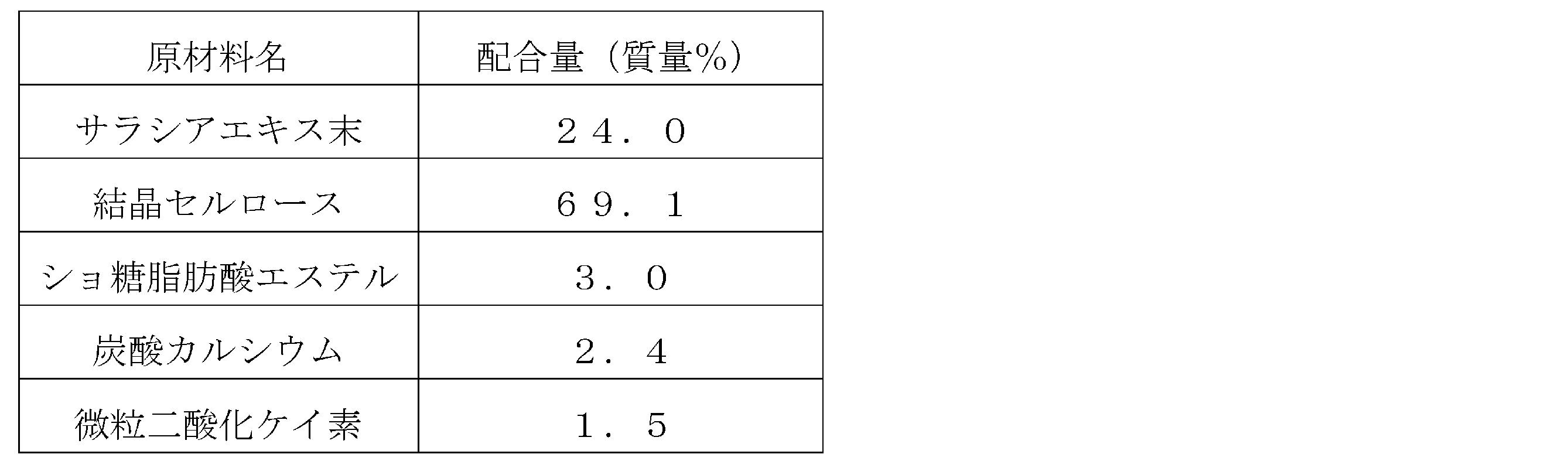
- Example 1 The roots and stems of S. reticulata and S. oblonga were crushed and mixed in equal weights, and the resulting solution was subjected to a hot water extraction step at 98° C. to be spray-dried. Salacia extract powder was obtained. The obtained Salacia extract powder was used to prepare tablets with the following formulation.
- Example 2 Measurement of sucrase IC 50 value
- sample solution A sample of 2 mg is weighed in a tube, and 2 mL of water is added and well suspended to prepare a sample solution having a concentration of 1 mg/mL. This is diluted with water to 0, 50, 100, 250 and 500 ⁇ g/mL, respectively.
- substrate solution Sucrose is dissolved in a 0.2 mol/L maleic acid buffer (pH 6.0) to a sucrose concentration of 100 mmol/L, and this is used as a substrate solution.
- the produced glucose concentration is quantified using a commercially available kit mutarotase glucose oxidase method (Glucose CII Test Wako, Fujifilm Wako Pure Chemical Industries, Ltd.).
- Preparation of blank To 250 ⁇ L of the sample solution of each concentration described above, 200 ⁇ L of the substrate solution and 50 ⁇ L of the crude enzyme solution were added, and immediately heated at 95° C. for 2 minutes to inactivate the enzyme to obtain blank data. ..
- the sucrase IC 50 value of the measured sample was 1 to 1000 ⁇ g/mL.
- Example 3 Measurement of urea nitrogen in blood 30 adult males were randomly divided into 2 groups, a Salacia group and a placebo group.
- the tablet containing the extract of the plant of the genus Salacia described in Example 1 and the tablet prepared only with the excipient were ingested for 1 week for 1 week for 4 weeks, and the urea nitrogen concentration in blood was measured by the urease method.
- the amount of change in urea nitrogen (average value for 15 persons in each group) before ingestion of the tablets and after 4 weeks of ingestion of the tablets is shown below.
- Example 4 Evaluation of stool odor 30 subjects of Example 3 (Salacia group: 15 persons, placebo group: 15 persons) were asked to answer the following questionnaire, and feces before and after the test described in Example 3 The odor change was evaluated. ⁇ Questionnaire items> 5 points: The odor of stools is very odorous. 4 points: The stool has a strong odor. 3 points: The stool smell is felt, but not. 2 points: The odor of stools is not so noticeable and I do not care much. 1 point: Almost no odor of stool was felt, and it did not bother me at all.
- Example 5 Functionality of human intestinal bacteria
- 1 g of the tablet containing the Salacia plant extract described in Example 1 as a test diet was ingested daily for 1 week for 2 weeks, and feces were collected.
- the pretreatment of feces was performed according to 16S Metagenomic Sequencing Library Preparation provided by Illumina Co., Ltd., and sequence analysis was performed using Miseq (Illumina) based on the method provided by Illumina.
- the obtained text data was analyzed using Quantitative Insights Into Microbiology Ecology (QIIME; Pycogent), and the data of the bacterial occupancy at the genus level was calculated.
- QIIME Quantitative Insights Into Microbiology Ecology
- a PICRUSt analysis for estimating the functionality of intestinal bacteria was carried out using the data, and an increase in “protein digestion and absorption” and a decrease in “Phenylalanine, tyrosine and tryptophan biosynthesis” were confirmed.
- Example 6 Improvement of skin condition In a Salacia ingestion test (4 weeks) targeting 10 women in their 30s with constipation, 4% of them answered that their skin condition improved. It was Very bad: 0 people Bad: 1 person No change: 2 people Better: 4 people Very good: 3 people
Landscapes
- Life Sciences & Earth Sciences (AREA)
- Health & Medical Sciences (AREA)
- Engineering & Computer Science (AREA)
- Chemical & Material Sciences (AREA)
- Food Science & Technology (AREA)
- Urology & Nephrology (AREA)
- General Health & Medical Sciences (AREA)
- Medicinal Chemistry (AREA)
- Immunology (AREA)
- Molecular Biology (AREA)
- Bioinformatics & Cheminformatics (AREA)
- Nutrition Science (AREA)
- Hematology (AREA)
- Pharmacology & Pharmacy (AREA)
- Physics & Mathematics (AREA)
- Analytical Chemistry (AREA)
- Biochemistry (AREA)
- Biomedical Technology (AREA)
- General Physics & Mathematics (AREA)
- Pathology (AREA)
- Polymers & Plastics (AREA)
- Mycology (AREA)
- Biotechnology (AREA)
- Botany (AREA)
- Microbiology (AREA)
- Biophysics (AREA)
- Cell Biology (AREA)
- Chemical Kinetics & Catalysis (AREA)
- General Chemical & Material Sciences (AREA)
- Nuclear Medicine, Radiotherapy & Molecular Imaging (AREA)
- Organic Chemistry (AREA)
- Animal Behavior & Ethology (AREA)
- Public Health (AREA)
- Veterinary Medicine (AREA)
- Medicines Containing Plant Substances (AREA)
Abstract
本発明の課題は、便臭を改善する物質を選択する方法、便臭を改善する組成物の製造方法を提供すること、並びに腎機能改善剤および腎機能改善のための飲食品を提供することである。本発明によれば、被験物質を投与した生体における血中尿素窒素濃度と、被験物質を投与していない生体における血中尿素窒素濃度とを比較し、被験物質を投与した生体における血中尿素窒素濃度が、被験物質を投与していない生体における血中尿素窒素濃度より低い場合における被験物質を、候補物質として選択する工程を含む、便臭を改善する物質を選択する方法が提供される。
Description
本発明は、血中尿素窒素濃度を指標として便臭を改善する物質を選択する方法に関する。本発明は、上記の方法を含む、便臭を改善する組成物の製造方法に関する。本発明はさらに、腎機能改善剤、および腎機能改善のための飲食品に関する。
サラシア属植物の根および幹は、インドおよびスリランカの伝統医学アーユルヴェーダにおいて天然薬物として利用されてきた。スリランカでは、サラシア・レティキュラータ(Salacia reticulata)の根皮が、リュウマチ、淋病および皮膚病の治療に有効であること、そして上記の根皮を初期糖尿病の治療に用いることが伝承されている。
特許文献1には、コタラ・ヒムブツ(サラシア属植物、Salacia reticulate, Salacia oblonga)の抽出物または微粉砕物、乳酸菌および/またはビフィズス菌、および難消化性オリゴ糖を含有することを特徴とする便性改善剤が記載されている。特許文献2には、サラシア属植物の熱水抽出物、緑茶の抽出物、および烏龍茶パウダーを含有する腸内有害菌の低減剤であって、低減される腸内有害菌がエンテロバクター属菌またはクロストリジウム属菌である腸内有害菌の低減剤が記載されている。
便臭に関する悩みは介護現場において深刻であるが、便臭を根本的に解決する方法は見出されていない。特許文献1および特許文献2には、サラシア属植物の抽出物を含む所定の組成物が、腸内環境を改善することが記載されているが、血中尿素窒素濃度と便臭の改善との関係については不明であった。
本発明は、便臭を改善する物質を選択する方法、並びに便臭を改善する組成物の製造方法を提供することを解決すべき課題とする。本発明はさらに、腎機能改善剤および腎機能改善のための飲食品を提供することを解決すべき課題とする。
本発明者らは、上記課題を解決するために鋭意検討した結果、サラシア属植物の抽出物を摂取したヒトにおいて、血中の尿素窒素が低減し、便臭が改善することを見出した。さらに本発明者らは、サラシア属植物の抽出物を摂取したヒトにおける腸内細菌の機能性解析においてタンパク分解およびアミノ酸生合成の抑制およびペプチド吸収促進を確認した。本発明は、これらの知見に基づいて完成したものである。本発明によれば以下の発明が提供される。
[1] 被験物質を投与した生体における血中尿素窒素濃度と、被験物質を投与していない生体における血中尿素窒素濃度とを比較し、被験物質を投与した生体における血中尿素窒素濃度が、被験物質を投与していない生体における血中尿素窒素濃度より低い場合における被験物質を、候補物質として選択する工程を含む、便臭を改善する物質を選択する方法。
[2] 被験物質が、サラシア属植物の粉砕物または抽出物である、[1]に記載の方法。
[3] サラシア属植物が、サラシア・レティキュラータ(Salacia reticulata)、サラシア・オブロンガ(Salacia oblonga)、およびサラシア・キネンシス(Salacia chinensis)から選ばれる少なくとも1種の植物である、[2]に記載の方法。
[4] サラシア属植物の粉砕物または抽出物のスクラーゼ50%阻害濃度が1~1000μg/mLである、[2]または[3]に記載の方法。
[2] 被験物質が、サラシア属植物の粉砕物または抽出物である、[1]に記載の方法。
[3] サラシア属植物が、サラシア・レティキュラータ(Salacia reticulata)、サラシア・オブロンガ(Salacia oblonga)、およびサラシア・キネンシス(Salacia chinensis)から選ばれる少なくとも1種の植物である、[2]に記載の方法。
[4] サラシア属植物の粉砕物または抽出物のスクラーゼ50%阻害濃度が1~1000μg/mLである、[2]または[3]に記載の方法。
[5] [1]に記載の方法により便臭を改善する物質を選択する工程;および、
選択した物質と、担体とを混合する工程:
を含む、便臭を改善する組成物の製造方法。
[6] 組成物に含まれる選択した物質が、サラシア属植物の粉砕物または抽出物である、[5]に記載の方法。
[7] サラシア属植物が、サラシア・レティキュラータ(Salacia reticulata)、サラシア・オブロンガ(Salacia oblonga)、およびサラシア・キネンシス(Salacia chinensis)から選ばれる少なくとも1種の植物である、[6]に記載の方法。
[8] サラシア属植物の粉砕物または抽出物のスクラーゼ50%阻害濃度が1~1000μg/mLである、[6]または[7]に記載の方法。
[9] 組成物が、飲食品である、[5]から[8]の何れか一に記載の方法。
[10] 組成物の摂取により、腸内において、タンパク質の消化および吸収の増加、並びにフェニルアラニン、チロシンおよびトリプトファンの生合成の減少を示す、[5]から[9]の何れか一に記載の方法。
選択した物質と、担体とを混合する工程:
を含む、便臭を改善する組成物の製造方法。
[6] 組成物に含まれる選択した物質が、サラシア属植物の粉砕物または抽出物である、[5]に記載の方法。
[7] サラシア属植物が、サラシア・レティキュラータ(Salacia reticulata)、サラシア・オブロンガ(Salacia oblonga)、およびサラシア・キネンシス(Salacia chinensis)から選ばれる少なくとも1種の植物である、[6]に記載の方法。
[8] サラシア属植物の粉砕物または抽出物のスクラーゼ50%阻害濃度が1~1000μg/mLである、[6]または[7]に記載の方法。
[9] 組成物が、飲食品である、[5]から[8]の何れか一に記載の方法。
[10] 組成物の摂取により、腸内において、タンパク質の消化および吸収の増加、並びにフェニルアラニン、チロシンおよびトリプトファンの生合成の減少を示す、[5]から[9]の何れか一に記載の方法。
[11] サラシア属植物の粉砕物または抽出物を含む、腎機能改善剤。
[12] サラシア属植物が、サラシア・レティキュラータ(Salacia reticulata)、サラシア・オブロンガ(Salacia oblonga)、およびサラシア・キネンシス(Salacia chinensis)から選ばれる少なくとも1種の植物である、[11]に記載の腎機能改善剤。
[13] サラシア属植物の粉砕物または抽出物のスクラーゼ50%阻害濃度が1~1000μg/mLである、[11]または[12]に記載の腎機能改善剤。
[14] 血中尿素窒素濃度の低下を通じて腎機能を改善する、[11]から[13]の何れか一に記載の腎機能改善剤。
[15] [11]から[14]の何れか一に記載の腎機能改善剤を含む、腎機能改善のための飲食品。
[12] サラシア属植物が、サラシア・レティキュラータ(Salacia reticulata)、サラシア・オブロンガ(Salacia oblonga)、およびサラシア・キネンシス(Salacia chinensis)から選ばれる少なくとも1種の植物である、[11]に記載の腎機能改善剤。
[13] サラシア属植物の粉砕物または抽出物のスクラーゼ50%阻害濃度が1~1000μg/mLである、[11]または[12]に記載の腎機能改善剤。
[14] 血中尿素窒素濃度の低下を通じて腎機能を改善する、[11]から[13]の何れか一に記載の腎機能改善剤。
[15] [11]から[14]の何れか一に記載の腎機能改善剤を含む、腎機能改善のための飲食品。
さらに本発明によれば、サラシア属植物の粉砕物または抽出物を、腎機能改善を必要とする対象に投与することを含む、腎機能の改善方法が提供される。
さらに本発明によれば、腎機能を改善する処理において使用するためのサラシア属植物の粉砕物または抽出物が提供される。
さらに本発明によれば、腎機能改善剤の製造のための、サラシア属植物の粉砕物または抽出物の使用が提供される。
さらに本発明によれば、腎機能改善のための飲食品の製造のための、サラシア属植物の粉砕物または抽出物の使用が提供される。
さらに本発明によれば、腎機能改善のための飲食品の製造のための、サラシア属植物の粉砕物または抽出物の使用が提供される。
本発明による便臭を改善する物質を選択する方法によれば、臭い物質そのものの産生を抑えることができる物質を得ることができる。
本発明による便臭を改善する組成物の製造方法によれば、臭い物質そのものの産生を抑えることができる、便臭を改善する組成物を製造することができる。
本発明による腎機能改善剤および腎機能改善のための飲食品によれば、血中の尿素窒素濃度を低下させることにより腎機能を改善することができる。
本発明による便臭を改善する組成物の製造方法によれば、臭い物質そのものの産生を抑えることができる、便臭を改善する組成物を製造することができる。
本発明による腎機能改善剤および腎機能改善のための飲食品によれば、血中の尿素窒素濃度を低下させることにより腎機能を改善することができる。
以下に、本発明の実施の形態について説明する。
特許文献1および2に記載の通り、サラシア属植物の抽出物を含む所定の組成物が、腸内環境を改善することは公知であったが、サラシア属植物の抽出物が、血中尿素窒素濃度を低減すること、そして、血中尿素窒素濃度低減に伴って便臭を改善することについては未知であった。本発明により、サラシア属植物の抽出物が、タンパク質の分解に関与する腸内細菌が増加し、タンパク質からアミノ酸への分解が促進し、生体内へのアミノ酸の取り込みが向上することが示唆された。それに伴い、アンモニアの原料となる腸内アミノ酸量は低下し、大腸内のアンモニア量も低下する可能性が明らかになった。また、アンモニアの体内への取り込みが減少し、血中尿素窒素量が低下することが明らかになった。
特許文献1および2に記載の通り、サラシア属植物の抽出物を含む所定の組成物が、腸内環境を改善することは公知であったが、サラシア属植物の抽出物が、血中尿素窒素濃度を低減すること、そして、血中尿素窒素濃度低減に伴って便臭を改善することについては未知であった。本発明により、サラシア属植物の抽出物が、タンパク質の分解に関与する腸内細菌が増加し、タンパク質からアミノ酸への分解が促進し、生体内へのアミノ酸の取り込みが向上することが示唆された。それに伴い、アンモニアの原料となる腸内アミノ酸量は低下し、大腸内のアンモニア量も低下する可能性が明らかになった。また、アンモニアの体内への取り込みが減少し、血中尿素窒素量が低下することが明らかになった。
便臭の測定に関しては、一般に手間および費用ともにかかるが、尿素窒素の測定は健康診断の項目の一つでもあり、簡単に行うことができるという利点がある。
また、本発明により製造される組成物を用いて便臭を改善することにより、介護現場の介護者、被介護者のQOL(Quolity of Life)を向上させることができる。また、便秘気味の女性のトイレ後の臭いを改善することにより、精神的負担軽減につながる。さらに、便臭は体臭の原因となるため、体臭の改善も可能である。
また、本発明により製造される組成物を用いて便臭を改善することにより、介護現場の介護者、被介護者のQOL(Quolity of Life)を向上させることができる。また、便秘気味の女性のトイレ後の臭いを改善することにより、精神的負担軽減につながる。さらに、便臭は体臭の原因となるため、体臭の改善も可能である。
[便臭を改善する物質を選択する方法]
本発明による便臭を改善する物質を選択する方法は、被験物質を投与した生体における血中尿素窒素濃度と、被験物質を投与していない生体における血中尿素窒素濃度とを比較し、被験物質を投与した生体における血中尿素窒素濃度が、被験物質を投与していない生体における血中尿素窒素濃度より低い場合における被験物質を、候補物質として選択する工程を含む。
本発明による便臭を改善する物質を選択する方法は、被験物質を投与した生体における血中尿素窒素濃度と、被験物質を投与していない生体における血中尿素窒素濃度とを比較し、被験物質を投与した生体における血中尿素窒素濃度が、被験物質を投与していない生体における血中尿素窒素濃度より低い場合における被験物質を、候補物質として選択する工程を含む。
被験物質としては、便臭を改善する候補物質であれば特に限定されず、例えば、植物の粉砕物または抽出物、動物組織抽出物、有機化合物(合成低分子化合物を含む)、タンパク質、ペプチド、微生物培養物、細胞抽出物などが挙げられ、これらの物質は新規なものであってもよいし、公知のものであってもよい。被験物質としては、植物の粉砕物または抽出物が好ましく、特にサラシア属植物の粉砕物または抽出物が好ましい。サラシア属植物の粉砕物または抽出物の詳細については後記する。被験物質は、そのまま生体に投与してもよいし、必要に応じて溶媒に溶解させて投与してもよい。
被験物質を投与する生体は特に限定されず、ヒトでもよいし、ヒト以外の哺乳動物(マウスまたはラット等のげっ歯類、ウマまたはロバ等の奇蹄類、ウシ、ブタ、ラクダ、ロバ、ヤギまたはヒツジ等の偶蹄類、イヌ、ネコまたはウサギ等の愛玩動物類)でもよい。
被験物質の投与回数は特に限定されないが、例えば1回/日で1日~2か月(一例としては4週間)投与することができる。
被験物質の投与回数は特に限定されないが、例えば1回/日で1日~2か月(一例としては4週間)投与することができる。
生体における血中尿素窒素濃度は、当業者に公知の常法により測定することができる。血中尿素窒素濃度の測定は、具体的には、ウレアーゼ法(ウレアーゼを尿素と反応させて炭酸アンモニアとし、そのアンモニアを測定する方法)、またはジアセチルモノオキシム法(尿素を酸性溶液中でジアセチルモノオキシムと橙黄色に呈色するのを比色する方法)により行うことができる。ウレアーゼ法およびジアセチルモノオキシム法は、自動分析法を利用することができる。
本発明においては、被験物質を投与した生体における血中尿素窒素濃度が、被験物質を投与していない生体における血中尿素窒素濃度より低い場合における被験物質を、候補物質として選択する。
「被験物質を投与した生体における血中尿素窒素濃度が、被験物質を投与していない生体における血中尿素窒素濃度より低い場合」の第一の例および第二の例は以下に記載する。
(第一の例)
第一の例は、生体に対し、所定量の被験物質を所定の期間投与する際に、投与前の血中尿素窒素濃度と投与後の血中尿素窒素濃度をそれぞれ測定し、投与後の血中尿素窒素濃度が、投与前の血中尿素窒素濃度より低い場合である。例えば、投与後の血中尿素窒素濃度が、投与前の血中尿素窒素濃度よりも、0.1mg/dL以上低い、または、投与前後を比較した際に5%有意差があればよい。好ましくは、投与後の血中尿素窒素濃度が、投与前の血中尿素窒素濃度よりも0.2mg/dL以上低い、0.3mg/dL以上低い、0.4mg/dL以上低い、または0.5mg/dL以上低いものであればよい。
「被験物質を投与した生体における血中尿素窒素濃度が、被験物質を投与していない生体における血中尿素窒素濃度より低い場合」の第一の例および第二の例は以下に記載する。
(第一の例)
第一の例は、生体に対し、所定量の被験物質を所定の期間投与する際に、投与前の血中尿素窒素濃度と投与後の血中尿素窒素濃度をそれぞれ測定し、投与後の血中尿素窒素濃度が、投与前の血中尿素窒素濃度より低い場合である。例えば、投与後の血中尿素窒素濃度が、投与前の血中尿素窒素濃度よりも、0.1mg/dL以上低い、または、投与前後を比較した際に5%有意差があればよい。好ましくは、投与後の血中尿素窒素濃度が、投与前の血中尿素窒素濃度よりも0.2mg/dL以上低い、0.3mg/dL以上低い、0.4mg/dL以上低い、または0.5mg/dL以上低いものであればよい。
(第二の例)
所定量の被験物質を所定の期間投与する生体と、上記被験物質を含まない対照を投与する生体とを用意する。それぞれの生体について、投与前の血中尿素窒素濃度と投与後の血中尿素窒素濃度をそれぞれ測定し、投与前後の血中尿素窒素濃度の変化量(減少量)を求める。第二の例は、被験物質を投与した生体における投与前後の血中尿素窒素濃度の変化量(減少量)が、被験物質を含まない対照を投与した生体における投与前後の血中尿素窒素濃度の変化量(減少量)よりも大きい場合である。例えば、被験物質を投与した生体における投与前後の血中尿素窒素濃度の変化(減少)が、被験物質を含まない対照を投与した生体における投与前後の血中尿素窒素濃度の変化(減少)よりも、0.1mg/dL以上低い、または、群間比較を行った際に5%有意差があればよい。好ましくは、被験物質を投与した生体における投与前後の血中尿素窒素濃度の変化(減少)が、被験物質を含まない対照を投与した生体における投与前後の血中尿素窒素濃度の変化(減少)よりも、0.2mg/dL以上低い、0.3mg/dL以上低い、0.4mg/dL以上低い、0.5mg/dL以上低い、1.0mg/dL以上低い、1.5mg/dL以上低い、または2.0mg/dL以上低いものであればよい。
所定量の被験物質を所定の期間投与する生体と、上記被験物質を含まない対照を投与する生体とを用意する。それぞれの生体について、投与前の血中尿素窒素濃度と投与後の血中尿素窒素濃度をそれぞれ測定し、投与前後の血中尿素窒素濃度の変化量(減少量)を求める。第二の例は、被験物質を投与した生体における投与前後の血中尿素窒素濃度の変化量(減少量)が、被験物質を含まない対照を投与した生体における投与前後の血中尿素窒素濃度の変化量(減少量)よりも大きい場合である。例えば、被験物質を投与した生体における投与前後の血中尿素窒素濃度の変化(減少)が、被験物質を含まない対照を投与した生体における投与前後の血中尿素窒素濃度の変化(減少)よりも、0.1mg/dL以上低い、または、群間比較を行った際に5%有意差があればよい。好ましくは、被験物質を投与した生体における投与前後の血中尿素窒素濃度の変化(減少)が、被験物質を含まない対照を投与した生体における投与前後の血中尿素窒素濃度の変化(減少)よりも、0.2mg/dL以上低い、0.3mg/dL以上低い、0.4mg/dL以上低い、0.5mg/dL以上低い、1.0mg/dL以上低い、1.5mg/dL以上低い、または2.0mg/dL以上低いものであればよい。
<サラシア属植物の粉砕物または抽出物>
サラシア属植物は、主としてスリランカ、インドおよび東南アジア地域に自生するデチンムル科の植物であり、より具体的にはサラシア・レティキュラータ(Salacia reticulata)、サラシア・オブロンガ(Salacia oblonga)、サラシア・プリノイデス(Salacia prinoides)、サラシア・キネンシス(Salacia chinensis)、サラシア・ラティフォリア(Salacia latifolia)、サラシア・ブルノニアーナ(Salacia burunoniana)、サラシア・グランディフローラ(Salacia grandiflora)、およびサラシア・マクロスペルマ(Salacia macrosperma)から選ばれる1種類以上の植物が挙げられる。サラシア属植物としては、サラシア・レティキュラータ(Salacia reticulata)、サラシア・オブロンガ(Salacia oblonga)、およびサラシア・キネンシス(Salacia chinensis)から選ばれる少なくとも1種の植物であることが好ましい。
サラシア属植物は、主としてスリランカ、インドおよび東南アジア地域に自生するデチンムル科の植物であり、より具体的にはサラシア・レティキュラータ(Salacia reticulata)、サラシア・オブロンガ(Salacia oblonga)、サラシア・プリノイデス(Salacia prinoides)、サラシア・キネンシス(Salacia chinensis)、サラシア・ラティフォリア(Salacia latifolia)、サラシア・ブルノニアーナ(Salacia burunoniana)、サラシア・グランディフローラ(Salacia grandiflora)、およびサラシア・マクロスペルマ(Salacia macrosperma)から選ばれる1種類以上の植物が挙げられる。サラシア属植物としては、サラシア・レティキュラータ(Salacia reticulata)、サラシア・オブロンガ(Salacia oblonga)、およびサラシア・キネンシス(Salacia chinensis)から選ばれる少なくとも1種の植物であることが好ましい。
本明細書において、サラシア属植物の粉砕物または抽出物とは、サラシア属植物の根、幹、葉、花、果実等可食部の粉砕物または抽出物、上記粉砕物または抽出物の乾燥物を包含する意味で用いられる。本明細書において、乾燥物とは、乾燥粉末(エキス末)でもよい。上記したサラシア属植物の粉砕物または抽出物を調製する際には、サラシア属植物の1種類以上の部位を混合して使用してもよい。サラシア属植物の抽出物としては、より好ましくは、根、および幹から選ばれる部位から抽出した抽出物を乾燥して得られるエキス末が用いられる。
乾燥粉末(エキス末)は、好ましくは、サラシア属植物の可食部等を溶媒によって抽出し、上記で得られた抽出物を乾燥させることによって得ることができる。
抽出に用いる溶媒としては、水、アルコール、またはケトン等が挙げられ、これらを2種以上混合した混合溶媒を用いてもよい。
アルコールとしては、メタノール、またはエタノール等が挙げられ、エタノールが好ましい。
ケトンとしては、アセトン、メチルエチルケトン、またはシクロヘキサン等が好ましい。
抽出に用いる溶媒としては、水、アルコール、またはケトン等が挙げられ、これらを2種以上混合した混合溶媒を用いてもよい。
アルコールとしては、メタノール、またはエタノール等が挙げられ、エタノールが好ましい。
ケトンとしては、アセトン、メチルエチルケトン、またはシクロヘキサン等が好ましい。
上記の中でも、水、アルコール、水とアルコールとの混合溶媒、または水とケトンとの混合溶媒が好ましく、水、アルコール、または水とアルコールとの混合溶媒がより好ましく、50℃~98℃の熱水、エタノール、または水とエタノールとの混合溶媒がさらに好ましい。
水とアルコールとの混合溶媒におけるアルコール含有量は、30質量%~90質量%が好ましく、40質量%~70質量%がより好ましい。
抽出物を乾燥して、乾燥粉末(エキス末)を得る際の乾燥方法は、特に制限はなく、公知の乾燥方法、例えば、噴霧乾燥、凍結乾燥等の方法が挙げられる。また、公知の賦形剤、例えば、デキストリン等の糖類を用いて乾燥粉末とすることもできる。より活性の高い乾燥粉末を得る観点からは、抽出物をそのままスプレードライ等の噴霧乾燥させて調製することが好ましい。
抽出物を乾燥して、乾燥粉末(エキス末)を得る際の乾燥方法は、特に制限はなく、公知の乾燥方法、例えば、噴霧乾燥、凍結乾燥等の方法が挙げられる。また、公知の賦形剤、例えば、デキストリン等の糖類を用いて乾燥粉末とすることもできる。より活性の高い乾燥粉末を得る観点からは、抽出物をそのままスプレードライ等の噴霧乾燥させて調製することが好ましい。
<α-グルコシダーゼ阻害活性>
サラシア属植物の粉砕物または抽出物は、α-グルコシダーゼ阻害活性を有していてもよいし、α-グルコシダーゼ阻害活性を有していなくてもよい。
サラシア属植物の粉砕物または抽出物は、α-グルコシダーゼ阻害活性を有していてもよいし、α-グルコシダーゼ阻害活性を有していなくてもよい。
α-グルコシダーゼ阻害活性の指標としてのスクラーゼ50%阻害濃度(IC50値)は以下の方法で測定することができる。
[実験法1]スクラーゼIC50値の測定
サンプル溶液の準備:チューブに2mgのサンプルを量り取り、水2mLを加えてよく懸濁し、1mg/mL濃度のサンプル溶液を作製する。これをそれぞれ0、50、100、250、500μg/mLとなるように水で希釈する。
[実験法1]スクラーゼIC50値の測定
サンプル溶液の準備:チューブに2mgのサンプルを量り取り、水2mLを加えてよく懸濁し、1mg/mL濃度のサンプル溶液を作製する。これをそれぞれ0、50、100、250、500μg/mLとなるように水で希釈する。
基質液の準備:0.2mol/Lマレイン酸バッファー(pH6.0)にスクロース濃度100mmol/Lとなるようにスクロースを溶解し、これを基質液とする。
粗酵素液の準備:10mLの生理食塩水に1gのintestinal acetone powder rat(SIGMA社製)を懸濁した後、遠心分離(3,000rpm,4℃,5分)する。得られた上清を分離し、粗酵素液とする。
粗酵素液の準備:10mLの生理食塩水に1gのintestinal acetone powder rat(SIGMA社製)を懸濁した後、遠心分離(3,000rpm,4℃,5分)する。得られた上清を分離し、粗酵素液とする。
上記の各濃度のサンプル溶液500μLに対し、基質液400μLを添加し、水浴中37℃にて5分間予備加温する。ここにそれぞれ、粗酵素液を100μL添加し、37℃にて60分間反応させる。反応終了後、95℃にて2分間加温することで酵素を失活させて反応を停止させる。生成したグルコース濃度を市販のキット・ムタロターゼ・グルコースオキシダーゼ法(グルコースCIIテストワコー、富士フイルム和光純薬株式会社)を使用して定量を行う。
ブランクの準備:上記の各濃度のサンプル溶液250μLに対し、基質液200μL、粗酵素液50μLを添加し、直ちに95℃にて2分間加温することで酵素を熱失活させ、ブランクデータとする。
得られた値より検量線を作成し、酵素活性を50%阻害する濃度(IC50値)を求める。
得られた値より検量線を作成し、酵素活性を50%阻害する濃度(IC50値)を求める。
本発明で用いるサラシア属植物の粉砕物または抽出物のスクラーゼ50%阻害濃度(IC50値)は、好ましくは1~1000μg/mLであり、より好ましくは1~800μg/mLであり、さらに好ましくは1~600μg/mLであり、よりさらに好ましくは1~400μg/mLである。
[便臭を改善する組成物の製造方法、および腎機能改善剤]
本発明による便臭を改善する組成物の製造方法は、上記した本発明の方法により便臭を改善する物質を選択する工程;および選択した物質と、担体とを混合する工程を含む。
好ましくは、便臭を改善する組成物の摂取により、腸内において、タンパク質の消化および吸収の増加、並びにフェニルアラニン、チロシンおよびトリプトファンの生合成の減少を示すことができる。
本発明による便臭を改善する組成物の製造方法は、上記した本発明の方法により便臭を改善する物質を選択する工程;および選択した物質と、担体とを混合する工程を含む。
好ましくは、便臭を改善する組成物の摂取により、腸内において、タンパク質の消化および吸収の増加、並びにフェニルアラニン、チロシンおよびトリプトファンの生合成の減少を示すことができる。
本発明はさらに、サラシア属植物の粉砕物または抽出物を含む、腎機能改善剤に関する。
本発明によればさらに、サラシア属植物の粉砕物または抽出物を、腎機能改善を必要とする対象に投与することを含む、腎機能の改善方法が提供される。
サラシア属植物の粉砕物または抽出物については本明細書中において上記した通りである。
本発明の腎機能改善剤は好ましくは、血中尿素窒素濃度の低下を通じて腎機能を改善することができる。
本発明によればさらに、サラシア属植物の粉砕物または抽出物を、腎機能改善を必要とする対象に投与することを含む、腎機能の改善方法が提供される。
サラシア属植物の粉砕物または抽出物については本明細書中において上記した通りである。
本発明の腎機能改善剤は好ましくは、血中尿素窒素濃度の低下を通じて腎機能を改善することができる。
便臭を改善する組成物および腎機能改善剤の製造において使用する担体としては、薬学的若しくは食品衛生上許容される各種の担体、例えば賦形剤、滑沢剤、安定剤、分散剤、結合剤、希釈剤、香味料、甘味料、風味剤、および着色剤から選択される1種以上の添加物を用いて調製することができ、好ましくは経口投与剤として調製することができる。
便臭を改善する組成物および腎機能改善剤には、本発明の方法により選択された便臭を改善する物質に加えて、更に他の成分を含有していてもよい。他の成分としては、例えば、乳酸菌、ミネラル酵母、フラボノイド、ポリフェノール、および免疫賦活作用を有する経口物質等が挙げられるが、特に限定されない。上記の他の成分としては、具体的には、特開2015-127340号公報の段落番号0023~0038に記載された成分を挙げることができる。
便臭を改善する組成物および腎機能改善剤には、さらに、ビタミン、ビタミン様物質、タンパク質、アミノ酸、油脂、有機酸、炭水化物、植物由来原料、動物由来原料、微生物、食品用添加物、および医薬品用添加物から選択される1種以上等、経口摂取可能な成分を適宜含有させることができる。
便臭を改善する組成物および腎機能改善剤の形態は、本発明の効果を奏するものである限り、特に制限されず、例えば、錠剤、丸剤、顆粒剤、細粒剤、咀嚼剤、カプセル剤(ハードカプセル、ソフトカプセルに充填されたもの)、液剤、チュアブル剤、また後記する飲食品の形態であってもよい。
上記した投与形態は、当業者に知られた慣用的な方法を用いて調製することができる。
上記した投与形態は、当業者に知られた慣用的な方法を用いて調製することができる。
錠剤、丸剤および顆粒剤の場合、必要に応じて慣用的な剤皮を施した剤形、例えば糖衣錠,ゼラチン被包剤、腸溶被包剤、フィルムコーティング剤等とすることもでき、また錠剤は二重錠等の多層錠とすることもできる。
サラシア属植物の粉砕物または抽出物を含む便臭を改善する組成物、および腎機能改善剤は、サラシア属植物の粉砕物または抽出物の経時による変色を改善するため、乾燥剤として炭酸カルシウムおよび/または二酸化ケイ素(好ましくは微粒二酸化ケイ素)を配合することが好ましい。
便臭を改善する組成物および腎機能改善剤が錠剤またはカプセル剤である場合、錠剤またはカプセル剤の質量の1%以上の量の炭酸カルシウムおよび/または二酸化ケイ素を含有することが好ましい。炭酸カルシウムまたは二酸化ケイ素の添加については、それぞれ単独で1質量%以上含有していてもよく、炭酸カルシウムと二酸化ケイ素の合計が1質量%以上含まれていてもよい。なお、食品用途の場合、食品衛生法により炭酸カルシウムの添加量の上限は2.5質量%であり、二酸化ケイ素の添加量の上限は2.0質量%であることから、便臭を改善する組成物および腎機能改善剤を食品として提供する場合には、炭酸カルシウムの添加量は2.5質量%以下であり、二酸化ケイ素の添加量は2.0質量%以下であることが好ましい。
便臭を改善する組成物および腎機能改善剤は、食品あるいは食品添加物として利用可能な低吸湿性原料、吸湿剤、酸化防止剤等を配合することができる。好ましくは低吸湿性原料としてセルロース、結晶セルロース、粉末セルロース、微結晶セルロース、乳糖、オリゴ糖、糖アルコール、トレハロース、ステアリン酸マグネシウム、ステアリン酸カルシウム、ショ糖脂肪酸エステル等が用いられる。吸湿剤としてはケイ酸塩類、炭酸マグネシウム、フェロシアン化物、多糖類等が用いられる。より好ましくは低吸湿性原料として結晶セルロース、微結晶セルロース、乳糖、ショ糖脂肪酸エステルが用いられる。酸化防止剤としては、アスコルビン酸若しくはアスコルビン酸ナトリウム等が用いられる。
便臭を改善する組成物および腎機能改善剤は、さらに、粉末、固形剤または液剤に成型するのに必要な化合物を適宜包含していてもよい。上記化合物の例としては、エリスリトール、マルチトール、ヒドロキシプロピルセルロース、カオリン、タルク等が挙げられる。
[便臭を改善する組成物および腎機能改善剤の使用方法]
便臭を改善する組成物および腎機能改善剤は、ヒトを含む哺乳動物を投与対象とし、哺乳動物に経口的に投与することができる。
便臭を改善する組成物および腎機能改善剤は、ヒトを含む哺乳動物を投与対象とし、哺乳動物に経口的に投与することができる。
サラシア属植物の粉砕物または抽出物を含む便臭を改善する組成物または腎機能改善剤を、例えば、ヒトに投与する場合、サラシア属植物の粉砕物または抽出物の一日摂取量または投与量は、0.1mg/kg/日以上が好ましく、0.5mg/kg/日以上がより好ましく、1.0mg/kg/日以上がさらに好ましく、2.0mg/kg/日以上がさらに好ましく、4.0mg/kg/日以上がさらに好ましい。サラシア属植物の粉砕物または抽出物の一日摂取量または投与量の上限は特に限定されないが、一般的には、100mg/kg/日以下であり、好ましくは50mg/kg/日以下である。
便臭を改善する組成物および腎機能改善剤に含まれるサラシア属植物の粉砕物または抽出物の量は、適宜設定することができる。例えば、1日摂取量が3錠である錠剤を作製する場合、1錠あたり1日摂取量の1/3を含有することが好ましい。
本発明の腎機能改善剤は、腎機能改善を必要とする対象に投与することができる。腎機能改善を必要とする対象としては、急性糸球体腎炎、微小変化型腎炎、慢性糸球体腎炎、腎硬化症、膜性増殖性腎炎、メサンギウム増殖性糸球体腎炎、膜性増殖性糸球体腎炎、半月体形成性腎炎、急速進行性糸球体腎炎、膜性糸球体腎炎、尿細管間質性腎炎、急性腎盂腎炎、慢性腎盂腎炎、管内増殖性腎炎、ループス腎炎等の腎炎や、急性腎不全、慢性腎不全等の腎不全の他、アミロイド腎、膜性腎症、巣状糸球体硬化症、IgA腎症、急性尿細管壊死、ネフローゼ症候群、糖尿病性腎症、痛風腎、腎性浮腫、腎腫瘍、腎臓虚血障害、腎臓虚血再灌流障害などの疾患を患う対象を挙げることができる。
<飲食品および医薬品>
本発明の腎機能改善剤の形態は、特に限定されず、例えば、飲食品(飲料およびサプリメントを含む)、食品材料、医薬部外品、医薬品、医薬品材料、および医薬部外品材料の何れでもよい。即ち、本発明によれば、本発明の腎機能改善剤を含む、腎機能改善のための飲食品が提供される。
本発明の腎機能改善剤の形態は、特に限定されず、例えば、飲食品(飲料およびサプリメントを含む)、食品材料、医薬部外品、医薬品、医薬品材料、および医薬部外品材料の何れでもよい。即ち、本発明によれば、本発明の腎機能改善剤を含む、腎機能改善のための飲食品が提供される。
飲食品としては、健康食品(錠剤、顆粒、カプセル、粉体等)、ドリンク剤、飲料等が挙げられる。
本発明の飲食品の形態は、特に限定されず、主として経口経路で体内へ供給可能な種々の形態とすることができる。本発明の食品は、例えば、粉末食品、顆粒状食品、シート状食品、瓶詰め食品、缶詰食品、レトルト食品、カプセル食品、タブレット状食品、流動食品、またはドリンク剤等の形態において提供することができる。本発明の飲食品は、健康食品、機能性食品、栄養補助食品、特定保健用食品等の食品として用いることができる。特に、麺類、菓子類、ご飯類などの形態とすることができる。
本発明の飲食品は、機能性食品の形態の場合、栄養ドリンク、滋養強壮剤、嗜好性飲料、冷菓等の一般的な食品類のみならず、錠剤状、顆粒状、カプセル状の栄養補助食品として提供することも好ましい。
本発明の飲食品は、機能性食品の形態の場合、栄養ドリンク、滋養強壮剤、嗜好性飲料、冷菓等の一般的な食品類のみならず、錠剤状、顆粒状、カプセル状の栄養補助食品として提供することも好ましい。
本発明の飲食品は、本発明の腎機能改善剤以外に、一般に食品に用いられる成分を所望により含有していてもよい。
本発明の飲食品に使用しうる成分としては、例えば、着色料、保存料、増粘安定剤、酸化防止剤、発色剤、漂白剤、防かび剤、ガムベース、苦味料、酵素、光沢剤、酸味料、調味料、乳化剤、強化剤、製造用剤(賦形剤)、香料、香辛料抽出物、pH調整剤等が挙げられる。
本発明の飲食品に使用しうる成分としては、例えば、着色料、保存料、増粘安定剤、酸化防止剤、発色剤、漂白剤、防かび剤、ガムベース、苦味料、酵素、光沢剤、酸味料、調味料、乳化剤、強化剤、製造用剤(賦形剤)、香料、香辛料抽出物、pH調整剤等が挙げられる。
本発明の飲食品のpHは、8.0以下とすることが好ましく、7.0以下とすることがより好ましく、3.0~6.0とすることが更に好ましい。
飲食品におけるpHの調整に使用可能なpH調整剤は、食品分野で通常用いられるものであればいずれも使用することができる。
飲食品におけるpHの調整に使用可能なpH調整剤は、食品分野で通常用いられるものであればいずれも使用することができる。
飲食品に使用可能なpH調整剤としては、例えば、グルコン酸、L-酒石酸、リンゴ酸、乳酸、アジピン酸、コハク酸、酢酸、フマル酸、フィチン酸およびこれらの誘導体から選ばれる有機酸、重曹(炭酸水素ナトリウム)、炭酸ナトリウム、水酸化ナトリウム、水酸化カルシウム、リン酸水素二ナトリウム、リン酸二水素ナトリウム、リン酸水素二カリウム、リン酸二水素カリウム、炭酸カリウム等の無機酸を挙げることができる。
有機酸は、ナトリウム塩、カリウム塩、マグネシウム塩等の塩の形態をとるものであってもよい。
pH調整剤は、単独でまたは2種以上を組み合わせて使用することができる。
有機酸は、ナトリウム塩、カリウム塩、マグネシウム塩等の塩の形態をとるものであってもよい。
pH調整剤は、単独でまたは2種以上を組み合わせて使用することができる。
飲食品において使用可能な他の成分としては、乳蛋白質、大豆蛋白質、卵アルブミン蛋白質等、または、これらの分解物である卵白オリゴペプチド、大豆加水分解物、アミノ酸単体の混合物等が挙げられる。
また本発明の飲食品は、糖類、脂肪、微量元素、ビタミン、乳化剤、香料等を配合した自然流動食、半消化態栄養食および栄養食、ドリンク剤、カプセル剤、経腸栄養剤等の加工物の形態をとることができる。
本発明の飲食品をドリンク剤の形態とする場合は、栄養バランス、および摂取時の風味を改良するために、アミノ酸、ビタミン、ミネラル等の栄養的添加物、甘味料、香辛料、香料および色素等を配合してもよい。
本発明の腎機能改善剤が飲食品として用いられる場合、その含有量は、目的に応じて適宜選択することができる。サラシア属植物の粉砕物または抽出物の有効性を十分に発現させるという観点からは、本発明の飲食品におけるサラシア属植物の粉砕物または抽出物の含有量が、飲食品の全量に対して、1質量%~60質量%の範囲であることが好ましく、1質量%~40質量%の範囲であることがより好ましい。
<サラシア属植物の粉砕物または抽出物の用途>
本発明によれば、腎機能を改善する処理において使用するためのサラシア属植物の粉砕物または抽出物が提供される。さらに本発明によれば、腎機能改善剤または腎機能改善のための飲食品の製造のための、サラシア属植物の粉砕物または抽出物の使用が提供される。上記発明における好ましい態様は、本明細書中において上記した通りである。
本発明を以下の実施例によりさらに説明するが、本発明は以下の実施例に限定されるものではない。
本発明によれば、腎機能を改善する処理において使用するためのサラシア属植物の粉砕物または抽出物が提供される。さらに本発明によれば、腎機能改善剤または腎機能改善のための飲食品の製造のための、サラシア属植物の粉砕物または抽出物の使用が提供される。上記発明における好ましい態様は、本明細書中において上記した通りである。
本発明を以下の実施例によりさらに説明するが、本発明は以下の実施例に限定されるものではない。
実施例1:
サラシア・レティキュラータ(S. reticulata)とサラシア・オブロンガ(S. oblonga)の根および幹の部分を粉砕後等重量ずつ混合し、98℃の熱水抽出工程を経て得られた液をスプレー乾燥し、サラシアエキス末を得た。得られたサラシアエキス末を用いて下記の配合で錠剤を作製した。
サラシア・レティキュラータ(S. reticulata)とサラシア・オブロンガ(S. oblonga)の根および幹の部分を粉砕後等重量ずつ混合し、98℃の熱水抽出工程を経て得られた液をスプレー乾燥し、サラシアエキス末を得た。得られたサラシアエキス末を用いて下記の配合で錠剤を作製した。
実施例2:スクラーゼIC50値の測定
サンプル溶液の準備:チューブに2mgのサンプルを量り取り、水2mLを加えてよく懸濁し、1mg/mL濃度のサンプル溶液を作製する。これをそれぞれ0、50、100、250、500μg/mLとなるように水で希釈する。
基質液の準備:0.2mol/Lマレイン酸バッファー(pH6.0)にスクロース濃度100mmol/Lとなるようにスクロースを溶解し、これを基質液とする。
粗酵素液の準備:10mLの生理食塩水に1gのintestinal acetone powder rat(SIGMA社製)を懸濁した後、遠心分離(3,000rpm,4℃,5min)した。得られた上清を分離し、粗酵素液とする。
前述の各濃度のサンプル溶液500μLに対し、基質液400μLを添加し、水浴中37℃にて5分間予備加温した。ここにそれぞれ、粗酵素液を100μL添加し、37℃にて60分間反応させた。反応終了後、95℃にて2分間加温することで酵素を失活させて反応を停止させた。生成したグルコース濃度を市販のキット・ムタロターゼ・グルコースオキシダーゼ法(グルコースCIIテストワコー、富士フイルム和光純薬株式会社)を使用して定量を行う。
ブランクの準備:前述の各濃度のサンプル溶液250μLに対し、基質液200μL、粗酵素液50μLを添加し、直ちに95℃にて2分間加温することで酵素を熱失活させ、ブランクデータとする。
測定したサンプルのスクラーゼIC50値は、1~1000μg/mLであった。
サンプル溶液の準備:チューブに2mgのサンプルを量り取り、水2mLを加えてよく懸濁し、1mg/mL濃度のサンプル溶液を作製する。これをそれぞれ0、50、100、250、500μg/mLとなるように水で希釈する。
基質液の準備:0.2mol/Lマレイン酸バッファー(pH6.0)にスクロース濃度100mmol/Lとなるようにスクロースを溶解し、これを基質液とする。
粗酵素液の準備:10mLの生理食塩水に1gのintestinal acetone powder rat(SIGMA社製)を懸濁した後、遠心分離(3,000rpm,4℃,5min)した。得られた上清を分離し、粗酵素液とする。
前述の各濃度のサンプル溶液500μLに対し、基質液400μLを添加し、水浴中37℃にて5分間予備加温した。ここにそれぞれ、粗酵素液を100μL添加し、37℃にて60分間反応させた。反応終了後、95℃にて2分間加温することで酵素を失活させて反応を停止させた。生成したグルコース濃度を市販のキット・ムタロターゼ・グルコースオキシダーゼ法(グルコースCIIテストワコー、富士フイルム和光純薬株式会社)を使用して定量を行う。
ブランクの準備:前述の各濃度のサンプル溶液250μLに対し、基質液200μL、粗酵素液50μLを添加し、直ちに95℃にて2分間加温することで酵素を熱失活させ、ブランクデータとする。
測定したサンプルのスクラーゼIC50値は、1~1000μg/mLであった。
実施例3:血中の尿素窒素の測定
成人男性30名をランダムに2群にサラシア群とプラセボ群に分けた。試験食として実施例1に記載のサラシア属植物エキス含有錠剤と賦型剤のみで作製した錠剤を、1日1g4週間摂取させ、ウレアーゼ法にて血中尿素窒素濃度を測定した。錠剤の摂取前と、錠剤の摂取4週間後における尿素窒素の変化量(各群15名ずつの平均値)を以下に示す。
サラシア群:-0.55mg/dL
プラセボ群:1.49mg/dL
(群間有意差p=0.0099)
成人男性30名をランダムに2群にサラシア群とプラセボ群に分けた。試験食として実施例1に記載のサラシア属植物エキス含有錠剤と賦型剤のみで作製した錠剤を、1日1g4週間摂取させ、ウレアーゼ法にて血中尿素窒素濃度を測定した。錠剤の摂取前と、錠剤の摂取4週間後における尿素窒素の変化量(各群15名ずつの平均値)を以下に示す。
サラシア群:-0.55mg/dL
プラセボ群:1.49mg/dL
(群間有意差p=0.0099)
実施例4:便臭の評価
実施例3の被験者30名(サラシア群:15名、プラセボ群:15名)に対して以下のアンケートへ回答してもらい、実施例3記載の試験前後での便臭変化に関する評価を行った。
<アンケート項目>
5点:便のにおいの強さが非常に臭く感じられる。
4点:便の臭いの強さが臭く感じられる。
3点:便の臭いは感じるが、臭くは感じられない。
2点:便の臭いの強さがさほど感じられず、あまり気にならない。
1点:便の臭いの強さがほとんど感じられず、全く気にならない。
実施例3の被験者30名(サラシア群:15名、プラセボ群:15名)に対して以下のアンケートへ回答してもらい、実施例3記載の試験前後での便臭変化に関する評価を行った。
<アンケート項目>
5点:便のにおいの強さが非常に臭く感じられる。
4点:便の臭いの強さが臭く感じられる。
3点:便の臭いは感じるが、臭くは感じられない。
2点:便の臭いの強さがさほど感じられず、あまり気にならない。
1点:便の臭いの強さがほとんど感じられず、全く気にならない。
<評価>
サラシア群:15名、プラセボ群:15名の試験前、試験後のスコアについてそれぞれ算術平均して平均値を算出した。
続いて、試験前のスコアの平均値をゼロとして、試験後のスコアとの差分を算出し、サラシア群およびプラセボ群それぞれでの試験前後の値の変化量を便臭変化のスコアとして算出した。結果を以下に示す。
サラシア群:-1.07
プラセボ群:0.14
p値(有意確率)を確認したところ、1%有意水準が確認された。
サラシア群:15名、プラセボ群:15名の試験前、試験後のスコアについてそれぞれ算術平均して平均値を算出した。
続いて、試験前のスコアの平均値をゼロとして、試験後のスコアとの差分を算出し、サラシア群およびプラセボ群それぞれでの試験前後の値の変化量を便臭変化のスコアとして算出した。結果を以下に示す。
サラシア群:-1.07
プラセボ群:0.14
p値(有意確率)を確認したところ、1%有意水準が確認された。
実施例5:ヒト腸内細菌の機能性
成人男性4名を対象にし、試験食として実施例1に記載のサラシア属植物エキス含有錠剤を1日1g2週間摂取させ、糞便を採取した。糞便の前処理は、イルミナ株式会社が提供する16S Metagenomic Sequencing Library Preparationに従って行い、Miseq(イルミナ)を用いて,イルミナから提供された方法に基づいてシーケンス解析を行った。得られたテキストデータをQuantitative Insights Into Microbial Ecology(QIIME;Pycogent)を用いて解析し、属レベルでの菌占有率のデータを算出した。そのデータを用いて、腸内細菌の機能性を推定するPICRUSt解析を実施したところ、『Protein digestion and absorption』の増加と、『Phenylalanine, tyrosine and tryptophan biosynthesis』の減少が確認された。
成人男性4名を対象にし、試験食として実施例1に記載のサラシア属植物エキス含有錠剤を1日1g2週間摂取させ、糞便を採取した。糞便の前処理は、イルミナ株式会社が提供する16S Metagenomic Sequencing Library Preparationに従って行い、Miseq(イルミナ)を用いて,イルミナから提供された方法に基づいてシーケンス解析を行った。得られたテキストデータをQuantitative Insights Into Microbial Ecology(QIIME;Pycogent)を用いて解析し、属レベルでの菌占有率のデータを算出した。そのデータを用いて、腸内細菌の機能性を推定するPICRUSt解析を実施したところ、『Protein digestion and absorption』の増加と、『Phenylalanine, tyrosine and tryptophan biosynthesis』の減少が確認された。
実施例6:肌の状態の改善
10名の便秘気味の30代女性を対象にしたサラシア摂取試験(4週間)において、70%の女性から、肌の状態が改善した、との回答を得られた。
非常に悪くなった:0名
悪くなった:1名
変わらない:2名
良くなった:4名
非常に良くなった:3名
10名の便秘気味の30代女性を対象にしたサラシア摂取試験(4週間)において、70%の女性から、肌の状態が改善した、との回答を得られた。
非常に悪くなった:0名
悪くなった:1名
変わらない:2名
良くなった:4名
非常に良くなった:3名
Claims (15)
- 被験物質を投与した生体における血中尿素窒素濃度と、被験物質を投与していない生体における血中尿素窒素濃度とを比較し、被験物質を投与した生体における血中尿素窒素濃度が、被験物質を投与していない生体における血中尿素窒素濃度より低い場合における被験物質を、候補物質として選択する工程を含む、便臭を改善する物質を選択する方法。
- 被験物質が、サラシア属植物の粉砕物または抽出物である、請求項1に記載の方法。
- サラシア属植物が、サラシア・レティキュラータ(Salacia reticulata)、サラシア・オブロンガ(Salacia oblonga)、およびサラシア・キネンシス(Salacia chinensis)から選ばれる少なくとも1種の植物である、請求項2に記載の方法。
- サラシア属植物の粉砕物または抽出物のスクラーゼ50%阻害濃度が1~1000μg/mLである、請求項2または3に記載の方法。
- 請求項1に記載の方法により便臭を改善する物質を選択する工程;および、
選択した物質と、担体とを混合する工程:
を含む、便臭を改善する組成物の製造方法。 - 組成物に含まれる選択した物質が、サラシア属植物の粉砕物または抽出物である、請求項5に記載の方法。
- サラシア属植物が、サラシア・レティキュラータ(Salacia reticulata)、サラシア・オブロンガ(Salacia oblonga)、およびサラシア・キネンシス(Salacia chinensis)から選ばれる少なくとも1種の植物である、請求項6に記載の方法。
- サラシア属植物の粉砕物または抽出物のスクラーゼ50%阻害濃度が1~1000μg/mLである、請求項6または7に記載の方法。
- 組成物が、飲食品である、請求項5から8の何れか一項に記載の方法。
- 組成物の摂取により、腸内において、タンパク質の消化および吸収の増加、並びにフェニルアラニン、チロシンおよびトリプトファンの生合成の減少を示す、請求項5から9の何れか一項に記載の方法。
- サラシア属植物の粉砕物または抽出物を含む、腎機能改善剤。
- サラシア属植物が、サラシア・レティキュラータ(Salacia reticulata)、サラシア・オブロンガ(Salacia oblonga)、およびサラシア・キネンシス(Salacia chinensis)から選ばれる少なくとも1種の植物である、請求項11に記載の腎機能改善剤。
- サラシア属植物の粉砕物または抽出物のスクラーゼ50%阻害濃度が1~1000μg/mLである、請求項11または12に記載の腎機能改善剤。
- 血中尿素窒素濃度の低下を通じて腎機能を改善する、請求項11から13の何れか一項に記載の腎機能改善剤。
- 請求項11から14の何れか一項に記載の腎機能改善剤を含む、腎機能改善のための飲食品。
Priority Applications (1)
| Application Number | Priority Date | Filing Date | Title |
|---|---|---|---|
| JP2020566495A JPWO2020149393A1 (ja) | 2019-01-18 | 2020-01-17 |
Applications Claiming Priority (2)
| Application Number | Priority Date | Filing Date | Title |
|---|---|---|---|
| JP2019-006646 | 2019-01-18 | ||
| JP2019006646 | 2019-01-18 |
Publications (1)
| Publication Number | Publication Date |
|---|---|
| WO2020149393A1 true WO2020149393A1 (ja) | 2020-07-23 |
Family
ID=71614401
Family Applications (1)
| Application Number | Title | Priority Date | Filing Date |
|---|---|---|---|
| PCT/JP2020/001430 Ceased WO2020149393A1 (ja) | 2019-01-18 | 2020-01-17 | 便臭を改善する物質を選択する方法、便臭を改善する組成物の製造方法、腎機能改善剤、および腎機能改善のための飲食品 |
Country Status (2)
| Country | Link |
|---|---|
| JP (1) | JPWO2020149393A1 (ja) |
| WO (1) | WO2020149393A1 (ja) |
Citations (5)
| Publication number | Priority date | Publication date | Assignee | Title |
|---|---|---|---|---|
| JP2000239179A (ja) * | 1999-02-17 | 2000-09-05 | Kuressendo Corporation:Kk | 運動時のアンモニア生成抑制による運動能力の向上 |
| US6168803B1 (en) * | 1993-10-14 | 2001-01-02 | Westway Trading Corporation | Process for preparing rigid animal feedblocks |
| JP2004285007A (ja) * | 2003-03-24 | 2004-10-14 | En Otsuka Pharmaceutical Co Ltd | 消臭成分を含む栄養組成物 |
| JP2007031345A (ja) * | 2005-07-27 | 2007-02-08 | Seiko:Kk | 腸内環境改善作用を有する食品組成物 |
| JP2009137899A (ja) * | 2007-12-07 | 2009-06-25 | Fujifilm Corp | 腸内有害菌低減剤、それを含む食品または医薬品 |
-
2020
- 2020-01-17 WO PCT/JP2020/001430 patent/WO2020149393A1/ja not_active Ceased
- 2020-01-17 JP JP2020566495A patent/JPWO2020149393A1/ja active Pending
Patent Citations (5)
| Publication number | Priority date | Publication date | Assignee | Title |
|---|---|---|---|---|
| US6168803B1 (en) * | 1993-10-14 | 2001-01-02 | Westway Trading Corporation | Process for preparing rigid animal feedblocks |
| JP2000239179A (ja) * | 1999-02-17 | 2000-09-05 | Kuressendo Corporation:Kk | 運動時のアンモニア生成抑制による運動能力の向上 |
| JP2004285007A (ja) * | 2003-03-24 | 2004-10-14 | En Otsuka Pharmaceutical Co Ltd | 消臭成分を含む栄養組成物 |
| JP2007031345A (ja) * | 2005-07-27 | 2007-02-08 | Seiko:Kk | 腸内環境改善作用を有する食品組成物 |
| JP2009137899A (ja) * | 2007-12-07 | 2009-06-25 | Fujifilm Corp | 腸内有害菌低減剤、それを含む食品または医薬品 |
Also Published As
| Publication number | Publication date |
|---|---|
| JPWO2020149393A1 (ja) | 2020-07-23 |
Similar Documents
| Publication | Publication Date | Title |
|---|---|---|
| JP6684966B2 (ja) | 新規なラクトバチルス・サケイ及びそれを含む組成物 | |
| EP2799083A1 (en) | Muscular atrophy preventing agent | |
| JP6573639B2 (ja) | 腸内細菌数抑制剤、食品、及び医薬品 | |
| CN101888848B (zh) | 用于减少肠内有害菌的药剂、以及包含该药剂的食品或药物制剂 | |
| US20110052732A1 (en) | Mineral absorption accelerator and iron deficiency anemia improver of food composition | |
| JP5281895B2 (ja) | カルシウム吸収促進剤 | |
| KR102945463B1 (ko) | 에스트로겐 수용체를 활성화하는 리모실락토바실러스 루테리 mg5463을 포함하는 갱년기 증상의 예방, 개선 또는 치료용 조성물 | |
| JP6131275B2 (ja) | Igf−1産生促進剤 | |
| US20080220052A1 (en) | Body weight gain inhibitor | |
| KR102612548B1 (ko) | 락토바실러스 부크너리 200793 균주를 포함하는 우울증예방, 개선 또는 치료용 조성물 | |
| JPWO2016133155A1 (ja) | α−グルコシダーゼ阻害剤 | |
| JP5222299B2 (ja) | 脂肪吸収抑制組成物 | |
| WO2020149393A1 (ja) | 便臭を改善する物質を選択する方法、便臭を改善する組成物の製造方法、腎機能改善剤、および腎機能改善のための飲食品 | |
| TW201927326A (zh) | 源自綠茶萃取物之發酵物的製造方法以及源自綠茶萃取物之麴發酵物、以及含有源自綠茶萃取物之麴發酵物的組成物 | |
| JP2010043036A (ja) | 糖代謝促進剤 | |
| JP2008239521A (ja) | アンジオテンシン変換酵素阻害剤およびその製造方法 | |
| KR102045847B1 (ko) | 관능성 및 항당뇨 활성이 증대된 옥미수·호박 가미 경옥고 | |
| JP2021169430A (ja) | 筋繊維維持用組成物 | |
| KR102686044B1 (ko) | 신규한 비피도박테리움 비피덤 hem972 균주, 및 상기 균주 또는 이의 배양물을 포함하는 장내 환경 개선용 조성물 | |
| KR102780381B1 (ko) | 구운마늘을 유효성분으로 함유하는 염증성 장질환 또는 장누수 증후군의 예방, 개선 및 치료용 조성물 | |
| JP2005239686A (ja) | 脂肪燃焼促進組成物及び該組成物を含有する食品又は医薬品 | |
| EP4082555A1 (en) | Capillary blood vessel disorder inhibiting agent, capillary blood vessel disorder ameliorating agent, and capillary angiogenesis accelerating agent | |
| JP2023103165A (ja) | Atp産生促進剤、抗炎症剤及び飲食品 | |
| JP2024165973A (ja) | 経口組成物 | |
| JP2023117243A (ja) | Bacteroides acidifaciens増殖促進剤、腸内DPP-4発現抑制剤、腸内タウリン分泌促進剤、Bacteroides acidifaciens増殖促進用経口組成物、腸内DPP-4発現抑制用経口組成物及び腸内タウリン分泌促進用経口組成物 |
Legal Events
| Date | Code | Title | Description |
|---|---|---|---|
| 121 | Ep: the epo has been informed by wipo that ep was designated in this application |
Ref document number: 20741889 Country of ref document: EP Kind code of ref document: A1 |
|
| DPE2 | Request for preliminary examination filed before expiration of 19th month from priority date (pct application filed from 20040101) | ||
| ENP | Entry into the national phase |
Ref document number: 2020566495 Country of ref document: JP Kind code of ref document: A |
|
| NENP | Non-entry into the national phase |
Ref country code: DE |
|
| 122 | Ep: pct application non-entry in european phase |
Ref document number: 20741889 Country of ref document: EP Kind code of ref document: A1 |