WO2020149384A1 - 封止剤、硬化体、有機エレクトロルミネッセンス表示装置、及び装置の製造方法 - Google Patents
封止剤、硬化体、有機エレクトロルミネッセンス表示装置、及び装置の製造方法 Download PDFInfo
- Publication number
- WO2020149384A1 WO2020149384A1 PCT/JP2020/001385 JP2020001385W WO2020149384A1 WO 2020149384 A1 WO2020149384 A1 WO 2020149384A1 JP 2020001385 W JP2020001385 W JP 2020001385W WO 2020149384 A1 WO2020149384 A1 WO 2020149384A1
- Authority
- WO
- WIPO (PCT)
- Prior art keywords
- polymerizable monomer
- group
- organic
- cured product
- sealant
- Prior art date
- Legal status (The legal status is an assumption and is not a legal conclusion. Google has not performed a legal analysis and makes no representation as to the accuracy of the status listed.)
- Ceased
Links
Classifications
-
- H—ELECTRICITY
- H10—SEMICONDUCTOR DEVICES; ELECTRIC SOLID-STATE DEVICES NOT OTHERWISE PROVIDED FOR
- H10K—ORGANIC ELECTRIC SOLID-STATE DEVICES
- H10K59/00—Integrated devices, or assemblies of multiple devices, comprising at least one organic light-emitting element covered by group H10K50/00
- H10K59/80—Constructional details
- H10K59/87—Passivation; Containers; Encapsulations
- H10K59/871—Self-supporting sealing arrangements
- H10K59/8722—Peripheral sealing arrangements, e.g. adhesives, sealants
-
- C—CHEMISTRY; METALLURGY
- C08—ORGANIC MACROMOLECULAR COMPOUNDS; THEIR PREPARATION OR CHEMICAL WORKING-UP; COMPOSITIONS BASED THEREON
- C08F—MACROMOLECULAR COMPOUNDS OBTAINED BY REACTIONS ONLY INVOLVING CARBON-TO-CARBON UNSATURATED BONDS
- C08F2/00—Processes of polymerisation
- C08F2/46—Polymerisation initiated by wave energy or particle radiation
- C08F2/48—Polymerisation initiated by wave energy or particle radiation by ultraviolet or visible light
- C08F2/50—Polymerisation initiated by wave energy or particle radiation by ultraviolet or visible light with sensitising agents
-
- C—CHEMISTRY; METALLURGY
- C08—ORGANIC MACROMOLECULAR COMPOUNDS; THEIR PREPARATION OR CHEMICAL WORKING-UP; COMPOSITIONS BASED THEREON
- C08F—MACROMOLECULAR COMPOUNDS OBTAINED BY REACTIONS ONLY INVOLVING CARBON-TO-CARBON UNSATURATED BONDS
- C08F16/00—Homopolymers and copolymers of compounds having one or more unsaturated aliphatic radicals, each having only one carbon-to-carbon double bond, and at least one being terminated by an alcohol, ether, aldehydo, ketonic, acetal or ketal radical
- C08F16/12—Homopolymers and copolymers of compounds having one or more unsaturated aliphatic radicals, each having only one carbon-to-carbon double bond, and at least one being terminated by an alcohol, ether, aldehydo, ketonic, acetal or ketal radical by an ether radical
-
- C—CHEMISTRY; METALLURGY
- C08—ORGANIC MACROMOLECULAR COMPOUNDS; THEIR PREPARATION OR CHEMICAL WORKING-UP; COMPOSITIONS BASED THEREON
- C08F—MACROMOLECULAR COMPOUNDS OBTAINED BY REACTIONS ONLY INVOLVING CARBON-TO-CARBON UNSATURATED BONDS
- C08F20/00—Homopolymers and copolymers of compounds having one or more unsaturated aliphatic radicals, each having only one carbon-to-carbon double bond, and only one being terminated by only one carboxyl radical or a salt, anhydride, ester, amide, imide or nitrile thereof
- C08F20/02—Monocarboxylic acids having less than ten carbon atoms, Derivatives thereof
- C08F20/10—Esters
- C08F20/12—Esters of monohydric alcohols or phenols
- C08F20/16—Esters of monohydric alcohols or phenols of phenols or of alcohols containing two or more carbon atoms
- C08F20/18—Esters of monohydric alcohols or phenols of phenols or of alcohols containing two or more carbon atoms with acrylic or methacrylic acids
-
- C—CHEMISTRY; METALLURGY
- C08—ORGANIC MACROMOLECULAR COMPOUNDS; THEIR PREPARATION OR CHEMICAL WORKING-UP; COMPOSITIONS BASED THEREON
- C08F—MACROMOLECULAR COMPOUNDS OBTAINED BY REACTIONS ONLY INVOLVING CARBON-TO-CARBON UNSATURATED BONDS
- C08F20/00—Homopolymers and copolymers of compounds having one or more unsaturated aliphatic radicals, each having only one carbon-to-carbon double bond, and only one being terminated by only one carboxyl radical or a salt, anhydride, ester, amide, imide or nitrile thereof
- C08F20/02—Monocarboxylic acids having less than ten carbon atoms, Derivatives thereof
- C08F20/52—Amides or imides
- C08F20/54—Amides, e.g. N,N-dimethylacrylamide or N-isopropylacrylamide
- C08F20/56—Acrylamide; Methacrylamide
-
- C—CHEMISTRY; METALLURGY
- C08—ORGANIC MACROMOLECULAR COMPOUNDS; THEIR PREPARATION OR CHEMICAL WORKING-UP; COMPOSITIONS BASED THEREON
- C08G—MACROMOLECULAR COMPOUNDS OBTAINED OTHERWISE THAN BY REACTIONS ONLY INVOLVING UNSATURATED CARBON-TO-CARBON BONDS
- C08G59/00—Polycondensates containing more than one epoxy group per molecule; Macromolecules obtained by polymerising compounds containing more than one epoxy group per molecule using curing agents or catalysts which react with the epoxy groups
- C08G59/18—Macromolecules obtained by polymerising compounds containing more than one epoxy group per molecule using curing agents or catalysts which react with the epoxy groups ; e.g. general methods of curing
- C08G59/20—Macromolecules obtained by polymerising compounds containing more than one epoxy group per molecule using curing agents or catalysts which react with the epoxy groups ; e.g. general methods of curing characterised by the epoxy compounds used
-
- C—CHEMISTRY; METALLURGY
- C08—ORGANIC MACROMOLECULAR COMPOUNDS; THEIR PREPARATION OR CHEMICAL WORKING-UP; COMPOSITIONS BASED THEREON
- C08G—MACROMOLECULAR COMPOUNDS OBTAINED OTHERWISE THAN BY REACTIONS ONLY INVOLVING UNSATURATED CARBON-TO-CARBON BONDS
- C08G59/00—Polycondensates containing more than one epoxy group per molecule; Macromolecules obtained by polymerising compounds containing more than one epoxy group per molecule using curing agents or catalysts which react with the epoxy groups
- C08G59/18—Macromolecules obtained by polymerising compounds containing more than one epoxy group per molecule using curing agents or catalysts which react with the epoxy groups ; e.g. general methods of curing
- C08G59/20—Macromolecules obtained by polymerising compounds containing more than one epoxy group per molecule using curing agents or catalysts which react with the epoxy groups ; e.g. general methods of curing characterised by the epoxy compounds used
- C08G59/22—Di-epoxy compounds
-
- C—CHEMISTRY; METALLURGY
- C08—ORGANIC MACROMOLECULAR COMPOUNDS; THEIR PREPARATION OR CHEMICAL WORKING-UP; COMPOSITIONS BASED THEREON
- C08G—MACROMOLECULAR COMPOUNDS OBTAINED OTHERWISE THAN BY REACTIONS ONLY INVOLVING UNSATURATED CARBON-TO-CARBON BONDS
- C08G59/00—Polycondensates containing more than one epoxy group per molecule; Macromolecules obtained by polymerising compounds containing more than one epoxy group per molecule using curing agents or catalysts which react with the epoxy groups
- C08G59/18—Macromolecules obtained by polymerising compounds containing more than one epoxy group per molecule using curing agents or catalysts which react with the epoxy groups ; e.g. general methods of curing
- C08G59/68—Macromolecules obtained by polymerising compounds containing more than one epoxy group per molecule using curing agents or catalysts which react with the epoxy groups ; e.g. general methods of curing characterised by the catalysts used
-
- C—CHEMISTRY; METALLURGY
- C08—ORGANIC MACROMOLECULAR COMPOUNDS; THEIR PREPARATION OR CHEMICAL WORKING-UP; COMPOSITIONS BASED THEREON
- C08G—MACROMOLECULAR COMPOUNDS OBTAINED OTHERWISE THAN BY REACTIONS ONLY INVOLVING UNSATURATED CARBON-TO-CARBON BONDS
- C08G65/00—Macromolecular compounds obtained by reactions forming an ether link in the main chain of the macromolecule
- C08G65/02—Macromolecular compounds obtained by reactions forming an ether link in the main chain of the macromolecule from cyclic ethers by opening of the heterocyclic ring
- C08G65/04—Macromolecular compounds obtained by reactions forming an ether link in the main chain of the macromolecule from cyclic ethers by opening of the heterocyclic ring from cyclic ethers only
- C08G65/06—Cyclic ethers having no atoms other than carbon and hydrogen outside the ring
- C08G65/16—Cyclic ethers having four or more ring atoms
- C08G65/18—Oxetanes
-
- C—CHEMISTRY; METALLURGY
- C09—DYES; PAINTS; POLISHES; NATURAL RESINS; ADHESIVES; COMPOSITIONS NOT OTHERWISE PROVIDED FOR; APPLICATIONS OF MATERIALS NOT OTHERWISE PROVIDED FOR
- C09K—MATERIALS FOR MISCELLANEOUS APPLICATIONS, NOT PROVIDED FOR ELSEWHERE
- C09K3/00—Materials not provided for elsewhere
- C09K3/10—Materials in mouldable or extrudable form for sealing or packing joints or covers
-
- H—ELECTRICITY
- H05—ELECTRIC TECHNIQUES NOT OTHERWISE PROVIDED FOR
- H05B—ELECTRIC HEATING; ELECTRIC LIGHT SOURCES NOT OTHERWISE PROVIDED FOR; CIRCUIT ARRANGEMENTS FOR ELECTRIC LIGHT SOURCES, IN GENERAL
- H05B33/00—Electroluminescent light sources
- H05B33/02—Details
- H05B33/04—Sealing arrangements, e.g. against humidity
-
- H—ELECTRICITY
- H05—ELECTRIC TECHNIQUES NOT OTHERWISE PROVIDED FOR
- H05B—ELECTRIC HEATING; ELECTRIC LIGHT SOURCES NOT OTHERWISE PROVIDED FOR; CIRCUIT ARRANGEMENTS FOR ELECTRIC LIGHT SOURCES, IN GENERAL
- H05B33/00—Electroluminescent light sources
- H05B33/10—Apparatus or processes specially adapted to the manufacture of electroluminescent light sources
-
- H—ELECTRICITY
- H10—SEMICONDUCTOR DEVICES; ELECTRIC SOLID-STATE DEVICES NOT OTHERWISE PROVIDED FOR
- H10K—ORGANIC ELECTRIC SOLID-STATE DEVICES
- H10K50/00—Organic light-emitting devices
- H10K50/80—Constructional details
- H10K50/84—Passivation; Containers; Encapsulations
- H10K50/844—Encapsulations
- H10K50/8445—Encapsulations multilayered coatings having a repetitive structure, e.g. having multiple organic-inorganic bilayers
-
- H—ELECTRICITY
- H10—SEMICONDUCTOR DEVICES; ELECTRIC SOLID-STATE DEVICES NOT OTHERWISE PROVIDED FOR
- H10K—ORGANIC ELECTRIC SOLID-STATE DEVICES
- H10K59/00—Integrated devices, or assemblies of multiple devices, comprising at least one organic light-emitting element covered by group H10K50/00
- H10K59/80—Constructional details
- H10K59/87—Passivation; Containers; Encapsulations
- H10K59/873—Encapsulations
- H10K59/8731—Encapsulations multilayered coatings having a repetitive structure, e.g. having multiple organic-inorganic bilayers
-
- Y—GENERAL TAGGING OF NEW TECHNOLOGICAL DEVELOPMENTS; GENERAL TAGGING OF CROSS-SECTIONAL TECHNOLOGIES SPANNING OVER SEVERAL SECTIONS OF THE IPC; TECHNICAL SUBJECTS COVERED BY FORMER USPC CROSS-REFERENCE ART COLLECTIONS [XRACs] AND DIGESTS
- Y02—TECHNOLOGIES OR APPLICATIONS FOR MITIGATION OR ADAPTATION AGAINST CLIMATE CHANGE
- Y02E—REDUCTION OF GREENHOUSE GAS [GHG] EMISSIONS, RELATED TO ENERGY GENERATION, TRANSMISSION OR DISTRIBUTION
- Y02E10/00—Energy generation through renewable energy sources
- Y02E10/50—Photovoltaic [PV] energy
- Y02E10/549—Organic PV cells
Definitions
- the present invention relates to a sealant, a cured product, an organic electroluminescence display device, and a method for manufacturing the device.
- organic optical device using an organic thin film element such as an organic electroluminescence (organic EL) display element (hereinafter, also referred to as an organic electroluminescence element, an organic EL display element or an organic EL element) or an organic thin film solar cell element.
- organic electroluminescence element organic electroluminescence element
- organic EL display element organic electroluminescence element
- organic thin film solar cell element organic thin film solar cell element
- the organic EL display element has a thin film structure in which an organic light emitting material layer is sandwiched between a pair of electrodes facing each other. Electrons are injected into this organic light emitting material layer from one electrode and holes are injected from the other electrode, so that electrons and holes are combined in the organic light emitting material layer to perform self light emission.
- a liquid crystal display device or the like that requires a backlight, it has advantages that it has good visibility, can be made thinner, and can be driven at a DC low voltage.
- an organic EL display element has a problem that when the organic light emitting material layer and the electrodes are exposed to the outside air, the light emitting characteristics thereof are rapidly deteriorated and the life is shortened. Therefore, for the purpose of enhancing the stability and durability of the organic EL display element, in the organic EL display element, a sealing technique for shielding the organic light emitting material layer and electrodes from moisture and oxygen in the atmosphere is indispensable. There is.
- Patent Document 1 discloses a method of filling a photo-curable sealant between organic EL display element substrates in a top emission organic EL display element or the like, and irradiating with light to seal. .. Further, Patent Documents 2 to 4 disclose a technique of sealing an organic EL display element to prevent deterioration due to moisture.
- Patent Document 5 a resin containing (A) an epoxy compound, (B) an epoxy resin, and (C) a cationic photopolymerization initiator, and having a water content of 1000 ppm or less and a chlorine content of 1000 ppm or less. Compositions are disclosed. However, Patent Document 5 does not describe that the moisture permeability is lowered by adjusting the specific gravity of the polymerizable monomer.
- Patent Document 6 discloses a photocurable resin composition containing a cationically polymerizable compound, a photocationic polymerization initiator, and a plate-shaped fine particle inorganic filler having a specific shape.
- a resin composition has a problem that the transparency is impaired due to the influence of the fine particle inorganic filler, and it is difficult to apply it to an application requiring transparency, for example, a top emission organic EL display element.
- Patent Document 6 does not describe the specific gravity of the polymerizable monomer.
- Patent Document 7 contains a polyfunctional cationically polymerizable compound, an organically modified layered silicate, and a curing agent, and the organically modified layered silicate is dispersed in the multifunctional cationically polymerizable compound to form the organic compound.
- Content of the functionalized layered silicate is 20 to 250 parts by weight with respect to 100 parts by weight of the polyfunctional cationically polymerizable compound, which is excellent in transparency and barrier properties.
- a curable resin composition is disclosed.
- such a resin composition has a problem that the transparency is impaired due to the influence of the organically modified layered silicate, and it is difficult to apply it to an application requiring transparency, for example, a top emission organic EL display element. .. Further, Patent Document 7 does not describe the specific gravity of the polymerizable monomer.
- Patent Document 8 contains (a) an epoxy compound and (b) a compound having two or more crosslinkable groups reactive with the epoxy compound in a specific ratio, and has a refractive index of 1.6 or more. Moreover, an epoxy resin composition having low moisture permeability is disclosed. However, such a resin composition has a low transmittance and is difficult to be applied to applications in which high transparency is required, for example, there is a problem that visibility of an organic electroluminescence display device is reduced. Further, Patent Document 8 does not describe the specific gravity of the polymerizable monomer.
- Patent Document 9 discloses a curable composition containing an organic polymer (A) having a specific reactive silicon group and a polyoxyalkylene-based polymer (B) having a specific reactive silicon group, wherein the curing is performed. Disclosed is a curable composition characterized in that the specific gravity of the composition is 0.9 or more and 1.3 or less. However, Patent Document 9 does not describe that the moisture permeability is lowered by adjusting the specific gravity of the polymerizable monomer.
- Patent Document 10 discloses a copolymer obtained by photopolymerizing a composition containing 10 to 70% by weight of a brominated bisphenol A type epoxy (meth)acrylate having a specific structure and having a refractive index of 1.58 or more. , A photo-curable resin lens having a specific gravity of 1.5 or less and an Abbe number of 30 or more is disclosed.
- Patent Document 10 there is no description about reducing the moisture permeability by adjusting the specific gravity of the polymerizable monomer, and there is no description about sealing the organic EL display element.
- Patent Document 11 discloses a specific polysiloxane copolymer that is photopolymerized and has a functional acrylic group, and is suitable for restoring the specific gravity of greater than about 1.0 and the refractive power of a natural crystalline lens. Polysiloxane copolymers having a refractive index are disclosed. However, in Patent Document 11, there is no description about reducing the moisture permeability by adjusting the specific gravity of the polymerizable monomer, and there is no description about sealing the organic EL display element.
- Patent Document 12 discloses an active energy ray-curable compound (A) having one or more ethylenically unsaturated double bonds in one molecule, a photoradical polymerization initiator (C) and/or a photocationic polymerization initiator.
- An active energy ray-curable resin composition for balance of a motor rotor which comprises (D) and has a specific gravity of the resin composition of 1.4 (25° C.) or more and a viscosity of 1,000 poise (25° C.) or less. It is disclosed.
- Patent Document 12 there is no description about reducing the moisture permeability by adjusting the specific gravity of the polymerizable monomer, and there is no description about sealing the organic EL display element.
- JP 2001-357973 A Japanese Patent Laid-Open No. 10-74583 JP 2001-307873 A JP, 2009-37812, A International Publication No. 2014/017524 JP, 2006-291072, A International Publication No. 2015/129783 JP, 2010-163566, A JP, 2010-163566, A JP, 2001-124903, A Japanese Patent Publication No. 2002-527171 Japanese Patent Laid-Open No. 08-109231
- Patent Documents 6 to 7 have problems in transparency, and it is difficult to apply them to organic EL display elements (particularly, top-emission organic EL display elements).
- Patent Document 8 has a problem in transparency, and it has been difficult to apply it to an organic EL display element (particularly, a top emission type organic EL display element).
- the present invention has been made in view of the above circumstances, and an object of the present invention is to provide a composition suitable for an organic EL display element sealing agent, which is excellent in low moisture permeability and transparency.
- the present invention is as follows.
- a polymerizable monomer and a polymerization initiator are contained, the specific gravity in a 23° C. atmosphere is 1.3 or more, and the specific gravity of a cured product in a 23° C. atmosphere is 1.3 to 3.0. Stop agent.
- ⁇ 3> The encapsulant according to ⁇ 1> or ⁇ 2>, wherein the cured product has a glass transition temperature of 60° C. or higher.
- ⁇ 4> The encapsulant according to any one of ⁇ 1> to ⁇ 3>, wherein the cured product has a crosslink density of 1.0 ⁇ 10 ⁇ 3 mol/cm 3 or more.
- ⁇ 5> The sealant according to any one of ⁇ 1> to ⁇ 4>, in which the polymerizable monomer contains a polymerizable monomer (X) having an element with an atomic number of 9 or more.
- X polymerizable monomer having a halogen group element.
- ⁇ 7> The sealant according to ⁇ 5> or ⁇ 6>, wherein the polymerizable monomer (X) has at least one selected from the group consisting of elemental fluorine and elemental bromine.
- ⁇ 8> The encapsulant according to ⁇ 7>, wherein the content of the halogen group element contained in the polymerizable monomer (X) is 10 to 50% by mass based on the total amount of the polymerizable monomers.
- ⁇ 9> The encapsulant according to any one of ⁇ 1> to ⁇ 8>, in which the polymerizable monomer contains a crosslinkable monomer (Y) having two or more polymerizable functional groups.
- ⁇ 10> The sealing agent according to any one of ⁇ 1> to ⁇ 9>, in which the polymerization initiator is a photopolymerization initiator.
- the polymerizable monomer contains a monomer having an aromatic ring.
- the polymerizable monomer has at least one selected from the group consisting of a cationically polymerizable functional group and a radically polymerizable functional group.
- ⁇ 13> The sealant according to ⁇ 12>, wherein the polymerizable monomer contains at least one selected from the group consisting of a glycidyl ether compound, an alicyclic epoxy compound, a vinyl ether compound and an oxetane compound.
- the polymerization initiator contains an onium salt.
- the polymerizable monomer contains at least one selected from the group consisting of (meth)acrylate and (meth)acrylamide.
- the polymerization initiator contains a photoradical polymerization initiator.
- the content of the polymerizable monomer (X) having an element with an atomic number of 9 or more in 100 parts by mass of the polymerizable monomer is 40 to 90 parts by mass, according to any one of ⁇ 1> to ⁇ 16>.
- the cured product has a water vapor transmission rate at a thickness of 100 ⁇ m of 40 g/m 2 or less measured under conditions of a temperature of 60° C. and a relative humidity of 90% according to JIS Z0208 ⁇ 1> to ⁇ 19.
- ⁇ 21> The encapsulant according to any one of ⁇ 1> to ⁇ 20>, wherein the cured product has a light transmittance of 95% or more in the ultraviolet-visible light region of 360 nm or more and 800 nm or less per 10 ⁇ m thickness.
- An organic electroluminescence display device including the organic electroluminescence element and the cured product according to ⁇ 26>.
- composition which is excellent in low moisture permeability and transparency and which is suitable as a sealing agent for organic EL display elements is provided.
- the composition according to the present embodiment contains a polymerizable monomer and a polymerization initiator.
- the composition according to the present embodiment can be preferably used as a sealant, and can be particularly preferably used as a sealant for an organic electroluminescence element.
- the specific gravity of the composition according to the present embodiment in a 23° C. atmosphere is preferably 1.3 or more. Further, the composition according to the present embodiment is preferably a composition having a specific gravity of 1.3 to 3.0 in a 23° C. atmosphere of a cured product.
- the composition according to this embodiment is preferably a composition having a specific gravity of 1.3 to 3.0 in a 60° C. atmosphere of a cured product.
- the polymerizable monomer of the composition according to the present embodiment is a compound having a polymerizable functional group.
- the polymerizable monomer preferably has at least one selected from the group consisting of a cationically polymerizable functional group and a radically polymerizable functional group.
- the polymerizable monomer having a cationically polymerizable functional group is preferably at least one selected from the group consisting of glycidyl ether compounds, alicyclic epoxy compounds, vinyl ether compounds and oxetane compounds.
- the polymerizable monomer having a radically polymerizable functional group is preferably at least one selected from the group consisting of (meth)acrylate and (meth)acrylamide, and more preferably (meth)acrylate.
- the polymerizable monomer of the composition according to the present embodiment preferably contains a polymerizable monomer (X) having an element having an atomic number of 9 or more and a crosslinkable monomer (Y) having two or more polymerizable functional groups. ..
- the polymerizable monomer (X) preferably has an aromatic ring.
- the polymerizable monomer (X) preferably has at least one halogen group element, more preferably at least one element selected from the group consisting of fluorine element and bromine element.
- the number of halogen group elements contained in the polymerizable monomer (X) is preferably 1 or more, more preferably 2 or more, still more preferably 3 or more.
- the upper limit of the number of halogen group elements contained in the polymerizable monomer (X) is not particularly limited, but is preferably 40 or less, more preferably 30 or less.
- Examples of the compound having a cationically polymerizable functional group which is one of the specific examples of the polymerizable monomer (X), include halophenyl glycidyl ether such as bromophenyl glycidyl ether and dibromophenyl glycidyl ether, brominated cresyl glycidyl ether, and bromine.
- Bisphenol A type epoxy resin for example, diglycidyl ether of tetrabromobisphenol A
- brominated bisphenol F type novolac type epoxy resin brominated phenol novolac type epoxy resin and the like.
- Examples of the compound having a radically polymerizable functional group which is one of the specific examples of the polymerizable monomer (X), include fluorophenyl (meth)acrylate, trifluorophenyl (meth)acrylate, pentafluorophenyl (meth)acrylate, and chlorophenyl.
- Halophenyl(meth)acrylates such as (meth)acrylate, trichlorophenyl(meth)acrylate, pentachlorophenyl(meth)acrylate, bromophenyl(meth)acrylate, tribromophenyl(meth)acrylate, pentabromorophenyl(meth)acrylate, etc. Are listed.
- the content of the halogen group element of the polymerizable monomer (X) is preferably 10 to 50% by mass with respect to the total amount of elements of the polymerizable monomer. If it is 10% or more, the moisture permeability will be lower, and if it is 50% or less, the curability will be further improved.
- the polymerizable monomer may further contain a polymerizable monomer other than the polymerizable monomer (X).
- the other polymerizable monomer may be, for example, a compound having a polymerizable group copolymerizable with the polymerizable group of the polymerizable monomer (X).
- the amount of the other polymerizable monomer used is preferably 80 parts by mass or less, more preferably 60 parts by mass or less, still more preferably 55 parts by mass or less, and further preferably 50 parts by mass or less, in 100 parts by mass of the polymerizable monomer.
- the cationic polymerizable monomer is preferably at least one selected from the group consisting of epoxy compounds, oxetane compounds and cationic polymerizable vinyl compounds.
- Examples of the epoxy compound include an alicyclic compound having an epoxy group, an aromatic compound having an epoxy group, and a glycidyl ether compound. You may use 1 or more types of these compounds or derivatives.
- alicyclic compound having an epoxy group (hereinafter, also referred to as an alicyclic epoxy compound), a compound having at least one cycloalkane ring (eg, cyclohexene ring, cyclopentene ring, pinene ring, etc.) is used.
- Hydrogen peroxide a compound obtained by epoxidizing with a suitable oxidizing agent such as peracid, or a derivative thereof, or an aromatic epoxy compound (eg, bisphenol A type epoxy compound, bisphenol F type epoxy compound, etc.) is hydrogenated.
- the hydrogenated epoxy compound and the like obtained by the above are mentioned. You may use 1 or more types of these compounds.
- Examples of the alicyclic epoxy compound include 3',4'-epoxycyclohexylmethyl-3,4-epoxycyclohexanecarboxylate and 3,4-epoxycyclohexylalkyl (meth)acrylate (for example, 3,4-epoxycyclohexylmethyl (meth ) Acrylate etc.), (3,3′,4,4′-diepoxy)bicyclohexyl, hydrogenated bisphenol A type epoxy resin, hydrogenated bisphenol F type epoxy resin and the like.
- alicyclic epoxy compounds alicyclic epoxy compounds having a 1,2-epoxycyclohexane structure are preferable.
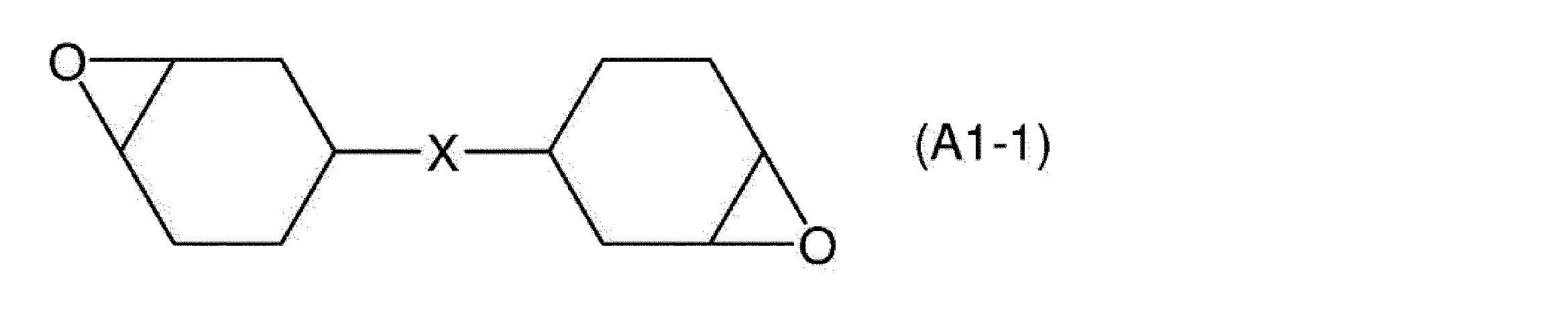
- compounds represented by the following formula (A1-1) are preferable.
- X represents a single bond or a linking group (a divalent group having one or more atoms), and the linking group is a divalent hydrocarbon group, a carbonyl group, an ether bond, an ester bond, It is a carbonate group, an amide bond, or a group in which a plurality of these are linked.
- X is preferably a linking group.
- the linking groups a functional group having an ester bond is preferable.
- 3',4'-epoxycyclohexylmethyl-3,4-epoxycyclohexanecarboxylate is preferable.
- the molecular weight of the alicyclic epoxy compound is preferably 450 or less, more preferably 400 or less, further preferably 300 or less, and further preferably 100 to 280, from the viewpoint of low moisture permeability and storage stability.
- the alicyclic epoxy compound When the alicyclic epoxy compound has a molecular weight distribution, the alicyclic epoxy compound preferably has a number average molecular weight within the above range.
- the number average molecular weight indicates a polystyrene-equivalent value measured by gel permeation chromatography (GPC) under the following measurement conditions.
- GPC gel permeation chromatography
- aromatic compound having an epoxy group any of a monomer, an oligomer or a polymer can be used, and a bisphenol A type epoxy resin, a bisphenol F type epoxy resin, a bisphenol S type is used.
- examples thereof include epoxy resin, biphenyl type epoxy resin, naphthalene type epoxy resin, fluorene type epoxy resin, novolac phenol type epoxy resin, cresol novolac type epoxy resin, phenyl glycidyl ether, and modified products thereof. You may use 1 or more types of these epoxy resins.
- aromatic epoxy compounds having a bisphenol structure are preferable.
- the aromatic epoxy compounds having a bisphenol structure the compound represented by the following formula (A2-1) is preferable.
- n represents a real number of 0 to 30, and R 21 , R 22 , R 23 and R 24 each independently represent a hydrogen atom or a substituted or unsubstituted alkyl group having 1 to 5 carbon atoms. Represents.
- R 21 , R 22 , R 23 , and R 24 are preferably a hydrogen atom or a methyl group.
- R 21 , R 22 , R 23 , and R 24 are preferably the same.
- aromatic epoxy compounds having a bisphenol structure at least one selected from bisphenol A type epoxy resin and bisphenol F type epoxy resin is preferable.
- the molecular weight of the aromatic epoxy compound is preferably 100 to 5000, more preferably 150 to 1000, and most preferably 200 to 450 in terms of low moisture permeability.
- the number average molecular weight of the aromatic epoxy compound is preferably within the above range.
- the number average molecular weight indicates a polystyrene-equivalent value measured by gel permeation chromatography (GPC) under the above-mentioned measurement conditions.
- any of a monomer, an oligomer and a polymer can be used as the cationically polymerizable monomer.
- the polyglycidyl ether compound is not particularly limited, but is a diglycidyl ether of alkylene glycol (eg, diglycidyl ether of ethylene glycol, diglycidyl ether of propylene glycol, diglycidyl ether of 1,6-hexanediol, etc.), polyvalent Alcohol polyglycidyl ether (eg, glycerin or di- or triglycidyl ether of its alkylene oxide adduct), polyalkylene glycol diglycidyl ether (eg, polyethylene glycol or diglycidyl ether of its alkylene oxide adduct, polypropylene glycol or Examples thereof include diglycidyl ether of the alkylene oxide adduct.
- examples of the alkylene oxide include aliphatic compounds such as ethylene oxide and propylene oxide.
- the oxetane compound is not particularly limited, but 3-ethyl-3-hydroxymethyl oxetane (trade name Aron oxetane OXT-101 manufactured by Toagosei Co., Ltd.), 1,4-bis[(3-ethyl-3-oxetanyl) )Methoxymethyl]benzene (the same OXT-121 etc.), 3-ethyl-3-(phenoxymethyl)oxetane (the same OXT-211, etc.), di(1-ethyl-(3-oxetanyl))methyl ether (the same OXT- 221 etc.), 3-ethyl-3-(2-ethylhexyloxymethyl)oxetane (the same OXT-212 etc.) and the like.
- the oxetane compound means a compound having one or more oxetane rings in the molecule.
- Examples of the cationically polymerizable vinyl compound include vinyl ether, vinylamine, styrene and the like. One or more of these compounds or derivatives may be used.
- the vinyl ether compound is not particularly limited, but ethylene glycol divinyl ether, diethylene glycol divinyl ether, triethylene glycol divinyl ether, propylene glycol divinyl ether, dipropylene glycol divinyl ether, butanediol divinyl ether, hexanediol divinyl ether, cyclohexane dimethanol divinyl ether.
- Di- or trivinyl ether compounds such as vinyl ether, hydroxyethyl monovinyl ether, hydroxynonyl monovinyl ether, trimethylolpropane trivinyl ether, ethyl vinyl ether, n-butyl vinyl ether, isobutyl vinyl ether, octadecyl vinyl ether, cyclohexyl vinyl ether, hydroxybutyl vinyl ether, 2-ethylhexyl vinyl ether.
- the radical polymerizable monomer is at least one selected from the group consisting of vinyl group, (meth)acryloyl group, allyl group, vinyl ether group and vinyl ester group.
- the radical-polymerizable monomer having the radical-polymerizable functional group of is preferable.
- a radically polymerizable monomer having a (meth)acryloyl group can be preferably used. That is, the composition according to the present embodiment may further contain a radical-polymerizable monomer that does not have an element having an atomic number of 9 or more such as a fluorine atom and has a (meth)acryloyl group.
- Examples of the radically polymerizable monomer having a (meth)acryloyl group include monofunctional ones such as ethyl (meth)acrylate, butyl (meth)acrylate, benzyl (meth)acrylate, ethoxylated-o-phenylphenol acrylate, and phenyl (meth)acrylate.
- Examples of polyfunctional (meth)acrylates such as (meth)acrylate, 1,6-hexanediol di(meth)acrylate, 1,12-dodecanediol di(meth)acrylate, and tricyclodecanedimethanol di(meth)acrylate.
- the content of the polymerizable monomer (X) is preferably 20 to 100 parts by mass, more preferably 40 to 90 parts by mass, further preferably 52.5 to 85 parts by mass, and 55 to 80 parts by mass based on 100 parts by mass of the polymerizable monomer. Mass parts are more preferred. When it is 20 parts by mass or more, the moisture permeability of the cured product is further reduced.
- the polymerizable monomer according to this embodiment preferably contains a crosslinkable monomer (Y).
- the crosslinkable monomer (Y) is a compound having two or more polymerizable functional groups.
- the crosslinkable monomer (Y) is preferably a monomer other than the polymerizable monomer (X) (that is, a monomer having no element having an atomic number of 9 or more).
- crosslinkable monomer (Y) examples include compounds having two or more polymerizable functional groups among the compounds described above.
- the content of the crosslinkable monomer (Y) is preferably 0 to 80 parts by mass, more preferably 5 to 60 parts by mass, most preferably 7.5 to 55 parts by mass, and most preferably 10 to 50 parts by mass based on 100 parts by mass of the polymerizable monomer. Mass parts are more preferred. If it is 80 parts by mass or less, the adhesion durability is further improved.
- composition according to the present embodiment contains a polymerization initiator as an essential component.
- a photopolymerization initiator is preferable as the polymerization initiator.
- the composition according to this embodiment can be cured by irradiation with energy rays such as ultraviolet rays.
- the polymerization initiator is preferably at least one selected from the group consisting of a photocationic polymerization initiator and a photoradical polymerization initiator.
- a photocationic photopolymerization initiator When a cationic photopolymerization initiator is used, the cationically polymerizable functional group can be polymerized.
- the radical photopolymerization initiator When the radical photopolymerization initiator is used, the radically polymerizable functional group can be polymerized.
- the cationic photopolymerization initiator is not particularly limited, but arylsulfonium salt derivatives (for example, Syracure UVI-6990, Syracure UVI-6974 manufactured by Dow Chemical Co., Adekaoptomer SP-150 manufactured by Asahi Denka Kogyo Co., Ltd., and Adekaopt) are used.
- arylsulfonium salt derivatives for example, Syracure UVI-6990, Syracure UVI-6974 manufactured by Dow Chemical Co., Adekaoptomer SP-150 manufactured by Asahi Denka Kogyo Co., Ltd., and Adekaopt
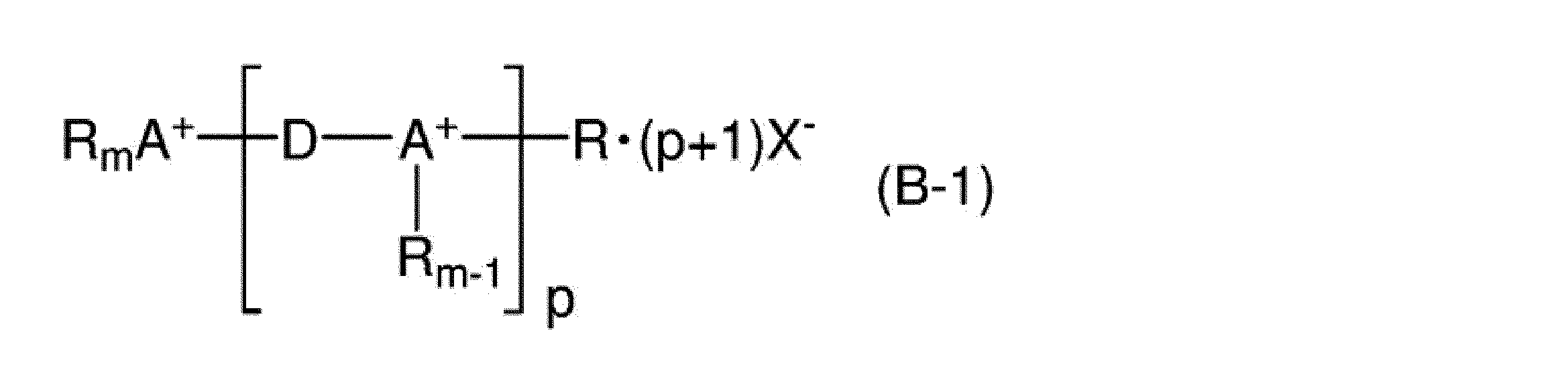
- the cationic photopolymerization initiator is not particularly limited, and examples thereof include onium salts represented by the formula (B-1).
- A represents an element of group VIA to group VIIA with a valence of m.
- m is 1 to 2.
- p represents 0 to 3.
- m and p are preferably integers.
- R represents an organic group bonded to A.
- D is the following formula (B-1-1): Represents a divalent group represented by.
- E represents a divalent group
- G represents —O—, —S—, —SO—, —SO 2 —, —NH—, —NR′—, —CO—.
- a represents 0 to 5.
- a+1 E and A G may be the same or different.
- a is preferably an integer.
- X ⁇ is a counter ion of onium, and the number thereof is p+1 per molecule.
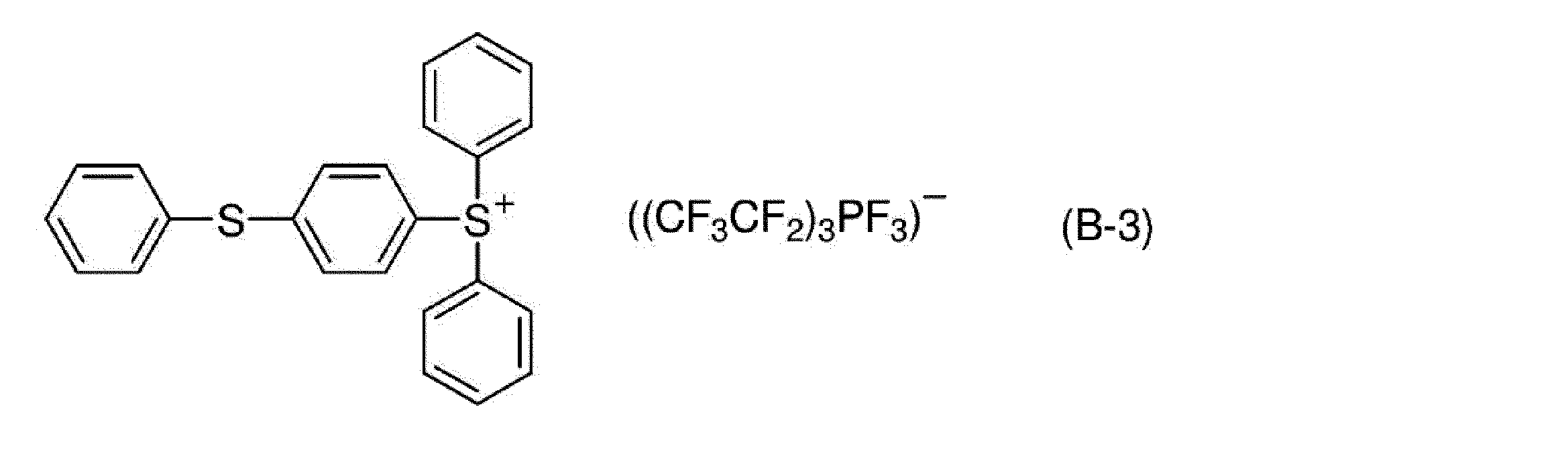
- the onium ion of the formula (B-1-1) is not particularly limited, but 4-(phenylthio)phenyldiphenylsulfonium, bis[4-(diphenylsulfonio)phenyl]sulfide, bis[4- ⁇ bis[4- (2-Hydroxyethoxy)phenyl]sulfonio ⁇ phenyl]sulfide, bis ⁇ 4-[bis(4-fluorophenyl)sulfonio]phenyl ⁇ sulfide, 4-(4-benzoyl-2-chlorophenylthio)phenylbis(4-fluoro) Phenyl)sulfonium, 4-(4-benzoylphenylthio)phenyldiphenylsulfonium, 7-isopropyl-9-oxo-10-thia-9,10-dihydroanthracen-2-yldi-p-tolylsulfonium, 7-
- R is an organic group bonded to A.
- R is, for example, an aryl group having 6 to 30 carbon atoms, a heterocyclic group having 4 to 30 carbon atoms, an alkyl group having 1 to 30 carbon atoms, an alkenyl group having 2 to 30 carbon atoms, or an alkynyl group having 2 to 30 carbon atoms.
- alkyl hydroxy, alkoxy, alkylcarbonyl, arylcarbonyl, alkoxycarbonyl, aryloxycarbonyl, arylthiocarbonyl, acyloxy, arylthio, alkylthio, aryl, heterocycle, aryloxy, alkylsulfinyl, arylsulfinyl, alkylsulfonyl. It may be substituted with at least one selected from the group consisting of arylsulfonyl, alkyleneoxy, amino, cyano and nitro groups and halogen.
- the number of Rs is m+p(m-1)+1, and they may be the same or different from each other.
- two or more Rs are directly or mutually —O—, —S—, —SO—, —SO 2 —, —NH—, —NR′—, —CO—, —COO—, —CONH—, carbon. They may be bonded via an alkylene or phenylene group of the numbers 1 to 3 to form a ring structure containing the element A.
- R′ is an alkyl group having 1 to 5 carbon atoms or an aryl group having 6 to 10 carbon atoms.
- examples of the aryl group having 6 to 30 carbon atoms include monocyclic aryl groups such as phenyl group and naphthyl, anthracenyl, phenanthrenyl, pyrenyl, chrysenyl, naphthacenyl, benzanthracenyl, anthraquinolyl, fluorenyl, naphthoquinone, anthraquinone and the like. Examples include condensed polycyclic aryl groups and the like.
- the aryl group having 6 to 30 carbon atoms, the heterocyclic group having 4 to 30 carbon atoms, the alkyl group having 1 to 30 carbon atoms, the alkenyl group having 2 to 30 carbon atoms or the alkynyl group having 2 to 30 carbon atoms is at least 1 It may have certain substituents.
- a linear alkyl group having 1 to 18 carbon atoms such as methyl, ethyl, propyl, butyl, pentyl, octyl, decyl, dodecyl, tetradecyl, hexadecyl, octadecyl; isopropyl, isobutyl, sec-butyl, tert-butyl.
- Branched chain alkyl groups having 1 to 18 carbon atoms such as isopentyl, neopentyl, tert-pentyl, and isohexyl; cycloalkyl groups having 3 to 18 carbon atoms such as cyclopropyl, cyclobutyl, cyclopentyl, cyclohexyl; hydroxy group; methoxy, ethoxy, propoxy.
- C7-11 Arylcarbonyl group of methoxycarbonyl, ethoxycarbonyl, propoxycarbonyl, isopropoxycarbonyl, butoxycarbonyl, isobutoxycarbonyl, sec-butoxycarbonyl, tert-butoxycarbonyl, octyloxycarbonyl, tetradecyloxycarbonyl, octadecyloxycarbonyl, etc.
- Heterocyclic group having 4 to 20 carbon atoms such as dibenzofuranyl; aryloxy group having 6 to 10 carbon atoms such as phenoxy and naphthyloxy; methylsulfinyl, ethylsulfinyl, propylsulfinyl, isopropylsulfinyl, butylsulfinyl, isobutylsulfinyl, sec -Butylsulfinyl, tert-butylsulfinyl, pliers Rusulfinyl, isopentylsulfinyl, neopentylsulfinyl, tert-pentylsulfinyl, octylsulfinyl, etc., straight-chain or branched alkylsulfinyl group having 1 to 18 carbon atoms; phenylsulfinyl, tolylsulfiny
- Arylsulfinyl group methylsulfonyl, ethylsulfonyl, propylsulfonyl, isopropylsulfonyl, butylsulfonyl, isobutylsulfonyl, sec-butylsulfonyl, tert-butylsulfonyl, pentylsulfonyl, isopentylsulfonyl, neopentylsulfonyl, tert-pentylsulfonyl, octyl
- p represents the number of repeating units of [DA + R m-1 ] bond and is preferably an integer of 0 to 3.
- Preferred as the onium ion [A + ] in the formula (B-1) are sulfonium, iodonium and selenium, and typical examples thereof include the following.
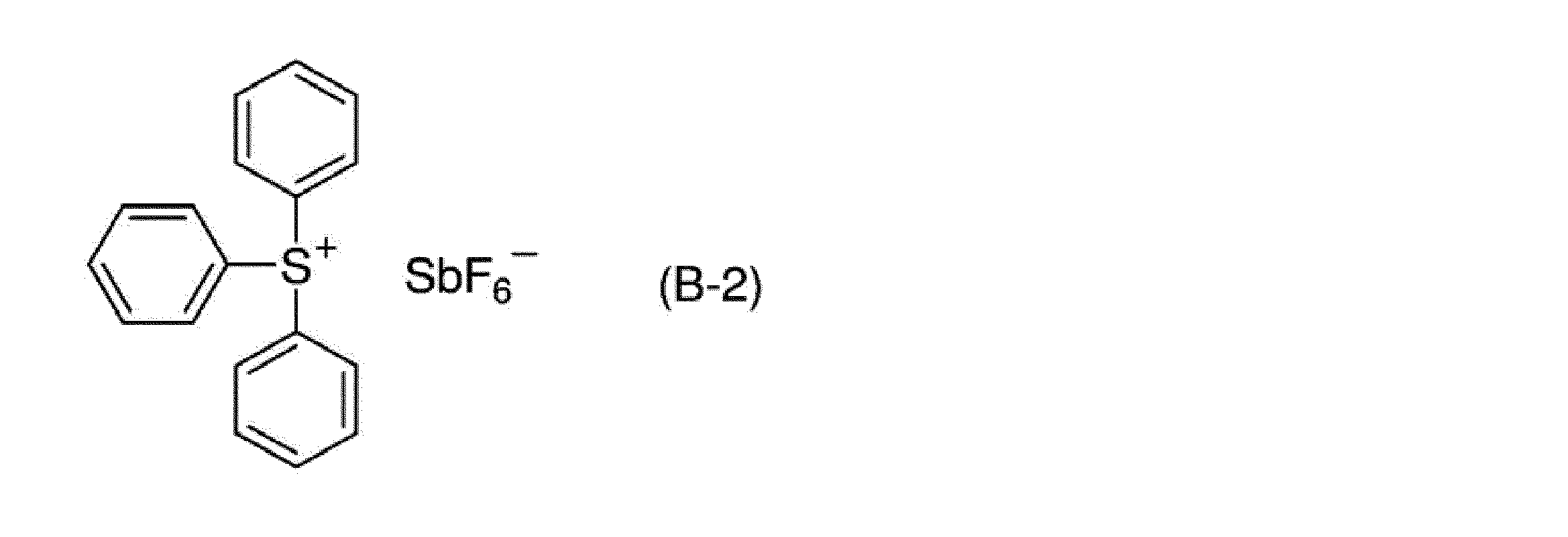
- sulfonium ion examples include triphenylsulfonium, tri-p-tolylsulfonium, tri-o-tolylsulfonium, tris(4-methoxyphenyl)sulfonium, 1-naphthyldiphenylsulfonium, 2-naphthyldiphenylsulfonium, tris(4-fluorophenyl).
- sulfonium ions one or more kinds of sulfonium ions and iodonium ions are preferable, and sulfonium ions are more preferable.
- the sulfonium ion include triphenylsulfonium, tri-p-tolylsulfonium, 4-(phenylthio)phenyldiphenylsulfonium, bis[4-(diphenylsulfonio)phenyl]sulfide, bis[4- ⁇ bis[4-(2- Hydroxyethoxy)phenyl]sulfonio ⁇ phenyl]sulfide, bis ⁇ 4-[bis(4-fluorophenyl)sulfonio]phenyl ⁇ sulfide, 4-(4-benzoyl-2-chlorophenylthio)phenylbis(4-fluorophenyl)sulfonium , 4-(4-benzoylphenylthio)pheny
- X ⁇ is a counter ion.
- the number is p+1 per molecule.
- the counter ion is not particularly limited, but examples thereof include boron compounds, phosphorus compounds, antimony compounds, arsenic compounds, halides such as alkyl sulfonic acid compounds, and methide compounds.
- X ⁇ is a halogen ion such as F ⁇ , Cl ⁇ , Br ⁇ , I ⁇ ; OH ⁇ ; ClO 4 ⁇ ; FSO 3 ⁇ , ClSO 3 ⁇ , CH 3 SO 3 ⁇ , C 6 H 5 SO 3 ⁇ , Sulfonate ions such as CF 3 SO 3 ⁇ ; Sulfate ions such as HSO 4 ⁇ , SO 4 2 ⁇ ; Carbonate ions such as HCO 3 ⁇ , CO 3 2 ⁇ ; H 2 PO 4 ⁇ , HPO 4 2 ⁇ , PO 4 3 ⁇ , etc.
- phosphate ions such as fluorinated alkylfluorophosphate ions; BF 4 ⁇ , B(C 6 F 5 ) 4 ⁇ , Examples thereof include borate ions such as B(C 6 H 4 CF 3 ) 4 ⁇ ; AlCl 4 ⁇ ; BiF 6 ⁇ .
- fluoroantimonate ions such as SbF 6 ⁇ and SbF 5 OH ⁇
- fluoroarsenate ions such as AsF 6 ⁇ and AsF 5 OH ⁇ .
- fluorinated alkylfluorophosphate ion examples include the fluorinated alkylfluorophosphate ion represented by the formula (B-1-3) and the like. [(Rf) b PF 6-b ] - (B-1-3)
- Rf represents an alkyl group substituted with a fluorine atom.
- the number b of Rf is 1 to 5, and is preferably an integer.
- the b Rf's may be the same or different.
- the number b of Rf is more preferably 2 to 4, and most preferably 2 to 3.
- Rf represents an alkyl group substituted with a fluorine atom, preferably having 1 to 8 carbon atoms, more preferably 1 to 4 carbon atoms.
- alkyl group include linear alkyl groups such as methyl, ethyl, propyl, butyl, pentyl and octyl; branched alkyl groups such as isopropyl, isobutyl, sec-butyl and tert-butyl; and further cyclopropyl, cyclobutyl, cyclopentyl, cyclohexyl and the like. And the like.
- Preferred fluorinated alkylfluorophosphate anions include [(CF 3 CF 2 ) 2 PF 4 ] - , [(CF 3 CF 2 ) 3 PF 3 ] - , and [((CF 3 ) 2 CF) 2 PF 4 ].
- the cationic photopolymerization initiator may be dissolved in a solvent in advance so that it can be easily dissolved in an epoxy compound or an epoxy resin.
- the solvent include carbonates such as propylene carbonate, ethylene carbonate, 1,2-butylene carbonate, dimethyl carbonate and diethyl carbonate.
- One or more of these photocationic polymerization initiators may be used.
- anionic species of the (B) photocationic polymerization initiator include halides such as boron compounds, phosphorus compounds, antimony compounds, arsenic compounds, and alkylsulfonic acid compounds.
- halides such as boron compounds, phosphorus compounds, antimony compounds, arsenic compounds, and alkylsulfonic acid compounds.
- fluorides are preferable because they are excellent in photocurability and have improved adhesiveness and adhesive durability. Of the fluorides, hexafluoroantimonate is preferred.
- At least one selected from the group consisting of trifluorophosphate is preferable, and triarylsulfonium salt hexafluoroantimonate is more preferable.
- the photo-radical polymerization initiator is not particularly limited, Benzophenone and its derivatives; Benzyl and its derivatives; Anthraquinone and its derivatives; Benzoin-type photopolymerization initiators such as benzoin, benzoin methyl ether, benzoin ethyl ether, benzoin propyl ether, benzoin isobutyl ether, benzyl dimethyl ketal; Acetophenone type photopolymerization initiators such as diethoxyacetophenone and 4-tert-butyltrichloroacetophenone; 2-dimethylaminoethyl benzoate; p-dimethylaminoethyl benzoate; Diphenyl disulfide; Thioxanthone and its derivatives; Camphorquinone, 7,7-dimethyl-2,3-dioxobicyclo[2.2.1]heptane-1-carboxylic acid, 7,7-dimethyl-2,3-d
- the content of the polymerization initiator is preferably 0.01 to 5 parts by mass, more preferably 0.1 to 3 parts by mass with respect to 100 parts by mass of the polymerizable monomer.
- the content of the polymerization initiator is 0.01 part by mass or more, photocurability is better, and when it is 5 parts by mass or less, the adhesion durability is further improved.
- the composition according to the present embodiment may contain a photosensitizer.
- the photosensitizer is a compound that absorbs energy rays and efficiently generates cations from the photocationic polymerization initiator.
- the photosensitizer is not particularly limited, benzophenone derivative, phenothiazine derivative, phenyl ketone derivative, naphthalene derivative, anthracene derivative, phenanthrene derivative, naphthacene derivative, chrysene derivative, perylene derivative, pentacene derivative, acridine derivative, benzothiazole derivative, Benzoin derivative, fluorene derivative, naphthoquinone derivative, anthraquinone derivative, xanthene derivative, xanthone derivative, thioxanthene derivative, thioxanthone derivative, coumarin derivative, ketocoumarin derivative, cyanine derivative, azine derivative, thiazine derivative, oxazine derivative, indoline derivative, azulene derivative, tri Examples thereof include an allylmethane derivative, a phthalocyanine derivative, a spiropyran derivative, a spirooxazine derivative,
- phenylketone derivatives such as 2-hydroxy-2-methyl-1-phenyl-propan-1-one and/or anthracene derivatives such as 9,10-dibutoxyanthracene are preferable, and anthracene derivatives are more preferable.
- anthracene derivatives 9,10-dibutoxyanthracene is preferred.
- the amount of the photosensitizer used is preferably 0.01 to 5 parts by mass with respect to 100 parts by mass of the polymerizable monomer, from the viewpoints of further improvement in photocurability and storage stability, and 0.02. It is more preferably about 3 parts by mass.
- composition according to the present embodiment may contain a silane coupling agent.
- a silane coupling agent By containing a silane coupling agent, the composition according to the present embodiment exhibits excellent adhesiveness and adhesive durability.
- the silane coupling agent is not particularly limited, but ⁇ -chloropropyltrimethoxysilane, vinyltrimethoxysilane, vinyltrichlorosilane, vinyltriethoxysilane, vinyl-tris( ⁇ -methoxyethoxy)silane, ⁇ -(meth) Acryloxypropyltrimethoxysilane, ⁇ -(3,4-epoxycyclohexyl)ethyltrimethoxysilane, ⁇ -glycidoxypropyltrimethoxysilane, ⁇ -glycidoxypropyltriethoxysilane, ⁇ -mercaptopropyltrimethoxysilane, ⁇ -aminopropyltriethoxysilane, N- ⁇ -(aminoethyl)- ⁇ -aminopropyltrimethoxysilane, N- ⁇ -(aminoethyl)- ⁇ -aminopropylmethyldimethoxysilane
- these silane coupling agents ⁇ -(3,4-epoxycyclohexyl)ethyltrimethoxysilane, ⁇ -glycidoxypropyltrimethoxysilane, ⁇ -glycidoxypropyltriethoxysilane, ⁇ -(meth)acryloxypropyltrimethoxysilane
- ⁇ -glycidoxypropyltrimethoxysilane is more preferable.
- the content of the silane coupling agent is preferably 0.1 to 10 parts by mass, and 0.2 to 5 parts by mass with respect to 100 parts by mass of the polymerizable monomer, in that the adhesiveness and the adhesion durability are further improved. More preferable.
- composition according to the present embodiment may contain an inorganic filler.
- the inorganic filler By containing the inorganic filler, the low moisture permeability of the sealant is further improved.
- inorganic filler examples include silica, mica, kaolin, talc, aluminum oxide and the like. Of these, talc is preferred.
- the average particle size of the inorganic filler (hereinafter sometimes referred to as particle size) is preferably 1 to 50 ⁇ m.
- the average particle size is preferably measured by Microtrac (laser diffraction/scattering method).
- the median particle diameter is preferably the median diameter (d50).
- the content of the inorganic filler is preferably 1 to 80 parts by mass, and more preferably 20 to 40 parts by mass with respect to 100 parts by mass of the polymerizable monomer, since the low moisture permeability is further improved.
- composition according to the present embodiment may further contain a known additive used in the technical field as another component.
- a cured product can be obtained by curing the composition according to the present embodiment.
- the light source used for curing or bonding the composition according to the present embodiment is not particularly limited, but a halogen lamp, a metal halide lamp, a high power metal halide lamp (containing indium and the like), a low pressure mercury lamp, a high pressure mercury lamp, a super lamp Examples thereof include a high pressure mercury lamp, a xenon lamp, a xenon excimer lamp, a xenon flash lamp, and a light emitting diode (hereinafter referred to as LED). These light sources are preferable because they can efficiently irradiate energy rays corresponding to the reaction wavelength of each photopolymerization initiator.
- the above light sources have different emission wavelengths and energy distributions. Therefore, the light source is appropriately selected depending on the reaction wavelength of the photopolymerization initiator and the like.
- natural light can also be a reaction initiation light source.
- direct irradiation or concentrated irradiation by a reflecting mirror or fiber may be performed.
- a low wavelength cut filter, a heat ray cut filter, a cold mirror, etc. can also be used.
- the composition according to the present embodiment may be subjected to post heat treatment in order to accelerate the curing rate after light irradiation.
- the post-heating temperature is preferably 150° C. or lower, more preferably 100° C. or lower, from the viewpoint of not damaging the organic electroluminescence element.
- the post-heating temperature is preferably 50° C. or higher.
- composition according to the present embodiment may be used as an adhesive.
- the adhesive according to the present embodiment can be suitably used for bonding packages such as organic electroluminescence elements.
- the method for producing the composition of the present embodiment is not particularly limited as long as the above components can be sufficiently mixed.
- the mixing method of each component is not particularly limited, and examples thereof include a stirring method using a stirring force accompanying rotation of a propeller, a method using a normal disperser such as a planetary stirrer by rotation and revolution, and the like. These mixing methods are preferable in that low-cost and stable mixing can be performed.
- a step of applying the composition to the whole surface or a part of one base material, and applying light to the composition of the base material coated with the composition between the step of irradiating and the step of curing the composition irradiated with the light, the step of bonding the other base material to the one base material, and curing the base material bonded by the composition
- the step of performing it is possible to bond the base material without exposing it to light or heat.
- the composition of the present embodiment is applied on one substrate (back plate), and the composition is irradiated with light. After activation by means of activation, light is blocked, and the back plate and the substrate on which the electroluminescence element is formed are bonded together via the composition. By this method, the organic electroluminescence element can be sealed without exposing it to light or heat.
- a method of applying the composition of the present embodiment to one substrate using the composition of the present embodiment, bonding the other substrate through the composition, and irradiating the composition of the present embodiment with light can be used to manufacture an organic electroluminescent display device.
- the glass transition temperature (Tg) of the cured product of the composition according to the present embodiment is preferably 60° C. or higher, more preferably 70° C. or higher, most preferably 85° C. or higher.
- the glass transition temperature (Tg) of the cured product indicates the value obtained from the dynamic viscoelastic spectrum.
- stress and strain are applied to the cured product at a constant temperature rising rate, and the temperature at which the peak top of the loss tangent (hereinafter abbreviated as tan ⁇ ) is shown can be the glass transition temperature.
- the glass transition temperature is considered to be ⁇ 150° C. or lower or a certain temperature (Ta° C.) or higher.
- Ta° C. a certain temperature
- the cured product of the composition according to the present embodiment preferably has a crosslink density of 1.0 ⁇ 10 ⁇ 3 mol/cm 3 or more, and 2.0 ⁇ 10 ⁇ 3 to 1.0 mol/cm 3 . More preferably.
- the crosslink density is 1.0 ⁇ 10 ⁇ 3 mol/cm 3 or more, there are many bonding points in the cured product, the Micro Brownian motion in the polymer is suppressed, and low moisture permeability is excellent, which is preferable.
- the crosslink density is 1.0 mol/cm 3 or less, the cured body does not become brittle.
- the crosslink density can be calculated from the result of dynamic viscoelasticity measurement of the cured product of the composition.
- the crosslink density of the cured product indicates a value obtained from the dynamic viscoelastic spectrum.
- a cured product having a thickness of 100 ⁇ m is cut out into a width of 5 mm and a length of 25 mm to obtain a test piece.
- dynamic viscoelasticity measurement is performed under the conditions of a temperature range of ⁇ 50 to 200° C., a temperature rising rate of 2° C./min, and a tensile mode to grasp the relationship between temperature and storage elastic modulus (G′).
- crosslink density ( ⁇ ) G′ Tg+40 /3 ⁇ RT
- the cured product of the composition according to the present embodiment has a moisture permeability of 40 g/m at a thickness of 100 ⁇ m measured by exposing it to an environment of 60° C. and 90% RH for 24 hours in accordance with JIS Z 0208:1976. preferably 2 or less, more preferably 35 g / m 2 or less, further preferably 30 g / m 2 or less.
- the water vapor permeability is preferably 0.01 g/m 2 or more.
- the cured product of the composition according to the present embodiment preferably has excellent transparency.
- the cured product has a light transmittance in the ultraviolet-visible light region of 360 nm or more and 800 nm or less of 95% or more, more preferably 97% or more, per 10 ⁇ m of thickness. Most preferably, it is 99% or more.
- the light transmittance is 95% or more, an organic EL display device having excellent brightness and contrast can be easily obtained when used for sealing an organic electroluminescence element.
- one aspect of the embodiment of the present invention may be a cured product obtained by curing the above composition.
- the encapsulant may be a cured product, or may include a cured product of the encapsulant and other constituent materials.
- examples of other constituent materials include a silicon nitride film, a silicon oxide film, and an inorganic layer such as silicon nitride oxide.
- Yet another aspect of the embodiment of the present invention may be an organic electroluminescence display device including the organic electroluminescence element and the above-mentioned sealing material for organic electroluminescence element.
- the method for manufacturing an organic electroluminescent display device comprises a first member, an attaching step of attaching the above-mentioned organic electroluminescent element sealant, and an organic electroluminescent element sealant which has been attached to the first member. May be included, and a bonding step of bonding the first member and the second member via the light-irradiated sealant for an organic electroluminescence element.
- the first member may be a substrate and the second member may be an organic electroluminescent element.
- the first member may be an organic electroluminescence element and the second member may be a substrate.
- the conditions and the like of each step in this manufacturing method may be appropriately selected based on the description of the above embodiment.
- the substrate may be a color filter.
- the inorganic film may not be provided on the outermost surface of the organic electroluminescence element.
- the organic electroluminescence display device may include a laminated body in which an inorganic film and an organic film are laminated.
- the organic film may include a cured product of the composition according to the present embodiment.
- the organic film directly laminated on the organic electroluminescence element may include a cured product of the composition according to the present embodiment.
- (Y) crosslinkable monomer (Y-1) 3',4'-epoxycyclohexylmethyl-3,4-epoxycyclohexanecarboxylate ("Celoxide 2021P” manufactured by Daicel Chemical Industries, Ltd.) (Y-2) Bisphenol A-type epoxy resin ("jER828” manufactured by Mitsubishi Chemical Corporation, molecular weight 360 to 390) (Y-3) di(1-ethyl-(3-oxetanyl))methyl ether (“Aron Oxetane OXT-221” manufactured by Toagosei Co., Ltd.) (Y-4) Cyclohexanedimethanol divinyl ether (“CHDVE” manufactured by Nippon Carbide Co.) (Y-5) 1,6-hexanediol dimethacrylate (“HD-N” manufactured by Shin Nakamura Chemical Co., Ltd.) (Y-6) Tricyclodecane dimethanol dimethacrylate (“DCP”
- Triarylsulfonium salt hexafluoroantimonate (“ADEKA PTOMER SP-170” manufactured by ADEKA, anion species being hexafluoroantimonate)
- Triarylsulfonium salt (diphenyl 4-thiophenoxyphenylsulfonium tris(pentafluoroethyl)trifluorophosphate, "CPI-200K” manufactured by San-Apro Ltd., anionic species is phosphorus compound) ⁇ 2,4,6-Trimethylbenzoyl-diphenyl-phosphine oxide (“TPO” manufactured by BASF Japan Ltd.) ⁇ 1-hydroxycyclohexyl phenyl ketone, "I-184" manufactured by BASF Japan Ltd.)
- Example 1 A polymerizable monomer having a cationically polymerizable functional group was tested.
- Raw materials of the types shown in Tables 1 and 2 were mixed in the composition ratios shown in Tables 1 and 2 to prepare compositions of Experimental Examples, which were used as sealants.
- the unit of composition ratio is parts by mass. The following measurements were performed on the composition of the experimental example. The results are shown in Tables 1 and 2.
- Example 2 A polymerizable monomer having a radically polymerizable functional group was tested.
- Raw materials of the types shown in Table 3 were mixed at the composition ratios shown in Table 3 to prepare a composition of Experimental Example, which was used as a sealant.
- the unit of composition ratio is parts by mass. The following measurements were performed on the composition of the experimental example. The results are shown in Table 3.
- the viscosity (shear viscosity) of the composition was measured using an E-type viscometer (1°34′ ⁇ R24 cone rotor) under conditions of a temperature of 25° C. and a rotation speed of 10 rpm.
- Specific gravity of polymerizable monomer (monomer specific gravity)
- the specific gravity of the polymerizable monomer was measured according to JIS K0061 using a Herbert type specific gravity bottle.
- Specific gravity of composition The specific gravity of the composition was measured according to JIS K0061 using a Herbert type specific gravity bottle.
- the composition was cured under the following light irradiation conditions. After photocuring the composition with a UV curing device equipped with an electrodeless discharge metal halide lamp (manufactured by Fusion Co., Ltd.) under the condition of a cumulative light amount of 4,000 mJ/cm 2 at a wavelength of 365 nm, the composition was heated in an oven at 80° C. for 30 minutes. After the heat treatment for 1 minute, a cured product was obtained.
- a UV curing device equipped with an electrodeless discharge metal halide lamp (manufactured by Fusion Co., Ltd.) under the condition of a cumulative light amount of 4,000 mJ/cm 2 at a wavelength of 365 nm
- the composition was heated in an oven at 80° C. for 30 minutes. After the heat treatment for 1 minute, a cured product was obtained.
- Tg A sheet-like cured body having a thickness of 0.1 mm was prepared under the above-mentioned photo-curing conditions, and a cured body having a thickness of 100 ⁇ m was cut into a width of 5 mm and a length of 25 mm to obtain a test piece.
- dynamic viscoelasticity measurement was carried out under the conditions of temperature range ⁇ 50° C. to 200° C., temperature rising rate 2° C./min, and tensile mode.
- the temperature at the peak top of tan ⁇ (loss tangent) measured by the above dynamic viscoelasticity measurement was defined as the glass transition temperature (Tg) of the cured product.
- Crosslink density A sheet-like cured body having a thickness of 0.1 mm was prepared under the above-mentioned photo-curing conditions, and a cured body having a thickness of 100 ⁇ m was cut into a width of 5 mm and a length of 25 mm to obtain a test piece.
- dynamic viscoelasticity measurement was performed under the conditions of temperature range of -50 to 200°C, temperature rising rate of 2°C/min, and tensile mode.
- Crosslink density ( ⁇ ) G′ Tg+40 /3 ⁇ RT
- a sheet-like cured body having a thickness of 0.1 mm was prepared under the above-mentioned photo-curing conditions, and calcium chloride (anhydrous) was used as a moisture absorbent in accordance with JIS Z0208 "Moisture permeability test method for moisture-proof packaging materials (cup method)".
- the ambient temperature was 60° C. and the relative humidity was 90%.
- the water vapor permeability is preferably 120 g/(m 2 ⁇ 24 hr) or less.
- anode film thickness 250nm ⁇ Hole injection layer Copper phthalocyanine Thickness 30nm -Hole transport layer N,N'-diphenyl-N,N'-dinaphthylbenzidine ( ⁇ -NPD) thickness 20 nm ⁇ Light emitting layer Tris(8-hydroxyquinolinato) aluminum (metal complex material), thickness of light emitting layer 1000 ⁇ ⁇ Electron injection layer Lithium fluoride Thickness 1nm ⁇ Cathode aluminum, anode film thickness 250nm
- the diameter of the dark spot is preferably 300 ⁇ m or less, more preferably 50 ⁇ m or less, and most preferably no dark spot.
- This embodiment has low moisture permeability without using a filler. In this embodiment, since no filler is used, the permeability is high.
- This embodiment is used for sealing electronic devices, organic EL elements, and the like. According to the present embodiment, excellent moisture resistance without impairing transparency, and also excellent in adhesiveness with a glass substrate or the like, it is possible to form a sealing agent having excellent unevenness permeability, a low moisture-permeable resin composition, can get. According to the embodiment of the present invention, a sealant for an organic EL element and an organic EL display device can be obtained.
Landscapes
- Chemical & Material Sciences (AREA)
- Organic Chemistry (AREA)
- Chemical Kinetics & Catalysis (AREA)
- Medicinal Chemistry (AREA)
- Polymers & Plastics (AREA)
- Health & Medical Sciences (AREA)
- Engineering & Computer Science (AREA)
- Manufacturing & Machinery (AREA)
- Inorganic Chemistry (AREA)
- Physics & Mathematics (AREA)
- Optics & Photonics (AREA)
- Materials Engineering (AREA)
- Electroluminescent Light Sources (AREA)
- Sealing Material Composition (AREA)
- Polymerisation Methods In General (AREA)
- Epoxy Resins (AREA)
- Polyethers (AREA)
- Addition Polymer Or Copolymer, Post-Treatments, Or Chemical Modifications (AREA)
- Structures Or Materials For Encapsulating Or Coating Semiconductor Devices Or Solid State Devices (AREA)
- Devices For Indicating Variable Information By Combining Individual Elements (AREA)
Abstract
Description
<1>重合性モノマーと重合開始剤とを含有し、23℃雰囲気下における比重が1.3以上であり、硬化体の23℃雰囲気下における比重が1.3~3.0である、封止剤。
<2>硬化体の60℃雰囲気下における比重が1.3~3.0である、<1>に記載の封止剤。
<3>硬化体のガラス転移温度が60℃以上である<1>又は<2>に記載の封止剤。
<4>硬化体の架橋密度が1.0×10⁻³mol/cm3以上である<1>~<3>のいずれかに記載の封止剤。
<5>重合性モノマーが、原子番号9以上の元素を有する重合性モノマー(X)を含有する<1>~<4>のいずれかに記載の封止剤。
<6>重合性モノマー(X)が、ハロゲン族元素を有する<5>に記載の封止剤。
<7>重合性モノマー(X)が、フッ素元素及び臭素元素からなる群より選択される少なくとも一種を有する<5>又は<6>に記載の封止剤。
<8>重合性モノマー(X)に含まれるハロゲン族元素の含有量が、重合性モノマーの総元素量に対して、10~50質量%ある<7>に記載の封止剤。
<9>重合性モノマーが、重合性官能基を2個以上有する架橋性モノマー(Y)を含有する<1>~<8>のいずれか一項に記載の封止剤。
<10>重合開始剤が、光重合開始剤である<1>~<9>のいずれかに記載の封止剤。
<11>重合性モノマーが、芳香環を有するモノマーを含有する<1>~<10>のいずれかに記載の封止剤。
<12>重合性モノマーが、カチオン重合性官能基及びラジカル重合性官能基からなる群より選択される少なくとも一種を有する<1>~<11>のいずれかに記載の封止剤。
<13>重合性モノマーが、グリシジルエーテル化合物、脂環式エポキシ化合物、ビニルエーテル化合物及びオキセタン化合物からなる群より選択される少なくとも1種を含有する<12>に記載の封止剤。
<14>重合開始剤が、オニウム塩を含有する<13>に記載の封止剤。
<15>重合性モノマーが、(メタ)アクリレート及び(メタ)アクリルアミドからなる群より選択される少なくとも1種を含有する<12>に記載の封止剤。
<16>重合開始剤が、光ラジカル重合開始剤を含有する<15>に記載の封止剤。
<17>重合性モノマー100質量部中、原子番号9以上の元素を有する重合性モノマー(X)の含有量が、40~90質量部である<1>~<16>のいずれかに記載の封止剤。
<18>重合性モノマーの100質量部中、重合性官能基を2個以上有する架橋性モノマー(Y)の含有量が、5~60質量部である<1>~<17>のいずれかに記載の封止剤。
<19>重合性モノマーの100質量部に対して、重合開始剤の含有量が、0.01~5質量部である<1>~<18>のいずれかに記載の封止剤。
<20>硬化体の、JIS Z0208に準拠して、温度60℃、相対湿度90%の条件下で測定される、100μm厚での透湿度が40g/m2以下である<1>~<19>のいずれかに記載の封止剤。
<21>硬化体の、厚さ10μm当たりの360nm以上800nm以下の紫外-可視光線領域の光透過率が、95%以上である<1>~<20>のいずれかに記載の封止剤。
<22>有機エレクトロルミネッセンス素子用封止剤である、<1>~<21>のいずれかに記載の封止剤。
<23>第一の部材と第二の部材とを含む装置の製造方法であって、第一の部材に、<1>~<22>のいずれかに記載の封止剤を付着させる付着工程と、付着させた封止剤に光を照射する照射工程と、光照射された封止剤を介して、第一の部材と第二の部材とを貼り合わせる貼合工程と、を備える、装置の製造方法。
<24>第一の部材が有機エレクトロルミネッセンス素子であり、第二の部材が基板であり、装置が有機エレクトロルミネッセンス表示装置である、<23>に記載の装置の製造方法。
<25>第一の部材が基板であり、第二の部材が有機エレクトロルミネッセンス素子であり、装置が有機エレクトロルミネッセンス表示装置である、<23>に記載の装置の製造方法。
<26><1>~<22>のいずれかに記載の封止剤の硬化体。
<27>有機エレクトロルミネッセンス素子と、<26>に記載の硬化体と、を含む、有機エレクトロルミネッセンス表示装置。
<28>無機膜と有機膜とが積層した積層体を含み、有機膜が<26>に記載の硬化体を含む、有機エレクトロルミネッセンス表示装置。
<29>無機膜と有機膜とが積層した積層体を含み、有機エレクトロルミネッセンス素子に直接積層した有機膜が、<26>に記載の硬化体を含む、有機エレクトロルミネッセンス表示装置。
<30>フッ素元素及び臭素元素からなる群より選択される少なくとも一種を有する重合性モノマー(X)と、重合開始剤と、を含有する組成物。
・溶媒(移動相):THF
・脱気装置:ERMA社製ERC-3310
・ポンプ:日本分光社製PU-980
・流速:1.0ml/min
・オートサンプラ:東ソー社製AS-8020
・カラムオーブン:日立製作所製L-5030
・設定温度:40℃
・カラム構成:東ソー社製TSKguardcolumnMP(×L)6.0mmID×4.0cm 2本、及び東ソー社製TSK-GELMULTIPORE HXL-M 7.8mmID×30.0cm 2本、計4本
・検出器:RI 日立製作所製L-3350
・データ処理:SIC480データステーション
これらの中では、ビスフェノール構造を有する芳香族エポキシ化合物が好ましい。ビスフェノール構造を有する芳香族エポキシ化合物の中では、下記式(A2-1)で表される化合物が好ましい。



[(Rf)bPF6-b]- (B-1-3)
ベンゾフェノン及びその誘導体;
ベンジル及びその誘導体;
アントラキノン及びその誘導体;
ベンゾイン、ベンゾインメチルエーテル、ベンゾインエチルエーテル、ベンゾインプロピルエーテル、ベンゾインイソブチルエーテル、ベンジルジメチルケタール等のベンゾイン型光重合開始剤;
ジエトキシアセトフェノン、4-tert-ブチルトリクロロアセトフェノン等のアセトフェノン型光重合開始剤;
2-ジメチルアミノエチルベンゾエート;
p-ジメチルアミノエチルベンゾエート;
ジフェニルジスルフィド;
チオキサントン及びその誘導体;
カンファーキノン、7,7-ジメチル-2,3-ジオキソビシクロ[2.2.1]ヘプタン-1-カルボン酸、7,7-ジメチル-2,3-ジオキソビシクロ[2.2.1]ヘプタン-1-カルボキシ-2-ブロモエチルエステル、7,7-ジメチル-2,3-ジオキソビシクロ[2.2.1]ヘプタン-1-カルボキシ-2-メチルエステル、7,7-ジメチル-2,3-ジオキソビシクロ[2.2.1]ヘプタン-1-カルボン酸クロライド等のカンファーキノン型光重合開始剤;
2-メチル-1-[4-(メチルチオ)フェニル]-2-モルフォリノプロパン-1-オン、2-ベンジル-2-ジメチルアミノ-1-(4-モルフォリノフェニル)-ブタノン-1等のα-アミノアルキルフェノン型光重合開始剤;
ベンゾイルジフェニルホスフィンオキサイド、2,4,6-トリメチルベンゾイル-ジフェニル-ホスフィンオキサイド、ベンゾイルジエトキシホスフィンオキサイド、2,4,6-トリメチルベンゾイルジメトキシフェニルホスフィンオキサイド、2,4,6-トリメチルベンゾイルジエトキシフェニルホスフィンオキサイド、ビス(2,4,6―トリメチルベンゾイル)-フェニルホスフィンオキサイド等のアシルホスフィンオキサイド型光重合開始剤;
2-ヒドロキシ-2-メチル-1-フェニルプロパン-1-オン、2-ヒドロキシ-2-メチル-1-〔4-(2-ヒドロキシエトキシ)フェニル〕プロパン-1-オン、1-ヒドロキシシクロヘキシルフェニルケトン、2-ヒドロキシ-2-メチル-1-〔4-(1-メチルビニル)フェニル〕プロパン-1-オン等のα-ヒドロキシアルキルフェノン型光重合開始剤;
フェニル-グリオキシリックアシッド-メチルエステル;
オキシ-フェニル-アセチックアシッド2-[2-オキソ-2-フェニル-アセトキシ-エトキシ]-エチルエステル;
オキシ-フェニル-アセチックアシッド2-[2-ヒドロキシ-エトキシ]-エチルエステル;
等が挙げられる。
架橋密度(ρ)=G’Tg+40/3φRT
有機エレクトロルミネッセンス表示装置は、無機膜と有機膜とが積層した積層体を含んでもよい。有機膜は、本実施形態に係る組成物の硬化体を含んでもよい。有機エレクトロルミネッセンス表示装置において、有機エレクトロルミネッセンス素子に直接積層した有機膜は、本実施形態に係る組成物の硬化体を含んでもよい。
(X-1)ジブロモフェニルグリシジルエーテル(日本化薬社製「BR-250」、臭素元素の含有量51質量%)
(X-2)臭素化クレジルグリシジルエーテル(日本化薬社製「BROC」、臭素元素の含有量50質量%)
(X-3)TBBPAエポキシ樹脂(テトラブロモビスフェノールAのジグリシジルエーテル、DIC社「エピクロン152」、臭素元素の含有量48質量%)
(X-4)臭素化フェノールノボラック型エポキシ樹脂(日本化薬社製「BREN-105」、臭素元素の含有量36質量%)
(X’-1)フェニルグリシジルエーテル(阪本薬品工業社「PEG」)
(X-5)ペンタフルオロフェニルアクリレート(東京化成工業社製「ペンタフルオロフェニルアクリレート」)
(X-6)アクリル酸2,4,6-トリブロモフェニル(東京化成工業社製「トリブロモフェニルアクリレート」)
(X’-2)フェニルアクリレート(東京化成工業社製「フェニルアクリレート」)
(X’-3)イソボルニルアクリレート(共栄社化学社製「ライトアクリレートIB-XA」)
(X’-4)イソボルニルメタクリレート(共栄社化学社製「ライトエステル IB-X」)
(Y-1)3’,4’-エポキシシクロヘキシルメチル-3,4-エポキシシクロヘキサンカルボキシレート(ダイセル化学社製「セロキサイド2021P」)
(Y-2)ビスフェノールA型エポキシ樹脂(三菱化学社製「jER828」、分子量360~390)
(Y-3)ジ(1-エチル-(3-オキセタニル))メチルエーテル(東亞合成社製「アロンオキセタンOXT-221」)
(Y-4)シクロヘキサンジメタノールジビニルエーテル(日本カーバイド社製「CHDVE」)
(Y-5)1,6-ヘキサンジオールジメタクリレート(新中村化学社製「HD-N」)
(Y-6)トリシクロデカンジメタノールジメタクリレート(新中村化学社製「DCP」)
・トリアリールスルホニウム塩ヘキサフルオロアンチモネート(ADEKA社製「アデカオプトマーSP-170」、アニオン種はヘキサフルオロアンチモネート)
・トリアリールスルホニウム塩(ジフェニル4-チオフェノキシフェニルスルホニウムトリス(ペンタフルオロエチル)トリフルオロホスフェート、サンアプロ社製「CPI-200K」、アニオン種はリン化合物)
・2,4,6-トリメチルベンゾイル-ジフェニル-ホスフィンオキサイド(BASFジャパン社製「TPO」)
・1-ヒドロキシシクロヘキシルフェニルケトン、BASFジャパン社製「I-184」)
9,10-ジブトキシアントラセン(川崎化成工業社製「ANTHRACURE UVS-1331」)
γ-グリシドキシプロピルトリメトキシシラン(信越シリコーン社製「KBM-403」)
微粒子タルク、粒子径(d50):4.5μm(松村産業社製「#5000PJ」)
カチオン重合性官能基を有する重合性モノマーについて試験した。表1~2に示す種類の原材料を、表1~2に示す組成割合で混合し、実験例の組成物を調製し、封止剤とした。組成割合の単位は質量部である。
実験例の組成物について、下記の各測定を行った。その結果を表1~2に示した。
ラジカル重合性官能基を有する重合性モノマーについて試験した。表3に示す種類の原材料を、表3に示す組成割合で混合し、実験例の組成物を調製し、封止剤とした。組成割合の単位は質量部である。
実験例の組成物について、下記の各測定を行った。その結果を表3に示した。
組成物の粘度(せん断粘度)はE型粘度計(1°34’×R24のコーンローター)を用い、温度25℃、回転数10rpmの条件下で測定した。
重合性モノマーの比重は、ハーバート形比重瓶を用い、JIS K0061に倣い、測定を行った。
〔組成物の比重〕
組成物の比重は、ハーバート形比重瓶を用い、JIS K0061に倣い、測定を行った。
組成物の硬化性及び接着性の評価に際し、下記光照射条件により、組成物を硬化させた。無電極放電メタルハライドランプ搭載UV硬化装置(フュージョン社製)により、365nmの波長の積算光量4,000mJ/cm2の条件にて、組成物を光硬化させた後、80℃のオーブン中で、30分間の後加熱処理を実施し、硬化体を得た。
厚さ1mmのシート状の硬化体を前記光硬化条件にて作製し、JIS K7112 B法に準拠し、硬化体の比重を測定した。浸せき液として、温度は23℃の水を使用した。
厚さ1mmのシート状の硬化体を前記光硬化条件にて作製し、JIS K7112 B法に準拠し、硬化体の比重を測定した。浸せき液として、温度は60℃の水を使用した。
厚さ0.1mmのシート状の硬化体を前記光硬化条件にて作製し、厚み100μmの硬化体を幅5mm×長さ25mmに切り出し、試験片とした。この試験片について、温度範囲-50℃~200℃、昇温速度2℃/min、引っ張りモードの条件で、動的粘弾性測定を行った。上記動的粘弾性測定で測定されたtanδ(損失正接)のピークトップの温度を硬化体のガラス転移温度(Tg)とした。
厚さ0.1mmのシート状の硬化体を前記光硬化条件にて作製し、厚み100μmの硬化体を幅5mm×長さ25mmに切り出し、試験片とした。この試験片について、温度範囲-50~200℃、昇温速度2℃/min、引っ張りモードの条件で、動的粘弾性測定を行った。架橋密度は、Tg+40℃の温度をT(K)、T(K)における貯蔵弾性率(G’)をG’Tg+40、気体定数をR、フロント係数をφ(=1)として、以下の式で算出した。
架橋密度(ρ)=G’Tg+40/3φRT
組成物を用い、硬化体の厚みが10μmとなるように、2枚のガラス板(大きさ:40mm×20mm)で貼り合せた。前記光硬化条件にて組成物を硬化したものを試験片とした。分光光度計(日本分光株式会社)を用いて、波長400nmの光透過率を測定した。
厚さ0.1mmのシート状の硬化体を前記光硬化条件にて作製し、JIS Z0208「防湿包装材料の透湿度試験方法(カップ法)」に準じ、吸湿剤として塩化カルシウム(無水)を用い、雰囲気温度60℃、相対湿度90%の条件で測定した。透湿度は120g/(m2・24hr)以下が好ましい。
ホウ珪酸ガラス試験片(縦25mm×横25mm×厚2.0mm、テンパックス(登録商標)ガラス)を2枚用い、接着面積0.5cm2、接着厚み80μmで、上記の光硬化条件にて組成物を硬化させた。硬化後、組成物で接合した試験片を用い、引張剪断接着強さ(単位:MPA)を、温度23℃、相対湿度50%の環境下で、引張速度10mm/分で測定した。
〔有機EL素子基板の作製〕
ITO電極付きガラス基板をアセトン、イソプロパノールそれぞれを用いて洗浄した。その後、真空蒸着法にて以下の化合物を薄膜となるように順次蒸着し、陽極/正孔注入層/正孔輸送層/発光層/電子注入層/陰極からなる有機EL素子基板を得た。各層の構成は以下の通りである。
・陽極 ITO、陽極の膜厚250nm
・正孔注入層 銅フタロシアニン 厚さ30nm
・正孔輸送層 N,N’-ジフェニル-N,N’-ジナフチルベンジジン(α-NPD) 厚さ20nm
・発光層 トリス(8-ヒドロキシキノリナト)アルミニウム(金属錯体系材料)、発光層の膜厚1000Å
・電子注入層 フッ化リチウム 厚さ1nm
・陰極 アルミニウム、陽極の膜厚250nm
実験例で得られた封止剤を、窒素雰囲気下にて塗工装置にてガラスに塗布し、有機EL素子基板と貼り合わせ、接着厚み10μmで前記光硬化条件にて、この封止剤を硬化させ、有機EL素子を作製した。有機EL素子基板の陽極側を、封止剤を介してガラスに貼り合わせた。
〔初期〕
作製した直後の有機EL素子に、6Vの電圧を印加し、有機EL素子の発光状態を目視と顕微鏡で観察し、ダークスポットの直径を測定した。
作製した直後の有機EL素子を、85℃、相対湿度85質量%の条件下にて1000時間暴露した後、6Vの電圧を印加し、有機EL素子の発光状態を目視と顕微鏡で観察し、ダークスポットの直径を測定した。
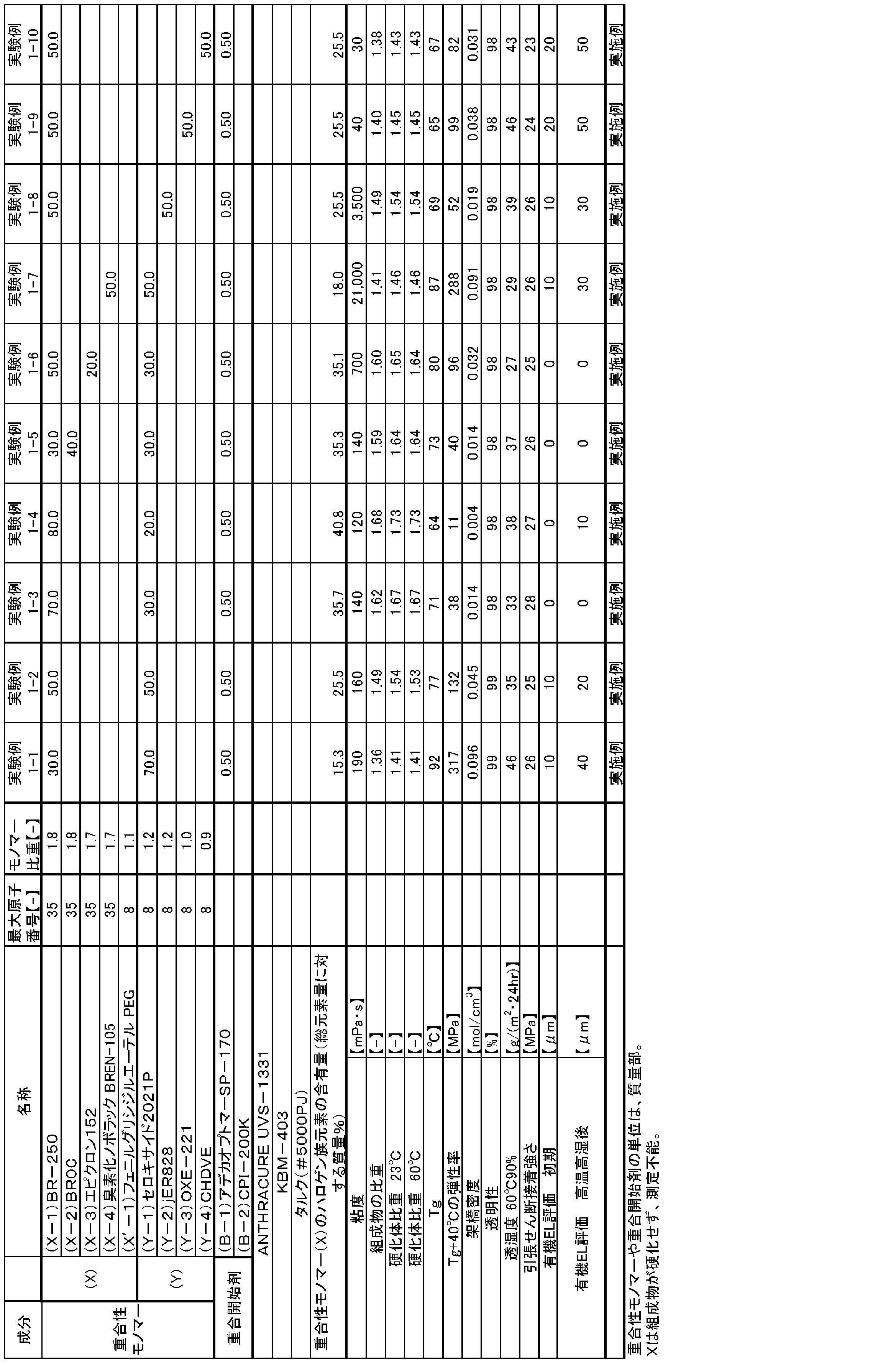
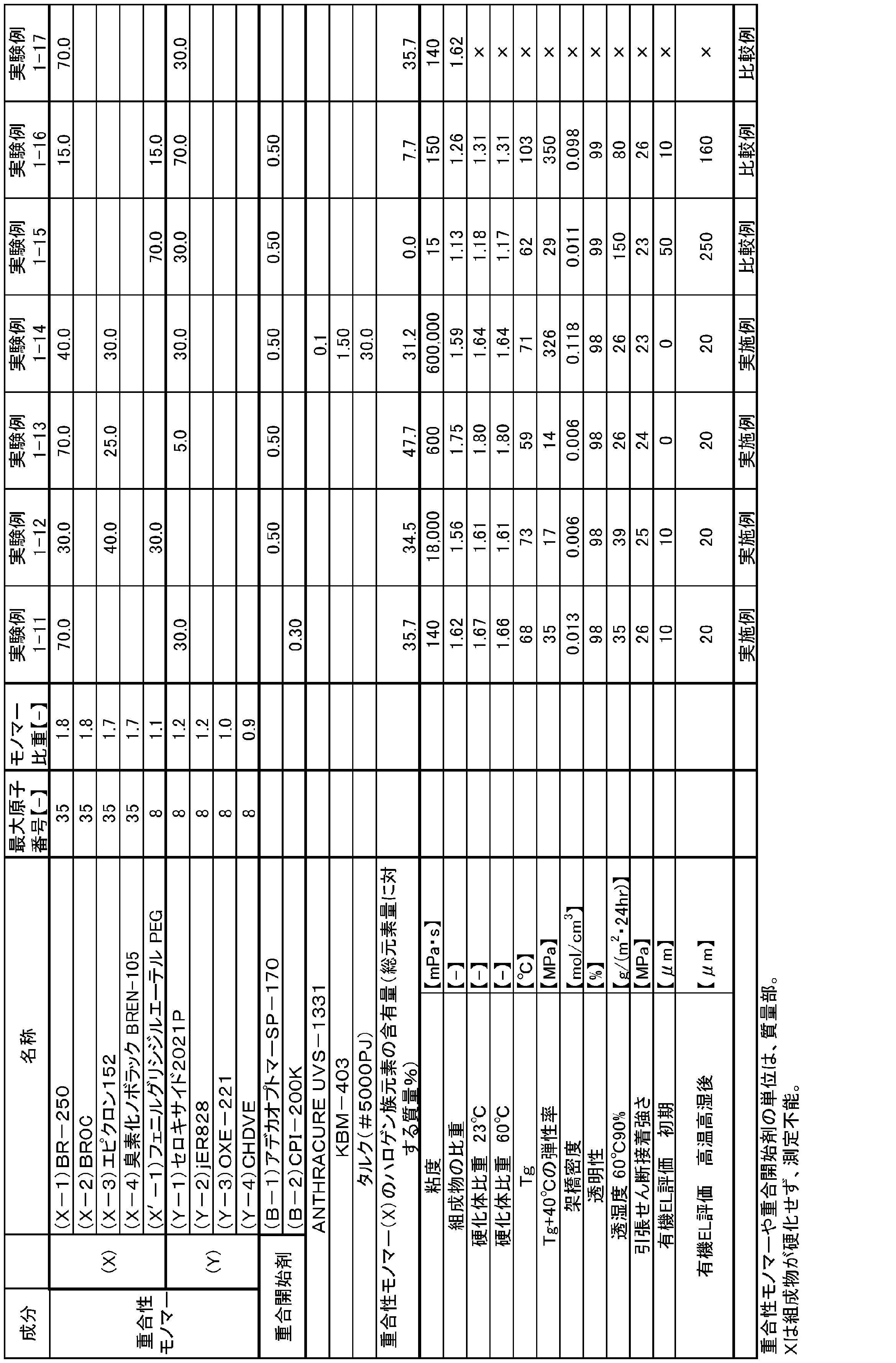
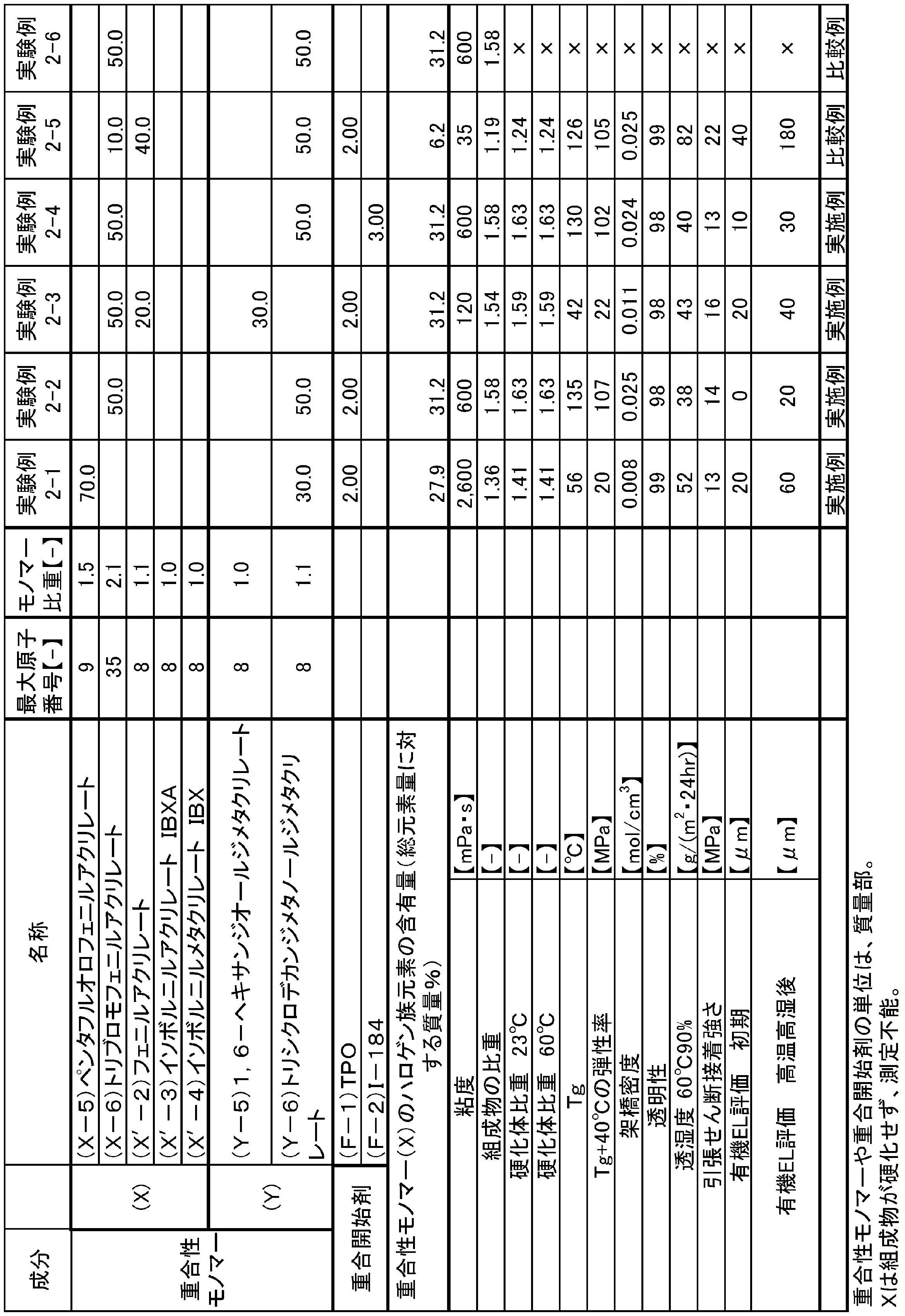
本実施形態は、電子デバイスの封止、有機EL素子の封止等に用いられる。
本実施形態によれば、透明性を損なわずに防湿性に優れ、かつ、ガラス基板等との接着性に優れ、凹凸浸透性に優れた封止剤を形成できる、低透湿性樹脂組成物が得られる。
本発明に係る実施形態によれば、有機EL素子用封止剤や有機EL表示装置が得られる。
Claims (30)
- 重合性モノマーと重合開始剤とを含有し、
23℃雰囲気下における比重が1.3以上であり、
硬化体の23℃雰囲気下における比重が1.3~3.0である、封止剤。 - 硬化体の60℃雰囲気下における比重が1.3~3.0である、請求項1に記載の封止剤。
- 硬化体のガラス転移温度が60℃以上である請求項1又は2に記載の封止剤。
- 硬化体の架橋密度が1.0×10⁻³mol/cm3以上である請求項1~3のいずれか一項に記載の封止剤。
- 重合性モノマーが、原子番号9以上の元素を有する重合性モノマー(X)を含有する請求項1~4のいずれか一項に記載の封止剤。
- 重合性モノマー(X)が、ハロゲン族元素を有する請求項5に記載の封止剤。
- 重合性モノマー(X)が、フッ素元素及び臭素元素からなる群より選択される少なくとも一種を有する請求項5又は6に記載の封止剤。
- 重合性モノマー(X)に含まれるハロゲン族元素の含有量が、重合性モノマーの総元素量に対して、10~50質量%ある請求項7に記載の封止剤。
- 重合性モノマーが、重合性官能基を2個以上有する架橋性モノマー(Y)を含有する請求項1~8のいずれか一項に記載の封止剤。
- 重合開始剤が、光重合開始剤である請求項1~9のいずれか一項に記載の封止剤。
- 重合性モノマーが、芳香環を有するモノマーを含有する請求項1~10のいずれか一項に記載の封止剤。
- 重合性モノマーが、カチオン重合性官能基及びラジカル重合性官能基からなる群より選択される少なくとも一種を有する請求項1~11のいずれか一項に記載の封止剤。
- 重合性モノマーが、グリシジルエーテル化合物、脂環式エポキシ化合物、ビニルエーテル化合物及びオキセタン化合物からなる群より選択される少なくとも1種を含有する請求項12に記載の封止剤。
- 重合開始剤が、オニウム塩を含有する請求項13に記載の封止剤。
- 重合性モノマーが、(メタ)アクリレート及び(メタ)アクリルアミドからなる群より選択される少なくとも1種を含有する請求項12に記載の封止剤。
- 重合開始剤が、光ラジカル重合開始剤を含有する請求項15に記載の封止剤。
- 重合性モノマー100質量部中、原子番号9以上の元素を有する重合性モノマー(X)の含有量が、40~90質量部である請求項1~16のいずれか一項に記載の封止剤。
- 重合性モノマーの100質量部中、重合性官能基を2個以上有する架橋性モノマー(Y)の含有量が、5~60質量部である請求項1~17のいずれか一項に記載の封止剤。
- 重合性モノマーの100質量部に対して、重合開始剤の含有量が、0.01~5質量部である請求項1~18のいずれか一項に記載の封止剤。
- 硬化体の、JIS Z0208に準拠して、温度60℃、相対湿度90%の条件下で測定される、100μm厚での透湿度が40g/m2以下である請求項1~19のいずれか一項に記載の封止剤。
- 硬化体の、厚さ10μm当たりの360nm以上800nm以下の紫外-可視光線領域の光透過率が、95%以上である請求項1~20のいずれか一項に記載の封止剤。
- 有機エレクトロルミネッセンス素子用封止剤である、請求項1~21のいずれか一項に記載の封止剤。
- 第一の部材と第二の部材とを含む装置の製造方法であって、
第一の部材に、請求項1~22のいずれか一項に記載の封止剤を付着させる付着工程と、
付着させた封止剤に光を照射する照射工程と、
光照射された封止剤を介して、第一の部材と第二の部材とを貼り合わせる貼合工程と、
を備える、装置の製造方法。 - 第一の部材が有機エレクトロルミネッセンス素子であり、
第二の部材が基板であり、
装置が有機エレクトロルミネッセンス表示装置である、
請求項23に記載の装置の製造方法。 - 第一の部材が基板であり、
第二の部材が有機エレクトロルミネッセンス素子であり、
装置が有機エレクトロルミネッセンス表示装置である、
請求項23に記載の装置の製造方法。 - 請求項1~22のいずれか一項に記載の封止剤の硬化体。
- 有機エレクトロルミネッセンス素子と、請求項26に記載の硬化体と、を含む、有機エレクトロルミネッセンス表示装置。
- 無機膜と有機膜とが積層した積層体を含み、
有機膜が請求項26に記載の硬化体を含む、有機エレクトロルミネッセンス表示装置。 - 無機膜と有機膜とが積層した積層体を含み、
有機エレクトロルミネッセンス素子に直接積層した有機膜が、請求項26に記載の硬化体を含む、有機エレクトロルミネッセンス表示装置。 - フッ素元素及び臭素元素からなる群より選択される少なくとも一種を有する重合性モノマー(X)と、重合開始剤と、を含有する組成物。
Priority Applications (4)
| Application Number | Priority Date | Filing Date | Title |
|---|---|---|---|
| KR1020217022053A KR102772994B1 (ko) | 2019-01-17 | 2020-01-16 | 봉지제, 경화체, 유기 일렉트로 루미네센스 표시 장치 및 장치의 제조 방법 |
| JP2020566489A JP7197609B2 (ja) | 2019-01-17 | 2020-01-16 | 封止剤、硬化体、有機エレクトロルミネッセンス表示装置、及び装置の製造方法 |
| CN202080007216.4A CN113227169B (zh) | 2019-01-17 | 2020-01-16 | 密封剂、固化体、有机电致发光显示装置及装置的制造方法 |
| JP2022177098A JP7385722B2 (ja) | 2019-01-17 | 2022-11-04 | 封止剤、硬化体、有機エレクトロルミネッセンス表示装置、及び装置の製造方法 |
Applications Claiming Priority (2)
| Application Number | Priority Date | Filing Date | Title |
|---|---|---|---|
| JP2019-005937 | 2019-01-17 | ||
| JP2019005937 | 2019-01-17 |
Publications (1)
| Publication Number | Publication Date |
|---|---|
| WO2020149384A1 true WO2020149384A1 (ja) | 2020-07-23 |
Family
ID=71613334
Family Applications (1)
| Application Number | Title | Priority Date | Filing Date |
|---|---|---|---|
| PCT/JP2020/001385 Ceased WO2020149384A1 (ja) | 2019-01-17 | 2020-01-16 | 封止剤、硬化体、有機エレクトロルミネッセンス表示装置、及び装置の製造方法 |
Country Status (5)
| Country | Link |
|---|---|
| JP (2) | JP7197609B2 (ja) |
| KR (1) | KR102772994B1 (ja) |
| CN (1) | CN113227169B (ja) |
| TW (1) | TWI881957B (ja) |
| WO (1) | WO2020149384A1 (ja) |
Cited By (5)
| Publication number | Priority date | Publication date | Assignee | Title |
|---|---|---|---|---|
| JPWO2022085599A1 (ja) * | 2020-10-20 | 2022-04-28 | ||
| WO2023176268A1 (ja) * | 2022-03-17 | 2023-09-21 | 日本ケミコン株式会社 | 封口体及び電解コンデンサ |
| EP4238997A4 (en) * | 2020-10-30 | 2024-08-14 | Kobayashi & Co., Ltd. | Photocurable composition |
| KR20240144264A (ko) | 2022-06-22 | 2024-10-02 | 가부시키가이샤 도판 도모에가와 옵티컬 필름 | 광학 필름, 편광판 및 화상 표시 장치 |
| WO2025177842A1 (ja) * | 2024-02-19 | 2025-08-28 | デンカ株式会社 | 組成物、硬化体、および、表示装置 |
Families Citing this family (1)
| Publication number | Priority date | Publication date | Assignee | Title |
|---|---|---|---|---|
| CN113227159B (zh) * | 2019-03-27 | 2024-04-19 | 电化株式会社 | 组合物 |
Citations (4)
| Publication number | Priority date | Publication date | Assignee | Title |
|---|---|---|---|---|
| JPH04253757A (ja) * | 1991-02-04 | 1992-09-09 | Matsushita Electric Works Ltd | 封止用エポキシ樹脂成形材料 |
| JP2003268072A (ja) * | 2002-03-20 | 2003-09-25 | Sakamoto Yakuhin Kogyo Co Ltd | 活性エネルギー線硬化型エポキシ樹脂系固形組成物 |
| WO2013069400A1 (ja) * | 2011-11-10 | 2013-05-16 | 日東電工株式会社 | 有機elデバイス、および、有機elデバイスの製造方法 |
| WO2014017524A1 (ja) * | 2012-07-26 | 2014-01-30 | 電気化学工業株式会社 | 樹脂組成物 |
Family Cites Families (13)
| Publication number | Priority date | Publication date | Assignee | Title |
|---|---|---|---|---|
| JPH08109231A (ja) | 1994-10-13 | 1996-04-30 | Nippon Kayaku Co Ltd | モータ類回転子のバランス用活性エネルギー線硬化性樹脂組成物及びそれらを用いてバランス修正された回転子 |
| JPH1074583A (ja) | 1996-08-30 | 1998-03-17 | Sanyo Electric Co Ltd | 有機elディスプレイ及び有機elディスプレイの 製造方法 |
| JP2001124903A (ja) | 1999-10-26 | 2001-05-11 | Seed Co Ltd | 光硬化性樹脂製レンズ |
| JP2001307873A (ja) | 2000-04-21 | 2001-11-02 | Toppan Printing Co Ltd | 有機エレクトロルミネッセンス表示素子およびその製造方法 |
| JP2001357973A (ja) | 2000-06-15 | 2001-12-26 | Sony Corp | 表示装置 |
| JP4753601B2 (ja) * | 2005-03-23 | 2011-08-24 | 旭化成イーマテリアルズ株式会社 | 感光性組成物 |
| JP2006291072A (ja) | 2005-04-12 | 2006-10-26 | Sekisui Chem Co Ltd | 光硬化型樹脂組成物、有機エレクトロルミネッセンス素子用接着剤、有機エレクトロルミネッセンス表示素子、及び、有機エレクトロルミネッセンス表示素子の製造方法 |
| JP2007128023A (ja) * | 2005-10-06 | 2007-05-24 | Hitachi Chem Co Ltd | 感光性樹脂組成物及びこれを用いた感光性エレメント |
| JP2009037812A (ja) | 2007-07-31 | 2009-02-19 | Sumitomo Chemical Co Ltd | 有機el装置およびその製造方法 |
| JP2010163566A (ja) | 2009-01-16 | 2010-07-29 | Three M Innovative Properties Co | エポキシ樹脂組成物 |
| SG185085A1 (en) | 2010-04-30 | 2012-12-28 | Sumco Corp | Method for polishing silicon wafer and polishing liquid therefor |
| JP5916220B2 (ja) * | 2012-07-19 | 2016-05-11 | 日本化薬株式会社 | エネルギー線硬化型樹脂組成物及びその硬化物 |
| JP6519970B2 (ja) | 2014-01-06 | 2019-05-29 | セイコーエプソン株式会社 | 画像表示装置、プロジェクター及びその制御方法 |
-
2020
- 2020-01-16 TW TW109101593A patent/TWI881957B/zh active
- 2020-01-16 KR KR1020217022053A patent/KR102772994B1/ko active Active
- 2020-01-16 JP JP2020566489A patent/JP7197609B2/ja active Active
- 2020-01-16 WO PCT/JP2020/001385 patent/WO2020149384A1/ja not_active Ceased
- 2020-01-16 CN CN202080007216.4A patent/CN113227169B/zh active Active
-
2022
- 2022-11-04 JP JP2022177098A patent/JP7385722B2/ja active Active
Patent Citations (4)
| Publication number | Priority date | Publication date | Assignee | Title |
|---|---|---|---|---|
| JPH04253757A (ja) * | 1991-02-04 | 1992-09-09 | Matsushita Electric Works Ltd | 封止用エポキシ樹脂成形材料 |
| JP2003268072A (ja) * | 2002-03-20 | 2003-09-25 | Sakamoto Yakuhin Kogyo Co Ltd | 活性エネルギー線硬化型エポキシ樹脂系固形組成物 |
| WO2013069400A1 (ja) * | 2011-11-10 | 2013-05-16 | 日東電工株式会社 | 有機elデバイス、および、有機elデバイスの製造方法 |
| WO2014017524A1 (ja) * | 2012-07-26 | 2014-01-30 | 電気化学工業株式会社 | 樹脂組成物 |
Cited By (11)
| Publication number | Priority date | Publication date | Assignee | Title |
|---|---|---|---|---|
| JPWO2022085599A1 (ja) * | 2020-10-20 | 2022-04-28 | ||
| WO2022085599A1 (ja) * | 2020-10-20 | 2022-04-28 | デンカ株式会社 | 封止剤、硬化体、有機エレクトロルミネッセンス表示装置、及び、有機エレクトロルミネッセンス表示装置の製造方法 |
| CN116194508A (zh) * | 2020-10-20 | 2023-05-30 | 电化株式会社 | 密封剂、固化体、有机电致发光显示装置及有机电致发光显示装置的制造方法 |
| JP7523568B2 (ja) | 2020-10-20 | 2024-07-26 | デンカ株式会社 | 封止剤、硬化体、有機エレクトロルミネッセンス表示装置、及び、有機エレクトロルミネッセンス表示装置の製造方法 |
| EP4238997A4 (en) * | 2020-10-30 | 2024-08-14 | Kobayashi & Co., Ltd. | Photocurable composition |
| WO2023176268A1 (ja) * | 2022-03-17 | 2023-09-21 | 日本ケミコン株式会社 | 封口体及び電解コンデンサ |
| JP2023137002A (ja) * | 2022-03-17 | 2023-09-29 | 日本ケミコン株式会社 | 封口体及び電解コンデンサ |
| KR20240144264A (ko) | 2022-06-22 | 2024-10-02 | 가부시키가이샤 도판 도모에가와 옵티컬 필름 | 광학 필름, 편광판 및 화상 표시 장치 |
| WO2025177842A1 (ja) * | 2024-02-19 | 2025-08-28 | デンカ株式会社 | 組成物、硬化体、および、表示装置 |
| JP2025126423A (ja) * | 2024-02-19 | 2025-08-29 | デンカ株式会社 | 組成物、硬化体、および、表示装置 |
| JP7849401B2 (ja) | 2024-02-19 | 2026-04-21 | デンカ株式会社 | 組成物、硬化体、および、表示装置 |
Also Published As
| Publication number | Publication date |
|---|---|
| TWI881957B (zh) | 2025-05-01 |
| CN113227169A (zh) | 2021-08-06 |
| JP2023022039A (ja) | 2023-02-14 |
| KR20210114412A (ko) | 2021-09-23 |
| KR102772994B1 (ko) | 2025-02-27 |
| TW202035638A (zh) | 2020-10-01 |
| JPWO2020149384A1 (ja) | 2021-11-25 |
| JP7197609B2 (ja) | 2022-12-27 |
| JP7385722B2 (ja) | 2023-11-22 |
| CN113227169B (zh) | 2023-10-31 |
Similar Documents
| Publication | Publication Date | Title |
|---|---|---|
| JP7385722B2 (ja) | 封止剤、硬化体、有機エレクトロルミネッセンス表示装置、及び装置の製造方法 | |
| JP6578339B2 (ja) | 樹脂組成物 | |
| JP7397151B2 (ja) | 組成物 | |
| WO2015111635A1 (ja) | 樹脂組成物 | |
| JP7514285B2 (ja) | 組成物 | |
| JPWO2019039587A1 (ja) | 有機エレクトロルミネッセンス素子用封止剤 | |
| JP7724207B2 (ja) | 封止剤、硬化体、有機エレクトロルミネッセンス表示装置、及び、有機エレクトロルミネッセンス表示装置の製造方法 | |
| WO2020218065A1 (ja) | 組成物 | |
| JP7671842B2 (ja) | 組成物、硬化体及び有機el表示装置 | |
| JP2025164342A (ja) | 光電変換素子用封止材、フィル材、およびフィル材を用いた装置の製造方法 |
Legal Events
| Date | Code | Title | Description |
|---|---|---|---|
| 121 | Ep: the epo has been informed by wipo that ep was designated in this application |
Ref document number: 20741061 Country of ref document: EP Kind code of ref document: A1 |
|
| ENP | Entry into the national phase |
Ref document number: 2020566489 Country of ref document: JP Kind code of ref document: A |
|
| ENP | Entry into the national phase |
Ref document number: 20217022053 Country of ref document: KR Kind code of ref document: A |
|
| NENP | Non-entry into the national phase |
Ref country code: DE |
|
| 122 | Ep: pct application non-entry in european phase |
Ref document number: 20741061 Country of ref document: EP Kind code of ref document: A1 |