WO2020136865A1 - MXene粒子材料、それらの粒子材料の製造方法、及び、二次電池 - Google Patents
MXene粒子材料、それらの粒子材料の製造方法、及び、二次電池 Download PDFInfo
- Publication number
- WO2020136865A1 WO2020136865A1 PCT/JP2018/048449 JP2018048449W WO2020136865A1 WO 2020136865 A1 WO2020136865 A1 WO 2020136865A1 JP 2018048449 W JP2018048449 W JP 2018048449W WO 2020136865 A1 WO2020136865 A1 WO 2020136865A1
- Authority
- WO
- WIPO (PCT)
- Prior art keywords
- layer
- particle material
- interlayer distance
- alc
- particle
- Prior art date
- Legal status (The legal status is an assumption and is not a legal conclusion. Google has not performed a legal analysis and makes no representation as to the accuracy of the status listed.)
- Ceased
Links
Images




Classifications
-
- C—CHEMISTRY; METALLURGY
- C04—CEMENTS; CONCRETE; ARTIFICIAL STONE; CERAMICS; REFRACTORIES
- C04B—LIME, MAGNESIA; SLAG; CEMENTS; COMPOSITIONS THEREOF, e.g. MORTARS, CONCRETE OR LIKE BUILDING MATERIALS; ARTIFICIAL STONE; CERAMICS; REFRACTORIES; TREATMENT OF NATURAL STONE
- C04B35/00—Shaped ceramic products characterised by their composition; Ceramics compositions; Processing powders of inorganic compounds preparatory to the manufacturing of ceramic products
- C04B35/515—Shaped ceramic products characterised by their composition; Ceramics compositions; Processing powders of inorganic compounds preparatory to the manufacturing of ceramic products based on non-oxide ceramics
- C04B35/56—Shaped ceramic products characterised by their composition; Ceramics compositions; Processing powders of inorganic compounds preparatory to the manufacturing of ceramic products based on non-oxide ceramics based on carbides or oxycarbides
- C04B35/5607—Shaped ceramic products characterised by their composition; Ceramics compositions; Processing powders of inorganic compounds preparatory to the manufacturing of ceramic products based on non-oxide ceramics based on carbides or oxycarbides based on refractory metal carbides
- C04B35/5611—Shaped ceramic products characterised by their composition; Ceramics compositions; Processing powders of inorganic compounds preparatory to the manufacturing of ceramic products based on non-oxide ceramics based on carbides or oxycarbides based on refractory metal carbides based on titanium carbides
- C04B35/5618—Shaped ceramic products characterised by their composition; Ceramics compositions; Processing powders of inorganic compounds preparatory to the manufacturing of ceramic products based on non-oxide ceramics based on carbides or oxycarbides based on refractory metal carbides based on titanium carbides based on titanium aluminium carbides
-
- C—CHEMISTRY; METALLURGY
- C04—CEMENTS; CONCRETE; ARTIFICIAL STONE; CERAMICS; REFRACTORIES
- C04B—LIME, MAGNESIA; SLAG; CEMENTS; COMPOSITIONS THEREOF, e.g. MORTARS, CONCRETE OR LIKE BUILDING MATERIALS; ARTIFICIAL STONE; CERAMICS; REFRACTORIES; TREATMENT OF NATURAL STONE
- C04B35/00—Shaped ceramic products characterised by their composition; Ceramics compositions; Processing powders of inorganic compounds preparatory to the manufacturing of ceramic products
- C04B35/515—Shaped ceramic products characterised by their composition; Ceramics compositions; Processing powders of inorganic compounds preparatory to the manufacturing of ceramic products based on non-oxide ceramics
- C04B35/58—Shaped ceramic products characterised by their composition; Ceramics compositions; Processing powders of inorganic compounds preparatory to the manufacturing of ceramic products based on non-oxide ceramics based on borides, nitrides, i.e. nitrides, oxynitrides, carbonitrides or oxycarbonitrides or silicides
- C04B35/58007—Shaped ceramic products characterised by their composition; Ceramics compositions; Processing powders of inorganic compounds preparatory to the manufacturing of ceramic products based on non-oxide ceramics based on borides, nitrides, i.e. nitrides, oxynitrides, carbonitrides or oxycarbonitrides or silicides based on refractory metal nitrides
- C04B35/58014—Shaped ceramic products characterised by their composition; Ceramics compositions; Processing powders of inorganic compounds preparatory to the manufacturing of ceramic products based on non-oxide ceramics based on borides, nitrides, i.e. nitrides, oxynitrides, carbonitrides or oxycarbonitrides or silicides based on refractory metal nitrides based on titanium nitrides, e.g. TiAlON
- C04B35/58021—Shaped ceramic products characterised by their composition; Ceramics compositions; Processing powders of inorganic compounds preparatory to the manufacturing of ceramic products based on non-oxide ceramics based on borides, nitrides, i.e. nitrides, oxynitrides, carbonitrides or oxycarbonitrides or silicides based on refractory metal nitrides based on titanium nitrides, e.g. TiAlON based on titanium carbonitrides
-
- C—CHEMISTRY; METALLURGY
- C01—INORGANIC CHEMISTRY
- C01B—NON-METALLIC ELEMENTS; COMPOUNDS THEREOF; METALLOIDS OR COMPOUNDS THEREOF NOT COVERED BY SUBCLASS C01C
- C01B21/00—Nitrogen; Compounds thereof
- C01B21/082—Compounds containing nitrogen and non-metals and optionally metals
- C01B21/0828—Carbonitrides or oxycarbonitrides of metals, boron or silicon
-
- B—PERFORMING OPERATIONS; TRANSPORTING
- B82—NANOTECHNOLOGY
- B82Y—SPECIFIC USES OR APPLICATIONS OF NANOSTRUCTURES; MEASUREMENT OR ANALYSIS OF NANOSTRUCTURES; MANUFACTURE OR TREATMENT OF NANOSTRUCTURES
- B82Y30/00—Nanotechnology for materials or surface science, e.g. nanocomposites
-
- B—PERFORMING OPERATIONS; TRANSPORTING
- B82—NANOTECHNOLOGY
- B82Y—SPECIFIC USES OR APPLICATIONS OF NANOSTRUCTURES; MEASUREMENT OR ANALYSIS OF NANOSTRUCTURES; MANUFACTURE OR TREATMENT OF NANOSTRUCTURES
- B82Y40/00—Manufacture or treatment of nanostructures
-
- C—CHEMISTRY; METALLURGY
- C04—CEMENTS; CONCRETE; ARTIFICIAL STONE; CERAMICS; REFRACTORIES
- C04B—LIME, MAGNESIA; SLAG; CEMENTS; COMPOSITIONS THEREOF, e.g. MORTARS, CONCRETE OR LIKE BUILDING MATERIALS; ARTIFICIAL STONE; CERAMICS; REFRACTORIES; TREATMENT OF NATURAL STONE
- C04B35/00—Shaped ceramic products characterised by their composition; Ceramics compositions; Processing powders of inorganic compounds preparatory to the manufacturing of ceramic products
- C04B35/622—Forming processes; Processing powders of inorganic compounds preparatory to the manufacturing of ceramic products
- C04B35/626—Preparing or treating the powders individually or as batches ; preparing or treating macroscopic reinforcing agents for ceramic products, e.g. fibres; mechanical aspects section B
- C04B35/62605—Treating the starting powders individually or as mixtures
- C04B35/6261—Milling
-
- C—CHEMISTRY; METALLURGY
- C04—CEMENTS; CONCRETE; ARTIFICIAL STONE; CERAMICS; REFRACTORIES
- C04B—LIME, MAGNESIA; SLAG; CEMENTS; COMPOSITIONS THEREOF, e.g. MORTARS, CONCRETE OR LIKE BUILDING MATERIALS; ARTIFICIAL STONE; CERAMICS; REFRACTORIES; TREATMENT OF NATURAL STONE
- C04B35/00—Shaped ceramic products characterised by their composition; Ceramics compositions; Processing powders of inorganic compounds preparatory to the manufacturing of ceramic products
- C04B35/622—Forming processes; Processing powders of inorganic compounds preparatory to the manufacturing of ceramic products
- C04B35/626—Preparing or treating the powders individually or as batches ; preparing or treating macroscopic reinforcing agents for ceramic products, e.g. fibres; mechanical aspects section B
- C04B35/62605—Treating the starting powders individually or as mixtures
- C04B35/62625—Wet mixtures
-
- H—ELECTRICITY
- H01—ELECTRIC ELEMENTS
- H01G—CAPACITORS; CAPACITORS, RECTIFIERS, DETECTORS, SWITCHING DEVICES, LIGHT-SENSITIVE OR TEMPERATURE-SENSITIVE DEVICES OF THE ELECTROLYTIC TYPE
- H01G11/00—Hybrid capacitors, i.e. capacitors having different positive and negative electrodes; Electric double-layer [EDL] capacitors; Processes for the manufacture thereof or of parts thereof
- H01G11/22—Electrodes
- H01G11/30—Electrodes characterised by their material
- H01G11/50—Electrodes characterised by their material specially adapted for lithium-ion capacitors, e.g. for lithium-doping or for intercalation
-
- H—ELECTRICITY
- H01—ELECTRIC ELEMENTS
- H01G—CAPACITORS; CAPACITORS, RECTIFIERS, DETECTORS, SWITCHING DEVICES, LIGHT-SENSITIVE OR TEMPERATURE-SENSITIVE DEVICES OF THE ELECTROLYTIC TYPE
- H01G11/00—Hybrid capacitors, i.e. capacitors having different positive and negative electrodes; Electric double-layer [EDL] capacitors; Processes for the manufacture thereof or of parts thereof
- H01G11/84—Processes for the manufacture of hybrid or EDL capacitors, or components thereof
- H01G11/86—Processes for the manufacture of hybrid or EDL capacitors, or components thereof specially adapted for electrodes
-
- H—ELECTRICITY
- H01—ELECTRIC ELEMENTS
- H01M—PROCESSES OR MEANS, e.g. BATTERIES, FOR THE DIRECT CONVERSION OF CHEMICAL ENERGY INTO ELECTRICAL ENERGY
- H01M10/00—Secondary cells; Manufacture thereof
- H01M10/05—Accumulators with non-aqueous electrolyte
- H01M10/052—Li-accumulators
- H01M10/0525—Rocking-chair batteries, i.e. batteries with lithium insertion or intercalation in both electrodes; Lithium-ion batteries
-
- H—ELECTRICITY
- H01—ELECTRIC ELEMENTS
- H01M—PROCESSES OR MEANS, e.g. BATTERIES, FOR THE DIRECT CONVERSION OF CHEMICAL ENERGY INTO ELECTRICAL ENERGY
- H01M10/00—Secondary cells; Manufacture thereof
- H01M10/05—Accumulators with non-aqueous electrolyte
- H01M10/054—Accumulators with insertion or intercalation of metals other than lithium, e.g. with magnesium or aluminium
-
- H—ELECTRICITY
- H01—ELECTRIC ELEMENTS
- H01M—PROCESSES OR MEANS, e.g. BATTERIES, FOR THE DIRECT CONVERSION OF CHEMICAL ENERGY INTO ELECTRICAL ENERGY
- H01M4/00—Electrodes
- H01M4/02—Electrodes composed of, or comprising, active material
- H01M4/36—Selection of substances as active materials, active masses, active liquids
- H01M4/58—Selection of substances as active materials, active masses, active liquids of inorganic compounds other than oxides or hydroxides, e.g. sulfides, selenides, tellurides, halogenides or LiCoFy; of polyanionic structures, e.g. phosphates, silicates or borates
-
- H—ELECTRICITY
- H01—ELECTRIC ELEMENTS
- H01M—PROCESSES OR MEANS, e.g. BATTERIES, FOR THE DIRECT CONVERSION OF CHEMICAL ENERGY INTO ELECTRICAL ENERGY
- H01M4/00—Electrodes
- H01M4/02—Electrodes composed of, or comprising, active material
- H01M4/36—Selection of substances as active materials, active masses, active liquids
- H01M4/58—Selection of substances as active materials, active masses, active liquids of inorganic compounds other than oxides or hydroxides, e.g. sulfides, selenides, tellurides, halogenides or LiCoFy; of polyanionic structures, e.g. phosphates, silicates or borates
- H01M4/583—Carbonaceous material, e.g. graphite-intercalation compounds or CFx
-
- H—ELECTRICITY
- H01—ELECTRIC ELEMENTS
- H01M—PROCESSES OR MEANS, e.g. BATTERIES, FOR THE DIRECT CONVERSION OF CHEMICAL ENERGY INTO ELECTRICAL ENERGY
- H01M4/00—Electrodes
- H01M4/02—Electrodes composed of, or comprising, active material
- H01M4/36—Selection of substances as active materials, active masses, active liquids
- H01M4/58—Selection of substances as active materials, active masses, active liquids of inorganic compounds other than oxides or hydroxides, e.g. sulfides, selenides, tellurides, halogenides or LiCoFy; of polyanionic structures, e.g. phosphates, silicates or borates
- H01M4/583—Carbonaceous material, e.g. graphite-intercalation compounds or CFx
- H01M4/587—Carbonaceous material, e.g. graphite-intercalation compounds or CFx for inserting or intercalating light metals
-
- C—CHEMISTRY; METALLURGY
- C01—INORGANIC CHEMISTRY
- C01P—INDEXING SCHEME RELATING TO STRUCTURAL AND PHYSICAL ASPECTS OF SOLID INORGANIC COMPOUNDS
- C01P2002/00—Crystal-structural characteristics
- C01P2002/60—Compounds characterised by their crystallite size
-
- C—CHEMISTRY; METALLURGY
- C01—INORGANIC CHEMISTRY
- C01P—INDEXING SCHEME RELATING TO STRUCTURAL AND PHYSICAL ASPECTS OF SOLID INORGANIC COMPOUNDS
- C01P2002/00—Crystal-structural characteristics
- C01P2002/70—Crystal-structural characteristics defined by measured X-ray, neutron or electron diffraction data
- C01P2002/72—Crystal-structural characteristics defined by measured X-ray, neutron or electron diffraction data by d-values or two theta-values, e.g. as X-ray diagram
-
- C—CHEMISTRY; METALLURGY
- C01—INORGANIC CHEMISTRY
- C01P—INDEXING SCHEME RELATING TO STRUCTURAL AND PHYSICAL ASPECTS OF SOLID INORGANIC COMPOUNDS
- C01P2002/00—Crystal-structural characteristics
- C01P2002/70—Crystal-structural characteristics defined by measured X-ray, neutron or electron diffraction data
- C01P2002/74—Crystal-structural characteristics defined by measured X-ray, neutron or electron diffraction data by peak-intensities or a ratio thereof only
-
- C—CHEMISTRY; METALLURGY
- C01—INORGANIC CHEMISTRY
- C01P—INDEXING SCHEME RELATING TO STRUCTURAL AND PHYSICAL ASPECTS OF SOLID INORGANIC COMPOUNDS
- C01P2002/00—Crystal-structural characteristics
- C01P2002/70—Crystal-structural characteristics defined by measured X-ray, neutron or electron diffraction data
- C01P2002/77—Crystal-structural characteristics defined by measured X-ray, neutron or electron diffraction data by unit-cell parameters, atom positions or structure diagrams
-
- C—CHEMISTRY; METALLURGY
- C01—INORGANIC CHEMISTRY
- C01P—INDEXING SCHEME RELATING TO STRUCTURAL AND PHYSICAL ASPECTS OF SOLID INORGANIC COMPOUNDS
- C01P2002/00—Crystal-structural characteristics
- C01P2002/70—Crystal-structural characteristics defined by measured X-ray, neutron or electron diffraction data
- C01P2002/78—Crystal-structural characteristics defined by measured X-ray, neutron or electron diffraction data by stacking-plane distances or stacking sequences
-
- C—CHEMISTRY; METALLURGY
- C01—INORGANIC CHEMISTRY
- C01P—INDEXING SCHEME RELATING TO STRUCTURAL AND PHYSICAL ASPECTS OF SOLID INORGANIC COMPOUNDS
- C01P2004/00—Particle morphology
- C01P2004/60—Particles characterised by their size
-
- C—CHEMISTRY; METALLURGY
- C04—CEMENTS; CONCRETE; ARTIFICIAL STONE; CERAMICS; REFRACTORIES
- C04B—LIME, MAGNESIA; SLAG; CEMENTS; COMPOSITIONS THEREOF, e.g. MORTARS, CONCRETE OR LIKE BUILDING MATERIALS; ARTIFICIAL STONE; CERAMICS; REFRACTORIES; TREATMENT OF NATURAL STONE
- C04B2235/00—Aspects relating to ceramic starting mixtures or sintered ceramic products
- C04B2235/02—Composition of constituents of the starting material or of secondary phases of the final product
- C04B2235/30—Constituents and secondary phases not being of a fibrous nature
- C04B2235/32—Metal oxides, mixed metal oxides, or oxide-forming salts thereof, e.g. carbonates, nitrates, (oxy)hydroxides, chlorides
- C04B2235/3217—Aluminum oxide or oxide forming salts thereof, e.g. bauxite, alpha-alumina
-
- C—CHEMISTRY; METALLURGY
- C04—CEMENTS; CONCRETE; ARTIFICIAL STONE; CERAMICS; REFRACTORIES
- C04B—LIME, MAGNESIA; SLAG; CEMENTS; COMPOSITIONS THEREOF, e.g. MORTARS, CONCRETE OR LIKE BUILDING MATERIALS; ARTIFICIAL STONE; CERAMICS; REFRACTORIES; TREATMENT OF NATURAL STONE
- C04B2235/00—Aspects relating to ceramic starting mixtures or sintered ceramic products
- C04B2235/02—Composition of constituents of the starting material or of secondary phases of the final product
- C04B2235/30—Constituents and secondary phases not being of a fibrous nature
- C04B2235/38—Non-oxide ceramic constituents or additives
- C04B2235/3817—Carbides
- C04B2235/3839—Refractory metal carbides
- C04B2235/3843—Titanium carbides
-
- C—CHEMISTRY; METALLURGY
- C04—CEMENTS; CONCRETE; ARTIFICIAL STONE; CERAMICS; REFRACTORIES
- C04B—LIME, MAGNESIA; SLAG; CEMENTS; COMPOSITIONS THEREOF, e.g. MORTARS, CONCRETE OR LIKE BUILDING MATERIALS; ARTIFICIAL STONE; CERAMICS; REFRACTORIES; TREATMENT OF NATURAL STONE
- C04B2235/00—Aspects relating to ceramic starting mixtures or sintered ceramic products
- C04B2235/02—Composition of constituents of the starting material or of secondary phases of the final product
- C04B2235/50—Constituents or additives of the starting mixture chosen for their shape or used because of their shape or their physical appearance
- C04B2235/54—Particle size related information
- C04B2235/5418—Particle size related information expressed by the size of the particles or aggregates thereof
- C04B2235/5445—Particle size related information expressed by the size of the particles or aggregates thereof submicron sized, i.e. from 0,1 to 1 micron
-
- C—CHEMISTRY; METALLURGY
- C04—CEMENTS; CONCRETE; ARTIFICIAL STONE; CERAMICS; REFRACTORIES
- C04B—LIME, MAGNESIA; SLAG; CEMENTS; COMPOSITIONS THEREOF, e.g. MORTARS, CONCRETE OR LIKE BUILDING MATERIALS; ARTIFICIAL STONE; CERAMICS; REFRACTORIES; TREATMENT OF NATURAL STONE
- C04B2235/00—Aspects relating to ceramic starting mixtures or sintered ceramic products
- C04B2235/02—Composition of constituents of the starting material or of secondary phases of the final product
- C04B2235/50—Constituents or additives of the starting mixture chosen for their shape or used because of their shape or their physical appearance
- C04B2235/54—Particle size related information
- C04B2235/5418—Particle size related information expressed by the size of the particles or aggregates thereof
- C04B2235/5454—Particle size related information expressed by the size of the particles or aggregates thereof nanometer sized, i.e. below 100 nm
-
- C—CHEMISTRY; METALLURGY
- C04—CEMENTS; CONCRETE; ARTIFICIAL STONE; CERAMICS; REFRACTORIES
- C04B—LIME, MAGNESIA; SLAG; CEMENTS; COMPOSITIONS THEREOF, e.g. MORTARS, CONCRETE OR LIKE BUILDING MATERIALS; ARTIFICIAL STONE; CERAMICS; REFRACTORIES; TREATMENT OF NATURAL STONE
- C04B2235/00—Aspects relating to ceramic starting mixtures or sintered ceramic products
- C04B2235/70—Aspects relating to sintered or melt-casted ceramic products
- C04B2235/74—Physical characteristics
- C04B2235/76—Crystal structural characteristics, e.g. symmetry
- C04B2235/761—Unit-cell parameters, e.g. lattice constants
-
- C—CHEMISTRY; METALLURGY
- C04—CEMENTS; CONCRETE; ARTIFICIAL STONE; CERAMICS; REFRACTORIES
- C04B—LIME, MAGNESIA; SLAG; CEMENTS; COMPOSITIONS THEREOF, e.g. MORTARS, CONCRETE OR LIKE BUILDING MATERIALS; ARTIFICIAL STONE; CERAMICS; REFRACTORIES; TREATMENT OF NATURAL STONE
- C04B2235/00—Aspects relating to ceramic starting mixtures or sintered ceramic products
- C04B2235/70—Aspects relating to sintered or melt-casted ceramic products
- C04B2235/74—Physical characteristics
- C04B2235/77—Density
-
- H—ELECTRICITY
- H01—ELECTRIC ELEMENTS
- H01G—CAPACITORS; CAPACITORS, RECTIFIERS, DETECTORS, SWITCHING DEVICES, LIGHT-SENSITIVE OR TEMPERATURE-SENSITIVE DEVICES OF THE ELECTROLYTIC TYPE
- H01G11/00—Hybrid capacitors, i.e. capacitors having different positive and negative electrodes; Electric double-layer [EDL] capacitors; Processes for the manufacture thereof or of parts thereof
- H01G11/04—Hybrid capacitors
- H01G11/06—Hybrid capacitors with one of the electrodes allowing ions to be reversibly doped thereinto, e.g. lithium ion capacitors [LIC]
-
- H—ELECTRICITY
- H01—ELECTRIC ELEMENTS
- H01M—PROCESSES OR MEANS, e.g. BATTERIES, FOR THE DIRECT CONVERSION OF CHEMICAL ENERGY INTO ELECTRICAL ENERGY
- H01M4/00—Electrodes
- H01M4/02—Electrodes composed of, or comprising, active material
- H01M2004/026—Electrodes composed of, or comprising, active material characterised by the polarity
- H01M2004/027—Negative electrodes
-
- Y—GENERAL TAGGING OF NEW TECHNOLOGICAL DEVELOPMENTS; GENERAL TAGGING OF CROSS-SECTIONAL TECHNOLOGIES SPANNING OVER SEVERAL SECTIONS OF THE IPC; TECHNICAL SUBJECTS COVERED BY FORMER USPC CROSS-REFERENCE ART COLLECTIONS [XRACs] AND DIGESTS
- Y02—TECHNOLOGIES OR APPLICATIONS FOR MITIGATION OR ADAPTATION AGAINST CLIMATE CHANGE
- Y02E—REDUCTION OF GREENHOUSE GAS [GHG] EMISSIONS, RELATED TO ENERGY GENERATION, TRANSMISSION OR DISTRIBUTION
- Y02E60/00—Enabling technologies; Technologies with a potential or indirect contribution to GHG emissions mitigation
- Y02E60/10—Energy storage using batteries
Definitions
- the present invention relates to a particle material, a manufacturing method thereof, and a secondary battery.
- a particle material composed of a MXene layered compound obtained by removing Al by acid treatment from a MAX phase ceramic powder such as Ti 3 AlC 2 or Ti 2 AlC which is a layered compound (hereinafter referred to as “MXene particle material” as appropriate, Sometimes referred to as “particle material”) (Patent Documents 1, 2, 3, 4).
- MXene layered compounds can store/desorb Na ions and Li ions in the void layer from which the Al layer has been removed, they are expected to be applied to the negative electrode active material of secondary batteries (storage batteries). ..
- the interlayer distance of the void layer is as large as 0.4 nm or more, it is expected as a Na ion secondary battery having an ionic radius larger than Li. Furthermore, since the battery characteristics such as capacity are superior to those of the Ti3 layer MXene particle material, a Ti 2 phase MXene particle material is further expected.
- the MAX phase ceramic is a layered compound, and its general formula is represented by M n+1 AX n .
- M is a transition metal (Ti, Sc, Cr, Zr, Nb, etc.)
- A is an A group element (Al, Si, Ga, Ge, etc.)
- X is C, or [C (1.0-x). N x (0 ⁇ x ⁇ 1.0)], and n is 1 to 3.
- the Al layer is selectively removed by acid treatment. It has been attempted to completely dissolve the Al layer by immersing it in a HF aqueous solution, a LiF+HCl aqueous solution or a KF+HCl aqueous solution at 35° C. to 45° C. for 15 hours to 30 hours, and use it as a negative electrode active material for a secondary battery. ..
- the Al layer serves as a void layer, and functional groups such as OH and halogen are adsorbed to the void layer to widen the interlayer distance to 0.4 nm or more.
- Graphite which is widely used as a negative electrode active material for Li-ion secondary batteries, has an interlayer distance of about 0.3 nm, and since the lithium ion diameter is about 0.152 nm, it can easily penetrate between the layers. Although it exhibits excellent battery characteristics as a battery, since the sodium ion diameter is about 0.204 nm, the conventionally used graphite has an extremely narrow interlayer distance, which makes it difficult to enter and extremely deteriorates the battery characteristics.
- Ti 2 phase MXene having a wide interlayer distance is optimal. Since the ions having a larger ion diameter than Li ions can be easily stored/desorbed, a Ti 2 layer MXene particle material having a larger void layer interlayer distance is expected.
- MXene clay after washing with water with alcohol such as ethanol, ultrasonic irradiation is performed, and the supernatant liquid is collected to obtain MXene particle material having a flaky shape in which delamination between layers has progressed. It has been reported that it can be obtained, and attempts have been made to use it as a negative electrode active material for secondary batteries.
- the MXene particle material using Ti 2 AlC as the MAX phase ceramic powder is smaller in thickness than the Ti 3 AlC 2 layer because the layer forming the MXene particle material is smaller. It is possible to increase the capacity for capturing the metal per unit mass between the layers.
- the firing temperature in the inert atmosphere is raised to 1300° C. or higher during the solid phase reaction of the starting materials, unreacted materials such as Ti/Al alloy, Ti 3 AlC, and TiC are generated. Although the intermediate product disappears, the Ti 2 AlC crystal phase is decomposed and a large amount of Ti 3 AlC 2 crystal phase is formed.
- a MXene particle material that is uniformly exfoliated and highly dispersed in an organic solvent is essential.
- Ti 3 AlC 2 or Ti 2 AlC powder is treated with an acid to completely remove the Al layer and then replaced with an organic solvent, and then peeling is performed by ultrasonic irradiation.
- the inventors of the present invention have found that Al can be completely removed by immersion in a conventionally used HF aqueous solution or a fluoride salt+hydrochloric acid at 35° C. to 45° C. for 15 to 30 hours, and several Al layers can be removed. It was found that the unit cell can be peeled off, but part of the surface is oxidized. As a result of diligent study, it was found that when immersed in a fluoride salt + hydrochloric acid aqueous solution at 20°C to 30°C for 12 to 30 hours, Al remains but MXene particle material with almost no surface oxidation is obtained. It was However, there has been a problem that the peeling method such as the conventional ultrasonic irradiation hardly peels.
- the present invention has been completed in view of the above circumstances, and is applicable to a negative electrode active material for a secondary battery, and has MXene particle material derived from a Ti2 layer, which is a flaky layered compound having a wide gap layer interlayer distance. It is an object to be solved to provide a high-purity MAX phase ceramic particle material of a Ti2 layer, a MXene particle material derived from a Ti3 layer, a manufacturing method thereof, and a secondary battery, which are required for production.
- a high-purity Ti 2 phase MAX phase ceramic powder is produced by substituting a part of the carbon sites of Ti 2 AlC with nitrogen, and a part of the carbon sites of Ti 3 AlC 2 is replaced with nitrogen.
- MXene particle material having a predetermined composition and a predetermined thickness and size with a larger interlayer distance of the void layer. It has been found that it is possible to provide a particle material that is suitable as a negative electrode active material for a rechargeable secondary battery.
- the MXene particle material which is a layered compound
- the negative electrode active material it is necessary to form flaky powder particles separated from the powder.
- the layered compound since the layered compound has a void layer with a large interlayer distance formed when the Al layer is removed in terms of crystal structure, as shown in Patent Documents 1 to 4, it becomes a negative electrode active material for a secondary battery. It will have the electric characteristics that can be applied.
- Patent Document 2 by increasing the Ti powder and the Al powder in the starting raw material at the time of synthesizing the Ti 2 AlC powder beyond the theoretical amount, Ti having a higher purity than the theoretical amount can be obtained. 2 AlC powder was obtained.
- Patent Document 3 as a method of exfoliating from a powdery MXene layered compound to form flakes, a method using ultrasonic irradiation in a liquid is adopted. By irradiating ultrasonic waves, the layered compound powder can be made to collide and peeled off extremely thinly, and flaky powdery particles can be taken out by a method such as centrifugation.
- a general pulverization operation is adopted as a method for producing flaky powdery particles, the flaky compound particles cannot be separated into flaky powder particles, and powdery layered compound particles having a particle size reduced to about 1 ⁇ m are obtained. It was only obtained.
- the particle material of the present invention which solves the above-mentioned problems is at least one of the following (1) and (2).
- Ti 2 Al x [C (1-y) N y ] z (where x is more than 0.02 ) including a layer in which the interlayer distance of the void layer in the crystal lattice is 0.59 nm to 0.70 nm , 0 ⁇ y ⁇ 1.0, and z is 0.80 to 1.20).
- the average value of thickness is 3.5 nm or more and 20 nm or less, and the average value of size [(long side+short side)/2] is 50 nm or more and 300 nm. It can be:
- an acidic substance composed of a combination of a fluoride salt and hydrochloric acid is added to the particle material disclosed in (4).
- 0.0, z is 0.80 to 1.20
- a secondary battery having a negative electrode active material containing the particulate material according to any one of (1) to (3) above is disclosed.
- the particle material of the present invention in the Ti 2 AlC crystal, by replacing a part of the carbon sites in the unit lattice with nitrogen, a high-purity MAX phase ceramic powder of the Ti 2 layer can be produced. By acid-treating it, it is possible to obtain a Ti2 layer MXene particle material having a large void layer. Further, in the Ti 3 AlC 2 crystal, a part of the carbon sites in the unit cell is replaced with nitrogen, and by acid-treating it, it is possible to obtain the MXene particle material of the Ti 3 layer having a large void layer.
- the flaky particulate material of this size and thickness the flaky particulate material having a void layer having a larger interlayer distance obtained by removing the Al layer is used as the negative electrode active material of the secondary battery. It was effective as a material.
- the carbon phase is partially replaced with nitrogen so that a high-purity MAX phase ceramic powder of a Ti 2 layer, specifically Ti 2 AlC 1-x N x. (0 ⁇ x ⁇ 1.0) can be obtained.
- the particle size was selected so that the thickness and size were within a predetermined range after acid treatment of the particle material in which carbon sites were partially replaced with nitrogen. By performing the bead mill treatment, it became possible to effectively exfoliate into flakes.
- 3 is an SEM image showing a state in which the particle material of Example 1 is peeled off.
- 5 is an SEM image showing a state in which the particle material of Comparative Example 1 is peeled off.
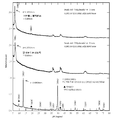
- 3 is an XRD profile measured for the particulate material of Example 1.
- 5 is an XRD profile measured for the particle material of Comparative Example 1.
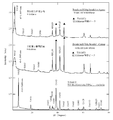
- It is an XRD profile measured about the MAX phase ceramic particle material of the comparative example 3, the example 6, the example 1, the comparative example 4, and the comparative example 5.
- 9 is an XRD profile measured for the particulate material of Example 6.
- 9 is an XRD profile measured for the particle material of Comparative Example 2.
- the particulate material, the method for producing the same, and the secondary battery of the present invention will be described below in detail based on the embodiments. Since the particle material of the present embodiment has a large void layer formed by removing the Al layer or formed by removing the Al layer, the secondary battery (Li-ion secondary battery, Na-ion secondary battery). It can be applied to negative electrode active material such as batteries and capacitors.
- the particle material of the present embodiment is a high-purity Ti 2 layer or Ti 3 layer in which a part of the carbon sites of the Ti 2 AlC or Ti 3 AlC 2 crystal lattice is replaced with nitrogen for application to the negative electrode active material.
- the flaky Ti2 or Ti3 layer of MXene particulate material is obtained by exfoliating the particulate material which is a powdered layered compound.
- the MXene particle material of the Ti2 layer or the Ti3 layer of the embodiment is composed of a layered compound having a predetermined composition formula. This layered compound has a large void layer because a part of the Al layer is removed by acid treatment. The Ti2 layer is superior to the Ti3 layer in terms of battery characteristics (battery capacity).
- Ti2 layers by replacing carbon site of Ti 2 AlC crystal lattice part nitrogen, the interlayer distance of the gap layer after the acid treatment spreads from 0.59nm to 0.70 nm.
- Ti 2 Al x [C (1-y) N y ] z (x is more than 0.02, y is 0 ⁇ y ⁇ 1.0, z is 0.80 to 1.20) It has a composition represented by.
- the interlayer distance of the gap layer after the acid treatment spreads from 0.44nm to 0.55 nm.
- the predetermined composition formula is represented by Ti 3 Al x [C (1-y) N y ] z (x is more than 0.02, 0 ⁇ y ⁇ 1.0, z is 1.80 to 2.60).
- O, OH, and halogen groups can be included as surface functional groups.
- the Al layer was removed because O, OH, and halogen groups were adsorbed to the surface layer of the particle material, the void layer in which a part of the Al layer was removed by the acid treatment, specifically, the layer in which A was present. Later, the layers expand.
- Ti 2 Al x C z (x is more than 0.02, z is 0.80 to 1.20) which is a Ti 2 layer
- the interlayer distance of the void layer after the acid treatment is 0.58 nm.
- Al x [C (1-y) N y ] z (x is more than 0.02, 0 ⁇ y ⁇ 1, z is 0.80 to 1.20) 0.59 nm to 0.70 nm Spread even further.
- Al x C z (x is more than 0.02, z is 1.80 to 2.60) which is a Ti3 layer
- the interlayer distance of the void layer after the acid treatment is 0.43 nm, but Ti 3
- X is more than 0.02. 0.03 and 0.04 can be adopted as the lower limit of x, and 0.58 and 0.56 can be adopted as the upper limit.
- y is more than 0 and less than 1.0. y is preferably less than 0.6, more preferably more than 0.4. For the Ti2 layer, 0.8 ⁇ z ⁇ 1.20 is preferable, and 0.80 ⁇ z ⁇ 0.95 is more preferable.
- the interlayer distance of the void layer is 0.59 nm to 0.70 nm for the Ti2 layer, but 0.63 nm to 0.70 nm is preferable.
- the Ti3 layer has a thickness of 0.44 nm to 0.55 nm, preferably 0.51 nm to 0.55 nm.
- the particle shape of the particle material of this embodiment is plate-like, leaf-like, flaky, or the like.
- the stacking direction of the layers of the layered compound is “thickness”
- the maximum value in the direction orthogonal to the thickness is “long side”
- the minimum value is “short side”
- the size [(long side+short side)/2 ] Of 50 nm or more and 300 nm or less
- the average value of thickness is 3.5 nm or more and 20 nm or less.
- the lower limit of size can be 50 nm, 70 nm, 100 nm, and the upper limit can be 300 nm, 250 nm.
- As the average value of the thickness 3.5 nm, 4.0 nm and 4.2 nm can be adopted as the lower limit and 20 nm and 15 nm can be adopted as the upper limit.
- the lower limit and the upper limit presented for these "size" and "thickness" can be arbitrarily combined and adopted.
- the Ti2 layer MXene particle material is obtained by subjecting a raw material of the Ti2 layer of MAX phase ceramic powder to acid treatment to partially dissolve the Al layer.
- a particle material suitable as the raw material at least one of Ti 2 AlC (1-x) N x [0 ⁇ x ⁇ 1] and Ti 2 Al(C 1-x N x )[0 ⁇ x ⁇ 1] is used.
- the composition is the main component.
- This particulate material is Ti 3 Al(C 1-x N x ) with respect to the peak intensity (A) of the 002 plane of Ti 2 Al(C 1-x N x ), (0 ⁇ x ⁇ 1) in the X-ray diffraction test.
- the ratio (B/A) of the peak intensity (B) of the 002 plane of (0 ⁇ x ⁇ 1) is 0.03 or more and 0.07 or less, Ti 2 Al(C 1-x N x ), ( When the ratio (C/A) of the peak intensities (C) of the crystal phases other than 0 ⁇ x ⁇ 1) and Ti 3 Al(C 1-x N x ) 2 (0 ⁇ x ⁇ 1) is 0.10 or less.
- the ratio (B/A) is 0.03 or more and 0.05 or less, and the ratio (C/A) is 0.05 or less.
- the method for producing the particulate material of the present embodiment is a method suitable for producing the above-mentioned particulate material.
- a mixed raw material of TiC, TiN, Al, and Ti is pressure-treated by CIP or uniaxial pressure in the range of 1 ton/cm 2 to 3 ton/cm 2 , and the powder is pressed.
- Ti 2 Al(C 1 -y N y ) which is a MAX phase ceramic with a high purity Ti 2 layer, and y is 0 ⁇ y ⁇ 1. .0 can be obtained.
- the MAX3 phase ceramic powder of the Ti3 layer for example, a mixed raw material of TiC, TiN, Al, and Ti is pressed by CIP or uniaxial pressing in the range of 1 ton/cm 2 to 3 ton/cm 2
- a piece of Ti 3 Al(C 1-x N x ) 2 which is a high-purity MAX phase ceramic of Ti 3 layer is obtained by heat-treating the piece in an inert atmosphere at 1450° C. to 1600° C. or less without pressure treatment. , (0 ⁇ x ⁇ 1) can be obtained.
- Part of Al is dissolved in this particle material by an acid treatment to form a Ti2 layer or Ti3 layer MXene particle material, and a powdery MXene particle material is subjected to a bead milling treatment using beads of 10 ⁇ m to 300 ⁇ m to form a flaky Ti2 layer. Layer or Ti3 layer MXene particle material.
- the raw material used in the peeling step is Ti 2 Al x [C (1-y) N y ] z or Ti 3 Al x [C (1-y) N y ] z, which is the particle material to be finally produced.
- the same composition as that of can be adopted. Therefore, as the values of x, y, and z, those described in the above-mentioned particle material can be applied as they are, and detailed description will be omitted.
- the raw material used in the peeling step is to contact an acidic substance with the MAX phase ceramic powder at a temperature controlled from 20°C to 30°C to remove a part of the Al element contained in the MAX phase ceramic powder. Can be manufactured in.
- the raw material used for the pretreatment step is a MAX phase ceramic powder having a composition represented by Ti 2 AlC (1-x) N x , where x is 0 ⁇ x ⁇ 1.0, for the Ti 2 layer.
- the MAX phase ceramics are Ti 2 Al(C 1-x N x ), (0 ⁇ x ⁇ 1) Ti 3 Al(C 1-x N x ) 2 , (0 ⁇ x
- the ratio A of the peak intensity on the 002 plane of ⁇ 1) is 0.03 or more and 0.07 or less, Ti 2 Al(C 1-x N x ), (0 ⁇ x ⁇ 1) and Ti 3 Al(C 1
- Ti 3 layer Ti 3 Al [C (1 -x) N x] 2, a MAX phase ceramic powder having a composition represented by (0 ⁇ x ⁇ 1).
- the amount of Al removed is adjusted so that the amount of Al (corresponding to x) in the MAX phase ceramic powder produced by acid treatment with an acidic substance remains above 0.02. Note that it is possible to remove all of Al, and in that case, it is preferable that the acid treatment is not advanced until the removal of Al.
- the amount of Al removed is the time of contact with an acidic substance (such as an aqueous acid solution) (the longer the amount is removed), the concentration of the acidic substance (the higher the concentration, the greater the amount removed), It can be adjusted by changing the amount of the acidic substance (the higher the absolute amount of the acidic substance, the larger the amount that can be removed) and the temperature of contact (the higher the amount, the greater the amount that can be removed).
- an acidic substance such as an aqueous acid solution
- the MAX phase ceramic powder (A element is Al), which is a layered compound, is subjected to an acid treatment to remove a part of Al to form a layered compound having a void layer forming a particle material.
- an acid for removing a part of the Al layer an acidic substance obtained by combining hydrofluoric acid and hydrochloric acid is adopted.
- hydrofluoric acid salt KF, LiF, etc.
- the mixed concentration of hydrofluoric acid and hydrochloric acid formed when it is assumed that the fluoride salt is completely dissociated is not particularly limited.
- the lower limit of the concentration of hydrofluoric acid is 1.7 mol/L, 2.0 mol/L, 2.3 mol/L, and the upper limit is about 2.5 mol/L, 2.6 mol/L, 2.7 mol/L. it can.
- the concentration of hydrochloric acid the lower limit can be set to 2.0 mol/L, 3.0 mol/L, 4.0 mol/L, and the upper limit can be set to about 13.0 mol/L, 14.0 mol/L, 15.0 mol/L. ..
- the mixing ratio (molar ratio) of hydrofluoric acid and hydrochloric acid formed on the assumption that the fluoride salt is completely dissociated is not particularly limited, but the lower limit of hydrofluoric acid is 1:13, 1:12, 1: 11, the upper limit may be about 1:5, 1:6, 1:7.
- the hydrofluoric acid and hydrochloric acid concentrations and the mixing ratios shown here can be arbitrarily combined and employed.
- the acid treatment temperature is preferably 20°C to 30°C. 20°C to 25°C is more preferable.
- the peeling step As one example, in the peeling step, the bead diameter, the peripheral speed, the slurry feed rate, so that the particle material containing many flaky particles produced after the peeling step has the form described in the above-mentioned particle material, Adjust bead loading and slurry particle concentration.
- the peeling step is a step of peeling the layer of the layered compound as the raw material. By using beads with a small size of 10 ⁇ m to 300 ⁇ m, it becomes possible to separate from the void layer where a part of the Al layer has been removed by acid treatment. It is possible to separate at a nano-level thickness by colliding fine-sized beads between the layers of the layered compound.
- the raw material to be used in the peeling process may have the same composition as the material constituting the above-mentioned particle material.
- the composition does not change in the peeling process.
- the lower limit of the size of the beads can be 10 ⁇ m, 15 ⁇ m, 20 ⁇ m, 30 ⁇ m, 40 ⁇ m
- the upper limit can be 300 ⁇ m, 200 ⁇ m, 100 ⁇ m. If it is 10 ⁇ m or more, the beads and the slurry can be easily classified.
- beads of 300 ⁇ m or less are used, peeling can be preferentially advanced rather than reduction in size of the particle material.
- These lower and upper limits can be adopted in any combination.
- the size of the beads is within a proper range, the energy to be applied can be increased and the peeling can be preferentially proceeded, so it is most preferable to use the beads of 50 ⁇ m to 100 ⁇ m.
- the material of the beads is not particularly limited, but ceramics such as zirconia, alumina, and silicon nitride can be used. Particularly, partially stabilized zirconia having a large fracture toughness is preferable.
- a commonly used bead mill that classifies beads and slurry in a minute size gap using beads having a size of more than 300 ⁇ m, reducing the size of the particle material takes precedence over exfoliation. Further, also in a ball mill such as a planetary ball mill using beads or balls having a particle size of more than 300 ⁇ m, reducing the size of the particle material has priority over peeling.
- the peripheral speed in the peeling process can be 6m/sec to 12m/sec.
- a peripheral speed of 8 m/sec to 10 m/sec is preferable. If it is 6 m/sec or more, the peeling efficiency is good, and if it is 12 m/sec or less, the application of excessive energy is suppressed, and the temperature rise of the obtained particle material can be suppressed, so that the surface of the obtained particle material is oxidized. The progress can be suppressed and the electric resistance can be lowered.
- the slurry feed rate can be 100 mL/min to 300 mL/min. A slurry particle concentration of 5 mg/mL to 1 mg/mL can be adopted.
- the condition of 5 mg/mL or less allows the peeling to proceed sufficiently, and the need to select flaky particle materials by classifying by centrifugation or the like becomes low. Further, it becomes possible to keep the particle size in the liquid of the slurry small. When it is 1 mg/mL or more, the peeling efficiency is improved.
- the temperature range of the slurry is preferably 35°C or lower. When the temperature is 35° C. or lower, surface oxidation can be suppressed and the electric resistance of the particle material can be kept low.
- -40% to 80% of beads can be used. When it is 40% or more, the efficiency of peeling is improved, and when it is 80% or less, classification of beads and slurry becomes easy. Whether or not a target particle material containing a large amount of flaky particles has been manufactured can be determined by observation with an SEM, TEM, or the like. In particular, the thickness of the particulate material can be judged by AFM analysis. The particulate material obtained in the peeling step can be used by classifying it by a method such as centrifugation, if necessary. The optimum conditions in the peeling process vary depending on the size of the apparatus, and therefore these numerical values are not limited.
- the interplanar spacing of the (002) plane in the powder was 0.68 nm, but the interplanar spacing of the (002) plane was 1 in the particle material after the acid treatment and the flaky particulate material after peeling according to the present invention. Spread to .37 nm. This means that the interlayer distance of the void layer obtained by dissolving a part of the Al layer was 0.69 nm, and the interlayer distance of the void layer was further expanded by partially replacing the carbon sites with nitrogen.
- the (002) plane spacing in the MAX phase ceramic powder (Ti 3 AlC 2 ) was 0.93 nm, but in the particle material after acid treatment and the flaky particle material after peeling, , The interplanar spacing of the (002) plane expanded to 1.36 nm. This means that the interlayer distance of the void layer obtained by dissolving a part of the Al layer is 0.43 nm.
- the MAX phase ceramic (Ti 3 Al(C 0.5 N 0.5 ) 2 in which some carbon sites are replaced with nitrogen in the MAX phase ceramic powder of the Ti 3 layer for example, the MAX phase ceramic (Ti 3 Al(C The (002) plane spacing in the 0.5 N 0.5 ) 2 powder was 0.92 nm, but in the particle material after the acid treatment and the flaky particle material after peeling according to the present invention, (002) The interplanar spacing of the () planes increased to 1.46 nm, which means that the interlayer distance of the void layer obtained by dissolving a part of the Al layer was 0.54 nm. It can be calculated by subtracting the surface spacing of the 002 surface of the MAX phase ceramic powder from the surface spacing of the 002 surface of the flaky particle material after peeling.
- -Functional groups such as OH groups and halogen groups are attached to the surface of this void layer, and it has excellent affinity with Li and Na ions. Li and Na ions are easily stored/desorbed on the void surface. Therefore, the developed product is effective as a negative electrode active material for secondary batteries. Since the interlayer distance is further widened, ions having a large ion diameter such as Na ions can be easily stored and desorbed. It should be noted that, when ultrasonic irradiation, a wet jet mill, or a roller was used as a conventional peeling method, it was difficult to sufficiently peel it.
- the secondary battery of this embodiment contains the above-mentioned particle material of this embodiment as a negative electrode active material.
- examples thereof include lithium ion secondary batteries and sodium ion secondary batteries.
- Other configurations are not particularly limited.
- the Ti2-based MXene particle material is more preferable than the Ti3-based MXene particle material in terms of battery capacity.
- the obtained mixed powder is hydrostatically pressed (CIP) at 1 ton/cm 2 , and the crushed powder compact is subjected to solid-phase reaction at 1350° C. in an Ar stream in a small vacuum pressure sintering furnace to form Ti 2 AlC.
- a MAX phase ceramic having a composition of 0.5 N 0.5 was produced.
- the obtained MAX phase ceramics are crushed in an alumina mortar, crushed in isopropyl alcohol (IPA) with a ball mill using zirconia balls with a diameter of 5 mm (24 h), and further crushed with a planetary ball mill using zirconia balls with a diameter of 0.5 mm. (45 minutes).
- IPA isopropyl alcohol
- XRD analysis was performed by a horizontal sample multipurpose X-ray diffractometer. The XRD diffraction test was performed under the conditions of "silica glass holder, 40 KV/40 mA, Scan Speed; 8°/min, Sampling Step; 0.01°, 2 ⁇ (5-80°), Rigaku Ultima IV R285".
- the XRD profile is shown in FIG.
- the ratio of the Ti 3 crystal phase as an impurity to the Ti 2 crystal phase, the residual Ti 3 AlC 0.5 N 0.5 , TiC 0.5 N 0.5, and other unreacted products or intermediate products of Ti 2 The ratio to the crystal phase is shown in Table 1.
- the ethanol slurry was dried at room temperature and subjected to XRD analysis, and the XRD profile is shown in FIG.
- the ethanol slurry was diluted to a particle concentration of 2 mg/mL, and bead milled using a bead diameter of 50 ⁇ m (Nikkato YTZ) (3 passes, peripheral speed 10 m/sec, liquid transfer speed 150 mL/min, bead filling rate 60%). went.
- the obtained particle material ethanol slurry was dried at room temperature, and the obtained powder was used for chemical analysis to measure the amounts of Ti, Al, C, and N, and XRD analysis.
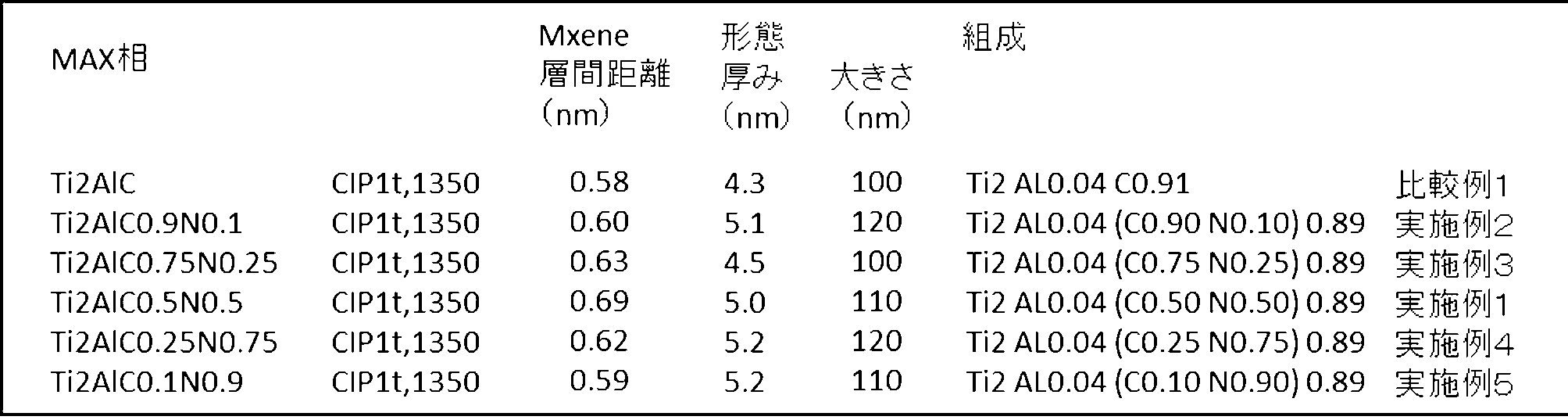
- Table 2 shows the interlayer distance of the obtained void layer, the thickness and size of the flakes, and the composition.
- Table 2 shows the interlayer distance of the obtained void layer, the thickness and size of the flakes, and the composition.
- Table 2 shows the interlayer distance of the obtained void layer, the thickness and size of the flakes, and the composition.
- the obtained MAX phase ceramics were crushed in an alumina mortar, then ball-milled with zirconia balls having a diameter of 5 mm in isopropyl alcohol (IPA) (24 h), and further pulverized with a planetary ball using zirconia balls having a diameter of 0.5 mm (45 Minutes).
- IPA isopropyl alcohol
- the ethanol slurry was dried at room temperature and subjected to XRD analysis, and the results are shown in FIG. In addition, the ethanol slurry was diluted to a particle concentration of 2 mg/mL, and bead milled using a bead diameter of 50 ⁇ m (Nikkato YTZ) (3 passes, peripheral speed 10 m/sec, liquid transfer speed 150 mL/min, bead filling rate 60%). went.
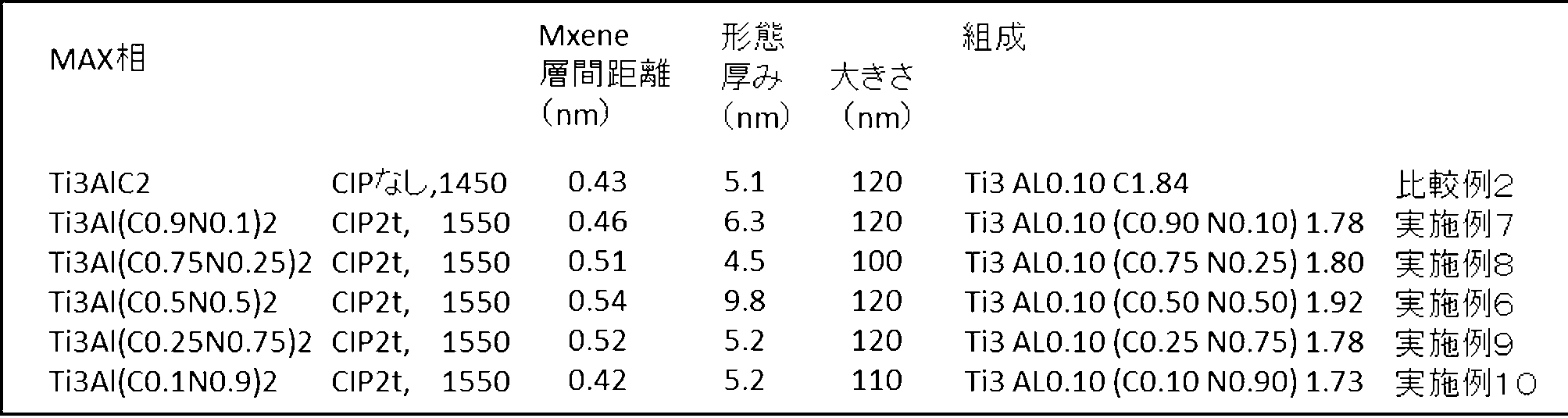
- Table 3 shows the interlayer distance of the obtained void layer, the thickness and size of the flakes, and the composition.
- Table 3 shows the interlayer distance of the obtained void layer, the thickness and size of the flakes, and the composition.
- Table 3 shows the interlayer distance of the obtained void layer, the thickness and size of the flakes, and the composition.
- Table 3 shows the interlayer distance of the obtained void layer, the thickness and size of the flakes, and the composition.
- An SEM image showing the peeled state is shown in FIG.
- the XRD profile of the obtained Ti2 layer MAX phase ceramics and the Ti2 layer MXene particle material is shown in FIG. Table 2 shows the interlayer distance of the obtained void layer, the thickness and size of the flakes, and the composition.
- FIG. 7 shows the XRD profile of the obtained MAX phase ceramic of the Ti3 layer and the MXene particle material of the Ti3 layer.
- Table 3 shows the interlayer distance of the obtained void layer, the thickness and size of the flakes, and the composition.
- Example 11 A MAX phase ceramic particle material was produced in the same manner as in Example 1 except that the firing temperature was 1300°C. XRD analysis was performed in the same manner as in Example 1 and the results are shown in Table 1. The profile is shown in FIG.
- Example 3 A MAX phase ceramic particle material was produced in the same manner as in Example 1 except that the firing temperature was 1250°C. XRD analysis was performed in the same manner as in Example 1 and the results are shown in Table 1. The profile is shown in FIG.
- Example 4 A MAX phase ceramic particle material was produced in the same manner as in Example 1 except that the firing temperature was 1400°C. XRD analysis was performed in the same manner as in Example 1 and the results are shown in Table 1. The profile is shown in FIG.
- Example 5 A MAX phase ceramic particle material was produced in the same manner as in Example 1 except that the firing temperature was 1450°C. XRD analysis was performed in the same manner as in Example 1 and the results are shown in Table 1. The profile is shown in FIG.
- Ti 2 AlC is a high purity, after the mixed material to produce a CIP process and uniaxially pressed green compact in a pressure range of 3t / cm 2 from 1t / cm 2 in order to improve the reactivity
- a method of heat-treating the crushed pieces in an inert atmosphere it is not effective and Ti 2 AlC having a high purity cannot be obtained.
- Ti or Al powder is increased more than the theoretical amount, for example, if it is increased to 1.2 times the theoretical amount, it is highly purified more than the theoretical amount, but sufficiently highly purified Ti 2 AlC is obtained. I could't do it.
- Ti 3 Al(C 1-x N x )+Ti(C 1-x N x ) ⁇ 2Ti 2 Al(C 1-x Nx) is formed as a highly pure Ti 2 layer by a reaction mechanism.
- a MAX phase ceramic was obtained.
- the highest purity Ti 2 layer of MAX phase ceramics was obtained.
- (B) for MAX phase ceramic Ti3 layer for example, Ti 3 Al for (C 0.5 N 0.5) 2, the compact starting material mixture in a pressure range of 3t / cm 2 from 1t / cm 2 with CIP Was prepared, and the crushed pieces were fired in an inert atmosphere at 1500°C to 1550°C.
- the firing temperature to 1500° C. or higher, the residual unreacted product could be suppressed, and by setting it to 1550° C. or lower, the MAX phase ceramics could be recovered without decomposition.
- the interlayer distance of the void layer formed was further expanded.
- the MXene particle material derived from Ti 2 AlC 0.5 N 0.5 or Ti 3 Al(C 0.5 N 0.5 ) 2 in which half the amount of carbon sites was replaced with nitrogen the interlayer distance of the void layer was widest. ..
- peeling Method of Particle Material As a peeling method, conventionally, a method using ultrasonic irradiation or a roller has been used. When the method of exfoliation by ultrasonic irradiation was examined, it was found that exfoliation to produce flaky particulate material was difficult. The speed of peeling between layers by ultrasonic irradiation was extremely slow, and in some cases, the layer was not separated by ultrasonic irradiation. In addition, peeling did not proceed sufficiently by the method using a roller.
- the average value of the size [(long side+short side)/2] obtained from the SEM image is 50 nm or more and 300 nm or less, which is obtained by AFM analysis, by performing a bead mill treatment using beads having a bead diameter of 10 ⁇ m to 300 ⁇ m. It was found that a thin piece having an average thickness of 3.5 nm or more and 20 nm or less can be rapidly obtained in a uniform state.
- the aggregate particle diameter measured in the organic solvent is D50%, 50 nm or more and 500 nm or less, and high dispersion.
- the bead mill treatment using beads having a bead diameter of 500 ⁇ m was performed, pulverization proceeded and peeling hardly occurred.
Landscapes
- Chemical & Material Sciences (AREA)
- Engineering & Computer Science (AREA)
- Manufacturing & Machinery (AREA)
- Inorganic Chemistry (AREA)
- Materials Engineering (AREA)
- Chemical Kinetics & Catalysis (AREA)
- Electrochemistry (AREA)
- General Chemical & Material Sciences (AREA)
- Ceramic Engineering (AREA)
- Organic Chemistry (AREA)
- Structural Engineering (AREA)
- Power Engineering (AREA)
- Nanotechnology (AREA)
- Microelectronics & Electronic Packaging (AREA)
- Physics & Mathematics (AREA)
- Condensed Matter Physics & Semiconductors (AREA)
- General Physics & Mathematics (AREA)
- Crystallography & Structural Chemistry (AREA)
- Composite Materials (AREA)
- Battery Electrode And Active Subsutance (AREA)
- Inorganic Compounds Of Heavy Metals (AREA)
- Powder Metallurgy (AREA)
Abstract
Description
X線回折試験における、Ti2Al(C1-xNx)[0<x<1]の002面のピーク強度(A)を基準として、
Ti3Al(C1-xNx)2[0<x<1]の002面のピーク強度(B)の比率(B/A)が、0.03以上で0.07以下、
Ti2Al(C1-xNx)[0<x<1]及びTi3Al(C1-xNx)2[0<x<1]以外の結晶相のピーク強度(C)の比率(C/A)が0.10以下であり、
Ti2AlC(1-x)Nx[0<x<1]及びTi2Al(C1-xNx)[0<x<1]の少なくとも一方で表される組成を主成分とする粒子材料が挙げられる。
前記原料から上記(1)~(3)の何れか1項に記載の粒子材料を製造する製造工程と
を有する粒子材料の製造方法が開示される。
結晶格子内の空隙層の層間距離が0.59nmから0.70nmである層を含むTi2Alx[C(1-y)Ny]z(xは0.02超、0<y<1.0、zは0.80から1.20)で表される組成を持つ粒子を含む粒子材料、又は、
結晶格子内の空隙層の層間距離が0.44nmから0.55nmである層を含むTi3Alx[C(1-y)Ny]z(xは0.02超、0<y<1.0、zは1.80から2.60)で表される組成を持つ粒子を含む粒子材料を製造する製造工程と
を有する粒子材料の製造方法が開示される。
実施形態のTi2層あるいはTi3層のMXene粒子材料は、所定の組成式を持つ層状化合物からなる。この層状化合物は酸処理によってAl層の一部が除去されて大きな空隙層を有する。Ti3層よりもTi2層の方が電池特性(電池容量)の観点から優れる。
(その1)
Ti2層のMXene粒子材料はTi2層のMAX相セラミックス粉末からなる原料を酸処理してAl層を一部溶解して得られる。原料として好適な粒子材料としては、Ti2AlC(1-x)Nx[0<x<1]及びTi2Al(C1-xNx)[0<x<1]の少なくとも一方で表される組成を主成分とする。
本実施形態の粒子材料の製造方法は、上述の粒子材料を製造するのに好適な方法である。Ti2層のMAX相セラミックス粉末について、例えば、TiCとTiNとAlとTiの混合原料をCIP又は一軸加圧により1トン/cm2から3トン/cm2の範囲で加圧処理し、その圧粉体破砕片を1300℃から1400℃以下の不活性雰囲気中で熱処理することにより高純度なTi2層のMAX相セラミックスであるTi2Al(C1-yNy)、yは0<y<1.0を得ることができる。Ti3層のMAX相セラミックス粉末について、例えば、TiCとTiNとAlとTiの混合原料をCIP又は一軸加圧により1トン/cm2から3トン/cm2の範囲で加圧処理した圧粉体破砕片を、あるいは加圧処理することなく、1450℃から1600℃以下の不活性雰囲気中で熱処理することにより高純度なTi3層のMAX相セラミックスであるTi3Al(C1-xNx)2、(0<x<1)を得ることができる。
剥離工程に供する原料は、MAX相セラミックス粉末に酸性物質を20℃から30℃に制御した温度にて接触させて、MAX相セラミックス粉末に含まれるAl元素の一部を除去することで製造することができる。前処理工程に供する原料は、Ti2層については、Ti2AlC(1-x)Nx、xは0<x<1.0、で表される組成を有するMAX相セラミックス粉末である。MAX相セラミックスは、X線回折試験におけるTi2Al(C1-xNx)、(0<x<1)の002面に対するTi3Al(C1-xNx)2、(0<x<1)の002面のピーク強度の比率Aが、0.03以上で0.07以下、Ti2Al(C1-xNx)、(0<x<1)とTi3Al(C1-xNx)2、(0<x<1)以外の結晶相のピーク強度の比率Bが0.10以下である、高純度なTi2層のMAX相セラミックス粉末を用いることが好ましい。Ti3層については、Ti3Al[C(1-x)Nx]2、(0<x<1)で表される組成を有するMAX相セラミックス粉末である。
1つの例として、剥離工程では剥離工程後に製造される薄片状の粒子が多く含まれる粒子材料が上述した粒子材料にて記載した形態になるようビーズ径、周速、スラリー送り速度、ビーズ充填量、スラリー粒子濃度を調節する。剥離工程は原料である層状化合物の層を剥離する工程である。10μm~300μmの微小サイズのビーズを用いることで酸処理によってAl層の一部を除去した空隙層から剥離することが可能となる。微小サイズのビーズを層状化合物の層間に衝突させることによってナノレベルの厚みで剥離させることができる。
本実施形態の二次電池は上述の本実施形態の粒子材料を負極活物質として含有する。リチウムイオン二次電池やナトリウムイオン二次電池が例示できる。その他の構成としては特に限定されない。なお二次電池の負極活物質に用いる用途においては、Ti2系MXene粒子材料の方が、Ti3系MXene粒子材料より、電池の容量の点でより好適である。
(実施例1)
TiC(3μm、レアメタリック)、TiN(3μm、レアメタリック)、Ti(35μm、高純度化学)、Al(30μm、高純度化学)のそれぞれの粉末を混合して混合粉末(TiC:TiN:Ti:Al=0.5:0.5:1:1モル)とした。得られた混合粉末を、1トン/cm2で静水圧プレス(CIP)し、圧粉体破砕片を小型真空加圧焼結炉により、Ar気流中1350℃で固相反応させてTi2AlC0.5N0.5組成のMAX相セラミックスを作製した。
TiC:TiN:Ti:Al=0.9:0.1:1:1モルの混合粉末を出発原料として用いた以外は実施例1と同様に行った。得られた空隙層の層間距離、薄片の厚みと大きさ、組成を表2した。
TiC:TiN:Ti:Al=0.75:0.25:1:1モルの混合粉末を出発原料として用いた以外は実施例1と同様に行った。得られた空隙層の層間距離、薄片の厚みと大きさ、組成を表2に示した。
TiC:TiN:Ti:Al=0.25:0.75:1:1モルの混合粉末を出発原料として用いた以外は実施例1と同様に行った。得られた空隙層の層間距離、薄片の厚みと大きさ、組成を表2に示した。
TiC:TiN:Ti:Al=0.1:0.9:1:1モルの混合粉末を出発原料として用いた以外は実施例1と同様に行った。得られた空隙層の層間距離、薄片の厚みと大きさ、組成を表2に示した。
TiC(3μm、レアメタリック)、TiN(3μm、レアメタリック)、Ti(35μm、高純度化学)、Al(30μm、高純度化学)のそれぞれの粉末を混合して混合粉末(TiC:TiN:Ti:Al=1:1:1:1モル)とした。得られた混合粉末を、CIP2t/cm2処理し、圧粉体破砕片をAr気流中1550℃で固相反応させてMAX相セラミックスを作製した。得られたMAX相セラミックスをアルミナ乳鉢で解砕した後、イソプロピルアルコール(IPA)中で直径5mmジルコニアボールを用いたボールミル粉砕(24h)、さらに直径0.5mmジルコニアボールを用いた遊星ボールミル粉砕(45分)を行った。
TiC:TiN:Ti:Al=1.8:0.2:1:1モルの混合粉末を出発原料として用いた以外は実施例6と同様に行った。得られた空隙層の層間距離、薄片の厚みと大きさ、組成を表3に示した。
TiC:TiN:Ti:Al=1.5:0.5:1:1モルの混合粉末を出発原料として用いた以外は実施例6と同様に行った。得られた空隙層の層間距離、薄片の厚みと大きさ、組成を表3に示した。
TiC:TiN:Ti:Al=0.5:1.5:1:1モルの混合粉末を出発原料として用いた以外は実施例6と同様に行った。得られた空隙層の層間距離、薄片の厚みと大きさ、組成を表3に示した。
TiC:TiN:Ti:Al=0.2:1.8:1:1モルの混合粉末を出発原料として用いた以外は実施例6と同様に行った。得られた空隙層の層間距離、薄片の厚みと大きさ、組成を表3に示した。
TiC:TiN:Ti:Al=1:0.0:1:1モルの混合粉末を出発原料として用いた以外は実施例1と同様に行った。剥離した状態を示すSEM像を図2に示した。得られたTi2層のMAX相セラミックス及びTi2層のMXene粒子材料のXRDプロファイルを図4に示す。また得られた空隙層の層間距離、薄片の厚みと大きさ、組成を表2に示した。
TiC:TiN:Ti:Al=2:0.0:1:1モルの混合粉末を出発原料として用いた以外は実施例6と同様に行った。得られたTi3層のMAX相セラミックス及びTi3層のMXene粒子材料のXRDプロファイルを図7に示す。また得られた空隙層の層間距離、薄片の厚みと大きさ、組成を表3に示した。
(実施例11)
焼成温度を1300℃とした以外は実施例1と同様にしてMAX相セラミックス粒子材料を作製した。実施例1と同様にXRD分析し結果を表1に示した。プロファイルを図5に示した。
焼成温度を1250℃とした以外は実施例1と同様にしてMAX相セラミックス粒子材料を作製した。実施例1と同様にXRD分析し結果を表1に示した。プロファイルを図5に示した。
焼成温度を1400℃とした以外は実施例1と同様にしてMAX相セラミックス粒子材料を作製した。実施例1と同様にXRD分析し結果を表1に示した。プロファイルを図5に示した。
焼成温度を1450℃とした以外は実施例1と同様にしてMAX相セラミックス粒子材料を作製した。実施例1と同様にXRD分析し結果を表1に示した。プロファイルを図5に示した。

(1)Ti2層のMAX相セラミックスの作製方法について
(a)Ti2層のMAX相セラミックスの代表例であるTi2AlCを例に反応メカニズムを説明する。出発原料にTiC、Ti、Al粉末を用い、その混合原料を不活性雰囲気中で1250℃以上の温度で焼成するとTi2AlCが得られる。1300℃以下では、中間生成物であるTi3AlCやTiCが残留する。しかし、1300℃ではTi2AlCの大部分が分解してTi3AlC2が形成される。高純度であるTi2AlCを得るためには、反応性を良くするために混合原料を1t/cm2から3t/cm2の圧力範囲でCIP処理や一軸加圧した圧粉体を作製した後、その破砕片を不活性雰囲気で熱処理する方法があるが、効果的ではなく、高純度であるTi2AlCが得られなかった。また、理論量よりもTiやAl粉末を増量した、例えば理論量の1.2倍量に増量すると、理論量よりも高純度化されるが、十分に高純度化されたTi2AlCが得られなかった。
酸処理を行う前処理工程において、20℃から30℃で制御した水溶液温度範囲で、10%以上のHF水溶液に24時間以上浸漬するとAlは完全に除去された(従来技術)。また35℃あるいは45℃で、LiF+HClあるいはKF+HCl水溶液に、24時間以上浸漬してもAlは完全に除去された(従来技術)。いずれも酸処理工程で一部表面酸化が進行し、電気抵抗が増加した。
剥離する方法として従来は超音波照射やローラーによる方法を用いていた。超音波照射による剥離方法について検討を行うと、剥離して薄片状の粒子材料を製造するのは困難であることが分かった。超音波照射によって層間を剥離する速度は極めて遅い上に、超音波照射によっては剥離しない場合もあった。またローラーによる方法では剥離は十分に進行しなかった。
Claims (7)
- 結晶格子内の空隙層の層間距離が0.59nmから0.70nmである層を含むTi2Alx[C(1-y)Ny]z(式中、xは0.02超、0<y<1.0、zは0.80から1.20)で表される組成を持つ粒子材料。
- 結晶格子内の空隙層の層間距離が0.44nmから0.55nmである層を含むTi3Alx[C(1-y)Ny]z(xは0.02超、yは0<y<1.0、zは1.80から2.60)で表される組成を持つ粒子材料。
- 厚みの平均値が3.5nm以上20nm以下、大きさ[(長辺+短辺)/2]の平均値が50nm以上300nm以下である請求項1又は2に記載の粒子材料。
- X線回折試験における、Ti2Al(C1-xNx)[0<x<1]の002面のピーク強度(A)を基準として、
Ti3Al(C1-xNx)2[0<x<1]の002面のピーク強度(B)の比率(B/A)が、0.03以上で0.07以下、
Ti2Al(C1-xNx)[0<x<1]及びTi3Al(C1-xNx)2[0<x<1]以外の結晶相のピーク強度(C)の比率(C/A)が0.10以下であり、
Ti2AlC(1-x)Nx[0<x<1]及びTi2Al(C1-xNx)[0<x<1]の少なくとも一方で表される組成を主成分とする粒子材料。 - 請求項4に記載の粒子材料に対し、フッ化塩と塩酸との組み合わせでなる酸性物質を20℃から30℃の水溶液温度で反応させて、含有するAl元素の一部を除去することで原料を製造する前処理工程と、
前記原料から請求項1~3の何れか1項に記載の粒子材料を製造する製造工程と
を有する粒子材料の製造方法。 - MAX相セラミックス粉末に対し、フッ化塩と塩酸との組み合わせでなる酸性物質を20℃から30℃の水溶液温度で反応させて、含有するAl元素の一部を除去することで原料を製造する前処理工程と、
(1)結晶格子内の空隙層の層間距離が0.59nmから0.70nmである層を含むTi2Alx[C(1-y)Ny]z(xは0.02超、0<y<1.0、zは0.80から1.20)で表される組成を持つ粒子を含む粒子材料、又は、
(2)結晶格子内の空隙層の層間距離が0.44nmから0.55nmである層を含むTi3Alx[C(1-y)Ny]z(xは0.02超、0<y<1.0、zは1.80から2.60)で表される組成を持つ粒子を含む粒子材料を製造する製造工程と
を有する粒子材料の製造方法。 - 請求項1~3うちの何れか1項に記載の粒子材料を含む負極活物質を有する二次電池。
Priority Applications (6)
| Application Number | Priority Date | Filing Date | Title |
|---|---|---|---|
| CN201880027612.6A CN110972477A (zh) | 2018-12-28 | 2018-12-28 | MXene粒子材料、MXene粒子材料的制造方法和二次电池 |
| JP2019522353A JP6564553B1 (ja) | 2018-12-28 | 2018-12-28 | MXene粒子材料、それらの粒子材料の製造方法、及び、二次電池 |
| PCT/JP2018/048449 WO2020136865A1 (ja) | 2018-12-28 | 2018-12-28 | MXene粒子材料、それらの粒子材料の製造方法、及び、二次電池 |
| KR1020197034392A KR102154947B1 (ko) | 2018-12-28 | 2018-12-28 | MXene 입자 재료, 그들 입자 재료의 제조 방법 및 이차 전지 |
| TW108135980A TWI694971B (zh) | 2018-12-28 | 2019-10-04 | MXene粒子材料、彼等粒子材料之製造方法及二次電池 |
| US16/822,161 US10947161B2 (en) | 2018-12-28 | 2020-03-18 | “MXene” particulate material, production process for the same and secondary battery |
Applications Claiming Priority (1)
| Application Number | Priority Date | Filing Date | Title |
|---|---|---|---|
| PCT/JP2018/048449 WO2020136865A1 (ja) | 2018-12-28 | 2018-12-28 | MXene粒子材料、それらの粒子材料の製造方法、及び、二次電池 |
Related Child Applications (1)
| Application Number | Title | Priority Date | Filing Date |
|---|---|---|---|
| US16/822,161 Continuation US10947161B2 (en) | 2018-12-28 | 2020-03-18 | “MXene” particulate material, production process for the same and secondary battery |
Publications (1)
| Publication Number | Publication Date |
|---|---|
| WO2020136865A1 true WO2020136865A1 (ja) | 2020-07-02 |
Family
ID=67692189
Family Applications (1)
| Application Number | Title | Priority Date | Filing Date |
|---|---|---|---|
| PCT/JP2018/048449 Ceased WO2020136865A1 (ja) | 2018-12-28 | 2018-12-28 | MXene粒子材料、それらの粒子材料の製造方法、及び、二次電池 |
Country Status (6)
| Country | Link |
|---|---|
| US (1) | US10947161B2 (ja) |
| JP (1) | JP6564553B1 (ja) |
| KR (1) | KR102154947B1 (ja) |
| CN (1) | CN110972477A (ja) |
| TW (1) | TWI694971B (ja) |
| WO (1) | WO2020136865A1 (ja) |
Cited By (4)
| Publication number | Priority date | Publication date | Assignee | Title |
|---|---|---|---|---|
| WO2022239210A1 (ja) * | 2021-05-13 | 2022-11-17 | 株式会社アドマテックス | 新規なMXeneナノシートからなる粒子材料、その粒子材料を含有する分散液、及びその製造方法 |
| WO2022239209A1 (ja) * | 2021-05-13 | 2022-11-17 | 株式会社アドマテックス | 複合粉末材料及びその製造方法、並びに電極材料 |
| JPWO2023089739A1 (ja) * | 2021-11-18 | 2023-05-25 | ||
| WO2023223780A1 (ja) * | 2022-05-16 | 2023-11-23 | 株式会社村田製作所 | 導電性2次元粒子およびその製造方法、導電性膜、導電性ペースト、ならびに導電性複合材料 |
Families Citing this family (14)
| Publication number | Priority date | Publication date | Assignee | Title |
|---|---|---|---|---|
| CN114026663B (zh) * | 2019-08-05 | 2023-07-07 | 株式会社村田制作所 | 导电性材料、导电性薄膜、电化学电容器、导电性材料的制造方法及导电性薄膜的制造方法 |
| CN116134978B (zh) * | 2020-08-13 | 2025-10-21 | 株式会社村田制作所 | 导电性膜、粒子状物质、浆料和导电性膜的制造方法 |
| TR202021780A1 (tr) | 2020-12-25 | 2022-07-21 | Tusas Tuerk Havacilik Ve Uzay Sanayii Anonim Sirketi | Bir soğurucu yapı |
| CN114804883B (zh) * | 2021-01-27 | 2023-11-10 | 中国科学院金属研究所 | 一种基于Ti2CTx迈科烯的高倍率锂离子电池负极材料制备方法 |
| CN116887914B (zh) * | 2021-01-29 | 2025-12-26 | 株式会社村田制作所 | 吸附材料及其制造方法、吸附片、人工透析用分离膜和人工透析设备 |
| CN112928342B (zh) * | 2021-02-08 | 2022-06-03 | 安徽大学 | 一种多功能锌离子微型电池及其制备方法与应用 |
| CN115367754B (zh) * | 2021-05-21 | 2023-11-14 | 北京航空航天大学 | 由MXene转化制备MAX相材料的方法及用途 |
| CN113968741B (zh) * | 2021-05-21 | 2023-06-02 | 北京航空航天大学 | 具有硫催化功能的含氮高熵MXene、隔膜复合材料及电池 |
| CN114472914B (zh) * | 2022-01-06 | 2022-11-25 | 中山大学 | 一种多枝状银纳米线的制备方法 |
| CN114361570B (zh) * | 2022-01-11 | 2023-09-01 | 山东大学 | 一种钠电池及其制备方法 |
| KR102685290B1 (ko) * | 2022-06-02 | 2024-07-17 | 주식회사 엘오티아이 | 저산소 맥스 상 합성 방법 |
| KR102749667B1 (ko) | 2023-01-18 | 2025-01-06 | 대구가톨릭대학교산학협력단 | 전이금속이 코팅된 맥신막을 갖는 하이브리드 태양전지 |
| KR20240143222A (ko) | 2023-03-23 | 2024-10-02 | 대구가톨릭대학교산학협력단 | 전이금속이 코팅된 맥신화합물의 제조방법, 이로부터 제조된 맥신화합물 및 이를 이용한 하이브리드 태양전지 |
| CN119822337B (zh) * | 2024-12-23 | 2025-11-11 | 昆明理工大学 | 一种微波熔盐制备分层梯度Ti2AlC0.5N0.5的方法 |
Citations (4)
| Publication number | Priority date | Publication date | Assignee | Title |
|---|---|---|---|---|
| JPH11279745A (ja) * | 1998-03-30 | 1999-10-12 | Ngk Spark Plug Co Ltd | 表面被覆工具 |
| WO2011136136A1 (ja) * | 2010-04-30 | 2011-11-03 | 独立行政法人物質・材料研究機構 | 配向性max相セラミック及びその製造方法 |
| JP2016063171A (ja) * | 2014-09-22 | 2016-04-25 | 国立大学法人 東京大学 | 層状化合物を含む電極材料 |
| JP2017076739A (ja) * | 2015-10-16 | 2017-04-20 | 国立大学法人 東京大学 | 層状化合物を含む電気化学キャパシタ用電極材料の製造方法 |
Family Cites Families (7)
| Publication number | Priority date | Publication date | Assignee | Title |
|---|---|---|---|---|
| US9193595B2 (en) * | 2011-06-21 | 2015-11-24 | Drexel University | Compositions comprising free-standing two-dimensional nanocrystals |
| CN104056591B (zh) * | 2014-07-01 | 2016-02-03 | 西华师范大学 | 磁性有机污染废水处理剂及其制备方法和用途 |
| WO2016049109A2 (en) | 2014-09-25 | 2016-03-31 | Drexel University | Physical forms of mxene materials exhibiting novel electrical and optical characteristics |
| KR102373455B1 (ko) | 2015-09-24 | 2022-03-11 | 삼성전자주식회사 | 멕신(MXene) 나노시트 및 그 제조방법 |
| CN108615871B (zh) * | 2018-04-25 | 2020-10-09 | 山东大学 | 一种锂电池负极材料MXene的制备方法及其应用 |
| CN108811478B (zh) * | 2018-06-12 | 2019-08-09 | 西北工业大学 | 一种三维层状MXene电磁屏蔽泡沫及制备方法 |
| CN108987674B (zh) * | 2018-07-25 | 2020-06-05 | 山东大学 | 一种柔性MXene自支撑膜/金属复合材料及其制备方法、应用 |
-
2018
- 2018-12-28 CN CN201880027612.6A patent/CN110972477A/zh active Pending
- 2018-12-28 WO PCT/JP2018/048449 patent/WO2020136865A1/ja not_active Ceased
- 2018-12-28 JP JP2019522353A patent/JP6564553B1/ja not_active Expired - Fee Related
- 2018-12-28 KR KR1020197034392A patent/KR102154947B1/ko not_active Expired - Fee Related
-
2019
- 2019-10-04 TW TW108135980A patent/TWI694971B/zh not_active IP Right Cessation
-
2020
- 2020-03-18 US US16/822,161 patent/US10947161B2/en not_active Expired - Fee Related
Patent Citations (4)
| Publication number | Priority date | Publication date | Assignee | Title |
|---|---|---|---|---|
| JPH11279745A (ja) * | 1998-03-30 | 1999-10-12 | Ngk Spark Plug Co Ltd | 表面被覆工具 |
| WO2011136136A1 (ja) * | 2010-04-30 | 2011-11-03 | 独立行政法人物質・材料研究機構 | 配向性max相セラミック及びその製造方法 |
| JP2016063171A (ja) * | 2014-09-22 | 2016-04-25 | 国立大学法人 東京大学 | 層状化合物を含む電極材料 |
| JP2017076739A (ja) * | 2015-10-16 | 2017-04-20 | 国立大学法人 東京大学 | 層状化合物を含む電気化学キャパシタ用電極材料の製造方法 |
Cited By (10)
| Publication number | Priority date | Publication date | Assignee | Title |
|---|---|---|---|---|
| WO2022239210A1 (ja) * | 2021-05-13 | 2022-11-17 | 株式会社アドマテックス | 新規なMXeneナノシートからなる粒子材料、その粒子材料を含有する分散液、及びその製造方法 |
| WO2022239209A1 (ja) * | 2021-05-13 | 2022-11-17 | 株式会社アドマテックス | 複合粉末材料及びその製造方法、並びに電極材料 |
| JPWO2022239209A1 (ja) * | 2021-05-13 | 2022-11-17 | ||
| JPWO2022239210A1 (ja) * | 2021-05-13 | 2022-11-17 | ||
| JP7579550B2 (ja) | 2021-05-13 | 2024-11-08 | 株式会社アドマテックス | 新規なMXeneナノシートからなる粒子材料、その粒子材料を含有する分散液、及びその製造方法 |
| JP7580094B2 (ja) | 2021-05-13 | 2024-11-11 | 株式会社アドマテックス | 複合粉末材料及びその製造方法、並びに電極材料 |
| JPWO2023089739A1 (ja) * | 2021-11-18 | 2023-05-25 | ||
| WO2023089739A1 (ja) * | 2021-11-18 | 2023-05-25 | 株式会社アドマテックス | 複合粒子材料及びその製造方法、並びに電極 |
| JP7754458B2 (ja) | 2021-11-18 | 2025-10-15 | 株式会社アドマテックス | 複合粒子材料及びその製造方法、並びに電極 |
| WO2023223780A1 (ja) * | 2022-05-16 | 2023-11-23 | 株式会社村田製作所 | 導電性2次元粒子およびその製造方法、導電性膜、導電性ペースト、ならびに導電性複合材料 |
Also Published As
| Publication number | Publication date |
|---|---|
| CN110972477A (zh) | 2020-04-07 |
| US20200255343A1 (en) | 2020-08-13 |
| KR102154947B1 (ko) | 2020-09-10 |
| JPWO2020136865A1 (ja) | 2021-02-15 |
| US10947161B2 (en) | 2021-03-16 |
| JP6564553B1 (ja) | 2019-08-21 |
| KR20200083379A (ko) | 2020-07-08 |
| TWI694971B (zh) | 2020-06-01 |
| TW202026245A (zh) | 2020-07-16 |
Similar Documents
| Publication | Publication Date | Title |
|---|---|---|
| JP6564553B1 (ja) | MXene粒子材料、それらの粒子材料の製造方法、及び、二次電池 | |
| US10981835B2 (en) | “MXene” particulate material, slurry, secondary battery, transparent electrode and production process for “MXene” particulate material | |
| Jankovský et al. | Towards highly electrically conductive and thermally insulating graphene nanocomposites: Al 2 O 3–graphene | |
| JP7092860B2 (ja) | 酸化珪素系負極材及びその製造方法 | |
| US12049402B2 (en) | Method for the manufacture of graphene oxide from electrode graphite scrap | |
| EP3797091B1 (en) | A method for the manufacture of reduced graphene oxide from electrode graphite scrap | |
| EP4146613A1 (en) | Lithium-ion conductive ceramic material and process | |
| WO2022239210A1 (ja) | 新規なMXeneナノシートからなる粒子材料、その粒子材料を含有する分散液、及びその製造方法 | |
| JP7580094B2 (ja) | 複合粉末材料及びその製造方法、並びに電極材料 | |
| KR102298897B1 (ko) | 폐 태양광 셀을 이용한 SiC 합성 방법 | |
| Wongmaneerung et al. | Effects of milling method and calcination condition on phase and morphology characteristics of Mg4Nb2O9 powders | |
| EP4541771A1 (en) | Lithium-cobalt-based composite oxide particles and method for producing same, and lithium-cobalt-based composite oxide particle composition and method for producing same | |
| EP4657605A1 (en) | Method for recycling positive electrode active material and positive electrode active material recycled thereby | |
| WO2025085290A1 (en) | Dry post-treatment processes for lithium transition metal oxide cathode materials | |
| JP2023083755A (ja) | 硫化物系無機固体電解質材料、および硫化物系無機固体電解質材料の製造方法 | |
| JP2023184449A (ja) | リチウムコバルト系複合酸化物粒子及びその製造方法、リチウムコバルト系複合酸化物粒子組成物及びそれらの製造方法 | |
| JP2024103101A (ja) | リチウムコバルト系複合酸化物粒子及びその製造方法 | |
| FR2654091A1 (fr) | Procede de fabrication d'analogues de l'alumine-beta. | |
| KR20200130054A (ko) | 실리콘 분말 소재 제조방법 | |
| Zyryanov et al. | Nano-and Microstructure Design by Mechanochemical Approach of Ceramic Ionic Composites on the Base of SSZ | |
| Huang et al. | Synergistic Raw Material Selection and MnO 2 Mineralization for High-Performance β ″-Al 2 O 3 Solid Electrolytes with Oriented Lamellar Structure | |
| Huang et al. | MnO2-mediated redox reaction: A facile strategy to fabricate high-performance layered β''-Al2O3 solid electrolytes |
Legal Events
| Date | Code | Title | Description |
|---|---|---|---|
| ENP | Entry into the national phase |
Ref document number: 2019522353 Country of ref document: JP Kind code of ref document: A |
|
| ENP | Entry into the national phase |
Ref document number: 20197034392 Country of ref document: KR Kind code of ref document: A |
|
| 121 | Ep: the epo has been informed by wipo that ep was designated in this application |
Ref document number: 18945084 Country of ref document: EP Kind code of ref document: A1 |
|
| NENP | Non-entry into the national phase |
Ref country code: DE |
|
| 122 | Ep: pct application non-entry in european phase |
Ref document number: 18945084 Country of ref document: EP Kind code of ref document: A1 |