WO2020116084A1 - 光源ユニット、照明装置、加工装置及び偏向素子 - Google Patents
光源ユニット、照明装置、加工装置及び偏向素子 Download PDFInfo
- Publication number
- WO2020116084A1 WO2020116084A1 PCT/JP2019/043784 JP2019043784W WO2020116084A1 WO 2020116084 A1 WO2020116084 A1 WO 2020116084A1 JP 2019043784 W JP2019043784 W JP 2019043784W WO 2020116084 A1 WO2020116084 A1 WO 2020116084A1
- Authority
- WO
- WIPO (PCT)
- Prior art keywords
- light
- light ray
- light emitting
- source unit
- ray
- Prior art date
- Legal status (The legal status is an assumption and is not a legal conclusion. Google has not performed a legal analysis and makes no representation as to the accuracy of the status listed.)
- Ceased
Links
Images

















Classifications
-
- F—MECHANICAL ENGINEERING; LIGHTING; HEATING; WEAPONS; BLASTING
- F21—LIGHTING
- F21V—FUNCTIONAL FEATURES OR DETAILS OF LIGHTING DEVICES OR SYSTEMS THEREOF; STRUCTURAL COMBINATIONS OF LIGHTING DEVICES WITH OTHER ARTICLES, NOT OTHERWISE PROVIDED FOR
- F21V9/00—Elements for modifying spectral properties, polarisation or intensity of the light emitted, e.g. filters
- F21V9/30—Elements containing photoluminescent material distinct from or spaced from the light source
-
- F—MECHANICAL ENGINEERING; LIGHTING; HEATING; WEAPONS; BLASTING
- F21—LIGHTING
- F21V—FUNCTIONAL FEATURES OR DETAILS OF LIGHTING DEVICES OR SYSTEMS THEREOF; STRUCTURAL COMBINATIONS OF LIGHTING DEVICES WITH OTHER ARTICLES, NOT OTHERWISE PROVIDED FOR
- F21V5/00—Refractors for light sources
- F21V5/008—Combination of two or more successive refractors along an optical axis
-
- F—MECHANICAL ENGINEERING; LIGHTING; HEATING; WEAPONS; BLASTING
- F21—LIGHTING
- F21V—FUNCTIONAL FEATURES OR DETAILS OF LIGHTING DEVICES OR SYSTEMS THEREOF; STRUCTURAL COMBINATIONS OF LIGHTING DEVICES WITH OTHER ARTICLES, NOT OTHERWISE PROVIDED FOR
- F21V5/00—Refractors for light sources
- F21V5/04—Refractors for light sources of lens shape
-
- G—PHYSICS
- G02—OPTICS
- G02B—OPTICAL ELEMENTS, SYSTEMS OR APPARATUS
- G02B19/00—Condensers, e.g. light collectors or similar non-imaging optics
- G02B19/0033—Condensers, e.g. light collectors or similar non-imaging optics characterised by the use
- G02B19/0047—Condensers, e.g. light collectors or similar non-imaging optics characterised by the use for use with a light source
- G02B19/0052—Condensers, e.g. light collectors or similar non-imaging optics characterised by the use for use with a light source the light source comprising a laser diode
-
- G—PHYSICS
- G02—OPTICS
- G02B—OPTICAL ELEMENTS, SYSTEMS OR APPARATUS
- G02B27/00—Optical systems or apparatus not provided for by any of the groups G02B1/00 - G02B26/00, G02B30/00
- G02B27/09—Beam shaping, e.g. changing the cross-sectional area, not otherwise provided for
- G02B27/0916—Adapting the beam shape of a semiconductor light source such as a laser diode or an LED, e.g. for efficiently coupling into optical fibers
-
- G—PHYSICS
- G02—OPTICS
- G02B—OPTICAL ELEMENTS, SYSTEMS OR APPARATUS
- G02B27/00—Optical systems or apparatus not provided for by any of the groups G02B1/00 - G02B26/00, G02B30/00
- G02B27/09—Beam shaping, e.g. changing the cross-sectional area, not otherwise provided for
- G02B27/0938—Using specific optical elements
- G02B27/095—Refractive optical elements
- G02B27/0972—Prisms
-
- G—PHYSICS
- G02—OPTICS
- G02B—OPTICAL ELEMENTS, SYSTEMS OR APPARATUS
- G02B5/00—Optical elements other than lenses
- G02B5/04—Prisms
-
- G—PHYSICS
- G02—OPTICS
- G02B—OPTICAL ELEMENTS, SYSTEMS OR APPARATUS
- G02B6/00—Light guides; Structural details of arrangements comprising light guides and other optical elements, e.g. couplings
- G02B6/0001—Light guides; Structural details of arrangements comprising light guides and other optical elements, e.g. couplings specially adapted for lighting devices or systems
- G02B6/0005—Light guides; Structural details of arrangements comprising light guides and other optical elements, e.g. couplings specially adapted for lighting devices or systems the light guides being of the fibre type
- G02B6/0008—Light guides; Structural details of arrangements comprising light guides and other optical elements, e.g. couplings specially adapted for lighting devices or systems the light guides being of the fibre type the light being emitted at the end of the fibre
-
- G—PHYSICS
- G02—OPTICS
- G02B—OPTICAL ELEMENTS, SYSTEMS OR APPARATUS
- G02B6/00—Light guides; Structural details of arrangements comprising light guides and other optical elements, e.g. couplings
- G02B6/24—Coupling light guides
- G02B6/42—Coupling light guides with opto-electronic elements
- G02B6/4201—Packages, e.g. shape, construction, internal or external details
- G02B6/4204—Packages, e.g. shape, construction, internal or external details the coupling comprising intermediate optical elements, e.g. lenses, holograms
-
- H—ELECTRICITY
- H01—ELECTRIC ELEMENTS
- H01S—DEVICES USING THE PROCESS OF LIGHT AMPLIFICATION BY STIMULATED EMISSION OF RADIATION [LASER] TO AMPLIFY OR GENERATE LIGHT; DEVICES USING STIMULATED EMISSION OF ELECTROMAGNETIC RADIATION IN WAVE RANGES OTHER THAN OPTICAL
- H01S5/00—Semiconductor lasers
- H01S5/005—Optical components external to the laser cavity, specially adapted therefor, e.g. for homogenisation or merging of the beams or for manipulating laser pulses, e.g. pulse shaping
- H01S5/0087—Optical components external to the laser cavity, specially adapted therefor, e.g. for homogenisation or merging of the beams or for manipulating laser pulses, e.g. pulse shaping for illuminating phosphorescent or fluorescent materials, e.g. using optical arrangements specifically adapted for guiding or shaping laser beams illuminating these materials
-
- H—ELECTRICITY
- H01—ELECTRIC ELEMENTS
- H01S—DEVICES USING THE PROCESS OF LIGHT AMPLIFICATION BY STIMULATED EMISSION OF RADIATION [LASER] TO AMPLIFY OR GENERATE LIGHT; DEVICES USING STIMULATED EMISSION OF ELECTROMAGNETIC RADIATION IN WAVE RANGES OTHER THAN OPTICAL
- H01S5/00—Semiconductor lasers
- H01S5/02—Structural details or components not essential to laser action
- H01S5/022—Mountings; Housings
- H01S5/0225—Out-coupling of light
- H01S5/02251—Out-coupling of light using optical fibres
-
- H—ELECTRICITY
- H01—ELECTRIC ELEMENTS
- H01S—DEVICES USING THE PROCESS OF LIGHT AMPLIFICATION BY STIMULATED EMISSION OF RADIATION [LASER] TO AMPLIFY OR GENERATE LIGHT; DEVICES USING STIMULATED EMISSION OF ELECTROMAGNETIC RADIATION IN WAVE RANGES OTHER THAN OPTICAL
- H01S5/00—Semiconductor lasers
- H01S5/40—Arrangement of two or more semiconductor lasers, not provided for in groups H01S5/02 - H01S5/30
- H01S5/4012—Beam combining, e.g. by the use of fibres, gratings, polarisers, prisms
-
- H—ELECTRICITY
- H01—ELECTRIC ELEMENTS
- H01S—DEVICES USING THE PROCESS OF LIGHT AMPLIFICATION BY STIMULATED EMISSION OF RADIATION [LASER] TO AMPLIFY OR GENERATE LIGHT; DEVICES USING STIMULATED EMISSION OF ELECTROMAGNETIC RADIATION IN WAVE RANGES OTHER THAN OPTICAL
- H01S5/00—Semiconductor lasers
- H01S5/40—Arrangement of two or more semiconductor lasers, not provided for in groups H01S5/02 - H01S5/30
- H01S5/4025—Array arrangements, e.g. constituted by discrete laser diodes or laser bar
- H01S5/4075—Beam steering
-
- H—ELECTRICITY
- H01—ELECTRIC ELEMENTS
- H01S—DEVICES USING THE PROCESS OF LIGHT AMPLIFICATION BY STIMULATED EMISSION OF RADIATION [LASER] TO AMPLIFY OR GENERATE LIGHT; DEVICES USING STIMULATED EMISSION OF ELECTROMAGNETIC RADIATION IN WAVE RANGES OTHER THAN OPTICAL
- H01S5/00—Semiconductor lasers
- H01S5/40—Arrangement of two or more semiconductor lasers, not provided for in groups H01S5/02 - H01S5/30
- H01S5/4025—Array arrangements, e.g. constituted by discrete laser diodes or laser bar
- H01S5/4081—Near-or far field control
-
- B—PERFORMING OPERATIONS; TRANSPORTING
- B23—MACHINE TOOLS; METAL-WORKING NOT OTHERWISE PROVIDED FOR
- B23K—SOLDERING OR UNSOLDERING; WELDING; CLADDING OR PLATING BY SOLDERING OR WELDING; CUTTING BY APPLYING HEAT LOCALLY, e.g. FLAME CUTTING; WORKING BY LASER BEAM
- B23K26/00—Working by laser beam, e.g. welding, cutting or boring
- B23K26/20—Bonding
- B23K26/21—Bonding by welding
-
- F—MECHANICAL ENGINEERING; LIGHTING; HEATING; WEAPONS; BLASTING
- F21—LIGHTING
- F21V—FUNCTIONAL FEATURES OR DETAILS OF LIGHTING DEVICES OR SYSTEMS THEREOF; STRUCTURAL COMBINATIONS OF LIGHTING DEVICES WITH OTHER ARTICLES, NOT OTHERWISE PROVIDED FOR
- F21V9/00—Elements for modifying spectral properties, polarisation or intensity of the light emitted, e.g. filters
- F21V9/30—Elements containing photoluminescent material distinct from or spaced from the light source
- F21V9/32—Elements containing photoluminescent material distinct from or spaced from the light source characterised by the arrangement of the photoluminescent material
-
- F—MECHANICAL ENGINEERING; LIGHTING; HEATING; WEAPONS; BLASTING
- F21—LIGHTING
- F21Y—INDEXING SCHEME ASSOCIATED WITH SUBCLASSES F21K, F21L, F21S and F21V, RELATING TO THE FORM OR THE KIND OF THE LIGHT SOURCES OR OF THE COLOUR OF THE LIGHT EMITTED
- F21Y2115/00—Light-generating elements of semiconductor light sources
- F21Y2115/30—Semiconductor lasers
-
- H—ELECTRICITY
- H01—ELECTRIC ELEMENTS
- H01S—DEVICES USING THE PROCESS OF LIGHT AMPLIFICATION BY STIMULATED EMISSION OF RADIATION [LASER] TO AMPLIFY OR GENERATE LIGHT; DEVICES USING STIMULATED EMISSION OF ELECTROMAGNETIC RADIATION IN WAVE RANGES OTHER THAN OPTICAL
- H01S5/00—Semiconductor lasers
- H01S5/005—Optical components external to the laser cavity, specially adapted therefor, e.g. for homogenisation or merging of the beams or for manipulating laser pulses, e.g. pulse shaping
-
- H—ELECTRICITY
- H01—ELECTRIC ELEMENTS
- H01S—DEVICES USING THE PROCESS OF LIGHT AMPLIFICATION BY STIMULATED EMISSION OF RADIATION [LASER] TO AMPLIFY OR GENERATE LIGHT; DEVICES USING STIMULATED EMISSION OF ELECTROMAGNETIC RADIATION IN WAVE RANGES OTHER THAN OPTICAL
- H01S5/00—Semiconductor lasers
- H01S5/005—Optical components external to the laser cavity, specially adapted therefor, e.g. for homogenisation or merging of the beams or for manipulating laser pulses, e.g. pulse shaping
- H01S5/0071—Optical components external to the laser cavity, specially adapted therefor, e.g. for homogenisation or merging of the beams or for manipulating laser pulses, e.g. pulse shaping for beam steering, e.g. using a mirror outside the cavity to change the beam direction
-
- H—ELECTRICITY
- H01—ELECTRIC ELEMENTS
- H01S—DEVICES USING THE PROCESS OF LIGHT AMPLIFICATION BY STIMULATED EMISSION OF RADIATION [LASER] TO AMPLIFY OR GENERATE LIGHT; DEVICES USING STIMULATED EMISSION OF ELECTROMAGNETIC RADIATION IN WAVE RANGES OTHER THAN OPTICAL
- H01S5/00—Semiconductor lasers
- H01S5/02—Structural details or components not essential to laser action
- H01S5/022—Mountings; Housings
- H01S5/02208—Mountings; Housings characterised by the shape of the housings
-
- H—ELECTRICITY
- H01—ELECTRIC ELEMENTS
- H01S—DEVICES USING THE PROCESS OF LIGHT AMPLIFICATION BY STIMULATED EMISSION OF RADIATION [LASER] TO AMPLIFY OR GENERATE LIGHT; DEVICES USING STIMULATED EMISSION OF ELECTROMAGNETIC RADIATION IN WAVE RANGES OTHER THAN OPTICAL
- H01S5/00—Semiconductor lasers
- H01S5/02—Structural details or components not essential to laser action
- H01S5/022—Mountings; Housings
- H01S5/0225—Out-coupling of light
- H01S5/02253—Out-coupling of light using lenses
-
- H—ELECTRICITY
- H01—ELECTRIC ELEMENTS
- H01S—DEVICES USING THE PROCESS OF LIGHT AMPLIFICATION BY STIMULATED EMISSION OF RADIATION [LASER] TO AMPLIFY OR GENERATE LIGHT; DEVICES USING STIMULATED EMISSION OF ELECTROMAGNETIC RADIATION IN WAVE RANGES OTHER THAN OPTICAL
- H01S5/00—Semiconductor lasers
- H01S5/02—Structural details or components not essential to laser action
- H01S5/022—Mountings; Housings
- H01S5/023—Mount members, e.g. sub-mount members
- H01S5/02325—Mechanically integrated components on mount members or optical micro-benches
-
- H—ELECTRICITY
- H01—ELECTRIC ELEMENTS
- H01S—DEVICES USING THE PROCESS OF LIGHT AMPLIFICATION BY STIMULATED EMISSION OF RADIATION [LASER] TO AMPLIFY OR GENERATE LIGHT; DEVICES USING STIMULATED EMISSION OF ELECTROMAGNETIC RADIATION IN WAVE RANGES OTHER THAN OPTICAL
- H01S5/00—Semiconductor lasers
- H01S5/40—Arrangement of two or more semiconductor lasers, not provided for in groups H01S5/02 - H01S5/30
- H01S5/4025—Array arrangements, e.g. constituted by discrete laser diodes or laser bar
- H01S5/4031—Edge-emitting structures
Definitions
- the present disclosure relates to a light source unit, a lighting device, a processing device, and a deflection element used for them.
- a semiconductor light emitting device is an example of a light source used in a light source unit that emits light with such excellent directivity.
- the semiconductor light emitting device includes a semiconductor light emitting element represented by a semiconductor laser and having an optical waveguide, a package in which the semiconductor light emitting element is mounted, and the like.
- a semiconductor light emitting device using a compound semiconductor such as InAlGaP-based or InAlGaAs-based is a light source for industrial processing equipment such as welding equipment, processing equipment, laser scribing equipment, and thin film annealing equipment, a long-wavelength light source for displays, and LiDAR. Development is underway as an infrared light source for (Light Detection and Ranging). Further, a semiconductor light emitting device using a nitride semiconductor such as InAlGaN is under development as a light source for an image display device such as a laser display or a projector for projection mapping, or as an excitation light source for a white solid light source.
- a light source unit in which a semiconductor light emitting device as an excitation light source and a phosphor are combined can emit white light with high brightness. For this reason, such a light source unit is being developed as a light source for a projector, a vehicle headlight, or the like.
- Patent Documents 1 and 2 propose a structure of a light source unit in which a plurality of light sources are combined.
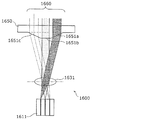
- 17 and 18 are schematic views showing the configurations of the light source units disclosed in Patent Document 1 and Patent Document 2, respectively.
- a light source unit 1600 disclosed in Patent Document 1 has a light source 1611 having three emitters, a lens 1631 for converting emitted light into parallel light, and a different minute inclination angle with respect to a main surface. And an optical element 1650 having a plurality of optical surfaces 1651a, 1651b and 1651c. With such a configuration, the light source unit 1600 emits the light flux group 1660. By condensing the luminous flux group 1660 emitted from the light source unit 1600 with a lens or the like, a plurality of luminous fluxes are condensed at the same point.
- the laser light emitted from each of the plurality of laser light sources 1005 propagates to the condenser lens 1013 via the first lens 1007, the second lens 1009, and the reflection mirror 1011.
- the laser light that has entered the condenser lens 1013 is condensed by the condenser lens 1013 and enters the optical fiber 1015.
- Patent Document 2 an attempt is made to realize a light source unit 1001 that has excellent coupling efficiency with an optical fiber.
- the optical members located on the light condensing surface are damaged.
- the laser light is concentrated at one point, which damages the substance forming the light collecting surface.
- the light source unit 1001 disclosed in Patent Document 2 since the heights of the positions where the plurality of laser light sources 1005 are arranged are different from each other, the second lens 1009 or the like corresponding to each laser light source 1005 is required. That is, the light source unit 1001 has a large number of parts.
- the present disclosure is intended to solve such a problem, and to provide a light source unit or the like that can condense a plurality of light beams on a condensing surface while suppressing peak intensity and that has a simplified configuration. With the goal.
- One aspect of a light source unit according to the present disclosure for solving the above problem is a light source unit having an optical axis along a first direction, the first light emitting point emitting a first light ray, and the first light emitting point.
- a second light emitting point which is arranged apart from the first light emitting point in a second direction perpendicular to the first direction and emits a second light ray; and at least the first light ray and the second light ray.
- a deflection element that deflects one of the light beams in a third direction perpendicular to the first direction and the second direction, and a condensing surface for the first light beam and the second light beam emitted from the deflection device.
- a second light ray at the second light emission point in the third direction the first light ray at the first light emission point and the second light ray at the second light emission point in the third direction.
- the first light ray and the second light ray overlap each other in the second direction and are separated from each other in the third direction on the light converging surface.
- a plurality of light emitting points including the first light emitting point and the second light emitting point are provided, and the first light ray and the second light ray are provided on the light collecting surface. Is 0.8 times or less than the beam width of the first light ray or the second light ray in the second direction, and the distance between the first light ray and the first light ray The distance between the second ray and the second ray in the third direction is 0.75 times the beam width of the first ray or the second ray in the third direction divided by the number of the plurality of light emitting points. It may be more than the value.
- Another aspect of the light source unit according to the present disclosure to solve the above problem is a light source unit having an optical axis along a first direction, and a first light emitting point that emits a first light beam, A second light emitting point which is arranged apart from the first light emitting point in a second direction perpendicular to the first direction and emits a second light ray; and the first light ray and the second light ray.
- the second light ray is incident on the deflection element from a fifth direction perpendicular to the third direction, and the second light ray is incident on the deflection element from the third direction when viewed from the third direction.
- the first direction is different from the angle formed by the fifth direction and the first direction, and the first light beam is emitted from the deflection element in the sixth direction.
- the second light beam is emitted from the deflection element in a seventh direction
- the sixth direction is deflected from the fourth direction by a first deflection angle when viewed from the second direction.
- the seventh direction is deflected by a second deflection angle from the fifth direction when viewed from the second direction, and the first deflection angle and the second deflection angle are different from each other.
- the sixth direction and the seventh direction are parallel to each other.
- Still another aspect of the light source unit according to the present disclosure to solve the above problem is a light source unit having an optical axis along a first direction, and a first light emitting point that emits a first light beam. , A second light emitting point that is arranged apart from the first light emitting point in a second direction perpendicular to the first direction and emits a second light beam, the first light beam and the second light emitting point. A deflection element for deflecting at least one of the light rays in a third direction perpendicular to the first direction and the second direction, wherein the first light ray is directed to the deflection element in the third direction.
- the light beam is emitted in a sixth direction
- the second light beam is emitted from the deflection element in a seventh direction
- the sixth direction is from the fourth direction when viewed from the fourth direction.
- the first direction is deflected by a deflection angle of 1
- the seventh direction is deflected by a second deflection angle from the fifth direction when viewed from the second direction
- the sixth direction is the third direction.
- the fourth direction deflects from the fourth direction by a third deflection angle
- the seventh direction deflects from the fifth direction by a fourth deflection angle.
- the first deflection angle is different from the second deflection angle
- the third deflection angle is different from the fourth deflection angle.
- the first light ray at the first light emitting point and the second light ray at the second light emitting point overlap in the third direction. May be.
- a first condensing optical element that condenses the first light ray and the second light ray emitted from the deflection element on a light condensing surface is further provided. Good.
- the first light ray and the second light ray overlap each other in the second direction and are separated from each other in the third direction. May be.
- the deflection element has a first incident surface on which the first light ray is incident and a second incident surface on which the second light ray is incident.
- a line of intersection of the first incident surface and a surface perpendicular to the third direction is inclined from the second direction by a first inclination angle, and the second incident surface and the third direction
- the line of intersection with the plane perpendicular to the second direction is inclined from the second direction by a second inclination angle
- the line of intersection of the first incident plane and the plane perpendicular to the second direction is the third line.
- a line of intersection of the second incident surface and a plane perpendicular to the second direction is inclined from the third direction by a fourth inclination angle
- the first tilt angle is different from the second tilt angle
- the third tilt angle is different from the fourth tilt angle
- the third tilt angle is calculated from the absolute value of the first tilt angle.
- the absolute value may be smaller, and the absolute value of the fourth tilt angle may be smaller than the absolute value of the second tilt angle.
- the deflection element has a first emission surface from which the first light ray is emitted and a second emission surface from which the second light ray is emitted.
- a line of intersection of the first emission surface and a surface perpendicular to the third direction is inclined from the second direction by a fifth inclination angle, and the second emission surface and the third direction
- the line of intersection with the plane perpendicular to the second direction is inclined from the second direction by a sixth inclination angle
- the line of intersection of the first emission surface and the plane perpendicular to the second direction is the third direction.
- a line of intersection between the second emission surface and a plane perpendicular to the second direction is inclined from the third direction by an eighth inclination angle
- the fifth inclination angle is different from the sixth inclination angle
- the seventh inclination angle is different from the eighth inclination angle
- the seventh inclination angle is calculated from the absolute value of the fifth inclination angle.
- the absolute value may be smaller, and the absolute value of the eighth tilt angle may be smaller than the absolute value of the sixth tilt angle.
- the deflection element may have a bottom surface perpendicular to the third direction.
- the first light emitting point and the second light emitting point may be included in a semiconductor laser array formed on the same semiconductor substrate.
- a mounting surface perpendicular to the third direction is further provided, and the first light emitting point is included in the first semiconductor light emitting element chip, and the second light emitting unit is included.
- the dots may be included in the second semiconductor light emitting element chip, and the first semiconductor light emitting element chip and the second semiconductor light emitting element chip may be mounted on the mounting surface.
- each aspect of the light source unit according to the present disclosure may further include a package that houses the first light emitting point and the second light emitting point.
- each aspect of the light source unit according to the present disclosure may include a second condensing optical element arranged between the first light emitting point and the second light emitting point and the deflection element.
- the second condensing optical element may reduce the divergence of each of the first light ray and the second light ray.
- the first light beam is emitted from the second condensing optical element in the fourth direction
- the second light beam is the second light beam.
- the light may be emitted from the condensing optical element in the fifth direction.
- the first light ray and the second light ray may intersect between the second condensing optical element and the deflecting element.
- the second condensing optical element includes a collimator lens that condenses at least in a second direction, and the collimator lens includes the first light ray and the first light ray. The divergence of each of the two rays may be reduced.
- the first light ray is directed in the second direction from the optical axis of the second light-collecting optical element at the incident position on the second light-collecting optical element.
- the incident position of the first light ray on the second condensing optical element may be different from the incident position of the second light ray on the second condensing optical element. ..
- the second condensing optical element is a fast axis collimator that reduces divergence of each of the first light ray and the second light ray in the third direction.
- the first light ray and the second light ray are condensed in a shape in which the second direction is longer than the third direction on the light collecting surface. It may have been done.
- the near-field pattern of the first light ray at the first light-emitting point and the near-field pattern of the second light ray at the second light-emitting point are the The second direction may be longer than the third direction.
- each aspect of the light source unit according to the present disclosure may further include a phosphor on which the first light ray and the second light ray are incident.
- an aspect of a lighting device includes the light source unit, and uses light emitted from the phosphor as lighting light.
- an optical fiber on which the first light ray and the second light ray are incident is further provided, and the first light ray and the second light ray are of the optical fiber. It may be condensed on the end face.
- an aspect of a processing device includes the light source unit, and uses light emitted from the optical fiber for processing.
- one mode of a deflection element is a first incident surface that intersects a first direction and a second direction perpendicular to the first direction, and the first incident surface.
- a second incident surface intersecting a direction, and a bottom surface perpendicular to a third direction perpendicular to the first direction and the second direction, the first incident surface and the third direction.
- the line of intersection with the plane perpendicular to the first direction is inclined from the first direction by a first inclination angle, and the line of intersection of the second incident surface and the plane perpendicular to the third direction is the first direction.
- a line of intersection between the first incident surface and a plane perpendicular to the second direction is inclined by a third inclination angle from the first direction
- a line of intersection between the second incident surface and the surface perpendicular to the second direction is inclined from the first direction by a fourth inclination angle
- the first inclination angle and the second inclination angle are Different from the third tilt angle and the fourth tilt angle
- the absolute value of the third tilt angle is smaller than the absolute value of the first tilt angle
- the second tilt angle is The absolute value of the fourth tilt angle is smaller than the absolute value of.
- the deflecting element may have an emitting surface that faces the first incident surface and the second incident surface and that is perpendicular to the first direction.
- the first incident surface and the second incident surface may form a convex portion.
- a light source unit or the like that can condense a plurality of light beams on a condensing surface while suppressing peak intensity and that has a simplified configuration.
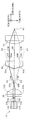
- FIG. 1A is a perspective view showing the outline of the configuration of the light source unit according to the first embodiment.
- FIG. 1B is a plan view showing the outline of the configuration of the light source unit according to the first embodiment.
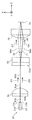
- FIG. 1C is a side view showing the outline of the configuration of the light source unit according to the first embodiment.
- FIG. 1D is a front view showing the outline of the configuration of the light source unit according to the first embodiment.
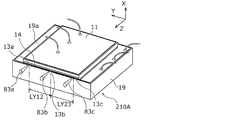
- FIG. 2A is a perspective view showing an outline of the configuration of the semiconductor light emitting device according to the first embodiment.
- FIG. 2B is a circuit diagram showing an equivalent circuit of the semiconductor light emitting device according to the first embodiment.
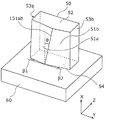
- FIG. 3A is a perspective view showing the outline of the configuration of the deflection element according to the first embodiment.
- FIG. 3B is a perspective view showing the outline of the configuration of the deflection element according to the first modification of the first embodiment.
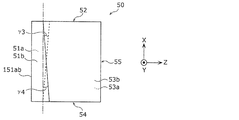
- FIG. 3C is a plan view showing the outline of the configuration of the deflection element according to the first embodiment.
- FIG. 3D is a side view showing the outline of the configuration of the deflection element according to the first embodiment.
- FIG. 3E is a front view showing the outline of the configuration of the deflection element according to the first embodiment.
- FIG. 4 is a diagram showing an example of a simulation result of the light source unit according to the first embodiment.
- FIG. 5A is a plan view showing the outline of the configuration of the deflection element according to the second modification of the first embodiment.
- FIG. 5B is a side view showing the outline of the configuration of the deflection element according to the second modification of the first embodiment.
- FIG. 5C is a front view showing the outline of the configuration of the deflection element according to the second modification of the first embodiment.
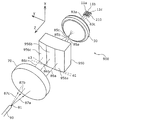
- FIG. 6 is a perspective view showing an outline of the configuration of the light source unit according to the second embodiment.
- FIG. 7A is a perspective view showing the outline of the configuration of the semiconductor light emitting device according to the second embodiment.
- FIG. 7B is a perspective view showing the outline of the configuration of the semiconductor light emitting device according to the first modification of the second embodiment.
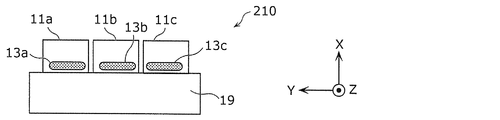
- FIG. 7C is a schematic diagram showing a relative position of each light emitting point according to the second embodiment.
- FIG. 7D is a schematic diagram showing an example of the relative position of each light emitting point according to the second embodiment.
- FIG. 7E is a schematic diagram showing another example of the relative position of each light emitting point according to the second embodiment.
- FIG. 7F is a diagram showing a simulation result of a light emission spot shape at each light emitting point according to the second embodiment.
- FIG. 8 is a diagram showing an example of a simulation result of the light source unit according to the second embodiment.
- FIG. 9A is a perspective view showing the outline of the configuration of a light source unit of a comparative example.
- FIG. 9B is a diagram showing an example of a simulation result of the light source unit of the comparative example.
- FIG. 9A is a perspective view showing the outline of the configuration of a light source unit of a comparative example.
- FIG. 9B is a diagram showing an example of a simulation result of the light source unit of the comparative example.
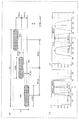
- FIG. 10A is a diagram for explaining a condensed spot of each light beam on the condensing surface of the light source unit according to the second embodiment.
- FIG. 10B is a diagram showing an example of distribution of condensed spots of each light ray.
- FIG. 10C is a graph showing a calculation result of light intensity distributions of a plurality of converging spots overlapping each other in the second direction.
- FIG. 10D is a graph showing the calculation result of the light intensity distributions of a plurality of converging spots overlapping each other in the third direction.
- FIG. 11A is a perspective view illustrating the outline of the configurations of the semiconductor light emitting device and the second condensing optical element included in the light source unit according to the third embodiment.
- FIG. 11A is a perspective view illustrating the outline of the configurations of the semiconductor light emitting device and the second condensing optical element included in the light source unit according to the third embodiment.
- FIG. 11B is a schematic diagram for explaining the operation of the second condensing optical element according to the third embodiment.
- FIG. 12 is a perspective view showing the outline of the configuration of the light source unit according to the third embodiment.
- FIG. 13 is a perspective view showing the outline of the configuration of the light source unit according to the fourth embodiment.
- FIG. 14A is a perspective view showing an outline of the configuration of the light source unit according to the fifth embodiment.
- FIG. 14B is a plan view showing the configuration of the optical element of the light source unit according to the fifth embodiment.
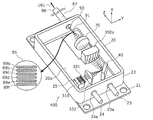
- FIG. 15A is a perspective view showing an appearance of a light source unit according to the sixth embodiment.
- FIG. 15B is a perspective view showing the outline of the configuration of the optical component arranged inside the light source unit according to the sixth embodiment.
- FIG. 15C is a schematic sectional view of a light source unit according to the sixth embodiment.
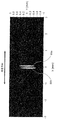
- FIG. 16 is a diagram showing a light intensity distribution on the condensing surface of the light source unit according to the sixth embodiment.
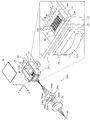
- FIG. 17 is a schematic diagram showing the configuration of the light source unit disclosed in Patent Document 1.
- FIG. 18 is a schematic diagram showing the configuration of the light source unit disclosed in Patent Document 2.
- each figure is a schematic diagram and is not necessarily strictly illustrated. Therefore, the scales and the like do not necessarily match in each drawing.
- the substantially same components are designated by the same reference numerals, and overlapping description will be omitted or simplified.
- Embodiment 1 The light source unit according to Embodiment 1 will be described.
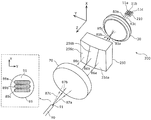
- FIGS. 1A to 3E are a perspective view, a plan view, a side view, and a front view showing an outline of the configuration of light source unit 100 according to the present embodiment, respectively.
- the plan view, the side view, and the front view are, respectively, an X-axis direction (a third direction described below), a Y-axis direction (a second direction described below), and a Z-axis direction (a later-described first direction) of the light source unit 100. 1 direction).
- the light source unit 100 has an optical axis 80 along a first direction (Z-axis direction in the figure).
- the light source unit 100 includes a first light emitting point 13a, a second light emitting point 13b, a deflection element 50, and a first condensing optical element 70.
- the light source unit 100 further includes a second condensing optical element 30 and a condensing object 90, as shown in FIGS. 1A to 1D.
- the first light emitting point 13a emits a first light ray 83a.
- the second light emitting point 13b is arranged away from the first light emitting point 13a in the second direction (Y-axis direction in the drawing) perpendicular to the first direction, and emits the second light ray 83b.
- the light source unit 100 includes the semiconductor light emitting device 10 including the first light emitting point 13a and the second light emitting point 13b. Hereinafter, each component of the light source unit 100 will be described.
- FIG. 2A is a perspective view showing the outline of the configuration of the semiconductor light emitting device 10 according to the present embodiment.
- FIG. 2B is a circuit diagram showing an equivalent circuit of the semiconductor light emitting device 10 according to the present embodiment.
- the semiconductor light emitting device 10 includes a first semiconductor light emitting element chip 11 a, a second semiconductor light emitting element chip 11 b, and a submount 19.
- the first light emitting point 13a is included in the first semiconductor light emitting element chip 11a
- the second light emitting point 13b is included in the second semiconductor light emitting element chip 11b.
- the first light emitting point 13a and the second light emitting point 13b are separated by a distance (center-to-center distance) LY12 in the second direction.
- the first light ray 83a at the first light emitting point 13a and the second light ray 83b at the second light emitting point 13b overlap in the third direction.
- the state that “the first light ray 83a and the second light ray 83b overlap each other in the third direction” means that the first light ray 83a and the second light ray 83b. It is not limited to the state where and are exactly the same. The definition of “overlapping” will be described later.
- the light source unit 100 includes a package 20 having a mounting surface 20a perpendicular to a third direction (X-axis direction in the drawing), and includes the first semiconductor light emitting element chip 11a and the first semiconductor light emitting element chip 11a.
- the second semiconductor light emitting element chip 11 b is mounted on the mounting surface 20 a of the package 20 via the submount 19.
- the first semiconductor light emitting element chip 11a has an optical waveguide (not shown) extending in the first direction (Z-axis direction), and has a first light emitting point 13a at the terminal end of the optical waveguide.
- the first light emitting point 13a has a near field pattern which is a light emission intensity distribution.
- the near-field pattern is a pattern having a shape longer in the second direction (Y-axis direction) than in the third direction (X-axis direction). In other words, the light intensity distribution is wider in the second direction than in the third direction.
- the second semiconductor light emitting element chip 11b also has an optical waveguide and a near field pattern similar to those of the first semiconductor light emitting element chip 11a.
- the light source unit 100 includes a package 20 that houses the first light emitting point 13a and the second light emitting point 13b. Although the package 20 is housed in the housing 60 of the light source unit 100, FIG. 1D shows only the package 20 and a part of the housing 60.
- the mounting surface 20a is one surface of the package 20. That is, the semiconductor light emitting device 10 is mounted on the package 20.
- the first semiconductor light emitting element chip 11a and the second semiconductor light emitting element chip 11b are semiconductor laser chips having an optical waveguide, and from the first light emitting point 13a and the second light emitting point 13b, A first light ray 83a and a second light ray 83b, which are laser lights, are emitted in the first direction, respectively.
- the material forming the semiconductor light emitting element chip include InAlGaP-based materials containing phosphorus as a Group V element, InAlGaAs-based materials containing arsenic, and InAlGaN-based materials containing nitrogen.
- the wavelength of the emitted light can be changed from about 350 nm to about 2000 nm by adjusting the material composition.
- the first semiconductor light emitting element chip 11a and the second semiconductor light emitting element chip 11b are not limited to semiconductor laser chips.
- the first semiconductor light emitting element chip 11a and the second semiconductor light emitting element chip 11b may be elements that emit a light beam having a directivity that allows collimation by a collimator lens. It may be a luminescent diode (Superluminescent Diode: SLD).
- the submount 19 is a member on which the first semiconductor light emitting element chip 11a and the second semiconductor light emitting element chip 11b are mounted.
- the first semiconductor light emitting element chip 11a and the second semiconductor light emitting element chip 11b are fixed to the submount 19 by a solder material such as AuSn (not shown).
- so-called junction down mounting is performed in which the optical waveguide side of the semiconductor light emitting element chip is arranged on the mounting surface 20a side.
- the submount 19 is made of a material having high thermal conductivity such as aluminum nitride, silicon carbide, and Cu, and also functions as a heat sink.
- the first semiconductor light emitting element chip 11a and the second semiconductor light emitting element chip 11b are connected in series with the electrode 19a on the submount 19 by the metal wires 15b and 15c.
- the electrode 19a is omitted in FIG. 2B.
- the semiconductor light emitting device 10 has metal wires 15a and 15d, and an electric current is supplied from an external power source through the metal wires 15a and 15d. With such a configuration, the semiconductor light emitting device 10 can simultaneously cause a plurality of light emitting elements to emit light with a constant current.
- the submount 19 is made of a conductive material such as Cu, an insulating material is placed between the submount 19 and the electrode 19a.
- the first light emitting point 13a and the second light emitting point 13b are included in the semiconductor light emitting device 10.
- the first light emitting point 13a and the second light emitting point 13b are It may be included in a light source other than the semiconductor light emitting device.
- the first light emitting point 13a and the second light emitting point 13b may be included in solid-state laser devices other than the two semiconductor light emitting devices, respectively.
- the first light emitting point 13a and the second light emitting point 13b do not necessarily have to be included in the light source.
- a point on each optical path of a light ray is the first light emitting point or the second light emitting point. May be defined.
- the second condensing optical element 30 is an element arranged between the first light emitting point 13a and the second light emitting point 13b and the deflecting element 50.
- the second condensing optical element 30 includes a collimator lens that condenses at least in the second direction, and reduces the divergence of each of the first light ray 83a and the second light ray 83b.
- the second condensing optical element 30 is a collimator made of an aspherical lens that reduces the divergence of each of the first light ray 83a and the second light ray 83b in the second direction and the third direction. It is a lens.
- the second condensing optical element 30 is arranged so that its optical axis coincides with the optical axis 80 of the light source unit 100.
- the first light ray 83a has a first distance D31 in the second direction from the optical axis of the second condensing optical element 30 at the incident position on the second condensing optical element 30.
- the second light ray 83b is separated from the optical axis of the second condensing optical element 30 by the second distance D32 in the second direction at the incident position on the second condensing optical element 30.
- the incident position of the first light ray 83a on the second condensing optical element 30 is different from the incident position of the second light ray 83b on the second condensing optical element 30.
- Either the incident position of the first light ray 83a on the second condensing optical element 30 or the incident position of the second light ray 83b on the second condensing optical element 30 is the optical axis 80. May overlap.
- the incident positions of the first light ray 83a and the second light ray 83b on the second condensing optical element 30 are located in mutually opposite directions with respect to the optical axis 80. Further, the incident positions of the first light ray 83a and the second light ray 83b on the second condensing optical element 30 are substantially equidistant from the optical axis 80.
- the first light ray 83a is collimated and emitted from the second condensing optical element 30 in the fourth direction D4, and the second light ray 83b is emitted from the second condensing optical element 30 to the fourth direction D4.
- the light is collimated and emitted in a fifth direction D5 different from the direction D4.
- the fourth direction D4 is the direction deflected from the first direction to the second direction
- the fifth direction D5 is the direction from the first direction to the second direction and the fourth direction D4. It is a direction deflected in the opposite direction.
- the first light ray 85a and the second light ray 85b emitted from the second condensing optical element 30 intersect between the second condensing optical element 30 and the deflecting element 50.
- the absolute value of the deflection angle of the fourth direction D4 from the first direction to the second direction and the deflection angle of the fifth direction D5 from the first direction to the second direction are determined.
- the absolute values are almost equal.
- the fourth direction D4 and the fifth direction D5 are on the YZ plane.
- the incident position of the first light ray 83a on the second condensing optical element 30 is different from the incident position of the second light ray 83b on the second condensing optical element 30, the second condensing light is generated.
- the first light ray 83a and the second light ray 83b can be emitted from the optical element 30 in different directions.
- an aspherical lens is used as the second condensing optical element 30, but the second condensing optical element 30 includes at least the first light ray 83a and the second light ray 83b.
- Any optical element that collects light in the two directions may be used.
- the second condensing optical element 30 can be configured by using two collimator lenses that collimate in a third direction and a second direction, which will be described later.
- the deflecting element 50 directs at least one of the first light ray 85a and the second light ray 85b in a third direction (each direction) perpendicular to the first direction and the second direction. It is an element that deflects in the X-axis direction in the figure). In the present embodiment, the deflection element 50 deflects both the first light ray 85a and the second light ray 85b in the third direction.
- the first light ray 85a is incident on the deflecting element 50 from a fourth direction D4 which is perpendicular to the third direction (X-axis direction), and the second light ray 85b is incident on the deflecting element. It is incident on 50 from the 5th direction D5 perpendicular
- the angle formed by the fourth direction D4 and the first direction is different from the angle formed by the fifth direction D5 and the first direction. Note that one of the fourth direction D4 and the fifth direction D5 may match the first direction.
- an angle formed counterclockwise from the first direction is positive, and an angle formed clockwise from the first direction is negative.
- the fourth direction D4 is deflected by ⁇ 3 from the first direction
- the fifth direction D5 is deflected by ⁇ 4 from the first direction.
- the absolute value of the angle formed by the fourth direction D4 and the first direction is the absolute value of the angle formed by the fifth direction D5 and the first direction. Is equal to.
- the positive/negative relationship is similarly defined for the other angles described below.
- the first light ray 85a is emitted from the deflecting element 50 in the sixth direction D6, and the second light ray 85b is emitted from the deflecting element 50 in the seventh direction D7.
- the sixth direction D6 is deflected from the fourth direction D4 to the third direction by the first deflection angle ⁇ 1 when viewed from the second direction
- the seventh direction D7 is ,
- the light is deflected from the fifth direction D5 to the third direction by the second deflection angle ⁇ 2.
- an angle formed counterclockwise on the ZX plane is positive
- an angle formed clockwise on the ZX plane is negative.
- the first deflection angle ⁇ 1 and the second deflection angle ⁇ 2 are different, and as shown in FIG. 1B, when viewed from the third direction,
- the sixth direction D6 and the seventh direction D7 are parallel to each other. Further, when viewed from the third direction, the sixth direction D6 and the seventh direction D7 are parallel to the first direction.
- the fact that the sixth direction D6 and the seventh direction D7 are parallel to each other is not limited to a completely parallel state, and includes a substantially parallel state.
- the sixth direction D6 and the seventh direction D7 being parallel to each other means, for example, a state in which the angle formed by the sixth direction D6 and the seventh direction D7 is 1° or less. ..
- the first light converging optical element 70 described later condenses the first light beam 85a and the second light beam 85b described later. It is easy to make the focal lengths to the surface 91 the same.
- the sixth direction D6 is deflected from the fourth direction D4 by the first deflection angle ⁇ 1 when viewed from the second direction, and the seventh direction D7 is the second direction.
- the second deflection angle ⁇ 2 is deflected from the fifth direction D5.
- the sixth direction D6 is deflected from the fourth direction D4 to the second direction by the third deflection angle ⁇ 3 when viewed from the third direction, and the seventh direction D7 is , When viewed from the third direction, it deflects from the fifth direction D5 to the second direction by the fourth deflection angle ⁇ 4.
- the third deflection angle ⁇ 3 and the fourth deflection angle ⁇ 4 are different, and the first deflection angle ⁇ 1 and the second deflection angle ⁇ 2 are different.
- the sixth direction D6 and the seventh direction D7 are parallel to the first direction when viewed from the third direction, so the third deflection angle ⁇ 3 is the third direction.
- the angle is equal to the angle formed by the fourth direction D4 and the first direction
- the fourth deflection angle ⁇ 4 is defined by the fifth direction D5 and the first direction when viewed from the third direction. It is equal to the angle.
- FIG. 3A is a perspective view showing the outline of the configuration of the deflection element 50 according to the present embodiment.
- FIG. 3A also shows a housing 60 in which the deflection element 50 is arranged.
- FIG. 3B is a perspective view showing the outline of the configuration of the deflection element 50a according to the first modification of the present embodiment.
- FIG. 3B also shows a housing 60 in which the spacer 60s supporting the deflection element 50a and the deflection element 50a are arranged.
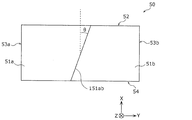
- 3C to 3E are a plan view, a side view, and a front view, respectively, showing an outline of the configuration of the deflection element 50 according to the present embodiment.
- the plan view, the side view, and the front view are viewed from the X-axis direction (third direction), the Y-axis direction (second direction), and the Z-axis direction (first direction) of the deflection element 50, respectively. It means a figure.
- the deflecting element 50 is a translucent optical element, and as shown in FIG. 3A, the first light incident surface 51a on which the first light ray 85a is incident and the second light ray 85b are It has the 2nd incident surface 51b which injects. Further, the first incident surface 51a and the second incident surface 51b intersect each other at a line of intersection 151ab. As shown in FIGS. 1A, 3A, and 3B, the intersection line 151ab is inclined by an angle ⁇ with respect to the third direction (X-axis direction).
- An antireflection film formed of a dielectric multilayer film or the like may be formed on the light incident surface and the light emitting surface of the deflection element 50.
- the base material forming the deflecting element 50 a material is selected which has a high transmittance with respect to the wavelength of a light beam to be transmitted and which does not deteriorate with respect to the power of the light beam even after long-term irradiation.
- the constituent material is, for example, a semiconductor laser containing nitrogen as a Group V element
- the constituent element of the deflection element 50 is, for example, quartz. , BK7, N-BK7, white plate glass, and other inorganic glass materials can be selected.
- the constituent material of the deflection element 50 is, for example, quartz. , BK7, N-BK7, white glass, and other inorganic glass materials, and resin materials such as silicone and cycloolefin polymer resins having high light resistance can be selected.
- the first incident surface 51a and the second incident surface 51b of the deflection element 50 according to the present embodiment can also be realized by using the deflection element 50a as in the modification shown in FIG. 3B.
- the configuration of the deflecting element 50a will be described first, and then the deflecting element 50 will be described.
- the deflecting element 50a has a pentagonal prism-shaped transmissive surface having a first incident surface 51a and a second incident surface 51b which are perpendicular to a reference surface 152 inclined by an angle ⁇ with respect to the ZY plane about the Z axis. It is an optical element having optical properties.
- the reference surface 152 is a plane whose normal is the intersection line 151ab between the first incident surface 51a and the second incident surface 51b.
- the deflecting element 50a is a pentagonal prism in which five side surfaces including the first incident surface 51a and the second incident surface 51b are perpendicular to the bottom surface located on the reference surface 152, and the bottom surface and the top surface are parallel to each other. is there.
- the first incident surface 51a and the second incident surface 51b of the deflecting element 50a are respectively inclined by inclination angles ⁇ 1 and ⁇ 2 with respect to a reference line 153 which is a line of intersection between the reference surface 152 and the XY plane. ..
- the deflection element 50a is arranged in the housing 60 via a wedge-shaped spacer 60s whose two opposing surfaces intersect at an angle ⁇ .
- the first light ray 85a and the second light ray 85b are moved to the first incident surface 51a and the second light ray 85b having a desired inclination. Can be incident on the incident surface 51b.
- the deflection element 50a according to the modified example of the present embodiment includes a first incidence surface 51a and a first incidence surface 51a having the same inclination angle as the first incidence surface 51a and the second incidence surface 51b of the deflection element 50 shown in FIG. 3A. It has a second incident surface 51b. Therefore, the deflection element 50a according to the modification can refract the first light ray 85a and the second light ray 85b similarly to the deflection element 50 shown in FIG. 3A.
- the manufacturing of the deflecting element 50a can be facilitated as compared with the case where the deflecting element 50 is used.
- the deflection element 50 has an emission surface 55, side surfaces 53a and 53b, and an upper surface 52.
- the exit surface 55 is a surface that faces the first entrance surface 51a and the second entrance surface 51b and that is perpendicular to the first direction.
- the side surfaces 53a and 53b are surfaces that connect the first incident surface 51a and the second incident surface 51b to the emission surface 55, respectively.
- the upper surface 52 is a surface facing the bottom surface 54.
- the deflection element 50 is obtained by cutting the side surface adjacent to the first incident surface 51a, the side surface adjacent to the second incident surface 51b, the top surface, and the bottom surface in the deflection element 50a of the modified example at an angle of ⁇ . is there.
- the two parallel side surfaces of the deflection element 50a are cut along a plane perpendicular to the upper surface of the housing 60 and perpendicular to the Y direction, and the top and bottom surfaces of the deflection element 50a are cut along a surface parallel to the upper surface of the housing 60.
- the side surface 53a has a trapezoidal shape in which the lower bottom (bottom surface side) is longer than the upper bottom (top surface side)
- the side surface 53b has a trapezoidal shape in which the lower bottom (bottom surface side) is shorter than the upper bottom (top surface side).
- the first incident surface 51a has a trapezoidal shape in which the lower bottom (bottom surface side) is shorter than the upper bottom (upper surface side), and the second incident surface 51b is lower than the upper bottom (upper surface side). It has a long trapezoidal shape (on the bottom side). Further, as shown in FIG. 3C, the first incident surface 51a and the second incident surface 51b of the deflection element 50 form a convex portion 50p protruding in the first direction.
- FIGS. 3A and 3B only part of the housing 60 is shown.
- the line of intersection between the first incident surface 51a and the plane perpendicular to the third direction is inclined by the first inclination angle ⁇ 1 from the second direction (see the alternate long and short dash line in FIG. 3C).
- the line of intersection between the second incident surface 51b and the surface perpendicular to the third direction is inclined from the second direction by the second inclination angle ⁇ 2.
- the surface perpendicular to the third direction may be, for example, the bottom surface 54 (or the upper surface 52) shown in FIG. 3C.
- the angle formed by the line of intersection between the bottom surface 54 and the first incident surface 51a and the second direction is shown as the first inclination angle ⁇ 1, and the angle between the upper surface 52 and the second incident surface 51b.
- the angle formed by the line of intersection and the second direction is shown as the second inclination angle ⁇ 2.
- an angle formed in the counterclockwise direction from the second direction is positive, and an angle formed in the clockwise direction from the first direction.
- the angle is a negative angle.
- the line of intersection between the first incident surface 51a and the plane perpendicular to the second direction is the third inclination angle ⁇ 3 from the third direction (see the alternate long and short dash line in FIG. 3D).
- the line of intersection of the second incident surface 51b and the surface perpendicular to the second direction is inclined by the fourth inclination angle ⁇ 4 from the third direction.
- the surface perpendicular to the second direction may be, for example, the side surface 53b (or the side surface 53a) shown in FIG. 3D.
- the angle formed by the line of intersection between the side surface 53a and the first incident surface 51a and the third direction is shown as the third inclination angle ⁇ 3, and the angle between the side surface 53b and the second incident surface 51b is shown.
- the angle formed by the line of intersection and the third direction is shown as the fourth inclination angle ⁇ 4.
- an angle formed in the counterclockwise direction from the third direction is positive, and an angle formed in the clockwise direction from the first direction.
- the angle is a negative angle.
- the first inclination angle ⁇ 1 and the second inclination angle ⁇ 2 are different from each other
- the third inclination angle ⁇ 3 and the fourth inclination angle ⁇ 4 are different from each other
- the third inclination angle is larger than the absolute value of the first inclination angle ⁇ 1.
- the absolute value of the angle ⁇ 3 is smaller
- the absolute value of the fourth tilt angle ⁇ 4 is smaller than the absolute value of the second tilt angle ⁇ 2.
- the absolute value of the first tilt angle ⁇ 1 is equal to the absolute value of the second tilt angle ⁇ 2
- the absolute value of the third tilt angle ⁇ 3 is equal to the absolute value of the fourth tilt angle ⁇ 4. equal.
- the sixth direction D6 which is the traveling direction of the first light ray 85a, is deflected from the fourth direction D4 to the second direction by the third deflection angle ⁇ 3 when viewed from the third direction, and the second light ray
- the seventh direction D7 which is the traveling direction of 85b, can be deflected from the fifth direction D5 to the second direction by the fourth deflection angle ⁇ 4.
- first light ray 85a and the second light ray 85b are respectively deflected by the third deflection angle ⁇ 3 and the fourth deflection angle ⁇ 4, so that when viewed from the third direction, the sixth direction D6 and The first inclination angle ⁇ 1 and the second inclination angle ⁇ 2 are set such that the direction D7 of 7 is parallel to each other.
- the first incident surface 51a is inclined upward by the third inclination angle ⁇ 3, which is the inclination angle from the third direction of the line of intersection between the surface perpendicular to the second direction and the incident surface. Therefore, the sixth direction D6, which is the traveling direction of the first light ray 85a, is deflected downward by the first deflection angle ⁇ 1 from the fourth direction D4 to the third direction when viewed from the second direction. be able to.
- the seventh direction D7 which is the traveling direction of the second light ray 85b, is seen from the second direction, and It is possible to deflect upward from the direction D5 of 5 by the second deflection angle ⁇ 2 in the third direction.
- the deflection element 50 includes a first incident surface 51 a that intersects the first direction and the second direction, and a second incident surface 51 b that intersects the first direction. , And a bottom surface perpendicular to the third direction. Since the deflection element 50 has the bottom surface 54 perpendicular to the third direction, the deflection element 50 can be easily installed in the housing 60 more than the deflection element 50a and the like. In the present embodiment, the second incident surface 51b intersects not only the first direction but also the second direction.
- a light-transmitting optical member is used as the deflecting element 50, but the deflecting element 50 causes at least one of the first light ray 85a and the second light ray 85b to move in the third direction.
- Any element that deflects may be used.
- the deflecting element 50 can be configured by using two mirrors or the like that respectively reflect the first light ray 85a and the second light ray 85b.
- the first condensing optical element 70 is an optical element that condenses the first light ray 86a and the second light ray 86b emitted from the deflection element 50 on the light condensing surface 91 as shown in FIGS. 1A to 1C. is there.
- the first condensing optical element 70 is a condensing lens that condenses the first light ray 86a and the second light ray 86b in the second direction and the third direction.
- the first light ray 87a and the second light ray 87b emitted from the first condensing optical element 70 are condensed on the condensing surface 91 of the condensing target 90.
- the condenser lens is used as the first condensing optical element 70, but the first condensing optical element 70 condenses the first light ray 86a and the second light ray 86b.
- Any optical element that collects light on the surface 91 may be used.
- an aspherical mirror or the like can be used as the first condensing optical element 70.
- the first inclination angle ⁇ 1 and the second inclination angle ⁇ 2 are set so that the sixth direction D6 and the seventh direction D7 are parallel to each other when viewed from the third direction.
- the first inclination angle ⁇ 1 and the second inclination angle ⁇ 2 may be set such that the sixth direction D6 and the seventh direction D7 are not parallel to each other when viewed from the third direction. ..
- the condensing object 90 is a member on which the first light ray 87a and the second light ray 87b which are emitted from the first condensing optical element 70 and condensed are incident. is there.
- the light collection target 90 is an optical fiber
- the light collection surface 91 is an end surface of the optical fiber.
- the first light ray 87a and the second light ray 87b mainly enter a region corresponding to the core 95 in the light condensing surface 91 of the light condensing target 90 made of an optical fiber. This allows the first light beam 87a and the second light beam 87b to be coupled into the optical fiber.
- the first converging spot 89a and the second converging spot 89a are arranged in the first direction (X-axis direction).
- the object 90 to be focused is not particularly limited.
- it may be a phosphor as described below.
- FIG. 4 is a diagram showing an example of a simulation result of the light source unit 100 according to the present embodiment.
- FIG. 4 shows the light intensity distribution on the light collecting surface 91 obtained from the three simulation results.
- the outline of the core 95 of the optical fiber is shown by a broken line.
- ⁇ y were set to 1 ⁇ m and 30 ⁇ m, respectively.
- the beam width means the entire width from the peak intensity position of the light beam to the position where the intensity is 1/e 2 of the peak intensity.
- the near-field pattern of the first light ray 83a at the first light-emitting point 13a and the near-field pattern of the second light ray 83b at the second light-emitting point 13b are different from those in the third direction. It has a shape that is longer in the second direction.
- the distance LY12 between the first light emitting point 13a and the second light emitting point 13b is set to 150 ⁇ m
- the focal length of the second condensing optical element 30 formed of an aspherical lens is set to 4 mm
- the first aspherical lens is formed.
- the focal length of the condensing optical element 70 was 4 mm.
- the distance LY12 is a distance between the peak intensity position of the first light emitting point 13a and the peak intensity position of the second light emitting point 13b.
- the first inclination angle ⁇ 1 of the first incident surface 51a and the second inclination angle ⁇ 2 of the second incident surface 51b of the deflecting element 50 are respectively +2° and -2°.
- the light collecting object 90 is an optical fiber, and the light collecting surface 91 is an end surface of the optical fiber having a core diameter of 105 ⁇ m.
- Light intensity distributions (a), (b), and (c) on the condensing surface 91 shown in FIG. 4 are the light intensity distributions when the angle ⁇ of the deflection element 50 is 0°, 3°, and 5°, respectively.
- the case where the angle ⁇ of the deflecting element 50 is 0° is the case where it becomes the normal line of the ZY plane of the intersection line 151ab of the deflecting element 50a shown in FIG. 3B, and a comparative example of the light source unit 100 according to the present embodiment. Equivalent to.
- the case where the angle ⁇ of the deflection element 50 is larger than 0° corresponds to the light source unit 100 according to the present embodiment.
- the angle ⁇ of the deflecting element 50 When the angle ⁇ of the deflecting element 50 is 0°, the first incident surface 51a and the second incident surface 51b of the deflecting element 50 are perpendicular to the ZY plane. Therefore, the first deflection angle ⁇ 1 and the second deflection angle ⁇ 2 shown in FIG. 1C are 0°. Therefore, as shown in the light intensity distribution (a) of FIG. 4, the positions of the first focused spot 89a and the second focused spot 89b in the third direction overlap on the focusing surface 91.
- the light collecting surface 91 which is the end surface of the optical fiber, may be damaged. Becomes higher.
- the deflecting element 50 deflects at least one of the first light ray 85a and the second light ray 85b in the third direction.
- the sixth direction D6 of the first light ray 86a is the first deflection angle ⁇ 1 from the fourth direction D4 of the first light ray 85a when viewed from the second direction. Only deflect.
- the seventh direction D7 of the second light ray 86b is deflected by the second deflection angle ⁇ 2 from the fifth direction D5 of the second light ray 85b when viewed from the second direction.
- the first light ray 83a at the first light emitting point 13a and the second light ray 83b at the second light emitting point 13b overlap in the third direction, but in the light collecting surface 91, As shown in the light intensity distributions (b) and (c) of No. 4, the first light ray 87a and the second light ray 87b are separated in the third direction. Also, the first light ray 87a and the second light ray 87b overlap in the second direction. As a result, the two light beams can be condensed so as not to overlap in a small area such as the core 95 on the end face of the optical fiber.
- two light rays can be condensed on the condensing surface 91 while suppressing the peak intensity. Further, in the light source unit 100, such an effect can be obtained with the configuration simplified by using the deflection element 50.
- the beam widths of the first light ray 87a and the second light ray 87b are second to second from the third direction. Is longer in the direction of. Accordingly, as described above, even when the first light ray 87a and the second light ray 87b are separated from each other in the third direction, it is possible to suppress the expansion of the light intensity distribution in the third direction.
- the angle ⁇ of the deflection element 50 by adjusting the angle ⁇ of the deflection element 50, it is possible to adjust the focal spot positions of the two light rays on the focal plane 91.
- the light intensity distribution (in other words, the light density distribution) on the light collecting surface 91 can be easily adjusted.
- the two converging spots on the condensing surface 91 may partially overlap each other in the third direction, or may not completely overlap each other in the second direction.
- the deflection element according to the second modification of the present embodiment will be described.
- the first light incident surface 51a and the second light incident surface 51b deflect the first light ray 85a and the second light ray 85b, respectively.
- the first light ray 85a and the second light ray 85b are deflected on the emission surface.
- the deflection element according to the present modification will be described with reference to FIGS. 5A to 5C, focusing on the differences from the deflection element 50.
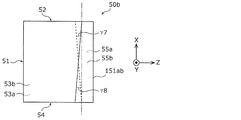
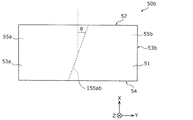
- 5A to 5C are a plan view, a side view, and a front view, respectively, showing the outline of the configuration of the deflection element 50b according to the present modification.
- the deflecting element 50b is a translucent optical member and, as shown in FIGS. 5A to 5C, has an incident surface 51, a first exit surface 55a, a second exit surface 55b, and a bottom surface 54. It has side surfaces 53a and 53b and an upper surface 52.
- the entrance surface 51 is a surface on which the first light ray 85a and the second light ray 85b are incident, and the first exit surface 55a and the second exit surface 55b are the first light ray 86a and the second light ray 86b, respectively. Is the surface from which light is emitted.
- the first emission surface 55a and the second emission surface 55b intersect at an intersection line 155ab.
- the line of intersection between the first emission surface 55a and the surface perpendicular to the third direction is inclined from the second direction (see the alternate long and short dash line in FIG. 5A) by a fifth inclination angle ⁇ 5.
- the line of intersection between the second emission surface 55b and the surface perpendicular to the third direction is inclined from the second direction by the sixth inclination angle ⁇ 6.
- the line of intersection between the first emission surface 55a and the surface perpendicular to the second direction is the seventh inclination angle ⁇ 7 from the third direction (see the alternate long and short dash line in FIG. 5B).
- the line of intersection between the second emission surface 55b and the surface perpendicular to the second direction is inclined by the eighth inclination angle ⁇ 8 from the third direction.
- the fifth tilt angle ⁇ 5 and the sixth tilt angle ⁇ 6 are different
- the seventh tilt angle ⁇ 7 and the eighth tilt angle ⁇ 8 are different
- the seventh tilt angle ⁇ 5 is greater than the absolute value of the fifth tilt angle ⁇ 5.
- the absolute value of the inclination angle ⁇ 7 is smaller
- the absolute value of the eighth inclination angle ⁇ 8 is smaller than the absolute value of the sixth inclination angle ⁇ 6.
- the deflection element 50b having the above configuration. That is, according to the deflection element 50b, at least one of the first light ray and the second light ray can be deflected in the third direction. Therefore, in the light source unit 100, by using the deflection element 50b according to the present modification instead of the deflection element 50, it is possible to condense two light rays on the condensing surface 91 while suppressing the peak intensity, and A light source unit having a simplified structure can be realized.
- the deflection element 50b according to the present modification also has a bottom surface 54 perpendicular to the third direction and side surfaces 53a and 53b parallel to the third direction, like the deflection element 50. Thereby, the deflection element 50b can be easily installed in the housing 60 or the like.
- the first emission surface 55a and the second emission surface 55b of the deflection element 50b according to this modification may be combined with the deflection element 50 according to this embodiment. That is, the first light ray and the second light ray may be deflected on both the entrance surface and the exit surface.
- the light source unit according to the second embodiment will be described.
- the light source unit according to the present embodiment mainly differs from the light source unit 100 according to the first embodiment in the number of light emitting points and light rays.
- the light source unit according to the present embodiment will be described with reference to FIGS. 6 to 10C, focusing on differences from the light source unit 100 according to the first embodiment.
- FIG. 6 is a perspective view showing the outline of the configuration of the light source unit 200 according to the present embodiment.
- the light source unit 200 includes a semiconductor light emitting device 210 including a plurality of light emitting points, a second condensing optical element 30, a deflecting element 250, and a first condensing optical element 70. And a light collection target 90.
- FIG. 7A is a perspective view showing the outline of the configuration of the semiconductor light emitting device 210 according to this embodiment.
- the semiconductor light emitting device 210 includes a first semiconductor light emitting element chip 11 a, a second semiconductor light emitting element chip 11 b, a third semiconductor light emitting element chip 11 c, and a submount 19. ..
- the semiconductor light emitting device 210 includes a plurality of light emitting points including a first light emitting point 13a and a second light emitting point 13b. Of the plurality of light emitting points, the first light emitting point 13a and the second light emitting point 13b are two adjacent light emitting points.
- the first light emitting point 13a is included in the first semiconductor light emitting element chip 11a
- the second light emitting point 13b is included in the second semiconductor light emitting element chip 11b
- the third light emitting point 13c is included in the third semiconductor light emitting element chip 11b.
- the first light emitting point 13a and the second light emitting point 13b are separated from each other by a distance LY12 in the second direction
- the second light emitting point 13b and the third light emitting point 13c are separated from each other in the second direction. Only LY23 away.
- the third semiconductor light emitting element chip 11c may have the same configuration as the first semiconductor light emitting element chip 11a and the second semiconductor light emitting element chip 11b.
- the first light ray 83a at the first light emitting point 13a, the second light ray 83b at the second light emitting point 13b, and the third light ray 83c at the third light emitting point 13c are in the third direction. overlapping.
- the first semiconductor light emitting element chip 11a, the second semiconductor light emitting element chip 11b, and the third semiconductor light emitting element chip 11c are connected in series with the electrode 19a on the submount 19 by a metal wire, as shown in FIG. 7A. To be done.
- each light emitting point is included in each individual semiconductor light emitting element chip, but the configuration of the semiconductor light emitting device is not limited to this.
- the semiconductor light emitting device according to the first modification of the present embodiment will be described with reference to FIG. 7B.
- FIG. 7B is a perspective view showing the outline of the configuration of semiconductor light emitting device 210A according to the first modification of the present embodiment.
- a semiconductor light emitting device 210A has a semiconductor laser array 11 and a submount 19.
- the semiconductor laser array 11 is a semiconductor light emitting element chip having three optical waveguides formed on the same semiconductor substrate.
- the first light emitting point 13a, the second light emitting point 13b, and the third light emitting point 13c are included in the semiconductor laser array 11.
- the first light emitting point 13a, the second light emitting point 13b, and the third light emitting point 13c are located on the emission end faces of the three optical waveguides.
- current flows in parallel from the same electrode 19a to each optical waveguide.
- the semiconductor laser array 11 is manufactured by forming a semiconductor multilayer structure by crystal growth on a semiconductor substrate and then forming an optical waveguide by photolithography. At this time, the intervals between the optical waveguides are accurately formed, so that the intervals between the light emitting points can also be accurately formed.
- the semiconductor light emitting device 210A having such a configuration may be used in the light source unit 200 instead of the semiconductor light emitting device 210.
- the area of the semiconductor substrate to be used can be reduced as compared with the semiconductor light emitting device 210A according to the first modification.
- the semiconductor light emitting device 210 according to the present embodiment has the semiconductor light emitting device according to the first modification.
- the area of the semiconductor substrate can be reduced to W1/LY12 times. For example, when the width W1 is 160 ⁇ m and the distance LY12 is 400 ⁇ m, the area of the semiconductor substrate according to the present embodiment can be reduced to 40% of the area of the semiconductor substrate of Modification 1.
- the semiconductor light emitting device 210 since the respective semiconductor light emitting element chips are connected in series, the respective semiconductor light emitting element chips are connected. Can be supplied with the same current. Thereby, the output light intensity from each semiconductor light emitting element chip can be made uniform.
- FIG. 7C is a schematic diagram showing the relative position of each light emitting point according to the present embodiment.
- 7D and 7E are schematic diagrams showing examples of relative positions of the respective light emitting points according to the present embodiment.
- the shape of the light emission spot at each light emission point is indicated by hatching.
- the shape of the light emission spot is similar to that of the near field pattern.
- FIG. 7F is a diagram showing a simulation result of the emission spot shape at each emission point according to the present embodiment.
- each emission point actually has a finite emission size.
- each light emission spot has a beam width of ⁇ y in the second direction and ⁇ x in the third direction. Further, the beam widths of the entire emission spots in the second direction and the third direction are indicated by ⁇ y and ⁇ x, respectively.
- the emission spot shapes are completely overlapped in the third direction, and the beam width ⁇ x in the third direction of each emission spot and the third emission spot total.
- the beam widths ⁇ x in the respective directions are equal to each other, or as shown in FIG. 7E, the emission spot shapes partially overlap each other in the third direction. In some cases, the beam width ⁇ x of the entire emission spot in the third direction is large.
- the beam width ⁇ x in the third direction has dimensions about the wavelength of each light beam, and the beam width ⁇ y in the second direction is longer than the beam width ⁇ x in the third direction.
- the beam width ⁇ y is twice the beam width ⁇ x or more.
- ⁇ y is about 30 ⁇ m and ⁇ x is about 1 ⁇ m.
- the distances LY12 and LY23 are 150 ⁇ m.
- Each emission spot shape of these emission points is enlarged or reduced by an optical system included in the light source unit 200, and then projected onto the condensing surface 91.
- Each ray may be in horizontal single mode or horizontal multi mode in the y direction.
- the lateral multi-mode is more suitable for increasing the output of the semiconductor light emitting element chip.
- each light ray has a light intensity distribution in a single mode in the x direction.
- the second condensing optical element 30 has the same configuration as the second condensing optical element 30 according to the first embodiment.
- the 2nd condensing optical element 30 reduces the divergence of the 1st light ray 83a, the 2nd light ray 83b, and the 3rd light ray 83c, respectively, the 1st light ray 85a, the 2nd light ray 85b, and the 3rd light ray 85b. It is emitted as a light ray 85c.
- the deflecting element 250 is a translucent optical member, and deflects each light beam on the emission surface, similarly to the deflecting element 50b according to the second modification of the first embodiment. As shown in FIG. 6, the deflection element 250 has a first emission surface 256a, a second emission surface 256b, and a third emission surface 256c. The angle of inclination of the intersection line of the second emission surface 256b perpendicular to the third direction and the emission surface, and the intersection line of the surface perpendicular to the second direction and the emission surface. The inclination angle from the third direction is 0°.
- the first emission surface 256a and the third emission surface 256c are the same as the first emission surface 55a and the second emission surface 55b according to the second modification of the first embodiment, respectively.
- the first ray 85a and the third ray 85c are deflected.
- the deflection element 250 deflects the first light ray 85a and the third light ray 85c and emits them as the first light ray 86a and the third light ray 86c, respectively.
- the deflecting element 250 does not deflect the second light ray 85b, that is, deflects it by 0°, and emits it as the second light ray 86b.
- the light rays 85c can be emitted so as to overlap in the second direction and separate in the third direction.
- the deflection element 250 is arranged so as to have the first emission surface 256a, the second emission surface 256b, and the third emission surface 256c.
- the first exit surface 256a is rotated by 180° to the center.
- the same effect can be obtained by using 256a, the second emission surface 256b, and the third emission surface 256c as the incident surfaces.
- the first condensing optical element 70 has the same configuration as the first condensing optical element 70 according to the first embodiment.
- the 1st condensing optical element 70 condenses the 1st light ray 86a, the 2nd light ray 86b, and the 3rd light ray 86c, respectively, the 1st light ray 87a, the 2nd light ray 87b, and the 3rd light ray. It is emitted as 87c.
- the first light ray 87a, the second light ray 87b, and the third light ray 87b are formed on the light collecting surface 91 of the light collecting object 90.
- the first focused spot 89a, the second focused spot 89b, and the third focused spot 89c corresponding to the irradiation area of the light ray 87c are arranged in the first direction (X-axis direction).
- FIG. 8 is a diagram showing an example of a simulation result of the light source unit 200 according to the present embodiment.
- FIG. 8 shows the light intensity distribution on the light collecting surface 91 obtained from the three simulation results.
- the outline of the core 95 of the optical fiber is shown by a broken line.
- the beam widths ⁇ x and ⁇ y in the third direction and the second direction in the near field pattern of each light beam emitted from each light emitting point were set to 1 ⁇ m and 30 ⁇ m, respectively.
- the distances LY12 and LY23 are set to 150 ⁇ m
- the focal length of the second condensing optical element 30 formed of an aspherical lens is set to 4 mm
- the focal length of the first condensing optical element 70 formed of an aspherical lens is set to 4 mm. ..
- the inclination angles ⁇ 1, ⁇ 2, and ⁇ 3 of the first emitting surface 256a, the second emitting surface 256b, and the third emitting surface 256c of the deflecting element 250 with respect to the reference line are , 4°, 0° and -4°, respectively.
- the reference line is a line of intersection between the reference plane and the XY plane, and the reference plane is a plane inclined by the angle ⁇ with respect to the ZX plane about the Z axis.
- the angle ⁇ is the same as the angle ⁇ according to the first embodiment, the line of intersection between the first emission surface 256a and the second emission surface 256b (and the second emission surface 256b and the third emission surface 256b). This is the angle formed by the line of intersection with the emission surface 256c) and the third direction.
- the light collecting object 90 is an optical fiber, and the light collecting surface 91 is an end surface of the optical fiber having a core diameter of 105 ⁇ m.
- Light intensity distributions (a), (b), and (c) on the condensing surface 91 shown in FIG. 8 are light intensity distributions when the angle ⁇ of the deflecting element 250 is 0°, 3°, and 5°, respectively. Indicates.
- the case where the angle ⁇ of the deflection element 250 is 0° corresponds to a comparative example of the light source unit 200 according to the present embodiment.
- the case where the angle ⁇ of the deflection element 250 is larger than 0° corresponds to the light source unit 200 according to the present embodiment.
- the angle ⁇ of the deflection element 250 is 0°
- the first emission surface 256a and the third emission surface 256c of the deflection element 250 are perpendicular to the ZY plane. Therefore, the deflection angles of the first light ray 86a and the third light ray 86c in the third direction in the deflection element 250 are 0°.
- the light intensity distribution (a) of FIG. 8 on the converging surface 91, the first converging spot 89a, the second converging spot 89b, and the third converging spot 89c are separated.
- the positions in the direction 3 overlap. In this case, since the peak position of the light intensity of each light beam is concentrated on almost one point on the light collecting surface 91, the light collecting surface 91, which is the end surface of the optical fiber, may be damaged.
- the deflecting element 250 deflects the first light ray 85a and the third light ray 85c in the third direction. Therefore, the light rays at the respective light emitting points overlap in the third direction, but on the light collecting surface 91, as shown in the light intensity distributions (b) and (c) of FIG.
- the light ray 87a, the second light ray 87b, and the third light ray 87c are separated from each other in the third direction. Further, the first light ray 87a, the second light ray 87b, and the third light ray 87c overlap in the second direction.
- the three light rays can be condensed without overlapping in a small area such as the core 95 on the end face of the optical fiber. That is, according to the light source unit 200 according to the present embodiment, two light rays can be condensed on the condensing surface 91 while suppressing the peak intensity. Further, in the light source unit 200, such an effect can be obtained with the configuration simplified by using the deflection element 250.
- the angle ⁇ of the deflection element 250 by adjusting the angle ⁇ of the deflection element 250, it is possible to adjust the focal spot positions of the two light rays on the focal plane 91.
- the light intensity distribution (in other words, the light density distribution) on the light collecting surface 91 can be easily adjusted.
- FIG. 9A is a perspective view showing the outline of the configuration of a light source unit 900 of a comparative example.
- FIG. 9B is a diagram showing an example of a simulation result of the light source unit 900 of the comparative example.
- FIG. 9B shows the light intensity distributions on the light converging surface 91 and its periphery obtained from the three simulation results.
- the outline of the core 95 of the optical fiber is shown by a broken line.
- the light source unit 900 of the comparative example is different from the light source unit 200 according to the second embodiment in the configuration of the deflection element 950, and is the same in other configurations.
- the deflection element 950 is an element in which the angle ⁇ of the deflection element 250 according to the second embodiment is zero. Therefore, each light beam is not deflected in the third direction by the first emitting surface 956a, the second emitting surface 956b, and the third emitting surface 956c of the deflecting element 950.
- Light intensity distributions (a), (b) and (c) shown in FIG. 9B show light intensity distributions when the absolute values of the inclination angles ⁇ 1 (and ⁇ 3) are 5°, 4° and 3°, respectively. (When the refractive index of the deflection element 250 is 1.5).
- the tilt angles ⁇ 1 and ⁇ 3 represent the angles formed by the first exit surface 956a and the third exit surface 956c and the second direction, respectively.
- the light intensity distribution in the second direction can be adjusted, but the light intensity distribution in the third direction cannot be adjusted. .. Therefore, when the three light rays are focused on the core 95 of the light focusing surface 91, the three light rays overlap in the third direction, and the peak intensity of the light intensity distribution cannot be suppressed.
- the light source unit 200 since the three light rays are separated in the third direction, the peak intensity of the light intensity distribution can be suppressed. Thereby, damage on the light condensing surface 91 of the light condensing target 90 can be suppressed.
- FIG. 10A is a diagram illustrating a light-collecting spot of each light beam on the light-collecting surface 91 of the light source unit 200 according to the present embodiment.
- the schematic view (a) of FIG. 10A shows a condensed spot of each light beam on the condensing surface 91, its size, and the like.
- Graphs (b) and (c) of FIG. 10A show schematic diagrams of the light intensity distribution of each light ray in the third direction and the second direction, respectively.
- FIG. 10A is a diagram illustrating a light-collecting spot of each light beam on the light-collecting surface 91 of the light source unit 200 according to the present embodiment.
- the schematic view (a) of FIG. 10A shows a condensed spot of each light beam on the condensing surface 91, its size, and the like.
- Graphs (b) and (c) of FIG. 10A show schematic diagrams of the light intensity distribution of each light ray in the third direction and the second direction, respectively.
- FIG. 10B is a diagram showing 16 types of distribution examples in order to compare the distributions of condensed spots of the respective light rays.
- FIG. 10B shows a case where a converging spot is formed by three light rays.
- the horizontal axis represents the beam spacing in the second direction, and the beam spacing becomes wider toward the right.
- the vertical axis represents the beam spacing in the third direction, and the beam spacing becomes wider as it goes upward.
- FIG. 10C and FIG. 10D are graphs showing calculation results of light intensity distributions in a second direction and a third direction of a plurality of focused spots overlapping each other.
- the second direction and the third direction of the first focused spot 89a on the focusing surface 91 of the first light ray 87a Let the beam widths in the directions be dy(a) and dx(a), respectively.
- the beam widths of the second focused spot 89b on the focusing surface 91 of the second light ray 87b in the second direction and the third direction are dy(b) and dx(b), respectively.
- the beam widths in the second direction and the third direction of the focused spots of all the three light rays are Dy and Dx, respectively.
- the beam width of the focused spot of all three light rays is the distance between the farthest outer circumferences between the two outermost points in each direction within the range included in the beam width of each focused spot. It is defined (see the schematic diagram (a) in FIG. 10A). Further, the distance between the first focused spot 89a and the second focused spot 89b (peak intensity position distance, also referred to as "beam interval") is MY12, and the second focused spot 89b and the third focused spot 89b. The distance to the focused spot 89c (distance between peak intensity positions) is MY23.
- the first light ray 87a and the second light ray 87b overlap in the second direction and are apart from each other in the third direction.
- the second light ray 87b and the third light ray 87c overlap in the second direction and are separated from each other in the third direction.
- the first light ray 87a, the second light ray 87b, and the third light ray 87c are completely overlapped in the third direction. That is, the peak intensity positions are completely coincident with each other in the third direction.
- the light distributions of the first light ray 87a, the second light ray 87b, and the third light ray 87c are of the peak intensity position although they partially overlap in the third direction. The separation will be even greater.
- the overlapping of the light distributions of the first light ray 87a and the third light ray 87c is completely eliminated.
- the first light ray 87a, the second light ray 87b, and the third light ray 87c are completely separated in the third direction.
- the overlapping of the light distributions is completely eliminated in the second direction.
- the light intensity of the focused spot of each light ray according to the present embodiment is, for example, as shown in distribution examples (e) to (g), (i) to (k), and (m) to (o) of FIG. 10B. To be distributed.
- the distribution examples (a) to (d), (h), (l), and (p) in FIG. 10B are comparative examples, and the peak intensity positions in the third direction are completely the same.
- the first light ray 87a, the second light ray 87b, and the third light ray 87c are completely separated in the second direction, which is an example of the distribution of the condensed spots of the respective light rays according to the present embodiment. Is not included.
- the definition of the relative position of the focused spot of each light beam according to the present embodiment will be described.
- Graphs (a), (b), and (c) of FIG. 10C are graphs showing combined light intensity distributions in the second direction when the number of light rays is 2, 3, and 4, respectively.
- the light source unit 200 As shown in graphs (a) to (c) of FIG. 10C, when the light intensity peak value Io of each light beam and the peak value Isum of the combined light intensity distribution are determined, the light source unit 200 according to the present embodiment On the converging surface 91, the interval (beam interval MY12) between the first light ray 87a and the second light ray 87b in the second direction is equal to the beam in the second direction of the first light ray 87a or the second light ray 87b.
- the width is 0.8 times or less.
- the interval (beam interval MY23) between the second light ray 87b and the third light ray 87c in the second direction is equal to the beam width of the second light ray 87b or the third light ray 87c in the second direction. 8 times or less.
- the distance between two adjacent rays in the second direction is 0.8 times or less the beam width of one of the two rays in the second direction.
- such a state is defined as a state in which two light rays are “overlapping”.
- the peak value Isum of the combined light intensity distribution can be set to 115% or more of the light intensity peak value Io of each light beam. That is, a plurality of light rays can be concentrated in the second direction.
- the beam interval MY12 may be 0.5 times or less the beam width of the first light ray 87a or the second light ray 87b in the second direction.
- the beam interval MY23 may be 0.5 times or less the beam width of the second light ray 87b or the third light ray 87c in the second direction.
- the peak value Isum of the combined light intensity distribution may be set to 190% or more of the light intensity peak value Io of each light beam. it can.
- the beam interval MY12 may be 0.4 times or less the beam width of the first light ray 87a or the second light ray 87b in the second direction.
- the beam interval MY23 may be 0.4 times or less the beam width of the second light ray 87b or the third light ray 87c in the second direction.
- the peak value Isum of the combined light intensity distribution may be 195% or more of the light intensity peak value Io of each light beam. it can.
- the beam interval MY12 may be 0.275 times or less the beam width of the first light ray 87a or the second light ray 87b in the second direction.
- the beam interval MY23 may be 0.275 times or less the beam width of the second light ray 87b or the third light ray 87c in the second direction.
- the peak value Isum of the combined light intensity distribution may be 195% or more of the light intensity peak value Io of each light beam. it can.
- Graphs (a), (b), and (c) of FIG. 10D are graphs showing combined light intensity distributions in the third direction when the number of light rays is 2, 3, and 4, respectively.
- the peak value Isum of the combined light intensity distribution and the maximum value Imax of the combined light intensity distribution when the peak positions of the intensities of all the light rays are matched If defined, in the light converging surface 91 of the light source unit 200 according to the present embodiment, the distance (beam interval MX12) between the first light ray 87a and the second light ray 87b in the third direction is equal to the first light ray 87a. Alternatively, it is equal to or more than a value obtained by dividing 0.75 times the beam width of the second light ray 87b in the third direction by the number of light emitting points.
- the interval (beam interval MX23) between the second light ray 87b and the third light ray 87c in the third direction is equal to the beam width of the second light ray 87b or the third light ray 87c in the third direction. It is equal to or more than a value obtained by dividing 75 times by the number of light emitting points. In this embodiment, the number of light emitting points is three. In other words, the interval between two adjacent light rays in the third direction is equal to or greater than the value obtained by dividing 0.75 times the beam width of one of the two light rays in the third direction by the number 3 of light emitting points.
- such a state is defined as a state in which two light rays are “separated”. In such a state, the peak value Isum of the combined light intensity distribution can be set to 75% or less of the maximum value Imax. That is, it is possible to suppress the combined light intensity of a plurality of light rays in the third direction.
- the beam interval MX12 is equal to or larger than a value obtained by dividing 1.0 times the beam width of the first light ray 87a or the second light ray 87b in the third direction by the number of light emitting points.
- the beam interval MX23 may be equal to or larger than 1.0 times the beam width of the second light ray 87b or the third light ray 87c in the third direction divided by the number of light emitting points.
- the peak value Isum of the combined light intensity distribution can be set to 61% or less of the maximum value Imax.
- the beam interval MX12 is equal to or larger than a value obtained by dividing 1.25 times the beam width of the first light ray 87a or the second light ray 87b in the third direction by the number of light emitting points. Good.
- the beam interval MX23 may be equal to or greater than 1.25 times the beam width of the second light ray 87b or the third light ray 87c in the third direction divided by the number of light emitting points.
- the peak value Isum of the combined light intensity distribution can be set to 53% or less of the maximum value Imax.
- the light source unit according to the third embodiment will be described.
- the light source unit according to the present embodiment is different from the light source unit 200 according to the second embodiment mainly in the configuration of the second condensing optical element.
- the light source unit according to the present embodiment below will be described focusing on the differences from the light source unit 200 according to the second embodiment.
- FIG. 11A is a perspective view showing the outline of the configurations of the semiconductor light emitting device 310 and the second condensing optical element 330 included in the light source unit according to the present embodiment.
- the semiconductor light emitting device 310 includes a first semiconductor light emitting element chip 11a to a sixth semiconductor light emitting element chip 11f, and a submount 19.
- the first semiconductor light emitting element chip 11a to the sixth semiconductor light emitting element chip 11f emit the first light ray to the sixth light ray, respectively.
- the second condensing optical element 330 includes a fast axis collimator lens 331 for reducing divergence of each of the first to sixth rays in the third direction, and each of the first to sixth rays.
- a slow axis collimator lens 332 that reduces divergence in the second direction.
- the slow axis collimator lens 332 is arranged between the fast axis collimator lens 331 and a deflection element described later.
- FIG. 11B is a schematic diagram for explaining the operation of the second condensing optical element 330 according to the present embodiment.
- FIG. 11B shows an outline of a focused spot on the focusing surface of the light source unit according to the present embodiment. Note that the semiconductor light emitting device 310 of FIG. 11A emits six light beams of the first light beam to the sixth light beam, but FIG. 11B shows only the focused spots corresponding to the three light beams. ..
- the optical magnification in the X-axis direction/the optical magnification in the Y-axis direction can be adjusted. That is, the beam widths of the focused spot in the second direction and the third direction can be changed without changing the near field pattern of the semiconductor light emitting element chip.
- distribution examples (a), (b) and (c) show distributions corresponding to the distribution examples (m), (n) and (o) of FIG. 10B, respectively.
- 11B represents the optical magnification in the X-axis direction/optical magnification in the Y-axis direction, and according to the increase (that is, the upward movement of the vertical axis), the third direction with respect to the beam width in the second direction.
- the light source unit according to the present embodiment can have a simpler configuration than the light source unit 1001 disclosed in Patent Document 2.
- FIG. 12 is a perspective view showing the outline of the configuration of the light source unit 300 according to the present embodiment, and the inset on the lower right side is a partially enlarged view of the vicinity of the semiconductor light emitting device 310.
- the light source unit 300 includes a semiconductor light emitting device 310, a second focusing optical element (a fast axis collimator lens 331 and a slow axis collimator lens 332), and a deflection element 350. And a first condensing optical element 70 and a condensing target object 90.
- the semiconductor light emitting device 310, the fast axis collimator lens 331, and the slow axis collimator lens 332 are housed in the package 20.
- the package 20, the deflection element 350, and the first condensing optical element 70 are housed in a casing (not shown).
- the package 20 has a base 21 made of, for example, copper, and a frame body 22 (made of, for example, Kovar) having four surfaces surrounding the semiconductor light emitting device 310. Two openings are formed on one surface of the frame body 22, and the first terminal 23 and the second terminal 24 for supplying power to the semiconductor light emitting device 310 are each made of ring-shaped glass insulating member 23a. And 24a to be fixed to the two openings. On the surface of the frame body 22 opposite to the surface on which the two openings are formed, one opening for taking out a light beam emitted from the semiconductor light emitting device 310 is formed, and for example, a fixing member made of Kovar. 26 are arranged.
- the package 20 has a carrier 25 fixed on a base 21.
- the carrier 25 is, for example, a copper block and includes a mounting surface 25a.
- the semiconductor light emitting device 310 is mounted on the mounting surface 25a.
- the package 20 includes a support member 339 that supports the fast axis collimator lens 331 and the slow axis collimator lens 332, and a holder 35.
- the support member 339 is fixed to the carrier 25.
- the support member 339 supports the fast axis collimator lens 331 arranged near the emitting portion of the semiconductor light emitting device 310.
- the holder 35 is fixed to the fixing member 26 with solder or the like, and the slow axis collimator lens 332 is arranged at the light emitting portion of the package 20.
- the lid 29 is arranged from the upper portion of the package 20 and seam-welded to the frame body 22.
- the package 20 has a function of supplying electric power to the semiconductor light emitting device 310 to take out the emitted light beam to the outside, and can hermetically seal the semiconductor light emitting device 310.
- the deflecting element 350 has a first emission surface 356a to a sixth emission surface 356f.
- the first light emitting surface 356a to the sixth light emitting surface 356f deflect the first light ray to the sixth light ray at different deflection angles in the third direction. This makes it possible to realize a state in which the first to sixth light rays are separated from each other on the light collecting surface 91 of the light collecting target 90.
- the light source unit according to the fourth embodiment will be described.
- the light source unit according to the present embodiment is mainly the light source unit according to the third embodiment in that the optical system from the plurality of light emitting points to the light collecting surface 91 of the light collecting target 90 is housed in the package 20. Different from 300.
- the light source unit according to the present embodiment will be described with reference to FIG. 13 focusing on the differences from the light source unit 300 according to the third embodiment.
- FIG. 13 is a perspective view showing the outline of the configuration of the light source unit 400 according to this embodiment.
- the light source unit 400 includes a semiconductor light emitting device 310, a second condensing optical element (a fast axis collimator lens 331 and a slow axis collimator lens 332), a reflection mirror 40, and a deflection element 350a.
- the first condensing optical element 70, the condensing object 90, and the package 20 includes a semiconductor light emitting device 310, a second condensing optical element (a fast axis collimator lens 331 and a slow axis collimator lens 332), a reflection mirror 40, and a deflection element 350a.
- the first condensing optical element 70, the condensing object 90, and the package 20 includes a semiconductor light emitting device 310, a second condensing optical element (a fast axis collimator lens 331 and a slow axis collimator lens 332), a reflection mirror
- the reflection mirror 40 is a mirror that reflects the first to sixth light rays emitted from the slow axis collimator lens 332 toward the deflection element 350a.
- a plane mirror can be used as the reflection mirror 40.
- the deflecting element 350a is an element having the same function as the deflecting element 350 according to the third embodiment, and has the same function as the first emitting surface 356a to the sixth emitting surface 356f of the deflecting element 350. It has an incident surface to a sixth incident surface.
- the package 20 includes a semiconductor light emitting device 310, a second condensing optical element (a fast axis collimator lens 331 and a slow axis collimator lens 332), a reflection mirror 40, a deflection element 350a, and a first element. It is a case that houses the condensing optical element 70 and at least a part of the condensing target object 90. That is, an embodiment in which the package 20 and the housing 60 in Embodiments 1 and 3 are integrated is shown.
- the package 20 has a base 21, a frame 22, and a first terminal 23 and a second terminal 24 for supplying electric power to the semiconductor light emitting device 310.
- the base 21 is made of, for example, copper and has a flat mounting surface 20a.
- the reflection mirror 40, the deflection element 350a, and the first condensing optical element 70 are fixed on the same surface of the mounting surface 20a.
- the deflection element 350a has a bottom surface perpendicular to the third direction, it can be easily fixed to the mounting surface 20a together with the reflection mirror 40.
- the semiconductor light emitting device 310 is mounted on the mounting surface 20 a of the package 20 via the carrier 25.
- the light collection target 90 is an optical fiber.
- One end surface of the condensing target object 90 is a condensing surface 91, and the other end surface is an emitting surface 98 for emitting the light beam incident from the condensing surface 91.
- the condensing target object 90 is held by a holding member 97 which is, for example, a ferrule.
- the holding member 97 is fixed to the opening of the frame body 22 with solder or the like. Therefore, the light collecting surface 91 of the light collecting target 90 is fixed inside the frame body 22, and the emitting surface 98 is held outside the package 20.
- a lid (not shown) is arranged above the package 20. As a result, the package 20 hermetically seals the semiconductor light emitting device 310 and the optical element.
- the semiconductor light emitting device 310 is connected to the first terminal 23 and the second terminal 24 by wiring (not shown) and power is input.
- the light emitted from the semiconductor light emitting device 310 is transmitted or reflected through the fast axis collimator lens 331, the slow axis collimator lens 332, the reflection mirror 40, the deflecting element 350a, and the first condensing optical element 70, and the condensing target object 90.
- the light incident on the light collecting surface 91 propagates inside the light collecting object 90 and is emitted to the outside of the package 20.
- the light source unit 400 having the above configuration can prevent the optical system from coming into contact with the outside air. For this reason, it is possible to prevent the reliability of the light source unit 400 from being deteriorated due to, for example, a foreign substance adhering to each optical element forming the optical system.
- the light source unit 400 includes the condensing target object 90 that is an optical fiber, and the first to sixth rays are the condensing surface 91 that is the end surface of the optical fiber. Is focused on.
- the core 95 of the condensing target 90 which is an optical fiber has first to sixth condensing spots 89a to 89f corresponding to the first to sixth rays. Is formed.
- the first to sixth light rays can be incident on the optical fiber.
- the light that has propagated through the optical fiber is emitted as outgoing light 181 from the outgoing surface 98 that is the other end surface of the optical fiber.
- the emitted light 181 is irradiated onto an object to be processed (not shown) by a condensing optical system (not shown) and can be used for processing, welding, etc. due to alteration or the like. That is, it is possible to realize a processing device that includes the light source unit 400 according to the present embodiment and uses the light emitted from the optical fiber for processing.
- the light source unit according to the fifth embodiment will be described.
- the light source unit according to the present embodiment mainly differs from the light source unit 400 according to the fourth embodiment in that it includes a plurality of semiconductor light emitting devices.
- the light source unit according to the present embodiment will be described with reference to FIGS. 14A and 14B, focusing on differences from the light source unit 400 according to the fourth embodiment.
- FIG. 14A is a perspective view showing the outline of the configuration of the light source unit 500 according to this embodiment.
- FIG. 14B is a plan view showing the configuration of the optical element of the light source unit 500 according to this embodiment.
- the light source unit 500 includes semiconductor light emitting devices 501 to 503, a second focusing optical element (fast axis collimator lenses 511 to 513 and slow axis collimator lenses 521 to 523), and a reflection mirror 540. ⁇ 542, the deflection element 50, the first condensing optical element 70, the condensing object 90 which is an optical fiber, and the package 20.
- Each of the semiconductor light emitting devices 501 to 503 is a device similar to the semiconductor light emitting device 10 shown in FIG. 2A.
- the semiconductor light emitting device 501 has a first light emitting point and a second light emitting point
- the semiconductor light emitting device 502 has a third light emitting point and a fourth light emitting point
- the semiconductor light emitting device 503 has a fifth light emitting point.
- a sixth light emitting point First to sixth light rays are emitted from the first to sixth light emission points, respectively.
- the fast axis collimator lenses 511 to 513 are arranged at positions facing the respective light emitting points of the semiconductor light emitting devices 501 to 503, respectively, and reduce the divergence of each light beam in the third direction.
- the slow axis collimator lenses 521 to 523 are arranged between the fast axis collimator lenses 511 to 513 and the reflection mirrors 540 to 542, respectively, and reduce the divergence of each light ray in the direction perpendicular to the third direction.
- the slow axis collimator lenses 521 to 523 reduce the divergence of each light ray in the first direction.
- the package 20 includes semiconductor light emitting devices 501 to 503, fast axis collimator lenses 511 to 513, slow axis collimator lenses 521 to 523, reflection mirrors 540 to 542, a deflection element 50, and a first condensing optical element 70. And a housing for housing at least a part of the light collection target 90.
- carriers 561 to 563 are formed in the package 20.
- the carriers 561 to 563 are trapezoidal members that support the semiconductor light emitting devices 501 to 503, respectively.
- the heights of the plurality of carriers are respectively adjusted, and the positions of the carriers 563, 562, and 561 in the third direction in which the semiconductor light emitting devices 501 to 503 are joined are increased in this order. Accordingly, the position of the light beam from the semiconductor light emitting device 503, the light beam from the semiconductor light emitting device 502, and the light beam from the semiconductor light emitting device 501 in the third direction can be sequentially increased. Further, the position of the upper surface of the reflection mirror is higher in the order of the reflection mirror 542, the reflection mirror 541, and the reflection mirror 540, so that the light beam from the semiconductor light emitting device 501 is not blocked by the reflection mirrors 541 and 542 and reaches the deflection element 50. Light rays from the semiconductor light emitting device 502 can reach the deflection element 50 without being blocked by the reflection mirror 542.
- the first light ray, the third light ray, and the fifth light ray which are incident on the first incident surface 51a (see FIG. 14B) of the deflection element 50. May overlap on the light collecting surface 91.
- the second light ray, the fourth light ray, and the sixth light ray incident on the second incident surface 51b (see FIG. 14B) of the deflecting element 50 may overlap each other on the light collecting surface 91.
- the two light rays emitted from the two adjacent light emitting points of each of the semiconductor light emitting devices 501 to 503 form focused spots at different positions in the third direction. In this case, as shown in FIG.
- two converging spots (a first converging spot 89a and a second converging spot 89b) are formed on the converging surface 91. Even when three light rays overlap each other on the light collecting surface 91 as in the present embodiment, damage to the light collecting surface 91 can be suppressed more than when the six light rays all overlap at one place.
- the package 20 includes a base 21 for radiating heat from the semiconductor light emitting devices 501 to 503 to the outside and a frame body 22, and has a box shape.
- the package 20 further includes a first terminal 23 and a second terminal 24 for supplying electric power to the semiconductor light emitting devices 501 to 503.
- both the base 21 and the frame 22 are made of copper, and a sealing member 22a made of, for example, Kovar is brazed to the upper part of the frame 22.
- the frame body 22 is provided with an opening for penetrating and fixing the first terminal 23, the second terminal 24, and the light collection target object 90 which is an optical fiber.
- buffer members 23b and 24b which are, for example, ring-shaped iron, iron alloy, or ceramic, are provided, and an adhesive member 23c such as silver solder, for example. And 24c and the like.
- a fixing member 26 made of, for example, ring-shaped iron, iron alloy, or ceramic is fixed to the opening of the frame body 22 for fixing the light collection target 90 by silver solder or the like.
- the first terminal 23 and the second terminal 24 are formed of, for example, an iron-nickel alloy, and are fixed to the buffer members 23b and 24b of the frame body 22 by insulating members 23a and 24a such as low melting point glass.
- a lid (not shown) made of, for example, Kovar is disposed on the upper portion of the package 20, and is fixed to the frame body 22 by seam welding or the like. Thereby, the package 20 is hermetically sealed.
- the first terminal 23 and the second terminal 24 are electrically connected to the semiconductor light emitting devices 501 to 503 by a conductive member such as a gold wire (not shown) and supply a current to the semiconductor light emitting devices 501 to 503.
- the semiconductor light emitting devices 501 to 503 are connected in series.
- the semiconductor light emitting element chip and the submount 19 are fixed by a heat dissipation member (not shown) which is a solder material such as AuSn or SnAgCu.
- the submount 19 and the carriers 561 to 563 of the semiconductor light emitting devices 501 to 503 are solder materials containing any one of metals such as Cu, Ag, Sb, Sn, Bi, In, Zn, Ge, Si and Al. Alternatively, it is fixed by a heat dissipation member (not shown) formed of a metal sheet.
- the heat dissipation layer using the heat dissipation member is specifically a solder joint layer using a solder material such as SnAgCu, SnSb, SnBi having a lower melting point than the heat dissipation member between the semiconductor light emitting element chip and the submount 19, or In.
- a contact layer in which a metal sheet such as Al is pressed and fixed with screws or the like.
- the carriers 561 to 563 have a step structure formed by processing the same material as the base 21 or the frame 22.
- the carriers 561 to 563 may be fixed to the base 21 as separate parts.
- the carriers 561 to 563 are also made of a solder material or a metal sheet having a melting point lower than that of the heat dissipation member between the semiconductor light emitting element chip and the submount, similarly to the heat dissipation member fixing the submount 19 and the carriers 561 to 563. It is fixed by a heat dissipation member (not shown).
- the slow axis collimator lenses 521 to 523, the reflection mirrors 540 to 542, the deflection element 50, and the first condensing optical element 70 are fixed to the mounting surface 20a of the package 20 by their respective fixing surfaces.
- the package 20 further includes three support members 539, and the fast-axis collimator lenses 511 to 513 are fixed to the support member 539 on their respective fixing surfaces.
- the supporting member 539 is fixed to the side surface of the semiconductor light emitting element chip, the submount 19 or the carriers 561 to 563 by the respective fixing surfaces formed on the side surfaces.
- semiconductor light emitting devices 501 to 503 are manufactured by fixing a semiconductor light emitting element chip to a submount using AuSn solder having a melting point of about 280° C.
- the package 20 having the carriers 561 to 563 is prepared.
- a solder material sheet of SnAgCu having a melting point of about 220° C. is mounted on the carrier 561, and the semiconductor light emitting device 501 is further arranged thereon.
- the semiconductor light emitting device 501 is heated to a temperature lower than the melting point of AuSn, positionally adjusted, cooled, and fixed.
- the heating time at 200° C. or higher may be 1 minute or less so that the electrodes of the semiconductor light emitting element chip are not adversely affected.
- the first terminal 23 and the second terminal 24 are electrically connected to the semiconductor light emitting devices 501 to 503 by a gold wire or the like not shown.
- the reflection mirrors 540 to 542, the deflection element 50, the first condensing optical element 70, and the condensing object 90 are adjusted on the mounting surface 20a by using an adhesive member while adjusting their positions. Fix it.
- the light collection target 90 is inserted into the package 20 through the opening of the fixing member 26 while being held by the holding member 97.
- the holding member 97 is fixed to the fixing member 26 with solder or the like.
- the inside of the light source unit 500 is arranged in a predetermined atmosphere, and the light source unit 500 is hermetically sealed by seam welding a lid (not shown) to the frame body 22.
- the form may be changed according to the wavelength of the light beam emitted from the semiconductor light emitting element chip.
- the semiconductor light emitting element chip has a wavelength of light of 350 nm or more and 550 nm or less and the constituent material is a semiconductor laser containing, for example, nitrogen as a Group V element
- the constituent material is a semiconductor laser containing, for example, nitrogen as a Group V element
- An inorganic material such as a solder material may be used as the adhesive member. This is because no material that easily generates siloxane is placed inside the light source unit 500.
- optical components for wavelengths in this range, optical components (fast axis collimator lenses 511 to 513, slow axis collimator lenses 521 to 523, reflection mirrors 540 to 542, deflection element 50 and first condensing optical element 70), and support member 539.
- a metal film containing any one of Cr, Ti, Ni, Pt, Au, etc. is formed in advance on the fixing surface of and. Then, it is held together with the solder material in a predetermined position and fixed by heating.
- solder material a solder material having a melting point lower than that of the heat dissipation member fixing the submount and the carriers 561 to 563 may be used.
- solder material for example, SnBi having a melting point of 140° C. can be used.
- the solder material is heated to a temperature equal to or lower than the melting point of the heat dissipation member, for example, 160° C. to fix the optical component and the support member.
- a partial heating method using laser light may be used.
- the components and the adhesive member arranged inside the package 20 can be made of an inorganic material other than the resin by using the above-described configuration and manufacturing method. Therefore, even when a semiconductor light emitting element chip having a short wavelength of 550 nm or less is used, the reliability of the semiconductor light emitting devices 501 to 503 is deteriorated due to a foreign substance adhering to each light emitting point. Can be suppressed. Then, in step (k), dry air is used as the atmosphere so that they are enclosed in the light source unit 500.
- optical components for wavelengths in this range, optical components (fast axis collimator lenses 511 to 513, slow axis collimator lenses 521 to 523, reflection mirrors 540 to 542, deflection element 50, and first condensing optics arranged in the light source unit are used.
- the element 70 is made of, for example, an inorganic glass material such as quartz, BK7, N-BK7, or white plate glass.
- an ultraviolet resistant resin such as polyimide or a resin having a low silicone content. it can.
- the semiconductor light-emitting element chip has a wavelength of light of 550 nm or more and 2000 nm or less and the constituent material is, for example, a semiconductor laser chip containing arsenic or phosphorus as a V group element
- steps (e), (h) and ( In i) an ultraviolet curable resin can be used as the adhesive member.
- step (k) dry air or dry nitrogen is used as the atmosphere so that they are enclosed in the light source unit 500. Further, in the case of the wavelength in this range, the step (j) may not be performed.
- the light source unit according to Embodiment 6 will be described.
- the light source unit according to the present embodiment mainly differs from the light source unit 100 according to the first embodiment in that the light condensing target includes a phosphor.
- the light source unit according to the present embodiment will be described with reference to FIGS. 15A to 15C and FIG. 16, focusing on differences from the light source unit 100 according to the first embodiment.
- FIG. 15A is a perspective view showing an appearance of light source unit 600 according to the present embodiment.
- FIG. 15B is a perspective view showing the outline of the configuration of the optical components arranged inside the light source unit 600 according to the present embodiment.
- FIG. 15C is a schematic sectional view of light source unit 600 according to the present embodiment.
- the light source unit 600 includes the semiconductor light emitting device 10, the second condensing optical element 30, the deflection element 50b, the first condensing optical element 670, and the condensing target object 690. Equipped with.
- the light source unit 600 further includes a package 20, a reflection mirror 640, and a movable mirror 645.
- the light source unit 600 further includes a radiation fin 630, a first holder 610, a second holder 620, a third holder 615, and a wiring board 635.
- the semiconductor light emitting device 10 is a device similar to the semiconductor light emitting device 10 according to the first embodiment, and includes a first light emitting point 13a and a second light emitting point 13b as shown in FIG. 15C. Similar to the first embodiment, the first light emitting point 13a and the second light emitting point 13b emit the first light ray and the second light ray, respectively.
- the semiconductor light emitting device 10 is housed in the package 20. As shown in FIG. 15C, the package 20 has a first terminal 23, a second terminal 24, a cap holder 637, and a transparent plate 36.
- the translucent plate 36 is a translucent optical member that transmits light rays from the semiconductor light emitting device 10.
- the cap holder 637 is a member that covers the semiconductor light emitting device 10 and supports the transparent plate 36.
- the semiconductor light emitting device 10 can be hermetically sealed by the cap holder 637, the transparent plate 36, and the like. This can prevent the semiconductor light emitting device 10 from coming into contact with the outside air.
- the deflecting element 50b is the same element as the deflecting element 50b according to the second modification of the first embodiment.
- the third holder 615 is a member that supports the second condensing optical element 30 and the deflecting element 50b.
- the second condensing optical element 30 is movable in the third holder 615 in the first direction, and is adjusted so that the first light ray and the second light ray emitted from the deflection element 50b are parallel to each other. And then fixed.
- the first condensing optical element 670 is an optical element that condenses the first light ray and the second light ray emitted from the deflection element 50b on the light condensing surface 691 of the condensing target object 690.
- the first condensing optical element 670 includes a first cylindrical lens 671 and a second cylindrical lens 672.
- the first cylindrical lens 671 is a lens that condenses the first light ray and the second light ray in the third direction (X-axis direction in FIG. 15C).
- the second cylindrical lens 672 is a lens that condenses the first light ray and the second light ray in a direction perpendicular to the third direction.
- the reflection mirror 640 is a mirror that reflects the first light ray and the second light ray emitted from the first cylindrical lens 671.
- the movable mirror 645 is a mirror that reflects the first light ray and the second light ray reflected by the reflection mirror 640.
- the movable mirror 645 is a mirror having a variable reflection surface angle, and by changing the reflection surface angle of the movable mirror 645, it is possible to scan the focus spot position on the focus surface 691.
- the condensing target object 690 is a member on which the first light beam and the second light beam emitted from the first condensing optical element 670 and condensed are incident. As shown in FIGS. 15A and 15B, the light collection target object 690 includes a phosphor 660 and a phosphor support member 661.
- the phosphor 660 is a member that wavelength-converts the first light ray and the second light ray.
- the phosphor 660 includes a light collecting surface 691. For example, when the first light ray and the second light ray are blue light, the phosphor 660 converts part of the blue light into yellow light and emits it, and scatters the other part of the blue light. And emit. In this way, the blue light and the yellow light can be mixed to emit the emitted light 180 that is white light.
- the phosphor support member 661 is a member that supports the phosphor 660.
- the first holder 610 is a member that supports the package 20, and also functions as a part of the housing of the light source unit 600.
- the second holder 620 is a member that supports the third holder 615, the first condensing optical element 670, the reflection mirror 640, and the condensing object 690, and together with the first holder 610, the light source. It also functions as a part of the housing of the unit 600.
- the heat dissipation fin 630 is a member that dissipates heat generated in the semiconductor light emitting device 10 and the like.
- the heat radiation fin 630 is attached to the first holder 610. It may function as a part of the housing of the light source unit 600.
- the wiring board 635 is a board on which wiring for supplying electric power to the semiconductor light emitting device 10 and the movable mirror 645 is formed.
- the package 20 and the movable mirror 645 are mounted on the wiring board 635.
- the light source unit 600 includes the phosphor 660 on which the first light ray and the second light ray are incident. Thereby, the light source unit 600 can be used as a lighting device. In other words, it is possible to realize an illumination device that includes the light source unit 600 and uses the emitted light 180 from the phosphor 660 as the illumination light.
- FIG. 16 is a diagram showing a light intensity distribution on the light collecting surface 691 of the light source unit 600 according to the present embodiment.
- FIG. 16 shows the light intensity distribution calculated by simulation.
- a first converging spot 89 a and a second converging spot 89 b respectively corresponding to the first light ray and the second light ray are formed on the light condensing surface 691 on the phosphor 660. .. Further, these focused spots are overlapped in the second direction (vertical axis direction in FIG. 16) and are spaced apart in the third direction (horizontal axis direction in FIG. 16). This makes it possible to emit white light with high brightness and prevent the phosphor 660 from deteriorating due to too high light intensity (light density) at the focused spot.
- the focused spot position can be scanned in the direction indicated by the arrow in FIG. Thereby, the emission direction of the emitted light 180 can be scanned.
- the shape of the side surface of the deflection element is not particularly limited.
- the deflection element according to the first embodiment and the second modification thereof has the side surface perpendicular to the ZY plane (that is, along the third direction), it may be inclined with respect to the third direction. ..
- each side surface may be inclined by an angle ⁇ with respect to the third direction.
- the light source unit according to the present disclosure is useful in image display devices such as laser displays and projectors, and devices that require relatively high output light such as laser devices for industrial use such as laser processing and laser annealing.
- Electrode 20 package 20a 25a mounting surface 21 base 22 frame 22a sealing member 23 first terminal 23a, 24a insulating member 23b, 24b cushioning member 23c, 24c adhesive member 24 second terminal 25, 561, 562, 563 carrier 26 fixing member 29 Lids 30, 330 Second condensing optical element 35 Holder 36
Landscapes
- Physics & Mathematics (AREA)
- General Physics & Mathematics (AREA)
- Optics & Photonics (AREA)
- Condensed Matter Physics & Semiconductors (AREA)
- Electromagnetism (AREA)
- Engineering & Computer Science (AREA)
- General Engineering & Computer Science (AREA)
- Spectroscopy & Molecular Physics (AREA)
- Semiconductor Lasers (AREA)
- Optical Elements Other Than Lenses (AREA)
- Optical Couplings Of Light Guides (AREA)
- Non-Portable Lighting Devices Or Systems Thereof (AREA)
Priority Applications (3)
| Application Number | Priority Date | Filing Date | Title |
|---|---|---|---|
| JP2020559829A JP7410875B2 (ja) | 2018-12-06 | 2019-11-08 | 光源ユニット、照明装置、加工装置及び偏向素子 |
| CN201980079935.4A CN113165115B (zh) | 2018-12-06 | 2019-11-08 | 光源单元、照明装置、加工装置以及偏转元件 |
| US17/334,629 US11619365B2 (en) | 2018-12-06 | 2021-05-28 | Light source unit, illumination device, processing equipment, and deflection element |
Applications Claiming Priority (2)
| Application Number | Priority Date | Filing Date | Title |
|---|---|---|---|
| JP2018-229344 | 2018-12-06 | ||
| JP2018229344 | 2018-12-06 |
Related Child Applications (1)
| Application Number | Title | Priority Date | Filing Date |
|---|---|---|---|
| US17/334,629 Continuation US11619365B2 (en) | 2018-12-06 | 2021-05-28 | Light source unit, illumination device, processing equipment, and deflection element |
Publications (1)
| Publication Number | Publication Date |
|---|---|
| WO2020116084A1 true WO2020116084A1 (ja) | 2020-06-11 |
Family
ID=70974580
Family Applications (1)
| Application Number | Title | Priority Date | Filing Date |
|---|---|---|---|
| PCT/JP2019/043784 Ceased WO2020116084A1 (ja) | 2018-12-06 | 2019-11-08 | 光源ユニット、照明装置、加工装置及び偏向素子 |
Country Status (4)
| Country | Link |
|---|---|
| US (1) | US11619365B2 (https=) |
| JP (1) | JP7410875B2 (https=) |
| CN (1) | CN113165115B (https=) |
| WO (1) | WO2020116084A1 (https=) |
Cited By (2)
| Publication number | Priority date | Publication date | Assignee | Title |
|---|---|---|---|---|
| WO2022008409A1 (en) * | 2020-07-07 | 2022-01-13 | Signify Holding B.V. | Laser phosphor based pixelated light source |
| WO2024024734A1 (ja) * | 2022-07-29 | 2024-02-01 | 日亜化学工業株式会社 | 発光モジュール |
Families Citing this family (5)
| Publication number | Priority date | Publication date | Assignee | Title |
|---|---|---|---|---|
| CN115605791B (zh) * | 2020-06-12 | 2026-02-24 | 住友电气工业株式会社 | 光发送器 |
| DE102020118421B4 (de) * | 2020-07-13 | 2023-08-03 | Focuslight Technologies Inc. | Laservorrichtung |
| JP2023183326A (ja) * | 2022-06-15 | 2023-12-27 | 株式会社ダイセル | 光学素子及び光学モジュール |
| CN119376170A (zh) * | 2023-07-25 | 2025-01-28 | 台达电子工业股份有限公司 | 激光光源模块与具有激光光源模块的投影设备 |
| WO2025162713A1 (en) * | 2024-02-01 | 2025-08-07 | Ams-Osram International Gmbh | Optoelectronic device |
Citations (8)
| Publication number | Priority date | Publication date | Assignee | Title |
|---|---|---|---|---|
| JPH0798402A (ja) * | 1993-04-30 | 1995-04-11 | Nippon Steel Corp | リニアアレイレーザダイオードに用いる光路変換器及びそれを用いたレーザ装置及びその製造方法 |
| JP2003057588A (ja) * | 2001-08-10 | 2003-02-26 | Hamamatsu Photonics Kk | レーザバー積層体用整形光学系及びレーザ光源 |
| JP2006171348A (ja) * | 2004-12-15 | 2006-06-29 | Nippon Steel Corp | 半導体レーザ装置 |
| JP2010008995A (ja) * | 2008-06-24 | 2010-01-14 | Ind Technol Res Inst | 複合光分割デバイス |
| JP2015015305A (ja) * | 2013-07-03 | 2015-01-22 | 浜松ホトニクス株式会社 | レーザ装置 |
| JP2016032831A (ja) * | 2014-07-31 | 2016-03-10 | 株式会社キーエンス | レーザ加工装置 |
| EP3098017A1 (en) * | 2015-05-29 | 2016-11-30 | SCREEN Holdings Co., Ltd. | Light irradiation apparatus and drawing apparatus |
| DE102016124612A1 (de) * | 2016-12-16 | 2018-06-21 | Carl Zeiss Microscopy Gmbh | Segmentierte Optik für ein Beleuchtungsmodul zur winkelselektiven Beleuchtung |
Family Cites Families (11)
| Publication number | Priority date | Publication date | Assignee | Title |
|---|---|---|---|---|
| DE1515197C3 (de) * | 1964-05-06 | 1974-08-15 | Steigerwald Strahltechnik Gmbh, 8000 Muenchen | Energiestrahl-Schweiß verfahren |
| CN101009519B (zh) * | 2007-01-25 | 2010-09-01 | 中国科学院上海微系统与信息技术研究所 | 一种双通结构的衍射光栅光信号监测仪 |
| US7733932B2 (en) | 2008-03-28 | 2010-06-08 | Victor Faybishenko | Laser diode assemblies |
| CN101658979A (zh) * | 2009-10-09 | 2010-03-03 | 廊坊昊博金刚石有限公司 | 激光双面同步加工系统及加工方法 |
| CN202307782U (zh) * | 2011-10-31 | 2012-07-04 | 上海显恒光电科技股份有限公司 | 基于层流电子束激发激光光源的激光crt |
| JP5730814B2 (ja) | 2012-05-08 | 2015-06-10 | 古河電気工業株式会社 | 半導体レーザモジュール |
| JP6178991B2 (ja) | 2013-01-24 | 2017-08-16 | パナソニックIpマネジメント株式会社 | 光源ユニットおよびそれを用いた光源モジュール |
| CN103676126A (zh) * | 2013-12-20 | 2014-03-26 | 同济大学 | 一种光镊操作仪 |
| US10261261B2 (en) | 2016-02-16 | 2019-04-16 | Nlight, Inc. | Passively aligned single element telescope for improved package brightness |
| CN108051909B (zh) * | 2017-11-20 | 2023-11-21 | 中国计量大学 | 一种结合光镊功能的扩展焦深显微成像系统 |
| US10833482B2 (en) * | 2018-02-06 | 2020-11-10 | Nlight, Inc. | Diode laser apparatus with FAC lens out-of-plane beam steering |
-
2019
- 2019-11-08 JP JP2020559829A patent/JP7410875B2/ja active Active
- 2019-11-08 WO PCT/JP2019/043784 patent/WO2020116084A1/ja not_active Ceased
- 2019-11-08 CN CN201980079935.4A patent/CN113165115B/zh active Active
-
2021
- 2021-05-28 US US17/334,629 patent/US11619365B2/en active Active
Patent Citations (8)
| Publication number | Priority date | Publication date | Assignee | Title |
|---|---|---|---|---|
| JPH0798402A (ja) * | 1993-04-30 | 1995-04-11 | Nippon Steel Corp | リニアアレイレーザダイオードに用いる光路変換器及びそれを用いたレーザ装置及びその製造方法 |
| JP2003057588A (ja) * | 2001-08-10 | 2003-02-26 | Hamamatsu Photonics Kk | レーザバー積層体用整形光学系及びレーザ光源 |
| JP2006171348A (ja) * | 2004-12-15 | 2006-06-29 | Nippon Steel Corp | 半導体レーザ装置 |
| JP2010008995A (ja) * | 2008-06-24 | 2010-01-14 | Ind Technol Res Inst | 複合光分割デバイス |
| JP2015015305A (ja) * | 2013-07-03 | 2015-01-22 | 浜松ホトニクス株式会社 | レーザ装置 |
| JP2016032831A (ja) * | 2014-07-31 | 2016-03-10 | 株式会社キーエンス | レーザ加工装置 |
| EP3098017A1 (en) * | 2015-05-29 | 2016-11-30 | SCREEN Holdings Co., Ltd. | Light irradiation apparatus and drawing apparatus |
| DE102016124612A1 (de) * | 2016-12-16 | 2018-06-21 | Carl Zeiss Microscopy Gmbh | Segmentierte Optik für ein Beleuchtungsmodul zur winkelselektiven Beleuchtung |
Cited By (6)
| Publication number | Priority date | Publication date | Assignee | Title |
|---|---|---|---|---|
| WO2022008409A1 (en) * | 2020-07-07 | 2022-01-13 | Signify Holding B.V. | Laser phosphor based pixelated light source |
| CN115867743A (zh) * | 2020-07-07 | 2023-03-28 | 昕诺飞控股有限公司 | 基于激光磷光体的像素化光源 |
| JP2023529755A (ja) * | 2020-07-07 | 2023-07-11 | シグニファイ ホールディング ビー ヴィ | レーザ蛍光体ベースの画素化光源 |
| JP7322318B2 (ja) | 2020-07-07 | 2023-08-07 | シグニファイ ホールディング ビー ヴィ | レーザ蛍光体ベースの画素化光源 |
| US11933462B2 (en) | 2020-07-07 | 2024-03-19 | Signify Holding B.V. | Laser phosphor based pixelated light source |
| WO2024024734A1 (ja) * | 2022-07-29 | 2024-02-01 | 日亜化学工業株式会社 | 発光モジュール |
Also Published As
| Publication number | Publication date |
|---|---|
| US20210285619A1 (en) | 2021-09-16 |
| US11619365B2 (en) | 2023-04-04 |
| JP7410875B2 (ja) | 2024-01-10 |
| JPWO2020116084A1 (ja) | 2021-11-04 |
| CN113165115B (zh) | 2023-07-18 |
| CN113165115A (zh) | 2021-07-23 |
Similar Documents
| Publication | Publication Date | Title |
|---|---|---|
| JP7410875B2 (ja) | 光源ユニット、照明装置、加工装置及び偏向素子 | |
| US9869453B2 (en) | Light source, light source unit, and light source module using same | |
| US7331691B2 (en) | Light emitting diode light source with heat transfer means | |
| JP6097253B2 (ja) | 三色光光源 | |
| EP2562833A1 (en) | Light-emitting device | |
| US20200158310A1 (en) | Illumination Device and Method for Manufacturing an Illumination Device | |
| US12308605B2 (en) | Semiconductor laser module | |
| JPWO2017056469A1 (ja) | 光源装置および投光装置 | |
| US20220263293A1 (en) | Semiconductor laser and material machining method using a semiconductor laser | |
| JP6879036B2 (ja) | 半導体レーザ装置 | |
| JP2019160624A (ja) | 光源装置および投光装置 | |
| JP6549026B2 (ja) | 発光装置および照明装置 | |
| JPWO2020116084A5 (https=) | ||
| JP6189638B2 (ja) | 光学系 | |
| TWI487864B (zh) | 輻射發光裝置及其用途 | |
| JP6351090B2 (ja) | 光源ユニット、光源ユニットを用いた照明光学系 | |
| JP2019216205A (ja) | 発光モジュール | |
| JP2019211536A (ja) | 照明装置の光源装置 | |
| JP6517285B2 (ja) | 光学系 | |
| US11231569B2 (en) | Light-emitting device and illumination device | |
| US12566287B2 (en) | Light source device | |
| JP2018122245A (ja) | 光照射装置 | |
| KR102489545B1 (ko) | 고휘도의 광원 장치 | |
| CN115088147B (zh) | 发光模块 | |
| CN108884978A (zh) | 用于照明装置的光源以及具有这样的光源的照明装置 |
Legal Events
| Date | Code | Title | Description |
|---|---|---|---|
| 121 | Ep: the epo has been informed by wipo that ep was designated in this application |
Ref document number: 19894216 Country of ref document: EP Kind code of ref document: A1 |
|
| ENP | Entry into the national phase |
Ref document number: 2020559829 Country of ref document: JP Kind code of ref document: A |
|
| NENP | Non-entry into the national phase |
Ref country code: DE |
|
| 122 | Ep: pct application non-entry in european phase |
Ref document number: 19894216 Country of ref document: EP Kind code of ref document: A1 |