WO2020111046A1 - 炭素クラスター含有組成物、及びその製造方法 - Google Patents
炭素クラスター含有組成物、及びその製造方法 Download PDFInfo
- Publication number
- WO2020111046A1 WO2020111046A1 PCT/JP2019/046120 JP2019046120W WO2020111046A1 WO 2020111046 A1 WO2020111046 A1 WO 2020111046A1 JP 2019046120 W JP2019046120 W JP 2019046120W WO 2020111046 A1 WO2020111046 A1 WO 2020111046A1
- Authority
- WO
- WIPO (PCT)
- Prior art keywords
- group
- resin
- solvent
- meth
- monomer
- Prior art date
- Legal status (The legal status is an assumption and is not a legal conclusion. Google has not performed a legal analysis and makes no representation as to the accuracy of the status listed.)
- Ceased
Links
Classifications
-
- C—CHEMISTRY; METALLURGY
- C08—ORGANIC MACROMOLECULAR COMPOUNDS; THEIR PREPARATION OR CHEMICAL WORKING-UP; COMPOSITIONS BASED THEREON
- C08K—Use of inorganic or non-macromolecular organic substances as compounding ingredients
- C08K3/00—Use of inorganic substances as compounding ingredients
- C08K3/02—Elements
- C08K3/04—Carbon
- C08K3/042—Graphene or derivatives, e.g. graphene oxides
-
- C—CHEMISTRY; METALLURGY
- C08—ORGANIC MACROMOLECULAR COMPOUNDS; THEIR PREPARATION OR CHEMICAL WORKING-UP; COMPOSITIONS BASED THEREON
- C08F—MACROMOLECULAR COMPOUNDS OBTAINED BY REACTIONS ONLY INVOLVING CARBON-TO-CARBON UNSATURATED BONDS
- C08F2/00—Processes of polymerisation
- C08F2/38—Polymerisation using regulators, e.g. chain terminating agents, e.g. telomerisation
- C08F2/40—Polymerisation using regulators, e.g. chain terminating agents, e.g. telomerisation using retarding agents
-
- C—CHEMISTRY; METALLURGY
- C08—ORGANIC MACROMOLECULAR COMPOUNDS; THEIR PREPARATION OR CHEMICAL WORKING-UP; COMPOSITIONS BASED THEREON
- C08F—MACROMOLECULAR COMPOUNDS OBTAINED BY REACTIONS ONLY INVOLVING CARBON-TO-CARBON UNSATURATED BONDS
- C08F267/00—Macromolecular compounds obtained by polymerising monomers on to polymers of unsaturated polycarboxylic acids or derivatives thereof as defined in group C08F22/00
- C08F267/06—Macromolecular compounds obtained by polymerising monomers on to polymers of unsaturated polycarboxylic acids or derivatives thereof as defined in group C08F22/00 on to polymers of esters
-
- C—CHEMISTRY; METALLURGY
- C08—ORGANIC MACROMOLECULAR COMPOUNDS; THEIR PREPARATION OR CHEMICAL WORKING-UP; COMPOSITIONS BASED THEREON
- C08F—MACROMOLECULAR COMPOUNDS OBTAINED BY REACTIONS ONLY INVOLVING CARBON-TO-CARBON UNSATURATED BONDS
- C08F283/00—Macromolecular compounds obtained by polymerising monomers on to polymers provided for in subclass C08G
- C08F283/01—Macromolecular compounds obtained by polymerising monomers on to polymers provided for in subclass C08G on to unsaturated polyesters
-
- C—CHEMISTRY; METALLURGY
- C08—ORGANIC MACROMOLECULAR COMPOUNDS; THEIR PREPARATION OR CHEMICAL WORKING-UP; COMPOSITIONS BASED THEREON
- C08F—MACROMOLECULAR COMPOUNDS OBTAINED BY REACTIONS ONLY INVOLVING CARBON-TO-CARBON UNSATURATED BONDS
- C08F290/00—Macromolecular compounds obtained by polymerising monomers on to polymers modified by introduction of aliphatic unsaturated end or side groups
- C08F290/08—Macromolecular compounds obtained by polymerising monomers on to polymers modified by introduction of aliphatic unsaturated end or side groups on to polymers modified by introduction of unsaturated side groups
- C08F290/12—Polymers provided for in subclasses C08C or C08F
-
- C—CHEMISTRY; METALLURGY
- C08—ORGANIC MACROMOLECULAR COMPOUNDS; THEIR PREPARATION OR CHEMICAL WORKING-UP; COMPOSITIONS BASED THEREON
- C08K—Use of inorganic or non-macromolecular organic substances as compounding ingredients
- C08K3/00—Use of inorganic substances as compounding ingredients
- C08K3/02—Elements
- C08K3/04—Carbon
-
- C—CHEMISTRY; METALLURGY
- C08—ORGANIC MACROMOLECULAR COMPOUNDS; THEIR PREPARATION OR CHEMICAL WORKING-UP; COMPOSITIONS BASED THEREON
- C08K—Use of inorganic or non-macromolecular organic substances as compounding ingredients
- C08K5/00—Use of organic ingredients
- C08K5/02—Halogenated hydrocarbons
-
- C—CHEMISTRY; METALLURGY
- C08—ORGANIC MACROMOLECULAR COMPOUNDS; THEIR PREPARATION OR CHEMICAL WORKING-UP; COMPOSITIONS BASED THEREON
- C08K—Use of inorganic or non-macromolecular organic substances as compounding ingredients
- C08K5/00—Use of organic ingredients
- C08K5/02—Halogenated hydrocarbons
- C08K5/03—Halogenated hydrocarbons aromatic, e.g. C6H5-CH2-Cl
-
- C—CHEMISTRY; METALLURGY
- C08—ORGANIC MACROMOLECULAR COMPOUNDS; THEIR PREPARATION OR CHEMICAL WORKING-UP; COMPOSITIONS BASED THEREON
- C08K—Use of inorganic or non-macromolecular organic substances as compounding ingredients
- C08K5/00—Use of organic ingredients
- C08K5/04—Oxygen-containing compounds
- C08K5/06—Ethers; Acetals; Ketals; Ortho-esters
-
- C—CHEMISTRY; METALLURGY
- C08—ORGANIC MACROMOLECULAR COMPOUNDS; THEIR PREPARATION OR CHEMICAL WORKING-UP; COMPOSITIONS BASED THEREON
- C08L—COMPOSITIONS OF MACROMOLECULAR COMPOUNDS
- C08L101/00—Compositions of unspecified macromolecular compounds
Definitions
- the present invention relates to a carbon cluster-containing composition and a method for producing the same.
- the present application claims priority based on Japanese Patent Application No. 2018-222729 filed in Japan on November 28, 2018, and the content thereof is incorporated herein.
- Non-Patent Document 1 discloses a polypropylene or high-density polyethylene resin composition containing fullerene (C 60 ).
- C 60 fullerene
- Patent Document 1 discloses a resin composition containing a long chain alkyl etherified fullerene derivative having improved compatibility with a resin.
- the present invention is shown in the following [1] to [10].
- [1] At least one selected from the group consisting of a carbon cluster (A), a first solvent (B1), a second solvent (B2), an ethylenically unsaturated group-containing monomer (C) and a resin (D).
- the first solvent (B1) is at least one solvent selected from the group consisting of aromatic solvents and halogen-containing solvents
- the carbon cluster-containing composition, wherein the second solvent (B2) is a solvent excluding an aromatic solvent and a halogen-containing solvent.
- the carbon cluster-containing composition according to [1] wherein the carbon cluster (A) is fullerene or a derivative thereof.
- the carbon cluster-containing composition contains the monomer (C) and the resin (D), The monomer (C) has a reactive group, The carbon cluster-containing composition according to any one of [1] to [4], wherein the resin (D) has a group that reacts with the reactive group of the monomer (C).
- the carbon cluster-containing composition according to any one of [1] to [5], wherein the resin (D) is an unsaturated (meth)acrylic resin or an unsaturated epoxy ester resin.
- the content of the carbon cluster (A) is 0.01 to 0.10 parts by mass based on 100 parts by mass of the total amount of the monomer (C) and the resin (D) [1] to [6. ]
- the manufacturing method of the carbon-cluster containing composition in any one of these.
- the monomer (C) has a reactive group
- the resin (D) has a group that reacts with the reactive group of the monomer (C)
- the monomer (C) and the resin (D) The method for producing a carbon cluster-containing composition according to [8], further including a step (V) of performing an addition reaction with
- the carbon clusters can be easily dispersed in the composition even if the composition contains a substance having poor compatibility with the carbon clusters, such as a solvent, a monomer, or a resin. As a result, functions such as radical scavenging ability and heat resistance of carbon clusters can be exhibited.
- the carbon cluster-containing composition of the present invention (hereinafter sometimes referred to as the “composition of the present invention”) comprises a carbon cluster (A), a first solvent (B1), a second solvent (B2), and a monomer. At least one selected from the group consisting of (C) and resin (D).
- the first solvent (B1) is at least one solvent selected from the group consisting of aromatic solvents and halogen-containing solvents
- the second solvent (B2) is a solvent excluding aromatic solvents and halogen-containing solvents. Is.
- the carbon cluster (A) of the present invention refers to a group or fine particles formed by binding or aggregating several to several hundred carbon atoms regardless of the type of carbon-carbon bond. However, it is not necessarily limited to one composed only of 100% carbon, and includes one in which other atoms are mixed.
- the maximum size of the carbon cluster (A) is preferably 300 nm or less, and more preferably 100 nm or less.
- the primary particles may be aggregated, but the size of the primary particles influences the dispersion of the carbon cluster compound, so the maximum diameter here is the maximum diameter of the primary particles. ..
- Carbon clusters include spherical shell-shaped carbon clusters such as fullerene, and tubular carbon clusters such as carbon nanotubes, carbon nanohorns and carbon fibers, soot-like substances, and chemically modified derivatives thereof and aggregates thereof. Is included.
- the carbon cluster (A) is preferably a compound having a polyhedral structure, more preferably a compound having a structure in which a 5-membered ring and a 6-membered ring are bonded. Specific examples thereof include fullerene and its derivatives, and a soot-like substance having a polyhedral structure that is a by-product during the production of fullerene and not having a closed shell.
- Fullerene is a spherical shell-like carbon molecule containing a 5-membered ring in the network of carbon atoms in addition to the 6-membered ring found in graphite.
- fullerenes those having about 60 to 120 carbon atoms such as 60, 70, 76, 78, 80, 82, 84, 86, 88, 90, 92, 94, 96 carbon atoms are known.
- the number of carbon atoms is not particularly limited, but those having 60 (C60) and 70 (C70) carbon atoms are preferable because they are easily available and have excellent solubility in the first solvent (B1).
- fullerenes containing different kinds of atoms such as scandium (Sc), lanthanum (La), cerium (Ce), titanium (Ti) and nitrogen (N) can also be used.
- oxides of fullerenes, (C60) 2 O in which oxides of fullerenes are added to each other, adducts of fullerenes (C60-C60, C70-C60, C70-C70, etc.) can also be used.
- soot-like substance for example, a compound having the same structure as the partial structure of fullerene and having no closed shell can be cited.
- the soot-like substance used in the present invention is preferably soot produced as a by-product during fullerene production. It is included in the crude fullerenes produced during the fullerene production process. After removing the fullerenes from the crude fullerenes by solvent extraction, the residue obtained is richer in its soot-like substances.
- This soot-like substance has a structure in which a 5-membered ring and a 6-membered ring are bonded to each other like fullerene, and includes an amorphous carbon molecule having no closed shell.
- Examples of a method for producing fullerene that produces a soot-like substance include a resistance heating method, an arc discharge method, a microwave method, a high frequency heating method, a CVD method, a thermal plasma method, a combustion method, a laser method, and a thermal decomposition method. Both are manufactured under an environment of a pressure of 800 hPa or less.
- the soot-like substance can be obtained by firing a hydrocarbon raw material and an oxygen-containing gas under a reduced pressure environment.
- the hydrocarbon raw material for example, an aromatic hydrocarbon such as toluene or benzene can be used.
- the reduced pressure condition is preferably 3 to 800 hPa, and the heating condition is preferably 1600° C. to 2000° C.
- the heating condition is preferably 1600° C. to 2000° C.
- the mixing ratio of the hydrocarbon raw material and the oxygen-containing gas is preferably 2.5 to 3.5 in terms of an equivalent ratio, and the amount of the hydrocarbon raw material is preferably increased.
- the reaction can be incomplete combustion.
- carbon in the hydrocarbon raw material is combined with oxygen and is discharged as carbon monoxide or carbon dioxide, which may make it difficult for the carbons to be bonded to each other.
- the equivalence ratio is 1 where the ratio of the amount of hydrocarbon raw material that completely burns to the amount of oxygen is exactly 1.
- the hydrocarbon raw material from which hydrogen has been released is unstable and is likely to aggregate with the surrounding carbons. At this time, a part reacts and chemically bonds.
- the carbon compound obtained by such a process contains a soot-like substance.
- the soot-like substance contains amorphous carbon molecules, such as fullerenes, in which a plurality of carbon atoms are bonded to each other, but which cannot reach a predetermined spherical molecular structure like fullerenes.
- amorphous carbon molecule has the same structure as the partial structure of fullerene, and has an intermediate produced in the process of producing fullerene, a part of spherical fullerene, or a structure in which the shell is not closed. Examples include carbon molecules.
- This amorphous carbon molecule may form a cluster structure in which a plurality of these carbon molecules are gathered.
- the cluster structure includes a nested structure in which a carbon molecule having a large size unclosed structure is configured to enclose a carbon molecule having a small size unclosed structure.
- the carbon cluster (A) may have a substituent unless the expected effects such as solubility in the first solvent (B1), radical scavenging ability and heat resistance are impaired.
- substituent include indene, malonic acid, methyl phenylbutyrate and the like.
- the carbon cluster (A) used in the carbon cluster-containing composition of the present invention may be a mixture of fullerenes having different carbon numbers, and examples of commercially available products thereof include a mixture of C60/C70 manufactured by Frontier Carbon Co., Ltd. Be done.
- a soot-like carbon substance obtained by the method described below may be used as the carbon cluster (A) used in the carbon cluster-containing composition of the present invention.
- the carbon cluster (A) used in the carbon cluster-containing composition of the present invention may have no substituent from the viewpoint of easy availability.
- substituents include indene, malonic acid, methyl phenylbutyrate, etc.
- derivatives of fullerene include ICBA (indene bis adduct), ICMA (indene adduct), PCBM (phenyl-C61-butyric acid methyl ester, etc.),
- Examples include SAM (1-methyl-1H-pyrrolobenzoic acid adduct) and the like.
- the carbon cluster (A) used in the carbon cluster-containing composition of the present invention is preferably fullerene or a derivative thereof, from the viewpoint of solubility in the first solvent (B1) and dispersibility in the composition, and has no substituent. Fullerenes are more preferred.
- the carbon cluster-containing composition of the present invention further contains at least one selected from the group consisting of a monomer (C) and a resin (D)
- the content of the carbon cluster is such that the monomer (C) and the resin (D) are contained. It may be 0.01 to 0.10 parts by mass, or 0.01 to 0.05 parts by mass with respect to 100 parts by mass in total.
- the first solvent (B1) used in the present invention is at least one solvent selected from the group consisting of aromatic solvents and halogen-containing solvents.
- the first solvent (B1) is preferably a solvent in which the carbon clusters (A) are dissolved or uniformly dispersed in order to uniformly disperse the carbon clusters (A).
- Specific examples of the aromatic solvent include aromatics such as toluene, benzene and trimethylbenzene; aromatics having a halogen group such as o-dichlorobenzene and 1,2-dibromobenzene; other aromatics such as nitrobenzene and anisole; quinoline. And polycyclic aromatic compounds such as 1-methylnaphthalene.
- halogen-containing solvent examples include halogen-containing compounds such as carbon tetrachloride and dichloromethane. These solvents may be used alone or in combination of two or more.
- aromatic solvent a solvent in which the solubility of the carbon cluster (A) at 25° C. is 0.5 g/L or more is preferable, and an aromatic such as toluene, benzene or trimethylbenzene is more preferable. In addition, trimethylbenzene is more preferable from the viewpoint of toxicity and availability.
- the second solvent (B2) used in the present invention is any other solvent except the aromatic solvent and the halogen-containing solvent. That is, it is a solvent other than the first solvent (B1).
- the second solvent (B2) is preferably compatible with the first solvent (B1) or is a solvent in which the first solvent (B1) can be dispersed.
- the second solvent (B2) is preferably a solvent in which the monomer (C) and the resin (D) can be dissolved or dispersed in order to uniformly disperse the monomer (C) and the resin (D).
- an ether compound As the second solvent (B2), an ether compound, a ketone compound, an ester compound or a carboxylic acid amide compound can be used.
- the ether compound include (poly)alkylene glycol monoalkyl ether; (poly)alkylene glycol monoalkyl ether acetate; other ether compounds such as diethylene glycol dimethyl ether, diethylene glycol methyl ethyl ether, diethylene glycol diethyl ether, and tetrahydrofuran.
- (poly)alkylene glycol monoalkyl ether examples include ethylene glycol monomethyl ether, ethylene glycol monoethyl ether, diethylene glycol monomethyl ether, diethylene glycol monoethyl ether, diethylene glycol mono-n-propyl ether, diethylene glycol mono-n-butyl ether, triethylene.
- Glycol monomethyl ether triethylene glycol monoethyl ether, propylene glycol monomethyl ether, propylene glycol monoethyl ether, dipropylene glycol monomethyl ether, dipropylene glycol monoethyl ether, dipropylene glycol mono-n-propyl ether, dipropylene glycol mono- It includes n-butyl ether, tripropylene glycol monomethyl ether, tripropylene glycol monoethyl ether and the like.
- the (poly)alkylene glycol monoalkyl ether acetate include ethylene glycol monomethyl ether acetate, ethylene glycol monoethyl ether acetate, propylene glycol monomethyl ether acetate, propylene glycol monoethyl ether acetate and the like.
- Specific examples of the ketone compound include methyl ethyl ketone, cyclohexanone, 2-heptanone, 3-heptanone and the like.
- Specific examples of the ester compound include methyl 2-hydroxypropionate, ethyl 2-hydroxypropionate, methyl 2-hydroxy-2-methylpropionate, ethyl 2-hydroxy-2-methylpropionate, and methyl 3-methoxypropionate.
- carboxylic acid amide compound examples include N-methylpyrrolidone, N,N-dimethylformamide, N,N-dimethylacetamide and the like.
- These solvents may be used alone or in combination of two or more.
- a glycol ether solvent is preferable among the above solvents.
- Ethylene unsaturated group-containing monomer (C) and resin (D) are preferably those which can be dissolved or dispersed in the second solvent (B2).
- ethylenically unsaturated group-containing monomer (C) a polyfunctional (meth)acrylate used as a reactive diluent, a material monomer necessary for the synthesis of the resin (D), an addition reaction or dehydration of the resin (D) Examples thereof include modifying monomers for adding modification by condensation reaction.
- alkyl (meth)acrylate examples include methyl methacrylate, ethyl methacrylate, n-propyl methacrylate, i-propyl methacrylate, n-butyl (meth)acrylate, sec-butyl (meth)acrylate, iso-butyl (meth)acrylate, Includes tert-butyl (meth)acrylate and n-pentyl methacrylate.
- aromatic group-containing (meth)acrylate examples include benzyl (meth)acrylate, triphenylmethyl (meth)acrylate, phenyl (meth)acrylate, 4-phenoxyphenyl (meth)acrylate, biphenyloxyethyl (meth)acrylate, Naphthalene (meth)acrylate, anthracene (meth)acrylate, cumyl (meth)acrylate, phenoxyethyl acrylate, phenoxy-polyethylene glycol acrylate (trade name: Light acrylate P-200A, Kyoei Chemical Co., Ltd.), o-phenoxybenzyl acrylate, m -Phenoxybenzyl acrylate, p-phenoxybenzyl acrylate and the like are included.
- cyclo ring-containing (meth)acrylate examples include cyclopentyl (meth)acrylate, cyclohexyl (meth)acrylate, methylcyclohexyl (meth)acrylate, ethylcyclohexyl (meth)acrylate, rosin (meth)acrylate, tetrahydrofurfuryl (meth). Including acrylate.
- heterocycle-containing (meth)acrylate include 1,1,1-trifluoroethyl (meth)acrylate.
- fluorine-containing (meth)acrylate examples include perfluoroethyl (meth)acrylate, perfluoro-n-propyl (meth)acrylate, perfluoro-iso-propyl (meth)acrylate and the like.
- cyclic structure-containing (meth)acrylate examples include dicyclopentenyl (meth)acrylate, dicyclopentanyl (meth)acrylate, isobornyl (meth)acrylate, adamantyl (meth)acrylate, and the like.
- amino group-containing (meth)acrylate examples include 3-(N,N-dimethylamino)propyl(meth)acrylate and the like.
- alkoxy polyalkylene glycol (meth)acrylates include methoxy-triethylene glycol acrylate, ethoxy-diethylene glycol acrylate, methoxy polyethylene glycol methacrylate, methoxy polyethylene glycol acrylate (trade name: AM-90G, manufactured by Shin Nakamura Chemical Co., Ltd.).
- hydroxy group-containing (meth)acrylate include 2-hydroxyethyl acrylate, 2-hydroxypropyl acrylate, glycerin mono(meth)acrylate and the like.
- block-isocyanato group-containing (meth)acrylate examples include (meth)acroyloxy, which is a reaction product of (meth)acroyloxyethyl isocyanate (ie, 2-isocyanatoethyl (meth)acrylate) and ⁇ -caprolactam. It includes a reaction product of ethyl isocyanate and propylene glycol monomethyl ether.
- epoxy group-containing (meth)acrylate examples include glycidyl (meth)acrylate, 2-glycidyloxyethyl (meth)acrylate, 3,4-epoxycyclohexylmethyl (meth)acrylate and lactone adducts thereof (for example, Daicel Chemical Industries).
- the (meth)acrylic acid amide examples include (meth)acrylic acid amide, (meth)acrylic acid N,N-dimethylamide, (meth)acrylic acid N,N-diethylamide, and (meth)acrylic acid N,N- It includes dipropylamide, (meth)acrylic acid N,N-di-isopropylamide, (meth)acrylic acid anthracenylamide and the like.
- unsaturated carboxylic acid such as (meth)acrylic acid
- unsaturated isocyanate monomer such as 2-isocyanatoethyl (meth)acrylate, glycidyl (meth)acrylate, 4-hydroxybutyl (meth)acrylate glycidyl ether
- unsaturated carboxylic acid such as (meth)acrylic acid
- unsaturated isocyanate monomer such as 2-isocyanatoethyl (meth)acrylate
- glycidyl (meth)acrylate such as 2-isocyanatoethyl (meth)acrylate
- Unsaturated epoxies such as In addition to these, as modifying monomers, polybasic acid anhydrides such as tetrahydrophthalic anhydride, adipic acid, itaconic acid, succinic acid, oxalic acid, malonic acid, phthalic
- the resin (D) include phenol resin, epoxy resin, melamine resin, urea resin, unsaturated polyester resin, alkyd resin, polyurethane resin, polyalkylene, polyvinyl chloride, polystyrene, polyvinyl acetate, and (meth).
- An acrylic resin, an epoxy ester resin, etc. are mentioned.
- the carbon cluster-containing composition is used as a resist material, it is preferable to use a resin having an ethylenically unsaturated group from the viewpoint of photocurability.
- a (meth)acrylic resin having an ethylenically unsaturated group and/or an epoxy ester resin having an ethylenically unsaturated group it is preferable to use a (meth)acrylic resin having an ethylenically unsaturated group and/or an epoxy ester resin having an ethylenically unsaturated group.
- the carbon cluster-containing composition as the resist material, effects such as improvement in heat-resistant yellowing and improvement in pattern shape (reduction of edge roughness) can be expected.
- the constituent monomers listed above for the ethylenically unsaturated group-containing monomer (C) can be used.
- carboxyl group-containing ethylenically unsaturated compounds such as (meth)acrylic acid, itaconic acid, crotonic acid, cinnamic acid, and maleic acid, and their substitution products, within a range that does not impair the effects of the (meth)acrylic resin; Norbornene and dicyclopentadiene, styrene, ⁇ -methylstyrene, o-vinyltoluene, m-vinyltoluene, p-vinyltoluene, o-chlorostyrene, m-chlorostyrene, p-chlorostyrene, o-methoxystyrene, m-
- (meth)acrylic acid, itaconic acid, crotonic acid, cinnamic acid, maleic acid, or the like is used as a constituent monomer of the (meth)acrylic resin having an ethylenically unsaturated group.
- Carboxy group-containing ethylenically unsaturated compound, 2-hydroxyethyl (meth)acrylate, 2-hydroxypropyl (meth)acrylate and other hydroxy group-containing (meth)acrylates, glycidyl (meth)acrylate and other epoxy group-containing (meth)acrylates Is preferably used.
- a modifying monomer may be reacted with a carboxy group, a hydroxy group, an epoxy group or the like introduced by these material monomers to improve the properties such as photocurability and developability of the composition.
- the epoxy ester resin which can be used as the resin (D) is generally a polymerizable compound obtained by ring-opening reaction between an epoxy group in an epoxy compound having two or more epoxy groups and a carboxy group of an unsaturated carboxylic acid. It is a compound having a saturated bond.
- Such epoxy ester resins are described, for example, in "Polyester Resin Handbook” by Eiichiro Takiyama (edited by Nikkan Kogyo Shimbun, 1988) or "Dictionary of Paint Terms” (edited by Coloring Materials Association, 1993).
- Examples of the epoxy compound which is a constituent monomer of the epoxy ester resin include cresol novolac type epoxy, phenol novolac type epoxy, neopentyl glycol diglycidyl ether, 1,6-hexanediol diglycidyl ether, hydrogenated bisphenol A diglycidyl ether and ethylene glycol.
- Diglycidyl ether diethylene glycol diglycidyl ether, polyethylene glycol diglycidyl ether, glycerol polyglycidyl ether, trimethylolpropane polyglycidyl ether, pentaerythritol polyglycidyl ether, diglycerol polyglycidyl ether, sorbitol polyglycidyl ether, resorzinol diglycidyl ether , Diglycidyl terephthalate, diglycidyl orthophthalate, bisphenol full orange glycidyl ether and the like.
- Examples of the epoxy compound that is a constituent monomer of the epoxy ester resin include compounds obtained by adding epihalohydrin such as epichlorohydrin to the compounds shown below.
- Compounds forming an epoxy compound by adding epihalohydrin include bis(4-hydroxyphenyl)ketone, bis(4-hydroxy-3,5-dimethylphenyl)ketone, bis(4-hydroxy-3,5- Dichlorophenyl)ketone, bis(4-hydroxyphenyl)sulfone, bis(4-hydroxy-3,5-dimethylphenyl)sulfone, bis(4-hydroxy-3,5-dichlorophenyl)sulfone, bis(4-hydroxyphenyl)hexa Fluoropropane, bis(4-hydroxy-3,5-dimethylphenyl)hexafluoropropane, bis(4-hydroxy-3,5-dichlorophenyl)hexafluoropropane, bis(4-hydroxyphenyl)dimethylsilane, bis(4- Hydroxy-3,5-dimethylphenyl)dimethylsilane, bis(4-hydroxy-3,5-dichlorophenyl)di
- the blending amount of the carbon cluster (A) is preferably 0.001 to 1 part by mass, and 0.01 to 1 part by mass. It is more preferably 0.5 part by mass. When it is 0.001 part by mass or more, the functions such as radical scavenging ability and heat resistance can be sufficiently exhibited. When the amount is 1 part by mass or less, the aggregated particles of the carbon cluster (A) do not increase, and a carbon cluster-containing composition in which the carbon cluster (A) is sufficiently dispersed can be obtained.
- the second solvent (B2) is preferably 30 to 1000 parts by mass, and more preferably 50 to 800 parts by mass with respect to 100 parts by mass of the monomer (C) and/or the resin (D).
- the amount of the solvent is 30 parts by mass or more, good handling property can be obtained. If the amount of the solvent is 1000 parts by mass or less, a sufficient film thickness can be obtained when the coating film is formed into a shape.
- composition of the present embodiment In the first embodiment of the carbon cluster-containing composition of the present invention (hereinafter sometimes referred to as “composition of the present embodiment”), the carbon cluster (A), the first solvent (B1), and the second solvent. (B2), an ethylenically unsaturated group-containing monomer (C), and a resin (D).
- this ethylenically unsaturated group-containing monomer (C) is a carboxy group-containing ethylenically unsaturated compound (m-2).
- This resin (D) is an epoxy group-containing copolymer (P1) or an epoxy resin (P3).
- the carbon cluster (A) any one of the above-mentioned specific examples or a mixture thereof can be used.
- any one of the specific examples of the above-mentioned first solvent (B1) or a mixed solvent thereof can be used.
- toluene, benzene, xylene, ethylbenzene, trimethylbenzene, chlorobenzene, dichlorobenzene, or a mixed solvent thereof is preferable, and one or more selected from the group consisting of toluene, benzene, and trimethylbenzene is more preferable. ..
- any one of the specific examples of the second solvent (B2) or a mixed solvent thereof can be used.
- glycol ether solvents such as diethylene glycol monomethyl ether, triethylene glycol monomethyl ether, propylene glycol monomethyl ether, and 3-methoxy-3-methyl-1-butanol are preferable.
- the ethylenically unsaturated group-containing monomer (C) of this embodiment is a carboxy group-containing ethylenically unsaturated compound (m-2).
- the resin (D) is an epoxy group-containing copolymer (P1) or an epoxy resin (P3).
- Carboxy-containing ethylenically unsaturated compound (m-2) The carboxy group-containing ethylenically unsaturated compound (m-2) (hereinafter sometimes simply referred to as "monomer (m-2)”) has no epoxy group and reacts with an epoxy group among acid groups. There is no particular limitation as long as it is a monomer having a carboxy group and an ethylenically unsaturated group having good properties. For example, unsaturated monobasic acid or unsaturated dibasic acid monoester may be mentioned.
- unsaturated monobasic acids examples include (meth)acrylic acid, itaconic acid, crotonic acid, cinnamic acid, 2-(meth)acryloyloxyethylsuccinic acid, 2-(meth)acryloyloxyethylphthalic acid, 2-(meth ) Acryloyloxyethyl hexahydrophthalic acid, ⁇ -bromo(meth)acrylic acid, ⁇ -furyl(meth)acrylic acid, crotonic acid, propiolic acid, cinnamic acid, ⁇ -cyanocinnamic acid, monomethyl maleate, monoethyl maleate, Examples thereof include unsaturated carboxylic acids such as monoisopropyl maleate, monomethyl fumarate, and monoethyl itaconate.
- unsaturated dibasic acid monoesters examples include monomethyl maleate, monoethyl maleate, monoisopropyl maleate, monomethyl fumarate, and monoethyl itaconate.
- carboxy group-containing ethylenically unsaturated compounds (m-2) may be used alone or in combination of two or more.
- (meth)acrylic acid is preferable from the viewpoint of easy availability and reactivity.
- the reaction ratio of the carboxyl group-containing ethylenically unsaturated compound (m-2) is preferably 10 to 70 mol% when the total amount of the monomers (M1) of the epoxy group-containing copolymer (P1) is 100 mol%. , And more preferably 15 to 65 mol %.
- the blending ratio of the carboxy group-containing ethylenically unsaturated compound (m-2) is 10 mol% or more, sufficient curability can be exhibited when the photosensitive resin composition is prepared.
- it is 70 mol% or less the mixing ratio of each monomer (M1) other than the monomer (m-2) is sufficiently secured, and the resin (D) having desired thermal decomposition resistance and the like can be obtained.
- the proportion of the carboxy group-containing ethylenically unsaturated compound (m-2) to be added to the number of moles of the epoxy group of the epoxy group-containing copolymer (P1) is preferably 90 to 100%. , And more preferably 95 to 100%.
- the addition ratio of the carboxy group-containing ethylenically unsaturated compound (m-2) is 90% or more, sufficient curability can be exhibited in the photosensitive resin composition.
- the polybasic acid anhydride (d) is not particularly limited as long as it has an acid anhydride structure having a good reactivity with a hydroxy group, but a polybasic acid anhydride (d) having a ring structure in which by-products are not generated after the reaction is preferable. is there.
- 1,2,3,6-tetrahydrophthalic anhydride hexahydrophthalic anhydride, 4-methylhexahydrophthalic anhydride, bicyclo[2.2.1]heptane-2,3-dicarboxylic anhydride , Methylbicyclo[2.2.1]heptane-2,3-dicarboxylic acid anhydride, succinic anhydride, octenylsuccinic anhydride and the like.
- the reaction ratio of the polybasic acid anhydride (d) is preferably 10 to 70 mol %, more preferably 15 when the total amount of the monomers (M1) of the epoxy group-containing copolymer (P1) is 100 mol %. ⁇ 65 mol %. It is preferably 20 to 100%, and more preferably 30 to 90% with respect to the number of moles to which the carboxy group-containing ethylenically unsaturated compound (m-2) is added.
- the monomer (M1) forming the epoxy group-containing copolymer (P1) (hereinafter sometimes simply referred to as “copolymer (P1)”) related to the resin (D) of the present embodiment is an epoxy group-containing monomer.
- the monomer (M1) may further contain an aromatic ring-containing polymerizable monomer (m-5) and other polymerizable monomers (m-6). By further including the aromatic ring-containing polymerizable monomer (m-5), the epoxy group-containing copolymer (P1) having more excellent colorant dispersibility can be obtained.
- Epoxy group-containing ethylenically unsaturated compound (m-1) The epoxy group-containing ethylenically unsaturated compound (m-1) (hereinafter sometimes simply referred to as "monomer (m-1)”) does not have a carboxy group and contains an epoxy group and an ethylenically unsaturated group. It is not particularly limited as long as it has a monomer.
- glycidyl (meth)acrylate 2-glycidyloxyethyl (meth)acrylate, 4-hydroxybutyl (meth)acrylate glycidyl ether, 3,4-epoxycyclohexylmethyl (meth)acrylate, and lactone adducts thereof (for example, , Cyclomer (registered trademark) A200, M100 manufactured by Daicel Chemical Industries, Ltd., mono(meth)acrylic acid ester of 3,4-epoxycyclohexylmethyl-3′,4′-epoxycyclohexanecarboxylate, dicyclopentenyl ( Examples thereof include an epoxidized product of (meth)acrylate and an epoxidized product of dicyclopentenyloxyethyl (meth)acrylate.
- These epoxy group-containing ethylenically unsaturated compounds (m-1) may be used alone or in combination of two or more kinds.
- glycidyl (meth)acrylate
- the structural unit derived from the epoxy group-containing ethylenically unsaturated compound (m-1) and the carboxy group-containing ethylenically unsaturated compound (m-2) described later impart a photocurable photosensitive group
- the polymerizable monomer (m-3) (hereinafter sometimes simply referred to as “monomer (m-3)”) has a bridged cyclic hydrocarbon group having 10 to 20 carbon atoms.
- the bridged cyclic hydrocarbon means one having a structure represented by the following formula (1) or (2) represented by adamantane and norbornane, and the bridged cyclic hydrocarbon group is , Refers to a group corresponding to the rest of the structure except for some hydrogen.
- the polymerizable monomer (m-3) does not include the polymerizable monomer (m-4) described later.
- a and B each represent a linear or branched alkylene group (including cyclic group), R3 represents a hydrogen atom or a methyl group.
- a and B may be the same or different. , Or the branches of A and B may be connected to form a ring.
- A', B', and D each represent a linear or branched alkylene group (including cyclic group), and R4 represents a hydrogen atom or a methyl group.
- A', B', and D. May be the same or different, and the branches of A′, B′, and D may be connected to form a ring.
- the monomer (m-3) is preferably a (meth)acrylate having a bridged cyclic hydrocarbon group having 10 to 20 carbon atoms, and has an adamantyl (meth)acrylate or a structure represented by the following formula (3) ( More preferred is (meth)acrylate. ..
- R5 to R7 each represent a hydrogen atom or a methyl group.
- R8 and R9 may be a hydrogen atom or a methyl group, or may be bonded to each other to form a saturated or unsaturated ring.
- the ring is preferably a 5-membered ring or a 6-membered ring.* represents a bond linked to the (meth)acryloyloxy group.
- Examples of the monomer (m-3) include dicyclopentenyl (meth)acrylate, dicyclopentanyl (meth)acrylate, isobornyl (meth)acrylate, adamantyl (meth)acrylate and the like. These may be used alone or in combination of two or more.
- polymerizable monomer (m-4) The polymerizable monomer (m-4) (hereinafter sometimes simply referred to as “monomer (m-4)”) is a monomer represented by the following general formula (4).
- X and X′ in the formula (4) each independently represent a hydrogen atom, a linear or branched hydrocarbon group having 1 to 4 carbon atoms, and R 1 and R 2 are each independently A hydrogen atom or a hydrocarbon group having 1 to 20 carbon atoms which may have a substituent, and may have a cyclic structure connecting R1 and R2.
- the monomer (m-4) is not particularly limited as long as it has the chemical structure represented by the general formula (4).
- examples of X and X'representing a linear or branched hydrocarbon group having 1 to 4 carbon atoms include a methyl group, an ethyl group, an n-propyl group, an isopropyl group, and an n-butyl group. Group, isobutyl group, t-butyl group and the like.
- examples of the substituent of the hydrocarbon group having 1 to 20 carbon atoms which may have a substituent, which is represented by R1 and R2 include an alkoxy group and an aryl group.
- R1 and R2 are methyl group, ethyl group, n-propyl group, isopropyl group, n-butyl group, isobutyl group, t-butyl group, t-amyl group, stearyl group, lauryl group, 2-ethylhexyl group.
- a linear or branched alkyl group such as; cyclohexyl group, t-butylcyclohexyl group, dicyclopentadienyl group, tricyclodecanyl group, isobornyl group, adamantyl group, 2-methyl-2-adamantyl group, etc.
- Examples thereof include a cyclic group; an alkyl group substituted with an alkoxy group such as a 1-methoxyethyl group and a 1-ethoxyethyl group; an alkyl group substituted with an aryl group such as a phenylaralkyl group.
- Examples of the monomer (m-4) having the chemical structure represented by the general formula (4) include norbornene (bicyclo[2.2.1]hept-2-ene) and 5-methylbicyclo[2.2.1]. ] Hept-2-ene, 5-ethylbicyclo[2.2.1]hept-2-ene, tetracyclo[4.4.0.1 2,5 . 1 7,10 ]dodec-3-ene, 8-methyltetracyclo[4.4.0.1 2,5 . 1 7,10 ]dodec-3-ene, 8-ethyltetracyclo[4.4.0.1 2,5 .
- Use of the above-mentioned monomer (m-3) and/or the above-mentioned monomer (m-4) contributes to smooth coatability of the cured film, high thermal decomposition resistance, and high heat yellowing. It is possible to suppress a decrease in the solubility of the copolymer in a solvent.
- One of the monomer (m-3) and the monomer (m-4) may be used, or both of them may be used.
- the aromatic ring-containing polymerizable monomer (m-5) (hereinafter sometimes simply referred to as “monomer (m-5)”) is a monomer having no carboxy group or epoxy group and having an aromatic ring.
- styrene ⁇ -methylstyrene, o-vinyltoluene, m-vinyltoluene, p-vinyltoluene, o-chlorostyrene, m-chlorostyrene, p-chlorostyrene, o-methoxystyrene, m-methoxystyrene, p -Aromatic vinyl compounds such as methoxystyrene, p-nitrostyrene, p-cyanostyrene, p-acetylaminostyrene; benzyl (meth)acrylate, rosin (meth)acrylate, phenyl (meth)acrylate, cumyl (meth)acrylate, Phenoxyethyl (meth)acrylate, phenoxy-polyethylene glycol (meth)acrylate (trade name: Light acrylate P-200A, manufactured by Kyoei Chemical Co.
- the resin (D) used in the present invention has at least one selected from the group consisting of benzyl (meth)acrylate, styrene, biphenyl skeleton, naphthalene skeleton and anthracene skeleton from the viewpoint of elastic recovery rate. It is more preferable to introduce a structural unit.
- the epoxy group-containing copolymer (P1) is a polymerizable monomer (m-6) other than the monomers (m-1) to (m-5) (hereinafter, simply referred to as “monomer (m- 6)” in some cases.)) may be copolymerized.
- Other polymerizable monomers (m-6) are the same as the above-mentioned monomers (m-1), (m-3), (m-4), (m-5) and the above-mentioned monomer (m-2). Is a copolymerizable monomer of.
- This monomer (m-6) is generally a radically polymerizable compound having an ethylenically unsaturated group.
- this monomer (m-6) include (meth)acrylic acid esters, (meth)acrylic acid amides, maleimides, unsaturated dicarboxylic acid diesters, and dienes such as butadiene.
- Specific examples of (meth)acrylic acid esters include methyl(meth)acrylate, ethyl(meth)acrylate, n-propyl(meth)acrylate, iso-propyl(meth)acrylate, n-butyl(meth)acrylate, sec.
- the (meth)acrylic acid amide include (meth)acrylic acid amide, (meth)acrylic acid N,N-dimethylamide, (meth)acrylic acid N,N-diethylamide, (meth)acrylic acid N,N- It includes dipropylamide, (meth)acrylic acid N,N-di-iso-propylamide, (meth)acrylic acid anthracenylamide and the like.
- maleimides include vinyl compounds such as (meth)acrylic acid anilide, (meth)acryloylnitrile, acrolein, vinyl chloride, vinylidene chloride, vinyl fluoride, vinylidene fluoride, N-vinylpyrrolidone and vinyl acetate; N- Cyclohexyl maleimide, N-lauryl maleimide and the like are included.
- unsaturated dicarboxylic acid diesters include diethyl citraconic acid, diethyl maleate, diethyl fumarate, diethyl itaconate and the like. These may be used alone or in combination of two or more, if necessary.
- the monomer (M1) contains the monomer (m-1), and if necessary, for example, the monomer (m-3), the monomer (m-4) or When the monomer (m-5) is included, the ratio of the structure derived from each monomer is the value of the molar ratio of each polymerizable monomer added for the copolymerization reaction.
- the mixing ratio (molar ratio) of each monomer is not particularly limited, but the mixing ratio of the monomer (m-1) is preferably 9 to 70 mol%, more preferably 13 to 65 mol%.
- the blending ratio of the monomer (m-1) is 9 mol% or more, sufficient curability can be exhibited in the photosensitive resin composition.
- the blending ratio of the monomer (m-1) is 70 mol% or less, the blending ratio of the monomer (m-3) and/or the monomer (m-4) becomes sufficiently large, and the desired thermal decomposition resistance and refractive index can be obtained.
- the resin (D) which has is obtained.
- the mixing ratio is 0 mol based on 100 mol% of the total amount of the monomer (M1) of the epoxy group-containing copolymer (P1). % To more than 40 mol %, and more preferably more than 0 to 30 mol %. When the blending ratio is 1 mol% or more, desired thermal decomposition resistance, thermal yellowing resistance, and good solubility in a solvent can be obtained.
- the mixing ratio should be more than 0 mol% to 50 mol% based on 100 mol% of the total amount of the monomer (M1) of the epoxy group-containing copolymer (P1). Is preferred, and more preferably more than 0 mol% to 40 mol %.
- the monomer (m-6) When the monomer (m-6) is used, its blending ratio is more than 0 mol% to 10 mol% with respect to 100 mol% of the total amount of the monomer (M1) of the epoxy group-containing copolymer (P1). Is preferable, and more than 0 mol% to 5 mol% is more preferable.
- the epoxy group-containing copolymer (P1) according to the present invention can be produced by using the copolymerization reaction of the monomer (M1).
- the copolymerization reaction carried out in the present invention can be carried out according to a radical polymerization method known in the art. For example, after dissolving a monomer used for copolymerization in a solvent, a polymerization initiator is added to the solution, and the temperature is 50 to 140° C., more preferably 60 to 130° C., 1 to 20 hours, more preferably 1 to 12 hours. All you have to do is react. Further, the monomer used for the copolymerization and the polymerization initiator may be added dropwise to the solvent adjusted to 50 to 140° C. for the reaction.
- the solvent that can be used in this copolymerization reaction is not particularly limited as long as it is inert to radical polymerization, and a commonly used organic solvent can be used.
- the above-mentioned second solvent (B2) can be used as the copolymerization reaction solvent.
- the amount of the solvent used in the copolymerization reaction is not particularly limited, but is generally 30 to 1000 parts by mass, preferably 50 to 800 parts by mass, when the total amount of the monomers used in the copolymerization is 100 parts by mass.
- the amount of the solvent used is 1000 parts by mass or less, a decrease in the molecular weight of the copolymer (P1) is suppressed by a chain transfer action, and the viscosity of the copolymer (P1) is controlled within an appropriate range. be able to.
- an abnormal polymerization reaction can be prevented, the polymerization reaction can be stably carried out, and coloring and gelation of the copolymer (P1) can be prevented.
- the polymerization initiator that can be used in this copolymerization reaction is not particularly limited as long as it can initiate radical polymerization, and a commonly used organic peroxide catalyst or azo compound can be used.
- the amount of the polymerization initiator used in this copolymerization reaction is not particularly limited, but is generally 0.5 to 20 parts by mass, preferably 1.0 to 10 parts by mass when the total amount of the monomers used in the copolymerization is 100 parts by mass. 10 parts by mass.
- Epoxy resin (P3) The epoxy resin (P3) used in this embodiment is selected from the group consisting of novolac type epoxy resin (P3-1), bisphenol type epoxy resin (P3-2), and bifunctional epoxy resin having a biphenyl skeleton (P3-3). It is preferably selected.
- novolac type epoxy resin examples include cresol novolac type epoxy resin and phenol novolac type epoxy resin. These novolac type epoxy resins may be used alone or in combination of two or more kinds.
- Examples of the bisphenol type epoxy resin (P3-2) include bisphenol A type epoxy resin, bisphenol F type epoxy resin and bisphenol S type epoxy resin. These bisphenol type epoxy resins may be used alone or in combination of two or more. Among these, the bisphenol A type epoxy resin is preferable from the viewpoint of easy availability and reactivity.
- the bifunctional epoxy resin having a biphenyl skeleton (P3-3) is not particularly limited as long as it has a biphenyl skeleton and has two epoxy groups in the molecule.
- Examples of the biphenyl skeleton include those represented by the following formula (5).
- R represents a hydrogen atom or an alkyl group having 1 to 3 carbon atoms
- E and E′ each independently represent an organic group having an epoxy group.
- bifunctional epoxy resin having a biphenyl skeleton examples include YX4000 (R′ is CH 3 in the following formula (6)) and YX4000K (R′ in the following formula (6)) manufactured by Mitsubishi Chemical Corporation. CH 3 ), YX4000H (in the formula (6) below, R′ is CH 3 ), YL6121HA (in the following formula (6), R′ is H, and R′ is CH 3. And the like) and the like.
- composition of the present embodiment In the second embodiment of the carbon cluster-containing composition of the present invention (hereinafter sometimes referred to as “composition of the present embodiment”), the carbon cluster (A), the first solvent (B1), and the second solvent. (B2), an ethylenically unsaturated group-containing monomer (C), and a resin (D).
- the ethylenically unsaturated group-containing monomer (C) is the epoxy group-containing ethylenically unsaturated compound (m-1).
- This resin (D) is a carboxy group-containing copolymer (P2) or a carboxy group-containing resin (P4).
- the carbon cluster (A), the first solvent (B1) and the second solvent (B2) the same ones as in the first embodiment can be used.
- the carboxy group-containing copolymer (P2) or the carboxy group-containing resin (P4) undergoes ring opening addition to the epoxy group of the epoxy group-containing ethylenically unsaturated compound (m-1) to generate a hydroxy group.
- a polybasic acid anhydride (d) is further added to the hydroxy group to obtain an ethylenically unsaturated resin (A2) or (A4) which is a resin having an ethylenically unsaturated group described later.
- the epoxy group-containing ethylenically unsaturated compound (m-1) and the polybasic acid anhydride (d) the same ones as in the first embodiment can be used.
- the addition ratio of the epoxy group-containing ethylenically unsaturated compound (m-1) to the number of moles of carboxy contained in the carboxy group-containing copolymer (P2) is preferably 90 to 100%, more preferably 95-100%.
- the reaction ratio of the epoxy group-containing ethylenically unsaturated compound (m-1) is preferably 10 when the total amount of all monomers (M2) used in the epoxy group-containing copolymer (P2) is 100 mol %. It is ⁇ 70 mol %, more preferably 15-65 mol %.
- the blending ratio of the epoxy group-containing ethylenically unsaturated compound (m-1) is 10 mol% or more, sufficient curability can be exhibited when the photosensitive resin composition is prepared.
- Carboxy group-containing copolymer (P2) All the monomers (M2) of the carboxy group-containing copolymer (P2) (hereinafter sometimes simply referred to as “copolymer (P2)”) related to the resin (D) of the present embodiment are at least carboxy groups.
- the polymerizable monomer (m-4) represented by (4), the aromatic ring-containing polymerizable monomer (m-5), and other polymerizable monomer (m-6) may be contained.
- the polymerizable monomer (m-6) is the same as that described in the first embodiment, and the description is omitted.
- the mixing ratio (molar ratio) of each monomer is not particularly limited, but the mixing ratio of the monomer (m-2) is preferably 9 to 70 mol% when the total of all monomers (M2) is 100 mol %. , And more preferably 13 to 65 mol %.
- the blending ratio of the monomer (m-2) is 9 mol% or more, sufficient curability can be exhibited in the photosensitive resin composition. If the blending ratio of the monomer (m-2) is 70 mol% or less, the blending ratio of the monomer (m-3), the monomer (a-4) and the monomer (m-5) will be sufficiently high, and the desired amount will be obtained.
- a resin (D) having thermal decomposition resistance is obtained.
- the mixing ratio thereof is more than 0 mol% based on 100 mol% of the total amount of all the monomers (M2) of the copolymer (P2). It is preferably ⁇ 40 mol %, more preferably more than 0 mol% to 30 mol %.
- the blending ratio is 1 mol% or more, desired thermal decomposition resistance, thermal yellowing resistance, and good solubility in a solvent can be obtained.
- the blending ratio is preferably more than 0 mol% to 50 mol% based on 100 mol% of the total amount of all the monomers (M2) of the copolymer (P2). More preferably, it is more than 0 mol% to 40 mol %.
- the monomer (m-6) is used, its blending ratio is from more than 0 mol% to 10 mol% based on 100 mol% of the total amount of all monomers (M2) of the epoxy group-containing copolymer (P2). It is preferable that it is more than 0 mol% to 5 mol%.
- the carboxy group-containing copolymer (P2) according to the present invention can be produced by using a copolymerization reaction, like the copolymer (P1) according to the first embodiment.
- the carboxy group-containing resin (P4) used in this embodiment is a resin having a carboxy group obtained by reacting the epoxy resin (P3) with the polyfunctional carboxylic acid (e).
- the epoxy resin (P3) the epoxy resin (P3) used in the first embodiment can be used.
- the polyfunctional carboxylic acid (e) is not particularly limited. It may be either a saturated or unsaturated polyfunctional carboxylic acid. Specific examples thereof include adipic acid, itaconic acid, succinic acid, oxalic acid, malonic acid, phthalic acid, fumaric acid, maleic acid, glutaric acid, tartaric acid, glutamic acid and sebacic acid.
- the polyfunctional carboxylic acid (e) may be used alone or in combination of two or more. Among these, adipic acid and itaconic acid are preferable from the viewpoint of reactivity.
- the carboxy group-containing resin (P4) preferably contains 30 to 80% by mass of the structural unit derived from the epoxy resin (P3) and 20 to 70% by mass of the structural unit derived from the polyfunctional carboxylic acid (e).
- the molar ratio of the constitutional unit derived from the polyfunctional carboxylic acid (e) to the constitutional unit derived from the epoxy resin (P3) in the carboxy group-containing resin (P4) is 0.1 to 0.8. It is more preferably 0.15 to 0.7.
- the carboxy group-containing resin (P4) used in this embodiment can be produced, for example, by subjecting the epoxy resin (P3) and the polyfunctional carboxylic acid (e) to an addition reaction in the presence of an addition catalyst.
- the conditions of the addition reaction for obtaining the carboxy group-containing resin (P4) used in this embodiment may be appropriately set according to a conventional method.
- each raw material and the addition catalyst are added to a solvent, preferably in an atmosphere of an oxygen gas concentration of 5 to 7% by volume, preferably at 50 to 150° C., more preferably at 60 to 140° C., at 1 to 12%. Just go on time.
- the solvent that can be used in the above-mentioned addition reaction is not particularly limited, and a known solvent can be appropriately used.
- the solvent used for the addition reaction of the first embodiment can be used.
- the addition catalyst that can be used in the above-mentioned addition reaction is not particularly limited, and known ones can be appropriately used.
- the catalyst used in the addition reaction of the first embodiment can be used.
- the carbon cluster (A), the first solvent (B1), and the second solvent contains (B2) and a resin (D).
- this resin (D) is an ethylenically unsaturated resin (A1) or an ethylenically unsaturated resin (A3).
- the carbon cluster (A), the first solvent (B1) and the second solvent (B2) those used in the first embodiment can be similarly used.
- the ethylenically unsaturated resin (A1) is composed of a monomer comprising a carboxy group-containing ethylenically unsaturated compound (m-2) and a polybasic acid anhydride (d) which is optionally used, and an epoxy group-containing copolymer (P1).
- a resin (D) precursor containing
- the ethylenically unsaturated resin (A3) includes a monomer composed of a carboxy group-containing ethylenically unsaturated compound (m-2) and a polybasic acid anhydride (d) optionally used, and an epoxy resin (P3).
- the ethylenically unsaturated resin (A1) and the ethylenically unsaturated resin (A3) are resins containing an ethylenically unsaturated group and, if necessary, a carboxy group.
- the above components of the precursor of the resin (D) used in this embodiment those used in the first embodiment can be used.
- the ethylenically unsaturated resin (A1) or the ethylenically unsaturated resin (A3) is, for example, a solution of an epoxy group-containing copolymer (P1) or an epoxy resin (P3) in a carbon cluster (A) and a polymerization inhibitor, respectively.
- the carboxy group-containing ethylenically unsaturated compound (m-2) is added, and the epoxy group is subjected to ring-opening addition reaction under the conditions of 50 to 150°C, preferably 80 to 130°C. It can be manufactured by adding a polybasic acid anhydride (d) in accordance with the above and subjecting it to an addition reaction.
- the solvent used in this embodiment is not particularly limited, and known solvents can be appropriately used.
- the above-mentioned second solvent (B2) can be used.
- catalyst used in this embodiment examples include tertiary amines such as triethylamine, quaternary ammonium salts such as triethylbenzylammonium chloride, phosphorus compounds such as triphenylphosphine, and chromium chelate compounds. .. These catalysts may be used alone or in combination of two or more.
- the amount of the catalyst used in this embodiment is not particularly limited, but is generally 0.01 to 5 parts by mass, preferably 0.1 to 2 parts by mass when the resin precursor is 100 parts by mass. Parts by mass, more preferably 0.2 to 1 part by mass.
- the carbon cluster (A), the first solvent (B1), and the second solvent contains (B2) and a resin (D).
- this resin (D) is an ethylenically unsaturated resin (A2) or an ethylenically unsaturated resin (A4).
- the carbon cluster (A), the first solvent (B1) and the second solvent (B2) those used in the first embodiment can be similarly used.
- the ethylenically unsaturated resin (A2) is prepared by using a precursor containing an epoxy group-containing ethylenically unsaturated compound (m-1) and a carboxy group-containing copolymer (P2) or a carboxy group-containing resin (P4).
- the obtained resin is a resin containing an ethylenically unsaturated group.
- those used in the second embodiment can be used.
- the ethylenically unsaturated resin (A2) or the ethylenically unsaturated resin (A4) is, for example, a carbon cluster (A) as a polymerization inhibitor in a solution of the carboxy group-containing copolymer (P2) or the carboxy group-containing resin (P4), respectively.
- a catalyst and then an epoxy group-containing ethylenically unsaturated compound (m-1) is added, and the epoxy group is subjected to ring-opening addition reaction at 50 to 150°C, preferably 80 to 130°C. can do.
- the solvent used in this embodiment is not particularly limited, and known solvents can be appropriately used.
- the above-mentioned second solvent (B2) can be used.
- composition of the present embodiment In the fifth embodiment of the carbon cluster-containing composition of the present invention (hereinafter sometimes referred to as “composition of the present embodiment”), the carbon cluster (A), the first solvent (B1), and the second solvent. (B2) and resin (D) are contained.
- the carbon cluster (A), the first solvent (B1) and the second solvent (B2) those used in the first embodiment can be similarly used, and particularly, the second solvent (B2) is tetrahydrofuran. preferable.
- the resin (D) examples include phenol resin, epoxy resin, melamine resin, urea resin, unsaturated polyester resin, alkyd resin, polyurethane resin, polyalkylene, polyvinyl chloride, polystyrene, polyvinyl acetate, and (meth).
- An acrylic resin, an epoxy ester resin, etc. are mentioned.
- the resin (D) used in this embodiment may be a commercially available product.
- One embodiment of the method for producing the carbon cluster-containing composition of the present invention is to disperse carbon clusters by mixing carbon clusters (A) and a first solvent (B1) selected from the group consisting of aromatic solvents and halogen-containing solvents.
- a step (V) of carrying out a polymerization reaction of the monomer or an addition reaction of the resin and the monomer is further included. ..
- the carbon cluster-containing composition of the present invention can be used as a photosensitive resin composition by further containing a reactive diluent (E) and a photopolymerization initiator (F). Further, a colorant (G) may be included.
- E reactive diluent
- F photopolymerization initiator
- G colorant
- the blending amount of the first solvent (B1) and the second solvent (B2) in the carbon cluster-containing composition for the photosensitive resin composition is 100 parts by mass when the sum of the components excluding all the solvents in the composition is 100 parts by mass. Generally, it is 30 to 1000 parts by mass, preferably 50 to 800 parts by mass, more preferably 100 to 700 parts by mass. When the compounding amount is within this range, it can be used as a photosensitive resin composition having an appropriate viscosity.
- the blending amount of the reactive diluent (E) in the carbon cluster-containing composition for the photosensitive resin composition is generally 10 to 90% by mass, when the total amount of components excluding all solvents in the composition is 100% by mass. , Preferably 20 to 80% by mass, more preferably 25 to 70% by mass. If it is the compounding quantity of this range, it will become a photosensitive resin composition which has suitable viscosity, and a photosensitive resin composition has suitable photocurability.
- the reactive diluent (E) is not particularly limited, but one containing an ethylenically unsaturated double bond, preferably a vinyl group or a (meth)acryloyloxy group is preferable. Specific examples thereof include aromatic vinyl monomers such as styrene, ⁇ -methylstyrene, ⁇ -chloromethylstyrene, vinyltoluene, divinylbenzene, diallylphthalate and diallylbenzenephosphonate; polycarboxylic acids such as vinyl acetate and vinyl adipate.
- Monomers methyl (meth)acrylate, ethyl (meth)acrylate, propyl (meth)acrylate, butyl (meth)acrylate, ⁇ -hydroxyethyl (meth)acrylate, hydroxypropyl (meth)acrylate, ethylene glycol di(meth)acrylate , Diethylene glycol di(meth)acrylate, propylene glycol di(meth)acrylate, ethylene glycol di(meth)acrylate, trimethylolpropane di(meth)acrylate, trimethylolpropane tri(meth)acrylate, pentaerythritol tetra(meth)acrylate, (Meth)acrylic monomers such as dipentaerythritol hexa(meth)acrylate (for example, dipentaerythritol hexaacrylate (DPHA) manufactured by Shin-Nakamura Chemical Co., Ltd.) and tri(meth)acrylate of tris(hydroxyethyl
- the photopolymerization initiator (F) is not particularly limited, but specific examples thereof include benzoin and its alkyl ethers such as benzoin, benzoin methyl ether and benzoin ethyl ether; acetophenone, 2,2-dimethoxy-2-phenylacetophenone, 1 ,1-dichloroacetophenone, 4-(1-t-butyldioxy-1-methylethyl)acetophenone and other acetophenones; 2-methylanthraquinone, 2-amylanthraquinone, 2-t-butylanthraquinone, 1-chloroanthraquinone and other anthraquinones Thioxanthones such as 2,4-dimethylthioxanthone, 2,4-diisopropylthioxanthone and 2-chlorothioxanthone; ketals such as acetophenone dimethyl ketal
- the content of the photopolymerization initiator (F) in the photosensitive resin composition of the present embodiment is generally 0.1 to 30 when the total amount of components excluding all solvents in the photosensitive resin composition is 100 parts by mass.
- the amount is preferably 0.5 to 20 parts by mass, more preferably 1 to 15 parts by mass.
- a blending amount within this range results in a photosensitive resin composition having appropriate photocurability.
- Colorant (G) There is no particular limitation as long as it can be dissolved or dispersed in the second solvent (B2), and known dyes or pigments can be used. When a dye is used as the colorant (G), it is possible to obtain a colored pattern having a higher brightness than when a pigment is used, and a good alkali developability is exhibited. On the other hand, when a pigment is used as the colorant (G), the heat resistance of the coloring pattern is higher than when a dye is used. Dyes and pigments may be used in combination depending on the required performance and the intended pixel color.
- dye an acidic dye having an acidic group such as a carboxy group or an acidic dye, from the viewpoint of solubility in a solvent (B) or an alkali developing solution, interaction with other components in the photosensitive resin composition, heat resistance, and the like. It is preferable to use a salt of a dye with a nitrogen compound, a sulfonamide body of an acid dye, or the like. Specific examples of such dyes include acid alizarin violet N; acid black 1, 2, 24, 48; acid blue 1, 7, 9, 25, 29, 40, 45, 62, 70, 74, 80, 83, 90.
- azo, xanthene, anthraquinone or phthalocyanine acid dyes are preferable. These dyes can be used alone or in combination of two or more, depending on the intended color of the pixel.
- Pigment Specific examples of the pigment include C.I. I. Pigment Yellow 1, 3, 12, 13, 14, 15, 16, 17, 20, 24, 31, 53, 83, 86, 93, 94, 109, 110, 117, 125, 128, 137, 138, 139, Yellow pigments such as 147, 148, 150, 153, 154, 166, 173, 194, 214; C.I. I. Pigment Orange 13, 31, 36, 38, 40, 42, 43, 51, 55, 59, 61, 64, 65, 71, 73 and the like; orange pigments such as C.I. I.
- the blending amount of the colorant (G) in the photosensitive resin composition of the present embodiment is generally 5 to 80 parts by mass, preferably 100 parts by mass, when the total of components excluding all solvents in the photosensitive resin composition is 100 parts by mass. Is 5 to 70 parts by mass, more preferably 10 to 60 parts by mass.
- Acrylic acid 72.0 g as a monomer (m-2) and triphenylphosphine as a catalyst 0.66 g (0.3 parts by mass) were charged therein to obtain a solution (ii).
- the carbon cluster dispersion liquid (i) was added to and mixed with the solution (ii) to obtain a resin solution which was the carbon cluster-containing composition of the first embodiment.
- the resin solution obtained above was heated at 110° C. for 10 hours while blowing low oxygen air into which nitrogen gas was injected so that the oxygen concentration became 4 to 7% by volume.
- Comparative Example a resin solution, which is a carbon cluster-containing composition, was obtained in the same manner as in Example 1 except that a slurry in which fullerene and ethylene glycol were mixed in place of the fullerene solution, fullerene as a powder was added, or BHT was added. It was The results are shown in Table 1.
- BHT di-t-butylhydroxytoluene
- PGMEA propylene glycol monomethyl ether acetate
- TCDMA tricyclodecanyl methacrylate
- St styrene
- GMA glycidyl methacrylate
- TBO t-butylperoxy-2-ethylhexanoate
- MAA methacrylic acid
- THPA Tetrahydrophthalic anhydride
- Example 4 A carbon cluster dispersion liquid (i) was obtained in the same manner as in Example 1. Next, 133.3 g of propylene glycol monomethyl ether acetate was added to a flask equipped with a stirrer, a dropping funnel, a condenser, a thermometer, and a gas introduction tube, and the mixture was stirred while substituting with nitrogen and heated to 120°C.
- a resin solution which is the carbon cluster-containing composition of the fourth embodiment, was obtained. Then, it was confirmed that the acid value was 72.0 KOHmg/g or less, and a resin solution having a solid content concentration of 28.6% by mass (solid content acid value 196.8 KOHmg/g, weight average molecular weight 18500) was obtained. The reaction rate of the acid and the epoxy was calculated by measuring the acid value in the reaction solution, and it was 97.8%.
- Comparative Example a resin solution which is a carbon cluster-containing composition was obtained in the same manner as in Example 4 except that a slurry in which fullerene and ethylene glycol were mixed instead of the fullerene solution, fullerene as a powder, or BHT was added. It was The results are shown in Table 2.
- THF tetrahydrofuran
- Examples 8 to 10 and Comparative examples 7 to 10 were obtained by changing the addition method of the resin and fullerene. The results are shown in Table 3.
- the acid value and molecular weight of the ethylenically unsaturated resin contained in the synthesized ethylenically unsaturated resin composition were measured by the following methods.
- the synthesis is possible even if the amount of the carbon clusters as the polymerization inhibitor is reduced, but in the comparative example, it is doubled if the method of adding the carbon clusters is changed or the amount of BHT is reduced. Gelation occurs without being able to suppress the crosslinking of the bonds.
- Examples 18 to 23 and Comparative Examples 11 to 12 On the glass substrate, the resins of Examples 1 to 6 and Comparative Examples 3 and 6 were used, and a photosensitive resin composition having a composition shown in Table 4 was prepared. In addition, the compounding amount of the resin in the table is described by the value of the solid content, and the solvent contained in the synthesis of the resin is described by being added to the item of “solvent” in the table.
- OXE-01 manufactured by BASF
- IRGACURE OXE-01 DPHA dipentaerythritol hexaacrylate, manufactured by Shin Nakamura Chemical Co., Ltd.
Landscapes
- Chemical & Material Sciences (AREA)
- Health & Medical Sciences (AREA)
- Chemical Kinetics & Catalysis (AREA)
- Medicinal Chemistry (AREA)
- Polymers & Plastics (AREA)
- Organic Chemistry (AREA)
- Compositions Of Macromolecular Compounds (AREA)
- Polymerisation Methods In General (AREA)
- Addition Polymer Or Copolymer, Post-Treatments, Or Chemical Modifications (AREA)
Abstract
Description
本願は、2018年11月28日に、日本に出願された特願2018-222729号に基づき優先権を主張し、その内容をここに援用する。
[1] 炭素クラスター(A)と、第1溶媒(B1)と、第2溶媒(B2)と、エチレン性不飽和基含有モノマー(C)および樹脂(D)からなる群から選ばれる少なくとも1種とを含有する炭素クラスター含有組成物であって、
前記第1溶媒(B1)が、芳香族溶媒およびハロゲン含有溶媒からなる群から選ばれる少なくとも1種の溶媒であり、
前記第2溶媒(B2)が、芳香族溶媒とハロゲン含有溶媒とを除く溶媒であることを特徴とする炭素クラスター含有組成物。
[2] 前記炭素クラスター(A)が、フラーレンまたはその誘導体である、[1]に記載の炭素クラスター含有組成物。
[3] 前記第1溶媒(B1)が、トルエン、ベンゼン、およびトリメチルベンゼンからなる群から選択される1種以上である[1]または[2]に記載の炭素クラスター含有組成物。
[4] 前記第2溶媒(B2)が、グリコールエーテル系溶媒である[1]~[3]のいずれかに記載の炭素クラスター含有組成物。
[5] 前記炭素クラスター含有組成物が前記モノマー(C)と前記樹脂(D)を含有し、
前記モノマー(C)が反応性基を有し、
前記樹脂(D)が、前記モノマー(C)の前記反応性基と反応する基を有する[1]~[4]のいずれかに記載の炭素クラスター含有組成物。
[6] 前記樹脂(D)が、不飽和(メタ)アクリル樹脂又は不飽和エポキシエステル樹脂である[1]~[5]のいずれかに記載の炭素クラスター含有組成物。
[7] 前記炭素クラスター(A)の含有量が、前記モノマー(C)および前記樹脂(D)の合計100質量部に対して0.01~0.10質量部である[1]~[6]のいずれかに記載の炭素クラスター含有組成物の製造方法。
[8] 炭素クラスター(A)と第1溶媒(B1)とを混合して炭素クラスター分散液(i)を得る第一混合工程(I)と、
モノマー(C)および樹脂(D)からなる群から選ばれる少なくとも1種と、第2溶媒(B2)とを混合して溶液(ii)を得る第二混合工程(II)と、
前記溶液(ii)と前記炭素クラスター分散液(i)とを混合する第三混合工程(III)と
を有する炭素クラスター含有組成物の製造方法。
[9] 前記モノマー(C)の重合反応を行う工程(IV)をさらに有する[8]に記載の炭素クラスター含有組成物の製造方法。
[10] 前記モノマー(C)が反応性基を有し、前記樹脂(D)が前記モノマー(C)の前記反応性基と反応する基を有し、前記モノマー(C)と前記樹脂(D)との付加反応を行う工程(V)をさらに有する[8]に記載の炭素クラスター含有組成物の製造方法。
[炭素クラスター含有組成物]
本発明の炭素クラスター含有組成物(以後、「本発明の組成物」という場合がある。)は、炭素クラスター(A)と、第1溶媒(B1)と、第2溶媒(B2)と、モノマー(C)および樹脂(D)からなる群から選ばれる少なくとも1種とを含有する。前記第1溶媒(B1)が、芳香族溶媒およびハロゲン含有溶媒からなる群から選ばれる少なくとも1種の溶媒であり、前記第2溶媒(B2)が、芳香族溶媒とハロゲン含有溶媒とを除く溶媒である。
本発明の炭素クラスター(A)は、炭素-炭素間結合の種類を問わず、数個~数百個の炭素原子が結合または凝集して形成されている集団又は微粒子を指す。ただし、必ずしも100%炭素のみで構成されているものに限られず、他原子が混在しているものも包含する。炭素クラスター(A)の大きさは、その最大径が300nm以下であることが好ましく、特に100nm以下であることがより好ましい。
炭素クラスター(A)は、一次粒子が凝集している場合があるが、炭素クラスター化合物の分散には一次粒子の大きさが影響を与えるので、ここでいう最大径は一次粒子の最大径である。
炭素クラスターには、球殻状炭素クラスター、例えば、フラーレン、およびチューブ状炭素クラスター、例えば、カーボンナノチューブ、カーボンナノホーンおよびカーボンファイバー、すす状物質、ならびにこれらを化学的に修飾した誘導体およびこれらの凝集物が含まれる。
炭素クラスター(A)は、多面体構造を有する化合物が好ましく、5員環と6員環が結合した構造を有する化合物がより好ましい。具体的には、フラーレンおよびその誘導体、フラーレン製造時に副生する多面体構造を有し、かつ閉殻していないすす状物質を例示することができる。
炭化水素原料と酸素含有ガスを上記の減圧環境下で焼成すると、炭化水素原料から水素が抜け出す。ここで、炭化水素原料と酸素含有ガスの混合比は、当量比で2.5~3.5で炭化水素原料の量を多くすることが好ましい。これにより、反応を不完全燃焼とすることができる。反応が完全燃焼となると、炭化水素原料中の炭素が酸素と結合して一酸化炭素や二酸化炭素として排出されてしまい、炭素同士が結合しにくくなる可能性がある。なお、当量比は、ちょうど完全燃焼する炭化水素原料量と酸素量の割合を1とする。
水素が抜けた炭化水素原料は不安定であり、周囲の炭素同士で凝集しやすい。このとき、一部は反応し化学結合する。このような過程で得られた炭素化合物は、すす状物質を含む。
本発明の炭素クラスター含有組成物に用いる炭素クラスター(A)は、炭素数の異なるフラーレンの混合物を用いてもよく、その市販品としては、例えば、フロンティアカーボン社製のC60/C70の混合物が挙げられる。
本発明の炭素クラスター含有組成物に用いる炭素クラスター(A)は、後述の方法で得られるすす状炭素物質を用いてもよい。
本発明の炭素クラスター含有組成物に用いる炭素クラスター(A)は、入手しやすさの観点から、置換基を有しないものを用いてもよい。置換基としては、インデン、マロン酸、フェニル酪酸メチル等が例示でき、フラーレンの誘導体としては、ICBA(インデンビス付加体)、ICMA(インデン付加体)、PCBM(フェニル-C61-酪酸メチルエステル等)、SAM(1-メチル-1H-ピロロ安息香酸付加体)などが例示できる。
本発明の炭素クラスター含有組成物は、モノマー(C)および樹脂(D)からなる群から選ばれる少なくとも1種をさらに含有する場合、その炭素クラスターの含有量がモノマー(C)と樹脂(D)との合計100質量部に対して0.01~0.10質量部であってもよく、0.01~0.05質量部であってもよい。
本発明に用いる第1溶媒(B1)は、芳香族溶媒およびハロゲン含有溶媒からなる群から選ばれる少なくとも1種の溶媒である。前記第1溶媒(B1)は、炭素クラスター(A)を均一に分散させるために、炭素クラスター(A)が溶解又は均一に分散する溶媒であることが好ましい。
芳香族溶媒の具体例としては、トルエン、ベンゼン、トリメチルベンゼンなどの芳香族;o-ジクロロベンゼン、1,2-ジブロモベンゼンなどのハロゲン基を有する芳香族;ニトロベンゼンやアニソールなどのその他芳香族;キノリンや1-メチルナフタレンなどの多環芳香族等が挙げられる。ハロゲン含有溶媒の具体例としては、四塩化炭素、ジクロロメタンなどの含ハロゲン化合物が挙げられる。これらの溶媒は、単独で用いてもよいし、2種以上を混合して用いてもよい。
芳香族溶媒の上記具体例のなかでも、25℃における炭素クラスター(A)の溶解度が0.5g/L以上の溶媒が好ましく、トルエン、ベンゼン、トリメチルベンゼンなどの芳香族がより好ましい。また、毒性、入手しやすさの観点からトリメチルベンゼンがさらに好ましい。
本発明に用いる第2溶媒(B2)は、芳香族溶媒およびハロゲン含有溶媒を除くその他の溶媒である。即ち、第1溶媒(B1)以外の溶媒である。第2溶媒(B2)は、第1溶媒(B1)と相溶性を有するか、あるいは前記第1溶媒(B1)が分散可能な溶媒であることが好ましい。
第2溶媒(B2)は、モノマー(C)および樹脂(D)を均一に分散させるために、モノマー(C)および樹脂(D)が溶解または分散可能な溶媒を用いることが好ましい。
例えば、本発明の組成物としてエチレン性不飽和基含有モノマー、不飽和(メタ)アクリル樹脂、不飽和エポキシエステル樹脂などを含む場合には、上記の溶媒の中でも、グリコールエーテル系溶媒が好ましい。具体的には、(ポリ)アルキレングリコールモノアルキルエーテル、(ポリ)アルキレングリコールモノアルキルエーテルアセテートを用いることがより好ましい。プロピレングリコールモノメチルエーテル、プロピレングリコールモノメチルエーテルアセテートを用いることがさらに好ましい。
本発明に用いるエチレン性不飽和基含有モノマー(C)および樹脂(D)は、前記第2溶媒(B2)に溶解または分散可能なものであることが好ましい。
材料モノマーとしては、アルキル(メタ)アクリレート、芳香族基含有(メタ)アクリレート、シクロ環含有(メタ)アクリレート、フッ素含有(メタ)アクリレート、環状構造含有(メタ)アクリレート、アミノ基含有(メタ)アクリレート、アルコキシポリアルキレングリコール(メタ)アクリレート、ヒドロキシ基含有(メタ)アクリレート、ブロックイソシアナト基含有(メタ)アクリレート、エポキシ基含有(メタ)アクリレート、(メタ)アクリル酸アミド、(メタ)アクリル酸アニリド、(メタ)アクリロニトリル、アクロレインなどが挙げられる。
アルキル(メタ)アクリレートの具体例は、メチルメタクリレート、エチルメタクリレート、n-プロピルメタクリレート、i-プロピルメタクリレート、n-ブチル(メタ)アクリレート、sec-ブチル(メタ)アクリレート、イソ-ブチル(メタ)アクリレート、tert-ブチル(メタ)アクリレート、n-ペンチルメタクリレートを含む。芳香族基含有(メタ)アクリレートの具体例は、ベンジル(メタ)アクリレート、トリフェニルメチル(メタ)アクリレート、フェニル(メタ)アクリレート、4-フェノキシフェニル(メタ)アクリレート、ビフェニルオキシエチル(メタ)アクリレート、ナフタレン(メタ)アクリレート、アントラセン(メタ)アクリレート、クミル(メタ)アクリレート、フェノキシエチルアクリレート、フェノキシ-ポリエチレングリコールアクリレート(商品名:ライトアクリレートP-200A、共栄化学社製)、o-フェノキシベンジルアクリレート、m-フェノキシベンジルアクリレート、p-フェノキシベンジルアクリレート等を含む。シクロ環含有(メタ)アクリレートの具体例は、シクロペンチル(メタ)アクリレート、シクロヘキシル(メタ)アクリレート、メチルシクロヘキシル(メタ)アクリレート、エチルシクロヘキシル(メタ)アクリレート、ロジン(メタ)アクリレート、テトラヒドロフルフリル(メタ)アクリレート等を含む。複素環含有(メタ)アクリレートの具体例は、1,1,1-トリフルオロエチル(メタ)アクリレート等を含む。フッ素含有(メタ)アクリレートの具体例は、パーフルオロエチル(メタ)アクリレート、パーフルオロ-n-プロピル(メタ)アクリレート、パーフルオロ-イソ-プロピル(メタ)アクリレート等を含む。環状構造含有(メタ)アクリレートの具体例は、ジシクロペンテニル(メタ)アクリレート、ジシクロペンタニル(メタ)アクリレート、イソボルニル(メタ)アクリレート、アダマンチル(メタ)アクリレート等を含む。アミノ基含有(メタ)アクリレートの具体例は、3-(N,N-ジメチルアミノ)プロピル(メタ)アクリレート等を含む。アルコキシポリアルキレングリコール(メタ)アクリレートの具体例は、メトキシ-トリエチレングリコールアクリレート、エトキシ-ジエチレングリコールアクリレート、メトキシポリエチレングリコールメタクリレート、メトキシポリエチレングリコールアクリレート(商品名:AM-90G、新中村化学工業社製)等を含む。ヒドロキシ基含有(メタ)アクリレートの具体例は、2-ヒドロキシエチルアクリレート、2-ヒドロキシプロピルアクリレート、グリセリンモノ(メタ)アクリレート等を含む。ブロックイソシアナト基含有(メタ)アクリレートの具体例は、(メタ)アクロイルオキシエチルイソシアネート(すなわち2-イソシアナトエチル(メタ)アクリレート)とε-カプロラクタムとの反応生成物、(メタ)アクロイルオキシエチルイソシアネートとプロピレングリコールモノメチルエーテルとの反応生成物等を含む。エポキシ基含有(メタ)アクリレートの具体例は、グリシジル(メタ)アクリレート、2-グリシジルオキシエチル(メタ)アクリレート、3,4-エポキシシクロヘキシルメチル(メタ)アクリレートおよびそのラクトン付加物(例えば、ダイセル化学工業(株)製サイクロマーA200、M100)、3,4-エポキシシクロヘキシルメチル-3´,4´-エポキシシクロヘキサンカルボキシレートのモノ(メタ)アクリル酸エステル、ジシクロペンテニル(メタ)アクリレートのエポキシ化物、ジシクロペンテニルオキシエチル(メタ)アクリレートのエポキシ化物などを含む。(メタ)アクリル酸アミドの具体例は、(メタ)アクリル酸アミド、(メタ)アクリル酸N,N-ジメチルアミド、(メタ)アクリル酸N,N-ジエチルアミド、(メタ)アクリル酸N,N-ジプロピルアミド、(メタ)アクリル酸N,N-ジ-イソプロピルアミド、(メタ)アクリル酸アントラセニルアミドなどを含む。
また、変性モノマーとして、(メタ)アクリル酸などの不飽和カルボン酸、2-イソシアナトエチル(メタ)アクリレートなどの不飽和イソシアネートモノマー、グリシジル(メタ)アクリレート、4-ヒドロキシブチル(メタ)アクリレートグリシジルエーテルなどの不飽和エポキシが挙げられる。この他にも、変性モノマーとして、テトラヒドロフタル酸無水物等の多塩基酸無水物、アジピン酸、イタコン酸、コハク酸、シュウ酸、マロン酸、フタル酸、フマル酸、マレイン酸、グルタル酸、酒石酸、グルタミン酸、セバシン酸等の多塩基酸等を併用しても良い。
例えば、炭素クラスター含有組成物をレジスト材料として使う場合には、光硬化性の観点からエチレン性不飽和基を有する樹脂を用いることが好ましい。また、現像性の観点からエチレン性不飽和基を有する(メタ)アクリル樹脂および/またはエチレン性不飽和基を有するエポキシエステル樹脂を用いることが好ましい。レジスト材料として炭素クラスター含有組成物を用いることにより、耐熱黄変性の向上や、パターン形状改善(エッジ荒れ低減)等の効果が期待できる。
エポキシエステル樹脂の構成モノマーである不飽和カルボン酸としては、(メタ)アクリル酸、クロトン酸、珪皮酸、ソルビン酸、イタコン酸等が挙げられる。
第1溶媒(B1)および第2溶媒(B2)の合計100質量部に対しては、炭素クラスター(A)の配合量は、0.001~1質量部であることが好ましく、0.01~0.5質量部であることがより好ましい。0.001質量部以上であれば、ラジカル補足能や、耐熱性などの機能を十分に発現することができる。1質量部以下であれば、炭素クラスター(A)の凝集粒子が増大することもなく、炭素クラスター(A)が十分に分散した炭素クラスター含有組成物が得られる。また、炭素クラスター含有組成物をレジスト用途に使用し、光重合開始剤等を加えて光硬化させる際には、光硬化性に悪影響することもない。
モノマー(C)および/または樹脂(D)100質量部に対して、第2溶媒(B2)が30~1000質量部であることが好ましく、50~800質量部であることがより好ましい。溶媒が30質量部以上であれば、良好なハンドリング性が得られ。溶媒が1000質量部以下であれば塗膜などの形状にした際に十分な膜厚が得られる。
これは本発明を制限するものではない。
本発明の炭素クラスター含有組成物の第一実施態様(以後、「本実施態様の組成物」という場合がある。)では、炭素クラスター(A)と、第1溶媒(B1)と、第2溶媒(B2)と、エチレン性不飽和基含有モノマー(C)と、樹脂(D)とを含有する。ただし、このエチレン性不飽和基含有モノマー(C)がカルボキシ基含有エチレン性不飽和化合物(m-2)である。この樹脂(D)がエポキシ基含有共重合体(P1)又はエポキシ樹脂(P3)である。
炭素クラスター(A)は上記の具体例のいずれか1つあるいはそれらの混合物を使用することができる。本実施態様に用いる第1溶媒(B1)は、上記の第1溶媒(B1)の具体例の何れか1つあるいはそれらの混合溶媒を使用することができる。なかでも、トルエン、ベンゼン、キシレン、エチルベンゼン、トリメチルベンゼン、クロロベンゼン、ジクロロベンゼン、又はそれらの混合溶媒が好ましく、トルエン、ベンゼン、およびトリメチルベンゼンからなる群から選択される1種以上であることがより好ましい。
カルボキシ基含有エチレン性不飽和化合物(m-2)(以後、単に「モノマー(m-2)」と言う場合もある。)は、エポキシ基を有さず、酸基の中でもとりわけエポキシ基と反応性の良いカルボキシ基とエチレン性不飽和基を有するモノマーであれば特に限定されない。例えば、不飽和一塩基酸又は不飽和二塩基酸モノエステルが挙げられる。不飽和一塩基酸のとしては、(メタ)アクリル酸、イタコン酸、クロトン酸、桂皮酸、2-(メタ)アクリロイルオキシエチルコハク酸、2-(メタ)アクリロイルオキシエチルフタル酸、2-(メタ)アクリロイルオキシエチルヘキサヒドロフタル酸、α-ブロモ(メタ)アクリル酸、β-フリル(メタ)アクリル酸、クロトン酸、プロピオール酸、桂皮酸、α-シアノ桂皮酸、マレイン酸モノメチル、マレイン酸モノエチル、マレイン酸モノイソプロピル、フマル酸モノメチル、イタコン酸モノエチル等の不飽和カルボン酸等が挙げられる。不飽和二塩基酸モノエステルとしては、マレイン酸モノメチル、マレイン酸モノエチル、マレイン酸モノイソプロピル、フマル酸モノメチル、イタコン酸モノエチル等が挙げられる。これらのカルボキシ基含有エチレン性不飽和化合物(m-2)は、単独で用いてもよいし、又は2種以上を用いてもよい。これらの中でも、入手のし易さ及び反応性の観点から、(メタ)アクリル酸が好ましい。
カルボキシ基含有エチレン性不飽和化合物(m-2)の付加割合が90%以上であると、感光性樹脂組成物としたときに十分な硬化性を発現することができる。
多塩基酸無水物(d)としては、ヒドロキシ基と反応性の良い酸無水物構造を有するものであれば、特に限定されないが、反応後に副生成物が発生しない環構造を有するものが好適である。具体的には、1,2,3,6-テトラヒドロ無水フタル酸、ヘキサヒドロ無水フタル酸、4-メチルヘキサヒドロ無水フタル酸、ビシクロ[2.2.1]ヘプタン-2,3-ジカルボン酸無水物、メチルビシクロ[2.2.1]ヘプタン-2,3-ジカルボン酸無水物、無水コハク酸、オクテニルコハク酸無水物等が挙げられる。
本実施態様の樹脂(D)に係るエポキシ基含有共重合体(P1)(以後、単に「共重合体(P1)」と言う場合もある。)を形成するモノマー(M1)は、エポキシ基含有エチレン性不飽和化合物(m-1)と、炭素数10~20の橋かけ環式炭化水素基を有する重合性モノマー(m-3)及び下記一般式(4)で示される重合性モノマー(m-4)からなる群から選択される少なくとも1種と、を含有する。モノマー(M1)は、芳香環含有重合性モノマー(m-5)や、その他の重合性モノマー(m-6)などを更に含有することができる。芳香環含有重合性モノマー(m-5)を更に有することにより、着色剤分散性のより優れたエポキシ基含有共重合体(P1)を得ることができる。
エポキシ基含有エチレン性不飽和化合物(m-1)(以後、単に「モノマー(m-1)」と言う場合もある。)は、カルボキシ基を有さず、エポキシ基とエチレン性不飽和基を有するモノマーであれば、特に限定されない。具体例としては、グリシジル(メタ)アクリレート、2-グリシジルオキシエチル(メタ)アクリレート、4-ヒドロキシブチル(メタ)アクリレートグリシジルエーテル、3,4-エポキシシクロヘキシルメチル(メタ)アクリレート、そのラクトン付加物(例えば、ダイセル化学工業(株)製サイクロマー(登録商標)A200、M100)、3,4-エポキシシクロヘキシルメチル-3’,4’-エポキシシクロヘキサンカルボキシレートのモノ(メタ)アクリル酸エステル、ジシクロペンテニル(メタ)アクリレートのエポキシ化物、ジシクロペンテニルオキシエチル(メタ)アクリレートのエポキシ化物等が挙げられる。これらのエポキシ基含有エチレン性不飽和化合物(m-1)は、単独で用いてもよいし、又は2種以上を用いてもよい。特に、入手のし易さおよび反応性の良さの観点から、グリシジル(メタ)アクリレートが好適である。
重合性モノマー(m-3)(以後、単に「モノマー(m-3)」と言う場合もある。)は、炭素数10~20の橋かけ環式炭化水素基を有する。ここで、橋かけ環式炭化水素とは、アダマンタン、ノルボルナンに代表される、下記式(1)または(2)で表される構造を有するものを意味し、橋かけ環式炭化水素基とは、当該構造における一部の水素を除いた残りの部分に相当する基をいう。また、重合性モノマー(m-3)は、後述の重合性モノマー(m-4)を含まないものとする。


)
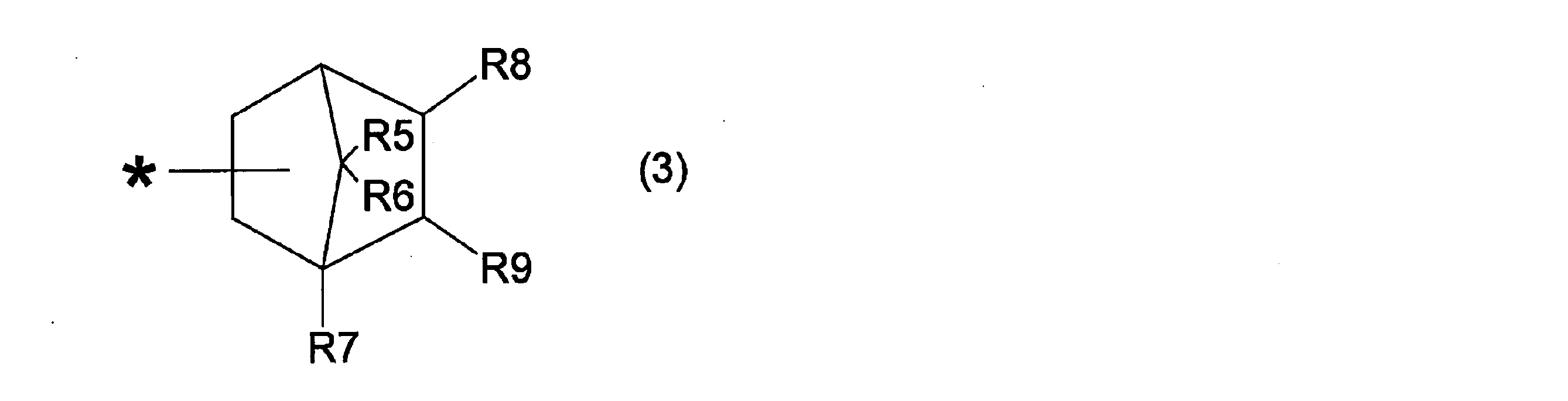
重合性モノマー(m-4)(以後、単に「モノマー(m-4)」と言う場合もある。)は、下記の一般式(4)で示されるモノマーである。

芳香環含有重合性モノマー(m-5)(以後、単に「モノマー(m-5)」と言う場合もある。)は、カルボキシ基、エポキシ基を有さず、芳香環を有するモノマーである。例えば、スチレン、α-メチルスチレン、o-ビニルトルエン、m-ビニルトルエン、p-ビニルトルエン、o-クロロスチレン、m-クロロスチレン、p-クロロスチレン、o-メトキシスチレン、m-メトキシスチレン、p-メトキシスチレン、p-ニトロスチレン、p-シアノスチレン、p-アセチルアミノスチレン等の芳香族ビニル化合物;ベンジル(メタ)アクリレート、ロジン(メタ)アクリレート、フェニル(メタ)アクリレート、クミル(メタ)アクリレート、フェノキシエチル(メタ)アクリレート、フェノキシ-ポリエチレングリコール(メタ)アクリレート(商品名:ライトアクリレートP-200A、共栄化学社製)、ノニルフェノキシポリエチレングリコールモノ(メタ)アクリレート、o-フェノキシベンジル(メタ)アクリレート、m-フェノキシベンジル(メタ)アクリレート、p-フェノキシベンジル(メタ)アクリレート、4-フェノキシフェニル(メタ)アクリレート、ビフェニルオキシエチル(メタ)アクリレート、エトキシ化o-フェニルフェノール(メタ)アクリレート、ナフタレン(メタ)アクリレート、アントラセン(メタ)アクリレート等が挙げられる。これらの中でも、弾性回復率の観点から、本発明で用いる樹脂(D)には、ベンジル(メタ)クリレート、スチレン、ビフェニル骨格、ナフタレン骨格及びアントラセン骨格からなる群から選択される少なくとも1種を有する構成単位を導入することがより好ましい。
本実施態様にかかるエポキシ基含有共重合体(P1)は、モノマー(m-1)~(m-5)以外の、その他の重合性モノマー(m-6)(以後、単に「モノマー(m-6)」と言う場合もある。)が共重合されていても良い。その他の重合性モノマー(m-6)は、前記モノマー(m-1)、(m-3)、(m-4)、(m-5)、前述のモノマー(m-2)に示した以外の共重合可能なモノマーである。このモノマー(m-6)は、一般にエチレン性不飽和基を有するラジカル重合性化合物である。例えば、このモノマー(m-6)としては、(メタ)アクリル酸エステル類、(メタ)アクリル酸アミド、マレイミド類、不飽和ジカルボン酸ジエステル、ブタジエン等のジエン類などが挙げられる。(メタ)アクリル酸エステル類の具体例は、メチル(メタ)アクリレート、エチル(メタ)アクリレート、n-プロピル(メタ)アクリレート、イソ-プロピル(メタ)アクリレート、n-ブチル(メタ)アクリルレート、sec-ブチル(メタ)アクリレート、イソ-ブチル(メタ)アクリレート、tert-ブチル(メタ)アクリルレート、ペンチル(メタ)アクリレート、ネオペンチル(メタ)アクリレート、ベンジル(メタ)アクリレート、イソアミル(メタ)アクリレート、ヘキシル(メタ)アクリレート、2-エチルヘキシル(メタ)アクリレート、ラウリル(メタ)アクリレート、ドデシル(メタ)アクリレート、シクロペンチル(メタ)アクリレート、シクロヘキシル(メタ)アクリレート、メチルシクロヘキシル(メタ)アクリレート、エチルシクロヘキシル(メタ)アクリレート、ロジン(メタ)アクリレート、アリル(メタ)アクリレート、テトラヒドロフルフリル(メタ)アクリレート、トリフェニルメチル(メタ)アクリレート、クミル(メタ)アクリレート、3-(N,N-ジメチルアミノ)プロピル(メタ)アクリレート、ナフタレン(メタ)アクリレート、アントラセン(メタ)アクリレート等を含む。(メタ)アクリル酸アミドの具体例は、(メタ)アクリル酸アミド、(メタ)アクリル酸N,N-ジメチルアミド、(メタ)アクリル酸N,N-ジエチルアミド、(メタ)アクリル酸N,N-ジプロピルアミド、(メタ)アクリル酸N,N-ジ-イソ-プロピルアミド、(メタ)アクリル酸アントラセニルアミド等を含む。マレイミド類の具体例は、(メタ)アクリル酸アニリド、(メタ)アクリロイルニトリル、アクロレイン、塩化ビニル、塩化ビニリデン、フッ化ビニル、フッ化ビニリデン、N-ビニルピロリドン、酢酸ビニル等のビニル化合物;N-シクロヘキシルマレイミド、N-ラウリルマレイミド等を含む。不飽和ジカルボン酸ジエステルの具体例は、シトラコン酸ジエチル、マレイン酸ジエチル、フマル酸ジエチル、イタコン酸ジエチル等を含む。これらは、必要に応じて、単独でまたは2種以上を組み合わせて用いることができる。
本発明に係る共重合体(P1)において、そのモノマー(M1)が、モノマー(m-1)を含み、必要に応じて、例えば、モノマー(m-3)や、モノマー(m-4)や、モノマー(m-5)を含む場合、各モノマー由来構造の割合は、共重合反応ために添加する各重合性モノマーのモル比の値を用いる。各モノマーの配合割合(モル比)について特に制限はないが、モノマー(m-1)の配合割合は、好ましくは9~70モル%、より好ましくは13~65モル%である。モノマー(m-1)の配合割合が9モル%以上であると、感光性樹脂組成物としたときに十分な硬化性を発現することができる。モノマー(m-1)の配合割合が70モル%以下であると、モノマー(m-3)および/またはモノマー(m-4)の配合割合が十分多くなり、所望の耐熱分解性や屈折率を有する樹脂(D)が得られる。
モノマー(m-6)を用いる場合、その配合割合は、エポキシ基含有共重合体(P1)のモノマー(M1)の合計量100モル%に対して、0モル%超~10モル%であることが好ましく、0モル%超~5モル%であることがより好ましい。
本発明に係るエポキシ基含有共重合体(P1)はモノマー(M1)の共重合反応を用いて製造することができる。本発明において行われる共重合反応は、当該技術分野において公知のラジカル重合方法に従って行うことができる。例えば、共重合に用いるモノマーを溶剤に溶解した後、その溶液に重合開始剤を添加し、50~140℃、より好ましくは60~130℃で、1~20時間、より好ましくは1~12時間反応させればよい。また、50~140℃に調整した溶剤に、共重合に用いるモノマーと重合開始剤を滴下しながら反応させてもよい。
これらは、単独でまたは2種以上を組み合わせて用いることができ、重合温度に応じて適当な半減期のラジカル重合開始剤を選択することが望ましい。
本実施態様に用いるエポキシ樹脂(P3)は、ノボラック型エポキシ樹脂(P3-1)、ビスフェノール型エポキシ樹脂(P3-2)、及びビフェニル骨格を有する2官能エポキシ樹脂(P3-3)からなる群から選択されることが好ましい。


本発明の炭素クラスター含有組成物の第二実施態様(以後、「本実施態様の組成物」という場合がある。)では、炭素クラスター(A)と、第1溶媒(B1)と、第2溶媒(B2)と、エチレン性不飽和基含有モノマー(C)と、樹脂(D)とを含有する。ただし、このエチレン性不飽和基含有モノマー(C)がエポキシ基含有エチレン性不飽和化合物(m-1)である。この樹脂(D)がカルボキシ基含有共重合体(P2)又はカルボキシ基含有樹脂(P4)である。
炭素クラスター(A)、第1溶媒(B1)、第2溶媒(B2)は、第一実施態様と同様のものを用いることができる。
エポキシ基含有エチレン性不飽和化合物(m-1)および多塩基酸無水物(d)は、第一実施態様に係るものと同様のものを用いることができる。カルボキシ基含有共重合体(P2)の有するカルボキシのモル数に対して、エポキシ基含有エチレン性不飽和化合物(m-1)の付加割合としては、好ましくは90~100%であり、より好ましくは95~100%である。エポキシ基含有エチレン性不飽和化合物(m-1)の付加割合が90%以上であると、感光性樹脂組成物としたときに十分な硬化性を発現することができる。
また、エポキシ基含有エチレン性不飽和化合物(m-1)の反応割合は、エポキシ基含有共重合体(P2)に用いる全モノマー(M2)の合計を100モル%とした場合に、好ましくは10~70モル%、より好ましくは15~65モル%である。エポキシ基含有エチレン性不飽和化合物(m-1)の配合割合が10モル%以上であると、感光性樹脂組成物としたときに十分な硬化性を発現することができる。
本実施態様の樹脂(D)に係るカルボキシ基含有共重合体(P2)(以後、単に「共重合体(P2)」と言う場合もある。)の全モノマー(M2)は、少なくとも、カルボキシ基含有エチレン性不飽和化合物(m-2)を含有し、必要に応じて、さらに、炭素数10~20の橋かけ環式炭化水素基を有する重合性モノマー(m-3)や、上記一般式(4)で示される重合性モノマー(m-4)や、芳香環含有重合性モノマー(m-5)や、その他の重合性モノマー(m-6)などを含有することができる。
本発明に係る共重合体(P2)において、全モノマー(M2)は、カルボキシ基含有エチレン性不飽和化合物(m-2)を含有し、必要に応じて、さらに、炭素数10~20の橋かけ環式炭化水素基を有する重合性モノマー(m-3)や、上記一般式(4)で示される重合性モノマー(m-4)や、芳香環含有重合性モノマー(m-5)などを含有する場合、各モノマー由来構造の割合は、共重合反応のために添加する各重合性モノマーのモル比の値を用いる。各モノマーの配合割合(モル比)について特に制限はないが、全モノマー(M2)の合計を100モル%とした場合に、モノマー(m-2)の配合割合は、好ましくは9~70モル%、より好ましくは13~65モル%である。モノマー(m-2)の配合割合が9モル%以上であると、感光性樹脂組成物としたときに十分な硬化性を発現することができる。モノマー(m-2)の配合割合が70モル%以下であると、モノマー(m-3)や、モノマー(a-4)や、モノマー(m-5)の配合割合が十分多くなり、所望の耐熱分解性有する樹脂(D)が得られる。
モノマー(m-6)を用いる場合、その配合割合は、エポキシ基含有共重合体(P2)の全モノマー(M2)の合計量100モル%に対して、0モル%超~10モル%であることが好ましく、0モル%超~5モル%であることがより好ましい。
本発明に係るカルボキシ基含有共重合体(P2)は、第一実施態様に係る共重合体(P1)と同様に、共重合反応を用いて製造することができる。
本実施態様に用いるカルボキシ基含有樹脂(P4)は、エポキシ樹脂(P3)と多官能カルボン酸(e)とを反応させてなるカルボキシ基を有する樹脂である。
エポキシ樹脂(P3)は、第一実施態様に用いるエポキシ樹脂(P3)を用いることができる。
多官能カルボン酸(e)としては、特に限定されない。飽和、不飽和の多官能カルボン酸のいずれであっても良い。具体的には、アジピン酸、イタコン酸、コハク酸、シュウ酸、マロン酸、フタル酸、フマル酸、マレイン酸、グルタル酸、酒石酸、グルタミン酸、セバシン酸等が挙げられる。多官能カルボン酸(e)は、単独で用いてもよいし、又は2種以上を用いてもよい。これらの中でも、反応性の観点から、アジピン酸及びイタコン酸が好ましい。
カルボキシ基含有樹脂(P4)は、エポキシ樹脂(P3)由来の構成単位30~80質量%と、多官能カルボン酸(e)由来の構成単位20~70質量%とを含むことが好ましい。ここで、カルボキシ基含有樹脂(P4)中のエポキシ樹脂(P3)由来の構成単位に対し、多官能カルボン酸(e)由来の構成単位のモル比は0.1~0.8であることが好ましく、0.15~0.7であることがより好ましい。
本実施態様に用いるカルボキシ基含有樹脂(P4)は、例えば、付加触媒の存在下で、エポキシ樹脂(P3)と多官能カルボン酸(e)とを付加反応させて製造することができる。
本実施態様に用いるカルボキシ基含有樹脂(P4)を得るための付加反応の条件は、常法に従って適宜設定すればよい。付加反応は、例えば、溶媒に各原料と付加触媒とを添加し、好ましくは酸素ガス濃度5~7体積%の雰囲気で、好ましくは50~150℃、より好ましくは60~140℃で1~12時間行えばよい。
本発明の炭素クラスター含有組成物の第三実施態様(以後、「本実施態様の組成物」という場合がある。)では、炭素クラスター(A)と、第1溶媒(B1)と、第2溶媒(B2)と、樹脂(D)とを含有する。ただし、この樹脂(D)がエチレン性不飽和樹脂(A1)またはエチレン性不飽和樹脂(A3)である。
炭素クラスター(A)、第1溶媒(B1)、第2溶媒(B2)は、第一実施態様に用いるものを同様に使用できる。
エチレン性不飽和樹脂(A1)は、カルボキシ基含有エチレン性不飽和化合物(m-2)及び必要に応じて用いる多塩基酸無水物(d)からなるモノマーと、エポキシ基含有共重合体(P1)とを含む樹脂(D)前駆体を用いて得られる。また、エチレン性不飽和樹脂(A3)は、カルボキシ基含有エチレン性不飽和化合物(m-2)及び必要に応じて用いる多塩基酸無水物(d)からなるモノマーと、エポキシ樹脂(P3)とを含む樹脂(D)前駆体を用いて得られる。すなわち、エチレン性不飽和樹脂(A1)およびエチレン性不飽和樹脂(A3)は、エチレン性不飽和基と必要に応じてカルボキシ基を含有する樹脂である。本実施態様に用いる樹脂(D)の前駆体の上記成分は、第一実施態様に用いるものを使用できる。
エチレン性不飽和樹脂(A1)またはエチレン性不飽和樹脂(A3)は、例えば、それぞれエポキシ基含有共重合体(P1)又はエポキシ樹脂(P3)の溶液に重合禁止剤として炭素クラスター(A)および触媒を添加した後、カルボキシ基含有エチレン性不飽和化合物(m-2)を添加し、50~150℃、好ましくは80~130℃の条件下でエポキシ基を開環付加反応させてから、必要に応じて多塩基酸無水物(d)を添加し、付加反応させることで製造することができる。
本実施形態において使用する溶媒としては、特に限定されず、公知のものを適宜使用できる。上述の第2溶媒(B2)を使用することができる。
本実施形態において用いる触媒としては、例えば、トリエチルアミンのような第3級アミン、トリエチルベンジルアンモニウムクロライドのような第4級アンモニウム塩、トリフェニルホスフィンのようなリン化合物、クロムのキレート化合物等が挙げられる。これらの触媒は、単独で用いてもよいし、2種以上を混合して用いてもよい。
本実施形態において使用する触媒の使用量は、特に限定されないが、樹脂前駆体を100質量部とした場合に、一般的には0.01~5質量部であり、好ましくは0.1~2質量部であり、より好ましくは0.2~1質量部である。
本発明の炭素クラスター含有組成物の第四実施態様(以後、「本実施態様の組成物」という場合がある。)では、炭素クラスター(A)と、第1溶媒(B1)と、第2溶媒(B2)と、樹脂(D)とを含有する。ただし、この樹脂(D)がエチレン性不飽和樹脂(A2)またはエチレン性不飽和樹脂(A4)である。
炭素クラスター(A)、第1溶媒(B1)、第2溶媒(B2)は第一実施態様に用いるものを同様に使用することができる。
エチレン性不飽和樹脂(A2)は、エポキシ基含有エチレン性不飽和化合物(m-1)と、カルボキシ基含有共重合体(P2)又はカルボキシ基含有樹脂(P4)とを含む前駆体を用いて得られる、エチレン性不飽和基を含有する樹脂である。本実施態様に用いる樹脂(D)の前駆体の上記成分は、第二実施態様に用いるものを使用できる。
エチレン性不飽和樹脂(A2)またはエチレン性不飽和樹脂(A4)は、例えば、それぞれカルボキシ基含有共重合体(P2)又はカルボキシ基含有樹脂(P4)の溶液に重合禁止剤として炭素クラスター(A)および触媒を添加した後、エポキシ基含有エチレン性不飽和化合物(m-1)を添加し、50~150℃、好ましくは80~130℃の条件下でエポキシ基を開環付加反応させて製造することができる。
本実施態様の炭素クラスター(A)と触媒は、第一実施態様に用いるものを使用できる。
本実施形態において使用する溶媒としては、特に限定されず、公知のものを適宜使用できる。上述の第2溶媒(B2)を使用することができる。
本発明の炭素クラスター含有組成物の第五実施態様(以後、「本実施態様の組成物」という場合がある。)では、炭素クラスター(A)と、第1溶媒(B1)と、第2溶媒(B2)と、樹脂(D)を含有する。
炭素クラスター(A)、第1溶媒(B1)、第2溶媒(B2)は、第一実施態様に用いるものを同様に使用することができ、特に第2溶媒(B2)がテトラヒドロフランであることが好ましい。
樹脂(D)としては、具体的にはフェノール樹脂、エポキシ樹脂、メラミン樹脂、尿素樹脂、不飽和ポリエステル樹脂、アルキド樹脂、ポリウレタン樹脂、ポリアルキレン、ポリ塩化ビニル、ポリスチレン、ポリ酢酸ビニル、(メタ)アクリル樹脂、エポキシエステル樹脂等が挙げられる。本実施態様に用いる樹脂(D)は、市販されたものを使用することができる。
本発明の炭素クラスター含有組成物を製造する方法の一実施態様は、炭素クラスター(A)ならびに芳香族溶媒およびハロゲン含有溶媒からなる群から選ばれる第1溶媒(B1)を混合して炭素クラスター分散液(i)を得る工程(I)と、前記第1溶媒(B1)を除く第2溶媒(B2)にモノマー(C)および/または樹脂(D)を混合して溶液(ii)を得る工程(II)と、前記溶液(ii)と前記炭素クラスター分散液(i)とを混合する工程(III)とを有する。前記工程(III)において、前記溶液(ii)に前記炭素クラスター分散液(i)を加えて混合することが好ましい。
本発明の炭素クラスター含有組成物を製造する方法の他の実施態様では、前記の実施形態に加えて前記モノマーの重合反応もしくは前記樹脂と前記モノマーとの付加反応を行う工程(V)をさらに有する。
本発明の炭素クラスター含有組成物は、反応性希釈剤(E)と光重合開始剤(F)とをさらに含むことで、感光性樹脂組成物として使用することができる。更に着色剤(G)を含んでもよい。
この範囲の配合量であれば、適切な粘度を有する感光性樹脂組成物となり、感光性樹脂組成物は適切な光硬化性を有する。
反応性希釈剤(E)としては特に限定されないが、エチレン性不飽和二重結合、好ましくは、ビニル基、(メタ)アクリロイルオキシ基を含むものが好ましい。具体例としては、スチレン、α-メチルスチレン、α-クロロメチルスチレン、ビニルトルエン、ジビニルベンゼン、ジアリルフタレート、ジアリルベンゼンホスホネート等の芳香族ビニル系モノマー類;酢酸ビニル、アジピン酸ビニル等のポリカルボン酸モノマー類;メチル(メタ)アクリレート、エチル(メタ)アクリレート、プロピル(メタ)アクリレート、ブチル(メタ)アクリレート、β-ヒドロキシエチル(メタ)アクリレート、ヒドロキシプロピル(メタ)アクリレート、エチレングリコールジ(メタ)アクリレート、ジエチレングリコールジ(メタ)アクリレート、プロピレングリコールジ(メタ)アクリレート、エチレングリコールジ(メタ)アクリレート、トリメチロールプロパンジ(メタ)アクリレート、トリメチロールプロパントリ(メタ)アクリレート、ペンタエリスリトールテトラ(メタ)アクリレート、ジペンタエリスリトールヘキサ(メタ)アクリレート(例えば、新中村化学工業株式会社製、ジペンタエリスリトールヘキサアクリレート(DPHA))、トリス(ヒドロキシエチル)イソシアヌレートのトリ(メタ)アクリレート等の(メタ)アクリル系モノマー;トリアリルシアヌレート等が挙げられる。これらは、単独で、または2種以上を組み合わせて用いることができる。
光重合開始剤(F)としては特に限定されないが、具体例として、ベンゾイン、ベンゾインメチルエーテル、ベンゾインエチルエーテル等のベンゾインとそのアルキルエーテル類;アセトフェノン、2,2-ジメトキシ-2-フェニルアセトフェノン、1,1-ジクロロアセトフェノン、4-(1-t-ブチルジオキシ-1-メチルエチル)アセトフェノン等のアセトフェノン類;2-メチルアントラキノン、2-アミルアントラキノン、2-t-ブチルアントラキノン、1-クロロアントラキノン等のアントラキノン類;2,4-ジメチルチオキサントン、2,4-ジイソプロピルチオキサントン、2-クロロチオキサントン等のチオキサントン類;アセトフェノンジメチルケタール、ベンジルジメチルケタール等のケタール類;ベンゾフェノン、4-(1-t-ブチルジオキシ-1-メチルエチル)ベンゾフェノン、3,3’,4,4’-テトラキス(t-ブチルジオキシカルボニル)ベンゾフェノン等のベンゾフェノン類;2-メチル-1-[4-(メチルチオ)フェニル]-2-モルホリノ-プロパン-1-オン;2-ベンジル-2-ジメチルアミノ-1-(4-モルホリノフェニル)ブタノン-1;アシルホスフィンオキサイド類;およびキサントン類等が挙げられる。これらは、単独で、または2種以上を組み合わせて用いることができる。例えば、BASF社製、イルガキュア(IRGACURE)OXE-01を使用することができる。
[着色剤(G)]
前記第2溶媒(B2)に溶解または分散するものであれば特に限定されず、公知の染料または顔料を用いることができる。着色剤(G)として染料を用いる場合、顔料を用いる場合と比べ高輝度な着色パターンを得ることができ、また良好なアルカリ現像性を示す。一方、着色剤(G)として顔料を用いる場合、染料を用いる場合と比べ着色パターンの耐熱性が高い。求められる性能や目的とする画素の色に応じて、染料と顔料を併用しても良い。
染料としては、溶剤(B)やアルカリ現像液に対する溶解性、感光性樹脂組成物中の他の成分との相互作用、耐熱性等の観点から、カルボキシ基等の酸性基を有する酸性染料、酸性染料の窒素化合物との塩、酸性染料のスルホンアミド体等を用いることが好ましい。このような染料の具体例としては、acid alizarin violet N;acid black1、2、24、48;acid blue1、7、9、25、29、40、45、62、70、74、80、83、90、92、112、113、120、129、147;acid chrome violet K;acid Fuchsin;acid green1、3、5、25、27、50;acid orange6、7、8、10、12、50、51、52、56、63、74、95;acid red1、4、8、14、17、18、26、27、29、31、34、35、37、42、44、50、51、52、57、69、73、80、87、88、91、92、94、97、103、111、114、129、133、134、138、143、145、150、151、158、176、183、198、211、215、216、217、249、252、257、260、266、274;acid violet 6B、7、9、17、19;acid yellow1、3、9、11、17、23、25、29、34、36、42、54、72、73、76、79、98、99、111、112、114、116; food yellow 3およびこれらの誘導体等が挙げられる。
これらの中でも、アゾ系、キサンテン系、アントラキノン系またはフタロシアニン系の酸性染料が好ましい。これらの染料は、目的とする画素の色に応じて、単独で、または2種以上を組み合わせて用いることができる。
顔料の具体例としては、C.I.ピグメントイエロー1、3、12、13、14、15、16、17、20、24、31、53、83、86、93、94、109、110、117、125、128、137、138、139、147、148、150、153、154、166、173、194、214等の黄色顔料;C.I.ピグメントオレンジ13、31、36、38、40、42、43、51、55、59、61、64、65、71、73等の橙色顔料;C.I.ピグメントレッド9、97、105、122、123、144、149、166、168、176、177、180、192、209、215、216、224、242、254、255、264、265等の赤色顔料;C.I.ピグメントブルー15、15:3、15:4、15:6、60等の青色顔料;C.I.ピグメントバイオレット1、19、23、29、32、36、38等のバイオレット色顔料;C.I.ピグメントグリーン7、36、58等の緑色顔料;C.I.ピグメントブラウン23、25等の茶色顔料;C.I.ピグメントブラック1、7、カーボンブラック、チタンブラック、酸化鉄等の黒色顔料等が挙げられる。これらの顔料は、目的とする画素の色に応じて、単独で、または2種以上を組み合わせて用いることができる。
本実施の形態の感光性樹脂組成物における着色剤(G)の配合量は、感光性樹脂組成物中の全溶媒を除く成分の総和を100質量部とすると、一般に5~80質量部、好ましくは5~70質量部、より好ましくは10~60質量部である。
「すす状物質」
トルエンと純酸素ガスを比3:1になるようにして反応管に供給して混合し、67hPa、180℃の条件で加熱して煤を得た。次いで、トルエンで2回洗浄を行い、すす状物質を得た。
トリメチルベンゼン8.9gおよびフラーレン(フロンティアカーボン社製、nanom(登録商標) mix ST、C60/C70=60/25)0.18gを混合して炭素クラスター分散液(i)を得た。
次いで、攪拌装置、滴下ロート、コンデンサー、温度計及びガス導入管を備えたフラスコに、プロピレングリコールモノメチルエーテルアセテート137.5gを加え、窒素置換しながら攪拌し、120℃に昇温した。次いで、グリシジルメタクリレート141.7g(1.00モル)、トリシクロデカニルメタクリレート4.7g(0.02モル)、及びスチレン5.0g(0.05モル)からなる単量体混合物に、13.3gのt-ブチルパーオキシ-2-エチルヘキサノエート(重合開始剤、日油社製、パーブチル(登録商標)O)を添加したものを、滴下ロートから2時間にわたって前記フラスコ中に滴下した。
滴下終了後、120℃でさらに2時間攪拌して共重合反応を行い、エポキシ基含有共重合体(P1)溶液を生成させた。そこにモノマー(m-2)としてアクリル酸72.0g、触媒としてトリフェニルホスフィンを0.66g(0.3質量部)を仕込み、溶液(ii)を得た。
前記溶液(ii)に前記炭素クラスター分散液(i)を加えて混合し、上記第一実施形態の炭素クラスター含有組成物である樹脂溶液が得られた。
上記得られた樹脂溶液に対して、酸素濃度が4~7体積%となるように窒素ガスを注入した低酸素エアーを吹き込みながら110℃で10時間加熱した。上記第三実施形態の炭素クラスター含有組成物である樹脂溶液が得られた。
その後、酸価が1.0KOHmg/g以下であることを確認して、テトラヒドロフタル酸無水物を15.6g仕込み110℃で2時間反応させ、固形分濃度50質量%の樹脂溶液(固形分酸価32.4KOHmg/g、重量平均分子量9400)を得た。
反応溶液中の酸価(単量体残存率)を測定することにより、エポキシ基へのアクリル酸の付加反応率を算出したところ99.1%であった。
実施例2においてはフラーレン(フロンティアカーボン社製、nanom(登録商標) mix ST、C60/C70=60/25)の添加量を変更し、実施例3においては合成例1で得られたすす状物質に変更した。比較例においてはフラーレン溶液の代わりにフラーレンとエチレングリコールを混合したスラリー、フラーレンを粉末のまま添加、またはBHTを添加した以外は実施例1と同様にして炭素クラスター含有組成物である樹脂溶液を得た。結果を表1に示す。

BHT:ジ-t-ブチルヒドロキシトルエン
PGMEA:プロピレングリコールモノメチルエーテルアセテート
TCDMA:トリシクロデカニルメタクリレート
St:スチレン
GMA:グリシジルメタクリレート
TBO:t-ブチルぺルオキシ-2-エチルヘキサノエート
MAA:メタクリル酸
THPA:テトラヒドロフタル酸無水物
実施例1と同様にして炭素クラスター分散液(i)を得た。
次いで、攪拌装置、滴下ロート、コンデンサー、温度計及びガス導入管を備えたフラスコに、プロピレングリコールモノメチルエーテルアセテート133.3gを加え、窒素置換しながら攪拌し、120℃に昇温した。
次いで、メタクリル酸58.5g(0.68モル)、トリシクロデカニルメタクリレート33.7g(0.15モル)及び、ベンジルメタクリレート3.0g(0.02モル)からなる単量体混合物に、2.9gのt-ブチルパーオキシ-2-エチルヘキサノエート(重合開始剤、日油社製、パーブチル(登録商標)O)を添加したものを、滴下ロートから2時間にわたって前記フラスコ中に滴下した。滴下終了後、120℃でさらに2時間攪拌して共重合反応を行い、カルボキシル基含有共重合体(P2)溶液を生成させた。そこにモノマー(m-1)としてグリシジルメタクリレート35g、触媒としてトリフェニルホスフィン0.39g(0.3質量部)を仕込み、溶液(ii)を得た。
前記溶液(ii)に前記炭素クラスター分散液(i)を加えて混合し、上記第二実施形態の炭素クラスターである樹脂溶液が得られた。
得られた樹脂溶液に対して、酸素濃度が4~7体積%となるように窒素ガスを注入した低酸素エアーを吹き込みながら110℃で10時間加熱した。上記第四実施形態の炭素クラスター含有組成物である樹脂溶液が得られた。
その後、酸価が72.0KOHmg/g以下であることを確認して、固形分濃度28.6質量%の樹脂溶液(固形分酸価196.8KOHmg/g、重量平均分子量18500)を得た。
反応溶液中の酸価を測定することにより、酸とエポキシの反応率を算出したところ97.8%であった。
実施例5においてはフラーレン(フロンティアカーボン社製、nanom(登録商標) mix ST、C60/C70=60/25)の添加量を変更し、実施例6においてはフラーレンをフラーレン合成時に生成するすす状物質に変更した。比較例においてはフラーレン溶液の代わりにフラーレンとエチレングリコールを混合したスラリー、フラーレンを粉末のまま添加、またはBHTを添加した以外は実施例4と同様にして炭素クラスター含有組成物である樹脂溶液を得た。結果を表2に示す。

BZMA:ベンジルメタクリレート
その他の表記は表1と同じである。
トリメチルベンゼン64.6gおよびフラーレンフラーレン(フロンティアカーボン社製、nanom(登録商標) mix ST、C60/C70=60/25)2gを混合して炭素クラスター分散液(i)を得た。
次いで、樹脂100gをテトラヒドロフラン(THF)500gに溶解し、溶液(ii)を得た。前記溶液(ii)に前記炭素クラスター分散液(i)を加えて混合し、室温で30分撹拌することで、第五実施態様の炭素クラスター含有組成物である樹脂液を作製した。
樹脂やフラーレンの添加方法を変更することで実施例8~10と比較例7~10を得た。結果を表3に示す。

JIS K6901 5.3.2に従って、ブロモチモールブルーとフェノールレットの混合指示薬を用いて測定した。固形分である樹脂(D)1g中に含まれる酸性成分を中和するのに要する水酸化カリウムのmg数を意味する。
なお、固形分は、試料を130℃で2時間加熱した時の加熱残分を測定した。
ゲルパーミエーションクロマトグラフィー(GPC)を用いて、下記条件にて測定し、標準ポリスチレン換算した。
カラム:ショウデックス(登録商標) LF-804+LF-804(昭和電工株式会社製)
カラム温度:40℃
試料:共重合体の0.2%テトラヒドロフラン溶液
展開溶媒:テトラヒドロフラン
検出器:示差屈折計(ショウデックス(登録商標) RI-71S)(昭和電工株式会社製)
流速:1mL/min
ガラス基板上に、それぞれ実施例1~6及び比較例3,6の樹脂を使用し、表4に示す配合を組んだ感光性樹脂組成物を作製した。なお、表中の樹脂の配合量は固形分の値で記載し、樹脂の合成の際に含まれていた溶剤は、表中の「溶剤」の項目に合算して記載した。
ガラス基板上に、実施例18~23及び比較例11~12感光性樹脂組成物を使用し、スピンコーターで膜厚2.5μmとなるように塗膜を作製した。その後作製した塗膜を90℃で3分間加熱することにより、塗膜中の溶剤を揮発させた。次に、塗膜の全面をウシオ電機株式会社製マルチライトML-251D/Bと照射光学ユニットPM25C-100を用いて露光(露光量50mJ/cm2)し、光硬化させた。照射後、230℃で30分後硬化を行った。後硬化前後の樹脂硬化膜について、SIMAZU社製UVスペクトルメータUV-1650PCを用いて、極大吸収波長の吸光度を測定し、ΔEabを算出した。結果を表4に示す。
ΔEabが小さいほど黄変が少なく良い。
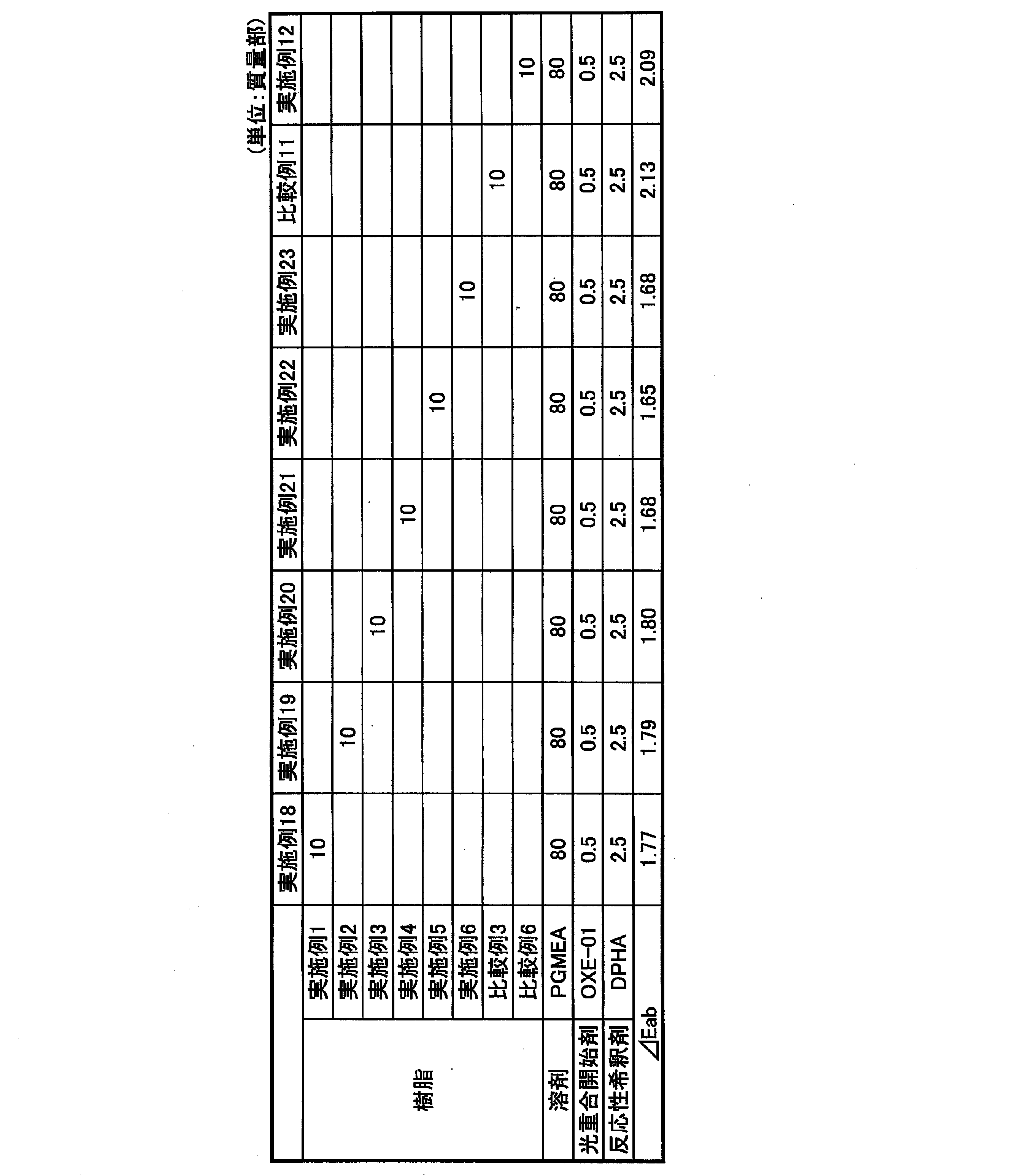
OXE-01:BASF社製、IRGACURE OXE-01
DPHA:ジペンタエリスリトールヘキサアクリレート、新中村化学工業株式会社製
[耐熱黄変性の評価2]
ガラス基板上に実施例7~10と比較例7~10の樹脂液を塗布しスピンコーターで膜厚2.5μmとなるように塗膜を作製した。その後作製した塗膜を90℃で3分間加熱することにより、塗膜中の溶剤を揮発させた。次に230℃で30分後硬化を行った。後硬化前後の樹脂硬化膜について、SIMAZU社製UVスペクトルメータUV-1650PCを用いて、極大吸収波長の吸光度を測定し、ΔEabを算出した。比較を容易にするため、実施例24~25、比較例11~12については、実施例24のΔEabの値を基準とした相対値を求め、実施例26~27、比較例13~14については、実施例26のΔEabの値を基準とした相対値を求めた。結果を表5に示す。
ΔEabが小さいほど黄変が少なく良い。
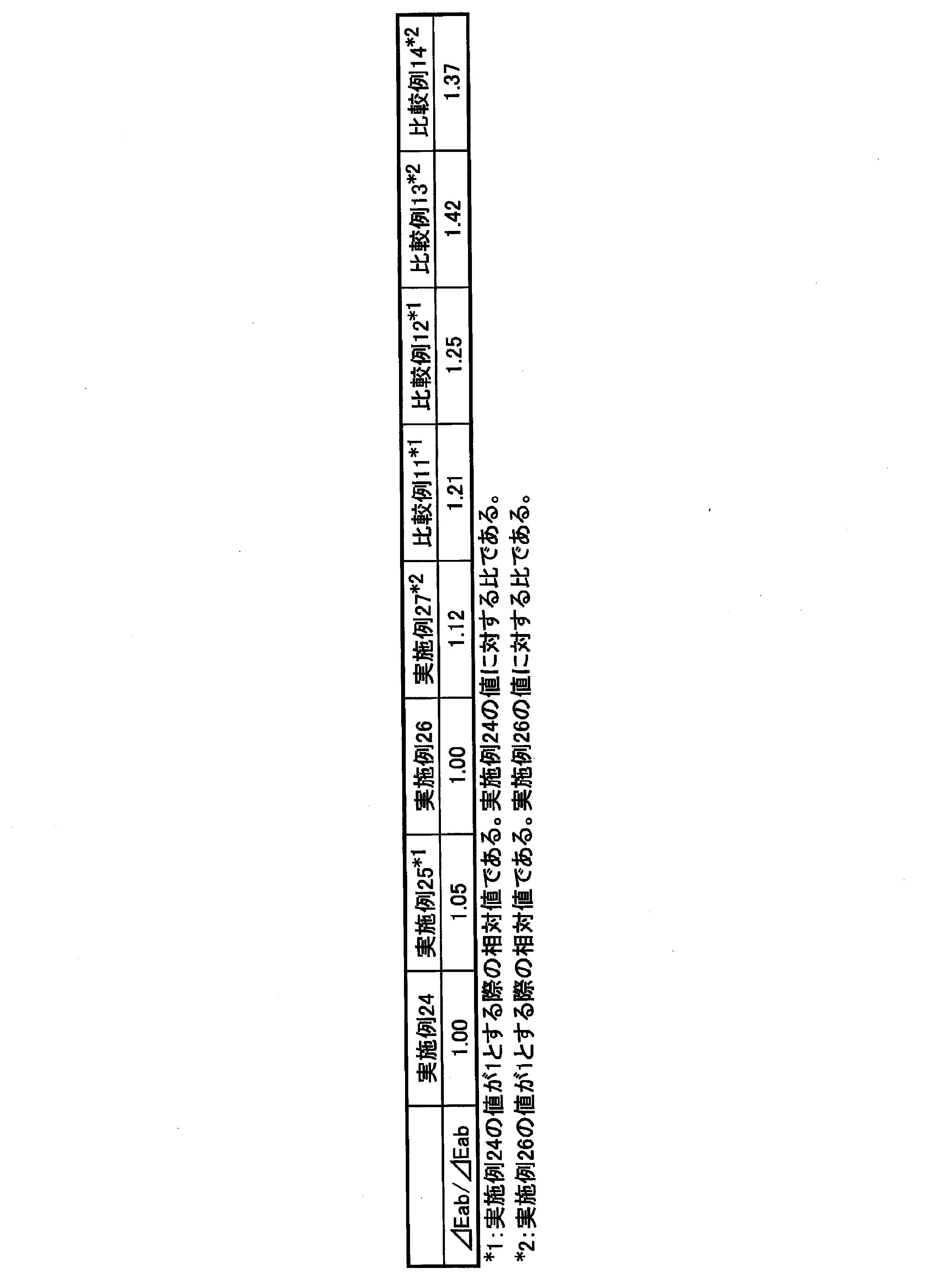
Claims (10)
- 炭素クラスター(A)と、
第1溶媒(B1)と、
第2溶媒(B2)と、
エチレン性不飽和基含有モノマー(C)および樹脂(D)からなる群から選ばれる少なくとも1種と
を含有する炭素クラスター含有組成物であって、
前記第1溶媒(B1)が、芳香族溶媒およびハロゲン含有溶媒からなる群から選ばれる少なくとも1種の溶媒であり、
前記第2溶媒(B2)が、芳香族溶媒とハロゲン含有溶媒とを除く溶媒であることを特徴とする炭素クラスター含有組成物。 - 前記炭素クラスター(A)が、フラーレンまたはその誘導体である、請求項1に記載の炭素クラスター含有組成物。
- 前記第1溶媒(B1)が、トルエン、ベンゼン、およびトリメチルベンゼンからなる群から選択される1種以上である請求項1又は2に記載の炭素クラスター含有組成物。
- 前記第2溶媒(B2)が、グリコールエーテル系溶媒である請求項1~3のいずれか1項に記載の炭素クラスター含有組成物。
- 前記炭素クラスター含有組成物が前記モノマー(C)と前記樹脂(D)を含有し、
前記モノマー(C)が反応性基を有し、
前記樹脂(D)が、前記モノマー(C)の前記反応性基と反応する基を有する請求項1~4のいずれか1項に記載の炭素クラスター含有組成物。 - 前記樹脂(D)が、不飽和(メタ)アクリル樹脂又は不飽和エポキシエステル樹脂である請求項1~5のいずれか1項に記載の炭素クラスター含有組成物。
- 前記炭素クラスター(A)の含有量が、前記モノマー(C)および前記樹脂(D)の合計100質量部に対して0.01~0.10質量部である請求項1~6のいずれか1項に記載の炭素クラスター含有組成物の製造方法。
- 炭素クラスター(A)と第1溶媒(B1)とを混合して炭素クラスター分散液(i)を得る第一混合工程(I)と、
モノマー(C)および樹脂(D)からなる群から選ばれる少なくとも1種と、第2溶媒(B2)とを混合して溶液(ii)を得る第二混合工程(II)と、
前記溶液(ii)と前記炭素クラスター分散液(i)とを混合する第三混合工程(III)と
を有する炭素クラスター含有組成物の製造方法。 - 前記モノマー(C)の重合反応を行う工程(IV)をさらに有する請求項8に記載の炭素クラスター含有組成物の製造方法。
- 前記モノマー(C)が反応性基を有し、前記樹脂(D)が前記モノマー(C)の前記反応性基と反応する基を有し、前記モノマー(C)と前記樹脂(D)との付加反応を行う工程(V)をさらに有する請求項8に記載の炭素クラスター含有組成物の製造方法。
Priority Applications (3)
| Application Number | Priority Date | Filing Date | Title |
|---|---|---|---|
| JP2020557730A JPWO2020111046A1 (ja) | 2018-11-28 | 2019-11-26 | 炭素クラスター含有組成物、及びその製造方法 |
| KR1020217012831A KR20210068098A (ko) | 2018-11-28 | 2019-11-26 | 탄소 클러스터 함유 조성물 및 그의 제조 방법 |
| CN201980076876.5A CN113166288A (zh) | 2018-11-28 | 2019-11-26 | 含有碳簇的组合物及其制造方法 |
Applications Claiming Priority (2)
| Application Number | Priority Date | Filing Date | Title |
|---|---|---|---|
| JP2018-222729 | 2018-11-28 | ||
| JP2018222729 | 2018-11-28 |
Publications (1)
| Publication Number | Publication Date |
|---|---|
| WO2020111046A1 true WO2020111046A1 (ja) | 2020-06-04 |
Family
ID=70854007
Family Applications (1)
| Application Number | Title | Priority Date | Filing Date |
|---|---|---|---|
| PCT/JP2019/046120 Ceased WO2020111046A1 (ja) | 2018-11-28 | 2019-11-26 | 炭素クラスター含有組成物、及びその製造方法 |
Country Status (5)
| Country | Link |
|---|---|
| JP (1) | JPWO2020111046A1 (ja) |
| KR (1) | KR20210068098A (ja) |
| CN (1) | CN113166288A (ja) |
| TW (1) | TW202035282A (ja) |
| WO (1) | WO2020111046A1 (ja) |
Citations (6)
| Publication number | Priority date | Publication date | Assignee | Title |
|---|---|---|---|---|
| JP2004177772A (ja) * | 2002-11-28 | 2004-06-24 | Jsr Corp | 光硬化性組成物およびその用途 |
| JP2004537512A (ja) * | 2002-04-16 | 2004-12-16 | デンツプライ インターナショナル インコーポレーテッド | 防止剤を含む光重合性歯科用組成物 |
| JP2006160799A (ja) * | 2004-12-02 | 2006-06-22 | Toyota Industries Corp | 塗料組成物、塗料組成物を用いた摺動層の製造方法および摺動層を有する摺動部材 |
| JP2009013377A (ja) * | 2007-07-09 | 2009-01-22 | Kureha Corp | プロトン伝導性樹脂組成物 |
| JP2013095820A (ja) * | 2011-10-31 | 2013-05-20 | Fujifilm Corp | 導電性組成物、並びにこれを用いた導電性膜及び導電性積層体 |
| JP2018126496A (ja) * | 2017-02-06 | 2018-08-16 | 信越化学工業株式会社 | 生体電極組成物、生体電極、生体電極の製造方法、及び高分子化合物 |
Family Cites Families (2)
| Publication number | Priority date | Publication date | Assignee | Title |
|---|---|---|---|---|
| EP2062853A1 (en) * | 2007-11-23 | 2009-05-27 | Nanoledge | Polymer carbon nanotube composites |
| JP6576494B2 (ja) | 2018-02-20 | 2019-09-18 | 国立大学法人大阪大学 | 長鎖アルキルエーテル化フラーレン誘導体およびその製造方法、並びにそれを用いた樹脂組成物 |
-
2019
- 2019-11-26 CN CN201980076876.5A patent/CN113166288A/zh active Pending
- 2019-11-26 KR KR1020217012831A patent/KR20210068098A/ko not_active Withdrawn
- 2019-11-26 WO PCT/JP2019/046120 patent/WO2020111046A1/ja not_active Ceased
- 2019-11-26 JP JP2020557730A patent/JPWO2020111046A1/ja active Pending
- 2019-11-26 TW TW108142853A patent/TW202035282A/zh unknown
Patent Citations (6)
| Publication number | Priority date | Publication date | Assignee | Title |
|---|---|---|---|---|
| JP2004537512A (ja) * | 2002-04-16 | 2004-12-16 | デンツプライ インターナショナル インコーポレーテッド | 防止剤を含む光重合性歯科用組成物 |
| JP2004177772A (ja) * | 2002-11-28 | 2004-06-24 | Jsr Corp | 光硬化性組成物およびその用途 |
| JP2006160799A (ja) * | 2004-12-02 | 2006-06-22 | Toyota Industries Corp | 塗料組成物、塗料組成物を用いた摺動層の製造方法および摺動層を有する摺動部材 |
| JP2009013377A (ja) * | 2007-07-09 | 2009-01-22 | Kureha Corp | プロトン伝導性樹脂組成物 |
| JP2013095820A (ja) * | 2011-10-31 | 2013-05-20 | Fujifilm Corp | 導電性組成物、並びにこれを用いた導電性膜及び導電性積層体 |
| JP2018126496A (ja) * | 2017-02-06 | 2018-08-16 | 信越化学工業株式会社 | 生体電極組成物、生体電極、生体電極の製造方法、及び高分子化合物 |
Also Published As
| Publication number | Publication date |
|---|---|
| JPWO2020111046A1 (ja) | 2021-10-21 |
| CN113166288A (zh) | 2021-07-23 |
| KR20210068098A (ko) | 2021-06-08 |
| TW202035282A (zh) | 2020-10-01 |
Similar Documents
| Publication | Publication Date | Title |
|---|---|---|
| KR102121255B1 (ko) | (메타)아크릴레이트계 폴리머, 상기 폴리머를 포함하는 조성물 및 그 용도 | |
| CN101573663B (zh) | 用于液晶显示器的黑色矩阵高敏感度光刻胶组合物以及使用该组合物制备的黑色矩阵 | |
| CN103459443A (zh) | 共聚物、包含该共聚物的树脂组合物以及光敏性树脂组合物、以及彩色滤光片 | |
| WO2011129182A1 (ja) | 付加共重合体、感光性樹脂組成物及びカラーフィルター | |
| JP5198471B2 (ja) | アルカリ現像可能樹脂、その製造方法、および前記アルカリ現像可能樹脂を含む感光性樹脂組成物 | |
| CN108713031B (zh) | 无规共聚物、抗蚀剂组合物、滤色器及无规共聚物的制造方法 | |
| WO2017204079A1 (ja) | ブラックカラムスペーサ形成用感光性樹脂組成物、ブラックカラムスペーサ及び画像表示装置 | |
| WO2018110097A1 (ja) | カラーフィルター用樹脂組成物、その製造方法及びカラーフィルター | |
| WO2012029585A1 (ja) | 不飽和基含有ポリカルボン酸樹脂を含む分散剤 | |
| JP2020511699A (ja) | 青色感光性樹脂組成物、これを利用して製造されたカラーフィルターおよび画像表示装置 | |
| KR102830809B1 (ko) | 감광성 수지 조성물 및 감광성 수지 조성물의 제조 방법 | |
| JPWO2020111046A1 (ja) | 炭素クラスター含有組成物、及びその製造方法 | |
| JP2009282115A (ja) | カラーフィルタ用感光性着色組成物及びカラーフィルタ | |
| JP2020084089A (ja) | エチレン性不飽和樹脂の製造方法、エチレン性不飽和樹脂組成物の製造方法 | |
| JPWO2019142415A1 (ja) | カラーフィルター用感光性樹脂組成物、カラーフィルター、画像表示素子及びカラーフィルターの製造方法 | |
| JP5130914B2 (ja) | 活性エネルギー線硬化型組成物 | |
| WO2020111022A1 (ja) | エチレン性不飽和樹脂組成物、及び感光性樹脂組成物 | |
| WO2022102368A1 (ja) | 顔料分散組成物、及び感光性着色組成物 | |
| JP2008201979A (ja) | 硬化型着色組成物 | |
| JPWO2008102834A1 (ja) | 硬化型顔料分散剤 | |
| KR102773932B1 (ko) | 감광성 수지 조성물, 이를 이용하여 제조된 화소-격벽 일체형 구조물 및 이를 포함하는 표시 장치 | |
| JP3517030B2 (ja) | 樹脂組成物およびブラックマトリックス | |
| CN111278912A (zh) | 聚合物组合物、感光性树脂组合物以及彩色滤光片 | |
| CN118131566A (zh) | 一种着色感光性树脂组合物及其制备方法和应用 | |
| WO2017022299A1 (ja) | 硬化性(メタ)アクリレートポリマー、硬化性組成物、カラーフィルター、及び画像表示装置 |
Legal Events
| Date | Code | Title | Description |
|---|---|---|---|
| 121 | Ep: the epo has been informed by wipo that ep was designated in this application |
Ref document number: 19889375 Country of ref document: EP Kind code of ref document: A1 |
|
| ENP | Entry into the national phase |
Ref document number: 2020557730 Country of ref document: JP Kind code of ref document: A |
|
| ENP | Entry into the national phase |
Ref document number: 20217012831 Country of ref document: KR Kind code of ref document: A |
|
| NENP | Non-entry into the national phase |
Ref country code: DE |
|
| 122 | Ep: pct application non-entry in european phase |
Ref document number: 19889375 Country of ref document: EP Kind code of ref document: A1 |