WO2020110364A1 - 光散乱型液晶素子用液晶組成物、光散乱型液晶素子、及びスマートウィンドウ - Google Patents
光散乱型液晶素子用液晶組成物、光散乱型液晶素子、及びスマートウィンドウ Download PDFInfo
- Publication number
- WO2020110364A1 WO2020110364A1 PCT/JP2019/028242 JP2019028242W WO2020110364A1 WO 2020110364 A1 WO2020110364 A1 WO 2020110364A1 JP 2019028242 W JP2019028242 W JP 2019028242W WO 2020110364 A1 WO2020110364 A1 WO 2020110364A1
- Authority
- WO
- WIPO (PCT)
- Prior art keywords
- group
- liquid crystal
- formula
- mass
- carbon atoms
- Prior art date
- Legal status (The legal status is an assumption and is not a legal conclusion. Google has not performed a legal analysis and makes no representation as to the accuracy of the status listed.)
- Ceased
Links
- 0 *c(cc(cc1)OC(C(CC2)CCC2C(Oc(cc2)ccc2O*OC(C=C)=O)=O)=O)c1OC(C(CC1)CCC1C(Oc(cc1)ccc1OCC(COC(C=C)=O)OC(C=C)=O)=O)=O Chemical compound *c(cc(cc1)OC(C(CC2)CCC2C(Oc(cc2)ccc2O*OC(C=C)=O)=O)=O)c1OC(C(CC1)CCC1C(Oc(cc1)ccc1OCC(COC(C=C)=O)OC(C=C)=O)=O)=O 0.000 description 7
- HXALXAWHBQEPJK-UHFFFAOYSA-N C[N]OC(C=C)=O Chemical compound C[N]OC(C=C)=O HXALXAWHBQEPJK-UHFFFAOYSA-N 0.000 description 3
- WIUDQDUQXPAIDS-UHFFFAOYSA-N C=CC(OCC(COc(cc1)ccc1C(Oc(cc1)ccc1OCC(COC(C=C)=O)OC(C=C)=O)=O)OC(C=C)=O)=O Chemical compound C=CC(OCC(COc(cc1)ccc1C(Oc(cc1)ccc1OCC(COC(C=C)=O)OC(C=C)=O)=O)OC(C=C)=O)=O WIUDQDUQXPAIDS-UHFFFAOYSA-N 0.000 description 1
- NLXDNLRGYBUODL-UHFFFAOYSA-N CC(c1c2)c(cc(cc3)OC(c(cc4)ccc4OCC(COC(C=C)=O)OC(C=C)=O)=O)c3-c1ccc2OC(c(cc1)ccc1OC)=O Chemical compound CC(c1c2)c(cc(cc3)OC(c(cc4)ccc4OCC(COC(C=C)=O)OC(C=C)=O)=O)c3-c1ccc2OC(c(cc1)ccc1OC)=O NLXDNLRGYBUODL-UHFFFAOYSA-N 0.000 description 1
Images

Classifications
-
- G—PHYSICS
- G02—OPTICS
- G02F—OPTICAL DEVICES OR ARRANGEMENTS FOR THE CONTROL OF LIGHT BY MODIFICATION OF THE OPTICAL PROPERTIES OF THE MEDIA OF THE ELEMENTS INVOLVED THEREIN; NON-LINEAR OPTICS; FREQUENCY-CHANGING OF LIGHT; OPTICAL LOGIC ELEMENTS; OPTICAL ANALOGUE/DIGITAL CONVERTERS
- G02F1/00—Devices or arrangements for the control of the intensity, colour, phase, polarisation or direction of light arriving from an independent light source, e.g. switching, gating or modulating; Non-linear optics
- G02F1/01—Devices or arrangements for the control of the intensity, colour, phase, polarisation or direction of light arriving from an independent light source, e.g. switching, gating or modulating; Non-linear optics for the control of the intensity, phase, polarisation or colour
- G02F1/13—Devices or arrangements for the control of the intensity, colour, phase, polarisation or direction of light arriving from an independent light source, e.g. switching, gating or modulating; Non-linear optics for the control of the intensity, phase, polarisation or colour based on liquid crystals, e.g. single liquid crystal display cells
- G02F1/133—Constructional arrangements; Operation of liquid crystal cells; Circuit arrangements
- G02F1/1333—Constructional arrangements; Manufacturing methods
- G02F1/1335—Structural association of cells with optical devices, e.g. polarisers or reflectors
- G02F1/133504—Diffusing, scattering, diffracting elements
-
- C—CHEMISTRY; METALLURGY
- C09—DYES; PAINTS; POLISHES; NATURAL RESINS; ADHESIVES; COMPOSITIONS NOT OTHERWISE PROVIDED FOR; APPLICATIONS OF MATERIALS NOT OTHERWISE PROVIDED FOR
- C09K—MATERIALS FOR MISCELLANEOUS APPLICATIONS, NOT PROVIDED FOR ELSEWHERE
- C09K19/00—Liquid crystal materials
- C09K19/04—Liquid crystal materials characterised by the chemical structure of the liquid crystal components, e.g. by a specific unit
- C09K19/06—Non-steroidal liquid crystal compounds
- C09K19/08—Non-steroidal liquid crystal compounds containing at least two non-condensed rings
- C09K19/30—Non-steroidal liquid crystal compounds containing at least two non-condensed rings containing saturated or unsaturated non-aromatic rings, e.g. cyclohexane rings
- C09K19/3001—Cyclohexane rings
- C09K19/3066—Cyclohexane rings in which the rings are linked by a chain containing carbon and oxygen atoms, e.g. esters or ethers
-
- C—CHEMISTRY; METALLURGY
- C09—DYES; PAINTS; POLISHES; NATURAL RESINS; ADHESIVES; COMPOSITIONS NOT OTHERWISE PROVIDED FOR; APPLICATIONS OF MATERIALS NOT OTHERWISE PROVIDED FOR
- C09K—MATERIALS FOR MISCELLANEOUS APPLICATIONS, NOT PROVIDED FOR ELSEWHERE
- C09K19/00—Liquid crystal materials
- C09K19/04—Liquid crystal materials characterised by the chemical structure of the liquid crystal components, e.g. by a specific unit
- C09K19/06—Non-steroidal liquid crystal compounds
- C09K19/08—Non-steroidal liquid crystal compounds containing at least two non-condensed rings
- C09K19/10—Non-steroidal liquid crystal compounds containing at least two non-condensed rings containing at least two benzene rings
- C09K19/12—Non-steroidal liquid crystal compounds containing at least two non-condensed rings containing at least two benzene rings at least two benzene rings directly linked, e.g. biphenyls
-
- C—CHEMISTRY; METALLURGY
- C09—DYES; PAINTS; POLISHES; NATURAL RESINS; ADHESIVES; COMPOSITIONS NOT OTHERWISE PROVIDED FOR; APPLICATIONS OF MATERIALS NOT OTHERWISE PROVIDED FOR
- C09K—MATERIALS FOR MISCELLANEOUS APPLICATIONS, NOT PROVIDED FOR ELSEWHERE
- C09K19/00—Liquid crystal materials
- C09K19/04—Liquid crystal materials characterised by the chemical structure of the liquid crystal components, e.g. by a specific unit
- C09K19/06—Non-steroidal liquid crystal compounds
- C09K19/08—Non-steroidal liquid crystal compounds containing at least two non-condensed rings
- C09K19/10—Non-steroidal liquid crystal compounds containing at least two non-condensed rings containing at least two benzene rings
- C09K19/14—Non-steroidal liquid crystal compounds containing at least two non-condensed rings containing at least two benzene rings linked by a carbon chain
-
- C—CHEMISTRY; METALLURGY
- C09—DYES; PAINTS; POLISHES; NATURAL RESINS; ADHESIVES; COMPOSITIONS NOT OTHERWISE PROVIDED FOR; APPLICATIONS OF MATERIALS NOT OTHERWISE PROVIDED FOR
- C09K—MATERIALS FOR MISCELLANEOUS APPLICATIONS, NOT PROVIDED FOR ELSEWHERE
- C09K19/00—Liquid crystal materials
- C09K19/04—Liquid crystal materials characterised by the chemical structure of the liquid crystal components, e.g. by a specific unit
- C09K19/06—Non-steroidal liquid crystal compounds
- C09K19/08—Non-steroidal liquid crystal compounds containing at least two non-condensed rings
- C09K19/10—Non-steroidal liquid crystal compounds containing at least two non-condensed rings containing at least two benzene rings
- C09K19/14—Non-steroidal liquid crystal compounds containing at least two non-condensed rings containing at least two benzene rings linked by a carbon chain
- C09K19/18—Non-steroidal liquid crystal compounds containing at least two non-condensed rings containing at least two benzene rings linked by a carbon chain the chain containing carbon-to-carbon triple bonds, e.g. tolans
-
- C—CHEMISTRY; METALLURGY
- C09—DYES; PAINTS; POLISHES; NATURAL RESINS; ADHESIVES; COMPOSITIONS NOT OTHERWISE PROVIDED FOR; APPLICATIONS OF MATERIALS NOT OTHERWISE PROVIDED FOR
- C09K—MATERIALS FOR MISCELLANEOUS APPLICATIONS, NOT PROVIDED FOR ELSEWHERE
- C09K19/00—Liquid crystal materials
- C09K19/04—Liquid crystal materials characterised by the chemical structure of the liquid crystal components, e.g. by a specific unit
- C09K19/06—Non-steroidal liquid crystal compounds
- C09K19/08—Non-steroidal liquid crystal compounds containing at least two non-condensed rings
- C09K19/10—Non-steroidal liquid crystal compounds containing at least two non-condensed rings containing at least two benzene rings
- C09K19/20—Non-steroidal liquid crystal compounds containing at least two non-condensed rings containing at least two benzene rings linked by a chain containing carbon and oxygen atoms as chain links, e.g. esters or ethers
- C09K19/2007—Non-steroidal liquid crystal compounds containing at least two non-condensed rings containing at least two benzene rings linked by a chain containing carbon and oxygen atoms as chain links, e.g. esters or ethers the chain containing -COO- or -OCO- groups
- C09K19/2021—Compounds containing at least one asymmetric carbon atom
- C09K19/2028—Compounds containing at least one asymmetric carbon atom containing additionally a linking group other than -COO- or -OCO-, e.g. -CH2-CH2-, -CH=CH-, -C=C-; containing at least one additional carbon atom in the chain containing -COO- or -OCO- groups, e.g. -COO-CH*-CH3
-
- C—CHEMISTRY; METALLURGY
- C09—DYES; PAINTS; POLISHES; NATURAL RESINS; ADHESIVES; COMPOSITIONS NOT OTHERWISE PROVIDED FOR; APPLICATIONS OF MATERIALS NOT OTHERWISE PROVIDED FOR
- C09K—MATERIALS FOR MISCELLANEOUS APPLICATIONS, NOT PROVIDED FOR ELSEWHERE
- C09K19/00—Liquid crystal materials
- C09K19/04—Liquid crystal materials characterised by the chemical structure of the liquid crystal components, e.g. by a specific unit
- C09K19/06—Non-steroidal liquid crystal compounds
- C09K19/08—Non-steroidal liquid crystal compounds containing at least two non-condensed rings
- C09K19/30—Non-steroidal liquid crystal compounds containing at least two non-condensed rings containing saturated or unsaturated non-aromatic rings, e.g. cyclohexane rings
- C09K19/3001—Cyclohexane rings
- C09K19/3003—Compounds containing at least two rings in which the different rings are directly linked (covalent bond)
-
- C—CHEMISTRY; METALLURGY
- C09—DYES; PAINTS; POLISHES; NATURAL RESINS; ADHESIVES; COMPOSITIONS NOT OTHERWISE PROVIDED FOR; APPLICATIONS OF MATERIALS NOT OTHERWISE PROVIDED FOR
- C09K—MATERIALS FOR MISCELLANEOUS APPLICATIONS, NOT PROVIDED FOR ELSEWHERE
- C09K19/00—Liquid crystal materials
- C09K19/04—Liquid crystal materials characterised by the chemical structure of the liquid crystal components, e.g. by a specific unit
- C09K19/06—Non-steroidal liquid crystal compounds
- C09K19/08—Non-steroidal liquid crystal compounds containing at least two non-condensed rings
- C09K19/30—Non-steroidal liquid crystal compounds containing at least two non-condensed rings containing saturated or unsaturated non-aromatic rings, e.g. cyclohexane rings
- C09K19/3001—Cyclohexane rings
- C09K19/3059—Cyclohexane rings in which at least two rings are linked by a carbon chain containing carbon to carbon triple bonds
-
- C—CHEMISTRY; METALLURGY
- C09—DYES; PAINTS; POLISHES; NATURAL RESINS; ADHESIVES; COMPOSITIONS NOT OTHERWISE PROVIDED FOR; APPLICATIONS OF MATERIALS NOT OTHERWISE PROVIDED FOR
- C09K—MATERIALS FOR MISCELLANEOUS APPLICATIONS, NOT PROVIDED FOR ELSEWHERE
- C09K19/00—Liquid crystal materials
- C09K19/04—Liquid crystal materials characterised by the chemical structure of the liquid crystal components, e.g. by a specific unit
- C09K2019/0444—Liquid crystal materials characterised by the chemical structure of the liquid crystal components, e.g. by a specific unit characterized by a linking chain between rings or ring systems, a bridging chain between extensive mesogenic moieties or an end chain group
- C09K2019/0448—Liquid crystal materials characterised by the chemical structure of the liquid crystal components, e.g. by a specific unit characterized by a linking chain between rings or ring systems, a bridging chain between extensive mesogenic moieties or an end chain group the end chain group being a polymerizable end group, e.g. -Sp-P or acrylate
-
- C—CHEMISTRY; METALLURGY
- C09—DYES; PAINTS; POLISHES; NATURAL RESINS; ADHESIVES; COMPOSITIONS NOT OTHERWISE PROVIDED FOR; APPLICATIONS OF MATERIALS NOT OTHERWISE PROVIDED FOR
- C09K—MATERIALS FOR MISCELLANEOUS APPLICATIONS, NOT PROVIDED FOR ELSEWHERE
- C09K19/00—Liquid crystal materials
- C09K19/04—Liquid crystal materials characterised by the chemical structure of the liquid crystal components, e.g. by a specific unit
- C09K19/06—Non-steroidal liquid crystal compounds
- C09K19/08—Non-steroidal liquid crystal compounds containing at least two non-condensed rings
- C09K19/10—Non-steroidal liquid crystal compounds containing at least two non-condensed rings containing at least two benzene rings
- C09K19/12—Non-steroidal liquid crystal compounds containing at least two non-condensed rings containing at least two benzene rings at least two benzene rings directly linked, e.g. biphenyls
- C09K2019/121—Compounds containing phenylene-1,4-diyl (-Ph-)
- C09K2019/122—Ph-Ph
-
- C—CHEMISTRY; METALLURGY
- C09—DYES; PAINTS; POLISHES; NATURAL RESINS; ADHESIVES; COMPOSITIONS NOT OTHERWISE PROVIDED FOR; APPLICATIONS OF MATERIALS NOT OTHERWISE PROVIDED FOR
- C09K—MATERIALS FOR MISCELLANEOUS APPLICATIONS, NOT PROVIDED FOR ELSEWHERE
- C09K19/00—Liquid crystal materials
- C09K19/04—Liquid crystal materials characterised by the chemical structure of the liquid crystal components, e.g. by a specific unit
- C09K19/06—Non-steroidal liquid crystal compounds
- C09K19/08—Non-steroidal liquid crystal compounds containing at least two non-condensed rings
- C09K19/10—Non-steroidal liquid crystal compounds containing at least two non-condensed rings containing at least two benzene rings
- C09K19/14—Non-steroidal liquid crystal compounds containing at least two non-condensed rings containing at least two benzene rings linked by a carbon chain
- C09K19/18—Non-steroidal liquid crystal compounds containing at least two non-condensed rings containing at least two benzene rings linked by a carbon chain the chain containing carbon-to-carbon triple bonds, e.g. tolans
- C09K2019/181—Ph-C≡C-Ph
-
- C—CHEMISTRY; METALLURGY
- C09—DYES; PAINTS; POLISHES; NATURAL RESINS; ADHESIVES; COMPOSITIONS NOT OTHERWISE PROVIDED FOR; APPLICATIONS OF MATERIALS NOT OTHERWISE PROVIDED FOR
- C09K—MATERIALS FOR MISCELLANEOUS APPLICATIONS, NOT PROVIDED FOR ELSEWHERE
- C09K19/00—Liquid crystal materials
- C09K19/04—Liquid crystal materials characterised by the chemical structure of the liquid crystal components, e.g. by a specific unit
- C09K19/06—Non-steroidal liquid crystal compounds
- C09K19/08—Non-steroidal liquid crystal compounds containing at least two non-condensed rings
- C09K19/10—Non-steroidal liquid crystal compounds containing at least two non-condensed rings containing at least two benzene rings
- C09K19/20—Non-steroidal liquid crystal compounds containing at least two non-condensed rings containing at least two benzene rings linked by a chain containing carbon and oxygen atoms as chain links, e.g. esters or ethers
- C09K19/2007—Non-steroidal liquid crystal compounds containing at least two non-condensed rings containing at least two benzene rings linked by a chain containing carbon and oxygen atoms as chain links, e.g. esters or ethers the chain containing -COO- or -OCO- groups
- C09K2019/2078—Ph-COO-Ph-COO-Ph
-
- C—CHEMISTRY; METALLURGY
- C09—DYES; PAINTS; POLISHES; NATURAL RESINS; ADHESIVES; COMPOSITIONS NOT OTHERWISE PROVIDED FOR; APPLICATIONS OF MATERIALS NOT OTHERWISE PROVIDED FOR
- C09K—MATERIALS FOR MISCELLANEOUS APPLICATIONS, NOT PROVIDED FOR ELSEWHERE
- C09K19/00—Liquid crystal materials
- C09K19/04—Liquid crystal materials characterised by the chemical structure of the liquid crystal components, e.g. by a specific unit
- C09K19/06—Non-steroidal liquid crystal compounds
- C09K19/08—Non-steroidal liquid crystal compounds containing at least two non-condensed rings
- C09K19/30—Non-steroidal liquid crystal compounds containing at least two non-condensed rings containing saturated or unsaturated non-aromatic rings, e.g. cyclohexane rings
- C09K19/3001—Cyclohexane rings
- C09K19/3003—Compounds containing at least two rings in which the different rings are directly linked (covalent bond)
- C09K2019/3009—Cy-Ph
-
- C—CHEMISTRY; METALLURGY
- C09—DYES; PAINTS; POLISHES; NATURAL RESINS; ADHESIVES; COMPOSITIONS NOT OTHERWISE PROVIDED FOR; APPLICATIONS OF MATERIALS NOT OTHERWISE PROVIDED FOR
- C09K—MATERIALS FOR MISCELLANEOUS APPLICATIONS, NOT PROVIDED FOR ELSEWHERE
- C09K19/00—Liquid crystal materials
- C09K19/04—Liquid crystal materials characterised by the chemical structure of the liquid crystal components, e.g. by a specific unit
- C09K19/06—Non-steroidal liquid crystal compounds
- C09K19/08—Non-steroidal liquid crystal compounds containing at least two non-condensed rings
- C09K19/30—Non-steroidal liquid crystal compounds containing at least two non-condensed rings containing saturated or unsaturated non-aromatic rings, e.g. cyclohexane rings
- C09K19/3001—Cyclohexane rings
- C09K19/3003—Compounds containing at least two rings in which the different rings are directly linked (covalent bond)
- C09K2019/301—Cy-Cy-Ph
-
- C—CHEMISTRY; METALLURGY
- C09—DYES; PAINTS; POLISHES; NATURAL RESINS; ADHESIVES; COMPOSITIONS NOT OTHERWISE PROVIDED FOR; APPLICATIONS OF MATERIALS NOT OTHERWISE PROVIDED FOR
- C09K—MATERIALS FOR MISCELLANEOUS APPLICATIONS, NOT PROVIDED FOR ELSEWHERE
- C09K19/00—Liquid crystal materials
- C09K19/04—Liquid crystal materials characterised by the chemical structure of the liquid crystal components, e.g. by a specific unit
- C09K19/06—Non-steroidal liquid crystal compounds
- C09K19/08—Non-steroidal liquid crystal compounds containing at least two non-condensed rings
- C09K19/30—Non-steroidal liquid crystal compounds containing at least two non-condensed rings containing saturated or unsaturated non-aromatic rings, e.g. cyclohexane rings
- C09K19/3001—Cyclohexane rings
- C09K19/3003—Compounds containing at least two rings in which the different rings are directly linked (covalent bond)
- C09K2019/3016—Cy-Ph-Ph
-
- C—CHEMISTRY; METALLURGY
- C09—DYES; PAINTS; POLISHES; NATURAL RESINS; ADHESIVES; COMPOSITIONS NOT OTHERWISE PROVIDED FOR; APPLICATIONS OF MATERIALS NOT OTHERWISE PROVIDED FOR
- C09K—MATERIALS FOR MISCELLANEOUS APPLICATIONS, NOT PROVIDED FOR ELSEWHERE
- C09K19/00—Liquid crystal materials
- C09K19/04—Liquid crystal materials characterised by the chemical structure of the liquid crystal components, e.g. by a specific unit
- C09K19/06—Non-steroidal liquid crystal compounds
- C09K19/08—Non-steroidal liquid crystal compounds containing at least two non-condensed rings
- C09K19/30—Non-steroidal liquid crystal compounds containing at least two non-condensed rings containing saturated or unsaturated non-aromatic rings, e.g. cyclohexane rings
- C09K19/3001—Cyclohexane rings
- C09K19/3003—Compounds containing at least two rings in which the different rings are directly linked (covalent bond)
- C09K2019/3027—Compounds comprising 1,4-cyclohexylene and 2,3-difluoro-1,4-phenylene
-
- C—CHEMISTRY; METALLURGY
- C09—DYES; PAINTS; POLISHES; NATURAL RESINS; ADHESIVES; COMPOSITIONS NOT OTHERWISE PROVIDED FOR; APPLICATIONS OF MATERIALS NOT OTHERWISE PROVIDED FOR
- C09K—MATERIALS FOR MISCELLANEOUS APPLICATIONS, NOT PROVIDED FOR ELSEWHERE
- C09K19/00—Liquid crystal materials
- C09K19/04—Liquid crystal materials characterised by the chemical structure of the liquid crystal components, e.g. by a specific unit
- C09K19/06—Non-steroidal liquid crystal compounds
- C09K19/08—Non-steroidal liquid crystal compounds containing at least two non-condensed rings
- C09K19/30—Non-steroidal liquid crystal compounds containing at least two non-condensed rings containing saturated or unsaturated non-aromatic rings, e.g. cyclohexane rings
- C09K19/3001—Cyclohexane rings
- C09K19/3059—Cyclohexane rings in which at least two rings are linked by a carbon chain containing carbon to carbon triple bonds
- C09K2019/3063—Cy-Ph-C≡C-Ph
-
- G—PHYSICS
- G02—OPTICS
- G02F—OPTICAL DEVICES OR ARRANGEMENTS FOR THE CONTROL OF LIGHT BY MODIFICATION OF THE OPTICAL PROPERTIES OF THE MEDIA OF THE ELEMENTS INVOLVED THEREIN; NON-LINEAR OPTICS; FREQUENCY-CHANGING OF LIGHT; OPTICAL LOGIC ELEMENTS; OPTICAL ANALOGUE/DIGITAL CONVERTERS
- G02F1/00—Devices or arrangements for the control of the intensity, colour, phase, polarisation or direction of light arriving from an independent light source, e.g. switching, gating or modulating; Non-linear optics
- G02F1/01—Devices or arrangements for the control of the intensity, colour, phase, polarisation or direction of light arriving from an independent light source, e.g. switching, gating or modulating; Non-linear optics for the control of the intensity, phase, polarisation or colour
- G02F1/13—Devices or arrangements for the control of the intensity, colour, phase, polarisation or direction of light arriving from an independent light source, e.g. switching, gating or modulating; Non-linear optics for the control of the intensity, phase, polarisation or colour based on liquid crystals, e.g. single liquid crystal display cells
- G02F1/133—Constructional arrangements; Operation of liquid crystal cells; Circuit arrangements
- G02F1/1333—Constructional arrangements; Manufacturing methods
- G02F1/1334—Constructional arrangements; Manufacturing methods based on polymer dispersed liquid crystals, e.g. microencapsulated liquid crystals
- G02F1/13345—Network or three-dimensional gels
-
- G—PHYSICS
- G02—OPTICS
- G02F—OPTICAL DEVICES OR ARRANGEMENTS FOR THE CONTROL OF LIGHT BY MODIFICATION OF THE OPTICAL PROPERTIES OF THE MEDIA OF THE ELEMENTS INVOLVED THEREIN; NON-LINEAR OPTICS; FREQUENCY-CHANGING OF LIGHT; OPTICAL LOGIC ELEMENTS; OPTICAL ANALOGUE/DIGITAL CONVERTERS
- G02F1/00—Devices or arrangements for the control of the intensity, colour, phase, polarisation or direction of light arriving from an independent light source, e.g. switching, gating or modulating; Non-linear optics
- G02F1/01—Devices or arrangements for the control of the intensity, colour, phase, polarisation or direction of light arriving from an independent light source, e.g. switching, gating or modulating; Non-linear optics for the control of the intensity, phase, polarisation or colour
- G02F1/13—Devices or arrangements for the control of the intensity, colour, phase, polarisation or direction of light arriving from an independent light source, e.g. switching, gating or modulating; Non-linear optics for the control of the intensity, phase, polarisation or colour based on liquid crystals, e.g. single liquid crystal display cells
- G02F1/133—Constructional arrangements; Operation of liquid crystal cells; Circuit arrangements
- G02F1/1333—Constructional arrangements; Manufacturing methods
- G02F1/1334—Constructional arrangements; Manufacturing methods based on polymer dispersed liquid crystals, e.g. microencapsulated liquid crystals
- G02F1/13347—Constructional arrangements; Manufacturing methods based on polymer dispersed liquid crystals, e.g. microencapsulated liquid crystals working in reverse mode, i.e. clear in the off-state and scattering in the on-state
Definitions
- the present invention relates to a liquid crystal composition for a light-scattering liquid crystal element, a light-scattering liquid crystal element using the same, and a smart window.
- a light-scattering liquid crystal display device using a polymer network liquid crystal as a material for a transmission-scattering light control device is a polymer by a polymer in which liquid crystal and polymer are phase-separated from each other in the device. It is a liquid crystal device method in which a network is formed.
- the light-scattering liquid crystal display device does not require an optical film such as a polarizing plate because it is a display system that utilizes the contrast ratio between the transparent state and the cloudy state.
- a bright display can be realized, and moreover, since the structure of the device is simple, an optical shutter such as light control glass is provided. It is used for applications and segment display applications such as watches. Further, in order to realize high-definition display, application to a projector application, a reflective display application, and the like is also being considered in combination with an active drive display element.
- liquid crystal display devices with unprecedented designs such as transmissive displays and flexible displays are being developed for practical use.
- a liquid crystal element expected to be applied to these for example, a so-called reverse mode type light scattering, which is in a transparent state when no voltage is applied and in a scattering state when voltage is applied, as described in Patent Document 1 and Patent Document 2, for example.
- Type liquid crystal element a so-called reverse mode type light scattering, which is in a transparent state when no voltage is applied and in a scattering state when voltage is applied, as described in Patent Document 1 and Patent Document 2, for example.
- Type liquid crystal element are so-called normal-mode light-scattering liquid crystal display elements, that is, liquid crystal materials having positive dielectric anisotropy are used, and the scattering state and the application of voltage are applied when no voltage is applied. It has a feature that the transparency in the transparent state is superior to that of a conventional light-scattering liquid crystal element which sometimes becomes transparent.
- the liquid crystal molecules in the device receive a strong anchoring force due to the orientation with the mesogenic groups in the polymer network, so that it is more difficult to drive the liquid crystal molecules than in a normal liquid crystal device, and it is difficult to obtain a practical driving voltage. there were.
- the problem to be solved by the present invention is to improve the transparency in the reverse mode type light-scattering liquid crystal element when no voltage is applied and to reduce the driving voltage.
- the present invention as a result of repeated intensive studies to solve the above problems, found that it is important to use a specific polymerizable compound in the liquid crystal composition for the light scattering type liquid crystal element of the reverse mode type, The invention was completed.
- the present invention contains a polymerizable compound selected from the group of compounds represented by the following general formula (1) as a first component, and a compound having a negative dielectric anisotropy as a second component. And a liquid crystal composition for a light-scattering liquid crystal device, containing
- P 1 and P 2 each independently represent a polymerizable group
- S 1 and S 2 each independently represent a spacer group or a single bond
- X 1 and X 2 are each independently —O—, —S—, —OCH 2 —, —CO—, —COO when the bond to S 1 or S 2 is represented as the leftmost bond.
- each P—(S—X)— bond does not include —O—O—, and when a plurality of Z 1's are present, they may be the same or different.
- the present invention further relates to a light-scattering liquid crystal device formed by polymerizing the polymerizable compound of the light-scattering liquid crystal composition to form a polymer network.
- the present invention further relates to a smart window using the light scattering type liquid crystal element.
- a reverse mode light-scattering liquid crystal element has excellent transparency when no voltage is applied, and the driving voltage can be reduced.
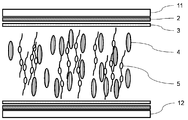
- FIG. 3 is a diagram schematically showing an example of the configuration of the liquid crystal element of the present invention, showing a state in which no voltage is applied.
- FIG. 1 is a diagram schematically showing a state in which a voltage is applied in FIG.
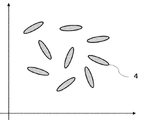
- FIG. 2 is a perspective view of the transparent substrate viewed from a direction perpendicular to the transparent substrate.
- the liquid crystal composition for a light-scattering liquid crystal element of the present invention has, as described above, a polymerizable compound as a first component and a compound having a negative dielectric anisotropy as a second component as essential components. To do.
- the liquid crystal composition for a light-scattering liquid crystal device first contains, as a first component, a polymerizable compound selected from the group of compounds represented by the following general formula (1).
- P 1 and P 2 each independently represent a polymerizable group
- S 1 and S 2 each independently represent a spacer group or a single bond
- X 1 and X 2 are each independently -O-, -S-, -OCH 2 -, -CH 2 O-, -CO-, -COO-, -OCO-, -CO-S-, -S-.
- each P—(S—X)— bond does not include —O—O—, and when a plurality of Z 1's are present, they may be the same or different.
- a 1 and A 2 each independently represent a group selected from a divalent aromatic ring, an alicycle, a heterocycle and a condensed ring, and when there are a plurality of A 1, they may be the same or different.
- Ok, n and m each independently represent an integer of 1 to 9.
- the polymerizable groups represented by P 1 and P 2 are represented by the following formulas (P-1) to (P-20).
- S 1 and S 2 each independently represent a single bond or a spacer group, but particularly easily exhibit liquid crystallinity, and from the viewpoint of reducing the driving voltage, having 1 to 18 carbon atoms.
- It is preferably an alkylene group.
- the alkylene group is preferably a linear alkylene group or a branched alkylene group, and the hydrogen atom in the alkylene group is one or more halogen atoms, a CN group, or the aforementioned polymerizable group. And may be substituted with an alkyl group having 1 to 8 carbon atoms.
- CH 2 groups or non-adjacent two or more CH 2 groups cross each present in the alkylene group in the form of oxygen atoms are not directly bonded to each other, -O -, - S- , -NH-, -N(CH 3 )-, -CO-, -CH(OH)-, CH(COOH), -COO-, -OCO-, -OCOO-, -SCO-, -COS- or -. It may be replaced by C ⁇ C-.
- a linear alkylene group having 2 to 8 carbon atoms, an alkylene group having 2 to 6 carbon atoms substituted with a fluorine atom, and a part of the alkylene group are an alkylene group having 4 to 14 carbon atoms which is replaced by —O— is preferable.
- the groups represented by X 1 and X 2 are, as described above, each independently -O-, -S-, -OCH 2 -, -CH 2 O-, -CO-. , -COO-, -OCO-, -CO-S-, -S-CO-, -O-CO-O-, -CO-NH-, -NH-CO-, -SCH 2 -, -CH 2 S.
- each P-(S-X)-bond does not include a -OO- bond.
- Z 1's When a plurality of Z 1's are present, they may be the same or different, but at least one of Z 1 's is —COO—R Z1 —, —OCO—R Z1 —, —R Z1 —COO.
- -And a group selected from the group consisting of -R Z1 -OCO-.
- n is 2 to 4 and one Z 1 is —COO—R Z1 ⁇
- It is a group selected from the group consisting of OCO-R Z1 -, -R Z1 -COO-, and -R Z1 -OCO-, and the other Z 1 is a single bond, so that the liquid crystal compound is favorably aligned.
- the driving voltage can be further reduced while exhibiting excellent transparency when no voltage is applied.
- —R Z1 — is preferably —CH 2 CH 2 —.
- a 1 and A 2 each independently represent a group selected from a divalent aromatic ring, an alicycle, a heterocycle and a condensed ring, and specifically, the following (a) to A group selected from (c) is preferred.
- a group selected from (c) is preferred.
- they may be the same or different.
- trans-1,4-cyclohexylene group one methylene group present in this group or two or more non-adjacent methylene groups may be replaced by —O— or —S—.
- B Phenylene group (one —CH ⁇ present in this group or two or more —CH ⁇ which are not adjacent to each other may be replaced by a nitrogen atom).
- the one or more hydrogen atoms present in the group are independently a fluorine atom, a chlorine atom, an alkyl group having 1 to 8 carbon atoms, a halogenated alkyl group having 1 to 8 carbon atoms, or a carbon atom.
- the group (a) and the group (b) are preferable from the viewpoint of easily exhibiting liquid crystallinity, and the group (a) is particularly preferable as an essential structure.
- n represents an integer of 1 to 9, and n is preferably 1 to 5, more preferably n is 2 to 5, and n is particularly preferably 2 to 4.
- examples of the compound represented by the general formula (1) include compounds represented by the following formulas (1-1) to (1-24).
- the compounds represented by the general formulas (1-1) to (1-24) exhibit liquid crystallinity.
- the compounds represented by the general formulas (1-1) to (1-12) are more preferable because they exhibit liquid crystallinity and lower voltage, and are represented by the general formulas (1-1) to (1-4). Are particularly preferable because they exhibit liquid crystallinity, lower voltage, contrast and haze characteristics.
- the content of the polymerizable compound represented by the general formula (1) in 100% by mass of the liquid crystal composition for a light-scattering liquid crystal device according to the present invention is 2% by mass from the viewpoint that the resulting liquid crystal device forms a polymer network. It is preferably at least 3% by mass, more preferably at least 3% by mass, further preferably at least 4% by mass, particularly preferably at least 5% by mass, from the viewpoint of lowering the driving voltage of the obtained liquid crystal element. Therefore, the upper limit is preferably 20% by mass or less, more preferably 15% by mass or less, further preferably 12% by mass or less, and particularly preferably 10% by mass or less.
- the polymerizable compound represented by the general formula (1) described in detail above may be used as the first component alone or in combination of two or more.
- a third component may be used as the polymerizable component in addition to the first component, depending on the desired performance.
- the total mass of the first component and the third component in 100% by mass of the liquid crystal composition for a light-scattering liquid crystal device according to the present invention is 2% by mass or more from the viewpoint of forming a polymer network. It is preferably 3% by mass or more, more preferably 4% by mass or more, and particularly preferably 5% by mass or more. On the other hand, from the viewpoint of driving voltage of the liquid crystal element and light scattering property. Therefore, it is preferably 20% by mass or less, more preferably 15% by mass or less, further preferably 12% by mass or less, and particularly preferably 10% by mass or less.
- the ratio of the first component to the total mass of the first component and the third component is 10% by mass or more from the viewpoint of increasing the transparency when no voltage is applied and further improving the contrast. It is more preferably at least 15% by mass, further preferably at least 20% by mass, further preferably at least 25% by mass, particularly preferably at least 40% by mass, and in the reverse mode. From the viewpoint of further increasing the light scattering property or from the viewpoint of reducing the driving voltage, it is more preferably 95% by mass or less, further preferably 90% by mass or less, and particularly preferably 85% by mass or less. ..
- a polymerizable compound represented by the following general formula (2-ii) may be used. It is preferable because it can be reduced.
- P ii1 represents a polymerizable functional group, specifically a polymerizable group, represented by the following formulas (P-1) to (P-20)
- a polymerizable group selected from the following is preferred, and among these polymerizable groups, from the viewpoint of enhancing the polymerizability and the storage stability, formula (P-1), formula (P-2), formula (P-7), Formula (P-12) or formula (P-13) is preferable, and formula (P-1), formula (P-7) and formula (P-12) are more preferable.
- R ii1 represents a single bond or an alkylene group having 1 to 9 carbon atoms, and one or two or more —CH 2 — in the alkylene group are each independently — so that oxygen atoms are not directly adjacent to each other; It may be substituted with O—, —CO—, —COO— or —OCO—, and one or more hydrogen atoms present in the alkylene group are independently substituted with a fluorine atom. May be.
- R ii1 is preferably an alkylene group having 1 to 6 carbon atoms, and more preferably an alkylene group having 1 to 3 carbon atoms.
- R ii2 and R ii3 may be each independently one or more non-adjacent —CH 2 — may be substituted with —O—, or one or two. It is preferable that each of the above hydrogen atoms independently represents an alkyl group having 1 to 21 carbon atoms which may be substituted with P ii2 , and one or two or more hydrogen atoms each independently represent P ii2 . It is more preferable that it represents an optionally substituted alkyl group having 3 to 16 carbon atoms, and one or more hydrogen atoms each independently having 5 to 5 carbon atoms optionally substituted by P ii2.
- P ii2 represents an alkyl group having 1 to 6 carbon atoms.
- R ii2 and R ii3 each independently represent a hydrogen atom or an alkyl group having 1 to 21 carbon atoms, and one or more —CH 2 — in the alkyl group is an oxygen atom. May each independently be substituted with —O—, —CO—, —COO— or —OCO— so that they are not directly adjacent to each other, and one or more hydrogen atoms present in the alkyl group are Each independently may be substituted with P ii2 , a fluorine atom, an alkyl group having 1 to 8 carbon atoms, or a halogenated alkyl group having 1 to 8 carbon atoms.
- the total number of carbon atoms contained in each of R ii1 , R ii2, and R ii3 is preferably 3 to 30, more preferably 4 to 28, and further preferably 5 to 26. Is more preferable, 6 to 24 is more preferable, and 12 to 24 is particularly preferable.
- Examples of the compound represented by the general formula (2-ii) include ethyl (meth)acrylate, 2-hydroxyethyl acrylate, propyl (meth)acrylate, butyl (meth)acrylate, isobutyl (meth)acrylate, octyl (meth). ) Mono(meth)acrylates having a linear alkyl chain such as acrylate, dodecyl(meth)acrylate, stearyl(meth)acrylate, or mono(meth)acrylates having a branched alkyl chain represented by the following structure Is mentioned.
- Examples of the compound represented by the general formula (2-ii) include acrylates in which R ii1 in the general formula (2-ii) has a linear or branched ether chain structure.
- acrylate having an ether chain structure a compound represented by the following structure is preferable.
- q represents an integer of 1 to 10.
- a mono(meth)acrylate having a branched alkyl chain from the viewpoint that the effect of reducing the driving voltage becomes remarkable while maintaining good transparency particularly when no voltage is applied.
- the content of the polymerizable compound represented by the general formula (2-ii) with respect to 100% by mass of the total amount of the polymerizable components including the first component is such that the liquid crystal composition for a light-scattering liquid crystal device of the present invention is From the viewpoint of lowering the voltage, the total amount of the polymerizable compounds used in the product is 100% by mass, 5% by mass or more, 10% by mass or more, 15% by mass or more, 20% by mass or more. And more preferably 25% by mass or more, and further preferably 60% by mass or less and 55% by mass or less from the viewpoint of maintaining the strength of the polymer network.
- the third component instead of the polymerizable compound represented by the general formula (2-ii) or together with the polymerizable compound represented by the general formula (2-ii), it is preferable to use the polymerizable compound represented by the general formula (3-i).
- X 1 represents a linear or branched alkylene having 4 to 80 carbon atoms, and any carbon atom of the alkylene is —O—, —CH ⁇ CH—, —CO so that oxygen atoms are not directly adjacent to each other. It may be substituted with —, —C ⁇ C—, —OCO—, —COO—, or OH.
- X 1 is a straight-chain or branched alkylene having a carbon number of 6 to 80, and a carbon atom number of 7 to 70. Is preferable, and in particular, the range of 8 to 60 is preferable, and the range of 9 to 50 is particularly preferable from the viewpoint of lowering the driving voltage.
- X 1 in the general formula (3-i) is preferably one having an alkylidene group in an alkylene having 6 to 80 carbon atoms from the viewpoint of lowering the driving voltage.
- the alkylidene group is preferably an ethylidene group or a 2,2-propylidene group.
- such X 1 preferably has a structural moiety represented by the following structural formula (i-1) or structural formula (i-2) as a partial structure or as a repeating unit.
- Y 3 and Y 4 each represent a methyl group or a hydrogen atom, at least one of which is a methyl group, and Y 5 represents a single bond, a methylene group, or a 1,3-propylene group. In addition, the broken line represents a bond.
- Y 3 and Y 4 each represent a methyl group or a hydrogen atom, but at least one is a methyl group, and Y 5 represents a single bond, a methylene group, or a 1,3-propylene group. In addition, the broken line represents a bond.
- Examples of the polymerizable compound represented by the above general formula (3-i) include those having the following structures.
- the content of the polymerizable compound represented by the general formula (3-i) based on 100% by mass of the total of the polymerizable components including the first component is such that the liquid crystal composition for a light-scattering liquid crystal device of the present invention is From the viewpoint of lowering the voltage, with respect to the total amount of the polymerizable compounds used for 100 mass%, 5 mass% or more, 10 mass% or more, 15 mass% or more, 20 mass% or more. It is more preferable that it is 25% by mass or more, and from the viewpoint of maintaining the strength of the polymer network, it is more preferably 60% by mass or less and further preferably 55% by mass or less.
- the polymerizable compound represented by the general formula (2-ii) and/or the polymerizable compound represented by the general formula (3-i) is preferably used as the third component.
- these other polymerizable compounds hereinafter abbreviated as “other polymerizable compounds” may be used in combination as long as the effects of the present invention are not impaired.
- Examples of such other polymerizable compounds include compounds represented by the following general formulas (2) to (8) as preferred compounds (provided that the first component is represented by the general formula (2-ii)). Except for the polymerizable compound represented by the general formula (3-i)).
- P 11 to P 74 represent a polymerizable group selected from the above formulas (P-1) to (P-20), and among these polymerizable groups From the viewpoint of enhancing the polymerizability and storage stability, the formula (P-1), the formula (P-2), the formula (P-7), the formula (P-12), or the formula (P-13) is preferable, Formula (P-1), formula (P-7), and formula (P-12) are more preferable.
- X 11 to X 72 are each independently —O—, —S—, —OCH 2 —, —CH 2 O—, —CO—, —COO—, —OCO—, —CO—S—, —S—.
- M 11 , M 21 , M 31 , M 51 , and M 71 are each independently a mesogen group represented by the following general formula (9-a).
- a 91 , A 92 , and A 93 each independently represent a divalent group having at least one ring structure, and the divalent group is 1,2-cyclopropylene.
- Z 91 and Z 92 are each independently —O—, —S—, —OCH 2 —, —CH 2 O—, —CH 2 CH 2 —, —CO—, —COO—, —OCO—, —CO.
- R 1 represents a hydrogen atom or an alkyl group having 1 to 20 carbon atoms, and the alkyl group may be linear or branched. Any hydrogen atom may be substituted by a fluorine atom, one -CH 2 in the alkyl group - or nonadjacent two or more -CH 2 - are each independently -O -, - S -, -CO-, -COO-, -OCO-, -CO-S-, -S-CO-, -O-CO-O-, -CO-NH-, -NH-CO- or -C ⁇ C - May be replaced by).
- M 41 is a trivalent organic group having the ring structure exemplified as A 91 , A 92 , and A 93
- M 61 has the ring structure exemplified as A 91 , A 92 , and A 93. It is a valent organic group.
- R 11 and R 31 are each a hydrogen atom, a fluorine atom, a chlorine atom, a bromine atom, an iodine atom, a cyano group, or an alkyl group having 1 to 20 carbon atoms.
- the alkyl group may be linear or branched, any hydrogen atom in the alkyl group may be replaced by a fluorine atom, and one hydrogen atom in the alkyl group —CH 2 — or two or more non-adjacent —CH 2 — are each independently —O—, —S—, —CO—, —COO—, —OCO—, —CO—S—, —S.
- S 11 to S 72 each independently represent a spacer group or a single bond, and the spacer group represented by S 11 to S 72 has a carbon atom number.
- One CH 2 group which may be substituted and which is present in this group or two or more CH 2 groups which are not adjacent to each other are each independently of the other, in a form in which oxygen atoms are not directly bonded to each other, O-, -S-, -NH-, -N(CH 3 )-, -CO-, -CH(OH)-, CH(COOH), -COO-, -OCO-, -OCOO-, -SCO- , —COS— or —C ⁇ C—
- these spacer groups from the viewpoint of orientation, a linear alkylene group having 2 to 8 carbon atoms, or a carbon atom substituted with a fluorine atom.
- An alkylene group having a number of 2 to 6 and an alkylene group having a carbon number of 5 to 14 in which a part of the alkylene group is replaced by —O— are preferable, and when plural S 11 to S 72 are present, they are the same. It can be different or different.
- m1 to m7, n2 to n7, l4 to l6 and k6 each independently represent an integer of 0 to 5, m1 to m7, n2 to n7 and l4 to It is preferable that 16 and k6 each independently be 0 or 1.
- the polymerizable compound represented by the general formula (2) is preferably a polymerizable compound represented by the following formulas (2-1) to (2-39).
- n and m each independently represent an integer number of 1 to 10
- R 1 , R 2 and R 3 each independently represent a hydrogen atom.
- alkyl groups having 1 to 6 carbon atoms or alkoxy groups having 1 to 6 carbon atoms all of them may be unsubstituted or may be substituted with one or two or more halogen atoms. ..
- the content of the polymerizable compound represented by the general formula (2) is 100% by mass of the total amount of the polymerizable compounds used in the liquid crystal composition for a light-scattering liquid crystal device of the present invention, from the viewpoint of lowering the voltage. It is preferably 1% by mass or more, more preferably 5% by mass or more, and from the viewpoint of maintaining the strength of the polymer network, 50% by mass or less, 40% by mass or less, 30% by mass. It is particularly preferable that the amount is 25% by mass or less.
- the polymerizable compound represented by the general formula (3) is preferably a polymerizable compound represented by the following formulas (3-1) to (3-53).
- n and m each independently represent an integer number of 1 to 10
- R represents each independently a hydrogen atom, a halogen atom, and a carbon number of 1.
- alkyl groups having 1 to 6 carbon atoms or alkoxy groups having 1 to 6 carbon atoms all of them may be unsubstituted or may be substituted with one or two or more halogen atoms. ..
- the content of the polymerizable compound represented by the general formula (3) is 100% by mass of the total amount of the polymerizable compounds used in the liquid crystal composition for a light-scattering liquid crystal device of the present invention, from the viewpoint of lowering the voltage. It is preferably 1% by mass or more, more preferably 5% by mass or more, and from the viewpoint of maintaining the strength of the polymer network, 50% by mass or less, 40% by mass or less, 30% by mass. It is particularly preferable that the amount is 25% by mass or less.
- the compound represented by the general formula (4) not only the compounds represented by the following formulas (4-1) to (4-9) contribute to the formation of a polymer network, but also the polyimide It is preferable because it can function as a self-supporting aligning agent that does not require an alignment film.
- the content of the polymerizable compound represented by the general formula (4) is 100% by mass of the total amount of the polymerizable compounds used in the liquid crystal composition for a light-scattering liquid crystal device of the present invention, without using a vertical alignment film.
- the lower limit is preferably 0.2% by mass or more, more preferably 0.5% by mass or more, and 2% by mass or more. Is more preferable, 5% by mass or more is particularly preferable, and the upper limit is preferably 15% by mass or less and more preferably 10% by mass or less from the viewpoint that a large amount of polymer is not accumulated on the substrate surface. It is preferably 8% by mass or less, and particularly preferably 8% by mass or less.
- Specific examples of the compound represented by the general formula (5) include trimethylolpropane tri(meth)acrylate, ethoxylated isocyanuric acid triacrylate, pentaerythritol tri(meth)acrylate, and ⁇ -caprolactone-modified tris-(2- Tri(meth)acrylates such as acryloyloxyethyl)isocyanurate, or compounds represented by the following formulas (5-1) to (5-23) are preferable.
- n and m each independently represent an integer number of 1 to 10, and R each independently represents a hydrogen atom, a halogen atom, or a carbon number of 1.
- R each independently represents a hydrogen atom, a halogen atom, or a carbon number of 1.
- these groups are alkyl groups having 1 to 6 carbon atoms or alkoxy groups having 1 to 6 carbon atoms, all of them may be unsubstituted or may be substituted with one or two or more halogen atoms. ..
- compounds represented by the general formula (6) specifically, compounds represented by the following formulas (6-1) to (6-11) are preferable.
- each n independently represents an integer number of 1 to 10
- each R independently represents a hydrogen atom, a halogen atom, or a carbon number of 1 to 6.
- the compound represented by the general formula (7) include tetra(meth)acrylates such as pentaerythritol tetra(meth)acrylate, ditrimethylolpropane tetra(meth)acrylate, and the following formula (7- The compounds represented by formulas (7-14) to (1) are preferable.
- n, m, l and k each independently represent an integer number of 1 to 10, and R each independently represents a hydrogen atom or a halogen atom.
- R each independently represents a hydrogen atom or a halogen atom.
- each R independently represents a hydrogen atom, a halogen atom, an alkyl group having 1 to 6 carbon atoms, an alkoxy group having 1 to 6 carbon atoms, or a cyano group. Show. When these groups are alkyl groups having 1 to 6 carbon atoms or alkoxy groups having 1 to 6 carbon atoms, all of them may be unsubstituted or may be substituted with one or two or more halogen atoms. ..
- the content of the polymerizable compounds represented by the general formulas (5) to (8) is 100% by mass of the total amount of the polymerizable compounds used in the liquid crystal composition for a light-scattering liquid crystal device of the present invention.
- it is preferably 1% by mass or more, more preferably 3% by mass or more, particularly preferably 5% by mass or more, while the crosslinking density is too high.
- the driving voltage does not become too high, it is preferably 20% by mass or less, more preferably 15% by mass or less, and particularly preferably 10% by mass or less.
- the liquid crystal composition for a light-scattering liquid crystal device contains a polymerizable compound represented by the general formula (1) to the general formula (8) together with a group that improves adhesion to a substrate, for example,
- a polymerizable compound represented by the general formula (1) to the general formula (8) together with a group that improves adhesion to a substrate, for example,
- Other polymerizable compounds such as a polymerizable compound having a polar group such as a hydroxyl group, a thiol group, an amide group, an amino group and a phosphoric acid group may be used in combination.
- the total content of the polymerizable compounds used in the liquid crystal composition for a light-scattering liquid crystal device of the present invention is 1 mass% or more based on 100 mass% of the liquid-crystal composition for a light scattering liquid crystal device of the present invention.
- the content is preferably 3% by mass or more, more preferably 5% by mass or more, and particularly preferably 50% by mass or less from the viewpoint that the driving voltage does not become too high due to the crosslinking density becoming too high. Is preferred, 40% by mass or less is preferred, 30% by mass or less is preferred, 20% by mass or less is preferred, 15% by mass or less is more preferred, and 10% by mass or less is preferred. Is particularly preferable.
- the polymerizable compound represented by the general formula (2-ii) and the polymerizable compound represented by the general formula (3-i) are particularly preferable. It is preferable to use the polymerizable compound described above from the viewpoint of the effect of reducing the driving voltage, and it is particularly preferable to use the polymerizable compound represented by the general formula (2-ii).
- the liquid crystal composition for a light-scattering liquid crystal device according to the present invention contains a compound having negative dielectric anisotropy as the second component. More specifically, the liquid crystal composition for a light-scattering liquid crystal element according to the present invention preferably contains one or more compounds represented by the following general formula (N-1).
- the liquid crystal composition for a light-scattering liquid crystal device may be any liquid crystal composition containing at least the compound represented by the general formula (N-1), and other components are not limited.
- the liquid crystal compound represented by the general formula (N-1) can be combined with any of the following liquid crystal compound groups.
- composition means a liquid crystal composition.
- the liquid crystal composition for a light-scattering liquid crystal device is used together with one or more kinds of liquid crystal compounds represented by the general formula (N-1), the general formula (N-2) or the general formula (N-
- the liquid crystal compound represented by 3) may be contained in one kind or two or more kinds.
- These liquid crystal compounds correspond to compounds that are dielectrically negative (the sign of the dielectric anisotropy is negative and the absolute value thereof is larger than 2).
- each of R N11 , R N12 , R N21 , R N22 , R N31, and R N32 independently represents an alkyl group having 1 to 8 carbon atoms, and one of the alkyl groups or a non-adjacent 2
- One or more —CH 2 — may be each independently substituted by —CH ⁇ CH—, —C ⁇ C—, —O—, —CO—, —COO— or —OCO—
- (D) represents a group selected from the group consisting of 1,4-cyclohexenylene group, wherein the group (a), group (b), group (c) and group (d) are each independently a cyano group, It may be substituted with a fluorine atom or a chlorine atom, Z N11 , Z N12 , Z N21 , Z N22 , Z N31 and Z N32 are each independently a single bond, —CH 2 CH 2 —, —(CH 2 ) 4 —, —OCH 2 —, —CH 2 O—.
- X N21 represents a hydrogen atom or a fluorine atom
- T N31 represents —CH 2 — or an oxygen atom
- n N11 , n N12 , n N21 , n N22 , n N31 and n N32 each independently represent an integer of 0 to 3
- n N11 +n N12 , n N21 +n N22 and n N31 +n N32 are each independently.
- the compounds represented by the general formulas (N-1), (N-2) and (N-3) are preferably compounds having a negative dielectric anisotropy and an absolute value larger than 2.
- R N11 , R N12 , R N21 , R N22 , R N31 and R N32 each independently have 1 to 8 carbon atoms.
- Is preferably an alkyl group having 1 to 8 carbon atoms, an alkenyl group having 2 to 8 carbon atoms, or an alkenyloxy group having 2 to 8 carbon atoms, and an alkyl group having 1 to 5 carbon atoms
- An alkoxy group having 1 to 5 carbon atoms, an alkenyl group having 2 to 5 carbon atoms or an alkenyloxy group having 2 to 5 carbon atoms is preferable, and an alkyl group having 1 to 5 carbon atoms or an alkenyl group having 2 to 5 carbon atoms is preferable.
- an alkyl group having 2 to 5 carbon atoms or an alkenyl group having 2 to 3 carbon atoms is more preferable, and an alkenyl group having 3 carbon atoms (propenyl
- the ring structure to which it is bonded is a phenyl group (aromatic)
- An alkenyl group having 4 to 5 atoms is preferable
- a linear alkoxy group having 1 to 4 carbon atoms and a linear alkenyl group having 2 to 5 carbon atoms are preferable.
- the total number of carbon atoms and oxygen atoms, if present is preferably 5 or less, and is preferably linear.
- the alkenyl group is preferably selected from the groups represented by any of the formulas (R1) to (R5). (The black dots in each formula represent carbon atoms in the ring structure.)
- a N11 , A N12 , A N21 , A N22 , A N31 and A N32 are preferably aromatic when it is required to independently increase ⁇ n, and fat is used to improve the response speed.
- Z N11, Z N12, Z N21 , Z N22, Z N31 and Z N32 -CH 2 each independently O -, - CF 2 O - , - CH 2 CH 2 -, - CF 2 CF 2 - or a single bond preferably represents an, -CH 2 O -, - CH 2 CH 2 - or a single bond is more preferable, -CH 2 O-or a single bond is particularly preferred.
- X N21 is preferably a fluorine atom.
- T N31 is preferably an oxygen atom.
- n N11 +n N12 , n N21 +n N22 and n N31 +n N32 a combination in which n N11 is 1 and n N12 is 0, a combination in which n N11 is 2 and n N12 is 0, n A combination in which N11 is 1 and n N12 is 1, a combination in which n N11 is 2, and n N12 is 1, a combination in which n N21 is 1 and n N22 is 0, n N21 is 2 and n N22 is A combination of 0, a combination of n N31 of 1 and n N32 of 0, and a combination of n N31 of 2 and n N32 of 0 are preferable.
- the composition preferably does not contain the compound represented by the general formula (N-2) or the general formula (N-3).
- the lower limit of the preferable content of the liquid crystal compound represented by the formula (N-1) is 30% by mass based on the total amount of the non-polymerizable liquid crystal compounds contained in the liquid crystal composition for a light scattering liquid crystal device according to the invention.
- the upper limit is 95% by mass.
- the more preferable lower limit of the content is 45% and the upper limit thereof is 80% by mass.
- the preferable content of the liquid crystal compound represented by the formula (N-2) is 0 mass% with respect to the total amount of the non-polymerizable liquid crystal compounds contained in the liquid crystal composition for a light scattering liquid crystal device according to the invention. ..
- the lower limit of the content may be 1% by mass, 10% by mass, or 20% by mass unless the object of the present invention such as transparency is impaired.
- the upper limit of the content is 35% by mass, 25% by mass, and may be 20% by mass.
- the preferable content of the liquid crystal compound represented by the formula (N-3) is 0% by mass based on the total amount of the composition of the non-polymerizable liquid crystal compound contained in the liquid crystal composition for a light scattering liquid crystal device according to the invention.
- the lower limit of the content may be 1%, 10% by mass, or 20% by mass unless the object of the present invention such as transparency is impaired.
- the upper limit of the content is 35% by mass, 25% by mass, and may be 20% by mass.
- the lower limit value is low and the upper limit value is low.
- a T NI of the liquid crystal composition for a light-scattering liquid crystal device according to the present invention is kept high and a composition having good temperature stability is required, it is preferable that the lower limit value is low and the upper limit value is low.
- the lower limit value is high and the upper limit value is high.
- Examples of the compound represented by the general formula (N-1) include compounds represented by the following general formulas (N-1a) to (N-1g).
- R N11 and R N12 are as defined R N11 and R N12 in the general formula (N-1), n Na11 represents 0 or 1, n NB11 is 1 or 2, n NC11 is 0 or 1, n Nd11 represents 1 or 2, n Ne11 represents 1 or 2, n Nf11 represents 1 or 2, n Ng11 represents 1 or 2, and A Ne11 represents trans-1,4.
- a Ng11 represents a trans-1,4-cyclohexylene group, a 1,4-cyclohexenylene group or a 1,4-phenylene group, but at least one Represents a 1,4-cyclohexenylene group
- Z Ne 11 represents a single bond or ethylene, but at least one represents ethylene.
- the compounds represented by the general formula (N-1) are represented by the general formulas (N-1-1) to (N-1-5) and (N-1-10) to (N-1- 18), and compounds selected from the group of compounds represented by (N-1-20) to (N-1-21) are preferred.
- the compound represented by the general formula (N-1-1) is the following compound.
- R N111 and R N112 each independently represent the same meaning as R N11 and R N12 in the general formula (N-1).
- R N111 is preferably an alkyl group having 1 to 5 carbon atoms or an alkenyl group having 2 to 5 carbon atoms, and preferably a propyl group, pentyl group or vinyl group.
- R N112 is preferably an alkyl group having 1 to 5 carbon atoms, an alkenyl group having 4 to 5 carbon atoms or an alkoxy group having 1 to 4 carbon atoms, and more preferably an ethoxy group or a butoxy group.
- the compound represented by the general formula (N-1-1) can be used alone, or two or more compounds can be used in combination.
- the kinds of compounds that can be combined are not particularly limited, but they are appropriately combined and used according to the required performance such as solubility at low temperature, transition temperature, electrical reliability, and birefringence.
- the types of compounds used are, for example, one type, one type, two types, three types, four types, and five or more types in one embodiment of the present invention.
- the content is set higher, when the solubility at low temperature is important, the content is set high, and the effect is high.
- the T NI is important, the content is high.
- the effect is high when is set to a small value.
- the lower limit of the preferable content of the compound represented by formula (N-1-1) is based on the total amount of the non-polymerizable liquid crystal compound contained in the liquid crystal composition for a light-scattering liquid crystal device according to the invention. 0% and the upper limit is 25%. A more preferable lower limit of the content is 0% and an upper limit thereof is 15%.
- the compound represented by the general formula (N-1-1) is a compound selected from the group of compounds represented by the formula (N-1-1.1) to the formula (N-1-1.23).
- the compounds represented by the formulas (N-1-1.1) to (N-1-1.4) are preferable, and the compounds represented by the formula (N-1-1.1) and the formula (N The compound represented by -1-1.3) is preferable.
- the compounds represented by the formulas (N-1-1.1) to (N-1-1.22) can be used alone or in combination.
- the compound represented by the general formula (N-1-2) is the following compound.
- R N121 and R N122 each independently represent the same meaning as R N11 and R N12 in the general formula (N-1).
- R N121 is preferably an alkyl group having 1 to 5 carbon atoms or an alkenyl group having 2 to 5 carbon atoms, and is preferably an ethyl group, a propyl group, a butyl group or a pentyl group.
- R N122 is preferably an alkyl group having 1 to 5 carbon atoms, an alkenyl group having 4 to 5 carbon atoms or an alkoxy group having 1 to 4 carbon atoms, and a methyl group, a propyl group, a methoxy group, an ethoxy group or a propoxy group. preferable.
- the compound represented by the general formula (N-1-2) can be used alone, or two or more compounds can be used in combination.
- the kinds of compounds that can be combined are not particularly limited, but they are appropriately combined and used according to the required performance such as solubility at low temperature, transition temperature, electrical reliability, and birefringence.
- the types of compounds used are, for example, one type, one type, two types, three types, four types, and five or more types in one embodiment of the present invention.
- the improvement of ⁇ is important, it is preferable to set the content higher.
- the solubility at low temperature is important, the content is small, the effect is high.
- the T NI is important, the content is high. The effect is high if you set a large amount.
- the lower limit of the preferred content of the compound represented by formula (N-1-2) is based on the total amount of the non-polymerizable liquid crystal compound contained in the liquid crystal composition for a light-scattering liquid crystal device according to the invention. It is 0 mass %, and the upper limit is 30 mass %. The lower limit of the more preferable content is 0% by mass, and the upper limit is 20% by mass.
- the compound represented by the general formula (N-1-2) is a compound selected from the group of compounds represented by the formula (N-1-2.1) to the formula (N-1-2.22).
- the compounds represented by formula (N-1-2.13) and formula (N-1-2.20) are preferable, and when importance is attached to improvement of ⁇ , formula (N-1-2.3) is preferred.
- To the compound represented by the formula (N-1-2.7) are preferable, and when the improvement of T NI is emphasized, the formula (N-1-2.10) and the formula (N-1-2.11) are preferable.
- a compound represented by the formula (N-1-2.13) are preferred, and a compound represented by the formula (N-1-2.20) when the response speed is emphasized. Is preferred.
- the compounds represented by formula (N-1-2.1) to formula (N-1-2.22) can be used alone or in combination.
- the compound represented by the general formula (N-1-3) is the following compound.
- R N131 and R N132 each independently represent the same meaning as R N11 and R N12 in the general formula (N-1).
- R N131 is preferably an alkyl group having 1 to 5 carbon atoms or an alkenyl group having 2 to 5 carbon atoms, and is preferably an ethyl group, a propyl group or a butyl group.
- R N132 is preferably an alkyl group having 1 to 5 carbon atoms, an alkenyl group having 3 to 5 carbon atoms or an alkoxy group having 1 to 4 carbon atoms, and is preferably a 1-propenyl group, an ethoxy group, a propoxy group or a butoxy group. ..
- the compound represented by the general formula (N-1-3) can be used alone, or two or more compounds can be used in combination.
- the kinds of compounds that can be combined are not particularly limited, but they are appropriately combined and used according to the required performance such as solubility at low temperature, transition temperature, electrical reliability, and birefringence.
- the types of compounds used are, for example, one type, one type, two types, three types, four types, and five or more types in one embodiment of the present invention.
- the content is set higher, when the solubility at low temperature is important, the content is set high, and the effect is high.
- the T NI is important, the content is high.
- the effect is high when is set roughly.
- the lower limit of the preferable content of the compound represented by the formula (N-1-3) is based on the total amount of the non-polymerizable liquid crystal compound contained in the liquid crystal composition for a light-scattering liquid crystal device according to the invention. It is 5 mass %, and the upper limit value is 50 mass %.
- the lower limit of the more preferable content is 10% by mass, and the upper limit is 35% by mass.
- the compound represented by the general formula (N-1-3) is a compound selected from the group of compounds represented by the formula (N-1-3.1) to the formula (N-1-3.21).
- the compounds represented by the formulas (N-1-3.1) to (N-1-3.7) and the formula (N-1-3.21) are preferable, and the compounds represented by the formula (N -1-3.1), Formula (N-1-3.2), Formula (N-1-3.3), Formula (N-1-3.4) and Formula (N-1-3.6).
- the compound represented by these is preferable.
- the compounds represented by the formula (N-1-3.1) to the formula (N-1-3.4), the formula (N-1-3.6) and the formula (N-1-3.21) are independent. Although they can be used in combination with each other or in combination, the combination of formula (N-1-3.1) and formula (N-1-3.2), formula (N-1-3.3) ), a formula (N-1-3.4) and a formula (N-1-3.6).
- the compound represented by the general formula (N-1-4) is the following compound.
- R N141 and R N142 each independently represents the same meaning as R N11 and R N12 in the general formula (N-1).
- R N141 and R N142 are each independently an alkyl group having 1 to 5 carbon atoms, an alkenyl group or an alkoxy group having 1 to 4 carbon atoms carbon atoms 4-5 preferably a methyl group, a propyl group, an ethoxy A group or butoxy group is preferred.
- the compound represented by the general formula (N-1-4) can be used alone, or two or more compounds can be used in combination.
- the kinds of compounds that can be combined are not particularly limited, but they are appropriately combined and used according to the required performance such as solubility at low temperature, transition temperature, electrical reliability, and birefringence.
- the types of compounds used are, for example, one type, one type, two types, three types, four types, and five or more types in one embodiment of the present invention.
- the content is set higher, when the solubility at low temperature is important, the content is set high, and the effect is high.
- the T NI is important, the content is high.
- the effect is high when is set to a small value.
- the lower limit of the preferred content of the compound represented by the formula (N-1-4) is based on the total amount of the non-polymerizable liquid crystal compounds contained in the liquid crystal composition for a light-scattering liquid crystal device according to the invention. It is 0 mass %, and the upper limit is 25 mass %. The more preferable lower limit of the content is 0% by mass and the upper limit is 15% by mass.
- the compound represented by the general formula (N-1-4) is a compound selected from the group of compounds represented by the formulas (N-1-4.1) to (N-1-4.14).
- the compounds represented by the formulas (N-1-4.1) to (N-1-4.4) are preferable, and the compounds represented by the formulas (N-1-4.1) and (N-1-4.1) are preferable.
- -1-4.2) and compounds represented by the formula (N-1-4.4) are preferred.
- the compounds represented by the formulas (N-1-4.1) to (N-1-4.14) can be used alone or in combination.
- the compound represented by the general formula (N-1-5) is the following compound.
- R N151 and R N152 each independently represent the same meaning as R N11 and R N12 in the general formula (N-1).
- R N151 and R N152 are each independently an alkyl group having 1 to 5 carbon atoms, an alkenyl group having 4 to 5 carbon atoms or an alkoxy group having 1 to 4 carbon atoms, preferably an ethyl group, a propyl group or a butyl group. Is preferred.
- the compound represented by the general formula (N-1-5) can be used alone, or two or more compounds can be used in combination.
- the kinds of compounds that can be combined are not particularly limited, but they are appropriately combined and used according to the required performance such as solubility at low temperature, transition temperature, electrical reliability, and birefringence.
- the types of compounds used are, for example, one type, one type, two types, three types, four types, and five or more types in one embodiment of the present invention.
- the improvement of ⁇ is important, it is preferable to set the content higher.
- the solubility at low temperature is important, the content is small, the effect is high.
- the T NI is important, the content is high. The effect is high if you set a large amount.
- the lower limit of the preferable content of the compound represented by the formula (N-1-5) is based on the total amount of the non-polymerizable liquid crystal compound contained in the liquid crystal composition for a light-scattering liquid crystal device according to the invention. It is 0 mass %, and the upper limit is 30 mass %. The lower limit of the more preferable content is 0% by mass, and the upper limit is 20% by mass.
- the compound represented by the general formula (N-1-5) is a compound selected from the group of compounds represented by the formula (N-1-5.1) to the formula (N-1-5.6).
- the compound represented by formula (N-1-5.1), formula (N-1-5.2) and formula (N-1-5.4) is preferable.
- the compound represented by the general formula (N-1-10) is the following compound.
- R N1101 and R N1102 each independently represent the same meaning as R N11 and R N12 in the general formula (N-1).
- R N1101 is preferably an alkyl group having 1 to 5 carbon atoms or an alkenyl group having 2 to 5 carbon atoms, and is preferably an ethyl group, a propyl group, a butyl group, a vinyl group or a 1-propenyl group.
- R N1102 is preferably an alkyl group having 1 to 5 carbon atoms, an alkenyl group having 4 to 5 carbon atoms or an alkoxy group having 1 to 4 carbon atoms, and more preferably an ethoxy group, a propoxy group or a butoxy group.
- the compound represented by the general formula (N-1-10) can be used alone, or two or more compounds can be used in combination.
- the kinds of compounds that can be combined are not particularly limited, but they are appropriately combined and used according to the required performance such as solubility at low temperature, transition temperature, electrical reliability, and birefringence.
- the types of compounds used are, for example, one type, one type, two types, three types, four types, and five or more types in one embodiment of the present invention.
- the content is set higher.
- the solubility at low temperature is important, the content is set high, and the effect is high.
- the T NI is important, the content is high.
- the effect is high when is set to a high value.
- the lower limit of the preferable content of the compound represented by the formula (N-1-10) is based on the total amount of the non-polymerizable liquid crystal compound contained in the liquid crystal composition for a light-scattering liquid crystal device according to the invention. It is 0 mass %, and the upper limit value is 35 mass %.
- the lower limit of the more preferable content is 2% by mass, and the upper limit is 25% by mass.
- the compound represented by the general formula (N-1-10) is a compound selected from the group of compounds represented by the formula (N-1-10.1) to the formula (N-1-10.21).
- it is represented by Formulas (N-1-10.1) to (N-1-10.5) Formula (N-1-10.20) and Formula (N-1-10.21)
- It is preferably a compound, and is represented by formula (N-1-10.1), formula (N-1-10.2), formula (N-1-10.20) and formula (N-1-10.21).
- Compounds represented by are preferred.
- the compound represented by the general formula (N-1-11) is the following compound.
- R N1111 and R N1112 each independently represent the same meaning as R N11 and R N12 in the general formula (N-1).
- R N1111 is preferably an alkyl group having 1 to 5 carbon atoms or an alkenyl group having 2 to 5 carbon atoms, and is preferably an ethyl group, a propyl group, a butyl group, a vinyl group or a 1-propenyl group.
- R N1112 is preferably an alkyl group having 1 to 5 carbon atoms, an alkenyl group having 4 to 5 carbon atoms or an alkoxy group having 1 to 4 carbon atoms, and is preferably an ethoxy group, a propoxy group or a butoxy group.
- the compound represented by the general formula (N-1-11) can be used alone, or two or more compounds can be used in combination.
- the kinds of compounds that can be combined are not particularly limited, but they are appropriately combined and used according to the required performance such as solubility at low temperature, transition temperature, electrical reliability, and birefringence.
- the types of compounds used are, for example, one type, one type, two types, three types, four types, and five or more types in one embodiment of the present invention.
- the content When the improvement of ⁇ is important, it is preferable to set the content higher. When the solubility at low temperature is important, the content is low, the effect is high. When the T NI is important, the content is high. The effect is high when is set to a high value. Furthermore, in the case of improving the drop mark and the seizure property, it is preferable to set the content range to the middle.
- the lower limit of the preferable content of the compound represented by the formula (N-1-11) is based on the total amount of the non-polymerizable liquid crystal compounds contained in the liquid crystal composition for a light-scattering liquid crystal device according to the invention. It is 0 mass %, and the upper limit value is 75 mass %. The more preferable lower limit of the content is 2% and the upper limit thereof is 50% by mass.
- the compound represented by the general formula (N-1-11) is a compound selected from the group of compounds represented by the formula (N-1-11.1) to the formula (N-1-11.14).
- the compounds represented by the formulas (N-1-11.1) to (N-1-11.5) are preferable, and the compounds represented by the formula (N-1-11.2) and the formula (N- The compound represented by 1-11.4) is preferable.
- the compounds represented by the formula (N-1-11.2) and the formula (N-1-11.4) can be used alone or in combination.
- the compound represented by 12) is the following compound.
- R N1121 and R N1122 each independently represent the same meaning as R N11 and R N12 in the general formula (N-1).
- R N1121 is preferably an alkyl group having 1 to 5 carbon atoms or an alkenyl group having 2 to 5 carbon atoms, and is preferably an ethyl group, a propyl group or a butyl group.
- R N1122 is preferably an alkyl group having 1 to 5 carbon atoms, an alkenyl group having 4 to 5 carbon atoms or an alkoxy group having 1 to 4 carbon atoms, and more preferably an ethoxy group, a propoxy group or a butoxy group.
- the compound represented by the general formula (N-1-12) can be used alone, or two or more compounds can be used in combination.
- the kinds of compounds that can be combined are not particularly limited, but they are appropriately combined and used according to the required performance such as solubility at low temperature, transition temperature, electrical reliability, and birefringence.
- the types of compounds used are, for example, one type, one type, two types, three types, four types, and five or more types in one embodiment of the present invention.
- the content is set higher, when the solubility at low temperature is important, the content is set high, and the effect is high.
- the T NI is important, the content is high.
- the effect is high when is set roughly.
- the lower limit of the preferable content of the compound represented by the formula (N-1-12) is based on the total amount of the non-polymerizable liquid crystal compound contained in the liquid crystal composition for a light-scattering liquid crystal device according to the invention. It is 0 mass %, and the upper limit is 25 mass %. The more preferable lower limit of the content is 0% by mass and the upper limit is 15% by mass.
- the compounds represented by the general formula (N-1-13) are the following compounds.
- R N1131 and R N1132 each independently have the same meaning as R N11 and R N12 in the general formula (N-1).
- R N1131 is preferably an alkyl group having 1 to 5 carbon atoms or an alkenyl group having 2 to 5 carbon atoms, and is preferably an ethyl group, a propyl group or a butyl group.
- R N1132 is preferably an alkyl group having 1 to 5 carbon atoms, an alkenyl group having 4 to 5 carbon atoms or an alkoxy group having 1 to 4 carbon atoms, and is preferably an ethoxy group, a propoxy group or a butoxy group.
- the compound represented by the general formula (N-1-13) can be used alone, or two or more compounds can be used in combination.
- the kinds of compounds that can be combined are not particularly limited, but they are appropriately combined and used according to the required performance such as solubility at low temperature, transition temperature, electrical reliability, and birefringence.
- the types of compounds used are, for example, one type, one type, two types, three types, four types, and five or more types in one embodiment of the present invention.
- the content is set higher, when the solubility at low temperature is important, the content is set high, and the effect is high.
- the T NI is important, the content is high.
- the effect is high when is set roughly.
- the lower limit of the preferable content of the compound represented by the formula (N-1-13) is based on the total amount of the non-polymerizable liquid crystal compound contained in the liquid crystal composition for a light-scattering liquid crystal device according to the invention. It is 0 mass %, and the upper limit is 25 mass %. The more preferable lower limit of the content is 0% by mass and the upper limit is 15% by mass.
- the compound represented by the general formula (N-1-14) is the following compound.
- R N1141 and R N1142 each independently have the same meaning as R N11 and R N12 in the general formula (N-1).
- R N1141 is preferably an alkyl group having 1 to 5 carbon atoms or an alkenyl group having 2 to 5 carbon atoms, and is preferably an ethyl group, a propyl group or a butyl group.
- R N1142 is preferably an alkyl group having 1 to 5 carbon atoms, an alkenyl group having 4 to 5 carbon atoms or an alkoxy group having 1 to 4 carbon atoms, and is preferably an ethoxy group, a propoxy group or a butoxy group.
- the compound represented by the general formula (N-1-14) can be used alone, or two or more compounds can be used in combination.
- the kinds of compounds that can be combined are not particularly limited, but they are appropriately combined and used according to the required performance such as solubility at low temperature, transition temperature, electrical reliability, and birefringence.
- the types of compounds used are, for example, one type, one type, two types, three types, four types, and five or more types in one embodiment of the present invention.
- the content is set higher, when the solubility at low temperature is important, the content is set high, and the effect is high.
- the T NI is important, the content is high.
- the effect is high when is set roughly.
- the lower limit of the preferred content of the compound represented by formula (N-1-14) is based on the total amount of the non-polymerizable liquid crystal compound contained in the liquid crystal composition for a light-scattering liquid crystal device according to the invention. It is 0 mass %, and the upper limit is 25 mass %. The more preferable lower limit of the content is 0% by mass and the upper limit is 15% by mass.
- the compounds represented by the general formula (N-1-15) are the following compounds.
- R N1151 and R N1152 each independently have the same meaning as R N11 and R N12 in the general formula (N-1).
- R N1151 is preferably an alkyl group having 1 to 5 carbon atoms or an alkenyl group having 2 to 5 carbon atoms, and is preferably an ethyl group, a propyl group or a butyl group.
- R N1152 is preferably an alkyl group having 1 to 5 carbon atoms, an alkenyl group having 4 to 5 carbon atoms or an alkoxy group having 1 to 4 carbon atoms, and is preferably an ethoxy group, a propoxy group or a butoxy group.
- the compound represented by the general formula (N-1-15) can be used alone, or two or more compounds can be used in combination.
- the kinds of compounds that can be combined are not particularly limited, but they are appropriately combined and used according to the required performance such as solubility at low temperature, transition temperature, electrical reliability, and birefringence.
- the types of compounds used are, for example, one type, one type, two types, three types, four types, and five or more types in one embodiment of the present invention.
- the content is set higher, when the solubility at low temperature is important, the content is set high, and the effect is high.
- the T NI is important, the content is high.
- the effect is high when is set roughly.
- the lower limit of the preferable content of the compound represented by the formula (N-1-15) is based on the total amount of the non-polymerizable liquid crystal compound contained in the liquid crystal composition for a light-scattering liquid crystal device according to the invention. It is 0 mass %, and the upper limit is 25 mass %. The more preferable lower limit of the content is 0% by mass and the upper limit is 15% by mass.
- the compound represented by the general formula (N-1-16) is the following compound.
- R N1161 and R N1162 each independently represent the same meaning as R N11 and R N12 in the general formula (N-1).
- R N1161 is preferably an alkyl group having 1 to 5 carbon atoms or an alkenyl group having 2 to 5 carbon atoms, and is preferably an ethyl group, a propyl group or a butyl group.
- R N1162 is preferably an alkyl group having 1 to 5 carbon atoms, an alkenyl group having 4 to 5 carbon atoms or an alkoxy group having 1 to 4 carbon atoms, and more preferably an ethoxy group, a propoxy group or a butoxy group.
- the compound represented by the general formula (N-1-16) can be used alone, or two or more compounds can be used in combination.
- the kinds of compounds that can be combined are not particularly limited, but they are appropriately combined and used according to the required performance such as solubility at low temperature, transition temperature, electrical reliability, and birefringence.
- the types of compounds used are, for example, one type, one type, two types, three types, four types, and five or more types in one embodiment of the present invention.
- the content is set higher, when the solubility at low temperature is important, the content is set high, and the effect is high.
- the T NI is important, the content is high.
- the effect is high when is set roughly.
- the lower limit of the preferred content of the compound represented by the formula (N-1-16) is based on the total amount of the non-polymerizable liquid crystal compound contained in the liquid crystal composition for a light-scattering liquid crystal device according to the invention. It is 0 mass %, and the upper limit is 25 mass %. The more preferable lower limit of the content is 0% by mass and the upper limit is 15% by mass.
- the compound represented by the general formula (N-1-17) is the following compound.
- R N1171 and R N1172 each independently represent the same meaning as R N11 and R N12 in the general formula (N-1).
- R N1171 is preferably an alkyl group having 1 to 5 carbon atoms or an alkenyl group having 2 to 5 carbon atoms, and is preferably an ethyl group, a propyl group or a butyl group.
- R N1172 is preferably an alkyl group having 1 to 5 carbon atoms, an alkenyl group having 4 to 5 carbon atoms or an alkoxy group having 1 to 4 carbon atoms, and more preferably an ethoxy group, a propoxy group or a butoxy group.
- the compound represented by the general formula (N-1-17) can be used alone, or two or more compounds can be used in combination.
- the kinds of compounds that can be combined are not particularly limited, but they are appropriately combined and used according to the required performance such as solubility at low temperature, transition temperature, electrical reliability, and birefringence.
- the types of compounds used are, for example, one type, one type, two types, three types, four types, and five or more types in one embodiment of the present invention.
- the content is set higher, when the solubility at low temperature is important, the content is set high, and the effect is high.
- the T NI is important, the content is high.
- the effect is high when is set roughly.
- the lower limit of the preferable content of the compound represented by the formula (N-1-17) is based on the total amount of the non-polymerizable liquid crystal compound contained in the liquid crystal composition for a light-scattering liquid crystal device according to the invention. It is 0 mass %, and the upper limit is 25 mass %. The more preferable lower limit of the content is 0% by mass and the upper limit is 15% by mass.
- the compound represented by the general formula (N-1-18) is the following compound.
- R N1181 and R N1182 each independently represent the same meaning as R N11 and R N12 in the general formula (N-1).
- R N1181 is preferably an alkyl group having 1 to 5 carbon atoms or an alkenyl group having 2 to 5 carbon atoms, and preferably a methyl group, an ethyl group, a propyl group or a butyl group.
- R N1182 is preferably an alkyl group having 1 to 5 carbon atoms, an alkenyl group having 4 to 5 carbon atoms or an alkoxy group having 1 to 4 carbon atoms, and is preferably an ethoxy group, a propoxy group or a butoxy group.
- the compound represented by the general formula (N-1-18) can be used alone, or two or more compounds can be used in combination.
- the kinds of compounds that can be combined are not particularly limited, but they are appropriately combined and used according to the required performance such as solubility at low temperature, transition temperature, electrical reliability, and birefringence.
- the types of compounds used are, for example, one type, one type, two types, three types, four types, and five or more types in one embodiment of the present invention.
- the content is set higher, when the solubility at low temperature is important, the content is set high, and the effect is high.
- the T NI is important, the content is high.
- the effect is high when is set roughly.
- the lower limit of the preferable content of the compound represented by formula (N-1-18) is based on the total amount of the non-polymerizable liquid crystal compound contained in the liquid crystal composition for a light-scattering liquid crystal device according to the invention. It is 0 mass %, and the upper limit value is 35 mass %.
- the lower limit of the more preferable content is 2% by mass, and the upper limit is 25% by mass.
- the compound represented by the general formula (N-1-18) is a compound selected from the compound group represented by the formulas (N-1-18.1) to (N-1-18.5).
- the compounds represented by the formulas (N-1-18.1) to (N-1-11.3.) are preferable, and the compounds represented by the formula (N-1-18.2) and the formula (N- The compound represented by 1-18.3) is preferable.
- the compound represented by the general formula (N-1-20) is the following compound.
- R N1201 and R N1202 each independently represent the same meaning as R N11 and R N12 in the general formula (N-1).
- R N1201 and R N1202 are each independently preferably an alkyl group having 1 to 5 carbon atoms or an alkenyl group having 2 to 5 carbon atoms, and preferably an ethyl group, a propyl group or a butyl group.
- the compound represented by the general formula (N-1-20) can be used alone, or two or more compounds can be used in combination.
- the kinds of compounds that can be combined are not particularly limited, but they are appropriately combined and used according to the required performance such as solubility at low temperature, transition temperature, electrical reliability, and birefringence.
- the types of compounds used are, for example, one type, one type, two types, three types, four types, and five or more types in one embodiment of the present invention.
- the content is set higher, when the solubility at low temperature is important, the content is set high, and the effect is high.
- the T NI is important, the content is high.
- the effect is high when is set roughly.
- the lower limit of the preferable content of the compound represented by the formula (N-1-20) is based on the total amount of the non-polymerizable liquid crystal compound contained in the liquid crystal composition for a light-scattering liquid crystal device according to the invention. It is 0 mass %, and the upper limit is 25 mass %. The more preferable lower limit of the content is 0% by mass and the upper limit is 15% by mass.
- the compound represented by the general formula (N-1-21) is the following compound.
- R N1211 and R N1212 each independently represent the same meaning as R N11 and R N12 in the general formula (N-1).
- R N1211 and R N1212 are each independently preferably an alkyl group having 1 to 5 carbon atoms or an alkenyl group having 2 to 5 carbon atoms, and preferably an ethyl group, a propyl group or a butyl group.
- the compound represented by the general formula (N-1-21) can be used alone, or two or more compounds can be used in combination.
- the kinds of compounds that can be combined are not particularly limited, but they are appropriately combined and used according to the required performance such as solubility at low temperature, transition temperature, electrical reliability, and birefringence.
- the types of compounds used are, for example, one type, one type, two types, three types, four types, and five or more types in one embodiment of the present invention.
- the content is set higher, when the solubility at low temperature is important, the content is set high, and the effect is high.
- the T NI is important, the content is high.
- the effect is high when is set roughly.
- the lower limit of the preferable content of the compound represented by the formula (N-1-21) is based on the total amount of the non-polymerizable liquid crystal compounds contained in the liquid crystal composition for a light-scattering liquid crystal device according to the invention. It is 0 mass %, and the upper limit is 25 mass %. The more preferable lower limit of the content is 0% by mass and the upper limit is 15% by mass.
- the compound represented by the general formula (N-1-22) is the following compound.
- R N1221 and R N1222 each independently represent the same meaning as R N11 and R N12 in the general formula (N-1).
- R N1221 and R N1222 are each independently preferably an alkyl group having 1 to 5 carbon atoms or an alkenyl group having 2 to 5 carbon atoms, and preferably an ethyl group, a propyl group or a butyl group.
- the compound represented by the general formula (N-1-22) can be used alone, or two or more compounds can be used in combination.
- the kinds of compounds that can be combined are not particularly limited, but they are appropriately combined and used according to the required performance such as solubility at low temperature, transition temperature, electrical reliability, and birefringence.
- the types of compounds used are, for example, one type, one type, two types, three types, four types, and five or more types in one embodiment of the present invention.
- the content is set higher, when the solubility at low temperature is important, the content is set high, and the effect is high.
- the T NI is important, the content is high.
- the effect is high when is set roughly.
- the lower limit of the preferable content of the compound represented by the formula (N-1-21) is based on the total amount of the non-polymerizable liquid crystal compounds contained in the liquid crystal composition for a light-scattering liquid crystal device according to the invention. It is 0 mass %, and the upper limit is 25 mass %. The more preferable lower limit of the content is 0% by mass and the upper limit is 15% by mass.
- the compound represented by the general formula (N-1-22) is a compound selected from the group of compounds represented by the formula (N-1-22.1) to the formula (N-1-22.12).
- the compounds represented by the formulas (N-1-22.1) to (N-1-22.5) are preferred, and the compounds represented by the formulas (N-1-22.1) to (N- The compound represented by 1-22.4) is preferable.
- the compound represented by formula (N-2) is preferably a compound selected from the group of compounds represented by formula (N-2-1) or formula (N-2-2).
- R N211 and R N212 each independently represents the same meaning as R N21 and R N22 in the general formula (N-2).
- R N221 and R N222 are each independently , Has the same meaning as R N21 and R N22 in the general formula (N-2).
- R N211 and R N221 are preferably an alkyl group having 1 to 5 carbon atoms or an alkenyl group having 2 to 5 carbon atoms, and preferably an ethyl group, a propyl group, a butyl group, a vinyl group or a 1-propenyl group.
- R N221 and, and R N222 is an alkyl group having 1 to 5 carbon atoms, preferably an alkenyl group or an alkoxy group having 1 to 4 carbon atoms carbon atoms 4-5, ethoxy group, propoxy group, or a butoxy group preferable.
- the compound represented by the formula (N-2-1) or the formula (N-2-2) can be used alone, or two or more compounds can be used in combination.
- the kinds of compounds that can be combined are not particularly limited, but they are appropriately combined and used according to the required performance such as solubility at low temperature, transition temperature, electrical reliability, and birefringence.
- the types of compounds used are, for example, one type, one type, two types, three types, four types, and five or more types in one embodiment of the present invention.
- the content is set higher, when the solubility at low temperature is important, the content is set high, and the effect is high.
- the T NI is important, the content is high.
- the effect is high when is set to a small value.
- the preferable lower limit of the content is 0% by mass and the upper limit is 25% by mass.
- the lower limit of the more preferable content is 0% by mass and the upper limit is 15% by mass.
- the compound represented by the formula (N-2-1) or the formula (N-2-2) includes compounds represented by the formula (N-2-1.1) to the formula (N-2-1.5) and the formula (N-2-1.5).
- a compound selected from the group of compounds represented by formula (N-2-2.2) from N-2-2.1) is preferable.
- the compound represented by the general formula (N-3) is preferably a compound selected from the group of compounds represented by the general formula (N-3-2).
- R N321 and R N322 each independently represent the same meaning as R N#1 and R N32 in the general formula (N-3).
- R N321 and R N322 are preferably an alkyl group having 1 to 5 carbon atoms or an alkenyl group having 2 to 5 carbon atoms, and more preferably a propyl group or a pentyl group.
- the compound represented by the general formula (N-3-2) can be used alone, or two or more compounds can be used in combination.
- the kinds of compounds that can be combined are not particularly limited, but they are appropriately combined and used according to the required performance such as solubility at low temperature, transition temperature, electrical reliability, and birefringence.
- the types of compounds used are, for example, one type, one type, two types, three types, four types, and five or more types in one embodiment of the present invention.
- the content is set higher, when the solubility at low temperature is important, the content is set high, and the effect is high.
- the T NI is important, the content is high.
- the effect is high when is set to a small value.
- the lower limit of the preferable content of the compound represented by the formula (N-3-2) is based on the total amount of the non-polymerizable liquid crystal compound contained in the composition for liquid crystal liquid crystal element of the present invention. It is 0 mass %, and the upper limit is 25 mass %. The more preferable lower limit of the content is 0% by mass and the upper limit is 15% by mass.
- the compound represented by the general formula (N-3-2) is a compound selected from the group of compounds represented by the formula (N-3-2.1) to the formula (N-3-2.3). Preferably.
- the liquid crystal composition for a light-scattering liquid crystal device preferably contains, as a non-polymerizable liquid crystal compound, one kind or two or more kinds of liquid crystal compounds represented by the general formula (L).
- the liquid crystal compound represented by the general formula (L) corresponds to a dielectrically almost neutral compound (the value of the dielectric anisotropy ⁇ is ⁇ 2 to 2).
- a L1 , A L2 and A L3 are each independently (a) a 1,4-cyclohexylene group (one —CH 2 — present in this group or two or more —CH 2 — which are not adjacent to each other).
- n L1 is 2 or 3 and a plurality of A L2 are present, they may be the same or different, and when n L1 is 2 or 3 and Z L2 is present a plurality of them.
- the compounds represented by general formula (L) may be used alone or in combination.
- the kinds of compounds that can be combined are not particularly limited, but they are appropriately combined and used according to desired properties such as solubility at low temperature, transition temperature, electrical reliability, and birefringence.
- the type of compound used is, for example, one type in one embodiment of the present invention. Alternatively, in another embodiment of the present invention, there are two types, three types, four types, five types, six types, seven types, eight types, nine types, and ten types. More than type.
- the content of the liquid crystal compound represented by the general formula (L) is such that solubility at low temperature, transition temperature, electrical reliability, birefringence, It is necessary to make appropriate adjustments according to the required performance such as process compatibility, dropping marks, burn-in, and dielectric anisotropy.
- the lower limit of the preferable content of the compound represented by the formula (L) is 1% by mass with respect to the total amount of the non-polymerizable liquid crystal compound contained in the liquid crystal composition for a light-scattering liquid crystal device according to the invention. Yes, the upper limit is 85% by mass. A more preferable lower limit of the content is 3% by mass and an upper limit thereof is 65% by mass.
- the lower limit value is high and the upper limit value is high.
- the composition according to the present invention has a high T NI and a composition having good temperature stability is required, it is preferable that the lower limit value is high and the upper limit value is high.
- the lower limit value is low and the upper limit value is low.
- Both R L1 and R L2 are preferably alkyl groups when the reliability is important, and alkoxy groups are preferable when the volatility of the compound is important, and reduction in viscosity is important. In that case, at least one of them is preferably an alkenyl group.
- the number of halogen atoms present in the molecule is preferably 0, 1, 2 or 3, and 0 or 1 is preferable, and 1 is preferable when the compatibility with other liquid crystal molecules is important.
- R L1 and R L2 are each a linear alkyl group having 1 to 5 carbon atoms or a linear chain having 1 to 4 carbon atoms when the ring structure to which it is bonded is a phenyl group (aromatic).
- the alkoxy group and the alkenyl group having 4 to 5 carbon atoms are preferable, and when the ring structure to which it is bonded is a saturated ring structure such as cyclohexane, pyran and dioxane, a straight chain having 1 to 5 carbon atoms is used.
- An alkyl group, a linear alkoxy group having 1 to 4 carbon atoms and a linear alkenyl group having 2 to 5 carbon atoms are preferable.
- the total number of carbon atoms and oxygen atoms, if present, is preferably 5 or less, and is preferably linear.
- the alkenyl group is preferably selected from the groups represented by any of the formulas (R1) to (R5). (The black dots in each formula represent carbon atoms in the ring structure.)
- n L1 is preferably 0 when importance is attached to the response speed, 2 or 3 is preferable for improving the maximum temperature of the nematic phase, and 1 is preferable for achieving a balance between them. Further, in order to satisfy the properties required for the composition, it is preferable to combine compounds having different values.
- a L1 , A L2 and A L3 are preferably aromatic when it is required to increase ⁇ n, and are preferably aliphatic in order to improve the response speed, and each of them is independently trans- 1,4-cyclohexylene group, 1,4-phenylene group, 2-fluoro-1,4-phenylene group, 3-fluoro-1,4-phenylene group, 3,5-difluoro-1,4-phenylene group , 1,4-cyclohexenylene group, 1,4-bicyclo[2.2.2]octylene group, piperidine-1,4-diyl group, naphthalene-2,6-diyl group, decahydronaphthalene-2,6 -Diyl group or 1,2,3,4-tetrahydronaphthalene-2,6-diyl group is preferable, and the following structure is more preferable.
- Z L1 and Z L2 are preferably single bonds when importance is attached to the response speed.
- the compound represented by the general formula (L) preferably has 0 or 1 halogen atom in the molecule.
- the compound represented by the general formula (L) is preferably a compound selected from the group of compounds represented by the general formulas (L-1) to (L-9).
- the compound represented by the general formula (L-1) is the following compound.
- R L11 and R L12 each independently represent the same meaning as R L1 and R L2 in the general formula (L).
- R L11 and R L12 are preferably a linear alkyl group having 1 to 5 carbon atoms, a linear alkoxy group having 1 to 4 carbon atoms, and a linear alkenyl group having 2 to 5 carbon atoms. ..
- the compound represented by the general formula (L-1) can be used alone, or two or more compounds can be used in combination.
- the kinds of compounds that can be combined are not particularly limited, but they are appropriately combined and used according to the required performance such as solubility at low temperature, transition temperature, electrical reliability, and birefringence.
- the types of compounds used are, for example, one type, one type, two types, three types, four types, and five or more types in one embodiment of the present invention.
- the preferable lower limit of the content is 0% by mass and the upper limit is 30% by mass with respect to the total amount of the non-polymerizable liquid crystal compounds contained in the liquid crystal composition for a light-scattering liquid crystal device according to the present invention.
- the lower limit of the more preferable content is 0% by mass, and the upper limit is 20% by mass.
- the lower limit value is high and the upper limit value is high. Further, when a composition having a high T NI and high temperature stability is required, it is preferable that the lower limit value is moderate and the upper limit value is moderate. Further, when it is desired to increase the dielectric anisotropy in order to keep the driving voltage low, it is preferable that the lower limit value is low and the upper limit value is low.
- the compound represented by the general formula (L-1) is preferably a compound selected from the group of compounds represented by the general formula (L-1-1).
- R L12 has the same meaning as in the general formula (L-1).
- the compound represented by the general formula (L-1-1) is a compound selected from the group of compounds represented by the formula (L-1-1.1) to the formula (L-1-1.3). Is preferably a compound represented by formula (L-1-1.2) or formula (L-1-1.3), and particularly preferably a compound represented by formula (L-1-1.3)
- the compound is preferably
- the lower limit of the preferred content of the compound represented by formula (L-1-1.3) with respect to the total amount of the non-polymerizable liquid crystal compounds contained in the liquid crystal composition for a light-scattering liquid crystal device according to the invention is 0% and the upper limit is 20% by mass.
- the more preferable lower limit of the content is 0% by mass and the upper limit is 13% by mass.
- the compound represented by the general formula (L-1) is preferably a compound selected from the group of compounds represented by the general formula (L-1-2).
- R L12 has the same meaning as in the general formula (L-1).
- the lower limit of the preferred content of the compound represented by formula (L-1-2) is, based on the total amount of the non-polymerizable liquid crystal compounds contained in the liquid crystal composition for a light-scattering liquid crystal device according to the invention. It is 0 mass %, and the upper limit is 25 mass %. The more preferable lower limit of the content is 0% by mass and the upper limit is 15% by mass.
- the compound represented by the general formula (L-1-2) is a compound selected from the group of compounds represented by the formula (L-1-2.1) to the formula (L-1-2.4).
- the compound represented by the formula (L-1-2.2) to the compound represented by the formula (L-1-2.4) is preferable.
- the compound represented by the formula (L-1-2.2) is preferable because the response speed of the composition is particularly improved.
- the content of the compound represented by the formula (L-1-2.3) and the formula (L-1-2.4) is not preferably 30% by mass or more in order to improve the solubility at low temperature. ..
- the compound represented by formula (L-1) is preferably a compound selected from the group of compounds represented by formula (L-1-3).
- R L13 and R L14 each independently represent an alkyl group having 1 to 8 carbon atoms or an alkoxy group having 1 to 8 carbon atoms.
- R L13 and R L14 are preferably a linear alkyl group having 1 to 5 carbon atoms, a linear alkoxy group having 1 to 4 carbon atoms and a linear alkenyl group having 2 to 5 carbon atoms. ..
- the lower limit of the preferable content of the compound represented by the formula (L-1-3) is based on the total amount of the non-polymerizable liquid crystal compounds contained in the liquid crystal composition for a light-scattering liquid crystal device according to the invention. It is 0 mass %, and the upper limit is 25 mass %. The more preferable lower limit of the content is 0% by mass and the upper limit is 15% by mass.
- the compound represented by the general formula (L-1-3) is a compound selected from the group of compounds represented by the formula (L-1-3.1) to the formula (L-1-3.12). It is preferable that the compound is a compound represented by the formula (L-1-3.1), the formula (L-1-3.3) or the formula (L-1-3.4). In particular, the compound represented by the formula (L-1-3.1) is preferable because it improves the response speed of the composition. Further, when obtaining a T NI higher than the response speed, the formula (L-1-3.3), the formula (L-1-3.4), the formula (L-1-3.11) and the formula (L-1 It is preferable to use the compound represented by -1-3.12). Sum of compounds represented by formula (L-1-3.3), formula (L-1-3.4), formula (L-1-3.11) and formula (L-1-3.12) The content of is not preferably 20% by mass or more in order to improve the solubility at low temperature.
- the compound represented by the general formula (L-1) is preferably a compound selected from the group of compounds represented by the general formula (L-1-4) and/or (L-1-5).
- R L15 and R L16 each independently represent an alkyl group having 1 to 8 carbon atoms or an alkoxy group having 1 to 8 carbon atoms.
- R L15 and R L16 are preferably a linear alkyl group having 1 to 5 carbon atoms, a linear alkoxy group having 1 to 4 carbon atoms, and a linear alkenyl group having 2 to 5 carbon atoms. ..
- the lower limit of the preferable content of the compound represented by formula (L-1-4) is based on the total amount of the non-polymerizable liquid crystal compounds contained in the liquid crystal composition for a light-scattering liquid crystal device according to the invention. It is 0 mass %, and the upper limit is 25 mass %.
- the more preferable lower limit of the content is 0% by mass and the upper limit is 15% by mass.
- the lower limit of the preferable content of the compound represented by formula (L-1-5) is based on the total amount of the non-polymerizable liquid crystal compound contained in the liquid crystal composition for a light-scattering liquid crystal device according to the invention. It is 0 mass %, and the upper limit is 25 mass %.
- the more preferable lower limit of the content is 0% by mass and the upper limit is 15% by mass.
- the compounds represented by the general formulas (L-1-4) and (L-1-5) are represented by the formulas (L-1-4.1) to (L-1-5.3).
- a compound selected from the group consisting of compounds represented by the formula (L-1-4.2) or the compound represented by the formula (L-1-5.2) is preferable.
- the compounds represented by formula (L-1-3.1), formula (L-1-3.3) and formula (L-1-3.4)) It is preferable to combine two or more compounds selected from the following, and when importance is attached to the response speed of the composition, they are represented by the formula (L-1-1.3) and the formula (L-1-2.2). It is preferable to combine two or more compounds selected from the above compounds.
- the compound represented by formula (L-1) is preferably a compound selected from the group of compounds represented by formula (L-1-6).
- R L17 and R L18 each independently represent a methyl group or a hydrogen atom.
- the lower limit of the preferable content of the compound represented by formula (L-1-6) is based on the total amount of the non-polymerizable liquid crystal compounds contained in the liquid crystal composition for a light-scattering liquid crystal device according to the invention. It is 0 mass %, and the upper limit is 25 mass %. The more preferable lower limit of the content is 0% by mass and the upper limit is 15% by mass.
- the compound represented by the general formula (L-1-6) is a compound selected from the compound group represented by the formulas (L-1-6.1) to (L-1-6.3). Preferably.
- the compound represented by the general formula (L-2) is the following compound.
- R L21 and R L22 each independently represent the same meaning as R L1 and R L2 in the general formula (L).
- R L21 is preferably an alkyl group having 1 to 5 carbon atoms or an alkenyl group having 2 to 5 carbon atoms
- R L22 is an alkyl group having 1 to 5 carbon atoms, an alkenyl group having 4 to 5 carbon atoms or a carbon atom. Alkoxy groups of the numbers 1 to 4 are preferred.
- the compound represented by the general formula (L-1) can be used alone, or two or more compounds can be used in combination.
- the kinds of compounds that can be combined are not particularly limited, but they are appropriately combined and used according to the required performance such as solubility at low temperature, transition temperature, electrical reliability, and birefringence.
- the types of compounds used are, for example, one type, one type, two types, three types, four types, and five or more types in one embodiment of the present invention.
- solubility at low temperature is important, setting the content too high is effective. Conversely, if the response speed is important, setting the content small is effective. Furthermore, in the case of improving the drop mark and the seizure property, it is preferable to set the content range to the middle.
- the lower limit of the preferable content of the compound represented by formula (L-2) is 0 mass with respect to the total amount of the non-polymerizable liquid crystal compounds contained in the liquid crystal composition for a light-scattering liquid crystal device according to the invention. %, and the upper limit is 25% by mass. The more preferable lower limit of the content is 0% by mass and the upper limit is 15% by mass.
- the compound represented by formula (L-2) is preferably a compound selected from the group of compounds represented by formula (L-2.1) to formula (L-2.6),
- the compounds represented by (L-2.1), formula (L-2.3), formula (L-2.4) and formula (L-2.6) are preferred.
- the compound represented by the general formula (L-3) is the following compound.
- R L31 and R L32 each independently represent the same meaning as R L1 and R L2 in the general formula (L).
- R L31 and R L32 are preferably each independently an alkyl group having 1 to 5 carbon atoms, an alkenyl group having 4 to 5 carbon atoms, or an alkoxy group having 1 to 4 carbon atoms.
- the compound represented by the general formula (L-3) can be used alone, or two or more compounds can be used in combination.
- the kinds of compounds that can be combined are not particularly limited, but they are appropriately combined and used according to the required performance such as solubility at low temperature, transition temperature, electrical reliability, and birefringence.
- the types of compounds used are, for example, one type, one type, two types, three types, four types, and five or more types in one embodiment of the present invention.
- the lower limit of the preferable content of the compound represented by the formula (L-3) is 0 mass with respect to the total amount of the non-polymerizable liquid crystal compound contained in the liquid crystal composition for a light-scattering liquid crystal device according to the invention. %, and the upper limit value is 50% by mass. A more preferable lower limit of the content is 1% by mass and an upper limit thereof is 35% by mass.
- the effect is high when the content is set high, and conversely, when the TNI is important, the effect is high when the content is set low. Furthermore, in the case of improving the drop mark and the seizure property, it is preferable to set the content range to the middle.
- the compound represented by formula (L-3) is preferably a compound selected from the group of compounds represented by formula (L-3.1) to formula (L-3.7),
- the compounds represented by formula (L-3.1) to formula (L-3.4) are preferable.
- the compound represented by the general formula (L-4) is the following compound.
- R L41 and R L42 each independently represent the same meaning as R L1 and R L2 in the general formula (L).
- R L41 is preferably an alkyl group having 1 to 5 carbon atoms or an alkenyl group having 2 to 5 carbon atoms
- R L42 is an alkyl group having 1 to 5 carbon atoms, an alkenyl group having 4 to 5 carbon atoms or a carbon atom Alkoxy groups of the numbers 1 to 4 are preferred.
- the compound represented by formula (L-4) can be used alone, or two or more compounds can be used in combination.
- the kinds of compounds that can be combined are not particularly limited, but they are appropriately combined and used according to the required performance such as solubility at low temperature, transition temperature, electrical reliability, and birefringence.
- the types of compounds used are, for example, one type, one type, two types, three types, four types, and five or more types in one embodiment of the present invention.
- the content of the compound represented by the general formula (L-4) is such that the solubility at low temperature, the transition temperature, the electrical reliability, the birefringence, the process compatibility, the dropping mark, the seizure, It is necessary to appropriately adjust according to the required performance such as dielectric anisotropy.
- the lower limit of the preferred content of the compound represented by formula (L-4) is 0 mass with respect to the total amount of the non-polymerizable liquid crystal compounds contained in the liquid crystal composition for a light-scattering liquid crystal device according to the invention. %, and the upper limit value is 35% by mass.
- the lower limit of the more preferable content is 1% by mass, and the upper limit is 25% by mass.
- the compound represented by the general formula (L-4) is preferably, for example, a compound represented by the formula (L-4.1) to the formula (L-4.3).
- the compound represented by the general formula (L-4) is preferably, for example, a compound represented by the formula (L-4.4) to the formula (L-4.6), and the compound represented by the formula (L-4.4): It is preferable that it is a compound represented by these.
- the compound represented by the general formula (L-4) is preferably a compound represented by the formula (L-4.7) to the formula (L-4.10), and particularly, the compound represented by the formula (L-4.
- the compound represented by 9) is preferable.
- the compound represented by the general formula (L-5) is the following compound.
- R L51 and R L52 each independently represent the same meaning as R L1 and R L2 in the general formula (L).
- R L51 is preferably an alkyl group having 1 to 5 carbon atoms or an alkenyl group having 2 to 5 carbon atoms
- R L52 is an alkyl group having 1 to 5 carbon atoms, an alkenyl group having 4 to 5 carbon atoms or a carbon atom Alkoxy groups of the numbers 1 to 4 are preferred.
- the compound represented by the general formula (L-5) can be used alone, or two or more compounds can be used in combination.
- the kinds of compounds that can be combined are not particularly limited, but they are appropriately combined and used according to the required performance such as solubility at low temperature, transition temperature, electrical reliability, and birefringence.
- the types of compounds used are, for example, one type, one type, two types, three types, four types, and five or more types in one embodiment of the present invention.
- the content of the compound represented by the general formula (L-5) is such that solubility at low temperature, transition temperature, electrical reliability, birefringence, process compatibility, dripping marks, burn-in, It is necessary to appropriately adjust according to the required performance such as dielectric anisotropy.
- the lower limit of the preferred content of the compound represented by formula (L-5) is 0% by mass relative to the total amount of the non-polymerizable liquid crystal compounds contained in the liquid crystal composition for a light-scattering liquid crystal device according to the invention.
- the upper limit is 50% by mass.
- a more preferable lower limit of the content is 1% by mass and an upper limit thereof is 35% by mass.
- the compound represented by the general formula (L-5) is preferably the compound represented by the formula (L-5.1) or the formula (L-5.2), and particularly, the compound represented by the formula (L-5. It is preferably a compound represented by 1).
- the lower limit of the preferable content of these compounds is 0% by mass, and the upper limit thereof is 20% by mass. %.
- the more preferable lower limit of the content is 0% by mass and the upper limit is 13% by mass.
- the compound represented by the general formula (L-5) is preferably a compound represented by the formula (L-5.3) or the formula (L-5.4).
- the lower limit of the preferable content of these compounds is 0% by mass, and the upper limit thereof is 50% by mass. %.
- a more preferable lower limit of the content is 1% by mass and an upper limit thereof is 35% by mass.
- the compound represented by the general formula (L-5) is preferably a compound selected from the group of compounds represented by the formulas (L-5.5) to (L-5.7), and particularly preferably the compound represented by the formula (L-5.5) It is preferably a compound represented by L-5.7).
- the lower limit of the preferable content of these compounds is 0% by mass, and the upper limit thereof is 20% by mass. %.
- the more preferable lower limit of the content is 0% by mass and the upper limit is 13% by mass.
- the compound represented by the general formula (L-6) is the following compound.
- R L61 and R L62 each independently represent the same meaning as R L1 and R L2 in the general formula (L), and X L61 and X L62 each independently represent a hydrogen atom or a fluorine atom.
- R L61 and R L62 are each independently preferably an alkyl group having 1 to 5 carbon atoms or an alkenyl group having 2 to 5 carbon atoms, and one of X L61 and X L62 is a fluorine atom and the other is a hydrogen atom. Is preferred.
- the compound represented by the general formula (L-6) can be used alone, or two or more compounds can be used in combination.
- the kinds of compounds that can be combined are not particularly limited, but they are appropriately combined and used according to the required performance such as solubility at low temperature, transition temperature, electrical reliability, and birefringence.
- the types of compounds used are, for example, one type, one type, two types, three types, four types, and five or more types in one embodiment of the present invention.
- the lower limit of the preferred content of the compound represented by formula (L-6) is 0 mass with respect to the total amount of the non-polymerizable liquid crystal compound contained in the liquid crystal composition for a light-scattering liquid crystal device according to the invention. %, and the upper limit value is 35% by mass. The more preferable lower limit of the content is 0% by mass and the upper limit is 25% by mass. When focusing on increasing ⁇ n, it is preferable to increase the content, and when focusing on precipitation at low temperature, the content is preferably low.
- the compound represented by the general formula (L-6) is preferably a compound represented by the formula (L-6.1) to the formula (L-6.9).
- the types of compounds that can be combined are not particularly limited, but it is preferable to contain 1 to 3 types of these compounds, and more preferably 1 to 4 types. Further, the fact that the selected compound has a wide molecular weight distribution is also effective for solubility. Therefore, for example, one kind of the compound represented by the formula (L-6.1) or (L-6.2) or the formula (L- 6.4) or (L-6.5), one type, the compound represented by formula (L-6.6) or (L-6.7), one type, formula (L It is preferable to select one kind of compound from the compounds represented by -6.8) or (L-6.9) and combine them appropriately. Among them, it is represented by formula (L-6.1), formula (L-6.3), formula (L-6.4), formula (L-6.6) and formula (L-6.9). It is preferable to include a compound.
- the compound represented by the general formula (L-6) is preferably, for example, the compound represented by the formula (L-6.10) to the formula (L-6.17).
- the compound represented by L-6.11) is preferable.
- the compound represented by the general formula (L-7) is the following compound.
- R L71 and R L72 each independently represent the same meaning as R L1 and R L2 in the general formula (L), and A L71 and A L72 are each independently A L2 in the general formula (L) and It has the same meaning as A L3 , but the hydrogen atoms on A L71 and A L72 may each independently be replaced by a fluorine atom, and Z L71 has the same meaning as Z L2 in formula (L), (X L71 and X L72 each independently represent a fluorine atom or a hydrogen atom.)
- R L71 and R L72 are each independently preferably an alkyl group having 1 to 5 carbon atoms, an alkenyl group having 2 to 5 carbon atoms or an alkoxy group having 1 to 4 carbon atoms, and A L71 and A L72 Are each independently preferably a 1,4-cyclohexylene group or a 1,4-phenylene group, hydrogen atoms on A L71 and A L72 may be each independently substituted by a fluorine atom, and
- the types of compounds that can be combined are, for example, one type, two types, three types, and four types in one embodiment of the present invention.
- the content of the compound represented by the general formula (L-7) is such that solubility at low temperature, transition temperature, electrical reliability, birefringence, process compatibility, dripping marks, burn-in, It is necessary to appropriately adjust according to the required performance such as dielectric anisotropy.
- the lower limit of the preferred content of the compound represented by the formula (L-7) is 0 mass with respect to the total amount of the non-polymerizable liquid crystal compound contained in the liquid crystal composition for a light-scattering liquid crystal device according to the invention. %, and the upper limit is 25% by mass. The more preferable lower limit of the content is 0% by mass and the upper limit is 15% by mass.
- the composition is desired to have a high T NI , it is preferable to increase the content of the compound represented by the formula (L-7), and when the composition having a low viscosity is desired, the content is preferably increased. It is preferable to make it small.
- the compound represented by the general formula (L-7) is preferably a compound represented by the formula (L-7.1) to the formula (L-7.4), and the compound represented by the formula (L-7.
- the compound represented by 2) is preferable.
- the compound represented by the general formula (L-7) is preferably a compound represented by the formula (L-7.11) to the formula (L-7.13), and the compound represented by the formula (L-7.
- the compound represented by 11) is preferable.
- the compound represented by the general formula (L-7) is a compound represented by the formula (L-7.21) to the formula (L-7.23). It is preferably a compound represented by the formula (L-7.21).
- the compound represented by the general formula (L-7) is preferably a compound represented by the formula (L-7.31) to the formula (L-7.34), and the compound represented by the formula (L-7. 31) or/and a compound represented by the formula (L-7.32) are preferred.
- the compound represented by the general formula (L-7) is preferably a compound represented by the formula (L-7.41) to the formula (L-7.44), and the compound represented by the formula (L-7. 41) and/or a compound represented by the formula (L-7.42) are preferable.
- the compound represented by the general formula (L-7) is preferably a compound represented by the formula (L-7.51) to the formula (L-7.53).
- the compound represented by the general formula (L-8) is the following compound.
- R L81 and R L82 each independently represent the same meaning as R L1 and R L2 in the general formula (L), and A L81 represents the same meaning as A L1 in the general formula (L) or a single bond.
- each hydrogen atom on A L81 may be independently substituted by a fluorine atom
- X L81 to X L86 each independently represent a fluorine atom or a hydrogen atom.
- R L81 and R L82 are each independently an alkyl group having 1 to 5 carbon atoms, an alkenyl group having 2 to 5 carbon atoms or an alkoxy group having 1 to 4 carbon atoms
- a L81 is 1,
- a 4-cyclohexylene group or a 1,4-phenylene group is preferred
- hydrogen atoms on A L71 and A L72 may be independently substituted by a fluorine atom, and are the same as those in the general formula (L-8).
- the number of fluorine atoms on the ring structure is preferably 0
- the types of compounds that can be combined are, for example, one type, two types, three types, and four types in one embodiment of the present invention.
- the content of the compound represented by the general formula (L-8) is such that the solubility at low temperature, the transition temperature, the electrical reliability, the birefringence, the process compatibility, the dripping mark, the seizure, It is necessary to appropriately adjust according to the required performance such as dielectric anisotropy.
- the lower limit of the preferable content of the compound represented by formula (L-8) is 0 mass with respect to the total amount of the non-polymerizable liquid crystal compounds contained in the liquid crystal composition for a light-scattering liquid crystal device according to the invention. %, and the upper limit is 30% by mass.
- the lower limit of the more preferable content is 0% by mass, and the upper limit is 20% by mass.
- the composition is desired to have a high T NI , it is preferable to increase the content of the compound represented by the formula (L-8), and when the composition having a low viscosity is desired, the content is preferably increased. It is preferable to make it small.
- the compound represented by the general formula (L-8) is preferably a compound represented by the formula (L-8.1) to the formula (L-8.4), and the compound represented by the formula (L-8. 3), formula (L-8.5), formula (L-8.6), formula (L-8.13), formula (L-8.16) to formula (L-8.18), formula (L-8.18) More preferably, it is a compound represented by the formula (L-8.28) from L-8.23).
- the compound represented by the general formula (L-9) is the following compound.
- R L91 and R L92 are each independently the same meaning as R L1 and R L2 in Formula (L).
- R L91 and R L92 are each independently an alkyl group having 1 to 5 carbon atoms, preferably an alkenyl group or an alkoxy group having 1 to 4 carbon atoms carbon atoms 4-5.
- the compound represented by the general formula (L-9) can be used alone, or two or more compounds can be used in combination.
- the kinds of compounds that can be combined are not particularly limited, but they are appropriately combined and used according to the required performance such as solubility at low temperature, transition temperature, electrical reliability, and birefringence.
- the types of compounds used are, for example, one type, one type, two types, three types, four types, and five or more types in one embodiment of the present invention.
- the lower limit of the preferred content of the compound represented by formula (L-9) is 0 mass with respect to the total amount of the non-polymerizable liquid crystal compounds contained in the liquid crystal composition for a light-scattering liquid crystal device according to the invention. %, and the upper limit is 90% by mass.
- the lower limit of the more preferable content is 0% by mass and the upper limit is 75% by mass.
- the effect is high when the content is set high, and conversely, when the TNI is important, the effect is high when the content is set low. Furthermore, in the case of improving the drop mark and the seizure property, it is preferable to set the content range to the middle.
- the compound represented by the general formula (L-9) is preferably a compound selected from the group of compounds represented by the formula (L-9.1) to the formula (L-9.4).
- Preferred total content of the compounds represented by the general formula (N) and the general formula (L) with respect to the total amount of the non-polymerizable liquid crystal compounds contained in the liquid crystal composition for a light-scattering liquid crystal device according to the invention is 80% by mass and the upper limit is 100% by mass.
- the more preferable lower limit of the content is 90% by mass, and the upper limit is 100% by mass.
- the general formulas (N-1-1) to (N-1-18) and the general formula (L) are 80% by mass and 100% by mass, respectively.
- the more preferable lower limit of the content is 95% by mass and the upper limit is 100% by mass.
- the liquid crystal composition for a light-scattering liquid crystal device according to the present invention preferably does not contain a compound having a structure in which oxygen atoms are bonded to each other such as a peracid (—CO—OO—) structure in the molecule.
- the content of the compound having a carbonyl group is preferably 5% by mass or less, and preferably 3% by mass or less, based on the total mass of the composition. Is more preferable, 1% by mass or less is more preferable, and substantially no content is most preferable.
- the content of the compound in which the chlorine atom is substituted is preferably 15% by mass or less, and more preferably 10% by mass or less, based on the total mass of the composition. It is preferably 8% by mass or less, more preferably 5% by mass or less, further preferably 3% by mass or less, and further preferably substantially not contained.
- the content of the compound in which all the ring structures in the molecule are 6-membered rings is 80 relative to the total mass of the composition.
- the content is preferably not less than mass %, more preferably not less than 90 mass %, further preferably not less than 95 mass %, composed only of compounds in which the ring structure in the molecule is substantially all 6-membered ring. Most preferably, it comprises a thing.
- the content of the compound having a cyclohexenylene group as a ring structure, and the content of the compound having a cyclohexenylene group is preferably 10% by mass or less, more preferably 8% by mass or less, more preferably 5% by mass or less, more preferably 3% by mass or less, and substantially not contained. More preferable.
- the content of the compound having a 2-methylbenzene-1,4-diyl group in which a hydrogen atom may be replaced by a halogen in the molecule is reduced.
- the content of the compound having the 2-methylbenzene-1,4-diyl group in the molecule is preferably 10% or less, and more preferably 8% or less with respect to the total mass of the composition. It is preferably 5% or less, more preferably 3% or less, and further preferably substantially not contained.
- substantially free from means not including except an unintended inclusion.
- the liquid crystal compound contained in the liquid crystal composition for a light-scattering liquid crystal device according to the present invention has an alkenyl group as a side chain
- the alkenyl group when the alkenyl group is bonded to cyclohexane, the number of carbon atoms of the alkenyl group is Is preferably 2 to 5, and when the alkenyl group is bonded to benzene, the alkenyl group preferably has 4 to 5 carbon atoms, and the unsaturated bond of the alkenyl group and benzene are It is preferably not directly bound.
- the average elastic constant (K AVG ) of the liquid crystal composition for a light-scattering liquid crystal device according to the present invention is preferably 10 to 25, but the lower limit value thereof is preferably 10, preferably 10.5, preferably 11 and 11 .5 is preferred, 12 is preferred, 12.3 is preferred, 12.5 is preferred, 12.8 is preferred, 13 is preferred, 13.3 is preferred, 13.5 is preferred, 13.8 is preferred, 14 Is preferred, 14.3 is preferred, 14.5 is preferred, 14.8 is preferred, 15 is preferred, 15.3 is preferred, 15.5 is preferred, 15.8 is preferred, 16 is preferred, and 16.3 is preferred.
- 24.5 is preferred, 24 is preferred, 23.5 is preferred, 23 is preferred, 22.8 is preferred, 22.5 is preferred, 22.3 is preferred, 22 is preferred, 21.8 is preferred, 21 .5 is preferred, 21.3 is preferred, 21 is preferred, 20.8 is preferred, 20.5 is preferred, 20.3 is preferred, 20 is preferred, 19.8 is preferred, 19.5 is preferred, 19 .3 is preferred, 19 is preferred, 18.8 is preferred, 18.5 is preferred, 18.3 is preferred, 18 is preferred, 17.8 is preferred, 17.5 is preferred, 17.3 is preferred, 17 Is preferred.
- a light-scattering liquid crystal device using the liquid crystal composition for a light-scattering liquid crystal device of the present invention includes a phase-separated liquid crystal layer, a homeotropic alignment film, and an electrode.
- the liquid crystal element of the present invention is not particularly limited in specific embodiments as long as it has the above-mentioned elements.
- two transparent substrates having electrodes on at least one side and a homeotropic alignment film are provided.
- the phase-separated liquid crystal layer may be sandwiched in the hollow element constituted by.
- the light-scattering liquid crystal element of the present invention maintains the homeotropic alignment of the phase-separated liquid crystal layer in a non-powered state. Therefore, it can be used as an element that can be driven in a so-called reverse mode. That is, the liquid crystal element can be in a transparent state when no voltage is applied and in a scattering state when a voltage is applied.
- the alignment of liquid crystal molecules is controlled not only by the homeotropic alignment film but also by the dense polymer network made of the alignment polymer. Therefore, the liquid crystal element of the present invention hardly causes alignment disorder due to external stress, and has high stress resistance. The liquid crystal element of the present invention is unlikely to cause a display defect even under an environment in which bending stress is applied, and thus can be bendable. Therefore, the liquid crystal device of the present invention may have a curved surface.
- the homeotropic alignment film may be any film having a function of directly contacting the composite liquid crystal composition or the phase-separated liquid crystal layer and inducing homeotropic alignment. A known film may be used as such an alignment film.
- the homeotropic alignment films are arranged in a pair so as to sandwich the liquid crystal phase. In the hollow element, the homeotropic alignment film is usually arranged on each surface of the pair of substrates facing each other.
- the alignment film examples include a polyimide alignment film and a photo-alignment film.
- a method of forming an alignment film for example, in the case of a polyimide alignment film, a polyimide resin composition is applied onto a transparent substrate, heat-cured at a temperature of 180° C. or higher, and further rubbed with a cotton cloth or rayon cloth. There is a method of doing. Further, a polymer film such as a polyimide film which is not subjected to rubbing treatment can also be used. In particular, in order to exhibit vertical alignment, it is preferable to use a vertical alignment polyimide alignment film without rubbing. Alternatively, it is preferable to use a vertically aligned photo-alignment film.
- Electrodes are provided in the liquid crystal device of the present invention so as to generate an electric field capable of controlling the alignment of the liquid crystal molecules in the phase-separated liquid crystal layer. The electric field strength is controlled by the degree of voltage application to the electrodes.
- the shape of the electrode is not particularly limited, and the conductive portion may have a stripe shape, a mesh shape, or a random mesh shape.
- the electrodes preferably have a so-called comb structure.
- a uniform electrode generally called a solid electrode is preferable, and a pattern may be formed depending on the purpose.
- Transparent substrate As the material of the transparent substrate, glass, plastic or the like can be used. From the viewpoint of applying the liquid crystal element of the present invention to a flexible display, the transparent substrate is preferably flexible.
- the light-scattering liquid crystal element of the present invention is preferably prepared from a polymerizable liquid crystal element in which a hollow element holds a liquid crystal composition for a light-scattering liquid crystal element.
- the liquid crystal compound or the polymerizable compound having a mesogen group in the composite liquid crystal composition is in a homeotropic alignment state due to the alignment regulating force of the homeotropic alignment film. Under this alignment state, the polymerizable compound in the composite liquid crystal composition is UV-cured by the above-mentioned method, and a phase-separated liquid crystal layer is formed from the composite liquid crystal composition to obtain a light-scattering liquid crystal element.
- the lamp may be any device that is usually used in ultraviolet polymerization such as metal halide, high pressure mercury, UV-LED and the like.
- the UV intensity is preferably 1 to 100 mW/cm 2 with a 365 nm sensor, more preferably 1 to 20 mW/cm 2 , and even more preferably 2 to 10 mW/cm 2 .
- the ultraviolet irradiation energy is preferably 1 to 50 J/cm 2 , and more preferably 2 to 20 J/cm 2 .
- the temperature for irradiation with ultraviolet rays is preferably 15 to 30°C.
- the method of holding the liquid crystal composition for a light-scattering liquid crystal element in the hollow element may be a conventional method, such as a vacuum injection method or an ODF method.
- a sealant such as epoxy-based photothermal combined curability is drawn on the substrate of either the backplane or the front plane of the hollow element in a closed loop bank shape using a dispenser,
- a polymerizable liquid crystal element can be manufactured by dropping a predetermined amount of the composite liquid crystal composition therein under deaeration and then joining a front plane and a back plane.
- the assembled liquid crystal composition for a light-scattering liquid crystal device used in the present invention has high phase stability and is unlikely to volatilize, and therefore can be suitably used in the ODF process.
- the liquid crystal composition for a light-scattering liquid crystal device may be dropped on a base material by a simple dropping method, and the liquid crystal composition may be attached to a counter substrate. Further, it is also possible to adopt a method of sealing the entire film by performing a laminating process in a later step without having a sealing structure.
- the light-scattering liquid crystal device of the present invention may be configured so that the orientation of liquid crystal molecules can be controlled by applying a voltage, but it is preferably a vertical electric field liquid crystal device.
- the vertical electric field type liquid crystal element is a liquid crystal element in which electrodes are arranged so that an electric field is generated perpendicularly to the homeotropic alignment film.
- electrodes are usually provided on both of two transparent substrates that sandwich a phase-separated liquid crystal layer.
- FIG. 1 is a diagram schematically showing the configuration of a vertical electric field type liquid crystal element when no voltage is applied.
- a vertical electric field type liquid crystal device according to the present invention will be described with reference to FIG.
- the polymer network vertical electric field type liquid crystal element according to the present invention has a first substrate 11 and a second substrate 11 each having a transparent electrode (layer) 2 made of a transparent conductive material. 12.
- a homeotropic alignment film having a phase-separated liquid crystal layer sandwiched between the first substrate 11 and the second substrate 12, in which liquid crystal molecules in the phase-separated liquid crystal layer are aligned when no voltage is applied.
- the phase-separated liquid crystal layer is composed of the liquid crystal molecules 4 and the oriented polymer 5 contained in the liquid crystal composition. Note that, in FIG.
- the oriented polymer 5 is represented by a large number of fixed polymerizable compounds, but in reality, each polymerizable compound forms a complicatedly connected polymer network. Further, a pair of homeotropic alignment films 3 are formed on the surface of the transparent electrode (layer) 2 so as to be in direct contact with the phase-separated liquid crystal layer.
- the polymer network vertical electric field type liquid crystal device is a composite layer in which the first substrate 11, the electrode 2, the homeotropic alignment film 3, the liquid crystal molecules 4 and the alignment polymer 5 are phase-separated.
- the homeotropic alignment film 3, the electrode 2, and the second substrate 12 are sequentially laminated.
- FIG. 2 is a diagram schematically showing the configuration of a vertical electric field type element when a voltage is applied.
- the vertical electric field type liquid crystal element transits from the state of FIG. 1 to the state of FIG. At this time, the liquid crystal molecules 4 are aligned in the direction parallel to the homeotropic alignment film by the generation of the vertical electric field.
- the vertical electric field type liquid crystal element shown in FIG. 2 since the liquid crystal molecules 4 and the oriented polymer 5 in the phase-separated liquid crystal layer have different alignment directions, light scattering occurs at the interface between the respective components, and the vertical electric field type liquid crystal element. As a result, the light is not transmitted.
- the vertical electric field type liquid crystal element of the present invention can change the light transmission state depending on the presence or absence of voltage application, it can be used in a liquid crystal dimming element used in a device requiring a dimming function or a video display. It can be used as a liquid crystal display element used.
- the vertical electric field type liquid crystal element of the present invention can be driven in the reverse mode, it is particularly suitable for applications in which power saving and transparency in a power failure or under no power supply are required.
- the polymer network vertical electric field type liquid crystal light control device described above is preferably used in, for example, a building material, light control glass, a smart window for a vehicle, a light control unit in an OLED display, or the like, and in particular, it has a high light scattering property and a high driving voltage. It is useful as a smart window because it can be reduced.
- the vertical electric field type liquid crystal display device can be used for the same applications as the conventional polymer dispersion type liquid crystal display device, and can also be preferably used particularly for a transmissive display, a flexible display and the like. (Other electric field types) In addition to the above vertical electric field type, a lateral electric field type or other electric field type may be adopted for the light scattering type liquid crystal element of the present invention. A fringe electric field used in the FFS drive mode may be adopted.
- Toff (0) Light transmittance [%] in the direction normal to the cell substrate surface when no voltage is applied (transparent state) *The higher this value, the higher the transparency.
- Toff (35) Light transmittance [%] in the direction oblique to the cell substrate surface at an angle of 35 degrees when no voltage is applied (transparent state) *The larger this value is, the higher the transparency is from the diagonal direction. Difference * The smaller this value is, the transparency in the diagonal direction is not different from the normal direction, so the transparency is uniform regardless of the viewing direction.
- Ton(0) Saturated light transmittance [%] in the direction normal to the cell substrate surface when a voltage is applied (scattering state)
- V90 Applied voltage [V] at 90% transmission in the range of change in light transmittance
- V10 Applied voltage [V] at 10% transmission in the range of change in light transmittance
- Contrast Toff(0)/Ton(0)
- Haze Ratio of diffused light transmittance to total light transmittance *The smaller this value, the higher the transparency.
- N in the polymerizable compound (2-E) represents n ⁇ 7-8.
- liquid crystal compositions “L-1” to “L-7” showing negative dielectric anisotropy used in each example and comparative example are as follows (mass %).
- a polymerizable composition "A1" was prepared in which the content (% by mass) of each component of the polymerizable compound was as follows.
- polymerizable compositions “A1” to “A26” used in each example and comparative example are as follows (mass %).
- Polymerizable composition "A1" Polymerizable compound (1-A): 50% Polymerizable compound (2-A): 35% Polymerizable compound (3-C): 15% (Polymerizable composition "A2") Polymerizable compound (1-A): 30% Polymerizable compound (2-A): 35% Polymerizable compound (3-A): 20% Polymerizable compound (3-C): 15% (Polymerizable composition "A3")
- Polymerizable compound (1-B): 15% Polymerizable compound (2-A): 30% Polymerizable compound (3-C): 15% (Polymerizable composition "A4") Polymerizable compound (1-A): 50% Polymerizable compound (2-A): 50% (Polymerizable composition "A5)) Polymerizable compound (1-A): 60% Polymerizable compound (2-A
- a liquid crystal cell was prepared in which two substrates, each having a transparent ITO transparent electrode formed in a rectangular shape and a polyimide alignment film material for vertical alignment with a thickness of about 0.1 ⁇ m, were set as a set and faced each other at a distance of 5 ⁇ m.
- the prepared polymerizable liquid crystal composition was injected into this cell by a vacuum injection method. About 10 minutes after the injection, the alignment state in the cell was confirmed, and it was confirmed that the polymerizable liquid crystal composition was uniformly aligned in the vertical direction.
- the prepared filled liquid crystal cell is irradiated with ultraviolet rays while being kept at 25 ⁇ 1° C. to polymerize the polymerizable monomer to form a phase-separated liquid crystal layer from the polymerizable liquid crystal composition, thereby forming a light-scattering liquid crystal device.
- the ultraviolet light source is a metal halide lamp, (the cumulative energy of the total 2.1 J / cm 2) ultraviolet 240 seconds irradiation at an intensity of 8.6mW / cm 2 and the.
- the illuminance was measured using a unimeter UIT-101 with a UVD-365PD light receiver manufactured by Ushio Inc.
- a device having a light projector on one substrate surface side of the liquid crystal element and a light receiver on the other substrate surface side was used, and the conditions were set without using polarizing plates above and below the liquid crystal element. ..
- a rectangular wave was applied between the electrodes of the liquid crystal element, and the voltage was increased stepwise in the interval from 0 V to the saturation of the change in transmittance, and the voltage was arranged on the opposite side of the liquid crystal element to the projector. It was measured by a method of recording the transmittance detected by the light receiver. It was confirmed that the light scattering increased and the transmittance decreased as the voltage increased.
- the transmittance at this time was measured in the direction of light projection/light reception in the normal direction (0°) to the substrate of the liquid crystal element and in the direction inclined by 35° from the normal line (35°).
- a liquid crystal characteristic measuring device LCD-5200 manufactured by Otsuka Electronics Co., Ltd. was used to measure the voltage-transmittance characteristic.
- the transmittances Toff, Ton and V10 were obtained from the voltage-transmittance characteristic curve.
- the non-applied transmittance Toff(0) In the normal (0°) direction, the non-applied transmittance Toff(0) is 87.3%, the applied saturate transmittance Ton(0) is 28.0%, and the applied transmittance is 10% in the transmittance variation range.
- the voltage V10 was 17V.
- the no-application transmittance Toff(35) in the direction oblique (35°) from the normal was 84.7%.
- the haze (Hz) of the liquid crystal element when the measurement light was made incident on the substrate of the liquid crystal element was measured using a haze meter (NDH-2000 manufactured by Nippon Denshoku Industries Co., Ltd.).
- the haze value was calculated from the total light transmittance (TT) and the parallel light transmittance (PT) by the following formula.
- the applied voltage V10 during transmission, the non-application transmittance Toff (35) in the direction oblique (35°) from the normal line, and the haze of the obtained liquid crystal element were the values shown in the following table.
- Haze ⁇ Less than 0.5 ⁇ : 0.5 or more and less than 1.6 ⁇ : 1.6th place less than 4.0 ⁇ : 4.0 or more ⁇ Toff ⁇ : Less than 2.0 ⁇ : 2.0 or more and less than 3.0 ⁇ : 3.0 or more and less than 4.0 ⁇ : 4.0 or more Contrast ⁇ : 12.0 or more ⁇ : 4.0 or more and less than 12.0 ⁇ : 2.0 or more and less than 4.0 x: less than 2.0 Drive voltage V10 ⁇ : Less than 16 ⁇ : 16 or more and less than 31 ⁇ : 31 or more and less than 46 ⁇ : 46 or more
- the evaluation criteria are as follows.
- the liquid crystal element of this embodiment has a practically useful transparency, it is suitable for applications such as a see-through TV, a window display, a smart window, and other optical control drive panels that require high transparency.
- Comparative Example 1 was inferior in transparency, contrast, and driving voltage as compared with the above Examples. The reason for this is not clear, but in Comparative Examples 1 to 4, a polymerizable compound having a flexible mesogenic structure having a Z 1 structure in the mesogenic skeleton represented by the general formula (1) is used. However, because a polymerizable compound that forms a rigid mesogenic skeleton is used, when a polymer network is formed, there is a strong intermolecular interaction between the driving host liquid crystal and the rigid polymer network. It is presumed that
- liquid crystal molecules of the liquid crystal element are aligned in a direction substantially parallel to the substrate surface, but the major axis of the molecule is substantially the substrate surface. It can rotate freely around the vertical axis. Therefore, as shown in FIG. 3, the liquid crystal molecules of the liquid crystal element are considered to be randomly arranged in the direction substantially parallel to the substrate surface. As a result, it is considered that not only between the liquid crystal molecules and the mesogenic groups of the alignment polymer but also between the liquid crystal molecules, a difference in refractive index occurs, and light scattering can be effectively obtained in the entire phase-separated liquid crystal layer.
Landscapes
- Chemical & Material Sciences (AREA)
- Crystallography & Structural Chemistry (AREA)
- Engineering & Computer Science (AREA)
- Materials Engineering (AREA)
- Organic Chemistry (AREA)
- Physics & Mathematics (AREA)
- Nonlinear Science (AREA)
- Mathematical Physics (AREA)
- General Physics & Mathematics (AREA)
- Optics & Photonics (AREA)
- Liquid Crystal Substances (AREA)
- Liquid Crystal (AREA)
- Organic Low-Molecular-Weight Compounds And Preparation Thereof (AREA)
Abstract
本発明は、第一の成分として下記一般式(1)で表される化合物の群から選択される重合性化合物を含有し、第二の成分として負の誘電率異方性を有する化合物を含有する、図1で示される光散乱型液晶素子用の液晶組成物、該液晶組成物を用いた光散乱型液晶素子及び光散乱型液晶素子を用いたスマートウィンドウに関する。本発明の液晶組成物により、リバースモードタイプの光散乱型液晶素子において電圧無印加時の透明性に優れると共に、駆動電圧を低減することができる。
Description
本発明は、光散乱型液晶素子用液晶組成物、それを用いた光散乱型液晶素子、およびスマートウィンドウに関する。
近年、ディスプレイ用途の多様化、高性能化とともに、透明ディスプレイ、コントラスト比の高い液晶ディスプレイ、所望の透過-散乱度合いの調光が可能な光シャッター機能をもつ調光素子などの実現が期待されており、これらを実現するための調光材料の開発が重要な課題となっている。
調光材料のうち、透過‐散乱型の調光素子用材料として、ポリマーネットワーク型液晶を用いた光散乱型液晶表示素子は、素子中において液晶と高分子が互いに相分離し、高分子によるポリマーネットワークが形成された液晶素子方式である。光散乱型液晶表示素子は、透明状態と白濁状態との間のコントラスト比を利用する表示方式のため、偏光板等の光学フィルムを必要としない。そのため、偏光板を用いたTN、STN、IPS又はVAモードの液晶表示素子に比べ、明るい表示が実現できるメリットがあり、しかも、素子の構成も単純であることから、調光ガラス等の光シャッター用途、時計等セグメント表示用途に応用されている。また、高精細表示を実現するため、アクティブ駆動表示素子と組み合わせて、プロジェクター用途、反射型ディスプレイ用途等への応用も検討されている。
近年では、透過型ディスプレイ、フレキシブルディスプレイといった、従来に無い設計の液晶表示装置も実用化へ向け開発が進められている。これらに応用が期待される液晶素子として、たとえば特許文献1や特許文献2に記載されるような、電圧の無印加時に透明状態、電圧の印加時に散乱状態となる、いわゆるリバースモードタイプの光散乱型液晶素子が挙げられる。これらのリバースモードタイプの光散乱型液晶素子は、いわゆる通常モードの光散乱型液晶表示素子、すなわち、正の誘電異方性を有する液晶材料を用い、電圧の無印加時に散乱状態、電圧の印加時に透明状態となる従来型の光散乱型液晶素子よりも、透明状態における透明度に優れるという特長を有する。
しかしながら、リバースモードタイプの光散乱型液晶素子を設計するには、電圧無印加の状態において、素子中の液晶分子とポリマーネットワーク中のメソゲン基とを略同一方向に高次に配向させる必要がある。電圧無印加時にこの配向が十分でないと、液晶組成物とポリマーネットワークとの界面や、液晶のドメイン間において局所的な光散乱を生じやすいため、液晶素子が透明状態のとき白濁が残りやすい。次世代ディスプレイのような高い透明性が要求される用途に対しては、このような白濁を高い水準で抑制することが求められる。
他方、当該素子中の液晶分子は、ポリマーネットワーク中のメソゲン基との配向によって強いアンカーリング力を受けるため、通常の液晶素子よりも液晶分子を駆動しにくく、実用的な駆動電圧を得がたいものであった。
従って、本発明が解決しようとする課題は、リバースモードタイプの光散乱型液晶素子において電圧無印加時の透明性に優れると共に、駆動電圧を低減することにある。
本発明等は、上記課題を解決すべく鋭意検討を重ねた結果、リバースモードタイプの光散乱型液晶素子用液晶組成物において、特定の重合性化合物を用いることが重要であることを見出し、本発明を完成するに至った。
すなわち、本発明は、第一の成分として下記一般式(1)で表される化合物の群から選択される重合性化合物を含有し、第二の成分として負の誘電率異方性を有する化合物を含有する、光散乱型液晶素子用液晶組成物に関する。

(式中、P1、P2は各々独立して重合性基を表し、
S1、S2は各々独立してスペーサー基又は単結合を表し、
X1、X2は、S1又はS2への結合手を左端の結合として表記する場合において、各々独立して、-O-、-S-、-OCH2-、-CO-、-COO-、-OCO-、-CO-S-、-S-CO-、-O-CO-O-、-CO-NH-、-NH-CO-、-SCH2-、-CF2O-、-OCF2-、-CF2S-、-SCF2-、-CH=CH-COO-、-CH=CH-OCO-、-COO-CH=CH-、-OCO-CH=CH-、
-COO-CH2CH2-、-OCO-CH2CH2-、-COO-CH2-、-OCO-CH2-、-CH=CH-、-N=N-、-CH=N-N=CH-、-CF=CF-、-C≡C-又は単結合を表し(ただし、各P-(S-X)-結合には-O-O-を含まない。)、
Z1は、-O-、-S-、-OCH2-、-CH2O-、-CO-、-COO-、-OCO-、-CO-S-、-S-CO-、-O-CO-O-、-CO-NH-、-NH-CO-、-SCH2-、-CH2S-、-CF2O-、-OCF2-、-CF2S-、-SCF2-、-CH=CH-COO-、-CH=CH-OCO-、-COO-CH=CH-、-OCO-CH=CH-、-COO-RZ1-、-OCO-RZ1-、-RZ1-COO-、-RZ1-OCO-、-COO-CH2-、-OCO-CH2-、-CH2-COO-、-CH2-OCO-、-CH=CH-、-CH2CH2-、-N=N-、-CH=N-N=CH-、-CF=CF-、-C≡C-又は単結合を表し(ただし、-RZ1-は、炭素原子数2~6のアルキレン基を表し、各P-(S-X)-結合には-O-O-を含まない。)、Z1が複数存在する場合それらは各々同一であっても異なっていても良いが、Z1のうち少なくとも一つは、-COO-RZ1-、-OCO-RZ1-、-RZ1-COO-、及び-RZ1-OCO-からなる群から選択される基であり、
A1、A2は各々独立して、2価の芳香環、脂環、複素環及び縮合環から選択される基を表し、A1が複数存在する場合それらは各々同一であっても異なっていても良く、
nは各々独立して1~9の整数を表す。)
本発明は、更に、前記光散乱型液晶組成物の重合性化合物を重合させることによりポリマーネットワークを形成させてなる光散乱型液晶素子に関する。
S1、S2は各々独立してスペーサー基又は単結合を表し、
X1、X2は、S1又はS2への結合手を左端の結合として表記する場合において、各々独立して、-O-、-S-、-OCH2-、-CO-、-COO-、-OCO-、-CO-S-、-S-CO-、-O-CO-O-、-CO-NH-、-NH-CO-、-SCH2-、-CF2O-、-OCF2-、-CF2S-、-SCF2-、-CH=CH-COO-、-CH=CH-OCO-、-COO-CH=CH-、-OCO-CH=CH-、
-COO-CH2CH2-、-OCO-CH2CH2-、-COO-CH2-、-OCO-CH2-、-CH=CH-、-N=N-、-CH=N-N=CH-、-CF=CF-、-C≡C-又は単結合を表し(ただし、各P-(S-X)-結合には-O-O-を含まない。)、
Z1は、-O-、-S-、-OCH2-、-CH2O-、-CO-、-COO-、-OCO-、-CO-S-、-S-CO-、-O-CO-O-、-CO-NH-、-NH-CO-、-SCH2-、-CH2S-、-CF2O-、-OCF2-、-CF2S-、-SCF2-、-CH=CH-COO-、-CH=CH-OCO-、-COO-CH=CH-、-OCO-CH=CH-、-COO-RZ1-、-OCO-RZ1-、-RZ1-COO-、-RZ1-OCO-、-COO-CH2-、-OCO-CH2-、-CH2-COO-、-CH2-OCO-、-CH=CH-、-CH2CH2-、-N=N-、-CH=N-N=CH-、-CF=CF-、-C≡C-又は単結合を表し(ただし、-RZ1-は、炭素原子数2~6のアルキレン基を表し、各P-(S-X)-結合には-O-O-を含まない。)、Z1が複数存在する場合それらは各々同一であっても異なっていても良いが、Z1のうち少なくとも一つは、-COO-RZ1-、-OCO-RZ1-、-RZ1-COO-、及び-RZ1-OCO-からなる群から選択される基であり、
A1、A2は各々独立して、2価の芳香環、脂環、複素環及び縮合環から選択される基を表し、A1が複数存在する場合それらは各々同一であっても異なっていても良く、
nは各々独立して1~9の整数を表す。)
本発明は、更に、前記光散乱型液晶組成物の重合性化合物を重合させることによりポリマーネットワークを形成させてなる光散乱型液晶素子に関する。
本発明は、更に、前記光散乱型液晶素子を用いたスマートウィンドウに関する。
本発明によれば、リバースモードタイプの光散乱型液晶素子において電圧無印加時の透明性に優れると共に、駆動電圧を低減できる。
本発明の光散乱型液晶素子用液晶組成物は、前記した通り、第一の成分である重合性化合物と、第二の成分である負の誘電率異方性を有する化合物とを必須成分とするものである。
(第一の成分:重合性化合物)
本発明に係る光散乱型液晶素子用液晶組成物は、先ず、第一成分として下記一般式(1)で表される化合物の群から選択された重合性化合物を含有する。
本発明に係る光散乱型液晶素子用液晶組成物は、先ず、第一成分として下記一般式(1)で表される化合物の群から選択された重合性化合物を含有する。

(式中、P1、P2は各々独立して重合性基を表し、
S1、S2は各々独立してスペーサー基又は単結合を表し、
X1、X2は各々独立して-O-、-S-、-OCH2-、-CH2O-、-CO-、-COO-、-OCO-、-CO-S-、-S-CO-、-O-CO-O-、-CO-NH-、-NH-CO-、-SCH2-、-CH2S-、-CF2O-、-OCF2-、-CF2S-、-SCF2-、-CH=CH-COO-、-CH=CH-OCO-、-COO-CH=CH-、-OCO-CH=CH-、-COO-(CH2CH2)m-、-OCO-(CH2CH2)m-、-(CH2CH2)m-COO-、-(CH2CH2)m-OCO-、-COO-CH2-、-OCO-CH2-、-CH2-COO-、-CH2-OCO-、-CH=CH-、-CH2CH2-、-N=N-、-CH=N-N=CH-、-CF=CF-、-C≡C-又は単結合を表し(ただし、各P-(S-X)-結合には-O-O-を含まない。)、
Z1は、-O-、-S-、-OCH2-、-CH2O-、-CO-、-COO-、-OCO-、-CO-S-、-S-CO-、-O-CO-O-、-CO-NH-、-NH-CO-、-SCH2-、-CH2S-、-CF2O-、-OCF2-、-CF2S-、-SCF2-、-CH=CH-COO-、-CH=CH-OCO-、-COO-CH=CH-、-OCO-CH=CH-、-COO-RZ1-、-OCO-RZ1-、-RZ1-COO-、-RZ1-OCO-、-COO-CH2-、-OCO-CH2-、-CH2-COO-、-CH2-OCO-、-CH=CH-、-CH2CH2-、-N=N-、-CH=N-N=CH-、-CF=CF-、-C≡C-又は単結合を表し(ただし、-RZ1-は、炭素原子数2~6のアルキレン基を表し、各P-(S-X)-結合には-O-O-を含まない。)、Z1が複数存在する場合それらは各々同一であっても異なっていても良いが、Z1のうち少なくとも一つは、-COO-RZ1-、-OCO-RZ1-、-RZ1-COO-、及び-RZ1-OCO-からなる群から選択される基であり、
A1、A2は各々独立して、2価の芳香環、脂環、複素環及び縮合環から選択される基を表し、A1が複数存在する場合それらは各々同一であっても異なっていても良く、
n、mは各々独立して1~9の整数を表す。)
ここで、前記一般式(1)中、P1、P2で表される重合性基は、下記式(P-1)~式(P-20)
S1、S2は各々独立してスペーサー基又は単結合を表し、
X1、X2は各々独立して-O-、-S-、-OCH2-、-CH2O-、-CO-、-COO-、-OCO-、-CO-S-、-S-CO-、-O-CO-O-、-CO-NH-、-NH-CO-、-SCH2-、-CH2S-、-CF2O-、-OCF2-、-CF2S-、-SCF2-、-CH=CH-COO-、-CH=CH-OCO-、-COO-CH=CH-、-OCO-CH=CH-、-COO-(CH2CH2)m-、-OCO-(CH2CH2)m-、-(CH2CH2)m-COO-、-(CH2CH2)m-OCO-、-COO-CH2-、-OCO-CH2-、-CH2-COO-、-CH2-OCO-、-CH=CH-、-CH2CH2-、-N=N-、-CH=N-N=CH-、-CF=CF-、-C≡C-又は単結合を表し(ただし、各P-(S-X)-結合には-O-O-を含まない。)、
Z1は、-O-、-S-、-OCH2-、-CH2O-、-CO-、-COO-、-OCO-、-CO-S-、-S-CO-、-O-CO-O-、-CO-NH-、-NH-CO-、-SCH2-、-CH2S-、-CF2O-、-OCF2-、-CF2S-、-SCF2-、-CH=CH-COO-、-CH=CH-OCO-、-COO-CH=CH-、-OCO-CH=CH-、-COO-RZ1-、-OCO-RZ1-、-RZ1-COO-、-RZ1-OCO-、-COO-CH2-、-OCO-CH2-、-CH2-COO-、-CH2-OCO-、-CH=CH-、-CH2CH2-、-N=N-、-CH=N-N=CH-、-CF=CF-、-C≡C-又は単結合を表し(ただし、-RZ1-は、炭素原子数2~6のアルキレン基を表し、各P-(S-X)-結合には-O-O-を含まない。)、Z1が複数存在する場合それらは各々同一であっても異なっていても良いが、Z1のうち少なくとも一つは、-COO-RZ1-、-OCO-RZ1-、-RZ1-COO-、及び-RZ1-OCO-からなる群から選択される基であり、
A1、A2は各々独立して、2価の芳香環、脂環、複素環及び縮合環から選択される基を表し、A1が複数存在する場合それらは各々同一であっても異なっていても良く、
n、mは各々独立して1~9の整数を表す。)
ここで、前記一般式(1)中、P1、P2で表される重合性基は、下記式(P-1)~式(P-20)
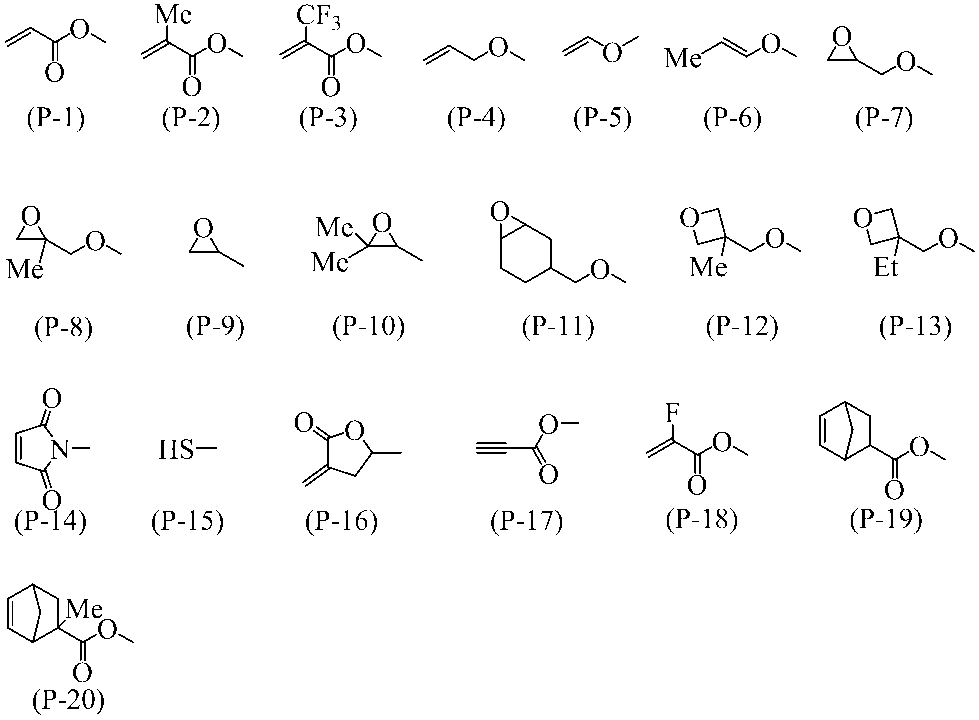
が好ましく、これらの重合性基のうち、重合性および保存安定性を高める観点から、式(P-1)、式(P-2)、式(P-7)、式(P-12)、又は式(P-13)が好ましく、式(P-1)、式(P-2)、式(P-7)がより好ましく、特に式(P-1)、及び式(P-2)が好ましい。
前記一般式(1)中、S1、S2は各々独立して単結合又はスペーサー基を表すが、特に液晶性を発現しやすく、また、駆動電圧低減の観点から炭素原子数1~18のアルキレン基であることが好ましい。ここで、該アルキレン基は直鎖状アルキレン基又は分岐状アルキレン基であることが好ましく、また、該アルキレン基中の水素原子は、1つ以上のハロゲン原子、CN基、または前述の重合性基を有する炭素原子数1~8のアルキル基により置換されていても良い。該アルキレン基中に存在する1つのCH2基又は隣接していない2つ以上のCH2基はそれぞれ相互に独立して、酸素原子が相互に直接結合しない形で、-O-、-S-、-NH-、-N(CH3)-、-CO-、-CH(OH)-、CH(COOH)、-COO-、-OCO-、-OCOO-、-SCO-、-COS-又は-C≡C-により置き換えられていても良い。
これらのなかでもスペーサー基のうち、液晶性を発現する観点から、炭素原子数2~8の直鎖アルキレン基、フッ素原子で置換された炭素数2~6のアルキレン基、アルキレン基の一部が-O-で置き換えられた炭素原子数4~14のアルキレン基が好ましい。
前記一般式(1)中、X1、X2で表される基は、前記した通り、各々独立して-O-、-S-、-OCH2-、-CH2O-、-CO-、-COO-、-OCO-、-CO-S-、-S-CO-、-O-CO-O-、-CO-NH-、-NH-CO-、-SCH2-、-CH2S-、-CF2O-、-OCF2-、-CF2S-、-SCF2-、-CH=CH-COO-、-CH=CH-OCO-、-COO-CH=CH-、-OCO-CH=CH-、-COO-(CH2CH2)m-、-OCO-(CH2CH2)m-、-(CH2CH2)m-COO-、-(CH2CH2)m-OCO-、-COO-CH2-、-OCO-CH2-、-CH2-COO-、-CH2-OCO-、-CH=CH-、-CH2CH2-、-N=N-、-CH=N-N=CH-、-CF=CF-、-C≡C-又は単結合であるが、なかでも単結合、-O-、-S-、-CO-、-COO-、及び-OCO-からなる群から選択される基が好ましい。mは各々独立して1~9の整数を表す。
ただし、前記一般式(1)中、各P-(S-X)-結合には-O-O-結合を含まない。
前記一般式(1)中、Z1で表される基は、前記した通り、-O-、-S-、-OCH2-、-CH2O-、-CO-、-COO-、-OCO-、-CO-S-、-S-CO-、-O-CO-O-、-CO-NH-、-NH-CO-、-SCH2-、-CH2S-、-CF2O-、-OCF2-、-CF2S-、-SCF2-、-CH=CH-COO-、-CH=CH-OCO-、-COO-CH=CH-、-OCO-CH=CH-、-COO-RZ1-、-OCO-RZ1-、-RZ1-COO-、-RZ1-OCO-、-COO-CH2-、-OCO-CH2-、-CH2-COO-、-CH2-OCO-、-CH=CH-、-CH2CH2-、-N=N-、-CH=N-N=CH-、-CF=CF-、-C≡C-又は単結合(ただし、-RZ1-は、炭素原子数2~6のアルキレン基を表し、各P-(S-X)-結合には-O-O-を含まない。)である。
Z1が複数存在する場合それらは各々同一であっても異なっていても良いが、Z1のうち少なくとも一つは、-COO-RZ1-、-OCO-RZ1-、-RZ1-COO-、及び-RZ1-OCO-からなる群から選択される基である。
本発明では、Z1として、-COO-RZ1-、-OCO-RZ1-、-RZ1-COO-、及び-RZ1-OCO-からなる群から選択される基を有することから電圧無印加時の透明を良好な状態に保持しつつ、駆動電圧を低減させることができる。当該-COO-RZ1-、-OCO-RZ1-、-RZ1-COO-、及び-RZ1-OCO-からなる群から選択される基は、一般式(1)中に一つ以上あればよいが、特に一般式(1)で表される化合物中一つのみ有することが好ましく、とりわけ、nが2~4であって、かつ、一つのZ1が-COO-RZ1-、-OCO-RZ1-、-RZ1-COO-、及び-RZ1-OCO-からなる群から選択される基であり、他のZ1が単結合であることが、液晶化合物を良好に配向させて電圧無印加時に優れた透明性を発現しつつ、駆動電圧を一層低減できる点から好ましい。かかる透明性と駆動電圧とのバランスの点から、-RZ1-は、-CH2CH2-であることが好ましい。
前記一般式(1)中、A1、A2は各々独立して、2価の芳香環、脂環、複素環及び縮合環から選択される基を表し、具体的には下記(a)~(c)から選択される基が好ましい。なお、A1が複数存在する場合それらは各々同一であっても異なっていても良い。
(a) トランス-1,4-シクロへキシレン基(この基中に存在する1つのメチレン基又は隣接していない2つ以上のメチレン基は-O-又は-S-に置き換えられてもよい。)
(b) フェニレン基(この基中に存在する1個の-CH=又は隣接していない2個以上の-CH=は窒素原子に置き換えられてもよい。)
(c) シクロヘキセニレン基、ビシクロ(2.2.2)オクチレン基、ピペリジン基、ナフタレン基、デカヒドロナフタレン基及びテトラヒドロナフタレン基
(上記の基(a)、基(b)及び基(c)の基中に存在する1つ又は2つ以上の水素原子は、それぞれ独立してフッ素原子、塩素原子、炭素原子数1~8のアルキル基、炭素原子数1~8のハロゲン化アルキル基、炭素原子数1~8のハロゲン化アルコキシ基、又は炭素原子数1~8のアルコキシ基に置換されていても良い。)
これらのなかでも液晶性を発現し易い点から、基(a)、基(b)が好ましく、特に基(a)を必須の構造として有することが好ましい。
(a) トランス-1,4-シクロへキシレン基(この基中に存在する1つのメチレン基又は隣接していない2つ以上のメチレン基は-O-又は-S-に置き換えられてもよい。)
(b) フェニレン基(この基中に存在する1個の-CH=又は隣接していない2個以上の-CH=は窒素原子に置き換えられてもよい。)
(c) シクロヘキセニレン基、ビシクロ(2.2.2)オクチレン基、ピペリジン基、ナフタレン基、デカヒドロナフタレン基及びテトラヒドロナフタレン基
(上記の基(a)、基(b)及び基(c)の基中に存在する1つ又は2つ以上の水素原子は、それぞれ独立してフッ素原子、塩素原子、炭素原子数1~8のアルキル基、炭素原子数1~8のハロゲン化アルキル基、炭素原子数1~8のハロゲン化アルコキシ基、又は炭素原子数1~8のアルコキシ基に置換されていても良い。)
これらのなかでも液晶性を発現し易い点から、基(a)、基(b)が好ましく、特に基(a)を必須の構造として有することが好ましい。
前記一般式(1)中、nは1~9の整数を表すが、nは1~5が好ましく、nは2~5がより好ましく、nは2~4が特に好ましい。
前記一般式(1)で表される化合物はさらに具体的には、下記式(1-1)~般式(1-24)で表される化合物を例示することができる。
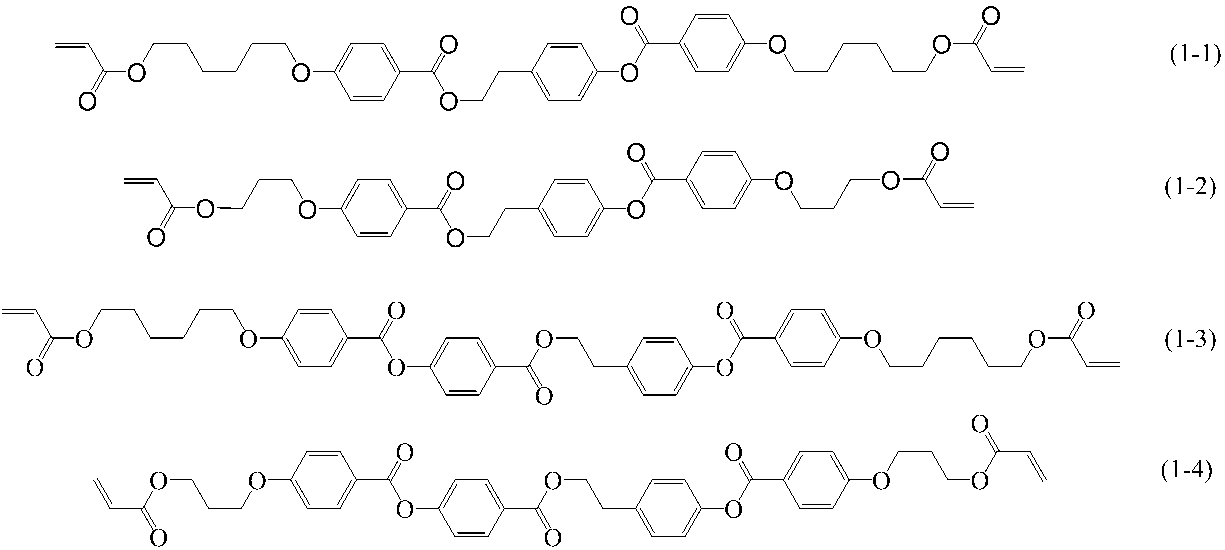
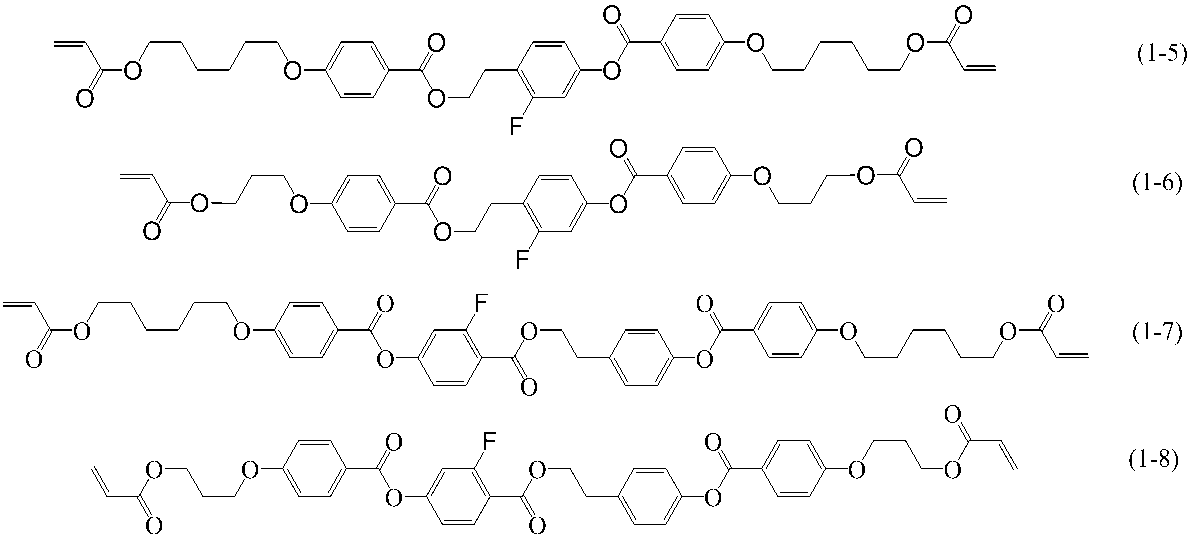


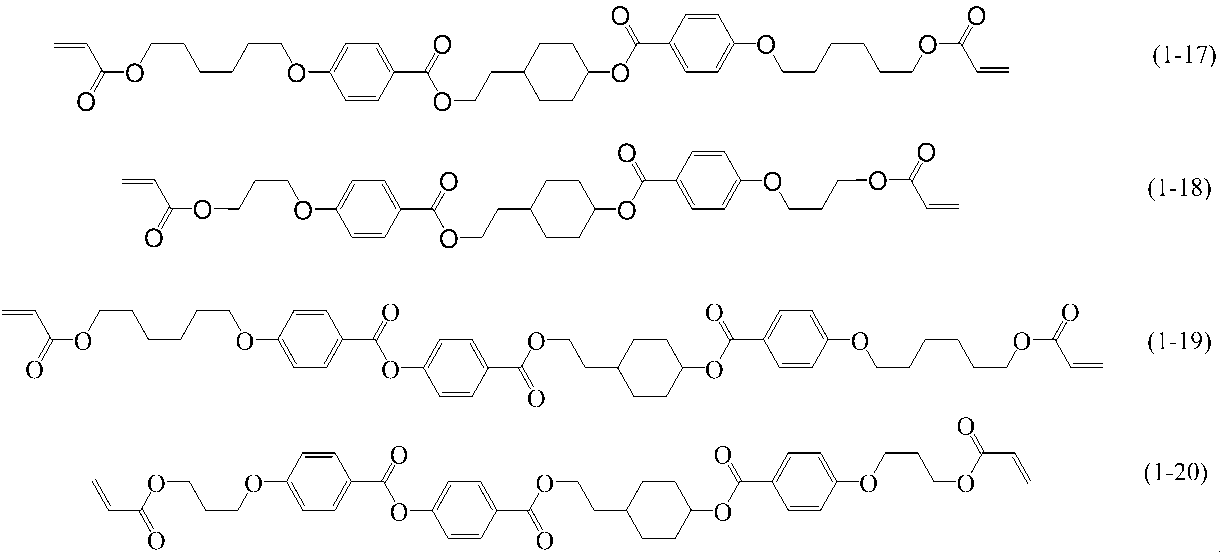
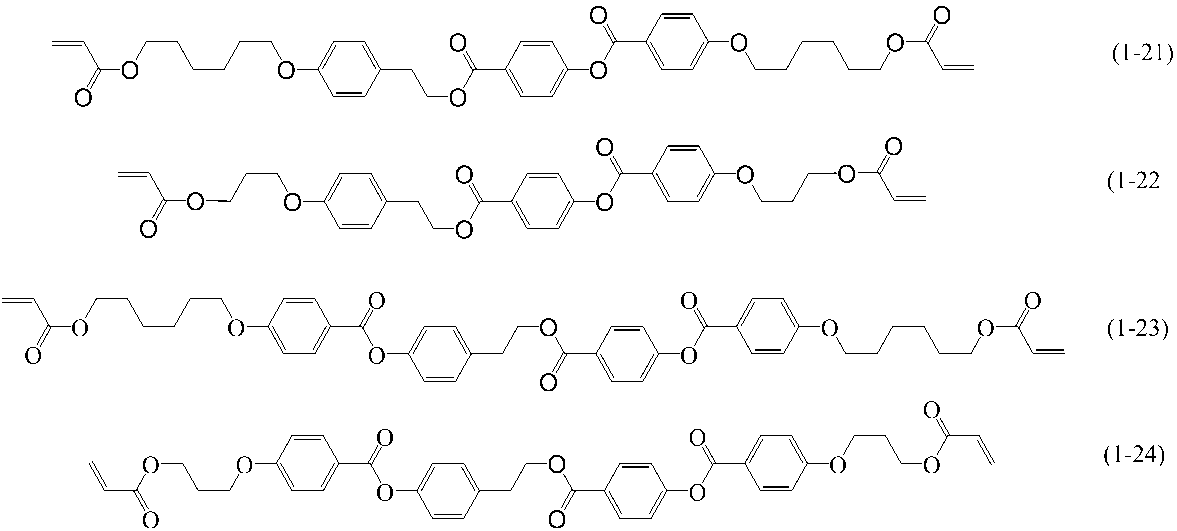
上記一般式(1-1)~一般式(1-24)で表される化合物のうち、一般式(1-1)~(1-20)で表される化合物が液晶性を発現するために好ましく、一般式(1-1)~(1-12)で表される化合物が液晶性の発現と低電圧化のためにより好ましく、一般式(1-1)~(1-4)で表される化合物が液晶性と低電圧化とコントラスト、ヘイズの特性を発現するために特に好ましい。
本発明に係る光散乱型液晶素子用液晶組成物100質量%における一般式(1)で表される重合性化合物の含有量は、得られる液晶素子がポリマーネットワークを形成する観点から、2質量%以上であることが好ましく、3質量%以上であることがより好ましく、4質量%以上であることがさらに好ましく、5質量%以上であることが特に好ましく、得られる液晶素子の駆動電圧を下げる観点から、上限値が20質量%以下であることが好ましく、15質量%以下であることがより好ましく、12質量%以下であることがさらに好ましく、10質量%以下であることが特に好ましい。なお、以上詳述した一般式(1)で表される重合性化合物は、第一の成分として、一種のみ用いてもよいし、二種以上を併用してもよい。
(第三の成分 重合性化合物)
本発明では、重合性の成分として前記第一の成分に加え、目的とする性能に応じて第三の成分を使用することができる。
(第三の成分 重合性化合物)
本発明では、重合性の成分として前記第一の成分に加え、目的とする性能に応じて第三の成分を使用することができる。
この場合、本発明に係る光散乱型液晶素子用液晶組成物100質量%における、第一の成分と第三の成分との合計質量は、ポリマーネットワークを形成する観点から、2質量%以上であることが好ましく、3質量%以上であることがより好ましく、4質量%以上であることがさらに好ましく、5質量%以上であることが特に好ましく、一方、液晶素子の駆動電圧や光散乱性の観点から、20質量%以下であることが好ましく、15質量%以下であることがより好ましく、12質量%以下であることがさらに好ましく、10質量%以下であることが特に好ましい。
また、第一の成分と第三の成分との合計質量に対する第一の成分の割合は、電圧無印加時の透明性を高めてコントラストが一層向上する点から、10質量%以上であることが好ましく、15質量%以上であることがより好ましく、20質量%以上であることがさらに好ましく、25質量%以上であることがさらにまた好ましく、40質量%以上であることが特に好ましく、リバースモードの光散乱性をより高める点、或いは、駆動電圧の低減の観点から、95質量%以下であることがより好ましく、90質量%以下であることがさらに好ましく、85質量%以下であることが特に好ましい。
本発明に係る光散乱型液晶素子用液晶組成物は、第三の成分としては、具体的には、下記一般式(2-ii)で表される重合性化合物を用いることが、駆動電圧の低減できる点から好ましい。

式中、Pii1は重合性官能基を表し、具体的には、重合性基を表し、下記式(P-1)~式(P-20)

から選択される重合性基が好ましく、これらの重合性基のうち、重合性および保存安定性を高める観点から、式(P-1)、式(P-2)、式(P-7)、式(P-12)、又は式(P-13)が好ましく、式(P-1)、式(P-7)、式(P-12)がより好ましい。
Rii1は単結合又は炭素原子数1~9のアルキレン基を表すが、該アルキレン基中の1つ又は2つ以上の-CH2-は、酸素原子が直接隣接しないようにそれぞれ独立して-O-、-CO-、-COO-又は-OCO-で置換されていてもよく、該アルキレン基中に存在する1つ又は2つ以上の水素原子は、それぞれ独立してフッ素原子で置換されていてもよい。
Rii1は炭素原子数1~6のアルキレン基であることが好ましく、炭素原子数1~3のアルキレン基であることがより好ましい。
一般式(2-ii)中、Rii2及びRii3はそれぞれ独立して、1つ若しくは2つ以上の隣接しない-CH2-が-O-で置換されていてもよく、1つ若しくは2つ以上の水素原子がそれぞれ独立してPii2で置換されていてもよい炭素原子数1~21のアルキル基を表すことが好ましく、1つ若しくは2つ以上の水素原子がそれぞれ独立してPii2で置換されていてもよい炭素原子数3~16のアルキル基を表すことがより好ましく、1つ若しくは2つ以上の水素原子がそれぞれ独立してPii2で置換されていてもよい炭素原子数5~14のアルキル基を表すことがさらに好ましく、炭素原子数6~12のアルキル基を表すことが特に結晶性を抑制できる点から好ましい。ここでPii2は炭素原子数1~6のアルキル基を表す。
また、Rii2及びRii3はそれぞれ独立して、水素原子、又は炭素原子数1~21のアルキル基を表すが、該アルキル基中の1つ又は2つ以上の-CH2-は、酸素原子が直接隣接しないようにそれぞれ独立して-O-、-CO-、 -COO-又は-OCO-で置換されていてもよく、該アルキル基中に存在する1つ又は2つ以上の水素原子は、それぞれ独立してPii2、フッ素原子、炭素原子数1~8のアルキル基、炭素原子数1~8のハロゲン化アルキル基で置換されていてもよい。
一般式(2-ii)中、Rii1、Rii2及びRii3それぞれに含まれる炭素原子数の総和は、3~30であることが好ましく、4~28であることがより好ましく、5~26であることがさらに好ましく、6~24であることがさらに好ましく、12~24であることが特に好ましい。
一般式(2-ii)で表される化合物としては、例えば、エチル(メタ)アクリレート、2-ヒドロキシエチルアクリレート、プロピル(メタ)アクリレート、ブチル(メタ)アクリレート、イソブチル(メタ)アクリレート、オクチル(メタ)アクリレート、ドデシル(メタ)アクリレート、ステアリル(メタ)アクリレート、等の直鎖状アルキル鎖を有するモノ(メタ)アクリレート、あるいは、下記の構造で表される分岐状アルキル鎖を有するモノ(メタ)アクリレートが挙げられる。

また、一般式(2-ii)で表される化合物としては、一般式(2-ii)中のRii1が直鎖状又は分岐状のエーテル鎖の構造を有するアクリレートが挙げられる。エーテル鎖の構造を有するアクリレートとしては、下記の構造で表される化合物が好ましい。
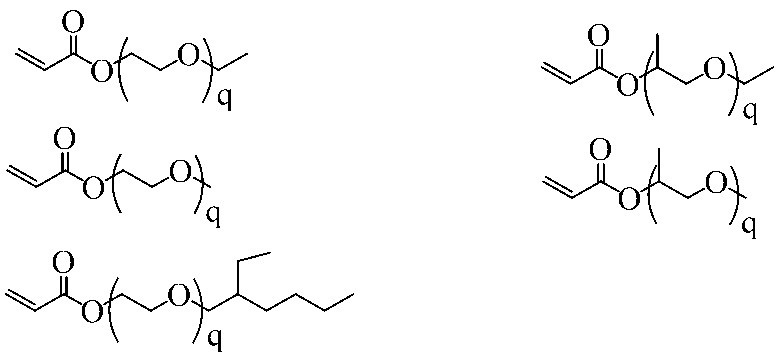
(式中qは1~10の整数を表す)
これらのなかでも特に電圧無印加時の透明性を良好に維持しつつ、駆動電圧を低減効果が顕著なものとなる点から分岐状アルキル鎖を有するモノ(メタ)アクリレートを用いることが好ましい。
これらのなかでも特に電圧無印加時の透明性を良好に維持しつつ、駆動電圧を低減効果が顕著なものとなる点から分岐状アルキル鎖を有するモノ(メタ)アクリレートを用いることが好ましい。
ここで、第一の成分を含む重合性成分の合計量100質量%に対する、一般式(2-ii)で表される重合性化合物の含有量は、本発明の光散乱型液晶素子用液晶組成物に用いる重合性化合物の合計量100質量%に対し、低電圧化の観点から、5質量%以上であること、10質量%以上であること、15質量%以上であること、20質量%以上であること、25質量%以上であることがより好ましく、ポリマーネットワークの強度を維持する観点から、60質量%以下であること、55質量%以下であることがさらに好ましい。
また、本発明では、第三の成分として前記一般式(2-ii)で表される重合性化合物に代えて、或いは、前記一般式(2-ii)で表される重合性化合物と共に、下記一般式(3-i)で表される重合性化合物を用いることが好ましい。
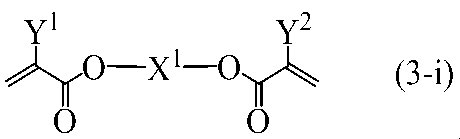
(式中、Y1、及びY2は水素原子、又はメチル基を表し、
X1は直鎖、または分岐の炭素原子数4~80のアルキレンを表し、該アルキレンの任意の炭素原子は、酸素原子が直接隣接しないように、-O-、-CH=CH-、-CO-、-C≡C-、-OCO-、-COO-、又はOHで置換されてよい。)
ここで、一般式(3-i)中、X1は直鎖、または分岐のアルキレンは、炭素原子数6~80の範囲のものであるが、炭素原子数は7~70の範囲であることが好ましく、中でも8~60の範囲であることが好ましく、特に9~50の範囲であることが駆動電圧低下の点から好ましい。
X1は直鎖、または分岐の炭素原子数4~80のアルキレンを表し、該アルキレンの任意の炭素原子は、酸素原子が直接隣接しないように、-O-、-CH=CH-、-CO-、-C≡C-、-OCO-、-COO-、又はOHで置換されてよい。)
ここで、一般式(3-i)中、X1は直鎖、または分岐のアルキレンは、炭素原子数6~80の範囲のものであるが、炭素原子数は7~70の範囲であることが好ましく、中でも8~60の範囲であることが好ましく、特に9~50の範囲であることが駆動電圧低下の点から好ましい。
また、一般式(3-i)中のX1は、炭素原子数6~80のアルキレン中にアルキリデン基を有するものが駆動電圧の低下の点から好ましい。ここでアルキリデン基としては、エチリデン基、2,2-プロピリデン基であることが好ましい。
かかるX1は、更に具体的には、下記構造式(i―1)又は構造式(i―2)で表される構造部位を部分構造として、又は繰り返し単位として有することが好ましい。
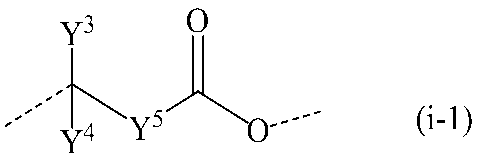
(構造式(i―1)中、Y3及びY4はそれぞれメチル基又は水素原子を表すが、少なくとも一方はメチル基であり、Y5は単結合、メチレン基、1,3-プロピレン基を表す。また、破線は結合手を表す。)

(構造式(i―2)中、Y3及びY4はそれぞれメチル基又は水素原子を表すが、少なくとも一方はメチル基であり、Y5は単結合、メチレン基、1,3-プロピレン基を表す。また、破線は結合手を表す。)
上記した一般式(3-i)で表される重合性化合物は、例えば、下記の構造のものが挙げられる。
上記した一般式(3-i)で表される重合性化合物は、例えば、下記の構造のものが挙げられる。

(式中、n及びmはn+mが1~10、n2は1~18、n3及びm2はn3+m2が1~18となる値、n4は1~23、n5は1~23、n6は4~30、n7は2~10、n8は2~10をそれぞれ表す。)
ここで第一の成分を含む重合性成分の合計量100質量%に対する、一般式(3-i)で表される重合性化合物の含有量は、本発明の光散乱型液晶素子用液晶組成物に用いる重合性化合物の合計量100質量%に対し、低電圧化の観点から、5質量%以上であること、10質量%以上であること、15質量%以上であること、20質量%以上であること、25質量%以上であることがより好ましく、ポリマーネットワークの強度を維持する観点から、60質量%以下であること、55質量%以下であることがさらに好ましい。
ここで第一の成分を含む重合性成分の合計量100質量%に対する、一般式(3-i)で表される重合性化合物の含有量は、本発明の光散乱型液晶素子用液晶組成物に用いる重合性化合物の合計量100質量%に対し、低電圧化の観点から、5質量%以上であること、10質量%以上であること、15質量%以上であること、20質量%以上であること、25質量%以上であることがより好ましく、ポリマーネットワークの強度を維持する観点から、60質量%以下であること、55質量%以下であることがさらに好ましい。
本発明では、第三の成分として、前記一般式(2-ii)で表される重合性化合物、及び/又は前記一般式(3-i)で表される重合性化合物を好ましく使用することができるが、本発明の効果を損なわない範囲で、それらの他の重合性化合物(以下、「その他の重合性化合物」と略記する)を併用してもよい。
かかるその他の重合性化合物としては、下記一般式(2)~(8)で表される化合物が好ましい化合物として挙げられる(ただし、前記第一の成分、前記一般式(2-ii)で表される重合性化合物、及び前記一般式(3-i)で表される重合性化合物を除く。)。

上記式(2)~(8)中、P11~P74は、前記式(P-1)~式(P-20)から選択される重合性基を表すが、これらの重合性基のうち、重合性および保存安定性を高める観点から、式(P-1)、式(P-2)、式(P-7)、式(P-12)、又は式(P-13)が好ましく、式(P-1)、式(P-7)、式(P-12)がより好ましい。
X11~X72は各々独立して-O-、-S-、-OCH2-、-CH2O-、-CO-、-COO-、-OCO-、-CO-S-、-S-CO-、-O-CO-O-、-CO-NH-、-NH-CO-、-SCH2-、-CH2S-、-CF2O-、-OCF2-、-CF2S-、-SCF2-、-CH=CH-COO-、-CH=CH-OCO-、-COO-CH=CH-、-OCO-CH=CH-、-COO-CH2CH2-、-OCO-CH2CH2-、-CH2CH2-COO-、-CH2CH2-OCO-、-COO-CH2-、-OCO-CH2-、-CH2-COO-、-CH2-OCO-、-CH=CH-、-N=N-、-CH=N-N=CH-、-CF=CF-、-C≡C-又は単結合を表すが、X11~X72が複数存在する場合それらは各々同一であっても異なっていても良く(ただし、各P-(S-X)-結合には-O-O-を含まない。)、特に単結合、-O-、-S-、-CO-、-COO-、-OCO-から選択される基が好ましい。
X11~X72は各々独立して-O-、-S-、-OCH2-、-CH2O-、-CO-、-COO-、-OCO-、-CO-S-、-S-CO-、-O-CO-O-、-CO-NH-、-NH-CO-、-SCH2-、-CH2S-、-CF2O-、-OCF2-、-CF2S-、-SCF2-、-CH=CH-COO-、-CH=CH-OCO-、-COO-CH=CH-、-OCO-CH=CH-、-COO-CH2CH2-、-OCO-CH2CH2-、-CH2CH2-COO-、-CH2CH2-OCO-、-COO-CH2-、-OCO-CH2-、-CH2-COO-、-CH2-OCO-、-CH=CH-、-N=N-、-CH=N-N=CH-、-CF=CF-、-C≡C-又は単結合を表すが、X11~X72が複数存在する場合それらは各々同一であっても異なっていても良く(ただし、各P-(S-X)-結合には-O-O-を含まない。)、特に単結合、-O-、-S-、-CO-、-COO-、-OCO-から選択される基が好ましい。
M11、M21、M31、M51、M71は、各々独立して、下記一般式(9-a)で表されるメソゲン基

(一般式(9-a)中、A91、A92、A93は各々独立して少なくとも環構造を1つ以上有する2価の基であり、前記2価の基は1,2-シクロプロピレン基、1,3-シクロブチレン基、2,5-シクロペンチレン基、オクタヒドロ-4,7-メタノ-1H-インデン-1,5-ジイル基、オクタヒドロ-4,7-メタノ-1H-インデン-1,6-ジイル基、オクタヒドロ-4,7-メタノ-1H-インデン-2,5-ジイル基、トリシクロ[3.3.1.13,7]-1,3-ジイル基、1,4-フェニレン基、1,4-シクロヘキシレン基、1,4-シクロヘキセニル基、テトラヒドロピラン-2,5-ジイル基、1,3-ジオキサン-2,5-ジイル基、テトラヒドロチオピラン-2,5-ジイル基、1,4-ビシクロ(2,2,2)オクチレン基、デカヒドロナフタレン-2,6-ジイル基、ピリジン-2,5-ジイル基、ピリミジン-2,5-ジイル基、ピラジン-2,5-ジイル基、チオフェン-2,5-ジイル基-、1,2,3,4-テトラヒドロナフタレン-2,6-ジイル基、ナフチレン-1,4-ジイル基、ナフチレン-1,5-ジイル基、ナフチレン-1,6-ジイル基、ナフチレン-2,6-ジイル基、フェナントレン-2,7-ジイル基、9,10-ジヒドロフェナントレン-2,7-ジイル基、ベンゾチアゾール基、1,2,3,4,4a,9,10a-オクタヒドロフェナントレン-2,7-ジイル基、ベンゾ[1,2-b:4,5-b‘]ジチオフェン-2,6-ジイル基、ベンゾ[1,2-b:4,5-b‘]ジセレノフェン-2,6-ジイル基、[1]ベンゾチエノ[3,2-b]チオフェン-2,7-ジイル基、[1]ベンゾセレノフェノ[3,2-b]セレノフェン-2,7-ジイル基、又はフルオレン-2,7-ジイル基から選ばれる基を表すが、これらの基は無置換又は1つ以上のL1によって置換されても良いが、A91及び/又はA92が複数現れる場合は各々同一であっても異なっていても良く、
Z91及びZ92は各々独立して-O-、-S-、-OCH2-、-CH2O-、-CH2CH2-、-CO-、-COO-、-OCO-、-CO-S-、-S-CO-、-O-CO-O-、-CO-NH-、-NH-CO-、-SCH2-、-CH2S-、-CF2O-、-OCF2-、-CF2S-、-SCF2-、-CH=CH-COO-、-CH=CH-OCO-、-COO-CH=CH-、-OCO-CH=CH-、-COO-CH2CH2-、-OCO-CH2CH2-、-CH2CH2-COO-、-CH2CH2-OCO-、-COO-CH2-、-OCO-CH2-、-CH2-COO-、-CH2-OCO-、-CH=CH-、-N=N-、-CH=N-、-N=CH-、-CH=N-N=CH-、-CF=CF-、-C≡C-又は単結合を表すが、Z91及び/又はZ92が複数現れる場合は各々同一であっても異なっていても良く、
j91及びj92は、各々独立して0~4を表すが、j91+j92は1~4の整数を表し、
L1はフッ素原子、塩素原子、臭素原子、ヨウ素原子、ペンタフルオロスルフラニル基、ニトロ基、イソシアノ基、アミノ基、ヒドロキシル基、メルカプト基、メチルアミノ基、ジメチルアミノ基、ジエチルアミノ基、ジイソプロピルアミノ基、トリメチルシリル基、ジメチルシリル基、チオイソシアノ基、又は、1個の-CH2-又は隣接していない2個以上の-CH2-が各々独立して-O-、-S-、-CO-、-COO-、-OCO-、-CO-S-、-S-CO-、-O-CO-O-、-CO-NH-、-NH-CO-、-CH=CH-COO-、-CH=CH-OCO-、-COO-CH=CH-、-OCO-CH=CH-、-CH=CH-、-CF=CF-、-N=N-、-CR1=N-N=CR1-、又は-C≡C-によって置換されても良い炭素原子数1から20の直鎖状、分岐状アルキル基を表すが、当該アルキル基中の任意の水素原子はフッ素原子に置換されても良い(なお、R1は水素原子、又は、炭素原子数1から20のアルキル基を表すが、当該アルキル基は直鎖状であっても分岐状であっても良く、当該アルキル基中の任意の水素原子はフッ素原子に置換されても良く、当該アルキル基中の1個の-CH2-又は隣接していない2個以上の-CH2-は各々独立して-O-、-S-、-CO-、-COO-、-OCO-、-CO-S-、-S-CO-、-O-CO-O-、-CO-NH-、-NH-CO-又は-C≡C-によって置換されても良い。)。)を表す。
Z91及びZ92は各々独立して-O-、-S-、-OCH2-、-CH2O-、-CH2CH2-、-CO-、-COO-、-OCO-、-CO-S-、-S-CO-、-O-CO-O-、-CO-NH-、-NH-CO-、-SCH2-、-CH2S-、-CF2O-、-OCF2-、-CF2S-、-SCF2-、-CH=CH-COO-、-CH=CH-OCO-、-COO-CH=CH-、-OCO-CH=CH-、-COO-CH2CH2-、-OCO-CH2CH2-、-CH2CH2-COO-、-CH2CH2-OCO-、-COO-CH2-、-OCO-CH2-、-CH2-COO-、-CH2-OCO-、-CH=CH-、-N=N-、-CH=N-、-N=CH-、-CH=N-N=CH-、-CF=CF-、-C≡C-又は単結合を表すが、Z91及び/又はZ92が複数現れる場合は各々同一であっても異なっていても良く、
j91及びj92は、各々独立して0~4を表すが、j91+j92は1~4の整数を表し、
L1はフッ素原子、塩素原子、臭素原子、ヨウ素原子、ペンタフルオロスルフラニル基、ニトロ基、イソシアノ基、アミノ基、ヒドロキシル基、メルカプト基、メチルアミノ基、ジメチルアミノ基、ジエチルアミノ基、ジイソプロピルアミノ基、トリメチルシリル基、ジメチルシリル基、チオイソシアノ基、又は、1個の-CH2-又は隣接していない2個以上の-CH2-が各々独立して-O-、-S-、-CO-、-COO-、-OCO-、-CO-S-、-S-CO-、-O-CO-O-、-CO-NH-、-NH-CO-、-CH=CH-COO-、-CH=CH-OCO-、-COO-CH=CH-、-OCO-CH=CH-、-CH=CH-、-CF=CF-、-N=N-、-CR1=N-N=CR1-、又は-C≡C-によって置換されても良い炭素原子数1から20の直鎖状、分岐状アルキル基を表すが、当該アルキル基中の任意の水素原子はフッ素原子に置換されても良い(なお、R1は水素原子、又は、炭素原子数1から20のアルキル基を表すが、当該アルキル基は直鎖状であっても分岐状であっても良く、当該アルキル基中の任意の水素原子はフッ素原子に置換されても良く、当該アルキル基中の1個の-CH2-又は隣接していない2個以上の-CH2-は各々独立して-O-、-S-、-CO-、-COO-、-OCO-、-CO-S-、-S-CO-、-O-CO-O-、-CO-NH-、-NH-CO-又は-C≡C-によって置換されても良い。)。)を表す。
また、M41は、前記A91、A92、A93として例示した環構造を有する3価の有機基であり、M61は前記A91、A92、A93として例示した環構造を有する4価の有機基である。
前記一般式(2)~一般式(8)中、R11、R31はそれぞれ水素原子、フッ素原子、塩素原子、臭素原子、ヨウ素原子、シアノ基、又は、炭素原子数1から20のアルキル基を表すが、当該アルキル基は直鎖状であっても分岐状であっても良く、当該アルキル基中の任意の水素原子はフッ素原子に置換されても良く、当該アルキル基中の1個の-CH2-又は隣接していない2個以上の-CH2-は各々独立して-O-、-S-、-CO-、-COO-、-OCO-、-CO-S-、-S-CO-、-O-CO-O-、-CO-NH-、-NH-CO-又は-C≡C-によって置換されても良く、
m1~m7、n2~n7、l4~l6、k6は各々独立して0から5の整数を表す。)
前記一般式(2)~一般式(8)中、S11~S72は各々独立してスペーサー基を又は単結合を表し、前記S11~S72で表されるスペーサー基は、炭素原子数1~18のアルキレン基を表し(該アルキレン基は1つ以上のハロゲン原子、CN基、炭素原子数1~8のアルキル基、または重合性官能基を有する炭素原子数1~8のアルキル基により置換されていても良く、この基中に存在する1つのCH2基又は隣接していない2つ以上のCH2基はそれぞれ相互に独立して、酸素原子が相互に直接結合しない形で、-O-、-S-、-NH-、-N(CH3)-、-CO-、-CH(OH)-、CH(COOH)、-COO-、-OCO-、-OCOO-、-SCO-、-COS-又は-C≡C-により置き換えられていても良い。これらのスペーサー基のうち、配向性の観点から、炭素原子数2~8の直鎖アルキレン基、フッ素原子で置換された炭素数2~6のアルキレン基、アルキレン基の一部が-O-で置き換えられた炭素原子数5~14のアルキレン基が好ましい。また、S11~S72が複数存在する場合それらは各々同一であっても異なっていても良い。
m1~m7、n2~n7、l4~l6、k6は各々独立して0から5の整数を表す。)
前記一般式(2)~一般式(8)中、S11~S72は各々独立してスペーサー基を又は単結合を表し、前記S11~S72で表されるスペーサー基は、炭素原子数1~18のアルキレン基を表し(該アルキレン基は1つ以上のハロゲン原子、CN基、炭素原子数1~8のアルキル基、または重合性官能基を有する炭素原子数1~8のアルキル基により置換されていても良く、この基中に存在する1つのCH2基又は隣接していない2つ以上のCH2基はそれぞれ相互に独立して、酸素原子が相互に直接結合しない形で、-O-、-S-、-NH-、-N(CH3)-、-CO-、-CH(OH)-、CH(COOH)、-COO-、-OCO-、-OCOO-、-SCO-、-COS-又は-C≡C-により置き換えられていても良い。これらのスペーサー基のうち、配向性の観点から、炭素原子数2~8の直鎖アルキレン基、フッ素原子で置換された炭素数2~6のアルキレン基、アルキレン基の一部が-O-で置き換えられた炭素原子数5~14のアルキレン基が好ましい。また、S11~S72が複数存在する場合それらは各々同一であっても異なっていても良い。
前記一般式(2)~一般式(8)中、m1~m7、n2~n7、l4~l6、k6は各々独立して0から5の整数を表し、m1~m7、n2~n7、l4~l6、k6は各々独立して0または1が好ましい。
前記一般式(2)で表される重合性化合物は、具体的には、下記の式(2-1)から式(2-39)で表される重合性化合物が好ましい。


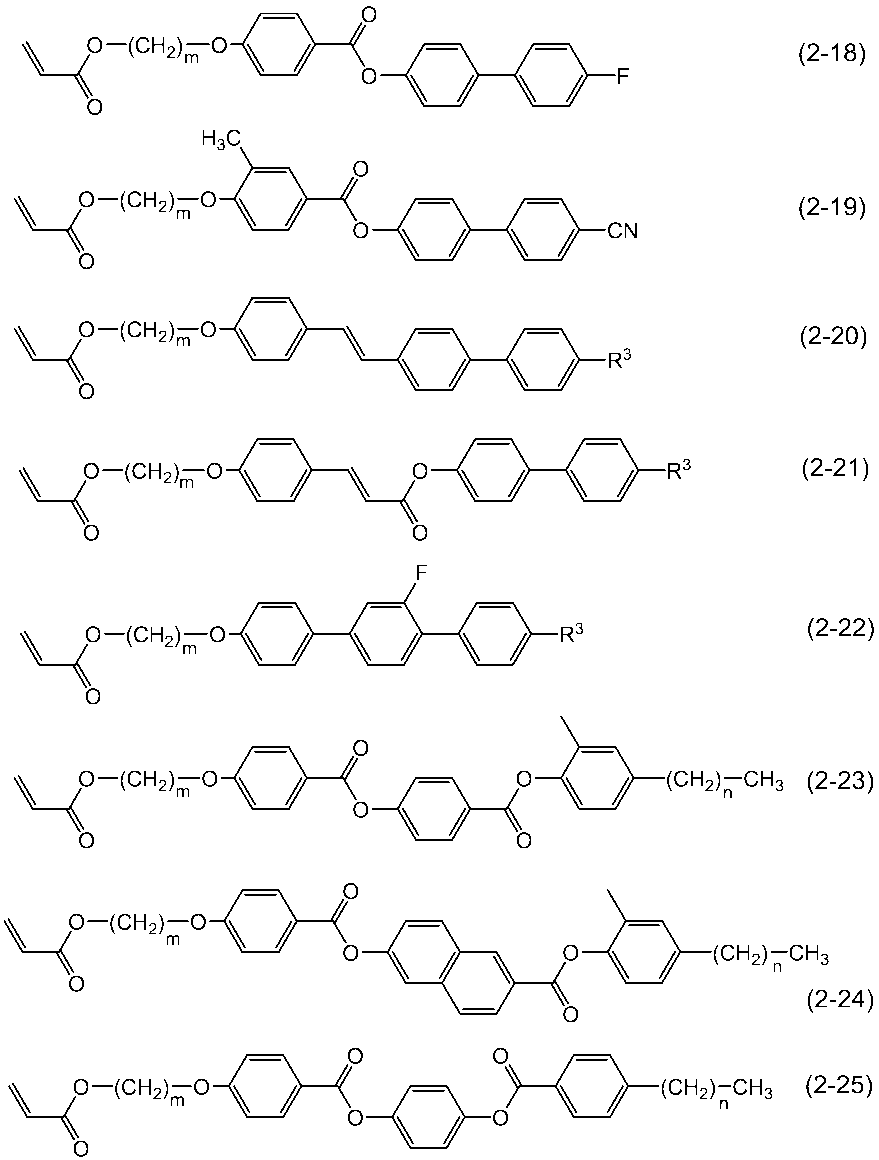


上記式(2-1)~式(2-39)において、n、mは、各々独立して1~10の整数数を表し、R1、R2及びR3は、各々独立して水素原子、ハロゲン原子、炭素数1~6のアルキル基、炭素数1~6のアルコキシ基、シアノ基を示す。これらの基が炭素数1~6のアルキル基、あるいは炭素数1~6のアルコキシ基の場合、全部が未置換であるか、あるいは1つまたは2つ以上のハロゲン原子により置換されていてもよい。
一般式(2)で表される重合性化合物の含有量は、本発明の光散乱型液晶素子用液晶組成物に用いる重合性化合物の合計量100質量%に対し、低電圧化の観点から、1質量%以上であることが好ましく、5質量%以上であることがより好ましく、ポリマーネットワークの強度を維持する観点から、50質量%以下であること、40質量%以下であること、30質量%以下であること、25質量%以下であることが特に好ましい。
前記一般式(3)で表される重合性化合物としては、下記の式(3-1)から式(3-53)で表される重合性化合物が好ましい。
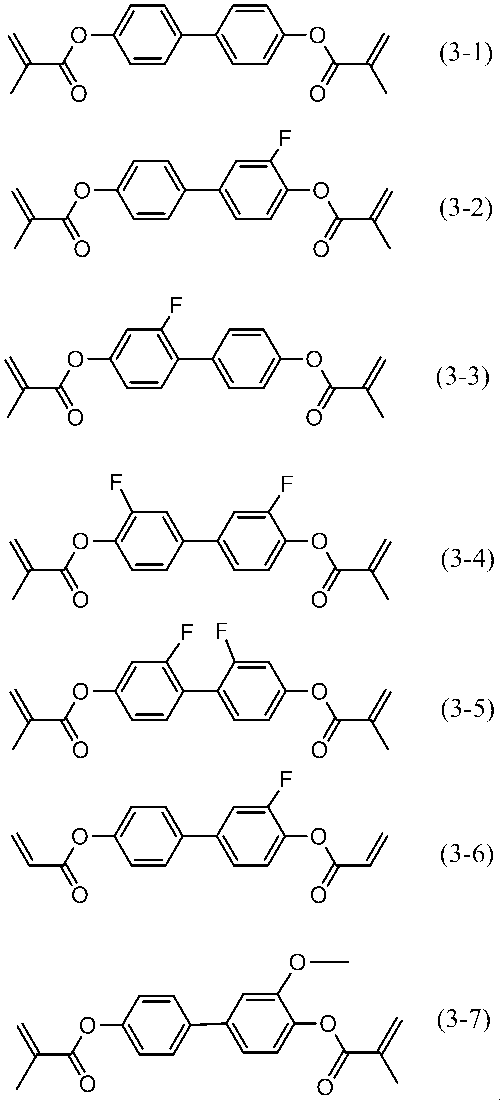
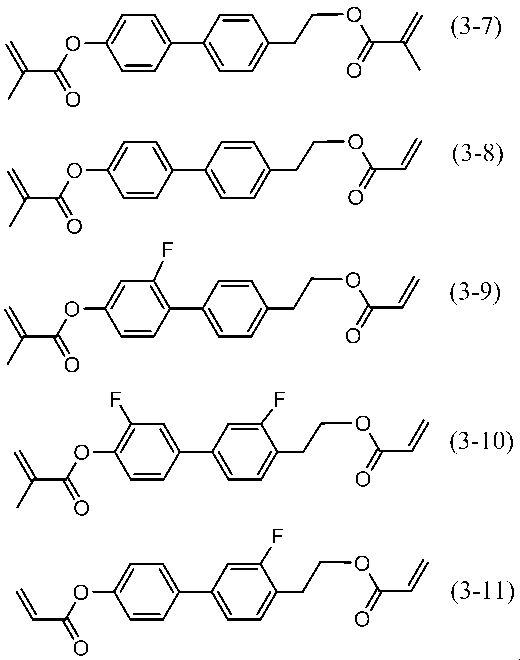

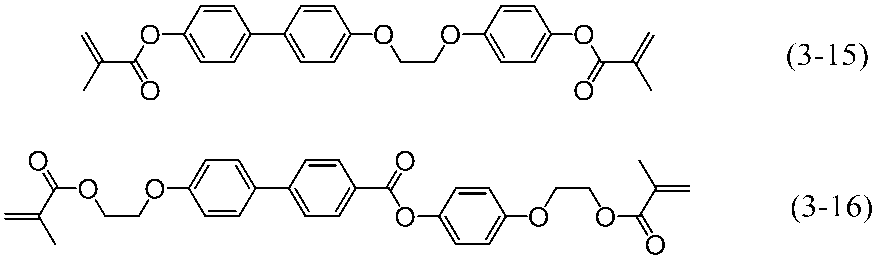
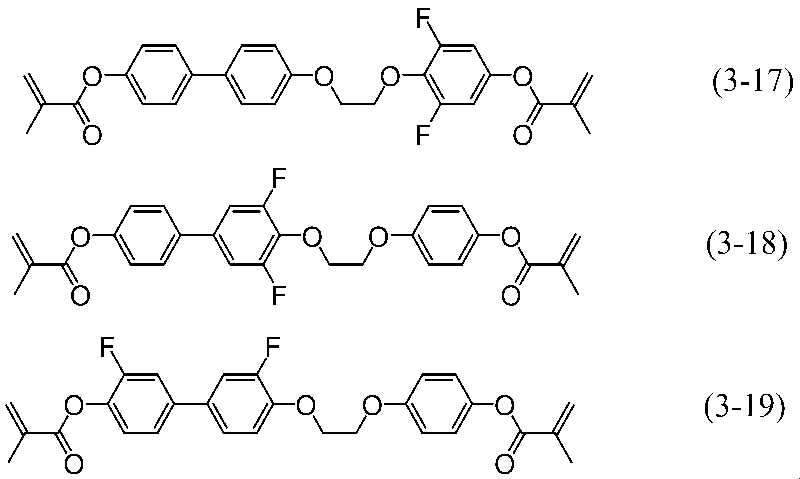
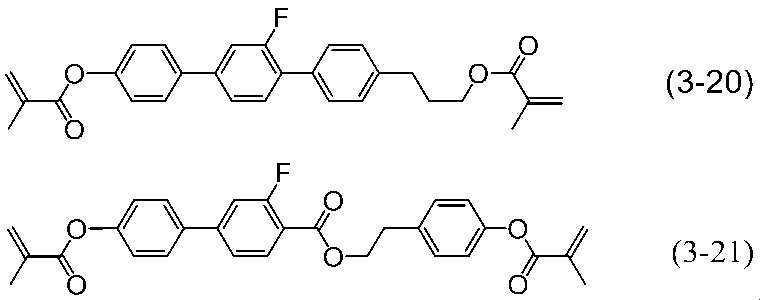
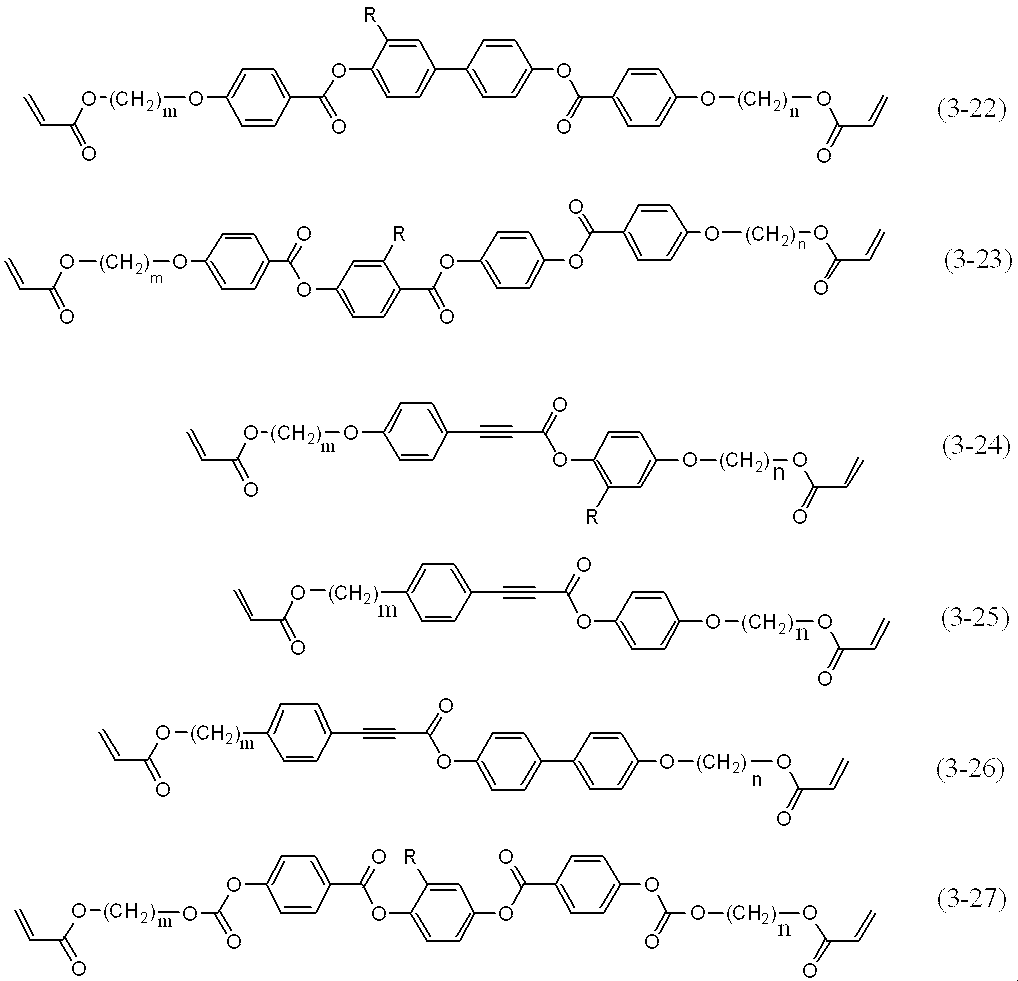
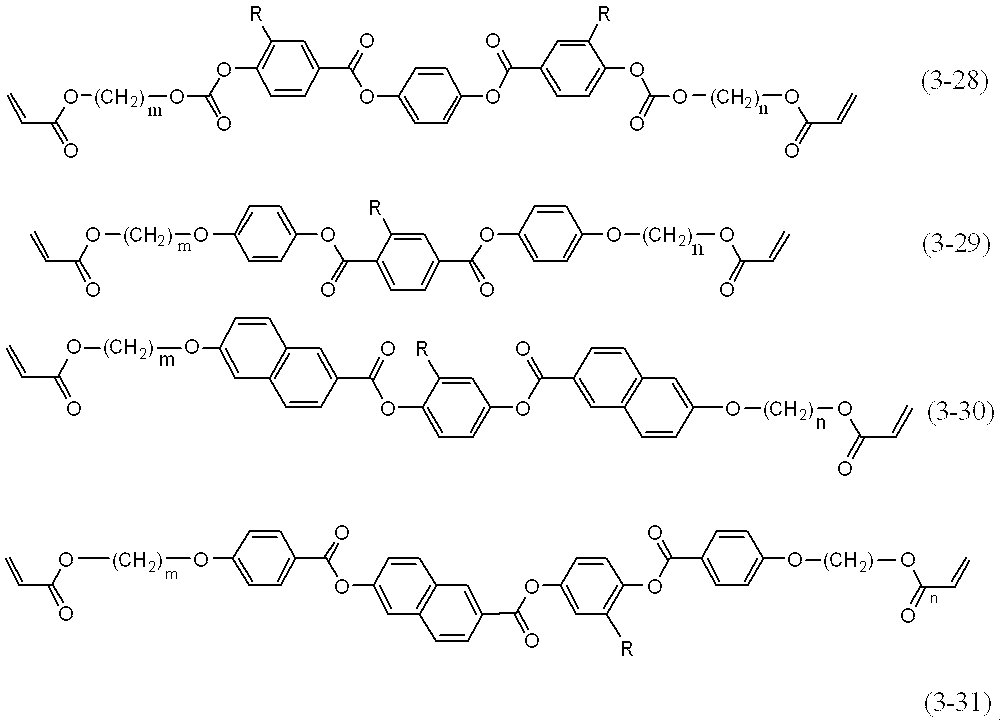
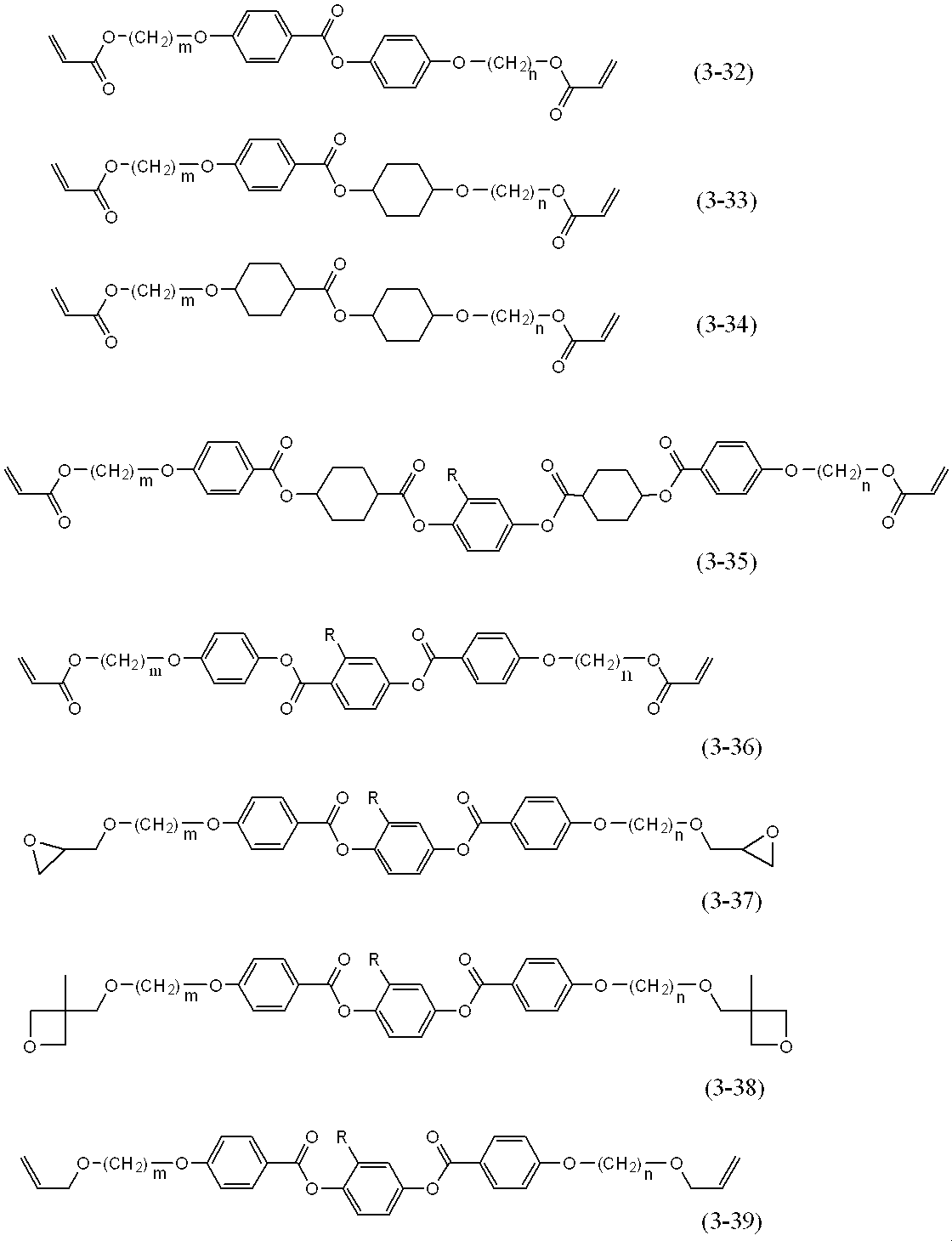
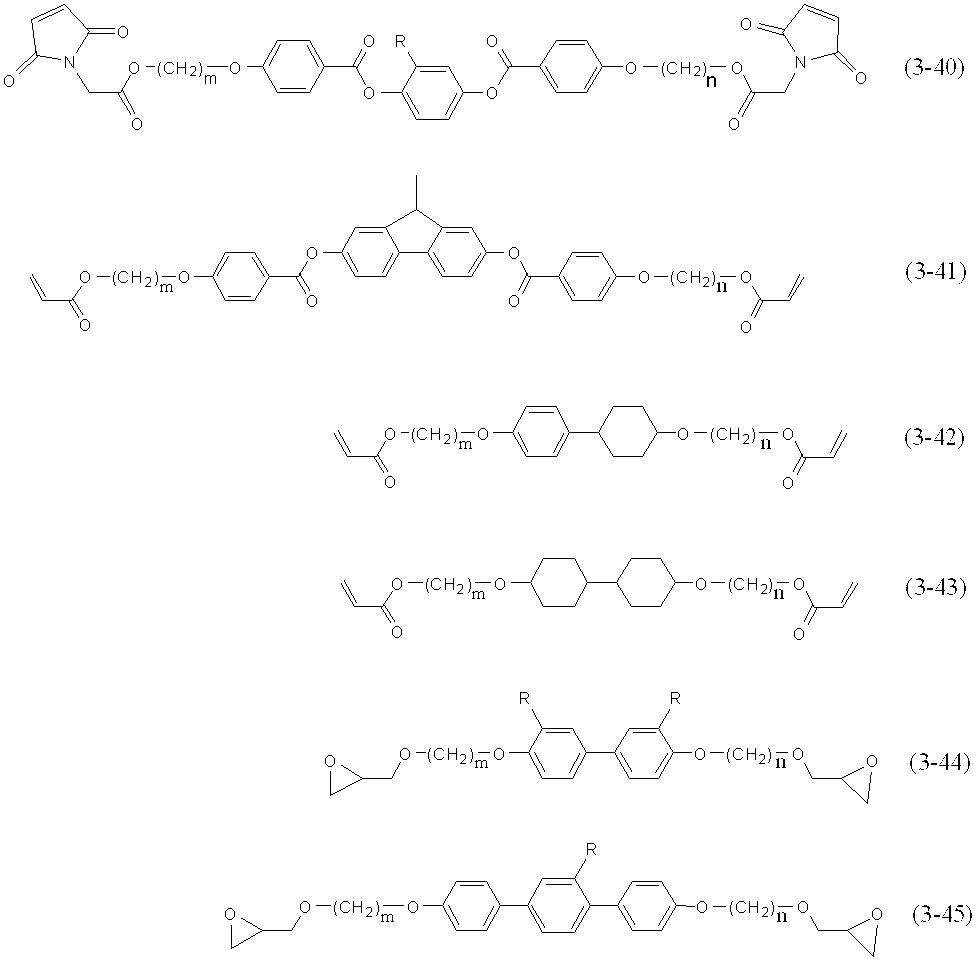

上記式(3-1)~式(3-53)において、n、mは、各々独立して1~10の整数数を表し、Rは、各々独立して水素原子、ハロゲン原子、炭素数1~6のアルキル基、炭素数1~6のアルコキシ基、シアノ基を示す。これらの基が炭素数1~6のアルキル基、あるいは炭素数1~6のアルコキシ基の場合、全部が未置換であるか、あるいは1つまたは2つ以上のハロゲン原子により置換されていてもよい。
一般式(3)で表される重合性化合物の含有量は、本発明の光散乱型液晶素子用液晶組成物に用いる重合性化合物の合計量100質量%に対し、低電圧化の観点から、1質量%以上であることが好ましく、5質量%以上であることがより好ましく、ポリマーネットワークの強度を維持する観点から、50質量%以下であること、40質量%以下であること、30質量%以下であること、25質量%以下であることが特に好ましい。
上記一般式(4)で表される化合物として具体的には、下記の式(4-1)から式(4-9)で表される化合物が、ポリマーネットワーク形成に寄与するのみならず、ポリイミド配向膜不要とする自立配向剤として機能させることができる点から好ましい。

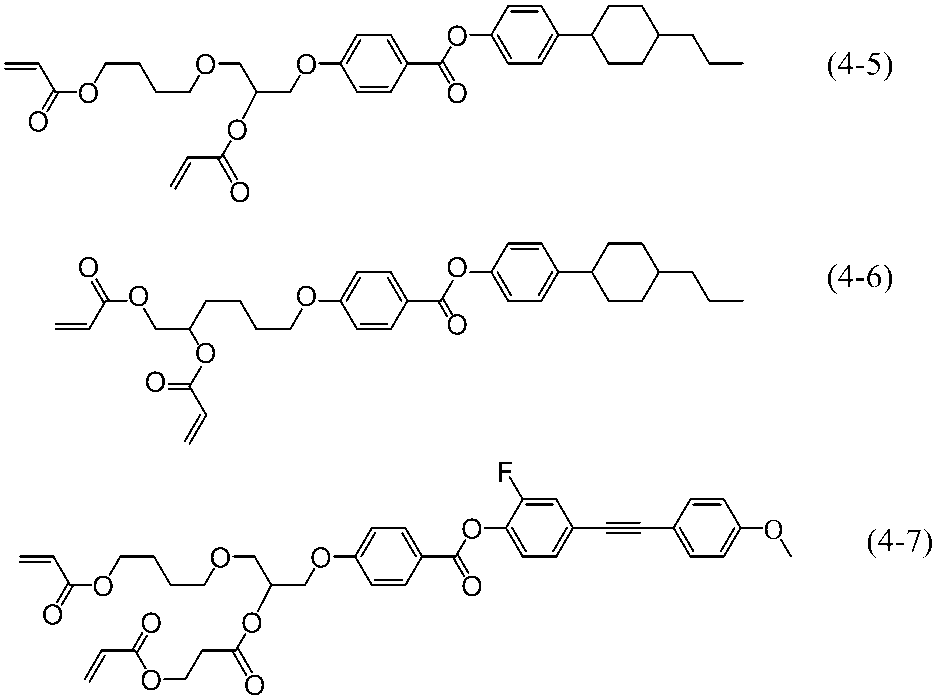

一般式(4)で表される重合性化合物の含有量は、本発明の光散乱型液晶素子用液晶組成物に用いる重合性化合物の合計量100質量%に対し、垂直配向膜を使用せず、垂直配向性を示すPIレスモノマーとして利用する観点から、下限値が0.2質量%以上であることが好ましく、0.5質量%以上であることがより好ましく、2質量%以上であることがさらに好ましく、5質量%以上であることが特に好ましく、基板表面上に多くのポリマーが集積しない観点から、上限値が15質量%以下であることが好ましく、10質量%以下であることがより好ましく、8質量%以下であることが特に好ましい。
上記一般式(5)で表される化合物として具体的には、トリメチロールプロパントリ(メタ)アクリレート、エトキシ化イソシアヌル酸トリアクリレート、ペンタエリスリトールトリ(メタ)アクリレート、ε-カプロラクトン変性トリス-(2-アクリロイルオキシエチル)イソシアヌレート、等のトリ(メタ)アクリレート、あるいは、下記の式(5-1)から式(5-23)で表される化合物が好ましい。

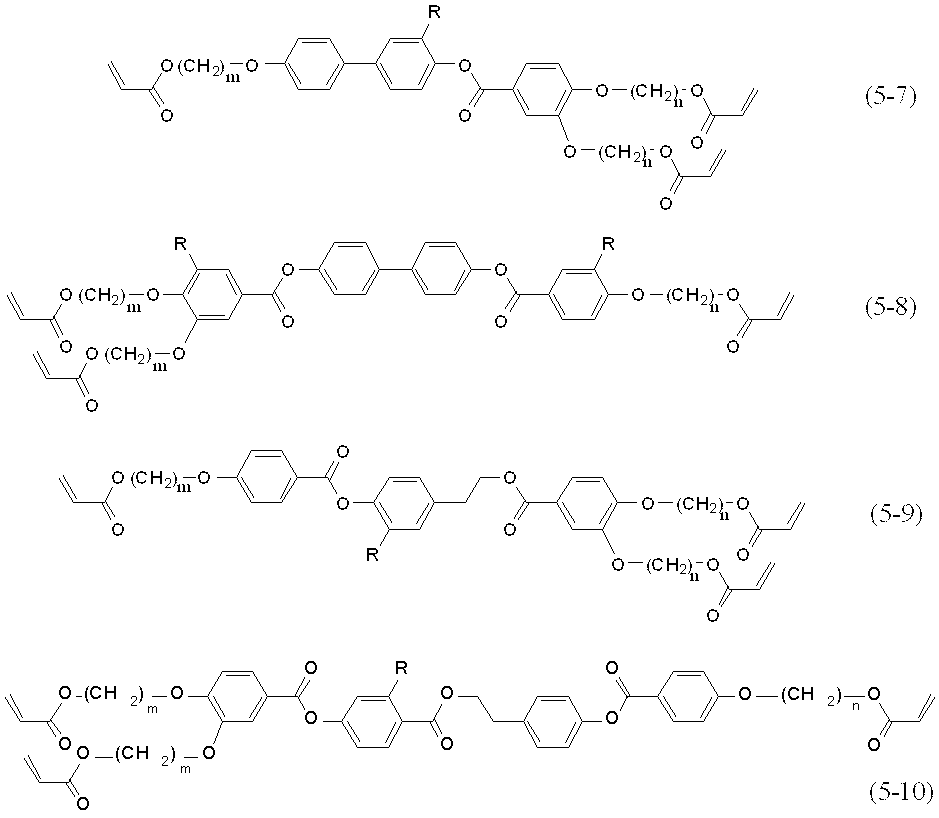
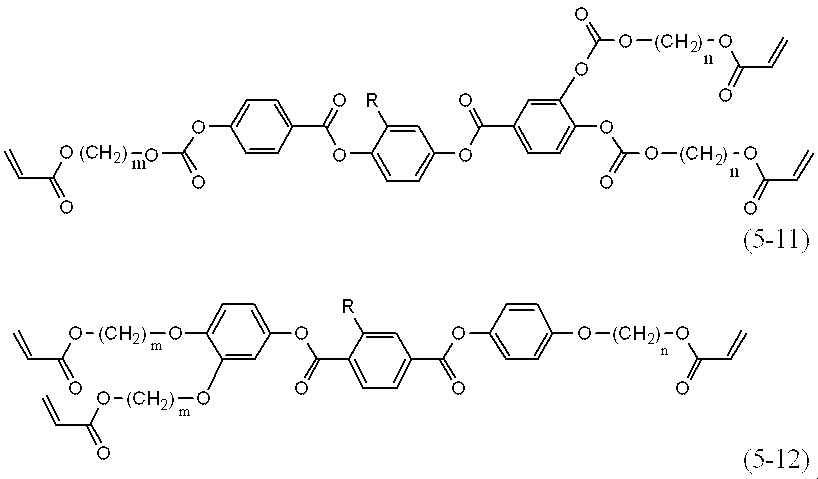


上記式(5-1)~式(5-23)において、n、mは、各々独立して1~10の整数数を表し、Rは、各々独立して水素原子、ハロゲン原子、炭素数1~6のアルキル基、炭素数1~6のアルコキシ基、シアノ基を示す。これらの基が炭素数1~6のアルキル基、あるいは炭素数1~6のアルコキシ基の場合、全部が未置換であるか、あるいは1つまたは2つ以上のハロゲン原子により置換されていてもよい。
上記一般式(6)で表される化合物として具体的には、下記の式(6-1)から式(6-11)で表される化合物が好ましい。
上記一般式(6)で表される化合物として具体的には、下記の式(6-1)から式(6-11)で表される化合物が好ましい。


上記式(6-1)~式(6-11)において、nは、各々独立して1~10の整数数を表し、Rは、各々独立して水素原子、ハロゲン原子、炭素数1~6のアルキル基、炭素数1~6のアルコキシ基、シアノ基を示す。これらの基が炭素数1~6のアルキル基、あるいは炭素数1~6のアルコキシ基の場合、全部が未置換であるか、あるいは1つまたは2つ以上のハロゲン原子により置換されていてもよい。
上記一般式(7)で表される化合物として具体的には、ペンタエリスリトールテトラ(メタ)アクリレート、ジトリメチロールプロパンテトラ(メタ)アクリレート、等のテトラ(メタ)アクリレート、あるいは、下記の式(7-1)から式(7-14)で表される化合物が好ましい。
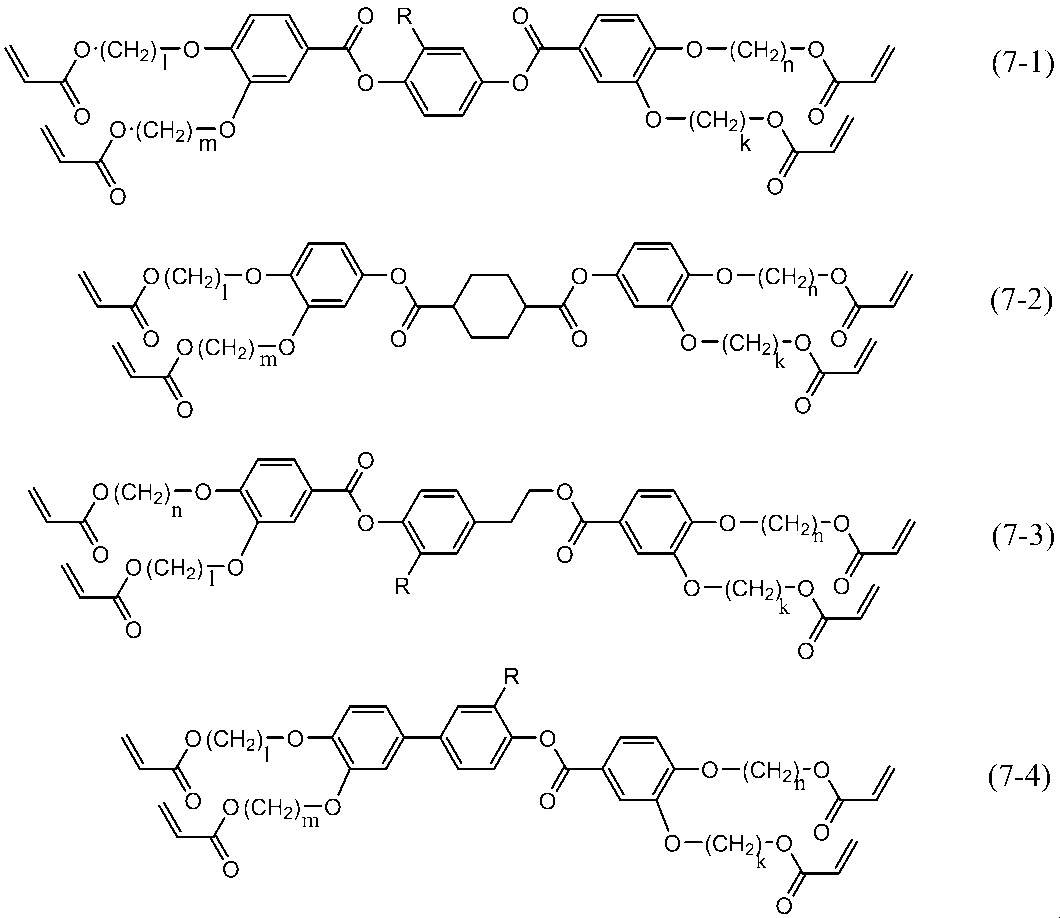
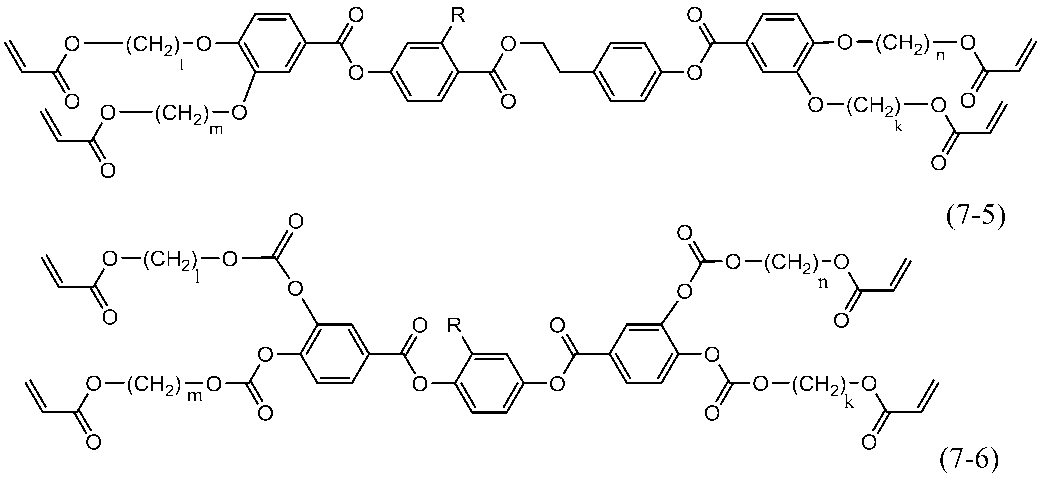


上記式(7-1)~式(7-14)において、n、m、l、kは、各々独立して1~10の整数数を表し、Rは、各々独立して水素原子、ハロゲン原子、炭素数1~6のアルキル基、炭素数1~6のアルコキシ基、シアノ基を示す。これらの基が炭素数1~6のアルキル基、あるいは炭素数1~6のアルコキシ基の場合、全部が未置換であるか、あるいは1つまたは2つ以上のハロゲン原子により置換されていてもよい。
上記一般式(8)で表される化合物として具体的には、下記の式(8-1)から式(8-10)で表される化合物が好ましい。
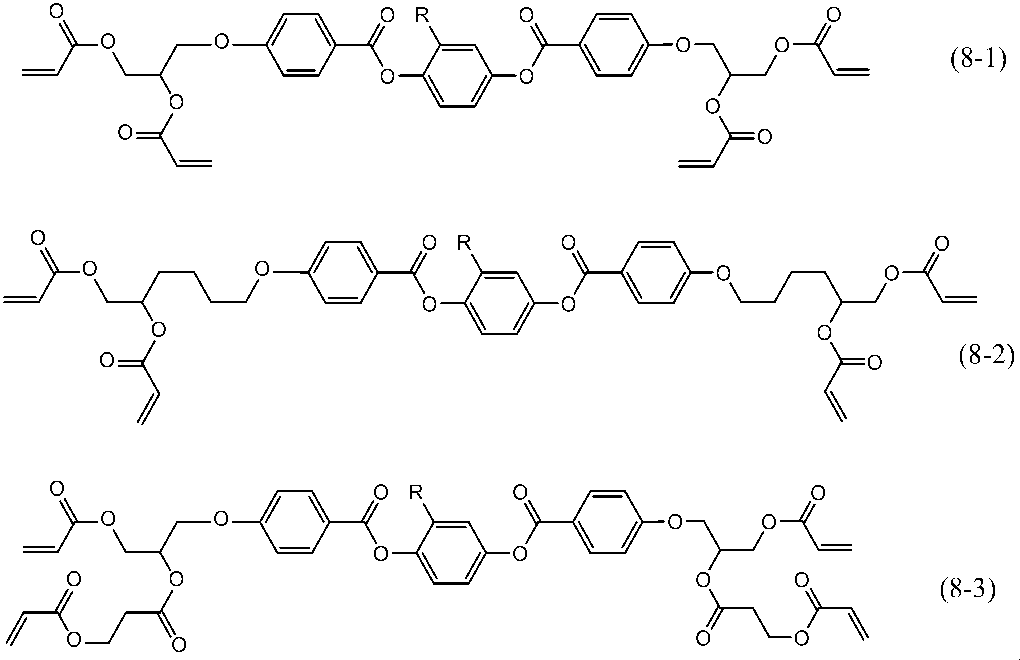
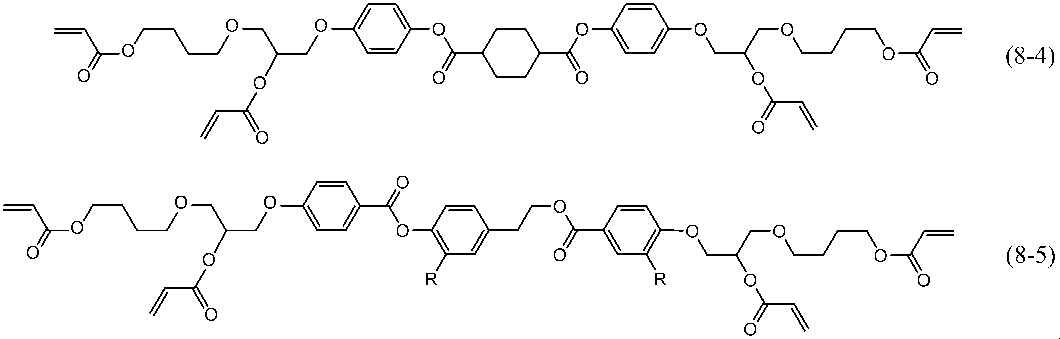
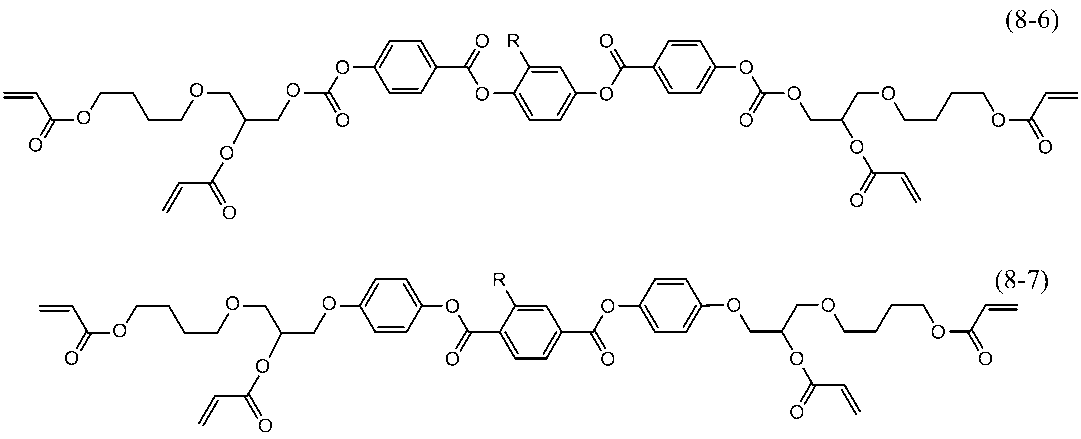

上記式(8-1)~式(8-10)において、Rは、各々独立して水素原子、ハロゲン原子、炭素数1~6のアルキル基、炭素数1~6のアルコキシ基、シアノ基を示す。これらの基が炭素数1~6のアルキル基、あるいは炭素数1~6のアルコキシ基の場合、全部が未置換であるか、あるいは1つまたは2つ以上のハロゲン原子により置換されていてもよい。
上記した一般式(5)~(8)で表される重合性化合物の含有量は、本発明の光散乱型液晶素子用液晶組成物に用いる重合性化合物の合計量100質量%に対し、ポリマーネットワークの架橋密度を高める観点から、1質量%以上であることが好ましく、3質量%以上であることがさらに好ましく、5質量%以上であることが特に好ましく、一方、架橋密度が高まりすぎることで駆動電圧が高くなり過ぎない観点から、20質量%以下であることが好ましく、15質量%以下であることがより好ましく、10質量%以下であることが特に好ましい。
本発明に係る光散乱型液晶素子用液晶組成物には、上記一般式(1)~一般式(8)で表される重合性化合物と共に、基材との密着性を改善する基、例えば、ヒドロキシル基、チオール基、アミド基、アミノ基、リン酸基などの極性基を有する重合性化合物等のその他の重合性化合物を併用しても良い。
本発明の光散乱型液晶素子用液晶組成物に用いる重合性化合物の含有量の総量は、本発明の光散乱型液晶素子用液晶組成物100質量%に対し、1質量%以上であることが好ましく、3質量%以上であることがさらに好ましく、5質量%以上であることが特に好ましく、一方、架橋密度が高まりすぎることで駆動電圧が高くなり過ぎない観点から、50質量%以下であることが好ましく、40質量%以下であることが好ましく、30質量%以下であることが好ましく、20質量%以下であることが好ましく、15質量%以下であることがより好ましく、10質量%以下であることが特に好ましい。
なお、本発明においては、前記した通り、以上詳述した第三の成分の中でも特に、前記一般式(2-ii)で表される重合性化合物、及び前記一般式(3-i)で表される重合性化合物を用いることが駆動電圧の低減効果の点から好ましく、特に一般式(2-ii)で表される重合性化合物を用いることが好ましい。
(負の誘電率異方性を有する化合物)
本発明に係る光散乱型液晶素子用液晶組成物には、第二成分として負の誘電率異方性を有する化合物を含有する。より具体的には、本発明に係る光散乱型液晶素子用液晶組成物には、下記一般式(N-1)で表される化合物を1種又は2種以上含有することが好ましい。
(負の誘電率異方性を有する化合物)
本発明に係る光散乱型液晶素子用液晶組成物には、第二成分として負の誘電率異方性を有する化合物を含有する。より具体的には、本発明に係る光散乱型液晶素子用液晶組成物には、下記一般式(N-1)で表される化合物を1種又は2種以上含有することが好ましい。
本発明に係る光散乱型液晶素子用液晶組成物は、少なくとも一般式(N-1)で表される化合物を含むものであればよく、他の成分は限定されない。例えば、一般式(N-1)で表される液晶化合物と共に、以下に示す液晶化合物群を任意に組み合わせて構成することができる。なお、以下特に断らない限り、単に組成物という時は液晶組成物を指す。
本発明に係る光散乱型液晶素子用液晶組成物は、1種類又は2種類以上の一般式(N-1)で表される液晶化合物と共に、一般式(N-2)又は一般式(N-3)で表される液晶化合物を、1種類又は2種類以上含有してもよい。これら液晶化合物は誘電的に負の化合物(誘電率異方性の符号が負で、その絶対値が2より大きい)に該当する。

(式中、RN11、RN12、RN21、RN22、RN31及びRN32はそれぞれ独立して炭素原子数1~8のアルキル基を表し、該アルキル基中の1個又は非隣接の2個以上の-CH2-はそれぞれ独立して-CH=CH-、-C≡C-、-O-、-CO-、-COO-又は-OCO-によって置換されていてもよく、
AN11、AN12、AN21、AN22、AN31及びAN32はそれぞれ独立して
(a) 1,4-シクロヘキシレン基(この基中に存在する1個の-CH2-又は隣接していない2個以上の-CH2-は-O-に置き換えられてもよい。)及び
(b) 1,4-フェニレン基(この基中に存在する1個の-CH=又は隣接していない2個以上の-CH=は-N=に置き換えられてもよい。)
(c) ナフタレン-2,6-ジイル基、1,2,3,4-テトラヒドロナフタレン-2,6-ジイル基又はデカヒドロナフタレン-2,6-ジイル基(ナフタレン-2,6-ジイル基又は1,2,3,4-テトラヒドロナフタレン-2,6-ジイル基中に存在する1個の-CH=又は隣接していない2個以上の-CH=は-N=に置き換えられても良い。)
(d) 1,4-シクロヘキセニレン基
からなる群より選ばれる基を表し、上記の基(a)、基(b)、基(c)及び基(d)はそれぞれ独立してシアノ基、フッ素原子又は塩素原子で置換されていても良く、
ZN11、ZN12、ZN21、ZN22、ZN31及びZN32はそれぞれ独立して単結合、-CH2CH2-、-(CH2)4-、-OCH2-、-CH2O-、-COO-、-OCO-、-OCF2-、-CF2O-、-CH=N-N=CH-、-CH=CH-、-CF=CF-又は-C≡C-を表し、
XN21は水素原子又はフッ素原子を表し、
TN31は-CH2-又は酸素原子を表し、
nN11、nN12、nN21、nN22、nN31及びnN32はそれぞれ独立して0~3の整数を表すが、nN11+nN12、nN21+nN22及びnN31+nN32はそれぞれ独立して1、2又は3であり、AN11~AN32、ZN11~ZN32が複数存在する場合は、それらは同一であっても異なっていても良い。ただし、一般式(i)で表される化合物を除く。)
一般式(N-1)、(N-2)及び(N-3)で表される化合物は、誘電率異方性が負でその絶対値が2よりも大きな化合物であることが好ましい。
AN11、AN12、AN21、AN22、AN31及びAN32はそれぞれ独立して
(a) 1,4-シクロヘキシレン基(この基中に存在する1個の-CH2-又は隣接していない2個以上の-CH2-は-O-に置き換えられてもよい。)及び
(b) 1,4-フェニレン基(この基中に存在する1個の-CH=又は隣接していない2個以上の-CH=は-N=に置き換えられてもよい。)
(c) ナフタレン-2,6-ジイル基、1,2,3,4-テトラヒドロナフタレン-2,6-ジイル基又はデカヒドロナフタレン-2,6-ジイル基(ナフタレン-2,6-ジイル基又は1,2,3,4-テトラヒドロナフタレン-2,6-ジイル基中に存在する1個の-CH=又は隣接していない2個以上の-CH=は-N=に置き換えられても良い。)
(d) 1,4-シクロヘキセニレン基
からなる群より選ばれる基を表し、上記の基(a)、基(b)、基(c)及び基(d)はそれぞれ独立してシアノ基、フッ素原子又は塩素原子で置換されていても良く、
ZN11、ZN12、ZN21、ZN22、ZN31及びZN32はそれぞれ独立して単結合、-CH2CH2-、-(CH2)4-、-OCH2-、-CH2O-、-COO-、-OCO-、-OCF2-、-CF2O-、-CH=N-N=CH-、-CH=CH-、-CF=CF-又は-C≡C-を表し、
XN21は水素原子又はフッ素原子を表し、
TN31は-CH2-又は酸素原子を表し、
nN11、nN12、nN21、nN22、nN31及びnN32はそれぞれ独立して0~3の整数を表すが、nN11+nN12、nN21+nN22及びnN31+nN32はそれぞれ独立して1、2又は3であり、AN11~AN32、ZN11~ZN32が複数存在する場合は、それらは同一であっても異なっていても良い。ただし、一般式(i)で表される化合物を除く。)
一般式(N-1)、(N-2)及び(N-3)で表される化合物は、誘電率異方性が負でその絶対値が2よりも大きな化合物であることが好ましい。
一般式(N-1)、(N-2)及び(N-3)中、RN11、RN12、RN21、RN22、RN31及びRN32はそれぞれ独立して、炭素原子数1~8のアルキル基、炭素原子数1~8のアルコキシ基、炭素原子数2~8のアルケニル基又は炭素原子数2~8のアルケニルオキシ基が好ましく、炭素原子数1~5のアルキル基、炭素原子数1~5のアルコキシ基、炭素原子数2~5のアルケニル基又は炭素原子数2~5のアルケニルオキシ基が好ましく、炭素原子数1~5のアルキル基又は炭素原子数2~5のアルケニル基が更に好ましく、炭素原子数2~5のアルキル基又は炭素原子数2~3のアルケニル基が更に好ましく、炭素原子数3のアルケニル基(プロペニル基)が特に好ましい。
また、それが結合する環構造がフェニル基(芳香族)である場合には、直鎖状の炭素原子数1~5のアルキル基、直鎖状の炭素原子数1~4のアルコキシ基及び炭素原子数4~5のアルケニル基が好ましく、それが結合する環構造がシクロヘキサン、ピラン及びジオキサンなどの飽和した環構造の場合には、直鎖状の炭素原子数1~5のアルキル基、直鎖状の炭素原子数1~4のアルコキシ基及び直鎖状の炭素原子数2~5のアルケニル基が好ましい。ネマチック相を安定化させるためには炭素原子及び存在する場合酸素原子の合計が5以下であることが好ましく、直鎖状であることが好ましい。
アルケニル基としては、式(R1)から式(R5)のいずれかで表される基から選ばれることが好ましい。(各式中の黒点は環構造中の炭素原子を表す。)

AN11、AN12、AN21、AN22、AN31及びAN32はそれぞれ独立してΔnを大きくすることが求められる場合には芳香族であることが好ましく、応答速度を改善するためには脂肪族であることが好ましく、トランス-1,4-シクロへキシレン基、1,4-フェニレン基、2-フルオロ-1,4-フェニレン基、3-フルオロ-1,4-フェニレン基、3,5-ジフルオロ-1,4-フェニレン基、2,3-ジフルオロ-1,4-フェニレン基、1,4-シクロヘキセニレン基、1,4-ビシクロ[2.2.2]オクチレン基、ピペリジン-1,4-ジイル基、ナフタレン-2,6-ジイル基、デカヒドロナフタレン-2,6-ジイル基又は1,2,3,4-テトラヒドロナフタレン-2,6-ジイル基を表すことが好ましく、下記の構造を表すことがより好ましく、

トランス-1,4-シクロへキシレン基、1,4-シクロヘキセニレン基又は1,4-フェニレン基を表すことがより好ましい。
ZN11、ZN12、ZN21、ZN22、ZN31及びZN32はそれぞれ独立して-CH2O-、-CF2O-、-CH2CH2-、-CF2CF2-又は単結合を表すことが好ましく、-CH2O-、-CH2CH2-又は単結合が更に好ましく、-CH2O-又は単結合が特に好ましい。XN21はフッ素原子が好ましい。TN31は酸素原子が好ましい。
nN11+nN12、nN21+nN22及びnN31+nN32は1又は2が好ましく、nN11が1でありnN12が0である組み合わせ、nN11が2でありnN12が0である組み合わせ、nN11が1でありnN12が1である組み合わせ、nN11が2でありnN12が1である組み合わせ、nN21が1でありnN22が0である組み合わせ、nN21が2でありnN22が0である組み合わせ、nN31が1でありnN32が0である組み合わせ、nN31が2でありnN32が0である組み合わせ、が好ましい。
本発明の液晶素子の透明性を高める観点から、組成物は一般式(N-2)又は一般式(N-3)で表される化合物は含有しないことが好ましい。
本発明に係る光散乱型液晶素子用液晶組成物に含まれる非重合性液晶化合物の総量に対しての式(N-1)で表される液晶化合物の好ましい含有量の下限値は30質量%であり、上限値は95質量%である。より好ましい含有量の下限値は45%であり、上限値は80質量%である。
本発明に係る光散乱型液晶素子用液晶組成物に含まれる非重合性液晶化合物の総量に対しての式(N-2)で表される液晶化合物の好ましい含有量は、0質量%である。ただし、透明性などの本願発明の目的を阻害しない限り、該含有量の下限値は、1質量%であり、10質量%であり、20質量%であってもよい。該含有量の上限値は、35質量%であり、25質量%であり、20質量%であってよい。
本発明に係る光散乱型液晶素子用液晶組成物に含まれる非重合性液晶化合物の組成物の総量に対しての式(N-3)で表される液晶化合物の好ましい含有は、0質量%である。ただし、透明性などの本願発明の目的を阻害しない限り、該含有量の下限値は、1%であり、10質量%であり、20質量%であってもよい。該含有量の上限値は、35質量%であり、25質量%であり、20質量%であってよい。
本発明に係る光散乱型液晶素子用液晶組成物の粘度を低く保ち、応答速度が速い組成物が必要な場合は上記の下限値が低く上限値が低いことが好ましい。さらに、 本発明に係る光散乱型液晶素子用液晶組成物のTNIを高く保ち、温度安定性の良い組成物が必要な場合は上記の下限値が低く上限値が低いことが好ましい。また、駆動電圧を低く保つために誘電率異方性を大きくしたいときは、上記の下限値を高く上限値が高いことが好ましい。
一般式(N-1)で表される化合物として、下記の一般式(N-1a)~(N-1g)で表される化合物群を挙げることができる。

(式中、RN11及びRN12は一般式(N-1)におけるRN11及びRN12と同じ意味を表し、nNa11は0又は1を表し、nNb11は1又は2を表し、nNc11は0又は1を表し、nNd11は1又は2を表し、nNe11は1又は2を表し、nNf11は1又は2を表し、nNg11は1又は2を表し、ANe11はトランス-1,4-シクロへキシレン基又は1,4-フェニレン基を表し、ANg11はトランス-1,4-シクロへキシレン基、1,4-シクロヘキセニレン基又は1,4-フェニレン基を表すが少なくとも1つは1,4-シクロヘキセニレン基を表し、ZNe 11は単結合又はエチレンを表すが少なくとも1つはエチレンを表す。)
より具体的には、一般式(N-1)で表される化合物は一般式(N-1-1)~(N-1-5)、(N-1-10)~(N-1-18)、(N-1-20)~(N-1-21)で表される化合物群から選ばれる化合物であることが好ましい。
より具体的には、一般式(N-1)で表される化合物は一般式(N-1-1)~(N-1-5)、(N-1-10)~(N-1-18)、(N-1-20)~(N-1-21)で表される化合物群から選ばれる化合物であることが好ましい。
一般式(N-1-1)で表される化合物は下記の化合物である。
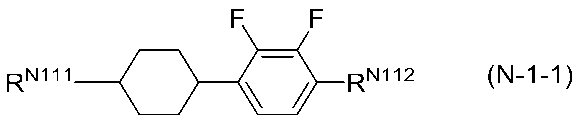
(式中、RN111及びRN112はそれぞれ独立して、一般式(N-1)におけるRN11及びRN12と同じ意味を表す。)
RN111は炭素原子数1~5のアルキル基又は炭素原子数2~5のアルケニル基が好ましく、プロピル基、ペンチル基又はビニル基が好ましい。RN112は炭素原子数1~5のアルキル基、炭素原子数4~5のアルケニル基又は炭素原子数1~4のアルコキシ基が好ましく、エトキシ基又はブトキシ基が好ましい。
RN111は炭素原子数1~5のアルキル基又は炭素原子数2~5のアルケニル基が好ましく、プロピル基、ペンチル基又はビニル基が好ましい。RN112は炭素原子数1~5のアルキル基、炭素原子数4~5のアルケニル基又は炭素原子数1~4のアルコキシ基が好ましく、エトキシ基又はブトキシ基が好ましい。
一般式(N-1-1)で表される化合物は単独で使用することもできるが、2以上の化合物を組み合わせて使用することもできる。組み合わせることができる化合物の種類に特に制限は無いが、低温での溶解性、転移温度、電気的な信頼性、複屈折率などの求められる性能に応じて適宜組み合わせて使用する。使用する化合物の種類は、例えば本発明の一つの実施形態としては1種類であり、2種類であり、3種類であり、4種類であり、5種類以上である。
Δεの改善を重視する場合には含有量を高めに設定することが好ましく、低温での溶解性を重視する場合は含有量を多めに設定すると効果が高く、TNIを重視する場合は含有量を少なめに設定すると効果が高い。さらに、滴下痕や焼き付き特性を改良する場合は、含有量の範囲を中間に設定することが好ましい。
本発明に係る光散乱型液晶素子用液晶組成物に含まれる非重合性液晶化合物の総量に対しての、式(N-1-1)で表される化合物の、好ましい含有量の下限値は0%であり、上限値は25%である。より好ましい含有量の下限値は0%であり、上限値は15%である。
さらに、一般式(N-1-1)で表される化合物は、式(N-1-1.1)から式(N-1-1.23)で表される化合物群から選ばれる化合物であることが好ましく、式(N-1-1.1)~(N-1-1.4)で表される化合物であることが好ましく、式(N-1-1.1)及び式(N-1-1.3)で表される化合物が好ましい。
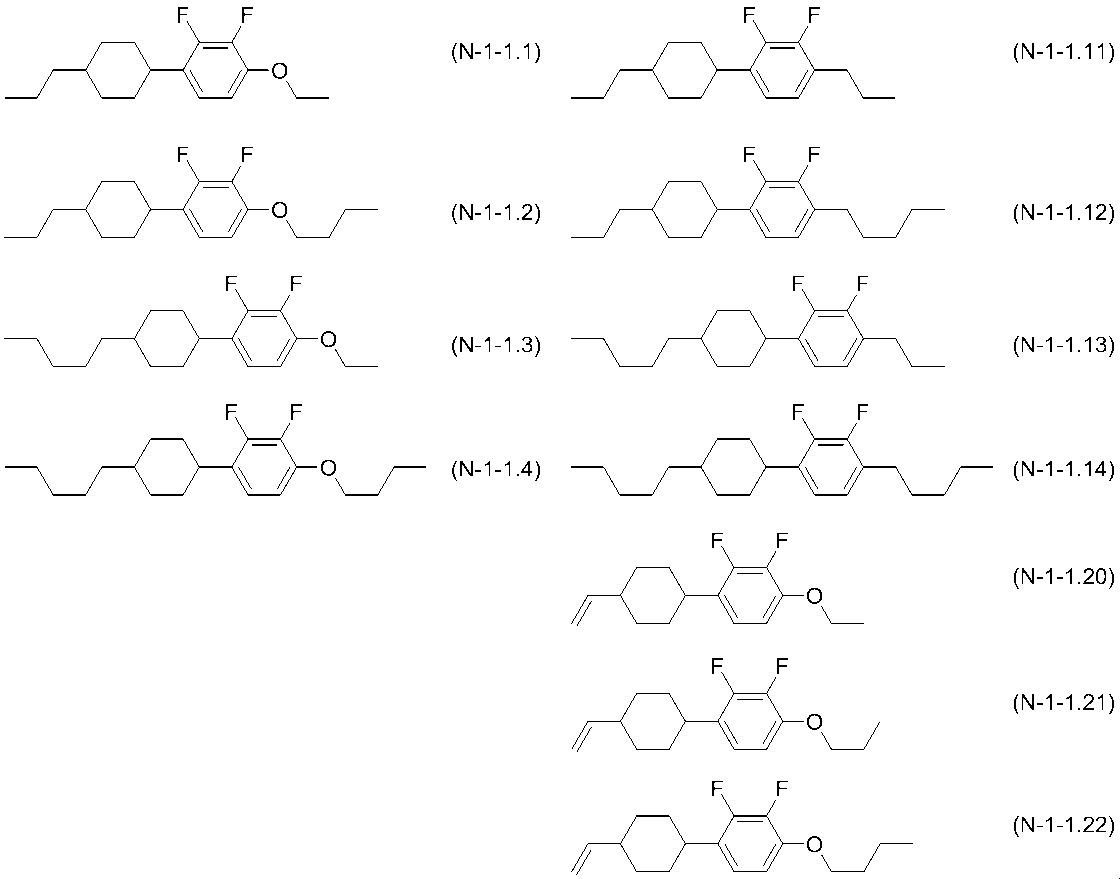
式(N-1-1.1)~(N-1-1.22)で表される化合物は単独で使用することも、組み合わせて使用することも可能である。
一般式(N-1-2)で表される化合物は下記の化合物である。

(式中、RN121及びRN122はそれぞれ独立して、一般式(N-1)におけるRN11及びRN12と同じ意味を表す。)
RN121は炭素原子数1~5のアルキル基又は炭素原子数2~5のアルケニル基が好ましく、エチル基、プロピル基、ブチル基又はペンチル基が好ましい。RN122は炭素原子数1~5のアルキル基、炭素原子数4~5のアルケニル基又は炭素原子数1~4のアルコキシ基が好ましく、メチル基、プロピル基、メトキシ基、エトキシ基又はプロポキシ基が好ましい。
RN121は炭素原子数1~5のアルキル基又は炭素原子数2~5のアルケニル基が好ましく、エチル基、プロピル基、ブチル基又はペンチル基が好ましい。RN122は炭素原子数1~5のアルキル基、炭素原子数4~5のアルケニル基又は炭素原子数1~4のアルコキシ基が好ましく、メチル基、プロピル基、メトキシ基、エトキシ基又はプロポキシ基が好ましい。
一般式(N-1-2)で表される化合物は単独で使用することもできるが、2以上の化合物を組み合わせて使用することもできる。組み合わせることができる化合物の種類に特に制限は無いが、低温での溶解性、転移温度、電気的な信頼性、複屈折率などの求められる性能に応じて適宜組み合わせて使用する。使用する化合物の種類は、例えば本発明の一つの実施形態としては1種類であり、2種類であり、3種類であり、4種類であり、5種類以上である。
Δεの改善を重視する場合には含有量を高めに設定することが好ましく、低温での溶解性を重視する場合は含有量を少なめに設定すると効果が高く、TNIを重視する場合は含有量を多めに設定すると効果が高い。さらに、滴下痕や焼き付き特性を改良する場合は、含有量の範囲を中間に設定することが好ましい。
本発明に係る光散乱型液晶素子用液晶組成物に含まれる非重合性液晶化合物の総量に対しての、式(N-1-2)で表される化合物の、好ましい含有量の下限値は0質量%であり、上限値は30質量%である。より好ましい含有量の下限値は0質量%であり、上限値は20質量%である。
さらに、一般式(N-1-2)で表される化合物は、式(N-1-2.1)から式(N-1-2.22)で表される化合物群から選ばれる化合物であることが好ましく、式(N-1-2.3)から式(N-1-2.7)、式(N-1-2.10)、式(N-1-2.11)、式(N-1-2.13)及び式(N-1-2.20)で表される化合物であることが好ましく、Δεの改良を重視する場合には式(N-1-2.3)から式(N-1-2.7)で表される化合物が好ましく、TNIの改良を重視する場合には式(N-1-2.10)、式(N-1-2.11)及び式(N-1-2.13)で表される化合物であることが好ましく、応答速度の改良を重視する場合には式(N-1-2.20)で表される化合物であることが好ましい。
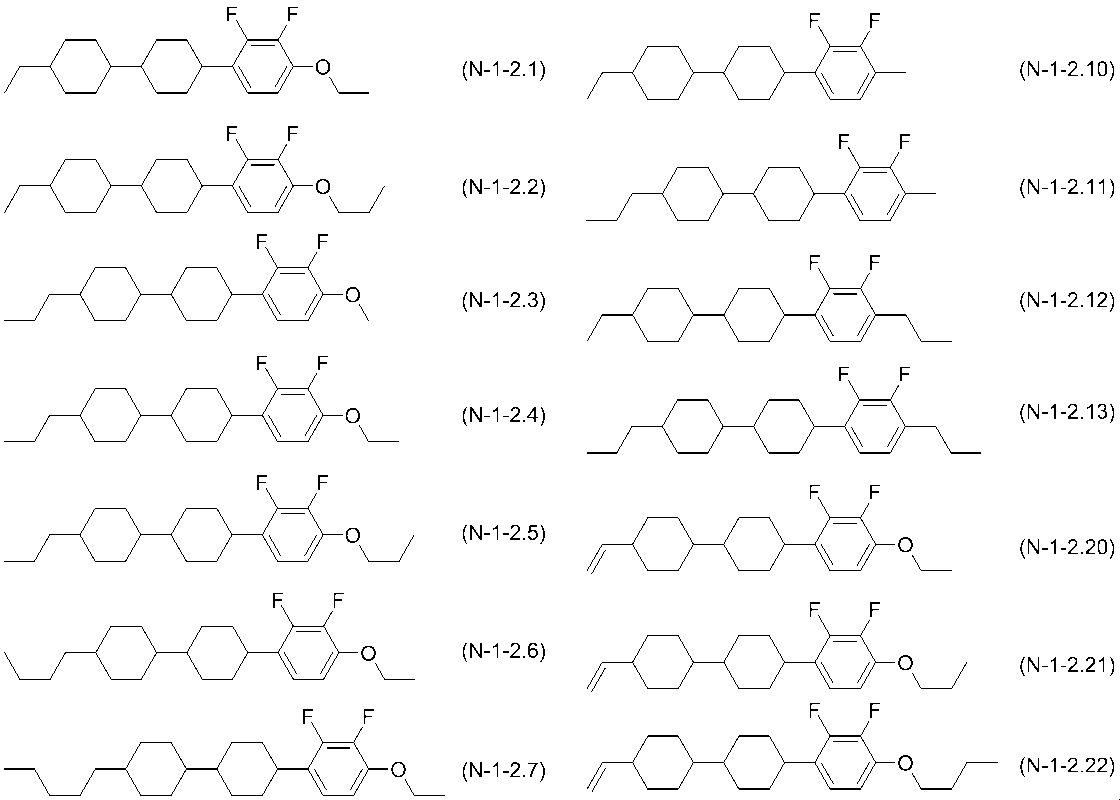
式(N-1-2.1)から式(N-1-2.22)で表される化合物は単独で使用することも、組み合わせて使用することも可能である。
一般式(N-1-3)で表される化合物は下記の化合物である。

(式中、RN131及びRN132はそれぞれ独立して、一般式(N-1)におけるRN11及びRN12と同じ意味を表す。)
RN131は炭素原子数1~5のアルキル基又は炭素原子数2~5のアルケニル基が好ましく、エチル基、プロピル基又はブチル基が好ましい。RN132は炭素原子数1~5のアルキル基、炭素原子数3~5のアルケニル基又は炭素原子数1~4のアルコキシ基が好ましく、1-プロペニル基、エトキシ基、プロポキシ基又はブトキシ基が好ましい。
RN131は炭素原子数1~5のアルキル基又は炭素原子数2~5のアルケニル基が好ましく、エチル基、プロピル基又はブチル基が好ましい。RN132は炭素原子数1~5のアルキル基、炭素原子数3~5のアルケニル基又は炭素原子数1~4のアルコキシ基が好ましく、1-プロペニル基、エトキシ基、プロポキシ基又はブトキシ基が好ましい。
一般式(N-1-3)で表される化合物は単独で使用することもできるが、2以上の化合物を組み合わせて使用することもできる。組み合わせることができる化合物の種類に特に制限は無いが、低温での溶解性、転移温度、電気的な信頼性、複屈折率などの求められる性能に応じて適宜組み合わせて使用する。使用する化合物の種類は、例えば本発明の一つの実施形態としては1種類であり、2種類であり、3種類であり、4種類であり、5種類以上である。
Δεの改善を重視する場合には含有量を高めに設定することが好ましく、低温での溶解性を重視する場合は含有量を多めに設定すると効果が高く、TNIを重視する場合は含有量をおおめに設定すると効果が高い。さらに、滴下痕や焼き付き特性を改良する場合は、含有量の範囲を中間に設定することが好ましい。
本発明に係る光散乱型液晶素子用液晶組成物に含まれる非重合性液晶化合物の総量に対しての、式(N-1-3)で表される化合物の、好ましい含有量の下限値は5質量%であり、上限値は50質量%である。より好ましい含有量の下限値は10質量%であり、上限値は35質量%である。
さらに、一般式(N-1-3)で表される化合物は、式(N-1-3.1)から式(N-1-3.21)で表される化合物群から選ばれる化合物であることが好ましく、式(N-1-3.1)~(N-1-3.7)及び式(N-1-3.21)で表される化合物であることが好ましく、式(N-1-3.1)、式(N-1-3.2)、式(N-1-3.3)、式(N-1-3.4)及び式(N-1-3.6)で表される化合物が好ましい。
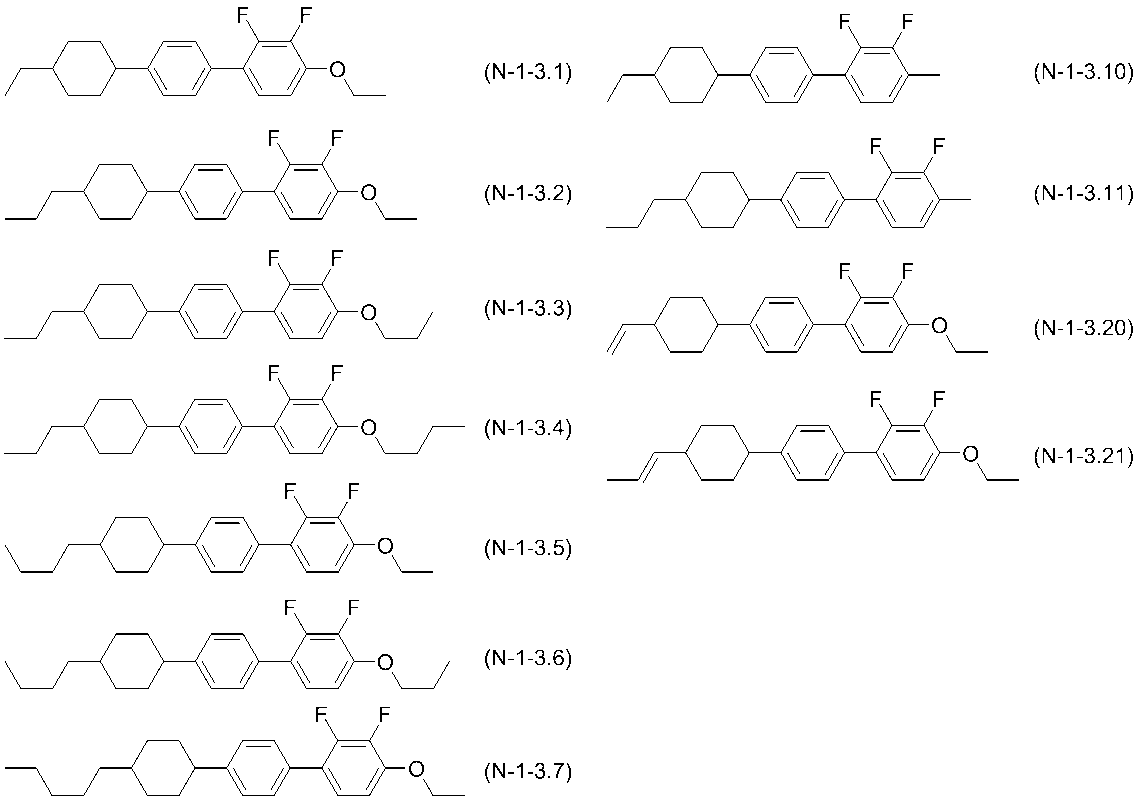
式(N-1-3.1)~式(N-1-3.4)、式(N-1-3.6)及び式(N-1-3.21)で表される化合物は単独で使用することも、組み合わせて使用することも可能であるが、式(N-1-3.1)及び式(N-1-3.2)の組み合わせ、式(N-1-3.3)、式(N-1-3.4)及び式(N-1-3.6)から選ばれる2種又は3種の組み合わせが好ましい。
一般式(N-1-4)で表される化合物は下記の化合物である。
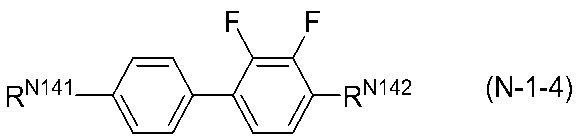
(式中、RN141及びRN142はそれぞれ独立して、一般式(N-1)におけるRN11及びRN12と同じ意味を表す。)
RN141及びRN142はそれぞれ独立して、炭素原子数1~5のアルキル基、炭素原子数4~5のアルケニル基又は炭素原子数1~4のアルコキシ基が好ましく、メチル基、プロピル基、エトキシ基又はブトキシ基が好ましい。
RN141及びRN142はそれぞれ独立して、炭素原子数1~5のアルキル基、炭素原子数4~5のアルケニル基又は炭素原子数1~4のアルコキシ基が好ましく、メチル基、プロピル基、エトキシ基又はブトキシ基が好ましい。
一般式(N-1-4)で表される化合物は単独で使用することもできるが、2以上の化合物を組み合わせて使用することもできる。組み合わせることができる化合物の種類に特に制限は無いが、低温での溶解性、転移温度、電気的な信頼性、複屈折率などの求められる性能に応じて適宜組み合わせて使用する。使用する化合物の種類は、例えば本発明の一つの実施形態としては1種類であり、2種類であり、3種類であり、4種類であり、5種類以上である。
Δεの改善を重視する場合には含有量を高めに設定することが好ましく、低温での溶解性を重視する場合は含有量を多めに設定すると効果が高く、TNIを重視する場合は含有量を少なめに設定すると効果が高い。さらに、滴下痕や焼き付き特性を改良する場合は、含有量の範囲を中間に設定することが好ましい。
本発明に係る光散乱型液晶素子用液晶組成物に含まれる非重合性液晶化合物の総量に対しての、式(N-1-4)で表される化合物の、好ましい含有量の下限値は0質量%であり、上限値は25質量%である。より好ましい含有量の下限値は0質量%であり、上限値は15質量%である。
さらに、一般式(N-1-4)で表される化合物は、式(N-1-4.1)から式(N-1-4.14)で表される化合物群から選ばれる化合物であることが好ましく、式(N-1-4.1)~(N-1-4.4)で表される化合物であることが好ましく、式(N-1-4.1)、式(N-1-4.2)及び式(N-1-4.4)で表される化合物が好ましい。
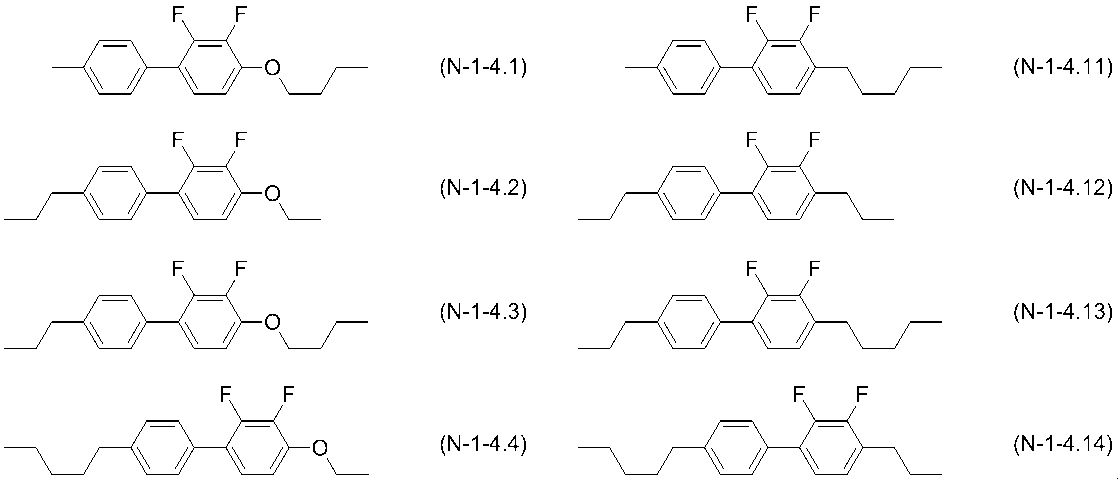
式(N-1-4.1)~(N-1-4.14)で表される化合物は単独で使用することも、組み合わせて使用することも可能である。
一般式(N-1-5)で表される化合物は下記の化合物である。

(式中、RN151及びRN152はそれぞれ独立して、一般式(N-1)におけるRN11及びRN12と同じ意味を表す。)
RN151及びRN152はそれぞれ独立して、炭素原子数1~5のアルキル基、炭素原子数4~5のアルケニル基又は炭素原子数1~4のアルコキシ基が好ましくエチル基、プロピル基又はブチル基が好ましい。
RN151及びRN152はそれぞれ独立して、炭素原子数1~5のアルキル基、炭素原子数4~5のアルケニル基又は炭素原子数1~4のアルコキシ基が好ましくエチル基、プロピル基又はブチル基が好ましい。
一般式(N-1-5)で表される化合物は単独で使用することもできるが、2以上の化合物を組み合わせて使用することもできる。組み合わせることができる化合物の種類に特に制限は無いが、低温での溶解性、転移温度、電気的な信頼性、複屈折率などの求められる性能に応じて適宜組み合わせて使用する。使用する化合物の種類は、例えば本発明の一つの実施形態としては1種類であり、2種類であり、3種類であり、4種類であり、5種類以上である。
Δεの改善を重視する場合には含有量を高めに設定することが好ましく、低温での溶解性を重視する場合は含有量を少なめに設定すると効果が高く、TNIを重視する場合は含有量を多めに設定すると効果が高い。さらに、滴下痕や焼き付き特性を改良する場合は、含有量の範囲を中間に設定することが好ましい。
本発明に係る光散乱型液晶素子用液晶組成物に含まれる非重合性液晶化合物の総量に対しての、式(N-1-5)で表される化合物の、好ましい含有量の下限値は0質量%であり、上限値は30質量%である。より好ましい含有量の下限値は0質量%であり、上限値は20質量%である。
さらに、一般式(N-1-5)で表される化合物は、式(N-1-5.1)から式(N-1-5.6)で表される化合物群から選ばれる化合物であることが好ましく、式(N-1-5.1)、式(N-1-5.2)及び式(N-1-5.4)で表される化合物が好ましい。

式(N-1-5.1)、式(N-1-5.2)及び式(N-1-5.4)で表される化合物は単独で使用することも、組み合わせて使用することも可能である。
一般式(N-1-10)で表される化合物は下記の化合物である。

(式中、RN1101及びRN1102はそれぞれ独立して、一般式(N-1)におけるRN11及びRN12と同じ意味を表す。)
RN1101は炭素原子数1~5のアルキル基又は炭素原子数2~5のアルケニル基が好ましく、エチル基、プロピル基、ブチル基、ビニル基又は1-プロペニル基が好ましい。RN1102は炭素原子数1~5のアルキル基、炭素原子数4~5のアルケニル基又は炭素原子数1~4のアルコキシ基が好ましく、エトキシ基、プロポキシ基又はブトキシ基が好ましい。
RN1101は炭素原子数1~5のアルキル基又は炭素原子数2~5のアルケニル基が好ましく、エチル基、プロピル基、ブチル基、ビニル基又は1-プロペニル基が好ましい。RN1102は炭素原子数1~5のアルキル基、炭素原子数4~5のアルケニル基又は炭素原子数1~4のアルコキシ基が好ましく、エトキシ基、プロポキシ基又はブトキシ基が好ましい。
一般式(N-1-10)で表される化合物は単独で使用することもできるが、2以上の化合物を組み合わせて使用することもできる。組み合わせることができる化合物の種類に特に制限は無いが、低温での溶解性、転移温度、電気的な信頼性、複屈折率などの求められる性能に応じて適宜組み合わせて使用する。使用する化合物の種類は、例えば本発明の一つの実施形態としては1種類であり、2種類であり、3種類であり、4種類であり、5種類以上である。
Δεの改善を重視する場合には含有量を高めに設定することが好ましく、低温での溶解性を重視する場合は含有量を高めに設定すると効果が高く、TNIを重視する場合は含有量を高めに設定すると効果が高い。さらに、滴下痕や焼き付き特性を改良する場合は、含有量の範囲を中間に設定することが好ましい。
本発明に係る光散乱型液晶素子用液晶組成物に含まれる非重合性液晶化合物の総量に対しての、式(N-1-10)で表される化合物の、好ましい含有量の下限値は0質量%であり、上限値は35質量%である。より好ましい含有量の下限値は2質量%であり、上限値は25質量%である。
さらに、一般式(N-1-10)で表される化合物は、式(N-1-10.1)から式(N-1-10.21)で表される化合物群から選ばれる化合物であることが好ましく、式(N-1-10.1)~(N-1-10.5)式(N-1-10.20)及び式(N-1-10.21)で表される化合物であることが好ましく、式(N-1-10.1)、式(N-1-10.2)、式(N-1-10.20)及び式(N-1-10.21)で表される化合物が好ましい。
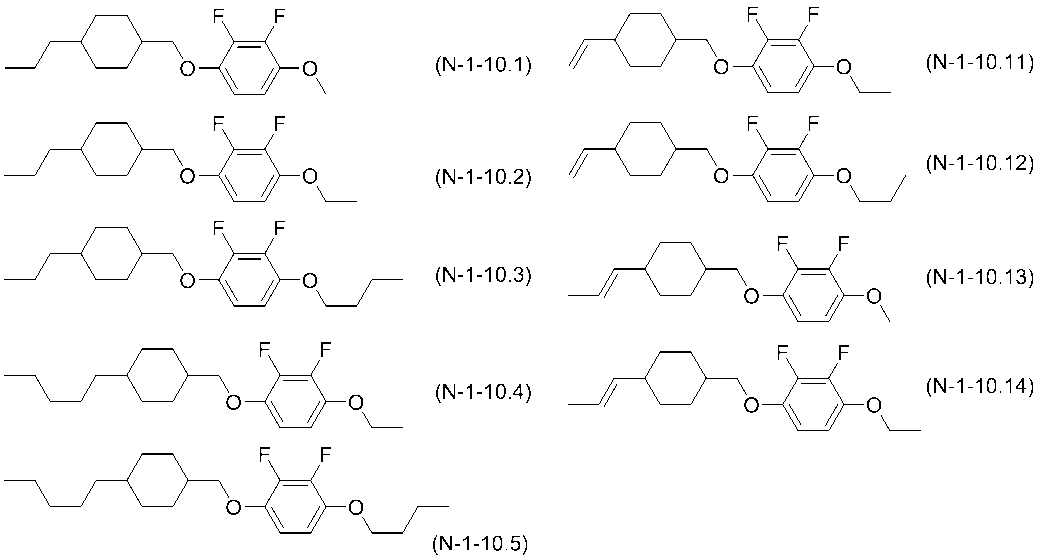
式(N-1-10.1)、式(N-1-10.2)、式(N-1-10.20)及び式(N-1-10.21)で表される化合物は単独で使用することも、組み合わせて使用することも可能である。
一般式(N-1-11)で表される化合物は下記の化合物である。

(式中、RN1111及びRN1112はそれぞれ独立して、一般式(N-1)におけるRN11及びRN12と同じ意味を表す。)
RN1111は炭素原子数1~5のアルキル基又は炭素原子数2~5のアルケニル基が好ましく、エチル基、プロピル基、ブチル基、ビニル基又は1-プロペニル基が好ましい。RN1112は炭素原子数1~5のアルキル基、炭素原子数4~5のアルケニル基又は炭素原子数1~4のアルコキシ基が好ましく、エトキシ基、プロポキシ基又はブトキシ基が好ましい。
RN1111は炭素原子数1~5のアルキル基又は炭素原子数2~5のアルケニル基が好ましく、エチル基、プロピル基、ブチル基、ビニル基又は1-プロペニル基が好ましい。RN1112は炭素原子数1~5のアルキル基、炭素原子数4~5のアルケニル基又は炭素原子数1~4のアルコキシ基が好ましく、エトキシ基、プロポキシ基又はブトキシ基が好ましい。
一般式(N-1-11)で表される化合物は単独で使用することもできるが、2以上の化合物を組み合わせて使用することもできる。組み合わせることができる化合物の種類に特に制限は無いが、低温での溶解性、転移温度、電気的な信頼性、複屈折率などの求められる性能に応じて適宜組み合わせて使用する。使用する化合物の種類は、例えば本発明の一つの実施形態としては1種類であり、2種類であり、3種類であり、4種類であり、5種類以上である。
Δεの改善を重視する場合には含有量を高めに設定することが好ましく、低温での溶解性を重視する場合は含有量を低めに設定すると効果が高く、TNIを重視する場合は含有量を高めに設定すると効果が高い。さらに、滴下痕や焼き付き特性を改良する場合は、含有量の範囲を中間に設定することが好ましい。
本発明に係る光散乱型液晶素子用液晶組成物に含まれる非重合性液晶化合物の総量に対しての、式(N-1-11)で表される化合物の、好ましい含有量の下限値は0質量%であり、上限値は75質量%である。より好ましい含有量の下限値は2%であり、上限値は50質量%である。
さらに、一般式(N-1-11)で表される化合物は、式(N-1-11.1)から式(N-1-11.14)で表される化合物群から選ばれる化合物であることが好ましく、式(N-1-11.1)~(N-1-11.5)で表される化合物であることが好ましく、式(N-1-11.2及び式(N-1-11.4)で表される化合物が好ましい。

式(N-1-11.2)及び式(N-1-11.4)で表される化合物は単独で使用することも、組み合わせて使用することも可能である
一般式(N-1-12)で表される化合物は下記の化合物である。
一般式(N-1-12)で表される化合物は下記の化合物である。

(式中、RN1121及びRN1122はそれぞれ独立して、一般式(N-1)におけるRN11及びRN12と同じ意味を表す。)
RN1121は炭素原子数1~5のアルキル基又は炭素原子数2~5のアルケニル基が好ましく、エチル基、プロピル基又はブチル基が好ましい。RN1122は炭素原子数1~5のアルキル基、炭素原子数4~5のアルケニル基又は炭素原子数1~4のアルコキシ基が好ましく、エトキシ基、プロポキシ基又はブトキシ基が好ましい。
RN1121は炭素原子数1~5のアルキル基又は炭素原子数2~5のアルケニル基が好ましく、エチル基、プロピル基又はブチル基が好ましい。RN1122は炭素原子数1~5のアルキル基、炭素原子数4~5のアルケニル基又は炭素原子数1~4のアルコキシ基が好ましく、エトキシ基、プロポキシ基又はブトキシ基が好ましい。
一般式(N-1-12)で表される化合物は単独で使用することもできるが、2以上の化合物を組み合わせて使用することもできる。組み合わせることができる化合物の種類に特に制限は無いが、低温での溶解性、転移温度、電気的な信頼性、複屈折率などの求められる性能に応じて適宜組み合わせて使用する。使用する化合物の種類は、例えば本発明の一つの実施形態としては1種類であり、2種類であり、3種類であり、4種類であり、5種類以上である。
Δεの改善を重視する場合には含有量を高めに設定することが好ましく、低温での溶解性を重視する場合は含有量を多めに設定すると効果が高く、TNIを重視する場合は含有量をおおめに設定すると効果が高い。さらに、滴下痕や焼き付き特性を改良する場合は、含有量の範囲を中間に設定することが好ましい。
本発明に係る光散乱型液晶素子用液晶組成物に含まれる非重合性液晶化合物の総量に対しての、式(N-1-12)で表される化合物の、好ましい含有量の下限値は0質量%であり、上限値は25質量%である。より好ましい含有量の下限値は0質量%であり、上限値は15質量%である。
一般式(N-1-13)で表される化合物は下記の化合物である。

(式中、RN1131及びRN1132はそれぞれ独立して、一般式(N-1)におけるRN11及びRN12と同じ意味を表す。)
RN1131は炭素原子数1~5のアルキル基又は炭素原子数2~5のアルケニル基が好ましく、エチル基、プロピル基又はブチル基が好ましい。RN1132は炭素原子数1~5のアルキル基、炭素原子数4~5のアルケニル基又は炭素原子数1~4のアルコキシ基が好ましく、エトキシ基、プロポキシ基又はブトキシ基が好ましい。
RN1131は炭素原子数1~5のアルキル基又は炭素原子数2~5のアルケニル基が好ましく、エチル基、プロピル基又はブチル基が好ましい。RN1132は炭素原子数1~5のアルキル基、炭素原子数4~5のアルケニル基又は炭素原子数1~4のアルコキシ基が好ましく、エトキシ基、プロポキシ基又はブトキシ基が好ましい。
一般式(N-1-13)で表される化合物は単独で使用することもできるが、2以上の化合物を組み合わせて使用することもできる。組み合わせることができる化合物の種類に特に制限は無いが、低温での溶解性、転移温度、電気的な信頼性、複屈折率などの求められる性能に応じて適宜組み合わせて使用する。使用する化合物の種類は、例えば本発明の一つの実施形態としては1種類であり、2種類であり、3種類であり、4種類であり、5種類以上である。
Δεの改善を重視する場合には含有量を高めに設定することが好ましく、低温での溶解性を重視する場合は含有量を多めに設定すると効果が高く、TNIを重視する場合は含有量をおおめに設定すると効果が高い。さらに、滴下痕や焼き付き特性を改良する場合は、含有量の範囲を中間に設定することが好ましい。
本発明に係る光散乱型液晶素子用液晶組成物に含まれる非重合性液晶化合物の総量に対しての、式(N-1-13)で表される化合物の、好ましい含有量の下限値は0質量%であり、上限値は25質量%である。より好ましい含有量の下限値は0質量%であり、上限値は15質量%である。
一般式(N-1-14)で表される化合物は下記の化合物である。

(式中、RN1141及びRN1142はそれぞれ独立して、一般式(N-1)におけるRN11及びRN12と同じ意味を表す。)
RN1141は炭素原子数1~5のアルキル基又は炭素原子数2~5のアルケニル基が好ましく、エチル基、プロピル基又はブチル基が好ましい。RN1142は炭素原子数1~5のアルキル基、炭素原子数4~5のアルケニル基又は炭素原子数1~4のアルコキシ基が好ましく、エトキシ基、プロポキシ基又はブトキシ基が好ましい。
RN1141は炭素原子数1~5のアルキル基又は炭素原子数2~5のアルケニル基が好ましく、エチル基、プロピル基又はブチル基が好ましい。RN1142は炭素原子数1~5のアルキル基、炭素原子数4~5のアルケニル基又は炭素原子数1~4のアルコキシ基が好ましく、エトキシ基、プロポキシ基又はブトキシ基が好ましい。
一般式(N-1-14)で表される化合物は単独で使用することもできるが、2以上の化合物を組み合わせて使用することもできる。組み合わせることができる化合物の種類に特に制限は無いが、低温での溶解性、転移温度、電気的な信頼性、複屈折率などの求められる性能に応じて適宜組み合わせて使用する。使用する化合物の種類は、例えば本発明の一つの実施形態としては1種類であり、2種類であり、3種類であり、4種類であり、5種類以上である。
Δεの改善を重視する場合には含有量を高めに設定することが好ましく、低温での溶解性を重視する場合は含有量を多めに設定すると効果が高く、TNIを重視する場合は含有量をおおめに設定すると効果が高い。さらに、滴下痕や焼き付き特性を改良する場合は、含有量の範囲を中間に設定することが好ましい。
本発明に係る光散乱型液晶素子用液晶組成物に含まれる非重合性液晶化合物の総量に対しての、式(N-1-14)で表される化合物の、好ましい含有量の下限値は0質量%であり、上限値は25質量%である。より好ましい含有量の下限値は0質量%であり、上限値は15質量%である。
一般式(N-1-15)で表される化合物は下記の化合物である。

(式中、RN1151及びRN1152はそれぞれ独立して、一般式(N-1)におけるRN11及びRN12と同じ意味を表す。)
RN1151は炭素原子数1~5のアルキル基又は炭素原子数2~5のアルケニル基が好ましく、エチル基、プロピル基又はブチル基が好ましい。RN1152は炭素原子数1~5のアルキル基、炭素原子数4~5のアルケニル基又は炭素原子数1~4のアルコキシ基が好ましく、エトキシ基、プロポキシ基又はブトキシ基が好ましい。
RN1151は炭素原子数1~5のアルキル基又は炭素原子数2~5のアルケニル基が好ましく、エチル基、プロピル基又はブチル基が好ましい。RN1152は炭素原子数1~5のアルキル基、炭素原子数4~5のアルケニル基又は炭素原子数1~4のアルコキシ基が好ましく、エトキシ基、プロポキシ基又はブトキシ基が好ましい。
一般式(N-1-15)で表される化合物は単独で使用することもできるが、2以上の化合物を組み合わせて使用することもできる。組み合わせることができる化合物の種類に特に制限は無いが、低温での溶解性、転移温度、電気的な信頼性、複屈折率などの求められる性能に応じて適宜組み合わせて使用する。使用する化合物の種類は、例えば本発明の一つの実施形態としては1種類であり、2種類であり、3種類であり、4種類であり、5種類以上である。
Δεの改善を重視する場合には含有量を高めに設定することが好ましく、低温での溶解性を重視する場合は含有量を多めに設定すると効果が高く、TNIを重視する場合は含有量をおおめに設定すると効果が高い。さらに、滴下痕や焼き付き特性を改良する場合は、含有量の範囲を中間に設定することが好ましい。
本発明に係る光散乱型液晶素子用液晶組成物に含まれる非重合性液晶化合物の総量に対しての、式(N-1-15)で表される化合物の、好ましい含有量の下限値は0質量%であり、上限値は25質量%である。より好ましい含有量の下限値は0質量%であり、上限値は15質量%である。
一般式(N-1-16)で表される化合物は下記の化合物である。

(式中、RN1161及びRN1162はそれぞれ独立して、一般式(N-1)におけるRN11及びRN12と同じ意味を表す。)
RN1161は炭素原子数1~5のアルキル基又は炭素原子数2~5のアルケニル基が好ましく、エチル基、プロピル基又はブチル基が好ましい。RN1162は炭素原子数1~5のアルキル基、炭素原子数4~5のアルケニル基又は炭素原子数1~4のアルコキシ基が好ましく、エトキシ基、プロポキシ基又はブトキシ基が好ましい。
RN1161は炭素原子数1~5のアルキル基又は炭素原子数2~5のアルケニル基が好ましく、エチル基、プロピル基又はブチル基が好ましい。RN1162は炭素原子数1~5のアルキル基、炭素原子数4~5のアルケニル基又は炭素原子数1~4のアルコキシ基が好ましく、エトキシ基、プロポキシ基又はブトキシ基が好ましい。
一般式(N-1-16)で表される化合物は単独で使用することもできるが、2以上の化合物を組み合わせて使用することもできる。組み合わせることができる化合物の種類に特に制限は無いが、低温での溶解性、転移温度、電気的な信頼性、複屈折率などの求められる性能に応じて適宜組み合わせて使用する。使用する化合物の種類は、例えば本発明の一つの実施形態としては1種類であり、2種類であり、3種類であり、4種類であり、5種類以上である。
Δεの改善を重視する場合には含有量を高めに設定することが好ましく、低温での溶解性を重視する場合は含有量を多めに設定すると効果が高く、TNIを重視する場合は含有量をおおめに設定すると効果が高い。さらに、滴下痕や焼き付き特性を改良する場合は、含有量の範囲を中間に設定することが好ましい。
本発明に係る光散乱型液晶素子用液晶組成物に含まれる非重合性液晶化合物の総量に対しての、式(N-1-16)で表される化合物の、好ましい含有量の下限値は0質量%であり、上限値は25質量%である。より好ましい含有量の下限値は0質量%であり、上限値は15質量%である。
一般式(N-1-17)で表される化合物は下記の化合物である。

(式中、RN1171及びRN1172はそれぞれ独立して、一般式(N-1)におけるRN11及びRN12と同じ意味を表す。)
RN1171は炭素原子数1~5のアルキル基又は炭素原子数2~5のアルケニル基が好ましく、エチル基、プロピル基又はブチル基が好ましい。RN1172は炭素原子数1~5のアルキル基、炭素原子数4~5のアルケニル基又は炭素原子数1~4のアルコキシ基が好ましく、エトキシ基、プロポキシ基又はブトキシ基が好ましい。
RN1171は炭素原子数1~5のアルキル基又は炭素原子数2~5のアルケニル基が好ましく、エチル基、プロピル基又はブチル基が好ましい。RN1172は炭素原子数1~5のアルキル基、炭素原子数4~5のアルケニル基又は炭素原子数1~4のアルコキシ基が好ましく、エトキシ基、プロポキシ基又はブトキシ基が好ましい。
一般式(N-1-17)で表される化合物は単独で使用することもできるが、2以上の化合物を組み合わせて使用することもできる。組み合わせることができる化合物の種類に特に制限は無いが、低温での溶解性、転移温度、電気的な信頼性、複屈折率などの求められる性能に応じて適宜組み合わせて使用する。使用する化合物の種類は、例えば本発明の一つの実施形態としては1種類であり、2種類であり、3種類であり、4種類であり、5種類以上である。
Δεの改善を重視する場合には含有量を高めに設定することが好ましく、低温での溶解性を重視する場合は含有量を多めに設定すると効果が高く、TNIを重視する場合は含有量をおおめに設定すると効果が高い。さらに、滴下痕や焼き付き特性を改良する場合は、含有量の範囲を中間に設定することが好ましい。
本発明に係る光散乱型液晶素子用液晶組成物に含まれる非重合性液晶化合物の総量に対しての、式(N-1-17)で表される化合物の、好ましい含有量の下限値は0質量%であり、上限値は25質量%である。より好ましい含有量の下限値は0質量%であり、上限値は15質量%である。
一般式(N-1-18)で表される化合物は下記の化合物である。

(式中、RN1181及びRN1182はそれぞれ独立して、一般式(N-1)におけるRN11及びRN12と同じ意味を表す。)
RN1181は炭素原子数1~5のアルキル基又は炭素原子数2~5のアルケニル基が好ましく、メチル基、エチル基、プロピル基又はブチル基が好ましい。RN1182は炭素原子数1~5のアルキル基、炭素原子数4~5のアルケニル基又は炭素原子数1~4のアルコキシ基が好ましく、エトキシ基、プロポキシ基又はブトキシ基が好ましい。
RN1181は炭素原子数1~5のアルキル基又は炭素原子数2~5のアルケニル基が好ましく、メチル基、エチル基、プロピル基又はブチル基が好ましい。RN1182は炭素原子数1~5のアルキル基、炭素原子数4~5のアルケニル基又は炭素原子数1~4のアルコキシ基が好ましく、エトキシ基、プロポキシ基又はブトキシ基が好ましい。
一般式(N-1-18)で表される化合物は単独で使用することもできるが、2以上の化合物を組み合わせて使用することもできる。組み合わせることができる化合物の種類に特に制限は無いが、低温での溶解性、転移温度、電気的な信頼性、複屈折率などの求められる性能に応じて適宜組み合わせて使用する。使用する化合物の種類は、例えば本発明の一つの実施形態としては1種類であり、2種類であり、3種類であり、4種類であり、5種類以上である。
Δεの改善を重視する場合には含有量を高めに設定することが好ましく、低温での溶解性を重視する場合は含有量を多めに設定すると効果が高く、TNIを重視する場合は含有量をおおめに設定すると効果が高い。さらに、滴下痕や焼き付き特性を改良する場合は、含有量の範囲を中間に設定することが好ましい。
本発明に係る光散乱型液晶素子用液晶組成物に含まれる非重合性液晶化合物の総量に対しての、式(N-1-18)で表される化合物の、好ましい含有量の下限値は0質量%であり、上限値は35質量%である。より好ましい含有量の下限値は2質量%であり、上限値は25質量%である。
さらに、一般式(N-1-18)で表される化合物は、式(N-1-18.1)から式(N-1-18.5)で表される化合物群から選ばれる化合物であることが好ましく、式(N-1-18.1)~(N-1-11.3)で表される化合物であることが好ましく、式(N-1-18.2及び式(N-1-18.3)で表される化合物が好ましい。
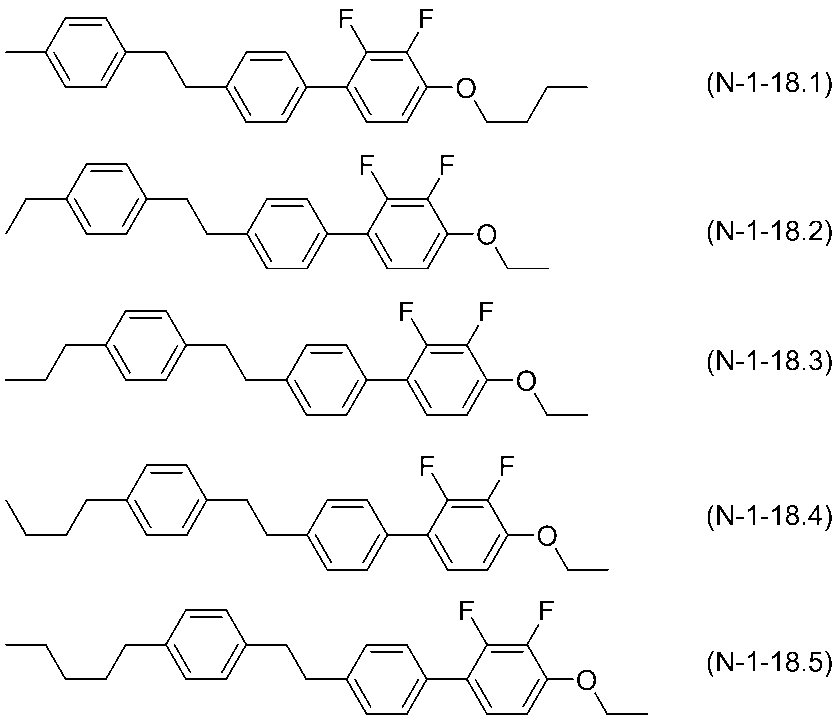
一般式(N-1-20)で表される化合物は下記の化合物である。

(式中、RN1201及びRN1202はそれぞれ独立して、一般式(N-1)におけるRN11及びRN12と同じ意味を表す。)
RN1201及びRN1202はそれぞれ独立して、炭素原子数1~5のアルキル基又は炭素原子数2~5のアルケニル基が好ましく、エチル基、プロピル基又はブチル基が好ましい。
RN1201及びRN1202はそれぞれ独立して、炭素原子数1~5のアルキル基又は炭素原子数2~5のアルケニル基が好ましく、エチル基、プロピル基又はブチル基が好ましい。
一般式(N-1-20)で表される化合物は単独で使用することもできるが、2以上の化合物を組み合わせて使用することもできる。組み合わせることができる化合物の種類に特に制限は無いが、低温での溶解性、転移温度、電気的な信頼性、複屈折率などの求められる性能に応じて適宜組み合わせて使用する。使用する化合物の種類は、例えば本発明の一つの実施形態としては1種類であり、2種類であり、3種類であり、4種類であり、5種類以上である。
Δεの改善を重視する場合には含有量を高めに設定することが好ましく、低温での溶解性を重視する場合は含有量を多めに設定すると効果が高く、TNIを重視する場合は含有量をおおめに設定すると効果が高い。さらに、滴下痕や焼き付き特性を改良する場合は、含有量の範囲を中間に設定することが好ましい。
本発明に係る光散乱型液晶素子用液晶組成物に含まれる非重合性液晶化合物の総量に対しての、式(N-1-20)で表される化合物の、好ましい含有量の下限値は0質量%であり、上限値は25質量%である。より好ましい含有量の下限値は0質量%であり、上限値は15質量%である。
一般式(N-1-21)で表される化合物は下記の化合物である。

(式中、RN1211及びRN1212はそれぞれ独立して、一般式(N-1)におけるRN11及びRN12と同じ意味を表す。)
RN1211及びRN1212はそれぞれ独立して、炭素原子数1~5のアルキル基又は炭素原子数2~5のアルケニル基が好ましく、エチル基、プロピル基又はブチル基が好ましい。
RN1211及びRN1212はそれぞれ独立して、炭素原子数1~5のアルキル基又は炭素原子数2~5のアルケニル基が好ましく、エチル基、プロピル基又はブチル基が好ましい。
一般式(N-1-21)で表される化合物は単独で使用することもできるが、2以上の化合物を組み合わせて使用することもできる。組み合わせることができる化合物の種類に特に制限は無いが、低温での溶解性、転移温度、電気的な信頼性、複屈折率などの求められる性能に応じて適宜組み合わせて使用する。使用する化合物の種類は、例えば本発明の一つの実施形態としては1種類であり、2種類であり、3種類であり、4種類であり、5種類以上である。
Δεの改善を重視する場合には含有量を高めに設定することが好ましく、低温での溶解性を重視する場合は含有量を多めに設定すると効果が高く、TNIを重視する場合は含有量をおおめに設定すると効果が高い。さらに、滴下痕や焼き付き特性を改良する場合は、含有量の範囲を中間に設定することが好ましい。
本発明に係る光散乱型液晶素子用液晶組成物に含まれる非重合性液晶化合物の総量に対しての、式(N-1-21)で表される化合物の、好ましい含有量の下限値は0質量%であり、上限値は25質量%である。より好ましい含有量の下限値は0質量%であり、上限値は15質量%である。
一般式(N-1-22)で表される化合物は下記の化合物である。

(式中、RN1221及びRN1222はそれぞれ独立して、一般式(N-1)におけるRN11及びRN12と同じ意味を表す。)
RN1221及びRN1222はそれぞれ独立して、炭素原子数1~5のアルキル基又は炭素原子数2~5のアルケニル基が好ましく、エチル基、プロピル基又はブチル基が好ましい。
RN1221及びRN1222はそれぞれ独立して、炭素原子数1~5のアルキル基又は炭素原子数2~5のアルケニル基が好ましく、エチル基、プロピル基又はブチル基が好ましい。
一般式(N-1-22)で表される化合物は単独で使用することもできるが、2以上の化合物を組み合わせて使用することもできる。組み合わせることができる化合物の種類に特に制限は無いが、低温での溶解性、転移温度、電気的な信頼性、複屈折率などの求められる性能に応じて適宜組み合わせて使用する。使用する化合物の種類は、例えば本発明の一つの実施形態としては1種類であり、2種類であり、3種類であり、4種類であり、5種類以上である。
Δεの改善を重視する場合には含有量を高めに設定することが好ましく、低温での溶解性を重視する場合は含有量を多めに設定すると効果が高く、TNIを重視する場合は含有量をおおめに設定すると効果が高い。さらに、滴下痕や焼き付き特性を改良する場合は、含有量の範囲を中間に設定することが好ましい。
本発明に係る光散乱型液晶素子用液晶組成物に含まれる非重合性液晶化合物の総量に対しての、式(N-1-21)で表される化合物の、好ましい含有量の下限値は0質量%であり、上限値は25質量%である。より好ましい含有量の下限値は0質量%であり、上限値は15質量%である。
さらに、一般式(N-1-22)で表される化合物は、式(N-1-22.1)から式(N-1-22.12)で表される化合物群から選ばれる化合物であることが好ましく、式(N-1-22.1)~(N-1-22.5)で表される化合物であることが好ましく、式(N-1-22.1)~(N-1-22.4)で表される化合物が好ましい。
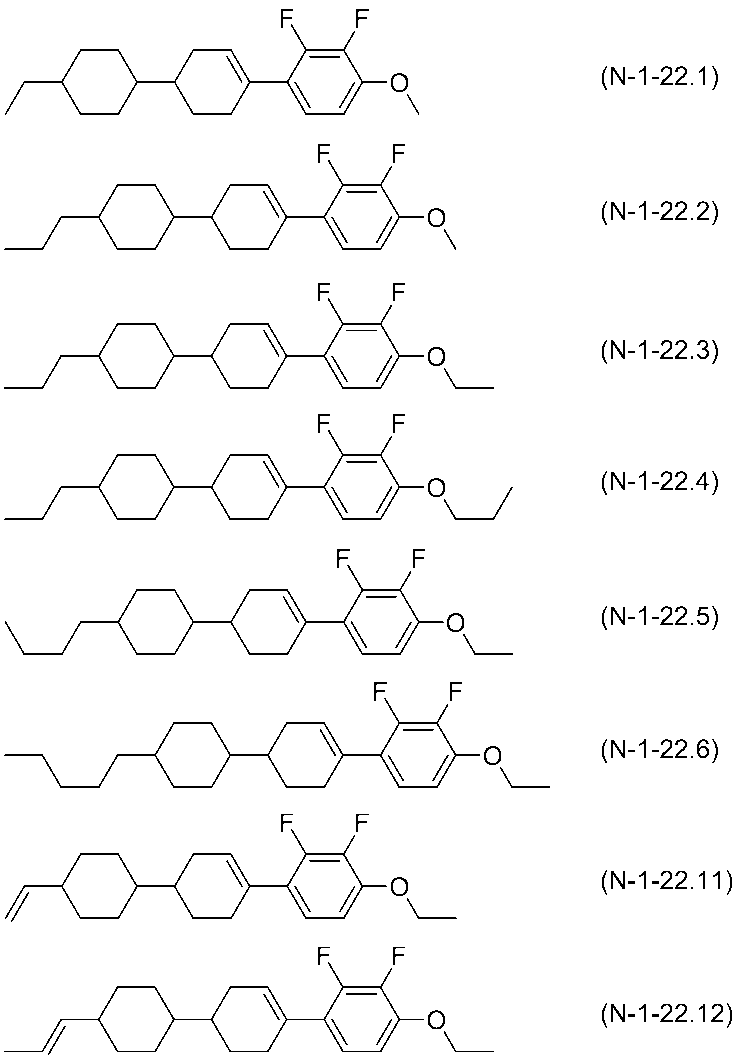
一般式(N-2)で表される化合物は、式(N-2-1)または式(N-2-2)で表される化合物群から選ばれる化合物であることが好ましい。

(式中、RN211及びRN212はそれぞれ独立して、一般式(N-2)におけるRN21及びRN22と同じ意味を表す。同様に、式中、RN221及びRN222はそれぞれ独立して、一般式(N-2)におけるRN21及びRN22と同じ意味を表す。)
RN211及び,及びRN221は炭素原子数1~5のアルキル基又は炭素原子数2~5のアルケニル基が好ましく、エチル基、プロピル基、ブチル基、ビニル基又は1-プロペニル基が好ましい。
RN211及び,及びRN221は炭素原子数1~5のアルキル基又は炭素原子数2~5のアルケニル基が好ましく、エチル基、プロピル基、ブチル基、ビニル基又は1-プロペニル基が好ましい。
RN221及び,及びRN222は炭素原子数1~5のアルキル基、炭素原子数4~5のアルケニル基又は炭素原子数1~4のアルコキシ基が好ましく、エトキシ基、プロポキシ基、又はブトキシ基が好ましい。
式(N-2-1)または式(N-2-2)で表される化合物は単独で使用することもできるが、2以上の化合物を組み合わせて使用することもできる。組み合わせることができる化合物の種類に特に制限は無いが、低温での溶解性、転移温度、電気的な信頼性、複屈折率などの求められる性能に応じて適宜組み合わせて使用する。使用する化合物の種類は、例えば本発明の一つの実施形態としては1種類であり、2種類であり、3種類であり、4種類であり、5種類以上である。
Δεの改善を重視する場合には含有量を高めに設定することが好ましく、低温での溶解性を重視する場合は含有量を多めに設定すると効果が高く、TNIを重視する場合は含有量を少なめに設定すると効果が高い。さらに、滴下痕や焼き付き特性を改良する場合は、含有量の範囲を中間に設定することが好ましい。
本発明に係る光散乱型液晶素子用液晶組成物に含まれる非重合性液晶化合物の総量に対しての、式(N-2-1)または式(N-2-2)で表される化合物の、好ましい含有量の下限値は0質量%であり、上限値は25質量%である。より好ましい含有量の下限値は0質量%であり、上限値は15質量%である。
さらに、式(N-2-1)または式(N-2-2)で表される化合物は、式(N-2-1.1)から式(N-2-1.5)、式(N-2-2.1)から式(N-2-2.2)で表される化合物群から選ばれる化合物であることが好ましい。

一般式(N-3)で表される化合物は一般式(N-3-2)で表される化合物群から選ばれる化合物であることが好ましい。

(式中、RN321及びRN322はそれぞれ独立して、一般式(N-3)におけるRN#1及びRN32と同じ意味を表す。)
RN321及びRN322は炭素原子数1~5のアルキル基又は炭素原子数2~5のアルケニル基が好ましく、プロピル基又はペンチル基が好ましい。
RN321及びRN322は炭素原子数1~5のアルキル基又は炭素原子数2~5のアルケニル基が好ましく、プロピル基又はペンチル基が好ましい。
一般式(N-3-2)で表される化合物は単独で使用することもできるが、2以上の化合物を組み合わせて使用することもできる。組み合わせることができる化合物の種類に特に制限は無いが、低温での溶解性、転移温度、電気的な信頼性、複屈折率などの求められる性能に応じて適宜組み合わせて使用する。使用する化合物の種類は、例えば本発明の一つの実施形態としては1種類であり、2種類であり、3種類であり、4種類であり、5種類以上である。
Δεの改善を重視する場合には含有量を高めに設定することが好ましく、低温での溶解性を重視する場合は含有量を多めに設定すると効果が高く、TNIを重視する場合は含有量を少なめに設定すると効果が高い。さらに、滴下痕や焼き付き特性を改良する場合は、含有量の範囲を中間に設定することが好ましい。
本発明に係る光散乱型液晶素子液晶用組成物に含まれる非重合性液晶化合物の総量に対しての、式(N-3-2)で表される化合物の、好ましい含有量の下限値は0質量%であり、上限値は25質量%である。より好ましい含有量の下限値は0質量%であり、上限値は15質量%である。
さらに、一般式(N-3-2)で表される化合物は、式(N-3-2.1)から式(N-3-2.3)で表される化合物群から選ばれる化合物であることが好ましい。
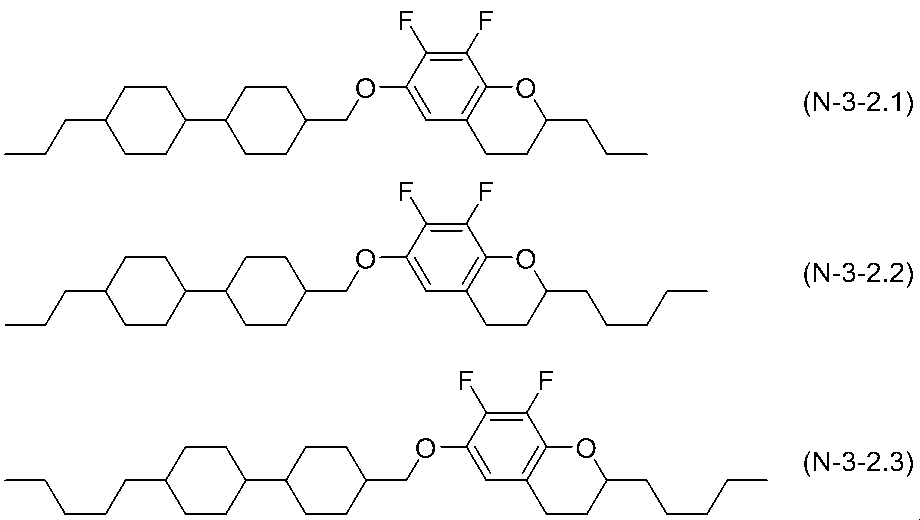
本発明に係る光散乱型液晶素子用液晶組成物には、非重合性液晶化合物として、一般式(L)で表される液晶化合物を1種類又は2種類以上含有することが好ましい。
一般式(L)で表される液晶化合物は誘電的にほぼ中性の化合物(誘電率異方性Δεの値が-2~2)に該当する。

(式中、RL1及びRL2はそれぞれ独立して炭素原子数1~8のアルキル基を表し、該アルキル基中の1個又は非隣接の2個以上の-CH2-はそれぞれ独立して-CH=CH-、-C≡C-、-O-、-CO-、-COO-又は-OCO-によって置換されていてもよく、
nL1は0、1、2又は3を表し、
AL1、AL2及びAL3はそれぞれ独立して
(a) 1,4-シクロヘキシレン基(この基中に存在する1個の-CH2-又は隣接していない2個以上の-CH2-は-O-に置き換えられてもよい。)及び
(b) 1,4-フェニレン基(この基中に存在する1個の-CH=又は隣接していない2個以上の-CH=は-N=に置き換えられてもよい。)
(c) ナフタレン-2,6-ジイル基、1,2,3,4-テトラヒドロナフタレン-2,6-ジイル基又はデカヒドロナフタレン-2,6-ジイル基(ナフタレン-2,6-ジイル基又は1,2,3,4-テトラヒドロナフタレン-2,6-ジイル基中に存在する1個の-CH=又は隣接していない2個以上の-CH=は-N=に置き換えられても良い。)
からなる群より選ばれる基を表し、上記の基(a)、基(b)及び基(c)の基中に存在する1つ又は2つ以上の水素原子はそれぞれ独立してシアノ基、フッ素原子又は塩素原子で置換されていても良く、
ZL1及びZL2はそれぞれ独立して単結合、-CH2CH2-、-(CH2)4-、-OCH2-、-CH2O-、-COO-、-OCO-、-OCF2-、-CF2O-、-CH=N-N=CH-、-CH=CH-、-CF=CF-又は-C≡C-を表し、
nL1が2又は3であってAL2が複数存在する場合は、それらは同一であっても異なっていても良く、nL1が2又は3であってZL2が複数存在する場合は、それらは同一であっても異なっていても良い。)
一般式(L)で表される化合物は単独で用いてもよいが、組み合わせて使用することもできる。組み合わせることができる化合物の種類に特に制限は無いが、低温での溶解性、転移温度、電気的な信頼性、複屈折率などの所望の性能に応じて適宜組み合わせて使用する。使用する化合物の種類は、例えば本発明の一つの実施形態としては1種類である。あるいは本発明の別の実施形態では2種類であり、3種類であり、4種類であり、5種類であり、6種類であり、7種類であり、8種類であり、9種類であり、10種類以上である。
nL1は0、1、2又は3を表し、
AL1、AL2及びAL3はそれぞれ独立して
(a) 1,4-シクロヘキシレン基(この基中に存在する1個の-CH2-又は隣接していない2個以上の-CH2-は-O-に置き換えられてもよい。)及び
(b) 1,4-フェニレン基(この基中に存在する1個の-CH=又は隣接していない2個以上の-CH=は-N=に置き換えられてもよい。)
(c) ナフタレン-2,6-ジイル基、1,2,3,4-テトラヒドロナフタレン-2,6-ジイル基又はデカヒドロナフタレン-2,6-ジイル基(ナフタレン-2,6-ジイル基又は1,2,3,4-テトラヒドロナフタレン-2,6-ジイル基中に存在する1個の-CH=又は隣接していない2個以上の-CH=は-N=に置き換えられても良い。)
からなる群より選ばれる基を表し、上記の基(a)、基(b)及び基(c)の基中に存在する1つ又は2つ以上の水素原子はそれぞれ独立してシアノ基、フッ素原子又は塩素原子で置換されていても良く、
ZL1及びZL2はそれぞれ独立して単結合、-CH2CH2-、-(CH2)4-、-OCH2-、-CH2O-、-COO-、-OCO-、-OCF2-、-CF2O-、-CH=N-N=CH-、-CH=CH-、-CF=CF-又は-C≡C-を表し、
nL1が2又は3であってAL2が複数存在する場合は、それらは同一であっても異なっていても良く、nL1が2又は3であってZL2が複数存在する場合は、それらは同一であっても異なっていても良い。)
一般式(L)で表される化合物は単独で用いてもよいが、組み合わせて使用することもできる。組み合わせることができる化合物の種類に特に制限は無いが、低温での溶解性、転移温度、電気的な信頼性、複屈折率などの所望の性能に応じて適宜組み合わせて使用する。使用する化合物の種類は、例えば本発明の一つの実施形態としては1種類である。あるいは本発明の別の実施形態では2種類であり、3種類であり、4種類であり、5種類であり、6種類であり、7種類であり、8種類であり、9種類であり、10種類以上である。
本発明に係る光散乱型液晶素子用液晶組成物において、一般式(L)で表される液晶化合物の含有量は、低温での溶解性、転移温度、電気的な信頼性、複屈折率、プロセス適合性、滴下痕、焼き付き、誘電率異方性などの求められる性能に応じて適宜調整する必要がある。
本発明に係る光散乱型液晶素子用液晶組成物に含まれる非重合性液晶化合物の総量に対しての、式(L)で表される化合物の、好ましい含有量の下限値は1質量%であり、上限値は85質量%である。より好ましい含有量の下限値は3質量%であり、上限値は65質量%である。
該組成物の粘度を低く保ち、応答速度が速い組成物が必要な場合は上記の下限値が高く上限値が高いことが好ましい。さらに、本発明に係る組成物のTNIを高く保ち、温度安定性の良い組成物が必要な場合は上記の下限値が高く上限値が高いことが好ましい。また、駆動電圧を低く保つために誘電率異方性を大きくしたいときは、上記の下限値を低く上限値が低いことが好ましい。
信頼性を重視する場合にはRL1及びRL2はともにアルキル基であることが好ましく、化合物の揮発性を低減させることを重視する場合にはアルコキシ基であることが好ましく、粘性の低下を重視する場合には少なくとも一方はアルケニル基であることが好ましい。
分子内に存在するハロゲン原子は0、1、2又は3個が好ましく、0又は1が好ましく、他の液晶分子との相溶性を重視する場合には1が好ましい。
RL1及びRL2は、それが結合する環構造がフェニル基(芳香族)である場合には、直鎖状の炭素原子数1~5のアルキル基、直鎖状の炭素原子数1~4のアルコキシ基及び炭素原子数4~5のアルケニル基が好ましく、それが結合する環構造がシクロヘキサン、ピラン及びジオキサンなどの飽和した環構造の場合には、直鎖状の炭素原子数1~5のアルキル基、直鎖状の炭素原子数1~4のアルコキシ基及び直鎖状の炭素原子数2~5のアルケニル基が好ましい。ネマチック相を安定化させるためには炭素原子及び存在する場合酸素原子の合計が5以下であることが好ましく、直鎖状であることが好ましい。
アルケニル基としては、式(R1)から式(R5)のいずれかで表される基から選ばれることが好ましい。(各式中の黒点は環構造中の炭素原子を表す。)

nL1は応答速度を重視する場合には0が好ましく、ネマチック相の上限温度を改善するためには2又は3が好ましく、これらのバランスをとるためには1が好ましい。また、組成物として求められる特性を満たすためには異なる値の化合物を組み合わせることが好ましい。
AL1、AL2及びAL3はΔnを大きくすることが求められる場合には芳香族であることが好ましく、応答速度を改善するためには脂肪族であることが好ましく、それぞれ独立してトランス-1,4-シクロへキシレン基、1,4-フェニレン基、2-フルオロ-1,4-フェニレン基、3-フルオロ-1,4-フェニレン基、3,5-ジフルオロ-1,4-フェニレン基、1,4-シクロヘキセニレン基、1,4-ビシクロ[2.2.2]オクチレン基、ピペリジン-1,4-ジイル基、ナフタレン-2,6-ジイル基、デカヒドロナフタレン-2,6-ジイル基又は1,2,3,4-テトラヒドロナフタレン-2,6-ジイル基を表すことが好ましく、下記の構造を表すことがより好ましく、
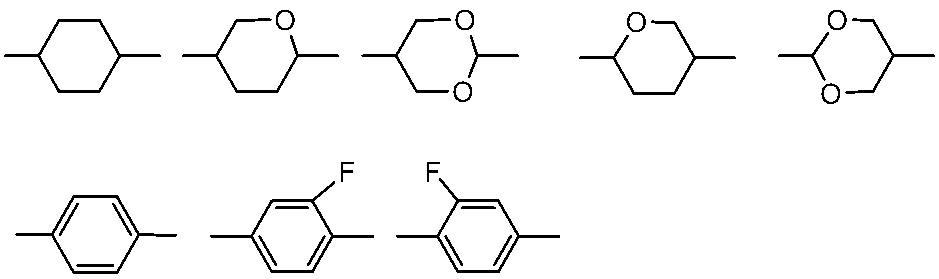
トランス-1,4-シクロへキシレン基又は1,4-フェニレン基を表すことがより好ましい。
ZL1及びZL2は応答速度を重視する場合には単結合であることが好ましい。
一般式(L)で表される化合物は分子内のハロゲン原子数が0個又は1個であることが好ましい。
一般式(L)で表される化合物は一般式(L-1)~(L-9)で表される化合物群から選ばれる化合物であることが好ましい。
一般式(L-1)で表される化合物は下記の化合物である。

(式中、RL11及びRL12はそれぞれ独立して、一般式(L)におけるRL1及びRL2と同じ意味を表す。)
RL11及びRL12は、直鎖状の炭素原子数1~5のアルキル基、直鎖状の炭素原子数1~4のアルコキシ基及び直鎖状の炭素原子数2~5のアルケニル基が好ましい。
RL11及びRL12は、直鎖状の炭素原子数1~5のアルキル基、直鎖状の炭素原子数1~4のアルコキシ基及び直鎖状の炭素原子数2~5のアルケニル基が好ましい。
一般式(L-1)で表される化合物は単独で使用することもできるが、2以上の化合物を組み合わせて使用することもできる。組み合わせることができる化合物の種類に特に制限は無いが、低温での溶解性、転移温度、電気的な信頼性、複屈折率などの求められる性能に応じて適宜組み合わせて使用する。使用する化合物の種類は、例えば本発明の一つの実施形態としては1種類であり、2種類であり、3種類であり、4種類であり、5種類以上である。
好ましい含有量の下限値は、本発明に係る光散乱型液晶素子用液晶組成物に含まれる非重合性液晶化合物の総量に対して0質量%であり、上限値は30質量%である。より好ましい含有量の下限値は0質量%であり、上限値は20質量%である。
該組成物の粘度を低く保ち、応答速度が速い組成物が必要な場合は上記の下限値が高く上限値が高いことが好ましい。さらに、該組成物のTNIを高く保ち、温度安定性の良い組成物が必要な場合は上記の下限値が中庸で上限値が中庸であることが好ましい。また、駆動電圧を低く保つために誘電率異方性を大きくしたいときは、上記の下限値が低く上限値が低いことが好ましい。
一般式(L-1)で表される化合物は一般式(L-1-1)で表される化合物群から選ばれる化合物であることが好ましい。

(式中RL12は一般式(L-1)における意味と同じ意味を表す。)
一般式(L-1-1)で表される化合物は、式(L-1-1.1)から式(L-1-1.3)で表される化合物群から選ばれる化合物であることが好ましく、式(L-1-1.2)又は式(L-1-1.3)で表される化合物であることが好ましく、特に、式(L-1-1.3)で表される化合物であることが好ましい。
一般式(L-1-1)で表される化合物は、式(L-1-1.1)から式(L-1-1.3)で表される化合物群から選ばれる化合物であることが好ましく、式(L-1-1.2)又は式(L-1-1.3)で表される化合物であることが好ましく、特に、式(L-1-1.3)で表される化合物であることが好ましい。
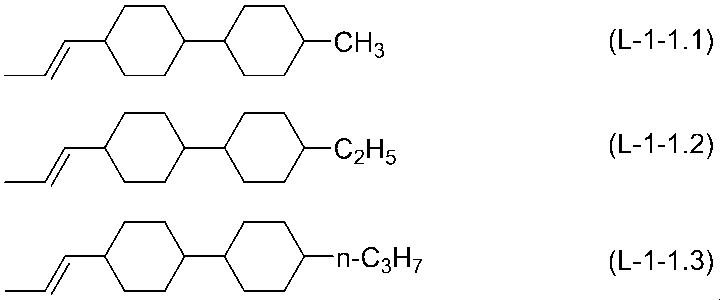
本発明に係る光散乱型液晶素子用液晶組成物に含まれる非重合性液晶化合物の総量に対しての、式(L-1-1.3)で表される化合物の、好ましい含有量の下限値は0%であり、上限値は20質量%である。より好ましい含有量の下限値は0質量%であり、上限値は13質量%である。
一般式(L-1)で表される化合物は一般式(L-1-2)で表される化合物群から選ばれる化合物であることが好ましい。

(式中RL12は一般式(L-1)における意味と同じ意味を表す。)
本発明に係る光散乱型液晶素子用液晶組成物に含まれる非重合性液晶化合物の総量に対しての、式(L-1-2)で表される化合物の、好ましい含有量の下限値は0質量%であり、上限値は25質量%である。より好ましい含有量の下限値は0質量%であり、上限値は15質量%である。
本発明に係る光散乱型液晶素子用液晶組成物に含まれる非重合性液晶化合物の総量に対しての、式(L-1-2)で表される化合物の、好ましい含有量の下限値は0質量%であり、上限値は25質量%である。より好ましい含有量の下限値は0質量%であり、上限値は15質量%である。
さらに、一般式(L-1-2)で表される化合物は、式(L-1-2.1)から式(L-1-2.4)で表される化合物群から選ばれる化合物であることが好ましく、式(L-1-2.2)から式(L-1-2.4)で表される化合物であることが好ましい。特に、式(L-1-2.2)で表される化合物は該組成物の応答速度を特に改善するため好ましい。また、応答速度よりも高いTNIを求めるときは、式(L-1-2.3)又は式(L-1-2.4)で表される化合物を用いることが好ましい。式(L-1-2.3)及び式(L-1-2.4)で表される化合物の含有量は、低温での溶解度を良くするために30質量%以上にすることは好ましくない。

一般式(L-1)で表される化合物は一般式(L-1-3)で表される化合物群から選ばれる化合物であることが好ましい。

(式中RL13及びRL14はそれぞれ独立して炭素原子数1~8のアルキル基又は炭素原子数1~8のアルコキシ基を表す。)
RL13及びRL14は、直鎖状の炭素原子数1~5のアルキル基、直鎖状の炭素原子数1~4のアルコキシ基及び直鎖状の炭素原子数2~5のアルケニル基が好ましい。
本発明に係る光散乱型液晶素子用液晶組成物に含まれる非重合性液晶化合物の総量に対しての、式(L-1-3)で表される化合物の、好ましい含有量の下限値は0質量%であり、上限値は25質量%である。より好ましい含有量の下限値は0質量%であり、上限値は15質量%である。
RL13及びRL14は、直鎖状の炭素原子数1~5のアルキル基、直鎖状の炭素原子数1~4のアルコキシ基及び直鎖状の炭素原子数2~5のアルケニル基が好ましい。
本発明に係る光散乱型液晶素子用液晶組成物に含まれる非重合性液晶化合物の総量に対しての、式(L-1-3)で表される化合物の、好ましい含有量の下限値は0質量%であり、上限値は25質量%である。より好ましい含有量の下限値は0質量%であり、上限値は15質量%である。
さらに、一般式(L-1-3)で表される化合物は、式(L-1-3.1)から式(L-1-3.12)で表される化合物群から選ばれる化合物であることが好ましく、式(L-1-3.1)、式(L-1-3.3)又は式(L-1-3.4)で表される化合物であることが好ましい。特に、式(L-1-3.1)で表される化合物は該組成物の応答速度を特に改善するため好ましい。また、応答速度よりも高いTNIを求めるときは、式(L-1-3.3)、式(L-1-3.4)、式(L-1-3.11)及び式(L-1-3.12)で表される化合物を用いることが好ましい。式(L-1-3.3)、式(L-1-3.4)、式(L-1-3.11)及び式(L-1-3.12)で表される化合物の合計の含有量は、低温での溶解度を良くするために20質量%以上にすることは好ましくない。

一般式(L-1)で表される化合物は一般式(L-1-4)及び/又は(L-1-5)で表される化合物群から選ばれる化合物であることが好ましい。

(式中RL15及びRL16はそれぞれ独立して炭素原子数1~8のアルキル基又は炭素原子数1~8のアルコキシ基を表す。)
RL15及びRL16は、直鎖状の炭素原子数1~5のアルキル基、直鎖状の炭素原子数1~4のアルコキシ基及び直鎖状の炭素原子数2~5のアルケニル基が好ましい。
本発明に係る光散乱型液晶素子用液晶組成物に含まれる非重合性液晶化合物の総量に対しての、式(L-1-4)で表される化合物の、好ましい含有量の下限値は0質量%であり、上限値は25質量%である。より好ましい含有量の下限値は0質量%であり、上限値は15質量%である。
本発明に係る光散乱型液晶素子用液晶組成物に含まれる非重合性液晶化合物の総量に対しての、式(L-1-5)で表される化合物の、好ましい含有量の下限値は0質量%であり、上限値は25質量%である。より好ましい含有量の下限値は0質量%であり、上限値は15質量%である。
RL15及びRL16は、直鎖状の炭素原子数1~5のアルキル基、直鎖状の炭素原子数1~4のアルコキシ基及び直鎖状の炭素原子数2~5のアルケニル基が好ましい。
本発明に係る光散乱型液晶素子用液晶組成物に含まれる非重合性液晶化合物の総量に対しての、式(L-1-4)で表される化合物の、好ましい含有量の下限値は0質量%であり、上限値は25質量%である。より好ましい含有量の下限値は0質量%であり、上限値は15質量%である。
本発明に係る光散乱型液晶素子用液晶組成物に含まれる非重合性液晶化合物の総量に対しての、式(L-1-5)で表される化合物の、好ましい含有量の下限値は0質量%であり、上限値は25質量%である。より好ましい含有量の下限値は0質量%であり、上限値は15質量%である。
さらに、一般式(L-1-4)及び(L-1-5)で表される化合物は、式(L-1-4.1)から式(L-1-5.3)で表される化合物群から選ばれる化合物であることが好ましく、式(L-1-4.2)又は式(L-1-5.2)で表される化合物であることが好ましい。

組成物の信頼性を重視する場合には、式(L-1-3.1)、式(L-1-3.3)及び式(L-1-3.4))で表される化合物から選ばれる2種以上の化合物を組み合わせることが好ましく、組成物の応答速度を重視する場合には、式(L-1-1.3)、式(L-1-2.2)で表される化合物から選ばれる2種以上の化合物を組み合わせることが好ましい。
一般式(L-1)で表される化合物は一般式(L-1-6)で表される化合物群から選ばれる化合物であることが好ましい。
一般式(L-1)で表される化合物は一般式(L-1-6)で表される化合物群から選ばれる化合物であることが好ましい。

(式中RL17及びRL18はそれぞれ独立してメチル基又は水素原子を表す。)
本発明に係る光散乱型液晶素子用液晶組成物に含まれる非重合性液晶化合物の総量に対しての、式(L-1-6)で表される化合物の、好ましい含有量の下限値は0質量%であり、上限値は25質量%である。より好ましい含有量の下限値は0質量%であり、上限値は15質量%である。
本発明に係る光散乱型液晶素子用液晶組成物に含まれる非重合性液晶化合物の総量に対しての、式(L-1-6)で表される化合物の、好ましい含有量の下限値は0質量%であり、上限値は25質量%である。より好ましい含有量の下限値は0質量%であり、上限値は15質量%である。
さらに、一般式(L-1-6)で表される化合物は、式(L-1-6.1)から式(L-1-6.3)で表される化合物群から選ばれる化合物であることが好ましい。

一般式(L-2)で表される化合物は下記の化合物である。

(式中、RL21及びRL22はそれぞれ独立して、一般式(L)におけるRL1及びRL2と同じ意味を表す。)
RL21は炭素原子数1~5のアルキル基又は炭素原子数2~5のアルケニル基が好ましく、RL22は炭素原子数1~5のアルキル基、炭素原子数4~5のアルケニル基又は炭素原子数1~4のアルコキシ基が好ましい。
RL21は炭素原子数1~5のアルキル基又は炭素原子数2~5のアルケニル基が好ましく、RL22は炭素原子数1~5のアルキル基、炭素原子数4~5のアルケニル基又は炭素原子数1~4のアルコキシ基が好ましい。
一般式(L-1)で表される化合物は単独で使用することもできるが、2以上の化合物を組み合わせて使用することもできる。組み合わせることができる化合物の種類に特に制限は無いが、低温での溶解性、転移温度、電気的な信頼性、複屈折率などの求められる性能に応じて適宜組み合わせて使用する。使用する化合物の種類は、例えば本発明の一つの実施形態としては1種類であり、2種類であり、3種類であり、4種類であり、5種類以上である。
低温での溶解性を重視する場合は含有量を多めに設定すると効果が高く、反対に、応答速度を重視する場合は含有量を少なめに設定すると効果が高い。さらに、滴下痕や焼き付き特性を改良する場合は、含有量の範囲を中間に設定することが好ましい。
本発明に係る光散乱型液晶素子用液晶組成物に含まれる非重合性液晶化合物の総量に対しての、式(L-2)で表される化合物の、好ましい含有量の下限値は0質量%であり、上限値は25質量%である。より好ましい含有量の下限値は0質量%であり、上限値は15質量%である。
さらに、一般式(L-2)で表される化合物は、式(L-2.1)から式(L-2.6)で表される化合物群から選ばれる化合物であることが好ましく、式(L-2.1)、式(L-2.3)、式(L-2.4)及び式(L-2.6)で表される化合物であることが好ましい。

一般式(L-3)で表される化合物は下記の化合物である。

(式中、RL31及びRL32はそれぞれ独立して、一般式(L)におけるRL1及びRL2と同じ意味を表す。)
RL31及びRL32はそれぞれ独立して炭素原子数1~5のアルキル基、炭素原子数4~5のアルケニル基又は炭素原子数1~4のアルコキシ基が好ましい。
RL31及びRL32はそれぞれ独立して炭素原子数1~5のアルキル基、炭素原子数4~5のアルケニル基又は炭素原子数1~4のアルコキシ基が好ましい。
一般式(L-3)で表される化合物は単独で使用することもできるが、2以上の化合物を組み合わせて使用することもできる。組み合わせることができる化合物の種類に特に制限は無いが、低温での溶解性、転移温度、電気的な信頼性、複屈折率などの求められる性能に応じて適宜組み合わせて使用する。使用する化合物の種類は、例えば本発明の一つの実施形態としては1種類であり、2種類であり、3種類であり、4種類であり、5種類以上である。
本発明に係る光散乱型液晶素子用液晶組成物に含まれる非重合性液晶化合物の総量に対しての、式(L-3)で表される化合物の、好ましい含有量の下限値は0質量%であり、上限値は50質量%である。より好ましい含有量の下限値は1質量%であり、上限値は35質量%である。
高い複屈折率を得る場合は含有量を多めに設定すると効果が高く、反対に、高いTNIを重視する場合は含有量を少なめに設定すると効果が高い。さらに、滴下痕や焼き付き特性を改良する場合は、含有量の範囲を中間に設定することが好ましい。
さらに、一般式(L-3)で表される化合物は、式(L-3.1)から式(L-3.7)で表される化合物群から選ばれる化合物であることが好ましく、式(L-3.1)から式(L-3.4)で表される化合物であることが好ましい。

一般式(L-4)で表される化合物は下記の化合物である。

(式中、RL41及びRL42はそれぞれ独立して、一般式(L)におけるRL1及びRL2と同じ意味を表す。)
RL41は炭素原子数1~5のアルキル基又は炭素原子数2~5のアルケニル基が好ましく、RL42は炭素原子数1~5のアルキル基、炭素原子数4~5のアルケニル基又は炭素原子数1~4のアルコキシ基が好ましい。)
一般式(L-4)で表される化合物は単独で使用することもできるが、2以上の化合物を組み合わせて使用することもできる。組み合わせることができる化合物の種類に特に制限は無いが、低温での溶解性、転移温度、電気的な信頼性、複屈折率などの求められる性能に応じて適宜組み合わせて使用する。使用する化合物の種類は、例えば本発明の一つの実施形態としては1種類であり、2種類であり、3種類であり、4種類であり、5種類以上である。
RL41は炭素原子数1~5のアルキル基又は炭素原子数2~5のアルケニル基が好ましく、RL42は炭素原子数1~5のアルキル基、炭素原子数4~5のアルケニル基又は炭素原子数1~4のアルコキシ基が好ましい。)
一般式(L-4)で表される化合物は単独で使用することもできるが、2以上の化合物を組み合わせて使用することもできる。組み合わせることができる化合物の種類に特に制限は無いが、低温での溶解性、転移温度、電気的な信頼性、複屈折率などの求められる性能に応じて適宜組み合わせて使用する。使用する化合物の種類は、例えば本発明の一つの実施形態としては1種類であり、2種類であり、3種類であり、4種類であり、5種類以上である。
該組成物において、一般式(L-4)で表される化合物の含有量は、低温での溶解性、転移温度、電気的な信頼性、複屈折率、プロセス適合性、滴下痕、焼き付き、誘電率異方性などの求められる性能に応じて適宜調整する必要がある。
本発明に係る光散乱型液晶素子用液晶組成物に含まれる非重合性液晶化合物の総量に対しての、式(L-4)で表される化合物の、好ましい含有量の下限値は0質量%であり、上限値は35質量%である。より好ましい含有量の下限値は1質量%であり、上限値は25質量%である。
一般式(L-4)で表される化合物は、例えば式(L-4.1)から式(L-4.3)で表される化合物であることが好ましい。

低温での溶解性、転移温度、電気的な信頼性、複屈折率などの求められる性能に応じて、式(L-4.1)で表される化合物を含有していても、式(L-4.2)で表される化合物を含有していても、式(L-4.1)で表される化合物と式(L-4.2)で表される化合物との両方を含有していても良いし、式(L-4.1)から式(L-4.3)で表される化合物を全て含んでいても良い。
一般式(L-4)で表される化合物は、例えば式(L-4.4)から式(L-4.6)で表される化合物であることが好ましく、式(L-4.4)で表される化合物であることが好ましい。
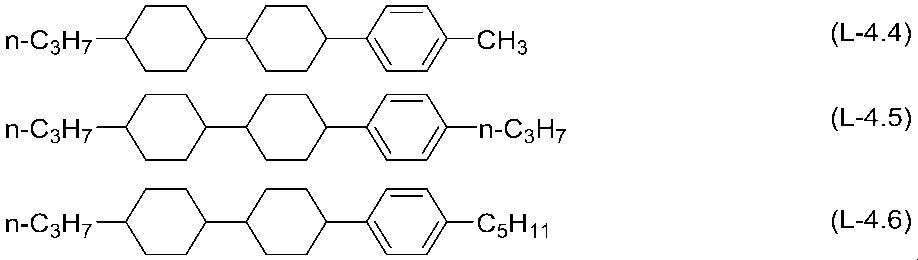
低温での溶解性、転移温度、電気的な信頼性、複屈折率などの求められる性能に応じて、式(L-4.4)で表される化合物を含有していても、式(L-4.5)で表される化合物を含有していても、式(L-4.4)で表される化合物と式(L-4.5)で表される化合物との両方を含有していても良い。
一般式(L-4)で表される化合物は、式(L-4.7)から式(L-4.10)で表される化合物であることが好ましく、特に、式(L-4.9)で表される化合物が好ましい。

一般式(L-5)で表される化合物は下記の化合物である。

(式中、RL51及びRL52はそれぞれ独立して、一般式(L)におけるRL1及びRL2と同じ意味を表す。)
RL51は炭素原子数1~5のアルキル基又は炭素原子数2~5のアルケニル基が好ましく、RL52は炭素原子数1~5のアルキル基、炭素原子数4~5のアルケニル基又は炭素原子数1~4のアルコキシ基が好ましい。
RL51は炭素原子数1~5のアルキル基又は炭素原子数2~5のアルケニル基が好ましく、RL52は炭素原子数1~5のアルキル基、炭素原子数4~5のアルケニル基又は炭素原子数1~4のアルコキシ基が好ましい。
一般式(L-5)で表される化合物は単独で使用することもできるが、2以上の化合物を組み合わせて使用することもできる。組み合わせることができる化合物の種類に特に制限は無いが、低温での溶解性、転移温度、電気的な信頼性、複屈折率などの求められる性能に応じて適宜組み合わせて使用する。使用する化合物の種類は、例えば本発明の一つの実施形態としては1種類であり、2種類であり、3種類であり、4種類であり、5種類以上である。
該組成物において、一般式(L-5)で表される化合物の含有量は、低温での溶解性、転移温度、電気的な信頼性、複屈折率、プロセス適合性、滴下痕、焼き付き、誘電率異方性などの求められる性能に応じて適宜調整する必要がある。
本発明に係る光散乱型液晶素子用液晶組成物に含まれる非重合性液晶化合物の総量に対しての、式(L-5)で表される化合物の好ましい含有量の下限値は0質量%であり、上限値は50質量%である。より好ましい含有量の下限値は1質量%であり、上限値は35質量%である。
一般式(L-5)で表される化合物は、式(L-5.1)又は式(L-5.2)で表される化合物であることが好ましく、特に、式(L-5.1)で表される化合物であることが好ましい。
本発明に係る光散乱型液晶素子用液晶組成物に含まれる非重合性液晶化合物の総量に対しての、これら化合物の、好ましい含有量の下限値は0質量%であり、上限値は20質量%である。より好ましい含有量の下限値は0質量%であり、上限値は13質量%である。

一般式(L-5)で表される化合物は、式(L-5.3)又は式(L-5.4)で表される化合物であることが好ましい。
本発明に係る光散乱型液晶素子用液晶組成物に含まれる非重合性液晶化合物の総量に対しての、これら化合物の、好ましい含有量の下限値は0質量%であり、上限値は50質量%である。より好ましい含有量の下限値は1質量%であり、上限値は35質量%である。

一般式(L-5)で表される化合物は、式(L-5.5)から式(L-5.7)で表される化合物群から選ばれる化合物であることが好ましく、特に式(L-5.7)で表される化合物であることが好ましい。
本発明に係る光散乱型液晶素子用液晶組成物に含まれる非重合性液晶化合物の総量に対しての、これら化合物の、好ましい含有量の下限値は0質量%であり、上限値は20質量%である。より好ましい含有量の下限値は0質量%であり、上限値は13質量%である。
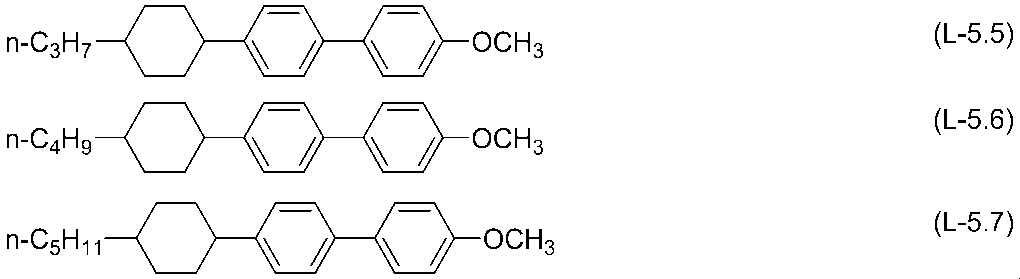
一般式(L-6)で表される化合物は下記の化合物である。

(式中、RL61及びRL62はそれぞれ独立して、一般式(L)におけるRL1及びRL2と同じ意味を表し、XL61及びXL62はそれぞれ独立して水素原子又はフッ素原子を表す。)
RL61及びRL62はそれぞれ独立して炭素原子数1~5のアルキル基又は炭素原子数2~5のアルケニル基が好ましく、XL61及びXL62のうち一方がフッ素原子他方が水素原子であることが好ましい。
RL61及びRL62はそれぞれ独立して炭素原子数1~5のアルキル基又は炭素原子数2~5のアルケニル基が好ましく、XL61及びXL62のうち一方がフッ素原子他方が水素原子であることが好ましい。
一般式(L-6)で表される化合物は単独で使用することもできるが、2以上の化合物を組み合わせて使用することもできる。組み合わせることができる化合物の種類に特に制限は無いが、低温での溶解性、転移温度、電気的な信頼性、複屈折率などの求められる性能に応じて適宜組み合わせて使用する。使用する化合物の種類は、例えば本発明の一つの実施形態としては1種類であり、2種類であり、3種類であり、4種類であり、5種類以上である。
本発明に係る光散乱型液晶素子用液晶組成物に含まれる非重合性液晶化合物の総量に対しての、式(L-6)で表される化合物の、好ましい含有量の下限値は0質量%であり、上限値は35質量%である。より好ましい含有量の下限値は0質量%であり、上限値は25質量%である。Δnを大きくすることに重点を置く場合には含有量を多くした方が好ましく、低温での析出に重点を置いた場合には含有量は少ない方が好ましい。
一般式(L-6)で表される化合物は、式(L-6.1)から式(L-6.9)で表される化合物であることが好ましい。

組み合わせることができる化合物の種類に特に制限は無いが、これらの化合物の中から1種~3種類含有することが好ましく、1種~4種類含有することがさらに好ましい。また、選ぶ化合物の分子量分布が広いことも溶解性に有効であるため、例えば、式(L-6.1)又は(L-6.2)で表される化合物から1種類、式(L-6.4)又は(L-6.5)で表される化合物から1種類、式(L-6.6)又は式(L-6.7)で表される化合物から1種類、式(L-6.8)又は(L-6.9)で表される化合物から1種類の化合物を選び、これらを適宜組み合わせることが好ましい。その中でも、式(L-6.1)、式(L-6.3)式(L-6.4)、式(L-6.6)及び式(L-6.9)で表される化合物を含むことが好ましい。
さらに、一般式(L-6)で表される化合物は、例えば式(L-6.10)から式(L-6.17)で表される化合物であることが好ましく、その中でも、式(L-6.11)で表される化合物であることが好ましい。
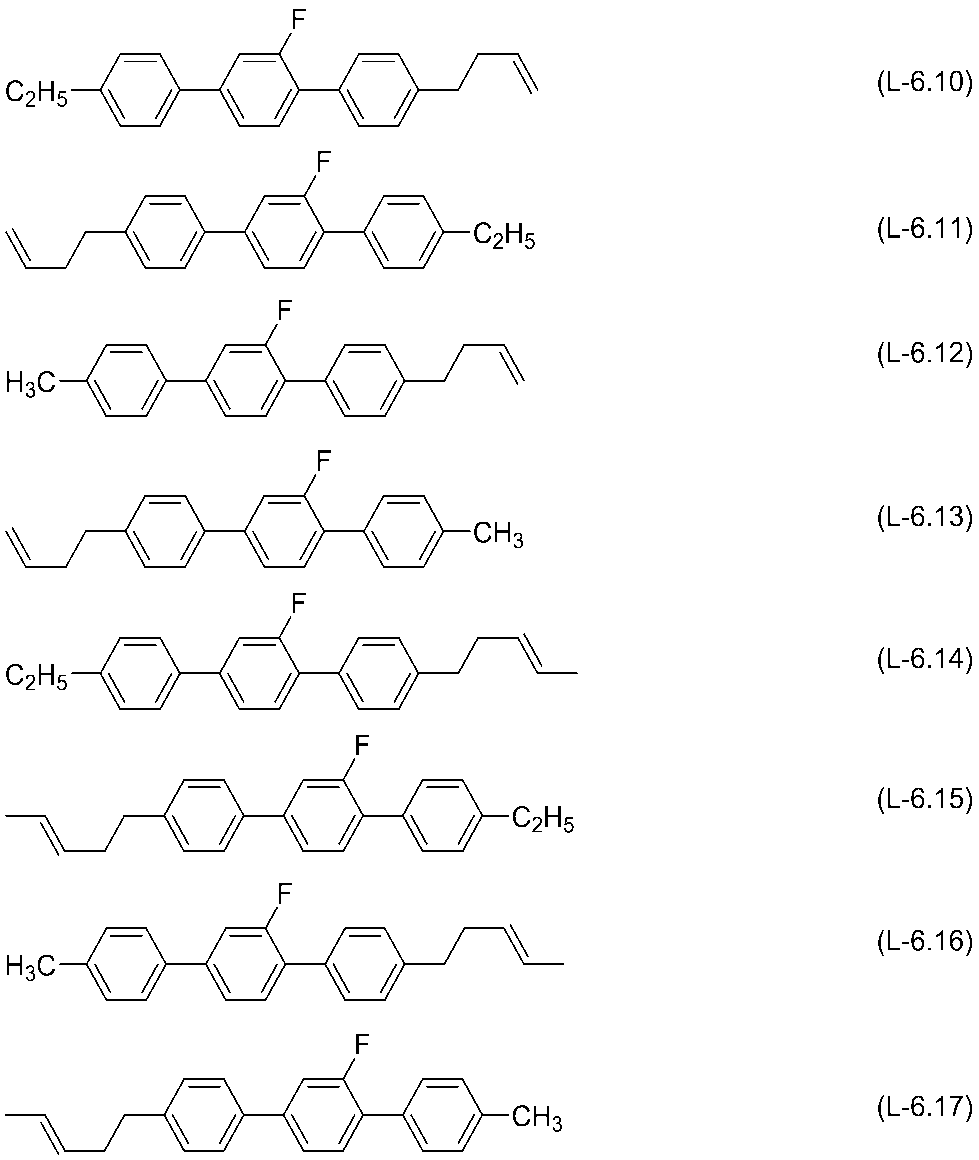
一般式(L-7)で表される化合物は下記の化合物である。

(式中、RL71及びRL72はそれぞれ独立して一般式(L)におけるRL1及びRL2と同じ意味を表し、AL71及びAL72はそれぞれ独立して一般式(L)におけるAL2及びAL3と同じ意味を表すが、AL71及びAL72上の水素原子はそれぞれ独立してフッ素原子によって置換されていてもよく、ZL71は一般式(L)におけるZL2と同じ意味を表し、XL71及びXL72はそれぞれ独立してフッ素原子又は水素原子を表す。)
式中、RL71及びRL72はそれぞれ独立して炭素原子数1~5のアルキル基、炭素原子数2~5のアルケニル基又は炭素原子数1~4のアルコキシ基が好ましく、AL71及びAL72はそれぞれ独立して1,4-シクロヘキシレン基又は1,4-フェニレン基が好ましく、AL71及びAL72上の水素原子はそれぞれ独立してフッ素原子によって置換されていてもよく、ZL71は単結合又はCOO-が好ましく、単結合が好ましく、XL71及びXL72は水素原子が好ましい。
式中、RL71及びRL72はそれぞれ独立して炭素原子数1~5のアルキル基、炭素原子数2~5のアルケニル基又は炭素原子数1~4のアルコキシ基が好ましく、AL71及びAL72はそれぞれ独立して1,4-シクロヘキシレン基又は1,4-フェニレン基が好ましく、AL71及びAL72上の水素原子はそれぞれ独立してフッ素原子によって置換されていてもよく、ZL71は単結合又はCOO-が好ましく、単結合が好ましく、XL71及びXL72は水素原子が好ましい。
組み合わせることができる化合物の種類に特に制限は無いが、低温での溶解性、転移温度、電気的な信頼性、複屈折率などの求められる性能に応じて組み合わせる。使用する化合物の種類は、例えば本発明の一つの実施形態としては1種類であり、2種類であり、3種類であり、4種類である。
該組成物において、一般式(L-7)で表される化合物の含有量は、低温での溶解性、転移温度、電気的な信頼性、複屈折率、プロセス適合性、滴下痕、焼き付き、誘電率異方性などの求められる性能に応じて適宜調整する必要がある。
本発明に係る光散乱型液晶素子用液晶組成物に含まれる非重合性液晶化合物の総量に対しての、式(L-7)で表される化合物の、好ましい含有量の下限値は0質量%であり、上限値は25質量%である。より好ましい含有量の下限値は0質量%であり、上限値は15質量%である。
該組成物が高いTNIの実施形態が望まれる場合は式(L-7)で表される化合物の含有量を多めにすることが好ましく、低粘度の実施形態が望まれる場合は含有量を少なめにすることが好ましい。
さらに、一般式(L-7)で表される化合物は、式(L-7.1)から式(L-7.4)で表される化合物であることが好ましく、式(L-7.2)で表される化合物であることが好ましい。

さらに、一般式(L-7)で表される化合物は、式(L-7.11)から式(L-7.13)で表される化合物であることが好ましく、式(L-7.11)で表される化合物であることが好ましい。

さらに、一般式(L-7)で表される化合物は、式(L-7.21)から式(L-7.23)で表される化合物である。式(L-7.21)で表される化合物であることが好ましい。

さらに、一般式(L-7)で表される化合物は、式(L-7.31)から式(L-7.34)で表される化合物であることが好ましく、式(L-7.31)又は/及び式(L-7.32)で表される化合物であることが好ましい。
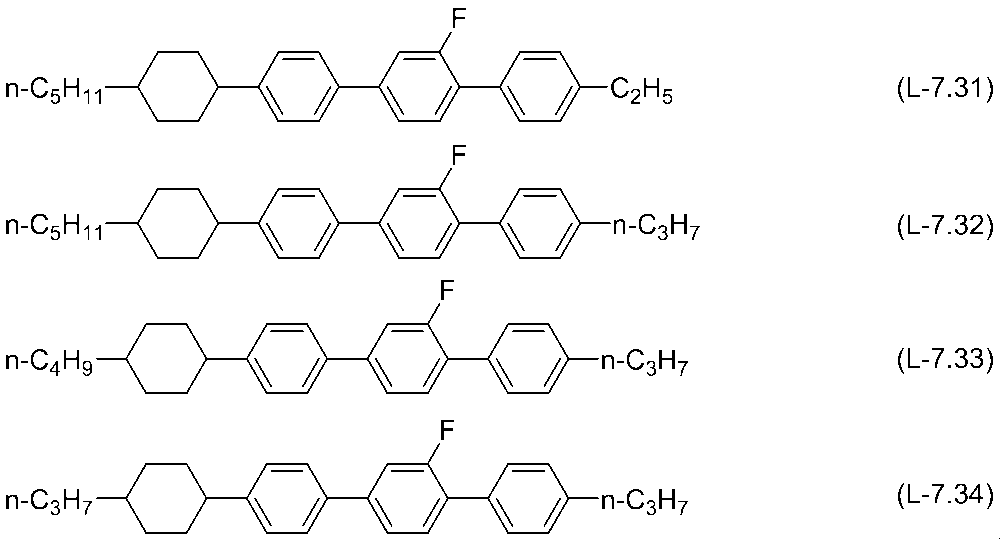
さらに、一般式(L-7)で表される化合物は、式(L-7.41)から式(L-7.44)で表される化合物であることが好ましく、式(L-7.41)又は/及び式(L-7.42)で表される化合物であることが好ましい。

さらに、一般式(L-7)で表される化合物は、式(L-7.51)から式(L-7.53)で表される化合物であることが好ましい。
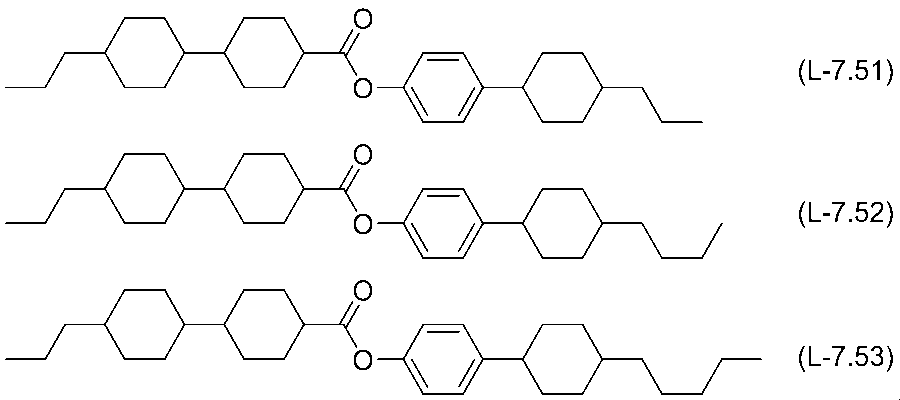
一般式(L-8)で表される化合物は下記の化合物である。

(式中、RL81及びRL82はそれぞれ独立して一般式(L)におけるRL1及びRL2と同じ意味を表し、AL81は一般式(L)におけるAL1と同じ意味又は単結合を表すが、AL81上の水素原子はそれぞれ独立してフッ素原子によって置換されていてもよく、XL81~XL86はそれぞれ独立してフッ素原子又は水素原子を表す。)
式中、RL81及びRL82はそれぞれ独立して炭素原子数1~5のアルキル基、炭素原子数2~5のアルケニル基又は炭素原子数1~4のアルコキシ基が好ましく、AL81は1,4-シクロヘキシレン基又は1,4-フェニレン基が好ましく、AL71及びAL72上の水素原子はそれぞれ独立してフッ素原子によって置換されていてもよく、一般式(L-8)中の同一の環構造上にフッ素原子は0個又は1個が好ましく、分子内にフッ素原子は0個又は1個であることが好ましい。
式中、RL81及びRL82はそれぞれ独立して炭素原子数1~5のアルキル基、炭素原子数2~5のアルケニル基又は炭素原子数1~4のアルコキシ基が好ましく、AL81は1,4-シクロヘキシレン基又は1,4-フェニレン基が好ましく、AL71及びAL72上の水素原子はそれぞれ独立してフッ素原子によって置換されていてもよく、一般式(L-8)中の同一の環構造上にフッ素原子は0個又は1個が好ましく、分子内にフッ素原子は0個又は1個であることが好ましい。
組み合わせることができる化合物の種類に特に制限は無いが、低温での溶解性、転移温度、電気的な信頼性、複屈折率などの求められる性能に応じて組み合わせる。使用する化合物の種類は、例えば本発明の一つの実施形態としては1種類であり、2種類であり、3種類であり、4種類である。
該組成物において、一般式(L-8)で表される化合物の含有量は、低温での溶解性、転移温度、電気的な信頼性、複屈折率、プロセス適合性、滴下痕、焼き付き、誘電率異方性などの求められる性能に応じて適宜調整する必要がある。
本発明に係る光散乱型液晶素子用液晶組成物に含まれる非重合性液晶化合物の総量に対しての、式(L-8)で表される化合物の、好ましい含有量の下限値は0質量%であり、上限値は30質量%である。より好ましい含有量の下限値は0質量%であり、上限値は20質量%である。
該組成物が高いTNIの実施形態が望まれる場合は式(L-8)で表される化合物の含有量を多めにすることが好ましく、低粘度の実施形態が望まれる場合は含有量を少なめにすることが好ましい。
さらに、一般式(L-8)で表される化合物は、式(L-8.1)から式(L-8.4)で表される化合物であることが好ましく、式(L-8.3)、式(L-8.5)、式(L-8.6)、式(L-8.13)、式(L-8.16)から式(L-8.18)、式(L-8.23)から式(L-8.28)で表される化合物であることがより好ましい。

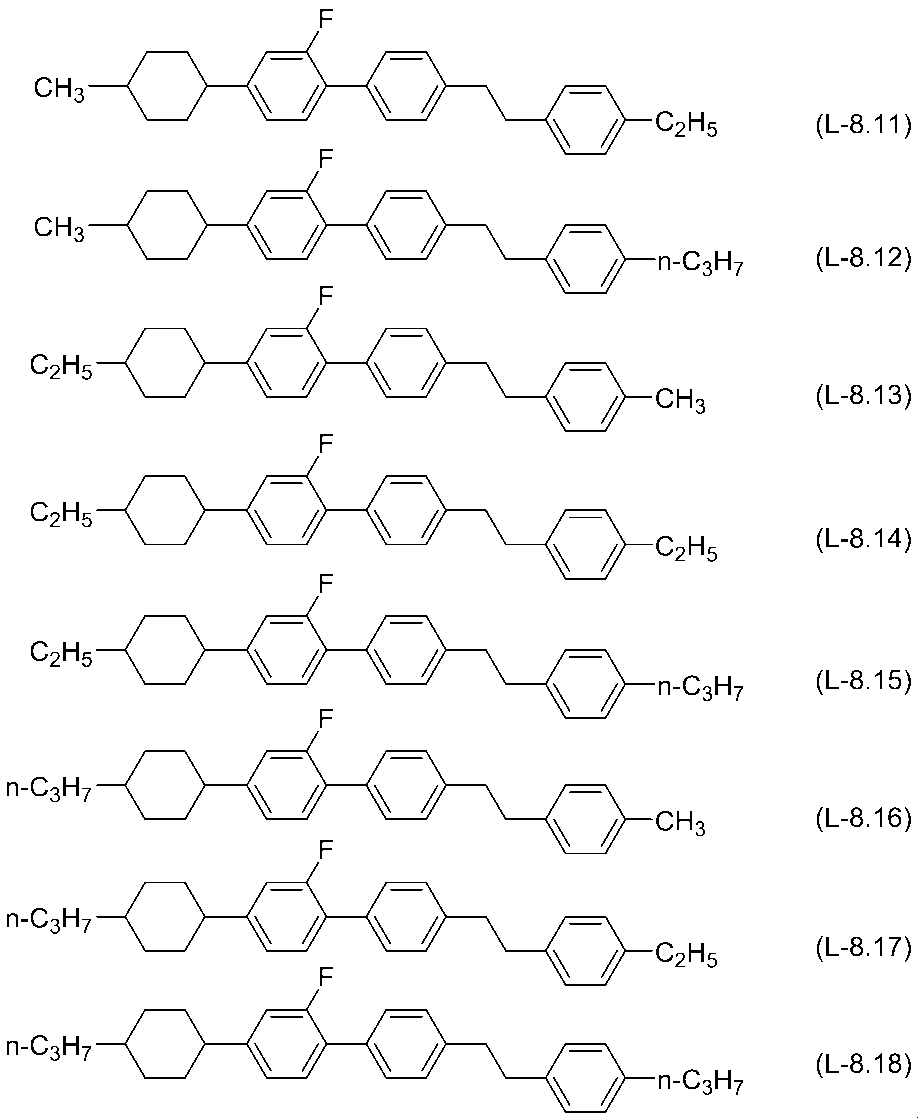
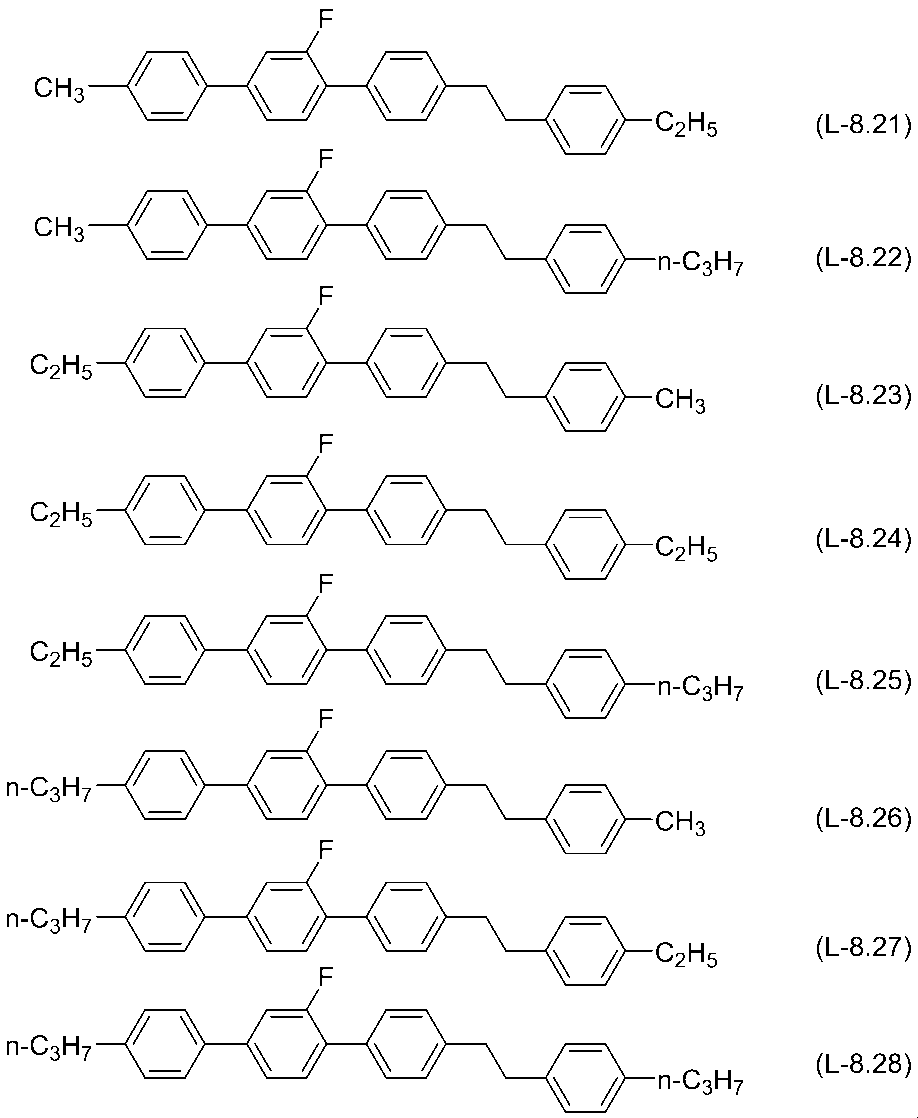
一般式(L-9)で表される化合物は下記の化合物である。

(式中、RL91及びRL92はそれぞれ独立して、一般式(L)におけるRL1及びRL2と同じ意味を表す。)
RL91及びRL92はそれぞれ独立して炭素原子数1~5のアルキル基、炭素原子数4~5のアルケニル基又は炭素原子数1~4のアルコキシ基が好ましい。
RL91及びRL92はそれぞれ独立して炭素原子数1~5のアルキル基、炭素原子数4~5のアルケニル基又は炭素原子数1~4のアルコキシ基が好ましい。
一般式(L-9)で表される化合物は単独で使用することもできるが、2以上の化合物を組み合わせて使用することもできる。組み合わせることができる化合物の種類に特に制限は無いが、低温での溶解性、転移温度、電気的な信頼性、複屈折率などの求められる性能に応じて適宜組み合わせて使用する。使用する化合物の種類は、例えば本発明の一つの実施形態としては1種類であり、2種類であり、3種類であり、4種類であり、5種類以上である。
本発明に係る光散乱型液晶素子用液晶組成物に含まれる非重合性液晶化合物の総量に対しての、式(L-9)で表される化合物の、好ましい含有量の下限値は0質量%であり、上限値は90質量%である。より好ましい含有量の下限値は0質量%であり、上限値は75質量%である。
高い複屈折率を得る場合は含有量を多めに設定すると効果が高く、反対に、高いTNIを重視する場合は含有量を少なめに設定すると効果が高い。さらに、滴下痕や焼き付き特性を改良する場合は、含有量の範囲を中間に設定することが好ましい。
さらに、一般式(L-9)で表される化合物は、式(L-9.1)から式(L-9.4)で表される化合物群から選ばれる化合物であることが好ましい。

本発明に係る光散乱型液晶素子用液晶組成物に含まれる非重合性液晶化合物の総量に対しての、一般式(N)及び一般式(L)で表される化合物の合計の、好ましい含有量の下限値は80質量%であり、上限値は100質量%である。より好ましい含有量の下限値は90質量%であり、上限値は100質量%である。
本発明に係る光散乱型液晶素子用液晶組成物に含まれる非重合性液晶化合物の総量に対しての、一般式(N-1-1)から(N-1-18)、一般式(L-1)から(L-9)で表される化合物の合計の、好ましい含有量の下限値は80質量%であり、上限値は100質量%である。より好ましい含有量の下限値は95質量%であり、上限値は100質量%である。
本発明に係る光散乱型液晶素子用液晶組成物は、分子内に過酸(-CO-OO-)構造等の酸素原子同士が結合した構造を持つ化合物を含有しないことが好ましい。
組成物の信頼性及び長期安定性を重視する場合にはカルボニル基を有する化合物の含有量を前記組成物の総質量に対して5質量%以下とすることが好ましく、3質量%以下とすることがより好ましく、1質量%以下とすることが更に好ましく、実質的に含有しないことが最も好ましい。
UV照射による安定性を重視する場合、塩素原子が置換している化合物の含有量を前記組成物の総質量に対して15質量%以下とすることが好ましく、10質量%以下とすることが好ましく、8質量%以下とすることが好ましく、5質量%以下とすることがより好ましく、3質量%以下とすることが好ましく、実質的に含有しないことが更に好ましい。
分子内の環構造がすべて6員環である化合物の含有量を多くすることが好ましく、分子内の環構造がすべて6員環である化合物の含有量を前記組成物の総質量に対して80質量%以上とすることが好ましく、90質量%以上とすることがより好ましく、95質量%以上とすることが更に好ましく、実質的に分子内の環構造がすべて6員環である化合物のみで組成物を構成することが最も好ましい。
組成物の酸化による劣化を抑えるためには、環構造としてシクロヘキセニレン基を有する化合物の含有量を少なくすることが好ましく、シクロヘキセニレン基を有する化合物の含有量を前記組成物の総質量に対して10質量%以下とすることが好ましく、8質量%以下とすることが好ましく、質量5%以下とすることがより好ましく、3質量%以下とすることが好ましく、実質的に含有しないことが更に好ましい。
粘度の改善及びTNIの改善を重視する場合には、水素原子がハロゲンに置換されていてもよい2-メチルベンゼン-1,4-ジイル基を分子内に持つ化合物の含有量を少なくすることが好ましく、前記2-メチルベンゼン-1,4-ジイル基を分子内に持つ化合物の含有量を前記組成物の総質量に対して10%以下とすることが好ましく、8%以下とすることが好ましく、5%以下とすることがより好ましく、3%以下とすることが好ましく、実質的に含有しないことが更に好ましい。
本願において実質的に含有しないとは、意図せずに含有する物を除いて含有しないという意味である。
本発明に係る光散乱型液晶素子用液晶組成物に含有される液晶化合物が、側鎖としてアルケニル基を有する場合、前記アルケニル基がシクロヘキサンに結合している場合には当該アルケニル基の炭素原子数は2~5であることが好ましく、前記アルケニル基がベンゼンに結合している場合には当該アルケニル基の炭素原子数は4~5であることが好ましく、前記アルケニル基の不飽和結合とベンゼンは直接結合していないことが好ましい。
本発明に係る光散乱型液晶素子用液晶組成物の平均弾性定数(KAVG)は10から25が好ましいが、その下限値としては、10が好ましく、10.5が好ましく、11が好ましく、11.5が好ましく、12が好ましく、12.3が好ましく、12.5が好ましく、12.8が好ましく、13が好ましく、13.3が好ましく、13.5が好ましく、13.8が好ましく、14が好ましく、14.3が好ましく、14.5が好ましく、14.8が好ましく、15が好ましく、15.3が好ましく、15.5が好ましく、15.8が好ましく、16が好ましく、16.3が好ましく、16.5が好ましく、16.8が好ましく、17が好ましく、17.3が好ましく、17.5が好ましく、17.8が好ましく、18が好ましく、その上限値としては、25が好ましく、24.5が好ましく、24が好ましく、23.5が好ましく、23が好ましく、22.8が好ましく、22.5が好ましく、22.3が好ましく、22が好ましく、21.8が好ましく、21.5が好ましく、21.3が好ましく、21が好ましく、20.8が好ましく、20.5が好ましく、20.3が好ましく、20が好ましく、19.8が好ましく、19.5が好ましく、19.3が好ましく、19が好ましく、18.8が好ましく、18.5が好ましく、18.3が好ましく、18が好ましく、17.8が好ましく、17.5が好ましく、17.3が好ましく、17が好ましい。消費電力削減を重視する場合にはバックライトの光量を抑えることが有効であり、液晶表示素子は光の透過率を向上させることが好ましく、そのためにはKAVGの値を低めに設定することが好ましい。応答速度の改善を重視する場合にはKAVGの値を高めに設定することが好ましい。
(光散乱型液晶素子)
本発明の光散乱型液晶素子用液晶組成物を用いた光散乱型液晶素子は、相分離液晶層とホメオトロピック配向膜と電極とを備える。
(光散乱型液晶素子)
本発明の光散乱型液晶素子用液晶組成物を用いた光散乱型液晶素子は、相分離液晶層とホメオトロピック配向膜と電極とを備える。
本発明の液晶素子は、上記要素を備えるものであれば、具体的な実施形態は特に限定されるものではないが、たとえば、少なくとも一方に電極を有する2枚の透明基板とホメオトロピック配向膜とから構成される中空素子中に相分離液晶層が狭持された構成としてよい。
本発明の光散乱型液晶素子は、無電源状態において相分離液晶層のホメオトロピック配向が維持されるものである。このため、いわゆるリバースモードで駆動可能な素子として利用できる。すなわち、該液晶素子は、電圧無印加時には透明状態であり、電圧印加時には散乱状態とすることができる。
本発明の光散乱型液晶素子は、ホメオトロピック配向膜のみならず、配向性重合体からなる緻密なポリマーネットワークによっても液晶分子の配向が制御されている。よって、本発明の液晶素子は、外的な応力による配向乱れを起こしにくく、高い応力耐性を有する。本発明の液晶素子は、曲げ応力加わる環境下でも表示不良を起こしにくいため、屈曲可能なものとすることができる。従って、本発明の液晶素子は、素子表面が局面であってもよい。
(ホメオトロピック配向膜)
ホメオトロピック配向膜は、複合液晶組成物又は相分離液晶層と直接当接してホメオトロピック配向を誘起する作用を有するものであればよい。このような配向膜としては、公知のものを用いてよい。通常、ホメオトロピック配向膜は、液晶相を挟持するように一対で配置される。中空素子中においては、通常、ホメオトロピック配向膜は対向する一対の基板のそれぞれの表面上に配置される。
(ホメオトロピック配向膜)
ホメオトロピック配向膜は、複合液晶組成物又は相分離液晶層と直接当接してホメオトロピック配向を誘起する作用を有するものであればよい。このような配向膜としては、公知のものを用いてよい。通常、ホメオトロピック配向膜は、液晶相を挟持するように一対で配置される。中空素子中においては、通常、ホメオトロピック配向膜は対向する一対の基板のそれぞれの表面上に配置される。
前記配向膜としては、例えば、ポリイミド配向膜、光配向膜等が挙げられる。配向膜の形成方法としては、例えば、ポリイミド配向膜の場合であれば、ポリイミド樹脂組成物を透明基材上に塗布し、180℃以上の温度で熱硬化させ、更に綿布やレーヨン布でラビング処理する方法が挙げられる。また、ラビング処理を施していないポリイミド膜等の高分子膜も用いることもできる。特に垂直配向性を発現するためには、垂直配向性のポリイミド配向膜をラビングしないで使用することが好ましい。あるいは、垂直配向性の光配向膜を使用することが好ましい。また、垂直配向のポリイミド配向膜を使用しなくても垂直配向が可能となる自発垂直配向(PIレス)モノマーを使用することもできる。自発垂直配向モノマーに用いるモノマーとしては公知のモノマーを用いることできる。
(電極)
電極は、本発明の液晶素子中において、相分離液晶層中の液晶分子を配向制御可能な電界を生じるように設けられる。電界強度は、電極への電圧印加の程度により制御される。
(電極)
電極は、本発明の液晶素子中において、相分離液晶層中の液晶分子を配向制御可能な電界を生じるように設けられる。電界強度は、電極への電圧印加の程度により制御される。
電極の形状は特に限定されず、導電部がストライプ状もしくはメッシュ状、またはランダムな網目状であってよい。電極は、いわゆる櫛型構造であることが好ましい。また、スマートウィンドウ等に用いる場合は、一般的にベタ電極と呼ばれる一様な電極であるものが好ましく、目的によりパターンが形成されていてもよい。
(透明基板)
前記透明基板の材料としては、ガラス、プラスチック等を用いることができる。本発明の液晶素子をフレキシブルディスプレイに適用する観点からは、透明基板は可撓性であることが好ましい。
(液晶素子の製造例)
本発明の光散乱型液晶素子は、生産性の観点から、中空素子に光散乱型液晶素子用液晶組成物を狭持させた重合性液晶素子から作製することが好ましい。重合性液晶素子中において、複合液晶組成物中の液晶性化合物やメソゲン基を有する重合性化合物は、ホメオトロピック配向膜の配向規制力によってホメオトロピック配向状態にある。この配向状態下に、複合液晶組成物中の重合性化合物を上述の方法により紫外線硬化し、複合液晶組成物から相分離液晶層を形成することで、光散乱型液晶素子が得られる。
紫外線を照射する方法について、ランプとしてはメタルハライド、高圧水銀、UV-LED等、通常紫外線重合で用いられる装置であればよい。紫外線強度としては365nmのセンサーで、1~100mW/cm2であることが好ましく、1~20mW/cm2であることがより好ましく、2~10mW/cm2であることが更により好ましい。紫外線照射エネルギーとしては、1~50J/cm2であることが好ましく、2~20J/cm2であることがより好ましい。紫外線を照射する温度は15~30℃であることが好ましい。
(透明基板)
前記透明基板の材料としては、ガラス、プラスチック等を用いることができる。本発明の液晶素子をフレキシブルディスプレイに適用する観点からは、透明基板は可撓性であることが好ましい。
(液晶素子の製造例)
本発明の光散乱型液晶素子は、生産性の観点から、中空素子に光散乱型液晶素子用液晶組成物を狭持させた重合性液晶素子から作製することが好ましい。重合性液晶素子中において、複合液晶組成物中の液晶性化合物やメソゲン基を有する重合性化合物は、ホメオトロピック配向膜の配向規制力によってホメオトロピック配向状態にある。この配向状態下に、複合液晶組成物中の重合性化合物を上述の方法により紫外線硬化し、複合液晶組成物から相分離液晶層を形成することで、光散乱型液晶素子が得られる。
紫外線を照射する方法について、ランプとしてはメタルハライド、高圧水銀、UV-LED等、通常紫外線重合で用いられる装置であればよい。紫外線強度としては365nmのセンサーで、1~100mW/cm2であることが好ましく、1~20mW/cm2であることがより好ましく、2~10mW/cm2であることが更により好ましい。紫外線照射エネルギーとしては、1~50J/cm2であることが好ましく、2~20J/cm2であることがより好ましい。紫外線を照射する温度は15~30℃であることが好ましい。
中空素子に光散乱型液晶素子用液晶組成物を狭持させる方法は、常法でよく、真空注入法又はODF法などを用いることができる。ODF法の重合性液晶素子製造工程においては、中空素子のバックプレーンまたはフロントプレーンのどちらか一方の基板にエポキシ系光熱併用硬化性などのシール剤を、ディスペンサーを用いて閉ループ土手状に描画し、その中に脱気下で所定量の複合液晶組成物を滴下後、フロントプレーンとバックプレーンを接合することによって重合性液晶素子を製造することができる。本発明に用いられる光散乱型液晶素子用組液晶成物は、相安定性が高く揮発しにくいため、ODF工程に好適に使用することができる。また、フィルム基板を用いてロールトゥーロール生産する場合は単純な滴下法で光散乱型液晶素子用液晶組成物を基材上に滴下し、対向基板と張り合わせ作製してもよい。また、シール構造を有せず、後工程でラミネート処理をすることによりフィルム全体をシールする手法をとっても良い。
以下、図面を用いて本発明の液晶素子の好ましい実施形態を説明するが、本発明はこれらに限定されるものではない。
本発明の光散乱型液晶素子は、電圧印加により液晶分子の配向を制御できるよう構成されればよいが、垂直電界型液晶素子として構成されることが好ましい。垂直電界型液晶素子は、ホメオトロピック配向膜に対して垂直に電界が生じるように電極が配置された液晶素子である。垂直電界型液晶素子においては、通常、相分離液晶層を狭持する2つの透明基板の両方に電極が設けられる。
図1は、電圧無印加時の垂直電界型液晶素子の構成を模式的に示す図である。以下、図1を参照して、本発明に係る垂直電界型の液晶素子を説明する。
本発明に係るポリマーネットワーク垂直電界型の液晶素子の構成は、図1に記載するように、それぞれ透明導電性材料からなる透明電極(層)2を具備した第一の基板11と第二の基板12、前記第一の基板11と第二の基板12との間に挟持された相分離液晶層を有し、該相分離液晶層中の液晶分子の電圧無印加時の配向がホメオトロピック配向膜3に対して略垂直である液晶素子である。相分離液晶層は、液晶組成物に含まれる液晶分子4と配向性重合体5によって構成される。なお、図1では便宜上、配向性重合体5は固定された多数の重合性化合物によって表現しているが、実際は各重合性化合物同士が複雑に繋がったポリマーネットワークを形成している。さらに、相分離液晶層と直接接するよう一対のホメオトロピック配向膜3が透明電極(層)2表面に形成されている。
すなわち、本発明に係るポリマーネットワーク垂直電界型液晶素子は、第一の基板11と、電極2と、ホメオトロピック配向膜3と、液晶分子4と配向性重合体5が相分離してなる複合層と、ホメオトロピック配向膜3と、電極2と、第二の基板12と、が順次積層された構成である。
図2は、電圧印加時の垂直電界型素子の構成を模式的に示す図である。
電極への電圧印加により、垂直電界型液晶素子は、図1の状態から図2の状態に遷移する。このとき、液晶分子4が垂直電界の発生により、ホメオトロピック配向膜に対して平行方向に配向する。図2に示す垂直電界型液晶素子は、相分離液晶層における液晶分子4と配向性重合体5との配向方向が異なるため、それぞれの成分の界面にて光散乱が起こり、垂直電界型液晶素子として光が非透過の状態となる。
このように、本発明の垂直電界型液晶素子は電圧印加の有無により光の透過状態を変化させられるため、調光機能が求められる装置に組み込んで用いる液晶調光素子や、映像表示用ディスプレイに用いられる液晶表示素子として利用することができる。特に、本発明の垂直電界型液晶素子はリバースモードで駆動可能なため、省電力性、停電時や無電源下での透過性が求められる用途に特に好適である。
上記したポリマーネットワーク垂直電界型液晶調光素子は、たとえば、建材、調光ガラス、車載向けのスマートウィンドウ又はOLEDディスプレイにおける調光ユニット等に用いることが好ましく、とりわけ光散乱性が高くかつ駆動電圧を低減できる点からスマートウィンドウとして有用である。
上記垂直電界型液晶表示素子は、従来の高分子分散型液晶表示素子と同様な用途に用いることができるほか、特に透過型ディスプレイ、フレキシブルディスプレイ等にも好ましく用いることができる。
(その他の電界型)
本発明の光散乱型液晶素子には、上記垂直電界型の他、横電界型やその他の電界型を採用してもよい。FFS駆動モードに採用されるフリンジ電界を採用してもよい。
(その他の電界型)
本発明の光散乱型液晶素子には、上記垂直電界型の他、横電界型やその他の電界型を採用してもよい。FFS駆動モードに採用されるフリンジ電界を採用してもよい。
以下に実施例を挙げて本発明を更に詳述するが、本発明はこれらの実施例に限定されるものではない。また、以下の実施例及び比較例の組成物における「%」は「質量%」を意味する。
各実施例及び比較例中の評価特性の各々の詳細は以下の通りである。
Toff(0) : セル基板面法線方向の、電圧無印加時(透明状態)の光透過率[%]
※この数値が大きいほど、透明性が高い。
Toff(35) : セル基板面法線から斜め35度方向の、電圧無印加時(透明状態)の光透過率[%]
※この数値が大きいほど、斜め方向からでも透明性が高い
△Toff : 電圧無印加時(透明状態)の光透過率の、セル基板面法線方向とセル基板面法線から斜め35度方向との差
※この数値が小さいほど、斜め方向の透明性が法線方向と差が無いため、透明性が見る方向によらず均一である。
Ton(0) : セル基板面法線方向の、電圧印加時(散乱状態)の飽和光透過率[%]
V90 : 光透過率変化幅における90%透過時の印加電圧[V]
V10 : 光透過率変化幅における10%透過時の印加電圧[V]
コントラスト : Toff(0)/Ton(0)
ヘイズ : 全光線透過率に占める拡散光線透過率の割合 ※この数値が小さいほど、透明性が高い。
Toff(0) : セル基板面法線方向の、電圧無印加時(透明状態)の光透過率[%]
※この数値が大きいほど、透明性が高い。
Toff(35) : セル基板面法線から斜め35度方向の、電圧無印加時(透明状態)の光透過率[%]
※この数値が大きいほど、斜め方向からでも透明性が高い
△Toff : 電圧無印加時(透明状態)の光透過率の、セル基板面法線方向とセル基板面法線から斜め35度方向との差
※この数値が小さいほど、斜め方向の透明性が法線方向と差が無いため、透明性が見る方向によらず均一である。
Ton(0) : セル基板面法線方向の、電圧印加時(散乱状態)の飽和光透過率[%]
V90 : 光透過率変化幅における90%透過時の印加電圧[V]
V10 : 光透過率変化幅における10%透過時の印加電圧[V]
コントラスト : Toff(0)/Ton(0)
ヘイズ : 全光線透過率に占める拡散光線透過率の割合 ※この数値が小さいほど、透明性が高い。
各実施例及び比較例中で用いた重合性化合物(1-A)~(10-B)の構造は次式の通りである。

重合性化合物(2-E)中のnは、n≒7~8を表す。
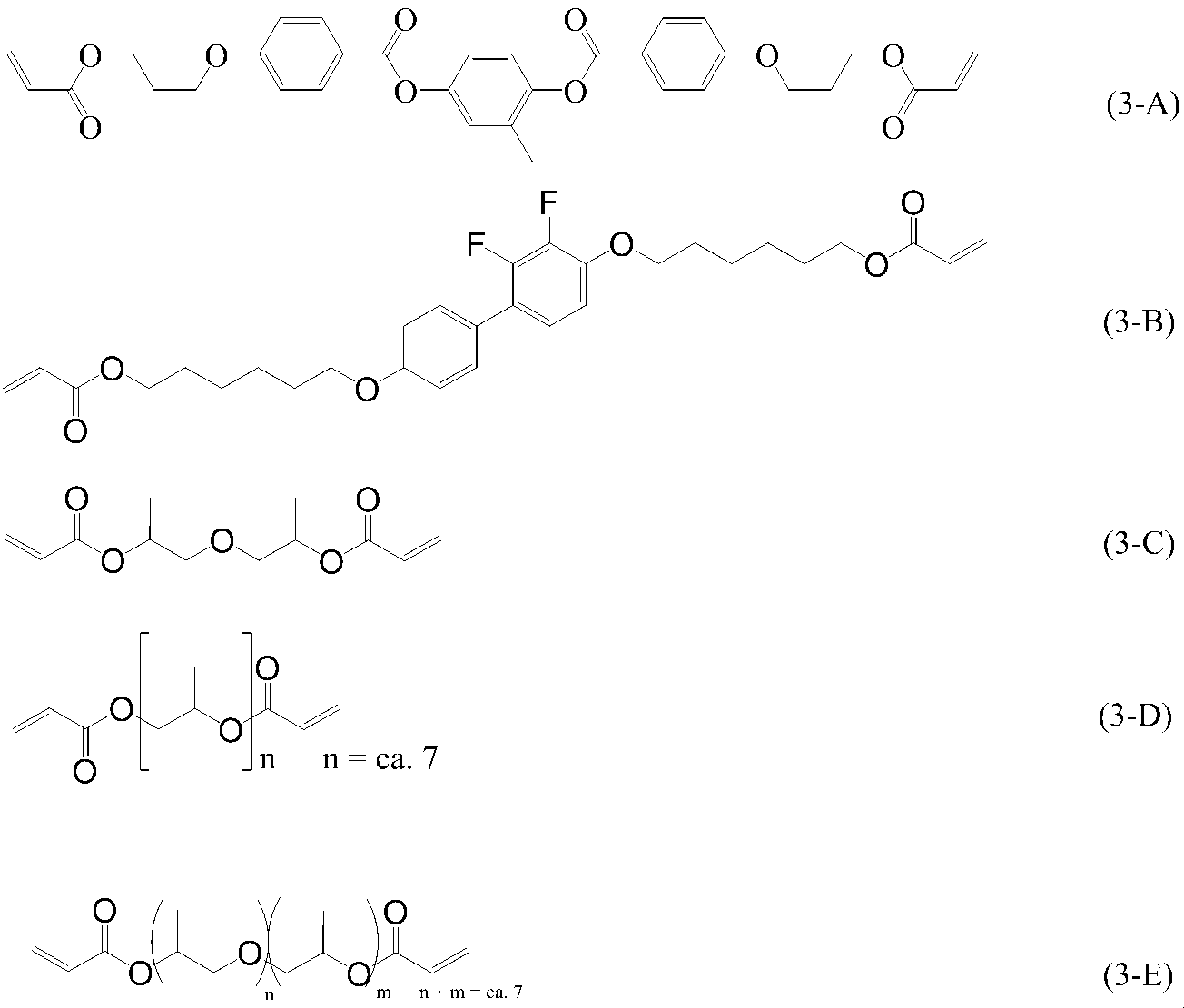

各実施例及び比較例中で用いた負の誘電率異方性を示す液晶組成物「L-1」~「L-7」はそれぞれ以下のとおりである(質量%)。
(液晶組成物「L-1」)
(液晶組成物「L-1」)

(液晶組成物「L-2」)

(液晶組成物「L-3」)
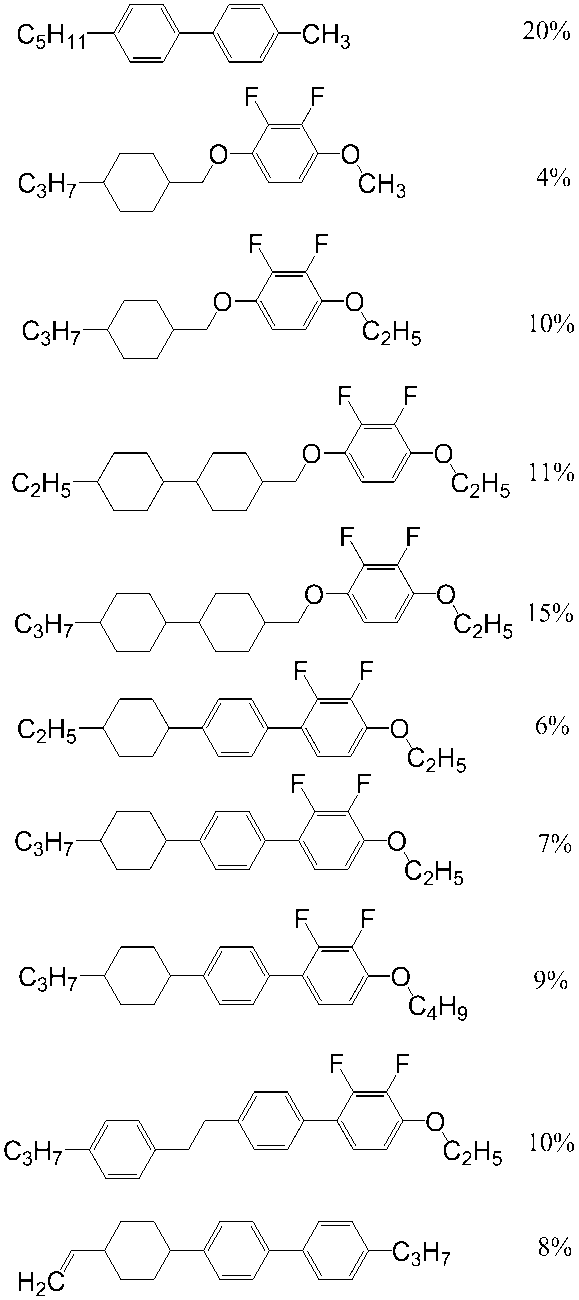
(液晶組成物「L-4」)
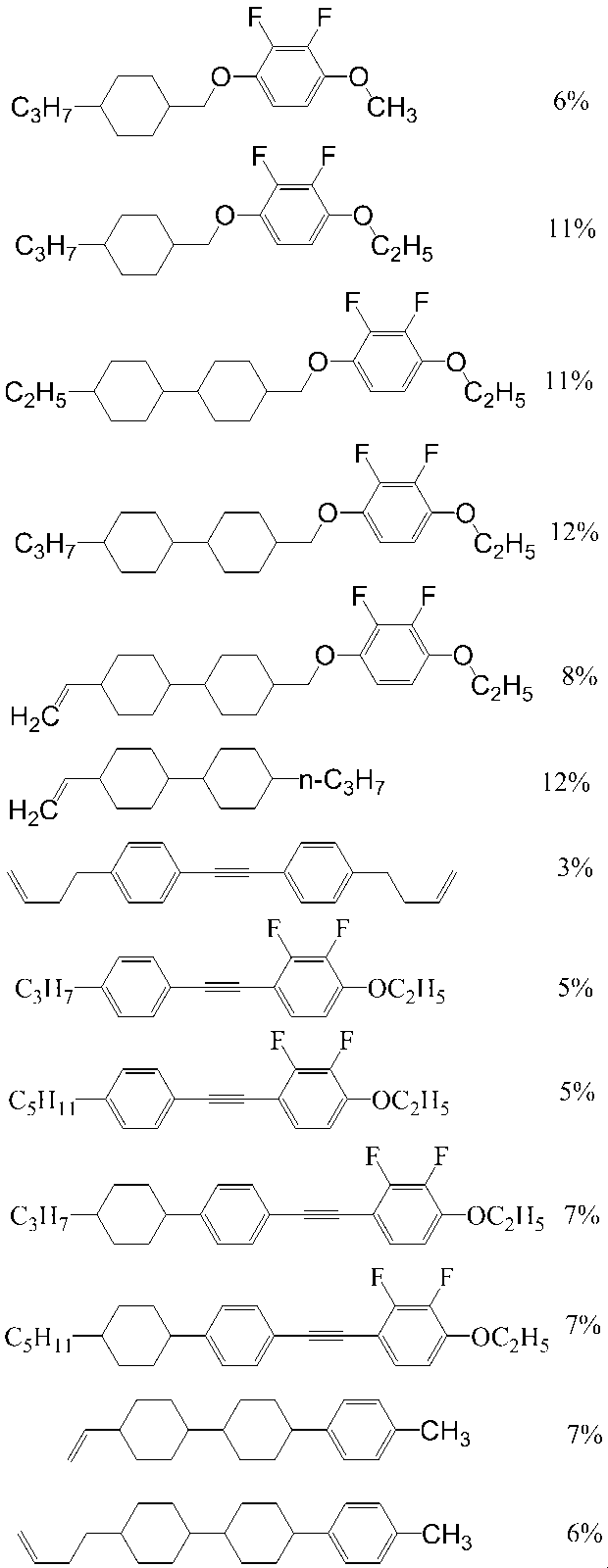
(液晶組成物「L-5」)
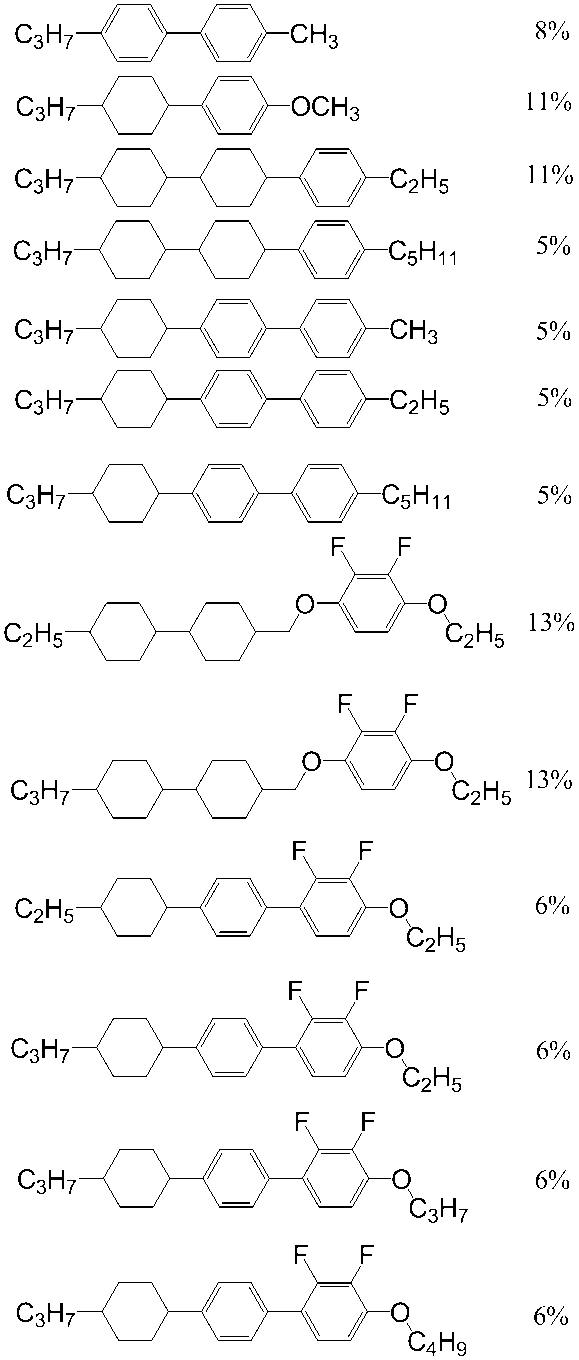
(液晶組成物「L-6」)

(液晶組成物「L-7」)
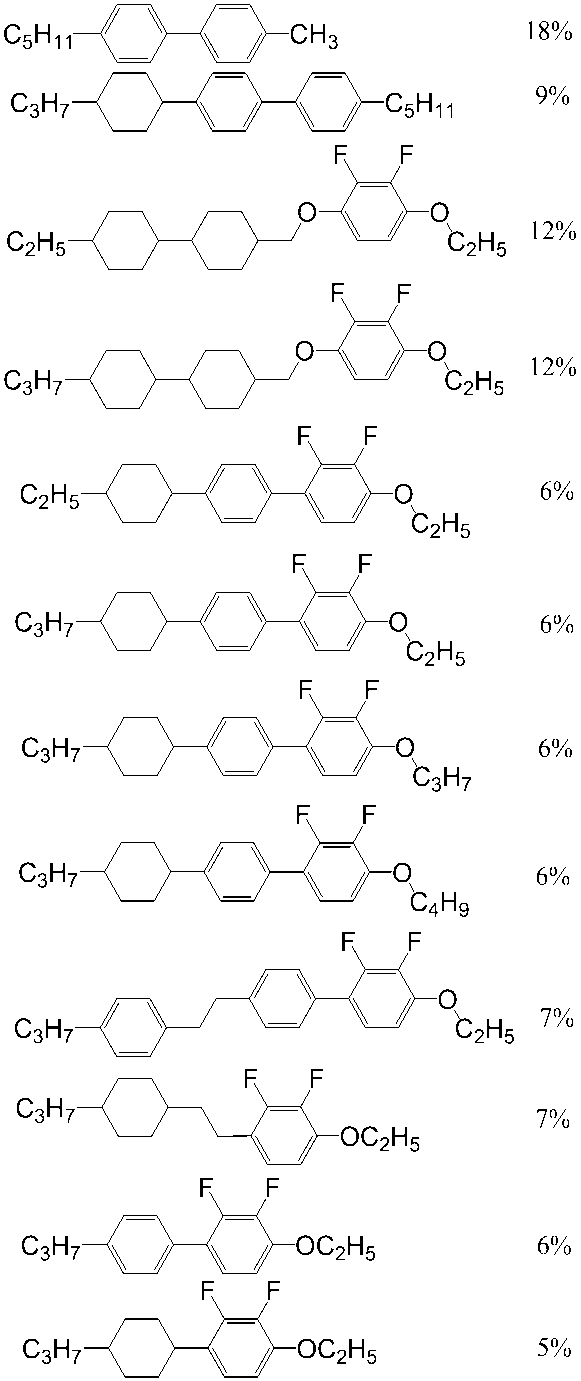
重合性化合物各成分の含有量(質量%)が以下からなる重合性組成物「A1」を調製した。
各実施例及び比較例中で用いた重合性組成物「A1」~「A26」はそれぞれ以下のとおりである(質量%)。
(重合性組成物「A1」)
重合性化合物(1-A):50%
重合性化合物(2-A):35%
重合性化合物(3-C):15%
(重合性組成物「A2」)
重合性化合物(1-A):30%
重合性化合物(2-A):35%
重合性化合物(3-A):20%
重合性化合物(3-C):15%
(重合性組成物「A3」)
重合性化合物(1-A):40%
重合性化合物(1-B):15%
重合性化合物(2-A):30%
重合性化合物(3-C):15%
(重合性組成物「A4」)
重合性化合物(1-A):50%
重合性化合物(2-A):50%
(重合性組成物「A5」)
重合性化合物(1-A):60%
重合性化合物(2-A):40%
(重合性組成物「A6」)
重合性化合物(1-A):50%
重合性化合物(2-A):35%
重合性化合物(3-D):15%
(重合性組成物「A7」)
重合性化合物(1-A):60%
重合性化合物(3-C):20%
重合性化合物(3-D):20%
(重合性組成物「A8」)
重合性化合物(1-B):100%
(重合性組成物「A9」)
重合性化合物(1-B):60%
重合性化合物(3-C):40%
(重合性組成物「A10」)
重合性化合物(1-B):60%
重合性化合物(3-C):20%
重合性化合物(3-D):20%
(重合性組成物「A11」)
重合性化合物(1-A):25%
重合性化合物(2-A):75%
(重合性組成物「A12」)
重合性化合物(1-B):46.6%
重合性化合物(2-A):53.4%
(重合性組成物「A13」)
重合性化合物(1-A):30%
重合性化合物(1-B):30%
重合性化合物(2-A):40%
(重合性組成物「A14」)
重合性化合物(1-A):50%
重合性化合物(2-A):40%
重合性化合物(3-E):10%
(重合性組成物「A15」)
重合性化合物(1-A):50%
重合性化合物(2-A):40%
重合性化合物(3-F):10%
(重合性組成物「A16」)
重合性化合物(1-A):50%
重合性化合物(2-A):40%
重合性化合物(3-G):10%
(重合性組成物「A17」)
重合性化合物(1-A):50%
重合性化合物(2-A):40%
重合性化合物(3-H):10%
(重合性組成物「A18」)
重合性化合物(1-A):50%
重合性化合物(2-A):40%
重合性化合物(3-I):10%
(重合性組成物「A19」)
重合性化合物(1-A):50%
重合性化合物(2-A):40%
重合性化合物(3-J):10%
(重合性組成物「A20」)
重合性化合物(1-B):46.6%
重合性化合物(2-A):43.4%
重合性化合物(2-B):10%
(重合性組成物「A21」)
重合性化合物(1-B):46.6%
重合性化合物(2-A):43.4%
重合性化合物(2-C):10%
(重合性組成物「A22」)
重合性化合物(3-A):100%
(重合性組成物「A23」)
重合性化合物(3-A):60%
重合性化合物(3-C):40%
(重合性組成物「A24」)
重合性化合物(3-A):60%
重合性化合物(3-C):20%
重合性化合物(3-D):20%
(重合性組成物「A25」)
重合性化合物(3-C):100%
(重合性組成物「A26」)
重合性化合物(1-A):30%
重合性化合物(1-B):30%
重合性化合物(2-A):20%
重合性化合物(2-D):20%
(重合性組成物「A27」)
重合性化合物(1-A):50%
重合性化合物(1-E):50%
(重合性組成物「A28」)
重合性化合物(1-A):50%
重合性化合物(1-F):50%
(実施例1)
液晶組成物「L-1」を92質量%、重合性組成物「A1」を7.76質量%、重合開始剤としてベンジルジメチルケタール0.24質量%を混合して、光散乱型液晶素子用液晶組成物(重合性液晶組成物)を調製した。得られた重合性液晶組成物は、常温でネマチック相を示した。
(重合性組成物「A1」)
重合性化合物(1-A):50%
重合性化合物(2-A):35%
重合性化合物(3-C):15%
(重合性組成物「A2」)
重合性化合物(1-A):30%
重合性化合物(2-A):35%
重合性化合物(3-A):20%
重合性化合物(3-C):15%
(重合性組成物「A3」)
重合性化合物(1-A):40%
重合性化合物(1-B):15%
重合性化合物(2-A):30%
重合性化合物(3-C):15%
(重合性組成物「A4」)
重合性化合物(1-A):50%
重合性化合物(2-A):50%
(重合性組成物「A5」)
重合性化合物(1-A):60%
重合性化合物(2-A):40%
(重合性組成物「A6」)
重合性化合物(1-A):50%
重合性化合物(2-A):35%
重合性化合物(3-D):15%
(重合性組成物「A7」)
重合性化合物(1-A):60%
重合性化合物(3-C):20%
重合性化合物(3-D):20%
(重合性組成物「A8」)
重合性化合物(1-B):100%
(重合性組成物「A9」)
重合性化合物(1-B):60%
重合性化合物(3-C):40%
(重合性組成物「A10」)
重合性化合物(1-B):60%
重合性化合物(3-C):20%
重合性化合物(3-D):20%
(重合性組成物「A11」)
重合性化合物(1-A):25%
重合性化合物(2-A):75%
(重合性組成物「A12」)
重合性化合物(1-B):46.6%
重合性化合物(2-A):53.4%
(重合性組成物「A13」)
重合性化合物(1-A):30%
重合性化合物(1-B):30%
重合性化合物(2-A):40%
(重合性組成物「A14」)
重合性化合物(1-A):50%
重合性化合物(2-A):40%
重合性化合物(3-E):10%
(重合性組成物「A15」)
重合性化合物(1-A):50%
重合性化合物(2-A):40%
重合性化合物(3-F):10%
(重合性組成物「A16」)
重合性化合物(1-A):50%
重合性化合物(2-A):40%
重合性化合物(3-G):10%
(重合性組成物「A17」)
重合性化合物(1-A):50%
重合性化合物(2-A):40%
重合性化合物(3-H):10%
(重合性組成物「A18」)
重合性化合物(1-A):50%
重合性化合物(2-A):40%
重合性化合物(3-I):10%
(重合性組成物「A19」)
重合性化合物(1-A):50%
重合性化合物(2-A):40%
重合性化合物(3-J):10%
(重合性組成物「A20」)
重合性化合物(1-B):46.6%
重合性化合物(2-A):43.4%
重合性化合物(2-B):10%
(重合性組成物「A21」)
重合性化合物(1-B):46.6%
重合性化合物(2-A):43.4%
重合性化合物(2-C):10%
(重合性組成物「A22」)
重合性化合物(3-A):100%
(重合性組成物「A23」)
重合性化合物(3-A):60%
重合性化合物(3-C):40%
(重合性組成物「A24」)
重合性化合物(3-A):60%
重合性化合物(3-C):20%
重合性化合物(3-D):20%
(重合性組成物「A25」)
重合性化合物(3-C):100%
(重合性組成物「A26」)
重合性化合物(1-A):30%
重合性化合物(1-B):30%
重合性化合物(2-A):20%
重合性化合物(2-D):20%
(重合性組成物「A27」)
重合性化合物(1-A):50%
重合性化合物(1-E):50%
(重合性組成物「A28」)
重合性化合物(1-A):50%
重合性化合物(1-F):50%
(実施例1)
液晶組成物「L-1」を92質量%、重合性組成物「A1」を7.76質量%、重合開始剤としてベンジルジメチルケタール0.24質量%を混合して、光散乱型液晶素子用液晶組成物(重合性液晶組成物)を調製した。得られた重合性液晶組成物は、常温でネマチック相を示した。
ITO透明電極が方形に形成され、垂直配向用ポリイミド配向膜材料が約0.1μmの厚みで形成された基板2枚を一組として間隔5μmで対向させた液晶セルを用意した。
このセルに、調製した重合性液晶組成物を真空注入法で注入した。注入から約10分後、セル内の配向状態を確認したところ、重合性液晶組成物は均一に垂直方向に配向していることが確認できた。
次いで、作製した充填液晶セルを25±1℃に保ちながら紫外線を照射し、前記重合性モノマーを重合させて前記重合性液晶組成物ら相分離液晶層を形成することで、光散乱型液晶素子を作製した。このとき、紫外線光源はメタルハライドランプを用い、紫外線を8.6mW/cm2の照度で240秒間照射(計2.1J/cm2の積算エネルギー)した。照度はウシオ電機社製の受光器UVD-365PD付きユニメータUIT-101を用いて測定した。
得られた液晶素子は、電圧無印加時、透明状態で散乱は観察されず、液晶が垂直配向していることが確認された。
電圧-透過率特性の測定には、液晶素子の一方の基板面側に投光器、他方の基板面側に受光器を備えた装置を用いて、液晶素子の上下に偏光板を用いない条件とした。測定温度25℃において、液晶素子の電極間に矩形波を印加し、電圧を0Vから透過率変化が飽和するまでの区間で段階的に上昇させ、液晶素子に対して投光器と対向側に配置した受光器で検出された透過率を記録する方法により測定した。電圧の上昇に伴い、光散乱が増加し、透過率が減少していくことが確認できた。このときの透過率を、投光-受光方向が液晶素子の基板に対して法線方向(0°)と、法線から35度傾けた方向(35°)とで測定した。電圧-透過率特性の測定には、液晶特性測定装置LCD-5200(大塚電子社製)を用いた。
電圧-透過率特性の曲線から、透過率Toff、TonおよびV10を求めた。
法線(0°)方向における、無印加時透過率Toff(0)は87.3%,印加時飽和透過率Ton(0)は28.0%,透過率変化幅における10%透過時の印加電圧V10は17Vであった。法線から斜め(35°)方向における無印加時透過率Toff(35)は、84.7%であった。
また、液晶素子の基板に対して法線方向に測定光を入射させたときの液晶素子のヘイズ(Hz)を、ヘイズメーター(日本電色工業社製NDH-2000)を用いて測定した。ヘイズの値は、全光線透過率(TT)と平行光線透過率(PT)とから、次の式で求められた。
Hz=[{TT-PT}/TT]×100 (%)
求められた、液晶素子のヘイズは1.0%であった。
(実施例2~実施例25、比較例1~比較例4)
各実施例2~実施例25、及び、各比較例1~比較例4において、下記表に記載の液晶組成物、重合性組成物、開始剤を下記表に記載の割合で用いた以外は、実施例1と同一の条件でリマーネットワーク液晶素子用液晶組成物(重合性液晶組成物)を調製した。得られた重合性液晶組成物は、常温でネマチック相を示した。
求められた、液晶素子のヘイズは1.0%であった。
(実施例2~実施例25、比較例1~比較例4)
各実施例2~実施例25、及び、各比較例1~比較例4において、下記表に記載の液晶組成物、重合性組成物、開始剤を下記表に記載の割合で用いた以外は、実施例1と同一の条件でリマーネットワーク液晶素子用液晶組成物(重合性液晶組成物)を調製した。得られた重合性液晶組成物は、常温でネマチック相を示した。
また、実施例1と同様の条件で測定したところ、法線(0°)方向における、無印加時透過率Toff(0)、印加時飽和透過率Ton(0)、透過率変化幅における10%透過時の印加電圧V10、法線から斜め(35°)方向における無印加時透過率Toff(35)、及び、得られる液晶素子のヘイズはそれぞれ下記表に記載の数値となった。
また、実施例1~28、比較例1~比較例4における評価結果の一覧を合わせて以下の表に示す。評価基準は下記のとおり。
ヘイズ
◎: 0.5未満
○: 0.5以上1.6未満
△: 1.6位上4.0未満
×: 4.0以上
△Toff
◎: 2.0未満
○: 2.0以上3.0未満
△: 3.0以上4.0未満
×: 4.0以上
コントラスト
◎: 12.0以上
○: 4.0以上12.0未満
△: 2.0以上4.0未満
×: 2.0未満
駆動電圧V10
◎: 16未満
○: 16以上31未満
△: 31以上46未満
×: 46以上
なお、実施例24~実施例26については、基材との密着性についても合わせて評価した。評価基準は下のとおり。
◎: 0.5未満
○: 0.5以上1.6未満
△: 1.6位上4.0未満
×: 4.0以上
△Toff
◎: 2.0未満
○: 2.0以上3.0未満
△: 3.0以上4.0未満
×: 4.0以上
コントラスト
◎: 12.0以上
○: 4.0以上12.0未満
△: 2.0以上4.0未満
×: 2.0未満
駆動電圧V10
◎: 16未満
○: 16以上31未満
△: 31以上46未満
×: 46以上
なお、実施例24~実施例26については、基材との密着性についても合わせて評価した。評価基準は下のとおり。
◎: 85℃、500時間の高温保存後に基板から剥離なし
○: 85℃、100時間の高温保存後に基板から剥離なし
×: 85℃、24時間の高温保存後に基板から剥離あり
○: 85℃、100時間の高温保存後に基板から剥離なし
×: 85℃、24時間の高温保存後に基板から剥離あり

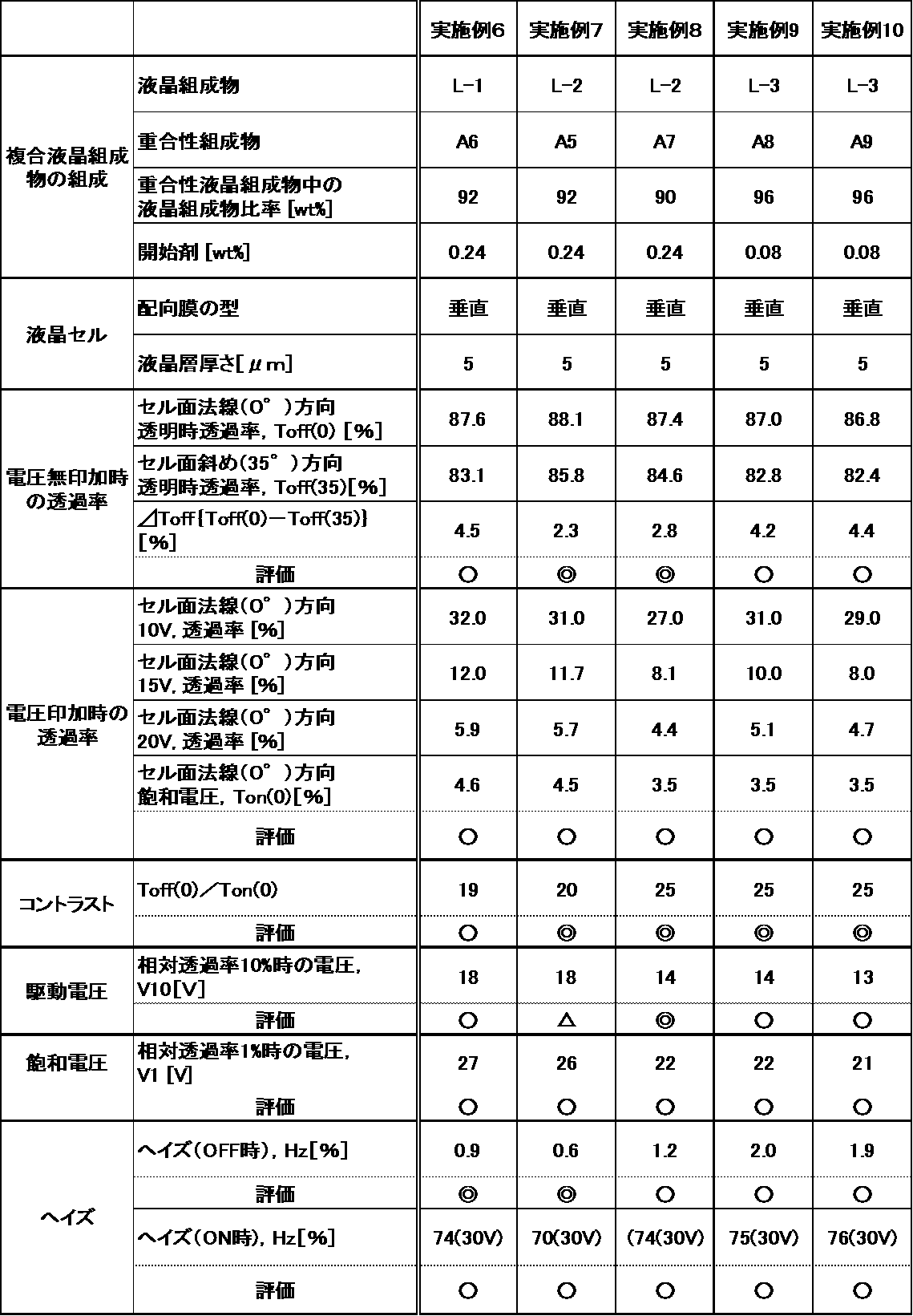


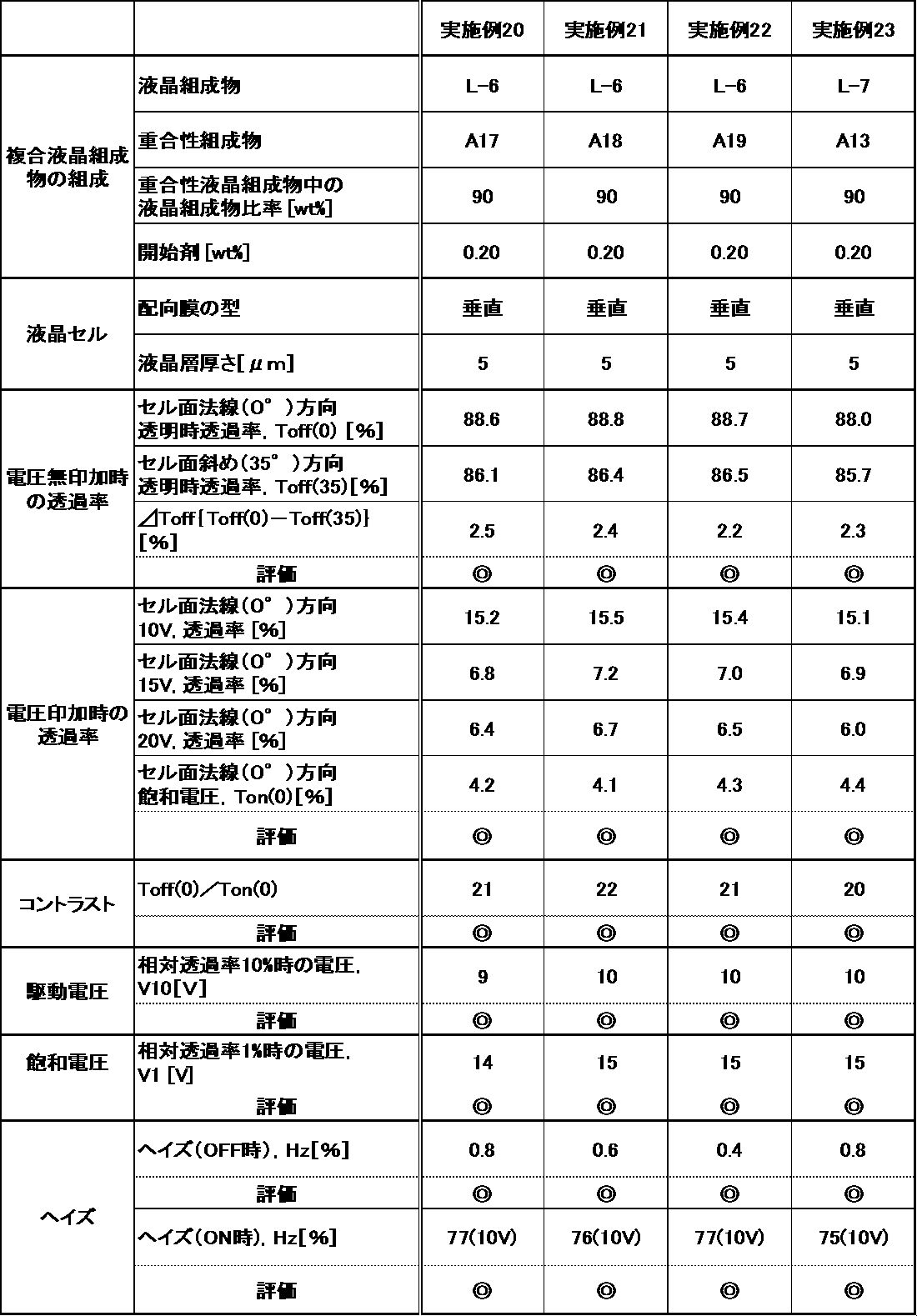
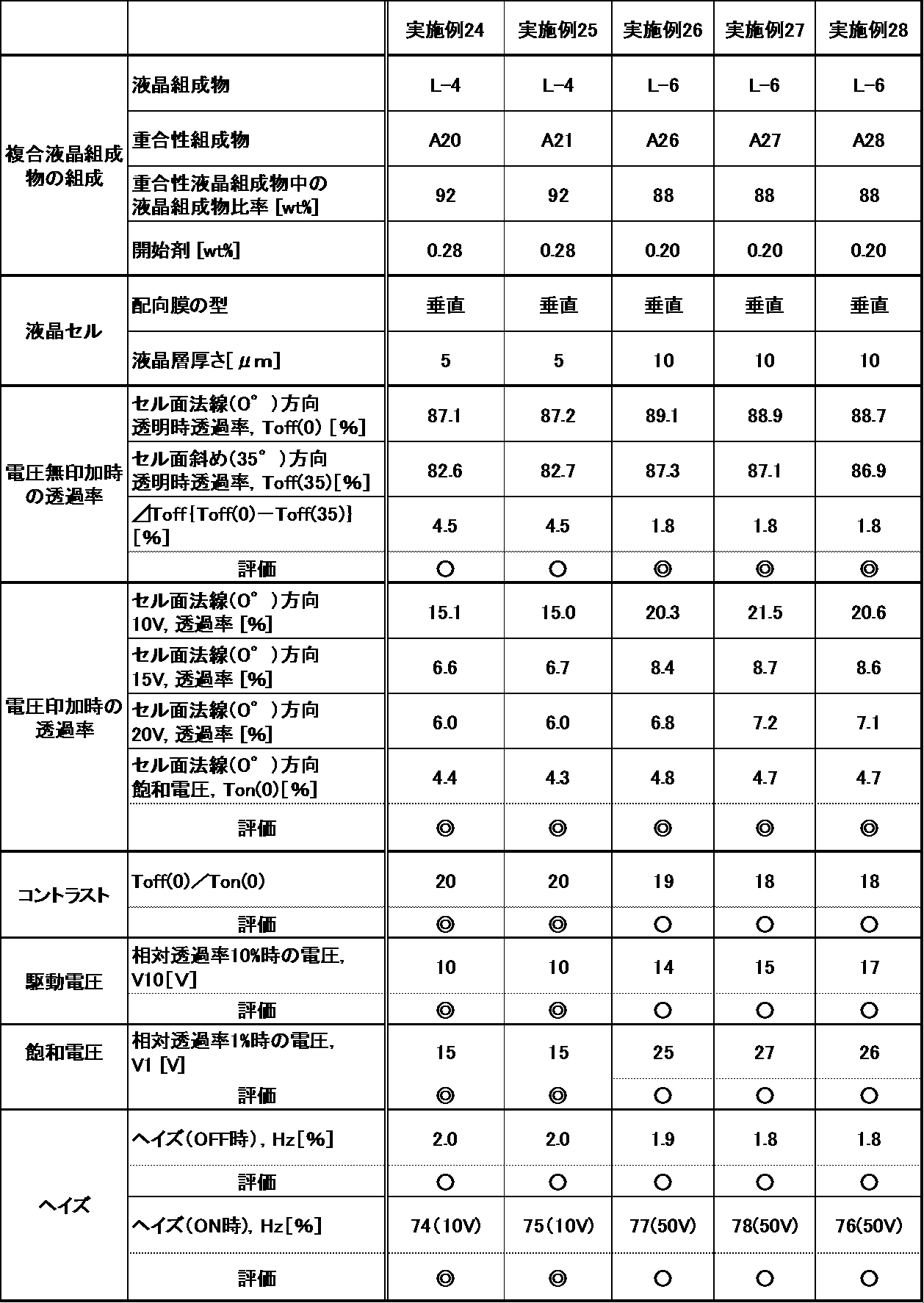
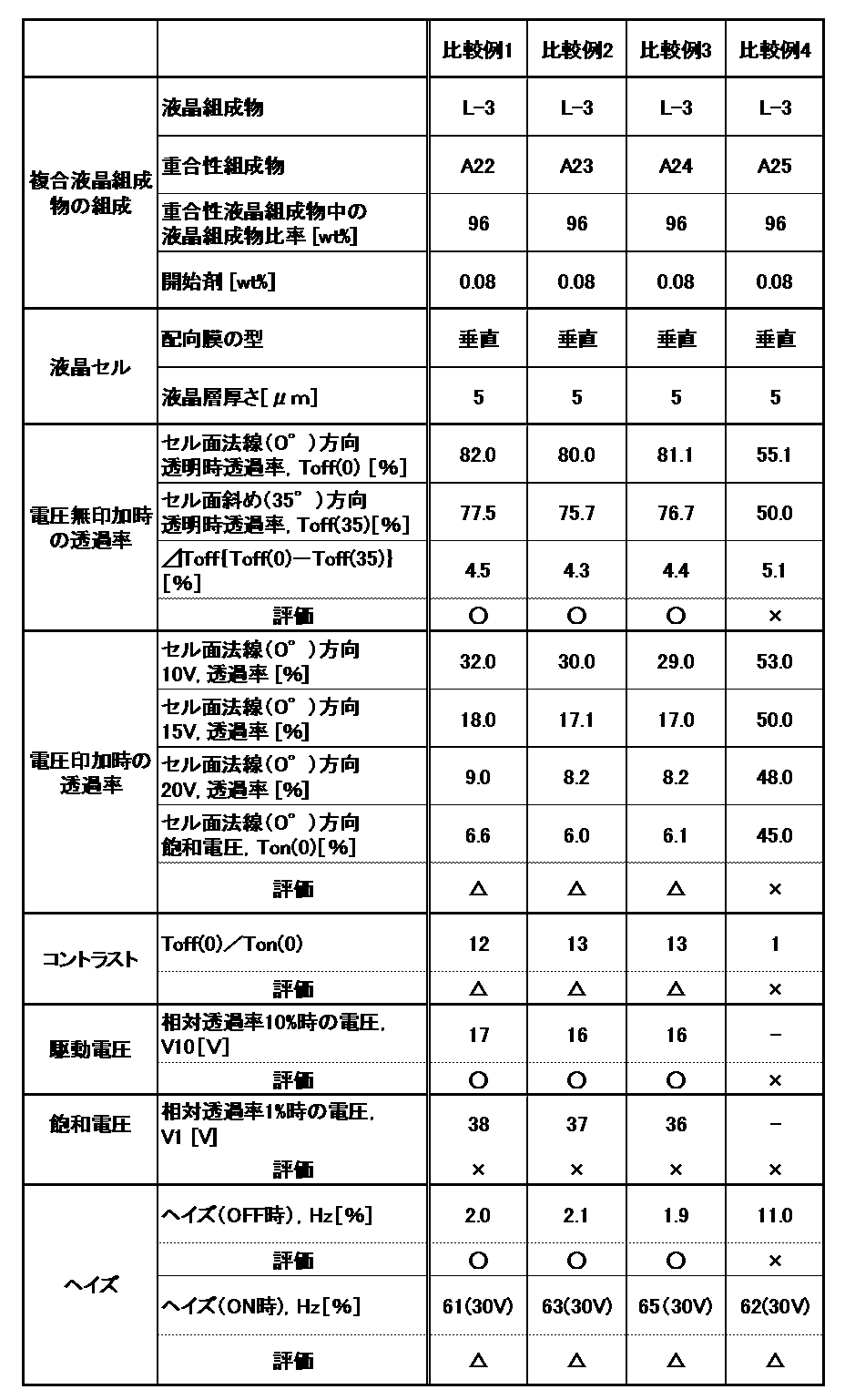
一般に、光散乱型液晶素子において、透明性(ヘイズと△Toff)、コントラスト、駆動電圧は、互いに両立困難な関係である。しかしながら、以上の結果から、実施例はこれらがいずれも高い水準で維持されている。本実施例の液晶素子は、特に実用的な透明性を備えることから、高い透明性が求められるシースルーTV、ウィンドウディスプレイ、スマートウィンドウ、その他の光学制御駆動パネルなどの用途に好適である。
以上の結果から、比較例1は上記実施例に比べて、透明性、コントラスト、駆動電圧いずれも劣る結果となった。この理由は定かではないが、比較例1~比較例4では、一般式(1)で表されるメソゲン骨格の中にZ1の構造を持つ柔軟なメソゲン構造となる重合性化合物を用いておらず、剛直なメソゲン骨格となる重合性化合物を使用しているため、ポリマーネットワークを形成した際に、駆動するホスト液晶と剛直なポリマーネットワークとの間で強い分子間相互作用が働くことに起因していると推察される。
誘電率異方性が負の液晶組成物を用いて構成された液晶素子は、電圧を印加したとき、液晶分子は基板面と略平行方向に配列するものの、分子長軸は基板面とは略垂直方向を回転軸として自由回転できる。このため、図3に示すように、該液晶素子の液晶分子は基板面と略平行方向においてはランダムに配列していると考えられる。この結果、液晶分子と配向性重合体のメソゲン基との間のみならず、液晶分子間においても屈折率差を生じ、相分離液晶層全体において効果的に光散乱が得られると考えられる。
11…第一の透明基板
12…第二の透明基板
2…電極
3…ホモジニアス配向膜
4…液晶分子
5…配向性重合体
12…第二の透明基板
2…電極
3…ホモジニアス配向膜
4…液晶分子
5…配向性重合体
Claims (6)
- 第一の成分として下記一般式(1)で表される化合物の群から選択される重合性化合物を含有し、第二の成分として負の誘電率異方性を有する化合物を含有する、光散乱型液晶素子用液晶組成物。

S1、S2は各々独立してスペーサー基又は単結合を表し、
X1、X2は、S1又はS2への結合手を左端の結合として表記する場合において、各々独立して、-O-、-S-、-OCH2-、-CO-、-COO-、-OCO-、-CO-S-、-S-CO-、-O-CO-O-、-CO-NH-、-NH-CO-、-SCH2-、-CF2O-、-OCF2-、-CF2S-、-SCF2-、-CH=CH-COO-、-CH=CH-OCO-、-COO-CH=CH-、-OCO-CH=CH-、
-COO-CH2CH2-、-OCO-CH2CH2-、-COO-CH2-、-OCO-CH2-、-CH=CH-、-N=N-、-CH=N-N=CH-、-CF=CF-、-C≡C-又は単結合を表し(ただし、各P-(S-X)-結合には-O-O-を含まない。)、
Z1は、-O-、-S-、-OCH2-、-CH2O-、-CO-、-COO-、-OCO-、-CO-S-、-S-CO-、-O-CO-O-、-CO-NH-、-NH-CO-、-SCH2-、-CH2S-、-CF2O-、-OCF2-、-CF2S-、-SCF2-、-CH=CH-COO-、-CH=CH-OCO-、-COO-CH=CH-、-OCO-CH=CH-、-COO-RZ1-、-OCO-RZ1-、-RZ1-COO-、-RZ1-OCO-、-COO-CH2-、-OCO-CH2-、-CH2-COO-、-CH2-OCO-、-CH=CH-、-CH2CH2-、-N=N-、-CH=N-N=CH-、-CF=CF-、-C≡C-又は単結合を表し(ただし、-RZ1-は、炭素原子数2~6のアルキレン基を表し、各P-(S-X)-結合には-O-O-を含まない。)、Z1が複数存在する場合それらは各々同一であっても異なっていても良いが、Z1のうち少なくとも一つは、-COO-RZ1-、-OCO-RZ1-、-RZ1-COO-、
-RZ1-OCO-からなる群から選択される基であり、
A1、A2は各々独立して、2価の芳香環、脂環、複素環及び縮合環から選択される基を表し、A1が複数存在する場合それらは各々同一であっても異なっていても良く、
nは各々独立して1~9の整数を表す。) - 前記第二の成分の負の誘電率異方性を有する化合物として、一般式(N-1)で表される化合物を1種又は2種以上含有する、請求項1に記載の光散乱型液晶素子用液晶組成物。

AN11及びAN12はそれぞれ独立して
(a) 1,4-シクロヘキシレン基(この基中に存在する1個の-CH2-又は隣接していない2個以上の-CH2-は-O-に置き換えられてもよい。)及び
(b) 1,4-フェニレン基(この基中に存在する1個の-CH=又は隣接していない2個以上の-CH=は-N=に置き換えられてもよい。)
(c) ナフタレン-2,6-ジイル基、1,2,3,4-テトラヒドロナフタレン-2,6-ジイル基又はデカヒドロナフタレン-2,6-ジイル基(ナフタレン-2,6-ジイル基又は1,2,3,4-テトラヒドロナフタレン-2,6-ジイル基中に存在する1個の-CH=又は隣接していない2個以上の-CH=は-N=に置き換えられても良い。)
(d) 1,4-シクロヘキセニレン基
からなる群より選ばれる基を表し、上記の基(a)、基(b)、基(c)及び基(d)はそれぞれ独立してシアノ基、フッ素原子又は塩素原子で置換されていても良く、
ZN11及びZN12はそれぞれ独立して単結合、-CH2CH2-、-(CH2)4-、-OCH2-、-CH2O-、-COO-、-OCO-、-OCF2-、-CF2O-、-CH=N-N=CH-、-CH=CH-、-CF=CF-又は-C≡C-を表し、
nN11及びnN12はそれぞれ独立して0~3の整数を表すが、nN11+nN12はそれぞれ独立して1、2又は3であり、AN11、AN12、ZN11又はZN12が複数存在する場合は、それらは同一であっても異なっていても良い。) - 前記第三の成分として、下記一般式(2-ii)

Rii1は単結合又は炭素原子数1~9のアルキレン基を表すが、該アルキレン基中の1つ又は2つ以上の-CH2-は、酸素原子が直接隣接しないようにそれぞれ独立して-O-、-CO-、-COO-又は-OCO-で置換されていてもよく、該アルキレン基中に存在する1つ又は2つ以上の水素原子は、それぞれ独立してフッ素原子で置換されていてもよく、
Rii2及びRii3はそれぞれ独立して、水素原子、又は炭素原子数1~21のアルキル基を表すが、該アルキル基中の1つ又は2つ以上の-CH2-は、酸素原子が直接隣接しないようにそれぞれ独立して-O-、-CO-、 -COO-又は-OCO-で置換されていてもよく、該アルキル基中に存在する1つ又は2つ以上の水素原子は、それぞれ独立してPii2、フッ素原子、炭素原子数1~8のアルキル基、炭素原子数1~8のハロゲン化アルキル基で置換されていてもよい。)で表される重合性化合物、又は
下記一般式(3-i)
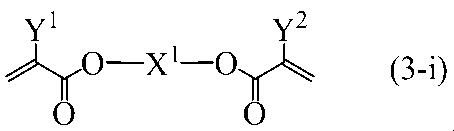
X1は直鎖、または分岐の炭素原子数6~80のアルキレンを表し、該アルキレンの任意の炭素原子は、酸素原子が直接隣接しないように、-O-、-CH=CH-、-CO-、-C≡C-、-OCO-、-COO-、又はOHで置換されてよい。)
で表される重合性化合物を含有する、請求項1に記載の光散乱型液晶素子用液晶組成物。 - 前記第一の成分と第二の成分との合計質量に対する前記第一の成分の含有率が、2~20質量%である請求項3記載の光散乱型液晶素子用液晶組成物。
- 請求項1~4のいずれか一項に記載の光散乱型液晶組成物の重合性化合物を重合させることによりポリマーネットワークを形成させてなる光散乱型液晶素子。
- 請求項5に記載の光散乱型液晶素子を用いたスマートウィンドウ。
Priority Applications (3)
| Application Number | Priority Date | Filing Date | Title |
|---|---|---|---|
| CN201980057733.XA CN112639055B (zh) | 2018-11-29 | 2019-07-18 | 光散射型液晶元件用液晶组合物、光散射型液晶元件、及智能窗户 |
| US17/274,906 US12197062B2 (en) | 2018-11-29 | 2019-07-18 | Liquid crystal composition for light-scattering liquid crystal device, light-scattering liquid crystal device, and smart window |
| JP2020512760A JP6828850B2 (ja) | 2018-11-29 | 2019-07-18 | 光散乱型液晶素子用液晶組成物、光散乱型液晶素子、及びスマートウィンドウ |
Applications Claiming Priority (2)
| Application Number | Priority Date | Filing Date | Title |
|---|---|---|---|
| JP2018223582 | 2018-11-29 | ||
| JP2018-223582 | 2018-11-29 |
Publications (1)
| Publication Number | Publication Date |
|---|---|
| WO2020110364A1 true WO2020110364A1 (ja) | 2020-06-04 |
Family
ID=70851951
Family Applications (1)
| Application Number | Title | Priority Date | Filing Date |
|---|---|---|---|
| PCT/JP2019/028242 Ceased WO2020110364A1 (ja) | 2018-11-29 | 2019-07-18 | 光散乱型液晶素子用液晶組成物、光散乱型液晶素子、及びスマートウィンドウ |
Country Status (5)
| Country | Link |
|---|---|
| US (1) | US12197062B2 (ja) |
| JP (1) | JP6828850B2 (ja) |
| CN (1) | CN112639055B (ja) |
| TW (1) | TWI862505B (ja) |
| WO (1) | WO2020110364A1 (ja) |
Cited By (2)
| Publication number | Priority date | Publication date | Assignee | Title |
|---|---|---|---|---|
| JP2024018429A (ja) * | 2022-07-29 | 2024-02-08 | Toppanホールディングス株式会社 | 調光シート、および、スクリーン |
| WO2025239350A1 (ja) * | 2024-05-13 | 2025-11-20 | Toppanホールディングス株式会社 | 調光シート、および、調光シートの製造方法 |
Families Citing this family (3)
| Publication number | Priority date | Publication date | Assignee | Title |
|---|---|---|---|---|
| JP6828850B2 (ja) * | 2018-11-29 | 2021-02-10 | Dic株式会社 | 光散乱型液晶素子用液晶組成物、光散乱型液晶素子、及びスマートウィンドウ |
| TWI751784B (zh) * | 2020-11-12 | 2022-01-01 | 絢麗光電股份有限公司 | 智慧窗戶 |
| JP7010401B1 (ja) * | 2021-03-24 | 2022-01-26 | 凸版印刷株式会社 | 調光シート、調光シートの製造方法、および高分子分散型用液晶組成物 |
Citations (6)
| Publication number | Priority date | Publication date | Assignee | Title |
|---|---|---|---|---|
| JP2008058374A (ja) * | 2006-08-29 | 2008-03-13 | Dainippon Ink & Chem Inc | 液晶素子 |
| JP2008276197A (ja) * | 2007-03-30 | 2008-11-13 | Dic Corp | 高分子安定化強誘電性液晶組成物及び液晶表示素子 |
| JP2011162571A (ja) * | 2010-02-04 | 2011-08-25 | Dic Corp | 重合性化合物を含有する液晶組成物及びそれを使用した液晶表示素子 |
| JP2016206445A (ja) * | 2015-04-23 | 2016-12-08 | Dic株式会社 | 液晶表示素子 |
| WO2018043276A1 (ja) * | 2016-08-30 | 2018-03-08 | Dic株式会社 | 液晶素子 |
| WO2018105726A1 (ja) * | 2016-12-08 | 2018-06-14 | Jnc株式会社 | リバースモードの液晶デバイス |
Family Cites Families (7)
| Publication number | Priority date | Publication date | Assignee | Title |
|---|---|---|---|---|
| JP3060656B2 (ja) | 1990-11-26 | 2000-07-10 | セイコーエプソン株式会社 | 液晶表示素子 |
| JP2004157247A (ja) * | 2002-11-05 | 2004-06-03 | Asahi Glass Co Ltd | 液晶光学素子とその製造方法および光学装置 |
| US7560231B2 (en) * | 2002-12-20 | 2009-07-14 | Roche Molecular Systems, Inc. | Mannitol and glucitol derivatives |
| US20070298193A1 (en) * | 2004-09-16 | 2007-12-27 | Kazuhiro Nakamura | Method of Producing Light-Scattering Film, Polarizing Plate Comprising Light-Scattering Film and Liquid Crystal Display Device Comprising the Polarizing Plate |
| WO2015022866A1 (ja) | 2013-08-13 | 2015-02-19 | Dic株式会社 | 複合液晶組成物、表示素子及び電界検出器 |
| CN109844066B (zh) * | 2016-12-06 | 2023-09-19 | 捷恩智株式会社 | 液晶复合体及其用途、液晶调光元件、调光窗及智能窗户 |
| JP6828850B2 (ja) * | 2018-11-29 | 2021-02-10 | Dic株式会社 | 光散乱型液晶素子用液晶組成物、光散乱型液晶素子、及びスマートウィンドウ |
-
2019
- 2019-07-18 JP JP2020512760A patent/JP6828850B2/ja active Active
- 2019-07-18 CN CN201980057733.XA patent/CN112639055B/zh active Active
- 2019-07-18 US US17/274,906 patent/US12197062B2/en active Active
- 2019-07-18 WO PCT/JP2019/028242 patent/WO2020110364A1/ja not_active Ceased
- 2019-07-19 TW TW108125613A patent/TWI862505B/zh active
Patent Citations (6)
| Publication number | Priority date | Publication date | Assignee | Title |
|---|---|---|---|---|
| JP2008058374A (ja) * | 2006-08-29 | 2008-03-13 | Dainippon Ink & Chem Inc | 液晶素子 |
| JP2008276197A (ja) * | 2007-03-30 | 2008-11-13 | Dic Corp | 高分子安定化強誘電性液晶組成物及び液晶表示素子 |
| JP2011162571A (ja) * | 2010-02-04 | 2011-08-25 | Dic Corp | 重合性化合物を含有する液晶組成物及びそれを使用した液晶表示素子 |
| JP2016206445A (ja) * | 2015-04-23 | 2016-12-08 | Dic株式会社 | 液晶表示素子 |
| WO2018043276A1 (ja) * | 2016-08-30 | 2018-03-08 | Dic株式会社 | 液晶素子 |
| WO2018105726A1 (ja) * | 2016-12-08 | 2018-06-14 | Jnc株式会社 | リバースモードの液晶デバイス |
Cited By (3)
| Publication number | Priority date | Publication date | Assignee | Title |
|---|---|---|---|---|
| JP2024018429A (ja) * | 2022-07-29 | 2024-02-08 | Toppanホールディングス株式会社 | 調光シート、および、スクリーン |
| JP7484976B2 (ja) | 2022-07-29 | 2024-05-16 | Toppanホールディングス株式会社 | 調光シート、および、スクリーン |
| WO2025239350A1 (ja) * | 2024-05-13 | 2025-11-20 | Toppanホールディングス株式会社 | 調光シート、および、調光シートの製造方法 |
Also Published As
| Publication number | Publication date |
|---|---|
| TWI862505B (zh) | 2024-11-21 |
| TW202030315A (zh) | 2020-08-16 |
| US20220057672A1 (en) | 2022-02-24 |
| CN112639055A (zh) | 2021-04-09 |
| US12197062B2 (en) | 2025-01-14 |
| JPWO2020110364A1 (ja) | 2021-02-15 |
| JP6828850B2 (ja) | 2021-02-10 |
| CN112639055B (zh) | 2024-10-15 |
Similar Documents
| Publication | Publication Date | Title |
|---|---|---|
| JP6828850B2 (ja) | 光散乱型液晶素子用液晶組成物、光散乱型液晶素子、及びスマートウィンドウ | |
| JP7346903B2 (ja) | 液晶素子、及び液晶素子を用いた物品 | |
| WO2013141116A1 (ja) | ネマチック液晶組成物 | |
| JP7298136B2 (ja) | 液晶組成物及び液晶表示素子 | |
| WO2019049673A1 (ja) | 配向助剤、液晶組成物及び液晶表示素子 | |
| CN110651021A (zh) | 液晶组合物用自发取向助剂 | |
| KR20170094331A (ko) | 액정 표시 소자 및 그 제조 방법 | |
| JP6699799B2 (ja) | 重合性化合物、並びにそれを使用した液晶組成物及び液晶表示素子 | |
| JP7472606B2 (ja) | 液晶組成物及び液晶表示素子 | |
| JP6452017B1 (ja) | 液晶組成物及び液晶表示素子 | |
| WO2020008898A1 (ja) | 液晶組成物及び液晶表示素子 | |
| TW201930566A (zh) | 液晶組成物及液晶顯示元件 | |
| JP7395147B2 (ja) | 光散乱型液晶組成物及びそれを含有する調光素子、並びにそれらを備えたスマートウィンドウ | |
| TW202229521A (zh) | 液晶組合物及液晶顯示元件 | |
| TWI859148B (zh) | 液晶組成物 | |
| JP5892291B2 (ja) | ジフルオロフェニル液晶組成物 | |
| JP2020139153A (ja) | ポリマーネットワーク型液晶素子用液晶組成物、該液晶組成物を用いたポリマーネットワーク型液晶表示素子、及びその製造方法 | |
| JP7388123B2 (ja) | 光散乱型液晶素子用液晶組成物、及び該光散乱型液晶素子用液晶組成物を用いた光散乱型液晶素子 | |
| JP7472607B2 (ja) | 液晶組成物及び液晶表示素子 | |
| JP7542974B2 (ja) | 液晶表示素子の製造方法 | |
| JP7811146B2 (ja) | 重合性化合物含有液晶組成物並びにこれを用いた液晶表示素子 | |
| JP2020042113A (ja) | 液晶素子 | |
| TWI721763B (zh) | 液晶組成物及液晶顯示元件 | |
| JP2021102752A (ja) | 液晶組成物及び該液晶組成物を用いた液晶表示素子 | |
| JPWO2021002205A1 (ja) | 液晶組成物及び液晶表示素子 |
Legal Events
| Date | Code | Title | Description |
|---|---|---|---|
| ENP | Entry into the national phase |
Ref document number: 2020512760 Country of ref document: JP Kind code of ref document: A |
|
| 121 | Ep: the epo has been informed by wipo that ep was designated in this application |
Ref document number: 19890876 Country of ref document: EP Kind code of ref document: A1 |
|
| NENP | Non-entry into the national phase |
Ref country code: DE |
|
| 122 | Ep: pct application non-entry in european phase |
Ref document number: 19890876 Country of ref document: EP Kind code of ref document: A1 |