WO2020107758A1 - 一种检测硝基还原酶的荧光探针及其制备方法与酶促反应的应用 - Google Patents
一种检测硝基还原酶的荧光探针及其制备方法与酶促反应的应用 Download PDFInfo
- Publication number
- WO2020107758A1 WO2020107758A1 PCT/CN2019/079616 CN2019079616W WO2020107758A1 WO 2020107758 A1 WO2020107758 A1 WO 2020107758A1 CN 2019079616 W CN2019079616 W CN 2019079616W WO 2020107758 A1 WO2020107758 A1 WO 2020107758A1
- Authority
- WO
- WIPO (PCT)
- Prior art keywords
- diphenylamino
- biphenyl
- nitrobenzyl
- preparation
- nitroreductase
- Prior art date
- Legal status (The legal status is an assumption and is not a legal conclusion. Google has not performed a legal analysis and makes no representation as to the accuracy of the status listed.)
- Ceased
Links
Classifications
-
- G—PHYSICS
- G01—MEASURING; TESTING
- G01N—INVESTIGATING OR ANALYSING MATERIALS BY DETERMINING THEIR CHEMICAL OR PHYSICAL PROPERTIES
- G01N21/00—Investigating or analysing materials by the use of optical means, i.e. using sub-millimetre waves, infrared, visible or ultraviolet light
- G01N21/75—Systems in which material is subjected to a chemical reaction, the progress or the result of the reaction being investigated
- G01N21/76—Chemiluminescence; Bioluminescence
-
- C—CHEMISTRY; METALLURGY
- C07—ORGANIC CHEMISTRY
- C07D—HETEROCYCLIC COMPOUNDS
- C07D215/00—Heterocyclic compounds containing quinoline or hydrogenated quinoline ring systems
- C07D215/02—Heterocyclic compounds containing quinoline or hydrogenated quinoline ring systems having no bond between the ring nitrogen atom and a non-ring member or having only hydrogen atoms or carbon atoms directly attached to the ring nitrogen atom
- C07D215/12—Heterocyclic compounds containing quinoline or hydrogenated quinoline ring systems having no bond between the ring nitrogen atom and a non-ring member or having only hydrogen atoms or carbon atoms directly attached to the ring nitrogen atom with substituted hydrocarbon radicals attached to ring carbon atoms
- C07D215/14—Radicals substituted by oxygen atoms
-
- C—CHEMISTRY; METALLURGY
- C09—DYES; PAINTS; POLISHES; NATURAL RESINS; ADHESIVES; COMPOSITIONS NOT OTHERWISE PROVIDED FOR; APPLICATIONS OF MATERIALS NOT OTHERWISE PROVIDED FOR
- C09K—MATERIALS FOR MISCELLANEOUS APPLICATIONS, NOT PROVIDED FOR ELSEWHERE
- C09K11/00—Luminescent materials, e.g. electroluminescent or chemiluminescent
- C09K11/06—Luminescent materials, e.g. electroluminescent or chemiluminescent containing organic luminescent materials
-
- G—PHYSICS
- G01—MEASURING; TESTING
- G01N—INVESTIGATING OR ANALYSING MATERIALS BY DETERMINING THEIR CHEMICAL OR PHYSICAL PROPERTIES
- G01N21/00—Investigating or analysing materials by the use of optical means, i.e. using sub-millimetre waves, infrared, visible or ultraviolet light
- G01N21/62—Systems in which the material investigated is excited whereby it emits light or causes a change in wavelength of the incident light
- G01N21/63—Systems in which the material investigated is excited whereby it emits light or causes a change in wavelength of the incident light optically excited
- G01N21/64—Fluorescence; Phosphorescence
- G01N21/6428—Measuring fluorescence of fluorescent products of reactions or of fluorochrome labelled reactive substances, e.g. measuring quenching effects, using measuring "optrodes"
-
- C—CHEMISTRY; METALLURGY
- C09—DYES; PAINTS; POLISHES; NATURAL RESINS; ADHESIVES; COMPOSITIONS NOT OTHERWISE PROVIDED FOR; APPLICATIONS OF MATERIALS NOT OTHERWISE PROVIDED FOR
- C09K—MATERIALS FOR MISCELLANEOUS APPLICATIONS, NOT PROVIDED FOR ELSEWHERE
- C09K2211/00—Chemical nature of organic luminescent or tenebrescent compounds
- C09K2211/10—Non-macromolecular compounds
- C09K2211/1003—Carbocyclic compounds
- C09K2211/1007—Non-condensed systems
-
- C—CHEMISTRY; METALLURGY
- C09—DYES; PAINTS; POLISHES; NATURAL RESINS; ADHESIVES; COMPOSITIONS NOT OTHERWISE PROVIDED FOR; APPLICATIONS OF MATERIALS NOT OTHERWISE PROVIDED FOR
- C09K—MATERIALS FOR MISCELLANEOUS APPLICATIONS, NOT PROVIDED FOR ELSEWHERE
- C09K2211/00—Chemical nature of organic luminescent or tenebrescent compounds
- C09K2211/10—Non-macromolecular compounds
- C09K2211/1003—Carbocyclic compounds
- C09K2211/1014—Carbocyclic compounds bridged by heteroatoms, e.g. N, P, Si or B
-
- C—CHEMISTRY; METALLURGY
- C09—DYES; PAINTS; POLISHES; NATURAL RESINS; ADHESIVES; COMPOSITIONS NOT OTHERWISE PROVIDED FOR; APPLICATIONS OF MATERIALS NOT OTHERWISE PROVIDED FOR
- C09K—MATERIALS FOR MISCELLANEOUS APPLICATIONS, NOT PROVIDED FOR ELSEWHERE
- C09K2211/00—Chemical nature of organic luminescent or tenebrescent compounds
- C09K2211/10—Non-macromolecular compounds
- C09K2211/1018—Heterocyclic compounds
-
- C—CHEMISTRY; METALLURGY
- C09—DYES; PAINTS; POLISHES; NATURAL RESINS; ADHESIVES; COMPOSITIONS NOT OTHERWISE PROVIDED FOR; APPLICATIONS OF MATERIALS NOT OTHERWISE PROVIDED FOR
- C09K—MATERIALS FOR MISCELLANEOUS APPLICATIONS, NOT PROVIDED FOR ELSEWHERE
- C09K2211/00—Chemical nature of organic luminescent or tenebrescent compounds
- C09K2211/10—Non-macromolecular compounds
- C09K2211/1018—Heterocyclic compounds
- C09K2211/1025—Heterocyclic compounds characterised by ligands
- C09K2211/1029—Heterocyclic compounds characterised by ligands containing one nitrogen atom as the heteroatom
-
- C—CHEMISTRY; METALLURGY
- C12—BIOCHEMISTRY; BEER; SPIRITS; WINE; VINEGAR; MICROBIOLOGY; ENZYMOLOGY; MUTATION OR GENETIC ENGINEERING
- C12Q—MEASURING OR TESTING PROCESSES INVOLVING ENZYMES, NUCLEIC ACIDS OR MICROORGANISMS; COMPOSITIONS OR TEST PAPERS THEREFOR; PROCESSES OF PREPARING SUCH COMPOSITIONS; CONDITION-RESPONSIVE CONTROL IN MICROBIOLOGICAL OR ENZYMOLOGICAL PROCESSES
- C12Q1/00—Measuring or testing processes involving enzymes, nucleic acids or microorganisms; Compositions therefor; Processes of preparing such compositions
- C12Q1/26—Measuring or testing processes involving enzymes, nucleic acids or microorganisms; Compositions therefor; Processes of preparing such compositions involving oxidoreductase
-
- G—PHYSICS
- G01—MEASURING; TESTING
- G01N—INVESTIGATING OR ANALYSING MATERIALS BY DETERMINING THEIR CHEMICAL OR PHYSICAL PROPERTIES
- G01N21/00—Investigating or analysing materials by the use of optical means, i.e. using sub-millimetre waves, infrared, visible or ultraviolet light
- G01N21/62—Systems in which the material investigated is excited whereby it emits light or causes a change in wavelength of the incident light
- G01N21/63—Systems in which the material investigated is excited whereby it emits light or causes a change in wavelength of the incident light optically excited
- G01N21/64—Fluorescence; Phosphorescence
- G01N21/6428—Measuring fluorescence of fluorescent products of reactions or of fluorochrome labelled reactive substances, e.g. measuring quenching effects, using measuring "optrodes"
- G01N2021/6432—Quenching
Definitions
- the invention belongs to the technical field of industrial analysis and detection, and in particular relates to a fluorescent probe for detecting nitroreductase, its preparation method and application of enzymatic reaction.
- Nitro compounds are widely used in industries such as medicine, dyes, pesticides, and explosives, but most of them have carcinogenic effects on humans, causing many diseases and endangering human health.
- Amine compounds are essential in the synthesis of many fine chemical products and intermediates such as pesticides, medicines, dyes, synthetic resins, surfactants, etc., because the introduction of amino groups makes it possible to change the functions of fine chemicals, such as amino
- the introduction can make the absorption and emission spectrum of the compound red-shifted.
- the introduction of an amino group in the ortho position of the dye chromophore can cause the color change of the dye.
- the introduction of the amino group can change the printing and dyeing performance of the dye; more importantly, it is related to the nitro compound.
- amine compounds are less toxic.
- most aromatic amine compounds in industry are prepared by reduction of aromatic nitro compounds. Therefore, the reduction of nitro groups to amino groups has an important role in industrial production.
- the main reduction methods in industry are iron powder reduction, alkali sulfide reduction and catalytic hydrogenation reduction method.
- these methods have the disadvantages of complicated process flow, troublesome post-processing, a lot of waste generated in the process, and high preparation cost.
- Enzymes also known as enzymes, are biological macromolecules with biocatalytic functions and a type of biocatalyst. Most enzymes are proteins, which have good biocompatibility and environmental friendliness.
- Enzymatic catalysis can be regarded as a kind of catalysis between homogeneous and heterogeneous catalytic reactions, which has both The characteristics of general catalysts also have special characteristics that are different from general catalysts. Compared with general catalysts, enzyme catalysts have many advantages: 1) Enzymatic reactions have high efficiency; 2) Enzymatic reactions have high specificity; 3 ) The enzymatic reaction is relatively mild; 4) The diversity of enzyme types makes the diversity of the enzymatic reaction; 5 ) The effect of the enzymatic reaction can be adjusted by adjusting the activity of the enzyme. However, since most enzymes themselves are proteins, they are easily affected by temperature, acidity, and concentration of catalyzed substances in the reaction process, or even deactivated. Therefore, the enzymatic reaction should be carried out in the aqueous phase as much as possible, which is beneficial to reduce the pollution of the environment by organic solvents and facilitates the enzymatic reaction.
- oxidoreductase catalytic reduction of nitro compounds is a research hotspot.
- the oxidoreductases mainly used for such enzymatic reactions mainly include nitroreductase and nitrate reductase.
- nitroreductase is a kind of relatively widely used enzyme, and its sources are widely available, the enzymatic action conditions are mild, the enzymatic reaction effect is good, its research is more in-depth, the mechanism of action is relatively mature, and its Two types of enzymes, oxygen-sensitive and oxygen-insensitive, have a wide range of applications. Therefore, in order to ensure the high efficiency and stability of the conversion of nitro compounds into amine compounds in industrial applications, it is of great significance to research and develop fluorescent probes capable of measuring such nitro reductases.
- Fluorescence method has excellent characteristics in analysis and detection, such as good selectivity, high sensitivity, fast response speed and convenient use.
- the fluorescent compound is easy to design, modify and improve in chemical structure, which can meet the needs of different test samples Therefore, the fluorescence method is very suitable for the analysis and detection of nitroreductase in industrial enzymatic reactions.
- Chinese Patent CN201610050741.X A two-photon fluorescent probe for the detection of nitroreductase in the hypoxic region was prepared.
- the aromatic nitro group in the compound can be reduced to an aromatic amine group by the nitroreductase and initiate 1,6-
- the rearrangement and elimination reaction releases the fluorescent host, which causes the fluorescence to change.
- the fluorescent probe is generally water-soluble and has the property of aggregation-induced quenching. It is difficult to achieve high concentration and enzyme detection analysis in the aqueous phase. The photon detection equipment is complicated and expensive, and the application field is mainly concentrated in the hypoxic area in the cell.
- China Patent CN201610471060.0 A two-photon fluorescent probe capable of detecting nitroreductase is disclosed. The nitro group is directly connected to the fluorescent body. As the concentration of nitroreductase increases, the fluorescence intensity gradually increases, and the emission wavelength range is 425-475 nm. with 500-550 nm In between, this probe is not conducive to use in the aqueous phase. It is prone to fluorescence quenching in the presence of high concentrations of nitroreductase, and is mainly used for cell imaging in the biological field, and does not have the application of large-scale industrial enzymatic reactions Potential.
- AIE aggregation-induced luminescence
- China Patent CN201710009923.7 discloses a fluorescent probe based on AIE for detecting nitroreductase, which directly connects the nitro group to tetraphenylethylene, because of D- ⁇ -A before response
- the electronic effect makes the fluorescence obvious, after the response due to D- ⁇ -D
- the structure causes weakening of the fluorescence and blue shift.
- the change in fluorescence is used to detect nitroreductase, but the probe is mainly used in cells and cannot be used for the detection and analysis of enzyme concentration in industrial enzymatic reaction systems. .
- fluorescent probes for detecting nitroreductase have made some progress in the field of biological detection and imaging, they are rarely applied to the detection and analysis of enzyme activity in industrial enzymatic reactions. It can be seen from this that the field of industrial enzymatic reactions urgently needs to be developed to detect enzyme activity detection and analysis probes with special catalytic effects.
- the primary object of the present invention is to provide a fluorescent probe compound.
- This fluorescent probe has aggregation-induced luminescence .
- NTR nitro reductase
- ICT intramolecular charge Transfer effect
- Another object of the present invention is to provide a method for preparing the above fluorescent compound.
- Still another object of the present invention is to provide the above fluorescent compound for the detection of nitroreductase activity in industrial enzymatic reactions where aromatic nitro groups are converted into aromatic amine groups.
- a fluorescent probe for detecting nitroreductase is 3-(4-(2-(4'-(diphenylamino))-3-((4- Nitrobenzyl) Oxygen )-[1,1'-biphenyl ]-4-yl) Vinyl) Quinoline-1-bromo) Propane-1-sulfonate, the structural formula is as follows:
- the preparation method of the fluorescent probe for detecting nitroreductase described above includes the following preparation steps:
- step (1) the 4'-(diphenylamino)-3-hydroxy-[1,1'-biphenyl]-4- described in step (1)
- the molar ratio of formaldehyde and p-nitrobenzyl bromide is 1:(1.5-2).
- the molar ratio of the amount of cesium carbonate and p-nitrobenzyl bromide in step (1) is (4-5):1.
- the 3-(4-methylquinoline-1-bromo) propane-1-sulfonate and 4'-( The molar ratio of diphenylamino)-3-((4-nitrobenzyl)oxy)-[1,1'-biphenyl]-4-formaldehyde is 1:(1-2).
- the molar ratio of the amount of acetic acid and 3-(4-methylquinoline-1-bromo)propane-1-sulfonic acid in step (2) is (2-4):1.
- the reaction time in step (1) is 5 h-48 h.
- the reaction time in step (2) is 3 h-24 h.
- the separation and purification step in step (1) is as follows: the reaction solution is cooled to room temperature, and dichloromethane/ The solution was extracted with deionized water, the organic phase was collected, dried, filtered, and the solvent was removed by rotary evaporation. The resulting solid was purified by a silica gel chromatography column.
- the step (2 ) The separation and purification steps are as follows: the reaction solution is cooled to room temperature, the solvent is removed by a rotary evaporator, then ethyl acetate is added, and washed with hydrochloric acid and saturated brine respectively, then dried, filtered, and the solvent is removed by rotary evaporation, and the resulting solid is passed through silica gel Chromatography Column purification.
- the above-mentioned fluorescent probe for detecting nitroreductase is used for the detection and analysis of nitroreductase in the enzymatic reaction of the conversion of aromatic nitro to aromatic amine in industry.
- the fluorescent compound of the product obtained in the present invention is 3-(4-(2-(4'-(diphenylamino)-3-((4-nitrobenzyl)oxy)-[1,1'-biphenyl] -4-yl) vinyl) quinoline-1-bromo) propane-1-sulfonate (TAE-NQS), the molecular formula is C 45 H 37 N 3 O 6 S, and the relative molecular mass is 747.24.
- TAE-NQS is a purple-red odorless solid powder, slightly soluble in water, and easily soluble in solvents such as DMSO and DMF.
- the compound has good light stability, non-toxicity, and is suitable for enzymatic reactions in aqueous systems.
- TAE-NQS itself has a triphenylamine group, and the nitro group on its recognition group can greatly quench the fluorescence, under the excitation light of 500 nm, there is almost no fluorescence emission near 750 nm.
- TAE-NQS reacts with nitroreductase, 1,6-rearrangement and elimination reactions occur, and after cleavage, it becomes hydroxyl (the product is 3-(4-(2-(4'-(diphenylamino)- 3-hydroxy-[1,1'-biphenyl]-4-yl) vinyl) quinoline-1-bromo) propane-1-sulfonate TAE-NQS-OH), and due to the electron-donating hydroxyl group The presence of it makes the fluorescence change and emits strong fluorescence around 750 nm.
- the fluorescent probe of the invention can be used for detecting the activity of nitroreductase in industrial enzymatic reactions such as the conversion of aromatic nitro groups to aromatic amine groups.
- the identification mechanism is as follows:
- the invention provides a nitroreductase fluorescent probe which can be used for detecting the reaction of phenylnitro group to aniline group in industrial enzymatic reaction.
- the probe itself has only very weak fluorescence, but it has the role of nitroreductase
- the phenylnitro group is reduced to an aniline group, initiating 1,6- Rearrangement and elimination reaction, after breaking, it becomes hydroxyl group and emits strong fluorescence.
- the present invention has the following advantages and beneficial effects:
- the fluorescent compound TAE-NQS of the present invention has the characteristics of aggregation-induced luminescence.
- a high concentration of enzyme will be added to participate in the reaction, but this probe will not produce in the presence of a high concentration of detection substrate. After quenching, the obtained detection effect has high sensitivity and good accuracy.
- the TAE-NQS probe of the present invention can occur 1,6- Rearrangement and elimination of reactions, due to AIE after fracture
- the internal'mechanical rotation' is restricted, the energy dissipation channels for non-radiative transition back to the ground state are restricted, and it still has the characteristics of aggregation-induced luminescence.
- the fluorescence can be changed. Therefore, it can be used for the detection and analysis of nitroreductase in industrial enzymatic reactions, especially the conversion of aromatic nitro groups to aromatic amine groups.
- the fluorescent probe of the present invention itself has a long emission wavelength, reaching 750 nm, and has a significant fluorescence enhancement effect.
- the fluorescent probe of the present invention can adapt to the harsh and complicated environment in industrial enzymatic reactions, has good structural stability, and is convenient for popularization and use in the enzymatic reactions in the chemical industry.
- FIG. 1 is a synthetic route diagram of the fluorescent probe compound of the present invention.
- Figure 2 shows 4'-(diphenylamino)-3-((4-nitrobenzyl)oxy)-(1,1'- NMR hydrogen spectrum of biphenyl ]-4-formaldehyde.
- Figure 3 shows the 3-(4-(2-(4'-(diphenylamino)-3-((4-nitrobenzyl))oxy group in Example 1 )-[1,1'-biphenyl]-4-yl) vinyl) quinoline-1-bromo) propane-1-sulfonate NMR hydrogen spectrum.
- FIG. 5 is a fluorescence spectrum diagram of the fluorescent probe of the present invention before and after response.
- Figure 6 shows the fluorescence spectrum of the product's aggregation-induced luminescence effect after the response of the TAE-NQS-OH fluorescent probe.
- Figure 7 shows the fluorescence spectrum of TAE-NQS fluorescent probes with different response time to nitroreductase.
- Fig. 8 is the fluorescence spectrum of TAE-NQS fluorescent probe response to different concentrations of nitroreductase.
- the synthetic route of the fluorescent probe compound of the present invention is shown in FIG. 1.
- the proton peak at 10.58 ppm is the aldehyde matrix proton peak on the salicylaldehyde structure
- the proton peaks at 8.02 ppm, 7.75 ppm and 7.28 ppm are the three H proton peaks on the aromatic ring of salicylaldehyde
- the peaks at 8.26 ppm and 7.66 ppm are the 4 H proton peaks on p-nitrobenzyl bromide
- 7.40 ppm and 7.27 ppm are characteristic peaks of 4 protons on one aromatic ring of triphenylamine
- 7.0-7.24 ppm are the remaining peaks on the triphenylamine aromatic ring
- the characteristic peak of 10 protons, the proton peak at 5.33 ppm is the characteristic peak of methylene on p-nitrobenzyl bromide.
- a, b and c are three characteristic peaks of methylene protons on alkylsulfonates, d is characteristic peaks of methylene protons on p-nitrobenzyl bromide, and e is conjugated double Proton characteristic peak on the bond structure, g is triphenylamine and its coupling is the characteristic peak of 16 H protons on the salicylaldehyde aromatic ring structure, 7.78-9.5 ppm is the quinoline salt, p-nitrobenzyl bromide on the aromatic ring structure And the proton peak next to the coupled double bond on salicylaldehyde, a total of 11 characteristic peaks of H protons.
- the synthesized product can be determined as the target intermediate.
- the NMR hydrogen spectrum of the resulting product is shown in Figure 3.
- the fluorescent probe compound obtained by the invention detects the activity of nitroreductase in the enzymatic reaction system:
- the test sample has a red shift in absorption and a significant change in fluorescence intensity. This is because the probe molecules in the test sample have undergone 1,6- Rearrangement and elimination reaction, the hydroxyl group generated after cleavage is an electron-donating group to obtain 3-(4-(2-(4'-(diphenylamino)-3-hydroxy-[1,1'-biphenyl]- 4-yl) vinyl) Quinoline-1-bromo) propane-1-sulfonate (TAE-NQS-OH), which causes an intramolecular charge transfer effect (ICT effect) to occur, causing the fluorescence to redshift; at the same time, it has AIE The presence of the triphenylamine group makes the fluorescent molecule itself have a good AIE effect.
- ICT effect intramolecular charge transfer effect
- the AIE effect of TAE-NQS-OH (by adjusting the ratio of water to N,N-dimethylformamide is 0%-99%, control the probe concentration of each group to 10 ⁇ M, and prepare the test system for the aggregation-induced luminescence property).
- the fluorescence intensity changes with time, as shown in Figure 7 As shown.
- the probe concentration is 10
- a series of ⁇ M PBS buffer (pH 7.4)
- the control temperature is 37 °C
- the response time is 5 min
- the wavelength of each group of test samples is measured at 500 nm Fluorescence spectrum under the excitation wavelength of the test results shown in Figure 8. It can be seen from FIGS. 7 and 8 that the fluorescent probe prepared by the present invention has a better detection effect on NTR in the enzymatic reaction system.
- NTR (0-5 ⁇ g/mL) increase in 30 min The internal reaction is sufficient, and the fluorescence changes before and after the response are obvious, which may indicate that it is suitable for the detection of nitroreductase in the conversion of aromatic nitro groups to aromatic amine groups.
- the method has the advantages of simple preparation, high yield, and is suitable for detecting high-concentration enzymes in enzymatic reactions. It has shown great application prospects in the field of enzymatic reaction system enzyme detection in the chemical industry.
Landscapes
- Chemical & Material Sciences (AREA)
- Organic Chemistry (AREA)
- Health & Medical Sciences (AREA)
- Physics & Mathematics (AREA)
- Life Sciences & Earth Sciences (AREA)
- Engineering & Computer Science (AREA)
- Immunology (AREA)
- Biochemistry (AREA)
- General Health & Medical Sciences (AREA)
- Analytical Chemistry (AREA)
- Pathology (AREA)
- General Physics & Mathematics (AREA)
- Chemical Kinetics & Catalysis (AREA)
- Materials Engineering (AREA)
- Proteomics, Peptides & Aminoacids (AREA)
- Zoology (AREA)
- Wood Science & Technology (AREA)
- Optics & Photonics (AREA)
- Nuclear Medicine, Radiotherapy & Molecular Imaging (AREA)
- Biophysics (AREA)
- Biotechnology (AREA)
- Microbiology (AREA)
- Molecular Biology (AREA)
- Plasma & Fusion (AREA)
- Bioinformatics & Cheminformatics (AREA)
- General Engineering & Computer Science (AREA)
- Genetics & Genomics (AREA)
- Investigating Or Analysing Materials By The Use Of Chemical Reactions (AREA)
- Measuring Or Testing Involving Enzymes Or Micro-Organisms (AREA)
- Organic Low-Molecular-Weight Compounds And Preparation Thereof (AREA)
Abstract
本发明公开了一种检测硝基还原酶的荧光探针及其制备方法与酶促反应的应用,属于工业分析检测技术领域。所述荧光探针为 3-(4-(2-(4'-( 二苯胺基 )-3-((4- 硝基苄基 ) 氧基 )-[1,1'- 联苯基 ]-4- 基 ) 乙烯基 ) 喹啉 -1- 溴 ) 丙烷 -1- 磺酸盐。本发明的探针化合物通过引入亲水性基团磺酸根和喹啉盐类增强其亲水性,在硝基还原酶( NTR )的催化下发生 1,6- 重排和消除反应,生成羟基,通过分子内电荷转移效应( ICT )引发的荧光变化来实现对酶促反应中 NTR 的检测分析。该方法具有制备简便、产率较高、且适用于检测酶促反应中高浓度酶含量等优点,在化工领域中的酶促反应体系酶检测领域显示了极大的应用前景。
Description
技术领域
本发明属于工业分析检测技术领域,具体涉及一种检测硝基还原酶的荧光探针及其制备方法与酶促反应的应用。
背景技术
硝基化合物广泛应用于医药、染料、农药和炸药等行业,但是它们大多数对人类有致癌作用,会引起诸多疾病,危害人类健康。而胺类化合物在农药、医药、染料、合成树脂、表面活性剂等诸多精细化工产品和中间体的合成中至关重要,因为,氨基的引入使得精细化学品功能的变化成为可能,例如氨基的引入可以使化合物的吸收和发射光谱红移,在染料生色基团的邻位引入氨基可以导致染料的颜色变化,氨基的引入可以改变染料的印染性能;更重要的是,和硝基化合物相比,胺类化合物毒性较小。目前,工业上大部分芳胺化合物都是经由芳香族硝基化合物还原制得,所以,硝基还原成氨基这一类反应在工业生产中有重要作用。
通常,工业上的主要还原方法是铁粉还原、硫化碱还原和催化加氢还原法等。但这些方法存在工艺流程复杂、后处理麻烦、过程中产生诸多废弃物、制备费用高昂等缺点。近年来,用生物方法将硝基化合物还原成氨基化合物发展迅速,成为构建环境友好的绿色化学的方法之一。酶,又称为酵素,是具有生物催化功能的生物大分子,是一类生物催化剂。绝大多数酶都是蛋白质,其具有较好的生物相容性和环境友好性。酶催化可以看作是介于均相和非均相催化反应之间的一种催化,既具有一
般催化剂的特征,也具有不同于一般催化剂的特殊性。相比于一般催化剂,酶催化剂具有诸多优点: 1 )酶促反应具有很高的效率; 2 )酶促反应具有高度的专一性; 3
)酶促反应较为温和; 4 )酶的种类的多样性,使得酶促反应的多样性; 5
)可以通过调节酶的活性,进而调节酶促反应的效果。但由于大多数酶本身为蛋白质,其容易被反应过程中的温度、酸碱度、被催化物的浓度等影响其活性甚至失活。因此,酶促反应应尽可能在水相中进行,有利于减少有机溶剂对环境的污染且利于酶促反应的进行。
近些年,随着酶分离纯化技术的提高,用游离酶直接作用于硝基化合物的还原成为生物有机化学中的一个崭新领域,其中氧化还原酶催化还原硝基化合物是研究的热点。目前主要用于此类酶促反应的氧化还原酶主要有硝基还原酶、硝酸还原酶等。其中,硝基还原酶是一类应用相对广泛的酶,且其来源广泛易得,酶促作用条件温和,酶促反应效果较好,对其研究比较深入,作用机理相对成熟,同时其具有对氧敏感和对氧不敏感的两种酶类型,应用范围广泛。因此,为了能够保证酶促反应在工业应用中的硝基类化合物转换成胺类化合物的高效性和稳定性,研究和开发能够测量此类硝基还原酶的荧光探针具有重要意义。
荧光法在分析检测上具有选择性佳、灵敏度高、响应速度快和使用方便等优异特点。同时,荧光化合物在化学结构上易于设计、修饰和改进,能满足不同检测样品的需
要;因此,荧光法非常适合工业上酶促反应中硝基还原酶的分析检测。中国专利 CN201610050741.X
制备了一种用于检测缺氧区硝基还原酶的双光子荧光探针,该化合物中的芳香硝基能够被硝基还原酶还原成芳胺基,并引发 1,6-
重排与消除反应,释放出荧光主体,导致荧光发生变化,但是该荧光探针水溶性一般,且具有聚集诱导淬灭的性质,难以实现高浓度和水相中的酶检测分析,同时使用双光子检测设备复杂且昂贵,应用领域主要集中于细胞中的缺氧区。中国专利
CN201610471060.0
公开了一种可以检测硝基还原酶的双光子荧光探针,将硝基直接接在荧光主体上,随着硝基还原酶浓度的增加,荧光强度逐渐增强,发射波长范围在 425-475 nm 和
500-550 nm
之间,该探针不利于在水相中使用,在高浓度的硝基还原酶存在时容易发生荧光淬灭,且主要应用于生物领域的细胞成像,不具备大规模工业酶促反应的应用潜质。
具有聚集诱导发光 (AIE)
性质的荧光材料在溶液分散状态中以单分子形式存在时,激发态的电子通过分子内的运动回到基态;当分子处于聚集态时,分子内运动受限制,激发态的电子只能通过辐射跃迁的方式回到基态,因而可以观察到荧光增强现象,在诸多领域中都有广泛应用。中国专利
CN201710009923.7 公开了一种基于 AIE 的荧光探针用 于检测硝基还原酶,其将硝基直接接在四苯基乙烯上,未响应前由于 D-π-A
的电子效应,使得荧光明显,响应后由于 D-π-D
结构,导致使荧光变弱且蓝移,利用该荧光的变化实现对硝基还原酶的检测,但该探针主要应用在细胞中,且无法应用于工业酶促反应体系中酶浓度的检测分析。
尽管检测硝基还原酶的荧光探针在生物检测与成像领域目前已经取得了一些进展,但是鲜有将其应用于工业酶促反应中酶活性的检测分析。由此可见,工业酶促反应领域亟待开发能够检测具有特殊催化作用的酶活性检测分析探针。
发明内容
为了解决以上现有技术的缺点和不足之处,本发明的首要目的在于提供一种荧光探针化合物。该荧光探针具备聚集诱导发光特性
,通过引入亲水性基团磺酸根和喹啉盐类增强其亲水性,在硝基还原酶( NTR )的催化下发生 1,6- 重排和消除反应,生成羟基,通过分子内电荷转移效应( ICT
)引发的荧光变化来实现对工业酶促反应中 NTR 的检测分析。
本发明的另一目的在于提供上述荧光化合物的制备方法。
本发明的再一目的在于提供上述荧光化合物应用于芳香硝基转化为芳香胺基的工业酶促反应中检测硝基还原酶的活性。
本发明目的通过以下技术方案实现。
一种检测硝基还原酶的荧光探针,所述荧光探针为 3-(4-(2-(4'-( 二苯胺基 )-3-((4-
硝基苄基 ) 氧基 )-[1,1'- 联苯基 ]-4- 基 ) 乙烯基 ) 喹啉 -1- 溴 ) 丙烷 -1- 磺酸盐,结构式如下:

。
以上所述的一种检测硝基还原酶的荧光探针的制备方法,包括如下制备步骤:
( 1 )将 4'-( 二苯基胺基 )-3- 羟基 -[1,1'- 联苯 ]-4-
甲醛溶于二甲基亚砜中,得溶液 1 ;将对硝基苄溴溶于四氢呋喃中,得溶液 2 ;分别超声溶液 1 和溶液 2 后混合在一起,并加入碳酸铯,控制反应温度为
50-150 ℃ ,反应产物经分离纯化,得到黄色固体粉末 4'-( 二苯基胺基 )-3-((4- 硝基苄基 ) 氧基 )-[1,1'- 联苯基 ]-4-
甲醛;
( 2 )将 3-(4- 甲基喹啉 -1- 溴 ) 丙烷 -1-
磺酸盐溶于吡啶中,再加入乙酸,充分混合后加入步骤( 1 )所得到的 4'-( 二苯基胺基 )-3-((4- 硝基苄基 ) 氧基 )-[1,1'- 联苯基
]-4- 甲醛,搅拌加热至 25-80 ℃ 反应,反应产物经分离纯化,得到紫红色固体粉末 3-(4-(2-(4'-( 二苯胺基 )-3-((4- 硝基苄基 )
氧基 )-[1,1'- 联苯基 ]-4- 基 ) 乙烯基 ) 喹啉 -1- 溴 ) 丙烷 -1- 磺酸盐。
优选地,步骤( 1 )中所述的 4'-( 二苯基胺基 )-3- 羟基 -[1,1'- 联苯 ]-4-
甲醛和对硝基苄溴用量的摩尔比为 1:(1.5-2) 。
优选地,步骤( 1 )中所述碳酸铯和对硝基苄溴用量的摩尔比为 (4-5):1 。
优选地,步骤( 2 )中所述的 3-(4- 甲基喹啉 -1- 溴 ) 丙烷 -1- 磺酸盐和 4'-(
二苯基胺基 )-3-((4- 硝基苄基 ) 氧基 )-[1,1'- 联苯基 ]-4- 甲醛用量的摩尔比为 1:(1-2) 。
优选地,步骤( 2 )中所述乙酸和 3-(4- 甲基喹啉 -1- 溴 ) 丙烷 -1- 磺酸用量的摩尔比为
(2-4):1 。
优选地,步骤( 1 )所述反应的时间为 5 h - 48 h 。
优选地,步骤( 2 )所述反应的时间为 3 h - 24 h 。
优选地,步骤( 1 )所述分离纯化步骤为:反应液冷却至室温,用二氯甲烷 /
去离子水萃取,收集有机相,干燥,过滤,旋转蒸发除去溶剂,所得固体经硅胶层析柱纯化。
优选地,步骤( 2
)所述分离纯化步骤为:反应液冷却至室温,旋转蒸发仪除去溶剂,之后加入乙酸乙酯,并分别用盐酸和饱和食盐水洗涤,再干燥,过滤,旋转蒸发除去溶剂,所得固体经硅胶层析
柱纯化。
以上所述的一种检测硝基还原酶的荧光探针用于工业中芳香硝基转化为芳香胺基酶促反应中硝基还原酶的检测分析应用。
本发明所得产物荧光化合物为 3-(4-(2-(4'-( 二苯胺基 )-3-((4- 硝基苄基 ) 氧基
)-[1,1'- 联苯基 ]-4- 基 ) 乙烯基 ) 喹啉 -1- 溴 ) 丙烷 -1- 磺酸盐( TAE-NQS ),分子式为
C45H37N3O6S ,相对分子质量为 747.24 。
TAE-NQS 为紫红色无味固体粉末,微溶于水,易溶于 DMSO 、 DMF 等溶剂。该化合物光稳定性好,无毒,适合应用于水相体系的酶促反应。因为
TAE-NQS 本身具有三苯胺基团,且其识别基团上的硝基可以很大程度地淬灭荧光,在 500 nm 的激发光下,在 750 nm 附近几乎没有荧光发射。而当
TAE-NQS 与硝基还原酶反应后,发生 1,6- 重排与消除反应,断裂后变成羟基(产物为 3-(4-(2-(4'-( 二苯胺基 )-3- 羟基
-[1,1'- 联苯基 ]-4- 基 ) 乙烯基 ) 喹啉 -1- 溴 ) 丙烷 -1- 磺酸盐 TAE-NQS-OH
),并且由于供电子基羟基的存在,使得荧光有所变化,在 750 nm 附近发出强烈荧光,同时因为 AIE
基团的三苯胺存在,使得响应后的探针产物也具备聚集诱导发光特性。本发明荧光探针可用于芳香硝基转化为芳香胺基这一类工业酶促反应中对硝基还原酶活性的检测。其识别机理如下所示:

本发明提供了一种可用于检测工业酶促反应中苯硝基转化成苯胺基这一类反应的硝基还原酶荧光探针,该探针本身只有极弱荧光,但是在硝基还原酶作用下,苯硝基还原成苯胺基,引发
1,6- 重排与消除反应,断裂后变成羟基,发出强烈荧光。
相对于现有技术,本发明具有如下优点及有益效果:
( 1 )本发明的荧光化合物 TAE-NQS
具有聚集诱导发光的特性,在化工领域的酶促反应中为了提高反应效率,大多数情况下会添加高浓度的酶参与反应,而本探针在高浓度的检测底物存在下,不会产生淬灭,所得检测效果灵敏度高、准确性好。
( 2 )本发明的 TAE-NQS 探针在硝基还原酶的催化反应后,可以发生 1,6-
重排和消除反应,断裂后由于 AIE
基团三苯胺的存在,内部的'机械旋转'被限制,非辐射跃迁回基态的能量耗散通道被限制,依旧具备聚集诱导发光的特性,同时,由于羟基的生成,可以使得荧光发生变化,因此可用于工业中酶促反应特别是芳香硝基转化为芳香胺基这一类反应中硝基还原酶的检测分析。
( 3 )本发明的荧光探针本身具有较长的发射波长,达到 750 nm ,且具有明显的荧光增强效果。
( 4
)本发明的荧光探针能够适应在工业上的酶促反应中较苛刻和复杂的环境,结构稳定性良好,便于在化工行业的酶促反应中推广使用。
附图说明
图 1 为本发明所述荧光探针化合物的合成路线图。
图 2 为实施例 1 中 4'-( 二苯基胺基 )-3-((4- 硝基苄基 ) 氧基 )-[1,1'-
联苯基 ]-4- 甲醛的核磁共振氢谱图。
图 3 为实施例 1 中 3-(4-(2-(4'-( 二苯胺基 )-3-((4- 硝基苄基 ) 氧基
)-[1,1'- 联苯基 ]-4- 基 ) 乙烯基 ) 喹啉 -1- 溴 ) 丙烷 -1- 磺酸盐的核磁共振氢谱图。
图 4 为本发明的荧光探针响应前后的吸收光谱图。
图 5 为本发明的荧光探针响应前后的荧光光谱图。
图 6 为 TAE-NQS-OH 荧光探针响应后产物的聚集诱导发光效应荧光光谱图。
图 7 为 TAE-NQS 荧光探针对硝基还原酶不同响应时间的荧光光谱图。
图 8 为 TAE-NQS 荧光探针对不同浓度硝基还原酶响应的荧光光谱图。
具体实施方式
下面结合实施例及附图对本发明作进一步详细的描述,但本发明的实施方式不限于此。
本发明的荧光探针化合物的合成路线图如图 1 所示。
实施 例 1
( 1 )将 365 mg 的 4'-( 二苯基胺基 )-3- 羟基 -[1,1'- 联苯 ]-4-
甲醛溶于 10 mL 二甲基亚砜,将 324 mg 对硝基苄溴溶于 10 mL 四氢呋喃,分别超声后混合在一起,并加入 1.96 g 碳酸铯,控制反应温度为
50 ℃ ,反应 5 h ,反应液冷却至室温,用二氯甲烷 /
去离子水萃取,收集有机相,干燥,过滤,旋转蒸发除去溶剂,所得固体经硅胶层析柱纯化(所用的洗脱剂为二氯甲烷 / 石油醚, V/V=2:1 ),得到黄色固体粉末
4'-( 二苯基胺基 )-3-((4- 硝基苄基 ) 氧基 )-[1,1'- 联苯基 ]-4- 甲醛 405 mg (产率 81%
);通过核磁共振氢谱对该产物进行表征, 1 H NMR (400 MHz, CDCl3) δ (TMS,
ppm): 10.58 (s, 1H), 8.27 (d, J = 8.6 Hz, 2H), 8.07 (d, J = 2.4
Hz, 1H), 7.74 (dd, J = 8.6, 2.4 Hz, 1H), 7.65 (d, J = 8.5 Hz,
2H), 7.43 (d, J = 8.6 Hz, 2H), 7.28 (s, 1H), 7.24 (d, J = 10.8,
4.8 Hz, 2H), 7.12 (d, J = 8.3 Hz, 6H), 7.04 (dd, J = 12.8, 5.6
Hz, 4H), 5.33 (s, 2H) 。其中, 10.58 ppm 处的质子峰水杨醛结构上的醛基质子峰, 8.02ppm 、 7.75 ppm 和
7.28 ppm 处的质子峰为水杨醛芳环上的 3 个 H 质子峰, 8.26 ppm 和 7.66 ppm 处的质子峰为对硝基苄溴上的 4 个 H 质子峰,
7.40 ppm 和 7.27 ppm 附近为三苯胺其中一个芳环上的 4 个质子的特征峰, 7.0-7.24 ppm 为三苯胺芳环上剩余的 10
个质子的特征峰, 5.33 ppm 处的质子峰为对硝基苄溴上的亚甲基特征峰。通过核磁的分析可以确定所合成的产物为目标中间体。所得产物的核磁共振氢谱图如图 2
所示。
( 2 )取 265 mg 的 3-(4- 甲基喹啉 -1- 溴 ) 丙烷 -1- 磺酸盐溶于 10
mL 吡啶,再加入 114 μL 乙酸,充分混合后加入 500 mg 的 4'-( 二苯基胺基 )-3-((4- 硝基苄基 ) 氧基 )-[1,1'- 联苯基
]-4- 甲醛,搅拌加热至 25 ℃ 反应 3 h ,反应液冷却至室温,旋干溶剂,之后加入过量乙酸乙酯,并分别用盐酸和饱和食盐水洗涤 3 次和 1
次,再用无水硫酸钠干燥,抽滤,旋转蒸发除去溶剂,所得固体经硅胶层析 柱纯化 (所用的洗脱剂为二氯甲烷 / 甲醇, V/V=5:1 ) , 得到紫红色固体粉末
3-(4-(2-(4'-( 二苯胺基 )-3-((4- 硝基苄基 ) 氧基 )-[1,1'- 联苯基 ]-4- 基 ) 乙烯基 ) 喹啉 -1- 溴 ) 丙烷
-1- 磺酸盐 448 mg (产率 60% );通过核磁共振氢谱对该产物进行表征, 1 H NMR (600 MHz, DMSO) δ
(TMS, ppm): 9.41 (d, J = 6.5 Hz, 1H), 8.81 (d, J = 8.2 Hz, 1H),
8.64 (d, J = 9.0 Hz, 1H), 8.46 (t, J = 11.2 Hz, 2H), 8.37-8.29
(m, 4H), 8.27-8.22 (m, 1H), 7.98-7.94 (m, 1H), 7.87 (d, J = 8.7 Hz, 2H),
7.72 (dd, J = 20.4, 9.8 Hz, 3H), 7.37-7.31 (m, 4H), 7.30 (d, J =
8.8 Hz, 1H), 7.11-7.04 (m, 8H), 5.53 (s, 2H), 5.02 (t, J = 7.5 Hz, 2H),
2.12-2.05 (m, 2H), 1.76-1.69 (m, 2H) 。其中, a 、 b 、 c 三处分别为烷基磺酸盐上的三个亚甲基质子特征峰, d
处为对硝基苄溴上的亚甲基质子的特征峰, e 为共轭双键结构上的质子特征峰, g 为三苯胺及其偶联的是水杨醛芳环结构上的 16 个 H 质子的特征峰,
7.78-9.5 ppm 为喹啉盐、对硝基苄溴上芳环结构以及水杨醛上偶联双键旁的质子峰,共计 11 个 H
质子的特征峰。通过核磁的分析可以确定所合成的产物为目标中间体。所得产物的核磁共振氢谱图如图 3 所示。
实施例 2
( 1 )将 365 mg 的 4'-( 二苯基胺基 )-3- 羟基 -[1,1'- 联苯 ]-4-
甲醛溶于 10 mL 二甲基亚砜,将 389 mg 对硝基苄溴溶于 10 mL 四氢呋喃,分别超声后混合在一起,并加入 2.64 g 碳酸铯,控制反应温度为
100 ℃ ,反应 24 h ,反应液冷却至室温,用二氯甲烷 /
去离子水萃取,收集有机相,干燥,过滤,旋转蒸发除去溶剂,所得固体经硅胶层析柱纯化(所用的洗脱剂为二氯甲烷 / 石油醚, V/V=2:1 ),得到黄色固体粉末
4'-( 二苯基胺基 )-3-((4- 硝基苄基 ) 氧基 )-[1,1'- 联苯基 ]-4- 甲醛 415 mg (产率 83% );
( 2 )取 265 mg 的 3-(4- 甲基喹啉 -1- 溴 ) 丙烷 -1- 磺酸盐溶于 10
mL 吡啶,再加入 171 μL 乙酸,充分混合后加入 750 mg 的 4'-( 二苯基胺基 )-3-((4- 硝基苄基 ) 氧基 )-[1,1'- 联苯基
]-4- 甲醛,搅拌加热至 50 ℃ 反应 12 h ,反应液冷却至室温,旋转蒸发仪除去溶剂,之后加入过量乙酸乙酯,并分别用盐酸和饱和食盐水洗涤 3 次和 1
次,再用无水硫酸钠干燥,抽滤,旋转蒸发除去溶剂,所得固体经硅胶层析 柱纯化 (所用的洗脱剂为二氯甲烷 / 甲醇, V/V=5:1 ) , 得到紫红色固体粉末
3-(4-(2-(4'-( 二苯胺基 )-3-((4- 硝基苄基 ) 氧基 )-[1,1'- 联苯基 ]-4- 基 ) 乙烯基 ) 喹啉 -1- 溴 ) 丙烷
-1- 磺酸盐 485 mg (产率 65% )。
本实施例所得荧光化合物 TAE-NQS 的中间体以及最终的化合物表征与实施例 1
中的结果是相同的。
实施 例 3
( 1 )将 365 mg 的 4'-( 二苯基胺基 )-3- 羟基 -[1,1'- 联苯 ]-4-
甲醛溶于 10 mL 二甲基亚砜,将 432 mg 对硝基苄溴溶于 10 mL 四氢呋喃,分别超声后混合在一起,并加入 3.26 g 碳酸铯,控制反应温度为
150 ℃ ,反应 48 h ,反应液冷却至室温,用二氯甲烷 /
去离子水萃取,收集有机相,干燥,过滤,旋转蒸发除去溶剂,所得固体经硅胶层析柱纯化(所用的洗脱剂为二氯甲烷 / 石油醚, V/V=2:1 ),得到黄色固体粉末
4'-( 二苯基胺基 )-3-((4- 硝基苄基 ) 氧基 )-[1,1'- 联苯基 ]-4- 甲醛 430 mg (产率 86% );
( 2 )取 265 mg 的 3-(4- 甲基喹啉 -1- 溴 ) 丙烷 -1- 磺酸盐溶于 10
mL 吡啶,再加入 228 μL 乙酸,充分混合后加入 1000 mg 的 4'-( 二苯基胺基 )-3-((4- 硝基苄基 ) 氧基 )-[1,1'-
联苯基 ]-4- 甲醛,搅拌加热至 80 ℃ 反应 24 h ,反应液冷却至室温,旋转蒸发仪除去溶剂,之后加入过量乙酸乙酯,并分别用盐酸和饱和食盐水洗涤 3
次和 1 次,再用无水硫酸钠干燥,抽滤,旋转蒸发除去溶剂,所得固体经硅胶层析 柱纯化 (所用的洗脱剂为二氯甲烷 / 甲醇, V/V=5:1 ) ,
得到紫红色固体粉末 3-(4-(2-(4'-( 二苯胺基 )-3-((4- 硝基苄基 ) 氧基 )-[1,1'- 联苯基 ]-4- 基 ) 乙烯基 ) 喹啉
-1- 溴 ) 丙烷 -1- 磺酸盐 470 mg (产率 63% )。
本实施例所得荧光化合物 TAE-NQS 的中间体以及最终的化合物表征与实施例 1
中的结果是相同的。
本发明所得荧光探针化合物在酶促反应体系中检测硝基还原酶的活性测试:
将 1.5 mg 固体荧光化合物 3-(4-(2-(4'-( 二苯胺基 )-3-((4- 硝基苄基 )
氧基 )-[1,1'- 联苯基 ]-4- 基 ) 乙烯基 ) 喹啉 -1- 溴 ) 丙烷 -1- 磺酸盐( TAE-NQS ,实施例 1 制备)溶于 2 mL
的 DMSO 中,配置成 1 mM 的荧光化合物母液。测试之前,用磷酸盐缓冲液( 10 mM , pH 7.4 )稀释至荧光化合物浓度为 10 μM
,得到含有 1% DMSO 的测试溶液体系。
( 1 )探针化合物 TAE-NQS 的荧光性质:
吸取 3 μL 上述荧光化合物母液,用 PBS 缓冲溶液( 10 mM , pH=7.4
)配置空白对照样和测试样,控制空白样中探针化合物浓度为 10 μM ,其中不加入硝基还原酶和辅酶物质烟酰胺腺嘌呤二核苷酸( NADH
)作为对照组,测试样中探针化合物浓度为 10 μM ,并控制最终硝基还原酶的浓度为 2 μg/mL ,辅酶物质 NADH 的浓度为 100 μM ,在 37
℃ 温育 15 min ,之后分别检测 350 nm 到 700 nm 之间的吸收光谱,以及在波长 500 nm 的激发光照射下测试其荧光光谱,结果如图 4
和图 5 所示。测试样相比于空白样,吸收发生了红移,且荧光强度发生明显变化,这是因为测试样中的探针分子在 NTR 存在时,发生了 1,6-
重排和消除反应,断裂后生成的羟基为供电子基,得到 3-(4-(2-(4'-( 二苯胺基 )-3- 羟基 -[1,1'- 联苯基 ]-4- 基 ) 乙烯基 )
喹啉 -1- 溴 ) 丙烷 -1- 磺酸盐( TAE-NQS-OH ),导致了分子内电荷转移效应( ICT 效应)发生,使得荧光发生红移;同时由于具有 AIE
基团的三苯胺存在,使得荧光分子本身具备较好的 AIE 效果。 TAE-NQS-OH 的 AIE 效果(通过调节水和 N,N- 二甲基甲酰胺的比例为
0%-99% ,控制每组的探针浓度为 10 μM ,配制成聚集诱导发光性质的测试体系)的测试具体结果如图 6 所示。
( 2 )探针化合物 TAE-NQS 在 PBS 缓冲液中对不同浓度 NTR
的荧光响应测试,以及响应时间测试:
测试了当 NTR 浓度为 2 μg/mL ,探针浓度为 10 μM 时,荧光强度随时间的变化,如图 7
所示。并且配置 NTR 浓度分别为 0 、 0.25 、 0.5 、 0.75 、 1 、 1.5 、 2 、 3 、 5 μg/mL ,探针浓度为 10
μM 的一系列 PBS 缓冲液( pH=7.4 ),控制温度为 37 ℃ ,响应时间为 5 min ,分别测定每组测试样在波长 500 nm
的激发波长下的荧光光谱图,测试结果如图 8 所示。从图 7 和图 8 中可以看出,本发明所制得的荧光探针对酶促反应体系中的 NTR 有较好的检测效果,随着
NTR ( 0-5 μg/mL )的增加在 30 min
内反应充分,响应前后荧光变化明显,可以说明其适用于芳香硝基转化为芳香胺基这一类反应中硝基还原酶的检测。
该方法具有制备简便、产率较高、且适用于酶促反应中检测高浓度含量酶等优点,在化工行业中的酶促反应体系酶检测领域显示了极大的应用前景。
上述实施例为本发明较佳的实施方式,但本发明的实施方式并不受上述实施例的限制,其它的任何未背离本发明的精神实质与原理下所作的改变、修饰、替代、组合、简化,均应为等效的置换方式,都包含在本发明的保护范围之内。
Claims (10)
- 一种检测硝基还原酶的荧光探针,其特征在于,所述荧光探针为 3-(4-(2-(4'-( 二苯胺基 )-3-((4- 硝基苄基 ) 氧基 )-[1,1'- 联苯基 ]-4- 基 ) 乙烯基 ) 喹啉 -1- 溴 ) 丙烷 -1- 磺酸盐,结构式如下:
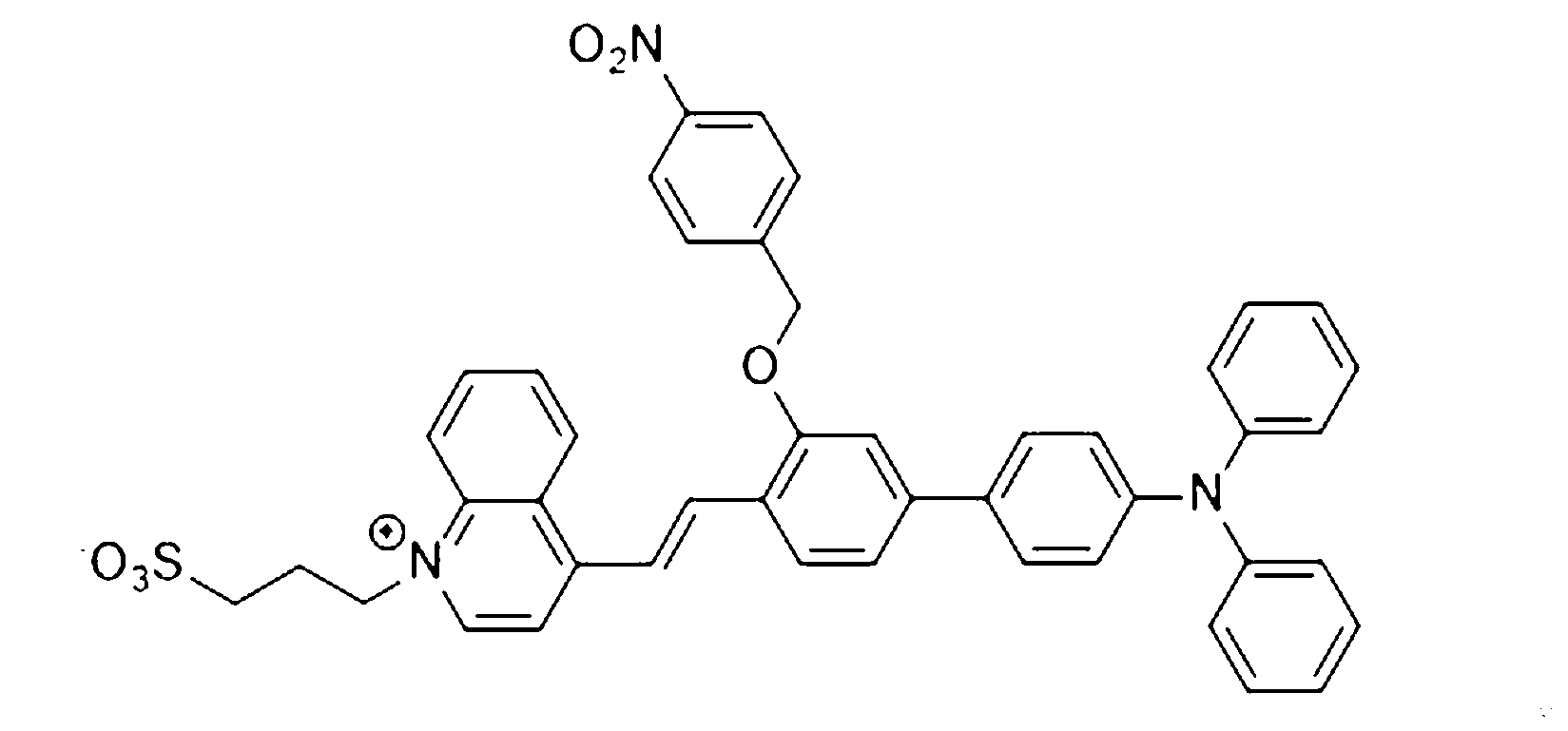 。
。 - 制备权利要求 1 所述的一种检测硝基还原酶的荧光探针的方法,其特征在于,包括如下制备步骤:( 1 )将 4'-( 二苯基胺基 )-3- 羟基 -[1,1'- 联苯 ]-4- 甲醛溶于二甲基亚砜中,将对硝基苄溴溶于四氢呋喃中,分别超声后混合在一起,并加入碳酸铯,控制反应温度为 50-150 ℃ ,反应产物经分离纯化,得到黄色固体粉末 4'-( 二苯基胺基 )-3-((4- 硝基苄基 ) 氧基 )-[1,1'- 联苯基 ]-4- 甲醛;( 2 )将 3-(4- 甲基喹啉 -1- 溴 ) 丙烷 -1- 磺酸盐溶于吡啶中,再加入乙酸,充分混合后加入步骤( 1 )所得到的 4'-( 二苯基胺基 )-3-((4- 硝基苄基 ) 氧基 )-[1,1'- 联苯基 ]-4- 甲醛,搅拌加热至 25-80 ℃ 反应,反应产物经分离纯化,得到紫红色固体粉末 3-(4-(2-(4'-( 二苯胺基 )-3-((4- 硝基苄基 ) 氧基 )-[1,1'- 联苯基 ]-4- 基 ) 乙烯基 ) 喹啉 -1- 溴 ) 丙烷 -1- 磺酸盐。
- 根据权利要 求 2 所 述的制备方法,其特征在于, 步骤( 1 )中所述的 4'-( 二苯基胺基 )-3- 羟基 -[1,1'- 联苯 ]-4- 甲醛和对硝基苄溴用量的摩尔比为 1:(1.5-2) 。
- 根据权利要 求 2 所 述的制备方法,其特征在于, 步骤( 1 )中所述碳酸铯和对硝基苄溴用量的摩尔比为 (4-5):1 。
- 根据权利要求 2 所述的制备方法,其特征在于,步骤( 2 )中所述的 3-(4- 甲基喹啉 -1- 溴 ) 丙烷 -1- 磺酸盐和 4'-( 二苯基胺基 )-3-((4- 硝基苄基 ) 氧基 )-[1,1'- 联苯基 ]-4- 甲醛用量的摩尔比为 1:(1-2) 。
- 根据权利要 求 2 所 述的制备方法,其特征在于, 步骤( 2 )中所述乙酸和 3-(4- 甲基喹啉 -1- 溴 ) 丙烷 -1- 磺酸盐用量的摩尔比为 (2-4):1 。
- 根据权利要求 2 所述的制备方法,其特征在于,步骤( 1 )所述反应的时间为 5 h - 48 h 。
- 根据权利要求 2 所述的制备方法,其特征在于,步骤( 2 )所述反应的时间为 3 h - 24 h 。
- 根据权利要求 2 所述的制备方法,其特征在于,步骤( 1 )所述分离纯化步骤为:反应液冷却至室温,用二氯甲烷 / 去离子水萃取,收集有机相,干燥,过滤,旋转蒸发除去溶剂,所得固体经硅胶层析柱纯化;步骤( 2 )所述分离纯化步骤为:反应液冷却至室温,旋转蒸发仪除去溶剂,之后加入乙酸乙酯,并分别用盐酸和饱和食盐水洗涤,再干燥,过滤,旋转蒸发除去溶剂,所得固体经硅胶层析 柱纯化。
- 权利要求 1 所述的一种检测硝基还原酶的荧光探针用于工业中芳香硝基转化为芳香胺基酶促反应中硝基还原酶的检测分析应用。
Priority Applications (2)
| Application Number | Priority Date | Filing Date | Title |
|---|---|---|---|
| US16/610,085 US10935498B1 (en) | 2018-11-30 | 2019-03-26 | Fluorescent probe for detecting nitroreductase and preparation method and use thereof in enzymatic reaction |
| SG11201910072QA SG11201910072QA (en) | 2018-11-30 | 2019-03-26 | Fluorescent probe for detecting nitroreductase and preparation method and use thereof in enzymatic reaction |
Applications Claiming Priority (2)
| Application Number | Priority Date | Filing Date | Title |
|---|---|---|---|
| CN201811454833.XA CN109456264B (zh) | 2018-11-30 | 2018-11-30 | 一种检测硝基还原酶的荧光探针及其制备方法与酶促反应的应用 |
| CN201811454833.X | 2018-11-30 |
Publications (1)
| Publication Number | Publication Date |
|---|---|
| WO2020107758A1 true WO2020107758A1 (zh) | 2020-06-04 |
Family
ID=65612153
Family Applications (1)
| Application Number | Title | Priority Date | Filing Date |
|---|---|---|---|
| PCT/CN2019/079616 Ceased WO2020107758A1 (zh) | 2018-11-30 | 2019-03-26 | 一种检测硝基还原酶的荧光探针及其制备方法与酶促反应的应用 |
Country Status (4)
| Country | Link |
|---|---|
| US (1) | US10935498B1 (zh) |
| CN (1) | CN109456264B (zh) |
| SG (1) | SG11201910072QA (zh) |
| WO (1) | WO2020107758A1 (zh) |
Cited By (6)
| Publication number | Priority date | Publication date | Assignee | Title |
|---|---|---|---|---|
| CN112710838A (zh) * | 2020-11-26 | 2021-04-27 | 华东理工大学 | 喹啉腈衍生物在蛋白质印记法检测蛋白质的应用及其制备方法 |
| CN115109266A (zh) * | 2022-07-11 | 2022-09-27 | 江西理工大学 | 一种对苯甲醛和水杨醛具有选择性荧光识别的铽基金属有机框架及其制备方法 |
| CN115304630A (zh) * | 2022-07-06 | 2022-11-08 | 福州大学 | 碳硼烷基苯并咪唑鎓环蕃受体及其在识别ump中的应用 |
| CN115356315A (zh) * | 2022-08-25 | 2022-11-18 | 沈阳感光化工研究院有限公司 | 一种用荧烷类衍生物探针检测硫化氢方法 |
| CN115872910A (zh) * | 2022-12-16 | 2023-03-31 | 湖南工程学院 | 光/酶双重响应药物前体化合物及其制备方法和应用 |
| CN116120317A (zh) * | 2023-01-06 | 2023-05-16 | 西北民族大学 | 一种双喹啉功能化萘二甲酰亚胺衍生物及其制备和在检测分离水合肼中应用 |
Families Citing this family (24)
| Publication number | Priority date | Publication date | Assignee | Title |
|---|---|---|---|---|
| CN109456264B (zh) * | 2018-11-30 | 2021-03-30 | 华南理工大学 | 一种检测硝基还原酶的荧光探针及其制备方法与酶促反应的应用 |
| CN114436947B (zh) * | 2020-11-01 | 2024-01-05 | 复旦大学 | 一种对粘度和硝基还原酶双响应的荧光探针及其制备方法和应用 |
| CN112592283B (zh) * | 2021-01-25 | 2022-06-07 | 井冈山大学 | 一种用于酒类饮品粘度检测的荧光化合物及其制备和应用 |
| CN112552208B (zh) * | 2021-01-25 | 2022-06-10 | 井冈山大学 | 一种用于滴眼液质量检测的荧光分子及其制备和应用 |
| CN115232120B (zh) * | 2021-04-23 | 2023-09-05 | 香港理工大学深圳研究院 | pH荧光探针及其合成方法与应用 |
| CN113651748B (zh) * | 2021-07-19 | 2023-05-23 | 华南理工大学 | 一种挥发性盐基氮响应型化合物、便携式检测试纸及制备方法与应用 |
| CN113563279B (zh) * | 2021-08-25 | 2022-07-26 | 安徽大学 | 一种检测硝基还原酶的双光子荧光探针及其制备方法和用途 |
| CN114539230A (zh) * | 2022-01-14 | 2022-05-27 | 东南大学 | 一类电化学发光体及其制备方法和应用 |
| CN114436892B (zh) * | 2022-01-27 | 2023-05-23 | 中国药科大学 | 一种Aβ响应的光激活荧光探针及其制备方法和应用 |
| CN114736938A (zh) * | 2022-03-21 | 2022-07-12 | 华南理工大学 | 一种乏氧响应型炔-胺点击聚合的细胞内聚合方法及其应用 |
| CN114805447B (zh) * | 2022-04-13 | 2023-11-24 | 兰州大学 | 一种铱配合物光敏剂及其制备方法与应用 |
| CN114989081B (zh) * | 2022-05-10 | 2023-06-13 | 南华大学 | 一种比色探针及其制备方法与应用 |
| CN114907416B (zh) * | 2022-05-17 | 2024-01-02 | 西安交通大学 | 一类含硒紫精坠饰的配位金属大环超分子及其合成方法和应用 |
| CN114989080B (zh) * | 2022-05-23 | 2023-12-22 | 井冈山大学 | 一种荧光化合物及其制备方法和应用以及一种荧光试条 |
| CN115073551A (zh) * | 2022-06-26 | 2022-09-20 | 北京工业大学 | 基于原位自组装策略的荧光增强成像探针的制备方法 |
| CN115466292B (zh) * | 2022-09-19 | 2023-12-26 | 兰州大学 | 一种钌配合物探针及其制备方法和应用 |
| CN115505008B (zh) * | 2022-09-19 | 2023-12-22 | 兰州大学 | 一种铱配合物探针及其制备方法和应用 |
| CN115850194B (zh) * | 2022-10-14 | 2024-10-18 | 华东理工大学 | 振动诱导发光化合物及其制备方法和应用 |
| CN116283561A (zh) * | 2023-04-04 | 2023-06-23 | 天津希恩思生化科技有限公司 | 一种用于检测溶液中镁离子含量的有机化合物及其应用 |
| CN116655544B (zh) * | 2023-04-13 | 2025-02-07 | 大连理工大学 | 加速硝基还原酶检测的主-客体超分子探针及应用 |
| CN116640255B (zh) * | 2023-05-23 | 2025-03-28 | 齐鲁工业大学(山东省科学院) | 基于巴比妥酸基的聚丙烯酸衍生物及其制备方法与应用 |
| CN116789631B (zh) * | 2023-07-06 | 2024-05-31 | 陕西理工大学 | 一种酶协同光控一氧化氮供体、其制备及应用 |
| CN117630374A (zh) * | 2023-12-05 | 2024-03-01 | 安徽师范大学 | 一种用于检测硝基还原酶的生物传感器及其制备方法以及硝基还原酶的定量检测方法 |
| CN118006336B (zh) * | 2024-02-04 | 2025-09-12 | 中国科学院新疆理化技术研究所 | 一种用于检测次氯酸根的高信噪比荧光点亮光学探针的构建方法及用途 |
Citations (5)
| Publication number | Priority date | Publication date | Assignee | Title |
|---|---|---|---|---|
| WO2008030120A1 (en) * | 2006-09-07 | 2008-03-13 | Auckland Uniservices Limited | A method for the fluorescent detection of nitroreductase activity using nitro-substituted aromatic compounds |
| CN105732564A (zh) * | 2016-01-26 | 2016-07-06 | 济南大学 | 一种双光子荧光探针及在检测缺氧区硝基还原酶中的应用 |
| CN107056618A (zh) * | 2017-01-06 | 2017-08-18 | 济南大学 | 一种检测硝基还原酶的荧光探针 |
| CN108727223A (zh) * | 2018-07-24 | 2018-11-02 | 南京工业大学 | 一种可双光子荧光检测硝基还原酶ntr探针及其制备方法 |
| CN109456264A (zh) * | 2018-11-30 | 2019-03-12 | 华南理工大学 | 一种检测硝基还原酶的荧光探针及其制备方法与酶促反应的应用 |
Family Cites Families (4)
| Publication number | Priority date | Publication date | Assignee | Title |
|---|---|---|---|---|
| CN103614135B (zh) * | 2013-11-29 | 2015-07-01 | 安徽大学 | 一种双光子荧光探针及其制备方法和用途 |
| CN104876863B (zh) * | 2015-05-29 | 2017-02-22 | 北京农学院 | 荧光探针化合物及其制备方法和应用 |
| CN105884734B (zh) | 2016-06-24 | 2018-12-07 | 济南大学 | 一种快速检测硝基还原酶的双光子荧光探针 |
| CN108191752B (zh) * | 2017-12-21 | 2021-05-11 | 中山大学 | 一种选择性检测细胞内rna g-四链体的荧光探针及其制备方法和应用 |
-
2018
- 2018-11-30 CN CN201811454833.XA patent/CN109456264B/zh active Active
-
2019
- 2019-03-26 WO PCT/CN2019/079616 patent/WO2020107758A1/zh not_active Ceased
- 2019-03-26 US US16/610,085 patent/US10935498B1/en not_active Expired - Fee Related
- 2019-03-26 SG SG11201910072QA patent/SG11201910072QA/en unknown
Patent Citations (5)
| Publication number | Priority date | Publication date | Assignee | Title |
|---|---|---|---|---|
| WO2008030120A1 (en) * | 2006-09-07 | 2008-03-13 | Auckland Uniservices Limited | A method for the fluorescent detection of nitroreductase activity using nitro-substituted aromatic compounds |
| CN105732564A (zh) * | 2016-01-26 | 2016-07-06 | 济南大学 | 一种双光子荧光探针及在检测缺氧区硝基还原酶中的应用 |
| CN107056618A (zh) * | 2017-01-06 | 2017-08-18 | 济南大学 | 一种检测硝基还原酶的荧光探针 |
| CN108727223A (zh) * | 2018-07-24 | 2018-11-02 | 南京工业大学 | 一种可双光子荧光检测硝基还原酶ntr探针及其制备方法 |
| CN109456264A (zh) * | 2018-11-30 | 2019-03-12 | 华南理工大学 | 一种检测硝基还原酶的荧光探针及其制备方法与酶促反应的应用 |
Non-Patent Citations (1)
| Title |
|---|
| NAKATA, E. J. ET AL.: "Design of a bioreductively-activated fluorescent pH probe for tumor hypoxia imaging", BIOORGANIC & MECLICINAL CHEMISTRY, vol. 17, 21 August 2009 (2009-08-21), pages 6952 - 6958, XP026601543, DOI: 20190812145453A * |
Cited By (7)
| Publication number | Priority date | Publication date | Assignee | Title |
|---|---|---|---|---|
| CN112710838A (zh) * | 2020-11-26 | 2021-04-27 | 华东理工大学 | 喹啉腈衍生物在蛋白质印记法检测蛋白质的应用及其制备方法 |
| CN115304630A (zh) * | 2022-07-06 | 2022-11-08 | 福州大学 | 碳硼烷基苯并咪唑鎓环蕃受体及其在识别ump中的应用 |
| CN115109266A (zh) * | 2022-07-11 | 2022-09-27 | 江西理工大学 | 一种对苯甲醛和水杨醛具有选择性荧光识别的铽基金属有机框架及其制备方法 |
| CN115356315A (zh) * | 2022-08-25 | 2022-11-18 | 沈阳感光化工研究院有限公司 | 一种用荧烷类衍生物探针检测硫化氢方法 |
| CN115872910A (zh) * | 2022-12-16 | 2023-03-31 | 湖南工程学院 | 光/酶双重响应药物前体化合物及其制备方法和应用 |
| CN115872910B (zh) * | 2022-12-16 | 2024-06-11 | 湖南工程学院 | 光/酶双重响应药物前体化合物及其制备方法和应用 |
| CN116120317A (zh) * | 2023-01-06 | 2023-05-16 | 西北民族大学 | 一种双喹啉功能化萘二甲酰亚胺衍生物及其制备和在检测分离水合肼中应用 |
Also Published As
| Publication number | Publication date |
|---|---|
| SG11201910072QA (en) | 2020-07-29 |
| CN109456264B (zh) | 2021-03-30 |
| US10935498B1 (en) | 2021-03-02 |
| US20210048393A1 (en) | 2021-02-18 |
| CN109456264A (zh) | 2019-03-12 |
Similar Documents
| Publication | Publication Date | Title |
|---|---|---|
| WO2020107758A1 (zh) | 一种检测硝基还原酶的荧光探针及其制备方法与酶促反应的应用 | |
| US6300502B1 (en) | Multi-armed chromophores with very large two-photon absorption cross-sections | |
| DE60001531T2 (de) | Xanthenfarbstoffe und ihre anwendung als lumineszenzlöschende verbindungen | |
| Fan et al. | 1, 6-Disubstituted perylene bisimides: Concise synthesis and characterization as near-infrared fluorescent dyes | |
| CN116239482B (zh) | 一种近红外型荧光探针及其在制备阿尔兹海默症早期诊断试剂中的应用 | |
| Wang et al. | Rational design of novel near-infrared fluorescent DCM derivatives and their application in bioimaging | |
| CN108504130B (zh) | 一种花菁类荧光染料及其合成方法 | |
| CN106243170B (zh) | 具有聚集诱导荧光增强特性的β-半乳糖苷酶传感器的合成及应用 | |
| Yamamoto et al. | A Cyanine Photooxidation/β‐Elimination Sequence Enables Near‐infrared Uncaging of Aryl Amine Payloads | |
| CN113717545A (zh) | 一种具有高亮度、高光稳定性的深红荧光染料及其合成方法 | |
| CN111718365B (zh) | 一种三聚茚基共轭三bodipy类近红外荧光染料及其制备方法 | |
| CN106478576A (zh) | 一种用于检测羧酸酯酶的荧光探针及其制备方法与应用 | |
| CN110229120A (zh) | 一种长波长荧光染料分子及其制备方法 | |
| CN107383067A (zh) | 一种具有大斯托克斯位移的近红外发射氧杂蒽荧光染料制备方法 | |
| Debieu et al. | Kinetics improvement of protease-mediated formation of pyronin dyes | |
| CN111303111A (zh) | 一类新型黄菁近红外二区染料、制备方法及荧光成像应用 | |
| CN110283586A (zh) | 一种近红外荧光染料及其制备方法 | |
| CN106946919A (zh) | 异吲哚硼杂荧光染料及其制备方法和应用 | |
| CN110642848A (zh) | 新型可见光与近红外荧光染料的合成与其应用 | |
| CA2581174A1 (en) | Fluorescent dye compounds, conjugates and uses thereof | |
| CN111849196B (zh) | 一种近红外二区染料及其合成方法 | |
| CN110790781A (zh) | 一类红光发射且具有大Stokes位移的不对称氟硼染料 | |
| CN111334080B (zh) | 一种高亮度、高光稳定性的碳酸酐酶荧光探针 | |
| CN110256339A (zh) | 有机荧光染料分子及其制备方法 | |
| CN115594629B (zh) | 具有aee特性的咔唑类衍生物及其制备方法和应用 |
Legal Events
| Date | Code | Title | Description |
|---|---|---|---|
| 121 | Ep: the epo has been informed by wipo that ep was designated in this application |
Ref document number: 19888600 Country of ref document: EP Kind code of ref document: A1 |
|
| NENP | Non-entry into the national phase |
Ref country code: DE |
|
| 32PN | Ep: public notification in the ep bulletin as address of the adressee cannot be established |
Free format text: NOTING OF LOSS OF RIGHTS PURSUANT TO RULE 112(1) EPC, EPO FORM 1205A DATED 21.07.2021 |
|
| 122 | Ep: pct application non-entry in european phase |
Ref document number: 19888600 Country of ref document: EP Kind code of ref document: A1 |