WO2020105707A1 - 接着剤組成物 - Google Patents
接着剤組成物Info
- Publication number
- WO2020105707A1 WO2020105707A1 PCT/JP2019/045654 JP2019045654W WO2020105707A1 WO 2020105707 A1 WO2020105707 A1 WO 2020105707A1 JP 2019045654 W JP2019045654 W JP 2019045654W WO 2020105707 A1 WO2020105707 A1 WO 2020105707A1
- Authority
- WO
- WIPO (PCT)
- Prior art keywords
- mass
- resin
- adhesive composition
- component
- manufactured
- Prior art date
- Legal status (The legal status is an assumption and is not a legal conclusion. Google has not performed a legal analysis and makes no representation as to the accuracy of the status listed.)
- Ceased
Links
Classifications
-
- C—CHEMISTRY; METALLURGY
- C09—DYES; PAINTS; POLISHES; NATURAL RESINS; ADHESIVES; COMPOSITIONS NOT OTHERWISE PROVIDED FOR; APPLICATIONS OF MATERIALS NOT OTHERWISE PROVIDED FOR
- C09J—ADHESIVES; NON-MECHANICAL ASPECTS OF ADHESIVE PROCESSES IN GENERAL; ADHESIVE PROCESSES NOT PROVIDED FOR ELSEWHERE; USE OF MATERIALS AS ADHESIVES
- C09J11/00—Features of adhesives not provided for in group C09J9/00, e.g. additives
- C09J11/02—Non-macromolecular additives
- C09J11/04—Non-macromolecular additives inorganic
-
- C—CHEMISTRY; METALLURGY
- C08—ORGANIC MACROMOLECULAR COMPOUNDS; THEIR PREPARATION OR CHEMICAL WORKING-UP; COMPOSITIONS BASED THEREON
- C08K—Use of inorganic or non-macromolecular organic substances as compounding ingredients
- C08K3/00—Use of inorganic substances as compounding ingredients
- C08K3/34—Silicon-containing compounds
-
- C—CHEMISTRY; METALLURGY
- C08—ORGANIC MACROMOLECULAR COMPOUNDS; THEIR PREPARATION OR CHEMICAL WORKING-UP; COMPOSITIONS BASED THEREON
- C08K—Use of inorganic or non-macromolecular organic substances as compounding ingredients
- C08K3/00—Use of inorganic substances as compounding ingredients
- C08K3/34—Silicon-containing compounds
- C08K3/346—Clay
-
- C—CHEMISTRY; METALLURGY
- C09—DYES; PAINTS; POLISHES; NATURAL RESINS; ADHESIVES; COMPOSITIONS NOT OTHERWISE PROVIDED FOR; APPLICATIONS OF MATERIALS NOT OTHERWISE PROVIDED FOR
- C09J—ADHESIVES; NON-MECHANICAL ASPECTS OF ADHESIVE PROCESSES IN GENERAL; ADHESIVE PROCESSES NOT PROVIDED FOR ELSEWHERE; USE OF MATERIALS AS ADHESIVES
- C09J11/00—Features of adhesives not provided for in group C09J9/00, e.g. additives
- C09J11/02—Non-macromolecular additives
- C09J11/06—Non-macromolecular additives organic
-
- C—CHEMISTRY; METALLURGY
- C09—DYES; PAINTS; POLISHES; NATURAL RESINS; ADHESIVES; COMPOSITIONS NOT OTHERWISE PROVIDED FOR; APPLICATIONS OF MATERIALS NOT OTHERWISE PROVIDED FOR
- C09J—ADHESIVES; NON-MECHANICAL ASPECTS OF ADHESIVE PROCESSES IN GENERAL; ADHESIVE PROCESSES NOT PROVIDED FOR ELSEWHERE; USE OF MATERIALS AS ADHESIVES
- C09J201/00—Adhesives based on unspecified macromolecular compounds
-
- C—CHEMISTRY; METALLURGY
- C09—DYES; PAINTS; POLISHES; NATURAL RESINS; ADHESIVES; COMPOSITIONS NOT OTHERWISE PROVIDED FOR; APPLICATIONS OF MATERIALS NOT OTHERWISE PROVIDED FOR
- C09J—ADHESIVES; NON-MECHANICAL ASPECTS OF ADHESIVE PROCESSES IN GENERAL; ADHESIVE PROCESSES NOT PROVIDED FOR ELSEWHERE; USE OF MATERIALS AS ADHESIVES
- C09J7/00—Adhesives in the form of films or foils
- C09J7/30—Adhesives in the form of films or foils characterised by the adhesive composition
-
- G—PHYSICS
- G09—EDUCATION; CRYPTOGRAPHY; DISPLAY; ADVERTISING; SEALS
- G09F—DISPLAYING; ADVERTISING; SIGNS; LABELS OR NAME-PLATES; SEALS
- G09F9/00—Indicating arrangements for variable information in which the information is built-up on a support by selection or combination of individual elements
-
- G—PHYSICS
- G09—EDUCATION; CRYPTOGRAPHY; DISPLAY; ADVERTISING; SEALS
- G09F—DISPLAYING; ADVERTISING; SIGNS; LABELS OR NAME-PLATES; SEALS
- G09F9/00—Indicating arrangements for variable information in which the information is built-up on a support by selection or combination of individual elements
- G09F9/30—Indicating arrangements for variable information in which the information is built-up on a support by selection or combination of individual elements in which the desired character or characters are formed by combining individual elements
-
- H—ELECTRICITY
- H05—ELECTRIC TECHNIQUES NOT OTHERWISE PROVIDED FOR
- H05B—ELECTRIC HEATING; ELECTRIC LIGHT SOURCES NOT OTHERWISE PROVIDED FOR; CIRCUIT ARRANGEMENTS FOR ELECTRIC LIGHT SOURCES, IN GENERAL
- H05B33/00—Electroluminescent light sources
- H05B33/02—Details
-
- H—ELECTRICITY
- H10—SEMICONDUCTOR DEVICES; ELECTRIC SOLID-STATE DEVICES NOT OTHERWISE PROVIDED FOR
- H10K—ORGANIC ELECTRIC SOLID-STATE DEVICES
- H10K59/00—Integrated devices, or assemblies of multiple devices, comprising at least one organic light-emitting element covered by group H10K50/00
- H10K59/10—OLED displays
-
- H—ELECTRICITY
- H10—SEMICONDUCTOR DEVICES; ELECTRIC SOLID-STATE DEVICES NOT OTHERWISE PROVIDED FOR
- H10K—ORGANIC ELECTRIC SOLID-STATE DEVICES
- H10K59/00—Integrated devices, or assemblies of multiple devices, comprising at least one organic light-emitting element covered by group H10K50/00
- H10K59/80—Constructional details
- H10K59/87—Passivation; Containers; Encapsulations
- H10K59/871—Self-supporting sealing arrangements
- H10K59/8722—Peripheral sealing arrangements, e.g. adhesives, sealants
-
- C—CHEMISTRY; METALLURGY
- C09—DYES; PAINTS; POLISHES; NATURAL RESINS; ADHESIVES; COMPOSITIONS NOT OTHERWISE PROVIDED FOR; APPLICATIONS OF MATERIALS NOT OTHERWISE PROVIDED FOR
- C09J—ADHESIVES; NON-MECHANICAL ASPECTS OF ADHESIVE PROCESSES IN GENERAL; ADHESIVE PROCESSES NOT PROVIDED FOR ELSEWHERE; USE OF MATERIALS AS ADHESIVES
- C09J2203/00—Applications of adhesives in processes or use of adhesives in the form of films or foils
- C09J2203/318—Applications of adhesives in processes or use of adhesives in the form of films or foils for the production of liquid crystal displays
-
- C—CHEMISTRY; METALLURGY
- C09—DYES; PAINTS; POLISHES; NATURAL RESINS; ADHESIVES; COMPOSITIONS NOT OTHERWISE PROVIDED FOR; APPLICATIONS OF MATERIALS NOT OTHERWISE PROVIDED FOR
- C09J—ADHESIVES; NON-MECHANICAL ASPECTS OF ADHESIVE PROCESSES IN GENERAL; ADHESIVE PROCESSES NOT PROVIDED FOR ELSEWHERE; USE OF MATERIALS AS ADHESIVES
- C09J2301/00—Additional features of adhesives in the form of films or foils
- C09J2301/30—Additional features of adhesives in the form of films or foils characterized by the chemical, physicochemical or physical properties of the adhesive or the carrier
- C09J2301/312—Additional features of adhesives in the form of films or foils characterized by the chemical, physicochemical or physical properties of the adhesive or the carrier parameters being the characterizing feature
Definitions
- the present invention relates to an adhesive composition suitable for forming an adhesive layer in an optical device such as an organic EL display device.
- An organic EL element is a light emitting element using an organic substance as a light emitting material, and has recently been in the limelight because it can obtain high-luminance light emission at a low voltage.
- a display device (display) using the organic EL element is It has come to be used in various applications such as mobile phones and televisions.
- the organic EL light emitting element has problems such as deterioration caused by light in a short wavelength region, discoloration, and shortened life.
- Patent Document 1 discloses a method of blocking light having a wavelength of 390 nm or less by a display window film having a layer containing an ultraviolet absorber in order to suppress deterioration of an organic EL light emitting element due to ultraviolet rays.
- Patent Document 2 proposes to suppress the transmission of light having a wavelength of 380 to 430 nm in addition to ultraviolet light in order to suppress the deterioration of the organic EL element.
- a method for suppressing deterioration of an organic EL element by providing a layer containing a dye compound having a wavelength range of 380 to 430 nm in an organic EL display device is disclosed. Deterioration of the element due to light in the short wavelength range is also a problem in other optical devices such as solar cells.
- the adhesive having a compound having a maximum absorption wavelength in the wavelength range of 300 to 430 nm absorbs light in the wavelength range of 300 to 430 nm (hereinafter, may be abbreviated as “light absorption ability in short wavelength range”).
- Forming the adhesive layer that is provided on an optical device such as an organic EL display device is effective in suppressing optical deterioration of the optical device. In order to increase the light absorption ability in the short wavelength region, it is conceivable to increase the content of the compound in the adhesive.
- the present invention has been made in view of the above circumstances, and an object thereof is an adhesive capable of forming an adhesive layer having an ability to absorb light in a wavelength range of 300 to 430 nm and good transparency. To provide an agent composition.
- the present invention that can achieve the above object is as follows.
- Agent composition. [6] Adhesion according to any one of the above [1] to [5], wherein the content of the component (B) is 1 to 60% by mass with respect to 100% by mass of the nonvolatile content of the adhesive composition.
- the content of the component (C) is 0.05 to 15% by mass, relative to 100% by mass of the nonvolatile content of the adhesive composition, according to any one of the above [1] to [6].
- An adhesive sheet comprising a support and an adhesive layer formed on the support from the adhesive composition according to any one of [1] to [8].
- the adhesive sheet according to the above [11] which is used for forming an adhesive layer in an optical device.
- An optical device having an adhesive layer formed from the adhesive composition according to any one of [1] to [8].
- An organic EL display device having an adhesive layer formed from the adhesive composition according to any one of [1] to [8].
- an adhesive composition having an ability to absorb light in the wavelength range of 300 to 430 nm and capable of forming an adhesive layer having good transparency.
- the adhesive composition of the present invention comprises the following components (A) to (C): (A) Organic binder, The present invention is characterized by using (B) a layered clay mineral and (C) a compound having a maximum absorption wavelength in the wavelength range of 300 to 430 nm, and using the components (B) and (C) in combination.
- the ability that is, the ability to absorb light in the wavelength range of 300 to 430 nm
- each component will be described in order. It should be noted that the examples, preferable descriptions, and the like described later can be combined unless they contradict each other.
- the organic binder which is the component (A) is a resin or rubber capable of fixing the component (B) (that is, the layered clay mineral) and the component (C) (that is, the compound having the maximum absorption wavelength in the wavelength range of 300 to 430 nm).
- the component (A) only one type may be used, or two or more types may be used in combination.
- resin and rubber only 1 type may be used and 2 or more types may be used together.
- the resin may be either a thermoplastic resin or a thermosetting resin.
- a tackifying resin may be used as the resin. Only one kind of thermoplastic resin, thermosetting resin and tackifying resin may be used, or two or more kinds thereof may be used in combination. Further, as the resin, a mixture of these (for example, a mixture of a thermoplastic resin and a tackifying resin) may be used.
- the resin and the rubber will be described in order.
- thermoplastic resin for example, phenoxy resin, acrylic resin, polyvinyl acetal resin, butyral resin, polyimide resin, polyamideimide resin, polyether sulfone resin, polysulfone resin, olefin resin (for example, ethylene resin, propylene resin, Butene-based resin, isobutylene-based resin) and the like.
- the number average molecular weight of the thermoplastic resin is not particularly limited, but from the viewpoint of providing good coatability of the adhesive composition varnish and good compatibility with other components in the composition, 1,000,000. The following is preferred, 750,000 or less is more preferred, 500,000 or less is even more preferred, and 400,000 or less is even more preferred. On the other hand, from the viewpoints of preventing cissing during coating of the adhesive composition varnish, developing moisture resistance of the adhesive layer to be formed, and improving mechanical strength, 500 or more is preferable, and 700 or more is more preferable.
- the number average molecular weight is measured by gel permeation chromatography (GPC) method (polystyrene conversion).
- the number average molecular weight measured by the GPC method is specifically LC-9A / RID-6A manufactured by Shimadzu Corporation as a measuring device and Shodex K-800P / K-804L / K-804L manufactured by Showa Denko KK as a column. It can be calculated by using toluene or the like as a phase at a column temperature of 40 ° C. and using a calibration curve of standard polystyrene.
- the thermoplastic resin preferably contains an olefin resin.
- the "olefin-based resin” in the present invention includes a structural unit derived from olefin (hereinafter, may be abbreviated as "olefin unit"), and the amount of the olefin unit is the total structural unit (that is, each structural unit).
- the sum of the units) means a resin which is 50% by mass or more per 100% by mass.
- a modified olefin resin having a functional group for example, an epoxy group or an acid anhydride group
- a resin which is a modified olefin resin and can form a crosslinked structure by its functional group, and a resin having thermoplasticity by itself is included in the "thermoplastic resin” in the present invention.
- Olefin resins may be used alone or in combination of two or more.
- ethylene resin, propylene resin, butene resin, and isobutylene resin are preferable.
- These olefin resins may be homopolymers or copolymers such as random copolymers and block copolymers.
- the copolymer include copolymers of two or more kinds of olefins, and copolymers of olefins with monomers other than olefins such as non-conjugated dienes and styrene.
- Examples of preferable copolymers include ethylene-non-conjugated diene copolymers, ethylene-propylene copolymers, ethylene-propylene-non-conjugated diene copolymers, ethylene-butene copolymers, propylene-butene copolymers, propylene.
- Examples thereof include butene-non-conjugated diene copolymer, styrene-isobutylene copolymer, styrene-isobutylene-styrene copolymer and the like.
- the olefin resin for example, isobutylene modified resin, styrene-isobutylene modified resin, modified propylene-butene resin, etc. are preferably used.
- the olefin resin is preferably an olefin having an acid anhydride group (that is, a carbonyloxycarbonyl group (—CO—O—CO—)) from the viewpoint of imparting excellent physical properties (eg, adhesiveness) to the adhesive layer.
- At least one selected from olefin resins having an epoxy group and an olefin resin having an epoxy group is included, and more preferably, an olefin resin having an acid anhydride group and an olefin resin having an epoxy group are included.
- the olefin resin having an acid anhydride group is, for example, an unsaturated compound having an acid anhydride group, and is obtained by graft-modifying the olefin resin under radical reaction conditions. Further, the unsaturated compound having an acid anhydride group may be radically copolymerized with an olefin or the like. Examples of the unsaturated compound having an acid anhydride group include succinic anhydride, maleic anhydride, glutaric anhydride, and the like. The unsaturated compound having an acid anhydride group may be used alone or in combination of two or more.
- the olefin resin having an epoxy group can be obtained, for example, by graft-modifying an olefin resin with an unsaturated compound having an epoxy group under radical reaction conditions.
- an unsaturated compound having an epoxy group may be radically copolymerized with an olefin or the like.
- the unsaturated compound having an epoxy group include glycidyl (meth) acrylate, 4-hydroxybutyl acrylate glycidyl ether, and allyl glycidyl ether.
- the unsaturated compounds having an epoxy group may be used alone or in combination of two or more.
- the concentration of the acid anhydride group in the olefin resin having an acid anhydride group is preferably 0.05 to 10 mmol / g, more preferably 0.1 to 5 mmol / g.
- the concentration of the acid anhydride group is obtained from the value of the acid value defined as the number of mg of potassium hydroxide required to neutralize the acid present in 1 g of the resin, according to the description of JIS K2501.
- the amount of the olefin resin having an acid anhydride group in the olefin resin is preferably 0 to 70% by mass, more preferably 5 to 50% by mass.
- the concentration of the epoxy group in the olefin resin having an epoxy group is preferably 0.05 to 10 mmol / g, more preferably 0.1 to 5 mmol / g.
- the epoxy group concentration is calculated from the epoxy equivalent obtained according to JIS K 7236-1995.
- the amount of the olefin resin having an epoxy group in the olefin resin is preferably 0 to 70% by mass, more preferably 5 to 50% by mass.
- the olefin resin preferably contains both an olefin resin having an acid anhydride group and an olefin resin having an epoxy group from the viewpoint of imparting excellent physical properties such as moisture resistance.
- Such an olefin-based resin can react with an acid anhydride group and an epoxy group by heating to form a crosslinked structure and form an adhesive layer excellent in moisture resistance and the like. It is desirable to form a crosslinked structure when manufacturing the adhesive sheet.
- the ratio of the olefin resin having an acid anhydride group and the olefin resin having an epoxy group is not particularly limited as long as a suitable crosslinked structure can be formed, but the molar ratio of the epoxy group and the acid anhydride group (epoxy group: acid anhydride The group) is preferably 100: 10 to 100: 200, more preferably 100: 50 to 100: 150, and particularly preferably 100: 90 to 100: 110.
- the number average molecular weight of the olefin resin is not particularly limited, but it is said to bring good coatability of the adhesive composition varnish containing an organic solvent and good compatibility with other components in the adhesive composition. From the viewpoint, 1,000,000 or less is preferable, 750,000 or less is more preferable, 500,000 or less is still more preferable, 400,000 or less is further preferable, 300,000 or less is still more preferable, 200,000 or less. Is particularly preferable, and 150,000 or less is the most preferable. On the other hand, from the viewpoint of preventing cissing during coating of the adhesive composition varnish, developing moisture resistance of the formed adhesive layer, and improving mechanical strength, the number average molecular weight is preferably 500 or more, 700 The above is more preferable.
- the number average molecular weight in the present invention is measured by a gel permeation chromatography (GPC) method (polystyrene conversion).
- GPC gel permeation chromatography
- the number average molecular weight measured by the GPC method is specifically LC-9A / RID-6A manufactured by Shimadzu Corporation as a measuring device and Shodex K-800P / K-804L / K-804L manufactured by Showa Denko KK as a column. It can be calculated by using toluene or the like as a phase at a column temperature of 40 ° C. and using a calibration curve of standard polystyrene.
- the olefin resin is preferably amorphous from the viewpoint of suppressing a decrease in fluidity due to thickening of the adhesive composition varnish containing an organic solvent.
- amorphous means that the olefin resin does not have a definite melting point, and for example, a definite peak is not observed when the melting point is measured by DSC (differential scanning calorimetry) of the olefin resin. Things can be used.
- isobutylene-based resin examples include "Opanol B100” (viscosity average molecular weight: 1,110,000) manufactured by BASF, and "B50SF” (viscosity average molecular weight: 400,000) manufactured by BASF.
- butene-based resin examples include “HV-1900” (polybutene, number average molecular weight: 2,900) manufactured by JXTG Energy Co., Ltd., “HV-300M” (maleic anhydride-modified liquid polybutene (“HV -300 "(modified product of number average molecular weight: 1,400), number average molecular weight: 2,100, number of carboxy groups constituting the acid anhydride group: 3.2 / molecule, acid value: 43. 4 mg KOH / g, acid anhydride group concentration: 0.77 mmol / g).
- HV-1900 polybutene, number average molecular weight: 2,900 manufactured by JXTG Energy Co., Ltd.
- HV-300M maleic anhydride-modified liquid polybutene (“HV -300 "(modified product of number average molecular weight: 1,400), number average molecular weight: 2,100, number of carboxy groups constituting the acid anhydride group: 3.2 / molecule, acid value
- styrene-isobutylene copolymer examples include "SIBSTAR T102" (styrene-isobutylene-styrene block copolymer, number average molecular weight: 100,000, styrene content: 30% by mass) manufactured by Kaneka Co., Ltd., manufactured by Seikou PMC.
- T-YP757B maleic anhydride-modified styrene-isobutylene-styrene block copolymer, acid anhydride group concentration: 0.464 mmol / g, number average molecular weight: 100,000
- T-YP766 manufactured by Seikou PMC (Glycidyl methacrylate-modified styrene-isobutylene-styrene block copolymer, epoxy group concentration: 0.638 mmol / g, number average molecular weight: 100,000)
- T-YP8920 manufactured by Hoshiko PMC (maleic anhydride-modified styrene-isobutylene) -Styrene copolymer, acid anhydride group concentration: 0.464 mmol / g, number average molecular weight: 35,800)
- T-YP8930 glycidyl methacrylate modified styrene-isobutylene
- ethylene-based resin or the propylene-based resin examples include "EPT X-3012P” (ethylene-propylene-5-ethylidene-2-norbornene copolymer manufactured by Mitsui Chemicals, Inc., "EPT1070” (ethylene-propylene manufactured by Mitsui Chemicals, Inc.). -Dicyclopentadiene copolymer) and "Tufmer A4085” (ethylene-butene copolymer) manufactured by Mitsui Chemicals, Inc.
- ethylene-methyl methacrylate copolymer examples include "T-YP429” manufactured by Seikou PMC (maleic anhydride-modified ethylene-methyl methacrylate copolymer (methyl methacrylate per 100 mass% of total of ethylene unit and methyl methacrylate unit).
- propylene-butene copolymer examples include "T-YP341” manufactured by Seikou PMC (glycidyl methacrylate-modified propylene-butene random copolymer (amount of butene units per 100 mass% of total of propylene units and butene units: 29% by mass, 20% by mass solution of epoxy group concentration: 0.638 mmol / g, number average molecular weight: 155,000) swallow solution), "T-YP279” manufactured by Hoshiko PMC (maleic anhydride-modified propylene-butene random co-weight) Coalescence, amount of butene units per total 100% by mass of propylene units and butene units: 36% by mass, acid anhydride group concentration: 0.464 mmol / g, number average molecular weight: 35,000), "T” manufactured by Seikou PMC -YP276 "(glycidyl methacrylate-modified propylene-butene random copo
- the olefin resin includes an olefin resin having an epoxy group
- an olefin resin having a functional group other than an acid anhydride group that can react with the epoxy group may be used.
- the functional group include a hydroxyl group, a phenolic hydroxyl group, an amino group, a carboxy group and the like.
- the olefin-based resin includes an olefin-based resin having an acid anhydride group
- an olefin-based resin having a functional group other than an epoxy group that can react with an acid anhydride group may be used.
- the functional group include a hydroxyl group, a primary or secondary amino group, a thiol group, an oxetane group, and the like.
- thermoplastic resin in particular, the olefin resin
- the content of the thermoplastic resin is not particularly limited.
- the content of the olefin resin is preferably 25% by mass or more, more preferably 30% by mass or more, and further preferably 35% by mass or more with respect to 100% by mass of the nonvolatile content of the adhesive composition.
- thermosetting resin examples include epoxy resin, phenol resin, naphthol resin, benzoxazine resin, active ester resin, cyanate ester resin, carbodiimide resin, amine resin, acid anhydride resin and the like. Can be mentioned.
- the thermosetting resin When a thermosetting resin is used as the organic binder, the thermosetting resin preferably contains an epoxy resin.
- the epoxy resin one having an average of two or more epoxy groups per molecule can be used. However, even if the resin has an epoxy group, as described above, when the amount of the olefin unit is 50% by mass or more in all the constituent units, the resin is included in the “olefin resin” in the present invention. ..
- epoxy resin examples include hydrogenated epoxy resins (hydrogenated bisphenol A type epoxy resin, hydrogenated bisphenol F type epoxy resin, etc.), fluorine-containing epoxy resin, chain aliphatic epoxy resin, cyclic aliphatic epoxy resin, Bisphenol A type epoxy resin, biphenyl type epoxy resin, biphenyl aralkyl type epoxy resin, fluorene type epoxy resin, naphthol type epoxy resin, naphthalene type epoxy resin, bisphenol F type epoxy resin, phosphorus-containing epoxy resin, bisphenol S type epoxy resin, aromatic Group glycidyl amine type epoxy resin (eg, tetraglycidyl diaminodiphenylmethane, triglycidyl-p-aminophenol, diglycidyl toluidine, diglycidyl aniline, etc.), alicyclic epoxy resin, phenol novolac type epoxy resin, alkylphenol type epoxy resin, cresol Novolac type epoxy resin, bisphenol A novolac type epoxy resin, epoxy resin having
- the epoxy resins may be used alone or in combination of two or more.
- the epoxy equivalent of the epoxy resin is preferably 50 to 5,000, more preferably 50 to 3,000, further preferably 80 to 2,000, particularly preferably 100 to 1,500, from the viewpoint of reactivity and the like. ..
- the "epoxy equivalent” is the number of grams (g / eq) of a resin containing 1 gram equivalent of epoxy group, and is measured according to the method specified in JIS K7236.
- the weight average molecular weight of the epoxy resin is preferably 5,000 or less.
- the epoxy resin may be liquid or solid, and liquid epoxy resin and solid epoxy resin may be used in combination.
- liquid and solid are the states of the epoxy resin at room temperature (25 ° C) and atmospheric pressure (1 atm). From the viewpoint of coatability, processability, and adhesiveness, it is preferable that 10% by mass or more of the entire epoxy resin used is a liquid epoxy resin. From the viewpoint of kneading properties with hydrotalcite and varnish viscosity, it is particularly preferable to use a liquid epoxy resin and a solid epoxy resin in combination.
- the mass ratio of the liquid epoxy resin and the solid epoxy resin is preferably 1: 2 to 1: 0, more preferably 1: 1.5 to 1: 0.
- thermosetting resin when used as the component (A), its content is preferably 25 to 95% by mass, more preferably 30 to 95% by mass, relative to 100% by mass of the nonvolatile content of the adhesive composition. 35 to 95 mass% is more preferable.
- an epoxy resin When used as the component (A), its content is preferably 25 to 95% by mass, more preferably 30 to 95% by mass, and 35 to 100% by mass based on 100% by mass of the nonvolatile content of the adhesive composition. 95 mass% is more preferable.
- a phenoxy resin which is a thermoplastic resin may be further used as the component (A).
- the content of the epoxy resin is preferably 25 to 90% by mass, more preferably 30 to 90% by mass, and 40 to 40% by mass based on 100% by mass of the nonvolatile content of the adhesive composition. 90% by mass is more preferable, and the content of the phenoxy resin is preferably 0.1 to 60% by mass, more preferably 3 to 60% by mass, and 5 to 50% based on 100% by mass of the nonvolatile content of the adhesive composition. Mass% is more preferable.
- the weight average molecular weight of the epoxy resin is preferably 5,000 or less, and the weight average molecular weight of the phenoxy resin is preferably 10,000 to 500,000, more preferably 20, It is 000 to 300,000.
- these weight average molecular weights are measured by the gel permeation chromatography (GPC) method (polystyrene conversion).
- thermoplastic resin particularly an olefin resin
- rubber as the component (A)
- tackifying resin When using a thermoplastic resin (particularly an olefin resin) and / or rubber as the component (A), it is preferable to use a tackifying resin in order to improve the tackiness of the adhesive composition.
- the tackifier resins may be used alone or in combination of two or more.
- tackifying resin examples include terpene resin, terpene phenol resin, rosin tackifying resin, hydrogenated terpene resin, aromatic modified terpene resin, coumarone resin, indene resin, petroleum resin (aliphatic petroleum resin). , Aromatic petroleum resin, aliphatic aromatic copolymer petroleum resin, alicyclic petroleum resin, dicyclopentadiene petroleum resin, hydrogenated dicyclopentadiene petroleum resin, etc.), saturated aliphatic hydrocarbon resin, cyclohexane ring Examples thereof include saturated hydrocarbon resins.
- Examples of commercially available tackifying resins include the following.
- Examples of the terpene resin include YS resin PX and YS resin PXN (all manufactured by Yasuhara Chemical Co., Ltd.).
- Examples of the aromatic modified terpene resin include YS resin TO and TR series (all manufactured by Yasuhara Chemical Co., Ltd.).
- Examples of hydrogenated terpene-based resins include Clearon P, Clearon M, and Clearon K series (all manufactured by Yasuhara Chemical Co., Ltd.).
- Examples of the terpene phenolic resin include YS Polystar 2000, Polystar U, Polystar T, Polystar S, and Mighty Ace G (all manufactured by Yasuhara Chemical Co., Ltd.).
- Examples of the saturated aliphatic hydrocarbon resin include Escorez 5300 series, 5600 series (all manufactured by ExxonMobil), Alcon P100, Alcon P125, Alcon P140 (all manufactured by Arakawa Chemical Co., Ltd.) and the like.
- Examples of the cyclohexane ring-containing saturated hydrocarbon resin include TFS13-030 (manufactured by Arakawa Chemical Co., Ltd.) and the like.
- Examples of the aromatic petroleum resin include ENDEX155 (produced by Eastman).
- Examples of the aliphatic-aromatic copolymer petroleum resin include Quintone D100 (manufactured by Nippon Zeon Co., Ltd.) and the like.
- Examples of the alicyclic petroleum resin include Quintone 1325 and Quintone 1345 (both manufactured by Zeon Corporation).
- the softening point of the tackifying resin is preferably 50 to 200 ° C. from the viewpoint that when the adhesive composition is used in the form of a sheet, the sheet softens in the laminating step of the adhesive sheet and has desired heat resistance. , 50 to 180 ° C. is more preferable, and 50 to 150 ° C. is further preferable.
- the softening point is measured by the ring and ball method according to JIS K2207.
- the content of the tackifying resin in the adhesive composition is not particularly limited. However, from the viewpoint of maintaining good moisture permeation resistance of the adhesive composition, when the tackifying resin is used, its content is 80% by mass or less based on 100% by mass of the nonvolatile content of the adhesive composition. Is preferable, 70% by mass or less is more preferable, 65% by mass or less is further preferable, and 60% by mass or less is particularly preferable. On the other hand, from the viewpoint of sufficient adhesiveness, when the tackifying resin is used, its content is preferably 5% by mass or more and more preferably 10% by mass or more with respect to 100% by mass of the nonvolatile content of the adhesive composition. It is more preferably 15% by mass or more.
- the tackifying resin may be a saturated aliphatic hydrocarbon resin, an aromatic petroleum resin, an aliphatic aromatic copolymer petroleum resin, or an alicyclic petroleum. Resins are preferred, and saturated aliphatic hydrocarbon resins (eg Alcon P125) are more preferred.
- the number average molecular weight of the tackifying resin is preferably 500 or more, more preferably 700 or more, preferably 2,000 or less, more preferably 1,500 or less, still more preferably 1,000 or less.
- the number average molecular weight is measured by gel permeation chromatography (GPC) method (polystyrene conversion).
- the rubber When a rubber is used as the component (A), the rubber may be either a diene rubber or a non-diene rubber.
- the rubber include butyl rubber (IIR), isoprene rubber (IR), butadiene rubber (BR), carboxylated styrene-butadiene rubber-like copolymer (XSBR), and chlorinated isobutylene and isoprene.
- examples thereof include a rubber-like copolymer (CIIR) and a rubber-like copolymer (BIIR) of brominated isobutylene and isoprene.
- butyl rubber, isoprene rubber and butadiene rubber are preferable, and butyl rubber is more preferable.
- the rubber includes a rubber having an acid anhydride group (that is, a carbonyloxycarbonyl group (—CO—O—CO—)) and an epoxy group. It includes at least one selected from the rubbers having, more preferably a rubber having an acid anhydride group and a rubber having an epoxy group.
- the rubber having an acid anhydride group is obtained by, for example, graft-modifying the rubber with an unsaturated compound having an acid anhydride group under radical reaction conditions. Further, the unsaturated compound having an acid anhydride group may be radically copolymerized with an olefin or the like. Examples of the unsaturated compound having an acid anhydride group include succinic anhydride, maleic anhydride, glutaric anhydride, and the like. The unsaturated compound having an acid anhydride group may be used alone or in combination of two or more.
- the rubber having an epoxy group can be obtained, for example, by graft-modifying the rubber with an unsaturated compound having an epoxy group under radical reaction conditions.
- the unsaturated compound having an epoxy group may be radically copolymerized with a rubber having an olefinic double bond.
- the unsaturated compound having an epoxy group include glycidyl (meth) acrylate, 4-hydroxybutyl acrylate glycidyl ether, and allyl glycidyl ether.
- the unsaturated compounds having an epoxy group may be used alone or in combination of two or more.
- butyl rubber having an acid anhydride group isoprene rubber having an acid anhydride group, butadiene rubber having an acid anhydride group is preferable, and butyl rubber having an acid anhydride group is particularly preferable.
- the rubber having an epoxy group a butyl rubber having an epoxy group, an isoprene rubber having an epoxy group, and a butadiene rubber having an epoxy group are preferable, and a butyl rubber having an epoxy group is particularly preferable.
- the concentration of the acid anhydride group in the rubber having the acid anhydride group is preferably 0.05 to 10 mmol / g, more preferably 0.1 to 5 mmol / g.
- the concentration of the acid anhydride group is obtained from the acid value defined as the number of mg of potassium hydroxide necessary to neutralize the acid present in 1 g of rubber, according to the description of JIS K2501.
- the concentration of the epoxy group in the rubber having the epoxy group is preferably 0.05 to 10 mmol / g, more preferably 0.1 to 5 mmol / g.
- the epoxy group concentration is calculated from the epoxy equivalent obtained according to JIS K 7236-1995.
- the number average molecular weight of the rubber is preferably 1,000,000 or less, and more preferably 750,000 or less. It is preferably 500,000 or less, more preferably 400,000 or less.
- the number average molecular weight of the rubber is preferably 2,000 or more, more preferably 10,000 or more, still more preferably 30,000 or more, from the viewpoint of preventing cissing during coating of the sealing composition varnish. Especially preferred is 50,000 or more.
- the number average molecular weight is measured by gel permeation chromatography (GPC) method (polystyrene conversion).
- the rubber content there is no particular limitation on the rubber content. From the viewpoint of good coatability of the adhesive composition varnish, when rubber is used, its content is preferably 80% by mass or less, and 75% by mass with respect to 100% by mass of the nonvolatile content of the adhesive composition. % Or less is more preferable, 70% by mass or less is still more preferable, 65% by mass or less is further preferable, and 60% by mass or less is even more preferable.
- the content of the rubber is preferably 1% by mass or more, more preferably 3% by mass or more, still more preferably 5% by mass or more, and 7% by mass or more with respect to 100% by mass of the nonvolatile content of the adhesive composition. Is more preferable, 10% by mass or more is still more preferable, 15% by mass or more is particularly preferable, and 20% by mass or more is the most preferable.
- the component (A) preferably contains an olefin resin, more preferably an olefin resin and a tackifying resin.
- the component (A) preferably contains a rubber such as butyl rubber, isoprene rubber, or butadiene rubber, and more preferably contains butyl rubber.
- the component (A) preferably contains a rubber and a tackifying resin.
- the component (A) contains an olefin resin having an acid anhydride group and / or a rubber having an acid anhydride group
- the amount of the rubber having a physical group is preferably 1 to 70% by mass, more preferably 10 to 50% by mass.
- the component (A) includes an olefin resin having an epoxy group and / or a rubber having an epoxy group
- the component (A) has an olefin resin having an epoxy group and / or an epoxy group per the whole component (A).
- the amount of rubber is preferably 1 to 70% by mass, more preferably 10 to 50% by mass.
- the present invention is preferably an embodiment that satisfies at least one of the following (a) to (d).
- the component (A) (a) contains an olefin resin having an acid anhydride group and an olefin resin having an epoxy group.
- Component (A) contains a rubber having an acid anhydride group and a rubber having an epoxy group.
- the component (A) contains an olefin resin having an acid anhydride group and a rubber having an epoxy group.
- the component (A) (d) contains a rubber having an acid anhydride group and an olefin resin having an epoxy group.
- the component (A) may react with an acid anhydride group and an epoxy group by heating to form a crosslinked structure. Therefore, from the adhesive composition of the present invention, it is possible to form an adhesive layer having improved moisture permeation resistance and the like.
- the crosslinked structure can be formed at the time of forming the adhesive layer using the adhesive composition, but it is desirable to form the crosslinked structure on the adhesive layer formed on the support during the production of the adhesive sheet.
- the ratio of the olefin resin having an acid anhydride group and / or the rubber having an acid anhydride group to the olefin resin having an epoxy group and / or the rubber having an epoxy group is particularly limited as long as an appropriate crosslinked structure can be formed.
- the molar ratio of epoxy group to acid anhydride group is preferably 100: 10 to 100: 200, more preferably 100: 50 to 100: 150, and particularly preferably 100. : 90 to 100: 110.
- component (A) preferably comprises (i) butyl rubber, (ii) a mixture of butyl rubber having an acid anhydride group and butyl rubber having an epoxy group, or (iii) butyl rubber, an acid anhydride group. And a butyl rubber having an epoxy group.
- the mixing ratio of both (olefin resin / rubber) is preferably 1/99 to 50/50 by mass ratio, and 10/90. It is more preferably about 45/55.
- the component (A) preferably contains at least one selected from an olefin resin and an epoxy resin, more preferably an olefin resin or an epoxy resin.
- the content of the component (A) is preferably 25% by mass or more, more preferably 30% by mass or more, further preferably 35% by mass or more, preferably 100% by mass with respect to 100% by mass of the nonvolatile content of the adhesive composition. It is 95 mass% or less, more preferably 93 mass% or less, and further preferably 90 mass% or less.
- One of the features of the adhesive composition of the present invention is that it contains a layered clay mineral as the component (B).
- the layered clay mineral By using the layered clay mineral, it is possible to improve the absorption of light in the wavelength range of 300 to 430 nm while maintaining the transparency of the adhesive layer obtained from the adhesive composition.
- the component (B) one type may be used alone, or two or more types may be used in combination.
- the layered clay mineral may be a processed layered clay mineral as described below (for example, semi-calcined hydrotalcite, calcined hydrotalcite, etc.) or an artificial material.
- layered clay minerals examples include hydrotalcite and layered silicate minerals. Hereinafter, these will be described in order.
- Hydrotalcite can be classified into uncalcined hydrotalcite, semi-calcined hydrotalcite, and calcined hydrotalcite.
- the uncalcined hydrotalcite is, for example, a metal hydroxide having a layered crystal structure represented by natural hydrotalcite (Mg 6 Al 2 (OH) 16 CO 3 .4H 2 O). It is composed of a layer [Mg 1-X Al X (OH) 2 ] X + serving as a basic skeleton and an intermediate layer [(CO 3 ) X / 2 ⁇ mH 2 O] X ⁇ .
- the uncalcined hydrotalcite in the present invention is a concept including a hydrotalcite-like compound such as synthetic hydrotalcite. Examples of the hydrotalcite-like compound include compounds represented by the following formula (I) and the following formula (II).
- M 2+ represents a divalent metal ion such as Mg 2+ and Zn 2+
- M 3+ represents a trivalent metal ion such as Al 3+ and Fe 3+
- a n ⁇ represents CO 3 2 ⁇ , Cl.
- M 2+ is preferably Mg 2+
- M 3+ is preferably Al 3+
- a n ⁇ is preferably CO 3 2 ⁇ .
- M 2+ represents a divalent metal ion such as Mg 2+ and Zn 2+
- a n ⁇ represents an n-valent anion such as CO 3 2 ⁇ , Cl ⁇ , NO 3 ⁇
- x is 2 or more. Is a positive number, z is a positive number less than or equal to 2, m is a positive number, and n is a positive number.
- M 2+ is preferably Mg 2+
- a n ⁇ is preferably CO 3 2 ⁇ .
- Semi-calcined hydrotalcite refers to a metal hydroxide having a layered crystal structure in which the amount of interlayer water is reduced or disappeared, which is obtained by calcining uncalcined hydrotalcite.
- the “interlayer water” refers to “H 2 O” described in the composition formulas of the above-mentioned unfired natural hydrotalcite and hydrotalcite-like compound, if it is explained using the composition formula.
- calcined hydrotalcite is an amorphous structure obtained by calcining uncalcined hydrotalcite or semi-calcined hydrotalcite, and not only interlayer water (H 2 O) but also hydroxyl group (OH) disappeared by condensation dehydration.
- Uncalcined hydrotalcite, semi-calcined hydrotalcite and calcined hydrotalcite can be distinguished by the saturated water absorption.
- the saturated water absorption of the semi-calcined hydrotalcite is 1% by mass or more and less than 20% by mass.
- the unsintered hydrotalcite has a saturated water absorption of less than 1% by mass
- the sintered hydrotalcite has a saturated water absorption of 20% by mass or more.
- the "saturated water absorption" in the present invention means 1.5 g of uncalcined hydrotalcite, semi-calcined hydrotalcite or calcined hydrotalcite with a balance, and after measuring the initial mass, at 60 ° C under atmospheric pressure.
- the mass increase rate with respect to the initial mass when left to stand for 200 hours in a small environment tester (SH-222 manufactured by Espec Co., Ltd.) set to 90% RH (relative humidity), represented by the following formula (i): Saturated water absorption (mass%) 100 x (mass after moisture absorption-initial mass) / initial mass (i) Can be found at.
- the saturated water absorption of the semi-calcined hydrotalcite is preferably 3% by mass or more and less than 20% by mass, more preferably 5% by mass or more and less than 20% by mass.
- uncalcined hydrotalcite, semi-calcined hydrotalcite and calcined hydrotalcite can be distinguished by the thermogravimetric reduction rate measured by thermogravimetric analysis.
- the thermal weight loss rate of the semi-calcined hydrotalcite at 280 ° C is less than 15% by mass, and the thermal weight loss rate at 380 ° C is 12% by mass or more.
- the thermal weight loss rate of uncalcined hydrotalcite at 280 ° C is 15% by mass or more, and the thermal weight loss rate of calcined hydrotalcite at 380 ° C is less than 12% by mass.
- Thermogravimetric analysis was carried out by using Hitachi High-Tech Science TG / DTA EXSTAR6300, 5 mg of hydrotalcite was weighed in a sample pan made of aluminum, in an open state without a lid, under an atmosphere of nitrogen flow rate of 200 mL / min, It can be performed at a temperature rising rate of 10 ° C./min from 30 ° C. to 550 ° C.
- uncalcined hydrotalcite, semi-calcined hydrotalcite and calcined hydrotalcite can be distinguished by the peak and relative intensity ratio measured by powder X-ray diffraction.
- the semi-calcined hydrotalcite shows a peak split by 2 X in the vicinity of 8 to 18 ° by powder X-ray diffraction, or a peak having a shoulder due to the synthesis of the two peaks.
- uncalcined hydrotalcite has only one peak around 8 to 18 °, or the relative intensity ratio of the diffraction intensity of the peak or shoulder appearing on the low angle side and the peak or shoulder appearing on the high angle side is within the above range. Outside. Calcined hydrotalcite does not have a characteristic peak in the region of 8 ° to 18 °, but has a characteristic peak at 43 °.
- the powder X-ray diffraction measurement was performed using a powder X-ray diffractometer (manufactured by PANalytical, Empyrean) with an anticathode CuK ⁇ (1.5405 ⁇ ), voltage: 45 V, current: 40 mA, sampling width: 0.0260 °, scanning speed: 0.
- the peak search uses the peak search function of the software attached to the diffractometer, and "minimum significance: 0.50, minimum peak tip: 0.01 °, maximum peak tip: 1.00 °, peak base width: 2 .00 °, method: minimum value of second derivative ”.
- Hydrotalcite (especially semi-sintered hydrotalcite) BET specific surface area of preferably 1 ⁇ 250m 2 / g, more preferably 5 ⁇ 200m 2 / g.
- the BET specific surface area of hydrotalcite can be calculated according to the BET method by using a specific surface area measuring device (Macsorb HM Model 1210, manufactured by Mountech Co., Ltd.) to adsorb nitrogen gas on the sample surface and using the BET multipoint method. it can.
- the average particle diameter of hydrotalcite (particularly, semi-calcined hydrotalcite) is preferably 1 to 1,000 nm, more preferably 10 to 800 nm.
- the average particle diameter of hydrotalcite is the median diameter of the particle size distribution when the particle size distribution is created on the volume basis by the laser diffraction / scattering particle size distribution measurement (JIS Z 8825).
- the hydrotalcite (particularly, semi-calcined hydrotalcite) may be surface-treated with a surface treatment agent.
- a surface treatment agent used for the surface treatment for example, higher fatty acids, alkylsilanes, silane coupling agents and the like can be used, and among them, higher fatty acids and alkylsilanes are preferable.
- the surface treatment agent one kind or two or more kinds can be used.
- higher fatty acids include higher fatty acids having 14 or more carbon atoms such as stearic acid, montanic acid, myristic acid, and palmitic acid, with stearic acid being preferred. These can use 1 type (s) or 2 or more types.
- alkylsilanes examples include methyltrimethoxysilane, ethyltrimethoxysilane, hexyltrimethoxysilane, octyltrimethoxysilane, decyltrimethoxysilane, octadecyltrimethoxysilane, dimethyldimethoxysilane, octyltriethoxysilane, and n-octadecyl. Examples thereof include dimethyl (3- (trimethoxysilyl) propyl) ammonium chloride. These 1 type (s) or 2 or more types can be used.
- silane coupling agent examples include 3-glycidyloxypropyltrimethoxysilane, 3-glycidyloxypropyltriethoxysilane, 3-glycidyloxypropyl (dimethoxy) methylsilane and 2- (3,4-epoxycyclohexyl) ethyltrimethoxy.
- Epoxy-based silane coupling agents such as silane; 3-mercaptopropyltrimethoxysilane, 3-mercaptopropyltriethoxysilane, 3-mercaptopropylmethyldimethoxysilane and mercapto-based silane coupling agents such as 11-mercaptoundecyltrimethoxysilane 3-aminopropyltrimethoxysilane, 3-aminopropyltriethoxysilane, 3-aminopropyldimethoxymethylsilane, N-phenyl-3-aminopropyltrimethoxysilane, N-methylaminopropyltrimethoxysilane, N- (2 -Aminoethyl) -3-aminopropyltrimethoxysilane and N- (2-aminoethyl) -3-aminopropyldimethoxymethylsilane and other amino silane coupling agents; 3-ureidopropyltriethoxy
- the surface treatment of hydrotalcite is performed by, for example, stirring and dispersing untreated hydrotalcite at room temperature while adding and spraying a surface treatment agent and stirring for 5 to 60 minutes.
- a known mixer can be used, and examples thereof include a blender such as a V blender, a ribbon blender and a bubble cone blender, a mixer such as a Henschel mixer and a concrete mixer, a ball mill, a cutter mill and the like.
- pulverizing hydrotalcite with a ball mill or the like the above-mentioned higher fatty acid, alkylsilane or silane coupling agent may be added for surface treatment.
- the amount of the surface treatment agent used varies depending on the type of hydrotalcite or the type of surface treatment agent, but is preferably 1 to 10 parts by mass with respect to 100 parts by mass of hydrotalcite that has not been surface treated.
- surface-treated hydrotalcite is also included in the “hydrotalcite” in the present invention.
- a calcined hydrotalcite and / or a semi-calcined hydrotalcite are used as the component (B), these have excellent hygroscopicity, so that the moisture barrier property of the obtained adhesive layer is improved.
- Examples of the semi-calcined hydrotalcite include “DHT-4C” (Kyowa Chemical Industry Co., Ltd., average particle size: 400 nm), “DHT-4A-2” (Kyowa Chemical Industry Co., Ltd., average particle size: 400 nm) and the like. Can be mentioned.
- Examples of the calcined hydrotalcite include “KW-2200” (manufactured by Kyowa Chemical Industry Co., Ltd., average particle diameter: 400 nm) and the like.
- Examples of the uncalcined hydrotalcite include “DHT-4A” (manufactured by Kyowa Chemical Industry Co., Ltd., average particle diameter: 400 nm) and the like.
- Layered silicate minerals are also commonly referred to as phyllosilicate minerals.
- the layered silicate minerals can be used alone or in combination of two or more.
- a natural product or a synthetic product may be used.
- the crystal structure of the layered silicate mineral it is preferable to use one having a high degree of purity that is regularly stacked in the c-axis direction, but a so-called mixed layered mineral in which the crystal cycle is disturbed and a plurality of types of crystal structures are mixed is used. You may use.
- layered silicate minerals include smectite, kaolinite, halloysite, talc, mica and the like. Of these, mica is preferred.
- the smectite is represented by the general formula: X 0.2 to 0.6 Y 2 to 3 Z 4 O 10 (OH) 2 ⁇ nH 2 O (where X is selected from K, Na, 1 / 2Ca, and 1 / 2Mg). It is at least one, Y is at least one selected from Mg, Fe, Mn, Ni, Zn, Li, Al, and Cr, and Z is at least one selected from Si and Al.
- H 2 O represents a water molecule bonded to an interlayer ion, n represents an integer, and can vary significantly depending on the interlayer ion and relative humidity.), And is natural or synthetic.
- smectite examples include hectorite, montmorillonite, beidellite, nontronite, saponite, iron saponite, sauconite, stevensite, bentonite, or substitution products or derivatives thereof, or a mixture thereof.
- hectorite and montmorillonite are preferable.
- layered silicate minerals can be used.
- Examples of commercially available products include "Smecton STN” and “Smecton SAN” (organized hectorite) manufactured by Kunimine Industry Co., Ltd., “Orben M” (organized montmorillonite) manufactured by Shiraishi Industry Co., Ltd., and “Esben” manufactured by Hojun. NX “(organized montmorillonite), Toshin Kasei's” Benton series “(organized montmorillonite) and the like.
- the average particle size of the layered silicate mineral is preferably 1 nm to 100 ⁇ m, more preferably 5 nm to 50 ⁇ m, and further preferably 10 nm to 10 ⁇ m.
- the average particle diameter of the layered silicate mineral is the median diameter of the particle size distribution when the particle size distribution is created on the volume basis by the laser diffraction / scattering particle size distribution measurement (JIS Z 8825).
- the component (B) preferably contains at least one selected from hydrotalcite and layered silicate minerals, more preferably contains hydrotalcite, further preferably contains semi-calcined hydrotalcite, and particularly preferably contains semi-calcined hydrotalcite. It consists of calcined hydrotalcite.
- hydrotalcite and layered silicate mineral in the above embodiment is as described above.
- the content of the component (B) is preferably 1% by mass or more based on 100% by mass of the nonvolatile content of the adhesive composition, More preferably, it is 3% by mass or more.
- the content of the component (B) is preferably 60% by mass or less, and more preferably 55% by mass based on 100% by mass of the nonvolatile content of the adhesive composition. It is not more than mass%.
- the component (C) contains a compound having a maximum absorption wavelength ( ⁇ max) in a wavelength range of 300 to 430 nm.
- ⁇ max maximum absorption wavelength
- the component (C) only one type may be used, or two or more types may be used in combination.
- a solution of the component (C) having a concentration such that the absorbance at the maximum absorption wavelength in the light absorption spectrum is 1.0 is prepared, and the light absorption spectrum of the solution is measured.
- the solvent for preparing the solution of the component (C) include chloroform, toluene and the like.
- the maximum absorption wavelength ( ⁇ max) of the component (C) is preferably 320 to 430 nm, more preferably 350 to 430 nm.
- Ingredient (C) may be treated as an ultraviolet absorber.
- Known ultraviolet absorbers having a maximum absorption wavelength in the wavelength range of 300 to 430 nm can be used as the component (C) of the present invention.
- component (C) examples include curcuminoid compounds, benzotriazole compounds, benzophenone compounds, triazine compounds, benzoate compounds, cyanoacrylate compounds, salicylate compounds, azomethine compounds, indole compounds, Examples thereof include cinnamic acid compounds, pyrimidine compounds, porphyrin compounds, cyanoacrylate compounds, oxybenzophenone compounds, polyphenol compounds and the like.
- Component (C) is preferably at least one selected from curcuminoid compounds, benzotriazole compounds and benzophenone compounds.
- 2,4-dihydroxybenzophenone Uvinul 3030,
- the content of the component (C) is 100% by mass of the nonvolatile content of the adhesive composition. It is preferably 0.05% by mass or more, more preferably 0.1% by mass or more, further preferably 0.5% by mass or more, and particularly preferably 1% by mass or more.
- the content of the component (C) is set to the adhesive. It is preferably 15% by mass or less, more preferably 13% by mass or less, and further preferably 10% by mass or less based on 100% by mass of the nonvolatile content of the composition.
- the adhesive composition of the present invention may contain other components different from the components (A) to (C) within a range that does not impair the effects of the present invention.
- the other components may be used alone or in combination of two or more.
- Other components include, for example, curing agents; curing accelerators; organic solvents; mineral oil-based softeners, vegetable oil-based softeners, softeners such as subfactices, fatty acids, fatty acid salts, synthetic oils; rubber particles, silicone powders, nylons.
- organic fillers such as powders and fluororesin powders; antifoaming agents or leveling agents; adhesion promoters; thickeners such as Orben and Benton; antioxidants; heat stabilizers; and light stabilizers.
- the component (A) at least one selected from a thermosetting resin (for example, an epoxy resin), a thermoplastic resin having an epoxy group (for example, an olefin resin having an epoxy group), and a rubber having an epoxy group.
- a thermosetting resin for example, an epoxy resin
- a thermoplastic resin having an epoxy group for example, an olefin resin having an epoxy group
- a rubber having an epoxy group preferably comprises a curing agent.
- the curing agent only one kind may be used, or two or more kinds may be used in combination.
- the curing agent is not particularly limited, and known ones can be used.
- the curing agent include tertiary amine compounds, primary or secondary amine compounds, ionic liquids, acid anhydride compounds, imidazole compounds, dimethylurea compounds, amine adduct compounds, organic acid dihydrazide compounds, organic phosphine compounds, Examples thereof include dicyandiamide compound.
- the curing agent is preferably a tertiary amine compound.
- the adhesive composition of the present invention may contain a curing accelerator.
- the curing accelerator may be used alone or in combination of two or more.
- the curing accelerator is not particularly limited, and known ones can be used. Examples of the curing accelerator include tertiary amine compounds, imidazole compounds, dimethylurea compounds, amine adduct compounds, organic phosphine compounds, and the like.
- the curing accelerator is preferably at least one selected from tertiary amine compounds, imidazole compounds and dimethylurea compounds.
- Examples of the tertiary amine compound that is a curing agent or a curing accelerator include DBN (1,5-diazabicyclo [4.3.0] non-5-ene) and DBU (1,8-diazabicyclo [5.4.0] undec -7-ene), 2-ethylhexanoate of DBU, phenol salt of DBU, p-toluenesulfonate of DBU, U-CAT SA 102 (manufactured by San-Apro: DBU octylate), DBU formate. And other DBU-organic acid salts, 2,4,6-tris (dimethylaminomethyl) phenol (TAP) and the like.
- DBN 1,5-diazabicyclo [4.3.0] non-5-ene
- DBU 1,8-diazabicyclo [5.4.0] undec -7-ene
- 2-ethylhexanoate of DBU phenol salt of DBU
- Examples of the primary or secondary amine compound that is a curing agent include diethylenetriamine, triethylenetetramine, tetraethylenepentamine, trimethylhexamethylenediamine, 2-methylpentamethylenediamine, 1,3-bisaminomethylcyclohexane, Aliphatic amines such as diproprenediamine, diethylaminopropylamine, bis (4-aminocyclohexyl) methane, norbornenediamine, 1,2-diaminocyclohexane; N-aminoethylpiverazine, 1,4-bis (3-aminopropyl) ) Alicyclic amines such as piperazine; aromatic amines such as diaminodiphenylmethane, m-phenylenediamine, m-xylenediamine, metaphenylenediamine, diaminodiphenylmethane, diaminodiphenylsulfone and diethyltolu
- Examples of the ionic liquid that is a curing agent include 1-butyl-3-methylimidazolium lactate, tetrabutylphosphonium-2-pyrrolidone-5-carboxylate, tetrabutylphosphonium acetate, tetrabutylphosphonium decanoate, and tetrabutylphosphonium.
- Examples of the acid anhydride compound that is a curing agent include tetrahydrophthalic anhydride, methyltetrahydrophthalic anhydride, hexahydrophthalic anhydride, methylhexahydrophthalic anhydride, methylnadic acid anhydride, dodecenylsuccinic anhydride. Things etc. are mentioned.
- Examples of commercially available acid anhydride compounds include RIKACID TH, TH-1A, HH, MH, MH-700 and MH-700G (all manufactured by Shin Nippon Rika Co., Ltd.).
- imidazole compound as a curing agent or a curing accelerator examples include 1H-imidazole, 2-methyl-imidazole, 2-phenyl-4-methylimidazole, 2-ethyl-4-methylimidazole, 1-cyanoethyl-2-ethyl.
- Examples of commercially available imidazole compounds include Curezol 2MZ, 2P4MZ, 2E4MZ, 2E4MZ-CN, C11Z, C11Z-CN, C11Z-CNS, C11Z-A, 2PHZ, 1B2MZ, 1B2PZ, 2PZ, C17Z, 1.2DMZ, 2P4MHZ.
- -PW, 2MZ-A, 2MA-OK all manufactured by Shikoku Chemicals Co., Ltd.
- dimethylurea compound as a curing agent or a curing accelerator examples include aromatic dimethylureas such as DCMU (3- (3,4-dichlorophenyl) -1,1-dimethylurea) and U-CAT3512T (manufactured by San-Apro). , U-CAT3503N (manufactured by San-Apro) and the like. Among them, aromatic dimethylurea is preferable from the viewpoint of curability.
- Examples of the amine adduct compound that is a curing agent or a curing accelerator include an epoxy adduct compound obtained by stopping the addition reaction of a tertiary amine to an epoxy resin on the way.
- Examples of commercially available amine adduct compounds include Amicure PN-23, Amicure MY-24, Amicure PN-D, Amicure MY-D, Amicure PN-H, Amicure MY-H, Amicure PN-31 and Amicure PN-. 40, Amicure PN-40J (all manufactured by Ajinomoto Fine-Techno Co., Inc.) and the like.
- organic acid dihydrazide compound that is a curing agent examples include Amicure VDH-J, Amicure UDH, Amicure LDH (all manufactured by Ajinomoto Fine-Techno Co., Inc.) and the like.
- organic phosphine compound that is a curing agent or a curing accelerator examples include triphenylphosphine, tetraphenylphosphonium tetra-p-tolylborate, tetraphenylphosphonium tetraphenylborate, tri-tert-butylphosphonium tetraphenylborate, and (4- Methylphenyl) triphenylphosphonium thiocyanate, tetraphenylphosphonium thiocyanate, butyltriphenylphosphonium thiocyanate, triphenylphosphine triphenylborane and the like can be mentioned.
- organic phosphine compounds examples include TPP, TPP-MK, TPP-K, TTBuP-K, TPP-SCN, TPP-S (manufactured by Kitako Chemical Co., Ltd.) and the like.
- Examples of the dicyandiamide compound that is a curing agent include dicyandiamide.
- Examples of commercial products of dicyandiamide include dicyandiamide finely pulverized products such as DICY7 and DICY15 (both manufactured by Mitsubishi Chemical Corporation).
- the content of the curing agent is an adhesive from the viewpoint of the balance between curability and storage stability. It is preferably 0.1 to 40% by mass, more preferably 0.5 to 38% by mass, and even more preferably 1 to 25% by mass, relative to 100% by mass of the nonvolatile content of the composition.
- the adhesive composition of the present invention contains a curing accelerator, the content thereof is preferably 0.05 to 10% by mass based on 100% by mass of the nonvolatile content of the adhesive composition from the same viewpoint. 0.1 to 8% by mass is more preferable, and 0.5 to 5% by mass is further preferable.
- a thermosetting resin particularly an epoxy resin
- the adhesive material of the present invention when a thermoplastic resin having an epoxy group (particularly an olefin resin having an epoxy group) and / or a rubber having an epoxy group is used as the component (A), the adhesive material of the present invention
- the composition preferably comprises a cure accelerator.
- the content of the curing accelerator is preferably 0.01 to 10% by mass, and more preferably 0.05 to 5% by mass with respect to 100% by mass of the nonvolatile content of the adhesive composition.
- the adhesive composition of the present invention may contain an organic solvent.
- the organic solvent may be used alone or in combination of two or more.
- the organic solvent include acetone, methyl ethyl ketone (hereinafter also abbreviated as “MEK”), ketones such as cyclohexanone, ethyl acetate, butyl acetate, cellosolve acetate, propylene glycol monomethyl ether acetate, carbitol acetate, and other acetic acid esters.
- MEK methyl ethyl ketone
- ketones such as cyclohexanone, ethyl acetate, butyl acetate, cellosolve acetate, propylene glycol monomethyl ether acetate, carbitol acetate, and other acetic acid esters.
- Carbitols such as cellosolve and butyl carbitol
- aromatic hydrocarbons such as toluene and xylene, di
- the adhesive composition containing an organic solvent may be referred to as an adhesive composition varnish.
- the amount of the organic solvent is not particularly limited, but from the viewpoint of coatability, it is preferable to use the organic solvent in such an amount that the viscosity (25 ° C.) of the adhesive composition varnish is 300 to 2000 mPa ⁇ s.
- the adhesive composition composition of the present invention can be produced by mixing the above-mentioned components (A) to (C) and, if necessary, other components.
- the mixing means is not particularly limited, and the mixing can be performed using a known device (for example, a kneading roller, a rotary mixer, etc.).
- the adhesive composition of the present invention is preferably used for forming an adhesive layer in an optical device.
- the optical device in the present invention means an electronic device related to light, and examples thereof include an organic EL display device and a solar cell.
- the adhesive composition of the present invention is suitably used for providing an adhesive layer for blocking light such as ultraviolet rays in an organic EL display device in which deterioration of the organic EL element due to light such as ultraviolet rays poses a problem. be able to.
- the adhesive composition varnish can be applied to components of an optical device and dried to form an adhesive layer in the optical device.
- the present invention also provides an adhesive sheet comprising a support and an adhesive layer formed from the adhesive composition of the present invention on the support.
- the adhesive sheet of the present invention is preferably used for forming an adhesive layer in an optical device.
- the adhesive layer in the optical device can be formed by attaching the adhesive sheet to a component of the optical device and then peeling off the support of the adhesive sheet.
- the adhesive sheet of the present invention can be produced, for example, by applying a varnish of the adhesive composition onto a support and drying the resulting coating film to form an adhesive layer on the support.
- the thickness of the adhesive layer in the adhesive sheet is preferably 10 to 200 ⁇ m, more preferably 20 to 180 ⁇ m, and further preferably 30 ⁇ m to 150 ⁇ m from the viewpoint of the balance between the light absorption ability in the short wavelength region and the transparency.
- the support used for the adhesive sheet is not particularly limited, and known supports can be used.
- the support for example, polyolefin such as polyethylene, polypropylene, polyvinyl chloride, polyethylene terephthalate (hereinafter sometimes abbreviated as “PET”), polyester such as polyethylene naphthalate, plastic formed from polycarbonate, polyimide, etc. Examples include films.
- PET film is particularly preferable as the plastic film.
- the support may be a metal foil such as an aluminum foil, a stainless steel foil, and a copper foil. The support may be subjected to a matte treatment, a corona treatment, or a release treatment.
- the mold release treatment examples include a mold release treatment with a mold release agent such as a silicone resin type mold release agent, an alkyd resin type mold release agent, and a fluororesin type mold release agent.
- a mold release agent such as a silicone resin type mold release agent, an alkyd resin type mold release agent, and a fluororesin type mold release agent.
- the release layer is also regarded as a part of the support.
- the thickness of the support is not particularly limited, but is preferably 20 to 200 ⁇ m, more preferably 20 to 125 ⁇ m from the viewpoint of handleability and the like.
- the adhesive layer may be protected by a protective film.
- a protective film By protecting with a protective film, adhesion of dust or the like to the surface of the adhesive layer and scratches can be prevented.
- the protective film it is preferable to use the same plastic film as the support. Further, the protective film may also be subjected to matte treatment, corona treatment, release treatment and the like.
- the thickness of the protective film is not particularly limited, but is usually 1 to 150 ⁇ m, preferably 10 to 100 ⁇ m.
- the adhesive layer formed from the adhesive composition of the present invention preferably has transparency. This transparency can be evaluated by the total light transmittance of 650 nm in the visible light region of the adhesive layer having a thickness of 80 ⁇ m.
- the total light transmittance at 650 nm of the adhesive layer formed from the adhesive composition of the present invention and having a thickness of 80 ⁇ m is preferably 80 to 100%, more preferably 85 to 100%.
- the adhesive layer formed from the adhesive composition of the present invention preferably has a low haze.
- the haze of the adhesive layer formed from the adhesive composition of the present invention and having a thickness of 80 ⁇ m is preferably 30% or less.
- the haze can be measured by a method according to JIS K 7136.
- the present invention also provides an optical device having an adhesive layer formed from the above adhesive composition.
- the optical device include an organic EL display device and a solar cell, and the organic EL display device is preferable.
- TAP Other components-2,4,6-tris (diaminomethyl) phenol
- TAP curing accelerator / toluene / ipsol # 100 (manufactured by Idemitsu Kosan Co., Ltd.): aromatic mixture Solvent / Methyl ethyl ketone (MEK) ⁇ Anone (Sumitomo Chemical Co., Ltd.): Cyclohexanone ⁇ U-CAT3512T (San Apro Co., Ltd.): Curing accelerator ⁇ N-acetylglycine tetrabutylphosphonium salt: Ionic liquid curing agent
- Example 1 130 parts by mass of a 60% by mass Ipsol # 100 solution of tackifying resin (“Arcon P125” manufactured by Arakawa Chemical Co., Ltd., 78 parts by mass of non-volatile content), maleic anhydride-modified liquid polybutene (“HV-300M” manufactured by Toho Chemical Industry Co., Ltd.) 35 parts by mass, polybutene (“HV-1900” manufactured by JXTG Energy Co., Ltd.) 60 parts by mass, and 100 parts by mass of the semi-calcined hydrotalcite as the component (B) were mixed by a three-roll mill to obtain a mixture.
- tackifying resin (“Arcon P125” manufactured by Arakawa Chemical Co., Ltd., 78 parts by mass of non-volatile content)
- HV-300M manufactured by Toho Chemical Industry Co., Ltd.
- polybutene HV-1900” manufactured by JXTG Energy Co., Ltd.
- the obtained varnish was uniformly applied to a polyethylene terephthalate (PET) film treated with a silicone release agent with a die coater, heated at 130 ° C. for 60 minutes and dried to form an adhesive layer having a thickness of 80 ⁇ m.
- An adhesive sheet having the above was obtained.
- Example 1 the content of the component (A) was 67.2 mass% and the content of the component (B) was 31.6 mass% with respect to 100 mass% of the nonvolatile content of the adhesive composition.
- the content of component (C) was 1.0% by mass. Table 1 below shows the results of the total light transmittance measured as described above.
- Comparative Example 1a the content of the component (A) was 67.9 mass% and the content of the component (B) was 31.9 mass% with respect to the nonvolatile content of 100 mass% of the adhesive composition.
- the content of the component (C) was 0% by mass. Table 1 below shows the results of the total light transmittance measured as described above.
- the content of the component (A) was 98.7% by mass
- the content of the component (B) was 0% by mass
- the content of the component (B) was 0% by mass based on 100% by mass of the nonvolatile content of the adhesive composition.
- the content of (C) was 1.0% by mass. Table 1 below shows the results of the total light transmittance measured as described above.
- Example 2 As component (C), except that 3.3 parts by mass of SEESORB 703 (manufactured by Cipro Kasei Co.) was mixed with 330 parts by mass of 99% by mass anone solution of HPH (manufactured by Sanwa Chemical Co., Ltd. (3.3 parts by mass of nonvolatile content)). An adhesive sheet was obtained in the same manner as in Example 1.
- Example 2 the content of the component (A) was 67.2 mass% and the content of the component (B) was 31.6 mass% with respect to 100 mass% of the nonvolatile content of the adhesive composition.
- the content of component (C) was 1.0% by mass. Table 2 below shows the results of the total light transmittance measured as described above.
- Comparative Example 2 the content of the component (A) was 98.7 mass% and the content of the component (B) was 0 mass% with respect to 100 mass% of the nonvolatile content of the adhesive composition.
- the content of (C) was 1.0% by mass. Table 2 below shows the results of the total light transmittance measured as described above.
- Example 3 As component (C), 22 parts by mass of a 15% by mass MEK solution of DAINSORB T-0 (manufactured by Daiwa Kasei Co., Ltd.) (3.3 parts by mass of non-volatile content) was added instead of 3.3 parts by mass of SEESORB 703 (manufactured by Cipro Kasei). An adhesive sheet was obtained in the same manner as in Example 1 except for the above.
- Example 3 the content of the component (A) was 67.2 mass% and the content of the component (B) was 31.6 mass% with respect to the nonvolatile content of 100 mass% of the adhesive composition.
- the content of component (C) was 1.0% by mass. Table 3 below shows the results of the total light transmittance measured as described above.
- Comparative Example 3 the content of the component (A) was 98.7 mass% and the content of the component (B) was 0 mass% with respect to 100 mass% of the nonvolatile content of the adhesive composition.
- the content of (C) was 1.0% by mass. Table 3 below shows the results of the total light transmittance measured as described above.
- Example 4 As component (C), 16.5 parts by mass of a 20% by mass toluene solution of SEESORB107 (manufactured by Sipro Kasei Co., Ltd.) (3.3 parts by mass of nonvolatile content) was blended in place of 3.3 parts by mass of SEESORB 703 (manufactured by Cipro Kasei Co.). An adhesive sheet was obtained in the same manner as in Example 1 except for the above.
- Example 4 the content of the component (A) was 67.2 mass% and the content of the component (B) was 31.6 mass% with respect to 100 mass% of the nonvolatile content of the adhesive composition.
- the content of component (C) was 1.0% by mass. Table 4 below shows the results of the total light transmittance measured as described above.
- Comparative Example 4 the content of the component (A) was 98.7 mass% and the content of the component (B) was 0 mass% with respect to 100 mass% of the nonvolatile content of the adhesive composition.
- the content of (C) was 1.0% by mass. Table 4 below shows the results of the total light transmittance measured as described above.
- Example 5 60 parts by mass of liquid hydrogenated bisphenol A type epoxy resin (“YX8000” manufactured by Mitsubishi Chemical Co., Ltd.) and 40 parts by mass of the semi-calcined hydrotalcite as the component (B) were mixed with a three-roll mill to obtain a mixture.
- liquid hydrogenated bisphenol A type epoxy resin (“YX8000” manufactured by Mitsubishi Chemical Co., Ltd.)
- 40 parts by mass of the semi-calcined hydrotalcite as the component (B) were mixed with a three-roll mill to obtain a mixture.
- the obtained mixture was further mixed with 3 parts by mass of an ionic liquid curing agent (N-acetylglycine tetrabutylphosphonium salt) and 1.5 parts by mass of SEESORB107 (manufactured by Cypro Kasei Co.) as the component (C) to obtain a mixture.
- the mixture was uniformly dispersed with a high-speed rotary mixer to obtain an adhesive composition varnish.
- the obtained varnish was uniformly applied to a polyethylene terephthalate (PET) film treated with a silicone release agent by a die coater, heated at 80 ° C. for 5 minutes and dried, and then, on the surface of the resin composition layer, A release PET film was placed as a protective film to obtain an adhesive sheet.
- PET polyethylene terephthalate
- Example 5 the content of the component (A) was 68.5 mass% and the content of the component (B) was 27.4 mass% with respect to 100 mass% of the nonvolatile content of the adhesive composition.
- the content of component (C) was 1.0% by mass. Table 5 below shows the results of the total light transmittance measured as described above.
- Comparative Example 5 the content of the component (A) was 94.7 mass% and the content of the component (B) was 0 mass% with respect to 100 mass% of the nonvolatile content of the adhesive composition.
- the content of (C) was 1.0% by mass. Table 5 below shows the results of the total light transmittance measured as described above.
- the adhesive composition of the present invention can form an adhesive layer having the ability to absorb light in the wavelength range of 300 to 430 nm and good transparency.
- Such an adhesive layer can prevent optical deterioration of an optical device such as an organic EL element, and is particularly suitable for an organic EL display device.
Landscapes
- Chemical & Material Sciences (AREA)
- Organic Chemistry (AREA)
- Physics & Mathematics (AREA)
- General Physics & Mathematics (AREA)
- Engineering & Computer Science (AREA)
- Theoretical Computer Science (AREA)
- Inorganic Chemistry (AREA)
- Health & Medical Sciences (AREA)
- Chemical Kinetics & Catalysis (AREA)
- Medicinal Chemistry (AREA)
- Polymers & Plastics (AREA)
- Dispersion Chemistry (AREA)
- Adhesives Or Adhesive Processes (AREA)
- Adhesive Tapes (AREA)
- Devices For Indicating Variable Information By Combining Individual Elements (AREA)
- Electroluminescent Light Sources (AREA)
- Optics & Photonics (AREA)
Abstract
Description
[1] 以下の成分(A)~(C):
(A)有機バインダー、
(B)層状粘土鉱物、および
(C)300~430nmの波長域に最大吸収波長を有する化合物
を含む接着剤組成物。
[2] 成分(B)が、ハイドロタルサイトおよび層状ケイ酸塩鉱物から選ばれる少なくとも一つを含む前記[1]に記載の接着剤組成物。
[3] 成分(B)が、ハイドロタルサイトを含む前記[1]に記載の接着剤組成物。
[4] 成分(B)が、半焼成ハイドロタルサイトを含む前記[1]に記載の接着剤組成物。
[5] 成分(A)の含有量が、接着剤組成物の不揮発分100質量%に対して、25~95質量%である前記[1]~[4]のいずれか一つに記載の接着剤組成物。
[6] 成分(B)の含有量が、接着剤組成物の不揮発分100質量%に対して、1~60質量%である前記[1]~[5]のいずれか一つに記載の接着剤組成物。
[7] 成分(C)の含有量が、接着剤組成物の不揮発分100質量%に対して、0.05~15質量%である前記[1]~[6]のいずれか一つに記載の接着剤組成物。
[8] 成分(A)が、オレフィン系樹脂およびエポキシ樹脂から選ばれる少なくとも一つを含む前記[1]~[7]のいずれか一つに記載の接着剤組成物。
[9] 光学デバイス中の接着層を形成するために用いられる前記[1]~[8]のいずれか一つに記載の接着剤組成物。
[10] 光学デバイスが有機EL表示装置である、前記[9]に記載の接着剤組成物。
[12] 光学デバイス中の接着層を形成するために用いられる前記[11]記載の接着シート。
[13] 光学デバイスが、有機EL表示装置である前記[12]に記載の接着シート。
[15] 前記[1]~[8]のいずれか一つに記載の接着剤組成物から形成された接着層を有する有機EL表示装置。
(A)有機バインダー、
(B)層状粘土鉱物、および
(C)300~430nmの波長域に最大吸収波長を有する化合物
を含み、本発明は、成分(B)および(C)を併用することを特徴とする。成分(B)および(C)の両方を使用することによって、これら片方を使用する場合に比べて、透明性を維持したまま、接着剤組成物から形成される接着層の短波長域の光吸収能(即ち、300~430nmの波長域の光を吸収する能力)を向上させることができる。
以下、各成分について、順に説明する。なお、後述の例示、好ましい記載等は、これらが互いに矛盾しない限り、組み合わせることができる。
成分(A)である有機バインダーとは、成分(B)(即ち、層状粘土鉱物)および成分(C)(即ち、300~430nmの波長域に最大吸収波長を有する化合物)を固定できる樹脂またはゴムを意味する。成分(A)は、1種のみを使用してもよく、2種以上を併用してもよい。また、樹脂およびゴムは、いずれも1種のみを使用してもよく、2種以上を併用してもよい。また、成分(A)として、樹脂およびゴムを併用してもよい。成分(A)としては、公知の有機バインダーである樹脂および/またはゴムを使用することができる。
熱可塑性樹脂としては、例えば、フェノキシ樹脂、アクリル樹脂、ポリビニルアセタール樹脂、ブチラール樹脂、ポリイミド樹脂、ポリアミドイミド樹脂、ポリエーテルスルホン樹脂、ポリスルホン樹脂、オレフィン系樹脂(例えば、エチレン系樹脂、プロピレン系樹脂、ブテン系樹脂、イソブチレン系樹脂)等が挙げられる。
熱硬化性樹脂としては、例えば、エポキシ樹脂、フェノール系樹脂、ナフトール系樹脂、ベンゾオキサジン系樹脂、活性エステル系樹脂、シアネートエステル系樹脂、カルボジイミド系樹脂、アミン系樹脂、酸無水物系樹脂等が挙げられる。
成分(A)として熱可塑性樹脂(特にオレフィン系樹脂)および/またはゴムを使用する場合、接着剤組成物の粘着性を向上させるために粘着付与樹脂を使用することが好ましい。粘着付与樹脂は、1種のみを使用してもよく、2種以上を併用してもよい。
成分(A)としてゴムを使用する場合、ゴムは、ジエン系ゴムおよび非ジエン系ゴムのいずれでもよい。ゴムとしては、例えば、ブチルゴム(IIR)、イソプレンゴム(IR)、ブタジエンゴム(BR)、カルボキシル化されたスチレンとブタジエンとのゴム状共重合体(XSBR)、塩素化されたイソブチレンとイソプレンとのゴム状共重合体(CIIR)、臭素化されたイソブチレンとイソプレンとのゴム状共重合体(BIIR)等が挙げられる。なかでも、ブチルゴム、イソプレンゴム、ブタジエンゴムが好ましく、ブチルゴムがより好ましい。
以下、成分(A)について、好ましい本発明の態様を順に説明する。
本発明の一態様として、成分(A)は、好ましくはオレフィン系樹脂を含み、より好ましくはオレフィン系樹脂および粘着付与樹脂を含む。また本発明の一態様として、成分(A)は、好ましくはブチルゴム、イソプレンゴム、ブタジエンゴム等のゴムを含み、より好ましくはブチルゴムを含む。また本発明の一態様として、成分(A)は、好ましくはゴムおよび粘着付与樹脂を含む。
(a)成分(A)が、酸無水物基を有するオレフィン系樹脂およびエポキシ基を有するオレフィン系樹脂を含む。
(b)成分(A)が、酸無水物基を有するゴムおよびエポキシ基を有するゴムを含む。
(c)成分(A)が、酸無水物基を有するオレフィン系樹脂およびエポキシ基を有するゴムを含む。
(d)成分(A)が、酸無水物基を有するゴムおよびエポキシ基を有するオレフィン系樹脂を含む。
本発明の接着剤組成物は、成分(B)として、層状粘土鉱物を含むことを特徴の一つとする。層状粘土鉱物を使用することにより、接着剤組成物から得られる接着層の透明性を維持したまま、300~430nmの波長域の光の吸収性を向上させることができる。成分(B)は、1種のみを使用してもよく、2種以上を併用してもよい。また、層状粘土鉱物は、後述するような加工された層状粘土鉱物(例えば、半焼成ハイドロタルサイト、焼成ハイドロタルサイト等)でもよく、人工物でもよい。
ハイドロタルサイトは、未焼成ハイドロタルサイト、半焼成ハイドロタルサイト、および焼成ハイドロタルサイトに分類することができる。
(I)
(式中、M2+はMg2+、Zn2+などの2価の金属イオンを表し、M3+はAl3+、Fe3+などの3価の金属イオンを表し、An-はCO3 2-、Cl-、NO3 -などのn価のアニオンを表し、0<x<1であり、0≦m<1であり、nは正の数である。)
式(I)中、M2+は、好ましくはMg2+であり、M3+は、好ましくはAl3+であり、An-は、好ましくはCO3 2-である。
(式中、M2+はMg2+、Zn2+などの2価の金属イオンを表し、An-はCO3 2-、Cl-、NO3 -などのn価のアニオンを表し、xは2以上の正の数であり、zは2以下の正の数であり、mは正の数であり、nは正の数である。)
式(II)中、M2+は、好ましくはMg2+であり、An-は、好ましくはCO3 2-である。
飽和吸水率(質量%)
=100×(吸湿後の質量-初期質量)/初期質量 (i)
で求めることができる。
熱重量減少率(質量%)
=100×(加熱前の質量-所定温度に達した時の質量)/加熱前の質量 (ii)
で求めることができる。
層状ケイ酸塩鉱物は、一般に、フィロケイ酸塩鉱物とも呼ばれる。層状ケイ酸塩鉱物は、単独または2種以上組み合わせて使用することができる。また、層状ケイ酸塩鉱物としては、天然物を用いてもよく、合成物を用いてもよい。層状ケイ酸塩鉱物の結晶構造としては、c軸方向に規則正しく積み重なった純粋度が高いものを用いることが好ましいが、結晶周期が乱れ、複数種の結晶構造が混じり合った、いわゆる混合層状鉱物を用いてもよい。
以下、成分(B)について、好ましい本発明の態様を順に説明する。
成分(B)は、好ましくはハイドロタルサイトおよび層状ケイ酸塩鉱物から選ばれる少なくとも一つを含み、より好ましくはハイドロタルサイトを含み、さらに好ましくは半焼成ハイドロタルサイトを含み、特に好ましくは半焼成ハイドロタルサイトからなる。前記態様におけるハイドロタルサイトおよび層状ケイ酸塩鉱物の説明は上述の通りである。
本発明の接着剤組成物は、成分(C)として、300~430nmの波長域に最大吸収波長(λmax)を有する化合物を含むことを特徴の一つとする。成分(C)は、1種のみを使用してもよく、2種以上を併用してもよい。
アゾメチン系化合物としては、例えば、BONASORB UA-3701(商品名、λmax=378nm、半値幅:60nm、オリエント化学工業社製)が挙げられる。
ポルフィリン系化合物としては、例えば、FDB-001(商品名、山田化学工業社製、λmax=420nm)が挙げられる。
本発明の接着剤組成物は、本発明の効果を損なわない範囲内で、成分(A)~(C)とは異なる他の成分を含んでいてもよい。他の成分は、1種のみを使用してもよく、2種以上を併用してもよい。他の成分としては、例えば、硬化剤;硬化促進剤;有機溶剤;鉱物油系軟化剤、植物油系軟化剤、サブファクチス、脂肪酸、脂肪酸塩、合成オイル等の軟化剤;ゴム粒子、シリコーンパウダー、ナイロンパウダー、フッ素樹脂パウダー等の有機充填剤;消泡剤またはレベリング剤;密着性付与剤;オルベン、ベントン等の増粘剤;酸化防止剤;熱安定剤;光安定剤等が挙げられる。
本発明の接着剤組成物組成物は、上述の成分(A)~(C)および必要に応じて他の成分を混合することによって製造することができる。この混合手段に特に限定は無く、公知の機器(例えば混練ローラー、回転ミキサー等)を使用して混合を行うことができる。
本発明の接着剤組成物は、光学デバイス中の接着層を形成するために用いられることが好ましい。本発明における光学デバイスとは、光に関係する電子デバイスを意味し、例えば、有機EL表示装置、太陽電池等が挙げられる。特に、本発明の接着剤組成物は、有機EL素子の紫外線等の光による劣化が問題となる有機EL表示装置において、紫外線等の光を遮断するための接着層を設けるために好適に使用することができる。例えば、接着剤組成物ワニスを光学デバイスの部品に塗布および乾燥することによって、光学デバイス中の接着層を形成することができる。
本発明は、支持体と、前記支持体上に本発明の接着剤組成物から形成された接着層とを含む接着シートも提供する。本発明の接着シートも、接着剤組成物と同様に、光学デバイス中の接着層を形成するために用いられることが好ましい。例えば、接着シートを光学デバイスの部品に貼り付けた後、接着シートの支持体を剥離することによって、光学デバイス中の接着層を形成することができる。
本発明の接着剤組成物から形成される接着層は、透明性を有するものが好ましい。この透明性は、厚さが80μmである接着層の可視光領域の650nmの全光線透過率で評価できる。本発明の接着剤組成物から形成され、厚さが80μmである接着層の650nmの全光線透過率は、好ましくは80~100%、より好ましくは85~100%である。
本発明の接着剤組成物から形成される接着層は、ヘーズが低いものが好ましい。本発明の接着剤組成物から形成され、厚さが80μmである接着層のヘーズは、好ましくは30%以下である。ヘーズは、JIS K 7136に準じた方法で測定することができる。
本発明は、上記接着剤組成物から形成された接着層を有する光学デバイスも提供する。光学デバイスとしては、例えば、有機EL表示装置、太陽電池等が挙げられ、有機EL表示装置が好ましい。
実施例および比較例で作製した接着シートの接着層(即ち、接着剤組成物から形成された接着層)の短波長域の光吸収能および透明性を評価するため、波長380nmおよび400nmの全光線透過率、並びに波長650nmの全光線透過率を測定した。
実施例および比較例で作製した接着シート(接着層の厚さ:80μm)を長さ70mm×幅25mmにカットし、カットしたシートをガラス板(長さ76mm、幅26mmおよび厚さ1.2mmのマイクロスライドガラス、松浪ガラス工業社製白スライドグラスS1112 縁磨No.2)にバッチ式真空ラミネーター(ニチゴー・モートン社製、V-160)を用いてラミネートした。ラミネート条件は、温度80℃、減圧時間30秒の後、圧力0.3MPaにて30秒加圧であった。その後、接着シートのポリエチレンテレフタレート(PET)フィルムを剥離し、露出した接着層にさらに上記と同じガラス板をラミネートして、評価サンプル(積層体)を作製した。
φ80mm積分球(型名SRS-99-010、反射率99%)を装着したファイバ式分光光度計(MCPD-7700、形式311C、大塚電子社製、外部光源ユニット:ハロゲンランプMC-2564(24V、150W仕様))を使用し、積分球と評価サンプルの距離を0mmとし、光源と評価サンプルの距離を48mmとし、得られた評価サンプルの光透過率スペクトルを測定した。リファレンスは上記と同じガラス板とした。得られた光透過率スペクトルから、380nmおよび400nmの全光線透過率を求めた。
前記の方法により得られた光透過率スペクトルから、波長650nmの全光線透過率を求めた。
(A)有機バインダー
・T-YP341(星光PMC社製):グリシジルメタクリレート変性プロピレン-ブテン共重合体(プロピレン単位/ブテン単位:71質量%/29質量%、エポキシ基濃度:0.638mmol/g、数平均分子量:155,000)の20質量%トルエン溶液
・HV-1900(JXTGエネルギー社製):ポリブテン(数平均分子量:2,900)
・HV-300M(東邦化学工業社製):無水マレイン酸変性液状ポリブテン(酸無水物基濃度:0.77mmol/g、数平均分子量:2,100)
・アルコンP125(荒川化学社製):粘着付与樹脂(飽和脂肪族炭化水素樹脂、軟化点:125℃、数平均分子量:750)
・YX8000(三菱ケミカル社製):液状水添ビスフェノールA型エポキシ樹脂(エポキシ当量:約205、重量平均分子量:410)
・YX8040(三菱ケミカル社製):固形水添ビスフェノールA型エポキシ樹脂(エポキシ当量:約1000、重量平均分子量:3,000)
・YX7200B35(三菱ケミカル社製):フェノキシ樹脂溶液(溶媒:MEK、不揮発分:35質量%、フェノキシ樹脂の数平均分子量:10,000、フェノキシ樹脂の重量平均分子量:30,000)
・半焼成ハイドロタルサイト(飽和吸水率:17質量%、280℃における熱重量減少率:3.6質量%、380℃における熱重量減少率:14.4質量%、粉末X線回折における低角側回折強度/高角側回折強度:0.6、平均粒子径:400nm、BET比表面積:15m2/g、酸化マグネシウム/酸化アルミニウムのモル比:4.16)
・SEESORB703(シプロ化成社製のベンゾトリアゾール系化合物):2-(3-tert-ブチル-2-ジヒドロキシ-5-メチルフェニル)-5-クロロ-2H-ベンゾトリアゾール(λmax=354nm)
・HPH(三和ケミカル社製のクルクミノイド系化合物):1,7-ビス(4-ヒドロキシフェニル)-1,6-ヘプタジエン-3,5-ジオン(λmax=416nm)
・DAINSORB T-0(大和化成社製のベンゾトリアゾール系化合物):2-(2,4-ジヒドロキシフェニル)-2H-ベンゾトリアゾール(λmax=345nm)
・SEESORB107(シプロ化成社製のベンゾフェノン系化合物):2,2-ジヒドロキシ4,4-ジメトキシベンゾフェノン(λmax=356nm)
・2,4,6-トリス(ジアミノメチル)フェノール(以下「TAP」と略称する。):硬化促進剤
・トルエン・イプゾール#100(出光興産社製):芳香族系混合溶剤
・メチルエチルケトン(MEK)
・アノン(住友化学社製):シクロヘキサノン
・U-CAT3512T(サンアプロ社製):硬化促進剤
・N-アセチルグリシンテトラブチルホスホニウム塩:イオン液体硬化剤
粘着付与樹脂(荒川化学社製「アルコンP125」)の60質量%イプゾール#100溶液130質量部(不揮発分78質量部)、無水マレイン酸変性液状ポリブテン(東邦化学工業社製「HV-300M」)35質量部、ポリブテン(JXTGエネルギー社製「HV-1900」)60質量部、および成分(B)として上記半焼成ハイドロタルサイト100質量部を3本ロールで混合して、混合物を得た。得られた混合物に、グリシジルメタクリレート変性プロピレン-ブテン共重合体の20質量%トルエン溶液(星光PMC社製「T-YP341」)200質量部(不揮発分40質量部)、TAPの20質量%トルエン溶液2.5質量部(不揮発分0.5質量部)およびトルエン14質量部を配合し、更に成分(C)としてSEESORB703(シプロ化成社製)3.3質量部を配合し、得られた混合物を高速回転ミキサーで均一に混合して、接着剤組成物ワニスを得た。シリコーン系離型剤で処理したポリエチレンテレフタレート(PET)フィルムに、得られたワニスをダイコーターにて均一に塗布し、130℃で60分間加熱して乾燥することにより、厚さ80μmの接着層を有する接着シートを得た。
下記表1に、上述のようにして測定した全光線透過率の結果を記載する。
成分(C)を配合しなかったこと以外は実施例1と同様にして接着シートを得た。
下記表1に、上述のようにして測定した全光線透過率の結果を記載する。
成分(B)を配合せず、成分(C)であるSEESORB703の配合量を2.2質量部に変更した以外は実施例1と同様にして接着シートを得た。
下記表1に、上述のようにして測定した全光線透過率の結果を記載する。

成分(C)としてSEESORB703(シプロ化成社製)3.3質量部に代えてHPH(三和ケミカル社製)の99質量%アノン溶液330質量部(不揮発分3.3質量部)を配合した以外は、実施例1と同様にして接着シートを得た。
下記表2に、上述のようにして測定した全光線透過率の結果を記載する。
成分(B)を配合せず、成分(C)であるHPHの99質量%アノン溶液の配合量を220質量部(不揮発分2.2質量部)に変更した以外は実施例2と同様にして接着シートを得た。
下記表2に、上述のようにして測定した全光線透過率の結果を記載する。
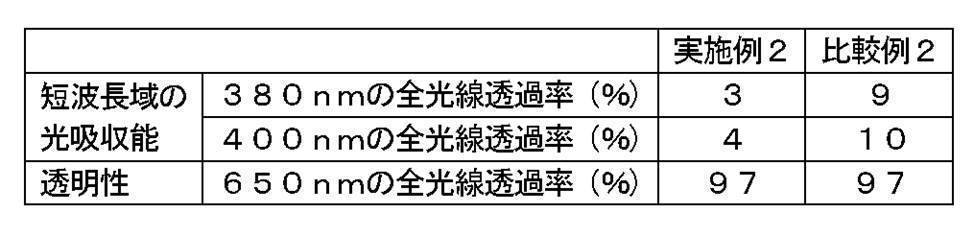
成分(C)としてSEESORB703(シプロ化成社製)3.3質量部に代えてDAINSORB T-0(大和化成社製)の15質量%MEK溶液22質量部(不揮発分3.3質量部)を配合した以外は、実施例1と同様にして接着シートを得た。
下記表3に、上述のようにして測定した全光線透過率の結果を記載する。
成分(B)を配合せず、成分(C)であるDAINSORB T-0の15質量%MEK溶液の配合量を14.7質量部(不揮発分2.2質量部)に変更した以外は実施例3と同様にして接着シートを得た。
下記表3に、上述のようにして測定した全光線透過率の結果を記載する。

成分(C)としてSEESORB703(シプロ化成社製)3.3質量部に代えてSEESORB107(シプロ化成社製)の20質量%トルエン溶液16.5質量部(不揮発分3.3質量部)を配合した以外は、実施例1と同様にして接着シートを得た。
下記表4に、上述のようにして測定した全光線透過率の結果を記載する。
成分(B)を配合せず、成分(C)であるSEESORB107の20質量%トルエン溶液11.0質量部(不揮発分2.2質量部)に変更した以外は実施例4と同様にして接着シートを得た。
下記表4に、上述のようにして測定した全光線透過率の結果を記載する。

液状水添ビスフェノールA型エポキシ樹脂(三菱ケミカル社製「YX8000」)60質量部、および成分(B)として上記半焼成ハイドロタルサイト40質量部を3本ロールで混合して、混合物を得た。得られた混合物に、硬化促進剤(サンアプロ社製「U-CAT3512T」)1.5質量部、フェノキシ樹脂溶液(三菱ケミカル社製「YX7200B35」)57.2質量部(フェノキシ樹脂20質量部)、および固形水添ビスフェノールA型エポキシ樹脂(三菱ケミカル社製「YX8040」)の溶液(溶媒:MEK、不揮発分:40質量%)50質量部(固形水添ビスフェノールA型エポキシ樹脂20質量部)の混合物を配合した。得られた混合物に、更にイオン液体硬化剤(N-アセチルグリシンテトラブチルホスホニウム塩)3質量部、および成分(C)としてSEESORB107(シプロ化成社製)1.5質量部を配合し、得られた混合物を高速回転ミキサーで均一に分散して、接着剤組成物ワニスを得た。シリコーン系離型剤で処理したポリエチレンテレフタレート(PET)フィルムに、得られたワニスをダイコーターにて均一に塗布し、80℃で5分間加熱して乾燥した後、樹脂組成物層の表面に、保護フィルムとして離型PETフィルムを載せ、接着シートを得た。
下記表5に、上述のようにして測定した全光線透過率の結果を記載する。
成分(B)を配合せず、成分(C)であるSEESORB107を1.1質量部に変更した以外は実施例5と同様にして接着シートを得た。
下記表5に、上述のようにして測定した全光線透過率の結果を記載する。
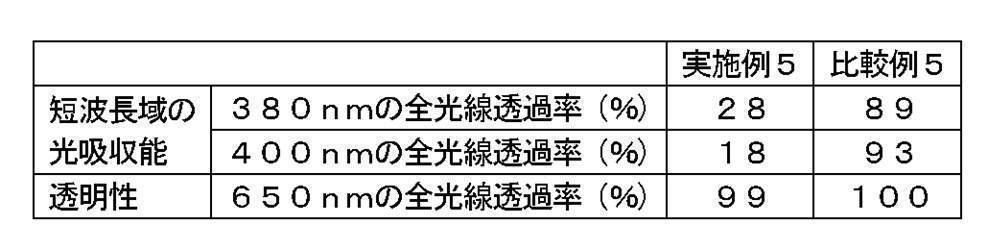
Claims (15)
- 以下の成分(A)~(C):
(A)有機バインダー、
(B)層状粘土鉱物、および
(C)300~430nmの波長域に最大吸収波長を有する化合物
を含む接着剤組成物。 - 成分(B)が、ハイドロタルサイトおよび層状ケイ酸塩鉱物から選ばれる少なくとも一つを含む請求項1に記載の接着剤組成物。
- 成分(B)が、ハイドロタルサイトを含む請求項1に記載の接着剤組成物。
- 成分(B)が、半焼成ハイドロタルサイトを含む請求項1に記載の接着剤組成物。
- 成分(A)の含有量が、接着剤組成物の不揮発分100質量%に対して、25~95質量%である請求項1~4のいずれか一項に記載の接着剤組成物。
- 成分(B)の含有量が、接着剤組成物の不揮発分100質量%に対して、1~60質量%である請求項1~5のいずれか一項に記載の接着剤組成物。
- 成分(C)の含有量が、接着剤組成物の不揮発分100質量%に対して、0.05~15質量%である請求項1~6のいずれか一項に記載の接着剤組成物。
- 成分(A)が、オレフィン系樹脂およびエポキシ樹脂から選ばれる少なくとも一つを含む請求項1~7のいずれか一項に記載の接着剤組成物。
- 光学デバイスの接着層を形成するために用いられる請求項1~8のいずれか一項に記載の接着剤組成物。
- 光学デバイスが、有機EL表示装置である請求項9に記載の接着剤組成物。
- 支持体と、前記支持体上に請求項1~8のいずれか一項に記載の接着剤組成物から形成された接着層とを含む接着シート。
- 光学デバイス中の接着層を形成するために用いられる請求項11記載の接着シート。
- 光学デバイスが、有機EL表示装置である請求項12に記載の接着シート。
- 請求項1~8のいずれか一項に記載の接着剤組成物から形成された接着層を有する光学デバイス。
- 請求項1~8のいずれか一項に記載の接着剤組成物から形成された接着層を有する有機EL表示装置。
Priority Applications (4)
| Application Number | Priority Date | Filing Date | Title |
|---|---|---|---|
| CN201980076501.9A CN112996874B (zh) | 2018-11-22 | 2019-11-21 | 粘接剂组合物 |
| KR1020217019196A KR102740681B1 (ko) | 2018-11-22 | 2019-11-21 | 접착제 조성물 |
| JP2020557631A JP7755930B2 (ja) | 2018-11-22 | 2019-11-21 | 接着剤組成物 |
| JP2024072256A JP2024091938A (ja) | 2018-11-22 | 2024-04-26 | 接着剤組成物 |
Applications Claiming Priority (2)
| Application Number | Priority Date | Filing Date | Title |
|---|---|---|---|
| JP2018-219682 | 2018-11-22 | ||
| JP2018219682 | 2018-11-22 |
Publications (1)
| Publication Number | Publication Date |
|---|---|
| WO2020105707A1 true WO2020105707A1 (ja) | 2020-05-28 |
Family
ID=70773950
Family Applications (1)
| Application Number | Title | Priority Date | Filing Date |
|---|---|---|---|
| PCT/JP2019/045654 Ceased WO2020105707A1 (ja) | 2018-11-22 | 2019-11-21 | 接着剤組成物 |
Country Status (4)
| Country | Link |
|---|---|
| JP (2) | JP7755930B2 (ja) |
| KR (1) | KR102740681B1 (ja) |
| CN (1) | CN112996874B (ja) |
| WO (1) | WO2020105707A1 (ja) |
Cited By (2)
| Publication number | Priority date | Publication date | Assignee | Title |
|---|---|---|---|---|
| JPWO2020196240A1 (ja) * | 2019-03-28 | 2020-10-01 | ||
| WO2025033340A1 (ja) * | 2023-08-04 | 2025-02-13 | 三菱ケミカル株式会社 | 接着フィルム、離型フィルム付き接着フィルム、フレキシブル画像表示装置構成部材用接着フィルム、フレキシブル画像表示装置用積層体、及びフレキシブル画像表示装置 |
Citations (7)
| Publication number | Priority date | Publication date | Assignee | Title |
|---|---|---|---|---|
| JP2012211305A (ja) * | 2011-03-23 | 2012-11-01 | Mitsubishi Plastics Inc | 画像表示装置用透明両面粘着シートおよび画像表示装置 |
| JP2017027941A (ja) * | 2015-07-21 | 2017-02-02 | 味の素株式会社 | 封止用樹脂組成物 |
| WO2018021031A1 (ja) * | 2016-07-28 | 2018-02-01 | 日本ゼオン株式会社 | 熱可塑性エラストマー積層体及び有機エレクトロルミネッセンス装置 |
| JP2018504622A (ja) * | 2014-11-11 | 2018-02-15 | 三星エスディアイ株式会社Samsung SDI Co., Ltd. | ディスプレイ用ウィンドウフィルムおよびこれを含むディスプレイ装置 |
| JP2018028974A (ja) * | 2016-08-15 | 2018-02-22 | 日東電工株式会社 | 有機el表示装置用粘着剤組成物、有機el表示装置用粘着剤層、有機el表示装置用粘着剤層付偏光フィルム、及び有機el表示装置 |
| WO2018066548A1 (ja) * | 2016-10-04 | 2018-04-12 | 味の素株式会社 | 封止用の樹脂組成物および封止用シート |
| WO2018181664A1 (ja) * | 2017-03-31 | 2018-10-04 | 味の素株式会社 | 封止用の組成物 |
Family Cites Families (5)
| Publication number | Priority date | Publication date | Assignee | Title |
|---|---|---|---|---|
| JP2004231938A (ja) * | 2002-09-13 | 2004-08-19 | Sekisui Chem Co Ltd | 有機el素子封止用光硬化性接着剤組成物、有機el素子の封止方法および有機el素子 |
| JP2013157205A (ja) * | 2012-01-30 | 2013-08-15 | Sekisui Chem Co Ltd | 有機エレクトロルミネッセンス表示素子用封止剤 |
| WO2014007219A1 (ja) * | 2012-07-05 | 2014-01-09 | 株式会社スリーボンド | シート状接着剤およびこれを用いた有機elパネル |
| CN108026430B (zh) | 2015-09-30 | 2020-09-01 | 味之素株式会社 | 密封用树脂组合物 |
| JP6903992B2 (ja) | 2017-03-27 | 2021-07-14 | 味の素株式会社 | 封止用樹脂組成物および封止用シート |
-
2019
- 2019-11-21 JP JP2020557631A patent/JP7755930B2/ja active Active
- 2019-11-21 CN CN201980076501.9A patent/CN112996874B/zh active Active
- 2019-11-21 KR KR1020217019196A patent/KR102740681B1/ko active Active
- 2019-11-21 WO PCT/JP2019/045654 patent/WO2020105707A1/ja not_active Ceased
-
2024
- 2024-04-26 JP JP2024072256A patent/JP2024091938A/ja active Pending
Patent Citations (7)
| Publication number | Priority date | Publication date | Assignee | Title |
|---|---|---|---|---|
| JP2012211305A (ja) * | 2011-03-23 | 2012-11-01 | Mitsubishi Plastics Inc | 画像表示装置用透明両面粘着シートおよび画像表示装置 |
| JP2018504622A (ja) * | 2014-11-11 | 2018-02-15 | 三星エスディアイ株式会社Samsung SDI Co., Ltd. | ディスプレイ用ウィンドウフィルムおよびこれを含むディスプレイ装置 |
| JP2017027941A (ja) * | 2015-07-21 | 2017-02-02 | 味の素株式会社 | 封止用樹脂組成物 |
| WO2018021031A1 (ja) * | 2016-07-28 | 2018-02-01 | 日本ゼオン株式会社 | 熱可塑性エラストマー積層体及び有機エレクトロルミネッセンス装置 |
| JP2018028974A (ja) * | 2016-08-15 | 2018-02-22 | 日東電工株式会社 | 有機el表示装置用粘着剤組成物、有機el表示装置用粘着剤層、有機el表示装置用粘着剤層付偏光フィルム、及び有機el表示装置 |
| WO2018066548A1 (ja) * | 2016-10-04 | 2018-04-12 | 味の素株式会社 | 封止用の樹脂組成物および封止用シート |
| WO2018181664A1 (ja) * | 2017-03-31 | 2018-10-04 | 味の素株式会社 | 封止用の組成物 |
Cited By (3)
| Publication number | Priority date | Publication date | Assignee | Title |
|---|---|---|---|---|
| JPWO2020196240A1 (ja) * | 2019-03-28 | 2020-10-01 | ||
| JP7554179B2 (ja) | 2019-03-28 | 2024-09-19 | リンテック株式会社 | シート状接着剤、封止シート、電子デバイスの封止体、及び、電子デバイスの封止体の製造方法 |
| WO2025033340A1 (ja) * | 2023-08-04 | 2025-02-13 | 三菱ケミカル株式会社 | 接着フィルム、離型フィルム付き接着フィルム、フレキシブル画像表示装置構成部材用接着フィルム、フレキシブル画像表示装置用積層体、及びフレキシブル画像表示装置 |
Also Published As
| Publication number | Publication date |
|---|---|
| KR20210094013A (ko) | 2021-07-28 |
| CN112996874B (zh) | 2022-10-21 |
| JPWO2020105707A1 (ja) | 2021-10-14 |
| CN112996874A (zh) | 2021-06-18 |
| JP7755930B2 (ja) | 2025-10-17 |
| JP2024091938A (ja) | 2024-07-05 |
| KR102740681B1 (ko) | 2024-12-11 |
Similar Documents
| Publication | Publication Date | Title |
|---|---|---|
| JP6683204B2 (ja) | 封止用樹脂組成物 | |
| JP6903992B2 (ja) | 封止用樹脂組成物および封止用シート | |
| JP7120017B2 (ja) | 封止用の樹脂組成物および封止用シート | |
| JP7661674B2 (ja) | 電子デバイスおよびペロブスカイト型太陽電池 | |
| JPWO2019189723A1 (ja) | 封止用組成物 | |
| JP6821985B2 (ja) | 封止用樹脂組成物 | |
| JP2024091938A (ja) | 接着剤組成物 | |
| KR102579970B1 (ko) | 봉지용 시트 | |
| TWI900498B (zh) | 密封用樹脂組成物 | |
| JP2025084809A (ja) | 樹脂組成物および樹脂シート | |
| WO2020196826A1 (ja) | 樹脂組成物および樹脂シート | |
| JP7347087B2 (ja) | 粘着シート | |
| JP6741001B2 (ja) | 封止用樹脂組成物および封止用シート | |
| WO2021095792A1 (ja) | 封止用シートの製造方法 |
Legal Events
| Date | Code | Title | Description |
|---|---|---|---|
| 121 | Ep: the epo has been informed by wipo that ep was designated in this application |
Ref document number: 19886915 Country of ref document: EP Kind code of ref document: A1 |
|
| ENP | Entry into the national phase |
Ref document number: 2020557631 Country of ref document: JP Kind code of ref document: A |
|
| NENP | Non-entry into the national phase |
Ref country code: DE |
|
| ENP | Entry into the national phase |
Ref document number: 20217019196 Country of ref document: KR Kind code of ref document: A |
|
| 122 | Ep: pct application non-entry in european phase |
Ref document number: 19886915 Country of ref document: EP Kind code of ref document: A1 |