WO2020095897A1 - テレビ番組用広告の提供方法 - Google Patents
テレビ番組用広告の提供方法 Download PDFInfo
- Publication number
- WO2020095897A1 WO2020095897A1 PCT/JP2019/043290 JP2019043290W WO2020095897A1 WO 2020095897 A1 WO2020095897 A1 WO 2020095897A1 JP 2019043290 W JP2019043290 W JP 2019043290W WO 2020095897 A1 WO2020095897 A1 WO 2020095897A1
- Authority
- WO
- WIPO (PCT)
- Prior art keywords
- advertisement
- television program
- viewing
- targeting
- program
- Prior art date
- Legal status (The legal status is an assumption and is not a legal conclusion. Google has not performed a legal analysis and makes no representation as to the accuracy of the status listed.)
- Ceased
Links
Images





Classifications
-
- G—PHYSICS
- G06—COMPUTING OR CALCULATING; COUNTING
- G06Q—INFORMATION AND COMMUNICATION TECHNOLOGY [ICT] SPECIALLY ADAPTED FOR ADMINISTRATIVE, COMMERCIAL, FINANCIAL, MANAGERIAL OR SUPERVISORY PURPOSES; SYSTEMS OR METHODS SPECIALLY ADAPTED FOR ADMINISTRATIVE, COMMERCIAL, FINANCIAL, MANAGERIAL OR SUPERVISORY PURPOSES, NOT OTHERWISE PROVIDED FOR
- G06Q30/00—Commerce
- G06Q30/02—Marketing; Price estimation or determination; Fundraising
-
- H—ELECTRICITY
- H04—ELECTRIC COMMUNICATION TECHNIQUE
- H04H—BROADCAST COMMUNICATION
- H04H60/00—Arrangements for broadcast applications with a direct linking to broadcast information or broadcast space-time; Broadcast-related systems
- H04H60/35—Arrangements for identifying or recognising characteristics with a direct linkage to broadcast information or to broadcast space-time, e.g. for identifying broadcast stations or for identifying users
- H04H60/45—Arrangements for identifying or recognising characteristics with a direct linkage to broadcast information or to broadcast space-time, e.g. for identifying broadcast stations or for identifying users for identifying users
-
- H—ELECTRICITY
- H04—ELECTRIC COMMUNICATION TECHNIQUE
- H04H—BROADCAST COMMUNICATION
- H04H60/00—Arrangements for broadcast applications with a direct linking to broadcast information or broadcast space-time; Broadcast-related systems
- H04H60/61—Arrangements for services using the result of monitoring, identification or recognition covered by groups H04H60/29-H04H60/54
- H04H60/65—Arrangements for services using the result of monitoring, identification or recognition covered by groups H04H60/29-H04H60/54 for using the result on users' side
-
- H—ELECTRICITY
- H04—ELECTRIC COMMUNICATION TECHNIQUE
- H04H—BROADCAST COMMUNICATION
- H04H60/00—Arrangements for broadcast applications with a direct linking to broadcast information or broadcast space-time; Broadcast-related systems
- H04H60/76—Arrangements characterised by transmission systems other than for broadcast, e.g. the Internet
- H04H60/81—Arrangements characterised by transmission systems other than for broadcast, e.g. the Internet characterised by the transmission system itself
- H04H60/82—Arrangements characterised by transmission systems other than for broadcast, e.g. the Internet characterised by the transmission system itself the transmission system being the Internet
-
- H—ELECTRICITY
- H04—ELECTRIC COMMUNICATION TECHNIQUE
- H04N—PICTORIAL COMMUNICATION, e.g. TELEVISION
- H04N21/00—Selective content distribution, e.g. interactive television or video on demand [VOD]
- H04N21/20—Servers specifically adapted for the distribution of content, e.g. VOD servers; Operations thereof
- H04N21/25—Management operations performed by the server for facilitating the content distribution or administrating data related to end-users or client devices, e.g. end-user or client device authentication, learning user preferences for recommending movies
- H04N21/258—Client or end-user data management, e.g. managing client capabilities, user preferences or demographics, processing of multiple end-users preferences to derive collaborative data
-
- H—ELECTRICITY
- H04—ELECTRIC COMMUNICATION TECHNIQUE
- H04N—PICTORIAL COMMUNICATION, e.g. TELEVISION
- H04N21/00—Selective content distribution, e.g. interactive television or video on demand [VOD]
- H04N21/20—Servers specifically adapted for the distribution of content, e.g. VOD servers; Operations thereof
- H04N21/25—Management operations performed by the server for facilitating the content distribution or administrating data related to end-users or client devices, e.g. end-user or client device authentication, learning user preferences for recommending movies
- H04N21/266—Channel or content management, e.g. generation and management of keys and entitlement messages in a conditional access system, merging a VOD unicast channel into a multicast channel
-
- H—ELECTRICITY
- H04—ELECTRIC COMMUNICATION TECHNIQUE
- H04N—PICTORIAL COMMUNICATION, e.g. TELEVISION
- H04N21/00—Selective content distribution, e.g. interactive television or video on demand [VOD]
- H04N21/20—Servers specifically adapted for the distribution of content, e.g. VOD servers; Operations thereof
- H04N21/25—Management operations performed by the server for facilitating the content distribution or administrating data related to end-users or client devices, e.g. end-user or client device authentication, learning user preferences for recommending movies
- H04N21/266—Channel or content management, e.g. generation and management of keys and entitlement messages in a conditional access system, merging a VOD unicast channel into a multicast channel
- H04N21/2668—Creating a channel for a dedicated end-user group, e.g. insertion of targeted commercials based on end-user profiles
-
- H—ELECTRICITY
- H04—ELECTRIC COMMUNICATION TECHNIQUE
- H04N—PICTORIAL COMMUNICATION, e.g. TELEVISION
- H04N21/00—Selective content distribution, e.g. interactive television or video on demand [VOD]
- H04N21/40—Client devices specifically adapted for the reception of or interaction with content, e.g. set-top-box [STB]; Operations thereof
- H04N21/45—Management operations performed by the client for facilitating the reception of or the interaction with the content or administrating data related to the end-user or to the client device itself, e.g. learning user preferences for recommending movies, resolving scheduling conflicts
- H04N21/458—Scheduling content for creating a personalised stream, e.g. by combining a locally stored advertisement with an incoming stream; Updating operations, e.g. for OS modules ; time-related management operations
Definitions
- the present invention relates to a method of providing advertisements for television programs.
- mass advertisements such as TV commercials provided by broadcasting stations to unspecified receiving devices had an advantage in reaching more people.
- Patent Document 1 As a technology for enhancing the effect of TV commercials, a technology has been disclosed in which a mobile terminal such as a smartphone of a user simultaneously displays video advertisements of TV commercials and related online advertisements (for example, Patent Document 1).
- the targeting advertisement method in the internet advertising field can realize the accurate reach of the advertisement, it is difficult to realize the potential target through the advertisement at the same time. ..
- One embodiment of the present invention is a method of providing an advertisement for a television program that provides a targeting advertisement to a receiving device that receives a television program, wherein the targeting advertisement is provided based on viewing logs of a plurality of television programs.
- a television program to be performed is determined, a targeting advertisement to be provided to the television program is determined, and the determined targeting advertisement is transmitted to a specific receiving device.
- the present invention it is possible to realize a mechanism capable of efficiently providing an advertisement to a target while expecting an effect of improving the degree of recognition of an advertisement content by an existing mass advertisement, particularly in a television commercial.
- FIG. 3 is a functional block diagram of an addressable DMP according to the first embodiment of the present invention.
- FIG. 3 is a functional block diagram showing details of a control unit of the addressable DMP according to the first embodiment of the present invention. It is the figure which showed the detail of the storage of the addressable DMP by the 1st Embodiment of this invention.
- It is a functional block diagram of SSP by the 1st Embodiment of this invention.
- FIG. 3 is a functional block diagram showing details of a control part and storage of SSP by a 1st embodiment of the present invention.
- FIG. 3 is a functional block diagram of a receiving device according to the first embodiment of the present invention.
- FIG. 9 is a configuration diagram of a system according to a third embodiment of the present invention. It is a functional block diagram of the charging server by the 3rd Embodiment of this invention. It is a functional block diagram which showed the detail of the control part of the charging server by the 3rd Embodiment of this invention. It is an example of the advertising fee management table according to the third embodiment of the present invention. It is a flowchart figure which shows the example of the advertising fee billing method of the television program advertisement by the 3rd Embodiment of this invention.
- a television program advertisement providing method has the following configuration.
- [Item 1] A method for providing an advertisement for a television program, which provides a targeting advertisement to a receiving device for receiving a television program, comprising: Decide the TV programs to be targeted advertising based on the viewing logs of multiple TV programs, Decide the targeting advertisement to be provided for the TV program, A method of providing an advertisement for a television program, which transmits the determined targeting advertisement to a specific receiving device.
- the television program advertisement providing method according to Item 1, wherein the receiving device is a receiving device associated with a viewer belonging to a specific attribute.
- Item 4 Item 2. The method of providing an advertisement for a television program according to item 1, wherein the targeting advertisement is transmitted to one or a plurality of advertisement slots of a television program.
- Item 5 2. The method for providing a television program advertisement according to item 1, wherein the television program is provided to a receiving device by a broadcast signal, and the targeting advertisement is transmitted to the receiving device via the Internet.
- Item 6 Item 2. The method for providing an advertisement for a television program according to item 1, which provides information about a television program for which the targeting advertisement is provided.
- Item 7 Item 2.
- Item 8 Item 2.
- the terminal of the specific viewer is either a mobile terminal or a personal computer.
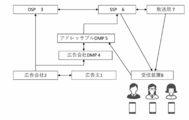
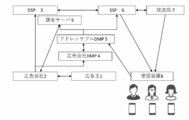
- FIG. 1 is a configuration diagram of a television program advertisement providing system according to a first embodiment of the present invention.
- the system for providing advertisements for television programs includes an advertiser 1, an advertising company 2 that places advertisements by the advertiser 1, and a DSP (Demand Side Platform) 2 that receives advertisement placements from the advertising company 2. And a SSP6 (Supply Side Platform) that procures an advertisement by accepting an advertisement frame of a television program (suitable for an addressable advertisement described later) from the broadcasting station 7 and requesting a bid for the advertisement frame from the DSP2. Further, it has a receiving device 8 for receiving a television program from a broadcasting station 7 via a broadcasting signal such as terrestrial digital broadcasting or via the Internet such as simulcasting. In addition, the receiving device 8 receives a mass advertisement (TV commercial) provided to an unspecified audience from the broadcasting station 7 together with a television program.
- a broadcasting signal such as terrestrial digital broadcasting or via the Internet such as simulcasting.
- the television program advertisement providing system uses a television program viewing log provided by the advertising company 2 and a terminal such as a mobile terminal or a personal computer (PC) paired with the receiving device 8.
- An advertising company DMP (Data Management Platform) 4 that analyzes the purchase data and location information of the viewers obtained by this, and executes optimized targeting advertising planning, and a receiving device while linking with the advertising company DMP 4 Analyze the TV program viewing log obtained from the viewer from 8 and select a program suitable for addressable advertisement (targeting advertisement for a specific viewer attribute in a receiving device that receives a broadcast signal such as a TV program and is connected to the Internet). It has an addressable DMP5 to extract.
- the addressable DMP 5 may obtain the purchase data of the viewer or the data such as the position information obtained through the terminal such as the portable terminal or the PC without passing through the advertising company DMP 4.
- the SSP 6 transmits the targeting advertisement procured from the DSP 2 to the receiving device 8 via a broadcast signal or the Internet.
- the targeting advertisement may be transmitted to a terminal such as a mobile terminal or a PC that is paired with the receiving device and is associated with a specific individual.
- the respective devices constituting the present system are connected via a common or local network such as the Internet. For convenience of explanation, one device is described for each device, but a plurality of devices may be used and the invention is not limited to this.
- the names of DMP, DSP, SSP, etc. may be referred to by different names, and the system configuration may be appropriately changed without departing from the scope of the present invention.
- the receiving device 8 can be connectable to a device for collecting viewing logs by the receiving device (viewing log collecting device 93 described later), and for collecting viewing logs.
- the device can have a function of collecting a viewing log of a program for each individual (an individual identifying device 95 described later).
- the receiving device 8 can also have a function of pairing with a personal portable terminal (for example, a smartphone or a tablet terminal) using the receiving device via a network.
- the devices such as the advertiser 1, the advertising company 2, and the broadcasting station 7 may be general-purpose computers such as workstations and personal computers, or may be smartphones, tablets, mobile terminals, and other information terminals. Good.
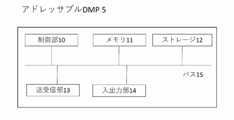
- FIG. 2 is a functional block diagram of the addressable DMP according to the first embodiment of the present invention. Note that the illustrated configuration is an example, and other configurations may be included.
- the addressable DMP 5 is connected to a database (not shown) and constitutes a part of the system.
- the DMP 5 may be a general-purpose computer such as a workstation or a personal computer, or may be logically realized by cloud computing.
- the DMP 5 includes at least a control unit 10, a memory 11, a storage 12, a transmission / reception unit 13, an input / output unit 14, and the like, which are electrically connected to each other via a bus 15.
- the control unit 10 is an arithmetic unit that controls the overall operation of the DMP 5, controls the transmission and reception of data between the elements, and executes information processing required for execution of applications and authentication processing.
- the control unit 10 is a CPU (Central Processing Unit) and executes a program or the like stored in the storage 12 and expanded in the memory 11 to perform each information processing.
- CPU Central Processing Unit
- the memory 11 includes a main memory configured by a volatile storage device such as a DRAM (Dynamic Random Access Memory) and an auxiliary storage configured by a non-volatile storage device such as a flash memory or an HDD (Hard Disc Drive). ..
- the memory 11 is used as a work area or the like of the processor 10, and also stores a BIOS (Basic Input / Output System) executed when the DMP 5 is activated, and various setting information.
- BIOS Basic Input / Output System
- the storage 12 stores various programs such as application programs.
- a database (not shown) that stores data used for each process may be built in the storage 12.
- the transmitter / receiver 13 connects the DMP 5 to the network.
- the transmission / reception unit 13 may include Bluetooth (registered trademark) and BLE (Bluetooth Low Energy) short-range communication interfaces.
- the input / output unit 14 is an information input device such as a keyboard and a mouse, and an output device such as a display.
- the bus 15 is commonly connected to the above-mentioned elements and transmits, for example, an address signal, a data signal and various control signals.
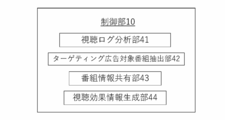
- FIG. 3 is a functional block diagram showing details of the control unit 10 of the addressable DMP 5 according to the first embodiment of the present invention
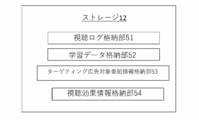
- FIG. 4 is a storage 12 of the addressable DMP 5 according to the first embodiment of the present invention
- 3 is a functional block diagram showing details of FIG.
- the control unit 10 executes the application program related to the analysis according to the present embodiment, and the module of the executed program is divided into some functional blocks as illustrated. Further, all or a part of the functional blocks executed by the main control unit of the server can be executed by the SSP 6 or a control unit (not shown) of another device on the network depending on its nature.
- the viewing log analysis unit 41 receives the viewing log from the reception device 8 (more specifically, the online meter of the viewing log analysis device 33) via the transmission / reception unit 13.
- the received viewing log is stored in the viewing log storage unit 51 of the storage 12 built in the addressable DMP 5.
- the viewing log analysis unit 41 also analyzes the viewing behavior of the viewer based on the received viewing log. In the analysis, it is possible to refer to an individual viewing log obtained from an individual identifying device (for example, a people meter).
- the learning data can be stored in the learning data storage unit 52 in advance.
- the viewing log acquired from the receiving device (sample device S) acquired from the viewing log collecting device having the above-described individual identifying device. And the presence / absence of an attribute from the viewing channel / viewing date / time based on the viewing channel, viewing date / time, and attribute (eg, classification according to sex, era) based on the first viewing / listening record data including information about members sharing the device.
- the viewing log analysis unit 41 can estimate the viewing by a specific individual (or attribute) from the information such as the viewing channel and the viewing date and time included in the viewing log of the target device.
- the viewing log analysis unit 41 has attributes of C1 (child: 4 to 12 years old), C2 (child: 13 to 19 years old), F1 (female: 20 to 35 years old), F2 (female: 35 to 49 years old). , F3 (female: 50 years old or older), M1 (male: 20 to 35 years old), M2 (male: 35 to 49 years old), M3 (male: 50 years old or older), and objective variables f1 (x) to f8, respectively.
- x is an explanatory variable (vector)
- f1 (x) is an objective variable indicating the probability that a member having the attribute of C1 exists among the members sharing the device.
- the viewing log analysis unit 41 learns the relationship between the above-mentioned objective variables f1 (x) to f8 (x) and the explanatory variable x based on the viewing log obtained from the sample device S.
- the viewing log analysis unit 41 inputs a value to the explanatory variable based on the viewing log obtained from the device (target device T) that installs the viewing log collection device 93 that does not have a personal identifier, and the objective variable f1.
- Each value (presence probability) of (x) to f8 (x) is calculated.
- the viewing log analysis unit 41 determines the attribute of the member of the target device T based on the calculated values (presence probability) of each of the objective variables f1 (x) to f8 (x).
- the viewing log analysis unit 41 extracts, from the values of the objective variables f1 (x) to f8 (x), objective variables that are equal to or greater than the first threshold value, and configures the attributes corresponding to the extracted objective variables.
- Members to share the target device For example, in the present embodiment, the members of the device ID “001” whose existence is determined are individuals belonging to the attributes C1, F2, and M2 (personal IDs “1”, “2”, and “3”, respectively). Suppose there is.
- the viewing log analysis unit 41 determines whether or not each of the viewing logs obtained from the target device T is viewed by each member (person belonging to the attributes C1, F2, and M2) determined for the target device. That is, the viewing log analysis unit 41 determines whether each of the viewing logs in different time zones (or days of the week, channels) has been viewed by each of the users having the determined attributes C1, F2, and M2.
- the viewing log analysis unit 41 Prior to the process of determining the viewing of each member with respect to the device viewing log, the viewing log analysis unit 41, based on the individual viewing record data acquired from the sample device S, viewing channel viewing date and time, attribute (depending on sex and age). Based on the (category), a mathematical model for learning the probability (viewing probability) that the target viewing log was viewed by the user of each attribute is learned.
- the viewing log analysis unit 41 associates each of the attributes C1, C2, F1, F2, F3, M1, M2, and M3 with the objective variables g1 (x) to g8 (x).
- y is an explanatory variable (vector)
- g1 (y) is an objective variable indicating whether the target log is viewed by a member having the attribute of C1. Then, the viewing log analysis unit 41 learns the relationship between the above-mentioned objective variables g1 (y) to g8 (y) and the explanatory variable y based on the viewing log obtained from the sample device S.
- the viewing log analysis unit 41 inputs a value to the explanatory variable based on the viewing log obtained from the target device T, and shares the target device T among the objective variables g1 (y) to g8 (y).
- the value of the objective variable (viewing probability) corresponding to the member is calculated.
- the viewing log analysis unit 41 can determine that, among the calculated viewing probabilities, a user having an attribute corresponding to a viewing probability that is equal to or higher than the threshold set for the viewing log was viewing the viewing log.
- the targeting advertisement target program extraction unit 42 extracts a program for which a targeting advertisement is to be inserted based on the analyzed viewing log. The extraction method will be described later. Further, the targeting advertisement target program extraction unit 42 stores and manages the information regarding the extracted programs in the targeting advertisement target program information storage unit 53.
- the “targeted advertisement” refers to an advertisement targeted to an individual belonging to a specific viewer attribute.
- the “targeted advertisement target program” refers to a program including a targeting advertisement.
- the program information sharing unit 43 notifies the extracted target advertising program to another device on the network, for example, the SSP 6.
- the viewing effect information generation unit 46 generates viewing effect information indicating the viewing record based on the log indicating that the targeting advertisement is displayed or viewed, which is transmitted from the receiving device 8.
- the received log is stored in the viewing effect information storage unit 54 as viewing effect information.
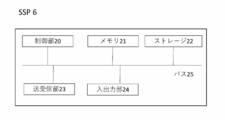
- FIG. 5 is a functional block diagram of the SSP according to the first embodiment of the present invention. Note that the illustrated configuration is an example, and other configurations may be included.
- the SSP 6 is connected to a database (not shown) and forms a part of the system.
- the SSP 6 may be a general-purpose computer such as a workstation or a personal computer, or may be logically realized by cloud computing.
- the SSP 6 includes at least a control unit 20, a memory 21, a storage 22, a transmission / reception unit 23, an input / output unit 24, etc., which are electrically connected to each other via a bus 25.
- the functional configuration of each component is the same as that of the addressable DMP 5 of FIG.
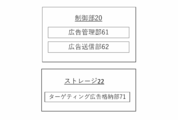
- FIG. 6 is a functional block diagram showing details of the control unit 10 of the addressable SSP 6 according to the first embodiment of the present invention
- FIG. 7 is a storage 12 of the addressable DMP 5 according to the first embodiment of the present invention
- 3 is a functional block diagram showing details of FIG.
- the control unit 10 executes the application program related to the analysis according to the present embodiment, and the module of the executed program is divided into some functional blocks as illustrated. Further, all or a part of the functional blocks executed by the main control unit of the server may be executed by the control unit (not shown) of the DSP 3, the broadcasting station 7, or another device on the network depending on its nature. It is possible.
- the advertisement management unit 44 receives the data regarding the targeting advertisement from another device on the network, for example, the advertising company 2, the DSP 3, or the broadcasting station 7, and stores it in the targeting advertisement storage unit 54.
- the advertisement transmitting unit 45 transmits a targeting advertisement to the receiving device 8 via a broadcast signal or a network such as the Internet.
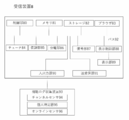
- FIG. 7 is a functional block diagram of the receiving device 8 according to the first embodiment of the present invention. Note that the illustrated configuration is an example, and other configurations may be included.
- the receiving device 8 includes a control unit 80, a memory 81, a storage 82, a browser 83, a tuner unit 84, a demodulation unit 85, a separation unit 86, a decoding unit 87, a display control unit 88, a display unit 89, an input / output unit. 90 and a transmission / reception unit 91, each component is connected by a bus 92, and is in a state capable of transmitting / receiving data to / from each other.
- the receiving device 8 receives the digital broadcast signal transmitted from the broadcast station 7 via the tuner 84, and demodulates the broadcast signal received by the demodulation unit 85.
- the received digital broadcast signal is a signal that is multiplexed and transmitted by the MPEG-TS system or the like.
- the separation unit 86 separates the broadcast signal received by the MPEG-TS system into data such as video data and audio data, and the decoding unit 87 decodes the separated video data and audio data, and the display control unit 88 In the case of video, program video, advertisement video, etc. are displayed on the display unit 29 such as a display, and in the case of audio, audio output is performed via a speaker (not shown) or the like.
- the receiving device 8 is pre-installed with the browser 83, and the content received via the Internet can be displayed on the display unit 89 through the browser 83. As will be described later, the receiving device 8 can receive the targeting advertisement as content data via the Internet and display it on the display unit 89 via the browser 83.
- the control unit 80 is an arithmetic device that controls the overall operation of the reception device 8, controls the transmission and reception of data between the respective elements, and executes information processing necessary for execution of applications and authentication processing.
- the control unit 80 is a CPU (Central Processing Unit) and executes a program or the like stored in the storage 82 and expanded in the memory 21 to execute each information processing.
- CPU Central Processing Unit
- the memory 81 includes a main memory configured by a volatile storage device such as a DRAM (Dynamic Random Access Memory) and an auxiliary storage configured by a non-volatile storage device such as a flash memory or an HDD (Hard Disc Drive). ..
- the memory 81 is used as a work area of the processor 80, and also stores a BIOS (Basic Input / Output System) executed when the DMP 5 is activated, various setting information, and the like.
- BIOS Basic Input / Output System
- the storage 82 stores various programs such as application programs. Further, the television program received by the receiving device 8 can be stored as a recording destination.
- a hard disk device can be used as the storage 82. Further, as the storage 22, a hard disk device can be externally attached to the receiving device 8 via an input / output unit 90 (for example, a USB interface).
- the transmitting / receiving unit 91 connects the receiving device 8 to the network in a wired or wireless manner.
- the transmission / reception unit 91 may include Bluetooth (registered trademark) and BLE (Bluetooth Low Energy) short-range communication interfaces.
- the input / output unit 90 includes a USB interface, an HDMI interface, etc., and serves as an interface for connecting to an external device such as a hard disk device or a recording device. Further, depending on the receiving device 8, the viewing log collecting device 93 is connected via the input / output device 90. More specifically, the viewing log collection device 93 has a channel sensor 34, an individual identifying device 95, and an online meter 96.
- the channel sensor 94 is interlocked with the on / off state of the power supply of the receiving device 8 and is connected to the audio output terminal of the receiving device 8 to extract the audio output from the receiving device 8 and to view it based on the characteristics of the audio. Recognizes the currently tuned channel.
- the individual identifying device 95 (for example, a people meter) has a button for identifying a member who shares the device in association with the power state of the receiving device 8 like the channel sensor, and shares the device. Each member who presses pushes the button assigned to him / her when viewing the program. Thereby, the individual identifying device can identify the member who is viewing the program.
- C1 child: 4 to 12 years old
- C2 child: 13 to 19 years old
- F1 female: 20 to 35 years old
- F2 female: 35 to 49 years old
- F3 female: It is possible to specify a viewer group that belongs to attributes such as 50 years or older), M1 (male: 20 to 35 years old), M2 (male: 35 to 49 years old), M3 (male: 50 years or older).
- the individual identifying device may not be included in the viewing log collecting device when only viewing by device is specified.
- the online meter collects information about the specified channel (program) and the individual (or the device if the individual is not specified) as a viewing log, and transmits the viewing log to the addressable DMP 5 via the Internet or the like. Further, the online meter 96 can collect material logs at 1-minute intervals and send them to the addressable DMP 5 at any time, but can also collect viewing logs at 1-minute intervals and send them to the addressable DMP 5 by batch processing. it can. As described above, the receiving device 8 may not have the viewing log collecting device. Further, another means may be used as the viewing log collecting device, and the receiving device 8 may have the same function.
- FIG. 8 is an example of a viewing log table according to the first embodiment of the present invention.
- the viewing log table 100 shown in FIG. 8 includes a device ID, a personal ID identified by the method of identifying an individual by the individual identifying device 35, an attribute of the individual, a date and time of a channel (program) viewed by the individual, and a channel. Stores information about. Here, the channel being "0" indicates that the individual did not view.
- the household ID can be used instead of the device ID.
- FIG. 9 is an example of an audience rating aggregation table according to the first embodiment of the present invention.
- the program-based audience rating aggregation table 200 shown in FIG. 9 stores audience rating information for each program and for each attribute.
- the audience rating (%) of the program A is 1.1% for C1, 1.2% for C2, and 2.4% for M1.
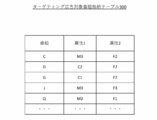
- FIG. 10 is an example of a targeting advertisement target program management table according to the first embodiment of the present invention.
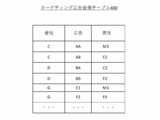
- the targeting advertisement target program storage table 300 illustrated in FIG. 8 stores programs extracted as targeting advertisement targets and information on attributes targeted for the programs.
- the example of the table 300 indicates that the targeted attributes of the program C are M3 and F2.
- FIG. 11 is an example of a targeting advertisement management table according to the first embodiment of the present invention.
- the targeting advertisement management table 400 illustrated in FIG. 11 stores the targeting advertisement submitted for the program targeted by the targeting advertisement and the information about the attribute targeted by the advertisement.
- the advertisements AA and AB are submitted to the program C
- the advertisement AA is targeted to the audience segment having the attribute M3
- the advertisement AB is targeted to the audience segment having the attribute F2. It indicates that
- FIG. 12 is an example of a targeting advertisement transmission management table according to the first embodiment of the present invention.
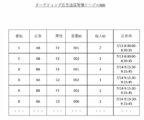
- the targeting advertisement transmission management table 500 shown in FIG. 12 stores the program C, the advertisement provided in the program C, the attribute to be targeted, and the ID that identifies an individual.
- the advertisement AB is transmitted to the program C in a predetermined advertisement space to the individual identified by the device ID “001” and the individual ID “2” of the attribute F2. Is shown.
- the transmission setting as described above, the setting by the time designation, the setting by the distribution period, the upper limit and the quota of the number of impressions are set, and the setting for continuously transmitting until the predetermined number of impressions is satisfied in the target program, the desired It is also possible to store information such as settings that keep transmitting until the attribute is actually viewed.
- a person who sends the targeting advertisement not only the person specified by the person specifying device but also the above-mentioned method of separating the watching log of the individual associated with the specific attribute from the watching log of each device is used. It is also possible to set the advertisement to be transmitted to an individual who is likely to watch a program providing the advertisement, based on the estimated watching log of the individual (for example, a viewing channel, a viewing time, a time zone).
- FIG. 13 is a diagram showing an example of an advertisement viewing effect management table according to the first embodiment of the present invention.
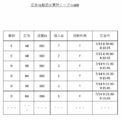
- the advertisement viewing effect management table 600 shown in FIG. 10 stores, for each program, information about the targeting advertisement and information indicating whether the targeting advertisement is viewed by an individual (identified by the device ID and the individual ID). To do.
- the advertisement AB distributed to the predetermined advertisement space is viewed by the individual who is targeted (identified by the device ID “001” and the individual ID “2”) (TRUE). ) Is shown.
- FIG. 14 is a flowchart figure which shows the example of the provision method of the advertisement for television programs by the 1st Embodiment of this invention.
- the process according to the present providing method is realized, for example, by executing the program stored in the memory 11 of the addressable DMP 5 in the control unit 10 or the program stored in the memory 21 of the SSP 6 in the control unit 20.
- the addressable DMP 5 or SSP 6 and another server or device may cooperate to perform the present process in a distributed manner, or another server or device may perform the present process independently.
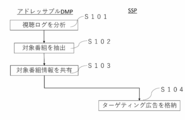
- the viewing log analysis unit 41 of the control unit 10 of the addressable DMP 5 analyzes the viewing log received from the viewing log collection device 93 of the reception device 8 (S101).
- the viewing log analysis unit 41 refers to an individual viewing log obtained from an individual identifying device (for example, a people meter) and totals the viewing ratings of each attribute for each program.
- the viewing log analysis unit 41 uses the program viewing log of each individual program associated with each individual ID shown in the viewing log table 100 of FIG. The audience rating information by attribute is generated.
- the viewing log analysis unit 41 uses a method of separating the individual viewing log obtained from the individual identifying device and the individual viewing log associated with a specific attribute from the viewing log of each device. It is also possible to generate attribute-based audience rating information for each program, as shown in the program-specific audience rating aggregation table 700 of FIG. 9, based on the estimated individual viewing log. According to this example, since the viewing logs obtained from the devices in a wider range than the viewing logs obtained from the individual identifying device can be used, more accurate audience rating information can be obtained.
- the targeting advertisement target program extraction unit 42 of the addressable DMP 5 extracts a program to be a target advertisement distribution target (S102).
- the targeting advertisement target program extraction unit 42 refers to the program-specific audience rating aggregation table 200 shown in FIG. 9, and the programs A and B have little variation in the audience ratings of the respective attributes, but the programs C and D are the same. However, it is specified that the audience rating of the audience with a particular attribute is higher than the audience ratings of other attributes. Particularly, regarding the program C, the audience rating of M3 is 5.7 and the audience rating of F2 is 4.7, and regarding the program D, the audience rating of C2 is 5.7 and the audience rating of F2 is 4.7.
- the program extraction unit 42 executes targeted advertisements. It is extracted as a program suitable for providing. That is, in the example of FIG. 9, the program extracting unit 42 extracts programs C and D as target advertising programs.
- an absolute threshold value or a threshold value relative to the overall audience rating of the program is used as a criterion indicating that the audience rating of a particular attribute is significantly higher than other attributes.
- the program information sharing unit 43 of the addressable DMP 5 shares the information related to the extracted target advertising program (S103). For example, the program information sharing unit 43 notifies or shares the information related to the extracted target advertising program to other devices on the network, such as the SSP 6 and the broadcasting station 7.
- the information to be shared for example, as shown in the targeting advertisement target program storage table 300 shown in FIG. 10, “the program C has an audience layer of attributes M3 and F2, and there is an advertisement frame suitable for the targeting advertisement”. , And other information.
- the device such as the SSP 6 or the broadcasting station 7 can grasp the program suitable for the targeting advertisement, and if the program is determined to be the target program for distributing the targeting advertisement, the DSP 3 and the advertising company 2 It is possible to offer advertisement submission to the advertiser 1 in cooperation with each other.
- the advertising company 2 provides the advertiser 1 with an offer such as "In the program C, there are about 000 viewers such as the attributes M3 and F2, so why not buy the targeting ad space for XX yen?" Can be presented.
- the advertisement management unit 61 of the SSP 6 stores the submitted targeting advertisement in the storage (S104).
- the advertising data is transmitted to the SSP 6 via the DSP 3 and stored in the storage of the SSP 6.
- the broadcasting station or the advertiser can directly submit the advertisement data.
- the content of the stored advertisement data for targeting advertisement can be confirmed by one or a plurality of broadcasting stations that broadcast the targeting advertisement via the Internet.
- the advertisement data can be stored in the MP4 / MPEG4 format, for example.
- FIG. 15 is a flowchart figure which shows the example of the method of collecting the viewing-and-listening performance of the advertisement for television programs by the 1st Embodiment of this invention.
- the process according to the present providing method is performed by, for example, executing a program stored in the memory 21 of the SSP 6 in the control unit 20 or executing a program stored in the memory 11 of the addressable DMP 5 in the control unit 10. Will be realized.
- the SSP 6 or the addressable DMP 5 may cooperate with another server or device to perform this process in a distributed manner, or another server or device may perform this process independently.
- the processing executed by SSP6 can also be executed by an advertisement distribution server such as an ad server.
- the advertisement transmitting unit 62 of the control unit 20 of the SSP 6 distributes the targeting advertisement data stored in the targeting advertisement storage unit 71 to the receiving device 8 (S201).
- the advertisement transmitting unit 45 refers to the targeting advertisement transmission management table 500 shown in FIG. 12 and transmits the advertisement data to the receiving device 8 that is viewed by an individual who is targeting the advertisement data during or before the program broadcasting.
- the advertisement frame for transmitting the targeting advertisement is determined, for example, in the program C
- the advertisement data related to the advertisement AB is displayed in the receiving device 8 which the individual identified by the device ID “001” and the individual ID “2” views.
- it is transmitted at the advertisement frame time "8:30:00 on July 13" or a time in advance.
- the advertisement data is transmitted in advance to the reception device 8
- the advertisement data is temporarily stored in the memory of the reception device 8 and the targeting advertisement is displayed at the time of the predetermined advertisement space.
- the receiving device 8 which should display the targeting advertisement can also transmit the advertisement reception request to the SSP 6 at a predetermined timing.
- the broadcast station 7 may send a targeting advertisement together with a television program to the receiving device 8 via a broadcast signal.
- a targeting advertisement together with the TV program can be transmitted to the receiving device 8 via the Internet.
- the targeting advertisement can be transmitted to a terminal such as a mobile terminal or a PC that is paired with the receiving device and is associated with a specific individual.
- the transmitted advertisement data related to the targeting advertisement is displayed on the display unit 89 of the receiving device 8 via the browser 83.
- the TV program is a linear broadcast
- the TV program itself is displayed on the display unit 89 of the receiving device 8 via the broadcast signal
- the targeting advertisement is displayed on the browser 83 via the Internet. It is displayed on the display unit 29 via.
- a video of a targeting advertisement can be displayed so as to overlay a video of a television program displayed via a broadcast signal.
- the broadcast signal including the targeting advertisement is decoded by the decoding unit 87 after undergoing a predetermined process in the receiving device 8, As a result, the targeting advertisement is displayed on the display unit 89.
- the system as a whole can reach mass audiences with a wide range of attributes and provide mass advertisements to an unspecified number of viewers in order to maintain the effect of raising awareness of advertising products and services, while at the same time providing specific attributes.
- the receiving device associated with the individual it is possible to enjoy the merits of both the television advertisement and the Internet advertisement, such that the targeting advertisement targeting the individual having the attribute can be provided.
- the advertisement frame for providing the targeting advertisement to the specific receiving device can be one of a plurality of advertisement frames, and the number of times is increased according to the designated number of impressions. You can also
- the viewing effect information generation unit 44 of the addressable DMP 5 receives the viewing log indicating whether or not the transmitted targeting advertisement is viewed from the receiving device 8 (S202). For example, when a viewer views a program, the viewer presses a button assigned to him / herself in an individual identifying device (for example, a people meter) of the viewing log collecting device 93 installed in the receiving device 8. As a result, the personal identifying device can identify the member who is watching the program, and therefore the addressable DMP 5 provides information regarding whether or not the targeting ad was viewed at the time when the target ad was delivered. It can be acquired as a viewing log.
- an individual identifying device for example, a people meter
- the receiving device 8 may have the function of the viewing log collecting device 93 (including the function of the personal identifying device) built therein.
- the viewing effect information generation unit 44 generates viewing effect information indicating the viewing record of the advertisement from the viewing log (S203).
- the viewing effect information generation unit 44 as in the advertising viewing effect management table 600 shown in FIG. 13, shows information about targeting advertisements for each program and an ID (in this example, “ Device ID ”and“ individual ID ”), and information indicating whether or not an individual (member) has viewed the content is stored and stored in the viewing effect information storage unit 54.
- the example of the table 600 indicates that the advertisement AB of the program C is viewed (TRUE) by the targeted individual (identified by the device ID “001” and the individual ID “2”).
- the table shows that in program C, the advertisement AB (identified by the device ID “002” and the individual ID “2”) did not view the advertisement (FALSE).
- the viewing effect information indicating the viewing record, it is also possible to generate information obtained by accumulating the number of times the targeted individual contacts with each advertisement.
- the viewing effect information generation unit 44 shares the generated viewing effect information with other devices as a viewing result of the advertisement (S204). For example, the viewing effect information generation unit 44 transmits information indicating the results of advertisement viewing as shown in FIG. 13 to the SSP 6, the broadcasting station 7, etc. as the delivery results. In this way, it can be known whether the provided advertisement was actually viewed by the targeted audience.
- the mode which transmits a targeting advertisement from the addressable DMP5 to the receiver 8 and acquires a viewing-and-listening log from the receiver 8 was illustrated and described, for example, it is not limited to this.
- the advertising company DMP4 or the broadcasting station 7 directly acquires the viewing log from the receiving device, determines the receiving device to which the targeting advertisement is delivered based on the viewing log, and transmits the targeting advertisement to the receiving device. It is also applicable to the mode of.
- a broadcasting station embeds a tag in a BML displaying a data broadcast, collects a viewing log of a program from a receiving device, determines a delivery destination of a targeting advertisement based on the viewing log, and transmits the target advertising. Applicable.
- the targeting viewer in the provision of the targeting advertisement realized in the first embodiment, the targeting viewer aims at the purchase of the product or service targeted for the advertisement while visualizing the effect of the advertisement.
- the present invention relates to a method of determining the content of an advertisement or measuring the timing of providing an advertisement depending on the position in the purchase funnel.
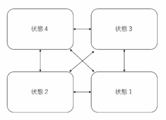
- FIG. 16 is a conceptual diagram related to a method of providing a television program advertisement according to the second embodiment of the present invention.
- FIG. 16 shows states of a target audience of an advertisement product or service from recognition to purchase of the product or service in the purchase funnel, for example, state 1 (cognition), state 2 (favor), and state 3 (Consideration) and State 4 (Purchase) are defined separately.
- FIG. 17 is a flowchart showing an example of a method of providing a television program advertisement according to the second embodiment of the present invention.
- the process according to the present providing method is realized, for example, by causing the control unit 10 to execute the program stored in the memory 11 of the addressable DMP 5.
- the addressable DMP 5 and another server or device may cooperate to perform the present process in a distributed manner, or another server or device may perform the present process independently.
- the system configuration according to the present embodiment and the configurations of individual servers and devices are also the same as those in the first embodiment unless otherwise stated.
- the viewing log analysis unit 41 of the control unit 10 of the addressable DMP 5 analyzes the current state of the target individual viewer (S301). For example, as described above, by scoring based on the viewing log related to the viewer's advertisement and the information obtained from the SNS of the individual or others regarding the related products and services, the state shown in FIG. It is possible to associate 1 to state 4.
- the viewing log analysis unit determines which state the viewer is currently in (S302). Then, the content of the advertisement is changed or the timing of providing the advertisement is adjusted according to the state (S303 to S306). For example, suppose a viewer likes beer, and at one time the viewer is in position 2 of the state, at another time when a beer product is in fashion. Assuming that the user is in the state 4, the advertisement of the popular beer product can be put in as a targeting advertisement. As described above, according to the present embodiment, since the change in the attitude of the viewer due to the advertisement can be visualized, the advertisement is provided to the viewer while confirming the viewer's actions from recognition to purchase in real time. It is possible to determine the content of the product or service and to accurately determine the timing of providing the advertisement. In addition, based on the purchase behavior of the sample viewer, the state from recognition to purchase of the product is associated with the viewing log and made into learning data, and the current viewing log and other information from the actual viewer are used. It is also possible to predict the state transition of the viewer.
- the present embodiment relates to a method of providing a targeting advertisement realized in the first embodiment, and further, a method of returning an advertisement fee to a broadcasting station based on a viewing record of the targeting advertisement.
- FIG. 18 is a configuration diagram of a system according to the third embodiment of the present invention.
- the system configuration and the configuration of individual servers and devices according to the present embodiment are the same as those in the first embodiment unless otherwise specified in the present embodiment.
- the present embodiment has a configuration including a billing server 9 in addition to the system configuration according to the first embodiment.
- FIG. 19 is a functional block diagram of a billing server according to the third embodiment of the present invention. Note that the illustrated configuration is an example, and other configurations may be included.
- the server 9 may be a general-purpose computer such as a workstation or a personal computer, or may be logically realized by cloud computing.
- the server 7 includes at least a control unit 110, a memory 111, a storage 112, a transmission / reception unit 113, an input / output unit 114, etc., which are electrically connected to each other via a bus 115.
- the functional configuration of each component is the same as that of the addressable DMP 5 of FIG.
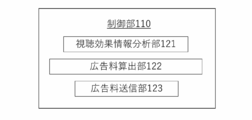
- FIG. 20 is a functional configuration diagram showing details of the control unit of the charging server according to the third embodiment of the present invention.
- the control unit 110 executes the application program related to the analysis according to the present embodiment, and the module of the executed program is divided into some functional blocks as illustrated. Further, all or some of the functional blocks executed by the main control unit of the server may be executed by a control unit (not shown) of a device on another network depending on its nature.
- the viewing effect information analysis unit 121 is included in the viewing effect management table 600 that is generated and shared by the viewing effect information generation unit 44 of the addressable DMP 5 in the first embodiment and views the targeting advertisement. Analyze information about performance.
- the advertisement fee calculation unit 122 calculates the advertisement fee based on the information regarding the viewing record, and the advertisement fee transmission unit 123 transmits the information indicating the calculated advertisement fee to another device.
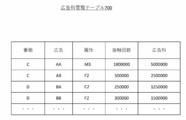
- FIG. 21 is an example of an advertisement fee management table according to the third embodiment of the present invention.
- the advertisement fee management table 700 illustrated in FIG. 21 is based on a targeted attribute, the number of times a (targeted) viewer has contacted the targeting advertisement, and the number of contacts in the program provided with the targeting advertisement. The information on the calculated advertising charge is stored.
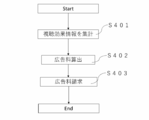
- FIG. 22 is a flow chart showing an example of an advertisement fee billing method for television program advertisement according to the third embodiment of the present invention.
- the process according to the present providing method is realized, for example, by executing the program stored in the memory 111 of the billing server 9 in the control unit 110.
- the billing server 9 and another server or device may cooperate to perform this process in a distributed manner, or another server or device may perform this process independently.
- the viewing effect information analysis unit 121 of the control unit 110 of the billing server 9 is included in the viewing effect management table 600 that is generated and shared by the viewing effect information generation unit 44 of the addressable DMP 5 and is related to the viewing performance of the targeting advertisement. Is analyzed (S401). For example, the viewing effect information analysis unit 121 confirms that, in the advertisement viewing effect management table 600, the individual who has targeted the advertisement AB (specified by the device ID “001” and the individual ID “2”) has viewed the advertisement AB, Similarly, with respect to the advertisement AB, the number of times the viewers belonging to the targeted attribute make contact is counted. For example, the advertisement fee management table 700 shown in FIG. 2 indicates that the total number of times the advertisement AB has been contacted is 500,000.
- the viewing effect information analysis unit 121 receives in advance, as the viewing effect information indicating the viewing result, the information obtained by accumulating the number of times the individual targeted for each advertisement contacts, from the viewing effect information generation unit 44 of the addressable DMP 5. In this case, this process can be omitted.
- the advertisement fee calculation unit 122 calculates an advertisement fee based on the above-mentioned information regarding viewing results (S402). For example, the advertisement fee calculation unit 122 calculates the advertisement fee based on the number of times the (targeted) viewer contacts the targeted advertisement in the program provided with the targeted advertisement. More specifically, as shown in the advertisement fee management table 700 of FIG. 21, assuming that the number of contact with the viewer is 500,000 and the unit price is 5 yen per impression, for the program AB. Will be 2,500,000 yen.
- the advertisement fee transmitting unit 123 transmits information indicating the calculated advertisement fee to another device (S403).
- the advertisement fee transmitting unit 123 transmits the information indicating the calculated advertisement fee together with the information indicating the viewing record of the target advertisement to the advertising company 2 and charges the advertising company 2 or the advertiser 1 for the advertising fee. be able to.
- the advertisement fee of the targeting advertisement can be calculated based on the actual viewing record.
Landscapes
- Engineering & Computer Science (AREA)
- Signal Processing (AREA)
- Databases & Information Systems (AREA)
- Multimedia (AREA)
- Business, Economics & Management (AREA)
- Finance (AREA)
- Strategic Management (AREA)
- Accounting & Taxation (AREA)
- Development Economics (AREA)
- Game Theory and Decision Science (AREA)
- Entrepreneurship & Innovation (AREA)
- Computer Graphics (AREA)
- Economics (AREA)
- Marketing (AREA)
- Physics & Mathematics (AREA)
- General Business, Economics & Management (AREA)
- General Physics & Mathematics (AREA)
- Theoretical Computer Science (AREA)
- Two-Way Televisions, Distribution Of Moving Picture Or The Like (AREA)
- Management, Administration, Business Operations System, And Electronic Commerce (AREA)
Applications Claiming Priority (2)
| Application Number | Priority Date | Filing Date | Title |
|---|---|---|---|
| JP2018-208498 | 2018-11-05 | ||
| JP2018208498A JP6831543B2 (ja) | 2018-11-05 | 2018-11-05 | テレビ番組用広告の提供方法 |
Publications (1)
| Publication Number | Publication Date |
|---|---|
| WO2020095897A1 true WO2020095897A1 (ja) | 2020-05-14 |
Family
ID=70610712
Family Applications (1)
| Application Number | Title | Priority Date | Filing Date |
|---|---|---|---|
| PCT/JP2019/043290 Ceased WO2020095897A1 (ja) | 2018-11-05 | 2019-11-05 | テレビ番組用広告の提供方法 |
Country Status (2)
| Country | Link |
|---|---|
| JP (1) | JP6831543B2 (enExample) |
| WO (1) | WO2020095897A1 (enExample) |
Cited By (1)
| Publication number | Priority date | Publication date | Assignee | Title |
|---|---|---|---|---|
| JP7509506B1 (ja) | 2023-11-16 | 2024-07-02 | 株式会社ビデオリサーチ | 行動モデル作成方法 |
Citations (2)
| Publication number | Priority date | Publication date | Assignee | Title |
|---|---|---|---|---|
| JP2003284041A (ja) * | 2002-03-20 | 2003-10-03 | Ntt Data Corp | 番組配信システム、広告配信装置、視聴者端末、および広告配信プログラム、番組再生プログラムおよび番組配信方法 |
| JP2017151821A (ja) * | 2016-02-25 | 2017-08-31 | カルチュア・コンビニエンス・クラブ株式会社 | 装置、方法、および、プログラム |
Family Cites Families (3)
| Publication number | Priority date | Publication date | Assignee | Title |
|---|---|---|---|---|
| JPH1169249A (ja) * | 1997-06-12 | 1999-03-09 | Toshiba Corp | 情報表示制御方法、情報送信方法、情報表示装置及び記録媒体 |
| JP2016053929A (ja) * | 2014-09-04 | 2016-04-14 | シャープ株式会社 | 情報提示装置、端末装置、および制御方法 |
| CN109074593B (zh) * | 2016-04-20 | 2023-07-14 | 株式会社电通 | 信息处理装置、信息处理方法、信息处理系统及程序 |
-
2018
- 2018-11-05 JP JP2018208498A patent/JP6831543B2/ja active Active
-
2019
- 2019-11-05 WO PCT/JP2019/043290 patent/WO2020095897A1/ja not_active Ceased
Patent Citations (2)
| Publication number | Priority date | Publication date | Assignee | Title |
|---|---|---|---|---|
| JP2003284041A (ja) * | 2002-03-20 | 2003-10-03 | Ntt Data Corp | 番組配信システム、広告配信装置、視聴者端末、および広告配信プログラム、番組再生プログラムおよび番組配信方法 |
| JP2017151821A (ja) * | 2016-02-25 | 2017-08-31 | カルチュア・コンビニエンス・クラブ株式会社 | 装置、方法、および、プログラム |
Cited By (4)
| Publication number | Priority date | Publication date | Assignee | Title |
|---|---|---|---|---|
| JP7509506B1 (ja) | 2023-11-16 | 2024-07-02 | 株式会社ビデオリサーチ | 行動モデル作成方法 |
| JP7531742B1 (ja) | 2023-11-16 | 2024-08-09 | 株式会社ビデオリサーチ | 行動モデル用処理装置 |
| JP2025082241A (ja) * | 2023-11-16 | 2025-05-28 | 株式会社ビデオリサーチ | 行動モデル用処理装置 |
| JP2025082175A (ja) * | 2023-11-16 | 2025-05-28 | 株式会社ビデオリサーチ | 行動モデル作成方法 |
Also Published As
| Publication number | Publication date |
|---|---|
| JP2020077923A (ja) | 2020-05-21 |
| JP6831543B2 (ja) | 2021-02-17 |
Similar Documents
| Publication | Publication Date | Title |
|---|---|---|
| KR102265260B1 (ko) | 콘텐츠 인식 핑거프린트 매칭에서의 채널 변경 검출 | |
| JP6034481B1 (ja) | 広告配信システム及び方法、並びにプログラム | |
| JP6487017B1 (ja) | 情報処理装置、情報処理方法、情報処理システム及びプログラム | |
| JP7162262B2 (ja) | テレビ番組用広告の提供方法 | |
| JP7109025B2 (ja) | テレビ番組用広告の提供方法 | |
| JP7142871B1 (ja) | テレビ番組用広告の提供方法 | |
| JP6910613B2 (ja) | テレビ番組用広告の提供方法 | |
| JP6831543B2 (ja) | テレビ番組用広告の提供方法 | |
| JP7162261B2 (ja) | テレビ番組用広告の提供方法 | |
| JP7203397B2 (ja) | テレビ番組用広告の提供方法 | |
| JP7432805B2 (ja) | テレビ番組用広告の提供方法 | |
| JP7105422B2 (ja) | テレビ番組用広告の提供方法 | |
| JP7162260B2 (ja) | テレビ番組用広告の提供方法 | |
| JP2020167644A (ja) | テレビ番組用広告の提供方法 | |
| JP7186969B2 (ja) | テレビ番組用広告の提供方法 | |
| JP2022188022A (ja) | テレビ番組用広告の提供方法 | |
| JP2023056519A (ja) | テレビ番組用広告の提供方法 | |
| JP7116402B2 (ja) | 広告配信システム | |
| JP7186990B2 (ja) | マーケティング支援システム | |
| JP7232467B2 (ja) | 広告配信システム | |
| US12457373B2 (en) | Methods, apparatus, and articles of manufacture to identify candidates for media asset qualification | |
| JP7134436B2 (ja) | 広告配信システム | |
| JP7134437B2 (ja) | 広告配信システム | |
| JP7186971B2 (ja) | テレビ番組評価システム | |
| JP7116401B2 (ja) | テレビ番組評価システム |
Legal Events
| Date | Code | Title | Description |
|---|---|---|---|
| 121 | Ep: the epo has been informed by wipo that ep was designated in this application |
Ref document number: 19882172 Country of ref document: EP Kind code of ref document: A1 |
|
| NENP | Non-entry into the national phase |
Ref country code: DE |
|
| 122 | Ep: pct application non-entry in european phase |
Ref document number: 19882172 Country of ref document: EP Kind code of ref document: A1 |