WO2020095751A1 - ポリエステルポリイソシアネート、ポリエステルポリイソシアネート組成物、接着剤、積層体、包装材 - Google Patents
ポリエステルポリイソシアネート、ポリエステルポリイソシアネート組成物、接着剤、積層体、包装材 Download PDFInfo
- Publication number
- WO2020095751A1 WO2020095751A1 PCT/JP2019/042286 JP2019042286W WO2020095751A1 WO 2020095751 A1 WO2020095751 A1 WO 2020095751A1 JP 2019042286 W JP2019042286 W JP 2019042286W WO 2020095751 A1 WO2020095751 A1 WO 2020095751A1
- Authority
- WO
- WIPO (PCT)
- Prior art keywords
- acid
- derivative
- polyester
- adhesive
- film
- Prior art date
- Legal status (The legal status is an assumption and is not a legal conclusion. Google has not performed a legal analysis and makes no representation as to the accuracy of the status listed.)
- Ceased
Links
Classifications
-
- B—PERFORMING OPERATIONS; TRANSPORTING
- B32—LAYERED PRODUCTS
- B32B—LAYERED PRODUCTS, i.e. PRODUCTS BUILT-UP OF STRATA OF FLAT OR NON-FLAT, e.g. CELLULAR OR HONEYCOMB, FORM
- B32B27/00—Layered products comprising a layer of synthetic resin
-
- B—PERFORMING OPERATIONS; TRANSPORTING
- B32—LAYERED PRODUCTS
- B32B—LAYERED PRODUCTS, i.e. PRODUCTS BUILT-UP OF STRATA OF FLAT OR NON-FLAT, e.g. CELLULAR OR HONEYCOMB, FORM
- B32B27/00—Layered products comprising a layer of synthetic resin
- B32B27/40—Layered products comprising a layer of synthetic resin comprising polyurethanes
-
- B—PERFORMING OPERATIONS; TRANSPORTING
- B65—CONVEYING; PACKING; STORING; HANDLING THIN OR FILAMENTARY MATERIAL
- B65D—CONTAINERS FOR STORAGE OR TRANSPORT OF ARTICLES OR MATERIALS, e.g. BAGS, BARRELS, BOTTLES, BOXES, CANS, CARTONS, CRATES, DRUMS, JARS, TANKS, HOPPERS, FORWARDING CONTAINERS; ACCESSORIES, CLOSURES, OR FITTINGS THEREFOR; PACKAGING ELEMENTS; PACKAGES
- B65D65/00—Wrappers or flexible covers; Packaging materials of special type or form
- B65D65/38—Packaging materials of special type or form
- B65D65/40—Applications of laminates for particular packaging purposes
-
- C—CHEMISTRY; METALLURGY
- C08—ORGANIC MACROMOLECULAR COMPOUNDS; THEIR PREPARATION OR CHEMICAL WORKING-UP; COMPOSITIONS BASED THEREON
- C08G—MACROMOLECULAR COMPOUNDS OBTAINED OTHERWISE THAN BY REACTIONS ONLY INVOLVING UNSATURATED CARBON-TO-CARBON BONDS
- C08G18/00—Polymeric products of isocyanates or isothiocyanates
- C08G18/06—Polymeric products of isocyanates or isothiocyanates with compounds having active hydrogen
- C08G18/08—Processes
- C08G18/10—Prepolymer processes involving reaction of isocyanates or isothiocyanates with compounds having active hydrogen in a first reaction step
-
- C—CHEMISTRY; METALLURGY
- C08—ORGANIC MACROMOLECULAR COMPOUNDS; THEIR PREPARATION OR CHEMICAL WORKING-UP; COMPOSITIONS BASED THEREON
- C08G—MACROMOLECULAR COMPOUNDS OBTAINED OTHERWISE THAN BY REACTIONS ONLY INVOLVING UNSATURATED CARBON-TO-CARBON BONDS
- C08G18/00—Polymeric products of isocyanates or isothiocyanates
- C08G18/06—Polymeric products of isocyanates or isothiocyanates with compounds having active hydrogen
- C08G18/28—Polymeric products of isocyanates or isothiocyanates with compounds having active hydrogen characterised by the compounds used containing active hydrogen
- C08G18/40—High-molecular-weight compounds
- C08G18/42—Polycondensates having carboxylic or carbonic ester groups in the main chain
-
- C—CHEMISTRY; METALLURGY
- C08—ORGANIC MACROMOLECULAR COMPOUNDS; THEIR PREPARATION OR CHEMICAL WORKING-UP; COMPOSITIONS BASED THEREON
- C08G—MACROMOLECULAR COMPOUNDS OBTAINED OTHERWISE THAN BY REACTIONS ONLY INVOLVING UNSATURATED CARBON-TO-CARBON BONDS
- C08G63/00—Macromolecular compounds obtained by reactions forming a carboxylic ester link in the main chain of the macromolecule
- C08G63/02—Polyesters derived from hydroxycarboxylic acids or from polycarboxylic acids and polyhydroxy compounds
-
- C—CHEMISTRY; METALLURGY
- C09—DYES; PAINTS; POLISHES; NATURAL RESINS; ADHESIVES; COMPOSITIONS NOT OTHERWISE PROVIDED FOR; APPLICATIONS OF MATERIALS NOT OTHERWISE PROVIDED FOR
- C09J—ADHESIVES; NON-MECHANICAL ASPECTS OF ADHESIVE PROCESSES IN GENERAL; ADHESIVE PROCESSES NOT PROVIDED FOR ELSEWHERE; USE OF MATERIALS AS ADHESIVES
- C09J11/00—Features of adhesives not provided for in group C09J9/00, e.g. additives
- C09J11/02—Non-macromolecular additives
- C09J11/06—Non-macromolecular additives organic
-
- C—CHEMISTRY; METALLURGY
- C09—DYES; PAINTS; POLISHES; NATURAL RESINS; ADHESIVES; COMPOSITIONS NOT OTHERWISE PROVIDED FOR; APPLICATIONS OF MATERIALS NOT OTHERWISE PROVIDED FOR
- C09J—ADHESIVES; NON-MECHANICAL ASPECTS OF ADHESIVE PROCESSES IN GENERAL; ADHESIVE PROCESSES NOT PROVIDED FOR ELSEWHERE; USE OF MATERIALS AS ADHESIVES
- C09J175/00—Adhesives based on polyureas or polyurethanes; Adhesives based on derivatives of such polymers
- C09J175/04—Polyurethanes
- C09J175/06—Polyurethanes from polyesters
Definitions
- the present invention relates to a polyester polyisocyanate, a polyester polyisocyanate composition, an adhesive, a laminate, and a packaging material.
- Packaging materials such as foods and beverages have various functions such as strength and resistance to cracking, retort resistance, and heat resistance in order to protect the contents from various distribution, storage such as refrigeration and treatment such as heat sterilization. A wide variety of functions are required, such as excellent transparency so that the contents can be confirmed.
- an unstretched polyolefin film excellent in heat processability is essential, but the unstretched polyolefin film has many functions insufficient as a packaging material.
- a composite flexible film in which different kinds of polymer materials are combined is widely used.
- a composite flexible film is composed of a thermoplastic film layer or the like serving as an outer layer having product protection or various functions, and a thermoplastic film layer or the like serving as a sealant layer, and these are laminated with a thermoplastic resin for the outer layer.
- a method of melt-extruding three layers of an adhesive and a thermoplastic resin for a sealant layer to form an unstretched laminated sheet and then stretching see, for example, Patent Document 1
- a dry lamination method see, for example, Patent Document 2 for manufacturing a multi-layer film by adhesion is known.
- PET polyester terephthalate
- polyester resin polyamide resin
- stretched polyolefin resin a film obtained by vapor deposition of silica, alumina, aluminum or the like.
- vinylidene chloride which has a high oxygen barrier property and a high water vapor barrier property (that is, it is easy to impede mass transfer), has been widely used as a barrier coating material.
- dioxin is generated during firing, and there is a problem that it turns yellow when exposed to light.
- the polyvinyl alcohol resin or ethylene-polyvinyl alcohol copolymer having an oxygen barrier function has a problem that the barrier property is further deteriorated under high humidity where the resin swells.
- the method of giving a gas barrier function to the adhesive used at the time of lamination is an advantage that a multilayer film for gas barrier can be produced without using a special film with a special gas barrier function by the process and the structure essential for producing a laminated film. have.
- a flexible molecular structure, which is essential for adhesives generally has high gas permeability. Therefore, there is often a trade-off relationship between the adhesive ability and the gas barrier function, and the elimination of this raises the technical difficulty.
- Patent Document 3 As a container using such a gas barrier barrier laminated film, for example, in Patent Document 3 or Patent Document 4, an epoxy resin is used between a thermoplastic film layer or the like which is an outer layer and a thermoplastic film layer which is a sealant layer.
- a gas-barrier laminated film bonded with an epoxy resin composition comprising a resin and an epoxy resin curing agent is described.
- the gas barrier property is not perfect even with the method that uses a film obtained by vapor deposition of silica, alumina, aluminum, etc., because the vapor deposition layer usually has vapor deposition defects. Further, since the vapor-deposited layer is an inorganic thin film, it has low flexibility, and in particular, there is a problem in that cracks occur due to twisting or bending of the film, and barrier performance deteriorates. Since vapor-deposited films are originally used for applications that require a high barrier, the unstable barrier function is a serious problem in terms of quality control of contents.
- the present invention has been made in view of such circumstances, a packaging material centered on food, a solar cell, a transparent film that can be used as a transparent barrier film for electronic materials such as display elements, the gas barrier function
- a packaging material centered on food, a solar cell, a transparent film that can be used as a transparent barrier film for electronic materials such as display elements, the gas barrier function
- Another object of the present invention is to provide a gas barrier multilayer film and a packaging material which are excellent in bending resistance and are strong.
- the present invention relates to a polyester polyisocyanate (B) which is a reaction product of a polyester which is a polycondensate of a polyvalent carboxylic acid or a derivative thereof (IB) and a polyhydric alcohol (II-B), and an isocyanate compound.
- the polyvalent carboxylic acid or its derivative (IB) is an aliphatic polyvalent carboxylic acid or its derivative (IBi) having 8 or less carbon atoms in the portion excluding the carboxyl group
- the polyhydric alcohol (II-B) containing an aromatic polyhydric carboxylic acid or a derivative thereof (IB-ii) is an aliphatic polyhydric alcohol (II-Bi) having 8 or less carbon atoms.
- the present invention relates to a polyisocyanate composition containing the polyester polyisocyanate (B), an adhesive using the polyisocyanate composition, a laminate obtained by using the adhesive, and a packaging material obtained by using the laminate. ..
- polyester polyisocyanate (B) of the present invention it is possible to provide an adhesive having excellent gas barrier properties, and further to provide a gas barrier multilayer film and a packaging material which are excellent in gas barrier function and strong in bending treatment. It will be possible.
- the present invention relates to a polyester polyisocyanate (B) which is a reaction product of a polyester which is a polycondensate of a polyvalent carboxylic acid or a derivative thereof (IB) and a polyhydric alcohol (II-B), and an isocyanate compound.
- the polyvalent carboxylic acid or its derivative (IB) is an aliphatic polyvalent carboxylic acid or its derivative (IBi) having 8 or less carbon atoms in the portion excluding the carboxyl group
- the polyhydric alcohol (II-B) containing an aromatic polyhydric carboxylic acid or a derivative thereof (IB-ii) is an aliphatic polyhydric alcohol (II-Bi) having 8 or less carbon atoms.
- the present invention is a polyisocyanate composition using a polyester polyisocyanate (B), an adhesive, a laminate, and a packaging material.
- B polyester polyisocyanate
- the configuration of the present invention will be described in detail.
- polyol composition used in the present invention is one component of a two-component adhesive used together with the polyisocyanate composition.
- polyol composition used in the present invention will be described in detail.
- the polyol composition used in the present invention contains a resin (polyol) having substantially two or more hydroxyl groups. Since the time required for synthesis is short and the handling is easy, it is preferable to use a polyol having a number average molecular weight of 300 or more and 3000 or less, more preferably 350 or more and 1000 or less, and 350 or more and 950 or less. It is more preferable to use.
- the number average molecular weight (Mn) is a value measured by gel permeation chromatography (GPC) under the following conditions.
- HLC-8220GPC manufactured by Tosoh Corporation Column; Tosoh Corporation TSK-GUARDCOULUMN SuperHZ-L + Tosoh Corporation TSK-GEL SuperHZM-M x 4 Detector; RI (differential refractometer) Data processing; Multi-station GPC-8020 modelII manufactured by Tosoh Corporation Measurement conditions; Column temperature 40 ° C Solvent Tetrahydrofuran Flow rate 0.35 ml / min Standard; Monodisperse polystyrene sample; Tetrahydrofuran solution of 0.2% by mass in terms of resin solid content filtered with a microfilter (100 ⁇ l)
- the polyol examples include a polyol having a polyester skeleton, a polyol having a polyurethane skeleton, a polyol having a polyether skeleton, and a polyol having an acrylic skeleton.
- the polyvalent carboxylic acid or its derivative (IA) is used. It is preferable to include a polyol (A) having a polyester skeleton which is a polycondensation product with a polyhydric alcohol (II-A).
- the polyol (A) having a polyester skeleton is also simply referred to as a polyester polyol (A).
- the polyester polyol (A) used in the present invention is A polyester polyol (which is obtained by using, as the polyvalent carboxylic acid or its derivative (IA), an aliphatic polyvalent carboxylic acid having a carbon atom number of 8 or less in the portion excluding the carboxyl group or its derivative (IAi) A); A polyester polyol (A) obtained by using an aromatic polyvalent carboxylic acid or its derivative (IA-ii) as the polyvalent carboxylic acid or its derivative (IA); Aliphatic polycarboxylic acid or its derivative (IA) having a carbon number of 8 or less in the portion excluding the carboxyl group as polycarboxylic acid or its derivative (IA), and aromatic polycarboxylic acid Or a polyester polyol (A) obtained in combination with a derivative thereof (IA-ii); However, the present invention is not limited to this.
- the polyester polyol (A) used in the present invention preferably contains, as the polyhydric alcohol (II-A), an ali
- an aliphatic polycarboxylic acid having 8 or less carbon atoms in the portion excluding a carboxyl group or a derivative thereof is also called a polycarboxylic acid (IAi), which is an aromatic polycarboxylic acid.
- a carboxylic acid or its derivative (IA-ii) is also called a polycarboxylic acid (IA-ii)
- an aliphatic polyhydric alcohol (II-Ai) having 8 or less carbon atoms is polyvalent. Also referred to as alcohol (II-A-i).
- Polyvalent carboxylic acid or its derivative (IA) Polyvalent carboxylic acids (IAi)
- polyvalent carboxylic acids (IAi) As the polyvalent carboxylic acids (IAi) used for synthesizing the polyester polyol (A), conventionally known ones can be used without particular limitation.
- Polyvalent carboxylic acids (IA-ii)) As the polyvalent carboxylic acids (IA-ii) used for synthesizing the polyester polyol (A), conventionally known ones can be used without particular limitation. Specifically, orthophthalic acid, terephthalic acid, isophthalic acid, trimellitic acid, pyromellitic acid, 1,4-naphthalenedicarboxylic acid, 2,5-naphthalenedicarboxylic acid, 2,6-naphthalenedicarboxylic acid, naphthalic acid, biphenyl Examples thereof include dicarboxylic acid, 1,2-bis (phenoxy) ethane-p, p'-dicarboxylic acid, and their anhydrides and methyl ester compounds, and these can be used alone or in combination of two or more kinds.
- orthophthalic acid terephthalic acid, isophthalic acid, and their anhydrides
- orthophthalic acid or orthophthalic anhydride it is more preferable to use orthophthalic acid or orthophthalic anhydride in order to improve the gas barrier property and the adhesive property of the adhesive described later. ..
- the reason why the gas barrier property of the adhesive is excellent by using orthophthalic acid or orthophthalic anhydride is that the rotation of the polyester chain obtained by using orthophthalic acid or its anhydride is suppressed.
- the reason why the adhesiveness is excellent is that the polyester chain is asymmetric and thus exhibits non-crystallinity, and sufficient base material adhesion is imparted.
- the polyvalent carboxylic acid or its derivative (IA) used in the synthesis of the polyester polyol (A) of the present invention includes polyvalent carboxylic acids (IAi) and polyvalent carboxylic acids (IA-ii). Other polyvalent carboxylic acids (IA-iii) may be included. Examples of the polyvalent carboxylic acids (IA-iii) include polyvalent carboxylic acids having more than 8 carbon atoms excluding the carboxyl group, such as dodecanedicarboxylic acid, which may be used alone or in combination of two or more. it can. When the polyvalent carboxylic acid (IA-iii) is used in combination, it is preferably 10% by mass or less and more preferably 5% by mass or less of the total amount of the polycarboxylic acid or its derivative (IA). ..
- the proportion of the polyvalent carboxylic acid (IAi) in the polyvalent carboxylic acid or its derivative (IA) is 100 mol%. Is preferred.
- the proportion of the polycarboxylic acid (IA-ii) in the polycarboxylic acid or its derivative (IA) is 100 mol%.
- the combined use of the polycarboxylic acid (IAi) and the polycarboxylic acid (IA-ii) is preferable because the cured coating film of the adhesive described below has excellent gas barrier properties and flex resistance.
- the compounding ratio (molar ratio) of the polyvalent carboxylic acids (IAi) and the polyvalent carboxylic acids (IA-ii) is, for example, 1: 9 to 9: 1, and more preferably 2: 8 to 8: 2.
- Polyhydric alcohol (II-A) (Polyhydric alcohol (II-Ai))
- polyhydric alcohol (II-Ai) As the polyhydric alcohol (II-Ai) used for synthesizing the polyester polyol (A), conventionally known ones can be used without particular limitation.
- the polyhydric alcohol (II-A-ii) used for the synthesis of the polyester polyol (A) may contain a polyhydric alcohol (II-A-ii) other than the polyhydric alcohol (II-Ai).
- examples of the polyhydric alcohol (II-A-ii) include tetraethylene glycol, tripropylene glycol, dipentaerythritol, hydroquinone, resorcinol, catechol, naphthalenediol, biphenol, bisphenol A, bisphenol F, tetramethylbiphenol, and the like. They can be used alone or in combination of two or more.
- the polyhydric alcohol (II-A-ii) is used in combination, it is preferably 10% by mass or less and more preferably 5% by mass or less based on the total amount of the polyhydric alcohol (II-A).
- polyester polyol (A) The number average molecular weight of the polyester polyol (A) is preferably 300 or more and 3000 or less, more preferably 350 or more and 1000 or less, and further preferably 350 or more and 950 or less. This makes it possible to obtain an adhesive having excellent adhesiveness and gas barrier properties.
- the hydroxyl value of the polyester polyol (A) is preferably 20 mgKOH / g or more and 400 mgKOH / g or less. When the hydroxyl value is less than 20 mgKOH / g, the viscosity of the polyester polyol (A) becomes high, and good coating suitability may not be obtained. If the hydroxyl value exceeds 400 mgKOH / g, the crosslink density of the cured coating film may be too high, and good adhesive strength may not be obtained.
- the hydroxyl value of the polyester polyol (A) can be measured by the hydroxyl value measuring method described in JIS-K0070.
- the acid value of the polyester polyol (A) is preferably 200 mgKOH / g or less. When the acid value exceeds 200 mgKOH / g, the reaction with the polyisocyanate may be too fast, and good coating suitability may not be obtained.
- the lower limit of the acid value of the polyester polyol (A) is not particularly limited and may be 0 mgKOH / g.
- the acid value of the polyester polyol (A) can be measured by the acid value measuring method described in JIS-K0070.
- the glass transition temperature of the polyester polyol (A) is preferably 10 ° C. or lower, and more preferably 5 ° C. or lower in order to improve the adhesiveness.
- the lower limit of the glass transition temperature is not particularly limited, but as an example, it is ⁇ 60 ° C. or higher, and more preferably ⁇ 50 ° C. or higher.
- the glass transition temperature of the polyester polyol (A) can be measured by a differential scanning calorimeter.
- the polyester polyol (A) used in the present invention is preferably linear.
- the polyester polyol (A) having a linear structure means that all the polyester polyol raw materials (polyvalent carboxylic acid or its derivative (IA) and polyhydric alcohol (II-A)) are 2 It is composed of a compound having one reactive group.
- the polyhydric alcohol (II-A) a polyester polyol prepared by using a bifunctional alcohol having a branched alkyl group such as neopentyl glycol is linearly contained. As a result, an increase in the viscosity of the polyester polyol can be suppressed, and an adhesive having excellent coatability can be obtained.
- the polyol composition used in the present invention contains a resin (polyol) having substantially two or more hydroxyl groups, preferably the above-mentioned polyester polyol (A). If necessary, other components such as low molecular weight alcohol, organic solvent, viscosity modifier, silane coupling agent, defoaming agent, tackifier and the like may be contained.
- examples include propyl, castor oil, polyethylene glycol, polypropylene glycol and the like.
- organic solvent examples include toluene, xylene, methylene chloride, tetrahydrofuran, methyl acetate, ethyl acetate, n-propyl acetate, n-butyl acetate, acetone, methyl ethyl ketone (MEK), cyclohexanone, toluene, xylol, n-hexane and cyclohexane.
- MEK methyl ethyl ketone
- viscosity modifiers examples include dimethyl phthalate, dibutyl phthalate, dimethoxyethyl phthalate, dioctyl phthalate, diphenyl phthalate, triacetin, propyl dicaprylate, propylene carbonate and the like.
- silane coupling agent examples include ⁇ -aminopropyltriethoxysilane, ⁇ -aminopropyltrimethoxysilane, N- ⁇ (aminoethyl) - ⁇ -aminopropyltrimethoxysilane, N- ⁇ (aminoethyl) - ⁇ -Aminopropyltrimethyldimethoxysilane, N-phenyl- ⁇ -aminopropyltrimethoxysilane, and other aminosilanes; ⁇ - (3,4-epoxycyclohexyl) ethyltrimethoxysilane, ⁇ -glycidoxypropyltrimethoxysilane, ⁇ -gly Epoxy silanes such as cidoxypropyltriethoxysilane and glycidoxyoctyltrimethoxysilane; vinyltris ( ⁇ -methoxyethoxy) silane, vinyltriethoxysilane, vinyltrie
- dimethylpolysiloxane a part of the methyl group of dimethylpolysiloxane is a carbinol group, a polyether group, or a carbon atom number of 2 or more.
- examples thereof include a silicone-based defoaming agent modified with an alkyl group, an epoxy group, an amino group, a long-chain alcohol such as octyl alcohol, and a sorbitan derivative such as sorbitan monooleate.
- tackifier examples include rosin-based or rosin ester-based tackifiers, terpene-based or terpene-phenol-based tackifiers, saturated hydrocarbon resins, coumarone-based tackifiers, coumarone-indene-based tackifiers, and styrene resin-based tackifiers.
- tackifiers examples include tackifiers, xylene resin-based tackifiers, phenol resin-based tackifiers, petroleum resin-based tackifiers, and the like. These may be used alone or in combination of two or more.
- the polyisocyanate composition of the present invention is one component of a two-component adhesive used with a polyol composition, and contains the polyester polyisocyanate (B) of the present invention as an essential component.
- the polyester polyisocyanate (B) and the polyisocyanate composition of the present invention will be described in detail.
- the polyester polyisocyanate (B) of the present invention is used as one component of a polyisocyanate composition of an adhesive containing a polyol composition and a polyisocyanate composition, and a polyvalent carboxylic acid or its derivative (IB) ) And a polycondensate of a polyhydric alcohol (II-B), and a polyester polyisocyanate (B) which is a reaction product of an isocyanate compound.
- the polyester polyisocyanate (B) has two or more isocyanate groups in one molecule.
- the polyvalent carboxylic acid or its derivative (IB) includes an aliphatic polycarboxylic acid or its derivative (IBi) having a carbon atom number of 8 or less in a portion excluding a carboxyl group, and an aromatic polycarboxylic acid. Acid or a derivative thereof (IB-ii), and the polyhydric alcohol (II-B) includes an aliphatic polyhydric alcohol (II-Bi) having 8 or less carbon atoms.
- an aliphatic polycarboxylic acid having 8 or less carbon atoms in the portion excluding a carboxyl group or a derivative thereof is also referred to as a polycarboxylic acid (IBi), which is an aromatic polycarboxylic acid.
- a carboxylic acid or its derivative (IB-ii) is also called a polycarboxylic acid (IB-ii)
- an aliphatic polyhydric alcohol (II-Bi) having 8 or less carbon atoms is polyvalent. Also referred to as alcohol (II-Bi).
- Polyvalent carboxylic acid or its derivative (IB) As the polyvalent carboxylic acids (IBi) used for the synthesis of the polyester polyisocyanate (B) of the present invention, conventionally known ones can be used without particular limitation. Specifically, the same as those exemplified as the polycarboxylic acid (IAi) can be used, and they can be used alone or in combination of two or more kinds.
- Polycarboxylic acids (IB-ii)) As the polyvalent carboxylic acids (IB-ii) used in the synthesis of the polyester polyisocyanate (B) of the present invention, conventionally known ones can be used without particular limitation. Specifically, the same ones as exemplified as the polyvalent carboxylic acids (IA-ii) can be used, and they can be used alone or in combination of two or more kinds.
- orthophthalic acid terephthalic acid, isophthalic acid, and their anhydrides
- orthophthalic acid or orthophthalic anhydride it is more preferable to use orthophthalic acid or orthophthalic anhydride in order to improve the gas barrier property and the adhesive property of the adhesive described later. ..
- the reason why the gas barrier property of the adhesive is excellent by using orthophthalic acid or orthophthalic anhydride is that the rotation of the polyester chain obtained by using orthophthalic acid or its anhydride is suppressed.
- the reason why the adhesiveness is excellent is that the polyester chain is asymmetric and thus exhibits non-crystallinity, and sufficient base material adhesion is imparted.
- polyvalent carboxylic acids (IB-iii) The polyvalent carboxylic acid or its derivative (IB) used for the synthesis of the polyester polyisocyanate (B) of the present invention is a polyvalent carboxylic acid (IBi) or a polyvalent carboxylic acid (IBi). Other than the above), polyvalent carboxylic acids (IB-iii) may be contained. Examples of the polyvalent carboxylic acids (IB-iii) include polyvalent carboxylic acids having more than 8 carbon atoms excluding the carboxyl group, such as dodecanedicarboxylic acid, which may be used alone or in combination of two or more kinds. it can.
- the polyvalent carboxylic acid (IB-iii) is used in combination, it is preferably kept at 10% by mass or less, more preferably 5% by mass or less, based on the total amount of the polyvalent carboxylic acid or its derivative (IB). ..
- the blending ratio of the polycarboxylic acid (IBi) and the polycarboxylic acid (IBi) may be appropriately adjusted according to the required gas barrier property and flex resistance.
- the compounding ratio (molar ratio) of the polycarboxylic acid (IBi) and the polycarboxylic acid (IB-ii) is, for example, 1: 9 to 9: 1, and more preferably 2: 8 to 8: 2.
- polyhydric alcohol (II-B) (Polyhydric alcohol (II-Bi))
- polyhydric alcohol (II-Bi) As the polyhydric alcohol (II-Bi) used in the synthesis of the polyester polyisocyanate (B) of the present invention, conventionally known ones can be used without particular limitation. Specifically, the same as those exemplified as the polyhydric alcohol (II-Ai) can be used, and they can be used alone or in combination of two or more kinds. Among them, ethylene glycol, butylene glycol, diethylene glycol, triethylene glycol, tetraethylene glycol, dipropylene glycol and the like are preferable.
- the polyhydric alcohol (II-B-ii) used in the synthesis of the polyester polyisocyanate (B) of the present invention contains a polyhydric alcohol (II-B-ii) other than the polyhydric alcohol (II-Bi). Good.
- the polyhydric alcohol (II-B-ii) is used in combination, it is preferably 10% by mass or less, and more preferably 5% by mass or less of the total amount of the polyhydric alcohol (II-B).
- isocyanate compound As the isocyanate compound used in the synthesis of the polyester polyisocyanate (B) of the present invention, known compounds can be used without particular limitation, and examples thereof include butane-1,4-diisocyanate, hexamethylene diisocyanate and 2,2,4-trimethyl. Aliphatic diisocyanates such as hexamethylene diisocyanate, 2,4,4-trimethylhexamethylene diisocyanate, xylylene diisocyanate, m-tetramethyl xylylene diisocyanate;
- Cyclohexane-1,4-diisocyanate isophorone diisocyanate, lysine diisocyanate, dicyclohexylmethane-4,4′-diisocyanate, 1,3-bis (isocyanatomethyl) cyclohexane, methylcyclohexanediisocyanate, isopropylidenedicyclohexyl-4,4′-diisocyanate, Alicyclic diisocyanates such as norbornane diisocyanate;
- aromatic diisocyanate examples include dialkyldiphenylmethane diisocyanate, tetraalkyldiphenylmethane diisocyanate, 1,3-phenylene diisocyanate, 1,4-phenylene diisocyanate and tolylene diisocyanate.
- oligomers of these diisocyanates may be used.
- an isocyanate compound having an aromatic ring in the molecule it has excellent gas barrier properties and adhesiveness.
- the isocyanate compound having an aromatic ring in the molecule conventionally known compounds can be used without particular limitation. Specifically, xylylene diisocyanate, 2,4-tolylene diisocyanate, 2,6-tolylene diisocyanate, 2,2'-diphenylmethane diisocyanate, 2,4'-diphenylmethane diisocyanate, 4,4'-diphenylmethane diisocyanate, 1 Isocyanate monomers such as 1,5-naphthalene diisocyanate, 1,3-phenylene diisocyanate, 1,4-phenylene diisocyanate, and tetramethyl xylene diisocyanate, compounds obtained by modifying a part of the isocyanate groups of these isocyanate monomers with carbodiimide, oligomers, and allophanate compounds, Nu
- Examples of the compound having two or more active hydrogen groups include trimethylolpropane, glycerol, erythritol, pentaerythritol, sorbitol, diethanolamine, triethanolamine, and alkylene oxide adducts of these compounds.
- At least one selected from the group consisting of xylylene diisocyanate, 2,2'-diphenylmethane diisocyanate, 2,4'-diphenylmethane diisocyanate and 4,4'-diphenylmethane diisocyanate is preferable.
- the proportion of the isocyanate compound having an aromatic ring is preferably 50% by mass or more, more preferably 70% by mass or more, and 90% by mass with respect to the total amount of the isocyanate compound used in the synthesis of the polyester polyisocyanate (B). It is more preferable that the above is satisfied.
- the entire amount of the isocyanate compound used for the synthesis of the polyester polyisocyanate (B) may be an isocyanate compound having an aromatic ring.
- the polyester which is an intermediate of the polyester polyisocyanate (B), is obtained by reacting the above-mentioned polyvalent carboxylic acid or its derivative (IB) with the polyhydric alcohol (II-B).
- the intermediate polyester of polyester polyisocyanate (B) is preferably linear.
- the intermediate polyester of the polyester polyisocyanate (B) is linear, that is, the raw material of the polyester polyol (polyhydric carboxylic acid or its derivative (II-A) or polyhydric alcohol (II-B). )) All consist of compounds with two reactive groups.
- the polyhydric alcohol (II-B) a polyester polyol prepared by using a bifunctional alcohol having a branched alkyl group such as neopentyl glycol is included in a linear form. This makes it possible to suppress an increase in the viscosity of the final product, polyester polyisocyanate, and to provide an adhesive with excellent coatability.
- polyester polyisocyanate (B) The polyester polyisocyanate (B) of the present invention is a polycondensation product of the above-mentioned polyvalent carboxylic acid or its derivative (IB) and polyhydric alcohol (II-B) with an isocyanate compound at the end. Obtained by reacting.
- the polyisocyanate composition of the present invention contains the above-mentioned polyester polyisocyanate (B) as an essential component. Further, an isocyanate compound other than the polyester polyisocyanate (B) may be contained within a range not impairing the effects of the present invention.
- isocyanate compound other than the polyester polyisocyanate (B) examples include butane-1,4-diisocyanate, hexamethylene diisocyanate, 2,2,4-trimethylhexamethylene diisocyanate, 2,4,4-trimethylhexamethylene diisocyanate, and xylyl.
- Aliphatic diisocyanates such as diisocyanate and m-tetramethylxylylene diisocyanate;
- Cyclohexane-1,4-diisocyanate isophorone diisocyanate, lysine diisocyanate, dicyclohexylmethane-4,4'-diisocyanate, 1,3-bis (isocyanatomethyl) cyclohexane, methylcyclohexane diisocyanate, isopropylidenedicyclohexyl-4,4'-diisocyanate, Alicyclic diisocyanates such as norbornane diisocyanate;
- aromatic diisocyanate examples include dialkyldiphenylmethane diisocyanate, tetraalkyldiphenylmethane diisocyanate, 1,3-phenylene diisocyanate, 1,4-phenylene diisocyanate and tolylene diisocyanate.
- oligomers of these diisocyanates may be used.
- the content of the polyester polyisocyanate (B) is preferably 50% by mass or more based on the total amount thereof, and 60 It is preferably at least mass%.
- an isocyanate compound other than the polyester polyisocyanate (B) is used, a polyisocyanate having an aromatic ring, more preferably xylylene diisocyanate, 2,2′-diphenylmethane diisocyanate, 2,4′-diphenylmethane diisocyanate, 4,4′-diphenylmethane It is preferable to use at least one selected from the group consisting of diisocyanates.
- the isocyanate compound other than the polyester polyisocyanate (B) the isocyanate compound remaining without reacting with the intermediate polyester may be used as it is when the polyester polyisocyanate (B) is adjusted, or the polyisocyanate composition is adjusted. You may add it at the time.
- the polyisocyanate composition may further contain an organic solvent and a viscosity modifier.
- the same organic solvent and viscosity modifier as those used for the polyol composition can be used.
- Adhesive is a two-component adhesive containing a polyol composition and the polyisocyanate composition of the present invention, and is suitable for film laminating applications. Further, the adhesive of the present invention may be used in either a solvent type or a solventless type.
- the solvent-type adhesive is a method of applying an adhesive to a base material, heating it in an oven or the like to volatilize the organic solvent in the coating film, and then bonding it to another base material, so-called dry It refers to the form used in the laminating method.
- Either one or both of the polyol composition and the polyisocyanate composition contains the above-mentioned organic solvent.
- the solvent used as a reaction medium during the production of the constituents of the polyol composition or the polyisocyanate composition may be used as a diluent during coating.
- the solventless adhesive is used in a so-called non-solvent laminating method in which an adhesive is applied to a base material and then bonded to another base material without passing through a step of heating in an oven or the like to volatilize the solvent. It is a form that can be used.
- the polyol composition nor the polyisocyanate composition is substantially free of the above-mentioned organic solvent. Constituent components of the polyol composition or polyisocyanate composition, or the organic solvent used as the reaction medium during the production of the raw material cannot be completely removed, and a trace amount of the organic solvent remains in the polyol composition or the polyisocyanate composition. If so, it is understood to be substantially free of organic solvents.
- the polyol composition contains a low molecular weight alcohol
- the low molecular weight alcohol reacts with the isocyanate composition to form a part of the coating film, and therefore it is not necessary to volatilize it after coating. Therefore, such a form is also treated as a solventless adhesive.
- the adhesive of the present invention is used by mixing a polyol composition and a polyisocyanate composition immediately before coating on a substrate.
- the polyol composition and the polyisocyanate composition are blended so that the equivalent ratio [NCO] / [OH] of the hydroxyl group contained in the polyol composition and the isocyanate group contained in the polyisocyanate composition is 0.5 to 4.
- [NCO] / [OH] exceeds 4
- excess isocyanate groups may bleed out from the cured coating film of the adhesive, and if it is less than 0.5, adhesive strength may be insufficient.
- the adhesive of the present invention is an inorganic filler such as silica, alumina, aluminum flakes, glass flakes, a coupling agent such as a silane coupling agent or a titanium coupling agent, an antioxidant, a heat stabilizer, an ultraviolet absorber, an electrostatic charge. It may contain various additives such as an inhibitor, a lubricant, an antiblocking agent, a coloring agent, and a crystal nucleating agent.
- various thermoplastic resins such as acrylic resin, ketone resin, epoxy resin and polyester resin may be blended. These various additives and thermoplastic resins may be added in advance to either one or both of the polyol composition and the polyisocyanate composition, or when mixing the polyol composition and the polyisocyanate composition. You may add.
- the laminated body of the present invention can be obtained, for example, by laminating a plurality of films using the adhesive of the present invention by a dry laminating method or a non-solvent laminating method.
- the laminated laminate has excellent gas barrier properties and can be used as a gas barrier laminate.
- the film to be used is not particularly limited, and a film suitable for the application can be selected appropriately.
- a film suitable for the application can be selected appropriately.
- PET polyethylene terephthalate
- polystyrene film polyamide film, polyacrylonitrile film
- polyethylene film LLDPE: low density polyethylene film
- HDPE high density polyethylene film
- CPP unstretched
- examples thereof include polypropylene films, polyolefin films such as OPP: biaxially oriented polypropylene film), polyvinyl alcohol films, ethylene-vinyl alcohol copolymer films, and the like.
- the film may be stretched.
- a stretching treatment method a resin is melt-extruded by an extrusion film-forming method or the like to form a sheet, and then simultaneous biaxial stretching or sequential biaxial stretching is performed.
- sequential biaxial stretching it is general to first carry out a longitudinal stretching treatment and then a transverse stretching. Specifically, a method of combining longitudinal stretching using a speed difference between rolls and lateral stretching using a tenter is often used.
- a barrier film containing a metal such as aluminum, a vapor-deposited layer of a metal oxide such as silica or alumina, a polyvinyl alcohol, an ethylene / vinyl alcohol copolymer, a gas barrier layer such as vinylidene chloride is used together. Good.
- a laminate having a barrier property against water vapor, oxygen, alcohol, inert gas, volatile organic substances (fragrance), and the like can be obtained.
- various surface treatments such as flame treatment and corona discharge treatment may be performed on the film surface so that an adhesive layer without defects such as film breakage and cissing is formed.
- the laminate of the present invention can be obtained by applying the adhesive of the present invention as an adhesion aid (anchor coating agent) to a film by a laminator, carrying out a curing reaction, and then laminating a polymer material melted by an extruder. Can be obtained (extrusion lamination method).
- the film the same films as those used in the dry laminating method and the non-solvent laminating method described above can be used.
- a polyolefin resin such as a low density polyethylene resin, a linear low density polyethylene resin or an ethylene-vinyl acetate copolymer resin is preferable.
- Substrate film 1 / adhesive layer 1 / sealant film (2) Substrate film 1 / adhesive layer 1 / metal-deposited unstretched film (3) Substrate film 1 / adhesive layer 1 / metal-deposited stretched film (4) Transparent vapor-deposited stretched film / adhesive layer 1 / sealant film (5) substrate film 1 / adhesive layer 1 / substrate film 2 / adhesive layer 2 / sealant film (6) substrate film 1 / adhesive layer 1 / metal vapor-deposited stretched film / Adhesive layer 2 / Sealant film (7) Substrate film 1 / Adhesive layer 1 / Transparent vapor deposition stretched film / Adhesive layer 2 / Sealant film (8) Substrate film 1 / Adhesive layer 1 / Metal layer / Adhesive layer 2 / Sealant Film (9) Substrate film 1 / Adhesive layer 1 / Substrate film 2 / Adhesive layer 2 / Metal layer
- the base film 1 used in the configuration (1) OPP film, PET film, nylon film and the like can be mentioned. Further, as the base film 1, a film coated for the purpose of improving gas barrier properties and ink receptivity when a printing layer described later is provided may be used. Examples of commercially available coated base film 1 include K-OPP film and K-PET film.
- the adhesive layer 1 is a cured coating film of the adhesive of the present invention. Examples of the sealant film include CPP film and LLDPE film.
- a print layer may be provided on the surface of the base film 1 on the adhesive layer 1 side (when the coated base film 1 is used, the surface of the coating layer on the adhesive layer 1 side).
- the printing layer is formed by various printing inks such as gravure ink, flexographic ink, offset ink, stencil ink, and inkjet ink, which are generally used for printing on polymer films.
- the adhesive layer 1 is a cured coating film of the adhesive of the present invention.
- the metal vapor-deposited unstretched film use a VM-CPP film obtained by vapor-depositing a metal such as aluminum on a CPP film, and use the VM-OPP film obtained by vapor-depositing a metal such as aluminum on an OPP film as the metal vapor-deposited stretched film.
- a printing layer may be provided on the surface of the base film 1 on the side of the adhesive layer 1 in the same manner as the configuration (1).
- the transparent vapor-deposited stretched film used in the constitution (4) includes a film obtained by vapor-depositing silica or alumina on an OPP film, a PET film, a nylon film or the like.
- a film coated on the vapor deposition layer may be used.
- the adhesive layer 1 is a cured coating film of the adhesive of the present invention.
- the sealant film the same one as the constitution (1) can be mentioned.
- a printing layer may be provided on the surface of the transparent vapor-deposited stretched film on the side of the adhesive layer 1 (the surface of the coating layer on the side of the adhesive layer 1 when a coating is applied on the inorganic vapor-deposited layer).
- the method of forming the print layer is the same as that of the configuration (1).
- the base film 1 used in the configuration (5) a PET film and the like can be mentioned.
- the base film 2 include a nylon film and the like.
- At least one of the adhesive layer 1 and the adhesive layer 2 is a cured coating film of the adhesive of the present invention.
- the sealant film the same one as the constitution (1) can be mentioned.
- a printing layer may be provided on the surface of the base film 1 on the side of the adhesive layer 1 in the same manner as the configuration (1).
- the base film 1 having the configuration (6) the same ones as the configurations (2) and (3) can be mentioned.
- the metal vapor deposition stretched film include a VM-OPP film and a VM-PET film obtained by vapor deposition of a metal such as aluminum on an OPP film or PET film.
- At least one of the adhesive layer 1 and the adhesive layer 2 is a cured coating film of the adhesive of the present invention.
- the sealant film the same one as the constitution (1) can be mentioned.
- a printing layer may be provided on the surface of the base film 1 on the side of the adhesive layer 1 in the same manner as the configuration (1).
- the base film 1 having the configuration (7) a PET film or the like can be used.
- the transparent vapor-deposited stretched film the same as the constitution (4) can be mentioned.
- At least one of the adhesive layers 1 and 2 is a cured coating film of the adhesive of the present invention.
- the sealant film the same one as the constitution (1) can be mentioned.
- a printing layer may be provided on the surface of the base film 1 on the side of the adhesive layer 1 in the same manner as the configuration (1).
- the base film 1 having the structure (8) a PET film or the like can be used.
- Aluminum foil etc. are mentioned as a metal layer.
- At least one of the adhesive layers 1 and 2 is a cured coating film of the adhesive of the present invention.
- As the sealant film the same one as the constitution (1) can be mentioned.
- a printing layer may be provided on the surface of the base film 1 on the side of the adhesive layer 1 in the same manner as the configuration (1).
- Examples of the base film 1 having the configurations (9) and (10) include PET films.
- Examples of the base film 2 include a nylon film and the like. Aluminum foil etc. are mentioned as a metal layer.
- At least one layer of the adhesive layers 1, 2, and 3 is a cured coating film of the adhesive of the present invention.
- As the sealant film the same one as the constitution (1) can be mentioned.
- a printing layer may be provided on the surface of the base film 1 on the adhesive layer 1 side in the same manner as the configuration (1).
- the laminate of the present invention includes at least one of a metal vapor deposition film, a transparent vapor deposition film, and a metal layer
- the metal vapor deposition layer, the transparent vapor deposition layer, the adhesive layer in contact with the metal layer is a cured coating film of the adhesive of the present invention. Is preferred.
- the adhesive of the present invention is a solvent type
- the adhesive of the present invention is applied to a film material serving as a substrate using a roll such as a gravure roll, and after evaporating the organic solvent by heating in an oven or the like, The other base material is attached to obtain the laminate of the present invention.
- aging treatment is preferably performed.
- the aging temperature is preferably room temperature to 80 ° C.
- the aging time is preferably 12 to 240 hours.
- the adhesive of the present invention is a solventless type
- the adhesive of the present invention after applying the adhesive of the present invention which has been heated to about 40 ° C to 100 ° C in advance to a film material as a base material using a roll such as a gravure roll Immediately, the other base material is attached to obtain the laminate of the present invention.
- aging treatment is preferably performed.
- the aging temperature is preferably room temperature to 70 ° C.
- the aging time is preferably 6 to 240 hours.
- the adhesive auxiliary of the present invention is applied to a film material as a base material by using a roll such as a gravure roll and the organic solvent is volatilized by heating in an oven or the like. Then, the polymer material melted by an extruder is laminated to obtain the laminate of the present invention.
- the amount of adhesive applied is adjusted appropriately.
- the solid content is adjusted to 1 g / m 2 or more and 10 g / m 2 or less, preferably 1 g / m 2 or more and 5 g / m 2 or less.
- the amount of the adhesive applied is, for example, 1 g / m 2 or more and 10 g / m 2 or less, preferably 1 g / m 2 or more and 5 g / m 2 or less.
- the coating amount is, for example, 0.03 g / m 2 or more and 0.09 g / m 2 or less (solid content).
- the laminated body of the present invention may further include other films and base materials in addition to the above-mentioned constitutions (1) to (10).
- the other base material in addition to the above-mentioned stretched film, unstretched film and transparent vapor deposition film, a porous base material such as paper, wood and leather can be used.
- the adhesive used for laminating other base materials may or may not be the adhesive of the present invention.
- the laminate of the present invention can be used as a multilayer packaging material for protecting foods, pharmaceuticals and the like. When it is used as a multi-layer packaging material, its layer structure may change depending on the contents, environment of use, and form of use.
- the packaging material of the present invention is obtained by using the laminate of the present invention, stacking the surfaces of the sealant films of the laminate so as to face each other, and then heat-sealing the peripheral edges thereof.
- the laminate of the present invention is folded, or the surfaces of the inner layers of the laminate are opposed to each other (the surface of the sealant film), and the peripheral edges thereof are, for example, a side seal type, a two-side seal type.
- Examples include heat sealing methods such as three-sided seal type, four-sided seal type, envelope-attached seal type, joint-sealed seal type, pleated seal type, flat bottom seal type, square bottom seal type, gusset type, and other heat seal types. Be done.
- the packaging material of the present invention can take various forms depending on the contents, the use environment, and the use form. Self-supporting packaging materials (standing pouches) are also possible.
- As the heat sealing method known methods such as bar sealing, rotating roll sealing, belt sealing, impulse sealing, high frequency sealing, and ultrasonic sealing can be used.
- the opening After filling the packaging material of the present invention with the contents from the opening, the opening is heat-sealed to manufacture a product using the packaging material of the present invention.
- the contents to be filled include rice cakes, bean cakes, nuts, biscuits and cookies, wafer cakes, confectionery such as marshmallows, pies, half-cakes, candy, snacks, bread, snack noodles, instant noodles, dried noodles, pasta.
- Aseptic packed rice, elephant, rice porridge, rice cake, staples such as cereal foods, pickles, boiled beans, natto, miso, frozen tofu, tofu, nameko mushrooms, konjac, processed wild vegetables, jams, peanut cream, salads, frozen Vegetables, processed agricultural products such as potato products, hams, bacon, sausages, processed chicken products, livestock processed products such as corned beef, fish ham and sausages, fish paste products, kamaboko, paste, boiled fish, bonito, salted fish, Smoked salmon, seafood products such as mentaiko, peach, mandarin orange, pineapple, apple, pear, Cooking flesh such as cherries, corn, asparagus, mushrooms, onions, carrots, vegetables such as radish and potatoes, hamburger, meatballs, fried seafood, gyoza, croquette, etc.
- the packaging material of the present invention can be used as a packaging material for medicines such as cigarettes, disposable body warmers, infusion packs, cosmetics, and vacuum heat insulating materials.
- Polyol composition A1 A polyester reaction vessel equipped with a stirrer, a nitrogen gas introduction tube, a snider tube, and a condenser was charged with 80.12 parts of ethylene glycol, 148.12 parts of phthalic anhydride, and 0.02 part of titanium tetraisopropoxide, and a rectification tube. The inner temperature was maintained at 220 ° C by gradually heating so that the upper temperature did not exceed 100 ° C. When the acid value was 1 mgKOH / g or less, the esterification reaction was terminated to obtain a polyester polyol having a number average molecular weight of 900.
- the hydroxyl value was 124.7 mgKOH / g, and the glass transition temperature was 10 ° C or lower. Further, while heating to 60 ° C., 310.13 parts of ethyl acetate was added as a diluting solvent and stirred for 1 hour to obtain a polyol composition A1.
- Polyol composition A2 A polyester reaction vessel equipped with a stirrer, a nitrogen gas introduction tube, a snider tube, and a condenser was charged with 100.12 parts of ethylene glycol, 148.12 parts of phthalic anhydride, and 0.02 part of titanium tetraisopropoxide, and a rectification tube. The inner temperature was maintained at 220 ° C by gradually heating so that the upper temperature did not exceed 100 ° C. When the acid value was 1 mgKOH / g or less, the esterification reaction was terminated to obtain a polyester polyol having a number average molecular weight of 400. The hydroxyl value was 280.5 mgKOH / g, and the glass transition temperature was 10 ° C or lower. The obtained polyester polyol was used as a polyol composition A2.
- Polyol composition A3 In a polyester reaction vessel equipped with a stirrer, a nitrogen gas introduction tube, a snider tube, and a condenser, 79.10 parts of ethylene glycol, 74.06 parts of phthalic anhydride, 73.07 parts of adipic acid and 0.01 parts of titanium tetraisopropoxide were placed. Was charged and gradually heated so that the upper temperature of the rectification tube did not exceed 100 ° C. to maintain the internal temperature at 220 ° C. When the acid value was 1 mgKOH / g or less, the esterification reaction was terminated to obtain a polyester polyol having a number average molecular weight of 800. The hydroxyl value was 143.2 mgKOH / g, and the glass transition temperature was 10 ° C or lower. The obtained polyester polyol was used as a polyol composition A3.
- Polyol composition A4 A polyester reaction vessel equipped with a stirrer, a nitrogen gas introduction tube, a snider tube, and a condenser was charged with 91.05 parts of diethylene glycol, 34.65 parts of 2-methyl-1,3-propanediol, 143.67 parts of adipic acid, and trimethylolproban. 15.79 parts and 0.01 parts of titanium tetraisopropoxide were charged and gradually heated so that the upper temperature of the rectification tube did not exceed 100 ° C. to maintain the internal temperature at 220 ° C.
- polyester polyol having a number average molecular weight of 750.
- the hydroxyl value was 185.1 mgKOH / g, and the glass transition temperature was 10 ° C or lower.
- the obtained polyester polyol was used as a polyol composition A4.
- Polyisocyanate composition B1 A polyester reaction vessel equipped with a stirrer, a nitrogen gas introduction tube, a snider tube, and a condenser was charged with 92.00 parts of ethylene glycol, 118.50 parts of phthalic anhydride, 29.23 parts of adipic acid and 0.01 parts of titanium tetraisopropoxide. was charged and gradually heated so that the upper temperature of the rectification tube did not exceed 100 ° C. to maintain the internal temperature at 220 ° C. When the acid value became 1 mgKOH / g or less, the esterification reaction was terminated to obtain a polyester intermediate B1 ′ having a number average molecular weight of 500.
- Polyisocyanate composition B2 In a polyester reaction vessel equipped with a stirrer, a nitrogen gas introduction tube, a snider tube, and a condenser, 79.27 parts of ethylene glycol, 59.25 parts of phthalic anhydride, 87.68 parts of adipic acid and 0.02 part of titanium tetraisopropoxide were placed. Was charged and gradually heated so that the upper temperature of the rectification tube did not exceed 100 ° C. to maintain the internal temperature at 220 ° C. When the acid value became 1 mgKOH / g or less, the esterification reaction was terminated to obtain a polyester intermediate B2 ′ having a number average molecular weight of 850.
- xylylene diisocyanate a mixture of xylylene diisocyanate (4,4'-diphenylmethane diisocyanate and 2,4'-diphenylmethane diisocyanate) was placed in a reaction vessel equipped with a stirrer, a nitrogen gas introduction tube, a snyder tube, a cooling condenser and a dropping funnel.
- 30.61 parts was added and stirred while heating to 70 ° C.
- polyester intermediate B2′100.33 parts was added dropwise using a dropping funnel over 2 hours, and further stirred for 4 hours to obtain a polyisocyanate composition.
- B2 was obtained.
- the NCO% measured according to JIS-K1603 was 15.4%.
- Polyisocyanate composition B3 A polyester reaction vessel equipped with a stirrer, a nitrogen gas introduction tube, a snider tube, and a condenser was charged with 100.12 parts of ethylene glycol, 148.12 parts of phthalic anhydride, and 0.02 part of titanium tetraisopropoxide, and a rectification tube. The inner temperature was maintained at 220 ° C by gradually heating so that the upper temperature did not exceed 100 ° C. When the acid value became 1 mgKOH / g or less, the esterification reaction was terminated to obtain a polyester intermediate B3 ′ having a number average molecular weight of 400.
- Polyisocyanate composition B4 A polyester reaction vessel equipped with a stirrer, a nitrogen gas introduction tube, a snider tube, and a condenser was charged with 48.16 parts of ethylene glycol, 62.98 parts of 2-methyl-1,3-propanediol, and 129.69 parts of adipic acid. The inner temperature was maintained at 220 ° C by gradually heating so that the upper temperature of the rectification tube did not exceed 100 ° C. When the acid value became 1 mgKOH / g or less, the esterification reaction was terminated to obtain a polyester intermediate B4 ′ having a number average molecular weight of 600.
- luplanate MI a mixture of 4,4′-diphenylmethane diisocyanate and 2,4′-diphenylmethane diisocyanate
- a reaction vessel equipped with a stirrer, a nitrogen gas introduction tube, a snyder tube, a cooling condenser, and a dropping funnel.
- polyester intermediate B4′81.63 parts was added dropwise using a dropping funnel over 2 hours, and further stirred for 4 hours to obtain polyisocyanate composition B4.
- the NCO% measured according to JIS-K1603 was 14.5%.
- Example 1 Using the bar coater, the adhesive surface of Example 1 was printed on a printed surface of an OPP film (“P2161” manufactured by Toyobo Co., Ltd.) having a thickness of 20 ⁇ m so that the coating amount was 3.0 g / m 2 (solid content). It was applied to and dried by evaporating the diluting solvent with a dryer set at a temperature of 70 ° C. Next, the adhesive surface of the OPP film coated with the adhesive was bonded to the vapor deposition surface of a 25 ⁇ m thick aluminum vapor-deposited CPP film (“2203” manufactured by Toray Film Machinery Co., Ltd.). Aging was performed at 40 ° C. for 2 days to obtain the laminated body of Example 1.
- OPP film P2161” manufactured by Toyobo Co., Ltd.
- Example 2 (Comparative Example 1), (Comparative Example 2) Laminated bodies of Example 2 and Comparative Examples 1 and 2 were obtained in the same manner as in Example 1 except that the adhesive was changed.
- Example 3 The adhesive of Example 3 was heated to about 70 ° C., and a 20 ⁇ m thick OPP film (“P2161” manufactured by Toyobo Co., Ltd.) was coated with a solvent-free test coater to give a coating amount of 2.0 g / m 2 (solid content) was applied, and then the vapor-deposited surface of an aluminum vapor-deposited CPP film (“2203” manufactured by Toray Film Machinery Co., Ltd.) having a thickness of 25 ⁇ m was attached to the adhesive-coated surface. Aging was performed at 40 ° C. for 2 days to obtain a laminate of Example 3.
- OPP film P2161” manufactured by Toyobo Co., Ltd.
- a solvent-free test coater to give a coating amount of 2.0 g / m 2 (solid content) was applied, and then the vapor-deposited surface of an aluminum vapor-deposited CPP film (“2203” manufactured by Toray Film Machinery Co., Ltd.) having a thickness of 25 ⁇ m was attached to the adhesive
- Example 4 (Example 4)-(Example 8), (Comparative Example 3)-(Comparative Example 8) Laminates of Examples 4-8 and Comparative Examples 3-8 were obtained in the same manner as in Example 3 except that the adhesive was changed.
- Example 9 The adhesive of Example 9 was heated to about 70 ° C., and a coating amount was applied to the vapor-deposited surface of a 25 ⁇ m-thick aluminum vapor-deposited CPP film (“2203” manufactured by Toray Film Processing Co., Ltd.) using a solventless test coater. It was applied so as to have a concentration of 2.0 g / m 2 (solid content), and then the printing surface of a PET film having a thickness of 12 ⁇ m (“P5102” manufactured by Toyobo Co., Ltd.) and the application surface of the adhesive were bonded together. Aging was performed at 40 ° C. for 2 days to obtain a laminate of Example 9.
- a coating amount was applied to the vapor-deposited surface of a 25 ⁇ m-thick aluminum vapor-deposited CPP film (“2203” manufactured by Toray Film Processing Co., Ltd.) using a solventless test coater. It was applied so as to have a concentration of 2.0 g / m 2 (solid content), and then the printing surface of
- the laminate obtained using the adhesive of the present invention has excellent gas barrier properties and flex resistance.
- the laminate obtained by using the adhesive of Comparative Example could not satisfy both the gas barrier property and the flex resistance at a level satisfying both.
Landscapes
- Chemical & Material Sciences (AREA)
- Organic Chemistry (AREA)
- Medicinal Chemistry (AREA)
- Polymers & Plastics (AREA)
- Health & Medical Sciences (AREA)
- Chemical Kinetics & Catalysis (AREA)
- Mechanical Engineering (AREA)
- Engineering & Computer Science (AREA)
- Adhesives Or Adhesive Processes (AREA)
- Laminated Bodies (AREA)
- Polyesters Or Polycarbonates (AREA)
- Polyurethanes Or Polyureas (AREA)
- Wrappers (AREA)
Abstract
食品を中心とした包装材や、太陽電池、表示素子等の電子材料用の透明バリアフィルムに使用できる透明なフィルムで、ガスバリア機能が優れる上、折り曲げ処理にも強いガスバリア性多層フィルム、包装材を提供する。 多価カルボン酸またはその誘導体(I-B)と、多価アルコール(II-B)との重縮合体であるポリエステルと、イソシアネート化合物との反応生成物であるポリエステルポリイソシアネート(B)であって、前記多価カルボン酸またはその誘導体(I-B)は、カルボキシル基を除く部分の炭素原子数が8以下の脂肪族多価カルボン酸またはその誘導体(I-B-i)と、芳香族多価カルボン酸またはその誘導体(I-B-ii)とを含み、前記多価アルコール(II-B)は、炭素原子数が8以下の脂肪族多価アルコール(II-B-i)を含む、ポリエステルポリイソシアネート(B)。
Description
本発明は、ポリエステルポリイソシアネート、ポリエステルポリイソシアネート組成物、接着剤、積層体、包装材に関する。
食品や飲料等の包装材料は、様々な流通、冷蔵等の保存や加熱殺菌などの処理等から内容物を保護するため、強度や割れにくさ、耐レトルト性、耐熱性といった機能ばかりでなく、内容物を確認できるよう透明性に優れるなど多岐に渡る機能が要求されている。
その一方で、ヒートシールにより袋を密閉する場合には、熱加工性に優れる無延伸のポリオレフィン類フィルムが必須であるが、無延伸ポリオレフィンフィルムには包装材料として不足している機能も多い。
その一方で、ヒートシールにより袋を密閉する場合には、熱加工性に優れる無延伸のポリオレフィン類フィルムが必須であるが、無延伸ポリオレフィンフィルムには包装材料として不足している機能も多い。
このようなことから、前記包装材料は、異種のポリマー材料を組み合わせた複合フレキシブルフィルムが広く用いられている。一般に複合フレキシブルフィルムは、商品保護や各種機能を有する外層となる熱可塑性プラスチックフィルム層等と、シーラント層となる熱可塑性プラスチックフィルム層等からなり、これらの貼り合わせには、外層用熱可塑性プラスチックと、接着剤と、シーラント層用熱可塑性プラスチックとを3層溶融押し出しし未延伸積層シートを成形後延伸する方法や(例えば特許文献1参照)、ラミネートフィルム層に接着剤を塗布してシーラント層を接着させることで多層フィルムを製造するドライラミネート法(例えば特許文献2参照)等が知られている。
近年では多層フィルムに対するさらなる高機能化が求められており、酸化を抑えるため外部からの酸素の侵入を防ぐ酸素バリア性や、二酸化炭素バリア性、各種香気成分等に対するバリア性機能も要求されている。また、食品の賞味期限、消費期限を延ばす方法の一つとして、食品の劣化、腐敗の原因である微生物類やカビ類の繁殖防止するために、不活性ガス、エチルアルコールの蒸散材やエチルアルコール蒸気、を食品と共に包装内に封入することが広く行われている。こうした包装類の場合、食品の状態を維持するために、不活性ガスやエチルアルコールの漏洩を防止するバリア機能も要求されている。多層フィルムにバリア機能を付与する方法としては、外層側に用いている各種フィルム(ポリエチレンテレフタレート(以下PETと略す)等のポリエステル系樹脂や、ポリアミド樹脂、延伸ポリオレフィン樹脂)にコーティングによりバリア機能を付与する方法、ラミネート時に使用する接着剤にラミネート機能を付与する方法、シリカやアルミナ、アルミニウム等を蒸着したフィルムを用いる方法等が知られている。
外層側フィルムにコーティングによりアルコールバリア機能を付与する場合、バリアコーティング材料としては、酸素バリア性及び、水蒸気バリア性が高い(すなわち、物質移動を妨げやすい)塩化ビニリデンが多用されてきたが、廃棄の焼成時にダイオキシンが発生する等の問題がある上、光にさらされることにより黄変する問題がある。また、酸素バリア機能を持つポリビニルアルコール樹脂やエチレン-ポリビニルアルコール共重合体では、樹脂が膨潤する高湿度下ではバリア性がより悪化する問題点がある。
ラミネート時に使用する接着剤にガスバリア機能を付与する方法は、積層フィルムを作製するのに必須の工程及び構成により、特殊なガスバリア機能付与済みのフィルムを使用しなくともガスバリア用多層フィルムを製造できる利点を持つ。その一方で接着剤には必須な柔軟な分子構造では一般にガス透過性が高い。そのため、接着能とガスバリア機能とはトレードオフの関係にある事が多く、この解消が技術的な難易度を高めている。
このような、ガスバリア遮断性積層フィルムを用いた容器として、例えば特許文献3や特許文献4では外層となる熱可塑性プラスチックフィルム層等と、シーラント層となる熱可塑性プラスチックフィルム層との間を、エポキシ樹脂とエポキシ樹脂硬化剤からなるエポキシ樹脂組成物で接着させたガスバリア性積層フィルムが記載されている。
しかしながら、多層フィルム用ラミネート接着剤としてエポキシ系接着剤は殆ど用いられていない一方、ポリエステルポリオールとポリイソシアネートとの反応系が最も広範囲に用いられている。したがって、汎用接着剤からの品番切り替えの場合には、溶媒の共通性や、材料が残存した場合の混合性等の観点から、エポキシ系ではない接着剤が強く求められてきた。また、特に食品を内容物とする袋状容器の場合は化合物の安全性の観点からエポキシ系以外の材料が求められてきた。
シリカやアルミナ、アルミニウム等を蒸着したフィルムを用いる方法も、蒸着層には蒸着欠陥があるのが通常であるためガスバリア性が完全ではない。また、蒸着層は無機薄膜であるため柔軟性が低く、特にフィルムのねじれや折り曲げによりクラックが入り、バリア性能が低下する問題点がある。蒸着フィルムは元々高バリアが必要な用途に用いられているため内容物の品質管理の観点から、バリア機能が不安定であることは実用上大きな問題となっている。
また、蒸着層は厚みが大きくなるに従って巻き取りの際にクラックが発生し易くなる。蒸着層の厚みを大きくするのは技術的難易度や必要コストも高くなり、単純に蒸着層を厚くすることでバリア機能を高めるのは困難である。従って更に高いガスバリア機能を付与するには複数層の透明蒸着フィルムの積層や、蒸着層とオーバーコート層との交互積層や、他のバリアフィルムの併用等の手段が必要で層構成が複雑になり、フィルムが高価になる問題があった。
本発明はこのような事情に鑑みなされたものであって、食品を中心とした包装材や、太陽電池、表示素子等の電子材料用の透明バリアフィルムに使用できる透明なフィルムで、ガスバリア機能が優れる上、折り曲げ処理にも強いガスバリア性多層フィルム、包装材を提供することにある。
本発明は、多価カルボン酸またはその誘導体(I-B)と、多価アルコール(II-B)との重縮合体であるポリエステルと、イソシアネート化合物との反応生成物であるポリエステルポリイソシアネート(B)であって、多価カルボン酸またはその誘導体(I-B)は、カルボキシル基を除く部分の炭素原子数が8以下の脂肪族多価カルボン酸またはその誘導体(I-B-i)と、芳香族多価カルボン酸またはその誘導体(I-B-ii)とを含み、前記多価アルコール(II-B)は、炭素原子数が8以下の脂肪族多価アルコール(II-B-i)を含む、ポリエステルポリイソシアネート(B)に関する。
さらに本発明はポリエステルポリイソシアネート(B)を含むポリイソシアネート組成物、当該ポリイソシアネート組成物を用いた接着剤、当該接着剤を用いて得られる積層体、当該積層体を用いて得られる包装材に関する。
本発明のポリエステルポリイソシアネート(B)によれば、ガスバリア性に優れた接着剤を提供することができ、更にはガスバリア機能が優れる上、折り曲げ処理にも強いガスバリア性多層フィルム、包装材の提供が可能となる。
本発明は、多価カルボン酸またはその誘導体(I-B)と、多価アルコール(II-B)との重縮合体であるポリエステルと、イソシアネート化合物との反応生成物であるポリエステルポリイソシアネート(B)であって、多価カルボン酸またはその誘導体(I-B)は、カルボキシル基を除く部分の炭素原子数が8以下の脂肪族多価カルボン酸またはその誘導体(I-B-i)と、芳香族多価カルボン酸またはその誘導体(I-B-ii)とを含み、前記多価アルコール(II-B)は、炭素原子数が8以下の脂肪族多価アルコール(II-B-i)を含む、ポリエステルポリイソシアネート(B)である。
また、本発明はポリエステルポリイソシアネート(B)を用いたポリイソシアネート組成物、接着剤、積層体、包装材である。以下、本発明の構成について詳述する。
1.ポリオール組成物
本発明に用いられるポリオール組成物は、ポリイソシアネート組成物と共に用いられる2液型接着剤の一成分である。以下、本発明に用いられるポリオール組成物について詳述する。
本発明に用いられるポリオール組成物は、ポリイソシアネート組成物と共に用いられる2液型接着剤の一成分である。以下、本発明に用いられるポリオール組成物について詳述する。
<ポリオール>
本発明に用いられるポリオール組成物は実質的に2個以上の水酸基を有する樹脂(ポリオール)を含む。合成に要する時間が短く、取扱いも容易であることから数平均分子量が300以上3000以下のポリオールを用いることが好ましく、350以上1000以下のポリオールを用いることがより好ましく、350以上950以下のポリオールを用いることがより好ましい。なお本願発明において、数平均分子量(Mn)は下記条件のゲルパーミエーションクロマトグラフィー(GPC)により測定される値である。
本発明に用いられるポリオール組成物は実質的に2個以上の水酸基を有する樹脂(ポリオール)を含む。合成に要する時間が短く、取扱いも容易であることから数平均分子量が300以上3000以下のポリオールを用いることが好ましく、350以上1000以下のポリオールを用いることがより好ましく、350以上950以下のポリオールを用いることがより好ましい。なお本願発明において、数平均分子量(Mn)は下記条件のゲルパーミエーションクロマトグラフィー(GPC)により測定される値である。
測定装置 ;東ソー株式会社製 HLC-8220GPC
カラム ;東ソー株式会社製 TSK-GUARDCOULUMN SuperHZ-L
+東ソー株式会社製 TSK-GEL SuperHZM-M×4
検出器 ;RI(示差屈折計)
データ処理;東ソー株式会社製 マルチステーションGPC-8020modelII
測定条件 ;カラム温度 40℃
溶媒 テトラヒドロフラン
流速 0.35ml/分
標準 ;単分散ポリスチレン
試料 ;樹脂固形分換算で0.2質量%のテトラヒドロフラン溶液をマイクロフィルターでろ過したもの(100μl)
カラム ;東ソー株式会社製 TSK-GUARDCOULUMN SuperHZ-L
+東ソー株式会社製 TSK-GEL SuperHZM-M×4
検出器 ;RI(示差屈折計)
データ処理;東ソー株式会社製 マルチステーションGPC-8020modelII
測定条件 ;カラム温度 40℃
溶媒 テトラヒドロフラン
流速 0.35ml/分
標準 ;単分散ポリスチレン
試料 ;樹脂固形分換算で0.2質量%のテトラヒドロフラン溶液をマイクロフィルターでろ過したもの(100μl)
ポリオールとしては、ポリエステル骨格を有するポリオール、ポリウレタン骨格を有するポリオール、ポリエーテル骨格を有するポリオール、アクリル骨格を有するポリオール等が挙げられる。後述する接着剤にガスバリア性を付与し、後述するガスバリア性多層フィルムを折り曲げ処理にも強い(以後単に耐屈曲性ともいう)ものとするため、多価カルボン酸またはその誘導体(I-A)と、多価アルコール(II-A)との重縮合体であるポリエステル骨格を備えるポリオール(A)を含むことが好ましい。以下ではポリエステル骨格を備えるポリオール(A)を単にポリエステルポリオール(A)ともいう。
本発明で用いられるポリエステルポリオール(A)は、
多価カルボン酸またはその誘導体(I-A)としてカルボキシル基を除く部分の炭素原子数が8以下の脂肪族多価カルボン酸またはその誘導体(I-A-i)を用いて得られるポリエステルポリオール(A);
多価カルボン酸またはその誘導体(I-A)として芳香族多価カルボン酸またはその誘導体(I-A-ii)を用いて得られるポリエステルポリオール(A);
多価カルボン酸またはその誘導体(I-A)としてカルボキシル基を除く部分の炭素原子数が8以下の脂肪族多価カルボン酸またはその誘導体(I-A-i)と、芳香族多価カルボン酸またはその誘導体(I-A-ii)とを併用して得られるポリエステルポリオール(A);
等が挙げられるがこれに限定されない。また、本発明で用いられるポリエステルポリオール(A)は、多価アルコール(II-A)として炭素原子数が8以下の脂肪族多価アルコール(II-A-i)を含むことが好ましい。
多価カルボン酸またはその誘導体(I-A)としてカルボキシル基を除く部分の炭素原子数が8以下の脂肪族多価カルボン酸またはその誘導体(I-A-i)を用いて得られるポリエステルポリオール(A);
多価カルボン酸またはその誘導体(I-A)として芳香族多価カルボン酸またはその誘導体(I-A-ii)を用いて得られるポリエステルポリオール(A);
多価カルボン酸またはその誘導体(I-A)としてカルボキシル基を除く部分の炭素原子数が8以下の脂肪族多価カルボン酸またはその誘導体(I-A-i)と、芳香族多価カルボン酸またはその誘導体(I-A-ii)とを併用して得られるポリエステルポリオール(A);
等が挙げられるがこれに限定されない。また、本発明で用いられるポリエステルポリオール(A)は、多価アルコール(II-A)として炭素原子数が8以下の脂肪族多価アルコール(II-A-i)を含むことが好ましい。
なお以下ではカルボキシル基を除く部分の炭素原子数が8以下の脂肪族多価カルボン酸またはその誘導体(I-A-i)を多価カルボン酸類(I-A-i)ともいい、芳香族多価カルボン酸またはその誘導体(I-A-ii)を多価カルボン酸類(I-A-ii)ともいい、炭素原子数が8以下の脂肪族多価アルコール(II-A-i)を多価アルコール(II-A-i)ともいう。
(多価カルボン酸またはその誘導体(I-A))
(多価カルボン酸類(I-A-i))
ポリエステルポリオール(A)の合成に用いられる多価カルボン酸類(I-A-i)としては従来公知のものを特に制限なく用いることができる。具体的にはシュウ酸、マロン酸、エチルマロン酸、ジメチルマロン酸、コハク酸、ジメチルコハク酸、マレイン酸、フマル酸、グルタル酸、アジピン酸、ピメリン酸、スベリン酸、アゼライン酸、セバシン酸、1,3-シクロペンタンジカルボン酸、1,4-シクロヘキサンジカルボン酸、4-シクロヘキセンジカルボン酸、3-メチル-4-シクロヘキセン1,2-ジカルボン酸、これらの無水物やメチルエステル化物が挙げられ、単独または二種以上を併用することができる。
(多価カルボン酸類(I-A-i))
ポリエステルポリオール(A)の合成に用いられる多価カルボン酸類(I-A-i)としては従来公知のものを特に制限なく用いることができる。具体的にはシュウ酸、マロン酸、エチルマロン酸、ジメチルマロン酸、コハク酸、ジメチルコハク酸、マレイン酸、フマル酸、グルタル酸、アジピン酸、ピメリン酸、スベリン酸、アゼライン酸、セバシン酸、1,3-シクロペンタンジカルボン酸、1,4-シクロヘキサンジカルボン酸、4-シクロヘキセンジカルボン酸、3-メチル-4-シクロヘキセン1,2-ジカルボン酸、これらの無水物やメチルエステル化物が挙げられ、単独または二種以上を併用することができる。
(多価カルボン酸類(I-A-ii))
ポリエステルポリオール(A)の合成に用いられる多価カルボン酸類(I-A-ii)としては従来公知のものを特に制限なく用いることができる。具体的には、オルトフタル酸、テレフタル酸、イソフタル酸、トリメリット酸、ピロメリット酸、1,4-ナフタレンジカルボン酸、2,5-ナフタレンジカルボン酸、2,6-ナフタレンジカルボン酸、ナフタル酸、ビフェニルジカルボン酸、1,2-ビス(フェノキシ)エタン-p,p’-ジカルボン酸、これらの無水物やメチルエステル化物が挙げられ、単独または二種以上を併用することができる。
ポリエステルポリオール(A)の合成に用いられる多価カルボン酸類(I-A-ii)としては従来公知のものを特に制限なく用いることができる。具体的には、オルトフタル酸、テレフタル酸、イソフタル酸、トリメリット酸、ピロメリット酸、1,4-ナフタレンジカルボン酸、2,5-ナフタレンジカルボン酸、2,6-ナフタレンジカルボン酸、ナフタル酸、ビフェニルジカルボン酸、1,2-ビス(フェノキシ)エタン-p,p’-ジカルボン酸、これらの無水物やメチルエステル化物が挙げられ、単独または二種以上を併用することができる。
オルトフタル酸、テレフタル酸、イソフタル酸、及びこれらの無水物を用いることが好ましく、後述する接着剤のガスバリア性と接着性を良好なものとするためオルトフタル酸、オルトフタル酸無水物を用いることがより好ましい。オルトフタル酸、オルトフタル酸無水物を用いることにより接着剤のガスバリア性が優れる理由は、オルトフタル酸やその無水物を用いて得られるポリエステル鎖の回転が抑制されるためと推察される。接着性が優れる理由は、ポリエステル鎖が非対称であることに起因して非結晶性を示し、十分な基材密着性が付与されるためと推察される。
(多価カルボン酸類(I-A-iii))
本発明のポリエステルポリオール(A)の合成に用いられる多価カルボン酸またはその誘導体(I-A)は、多価カルボン酸類(I-A-i)、多価カルボン酸類(I-A-ii)以外の多価カルボン酸類(I-A-iii)を含んでいてもよい。多価カルボン酸類(I-A-iii)としては、ドデカンジカルボン酸のような、カルボキシル基を除く炭素原子数が8を超える多価カルボン酸が挙げられ、単独または二種以上を併用することができる。多価カルボン酸類(I-A-iii)を併用する場合、多価カルボン酸類またはその誘導体(I-A)全量の10質量%以下に留めることが好ましく、5質量%以下に留めることがより好ましい。
本発明のポリエステルポリオール(A)の合成に用いられる多価カルボン酸またはその誘導体(I-A)は、多価カルボン酸類(I-A-i)、多価カルボン酸類(I-A-ii)以外の多価カルボン酸類(I-A-iii)を含んでいてもよい。多価カルボン酸類(I-A-iii)としては、ドデカンジカルボン酸のような、カルボキシル基を除く炭素原子数が8を超える多価カルボン酸が挙げられ、単独または二種以上を併用することができる。多価カルボン酸類(I-A-iii)を併用する場合、多価カルボン酸類またはその誘導体(I-A)全量の10質量%以下に留めることが好ましく、5質量%以下に留めることがより好ましい。
後述する接着剤の硬化塗膜の耐屈曲性を重視する場合には、多価カルボン酸またはその誘導体(I-A)に占める多価カルボン酸類(I-A-i)の割合が100モル%であることが好ましい。後述する接着剤の硬化塗膜のガスバリア性を重視する場合には、多価カルボン酸またはその誘導体(I-A)に占める多価カルボン酸類(I-A-ii)の割合が100モル%であることが好ましい。多価カルボン酸類(I-A-i)と多価カルボン酸類(I-A-ii)を併用すると、後述する接着剤の硬化塗膜がガスバリア性と耐屈曲性に優れるため好ましい。多価カルボン酸類(I-A-i)と多価カルボン酸類(I-A-ii)との配合比(モル比)は、一例として1:9~9:1であり、より好ましくは2:8~8:2である。
(多価アルコール(II-A))
(多価アルコール(II-A-i))
ポリエステルポリオール(A)の合成に用いられる多価アルコール(II-A-i)としては従来公知のものを特に制限なく用いることができる。具体的には、エチレングリコール、プロピレングリコール、2-メチル-1,3-プロパンジオール、ブチレングリコール、ネオペンチルグリコール、1,5-ペンタンジオール、3-メチル-1,5-ペンタンジオール、1,6-ヘキサンジオール、シクロヘキサンジメタノール、ジメチルブタンジオール、ジエチレングリコール、トリエチレングリコール、テトラエチレングリコール、ジプロピレングリコール、グリセリン、トリメチロールプロパン、トリメチロールエタン、1,2,4-ブタントリオール、ペンタエリスリトール等が挙げられ、単独または二種以上を併用することができる。中でも、エチレングリコール、ブチレングリコール、ジエチレングリコール、トリエチレングリコール、テトラエチレングリコール、ジプロピレングリコール等が好ましい。
(多価アルコール(II-A-i))
ポリエステルポリオール(A)の合成に用いられる多価アルコール(II-A-i)としては従来公知のものを特に制限なく用いることができる。具体的には、エチレングリコール、プロピレングリコール、2-メチル-1,3-プロパンジオール、ブチレングリコール、ネオペンチルグリコール、1,5-ペンタンジオール、3-メチル-1,5-ペンタンジオール、1,6-ヘキサンジオール、シクロヘキサンジメタノール、ジメチルブタンジオール、ジエチレングリコール、トリエチレングリコール、テトラエチレングリコール、ジプロピレングリコール、グリセリン、トリメチロールプロパン、トリメチロールエタン、1,2,4-ブタントリオール、ペンタエリスリトール等が挙げられ、単独または二種以上を併用することができる。中でも、エチレングリコール、ブチレングリコール、ジエチレングリコール、トリエチレングリコール、テトラエチレングリコール、ジプロピレングリコール等が好ましい。
(多価アルコール(II-A-ii))
ポリエステルポリオール(A)の合成に用いられる多価アルコール(II-A)は、多価アルコール(II-A-i)以外の多価アルコール(II-A-ii)を含んでいてもよい。多価アルコール(II-A-ii)としては、テトラエチレングリコール、トリプロピレングリコール、ジペンタエリスリトール、ヒドロキノン、レゾルシノール、カテコール、ナフタレンジオール、ビフェノール、ビスフェノールA、ビスフェノールF、テトラメチルビフェノール等が挙げられ、単独または二種以上を併用することができる。多価アルコール(II-A-ii)を併用する場合、多価アルコール(II-A)全量の10質量%以下に留めることが好ましく、5質量%以下に留めることがより好ましい。
ポリエステルポリオール(A)の合成に用いられる多価アルコール(II-A)は、多価アルコール(II-A-i)以外の多価アルコール(II-A-ii)を含んでいてもよい。多価アルコール(II-A-ii)としては、テトラエチレングリコール、トリプロピレングリコール、ジペンタエリスリトール、ヒドロキノン、レゾルシノール、カテコール、ナフタレンジオール、ビフェノール、ビスフェノールA、ビスフェノールF、テトラメチルビフェノール等が挙げられ、単独または二種以上を併用することができる。多価アルコール(II-A-ii)を併用する場合、多価アルコール(II-A)全量の10質量%以下に留めることが好ましく、5質量%以下に留めることがより好ましい。
(ポリエステルポリオール(A))
ポリエステルポリオール(A)の数平均分子量は、300以上3000以下であることが好ましく、350以上1000以下であることがより好ましく、350以上950以下であることがより好ましい。これにより、接着性とガスバリア性に優れた接着剤を得ることができる。
ポリエステルポリオール(A)の数平均分子量は、300以上3000以下であることが好ましく、350以上1000以下であることがより好ましく、350以上950以下であることがより好ましい。これにより、接着性とガスバリア性に優れた接着剤を得ることができる。
ポリエステルポリオール(A)の水酸基価は、20mgKOH/g以上400mgKOH/g以下であることが好ましい。水酸基価が20mgKOH/gより小さい場合、ポリエステルポリオール(A)の粘度が高くなり、良好な塗工適性が得られないおそれがある。水酸基価が400mgKOH/gを超える場合、硬化塗膜の架橋密度が高くなりすぎ、良好な接着強度が得られない場合がある。ポリエステルポリオール(A)の水酸基価はJIS-K0070に記載の水酸基価測定方法にて測定することができる。
ポリエステルポリオール(A)の酸価は、200mgKOH/g以下であることが好ましい。酸価が200mgKOH/gを超える場合、ポリイソシアネートとの反応が早すぎ、良好な塗工適性が得られない場合がある。ポリエステルポリオール(A)の酸価の下限は特に限定されず、0mgKOH/gであってもよい。ポリエステルポリオール(A)の酸価はJIS-K0070に記載の酸価測定方法にて測定することができる。
接着性を良好なものとするため、ポリエステルポリオール(A)のガラス転移温度は10℃以下であることが好ましく、5℃以下であることがより好ましい。ガラス転移温度の下限については特に制限されないが、一例として-60℃以上であり、-50℃以上であることがより好ましい。ポリエステルポリオール(A)のガラス転移温度は示差走査熱量測定装置により測定することができる。
本発明で用いられるポリエステルポリオール(A)は、直鎖状であることが好ましい。なお、本明細書においてポリエステルポリオール(A)が直鎖状であるとは、ポリエステルポリオールの原料(多価カルボン酸またはその誘導体(I-A)や多価アルコール(II-A))が全て2つの反応性基を備える化合物からなることをいう。例えば多価アルコール(II-A)として、ネオペンチルグリコールのように分岐アルキル基を備える二官能のアルコールを用いて調整したポリエステルポリオールは直鎖状に含まれる。これにより、ポリエステルポリオールの粘度上昇を抑制し、塗工性に優れた接着剤とすることができる。
<ポリオール組成物>
本発明に用いられるポリオール組成物は実質的に2個以上の水酸基を有する樹脂(ポリオール)、好ましくは上述したポリエステルポリオール(A)を含む。さらに必要に応じて他の成分、例えば低分子量アルコール、有機溶剤、粘度調整剤、シランカップリング剤、消泡剤、粘着付与剤等を含んでいてもよい。
本発明に用いられるポリオール組成物は実質的に2個以上の水酸基を有する樹脂(ポリオール)、好ましくは上述したポリエステルポリオール(A)を含む。さらに必要に応じて他の成分、例えば低分子量アルコール、有機溶剤、粘度調整剤、シランカップリング剤、消泡剤、粘着付与剤等を含んでいてもよい。
低分子量アルコールとしては、エチレングリコール、グリセリン、1,3-ブタンジオール、1,4-ブタンジオール、2-メチルペンタン-2,4-ジオール、3-メチル1,5-ペンタンジオール、ジアセチン、カプリル酸プロピル、ひまし油、ポリエチレングリコール、ポリプロピレングリコール等が挙げられる。
有機溶剤としては、トルエン、キシレン、塩化メチレン、テトラヒドロフラン、酢酸メチル、酢酸エチル、酢酸n-プロピル、酢酸n-ブチル、アセトン、メチルエチルケトン(MEK)、シクロヘキサノン、トルオール、キシロール、n-ヘキサン、シクロヘキサン等が挙げられる。
粘度調整剤としては、フタル酸ジメチル、フタル酸ジブチル、フタル酸ジメトキシエチル、フタル酸ジオクチル、フタル酸ジフェニル、トリアセチン、ジカプリル酸プロピル、プロピレンカーボネート等が挙げられる。
シランカップリング剤としては、例えば、γ-アミノプロピルトリエトキシシラン、γ-アミノプロピルトリメトキシシラン、N-β(アミノエチル)-γ-アミノプロピルトリメトキシシラン、N-β(アミノエチル)-γ-アミノプロピルトリメチルジメトキシシラン、N-フェニル-γ-アミノプロピルトリメトキシシラン等のアミノシラン;β-(3,4-エポキシシクロヘキシル)エチルトリメトキシシラン、γ-グリシドキシプロピルトリメトキシシラン、γ-グリシドキシプロピルトリエトキシシラン、グリシドキシオクチルトリメトキシシラン等のエポキシシラン;ビニルトリス(β-メトキシエトキシ)シラン、ビニルトリエトキシシラン、ビニルトリメトキシシラン、オクテニルトリメトキシシラン、γ-メタクリロキシプロピルトリメトキシシラン、メタクリロキシオクチルトリメトキシシラン等のビニルシラン;ポリマー骨格に複数のアルコキシシリル基と複数のエポキシ基が導入されたポリマー型エポキシシラン、ポリマー骨格に複数のアルコキシシリル基と複数のアミノ基が導入されたポリマー型アミノシラン等のポリマー型シランカップリング剤;ヘキサメチルジシラザン、γ-メルカプトプロピルトリメトキシシラン、3-イソシアネートプロピルトリエトキシシラン等を挙げることが出来る。これらのシランカップリング剤は単独で、または2種類以上を組み合わせて用いることができる。
消泡剤としては公知のものを用いることができ特に制限されないが、一例として、ジメチルポリシロキサン、ジメチルポリシロキサンのメチル基の一部をカルビノール基、ポリエーテル基、炭素原子数が2以上のアルキル基、エポキシ基、アミノ基等で変性したシリコーン系消泡剤、オクチルアルコール等の長鎖アルコール、ソルビタンモノオレエート等のソルビタン誘導体等が挙げられる。
粘着付与剤としては、例えば、ロジン系又はロジンエステル系粘着付与剤、テルペン系又はテルペンフェノール系粘着付与剤、飽和炭化水素樹脂、クマロン系粘着付与剤、クマロンインデン系粘着付与剤、スチレン樹脂系粘着付与剤、キシレン樹脂系粘着付与剤、フェノール樹脂系粘着付与剤、石油樹脂系粘着付与剤などが挙げられる。これらはそれぞれ単独で用いても良いし、二種類以上を併用しても良い。
2.ポリイソシアネート組成物
本発明のポリイソシアネート組成物は、ポリオール組成物と共に用いられる2液型接着剤の一成分であり、必須の成分として本発明のポリエステルポリイソシアネート(B)を含む。以下、本発明のポリエステルポリイソシアネート(B)、ポリイソシアネート組成物について詳述する。
本発明のポリイソシアネート組成物は、ポリオール組成物と共に用いられる2液型接着剤の一成分であり、必須の成分として本発明のポリエステルポリイソシアネート(B)を含む。以下、本発明のポリエステルポリイソシアネート(B)、ポリイソシアネート組成物について詳述する。
<ポリエステルポリイソシアネート(B)>
本発明のポリエステルポリイソシアネート(B)は、ポリオール組成物とポリイソシアネート組成物とを含む接着剤のポリイソシアネート組成物の一成分として用いられるものであり、多価カルボン酸またはその誘導体(I-B)と、多価アルコール(II-B)との重縮合体であるポリエステルと、イソシアネート化合物との反応生成物であるポリエステルポリイソシアネート(B)である。また、ポリエステルポリイソシアネート(B)は1分子中に2以上のイソシアネート基を備える。多価カルボン酸またはその誘導体(I-B)は、カルボキシル基を除く部分の炭素原子数が8以下の脂肪族多価カルボン酸またはその誘導体(I-B-i)と、芳香族多価カルボン酸またはその誘導体(I-B-ii)とを含み、前記多価アルコール(II-B)は、炭素原子数が8以下の脂肪族多価アルコール(II-B-i)を含む。
本発明のポリエステルポリイソシアネート(B)は、ポリオール組成物とポリイソシアネート組成物とを含む接着剤のポリイソシアネート組成物の一成分として用いられるものであり、多価カルボン酸またはその誘導体(I-B)と、多価アルコール(II-B)との重縮合体であるポリエステルと、イソシアネート化合物との反応生成物であるポリエステルポリイソシアネート(B)である。また、ポリエステルポリイソシアネート(B)は1分子中に2以上のイソシアネート基を備える。多価カルボン酸またはその誘導体(I-B)は、カルボキシル基を除く部分の炭素原子数が8以下の脂肪族多価カルボン酸またはその誘導体(I-B-i)と、芳香族多価カルボン酸またはその誘導体(I-B-ii)とを含み、前記多価アルコール(II-B)は、炭素原子数が8以下の脂肪族多価アルコール(II-B-i)を含む。
なお以下ではカルボキシル基を除く部分の炭素原子数が8以下の脂肪族多価カルボン酸またはその誘導体(I-B-i)を多価カルボン酸類(I-B-i)ともいい、芳香族多価カルボン酸またはその誘導体(I-B-ii)を多価カルボン酸類(I-B-ii)ともいい、炭素原子数が8以下の脂肪族多価アルコール(II-B-i)を多価アルコール(II-B-i)ともいう。
(多価カルボン酸またはその誘導体(I-B))
本発明のポリエステルポリイソシアネート(B)の合成に用いられる多価カルボン酸類(I-B-i)としては従来公知のものを特に制限なく用いることができる。具体的には多価カルボン酸類(I-A-i)として例示したものと同様のものを用いることができ、単独または二種以上を併用することができる。
本発明のポリエステルポリイソシアネート(B)の合成に用いられる多価カルボン酸類(I-B-i)としては従来公知のものを特に制限なく用いることができる。具体的には多価カルボン酸類(I-A-i)として例示したものと同様のものを用いることができ、単独または二種以上を併用することができる。
(多価カルボン酸類(I-B-ii))
本発明のポリエステルポリイソシアネート(B)の合成に用いられる多価カルボン酸類(I-B-ii)としては従来公知のものを特に制限なく用いることができる。具体的には多価カルボン酸類(I-A-ii)として例示したものと同様のものを用いることができ、単独または二種以上を併用することができる。
本発明のポリエステルポリイソシアネート(B)の合成に用いられる多価カルボン酸類(I-B-ii)としては従来公知のものを特に制限なく用いることができる。具体的には多価カルボン酸類(I-A-ii)として例示したものと同様のものを用いることができ、単独または二種以上を併用することができる。
オルトフタル酸、テレフタル酸、イソフタル酸、及びこれらの無水物を用いることが好ましく、後述する接着剤のガスバリア性と接着性を良好なものとするためオルトフタル酸、オルトフタル酸無水物を用いることがより好ましい。オルトフタル酸、オルトフタル酸無水物を用いることにより接着剤のガスバリア性が優れる理由は、オルトフタル酸やその無水物を用いて得られるポリエステル鎖の回転が抑制されるためと推察される。接着性が優れる理由は、ポリエステル鎖が非対称であることに起因して非結晶性を示し、十分な基材密着性が付与されるためと推察される。
(多価カルボン酸類(I-B-iii))
本発明のポリエステルポリイソシアネート(B)の合成に用いられる多価カルボン酸またはその誘導体(I-B)は、多価カルボン酸類(I-B-i)、多価カルボン酸類(I-B-ii)以外の多価カルボン酸類(I-B-iii)を含んでいてもよい。多価カルボン酸類(I-B-iii)としては、ドデカンジカルボン酸のような、カルボキシル基を除く炭素原子数が8を超える多価カルボン酸が挙げられ、単独または二種以上を併用することができる。多価カルボン酸類(I-B-iii)を併用する場合、多価カルボン酸またはその誘導体(I-B)全量の10質量%以下に留めることが好ましく、5質量%以下に留めることがより好ましい。
本発明のポリエステルポリイソシアネート(B)の合成に用いられる多価カルボン酸またはその誘導体(I-B)は、多価カルボン酸類(I-B-i)、多価カルボン酸類(I-B-ii)以外の多価カルボン酸類(I-B-iii)を含んでいてもよい。多価カルボン酸類(I-B-iii)としては、ドデカンジカルボン酸のような、カルボキシル基を除く炭素原子数が8を超える多価カルボン酸が挙げられ、単独または二種以上を併用することができる。多価カルボン酸類(I-B-iii)を併用する場合、多価カルボン酸またはその誘導体(I-B)全量の10質量%以下に留めることが好ましく、5質量%以下に留めることがより好ましい。
多価カルボン酸類(I-B-i)と多価カルボン酸類(I-B-ii)の配合割合は、必要なガスバリア性と耐屈曲性に応じて適宜調整すればよい。多価カルボン酸類(I-B-i)と多価カルボン酸類(I-B-ii)との配合比(モル比)は、一例として1:9~9:1であり、より好ましくは2:8~8:2である。
(多価アルコール(II-B))
(多価アルコール(II-B-i))
本発明のポリエステルポリイソシアネート(B)の合成に用いられる多価アルコール(II-B-i)としては従来公知のものを特に制限なく用いることができる。具体的には多価アルコール(II-A-i)として例示したものと同様のものを用いることができ、単独または二種以上を併用することができる。中でも、エチレングリコール、ブチレングリコール、ジエチレングリコール、トリエチレングリコール、テトラエチレングリコール、ジプロピレングリコール等が好ましい。
(多価アルコール(II-B-i))
本発明のポリエステルポリイソシアネート(B)の合成に用いられる多価アルコール(II-B-i)としては従来公知のものを特に制限なく用いることができる。具体的には多価アルコール(II-A-i)として例示したものと同様のものを用いることができ、単独または二種以上を併用することができる。中でも、エチレングリコール、ブチレングリコール、ジエチレングリコール、トリエチレングリコール、テトラエチレングリコール、ジプロピレングリコール等が好ましい。
(多価アルコール(II-B-ii))
本発明のポリエステルポリイソシアネート(B)の合成に用いられる多価アルコール(II-B)は、多価アルコール(II-B-i)以外の多価アルコール(II-B-ii)を含んでいてもよい。多価アルコール(II-B-ii)を併用する場合、多価アルコール(II-B)全量の10質量%以下に留めることが好ましく、5質量%以下に留めることがより好ましい。
本発明のポリエステルポリイソシアネート(B)の合成に用いられる多価アルコール(II-B)は、多価アルコール(II-B-i)以外の多価アルコール(II-B-ii)を含んでいてもよい。多価アルコール(II-B-ii)を併用する場合、多価アルコール(II-B)全量の10質量%以下に留めることが好ましく、5質量%以下に留めることがより好ましい。
(イソシアネート化合物)
本発明のポリエステルポリイソシアネート(B)の合成に用いられるイソシアネート化合物は特に制限無く公知のものを用いることができ、例えば、ブタン-1,4-ジイソシアネート、ヘキサメチレンジイソシアネート、2,2,4-トリメチルヘキサメチレンジイソシアネート、2,4,4-トリメチルヘキサメチレンジイソシアネート、キシリレンジイソシアネート、m-テトラメチルキシリレンジイソシアネート等の脂肪族ジイソシアネート;
本発明のポリエステルポリイソシアネート(B)の合成に用いられるイソシアネート化合物は特に制限無く公知のものを用いることができ、例えば、ブタン-1,4-ジイソシアネート、ヘキサメチレンジイソシアネート、2,2,4-トリメチルヘキサメチレンジイソシアネート、2,4,4-トリメチルヘキサメチレンジイソシアネート、キシリレンジイソシアネート、m-テトラメチルキシリレンジイソシアネート等の脂肪族ジイソシアネート;
シクロヘキサン-1,4-ジイソシアネート、イソホロンジイソシアネート、リジンジイソシアネート、ジシクロヘキシルメタン-4,4’-ジイソシアネート、1,3-ビス(イソシアネートメチル)シクロヘキサン、メチルシクロヘキサンジイソシアネート、イソプロピリデンジシクロヘキシル-4,4’-ジイソシアネート、ノルボルナンジイソシアネート等の脂環族ジイソシアネート;
1,5-ナフタレンジイソシアネート、2,2’-ジフェニルメタンジイソシアネート、2,4’-ジフェニルメタンジイソシアネート、4,4’-ジフェニルメタンジイソシアネート、4,4’-ジフェニルジメチルメタンジイソシアネート、4,4’-ジベンジルジイソシアネート、ジアルキルジフェニルメタンジイソシアネート、テトラアルキルジフェニルメタンジイソシアネート、1,3-フェニレンジイソシアネート、1,4-フェニレンジイソシアネート、トリレンジイソシアネート等の芳香族ジイソシアネートが挙げられる。
また、これらのジイソシアネートのオリゴマー、アダクト体型ポリイソシアネート、ヌレート型ポリイソシアネート、アロファネート型ポリイソシアネート等を用いてもよい。
ガスバリア性と接着性に優れることから、分子内に芳香環を有するイソシアネート化合物を用いることが好ましい。分子内に芳香環を有するイソシアネート化合物としては従来公知のものを特に制限なく用いることができる。具体的には、キシリレンジイソシアネート、2,4-トリレンジイソシアネート、2,6-トリレンジイソシアネート、2,2’-ジフェニルメタンジイソシアネート、2,4’-ジフェニルメタンジイソシアネート、4,4’-ジフェニルメタンジイソシアネート、1,5-ナフタレンジイソシアネート、1,3-フェニレンジイソシアネート、1,4-フェニレンジイソシアネート、テトラメチルキシレンジイソシアネート等のイソシアネートモノマー、これらイソシアネートモノマーのイソシアネート基の一部をカルボジイミドで変性した化合物、オリゴマー、アロファネート化合物、ヌレート化合物、これらのイソシアネートと2個以上の活性水素基を有する化合物との反応生成物等が挙げられる。2個以上の活性水素基を有する化合物としては、トリメチロールプロパン、グリセロール、エリスリトール、ペンタエリスリトール、ソルビトール、ジエタノールアミン、トリエタノールアミン、これら化合物のアルキレンオキサイド付加物等が挙げられる。
中でもキシリレンジイソシアネート、2,2’-ジフェニルメタンジイソシアネート、2,4’-ジフェニルメタンジイソシアネート、4,4’-ジフェニルメタンジイソシアネートからなる群から選ばれる少なくとも1種であることが好ましい。
ポリエステルポリイソシアネート(B)の合成に用いられるイソシアネート化合物全量に対し、芳香環を有するイソシアネート化合物の割合が50質量%以上であることが好ましく、70質量%以上であることがより好ましく、90質量%以上であることがさらに好ましい。ポリエステルポリイソシアネート(B)の合成に用いられるイソシアネート化合物の全量が芳香環を有するイソシアネート化合物であってもよい。
(中間体ポリエステル)
ポリエステルポリイソシアネート(B)の中間体であるポリエステルは、上述した多価カルボン酸またはその誘導体(I-B)と、多価アルコール(II-B)とを反応させて得られる。
ポリエステルポリイソシアネート(B)の中間体であるポリエステルは、上述した多価カルボン酸またはその誘導体(I-B)と、多価アルコール(II-B)とを反応させて得られる。
ポリエステルポリイソシアネート(B)の中間体ポリエステルは、直鎖状であることが好ましい。なお、本明細書においてポリエステルポリイソシアネート(B)の中間体ポリエステルが直鎖状であるとは、ポリエステルポリオールの原料(多価カルボン酸またはその誘導体(II-A)や多価アルコール(II-B))が全て2つの反応性基を備える化合物からなることをいう。例えば多価アルコール(II-B)として、ネオペンチルグリコールのように分岐アルキル基を備える二官能のアルコールを用いて調整したポリエステルポリオールは直鎖状に含まれる。これにより最終生成物であるポリエステルポリイソシアネートの粘度上昇を抑制し、塗工性に優れた接着剤とすることができる。
(ポリエステルポリイソシアネート(B))
本発明のポリエステルポリイソシアネート(B)は、上述した多価カルボン酸またはその誘導体(I-B)と、多価アルコール(II-B)との重縮合体であるポリエステルの末端に、イソシアネート化合物を反応させて得られる。
本発明のポリエステルポリイソシアネート(B)は、上述した多価カルボン酸またはその誘導体(I-B)と、多価アルコール(II-B)との重縮合体であるポリエステルの末端に、イソシアネート化合物を反応させて得られる。
<ポリイソシアネート組成物>
本発明のポリイソシアネート組成物は、必須の成分として上述したポリエステルポリイソシアネート(B)を含む。さらに本発明の効果を損なわない範囲でポリエステルポリイソシアネート(B)以外のイソシアネート化合物を含んでいてもよい。
本発明のポリイソシアネート組成物は、必須の成分として上述したポリエステルポリイソシアネート(B)を含む。さらに本発明の効果を損なわない範囲でポリエステルポリイソシアネート(B)以外のイソシアネート化合物を含んでいてもよい。
ポリエステルポリイソシアネート(B)以外のイソシアネート化合物としては、例えば、ブタン-1,4-ジイソシアネート、ヘキサメチレンジイソシアネート、2,2,4-トリメチルヘキサメチレンジイソシアネート、2,4,4-トリメチルヘキサメチレンジイソシアネート、キシリレンジイソシアネート、m-テトラメチルキシリレンジイソシアネート等の脂肪族ジイソシアネート;
シクロヘキサン-1,4-ジイソシアネート、イソホロンジイソシアネート、リジンジイソシアネート、ジシクロヘキシルメタン-4,4′-ジイソシアネート、1,3-ビス(イソシアネートメチル)シクロヘキサン、メチルシクロヘキサンジイソシアネート、イソプロピリデンジシクロヘキシル-4,4´-ジイソシアネート、ノルボルナンジイソシアネート等の脂環族ジイソシアネート;
1,5-ナフタレンジイソシアネート、2,2’-ジフェニルメタンジイソシアネート、2,4’-ジフェニルメタンジイソシアネート、4,4’-ジフェニルメタンジイソシアネート、4,4’-ジフェニルジメチルメタンジイソシアネート、4,4’-ジベンジルジイソシアネート、ジアルキルジフェニルメタンジイソシアネート、テトラアルキルジフェニルメタンジイソシアネート、1,3-フェニレンジイソシアネート、1,4-フェニレンジイソシアネート、トリレンジイソシアネート等の芳香族ジイソシアネートが挙げられる。
また、これらのジイソシアネートのオリゴマー、アダクト体型ポリイソシアネート、ヌレート型ポリイソシアネート、アロファネート型ポリイソシアネート等を用いてもよい。
ポリエステルポリイソシアネート(B)とポリエステルポリイソシアネート(B)以外のイソシアネート化合物とを併用する場合、これらの合計に対してポリエステルポリイソシアネート(B)の含有量が50質量%以上であることが好ましく、60質量%以上であることが好ましい。
ポリエステルポリイソシアネート(B)以外のイソシアネート化合物を用いる場合、芳香環を有するポリイソシアネート、より好ましくはキシリレンジイソシアネート、2,2’-ジフェニルメタンジイソシアネート、2,4’-ジフェニルメタンジイソシアネート、4,4’-ジフェニルメタンジイソシアネートからなる群から選ばれる少なくとも1種を用いることが好ましい。
ポリエステルポリイソシアネート(B)以外のイソシアネート化合物は、ポリエステルポリイソシアネート(B)を調整する際に中間体ポリエステルと反応せずに残留したイソシアネート化合物をそのまま用いてもよいし、ポリイソシアネート組成物を調整する際に添加してもよい。
ポリイソシアネート組成物は、さらに有機溶剤、粘度調整剤を含んでいてもよい。有機溶剤、粘度調整剤としては、ポリオール組成物に用いるものと同様のものを用いることができる。
3.接着剤
本発明の接着剤は、ポリオール組成物と、本発明のポリイソシアネート組成物とを含む2液型接着剤であり、フィルムラミネート用途に好適である。また、本発明の接着剤は、溶剤型、無溶剤型いずれの形態で用いてもよい。
本発明の接着剤は、ポリオール組成物と、本発明のポリイソシアネート組成物とを含む2液型接着剤であり、フィルムラミネート用途に好適である。また、本発明の接着剤は、溶剤型、無溶剤型いずれの形態で用いてもよい。
本明細書において溶剤型接着剤とは、接着剤を基材に塗工した後に、オーブン等で加熱して塗膜中の有機溶剤を揮発させた後に他の基材と貼り合せる方法、いわゆるドライラミネート法に用いられる形態をいう。ポリオール組成物およびポリイソシアネート組成物のいずれか一方、もしくは両方が上述した有機溶剤を含む。溶剤型の場合、ポリオール組成物またはポリイソシアネート組成物の構成成分の製造時に反応媒体として使用された溶剤が、更に塗装時に希釈剤として使用される場合もある。
無溶剤型接着剤とは、接着剤を基材に塗工した後に、オーブン等で加熱して溶剤を揮発させる工程を経ずに他の基材と貼り合せる方法、いわゆるノンソルベントラミネート法に用いられる形態をいう。ポリオール組成物およびポリイソシアネート組成物のいずれもが、上述した有機溶剤を実質的に含まない。ポリオール組成物またはポリイソシアネート組成物の構成成分や、その原料の製造時に反応媒体として使用された有機溶剤が除去しきれずに、ポリオール組成物やポリイソシアネート組成物中に微量の有機溶剤が残留してしまっている場合は、有機溶剤を実質的に含まないと解される。また、ポリオール組成物が低分子量アルコールを含む場合、低分子量アルコールはイソシアネート組成物と反応して塗膜の一部となるため、塗工後に揮発させる必要はない。従ってこのような形態も無溶剤型接着剤として扱う。
本発明の接着剤は、基材に塗工する直前にポリオール組成物とポリイソシアネート組成物とを混合して用いられる。ポリオール組成物とポリイソシアネート組成物とは、ポリオール組成物に含まれる水酸基と、ポリイソシアネート組成物に含まれるイソシアネート基との当量比[NCO]/[OH]が0.5~4となるよう配合することが好ましい。[NCO]/[OH]が4を超えると、余剰のイソシアネート基が接着剤の硬化塗膜からブリードアウトするおそれがあり、0.5を下回ると接着強度が不足する恐れがある。
本発明の接着剤は、シリカ、アルミナ、アルミニウムフレーク、ガラスフレークなどの無機充填剤、シランカップリング剤やチタンカップリング剤などのカップリング剤、酸化防止剤、熱安定剤、紫外線吸収剤、帯電防止剤、滑剤、ブロッキング防止剤、着色剤、結晶核剤等の各種添加剤を含んでいてもよい。接着剤の硬化塗膜のガラス転移温度を調整することを目的として、アクリル樹脂、ケトン樹脂、エポキシ樹脂、ポリエステル樹脂等の各種熱可塑性樹脂を配合してもよい。これらの各種添加剤や熱可塑性樹脂は予めポリオール組成物およびポリイソシアネート組成物のいずれか一方、または両方に添加しておいてもよいし、ポリオール組成物とポリイソシアネート組成物とを混合する際に添加してもよい。
4.積層体
本発明の積層体は、例えば、複数のフィルムを本発明の接着剤を用い、ドライラミネート法もしくはノンソルベントラミネート法にて貼り合せて得られる。ラミネートされた積層体はガスバリア性に優れ、ガスバリア積層体として使用することができる。用いるフィルムに特に制限はなく、用途に応じたフィルムを適宜選択することができる。例えば、食品包装用としては、ポリエチレンテレフタレート(PET)フィルム、ポリスチレンフィルム、ポリアミドフィルム、ポリアクリロニトリルフィルム、ポリエチレンフィルム(LLDPE:低密度ポリエチレンフィルム、HDPE:高密度ポリエチレンフィルム)やポリプロピレンフィルム(CPP:無延伸ポリプロピレンフィルム、OPP:二軸延伸ポリプロピレンフィルム)等のポリオレフィンフィルム、ポリビニルアルコールフィルム、エチレン-ビニルアルコール共重合体フィルム等が挙げられる。
本発明の積層体は、例えば、複数のフィルムを本発明の接着剤を用い、ドライラミネート法もしくはノンソルベントラミネート法にて貼り合せて得られる。ラミネートされた積層体はガスバリア性に優れ、ガスバリア積層体として使用することができる。用いるフィルムに特に制限はなく、用途に応じたフィルムを適宜選択することができる。例えば、食品包装用としては、ポリエチレンテレフタレート(PET)フィルム、ポリスチレンフィルム、ポリアミドフィルム、ポリアクリロニトリルフィルム、ポリエチレンフィルム(LLDPE:低密度ポリエチレンフィルム、HDPE:高密度ポリエチレンフィルム)やポリプロピレンフィルム(CPP:無延伸ポリプロピレンフィルム、OPP:二軸延伸ポリプロピレンフィルム)等のポリオレフィンフィルム、ポリビニルアルコールフィルム、エチレン-ビニルアルコール共重合体フィルム等が挙げられる。
フィルムは延伸処理を施されたものであってもよい。延伸処理方法としては、押出製膜法等で樹脂を溶融押出してシート状にした後、同時二軸延伸あるいは逐次二軸延伸を行うことが一版的である。また逐次二軸延伸の場合は、はじめに縦延伸処理を行い、次に横延伸を行うことが一般的である。具体的には、ロール間の速度差を利用した縦延伸とテンターを用いた横延伸を組み合わせる方法が多く用いられる。
あるいは、アルミニウム等の金属、シリカやアルミナ等の金属酸化物の蒸着層を積層したフィルム、ポリビニルアルコールやエチレン・ビニルアルコール共重合体、塩化ビニリデン等のガスバリア層を含有するバリア性フィルムを併用してもよい。このようなフィルムを用いることで、水蒸気、酸素、アルコール、不活性ガス、揮発性有機物(香り)等に対するバリア性を備えた積層体とすることができる。
フィルム表面には、膜切れやはじき等の欠陥のない接着層が形成されるように、必要に応じて火炎処理やコロナ放電処理等の各種表面処理を施してもよい。
あるいは本発明の積層体は、フィルムに接着補助剤(アンカーコート剤)として本発明の接着剤をラミネーターにより塗布し、硬化反応を行った後に、押出し機により溶融させたポリマー材料をラミネートすることにより得ることができる(押出しラミネーション法)。フィルムとしては、上述したドライラミネート法、ノンソルベントラミネート法に用いるフィルムと同様のものを用いることができる。溶融させるポリマー材料としては、低密度ポリエチレン樹脂や直線状低密度ポリエチレン樹脂、エチレン-酢酸ビニル共重合体樹脂等のポリオレフィン系樹脂が好ましい。
より具体的な積層体の構成としては、
(1)基材フィルム1/接着層1/シーラントフィルム
(2)基材フィルム1/接着層1/金属蒸着未延伸フィルム
(3)基材フィルム1/接着層1/金属蒸着延伸フィルム
(4)透明蒸着延伸フィルム/接着層1/シーラントフィルム
(5)基材フィルム1/接着層1/基材フィルム2/接着層2/シーラントフィルム
(6)基材フィルム1/接着層1/金属蒸着延伸フィルム/接着層2/シーラントフィルム
(7)基材フィルム1/接着層1/透明蒸着延伸フィルム/接着層2/シーラントフィルム
(8)基材フィルム1/接着層1/金属層/接着層2/シーラントフィルム
(9)基材フィルム1/接着層1/基材フィルム2/接着層2/金属層/接着層3/シーラントフィルム
(10)基材フィルム1/接着層1/金属層/接着層2/基材フィルム2/接着層3/シーラントフィルム
等が挙げられるがこれに限定されない。
(1)基材フィルム1/接着層1/シーラントフィルム
(2)基材フィルム1/接着層1/金属蒸着未延伸フィルム
(3)基材フィルム1/接着層1/金属蒸着延伸フィルム
(4)透明蒸着延伸フィルム/接着層1/シーラントフィルム
(5)基材フィルム1/接着層1/基材フィルム2/接着層2/シーラントフィルム
(6)基材フィルム1/接着層1/金属蒸着延伸フィルム/接着層2/シーラントフィルム
(7)基材フィルム1/接着層1/透明蒸着延伸フィルム/接着層2/シーラントフィルム
(8)基材フィルム1/接着層1/金属層/接着層2/シーラントフィルム
(9)基材フィルム1/接着層1/基材フィルム2/接着層2/金属層/接着層3/シーラントフィルム
(10)基材フィルム1/接着層1/金属層/接着層2/基材フィルム2/接着層3/シーラントフィルム
等が挙げられるがこれに限定されない。
構成(1)に用いられる基材フィルム1としては、OPPフィルム、PETフィルム、ナイロンフィルム等が挙げられる。また、基材フィルム1としてガスバリア性や、後述する印刷層を設ける際のインキ受容性の向上等を目的としたコーティングが施されたものを用いてもよい。コーティングが施された基材フィルム1の市販品としては、K-OPPフィルムやK-PETフィルム等が挙げられる。接着層1は、本発明の接着剤の硬化塗膜である。シーラントフィルムとしては、CPPフィルム、LLDPEフィルム等が挙げられる。基材フィルム1の接着層1側の面(基材フィルム1としてコーティングが施されたものを用いる場合には、コーティング層の接着層1側の面)に、印刷層を設けてもよい。印刷層は、グラビアインキ、フレキソインキ、オフセットインキ、孔版インキ、インクジェットインク等各種印刷インキにより、従来ポリマーフィルムへの印刷に用いられてきた一般的な印刷方法で形成される。
構成(2)、(3)に用いられる基材フィルム1としては、OPPフィルムやPETフィルム等が挙げられる。接着層1は、本発明の接着剤の硬化塗膜である。金属蒸着未延伸フィルムとしては、CPPフィルムにアルミニウム等の金属蒸着を施したVM-CPPフィルムを、金属蒸着延伸フィルムとしては、OPPフィルムにアルミニウム等の金属蒸着を施したVM-OPPフィルムを用いることができる。構成(1)と同様にして、基材フィルム1の接着層1側の面に印刷層を設けてもよい。
構成(4)に用いられる透明蒸着延伸フィルムとしては、OPPフィルム、PETフィルム、ナイロンフィルム等にシリカやアルミナ蒸着を施したフィルムが挙げられる。シリカやアルミナの無機蒸着層の保護等を目的として、蒸着層上にコーティングが施されたフィルムを用いてもよい。接着層1は、本発明の接着剤の硬化塗膜である。シーラントフィルムは構成(1)と同様のものが挙げられる。透明蒸着延伸フィルムの接着層1側の面(無機蒸着層上にコーティングが施されたものを用いる場合には、コーティング層の接着層1側の面)に印刷層を設けてもよい。印刷層の形成方法は構成(1)と同様である。
構成(5)に用いられる基材フィルム1としては、PETフィルム等が挙げられる。基材フィルム2としては、ナイロンフィルム等が挙げられる。接着層1、接着層2の少なくとも一方は本発明の接着剤の硬化塗膜である。シーラントフィルムは構成(1)と同様のものが挙げられる。構成(1)と同様にして、基材フィルム1の接着層1側の面に印刷層を設けてもよい。
構成(6)の基材フィルム1としては、構成(2)、(3)と同様のものが挙げられる。金属蒸着延伸フィルムとしては、OPPフィルムやPETフィルムにアルミニウム等の金属蒸着を施したVM-OPPフィルムやVM-PETフィルムが挙げられる。接着層1、接着層2の少なくとも一方は本発明の接着剤の硬化塗膜である。シーラントフィルムは構成(1)と同様のものが挙げられる。構成(1)と同様にして、基材フィルム1の接着層1側の面に印刷層を設けてもよい。
構成(7)の基材フィルム1としては、PETフィルム等が挙げられる。透明蒸着延伸フィルムとしては、構成(4)と同様のものが挙げられる。接着層1、2の少なくとも一方は本発明の接着剤の硬化塗膜である。シーラントフィルムは構成(1)と同様のものが挙げられる。構成(1)と同様にして、基材フィルム1の接着層1側の面に印刷層を設けてもよい。
構成(8)の基材フィルム1としては、PETフィルム等が挙げられる。金属層としては、アルミニウム箔等が挙げられる。接着層1、2の少なくとも一方は本発明の接着剤の硬化塗膜である。シーラントフィルムは構成(1)と同様のものが挙げられる。構成(1)と同様にして、基材フィルム1の接着層1側の面に印刷層を設けてもよい。
構成(9)、(10)の基材フィルム1としては、PETフィルム等が挙げられる。基材フィルム2としては、ナイロンフィルム等が挙げられる。金属層としては、アルミニウム箔等が挙げられる。接着層1、2、3の少なくとも一層は本発明の接着剤の硬化塗膜である。シーラントフィルムは構成(1)と同様のものが挙げられる。構成(1)と同様にして、基材フィルム1の接着層1側の面に印刷層を設けてもよい。
本発明の積層体が、金属蒸着フィルム、透明蒸着フィルム、金属層の少なくとも一つを含む場合、金属蒸着層、透明蒸着層、金属層に接する接着層は、本発明の接着剤の硬化塗膜であることが好ましい。
本発明の接着剤が溶剤型である場合、基材となるフィルム材料に本発明の接着剤をグラビアロール等のロールを用いて塗布し、オーブン等での加熱により有機溶剤を揮発させた後、他方の基材を貼り合せて本発明の積層体を得る。ラミネート後に、エージング処理を行うことが好ましい。エージング温度は室温~80℃、エージング時間は12~240時間が好ましい。
本発明の接着剤が無溶剤型である場合、基材となるフィルム材料に予め40℃~100℃程度に加熱しておいた本発明の接着剤をグラビアロール等のロールを用いて塗布した後、直ちに他方の基材を貼り合せて本発明の積層体を得る。ラミネート後に、エージング処理を行うことが好ましい。エージング温度は室温~70℃、エージング時間は6~240時間が好ましい。
本発明の接着剤を接着補助剤として用いる場合、基材となるフィルム材料に本発明の接着補助剤をグラビアロール等のロールを用いて塗布し、オーブン等での加熱により有機溶剤を揮発させた後、押出し機により溶融させたポリマー材料をラミネートすることにより本発明の積層体を得る。
接着剤の塗布量は、適宜調整する。溶剤型接着剤の場合、一例として固形分量が1g/m2以上10g/m2以下、好ましくは1g/m2以上5g/m2以下となるよう調整する。無溶剤型接着剤の場合、接着剤の塗布量が一例として1g/m2以上10g/m2以下、好ましくは1g/m2以上5g/m2以下である。
本発明の接着剤を接着補助剤として用いる場合、塗布量は一例として0.03g/m2以上0.09g/m2以下(固形分)である。
本発明の積層体は、上述した構成(1)~(10)に加えて、更に他のフィルムや基材を含んでいてもよい。他の基材としては、上述した延伸フィルム、未延伸フィルム、透明蒸着フィルムに加え、紙、木材、皮革等の多孔質の基材を使用することもできる。他の基材を貼り合せる際に用いる接着剤は、本発明の接着剤であってもよいし、そうでなくてもよい。
5.包装材
本発明の積層体は、食品や医薬品などの保護を目的とする多層包装材料として使用することができる。多層包装材料として使用する場合には、内容物や使用環境、使用形態に応じてその層構成は変化し得る。
本発明の積層体は、食品や医薬品などの保護を目的とする多層包装材料として使用することができる。多層包装材料として使用する場合には、内容物や使用環境、使用形態に応じてその層構成は変化し得る。
本発明の包装材は、本発明の積層体を使用し、積層体のシーラントフィルムの面を対向して重ね合わせた後、その周辺端部をヒートシールして得られる。製袋方法としては、本発明の積層体を折り曲げるか、あるいは重ねあわせてその内層の面(シーラントフィルムの面)を対向させ、その周辺端部を、例えば、側面シール型、二方シール型、三方シール型、四方シール型、封筒貼りシール型、合掌貼りシール型、ひだ付シール型、平底シール型、角底シール型、ガゼット型、その他のヒートシール型等の形態によりヒートシールする方法が挙げられる。本発明の包装材は内容物や使用環境、使用形態に応じて種々の形態をとり得る。自立性包装材(スタンディングパウチ)等も可能である。ヒートシールの方法としては、バーシール、回転ロールシール、ベルトシール、インパルスシール、高周波シール、超音波シール等の公知の方法で行うことができる。
本発明の包装材に、その開口部から内容物を充填した後、開口部をヒートシールして本発明の包装材を使用した製品が製造される。充填される内容物としては、米菓、豆菓子、ナッツ類、ビスケット・クッキー、ウェハース菓子、マシュマロ、パイ、半生ケーキ、キャンディ、スナック菓子などの菓子類、パン、スナックめん、即席めん、乾めん、パスタ、無菌包装米飯、ぞうすい、おかゆ、包装もち、シリアルフーズなどのステープル類、漬物、煮豆、納豆、味噌、凍豆腐、豆腐、なめ茸、こんにゃく、山菜加工品、ジャム類、ピーナッツクリーム、サラダ類、冷凍野菜、ポテト加工品などの農産加工品、ハム類、ベーコン、ソーセージ類、チキン加工品、コンビーフ類などの畜産加工品、魚肉ハム・ソーセージ、水産練製品、かまぼこ、のり、佃煮、かつおぶし、塩辛、スモークサーモン、辛子明太子などの水産加工品、桃、みかん、パイナップル、りんご、洋ナシ、さくらんぼなどの果肉類、コーン、アスパラガス、マッシュルーム、玉ねぎ、人参、大根、じゃがいもなどの野菜類、ハンバーグ、ミートボール、水産フライ、ギョーザ、コロッケなどを代表とする冷凍惣菜、チルド惣菜などの調理済食品、バター、マーガリン、チーズ、クリーム、インスタントクリーミーパウダー、育児用調整粉乳などの乳製品、液体調味料、レトルトカレー、ペットフードなどの食品類が挙げられる。また、本発明の包装材はタバコ、使い捨てカイロ、輸液パック等の医薬品、化粧品、真空断熱材などの包装材料としても使用され得る。
以下、実施例と比較例により本発明を説明するが、本発明はこれに限定されるものではない。配合組成その他の数値は特記しない限り質量基準である。
<接着剤の調整>
[ポリオール組成物]
(ポリオール組成物A1)
攪拌機、窒素ガス導入管、スナイダー管、コンデンサーを備えたポリエステル反応容器に、エチレングリコール80.12部、無水フタル酸148.12部、及びチタニウムテトライソプロポキシド0.02部を仕込み、精留管上部温度が100℃を超えないように徐々に加熱して内温を220℃に保持した。酸価が1mgKOH/g以下になったところでエステル化反応を終了し、数平均分子量900のポリエステルポリオールを得た。水酸基価は124.7mgKOH/g、ガラス転移温度は10℃以下であった。さらに60℃に加熱しながら希釈溶剤として酢酸エチル310.13部を入れて1時間撹拌し、ポリオール組成物A1を得た。
[ポリオール組成物]
(ポリオール組成物A1)
攪拌機、窒素ガス導入管、スナイダー管、コンデンサーを備えたポリエステル反応容器に、エチレングリコール80.12部、無水フタル酸148.12部、及びチタニウムテトライソプロポキシド0.02部を仕込み、精留管上部温度が100℃を超えないように徐々に加熱して内温を220℃に保持した。酸価が1mgKOH/g以下になったところでエステル化反応を終了し、数平均分子量900のポリエステルポリオールを得た。水酸基価は124.7mgKOH/g、ガラス転移温度は10℃以下であった。さらに60℃に加熱しながら希釈溶剤として酢酸エチル310.13部を入れて1時間撹拌し、ポリオール組成物A1を得た。
(ポリオール組成物A2)
攪拌機、窒素ガス導入管、スナイダー管、コンデンサーを備えたポリエステル反応容器に、エチレングリコール100.12部、無水フタル酸148.12部、及びチタニウムテトライソプロポキシド0.02部を仕込み、精留管上部温度が100℃を超えないように徐々に加熱して内温を220℃に保持した。酸価が1mgKOH/g以下になったところでエステル化反応を終了し、数平均分子量400のポリエステルポリオールを得た。水酸基価は280.5mgKOH/g、ガラス転移温度は10℃以下であった。得られたポリエステルポリオールをポリオール組成物A2として用いた。
攪拌機、窒素ガス導入管、スナイダー管、コンデンサーを備えたポリエステル反応容器に、エチレングリコール100.12部、無水フタル酸148.12部、及びチタニウムテトライソプロポキシド0.02部を仕込み、精留管上部温度が100℃を超えないように徐々に加熱して内温を220℃に保持した。酸価が1mgKOH/g以下になったところでエステル化反応を終了し、数平均分子量400のポリエステルポリオールを得た。水酸基価は280.5mgKOH/g、ガラス転移温度は10℃以下であった。得られたポリエステルポリオールをポリオール組成物A2として用いた。
(ポリオール組成物A3)
攪拌機、窒素ガス導入管、スナイダー管、コンデンサーを備えたポリエステル反応容器に、エチレングリコール79.10部、無水フタル酸74.06部、アジピン酸73.07部及びチタニウムテトライソプロポキシド0.01部を仕込み、精留管上部温度が100℃を超えないように徐々に加熱して内温を220℃に保持した。酸価が1mgKOH/g以下になったところでエステル化反応を終了し、数平均分子量800のポリエステルポリオールを得た。水酸基価は143.2mgKOH/g、ガラス転移温度は10℃以下であった。得られたポリエステルポリオールをポリオール組成物A3として用いた。
攪拌機、窒素ガス導入管、スナイダー管、コンデンサーを備えたポリエステル反応容器に、エチレングリコール79.10部、無水フタル酸74.06部、アジピン酸73.07部及びチタニウムテトライソプロポキシド0.01部を仕込み、精留管上部温度が100℃を超えないように徐々に加熱して内温を220℃に保持した。酸価が1mgKOH/g以下になったところでエステル化反応を終了し、数平均分子量800のポリエステルポリオールを得た。水酸基価は143.2mgKOH/g、ガラス転移温度は10℃以下であった。得られたポリエステルポリオールをポリオール組成物A3として用いた。
(ポリオール組成物A4)
攪拌機、窒素ガス導入管、スナイダー管、コンデンサーを備えたポリエステル反応容器に、ジエチレングリコール91.05部、2-メチル-1,3-プロパンジオール34.65部、アジピン酸143.67部、トリメチロールプロバン15.79部及びチタニウムテトライソプロポキシド0.01部を仕込み、精留管上部温度が100℃を超えないように徐々に加熱して内温を220℃に保持した。酸価が1mgKOH/g以下になったところでエステル化反応を終了し、数平均分子量750のポリエステルポリオールを得た。水酸基価は185.1mgKOH/g、ガラス転移温度は10℃以下であった。得られたポリエステルポリオールをポリオール組成物A4として用いた。
攪拌機、窒素ガス導入管、スナイダー管、コンデンサーを備えたポリエステル反応容器に、ジエチレングリコール91.05部、2-メチル-1,3-プロパンジオール34.65部、アジピン酸143.67部、トリメチロールプロバン15.79部及びチタニウムテトライソプロポキシド0.01部を仕込み、精留管上部温度が100℃を超えないように徐々に加熱して内温を220℃に保持した。酸価が1mgKOH/g以下になったところでエステル化反応を終了し、数平均分子量750のポリエステルポリオールを得た。水酸基価は185.1mgKOH/g、ガラス転移温度は10℃以下であった。得られたポリエステルポリオールをポリオール組成物A4として用いた。
[ポリイソシアネート組成物]
(ポリイソシアネート組成物B1)
攪拌機、窒素ガス導入管、スナイダー管、コンデンサーを備えたポリエステル反応容器に、エチレングリコール92.00部、無水フタル酸118.50部、アジピン酸29.23部及びチタニウムテトライソプロポキシド0.01部を仕込み、精留管上部温度が100℃を超えないように徐々に加熱して内温を220℃に保持した。酸価が1mgKOH/g以下になったところでエステル化反応を終了し、数平均分子量500のポリエステル中間体B1’を得た。
(ポリイソシアネート組成物B1)
攪拌機、窒素ガス導入管、スナイダー管、コンデンサーを備えたポリエステル反応容器に、エチレングリコール92.00部、無水フタル酸118.50部、アジピン酸29.23部及びチタニウムテトライソプロポキシド0.01部を仕込み、精留管上部温度が100℃を超えないように徐々に加熱して内温を220℃に保持した。酸価が1mgKOH/g以下になったところでエステル化反応を終了し、数平均分子量500のポリエステル中間体B1’を得た。
攪拌機、窒素ガス導入管、スナイダー管、冷却コンデンサー、滴下漏斗を備えた反応容器にキシリレンジイソシアネート71.45部、ミリオネートMN(4,4’-ジフェニルメタンジイソシアネートと2,4’-ジフェニルメタンジイソシアネートとの混合物)46.26部を入れて70℃に加熱しながら撹拌し、ポリエステル中間体B1’92.28部を、滴下漏斗を用いて2時間かけて滴下し、更に4時間撹拌し、ポリイソシアネート組成物B1を得た。JIS-K1603に従い測定したNCO%は15.1%であった。
(ポリイソシアネート組成物B2)
攪拌機、窒素ガス導入管、スナイダー管、コンデンサーを備えたポリエステル反応容器に、エチレングリコール79.27部、無水フタル酸59.25部、アジピン酸87.68部及びチタニウムテトライソプロポキシド0.02部を仕込み、精留管上部温度が100℃を超えないように徐々に加熱して内温を220℃に保持した。酸価が1mgKOH/g以下になったところでエステル化反応を終了し、数平均分子量850のポリエステル中間体B2’を得た。
攪拌機、窒素ガス導入管、スナイダー管、コンデンサーを備えたポリエステル反応容器に、エチレングリコール79.27部、無水フタル酸59.25部、アジピン酸87.68部及びチタニウムテトライソプロポキシド0.02部を仕込み、精留管上部温度が100℃を超えないように徐々に加熱して内温を220℃に保持した。酸価が1mgKOH/g以下になったところでエステル化反応を終了し、数平均分子量850のポリエステル中間体B2’を得た。
攪拌機、窒素ガス導入管、スナイダー管、冷却コンデンサー、滴下漏斗を備えた反応容器にキシリレンジイソシアネート69.06部、ミリオネートMN(4,4’-ジフェニルメタンジイソシアネートと2,4’-ジフェニルメタンジイソシアネートとの混合物)30.61部を入れて70℃に加熱しながら撹拌し、ポリエステル中間体B2’100.33部を、滴下漏斗を用いて2時間かけて滴下し、更に4時間撹拌し、ポリイソシアネート組成物B2を得た。JIS-K1603に従い測定したNCO%は15.4%であった。
(ポリイソシアネート組成物B3)
攪拌機、窒素ガス導入管、スナイダー管、コンデンサーを備えたポリエステル反応容器に、エチレングリコール100.12部、無水フタル酸148.12部、及びチタニウムテトライソプロポキシド0.02部を仕込み、精留管上部温度が100℃を超えないように徐々に加熱して内温を220℃に保持した。酸価が1mgKOH/g以下になったところでエステル化反応を終了し、数平均分子量400のポリエステル中間体B3’を得た。
攪拌機、窒素ガス導入管、スナイダー管、コンデンサーを備えたポリエステル反応容器に、エチレングリコール100.12部、無水フタル酸148.12部、及びチタニウムテトライソプロポキシド0.02部を仕込み、精留管上部温度が100℃を超えないように徐々に加熱して内温を220℃に保持した。酸価が1mgKOH/g以下になったところでエステル化反応を終了し、数平均分子量400のポリエステル中間体B3’を得た。
攪拌機、窒素ガス導入管、スナイダー管、冷却コンデンサー、滴下漏斗を備えた反応容器にキシリレンジイソシアネート75.55部、ミリオネートMN(4,4’-ジフェニルメタンジイソシアネートと2,4’-ジフェニルメタンジイソシアネートとの混合物)48.07部を入れて70℃に加熱しながら撹拌し、ポリエステル中間体B3’76.37部を、滴下漏斗を用いて2時間かけて滴下し、更に4時間撹拌し、ポリイソシアネート組成物B3を得た。JIS-K1603に従い測定したNCO%は16.6%であった。
(ポリイソシアネート組成物B4)
攪拌機、窒素ガス導入管、スナイダー管、コンデンサーを備えたポリエステル反応容器に、エチレングリコール48.16部、2-メチル-1,3-プロパンジオール62.98部、アジピン酸129.69部を仕込み、精留管上部温度が100℃を超えないように徐々に加熱して内温を220℃に保持した。酸価が1mgKOH/g以下になったところでエステル化反応を終了し、数平均分子量600のポリエステル中間体B4’を得た。
攪拌機、窒素ガス導入管、スナイダー管、コンデンサーを備えたポリエステル反応容器に、エチレングリコール48.16部、2-メチル-1,3-プロパンジオール62.98部、アジピン酸129.69部を仕込み、精留管上部温度が100℃を超えないように徐々に加熱して内温を220℃に保持した。酸価が1mgKOH/g以下になったところでエステル化反応を終了し、数平均分子量600のポリエステル中間体B4’を得た。
攪拌機、窒素ガス導入管、スナイダー管、冷却コンデンサー、滴下漏斗を備えた反応容器にルプラネートMI(4,4’-ジフェニルメタンジイソシアネートと2,4’-ジフェニルメタンジイソシアネートとの混合物)119.05部を入れて70℃に加熱しながら撹拌し、ポリエステル中間体B4’81.63部を、滴下漏斗を用いて2時間かけて滴下し、更に4時間撹拌し、ポリイソシアネート組成物B4を得た。JIS-K1603に従い測定したNCO%は14.5%であった。
[接着剤]
(実施例1)-(実施例8)
調整したポリオール組成物、ポリイソシアネート組成物を表1、2に示す比率で配合して実施例1-8の接着剤を得た。
(実施例1)-(実施例8)
調整したポリオール組成物、ポリイソシアネート組成物を表1、2に示す比率で配合して実施例1-8の接着剤を得た。
(比較例1)-(比較例8)
調整したポリオール組成物、ポリイソシアネート組成物を表3、4に示す比率で配合して比較例1-8の接着剤を得た。
調整したポリオール組成物、ポリイソシアネート組成物を表3、4に示す比率で配合して比較例1-8の接着剤を得た。
<積層体の製造>
(実施例1)
実施例1の接着剤を、バーコーターを用いて、塗膜量3.0g/m2(固形分)となるように厚さ20μmのOPPフィルム(東洋紡(株)製「P2161」)の印刷面に塗布し、温度70℃に設定したドライヤーで希釈溶剤を揮発させ乾燥した。次に前記接着剤が塗布されたOPPフィルムの接着剤面と厚さ25μmのアルミ蒸着CPPフィルム(東レフィルム加工(株)製「2203」)の蒸着面とを貼り合わせた。40℃/2日間のエージングを行い、実施例1の積層体を得た。
(実施例1)
実施例1の接着剤を、バーコーターを用いて、塗膜量3.0g/m2(固形分)となるように厚さ20μmのOPPフィルム(東洋紡(株)製「P2161」)の印刷面に塗布し、温度70℃に設定したドライヤーで希釈溶剤を揮発させ乾燥した。次に前記接着剤が塗布されたOPPフィルムの接着剤面と厚さ25μmのアルミ蒸着CPPフィルム(東レフィルム加工(株)製「2203」)の蒸着面とを貼り合わせた。40℃/2日間のエージングを行い、実施例1の積層体を得た。
(実施例2)、(比較例1)、(比較例2)
接着剤を変更した以外は実施例1と同様にして、実施例2、比較例1、2の積層体を得た。
接着剤を変更した以外は実施例1と同様にして、実施例2、比較例1、2の積層体を得た。
(実施例3)
実施例3の接着剤を約70℃に加熱し、無溶剤用テストコーターを用いて、厚さ20μmのOPPフィルム(東洋紡(株)製「P2161」)の印刷面に塗膜量2.0g/m2(固形分)となるように塗布し、次いで厚さ25μmのアルミ蒸着CPPフィルム(東レフィルム加工(株)製「2203」)の蒸着面と接着剤の塗布面とを貼り合わせた。40℃で2日間エージングを行い、実施例3の積層体を得た。
実施例3の接着剤を約70℃に加熱し、無溶剤用テストコーターを用いて、厚さ20μmのOPPフィルム(東洋紡(株)製「P2161」)の印刷面に塗膜量2.0g/m2(固形分)となるように塗布し、次いで厚さ25μmのアルミ蒸着CPPフィルム(東レフィルム加工(株)製「2203」)の蒸着面と接着剤の塗布面とを貼り合わせた。40℃で2日間エージングを行い、実施例3の積層体を得た。
(実施例4)-(実施例8)、(比較例3)-(比較例8)
接着剤を変更した以外は実施例3と同様にして、実施例4-8、比較例3-8の積層体を得た。
接着剤を変更した以外は実施例3と同様にして、実施例4-8、比較例3-8の積層体を得た。
(実施例9)
実施例9の接着剤を約70℃に加熱し、無溶剤用テストコーターを用いて、厚さ25μmのアルミ蒸着CPPフィルム(東レフィルム加工(株)製「2203」)の蒸着面に塗膜量2.0g/m2(固形分)となるように塗布し、次いで厚さ12μmのPETフィルム(東洋紡(株)製「P5102」)の印刷面と接着剤の塗布面とを貼り合わせた。40℃で2日間エージングを行い、実施例9の積層体を得た。
実施例9の接着剤を約70℃に加熱し、無溶剤用テストコーターを用いて、厚さ25μmのアルミ蒸着CPPフィルム(東レフィルム加工(株)製「2203」)の蒸着面に塗膜量2.0g/m2(固形分)となるように塗布し、次いで厚さ12μmのPETフィルム(東洋紡(株)製「P5102」)の印刷面と接着剤の塗布面とを貼り合わせた。40℃で2日間エージングを行い、実施例9の積層体を得た。
<評価>
(酸素透過率)
得られた積層体を10cm×10cmのサイズに調整し、OX-TRAN2/21(モコン社製:酸素透過率測定装置)を用い、JIS-K7126(等圧法)に準じ、23℃0%RHの雰囲気下で酸素透過率を測定した。なおRHとは、湿度を表す。結果を表1-4にまとめた。
(酸素透過率)
得られた積層体を10cm×10cmのサイズに調整し、OX-TRAN2/21(モコン社製:酸素透過率測定装置)を用い、JIS-K7126(等圧法)に準じ、23℃0%RHの雰囲気下で酸素透過率を測定した。なおRHとは、湿度を表す。結果を表1-4にまとめた。
(ゲルボフレックス試験(屈曲試験))
エージングが終了した積層フィルムを30cm×20cmのサイズに調整し、ASTM F392に準じてゲルボフレックステスター(BE-1006恒温槽付ゲルボフレックステスター、テスター産業(株))にて屈曲試験を行った。尚、屈曲試験は440°/90mm、直動65mm、23℃にて屈曲回数20回の条件で実施し、ゲルボフレックス処理後の酸素透過率を測定した。単位はcc/m2・day・atmである。結果を表1-4にまとめた。
エージングが終了した積層フィルムを30cm×20cmのサイズに調整し、ASTM F392に準じてゲルボフレックステスター(BE-1006恒温槽付ゲルボフレックステスター、テスター産業(株))にて屈曲試験を行った。尚、屈曲試験は440°/90mm、直動65mm、23℃にて屈曲回数20回の条件で実施し、ゲルボフレックス処理後の酸素透過率を測定した。単位はcc/m2・day・atmである。結果を表1-4にまとめた。

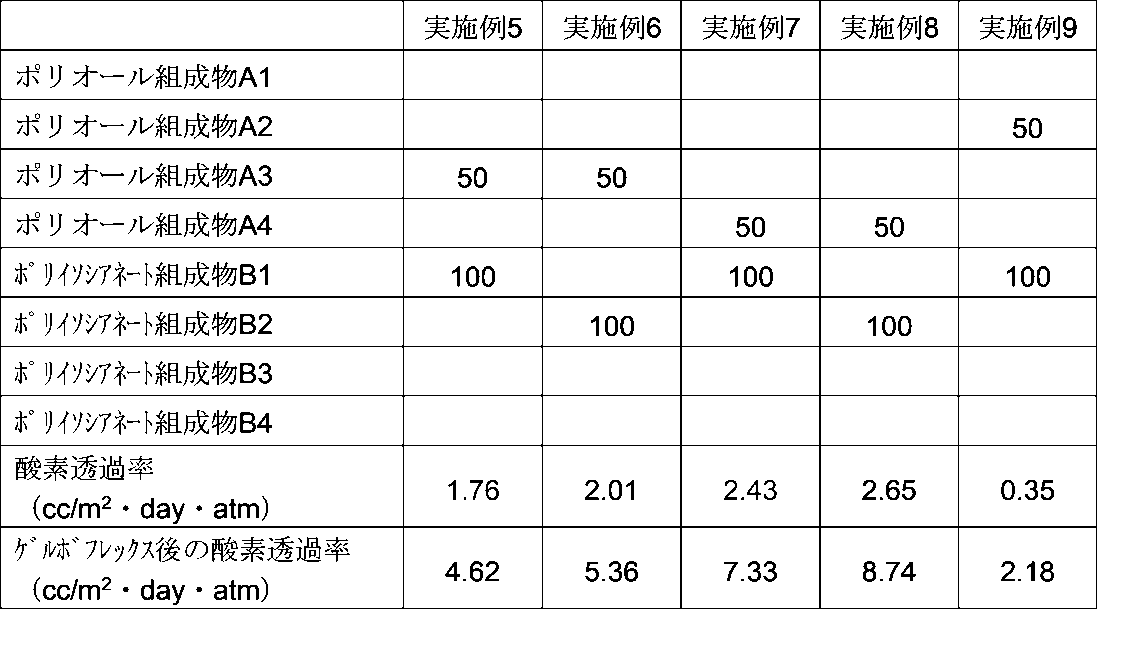

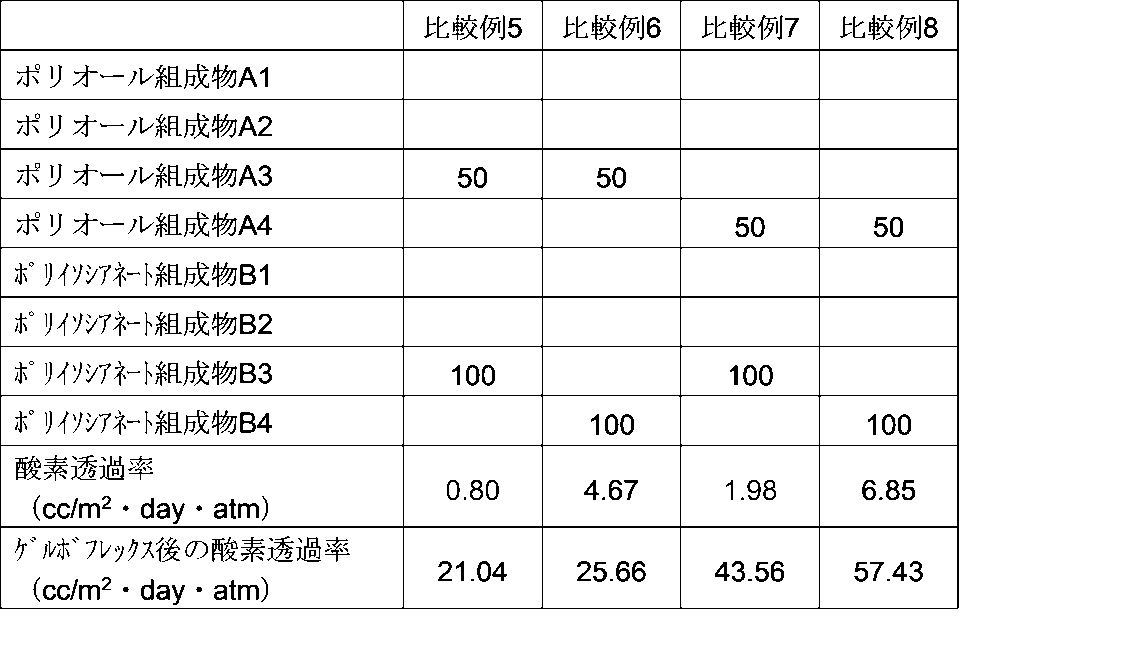
実施例、比較例から明らかなように、本発明の接着剤を用いて得られた積層体は、ガスバリア性、耐屈曲性に優れたものとなった。一方、比較例の接着剤を用いて得られた積層体はガスバリア性と耐屈曲性の両方を満足する水準で両立することはできなかった。
Claims (12)
- 多価カルボン酸またはその誘導体(I-B)と、多価アルコール(II-B)との重縮合体であるポリエステルと、イソシアネート化合物との反応生成物であるポリエステルポリイソシアネート(B)であって、
前記多価カルボン酸またはその誘導体(I-B)は、カルボキシル基を除く部分の炭素原子数が8以下の脂肪族多価カルボン酸またはその誘導体(I-B-i)と、芳香族多価カルボン酸またはその誘導体(I-B-ii)とを含み、
前記多価アルコール(II-B)は、炭素原子数が8以下の脂肪族多価アルコール(II-B-i)を含む、ポリエステルポリイソシアネート(B)。 - 前記カルボキシル基を除く部分の炭素原子数が8以下の脂肪族多価カルボン酸またはその誘導体(I-B-i)と、前記芳香族カルボン酸またはその誘導体(I-B-ii)とのモル比が1:9~9:1である請求項1に記載のポリエステルポリイソシアネート(B)。
- 前記カルボキシル基を除く部分の炭素原子数が8以下の脂肪族多価カルボン酸またはその誘導体(I-B-i)が、シュウ酸、マロン酸、エチルマロン酸、ジメチルマロン酸、コハク酸、ジメチルコハク酸、マレイン酸、フマル酸、グルタル酸、アジピン酸、ピメリン酸、スベリン酸、アゼライン酸、セバシン酸、1,3-シクロペンタンジカルボン酸、1,4-シクロヘキサンジカルボン酸、4-シクロヘキセンジカルボン酸、3-メチル-4-シクロヘキセン1,2-ジカルボン酸、これらの無水物、メチルエステル化物からなる群から選ばれる少なくとも一種であり、
前記芳香族多価カルボン酸またはその誘導体(I-B-ii)が、オルトフタル酸、テレフタル酸、イソフタル酸、トリメリット酸、ピロメリット酸、1,4-ナフタレンジカルボン酸、2,5-ナフタレンジカルボン酸、2,6-ナフタレンジカルボン酸、ナフタル酸、ビフェニルジカルボン酸、1,2-ビス(フェノキシ)エタン-p,p’-ジカルボン酸、これらの化合物の無水物、これらの化合物のメチルエステル化物からなる群から選ばれる少なくとも一種である請求項1または2のいずれか一項に記載のポリエステルポリイソシアネート(B)。 - ポリオール組成物と、ポリイソシアネート組成物とを含む接着剤に用いられるポリイソシアネート組成物であって、請求項1乃至3のいずれか一項に記載のポリエステルポリイソシアネート(B)を含むポリイソシアネート組成物。
- 粘度調整剤を含む請求項4に記載のポリイソシアネート組成物。
- ポリオール組成物と、請求項4または5のいずれか一項に記載のポリイソシアネート組成物とを含む接着剤。
- 前記ポリオール組成物が、ポリエステル骨格、ポリウレタン骨格、ポリエーテル骨格からなる群から選ばれる少なくとも一種を備えるポリオールを含む請求項6に記載の接着剤。
- 前記ポリオール組成物が、多価カルボン酸またはその誘導体(I-A)と、多価アルコール(II-A)との重縮合体であるポリエステル骨格を備えるポリオール(A)を含み、
前記多価カルボン酸またはその誘導体(I-A)は、カルボキシル基を除く部分の炭素原子数が8以下の脂肪族多価カルボン酸またはその誘導体(I-A-i)と、芳香族多価カルボン酸またはその誘導体(I-A-ii)とを含み、
前記多価アルコール(II-A)は、炭素原子数が8以下の脂肪族多価アルコール(II-A-i)を含む請求項6に記載の接着剤。 - 前記カルボキシル基を除く部分の炭素原子数が8以下の脂肪族多価カルボン酸またはその誘導体(I-A-i)と、前記芳香族カルボン酸またはその誘導体(I-A-ii)とモル配合比が1:9~9:1である請求項8に記載の接着剤。
- 前記ポリオールの数平均分子量が300以上3000以下である請求項7乃至9のいずれか一項に記載の接着剤。
- 第1の基材と、第2の基材と、前記第1の基材と前記第2の基材とを貼り合せる接着層とを含み、前記接着層が請求項6乃至10のいずれか一項に記載の接着剤の硬化塗膜である積層体。
- 請求項11に記載の積層体からなる包装材。
Priority Applications (2)
| Application Number | Priority Date | Filing Date | Title |
|---|---|---|---|
| CN201980071853.5A CN112969583B (zh) | 2018-11-06 | 2019-10-29 | 聚酯多异氰酸酯、聚酯多异氰酸酯组合物、粘接剂、层叠体、包装材料 |
| JP2020544301A JP6801828B2 (ja) | 2018-11-06 | 2019-10-29 | ポリエステルポリイソシアネート、ポリエステルポリイソシアネート組成物、接着剤、積層体、包装材 |
Applications Claiming Priority (4)
| Application Number | Priority Date | Filing Date | Title |
|---|---|---|---|
| JP2018-208912 | 2018-11-06 | ||
| JP2018208912 | 2018-11-06 | ||
| JP2019-136091 | 2019-07-24 | ||
| JP2019136091 | 2019-07-24 |
Publications (1)
| Publication Number | Publication Date |
|---|---|
| WO2020095751A1 true WO2020095751A1 (ja) | 2020-05-14 |
Family
ID=70610889
Family Applications (1)
| Application Number | Title | Priority Date | Filing Date |
|---|---|---|---|
| PCT/JP2019/042286 Ceased WO2020095751A1 (ja) | 2018-11-06 | 2019-10-29 | ポリエステルポリイソシアネート、ポリエステルポリイソシアネート組成物、接着剤、積層体、包装材 |
Country Status (3)
| Country | Link |
|---|---|
| JP (1) | JP6801828B2 (ja) |
| CN (1) | CN112969583B (ja) |
| WO (1) | WO2020095751A1 (ja) |
Cited By (2)
| Publication number | Priority date | Publication date | Assignee | Title |
|---|---|---|---|---|
| JP2022075483A (ja) * | 2020-11-04 | 2022-05-18 | 斎藤塗料株式会社 | ポリウレタン樹脂組成物 |
| US12319035B2 (en) | 2022-02-14 | 2025-06-03 | Toppan Holdings Inc. | Laminated film and packaging bag |
Citations (7)
| Publication number | Priority date | Publication date | Assignee | Title |
|---|---|---|---|---|
| JP2005089734A (ja) * | 2003-08-08 | 2005-04-07 | Mitsui Takeda Chemicals Inc | 2液硬化型無溶剤系接着剤および2液硬化型無溶剤系接着剤用組成物 |
| WO2015046453A1 (ja) * | 2013-09-30 | 2015-04-02 | Dic株式会社 | ポリイソシアネート混合物、ポリオール混合物、接着剤、及び積層フィルム |
| JP2016089034A (ja) * | 2014-11-05 | 2016-05-23 | Dic株式会社 | ポリエステルポリイソシアネート、これを用いる2液型ウレタン系接着剤用硬化剤、2液型ウレタン系接着剤、積層フィルム及び太陽電池のバックシート |
| JP2016089035A (ja) * | 2014-11-05 | 2016-05-23 | Dic株式会社 | ポリエステルポリイソシアネート、これを用いる2液型ウレタン系接着剤用硬化剤、2液型ウレタン系接着剤、積層フィルム及び太陽電池のバックシート |
| JP2016190915A (ja) * | 2015-03-31 | 2016-11-10 | 三洋化成工業株式会社 | 樹脂水性分散体、樹脂粒子、着色樹脂粒子及びトナー |
| JP2017521543A (ja) * | 2014-05-16 | 2017-08-03 | ヘンケル・アクチェンゲゼルシャフト・ウント・コムパニー・コマンディットゲゼルシャフト・アウフ・アクチェンHenkel AG & Co. KGaA | 熱可塑性ポリウレタン |
| JP2018100366A (ja) * | 2016-12-21 | 2018-06-28 | Dic株式会社 | 反応性接着剤、積層フィルム、及び包装体 |
-
2019
- 2019-10-29 CN CN201980071853.5A patent/CN112969583B/zh active Active
- 2019-10-29 WO PCT/JP2019/042286 patent/WO2020095751A1/ja not_active Ceased
- 2019-10-29 JP JP2020544301A patent/JP6801828B2/ja active Active
Patent Citations (7)
| Publication number | Priority date | Publication date | Assignee | Title |
|---|---|---|---|---|
| JP2005089734A (ja) * | 2003-08-08 | 2005-04-07 | Mitsui Takeda Chemicals Inc | 2液硬化型無溶剤系接着剤および2液硬化型無溶剤系接着剤用組成物 |
| WO2015046453A1 (ja) * | 2013-09-30 | 2015-04-02 | Dic株式会社 | ポリイソシアネート混合物、ポリオール混合物、接着剤、及び積層フィルム |
| JP2017521543A (ja) * | 2014-05-16 | 2017-08-03 | ヘンケル・アクチェンゲゼルシャフト・ウント・コムパニー・コマンディットゲゼルシャフト・アウフ・アクチェンHenkel AG & Co. KGaA | 熱可塑性ポリウレタン |
| JP2016089034A (ja) * | 2014-11-05 | 2016-05-23 | Dic株式会社 | ポリエステルポリイソシアネート、これを用いる2液型ウレタン系接着剤用硬化剤、2液型ウレタン系接着剤、積層フィルム及び太陽電池のバックシート |
| JP2016089035A (ja) * | 2014-11-05 | 2016-05-23 | Dic株式会社 | ポリエステルポリイソシアネート、これを用いる2液型ウレタン系接着剤用硬化剤、2液型ウレタン系接着剤、積層フィルム及び太陽電池のバックシート |
| JP2016190915A (ja) * | 2015-03-31 | 2016-11-10 | 三洋化成工業株式会社 | 樹脂水性分散体、樹脂粒子、着色樹脂粒子及びトナー |
| JP2018100366A (ja) * | 2016-12-21 | 2018-06-28 | Dic株式会社 | 反応性接着剤、積層フィルム、及び包装体 |
Cited By (3)
| Publication number | Priority date | Publication date | Assignee | Title |
|---|---|---|---|---|
| JP2022075483A (ja) * | 2020-11-04 | 2022-05-18 | 斎藤塗料株式会社 | ポリウレタン樹脂組成物 |
| JP7742096B2 (ja) | 2020-11-04 | 2025-09-19 | 斎藤塗料株式会社 | ポリウレタン樹脂組成物 |
| US12319035B2 (en) | 2022-02-14 | 2025-06-03 | Toppan Holdings Inc. | Laminated film and packaging bag |
Also Published As
| Publication number | Publication date |
|---|---|
| CN112969583B (zh) | 2023-04-07 |
| CN112969583A (zh) | 2021-06-15 |
| JP6801828B2 (ja) | 2020-12-16 |
| JPWO2020095751A1 (ja) | 2021-02-15 |
Similar Documents
| Publication | Publication Date | Title |
|---|---|---|
| CN113226765B (zh) | 双组份型粘接剂、双组份型粘接剂用多异氰酸酯组合物、层叠体、包装材料 | |
| CN113853304B (zh) | 反应性粘接剂、层叠膜、及包装体 | |
| WO2012090900A1 (ja) | 2液硬化型酸素吸収性樹脂組成物及び酸素吸収性接着剤 | |
| JP7485239B2 (ja) | 接着剤、積層体、包装材 | |
| CN113165357A (zh) | 反应性粘接剂、层叠体和包装体 | |
| JP6801828B2 (ja) | ポリエステルポリイソシアネート、ポリエステルポリイソシアネート組成物、接着剤、積層体、包装材 | |
| JP7332075B1 (ja) | 接着剤、積層体、包装材 | |
| JP7207617B1 (ja) | 2液硬化型接着性組成物、アンカーコート剤、接着剤、積層体、包装材 | |
| WO2024075529A1 (ja) | 積層体、包装材 | |
| JP4433153B2 (ja) | ラミネートフィルムの製造方法 | |
| JP7632752B2 (ja) | 接着剤、積層体、包装材 | |
| JP7810314B2 (ja) | ポリイソシアネート組成物、2液硬化型組成物、2液硬化型コーティング剤、2液硬化型接着剤、積層体、包装材 | |
| JP7853655B1 (ja) | 2液硬化型接着剤、積層体、包装材 | |
| JP7820713B2 (ja) | 2液硬化型接着剤、積層体、ブリスターパック用積層体、ブリスターパック | |
| JP7832606B2 (ja) | ポリイソシアネート組成物、2液硬化型組成物、2液硬化型コーティング剤、2液硬化型接着剤、積層体、包装材 | |
| CN110894418A (zh) | 双组份型粘接剂、层叠体和包装材料 | |
| JP7036283B2 (ja) | 積層体の製造方法、積層体、包装材 | |
| TW202323471A (zh) | 二液硬化型接著劑、積層體、包裝材 | |
| WO2024225056A1 (ja) | 接着剤、積層体、包装材 | |
| WO2025009399A1 (ja) | ポリイソシアネート組成物、2液硬化型組成物、2液硬化型コーティング剤、2液硬化型接着剤、積層体、包装材 | |
| WO2025018167A1 (ja) | ポリイソシアネート組成物、2液硬化型組成物、2液硬化型コーティング剤、2液硬化型接着剤、積層体、包装材 | |
| WO2021256269A1 (ja) | 接着剤、積層体、包装材 |
Legal Events
| Date | Code | Title | Description |
|---|---|---|---|
| 121 | Ep: the epo has been informed by wipo that ep was designated in this application |
Ref document number: 19881397 Country of ref document: EP Kind code of ref document: A1 |
|
| ENP | Entry into the national phase |
Ref document number: 2020544301 Country of ref document: JP Kind code of ref document: A |
|
| NENP | Non-entry into the national phase |
Ref country code: DE |
|
| 122 | Ep: pct application non-entry in european phase |
Ref document number: 19881397 Country of ref document: EP Kind code of ref document: A1 |