WO2020095641A1 - 感放射線性樹脂組成物、レジスト膜、パターン形成方法、電子デバイスの製造方法 - Google Patents
感放射線性樹脂組成物、レジスト膜、パターン形成方法、電子デバイスの製造方法 Download PDFInfo
- Publication number
- WO2020095641A1 WO2020095641A1 PCT/JP2019/040666 JP2019040666W WO2020095641A1 WO 2020095641 A1 WO2020095641 A1 WO 2020095641A1 JP 2019040666 W JP2019040666 W JP 2019040666W WO 2020095641 A1 WO2020095641 A1 WO 2020095641A1
- Authority
- WO
- WIPO (PCT)
- Prior art keywords
- group
- repeating unit
- acid
- carbon atoms
- radiation
- Prior art date
- Legal status (The legal status is an assumption and is not a legal conclusion. Google has not performed a legal analysis and makes no representation as to the accuracy of the status listed.)
- Ceased
Links
Images
Classifications
-
- G—PHYSICS
- G03—PHOTOGRAPHY; CINEMATOGRAPHY; ANALOGOUS TECHNIQUES USING WAVES OTHER THAN OPTICAL WAVES; ELECTROGRAPHY; HOLOGRAPHY
- G03F—PHOTOMECHANICAL PRODUCTION OF TEXTURED OR PATTERNED SURFACES, e.g. FOR PRINTING, FOR PROCESSING OF SEMICONDUCTOR DEVICES; MATERIALS THEREFOR; ORIGINALS THEREFOR; APPARATUS SPECIALLY ADAPTED THEREFOR
- G03F7/00—Photomechanical, e.g. photolithographic, production of textured or patterned surfaces, e.g. printing surfaces; Materials therefor, e.g. comprising photoresists; Apparatus specially adapted therefor
- G03F7/004—Photosensitive materials
-
- G—PHYSICS
- G03—PHOTOGRAPHY; CINEMATOGRAPHY; ANALOGOUS TECHNIQUES USING WAVES OTHER THAN OPTICAL WAVES; ELECTROGRAPHY; HOLOGRAPHY
- G03F—PHOTOMECHANICAL PRODUCTION OF TEXTURED OR PATTERNED SURFACES, e.g. FOR PRINTING, FOR PROCESSING OF SEMICONDUCTOR DEVICES; MATERIALS THEREFOR; ORIGINALS THEREFOR; APPARATUS SPECIALLY ADAPTED THEREFOR
- G03F7/00—Photomechanical, e.g. photolithographic, production of textured or patterned surfaces, e.g. printing surfaces; Materials therefor, e.g. comprising photoresists; Apparatus specially adapted therefor
- G03F7/004—Photosensitive materials
- G03F7/038—Macromolecular compounds which are rendered insoluble or differentially wettable
-
- G—PHYSICS
- G03—PHOTOGRAPHY; CINEMATOGRAPHY; ANALOGOUS TECHNIQUES USING WAVES OTHER THAN OPTICAL WAVES; ELECTROGRAPHY; HOLOGRAPHY
- G03F—PHOTOMECHANICAL PRODUCTION OF TEXTURED OR PATTERNED SURFACES, e.g. FOR PRINTING, FOR PROCESSING OF SEMICONDUCTOR DEVICES; MATERIALS THEREFOR; ORIGINALS THEREFOR; APPARATUS SPECIALLY ADAPTED THEREFOR
- G03F7/00—Photomechanical, e.g. photolithographic, production of textured or patterned surfaces, e.g. printing surfaces; Materials therefor, e.g. comprising photoresists; Apparatus specially adapted therefor
- G03F7/004—Photosensitive materials
- G03F7/039—Macromolecular compounds which are photodegradable, e.g. positive electron resists
-
- G—PHYSICS
- G03—PHOTOGRAPHY; CINEMATOGRAPHY; ANALOGOUS TECHNIQUES USING WAVES OTHER THAN OPTICAL WAVES; ELECTROGRAPHY; HOLOGRAPHY
- G03F—PHOTOMECHANICAL PRODUCTION OF TEXTURED OR PATTERNED SURFACES, e.g. FOR PRINTING, FOR PROCESSING OF SEMICONDUCTOR DEVICES; MATERIALS THEREFOR; ORIGINALS THEREFOR; APPARATUS SPECIALLY ADAPTED THEREFOR
- G03F7/00—Photomechanical, e.g. photolithographic, production of textured or patterned surfaces, e.g. printing surfaces; Materials therefor, e.g. comprising photoresists; Apparatus specially adapted therefor
- G03F7/20—Exposure; Apparatus therefor
Definitions
- the present invention relates to a radiation-sensitive resin composition, a resist film, a pattern forming method, and an electronic device manufacturing method.
- lithography method In a manufacturing process of a semiconductor device such as an IC (Integrated Circuit) and an LSI (Large Scale Integrated circuit), fine processing by lithography using a radiation-sensitive resin composition is performed.
- the lithography method include a method of forming a resist film from a radiation-sensitive resin composition containing a resin whose polarity is increased by an acid, exposing the obtained film to light, and then developing the film.
- Patent Document 1 contains (A) a water-insoluble and alkali-soluble resin, and (B) a solvent, Further, a protective film forming composition for immersion exposure is described, which is characterized in that the content of metal impurities is 100 ppb or less.
- a defect refers to a defect relating to a pattern different from a desired pattern in a region where a resist film formed using a radiation-sensitive resin composition is removed when a development process is performed. means. For example, there may be defects caused by undissolved resist film and defects caused by unintended dissolution of the resist film.
- the present inventors examined the pattern formed by using the radiation-sensitive resin composition with reference to Patent Document 1 and the like, and found that the radiation-sensitive resin composition was formed with time after preparation. Since the number of defects generated in the formed pattern increases, it was found that the radiation-sensitive resin composition needs further improvement in stability over time. Further, the present inventors have found that it is necessary to further improve the roughness performance, more specifically, the LWR (line width roughness) of the formed pattern.
- [1] Contains a resin (A) whose polarity is increased by the action of an acid and a photo-acid generator (P), A radiation-sensitive resin composition, wherein the content of halide ions is 0.015 to 15 mass ppm with respect to the total mass of the composition.
- the radiation-sensitive resin composition according to [1] which is exposed to at least one radiation selected from the group consisting of radiation having a wavelength of 250 nm or less, electron beam and X-ray.
- the resin (A) contains a repeating unit (A-1) derived from hydroxystyrene, and a repeating unit (at least one selected from the group consisting of a lactone structure, a carbonate structure, a sultone structure and a hydroxyadamantane structure (The radiation-sensitive resin composition according to [1] or [2], which has at least one of A-2).
- the repeating unit (A-2) is a repeating unit derived from a (meth) acrylic acid ester containing at least one selected from the group consisting of a lactone structure, a sultone structure, a carbonate structure and a hydroxyadamantane structure, [ [3] The radiation-sensitive resin composition as described in [3].
- the repeating unit (A-1) is a repeating unit represented by the general formula (AI) described later,
- the repeating unit (A-2) contains at least one selected from the group consisting of repeating units represented by the following general formulas (A-II) to (A-VII), [3] or [3] 4]
- the resin (A) has at least one repeating unit selected from the group consisting of repeating units represented by the general formulas (A-VIII) to (AXII) described below, [1] to [5]
- the radiation-sensitive resin composition according to any one of 1.
- the photoacid generator (P) contains at least one selected from the group consisting of compounds represented by the general formulas (BI) to (BV) described below, [1] to [6] ] The radiation sensitive resin composition in any one of these.
- a step of forming a resist film on a substrate using the radiation sensitive resin composition according to any one of [1] to [7] A step of exposing the resist film, A step of developing the exposed resist film with a developing solution to form a pattern.
- a method for manufacturing an electronic device comprising the pattern forming method according to [9].
- a radiation-sensitive resin composition having improved stability over time and excellent LWR of a formed pattern. Further, according to the present invention, a resist film, a pattern forming method, and an electronic device manufacturing method can be provided.
- a numerical range represented by “to” means a range including the numerical values before and after “to” as a lower limit value and an upper limit value.
- the expression without describing substituted or unsubstituted includes a group having a substituent as well as a group having no substituent.
- the “alkyl group” includes not only an alkyl group having no substituent (unsubstituted alkyl group) but also an alkyl group having a substituent (substituted alkyl group).
- the binding direction of the divalent group described in the present specification is not limited unless otherwise specified.
- M is —OCO—C (CN) ⁇ CH— in the compound represented by the general formula “L—M—N”
- the position bonded to the L side is * 1
- the position on the N side is If the position bonded to is * 2
- * 1-CH C (CN) -COO- * 2 It may be.
- (meth) acryl is a general term including acryl and methacryl and means “at least one of acryl and methacryl”.
- (meth) acrylic acid” means “at least one of acrylic acid and methacrylic acid”.
- the weight average molecular weight (Mw), number average molecular weight (Mn), and dispersity (also referred to as molecular weight distribution) (Mw / Mn) of the resin are GPC (Gel Permeation Chromatography) device (HLC manufactured by Tosoh Corporation). GPC measurement by -8120 GPC (solvent: tetrahydrofuran, flow rate (sample injection amount): 10 ⁇ L, column: TSK gel Multipore HXL-M manufactured by Tosoh Corporation, column temperature: 40 ° C., flow rate: 1.0 mL / min, detector: differential It is defined as a polystyrene conversion value obtained by a refractive index detector (Refractive Index Detector). 1 ⁇ is 1 ⁇ 10 ⁇ 10 m.
- radiation means, for example, a bright line spectrum of a mercury lamp, deep ultraviolet rays typified by excimer lasers, extreme ultraviolet rays (EUV), X-rays, and electron beams (EB). means.
- EUV extreme ultraviolet rays
- EB electron beams
- the radiation-sensitive resin composition of the present invention contains a resin (A) whose polarity increases by the action of an acid, and a photo-acid generator (P),
- the content of halide ion is 0.015 to 15 mass ppm with respect to the total mass of the composition.
- the composition of the present invention is a so-called resist composition, and may be a positive resist composition or a negative resist composition. Further, the composition of the present invention may be a resist composition for alkali development or a resist composition for organic solvent development.
- Radiation for sensitizing the composition of the present invention is not particularly limited, and examples thereof include infrared light, visible light, ultraviolet light, far ultraviolet light, extreme ultraviolet light, X-ray, and EB.
- the composition of the present invention is preferably exposed to at least one radiation selected from the group consisting of radiation having a wavelength of 250 nm or less, X-rays and EB.
- Radiation having a wavelength of 250 nm or less is far ultraviolet light having a wavelength of 250 nm or less (more preferably 220 nm or less, further preferably 1 to 200 nm), and specifically, KrF excimer laser (248 nm) or ArF excimer laser (193 nm). And F2 excimer laser (157 nm).
- the content of halide ions is 0.015 to 15 mass ppm with respect to the total mass of the composition.
- the halide ion is an ion of a halogen atom, and examples thereof include a fluoride ion (F ⁇ ), a chloride ion (Cl ⁇ ), a bromide ion (Br ⁇ ), and an iodide ion (I ⁇ ).
- the content of halide ions contained in the composition is also referred to as “halogen ion content”, and the content of 0.015 to 15 mass ppm with respect to the total mass of the composition is also referred to as “predetermined content”.
- the halogen ion content is the total content of the plurality of halide ions.
- the halide ions in the composition form the corresponding acid during storage of the composition.
- the acid causes a deprotection reaction in which the protecting group is eliminated in the acid-decomposable group contained in the resin, and a polar group is generated.
- Such partial formation of polar groups in the resin increases the sensitivity of the resin to exposure and increases the number of defects that occur in the pattern during development processing.
- the halogen ion content in the composition is reduced to a predetermined amount or less, the above deprotection reaction during the storage period is suppressed, and even when a composition that has been used for a long period of time is used, it is formed.
- the number of defects generated in the formed pattern can be reduced.
- the halogen ion content is preferably 10 mass ppm or less, more preferably less than 10 mass ppm, and further preferably 5 mass ppm or less, based on the total mass of the composition, from the viewpoint that the stability of the composition over time is more excellent.
- the halogen ion content is preferably 0.1 mass ppm or more, more preferably more than 1 mass ppm, more preferably more than 2 mass ppm, with respect to the total mass of the composition, from the viewpoint that the LWR of the formed pattern is more excellent. Is more preferable.
- the method of adjusting the halogen ion content to a predetermined content is not particularly limited, and for example, an ion adsorbent may be used to remove halide ions from the composition. More specifically, by adding an ion adsorbent such as an anion exchange resin to the composition to cause the halide ions in the composition to be adsorbed on the ion adsorbent and then separating the ion adsorbent and the composition. The halide ions may be removed from the composition.
- the separation method is not particularly limited, and examples thereof include filtration with a filter and centrifugation.
- the anion exchange resin is not particularly limited and may be appropriately selected depending on the intended purpose. Examples thereof include strong basic anion exchange resins such as quaternary ammonium salt type styrene-divinylbenzene copolymers and aromatic compounds. Examples include weakly basic anion exchange resins such as amine type resins, polyethylene amine type resins and primary amine type resins. The anion exchange resins may be used alone or in combination of two or more.
- the content of halide ion in each component used may be adjusted to adjust the content of halogen ion in the composition to a predetermined content.
- a resin (A), a photoacid generator (P), an acid diffusion controller (Q), a hydrophobic resin (E) and a solvent (F) contained in the composition
- the content of halide ions in each component may be reduced by pre-purifying before mixing.
- the photo-acid generator (P) may use a chlorine-containing compound capable of generating chloride ions as a solvent or a washing solution during synthesis, so that the content of halide ions was reduced in advance by purification.
- the purification method is not particularly limited, and examples thereof include a method using the above ion adsorbent, a method such as crystallization (recrystallization), and chromatography.
- a compound containing a halide ion may be added to the composition.
- the compound containing a halide ion is not particularly limited, and examples thereof include a compound that dissociates in the composition to generate a halide ion and a cation. More specific compounds include halogen acids, hydrogen halides, and salts thereof (for example, salts with alkali metals, salts with alkaline earth metals), hydrochloric acid, sodium chloride (NaCl), or Potassium chloride (KCl) is preferred and hydrochloric acid is more preferred.
- the halogen ion content of the composition may be adjusted by using a raw material containing a minute amount of halide ions as impurities and the like.
- the halogen ion content in the composition is determined by an ion chromatography method.
- a specific device is, for example, Dionex (trademark) ICS-5000 + manufactured by Thermo Fisher Scientific. If the composition of the raw material is known, the halogen ion content may be calculated.
- the total content of halide ions other than F ⁇ , Cl ⁇ and Br ⁇ in the composition was sufficiently small with respect to the total content of F ⁇ , Cl ⁇ and Br ⁇ .
- the total content of F ⁇ , Cl ⁇ and Br ⁇ may be used.
- the resin (A) has a repeating unit (Aa) having an acid-decomposable group (hereinafter, also simply referred to as “repeating unit (Aa)”).
- the acid-decomposable group is a group that decomposes by the action of an acid to generate a polar group.
- the acid-decomposable group preferably has a structure in which the polar group is protected by a leaving group that is released by the action of an acid. That is, the resin (A) has a repeating unit (Aa) having a group that decomposes by the action of an acid to generate a polar group.
- the resin having the repeating unit (Aa) has an increased polarity due to the action of an acid, an increased solubility in an alkali developing solution, and a reduced solubility in an organic solvent.
- the polar group is preferably an alkali-soluble group, for example, a carboxyl group, a phenolic hydroxyl group, a fluorinated alcohol group, a sulfonic acid group, a sulfonamide group, a sulfonylimide group, (alkylsulfonyl) (alkylcarbonyl) methylene group, (alkyl Sulfonyl) (alkylcarbonyl) imide group, bis (alkylcarbonyl) methylene group, bis (alkylcarbonyl) imide group, bis (alkylsulfonyl) methylene group, bis (alkylsulfonyl) imide group, tris (alkylcarbonyl) methylene group, and And acidic groups such as tris (alkylsulfonyl) methylene groups, and alcoholic hydroxyl groups.
- alkali-soluble group for example, a carboxyl group, a phenolic
- the polar group is preferably a carboxyl group, a phenolic hydroxyl group, a fluorinated alcohol group (preferably a hexafluoroisopropanol group), or a sulfonic acid group.
- Examples of the leaving group that is eliminated by the action of an acid include groups represented by formulas (Y1) to (Y4).
- Formula (Y1) -C (Rx 1 ) (Rx 2 ) (Rx 3 )
- Formula (Y3) - C (R 36) (R 37) (OR 38)
- Rx 1 to Rx 3 each independently represent an alkyl group (linear or branched) or a cycloalkyl group (monocyclic or polycyclic). When all of Rx 1 to Rx 3 are alkyl groups (linear or branched), at least two of Rx 1 to Rx 3 are preferably methyl groups. Among them, Rx 1 ⁇ Rx 3 are each independently preferably represents a linear or branched alkyl group, Rx 1 ⁇ Rx 3 are each independently, may represent a linear alkyl group More preferable. Two of Rx 1 to Rx 3 may combine to form a monocyclic or polycyclic ring.
- Examples of the alkyl group represented by Rx 1 to Rx 3 include a methyl group, an ethyl group, an n-propyl group, an isopropyl group, an n-butyl group, an isobutyl group, and an alkyl group having 1 to 4 carbon atoms such as a t-butyl group. preferable.
- the cycloalkyl group of Rx 1 to Rx 3 includes a cyclopentyl group, a monocyclic cycloalkyl group such as a cyclohexyl group, a norbornyl group, a tetracyclodecanyl group, a tetracyclododecanyl group, and an adamantyl group.
- the polycyclic cycloalkyl group of is preferable.
- the cycloalkyl group formed by combining two members of Rx 1 to Rx 3 includes a cyclopentyl group, a monocyclic cycloalkyl group such as a cyclohexyl group, a norbornyl group, a tetracyclodecanyl group, and a tetracyclododeca group.
- a polycyclic cycloalkyl group such as a nyl group and an adamantyl group is preferable, and a monocyclic cycloalkyl group having 5 to 6 carbon atoms is more preferable.
- the cycloalkyl group formed by combining two members of Rx 1 to Rx 3 is, for example, a group in which one of the methylene groups constituting the ring has a hetero atom such as an oxygen atom or a hetero atom such as a carbonyl group. It may be replaced.
- Rx 1 is a methyl group or an ethyl group, and Rx 2 and Rx 3 are bonded to each other to form the above cycloalkyl group. Is preferred.
- R 36 to R 38 each independently represent a hydrogen atom or a monovalent organic group.
- R 37 and R 38 may combine with each other to form a ring.
- the monovalent organic group include an alkyl group, a cycloalkyl group, an aryl group, an aralkyl group, and an alkenyl group.
- R 36 is also preferably a hydrogen atom.
- L 1 and L 2 each independently represent a hydrogen atom, an alkyl group, a cycloalkyl group, an aryl group, or a group combining these (for example, a group combining an alkyl group and an aryl group).
- M represents a single bond or a divalent linking group.
- Q is an alkyl group which may have a hetero atom, a cycloalkyl group which may have a hetero atom, an aryl group which may have a hetero atom, an amino group, an ammonium group, a mercapto group, cyano Represents a group, an aldehyde group, or a group in which these are combined (for example, a group in which an alkyl group and a cycloalkyl group are combined).
- one of the methylene groups may be replaced with a group having a hetero atom such as an oxygen atom or a hetero atom such as a carbonyl group.
- L 1 and L 2 are a hydrogen atom, and the other is an alkyl group, a cycloalkyl group, an aryl group, or a group in which an alkylene group and an aryl group are combined. At least two of Q, M, and L 1 may combine to form a ring (preferably a 5-membered or 6-membered ring). From the viewpoint of pattern miniaturization, L 2 is preferably a secondary or tertiary alkyl group, and more preferably a tertiary alkyl group.
- Examples of the secondary alkyl group include isopropyl group, cyclohexyl group and norbornyl group, and examples of the tertiary alkyl group include tert-butyl group and adamantane ring group.
- Tg glass transition temperature
- activation energy are high, it is possible to suppress fogging in addition to ensuring film strength.
- Ar represents an aromatic ring group.
- Rn represents an alkyl group, a cycloalkyl group or an aryl group.
- Rn and Ar may combine with each other to form a non-aromatic ring.
- Ar is more preferably an aryl group.
- repeating unit (Aa) the repeating unit represented by the formula (A) is also preferable.
- L 1 represents a divalent linking group which may have a fluorine atom or an iodine atom
- R 1 represents a hydrogen atom, a fluorine atom, an iodine atom, a fluorine atom or an alkyl group which may have an iodine atom.
- R 2 represents an aryl group which may have a fluorine atom or an iodine atom
- R 2 represents a leaving group which is eliminated by the action of an acid and may have a fluorine atom or an iodine atom.
- at least one of L 1 , R 1 and R 2 has a fluorine atom or an iodine atom.
- L 1 represents a divalent linking group which may have a fluorine atom or an iodine atom.
- the divalent linking group which may have a fluorine atom or an iodine atom has —CO—, —O—, —S—, —SO—, —SO 2 —, a fluorine atom or an iodine atom.
- a hydrocarbon group for example, an alkylene group, a cycloalkylene group, an alkenylene group, an arylene group, etc.
- L 1 is preferably —CO—, an —arylene group—an alkylene group having a fluorine atom or an iodine atom—from the viewpoint that the effect of the present invention is more excellent.
- the arylene group is preferably a phenylene group.
- the alkylene group may be linear or branched.
- the number of carbon atoms of the alkylene group is not particularly limited, but it is preferably 1-10 and more preferably 1-3.
- the total number of fluorine atoms and iodine atoms contained in the alkylene group having a fluorine atom or an iodine atom is not particularly limited, but is preferably 2 or more, more preferably 2 to 10 and more preferably 3 to 10 in terms of more excellent effects of the present invention. 6 is more preferable.
- R 1 represents a hydrogen atom, a fluorine atom, an iodine atom, an alkyl group which a fluorine atom or an iodine atom may have, or an aryl group which may have a fluorine atom or an iodine atom.
- the alkyl group may be linear or branched.
- the number of carbon atoms in the alkyl group is not particularly limited, but is preferably 1-10 and more preferably 1-3.
- the total number of fluorine atoms and iodine atoms contained in the alkyl group having a fluorine atom or iodine atom is not particularly limited, but is preferably 1 or more, more preferably 1 to 5 and more preferably 1 to 5 in terms of more excellent effects of the present invention. 3 is more preferable.
- the alkyl group may have a hetero atom such as an oxygen atom other than a halogen atom.
- R 2 represents a leaving group which is eliminated by the action of an acid and may have a fluorine atom or an iodine atom.
- examples of the leaving group include groups represented by formulas (Z1) to (Z4).
- Formula (Z1) -C (Rx 11 ) (Rx 12 ) (Rx 13 ).
- Equation (Z2): - C ( O) OC (Rx 11) (Rx 12) (Rx 13)
- Formula (Z3) -C (R 136 ) (R 137 ) (OR 138 ).
- Rx 11 to Rx 13 each independently represent a fluorine atom or an alkyl group which may have an iodine atom (linear or branched), or a fluorine atom or It represents a cycloalkyl group (monocyclic or polycyclic) which may have an iodine atom.
- Rx 11 to Rx 13 are alkyl groups (linear or branched)
- at least two of Rx 11 to Rx 13 are preferably methyl groups.
- Rx 11 to Rx 13 are the same as Rx 1 to Rx 3 in (Y1) and (Y2) described above except that they may have a fluorine atom or an iodine atom, and an alkyl group and a cycloalkyl group And the same as the preferred range.
- R 136 to R 138 each independently represent a hydrogen atom or a monovalent organic group optionally having a fluorine atom or an iodine atom.
- R 137 and R 138 may combine with each other to form a ring.
- the alkyl group, cycloalkyl group, aryl group, and aralkyl group may contain a hetero atom such as an oxygen atom, in addition to the fluorine atom and the iodine atom. That is, in the above alkyl group, cycloalkyl group, aryl group, and aralkyl group, for example, one of the methylene groups may be replaced with a group having a hetero atom such as an oxygen atom or a hetero atom such as a carbonyl group. Good.
- L 11 and L 12 are each independently a hydrogen atom; an alkyl group which may have a hetero atom selected from the group consisting of a fluorine atom, an iodine atom and an oxygen atom; a fluorine atom, an iodine atom and A cycloalkyl group which may have a hetero atom selected from the group consisting of oxygen atoms; an aryl group which may have a hetero atom selected from the group consisting of fluorine atoms, iodine atoms and oxygen atoms; or Represents a group combining these (for example, a group combining an alkyl group and a cycloalkyl group, which may have a hetero atom selected from the group consisting of a fluorine atom, an iodine atom and an oxygen atom).
- M 1 represents a single bond or a divalent linking group.
- Q 1 has an alkyl group which may have a hetero atom selected from the group consisting of a fluorine atom, an iodine atom and an oxygen atom; a hetero atom selected from the group consisting of a fluorine atom, an iodine atom and an oxygen atom.
- Optionally substituted cycloalkyl group an aryl group selected from the group consisting of a fluorine atom, an iodine atom and an oxygen atom; an amino group; an ammonium group; a mercapto group; a cyano group; an aldehyde group;
- it represents a group combining an alkyl group and a cycloalkyl group, which may have a hetero atom selected from the group consisting of a fluorine atom, an iodine atom and an oxygen atom.
- Ar 1 represents an aromatic ring group which may have a fluorine atom or an iodine atom.
- Rn 1 is an alkyl group which may have a fluorine atom or an iodine atom, a cycloalkyl group which may have a fluorine atom or an iodine atom, or an aryl which may have a fluorine atom or an iodine atom.
- Rn 1 and Ar 1 may combine with each other to form a non-aromatic ring.
- the repeating unit represented by the general formula (AI) is also preferable.
- Xa 1 represents a hydrogen atom or an alkyl group which may have a substituent.
- T represents a single bond or a divalent linking group.
- Rx 1 to Rx 3 each independently represent an alkyl group (linear or branched) or a cycloalkyl group (monocyclic or polycyclic). However, when all of Rx 1 to Rx 3 are alkyl groups (linear or branched), at least two of Rx 1 to Rx 3 are preferably methyl groups. Two of Rx 1 to Rx 3 may combine with each other to form a cycloalkyl group (monocyclic or polycyclic).
- Examples of the optionally substituted alkyl group represented by Xa 1 include a methyl group or a group represented by —CH 2 —R 11 .
- R 11 represents a halogen atom (fluorine atom or the like), a hydroxyl group or a monovalent organic group, for example, an alkyl group having 5 or less carbon atoms which may be substituted by a halogen atom, or a halogen atom may be substituted.
- Examples thereof include an acyl group having 5 or less carbon atoms and an alkoxy group having 5 or less carbon atoms which may be substituted with a halogen atom, an alkyl group having 3 or less carbon atoms is preferable, and a methyl group is more preferable.
- Xa 1 is preferably a hydrogen atom, a methyl group, a trifluoromethyl group or a hydroxymethyl group.
- Examples of the divalent linking group of T include an alkylene group, an aromatic ring group, a -COO-Rt- group, and a -O-Rt- group.
- Rt represents an alkylene group or a cycloalkylene group.
- T is preferably a single bond or a —COO—Rt— group.
- Rt is preferably an alkylene group having 1 to 5 carbon atoms, and is —CH 2 — group, — (CH 2 ) 2 — group, or — (CH 2 ) 3 —. Groups are more preferred.
- Examples of the alkyl group represented by Rx 1 to Rx 3 include a methyl group, an ethyl group, an n-propyl group, an isopropyl group, an n-butyl group, an isobutyl group, and an alkyl group having 1 to 4 carbon atoms such as a t-butyl group. preferable.
- the cycloalkyl group of Rx 1 to Rx 3 is a cyclopentyl group, a monocyclic cycloalkyl group such as a cyclohexyl group, or a norbornyl group, a tetracyclodecanyl group, a tetracyclododecanyl group, an adamantyl group, or the like.
- the polycyclic cycloalkyl group of is preferable.
- the cycloalkyl group formed by combining two members of Rx 1 to Rx 3 is preferably a cyclopentyl group, a monocyclic cycloalkyl group such as a cyclohexyl group, or a norbornyl group or a tetracyclodecanyl group.
- a polycyclic cycloalkyl group such as a tetracyclododecanyl group and an adamantyl group is preferable.
- a monocyclic cycloalkyl group having 5 to 6 carbon atoms is preferable.
- the cycloalkyl group formed by combining two members of Rx 1 to Rx 3 is, for example, a group in which one of the methylene groups constituting the ring has a hetero atom such as an oxygen atom or a hetero atom such as a carbonyl group. It may be replaced.
- the repeating unit represented by the general formula (AI) for example, an embodiment in which Rx 1 is a methyl group or an ethyl group and Rx 2 and Rx 3 are bonded to each other to form the above cycloalkyl group is preferable.
- substituents include an alkyl group (having 1 to 4 carbon atoms), a halogen atom, a hydroxyl group, an alkoxy group (having 1 to 4 carbon atoms), a carboxyl group, and an alkoxycarbonyl group. (C2-C6) and the like.
- the number of carbon atoms in the substituent is preferably 8 or less.
- the repeating unit represented by the general formula (AI) is preferably an acid-decomposable (meth) acrylic acid tertiary alkyl ester repeating unit (Xa 1 represents a hydrogen atom or a methyl group, and T is a single bond). Is a repeating unit).
- the resin (A) may have one type of repeating unit (Aa) alone, or may have two or more types.
- the content of the repeating unit (Aa) (when two or more kinds of repeating units (Aa) are present, the total content) is 15 to 80 mol% based on all repeating units in the resin (A). Is preferred, and 20 to 70 mol% is more preferred.
- the resin (A) has, as the repeating unit (Aa), at least one repeating unit selected from the group consisting of repeating units represented by the following general formulas (A-VIII) to (A-XII). Is preferred.
- R 5 represents a tert-butyl group or a -CO-O- (tert-butyl) group.
- R 6 and R 7 each independently represent a monovalent organic group. Examples of the monovalent organic group include an alkyl group, a cycloalkyl group, an aryl group, an aralkyl group, and an alkenyl group.
- p represents 1 or 2.
- R 8 represents a hydrogen atom or an alkyl group having 1 to 3 carbon atoms
- R 9 represents an alkyl group having 1 to 3 carbon atoms.
- R 10 represents an alkyl group having 1 to 3 carbon atoms or an adamantyl group.
- repeating unit (Aa) Specific examples of the repeating unit (Aa) are shown below, but the present invention is not limited thereto.
- Xa 1 represents H, CH 3 , CF 3 , or CH 2 OH
- Rxa and Rxb each represent a linear or branched alkyl group having 1 to 4 carbon atoms.
- the resin (A) may have a repeating unit having an acid group.
- the repeating unit having an acid group is preferably a repeating unit represented by the following general formula (B).
- R 3 represents a hydrogen atom or a monovalent organic group which may have a fluorine atom or an iodine atom.
- the monovalent organic group which may have a fluorine atom or an iodine atom is preferably a group represented by —L 4 —R 8 .
- L 4 represents a single bond or an ester group.
- R 8 is an alkyl group which may have a fluorine atom or an iodine atom, a cycloalkyl group which may have a fluorine atom or an iodine atom, an aryl group which may have a fluorine atom or an iodine atom, Or the group which combined these is mentioned.
- R 4 and R 5 each independently represent a hydrogen atom, a fluorine atom, an iodine atom, or an alkyl group which may have a fluorine atom or an iodine atom.
- L 2 represents a single bond or an ester group.
- L 3 represents a (n + m + 1) -valent aromatic hydrocarbon ring group or a (n + m + 1) -valent alicyclic hydrocarbon ring group.
- the aromatic hydrocarbon ring group include a benzene ring group and a naphthalene ring group.
- the alicyclic hydrocarbon ring group may be monocyclic or polycyclic, and examples thereof include a cycloalkyl ring group.
- R 6 represents a hydroxyl group or a fluorinated alcohol group (preferably a hexafluoroisopropanol group).
- L 3 is preferably an (n + m + 1) -valent aromatic hydrocarbon ring group.
- R 7 represents a halogen atom. Examples of the halogen atom include a fluorine atom, a chlorine atom, a bromine atom, or an iodine atom.
- m represents an integer of 1 or more. m is preferably an integer of 1 to 3 and more preferably an integer of 1 to 2.
- n represents 0 or an integer of 1 or more. n is preferably an integer of 1 to 4. Note that (n + m + 1) is preferably an integer of 1 to 5.
- repeating unit having an acid group a repeating unit represented by the following general formula (I) is also preferable.
- R 41 , R 42 and R 43 each independently represent a hydrogen atom, an alkyl group, a cycloalkyl group, a halogen atom, a cyano group or an alkoxycarbonyl group.
- R 42 may combine with Ar 4 to form a ring, in which case R 42 represents a single bond or an alkylene group.
- X 4 represents a single bond, —COO—, or —CONR 64 —, and R 64 represents a hydrogen atom or an alkyl group.
- L 4 represents a single bond or an alkylene group.
- Ar 4 represents an (n + 1) -valent aromatic ring group, and represents an (n + 2) -valent aromatic ring group when it is bonded to R 42 to form a ring.
- n represents an integer of 1 to 5.
- the alkyl group represented by R 41 , R 42 , and R 43 in the general formula (I) includes a methyl group, an ethyl group, a propyl group, an isopropyl group, an n-butyl group, a sec-butyl group, a hexyl group, and a 2-ethylhexyl group.
- An alkyl group having 20 or less carbon atoms such as a group, an octyl group, and a dodecyl group is preferable, an alkyl group having 8 or less carbon atoms is more preferable, and an alkyl group having 3 or less carbon atoms is further preferable.
- the cycloalkyl group represented by R 41 , R 42 , and R 43 in formula (I) may be monocyclic or polycyclic. Among them, a cyclopropyl group, a cyclopentyl group, a cyclohexyl group and the like, and a monocyclic cycloalkyl group having 3 to 8 carbon atoms are preferable.
- Examples of the halogen atom of R 41 , R 42 , and R 43 in the general formula (I) include a fluorine atom, a chlorine atom, a bromine atom, and an iodine atom, and a fluorine atom is preferable.
- the alkyl group contained in the alkoxycarbonyl group of R 41 , R 42 , and R 43 in the general formula (I) is preferably the same as the alkyl group of R 41 , R 42 , and R 43 above.
- Ar 4 represents an (n + 1) -valent aromatic ring group.
- n 1, the divalent aromatic ring group may have a substituent, and examples thereof include a phenylene group, a tolylene group, a naphthylene group, and an arylene group having 6 to 18 carbon atoms such as an anthracenylene group.
- an aromatic containing a hetero ring such as a thiophene ring, a furan ring, a pyrrole ring, a benzothiophene ring, a benzofuran ring, a benzopyrrole ring, a triazine ring, an imidazole ring, a benzimidazole ring, a triazole ring, a thiadiazole ring, and a thiazole ring.
- Cyclic groups are preferred.
- n + 1) -valent aromatic ring group in the case where n is an integer of 2 or more include (n-1) arbitrary hydrogen atoms from the above-mentioned specific examples of the divalent aromatic ring group.
- groups formed by The (n + 1) -valent aromatic ring group may further have a substituent.
- Examples of the substituent that the above-mentioned alkyl group, cycloalkyl group, alkoxycarbonyl group, alkylene group, and (n + 1) -valent aromatic ring group may have include, for example, R 41 , R 42 in general formula (I), and , An alkyl group represented by R 43 , a methoxy group, an ethoxy group, a hydroxyethoxy group, a propoxy group, a hydroxypropoxy group, and an alkoxy group such as a butoxy group; an aryl group such as a phenyl group; -CONR 64 represented by X 4 - (R 64 represents a hydrogen atom or an alkyl group)
- the alkylene group for L 4 is preferably an alkylene group having 1 to 8 carbon atoms such as a methylene group, an ethylene group, a propylene group, a butylene group, a hexylene group, and an octylene group.
- Ar 4 an aromatic ring group having 6 to 18 carbon atoms is preferable, and a benzene ring group, a naphthalene ring group and a biphenylene ring group are more preferable.
- the resin (A) preferably has a repeating unit (A-1) derived from hydroxystyrene as a repeating unit having an acid group.
- the repeating unit (A-1) derived from hydroxystyrene include the repeating unit represented by the following general formula (1).
- A represents a hydrogen atom, an alkyl group, a cycloalkyl group, a halogen atom, or a cyano group.
- R represents a halogen atom, an alkyl group, a cycloalkyl group, an aryl group, an alkenyl group, an aralkyl group, an alkoxy group, an alkylcarbonyloxy group, an alkylsulfonyloxy group, an alkyloxycarbonyl group or an aryloxycarbonyl group, and there are a plurality of them. In some cases, they may be the same or different. When a plurality of R's are included, they may be combined with each other to form a ring.
- R is preferably a hydrogen atom.
- a represents an integer of 1 to 3
- b represents an integer of 0 to (5-a).
- the repeating unit (A-1) is preferably a repeating unit represented by the following general formula (AI).
- the composition containing the resin (A) having the repeating unit (A-1) is preferable for KrF exposure, EB exposure or EUV exposure.
- the content of the repeating unit (A-1) is preferably 30 to 90 mol%, more preferably 40 to 90 mol%, and even more preferably 50 to 90 mol% based on all the repeating units in the resin (A). Is more preferable.
- the resin (A) may have the repeating unit (A-2) having at least one selected from the group consisting of a lactone structure, a carbonate structure, a sultone structure, and a hydroxyadamantane structure.
- the lactone structure or sultone structure in the repeating unit having a lactone structure or a sultone structure is not particularly limited, but a 5- to 7-membered ring lactone structure or a 5 to 7-membered ring sultone structure is preferable, and a 5- to 7-membered ring lactone structure is a bicyclo structure. , Those in which other ring structures are condensed in a form that forms a spiro structure, or those in which other ring structures are condensed in a form that forms a bicyclo structure or spiro structure in a 5- to 7-membered ring sultone structure Is more preferable.
- a repeating unit having a lactone structure represented by any of the following formulas LC1-1 to LC1-21 or a sultone structure represented by any of the following formulas SL1-1 to SL1-3. Further, the lactone structure or the sultone structure may be directly bonded to the main chain. Preferred structures are LC1-1, LC1-4, LC1-5, LC1-8, LC1-16, LC1-21 or SL1-1.
- the lactone structure portion or the sultone structure portion may or may not have a substituent (Rb 2 ).
- Preferred substituents (Rb 2 ) are alkyl groups having 1 to 8 carbon atoms, cycloalkyl groups having 4 to 7 carbon atoms, alkoxy groups having 1 to 8 carbon atoms, alkoxycarbonyl groups having 2 to 8 carbon atoms, and carboxyl groups.
- n2 represents an integer of 0 to 4.
- a plurality of substituents (Rb 2 ) may be the same or different. Further, a plurality of substituents (Rb 2 ) may be bonded to each other to form a ring.
- the repeating unit having a lactone structure or a sultone structure a repeating unit represented by the following formula III is preferable from the viewpoint of depth of focus tolerance and pattern linearity.
- the resin having a repeating unit having an acid-decomposable group preferably has a repeating unit represented by the following formula III, from the viewpoint of tolerance of depth of focus and pattern linearity.
- A represents an ester bond (group represented by —COO—) or an amide bond (group represented by —CONH—).
- n is the repeating number of the structure represented by -R 0 -Z-, represents an integer of 0 to 5, is preferably 0 or 1, and is more preferably 0.
- R 0 represents an alkylene group, a cycloalkylene group, or a combination thereof.
- Z represents a single bond, an ether bond, an ester bond, an amide bond, a urethane bond or a urea bond.
- each independently represents a single bond, an ether bond, an ester bond, an amide bond, a urethane bond or a urea bond.
- R 8 represents a monovalent organic group having a lactone structure or a sultone structure.
- R 7 represents a hydrogen atom, a halogen atom other than a fluorine atom, or a monovalent organic group (preferably a methyl group).
- the alkylene group or cycloalkylene group of R 0 may have a substituent.
- Z is preferably an ether bond or an ester bond, more preferably an ester bond.
- repeating unit having a lactone structure or a sultone structure at least one repeating unit selected from the group consisting of repeating units represented by the following general formulas (A-II) to (AV) is also preferable.
- R 1 represents a hydrogen atom or an alkyl group having 1 to 3 carbon atoms.
- R 2 represents an alkyl group having 1 to 4 carbon atoms, a cyano group, or —CO—O—R 21 .
- R 21 represents an alkyl group having 1 to 4 carbon atoms.
- X 1 represents a single bond, an alkylene group having 1 to 3 carbon atoms, or —R 3 —CO—O—, and R 3 represents an alkylene group having 1 to 3 carbon atoms.
- m represents 0 or 1.
- the following monomers are also suitably used as the repeating unit having a lactone structure or a sultone structure.
- the resin (A) may have a repeating unit having a carbonate structure.
- the carbonate structure is preferably a cyclic carbonic acid ester structure.
- the repeating unit having a cyclic carbonic acid ester structure is preferably a repeating unit represented by the following formula A-1.
- R A 1 represents a hydrogen atom, a halogen atom other than a fluorine atom, or a monovalent organic group (preferably a methyl group), n represents an integer of 0 or more, and R A 2 represents a substituent. Represents a group. R A 2 independently represents a substituent when n is 2 or more, A represents a single bond or a divalent linking group, and Z represents —O—C ( ⁇ O) in the formula. ) Represents an atomic group forming a monocyclic structure or a polycyclic structure with a group represented by —O—.
- repeating unit having a carbonate structure a repeating unit represented by the following general formula (A-VI) is more preferable.
- R 1 represents a hydrogen atom or an alkyl group having 1 to 3 carbon atoms.
- X 1 represents a single bond, an alkylene group having 1 to 3 carbon atoms, or —R 3 —CO—O—, and R 3 represents an alkylene group having 1 to 3 carbon atoms.
- the resin (A) is a repeating unit having at least one selected from the group consisting of a lactone structure, a sultone structure, and a carbonate structure, and is described in paragraphs 0370 to 0414 of US Patent Application Publication No. 2016/0070167. It is also preferable to have a repeating unit.
- the resin (A) may have a repeating unit having a hydroxyadamantane structure.
- the repeating unit having a hydroxyadamantane structure include the repeating unit represented by the following general formula (AIIa).
- R 1c represents a hydrogen atom, a methyl group, a trifluoromethyl group or a hydroxymethyl group.
- R 2c to R 4c each independently represent a hydrogen atom or a hydroxyl group. However, at least one of R 2c to R 4c represents a hydroxyl group. It is preferable that one or two of R 2c to R 4c be a hydroxyl group and the rest be a hydrogen atom.
- repeating unit having a hydroxyadamantane structure a repeating unit represented by the following general formula (A-VII) is more preferable.
- R 1 represents a hydrogen atom or an alkyl group having 1 to 3 carbon atoms.
- n represents 0 or 1.
- repeating unit having a hydroxyadamantane structure Specific examples of the repeating unit having a hydroxyadamantane structure are shown below, but the present invention is not limited thereto.
- the content of the repeating unit having a hydroxy adamantane structure is preferably 5 to 40 mol% based on all repeating units in the resin (A). It is more preferably ⁇ 30 mol%, still more preferably 10-25 mol%.
- the resin (A) may have only one type of repeating unit (A-2) having at least one type selected from the group consisting of a lactone structure, a carbonate structure, a sultone structure, and a hydroxyadamantane structure. You may have 2 or more types together.
- the repeating unit (A-2) contains at least one selected from the group consisting of a lactone structure, a carbonate structure, a sultone structure and a hydroxyadamantane structure. Repeating units derived from (meth) acrylic acid ester are preferred.
- the content of the repeating unit (A-2) contained in the resin (A) (the total content when a plurality of repeating units (A-2) is present) is based on all the repeating units of the resin (A). 5 to 70 mol% is preferable, 10 to 65 mol% is more preferable, and 20 to 60 mol% is further preferable.
- the resin (A) is a repeating unit (A-1) derived from the above-mentioned hydroxystyrene, and a repeating unit containing at least one selected from the group consisting of a lactone structure, a carbonate structure, a sultone structure and a hydroxyadamantane structure. It is preferable to have at least one of (A-2).
- the repeating unit (A-1) is a repeating unit represented by the above general formula (AI)
- the repeating unit (A-2) is the above general formula (A-II) to It preferably contains at least one selected from the group consisting of the repeating units represented by (A-VII).
- the repeating unit (A-1), the repeating unit (A-2), and the repeating units represented by formulas (AI) to (A-VII) are as described above, including the preferred embodiments. ..
- the resin (A) may have a repeating unit other than the above repeating unit (Aa) having an acid-decomposable group, a repeating unit having an acid group, and the repeating unit (A-2).
- the resin (A) may have a repeating unit having a fluorine atom or an iodine atom.
- the repeating unit having a fluorine atom or an iodine atom does not include the repeating unit (Aa) having an acid-decomposable group, the repeating unit having an acid group, and the repeating unit (A-2) described above.
- the repeating unit having a fluorine atom or an iodine atom is preferably a repeating unit represented by the formula (C).
- L 5 represents a single bond or an ester group.
- R 9 represents a hydrogen atom or an alkyl group which may have a fluorine atom or an iodine atom.
- R 10 may have a hydrogen atom, an alkyl group which may have a fluorine atom or an iodine atom, a cycloalkyl group which may have a fluorine atom or an iodine atom, and a fluorine atom or an iodine atom. It represents an aryl group or a group in which these are combined. However, at least R 9 or R 10 contains a fluorine atom or an iodine atom.
- the content of the repeating unit having a fluorine atom or an iodine atom is preferably 0 to 50 mol%, more preferably 5 to 45 mol%, and further preferably 10 to 40 mol% based on all the repeating units in the resin (A). preferable.
- the resin (A) may have, as a repeating unit other than the above, a repeating unit having a group capable of generating an acid upon irradiation with radiation (hereinafter, also referred to as “photoacid generating group”).
- photoacid generating group a repeating unit having a group capable of generating an acid upon irradiation with radiation
- the repeating unit having the photo-acid generating group corresponds to the photo-acid generating agent (P).
- Examples of such a repeating unit include a repeating unit represented by the following general formula (4).
- R 41 represents a hydrogen atom or a methyl group.
- L 41 represents a single bond or a divalent linking group.
- L 42 represents a divalent linking group.
- R 40 represents a structural site that decomposes upon irradiation with radiation to generate an acid in the side chain.
- examples of the repeating unit represented by the general formula (4) include the repeating units described in paragraphs ⁇ 0094> to ⁇ 0105> of JP-A-04-041327.
- the content of the repeating unit having a photoacid-generating group is preferably 1 to 40 mol%, more preferably 5 to 35 mol%, and further preferably 5 to 30 mol% based on all repeating units in the resin (A). preferable.
- the resin (A) may have a repeating unit having an alkali-soluble group.
- the alkali-soluble group include a carboxyl group, a sulfonamide group, a sulfonylimide group, a bisulsulfonylimide group, and an aliphatic alcohol group in which the ⁇ -position is substituted with an electron-withdrawing group (for example, hexafluoroisopropanol group), Carboxyl groups are preferred.
- the resin (A) has a repeating unit having an alkali-soluble group, the resolution for use in contact holes is increased.
- repeating unit having an alkali-soluble group a repeating unit in which an alkali-soluble group is directly bonded to the main chain of a resin such as a repeating unit of acrylic acid and methacrylic acid, or to the main chain of the resin via a linking group.
- a repeating unit in which an alkali-soluble group is bonded is included.
- the linking group may have a monocyclic or polycyclic cyclic hydrocarbon structure.
- the repeating unit having an alkali-soluble group is preferably a repeating unit of acrylic acid or methacrylic acid.
- the content of the repeating unit having an alkali-soluble group is preferably 0 to 20 mol%, more preferably 3 to 15 mol%, and further preferably 5 to 10 mol% based on all the repeating units in the resin (A). ..
- Rx represents H, CH 3 , CH 2 OH or CF 3 .
- the resin (A) may further have a repeating unit having neither an acid-decomposable group nor a polar group.
- the repeating unit having neither an acid-decomposable group nor a polar group preferably has an alicyclic hydrocarbon structure.
- repeating unit having neither an acid-decomposable group nor a polar group examples include repeating units described in paragraphs 0236 to 0237 of US Patent Application Publication No. 2016/0026083, and US Patent Application Publication No. The repeating unit described in paragraph 0433 of the specification of 2016/0070167 is mentioned.
- the resin (A) may have one type of repeating unit having neither an acid-decomposable group nor a polar group, or may have two or more types in combination.
- the content of the repeating unit having neither an acid-decomposable group nor a polar group is preferably 5 to 40 mol%, more preferably 5 to 30 mol%, based on all the repeating units in the resin (A). 5 to 25 mol% is more preferable.
- the resin (A) has various repeating structural units other than the above repeating structural units for the purpose of adjusting dry etching resistance, standard developer suitability, substrate adhesion, resist profile, resolution, heat resistance, sensitivity, and the like. You may have.
- all repeating units are composed of repeating units derived from a (meth) acrylate-based monomer.
- all of the repeating units are derived from methacrylate-based monomers
- all the repeating units are derived from acrylate-based monomers
- all the repeating units are derived from methacrylate-based monomers and acrylate-based monomers.
- the repeating unit derived from the acrylate-based monomer is preferably 50 mol% or less based on all repeating units in the resin (A).
- the resin (A) does not substantially have an aromatic group from the viewpoint of ArF light transmissivity. More specifically, the repeating unit having an aromatic group is preferably 5 mol% or less, more preferably 3 mol% or less, and ideally with respect to all the repeating units of the resin (A). Is more preferably 0 mol%, that is, has no repeating unit having an aromatic group.
- the resin (A) preferably has a monocyclic or polycyclic alicyclic hydrocarbon structure, and preferably contains neither a fluorine atom nor a silicon atom. ..
- the resin (A) When the composition is for krypton fluoride (KrF) exposure, EB exposure or EUV exposure, the resin (A) preferably has a repeating unit having an aromatic hydrocarbon group, and a repeating unit having a phenolic hydroxyl group. It is more preferable to have Examples of the repeating unit having a phenolic hydroxyl group include the repeating unit derived from hydroxystyrene (A-1) and the repeating unit derived from hydroxystyrene (meth) acrylate.
- the resin (A) is a group (leaving group) in which a hydrogen atom of a phenolic hydroxyl group is decomposed and released by the action of an acid. It is also preferred to have the repeating units have a protected structure.
- the content of the repeating unit having an aromatic hydrocarbon group contained in the resin (A) is such that all repeating units in the resin (A) are contained. On the other hand, 30 to 100 mol% is preferable, 40 to 100 mol% is more preferable, and 50 to 100 mol% is further preferable.
- the resin (A) can be synthesized according to a conventional method (for example, radical polymerization).
- the weight average molecular weight (Mw) of the resin (A) is preferably 1,000 to 200,000, more preferably 3,000 to 20,000, and further preferably 5,000 to 15,000.
- the weight average molecular weight (Mw) of the resin (A) is a polystyrene conversion value measured by the above-mentioned GPC method.
- the dispersity (molecular weight distribution) of the resin (A) is usually 1 to 5, preferably 1 to 3, and more preferably 1.1 to 2.0.
- the content of the resin (A) is preferably 50 to 99.9% by mass, more preferably 60 to 99.0% by mass, based on the total solid content of the composition.
- the resin (A) may be used alone or in combination of two or more.
- the composition of the present invention contains a photo-acid generator (P).
- the photo-acid generator (P) is not particularly limited as long as it is a compound that generates an acid upon irradiation with radiation.
- the photo-acid generator (P) may be in the form of a low molecular weight compound or may be incorporated in a part of the polymer. Moreover, you may use together the form of a low molecular compound and the form incorporated in a part of polymer.
- the weight average molecular weight (Mw) is preferably 3000 or less, more preferably 2000 or less, and further preferably 1000 or less. ..
- the photo-acid generator (P) When the photo-acid generator (P) is in the form of being incorporated in a part of the polymer, it may be incorporated in a part of the resin (A) or in a resin different from the resin (A). Good.
- the photoacid generator (P) is preferably in the form of a low molecular compound.
- the photoacid generator (P) is not particularly limited as long as it is a known one, but a compound that generates an organic acid upon irradiation with radiation is preferable, and a photoacid generator having a fluorine atom or an iodine atom in the molecule is preferable. More preferable.
- organic acid examples include sulfonic acid (aliphatic sulfonic acid, aromatic sulfonic acid, camphor sulfonic acid, etc.), carboxylic acid (aliphatic carboxylic acid, aromatic carboxylic acid, aralkyl carboxylic acid, etc.), carbonyl Examples thereof include sulfonylimidic acid, bis (alkylsulfonyl) imidic acid, and tris (alkylsulfonyl) methide acid.
- the volume of the acid generated from the photo-acid generator (P) is not particularly limited, but it is preferably 240 ⁇ 3 or more from the viewpoint of suppressing the diffusion of the acid generated by exposure to the unexposed area and improving the resolution. , more preferably 305A 3 or more, more preferably 350 ⁇ 3 or more, 400 ⁇ 3 or more it is particularly preferred.
- the volume of the acid generated from the photoacid generator (P) is preferably 1500 ⁇ 3 or less, more preferably 1000 ⁇ 3 or less, 700 ⁇ 3 or less is more preferable.
- the value of the above-mentioned volume is obtained using "WinMOPAC" manufactured by Fujitsu Limited.
- the chemical structure of the acid according to each example is input, and then the acid is subjected to molecular force field calculation using the MM (Molecular Mechanics) 3 method with this structure as an initial structure.
- MM Molecular Mechanics
- the “accessible volume” of each acid can be calculated.
- the structure of the acid generated from the photo-acid generator (P) is not particularly limited, but the acid and the resin (resin generated from the photo-acid generator (P) (from the viewpoint of suppressing the diffusion of the acid and improving the resolution). It is preferred that the interaction with A) is strong. From this point, when the acid generated from the photoacid generator (P) is an organic acid, for example, a sulfonic acid group, a carboxylic acid group, a carbonylsulfonylimidic acid group, a bissulfonylimidic acid group, and trissulfonylmethide In addition to an organic acid group such as an acid group, it is preferable to further have a polar group.
- polar group for example, ether group, ester group, amide group, acyl group, sulfo group, sulfonyloxy group, sulfonamide group, thioether group, thioester group, urea group, carbonate group, carbamate group, hydroxyl group, and, A mercapto group is mentioned.
- the number of polar groups contained in the generated acid is not particularly limited, and is preferably 1 or more, more preferably 2 or more. However, from the viewpoint of suppressing excessive development, the number of polar groups is preferably less than 6, and more preferably less than 4.
- the photo-acid generator (P) the compounds exemplified below are preferable.
- the calculated value of the volume of acid generated from each compound upon exposure is added to each compound (unit: ⁇ 3 ).
- the photoacid generator (P) is preferably a photoacid generator composed of an anion part and a cation part from the viewpoint that the effect of the present invention is more excellent.
- the photoacid generator (P) is preferably a compound represented by the following general formula (ZI) or a compound represented by the general formula (ZII).
- R 201 , R 202 and R 203 each independently represent an organic group.
- the carbon number of the organic group as R 201 , R 202 and R 203 is preferably 1 to 30, and more preferably 1 to 20.
- Two of R 201 to R 203 may combine to form a ring structure, and the ring may have an oxygen atom, a sulfur atom, an ester bond, an amide bond, or a carbonyl group.
- Examples of the group formed by combining two members out of R 201 to R 203 include an alkylene group (eg, butylene group, pentylene group, etc.).
- Z ⁇ represents a non-nucleophilic anion (an anion having an extremely low ability to cause a nucleophilic reaction).
- non-nucleophilic anion examples include sulfonate anion (aliphatic sulfonate anion, aromatic sulfonate anion, camphorsulfonate anion, etc.), carboxylate anion (aliphatic carboxylate anion, aromatic carboxylate anion). , And aralkylcarboxylic acid anions), sulfonylimide anions, bis (alkylsulfonyl) imide anions, and tris (alkylsulfonyl) methide anions.
- the aliphatic moiety in the aliphatic sulfonate anion and aliphatic carboxylate anion may be an alkyl group or a cycloalkyl group, and has a linear or branched alkyl group having 1 to 30 carbon atoms, and A cycloalkyl group having 3 to 30 carbon atoms is preferable.
- the aromatic ring group in the aromatic sulfonate anion and aromatic carboxylate anion is preferably an aryl group having 6 to 14 carbon atoms, and examples thereof include a phenyl group, a tolyl group, and a naphthyl group.
- alkyl group, the cycloalkyl group, and the substituent that the aryl group can have include a nitro group, a halogen atom such as a fluorine atom, a carboxyl group, a hydroxyl group, an amino group, a cyano group, and an alkoxy group.
- Group preferably having 1 to 15 carbon atoms
- cycloalkyl group preferably having 3 to 15 carbon atoms
- aryl group preferably having 6 to 14 carbon atoms
- alkoxycarbonyl group preferably having 2 to 7 carbon atoms
- acyl A group preferably having 2 to 12 carbon atoms
- an alkoxycarbonyloxy group preferably having 2 to 7 carbon atoms
- an alkylthio group preferably having 1 to 15 carbon atoms
- an alkylsulfonyl group preferably having 1 to 15 carbon atoms
- Alkyliminosulfonyl group preferably having 1 to 15 carbon atoms
- aryloxysulfonyl group preferably having 6 to 20 carbon atoms
- Laryloxysulfonyl group preferably having 7 to 20 carbon atoms
- cycloalkylaryloxysulfonyl group preferably having 10 to 20 carbon atoms
- alkyloxyalkyloxy group preferably having
- the aralkyl group in the aralkylcarboxylate anion is preferably an aralkyl group having a carbon number of 7 to 12, and examples thereof include a benzyl group, a phenethyl group, a naphthylmethyl group, a naphthylethyl group, and a naphthylbutyl group.
- Examples of the sulfonylimide anion include saccharin anion.
- the alkyl group in the bis (alkylsulfonyl) imide anion and the tris (alkylsulfonyl) methide anion is preferably an alkyl group having 1 to 5 carbon atoms.
- substituent of these alkyl groups include a halogen atom, an alkyl group substituted with a halogen atom, an alkoxy group, an alkylthio group, an alkyloxysulfonyl group, an aryloxysulfonyl group, and a cycloalkylaryloxysulfonyl group, A fluorine atom or an alkyl group substituted with a fluorine atom is preferable.
- the alkyl groups in the bis (alkylsulfonyl) imide anion may be bonded to each other to form a ring structure. This increases the acid strength.
- non-nucleophilic anions include, for example, fluorinated phosphorus (eg PF 6 ⁇ ), fluorinated boron (eg BF 4 ⁇ ), and fluorinated antimony (eg SbF 6 ⁇ ).
- an aliphatic sulfonate anion in which at least ⁇ -position of sulfonic acid is substituted with a fluorine atom an aromatic sulfonate anion substituted with a fluorine atom or a group having a fluorine atom, and an alkyl group is a fluorine atom.
- a bis (alkylsulfonyl) imide anion substituted with or a tris (alkylsulfonyl) methide anion in which an alkyl group is substituted with a fluorine atom is preferable.
- perfluoroaliphatic sulfonate anion preferably having 4 to 8 carbon atoms
- benzene sulfonate anion having a fluorine atom is more preferable, nonafluorobutane sulfonate anion, perfluorooctane sulfonate anion, and pentafluorobenzene sulfone.
- the acid anion or 3,5-bis (trifluoromethyl) benzenesulfonic acid anion is more preferable.
- the pKa of the generated acid is preferable for the pKa of the generated acid to be ⁇ 1 or less for improving the sensitivity.
- an anion represented by the following general formula (AN1) is also preferable.
- Xf's each independently represent a fluorine atom or an alkyl group substituted with at least one fluorine atom.
- R 1 and R 2 each independently represent a hydrogen atom, a fluorine atom, or an alkyl group, and when there are a plurality of R 1 and R 2 , they may be the same or different.
- L represents a divalent linking group, and when a plurality of Ls are present, Ls may be the same or different.
- A represents a cyclic organic group.
- x represents an integer of 1 to 20
- y represents an integer of 0 to 10
- z represents an integer of 0 to 10.
- the carbon number of the alkyl group in the alkyl group substituted with a fluorine atom of Xf is preferably 1-10, more preferably 1-4.
- a perfluoroalkyl group is preferable.
- Xf is preferably a fluorine atom or a perfluoroalkyl group having 1 to 4 carbon atoms.
- Xf fluorine atom
- CF 3 C 2 F 5 , C 3 F 7, C 4 F 9, CH 2 CF 3, CH 2 CH 2 CF 3, CH 2 C 2 F 5, CH 2 CH 2 C 2 F 5, CH 2 C 3 F 7, CH 2 CH 2 C 3 F 7, CH 2 C 4 F 9, and, like CH 2 CH 2 C 4 F 9.
- a fluorine atom, or , CF 3 are preferred.
- Xf of both is a fluorine atom.
- the alkyl group of R 1 and R 2 may have a substituent (preferably a fluorine atom), and the carbon number in the substituent is preferably 1 to 4.
- a perfluoroalkyl group having 1 to 4 carbon atoms is preferable.
- alkyl group having a substituent of R 1 and R 2 include CF 3 , C 2 F 5 , C 3 F 7 , C 4 F 9 , C 5 F 11 , C 6 F 13 , C 7 F 15 , C 8 F 17, CH 2 CF 3, CH 2 CH 2 CF 3, CH 2 C 2 F 5, CH 2 CH 2 C 2 F 5, CH 2 C 3 F 7, CH 2 CH 2 C 3 F 7, CH 2 C 4 F 9, and include such CH 2 CH 2 C 4 F 9, among others, CF 3 are preferred.
- R 1 and R 2 a fluorine atom or CF 3 is preferable.
- x is preferably an integer of 1 to 10, more preferably 1 to 5.
- y is preferably an integer of 0 to 4, and more preferably 0.
- z is preferably an integer of 0 to 5, more preferably an integer of 0 to 3.
- the divalent linking group of L is not particularly limited, and includes —COO—, —CO—, —O—, —S—, —SO—, —SO 2 —, an alkylene group, a cycloalkylene group, an alkenylene group, and And a linking group in which a plurality of these are linked, and the like, and a linking group having a total carbon number of 12 or less is preferable.
- -COO-, -OCO-, -CO-, or -O- is preferable, and -COO- or -OCO- is more preferable.
- the cyclic organic group A is not particularly limited as long as it has a cyclic structure, and is not limited to alicyclic groups, aromatic ring groups, and heterocyclic groups (not only those having aromaticity but also aromaticity (Including those that do not have) and the like.
- the alicyclic group may be monocyclic or polycyclic, preferably a cyclopentyl group, a cyclohexyl group, and a monocyclic cycloalkyl group such as a cyclooctyl group, in addition, norbornyl group, tricyclodecanyl group, tetra
- a polycyclic cycloalkyl group such as a cyclodecanyl group, a tetracyclododecanyl group, and an adamantyl group is preferable.
- norbornyl group, tricyclodecanyl group, tetracyclodecanyl group, tetracyclododecanyl group, and alicyclic group having a bulky structure having 7 or more carbon atoms, such as adamantyl group, are used in the post-exposure heating step. It is preferable from the viewpoint of suppressing the diffusivity in the film and improving the MEEF (Mask Error Enhancement Factor).
- the aromatic ring group include a benzene ring, a naphthalene ring, a phenanthrene ring, and an anthracene ring.
- heterocyclic group examples include groups derived from a furan ring, a thiophene ring, a benzofuran ring, a benzothiophene ring, a dibenzofuran ring, a dibenzothiophene ring, a pyridine ring and the like. Of these, groups derived from a furan ring, a thiophene ring, and a pyridine ring are preferable.
- the cyclic organic group also includes a group having a lactone structure, and specific examples thereof include a group having a lactone structure represented by the above general formulas (LC1-1) to (LC1-17). ..
- the cyclic organic group may have a substituent.
- substituents include an alkyl group (which may be linear, branched, or cyclic, and preferably have 1 to 12 carbon atoms), a cycloalkyl group (monocyclic or polycyclic). Or may be a spiro ring when it is polycyclic, preferably having 3 to 20 carbon atoms), an aryl group (preferably having 6 to 14 carbon atoms), a hydroxyl group, an alkoxy group, an ester group, and an amide. Group, urethane group, ureido group, thioether group, sulfonamide group, and sulfonic acid ester group.
- the carbon constituting the cyclic organic group may be carbonyl carbon.
- Examples of the organic group of R 201 , R 202, and R 203 include an aryl group, an alkyl group, and a cycloalkyl group. At least one of R 201 , R 202 and R 203 is preferably an aryl group, and more preferably all three are aryl groups. As the aryl group, a heteroaryl group such as an indole residue and a pyrrole residue can be used in addition to a phenyl group and a naphthyl group.
- the alkyl group of R 201 to R 203 is preferably a linear or branched alkyl group having 1 to 10 carbon atoms, and is a methyl group, an ethyl group, an n-propyl group, an i-propyl group, or an n-butyl group. Groups are more preferred.
- a cycloalkyl group of R 201 to R 203 a cycloalkyl group having 3 to 10 carbon atoms is preferable, and a cyclopropyl group, a cyclobutyl group, a cyclopentyl group, a cyclohexyl group, or a cycloheptyl group is more preferable.
- Substituents that these groups may have include a nitro group, a halogen atom such as a fluorine atom, a carboxyl group, a hydroxyl group, an amino group, a cyano group, an alkoxy group (preferably having a carbon number of 1 to 15), a cycloalkyl group. (Preferably having 3 to 15 carbon atoms), aryl group (preferably having 6 to 14 carbon atoms), alkoxycarbonyl group (preferably having 2 to 7 carbon atoms), acyl group (preferably having 2 to 12 carbon atoms), and alkoxy Examples thereof include a carbonyloxy group (preferably having 2 to 7 carbon atoms).
- R 204 to R 205 each independently represents an aryl group, an alkyl group, or a cycloalkyl group.
- Examples of the aryl group, alkyl group and cycloalkyl group of R 204 to R 205 include the groups described as the aryl group, alkyl group and cycloalkyl group of R 201 to R 203 in the above general formula (ZI). It is the same.
- the aryl group of R 204 to R 205 , the alkyl group, and the substituent which the cycloalkyl group may have include an aryl group of R 201 to R 203 in the compound (ZI), an alkyl group, and The thing which a cycloalkyl group may have is mentioned.
- Z ⁇ represents a non-nucleophilic anion, and examples thereof include the same non-nucleophilic anions as Z ⁇ in the general formula (ZI).
- Suitable photoacid generators (P) include compounds represented by the following general formulas (BI) to (BV).
- M + represents a sulfonium cation or an iodonium cation.
- M + in the general formulas (BI) to (BV) a sulfonium cation in the general formula (ZI) or an iodonium cation in the general formula (ZII) is preferable, including its preferable embodiment.
- R 11 represents an alkyl group having 1 to 8 carbon atoms which may be substituted with a fluorine atom.
- R 11 an alkyl group having 1 to 8 carbon atoms substituted with at least one fluorine atom is preferable, a perfluoroalkyl group having 1 to 8 carbon atoms is more preferable, and a perfluoroalkyl group having 2 to 4 carbon atoms is preferable. More preferable.
- R 12 represents a hydrogen atom, an alkyl group having 1 to 6 carbon atoms, or —CF 3 .
- R 12 is preferably an alkyl group having 3 to 6 carbon atoms, and is preferably a linear or branched alkyl group having 3 to 6 carbon atoms, or a cyclohexyl group. Further, R 12 is preferably located at the ortho position or para position with respect to the (—SO 3 ⁇ ) group.
- q represents an integer of 1 to 5.
- q is preferably an integer of 2 to 4, and is preferably 2 or 3.
- R 13 represents a hydrogen atom, a fluorine atom, or CF 3 . At least one of R 13 preferably represents a fluorine atom or CF 3 .
- X 2 is, -CO-O -, - CH 2 -CO-O-, or represents -CH 2 -O-CO-.
- r represents an integer of 0 to 2. r is preferably 0 or 1.
- s represents an integer of 1 to 3. s is preferably 1 or 2.
- R 13 represents a hydrogen atom, a fluorine atom, or CF 3 .
- at least one of R 13, preferably represents a fluorine atom or CF 3, 2 or more R 13 is more preferably representing a fluorine atom or CF 3.
- R 14 represents a monovalent polycyclic group which may have a substituent.
- the monovalent polycyclic group is not particularly limited as long as it is a group composed of a plurality of ring structures, and has, for example, a polycyclic structure among the cyclic organic groups represented by A in the above general formula (AN1). Groups.
- a norbornane ring group, a tetracyclodecane ring group, a tetracyclododecane ring group, and a polycyclic cycloalkyl group such as an adamantane ring group are mentioned, and a norbornane ring group or an adamantane ring group is preferable.
- R 13 represents a hydrogen atom, a fluorine atom, or CF 3 .
- at least one of R 13 's preferably represents a fluorine atom or CF 3, and more preferably 2 or more R 13 's represent a fluorine atom or CF 3 .
- R 15 represents a monovalent organic group. Examples of the monovalent organic group represented by R 15 include an alkyl group, a cycloalkyl group, an aryl group, an aralkyl group and an alkenyl group, and an alkyl group having 1 to 6 carbon atoms is preferable.
- X 3 is, -O-CO-O -, - SO 2 - or -SO 2 -NR 16 - represents a.
- R 16 represents a hydrogen atom or an alkyl group, or represents an alkylene group which is bonded to R 15 to form a ring structure.
- X 3 represents —SO 2 —NR 16 —, and an alkylene group having 4 to 6 carbon atoms, which is formed by combining R 15 and R 16 ; It is preferred that a nitrogen atom in the —NR 16 — group forms a heterocyclic ring which may have a substituent.
- composition of the present invention may contain, as the photoacid generator (P), at least one selected from the group consisting of compounds represented by the above general formulas (BI) to (BV). preferable.
- P photoacid generator
- Examples of the photoacid generator (P) include paragraphs ⁇ 0368> to ⁇ 0377> in JP-A-2014-41328, and paragraphs ⁇ 0240> to ⁇ 0262> in JP-A-2013-228681 (corresponding US Pat. ⁇ 0339>) of the application publication 2015/004533 specification can be referred, and these content is integrated in this specification.
- the following compounds may be mentioned as preferable specific examples, but the present invention is not limited thereto.
- the content of the photo-acid generator (P) is not particularly limited, it is preferably 5 to 50% by mass, and 10 to 40% by mass, based on the total solid content of the composition, because the effect of the present invention is more excellent. More preferably, 10 to 35 mass% is even more preferable.
- the photo-acid generator (P) may be used alone or in combination of two or more. When two or more photoacid generators (P) are used in combination, the total amount thereof is preferably within the above range.
- the composition of the present invention may contain an acid diffusion controller (Q).
- the acid diffusion control agent (Q) acts as a quencher that traps the acid generated from the photo-acid generator (P) or the like during exposure and suppresses the reaction of the acid-decomposable resin in the unexposed portion due to excess generated acid.
- Examples of the acid diffusion control agent (Q) are relative to a basic compound (DA), a basic compound (DB) whose basicity is reduced or eliminated by irradiation of radiation, and a photoacid generator (P).
- An onium salt (DC) which becomes a weak acid, a low molecular weight compound (DD) having a nitrogen atom and a group capable of leaving by the action of an acid, and an onium salt compound (DE) having a nitrogen atom in the cation portion are used.
- DC onium salt
- DD low molecular weight compound
- DE onium salt compound
- a known acid diffusion control agent can be appropriately used.
- R 200 , R 201 and R 202 may be the same or different and each independently represents a hydrogen atom, an alkyl group (preferably having 1 to 20 carbon atoms), a cycloalkyl group (preferably having 3 to 20 carbon atoms) or aryl. Represents a group (having 6 to 20 carbon atoms).
- R 201 and R 202 may be bonded to each other to form a ring.
- R 203 , R 204 , R 205 and R 206 may be the same or different and each independently represents an alkyl group having 1 to 20 carbon atoms.
- the alkyl group in formulas (A) and (E) may have a substituent or may be unsubstituted.
- the alkyl group having a substituent is preferably an aminoalkyl group having 1 to 20 carbon atoms, a hydroxyalkyl group having 1 to 20 carbon atoms, or a cyanoalkyl group having 1 to 20 carbon atoms.
- the alkyl groups in formulas (A) and (E) are more preferably unsubstituted.
- guanidine As the basic compound (DA), guanidine, aminopyrrolidine, pyrazole, pyrazoline, piperazine, aminomorpholine, aminoalkylmorpholine, or piperidine is preferable, and an imidazole structure, diazabicyclo structure, onium hydroxide structure, onium carboxylate structure,
- a compound having a trialkylamine structure, an aniline structure or a pyridine structure, an alkylamine derivative having a hydroxyl group and / or an ether bond, or an aniline derivative having a hydroxyl group and / or an ether bond is more preferable.
- a basic compound (DB) whose basicity decreases or disappears upon irradiation with radiation (hereinafter, also referred to as “compound (DB)”) has a proton acceptor functional group, and decomposes upon irradiation with radiation. Then, the proton acceptor property is decreased, disappeared, or changed from the proton acceptor property to acidic.
- the proton acceptor functional group is a functional group having a group or an electron capable of electrostatically interacting with a proton, for example, a functional group having a macrocyclic structure such as cyclic polyether, or ⁇ -conjugated.
- a functional group having a nitrogen atom with an unshared electron pair that does not contribute to for example, a nitrogen atom having a partial structure represented by the following formula.
- Preferred partial structures of the proton acceptor functional group include, for example, a crown ether structure, an azacrown ether structure, a primary to tertiary amine structure, a pyridine structure, an imidazole structure and a pyrazine structure.
- the compound (DB) is decomposed by irradiation with radiation to reduce or disappear the proton acceptor property, or generate a compound in which the proton acceptor property is changed to acidic.
- the decrease or disappearance of the proton acceptor property, or the change from the proton acceptor property to acidic is a change in the proton acceptor property due to the addition of a proton to the proton acceptor functional group.
- the proton acceptor property can be confirmed by measuring pH.
- the acid dissociation constant pKa of the compound generated by decomposition of the compound (DB) upon irradiation with radiation preferably satisfies pKa ⁇ -1, more preferably -13 ⁇ pKa ⁇ -1, and -13 ⁇ pKa. It is more preferable to satisfy ⁇ -3.
- the acid dissociation constant pKa can be obtained by the method described above.
- an onium salt (DC) which becomes a weak acid relative to the photo-acid generator (P) can be used as the acid diffusion controller (Q).
- the photoacid generator (P) and an onium salt which generates an acid which is a weak acid relative to the acid generated from the photoacid generator (P) actinic radiation or radiation
- salt exchange releases the weak acid to produce an onium salt having a strong acid anion.
- the strong acid is exchanged with a weak acid having a lower catalytic activity, so that the acid is apparently deactivated and the acid diffusion can be controlled.
- onium salt which is a weak acid relative to the photoacid generator (P)
- compounds represented by the following general formulas (d1-1) to (d1-3) are preferable.
- R 51 is a hydrocarbon group which may have a substituent
- Z 2c is a hydrocarbon group having 1 to 30 carbon atoms which may have a substituent (provided that the carbon atom adjacent to S is a carbon atom).
- R 52 is an organic group
- Y 3 is a linear, branched or cyclic alkylene group or arylene group
- Rf is a fluorine atom.
- a hydrocarbon group contained therein, and M + s are each independently an ammonium cation, a sulfonium cation, or an iodonium cation.
- sulfonium cation or iodonium cation represented by M + include the sulfonium cation exemplified by the general formula (ZI) and the iodonium cation exemplified by the general formula (ZII) described above.
- the compound (DCA) is preferably a compound represented by any of the following general formulas (C-1) to (C-3).
- R 1 , R 2 , and R 3 each independently represent a substituent having 1 or more carbon atoms.
- L 1 represents a divalent linking group or a single bond that links the cation site and the anion site.
- —X ⁇ represents an anion moiety selected from —COO ⁇ , —SO 3 ⁇ , —SO 2 ⁇ , and —N ⁇ —R 4 .
- Examples of the substituent having 1 or more carbon atoms in R 1 to R 3 include an alkyl group, a cycloalkyl group, an aryl group, an alkyloxycarbonyl group, a cycloalkyloxycarbonyl group, an aryloxycarbonyl group, an alkylaminocarbonyl group and a cycloalkylamino. Examples thereof include a carbonyl group and an arylaminocarbonyl group. Of these, an alkyl group, a cycloalkyl group, or an aryl group is preferable.
- L 1 as a divalent linking group is a linear or branched alkylene group, a cycloalkylene group, an arylene group, a carbonyl group, an ether bond, an ester bond, an amide bond, a urethane bond, a urea bond, or these 2
- a group formed by combining two or more species can be mentioned.
- L 1 is preferably an alkylene group, an arylene group, an ether bond, an ester bond, or a group formed by combining two or more of these.
- the low molecular weight compound (DD) having a nitrogen atom and having a group capable of leaving by the action of an acid has a group capable of leaving by the action of an acid on a nitrogen atom. It is preferable that it is an amine derivative.
- the group capable of leaving by the action of an acid is preferably an acetal group, a carbonate group, a carbamate group, a tertiary ester group, a tertiary hydroxyl group, or a hemiaminal ether group, and a carbamate group or a hemiaminal ether group is preferable. More preferable.
- the weight average molecular weight (Mw) of the compound (DD) is preferably 100 to 1000, more preferably 100 to 700, and further preferably 100 to 500.
- the compound (DD) may have a carbamate group having a protecting group on the nitrogen atom.
- the protective group constituting the carbamate group is represented by general formula (d-1) shown below.
- R b is each independently a hydrogen atom, an alkyl group (preferably having a carbon number of 1 to 10), a cycloalkyl group (preferably having a carbon number of 3 to 30), an aryl group (preferably having a carbon number of 3 to 30), an aralkyl group. (Preferably having 1 to 10 carbon atoms) or an alkoxyalkyl group (preferably having 1 to 10 carbon atoms).
- R b's may be linked to each other to form a ring.
- the alkyl group, cycloalkyl group, aryl group, and aralkyl group represented by R b are each independently a functional group such as a hydroxyl group, a cyano group, an amino group, a pyrrolidino group, a piperidino group, a morpholino group, an oxo group, or an alkoxy group. Or, it may be substituted with a halogen atom. The same applies to the alkoxyalkyl group represented by R b .
- R b a linear or branched alkyl group, a cycloalkyl group or an aryl group is preferable, and a linear or branched alkyl group or a cycloalkyl group is more preferable.
- the ring formed by connecting two R b's to each other include alicyclic hydrocarbons, aromatic hydrocarbons, heterocyclic hydrocarbons, and derivatives thereof.
- Specific structures of the group represented by formula (d-1) include, but are not limited to, the structures disclosed in paragraph ⁇ 0466> of US Patent Publication US2012 / 0135348.
- the compound (DD) is preferably a compound represented by the following general formula (6).
- l represents an integer of 0 to 2
- m represents an integer of 1 to 3
- satisfies l + m 3.
- Ra represents a hydrogen atom, an alkyl group, a cycloalkyl group, an aryl group or an aralkyl group.
- R a's may be the same or different, and two R a's may be linked to each other to form a heterocycle with the nitrogen atom in the formula.
- This heterocycle may contain a heteroatom other than the nitrogen atom in the formula.
- R b has the same meaning as R b in formula (d-1), and the preferred examples are also the same.
- the alkyl group as R a, a cycloalkyl group, an aryl group, and aralkyl groups are independently an alkyl group as R b, cycloalkyl group, aryl group and aralkyl group, a substituted
- the group which may be substituted may be substituted with the same groups as those mentioned above.
- alkyl group, cycloalkyl group, aryl group, and aralkyl group of R a are the same as the specific examples described above for R b .
- Specific examples of the particularly preferred compound (DD) in the present invention include, but are not limited to, the compounds disclosed in paragraph ⁇ 0475> of US Patent Application Publication No. 2012/0135348.
- the onium salt compound (DE) having a nitrogen atom in the cation part is preferably a compound having a basic site containing a nitrogen atom in the cation part.
- the basic moiety is preferably an amino group, and more preferably an aliphatic amino group. It is further preferred that all of the atoms adjacent to the nitrogen atom in the basic site are hydrogen atoms or carbon atoms. Further, from the viewpoint of improving basicity, it is preferable that an electron-withdrawing functional group (a carbonyl group, a sulfonyl group, a cyano group, a halogen atom or the like) is not directly bonded to a nitrogen atom.
- Specific preferred examples of the compound (DE) include, but are not limited to, the compounds disclosed in paragraph ⁇ 0203> of US Patent Application Publication No. 2015/03094008.
- the content of the acid diffusion control agent (Q) (when a plurality of types are present, the total thereof) is based on the total solid content of the composition, 0.1 to 10.0 mass% is preferable, and 0.1 to 5.0 mass% is more preferable.
- the acid diffusion controller (Q) may be used alone or in combination of two or more.
- the composition of the present invention may contain, as the hydrophobic resin (E), a hydrophobic resin different from the above resin (A).
- the hydrophobic resin (E) is preferably designed so as to be unevenly distributed on the surface of the resist film, but unlike a surfactant, it does not necessarily have to have a hydrophilic group in the molecule, and a polar substance and a non-polar substance Does not have to contribute to uniform mixing.
- the effects of adding the hydrophobic resin (E) include controlling static and dynamic contact angles of the resist film surface with respect to water, and suppressing outgas.
- the hydrophobic resin (E) is any one of “fluorine atom”, “silicon atom”, and “CH 3 partial structure contained in the side chain of the resin” from the viewpoint of uneven distribution on the film surface layer. It is preferable to have the above, and more preferable to have two or more kinds.
- the hydrophobic resin (E) preferably has a hydrocarbon group having 5 or more carbon atoms. These groups may be contained in the main chain of the resin or may be substituted in the side chain.
- the hydrophobic resin (E) contains a fluorine atom and / or a silicon atom
- the above-mentioned fluorine atom and / or silicon atom in the hydrophobic resin may be contained in the main chain of the resin, and in the side chain. May be included.
- the partial structure having a fluorine atom is preferably an alkyl group having a fluorine atom, a cycloalkyl group having a fluorine atom, or an aryl group having a fluorine atom. ..
- the alkyl group having a fluorine atom (preferably having 1 to 10 carbon atoms, more preferably having 1 to 4 carbon atoms) is a linear or branched alkyl group in which at least one hydrogen atom is substituted with a fluorine atom. Further, it may have a substituent other than a fluorine atom.
- the cycloalkyl group having a fluorine atom is a monocyclic or polycyclic cycloalkyl group in which at least one hydrogen atom is substituted with a fluorine atom, and may further have a substituent other than a fluorine atom.
- the aryl group having a fluorine atom include a phenyl group and an aryl group such as a naphthyl group in which at least one hydrogen atom is substituted with a fluorine atom, and further has a substituent other than the fluorine atom.
- the repeating unit having a fluorine atom or a silicon atom include those exemplified in paragraph ⁇ 0519> of US2012 / 0251948.
- the hydrophobic resin (E) has a CH 3 partial structure in the side chain portion.
- CH 3 partial structure contained in the side chain portion in the hydrophobic resin comprises ethyl group, and a CH 3 partial structure having a propyl group.
- a methyl group for example, an ⁇ -methyl group of a repeating unit having a methacrylic acid structure
- a surface of the hydrophobic resin (E) due to the influence of the main chain. Since the contribution to uneven distribution is small, it is not included in the CH 3 partial structure in the present invention.
- hydrophobic resin (E) the resins described in JP2011-248019A, JP2010-175859A, and JP2012-032544A can also be preferably used.
- the content of the hydrophobic resin (E) is preferably 0.01 to 20 mass% with respect to the total solid content of the composition, It is more preferably 1 to 15% by mass.
- the composition of the present invention may contain a solvent (F).
- the solvent (F) is (M1) propylene glycol monoalkyl ether carboxylate, and (M2) propylene glycol monoalkyl ether, lactate, It preferably contains at least one of at least one selected from the group consisting of acetic acid ester, alkoxypropionic acid ester, chain ketone, cyclic ketone, lactone, and alkylene carbonate.
- the solvent may further contain components other than the components (M1) and (M2).
- the solvent containing the component (M1) or (M2) is used in combination with the above-mentioned resin (A), the coatability of the composition is improved and a pattern having a small number of development defects can be formed. preferable.
- the component (M1) is preferably at least one selected from the group consisting of propylene glycol monomethyl ether acetate (PGMEA), propylene glycol monomethyl ether propionate, and propylene glycol monoethyl ether acetate, and propylene More preferred is glycol monomethyl ether acetate (PGMEA).
- the propylene glycol monoalkyl ether propylene glycol monomethyl ether (PGME) and propylene glycol monoethyl ether are preferable.
- the lactate ester is preferably ethyl lactate, butyl lactate, or propyl lactate.
- the acetic acid ester is preferably methyl acetate, ethyl acetate, butyl acetate, isobutyl acetate, propyl acetate, isoamyl acetate, methyl formate, ethyl formate, butyl formate, propyl formate, or 3-methoxybutyl acetate. Butyl butyrate is also preferred.
- methyl 3-methoxypropionate MMP: methyl 3-Methoxypropionate
- ethyl 3-ethoxypropionate ethyl 3-ethoxypropionate
- chain ketones include 1-octanone, 2-octanone, 1-nonanone, 2-nonanone, acetone, 2-heptanone, 4-heptanone, 1-hexanone, 2-hexanone, diisobutyl ketone, phenylacetone, methyl ethyl ketone, methyl isobutyl.
- Ketone, acetylacetone, acetonylacetone, ionone, diacetonyl alcohol, acetylcarbinol, acetophenone, methylnaphthylketone or methylamylketone is preferable.
- cyclic ketone methylcyclohexanone, isophorone, or cyclohexanone is preferable.
- lactone ⁇ -butyrolactone is preferable.
- Propylene carbonate is preferred as the alkylene carbonate.
- propylene glycol monomethyl ether PGME
- ethyl lactate ethyl 3-ethoxypropionate
- methyl amyl ketone cyclohexanone
- butyl acetate pentyl acetate
- ⁇ -butyrolactone propylene carbonate
- an ester solvent having a carbon number of 7 or more 7 to 14 is preferable, 7 to 12 is more preferable, 7 to 10 is further preferable) and the number of hetero atoms is 2 or less.
- Ester solvents having 7 or more carbon atoms and 2 or less hetero atoms include amyl acetate, 2-methylbutyl acetate, 1-methylbutyl acetate, hexyl acetate, pentyl propionate, hexyl propionate, butyl propionate, isobutyl isobutyrate. , Heptyl propionate, or butyl butanoate are preferred, and isoamyl acetate is more preferred.
- the component (M2) one having a flash point (hereinafter also referred to as fp) of 37 ° C. or higher is preferable.
- the component (M2) include propylene glycol monomethyl ether (fp: 47 ° C.), ethyl lactate (fp: 53 ° C.), ethyl 3-ethoxypropionate (fp: 49 ° C.), methyl amyl ketone (fp: 42).
- propylene glycol monoethyl ether, ethyl lactate, pentyl acetate or cyclohexanone is more preferable, and propylene glycol monoethyl ether or ethyl lactate is further preferable.
- flash point means the value described in the reagent catalog of Tokyo Chemical Industry Co., Ltd. or Sigma-Aldrich.
- the solvent (F) preferably contains the component (M1). It is more preferable that the solvent (F) substantially consists of the component (M1) or a mixed solvent of the component (M1) and other components. In the latter case, the solvent (F) more preferably contains both the component (M1) and the component (M2).
- the mass ratio (M1 / M2) of the component (M1) and the component (M2) is preferably in the range of "100/0" to "15/85", and "100/0" to "40/60". Is more preferably in the range of “100/0” to “60/40”. That is, the solvent (F) consists only of the component (M1) or contains both the component (M1) and the component (M2), and their mass ratios are as follows. Is preferred. That is, in the latter case, the mass ratio of the component (M1) to the component (M2) is preferably 15/85 or more, more preferably 40/60 or more, and further preferably 60/40 or more. preferable. If such a configuration is adopted, it is possible to further reduce the number of development defects.
- the mass ratio of the component (M1) to the component (M2) is, for example, 99/1 or less.
- the solvent (F) may further contain components other than the components (M1) and (M2).
- the content of the components other than the components (M1) and (M2) is preferably in the range of 5 to 30 mass% with respect to the total amount of the solvent (F).
- examples of the solvent (F) include alkylene glycol monoalkyl ether carboxylate, alkylene glycol monoalkyl ether, lactate alkyl ester, and alkoxypropion.
- Organic solvents such as acid alkyls, cyclic lactones (preferably having 4 to 10 carbon atoms), monoketone compounds that may contain a ring (preferably having 4 to 10 carbon atoms), alkylene carbonates, alkyl alkoxyacetates, and alkyl pyruvates. Is mentioned.
- alkylene glycol monoalkyl ether carboxylate examples include propylene glycol monomethyl ether acetate, propylene glycol monoethyl ether acetate, propylene glycol monopropyl ether acetate, propylene glycol monobutyl ether acetate, propylene glycol monomethyl ether propionate, propylene glycol monoethyl ester.
- Ether propionate, ethylene glycol monomethyl ether acetate, or ethylene glycol monoethyl ether acetate is preferred.
- alkylene glycol monoalkyl ether for example, propylene glycol monomethyl ether, propylene glycol monoethyl ether, propylene glycol monopropyl ether, propylene glycol monobutyl ether, ethylene glycol monomethyl ether, or ethylene glycol monoethyl ether is preferable.
- alkyl lactate methyl lactate, ethyl lactate, propyl lactate and butyl lactate are preferred.
- the alkyl alkoxypropionate is preferably ethyl 3-ethoxypropionate, methyl 3-methoxypropionate, methyl 3-ethoxypropionate or ethyl 3-methoxypropionate.
- Cyclic lactones include ⁇ -propiolactone, ⁇ -butyrolactone, ⁇ -butyrolactone, ⁇ -methyl- ⁇ -butyrolactone, ⁇ -methyl- ⁇ -butyrolactone, ⁇ -valerolactone, ⁇ -caprolactone, ⁇ -octanoic lactone.
- ⁇ -hydroxy- ⁇ -butyrolactone is preferable.
- Examples of the monoketone compound which may contain a ring include 2-butanone, 3-methylbutanone, pinacolone, 2-pentanone, 3-pentanone, 3-methyl-2-pentanone, 4-methyl-2-pentanone, 2-methyl -3-pentanone, 4,4-dimethyl-2-pentanone, 2,4-dimethyl-3-pentanone, 2,2,4,4-tetramethyl-3-pentanone, 2-hexanone, 3-hexanone, 5- Methyl-3-hexanone, 2-heptanone, 3-heptanone, 4-heptanone, 2-methyl-3-heptanone, 5-methyl-3-heptanone, 2,6-dimethyl-4-heptanone, 2-octanone, 3- Octanone, 2-nonanone, 3-nonanone, 5-nonanone, 2-decanone, 3-decanone, 4-decanone, 5-hexen-2-one, 3-pen N-2-one, cyclopentanone, 2-
- examples include -2- (2-ethoxyethoxy) ethyl and propylene carbonate.
- the above solvents may be used alone or in combination of two or more.
- a mixed solvent in which a solvent having a hydroxyl group in the structure and a solvent having no hydroxyl group are mixed as an organic solvent may be used.
- the solvent containing a hydroxyl group and the solvent containing no hydroxyl group the above-exemplified compounds can be appropriately selected, but the solvent containing a hydroxyl group is preferably an alkylene glycol monoalkyl ether or an alkyl lactate, and propylene glycol monomethyl. Ether and ethyl lactate are more preferred.
- alkylene glycol monoalkyl ether acetate, alkylalkoxypropionate, monoketone compound which may contain a ring, cyclic lactone, or alkyl acetate is preferable
- propylene glycol monomethyl ether acetate, ethyl Ethoxypropionate, 2-heptanone, ⁇ -butyrolactone, cyclohexanone or butyl acetate is more preferable
- propylene glycol monomethyl ether acetate, ethyl ethoxypropionate or 2-heptanone is further preferable.
- the mixing ratio (mass) of the solvent containing a hydroxyl group and the solvent not containing a hydroxyl group is preferably 1/99 to 99/1, more preferably 10/90 to 90/10, and further preferably 20/80 to 60/40. preferable.
- a mixed solvent containing 50% by mass or more of a solvent containing no hydroxyl group is particularly preferable from the viewpoint of coating uniformity.
- the solvent (F) a mixed solvent of two or more kinds containing propylene glycol monomethyl ether acetate is preferable.
- the content of the solvent (F) in the composition of the present invention is preferably determined so that the solid content concentration is 0.5 to 30% by mass, more preferably 1 to 20% by mass. .. In this case, the coating property of the composition is more excellent.
- the photosensitive resin composition according to the present disclosure may contain a compound that crosslinks a resin by the action of an acid (hereinafter, also referred to as a crosslinking agent (G)).
- a crosslinking agent (G) a known compound can be appropriately used.
- known compounds disclosed in paragraphs 0379 to 0431 of US Patent Application Publication No. 2016/0147154 and paragraphs 0064 to 0141 of US Patent Application Publication No. 2016/0282720 are suitable as the crosslinking agent (G).
- the cross-linking agent (G) is a compound having a cross-linkable group capable of cross-linking the resin, and as the cross-linkable group, a hydroxymethyl group, an alkoxymethyl group, an acyloxymethyl group, an alkoxymethyl ether group, an oxirane ring, And an oxetane ring and the like.
- the crosslinkable group is preferably a hydroxymethyl group, an alkoxymethyl group, an oxirane ring or an oxetane ring.
- the crosslinking agent (G) is preferably a compound (including a resin) having two or more crosslinking groups.
- the crosslinking agent (G) is more preferably a phenol derivative having a hydroxymethyl group or an alkoxymethyl group, a urea compound (a compound having a urea structure) or a melamine compound (a compound having a melamine structure).
- the crosslinking agents may be used alone or in combination of two or more.
- the content of the cross-linking agent (G) is preferably 1 to 50% by mass, more preferably 3 to 40% by mass, and further preferably 5 to 30% by mass, based on the total solid content of the composition.
- the composition of the present invention may contain a surfactant (H).
- a surfactant By containing the surfactant (H), a pattern having more excellent adhesiveness and less development defects can be formed.
- the surfactant (H) fluorine-based and / or silicon-based surfactants are preferable. Examples of the fluorine-based and / or silicon-based surfactants include the surfactants described in paragraph ⁇ 0276> of US Patent Application Publication No. 2008/0248425.
- F-top EF301 or EF303 (manufactured by Shin-Akita Kasei Co., Ltd.); Florard FC430, 431 or 4430 (manufactured by Sumitomo 3M Co., Ltd.); Megafac F171, F173, F176, F189, F113, F110, F177, F120 or R08 (manufactured by DIC Corporation); Surflon S-382, SC101, 102, 103, 104, 105 or 106 (manufactured by Asahi Glass Co., Ltd.); Troisol S-366 (manufactured by Troy Chemical Corporation); GF-300 or GF-150 (manufactured by Toagosei Co., Ltd.), Surflon S-393 (manufactured by Seimi Chemical Co., Ltd.); Ftop EF121, EF122A, EF122B, RF122C, EF125M, EF135M, EF351, EF352,
- PF636, PF656, PF6320 or PF6520 (manufactured by OMNOVA); KH-20 (manufactured by Asahi Kasei Corporation); FTX-204G, 208G, 218G, 230G, 204D, 208D, 212D, 218D or 222D (manufactured by Neos Co., Ltd.) ) May be used.
- polysiloxane polymer KP-341 (manufactured by Shin-Etsu Chemical Co., Ltd.) can also be used as a silicon-based surfactant.
- the surfactant (H) is, in addition to the known surfactants described above, a fluoro produced by a telomerization method (also called a telomer method) or an oligomerization method (also called an oligomer method). It may be synthesized using an aliphatic compound. Specifically, a polymer having a fluoroaliphatic group derived from this fluoroaliphatic compound may be used as the surfactant (H). This fluoroaliphatic compound can be synthesized, for example, by the method described in JP-A-2002-90991.
- the polymer having a fluoroaliphatic group a copolymer of a monomer having a fluoroaliphatic group and (poly (oxyalkylene)) acrylate and / or (poly (oxyalkylene)) methacrylate is preferable, and the polymer is irregularly distributed. Or a block copolymer may be used.
- the poly (oxyalkylene) group include a poly (oxyethylene) group, a poly (oxypropylene) group, and a poly (oxybutylene) group.
- poly (oxyethylene, oxypropylene, oxyethylene, and Units having different chain lengths in the same chain length such as poly (block-bonded products) and poly (block-bonded products of oxyethylene and oxypropylene).
- the copolymer of a monomer having a fluoroaliphatic group and (poly (oxyalkylene)) acrylate (or methacrylate) is not only a binary copolymer, but a monomer having two or more different fluoroaliphatic groups, Further, it may be a ternary or more copolymer obtained by simultaneously copolymerizing two or more different (poly (oxyalkylene)) acrylates (or methacrylates) and the like.
- an acrylate having a C 6 F 13 group Or a copolymer of (poly (oxyalkylene)) acrylate (or methacrylate), an acrylate (or methacrylate) having a C 3 F 7 group, and (poly (oxyethylene)) acrylate (or methacrylate) and (poly (Oxypropylene)) acrylate (or methacrylate) and copolymers.
- surfactants other than the fluorine-based and / or silicon-based surfactants described in paragraph ⁇ 0280> of US Patent Application Publication No. 2008/0248425 may be used.
- These surfactants (H) may be used alone or in combination of two or more.
- the content of the surfactant (H) is preferably 0.0001 to 2% by mass, more preferably 0.0005 to 1% by mass based on the total solid content of the composition.
- the composition may contain an alkali-soluble resin (C) having a phenolic hydroxyl group (hereinafter also simply referred to as “resin (C)”).
- the composition preferably contains the resin (C).
- the resin (C) preferably has a repeating unit having a phenolic hydroxyl group.
- a negative pattern is suitably formed.
- the above-mentioned cross-linking agent (G) may be supported on the resin (C).
- the resins (C) those corresponding to the resin (A) whose polarity increases due to the action of acid are treated as the resin (A).
- the composition preferably contains at least the resin (A) and the resin (C).
- the resin (C) may contain the above-mentioned acid-decomposable group.
- the repeating unit having a phenolic hydroxyl group contained in the resin (C) is not particularly limited, but is preferably a repeating unit represented by the following formula (II).
- R 2 represents a hydrogen atom, an alkyl group which may have a substituent (preferably a methyl group), or a halogen atom (preferably a fluorine atom), and B ′ represents a single bond or It represents a divalent linking group, Ar 'represents an aromatic ring group, and m represents an integer of 1 or more.
- the resin (C) may be used alone or in combination of two or more.
- the content of the resin (C) is preferably 30% by mass or more, more preferably 40% by mass or more, and further preferably 50% by mass or more based on the total solid content of the composition.
- the upper limit is not particularly limited, but is preferably 99% by mass or less, more preferably 90% by mass or less, and further preferably 85% by mass or less.
- the resins disclosed in paragraphs 0142 to 0347 of US Patent Application Publication No. 016/0282720 can be preferably used.
- the composition of the present invention may contain an onium carboxylic acid salt.
- an iodonium salt or a sulfonium salt is preferable.
- the anion moiety is preferably a linear, branched, or cyclic (for example, monocyclic or polycyclic) alkylcarboxylic acid anion having 1 to 30 carbon atoms, and part or all of the alkyl group is fluorine-substituted.
- Alkylcarboxylate anions are more preferred.
- An oxygen atom may be contained in the alkyl group. This ensures transparency to light of 220 nm or less, improves sensitivity and resolution, and improves sparse / dense dependence and exposure margin.
- the content of the carboxylic acid onium salt is preferably 0.1 to 20% by mass, more preferably 0.5 to 10% by mass, and further preferably 1 to 7% by mass, based on the total solid content of the composition.
- the composition of the present invention is a dissolution inhibiting compound having a weight average molecular weight (Mw) of 3000 or less, which is decomposed by the action of an acid to increase the solubility in an alkaline developer (hereinafter, also simply referred to as “dissolution inhibiting compound”). May be included).
- the dissolution inhibiting compound has an acid-decomposable group, such as a cholic acid derivative having an acid-decomposable group described in Proceeding of SPIE, 2724,355 (1996), because it does not lower the permeability of 220 nm or less. Alicyclic or aliphatic compounds are preferred.
- a dissolution inhibiting compound having a structure in which the phenolic hydroxyl group of the phenol compound is replaced with an acid-decomposable group is preferable.
- the dissolution inhibiting compound has a structure derived from the phenol compound, the phenol compound preferably has 1 to 9 phenol skeletons, and more preferably 2 to 6 phenol skeletons.
- the content of the dissolution inhibiting compound is preferably 3 to 50% by mass, more preferably 5 to 40% by mass, based on the total solid content of the composition.
- the composition of the present invention comprises a dye, a plasticizer, a photosensitizer, a light absorber, and / or a compound that promotes solubility in a developing solution (for example, a phenol compound having a weight average molecular weight (Mw) of 1000 or less). , Or an alicyclic or aliphatic compound having a carboxyl group). Phenolic compounds having a weight average molecular weight (Mw) of 1000 or less are disclosed in, for example, JP-A-4-122938, JP-A-2-28531, US Pat. No. 4,916,210, and European Patent 219294.
- the composition of the present invention relates to a radiation-sensitive resin composition that changes properties by reacting with irradiation of radiation. More specifically, the composition of the present invention is used in a semiconductor manufacturing process such as IC (Integrated Circuit), a circuit board such as liquid crystal or a thermal head, a mold structure for imprinting, other photofabrication process, or The present invention relates to a radiation-sensitive resin composition used for producing a lithographic printing plate or an acid-curable composition.
- the pattern formed in the present invention can be used in an etching step, an ion implantation step, a bump electrode forming step, a rewiring forming step, a MEMS (Micro Electro Mechanical Systems) and the like.
- Step 1 A step of forming a resist film on a substrate using the composition
- Step 2 Step of exposing the resist film
- Step 3 a step of developing the exposed resist film with a developing solution to form a pattern
- Step 1 is a step of forming a resist film on a substrate using the composition of the present invention.
- the composition of the present invention is as described above.
- Examples of the method of forming a resist film on a substrate using the composition include a method of applying the composition on the substrate.
- the pore size of the filter is preferably 0.1 ⁇ m or less, more preferably 0.05 ⁇ m or less, still more preferably 0.03 ⁇ m or less.
- the filter is preferably made of polytetrafluoroethylene, polyethylene, or nylon.
- the composition can be applied onto a substrate such as that used in the manufacture of integrated circuit devices (eg silicon, silicon dioxide coating) by a suitable application method such as a spinner or coater.
- a suitable application method such as a spinner or coater.
- spin coating using a spinner is preferable.
- the number of rotations during spin coating using a spinner is preferably 1000 to 3000 rpm.
- the substrate may be dried to form a resist film. If necessary, various underlying films (inorganic film, organic film, antireflection film) may be formed below the resist film.
- Examples of the drying method include a method of heating and drying.
- the heating can be performed by a means provided in an ordinary exposure device and / or a developing device, and may be performed using a hot plate or the like.
- the heating temperature is preferably 80 to 150 ° C, more preferably 80 to 140 ° C, still more preferably 80 to 130 ° C.
- the heating time is preferably 30 to 1000 seconds, more preferably 60 to 800 seconds, still more preferably 60 to 600 seconds.
- the thickness of the resist film is not particularly limited, but is preferably 10 to 150 nm, and more preferably 15 to 100 nm from the viewpoint that a highly precise fine pattern can be formed.
- a top coat may be formed on the resist film by using the top coat composition. It is preferable that the topcoat composition is not mixed with the resist film and can be uniformly applied to the upper layer of the resist film. Further, it is preferable to dry the resist film before forming the top coat. Then, the topcoat composition can be formed by applying the topcoat composition onto the obtained resist film by the same means as in the method for forming the resist film, and further drying.
- the thickness of the top coat is preferably 10 to 200 nm, more preferably 20 to 100 nm.
- the top coat is not particularly limited, and a conventionally known top coat can be formed by a conventionally known method.
- the top coat is based on the description in paragraphs ⁇ 0072> to ⁇ 0082> of JP-A-2014-059543. Can be formed.
- the basic compound that the top coat may include include the basic compound (DA) and the basic compound (DB) described above.
- the top coat preferably contains a compound having at least one group or bond selected from the group consisting of an ether bond, a thioether bond, a hydroxyl group, a thiol group, a carbonyl bond and an ester bond.
- Step 2 is a step of exposing the resist film.
- the exposure method include a method of irradiating the formed resist film with radiation through a predetermined mask.
- the radiation include infrared light, visible light, ultraviolet light, far ultraviolet light, extreme ultraviolet light, X-ray, and EB, preferably 250 nm or less, more preferably 220 nm or less, particularly preferably 1 to 200 nm.
- the baking accelerates the reaction in the exposed area, and the sensitivity and pattern shape are improved.
- the heating temperature is preferably 80 to 150 ° C, more preferably 80 to 140 ° C, still more preferably 80 to 130 ° C.
- the heating time is preferably 10 to 1000 seconds, more preferably 10 to 180 seconds, still more preferably 30 to 120 seconds.
- the heating can be performed by a means provided in an ordinary exposure device and / or a developing device, and may be performed using a hot plate or the like. This step is also referred to as post-exposure bake.
- Step 3 is a step of developing the exposed resist film with a developing solution to form a pattern.
- a method of dipping the substrate in a tank filled with the developing solution for a certain period of time (dip method), and a method of raising the developing solution on the surface of the substrate by surface tension and leaving it standing for a certain period of time (paddle method)
- a method of spraying a developing solution on the substrate surface (spray method), and a method of continuously discharging the developing solution while scanning the developing solution discharge nozzle at a constant speed on the substrate rotating at a constant speed (dynamic dispensing method).
- a step of stopping development may be carried out while substituting with another solvent.
- the development time is not particularly limited as long as the resin in the unexposed area is sufficiently dissolved, and is preferably 10 to 300 seconds, more preferably 20 to 120 seconds.
- the temperature of the developer is preferably 0 to 50 ° C, more preferably 15 to 35 ° C.
- Examples of the developing solution include alkali developing solutions and organic solvent developing solutions.
- Alkaline developer As the alkaline developer, it is preferable to use an alkaline aqueous solution containing an alkali.
- the type of the alkaline aqueous solution is not particularly limited, but for example, a quaternary ammonium salt represented by tetramethylammonium hydroxide, an inorganic alkali, a primary amine, a secondary amine, a tertiary amine, an alcohol amine, or a cyclic amine can be used.
- the alkaline aqueous solution to be contained is mentioned.
- the alkaline developer is preferably an aqueous solution of a quaternary ammonium salt represented by tetramethylammonium hydroxide (TMAH). Alcohols, surfactants and the like may be added to the alkaline developer in appropriate amounts.
- the alkali concentration of the alkali developer is usually 0.1 to 20% by mass.
- the pH of the alkaline developer is usually 10.0 to 15.0.
- the organic solvent developer is a developer containing an organic solvent.
- the vapor pressure of the organic solvent contained in the organic solvent developer (in the case of a mixed solvent, the vapor pressure as a whole) is preferably 5 kPa or less, more preferably 3 kPa or less, still more preferably 2 kPa or less at 20 ° C.
- organic solvent used in the organic solvent developer examples include known organic solvents such as ester-based solvents, ketone-based solvents, alcohol-based solvents, amide-based solvents, ether-based solvents, and hydrocarbon-based solvents.
- ketone solvent examples include 1-octanone, 2-octanone, 1-nonanone, 2-nonanone, acetone, 2-heptanone (methyl amyl ketone), 4-heptanone, 1-hexanone, 2-hexanone, diisobutyl ketone, Cyclohexanone, methylcyclohexanone, phenylacetone, methylethylketone, methylisobutylketone, acetylacetone, acetonylacetone, ionone, diacetonyl alcohol, acetylcarbinol, acetophenone, methylnaphthylketone, isophorone, and propylene carbonate.
- ester solvent examples include methyl acetate, butyl acetate, ethyl acetate, isopropyl acetate, pentyl acetate, isopentyl acetate, amyl acetate, propylene glycol monomethyl ether acetate, ethylene glycol monoethyl ether acetate, diethylene glycol monobutyl ether acetate, diethylene glycol monoethyl acetate.
- the organic solvent contained in the organic solvent developer has 7 or more carbon atoms (preferably 7 to 14 and preferably 7 to 12) from the viewpoint that swelling of the resist film can be suppressed when EUV and EB are used in the exposure step. Is more preferable, and 7 to 10 is further preferable), and it is preferable to use an ester solvent having 2 or less hetero atoms.
- the hetero atom of the ester solvent is an atom other than a carbon atom and a hydrogen atom, and examples thereof include an oxygen atom, a nitrogen atom, and a sulfur atom.
- the number of hetero atoms is preferably 2 or less.
- ester solvents having 7 or more carbon atoms and 2 or less hetero atoms include amyl acetate, isoamyl acetate, 2-methylbutyl acetate, 1-methylbutyl acetate, hexyl acetate, pentyl propionate, hexyl propionate, butyl propionate. , Isobutyl isobutyrate, heptyl propionate, butyl butanoate and the like are preferable, and isoamyl acetate is more preferable.
- the organic solvent contained in the organic solvent developer is the above ester solvent and the above ester solvent in place of the ester solvent having 7 or more carbon atoms and 2 or less hetero atoms.
- ester solvent isoamyl acetate
- hydrocarbon solvent is preferably a saturated hydrocarbon solvent (eg, octane, nonane, decane, dodecane, undecane, hexadecane, etc.) from the viewpoint of adjusting the solubility of the resist film.
- the hydrocarbon solvent is preferably a saturated hydrocarbon solvent (eg, octane, nonane, decane, dodecane, undecane, hexadecane) from the viewpoint of adjusting the solubility of the resist film.
- a saturated hydrocarbon solvent eg, octane, nonane, decane, dodecane, undecane, hexadecane
- the content of the hydrocarbon solvent depends on the solvent solubility of the resist film and is not particularly limited, and may be appropriately adjusted to determine the required amount.
- a plurality of the above organic solvents may be mixed, or a solvent other than the above and water may be mixed and used.
- the water content of the developer as a whole is preferably less than 10% by mass, and more preferably substantially free of water.
- the concentration of the organic solvent (total in the case of mixing a plurality) in the developer is preferably 50% by mass or more, more preferably 50 to 100% by mass, further preferably 85 to 100% by mass, particularly preferably 90 to 100% by mass. Most preferably 95 to 100% by mass.
- the pattern forming method includes a step of washing with a rinse liquid after the step 3.
- the rinse liquid used in the rinse step after the step of developing with the developer include pure water.
- An appropriate amount of surfactant may be added to pure water.
- An appropriate amount of surfactant may be added to the rinse liquid.
- the method of the rinsing step is not particularly limited, but for example, a method of continuously discharging the rinsing liquid onto the substrate rotating at a constant speed (spin coating method), or immersing the substrate in a bath filled with the rinsing liquid for a certain period of time
- a method (dip method), a method of spraying a rinse liquid on the substrate surface (spray method), and the like can be mentioned.
- the pattern forming method of the present invention may include a heating step (Post Bake) after the rinsing step. By this step, the developing solution and the rinsing solution remaining between the patterns and inside the patterns due to the baking are removed. In addition, this step has the effect of leveling the pattern surface and improving the surface roughness of the pattern.
- the heating step after the rinse step is usually performed at 40 to 250 ° C. (preferably 90 to 200 ° C.) for usually 10 seconds to 3 minutes (preferably 30 to 120 seconds).
- the substrate may be etched using the formed pattern as a mask. That is, the substrate (or the lower layer film and the substrate) may be processed by using the pattern formed in step 3 as a mask to form the pattern on the substrate.
- the method of processing the substrate (or the lower layer film and the substrate) is not particularly limited, but dry etching is performed on the substrate (or the lower layer film and the substrate) using the pattern formed in step 3 as a mask, so that the substrate is processed.
- a method of forming a pattern is preferred.
- the dry etching may be one-step etching or multi-step etching. When the etching is a multi-step etching, the etching of each step may be the same or different.
- etching any known method can be used for etching, and various conditions and the like are appropriately determined depending on the type or application of the substrate.
- Proc. Of SPIE Vol. Etching can be performed according to 6924, 692420 (2008), JP 2009-267112 A, and the like.
- the method described in "Chapter 4 Etching" of "Semiconductor Process Textbook, Fourth Edition, Published by 2007: SEMI Japan” can be applied.
- oxygen plasma etching is preferable as the dry etching.
- the composition of the present invention and various materials used in the pattern forming method of the present invention are metal. It is preferable that no impurities such as The content of impurities contained in these materials is preferably 1 mass ppm or less, more preferably 10 mass ppb or less, further preferably 100 mass ppt or less, particularly preferably 10 mass ppt or less, and most preferably 1 mass ppt or less. ..
- the metal impurities Na, K, Ca, Fe, Cu, Mg, Al, Li, Cr, Ni, Sn, Ag, As, Au, Ba, Cd, Co, Pb, Ti, V, W, And Zn and the like.
- Examples of methods for removing impurities such as metals from various materials include filtration using a filter.
- the pore size of the filter is preferably less than 100 nm, more preferably 10 nm or less, still more preferably 5 nm or less.
- a filter made of polytetrafluoroethylene, polyethylene, or nylon is preferable.
- the filter may be composed of a composite material in which the above filter material and an ion exchange medium are combined.
- the filter may be washed with an organic solvent in advance.
- plural kinds of filters may be connected in series or in parallel and used. When using a plurality of types of filters, filters having different pore sizes and / or materials may be used in combination.
- various materials may be filtered a plurality of times, and the step of filtering a plurality of times may be a circulation filtration step.
- the step of filtering a plurality of times may be a circulation filtration step.
- a polyethylene filter having a pore diameter of 50 nm, a nylon filter having a pore diameter of 10 nm, and a polyethylene filter having a pore diameter of 3 nm are connected in series, and circulation filtration is performed 10 times or more. The smaller the pressure difference between the filters is, the more preferable.
- the inside of the apparatus for producing the composition is preferably gas-substituted with an inert gas such as nitrogen. This can suppress the dissolution of active gas such as oxygen in the composition.
- the composition is filtered by a filter and then filled into a clean container.
- the composition filled in the container is preferably stored refrigerated. This suppresses performance deterioration with time.
- the storage temperature is preferably 0 to 15 ° C, more preferably 0 to 10 ° C, and further preferably 0 to 5 ° C.
- a method of reducing impurities such as metals contained in various materials a method of selecting a raw material having a low metal content as a raw material forming various materials, a method of performing filter filtration on the raw materials forming various materials And a method of performing distillation under conditions where contamination is suppressed as much as possible by lining the inside of the apparatus with Teflon (registered trademark).
- impurities may be removed by an adsorbent, and filter filtration and an adsorbent may be used in combination.
- adsorbent known adsorbents can be used, for example, inorganic adsorbents such as silica gel and zeolite, and organic adsorbents such as activated carbon can be used.
- inorganic adsorbents such as silica gel and zeolite
- organic adsorbents such as activated carbon can be used.
- the content of the metal component contained in the cleaning liquid after use is preferably 100 mass ppt (parts per trillion) or less, more preferably 10 mass ppt or less, still more preferably 1 mass ppt or less.
- a conductive compound should be added to the organic treatment liquid such as rinse liquid. You may add.
- the conductive compound is not particularly limited, but examples thereof include methanol.
- the addition amount is not particularly limited, but is preferably 10% by mass or less, and more preferably 5% by mass or less, from the viewpoint of maintaining preferable developing characteristics or rinsing characteristics.
- SUS stainless steel
- various pipes coated with polyethylene, polypropylene, or a fluororesin (polytetrafluoroethylene, perfluoroalkoxy resin, etc.) that has been subjected to antistatic treatment may be used.
- polyethylene, polypropylene, or a fluororesin polytetrafluoroethylene, perfluoroalkoxy resin, or the like that has been subjected to antistatic treatment can be used.
- a method for improving the surface roughness of the pattern may be applied to the pattern formed by the method of the present invention.
- a method of improving the surface roughness of the pattern for example, a method of treating the pattern with plasma of a gas containing hydrogen, which is disclosed in WO 2014/002808, can be mentioned.
- the aspect ratio obtained by dividing the pattern height by the line width is preferably 2.5 or less, more preferably 2.1 or less, still more preferably 1.7 or less. ..
- the aspect ratio obtained by dividing the pattern height by the trench width or the hole diameter is preferably 4.0 or less, and 3.5 or less. The following is more preferable, and 3.0 or less is further preferable.
- the pattern forming method of the present invention can also be used for guide pattern formation in DSA (Directed Self-Assembly) (see, for example, ACS Nano Vol. 4 No. 8 Page 4815-4823).
- DSA Directed Self-Assembly
- the pattern formed by the above method can be used as a core material of the spacer process disclosed in, for example, JP-A-3-270227 and 2013-164509.
- the present invention also relates to a method for manufacturing an electronic device, including the above-described pattern forming method, and an electronic device manufactured by this manufacturing method.
- the electronic device of the present invention is preferably mounted in electric and electronic equipment (home appliances, office automation (OA), media-related equipment, optical equipment, communication equipment, etc.).
- the weight average molecular weight (Mw) and the dispersity (Mw / Mn) of the resins A-1 to A-53 are polystyrene conversion values measured by the above-mentioned GPC method (carrier: tetrahydrofuran (THF)).
- the composition ratio (mol% ratio) of the resin was measured by 13 C-NMR (nuclear magnetic resonance).
- reaction solution was stirred at 85 ° C. for another 2 hours.
- the obtained reaction solution was allowed to cool, reprecipitated with a large amount of methanol / water (mass ratio 9: 1), filtered, and the obtained solid was vacuum-dried to give Resin A-1 at 42.3. A mass part was obtained.
- the resin A-1 had a weight average molecular weight (Mw: polystyrene equivalent) of 8500 and a dispersity (Mw / Mn) of 1.6. ..
- Mw weight average molecular weight
- Mn dispersity
- the reaction solution was added to a three-necked flask containing 300 g of saturated aqueous sodium hydrogen carbonate, and the mixture was stirred at room temperature (25 ° C) for 10 minutes. Subsequently, after adding 300 g of ethyl acetate, the organic phase was separated. The separated organic phase was washed with water and saturated saline and then concentrated. The crude product thus obtained was purified by distillation (5 mmHG, 100 ° C.) to obtain 26 g of the desired compound P1-4.
- Synthesis Example 2-3 Synthesis of compound P1-5)
- the compound P1-4 (20 g (134 mmol)) obtained in Synthesis Example 2-2 was placed in a three-necked flask.
- 50.6 ml (134 mmol) of n-butyllithium (n-BuLi) (2.65 M / hexane solution) was added dropwise to the solution using a syringe, and the mixture was further stirred at -78 ° C for 30 minutes.
- a solution prepared by dissolving the compound P1-2 (26.6 g (89.3 mmol)) obtained in Synthesis Example 2-1 in 50 g of THF was added dropwise to the reaction solution using a dropping funnel. The temperature of the reaction solution was raised to 0 ° C. and stirred for 1 hour. Then, the reaction solution was added to a three-necked flask containing 1 L of hexane and 500 g of a saturated ammonium chloride aqueous solution, and stirred at room temperature (25 ° C.) for 30 minutes. Subsequently, the organic phase was separated, and the separated organic phase was washed with water and saturated saline and then concentrated. The resulting crudely purified product was purified by silica gel column chromatography (developing solvent: hexane / ethyl acetate 20/1 (volume ratio)) to obtain 19.5 g of the target compound P1-5.
- N-fluorobenzenesulfonimide N-fluorobenzenesulfonimide
- the reaction solution was added to a three-necked flask containing 500 g of hexane and 300 g of a saturated aqueous solution of ammonium chloride, and stirred at room temperature (25 ° C.) for 30 minutes. Subsequently, the organic phase was separated, and the separated organic phase was washed with water and saturated saline and then concentrated.
- the temperature of the reaction solution was brought to room temperature (25 ° C.), 50 g of methylene chloride and 50 g of water were added to the three-necked flask, and 1.96 g (5.7 mmol) of TPS-Br (triphenisulfonium bromide) was further added. Stir for 2 hours. After that, the organic phase was extracted, the extracted organic phase was washed with 200 g of ion-exchanged water, and then the solvent was distilled off. The resulting oily crude product was repeatedly crystallized with diisopropyl ether to obtain 2.7 g of the final target compound P-1.
- TPS-Br triphenisulfonium bromide
- Tables 2, 4, and 6 described later show the number of times of crystallization performed on the crude product containing the final target product.
- compounds P-1 to P-23 compounds having different numbers of crystallization of the final target were used for the preparation of resist compositions.
- the content of the halide ion in the photo-acid generator (P) can be adjusted by adjusting the number of times of crystallization of the crude product containing the final target substance. Consequently, the halogen ion content in the resist composition was adjusted.
- F-2 Megafac R08 (DIC Corporation, fluorine and silicon surfactant)
- each component other than the solvent (F) was mixed so as to have the composition shown in Table 2, and then the solvent was added so that the solid content concentration was 4% by mass.
- each resist composition was prepared by filtering the obtained mixed solution in the order of a polyethylene filter having a pore diameter of 50 nm, a nylon filter having a pore diameter of 10 nm, and finally a polyethylene filter having a pore diameter of 5 nm. ..
- the resist composition prepared above is diluted 10 times with pure water, and the obtained diluted solution is subjected to ion chromatography under the following conditions to obtain a fluoride ion (F ⁇ ) and a chloride ion (Cl ⁇ ). And bromide ion (Br ⁇ ) were measured.
- IC device Dionex ICS-5000 + ⁇ Column: Dionex IonPac AG15 (4 x 50 mm) ⁇ Concentration column: Dionex IonPac UTAC-LP2 (4 x 35 mm) ⁇ Carrier pump: 0.5mL / min ⁇ Column temperature: 30 °C Eluent: KOH aqueous solution 8-65 mmol / L ⁇ Flow rate: 1.20 mL / min Suppressor: Thermo Scientific Dionex AERS 500 ⁇ Detector: Dionex ICS-6000 CD ⁇ Sample injection volume: 100 ⁇ L (The column and equipment are both Thermo Fisher Scientific)
- F ⁇ and Cl in each resist composition were calculated using the following formulas.
- the total content (mass ppm) of ⁇ and Br ⁇ was calculated. As described above, this calculated value was regarded as the halogen ion content of each resist composition and used for the evaluation of each resist composition.
- Halide ion content ⁇ (F - measured value) + (Cl - measured value) + (Br - measured value) ⁇ * 10
- Table 2 shows the composition of the resist composition prepared above and the halogen ion content.
- the content (parts by mass) of each component in Table 2 and Tables 4 and 6 described later is the content of each component when the content (total content) of the resin (A) is 100 parts by mass.
- the halogen ion content means the content (mass ppm) with respect to the total mass of the resist composition.
- the numbers in the “number of crystallization times” column of “photo-acid generator (P)” in Tables 2, 4, and 6 are the same as those of the photo-acid generator used in Synthesis Example 2-5 or a method similar thereto. The number of times of crystallization performed at that time is shown.
- ⁇ Resist pattern formation (1) ArF exposure, positive resist pattern formation> A composition for forming an organic antireflection film ARC29SR (manufactured by Brewer Science) was applied onto a silicon wafer (12-inch diameter) and baked at 205 ° C. for 60 seconds to form an antireflection film having a film thickness of 98 nm. A resist composition was applied on the obtained antireflection film and baked (PB) at 100 ° C. for 60 seconds to form a resist film (radiation-sensitive film) having a film thickness of 100 nm.
- PB antireflection film
- An ArF excimer laser immersion scanner (manufactured by ASML; XT1700i, NA0.85, Annular, outer sigma 0.9, inner sigma 0.6) was used for the obtained resist film with a line width of 100 nm of 1: It was exposed through a 6% halftone mask having a 1-line and space (LS) pattern. Ultrapure water was used as the immersion liquid. The exposed resist film was baked (PEB) at 90 ° C. for 60 seconds. Then, using a tetramethylammonium hydroxide aqueous solution (2.38% by mass) as a developing solution, paddle development was performed for 30 seconds, followed by rinsing with pure water.
- PEB tetramethylammonium hydroxide aqueous solution
- a positive resist pattern having a line width of 100 nm and 1: 1 LS was formed. Further, the line width of the obtained resist pattern was measured using a length-measuring scanning electron microscope (SEM: Scanning Electron Microscope, CG-4100 manufactured by Hitachi, Ltd.).
- ⁇ Resist pattern formation (2) ArF exposure, negative resist pattern formation> A negative resist pattern having a line width of 100 nm and 1: 1 LS was formed in the same manner as in the above resist pattern formation (1) except that butyl acetate was used as a developing solution and methylisobutylcarbinol (MIBC) was used as a rinse solution. Was formed, and the line width of the obtained resist pattern was measured.
- MIBC methylisobutylcarbinol
- FIGS. 1A and 1B are schematic diagrams showing examples of images including defects in a resist pattern observed with a length-measuring scanning electron microscope (SEM).
- the resist composition prepared by the above method was stored at 40 ° C. for 1 month.
- the resist composition after storage was used to form a positive or negative resist pattern having a line width of 100 nm according to the method of forming a resist pattern (1) or (2), and the line width of the obtained resist pattern was measured. did.
- the number of defects in each obtained resist pattern was calculated in the same manner as in the above defect evaluation. From the line width and the number of defects of the resist pattern when using the thus-stored resist composition thus obtained, from the line width and the number of defects of the resist pattern when using the resist composition immediately after preparation, The line width and the number of defects over time were calculated.
- the number of defects (immediately after preparation) means the number of defects in the resist pattern formed using the resist composition immediately after preparation
- “the number of defects (after storage)” Means the number of defects in the resist pattern formed using the resist composition after the storage test
- the number of defects over time means the number of defects (after storage) "to” the number of defects (immediately after preparation) ". Means the difference.
- the resist composition of the present invention exhibited desired effects. It was confirmed that the stability of the resist composition with time was more excellent when the content of the halide ion was less than 10 mass ppm (for example, comparison between Examples 1 and 2). It was also confirmed that the LWR was more excellent when the halide ion content was more than 1 mass ppm (for example, comparison between Examples 2 and 3).
- each component other than the solvent (F) was mixed so as to have the composition shown in Table 4, and then the solvent (F) was added so that the solid content concentration became 25% by mass.
- the obtained mixed liquid was filtered through a polyethylene filter having a pore size of 0.1 ⁇ m to prepare resist compositions Re-103 to Re-107, respectively.
- the content (parts by mass) of each component in Table 4 means the content (total content) of each component when the content (total content) of the resin (A) is 100 parts by mass.
- the halogen ion content means the content (mass ppm) based on the total mass of the resist composition.
- ⁇ Resist pattern formation (3) KrF exposure, positive resist pattern formation>
- An antireflection film-forming composition manufactured by Brewer Sciense, trade name DUV42
- the prepared resist composition was applied onto the antireflection film using a spin coater Mark8 (trade name, manufactured by Tokyo Electron Ltd.). Then, it was heated and dried at 130 ° C. for 60 seconds to form a positive resist film having a film thickness of 400 nm.
- TMAH tetramethylammonium hydroxide
- ⁇ Resist pattern formation (4) KrF exposure, positive resist pattern formation>
- the prepared resist composition was applied onto a Si substrate (manufactured by Advanced Materials Technology Co.) treated with hexamethyldisilazane using a spin coater ACT-8 (trade name, manufactured by Tokyo Electron Limited). Then, it was heated and dried at 130 ° C. for 60 seconds to form a positive resist film having a film thickness of 3 ⁇ m.
- a KrF excimer laser scanner (PAS5500 / 850C (trade name), manufactured by ASML, wavelength 248 nm) is used for this resist film to form an LS pattern having a space width of 250 nm and a line width of 1 ⁇ m after reduction projection exposure.
- NA numerical aperture
- ⁇ 0.60.
- the exposed resist film was baked at 130 ° C. for 60 seconds and immersed in an aqueous TMAH solution having a concentration of 2.38 mass% for 60 seconds. Then, it was rinsed with water for 30 seconds and dried to obtain a resist pattern.
- the resist composition of the present invention exhibited desired effects. It was confirmed that when the halide ion content was less than 10.2 ppm by mass, the temporal stability of the resist composition was more excellent (comparison between Examples 101 and 102). It was also confirmed that the LWR was more excellent when the halide ion content was more than 1.2 mass ppm (comparison between Examples 102 and 103).
- ⁇ Resist pattern formation (6) EB drawing, negative resist pattern formation>
- the prepared resist composition was applied onto a silicon wafer having a diameter of 6 inches by using a spin coater Mark8 (trade name, manufactured by Tokyo Electron Ltd.), and dried by heating on a hot plate at 120 ° C. for 600 seconds.
- a resist film having a film thickness of 100 nm was formed.
- This resist film was subjected to pattern irradiation by using an electron beam drawing apparatus (manufactured by Advantest Corporation; F7000S, accelerating voltage 50 KeV). After the irradiation, it was heated on a hot plate at 100 ° C. for 600 seconds and immersed in a 2.38 mass% TMAH aqueous solution for 60 seconds. Then, rinsed with pure water for 30 seconds and dried to obtain a resist pattern having a pitch of 200 nm and a line width of 100 nm (space width of 100 nm).
- ⁇ Resist pattern formation (7) EB drawing, positive resist pattern formation>
- the prepared resist composition was applied onto a silicon wafer having a diameter of 6 inches using a spin coater Mark8 (trade name, manufactured by Tokyo Electron Ltd.), and dried by heating on a hot plate at 110 ° C. for 90 seconds.
- a resist film having a film thickness of 80 nm was formed.
- This resist film was subjected to pattern irradiation by using an electron beam drawing apparatus (manufactured by Advantest Corporation; F7000S, accelerating voltage 50 KeV). After irradiation, it was heated on a hot plate at 110 ° C. for 90 seconds and immersed in a 2.38 mass% TMAH aqueous solution for 60 seconds. Then, rinsed with pure water for 30 seconds and dried to obtain a resist pattern having a pitch of 200 nm and a line width of 100 nm (space width of 100 nm).
- the resist composition of the present invention exhibited desired effects. It was confirmed that when the content of the halide ion was less than 13 mass ppm, the stability of the resist composition with time was more excellent (comparison between Examples 201 and 202). It was also confirmed that when the halide ion content was more than 2 mass ppm, the LWR was more excellent (comparison between Examples 202 and 203).
Landscapes
- Physics & Mathematics (AREA)
- General Physics & Mathematics (AREA)
- Spectroscopy & Molecular Physics (AREA)
- Materials For Photolithography (AREA)
- Exposure And Positioning Against Photoresist Photosensitive Materials (AREA)
Abstract
経時安定性が向上し、かつ、形成されたパターンのLWRに優れる感放射線性樹脂組成物を提供する。また、上記感放射線性樹脂組成物を用いたレジスト膜、パターン形成方法、及び、電子デバイスの製造方法を提供する。感放射線性樹脂組成物は、酸の作用により極性が増大する樹脂(A)と、光酸発生剤(P)とを含有し、ハロゲン化物イオンの含有量が組成物の全質量に対して0.015~15質量ppmである。
Description
本発明は、感放射線性樹脂組成物、レジスト膜、パターン形成方法、及び、電子デバイスの製造方法に関する。
IC(Integrated Circuit、集積回路)及びLSI(Large Scale Integrated circuit、大規模集積回路)等の半導体デバイスの製造プロセスにおいては、感放射線性樹脂組成物を用いたリソグラフィーによる微細加工が行われている。
リソグラフィーの方法としては、酸により極性を増大させる樹脂を含有する感放射線性樹脂組成物によりレジスト膜を形成した後、得られた膜を露光して、その後、現像する方法が挙げられる。
従来の感光性樹脂組成物、及び、感光性樹脂組成物に使用される樹脂として、例えば特許文献1には、(A)水不溶性かつアルカリ可溶性である樹脂、および(B)溶剤を含有し、且つ金属不純物の含有量が100ppb以下であることを特徴とする液浸露光用保護膜形成組成物が記載されている。
感放射線性樹脂組成物を用いたパターン(レジストパターン)の形成においては、現像処理後の欠陥(現像欠陥)が少ないことが望ましい。なお、本明細書において、欠陥とは、現像処理を実施した際に、感放射線性樹脂組成物を用いて形成されるレジスト膜が除去される領域において、所望するパターンとは異なるパターンに関する欠陥を意味する。例えば、レジスト膜の溶け残りに由来する欠陥や、意図しないレジスト膜の溶解に由来する欠陥が挙げられる。
本発明者らは、特許文献1等を参考にして、感放射線性樹脂組成物を用いて形成されるパターンを検討したところ、感放射線性樹脂組成物を調製してから時間が経つにつれて、形成されたパターンに発生する欠陥の数が増加することから、感放射線性樹脂組成物の経時安定性についてさらなる改良が必要であることを知見した。
また、本発明者らは、上記の形成されるパターンについて、ラフネス性能、より具体的にはLWR(line width roughness)をより一層改善する必要があることを知見した。
本発明は、経時安定性が向上し、かつ、形成されたパターンのLWRに優れる感放射線性樹脂組成物を提供することを課題とする。
また、本発明は、レジスト膜、パターン形成方法、及び、電子デバイスの製造方法を提供することも課題とする。
本発明者らは、以下の構成により上記課題を解決できることができることを見出した。
〔1〕
酸の作用により極性が増大する樹脂(A)と、光酸発生剤(P)とを含有し、
ハロゲン化物イオンの含有量が組成物の全質量に対して0.015~15質量ppmである、感放射線性樹脂組成物。
〔2〕
波長250nm以下の放射線、電子線及びX線からなる群より選択される少なくとも1つの放射線で感光される、〔1〕に記載の感放射線性樹脂組成物。
〔3〕
上記樹脂(A)が、ヒドロキシスチレンに由来する繰り返し単位(A-1)、並びに、ラクトン構造、カーボネート構造、スルトン構造及びヒドロキシアダマンタン構造からなる群より選択される少なくとも1種を含有する繰り返し単位(A-2)の少なくとも一方を有する、〔1〕又は〔2〕に記載の感放射線性樹脂組成物。
〔4〕
上記繰り返し単位(A-2)が、ラクトン構造、スルトン構造、カーボネート構造及びヒドロキシアダマンタン構造からなる群より選択される少なくとも1種を含有する(メタ)アクリル酸エステルに由来する繰り返し単位である、〔3〕に記載の感放射線性樹脂組成物。
〔5〕
上記繰り返し単位(A-1)が、後述する一般式(A-I)で表される繰り返し単位であり、
上記繰り返し単位(A-2)が、後述する一般式(A-II)~(A-VII)で表される繰り返し単位からなる群より選択される少なくとも1種を含有する、〔3〕又は〔4〕に記載の感放射線性樹脂組成物。
〔6〕
上記樹脂(A)が、後述する一般式(A-VIII)~(A-XII)で表される繰り返し単位からなる群より選択される少なくとも1つの繰り返し単位を有する、〔1〕~〔5〕のいずれかに記載の感放射線性樹脂組成物。
〔7〕
上記光酸発生剤(P)が、後述する一般式(B-I)~(B-V)で表される化合物からなる群より選択される少なくとも1種を含有する、〔1〕~〔6〕のいずれかに記載の感放射線性樹脂組成物。
〔8〕
〔1〕~〔7〕のいずれかに記載の感放射線性樹脂組成物により形成されたレジスト膜。
〔9〕
〔1〕~〔7〕のいずれかに記載の感放射線性樹脂組成物を用いて、基板上にレジスト膜を形成する工程と、
上記レジスト膜を露光する工程と、
現像液を用いて、上記露光されたレジスト膜を現像し、パターンを形成する工程と、を有するパターン形成方法。
〔10〕
〔9〕に記載のパターン形成方法を含む、電子デバイスの製造方法。
本発明によれば、経時安定性が向上し、かつ、形成されたパターンのLWRに優れる感放射線性樹脂組成物を提供できる。
また、本発明によれば、レジスト膜、パターン形成方法、及び、電子デバイスの製造方法を提供できる。
以下に、本発明を実施するための形態の一例を説明する。
本明細書において「~」を用いて表される数値範囲は、「~」の前後に記載される数値を下限値及び上限値として含む範囲を意味する。
本明細書における基(原子団)の表記において、置換又は無置換を記していない表記は、置換基を有していない基と共に置換基を有する基をも含む。例えば、「アルキル基」とは、置換基を有さないアルキル基(無置換アルキル基)のみならず、置換基を有するアルキル基(置換アルキル基)をも含む。
本明細書において表記される二価の基の結合方向は、特に断らない限り制限されない。
例えば、「L-M-N」なる一般式で表される化合物中の、Mが-OCO-C(CN)=CH-である場合、L側に結合している位置を*1、N側に結合している位置を*2とすると、Mは、*1-OCO-C(CN)=CH-*2であってもよく、*1-CH=C(CN)-COO-*2であってもよい。
本明細書における、「(メタ)アクリル」とは、アクリル及びメタクリルを含む総称であり、「アクリル及びメタクリルの少なくとも1種」を意味する。同様に「(メタ)アクリル酸」とは、「アクリル酸及びメタクリル酸の少なくとも1種」を意味する。
本明細書において、樹脂の重量平均分子量(Mw)、数平均分子量(Mn)、及び分散度(分子量分布とも記載する)(Mw/Mn)は、GPC(Gel Permeation Chromatography)装置(東ソー社製HLC-8120GPC)によるGPC測定(溶剤:テトラヒドロフラン、流量(サンプル注入量):10μL、カラム:東ソー社製TSK gel Multipore HXL-M、カラム温度:40℃、流速:1.0mL/分、検出器:示差屈折率検出器(Refractive Index Detector))によるポリスチレン換算値として定義される。
1Åは1×10⁻¹⁰mである。
本明細書における「放射線」とは、例えば、水銀灯の輝線スペクトル、エキシマレーザーに代表される遠紫外線、極紫外線(EUV:Extreme Ultra Violet)、X線、及び電子線(EB:Electron Beam)等を意味する。本明細書における「光」とは、放射線を意味する。
〔感放射線性樹脂組成物〕
本発明の感放射線性樹脂組成物(以下、単に「組成物」とも記載する。)は、酸の作用により極性が増大する樹脂(A)と、光酸発生剤(P)とを含有し、ハロゲン化物イオンの含有量が組成物の全質量に対して0.015~15質量ppmである。
以下、本発明の組成物に含まれる各成分について詳述する。なお、本発明の組成物は、いわゆるレジスト組成物であり、ポジ型のレジスト組成物であっても、ネガ型のレジスト組成物であってもよい。また、本発明の組成物は、アルカリ現像用のレジスト組成物であっても、有機溶剤現像用のレジスト組成物であってもよい。
また、本発明の組成物を感光させる放射線は、特に制限されず、例えば、赤外光、可視光、紫外光、遠紫外光、極紫外光、X線、及び、EBが挙げられる。本発明の組成物は、波長250nm以下の放射線、X線及びEBからなる群より選択される少なくとも1つの放射線で感光されることが好ましい。波長250nm以下の放射線は、250nm以下(より好ましくは220nm以下、更に好ましくは1~200nm)の波長の遠紫外光であり、具体的には、KrFエキシマレーザー(248nm)、ArFエキシマレーザー(193nm)及びF2エキシマレーザー(157nm)が挙げられる。
<ハロゲン化物イオンの含有量>
本発明の組成物では、ハロゲン化物イオンの含有量が、組成物の全質量に対して0.015~15質量ppmである。
ハロゲン化物イオンは、ハロゲン原子のイオンであり、例えば、フッ化物イオン(F-)、塩化物イオン(Cl-)、臭化物イオン(Br-)及びヨウ化物イオン(I-)が挙げられる。
以下、組成物に含まれるハロゲン化物イオンの含有量を「ハロゲンイオン含有量」とも記載し、組成物の全質量に対する0.015~15質量ppmの含有量を「所定含有量」とも記載する。なお、本発明の組成物が複数のハロゲン化物イオンを含有する場合、ハロゲンイオン含有量は、複数のハロゲン化物イオンの合計含有量である。
ハロゲンイオン含有量が所定含有量を満たすことにより、組成物の経時安定性が向上する理由は、必ずしも明らかではないが、本発明者らは以下のように推測している。
組成物中のハロゲン化物イオンは、組成物を保管する間に、それぞれに対応する酸を形成する。すると、この酸により樹脂に含まれる酸分解性基において保護基が脱離する脱保護反応が起きて、極性基が生じる。このように樹脂中で部分的に極性基が生じることで、露光に対する樹脂の感度が上昇し、現像処理の際にパターンに生じる欠陥の数が増加する。本発明では、組成物中のハロゲンイオン含有量を所定量以下に低減したため、保管期間中の上記脱保護反応が抑制され、調製から長期間経過した組成物を使用した場合であっても、形成されたパターンに生じる欠陥の数を低減できる。
ハロゲンイオン含有量は、組成物の経時安定性がより優れる点から、組成物の全質量に対して、10質量ppm以下が好ましく、10質量ppm未満がより好ましく、5質量ppm以下がさらに好ましい。
また、形成されるパターンのLWRがより優れる点から、ハロゲンイオン含有量は、組成物の全質量に対して、0.1質量ppm以上が好ましく、1質量ppm超がより好ましく、2質量ppm超がより好ましい。
ハロゲンイオン含有量を所定含有量に調整する方法は、特に制限されず、例えば、イオン吸着剤を用いて、組成物からハロゲン化物イオンを除去してもよい。より詳しくは、陰イオン交換樹脂等のイオン吸着剤を組成物に添加して、組成物中のハロゲン化物イオンをイオン吸着剤に吸着させた後、イオン吸着剤と組成物とを分離することにより、組成物からハロゲン化物イオンを除去してもよい。分離方法は特に制限されず、例えば、フィルターによる濾過、及び、遠心分離が挙げられる。
陰イオン交換樹脂としては、特に制限はなく、目的に応じて適宜選択することができ、例えば、第4級アンモニウム塩型スチレン-ジビニルベンゼン共重合体などの強塩基性陰イオン交換樹脂、芳香族アミン型樹脂、ポリエチレンアミン型樹脂、第1アミン型樹脂などの弱塩基性陰イオン交換樹脂などが挙げられる。陰イオン交換樹脂は、1種単独で使用してもよく、2種以上を併用してもよい。
また、使用する各成分中のハロゲン化物イオンの含有量を調整して、組成物中のハロゲンイオン含有量を所定含有量に調整してもよい。例えば、組成物に含まれる樹脂(A)、光酸発生剤(P)、酸拡散制御剤(Q)、疎水性樹脂(E)及び溶剤(F)(いずれも後述)等の各成分を、混合する前に予め精製して、各成分中のハロゲン化物イオンの含有量を低減してもよい。特に、光酸発生剤(P)は、合成する際に、溶媒又は洗浄液等として塩化物イオンを生じ得る塩素含有化合物を使用することがあるため、精製により予めハロゲン化物イオンの含有量を低減した光酸発生剤(P)を、組成物の調製に使用することが好ましい。精製方法は特に制限されず、例えば、上記のイオン吸着剤を用いる方法、晶析(再結晶)及びクロマトグラフィ等の方法が挙げられる。
組成物中のハロゲンイオン含有量が所定含有量よりも低い場合は、組成物にハロゲン化物イオンを含有する化合物を添加してもよい。ハロゲン化物イオンを含有する化合物としては、特に制限されないが、例えば、組成物中で解離してハロゲン化物イオンとカチオンとを生じる化合物が挙げられる。より具体的な化合物としては、ハロゲン酸、ハロゲン化水素、及び、それらの塩(例えばアルカリ金属との塩、アルカリ土類金属との塩)が挙げられ、塩酸、塩化ナトリウム(NaCl)、又は、塩化カリウム(KCl)が好ましく、塩酸がより好ましい。
また、不純物等として微量のハロゲン化物イオンを含有する原料を用いることにより、組成物のハロゲンイオン含有量を調整してもよい。
組成物中のハロゲンイオン含有量は、イオンクロマトグラフ法で求められる。具体的な装置としては、例えば、Thermo Fisher Scientific社製のDionex(商標) ICS-5000+が挙げられる。また、原料の組成が既知である場合、計算によりハロゲンイオン含有量を求めてもよい。
なお、予備試験の結果、組成物中、F-、Cl-及びBr-以外のハロゲン化物イオンの合計含有量は、F-、Cl-及びBr-の合計含有量に対して十分小さいことから、ハロゲン化物イオンの含有量の近似値として、F-、Cl-及びBr-の合計含有量を使用してもよい。
<樹脂(A)>
(酸分解性基を有する繰り返し単位(A-a))
樹脂(A)は、酸分解性基を有する繰り返し単位(A-a)(以下、単に「繰り返し単位(A-a)」とも記載する)を有する。
酸分解性基とは、酸の作用により分解し、極性基を生じる基をいう。酸分解性基は、酸の作用により脱離する脱離基で極性基が保護された構造を有することが好ましい。つまり、樹脂(A)は、酸の作用により分解し、極性基を生じる基を有する繰り返し単位(A-a)を有する。この繰り返し単位(A-a)を有する樹脂は、酸の作用により極性が増大してアルカリ現像液に対する溶解度が増大し、有機溶剤に対する溶解度が減少する。
極性基としては、アルカリ可溶性基が好ましく、例えば、カルボキシル基、フェノール性水酸基、フッ素化アルコール基、スルホン酸基、スルホンアミド基、スルホニルイミド基、(アルキルスルホニル)(アルキルカルボニル)メチレン基、(アルキルスルホニル)(アルキルカルボニル)イミド基、ビス(アルキルカルボニル)メチレン基、ビス(アルキルカルボニル)イミド基、ビス(アルキルスルホニル)メチレン基、ビス(アルキルスルホニル)イミド基、トリス(アルキルカルボニル)メチレン基、及び、トリス(アルキルスルホニル)メチレン基等の酸性基、並びに、アルコール性水酸基等が挙げられる。
中でも、極性基としては、カルボキシル基、フェノール性水酸基、フッ素化アルコール基(好ましくはヘキサフルオロイソプロパノール基)、又は、スルホン酸基が好ましい。
酸の作用により脱離する脱離基としては、例えば、式(Y1)~(Y4)で表される基が挙げられる。
式(Y1):-C(Rx1)(Rx2)(Rx3)
式(Y2):-C(=O)OC(Rx1)(Rx2)(Rx3)
式(Y3):-C(R36)(R37)(OR38)
式(Y4):-C(Rn)(H)(Ar)
式(Y1)及び式(Y2)中、Rx1~Rx3は、それぞれ独立に、アルキル基(直鎖状もしくは分岐鎖状)又はシクロアルキル基(単環もしくは多環)を表す。なお、Rx1~Rx3の全てがアルキル基(直鎖状もしくは分岐鎖状)である場合、Rx1~Rx3のうち少なくとも2つはメチル基であることが好ましい。
中でも、Rx1~Rx3は、それぞれ独立に、直鎖状又は分岐鎖状のアルキル基を表すことが好ましく、Rx1~Rx3は、それぞれ独立に、直鎖状のアルキル基を表すことがより好ましい。
Rx1~Rx3の2つが結合して、単環又は多環を形成してもよい。
Rx1~Rx3のアルキル基としては、メチル基、エチル基、n-プロピル基、イソプロピル基、n-ブチル基、イソブチル基、及び、t-ブチル基等の炭素数1~4のアルキル基が好ましい。
Rx1~Rx3のシクロアルキル基としては、シクロペンチル基、及び、シクロヘキシル基等の単環のシクロアルキル基、並びに、ノルボルニル基、テトラシクロデカニル基、テトラシクロドデカニル基、及び、アダマンチル基等の多環のシクロアルキル基が好ましい。
Rx1~Rx3の2つが結合して形成されるシクロアルキル基としては、シクロペンチル基、及び、シクロヘキシル基等の単環のシクロアルキル基、並びに、ノルボルニル基、テトラシクロデカニル基、テトラシクロドデカニル基、及び、アダマンチル基等の多環のシクロアルキル基が好ましく、炭素数5~6の単環のシクロアルキル基がより好ましい。
Rx1~Rx3の2つが結合して形成されるシクロアルキル基は、例えば、環を構成するメチレン基の1つが、酸素原子等のヘテロ原子、又は、カルボニル基等のヘテロ原子を有する基で置き換わっていてもよい。
式(Y1)又は式(Y2)で表される基は、例えば、Rx1がメチル基又はエチル基であり、Rx2とRx3とが結合して上述のシクロアルキル基を形成している態様が好ましい。
式(Y3)中、R36~R38は、それぞれ独立に、水素原子又は1価の有機基を表す。R37とR38とは、互いに結合して環を形成してもよい。1価の有機基としては、アルキル基、シクロアルキル基、アリール基、アラルキル基、及び、アルケニル基等が挙げられる。R36は水素原子であることも好ましい。
式(Y3)としては、下記式(Y3-1)で表される基が好ましい。
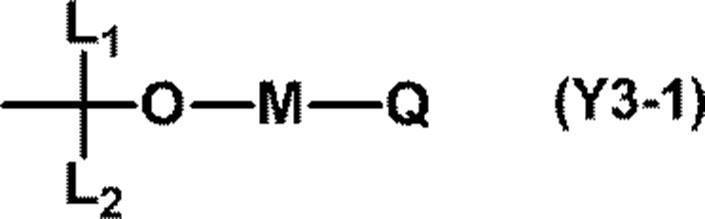
ここで、L1及びL2は、それぞれ独立に、水素原子、アルキル基、シクロアルキル基、アリール基、又は、これらを組み合わせた基(例えば、アルキル基とアリール基とを組み合わせた基)を表す。
Mは、単結合又は2価の連結基を表す。
Qは、ヘテロ原子を有していてもよいアルキル基、ヘテロ原子を有していてもよいシクロアルキル基、ヘテロ原子を有していてもよいアリール基、アミノ基、アンモニウム基、メルカプト基、シアノ基、アルデヒド基、又は、これらを組み合わせた基(例えば、アルキル基とシクロアルキル基とを組み合わせた基)を表す。
アルキル基及びシクロアルキル基は、例えば、メチレン基の1つが、酸素原子等のヘテロ原子、又は、カルボニル基等のヘテロ原子を有する基で置き換わっていてもよい。
なお、L1及びL2のうち一方は水素原子であり、他方はアルキル基、シクロアルキル基、アリール基、又は、アルキレン基とアリール基とを組み合わせた基であることが好ましい。
Q、M、及び、L1の少なくとも2つが結合して環(好ましくは、5員もしくは6員環)を形成してもよい。
パターンの微細化の点では、L2が2級又は3級アルキル基であることが好ましく、3級アルキル基であることがより好ましい。2級アルキル基としては、イソプロピル基、シクロヘキシル基又はノルボルニル基が挙げられ、3級アルキル基としては、tert-ブチル基又はアダマンタン環基が挙げられる。これらの態様では、Tg(ガラス転移温度)及び活性化エネルギーが高くなるため、膜強度の担保に加え、かぶりの抑制ができる。
式(Y4)中、Arは、芳香環基を表す。Rnは、アルキル基、シクロアルキル基又はアリール基を表す。RnとArとは互いに結合して非芳香族環を形成してもよい。Arはより好ましくはアリール基である。
繰り返し単位(A-a)としては、式(A)で表される繰り返し単位も好ましい。
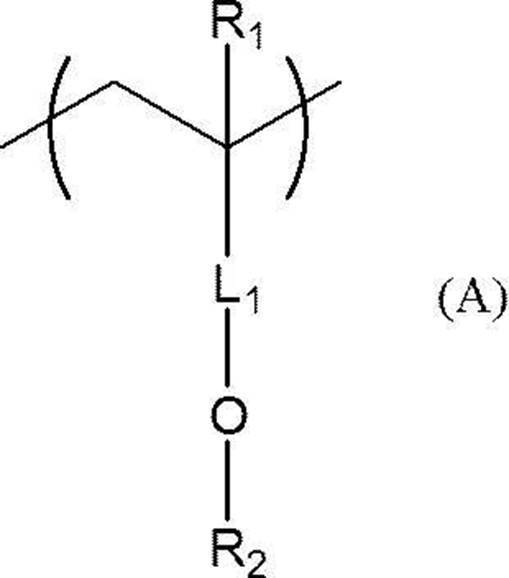
L1は、フッ素原子又はヨウ素原子を有していてもよい2価の連結基を表し、R1は水素原子、フッ素原子、ヨウ素原子、フッ素原子もしくはヨウ素原子を有していてもよいアルキル基、又は、フッ素原子もしくはヨウ素原子を有していてもよいアリール基を表し、R2は酸の作用によって脱離し、フッ素原子又はヨウ素原子を有していてもよい脱離基を表す。ただし、L1、R1、及び、R2のうち少なくとも1つは、フッ素原子又はヨウ素原子を有する。
L1は、フッ素原子又はヨウ素原子を有していてもよい2価の連結基を表す。フッ素原子又はヨウ素原子を有していてもよい2価の連結基としては、-CO-、-O-、-S-、-SO-、-SO2-、フッ素原子又はヨウ素原子を有していてもよい炭化水素基(例えば、アルキレン基、シクロアルキレン基、アルケニレン基、アリーレン基等)、及び、これらの複数が連結した連結基等が挙げられる。中でも、本発明の効果がより優れる点で、L1としては、-CO-、-アリーレン基-フッ素原子又はヨウ素原子を有するアルキレン基-が好ましい。
アリーレン基としては、フェニレン基が好ましい。
アルキレン基は、直鎖状であっても、分岐鎖状であってもよい。アルキレン基の炭素数は特に制限されないが、1~10が好ましく、1~3がより好ましい。
フッ素原子又はヨウ素原子を有するアルキレン基に含まれるフッ素原子及びヨウ素原子の合計数は特に制限されないが、本発明の効果がより優れる点で、2以上が好ましく、2~10がより好ましく、3~6が更に好ましい。
R1は、水素原子、フッ素原子、ヨウ素原子、フッ素原子もしくはヨウ素原子が有していてもよいアルキル基、又は、フッ素原子もしくはヨウ素原子を有していてもよいアリール基を表す。
アルキル基は、直鎖状であっても、分岐鎖状であってもよい。アルキル基の炭素数は特に制限されないが、1~10が好ましく、1~3がより好ましい。
フッ素原子又はヨウ素原子を有するアルキル基に含まれるフッ素原子及びヨウ素原子の合計数は特に制限されないが、本発明の効果がより優れる点で、1以上が好ましく、1~5がより好ましく、1~3が更に好ましい。
上記アルキル基は、ハロゲン原子以外の酸素原子等のヘテロ原子を有していてもよい。
R2は、酸の作用によって脱離し、フッ素原子又はヨウ素原子を有していてもよい脱離基を表す。
中でも、脱離基としては、式(Z1)~(Z4)で表される基が挙げられる。
式(Z1):-C(Rx11)(Rx12)(Rx13)
式(Z2):-C(=O)OC(Rx11)(Rx12)(Rx13)
式(Z3):-C(R136)(R137)(OR138)
式(Z4):-C(Rn1)(H)(Ar1)
式(Z1)、(Z2)中、Rx11~Rx13は、それぞれ独立に、フッ素原子もしくはヨウ素原子を有していてもよいアルキル基(直鎖状もしくは分岐鎖状)、又は、フッ素原子もしくはヨウ素原子を有していてもよいシクロアルキル基(単環もしくは多環)を表す。なお、Rx11~Rx13の全てがアルキル基(直鎖状もしくは分岐鎖状)である場合、Rx11~Rx13のうち少なくとも2つはメチル基であることが好ましい。
Rx11~Rx13は、フッ素原子又はヨウ素原子を有していてもよい点以外は、上述した(Y1)、(Y2)中のRx1~Rx3と同じであり、アルキル基及びシクロアルキル基の定義及び好適範囲と同じである。
式(Z3)中、R136~R138は、それぞれ独立に、水素原子、又は、フッ素原子もしくはヨウ素原子を有していてもよい1価の有機基を表す。R137とR138とは、互いに結合して環を形成してもよい。フッ素原子又はヨウ素原子を有していてもよい1価の有機基としては、フッ素原子又はヨウ素原子を有していてもよいアルキル基、フッ素原子又はヨウ素原子を有していてもよいシクロアルキル基、フッ素原子又はヨウ素原子を有していてもよいアリール基、フッ素原子又はヨウ素原子を有していてもよいアラルキル基、及び、これらを組み合わせた基(例えば、アルキル基とシクロアルキル基とを組み合わせた基)が挙げられる。
なお、上記アルキル基、シクロアルキル基、アリール基、及び、アラルキル基には、フッ素原子及びヨウ素原子以外に、酸素原子等のヘテロ原子が含まれていてもよい。つまり、上記アルキル基、シクロアルキル基、アリール基、及び、アラルキル基は、例えば、メチレン基の1つが、酸素原子等のヘテロ原子、又は、カルボニル基等のヘテロ原子を有する基で置き換わっていてもよい。
式(Z3)としては、下記式(Z3-1)で表される基が好ましい。

ここで、L11及びL12は、それぞれ独立に、水素原子;フッ素原子、ヨウ素原子及び酸素原子からなる群より選択されるヘテロ原子を有していてもよいアルキル基;フッ素原子、ヨウ素原子及び酸素原子からなる群より選択されるヘテロ原子を有していてもよいシクロアルキル基;フッ素原子、ヨウ素原子及び酸素原子からなる群より選択されるヘテロ原子を有していてもよいアリール基;又は、これらを組み合わせた基(例えば、フッ素原子、ヨウ素原子及び酸素原子からなる群より選択されるヘテロ原子を有していてもよい、アルキル基とシクロアルキル基とを組み合わせた基)を表す。
M1は、単結合又は2価の連結基を表す。
Q1は、フッ素原子、ヨウ素原子及び酸素原子からなる群より選択されるヘテロ原子を有していてもよいアルキル基;フッ素原子、ヨウ素原子及び酸素原子からなる群より選択されるヘテロ原子を有していてもよいシクロアルキル基;フッ素原子、ヨウ素原子及び酸素原子からなる群より選択されるアリール基;アミノ基;アンモニウム基;メルカプト基;シアノ基;アルデヒド基;又は、これらを組み合わせた基(例えば、フッ素原子、ヨウ素原子及び酸素原子からなる群より選択されるヘテロ原子を有していてもよい、アルキル基とシクロアルキル基とを組み合わせた基)を表す。
式(Z4)中、Ar1は、フッ素原子又はヨウ素原子を有していてもよい芳香環基を表す。Rn1は、フッ素原子もしくはヨウ素原子を有していてもよいアルキル基、フッ素原子もしくはヨウ素原子を有していてもよいシクロアルキル基、又は、フッ素原子もしくはヨウ素原子を有していてもよいアリール基を表す。Rn1とAr1とは互いに結合して非芳香族環を形成してもよい。
繰り返し単位(A-a)としては、一般式(AI)で表される繰り返し単位も好ましい。

一般式(AI)において、
Xa1は、水素原子、又は、置換基を有していてもよいアルキル基を表す。
Tは、単結合、又は、2価の連結基を表す。
Rx1~Rx3は、それぞれ独立に、アルキル基(直鎖状、又は、分岐鎖状)、又は、シクロアルキル基(単環、又は、多環)を表す。ただし、Rx1~Rx3の全てがアルキル基(直鎖状、又は、分岐鎖状)である場合、Rx1~Rx3のうち少なくとも2つはメチル基であることが好ましい。
Rx1~Rx3の2つが結合して、シクロアルキル基(単環もしくは多環)を形成してもよい。
Xa1により表される、置換基を有していてもよいアルキル基としては、例えば、メチル基又は-CH2-R11で表される基が挙げられる。R11は、ハロゲン原子(フッ素原子等)、水酸基又は1価の有機基を表し、例えば、ハロゲン原子が置換していてもよい炭素数5以下のアルキル基、ハロゲン原子が置換していてもよい炭素数5以下のアシル基、及び、ハロゲン原子が置換していてもよい炭素数5以下のアルコキシ基が挙げられ、炭素数3以下のアルキル基が好ましく、メチル基がより好ましい。Xa1としては、水素原子、メチル基、トリフルオロメチル基、又は、ヒドロキシメチル基が好ましい。
Tの2価の連結基としては、アルキレン基、芳香環基、-COO-Rt-基、及び、-O-Rt-基等が挙げられる。式中、Rtは、アルキレン基、又は、シクロアルキレン基を表す。
Tは、単結合又は-COO-Rt-基が好ましい。Tが-COO-Rt-基を表す場合、Rtは、炭素数1~5のアルキレン基が好ましく、-CH2-基、-(CH2)2-基、又は、-(CH2)3-基がより好ましい。
Rx1~Rx3のアルキル基としては、メチル基、エチル基、n-プロピル基、イソプロピル基、n-ブチル基、イソブチル基、及び、t-ブチル基等の炭素数1~4のアルキル基が好ましい。
Rx1~Rx3のシクロアルキル基としては、シクロペンチル基、及び、シクロヘキシル基等の単環のシクロアルキル基、又は、ノルボルニル基、テトラシクロデカニル基、テトラシクロドデカニル基、及び、アダマンチル基等の多環のシクロアルキル基が好ましい。
Rx1~Rx3の2つが結合して形成されるシクロアルキル基としては、シクロペンチル基、及び、シクロヘキシル基等の単環のシクロアルキル基が好ましく、その他にも、ノルボルニル基、テトラシクロデカニル基、テトラシクロドデカニル基、及び、アダマンチル基等の多環のシクロアルキル基が好ましい。中でも、炭素数5~6の単環のシクロアルキル基が好ましい。
Rx1~Rx3の2つが結合して形成されるシクロアルキル基は、例えば、環を構成するメチレン基の1つが、酸素原子等のヘテロ原子、又は、カルボニル基等のヘテロ原子を有する基で置き換わっていてもよい。
一般式(AI)で表される繰り返し単位は、例えば、Rx1がメチル基又はエチル基であり、Rx2とRx3とが結合して上述のシクロアルキル基を形成している態様が好ましい。
上記各基が置換基を有する場合、置換基としては、例えば、アルキル基(炭素数1~4)、ハロゲン原子、水酸基、アルコキシ基(炭素数1~4)、カルボキシル基、及び、アルコキシカルボニル基(炭素数2~6)等が挙げられる。置換基中の炭素数は、8以下が好ましい。
一般式(AI)で表される繰り返し単位としては、好ましくは、酸分解性(メタ)アクリル酸3級アルキルエステル系繰り返し単位(Xa1が水素原子又はメチル基を表し、かつ、Tが単結合を表す繰り返し単位)である。
樹脂(A)は、繰り返し単位(A-a)を1種単独で有していてもよく、2種以上を有していてもよい。
繰り返し単位(A-a)の含有量(2種以上の繰り返し単位(A-a)が存在する場合は合計含有量)は、樹脂(A)中の全繰り返し単位に対し、15~80モル%が好ましく、20~70モル%がより好ましい。
樹脂(A)は、繰り返し単位(A-a)として、下記一般式(A-VIII)~(A-XII)で表される繰り返し単位からなる群より選択される少なくとも1つの繰り返し単位を有することが好ましい。

一般式(A-VIII)中、R5は、tert-ブチル基、-CO-O-(tert-ブチル)基を表す。
一般式(A-IX)中、R6及びR7は、それぞれ独立に、1価の有機基を表す。1価の有機基としては、アルキル基、シクロアルキル基、アリール基、アラルキル基、及び、アルケニル基等が挙げられる。
一般式(A-X)中、pは、1又は2を表す。
一般式(A-X)~(A-XII)中、R8は、水素原子又は炭素数1~3のアルキル基を表し、R9は、炭素数1~3のアルキル基を表す。
一般式(A-XII)中、R10は、炭素数1~3のアルキル基又はアダマンチル基を表す。
繰り返し単位(A-a)の具体例を以下に示すが、本発明は、これに制限されるものではない。なお、式中、Xa1はH、CH3、CF3、及び、CH2OHのいずれか、Rxa及びRxbはそれぞれ炭素数1~4の直鎖状又は分岐鎖状のアルキル基を表す。
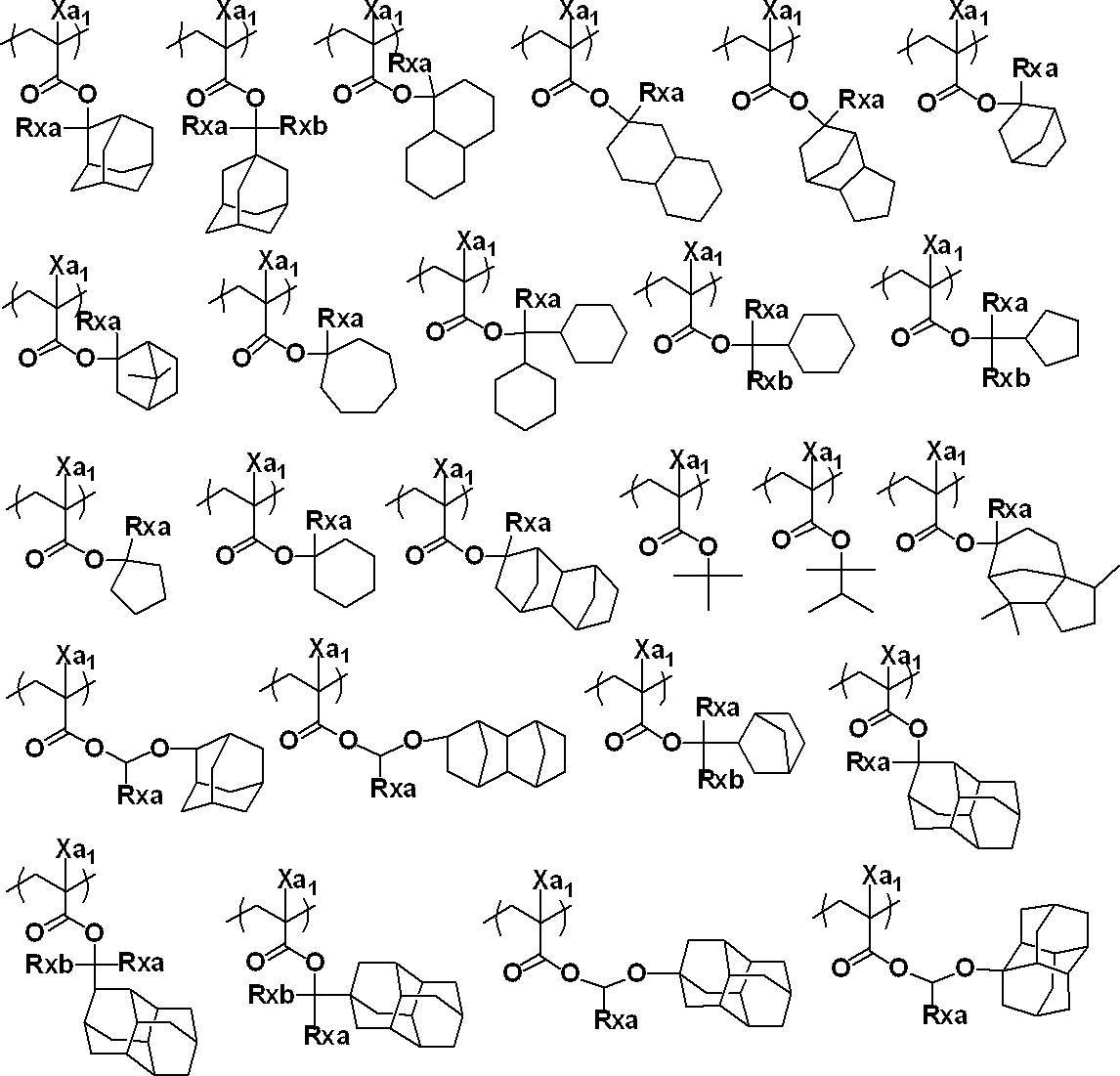


(酸基を有する繰り返し単位)
樹脂(A)は、酸基を有する繰り返し単位を有してもよい。
酸基を有する繰り返し単位としては、下記一般式(B)で表される繰り返し単位が好ましい。
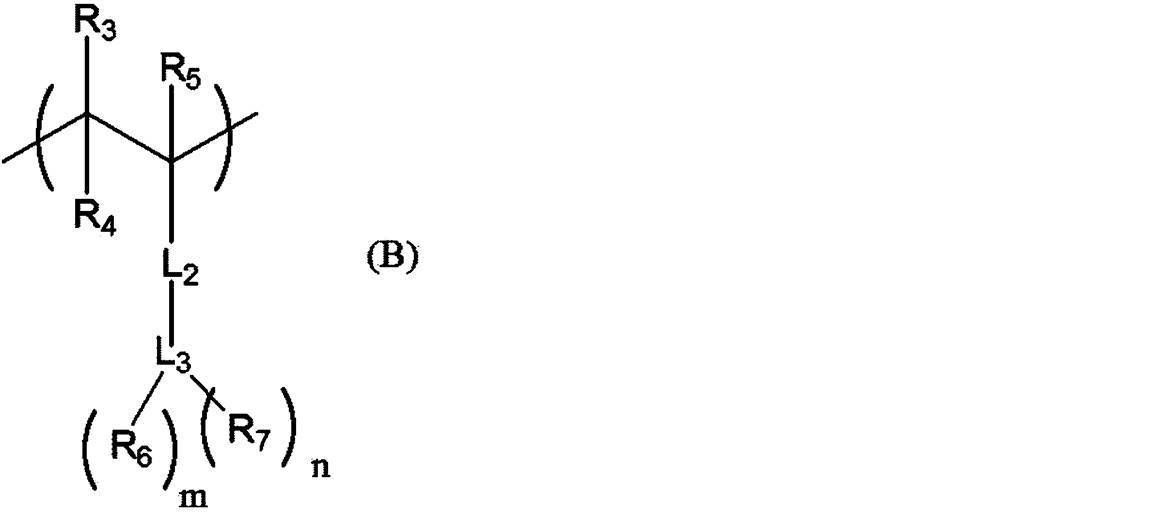
R3は、水素原子、又は、フッ素原子もしくはヨウ素原子を有していてもよい1価の有機基を表す。フッ素原子又はヨウ素原子を有していてもよい1価の有機基としては、-L4-R8で表される基が好ましい。L4は、単結合、又は、エステル基を表す。R8は、フッ素原子もしくはヨウ素原子を有していてもよいアルキル基、フッ素原子もしくはヨウ素原子を有していてもよいシクロアルキル基、フッ素原子もしくはヨウ素原子を有していてもよいアリール基、又は、これらを組み合わせた基が挙げられる。
R4及びR5は、それぞれ独立に、水素原子、フッ素原子、ヨウ素原子、又は、フッ素原子もしくはヨウ素原子を有していてもよいアルキル基を表す。
L2は、単結合、又は、エステル基を表す。
L3は、(n+m+1)価の芳香族炭化水素環基、又は、(n+m+1)価の脂環式炭化水素環基を表す。芳香族炭化水素環基としては、ベンゼン環基、及び、ナフタレン環基が挙げられる。脂環式炭化水素環基としては、単環であっても、多環であってもよく、例えば、シクロアルキル環基が挙げられる。
R6は、水酸基、又は、フッ素化アルコール基(好ましくは、ヘキサフルオロイソプロパノール基)を表す。なお、R6が水酸基の場合、L3は(n+m+1)価の芳香族炭化水素環基であることが好ましい。
R7は、ハロゲン原子を表す。ハロゲン原子としては、フッ素原子、塩素原子、臭素原子、又は、ヨウ素原子が挙げられる。
mは、1以上の整数を表す。mは、1~3の整数が好ましく、1~2の整数が好ましい。
nは、0又は1以上の整数を表す。nは、1~4の整数が好ましい。
なお、(n+m+1)は、1~5の整数が好ましい。
酸基を有する繰り返し単位としては、下記一般式(I)で表される繰り返し単位も好ましい。

一般式(I)中、
R41、R42及びR43は、それぞれ独立に、水素原子、アルキル基、シクロアルキル基、ハロゲン原子、シアノ基又はアルコキシカルボニル基を表す。但し、R42はAr4と結合して環を形成していてもよく、その場合のR42は単結合又はアルキレン基を表す。
X4は、単結合、-COO-、又は-CONR64-を表し、R64は、水素原子又はアルキル基を表す。
L4は、単結合又はアルキレン基を表す。
Ar4は、(n+1)価の芳香環基を表し、R42と結合して環を形成する場合には(n+2)価の芳香環基を表す。
nは、1~5の整数を表す。
一般式(I)におけるR41、R42、及び、R43のアルキル基としては、メチル基、エチル基、プロピル基、イソプロピル基、n-ブチル基、sec-ブチル基、ヘキシル基、2-エチルヘキシル基、オクチル基、及び、ドデシル基等の炭素数20以下のアルキル基が好ましく、炭素数8以下のアルキル基がより好ましく、炭素数3以下のアルキル基が更に好ましい。
一般式(I)におけるR41、R42、及び、R43のシクロアルキル基としては、単環型でも、多環型でもよい。中でも、シクロプロピル基、シクロペンチル基、及び、シクロヘキシル基等の炭素数3~8個で単環型のシクロアルキル基が好ましい。
一般式(I)におけるR41、R42、及び、R43のハロゲン原子としては、フッ素原子、塩素原子、臭素原子、及び、ヨウ素原子が挙げられ、フッ素原子が好ましい。
一般式(I)におけるR41、R42、及び、R43のアルコキシカルボニル基に含まれるアルキル基としては、上記R41、R42、R43におけるアルキル基と同様のものが好ましい。
Ar4は、(n+1)価の芳香環基を表す。nが1である場合における2価の芳香環基は、置換基を有していてもよく、例えば、フェニレン基、トリレン基、ナフチレン基、及び、アントラセニレン基等の炭素数6~18のアリーレン基、又は、チオフェン環、フラン環、ピロール環、ベンゾチオフェン環、ベンゾフラン環、ベンゾピロール環、トリアジン環、イミダゾール環、ベンゾイミダゾール環、トリアゾール環、チアジアゾール環、及び、チアゾール環等のヘテロ環を含む芳香環基が好ましい。
nが2以上の整数である場合における(n+1)価の芳香環基の具体例としては、2価の芳香環基の上記した具体例から、(n-1)個の任意の水素原子を除してなる基が挙げられる。(n+1)価の芳香環基は、更に置換基を有していてもよい。
上述したアルキル基、シクロアルキル基、アルコキシカルボニル基、アルキレン基、及び、(n+1)価の芳香環基が有し得る置換基としては、例えば、一般式(I)におけるR41、R42、及び、R43で挙げたアルキル基、メトキシ基、エトキシ基、ヒドロキシエトキシ基、プロポキシ基、ヒドロキシプロポキシ基、及び、ブトキシ基等のアルコキシ基;フェニル基等のアリール基;等が挙げられる。
X4により表わされる-CONR64-(R64は、水素原子又はアルキル基を表す)におけるR64のアルキル基としては、メチル基、エチル基、プロピル基、イソプロピル基、n-ブチル基、sec-ブチル基、ヘキシル基、2-エチルヘキシル基、オクチル基、及び、ドデシル基等の炭素数20以下のアルキル基が挙げられ、炭素数8以下のアルキル基が好ましい。
X4としては、単結合、-COO-、又は、-CONH-が好ましく、単結合、又は、-COO-がより好ましい。
L4におけるアルキレン基としては、メチレン基、エチレン基、プロピレン基、ブチレン基、ヘキシレン基、及び、オクチレン基等の炭素数1~8のアルキレン基が好ましい。
Ar4としては、炭素数6~18の芳香環基が好ましく、ベンゼン環基、ナフタレン環基、及び、ビフェニレン環基がより好ましい。
以下、一般式(I)で表される繰り返し単位の具体例を示すが、本発明は、これに制限されるものではない。式中、aは1又は2を表す。
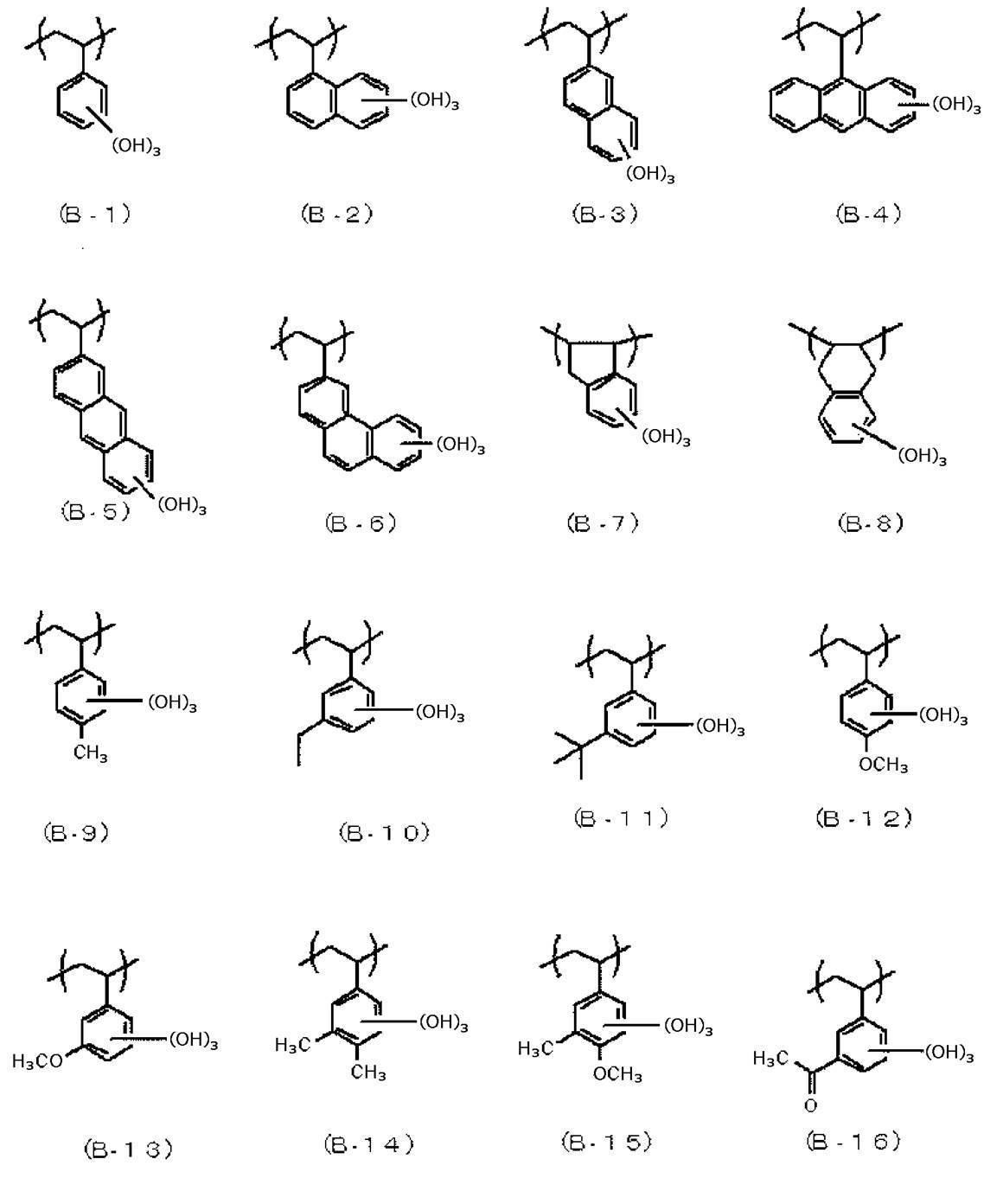

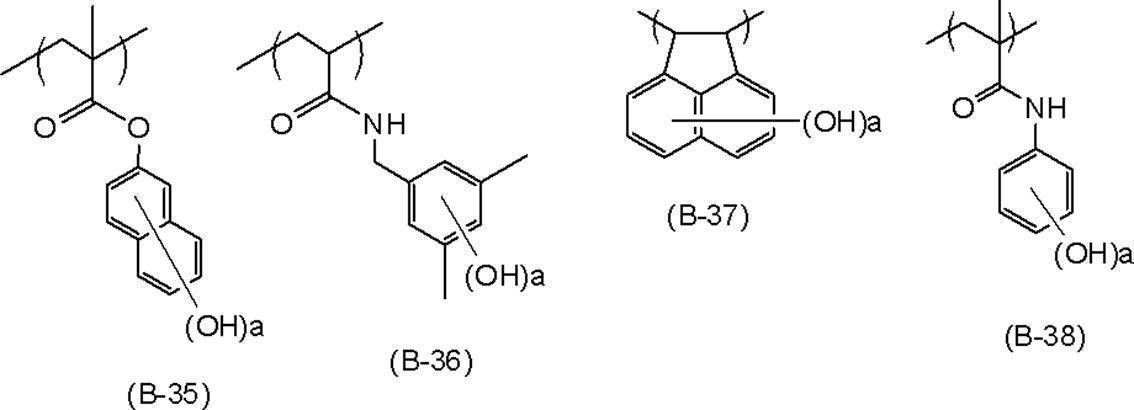
≪ヒドロキシスチレンに由来する繰り返し単位(A-1)≫
樹脂(A)は、酸基を有する繰り返し単位として、ヒドロキシスチレンに由来する繰り返し単位(A-1)を有することが好ましい。
ヒドロキシスチレンに由来する繰り返し単位(A-1)としては、下記一般式(1)で表される繰り返し単位が挙げられる。
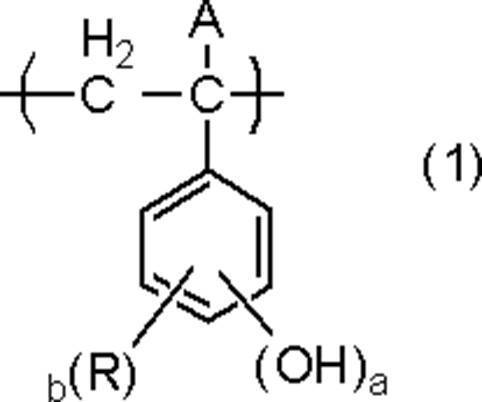
一般式(1)中、
Aは水素原子、アルキル基、シクロアルキル基、ハロゲン原子、又はシアノ基を表す。
Rは、ハロゲン原子、アルキル基、シクロアルキル基、アリール基、アルケニル基、アラルキル基、アルコキシ基、アルキルカルボニルオキシ基、アルキルスルホニルオキシ基、アルキルオキシカルボニル基又はアリールオキシカルボニル基を表し、複数個ある場合には同じであっても異なっていてもよい。複数のRを有する場合には、互いに共同して環を形成していてもよい。Rとしては水素原子が好ましい。
aは1~3の整数を表し、bは0~(5-a)の整数を表す。
繰り返し単位(A-1)としては、下記一般式(A-I)で表される繰り返し単位が好ましい。

繰り返し単位(A-1)を有する樹脂(A)を含有する組成物は、KrF露光用、EB露光用又はEUV露光用として好ましい。この場合の繰り返し単位(A-1)の含有量は、樹脂(A)中の全繰り返し単位に対して、30~90モル%が好ましく、40~90モル%がより好ましく、50~90モル%が更に好ましい。
(ラクトン構造、スルトン構造、カーボネート構造、及びヒドロキシアダマンタン構造からなる群より選択される少なくとも1種を含有する繰り返し単位(A-2))
樹脂(A)は、ラクトン構造、カーボネート構造、スルトン構造、及びヒドロキシアダマンタン構造からなる群より選択される少なくとも1種を有する繰り返し単位(A-2)を有していてもよい。
≪ラクトン構造又はスルトン構造を有する繰り返し単位≫
ラクトン構造又はスルトン構造を有する繰り返し単位におけるラクトン構造又はスルトン構造は、特に制限されないが、5~7員環ラクトン構造又は5~7員環スルトン構造が好ましく、5~7員環ラクトン構造にビシクロ構造、スピロ構造を形成する形で他の環構造が縮環しているもの、又は5~7員環スルトン構造にビシクロ構造、スピロ構造を形成する形で他の環構造が縮環しているものがより好ましい。下記式LC1-1~LC1-21のいずれかで表されるラクトン構造、又は下記式SL1-1~SL1-3のいずれかで表されるスルトン構造を有する繰り返し単位を有することが更に好ましい。また、ラクトン構造又はスルトン構造が主鎖に直接結合していてもよい。好ましい構造としてはLC1-1、LC1-4、LC1-5、LC1-8、LC1-16、LC1-21又はSL1-1である。

ラクトン構造部分又はスルトン構造部分は、置換基(Rb2)を有していても有していなくてもよい。好ましい置換基(Rb2)としては、炭素数1~8のアルキル基、炭素数4~7のシクロアルキル基、炭素数1~8のアルコキシ基、炭素数2~8のアルコキシカルボニル基、カルボキシル基、フッ素原子以外のハロゲン原子、水酸基、シアノ基、及び酸分解性基などが挙げられる。より好ましくは炭素数1~4のアルキル基、シアノ基、及び酸分解性基である。n2は、0~4の整数を表す。n2が2以上の時、複数存在する置換基(Rb2)は、同一でも異なっていてもよい。また、複数存在する置換基(Rb2)同士が結合して環を形成してもよい。
ラクトン構造又はスルトン構造を有する繰り返し単位としては、焦点深度の許容度及びパターン直線性の観点から、下記式IIIで表される繰り返し単位が好ましい。
また、酸分解性基を有する繰り返し単位を有する樹脂は、焦点深度の許容度及びパターン直線性の観点から、下記式IIIで表される繰り返し単位を有することが好ましい。
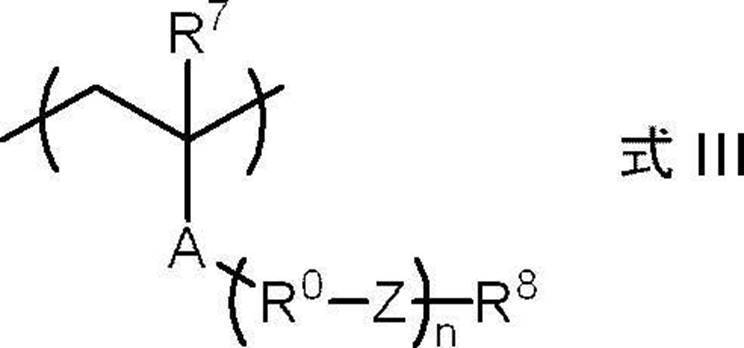
上記式III中、
Aは、エステル結合(-COO-で表される基)又はアミド結合(-CONH-で表される基)を表す。
nは、-R0-Z-で表される構造の繰り返し数であり、0~5の整数を表し、0又は1であることが好ましく、0であることがより好ましい。nが0である場合、-R0-Z-は存在せず、AとR8とが単結合により結合される。
R0は、アルキレン基、シクロアルキレン基、又はその組み合わせを表す。R0は、複数個ある場合にはそれぞれ独立に、アルキレン基、シクロアルキレン基、又はその組み合わせを表す。
Zは、単結合、エーテル結合、エステル結合、アミド結合、ウレタン結合又はウレア結合を表す。Zは、複数個ある場合にはそれぞれ独立に、単結合、エーテル結合、エステル結合、アミド結合、ウレタン結合又はウレア結合を表す。
R8は、ラクトン構造又はスルトン構造を有する1価の有機基を表す。
R7は、水素原子、フッ素原子以外のハロゲン原子又は1価の有機基(好ましくはメチル基)を表す。
R0のアルキレン基又はシクロアルキレン基は置換基を有してもよい。
Zは好ましくは、エーテル結合、又はエステル結合であり、より好ましくはエステル結合である。
ラクトン構造又はスルトン構造を有する繰り返し単位としては、下記一般式(A-II)~(A-V)で表される繰り返し単位からなる群より選択される少なくとも1種の繰り返し単位もまた好ましい。

一般式(A-II)~(A-V)中、R1は、水素原子、又は、炭素数1~3のアルキル基を表す。
R2は、炭素数1~4のアルキル基、シアノ基、又は、-CO-O-R21を表す。R21は、炭素数1~4のアルキル基を表す。
X1は、単結合、炭素数1~3のアルキレン基、又は、-R3-CO-O-を表し、R3は、炭素数1~3のアルキレン基を表す。
mは、0又は1を表す。
以下に式IIIで表される繰り返し単位又は一般式(A-II)~(A-V)で表される繰り返し単位に相当するモノマーの具体例を挙げる。下記の具体例は、式IIIにおけるR7及び一般式(A-II)~(A-V)におけるR1がメチル基である場合に相当するが、上記のメチル基は、水素原子又は炭素数2~3のアルキル基に任意に置換できる。

上記モノマーの他に下記に示すモノマーも、ラクトン構造又はスルトン構造を有する繰り返し単位として好適に用いられる。
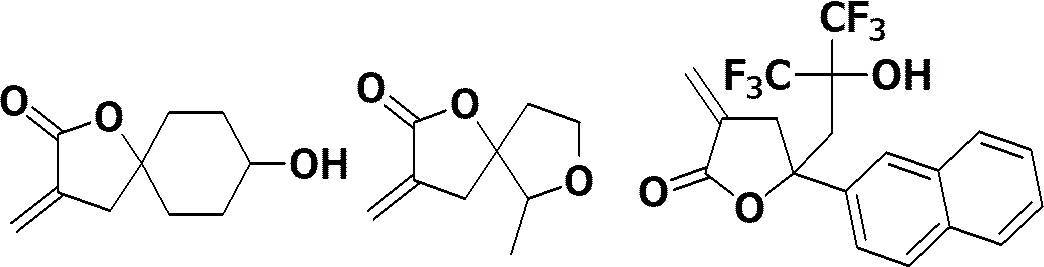
≪カーボネート構造を有する繰り返し単位≫
樹脂(A)は、カーボネート構造を有する繰り返し単位を有していてもよい。カーボネート構造は、環状炭酸エステル構造であることが好ましい。
環状炭酸エステル構造を有する繰り返し単位は、下記式A-1で表される繰り返し単位であることが好ましい。

式A-1中、RA 1は、水素原子、フッ素原子以外のハロゲン原子又は1価の有機基(好ましくはメチル基)を表し、nは0以上の整数を表し、RA 2は、置換基を表す。RA 2は、nが2以上の場合はそれぞれ独立して、置換基を表し、Aは、単結合、又は2価の連結基を表し、Zは、式中の-O-C(=O)-O-で表される基と共に単環構造又は多環構造を形成する原子団を表す。
カーボネート構造を有する繰り返し単位としては、下記一般式(A-VI)で表される繰り返し単位がより好ましい。
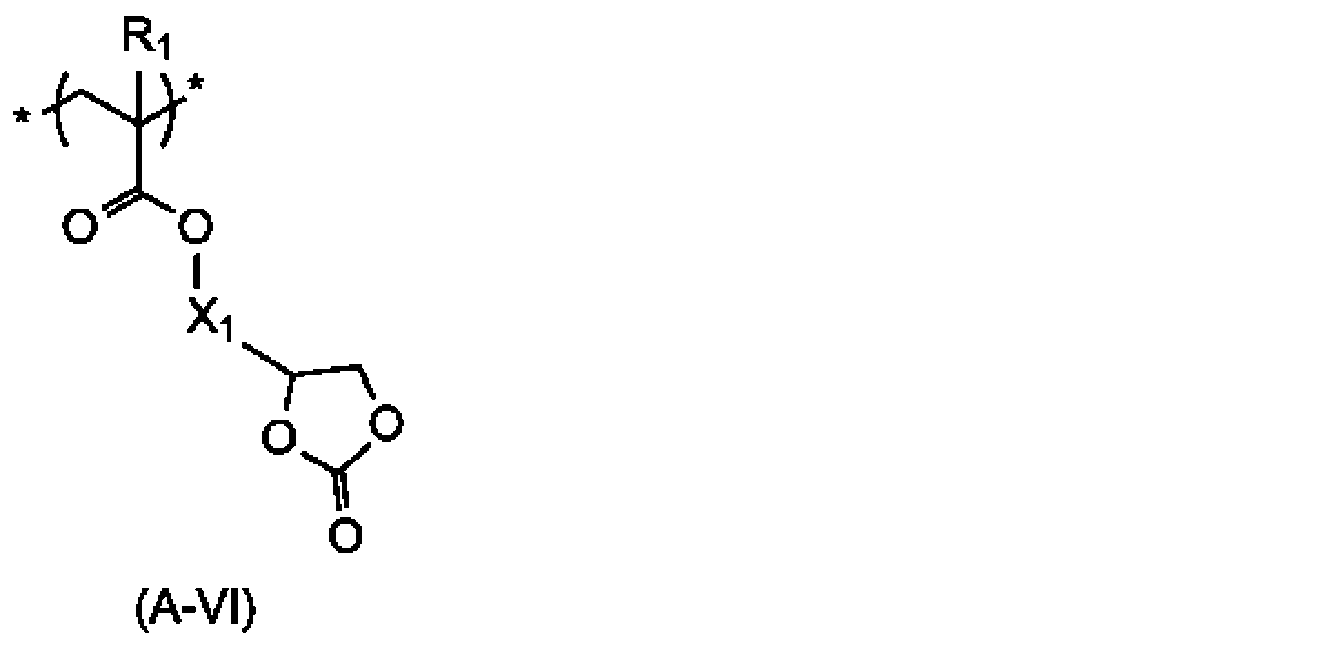
一般式(A-VI)中、R1は、水素原子、又は、炭素数1~3のアルキル基を表す。
X1は、単結合、炭素数1~3のアルキレン基、又は、-R3-CO-O-を表し、R3は、炭素数1~3のアルキレン基を表す。
樹脂(A)は、ラクトン構造、スルトン構造、及びカーボネート構造からなる群より選択される少なくとも1種を有する繰り返し単位として、米国特許出願公開第2016/0070167号明細書の段落0370~0414に記載の繰り返し単位を有することも好ましい。
≪ヒドロキシアダマンタン構造を有する繰り返し単位≫
樹脂(A)は、ヒドロキシアダマンタン構造を有する繰り返し単位を有していてもよい。ヒドロキシアダマンタン構造を有する繰り返し単位としては、下記一般式(AIIa)で表される繰り返し単位が挙げられる。

一般式(AIIa)中、R1cは、水素原子、メチル基、トリフロロメチル基又はヒドロキシメチル基を表す。R2c~R4cは、それぞれ独立に、水素原子又は水酸基を表す。但し、R2c~R4cのうちの少なくとも1つは、水酸基を表す。R2c~R4cのうちの1つ又は2つが水酸基で、残りが水素原子であることが好ましい。
ヒドロキシアダマンタン構造を有する繰り返し単位としては、下記一般式(A-VII)で表される繰り返し単位がより好ましい。

一般式(A-VII)中、R1は、水素原子、又は、炭素数1~3のアルキル基を表す。nは、0又は1を表す。
ヒドロキシアダマンタン構造を有する繰り返し単位の具体例を以下に挙げるが、本発明はこれらに制限されない。
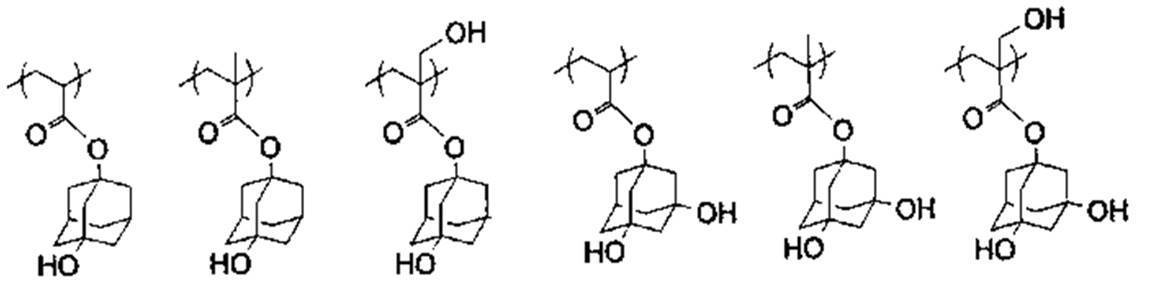
樹脂(A)がヒドロキシアダマンタン構造を有する繰り返し単位を有する場合、ヒドロキシアダマンタン構造を有する繰り返し単位の含有量は、樹脂(A)中の全繰り返し単位に対して、5~40モル%が好ましく、5~30モル%がより好ましく、10~25モル%が更に好ましい。
樹脂(A)は、ラクトン構造、カーボネート構造、スルトン構造、及びヒドロキシアダマンタン構造からなる群より選択される少なくとも1種を有する繰り返し単位(A-2)を、1種単独で有していてもよく、2種以上を併用して有していてもよい。
上記繰り返し単位(A-2)としては、ラクトン構造、カーボネート構造、スルトン構造及びヒドロキシアダマンタン構造からなる群より選択される少なくとも1種を含有する
(メタ)アクリル酸エステルに由来する繰り返し単位が好ましい。
樹脂(A)に含まれる繰り返し単位(A-2)の含有量(繰り返し単位(A-2)が複数存在する場合はその合計含有量)は、樹脂(A)の全繰り返し単位に対して、5~70モル%が好ましく、10~65モル%がより好ましく、20~60モル%が更に好ましい。
樹脂(A)は、上述のヒドロキシスチレンに由来する繰り返し単位(A-1)、並びに、ラクトン構造、カーボネート構造、スルトン構造及びヒドロキシアダマンタン構造からなる群より選択される少なくとも1種を含有する繰り返し単位(A-2)の少なくとも一方を有することが好ましい。
中でも、繰り返し単位(A-1)が、上述の一般式(A-I)で表される繰り返し単位であり、かつ、繰り返し単位(A-2)が、上述の一般式(A-II)~(A-VII)で表される繰り返し単位からなる群より選択される少なくとも1種を含有することが好ましい。
繰り返し単位(A-1)、繰り返し単位(A-2)及び一般式(A-I)~(A-VII)で表される繰り返し単位については、その好ましい態様も含めて、上述のとおりである。
(他の繰り返し単位)
樹脂(A)は、上述した酸分解性基を有する繰り返し単位(A-a)、酸基を有する繰り返し単位、及び繰り返し単位(A-2)以外の繰り返し単位を有していてもよい。
≪フッ素原子又はヨウ素原子を有する繰り返し単位≫
樹脂(A)は、フッ素原子又はヨウ素原子を有する繰り返し単位を有していてもよい。但し、フッ素原子又はヨウ素原子を有する繰り返し単位には、上述した酸分解性基を有する繰り返し単位(A-a)、酸基を有する繰り返し単位、及び繰り返し単位(A-2)は含まれない。
フッ素原子又はヨウ素原子を有する繰り返し単位としては、式(C)で表される繰り返し単位が好ましい。
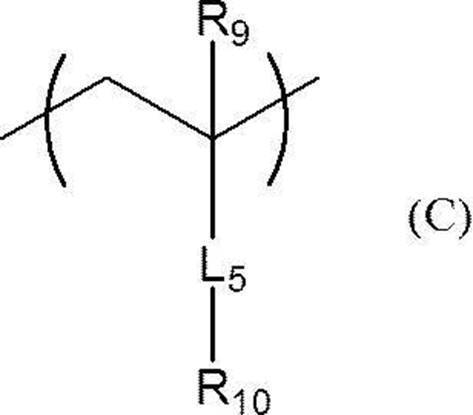
L5は、単結合、又は、エステル基を表す。
R9は、水素原子、又は、フッ素原子もしくはヨウ素原子を有していてもよいアルキル基を表す。
R10は、水素原子、フッ素原子もしくはヨウ素原子を有していてもよいアルキル基、フッ素原子もしくはヨウ素原子を有していてもよいシクロアルキル基、フッ素原子もしくはヨウ素原子を有していてもよいアリール基、又は、これらを組み合わせた基を表す。
ただし、少なくともR9又はR10が、フッ素原子又はヨウ素原子を含む。
フッ素原子又はヨウ素原子を有する繰り返し単位の含有量は、樹脂(A)中の全繰り返し単位に対し、0~50モル%が好ましく、5~45モル%がより好ましく、10~40モル%が更に好ましい。
≪光酸発生基を有する繰り返し単位≫
樹脂(A)は、上記以外の繰り返し単位として、放射線の照射により酸を発生する基(以下「光酸発生基」とも言う)を有する繰り返し単位を有していてもよい。
この場合、この光酸発生基を有する繰り返し単位が、光酸発生剤(P)にあたると考えることができる。
このような繰り返し単位としては、例えば、下記一般式(4)で表される繰り返し単位が挙げられる。
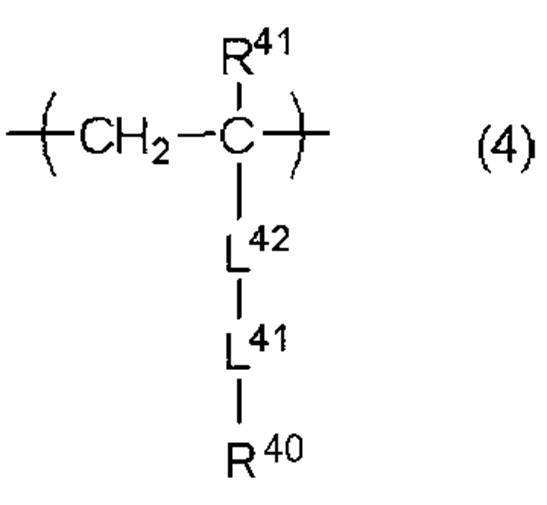
R41は、水素原子又はメチル基を表す。L41は、単結合、又は、2価の連結基を表す。L42は、2価の連結基を表す。R40は、放射線の照射により分解して側鎖に酸を発生させる構造部位を表す。
以下に、一般式(4)で表される繰り返し単位の具体例を示すが、本発明はこれに制限されるものではない。

そのほか、一般式(4)で表される繰り返し単位としては、例えば、特開2014-041327号公報の段落<0094>~<0105>に記載された繰り返し単位が挙げられる。
光酸発生基を有する繰り返し単位の含有量は、樹脂(A)中の全繰り返し単位に対して、1~40モル%が好ましく、5~35モル%がより好ましく、5~30モル%が更に好ましい。
≪アルカリ可溶性基を有する繰り返し単位≫
樹脂(A)は、アルカリ可溶性基を有する繰り返し単位を有していてもよい。
アルカリ可溶性基としては、カルボキシル基、スルホンアミド基、スルホニルイミド基、ビスルスルホニルイミド基、α位が電子求引性基で置換された脂肪族アルコール基(例えば、ヘキサフロロイソプロパノール基)が挙げられ、カルボキシル基が好ましい。樹脂(A)がアルカリ可溶性基を有する繰り返し単位を有することにより、コンタクトホール用途での解像性が増す。
アルカリ可溶性基を有する繰り返し単位としては、アクリル酸及びメタクリル酸による繰り返し単位のような樹脂の主鎖に直接アルカリ可溶性基が結合している繰り返し単位、又は、連結基を介して樹脂の主鎖にアルカリ可溶性基が結合している繰り返し単位が挙げられる。なお、連結基は、単環又は多環の環状炭化水素構造を有していてもよい。
アルカリ可溶性基を有する繰り返し単位としては、アクリル酸又はメタクリル酸による繰り返し単位が好ましい。
アルカリ可溶性基を有する繰り返し単位の含有量は、樹脂(A)中の全繰り返し単位に対して、0~20モル%が好ましく、3~15モル%がより好ましく、5~10モル%が更に好ましい。
アルカリ可溶性基を有する繰り返し単位の具体例を以下に示すが、本発明は、これに制限されるものではない。具体例中、RxはH、CH3、CH2OH又はCF3を表す。

≪酸分解性基及び極性基のいずれも有さない繰り返し単位≫
樹脂(A)は、更に、酸分解性基及び極性基のいずれも有さない繰り返し単位を有してもよい。酸分解性基及び極性基のいずれも有さない繰り返し単位は、脂環炭化水素構造を有することが好ましい。
酸分解性基及び極性基のいずれも有さない繰り返し単位としては、例えば、米国特許出願公開第2016/0026083号明細書の段落0236~0237に記載された繰り返し単位、及び、米国特許出願公開第2016/0070167号明細書の段落0433に記載された繰り返し単位が挙げられる。
酸分解性基及び極性基のいずれも有さない繰り返し単位に相当するモノマーの好ましい例を以下に示す。
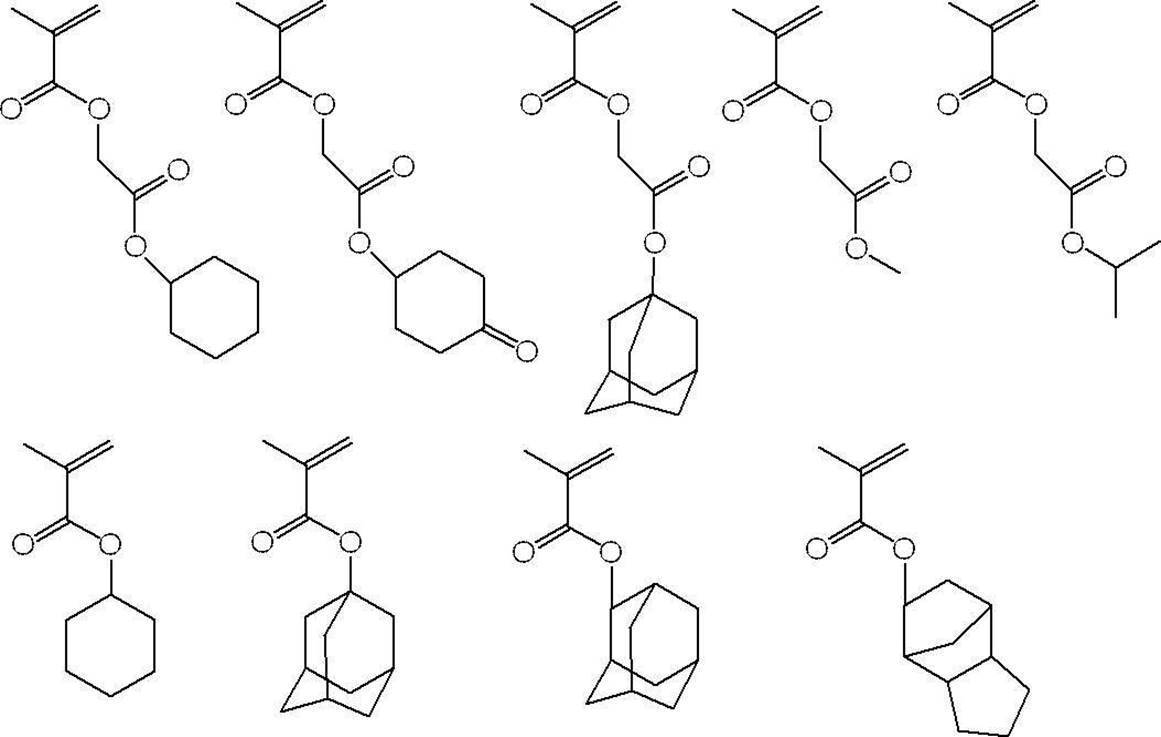
樹脂(A)は、酸分解性基及び極性基のいずれも有さない繰り返し単位を、1種単独で有していてもよく、2種以上を併用して有していてもよい。
酸分解性基及び極性基のいずれも有さない繰り返し単位の含有量は、樹脂(A)中の全繰り返し単位に対して、5~40モル%が好ましく、5~30モル%がより好ましく、5~25モル%が更に好ましい。
樹脂(A)は、上記の繰り返し構造単位以外に、ドライエッチング耐性、標準現像液適性、基板密着性、レジストプロファイル、解像力、耐熱性、及び、感度等を調節する目的で様々な繰り返し構造単位を有していてもよい。
(樹脂(A)の特性)
樹脂(A)としては、繰り返し単位のすべてが(メタ)アクリレート系モノマーに由来する繰り返し単位で構成されることが好ましい。この場合、繰り返し単位のすべてがメタクリレート系モノマーに由来するもの、繰り返し単位のすべてがアクリレート系モノマーに由来するもの、繰り返し単位のすべてがメタクリレート系モノマー及びアクリレート系モノマーに由来するもののいずれの樹脂でも用いることができる。アクリレート系モノマーに由来する繰り返し単位が、樹脂(A)中の全繰り返し単位に対して50モル%以下であることが好ましい。
組成物がフッ化アルゴン(ArF)露光用であるとき、ArF光の透過性の観点から、樹脂(A)は実質的には芳香族基を有さないことが好ましい。より具体的には、芳香族基を有する繰り返し単位が、樹脂(A)の全繰り返し単位に対して5モル%以下であることが好ましく、3モル%以下であることがより好ましく、理想的には0モル%、すなわち芳香族基を有する繰り返し単位を有さないことが更に好ましい。
また、組成物がArF露光用であるとき、樹脂(A)は、単環又は多環の脂環炭化水素構造を有することが好ましく、また、フッ素原子及び珪素原子のいずれも含まないことが好ましい。
組成物がフッ化クリプトン(KrF)露光用、EB露光用又はEUV露光用であるとき、樹脂(A)は芳香族炭化水素基を有する繰り返し単位を有することが好ましく、フェノール性水酸基を有する繰り返し単位を有することがより好ましい。
フェノール性水酸基を有する繰り返し単位としては、上記ヒドロキシスチレン由来の繰り返し単位(A-1)、及び、ヒドロキシスチレン(メタ)アクリレート由来の繰り返し単位を挙げることができる。
また、組成物が、KrF露光用、EB露光用又はEUV露光用であるとき、樹脂(A)は、フェノール性水酸基の水素原子が酸の作用により分解し脱離する基(脱離基)で保護された構造を有する繰り返し単位を有することも好ましい。
組成物が、KrF露光用、EB露光用又はEUV露光用であるとき、樹脂(A)に含まれる芳香族炭化水素基を有する繰り返し単位の含有量は、樹脂(A)中の全繰り返し単位に対して、30~100モル%が好ましく、40~100モル%がより好ましく、50~100モル%が更に好ましい。
樹脂(A)は、常法(例えばラジカル重合)に従って合成できる。
樹脂(A)の重量平均分子量(Mw)は、1,000~200,000が好ましく、3,000~20,000がより好ましく、5,000~15,000が更に好ましい。樹脂(A)の重量平均分子量(Mw)を、1,000~200,000とすることにより、耐熱性及びドライエッチング耐性の劣化を防ぐことができ、更に、現像性の劣化、及び、粘度が高くなって製膜性が劣化することを防ぐことができる。なお、樹脂(A)の重量平均分子量(Mw)は、上述のGPC法により測定されたポリスチレン換算値である。
樹脂(A)の分散度(分子量分布)は、通常1~5であり、1~3が好ましく、1.1~2.0がより好ましい。分散度が小さいものほど、解像度、及び、レジスト形状が優れ、更に、パターンの側壁がスムーズであり、ラフネス性に優れる。
本発明の組成物において、樹脂(A)の含有量は、組成物の全固形分に対して、50~99.9質量%が好ましく、60~99.0質量%がより好ましい。
また、樹脂(A)は、1種単独で使用してもよいし、2種以上を併用してもよい。
<光酸発生剤(P)>
本発明の組成物は、光酸発生剤(P)を含有する。光酸発生剤(P)は、放射線の照射により酸を発生する化合物であれば特に制限されない。
光酸発生剤(P)は、低分子化合物の形態であってもよく、重合体の一部に組み込まれた形態であってもよい。また、低分子化合物の形態と重合体の一部に組み込まれた形態を併用してもよい。
光酸発生剤(P)が、低分子化合物の形態である場合、重量平均分子量(Mw)が3000以下であることが好ましく、2000以下であることがより好ましく、1000以下であることが更に好ましい。
光酸発生剤(P)が、重合体の一部に組み込まれた形態である場合、樹脂(A)の一部に組み込まれてもよく、樹脂(A)とは異なる樹脂に組み込まれてもよい。
本発明において、光酸発生剤(P)は、低分子化合物の形態であることが好ましい。
光酸発生剤(P)としては、公知のものであれば特に制限されないが、放射線の照射により、有機酸を発生する化合物が好ましく、分子中にフッ素原子又はヨウ素原子を有する光酸発生剤がより好ましい。
上記有機酸として、例えば、スルホン酸(脂肪族スルホン酸、芳香族スルホン酸、及び、カンファースルホン酸等)、カルボン酸(脂肪族カルボン酸、芳香族カルボン酸、及び、アラルキルカルボン酸等)、カルボニルスルホニルイミド酸、ビス(アルキルスルホニル)イミド酸、及び、トリス(アルキルスルホニル)メチド酸等が挙げられる。
光酸発生剤(P)より発生する酸の体積は特に制限されないが、露光で発生した酸の非露光部への拡散を抑制し、解像性を良好にする点から、240Å3以上が好ましく、305Å3以上がより好ましく、350Å3以上が更に好ましく、400Å3以上が特に好ましい。なお、感度又は塗布溶剤への溶解性の点から、光酸発生剤(P)より発生する酸の体積は、1500Å3以下が好ましく、1000Å3以下がより好ましく、700Å3以下が更に好ましい。
上記体積の値は、富士通株式会社製の「WinMOPAC」を用いて求める。上記体積の値の計算にあたっては、まず、各例に係る酸の化学構造を入力し、次に、この構造を初期構造としてMM(Molecular Mechanics)3法を用いた分子力場計算により、各酸の最安定立体配座を決定し、その後、これら最安定立体配座についてPM(Parameterized Model number)3法を用いた分子軌道計算を行うことにより、各酸の「accessible volume」を計算できる。
光酸発生剤(P)より発生する酸の構造は特に制限されないが、酸の拡散を抑制し、解像性を良好にする点で、光酸発生剤(P)より発生する酸と樹脂(A)との間の相互作用が強いことが好ましい。この点から、光酸発生剤(P)より発生する酸が有機酸である場合、例えば、スルホン酸基、カルボン酸基、カルボニルスルホニルイミド酸基、ビススルホニルイミド酸基、及び、トリススルホニルメチド酸基等の有機酸基、以外に、更に極性基を有することが好ましい。
極性基としては、例えば、エーテル基、エステル基、アミド基、アシル基、スルホ基、スルホニルオキシ基、スルホンアミド基、チオエーテル基、チオエステル基、ウレア基、カーボネート基、カーバメート基、ヒドロキシル基、及び、メルカプト基が挙げられる。
発生する酸が有する極性基の数は特に制限されず、1個以上であることが好ましく、2個以上であることがより好ましい。ただし、過剰な現像を抑制する観点から、極性基の数は、6個未満であることが好ましく、4個未満であることがより好ましい。
光酸発生剤(P)としては、以下に例示する化合物が好ましい。なお、各化合物には、露光により各化合物から発生する酸の体積の計算値を付記している(単位Å3)。
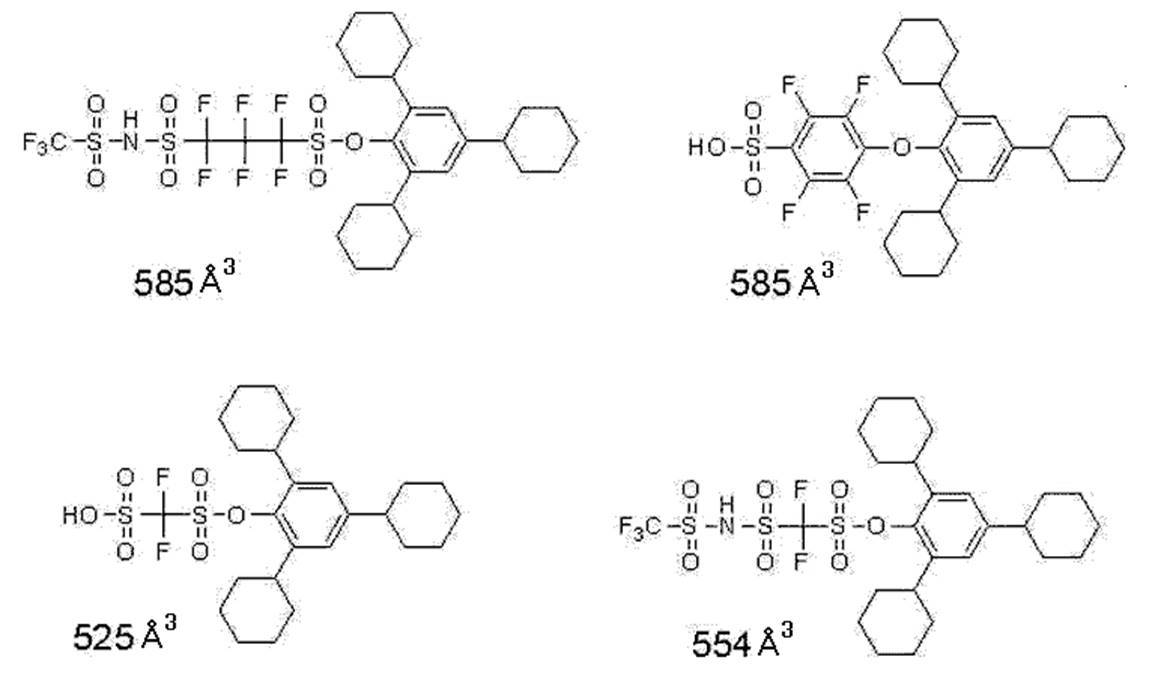
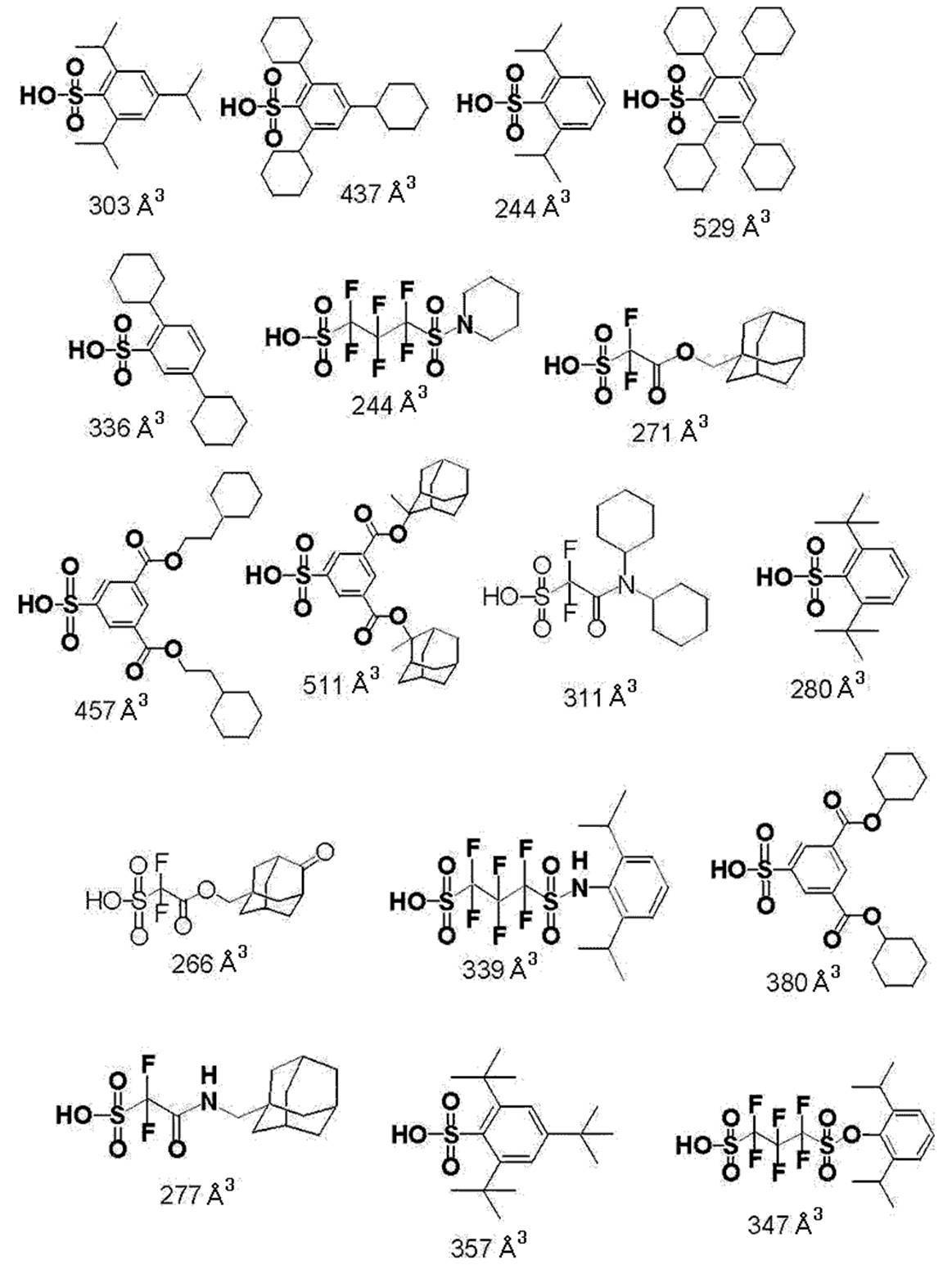
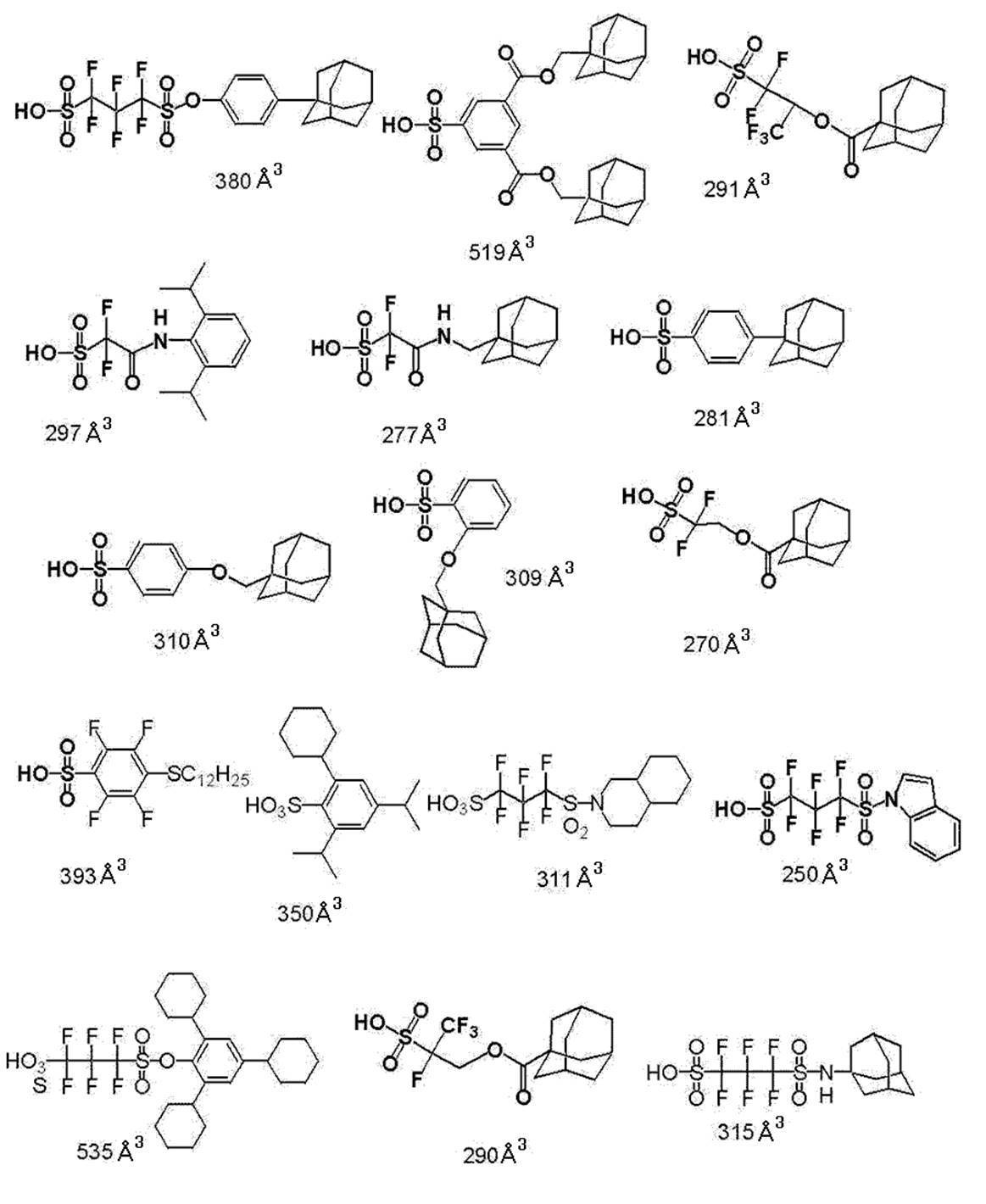
中でも、本発明の効果がより優れる点で、光酸発生剤(P)は、アニオン部及びカチオン部からなる光酸発生剤であることが好ましい。
光酸発生剤(P)としては、下記一般式(ZI)で表される化合物、又は、一般式(ZII)で表される化合物が好ましい。

上記一般式(ZI)において、
R201、R202及びR203は、それぞれ独立に、有機基を表す。
R201、R202及びR203としての有機基の炭素数は、1~30が好ましく、1~20がより好ましい。
また、R201~R203のうち2つが結合して環構造を形成してもよく、環内に酸素原子、硫黄原子、エステル結合、アミド結合、又は、カルボニル基を有していてもよい。R201~R203の内の2つが結合して形成する基としては、アルキレン基(例えば、ブチレン基、又は、ペンチレン基等)を挙げることができる。
Z-は、非求核性アニオン(求核反応を起こす能力が著しく低いアニオン)を表す。
非求核性アニオンとしては、例えば、スルホン酸アニオン(脂肪族スルホン酸アニオン、芳香族スルホン酸アニオン、及び、カンファースルホン酸アニオン等)、カルボン酸アニオン(脂肪族カルボン酸アニオン、芳香族カルボン酸アニオン、及び、アラルキルカルボン酸アニオン等)、スルホニルイミドアニオン、ビス(アルキルスルホニル)イミドアニオン、及び、トリス(アルキルスルホニル)メチドアニオン等が挙げられる。
脂肪族スルホン酸アニオン及び脂肪族カルボン酸アニオンにおける脂肪族部位は、アルキル基であってもシクロアルキル基であってもよく、炭素数1~30の直鎖状又は分岐鎖状のアルキル基、及び、炭素数3~30のシクロアルキル基が好ましい。
芳香族スルホン酸アニオン及び芳香族カルボン酸アニオンにおける芳香環基としては、炭素数6~14のアリール基が好ましく、例えば、フェニル基、トリル基、及び、ナフチル基が挙げられる。
上記で挙げたアルキル基、シクロアルキル基、及び、アリール基が有することができる置換基の具体例としては、ニトロ基、フッ素原子等のハロゲン原子、カルボキシル基、水酸基、アミノ基、シアノ基、アルコキシ基(好ましくは炭素数1~15)、シクロアルキル基(好ましくは炭素数3~15)、アリール基(好ましくは炭素数6~14)、アルコキシカルボニル基(好ましくは炭素数2~7)、アシル基(好ましくは炭素数2~12)、アルコキシカルボニルオキシ基(好ましくは炭素数2~7)、アルキルチオ基(好ましくは炭素数1~15)、アルキルスルホニル基(好ましくは炭素数1~15)、アルキルイミノスルホニル基(好ましくは炭素数1~15)、アリールオキシスルホニル基(好ましくは炭素数6~20)、アルキルアリールオキシスルホニル基(好ましくは炭素数7~20)、シクロアルキルアリールオキシスルホニル基(好ましくは炭素数10~20)、アルキルオキシアルキルオキシ基(好ましくは炭素数5~20)、及び、シクロアルキルアルキルオキシアルキルオキシ基(好ましくは炭素数8~20)が挙げられる。
アラルキルカルボン酸アニオンにおけるアラルキル基としては、炭素数7~12のアラルキル基が好ましく、例えば、ベンジル基、フェネチル基、ナフチルメチル基、ナフチルエチル基、及び、ナフチルブチル基が挙げられる。
スルホニルイミドアニオンとしては、例えば、サッカリンアニオンが挙げられる。
ビス(アルキルスルホニル)イミドアニオン、及び、トリス(アルキルスルホニル)メチドアニオンにおけるアルキル基としては、炭素数1~5のアルキル基が好ましい。これらのアルキル基の置換基としては、ハロゲン原子、ハロゲン原子で置換されたアルキル基、アルコキシ基、アルキルチオ基、アルキルオキシスルホニル基、アリールオキシスルホニル基、及び、シクロアルキルアリールオキシスルホニル基が挙げられ、フッ素原子又はフッ素原子で置換されたアルキル基が好ましい。
また、ビス(アルキルスルホニル)イミドアニオンにおけるアルキル基は、互いに結合して環構造を形成してもよい。これにより、酸強度が増加する。
その他の非求核性アニオンとしては、例えば、フッ素化燐(例えば、PF6 -)、フッ素化ホウ素(例えば、BF4 -)、及び、フッ素化アンチモン(例えば、SbF6 -)が挙げられる。
非求核性アニオンとしては、スルホン酸の少なくともα位がフッ素原子で置換された脂肪族スルホン酸アニオン、フッ素原子もしくはフッ素原子を有する基で置換された芳香族スルホン酸アニオン、アルキル基がフッ素原子で置換されたビス(アルキルスルホニル)イミドアニオン、又は、アルキル基がフッ素原子で置換されたトリス(アルキルスルホニル)メチドアニオンが好ましい。中でも、パーフロロ脂肪族スルホン酸アニオン(好ましくは炭素数4~8)、又は、フッ素原子を有するベンゼンスルホン酸アニオンがより好ましく、ノナフロロブタンスルホン酸アニオン、パーフロロオクタンスルホン酸アニオン、ペンタフロロベンゼンスルホン酸アニオン、又は、3,5-ビス(トリフロロメチル)ベンゼンスルホン酸アニオンが更に好ましい。
酸強度の観点からは、発生酸のpKaが-1以下であることが、感度向上のために好ましい。
また、非求核性アニオンとしては、以下の一般式(AN1)で表されるアニオンも好ましい。
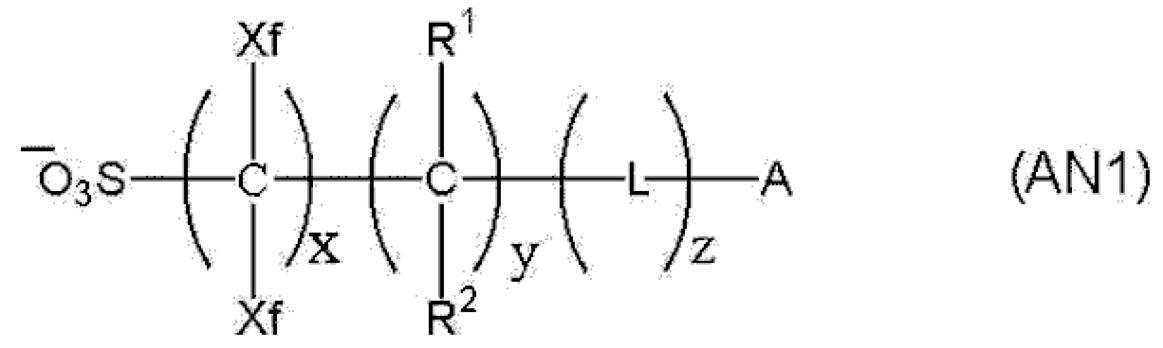
式中、
Xfは、それぞれ独立に、フッ素原子、又は、少なくとも1つのフッ素原子で置換されたアルキル基を表す。
R1及びR2は、それぞれ独立に、水素原子、フッ素原子、又は、アルキル基を表し、複数存在する場合のR1及びR2は、それぞれ同一でも異なっていてもよい。
Lは、二価の連結基を表し、複数存在する場合のLは同一でも異なっていてもよい。
Aは、環状の有機基を表す。
xは1~20の整数を表し、yは0~10の整数を表し、zは0~10の整数を表す。
一般式(AN1)について、更に詳細に説明する。
Xfのフッ素原子で置換されたアルキル基におけるアルキル基の炭素数は、1~10が好ましく、1~4がより好ましい。また、Xfのフッ素原子で置換されたアルキル基としては、パーフルオロアルキル基が好ましい。
Xfとしては、フッ素原子又は炭素数1~4のパーフルオロアルキル基が好ましい。Xfの具体例としては、フッ素原子、CF3、C2F5、C3F7、C4F9、CH2CF3、CH2CH2CF3、CH2C2F5、CH2CH2C2F5、CH2C3F7、CH2CH2C3F7、CH2C4F9、及び、CH2CH2C4F9等が挙げられ、中でも、フッ素原子、又は、CF3が好ましい。特に、両者のXfがフッ素原子であることが好ましい。
R1及びR2のアルキル基は、置換基(好ましくはフッ素原子)を有していてもよく、置換基中の炭素数は1~4が好ましい。置換基としては、炭素数1~4のパーフルオロアルキル基が好ましい。R1及びR2の置換基を有するアルキル基の具体例としては、CF3、C2F5、C3F7、C4F9、C5F11、C6F13、C7F15、C8F17、CH2CF3、CH2CH2CF3、CH2C2F5、CH2CH2C2F5、CH2C3F7、CH2CH2C3F7、CH2C4F9、及び、CH2CH2C4F9等が挙げられ、中でも、CF3が好ましい。
R1及びR2としては、フッ素原子又はCF3が好ましい。
xは1~10の整数が好ましく、1~5がより好ましい。
yは0~4の整数が好ましく、0がより好ましい。
zは0~5の整数が好ましく、0~3の整数がより好ましい。
Lの2価の連結基としては特に制限されず、-COO-、-CO-、-O-、-S-、-SO-、-SO2-、アルキレン基、シクロアルキレン基、アルケニレン基、及び、これらの複数が連結した連結基等が挙げられ、総炭素数12以下の連結基が好ましい。中でも、-COO-、-OCO-、-CO-、又は、-O-が好ましく、-COO-、又は、-OCO-がより好ましい。
Aの環状の有機基としては、環状構造を有するものであれば特に制限されず、脂環基、芳香環基、及び、複素環基(芳香族性を有するものだけでなく、芳香族性を有さないものも含む)等が挙げられる。
脂環基としては、単環でも多環でもよく、シクロペンチル基、シクロヘキシル基、及び、シクロオクチル基等の単環のシクロアルキル基が好ましく、その他にも、ノルボルニル基、トリシクロデカニル基、テトラシクロデカニル基、テトラシクロドデカニル基、及び、アダマンチル基等の多環のシクロアルキル基が好ましい。中でも、ノルボルニル基、トリシクロデカニル基、テトラシクロデカニル基、テトラシクロドデカニル基、及び、アダマンチル基等の炭素数7以上のかさ高い構造を有する脂環基が、露光後加熱工程での膜中拡散性を抑制でき、MEEF(Mask Error Enhancement Factor)向上の観点から好ましい。
芳香環基としては、ベンゼン環、ナフタレン環、フェナンスレン環、及び、アントラセン環等が挙げられる。
複素環基としては、フラン環、チオフェン環、ベンゾフラン環、ベンゾチオフェン環、ジベンゾフラン環、ジベンゾチオフェン環、及び、ピリジン環等由来の基が挙げられる。中でも、フラン環、チオフェン環、及び、ピリジン環由来の基が好ましい。
また、環状の有機基としては、ラクトン構造を有する基も挙げられ、具体例としては、前述の一般式(LC1-1)~(LC1-17)で表されるラクトン構造を有する基が挙げられる。
上記環状の有機基は、置換基を有していてもよい。上記置換基としては、アルキル基(直鎖状、分岐鎖状、及び、環状のいずれであってもよく、炭素数1~12が好ましい)、シクロアルキル基(単環、及び、多環のいずれであってもよく、多環である場合スピロ環であってもよい。炭素数は3~20が好ましい)、アリール基(炭素数6~14が好ましい)、水酸基、アルコキシ基、エステル基、アミド基、ウレタン基、ウレイド基、チオエーテル基、スルホンアミド基、及び、スルホン酸エステル基等が挙げられる。なお、環状の有機基を構成する炭素(環形成に寄与する炭素)はカルボニル炭素であってもよい。
R201、R202及びR203の有機基としては、アリール基、アルキル基、及び、シクロアルキル基等が挙げられる。
R201、R202及びR203のうち、少なくとも1つがアリール基であることが好ましく、三つ全てがアリール基であることがより好ましい。アリール基としては、フェニル基、及び、ナフチル基等の他に、インドール残基、及び、ピロール残基等のヘテロアリール基も可能である。
R201~R203のアルキル基としては、炭素数1~10の直鎖状又は分岐鎖状アルキル基が好ましく、メチル基、エチル基、n-プロピル基、i-プロピル基、又は、n-ブチル基がより好ましい。
R201~R203のシクロアルキル基としては、炭素数3~10のシクロアルキル基が好ましく、シクロプロピル基、シクロブチル基、シクロペンチル基、シクロヘキシル基、又は、シクロへプチル基がより好ましい。
これらの基が有してもよい置換基としては、ニトロ基、フッ素原子等のハロゲン原子、カルボキシル基、水酸基、アミノ基、シアノ基、アルコキシ基(好ましくは炭素数1~15)、シクロアルキル基(好ましくは炭素数3~15)、アリール基(好ましくは炭素数6~14)、アルコキシカルボニル基(好ましくは炭素数2~7)、アシル基(好ましくは炭素数2~12)、及び、アルコキシカルボニルオキシ基(好ましくは炭素数2~7)等が挙げられる。
一般式(ZII)中、
R204~R205は、それぞれ独立に、アリール基、アルキル基、又は、シクロアルキル基を表す。
R204~R205のアリール基、アルキル基、及び、シクロアルキル基としては、前述の一般式(ZI)におけるR201~R203のアリール基、アルキル基、及び、シクロアルキル基として説明した基と同様である。
R204~R205のアリール基、アルキル基、及び、シクロアルキル基が有していてもよい置換基としては、前述の化合物(ZI)におけるR201~R203のアリール基、アルキル基、及び、シクロアルキル基が有していてもよいものが挙げられる。
Z-は、非求核性アニオンを表し、一般式(ZI)に於けるZ-の非求核性アニオンと同様のものが挙げられる。
一般式(ZI)におけるスルホニウムカチオン、及び一般式(ZII)におけるヨードニウムカチオンの好ましい例を以下に示す。

好適な光酸発生剤(P)として、下記一般式(B-I)~(B-V)で表される化合物が挙げられる。

一般式(B-I)~(B-V)中、M+は、スルホニウムカチオン、又は、ヨードニウムカチオンを表す。一般式(B-I)~(B-V)におけるM+としては、上記一般式(ZI)におけるスルホニウムカチオン、又は、一般式(ZII)におけるヨードニウムカチオンが、その好適な態様も含めて好ましい。
一般式(B-I)中、R11は、フッ素原子で置換されていてもよい炭素数1~8のアルキル基を表す。R11としては、少なくとも1つのフッ素原子で置換された炭素数1~8のアルキル基が好ましく、炭素数1~8のパーフルオロアルキル基がより好ましく、炭素数2~4のパーフルオロアルキル基が更に好ましい。
一般式(B-II)中、R12は、水素原子、炭素数1~6のアルキル基、又は、-CF3を表す。R12は、炭素数3~6のアルキル基が好ましく、直鎖状もしくは分岐鎖状の炭素数3~6のアルキル基、又は、シクロヘキシル基が好ましい。また、R12は、(-SO3 -)基に対してオルト位又はパラ位に位置することが好ましい。
一般式(B-II)中、qは、1~5の整数を表す。qは、2~4の整数が好ましく、2又は3が好ましい。
一般式(B-III)中、R13は、水素原子、フッ素原子、又は、CF3を表す。R13の少なくとも1つが、フッ素原子又はCF3を表すことが好ましい。
一般式(B-III)中、X2は、-CO-O-、-CH2-CO-O-、又は、-CH2-O-CO-を表す。
一般式(B-III)中、rは、0~2の整数を表す。rは、0又は1が好ましい。
一般式(B-III)中、sは、1~3の整数を表す。sは、1又は2が好ましい。
一般式(B-IV)中、R13は、水素原子、フッ素原子、又は、CF3を表す。一般式(B-IV)において、R13の少なくとも1つが、フッ素原子又はCF3を表すことが好ましく、2以上のR13が、フッ素原子又はCF3を表すことがより好ましい。
一般式(B-IV)中、R14は、置換基を有していてもよい1価の多環基を表す。1価の多環基としては、複数の環構造からなる基であれば特に制限されず、例えば、上述の一般式(AN1)においてAで表される環状の有機基のうち多環構造を有する基が挙げられる。より具体的には、ノルボルナン環基、テトラシクロデカン環基、テトラシクロドデカン環基、及び、アダマンタン環基等の多環のシクロアルキル基が挙げられ、ノルボルナン環基又はアダマンタン環基が好ましい。
一般式(B-V)中、R13は、水素原子、フッ素原子、又は、CF3を表す。一般式(B-V)において、R13の少なくとも1つが、フッ素原子又はCF3を表すことが好ましく、2以上のR13が、フッ素原子又はCF3を表すことがより好ましい。
一般式(B-V)中、R15は、1価の有機基を表す。R15で表される1価の有機基としては、アルキル基、シクロアルキル基、アリール基、アラルキル基及びアルケニル基が挙げられ、炭素数1~6のアルキル基が好ましい。
一般式(B-V)中、X3は、-O-CO-O-、-SO2-又は-SO2-NR16-を表す。R16は、水素原子もしくはアルキル基を表すか、又は、R15と結合して環構造を形成するアルキレン基を表す。
一般式(B-V)で表される化合物においては、X3が-SO2-NR16-を表し、R15及びR16が結合して形成された炭素数4~6のアルキレン基と、-NR16-基中の窒素原子とで、置換基を有してもよいヘテロ環を形成することが好ましい。
本発明の組成物は、光酸発生剤(P)として、上記一般式(B-I)~(B-V)で表される化合物からなる群より選択される少なくとも1種を含有することが好ましい。
光酸発生剤(P)としては、特開2014-41328号公報の段落<0368>~<0377>、及び、特開2013-228681号公報の段落<0240>~<0262>(対応する米国特許出願公開第2015/004533号明細書の<0339>)が援用でき、これらの内容は本願明細書に組み込まれる。また、好ましい具体例として以下の化合物が挙げられるが、これらに制限されるものではない。
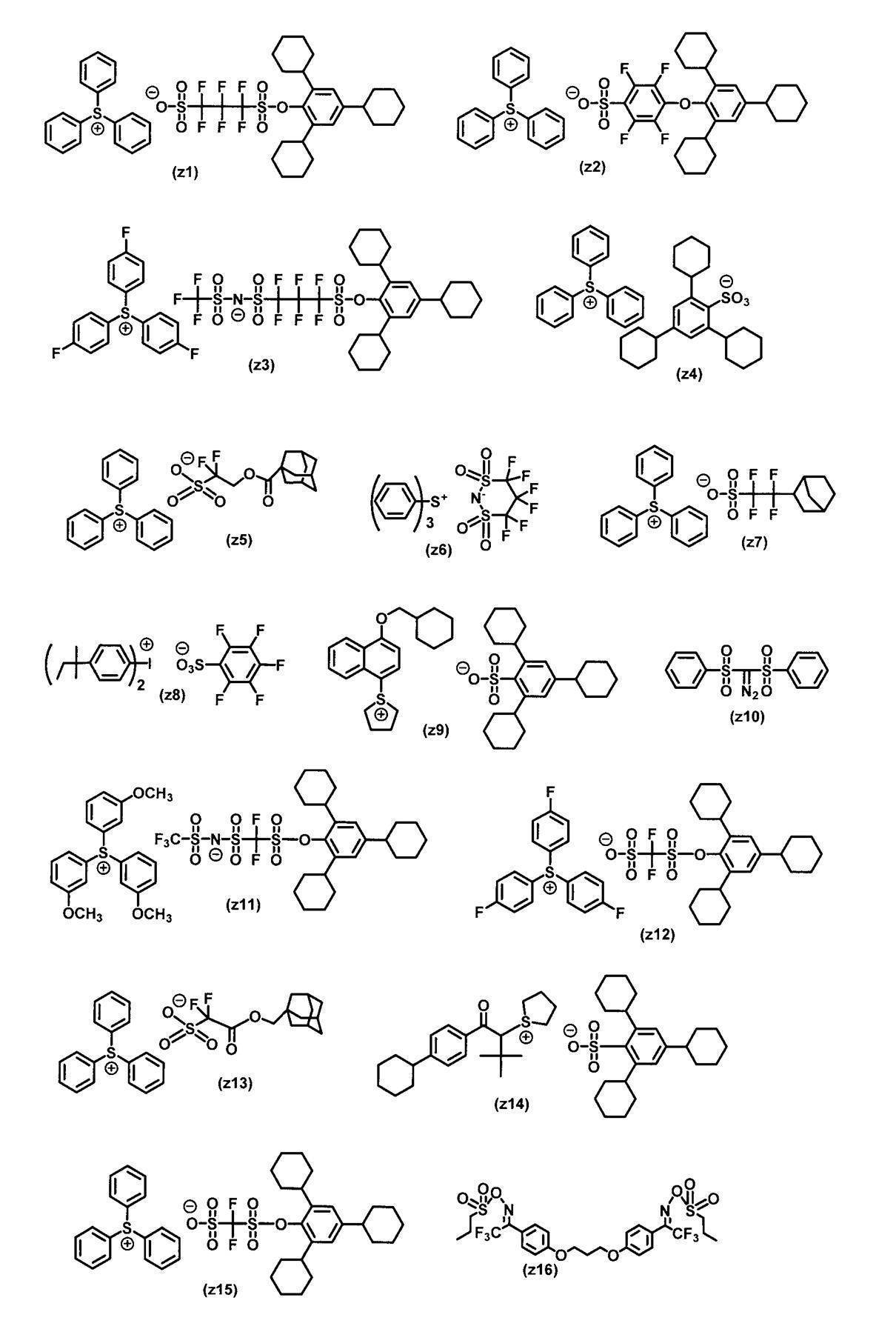


光酸発生剤(P)の含有量は特に制限されないが、本発明の効果がより優れる点で、組成物の全固形分に対して、5~50質量%が好ましく、10~40質量%がより好ましく、10~35質量%が更に好ましい。
光酸発生剤(P)は、1種単独で使用してもよいし、2種以上を併用してもよい。光酸発生剤(P)を2種以上併用する場合は、その合計量が上記範囲内であることが好ましい。
<酸拡散制御剤(Q)>
本発明の組成物は、酸拡散制御剤(Q)を含有していてもよい。
酸拡散制御剤(Q)は、露光時に光酸発生剤(P)等から発生する酸をトラップし、余分な発生酸による、未露光部における酸分解性樹脂の反応を抑制するクエンチャーとして作用するものである。酸拡散制御剤(Q)としては、例えば、塩基性化合物(DA)、放射線の照射により塩基性が低下又は消失する塩基性化合物(DB)、光酸発生剤(P)に対して相対的に弱酸となるオニウム塩(DC)、窒素原子を有し、酸の作用により脱離する基を有する低分子化合物(DD)、及び、カチオン部に窒素原子を有するオニウム塩化合物(DE)等が使用できる。
本発明の組成物においては、公知の酸拡散制御剤を適宜使用できる。例えば、米国特許出願公開2016/0070167号明細書の段落<0627>~<0664>、米国特許出願公開2015/0004544号明細書の段落<0095>~<0187>、米国特許出願公開2016/0237190号明細書の段落<0403>~<0423>、及び、米国特許出願公開2016/0274458号明細書の段落<0259>~<0328>に開示された公知の化合物を、酸拡散制御剤(Q)として好適に使用できる。
塩基性化合物(DA)としては、下記式(A)~(E)で示される構造を有する化合物が好ましい。

式(A)及び(E)中、
R200、R201及びR202は、同一でも異なってもよく、それぞれ独立に、水素原子、アルキル基(好ましくは炭素数1~20)、シクロアルキル基(好ましくは炭素数3~20)又はアリール基(炭素数6~20)を表す。R201とR202は、互いに結合して環を形成してもよい。
R203、R204、R205及びR206は、同一でも異なってもよく、それぞれ独立に、炭素数1~20のアルキル基を表す。
式(A)及び(E)中のアルキル基は、置換基を有していてもよく、無置換であってもよい。
上記アルキル基について、置換基を有するアルキル基としては、炭素数1~20のアミノアルキル基、炭素数1~20のヒドロキシアルキル基、又は、炭素数1~20のシアノアルキル基が好ましい。
式(A)及び(E)中のアルキル基は、無置換であることがより好ましい。
塩基性化合物(DA)としては、グアニジン、アミノピロリジン、ピラゾール、ピラゾリン、ピペラジン、アミノモルホリン、アミノアルキルモルフォリン、又は、ピペリジンが好ましく、イミダゾール構造、ジアザビシクロ構造、オニウムヒドロキシド構造、オニウムカルボキシレート構造、トリアルキルアミン構造、アニリン構造もしくはピリジン構造を有する化合物、水酸基及び/もしくはエーテル結合を有するアルキルアミン誘導体、又は、水酸基及び/もしくはエーテル結合を有するアニリン誘導体がより好ましい。
放射線の照射により塩基性が低下又は消失する塩基性化合物(DB)(以下、「化合物(DB)」とも記載する。)は、プロトンアクセプター性官能基を有し、かつ、放射線の照射により分解して、プロトンアクセプター性が低下、消失、又は、プロトンアクセプター性から酸性に変化する化合物である。
プロトンアクセプター性官能基とは、プロトンと静電的に相互作用し得る基又は電子を有する官能基であって、例えば、環状ポリエーテル等のマクロサイクリック構造を有する官能基、又は、π共役に寄与しない非共有電子対をもった窒素原子を有する官能基を意味する。π共役に寄与しない非共有電子対を有する窒素原子とは、例えば、下記式に示す部分構造を有する窒素原子である。
プロトンアクセプター性官能基の好ましい部分構造として、例えば、クラウンエーテル構造、アザクラウンエーテル構造、1~3級アミン構造、ピリジン構造、イミダゾール構造、及び、ピラジン構造が挙げられる。
化合物(DB)は、放射線の照射により分解してプロトンアクセプター性が低下もしくは消失し、又はプロトンアクセプター性から酸性に変化した化合物を発生する。ここでプロトンアクセプター性の低下もしくは消失、又はプロトンアクセプター性から酸性への変化とは、プロトンアクセプター性官能基にプロトンが付加することに起因するプロトンアクセプター性の変化であり、具体的には、プロトンアクセプター性官能基を有する化合物(DB)とプロトンとからプロトン付加体が生成するとき、その化学平衡における平衡定数が減少することを意味する。
プロトンアクセプター性は、pH測定を行うことによって確認できる。
放射線の照射により化合物(DB)が分解して発生する化合物の酸解離定数pKaは、pKa<-1を満たすことが好ましく、-13<pKa<-1を満たすことがより好ましく、-13<pKa<-3を満たすことが更に好ましい。
なお、酸解離定数pKaとは、上述した方法により求めることができる。
本発明の組成物では、光酸発生剤(P)に対して相対的に弱酸となるオニウム塩(DC)を酸拡散制御剤(Q)として使用できる。
光酸発生剤(P)と、光酸発生剤(P)から生じた酸に対して相対的に弱酸である酸を発生するオニウム塩とを混合して用いた場合、活性光線性又は放射線の照射により光酸発生剤(P)から生じた酸が未反応の弱酸アニオンを有するオニウム塩と衝突すると、塩交換により弱酸を放出して強酸アニオンを有するオニウム塩を生じる。この過程で強酸がより触媒能の低い弱酸に交換されるため、見かけ上、酸が失活して酸拡散を制御できる。
光酸発生剤(P)に対して相対的に弱酸となるオニウム塩としては、下記一般式(d1-1)~(d1-3)で表される化合物が好ましい。

式中、R51は置換基を有していてもよい炭化水素基であり、Z2cは置換基を有していてもよい炭素数1~30の炭化水素基(ただし、Sに隣接する炭素にはフッ素原子は置換されていないものとする)であり、R52は有機基であり、Y3は直鎖状、分岐鎖状もしくは環状のアルキレン基又はアリーレン基であり、Rfはフッ素原子を含む炭化水素基であり、M+はそれぞれ独立に、アンモニウムカチオン、スルホニウムカチオン又はヨードニウムカチオンである。
M+として表されるスルホニウムカチオン又はヨードニウムカチオンの好ましい例としては、上述した、一般式(ZI)で例示したスルホニウムカチオン及び一般式(ZII)で例示したヨードニウムカチオンが挙げられる。
光酸発生剤(P)に対して相対的に弱酸となるオニウム塩(DC)は、カチオン部位とアニオン部位を同一分子内に有し、かつ、カチオン部位とアニオン部位が共有結合により連結している化合物(以下、「化合物(DCA)」とも記載する。)であってもよい。
化合物(DCA)としては、下記一般式(C-1)~(C-3)のいずれかで表される化合物であることが好ましい。
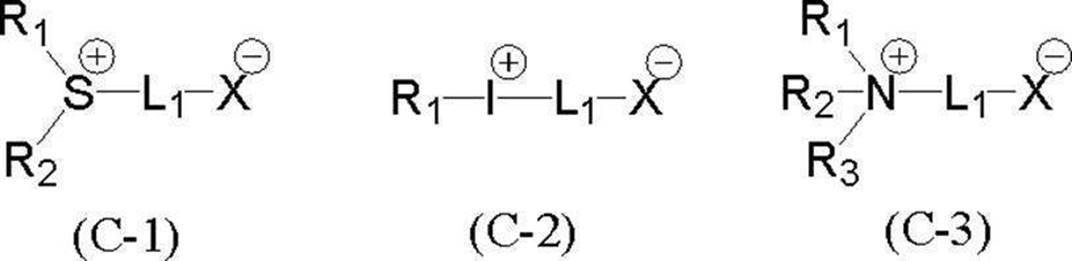
一般式(C-1)~(C-3)中、
R1、R2、及びR3は、それぞれ独立に炭素数1以上の置換基を表す。
L1は、カチオン部位とアニオン部位とを連結する2価の連結基又は単結合を表す。
-X-は、-COO-、-SO3 -、-SO2 -、及び-N--R4から選択されるアニオン部位を表す。R4は、隣接するN原子との連結部位に、カルボニル基(-C(=O)-)、スルホニル基(-S(=O)2-)、及びスルフィニル基(-S(=O)-)のうち少なくとも1つを有する1価の置換基を表す。
R1、R2、R3、R4、及びL1は、互いに結合して環構造を形成してもよい。また、一般式(C-3)において、R1~R3のうち2つを合わせて1つの2価の置換基を表し、N原子と二重結合により結合していてもよい。
R1~R3における炭素数1以上の置換基としては、アルキル基、シクロアルキル基、アリール基、アルキルオキシカルボニル基、シクロアルキルオキシカルボニル基、アリールオキシカルボニル基、アルキルアミノカルボニル基、シクロアルキルアミノカルボニル基、及び、アリールアミノカルボニル基が挙げられる。中でも、アルキル基、シクロアルキル基、又は、アリール基が好ましい。
2価の連結基としてのL1は、直鎖もしくは分岐鎖状アルキレン基、シクロアルキレン基、アリーレン基、カルボニル基、エーテル結合、エステル結合、アミド結合、ウレタン結合、ウレア結合、及び、これらの2種以上を組み合わせてなる基が挙げられる。L1は、好ましくは、アルキレン基、アリーレン基、エーテル結合、エステル結合、又はこれらの2種以上を組み合わせてなる基である。
窒素原子を有し、酸の作用により脱離する基を有する低分子化合物(DD)(以下、「化合物(DD)」とも記載する。)は、酸の作用により脱離する基を窒素原子上に有するアミン誘導体であることが好ましい。
酸の作用により脱離する基としては、アセタール基、カルボネート基、カルバメート基、3級エステル基、3級水酸基、又は、ヘミアミナールエーテル基が好ましく、カルバメート基、又は、ヘミアミナールエーテル基がより好ましい。
化合物(DD)の重量平均分子量(Mw)は、100~1000が好ましく、100~700がより好ましく、100~500が更に好ましい。
化合物(DD)は、窒素原子上に保護基を有するカルバメート基を有してもよい。カルバメート基を構成する保護基としては、下記一般式(d-1)で表される。
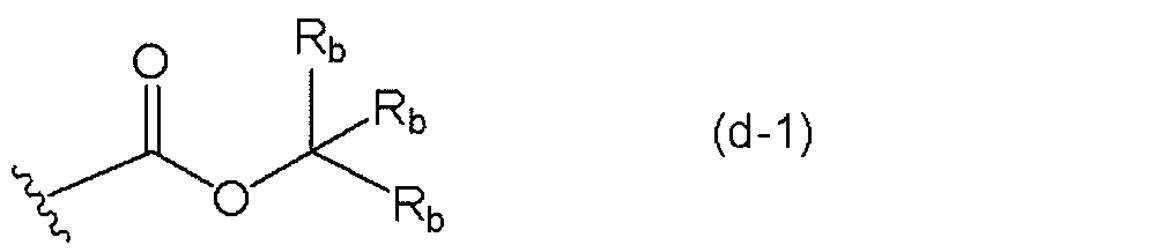
一般式(d-1)において、
Rbは、それぞれ独立に、水素原子、アルキル基(好ましくは炭素数1~10)、シクロアルキル基(好ましくは炭素数3~30)、アリール基(好ましくは炭素数3~30)、アラルキル基(好ましくは炭素数1~10)、又は、アルコキシアルキル基(好ましくは炭素数1~10)を表す。Rbは相互に連結して環を形成していてもよい。
Rbが示すアルキル基、シクロアルキル基、アリール基、及び、アラルキル基は、それぞれ独立に、水酸基、シアノ基、アミノ基、ピロリジノ基、ピペリジノ基、モルホリノ基、オキソ基等の官能基、アルコキシ基、又は、ハロゲン原子で置換されていてもよい。Rbが示すアルコキシアルキル基についても同様である。
Rbとしては、直鎖状もしくは分岐鎖状のアルキル基、シクロアルキル基、又は、アリール基が好ましく、直鎖状もしくは分岐鎖状のアルキル基、又は、シクロアルキル基がより好ましい。
2つのRbが相互に連結して形成する環としては、脂環式炭化水素、芳香族炭化水素、複素環式炭化水素、及び、その誘導体等が挙げられる。
一般式(d-1)で表される基の具体的な構造としては、米国特許公報US2012/0135348号明細書の段落<0466>に開示された構造が挙げられるが、これに制限されない。
化合物(DD)は、下記一般式(6)で表される化合物であることが好ましい。
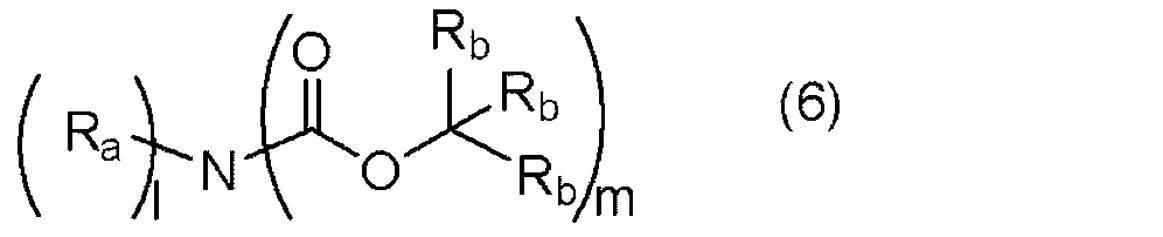
一般式(6)において、
lは0~2の整数を表し、mは1~3の整数を表し、l+m=3を満たす。
Raは、水素原子、アルキル基、シクロアルキル基、アリール基又はアラルキル基を表す。lが2のとき、2つのRaは同じでも異なっていてもよく、2つのRaは相互に連結して式中の窒素原子と共に複素環を形成していてもよい。この複素環には式中の窒素原子以外のヘテロ原子が含まれていてもよい。
Rbは、上記一般式(d-1)におけるRbと同義であり、好ましい例も同様である。
一般式(6)において、Raとしてのアルキル基、シクロアルキル基、アリール基、及び、アラルキル基は、それぞれ独立に、Rbとしてのアルキル基、シクロアルキル基、アリール基、及びアラルキル基が置換されていてもよい基として前述した基と同様の基で置換されていてもよい。
上記Raのアルキル基、シクロアルキル基、アリール基、及び、アラルキル基(これらの基は、上記基で置換されていてもよい)の具体例としては、Rbについて前述した具体例と同様の基が挙げられる。
本発明における特に好ましい化合物(DD)の具体例としては、米国特許出願公開2012/0135348号明細書の段落<0475>に開示された化合物が挙げられるが、これに制限されない。
カチオン部に窒素原子を有するオニウム塩化合物(DE)(以下、「化合物(DE)」とも記載する。)は、カチオン部に窒素原子を含む塩基性部位を有する化合物であることが好ましい。塩基性部位は、アミノ基であることが好ましく、脂肪族アミノ基であることがより好ましい。塩基性部位中の窒素原子に隣接する原子の全てが、水素原子又は炭素原子であることが更に好ましい。また、塩基性向上の観点から、窒素原子に対して、電子求引性の官能基(カルボニル基、スルホニル基、シアノ基、及びハロゲン原子等)が直結していないことが好ましい。
化合物(DE)の好ましい具体例としては、米国特許出願公開2015/0309408号明細書の段落<0203>に開示された化合物が挙げられるが、これに制限されない。
酸拡散制御剤(Q)の好ましい例を以下に示す。

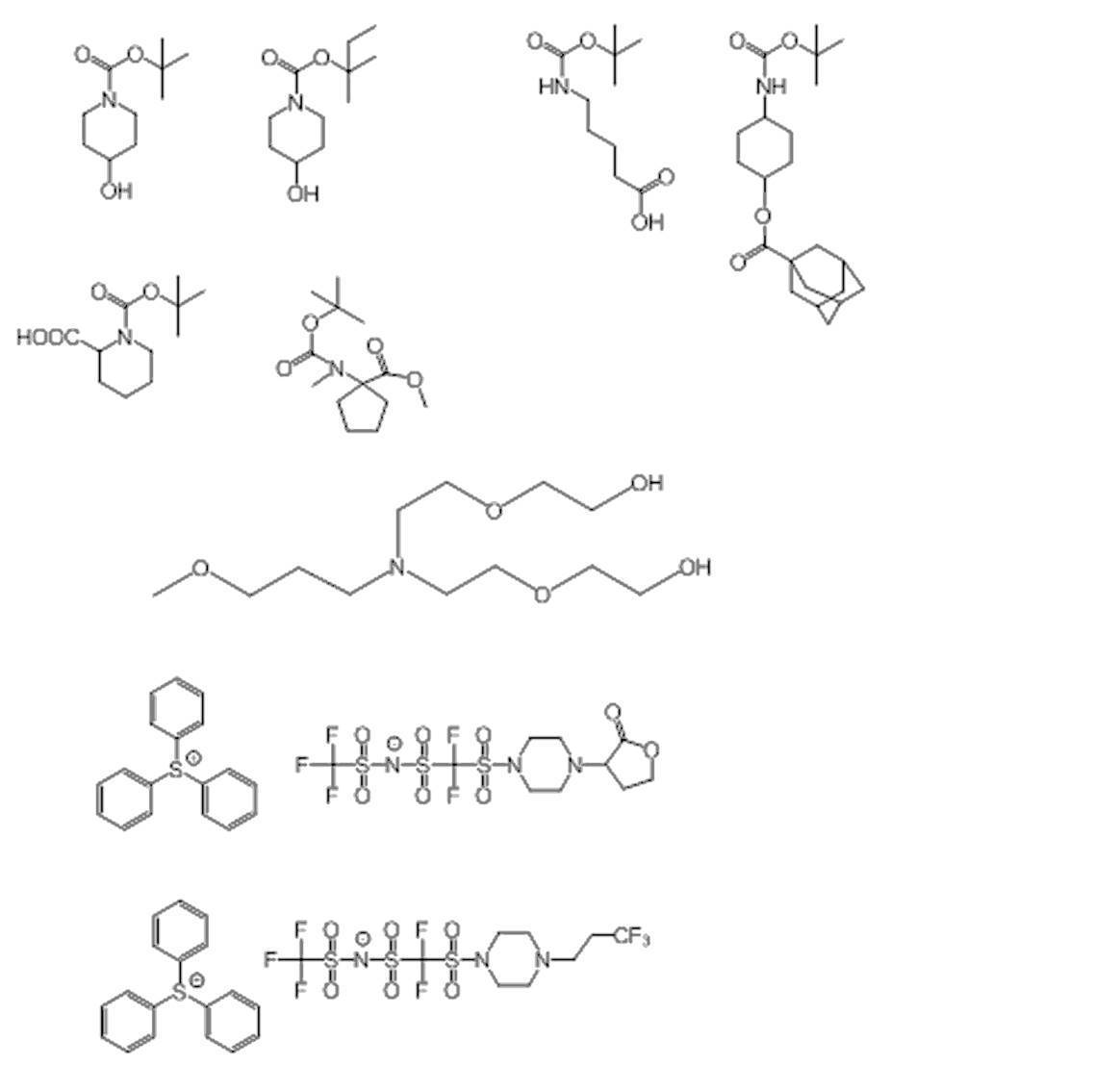


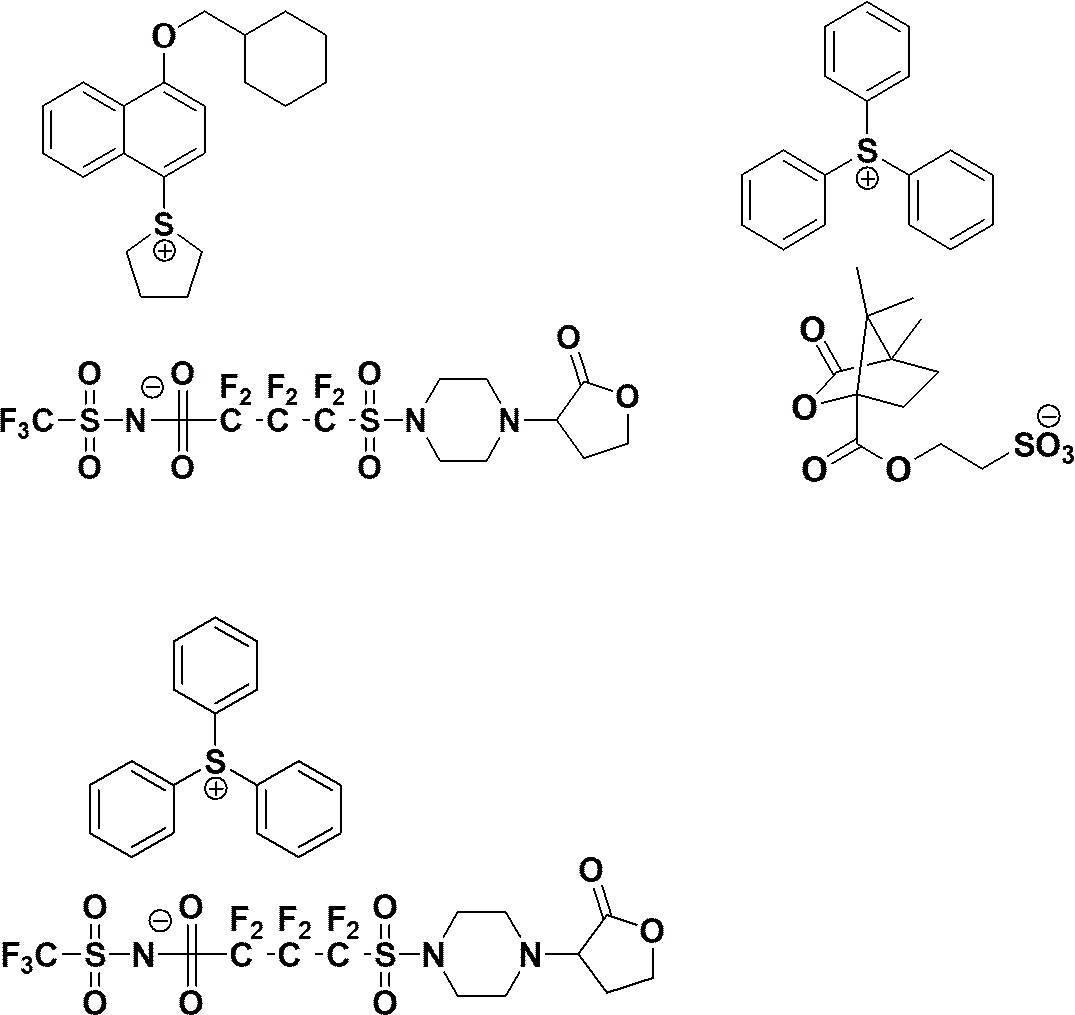
本発明の組成物に酸拡散制御剤(Q)が含まれる場合、酸拡散制御剤(Q)の含有量(複数種存在する場合はその合計)は、組成物の全固形分に対して、0.1~10.0質量%が好ましく、0.1~5.0質量%がより好ましい。
本発明の組成物において、酸拡散制御剤(Q)は1種単独で使用してもよいし、2種以上を併用してもよい。
<疎水性樹脂(E)>
本発明の組成物は、疎水性樹脂(E)として、上記樹脂(A)とは異なる疎水性の樹脂を含有していてもよい。
疎水性樹脂(E)は、レジスト膜の表面に偏在するように設計されることが好ましいが、界面活性剤とは異なり、必ずしも分子内に親水基を有する必要はなく、極性物質及び非極性物質を均一に混合することに寄与しなくてもよい。
疎水性樹脂(E)を添加することの効果として、水に対するレジスト膜表面の静的及び動的な接触角の制御、並びに、アウトガスの抑制等が挙げられる。
疎水性樹脂(E)は、膜表層への偏在化の観点から、“フッ素原子”、“珪素原子”、及び、“樹脂の側鎖部分に含まれたCH3部分構造”のいずれか1種以上を有することが好ましく、2種以上を有することがより好ましい。また、疎水性樹脂(E)は、炭素数5以上の炭化水素基を有することが好ましい。これらの基は樹脂の主鎖中に有していても、側鎖に置換していてもよい。
疎水性樹脂(E)が、フッ素原子及び/又は珪素原子を含む場合、疎水性樹脂における上記フッ素原子及び/又は珪素原子は、樹脂の主鎖中に含まれていてもよく、側鎖中に含まれていてもよい。
疎水性樹脂(E)がフッ素原子を有している場合、フッ素原子を有する部分構造としては、フッ素原子を有するアルキル基、フッ素原子を有するシクロアルキル基、又は、フッ素原子を有するアリール基が好ましい。
フッ素原子を有するアルキル基(好ましくは炭素数1~10、より好ましくは炭素数1~4)は、少なくとも1つの水素原子がフッ素原子で置換された直鎖状又は分岐鎖状のアルキル基であり、更にフッ素原子以外の置換基を有していてもよい。
フッ素原子を有するシクロアルキル基は、少なくとも1つの水素原子がフッ素原子で置換された単環又は多環のシクロアルキル基であり、更にフッ素原子以外の置換基を有していてもよい。
フッ素原子を有するアリール基としては、フェニル基、及び、ナフチル基等のアリール基の少なくとも1つの水素原子がフッ素原子で置換されたものが挙げられ、更にフッ素原子以外の置換基を有していてもよい。
フッ素原子又は珪素原子を有する繰り返し単位の例としては、US2012/0251948の段落<0519>に例示されたものが挙げられる。
また、上記したように、疎水性樹脂(E)は、側鎖部分にCH3部分構造を有することも好ましい。
ここで、疎水性樹脂中の側鎖部分が有するCH3部分構造は、エチル基、及び、プロピル基等を有するCH3部分構造を含む。
一方、疎水性樹脂(E)の主鎖に直接結合しているメチル基(例えば、メタクリル酸構造を有する繰り返し単位のα-メチル基)は、主鎖の影響により疎水性樹脂(E)の表面偏在化への寄与が小さいため、本発明におけるCH3部分構造に含まれないものとする。
疎水性樹脂(E)に関しては、特開2014-010245号公報の段落<0348>~<0415>の記載を参酌でき、これらの内容は本願明細書に組み込まれる。
なお、疎水性樹脂(E)としては、特開2011-248019号公報、特開2010-175859号公報、特開2012-032544号公報に記載された樹脂も、好ましく用いることができる。
本発明の組成物が疎水性樹脂(E)を含有する場合、疎水性樹脂(E)の含有量は、組成物の全固形分に対して、0.01~20質量%が好ましく、0.1~15質量%がより好ましい。
<溶剤(F)>
本発明の組成物は、溶剤(F)を含有してもよい。
本発明の組成物がEUV用の感放射線性樹脂組成物である場合、溶剤(F)は、(M1)プロピレングリコールモノアルキルエーテルカルボキシレート、並びに、(M2)プロピレングリコールモノアルキルエーテル、乳酸エステル、酢酸エステル、アルコキシプロピオン酸エステル、鎖状ケトン、環状ケトン、ラクトン、及び、アルキレンカーボネートからなる群より選択される少なくとも1つの少なくとも一方を含有していることが好ましい。この場合の溶剤は、成分(M1)及び(M2)以外の成分を更に含有していてもよい。
成分(M1)又は(M2)を含有する溶剤は、上述した樹脂(A)とを組み合わせて用いると、組成物の塗布性が向上すると共に、現像欠陥数の少ないパターンが形成可能となるため、好ましい。
成分(M1)としては、プロピレングリコールモノメチルエーテルアセテート(PGMEA:propylene glycol monomethylether acetate)、プロピレングリコールモノメチルエーテルプロピオネート、及び、プロピレングリコールモノエチルエーテルアセテートからなる群より選択される少なくとも1つが好ましく、プロピレングリコールモノメチルエーテルアセテート(PGMEA)がより好ましい。
成分(M2)としては、以下のものが好ましい。
プロピレングリコールモノアルキルエーテルとしては、プロピレングリコールモノメチルエーテル(PGME:propylene glycol monomethylether)、及び、プロピレングリコールモノエチルエーテルが好ましい。
乳酸エステルとしては、乳酸エチル、乳酸ブチル、又は、乳酸プロピルが好ましい。
酢酸エステルとしては、酢酸メチル、酢酸エチル、酢酸ブチル、酢酸イソブチル、酢酸プロピル、酢酸イソアミル、蟻酸メチル、蟻酸エチル、蟻酸ブチル、蟻酸プロピル、又は、酢酸3-メトキシブチルが好ましい。
また、酪酸ブチルも好ましい。
アルコキシプロピオン酸エステルとしては、3-メトキシプロピオン酸メチル(MMP:methyl 3-Methoxypropionate)、又は、3-エトキシプロピオン酸エチル(EEP:ethyl 3-ethoxypropionate)が好ましい。
鎖状ケトンとしては、1-オクタノン、2-オクタノン、1-ノナノン、2-ノナノン、アセトン、2-ヘプタノン、4-ヘプタノン、1-ヘキサノン、2-ヘキサノン、ジイソブチルケトン、フェニルアセトン、メチルエチルケトン、メチルイソブチルケトン、アセチルアセトン、アセトニルアセトン、イオノン、ジアセトニルアルコール、アセチルカービノール、アセトフェノン、メチルナフチルケトン、又は、メチルアミルケトンが好ましい。
環状ケトンとしては、メチルシクロヘキサノン、イソホロン、又は、シクロヘキサノンが好ましい。
ラクトンとしては、γ-ブチロラクトンが好ましい。
アルキレンカーボネートとしては、プロピレンカーボネートが好ましい。
成分(M2)としては、プロピレングリコールモノメチルエーテル(PGME)、乳酸エチル、3-エトキシプロピオン酸エチル、メチルアミルケトン、シクロヘキサノン、酢酸ブチル、酢酸ペンチル、γ-ブチロラクトン、又は、プロピレンカーボネートがより好ましい。
上記成分の他、炭素数が7以上(7~14が好ましく、7~12がより好ましく、7~10が更に好ましい)、かつ、ヘテロ原子数が2以下のエステル系溶剤を用いることが好ましい。
炭素数が7以上かつヘテロ原子数が2以下のエステル系溶剤としては、酢酸アミル、酢酸2-メチルブチル、酢酸1-メチルブチル、酢酸ヘキシル、プロピオン酸ペンチル、プロピオン酸ヘキシル、プロピオン酸ブチル、イソ酪酸イソブチル、プロピオン酸ヘプチル、又は、ブタン酸ブチルが好ましく、酢酸イソアミルがより好ましい。
成分(M2)としては、引火点(以下、fpとも記載する)が37℃以上であるものが好ましい。このような成分(M2)としては、プロピレングリコールモノメチルエーテル(fp:47℃)、乳酸エチル(fp:53℃)、3-エトキシプロピオン酸エチル(fp:49℃)、メチルアミルケトン(fp:42℃)、シクロヘキサノン(fp:44℃)、酢酸ペンチル(fp:45℃)、2-ヒドロキシイソ酪酸メチル(fp:45℃)、γ-ブチロラクトン(fp:101℃)、又は、プロピレンカーボネート(fp:132℃)が好ましい。これらのうち、プロピレングリコールモノエチルエーテル、乳酸エチル、酢酸ペンチル、又は、シクロヘキサノンがより好ましく、プロピレングリコールモノエチルエーテル、又は、乳酸エチルが更に好ましい。
なお、ここで「引火点」とは、東京化成工業株式会社又はシグマアルドリッチ社の試薬カタログに記載されている値を意味している。
溶剤(F)は、成分(M1)を含有していることが好ましい。溶剤(F)は、実質的に成分(M1)のみからなるか、又は、成分(M1)と他の成分との混合溶剤であることがより好ましい。後者の場合、溶剤(F)は、成分(M1)と成分(M2)との両者を含有していることが更に好ましい。
成分(M1)と成分(M2)との質量比(M1/M2)は、「100/0」~「15/85」の範囲内にあることが好ましく、「100/0」~「40/60」の範囲内にあることがより好ましく、「100/0」~「60/40」の範囲内にあることが更に好ましい。つまり、溶剤(F)は、成分(M1)のみからなるか、又は、成分(M1)と成分(M2)との両者を含有しており、かつ、それらの質量比が以下のとおりであることが好ましい。即ち、後者の場合、成分(M2)に対する成分(M1)の質量比は、15/85以上であることが好ましく、40/60以上であることよりが好ましく、60/40以上であることが更に好ましい。このような構成を採用すると、現像欠陥数を更に減少させることが可能となる。
なお、溶剤(F)が成分(M1)と成分(M2)との両者を含有している場合、成分(M2)に対する成分(M1)の質量比は、例えば、99/1以下とする。
上述のとおり、溶剤(F)は、成分(M1)及び(M2)以外の成分を更に含有していてもよい。この場合、成分(M1)及び(M2)以外の成分の含有量は、溶剤(F)の全量に対して、5~30質量%の範囲内にあることが好ましい。
また、本発明の組成物がArF用の感放射線性樹脂組成物である場合、溶剤(F)としては、例えば、アルキレングリコールモノアルキルエーテルカルボキシレート、アルキレングリコールモノアルキルエーテル、乳酸アルキルエステル、アルコキシプロピオン酸アルキル、環状ラクトン(好ましくは炭素数4~10)、環を含有してもよいモノケトン化合物(好ましくは炭素数4~10)、アルキレンカーボネート、アルコキシ酢酸アルキル、及び、ピルビン酸アルキル等の有機溶剤が挙げられる。
アルキレングリコールモノアルキルエーテルカルボキシレートとしては、例えば、プロピレングリコールモノメチルエーテルアセテート、プロピレングリコールモノエチルエーテルアセテート、プロピレングリコールモノプロピルエーテルアセテート、プロピレングリコールモノブチルエーテルアセテート、プロピレングリコールモノメチルエーテルプロピオネート、プロピレングリコールモノエチルエーテルプロピオネート、エチレングリコールモノメチルエーテルアセテート、又は、エチレングリコールモノエチルエーテルアセテートが好ましい。
アルキレングリコールモノアルキルエーテルとしては、例えば、プロピレングリコールモノメチルエーテル、プロピレングリコールモノエチルエーテル、プロピレングリコールモノプロピルエーテル、プロピレングリコールモノブチルエーテル、エチレングリコールモノメチルエーテル、又は、エチレングリコールモノエチルエーテルが好ましい。
乳酸アルキルエステルとしては、乳酸メチル、乳酸エチル、乳酸プロピル、乳酸ブチルが好ましい。
アルコキシプロピオン酸アルキルとしては、3-エトキシプロピオン酸エチル、3-メトキシプロピオン酸メチル、3-エトキシプロピオン酸メチル、又は、3-メトキシプロピオン酸エチルが好ましい。
環状ラクトンとしては、β-プロピオラクトン、β-ブチロラクトン、γ-ブチロラクトン、α-メチル-γ-ブチロラクトン、β-メチル-γ-ブチロラクトン、γ-バレロラクトン、γ-カプロラクトン、γ-オクタノイックラクトン、又は、α-ヒドロキシ-γ-ブチロラクトンが好ましい。
環を含有してもよいモノケトン化合物としては、2-ブタノン、3-メチルブタノン、ピナコロン、2-ペンタノン、3-ペンタノン、3-メチル-2-ペンタノン、4-メチル-2-ペンタノン、2-メチル-3-ペンタノン、4,4-ジメチル-2-ペンタノン、2,4-ジメチル-3-ペンタノン、2,2,4,4-テトラメチル-3-ペンタノン、2-ヘキサノン、3-ヘキサノン、5-メチル-3-ヘキサノン、2-ヘプタノン、3-ヘプタノン、4-ヘプタノン、2-メチル-3-ヘプタノン、5-メチル-3-ヘプタノン、2,6-ジメチル-4-ヘプタノン、2-オクタノン、3-オクタノン、2-ノナノン、3-ノナノン、5-ノナノン、2-デカノン、3-デカノン、4-デカノン、5-ヘキセン-2-オン、3-ペンテン-2-オン、シクロペンタノン、2-メチルシクロペンタノン、3-メチルシクロペンタノン、2,2-ジメチルシクロペンタノン、2,4,4-トリメチルシクロペンタノン、シクロヘキサノン、3-メチルシクロヘキサノン、4-メチルシクロヘキサノン、4-エチルシクロヘキサノン、2,2-ジメチルシクロヘキサノン、2,6-ジメチルシクロヘキサノン、2,2,6-トリメチルシクロヘキサノン、シクロヘプタノン、2-メチルシクロヘプタノン、又は、3-メチルシクロヘプタノンが好ましい。
アルキレンカーボネートとしては、プロピレンカーボネート、ビニレンカーボネート、エチレンカーボネート、又は、ブチレンカーボネートが好ましい。
アルコキシ酢酸アルキルとしては、酢酸-2-メトキシエチル、酢酸-2-エトキシエチル、酢酸-2-(2-エトキシエトキシ)エチル、酢酸-3-メトキシ-3-メチルブチル、又は、酢酸-1-メトキシ-2-プロピルが好ましい。
ピルビン酸アルキルとしては、ピルビン酸メチル、ピルビン酸エチル、又は、ピルビン酸プロピルが好ましい。
溶剤(F)としては、常温常圧下で、沸点130℃以上の溶剤が好ましい。具体的には、シクロペンタノン、γ-ブチロラクトン、シクロヘキサノン、乳酸エチル、エチレングリコールモノエチルエーテルアセテート、プロピレングリコールモノメチルエーテルアセテート、3-エトキシプロピオン酸エチル、ピルビン酸エチル、酢酸-2-エトキシエチル、酢酸-2-(2-エトキシエトキシ)エチル、及び、プロピレンカーボネートが挙げられる。
本発明においては、上記溶剤を単独で使用してもよいし、2種類以上を併用してもよい。
溶剤(F)としては、有機溶剤として構造中に水酸基を含有する溶剤と、水酸基を含有しない溶剤とを混合した混合溶剤を使用してもよい。
水酸基を含有する溶剤及び水酸基を含有しない溶剤としては、前述の例示化合物が適宜選択可能であるが、水酸基を含有する溶剤としては、アルキレングリコールモノアルキルエーテル、又は、乳酸アルキルが好ましく、プロピレングリコールモノメチルエーテル、乳酸エチルがより好ましい。
また、水酸基を含有しない溶剤としては、アルキレングリコールモノアルキルエーテルアセテート、アルキルアルコキシプロピオネート、環を含有してもよいモノケトン化合物、環状ラクトン、又は、酢酸アルキルが好ましく、プロピレングリコールモノメチルエーテルアセテート、エチルエトキシプロピオネート、2-ヘプタノン、γ-ブチロラクトン、シクロヘキサノン、又は、酢酸ブチルがより好ましく、プロピレングリコールモノメチルエーテルアセテート、エチルエトキシプロピオネート、又は、2-ヘプタノンが更に好ましい。
水酸基を含有する溶剤と水酸基を含有しない溶剤との混合比(質量)は、1/99~99/1が好ましく、10/90~90/10がより好ましく、20/80~60/40が更に好ましい。
水酸基を含有しない溶剤を50質量%以上含有する混合溶剤が塗布均一性の点で特に好ましい。
溶剤(F)としては、プロピレングリコールモノメチルエーテルアセテートを含有する2種類以上の混合溶剤が好ましい。
本発明の組成物中の溶剤(F)の含有量は、固形分濃度が0.5~30質量%となるように定めることが好ましく、1~20質量%となるように定めることがより好ましい。こうすると、組成物の塗布性がより優れる。
<架橋剤(G)>
本開示に係る感光性樹脂組成物は、酸の作用により樹脂を架橋する化合物(以下、架橋剤(G)ともいう。)を含有してもよい。
架橋剤(G)としては、公知の化合物を適宜に使用することができる。例えば、米国特許出願公開第2016/0147154号明細書の段落0379~0431、米国特許出願公開第2016/0282720号明細書の段落0064~0141に開示された公知の化合物を架橋剤(G)として好適に使用できる。
架橋剤(G)は、樹脂を架橋しうる架橋性基を有している化合物であり、架橋性基としては、ヒドロキシメチル基、アルコキシメチル基、アシルオキシメチル基、アルコキシメチルエーテル基、オキシラン環、及びオキセタン環などが挙げられる。架橋性基としては、ヒドロキシメチル基、アルコキシメチル基、オキシラン環又はオキセタン環が好ましい。
架橋剤(G)は、架橋性基を2個以上有する化合物(樹脂も含む)であることが好ましい。
架橋剤(G)は、ヒドロキシメチル基又はアルコキシメチル基を有する、フェノール誘導体、ウレア系化合物(ウレア構造を有する化合物)又はメラミン系化合物(メラミン構造を有する化合物)であることがより好ましい。
架橋剤は1種単独で用いてもよく、2種以上を併用してもよい。
架橋剤(G)の含有量は、組成物の全固形分に対して、1~50質量%が好ましく、3~40質量%がより好ましく、5~30質量%が更に好ましい。
<界面活性剤(H)>
本発明の組成物は、界面活性剤(H)を含有してもよい。界面活性剤(H)を含有することにより、密着性により優れ、現像欠陥のより少ないパターンを形成できる。
界面活性剤(H)としては、フッ素系及び/又はシリコン系界面活性剤が好ましい。
フッ素系及び/又はシリコン系界面活性剤としては、例えば、米国特許出願公開第2008/0248425号明細書の段落<0276>に記載の界面活性剤が挙げられる。また、エフトップEF301又はEF303(新秋田化成(株)製);フロラードFC430、431又は4430(住友スリーエム(株)製);メガファックF171、F173、F176、F189、F113、F110、F177、F120又はR08(DIC(株)製);サーフロンS-382、SC101、102、103、104、105又は106(旭硝子(株)製);トロイゾルS-366(トロイケミカル(株)製);GF-300又はGF-150(東亞合成化学(株)製)、サーフロンS-393(セイミケミカル(株)製);エフトップEF121、EF122A、EF122B、RF122C、EF125M、EF135M、EF351、EF352、EF801、EF802又はEF601((株)ジェムコ製);PF636、PF656、PF6320又はPF6520(OMNOVA社製);KH-20(旭化成(株)製);FTX-204G、208G、218G、230G、204D、208D、212D、218D又は222D((株)ネオス製)を用いてもよい。なお、ポリシロキサンポリマーKP-341(信越化学工業(株)製)も、シリコン系界面活性剤として用いることができる。
また、界面活性剤(H)は、上記に示すような公知の界面活性剤の他に、テロメリゼーション法(テロマー法ともいわれる)又はオリゴメリゼーション法(オリゴマー法ともいわれる)により製造されたフルオロ脂肪族化合物を用いて合成してもよい。具体的には、このフルオロ脂肪族化合物から導かれたフルオロ脂肪族基を備えた重合体を、界面活性剤(H)として用いてもよい。このフルオロ脂肪族化合物は、例えば、特開2002-90991号公報に記載された方法によって合成できる。
フルオロ脂肪族基を有する重合体としては、フルオロ脂肪族基を有するモノマーと(ポリ(オキシアルキレン))アクリレート及び/又は(ポリ(オキシアルキレン))メタクリレートとの共重合体が好ましく、不規則に分布しているものでも、ブロック共重合していてもよい。また、ポリ(オキシアルキレン)基としては、ポリ(オキシエチレン)基、ポリ(オキシプロピレン)基、及び、ポリ(オキシブチレン)基が挙げられ、また、ポリ(オキシエチレンとオキシプロピレンとオキシエチレンとのブロック連結体)やポリ(オキシエチレンとオキシプロピレンとのブロック連結体)等同じ鎖長内に異なる鎖長のアルキレンを有するようなユニットでもよい。更に、フルオロ脂肪族基を有するモノマーと(ポリ(オキシアルキレン))アクリレート(又はメタクリレート)との共重合体は2元共重合体ばかりでなく、異なる2種以上のフルオロ脂肪族基を有するモノマー、及び、異なる2種以上の(ポリ(オキシアルキレン))アクリレート(又はメタクリレート)等を同時に共重合した3元系以上の共重合体でもよい。
例えば、市販の界面活性剤としては、メガファックF178、F-470、F-473、F-475、F-476、F-472(DIC(株)製)、C6F13基を有するアクリレート(又はメタクリレート)と(ポリ(オキシアルキレン))アクリレート(又はメタクリレート)との共重合体、C3F7基を有するアクリレート(又はメタクリレート)と(ポリ(オキシエチレン))アクリレート(又はメタクリレート)と(ポリ(オキシプロピレン))アクリレート(又はメタクリレート)との共重合体が挙げられる。
また、米国特許出願公開第2008/0248425号明細書の段落<0280>に記載されているフッ素系及び/又はシリコン系以外の界面活性剤を使用してもよい。
これら界面活性剤(H)は、1種を単独で用いてもよく、又は、2種以上を組み合わせて用いてもよい。
界面活性剤(H)の含有量は、組成物の全固形分に対して、0.0001~2質量%が好ましく、0.0005~1質量%がより好ましい。
<フェノール性水酸基を有するアルカリ可溶性樹脂(C)>
組成物は、フェノール性水酸基を有するアルカリ可溶性樹脂(C)(以下単に「樹脂(C)」とも記載する)を含有してもよい。組成物が架橋剤(G)を含有する場合、組成物は樹脂(C)を含有することが好ましい。樹脂(C)は、フェノール性水酸基を有する繰り返し単位を有することが好ましい。
組成物が架橋剤(G)及び樹脂(C)を含有する場合、典型的には、ネガ型パターンが好適に形成される。
上述の架橋剤(G)は、樹脂(C)に担持された形態であってもよい。
なお、樹脂(C)のうち、酸の作用により極性が増大する樹脂(A)に該当するものは、樹脂(A)として扱う。また、その場合、組成物は、樹脂(A)と樹脂(C)とを少なくとも含有することが好ましい。
樹脂(C)は、上述した酸分解性基を含有していてもよい。
樹脂(C)が有するフェノール性水酸基を有する繰り返し単位としては、特に制限されないが、下記式(II)で表される繰り返し単位であることが好ましい。

式(II)中、R2は、水素原子、置換基を有していてもよいアルキル基(好ましくはメチル基)、又はハロゲン原子(好ましくはフッ素原子)を表し、B’は、単結合又は2価の連結基を表し、Ar’は、芳香環基を表し、mは1以上の整数を表す。
樹脂(C)は、1種単独で使用してもよいし、2種以上を併用してもよい。
樹脂(C)の含有量は、組成物の全固形分中に対して、30質量%以上が好ましく、40質量%以上がより好ましく、50質量%以上が更に好ましい。上限は特に制限されないが、99質量%以下が好ましく、90質量%以下がより好ましく、85質量%以下が更に好ましい。
樹脂(C)としては、米国特許出願公開第016/0282720号明細書の段落0142~0347に開示された樹脂を好適に用いることができる。
<カルボン酸オニウム塩>
本発明の組成物は、カルボン酸オニウム塩を含有していてもよい。
カルボン酸オニウム塩としては、ヨードニウム塩又はスルホニウム塩が好ましい。アニオン部としては、炭素数1~30の直鎖状、分岐鎖状、又は、環状(例えば、単環状又は多環環状)のアルキルカルボン酸アニオンが好ましく、アルキル基の一部又は全てがフッ素置換されたアルキルカルボン酸アニオンがより好ましい。
上記アルキル基中には、酸素原子を含まれていてもよい。これにより220nm以下の光に対する透明性が確保され、感度及び解像力が向上し、疎密依存性及び露光マージンが改良される。
フッ素置換されたカルボン酸のアニオンとしては、フロロ酢酸、ジフロロ酢酸、トリフロロ酢酸、ペンタフロロプロピオン酸、ヘプタフロロ酪酸、ノナフロロペンタン酸、パーフロロドデカン酸、パーフロロトリデカン酸、パーフロロシクロヘキサンカルボン酸、及び、2,2-ビストリフロロメチルプロピオン酸のアニオンが挙げられる。
カルボン酸オニウム塩の含有量は、組成物の全固形分に対して、0.1~20質量%が好ましく、0.5~10質量%がより好ましく、1~7質量%が更に好ましい。
<溶解阻止化合物>
本発明の組成物は、酸の作用により分解してアルカリ現像液中での溶解度が増大する、重量平均分子量(Mw)が3000以下である溶解阻止化合物(以下、単に「溶解阻止化合物」とも記載する)を含有していてもよい。
溶解阻止化合物としては、220nm以下の透過性を低下させないため、Proceeding of SPIE, 2724,355 (1996)に記載されている酸分解性基を有するコール酸誘導体のような、酸分解性基を有する脂環族又は脂肪族化合物が好ましい。
なお、本発明の組成物をKrFエキシマレーザーで露光するか、或いはEBで照射する場合には、フェノール化合物のフェノール性水酸基を酸分解性基で置換した構造を有する溶解阻止化合物が好ましい。溶解阻止化合物が上記フェノール化合物由来の構造を有する場合、上記フェノール化合物は、1~9個のフェノール骨格を有することが好ましく、2~6個のフェノール骨格を有することがより好ましい。
溶解阻止化合物の含有量は、組成物の全固形分に対して、3~50質量%が好ましく、5~40質量%がより好ましい。
以下に、溶解阻止化合物の具体例を示すが、本発明はこれらに制限されない。


<その他の添加剤>
本発明の組成物は、染料、可塑剤、光増感剤、光吸収剤、及び/又は、現像液に対する溶解性を促進させる化合物(例えば、重量平均分子量(Mw)が1000以下であるフェノール化合物、又はカルボキシル基を有する脂環族もしくは脂肪族化合物)を更に含有していてもよい。
重量平均分子量(Mw)が1000以下であるフェノール化合物は、例えば、特開平4-122938号公報、特開平2-28531号公報、米国特許第4,916,210号明細書、欧州特許第219294号明細書等に記載の方法を参考にして、当業者において容易に合成できる。
カルボキシル基を有する脂環族又は脂肪族化合物の具体例としては、コール酸、デオキシコール酸、及び、リトコール酸等のステロイド構造を有するカルボン酸誘導体、アダマンタンカルボン酸誘導体、アダマンタンジカルボン酸、シクロヘキサンカルボン酸、シクロヘキサンジカルボン酸が挙げられる。
<用途>
本発明の組成物は、放射線の照射により反応して性質が変化する感放射線性樹脂組成物に関する。更に詳しくは、本発明の組成物は、IC(Integrated Circuit)等の半導体製造工程、液晶もしくはサーマルヘッド等の回路基板の製造、インプリント用モールド構造体の作製、その他のフォトファブリケーション工程、又は平版印刷版、もしくは酸硬化性組成物の製造に使用される感放射線性樹脂組成物に関する。本発明において形成されるパターンは、エッチング工程、イオンインプランテーション工程、バンプ電極形成工程、再配線形成工程、及びMEMS(Micro Electro Mechanical Systems)等において使用できる。
〔パターン形成方法〕
本発明の組成物を用いたパターン形成方法の手順は特に制限されないが、以下の工程を有することが好ましい。
工程1:組成物を用いて、基板上にレジスト膜を形成する工程
工程2:レジスト膜を露光する工程
工程3:現像液を用いて、露光されたレジスト膜を現像し、パターンを形成する工程
以下、上記それぞれの工程の手順について詳述する。
<工程1:レジスト膜形成工程>
工程1は、本発明の組成物を用いて、基板上にレジスト膜を形成する工程である。
本発明の組成物については、上述のとおりである。
組成物を用いて基板上にレジスト膜を形成する方法としては、組成物を基板上に塗布する方法が挙げられる。
なお、塗布前に組成物を必要に応じてフィルター濾過することが好ましい。フィルターのポアサイズとしては、0.1μm以下が好ましく、0.05μm以下がより好ましく、0.03μm以下が更に好ましい。また、フィルターは、ポリテトラフロロエチレン製、ポリエチレン製、又は、ナイロン製が好ましい。
組成物は、集積回路素子の製造に使用されるような基板(例:シリコン、二酸化シリコン被覆)上に、スピナー又はコーター等の適当な塗布方法により塗布できる。塗布方法としては、スピナーを用いたスピン塗布が好ましい。スピナーを用いたスピン塗布をする際の回転数は、1000~3000rpmが好ましい。
組成物の塗布後、基板を乾燥し、レジスト膜を形成してもよい。なお、必要により、レジスト膜の下層に、各種下地膜(無機膜、有機膜、反射防止膜)を形成してもよい。
乾燥方法としては、加熱して乾燥する方法が挙げられる。加熱は通常の露光機、及び/又は、現像機に備わっている手段で行うことができ、ホットプレート等を用いて行ってもよい。加熱温度は80~150℃が好ましく、80~140℃がより好ましく、80~130℃が更に好ましい。加熱時間は30~1000秒が好ましく、60~800秒がより好ましく、60~600秒が更に好ましい。
レジスト膜の膜厚は特に制限されないが、より高精度な微細パターンを形成できる点から、10~150nmが好ましく、15~100nmがより好ましい。
なお、レジスト膜の上層にトップコート組成物を用いてトップコートを形成してもよい。
トップコート組成物は、レジスト膜と混合せず、更にレジスト膜上層に均一に塗布できることが好ましい。
また、トップコートの形成前にレジスト膜を乾燥することが好ましい。次いで、得られたレジスト膜上に、上記レジスト膜の形成方法と同様の手段によりトップコート組成物を塗布し、更に乾燥することで、トップコートを形成できる。
トップコートの膜厚は、10~200nmが好ましく、20~100nmがより好ましい。
トップコートについては、特に制限されず、従来公知のトップコートを、従来公知の方法によって形成でき、例えば、特開2014-059543号公報の段落<0072>~<0082>の記載に基づいてトップコートを形成できる。
例えば、特開2013-61648号公報に記載されたような塩基性化合物を含有するトップコートを、レジスト膜上に形成することが好ましい。トップコートが含み得る塩基性化合物の具体的な例は、上記の塩基性化合物(DA)及び塩基性化合物(DB)が挙げられる。
また、トップコートは、エーテル結合、チオエーテル結合、水酸基、チオール基、カルボニル結合及びエステル結合からなる群より選択される基又は結合を少なくとも一つ有する化合物を含有することが好ましい。
<工程2:露光工程>
工程2は、レジスト膜を露光する工程である。
露光の方法としては、形成したレジスト膜に所定のマスクを通して放射線を照射する方法が挙げられる。
放射線としては、赤外光、可視光、紫外光、遠紫外光、極紫外光、X線、及び、EBが挙げられ、好ましくは250nm以下、より好ましくは220nm以下、特に好ましくは1~200nmの波長の遠紫外光、具体的には、KrFエキシマレーザー(248nm)、ArFエキシマレーザー(193nm)、F2エキシマレーザー(157nm)、EUV(13nm)、X線、及び、EBが挙げられる。
露光後、現像を行う前にベーク(加熱)を行うことが好ましい。ベークにより露光部の反応が促進され、感度及びパターン形状がより良好となる。
加熱温度は80~150℃が好ましく、80~140℃がより好ましく、80~130℃が更に好ましい。
加熱時間は10~1000秒が好ましく、10~180秒がより好ましく、30~120秒が更に好ましい。
加熱は通常の露光機、及び/又は現像機に備わっている手段で行うことができ、ホットプレート等を用いて行ってもよい。
この工程は露光後ベークとも記載する。
<工程3:現像工程>
工程3は、現像液を用いて、露光されたレジスト膜を現像し、パターンを形成する工程である。
現像方法としては、現像液が満たされた槽中に基板を一定時間浸漬する方法(ディップ法)、基板表面に現像液を表面張力によって盛り上げて一定時間静置することで現像する方法(パドル法)、基板表面に現像液を噴霧する方法(スプレー法)、及び、一定速度で回転している基板上に一定速度で現像液吐出ノズルをスキャンしながら現像液を吐出しつづける方法(ダイナミックディスペンス法)が挙げられる。
また、現像を行う工程の後に、他の溶剤に置換しながら、現像を停止する工程を実施してもよい。
現像時間は未露光部の樹脂が十分に溶解する時間であれば特に制限はなく、10~300秒が好ましく、20~120秒がより好ましい。
現像液の温度は0~50℃が好ましく、15~35℃がより好ましい。
現像液としては、アルカリ現像液、及び、有機溶剤現像液が挙げられる。
(アルカリ現像液)
アルカリ現像液としては、アルカリを含有するアルカリ水溶液を用いることが好ましい。アルカリ水溶液の種類は特に制限されないが、例えば、テトラメチルアンモニウムヒドロキシドに代表される4級アンモニウム塩、無機アルカリ、1級アミン、2級アミン、3級アミン、アルコールアミン、又は、環状アミン等を含有するアルカリ水溶液が挙げられる。中でも、アルカリ現像液は、テトラメチルアンモニウムヒドロキシド(TMAH)に代表される4級アンモニウム塩の水溶液であることが好ましい。アルカリ現像液には、アルコール類、界面活性剤等を適当量添加してもよい。アルカリ現像液のアルカリ濃度は、通常、0.1~20質量%である。また、アルカリ現像液のpHは、通常、10.0~15.0である。
(有機溶剤現像液)
有機溶剤現像液とは、有機溶剤を含有する現像液である。
有機溶剤現像液に含まれる有機溶剤の蒸気圧(混合溶剤である場合は全体としての蒸気圧)は、20℃において、5kPa以下が好ましく、3kPa以下がより好ましく、2kPa以下が更に好ましい。有機溶剤の蒸気圧を5kPa以下にすることにより、現像液の基板上又は現像カップ内での蒸発が抑制され、ウエハ面内の温度均一性が向上し、結果としてウエハ面内の寸法均一性が良化する。
有機溶剤現像液に用いられる有機溶剤としては、公知の有機溶剤が挙げられ、エステル系溶剤、ケトン系溶剤、アルコール系溶剤、アミド系溶剤、エーテル系溶剤、及び、炭化水素系溶剤が挙げられる。
ケトン系溶剤としては、例えば、1-オクタノン、2-オクタノン、1-ノナノン、2-ノナノン、アセトン、2-ヘプタノン(メチルアミルケトン)、4-ヘプタノン、1-ヘキサノン、2-ヘキサノン、ジイソブチルケトン、シクロヘキサノン、メチルシクロヘキサノン、フェニルアセトン、メチルエチルケトン、メチルイソブチルケトン、アセチルアセトン、アセトニルアセトン、イオノン、ジアセトニルアルコール、アセチルカービノール、アセトフェノン、メチルナフチルケトン、イソホロン、及びプロピレンカーボネートが挙げられる。
エステル系溶剤としては、例えば、酢酸メチル、酢酸ブチル、酢酸エチル、酢酸イソプロピル、酢酸ペンチル、酢酸イソペンチル、酢酸アミル、プロピレングリコールモノメチルエーテルアセテート、エチレングリコールモノエチルエーテルアセテート、ジエチレングリコールモノブチルエーテルアセテート、ジエチレングリコールモノエチルエーテルアセテート、エチルー3-エトキシプロピオネート、3-メトキシブチルアセテート、3-メチル-3-メトキシブチルアセテート、蟻酸メチル、蟻酸エチル、蟻酸ブチル、蟻酸プロピル、乳酸エチル、乳酸ブチル、乳酸プロピル、ブタン酸ブチル、2-ヒドロキシイソ酪酸メチル、酢酸イソアミル、イソ酪酸イソブチル、及びプロピオン酸ブチルが挙げられる。
有機溶剤現像液に含まれる有機溶剤は、上記露光工程においてEUV及びEBを用いる場合において、レジスト膜の膨潤を抑制できるという点から、炭素原子数が7以上(7~14が好ましく、7~12がより好ましく、7~10が更に好ましい)、かつ、ヘテロ原子数が2以下のエステル系溶剤を用いることが好ましい。
上記エステル系溶剤のヘテロ原子は、炭素原子及び水素原子以外の原子であって、例えば、酸素原子、窒素原子、及び、硫黄原子等が挙げられる。ヘテロ原子数は、2以下が好ましい。
炭素原子数が7以上かつヘテロ原子数が2以下のエステル系溶剤としては、酢酸アミル、酢酸イソアミル、酢酸2-メチルブチル、酢酸1-メチルブチル、酢酸ヘキシル、プロピオン酸ペンチル、プロピオン酸ヘキシル、プロピオン酸ブチル、イソ酪酸イソブチル、プロピオン酸ヘプチル、又は、ブタン酸ブチル等が好ましく、酢酸イソアミルがより好ましい。
有機溶剤現像液に含まれる有機溶剤は、上記露光工程においてEUV及びEBを用いる場合において、炭素原子数が7以上かつヘテロ原子数が2以下のエステル系溶剤に代えて、上記エステル系溶剤及び上記炭化水素系溶剤の混合溶剤、又は、上記ケトン系溶剤及び上記炭化水素系溶剤の混合溶剤を用いてもよい。この場合においても、レジスト膜の膨潤の抑制に効果的である。
エステル系溶剤と炭化水素系溶剤とを組み合わせて用いる場合には、エステル系溶剤として酢酸イソアミルを用いることが好ましい。また、炭化水素系溶剤としては、レジスト膜の溶解性を調製するという点から、飽和炭化水素系溶剤(例えば、オクタン、ノナン、デカン、ドデカン、ウンデカン、ヘキサデカン等)が好ましい。
ケトン系溶剤と炭化水素系溶剤とを組み合わせて用いる場合には、ケトン系溶剤として2-ヘプタノンを用いることが好ましい。また、炭化水素系溶剤としては、レジスト膜の溶解性を調製するという点から、飽和炭化系水素溶剤(例えば、オクタン、ノナン、デカン、ドデカン、ウンデカン、ヘキサデカン等)が好ましい。
上記の混合溶剤を用いる場合において、炭化水素系溶剤の含有量は、レジスト膜の溶剤溶解性に依存するため、特に制限されず、適宜調製して必要量を決定すればよい。
上記の有機溶剤は、複数混合してもよいし、上記以外の溶剤や水と混合し使用してもよい。但し、本発明の効果を十二分に奏するためには、現像液全体としての含水率が10質量%未満であることが好ましく、実質的に水分を含有しないことがより好ましい。現像液における有機溶剤(複数混合の場合は合計)の濃度は、50質量%以上が好ましく、50~100質量%がより好ましく、85~100質量%が更に好ましく、90~100質量%が特に好ましく、95~100質量%が最も好ましい。
<他の工程>
上記パターン形成方法は、工程3の後に、リンス液を用いて洗浄する工程を含むことが好ましい。
現像液を用いて現像する工程の後のリンス工程に用いるリンス液としては、例えば、純水が挙げられる。なお、純水には、界面活性剤を適当量添加してもよい。
リンス液には、界面活性剤を適当量添加してもよい。
リンス工程の方法は特に制限されないが、例えば、一定速度で回転している基板上にリンス液を吐出しつづける方法(回転塗布法)、リンス液が満たされた槽中に基板を一定時間浸漬する方法(ディップ法)、及び、基板表面にリンス液を噴霧する方法(スプレー法)等が挙げられる。
また、本発明のパターン形成方法は、リンス工程の後に加熱工程(Post Bake)を含んでいてもよい。本工程により、ベークによりパターン間及びパターン内部に残留した現像液及びリンス液が除去される。また、本工程により、パターン表面が均され、パターンの表面荒れが改善される効果もある。リンス工程の後の加熱工程は、通常40~250℃(好ましくは90~200℃)で、通常10秒間~3分間(好ましくは30~120秒間)行う。
また、形成されたパターンをマスクとして、基板のエッチング処理を実施してもよい。つまり、工程3にて形成されたパターンをマスクとして、基板(又は、下層膜及び基板)を加工して、基板にパターンを形成してもよい。
基板(又は、下層膜及び基板)の加工方法は特に制限されないが、工程3で形成されたパターンをマスクとして、基板(又は、下層膜及び基板)に対してドライエッチングを行うことにより、基板にパターンを形成する方法が好ましい。
ドライエッチングは、1段のエッチングであっても、複数段からなるエッチングであってもよい。エッチングが複数段からなるエッチングである場合、各段のエッチングは同一の処理であっても異なる処理であってもよい。
エッチングは、公知の方法をいずれも用いることができ、各種条件等は、基板の種類又は用途等に応じて、適宜、決定される。例えば、国際光工学会紀要(Proc.of SPIE)Vol.6924,692420(2008)、特開2009-267112号公報等に準じて、エッチングを実施できる。また、「半導体プロセス教本 第四版 2007年刊行 発行人:SEMIジャパン」の「第4章 エッチング」に記載の方法に準ずることもできる。
中でも、ドライエッチングとしては、酸素プラズマエッチングが好ましい。
本発明の組成物、及び、本発明のパターン形成方法において使用される各種材料(例えば、溶剤、現像液、リンス液、反射防止膜形成用組成物、トップコート形成用組成物等)は、金属等の不純物を含まないことが好ましい。これら材料に含まれる不純物の含有量としては、1質量ppm以下が好ましく、10質量ppb以下がより好ましく、100質量ppt以下が更に好ましく、10質量ppt以下が特に好ましく、1質量ppt以下が最も好ましい。ここで、金属不純物としては、Na、K、Ca、Fe、Cu、Mg、Al、Li、Cr、Ni、Sn、Ag、As、Au、Ba、Cd、Co、Pb、Ti、V、W、及び、Zn等が挙げられる。
各種材料から金属等の不純物を除去する方法としては、例えば、フィルターを用いた濾過が挙げられる。フィルター孔径としては、ポアサイズ100nm未満が好ましく、10nm以下がより好ましく、5nm以下が更に好ましい。フィルターとしては、ポリテトラフルオロエチレン製、ポリエチレン製、又は、ナイロン製のフィルターが好ましい。フィルターは、上記フィルター素材とイオン交換メディアとを組み合わせた複合材料で構成されていてもよい。フィルターは、有機溶剤であらかじめ洗浄したものを用いてもよい。フィルター濾過工程では、複数種類のフィルターを直列又は並列に接続して用いてもよい。複数種類のフィルターを使用する場合は、孔径及び/又は材質が異なるフィルターを組み合わせて使用してもよい。また、各種材料を複数回濾過してもよく、複数回濾過する工程が循環濾過工程であってもよい。
組成物の製造においては、例えば、樹脂、及び、光酸発生剤(P)等の各成分を溶剤に溶解させた後、素材が異なる複数のフィルターを用いて循環濾過を行うことが好ましい。例えば、孔径50nmのポリエチレン製フィルター、孔径10nmのナイロン製フィルター、孔径3nmのポリエチレン製フィルターを順列に接続し、10回以上循環濾過を行うことが好ましい。フィルター間の圧力差は小さい程好ましく、一般的には0.1MPa以下であり、0.05MPa以下であることが好ましく、0.01MPa以下であることがより好ましい。フィルターと充填ノズルの間の圧力差も小さい程好ましく、一般的には0.5MPa以下であり、0.2MPa以下であることが好ましく、0.1MPa以下であることがより好ましい。
組成物の製造装置の内部は、窒素等の不活性ガスによってガス置換を行うことが好ましい。これにより、酸素等の活性ガスが組成物中に溶解することを抑制できる。
組成物はフィルターによって濾過された後、清浄な容器に充填される。容器に充填された組成物は、冷蔵保存されることが好ましい。これにより、経時による性能劣化が抑制される。組成物の容器への充填が完了してから、冷蔵保存を開始するまでの時間は短い程好ましく、一般的には24時間以内であり、16時間以内が好ましく、12時間以内がより好ましく、10時間以内が更に好ましい。保存温度は0~15℃が好ましく、0~10℃がより好ましく、0~5℃が更に好ましい。
また、各種材料に含まれる金属等の不純物を低減する方法としては、各種材料を構成する原料として金属含有量が少ない原料を選択する方法、各種材料を構成する原料に対してフィルター濾過を行う方法、及び、装置内をテフロン(登録商標)でライニングする等してコンタミネーションを可能な限り抑制した条件下で蒸留を行う方法等が挙げられる。
フィルター濾過の他、吸着材による不純物の除去を行ってもよく、フィルター濾過と吸着材とを組み合わせて使用してもよい。吸着材としては、公知の吸着材を用いることができ、例えば、シリカゲル及びゼオライト等の無機系吸着材、並びに、活性炭等の有機系吸着材を使用できる。上記各種材料に含まれる金属等の不純物を低減するためには、製造工程における金属不純物の混入を防止することが必要である。製造装置から金属不純物が十分に除去されたかどうかは、製造装置の洗浄に使用された洗浄液中に含まれる金属成分の含有量を測定することで確認できる。使用後の洗浄液に含まれる金属成分の含有量は、100質量ppt(parts per trillion)以下が好ましく、10質量ppt以下がより好ましく、1質量ppt以下が更に好ましい。
リンス液等の有機系処理液には、静電気の帯電、引き続き生じる静電気放電に伴う、組成物配管及び各種パーツ(フィルター、O-リング、チューブ等)の故障を防止する為、導電性の化合物を添加してもよい。導電性の化合物は特に制限されないが、例えば、メタノールが挙げられる。添加量は特に制限されないが、好ましい現像特性又はリンス特性を維持する観点で、10質量%以下が好ましく、5質量%以下がより好ましい。
組成物配管としては、SUS(ステンレス鋼)、又は、帯電防止処理の施されたポリエチレン、ポリプロピレン、もしくはフッ素樹脂(ポリテトラフルオロエチレン、パーフルオロアルコキシ樹脂等)で被膜された各種配管を用いることができる。フィルター及びO-リングに関しても同様に、帯電防止処理の施されたポリエチレン、ポリプロピレン、又は、フッ素樹脂(ポリテトラフルオロエチレン、パーフルオロアルコキシ樹脂等)を用いることができる。
本発明の方法により形成されるパターンに対して、パターンの表面荒れを改善する方法を適用してもよい。パターンの表面荒れを改善する方法としては、例えば、国際公開第2014/002808号に開示された水素を含有するガスのプラズマによってパターンを処理する方法が挙げられる。その他にも、特開2004-235468号公報、米国特許出願公開第2010/0020297号明細書、特開2008-83384号公報、及び、Proc. of SPIE Vol.8328 83280N-1”EUV Resist Curing Technique for LWR Reduction and Etch Selectivity Enhancement”に記載されているような公知の方法が挙げられる。
形成されるパターンがライン状である場合、パターン高さをライン幅で割った値で求められるアスペクト比が、2.5以下が好ましく、2.1以下がより好ましく、1.7以下が更に好ましい。
形成されるパターンがトレンチ(溝)パターン状又はコンタクトホールパターン状である場合、パターン高さをトレンチ幅又はホール径で割った値で求められるアスペクト比が、4.0以下が好ましく、3.5以下がより好ましく、3.0以下が更に好ましい。
本発明のパターン形成方法は、DSA(Directed Self-Assembly)におけるガイドパターン形成(例えば、ACS Nano Vol.4 No.8 Page4815-4823参照)にも用いることができる。
また、上記の方法によって形成されたパターンは、例えば、特開平3-270227号公報、及び、特開2013-164509号公報に開示されたスペーサープロセスの芯材(コア)として使用できる。
〔電子デバイスの製造方法〕
また、本発明は、上記したパターン形成方法を含む、電子デバイスの製造方法、及び、この製造方法により製造された電子デバイスにも関する。
本発明の電子デバイスは、電気電子機器(家電、OA(Offivce Automation)、メディア関連機器、光学用機器及び通信機器等)に、好適に、搭載されるものである。
以下に、実施例に基づいて本発明を更に詳細に説明する。以下の実施例に示す材料、使用量、割合、処理内容、及び、処理手順等は、本発明の趣旨を逸脱しない限り適宜変更できる。したがって、本発明の範囲は以下に示す実施例により限定的に解釈されない。
〔樹脂(A)の合成〕
実施例及び比較例において、樹脂(A)として、下記表1に示す樹脂A-1~A-53を用いた。樹脂A-1は、後述する合成例1に従って合成し、樹脂A-2~A-53は、合成例1に準じて合成したものを用いた。
表1に、各樹脂を構成する繰り返し単位及びその組成比(モル比率)、重量平均分子量(Mw)及び分散度(Mw/Mn)を示す。
なお、樹脂A-1~A-53の重量平均分子量(Mw)及び分散度(Mw/Mn)は、上述のGPC法(キャリア:テトラヒドロフラン(THF))により測定したポリスチレン換算値である。また、樹脂の組成比(モル%比)は、13C-NMR(nuclear magnetic resonance)により測定した。
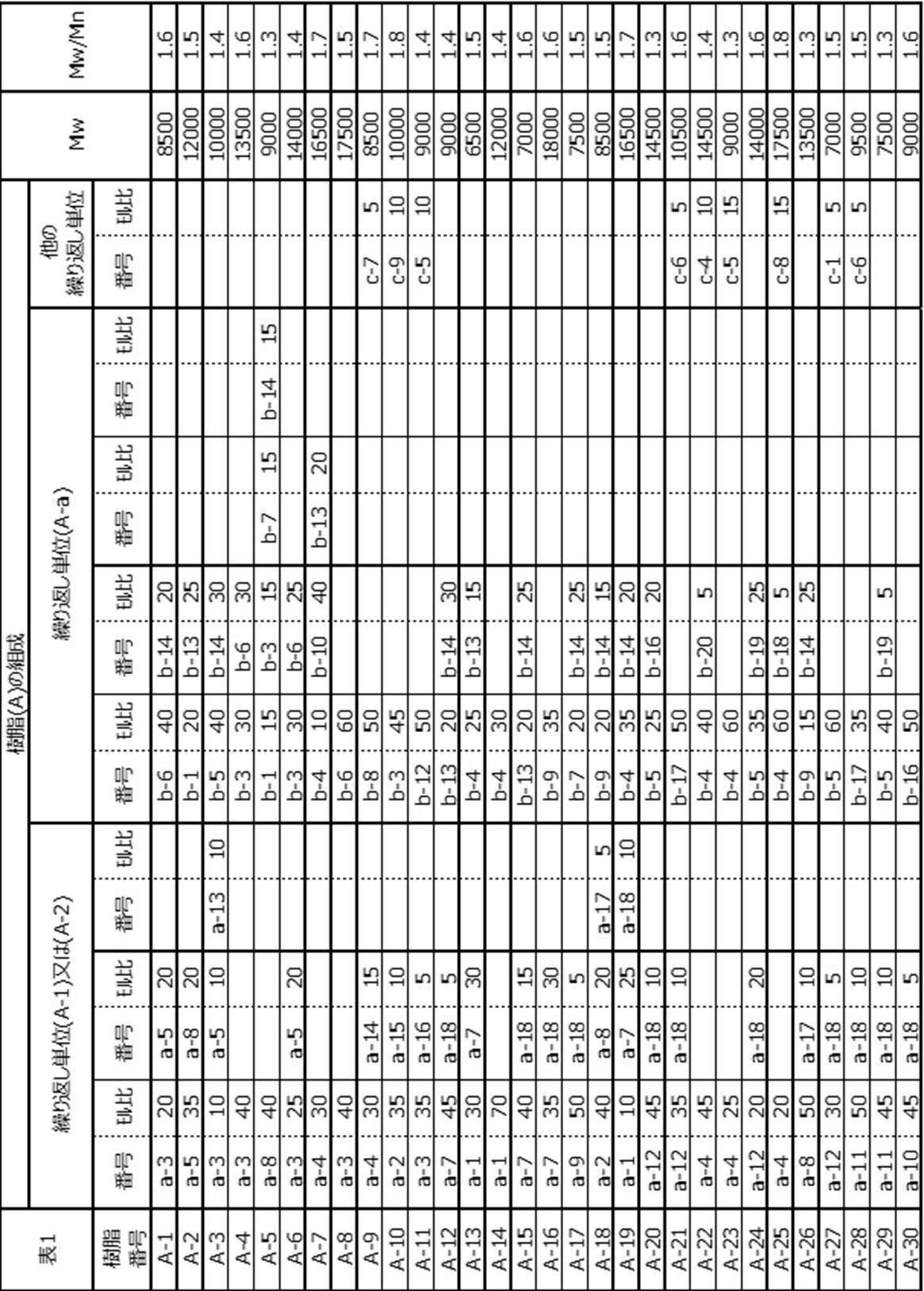

<合成例1:樹脂A-1の合成>
シクロヘキサノン(95質量部)を窒素気流下にて85℃に加熱した。この液を攪拌しながら、下記式(a-3)で表されるモノマー(8.5質量部)、下記式(a-5)で表されるモノマー(7.8質量部)、下記式(b-6)で表されるモノマー(18.7質量部)、下記式(b-14)で表されるモノマー(9.2質量部)、シクロヘキサノン(177質量部)、及び、2,2’-アゾビスイソ酪酸ジメチル〔V-601、和光純薬工業(株)製〕(5.2質量部)の混合溶液を4時間かけて滴下し、反応液を得た。滴下終了後、反応液を85℃にて更に2時間攪拌した。得られた反応液を放冷後、多量のメタノール/水(質量比9:1)で再沈殿した後、ろ過し、得られた固体を真空乾燥することで、樹脂A-1を42.3質量部得た。
上述のGPC法(キャリア:テトラヒドロフラン(THF))に従って測定した結果、樹脂A-1の重量平均分子量(Mw:ポリスチレン換算)は8500であり、分散度(Mw/Mn)は1.6であった。13C-NMR(nuclear magnetic resonance)により測定した、樹脂A-1を構成する各繰り返し単位の比率は、モル比でa-3/a-5/b-6/b-14=20/20/40/20であった。
表1に示される各樹脂の合成に使用され、各繰り返し単位a-1~a-18、b-1~b-26、c-1~c-12及びd-1~d-3にそれぞれ対応するモノマーの構造式を以下に示す。

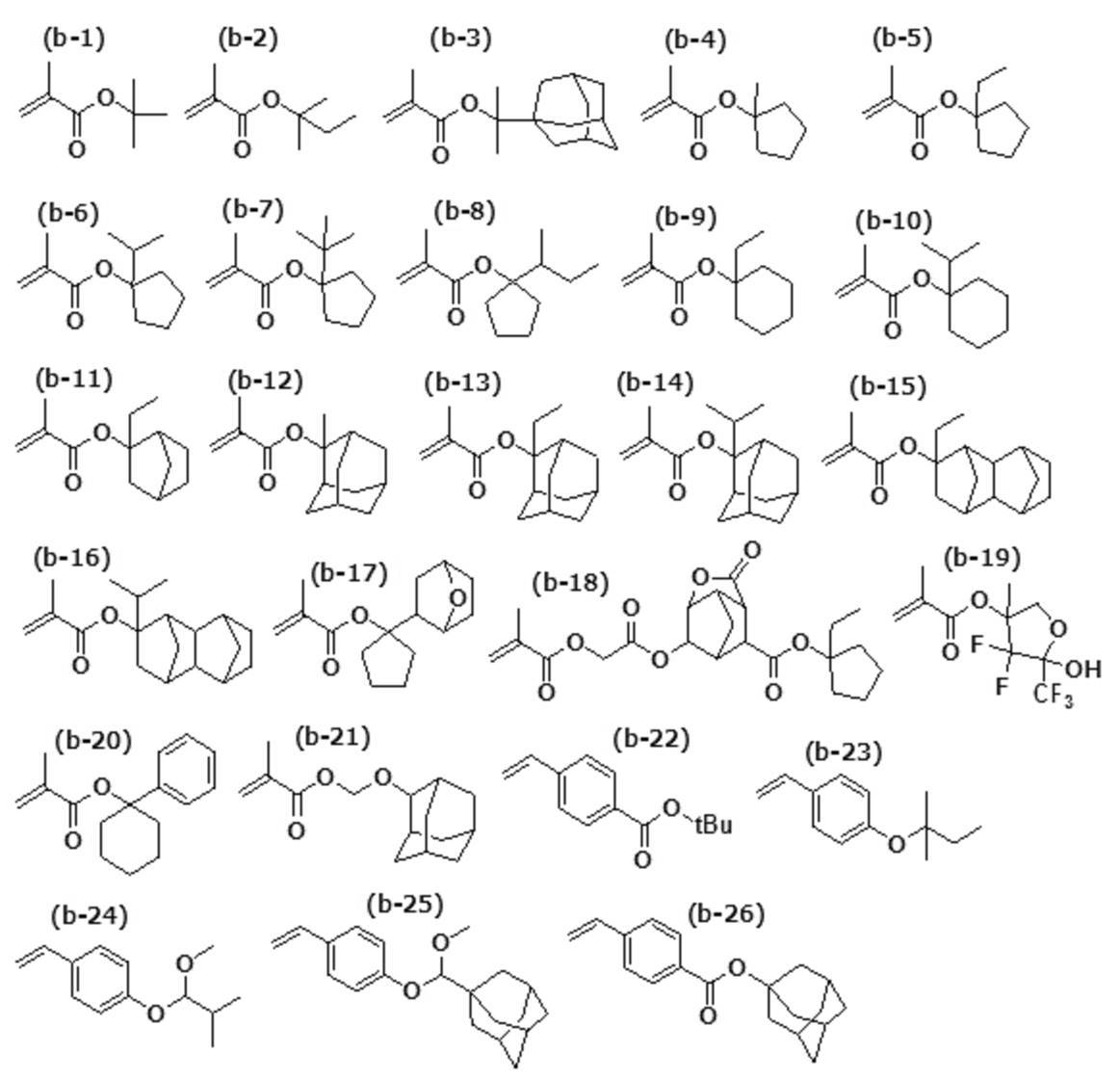
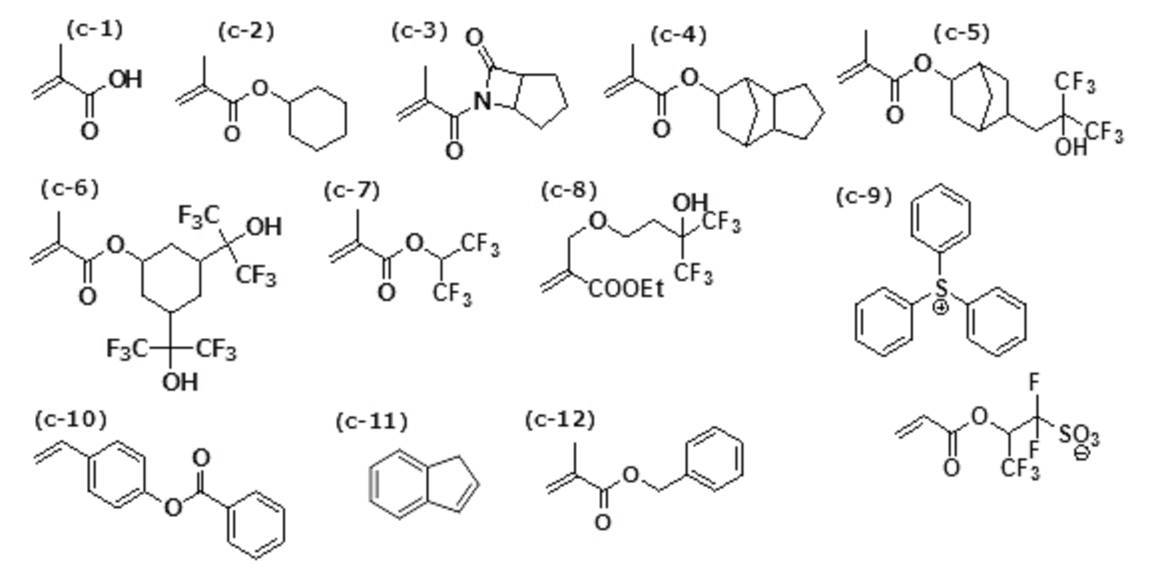

〔光酸発生剤(P)の合成〕
実施例及び比較例において光酸発生剤(P)として使用した化合物P-1~P-23の構造を以下に示す。なお、化合物P-1は、後述する合成例2に従って合成し、化合物P-2~P-23は、合成例2に準じて合成したものを用いた。

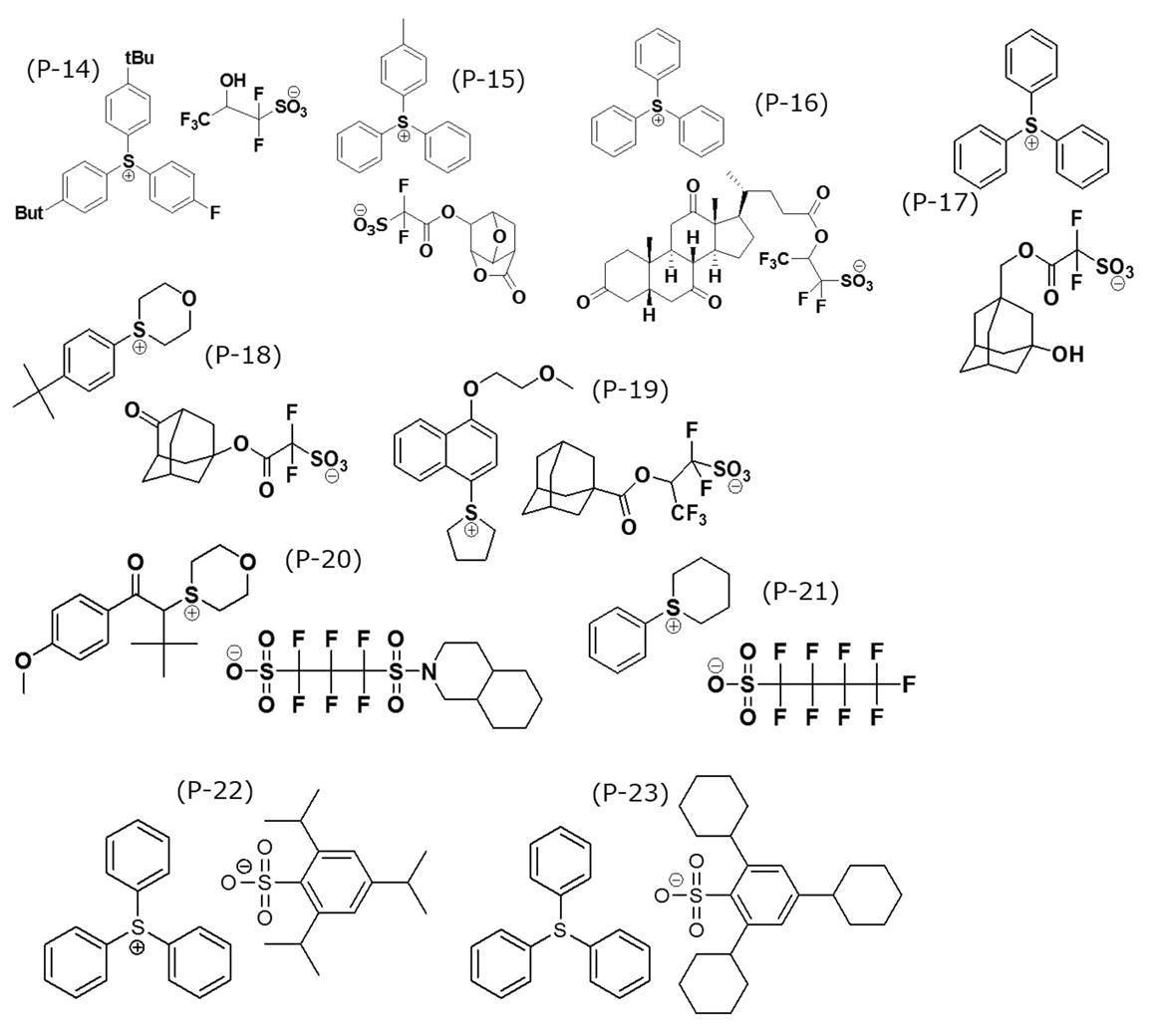
<合成例2:化合物P-1の合成>
化合物P-1を合成する手順を以下に示す。
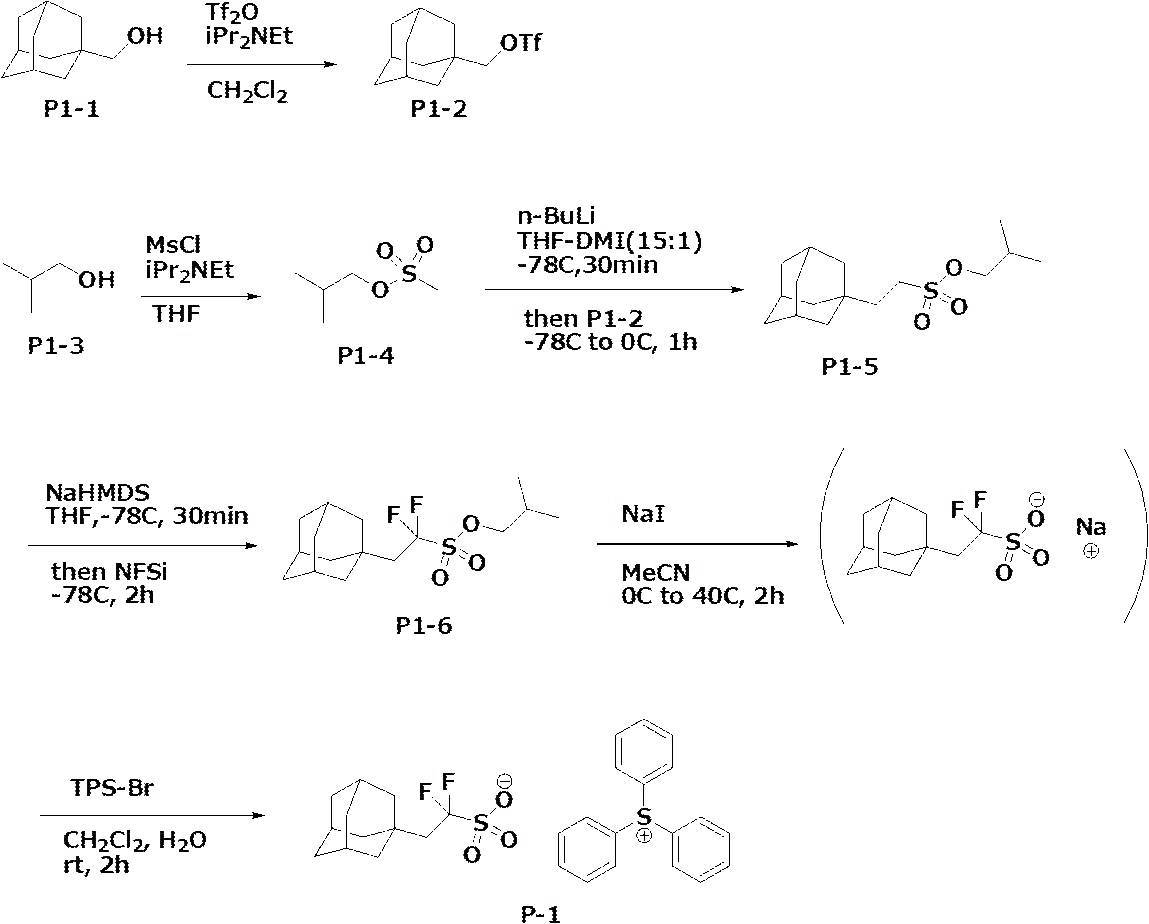
(合成例2-1:化合物P1-2の合成)
三口フラスコに、化合物P1-1(アダマンタンメタノール)16.6g(100mmol)を塩化メチレン(CH2Cl2)160gに溶解させた溶液を添加した後、ジイソプロピルエチルアミン(iPr2NEt)14.9g(115mmol)を加え、反応液を-20℃に冷却した。続いて、トリフルオロメタンスルホン酸無水物酸(Tf2O)30.8g(110mmol)を反応液中に滴下ロートを用いて滴下した後、-20℃で1時間攪拌した。飽和重曹水400g及びヘキサン300gを入れた三口フラスコに反応液を添加し、室温(25℃)で10分攪拌した。続いて有機相を分離し、分離した有機相を、飽和塩化アンモニウム水溶液、水、及び飽和食塩水を用いて洗浄した後、濃縮して、目的の化合物P1-2を29.6g得た。
(合成例2-2:化合物P1-4の合成)
三口フラスコに、化合物P1-3(2-メチル-1-プロパノール)20g(270mmol)をテトラヒドロフラン(THF)200gに溶解させた溶液を添加した後、ジイソプロピルエチルアミン38.4g(297mmol)を更に加え、反応液を0℃に冷却した。続いてメタンスルホン酸クロリド(MsCl)32.5g(284mmol)を、反応液中に滴下ロートを用いて滴下し、更に0℃で1時間攪拌した。飽和重曹水300gを入れた三口フラスコに反応液を添加し、室温(25℃)で10分攪拌した。続いて酢酸エチル300gを添加した後、有機相を分離した。分離した有機相を、水及び飽和食塩水を用いて洗浄した後、濃縮した。得られた粗精製物を蒸留精製(5mmHG,100℃)し、目的の化合物P1-4を26g得た。
(合成例2-3:化合物P1-5の合成)
三口フラスコに、合成例2-2で得られた化合物P1-4(20g(134mmol)
)をTHF300g及びDMI(1,3-ジメチル-2-イミダゾリジノン)20gに溶解させた溶液を添加した後、溶液を-78℃に冷却した。続いてn-ブチルリチウム(n-BuLi)(2.65M/ヘキサン溶液)50.6ml(134mmol)を、溶液中にシリンジを用いて滴下し、更に-78℃で30分攪拌した。合成例2-1で得られた化合物P1-2(26.6g(89.3mmol))をTHF50gに溶解させた溶液を、反応液中に滴下ロートを用いて滴下した。反応液の温度を0℃に上げ、1時間攪拌した。その後、ヘキサン1L及び飽和塩化アンモニウム水溶液500gを入れた三口フラスコに反応液を添加し、室温(25℃)で30分攪拌した。続いて有機相を分離し、分離した有機相を、水及び飽和食塩水を用いて洗浄した後、濃縮した。得られた粗精製物をシリカゲルカラムクロマトグラフィ(展開溶媒:ヘキサン/酢酸エチル=20/1(体積比))にて精製し、目的の化合物P1-5を19.5g得た。
(合成例2-4:化合物P1-6の合成)
三口フラスコに、合成例2-3で得られた化合物P1-5(11.1g(37mmol))をTHF60gに溶解させた溶液を添加した後、溶液を-78℃に冷却した。続いてナトリウムビス(トリメチルシリル)アミド(NaHMDS)(1.9M/ヘキサン溶液)58ml(111mmol)を、反応液中にシリンジを用いて滴下した。更に反応液を-78℃で30分攪拌した。N-フルオロベンゼンスルホンイミド(NFSi)35g(111mmol)を数回に分けて反応液中に添加し、-78℃で2時間攪拌した。その後、ヘキサン500g及び飽和塩化アンモニウム水溶液300gを入れた三口フラスコに反応液を添加し、室温(25℃)で30分攪拌した。続いて有機相を分離し、分離した有機相を、水及び飽和食塩水を用いて洗浄した後、濃縮した。得られた粗精製物をシリカゲルカラムクロマトグラフィ(展開溶媒:ヘキサン/酢酸エチル=60/1(体積比))にて精製し、目的の化合物P1-6を4.8g得た。
(合成例2-5:化合物P-1の合成)
三口フラスコに、合成例2-4で得られた化合物P1-6(1.9g(5.7mmol))及びアセトニトリル(MeCN)20gを加えて、化合物P1-6をアセトニトリルに溶解させた後、得られた溶液を0℃に冷却した。ヨウ化ナトリウム(NaI)0.85g(5.7mmol)を反応液中に添加し、反応液の温度を40℃に上げて、1時間攪拌した。続いて反応液の温度を室温(25℃)にした後、塩化メチレン50g及び水50gを三口フラスコ中に添加し、TPS-Br(トリフェニスルホニウムブロミド)1.96g(5.7mmol)を更に加え、2時間攪拌した。その後有機相を抽出し、抽出した有機相をイオン交換水200gで洗浄した後、溶媒を留去した。得られたオイル状の粗精製物をジイソプロピルエーテルにて繰り返し晶析して、最終目的物である化合物P-1を2.7g得た。
後述する表2、表4及び表6に、最終目的物を含有する粗精製物に対して行った晶析の回数を示す。化合物P-1~P-23のうちのいくつかについては、最終目的物の晶析の回数が異なる化合物を、それぞれレジスト組成物の調製に使用した。このように、光酸発生剤(P)の合成において最終目的物を含有する粗精製物の晶析の回数を調整することにより、光酸発生剤(P)中のハロゲン化物イオンの含有量、ひいては、レジスト組成物中のハロゲンイオン含有量を、調整した。
<酸拡散制御剤(Q)>
実施例及び比較例において酸拡散制御剤(Q)として使用した化合物Q-1~Q-10の構造を以下に示す。
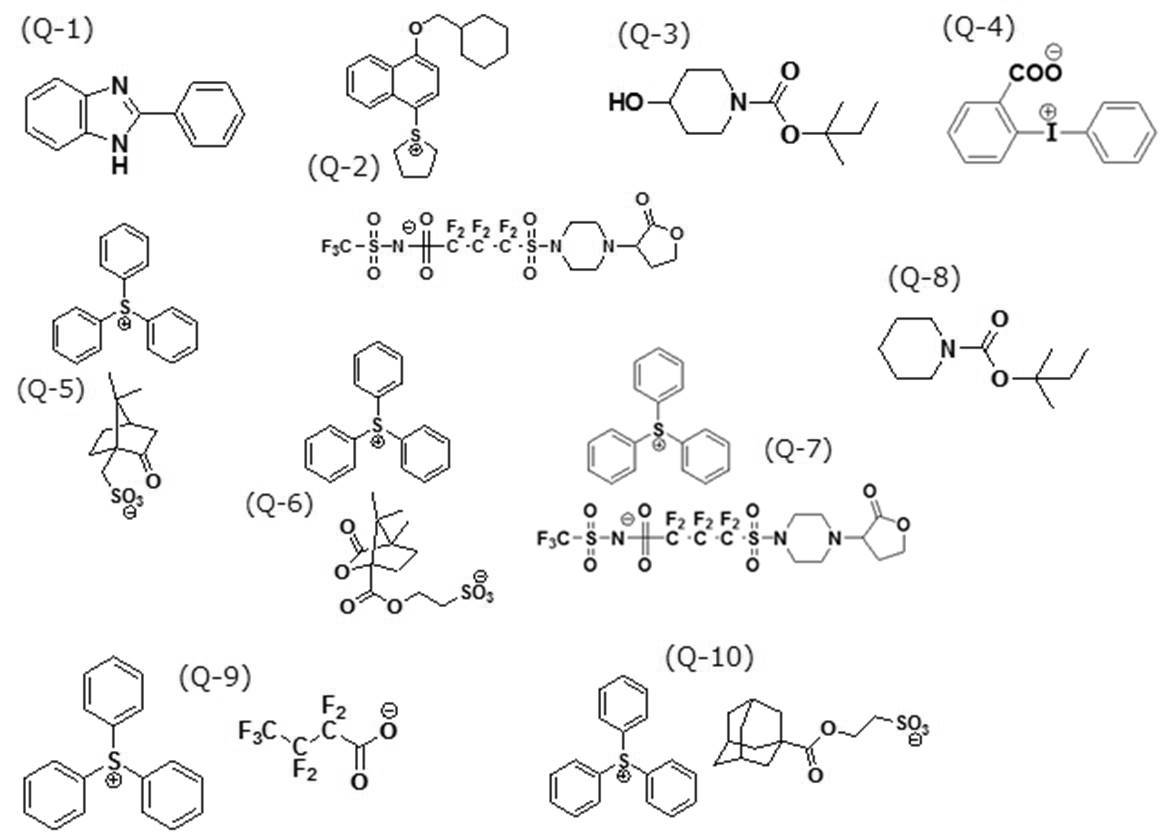
<疎水性樹脂(E)>
実施例及び比較例において疎水性樹脂(E)として使用した樹脂E-1~E-4の構造を以下に示す。樹脂E-1~E-4はいずれも、公知技術に基づいて合成したものを用いた。
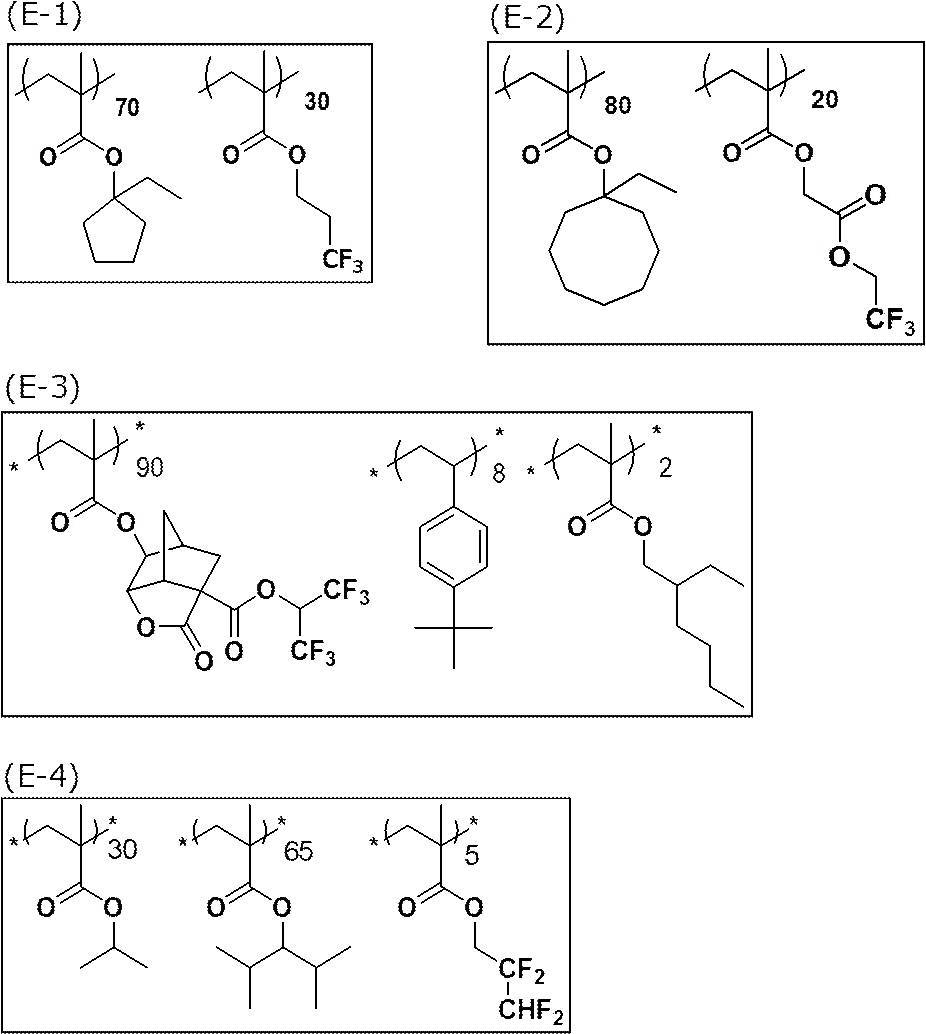
<溶剤(F)>
実施例及び比較例において使用した溶剤(F)を以下に示す。
F-1:プロピレングリコールモノメチルエーテルアセテート(PGMEA)
F-2:シクロヘキサノン
F-3:γ-ブチロラクトン
F-4:プロピレングリコールモノメチルエーテル(PGME)
F-5:2-ヘプタノン
<架橋剤(G)>
実施例及び比較例において使用した架橋剤(G)を以下に示す。

<界面活性剤(H)>
表4及び表6に示される界面活性剤(H)を以下に示す。
F-1:メガファックF176(DIC(株)製、フッ素系界面活性剤)
F-2:メガファックR08(DIC(株)製、フッ素及びシリコン系界面活性剤)
[実施例1~55、比較例1~16]
<感放射線性樹脂組成物(レジスト組成物)の調製>
表2に示した組成となるように、溶剤(F)以外の各成分を混合し、次いで、固形分濃度が4質量%となるように溶剤を添加した。次いで、得られた混合液を、最初に孔径50nmのポリエチレン製フィルター、次に孔径10nmのナイロン製フィルター、最後に孔径5nmのポリエチレン製フィルターの順番で濾過することにより、各レジスト組成物を調製した。
<ハロゲンイオン含有量の測定>
上記で調製されたレジスト組成物を純水で10倍に希釈し、得られた希釈液に対して下記条件のイオンクロマトグラフィを行って、フッ化物イオン(F-)、塩化物イオン(Cl-)及び臭化物イオン(Br-)を測定した。
・IC装置:Dionex ICS-5000+
・カラム:Dionex IonPac AG15(4 x 50 mm)
・濃縮カラム:Dionex IonPac UTAC-LP2(4 x 35 mm)
・キャリアポンプ: 0.5mL/min
・カラム温度: 30℃
・溶離液: KOH水溶液 8~65mmol/L
・流量: 1.20mL/min
・サプレッサー:Thermo Scientific Dionex AERS 500
・検出器: Dionex ICS-6000 CD
・試料注入量: 100μL
(カラム及び装置はいずれもThermo Fisher Scientific製)
上記のイオンクロマトグラフィで得られたフッ化物イオン(F-)、塩化物イオン(Cl-)及び臭化物イオン(Br-)の実測値から、下記式を用いて各レジスト組成物中のF-、Cl-及びBr-の合計含有量(質量ppm)を算出した。上述のとおり、この算出値を、各レジスト組成物のハロゲンイオン含有量とみなして、各レジスト組成物の評価に使用した。
ハロゲン化物イオン含有量={(F-実測値)+(Cl-実測値)+(Br-実測値)}*10
表2に、上記で調製されたレジスト組成物の組成、及び、ハロゲンイオン含有量を示す。
なお、表2、並びに後述する表4及び表6における各成分の含有量(質量部)は、樹脂(A)の含有量(合計含有量)を100質量部としたときの各成分の含有量(合計含有量)を意味する。ハロゲンイオン含有量については、レジスト組成物の全質量に対する含有量(質量ppm)を意味する。
また、表2、表4及び表6における「光酸発生剤(P)」の「晶析回数」欄の数字は、使用した光酸発生剤を合成例2-5又はそれに準じた方法により合成した際に行った晶析の回数を示す。
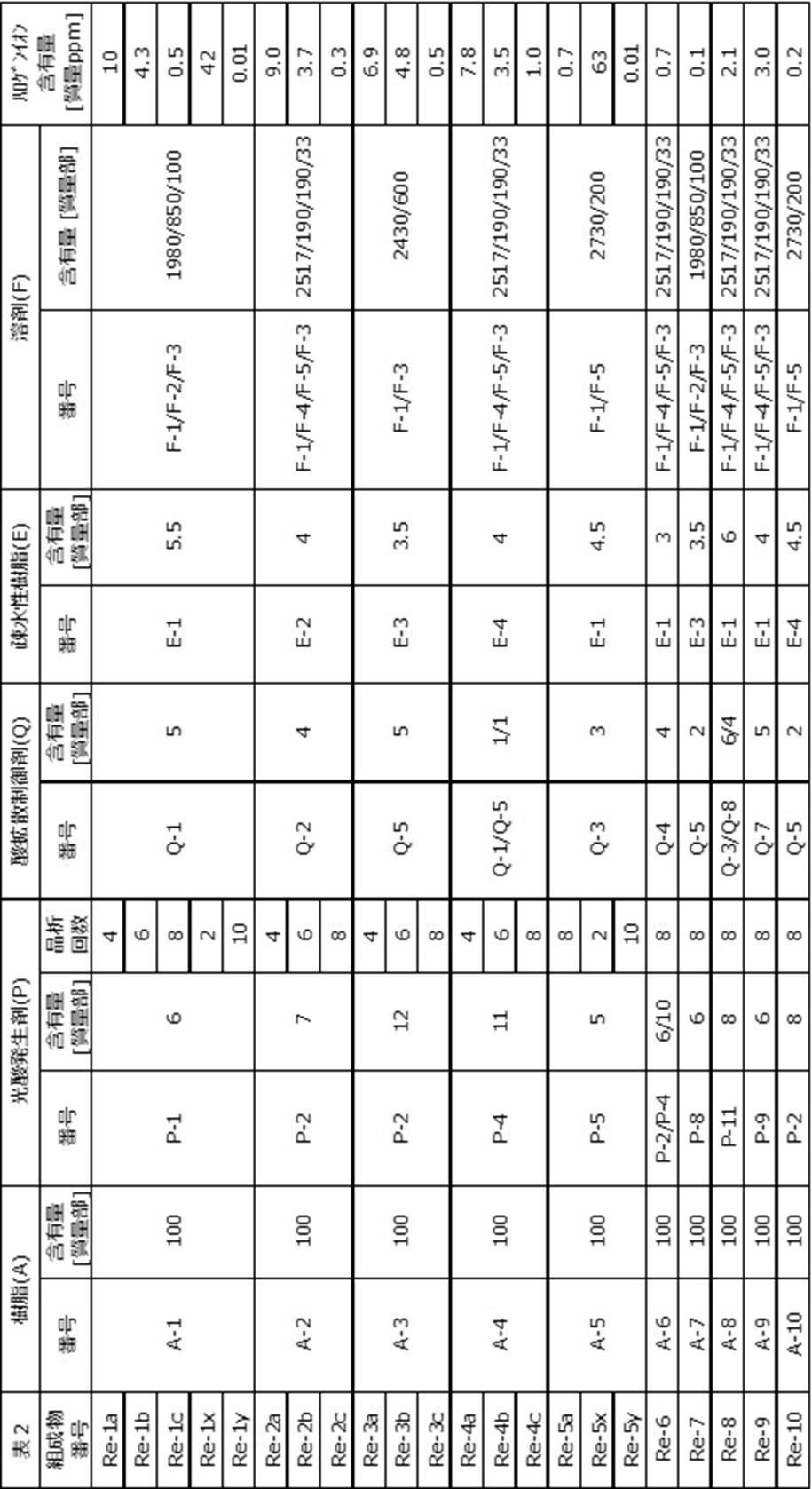
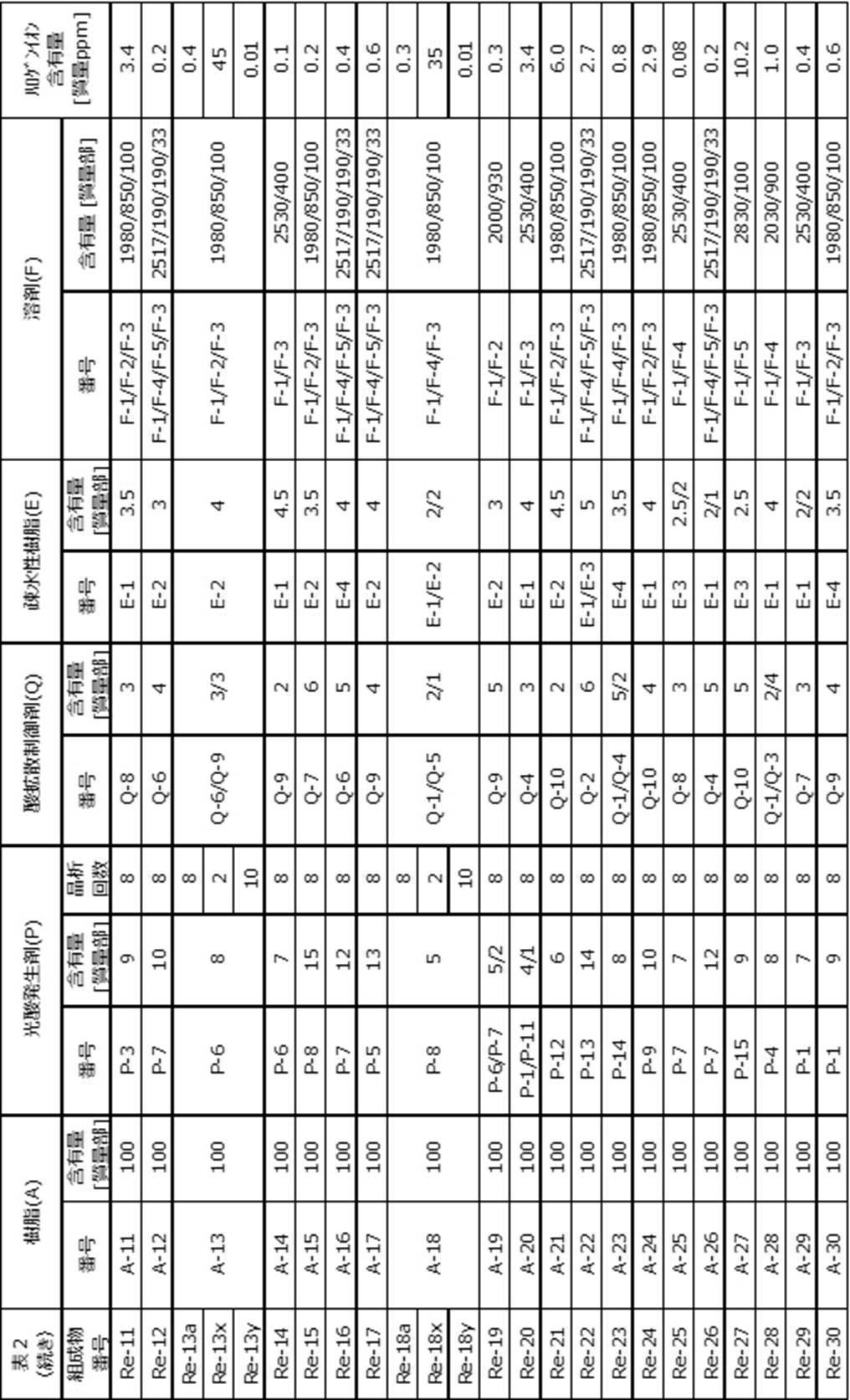
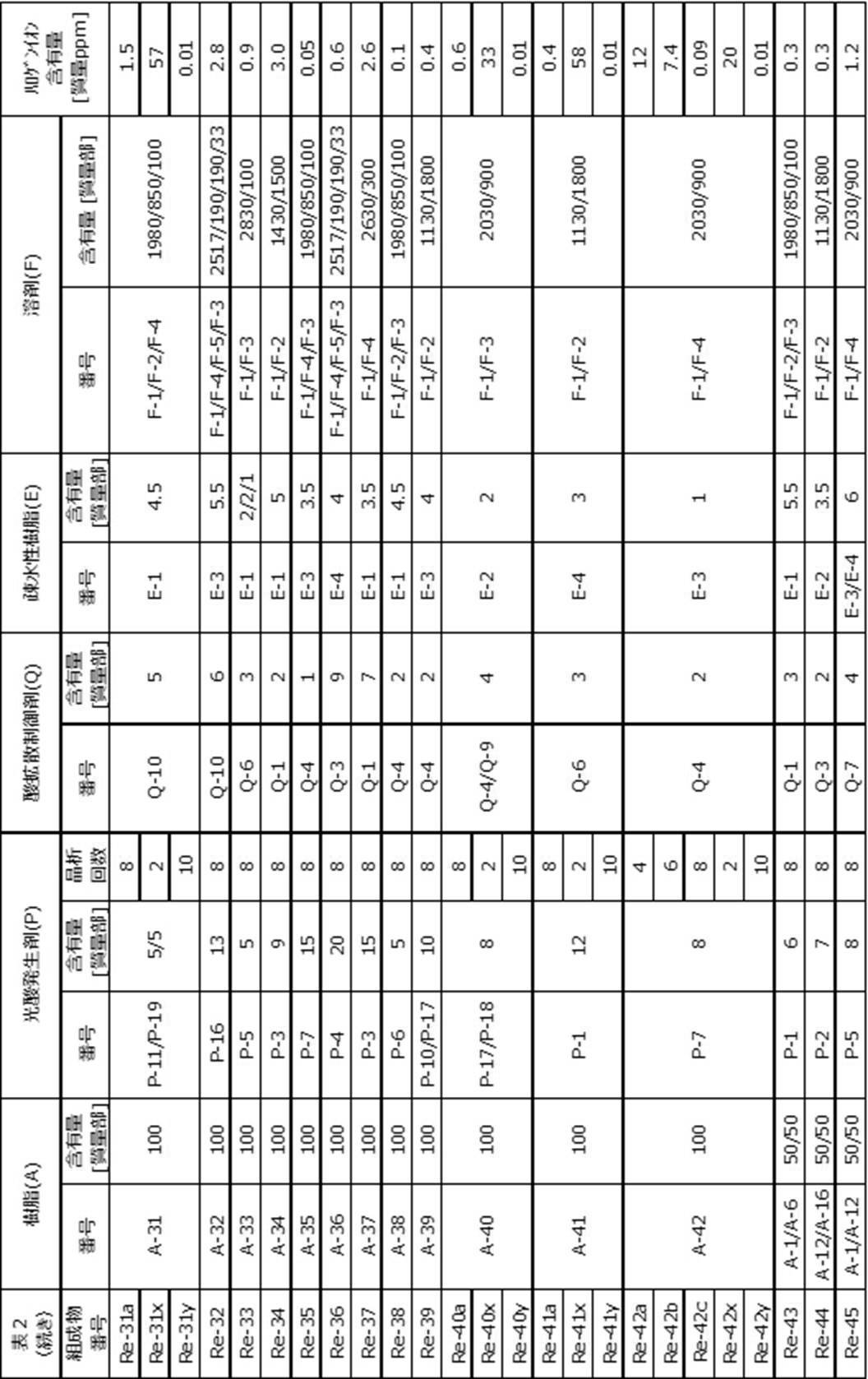
<レジストパターン形成(1):ArF露光、ポジ型レジストパターン形成>
シリコンウエハ(12インチ口径)上に有機反射防止膜形成用組成物ARC29SR(Brewer Science社製)を塗布し、205℃で60秒間ベークして、膜厚98nmの反射防止膜を形成した。得られた反射防止膜上に、レジスト組成物を塗布し、100℃で60秒間ベーク(PB)して、膜厚100nmのレジスト膜(感放射線性膜)を形成した。
得られたレジスト膜に対して、ArFエキシマレーザー液浸スキャナー(ASML社製;XT1700i、NA0.85、Annular、アウターシグマ0.9、インナーシグマ0.6)を用いて、線幅100nmの1:1ラインアンドスペース(LS)パターンの6%ハーフトーンマスクを通して露光した。液浸液としては超純水を用いた。
露光後のレジスト膜を90℃で60秒間ベーク(PEB)した。次いで、現像液としてテトラメチルアンモニウムハイドロオキサイド水溶液(2.38質量%)を用いて30秒間パドルして現像し、純水でリンスした。これにより、ポジ型の線幅100nmの1:1LSを有するレジストパターンを形成した。また、得られたレジストパターンの線幅を、測長走査型電子顕微鏡(SEM:Scanning Electron Microscope、(株)日立製作所製CG-4100)を用いて測定した。
<レジストパターン形成(2):ArF露光、ネガ型レジストパターン形成>
現像液として酢酸ブチルを用い、リンス液としてメチルイソブチルカルビノール(MIBC)を用いること以外は、上記レジストパターン形成(1)と同様にして、ネガ型の線幅100nmの1:1LSを有するレジストパターンを形成し、得られたレジストパターンの線幅を測定した。
<各種評価>
上記形成したポジ型レジストパターン及びネガ型レジストパターンについて、下記の方法により欠陥、及び、LWRを評価した。結果を表3にまとめる。
(欠陥評価)
レジストパターンの欠陥評価の方法を説明する。上記で得られた各レジストパターンを、欠陥評価装置UVision5(Applied Materials社製)で検査し、各レジストパターンの欠陥マップを作成した。その後、SEMVisionG4(Applied Materials社製)を用いて、欠陥を含む画像を取得し、各レジストパターンについてシリコンウエハ(12インチ口径)1枚あたりの欠陥の数を算出した。図1(a)及び(b)に、測長走査型電子顕微鏡(SEM)にて観察されるレジストパターンの欠陥を含む画像の例を、模式図として示す。
(経時評価)
上記の方法で調製したレジスト組成物を、40℃で1ヶ月間保管した。保管後のレジスト組成物を用いて、上記レジストパターン形成(1)又は(2)の方法に従って、線幅100nmのポジ型又はネガ型レジストパターンを形成し、得られたレジストパターンの線幅を測定した。次いで、上記欠陥評価と同様に、得られた各レジストパターンの欠陥の数を算出した。このようにして得られた保管後のレジスト組成物を用いた場合のレジストパターンの線幅及び欠陥数と、調製直後のレジスト組成物を用いた場合のレジストパターンの線幅及び欠陥数とから、線幅及び欠陥数の経時変化量をそれぞれ算出した。
(LWR)
線幅が平均100nmであるレジストパターンを解像するときの最適露光量にて解像した線幅が100nmの1:1LSを有するレジストパターンに対して、測長走査型電子顕微鏡(SEM、(株)日立製作所製CG-4100)を使用してレジストパターン上部から観察する際、線幅を任意のポイントで観測し、その測定ばらつきを3σで評価した。値が小さいほど良好な性能であることを示す。
(評価結果)
以上の各レジストパターン評価試験の結果を下記表3に示す。
なお、表3の「レジストパターン形成方法」欄における「1」及び「2」は、上記レジストパターン形成(1)及び(2)の方法でポジ型レジストパターン及びネガ型レジストパターンをそれぞれ形成したことをそれぞれ示す。
また、表3、並びに、後述する表5及び表7において、「レジストパターン評価」の「線幅経時変化」欄の「<1nm」は、上記方法で評価したレジストパターンの線幅の経時変化量が1nm未満であったことを示す。
更に、表3、表5及び表7において、「欠陥数(調製直後)」は、調製直後のレジスト組成物を用いて形成されたレジストパターンの欠陥数を意味し、「欠陥数(保管後)」は、上記保管試験後のレジスト組成物を用いて形成されたレジストパターンの欠陥数を意味し、「欠陥数 経時変化」は、「欠陥数(保管後)」から「欠陥数(調製直後)」を引いた差分を意味する。
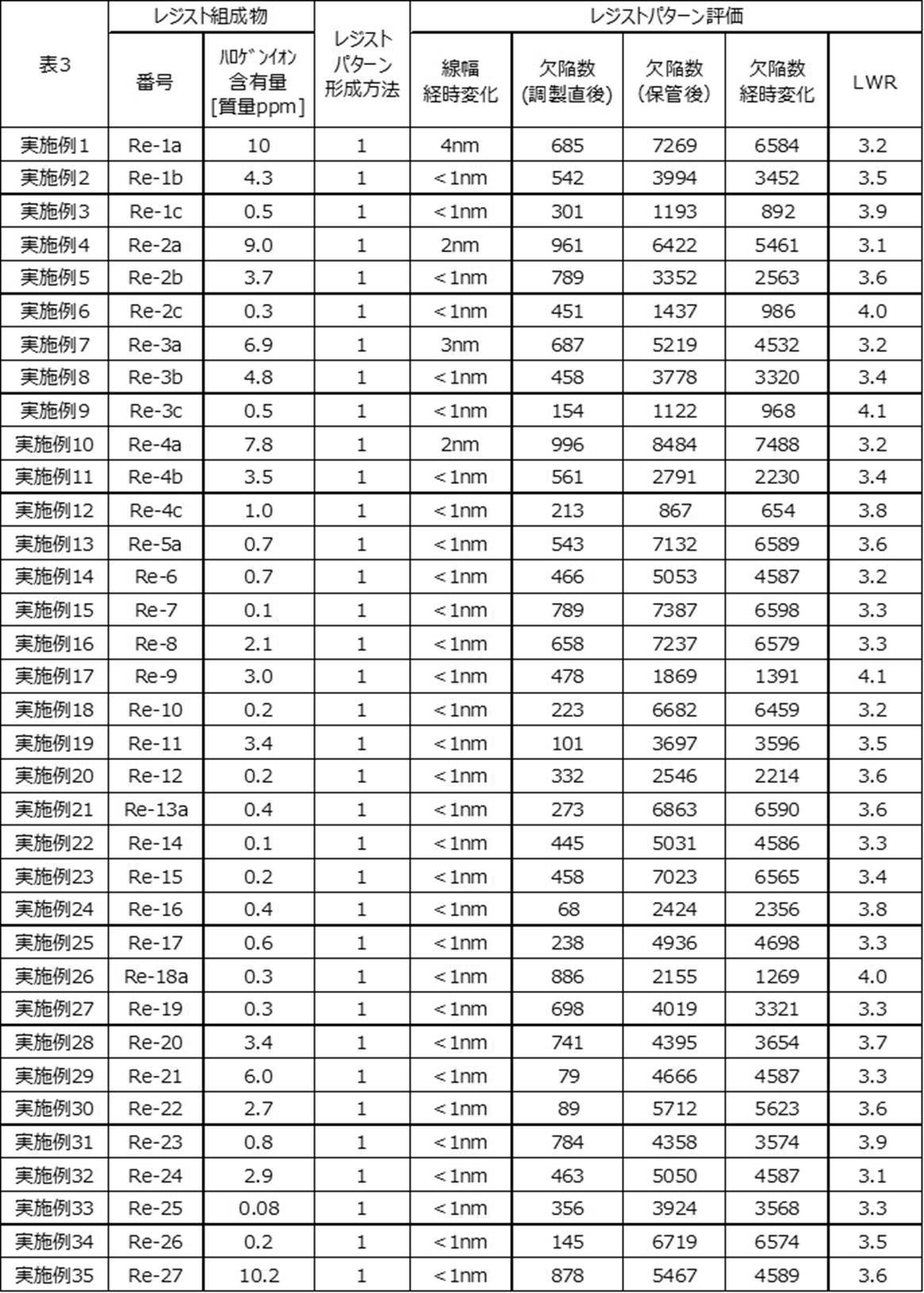
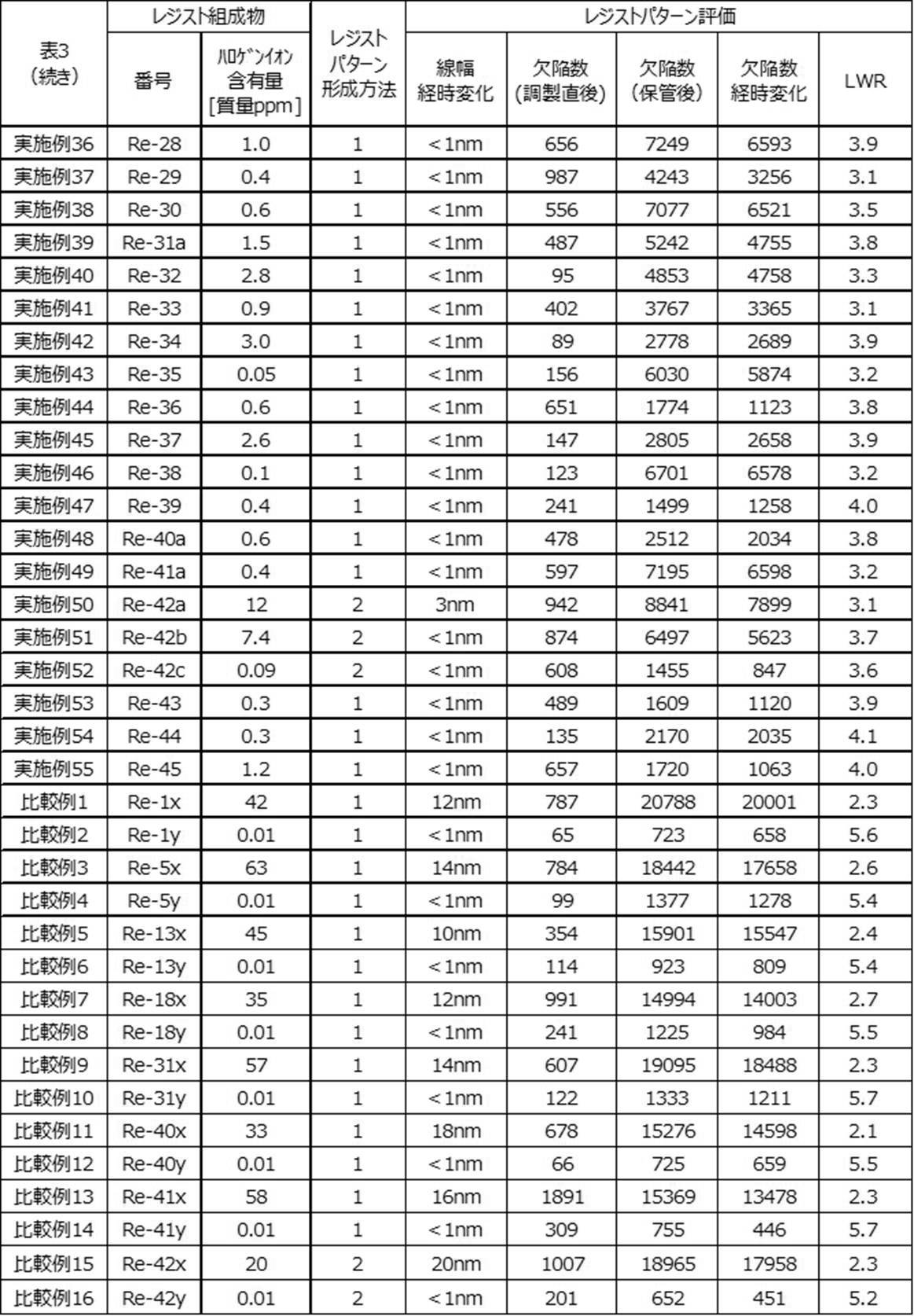
上記表3に示すように、本発明のレジスト組成物であれば所望の効果を示した。
ハロゲン化物イオンの含有量が10質量ppm未満である場合、レジスト組成物の経時安定性がより優れることが確認された(例えば実施例1及び2の対比)。
また、ハロゲン化物イオンの含有量が1質量ppm超である場合、LWRがより優れることが確認された(例えば実施例2及び3の対比)。
[実施例101~109、比較例101~102]
<レジスト組成物の調製>
表4に示す組成となるように、溶剤(F)以外の各成分を混合し、次いで、固形分濃度が10質量%となるように溶剤(F)を添加した。次いで、得られた混合液を、最初に孔径50nmのポリエチレン製フィルター、次に孔径10nmのナイロン製フィルター、最後に孔径5nmのポリエチレン製フィルターの順番で濾過し、レジスト組成物Re-101を得た。
また、表4に示す組成となるように、溶剤(F)以外の各成分を混合し、次いで、固形分濃度が38質量%となるように溶剤(F)を添加した。次いで、得られた混合液を孔径0.1μmのポリエチレン製フィルターで濾過して、レジスト組成物Re-102を調製した。
更に、表4に示す組成となるように、溶剤(F)以外の各成分を混合し、次いで、固形分濃度が25質量%となるように溶剤(F)を添加した。次いで、得られた混合液を孔径0.1μmのポリエチレン製フィルターで濾過して、レジスト組成物Re-103~Re-107をそれぞれ調製した。
表4における各成分の含有量(質量部)は、樹脂(A)の含有量(合計含有量)を100質量部としたときの各成分の含有量(合計含有量)を意味する。ハロゲンイオン含有量については、レジスト組成物の全質量に対する含有量(質量ppm)を意味する。
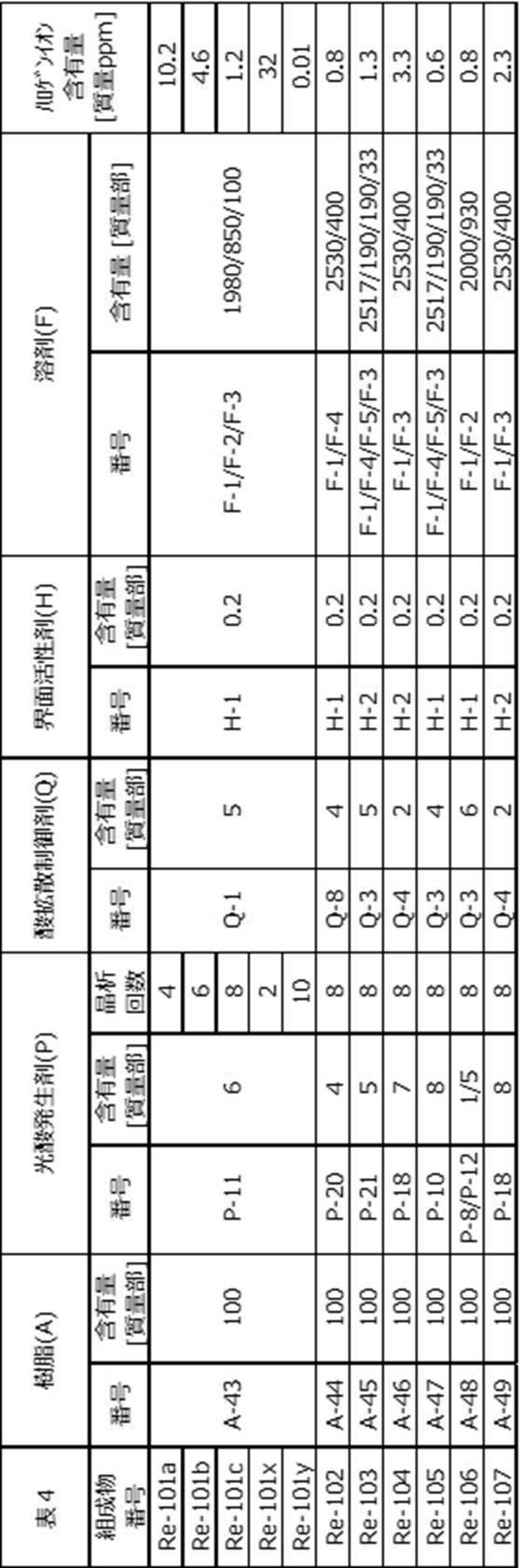
<レジストパターン形成(3):KrF露光、ポジ型レジストパターン形成>
基板上に、反射防止膜形成用組成物(ブリューワーサイセンス製、商品名DUV42)を塗布し、205℃で60秒間ベークして、膜厚70nmの反射防止膜を形成した。次いで、スピンコーターMark8(商品名、東京エレクトロン株式会社製)を用いて、反射防止膜上に、調製したレジスト組成物を塗布した。その後、130℃で60秒間加熱乾燥して、膜厚400nmのポジ型レジスト膜を形成した。このレジスト膜に対し、KrFエキシマレーザースキャナー(ASML製、PAS5500/850C(商品名)、波長248nm)を用いて、開口数(NA)=0.68、σ=0.60の露光条件で、線幅150nmの1:1LSのマスクを介して露光し、レジストパターンを形成した。露光したレジストパターンを、130℃で60秒間ベークし、濃度2.38質量%のテトラメチルアンモニウムハイドロオキサイド(TMAH)水溶液に60秒間浸漬した。得られたレジストパターンを30秒間水でリンスし、乾燥して、線幅150nmの1:1LSのレジストパターンを得た。
<レジストパターン形成(4):KrF露光、ポジ型レジストパターン形成>
ヘキサメチルジシラザン処理を施したSi基板(Advanced Materials Technology社製)上に、スピンコーターACT-8(商品名、東京エレクトロン株式会社製)を用いて、調製したレジスト組成物を塗布した。その後、130℃で60秒間加熱乾燥して、膜厚3μmのポジ型レジスト膜を形成した。このレジスト膜に対し、KrFエキシマレーザースキャナー(ASML製、PAS5500/850C(商品名)、波長248nm)を用いて、縮小投影露光後のスペース幅が250nm、線幅が1μmとなるようなLSパターンを有するマスクを介して、開口数(NA)=0.68、σ=0.60の露光条件で露光した。露光したレジスト膜を、130℃で60秒間ベークし、濃度2.38質量%のTMAH水溶液に60秒間浸漬した。次いで、30秒間水でリンスし、乾燥して、レジストパターンを得た。
<レジストパターン形成(5):KrF露光、ポジ型レジストパターン形成>
膜厚10μmのポジ型レジスト膜を形成すること、及び、縮小投影露光後のスペース幅が3μm、線幅が33μmとなるようなLSパターンを有するマスクを使用すること以外は、上記レジストパターン形成(4)の方法に従って、レジストパターンを形成した。
<各種評価>
上記レジストパターン形成(3)の方法で製造されたポジ型レジストパターン(実施例101~103、比較例101~102)について、実施例1で実施した方法により、線幅及び欠陥数の経時変化、並びにLWRを評価した。但し、欠陥評価装置としてはSOKUDO社製Complus(商品名)を用い、レビュー装置としてはSEMVisionG3(Applied Materials社製)を用いた。
また、上記レジストパターン形成(4)及び(5)の方法で製造されたポジ型レジストパターンについては、実施例1で実施した方法により、線幅の経時変化、及びLWRを評価した。
評価試験の結果を下記表5に示す。
なお、表5の「レジストパターン形成方法」欄における「3」、「4」及び「5」は、上記レジストパターン形成(3)、(4)及び(5)の方法でポジ型レジストパターンを形成したことをそれぞれ示す。

上記表5に示すように、本発明のレジスト組成物であれば所望の効果を示した。
ハロゲン化物イオンの含有量が10.2質量ppm未満である場合、レジスト組成物の経時安定性がより優れることが確認された(実施例101及び102の対比)。
またハロゲン化物イオンの含有量が1.2質量ppm超である場合、LWRがより優れることが確認された(実施例102及び103の対比)。
[実施例201~206、比較例201~202]
<レジスト組成物の調製>
表6に示す組成となるように、溶剤(F)以外の各成分を混合し、次いで、固形分濃度が3.5質量%となるように溶剤(F)を添加した。次いで、得られた混合液を、孔径0.03μmのポリテトラフルオロエチレンフィルターで濾過し、レジスト組成物を得た。
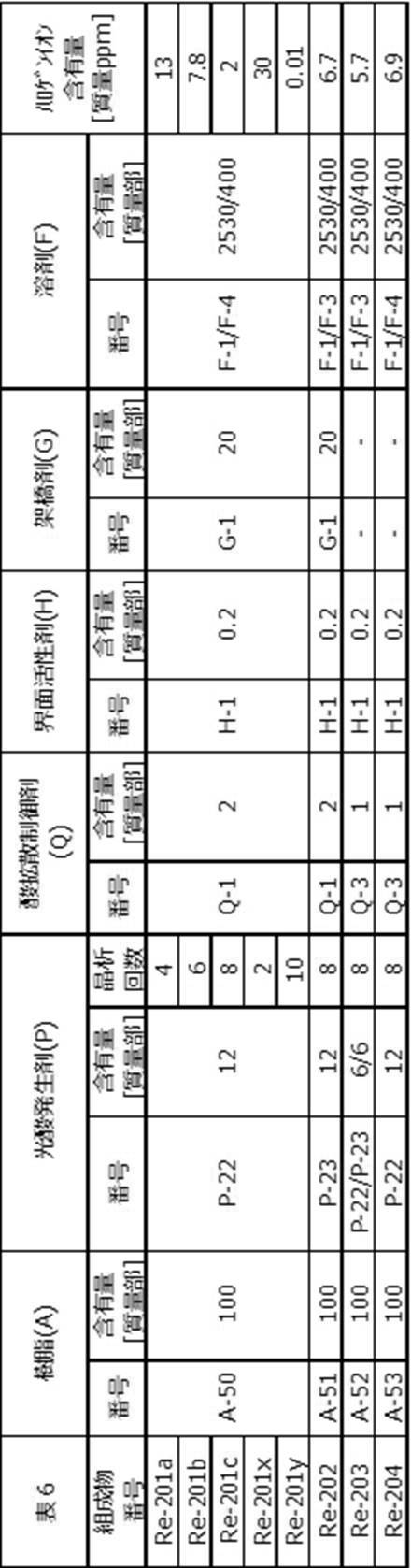
<レジストパターン形成(6):EB描画、ネガ型レジストパターン形成>
直径6インチのシリコンウエハ上に、スピンコーターMark8(商品名、東京エレクトロン株式会社製)を用いて、調製したレジスト組成物を塗布し、120℃で600秒間ホットプレート上にて加熱乾燥して、膜厚100nmのレジスト膜を形成した。
このレジスト膜に電子線描画装置((株)アドバンテスト製;F7000S、加速電圧50KeV)を用いて、パターン照射を行った。照射後に、100℃で600秒間ホットプレート上にて加熱し、2.38質量%のTMAH水溶液に60秒間浸漬した。次いで、30秒間純水でリンスし、乾燥して、ピッチ200nm、線幅100nm(スペース幅100nm)のレジストパターンを得た。
<レジストパターン形成(7):EB描画、ポジ型レジストパターン形成>
直径6インチのシリコンウエハ上に、スピンコーターMark8(商品名、東京エレクトロン株式会社製)を用いて、調製したレジスト組成物を塗布し、110℃で90秒間ホットプレート上にて加熱乾燥して、膜厚80nmのレジスト膜を形成した。
このレジスト膜に電子線描画装置((株)アドバンテスト製;F7000S、加速電圧50KeV)を用いて、パターン照射を行った。照射後に、110℃で90秒間ホットプレート上にて加熱し、2.38質量%のTMAH水溶液に60秒間浸漬した。次いで、30秒間純水でリンスし、乾燥して、ピッチ200nm、線幅100nm(スペース幅100nm)のレジストパターンを得た。
<各種評価>
得られたポジ型レジストパターン及びネガ型レジストパターンのそれぞれについて、実施例1で実施した方法により、線幅及び欠陥数の経時変化、並びにLWRを評価した。なお欠陥評価については、欠陥検査装置KLA2360(ケー・エル・エー・テンコール社製)を用いた。
評価試験の結果を下記表7に示す。
なお、表7の「レジストパターン形成方法」欄における「6」は、上記レジストパターン形成(6)の方法でネガ型レジストパターンを形成したことを示し、「7」は、上記レジストパターン形成(7)の方法でポジ型レジストパターンを形成したことを示す。
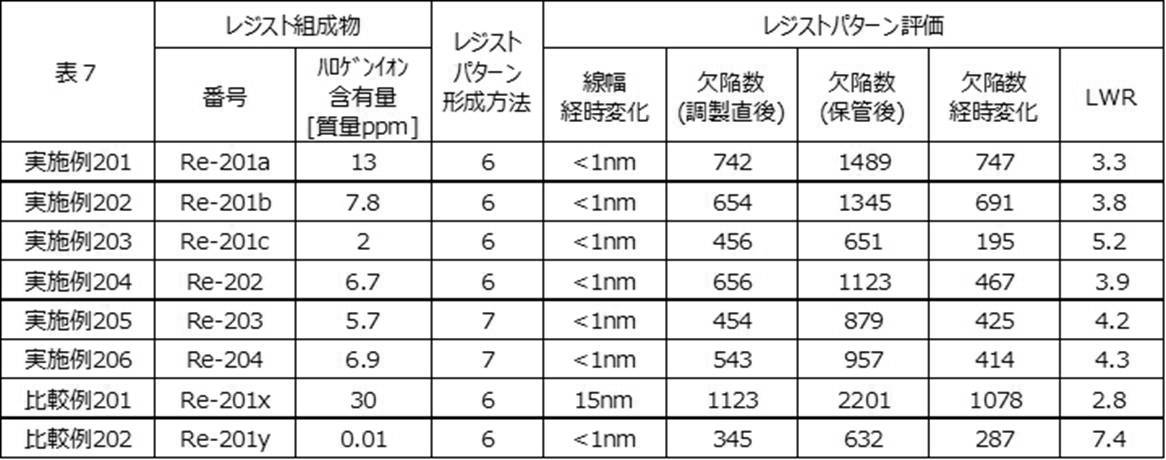
上記表7に示すように、本発明のレジスト組成物であれば所望の効果を示した。
ハロゲン化物イオンの含有量が13質量ppm未満である場合、レジスト組成物の経時安定性がより優れることが確認された(実施例201及び202の対比)。
また、ハロゲン化物イオンの含有量が2質量ppm超である場合、LWRがより優れることが確認された(実施例202及び203の対比)。
Claims (10)
-
酸の作用により極性が増大する樹脂(A)と、光酸発生剤(P)とを含有し、
ハロゲン化物イオンの含有量が組成物の全質量に対して0.015~15質量ppmである、感放射線性樹脂組成物。
-
波長250nm以下の放射線、電子線及びX線からなる群より選択される少なくとも1つの放射線で感光される、請求項1に記載の感放射線性樹脂組成物。
-
前記樹脂(A)が、ヒドロキシスチレンに由来する繰り返し単位(A-1)、並びに、
ラクトン構造、カーボネート構造、スルトン構造及びヒドロキシアダマンタン構造からなる群より選択される少なくとも1種を含有する繰り返し単位(A-2)の少なくとも一方を有する、請求項1又は2に記載の感放射線性樹脂組成物。
-
前記繰り返し単位(A-2)が、ラクトン構造、カーボネート構造、スルトン構造及びヒドロキシアダマンタン構造からなる群より選択される少なくとも1種を含有する(メタ)アクリル酸エステルに由来する繰り返し単位である、請求項3に記載の感放射線性樹脂組成物。
-
前記繰り返し単位(A-1)が、下記一般式(A-I)で表される繰り返し単位であり、
前記繰り返し単位(A-2)が、下記一般式(A-II)~(A-VII)で表される繰り返し単位からなる群より選択される少なくとも1種を含有する、請求項3又は4に記載の感放射線性樹脂組成物。

上記一般式中、R1は、水素原子、又は、炭素数1~3のアルキル基を表す。
R2は、炭素数1~4のアルキル基、シアノ基、又は、-CO-O-R21を表す。R21は、炭素数1~4のアルキル基を表す。
X1は、単結合、炭素数1~3のアルキレン基、又は、-R3-CO-O-を表す。
R3は、炭素数1~3のアルキレン基を表す。
m及びnは、各々独立に、0又は1を表す。
-
前記樹脂(A)が、下記一般式(A-VIII)~(A-XII)で表される繰り返し単位からなる群より選択される少なくとも1つの繰り返し単位を有する、請求項1~5のいずれか一項に記載の感放射線性樹脂組成物。

一般式(A-VIII)中、R5は、tert-ブチル基、-CO-O-(tert-ブチル)基を表す。
一般式(A-IX)中、R6及びR7は、各々独立に、1価の有機基を表す。
一般式(A-X)中、pは、1又は2を表す。
一般式(A-X)~(A-XII)中、R8は、水素原子又は炭素数1~3のアルキル基を表す。
R9は、炭素数1~3のアルキル基を表す。
R10は、炭素数1~3のアルキル基又はアダマンチル基を表す。
-
前記光酸発生剤(P)が、一般式(B-I)~(B-V)で表される化合物からなる群より選択される少なくとも1種を含有する、請求項1~6のいずれか一項に記載の感放射線性樹脂組成物。
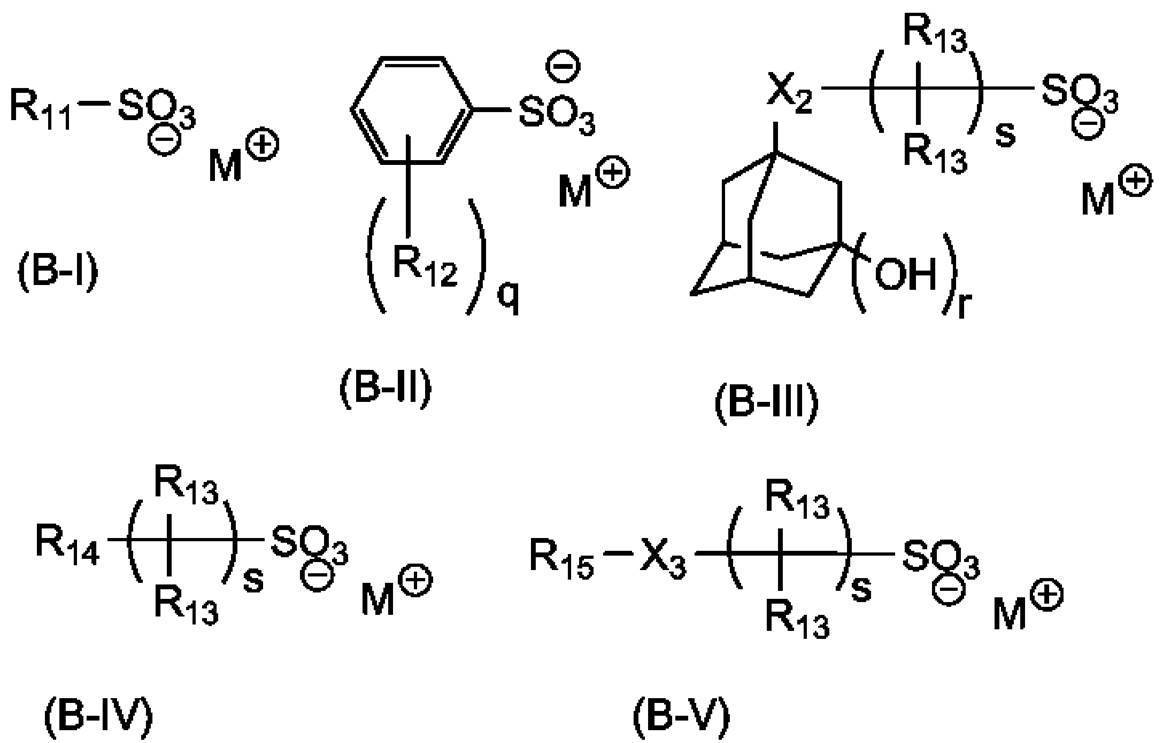
一般式(B-I)中、R11は、フッ素原子で置換されていてもよい炭素数1~8のアルキル基を表す。
一般式(B-II)中、R12は、水素原子、炭素数1~6のアルキル基、又は、-CF3を表す。qは、1~5の整数を表す。
一般式(B-III)~(B-V)中、R13は、水素原子、フッ素原子、又は、CF3を表す。
一般式(B-III)中、X2は、-CO-O-、-CH2-CO-O-、又は、-CH2-O-CO-を表す。rは、0~2の整数を表す。sは、1~3の整数を表す。
一般式(B-IV)中、R14は、置換基を有していてもよい1価の多環基を表す。
一般式(B-V)中、R15は、1価の有機基を表す。X3は、-O-CO-O-、-SO2-、又は、-SO2-NR16-を表す。R16は、各々独立して、水素原子もしくはアルキル基を表すか、又は、R15と結合して環構造を形成するアルキレン基を表す。
一般式(B-I)~(B-V)中、M+は、スルホニウムカチオン、又は、ヨードニウムカチオンを表す。
-
請求項1~7のいずれか一項に記載の感放射線性樹脂組成物により形成されたレジスト膜。
-
請求項1~7のいずれか一項に記載の感放射線性樹脂組成物を用いて、基板上にレジスト膜を形成する工程と、
前記レジスト膜を露光する工程と、
現像液を用いて、前記露光されたレジスト膜を現像し、パターンを形成する工程と、
を有するパターン形成方法。
-
請求項9に記載のパターン形成方法を含む、電子デバイスの製造方法。
Priority Applications (1)
| Application Number | Priority Date | Filing Date | Title |
|---|---|---|---|
| JP2020556722A JPWO2020095641A1 (ja) | 2018-11-07 | 2019-10-16 | 感放射線性樹脂組成物、レジスト膜、パターン形成方法、電子デバイスの製造方法 |
Applications Claiming Priority (2)
| Application Number | Priority Date | Filing Date | Title |
|---|---|---|---|
| JP2018209794 | 2018-11-07 | ||
| JP2018-209794 | 2018-11-07 |
Publications (1)
| Publication Number | Publication Date |
|---|---|
| WO2020095641A1 true WO2020095641A1 (ja) | 2020-05-14 |
Family
ID=70612395
Family Applications (1)
| Application Number | Title | Priority Date | Filing Date |
|---|---|---|---|
| PCT/JP2019/040666 Ceased WO2020095641A1 (ja) | 2018-11-07 | 2019-10-16 | 感放射線性樹脂組成物、レジスト膜、パターン形成方法、電子デバイスの製造方法 |
Country Status (2)
| Country | Link |
|---|---|
| JP (1) | JPWO2020095641A1 (ja) |
| WO (1) | WO2020095641A1 (ja) |
Cited By (4)
| Publication number | Priority date | Publication date | Assignee | Title |
|---|---|---|---|---|
| JP2021004927A (ja) * | 2019-06-25 | 2021-01-14 | 東京応化工業株式会社 | レジスト組成物及びレジストパターン形成方法 |
| JPWO2022070585A1 (ja) * | 2020-10-01 | 2022-04-07 | ||
| WO2024024691A1 (ja) * | 2022-07-29 | 2024-02-01 | 富士フイルム株式会社 | 感活性光線性又は感放射線性樹脂組成物、感活性光線性又は感放射線性膜、パターン形成方法、及び電子デバイスの製造方法 |
| WO2025239051A1 (ja) * | 2024-05-16 | 2025-11-20 | Jsr株式会社 | 感放射線性組成物及びパターン形成方法 |
Citations (4)
| Publication number | Priority date | Publication date | Assignee | Title |
|---|---|---|---|---|
| JPH0869112A (ja) * | 1994-08-30 | 1996-03-12 | Mitsubishi Chem Corp | 高純度感光性樹脂組成物の製造方法 |
| JP2013015694A (ja) * | 2011-07-05 | 2013-01-24 | Fujifilm Corp | 感光性樹脂組成物、パターン並びにその製造方法 |
| JP2013140336A (ja) * | 2011-12-06 | 2013-07-18 | Fujifilm Corp | マイクロレンズアレイ露光機用組成物を用いた樹脂パターンの製造方法 |
| WO2017057253A1 (ja) * | 2015-09-30 | 2017-04-06 | 富士フイルム株式会社 | 処理液及びパターン形成方法 |
Family Cites Families (1)
| Publication number | Priority date | Publication date | Assignee | Title |
|---|---|---|---|---|
| KR100813458B1 (ko) * | 2003-05-20 | 2008-03-13 | 도오꾜오까고오교 가부시끼가이샤 | 화학증폭형 포지티브형 포토레지스트 조성물 및 레지스트패턴형성방법 |
-
2019
- 2019-10-16 WO PCT/JP2019/040666 patent/WO2020095641A1/ja not_active Ceased
- 2019-10-16 JP JP2020556722A patent/JPWO2020095641A1/ja active Pending
Patent Citations (4)
| Publication number | Priority date | Publication date | Assignee | Title |
|---|---|---|---|---|
| JPH0869112A (ja) * | 1994-08-30 | 1996-03-12 | Mitsubishi Chem Corp | 高純度感光性樹脂組成物の製造方法 |
| JP2013015694A (ja) * | 2011-07-05 | 2013-01-24 | Fujifilm Corp | 感光性樹脂組成物、パターン並びにその製造方法 |
| JP2013140336A (ja) * | 2011-12-06 | 2013-07-18 | Fujifilm Corp | マイクロレンズアレイ露光機用組成物を用いた樹脂パターンの製造方法 |
| WO2017057253A1 (ja) * | 2015-09-30 | 2017-04-06 | 富士フイルム株式会社 | 処理液及びパターン形成方法 |
Cited By (7)
| Publication number | Priority date | Publication date | Assignee | Title |
|---|---|---|---|---|
| JP2021004927A (ja) * | 2019-06-25 | 2021-01-14 | 東京応化工業株式会社 | レジスト組成物及びレジストパターン形成方法 |
| JP7308668B2 (ja) | 2019-06-25 | 2023-07-14 | 東京応化工業株式会社 | レジスト組成物及びレジストパターン形成方法 |
| JPWO2022070585A1 (ja) * | 2020-10-01 | 2022-04-07 | ||
| WO2022070585A1 (ja) * | 2020-10-01 | 2022-04-07 | Jsr株式会社 | 感放射線性樹脂組成物及びパターン形成方法 |
| JP7751258B2 (ja) | 2020-10-01 | 2025-10-08 | Jsr株式会社 | 感放射線性樹脂組成物及びパターン形成方法 |
| WO2024024691A1 (ja) * | 2022-07-29 | 2024-02-01 | 富士フイルム株式会社 | 感活性光線性又は感放射線性樹脂組成物、感活性光線性又は感放射線性膜、パターン形成方法、及び電子デバイスの製造方法 |
| WO2025239051A1 (ja) * | 2024-05-16 | 2025-11-20 | Jsr株式会社 | 感放射線性組成物及びパターン形成方法 |
Also Published As
| Publication number | Publication date |
|---|---|
| JPWO2020095641A1 (ja) | 2021-10-07 |
Similar Documents
| Publication | Publication Date | Title |
|---|---|---|
| KR102537251B1 (ko) | 감활성광선성 또는 감방사선성 수지 조성물, 패턴 형성 방법, 전자 디바이스의 제조 방법, 수지 | |
| KR102450804B1 (ko) | 감활성광선성 또는 감방사선성 수지 조성물, 레지스트막, 패턴 형성 방법, 전자 디바이스의 제조 방법, 수지 | |
| TWI546618B (zh) | 圖案形成方法及抗蝕劑組成物 | |
| JP6861284B2 (ja) | 感活性光線性又は感放射線性樹脂組成物、レジスト膜、パターン形成方法、電子デバイスの製造方法 | |
| WO2020158313A1 (ja) | 感活性光線性又は感放射線性樹脂組成物、レジスト膜、パターン形成方法、電子デバイスの製造方法 | |
| TWI554828B (zh) | 圖案形成方法、感電子束性或感極紫外光放射線性樹脂組成物、抗蝕劑膜、使用它們的電子元件的製造方法及電子元件 | |
| JPWO2019187803A1 (ja) | 感活性光線性又は感放射線性樹脂組成物、レジスト膜、パターン形成方法、電子デバイスの製造方法 | |
| WO2020158417A1 (ja) | 感活性光線性又は感放射線性樹脂組成物、レジスト膜、パターン形成方法、電子デバイスの製造方法 | |
| WO2020158337A1 (ja) | 感活性光線性又は感放射線性樹脂組成物、レジスト膜、パターン形成方法、電子デバイスの製造方法 | |
| WO2019039290A1 (ja) | 感活性光線性又は感放射線性樹脂組成物、レジスト膜、パターン形成方法、電子デバイスの製造方法、レジスト膜付きマスクブランクス、レジスト膜付きマスクブランクスのパターン形成方法 | |
| WO2019187445A1 (ja) | 感活性光線性又は感放射線性樹脂組成物、レジスト膜、パターン形成方法、及び、電子デバイスの製造方法 | |
| WO2017154345A1 (ja) | 感活性光線性又は感放射線性樹脂組成物、レジスト膜、パターン形成方法、電子デバイスの製造方法 | |
| JP6761462B2 (ja) | 感活性光線性又は感放射線性樹脂組成物、パターン形成方法、及び、電子デバイスの製造方法 | |
| JP6186168B2 (ja) | パターン形成方法、及び電子デバイスの製造方法 | |
| WO2020105505A1 (ja) | 感活性光線性又は感放射線性樹脂組成物、レジスト膜、パターン形成方法、電子デバイスの製造方法 | |
| WO2014141827A1 (ja) | パターン形成方法、感活性光線性又は感放射線性樹脂組成物、電子デバイスの製造方法、及び、電子デバイス | |
| WO2015174215A1 (ja) | 感活性光線性又は感放射線性樹脂組成物、感活性光線性又は感放射線性膜、パターン形成方法、電子デバイスの製造方法及び電子デバイス | |
| WO2020095641A1 (ja) | 感放射線性樹脂組成物、レジスト膜、パターン形成方法、電子デバイスの製造方法 | |
| KR20150135392A (ko) | 패턴 형성 방법, 전자 디바이스 및 그 제조 방법, 현상액 | |
| WO2015079814A1 (ja) | 感活性光線性又は感放射線性樹脂組成物、それを用いたレジスト膜及びパターン形成方法、電子デバイスの製造方法、並びに、電子デバイス | |
| JP5827791B2 (ja) | ネガ型パターン形成方法 | |
| JP6703097B2 (ja) | 感活性光線性又は感放射線性樹脂組成物、レジスト膜、パターン形成方法、電子デバイスの製造方法、レジスト膜付きマスクブランクス、レジスト膜付きマスクブランクスのパターン形成方法 | |
| JP6140583B2 (ja) | 感活性光線性又は感放射線性樹脂組成物、それを用いたレジスト膜及びパターン形成方法、並びに、電子デバイスの製造方法 | |
| WO2016002634A1 (ja) | 感活性光線性又は感放射線性樹脂組成物、パターン形成方法、電子デバイスの製造方法及び電子デバイス | |
| WO2014171449A1 (ja) | パターン形成方法、感活性光線性又は感放射線性樹脂組成物、感活性光線性又は感放射線性膜、電子デバイスの製造方法及び電子デバイス |
Legal Events
| Date | Code | Title | Description |
|---|---|---|---|
| 121 | Ep: the epo has been informed by wipo that ep was designated in this application |
Ref document number: 19881847 Country of ref document: EP Kind code of ref document: A1 |
|
| ENP | Entry into the national phase |
Ref document number: 2020556722 Country of ref document: JP Kind code of ref document: A |
|
| NENP | Non-entry into the national phase |
Ref country code: DE |
|
| 122 | Ep: pct application non-entry in european phase |
Ref document number: 19881847 Country of ref document: EP Kind code of ref document: A1 |