WO2020085871A1 - 폴리아릴렌 설파이드의 제조 방법 - Google Patents
폴리아릴렌 설파이드의 제조 방법 Download PDFInfo
- Publication number
- WO2020085871A1 WO2020085871A1 PCT/KR2019/014209 KR2019014209W WO2020085871A1 WO 2020085871 A1 WO2020085871 A1 WO 2020085871A1 KR 2019014209 W KR2019014209 W KR 2019014209W WO 2020085871 A1 WO2020085871 A1 WO 2020085871A1
- Authority
- WO
- WIPO (PCT)
- Prior art keywords
- polyarylene sulfide
- alkali metal
- aromatic compound
- sulfide
- compound
- Prior art date
- Legal status (The legal status is an assumption and is not a legal conclusion. Google has not performed a legal analysis and makes no representation as to the accuracy of the status listed.)
- Ceased
Links
Images


Classifications
-
- C—CHEMISTRY; METALLURGY
- C08—ORGANIC MACROMOLECULAR COMPOUNDS; THEIR PREPARATION OR CHEMICAL WORKING-UP; COMPOSITIONS BASED THEREON
- C08G—MACROMOLECULAR COMPOUNDS OBTAINED OTHERWISE THAN BY REACTIONS ONLY INVOLVING UNSATURATED CARBON-TO-CARBON BONDS
- C08G75/00—Macromolecular compounds obtained by reactions forming a linkage containing sulfur with or without nitrogen, oxygen, or carbon in the main chain of the macromolecule
- C08G75/02—Polythioethers
- C08G75/0204—Polyarylenethioethers
-
- C—CHEMISTRY; METALLURGY
- C08—ORGANIC MACROMOLECULAR COMPOUNDS; THEIR PREPARATION OR CHEMICAL WORKING-UP; COMPOSITIONS BASED THEREON
- C08G—MACROMOLECULAR COMPOUNDS OBTAINED OTHERWISE THAN BY REACTIONS ONLY INVOLVING UNSATURATED CARBON-TO-CARBON BONDS
- C08G75/00—Macromolecular compounds obtained by reactions forming a linkage containing sulfur with or without nitrogen, oxygen, or carbon in the main chain of the macromolecule
- C08G75/02—Polythioethers
- C08G75/0204—Polyarylenethioethers
- C08G75/025—Preparatory processes
- C08G75/0254—Preparatory processes using metal sulfides
Definitions
- the present invention provides a method for producing a low temperature thermosetting polyarylene sulfide that maintains a low crystallization degree and a low melt flow index.
- Polyarylene sulfide typified by polyphenylene sulfide (PPS)
- PPS polyphenylene sulfide
- PPS resin since it has good fluidity, it is advantageous to use it as a compound by kneading with a filler or reinforcing agent such as glass fiber.
- Japanese Patent Laid-Open Publication No. 1985-214931 describes a laser welding method performed by irradiating a laser beam from one of two overlapping molded bodies toward the other side. At this time, the laser beam passes through the molded body on the irradiation side, is absorbed by the other molded body, and the resin is melted to fuse the two molded bodies. Therefore, in the laser welding method, it is an essential requirement for fusion that the laser beam is transmitted from the molded body on the irradiation side to the other molded body. Therefore, when a resin material having a low laser light transmittance is used for the molded body on the laser beam transmission side, two molded bodies cannot be joined or sufficient bonding strength cannot be obtained.
- the conventional polyphenylene sulfide resin has a high crystallinity and a characteristic that the laser light transmittance is very low. For this reason, when a polyphenylene sulfide resin is used as a molded body on the laser beam transmission side by laser welding, it is necessary to make it thin so that the laser beam can be transmitted. Accordingly, when the polyphenylene sulfide resin is bonded by laser welding, there is a problem that the degree of freedom in design of the molded body must be reduced.
- thermosetting polyarylene sulfide having excellent laser fusion properties and excellent mechanical properties even when used in a molded body on the laser beam transmission side by a laser fusion method.
- the present invention is a low-temperature heat-curable polyarylene sulfide that maintains a low crystallinity and a low melt flow index so that excellent laser fusion and mechanical properties are secured even when used in a molded body on the laser beam transmission side by a laser fusion method. It is intended to provide a method for producing with high polymerization yield.
- the alkali metal hydroxide and the alkali metal hydroxide are dehydrated in the presence of a weak acid salt of the alkali metal in a mixed solvent of water and an amide-based compound to cause sulfide of the alkali metal.
- a first step of preparing a sulfur source comprising a mixed solvent of water and an amide compound And a second step of adding a dihalogenated aromatic compound and an amide-based compound to the reactor containing the sulfur source, and polymerizing them to prepare polyarylene sulfide; wherein the weak acid salt of the alkali metal is the number of alkali metals.
- Polyarylene is used in an equivalent ratio of 0.25 to 0.55 to 1 equivalent of sulfide, and the dihalogenated aromatic compound includes a para dihalo aromatic compound and an ortho dihalo aromatic compound in a molar ratio of 97: 3 to 88:12 Methods of making sulfides are provided.
- the weak salt of the alkali metal may be used in an equivalent ratio of 0.3 to 0.5 based on 1 equivalent of the hydrosulfide of the alkali metal.
- the dihalogenated aromatic compound may include a para dihalo aromatic compound and an ortho dihalo aromatic compound in a molar ratio of 95: 5 to 90:10.
- the polyarylene sulfide produced by the above-described method is produced in a yield of 75% or more, and the melt flow index (measured by 5 kg load at 315 ° C according to MFR, ASTM D1238) is 1200 g / 10min or less, and crystallinity 26.5% or less.
- a low-temperature heat-curable polyarylene sulfide that maintains a low crystallization degree and a low melt flow index in a high range can be produced with a high polymerization yield. It can be effectively used for laser welding and bonding of resin molded products for various purposes such as office equipment, automobile / vehicle related parts, building materials, packaging materials, furniture, and sundries.
- Example 1 is a schematic view showing a process for preparing the polyarylene sulfide of Example 1 according to an embodiment of the present invention.
- Example 2 is a graph measured using a differential scanning calorimetry (DSC) apparatus (TA instrument, TA Q2000) for the polyphenylene sulfide of Example 4 prepared according to one embodiment of the present invention.
- DSC differential scanning calorimetry
- Example 3 is a graph measured using a differential scanning calorimetry (DSC) apparatus (TA instrument, TA Q2000) for the polyphenylene sulfide of Example 6 prepared according to one embodiment of the present invention.
- DSC differential scanning calorimetry
- first and second are used to describe various components, and the terms are used only for the purpose of distinguishing one component from other components.
- the present invention is a low temperature heat-curable polyarylene which maintains a low crystallinity and a low melt flow index so that excellent laser fusion and mechanical properties can be obtained even when used in a molded body on the laser beam transmission side by a laser fusion method.
- a method for making sulfide with excellent reactivity is provided.
- the present invention in the polymerization conditions in the presence of an amide-based compound such as N-methyl pyrrolidone (NMP) and a sulfur source and a dihalogenated aromatic compound in the polymerization reaction to produce polyarylene sulfide (Polyarylene sulfide, PAS),
- NMP N-methyl pyrrolidone
- PAS dihalogenated aromatic compound
- a sulfur source a weak acid salt of an alkali metal is added in an optimum content, and the dihalogenated aromatic compound is mixed with para-dihalobenzene and ortho-dihalobenzene in a predetermined molar ratio to polymerize the reaction.
- the melt flow index is maintained in a low range, and it is characterized in that polyarylene sulfide, which ensures high reactivity, is produced in high yield.
- the ortho dihalo aromatic compound is reacted with a dihalogenated aromatic compound reacting with the sulfur source.
- the method for preparing the polyarylene sulfide performs dehydration of alkali metal hydroxides and alkali metal hydroxides in the presence of a weak acid salt of an alkali metal in a mixed solvent of water and an amide-based compound.
- the weak acid salt of the alkali metal is used in an equivalent ratio of 0.25 to 0.55 to 1 equivalent of the alkali metal hydrosulfide.
- the sulfur source thus prepared is reacted with a dihalogenated aromatic compound containing a para dihalo aromatic compound and an ortho dihalo aromatic compound in a molar ratio of 97: 3 to 88:12. .
- the sulfur source is prepared by performing dehydration of an alkali metal hydroxide, an alkali metal hydroxide and an acidic compound in a mixed solvent of water and an amide compound.
- the sulfur source may include a mixed solvent of water and an amide compound remaining after the dehydration reaction, together with the sulfide of the alkali metal produced by the reaction of the alkali metal hydroxide and the hydroxide of the alkali metal.
- a polyarylene sulfide having excellent yield is produced through polymerization by continuously using the sulfur source, a dihalogenated aromatic compound, and an amide compound.
- the sulfide of the alkali metal may be determined according to the type of the alkali metal hydrosulfide used in the reaction, and specific examples thereof include lithium sulfide, sodium sulfide, potassium sulfide, rubidium sulfide or cesium sulfide, and any one of them or Mixtures of two or more can be included.
- alkali metal hydrosulfide When preparing a sulfur source by the reaction of the alkali metal hydroxide and the hydroxide of the alkali metal, specific examples of the alkali metal hydrosulfide include sodium hydrogen sulfide, sodium hydrogen sulfide, potassium hydrogen sulfide, rubidium hydrogen sulfide, or cesium hydrogen sulfide. have. Any one or a mixture of two or more of these may be used, and anhydrides or hydrates of these may also be used.
- alkali metal hydroxide examples include lithium hydroxide, sodium hydroxide, potassium hydroxide, rubidium hydroxide, or cesium hydroxide, and any one or a mixture of two or more of them may be used.
- the alkali metal hydroxide may be used in an equivalent ratio of about 0.90 to about 2.0, more specifically about 1.0 to about 1.5, and more specifically about 1.0 to about 1.1, with respect to 1 equivalent of the alkali metal hydroxide. have.
- equivalent weight means molar equivalent weight (eq / mol).
- the weak salt of the alkali metal when preparing a sulfur source by the reaction of the alkali metal hydroxide and the hydroxide of the alkali metal, is from about 0.25 to about 0.55 to 1 equivalent of the alkali metal hydrosulfide. It is used in an equivalent ratio of, and preferably, an equivalent ratio of about 0.3 to about 0.5, or an equivalent ratio of about 0.35 to about 0.48, or an equivalent ratio of about 0.4 to about 0.46.
- the weak salt of the alkali metal improves the polymerization reactivity with a dihalogenated aromatic compound containing an ortho dihalo aromatic compound as a polymerization aid, thereby optimizing the crystallinity and melt flow index (MFR) of the final prepared polyarylene sulfide.
- MFR melt flow index
- the weak acid salt of the alkali metal when used in an amount of less than about 0.25 equivalents or more than about 0.55 equivalents per 1 equivalent of the hydrosulfide of the alkali metal, the dihalogenated aromatic compound including an ortho dihalo aromatic compound and Not only does the reactivity of the product become poor and the polymerization yield is poor, but also the crystallinity of the final polyarylene sulfide is increased, which makes it unsuitable for laser welding.
- the weak acid salt of the alkali metal specifically refers to a chemical in which an alkali metal cation such as lithium or sodium reacts with a weak acid such as acetic acid to form a salt.
- the weak acid may have an acid equilibrium index pKa of about 3.5 or more, or about 4 or more.
- the weak acid salt of the alkali metal may be lithium acetate, sodium acetate, or the like, and any one or a mixture of two or more of them may be used.
- the reaction of the alkali metal hydroxide and the hydroxide of the alkali metal may be performed in a mixed solvent of water and an amide compound, wherein specific examples of the amide compound are N, N-dimethylformamide or N Amide compounds such as, N-dimethylacetamide; Pyrrolidone compounds such as N-methyl-2-pyrrolidone (NMP) or N-cyclohexyl-2-pyrrolidone; Caprolactam compounds such as N-methyl- ⁇ -caprolactam; Imidazolidinone compounds such as 1,3-dialkyl-2-imidazolidinone; Urea compounds such as tetramethyl urea; Or phosphate amide compounds such as hexamethylphosphate triamide, and any one or a mixture of two or more of them can be used.
- the amide-based compound may be more specifically N-methyl-2-pyrrolidone (NMP) in consideration of reaction efficiency and cosolvent effect as a polymerization
- the water may be used in an equivalent ratio of about 1 to about 8 with respect to 1 equivalent of the amide-based compound, and more specifically, may be used in an equivalent ratio of about 1.5 to about 5, or about 2.5 to about 4.5.
- a reactant containing an alkali metal hydrosulfide and an alkali metal hydroxide may generate sulfide of an alkali metal through dehydration.
- the dehydration reaction is performed in a temperature range of about 185 ° C to about 205 ° C, and is performed by stirring at a speed of about 100 rpm to about 500 rpm, more specifically about 300 rpm to about 500 rpm. You can.
- the dehydration reaction temperature should be performed at about 185 ° C.
- the dehydration reaction temperature is about 205 ° C. or less Should be performed at
- a solvent such as water may be removed through distillation, etc., and a part of the amide compound is discharged together with water, and some sulfur contained in the sulfur source reacts with water by heat during the dehydration process. It can be volatilized as a hydrogen sulfide gas. In this case, hydroxide of the same mole of alkali metal as the hydrogen sulfide may be generated.
- the total volume of the total mixture containing a mixed solvent of water and an amide compound Based on the amide-based compound may be included from about 25% to about 35% (v / v).
- sulfur contained in the sulfur source remaining in the system in the sulfur source that is, hydrosulfide of the alkali metal introduced as a sulfur-containing reactant, etc., reacts with water to generate hydrogen sulfide and alkali metal hydroxide, and the resulting hydrogen sulfide Since is volatilized, the amount of sulfur in the sulfur source remaining in the system after the dehydration process may be reduced by hydrogen sulfide that volatilizes out of the system during the dehydration process.
- the amount of sulfur remaining in the system after the dehydration process is a sulfur source introduced as a reactant, that is, a mole of sulfur contained in the sulfide of alkali metal as a sulfur-containing reactant It is equal to the value minus the molar amount of hydrogen sulfide volatilized out of the system. Accordingly, it is necessary to quantify the amount of effective sulfur contained in the sulfur source remaining in the system after the dehydration process from the amount of hydrogen sulfide volatilized out of the system.
- the water remaining in the system at the end of the dehydration process is a molar ratio of about 1.5 to about 3.5 to 1 mole of effective sulfur, more specifically about 1.6 to about 3.0, more specifically about 1.8 to about 2.8 It can be carried out until the molar ratio of.
- water can be adjusted by adding water prior to the polymerization process.
- the sulfur source prepared by the reaction and dehydration of the alkali metal hydroxide and the alkali metal hydroxide may include a mixed solvent of water and an amide compound, together with the alkali metal sulfide,
- the water may be specifically included in a molar ratio of about 1.5 to about 3.5 with respect to 1 mole of sulfur contained in the sulfur source.
- the sulfur source may further include an alkali metal hydroxide produced by the reaction of sulfur and water.
- the second step is a step of preparing a polyarylene sulfide by polymerizing the sulfur source with a dihalogenated aromatic compound.
- the dihalogenated aromatic compound includes only a para dihalo aromatic compound and an ortho dihalo aromatic compound, based on the total amount of the dihalogenated aromatic compound, from about 97: 3 to about 88:12. It is included in the molar ratio of (para dihalo aromatic compound: molar ratio of ortho dihalo aromatic compound).
- the dihalogenated aromatic compound may have a para dihalo aromatic compound and an ortho dihalo aromatic compound having a molar ratio of about 96: 4 to about 89:11, or about 95: 5 to about 90:10. It may be included in a molar ratio.
- the content of the ortho dihalo aromatic compound is less than about 3 mol% relative to the total amount of the total dihalo aromatic compound, the linearity of the polymer chain in the prepared polyarylene sulfide increases, crystallinity increases, and laser transmittance Because of this drop, it may be unsuitable for laser welding applications.
- the content of the ortho dihalo aromatic compound exceeds about 12 mol%, the polymerization occurs due to the steric hinderance due to the structure of the ortho dihalo aromatic compound while proceeding during the polymerization reaction. Reactivity is poor, and as a result, yield and melt flow index (MFR) may deteriorate.
- the polyarylene sulfide melt flow index (MFR), in terms of lowering the melting point and crystallinity, ortho It is preferable that the content of the dihalo aromatic compound maintains the above-described range.
- the dihalogenated aromatic compound refers to a compound in which two hydrogens in the aromatic ring are substituted with halogen atoms.
- the ortho dihalo aromatic compound is a type of positional isomer that is one of the structural isomers of the dihalo aromatic compound, and the two halogen groups substituted by the aromatic compound are adjacent to each other, 1 or 2 times Refers to a compound having a structure arranged at a position.
- the ortho dihalo aromatic compound examples include o-dihalobenzene, o-dihalotoluene, or o-dihalobenzoic acid, and any one or a mixture of two or more thereof may be used. You can.
- the halogen atom may be fluorine, chlorine, bromine or iodine.
- ortho dichlorobenzene o-DCB
- o-DCB ortho dichlorobenzene
- para (di) halo aromatic compounds which are other compounds than ortho dihalo aromatic compounds, have two halogen groups substituted with aromatic compounds facing each other at positions 1 and 4 It refers to a compound having a structure disposed on.
- para (para) dihalo aromatic compound examples include p-dihalobenzene, p-dihalotoluene, or p-dihalobenzoic acid, and any one or a mixture of two or more of them can be used.
- the halogen atom may be fluorine, chlorine, bromine or iodine.
- para dichlorobenzene p-DCB
- p-DCB para dichlorobenzene
- the dihalogenated aromatic compound may be added in an amount of about 0.8 to about 1.2 based on 1 equivalent of the sulfur source.
- the dihalogenated aromatic compound may be added in an equivalent of about 0.9 to about 1.1.
- the temperature of the reactor containing the sulfur source is about 150 ° C to 200 ° C, or about 160 ° C to 190 ° C, or It may further include the step of lowering to a temperature of about 170 °C to 185 °C.
- the polymerization reaction of the above-mentioned sulfur source with a dihalogenated aromatic compound is an aprotic polar organic solvent, and can be carried out in a solvent of an amide-based compound that is stable to alkali at high temperatures.
- the amide-based compound is N-methyl-2-pyrrolidone (NMP) or N-cyclo It may be a pyrrolidone compound such as hexyl-2-pyrrolidone.
- the amide compound added in the second step is a molar ratio of water (H 2 O) to the amide compound present in the polymerization reaction system. It may be added in an amount such that the (molar ratio of water / amide compound) is about 0.85 or more.
- the amide-based compound added in the second step may be added in an amount of about 1.0 to 2.0 equivalents or about 1.1 to 1.85 equivalents based on 1 equivalent of the hydrosulfide of the alkali metal.
- the amide-based compound when performing the polymerization reaction in the second step, is additionally added in a molar ratio of 2.5 to 4.0 with respect to 1 mole of sulfur. This corresponds to the content of the final amide-based compound present in the system during the polymerization reaction in the second step, and the amide-based compound remaining in the sulfur source obtained through the dehydration reaction in the first step and the additionally added in the second step It can be said to be the total amount of amide compounds.
- the final content of the amide-based compound present in the system during the polymerization reaction in the second step is, for example, the total amount of the amide-based compound added during the first and second steps proceeds into the dehydration solution of the first step It can be confirmed by subtracting the amount of the outgoing amide compound to calculate it.
- additives for controlling the polymerization reaction or molecular weight such as a molecular weight modifier and a crosslinking agent, may be further added in a content within a range that does not degrade the physical properties and production yield of the final polyarylene sulfide.
- the polymerization process of the second step of producing a polyarylene sulfide by polymerizing the sulfur source of the present invention with a dihalogenated aromatic compound may be performed at about 200 ° C to 300 ° C. Alternatively, it may be performed in multiple steps while changing the temperature within the above-described temperature range.
- a shear polymerization process to produce a pre-polymer of a polyarylene sulfide by reacting a halogenated aromatic compound and a sulfur compound
- a post-stage polymerization process to increase the molecular weight and melt viscosity using the prepolymer.
- the first polymerization reaction may be performed in a temperature range of about 200 ° C. or higher to about 245 ° C. or lower in terms of improving conversion and yield of dihalo aromatic compounds including ortho dihalo aromatic compounds so that the prepolymer can be effectively produced.
- the primary polymerization reaction may be preferably performed at a temperature range of about 210 ° C. or higher to about 240 ° C. or lower, or about 220 ° C. or higher to about 235 ° C. or lower.
- the secondary polymerization reaction should be performed at about 250 ° C. or higher in terms of maintaining the melt viscosity to a sufficient degree to effectively perform injection molding, and excessive temperature rise decreases yield and melt viscosity due to high temperature decomposition reaction. It can be performed at about 260 °C or less in terms of preventing.
- the second polymerization reaction may be preferably performed at a temperature range of about 253 ° C. or higher to about 260 ° C. or lower, or about 255 ° C. or higher to about 260 ° C. or lower.
- the polymerization step from the first polymerization reaction to the second polymerization reaction temperature, from about 0.35 ° C./min to about 2 ° C./min, or from about 0.4 ° C./min to about 1.5 ° C./min, or from about 0.5 ° C./min to about 1.2 It can be °C / min.
- reaction time from the introduction of the aromatic compound in the primary polymerization reaction to the temperature increase to the secondary polymerization reaction temperature may be about 1.5 hours to about 4 hours, or about 2 hours to about 3 hours.
- reaction time from the completion of the temperature increase in the second polymerization reaction to the cooling by adding water may be about 0.3 hours to about 3 hours, or about 0.5 to about 2 hours.
- the reaction product produced as a result of the polymerization reaction is separated into an aqueous phase and an organic phase, and the polyarylene sulfide, which is a polymerization reaction product, is dissolved in the organic phase. Accordingly, a process for precipitation and separation of the prepared polyarylene sulfide may be selectively performed.
- the precipitation of the polyarylene sulfide can be performed by adding water to the reaction mixture in an equivalent ratio of about 3 to about 5 to 1 equivalent of sulfur and cooling.
- water is added in the above-mentioned content range, polyarylene sulfide can be precipitated with excellent efficiency.
- washing and filtration drying processes may be selectively performed according to a conventional method.
- the specific method for manufacturing the polyarylene sulfide may refer to Examples described later.
- the manufacturing method of polyarylene sulfide is not limited to the contents described in the present specification, and the manufacturing method may further employ the steps conventionally employed in the technical field to which the present invention pertains, and The step (s) can be changed by conventionally changeable step (s).
- the polyarylene sulfide produced by the above manufacturing method is produced in a yield of about 75% or more, and the melt flow index (measured by 5 kg load at 315 ° C according to MFR, ASTM D1238) is about 1200 g / 10min or less Or about 500 g / 10min to about 1200 g / 10min, and the crystallinity may be about 26.5% or about 3.0% to about 26.5%.
- the polymerization reaction yield of the polyarylene sulfide may be about 79% or more, or about 80% or more, or about 84% or more.
- the melt flow index (MFR) of the polyarylene sulfide is about 1100 g / 10min or less or about 550 g / 10min to about 1100 g / 10min, or about 1000 g / 10min or less or about 580 g / 10min to It may be about 1000 g / 10min, or less than about 980 g / 10min, or about 600 g / 10min to about 980 g / 10min.
- the melt flow index is a value measured by 5 kg load at 315 °C according to the American Society for Testing and Materials ASTM D 1238.
- melt flow index (MFR) may be maintained in the above-mentioned range in view of improving processability in preparing and using the polyarylene sulfide as a molded product.
- MFR melt flow index
- the melt flow index (MFR) of the polyarylene sulfide exceeds about 1200 g / 10min, it means that the molecular weight is not large enough to have physical properties of the polymer. It may not have durability and chemical resistance properties.
- the crystallinity of the polyarylene sulfide is about 26.1% or less or about 3.5% to about 26.1%, or about 25.5% or less or about 4% to about 25.5%, or about 22% or less or about 5 % To 22%.
- the crystallinity can be measured using a differential scanning calorimeter (DSC: Differential Scanning Calorimeter) device (TA instrument, TA Q2000), and the method of measuring the crystallinity can be more specific in the test examples to be described later.
- DSC Differential Scanning Calorimeter
- the polyarylene sulfide has a melting point (Tm) of about 280 ° C or less or about 230 ° C to about 280 ° C, or about 275 ° C or less, or about 235 ° C to about 275 ° C, or about 264 ° C or less or about 240 ° C to It may be about 264 °C.
- the melting point (Tm) of the polyarylene sulfide may be measured using a differential scanning calorimeter (DSC) device (TA instrument, TA Q2000).
- DSC differential scanning calorimeter
- DSC differential scanning calorimeter, manufactured by TA
- the polyarylene sulfide may have a crystallization temperature (T c ) of about 180 °C to about 250 °C.
- T c crystallization temperature of the polyarylene sulfide
- DSC differential scanning calorimeter
- the polyarylene sulfide may have a melt viscosity of about 20 Pa ⁇ S to about 150 Pa ⁇ S.
- the melt viscosity of the polyarylene sulfide can be measured using ARES-G2 (Advanced Rhoeometric Expansion System).
- ARES-G2 Advanced Rhoeometric Expansion System
- the polyarylene sulfide resin (about 5 to 10 g of dry sample weight) is placed on an equilibrium plate, and each frequency is changed from 0.1 to 100 rad / s using a frequency sweeping method. Measure at 300 ° C.
- the polyarylene sulfide may have a weight average molecular weight (Mw) of greater than about 10000 g / mol to less than about 30000 g / mol.
- the weight average molecular weight (Mw) of the polyarylene sulfide can be measured using gel permeation chromatography (GPC), for example, using a Waters PL-GPC220 instrument as a gel permeation chromatography (GPC) device, Polymer Laboratories PLgel MIX-B can be measured using a 300 mm length column, the measurement method of which is well known in the art, so detailed description is omitted.
- GPC gel permeation chromatography
- Sodium sulfide is prepared by mixing 70% sodium hydrogen sulfide (NaSH) and sodium hydroxide (NaOH) in an equivalent ratio of 1: 1.05 to make a PPS polymer. At this time, 0.35 equivalents of sodium acetate (CH 3 COONa) powder, 1.65 equivalents of N-methyl-2-pyrrolidone (NMP), and 4.72 equivalents of deionized water (DI water) were added to the reactor.
- equivalent weight means molar equivalent weight (eq / mol).
- NaSH, NaOAc, NaOH, NMP, and DI water were placed in the reactor and the reactor was fastened. At this time, the solid reagent was first added and then added in the order of NMP and DI water. After making the reactor into a nitrogen atmosphere, the nitrogen line was removed.
- the reactor was stirred at 450 rpm using a pitched paddle type impeller, and dehydrated by heating to about 195 ° C. for 1 hour and 40 minutes.
- the dehydration valve is slowly opened after the start of the reaction and the inside of the reactor is heated up, steam starts to be generated inside the reactor, and a cooler is installed at the bottom to liquefy the steam and then collect.
- the dehydration liquid reached 410 mL, the dehydration valve was closed, and the heater was turned off to lower the temperature.
- the temperature of the reactor was lowered to about 180 ° C., and para-dichlorobenzene (p-DCB) and ortho-dichlorobenzene (o-DCB) were added 1.35 equivalents of sodium hydrogen sulfide N-methyl-2-pyrrolidone ( NMP) was mixed into the reactor using a metering pump.
- p-DCB para-dichlorobenzene
- o-DCB ortho-dichlorobenzene
- NMP sodium hydrogen sulfide N-methyl-2-pyrrolidone
- reaction mixture is heated to about 230 ° C as a shearing reaction, reacted for about 3 hours, heated up to about 260 ° C for about 40 minutes as a subsequent reaction, and maintained at this temperature for about 1 hour to perform the reaction. Did.
- a PPS polymer was prepared in the same manner as in Example 1, except that sodium acetate (CH 3 COONa) content added to the reactor was applied separately.
- a PPS polymer was prepared in the same manner as in Example 6, except that the sodium acetate (CH 3 COONa) content added to the reactor was applied differently.
- the PPS polymer was prepared in the same manner as in Example 1, except that the sodium acetate (NaOAc, CH 3 COONa) content added to the reactor was used in 0.2 equivalent ratio and 0.6 equivalent ratio relative to NaSH 1 equivalent, respectively.
- NaOAc sodium acetate
- CH 3 COONa sodium acetate
- a PPS polymer was prepared in the same manner as in Example 4, except that lithium chloride (LiCl) was used instead of sodium acetate (NaOAc, CH 3 COONa) added to the reactor.
- LiCl lithium chloride
- NaOAc sodium acetate
- a PPS polymer was prepared in the same manner as in Example 4, except that sodium chloride (NaCl) was used instead of sodium acetate (NaOAc, CH 3 COONa) added to the reactor.
- NaCl sodium chloride
- NaOAc sodium acetate
- DCB dichlorobenzene
- melt flow rate (MFR) of polyphenylene sulfide prepared through Examples and Comparative Examples was measured.
- each polyphenylene sulfide was placed under a load condition of 5 kg and the molten material was placed in timed segments of the extrudate.
- the weight (g) was measured, and the extrusion rate (g / 10min) was calculated by the weight (g) of the melt extrudate per 10 minutes.
- the melting temperature that is, the melting point (Tm, °C) was measured using a differential scanning calorimeter (DSC) apparatus (TA instrument, TA Q2000).
- DSC differential scanning calorimeter
- Crystallinity (%) was measured using a differential scanning calorimeter (DSC) apparatus (TA instrument, TA Q2000) according to the methods described in Materials Chemistry and Physics 2012, 131 (3), 605-614.
- DSC differential scanning calorimeter
- the delta Hc ( ⁇ Hc, J / g) of polyphenylene sulfide was measured using a differential scanning calorimeter (DSC) device (TA instrument, TA Q2000), and the crystallinity (% ) was measured.
- DSC differential scanning calorimeter
- delta Hf ( ⁇ H f ) is the enthalpy of melting of polyphenylene sulfide (Tm)
- delta Hc ( ⁇ Hc) is the enthalpy of recrystallization of polyphenylene sulfide (peak coming from around 150 ° C.)
- delta Is the melting enthalpy of polyphenylene sulfide when the crystallinity is assumed to be 100%.
- the melt enthalpy of polyphenylene sulfide when the crystallinity is assumed to be 100% is known to be 80 J / g (see Polymer Data Handbook).
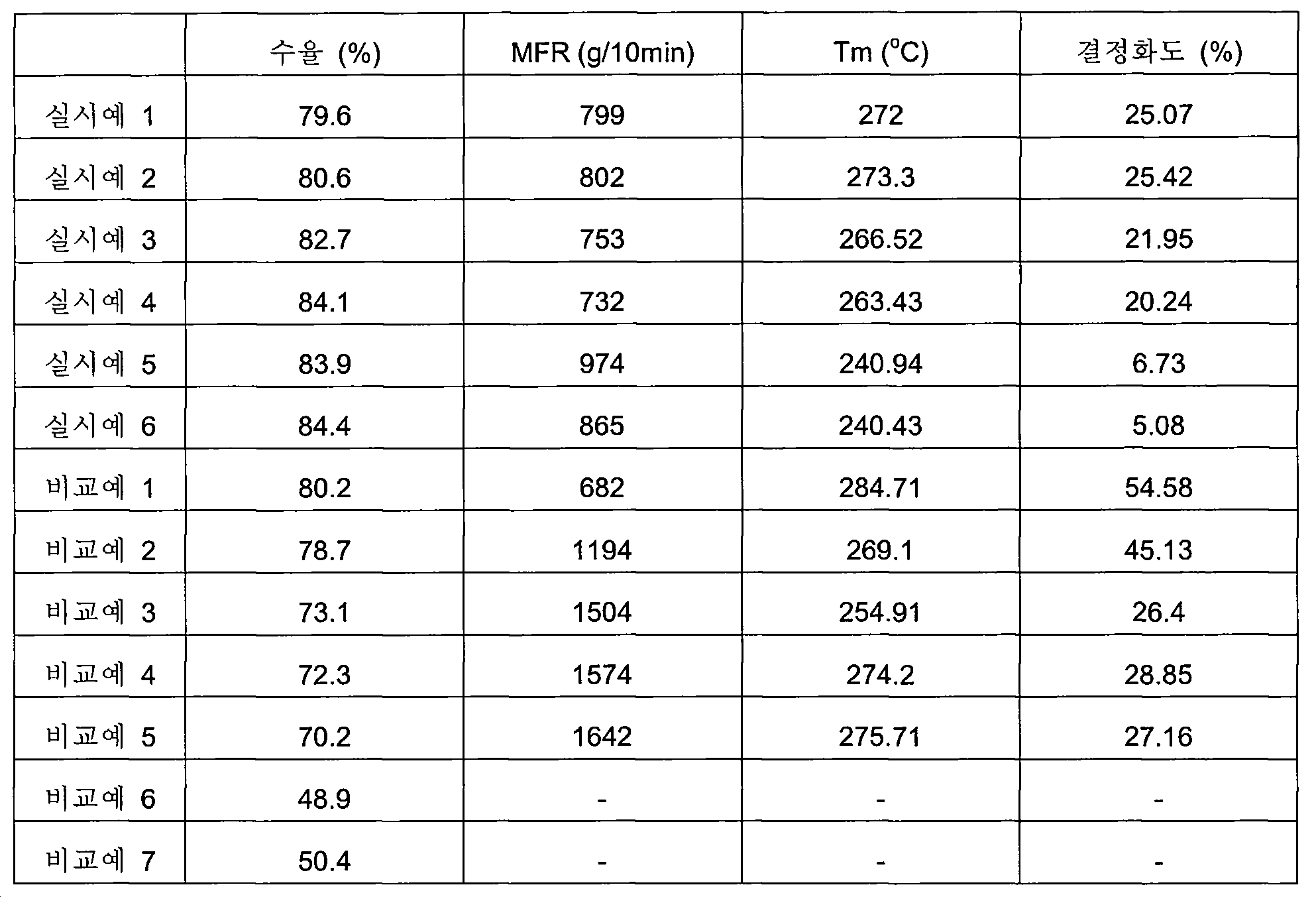
- Examples 1 to 6 is a low temperature heat-curable polyphenylene sulfide obtained with high mechanical properties of less than 25.42% crystallinity and a melt flow index of 974 g / 10min or less to have excellent laser fusion even when used in a molded article. It can be produced with a high yield of% or more.
- Comparative Examples 1 to 7 can be seen that it is difficult to prepare a low temperature thermosetting polyarylene sulfide that maintains both the crystallinity and the melt flow index in a low range.
- o-DCB ortho-dichlorobenzene
- m-DCB meta-dichlorobenzene
Landscapes
- Chemical & Material Sciences (AREA)
- Health & Medical Sciences (AREA)
- Chemical Kinetics & Catalysis (AREA)
- Medicinal Chemistry (AREA)
- Polymers & Plastics (AREA)
- Organic Chemistry (AREA)
- Polymers With Sulfur, Phosphorus Or Metals In The Main Chain (AREA)
Abstract
본 발명은 레이저 융착법으로 레이저 광선 투과측의 성형체에 사용하는 경우에도 우수한 레이저 융착성과 기계적 물성이 확보되도록, 결정화도를 현저히 낮추면서 용융흐름지수도 낮은 범위로 유지하는 저온 열 경화성 폴리아릴렌 설파이드를 높은 중합 수율로 제조하는 방법을 제공한다.
Description
관련 출원들과의 상호 인용
본 출원은 2018년 10월 26일자 한국 특허 출원 제10-2018-0129195호 및 2019년 10월 18일자 한국 특허 출원 제10-2019-0129868호에 기초한 우선권의 이익을 주장하며, 해당 한국 특허 출원의 문헌에 개시된 모든 내용은 본 명세서의 일부로서 포함된다.
본 발명은 결정화도가 현저히 낮으면서 용융흐름지수도 낮은 범위로 유지하는 저온 열 경화성 폴리아릴렌 설파이드의 제조 방법을 제공한다.
폴리페닐렌 설파이드(polyphenylene sulfide; PPS)로 대표되는 폴리아릴렌 설파이드(polyarylene sulfide, PAS)는 우수한 강도, 내열성, 난연성 및 가공성으로 인해 자동자, 전기ㆍ전자 제품, 기계류 등에서 금속, 특히 알루미늄이나 아연과 같은 다이캐스팅(die casting) 금속을 대체하는 소재로 폭 넓게 사용되고 있다. 특히, PPS 수지의 경우, 유동성이 좋기 때문에 유리섬유 등의 필러나 보강제와 혼련하여 컴파운드로 사용하기에 유리하다.
일반적으로, 이러한 수지를 이용하여 성형품 제조시, 수지 성형품의 형상이 복잡한 경우에는 미리 복수로 분리된 파트를 성형하고, 이들 파트를 접합하여 일체화함으로써 복잡한 형상의 제품을 얻는 방법이 이용되고 있다. 이와 같이 복수의 파트를 접합하여 일체화하는 수단으로서는, 접착제에 의한 접합, 볼트 등에 의한 기계적인 접합, 레이저 융착, 열판 융착 등의 외부 가열 융착에 의한 접합, 진동 융착, 초음파 융착 등의 마찰열 융착에 의한 접합 등이 사용되어 왔다. 이들 수단 중, 접착제에 의한 접합은 큰 접착 강도를 얻기가 어렵고, 또한 기계적인 접합에서는 비용이나 수고가 들어가는 것 이외에 중량 증가를 초래한다는 문제가 있었다. 그러나, 외부 가열 융착에 의한 접합이나 마찰열 융착에 의한 접합은, 접착제나 볼트 등의 여분의 재료를 사용하지 않으며, 또한 환경 오염이나 중량 증가 등의 문제를 발생시키지 않는 이점이 있기 때문에, 최근에는 이용이 증가하고 있다.
이러한 외부 가열 융착 중에서도, 특히 레이저 융착법은 간편하게 행할 수 있다는 이점이 있다. 일 예로, 일본특허공개 공보 제1985-214931호에는 겹친 2개의 성형체 중 한 쪽에서 상대측을 향하여 레이저 광선을 조사하는 방식으로 수행하는 레이저 융착법이 기재되어 있다. 이 때, 레이저 광선은 조사측의 성형체를 투과하여, 다른측 성형체에 흡수됨으로써 수지를 용융시켜, 두 성형체 사이를 융착시키도록 되어 있다. 따라서, 레이저 융착법에서는, 레이저 광선을 조사측의 성형체로부터 다른측 성형체까지 투과시키는 것이 융착을 위한 필수 요건이다. 그 때문에, 레이저 광선 투과측의 성형체에 레이저 광선 투과율이 낮은 수지 재료를 이용하면, 2개의 성형체를 접합시킬 수 없거나, 또는 충분한 접합 강도를 얻을 수 없다.
그런데, 종래의 폴리페닐렌 설파이드 수지는 높은 결정성으로, 레이저 광선 투과율이 매우 낮다는 특성이 있다. 이 때문에, 폴리페닐렌 설파이드 수지를 레이저 융착법으로 레이저 광선 투과측의 성형체로서 사용하는 경우에는, 레이저 광선을 투과시킬 수 있도록 얇게 제작해야 하는 필요가 있다. 이에 따라, 폴리페닐렌 설파이드 수지를 레이저 융착법으로 접합시키는 경우에는, 성형체의 설계 자유도가 작아질 수 밖에 없다는 문제가 있었다.
따라서, 레이저 융착법으로 레이저 광선 투과측의 성형체에 사용하는 경우에도 우수한 레이저 융착성과 함께 기계적 물성이 우수한 저온 열 경화성 폴리아릴렌 설파이드를 효과적으로 제조하는 방법에 대한 연구가 필요하다.
본 발명은 레이저 융착법으로 레이저 광선 투과측의 성형체에 사용하는 경우에도 우수한 레이저 융착성과 기계적 물성이 확보되도록, 결정화도가 현저히 낮으면서 용융흐름지수도 낮은 범위로 유지하는 저온 열 경화성 폴리아릴렌 설파이드를 높은 중합 수율로 제조하는 방법을 제공하고자 한다.
발명의 일 구현예에 따르면, 알칼리 금속의 수황화물 및 알칼리 금속의 수산화물을, 물 및 아미드계 화합물의 혼합 용매 중에서 알칼리 금속의 약산염의 존재 하에 탈수 반응(dehydration)을 수행하여, 알칼리 금속의 황화물, 및 물과 아미드계 화합물의 혼합 용매를 포함하는 황 공급원을 제조하는 제1 단계; 및 상기 황 공급원을 포함하는 반응기에 디할로겐화 방향족 화합물 및 아미드계 화합물을 첨가하고, 중합 반응시켜 폴리아릴렌 설파이드를 제조하는 제2 단계;를 포함하고, 상기 알칼리 금속의 약산염은 알칼리 금속의 수황화물 1 당량에 대하여 0.25 내지 0.55의 당량비로 사용되고, 상기 디할로겐화 방향족 화합물은 파라 디할로 방향족 화합물 및 오르쏘 디할로 방향족 화합물을 97:3 내지 88:12의 몰비로 포함하는 것인, 폴리아릴렌 설파이드의 제조 방법이 제공된다.
일 예로, 상기 알칼리 금속의 약산염은, 알칼리 금속의 수황화물 1 당량에 대하여 0.3 내지 0.5의 당량비로 사용되는 것일 수 있다.
또, 상기 디할로겐화 방향족 화합물은, 파라 디할로 방향족 화합물 및 오르쏘 디할로 방향족 화합물을 95:5 내지 90:10의 몰비로 포함하는 것일 수 있다.
또, 상술한 방법으로 제조되는 폴리아릴렌 설파이드는 75% 이상의 수율로 생성되며, 용융흐름지수(MFR, ASTM D1238에 따라 315 ℃에서 5 kg 하중으로 측정)가 1200 g/10min 이하이고, 결정화도가 26.5% 이하일 수 있다.
상술한 바와 같이, 본 발명에 따르면 결정화도가 현저히 낮으면서 용융흐름지수도 낮은 범위로 유지하는 저온 열 경화성 폴리아릴렌 설파이드를 높은 중합 수율로 제조할 수 있어, 전기ㆍ전자 관련 기기, 정밀 기계 관련 기기, 사무용 기기, 자동차ㆍ차량 관련 부품, 건재, 포장재, 가구, 일용 잡화 등의 각종 용도의 수지 성형체의 레이저 융착 접합 등에 효과적으로 사용할 수 있다.
도 1은 본 발명의 일 구현예에 따라 실시예 1의 폴리아릴렌 설파이드를 제조하는 공정도를 간략히 도시한 것이다.
도 2는 본 발명의 일 구현예에 따라 제조된 실시예 4의 폴리페닐렌 설파이드에 대하여 시차주사열량분석(DSC) 장치(TA instrument, TA Q2000)를 사용하여 측정한 그래프이다.
도 3은 본 발명의 일 구현예에 따라 제조된 실시예 6의 폴리페닐렌 설파이드에 대하여 시차주사열량분석(DSC) 장치(TA instrument, TA Q2000)를 사용하여 측정한 그래프이다.
도 4는 본 발명의 일 구현예에 따라 제조된 비교예 1의 폴리페닐렌 설파이드에 대하여 시차주사열량분석(DSC) 장치(TA instrument, TA Q2000)를 사용하여 측정한 그래프이다.
본 발명에서, 제1, 제2 등의 용어는 다양한 구성요소들을 설명하는데 사용되며, 상기 용어들은 하나의 구성 요소를 다른 구성 요소로부터 구별하는 목적으로만 사용된다.
또한, 본 명세서에서 사용되는 용어는 단지 예시적인 실시예들을 설명하기 위해 사용된 것으로, 본 발명을 한정하려는 의도는 아니다. 단수의 표현은 문맥상 명백하게 다르게 뜻하지 않는 한, 복수의 표현을 포함한다. 본 명세서에서, "포함하다", "구비하다" 또는 "가지다" 등의 용어는 실시된 특징, 숫자, 단계, 구성 요소 또는 이들을 조합한 것이 존재함을 지정하려는 것이지, 하나 또는 그 이상의 다른 특징들이나 숫자, 단계, 구성 요소, 또는 이들을 조합한 것들의 존재 또는 부가 가능성을 미리 배제하지 않는 것으로 이해되어야 한다.
본 발명은 다양한 변경을 가할 수 있고 여러 가지 형태를 가질 수 있는 바, 특정 실시예들을 예시하고 하기에서 상세하게 설명하고자 한다. 그러나, 이는 본 발명을 특정한 개시 형태에 대해 한정하려는 것이 아니며, 본 발명의 사상 및 기술 범위에 포함되는 모든 변경, 균등물 내지 대체물을 포함하는 것으로 이해되어야 한다.
이하, 본 발명을 더욱 상세하게 설명한다.
본 발명은 레이저 융착법으로 레이저 광선 투과측의 성형체에 사용하는 경우에도 우수한 레이저 융착성과 기계적 물성이 얻어질 수 있도록, 결정화도가 현저히 낮으면서 용융흐름지수도 낮은 범위로 유지하는 저온 열 경화성 폴리아릴렌 설파이드를 우수한 반응성으로 제조하는 방법이 제공된다.
특히, 본 발명은 N-메틸 피롤리돈(NMP)과 같은 아미드계 화합물 존재 하의 중합 조건에서 황 공급원과 디할로겐화 방향족 화합물을 중합 반응시켜 폴리아릴렌 설파이드(Polyarylene sulfide, PAS)를 제조함에 있어서, 황 공급원을 제조하는 탈수 반응(dehydration)에서 알칼리 금속의 약산염을 최적 함량으로 투입하고, 상기 디할로겐화 방향족 화합물로 파라-디할로벤젠과 오르쏘-디할로벤젠을 소정의 몰비로 혼합하여 중합 반응시킴으로써, 고분자 사슬의 직선성을 감소시켜 융점과 결정화도를 낮추면서도 용융흐름지수도 낮은 범위로 유지하며, 높은 반응성을 확보하는 폴리아릴렌 설파이드를 높은 수율로 제조하는 것을 특징으로 한다.
발명의 일 구현예에 따르면, 알칼리 금속의 약산염을 소정의 함량 범위로 사용한 탈수 반응을 통해 황 공급원을 제조한 후에, 황 공급원과 반응하는 디할로겐화 방향족 화합물로 오르쏘(ortho) 디할로 방향족 화합물을 소정의 함량 범위로 추가 투입함으로써, 고분자 사슬의 직선성을 감소시켜 융점과 결정화도가 낮으면서도, 용융흐름지수는 낮은 범위로 유지하며, 이와 함께 높은 반응성을 갖는 폴리아릴렌 설파이드를 제조하는 방법이 제공된다.
상기 폴리아릴렌 설파이드의 제조 방법은 알칼리 금속의 수황화물 및 알칼리 금속의 수산화물을, 물 및 아미드계 화합물의 혼합 용매 중에서 알칼리 금속의 약산염의 존재 하에 탈수 반응(dehydration)을 수행하여, 알칼리 금속의 황화물, 및 물과 아미드계 화합물의 혼합 용매를 포함하는 황 공급원을 제조하는 제1 단계; 및 상기 황 공급원을 포함하는 반응기에 디할로겐화 방향족 화합물 및 아미드계 화합물을 첨가하고, 중합 반응시켜 폴리아릴렌 설파이드를 제조하는 제2 단계;를 포함한다.
특히, 본 발명은 폴리아릴렌 설파이드를 제조하기 위하여 알칼리 금속의 수황화물 등을 사용한 탈수 반응(dehydration)에서 상기 알칼리 금속의 약산염은 알칼리 금속의 수황화물 1 당량에 대하여 0.25 내지 0.55의 당량비로 사용하여 황 공급원을 제조한 후에, 이렇게 제조된 황 공급원을 파라 디할로 방향족 화합물 및 오르쏘 디할로 방향족 화합물을 97:3 내지 88:12의 몰비로 포함하는 디할로겐화 방향족 화합물과 반응시키는 것을 특징으로 한다.
이에, 본 발명의 일 구현예에 따른 상기 폴리아릴렌 설파이드의 제조 방법에 있어서, 각 단계별로 설명하고자 한다.
상기 황 공급원은 알칼리 금속의 수황화물, 알칼리 금속의 수산화물 및 산성 화합물을, 물 및 아미드계 화합물의 혼합용매 중에서 탈수 반응(dehydration)을 수행하여 제조된 것이다. 따라서, 상기 황 공급원은 알칼리 금속의 수황화물과 알칼리 금속의 수산화물의 반응에 의해 생성된 알칼리 금속의 황화물과 함께, 탈수 반응 후 잔류하는 물, 아미드계 화합물의 혼합 용매를 포함할 수 있다.
이후, 본 발명에서는 연속으로 상기 황 공급원과 디할로겐화 방향족 화합물 및 아미드계 화합물을 이용하여, 중합을 통해 수율이 우수한 폴리아릴렌 설파이드를 제조한다.
상기 알칼리 금속의 황화물은 반응시 사용되는 알칼리 금속의 수황화물의 종류에 따라 결정될 수 있으며, 구체적인 예로는 황화리튬, 황화나트륨, 황화칼륨, 황화루비듐 또는 황화세슘 등을 들 수 있으며 이들 중 어느 하나 또는 둘 이상의 혼합물이 포함될 수 있다.
상기 알칼리 금속의 수황화물과 알칼리 금속의 수산화물의 반응에 의한 황 공급원의 제조시, 사용 가능한 알칼리 금속의 수황화물은 구체적인 예로는 황화수소리튬, 황화수소나트륨, 황화수소칼륨, 황화수소루비듐 또는 황화수소세슘 등을 들 수 있다. 이들 중 어느 하나 또는 둘 이상의 혼합물이 사용될 수 있으며, 이들의 무수물 또는 수화물도 사용 가능하다.
또한, 상기 알칼리 금속의 수산화물의 구체적인 예로는 수산화리튬, 수산화나트륨, 수산화칼륨, 수산화루비듐, 또는 수산화세슘 등을 들 수 있으며, 이들 중 어느 하나 또는 둘 이상의 혼합물이 사용될 수 있다. 상기 알칼리 금속의 수산화물은 알칼리 금속의 수황화물 1 당량에 대하여 약 0.90 내지 약 2.0의 당량비, 보다 구체적으로는 약 1.0 내지 약 1.5의 당량비, 보다 더 구체적으로는 약 1.0 내지 약 1.1의 당량비로 사용될 수 있다.
한편, 본 발명에 있어서, 당량은 몰 당량(eq/mol)을 의미한다.
발명의 일 구현예에 따르면, 상기 알칼리 금속의 수황화물과 알칼리 금속의 수산화물의 반응에 의한 황 공급원의 제조시, 상기 알칼리 금속의 약산염은 알칼리 금속의 수황화물 1 당량에 대하여 약 0.25 내지 약 0.55의 당량비로 사용되고, 바람직하게는 약 0.3 내지 약 0.5의 당량비, 또는 약 0.35 내지 약 0.48의 당량비, 또는 약 0.4 내지 약 0.46의 당량비로 사용될 수 있다. 상기 알칼리 금속의 약산염은 중합 조제로서 오르쏘 디할로 방향족 화합물을 포함하는 디할로겐화 방향족 화합물과의 중합 반응성을 향상시켜 최종 제조된 폴리아릴렌 설파이드의 결정화도와 용융흐름지수(MFR)을 최적화하여 높은 중합 수율을 달성할 수 있다. 특히, 상기 알칼리 금속의 약산염을 알칼리 금속의 수황화물 1 당량에 대하여 약 0.25 당량 미만으로 사용하거나 약 0.55 당량을 초과하여 사용하는 경우에는, 오르쏘 디할로 방향족 화합물을 포함하는 디할로겐화 방향족 화합물과의 반응성이 좋지 않게 되며 중합 수율이 떨어질 뿐만 아니라, 최종 제조된 폴리아릴렌 설파이드 결정화도가 높아지며 레이저 융착(laser welding) 용도로 적합하지 않게 된다.
상기 알칼리 금속의 약산염은 구체적으로, 리튬이나 나트륨 등의 알칼리 금속 양이온이 아세트산 등의 약산과 반응하여 염을 형성한 화학물을 지칭한다. 일예로, 상기 약산은 산 평형지수인 pKa가 약 3.5 이상, 또는 약 4 이상이 될 수 있다. 바람직하게는, 상기 알칼리 금속의 약산염은, 아세트산 리튬, 또는 아세트산 나트륨 등일 수 있으며, 이들 중 어느 하나 또는 둘 이상의 혼합물이 사용될 수 있다.
한편, 상기한 알칼리 금속의 수황화물과 알칼리 금속의 수산화물의 반응은, 물과 아미드계 화합물의 혼합용매 중에서 수행될 수 있는데, 이때 상기 아미드계 화합물의 구체적인 예로는 N,N-디메틸포름아미드 또는 N,N-디메틸아세트아미드 등의 아미드 화합물; N-메틸-2-피롤리돈(NMP) 또는 N-시클로헥실-2-피롤리돈 등의 피롤리돈 화합물; N-메틸-ε-카프로락탐 등의 카프로락탐 화합물; 1,3-디알킬-2-이미다졸리디논 등의 이미다졸리디논 화합물; 테트라메틸 요소 등의 요소 화합물; 또는 헥사메틸인산 트리아미드 등의 인산 아미드 화합물 등을 들 수 있으며, 이들 중 어느 하나 또는 둘 이상의 혼합물이 사용될 수 있다. 이 중에서도 반응 효율 및 폴리아릴렌 설파이드 제조를 위한 중합시 중합 용매로의 공용매 효과를 고려할 때 상기 아미드계 화합물은 보다 구체적으로 N-메틸-2-피롤리돈(NMP)일 수 있다.
또한, 상기 물은 아미드계 화합물 1 당량에 대하여 약 1 내지 약 8의 당량비로 사용될 수 있으며, 보다 구체적으로는 약 1.5 내지 약 5, 또는 약 2.5 내지 약 4.5의 당량비로 사용될 수 있다.
한편, 상기 제1 단계에서, 알칼리 금속의 수황화물 및 알칼리 금속의 수산화물 등을 포함하는 반응물은 탈수 반응(dehydration)을 통해 알칼리 금속의 황화물을 생성시킬 수 있다. 이 때, 상기 탈수 반응은 약 185 ℃ 내지 약 205 ℃의 온도 범위에서 수행하며, 약 100 rpm 내지 약 500 rpm의 속도로, 좀더 구체적으로는 약 300 rpm 내지 약 500 rpm의 속도로 교반하여 수행될 수 있다. 상기 탈수 반응 온도는 후속 중합 공정에 사용되는 황 공급원에 포함되는 유효 황의 양을 최적화하는 측면에서, 탈수되고 남은 물의 양이 유효 황 1 몰에 대하여 3.5 몰 이하로 낮추기 위해서 약 185 ℃이상으로 수행되어야 한다. 또한, 상기 탈수 반응을 통해 빠져나가는 아미드계 화합물의 함량을 최적화하고 황 공급원에 잔존하는 물의 양이 유효 황 1 몰에 대하여 1.5 몰 이상이 될 수 있도록 하기 위해서는, 상기 탈수 반응 온도는 약 205℃ 이하에서 수행되어야 한다.
이러한 탈수 공정 동안에 반응물 중 물 등의 용매가 증류 등을 통해 제거될 수 있으며, 물과 함께 아미드계 화합물의 일부가 배출되고, 또 황 공급원 내 포함된 일부 황이 탈수 공정 동안의 열에 의해 물과 반응하여 황화수소 기체로서 휘산될 수 있다. 또 이때 상기 황화수소와 동일 몰의 알칼리 금속의 수산화물이 생성될 수 있다.
특히, 상기 제1 단계에서의 탈수 반응을 수행하는 동안 발생하는 탈수액, 즉, 탈수 공정을 수행하며 외부로 제거되는 탈수액에서, 물과 아미드계 화합물의 혼합용매를 포함하는 전체 혼합물의 총 부피를 기준으로 아미드계 화합물은 약 25% 내지 약 35%(v/v)로 포함될 수 있다.
한편, 상기와 같은 알칼리 금속의 수황화물, 알칼리 금속의 수산화물 및 알칼리 금속염의 반응 결과로, 알칼리 금속의 황화물이 물과 아미드계 화합물의 혼합 용매 중에 고체상으로 석출되며, 반응계 중에는 미반응의 알칼리 금속의 수황화물이 일부 잔류할 수 있다. 이에 따라 본 발명에 따른 폴리아릴렌 설파이드 제조시 황 공급원으로, 상기한 알칼리 금속의 수황화물과 알칼리 금속의 수산화물을 반응시켜 제조한 황 공급원이 사용될 경우, 황 공급원의 몰비는 반응 결과로 석출된 알칼리 금속의 황화물과, 미반응의 알칼리 금속 수황화물의 총 몰비를 의미한다.
또한, 상기 탈수 공정 동안에 황 공급원내, 즉, 황 함유 반응물로 투입한 알칼리 금속의 수황화물 등과 계내에 잔존하는 황 공급원내에 포함된 황이 물과 반응하여 황화수소와 알칼리 금속 수산화물이 생성되고, 생성된 황화수소는 휘산되기 때문에, 탈수 공정 동안에 계 외로 휘산하는 황화수소에 의해 탈수 공정 후 계내에 잔존하는 황 공급원 중의 황의 양은 감소될 수 있다. 일례로, 알칼리 금속 수황화물을 주성분으로 하는 황 공급원을 사용할 경우, 탈수 공정 후에 계내에 잔존하는 황의 양은, 반응물로 투입한 황 공급원, 즉, 황 함유 반응물인 알칼리 금속의 수황화물에 포함된 황의 몰 양에서 계 외로 휘산한 황화수소의 몰 양을 뺀 값과 동일하다. 이에 따라 계 외로 휘산한 황화수소의 양으로부터 탈수 공정 후 계내에 잔존하는 황 공급원 중에 포함된 유효 황의 양을 정량하는 것이 필요하다. 구체적으로, 상기 탈수 공정이 끝나고 계내에 잔존하는 물은 유효 황 1몰에 대하여 약 1.5 내지 약 3.5의 몰비, 보다 구체적으로는 약 1.6 내지 약 3.0의 몰비, 보다 더 구체적으로는 약 1.8 내지 약 2.8의 몰비가 될 때까지 수행될 수 있다. 상기 탈수 공정에 의해 황 공급원내 수분량이 지나치게 감소하는 경우에는 중합 공정에 앞서 물을 첨가하여 수분량을 조절할 수 있다.
이에 따라, 상기한 바와 같은 알칼리 금속의 수황화물과 알칼리 금속의 수산화물의 반응 및 탈수에 의해 제조된 황 공급원은, 알칼리 금속의 황화물과 함께, 물 및 아미드계 화합물의 혼합용매를 포함할 수 있으며, 상기 물은 황 공급원내 포함된 황 1 몰에 대해 구체적으로 약 1.5 내지 약 3.5의 몰비로 포함될 수 있다. 또한, 상기 황 공급원은 황과 물의 반응에 의해 생성된 알칼리 금속의 수산화물을 더 포함할 수 있다.
한편, 본 발명의 일 구현예에 따라, 제2 단계는 상기 황 공급원을 디할로겐화 방향족 화합물과 중합반응시켜 폴리아릴렌 설파이드를 제조하는 단계이다.
특히, 상기 디할로겐화 방향족 화합물은, 파라(para) 디할로 방향족 화합물과 오르쏘(ortho) 디할로 방향족 화합물만을 포함하는 것으로, 상기 디할로겐화 방향족 화합물 전량을 기준으로 약 97:3 내지 약 88:12의 몰비(파라 디할로 방향족 화합물: 오르쏘 디할로 방향족 화합물의 몰비)로 포함한다. 또한, 상기 디할로겐화 방향족 화합물은 파라(para) 디할로 방향족 화합물과 오르쏘(ortho) 디할로 방향족 화합물을 약 96:4 내지 약 89:11의 몰비, 또는 약 95:5 내지 약 90:10의 몰비로 포함하는 것일 수 있다.
상기 오르쏘 디할로 방향족 화합물의 함량이, 전체 디할로 방향족 화합물의 전량에 대해서 약 3 몰% 미만인 경우에는 제조된 폴리아릴렌 설파이드 중 고분자 사슬의 직쇄성이 높아지며 결정화도가 증가하고 레이저(laser) 투과율이 떨어지므로, 레이저 융착법(laser welding) 용도로 부적합할 수 있다. 반면에, 상기 오르쏘 디할로 방향족 화합물의 함량이 약 12 몰%를 초과하는 경우에는, 중합 반응시 진행되면서 오르쏘 디할로 방향족 화합물의 구조에 기인하는 입체 붐빔 현상(steric hinderance)이 발생하여 중합 반응성이 떨어지고, 그 결과 수율과 용융흐름지수(MFR)가 악화될 수 있다. 또한, 이로 인해 제조된 성형체 가공시, 기계적 물성이나 내열성이 손상되어 실용성에 문제가 발생할 수 있다. 따라서, 최종 제조된 폴리아릴렌 설파이드가 우수한 내구성과 내화학성 특성과 함께 우수한 레이저 융착성을 확보하기 위하여, 폴리아릴렌 설파이드의 용융흐름지수(MFR) 및 용점과 결정화도를 동시에 낮추는 측면에서, 오르쏘 디할로 방향족 화합물의 함량은 상술한 범위를 유지하는 것이 바람직하다.
한편, 본 발명에서 상기 디할로겐화 방향족 화합물은, 방향족 고리에서의 두 개의 수소가 할로겐 원자로 치환된 화합물을 지칭한다.
이 중에서, 오르쏘(ortho) 디할로 방향족 화합물은 디할로 방향족 화합물의 구조 이성질체 중 하나인 위치 이성질체(position isomer)의 일종으로, 방향족 화합물에 치환된 2개의 할로겐기가 서로 이웃하여 1번, 2번 위치에 배치된 구조를 갖는 화합물을 지칭한다.
상기 오르쏘(ortho) 디할로 방향족 화합물의 바람직한 일례로는, o-디할로벤젠, o-디할로톨루엔, 또는 o-디할로벤조산 등을 들 수 있으며, 이들 중 어느 하나 또는 둘 이상의 혼합물이 사용될 수 있다. 상기 오르쏘 디할로겐화 방향족 화합물에 있어서, 할로겐 원자는 불소, 염소, 브롬 또는 요오드일 수 있다. 이중에서도 폴리아릴렌 설파이드의 융점 및 결정화도를 효과적으로 낮추는 측면에서, 오르쏘 디클로로벤젠(o-DCB)이 사용될 수 있다.
또한, 상기 디할로겐화 방향족 화합물 중 오르쏘(ortho) 디할로 방향족 화합물 이외의 나머지 화합물인 파라(para) 디할로 방향족 화합물은, 방향족 화합물에 치환된 2개의 할로겐기가 서로 마주 보며 1번, 4번 위치에 배치된 구조를 갖는 화합물을 지칭한다.
상기 파라(para) 디할로 방향족 화합물의 바람직한 일례로는, p-디할로벤젠, p-디할로톨루엔, 또는 p-디할로벤조산 등을 들 수 있으며, 이들 중 어느 하나 또는 둘 이상의 혼합물이 사용될 수 있다. 여기서, 할로겐 원자는 불소, 염소, 브롬 또는 요오드일 수 있다. 이중에서도 폴리아릴렌 설파이드 제조시 반응성 및 부반응 생성 감소 효과 등을 고려할 때, 파라 디클로로벤젠(p-DCB)이 사용될 수 있다.
한편, 상기 디할로겐화 방향족 화합물은 황 공급원 1 당량을 기준으로 약 0.8 내지 약 1.2의 당량으로 투입될 수 있다. 상기한 함량 범위 내로 투입될 경우, 제조되는 폴리아릴렌 설파이드의 용융점도 저하 및 폴리아릴렌 설파이드 내에 존재하는 클로린 함량의 증가에 대한 우려 없이, 우수한 물성적 특징을 갖는 폴리아릴렌 설파이드를 제조할 수 있다. 황 공급원과 디할로겐화 방향족 화합물의 첨가량 제어에 따른 개선 효과의 우수함을 고려할 때, 보다 구체적으로는 디할로겐화 방향족 화합물은 약 0.9 내지 약 1.1의 당량으로 투입될 수 있다.
또한, 상기 제2 단계를 진행하기 전에, 디할로겐화 방향족 화합물의 기화를 막기 위해 상기 황 공급원을 포함하는 반응기의 온도를 약 150 ℃ 내지 200 ℃의 온도, 또는 약 160 ℃ 내지 190 ℃의 온도, 또는 약 170 ℃ 내지 185℃의 온도로 하강시키는 단계를 더 포함할 수 있다.
또한, 상기한 황 공급원과 디할로겐화 방향족 화합물의 중합반응은 비프로톤성 극성 유기용매로서, 고온에서 알칼리에 대해 안정적인 아미드계 화합물의 용매 중에서 수행될 수 있다.
상기 아미드계 화합물의 구체적인 예는 앞서 설명한 바와 같으며, 예시된 화합물들 중에서도 반응 효율 등을 고려할 때, 보다 구체적으로 상기 아미드계 화합물은 N-메틸-2-피롤리돈(NMP) 또는 N-시클로헥실-2-피롤리돈 등의 피롤리돈 화합물일 수 있다.
상기 제1 단계에서의 황 공급원 중에 포함된 아미드계 화합물이 공용매로서 작용할 수 있으므로, 제2 단계에서 첨가되는 아미드계 화합물은 중합반응계 내에 존재하는 아미드계 화합물에 대한 물(H2O)의 몰비(물/아미드계 화합물의 몰비)가 약 0.85 이상이 되도록 하는 양으로 첨가될 수 있다.
특히, 상기 제2 단계에서 추가로 투입되는 아미드계 화합물은, 상기 알칼리 금속의 수황화물 1 당량을 기준으로 약 1.0 내지 2.0 당량 혹은 약 1.1 내지 1.85 당량으로 첨가할 수 있다. 여기서, 상기 제2 단계에서 중합 반응 수행시 아미드계 화합물은, 황 1몰에 대하여 2.5 내지 4.0의 몰비가 되도록 추가 투입하는 것이다. 이는 제2 단계의 중합 반응 진행시 계 내에 존재하는 최종 아미드계 화합물의 함량에 해당하는 것으로, 제1 단계의 탈수 반응을 통해 얻어진 황 공급원에서 남아있는 아미드계 화합물과 제2 단계에서 추가로 투입되는 아미드계 화합물의 총량이라고 할 수 있다. 한편, 상기 제2 단계의 중합 반응시 계 내에 존재하는 아미드계 화합물의 최종 함량은, 예컨대, 제1 단계 및 제2 단계 진행시 각각 투입되는 아미드계 화합물의 총량으로부터 제1 단계의 탈수액으로 빠져나가는 아미드계 화합물의 양을 차감하여 산측함으로써 확인할 수 있다.
또한, 상기 중합반응시 분자량 조절제, 가교제 등 중합반응이나 분자량을 조절하기 위한 기타 첨가제가 최종 제조되는 폴리아릴렌 설파이드의 물성 및 제조 수율을 저하시키지 않는 범위 내의 함량으로 더 첨가될 수도 있다.
한편, 본 발명의 상기 황 공급원을 디할로겐화 방향족 화합물과 중합 반응시켜 폴리아릴렌 설파이드를 제조하는 제2 단계의 중합 공정은 약 200 ℃ 내지 300 ℃에서 수행될 수 있다. 또는, 상기한 온도 범위 내에서 온도를 변화시키며 다단계로 수행될 수도 있다.
일 예로, 할로겐화 방향족 화합물과 황화합물을 반응시켜 폴리아릴렌 설파이드 의 프리 폴리머(pre-polymer)를 생성시키는 전단 중합 공정과, 상기 프리 폴리머를 이용하여 분자량 및 용융 점도를 증가시키는 후단 중합 공정을 포함하여, 다단계로 수행될 수 있다. 구체적으로, 약 200℃ 이상에서 약 245 ℃ 이하까지의 1차 중합반응 후, 연속하여 1차 중합반응시의 온도보다 높은 온도에서, 구체적으로는 약 250 ℃ 이상에서 약 260 ℃ 이하까지 2차 중합반응이 수행될 수 있다.
상기 1차 중합반응은 프리폴리머가 효과적으로 생성될 수 있도록 오르쏘 디할로방향족 화합물을 포함한 디할로 방향족 화합물의 전환율과 수율 향상 측면에서 약 200 ℃ 이상에서 약 245 ℃ 이하의 온도 범위에서 수행될 수 있다. 이 때, 상기 1차 중합반응은 바람직하게는 약 210 ℃ 이상에서 약 240 ℃ 이하, 또는 약 220 ℃ 이상에서 약 235 ℃ 이하의 온도 범위에서 수행할 수 있다.
또, 상기 2차 중합반응은 용융 점도를 충분한 정도로 유지하여 사출 성형을 효과적으로 수행할 수 있도록 하는 측면에서 약 250 ℃ 이상으로 수행되어야 하고, 과도한 온도 상승으로 고온 분해 반응에 의한 수율 저하 및 용융 점도 감소를 방지하는 측면에서 약 260 ℃ 이하에서 수행될 수 있다. 이 때, 상기 2차 중합반응은 바람직하게는 약 253 ℃ 이상에서 약 260 ℃ 이하, 또는 약 255 ℃ 이상에서 약 260 ℃ 이하의 온도 범위에서 수행할 수 있다.
상기 중합 공정에서, 1차 중합 반응 후에 2차 중합 반응 온도까지 약 0.35 ℃/min 내지 약 2 ℃/min, 또는 약 0.4 ℃/min 내지 약 1.5 ℃/min, 또는 약 0.5 ℃/min 내지 약 1.2 ℃/min가 될 수 있다.
한편, 상기 1차 중합 반응에서 방향족 화합물 투입 이후부터 2차 중합 반응 온도로 승온하기 이전까지의 반응 시간은 약 1.5 시간 내지 약 4 시간, 또는 약 2 시간 내지 약 3 시간이 될 수 있다.
또한, 상기 2차 중합 반응에서 승온을 완료한 이후부터 물을 투입하여 냉각하기 이전까지의 반응 시간은 약 0.3 시간 내지 약 3 시간, 또는 약 0.5 내지 약 2 시간이 될 수 있다.
상기한 중합반응의 결과로 생성된 반응생성물은, 수상과 유기상으로 분리되어 있으며, 이때 유기상 중에 중합반응물인 폴리아릴렌 설파이드가 용해되어 포함된다. 이에 따라 제조된 폴리아릴렌 설파이드의 석출 및 분리를 위한 공정이 선택적으로 더 수행될 수 있다.
구체적으로, 상기 폴리아릴렌 설파이드의 석출은 황 1 당량에 대하여 물을 약 3 내지 약 5의 당량비로 반응 혼합물에 첨가하고 냉각함으로써 수행될 수 있다. 상기한 함량 범위로 물이 첨가될 때, 우수한 효율로 폴리아릴렌 설파이드를 석출할 수 있다.
이후 석출된 폴리아릴렌 설파이드에 대해서는 통상의 방법에 따라, 세척 및 여과 건조 공정이 선택적으로 더 수행될 수 있다.
상기 폴리아릴렌 설파이드의 구체적인 제조 방법은 후술하는 실시예를 참고할 수 있다. 그러나, 폴리아릴렌 설파이드의 제조 방법이 본 명세서에 기술한 내용에 한정되는 것은 아니며, 상기 제조 방법은 본 발명이 속한 기술분야에서 통상적으로 채용하는 단계를 추가로 채용할 수 있고, 상기 제조 방법의 단계(들)는 통상적으로 변경 가능한 단계(들)에 의하여 변경될 수 있다.
한편, 상기한 바와 같은 본 발명의 일 구현예에 따른 폴리아릴렌 설파이드의 제조 방법에 의해 기존 대비, 우수한 기계적 물성을 구현할 수 있도록 낮은 용융흐름지수(MFR)과 함께 우수한 레이저 융착성을 나타낼 수 있도록 융점과 결정화도를 현저히 낮추면서도, 중합 반응 수율이 우수한 폴리아릴렌 설파이드를 용이하게 제조할 수 있다.
구체적으로, 상기 제조 방법에 의해 제조되는 폴리아릴렌 설파이드는 약 75% 이상의 수율로 생성되며, 용융흐름지수(MFR, ASTM D1238에 따라 315 ℃에서 5 kg 하중으로 측정)이 약 1200 g/10min 이하 또는 약 500 g/10min 내지 약 1200 g/10min이고, 결정화도가 약 26.5% 또는 약 3.0% 내지 약 26.5%일 수 있다.
바람직하게는, 상기 폴리아릴렌 설파이드의 중합 반응 수율은 약 79% 이상, 혹은 약 80% 이상, 혹은 약 84% 이상이 될 수 있다.
바람직하게는, 상기 폴리아릴렌 설파이드의 용융흐름지수(MFR)은 약 1100 g/10min 이하 또는 약 550 g/10min 내지 약 1100 g/10min, 혹은 약 1000 g/10min 이하 또는 약 580 g/10min 내지 약 1000 g/10min, 혹은 약 980 g/10min 이하 또는 약 600 g/10min 내지 약 980 g/10min일 수 있다. 여기서, 상기 용융흐름지수는 미국재료시험학회 ASTM D 1238에 따라 315 ℃에서 5 kg 하중으로 측정한 값이다. 특히, 상기 폴리아릴렌 설파이드를 성형체로 제조하여 사용하는 데 가공성 향상 측면에서 용융흐름지수(MFR)은 상술한 범위로 유지될 수 있다. 예컨대, 상기 폴리아릴렌 설파이드의 용융흐름지수(MFR)가 약 1200 g/10min을 초과하는 경우에는, 고분자의 물성을 가질만큼 충분히 분자량이 크지 못하다는 것을 의미하는 것으로, 이러한 폴리아릴렌 설파이드는 우수한 내구성 및 내화학성 특성을 갖지 못할 수 있다.
바람직하게는, 상기 폴리아릴렌 설파이드의 결정화도(Crystallinity)는 약 26.1% 이하 또는 약 3.5% 내지 약 26.1%, 혹은 약 25.5% 이하 또는 약 4% 내지 약 25.5%, 혹은 약 22% 이하 또는 약 5% 내지 22%일 수 있다. 상기 결정화도는 시차주사열량분석(DSC: Differential Scanning Calorimeter) 장치(TA instrument, TA Q2000)를 사용하여 측정할 수 있으며, 결정화도의 측정 방법은 후술할 시험예에서 보다 구체화될 수 있다. 또한, 상기 폴리아릴렌 설파이드를 레이저 융착법으로 레이저 광선 투과측의 성형체에 사용하는 경우에 우수한 레이저 융착성을 확보하는 측면에서, 결정화도(Crystallinity)는 상술한 범위로 유지될 수 있다.
한편, 상기 폴리아릴렌 설파이드는 융점(Tm)이 약 280 ℃ 이하 또는 약 230 ℃ 내지 약 280 ℃, 혹은 약 275 ℃ 이하 또는 약 235 ℃ 내지 약 275℃, 혹은 약 264℃ 이하 또는 약 240℃ 내지 약 264℃일 수 있다.
구체적으로, 상기 폴리아릴렌 설파이드의 융점(Tm)은 시차주사열량분석(DSC: differential scanning calorimeter) 장치(TA instrument, TA Q2000)를 사용하여 측정할 수 있다.
일예로, 폴리아릴렌 설파이드를 섭씨 325 ℃ 까지 가열한 후 5 분 동안 그 온도를 유지하고, 다시 섭씨 50 ℃ 까지 내린 후 다시 온도를 325 ℃ 까지 증가시켜 DSC(differential scanning calorimeter, TA사 제조) 곡선의 꼭대기를 융점으로 한다. 이 때, 온도의 상승과 내림의 속도는 10 ℃/min 이고, 융점은 두 번째 온도가 상승하는 구간에서 측정한 결과를 사용한다.
그리고, 상기 폴리아릴렌 설파이드는 약 180 ℃ 내지 약 250 ℃의 결정화 온도(Tc)를 가질 수 있다. 여기서, 상기 폴리아릴렌 설파이드의 결정화 온도(Tc)는 시차주사열량분석(DSC: Differential Scanning Calorimeter) 장치(TA instrument, TA Q2000)를 사용하여 측정할 수 있으며, 이에 대한 측정 방법은 이 기술 분야에 잘 알려진 바 구체적인 설명은 생략한다.
그리고, 상기 폴리아릴렌 설파이드는 약 20 PaㆍS 내지 약 150 PaㆍS 의 용융점도를 가질 수 있다. 여기서, 상기 폴리아릴렌 설파이드의 용융점도는 ARES-G2(Advanced Rhoeometric Expansion System)을 사용하여 측정할 수 있다. 일예로, 폴리아릴렌 설파이드 수지(건조 시료 중량 약 5~10 g)를 평형 플레이트에 놓고 주파수 스위핑(frequency sweeping) 방식을 이용하여 각 주파수(Angular frequency)를 0.1 에서 100 rad/s까지 변화시켜 가면서 300 ℃에서 측정한다.
한편, 상기 폴리아릴렌 설파이드는 약 10000 g/mol 초과 내지 약 30000 g/mol 이하의 중량평균분자량(Mw)를 갖는 것일 수 있다. 여기서, 상기 폴리아릴렌 설파이드의 중량평균분자량(Mw)은 겔 투과 크로마토그래피(GPC)를 사용하여 측정할 수 있으며, 예컨대, 겔투과 크로마토그래피(GPC) 장치로 Waters PL-GPC220 기기를 이용하고, Polymer Laboratories PLgel MIX-B 300mm 길이 칼럼을 사용하여 측정할 수 있으며, 이에 대한 측정 방법은 이 기술 분야에 잘 알려진 바 구체적인 설명은 생략한다.
이하, 본 발명의 이해를 돕기 위하여 바람직한 실시예를 제시한다. 그러나 하기의 실시예는 본 발명을 보다 쉽게 이해하기 위하여 제공되는 것일 뿐, 이에 의해 본 발명의 내용이 한정되는 것은 아니다.
실시예 1
PPS 폴리머를 만들기 위해 70% 황화수소 나트륨 (NaSH)과 수산화 나트륨 (NaOH)를 1:1.05의 당량 비율로 혼합하여 황화 나트륨을 제조한다. 이 때, 0.35 당량의 아세트산 나트륨(CH3COONa) 분말 및 1.65 당량의 N-메틸-2-파이롤리돈(NMP), 4.72 당량의 탈이온수(DI water)를 반응기에 첨가하였다. 여기서, 당량은 몰 당량(eq/mol)을 의미한다. 이렇게 NaSH, NaOAc, NaOH, NMP, DI water를 반응기에 넣고, 반응기를 체결하였다. 이 때, 고체 시약을 먼저 넣고 NMP, DI water 순으로 투입하였으며, 반응기 안을 질소 분위기로 만들어 준 후, 질소 라인은 제거하였다.
그리고나서, 상기 반응기는 Pitched paddle 타입의 임펠러를 이용하여 450 rpm으로 교반하며, 약 195 ℃까지 1시간 40분 동안 가열하여 탈수시켰다. 여기서, 반응 개시후 천천히 탈수 밸브를 열고 반응기 내부를 승온시키면 반응기 내부에서 증기가 발생하기 시작하는데, 아래쪽에 냉각기(cooler)를 설치하여 증기를 액화시킨 후 모았다. 이때, 탈수액이 410 mL에 도달하면 탈수 밸브를 잠그고, 히터를 꺼서 온도를 낮췄다. 그 후, 반응기의 온도를 약 180 ℃까지 하강시키고, 파라-디클로로벤젠(p-DCB)와 오르쏘-디클로로벤젠(o-DCB)를 황화수소 나트륨의 1.35 당량 N-메틸-2-파이롤리돈(NMP)에 녹인 혼합액을 정량 펌프를 사용하여 반응기 내로 투입하였다. 상기 혼합액에서 p-DCB:o-DCB의 몰비는 95:5가 되도록 혼합하였으며, p-DCB 및 o-DCB의 총량은 황화수소 나트륨의 1.04 배 당량이 되도록 하여 반응기에 첨가하였다. 이 후 반응 혼합물은, 전단 반응으로는 약 230 ℃까지 가열하여 약 3 시간 동안 반응시키고, 다시 후단 반응으로 약 260 ℃로 약 40 분간 승온한 후, 약 1 시간 동안 이 온도를 유지하며 반응을 수행하였다.
반응 종료 후 반응기에 황 1 당량에 대하여 3.03 당량의 탈이온수(DI water)를 첨가하고 약 5 분 동안 교반하였다. 그리고 나서 반응기를 밤새(overnight) 식힌 후 밸브를 열어 남아 있는 미반응 p-DCB와 o-DCB, 용매를 제거한 후 압력이 상압과 같아지게 되면 반응기를 열어 PPS 슬러리를 회수하였다. 얻어진 PPS 슬러리는 상온에서 NMP와 DI water의 혼합용액에서 세척한 후 거르고, 물로 다시 세척하였다. 그 후, 섭씨 100 ℃의 NMP로 2회, 100 ℃ 0.4 wt% 아세트산(acetic ccid) 수용액으로 1회, 섭씨 100 ℃의 DI water로 4 회로 pH가 7이 될 때까지 세척한 후 컨벡션 오븐과 진공 오븐을 사용하여 건조하였다.
실시예 2 내지 4
하기 표 1에 나타낸 바와 같이, 반응기에 투입하는 아세트산 나트륨(CH3COONa) 함량을 각각 달리한 적용하여 투입한 것을 제외하고는, 실시예 1과 동일한 방법으로 PPS 폴리머를 제조하였다.
실시예 5
하기 표 1에 나타낸 바와 같이, 반응기에 투입하는 파라-디클로로벤젠(p-DCB)와 오르쏘-디클로로벤젠(o-DCB) 함량을 p-DCB:o-DCB의 몰비가 90:10이 되도록 혼합하여 투입한 것을 제외하고는, 실시예 3과 동일한 방법으로 PPS 폴리머를 제조하였다.
실시예 6
하기 표 1에 나타낸 바와 같이, 반응기에 투입하는 아세트산 나트륨(CH3COONa) 함량을 달리한 적용하여 투입한 것을 제외하고는, 실시예 6과 동일한 방법으로 PPS 폴리머를 제조하였다.
비교예 1
하기 표 1에 나타낸 바와 같이, 반응기에 투입하는 오르쏘-디클로로벤젠(o-DCB)를 혼합하지 않고 파라-디클로로벤젠(p-DCB)만을 황화수소 나트륨의 1.04 배 당량이 되도록 투입한 것을 제외하고는, 실시예 1과 동일한 방법으로 PPS 폴리머를 제조하였다.
비교예 2
하기 표 1에 나타낸 바와 같이, 반응기에 투입하는 오르쏘-디클로로벤젠(o-DCB) 대신에 메타-디클로로벤젠(m-DCB)를 혼합하여 투입한 것을 제외하고는, 실시예 1과 동일한 방법으로 PPS 폴리머를 제조하였다.
비교예 3
하기 표 1에 나타낸 바와 같이, 반응기에 투입하는 파라-디클로로벤젠(p-DCB)와 메타-디클로로벤젠(m-DCB) 함량을 p-DCB:m-DCB의 몰비가 90:10이 되도록 혼합하여 투입한 것을 제외하고는, 비교예 2와 동일한 방법으로 PPS 폴리머를 제조하였다.
비교예 4 내지 5
하기 표 1에 나타낸 바와 같이, 반응기에 투입하는 아세트산 나트륨(NaOAc, CH3COONa) 함량을 각각 NaSH 1 당량에 대하여 0.2 당량비 및 0.6 당량비로 사용한 것을 제외하고는, 실시예 1과 동일한 방법으로 PPS 폴리머를 제조하였다.
비교예 6
하기 표 1에 나타낸 바와 같이, 반응기에 투입하는 아세트산 나트륨(NaOAc, CH3COONa) 대신에 염화리튬(LiCl)를 사용한 것을 제외하고는, 실시예 4와 동일한 방법으로 PPS 폴리머를 제조하였다.
비교예 7
하기 표 1에 나타낸 바와 같이, 반응기에 투입하는 아세트산 나트륨(NaOAc, CH3COONa) 대신에 염화나트륨(NaCl)를 사용한 것을 제외하고는, 실시예 4와 동일한 방법으로 PPS 폴리머를 제조하였다.
실시예 및 비교예에 따른 폴리페닐렌 설파이드 제조시 구체적인 디클로로벤젠(DCB) 단량체 혼합 조성과 반응 조성 조건은 하기 표 1에 나타낸 바와 같다.

시험예 1
실시예 및 비교예에서 제조한 폴리페닐렌 설파이드에 대해 하기와 같은 방법으로 물성을 측정하고, 그 결과를 하기 표 2에 나타내었다.
1) 수율 (Yield, %)
건조된 폴리페닐렌 설파이드(PPS)의 무게를 전자 저울로 측정한 후에, 반복 단위(repeat unit) 값 (108.16 g/mol)기준으로 몰 수를 계산하였다. 이는 더 적게 투입된 황화 나트륨 몰 수 또는 파라-디클로로벤젠의 몰 수를 기준으로 하여 실제로 회수한 폴리머의 수율(mol/mol%)을 산출했다.
특히, 좀더 정확한 수율 측정을 위하여, 중합 후 얻은 폴리페닐렌 설파이드(PPS) 슬러리의 세척을 위해서 상온의 물에 희석한 후 단순히 체에 거르는 과정을 실시하여 슬러리 내에 유기용매에 잘 녹거나 고온의 물에서 용해가 되는 물질들을 완전히 제거하지 않은 채 수율을 측정하는 종래 방식을 적용하지 않고, 고온의 세척수와 고온의 유기용매에 최소한 3 차례 이상 강하게 세척한 후 하루 동안 고온의 진공오븐에서 건조한 후 수율을 측정하였다.
2) 용융흐름지수 (MFR)
미국재료시험학회규격 D 1238-10 의 방법에 따라, 실시예 및 비교예를 통해 제조한 폴리페닐렌 설파이드의 용융질량흐름율(MFR, melt flow rate)를 측정하였다.
이 때, Gottfert MI-4 장치를 사용하여, 온도 섭씨 315 ℃에서 약 4 분간 가열한 후 5 kg의 하중 조건 하에서 각 폴리페닐렌 설파이드를 놓고 용융된 물질을 압출물의 시간별 구획부분(timed segments)에 대해 중량(g)을 측정하고, 10분 단위당 용융 압출물의 중량(g)으로 압출 속도(g/10min)를 산측하였다.
3) 용융온도 (Tm, ℃)
시차주사열량분석(DSC: differential scanning calorimeter) 장치(TA instrument, TA Q2000)를 사용하여 용융온도, 즉, 융점(Tm, ℃)를 측정하였다.
구체적으로 각 폴리페닐렌 설파이드를 섭씨 325 ℃ 까지 가열한 후 5 분 동안 그 온도를 유지하였고, 다시 섭씨 50 ℃까지 내린 후 다시 온도를 325 ℃ 까지 증가시켜 DSC(differential scanning calorimeter, TA사 제조) 곡선의 꼭대기를 융점으로 하였다. 이 때, 온도의 상승과 내림의 속도는 10 ℃/min이고, 융점은 두 번째 온도가 상승하는 구간에서 측정한 결과를 사용하였다.
4) 결정화도 (crystallinity, %)
Materials Chemistry and Physics 2012, 131(3), 605-614에 기재된 방법에 따라 시차주사열량분석(DSC: differential scanning calorimeter) 장치(TA instrument, TA Q2000)를 사용하여 결정화도(%)를 측정하였다.
구체적으로, 시차주사열량분석(DSC: differential scanning calorimeter) 장치(TA instrument, TA Q2000)를 사용하여 폴리페닐렌 설파이드의 델타 Hc (ΔHc, J/g)를 측정하고 하기 식 1 에 따라 결정화도(%)를 측정하였다.
[식 1]

상기 식 1에서, 델타 Hf (ΔHf)는 폴리페닐렌 설파이드의 용융엔탈피(Tm)이고, 델타 Hc (ΔHc)는 폴리페닐렌 설파이드의 재결정화엔탈피(150 ℃ 근처에서 나오는 peak)이고, 델타  는 결정화도가 100%이라고 가정했을 때의 폴리페닐렌 설파이드의 용융엔탈피이다. 참고로, 결정화도가 100%라고 가정했을때의 폴리페닐렌 설파이드의 용융엔탈피는, 80 J/g으로 알려져 있다(Polymer Data Handbook 참조).
또한, 도 2 내지 4에는 각각, 실시예 4, 실시예 6, 및 비교예 1에 따라 제조된 폴리페닐렌 설파이드에 대한 시차주사열량분석(DSC: Differential Scanning Calorimeter) 장치(TA instrument, TA Q2000)를 사용하여 측정한 그래프를 나타내었다. 도 2, 도 3, 및 도 4의 DSC 그래프에 따르면, 실시예 4 및 6의 폴리페닐렌 설파이드는 융점(Tm)과 결정화온도(Tc)가 비교예 1에 비해 낮은 범위에서 나타나며, 이에 따라 실시예 4 및 6의 폴리페닐렌 설파이드 결정화도가 비교예 1에 비해 크게 낮아진 것을 알 수 있다.
상기 표 2 에 나타낸 바와 같이, 본 발명에 따라 폴리아릴렌 설파이드(Polyarylene sulfide, PAS)를 제조시 특정의 알칼리 금속 약산염 및 상기 디할로겐화 방향족 화합물 중 오르쏘 디할로 방향족 화합물을 모두 최적화하여 투입함으로써, 실시예 1 내지 6은 성형체에 사용하는 경우에도 우수한 레이저 융착성을 갖도록 결정화도가 25.42% 이하이면서도, 용융흐름지수 974 g/10min이하로 높은 기계적 물성이 함께 얻어지는 저온 열 경화성 폴리페닐렌 설파이드를 79.6% 이상의 높은 수율로 제조할 수 있다.
반면에, 비교예 1 내지 7 은 이처럼 결정화도와 용융흐름지수가 모두 낮은 범위로 유지하는 저온 열 경화성 폴리아릴렌 설파이드를 제조하기 어려움을 알 수 있다. 특히, 오르쏘-디클로로벤젠(o-DCB)를 사용하지 않은 비교예 1 과 메타-디클로로벤젠(m-DCB)를 사용한 비교예 2 의 경우, 결정화도가 54.58% 및 45.13%로 증가하며, 레이저 융착성이 좋지 않아 레이저 광선 투과측의 성형체에 사용하기에는 어려움을 알 수 있다. 또한, 메타-디클로로벤젠(m-DCB)를 함량을 증가시킨 비교예 3 과 아세트산 나트륨(NaOAc) 함량을 달리한 비교예 4 및 5 의 경우에는, 반응 수율이 70.2% 내지 73.1%에 불가할 뿐만 아니라, 용융 흐름지수가 1504 g/10min 및 1574 g/10min, 1642 g/10min 으로 증가하며 기계적 물성이 좋지 않으며 성형품 가공시 내구성 및 내화학성이 저하될 수 있다. 또한, 아세트산 나트륨(NaOAc) 대신에 염화리튬(LiCl)이나 염화나트륨(NaCl)을 사용한 비교예 6 및 7 의 경우에는 반응 수율이 48.9% 및 50.4%으로 현저히 저하되어 중합 반응 자체가 불가능하다고 할 수 있다.
Claims (11)
- 알칼리 금속의 수황화물 및 알칼리 금속의 수산화물을, 물 및 아미드계 화합물의 혼합 용매 중에서 알칼리 금속의 약산염의 존재 하에 탈수 반응(dehydration)을 수행하여, 알칼리 금속의 황화물, 및 물과 아미드계 화합물의 혼합 용매를 포함하는 황 공급원을 제조하는 제1 단계; 및상기 황 공급원을 포함하는 반응기에 디할로겐화 방향족 화합물 및 아미드계 화합물을 첨가하고, 중합 반응시켜 폴리아릴렌 설파이드를 제조하는 제2 단계;를 포함하고,상기 알칼리 금속의 약산염은 알칼리 금속의 수황화물 1 당량에 대하여 0.25 내지 0.55의 당량비로 사용되고,상기 디할로겐화 방향족 화합물은 파라 디할로 방향족 화합물 및 오르쏘 디할로 방향족 화합물을 97:3 내지 88:12의 몰비로 포함하는 것인,폴리아릴렌 설파이드의 제조 방법.
- 제1항에 있어서,상기 알칼리 금속의 약산염은, 알칼리 금속의 수황화물 1 당량에 대하여 0.3 내지 0.5의 당량비로 사용되는,폴리아릴렌 설파이드의 제조 방법.
- 제1항에 있어서,상기 알칼리 금속의 약산염은, 아세트산 리튬, 아세트산 나트륨, 또는 이들의 혼합물을 포함하는,폴리아릴렌 설파이드의 제조 방법.
- 제1항에 있어서,상기 제1 단계에서 탈수 반응은 130 ℃ 내지 205 ℃의 온도 범위에서 수행하는,폴리아릴렌 설파이드의 제조 방법.
- 제1항에 있어서,상기 디할로겐화 방향족 화합물은, 파라 디할로 방향족 화합물 및 오르쏘 디할로 방향족 화합물을 95:5 내지 90:10의 몰비로 포함하는,폴리아릴렌 설파이드의 제조 방법.
- 제1항에 있어서,상기 디할로겐화 방향족 화합물 중 오르쏘(ortho) 디할로 방향족 화합물은, o-디할로벤젠, o-디할로톨루엔, 및 o-디할로벤조산으로 이루어진 군에서 선택되는 하나 또는 둘 이상을 포함하는,폴리아릴렌 설파이드의 제조 방법.
- 제1항에 있어서,상기 디할로겐화 방향족 화합물 중 파라(para) 디할로 방향족 화합물은, p-디할로벤젠, p-디할로톨루엔, 및 p-디할로벤조산으로 이루어진 군에서 선택되는 어느 하나 또는 둘 이상을 포함하는,폴리아릴렌 설파이드의 제조 방법.
- 제1항에 있어서,상기 디할로겐화 방향족 화합물은, 상기 알칼리 금속의 수황화물 1 당량을 기준으로 0.8 당량 내지 1.2 당량으로 사용하는,폴리아릴렌 설파이드의 제조 방법.
- 제1항에 있어서,상기 제2 단계에서 아미드계 화합물은, 황 1몰에 대하여 2.5 내지 4.0의 몰비가 되도록 첨가하는,폴리아릴렌 설파이드의 제조 방법.
- 제1항에 있어서,상기 제2 단계의 중합 반응은 200 ℃ 내지 300 ℃의 온도 범위에서 수행하는,폴리아릴렌 설파이드의 제조 방법.
- 제1항에 있어서,상기 폴리아릴렌 설파이드는 75% 이상의 수율로 생성되며, ASTM D 1238에 따라 315 ℃에서 5 kg 하중으로 측정한 용융흐름지수가 1200 g/10min 이하이고, 결정화도가 26.5% 이하인,폴리아릴렌 설파이드의 제조 방법.
Priority Applications (3)
| Application Number | Priority Date | Filing Date | Title |
|---|---|---|---|
| JP2021514421A JP7205816B2 (ja) | 2018-10-26 | 2019-10-25 | ポリアリーレンスルフィドの製造方法 |
| CN201980055366.XA CN112601779B (zh) | 2018-10-26 | 2019-10-25 | 聚芳硫醚的制备方法 |
| US17/270,804 US12146033B2 (en) | 2018-10-26 | 2019-10-25 | Preparation method of polyarylene sulfide |
Applications Claiming Priority (4)
| Application Number | Priority Date | Filing Date | Title |
|---|---|---|---|
| KR20180129195 | 2018-10-26 | ||
| KR10-2018-0129195 | 2018-10-26 | ||
| KR10-2019-0129868 | 2019-10-18 | ||
| KR1020190129868A KR102251791B1 (ko) | 2018-10-26 | 2019-10-18 | 폴리아릴렌 설파이드의 제조 방법 |
Publications (1)
| Publication Number | Publication Date |
|---|---|
| WO2020085871A1 true WO2020085871A1 (ko) | 2020-04-30 |
Family
ID=70331750
Family Applications (1)
| Application Number | Title | Priority Date | Filing Date |
|---|---|---|---|
| PCT/KR2019/014209 Ceased WO2020085871A1 (ko) | 2018-10-26 | 2019-10-25 | 폴리아릴렌 설파이드의 제조 방법 |
Country Status (1)
| Country | Link |
|---|---|
| WO (1) | WO2020085871A1 (ko) |
Citations (4)
| Publication number | Priority date | Publication date | Assignee | Title |
|---|---|---|---|---|
| EP0280271A2 (en) * | 1987-02-24 | 1988-08-31 | Phillips Petroleum Company | Arylene sulfide polymers |
| KR100222316B1 (ko) * | 1991-12-17 | 1999-10-01 | 나우치 다케노부 | 폴리아릴렌설파이드의 제조방법 및 그 장치 |
| JP2002201274A (ja) * | 2000-12-28 | 2002-07-19 | Dic Ep Inc | ポリアリーレンスルフィドの製造法 |
| JP3797446B2 (ja) * | 1997-01-09 | 2006-07-19 | 大日本インキ化学工業株式会社 | ポリアリーレンスルフィドの製造法 |
-
2019
- 2019-10-25 WO PCT/KR2019/014209 patent/WO2020085871A1/ko not_active Ceased
Patent Citations (4)
| Publication number | Priority date | Publication date | Assignee | Title |
|---|---|---|---|---|
| EP0280271A2 (en) * | 1987-02-24 | 1988-08-31 | Phillips Petroleum Company | Arylene sulfide polymers |
| KR100222316B1 (ko) * | 1991-12-17 | 1999-10-01 | 나우치 다케노부 | 폴리아릴렌설파이드의 제조방법 및 그 장치 |
| JP3797446B2 (ja) * | 1997-01-09 | 2006-07-19 | 大日本インキ化学工業株式会社 | ポリアリーレンスルフィドの製造法 |
| JP2002201274A (ja) * | 2000-12-28 | 2002-07-19 | Dic Ep Inc | ポリアリーレンスルフィドの製造法 |
Similar Documents
| Publication | Publication Date | Title |
|---|---|---|
| JP5623277B2 (ja) | 粒状ポリアリーレンスルフィドの製造方法 | |
| JP4635344B2 (ja) | ポリアリーレンスルフィド樹脂の製造方法 | |
| JP6136293B2 (ja) | 架橋型ポリアリーレンスルフィドの製造方法 | |
| US11407860B2 (en) | Method for preparing polyarylene sulfide | |
| KR102196506B1 (ko) | 폴리아릴렌 설파이드의 제조 방법 | |
| JP4639665B2 (ja) | ポリアリーレンスルフィド樹脂の製造方法 | |
| JP2005041922A (ja) | ポリアリーレンスルフィド樹脂の製造方法 | |
| JPH08269200A (ja) | 接着性に優れたポリアリーレンスルフィド | |
| JP2004352923A (ja) | ポリアリーレンスルフィド樹脂の製造方法 | |
| KR102173641B1 (ko) | 폴리아릴렌 설파이드의 제조 방법 | |
| JP3582123B2 (ja) | ポリアリーレンスルフィドの製造法 | |
| JP2002201275A (ja) | ポリアリーレンスルフィドの製造法 | |
| JPH02302436A (ja) | ポリアリーレンスルフィドの製造方法 | |
| US5894072A (en) | Process for preparing aromatic sulfur-containing polymers | |
| WO2020085871A1 (ko) | 폴리아릴렌 설파이드의 제조 방법 | |
| KR102251404B1 (ko) | 폴리아릴렌 설파이드의 제조 방법 | |
| KR102251791B1 (ko) | 폴리아릴렌 설파이드의 제조 방법 | |
| WO2020009481A1 (ko) | 폴리아릴렌 설파이드의 제조 방법 | |
| JP2748451B2 (ja) | ブロック共重合体の製造方法 | |
| KR102250242B1 (ko) | 폴리아릴렌 설파이드의 제조 방법 | |
| WO2020009495A1 (ko) | 폴리아릴렌 설파이드의 제조 방법 | |
| KR102802959B1 (ko) | 폴리아릴렌 설파이드의 제조방법 | |
| KR102812305B1 (ko) | 폴리아릴렌 설파이드의 제조방법 및 이에 의해 제조된 폴리아릴렌 설파이드 | |
| JP2529708B2 (ja) | ポリ(p−フェニレンスルフィド)の製造方法 | |
| JPH08311201A (ja) | 接着性に優れたポリアリーレンスルフィド |
Legal Events
| Date | Code | Title | Description |
|---|---|---|---|
| 121 | Ep: the epo has been informed by wipo that ep was designated in this application |
Ref document number: 19875175 Country of ref document: EP Kind code of ref document: A1 |
|
| ENP | Entry into the national phase |
Ref document number: 2021514421 Country of ref document: JP Kind code of ref document: A |
|
| NENP | Non-entry into the national phase |
Ref country code: DE |
|
| 122 | Ep: pct application non-entry in european phase |
Ref document number: 19875175 Country of ref document: EP Kind code of ref document: A1 |