WO2020071339A1 - 基板の製造方法、組成物及び重合体 - Google Patents
基板の製造方法、組成物及び重合体Info
- Publication number
- WO2020071339A1 WO2020071339A1 PCT/JP2019/038636 JP2019038636W WO2020071339A1 WO 2020071339 A1 WO2020071339 A1 WO 2020071339A1 JP 2019038636 W JP2019038636 W JP 2019038636W WO 2020071339 A1 WO2020071339 A1 WO 2020071339A1
- Authority
- WO
- WIPO (PCT)
- Prior art keywords
- group
- metal
- polymer
- formula
- terminal structure
- Prior art date
- Legal status (The legal status is an assumption and is not a legal conclusion. Google has not performed a legal analysis and makes no representation as to the accuracy of the status listed.)
- Ceased
Links
Classifications
-
- C—CHEMISTRY; METALLURGY
- C09—DYES; PAINTS; POLISHES; NATURAL RESINS; ADHESIVES; COMPOSITIONS NOT OTHERWISE PROVIDED FOR; APPLICATIONS OF MATERIALS NOT OTHERWISE PROVIDED FOR
- C09D—COATING COMPOSITIONS, e.g. PAINTS, VARNISHES OR LACQUERS; FILLING PASTES; CHEMICAL PAINT OR INK REMOVERS; INKS; CORRECTING FLUIDS; WOODSTAINS; PASTES OR SOLIDS FOR COLOURING OR PRINTING; USE OF MATERIALS THEREFOR
- C09D125/00—Coating compositions based on homopolymers or copolymers of compounds having one or more unsaturated aliphatic radicals, each having only one carbon-to-carbon double bond, and at least one being terminated by an aromatic carbocyclic ring; Coating compositions based on derivatives of such polymers
- C09D125/02—Homopolymers or copolymers of hydrocarbons
- C09D125/16—Homopolymers or copolymers of alkyl-substituted styrenes
-
- B—PERFORMING OPERATIONS; TRANSPORTING
- B05—SPRAYING OR ATOMISING IN GENERAL; APPLYING FLUENT MATERIALS TO SURFACES, IN GENERAL
- B05D—PROCESSES FOR APPLYING FLUENT MATERIALS TO SURFACES, IN GENERAL
- B05D7/00—Processes, other than flocking, specially adapted for applying liquids or other fluent materials to particular surfaces or for applying particular liquids or other fluent materials
- B05D7/14—Processes, other than flocking, specially adapted for applying liquids or other fluent materials to particular surfaces or for applying particular liquids or other fluent materials to metal, e.g. car bodies
-
- B—PERFORMING OPERATIONS; TRANSPORTING
- B05—SPRAYING OR ATOMISING IN GENERAL; APPLYING FLUENT MATERIALS TO SURFACES, IN GENERAL
- B05D—PROCESSES FOR APPLYING FLUENT MATERIALS TO SURFACES, IN GENERAL
- B05D1/00—Processes for applying liquids or other fluent materials
- B05D1/002—Processes for applying liquids or other fluent materials the substrate being rotated
- B05D1/005—Spin coating
-
- B—PERFORMING OPERATIONS; TRANSPORTING
- B32—LAYERED PRODUCTS
- B32B—LAYERED PRODUCTS, i.e. PRODUCTS BUILT-UP OF STRATA OF FLAT OR NON-FLAT, e.g. CELLULAR OR HONEYCOMB, FORM
- B32B15/00—Layered products comprising a layer of metal
- B32B15/04—Layered products comprising a layer of metal comprising metal as the main or only constituent of a layer, which is next to another layer of the same or of a different material
- B32B15/08—Layered products comprising a layer of metal comprising metal as the main or only constituent of a layer, which is next to another layer of the same or of a different material of synthetic resin
-
- C—CHEMISTRY; METALLURGY
- C08—ORGANIC MACROMOLECULAR COMPOUNDS; THEIR PREPARATION OR CHEMICAL WORKING-UP; COMPOSITIONS BASED THEREON
- C08F—MACROMOLECULAR COMPOUNDS OBTAINED BY REACTIONS ONLY INVOLVING CARBON-TO-CARBON UNSATURATED BONDS
- C08F212/00—Copolymers of compounds having one or more unsaturated aliphatic radicals, each having only one carbon-to-carbon double bond, and at least one being terminated by an aromatic carbocyclic ring
- C08F212/02—Monomers containing only one unsaturated aliphatic radical
- C08F212/04—Monomers containing only one unsaturated aliphatic radical containing one ring
- C08F212/06—Hydrocarbons
- C08F212/08—Styrene
-
- C—CHEMISTRY; METALLURGY
- C08—ORGANIC MACROMOLECULAR COMPOUNDS; THEIR PREPARATION OR CHEMICAL WORKING-UP; COMPOSITIONS BASED THEREON
- C08F—MACROMOLECULAR COMPOUNDS OBTAINED BY REACTIONS ONLY INVOLVING CARBON-TO-CARBON UNSATURATED BONDS
- C08F212/00—Copolymers of compounds having one or more unsaturated aliphatic radicals, each having only one carbon-to-carbon double bond, and at least one being terminated by an aromatic carbocyclic ring
- C08F212/02—Monomers containing only one unsaturated aliphatic radical
- C08F212/04—Monomers containing only one unsaturated aliphatic radical containing one ring
- C08F212/06—Hydrocarbons
- C08F212/12—Monomers containing a branched unsaturated aliphatic radical or a ring substituted by an alkyl radical
-
- C—CHEMISTRY; METALLURGY
- C08—ORGANIC MACROMOLECULAR COMPOUNDS; THEIR PREPARATION OR CHEMICAL WORKING-UP; COMPOSITIONS BASED THEREON
- C08F—MACROMOLECULAR COMPOUNDS OBTAINED BY REACTIONS ONLY INVOLVING CARBON-TO-CARBON UNSATURATED BONDS
- C08F230/00—Copolymers of compounds having one or more unsaturated aliphatic radicals, each having only one carbon-to-carbon double bond, and containing phosphorus, selenium, tellurium or a metal
- C08F230/02—Copolymers of compounds having one or more unsaturated aliphatic radicals, each having only one carbon-to-carbon double bond, and containing phosphorus, selenium, tellurium or a metal containing phosphorus
-
- C—CHEMISTRY; METALLURGY
- C08—ORGANIC MACROMOLECULAR COMPOUNDS; THEIR PREPARATION OR CHEMICAL WORKING-UP; COMPOSITIONS BASED THEREON
- C08F—MACROMOLECULAR COMPOUNDS OBTAINED BY REACTIONS ONLY INVOLVING CARBON-TO-CARBON UNSATURATED BONDS
- C08F297/00—Macromolecular compounds obtained by successively polymerising different monomer systems using a catalyst of the ionic or coordination type without deactivating the intermediate polymer
- C08F297/02—Macromolecular compounds obtained by successively polymerising different monomer systems using a catalyst of the ionic or coordination type without deactivating the intermediate polymer using a catalyst of the anionic type
- C08F297/04—Macromolecular compounds obtained by successively polymerising different monomer systems using a catalyst of the ionic or coordination type without deactivating the intermediate polymer using a catalyst of the anionic type polymerising vinyl aromatic monomers and conjugated dienes
- C08F297/048—Macromolecular compounds obtained by successively polymerising different monomer systems using a catalyst of the ionic or coordination type without deactivating the intermediate polymer using a catalyst of the anionic type polymerising vinyl aromatic monomers and conjugated dienes polymerising vinyl aromatic monomers, conjugated dienes and polar monomers
-
- C—CHEMISTRY; METALLURGY
- C08—ORGANIC MACROMOLECULAR COMPOUNDS; THEIR PREPARATION OR CHEMICAL WORKING-UP; COMPOSITIONS BASED THEREON
- C08F—MACROMOLECULAR COMPOUNDS OBTAINED BY REACTIONS ONLY INVOLVING CARBON-TO-CARBON UNSATURATED BONDS
- C08F8/00—Chemical modification by after-treatment
- C08F8/42—Introducing metal atoms or metal-containing groups
-
- C—CHEMISTRY; METALLURGY
- C08—ORGANIC MACROMOLECULAR COMPOUNDS; THEIR PREPARATION OR CHEMICAL WORKING-UP; COMPOSITIONS BASED THEREON
- C08L—COMPOSITIONS OF MACROMOLECULAR COMPOUNDS
- C08L101/00—Compositions of unspecified macromolecular compounds
- C08L101/02—Compositions of unspecified macromolecular compounds characterised by the presence of specified groups, e.g. terminal or pendant functional groups
-
- C—CHEMISTRY; METALLURGY
- C09—DYES; PAINTS; POLISHES; NATURAL RESINS; ADHESIVES; COMPOSITIONS NOT OTHERWISE PROVIDED FOR; APPLICATIONS OF MATERIALS NOT OTHERWISE PROVIDED FOR
- C09D—COATING COMPOSITIONS, e.g. PAINTS, VARNISHES OR LACQUERS; FILLING PASTES; CHEMICAL PAINT OR INK REMOVERS; INKS; CORRECTING FLUIDS; WOODSTAINS; PASTES OR SOLIDS FOR COLOURING OR PRINTING; USE OF MATERIALS THEREFOR
- C09D135/00—Coating compositions based on homopolymers or copolymers of compounds having one or more unsaturated aliphatic radicals, each having only one carbon-to-carbon double bond, and at least one being terminated by a carboxyl radical, and containing at least another carboxyl radical in the molecule, or of salts, anhydrides, esters, amides, imides or nitriles thereof; Coating compositions based on derivatives of such polymers
- C09D135/06—Copolymers with vinyl aromatic monomers
-
- C—CHEMISTRY; METALLURGY
- C09—DYES; PAINTS; POLISHES; NATURAL RESINS; ADHESIVES; COMPOSITIONS NOT OTHERWISE PROVIDED FOR; APPLICATIONS OF MATERIALS NOT OTHERWISE PROVIDED FOR
- C09D—COATING COMPOSITIONS, e.g. PAINTS, VARNISHES OR LACQUERS; FILLING PASTES; CHEMICAL PAINT OR INK REMOVERS; INKS; CORRECTING FLUIDS; WOODSTAINS; PASTES OR SOLIDS FOR COLOURING OR PRINTING; USE OF MATERIALS THEREFOR
- C09D7/00—Features of coating compositions, not provided for in group C09D5/00; Processes for incorporating ingredients in coating compositions
- C09D7/20—Diluents or solvents
-
- C—CHEMISTRY; METALLURGY
- C23—COATING METALLIC MATERIAL; COATING MATERIAL WITH METALLIC MATERIAL; CHEMICAL SURFACE TREATMENT; DIFFUSION TREATMENT OF METALLIC MATERIAL; COATING BY VACUUM EVAPORATION, BY SPUTTERING, BY ION IMPLANTATION OR BY CHEMICAL VAPOUR DEPOSITION, IN GENERAL; INHIBITING CORROSION OF METALLIC MATERIAL OR INCRUSTATION IN GENERAL
- C23C—COATING METALLIC MATERIAL; COATING MATERIAL WITH METALLIC MATERIAL; SURFACE TREATMENT OF METALLIC MATERIAL BY DIFFUSION INTO THE SURFACE, BY CHEMICAL CONVERSION OR SUBSTITUTION; COATING BY VACUUM EVAPORATION, BY SPUTTERING, BY ION IMPLANTATION OR BY CHEMICAL VAPOUR DEPOSITION, IN GENERAL
- C23C18/00—Chemical coating by decomposition of either liquid compounds or solutions of the coating forming compounds, without leaving reaction products of surface material in the coating; Contact plating
-
- C—CHEMISTRY; METALLURGY
- C23—COATING METALLIC MATERIAL; COATING MATERIAL WITH METALLIC MATERIAL; CHEMICAL SURFACE TREATMENT; DIFFUSION TREATMENT OF METALLIC MATERIAL; COATING BY VACUUM EVAPORATION, BY SPUTTERING, BY ION IMPLANTATION OR BY CHEMICAL VAPOUR DEPOSITION, IN GENERAL; INHIBITING CORROSION OF METALLIC MATERIAL OR INCRUSTATION IN GENERAL
- C23C—COATING METALLIC MATERIAL; COATING MATERIAL WITH METALLIC MATERIAL; SURFACE TREATMENT OF METALLIC MATERIAL BY DIFFUSION INTO THE SURFACE, BY CHEMICAL CONVERSION OR SUBSTITUTION; COATING BY VACUUM EVAPORATION, BY SPUTTERING, BY ION IMPLANTATION OR BY CHEMICAL VAPOUR DEPOSITION, IN GENERAL
- C23C18/00—Chemical coating by decomposition of either liquid compounds or solutions of the coating forming compounds, without leaving reaction products of surface material in the coating; Contact plating
- C23C18/16—Chemical coating by decomposition of either liquid compounds or solutions of the coating forming compounds, without leaving reaction products of surface material in the coating; Contact plating by reduction or substitution, e.g. electroless plating
- C23C18/18—Pretreatment of the material to be coated
-
- B—PERFORMING OPERATIONS; TRANSPORTING
- B05—SPRAYING OR ATOMISING IN GENERAL; APPLYING FLUENT MATERIALS TO SURFACES, IN GENERAL
- B05D—PROCESSES FOR APPLYING FLUENT MATERIALS TO SURFACES, IN GENERAL
- B05D2202/00—Metallic substrate
- B05D2202/40—Metallic substrate based on other transition elements
-
- B—PERFORMING OPERATIONS; TRANSPORTING
- B05—SPRAYING OR ATOMISING IN GENERAL; APPLYING FLUENT MATERIALS TO SURFACES, IN GENERAL
- B05D—PROCESSES FOR APPLYING FLUENT MATERIALS TO SURFACES, IN GENERAL
- B05D2202/00—Metallic substrate
- B05D2202/40—Metallic substrate based on other transition elements
- B05D2202/45—Metallic substrate based on other transition elements based on Cu
-
- B—PERFORMING OPERATIONS; TRANSPORTING
- B05—SPRAYING OR ATOMISING IN GENERAL; APPLYING FLUENT MATERIALS TO SURFACES, IN GENERAL
- B05D—PROCESSES FOR APPLYING FLUENT MATERIALS TO SURFACES, IN GENERAL
- B05D2203/00—Other substrates
- B05D2203/30—Other inorganic substrates, e.g. ceramics, silicon
-
- B—PERFORMING OPERATIONS; TRANSPORTING
- B05—SPRAYING OR ATOMISING IN GENERAL; APPLYING FLUENT MATERIALS TO SURFACES, IN GENERAL
- B05D—PROCESSES FOR APPLYING FLUENT MATERIALS TO SURFACES, IN GENERAL
- B05D2350/00—Pretreatment of the substrate
- B05D2350/60—Adding a layer before coating
- B05D2350/65—Adding a layer before coating metal layer
-
- B—PERFORMING OPERATIONS; TRANSPORTING
- B05—SPRAYING OR ATOMISING IN GENERAL; APPLYING FLUENT MATERIALS TO SURFACES, IN GENERAL
- B05D—PROCESSES FOR APPLYING FLUENT MATERIALS TO SURFACES, IN GENERAL
- B05D2401/00—Form of the coating product, e.g. solution, water dispersion, powders or the like
- B05D2401/10—Organic solvent
-
- B—PERFORMING OPERATIONS; TRANSPORTING
- B05—SPRAYING OR ATOMISING IN GENERAL; APPLYING FLUENT MATERIALS TO SURFACES, IN GENERAL
- B05D—PROCESSES FOR APPLYING FLUENT MATERIALS TO SURFACES, IN GENERAL
- B05D3/00—Pretreatment of surfaces to which liquids or other fluent materials are to be applied; After-treatment of applied coatings, e.g. intermediate treating of an applied coating preparatory to subsequent applications of liquids or other fluent materials
- B05D3/02—Pretreatment of surfaces to which liquids or other fluent materials are to be applied; After-treatment of applied coatings, e.g. intermediate treating of an applied coating preparatory to subsequent applications of liquids or other fluent materials by baking
- B05D3/0254—After-treatment
- B05D3/0272—After-treatment with ovens
-
- B—PERFORMING OPERATIONS; TRANSPORTING
- B05—SPRAYING OR ATOMISING IN GENERAL; APPLYING FLUENT MATERIALS TO SURFACES, IN GENERAL
- B05D—PROCESSES FOR APPLYING FLUENT MATERIALS TO SURFACES, IN GENERAL
- B05D3/00—Pretreatment of surfaces to which liquids or other fluent materials are to be applied; After-treatment of applied coatings, e.g. intermediate treating of an applied coating preparatory to subsequent applications of liquids or other fluent materials
- B05D3/04—Pretreatment of surfaces to which liquids or other fluent materials are to be applied; After-treatment of applied coatings, e.g. intermediate treating of an applied coating preparatory to subsequent applications of liquids or other fluent materials by exposure to gases
- B05D3/0466—Pretreatment of surfaces to which liquids or other fluent materials are to be applied; After-treatment of applied coatings, e.g. intermediate treating of an applied coating preparatory to subsequent applications of liquids or other fluent materials by exposure to gases the gas being a non-reacting gas
-
- B—PERFORMING OPERATIONS; TRANSPORTING
- B05—SPRAYING OR ATOMISING IN GENERAL; APPLYING FLUENT MATERIALS TO SURFACES, IN GENERAL
- B05D—PROCESSES FOR APPLYING FLUENT MATERIALS TO SURFACES, IN GENERAL
- B05D7/00—Processes, other than flocking, specially adapted for applying liquids or other fluent materials to particular surfaces or for applying particular liquids or other fluent materials
- B05D7/24—Processes, other than flocking, specially adapted for applying liquids or other fluent materials to particular surfaces or for applying particular liquids or other fluent materials for applying particular liquids or other fluent materials
-
- C—CHEMISTRY; METALLURGY
- C23—COATING METALLIC MATERIAL; COATING MATERIAL WITH METALLIC MATERIAL; CHEMICAL SURFACE TREATMENT; DIFFUSION TREATMENT OF METALLIC MATERIAL; COATING BY VACUUM EVAPORATION, BY SPUTTERING, BY ION IMPLANTATION OR BY CHEMICAL VAPOUR DEPOSITION, IN GENERAL; INHIBITING CORROSION OF METALLIC MATERIAL OR INCRUSTATION IN GENERAL
- C23C—COATING METALLIC MATERIAL; COATING MATERIAL WITH METALLIC MATERIAL; SURFACE TREATMENT OF METALLIC MATERIAL BY DIFFUSION INTO THE SURFACE, BY CHEMICAL CONVERSION OR SUBSTITUTION; COATING BY VACUUM EVAPORATION, BY SPUTTERING, BY ION IMPLANTATION OR BY CHEMICAL VAPOUR DEPOSITION, IN GENERAL
- C23C18/00—Chemical coating by decomposition of either liquid compounds or solutions of the coating forming compounds, without leaving reaction products of surface material in the coating; Contact plating
- C23C18/16—Chemical coating by decomposition of either liquid compounds or solutions of the coating forming compounds, without leaving reaction products of surface material in the coating; Contact plating by reduction or substitution, e.g. electroless plating
- C23C18/18—Pretreatment of the material to be coated
- C23C18/1803—Pretreatment of the material to be coated of metallic material surfaces or of a non-specific material surfaces
- C23C18/1824—Pretreatment of the material to be coated of metallic material surfaces or of a non-specific material surfaces by chemical pretreatment
- C23C18/1827—Pretreatment of the material to be coated of metallic material surfaces or of a non-specific material surfaces by chemical pretreatment only one step pretreatment
- C23C18/1834—Use of organic or inorganic compounds other than metals, e.g. activation, sensitisation with polymers
-
- C—CHEMISTRY; METALLURGY
- C23—COATING METALLIC MATERIAL; COATING MATERIAL WITH METALLIC MATERIAL; CHEMICAL SURFACE TREATMENT; DIFFUSION TREATMENT OF METALLIC MATERIAL; COATING BY VACUUM EVAPORATION, BY SPUTTERING, BY ION IMPLANTATION OR BY CHEMICAL VAPOUR DEPOSITION, IN GENERAL; INHIBITING CORROSION OF METALLIC MATERIAL OR INCRUSTATION IN GENERAL
- C23C—COATING METALLIC MATERIAL; COATING MATERIAL WITH METALLIC MATERIAL; SURFACE TREATMENT OF METALLIC MATERIAL BY DIFFUSION INTO THE SURFACE, BY CHEMICAL CONVERSION OR SUBSTITUTION; COATING BY VACUUM EVAPORATION, BY SPUTTERING, BY ION IMPLANTATION OR BY CHEMICAL VAPOUR DEPOSITION, IN GENERAL
- C23C18/00—Chemical coating by decomposition of either liquid compounds or solutions of the coating forming compounds, without leaving reaction products of surface material in the coating; Contact plating
- C23C18/16—Chemical coating by decomposition of either liquid compounds or solutions of the coating forming compounds, without leaving reaction products of surface material in the coating; Contact plating by reduction or substitution, e.g. electroless plating
- C23C18/18—Pretreatment of the material to be coated
- C23C18/1803—Pretreatment of the material to be coated of metallic material surfaces or of a non-specific material surfaces
- C23C18/1824—Pretreatment of the material to be coated of metallic material surfaces or of a non-specific material surfaces by chemical pretreatment
- C23C18/1837—Multistep pretreatment
- C23C18/1844—Multistep pretreatment with use of organic or inorganic compounds other than metals, first
-
- H—ELECTRICITY
- H10—SEMICONDUCTOR DEVICES; ELECTRIC SOLID-STATE DEVICES NOT OTHERWISE PROVIDED FOR
- H10W—GENERIC PACKAGES, INTERCONNECTIONS, CONNECTORS OR OTHER CONSTRUCTIONAL DETAILS OF DEVICES COVERED BY CLASS H10
- H10W70/00—Package substrates; Interposers; Redistribution layers [RDL]
- H10W70/60—Insulating or insulated package substrates; Interposers; Redistribution layers
- H10W70/67—Insulating or insulated package substrates; Interposers; Redistribution layers characterised by their insulating layers or insulating parts
- H10W70/69—Insulating materials thereof
- H10W70/695—Organic materials
Definitions
- the present invention relates to a method for producing a substrate, a composition, and a polymer.
- Various layers are formed on the surface of a metal substrate, for example, in the manufacture of semiconductor devices.
- a method of forming such a layer for example, a method of selectively modifying a substrate having a fine region in a surface layer has been studied. This modification method requires a material that can easily modify the surface region, and various materials have been studied (JP-A-2016-25315, JP-A-2003-76036, and ACS @ Nano, 9, 9, 8710, 2015, ACS @ Nano, 9, 9, 8651, 2015, Science, 318, 426, 2007 and Langmuir, 21, 8234, 2005).
- JP 2016-25315 A JP-A-2003-76036
- the present invention has been made based on the above circumstances, and an object of the present invention is to provide a method and a composition for producing a substrate which can easily produce a substrate having a metal-containing layer formed on the surface of a metal substrate. And a polymer.
- the invention made in order to solve the above problems is a step of coating a composition on at least one surface of a metal substrate, and a surface of the coating film formed by the coating step on a side opposite to the metal substrate.
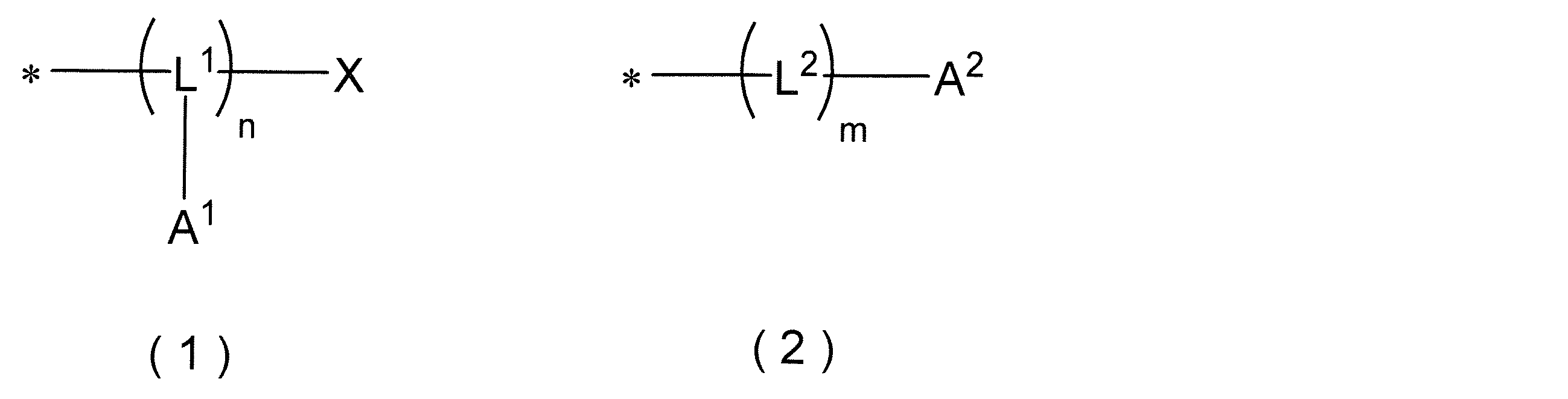
- the first terminal structure and the second terminal structure are at least one selected from the group consisting of a structure represented by the following formula (1) and a structure represented by the following formula (2).
- L 1 is a trivalent group having 1 to 20 carbon atoms.
- a 1 is a monovalent group containing a functional group capable of chemically bonding to a metal atom.
- X is hydrogen An atom, a monovalent organic group having 1 to 20 carbon atoms, —SH or —S—A 11.
- a 11 is a monovalent group containing a functional group capable of chemically bonding to a metal atom, and n is (-L 1 (-A 1) - ). indicates the number of structural units constituting the block represented by n, an integer of 2 or more the plurality of a 1 may be the same or different, a 1 and A 11 may be the same or different, and * indicates a site bonded to a portion of the polymer other than the structure represented by the formula (1).
- L 2 is —S—, —NR—, or —NA 22 —.
- a 2 and A 22 are each independently a monovalent group containing a functional group capable of chemically bonding to a metal atom.
- R is a hydrogen atom or a monovalent hydrocarbon group having 1 to 20 carbon atoms.
- m is 0 or 1. * Indicates a site bonded to a portion of the polymer other than the structure represented by the formula (2). )
- compositions used in a method for manufacturing a substrate including a metal substrate and a metal-containing layer formed on at least one surface side of the metal substrate, A polymer having a first terminal structure and a second terminal structure on a molecule and a solvent, wherein the first terminal structure and the second terminal structure are represented by the structure represented by the formula (1) and the formula (2) ) Is at least one selected from the group consisting of the structures represented by
- Yet another aspect of the invention to solve the above-mentioned problem has a first terminal structure and a second terminal structure on the same molecule, wherein the first terminal structure and the second terminal structure are represented by the above formula (1). And at least one polymer selected from the group consisting of the structure represented by the formula (2) and the structure represented by the formula (2).
- the “metal substrate” refers to a substrate containing metal atoms in at least a part of the surface layer.
- a substrate having a metal-containing layer formed on the surface of a metal substrate can be easily manufactured.
- the composition of the present invention can be suitably used for the method for producing the substrate.
- the polymer of the present invention can be suitably used as a polymer component of the composition. Therefore, these can be suitably used for a processing process of a semiconductor device, for example, which is expected to be further miniaturized in the future.
- the method for producing a substrate includes a step of applying a composition (hereinafter, also referred to as “composition (S)”) to at least one surface of a metal substrate (hereinafter, also referred to as “metal substrate (X)”) (hereinafter, referred to as “composition (S)”). , “Coating process”) and the surface of the coating film formed by the coating process (hereinafter, also referred to as “coating film (P)”) on the side opposite to the metal substrate (X).
- a step of forming a metal-containing layer hereinafter, also referred to as “metal-containing layer (Y)”) at least partially (hereinafter, also referred to as “metal-containing layer forming step”).
- a first terminal structure hereinafter, also referred to as “terminal structure (I)” and a second terminal structure (hereinafter, referred to as “terminal structure (II)”) on the same molecule.
- a first terminal structure hereinafter, also referred to as “terminal structure (I)”
- a second terminal structure hereinafter, referred to as “terminal structure (II)”
- the terminal structure (I) and the terminal structure ( II) is obtained from a structure represented by the following formula (1) (hereinafter also referred to as “structure (1)”) and a structure represented by the following formula (2) (hereinafter also referred to as “structure (2)”)
- L 1 is a trivalent group having 1 to 20 carbon atoms.
- a 1 is a monovalent group containing a functional group capable of chemically bonding to a metal atom.
- X is a hydrogen atom, a monovalent organic group having 1 to 20 carbon atoms, -SH, or -S-A 11.
- a 11 is a monovalent group containing a functional group capable of chemically bonding to a metal atom.
- n represents the number of structural units constituting the block represented by (-L 1 (-A 1 )-) n , and is an integer of 2 or more.
- a plurality of A 1 may be the same or different, and A 1 and A 11 may be the same or different. * Indicates a site bonded to a portion other than the structure represented by the formula (1) in the polymer [A].
- L 2 is —S—, —NR—, or —NA 22 —.
- a 2 and A 22 are each independently a monovalent group containing a functional group capable of chemically bonding to a metal atom.
- R is a hydrogen atom or a monovalent hydrocarbon group having 1 to 20 carbon atoms.
- m is 0 or 1. * Indicates a site bonded to a portion other than the structure represented by the formula (2) in the polymer [A].
- the composition (S) includes the polymer [A] including the above-described steps, whereby the substrate having the metal-containing layer formed on the surface of the metal substrate can be easily manufactured. be able to.
- the polymer [A] has a terminal structure containing a functional group capable of chemically bonding to a metal atom at both terminals.
- the polymer [A] By coating the composition (S) on the surface of the metal substrate, the polymer [A] has a functional group capable of chemically bonding to the metal atom in one terminal structure and the metal atom in the metal substrate (X). By bonding, they are arranged on the surface of the metal substrate (X). By using a functional group capable of chemically bonding to a metal atom in the other terminal structure of the arranged [A] polymer, a metal-containing layer can be easily formed. Thus, according to the method for manufacturing a substrate, a substrate having a metal-containing layer formed on the surface of a metal substrate can be easily manufactured. Hereinafter, each step will be described.
- composition (S) is applied to at least one surface of the metal substrate (X).
- the metal atom (first metal atom, hereinafter also referred to as “metal atom (A)”) contained in the metal substrate (X) is not particularly limited as long as it is a metal element atom. Silicon and boron are not included in the metal atom (A).
- the metal atom (A) include copper, iron, zinc, cobalt, aluminum, tin, tungsten, zirconium, titanium, tantalum, germanium, molybdenum, ruthenium, gold, silver, platinum, palladium, and nickel. Of these, copper or cobalt is preferred.
- Examples of the form of the metal atom (A) contained in the metal substrate (X) include a simple metal, an alloy, a metal nitride, a metal oxide, and a silicide.
- Examples of the simple metal include simple metals such as copper, cobalt, aluminum, and tungsten.
- Examples of the alloy include a nickel-copper alloy, a cobalt-nickel alloy, and a gold-silver alloy.
- Examples of the metal nitride include titanium nitride, tantalum nitride, iron nitride, and aluminum nitride.
- Examples of the metal oxide include tantalum oxide, aluminum oxide, iron oxide, and copper oxide.
- Examples of the silicide include iron silicide and molybdenum silicide. Among these, a simple metal is preferable, and copper or cobalt is more preferable.
- the metal substrate (X) has, for example, a substantially non-metallic atom (hereinafter, referred to as a “non-metallic atom (C)” in the surface layer, in addition to a region including the metal atom (A) (hereinafter, also referred to as “region (I)”). )) (Hereinafter also referred to as “region (II)”).
- nonmetallic atom (C) include silicon, boron, carbon, oxygen, nitrogen, hydrogen and the like.
- nonmetallic atom (C) content in the region (II) examples include a nonmetallic simple substance, a nonmetallic oxide, a nonmetallic nitride, a nonmetallic oxynitride, and a nonmetallic carbide.
- nonmetallic simple substance examples include a nonmetallic simple substance such as silicon, boron and carbon.
- nonmetal oxide examples include hydrolytic condensates of hydrolyzable silanes such as silicon dioxide (SiO 2 ) and tetraalkoxysilanes such as tetraethoxysilane (TEOS), and boron oxide.
- examples of the non-metal nitride include silicon nitride and boron nitride.
- non-metal oxynitride examples include silicon oxynitride and boron oxynitride.
- nonmetal carbide oxide examples include silicon carbide oxide (SiOC).
- the shape of the region (I) and the region (II) in the surface layer of the metal substrate (X) is not particularly limited, and for example, in plan view. Examples include a planar shape, a dot shape, and a stripe shape.
- the size of the region (I) and the region (II) is not particularly limited, and can be a region having a desired size as appropriate.
- the shape of the metal substrate (X) is not particularly limited, and may be a desired shape such as a plate (substrate) or a sphere.
- the surface of the metal substrate (X) is preferably cleaned with an aqueous oxalic acid solution of, for example, about 5% by mass.
- a spin coating method and the like can be mentioned. It may be heated after the above coating.
- the lower limit of the heating temperature is preferably 50 ° C, more preferably 80 ° C.
- the upper limit of the temperature is preferably 200 ° C, more preferably 150 ° C.
- the lower limit of the heating time is preferably 10 seconds, and more preferably 30 seconds.
- the upper limit of the time is preferably one hour, and more preferably ten minutes.
- the polymer [A] not chemically bonded to the surface of the metal substrate (X) is preferably removed by washing using a solvent such as propylene glycol monomethyl ether acetate (PGMEA).
- PGMEA propylene glycol monomethyl ether acetate
- the lower limit of the contact angle of water on the surface of the coating film (P) is preferably 70 °, more preferably 80 °, and even more preferably 85 °.
- the upper limit of the contact angle is, for example, 100 °.
- composition (S) will be described.
- composition (S) is used in a method for manufacturing a substrate including a metal substrate (X) and a metal-containing layer (Y) formed on at least one surface of the metal substrate (X).
- the composition (S) contains the polymer [A] and the solvent [B].
- the composition (S) may contain other components in addition to the polymer [A] and the solvent [B] as long as the effects of the present invention are not impaired. Hereinafter, each component will be described.
- the polymer is a polymer having a terminal structure (I) and a terminal structure (II) on the same molecule.
- the polymer usually has a structural unit (hereinafter, referred to as “monomer (a)”) derived from a monomer (hereinafter, also referred to as “monomer (a)”) between terminal structure (I) and terminal structure (II). (Structural unit (A) ").
- Terminal structure The terminal structures (I) and (II) are at least one selected from the group consisting of structures (1) and (2).
- the functional group (M) is a functional group capable of chemically bonding to a metal atom.
- the metal atom that can be chemically bonded to the functional group (M) include a metal atom (A) included in the metal substrate (X) and a metal atom (second metal atom, hereinafter referred to as “metal atom”) included in the metal-containing layer (Y).
- the chemical bond between the metal atom and the functional group (M) include a covalent bond, an ionic bond, and a coordinate bond. Among these, a coordination bond is preferable from the viewpoint that the bonding force between the metal atom and the functional group (M) is larger.
- Examples of the functional group (M) include a phosphate group, a nitrile group, a carboxy group, an ester group, and a hydroxy group.
- the phosphate group refers to a group represented by -PO (OH) 2 .
- An ester group refers to a group represented by —COOR (R is a monovalent organic group).
- group (I) examples include a group represented by the following formula (i) (hereinafter, also referred to as “group (i)”).
- E is a single bond, -COO-, -CO-, -O-, -NH-, -NHCO- or -CONH-.
- Q is a single bond or a divalent hydrocarbon group having 1 to 20 carbon atoms.
- R 1 is a monovalent functional group (M).
- p is an integer of 0 to 10. However, when p is 1 or more, Q is not a single bond. * Indicates a site binding to L 1 in the formula (1).
- ⁇ E is preferably a single bond or —COO—, and more preferably a single bond.
- Examples of the divalent hydrocarbon group having 1 to 20 carbon atoms represented by Q include alkanediyl, cycloalkanediyl, arenediyl, arenediylalkanediyl and the like.
- Q is preferably a single bond or an alkanediyl group, more preferably a single bond.
- Examples of the monovalent functional group (M) represented by R 1 include monovalent ones among the groups exemplified as the functional group (M).
- P is preferably from 0 to 2, more preferably 0 or 1, and even more preferably 0.
- a phosphoric acid group, a cyanoalkyl group, a carboxy group, a carboxyalkyl group, an ester group, a hydroxy group or a hydroxyalkyl group is preferable.
- the cyanoalkyl group include a 1-cyano-1-methylethyl group and the like.
- the carboxyalkyl group include a 2-carboxyethyl group.
- the ester group include a methoxycarbonyl group.
- the hydroxyalkyl group include a 2-hydroxyethyl group.
- a 1 in the above formula (1) is preferably a phosphate group.
- a 2 in the formula (2) a nitrile group, a carboxyl group, at least one selected from the group consisting of an ester group and hydroxy group are preferable.
- L 1 in the above formula (1) is a group constituting a part of the main chain of the polymer [A].
- “Main chain” refers to the longest atom chain of the polymer [A].
- Examples of the trivalent group having 1 to 20 carbon atoms represented by L 1 include a group derived from a carbon-carbon double bond-containing group, a group derived from an oxyalkylene group, and the like.
- the monovalent organic group having 1 to 20 carbon atoms represented by X in the above formula (1) includes, for example, a monovalent hydrocarbon group having 1 to 20 carbon atoms, and 2 carbon atoms between carbon atoms of the hydrocarbon group.
- Can be “Organic group” refers to a group containing at least one carbon atom.
- the “hydrocarbon group” includes a chain hydrocarbon group, an alicyclic hydrocarbon group and an aromatic hydrocarbon group. This “hydrocarbon group” may be a saturated hydrocarbon group or an unsaturated hydrocarbon group.
- chain hydrocarbon group refers to a hydrocarbon group that does not include a cyclic structure but includes only a chain structure, and includes both a linear hydrocarbon group and a branched hydrocarbon group.
- Alicyclic hydrocarbon group refers to a hydrocarbon group containing only an alicyclic structure as a ring structure and not containing an aromatic ring structure, and includes a monocyclic alicyclic hydrocarbon group and a polycyclic alicyclic group. Contains both hydrocarbon groups.
- “Aromatic hydrocarbon group” refers to a hydrocarbon group containing an aromatic ring structure as a ring structure. However, it is not necessary to be composed of only an aromatic ring structure, and a part thereof may include a chain structure or an alicyclic structure.
- “Number of ring members” refers to the number of atoms constituting a ring of an alicyclic structure, an aromatic ring structure, an aliphatic heterocyclic structure and an aromatic heterocyclic structure, and in the case of a polycyclic ring, the number of atoms constituting the polycyclic ring. Say.
- Examples of the monovalent hydrocarbon group having 1 to 20 carbon atoms include a monovalent linear hydrocarbon group having 1 to 20 carbon atoms, a monovalent alicyclic hydrocarbon group having 3 to 20 carbon atoms, and a C6 to C20 monovalent hydrocarbon group. And 20 monovalent aromatic hydrocarbon groups.
- Examples of the monovalent chain hydrocarbon group having 1 to 20 carbon atoms include an alkyl group such as a methyl group, an ethyl group, an n-propyl group, an i-propyl group; Alkenyl groups such as an ethenyl group, a propenyl group and a butenyl group; Alkynyl groups such as an ethynyl group, a propynyl group and a butynyl group are exemplified.
- Examples of the monovalent alicyclic hydrocarbon group having 3 to 20 carbon atoms include a monocyclic alicyclic saturated hydrocarbon group such as a cyclopentyl group and a cyclohexyl group; A monocyclic alicyclic unsaturated hydrocarbon group such as a cyclopentenyl group or a cyclohexenyl group; Polycyclic alicyclic saturated hydrocarbon groups such as a norbornyl group, an adamantyl group and a tricyclodecyl group; And polycyclic alicyclic unsaturated hydrocarbon groups such as a norbornenyl group and a tricyclodecenyl group.
- Examples of the monovalent aromatic hydrocarbon group having 6 to 20 carbon atoms include an aryl group such as a phenyl group, a tolyl group, a xylyl group, a naphthyl group and an anthryl group; And aralkyl groups such as benzyl group, phenethyl group, naphthylmethyl group and anthrylmethyl group.
- hetero atom constituting the divalent or monovalent hetero atom-containing group examples include an oxygen atom, a sulfur atom, a phosphorus atom, a silicon atom, and a halogen atom.
- halogen atom examples include a fluorine atom, a chlorine atom, a bromine atom, and an iodine atom.
- divalent hetero atom-containing group examples include —O—, —CO—, —S—, and —CS—, and a group obtained by combining two or more of these. Of these, -O- is preferred.
- Examples of the monovalent hetero atom-containing group include a halogen atom.
- X X in the above formula (1) is preferably a hydrogen atom or —SH, and more preferably a hydrogen atom.
- n in the above formula (1) 10 is preferable, and 5 is more preferable.
- the lower limit of the content ratio of the structural unit represented by (-L 1 (-A 1 )-) in the above formula (1) is 0.1% with respect to all the structural units constituting the polymer [A].
- Mole% is preferable, 0.5 mol% is more preferable, 1 mol% is further preferable, and 2 mol% is particularly preferable.
- As a maximum of the above-mentioned content rate 30 mol% is preferred, 20 mol% is more preferred, 10 mol% is still more preferred, and 7 mol% is especially preferred.
- Examples of the monovalent hydrocarbon group having 1 to 20 carbon atoms represented by R in —NR— of L 2 in the above formula (2) include those having 1 to 20 carbon atoms exemplified as X in the above formula (1). Examples include the same groups as the monovalent hydrocarbon group.
- L 2 is preferably -S- or -NR-, and among -NR-, -NH- is preferable.
- M is preferably 0.
- Examples of the terminal structure (I) include a structure containing a block derived from vinyl phosphoric acid, a structure containing a block derived from (meth) acrylic acid, and a structure containing a block of (—CH 2 —CH (OH) —). No.
- terminal structure (II) examples include a cyanoalkyl group, a carboxyalkyl group, and a hydroxyalkyl group.
- the functional group (M) in the terminal structure (I) and the functional group (M) in the terminal structure (II) are different from each other.
- a metal-containing layer (Y) containing a metal atom different from the metal atom (A) of the metal substrate (X) is formed. It is easier to do.
- the terminal structure (I) is the structure (1) and the terminal structure (II) is the structure (2).
- each terminal structure has the above-described structure, it becomes easier to form a metal-containing layer (Y) containing a metal atom different from the metal atom (A) of the metal substrate (X).
- the structural unit (A) is a structural unit derived from the monomer (a). [A] The polymer usually has the structural unit (A) between the terminal structure (I) and the terminal structure (II).
- Examples of the monomer (a) that provides the structural unit (A) include a vinyl aromatic compound, (meth) acrylic acid or (meth) acrylate, substituted or unsubstituted ethylene, and a polymerizable compound having a crosslinkable group. And the like.
- the “crosslinkable group” refers to a group that forms a crosslinked structure by a reaction under heating conditions, active energy ray irradiation conditions, acidic conditions, and the like. One or more of these compounds may be used as the monomer (a).
- vinyl aromatic compound examples include styrene; ⁇ -methylstyrene, o-methylstyrene, m-methylstyrene, p-methylstyrene, p-tert-butylstyrene, 2,4,6-trimethylstyrene, p-methoxystyrene, p-tert-butoxystyrene, o- Hydroxystyrene, m-hydroxystyrene, p-hydroxystyrene, m-chloromethylstyrene, p-chloromethylstyrene, p-chlorostyrene, p-bromostyrene, p-iodostyrene, p-nitrostyrene, p-cyanostyrene, etc.
- Examples of the (meth) acrylate include alkyl (meth) acrylates such as methyl (meth) acrylate, ethyl (meth) acrylate, t-butyl (meth) acrylate, and 2-ethylhexyl (meth) acrylate.
- substituted ethylene examples include alkenes such as propene, butene, and pentene; Vinylcycloalkanes such as vinylcyclopentane and vinylcyclohexane; Cycloalkenes such as cyclopentene and cyclohexene; Examples include vinyl phosphoric acid, 4-hydroxy-1-butene, vinyl glycidyl ether, vinyl trimethylsilyl ether and the like.
- crosslinkable group in the polymerizable compound having a crosslinkable group examples include a polymerizable carbon-carbon double bond-containing group such as a vinyl group, a vinyloxy group, an allyl group, a (meth) acryloyl group, and a styryl group; Cyclic ether groups such as an oxiranyl group, an oxiranyloxy group, an oxetanyl group, and an oxetanyloxy group; An aryl group having a cyclobutane ring fused, such as a phenyl group having a cyclobutane ring fused, a naphthyl group having a cyclobutane ring fused; An aryl group to which an acyl group such as an acetoxyphenyl group or a t-butoxyphenyl group or an aromatic hydroxy group protected with a heat dissociable group is bonded; An aryl group to which an acyl group such
- the aryl groups in which the cyclobutane ring is fused form a covalent bond under heating conditions.
- Acyl group refers to a group obtained by removing OH from a carboxylic acid and protecting a hydrogen atom of an aromatic hydroxy group or a methylol group by substitution.
- thermalally dissociable group refers to a group that substitutes a hydrogen atom of an aromatic hydroxy group, a methylol group or a sulfanylmethyl group and that dissociates by heating.
- acyl group in the aryl group to which the protected aromatic hydroxy group, methylol group or sulfanylmethyl group is bonded examples include, for example, formyl group, acetyl group, propionyl group, butyryl group, benzoyl group and the like.
- thermally dissociable group in the aryl group to which the protected aromatic hydroxy group is bonded examples include a tertiary alkyl group such as a t-butyl group and a t-amyl group.
- heat dissociable group in the protected methylol group or the aryl group to which a sulfanylmethyl group is bonded examples include, for example, an alkyl group such as a methyl group, an ethyl group, and a propyl group.
- Examples of the polymerizable compound having a crosslinkable group include a vinyl compound having a crosslinkable group such as styrene having a crosslinkable group, and a (meth) acryl compound having a crosslinkable group.
- the structural unit (A) is preferably a structural unit derived from styrene substituted or unsubstituted with a hydrocarbon group (hereinafter, also referred to as “structural unit (A-1)”).
- structural unit (A-1) a structural unit derived from styrene substituted or unsubstituted with a hydrocarbon group
- structural unit (A-1) a structural unit derived from styrene substituted or unsubstituted with a hydrocarbon group
- the metal-containing layer (Y) can be formed more effectively.
- Examples of the monomer (a) that provides the structural unit (A-1) include styrene, ⁇ -methylstyrene, o-methylstyrene, m-methylstyrene, p-methylstyrene, p-tert-butylstyrene, 2, 4,6-trimethylstyrene and the like, Further, among the polymerizable compounds having a crosslinkable group, o-vinylstyrene, m-vinylstyrene, p-vinylstyrene, 4-vinylbenzocyclobutene and the like can be mentioned.
- the structural unit (A) is selected from the group consisting of a structural unit derived from a vinyl aromatic compound, a structural unit derived from (meth) acrylic acid or (meth) acrylate, and a structural unit derived from substituted or unsubstituted ethylene.
- the lower limit of the total content of these structural units in the structural unit (A) is preferably 50 mol%, more preferably 80 mol%, further preferably 90 mol%, and more preferably 95 mol%. % Is particularly preferred.
- the total content may be 100 mol%.
- the lower limit of the content of these structural units in the structural unit (A) is preferably 0.1 mol%, 0.5 mol% is more preferable, 1 mol% is further preferable, 2 mol% is particularly preferable, and the upper limit of the content ratio is preferably 30 mol%, more preferably 20 mol%, and still more preferably 10 mol%. Is particularly preferred.
- the lower limit of the number average molecular weight (Mn) of the polymer [A] is preferably 1,000, more preferably 2,000, still more preferably 3,000, and particularly preferably 4,000.
- the upper limit of Mn is preferably 100,000, more preferably 50,000, still more preferably 30,000, and particularly preferably 10,000.
- the upper limit of the ratio (dispersion degree) of the weight average molecular weight (Mw) to the Mn of the [A] polymer 5 is preferable, 2 is more preferable, 1.5 is more preferable, and 1.3 is particularly preferable.
- the lower limit of the above ratio is usually 1 and preferably 1.05.
- the lower limit of the content of the polymer is preferably 60% by mass, more preferably 80% by mass, still more preferably 90% by mass, and preferably 95% by mass, based on the total solids in the composition (S). Particularly preferred. The content may be 100% by mass. “Total solids” refers to all components other than the solvent [B] in the composition (S).
- trithiocarbonate compounds such as 2-cyano-2-propyldodecyltrithiocarbonate and dibenzyltrithiocarbonate
- dithiocarbamate compounds such as cyanomethyl-N-methyl-N-phenyldithiocarbamate
- RAFT polymerization may be performed using a dithiobenzoate compound such as cyano-2-propylbenzodithionate or a xanthate compound such as xanthate-O-ethyl-S-cyanomethyl as a RAFT agent.
- a radical generator such as AIBN and a thiol compound such as tert-dodecanethiol are added to the polymer obtained by the RAFT polymerization using the RAFT agent, and a terminal separation reaction such as a trithiocarbonate terminal is performed. Then, the terminal of the main chain of the polymer [A] can be a hydrogen atom or the like. In this detachment reaction, it is preferable to use a protic solvent such as alcohol as a proton supply source in addition to the radical generator and the thiol compound.
- the polymer [A] other than the above-mentioned polymer can also be synthesized by a known method.
- the solvent is not particularly limited as long as it can dissolve or disperse at least the [A] polymer and other components.
- Solvents include, for example, alcohol solvents, ether solvents, ketone solvents, amide solvents, ester solvents, hydrocarbon solvents and the like.
- the alcohol-based solvent examples include monoalcohol-based solvents such as methanol and ethanol; Polyhydric alcohol solvents such as ethylene glycol and 1,2-propylene glycol; Polyhydric alcohol partial ether solvents such as ethylene glycol monomethyl ether, ethylene glycol monoethyl ether, propylene glycol monomethyl ether, and propylene glycol monoethyl ether; Lactate ester solvents such as methyl lactate, ethyl lactate, n-butyl lactate, and n-amyl lactate are exemplified.
- monoalcohol-based solvents such as methanol and ethanol
- Polyhydric alcohol solvents such as ethylene glycol and 1,2-propylene glycol
- Polyhydric alcohol partial ether solvents such as ethylene glycol monomethyl ether, ethylene glycol monoethyl ether, propylene glycol monomethyl ether, and propylene glycol monoethyl ether
- Lactate ester solvents such as
- ether solvent examples include dialkyl ether solvents such as diethyl ether; Cyclic ether solvents such as tetrahydrofuran; Examples include aromatic ring-containing ether solvents such as anisole.
- ketone solvent examples include chain ketone solvents such as butanone and methyl-iso-butyl ketone; And cyclic ketone solvents such as cyclopentanone and cyclohexanone.
- amide solvent examples include cyclic amide solvents such as N, N'-dimethylimidazolidinone and N-methylpyrrolidone; Chain amide solvents such as N-methylformamide and N, N-dimethylformamide.
- ester solvent examples include acetate solvents such as ethyl acetate and n-butyl acetate; Polyhydric alcohol partial ether carboxylate solvents such as ethylene glycol monomethyl ether acetate, diethylene glycol monomethyl ether acetate, propylene glycol monomethyl ether acetate; lactone solvents such as ⁇ -butyrolactone and valerolactone; Examples thereof include carbonate solvents such as ethylene carbonate and propylene carbonate.
- acetate solvents such as ethyl acetate and n-butyl acetate
- Polyhydric alcohol partial ether carboxylate solvents such as ethylene glycol monomethyl ether acetate, diethylene glycol monomethyl ether acetate, propylene glycol monomethyl ether acetate
- lactone solvents such as ⁇ -butyrolactone and valerolactone
- carbonate solvents such as ethylene carbonate and propylene carbonate.
- hydrocarbon solvent for example, an aliphatic hydrocarbon solvent such as n-hexane; Examples thereof include aromatic hydrocarbon solvents such as toluene.
- the composition (S) may contain one or more [B] solvents.
- Other components include, for example, an acid generator or a base generator, a crosslinking agent, a surfactant and the like.
- the acid generator is a component that generates an acid by the action of heat or radiation.
- the base generator is a component that generates a base by the action of heat or radiation.
- an acid or a base is generated by irradiation with radiation or heating in a heating step or the like, so that [A] a cross-linking reaction in a polymer or the like is promoted. be able to.
- the composition (S) may contain one or more acid generators or base generators.
- Examples of the acid generator include an onium salt compound and an N-sulfonyloxyimide compound.
- Examples of the onium salt compound include a sulfonium salt such as triphenylsulfonium trifluoromethanesulfonate, a tetrahydrothiophenium salt such as 1- (4-n-butoxynaphthalen-1-yl) tetrahydrothiophenium trifluoromethanesulfonate, and diphenyliodonium Iodonium salts such as trifluoromethanesulfonate; and ammonium salts such as triethylammonium trifluoromethanesulfonate.
- Examples of the N-sulfonyloxyimide compound include N- (trifluoromethanesulfonyloxy) bicyclo [2.2.1] hept-5-ene-2,3-dicarboximide.
- Examples of the base generator include 4- (methylthiobenzoyl) -1-methyl-1-morpholinoethane, (4-morpholinobenzoyl) -1-benzyl-1-dimethylaminopropane and 2-benzyl-2-dimethylamino-1 -(4-morpholinophenyl) -butanone, N- (2-nitrobenzyloxycarbonyl) pyrrolidine, 1- (anthraquinone-2-yl) ethylimidazolecarboxylate, 2-nitrobenzylcyclohexylcarbamate, [[(2,6- Dinitrobenzyl) oxy] carbonyl] cyclohexylamine, bis [[(2-nitrobenzyl) oxy] carbonyl] hexane-1,6-diamine, triphenylmethanol, o-carbamoylhydroxylamide, o-carbamoyloxime, hexaamminecobal (III) tris (triphen
- the lower limit of the content of the acid generator or the base generator is 0.1 part by mass with respect to 100 parts by mass of the polymer [A]. , Preferably 1% by mass. As a maximum of the above-mentioned content, 20 mass parts is preferred and 5 mass parts is more preferred.
- the cross-linking agent is a component that forms a cross-linking between components such as the polymer [A] by the action of heat or an acid, or forms a cross-linked structure by itself.
- the composition (S) contains a crosslinking agent, the hardness of the formed coating film (P) can be increased, and as a result, the metal-containing layer (Y) can be formed more effectively.
- the composition (S) may contain one or more crosslinking agents.
- crosslinking agent examples include polyfunctional (meth) acrylate compounds such as trimethylolpropane tri (meth) acrylate, epoxy compounds such as novolak type epoxy resin, and hydroxymethyl group substitution such as 2-hydroxymethyl-4,6-dimethylphenol.
- Phenol compound 4,4 '-(1- (4- (1- (4-hydroxy-3,5-bis (methoxymethyl) phenyl) -1-methylethyl) phenyl) ethylidene) bis (2,6-bis
- alkoxyalkyl group-containing phenol compounds such as (methoxymethyl) phenol, compounds having an alkoxyalkylated amino group such as (poly) methylolated melamine, and random copolymers of acenaphthylene and hydroxymethylacenaphthylene.
- the lower limit of the content of the crosslinking agent is preferably 1 part by mass, more preferably 5 parts by mass, based on 100 parts by mass of the polymer [A]. As a maximum of the above-mentioned content, 100 mass parts is preferred and 30 mass parts is more preferred.
- the surfactant is a component that can improve the coating property of the composition (S) on the metal substrate (X).
- the upper limit of the surfactant content is preferably 10 parts by mass, more preferably 2 parts by mass, per 100 parts by mass of the polymer [A].
- the lower limit of the content is, for example, 0.1 part by mass.
- the composition (S) is obtained, for example, by mixing a polymer [A], a solvent [B] and other components as required at a predetermined ratio, and preferably having a high-density polyethylene filter having pores having a pore diameter of about 0.45 ⁇ m. Can be prepared by filtration.
- the lower limit of the solid content concentration of the composition (S) is preferably 0.1% by mass, more preferably 0.5% by mass, and still more preferably 0.7% by mass.
- the upper limit of the solid content concentration is preferably 30% by mass, more preferably 10% by mass, and still more preferably 3% by mass.
- a metal-containing layer (Y) is formed on at least a part of the surface of the coating film (P) formed in the coating step opposite to the metal substrate (X).
- Examples of the metal atom (B) included in the metal-containing layer (Y) include the metal atoms exemplified as the metal atom (A) included in the metal substrate (X) described above. Of these, copper or cobalt is preferred.
- a method for forming the metal-containing layer (Y) for example, a method in which a metal substrate (X) on which a coating film (P) is formed is immersed in a liquid containing metal atoms (B), and chemical vapor deposition (CVD) A method of attaching metal atoms (B) to the surface of a coating film (P) formed on a metal substrate (X) by a method or an atomic layer deposition (ALD) method.
- examples of the liquid containing the metal atom (B) used include an aqueous solution of a metal salt such as copper sulfate and cobalt chloride.
- concentration of the metal salt in the aqueous solution of the metal salt is, for example, from 0.01 mol / L to 3 mol / L, and preferably from 0.1 mol / L to 1 mol / L.
- the immersion time is, for example, 1 minute to 1 day, preferably 1 hour to 100 hours.
- the metal atoms (B) not chemically bonded to the functional groups (M) in the coating film (P) are preferably washed and removed using ultrapure water or the like.
- Examples of the CVD method include various methods such as thermal CVD, plasma CVD, optical CVD, reduced pressure CVD, and laser metal organic chemical vapor deposition (MOCVD).
- Examples of the ALD method include a thermal ALD method and a plasma ALD method.
- the lower limit of the average thickness of the formed metal-containing layer (Y) is preferably 0.1 nm, more preferably 1 nm, and further preferably 2 nm.
- the upper limit of the average thickness is preferably 500 nm, more preferably 100 nm, and even more preferably 50 nm.
- the metal atom (B) included in the metal-containing layer (Y) is different from the metal atom (A) included in the metal substrate (X).
- the metal-containing layer (Y) can be formed more effectively.
- the terminal structure (I) of the polymer (A) Has a functional group capable of chemically bonding to the metal atom (A), and the terminal structure (II) preferably has a functional group capable of chemically bonding to the metal atom (B).
- the functional group capable of chemically bonding to the metal atom (A) is preferably a phosphate group.
- the functional group capable of chemically bonding to the metal atom (B) is preferably at least one selected from the group consisting of a nitrile group, a carboxy group, an ester group, and a hydroxy group.
- the metal-containing layer (Y) can be easily formed on the surface of the metal substrate (X).
- the metal at the bottom of the trench can be formed.
- a metal-containing layer (Y) can be formed on the surface. According to the substrate in which the metal-containing layer (Y) is formed at the bottom of such a trench, it is considered that the growth of the plating layer during the plating process is promoted.
- Mw and Mn The Mw and Mn of the polymer were measured by gel permeation chromatography (GPC) using GPC columns (2 G2000HXL, 1 G3000HXL and 1 G4000HXL) manufactured by Tosoh Corporation under the following conditions. did. Eluent: tetrahydrofuran (Wako Pure Chemical Industries, Ltd.) Flow rate: 1.0 mL / min Sample concentration: 1.0% by mass Sample injection volume: 100 ⁇ L Column temperature: 40 ° C Detector: Differential refractometer Standard substance: Monodisperse polystyrene
- the 13 C-NMR analysis was performed using a nuclear magnetic resonance apparatus (“JNM-EX400” manufactured by JEOL Ltd.) using DMSO-d 6 as a measurement solvent.
- the content ratio of each structural unit in the polymer was calculated from the area ratio of the peak corresponding to each structural unit in the spectrum obtained by 13 C-NMR.
- This polymerization reaction solution was poured into 300 g of methanol for precipitation purification, and the obtained yellow viscous substance was collected and dissolved in 20 g of propylene glycol monomethyl ether acetate, and 0.49 g of AIBN and 2.03 g of tert-dodecanethiol were added. The mixture was stirred at 80 ° C. for 2 hours to carry out a detachment reaction of trithiocarbonate terminal.
- the obtained polymerization reaction solution was concentrated under reduced pressure, and the obtained concentrate was poured into 1,000 g of methanol for purification by precipitation to obtain a pale yellow solid. Then, the solid was dried under reduced pressure at 60 ° C. to obtain 10.5 g of a polymer (A-1).
- This polymer (A-1) had Mw of 5,600, Mn of 4,800, and Mw / Mn of 1.17.
- the polymerization reaction solution was poured into 300 g of methanol and subjected to precipitation purification.
- the obtained yellow viscous substance was collected, dissolved in 20 g of propylene glycol monmethyl ether acetate, and 0.49 g of AIBN and 2.03 g of tert-dodecanethiol were added.
- the mixture was stirred at 80 ° C. for 2 hours to carry out a cleavage reaction of trithiocarbonate terminal.
- the obtained polymerization reaction solution was concentrated under reduced pressure, and the obtained concentrate was poured into 1,000 g of methanol for precipitation purification to obtain a pale yellow solid. Then, the solid was dried under reduced pressure at 60 ° C. to obtain 14.6 g of a polymer (A-2).
- This polymer (A-2) had Mw of 6,300, Mn of 4,900, and Mw / Mn of 1.29.
- This operation was repeated three times to remove the Li salt. Thereafter, 1,000 g of ultrapure water was injected and stirred, and the lower aqueous layer was removed. This operation was repeated three times, and after removing oxalic acid, the solution was concentrated and dropped into 500 g of methanol to precipitate a polymer, and a solid was recovered with a Buchner funnel. The solid was dried under reduced pressure at 60 ° C. to obtain 11.9 g of a white polymer (A-3).
- This polymer (A-3) had Mw of 5,600, Mn of 5,200, and Mw / Mn of 1.08.
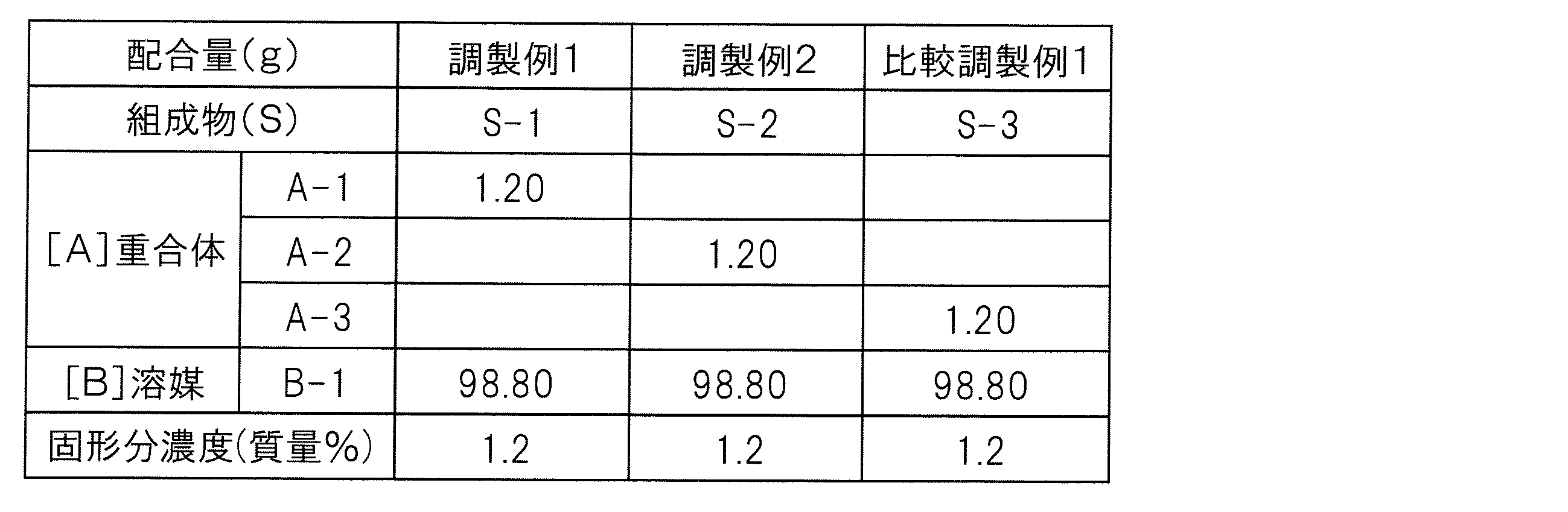
- composition (S) > [Preparation Example 1] [A] 98.80 g of propylene glycol monomethyl ether acetate (PGMEA) as a solvent is added to 1.20 g of (A-1) as a polymer, and the mixture is stirred. The composition (S-1) was prepared by filtration with a density polyethylene filter.
- PGMEA propylene glycol monomethyl ether acetate
- the obtained cobalt substrate was immersed in a 1M aqueous solution of copper sulfate, and the obtained copper substrate was immersed in a 1M aqueous solution of cobalt chloride in a petri dish containing 20 g of each metal salt aqueous solution for 72 hours. Copper sulfate or cobalt chloride which was not chemically bonded to the substrate was removed with ultrapure water and dried by blowing nitrogen.
- the surface of each of the obtained substrates was analyzed with a scanning X-ray photoelectron spectrometer (“Quantum2000” manufactured by ULVAC-PHI) (measurement conditions: 100 ⁇ m ⁇ ), and qualitative and quantitative determination of each element was performed.
- the evaluation results are shown in Tables 3 and 4.
- the "others" in the ESCA (XPS) surface data includes bareSi, thermal oxide, TiN, Ti, N, Si on a Co multilayer.
- a substrate having a metal-containing layer formed on the surface of a metal substrate can be easily manufactured.
- the composition of the present invention can be suitably used for the method for producing the substrate.
- the polymer of the present invention can be suitably used as a polymer component of the composition. Therefore, these can be suitably used for a processing process of a semiconductor device, for example, which is expected to be further miniaturized in the future.
Landscapes
- Chemical & Material Sciences (AREA)
- Organic Chemistry (AREA)
- Chemical Kinetics & Catalysis (AREA)
- Health & Medical Sciences (AREA)
- Medicinal Chemistry (AREA)
- Polymers & Plastics (AREA)
- Engineering & Computer Science (AREA)
- Materials Engineering (AREA)
- Wood Science & Technology (AREA)
- Life Sciences & Earth Sciences (AREA)
- General Chemical & Material Sciences (AREA)
- Mechanical Engineering (AREA)
- Metallurgy (AREA)
- Inorganic Chemistry (AREA)
- Addition Polymer Or Copolymer, Post-Treatments, Or Chemical Modifications (AREA)
- Chemically Coating (AREA)
- Physics & Mathematics (AREA)
- Electromagnetism (AREA)
- Plasma & Fusion (AREA)
- Graft Or Block Polymers (AREA)
Abstract
Description
式(2)中、L2は、-S-、-NR-又は-NA22-である。A2及びA22は、それぞれ独立して、金属原子と化学結合可能な官能基を含む1価の基である。Rは、水素原子又は炭素数1~20の1価の炭化水素基である。mは、0又は1である。*は、上記重合体における上記式(2)で表される構造以外の部分に結合する部位を示す。)
当該基板の製造方法は、金属基板(以下、「金属基板(X)」ともいう)の少なくとも一方の表面に組成物(以下、「組成物(S)」ともいう)を塗工する工程(以下、「塗工工程」ともいう)と、上記塗工工程により形成された塗工膜(以下、「塗工膜(P)」ともいう)の上記金属基板(X)とは反対側の表面の少なくとも一部に金属含有層(以下、「金属含有層(Y)」ともいう)を形成する工程(以下、「金属含有層形成工程」ともいう)とを備える。当該基板の製造方法は、上記組成物(S)として、同一分子上に第1末端構造(以下、「末端構造(I)」ともいう)及び第2末端構造(以下、「末端構造(II)」ともいう)を有する重合体(以下、「[A]重合体」ともいう)と溶媒(以下、「[B]溶媒」ともいう)とを含有し、上記末端構造(I)及び末端構造(II)が、下記式(1)で表される構造(以下、「構造(1)」ともいう)及び下記式(2)で表される構造(以下、「構造(2)」ともいう)からなる群より選ばれる少なくとも1種であるものを用いる。

以下、各工程について説明する。
本工程では、金属基板(X)の少なくとも一方の表面に組成物(S)を塗工する。
合金としては、例えばニッケル-銅合金、コバルト-ニッケル合金、金-銀合金等が挙げられる。
金属窒化物としては、例えば窒化チタン、窒化タンタル、窒化鉄、窒化アルミニウム等が挙げられる。
金属酸化物としては、例えば酸化タンタル、酸化アルミニウム、酸化鉄、酸化銅等が挙げられる。
シリサイドとしては、例えば鉄シリサイド、モリブデンシリサイド等が挙げられる。
これらの中で、金属単体が好ましく、銅又はコバルトがより好ましい。
非金属酸化物としては、例えば二酸化ケイ素(SiO2)、テトラエトキシシラン(TEOS)等のテトラアルコキシシランなどの加水分解性シランの加水分解縮合物、酸化ホウ素等が挙げられる。
非金属窒化物としては、例えば窒化ケイ素、窒化ホウ素等が挙げられる。
非金属窒酸化物としては、例えば窒酸化ケイ素、窒酸化ホウ素等が挙げられる。
非金属炭化酸化物としては、例えば炭化酸化ケイ素(SiOC)等が挙げられる。
組成物(S)は、金属基板(X)とこの金属基板(X)の少なくとも一方の面側に形成された金属含有層(Y)とを備える基板の製造方法に用いられる。組成物(S)は、[A]重合体及び[B]溶媒を含有する。組成物(S)は、[A]重合体及び[B]溶媒以外に、本発明の効果を損なわない範囲において、他の成分を含有していてもよい。以下、各成分について説明する。
[A]重合体は、同一分子上に末端構造(I)及び末端構造(II)を有する重合体である。[A]重合体は、通常、末端構造(I)及び末端構造(II)の間に、単量体(以下、「単量体(a)」ともいう)に由来する構造単位(以下、「構造単位(A)」ともいう)を有する。
末端構造(I)及び末端構造(II)は、構造(1)及び構造(2)からなる群より選ばれる少なくとも1種である。

メチル基、エチル基、n-プロピル基、i-プロピル基等のアルキル基;
エテニル基、プロペニル基、ブテニル基等のアルケニル基;
エチニル基、プロピニル基、ブチニル基等のアルキニル基などが挙げられる。
シクロペンチル基、シクロヘキシル基等の単環の脂環式飽和炭化水素基;
シクロペンテニル基、シクロヘキセニル基等の単環の脂環式不飽和炭化水素基;
ノルボルニル基、アダマンチル基、トリシクロデシル基等の多環の脂環式飽和炭化水素基;
ノルボルネニル基、トリシクロデセニル基等の多環の脂環式不飽和炭化水素基などが挙げられる。
フェニル基、トリル基、キシリル基、ナフチル基、アントリル基等のアリール基;
ベンジル基、フェネチル基、ナフチルメチル基、アントリルメチル基等のアラルキル基などが挙げられる。
構造単位(A)は、単量体(a)に由来する構造単位である。[A]重合体は、構造単位(A)を末端構造(I)及び末端構造(II)の間に通常有している。
スチレン;
α-メチルスチレン、o-メチルスチレン、m-メチルスチレン、p-メチルスチレン、p-tert-ブチルスチレン、2,4,6-トリメチルスチレン、p-メトキシスチレン、p-tert-ブトキシスチレン、o-ヒドロキシスチレン、m-ヒドロキシスチレン、p-ヒドロキシスチレン、m-クロロメチルスチレン、p-クロロメチルスチレン、p-クロロスチレン、p-ブロモスチレン、p-ヨードスチレン、p-ニトロスチレン、p-シアノスチレン等の置換スチレン;
ビニルナフタレン;
ビニルメチルナフタレン、ビニルクロロナフタレン等の置換ビニルナフタレン;
ビニルアントラセン;
ビニルメチルアントラセン、ビニルクロロアントラセン等の置換ビニルアントラセン;
ビニルピレン;
ビニルメチルピレン、ビニルクロロピレン等の置換ビニルピレンなどが挙げられる。
(メタ)アクリル酸メチル、(メタ)アクリル酸エチル、(メタ)アクリル酸t-ブチル、(メタ)アクリル酸2-エチルヘキシル等の(メタ)アクリル酸アルキルエステル;
(メタ)アクリル酸シクロペンチル、(メタ)アクリル酸シクロヘキシル、(メタ)アクリル酸1-メチルシクロペンチル、(メタ)アクリル酸2-エチルアダマンチル、(メタ)アクリル酸2-(アダマンタン-1-イル)プロピル等の(メタ)アクリル酸シクロアルキルエステル;
(メタ)アクリル酸2-ヒドロキシエチル、(メタ)アクリル酸3-ヒドロキシアダマンチル、(メタ)アクリル酸3-グリシジルプロピル、(メタ)アクリル酸3-トリメチルシリルプロピル等の(メタ)アクリル酸置換アルキルエステルなどが挙げられる。
プロペン、ブテン、ペンテン等のアルケン;
ビニルシクロペンタン、ビニルシクロヘキサン等のビニルシクロアルカン;
シクロペンテン、シクロヘキセン等のシクロアルケン;
ビニルリン酸、4-ヒドロキシ-1-ブテン、ビニルグリシジルエーテル、ビニルトリメチルシリルエーテル等が挙げられる。
ビニル基、ビニロキシ基、アリル基、(メタ)アクリロイル基、スチリル基等の重合性炭素-炭素二重結合含有基;
オキシラニル基、オキシラニルオキシ基、オキセタニル基、オキセタニルオキシ基等の環状エーテル基;
シクロブタン環が縮環したフェニル基、シクロブタン環が縮環したナフチル基等のシクロブタン環が縮環したアリール基;
アセトキシフェニル基、t-ブトキシフェニル基等のアシル基又は熱解離性基で保護された芳香族性ヒドロキシ基が結合したアリール基;
アセトキシメチルフェニル基、メトキシメチルフェニル基等のアシル基又は熱解離性基で保護されたメチロール基(-CH2OH)が結合したアリール基;
スルファニルメチルフェニル基、メチルスルファニルメチルフェニル基等の置換又は非置換のスルファニルメチル基(-CH2SH)が結合したアリール基などが挙げられる。
スチレン、α-メチルスチレン、o-メチルスチレン、m-メチルスチレン、p-メチルスチレン、p-tert-ブチルスチレン、2,4,6-トリメチルスチレン等が、
また、架橋性基を有する重合性化合物のうち、o-ビニルスチレン、m-ビニルスチレン、p-ビニルスチレン、4-ビニルベンゾシクロブテン等が挙げられる。
[A]重合体は、末端構造(I)が構造(1)であり、末端構造(II)が構造(2)である重合体の場合、例えばアゾビスイソブチロニトリル(AIBN)等の構造(2)を与える重合開始剤を用い、まず、スチレン、tert-ブチルスチレン、4-ビニルベンゾシクロブテン等の構造単位(A)を与える単量体(a)を重合させ、次いで、ビニルリン酸等の構造(1)を与える単量体を重合させてブロックを形成させることにより合成することができる。
[B]溶媒としては、少なくとも[A]重合体及び他の成分等を溶解又は分散可能な溶媒であれば特に限定されない。
メタノール、エタノール等のモノアルコール系溶媒;
エチレングリコール、1,2-プロピレングリコール等の多価アルコール系溶媒;
エチレングリコールモノメチルエーテル、エチレングリコールモノエチルエーテル、プロピレングリコールモノメチルエーテル、プロピレングリコールモノエチルエーテル等の多価アルコール部分エーテル系溶媒;
乳酸メチル、乳酸エチル、乳酸n-ブチル、乳酸n-アミル等の乳酸エステル系溶媒などが挙げられる。
ジエチルエーテル等のジアルキルエーテル系溶媒;
テトラヒドロフラン等の環状エーテル系溶媒;
アニソール等の芳香環含有エーテル系溶媒などが挙げられる。
ブタノン、メチル-iso-ブチルケトン等の鎖状ケトン系溶媒;
シクロペンタノン、シクロヘキサノン等の環状ケトン系溶媒などが挙げられる。
N,N’-ジメチルイミダゾリジノン、N-メチルピロリドン等の環状アミド系溶媒;
N-メチルホルムアミド、N,N-ジメチルホルムアミド等の鎖状アミド系溶媒などが挙げられる。
酢酸エチル、酢酸n-ブチル等の酢酸エステル系溶媒;
エチレングリコールモノメチルエーテルアセテート、ジエチレングリコールモノメチルエーテルアセテート、プロピレングリコールモノメチルエーテルアセテート等の多価アルコール部分エーテルカルボキレート系溶媒;
γ-ブチロラクトン、バレロラクトン等のラクトン系溶媒;
エチレンカーボネート、プロピレンカーボネート等のカーボネート系溶媒などが挙げられる。
n-ヘキサン等の脂肪族炭化水素系溶媒;
トルエン等の芳香族炭化水素系溶媒などが挙げられる。
他の成分としては、例えば酸発生剤又は塩基発生剤、架橋剤、界面活性剤等が挙げられる。
酸発生剤は、熱や放射線の作用により酸を発生する成分である。塩基発生剤は、熱や放射線の作用により塩基を発生する成分である。組成物(S)が酸発生剤又は塩基発生剤を含有する場合、放射線の照射や加熱工程等における加熱により、酸又は塩基が発生するので、[A]重合体等における架橋反応などを促進することができる。組成物(S)は酸発生剤又は塩基発生剤を1種又は2種以上を含有していてもよい。
架橋剤は、熱や酸の作用により、[A]重合体等の成分同士の架橋結合を形成するか、又は自らが架橋構造を形成する成分である。組成物(S)が架橋剤を含有すると、形成される塗工膜(P)の硬度を高めることができ、その結果、より効果的に金属含有層(Y)を形成することができる。組成物(S)は、架橋剤を1種又は2種以上含有していてもよい。
界面活性剤は、組成物(S)の金属基板(X)への塗工性を向上させることができる成分である。
組成物(S)は、例えば[A]重合体、[B]溶媒及び必要に応じて他の成分を所定の割合で混合し、好ましくは孔径0.45μm程度の細孔を有する高密度ポリエチレンフィルター等で濾過することにより調製することができる。組成物(S)の固形分濃度の下限としては、0.1質量%が好ましく、0.5質量%がより好ましく、0.7質量%がさらに好ましい。上記固形分濃度の上限としては、30質量%が好ましく、10質量%がより好ましく、3質量%がさらに好ましい。
本工程では、上記塗工工程により形成された塗工膜(P)の上記金属基板(X)とは反対側の表面の少なくとも一部に金属含有層(Y)を形成する。
ALD法としては、熱ALD法、プラズマALD法等が挙げられる。
重合体のMw及びMnは、ゲルパーミエーションクロマトグラフィー(GPC)により東ソー社のGPCカラム(「G2000HXL」2本、「G3000HXL」1本及び「G4000HXL」1本)を使用し、以下の条件により測定した。
溶離液:テトラヒドロフラン(和光純薬工業社)
流量:1.0mL/分
試料濃度:1.0質量%
試料注入量:100μL
カラム温度:40℃
検出器:示差屈折計
標準物質:単分散ポリスチレン
13C-NMR分析は、核磁気共鳴装置(日本電子社の「JNM-EX400」)を使用し、測定溶媒としてDMSO-d6を用いて行った。重合体における各構造単位の含有割合は、13C-NMRで得られたスペクトルにおける各構造単位に対応するピークの面積比から算出した。
[合成例1]
200mLの3口フラスコ反応容器へ、アゾビスイソブチロニトリル(AIBN)0.098g、スチレン10.63g、2-シアノ-2-プロピルドデシルトリチオカーボナート0.83g及びアニソール20gを加え、窒素雰囲気下、80℃で5時間加熱撹拌した。次に、ビニルリン酸0.68g及びプロピレングリコールモノメチルエーテル1.0gを加え、80℃で3時間加熱撹拌した。この重合反応液をメタノール300gへ投入して沈殿精製し、得られた黄色の粘性物を回収し、プロピレングリコールモノメチルエーテルアセテート20gへ溶解させ、AIBN0.49g及びtert-ドデカンチオール2.03gを加え、80℃で2時間撹拌し、トリチオカーボナート末端の切り離し反応を行った。得られた重合反応液を減圧濃縮し、得られた濃縮物をメタノール1,000gへ投入して沈殿精製し、薄黄色の固体を得た。次いで、この固体を60℃で減圧乾燥させることで重合体(A-1)10.5gを得た。この重合体(A-1)は、Mwが5,600、Mnが4,800、Mw/Mnが1.17であった。
200mLの3口フラスコ反応容器へ、AIBN0.098g、2-シアノ-2-プロピルドデシルトリチオカーボナート0.83g、tert-ブチルスチレン17.6g、4-ビニルベンゾシクロブテン0.78g及びアニソール20gを加え、窒素雰囲気下、80℃で5時間加熱撹拌した。次に、ビニルリン酸0.68g及びプロピレングリコールモノメチルエーテル1.0gを加え、80℃で3時間加熱撹拌した。この重合反応液をメタノール300gへ投入して沈殿精製し、得られた黄色の粘性物を回収し、プロピレングリコールモンメチルエーテルアセテート20gへ溶解させ、AIBN0.49g及びtert-ドデカンチオール2.03gを加え、80℃で2時間撹拌し、トリチオカーボナート末端の切り離し反応を行った。得られた重合反応液を、減圧濃縮し、得られた濃縮物をメタノール1,000gへ投入して沈殿精製し、薄黄色の固体を得た。次いで、この固体を60℃で減圧乾燥させることで重合体(A-2)14.6gを得た。この重合体(A-2)は、Mwが6,300、Mnが4,900、Mw/Mnが1.29であった。
500mLのフラスコ反応容器を減圧乾燥した後、窒素雰囲気下、蒸留脱水処理を行ったテトラヒドロフラン(THF)120g及び0.5N塩化リチウムTHF溶液9.2mLを注入し、-78℃まで冷却した。次に、このTHF溶液にsec-ブチルリチウム(sec-BuLi)の1Nシクロヘキサン溶液2.38mLを注入し、次いで、重合禁止剤除去のためシリカゲルによる吸着濾別と蒸留脱水処理とを行ったスチレン13.3mLを30分かけて滴下注入し、重合系が橙色であることを確認した。この滴下注入のとき、反応溶液の内温が-60℃以上にならないように注意した。滴下終了後に30分間熟成した。この後、3-ブロモプロピオニトリル0.19mLを注入し、重合末端の停止反応を行った。この反応溶液を室温まで昇温し、得られた反応溶液を濃縮してメチルイソブチルケトン(MIBK)で置換した。その後、シュウ酸2質量%水溶液1,000gを注入撹拌し、静置後、下層の水層を取り除いた。この操作を3回繰り返し、Li塩を除去した。その後、超純水1,000gを注入撹拌し、下層の水層を取り除いた。この操作を3回繰り返し、シュウ酸を除去した後、溶液を濃縮してメタノール500g中に滴下することで重合体を析出させ、ブフナーロートにて固体を回収した。この固体を60℃で減圧乾燥させることで白色の重合体(A-3)11.9gを得た。この重合体(A-3)は、Mwが5,600、Mnが5,200、Mw/Mnが1.08であった。
[調製例1]
[A]重合体としての(A-1)1.20gに、[B]溶媒としてのプロピレングリコールモノメチルエーテルアセテート(PGMEA)98.80gを加え、撹拌したのち、0.45μmの細孔を有する高密度ポリエチレンフィルターにて濾過することにより、組成物(S-1)を調製した。
下記表1に示す種類及び配合量の各成分を用いた以外は、上記調製例1と同様にして組成物(S-2)及び(S-3)を調製した。
[実施例1及び2並びに比較例1]
[組成物の塗工]
8インチコバルト基板をシュウ酸5質量%水溶液に浸漬させたのち、窒素フローにて乾燥させ、表面の酸化被膜を除去した。また、銅基板について同様な処理を行った。シリコンオキサイド(SiO2)基板については、イソプロパノールにて表面処理を行った。
次に、トラック(東京エレクトロン社の「TELDSA ACT8」)を用いて、下記表2に示す組成物(S)を1,500rpmにてスピンコートし、100℃で180秒間焼成した。

[実施例1及び2並びに比較例1]
コバルト基板及び銅基板を3cm×3cmのクーポン状に裁断し、それぞれの基板の表面に下記表3及び表4に示す組成物(S)を1,500rpmにてスピンコートし、100℃で180秒間焼成した。次いで、金属基板の表面と化学結合していない[A]重合体をPGMEAにて除去し、窒素ブローにて乾燥させた。
次に、得られたコバルト基板を1Mの硫酸銅水溶液に、得られた銅基板を1M塩化コバルト水溶液に、各金属塩水溶液20gを入れたシャーレ中で72時間浸漬した後、[A]重合体と化学結合していない硫酸銅又は塩化コバルトを超純水にて除去し、窒素ブローにて乾燥させた。


Claims (9)
- 金属基板上に組成物を塗工する工程と、
上記塗工工程により形成された塗工膜上の少なくとも一部に金属含有層を形成する工程と
を備える基板の製造方法であって、
上記組成物が、同一分子上に第1末端構造及び第2末端構造を有する重合体と、溶媒とを含有し、
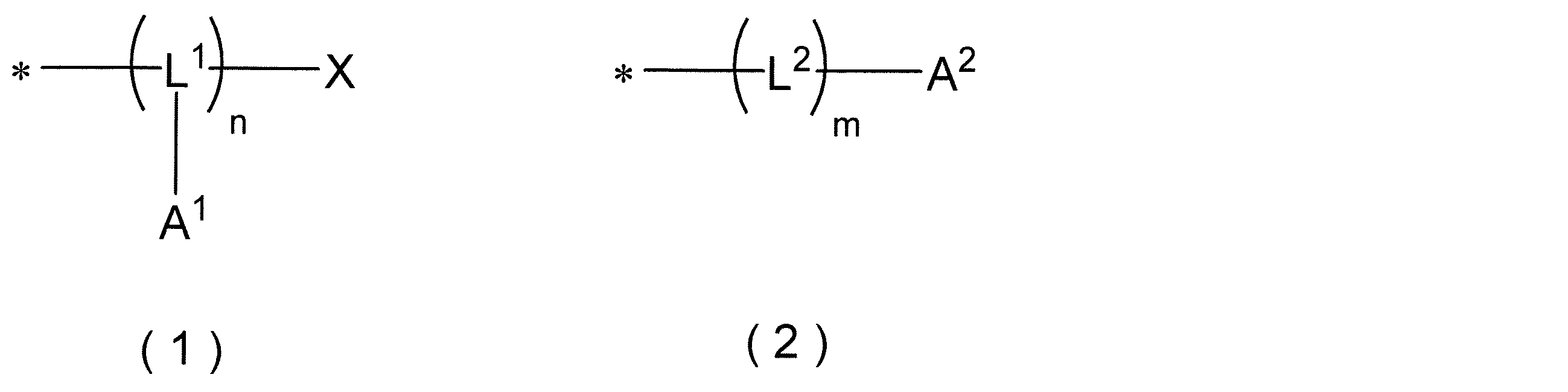
上記第1末端構造及び第2末端構造が、それぞれ下記式(1)で表される構造及び下記式(2)で表される構造からなる群より選ばれる少なくとも1種であることを特徴とする基板の製造方法。

式(2)中、L2は、-S-、-NR-又は-NA22-である。A2及びA22は、それぞれ独立して、金属原子と化学結合可能な官能基を含む1価の基である。Rは、水素原子又は炭素数1~20の1価の炭化水素基である。mは、0又は1である。*は、上記重合体における上記式(2)で表される構造以外の部分に結合する部位を示す。) - 上記重合体における第1末端構造中の金属原子と化学結合可能な上記官能基と、第2末端構造中の金属原子と化学結合可能な上記官能基とが互いに異なる請求項1に記載の基板の製造方法。
- 上記重合体における第1末端構造が上記式(1)で表される構造であり、第2末端構造が上記式(2)で表される構造である請求項1又は請求項2に記載の基板の製造方法。
- 上記式(1)におけるA1がリン酸基であり、上記式(2)におけるA2がニトリル基、カルボキシ基、エステル基及びヒドロキシ基からなる群より選ばれる少なくとも1種である請求項1、請求項2又は請求項3に記載の基板の製造方法。
- 上記重合体が、炭化水素基置換又は非置換のスチレンに由来する構造単位を有する請求項1から請求項4のいずれか1項に記載の基板の製造方法。
- 上記金属基板が第1金属原子を含み、上記金属含有層が上記第1金属原子とは異なる第2金属原子を含んでおり、
上記重合体における第1末端構造の上記官能基が上記第1金属原子と化学結合可能なものであり、第2末端構造の上記官能基が上記第2金属原子と化学結合可能なものである請求項1から請求項5のいずれか1項に記載の基板の製造方法。 - 上記第1末端構造の官能基がリン酸基であり、上記第2末端構造の上記官能基がニトリル基、カルボキシ基、エステル基及びヒドロキシ基からなる群より選ばれる少なくとも1種である請求項6に記載の基板の製造方法。
- 金属基板とこの金属基板上に形成された金属含有層とを備える基板の製造方法に用いられる組成物であって、
同一分子上に第1末端構造及び第2末端構造を有する重合体と、溶媒とを含有し、
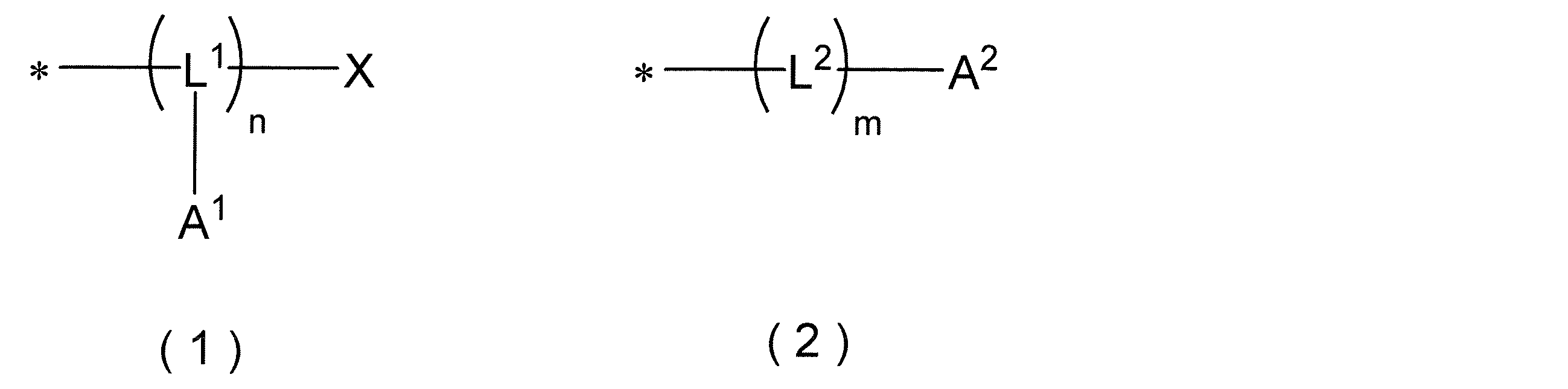
上記第1末端構造及び第2末端構造が、それぞれ下記式(1)で表される構造及び下記式(2)で表される構造からなる群より選ばれる少なくとも1種であることを特徴とする組成物。
式(2)中、L2は、-S-、-NR-又は-NA22-である。A2及びA22は、それぞれ独立して、金属原子と化学結合可能な官能基を含む1価の基である。Rは、水素原子又は炭素数1~20の1価の炭化水素基である。mは、0又は1である。*は、上記重合体における上記式(2)で表される構造以外の部分に結合する部位を示す。) - 同一分子上に第1末端構造及び第2末端構造を有し、上記第1末端構造及び第2末端構造がそれぞれ下記式(1)で表される構造及び下記式(2)で表される構造からなる群より選ばれる少なくとも1種である重合体。
式(2)中、L2は、-S-、-NR-又は-NA22-である。A2及びA22は、それぞれ独立して、金属原子と化学結合可能な官能基を含む1価の基である。Rは、水素原子又は炭素数1~20の1価の炭化水素基である。mは、0又は1である。*は、上記重合体における上記式(2)で表される構造以外の部分に結合する部位を示す。)
Priority Applications (3)
| Application Number | Priority Date | Filing Date | Title |
|---|---|---|---|
| KR1020217009548A KR20210071973A (ko) | 2018-10-03 | 2019-09-30 | 기판의 제조 방법, 조성물 및 중합체 |
| JP2020550435A JP7184092B2 (ja) | 2018-10-03 | 2019-09-30 | 基板の製造方法、組成物及び重合体 |
| US17/196,006 US11578230B2 (en) | 2018-10-03 | 2021-03-09 | Composition, polymer, and method of producing substrate |
Applications Claiming Priority (2)
| Application Number | Priority Date | Filing Date | Title |
|---|---|---|---|
| JP2018188640 | 2018-10-03 | ||
| JP2018-188640 | 2018-10-03 |
Related Child Applications (1)
| Application Number | Title | Priority Date | Filing Date |
|---|---|---|---|
| US17/196,006 Continuation US11578230B2 (en) | 2018-10-03 | 2021-03-09 | Composition, polymer, and method of producing substrate |
Publications (1)
| Publication Number | Publication Date |
|---|---|
| WO2020071339A1 true WO2020071339A1 (ja) | 2020-04-09 |
Family
ID=70054655
Family Applications (1)
| Application Number | Title | Priority Date | Filing Date |
|---|---|---|---|
| PCT/JP2019/038636 Ceased WO2020071339A1 (ja) | 2018-10-03 | 2019-09-30 | 基板の製造方法、組成物及び重合体 |
Country Status (4)
| Country | Link |
|---|---|
| US (1) | US11578230B2 (ja) |
| JP (1) | JP7184092B2 (ja) |
| KR (1) | KR20210071973A (ja) |
| WO (1) | WO2020071339A1 (ja) |
Citations (4)
| Publication number | Priority date | Publication date | Assignee | Title |
|---|---|---|---|---|
| JP2008104909A (ja) * | 2006-10-23 | 2008-05-08 | Fujifilm Corp | 金属膜付基板の作製方法、金属膜付基板、金属パターン材料の作製方法、金属パターン材料 |
| JP2009263703A (ja) * | 2008-04-23 | 2009-11-12 | Fujifilm Corp | 表面金属膜材料の作製方法、表面金属膜材料、金属パターン材料の作製方法、金属パターン材料、及びポリマー層形成用組成物 |
| WO2012046615A1 (ja) * | 2010-10-08 | 2012-04-12 | 富士フイルム株式会社 | 積層体の製造方法 |
| JP2012144761A (ja) * | 2011-01-07 | 2012-08-02 | Fujifilm Corp | 被めっき層形成用組成物、金属膜を有する積層体の製造方法 |
Family Cites Families (4)
| Publication number | Priority date | Publication date | Assignee | Title |
|---|---|---|---|---|
| JP4660700B2 (ja) | 2001-09-03 | 2011-03-30 | 独立行政法人産業技術総合研究所 | 有機分子自己組織化膜のパターン形成方法 |
| JP4423584B2 (ja) | 2001-09-04 | 2010-03-03 | ヤマハ株式会社 | 電子音楽装置 |
| WO2008050631A1 (en) * | 2006-10-23 | 2008-05-02 | Fujifilm Corporation | Process for producing metal-film-coated substrate, metal-film-coated substrate, process for producing metallic-pattern material, and metallic-pattern material |
| JP6263450B2 (ja) | 2014-07-24 | 2018-01-17 | 東京エレクトロン株式会社 | 有機単分子膜形成方法 |
-
2019
- 2019-09-30 KR KR1020217009548A patent/KR20210071973A/ko not_active Ceased
- 2019-09-30 WO PCT/JP2019/038636 patent/WO2020071339A1/ja not_active Ceased
- 2019-09-30 JP JP2020550435A patent/JP7184092B2/ja active Active
-
2021
- 2021-03-09 US US17/196,006 patent/US11578230B2/en active Active
Patent Citations (4)
| Publication number | Priority date | Publication date | Assignee | Title |
|---|---|---|---|---|
| JP2008104909A (ja) * | 2006-10-23 | 2008-05-08 | Fujifilm Corp | 金属膜付基板の作製方法、金属膜付基板、金属パターン材料の作製方法、金属パターン材料 |
| JP2009263703A (ja) * | 2008-04-23 | 2009-11-12 | Fujifilm Corp | 表面金属膜材料の作製方法、表面金属膜材料、金属パターン材料の作製方法、金属パターン材料、及びポリマー層形成用組成物 |
| WO2012046615A1 (ja) * | 2010-10-08 | 2012-04-12 | 富士フイルム株式会社 | 積層体の製造方法 |
| JP2012144761A (ja) * | 2011-01-07 | 2012-08-02 | Fujifilm Corp | 被めっき層形成用組成物、金属膜を有する積層体の製造方法 |
Also Published As
| Publication number | Publication date |
|---|---|
| US11578230B2 (en) | 2023-02-14 |
| JPWO2020071339A1 (ja) | 2021-09-16 |
| JP7184092B2 (ja) | 2022-12-06 |
| KR20210071973A (ko) | 2021-06-16 |
| US20210189553A1 (en) | 2021-06-24 |
Similar Documents
| Publication | Publication Date | Title |
|---|---|---|
| US20130209755A1 (en) | Self-assembled structures, method of manufacture thereof and articles comprising the same | |
| JP7127713B2 (ja) | 組成物 | |
| US11195714B2 (en) | Pattern-forming method | |
| US20200148845A1 (en) | Method for forming cover film | |
| US20190194365A1 (en) | Composition, modification method and selective modification method of base material surface, pattern-forming method, and polymer | |
| JP7184092B2 (ja) | 基板の製造方法、組成物及び重合体 | |
| US11426761B2 (en) | Modification method of surface of base, composition, and polymer | |
| US12065534B2 (en) | Composition, method of producing substrate, and polymer | |
| US12332563B2 (en) | Pattern-forming method and composition | |
| US11525067B2 (en) | Modification method of substrate surface, and composition and polymer | |
| US20210318614A9 (en) | Pattern-forming method and radiation-sensitive composition | |
| US12529144B2 (en) | Composition, method of producing substrate, and polymer | |
| US9847232B1 (en) | Pattern-forming method | |
| WO2018131495A1 (ja) | カバー膜形成方法、基材の処理方法及び組成物 | |
| WO2018181217A1 (ja) | カバー膜形成方法、基材の処理方法及び組成物 | |
| US9023950B2 (en) | Star polymer and method of producing same |
Legal Events
| Date | Code | Title | Description |
|---|---|---|---|
| 121 | Ep: the epo has been informed by wipo that ep was designated in this application |
Ref document number: 19869576 Country of ref document: EP Kind code of ref document: A1 |
|
| ENP | Entry into the national phase |
Ref document number: 2020550435 Country of ref document: JP Kind code of ref document: A |
|
| ENP | Entry into the national phase |
Ref document number: 20217009548 Country of ref document: KR Kind code of ref document: A |
|
| NENP | Non-entry into the national phase |
Ref country code: DE |
|
| 122 | Ep: pct application non-entry in european phase |
Ref document number: 19869576 Country of ref document: EP Kind code of ref document: A1 |