WO2020067558A1 - ポリイミド前駆体及びそれから生じるポリイミド並びにフレキシブルデバイス - Google Patents
ポリイミド前駆体及びそれから生じるポリイミド並びにフレキシブルデバイス Download PDFInfo
- Publication number
- WO2020067558A1 WO2020067558A1 PCT/JP2019/038442 JP2019038442W WO2020067558A1 WO 2020067558 A1 WO2020067558 A1 WO 2020067558A1 JP 2019038442 W JP2019038442 W JP 2019038442W WO 2020067558 A1 WO2020067558 A1 WO 2020067558A1
- Authority
- WO
- WIPO (PCT)
- Prior art keywords
- polyimide
- dianhydride
- diamine
- film
- structural unit
- Prior art date
- Legal status (The legal status is an assumption and is not a legal conclusion. Google has not performed a legal analysis and makes no representation as to the accuracy of the status listed.)
- Ceased
Links
Classifications
-
- C—CHEMISTRY; METALLURGY
- C08—ORGANIC MACROMOLECULAR COMPOUNDS; THEIR PREPARATION OR CHEMICAL WORKING-UP; COMPOSITIONS BASED THEREON
- C08G—MACROMOLECULAR COMPOUNDS OBTAINED OTHERWISE THAN BY REACTIONS ONLY INVOLVING UNSATURATED CARBON-TO-CARBON BONDS
- C08G73/00—Macromolecular compounds obtained by reactions forming a linkage containing nitrogen with or without oxygen or carbon in the main chain of the macromolecule, not provided for in groups C08G12/00 - C08G71/00
- C08G73/06—Polycondensates having nitrogen-containing heterocyclic rings in the main chain of the macromolecule
- C08G73/10—Polyimides; Polyester-imides; Polyamide-imides; Polyamide acids or similar polyimide precursors
- C08G73/1039—Polyimides; Polyester-imides; Polyamide-imides; Polyamide acids or similar polyimide precursors comprising halogen-containing substituents
-
- C—CHEMISTRY; METALLURGY
- C08—ORGANIC MACROMOLECULAR COMPOUNDS; THEIR PREPARATION OR CHEMICAL WORKING-UP; COMPOSITIONS BASED THEREON
- C08G—MACROMOLECULAR COMPOUNDS OBTAINED OTHERWISE THAN BY REACTIONS ONLY INVOLVING UNSATURATED CARBON-TO-CARBON BONDS
- C08G73/00—Macromolecular compounds obtained by reactions forming a linkage containing nitrogen with or without oxygen or carbon in the main chain of the macromolecule, not provided for in groups C08G12/00 - C08G71/00
- C08G73/06—Polycondensates having nitrogen-containing heterocyclic rings in the main chain of the macromolecule
- C08G73/10—Polyimides; Polyester-imides; Polyamide-imides; Polyamide acids or similar polyimide precursors
- C08G73/1003—Preparatory processes
- C08G73/1007—Preparatory processes from tetracarboxylic acids or derivatives and diamines
-
- C—CHEMISTRY; METALLURGY
- C08—ORGANIC MACROMOLECULAR COMPOUNDS; THEIR PREPARATION OR CHEMICAL WORKING-UP; COMPOSITIONS BASED THEREON
- C08G—MACROMOLECULAR COMPOUNDS OBTAINED OTHERWISE THAN BY REACTIONS ONLY INVOLVING UNSATURATED CARBON-TO-CARBON BONDS
- C08G73/00—Macromolecular compounds obtained by reactions forming a linkage containing nitrogen with or without oxygen or carbon in the main chain of the macromolecule, not provided for in groups C08G12/00 - C08G71/00
- C08G73/06—Polycondensates having nitrogen-containing heterocyclic rings in the main chain of the macromolecule
- C08G73/10—Polyimides; Polyester-imides; Polyamide-imides; Polyamide acids or similar polyimide precursors
- C08G73/1042—Copolyimides derived from at least two different tetracarboxylic compounds or two different diamino compounds
-
- C—CHEMISTRY; METALLURGY
- C08—ORGANIC MACROMOLECULAR COMPOUNDS; THEIR PREPARATION OR CHEMICAL WORKING-UP; COMPOSITIONS BASED THEREON
- C08G—MACROMOLECULAR COMPOUNDS OBTAINED OTHERWISE THAN BY REACTIONS ONLY INVOLVING UNSATURATED CARBON-TO-CARBON BONDS
- C08G73/00—Macromolecular compounds obtained by reactions forming a linkage containing nitrogen with or without oxygen or carbon in the main chain of the macromolecule, not provided for in groups C08G12/00 - C08G71/00
- C08G73/06—Polycondensates having nitrogen-containing heterocyclic rings in the main chain of the macromolecule
- C08G73/10—Polyimides; Polyester-imides; Polyamide-imides; Polyamide acids or similar polyimide precursors
- C08G73/1067—Wholly aromatic polyimides, i.e. having both tetracarboxylic and diamino moieties aromatically bound
-
- C—CHEMISTRY; METALLURGY
- C08—ORGANIC MACROMOLECULAR COMPOUNDS; THEIR PREPARATION OR CHEMICAL WORKING-UP; COMPOSITIONS BASED THEREON
- C08G—MACROMOLECULAR COMPOUNDS OBTAINED OTHERWISE THAN BY REACTIONS ONLY INVOLVING UNSATURATED CARBON-TO-CARBON BONDS
- C08G73/00—Macromolecular compounds obtained by reactions forming a linkage containing nitrogen with or without oxygen or carbon in the main chain of the macromolecule, not provided for in groups C08G12/00 - C08G71/00
- C08G73/06—Polycondensates having nitrogen-containing heterocyclic rings in the main chain of the macromolecule
- C08G73/10—Polyimides; Polyester-imides; Polyamide-imides; Polyamide acids or similar polyimide precursors
- C08G73/1067—Wholly aromatic polyimides, i.e. having both tetracarboxylic and diamino moieties aromatically bound
- C08G73/1071—Wholly aromatic polyimides containing oxygen in the form of ether bonds in the main chain
-
- C—CHEMISTRY; METALLURGY
- C08—ORGANIC MACROMOLECULAR COMPOUNDS; THEIR PREPARATION OR CHEMICAL WORKING-UP; COMPOSITIONS BASED THEREON
- C08J—WORKING-UP; GENERAL PROCESSES OF COMPOUNDING; AFTER-TREATMENT NOT COVERED BY SUBCLASSES C08B, C08C, C08F, C08G or C08H
- C08J5/00—Manufacture of articles or shaped materials containing macromolecular substances
- C08J5/18—Manufacture of films or sheets
-
- C—CHEMISTRY; METALLURGY
- C08—ORGANIC MACROMOLECULAR COMPOUNDS; THEIR PREPARATION OR CHEMICAL WORKING-UP; COMPOSITIONS BASED THEREON
- C08L—COMPOSITIONS OF MACROMOLECULAR COMPOUNDS
- C08L79/00—Compositions of macromolecular compounds obtained by reactions forming in the main chain of the macromolecule a linkage containing nitrogen with or without oxygen or carbon only, not provided for in groups C08L61/00 - C08L77/00
- C08L79/04—Polycondensates having nitrogen-containing heterocyclic rings in the main chain; Polyhydrazides; Polyamide acids or similar polyimide precursors
- C08L79/08—Polyimides; Polyester-imides; Polyamide-imides; Polyamide acids or similar polyimide precursors
-
- G—PHYSICS
- G09—EDUCATION; CRYPTOGRAPHY; DISPLAY; ADVERTISING; SEALS
- G09F—DISPLAYING; ADVERTISING; SIGNS; LABELS OR NAME-PLATES; SEALS
- G09F9/00—Indicating arrangements for variable information in which the information is built-up on a support by selection or combination of individual elements
- G09F9/30—Indicating arrangements for variable information in which the information is built-up on a support by selection or combination of individual elements in which the desired character or characters are formed by combining individual elements
- G09F9/301—Indicating arrangements for variable information in which the information is built-up on a support by selection or combination of individual elements in which the desired character or characters are formed by combining individual elements flexible foldable or roll-able electronic displays, e.g. thin LCD, OLED
-
- H—ELECTRICITY
- H05—ELECTRIC TECHNIQUES NOT OTHERWISE PROVIDED FOR
- H05B—ELECTRIC HEATING; ELECTRIC LIGHT SOURCES NOT OTHERWISE PROVIDED FOR; CIRCUIT ARRANGEMENTS FOR ELECTRIC LIGHT SOURCES, IN GENERAL
- H05B33/00—Electroluminescent light sources
- H05B33/02—Details
-
- C—CHEMISTRY; METALLURGY
- C08—ORGANIC MACROMOLECULAR COMPOUNDS; THEIR PREPARATION OR CHEMICAL WORKING-UP; COMPOSITIONS BASED THEREON
- C08J—WORKING-UP; GENERAL PROCESSES OF COMPOUNDING; AFTER-TREATMENT NOT COVERED BY SUBCLASSES C08B, C08C, C08F, C08G or C08H
- C08J2379/00—Characterised by the use of macromolecular compounds obtained by reactions forming in the main chain of the macromolecule a linkage containing nitrogen with or without oxygen, or carbon only, not provided for in groups C08J2361/00 - C08J2377/00
- C08J2379/04—Polycondensates having nitrogen-containing heterocyclic rings in the main chain; Polyhydrazides; Polyamide acids or similar polyimide precursors
- C08J2379/08—Polyimides; Polyester-imides; Polyamide-imides; Polyamide acids or similar polyimide precursors
-
- C—CHEMISTRY; METALLURGY
- C08—ORGANIC MACROMOLECULAR COMPOUNDS; THEIR PREPARATION OR CHEMICAL WORKING-UP; COMPOSITIONS BASED THEREON
- C08L—COMPOSITIONS OF MACROMOLECULAR COMPOUNDS
- C08L2203/00—Applications
- C08L2203/16—Applications used for films
-
- C—CHEMISTRY; METALLURGY
- C09—DYES; PAINTS; POLISHES; NATURAL RESINS; ADHESIVES; COMPOSITIONS NOT OTHERWISE PROVIDED FOR; APPLICATIONS OF MATERIALS NOT OTHERWISE PROVIDED FOR
- C09K—MATERIALS FOR MISCELLANEOUS APPLICATIONS, NOT PROVIDED FOR ELSEWHERE
- C09K2323/00—Functional layers of liquid crystal optical display excluding electroactive liquid crystal layer characterised by chemical composition
-
- C—CHEMISTRY; METALLURGY
- C09—DYES; PAINTS; POLISHES; NATURAL RESINS; ADHESIVES; COMPOSITIONS NOT OTHERWISE PROVIDED FOR; APPLICATIONS OF MATERIALS NOT OTHERWISE PROVIDED FOR
- C09K—MATERIALS FOR MISCELLANEOUS APPLICATIONS, NOT PROVIDED FOR ELSEWHERE
- C09K2323/00—Functional layers of liquid crystal optical display excluding electroactive liquid crystal layer characterised by chemical composition
- C09K2323/03—Viewing layer characterised by chemical composition
Definitions
- the present invention relates to a polyimide having high transparency, a low coefficient of thermal expansion, a low retardation property, and a tear resistance, useful as a support base material for forming a display device, a precursor thereof, and a flexible device.
- Display devices such as organic EL devices and touch panels are used as components of various displays, including large displays such as televisions and small displays such as mobile phones, personal computers, and smartphones.
- a thin film transistor TFT
- the touch panel has a configuration in which a first glass substrate on which a first electrode is formed and a second glass substrate on which a second electrode is formed are bonded via an insulating layer (dielectric layer). I have.
- These components are laminates in which various functional layers are formed on a glass substrate.
- a resin substrate By replacing this glass substrate with a resin substrate, it is possible to reduce the thickness, weight, and flexibility as compared with a component using a conventional glass substrate. By utilizing this, it is expected that a flexible device such as a flexible display will be obtained.
- various studies have been made on the resin because the resin is inferior to glass in (i) dimensional stability, (ii) transparency, (iii) heat resistance, and the like.
- the resin substrate polyimide having relatively excellent characteristics (i) to (iii) has been actively studied.
- the characteristics of the polyimide depend on the composition of the monomers (mainly, diamine and tetracarboxylic dianhydride) constituting the polyimide. Therefore, in order to produce a resin substrate having the above characteristics, it is important to select an excellent monomer.
- One such excellent monomer is 2,2-bis (trifluoromethyl) benzidine (TFMB).
- TFMB is an aromatic diamine containing fluorine. By introducing this as a polyimide monomer, it is expected that the above-mentioned properties of a polyimide substrate will be improved.
- TFMB has an extremely important industrial advantage that it has a relatively low production cost as a fluorine-containing aromatic diamine. For these reasons, many studies on resin substrates using TFMB have been made (Patent Documents 1 to 5).
- ⁇ Another important characteristic required for the polyimide substrate is (v) a large tear propagation resistance.
- a polyimide layer is formed on a supporting substrate such as glass, and a functional layer is further formed thereon, and the step of peeling the supporting substrate is included.However, when the film is peeled from the inorganic substrate, the film must have mechanical properties such as mechanical strength and elongation, which are equal to or more than a certain value.
- the tear propagation resistance is small, there is a problem that the film is broken when peeled. Therefore, a large tear propagation resistance is required for a film used as a supporting substrate.
- Patent Document 5 a polyimide film using TFMB, which can simultaneously satisfy dimensional stability, heat resistance, transparency, and high tear propagation resistance.
- JP 2012-040836 A International Publication No. WO 2014/092235 WO 2015/125895 WO 2016/158825 JP-A-2015-1887987
- An object of the present invention is to provide a polyimide and a precursor thereof having low Rth and high tear propagation resistance in addition to excellent dimensional stability, transparency and heat resistance.
- the polyimide precursor of the present invention is a polyimide precursor having a structural unit derived from a diamine and a structural unit derived from tetracarboxylic dianhydride.
- the polyimide precursor of the present invention comprises i) a structural unit derived from 2,2-bis (trifluoromethyl) benzidine as a structural unit derived from a diamine, comprising 60 mol% or more of all structural units derived from a diamine; ii)
- the structural unit derived from tetracarboxylic dianhydride is selected from 4,4 ′-(2,2′-hexafluoroisopropylidene) diphthalic dianhydride and 4,4′-oxydiphthalic dianhydride It contains at least 20 mol% of all the structural units derived from tetracarboxylic dianhydride in total.
- the polyimide precursor of the present invention has an imidized polyimide having a yellowness (converted to a film thickness of 10
- the polyimide precursor of the present invention may have a weight average molecular weight in the range of 80,000 to 800,000.
- the polyimide of the present invention obtained by imidizing the polyimide precursor may have an elongation of 10% or more at a film thickness of 5 to 20 ⁇ m.
- the retardation in the thickness direction of the polyimide film obtained by imidizing the polyimide precursor of the present invention may be 65 nm or less.
- the polyimide of the present invention is a polyimide having a structural unit derived from a diamine and a structural unit derived from tetracarboxylic dianhydride.
- the polyimide of the present invention contains i) a structural unit derived from 2,2-bis (trifluoromethyl) benzidine as a structural unit derived from a diamine at 60 mol% or more of all the structural units derived from a diamine; ii) As a structural unit derived from tetracarboxylic dianhydride, one selected from 4,4 ′-(2,2′-hexafluoroisopropylidene) diphthalic dianhydride and 4,4′-oxydiphthalic dianhydride The structural units derived from the above are contained in a total of 20 mol% or more of all the structural units derived from tetracarboxylic dianhydride.
- the polyimide of the present invention has a yellowness (after conversion with a film
- the polyimide of the present invention may have an elongation of 5 to 20 ⁇ m in a film state of 10% or more.
- the polyimide of the present invention may have a retardation in a thickness direction in a film state (after conversion with a film thickness of 10 ⁇ m) of 65 nm or less.
- the polyimide of the present invention may contain i) a structural unit derived from 2,2-bis (trifluoromethyl) benzidine as a structural unit derived from a diamine, at least 80 mol% of all structural units derived from a diamine. Good.
- the polyimide of the present invention includes ii) 4,4 ′-(2,2′-hexafluoroisopropylidene) diphthalic acid dianhydride and 4,4′-oxydiphthalic acid as structural units derived from tetracarboxylic dianhydride Structural units derived from at least one selected from dianhydrides may be contained in a total of 25 mol% or more of the total structural units derived from tetracarboxylic dianhydride.
- the flexible device of the present invention has a functional layer formed on a polyimide layer containing any of the above polyimides.
- the polyimide precursor of the present invention or a polyimide obtained therefrom has excellent dimensional stability, transparency and heat resistance, as well as excellent Rth and tear propagation resistance.
- Rth when 4,4 '-(2,2'-hexafluoroisopropylidene) diphthalic dianhydride is used, low Rth is excellent.
- 4,4'-oxydiphthalic dianhydride when 4,4'-oxydiphthalic dianhydride is used, elongation is excellent even when a thin film of about 5 to 20 ⁇ m is formed.
- TFMB is used as a raw material monomer, the production cost is reduced, and the productivity is extremely excellent.
- a polyimide film for a resin substrate of a display device, a touch panel, or the like, and a display element, a light-emitting element, a circuit, a conductive film such as ITO, a metal mesh, a hard coat film, or moisture or oxygen is formed on the surface of the polyimide film. It can be preferably applied as a flexible device in which a functional layer such as a gas barrier film for preventing permeation of the like is formed on the surface.
- the polyimide precursor of the present invention is a polyimide precursor having a structural unit derived from a diamine and a structural unit derived from tetracarboxylic dianhydride (hereinafter, also simply referred to as “acid dianhydride”), i) As a structural unit derived from a diamine, a structural unit derived from 2,2-bis (trifluoromethyl) benzidine (TFMB) is contained in an amount of 60 mol% or more of all the structural units derived from a diamine, and ii) tetracarboxylic acid
- the structural unit derived from dianhydride is selected from 4,4 '-(2,2'-hexafluoroisopropylidene) diphthalic dianhydride (6FDA) and 4,4'-oxydiphthalic dianhydride (ODPA)
- the total of structural units derived from one or more of the above structural units is 20 mol% or more of the total structural units derived from tetracarboxy
- the polyimide obtained by imidizing the polyimide precursor of the present invention also retains these structural units as they are.
- the polyimide precursor of the present invention has a yellowness (converted to a film thickness of 10 ⁇ m) of the polyimide when imidized is 10 or less, and a tear propagation resistance is 1.0 mN / ⁇ m or more.
- the structural units of the polyimide precursor and the polyimide and the ratio thereof are determined by the types and the use ratios of the diamine and the tetracarboxylic dianhydride. Therefore, the description of the structural unit will be made with the diamine and the acid dianhydride.
- the use ratio of the diamine and the acid dianhydride is defined as the ratio of the structural units derived from the respective components.
- polyimide From the viewpoint of heat resistance, low coefficient of thermal expansion (low CTE), and transparency of polyimide produced using the TFMB as a monomer (hereinafter, simply referred to as “polyimide”), 80% of the total diamine is used. Preferably, the content is at least 90 mol%, more preferably at least 90 mol%.
- diamines can be used for the purpose of imparting desired properties to the polyimide.
- they are preferably used in a range of less than 40 mol% of the total diamine, preferably less than 20 mol%, more preferably less than 10 mol%.
- a diamine having one or more aromatic rings can be used from the viewpoint of heat resistance of polyimide and low CTE.
- diamines include 2,2'-dimethyl-4,4'-diaminobiphenyl (also known as 2,2'-dimethyl-benzidine), 3,3'-dimethyl-4,4'-diaminobiphenyl, 4,4'-diaminodiphenyl ether, 3,4'-diaminodiphenyl ether, 4,6-dimethyl-m-phenylenediamine, 2,5-dimethyl-p-phenylenediamine, 2,4-diaminomesitylene, 4,4'- Methylenedi-o-toluidine, 4,4'-methylenedi-2,6-xylidine, 4,4'-methylene-2, 6-diethylaniline, 2,4-toluenediamine, m-phenylenediamine, p-phenyl
- 4,4′-diaminodiphenyl ether, 4,6-dimethyl-m-phenylenediamine, and 2,5-dimethyl-p-phenylene are more preferred from the viewpoint that the reaction for producing polyimide is fast and highly transparent.
- 2,2'-dimethyl-4,4'-diaminobiphenyl, 5-amino-2- (4-aminophenyl) benzimidazole or 4,4'-diaminodiphenyl ether is suitable.
- a diamine having a siloxane skeleton may be applied from the viewpoint of flexibility of polyimide such as low elasticity and low residual stress.
- examples of the diamine having a siloxane skeleton include, for example, diaminopropyltetramethyldisiloxane and methylphenyl silicone modified at both ends with amino.
- a diamine having an alicyclic structure may be applied from the viewpoint of transparency and low CTE of polyimide.
- the diamine having an alicyclic structure include 1,4-cyclohexanedicarboxylic acid.
- One or more monomers selected from the above 6FDA and ODPA are, in total, 20 mol% of the total tetracarboxylic dianhydride from the viewpoint of heat resistance and transparency of the polyimide produced using these monomers. Or more, preferably 25 mol% or more.
- the lower limit is preferably 60 mol%, more preferably 80 mol%, and still more preferably 90 mol%.
- the lower limit is preferably 25 mol%, more preferably 30 mol%, and still more preferably 35 mol%.
- the upper limit is preferably 60 mol%, more preferably 50%, and still more preferably 40%.
- tetracarboxylic dianhydrides can be used to impart desired properties to the polyimide.
- other tetracarboxylic dianhydrides are preferably used in a range of less than 40 mol% of the total tetracarboxylic dianhydrides, preferably less than 20 mol%, more preferably less than 10 mol%. is there.
- Examples of the other tetracarboxylic dianhydride include naphthalene-2,3,6,7-tetracarboxylic dianhydride, naphthalene-1,2,5,6-tetracarboxylic dianhydride, naphthalene- 1,2,6,7-tetracarboxylic dianhydride, pyromellitic dianhydride, 3,3 ', 4,4'-biphenyltetracarboxylic dianhydride 3,3', 4,4'-benzophenone Tetracarboxylic dianhydride, 2,2 ', 3,3'-benzophenonetetracarboxylic dianhydride, 2,3,3', 4'-benzophenonetetracarboxylic dianhydride, naphthalene-1,2,4 2,5-tetracarboxylic dianhydride, naphthalene-1,4,5,8-tetracarboxylic dianhydride, naphthalene-1,
- tetracarboxylic dianhydride preferably, pyromellitic dianhydride (PMDA), 3,3 ′, 4,4 ′, which can impart strength, flexibility and low CTE to the polyimide, is preferred.
- PMDA pyromellitic dianhydride
- BPDA -Biphenyltetracarboxylic dianhydride
- CBDA 1,2,3,4-cyclobutanetetracarboxylic dianhydride
- CHDA 1,2,4,5-cyclohexanetetracarboxylic dianhydride
- the polyimide precursor of the present invention may be one kind of polyimide precursor or a mixture of two or more kinds of polyimide precursors. In the latter case, the preferred content of each raw material monomer is calculated as the content based on all structural units of the mixture.
- the imidized polyimide has a yellowness (after conversion with a film thickness of 10 ⁇ m) of 10 or less and a tear propagation resistance of 1.0 mN / ⁇ m or more.
- the weight average molecular weight (Mw) of the polyimide precursor be 80,000 to 800,000.
- optimizing reaction conditions such as the charging ratio of tetracarboxylic dianhydride and diamine can be mentioned.
- Techniques for optimizing the reaction conditions include (I) polymerization at a high substrate concentration in the reaction solvent, (II) the charge ratio of the starting monomers, and (III) the reaction conditions (temperature, time) of the varnish.
- the solid concentration of the monomer group containing the diamine and the tetracarboxylic dianhydride in the varnish is preferably set to 10 wt% to 40 wt%. This increases the tear propagation resistance.
- the probability of collision of monomer molecules is increased by increasing the concentration of the reaction substrate, and the reaction rate tends to increase.
- a more preferable lower limit is 12 wt%, and further more preferably, 17 wt%. Further, a more preferred upper limit is 30 wt%, and further more preferably 25 wt%. If a monomer with low solubility or reaction activity is selected, consider the order of addition of each monomer in order to properly carry out polymerization, heat and stir after adding each monomer in an organic solvent, A step of irradiating ultrasonic waves after adding each monomer may be added.
- the amounts of the diamine and the tetracarboxylic dianhydride used as the raw material monomers may be adjusted as described above. Specifically, in order to obtain a varnish having an appropriate molecular weight, it is preferable to adjust the molar ratio of tetracarboxylic dianhydride / diamine in the range of 0.985 to 1.003. Furthermore, the range of 0.987 to 1.002 is more preferable. This increases the tear propagation resistance.
- the molecular weight tends to become highest as the molar ratio of tetracarboxylic dianhydride / diamine approaches 1.
- the terminal functional group is biased toward either the acid anhydride structure or the amino group, and the reaction at the terminal does not proceed, so that it becomes difficult to increase the molecular weight.
- the viscosity tends to be too high, which tends to cause problems such as difficulty in forming a film and reduction in elongation.
- the molecular weight when the molecular weight is too small, the tear propagation resistance of the polyimide tends to decrease. Also, there is a tendency that the effect of reducing Rth cannot be obtained. Moreover, the reaction activity of each monomer is different. Accordingly, the molar ratio of the acid anhydride / diamine greatly fluctuates from the charge ratio and becomes too large or too small. Even if the molar ratio of tetracarboxylic dianhydride / diamine is 1 at the time of the charge, the molecular weight becomes sufficiently high. Sometimes not.
- the polyimide precursor of the present invention has an Mw of 80,000 to 80,000 by selecting appropriate monomers and selecting a molar ratio of tetracarboxylic dianhydride / diamine suitable for each monomer. It can be in the range of 800,000. Further, the tear propagation resistance of the imidized polyimide becomes 1.0 mN / ⁇ m or more.
- the order of addition of each monomer to the organic solvent is changed so that the molar ratio of tetracarboxylic dianhydride / diamine is in an appropriate range. After adding each monomer in the organic solvent, the mixture is heated and stirred. A step of irradiating ultrasonic waves after adding each monomer may be added.
- the polyimide precursor of the present invention can keep the Mw of the polyimide precursor in the range of 80,000 to 800,000 even when the reaction temperature in the organic solvent is high.
- the reaction temperature is preferably 35 ° C. to 50 ° C.
- the reaction time is preferably 1 to 10 hours.
- the obtained polyimide precursor of the present invention has a Mw within the range of 80,000 to 800,000 and a tear propagation resistance of imidized polyimide of 1.0 mN / ⁇ m or more. Become.
- a polyimide having a yellowness (after conversion with a film thickness of 10 ⁇ m) of 10 or less and a thermal expansion coefficient of 100 ppm / K or less is used. Is obtained. If the heating temperature is lower than 35 ° C., a high molecular weight resin cannot be obtained, and the effect of improving tear propagation resistance and the effect of reducing Rth cannot be obtained. On the other hand, when the temperature exceeds 50 ° C., a reverse reaction of polymerization occurs, and a high molecular weight resin cannot be obtained.
- the heating temperature is preferably 40 ° C. to 50 ° C., and the heating time is preferably 1 to 6 hours, more preferably 1 to 4 hours.
- a step of stirring at 5 ° C. to 35 ° C. for 5 hours or more is further performed.
- the stirring temperature is preferably from 10 ° C to 35 ° C, more preferably from 15 ° C to 30 ° C.
- the stirring time is more preferably 10 hours or more.
- the above methods (I) to (III) may be applied alone, but it is more preferable to carry out the methods in combination with the methods (I) to (III).
- the resulting polyimide precursor has an Mw within the range of 80,000 to 800,000 and a tear propagation resistance of imidized polyimide of 1.0 mN / ⁇ m or more.
- Rth of the polyimide is suppressed to be low by the above steps, and Rth (after conversion with a film thickness of 10 ⁇ m) becomes 65 nm or less.
- ODPA it is excellent in elongation even when a thin polyimide film having a thickness of about 5 to 20 ⁇ m is used.
- a polyimide film having a thickness of about 10 ⁇ m has an elongation (also referred to as “elongation”) of 20% or more, and a polyimide film having a thickness of about 6 ⁇ m has an elongation of 10% or more.
- elongation also referred to as “elongation”
- a polyimide film having a thickness of about 6 ⁇ m has an elongation of 10% or more.
- the elongation of the polyimide film having a thickness of about 6 ⁇ m can be maintained at 70% or more of the elongation of the polyimide film having a thickness of about 10 ⁇ m.
- ODPA is used, it can be particularly suitably used in such applications.
- a polar solvent is preferable, and examples thereof include N, N-dimethylacetamide, N-methyl-2-pyrrolidone, dimethylformamide, 2-butanone, diglyme, and xylene. Further, xylene, hexane, or the like can be added to increase the solubility. More preferred are N, N-dimethylacetamide and N-methyl-2-pyrrolidone.
- the heating may be performed in the air, but is preferably performed in a nitrogen stream.
- the molecular terminal of the polyimide precursor may be sealed with a monoamine or a monocarboxylic dianhydride.
- the polyimide of the present invention is obtained by imidizing the polyimide precursor of the present invention.
- the imidization can be performed by a thermal imidization method, a chemical imidization method, or the like.
- a thermal imidization a polyimide precursor was applied on an arbitrary supporting substrate such as glass, metal, or resin using an applicator, and preliminarily dried at a temperature of 150 ° C. or less for 2 to 60 minutes to remove the solvent. Thereafter, for imidization, the temperature is usually raised stepwise from room temperature and heat-treated to 450 ° C. for about 10 minutes to 20 hours. It is possible to change the heat treatment temperature according to the required mechanical properties.
- the maximum temperature of the heat treatment for imidization is from 350 ° C to 450 ° C, more preferably from 360 ° C to 400 ° C, from the viewpoint of heat resistance and mechanical strength of the polyimide.
- the thermal imidization if the combination of the type of the acid dianhydride or diamine and the type of the solvent is selected, the imidization can be completed in a relatively short time, and the heat treatment including the preheating can be performed within 60 minutes. It is possible.
- the polyimide precursor may be applied as a polyimide precursor solution obtained by dissolving the polyimide precursor in a known solvent.
- a dehydrating agent and a catalyst are added to a polyimide precursor solution, and dehydration is performed chemically at 30 ° C. to 60 ° C.
- Acetic anhydride is exemplified as a typical dehydrating agent
- pyridine is exemplified as a catalyst.
- the chemical imidization is preferably performed by a thermal imidization method since impurities are easily mixed and the process is complicated. Note that one kind of polyimide precursor may be imidized, or two or more kinds of polyimide precursors may be mixed and imidized at once.
- the polymerization degree of the polyimide precursor and the polyimide of the present invention is preferably from 1,000 to 100,000 cP, and more preferably from 3,000 to 10,000 cP, as measured by an E-type viscometer of the polyimide precursor solution. Good to be.
- the molecular weight of the polyimide precursor can be determined by a GPC method.
- the preferred molecular weight range (polystyrene equivalent) of the polyimide precursor is preferably 15,000 to 250,000 in number average molecular weight (Mn) and 80,000 to 800,000 in weight average molecular weight (Mw). Note that the molecular weight of polyimide is also in the same range as the molecular weight of its precursor.
- the tear propagation resistance of the polyimide tends to decrease. If the Mw exceeds 800,000, the viscosity is too high, making it difficult to form a film, or forming a gel to form a non-uniform film. As a result, the tear propagation resistance tends to decrease.
- the lower limit of Mw is more preferably 220,000, and still more preferably 230,000.
- the lower limit of Mw is more preferably 180,000, and still more preferably 200,000.
- a preferable lower limit of Mw can be determined from the molar fraction of 6FDA and ODPA. That is, the sum of the amounts of 6FDA and OPDA used in the polyimide precursor and polyimide is ⁇ mol, the amount of 6FDA used is ⁇ mol, the lower limit of the preferred Mw in the case of using 6FDA and not using ODPA is ⁇ , and 6FDA using ODPA.
- a preferable lower limit of Mw when ⁇ is not used is ⁇
- the polyimide of the present invention obtained by imidizing the polyimide precursor of the present invention has a yellowness (after conversion with a film thickness of 10 ⁇ m) of 10 or less, and a tear propagation resistance of 1.0 mN / ⁇ m or more.
- Rth (after conversion with a film thickness of 10 ⁇ m) is 65 nm or less, and CTE is 100 ppm / K or less.
- the polyimide of the present invention has a yellowness (YI) of 10 or less, preferably 6 or less, and more preferably 4 or less. Within this range, it can be suitably used for a substrate that is required to have low transparency and coloring, such as a TFT substrate for an organic EL device, a touch panel substrate, and a color filter substrate.
- YI yellowness
- the tear propagation resistance of the polyimide of the present invention is 1.0 mN / ⁇ m or more. If it is less than 1.0 mN / ⁇ m, for example, the polyimide layer may be broken in a step of mounting a functional layer such as a display element on the polyimide layer and peeling off the polyimide layer from the supporting substrate.
- a more preferred range is 1.3 mN / ⁇ m or more.
- a more preferred range is 1.5 mN / ⁇ m or more.
- the polyimide of the present invention preferably has a glass transition temperature (Tg) of 250 ° C. or higher, preferably 300 ° C. or higher.
- the thermal decomposition temperature (1% weight loss temperature, Td1) is preferably 400 ° C. or higher.
- Rth of the polyimide of the present invention is preferably 65 nm or less, preferably 45 nm or less, more preferably 40 nm or less, and further preferably 30 nm or less. Within this range, for example, when used as a touch panel substrate, the optical characteristics such as visibility are excellent.
- the polyimide of the present invention has a total light transmittance in the visible region of 70% or more, preferably 80% or more in the state of a film having a thickness of 10 to 15 ⁇ m. . Further, in the state of a polyimide film having a thickness of 10 to 15 ⁇ m, the light transmittance at 450 nm is preferably 70% or more, more preferably 80% or more.
- the polyimide of the present invention has a CTE of 100 ppm / K or less, preferably in the range of -10 ppm / K to 80 ppm / K. If the CTE is less than -10 ppm / K or exceeds 80 ppm / K, problems such as warpage, cracks, and peeling of the display device occur due to thermal stress when the display element is mounted. Sometimes. CTE is more preferably in the range of 0 ppm / K to 80 ppm / K. Particularly when ODPA is used, the upper limit of CTE is preferably set to 40 ppm / K, more preferably 30 ppm / K, and most preferably 20 ppm / K by optimizing the composition.
- polyimide precursor of the present invention there is no limitation on the method of using the polyimide precursor of the present invention as a polyimide.
- polyimide when polyimide is used as a resin substrate, it is advantageous to obtain a film or a laminate including a polyimide layer.
- a polyimide laminate can be obtained by any of a method of applying and drying the resin solution thus formed on a supporting substrate and a method of (3) attaching a separately prepared polyimide film to another supporting substrate.
- the imidization is performed on the supporting substrate as in the method (1) to form a laminate as it is, and if necessary, the laminate is peeled to form a film.
- a resin base, a glass base, a metal base, or the like may be used as long as heat resistance that can withstand heating during the formation of the polyimide layer and releasability when the supporting base is separated from the polyimide laminate can be ensured.
- Known materials such as materials can be applied. From the viewpoint of low Rth of the polyimide layer, glass and polyimide films are preferred, and polyimide films are more preferred.
- the polyimide of the present invention is suitable as a flexible device in which a functional layer is formed on a polyimide layer containing the polyimide of the present invention.
- the polyimide layer may be a single layer or a plurality of layers. In the case of a single layer, it is preferable to have a thickness in the range of 3 ⁇ m to 100 ⁇ m.
- the main polyimide layer may be a polyimide film having the above thickness.
- the “main polyimide layer” refers to a polyimide layer having the largest proportion of the thickness among a plurality of polyimide layers, and is a layer made of the polyimide of the present invention, and preferably has a thickness of 3 ⁇ m.
- the thickness is preferably in the range of 100 ⁇ m to 100 ⁇ m, and more preferably in the range of 4 ⁇ m to 50 ⁇ m.
- the polyimide of the present invention can be a laminate having the polyimide layer, and an element layer or the like (functional layer) having various functions can be formed on the surface of the polyimide layer.
- the functional layer include display devices such as a liquid crystal display device, an organic EL display device, a touch panel, and electronic paper, such as a display device such as a color filter or a component thereof.
- display devices such as a liquid crystal display device, an organic EL display device, a touch panel, and electronic paper, such as a display device such as a color filter or a component thereof.
- Various functional devices used in association with the display device are also included.
- the “functional layer” referred to here includes not only components such as a liquid crystal display device, an organic EL display device, and a color filter, but also an electrode layer of an organic EL lighting device, a touch panel device, and an organic EL display device.
- the light-emitting layer, a gas barrier film, an adhesive film, a thin film transistor (TFT), a wiring layer of a liquid crystal display device, or a combination of two or more of them such as a transparent conductive layer are also included.
- the formation method of the functional layer is appropriately set according to the intended device, but the formation conditions are generally set.However, in general, a metal film, an inorganic film, an organic film, or the like is formed on a polyimide film, and then necessary. A known method such as patterning into a predetermined shape or heat treatment may be used accordingly. That is, the means for forming these display elements is not particularly limited, and is, for example, appropriately selected from sputtering, vapor deposition, CVD, printing, exposure, immersion, and the like, if necessary, in a vacuum chamber. These process processes may be performed. Then, the support base material and the polyimide film may be separated immediately after forming the functional layer through various process treatments, or integrated with the base material for a certain period of time, for example, used as a display device. You may remove it just before.
- a gas barrier layer is provided on a polyimide film containing the polyimide of the present invention (hereinafter sometimes referred to as the “polyimide film of the present invention”) to have a structure capable of preventing moisture and oxygen from permeating.
- a circuit constituent layer including a thin film transistor (TFT) is formed on the upper surface of the gas barrier layer.
- TFT thin film transistor
- an LTPS-TFT having a high operation speed is mainly selected as the thin film transistor.
- This circuit configuration layer is formed by forming an anode electrode made of a transparent conductive film of, for example, ITO (Indium Tin Oxide) for each of a plurality of pixel regions arranged in a matrix on the upper surface thereof.
- an organic EL light emitting layer is formed on the upper surface of the anode electrode, and a cathode electrode is formed on the upper surface of the light emitting layer.
- This cathode electrode is commonly formed in each pixel region.
- a gas barrier layer is formed again so as to cover the surface of the cathode electrode, and a sealing substrate is provided on the outermost surface for surface protection. It is desirable from the viewpoint of reliability that a gas barrier layer for preventing moisture and oxygen from permeating is also laminated on the surface of the sealing substrate on the cathode electrode side.
- the organic EL light-emitting layer is formed of a multilayer film (anode electrode-light-emitting layer-cathode electrode) such as a hole injection layer-hole transport layer-light-emitting layer-electron transport layer. Since is deteriorated by moisture and oxygen, it is generally formed by vacuum deposition, and is generally formed continuously in vacuum including electrode formation.
- the transparent resin substrate used in the organic EL display device has an average transmittance in this wavelength region of at least 80% or more. Is required.
- the polyimide layer is separated from a supporting substrate such as a glass substrate by irradiation with UV laser light, if the transmittance at the wavelength of the UV laser light is high, it is necessary to separately provide an absorption / release layer, This reduces productivity.
- a 308 nm laser device is generally used for this separation.
- the polyimide film of the present invention is preferably 1% or less, more preferably 0.5% or less.
- thermomechanical analyzer manufactured by Hitachi High-Tech Science Corporation; product name: TMA / AA6100. The temperature was raised from 30 ° C. to 280 ° C., maintained at 280 ° C. for 10 minutes, then lowered from 280 ° C. to 30 ° C., and the CTE was measured from the elongation of the polyimide film when the temperature was lowered from 250 ° C. to 100 ° C.
- Total light transmittance The total light transmittance of the polyimide film (50 mm ⁇ 50 mm) was measured with a haze meter (manufactured by Nippon Denshoku Industries Co., Ltd .; product name: HAZE METER NDH500).
- Glass transition temperature Tg
- a polyimide film (5 mm ⁇ 70 mm) was heated from 23 ° C. to 450 ° C. at a rate of 5 ° C./min from a dynamic viscoelasticity measuring device (trade name: RAS-G2, manufactured by TA Instruments Japan). The dynamic viscoelasticity at that time was measured, and the temperature at which the tan ⁇ maximum was reached was taken as the glass transition temperature (Tg).
- Tear propagation resistance A test piece of a polyimide film (63.5 mm ⁇ 50 mm) was prepared, and a cut having a length of 12.7 mm was made in the test piece. The tear propagation resistance was measured at room temperature using a light load tearing tester (manufactured by Toyo Seiki Co., Ltd.). It was measured. The measured tear propagation resistance value was expressed as a resistance value per unit thickness (kN / m).
- Test piece of a polyimide film (10 mm ⁇ 15 mm) was prepared and subjected to a tensile test at a tensile speed of 10 mm / min using a Tensilon universal testing machine (RTA-250, manufactured by Orientec Co., Ltd.). The average value of the five samples was calculated and defined as tensile elongation and tensile strength.
- Synthesis Example 14 Under a nitrogen stream, 50 g of the polyimide (PI) precursor solution M obtained in Synthesis Example 9 was added into a 300 ml separable flask. Next, 50 g of the polyimide (PI) precursor solution N obtained in Synthesis Example 10 was added. The mixture was stirred at room temperature for 3 hours to obtain a highly viscous polyimide (PI) precursor solution Q.
- PI polyimide
- Synthesis Example 15 Under a nitrogen stream, 50 g of the polyimide (PI) precursor solution L obtained in Synthesis Example 8 was added into a 300-ml separable flask. Next, 50 g of the polyimide (PI) precursor solution I obtained in Synthesis Example 5 was added. The mixture was stirred at room temperature for 3 hours to obtain a highly viscous polyimide (PI) precursor solution S.
- PI polyimide
- Synthesis Example 16 Under a nitrogen stream, 50 g of the polyimide (PI) precursor solution N obtained in Synthesis Example 10 was added into a 300-ml separable flask. Next, 50 g of the polyimide (PI) precursor solution I obtained in Synthesis Example 5 was added. The mixture was stirred at room temperature for 3 hours to obtain a highly viscous polyimide (PI) precursor solution R.
- PI polyimide
- Example 1 To the polyimide precursor solution A obtained in Synthesis Example 1, a solvent DMAc was added to dilute the solution to have a viscosity of 4000 cP, and then a 75 ⁇ m polyimide film (Upilex-S manufactured by Ube Industries) was used as a support base material. Then, using a bar coater, the polyimide layer after imidization was coated so as to have a thickness of about 10 ⁇ m. Subsequently, heating was performed at 100 ° C. for 15 minutes. Then, the temperature was raised from 100 ° C. to 400 ° C. for 10 minutes in a nitrogen atmosphere to form a polyimide layer (polyimide A) on the supporting substrate.
- a solvent DMAc was added to dilute the solution to have a viscosity of 4000 cP, and then a 75 ⁇ m polyimide film (Upilex-S manufactured by Ube Industries) was used as a support base material. Then, using a bar coater, the polyimi
- a polyimide (PI) film A was peeled off to obtain a polyimide (PI) film A.
- the above-mentioned peeling was performed by making only one cut around the formed polyimide layer with a cutter, determining the range of peeling, and then peeling the polyimide layer from the supporting substrate with tweezers.
- Table 3 shows the thickness, CTE, Tg, TT, T450, Rth10, YI (10), tear propagation resistance, elongation and strength of the polyimide (PI) film A.
- Example 2 To the polyimide precursor solution A obtained in Synthesis Example 1, a solvent DMAc was added to dilute the solution to have a viscosity of 4000 cP, and then a 75 ⁇ m polyimide film (Upilex-S manufactured by Ube Industries) was used as a support base material. Then, using a bar coater, the polyimide layer after imidization was coated so as to have a thickness of about 10 ⁇ m. Subsequently, drying was performed by heating at 120 ° C. for 10 minutes to remove the solvent. Next, the supporting base material is carried into a heating furnace while holding the film end portion in the width direction of the supporting base material with a gripper, and is supported while being heat-treated from 180 ° C.
- a solvent DMAc was added to dilute the solution to have a viscosity of 4000 cP, and then a 75 ⁇ m polyimide film (Upilex-S manufactured by Ube Industries) was used as a support base material. Then, using a
- the substrate was stretched 10% in the width direction to form a polyimide layer (polyimide B) on the supporting substrate. Then, the supporting substrate was peeled off to obtain a polyimide (PI) film B.
- the above-mentioned peeling was performed by making only one cut around the formed polyimide layer with a cutter, determining the range of peeling, and then peeling the polyimide layer from the supporting substrate with tweezers.
- Table 3 shows the thickness, CTE, Tg, TT, T450, Rth10, YI (10), tear propagation resistance, elongation and strength of the polyimide (PI) film B.
- Example 3 To the polyimide precursor solution A obtained in Synthesis Example 1, a solvent DMAc was added to dilute the solution to have a viscosity of 4000 cP, and then a 75 ⁇ m polyimide film (Upilex-S manufactured by Ube Industries) was used as a supporting substrate. Then, using a bar coater, the polyimide layer after imidization was coated so as to have a thickness of about 10 ⁇ m. Subsequently, drying was performed by heating at 120 ° C. for 10 minutes to remove the solvent. Next, the supporting base material is carried into a heating furnace while holding the film end portion in the width direction of the supporting base material with a gripper, and is supported while being heat-treated from 180 ° C.
- a solvent DMAc was added to dilute the solution to have a viscosity of 4000 cP, and then a 75 ⁇ m polyimide film (Upilex-S manufactured by Ube Industries) was used as a supporting substrate. Then, using a bar coat
- the substrate was stretched 20% in the width direction to form a polyimide layer (polyimide C) on the supporting substrate. Then, the supporting substrate was peeled off, and a polyimide (PI) film C was obtained.
- the above-mentioned peeling was performed by making only one cut around the formed polyimide layer with a cutter, determining the range of peeling, and then peeling the polyimide layer from the supporting substrate with tweezers.
- Table 3 shows the thickness, CTE, Tg, TT, T450, Rth10, YI (10), tear propagation resistance, elongation and strength of the polyimide (PI) film C.
- Example 4 To the polyimide precursor solution A obtained in Synthesis Example 1, a solvent DMAc was added to dilute the solution to have a viscosity of 4000 cP, and then a 75 ⁇ m polyimide film (Upilex-S manufactured by Ube Industries) was used as a supporting substrate. Then, using a bar coater, the polyimide layer after imidization was coated so as to have a thickness of about 10 ⁇ m. Subsequently, drying was performed by heating at 120 ° C. for 10 minutes to remove the solvent. Next, in a nitrogen atmosphere, the temperature was raised from room temperature to 360 ° C. at a constant rate (4 ° C./min), and further maintained at 360 ° C. for 10 minutes.
- a solvent DMAc was added to dilute the solution to have a viscosity of 4000 cP, and then a 75 ⁇ m polyimide film (Upilex-S manufactured by Ube Industries) was used as a supporting substrate. Then, using a bar coater
- a polyimide layer (polyimide D) on the supporting substrate.
- the supporting substrate was peeled off to obtain a polyimide (PI) film D.
- the above-mentioned peeling was performed by making only one cut around the formed polyimide layer with a cutter, determining the range of peeling, and then peeling the polyimide layer from the supporting substrate with tweezers.
- Table 3 shows the thickness, CTE, Tg, TT, T450, Rth10, YI (10), tear propagation resistance, elongation and strength of the polyimide (PI) film D.
- Example 5 After adding the solvent DMAc to the polyimide precursor solution A obtained in Synthesis Example 1 and diluting the solution so as to have a viscosity of 4000 cP, on a 100 ⁇ m glass substrate as a support substrate, using a bar coater, Coating was performed so that the thickness of the polyimide layer after imidization became about 10 ⁇ m. Subsequently, drying was performed by heating at 120 ° C. for 10 minutes to remove the solvent. Next, in a nitrogen atmosphere, the temperature was raised from room temperature to 370 ° C. at a constant temperature rising rate (4 ° C./min), and further maintained at 370 ° C. for 30 minutes.
- the above-mentioned peeling was performed by making only one cut around the formed polyimide layer with a cutter, determining the range of peeling, and then peeling the polyimide layer from the supporting substrate with tweezers.
- Table 3 shows the thickness, CTE, Tg, TT, T450, Rth10, YI (10), tear propagation resistance, elongation and strength of the polyimide (PI) film F.
- the temperature was returned to room temperature over 3 hours in a nitrogen atmosphere to form a polyimide layer (polyimide G) on the supporting substrate.
- the supporting substrate was peeled off to obtain a polyimide (PI) film G.
- the above-mentioned peeling was performed by making only one cut around the formed polyimide layer with a cutter, determining the range of peeling, and then peeling the polyimide layer from the supporting substrate with tweezers.
- Table 3 shows the thickness, CTE, Tg, TT, T450, Rth10, YI (10), tear propagation resistance, elongation, and strength of the polyimide (PI) film G.
- Examples 6 to 14, Comparative Examples 3 to 5 Except that each of the polyimide precursor solutions shown in Tables 4 and 5 was used instead of the polyimide precursor solution A, on a 100 ⁇ m glass substrate as a supporting substrate, a 10 ⁇ m thick polyimide was prepared under the same conditions as in Example 5. A layer was formed, and then a polyimide (PI) film was obtained. The types of the obtained polyimide layer and polyimide (PI) film are also shown in Tables 4 and 5. Tables 4 and 5 show the thickness, CTE, Tg, TT, T450, Rth10, YI (10), tear propagation resistance, elongation and strength of the obtained polyimide (PI) film.
- Example 15 to 23 Except that each of the polyimide precursor solutions shown in Table 6 was used and a polyimide layer after imidization was applied on a 100 ⁇ m glass substrate as a supporting substrate so as to have a thickness shown in Table 6, Under the same conditions as in 5, a polyimide layer was formed, and then a polyimide (PI) film was obtained.
- Table 6 also shows the types of the obtained polyimide layer and polyimide (PI) film.
- Table 6 shows the thickness, CTE, Tg, TT, T450, Rth10, YI (10), tear propagation resistance, elongation and strength of the obtained polyimide (PI) film.
Landscapes
- Chemical & Material Sciences (AREA)
- Organic Chemistry (AREA)
- Health & Medical Sciences (AREA)
- Chemical Kinetics & Catalysis (AREA)
- Medicinal Chemistry (AREA)
- Polymers & Plastics (AREA)
- Engineering & Computer Science (AREA)
- Manufacturing & Machinery (AREA)
- Materials Engineering (AREA)
- Physics & Mathematics (AREA)
- General Physics & Mathematics (AREA)
- Theoretical Computer Science (AREA)
- Macromolecular Compounds Obtained By Forming Nitrogen-Containing Linkages In General (AREA)
- Polymers With Sulfur, Phosphorus Or Metals In The Main Chain (AREA)
- Manufacture Of Macromolecular Shaped Articles (AREA)
Abstract
Description
この優れたモノマーの一つとして、2,2-ビス(トリフルオロメチル)ベンジジン(TFMB)が挙げられる。TFMBは、フッ素を含有する芳香族ジアミンである。これをポリイミドのモノマーとして導入することで、ポリイミド基板において上記特性が向上することが期待されている。さらに、TFMBは、フッ素を含有する芳香族ジアミンとしては、比較的製造コストが小さいという、産業上極めて重要な利点がある。
これらの理由から、TFMBを使用した樹脂基板の検討が多く行われてきた(特許文献1~5)。
特に、フレキシブルディスプレイ用途で樹脂基板を適用するためには、上記(i)~(iii)の特性に加え、(iv)樹脂の複屈折(リタデーション)が低いことが重要である。これは、鮮明な画像を得るために必要な物性である。リタデーションには、基板の面内方向のリタデーション及び基板の膜厚方向のリタデーション(Rth)があるが、特にRthは、複屈折率が大きいと、画像が二重に見えたり、色がぼやけたりしてしまうということがあるという理由から重要な特性である。しかし、特許文献1~4のいずれにも、TFMBを使用したポリイミドにおいて、Rthは十分低い値を示していないか、開示がない。
本発明のポリイミド前駆体は、i)ジアミンに由来する構造単位として、2,2-ビス(トリフルオロメチル)ベンジジンに由来する構造単位を、ジアミンに由来する全構造単位の60モル%以上含み、ii)テトラカルボン酸二無水物に由来する構造単位として、4,4’-(2,2’-ヘキサフルオロイソプロピリデン)ジフタル酸二無水物及び4,4’-オキシジフタル酸二無水物から選ばれる1種以上に由来する構造単位を、合計で、テトラカルボン酸二無水物に由来する全構造単位の20モル%以上含むものである。そして、本発明のポリイミド前駆体は、イミド化したポリイミドの黄色度(フィルム厚み10μmで換算後)が10以下であり、かつ、引き裂き伝播抵抗が1.0mN/μm以上である。
また、本発明のポリイミド前駆体は、イミド化をしたときのポリイミドの黄色度(フィルム厚み10μmで換算後)が10以下であり、かつ、引き裂き伝播抵抗が1.0mN/μm以上である。
なお、ポリイミド前駆体及びポリイミドの構造単位とその割合は、ジアミンとテトラカルボン酸二無水物の種類と使用割合によって定まるので、構造単位の説明はジアミンと酸二無水物により説明する。ジアミンと酸二無水物の使用割合は、それぞれに由来する構造単位の存在割合とする。
また、1,2,3,4-シクロブタンテトラカルボン酸二無水物(CBDA)、1,2,4,5-シクロヘキサンテトラカルボン酸二無水物(CHDA)は、耐熱性、透明性に優れ、CTEを適切な範囲に制御できることから好ましい。
反応条件の最適化の手法としては、(I) 反応溶媒中での高基質濃度での重合、(II)原料モノマーの仕込み比、(III)ワニスの反応条件(温度、時間)が挙げられる。
(I)高基質濃度での重合を行う場合、原料溶液中の原料モノマーの固形分濃度を調整する。固形分濃度を最適化する場合は、ワニス中の前記ジアミン及びテトラカルボン酸二無水物を含むモノマー群の固形分濃度を、10wt%~40wt%とすることが好ましい。これにより、引き裂き伝播抵抗が高くなる。
一般的に、分子間反応は反応基質濃度を高めることでモノマー分子の衝突確率が高まり反応率が高くなる傾向にある。
しかし、反応基質濃度が高過ぎる、つまりモノマーの溶剤中濃度が40wt%を超えると、高分子量化したポリイミド前駆体が十分溶解せず析出してしまい、薄膜を形成することが著しく困難と成る。上記の観点から、より好ましい下限は12wt%であり、さらに好ましくは17wt%である。また、より好ましい上限は30wt%であり、さらに好ましくは25wt%である。
溶解性または反応活性の低いモノマーを選択した場合は、重合を適正に行うために各モノマーの添加順序を工夫する、有機溶媒中に各モノマーを添加した後に加熱して攪拌する、有機溶媒中に各モノマーを添加した後に超音波を照射する等の工程を加えても良い。
一般的に、酸二無水物とジアミンから付加重合するポリイミドの場合はテトラカルボン酸二無水物/ジアミンのモル比率が1に近いほど、最も分子量が高くなる傾向にある。一方、1から遠いほど、重合反応が進むにつれて末端官能基が酸無水物構造ないしアミノ基のどちらかに偏り末端の反応が進まなくなり高分子量化が進みにくくなる。上述の通り、分子量が過大であると、粘度が高過ぎて、製膜しにくくなる、伸度が低下する等の不具合が起こる傾向にある。一方、分子量が過小であると、ポリイミドの引き裂き伝播抵抗が低下する傾向にある。また、Rthの低減効果が得られない傾向にある。
しかも、各モノマーの反応活性は異なる。従って、酸無水物/ジアミンのモル比率が仕込み比から大きく変動して過大又は過小になり、たとえテトラカルボン酸二無水物/ジアミンのモル比率が仕込みの時点で1であっても十分高い分子量にならない場合もある。それに対し、本発明のポリイミド前駆体は、適切なモノマーを選択し、各モノマーに適したテトラカルボン酸二無水物/ジアミンのモル比率を選択したことで、ポリイミド前駆体のMwを80,000~800,000の範囲内にすることができる。さらに、イミド化したポリイミドの引き裂き伝播抵抗が1.0mN/μm以上になる。
テトラカルボン酸二無水物/ジアミンのモル比率を適切な範囲とするために、有機溶媒に対する各モノマーの添加順を変更する、有機溶媒中に各モノマーを添加した後に加熱して攪拌する、有機溶媒中に各モノマーを添加した後に超音波を照射する等の工程を加えても良い。
それに対し、本発明のポリイミド前駆体は、有機溶剤中の反応温度が高くても、ポリイミド前駆体のMwを80,000~800,000の範囲内にすることができる。具体的な反応温度は35℃~50℃、反応時間は1~10時間とすることが好ましい。このような反応条件でも、得られた本発明のポリイミド前駆体は、Mwが80,000~800,000の範囲内になるとともに、イミド化したポリイミドの引き裂き伝播抵抗が1.0mN/μm以上になる。
特にRthを低く抑える観点から、加熱温度は40℃~50℃が好ましく、また、加熱時間は1~6時間が好ましく、1~4時間がより好ましい。
特に6FDAを使用した場合は、上記工程によって、ポリイミドのRthが低く抑えられ、Rth(フィルム厚み10μmで換算後)が65nm以下になる。
また、ODPAを使用した場合は、厚みが5~20μm程度の薄膜ポリイミドフィルムとしたときでも伸びに優れる。具体的には、厚みが10μm程度のポリイミドフィルムでは伸び(「伸度」ともいう。)が20%以上であり、厚みが6μm程度のポリイミドフィルムでも、伸びが10%以上の値を保持することができる。さらに組成を最適化することで、厚みが10μm程度のポリイミドフィルムの伸びに対する、厚みが6μm程度のポリイミドフィルムの伸びが70%以上を保持することができる。
近年、電子機器の小型化・軽量化が進んでいるため、フレキシブルデバイスにおいても、従来より薄いものが求められてきている。ODPAを使用した場合、このような用途において、特に好適に使用することができる。
熱イミド化は、ガラス、金属、樹脂などの任意の支持基材上に、ポリイミド前駆体を、アプリケーターを用いて塗布し、150℃以下の温度で2~60分予備乾燥し、溶媒を除去した後、イミド化のために通常、室温から段階的に温度を昇温し、450℃までに10分~20時間程度熱処理することにより行われる。必要な機械特性に応じて、熱処理温度を変更することは可能である。好ましくは、ポリイミドの耐熱性、機械強度の観点から、イミド化のための熱処理の最高温度が350℃~450℃であり、より好ましくは、360℃~400℃である。また、熱イミド化において、酸二無水物やジアミンの種類、溶剤の種類の組み合わせを選択すれば、イミド化が比較的短時間で完了し、予備加熱を含め熱処理は60分間以内で行うことも可能である。なお、ポリイミド前駆体を塗布する際、ポリイミド前駆体を公知の溶媒に溶解させたポリイミド前駆体溶液として、塗布してもよい。
化学イミド化は、ポリイミド前駆体溶液に脱水剤と触媒を加え、30℃~60℃で化学的に脱水を行う。代表的な脱水剤としては無水酢酸が、触媒としてはピリジンが例示される。
化学イミド化は、不純物が混入しやく、工程が煩雑という懸念があることから、熱イミド化法により行うことが好ましい。
なお、一種類のポリイミド前駆体をイミド化しても良いし、二種類以上のポリイミド前駆体を混合し、一度にイミド化してよい。
なお、6FDA及びODPAを併用する場合、Mwの好ましい下限は、6FDA及びODPAのモル分率から求めることができる。即ち、ポリイミド前駆体及びポリイミドにおける6FDA及びOPDAの使用量の合計をαモル、6FDAの使用量をβモル、6FDAを使用しODPAを使用しない場合の好ましいMwの下限をγ、ODPAを使用し6FDAを使用しない場合の好ましいMwの下限をδとした場合、Mwの好ましい下限εは、
ε = γ×β/α + δ×(α-β)/α
で表される。
好ましくは、(1)ポリイミド前駆体を含む樹脂溶液(樹脂組成物)を、支持基材上に塗布した後、乾燥、熱処理(イミド化)する方法、(2)液相中でイミド化まで完了させた樹脂溶液を支持基材上に塗布乾燥する方法、(3)別途作製したポリイミドフィルムを別の支持基材上に張り付ける方法のいずれかによって、ポリイミド積層体を得ることができる。生産効率の観点からは、前記(1)の方法のように支持基材上でイミド化を行い、そのまま積層体とし、必要によりこれを剥離してフィルムとすることが望ましい。ここで、支持基材としては、ポリイミド層形成時の加熱に耐えうる耐熱性や、ポリイミド積層体から支持基材を剥離する際の剥離性を担保できれば、樹脂基材、ガラス基材、金属基材等、公知のものを適用できる。好ましくは、ポリイミド層の低Rthの観点から、ガラス及びポリイミドフィルムであり、より好ましくは、ポリイミドフィルムである。
(酸二無水物)
・6FDA: 4,4’-(2,2’-ヘキサフルオロイソプロピリデン)ジフタル酸二無水物
・ODPA:4,4’-オキシジフタル酸二無水物
・PMDA:ピロメリット酸無水物
(ジアミン)
・TFMB: 2,2-ビス(トリフルオロメチル)ベンジジン
・m-TB:2,2’-ジメチル‐4,4’-ジアミノビフェニル
(溶剤)
・NMP: N-メチル-2-ピロリドン
・DMAc:ジメチルアセトアミド
ポリイミドフィルム(50mm×50mm)をSHIMADZU UV-3600分光光度計にて、450nmにおける光透過率(T450)を求めた。
また、下式(1)で表される計算式に基づいてYI(黄色度)を算出した。
YI=100×(1.2879X-1.0592Z)/Y … (1)
[ここで、X,Y,Zは、JIS Z 8722で規定する試験片の三刺激値である。]
そして、下式(2)で表される、厚み10μmに換算した値YI(10)を算出した。
YI(10)=(YI/厚み[μm])×10 … (2)
ポリイミドフィルム(3mm×15mm)を、熱機械分析(TMA)装置(日立ハイテクサイエンス社製;品名TMA/AA6100)にて5.0gの荷重を加えながら一定の昇温速度(10℃/min)で30℃から280℃まで昇温し、280℃で10分保持、次いで、280℃から30℃まで降温し、250℃~100℃の降温時におけるポリイミドフィルムの伸び量からCTEを測定した。
ポリイミドフィルム(50mm×50mm)を、ヘイズメーター(日本電色工業社製;品名HAZE METER NDH500)にて全光線透過率を測定した。
ポリイミドフィルム(5mm×70mm)を、動的粘弾性測定装置(ティー・エイ・インスツルメント・ジャパン社製;品名RAS-G2)にて23℃から450℃まで5℃/分で昇温させたときの動的粘弾性を測定し、tanδ極大値を示す温度を、ガラス転移温度(Tg)とした。
まず、試料に入射する光の入射角を変更するために試料を回転させる回転装置を付けた、複屈折・位相差評価装置(株式会社フォトニックラティス社製、WPA-100)を準備した。この装置にて、ポリイミドフィルム(50mm×50mm)の波長543nmにおけるリタデーションの入射角依存性を測定した。
その測定データを数値解析して、厚み方向のリタデーションRthを求めた。フィルム厚み10μmで換算後の値をRth10とした。
ポリイミドフィルム(63.5mm×50mm)の試験片を準備し、試験片に長さ12.7mmの切り込みを入れ、軽荷重引裂き試験機(東洋精機社製)を用いて室温で引き裂き伝播抵抗値を測定した。測定した引き裂き伝播抵抗値は、単位厚み当たりの抵抗値(kN/m)として表した。
分子量は、ゲル浸透クロマトグラフィー(東ソー株式会社製、商品名;HLC-8220GPC)により測定した。標準物質としてポリスチレンを用い、展開溶媒にはN,N-ジメチルアセトアミドを用いた。
ポリイミドフィルム(10mm×15mm)の試験片を準備し、テンシロン万能試験機(オリエンテック株式会社製、RTA-250)を用い、引張速度10mm/minで引張試験を行った。5サンプルの平均値を算出し、引張伸度と引張強度とした。
窒素気流下で、3000mlのセパラブルフラスコの中に、156.45gのTFMBを、2125gのDMAcに溶解させた。次いで、218.99gの6FDAを加えた。なお、酸二無水物(a)とジアミン(b)のモル比(a/b)は、1.009とした。この溶液を、45℃で2時間加熱し、内容物を溶解させ、その後、溶液を室温で10時間攪拌を続けて重合反応を行い、高重合度のポリイミド(PI)前駆体溶液A(粘稠な溶液)を得た。組成、固形分濃度、ポリイミド(PI)前駆体溶液AのMw等を表1に示す。
窒素気流下で、300mlのセパラブルフラスコの中に、6.28gのTFMB及び8.72gの6FDAを85gのDMAcに溶解させた。なお、酸二無水物(a)とジアミン(b)のモル比(a/b)は、1.0とした。この溶液を、攪拌しながら室温から80℃まで昇温し、80℃で6時間攪拌を続けて重合反応を行い、高重合度のポリイミド(PI)前駆体溶液B(粘稠な溶液)を得た。組成、固形分濃度、ポリイミド(PI)前駆体溶液BのMw等を表1に示す。
窒素気流下で、300mlのセパラブルフラスコの中に、6.28gのTFMBを、85gのDMAcに溶解させた。次いで、8.72gの6FDAを加えた。なお、酸二無水物(a)とジアミン(b)のモル比(a/b)は、1.0とした。この溶液を、加熱をすることなく、室温(20℃)で3時間攪拌を続けて重合反応を行い、高重合度のポリイミド(PI)前駆体溶液C(粘稠な溶液)を得た。組成、固形分濃度、ポリイミド(PI)前駆体溶液CのMw等を表1に示す。
窒素気流下で、3000mlのセパラブルフラスコの中に、表1の組成の通り、ジアミンをNMPに溶解させ、次いで、酸二無水物を加えた。この溶液を、45℃で2時間加熱し、内容物を溶解させ、その後、溶液を室温で10時間攪拌を続けて重合反応を行い、高重合度のポリイミド(PI)前駆体溶液H(粘稠な溶液)を得た。組成、固形分濃度、ポリイミド(PI)前駆体溶液HのMw等を表1に示す。
窒素気流下で、3000mlのセパラブルフラスコの中に、表1の組成の通り、ジアミンをNMPに溶解させ、次いで、酸二無水物を加えた。この溶液を、45℃で2時間加熱し、内容物を溶解させ、その後、溶液を室温で10時間攪拌を続けて重合反応を行い、高重合度のポリイミド(PI)前駆体溶液I(粘稠な溶液)を得た。組成、固形分濃度、ポリイミド(PI)前駆体溶液IのMw等を表1に示す。
窒素気流下で、3000mlのセパラブルフラスコの中に、表1の組成の通り、ジアミンをNMPに溶解させ、次いで、酸二無水物を加えた。この溶液を、45℃で2時間加熱し、内容物を溶解させ、その後、溶液を室温で30時間攪拌を続けて重合反応を行い、高重合度のポリイミド(PI)前駆体溶液J(粘稠な溶液)を得た。組成、固形分濃度、ポリイミド(PI)前駆体溶液JのMw等を表1に示す。
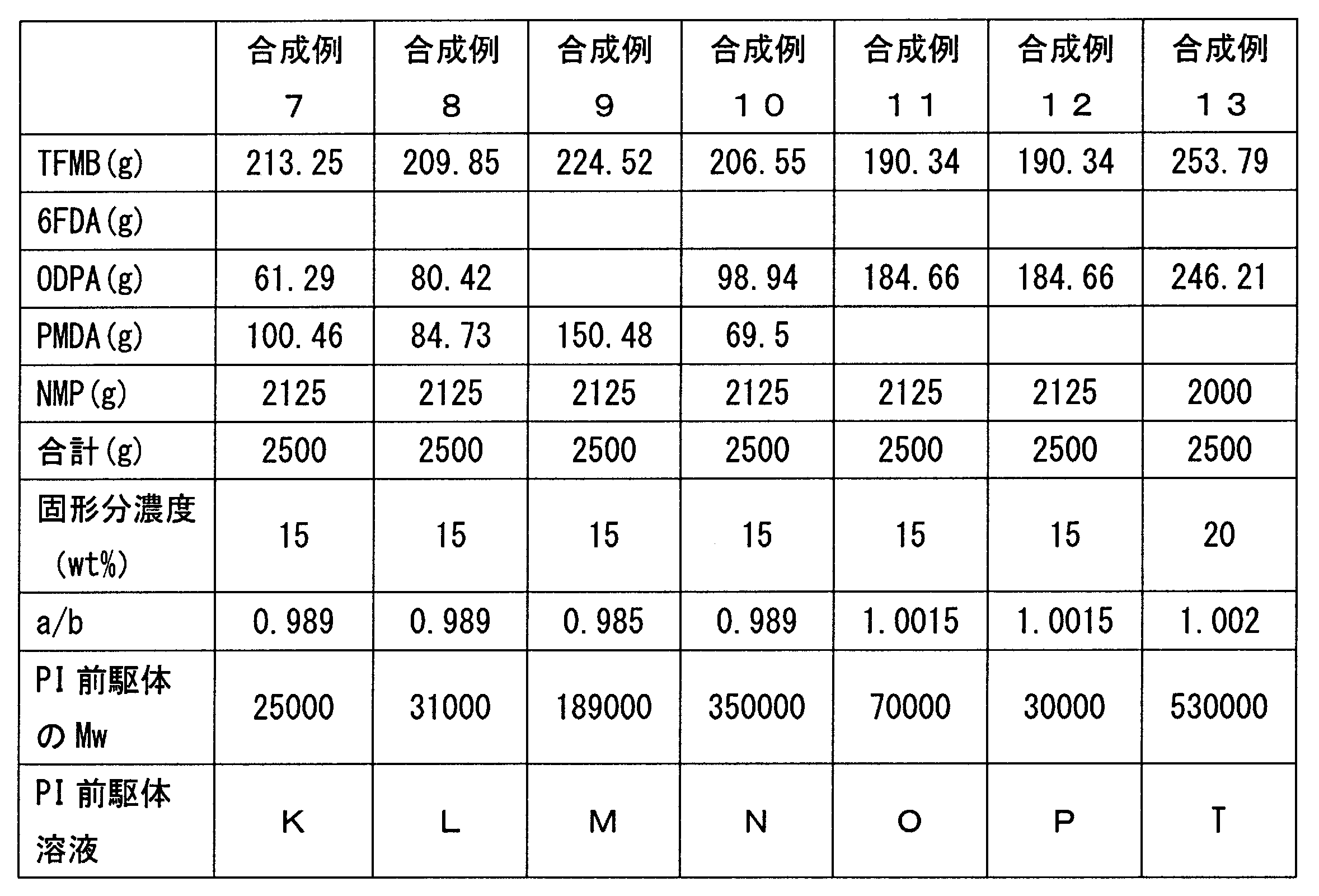
窒素気流下で、3000mlのセパラブルフラスコの中に、表2の組成の通り、ジアミンをNMPに溶解させ、次いで、酸二無水物を加えた。この溶液を、45℃で2時間加熱し、内容物を溶解させ、その後、溶液を室温で30時間攪拌を続けて重合反応を行い、高重合度のポリイミド(PI)前駆体溶液K(粘稠な溶液)を得た。組成、固形分濃度、ポリイミド(PI)前駆体溶液KのMw等を表2に示す。
窒素気流下で、3000mlのセパラブルフラスコの中に、表2の組成の通り、ジアミンをNMPに溶解させ、次いで、酸二無水物を加えた。この溶液を、45℃で2時間加熱し、内容物を溶解させ、その後、溶液を室温で30時間攪拌を続けて重合反応を行い、高重合度のポリイミド(PI)前駆体溶液L(粘稠な溶液)を得た。組成、固形分濃度、ポリイミド(PI)前駆体溶液LのMw等を表2に示す。
窒素気流下で、3000mlのセパラブルフラスコの中に、表2の組成の通り、ジアミンをNMPに溶解させ、次いで、酸二無水物を加えた。この溶液を、室温(23℃)で3時間加熱し、内容物を溶解させ、その後、溶液を室温で3時間攪拌を続けて重合反応を行い、高重合度のポリイミド(PI)前駆体溶液M(粘稠な溶液)を得た。組成、固形分濃度、ポリイミド(PI)前駆体溶液MのMw等を表2に示す。
窒素気流下で、3000mlのセパラブルフラスコの中に、表2の組成の通り、ジアミンをNMPに溶解させ、次いで、酸二無水物を加えた。この溶液を、45℃で2時間加熱し、内容物を溶解させ、その後、溶液を室温で30時間攪拌を続けて重合反応を行い、高重合度のポリイミド(PI)前駆体溶液N(粘稠な溶液)を得た。組成、固形分濃度、ポリイミド(PI)前駆体溶液NのMw等を表2に示す。
窒素気流下で、3000mlのセパラブルフラスコの中に、表2の組成の通り、ジアミンをNMPに溶解させ、次いで、酸二無水物を加えた。この溶液を、攪拌しながら室温から80℃まで昇温し、80℃で6時間攪拌を続けて重合反応を行い、高重合度のポリイミド(PI)前駆体溶液O(粘稠な溶液)を得た。組成、固形分濃度、ポリイミド(PI)前駆体溶液OのMw等を表2に示す。
窒素気流下で、3000mlのセパラブルフラスコの中に、表2の組成の通り、ジアミンをNMPに溶解させ、次いで、酸二無水物を加えた。この溶液を、加熱をすることなく、室温(20℃)で3時間攪拌を続けて重合反応を行い、高重合度のポリイミド(PI)前駆体溶液P(粘稠な溶液)を得た。組成、固形分濃度、ポリイミド(PI)前駆体溶液PのMw等を表2に示す。
窒素気流下で、3000mlのセパラブルフラスコの中に、表2の組成の通り、ジアミンをNMPに溶解させ、次いで、酸二無水物を加えた。この溶液を、45℃で2時間加熱し、内容物を溶解させ、その後、溶液を室温で30時間攪拌を続けて重合反応を行い、高重合度のポリイミド(PI)前駆体溶液T(粘稠な溶液)を得た。組成、固形分濃度、ポリイミド(PI)前駆体溶液TのMw等を表2に示す。

窒素気流下で、300mlのセパラブルフラスコの中に、合成例9で得られたポリイミド(PI)前駆体溶液Mを50g加えた。次いで、合成例10で得られたポリイミド(PI)前駆体溶液Nを50g加えた。室温で3時間を攪拌し、高粘稠なポリイミド(PI)前駆体溶液Qを得た。
窒素気流下で、300mlのセパラブルフラスコの中に、合成例8で得られたポリイミド(PI)前駆体溶液Lを50g加えた。次いで、合成例5で得られたポリイミド(PI)前駆体溶液Iを50g加えた。室温で3時間を攪拌し、高粘稠なポリイミド(PI)前駆体溶液Sを得た。
窒素気流下で、300mlのセパラブルフラスコの中に、合成例10で得られたポリイミド(PI)前駆体溶液Nを50g加えた。次いで、合成例5で得られたポリイミド(PI)前駆体溶液Iを50g加えた。室温で3時間を攪拌し、高粘稠なポリイミド(PI)前駆体溶液Rを得た。
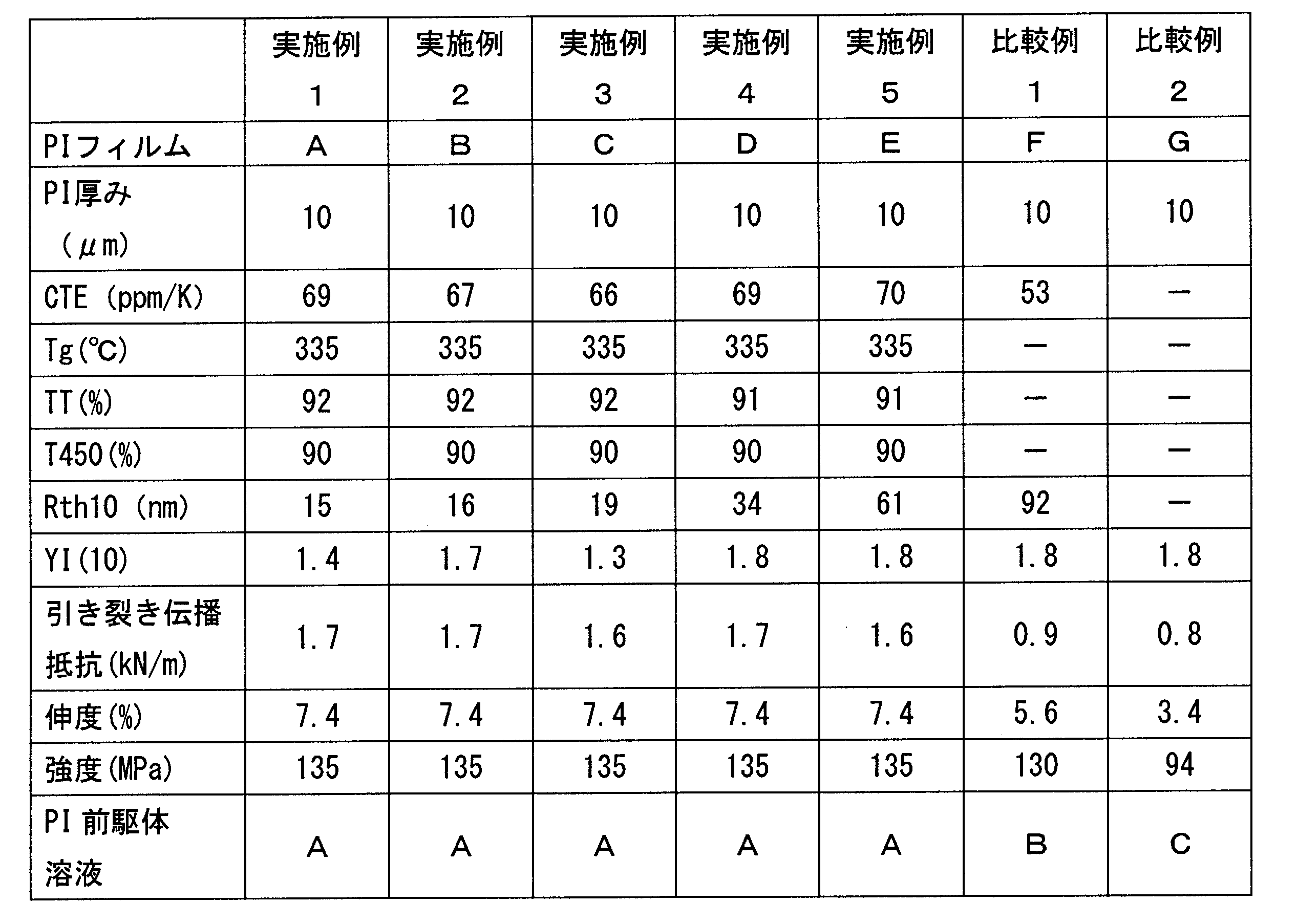
合成例1で得られたポリイミド前駆体溶液Aに、溶剤DMAcを加えて、粘度が4000cPになるように希釈した上で、支持基材としての75μmのポリイミドフィルム(宇部興産製ユーピレックス-S)上に、バーコーターを用いて、イミド化後のポリイミド層の厚みが約10μmになるように塗工した。続いて、100℃で15分間加熱を行った。そして、窒素雰囲気中で、100℃から400℃まで10分間で昇温させ、支持基材の上にポリイミド層(ポリイミドA)を形成した。それから、支持基材を剥離し、ポリイミド(PI)フィルムAを得た。上記剥離は、形成されたポリイミド層だけを、カッターで切り口を1周作って、剥離する範囲を決めてから、ピンセットで支持基材から剥離することによって行った。なお、ポリイミド(PI)フィルムAの厚み、CTE、Tg、TT、T450、Rth10、YI(10)、引き裂き伝播抵抗、伸度及び強度は、表3に示した。
合成例1で得られたポリイミド前駆体溶液Aに、溶剤DMAcを加えて、粘度が4000cPになるように希釈した上で、支持基材としての75μmのポリイミドフィルム(宇部興産製ユーピレックス-S)上に、バーコーターを用いて、イミド化後のポリイミド層の厚みが約10μmになるように塗工した。続いて、120℃で10分間の加熱で乾燥し溶剤除去を行った。次に、支持基材の幅方向のフィルム端部を把持具で保持しながら支持基材を加熱炉に搬入し、180℃から360℃まで約30℃/分の昇温速度で熱処理しながら支持基材を幅方向に10%延伸して、支持基材の上にポリイミド層(ポリイミドB)を形成した。それから、支持基材を剥離し、ポリイミド(PI)フィルムBを得た。上記剥離は、形成されたポリイミド層だけを、カッターで切り口を1周作って、剥離する範囲を決めてから、ピンセットで支持基材から剥離することによって行った。なお、ポリイミド(PI)フィルムBの厚み、CTE、Tg、TT、T450、Rth10、YI(10)、引き裂き伝播抵抗、伸度及び強度は、表3に示した。
合成例1で得られたポリイミド前駆体溶液Aに、溶剤DMAcを加えて、粘度が4000cPになるように希釈した上で、支持基材としての75μmのポリイミドフィルム(宇部興産製ユーピレックス-S)上に、バーコーターを用いて、イミド化後のポリイミド層の厚みが約10μmになるように塗工した。続いて、120℃で10分間の加熱で乾燥し溶剤除去を行った。次に、支持基材の幅方向のフィルム端部を把持具で保持しながら支持基材を加熱炉に搬入し、180℃から360℃まで約30℃/分の昇温速度で熱処理しながら支持基材を幅方向に20%延伸して、支持基材の上にポリイミド層(ポリイミドC)を形成した。それから、支持基材を剥離し、ポリイミド(PI)フィルムCを得た。上記剥離は、形成されたポリイミド層だけを、カッターで切り口を1周作って、剥離する範囲を決めてから、ピンセットで支持基材から剥離することによって行った。なお、ポリイミド(PI)フィルムCの厚み、CTE、Tg、TT、T450、Rth10、YI(10)、引き裂き伝播抵抗、伸度及び強度は、表3に示した。
合成例1で得られたポリイミド前駆体溶液Aに、溶剤DMAcを加えて、粘度が4000cPになるように希釈した上で、支持基材としての75μmのポリイミドフィルム(宇部興産製ユーピレックス-S)上に、バーコーターを用いて、イミド化後のポリイミド層の厚みが約10μmになるように塗工した。続いて、120℃で10分間の加熱で乾燥し溶剤除去を行った。次に、窒素雰囲気中で、一定の昇温速度(4℃/min)で室温から360℃まで昇温させ、更に、360℃で10分間保持した。その後、窒素雰囲気中で3時間かけて室温に戻し支持基材の上にポリイミド層(ポリイミドD)を形成した。それから、支持基材を剥離し、ポリイミド(PI)フィルムDを得た。上記剥離は、形成されたポリイミド層だけを、カッターで切り口を1周作って、剥離する範囲を決めてから、ピンセットで支持基材から剥離することによって行った。なお、ポリイミド(PI)フィルムDの厚み、CTE、Tg、TT、T450、Rth10、YI(10)、引き裂き伝播抵抗、伸度及び強度は、表3に示した。
合成例1で得られたポリイミド前駆体溶液Aに、溶剤DMAcを加えて、粘度が4000cPになるように希釈した上で、支持基材としての100μmのガラス基板上に、バーコーターを用いて、イミド化後のポリイミド層の厚みが約10μmになるように塗工した。続いて、120℃で10分間の加熱で乾燥し溶剤除去を行った。次に、窒素雰囲気中で、一定の昇温速度(4℃/min)で室温から370℃まで昇温させ、更に、370℃で30分間保持した。その後、窒素雰囲気中で4時間かけて室温に戻し支持基材の上にポリイミド層(ポリイミドE)を形成した。それから、支持基材を剥離し、ポリイミド(PI)フィルムEを得た。上記剥離は、形成されたポリイミド層だけを、カッターで切り口を1周作って、剥離する範囲を決めてから、ピンセットで支持基材から剥離することによって行った。なお、ポリイミド(PI)フィルムEの厚み、CTE、Tg、TT、T450、Rth10、YI(10)、引き裂き伝播抵抗、伸度及び強度は、表3に示した。
合成例2で得られたポリイミド前駆体溶液Bに、溶剤DMAcを加えて、粘度が4000cPになるように希釈した上で、支持基材としての100μmのガラス基板上に、バーコーターを用いて、イミド化後のポリイミド層の厚みが約10μmになるように塗工した。続いて、120℃で10分間の加熱で乾燥し溶剤除去を行った。その後、350℃で30分間加熱を行って、支持基材の上にポリイミド層(ポリイミドF)を形成した。それから、支持基材を剥離し、ポリイミド(PI)フィルムFを得た。上記剥離は、形成されたポリイミド層だけを、カッターで切り口を1周作って、剥離する範囲を決めてから、ピンセットで支持基材から剥離することによって行った。なお、ポリイミド(PI)フィルムFの厚み、CTE、Tg、TT、T450、Rth10、YI(10)、引き裂き伝播抵抗、伸度及び強度は、表3に示した。
合成例3で得られたポリイミド前駆体溶液Cに、溶剤DMAcを加えて、粘度が4000cPになるように希釈した上で、支持基材としての100μmのガラス基板上に、バーコーターを用いて、イミド化後のポリイミド層の厚みが約10μmになるように塗工した。続いて、120℃で10分間の加熱で乾燥し溶剤除去を行った。次に、窒素雰囲気中で、一定の昇温速度(4℃/min)で室温から360℃まで昇温させ、更に、360℃で10分間保持した。その後、窒素雰囲気中で3時間かけて室温に戻し支持基材の上にポリイミド層(ポリイミドG)を形成した。それから、支持基材を剥離し、ポリイミド(PI)フィルムGを得た。上記剥離は、形成されたポリイミド層だけを、カッターで切り口を1周作って、剥離する範囲を決めてから、ピンセットで支持基材から剥離することによって行った。なお、ポリイミド(PI)フィルムGの厚み、CTE、Tg、TT、T450、Rth10、YI(10)、引き裂き伝播抵抗、伸度及び強度は、表3に示した。
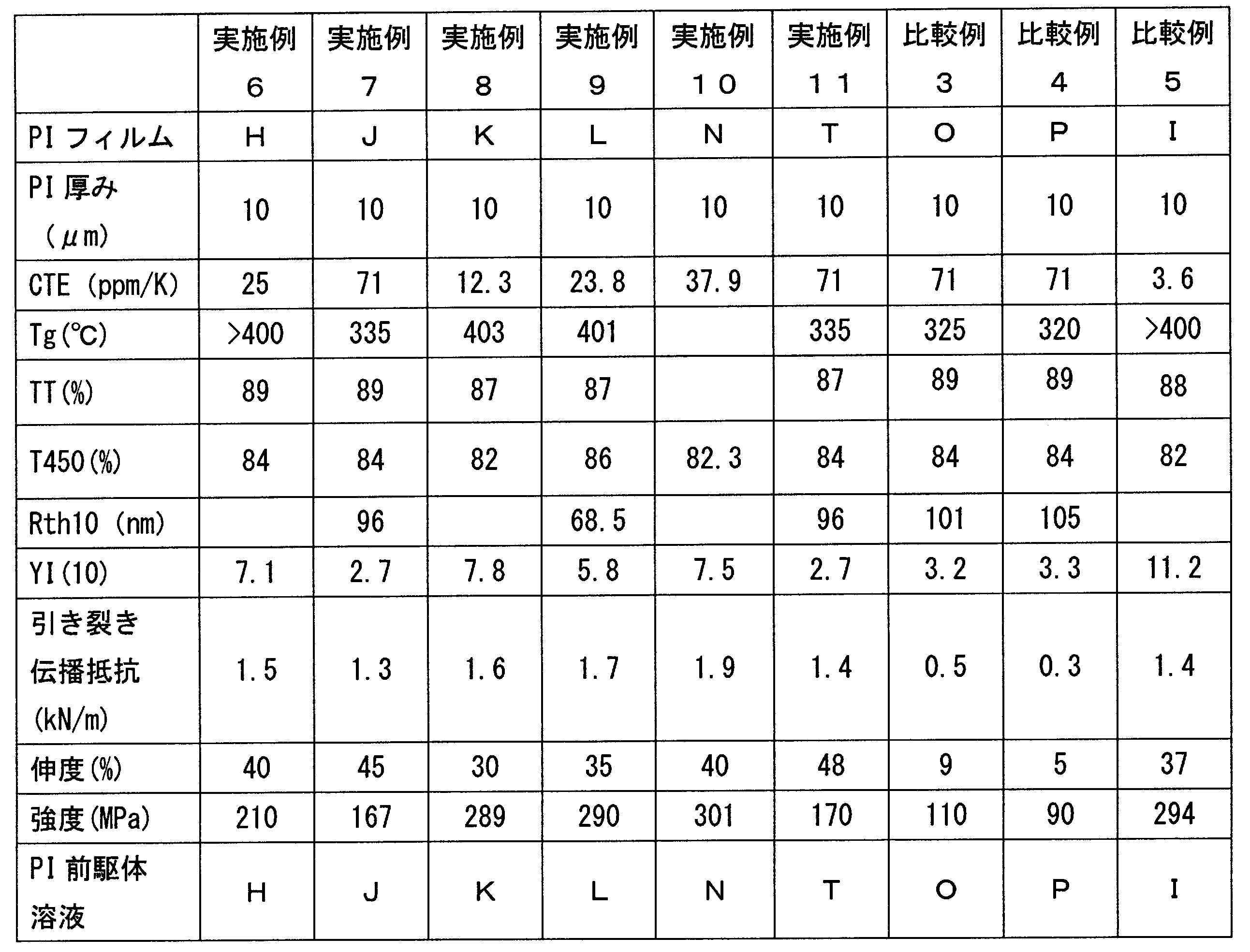
ポリイミド前駆体溶液Aの代わりに表4及び表5に示すポリイミド前駆体溶液をそれぞれ使用した他は、実施例5と同じ条件で、支持基材としての100μmのガラス基板上に、厚み10μmのポリイミド層を形成し、次いで、ポリイミド(PI)フィルムを得た。得られたポリイミド層及びポリイミド(PI)フィルムの種類も表4及び表5に記載した。
なお、得られたポリイミド(PI)フィルムの厚み、CTE、Tg、TT、T450、Rth10、YI(10)、引き裂き伝播抵抗、伸度及び強度は、表4及び表5に示した。
表6に示すポリイミド前駆体溶液をそれぞれ使用し、支持基材としての100μmのガラス基板上に、イミド化後のポリイミド層を表6に示した厚みになるように塗工した他は、実施例5と同じ条件で、ポリイミド層を形成し、次いで、ポリイミド(PI)フィルムを得た。得られたポリイミド層及びポリイミド(PI)フィルムの種類も表6に記載した。なお、得られたポリイミド(PI)フィルムの厚み、CTE、Tg、TT、T450、Rth10、YI(10)、引き裂き伝播抵抗、伸度及び強度は、表6に示した。


窒素気流下で、300mlのセパラブルフラスコの中に、18.55gのm-TBを、212.5gのDMAcに溶解させた。次いで、18.95gのPMDAを加えた。なお、酸二無水物(a)とジアミン(b)のモル比(a/b)は、0.995とした。この溶液を、室温で3時間攪拌しながら反応させ、高重合度のポリイミド(PI)前駆体溶液(粘稠な溶液)を得た。実施例2と同様に製膜し、光学特性を測定した。YIが51と黄色フィルムであった。
窒素気流下で、300mlのセパラブルフラスコの中に、18.55gのm-TBを、212.5gのDMAcに溶解させた。次いで、18.95gのPMDAを加えた。なお、酸二無水物(a)とジアミン(b)のモル比(a/b)は、0.995とした。この溶液を、45℃で2時間加熱し、内容物を溶解させ、その後、溶液を10分攪拌して重合反応を行ったところ、樹脂の粘度が大きく上昇し、全体的にゲル化となった。製膜できなかった。
Claims (10)
- ジアミンに由来する構造単位とテトラカルボン酸二無水物に由来する構造単位とを有するポリイミド前駆体であって、i)ジアミンに由来する構造単位として、2,2-ビス(トリフルオロメチル)ベンジジンに由来する構造単位を、ジアミンに由来する全構造単位の60モル%以上含み、ii)テトラカルボン酸二無水物に由来する構造単位として、4,4‘-(2,2’-ヘキサフルオロイソプロピリデン)ジフタル酸二無水物及び4,4‘-オキシジフタル酸二無水物から選ばれる1種以上に由来する構造単位を、合計で、テトラカルボン酸二無水物に由来する全構造単位の20モル%以上含み、
イミド化したポリイミドの黄色度(フィルム厚み10μmで換算後)が10以下であり、かつ、引き裂き伝播抵抗が1.0mN/μm以上であることを特徴とするポリイミド前駆体。 - 重量平均分子量が80,000~800,000の範囲内である請求項1に記載のポリイミド前駆体。
- イミド化したポリイミドのフィルム厚み5~20μmにおける伸度が10%以上である、請求項1に記載のポリイミド前駆体。
- イミド化したポリイミドのフィルムの厚み方向のリタデーション(フィルム厚み10μmで換算後)が65nm以下である、請求項1に記載のポリイミド前駆体。
- ジアミンに由来する構造単位とテトラカルボン酸二無水物に由来する構造単位とを有するポリイミドであって、i)ジアミンに由来する構造単位として、2,2-ビス(トリフルオロメチル)ベンジジンに由来する構造単位を、ジアミンに由来する全構造単位の60モル%以上含み、ii)テトラカルボン酸二無水物に由来する構造単位として、4,4’-(2,2’-ヘキサフルオロイソプロピリデン)ジフタル酸二無水物及び4,4’-オキシジフタル酸二無水物から選ばれる1種以上に由来する構造単位を、合計で、テトラカルボン酸二無水物に由来する全構造単位の20モル%以上含み、黄色度(フィルム厚み10μmで換算後)が10以下であり、引き裂き伝播抵抗が1.0mN/μm以上であることを特徴とする、ポリイミド。
- 5~20μmのフィルム状態での伸度が10%以上である、請求項5に記載のポリイミド。
- フィルム状態での厚み方向のリタデーション(フィルム厚み10μmで換算後)が65nm以下である、請求項5に記載のポリイミド。
- 前記ジアミンに由来する構造単位として、2,2-ビス(トリフルオロメチル)ベンジジンに由来する構造単位を、ジアミンに由来する全構造単位の80モル%以上含む、請求項5に記載のポリイミド。
- 前記テトラカルボン酸二無水物に由来する構造単位として、4,4’-(2,2’-ヘキサフルオロイソプロピリデン)ジフタル酸二無水物及び4,4’-オキシジフタル酸二無水物から選ばれる1種以上に由来する構造単位を、合計で、テトラカルボン酸二無水物に由来する全構造単位の25モル%以上含む、請求項5に記載のポリイミド。
- ポリイミド層と、該ポリイミド層上に形成された機能層と、を備えたフレキシブルデバイスであって、
前記ポリイミド層が、請求項5~9のいずれか1項に記載のポリイミドを含むことを特徴とするフレキシブルデバイス。
Priority Applications (5)
| Application Number | Priority Date | Filing Date | Title |
|---|---|---|---|
| CN201980062761.0A CN112752787A (zh) | 2018-09-29 | 2019-09-30 | 聚酰亚胺前驱体以及由其所得的聚酰亚胺和可挠性器件 |
| US17/280,918 US20210340325A1 (en) | 2018-09-29 | 2019-09-30 | Polyimide precursor, polyimide produced from same, and flexible device |
| JP2020549510A JPWO2020067558A1 (ja) | 2018-09-29 | 2019-09-30 | ポリイミド前駆体及びそれから生じるポリイミド並びにフレキシブルデバイス |
| KR1020217006067A KR102939998B1 (ko) | 2018-09-29 | 2019-09-30 | 폴리이미드 전구체와 그것으로부터 생성되는 폴리이미드, 및 플렉시블 디바이스 |
| JP2023200098A JP2024015064A (ja) | 2018-09-29 | 2023-11-27 | ポリイミド並びにフレキシブルデバイス |
Applications Claiming Priority (2)
| Application Number | Priority Date | Filing Date | Title |
|---|---|---|---|
| JP2018186221 | 2018-09-29 | ||
| JP2018-186221 | 2018-09-29 |
Publications (1)
| Publication Number | Publication Date |
|---|---|
| WO2020067558A1 true WO2020067558A1 (ja) | 2020-04-02 |
Family
ID=69951328
Family Applications (1)
| Application Number | Title | Priority Date | Filing Date |
|---|---|---|---|
| PCT/JP2019/038442 Ceased WO2020067558A1 (ja) | 2018-09-29 | 2019-09-30 | ポリイミド前駆体及びそれから生じるポリイミド並びにフレキシブルデバイス |
Country Status (6)
| Country | Link |
|---|---|
| US (1) | US20210340325A1 (ja) |
| JP (2) | JPWO2020067558A1 (ja) |
| KR (1) | KR102939998B1 (ja) |
| CN (1) | CN112752787A (ja) |
| TW (1) | TWI824023B (ja) |
| WO (1) | WO2020067558A1 (ja) |
Families Citing this family (3)
| Publication number | Priority date | Publication date | Assignee | Title |
|---|---|---|---|---|
| JP7398934B2 (ja) * | 2019-11-22 | 2023-12-15 | エルジー・ケム・リミテッド | 表示装置用支持基板、有機el表示装置、および有機el表示装置の製造方法 |
| WO2023018606A1 (en) * | 2021-08-13 | 2023-02-16 | Hd Microsystems | Soluble polyimides for coating on polymeric substrates |
| CN115850703B (zh) * | 2022-11-04 | 2024-05-17 | 齐鲁工业大学 | 一种生物基本征型光敏形状记忆聚酰亚胺及三维智能聚酰亚胺的制备方法 |
Citations (4)
| Publication number | Priority date | Publication date | Assignee | Title |
|---|---|---|---|---|
| JP2014070139A (ja) * | 2012-09-28 | 2014-04-21 | Asahi Kasei E-Materials Corp | ポリイミド前駆体及びそれを含有する樹脂組成物、ポリイミドフィルム及びその製造方法、並びに、積層体及びその製造方法 |
| JP2015229691A (ja) * | 2014-06-03 | 2015-12-21 | 旭化成イーマテリアルズ株式会社 | ポリイミド前駆体組成物及びポリイミドフィルム |
| WO2018062296A1 (ja) * | 2016-09-30 | 2018-04-05 | 住友化学株式会社 | ポリイミド系高分子ワニスの製造方法、ポリイミド系高分子フィルムの製造方法、及び、透明ポリイミド系高分子フィルム |
| JP2018123319A (ja) * | 2017-02-01 | 2018-08-09 | 住友化学株式会社 | ポリイミドフィルム |
Family Cites Families (7)
| Publication number | Priority date | Publication date | Assignee | Title |
|---|---|---|---|---|
| US7550194B2 (en) * | 2005-08-03 | 2009-06-23 | E. I. Du Pont De Nemours And Company | Low color polyimide compositions useful in optical type applications and methods and compositions relating thereto |
| TWI422645B (zh) * | 2007-03-30 | 2014-01-11 | Nippon Steel & Sumikin Chem Co | 聚醯亞胺膜 |
| JP5667392B2 (ja) | 2010-08-23 | 2015-02-12 | 株式会社カネカ | 積層体、及びその利用 |
| KR102213304B1 (ko) | 2012-12-21 | 2021-02-05 | 아사히 가세이 이-매터리얼즈 가부시키가이샤 | 폴리이미드 전구체 및 그것을 함유하는 수지 조성물 |
| KR102268406B1 (ko) | 2014-02-21 | 2021-06-23 | 미쯔비시 케미컬 주식회사 | 폴리이미드 전구체 및/또는 폴리이미드를 포함하는 조성물, 및 폴리이미드 필름 |
| CN104910400B (zh) | 2014-03-12 | 2020-03-13 | 日铁化学材料株式会社 | 显示装置及其制造方法、以及显示装置用的聚酰亚胺膜 |
| CN107428934B (zh) | 2015-03-31 | 2020-10-02 | 旭化成株式会社 | 聚酰亚胺膜、聚酰亚胺清漆、使用了聚酰亚胺膜的制品、以及层积体 |
-
2019
- 2019-09-30 CN CN201980062761.0A patent/CN112752787A/zh active Pending
- 2019-09-30 JP JP2020549510A patent/JPWO2020067558A1/ja not_active Withdrawn
- 2019-09-30 TW TW108135379A patent/TWI824023B/zh active
- 2019-09-30 US US17/280,918 patent/US20210340325A1/en not_active Abandoned
- 2019-09-30 KR KR1020217006067A patent/KR102939998B1/ko active Active
- 2019-09-30 WO PCT/JP2019/038442 patent/WO2020067558A1/ja not_active Ceased
-
2023
- 2023-11-27 JP JP2023200098A patent/JP2024015064A/ja active Pending
Patent Citations (4)
| Publication number | Priority date | Publication date | Assignee | Title |
|---|---|---|---|---|
| JP2014070139A (ja) * | 2012-09-28 | 2014-04-21 | Asahi Kasei E-Materials Corp | ポリイミド前駆体及びそれを含有する樹脂組成物、ポリイミドフィルム及びその製造方法、並びに、積層体及びその製造方法 |
| JP2015229691A (ja) * | 2014-06-03 | 2015-12-21 | 旭化成イーマテリアルズ株式会社 | ポリイミド前駆体組成物及びポリイミドフィルム |
| WO2018062296A1 (ja) * | 2016-09-30 | 2018-04-05 | 住友化学株式会社 | ポリイミド系高分子ワニスの製造方法、ポリイミド系高分子フィルムの製造方法、及び、透明ポリイミド系高分子フィルム |
| JP2018123319A (ja) * | 2017-02-01 | 2018-08-09 | 住友化学株式会社 | ポリイミドフィルム |
Also Published As
| Publication number | Publication date |
|---|---|
| US20210340325A1 (en) | 2021-11-04 |
| TW202012502A (zh) | 2020-04-01 |
| JPWO2020067558A1 (ja) | 2021-09-24 |
| KR102939998B1 (ko) | 2026-03-16 |
| TWI824023B (zh) | 2023-12-01 |
| CN112752787A (zh) | 2021-05-04 |
| JP2024015064A (ja) | 2024-02-01 |
| KR20210068394A (ko) | 2021-06-09 |
Similar Documents
| Publication | Publication Date | Title |
|---|---|---|
| KR102394341B1 (ko) | 폴리이미드 전구체 및 폴리이미드, 투명 폴리이미드 필름의 제조방법 | |
| JP7217220B2 (ja) | ポリイミド前駆体組成物及びそれから生じるポリイミドフィルム及びフレキシブルデバイス、ポリイミドフィルムの製造方法 | |
| JP7281887B2 (ja) | ポリイミド前駆体及びポリイミド | |
| JP2024015064A (ja) | ポリイミド並びにフレキシブルデバイス | |
| KR102373556B1 (ko) | 폴리이미드 전구체 및 그로부터 생성된 폴리이미드 | |
| JP7349253B2 (ja) | ポリアミド酸、ポリアミド酸溶液、ポリイミド、ポリイミド膜、積層体およびフレキシブルデバイス、ならびにポリイミド膜の製造方法。 | |
| JP2018028053A (ja) | 透明ポリイミドフィルムの製造方法 | |
| JP6890999B2 (ja) | ポリイミド前駆体及びポリイミド | |
| JP7069478B2 (ja) | ポリイミド、ポリイミド溶液組成物、ポリイミドフィルム、及び基板 | |
| JP6974956B2 (ja) | ポリイミド前駆体及びポリイミド | |
| JP6956486B2 (ja) | フレキシブルデバイス用ポリイミドフィルム、その前駆体、及び機能層付ポリイミドフィルム | |
| JPWO2020067558A5 (ja) | ||
| WO2024185763A1 (ja) | ポリイミド前駆体組成物、ポリイミド膜、積層体、電子デバイス、積層体の製造方法、ポリイミド膜の製造方法及び電子デバイスの製造方法 | |
| JP7102191B2 (ja) | ポリイミドフィルムの製造方法 | |
| JP7352837B2 (ja) | ポリマーブレンドフィルムおよび積層体 | |
| JP2022115823A (ja) | ポリイミド前駆体及びポリイミド | |
| JP6846148B2 (ja) | ポリイミド前駆体溶液及びその製造方法並びにポリイミドフィルムの製造方法及び積層体の製造方法 | |
| TWI921459B (zh) | 聚醯亞胺前體清漆及其製造方法、聚醯亞胺及其製造方法、可撓性器件及配線基板用層疊體 | |
| JP7265864B2 (ja) | ポリイミド前駆体及びポリイミド |
Legal Events
| Date | Code | Title | Description |
|---|---|---|---|
| 121 | Ep: the epo has been informed by wipo that ep was designated in this application |
Ref document number: 19864974 Country of ref document: EP Kind code of ref document: A1 |
|
| DPE1 | Request for preliminary examination filed after expiration of 19th month from priority date (pct application filed from 20040101) | ||
| ENP | Entry into the national phase |
Ref document number: 2020549510 Country of ref document: JP Kind code of ref document: A |
|
| NENP | Non-entry into the national phase |
Ref country code: DE |
|
| 122 | Ep: pct application non-entry in european phase |
Ref document number: 19864974 Country of ref document: EP Kind code of ref document: A1 |
|
| WWR | Wipo information: refused in national office |
Ref document number: 1020217006067 Country of ref document: KR |
|
| WWR | Wipo information: refused in national office |
Ref document number: 1020217006067 Country of ref document: KR |
|
| WWC | Wipo information: continuation of processing after refusal or withdrawal |
Ref document number: 1020217006067 Country of ref document: KR |