WO2020059837A1 - 水性インク、インクカートリッジ、インクジェット記録方法、及び水性インクの製造方法 - Google Patents
水性インク、インクカートリッジ、インクジェット記録方法、及び水性インクの製造方法 Download PDFInfo
- Publication number
- WO2020059837A1 WO2020059837A1 PCT/JP2019/036880 JP2019036880W WO2020059837A1 WO 2020059837 A1 WO2020059837 A1 WO 2020059837A1 JP 2019036880 W JP2019036880 W JP 2019036880W WO 2020059837 A1 WO2020059837 A1 WO 2020059837A1
- Authority
- WO
- WIPO (PCT)
- Prior art keywords
- resin
- ink
- resin particles
- carboxylic acid
- particles
- Prior art date
- Legal status (The legal status is an assumption and is not a legal conclusion. Google has not performed a legal analysis and makes no representation as to the accuracy of the status listed.)
- Ceased
Links
Images
Classifications
-
- C—CHEMISTRY; METALLURGY
- C09—DYES; PAINTS; POLISHES; NATURAL RESINS; ADHESIVES; COMPOSITIONS NOT OTHERWISE PROVIDED FOR; APPLICATIONS OF MATERIALS NOT OTHERWISE PROVIDED FOR
- C09D—COATING COMPOSITIONS, e.g. PAINTS, VARNISHES OR LACQUERS; FILLING PASTES; CHEMICAL PAINT OR INK REMOVERS; INKS; CORRECTING FLUIDS; WOODSTAINS; PASTES OR SOLIDS FOR COLOURING OR PRINTING; USE OF MATERIALS THEREFOR
- C09D11/00—Inks
- C09D11/02—Printing inks
- C09D11/10—Printing inks based on artificial resins
- C09D11/102—Printing inks based on artificial resins containing macromolecular compounds obtained by reactions other than those only involving unsaturated carbon-to-carbon bonds
- C09D11/104—Polyesters
-
- B—PERFORMING OPERATIONS; TRANSPORTING
- B41—PRINTING; LINING MACHINES; TYPEWRITERS; STAMPS
- B41J—TYPEWRITERS; SELECTIVE PRINTING MECHANISMS, i.e. MECHANISMS PRINTING OTHERWISE THAN FROM A FORME; CORRECTION OF TYPOGRAPHICAL ERRORS
- B41J2/00—Typewriters or selective printing mechanisms characterised by the printing or marking process for which they are designed
- B41J2/005—Typewriters or selective printing mechanisms characterised by the printing or marking process for which they are designed characterised by bringing liquid or particles selectively into contact with a printing material
- B41J2/01—Ink jet
-
- B—PERFORMING OPERATIONS; TRANSPORTING
- B41—PRINTING; LINING MACHINES; TYPEWRITERS; STAMPS
- B41J—TYPEWRITERS; SELECTIVE PRINTING MECHANISMS, i.e. MECHANISMS PRINTING OTHERWISE THAN FROM A FORME; CORRECTION OF TYPOGRAPHICAL ERRORS
- B41J2/00—Typewriters or selective printing mechanisms characterised by the printing or marking process for which they are designed
- B41J2/005—Typewriters or selective printing mechanisms characterised by the printing or marking process for which they are designed characterised by bringing liquid or particles selectively into contact with a printing material
- B41J2/01—Ink jet
- B41J2/17—Ink jet characterised by ink handling
- B41J2/175—Ink supply systems ; Circuit parts therefor
- B41J2/17503—Ink cartridges
-
- B—PERFORMING OPERATIONS; TRANSPORTING
- B41—PRINTING; LINING MACHINES; TYPEWRITERS; STAMPS
- B41J—TYPEWRITERS; SELECTIVE PRINTING MECHANISMS, i.e. MECHANISMS PRINTING OTHERWISE THAN FROM A FORME; CORRECTION OF TYPOGRAPHICAL ERRORS
- B41J2/00—Typewriters or selective printing mechanisms characterised by the printing or marking process for which they are designed
- B41J2/005—Typewriters or selective printing mechanisms characterised by the printing or marking process for which they are designed characterised by bringing liquid or particles selectively into contact with a printing material
- B41J2/01—Ink jet
- B41J2/17—Ink jet characterised by ink handling
- B41J2/175—Ink supply systems ; Circuit parts therefor
- B41J2/17503—Ink cartridges
- B41J2/1752—Mounting within the printer
-
- B—PERFORMING OPERATIONS; TRANSPORTING
- B41—PRINTING; LINING MACHINES; TYPEWRITERS; STAMPS
- B41J—TYPEWRITERS; SELECTIVE PRINTING MECHANISMS, i.e. MECHANISMS PRINTING OTHERWISE THAN FROM A FORME; CORRECTION OF TYPOGRAPHICAL ERRORS
- B41J29/00—Details of, or accessories for, typewriters or selective printing mechanisms not otherwise provided for
- B41J29/02—Framework
-
- B—PERFORMING OPERATIONS; TRANSPORTING
- B41—PRINTING; LINING MACHINES; TYPEWRITERS; STAMPS
- B41M—PRINTING, DUPLICATING, MARKING, OR COPYING PROCESSES; COLOUR PRINTING
- B41M5/00—Duplicating or marking methods; Sheet materials for use therein
- B41M5/0023—Digital printing methods characterised by the inks used
-
- C—CHEMISTRY; METALLURGY
- C08—ORGANIC MACROMOLECULAR COMPOUNDS; THEIR PREPARATION OR CHEMICAL WORKING-UP; COMPOSITIONS BASED THEREON
- C08G—MACROMOLECULAR COMPOUNDS OBTAINED OTHERWISE THAN BY REACTIONS ONLY INVOLVING UNSATURATED CARBON-TO-CARBON BONDS
- C08G63/00—Macromolecular compounds obtained by reactions forming a carboxylic ester link in the main chain of the macromolecule
- C08G63/02—Polyesters derived from hydroxycarboxylic acids or from polycarboxylic acids and polyhydroxy compounds
- C08G63/12—Polyesters derived from hydroxycarboxylic acids or from polycarboxylic acids and polyhydroxy compounds derived from polycarboxylic acids and polyhydroxy compounds
- C08G63/16—Dicarboxylic acids and dihydroxy compounds
- C08G63/18—Dicarboxylic acids and dihydroxy compounds the acids or hydroxy compounds containing carbocyclic rings
- C08G63/181—Acids containing aromatic rings
- C08G63/183—Terephthalic acids
-
- C—CHEMISTRY; METALLURGY
- C09—DYES; PAINTS; POLISHES; NATURAL RESINS; ADHESIVES; COMPOSITIONS NOT OTHERWISE PROVIDED FOR; APPLICATIONS OF MATERIALS NOT OTHERWISE PROVIDED FOR
- C09D—COATING COMPOSITIONS, e.g. PAINTS, VARNISHES OR LACQUERS; FILLING PASTES; CHEMICAL PAINT OR INK REMOVERS; INKS; CORRECTING FLUIDS; WOODSTAINS; PASTES OR SOLIDS FOR COLOURING OR PRINTING; USE OF MATERIALS THEREFOR
- C09D11/00—Inks
- C09D11/02—Printing inks
- C09D11/10—Printing inks based on artificial resins
- C09D11/106—Printing inks based on artificial resins containing macromolecular compounds obtained by reactions only involving carbon-to-carbon unsaturated bonds
- C09D11/107—Printing inks based on artificial resins containing macromolecular compounds obtained by reactions only involving carbon-to-carbon unsaturated bonds from unsaturated acids or derivatives thereof
-
- C—CHEMISTRY; METALLURGY
- C09—DYES; PAINTS; POLISHES; NATURAL RESINS; ADHESIVES; COMPOSITIONS NOT OTHERWISE PROVIDED FOR; APPLICATIONS OF MATERIALS NOT OTHERWISE PROVIDED FOR
- C09D—COATING COMPOSITIONS, e.g. PAINTS, VARNISHES OR LACQUERS; FILLING PASTES; CHEMICAL PAINT OR INK REMOVERS; INKS; CORRECTING FLUIDS; WOODSTAINS; PASTES OR SOLIDS FOR COLOURING OR PRINTING; USE OF MATERIALS THEREFOR
- C09D11/00—Inks
- C09D11/30—Inkjet printing inks
- C09D11/32—Inkjet printing inks characterised by colouring agents
- C09D11/322—Pigment inks
-
- C—CHEMISTRY; METALLURGY
- C09—DYES; PAINTS; POLISHES; NATURAL RESINS; ADHESIVES; COMPOSITIONS NOT OTHERWISE PROVIDED FOR; APPLICATIONS OF MATERIALS NOT OTHERWISE PROVIDED FOR
- C09D—COATING COMPOSITIONS, e.g. PAINTS, VARNISHES OR LACQUERS; FILLING PASTES; CHEMICAL PAINT OR INK REMOVERS; INKS; CORRECTING FLUIDS; WOODSTAINS; PASTES OR SOLIDS FOR COLOURING OR PRINTING; USE OF MATERIALS THEREFOR
- C09D167/00—Coating compositions based on polyesters obtained by reactions forming a carboxylic ester link in the main chain; Coating compositions based on derivatives of such polymers
-
- B—PERFORMING OPERATIONS; TRANSPORTING
- B41—PRINTING; LINING MACHINES; TYPEWRITERS; STAMPS
- B41J—TYPEWRITERS; SELECTIVE PRINTING MECHANISMS, i.e. MECHANISMS PRINTING OTHERWISE THAN FROM A FORME; CORRECTION OF TYPOGRAPHICAL ERRORS
- B41J2/00—Typewriters or selective printing mechanisms characterised by the printing or marking process for which they are designed
- B41J2/005—Typewriters or selective printing mechanisms characterised by the printing or marking process for which they are designed characterised by bringing liquid or particles selectively into contact with a printing material
- B41J2/01—Ink jet
- B41J2/17—Ink jet characterised by ink handling
- B41J2/175—Ink supply systems ; Circuit parts therefor
- B41J2/17503—Ink cartridges
- B41J2/17513—Inner structure
-
- B—PERFORMING OPERATIONS; TRANSPORTING
- B41—PRINTING; LINING MACHINES; TYPEWRITERS; STAMPS
- B41J—TYPEWRITERS; SELECTIVE PRINTING MECHANISMS, i.e. MECHANISMS PRINTING OTHERWISE THAN FROM A FORME; CORRECTION OF TYPOGRAPHICAL ERRORS
- B41J2/00—Typewriters or selective printing mechanisms characterised by the printing or marking process for which they are designed
- B41J2/005—Typewriters or selective printing mechanisms characterised by the printing or marking process for which they are designed characterised by bringing liquid or particles selectively into contact with a printing material
- B41J2/01—Ink jet
- B41J2/17—Ink jet characterised by ink handling
- B41J2/175—Ink supply systems ; Circuit parts therefor
- B41J2/17503—Ink cartridges
- B41J2/17553—Outer structure
Definitions
- the present invention relates to a water-based ink, an ink cartridge, an inkjet recording method, and a method for producing a water-based ink.
- an object of the present invention is to provide a water-based ink capable of recording an image having excellent discharge stability and excellent scratch resistance, and a method for preparing the water-based ink.
- Another object of the present invention is to provide an ink cartridge using the aqueous ink and an ink jet recording method.
- the aqueous ink according to the present invention is an aqueous ink for inkjet containing resin particles, wherein the resin particles are formed of a first resin and a second resin each having a carboxylic acid group, and
- the resin is a polyester resin having no cross-linking structure
- the second resin is at least one of a polyester resin and an acrylic resin having a cross-linking structure, and the cross-linking of the first resin and the second resin is performed.
- the structure is an alkylene oxide group having 1 to 9 repetitions.
- the present invention it is possible to provide a water-based ink capable of recording an image having excellent discharge stability and excellent scratch resistance, and a method for preparing the water-based ink. Further, according to another embodiment of the present invention, it is possible to provide an ink cartridge and an ink jet recording method using the aqueous ink.
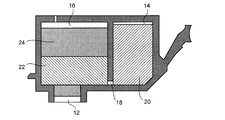
- FIG. 2 is a cross-sectional view schematically illustrating an embodiment of the ink cartridge of the present invention.
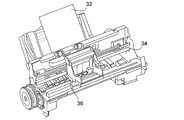
- FIG. 2 is a perspective view schematically illustrating an example of a main part of an inkjet recording apparatus used in the inkjet recording method of the present invention.
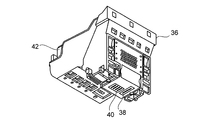
- FIG. 3 is a perspective view schematically illustrating an example of a head cartridge used in the inkjet recording method of the present invention.
- the salt when the compound is a salt, the salt is dissociated into ions in the ink, but is expressed as "contains a salt” for convenience.
- the “unit” means a unit structure corresponding to one monomer unless otherwise specified.
- the terms “(meth) acrylic acid” and “(meth) acrylate” represent “acrylic acid, methacrylic acid” and “acrylate, methacrylate”, respectively.
- a general recording medium used in the ink jet recording method shows neutral to acidic, and therefore, a hydrogen atom polarized to ⁇ + is present.
- an ink containing resin particles formed of a polyester resin is applied to a recording medium, an oxygen atom polarized to ⁇ ⁇ of the polyester resin and a hydrogen atom polarized to ⁇ + of the recording medium attract each other. This makes it easier for the recording medium and the resin particles formed of the polyester resin to adhere to each other.
- the polyester resin having a carboxylic acid group is in a state in which the molecular chains of the polyester resin are entangled by a hydrogen bond generated between a plurality of carboxylic acid groups in the recording medium.
- the abrasion resistance of the image is developed due to the adhesion between the recording medium and the polyester resin and the entanglement of the molecular chains of the polyester resin.
- the polyester resin has a hydroxyl group of a polyhydric alcohol or a carboxylic acid group of a polycarboxylic acid at its terminal. And since at least a part of the terminal portion of the polyester resin is present on the particle surface of the resin particles formed of the polyester resin, a hydroxy group or a carboxylic acid group, which is a group having high hydrophilicity, is present on the particle surface. Will be. In other words, since the resin particles formed of the polyester resin are present in the aqueous ink in a state having a hydroxy group or a carboxylic acid group on the particle surface, it is expected that the dispersion state in the ink is stabilized by the hydrophilicity of these groups. Was done.
- the ejection stability of the ink was not improved in some cases.
- a polyester resin capable of forming particles even if some of the terminal hydroxyl groups or carboxylic acid groups are present on the particle surface, the hydrophilicity of the resin particles does not increase so much, so that the dispersion state in the ink is stable. Hard to do.
- the resin particles and the aggregates of which the dispersion state has become unstable adhere to the flow path and the vicinity of the ejection port and gradually accumulate. Then, it was found that as the number of ejections increased, the ejection direction of the ink was bent by the deposits, and the ejection stability of the ink was impaired.
- the present inventors suppress the fluctuation of the particle diameter due to environmental changes such as pH and temperature which may occur before the ink is ejected from the recording head, thereby stably maintaining the dispersion state of the resin particles, Improving the ejection stability was studied.
- the ejection stability can be improved by using the resin particles formed of the first resin and the second resin each having a carboxylic acid and having the following configuration.
- These resins are a first resin that is a polyester resin having no cross-linked structure described below, and a second resin that is at least one of a polyester resin and an acrylic resin having a cross-linked structure described below, and the cross-linked structure is And an alkylene oxide group having 1 to 9 repetitions.
- the expression “cross-linked” or “non-cross-linked” indicates that the compound is cross-linked / not cross-linked by an alkylene oxide group having 1 to 9 repetitions.
- the carboxylic acid groups of the first resin which is a polyester resin
- the second resin is cross-linked by an alkylene oxide group having 1 to 9 repetitions, which is a cross-linking group that is hardly affected by changes in pH or temperature. For this reason, even if the pH and the temperature change, the second resin maintains a three-dimensionally stable shape, so that the molecular size does not easily change.
- swelling of a resin particle formed of a resin having a crosslinked structure due to intrusion of a liquid component into the resin particle is easily suppressed.
- the resin particles formed of the first resin and the second resin having these characteristics have a structure in which the second resin whose molecular size is hard to change and the first resin are entangled, the pH and temperature change. However, the fluctuation of the particle diameter hardly occurs, and the ejection stability of the ink is improved.
- the ink of the present invention is a water-based ink for inkjet containing resin particles formed of a first resin and a second resin each having a carboxylic acid group (hereinafter, may be simply referred to as “resin particles”). It is.
- resin particles formed of a first resin and a second resin each having a carboxylic acid group hereinafter, may be simply referred to as “resin particles”.
- the ink contains resin particles formed of a first resin and a second resin each having a carboxylic acid group. Without a carboxylic acid group, the hydrophilicity is insufficient, and the dispersion state of the resin particles tends to be unstable, so that the ejection stability of the ink cannot be obtained.
- the first resin is a polyester resin having no crosslinked structure
- the second resin is at least one of a polyester resin and an acrylic resin having a crosslinked structure
- the crosslinked structure of the first resin and the second resin is An alkylene oxide group having 1 to 9 repetitions.
- the content (% by mass) of the resin particles in the ink is preferably from 0.1% by mass to 15.0% by mass, and more preferably from 1.0% by mass to 10.0% by mass, based on the total mass of the ink. It is more preferred that:
- the resin particles are present in the ink in a state of being dispersed in the ink, that is, in the form of a resin emulsion.
- the resin particles may or may not include a coloring material.
- resin particles refers to a resin that is present in a state in which it is not dissolved in an aqueous medium constituting an ink, and specifically, a state in which particles whose particle diameter can be measured by a dynamic light scattering method are formed.
- water-soluble resin refers to a resin that is present in a state of being dissolved in an aqueous medium constituting the ink, and specifically, in a state where particles that can be measured by a dynamic light scattering method are not formed.
- Whether a certain resin falls under the “resin particles” defined above can be determined according to the following method. First, a liquid containing the resin to be determined (resin content: 10% by mass) is prepared. Next, this liquid is diluted 10-fold (by volume) with pure water to prepare a sample. Then, when the particle diameter of the resin in the sample is measured by the dynamic light scattering method, if the particles having the particle diameter are measured, the resin is “resin particles” (that is, “water-dispersible resin” There is). On the other hand, if no particles having a particle diameter are measured, it is determined that the resin is not a “resin particle” (that is, a “water-soluble resin”).
- the measurement conditions at this time can be, for example, SetZero: 30 seconds, number of measurements: 3, measurement time: 180 seconds, shape: true sphere, refractive index: 1.59.
- a particle size analyzer for example, trade name “UPA-EX150”, manufactured by Nikkiso Co., Ltd.
- the particle size analyzer and measurement conditions are not limited to those described above.
- other resins such as a resin dispersant, which can be used in addition to the resin particles formed of the polyester resin, also define whether or not they are resin particles in the same manner as described above.
- other resins it can be determined whether they are resin particles or water-soluble resins by the same method as described above.
- the first resin forming the resin particles is a polyester resin having a carboxylic acid group, and does not have a crosslinked structure of 1 to 9 alkylene oxide groups.
- the second resin forming the resin particles is a resin having at least one of a polyester resin and an acrylic resin having a carboxylic acid group, and has a crosslinked structure of alkylene oxide groups having 1 to 9 repetitions. “Cross-linking” in the present specification indicates that the molecular chains of a plurality of resins are bonded by a cross-linking structure (alkylene oxide group having 1 to 9 repetitions) different from the molecular chains of these resins.
- the resin particles have the following configuration (A) or (B).
- “cross-linked” and “non-cross-linked” indicate that they are cross-linked / not cross-linked by an alkylene oxide group having 1 to 9 repetitions.
- (A) Resin particles formed of a first resin that is a non-crosslinked polyester resin having a carboxylic acid group and a second resin that is a crosslinked polyester resin having a carboxylic acid group.
- a polyester resin having a carboxylic acid group as the first resin and a polyester resin having a carboxylic acid group as the second resin may be the same resin except for the presence or absence of cross-linking by a specific cross-linking structure. Other than the presence or absence, resins having different configurations may be used. Further, each of the first resin and the second resin is a water-dispersible resin, and resin particles produced by integrally granulating both of them may be used. Further, at least one of the first resin and the second resin may be a water-soluble resin, and a combination of the respective resins may be used such that when both of them are integrally formed into particles, the particles become resin particles. However, a state in which the first resin and the second resin are simply made to coexist in the ink, and these resins are not integrated, does not correspond to “resin particles formed of the first resin and the second resin”. Not included in the present invention.
- the polyester resin is used as the first resin forming the resin particles.
- the polyester resin can also be used as the second resin forming the resin particles.
- the polyester resin forming the resin particles has a carboxylic acid group. That is, the polyester resin has a unit having a carboxylic acid group.
- an unreacted hydroxy group or carboxylic acid group exists at the terminal of the polyester resin.
- the carboxylic acid group does not exist at the terminal of the polyester resin, the carboxylic acid group exists at a portion other than the terminal.
- the scratch resistance of the image can be improved by utilizing the interaction between the oxygen atom polarized to ⁇ ⁇ of the polyester resin and the hydrogen atom polarized to ⁇ + of the recording medium.
- Polyhydric alcohol examples of the polyhydric alcohol which is a unit derived from the polyhydric alcohol and forms the polyester resin by the reaction include dihydric to tetrahydric polyhydric alcohols. Examples of the structure of the polyhydric alcohol include polyhydric alcohols having an aliphatic group, polyhydric alcohols having an aromatic group, and sugar alcohols.
- polyhydric alcohol specifically, ethylene glycol [1,2-ethanediol], neopentyl glycol [2,2-dimethyl-1,3-propanediol], 1,3-propanediol, 1,4 Dihydric alcohols such as butanediol, benzenediol, 2,2-bis (4-hydroxyphenyl) propane [bisphenol A], trihydric alcohols such as glycerin, trimethylolethane, and trimethylolpropane; pentaerythritol Examples include tetrahydric alcohols.
- an oligomer a low molecular weight polymer having a molecular weight of 1,000 or less
- oligomer a low molecular weight polymer having a molecular weight of 1,000 or less
- a dihydric or trihydric polyhydric alcohol because the weight average molecular weight of the polyester resin can be easily adjusted. Further, from the viewpoint of the structure, it is preferable to use a polyhydric alcohol having an aliphatic group and a polyhydric alcohol having an aromatic group. As the polyhydric alcohol having an aliphatic group, a polyhydric alcohol having a linear or branched aliphatic group having 1 to 6 carbon atoms is more preferable. In particular, it is preferable to use ethylene glycol, neopentyl glycol, bisphenol A, and glycerin, and it is also preferable to use two or more of these.
- polyhydric alcohols having an aliphatic group When polyhydric alcohols having an aliphatic group are used, the following is preferred. That is, of the units derived from “polyhydric alcohols having a linear or branched aliphatic group having 1 to 6 carbon atoms” in units derived from polyhydric alcohols having an aliphatic group in the polyester resin.
- the ratio is preferably at least 70 mol%. More preferably, the proportion is 100 mol%.
- Polyvalent carboxylic acid Examples of the polyvalent carboxylic acid constituting a unit derived from the polyvalent carboxylic acid constituting the polyester resin by the reaction include divalent to tetravalent polycarboxylic acids. Examples of the structure of the polycarboxylic acid include polycarboxylic acids having an aliphatic group, polycarboxylic acids having an aromatic group, and nitrogen-containing polycarboxylic acids.
- polyvalent carboxylic acids include divalent carboxylic acids such as glutaric acid, adipic acid, terephthalic acid, isophthalic acid, and 2,6-naphthalenedicarboxylic acid; trivalent carboxylic acids such as trimellitic acid; Examples thereof include tetravalent carboxylic acids such as acetic acid.
- an oligomer a low molecular weight polymer having a molecular weight of 1,000 or less
- a divalent or trivalent polycarboxylic acid because the weight average molecular weight and the acid value of the polyester resin can be easily adjusted.
- carboxylic acids having an aromatic group it is preferable to use carboxylic acids having an aromatic group.
- adipic acid, terephthalic acid, isophthalic acid, and trimellitic acid it is preferable to use two or more of these.
- Polyester resins synthesized using low-molecular-weight polyhydric alcohols or polycarboxylic acids have more ester bonds in the molecular chain and better abrasion resistance than when high-molecular-weight raw materials are used. Sex can be obtained. Therefore, the molecular weight of the polyhydric alcohol is preferably from 50 to 300, and the molecular weight of the polycarboxylic acid is preferably from 100 to 300.
- the valence of the polyhydric alcohol and the polycarboxylic acid is preferably divalent or trivalent. If it has four or more valences, the synthesized polyester resin has many branches and tends to have a three-dimensionally complicated structure. In this case, in the recording medium, there is a tendency that the molecular chains of the polyester resin are not easily entangled, and the effect of further improving the scratch resistance of the image may not be sufficiently obtained.
- a unit having an aromatic group is present in the polyester resin.
- the polyester resin in which a unit having an aromatic group is present is likely to be in a state where the molecular chains of the polyester resin are entangled in the recording medium due to the hydrophobic interaction between the aromatic groups, and the scratch resistance of the image is further improved. it can.
- the proportion (% by mass) of the unit having an aromatic group in the polyester resin is preferably 25% by mass or more and 50% by mass or less based on the total mass of the resin. Further, the proportion (% by mass) of the unit having no aromatic group in the polyester resin is preferably 50% by mass or more and 75% by mass or less based on the total mass of the resin.
- Crosslinking agent When a polyester resin is used as the second resin, a crosslinked structure of an alkylene oxide group having 1 to 9 repetitions is incorporated into the resin.
- a crosslinked structure By reacting a compound having an alkylene oxide group having 1 to 9 repeats and two or more glycidyl groups, which is a cross-linking agent, with a polyester resin having a carboxylic acid group, the cross-linked structure can be incorporated into the resin.
- the proportion (% by mass) of the alkylene oxide group having 1 to 9 repetitions in the polyester resin as the second resin is preferably 1% by mass or more and 10% by mass or less based on the total mass of the resin.
- Compounds having 1 to 9 alkylene oxide groups and two or more glycidyl groups that can be used as a crosslinking agent for polyester resins include ethylene glycol diglycidyl ether, diethylene glycol diglycidyl ether, propylene glycol diglycidyl ether, (Poly) alkylene glycol diglycidyl ethers such as dipropylene glycol diglycidyl ether; and diglycidyl ethers of polyhydric alcohols such as neopentyl glycol diglycidyl ether and 1,6-hexanediol diglycidyl ether. Among them, (poly) alkylene glycol diglycidyl ethers are preferred.
- the alkylene oxide group is preferably an ethylene oxide group, a propylene oxide group, or a butylene oxide group, and more preferably an ethylene oxide group.
- the acid value of the polyester resin is preferably from 3 mgKOH / g to 30 mgKOH / g, and more preferably from 3 mgKOH / g to 10 mgKOH / g. Further, the weight average molecular weight of the polyester resin is preferably 15,000 or more and 70,000 or less.
- Acrylic resin can be used as the second resin forming the resin particles.
- an acrylic resin is preferable to a polyester resin.
- the acrylic resin has a carboxylic acid group. That is, the acrylic resin has a unit having a carboxylic acid group.
- the acrylic resin preferably has a unit having no carboxylic acid group in addition to the unit having a carboxylic acid group.
- Examples of the monomer that becomes a unit having a carboxylic acid group that constitutes the acrylic resin by the reaction include monomers having a carboxylic acid group such as (meth) acrylic acid, itaconic acid, maleic acid, and fumaric acid. Among them, (meth) acrylic acid is preferred. These monomers may be any of an anhydride, an acid type, and a salt type. In the case of a salt type, counter ions include lithium, sodium, potassium, ammonium, and organic ammonium.
- the proportion (% by mass) of the unit having a carboxylic acid group in the acrylic resin is preferably from 0.1% by mass to 10% by mass, and preferably from 1% by mass to 10% by mass, based on the total mass of the resin. Is more preferable.
- Examples of the monomer which becomes a unit having no carboxylic acid group by forming an acrylic resin by the reaction include alkyl (meth) such as methyl (meth) acrylate, butyl (meth) acrylate, lauryl (meth) acrylate, and hexadecyl (meth) acrylate.
- alkyl (meth) such as methyl (meth) acrylate, butyl (meth) acrylate, lauryl (meth) acrylate, and hexadecyl (meth) acrylate.
- the monomer having a sulfonic acid group or a phosphonic acid group may be any one of an anhydride, an acid type, and a salt type.
- counter ions include lithium, sodium, potassium, ammonium, and organic ammonium.
- alkyl (meth) acrylates and monomers having an aromatic group are preferable, and those having no acid group are more preferable.
- the proportion (% by mass) of units having no carboxylic acid group in the acrylic resin is preferably 80% by mass or more and 95% by mass or less based on the total mass of the resin.
- [Crosslinking agent] in the acrylic resin a crosslinked structure that is an alkylene oxide group having 1 to 9 repetitions is incorporated into the resin.
- the following method is mentioned as a method of incorporating the crosslinked structure into the acrylic resin.
- an acrylic resin having the crosslinked structure is synthesized using a monomer having an alkylene oxide group having 1 to 9 repetitions and two or more ethylenically unsaturated bonds.
- an acrylic resin having the above-mentioned crosslinked structure is synthesized.
- the proportion (% by mass) of the alkylene oxide group having 1 to 9 repetitions in the acrylic resin as the second resin is preferably 1% by mass or more and 15% by mass or less based on the total mass of the resin.
- Monomers having 1 to 9 repeating alkylene oxide groups and two or more ethylenically unsaturated bonds that can be used as a crosslinking agent for acrylic resins include ethylene glycol di (meth) acrylate and diethylene glycol di (meth) acrylate.
- (poly) alkylene glycol di (meth) acrylates are preferred.
- the alkylene oxide group is preferably an ethylene oxide group, a propylene oxide group, or a butylene oxide group, and more preferably an ethylene oxide group.
- the acid value of the acrylic resin is preferably from 5 mgKOH / g to 50 mgKOH / g, more preferably from 10 mgKOH / g to 35 mgKOH / g.
- the acid value of the acrylic resin is preferably higher than the acid value of the first polyester resin.
- the weight average molecular weight of the acrylic resin is preferably from 15,000 to 70,000.
- the resin particles formed of the polyester resin preferably include a compound represented by the following formula (1). That is, the resin particles preferably have a compound represented by the following formula (1) inside. Since the compound represented by the formula (1) interacts with the hydrophobic part of the polyester resin, the compound has the effect of immobilizing the molecular chain of the polyester resin by the hydrophobic interaction via the compound represented by the formula (1). Have. Therefore, the dissolution of the polyester resin in the aqueous ink in the ink is suppressed, and the ejection stability can be further improved. Further, in the image, since the cohesiveness of the polyester resin is increased, the scratch resistance can be further improved.
- the state in which the resin particles have the compound represented by the following formula (1) inside the resin particles refers to the state in which the compound represented by the formula (1) exists inside the three-dimensional structure formed by entanglement of the polyester resin. Point.
- R 1 , R 2 and R 3 each independently represent a hydrogen atom or an alkyl group having 1 to 4 carbon atoms.
- R 1 , R 2 and R 3 each independently represent a hydrogen atom or an alkyl group having 1 to 4 carbon atoms.
- the alkyl group having 1 to 4 carbon atoms include a methyl group, an ethyl group, an n-propyl group, an i-propyl group, an n-butyl group, an i-butyl group, a t-butyl group, and a sec-butyl group.
- a methyl group and a t-butyl group are preferable from the viewpoint of more efficiently causing interaction with the hydrophobic portion of the polyester resin.
- the compound represented by the formula (1) is preferably 2,6-di-t-butyl-p-cresol (alias: dibutylhydroxytoluene, BHT).
- the proportion (ppm) of the compound represented by the formula (1) in the resin particles is preferably 100 ppm or more and 1,000 ppm or less based on the total mass of the resin particles. That is, the value of [mass of compound represented by formula (1) / (mass of compound represented by formula (1) + mass of resin particles] ⁇ 10 6 ] in the resin particles is 100 ppm or more and 1,000 ppm or less. It is preferred that When the proportion is less than 100 ppm, it is difficult to sufficiently fix the molecular chain of the polyester resin by hydrophobic interaction, the dissolution of the polyester resin in the aqueous ink cannot be sufficiently suppressed, and the effect of further improving the ejection stability can be obtained. It may not be possible to obtain enough.
- the compound represented by the formula (1) tends to be unevenly distributed inside the resin particles due to hydrophobic interaction between the compounds. Then, the polyester resin tends not to be uniformly present throughout the entire image, so that the effect of further improving the scratch resistance may not be sufficiently obtained.
- the ratio of the compound represented by the formula (1) to the resin particles can be calculated as follows. First, resin particles are separated from a liquid containing ink and resin particles. After measuring the mass of the resin particles, the resin particles are added to an organic solvent (such as tetrahydrofuran) and stirred for about 24 hours to prepare a sample. With respect to this sample, the resin remaining without being dissolved is filtered out with a filter (stainless steel mesh) having an appropriate pore size, and the mass is measured. The fractionated resin is a second resin having a crosslinked structure. Separate the filtrate. As the filter, for example, a 400-mesh wire mesh (a filter in which 400 stainless steel wires are woven in one inch square in length and width) can be used.
- an organic solvent such as tetrahydrofuran
- the separated filtrate contains the first resin dissolved in tetrahydrofuran and the compound represented by the formula (1) without having a crosslinked structure.
- Analysis is performed by gel permeation chromatography, liquid chromatography, or the like, and the compound represented by the formula (1) and the first resin are quantified. Then, the ratio is calculated from the previously measured masses of the resin particles and the second resin, and the quantitative values of the compound represented by the formula (1) and the first resin.
- the proportion (% by mass) of the second resin in the resin forming the resin particles is preferably 30% by mass or more and 80% by mass or less based on the total mass of the resin.
- the proportion is less than 30% by mass, the proportion of the crosslinked resin is too small, so that the influence of the variation in the particle diameter of the noncrosslinked resin tends to increase, and the ejection stability of the ink at a high level is insufficient. May not be obtained.
- the proportion is more than 80%, the proportion of the crosslinked resin is too large, so that the molecular motion is reduced, the entanglement of the polyester resin's molecular chains hardly occurs, and the scratch resistance of the image is further improved. May not be obtained sufficiently.
- the ratio (% by mass) of the first resin to the resin forming the resin particles is preferably 20% by mass or more and 70% by mass or less based on the total mass of the resin. Further, resin particles formed only of the first resin and the second resin are particularly preferable.
- the ratio of each resin to the resin forming the resin particles can be calculated as follows. First, resin particles are separated from a liquid containing ink and resin particles. After measuring the mass of the resin particles, the resin particles are added to an organic solvent (such as tetrahydrofuran) and stirred for about 24 hours to prepare a sample. With respect to this sample, the resin remaining without being dissolved is collected by a filter (stainless steel mesh) having an appropriate pore size. As the filter, for example, a 400-mesh wire mesh (a filter in which 400 stainless steel wires are woven in one inch square in length and width) can be used. The fractionated resin is the second resin that did not dissolve because of having a crosslinked structure. The difference between the mass of the second resin and the mass of the resin particles is the first resin dissolved in the organic solvent because it did not have a crosslinked structure. From these masses, the ratio is calculated.
- an organic solvent such as tetrahydrofuran
- the resin particles formed of the first resin and the second resin preferably have a carboxylic acid group present on the particle surface of 25 ⁇ mol / g or more and 250 ⁇ mol / g or less. This value represents the density (micromol unit) of the carboxylic acid group present on the particle surface of the resin particle per unit mass of the resin particle.
- the carboxylic acid group present on the particle surface is less than 25 ⁇ mol / g, a high level of ink ejection stability may not be sufficiently obtained.
- the amount of anionic groups other than carboxylic acid groups such as sulfonic acid groups present on the surface of the particles is preferably 5 ⁇ mol / g or less, more preferably 0 ⁇ mol / g.
- the weight average molecular weight of the first resin is preferably from 15,000 to 70,000.
- the weight average molecular weight can be measured as a value in terms of polystyrene by gel permeation chromatography.
- the crosslinked second resin is hardly dissolved in the organic solvent, it is difficult to prepare a sample for measuring the weight average molecular weight.
- the presence of a component insoluble in the organic solvent can confirm that the resin has a crosslinked structure.
- the volume-based cumulative 50% particle size of the resin particles is preferably 50 nm or more and 200 nm or less. When a certain amount of resin particles is considered, the specific surface area increases when the particle diameter is small, and the specific surface area decreases when the particle diameter is large. If the cumulative 50% particle size is less than 50 nm, a high level of ink ejection stability may not be sufficiently obtained. This is because the specific surface area of the resin particles is large, the contact amount of the resin particles with the aqueous medium constituting the ink increases, and the first resin forming the resin particles gradually dissolves in the aqueous ink, and the viscosity of the ink decreases. This is because it is easy to ascend.
- the volume-based cumulative 90% particle size of the resin particles is preferably from 80 nm to 300 nm.
- the volume-based cumulative 50% particle size of the resin particles is preferably 0.6 times or more in terms of the ratio to the volume-based cumulative 90% particle size of the resin particles.
- the ratio is less than 0.6 times, resin particles having a wide particle size distribution and having significantly different particle sizes exist.
- a resin particle having a large particle diameter collides with a resin particle having a small particle diameter, so-called hetero-aggregation causes the resin particles to agglomerate and easily accumulate near a flow path or an ejection port. May not be obtained.
- the ratio is preferably 0.8 times or less.
- the cumulative 50% particle diameter and the cumulative 90% particle diameter based on the volume of the resin particles are defined as 50% or 90% by integrating from the small particle diameter side with respect to the total volume of the measured particles in the particle diameter accumulation curve. Refers to the diameter of the particle. D 50 and D 90 of the resin particles is described above, under the same conditions as the determination of whether the resin particles can be measured by a dynamic light scattering method.
- the method for producing the resin particles is not limited as long as the resin particles described above can be obtained.
- the following process (A) or (B) is performed, that is, a polyester resin is synthesized and, if necessary, formed into particles.
- a resin particle formed of a polyester resin having a carboxylic acid group is obtained by synthesizing a polyester resin and then granulating the resin.
- B) A polyester resin is synthesized, and a polyester resin having a carboxylic acid group is obtained without forming the particles (1).
- the following processing (C), (D), or (E) is performed to obtain resin particles.
- the product obtained in the above (A) or (B) is referred to as "polyester”.
- Part of the carboxylic acid group of the polyester is cross-linked by using a compound having 1 to 9 repeating alkylene oxide groups and two or more glycidyl groups.
- D) In the presence of a polyester, after a monomer serving as a raw material of the acrylic resin is polymerized to synthesize an acrylic resin having a carboxylic acid group, a part of the carboxylic acid group is replaced with an alkylene oxide group having a repeating number of 1 to 9 and Crosslinking is performed using a compound having two or more glycidyl groups.
- the crosslinked structure is mainly incorporated in the acrylic resin, but the crosslinked structure may be incorporated in a part of the polyester resin.
- a monomer as a raw material of an acrylic resin containing a monomer having an alkylene oxide group having 1 to 9 repetitions and two or more ethylenically unsaturated bonds is polymerized to form a crosslinked acrylic. Synthesize resin. In this case, it is the acrylic resin that incorporates the crosslinked structure.
- the polyester resin can be synthesized as follows ((A) and (B) above). A polyhydric alcohol and a polycarboxylic acid are reacted (esterification reaction). If necessary, either a polyhydric alcohol or a polycarboxylic acid is added, and a transesterification reaction for cutting a part of an ester bond of the polyester resin is performed to adjust the molecular weight of the polyester resin. Through such steps, a polyester resin can be obtained.
- the polyester resin having a carboxylic acid group can be obtained, for example, as follows.
- the esterification reaction there is a method in which the amount of the raw material used is adjusted so that the number of moles of the carboxylic acid group of the polyhydric carboxylic acid is larger than the number of moles of the hydroxy group of the polyhydric alcohol. Further, a method using a polyvalent carboxylic acid at the time of the transesterification reaction may be mentioned.
- the esterification reaction is performed in an atmosphere of an inert gas such as nitrogen gas.
- the reaction temperature in the esterification reaction is preferably from 180 to 260 ° C.
- the reaction time in the esterification reaction is preferably 2.5 to 10 hours, more preferably 4 to 6 hours.
- the reaction under reduced pressure is performed in an atmosphere of an inert gas such as nitrogen gas, following the esterification reaction.
- the reaction temperature under reduced pressure is preferably from 220 to 280 ° C.
- the reaction time under reduced pressure is preferably from 2.5 to 10 hours, more preferably from 4 to 6 hours.
- the degree of reduced pressure (degree of vacuum) is preferably 1 Pa or more and 130 Pa or less. However, if the degree of pressure reduction is too low, the reaction efficiency will decrease or the weight-average molecular weight of the polyester resin will decrease. Therefore, it is preferable to adjust according to desired reaction conditions. It is preferable that the pressure is gradually reduced from atmospheric pressure (101325 Pa) to 130 Pa or less over a period of about 60 to 180 minutes.
- the transesterification reaction is performed to adjust the molecular weight of the polyester resin by adding either a polyhydric alcohol or a polycarboxylic acid to cut a part of the ester bond of the polyester resin.
- the transesterification reaction is preferably performed using a polyvalent carboxylic acid.
- trimellitic acid anhydride may be used.
- the transesterification reaction is also performed in an inert gas atmosphere such as nitrogen gas, following the esterification reaction.
- the reaction temperature in the transesterification is preferably from 180 to 260 ° C. Further, the reaction time in the transesterification reaction is preferably 1 to 5 hours.
- the transesterification can be performed in the presence of a catalyst or a heat stabilizer.
- the catalyst include zinc acetate, antimony trioxide, tetra-n-butyl titanate, and n-butylhydroxyoxytin.
- the use amount (mol) of the catalyst is preferably 1 ⁇ 10 ⁇ 1 mol to 20 ⁇ 10 ⁇ 4 mol per 1 mol of polyhydric alcohol or polycarboxylic acid.
- the heat stabilizer include acids such as phosphoric acid and acid esters such as triethyl phosphate.
- the polyester resin synthesized as described above is preferably used in the next step ((B), (C), (D), (E)) after being formed into an appropriate form by pressure, pulverization, or the like.
- the resin particles are used as a component of the aqueous ink, it is preferable that the resin particles are formed into particles in a state of a dispersion liquid (a liquid containing resin particles) dispersed in an aqueous liquid medium.
- the aqueous liquid medium is mainly composed of water such as deionized water, ion-exchanged water and distilled water, and may contain a water-soluble organic solvent as needed.
- the aqueous liquid medium preferably has a water content of 50% by mass or more, and it is also preferable to use water containing no water-soluble organic solvent.
- Examples of a method of forming particles of the polyester resin to form resin particles composed of the polyester resin include a dispersion method and a phase inversion (emulsification) method.
- Examples of the dispersion method include the following (1) and (2).
- (1) There is a method in which a solution in which a polyester resin is dissolved in an organic solvent is added to an aqueous liquid medium to disperse the polyester resin.
- (2) adding a polyester resin to an organic solvent, further adding an aqueous liquid medium and mixing, and dispersing the polyester resin.
- phase inversion emulsification
- an aqueous liquid medium is added to a solution in which a polyester resin is dissolved in an organic solvent, and the polyester resin is precipitated in the form of particles during the process of phase inversion from a solvent system to an aqueous system. And the like.
- the carboxylic acid group present on the particle surface can be adjusted with high precision, it is preferable to produce the resin particles by a phase inversion (emulsion) method.
- a phase inversion (emulsion) method a method for producing resin particles by a phase inversion (emulsification) method will be described.
- ⁇ ⁇ ⁇ ⁇ ⁇ ⁇ ⁇ ⁇ ⁇ ⁇ ⁇ Dissolve the polyester resin in an organic solvent that can dissolve the polyester resin.
- organic solvent include ethers such as tetrahydrofuran and dibutyl ether, ketones such as acetone and methyl ethyl ketone, and alcohols such as isopropanol.
- ethers such as tetrahydrofuran and dibutyl ether
- ketones such as acetone and methyl ethyl ketone
- alcohols such as isopropanol.
- ethers such as tetrahydrofuran are preferably used because the organic solvent can be mixed with water at an arbitrary ratio. Ethers such as tetrahydrofuran are also preferable from the viewpoint of excellent solubility of the polyester resin.
- the compound represented by the general formula (1) is contained in the resin particles, it is preferable to add the compound represented by the general formula (1) in this step.
- an aqueous liquid medium is gradually added to the polyester resin solution obtained above to precipitate resin particles formed of the polyester resin. Since the dispersion state of the resin particles formed of the polyester resin can be kept stable, it is preferable to add a base before or during the addition of the aqueous liquid medium.
- the base include hydroxides of alkali metals such as sodium hydroxide and potassium hydroxide, and ammonia. It is preferable to add the base in the form of an aqueous solution. Cations are present in the system to which the base has been added.
- the carboxylic acid group of the polyester resin is formed into particles in a state of being located on the particle surface, so that resin particles having a carboxylic acid group on the particle surface can be formed.
- the amount of the base in the system by adjusting the amount of the base in the system, the amount of the carboxylic acid groups present on the particle surface of the resin particles can be adjusted with high accuracy. And the amount of carboxylic acid groups on the surface of the resin particles decreases when the amount of the base is small.
- the amount of the base used can be controlled by the neutralization ratio (mol%) based on the acid value of the polyester resin.
- the initially transparent solution becomes cloudy and emulsifies, thereby forming resin particles composed of a polyester resin.
- the particle size and particle size distribution of the resin particles formed of the polyester resin can be controlled by the content of the polyester resin in the solution of the polyester resin, the rate of addition of the aqueous liquid medium, the shearing force during dispersion, and the like.
- the organic solvent is distilled off under reduced pressure, and if necessary, filtered through a filter (stainless steel mesh) having an appropriate pore size to remove coarse particles. Then, by adding water to adjust the content of the resin particles, a liquid containing the resin particles (a water dispersion of the resin particles) can be prepared.
- the water used for adjusting the content is preferably deionized water, ion-exchanged water, or distilled water.
- Only a part of the carboxylic acid groups of the polyester obtained above is cross-linked by using a compound (cross-linking agent) having 1 to 9 repeating alkylene oxide groups and two or more glycidyl groups to synthesize a second resin.
- a compound having an alkylene oxide group having a repeating number of 1 to 9 and a compound having two or more glycidyl groups is added to the liquid containing the polyester to effect cross-linking.
- the amount of the raw material used is adjusted so that the number of moles of glycidyl groups of the crosslinking agent is smaller than the number of moles of carboxylic acid groups of the polyester.
- a monomer as a raw material of the acrylic resin is polymerized to synthesize an acrylic resin having a carboxylic acid group.
- a part of the carboxylic acid group is cross-linked by using a compound (cross-linking agent) having an alkylene oxide group having 1 to 9 repetitions and two or more glycidyl groups to synthesize a second resin ((D) above).
- a compound having an alkylene oxide group having 1 to 9 repetitions and two or more glycidyl groups is further added. And crosslink.
- the crosslinked structure is mainly incorporated in the acrylic resin, but the crosslinked structure may be incorporated in a part of the polyester resin.
- the amount of the raw material used is adjusted such that the number of moles of glycidyl groups of the crosslinking agent is smaller than the number of moles of carboxylic acid groups of the acrylic resin.
- the reaction temperature in the crosslinking reaction is preferably from 60 to 100 ° C. Further, the reaction time in the crosslinking reaction is preferably 1 to 5 hours. The progress of the crosslinking reaction can be confirmed by the reduction of the carboxylic acid groups in the polyester and acrylic resin before the treatment.
- a monomer as a raw material of an acrylic resin containing a monomer having a repeating number of 1 to 9 (alkylene oxide group) and a monomer having two or more ethylenically unsaturated bonds (crosslinking agent) is polymerized.
- a crosslinked acrylic resin is synthesized ((E) above). Specifically, a monomer as a raw material of an acrylic resin and a crosslinking agent are added to a liquid containing a polyester, and the monomer is polymerized by a known polymerization method such as an emulsion polymerization method or a soap-free polymerization method. In this case, it is the acrylic resin that incorporates the crosslinked structure.
- the reaction temperature in the polymerization reaction is preferably from 60 to 100 ° C.
- the reaction time in the crosslinking reaction is preferably 1 to 10 hours. The progress of the reaction is confirmed by a gas chromatography or the like to confirm the decrease of the monomer.
- aqueous dispersion of the resin particles thus obtained is filtered, if necessary, with a filter (stainless steel mesh) having an appropriate pore size to remove coarse particles. Then, by adding water to adjust the content of the resin particles, a liquid containing the resin particles (a water dispersion of the resin particles) can be prepared.
- the water used for adjusting the content is preferably deionized water, ion-exchanged water, or distilled water.
- the content (% by mass) of the resin particles in the liquid containing the resin particles is preferably 10.0% by mass or more and 50.0% by mass or less, and is preferably 20.0% by mass or more. More preferably, it is 45.0% by mass or less.
- Whether the resin constituting the resin particles is the first resin and the second resin can be determined by, for example, the following method.
- a resin particle is added to an organic solvent (such as tetrahydrofuran) capable of partially dissolving the resin particle, and the mixture is sufficiently stirred to prepare a sample.
- the resin particles used at this time may be in an aqueous dispersion state or a dried state. The fact that only a part of the resin particles is dissolved in the organic solvent can be confirmed by the presence of undissolved resin particles in the sample and the increase in the viscosity of the liquid component in the sample.
- the component dissolved in the organic solvent in the sample is the non-crosslinked first resin, and the component that is not dissolved is the crosslinked second resin.
- the organic solvent in which the first resin is dissolved and the component that does not dissolve are separated and analyzed by nuclear magnetic resonance (NMR) spectroscopy, matrix-assisted laser desorption / ionization mass spectrometry (MALDI-MS), or the like. This makes it possible to know the types and ratios of the units (monomers) constituting the resin. Further, the resin particles themselves can be analyzed by pyrolysis gas chromatography to detect the units (monomers) constituting the resin.
- the particle size distribution of the liquid (aqueous dispersion) containing the resin particles is measured by using a particle size distribution measuring device of a system (CHDF system) for measuring the particle size distribution by classifying the particles for each size.
- a particle size distribution measuring device of a system for measuring the particle size distribution by classifying the particles for each size.
- a capillary type particle size distribution analyzer (trade name “CHDF-3000”, manufactured by Shoko Science) can be used.
- the density distribution of the liquid containing the resin particles is measured by centrifugation. If the maximum value of both the particle size distribution and the density distribution is one point, it means that the resin is one type. Conversely, if the local maximum value of at least one of the particle size distribution and the density distribution is two or more, it means that there are a plurality of resins.
- Pigments and dyes can be used as the coloring material contained in the ink. It is preferable to use a pigment as the coloring material. Pigments, which are particles having a particle size, are different from dyes, which are color materials having no particle size, in that the scratch resistance of a recorded image tends to be reduced. Even if the material is a pigment, a decrease in scratch resistance can be effectively suppressed.
- the content (% by mass) of the coloring material in the ink is preferably from 0.1% by mass to 15.0% by mass, and more preferably from 1.0% by mass to 10.0% by mass based on the total mass of the ink. Is more preferable.
- pigments include inorganic pigments such as carbon black and titanium oxide, and organic pigments such as azo, phthalocyanine, quinacridone, isoindolinone, imidazolone, diketopyrrolopyrrole, dioxazine, and perinone.
- organic pigments such as azo, phthalocyanine, quinacridone, isoindolinone, imidazolone, diketopyrrolopyrrole, dioxazine, and perinone.
- a resin-dispersed pigment using a resin as a dispersant a self-dispersed pigment having a hydrophilic group bonded to the particle surface of the pigment, or the like
- a resin-bound pigment in which an organic group containing a resin is chemically bonded to the surface of a pigment particle a microcapsule pigment in which the surface of a pigment particle is coated with a resin, or the like
- a dispersant for the resin-dispersed pigment it is more preferable to use a water-soluble resin instead of a water-insoluble resin.
- Examples of the self-dispersing pigment include those in which an anionic group is bonded to the particle surface of the pigment directly or via another atomic group.
- Examples of the anionic group include a carboxylic acid group, a sulfonic acid group, a phosphoric acid group, and a phosphonic acid group.
- Examples of the counter ion of the anionic group include cations such as a hydrogen atom, an alkali metal, ammonium, and organic ammonium.
- the other atomic group is a group having a function as a spacer between the pigment particle surface and the ionic group, and preferably has a molecular weight of 1,000 or less.
- Examples of other atomic groups include an alkylene group having about 1 to 6 carbon atoms, an arylene group such as a phenylene group and a naphthylene group, an ester group, an imino group, an amide group, a sulfonyl group, and an ether group. Further, a group obtained by combining these groups may be used.
- the resin dispersant for dispersing the pigment in the aqueous medium it is preferable to use a resin capable of dispersing the pigment in the aqueous medium by the action of an anionic group.
- the resin dispersant include an acrylic resin and a urethane resin. Above all, an acrylic resin is preferable, and an acrylic resin having a hydrophilic unit and a hydrophobic unit as constituent units is more preferable. In particular, it is preferable to have a hydrophilic unit derived from (meth) acrylic acid and a hydrophobic unit derived from a monomer having an aliphatic group or an aromatic group.
- the hydrophilic unit is a unit having a hydrophilic group such as an anionic group, a hydroxy group, and an ethylene oxide group.
- the hydrophilic unit can be formed, for example, by polymerizing a monomer having a hydrophilic group.
- the monomer having a hydrophilic group include acidic monomers having a carboxylic acid group such as (meth) acrylic acid, anionic monomers such as anhydrides and salts of these acidic monomers, 2-hydroxyethyl (meth) acrylate And a monomer having an ethylene oxide group such as methoxypolyethylene glycol (meth) acrylate.
- the cation constituting the salt of the acidic monomer include ions such as lithium, sodium, potassium, ammonium and organic ammonium.
- the hydrophobic unit is a unit having no hydrophilic group such as an anionic group, a hydroxy group, and an ethylene oxide group.
- the hydrophobic unit can be formed, for example, by polymerizing a hydrophobic monomer having no hydrophilic group.
- hydrophobic monomer examples include monomers having an aromatic group such as styrene, ⁇ -methylstyrene, benzyl (meth) acrylate, ethyl (meth) acrylate, methyl (meth) acrylate, (iso-) propyl (meth) Examples include monomers having an aliphatic group such as acrylate, butyl (meth) acrylate, and 2-ethylhexyl (meth) acrylate.
- the content (% by mass) of the resin particles in the ink is 0.5 to 3.0 times in mass ratio (times) to the pigment content (% by mass). Is preferred. If the ratio is less than 0.5, the amount of resin particles relative to the pigment is too small, so that a high level of image scratch resistance may not be sufficiently obtained. On the other hand, when the ratio is more than 3.0 times, the amount of resin particles is too large relative to the pigment, so that the number of soft resin particles is larger than that of the pigment, and the image is easily deformed by abrasion. May not have sufficient scratch resistance.
- the ink of the present invention is an aqueous ink containing water or an aqueous medium that is a mixed solvent of water and a water-soluble organic solvent. It is preferable to use deionized water (ion-exchanged water) as water.
- the content (% by mass) of water in the ink is preferably 50.0% by mass or more and 95.0% by mass or less based on the total mass of the ink.
- the water-soluble organic solvent any of those usable for ink-jet inks such as alcohols, glycols, (poly) alkylene glycols, nitrogen-containing compounds, and sulfur-containing compounds can be used.
- the content (% by mass) of the water-soluble organic solvent in the ink is preferably from 3.0% by mass to 50.0% by mass based on the total mass of the ink. If the content of the water-soluble organic solvent is out of the above range, the reliability such as sticking resistance as a water-based ink for inkjet may be slightly lowered.
- the ink may contain a water-soluble organic compound that is solid at 25 ° C, such as a polyhydric alcohol such as trimethylolpropane or trimethylolethane, or a urea derivative such as ethylene urea, if necessary. May be contained. Further, the ink may contain various additives such as a surfactant, a pH adjuster, an antifoaming agent, a rust inhibitor, a preservative, a fungicide, an antioxidant, an antioxidant, and a chelating agent, if necessary. May be contained.
- a surfactant such as trimethylolpropane or trimethylolethane
- a urea derivative such as ethylene urea
- the ink may contain various additives such as a surfactant, a pH adjuster, an antifoaming agent, a rust inhibitor, a preservative, a fungicide, an antioxidant, an antioxidant, and a chelating agent, if necessary. May be contained.
- the content (% by mass) of the surfactant in the ink is preferably 0.1% by mass or more and 5.0% by mass or less based on the total mass of the ink. It is more preferable that the content be from 2.0% by mass to 2.0% by mass.
- the ink may contain other resins in addition to the resin particles described above.
- Other resins include a dispersant for dispersing the pigment.
- a water-soluble resin is preferably used as the other resin.
- examples of the form of the water-soluble resin include a block copolymer, a random copolymer, a graft copolymer, and a combination thereof.
- examples of the water-soluble resin include an acrylic resin, a urethane resin, and an olefin resin. Among them, acrylic resins and urethane resins are preferred.
- the viscosity of the ink at 25 ° C. is preferably from 1.0 mPa ⁇ s to 10.0 mPa ⁇ s, more preferably from 1.0 mPa ⁇ s to 5.0 mPa ⁇ s, and more preferably 1.0 mPa ⁇ s. It is particularly preferable that it is not less than 3.0 mPa ⁇ s.
- the pH of the ink at 25 ° C. is preferably 5.0 or more and 10.0 or less, and more preferably 7.0 or more and 9.5 or less.
- the method for producing an ink of the present invention is a method for producing an aqueous ink containing resin particles, and includes a step of producing resin particles, and a step of mixing the resin particles obtained in the step and other ink components. And a step of producing an aqueous ink.
- the step of producing the resin particles includes the following (1) and (2).
- the predetermined resin particles are formed of a first resin and a second resin each having a carboxylic acid group, and the first resin is a polyester resin having no cross-linked structure, and the second resin has a cross-linked structure. , Polyester resin and acrylic resin.
- the crosslinked structure of the first resin and the second resin is an alkylene oxide group having 1 to 9 repetitions. “Other ink components” can be appropriately selected from the coloring materials, aqueous media, other components, and the like described above.
- the ink cartridge of the present invention includes ink and an ink storage unit that stores the ink.
- the ink contained in the ink containing section is the above-described aqueous ink of the present invention.
- FIG. 1 is a sectional view schematically showing an embodiment of the ink cartridge of the present invention.
- an ink supply port 12 for supplying ink to the recording head is provided on the bottom surface of the ink cartridge.
- the inside of the ink cartridge is an ink storage unit for storing ink.
- the ink storage section includes an ink storage chamber 14 and an absorber storage chamber 16, which communicate with each other through a communication port 18.
- the absorber housing chamber 16 communicates with the ink supply port 12.
- the ink storage chamber 14 stores liquid ink 20, and the absorber storage chamber 16 stores absorbers 22 and 24 that hold the ink in an impregnated state.
- the ink storage section may be configured to have no ink storage chamber for storing liquid ink, and to hold the entire amount of ink stored by the absorber. Further, the ink storage section may have a form in which the entire amount of ink is stored in a liquid state without having an absorber. Further, the ink cartridge may be configured to have an ink container and a recording head.
- the inkjet recording method of the present invention is a method of recording an image on a recording medium by discharging the above-described aqueous ink of the present invention from an inkjet recording head.
- Examples of a method of ejecting ink include a method of applying mechanical energy to ink and a method of applying thermal energy to ink.
- the steps of the inkjet recording method may be known.
- FIG. 2A and 2B are views schematically showing an example of an ink jet recording apparatus used in the ink jet recording method of the present invention.
- FIG. 2A is a perspective view of a main part of the ink jet recording apparatus
- FIG. 2B is a perspective view of a head cartridge.
- the inkjet recording apparatus includes a transport unit (not shown) for transporting the recording medium 32 and a carriage shaft 34.
- a head cartridge 36 can be mounted on the carriage shaft 34.
- the head cartridge 36 includes recording heads 38 and 40, and is configured so that the ink cartridge 42 is set. While the head cartridge 36 is conveyed in the main scanning direction along the carriage shaft 34, ink (not shown) is ejected from the recording heads 38 and 40 toward the recording medium 32.
- the image is recorded on the recording medium 32 by being conveyed in the sub-scanning direction by the conveying means (not shown).
- the recording medium any of a recording medium having an ink absorbing property such as paper and a recording medium having no ink absorbing property such as a sheet or a film made of resin can be used.
- the acid value of the polyester resin was measured as follows. The resin particles were separated from the liquid containing the resin particles, and washed with 1.0 mol / L hydrochloric acid and then with water. The resin particles were added to 60 mL of a liquid in which water and tetrahydrofuran were mixed at a mass ratio of 1: 6, and the resin was dissolved at 25 ° C. to prepare a sample. This sample was subjected to neutralization titration, and the acid value of the polyester resin was measured.
- an automatic potentiometric titrator (trade name "AT510", manufactured by Kyoto Denshi Kogyo) equipped with a composite glass electrode (trade name "C-171", manufactured by Kyoto Denshi Kogyo) was used.
- a titration reagent a 0.5 mol / L potassium hydroxide ethanol solution was used.
- the weight average molecular weight of the polyester resin was measured as follows. The resin particles formed of the polyester resin are added to tetrahydrofuran at 25 ° C. for 24 hours, and the resin is dissolved at 25 ° C. for 24 hours. Then, filtration is performed using a membrane filter to prepare a sample. did. The content of the polyester resin in the sample was adjusted to be about 0.3%. For this sample, the weight average molecular weight of the polyester resin was measured by gel permeation chromatography under the following conditions.
- HPLC apparatus trade name "2695 Separations Module” (manufactured by Waters) Differential refractive index (RI) detector: trade name “2414 detector” (manufactured by Waters)
- RI detector trade name "2414 detector” (manufactured by Waters)
- GPC KF-806M trade name "GPC KF-806M” (Showa Denko)
- Eluent tetrahydrofuran Flow rate: 1.0 mL / min Oven temperature: 40 ° C Sample injection volume: 100 ⁇ L
- Standard polystyrene resin (trade name "TSK Standard @ polystyrene” F-850, F-450, F-288, F-128, F-80, F-40, F-20, F-10, F-4, F-2 , F-1, A-5000, A-2500, A-1000, A-500, manufactured by Tosoh Corporation) were used to calculate the weight average molecular weight.
- the determination as to whether or not the resin was a resin particle and the measurement of the particle diameter (D 50 , D 90 ) of the resin particle were performed as follows.
- a liquid containing the resin was diluted with pure water to prepare a sample having a resin content of about 1.0%.
- the particle size of this sample was measured using a particle size distribution meter (trade name “Nanotrack WAVEII-Q”, manufactured by Microtrac Bell) by a dynamic light scattering method.
- the measurement conditions are: SetZero: 30 s, number of measurements: 3, measurement time: 180 seconds, shape: true sphere, refractive index: 1.6, density: 1.0.
- the resin is determined to be “resin particles” (that is, “water-dispersible resin”), and if particles having a particle size are not measured, It was determined that the resin was not a “resin particle” (ie, a “water-soluble resin”).
- the peaks derived from the compound represented by the formula (1) and the first resin are measured by a differential refractive index (RI) detector in the same manner as the method for measuring the weight average molecular weight described above.
- the area was determined.
- the ratio was calculated from the obtained area and the masses of the resin particles, the first resin, and the second resin.
- Viscosity of ink The viscosity of the ink was measured using an E-type viscometer (trade name “RE80-L”, manufactured by Toki Sangyo) that circulated antifreeze through a tube in a thermostat set at 25 ° C. ⁇ R24) was measured.
- a stirrer (trade name “Tornado Stirrer Standard SM-104”, manufactured by AS ONE) was set in a beaker having a volume of 2 L.
- a polyester resin of the type shown in Table 2 an organic solvent (unit: g), and a compound represented by Formula (1) (in Table 2, expressed as “Formula (1)”, Unit: mg) were added.
- the resulting mixture was stirred at 25 ° C. to dissolve the polyester resin.
- 2,6-di-t-butyl-p-cresol was used as the compound represented by the formula (1).
- organic solvents represent THF: tetrahydrofuran, MEK: methyl ethyl ketone, and IPA: isopropanol.
- a 5% aqueous sodium hydroxide solution in an amount equivalent to the neutralization ratio (mol%) based on the acid value of the polyester resin was added, and the mixture was stirred for 30 minutes.
- 900 g of deionized water was dropped into the beaker at a rate of 20 mL / min while stirring at 10 ° C. and 150 rpm. Thereafter, the temperature was raised to 60 ° C., the organic solvent was distilled off under reduced pressure, and a part of water was also distilled off.
- the "crosslinking agent having an alkylene oxide group” in Table 3 is a product of the following trade names manufactured by Nagase ChemteX.
- EX-810 trade name "Denacol EX-810", ethylene glycol diglycidyl ether, repeating number of ethylene oxide group 1
- EX-830 trade name "Denacol EX-830”, polyethylene glycol diglycidyl ether, repeating number 9 of ethylene oxide group
- EX-920 trade name “Denacol EX-920”, polypropyne glycol diglycidyl ether, repeating number of propylene oxide group 3
- EX-841 trade name "Denacol EX-841", polyethylene glycol diglycidyl ether, repeating number of ethylene oxide group 13
- This mixture was mixed using a homogenizer (trade name “T50D Ultra Turrax”, manufactured by IKA) to obtain a monomer mixture.
- the obtained mixture of monomers and 10 g of a 3% aqueous solution of potassium persulfate were added dropwise to the above flask over 2 hours, followed by stirring at 80 ° C. for 2 hours.
- pressure filtration was performed with a micro filter having a pore size of 3.0 ⁇ m (manufactured by FUJIFILM Corporation).
- the content of the resin particles was adjusted by adding an appropriate amount of deionized water to obtain a liquid containing each resin particle having a content of the resin particles of 25.0%.
- the resin particles 9 to 38 were resin particles formed of a first resin that was a non-crosslinked polyester resin and a second resin that was a crosslinked acrylic resin.
- EGDMA ethylene glycol dimethacrylate, number of repeating ethylene oxide groups 1 -PDE-200: trade name "Blemmer PDE-200", manufactured by NOF Corporation, polyethylene glycol dimethacrylate, repeating number of ethylene oxide groups: 4 -PDP-400N: trade name "Blemmer PDP-400N", manufactured by NOF Corporation, polypropylene glycol dimethacrylate, number of repeating ethylene oxide groups: 7 -PDT-650: trade name "Blemmer PDT-650", manufactured by NOF Corporation, polytetramethylene glycol dimethacrylate, repeating number of butylene oxide groups: 9 -PDE-600: trade name "Blemmer PDE-600", manufactured by NOF Corporation, polyethylene glycol dimethacrylate, repeating number of ethylene oxide group: 14 ⁇ MAA: Methacrylic acid ⁇ St: Styrene ⁇ EMA: Ethyl methacrylate
- Table 4 similarly to Table 3, showed a ratio of 50% cumulative particle diameter D 50 and the cumulative 90% particle volume based resin particle diameter D 90, D 50 / D 90 . Also, the amount of carboxylic acid groups present on the particle surface (in Table 4, denoted as “carboxylic acid group on particle surface”) is shown. Furthermore, the ratio of the compound represented by the formula (1) to the resin particles (in Table 4, expressed as “the ratio of the formula (1) to the resin particles”) and the ratio of the second resin are shown.
- Resin particles 45 0.2 parts of potassium persulfate and 79.4 parts of ion-exchanged water were put into a four-necked flask equipped with a stirrer, a reflux cooling device, and a nitrogen gas inlet tube, and nitrogen gas was introduced. Further, 19.7 parts of butyl methacrylate, 0.4 parts of methacrylic acid, and 0.3 parts of a reactive surfactant (trade name “AQUALON KH-05”, manufactured by Daiichi Kogyo Seiyaku) were mixed, and the mixture was mixed. Obtained. The resulting mixture was dropped into a four-necked flask over 1 hour under stirring, and then reacted at 80 ° C. for 2 hours.
- the content was cooled to 25 ° C., and potassium hydroxide and an appropriate amount of ion-exchanged water were added to adjust the pH of the liquid to 8.5.
- a liquid containing the resin particles 45 having a content of the resin particles of 25.0% was obtained.
- the resin particles 45 are formed of an acrylic resin having no crosslinked structure.
- Resin particles 46 0.20 part of potassium persulfate and 79.59 parts of ion-exchanged water were put into a four-necked flask equipped with a stirrer, a reflux cooling device, and a nitrogen gas inlet tube, and nitrogen gas was introduced. Also, 16.70 parts of butyl methacrylate, 0.21 parts of methacrylic acid, 3.00 parts of ethylene glycol dimethacrylate, 0.30 part of a reactive surfactant (trade name “AQUALON KH-05”, was mixed to obtain a mixture. The resulting mixture was dropped into a four-necked flask over 1 hour under stirring, and then reacted at 80 ° C. for 2 hours.
- the content was cooled to 25 ° C., and potassium hydroxide and an appropriate amount of ion-exchanged water were added to adjust the pH of the liquid to 8.5.
- a liquid containing the resin particles 46 having a resin particle content of 25.0% was obtained.
- the resin particles 46 are formed of an acrylic resin having a crosslinked structure.
- Resin particles formed of polyester resins Ba-6 and Ba-1 were produced according to the description of the method for producing "aqueous composite self-dispersed polyester aqueous dispersion PL-10" in Patent Document 1. The concentration was adjusted by an ordinary method to obtain a liquid containing resin particles 47 having a resin particle content of 25.0%. The resin particles 47 are formed of a resin having no crosslinked structure.
- Resin particles 48 Resin particles formed of a graft polymer of a polyester resin Em1-1 and an acrylic resin were produced according to the description of “graft polymer G4 (Production Example 24)” in Patent Document 2. The concentration was adjusted by an ordinary method to obtain a liquid containing the resin particles 48 having a resin particle content of 25.0%. The resin particles 48 are formed of a resin having no crosslinked structure.
- Pigment dispersion liquid 1 A mixture of 10.0 parts of a pigment, 20.0 parts of a liquid containing a resin, and 70.0 parts of ion-exchanged water is placed in a batch-type vertical sand mill (manufactured by Imex) filled with 200 parts of zirconia beads having a diameter of 0.3 mm. And dispersed for 5 hours.
- the pigment include C.I. I. Pigment Yellow 74 (trade name "Hansa yellow 5GX 01 LV 3344", manufactured by Clariant) was used.
- an aqueous solution having a resin content of 30.0% in which a water-soluble resin was dissolved in water containing potassium hydroxide in an equimolar amount to its acid value was used.
- the water-soluble resin used at this time was a styrene-ethyl acrylate-acrylic acid copolymer having an acid value of 167 mgKOH / g and a weight average molecular weight of 10,000.
- coarse particles were removed by centrifugation, followed by pressure filtration with a micro filter having a pore size of 3.0 ⁇ m (manufactured by FUJIFILM) to obtain a pigment dispersion 1.
- the content of the pigment in the pigment dispersion 1 was 10.0%, and the content of the resin was 6.0%.
- (Pigment dispersion liquid 2) 5.0 g of concentrated hydrochloric acid was dissolved in 5.5 g of water, the solution was cooled to 5 ° C., and 1.6 g of 4-aminophthalic acid was added in this state. The container containing this solution was placed in an ice bath, and stirred to maintain the temperature of the solution at 10 ° C. or lower, while dissolving 1.8 g of sodium nitrite in 9.0 g of 5 ° C. ion-exchanged water. added. After stirring for 15 minutes, 6.0 g of carbon black (trade name “NIPex 170IQ”, manufactured by Orion Engineered Carbons) was added under stirring, and further stirred for 15 minutes to obtain a slurry.
- carbon black trade name “NIPex 170IQ”, manufactured by Orion Engineered Carbons
- the obtained slurry was filtered with filter paper (trade name “standard filter paper No. 2”, manufactured by Advantech), the particles were sufficiently washed with water, and dried in an oven at 110 ° C. Thereafter, the counter ion was replaced by a potassium ion from a sodium ion by an ion exchange method to obtain a self-dispersion pigment in which a —C 6 H 3 — (COOK) 2 group was bonded to the carbon black particle surface.
- the pigment content was adjusted by adding an appropriate amount of ion-exchanged water to obtain Pigment Dispersion Liquid 2 having a pigment content of 10.0%.
- each of the inks obtained above was filled in an ink cartridge, and the ink cartridge was mounted on an ink jet recording apparatus (trade name “PIXUS @ iP3100”, manufactured by Canon) which ejects ink from a recording head by the action of thermal energy.
- the recording duty of a solid image recorded in a unit area of 1/1200 inch ⁇ 1/1200 inch under a condition of applying one ink droplet of 5 pL per droplet is defined as 100%.
Landscapes
- Chemical & Material Sciences (AREA)
- Organic Chemistry (AREA)
- Wood Science & Technology (AREA)
- Life Sciences & Earth Sciences (AREA)
- Engineering & Computer Science (AREA)
- Materials Engineering (AREA)
- Chemical Kinetics & Catalysis (AREA)
- Medicinal Chemistry (AREA)
- Polymers & Plastics (AREA)
- Health & Medical Sciences (AREA)
- Inks, Pencil-Leads, Or Crayons (AREA)
- Ink Jet Recording Methods And Recording Media Thereof (AREA)
- Ink Jet (AREA)
- Polyesters Or Polycarbonates (AREA)
Priority Applications (1)
| Application Number | Priority Date | Filing Date | Title |
|---|---|---|---|
| US17/204,551 US11584864B2 (en) | 2018-09-20 | 2021-03-17 | Aqueous ink, ink cartridge, ink jet recording method and method for producing aqueous ink |
Applications Claiming Priority (2)
| Application Number | Priority Date | Filing Date | Title |
|---|---|---|---|
| JP2018-175720 | 2018-09-20 | ||
| JP2018175720 | 2018-09-20 |
Related Child Applications (1)
| Application Number | Title | Priority Date | Filing Date |
|---|---|---|---|
| US17/204,551 Continuation US11584864B2 (en) | 2018-09-20 | 2021-03-17 | Aqueous ink, ink cartridge, ink jet recording method and method for producing aqueous ink |
Publications (1)
| Publication Number | Publication Date |
|---|---|
| WO2020059837A1 true WO2020059837A1 (ja) | 2020-03-26 |
Family
ID=69887185
Family Applications (1)
| Application Number | Title | Priority Date | Filing Date |
|---|---|---|---|
| PCT/JP2019/036880 Ceased WO2020059837A1 (ja) | 2018-09-20 | 2019-09-20 | 水性インク、インクカートリッジ、インクジェット記録方法、及び水性インクの製造方法 |
Country Status (3)
| Country | Link |
|---|---|
| US (1) | US11584864B2 (https=) |
| JP (1) | JP7341814B2 (https=) |
| WO (1) | WO2020059837A1 (https=) |
Families Citing this family (3)
| Publication number | Priority date | Publication date | Assignee | Title |
|---|---|---|---|---|
| JP7379040B2 (ja) * | 2018-09-20 | 2023-11-14 | キヤノン株式会社 | 水性インク、インクカートリッジ、インクジェット記録方法、及び水性インクの製造方法 |
| US12084584B2 (en) * | 2020-12-14 | 2024-09-10 | Canon Kabushiki Kaisha | Aqueous ink, ink cartridge and ink jet recording method |
| JP7709905B2 (ja) * | 2021-12-14 | 2025-07-17 | 花王株式会社 | インクジェット記録用水系インク |
Citations (5)
| Publication number | Priority date | Publication date | Assignee | Title |
|---|---|---|---|---|
| JPH08259871A (ja) * | 1995-03-28 | 1996-10-08 | Toyobo Co Ltd | 着色微粒子水分散体 |
| JPH09263684A (ja) * | 1996-03-28 | 1997-10-07 | Toyobo Co Ltd | ポリエステル系水分散体 |
| JP2011084673A (ja) * | 2009-10-16 | 2011-04-28 | Fujifilm Corp | 複合自己分散ポリエステル水性分散物およびその製造方法、水性インク組成物、インクセット、ならびに、画像形成方法 |
| JP2017165965A (ja) * | 2016-03-14 | 2017-09-21 | 花王株式会社 | 顔料水分散体 |
| JP2017226834A (ja) * | 2016-06-17 | 2017-12-28 | 花王株式会社 | 水系インク |
Family Cites Families (11)
| Publication number | Priority date | Publication date | Assignee | Title |
|---|---|---|---|---|
| JPH0684434B2 (ja) * | 1986-06-06 | 1994-10-26 | 日本ペイント株式会社 | 着色架橋微小樹脂粒子 |
| JP4968993B2 (ja) * | 2000-09-28 | 2012-07-04 | ユニチカ株式会社 | ポリエステル樹脂水性分散体およびその製造方法 |
| US6387442B1 (en) * | 2000-11-28 | 2002-05-14 | Xerox Corporation | Ballistic aerosol marking process employing marking material comprising polyester resin and poly(3,4-ethylenedioxypyrrole) |
| JP5473417B2 (ja) | 2009-06-10 | 2014-04-16 | 花王株式会社 | インクジェット記録用インクセット |
| US20120046378A1 (en) | 2010-08-20 | 2012-02-23 | Sloan Donald D | Water-Based Digital Ink |
| US9200154B2 (en) * | 2012-03-27 | 2015-12-01 | Sekisui Plastics Co., Ltd. | Porous resin particles, method of manufacturing the same, and use of the same |
| JP5981840B2 (ja) | 2012-12-26 | 2016-08-31 | 花王株式会社 | インクジェット記録用水系インク |
| EP3511354B1 (en) * | 2016-09-06 | 2021-05-05 | FUJIFILM Corporation | Aqueous dispersion, method for producing same, and image forming method |
| CN111051440B (zh) * | 2017-08-29 | 2022-09-06 | 富士胶片株式会社 | 油墨组合物及其制造方法、以及图像形成方法 |
| JP6947369B2 (ja) | 2017-12-28 | 2021-10-13 | 花王株式会社 | 水系顔料分散体の製造方法 |
| US12234363B2 (en) * | 2020-03-19 | 2025-02-25 | Canon Kabushiki Kaisha | Aqueous ink, ink cartridge and ink jet recording method |
-
2019
- 2019-09-20 WO PCT/JP2019/036880 patent/WO2020059837A1/ja not_active Ceased
- 2019-09-20 JP JP2019171680A patent/JP7341814B2/ja active Active
-
2021
- 2021-03-17 US US17/204,551 patent/US11584864B2/en active Active
Patent Citations (5)
| Publication number | Priority date | Publication date | Assignee | Title |
|---|---|---|---|---|
| JPH08259871A (ja) * | 1995-03-28 | 1996-10-08 | Toyobo Co Ltd | 着色微粒子水分散体 |
| JPH09263684A (ja) * | 1996-03-28 | 1997-10-07 | Toyobo Co Ltd | ポリエステル系水分散体 |
| JP2011084673A (ja) * | 2009-10-16 | 2011-04-28 | Fujifilm Corp | 複合自己分散ポリエステル水性分散物およびその製造方法、水性インク組成物、インクセット、ならびに、画像形成方法 |
| JP2017165965A (ja) * | 2016-03-14 | 2017-09-21 | 花王株式会社 | 顔料水分散体 |
| JP2017226834A (ja) * | 2016-06-17 | 2017-12-28 | 花王株式会社 | 水系インク |
Also Published As
| Publication number | Publication date |
|---|---|
| US20210198504A1 (en) | 2021-07-01 |
| JP2020050874A (ja) | 2020-04-02 |
| JP7341814B2 (ja) | 2023-09-11 |
| US11584864B2 (en) | 2023-02-21 |
Similar Documents
| Publication | Publication Date | Title |
|---|---|---|
| US12234363B2 (en) | Aqueous ink, ink cartridge and ink jet recording method | |
| JP2023084668A (ja) | 水性インク、インクカートリッジ、及びインクジェット記録方法 | |
| JP5882628B2 (ja) | インク、インクカートリッジ、及びインクジェット記録方法 | |
| JP6071734B2 (ja) | インク、インクカートリッジ、及びインクジェット記録方法 | |
| US11584864B2 (en) | Aqueous ink, ink cartridge, ink jet recording method and method for producing aqueous ink | |
| JP7699934B2 (ja) | 水性インク、インクカートリッジ、及びインクジェット記録方法 | |
| CN105940065B (zh) | 水性黑色颜料分散体的制造方法 | |
| JP2017222143A (ja) | インクジェット記録方法 | |
| JP5164352B2 (ja) | インクジェット記録用水系インク | |
| JP2023087649A (ja) | 水性インク、インクカートリッジ、及びインクジェット記録方法 | |
| JP7379040B2 (ja) | 水性インク、インクカートリッジ、インクジェット記録方法、及び水性インクの製造方法 | |
| US12595386B2 (en) | Aqueous ink, ink cartridge and ink jet recording method | |
| JP2020044751A (ja) | インクジェット記録方法、及びインクジェット記録装置 | |
| JP2023056486A (ja) | インクジェット記録方法及びインクジェット記録装置 | |
| JP2023039841A (ja) | インクジェット記録方法及びインクジェット記録装置 | |
| JP2023020933A (ja) | 水性インク、インクカートリッジ、及びインクジェット記録方法 | |
| US20230183502A1 (en) | Aqueous ink, ink cartridge and ink jet recording method | |
| JP6391721B2 (ja) | 水性インクの製造方法、及びインクジェット記録方法 | |
| JP2024085996A (ja) | 水性インク、インクカートリッジ、及びインクジェット記録方法 | |
| EP4155352A1 (en) | Aqueous ink, ink cartridge and ink jet recording method | |
| JP2022165911A (ja) | 水性インク、インクカートリッジ、及びインクジェット記録方法 | |
| US12312480B2 (en) | Aqueous ink, ink cartridge and ink jet recording method | |
| JP2015203095A (ja) | インク、インクジェット記録方法及びインクカートリッジ | |
| JP2025095571A (ja) | 水性インク、インクカートリッジ、及びインクジェット記録方法 | |
| JP4727963B2 (ja) | 水性の微粒子分散組成物の製造方法 |
Legal Events
| Date | Code | Title | Description |
|---|---|---|---|
| 121 | Ep: the epo has been informed by wipo that ep was designated in this application |
Ref document number: 19863031 Country of ref document: EP Kind code of ref document: A1 |
|
| NENP | Non-entry into the national phase |
Ref country code: DE |
|
| 122 | Ep: pct application non-entry in european phase |
Ref document number: 19863031 Country of ref document: EP Kind code of ref document: A1 |