WO2020054790A1 - ビピリジン化合物及びその用途 - Google Patents
ビピリジン化合物及びその用途 Download PDFInfo
- Publication number
- WO2020054790A1 WO2020054790A1 PCT/JP2019/035800 JP2019035800W WO2020054790A1 WO 2020054790 A1 WO2020054790 A1 WO 2020054790A1 JP 2019035800 W JP2019035800 W JP 2019035800W WO 2020054790 A1 WO2020054790 A1 WO 2020054790A1
- Authority
- WO
- WIPO (PCT)
- Prior art keywords
- spot
- compound
- rust
- rot
- disease
- Prior art date
- Legal status (The legal status is an assumption and is not a legal conclusion. Google has not performed a legal analysis and makes no representation as to the accuracy of the status listed.)
- Ceased
Links
Classifications
-
- A—HUMAN NECESSITIES
- A01—AGRICULTURE; FORESTRY; ANIMAL HUSBANDRY; HUNTING; TRAPPING; FISHING
- A01N—PRESERVATION OF BODIES OF HUMANS OR ANIMALS OR PLANTS OR PARTS THEREOF; BIOCIDES, e.g. AS DISINFECTANTS, AS PESTICIDES OR AS HERBICIDES; PEST REPELLANTS OR ATTRACTANTS; PLANT GROWTH REGULATORS
- A01N47/00—Biocides, pest repellants or attractants, or plant growth regulators containing organic compounds containing a carbon atom not being member of a ring and having no bond to a carbon or hydrogen atom, e.g. derivatives of carbonic acid
- A01N47/02—Biocides, pest repellants or attractants, or plant growth regulators containing organic compounds containing a carbon atom not being member of a ring and having no bond to a carbon or hydrogen atom, e.g. derivatives of carbonic acid the carbon atom having no bond to a nitrogen atom
-
- C—CHEMISTRY; METALLURGY
- C07—ORGANIC CHEMISTRY
- C07D—HETEROCYCLIC COMPOUNDS
- C07D413/00—Heterocyclic compounds containing two or more hetero rings, at least one ring having nitrogen and oxygen atoms as the only ring hetero atoms
- C07D413/14—Heterocyclic compounds containing two or more hetero rings, at least one ring having nitrogen and oxygen atoms as the only ring hetero atoms containing three or more hetero rings
Definitions
- Non-Patent Document 1 Conventionally, various compounds have been developed for controlling plant diseases, and are being put to practical use (see Non-Patent Document 1).
- An object of the present invention is to provide a compound having an excellent controlling effect on plant diseases.
- the present invention is as follows. [1] Formula (A) (Hereinafter, referred to as compound A). [2] A composition comprising the compound according to [1] and an inert carrier. [3] A method for controlling plant diseases by treating a plant or soil with an effective amount of the compound according to [1].
- plant diseases can be controlled.
- the composition of the present invention contains Compound A and an inert carrier.
- the composition of the present invention is usually a mixture of compound A and a solid carrier, an inert carrier such as a liquid carrier, and, if necessary, a surfactant and other formulation auxiliaries, and emulsions, oils, It is formulated into powders, granules, wettable powders, wettable powders, flowables, dry flowables, microcapsules and the like.
- the composition of the present invention generally contains 0.0001 to 95% by weight of Compound A.
- solid carriers used in the formulation include clays (kaolin clay, diatomaceous earth, bentonite, acid clay, etc.), dry silica, wet silica, talc, ceramics, and other inorganic minerals (sericite, quartz, sulfur, Activated carbon, calcium carbonate, etc., fine powders and granular materials such as fertilizers (ammonium sulfate, ammonium phosphate, ammonium nitrate, urea, salt ammonium, etc.) and synthetic resins (polypropylene, polyacrylonitrile, polymethyl methacrylate, polyethylene terephthalate, etc.) Polyester resins, nylon resins such as nylon-6, nylon-11 and nylon-66, polyamide resins, polyvinyl chloride, polyvinylidene chloride, and vinyl chloride-propylene copolymers).
- clays kaolin clay, diatomaceous earth, bentonite, acid clay, etc.
- dry silica wet silica, talc
- liquid carrier examples include water, alcohols (methanol, ethanol, etc.), ketones (acetone, methyl ethyl ketone, etc.), aromatic hydrocarbons (toluene, xylene, etc.), aliphatic hydrocarbons (hexane, cyclohexane, etc.), Esters (such as ethyl acetate and butyl acetate), nitriles (such as acetonitrile), ethers (such as diisopropyl ether and diethylene glycol dimethyl ether), amides (such as N, N-dimethylformamide), sulfoxides (such as dimethyl sulfoxide), and Vegetable oils (soy oil, cottonseed oil, and the like).
- alcohols methanol, ethanol, etc.
- ketones acetone, methyl ethyl ketone, etc.
- aromatic hydrocarbons toluene, xylene, etc.
- surfactant examples include nonionic surfactants such as polyoxyethylene alkyl ether, polyoxyethylene alkyl aryl ether, and polyethylene glycol fatty acid ester, and anions such as alkyl sulfonate, alkyl benzene sulfonate and alkyl sulfate. Surfactants.
- adjuvants for preparations include fixing agents, dispersants, coloring agents and stabilizers, specifically, casein, gelatin, sugars (starch, gum arabic, cellulose derivatives, alginic acid, etc.), lignin derivatives, bentonite, Synthetic water-soluble polymer (polyvinyl alcohol, polyvinyl pyrrolidone, polyacrylic acid, etc.), isopropyl acid phosphate, 2,6-di-tert-butyl-4-methylphenol, BHA (2-tert-butyl-4-methoxyphenol) And 3-tert-butyl-4-methoxyphenol).
- fixing agents include fixing agents, dispersants, coloring agents and stabilizers, specifically, casein, gelatin, sugars (starch, gum arabic, cellulose derivatives, alginic acid, etc.), lignin derivatives, bentonite, Synthetic water-soluble polymer (polyvinyl alcohol, polyvinyl pyrrolidone, polyacrylic acid, etc
- Compound A has potency against phytopathogenic microorganisms.
- plant diseases derived from phytopathogenic microorganisms include the following.
- the name in parentheses indicates the scientific name of the pathogenic microorganism causing the disease.
- Rice blast (Magnaporthe grisea), sesame leaf blight (Cochliobolus miyabeanus), sheath blight (Rhizoctonia solani), harmless seedling (Gibberella fujikuroi), yellow dwarf (Sclerophthora macrospora); wheat powdery mildew (Blumeria) graminis), Fusarium graminearum, Fusarium avenaceum, Fusarium culmorum, Microdochium nivale), Yellow rust (Puccinia striiformis), Black rust (Puccinia graminis), Red rust (Puccinia recondita), Red snow rot (Microdochium) , Microdochium majus), snow rot sclerotium scab (Typhula incarnata, Typhula ishikariensis), naked smut (Ustilago tritici), scab (Tilletia caries,
- Powdery mildew of strawberry (Sphaerotheca humuli); Net leaf blight of tea (Exobasidium reticulatum), white scab (Elsinoe leucospila), ring spot (Pestalotiopsis sp.), Anthracnose (Colletotrichum theae-sinensis); Scab (Alternaria longipes), anthracnose (Colletotrichum tabacum), downy mildew (Peronospora tabacina), plague (Phytophthora nicotianae); sugar beet brown spot (Cercospora beticola), leaf rot (Thanatephorus cucumeris), root rot (Thanatephorus cucumeris), black rot (Aphanomyces cochlioides), rust (Uromyces betae); rose scab (Diplocarpon rosae), powdery mildew (Sphaerotheca pannosa); chrys
- Aspergillus Penicillium, Fusarium, Gibberella, Tricoderma, Thielaviopsis, Rhizopus, Mucor, Corticium, Phoma, Rhizoctonia, and Diplodia spp. Disease.
- the method for controlling plant diseases of the present invention includes, for example, treatment of plants such as foliage application and seed disinfection; and treatment of plant cultivation areas such as soil treatment.
- the treatment amount of Compound A is usually 1 to 10000 g per 1000 m 2 .
- Compound A When Compound A is formulated into an emulsion, wettable powder, flowable or the like, it is usually diluted with water so that the active ingredient concentration becomes 0.01 to 10000 ppm, and granules, powders and the like are used. Usually, it is applied as it is.
- composition of the present invention can be used as an agent for controlling plant diseases in agricultural lands such as fields, paddy fields, lawns, and orchards.
- Step 2 To a mixture of 1.39 g of thionyl chloride, 49.72 g of xylene, and 0.04 g of N, N-dimethylformamide was added at 60 ° C. a mixture of 3.79 g of the intermediate A and 5.52 g of xylene. For 5.5 hours. 2.84 g of thionyl chloride was added to the obtained mixture, and the mixture was stirred at 60 ° C. for 7 hours. After the obtained mixture was brought to room temperature, it was concentrated under reduced pressure.
- Test example 1 A plastic pot was filled with soil, and tomato (cultivar: patio) was sown and cultivated in a greenhouse for 19 days. 35 parts by weight of a mixture of polyoxyethylene alkyl ether sulfate ammonium salt and wet silica (weight ratio 1: 1), 20 parts by weight of compound A, and 45 parts by weight of water were thoroughly mixed. The obtained mixture was diluted with water to prepare a diluent containing Compound A at 125 ppm. This diluted solution was sprayed so as to sufficiently adhere to the leaf surface of the tomato.
- Compound A exhibits an excellent control effect on plant diseases.
Landscapes
- Chemical & Material Sciences (AREA)
- Organic Chemistry (AREA)
- Life Sciences & Earth Sciences (AREA)
- Health & Medical Sciences (AREA)
- Pest Control & Pesticides (AREA)
- Plant Pathology (AREA)
- Agronomy & Crop Science (AREA)
- Engineering & Computer Science (AREA)
- Dentistry (AREA)
- General Health & Medical Sciences (AREA)
- Wood Science & Technology (AREA)
- Zoology (AREA)
- Environmental Sciences (AREA)
- Agricultural Chemicals And Associated Chemicals (AREA)
- Plural Heterocyclic Compounds (AREA)
Abstract
Description
本発明はビピリジン化合物及びその用途に関する。
〔1〕 式(A)
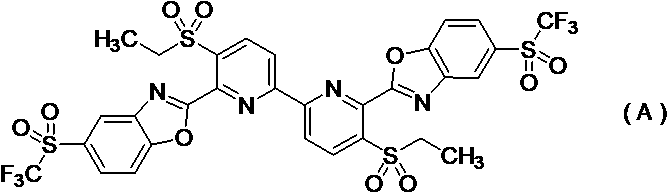
〔2〕 〔1〕に記載の化合物と、不活性担体とを含有する組成物。
〔3〕 〔1〕に記載の化合物の有効量を植物又は土壌に処理することによる、植物病害の防除方法。
本発明の組成物は、化合物Aを通常0.0001~95重量%含有する。
Aspergillus属、Penicillium属、Fusarium属、Gibberella属、Tricoderma属、Thielaviopsis属、Rhizopus属、Mucor属、Corticium属、Phoma属、Rhizoctonia属、及びDiplodia属菌等によって引き起こされる、各種作物の種子病害又は生育初期の病害。Polymixa属又はOlpidium属等によって媒介される各種作物のウイルス病。
イネの苗立枯細菌病(Burkholderia plantarii);キュウリの斑点細菌病(Pseudomonas syringae pv. lachrymans);ナスの青枯病(Ralstonia solanacearum)、カンキツのかいよう病(Xanthomonas citiri);ハクサイの軟腐病(Erwinia carotovora)等。
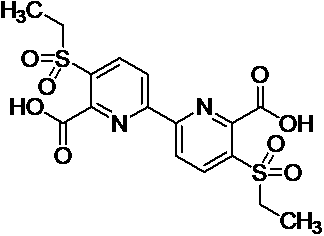
窒素雰囲気下で、100mLオートクレーブに米国特許第9850209号明細書に記載の方法で製造した6-クロロ-3-(エタンスルホニル)ピリジン-2-カルボン酸8.58g、メタノール25.3g、炭酸水素カリウム6.98g、及び5%Pd/炭素0.22gを加え、密閉した後、水素雰囲気下で45時間反応させた。得られた混合物をろ過し、ろ物をメタノール及び水で順次洗浄した。得られた水洗浄液に35%塩酸を加えて中和した。得られた固体をろ過し、水で洗浄し、乾燥して、下式で示される中間体Aを0.32g得た。
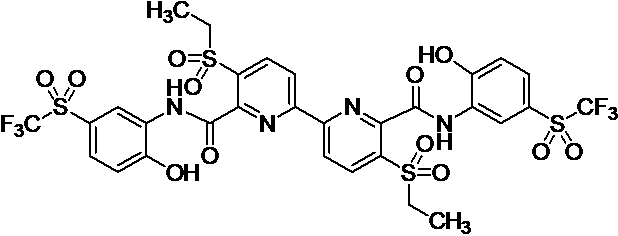
塩化チオニル1.39g、キシレン49.72g、及びN,N-ジメチルホルムアミド0.04gの混合物に、60℃で3.79gの中間体A及びキシレン5.52gの混合物を加え、60℃で5.5時間撹拌した。得られた混合物に塩化チオニル2.84gを加え、60℃で7時間撹拌した。得られた混合物を室温にした後、減圧下で濃縮した。得られた残さを、米国特許第8426443号明細書に記載の方法で製造した2-アミノ-4-(トリフルオロメタンスルホニル)フェノール4.20g及びテトラヒドロフラン12.54gの混合物に加え、次にテトラヒドロフラン35.10g及びキシレン34.11gを順次加え、60℃で2時間撹拌した。得られた混合物に水24.94g、テトラヒドロフラン19.36g、及び27%水酸化ナトリウム水溶液1.88gの混合物を60℃で加えて、pHを5.3に調整した。得られた混合物を5℃に冷却し、得られた結晶をろ過した。ろ物を水、キシレン、及び50%キシレン/テトラヒドロフラン溶液で順次洗浄し、乾燥して、下式で示される中間体Bを6.35g得た。
3.08gの中間体B、キシレン335g、及びp-トルエンスルホン酸一水和物33.71gの混合物を、還流下で、ディーンスターク装置を用いて生成した水を系外に除去しながら69時間撹拌した。得られた混合物を100℃に冷却した後、室温の20%炭酸カリウム水溶液92.5gに加え、80℃で撹拌した。析出した固体をろ過し、ろ物を水及びキシレンで順次洗浄し、乾燥した。得られた固体を室温でN,N-ジメチルホルムアミド1000gに溶解させた後、水100gを滴下した。得られた固体をろ過し、ろ物をN,N-ジメチルホルムアミド及び水で順次洗浄し、乾燥して、化合物Aを0.83g得た。
化合物Aの1H-NMRデータを以下に示す。
1H-NMR (N,N-ジメチルホルムアミド-d7) δ(ppm): 9.11 (2H, d), 8.95 (2H, d), 8.93 (2H, d), 8.55 (2H, d), 8.46 (2H, dd), 4.04 (4H, q), 1.40 (6H, m).
プラスチックポットに土壌を詰め、そこにトマト(品種:パティオ)を播種し、温室内で19日間栽培した。ポリオキシエチレンアルキルエーテルサルフェートアンモニウム塩と湿式シリカとの混合物(重量比1:1)35重量部、化合物A20重量部、及び水45重量部を十分に混合した。得られた混合物を水で希釈して、化合物Aを125ppm含有する希釈液を調製した。この希釈液を、上記トマトの葉面に充分付着するように散布した。散布後トマトを風乾し、1日後にトマト輪紋病菌(チトクロームbの129番目のアミノ酸残基がフェニルアラニンからロイシンに置換したAlternaria solani)胞子を含む水懸濁液を噴霧接種した。その後、トマトを15℃多湿下に6日間置き、病斑面積を調査した。その結果、化合物Aを処理したトマトにおける病斑面積は、無処理のトマトにおける病斑面積の0%であった。なお、無処理とは、上記希釈液を散布しなかったことを意味する。
Claims (3)
- 式(A)

- 請求項1に記載の化合物と、不活性担体とを含有する組成物。
- 請求項1に記載の化合物の有効量を植物又は土壌に処理することによる、植物病害の防除方法。
Priority Applications (3)
| Application Number | Priority Date | Filing Date | Title |
|---|---|---|---|
| CN201980059511.1A CN112673006B (zh) | 2018-09-13 | 2019-09-12 | 联吡啶化合物及其用途 |
| KR1020217007046A KR102693595B1 (ko) | 2018-09-13 | 2019-09-12 | 비피리딘 화합물 및 그 용도 |
| JP2020546065A JP7368368B2 (ja) | 2018-09-13 | 2019-09-12 | ビピリジン化合物及びその用途 |
Applications Claiming Priority (2)
| Application Number | Priority Date | Filing Date | Title |
|---|---|---|---|
| JP2018-171185 | 2018-09-13 | ||
| JP2018171185 | 2018-09-13 |
Publications (1)
| Publication Number | Publication Date |
|---|---|
| WO2020054790A1 true WO2020054790A1 (ja) | 2020-03-19 |
Family
ID=69776835
Family Applications (1)
| Application Number | Title | Priority Date | Filing Date |
|---|---|---|---|
| PCT/JP2019/035800 Ceased WO2020054790A1 (ja) | 2018-09-13 | 2019-09-12 | ビピリジン化合物及びその用途 |
Country Status (5)
| Country | Link |
|---|---|
| JP (1) | JP7368368B2 (ja) |
| KR (1) | KR102693595B1 (ja) |
| CN (1) | CN112673006B (ja) |
| TW (1) | TWI827660B (ja) |
| WO (1) | WO2020054790A1 (ja) |
Cited By (1)
| Publication number | Priority date | Publication date | Assignee | Title |
|---|---|---|---|---|
| WO2024189139A1 (en) | 2023-03-14 | 2024-09-19 | Syngenta Crop Protection Ag | Control of pests resistant to insecticides |
Citations (3)
| Publication number | Priority date | Publication date | Assignee | Title |
|---|---|---|---|---|
| JP2016102104A (ja) * | 2015-09-08 | 2016-06-02 | 住友化学株式会社 | 有害生物防除組成物およびその用途 |
| WO2016125622A1 (ja) * | 2015-02-03 | 2016-08-11 | 住友化学株式会社 | ベンゾオキサゾール化合物及びその有害節足動物防除用途 |
| JP2019048845A (ja) * | 2018-11-07 | 2019-03-28 | 住友化学株式会社 | 複素環化合物を含有する組成物 |
Family Cites Families (8)
| Publication number | Priority date | Publication date | Assignee | Title |
|---|---|---|---|---|
| DE3413565A1 (de) * | 1984-04-11 | 1985-10-24 | Bayer Ag, 5090 Leverkusen | Substituierte sulfonylharnstoffe |
| FI933374A7 (fi) * | 1993-07-28 | 1995-01-29 | Kemira Oy | Rikkakasvinhävitekoostumus, tehostinaine rikkakasvinhävitteen tehon parantamiseksi ja menetelmä viljelykasvien käsittelemiseksi |
| TW200715961A (en) * | 2005-10-28 | 2007-05-01 | Sinon Corp | Herbicide composition |
| JP5380278B2 (ja) * | 2007-03-16 | 2014-01-08 | クミアイ化学工業株式会社 | 除草剤組成物 |
| JP2014156402A (ja) * | 2011-05-27 | 2014-08-28 | Nippon Soda Co Ltd | ビピリジン化合物および殺菌剤 |
| CN102584871A (zh) * | 2012-01-09 | 2012-07-18 | 内蒙古大学 | 一种含席夫碱与联吡啶的稀土配合物及其制备方法与抑菌应用 |
| TW201643154A (zh) * | 2015-01-30 | 2016-12-16 | 住友化學股份有限公司 | 聯吡啶化合物及其有害節肢動物防除用途 |
| TWI800674B (zh) * | 2018-08-20 | 2023-05-01 | 日商住友化學股份有限公司 | 唑化合物及其用途 |
-
2019
- 2019-09-04 TW TW108131889A patent/TWI827660B/zh active
- 2019-09-12 JP JP2020546065A patent/JP7368368B2/ja active Active
- 2019-09-12 KR KR1020217007046A patent/KR102693595B1/ko active Active
- 2019-09-12 CN CN201980059511.1A patent/CN112673006B/zh active Active
- 2019-09-12 WO PCT/JP2019/035800 patent/WO2020054790A1/ja not_active Ceased
Patent Citations (3)
| Publication number | Priority date | Publication date | Assignee | Title |
|---|---|---|---|---|
| WO2016125622A1 (ja) * | 2015-02-03 | 2016-08-11 | 住友化学株式会社 | ベンゾオキサゾール化合物及びその有害節足動物防除用途 |
| JP2016102104A (ja) * | 2015-09-08 | 2016-06-02 | 住友化学株式会社 | 有害生物防除組成物およびその用途 |
| JP2019048845A (ja) * | 2018-11-07 | 2019-03-28 | 住友化学株式会社 | 複素環化合物を含有する組成物 |
Cited By (1)
| Publication number | Priority date | Publication date | Assignee | Title |
|---|---|---|---|---|
| WO2024189139A1 (en) | 2023-03-14 | 2024-09-19 | Syngenta Crop Protection Ag | Control of pests resistant to insecticides |
Also Published As
| Publication number | Publication date |
|---|---|
| TWI827660B (zh) | 2024-01-01 |
| JP7368368B2 (ja) | 2023-10-24 |
| KR20210060459A (ko) | 2021-05-26 |
| CN112673006B (zh) | 2024-05-03 |
| JPWO2020054790A1 (ja) | 2021-08-30 |
| KR102693595B1 (ko) | 2024-08-08 |
| CN112673006A (zh) | 2021-04-16 |
| TW202019919A (zh) | 2020-06-01 |
Similar Documents
| Publication | Publication Date | Title |
|---|---|---|
| JP6628000B1 (ja) | エステル化合物及びその用途 | |
| JP6875406B2 (ja) | 3−ピリジルオキシフェニルジヒドロウラシル化合物及びその用途 | |
| JP6898332B2 (ja) | 1−フェニル−3−カルバモイル尿素化合物及びその用途 | |
| JP7254084B2 (ja) | ベンゾオキサゾール化合物及びその用途 | |
| JP6558488B1 (ja) | エステル化合物及びその用途 | |
| JP7368368B2 (ja) | ビピリジン化合物及びその用途 | |
| JP7250023B2 (ja) | ベンゾオキサゾール化合物及びその用途 | |
| JP6876058B2 (ja) | フェニルウレア化合物及びその用途 | |
| KR102641051B1 (ko) | 아미드 화합물 및 그 용도 | |
| CN112334459B (zh) | 尿嘧啶化合物及其用途 |
Legal Events
| Date | Code | Title | Description |
|---|---|---|---|
| 121 | Ep: the epo has been informed by wipo that ep was designated in this application |
Ref document number: 19860118 Country of ref document: EP Kind code of ref document: A1 |
|
| ENP | Entry into the national phase |
Ref document number: 2020546065 Country of ref document: JP Kind code of ref document: A |
|
| WWE | Wipo information: entry into national phase |
Ref document number: 2101001390 Country of ref document: TH |
|
| NENP | Non-entry into the national phase |
Ref country code: DE |
|
| 122 | Ep: pct application non-entry in european phase |
Ref document number: 19860118 Country of ref document: EP Kind code of ref document: A1 |