WO2020050322A1 - 化合物、混合物、液晶組成物、硬化物、光学異方体、反射膜 - Google Patents
化合物、混合物、液晶組成物、硬化物、光学異方体、反射膜 Download PDFInfo
- Publication number
- WO2020050322A1 WO2020050322A1 PCT/JP2019/034809 JP2019034809W WO2020050322A1 WO 2020050322 A1 WO2020050322 A1 WO 2020050322A1 JP 2019034809 W JP2019034809 W JP 2019034809W WO 2020050322 A1 WO2020050322 A1 WO 2020050322A1
- Authority
- WO
- WIPO (PCT)
- Prior art keywords
- group
- general formula
- represented
- compound
- monovalent substituent
- Prior art date
- Legal status (The legal status is an assumption and is not a legal conclusion. Google has not performed a legal analysis and makes no representation as to the accuracy of the status listed.)
- Ceased
Links
Classifications
-
- C—CHEMISTRY; METALLURGY
- C09—DYES; PAINTS; POLISHES; NATURAL RESINS; ADHESIVES; COMPOSITIONS NOT OTHERWISE PROVIDED FOR; APPLICATIONS OF MATERIALS NOT OTHERWISE PROVIDED FOR
- C09K—MATERIALS FOR MISCELLANEOUS APPLICATIONS, NOT PROVIDED FOR ELSEWHERE
- C09K19/00—Liquid crystal materials
- C09K19/52—Liquid crystal materials characterised by components which are not liquid crystals, e.g. additives with special physical aspect: solvents, solid particles
- C09K19/58—Dopants or charge transfer agents
- C09K19/586—Optically active dopants; chiral dopants
-
- C—CHEMISTRY; METALLURGY
- C09—DYES; PAINTS; POLISHES; NATURAL RESINS; ADHESIVES; COMPOSITIONS NOT OTHERWISE PROVIDED FOR; APPLICATIONS OF MATERIALS NOT OTHERWISE PROVIDED FOR
- C09K—MATERIALS FOR MISCELLANEOUS APPLICATIONS, NOT PROVIDED FOR ELSEWHERE
- C09K19/00—Liquid crystal materials
- C09K19/52—Liquid crystal materials characterised by components which are not liquid crystals, e.g. additives with special physical aspect: solvents, solid particles
- C09K19/58—Dopants or charge transfer agents
- C09K19/586—Optically active dopants; chiral dopants
- C09K19/588—Heterocyclic compounds
-
- C—CHEMISTRY; METALLURGY
- C07—ORGANIC CHEMISTRY
- C07D—HETEROCYCLIC COMPOUNDS
- C07D321/00—Heterocyclic compounds containing rings having two oxygen atoms as the only ring hetero atoms, not provided for by groups C07D317/00 - C07D319/00
- C07D321/02—Seven-membered rings
- C07D321/10—Seven-membered rings condensed with carbocyclic rings or ring systems
-
- C—CHEMISTRY; METALLURGY
- C07—ORGANIC CHEMISTRY
- C07C—ACYCLIC OR CARBOCYCLIC COMPOUNDS
- C07C69/00—Esters of carboxylic acids; Esters of carbonic or haloformic acids
- C07C69/76—Esters of carboxylic acids having a carboxyl group bound to a carbon atom of a six-membered aromatic ring
- C07C69/84—Esters of carboxylic acids having a carboxyl group bound to a carbon atom of a six-membered aromatic ring of monocyclic hydroxy carboxylic acids, the hydroxy groups and the carboxyl groups of which are bound to carbon atoms of a six-membered aromatic ring
- C07C69/92—Esters of carboxylic acids having a carboxyl group bound to a carbon atom of a six-membered aromatic ring of monocyclic hydroxy carboxylic acids, the hydroxy groups and the carboxyl groups of which are bound to carbon atoms of a six-membered aromatic ring with etherified hydroxyl groups
-
- C—CHEMISTRY; METALLURGY
- C07—ORGANIC CHEMISTRY
- C07D—HETEROCYCLIC COMPOUNDS
- C07D321/00—Heterocyclic compounds containing rings having two oxygen atoms as the only ring hetero atoms, not provided for by groups C07D317/00 - C07D319/00
-
- C—CHEMISTRY; METALLURGY
- C07—ORGANIC CHEMISTRY
- C07F—ACYCLIC, CARBOCYCLIC OR HETEROCYCLIC COMPOUNDS CONTAINING ELEMENTS OTHER THAN CARBON, HYDROGEN, HALOGEN, OXYGEN, NITROGEN, SULFUR, SELENIUM OR TELLURIUM
- C07F5/00—Compounds containing elements of Groups 3 or 13 of the Periodic Table
- C07F5/02—Boron compounds
- C07F5/025—Boronic and borinic acid compounds
-
- C—CHEMISTRY; METALLURGY
- C07—ORGANIC CHEMISTRY
- C07F—ACYCLIC, CARBOCYCLIC OR HETEROCYCLIC COMPOUNDS CONTAINING ELEMENTS OTHER THAN CARBON, HYDROGEN, HALOGEN, OXYGEN, NITROGEN, SULFUR, SELENIUM OR TELLURIUM
- C07F7/00—Compounds containing elements of Groups 4 or 14 of the Periodic Table
- C07F7/02—Silicon compounds
- C07F7/08—Compounds having one or more C—Si linkages
- C07F7/0803—Compounds with Si-C or Si-Si linkages
- C07F7/081—Compounds with Si-C or Si-Si linkages comprising at least one atom selected from the elements N, O, halogen, S, Se or Te
- C07F7/0812—Compounds with Si-C or Si-Si linkages comprising at least one atom selected from the elements N, O, halogen, S, Se or Te comprising a heterocyclic ring
-
- C—CHEMISTRY; METALLURGY
- C07—ORGANIC CHEMISTRY
- C07F—ACYCLIC, CARBOCYCLIC OR HETEROCYCLIC COMPOUNDS CONTAINING ELEMENTS OTHER THAN CARBON, HYDROGEN, HALOGEN, OXYGEN, NITROGEN, SULFUR, SELENIUM OR TELLURIUM
- C07F7/00—Compounds containing elements of Groups 4 or 14 of the Periodic Table
- C07F7/02—Silicon compounds
- C07F7/08—Compounds having one or more C—Si linkages
- C07F7/0803—Compounds with Si-C or Si-Si linkages
- C07F7/081—Compounds with Si-C or Si-Si linkages comprising at least one atom selected from the elements N, O, halogen, S, Se or Te
- C07F7/0812—Compounds with Si-C or Si-Si linkages comprising at least one atom selected from the elements N, O, halogen, S, Se or Te comprising a heterocyclic ring
- C07F7/0814—Compounds with Si-C or Si-Si linkages comprising at least one atom selected from the elements N, O, halogen, S, Se or Te comprising a heterocyclic ring said ring is substituted at a C ring atom by Si
-
- C—CHEMISTRY; METALLURGY
- C08—ORGANIC MACROMOLECULAR COMPOUNDS; THEIR PREPARATION OR CHEMICAL WORKING-UP; COMPOSITIONS BASED THEREON
- C08F—MACROMOLECULAR COMPOUNDS OBTAINED BY REACTIONS ONLY INVOLVING CARBON-TO-CARBON UNSATURATED BONDS
- C08F20/00—Homopolymers and copolymers of compounds having one or more unsaturated aliphatic radicals, each having only one carbon-to-carbon double bond, and only one being terminated by only one carboxyl radical or a salt, anhydride, ester, amide, imide or nitrile thereof
- C08F20/02—Monocarboxylic acids having less than ten carbon atoms, Derivatives thereof
- C08F20/10—Esters
- C08F20/26—Esters containing oxygen in addition to the carboxy oxygen
- C08F20/30—Esters containing oxygen in addition to the carboxy oxygen containing aromatic rings in the alcohol moiety
-
- C—CHEMISTRY; METALLURGY
- C09—DYES; PAINTS; POLISHES; NATURAL RESINS; ADHESIVES; COMPOSITIONS NOT OTHERWISE PROVIDED FOR; APPLICATIONS OF MATERIALS NOT OTHERWISE PROVIDED FOR
- C09K—MATERIALS FOR MISCELLANEOUS APPLICATIONS, NOT PROVIDED FOR ELSEWHERE
- C09K19/00—Liquid crystal materials
- C09K19/04—Liquid crystal materials characterised by the chemical structure of the liquid crystal components, e.g. by a specific unit
- C09K19/06—Non-steroidal liquid crystal compounds
- C09K19/08—Non-steroidal liquid crystal compounds containing at least two non-condensed rings
- C09K19/10—Non-steroidal liquid crystal compounds containing at least two non-condensed rings containing at least two benzene rings
-
- C—CHEMISTRY; METALLURGY
- C09—DYES; PAINTS; POLISHES; NATURAL RESINS; ADHESIVES; COMPOSITIONS NOT OTHERWISE PROVIDED FOR; APPLICATIONS OF MATERIALS NOT OTHERWISE PROVIDED FOR
- C09K—MATERIALS FOR MISCELLANEOUS APPLICATIONS, NOT PROVIDED FOR ELSEWHERE
- C09K19/00—Liquid crystal materials
- C09K19/04—Liquid crystal materials characterised by the chemical structure of the liquid crystal components, e.g. by a specific unit
- C09K19/38—Polymers
- C09K19/3833—Polymers with mesogenic groups in the side chain
- C09K19/3842—Polyvinyl derivatives
- C09K19/3852—Poly(meth)acrylate derivatives
-
- G—PHYSICS
- G02—OPTICS
- G02B—OPTICAL ELEMENTS, SYSTEMS OR APPARATUS
- G02B1/00—Optical elements characterised by the material of which they are made; Optical coatings for optical elements
- G02B1/08—Optical elements characterised by the material of which they are made; Optical coatings for optical elements made of polarising materials
-
- G—PHYSICS
- G02—OPTICS
- G02B—OPTICAL ELEMENTS, SYSTEMS OR APPARATUS
- G02B5/00—Optical elements other than lenses
- G02B5/30—Polarising elements
- G02B5/3016—Polarising elements involving passive liquid crystal elements
-
- C—CHEMISTRY; METALLURGY
- C09—DYES; PAINTS; POLISHES; NATURAL RESINS; ADHESIVES; COMPOSITIONS NOT OTHERWISE PROVIDED FOR; APPLICATIONS OF MATERIALS NOT OTHERWISE PROVIDED FOR
- C09K—MATERIALS FOR MISCELLANEOUS APPLICATIONS, NOT PROVIDED FOR ELSEWHERE
- C09K19/00—Liquid crystal materials
- C09K19/04—Liquid crystal materials characterised by the chemical structure of the liquid crystal components, e.g. by a specific unit
- C09K2019/0444—Liquid crystal materials characterised by the chemical structure of the liquid crystal components, e.g. by a specific unit characterized by a linking chain between rings or ring systems, a bridging chain between extensive mesogenic moieties or an end chain group
- C09K2019/0448—Liquid crystal materials characterised by the chemical structure of the liquid crystal components, e.g. by a specific unit characterized by a linking chain between rings or ring systems, a bridging chain between extensive mesogenic moieties or an end chain group the end chain group being a polymerizable end group, e.g. -Sp-P or acrylate
-
- C—CHEMISTRY; METALLURGY
- C09—DYES; PAINTS; POLISHES; NATURAL RESINS; ADHESIVES; COMPOSITIONS NOT OTHERWISE PROVIDED FOR; APPLICATIONS OF MATERIALS NOT OTHERWISE PROVIDED FOR
- C09K—MATERIALS FOR MISCELLANEOUS APPLICATIONS, NOT PROVIDED FOR ELSEWHERE
- C09K19/00—Liquid crystal materials
- C09K19/52—Liquid crystal materials characterised by components which are not liquid crystals, e.g. additives with special physical aspect: solvents, solid particles
- C09K2019/528—Surfactants
-
- G—PHYSICS
- G02—OPTICS
- G02B—OPTICAL ELEMENTS, SYSTEMS OR APPARATUS
- G02B5/00—Optical elements other than lenses
- G02B5/20—Filters
- G02B5/26—Reflecting filters
Definitions
- the present invention relates to a compound, a mixture, a liquid crystal composition, a cured product, an optically anisotropic material, and a reflective film.
- a compound exhibiting liquid crystallinity can be applied to various uses.
- a liquid crystal compound is applied to the production of an optically anisotropic body typified by a retardation film or the production of a reflection film in which a cholesteric liquid crystal phase is fixed.
- a cholesteric liquid crystal phase is formed by adding a chiral compound to a nematic liquid crystal.
- a binaphthyl derivative is often used as a chiral compound having a strong helical twisting power (HTP).
- Patent Document 1 discloses a binaphthol derivative containing a stilbene structure in the molecule as an intermediate of the binaphthyl derivative. In the synthesis method described in the Examples section of Patent Document 1, a binaphthol derivative containing only a trans stilbene structure as a stilbene structure is selectively synthesized.
- an object of the present invention is to provide a compound that increases the intensity of HTP by exposure to light irradiation such as ultraviolet light, and a mixture containing the compound.
- Another object of the present invention is to provide a liquid crystal composition, a cured product, an optically anisotropic body, and a reflective film.
- [1] A compound represented by the following general formula (1).
- [2] The compound according to [1], wherein L 1 represents a single bond.
- [3] at least one selected from the group consisting of R 1 , R 3 , and R 5 represents a monovalent substituent represented by the general formula (2), and R 2 ,
- [4] The compound according to any one of [1] to [3], wherein R 1 and R 2 are bonded to each other to form a ring structure.
- L 1 represents a divalent linking group represented by the general formula (3)
- R i represents a * -L S1 -aromatic hydrocarbon ring group
- R 2 is mutually bonded to represent * -L S2 -bivalent aromatic hydrocarbon ring group -L S2- *.
- L S1 and L S2 each independently represent a single bond or a divalent linking group, and * indicates a bonding position.
- R 7 and R 8 represent a hydrogen atom.
- strength of HTP by exposure by light irradiation of ultraviolet rays etc., and the mixture containing the said compound can be provided.
- a liquid crystal composition, a cured product, an optically anisotropic body, and a reflective film can be provided.
- a numerical range represented by using “to” means a range including numerical values described before and after “to” as a lower limit and an upper limit.
- (meth) acryloyl means acryloyl or methacryloyl.
- R 1 to R 6 is a monovalent compound represented by the following general formula (2).
- the specific compound contains a monovalent substituent represented by the following general formula (2), so that a cis-stilbene derivative structure is introduced into the molecule.
- the monovalent substituent represented by the following general formula (2) is photoisomerized into a trans stilbene derivative structure when irradiated with energy such as ultraviolet rays, and as a result, the strength of HTP of the specific compound increases.
- binaphthyl skeleton means a structural site other than R 1 to R 6 in the general formula (1) described below (the structural site shown below). That is, it corresponds to a general term for structural parts other than R 1 to R 6 in the general formulas (1-1) and (1-2) described later.
- R 1 to R 6 each independently represent a hydrogen atom or a monovalent substituent. However, at least one of R 1 to R 6 represents a monovalent substituent represented by the following general formula (2).
- Examples of the monovalent substituent represented by R 1 to R 6 include an alkyl group, an alkoxy group, an aryl group, an arylcarbonyloxy group, an aryloxycarbonyl group, an arylamide group, an alkoxycarbonyl group, an alkylcarbonyloxy group And a monovalent substituent such as a cinnamoyloxy group; a monovalent substituent represented by the following general formula (2); and a monovalent substituent represented by the following general formula (4).
- the alkyl group represented by R 1 to R 6 and the alkyl group in the alkylcarbonyloxy group may be linear, branched, or cyclic, and may have, for example, 1 to 10 carbon atoms. (Preferably, an alkyl group having 1 to 6 carbon atoms).
- the alkoxy group represented by the above R 1 to R 6 and the alkoxy group in the alkoxycarbonyl group may be any of linear, branched and cyclic, for example, having 1 to 10 carbon atoms.
- an alkoxy group having 1 to 6 carbon atoms is used.
- the aryl group represented by R 1 to R 6 and the aryl group in the arylcarbonyloxy group, the aryloxycarbonyl group, and the arylamide group include, for example, an aryl group having 6 to 18 carbon atoms (eg, phenyl Group).
- the above-mentioned monovalent substituents such as an alkyl group, an alkoxy group, an aryl group, an arylcarbonyloxy group, an aryloxycarbonyl group, an arylamide group, an alkoxycarbonyl group, an alkylcarbonyloxy group, and a cinnamoyloxy group further have a substituent May be provided.
- the substituent is not particularly limited, and examples thereof include an alkoxy group having 1 to 10 carbon atoms, a phenoxy group, and groups containing the following polymerizable groups.
- Examples of the polymerizable group in the group containing the polymerizable group include known polymerizable groups, and from the viewpoint of reactivity, a functional group capable of performing an addition polymerization reaction is preferable, and a polymerizable ethylenically unsaturated group or a ring polymerizable group is preferable. Sex groups are more preferred.
- Examples of the polymerizable group include (meth) acryloyloxy group, (meth) acryloylamino group, vinyl group, maleimide group, acetyl group, styryl group, allyl group, epoxy group, oxetane group, and these groups. And the like.
- the hydrogen atom in each of the above groups may be substituted with another substituent such as a halogen atom.
- Preferred specific examples of the polymerizable group include groups represented by the following formulas (P-1) to (P-21). * In the following formulas represents a bonding position. Ra represents a hydrogen atom or a methyl group. Me represents a methyl group and Et represents an ethyl group.
- the group containing the polymerizable group is not particularly limited as long as it has the above-described polymerizable group, and examples thereof include a group represented by the following general formula (PA). * -L A -P (PA)
- L A represents a single bond or a divalent linking group.
- P represents a group represented by the aforementioned general formulas (P-1) to (P-21). * Represents a bonding position.
- Examples of the divalent linking group represented by L A include a linear or branched alkylene group having 1 to 10 carbon atoms, or a linear or branched alkylene group having 1 to 10 carbon atoms.
- One or more —CH 2 — in the alkylene group is selected from the group consisting of —O—, —S—, —NH—, —N (CH 3 ) —, —CO—, —OCO—, and —COO—
- a divalent linking group substituted with one or more kinds of groups described above is preferable.
- As the group represented by the general formula (PA), a group represented by “* —O— (CH 2 ) k —P (k represents an integer of 1 to 10)” is preferable.
- the substituted arylcarbonyloxy group or the substituted aryl examples include a group represented by the following general formula (T1).
- L 11 represents —O—CO—, —CO—O—, —N (R b ) —CO—, or —CO—N (R b ) —.
- R b represents a hydrogen atom or an alkyl group having 1 to 10 carbon atoms.
- L A and P are each synonymous with L A and P in the above general formula (PA), preferred embodiments are also the same.
- R 11 represents a monovalent substituent.
- the monovalent substituent represented by R 11 includes, for example, an alkoxy group having 1 to 3 carbon atoms.
- S11 and S12 each independently represent an integer of 0 to 5. However, 1 ⁇ S11 + S12 ⁇ 5.
- R 1 to R 6 an alkoxy group, an arylcarbonyloxy group, an aryloxycarbonyl group, an arylamide group, or a monovalent substituent represented by the aforementioned general formula (2) is preferable. Valent substituents are preferred. Further, as described later, R 1 and R 2 may be bonded to each other to form a ring structure.
- the specific compound contains a monovalent substituent represented by the general formula (2), so that a cis stilbene derivative structure is introduced into the molecule.
- Ar 1 represents an (n + 1) -valent aromatic hydrocarbon ring group.
- the aromatic hydrocarbon ring constituting the above aromatic hydrocarbon ring group is not particularly limited, and examples thereof include an aromatic hydrocarbon ring having 6 to 20 carbon atoms, and an aromatic hydrocarbon ring having 6 to 10 carbon atoms.
- a benzene ring is particularly preferable (that is, Ar 1 is preferably a benzene ring group).
- C A represents a carbon atom.
- R 7 and R 8 each independently represent a hydrogen atom, a cyano group, a substituted boryl group, a substituted silyl group, a substituted aluminum group, a halogen atom, an alkoxycarbonyl group, an alkylcarbonyl group, or a monovalent monovalent having 1 to 10 carbon atoms. Represents an aliphatic hydrocarbon group.
- Examples of the substituted boryl group represented by R 7 and R 8 include * -BR X1 R X2 (R X1 and R X2 each independently represent a hydrogen atom or a monovalent substituent. At least one of X 1 and R X2 represents a monovalent substituent, and R X1 and R X2 may be bonded to each other to form a ring structure.
- the monovalent substituent represented by R X1 and R X2 is not particularly limited, but may be, for example, an alkyl group having 1 to 10 carbon atoms (which may be any of linear, branched and cyclic). ) A phenyl group or an alkoxy group having 1 to 10 carbon atoms.
- the substituted silyl group represented by R 7 and R 8 is, for example, represented by * -SiR X3 R X4 R X5 (R X3 to R X5 each independently represent a monovalent substituent). Groups.
- the monovalent substituent represented by R X3 to R X5 is not particularly limited, but may be, for example, an alkyl group having 1 to 10 carbon atoms (which may be any of linear, branched and cyclic). ) And a phenyl group.
- AlR X5 R X6 (R X5 and R X6 each independently represent a hydrogen atom or a monovalent substituent provided that, R X5 and At least one of R X6 represents a monovalent substituent, and R X5 and R X6 may be bonded to each other to form a ring structure.
- the monovalent substituent represented by R X5 and R X6 is not particularly limited, but may be, for example, an alkyl group having 1 to 10 carbon atoms (a linear, branched, or cyclic alkyl group may be used). ) And a phenyl group.
- Examples of the halogen atom represented by R 7 and R 8 include a fluorine atom, a chlorine atom, a bromine atom, and an iodine atom.
- the alkyl group in the alkoxycarbonyl group represented by R 7 and R 8 may be any of linear, branched, and cyclic, and has, for example, 1 to 10 carbon atoms (preferably And alkyl groups 1 to 6).
- the alkoxycarbonyl group may further have a substituent.
- the alkyl group in the alkylcarbonyl group represented by R 7 and R 8 may be linear, branched or cyclic, and has, for example, 1 to 10 carbon atoms (preferably 1 to 10 carbon atoms). And alkyl groups 1 to 6).
- the alkylcarbonyl group may further have a substituent.
- the monovalent aliphatic hydrocarbon group having 1 to 10 carbon atoms represented by R 7 and R 8 may be any of linear, branched, and cyclic.
- the monovalent aliphatic hydrocarbon group having 1 to 10 carbon atoms includes an alkyl group having 1 to 10 carbon atoms (preferably having 1 to 6 carbon atoms, more preferably having 1 to 4 carbon atoms), and having 2 to 10 carbon atoms. (Preferably 2 to 6 carbon atoms, more preferably 2 to 4 carbon atoms) alkenyl group and 2 to 10 (preferably 2 to 6 carbon atoms, more preferably 2 to 4 carbon atoms) alkynyl group No. Further, the monovalent aliphatic hydrocarbon group having 1 to 10 carbon atoms may further have a substituent.
- a hydrogen atom is particularly preferred.
- R i represents a monovalent substituent.
- the monovalent substituent represented by R i is not particularly limited, and examples thereof include an alkyl group, an alkoxy group, an aryl group, an arylcarbonyloxy group, an aryloxycarbonyl group, an arylamide group, an alkoxycarbonyl group, and an alkylcarbonyloxy group.
- a monovalent substituent such as a cinnamoyloxy group.
- the alkyl group, the alkoxy group, the aryl group, the arylcarbonyloxy group, the aryloxycarbonyl group, the arylamide group, the alkoxycarbonyl group, and the alkylcarbonyloxy group represented by R i are each represented by the general formula (1) described above. Preferred examples are the same as the alkyl group, alkoxy group, aryl group, arylcarbonyloxy group, aryloxycarbonyl group, arylamide group, alkoxycarbonyl group, and alkylcarbonyloxy group represented by R 1 to R 6 in the above. Is the same.
- an alkoxy group an arylcarbonyloxy group, an aryloxycarbonyl group, an arylamide group, or an alkoxycarbonyl group is preferable.
- n 2 or more, a plurality of R i may be the same or different.
- n represents an integer of 0 to 5.
- the number of n is not particularly limited, but is preferably an integer of 0 to 3, and more preferably an integer of 1 to 3.
- L 1 represents a single bond or a divalent linking group represented by the following general formula (3). * Represents a bonding position to the binaphthyl skeleton in the general formula (1).
- the carbon atom represented by C A represents a bonding site with the binaphthyl skeleton in the general formula (1).
- L 1 is preferably a single bond in view of a larger increase rate of HTP.
- L 2 represents a single bond or a divalent linking group.
- R A represents a hydrogen atom or an alkyl group (preferably having 1 to 10 carbon atoms).
- the hydrogen atom in the divalent linking group may be substituted with another substituent such as a halogen atom.
- the divalent linking group represented by L 2 -O-, -CO-, -COO-, or -OCO- is preferable, and -COO- or -OCO- is more preferable.
- Ar 2 represents a divalent aromatic hydrocarbon ring group.
- the aromatic hydrocarbon ring constituting the above aromatic hydrocarbon ring group is not particularly limited, and examples thereof include an aromatic hydrocarbon ring having 6 to 20 carbon atoms, and an aromatic hydrocarbon ring having 6 to 10 carbon atoms. Are preferred, and among them, a benzene ring is more preferred.
- * represents a bonding position with the binaphthyl skeleton in the general formula (1).
- ** represents a bonding site to the carbon atom represented by C A in the general formula (2).
- a trans stilbene derivative structure can be introduced into the molecule.
- L 3 in the monovalent substituent represented by the general formula (4) represents a single bond, the olefin double bond site (C B CC )), Ar 3 specified in the general formula (4) and a benzene ring contained in the binaphthyl skeleton in the general formula (1) (benzene to which a monovalent substituent represented by the general formula (4) is bonded) Is intended to be a trans-configuration, and a trans-stilbene derivative structure is formed.
- Ar 3 represents an m + 1-valent aromatic hydrocarbon ring group.
- the aromatic hydrocarbon ring constituting the above aromatic hydrocarbon ring group is not particularly limited, and examples thereof include an aromatic hydrocarbon ring having 6 to 20 carbon atoms, and an aromatic hydrocarbon ring having 6 to 10 carbon atoms. Are preferred, and among them, a benzene ring is more preferred.
- C B represents a carbon atom.
- R 9 and R 10 each independently represent a hydrogen atom, a cyano group, a substituted boryl group, a substituted silyl group, a substituted aluminum group, a halogen atom, an alkoxycarbonyl group, an alkylcarbonyl group, or a monovalent monovalent having 1 to 10 carbon atoms. Represents an aliphatic hydrocarbon group.
- Examples of the substituted boryl group, substituted silyl group, substituted aluminum group, halogen atom, alkoxycarbonyl group, alkylcarbonyl group, and monovalent aliphatic hydrocarbon group having 1 to 10 carbon atoms represented by R 9 and R 10 include: A substituted boryl group, a substituted silyl group, a substituted aluminum group, a halogen atom, an alkoxycarbonyl group, an alkylcarbonyl group, and a monovalent fat having 1 to 10 carbon atoms represented by R 7 and R 8 in the general formula (2). Examples are the same as the group hydrocarbon groups, and the preferred embodiments are also the same. As R 9 and R 10 , a hydrogen atom is particularly preferred.
- R j represents a monovalent substituent.
- Examples of the monovalent substituent represented by R j include the same as the monovalent substituent represented by R i in formula (2), and the preferred embodiments are also the same.
- a plurality of R j may be the same or different.
- n represents an integer of 0 to 5.
- the number of m is not particularly limited, but is preferably an integer of 0 to 3, and more preferably an integer of 1 to 3.
- L 3 represents a single bond or a divalent linking group represented by the following general formula (5). * Represents a bonding position to the binaphthyl skeleton in the general formula (1).
- the carbon atoms represented by C B is shows the point of attachment to the binaphthyl skeleton of the general formula (1).
- L 3 is preferably a single bond.
- L 4 represents a single bond or a divalent linking group.
- divalent linking group represented by L 4 those similar to the divalent substituent represented by L 2 in formula (3) can be mentioned, and the preferred embodiments thereof are also the same.
- Ar 4 represents a divalent aromatic hydrocarbon ring group.
- the divalent aromatic hydrocarbon ring group represented by Ar 4 those similar to the divalent aromatic hydrocarbon ring group represented by Ar 2 in the general formula (3) can be mentioned.
- the embodiment is also the same.
- * represents a bonding position with the binaphthyl skeleton in the general formula (1).
- ** represents the binding site to the carbon atom represented by C B in the general formula (4).
- the monovalent substituents represented by R 1 to R 6 are other than the monovalent substituents represented by the above general formula (4) in that the rate of increase in HTP is increased.
- the group is
- R 1 to R 6 in the general formula (1) are substituted with a monovalent compound represented by the general formula (2).
- a monovalent compound represented by the general formula (2) It is preferably a group.
- at least one selected from the group consisting of R 1 , R 3 , and R 5 represents a monovalent substituent represented by the general formula (2)
- R 2 , R 4 , and R 6 It is preferable that at least one selected from the group consisting of the following represents a monovalent substituent represented by the general formula (2).
- the specific compound preferably satisfies one or more aspects selected from the following aspect (A), the following aspect (B), and the following aspect (C) in that the HTP after exposure becomes larger.
- L S1 and L S2 each independently represent a single bond or a divalent linking group.
- the divalent linking group represented by L S1 and L S2 has the same meaning as the divalent linking group represented by L 2 in formula (3).
- L S1 and L S2 a single bond, a divalent aliphatic hydrocarbon group (which may be linear, branched or cyclic, preferably has 1 to 20 carbon atoms, for example, an alkylene group , An alkenylene group, and an alkynylene group), —O—, —CO—, —NH—CO—, —CO—NH—, —COO—, or —OCO—.
- the aromatic hydrocarbon ring constituting the monovalent aromatic hydrocarbon ring group shown in the embodiment (B) is not particularly limited, and examples thereof include an aromatic hydrocarbon ring having 6 to 20 carbon atoms. Six to ten aromatic hydrocarbon rings are preferred, with a benzene ring being more preferred.
- the aromatic hydrocarbon ring constituting the divalent aromatic hydrocarbon ring group shown in the embodiment (C) is not particularly limited, and examples thereof include an aromatic hydrocarbon ring having 6 to 20 carbon atoms. Six to ten aromatic hydrocarbon rings are preferred, with a benzene ring being more preferred.
- the specific compound is represented by the general formula (1-2) described below in that the HTP after exposure is larger, and the specific compound is represented by the above-described embodiments (A), (B), and (C).
- the specific compound is represented by the above-described embodiments (A), (B), and (C).
- one or more selected aspects are satisfied.
- three or more aromatic hydrocarbon ring groups are connected via a single bond or a divalent linking group (however, the connection between naphthalene rings in the binaphthyl skeleton is not included) ) Structure, which is presumed to be one of the factors that increase the HTP after exposure.
- the specific compound of the embodiment (A) includes a naphthalene ring contained in a binaphthyl skeleton, Ar 2 specified in the general formula (3), and Ar 1 specified in the general formula (2). Include a structure linked via a single bond or a divalent linking group.
- the specific compound of the embodiment (B) is a compound in which a naphthalene ring contained in a binaphthyl skeleton, Ar 1 specified in the general formula (2), and an aromatic hydrocarbon ring in the above R i are a single bond. Or, it includes a structure linked via a divalent linking group.
- the specific compound of the embodiment (C) is a * -L S2 -bivalent aromatic hydrocarbon ring group formed by bonding two naphthalene rings contained in a binaphthyl skeleton and R 1 and R 2 to each other. Includes a structure in which the aromatic hydrocarbon ring in -L S2- * is linked via a single bond or a divalent linking group.
- R 1 and R 2 be bonded to each other to form a ring structure in that the HTP after exposure is large and the temperature dependency of HTP is small.
- the ring structure is not particularly limited, and may be any of an aromatic ring and a non-aromatic ring, but is preferably a non-aromatic ring, and includes a hetero atom such as a nitrogen atom, an oxygen atom and a sulfur atom. You may go out.
- the number of ring members in the ring structure is not particularly limited, and is, for example, 5 to 12.
- the number of ring members is a number including four carbon atoms specified in the general formula (1).
- a portion where a solid line and a broken line are parallel represents a single bond or a double bond.
- the specific compound corresponds to the compound represented by the following general formula (1-1), and the portion where the solid line and the broken line are parallel is a double bond.
- the specific compound corresponds to a compound represented by the following general formula (1-2).
- the specific compound is preferably a compound represented by the following general formula (1-2), from the viewpoint that the effects of the present invention are more excellent.
- R 1 ⁇ R 6 of the following general formula (1-1) and the following general formula (1-2) in have the same meanings and preferred embodiments Is the same.
- R X1 to R X6 each independently represent a hydrogen atom or a monovalent substituent.
- at least one of R X1 to R X6 represents a monovalent substituent represented by the general formula (2) described above.
- R X1 to R X6 do not have the monovalent substituent represented by the general formula (4) described above.
- Examples of the monovalent substituent represented by R X1 to R X6 include, for example, alkyl group, alkoxy group, aryl group, arylcarbonyloxy group, aryloxycarbonyl group, arylamide group, alkoxycarbonyl group, alkylcarbonyl A monovalent substituent such as an oxy group and a cinnamoyloxy group; a monovalent substituent represented by the general formula (2) described above; and the like.
- the alkyl group, alkoxy group, aryl group, arylcarbonyloxy group, aryloxycarbonyl group, arylamide group, alkoxycarbonyl group, and alkylcarbonyloxy group represented by R X1 to R X6 are each represented by the general formula described above. It has the same meaning as the alkyl group, alkoxy group, aryl group, arylcarbonyloxy group, aryloxycarbonyl group, arylamide group, alkoxycarbonyl group and alkylcarbonyloxy group represented by R 1 to R 6 in (1).
- the preferred embodiment is also the same.
- R X1 to R X6 an alkoxy group, an arylcarbonyloxy group, an aryloxycarbonyl group, an arylamide group, or a monovalent substituent represented by the aforementioned general formula (2) Valent substituents are preferred. Further, as described later, R X1 and R X2 may be bonded to each other to form a ring structure.
- R X1 to R X6 in the general formula (X1) are monovalent substituents represented by the general formula (2).
- at least one selected from the group consisting of R X1 , R X3 and R X5 represents a monovalent substituent represented by the general formula (2)
- R X2 , R X4 and R X6 It is preferable that at least one selected from the group consisting of the following represents a monovalent substituent represented by the general formula (2).
- the compound represented by the general formula (X1) is one or more aspects selected from the following aspects (A), (B), and (C) in that the HTP after exposure becomes larger. It is preferable to satisfy the following.
- L S1 and L S2 each independently represent a single bond or a divalent linking group.
- the divalent linking group represented by L S1 and L S2 has the same meaning as the divalent linking group represented by L 2 in formula (3).
- L S1 and L S2 a single bond, a divalent aliphatic hydrocarbon group (which may be linear, branched or cyclic, preferably has 1 to 20 carbon atoms, for example, an alkylene group , An alkenylene group, and an alkynylene group), —O—, —CO—, —NH—CO—, —CO—NH—, —COO—, or —OCO—.
- the aromatic hydrocarbon ring constituting the monovalent aromatic hydrocarbon ring group shown in the embodiment (B) is not particularly limited, and examples thereof include an aromatic hydrocarbon ring having 6 to 20 carbon atoms. Six to ten aromatic hydrocarbon rings are preferred, with a benzene ring being more preferred.
- the aromatic hydrocarbon ring constituting the divalent aromatic hydrocarbon ring group shown in the embodiment (C) is not particularly limited, and examples thereof include an aromatic hydrocarbon ring having 6 to 20 carbon atoms. Six to ten aromatic hydrocarbon rings are preferred, with a benzene ring being more preferred.
- the compound represented by the general formula (X1) has a structure similar to the structure represented by the general formula (1-2) described above in that the HTP after exposure is larger (in other words, the compound represented by the general formula (X1)) In the formula (X1), each part where the solid line and the broken line are parallel represents a double bond), and one selected from the above embodiments (A), (B), and (C) It is preferable to satisfy the above aspects.
- the compound represented by the general formula (X1) in the compound represented by the general formula (X1), three or more aromatic hydrocarbon ring groups are linked via a single bond or a divalent linking group (however, in the binaphthyl skeleton) (It does not include the connection between naphthalene rings.) It is presumed that this structure is one of the factors that increase the HTP after exposure.
- the compound represented by the general formula (X1) of the embodiment (A) includes a naphthalene ring contained in a binaphthyl skeleton, Ar 2 specified in the general formula (3), and a general formula (2) Includes a structure in which Ar 1 specified therein is linked via a single bond or a divalent linking group.
- the compound represented by the general formula (X1) in the embodiment (B) includes a naphthalene ring contained in a binaphthyl skeleton, Ar 1 specified in the general formula (2), and an aromatic group in R i. It includes a structure in which a hydrocarbon ring is connected to a hydrocarbon ring via a single bond or a divalent linking group.
- the compound represented by the general formula (X1) of the embodiment (C) is a compound formed by bonding two naphthalene rings contained in a binaphthyl skeleton and R 1 and R 2 to each other, * -L S2 -2.
- the structure includes a structure in which the aromatic hydrocarbon ring in the divalent aromatic hydrocarbon ring group -L S2- * is linked via a single bond or a divalent linking group.
- R X1 and R X2 be bonded to each other to form a ring structure, since HTP after exposure is large and the temperature dependency of HTP is small.
- the ring structure is not particularly limited, and may be any of an aromatic ring and a non-aromatic ring, but is preferably a non-aromatic ring, and includes a hetero atom such as a nitrogen atom, an oxygen atom and a sulfur atom. You may go out.
- the number of ring members in the ring structure is not particularly limited, and is, for example, 5 to 12.
- the number of ring members is a number including four carbon atoms specified in the general formula (X1).
- the content of the monovalent substituent represented by the above general formula (2) (hereinafter also referred to as “X1 (mol)”) and the monovalent substituent represented by the above general formula (4) (Hereinafter also referred to as “Y1 (mol)”) can be determined by 1 H NMR (nuclear magnetic resonance).
- X1 / Y1 is 5 or more.
- it is more preferably 10 or more.
- the specific compound can be synthesized according to a known method.
- it can be synthesized by a production method including a step of reducing a binaphthol derivative having a tolan structure by catalytic reduction, a production method including a step of converting a binaphthol derivative having a tolan structure into a substituted alkene by hydrometalation, or the like.
- the specific compound may be an R-form or an S-form, or may be a mixture of an R-form and an S-form.
- a cholesteric liquid crystal phase can be formed by using a liquid crystal composition obtained by mixing a specific compound and a liquid crystal compound.
- the mixture of the present invention comprises a compound represented by the above general formula (X1) and a compound represented by the following general formula (Y1).
- X1 a compound represented by the above general formula
- Y1 a compound represented by the following general formula
- R 11 to R 16 each independently represent a hydrogen atom or a monovalent substituent.
- at least one of R 11 to R 16 represents a monovalent substituent represented by the following general formula (6).
- Examples of the monovalent substituent represented by R 11 to R 16 include, for example, an alkyl group, an alkoxy group, an aryl group, an arylcarbonyloxy group, an aryloxycarbonyl group, an arylamide group, an alkoxycarbonyl group, an alkylcarbonyl A monovalent substituent such as an oxy group and a cinnamoyloxy group; a monovalent substituent represented by the general formula (2) described above; a monovalent substituent represented by a general formula (6) described below; And the like.
- the alkyl group, alkoxy group, aryl group, arylcarbonyloxy group, aryloxycarbonyl group, arylamide group, alkoxycarbonyl group, and alkylcarbonyloxy group represented by R 11 to R 16 are each represented by the general formula described above. It has the same meaning as the alkyl group, alkoxy group, aryl group, arylcarbonyloxy group, aryloxycarbonyl group, arylamide group, alkoxycarbonyl group and alkylcarbonyloxy group represented by R 1 to R 6 in (1).
- the preferred embodiment is also the same.
- R 11 to R 16 an alkoxy group, an arylcarbonyloxy group, an aryloxycarbonyl group, an arylamide group, or a monovalent substituent represented by the aforementioned general formula (6) is preferable. Valent substituents are preferred. Further, as described later, R 11 and R 12 may be bonded to each other to form a ring structure.
- the compound represented by the general formula (Y1) contains a monovalent substituent represented by the general formula (6), so that a transstilbene derivative structure is introduced into the molecule.
- L 5 in the monovalent substituent represented by the general formula (6) represents a single bond
- the olefin double bond site (C C C )
- Ar 5 specified in the general formula (6) and a benzene ring contained in the binaphthyl skeleton in the general formula (Y1) (benzene to which a monovalent substituent represented by the general formula (6) is bonded) Is intended to be a trans-configuration, and a trans-stilbene derivative structure is formed.
- Ar 5 represents a (l + 1) -valent aromatic hydrocarbon ring group.
- the aromatic hydrocarbon ring constituting the above aromatic hydrocarbon ring group is not particularly limited, and examples thereof include an aromatic hydrocarbon ring having 6 to 20 carbon atoms, and an aromatic hydrocarbon ring having 6 to 10 carbon atoms. And a benzene ring is particularly preferred.
- C C represents a carbon atom.
- R 17 and R 18 each independently represent a hydrogen atom, a cyano group, a substituted boryl group, a substituted silyl group, a substituted aluminum group, a halogen atom, an alkoxycarbonyl group, an alkylcarbonyl group, or a monovalent monovalent having 1 to 10 carbon atoms.
- substituted boryl group substituted silyl group, substituted aluminum group, halogen atom, alkoxycarbonyl group, alkylcarbonyl group, or monovalent aliphatic hydrocarbon group having 1 to 10 carbon atoms represented by R 17 and R 18
- R 7 and R 8 examples are the same as the group hydrocarbon groups, and the preferred embodiments are also the same.
- R 17 and R 18 a hydrogen atom is particularly preferred.
- R k represents a monovalent substituent.
- Examples of the monovalent substituent represented by R k include the same as the monovalent substituent represented by R i in formula (2), and the preferred embodiments thereof are also the same.
- a plurality of R k may be the same or different.
- l represents an integer of 0 to 5.
- the number of l is not particularly limited, but is preferably an integer of 0 to 3, and more preferably an integer of 1 to 3.
- L 5 represents a single bond or a divalent linking group represented by the following general formula (7). * Represents a bonding position to the binaphthyl skeleton in the general formula (Y1).
- the carbon atom represented by C C represents a bonding site with the binaphthyl skeleton in the general formula (Y1).
- L 5 is preferably a single bond.
- L 6 represents a single bond or a divalent linking group.
- divalent linking group represented by L 6 those similar to the divalent substituent represented by L 2 in formula (3) can be mentioned, and the preferred embodiments thereof are also the same.
- Ar 6 represents a divalent aromatic hydrocarbon ring group.
- the divalent aromatic hydrocarbon ring group represented by Ar 6 those similar to the divalent aromatic hydrocarbon ring group represented by Ar 2 in the general formula (3) can be mentioned.
- the embodiment is also the same.
- * represents a bonding position to the binaphthyl skeleton in the general formula (Y1). ** represents a binding site to the above C C in the above general formula (6).
- R 11 to R 16 are preferably a monovalent substituent represented by the general formula (6).
- at least one selected from the group consisting of R 11 , R 13 , and R 15 represents a monovalent substituent represented by the general formula (6)
- R 12 , R 14 , and R 16 It is preferable that at least one selected from the group consisting of a group represents a monovalent substituent represented by the general formula (6).
- R 11 and R 12 be bonded to each other to form a ring structure in that HTP has a smaller temperature dependency.
- the ring structure is not particularly limited, and may be any of an aromatic ring and a non-aromatic ring, but is preferably a non-aromatic ring, and includes a hetero atom such as a nitrogen atom, an oxygen atom and a sulfur atom. You may go out.
- the number of ring members in the ring structure is not particularly limited, and is, for example, 5 to 12.
- the number of ring members is a number including four carbon atoms specified in the general formula (Y1).
- a portion where a solid line and a broken line are parallel represents a single bond or a double bond.
- the compound represented by the general formula (Y1) corresponds to the compound represented by the following general formula (Y1-1).
- the chiral compound represented by the general formula (Y1) corresponds to a compound represented by the following general formula (Y1-2).
- R 11 ⁇ R 16 of the general formula (Y1-1) and Formula (Y1-2) in includes a R 11 ⁇ R 16 in formula (Y1) may have the same meanings and preferred embodiments Is the same.
- the mixing ratio between the compound represented by the general formula (X1) and the compound represented by the general formula (Y1) is not particularly limited, and may be any value such that a desired initial HTP and HTP increase rate are obtained. May be mixed at a ratio of In other words, by adjusting the mixture ratio of the compound represented by the general formula (X1) and the compound represented by the general formula (Y1), a desired initial HTP and HTP increase rate can be set. it can.
- the content of the monovalent substituent represented by the general formula (2) in the mixture hereinafter, also referred to as “X2 (mol)”
- the general formula (6) in terms of increasing the HTP increase rate.
- the content ratio of the monovalent substituent represented by the following formula (hereinafter also referred to as “Y2 (mol)”) (the general formula (6) with respect to the content of the monovalent substituent represented by the general formula (6):
- the content (X2 / Y2) of the monovalent substituent represented by 2) is preferably 5 or more, more preferably 10 or more.
- the content of the monovalent substituent represented by the general formula (2) and the content of the monovalent substituent represented by the general formula (6) are determined by 1 H NMR (nuclear magnetic resonance). Can be obtained by
- R 12 represents a monovalent substituent represented by the general formula (6)
- R X3 represents the general formula
- R 13 in the compound represented by the general formula (Y1) represents a monovalent substituent represented by the general formula (6)
- R X4 is represented by the general formula (2)
- the general formula In the compound represented by Y1) represents a monovalent substituent R 14 is represented by the general formula (6)
- Table in the compound represented by the general formula (X1) R X5 is the general formula (2)
- R 15 in the compound represented by the general formula (Y1) represents a monovalent substituent represented by the general formula (6).
- R X6 represents a monovalent substituent represented by the general formula (2) in the compound represented by the formula
- R 16 is represented by the general formula (6) in the compound represented by the general formula (Y1).
- L 1 , R 7 , R 8 , Ar 1 , R i and n in the general formula (2) represent L 5 , R 17 , R 18 , Ar 5 in the general formula (6).
- R X1 to R X6 which are the same as R k and l, respectively, and represent other than the monovalent substituent represented by the general formula (2) in the compound represented by the general formula (X1) are It is preferable that R 11 to R 16 each other than the monovalent substituent represented by the general formula (6) in the compound represented by the general formula (Y1) are the same.
- R 14 represents a monovalent substituent represented by the general formula (6)
- R X5 represents the general formula
- R 15 in the compound represented by the general formula (Y1) represents a monovalent substituent represented by the general formula (6)
- R 11 and R 12 in the compound represented by the general formula (Y) from one another Bond to represent a ring structure If in the compounds represented by the general formula (Y1), R 14 represents a monovalent substituent represented by the general formula (6), and in the compound represented by the general formula (X1), R X5 represents the general formula When a monovalent substituent represented by (2) is represented, R 15 in the compound represented by the general formula (Y1) represents a monovalent substituent represented by the general formula (6); If in the compounds represented by formula (X1) represents a monovalent substituent R X6 is represented by the general formula (2), the general formula In the compound represented by Y1) represents a monovalent substituent R 16 is represented by the general formula (6), and, R 11 and R 12 in the compound represented by the general formula (Y) from one
- L 1 , R 7 , R 8 , Ar 1 , R i and n in the general formula (2) represent L 5 , R 17 , R 18 , Ar 5 in the general formula (6).
- R X3 to R X6 which are the same as R k and l, and represent other than the monovalent substituent represented by the general formula (2) in the compound represented by the general formula (X1), are represented by the general formula R 13 to R 16 each other than the monovalent substituent represented by the general formula (6) in the compound represented by the general formula (6), and the compound represented by the general formula (X1) Is the same as the ring structure formed by bonding R X1 and R X2 to each other, and the ring structure formed by bonding R 11 and R 12 of the compound represented by the general formula (Y) to each other It is preferred that
- a cholesteric liquid crystal phase can be formed by using a liquid crystal composition obtained by mixing the above mixture with a liquid crystal compound.
- liquid crystal composition of the present invention contains a liquid crystal compound and the above-mentioned specific compound or the above-mentioned mixture.
- each component contained in the liquid crystal composition of the invention will be described.
- the liquid crystal compound means a compound having liquid crystallinity.
- a compound having liquid crystallinity means that the compound has a property of exhibiting an intermediate phase between a crystalline phase (low temperature side) and an isotropic phase (high temperature side) when the temperature is changed. .
- the optical anisotropy and fluidity derived from the liquid crystal phase were confirmed. it can.
- the liquid crystal compound is not particularly limited as long as it has liquid crystal properties, and examples thereof include a rod-like nematic liquid crystal compound.
- the rod-like nematic liquid crystal compound include, for example, azomethines, azoxys, cyanobiphenyls, cyanophenyl esters, benzoic esters, cyclohexanecarboxylic acid phenyl esters, cyanophenylcyclohexanes, cyano-substituted phenylpyrimidines, and alkoxy-substituted compounds
- Examples include phenylpyrimidines, phenyldioxanes, tolanes, and alkenylcyclohexylbenzonitrile. Note that not only a low-molecular liquid crystal compound but also a high-molecular liquid crystal compound can be used.
- the liquid crystalline compound may be polymerizable or non-polymerizable.
- the rod-like liquid crystalline compound having no polymerizable group is described in various documents (for example, Y. Goto et.al., Mol. Cryst. Liq. Cryst. 1995, Vol. 260, pp. 23-28). is there.
- the polymerizable rod-like liquid crystalline compound can be obtained by introducing a polymerizable group into the rod-like liquid crystalline compound.
- the polymerizable group examples include an unsaturated polymerizable group, an epoxy group, an aziridinyl group and the like, preferably an unsaturated polymerizable group, and more preferably an ethylenically unsaturated polymerizable group.
- the polymerizable group can be introduced into the molecule of the rod-shaped liquid crystalline compound by various methods.
- the number of polymerizable groups contained in the polymerizable rod-like liquid crystalline compound is preferably 1 to 6, more preferably 1 to 3.
- Two or more polymerizable rod-like liquid crystalline compounds may be used in combination. When two or more polymerizable rod-like liquid crystal compounds are used in combination, the alignment temperature can be lowered.
- liquid crystal compound a liquid crystal compound having at least one or more polymerizable groups is preferable, and a liquid crystal compound having at least two or more polymerizable groups is more preferable in that the cholesteric liquid crystal phase can be fixed.
- liquid crystal compound a compound represented by the following general formula (LC) is preferable.
- P 11 and P 12 each independently represent a hydrogen atom or a polymerizable group. However, at least one of P 11 and P 12 represents a polymerizable group.
- L 11 and L 12 each independently represent a single bond or a divalent linking group.
- a 11 to A 15 each independently represent an aromatic hydrocarbon ring group or an aromatic heterocyclic group which may have a substituent.
- Z 11 to Z 14 each independently represent a single bond or a divalent linking group.
- m 3 and m 4 each independently represent an integer of 0 or 1.
- the polymerizable groups represented by P 11 and P 12 are not particularly limited.
- the polymerizable groups represented by the aforementioned general formulas (P-1) to (P-21) Is mentioned.
- At least one of P 11 and P 12 preferably represents a polymerizable group, and both preferably represent a polymerizable group.
- the divalent linking group represented by L 11 and L 12 is not particularly limited, and includes, for example, a linear or branched alkylene group having 1 to 20 carbon atoms; In 1 to 20 linear or branched alkylene groups, one or more —CH 2 — are —O—, —S—, —NH—, —N (CH 3 ) —, —CO— , -OCO-, or a connecting group selected from the group consisting of groups substituted with -COO-.
- the divalent linking group represented by L 11 and L 12 in a linear or branched alkylene group having 1 to 20 carbon atoms, one or two or more —CH 2 — are represented by —O—. Substituted groups are preferred.
- a 11 to A 15 each independently represent an aromatic hydrocarbon ring group or an aromatic heterocyclic group which may have a substituent.
- the number of ring members of the aromatic hydrocarbon ring group is not particularly limited, but is, for example, 5 to 10.
- the aromatic hydrocarbon ring constituting the aromatic hydrocarbon ring group may have either a monocyclic structure or a polycyclic structure.
- the number of carbon atoms in the aromatic hydrocarbon ring is not particularly limited, but is preferably from 6 to 18, and more preferably from 6 to 10.
- Specific examples of the aromatic hydrocarbon ring include, for example, a benzene ring, a biphenyl ring, a naphthalene ring, an anthracene ring, a phenanthrene ring, and a fluorene ring. Of these, a benzene ring is preferred.
- the aromatic hydrocarbon ring forms an aromatic hydrocarbon ring group by removing two hydrogen atoms on the ring.
- the number of ring members of the aromatic heterocyclic group is, for example, 5 to 10.
- the aromatic heterocyclic ring constituting the aromatic heterocyclic group may have either a monocyclic structure or a polycyclic structure.
- Examples of the hetero atom contained in the aromatic heterocyclic group include a nitrogen atom, an oxygen atom and a sulfur atom.
- the number of carbon atoms in the aromatic heterocycle is not particularly limited, but is preferably 5 to 18.
- aromatic heterocycle examples include a pyridine ring, a pyridazine ring, a pyrimidine ring, a pyrazine ring, a triazine ring, a thiophene ring, a thiazole ring, and an imidazole ring.
- the aromatic heterocyclic ring forms an aromatic heterocyclic group by removing two hydrogen atoms on the ring.
- the aromatic hydrocarbon ring group and the aromatic heterocyclic group may have a substituent.
- the type of the substituent is not particularly limited, and includes known substituents.
- Examples include a halogen atom, an alkyl group, an alkoxy group, an aryl group, a hydroxyl group, an amino group, a carboxyl group, a sulfonamide group, an N-sulfonylamide group, an acyl group, an acyloxy group, a cyano group, a nitro group, and an alkoxycarbonyl group.
- a substituent for example, a hydrogen atom in the alkyl group may be replaced by a fluorine atom.
- the number of substituents is not particularly limited, and the aromatic hydrocarbon ring group and the aromatic heterocyclic group may have one substituent or may have a plurality of substituents.
- the substituent is preferably a fluorine atom, a chlorine atom, a fluoroalkyl group, an alkoxy group, or an alkyl group, since the solubility of the compound represented by the general formula (LC) is further improved. More preferably, it is an alkyl group, an alkoxy group, or an alkyl group.
- the number of carbon atoms in the fluoroalkyl group and the alkyl group, and the number of carbon atoms in the alkyl group in the alkoxy group are not particularly limited, but are preferably 1 to 10, more preferably 1 to 5, still more preferably 1 to 3. Is particularly preferred.
- a fluoroalkyl group is a group in which at least one hydrogen atom in an alkyl group is substituted with a fluorine atom, and it is preferable that all hydrogen atoms be substituted with a fluorine atom (so-called perfluoroalkyl group is preferable).
- a 11 to A 15 are preferably an aromatic hydrocarbon ring group which may have a substituent, more preferably a phenylene group bonded at the 1-position and the 4-position.
- the divalent linking group represented by Z 11 to Z 14 is not particularly limited, and may be, for example, a divalent aliphatic hydrocarbon group (linear, branched or cyclic). And preferably has 1 to 20 carbon atoms, and examples thereof include an alkylene group.
- an alkenylene group or an alkynylene group may be used.
- R 1 represents a hydrogen atom or an alkyl group (preferably having 1 to 10 carbon atoms).
- the hydrogen atom in the divalent linking group may be substituted with another substituent such as a halogen atom.
- n 3 and m 4 each independently represent an integer of 0 or 1, and 0 is preferable.
- the compound represented by the general formula (LC) can be synthesized by a known method.
- specific examples of the compound represented by Formula (LC) are shown, but the invention is not limited thereto.
- the compound represented by formula (LC) may be used alone or in combination of two or more.
- the content of the liquid crystal compound in the liquid crystal composition of the present invention is preferably 5 to 99% by mass, more preferably 25 to 98% by mass, and more preferably 65 to 98% by mass based on the total mass of the liquid crystal composition. More preferably, it is particularly preferably 70 to 98% by mass.
- the liquid crystal composition of the present invention contains a specific compound or a mixture.
- the specific compound and the mixture are as described above.
- the specific compound may be used alone or in combination of two or more.
- the content of the specific compound or the mixture in the liquid crystal composition of the present invention is preferably 1 to 20% by mass, more preferably 2 to 15% by mass, and more preferably 2 to 10% by mass based on the total mass of the liquid crystal compound. More preferred.
- the liquid crystal composition may include a polymerization initiator.
- the polymerization initiator is preferably a photopolymerization initiator capable of initiating a polymerization reaction by ultraviolet irradiation.
- Examples of the photopolymerization initiator include an ⁇ -carbonyl compound, an acyloin ether, an ⁇ -hydrocarbon-substituted aromatic acyloin compound, a polynuclear quinone compound, a phenazine compound, and an oxadiazole compound.
- the content of the polymerization initiator in the liquid crystal composition is not particularly limited, but is preferably 0.1 to 20% by mass, more preferably 1 to 8% by mass, based on the total mass of the liquid crystal compound.
- the liquid crystal composition includes a solvent, an alignment controller, an antioxidant, an ultraviolet absorber, a sensitizer, a stabilizer, a plasticizer, a chain transfer agent, a polymerization inhibitor, an antifoaming agent, and a leveling agent.
- a thickener, a flame retardant, a surfactant, a dispersant, a polymerizable monomer, and other additives such as coloring materials such as dyes and pigments.
- the liquid crystal composition can be applied to various uses.
- a screen, an optically anisotropic body, or a reflective film can be formed using a liquid crystal composition.
- a liquid crystal composition when the liquid crystalline compound has a polymerizable group, a cured product is obtained by performing a curing treatment (light irradiation treatment or heat treatment) on the liquid crystalline composition, and the cured product is an optically anisotropic substance or It can be suitably applied to a reflective film.
- a substance having optical anisotropy is intended as an optically anisotropic substance.
- the reflection film corresponds to a layer in which a cholesteric liquid crystal phase is fixed, and can reflect light in a predetermined reflection band.
- the reflection film can be suitably applied to, for example, a transparent screen.
- the method for curing (polymerizing and curing) the liquid crystal composition is not particularly limited, and a known method can be employed.
- a step X of forming a composition layer on a substrate by contacting a predetermined substrate with a liquid crystal composition a step Y of exposing the composition layer, a step Z of performing a curing treatment on the composition layer, The aspect which has these is mentioned.
- the liquid crystal compound can be fixed in an oriented state, and a layer formed by fixing a so-called optically anisotropic substance or a cholesteric liquid crystal phase can be formed.
- steps X to Z will be described in detail.
- Step X is a step of contacting the substrate with the liquid crystal composition to form a composition layer on the substrate.
- the type of substrate used is not particularly limited, and includes known substrates (for example, a resin substrate, a glass substrate, a ceramic substrate, a semiconductor substrate, and a metal substrate).
- the method for bringing the liquid crystal composition into contact with the substrate is not particularly limited, and examples thereof include a method of applying the liquid crystal composition on the substrate and a method of immersing the substrate in the liquid crystal composition.
- a drying treatment may be performed, if necessary, to remove the solvent from the composition layer on the substrate. Further, heat treatment may be performed in order to promote the alignment of the liquid crystal compound and bring the compound into a liquid crystal phase state.
- Step Y is a step of subjecting the composition layer to an exposure treatment using i-rays or the like.
- the above-mentioned specific compound causes photoisomerization by the exposure treatment, and the HTP increases.
- the liquid crystal compound in the composition layer is oriented to form a cholesteric liquid crystal phase.
- the degree of change in HTP can be adjusted by appropriately adjusting the exposure amount and / or the exposure wavelength.
- a heat treatment may be further performed to promote the orientation of the liquid crystal compound and bring it into a liquid crystal phase state.
- Step Z is a step of subjecting the composition layer after step Y to a curing treatment.
- the method of the curing treatment is not particularly limited, and includes, for example, a light curing treatment and a heat curing treatment. Among them, a photo-curing treatment is preferable.
- the liquid crystal composition preferably contains a photopolymerization initiator. It is preferable that the wavelength of the irradiation light in the photo-curing process is different from the wavelength of the irradiation light in the above-described exposure process.
- the layer in which the cholesteric liquid crystal phase is immobilized no longer needs to exhibit liquid crystallinity. More specifically, for example, the state in which the cholesteric liquid crystal phase is “fixed” is the most typical and preferable mode in which the orientation of the liquid crystal compound in the cholesteric liquid crystal phase is maintained. More specifically, the layer has no fluidity in a temperature range of usually 0 to 50 ° C., and in a temperature range of ⁇ 30 to 70 ° C. under severer conditions, and does not cause a change in the orientation form due to an external field or an external force. It is preferable that the fixed alignment mode can be maintained stably.
- reaction liquid was treated with aqueous sodium hydrogen sulfite (21.7 g of sodium hydrogen sulfite (manufactured by Wako Pure Chemical Industries, Ltd.), water 290 mL), water 325 mL, and aqueous sodium hydrogen carbonate (sodium hydrogen carbonate (manufactured by Wako Pure Chemical Industries, Ltd.)) (13.0 g, water 300 mL).
- aqueous sodium hydrogen sulfite 21.7 g of sodium hydrogen sulfite (manufactured by Wako Pure Chemical Industries, Ltd.), water 290 mL), water 325 mL, and aqueous sodium hydrogen carbonate (sodium hydrogen carbonate (manufactured by Wako Pure Chemical Industries, Ltd.)) (13.0 g, water 300 mL).
- a polyimide alignment film SE-130 manufactured by Nissan Chemical Industries, Ltd.
- a rubbing treatment was performed to prepare a substrate with an alignment film.
- 30 ⁇ L of the sample solution was spin-coated on the rubbed surface of the alignment film under the conditions of a rotation speed of 1,000 rpm for 10 seconds, the solution was aged at 90 ° C. for 1 minute to obtain a liquid crystal layer 1.
- HTP (average refractive index of liquid crystal compound) / ⁇ (concentration (mass%) of chiral compound with respect to liquid crystal compound) ⁇ (center reflection wavelength (nm)) ⁇ [ ⁇ m ⁇ 1 ]
- the calculation was performed assuming that the “average refractive index of the liquid crystal compound” was 1.55.
- the “center reflection wavelength” was measured using a spectrometer (UV-3100 manufactured by Shimadzu).
- HTP after exposure After irradiating the liquid crystal layer 1 with light having a wavelength of 365 nm so that the exposure amount becomes 100 mJ / cm 2 , the central reflection wavelength of the exposed liquid crystal layer 1 was measured. Next, the post-exposure HTP was determined by the above equation (1).
- HTP increase rate ⁇ (HTP after exposure) ⁇ (HTP before exposure) ⁇ / (HTP before exposure) ⁇ 100 [%]
- AA HTP after exposure is 70 [ ⁇ m ⁇ 1 ] or more.
- A HTP after exposure is 50 [ ⁇ m ⁇ 1 ] or more and less than 70 [ ⁇ m ⁇ 1 ].
- B HTP after exposure is 30 [ ⁇ m ⁇ 1 ] or more and less than 50 [ ⁇ m ⁇ 1 ].
- C HTP after exposure is less than 30 [ ⁇ m ⁇ 1 ].
- HTP increase rate HTP increase rate is 200% or more.
- A HTP increase rate is 150% or more and less than 200%.
- B HTP increase rate is 100% or more and less than 150%.
- C HTP increase rate is less than 100%.
- D HTP does not increase.
- the “center reflection wavelength at each temperature (40 ° C., 90 ° C.)” refers to a state in which the prepared liquid crystal layer was heated to 40 ° C. and 90 ° C. using a hot stage (FP90 / FP82HT manufactured by METTLER TOLEDO).
- the center reflection wavelength was measured using a microscope (manufactured by Nikon, ECLIPSE @ E600-POL) and a spectrophotometer (manufactured by OCEAN @ OPTICS, USB-4000 / USB4H09800).
- Example 2 Compound CD-2 was synthesized in the same manner as for compound CD-1 described above. The method for synthesizing compound CD-2 is shown below.
- compound CCD-3 does not contain the monovalent substituent represented by the above general formula (2) and has the above-mentioned structure. It was confirmed that the compound contained a monovalent substituent represented by the general formula (6).
- the compound CCD-3 corresponds to the compound represented by the general formula (Y1) described above.
- a liquid crystal layer was prepared in the same manner as the method of forming the liquid crystal layer 1 of Example 1 except that the above-described sample solution was used.
- the evaluation was performed in the same manner as in Example 1. Table 2 shows the results.
- Example 17 A liquid crystal layer was prepared in the same manner as in Example 16, except that the above-mentioned compound CD-1 and compound CD-2 were mixed at the compounding ratio shown in Table 1. The evaluation was performed in the same manner as in Example 1. Table 2 shows the results.
- Example 18 A liquid crystal layer was prepared in the same manner as in Example 16, except that the above-described compound CD-1 and compound CCD-3 were mixed at the compounding ratio shown in Table 1. The evaluation was performed in the same manner as in Example 1. Table 2 shows the results.
- “content ratio X1 / Y1” means the content (X1 mol) of the monovalent substituent represented by the general formula (2) and 1 represented by the general formula (4) in the compound. It is the content ratio of the content of the valence substituent (Y1 mol), and the value obtained by dividing X1 by Y1 is intended.
- the “content ratio X2 / Y2” refers to the content (X2 mol) of the monovalent substituent represented by the general formula (2) in the mixture and the content represented by 1 represented by the general formula (6). It is a content ratio with respect to the content of a valent substituent (Y2 mol), and a value obtained by dividing X2 by Y2 is intended.
- compound CD-1 and compound CD-2 mean compound CD-1 used in Example 1 and compound CD-2 used in Example 2.
- Example 6 From the comparison between Example 1 and Example 6, it can be confirmed that when L 1 is a single bond in the specific compound, the rate of increase in HTP is large.
- Example 1 and Example 7 when R 1 and R 2 are bonded to each other to form a ring structure in the specific compound, HTP after exposure is large, and It can be confirmed that the temperature dependency is small. From the comparison between Example 1 and Examples 7 to 10, when R 1 and R 2 are bonded to each other to form a ring structure in the specific compound, the HTP after exposure is large and the temperature of HTP is high. It can be confirmed that the dependence is small.
- Example 1 From the comparison between Example 1 and Example 11, in the specific compound, at least one selected from the group consisting of R 1 , R 3 and R 5 is a monovalent substituent represented by the general formula (2). And when at least one selected from the group consisting of R 2 , R 4 and R 6 is a monovalent substituent represented by the general formula (2), the post-exposure HTP and HTP increase rate are large. Can be confirmed.
- Example 1 From the comparison between Example 1 and Examples 4 to 6, in the specific compound, three or more aromatic hydrocarbon ring groups are linked via a single bond or a divalent linking group (however, in the case of the binaphthyl skeleton, It is clear that after exposure, the HTP is large.
- Example 19 Production of reflective film
- Surfactant S-1 is a compound described in Japanese Patent No. 5774518 and has the following structure.
- a polyimide alignment film material SE-130 (manufactured by Nissan Chemical Industries, Ltd.) was applied on the washed glass substrate to form a coating film. After baking the obtained coating film, a rubbing treatment was performed to prepare a substrate with an alignment film. On the rubbed surface of the alignment film, 40 ⁇ L of the liquid crystal composition was spin-coated at 1500 rpm for 10 seconds to form a composition layer, and dried (aged) at 90 ° C. for 1 minute to obtain a composition. The liquid crystal compound in the material layer was oriented (in other words, a cholesteric liquid crystal phase was formed).
- light having a wavelength of 365 nm was emitted from a light source (manufactured by UVP, 2UV Transilluminator) to 3.0 mW / cm 2 from a light source (UVP, 2UV transilluminator) to the composition layer in which the liquid crystal compound was aligned, through a mask having openings. For 30 seconds (corresponding to the process of increasing the HTP of CD-1). Due to the difference between the opening and the non-opening of the mask, the composition layer has a portion irradiated with light having a wavelength of 365 nm and a portion not irradiated.
- the composition layer is irradiated with ultraviolet rays (manufactured by HOYA-SCHOTT, EXECURE 3000-W) at 25 ° C. in a nitrogen atmosphere at a dose of 500 mJ / cm 2.
- ultraviolet rays manufactured by HOYA-SCHOTT, EXECURE 3000-W
- a reflection film corresponding to a layer formed by fixing a cholesteric liquid crystal phase.
- a portion irradiated with light having a wavelength of 365 nm shows a short wavelength
- a portion not irradiated shows a long wavelength reflection
- the selective reflection wavelength is different (the helical pitch of the cholesteric layer is different). confirmed.
Landscapes
- Chemical & Material Sciences (AREA)
- Organic Chemistry (AREA)
- Physics & Mathematics (AREA)
- Crystallography & Structural Chemistry (AREA)
- General Physics & Mathematics (AREA)
- Optics & Photonics (AREA)
- Engineering & Computer Science (AREA)
- Materials Engineering (AREA)
- Health & Medical Sciences (AREA)
- Chemical Kinetics & Catalysis (AREA)
- Medicinal Chemistry (AREA)
- Polymers & Plastics (AREA)
- Organic Low-Molecular-Weight Compounds And Preparation Thereof (AREA)
- Addition Polymer Or Copolymer, Post-Treatments, Or Chemical Modifications (AREA)
- Liquid Crystal Substances (AREA)
Abstract
Description
一般的に、コレステリック液晶相は、ネマチック液晶にキラル化合物を添加することにより形成される。なかでも、強い螺旋捻じり力(HTP:Helical twisting power)を有するキラル化合物として、ビナフチル誘導体が用いられる場合が多い。
特許文献1では、ビナフチル誘導体の中間体として、分子中に、スチルベン構造を含むビナフトール誘導体を開示している。なお、特許文献1の実施例欄に記載された合成方法では、スチルベン構造としてトランススチルベン構造のみを含むビナフトール誘導体が選択的に合成される。
また、本発明は、液晶組成物、硬化物、光学異方体、及び反射膜を提供することも課題とする。
すなわち、以下の構成により上記課題を解決することができることを見出した。
〔2〕 上記L1が、単結合を表す、〔1〕に記載の化合物。
〔3〕 上記R1、上記R3、及び上記R5からなる群より選ばれる1つ以上が、上記一般式(2)で表される1価の置換基を表し、且つ、上記R2、上記R4、及び上記R6からなる群より選ばれる1つ以上が、上記一般式(2)で表される1価の置換基を表す、〔1〕又は〔2〕に記載の化合物。
〔4〕 上記R1と上記R2とが互いに結合して環構造を形成している、〔1〕~〔3〕のいずれかに記載の化合物。
〔5〕 上記L1が一般式(3)で表される2価の連結基を表すか、上記Riが*-LS1-芳香族炭化水素環基を表すか、又は上記R1及び上記R2が互いに結合して*-LS2-2価の芳香族炭化水素環基-LS2-*を表す、〔1〕~〔4〕のいずれかに記載の化合物。なお、LS1及びLS2は、それぞれ独立に、単結合又は2価の連結基を表し、*は、結合位置を表す。
〔6〕 上記R7及び上記R8が、水素原子を表す、〔1〕~〔5〕のいずれかに記載の化合物。
〔7〕 上記Ar1がベンゼン環基を表す、〔1〕~〔6〕のいずれかに記載の化合物。
〔8〕 上記R1~上記R6が、いずれも、後述する一般式(4)で表される1価の置換基以外の1価の置換基を表す、〔1〕~〔7〕のいずれかに記載の化合物。
〔9〕 〔8〕に記載の化合物と、後述する一般式(Y1)で表される化合物と、からなる混合物。
〔10〕 上記一般式(6)で表される1価の置換基の含有量に対する上記一般式(2)で表される1価の置換基の含有量の比が、5以上である、〔9〕に記載の混合物。
〔11〕 液晶性化合物と、〔1〕~〔8〕のいずれかに記載の化合物又は〔9〕若しくは〔10〕に記載の混合物と、を含む、液晶組成物。
〔12〕 〔11〕に記載の液晶組成物を硬化してなる硬化物。
〔13〕 〔11〕に記載の液晶組成物を用いて形成される、光学異方体。
〔14〕 〔11〕に記載の液晶組成物を用いて形成される、反射膜。
また、本発明によれば、液晶組成物、硬化物、光学異方体、及び反射膜を提供できる。
以下に記載する構成要件の説明は、本発明の代表的な実施態様に基づいてなされることがあるが、本発明はそのような実施態様に限定されるものではない。
なお、本明細書において、「~」を用いて表される数値範囲は、「~」の前後に記載される数値を下限値及び上限値として含む範囲を意味する。
また、本明細書において、「(メタ)アクリロイル」とは、アクリロイル又はメタクリロイルを意味する。
一般式(1)で表される化合物(以下、「特定化合物」ともいう。)の特徴点として、R1~R6のうち少なくとも1つが、後述する一般式(2)で表される1価の置換基を含む点が挙げられる。言い換えると、特定化合物は、後述する一般式(2)で表される1価の置換基を含むことにより、分子中にシススチルベン誘導体構造が導入されている。後述する一般式(2)で表される1価の置換基は、紫外線等のエネルギー照射を受けるとトランススチルベン誘導体構造に光異性化し、この結果として、特定化合物のHTPの強度が増加する。
また、後述するように、特定化合物中のR1及びR2が互いに結合して環構造を形成している場合、特定化合物は、ビナフチル骨格の回転が抑制されるため、HTPの温度依存性が低く(言い換えると、HTPが温度に依存して変化しにくく)、更に、露光後のHTPが高い。
なお、本明細書中、「ビナフチル骨格」とは、後述する一般式(1)中のR1~R6以外の構造部位(以下に示す構造部位)を意図する。つまり、後述する一般式(1-1)及び一般式(1-2)中のR1~R6以外の構造部位を総称したものに該当する。
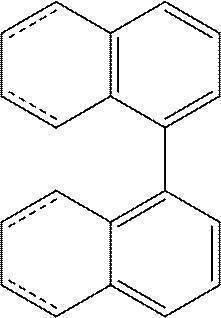
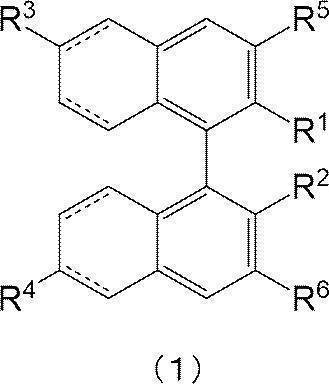
上記R1~R6で表されるアルコキシ基、及びアルコキシカルボニル基中のアルコキシ基としては、直鎖状、分岐鎖状、及び環状のいずれであってもよく、例えば、炭素数1~10(好ましくは、炭素数1~6)のアルコキシ基が挙げられる。
上記R1~R6で表されるアリール基、並びに、アリールカルボニルオキシ基、アリールオキシカルボニル基、及びアリールアミド基中のアリール基としては、例えば、炭素数6~18のアリール基(例えば、フェニル基)が挙げられる。
置換基としては特に制限されないが、例えば、炭素数1~10のアルコキシ基、フェノキシ基、及び、以下に示す重合性基を含む基等が挙げられる。
重合性基の好適な具体例としては、以下の一般式(P-1)~(P-21)で表される基が挙げられる。なお、以下式中の*は結合位置を表す。また、Raは、水素原子又はメチル基を表す。また、Meはメチル基、Etはエチル基を表す。

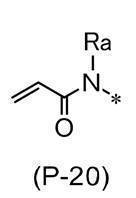
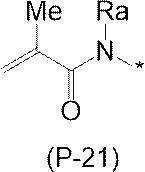
*-LA-P (PA)
一般式(PA)中、LAは、単結合又は2価の連結基を表す。Pは、上述した一般式(P-1)~(P-21)で表される基を表す。*は、結合位置を表す。
上記LAで表される2価の連結基としては、例えば、炭素数1~10の直鎖状若しくは分岐鎖状のアルキレン基、又は、炭素数1~10の直鎖状若しくは分岐鎖状のアルキレン基における1つ以上の-CH2-が-O-、-S-、-NH-、-N(CH3)-、-CO-、-OCO-、及び、-COO-からなる群から選択される1種以上の基で置換された2価の連結基が好ましい。
LAで表される2価の連結基としては、炭素数1~10の直鎖状若しくは分岐鎖状のアルキレン基において1つ以上の-CH2-が-O-で置換された基がより好ましい。
一般式(PA)で表される基としては、「*-O-(CH2)k-P(kは、1~10の整数を表す)」で表される基が好ましい。
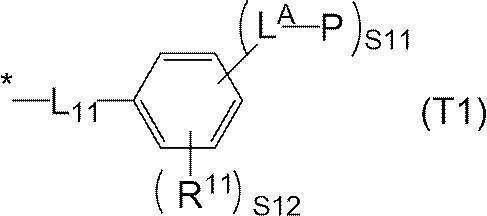
LA及びPは、上述した一般式(PA)中のLA及びPと各々同義であり、好適態様も同じである。
R11は、1価の置換基を表す。R11で表される1価の置換基としては、例えば、炭素数1~3のアルコキシ基等が挙げられる。
S11及びS12は、それぞれ独立して、0~5の整数を表す。但し、1≦S11+S12≦5である。
まず、上記一般式(2)で表される1価の置換基について説明する。
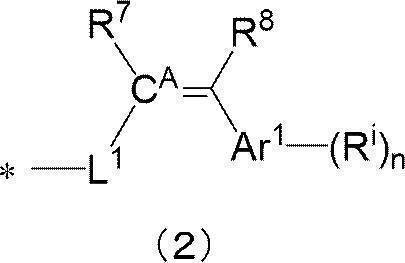
上記芳香族炭化水素環基を構成する芳香族炭化水素環としては特に制限されないが、例えば、炭素数6~20の芳香族炭化水素環が挙げられ、炭素数6~10の芳香族炭化水素環が好ましく、なかでも、ベンゼン環が好ましい(つまり、Ar1は、ベンゼン環基が好ましい)。
RX1及びRX2で表される1価の置換基としては特に制限されないが、例えば、炭素数1~10のアルキル基(直鎖状、分岐鎖状、及び環状のいずれであってもよい。)フェニル基、又は炭素数1~10のアルコキシ基等が挙げられる。
RX3~RX5で表される1価の置換基としては特に制限されないが、例えば、炭素数1~10のアルキル基(直鎖状、分岐鎖状、及び環状のいずれであってもよい。)、及びフェニル基等が挙げられる。
RX5及びRX6で表される1価の置換基としては特に制限されないが、例えば、炭素数1~10のアルキル基(直鎖状、分岐鎖状、及び環状のいずれであってもよい。)、及びフェニル基等が挙げられる。
上記炭素数1~10の1価の脂肪族炭化水素基としては、炭素数1~10(好ましくは炭素数1~6、より好ましくは炭素数1~4)のアルキル基、炭素数2~10(好ましくは炭素数2~6、より好ましくは炭素数2~4)のアルケニル基、及び炭素数2~10(好ましくは炭素数2~6、より好ましくは炭素数2~4)のアルキニル基が挙げられる。また、上記炭素数1~10の1価の脂肪族炭化水素基は、置換基を更に有していてもよい。
Riで表される1価の置換基としては特に制限されず、例えば、アルキル基、アルコキシ基、アリール基、アリールカルボニルオキシ基、アリールオキシカルボニル基、アリールアミド基、アルコキシカルボニル基、アルキルカルボニルオキシ基、及びシンナモイルオキシ基等の1価の置換基等が挙げられる。
nの数は特に制限されないが、0~3の整数が好ましく、1~3の整数がより好ましい。
なお、L1が単結合を表す場合、CAで表される炭素原子が、上記一般式(1)中のビナフチル骨格との結合部位を表す。
L1としては、なかでも、HTP増加率がより大きい点で、単結合が好ましい。
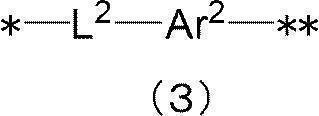
L2で表される2価の連結基としては特に制限されないが、例えば、2価の脂肪族炭化水素基(直鎖状、分岐鎖状又は環状であってもよく、炭素数1~20であることが好ましく、例えば、アルキレン基、アルケニレン基、及びアルキニレン基が挙げられる。)、-O-、-S-、-SO2-、-NRA-、-CO-(-C(=O)-)、-COO-(-C(=O)O-)、-OCO-(-OC(=O)-)、-NRA-CO-、-CO-NRA-、-SO3-、-SO2NRA-、-NRASO2-、-N=N-、-CH=N-、-N=CH-、及びこれらを2種以上組み合わせた基が挙げられる。ここで、RAは、水素原子又はアルキル基(好ましくは炭素数1~10)を表す。
なお、上記2価の連結基中の水素原子は、ハロゲン原子等の他の置換基で置換されていてもよい。
L2で表される2価の連結基としては、なかでも、-O-、-CO-、-COO-、又は-OCO-が好ましく、-COO-、又は-OCO-がより好ましい。
上記芳香族炭化水素環基を構成する芳香族炭化水素環としては特に制限されないが、例えば、炭素数6~20の芳香族炭化水素環が挙げられ、炭素数6~10の芳香族炭化水素環が好ましく、なかでも、ベンゼン環がより好ましい。

上記芳香族炭化水素環基を構成する芳香族炭化水素環としては特に制限されないが、例えば、炭素数6~20の芳香族炭化水素環が挙げられ、炭素数6~10の芳香族炭化水素環が好ましく、なかでも、ベンゼン環がより好ましい。
R9及びR10は、それぞれ独立に、水素原子、シアノ基、置換ボリル基、置換シリル基、置換アルミニウム基、ハロゲン原子、アルコキシカルボニル基、アルキルカルボニル基、又は炭素数1~10の1価の脂肪族炭化水素基を表す。
R9及びR10で表される置換ボリル基、置換シリル基、置換アルミニウム基、ハロゲン原子、アルコキシカルボニル基、アルキルカルボニル基、及び炭素数1~10の1価の脂肪族炭化水素基としては、一般式(2)中のR7及びR8で表される置換ボリル基、置換シリル基、置換アルミニウム基、ハロゲン原子、アルコキシカルボニル基、アルキルカルボニル基、及び炭素数1~10の1価の脂肪族炭化水素基と同様のものが挙げられ、その好適態様も同じである。
R9及びR10としては、なかでも、水素原子が好ましい。
Rjで表される1価の置換基としては、一般式(2)中のRiで表される1価の置換基と同様のものが挙げられ、その好適態様も同じである。
mの数は特に制限されないが、0~3の整数が好ましく、1~3の整数がより好ましい。
なお、L3が単結合を表す場合、CBで表される炭素原子が、上記一般式(1)中のビナフチル骨格との結合部位を表す。
L3としては、なかでも、単結合が好ましい。

L4で表される2価の連結基としては、一般式(3)中のL2で表される2価の置換基と同様のものが挙げられ、その好適態様も同じである。
Ar4で表される2価の芳香族炭化水素環基としては、一般式(3)中のAr2で表される2価の芳香族炭化水素環基と同様のものが挙げられ、その好適態様も同じである。
態様(A):上記一般式(2)で表される1価の置換基において、L1が一般式(3)で表される2価の連結基を表す。
態様(B):上記一般式(2)で表される1価の置換基において、Riが、*-LS1-1価の芳香族炭化水素環基を表す。
態様(C):一般式(1)中のR1及びR2が互いに結合して、*-LS2-2価の芳香族炭化水素環基-LS2-*を表す。
態様(C)にて示す2価の芳香族炭化水素環基を構成する芳香族炭化水素環としては特に制限されないが、例えば、炭素数6~20の芳香族炭化水素環が挙げられ、炭素数6~10の芳香族炭化水素環が好ましく、なかでも、ベンゼン環がより好ましい。
上記構成とした場合、特定化合物は、芳香族炭化水素環基が単結合又は2価の連結基を介して3つ以上連結している(但し、ビナフチル骨格中のナフタレン環同士の連結は含まない)構造を含み、この構造が露光後のHTPをより大きくする要因の一つであると推測される。
詳細には、態様(A)の特定化合物は、ビナフチル骨格中に含まれるナフタレン環と、一般式(3)中に明示されるAr2と、一般式(2)中に明示されるAr1とが、単結合又は2価の連結基を介して連結されている構造を含む。また、態様(B)の特定化合物は、ビナフチル骨格中に含まれるナフタレン環と、一般式(2)中に明示されるAr1と、上記Ri中の芳香族炭化水素環とが、単結合又は2価の連結基を介して連結されている構造を含む。また、態様(C)の特定化合物は、ビナフチル骨格中に含まれる2つのナフタレン環と、R1及びR2が互いに結合して形成される*-LS2-2価の芳香族炭化水素環基-LS2-*中の芳香族炭化水素環とが、単結合又は2価の連結基を介して連結されている構造を含む。
上記環構造としては特に制限されないが、芳香族環及び非芳香族環のいずれであってもよいが、非芳香環であることが好ましく、窒素原子、酸素原子及び硫黄原子等のヘテロ原子を含んでいてもよい。
上記環構造の環員数は特に制限されず、例えば、5~12である。なお、上記環員数は、一般式(1)中に明示される4つの炭素原子を含めた数である。
なお、下記一般式(1-1)及び下記一般式(1-2)中のR1~R6は、一般式(1)中のR1~R6とそれぞれ同義であり、また好適な態様も同じである。
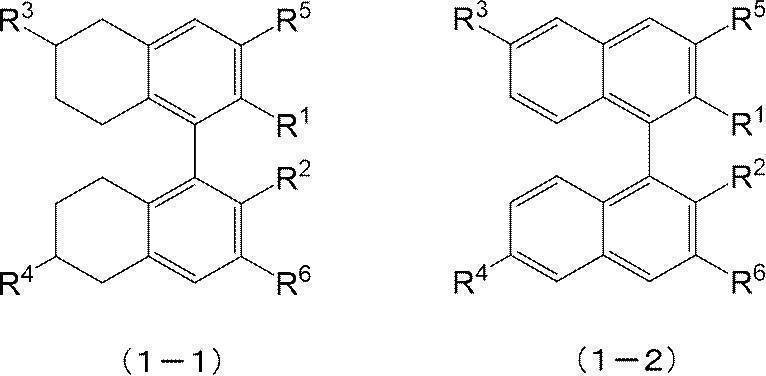

上記RX1~RX6で表されるアルキル基、アルコキシ基、アリール基、アリールカルボニルオキシ基、アリールオキシカルボニル基、アリールアミド基、アルコキシカルボニル基、及びアルキルカルボニルオキシ基は、各々、上述した一般式(1)中のR1~R6で表されるアルキル基、アルコキシ基、アリール基、アリールカルボニルオキシ基、アリールオキシカルボニル基、アリールアミド基、アルコキシカルボニル基、及びアルキルカルボニルオキシ基と同義であり、好適態様も同じである。
態様(A):上記一般式(2)で表される1価の置換基において、L1が上述した一般式(3)で表される2価の連結基を表す。
態様(B):上記一般式(2)で表される1価の置換基において、Riが、*-LS1-1価の芳香族炭化水素環基を表す。
態様(C):一般式(1)中のR1及びR2が互いに結合して、*-LS2-2価の芳香族炭化水素環基-LS2-*を表す。
態様(C)にて示す2価の芳香族炭化水素環基を構成する芳香族炭化水素環としては特に制限されないが、例えば、炭素数6~20の芳香族炭化水素環が挙げられ、炭素数6~10の芳香族炭化水素環が好ましく、なかでも、ベンゼン環がより好ましい。
上記構成とした場合、一般式(X1)で表される化合物は、芳香族炭化水素環基が単結合又は2価の連結基を介して3つ以上連結している(但し、ビナフチル骨格中のナフタレン環同士の連結は含まない)構造を含み、この構造が露光後のHTPをより大きくする要因の一つであると推測される。詳細には、態様(A)の一般式(X1)で表される化合物は、ビナフチル骨格中に含まれるナフタレン環と、一般式(3)中に明示されるAr2と、一般式(2)中に明示されるAr1とが、単結合又は2価の連結基を介して連結されている構造を含む。また、態様(B)の一般式(X1)で表される化合物は、ビナフチル骨格中に含まれるナフタレン環と、一般式(2)中に明示されるAr1と、上記Ri中の芳香族炭化水素環とが、単結合又は2価の連結基を介して連結されている構造を含む。また、態様(C)の一般式(X1)で表される化合物は、ビナフチル骨格中に含まれる2つのナフタレン環と、R1及びR2が互いに結合して形成される*-LS2-2価の芳香族炭化水素環基-LS2-*中の芳香族炭化水素環とが、単結合又は2価の連結基を介して連結されている構造を含む。
上記環構造としては特に制限されないが、芳香族環及び非芳香族環のいずれであってもよいが、非芳香環であることが好ましく、窒素原子、酸素原子及び硫黄原子等のヘテロ原子を含んでいてもよい。
上記環構造の環員数は特に制限されず、例えば、5~12である。なお、上記環員数は、一般式(X1)中に明示される4つの炭素原子を含めた数である。


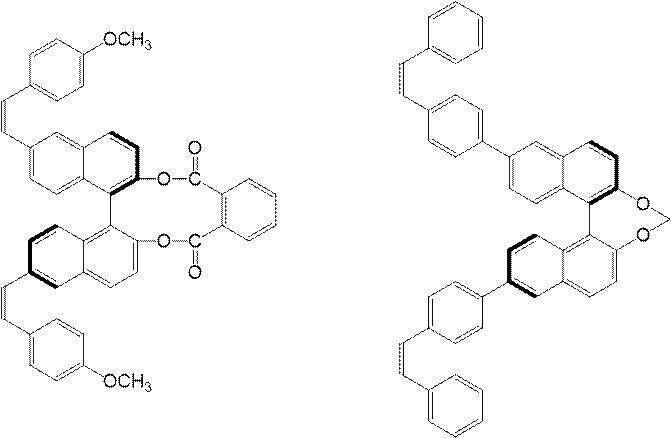


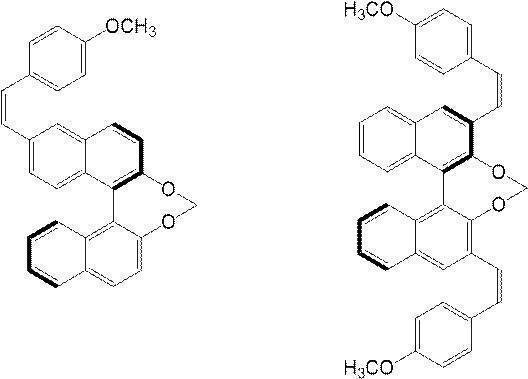
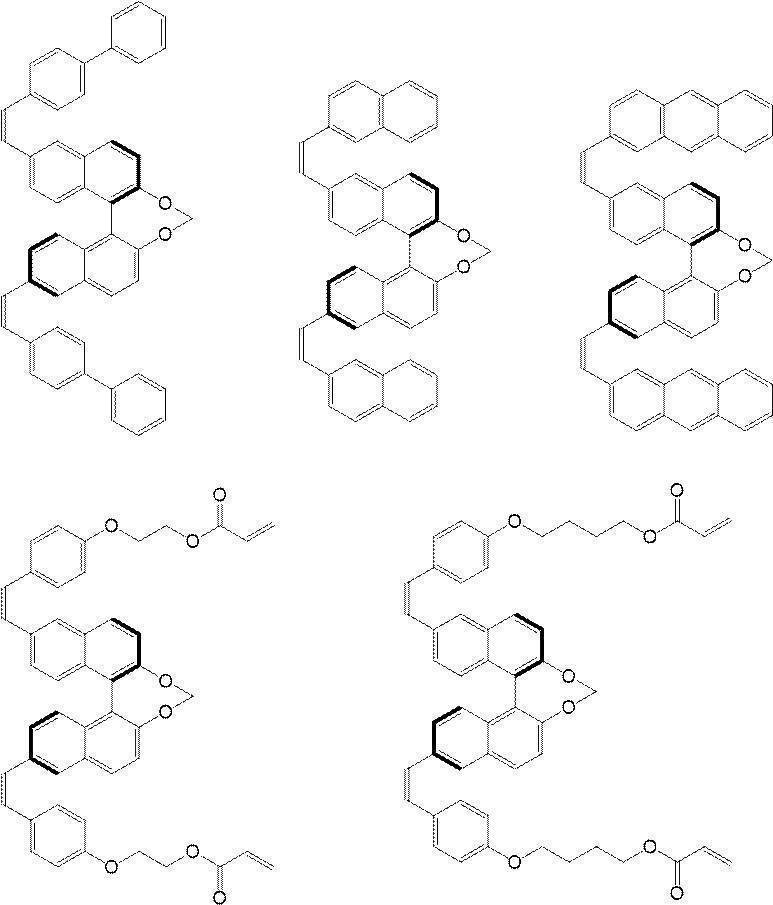

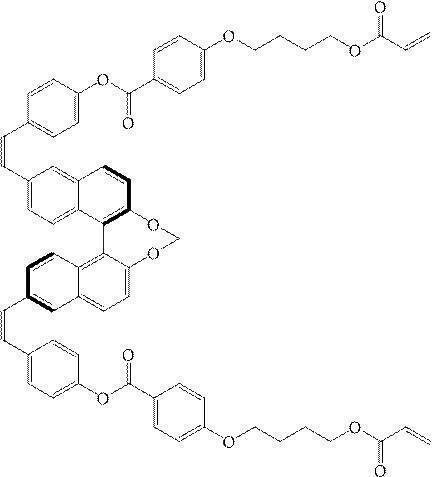


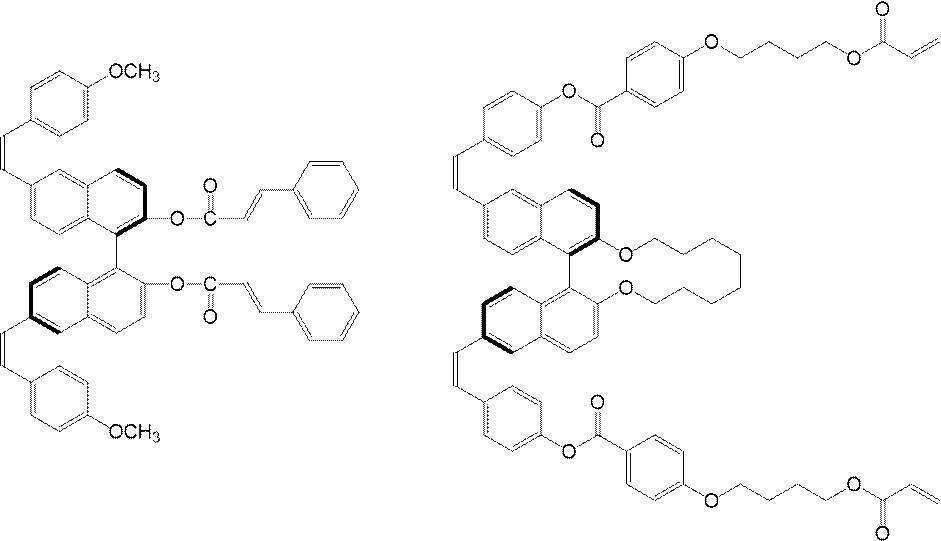
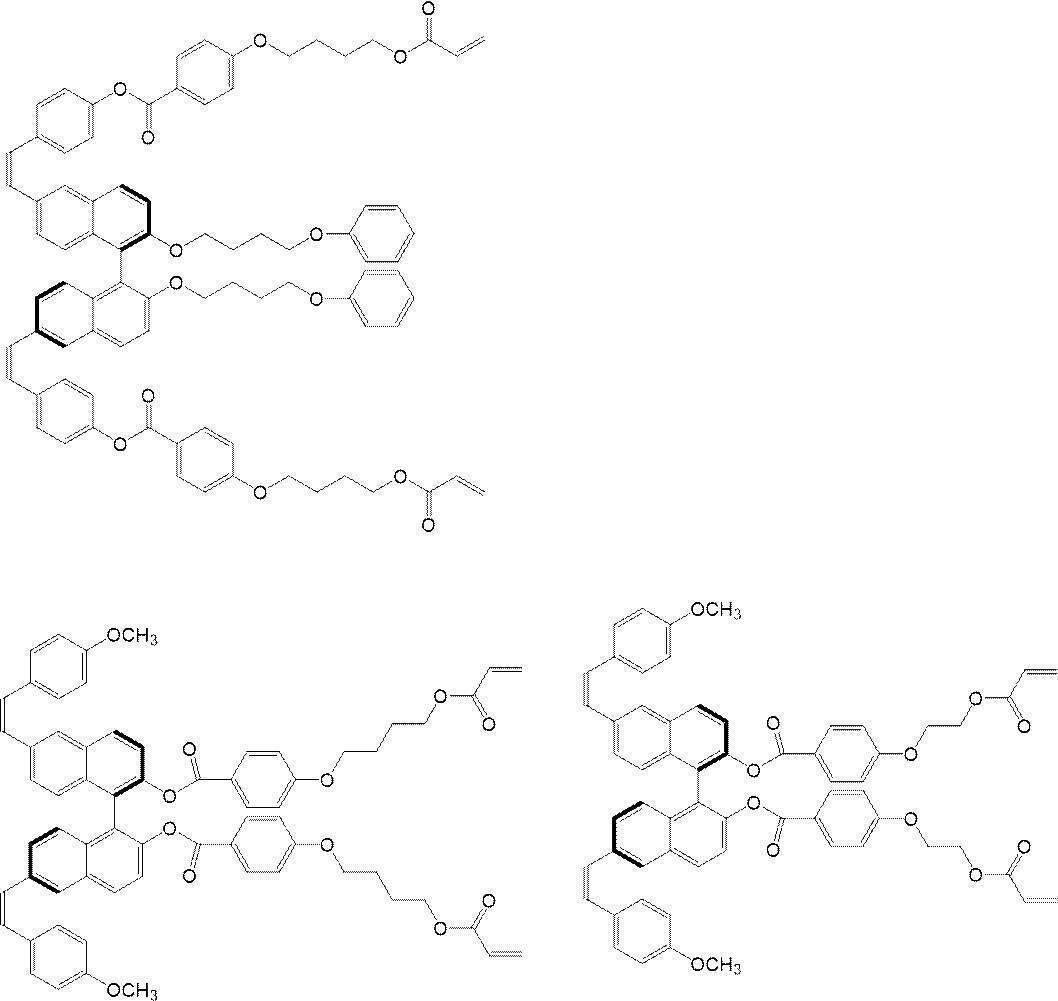


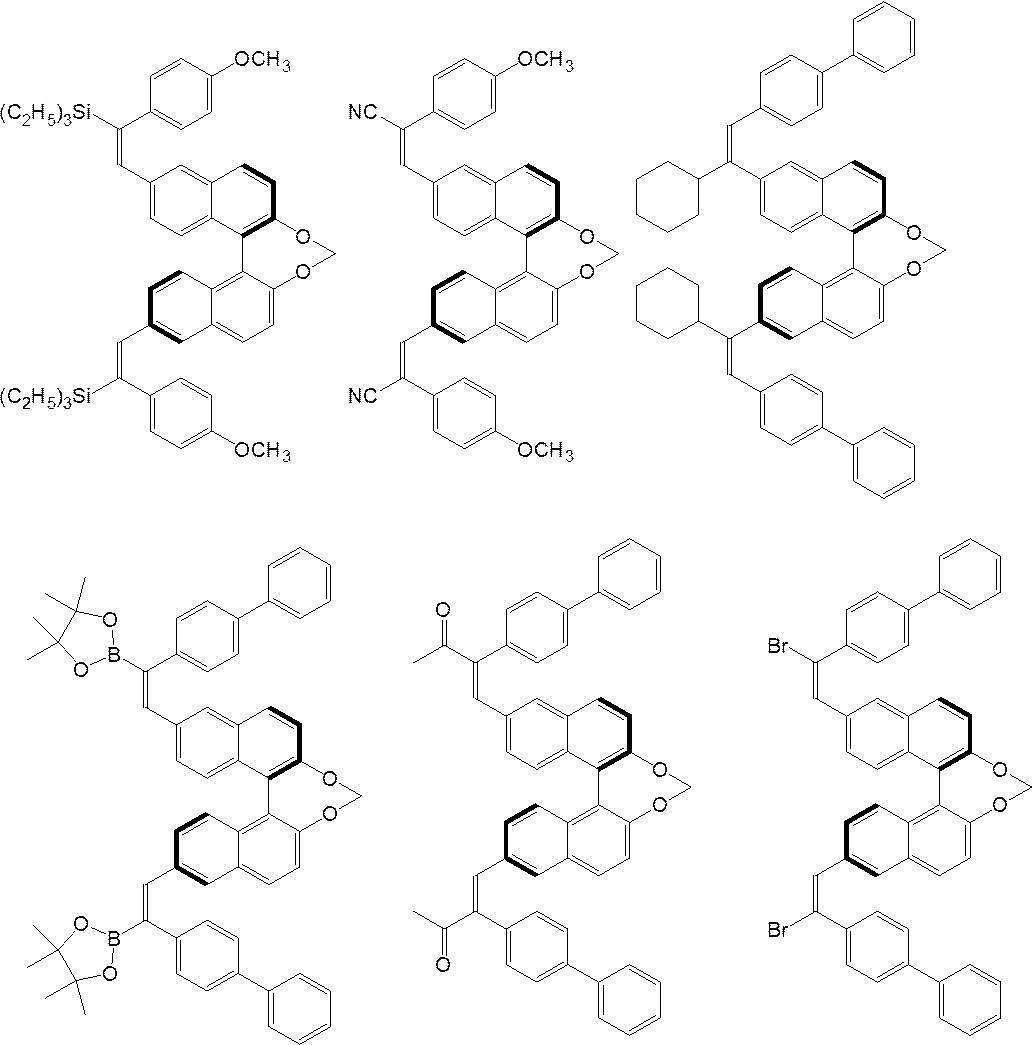
上記特定化合物は、いわゆるキラル剤として、種々の用途に適用できる。例えば、特定化合物と液晶性化合物とを混合して得られる液晶組成物を用いることにより、コレステリック液晶相を形成できる。
本発明の混合物は、上述した一般式(X1)で表される化合物と、下記一般式(Y1)で表される化合物と、からなる。
以下、下記一般式(Y1)で表される化合物について詳述する。

上記R11~R16で表されるアルキル基、アルコキシ基、アリール基、アリールカルボニルオキシ基、アリールオキシカルボニル基、アリールアミド基、アルコキシカルボニル基、及びアルキルカルボニルオキシ基は、各々、上述した一般式(1)中のR1~R6で表されるアルキル基、アルコキシ基、アリール基、アリールカルボニルオキシ基、アリールオキシカルボニル基、アリールアミド基、アルコキシカルボニル基、及びアルキルカルボニルオキシ基と同義であり、好適態様も同じである。
R11~R16で表される1価の置換基としては、なかでも、アルコキシ基、アリールカルボニルオキシ基、アリールオキシカルボニル基、アリールアミド基、又は上述した一般式(6)で表される1価の置換基が好ましい。また、後述するように、R11とR12は、互いに結合して環構造を形成していてもよい。
一般式(Y1)で表される化合物は、一般式(6)で表される1価の置換基を含むことにより、分子中にトランススチルベン誘導体構造が導入される。具体的には、一般式(6)で表される1価の置換基中のL5が単結合を表す場合、一般式(6)中に明示されるオレフィン二重結合部位(CC=C)において、一般式(6)中に明示されるAr5と一般式(Y1)中のビナフチル骨格中に含まれるベンゼン環(一般式(6)で表される1価の置換基が結合するベンゼン環を意図する。)とがトランス型配置となり、トランススチルベン誘導体構造が形成される。また、一般式(6)で表される1価の置換基中のL5が一般式(7)で表される2価の連結基を表す場合、一般式(6)中に明示されるオレフィン二重結合部位(CC=C)において、一般式(6)中に明示されるAr5と一般式(7)に明示されるAr6とがトランス型配置となり、トランススチルベン誘導体構造が形成される。

上記芳香族炭化水素環基を構成する芳香族炭化水素環としては特に制限されないが、例えば、炭素数6~20の芳香族炭化水素環が挙げられ、炭素数6~10の芳香族炭化水素環が好ましく、なかでも、ベンゼン環が好ましい。
CCは、炭素原子を表す。
R17及びR18は、それぞれ独立に、水素原子、シアノ基、置換ボリル基、置換シリル基、置換アルミニウム基、ハロゲン原子、アルコキシカルボニル基、アルキルカルボニル基、又は炭素数1~10の1価の脂肪族炭化水素基を表す。
R17及びR18で表される置換ボリル基、置換シリル基、置換アルミニウム基、ハロゲン原子、アルコキシカルボニル基、アルキルカルボニル基、又は炭素数1~10の1価の脂肪族炭化水素基としては、一般式(2)中のR7及びR8で表される置換ボリル基、置換シリル基、置換アルミニウム基、ハロゲン原子、アルコキシカルボニル基、アルキルカルボニル基、及び炭素数1~10の1価の脂肪族炭化水素基と同様のものが挙げられ、その好適態様も同じである。
R17及びR18としては、なかでも、水素原子が好ましい。
Rkで表される1価の置換基としては、一般式(2)中のRiで表される1価の置換基と同様のものが挙げられ、その好適態様も同じである。
lの数は特に制限されないが、0~3の整数が好ましく、1~3の整数がより好ましい。
なお、L5が単結合を表す場合、CCで表される炭素原子が、上記一般式(Y1)中のビナフチル骨格との結合部位を表す。
L5としては、なかでも、単結合が好ましい。

L6で表される2価の連結基としては、一般式(3)中のL2で表される2価の置換基と同様のものが挙げられ、その好適態様も同じである。
Ar6で表される2価の芳香族炭化水素環基としては、一般式(3)中のAr2で表される2価の芳香族炭化水素環基と同様のものが挙げられ、その好適態様も同じである。
上記環構造としては特に制限されないが、芳香族環及び非芳香族環のいずれであってもよいが、非芳香環であることが好ましく、窒素原子、酸素原子及び硫黄原子等のヘテロ原子を含んでいてもよい。
上記環構造の環員数は特に制限されず、例えば、5~12である。なお、上記環員数は、一般式(Y1)中に明示される4つの炭素原子を含めた数である。
なお、下記一般式(Y1-1)及び下記一般式(Y1-2)中のR11~R16は、一般式(Y1)中のR11~R16とそれぞれ同義であり、また好適な態様も同じである。
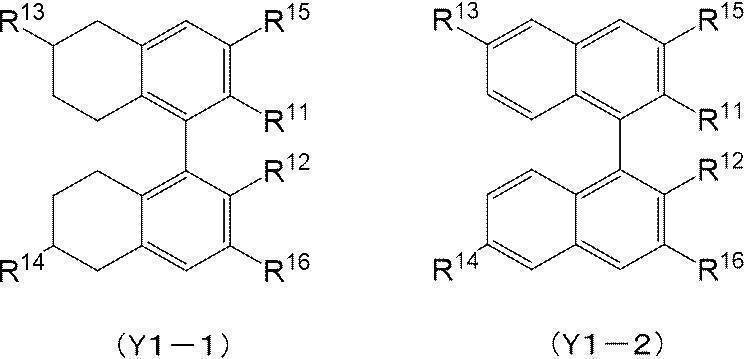
なかでも、HTP増加率がより大きくなる点で、混合物における一般式(2)で表される1価の置換基の含有量(以下「X2(モル)」ともいう。)と一般式(6)で表される1価の置換基の含有量(以下「Y2(モル)」ともいう。)との含有比(一般式(6)で表される1価の置換基の含有量に対する一般式(2)で表される1価の置換基の含有量(X2/Y2))は、5以上が好ましく、10以上がより好ましい。
なお、混合物において、一般式(2)で表される1価の置換基の含有量及び一般式(6)で表される1価の置換基の含有量は、1H NMR(核磁気共鳴)により求めることができる。
混合物中、上記一般式(X1)中及び上記一般式(Y1)中において実線と破線が平行している部分がいずれも二重結合を表すか、又は上記一般式(X1)中及び上記一般式(Y1)中において実線と破線が平行している部分がいずれも一重結合を表す。
・上記一般式(X1)で表される化合物において、RX1とRX2とが互いに結合して環構造を形成しない場合:
混合物中、上記一般式(X1)で表される化合物においてRX1が一般式(2)で表される1価の置換基を表す場合、上記一般式(Y1)で表される化合物においてR11が一般式(6)で表される1価の置換基を表し、上記一般式(X1)で表される化合物においてRX2が一般式(2)で表される1価の置換基を表す場合、上記一般式(Y1)で表される化合物においてR12が一般式(6)で表される1価の置換基を表し、上記一般式(X1)で表される化合物においてRX3が一般式(2)で表される1価の置換基を表す場合、上記一般式(Y1)で表される化合物においてR13が一般式(6)で表される1価の置換基を表し、上記一般式(X1)で表される化合物においてRX4が一般式(2)で表される1価の置換基を表す場合、上記一般式(Y1)で表される化合物においてR14が一般式(6)で表される1価の置換基を表し、上記一般式(X1)で表される化合物においてRX5が一般式(2)で表される1価の置換基を表す場合、上記一般式(Y1)で表される化合物においてR15が一般式(6)で表される1価の置換基を表し、上記一般式(X1)で表される化合物においてRX6が一般式(2)で表される1価の置換基を表す場合、上記一般式(Y1)で表される化合物においてR16が一般式(6)で表される1価の置換基を表す。
更に、上記態様において、一般式(2)中のL1、R7、R8、Ar1、Ri及びnは、一般式(6)中のL5、R17、R18、Ar5、Rk、及びlと各々同一であり、且つ、上記一般式(X1)で表される化合物における一般式(2)で表される1価の置換基以外を表すRX1~RX6は、上記一般式(Y1)で表される化合物における一般式(6)で表される1価の置換基以外を表すR11~R16と各々同一であることが好ましい。
混合物中、上記一般式(X1)で表される化合物においてRX3が一般式(2)で表される1価の置換基を表す場合、上記一般式(Y1)で表される化合物においてR13が一般式(6)で表される1価の置換基を表し、上記一般式(X1)で表される化合物においてRX4が一般式(2)で表される1価の置換基を表す場合、上記一般式(Y1)で表される化合物においてR14が一般式(6)で表される1価の置換基を表し、上記一般式(X1)で表される化合物においてRX5が一般式(2)で表される1価の置換基を表す場合、上記一般式(Y1)で表される化合物においてR15が一般式(6)で表される1価の置換基を表し、上記一般式(X1)で表される化合物においてRX6が一般式(2)で表される1価の置換基を表す場合、上記一般式(Y1)で表される化合物においてR16が一般式(6)で表される1価の置換基を表し、且つ、上記一般式(Y)で表される化合物においてR11とR12とが互いに結合して環構造を表す。
更に、上記態様において、一般式(2)中のL1、R7、R8、Ar1、Ri及びnは、一般式(6)中のL5、R17、R18、Ar5、Rk、及びlと各々同一であり、上記一般式(X1)で表される化合物における一般式(2)で表される1価の置換基以外を表すRX3~RX6は、上記一般式(Y1)で表される化合物における一般式(6)で表される1価の置換基以外を表すR13~R16と各々同一であり、且つ、上記一般式(X1)で表される化合物におけるRX1とRX2とが互いに結合して形成される環構造と、上記一般式(Y)で表される化合物におけるR11とR12とが互いに結合して形成される環構造とが同一であることが好ましい。
上記混合物は、いわゆるキラル剤として、種々の用途に適用できる。例えば、上記混合物と液晶性化合物とを混合して得られる液晶組成物を用いることにより、コレステリック液晶相を形成することができる。
次に、本発明の液晶組成物について説明する。
本発明の液晶組成物は、液晶性化合物と、上述した特定化合物又は上述した混合物を含む。
以下に、本発明の液晶組成物に含まれる各成分について説明する。
上記液晶性化合物は、液晶性を示す化合物を意味する。なお、化合物が液晶性を示すとは、温度を変化させたときに、結晶相(低温側)と等方相(高温側)の間に中間相を発現する性質を化合物が有することを意図する。具体的な観察方法としては、メトラートレド社製ホットステージシステムFP90等で化合物を加熱又は降温しながら、偏光顕微鏡下で観察することで、液晶相に由来する光学性異方性と流動性を確認できる。
棒状ネマチック液晶性化合物としては、例えば、アゾメチン類、アゾキシ類、シアノビフェニル類、シアノフェニルエステル類、安息香酸エステル類、シクロヘキサンカルボン酸フェニルエステル類、シアノフェニルシクロヘキサン類、シアノ置換フェニルピリミジン類、アルコキシ置換フェニルピリミジン類、フェニルジオキサン類、トラン類、及びアルケニルシクロヘキシルベンゾニトリル類等が挙げられる。なお、低分子液晶性化合物だけではなく、高分子液晶性化合物も用いることができる。
重合性基を有しない棒状液晶性化合物については、様々な文献(例えば、Y. Goto et.al., Mol. Cryst. Liq. Cryst. 1995, Vol. 260, pp.23-28)に記載がある。
一方、重合性棒状液晶性化合物は、重合性基を棒状液晶性化合物に導入することで得られる。重合性基の例には、不飽和重合性基、エポキシ基、及びアジリジニル基等が含まれ、不飽和重合性基が好ましく、エチレン性不飽和重合性基がより好ましい。重合性基は種々の方法で、棒状液晶性化合物の分子中に導入できる。重合性棒状液晶性化合物が有する重合性基の個数は、好ましくは1~6個、より好ましくは1~3個である。2種類以上の重合性棒状液晶性化合物を併用してもよい。2種類以上の重合性棒状液晶性化合物を併用すると、配向温度を低下させることができる。

芳香族炭化水素環基を構成する芳香族炭化水素環としては、単環構造及び多環構造のいずれであってもよい。
上記芳香族炭化水素環の炭素数は特に限定されないが、6~18が好ましく、6~10がより好ましい。芳香族炭化水素環の具体例としては、例えば、ベンゼン環、ビフェニル環、ナフタレン環、アントラセン環、フェナントレン環、及びフルオレン環が挙げられる。なかでも、ベンゼン環が好ましい。なお、上記芳香族炭化水素環は、環上の水素原子が2つ除かれることにより、芳香族炭化水素環基を構成する。
芳香族複素環基を構成する芳香族複素環としては、単環構造及び多環構造のいずれであってもよい。
上記芳香族複素環基が含むヘテロ原子としては、例えば、窒素原子、酸素原子及び硫黄原子が挙げられる。芳香族複素環の炭素数は特に限定されないが、5~18が好ましい。上記芳香族複素環の具体例としては、例えば、ピリジン環、ピリダジン環、ピリミジン環、ピラジン環、トリアジン環、チオフェン環、チアゾール環、及びイミダゾール環が挙げられる。なお、上記芳香族複素環は、環上の水素原子が2つ除かれることにより、芳香族複素環基を構成する。
芳香族炭化水素環基及び芳香族複素環基は、置換基を有していてもよい。置換基の種類は特に制限されず、公知の置換基が挙げられる。例えば、ハロゲン原子、アルキル基、アルコキシ基、アリール基、水酸基、アミノ基、カルボキシル基、スルホンアミド基、N-スルホニルアミド基、アシル基、アシルオキシ基、シアノ基、ニトロ基、及びアルコキシカルボニル基が挙げられる。上記各基は、更に置換基で置換されていてもよい。例えば、アルキル基中の水素原子がフッ素原子で置換されていてもよい。また、置換基の数は特に制限されず、芳香族炭化水素環基及び芳香族複素環基は1つの置換基を有していてもよいし、複数の置換基を有していてもよい。
なかでも、一般式(LC)で表される化合物の溶解性がより向上する点で、置換基が、フッ素原子、塩素原子、フルオロアルキル基、アルコキシ基、又はアルキル基であることが好ましく、フルオロアルキル基、アルコキシ基、又はアルキル基であることがより好ましい。
上記フルオロアルキル基及びアルキル基中の炭素数、並びに、アルコキシ基中のアルキル基の炭素数は特に制限されないが、1~10が好ましく、1~5がより好ましく、1~3が更に好ましく、1が特に好ましい。
なお、フルオロアルキル基とは、アルキル基中の少なくとも1つの水素原子がフッ素原子で置換された基であり、全ての水素原子がフッ素原子で置換されていることが好ましい(いわゆる、ペルフルオロアルキル基が好ましい)。
Z11~Z14としては、なかでも、-COO-、-OCO-、又は-CH=CH-が好ましい。
以下に、上記一般式(LC)で表される化合物の具体例を示すが、これに限定されるものではない。
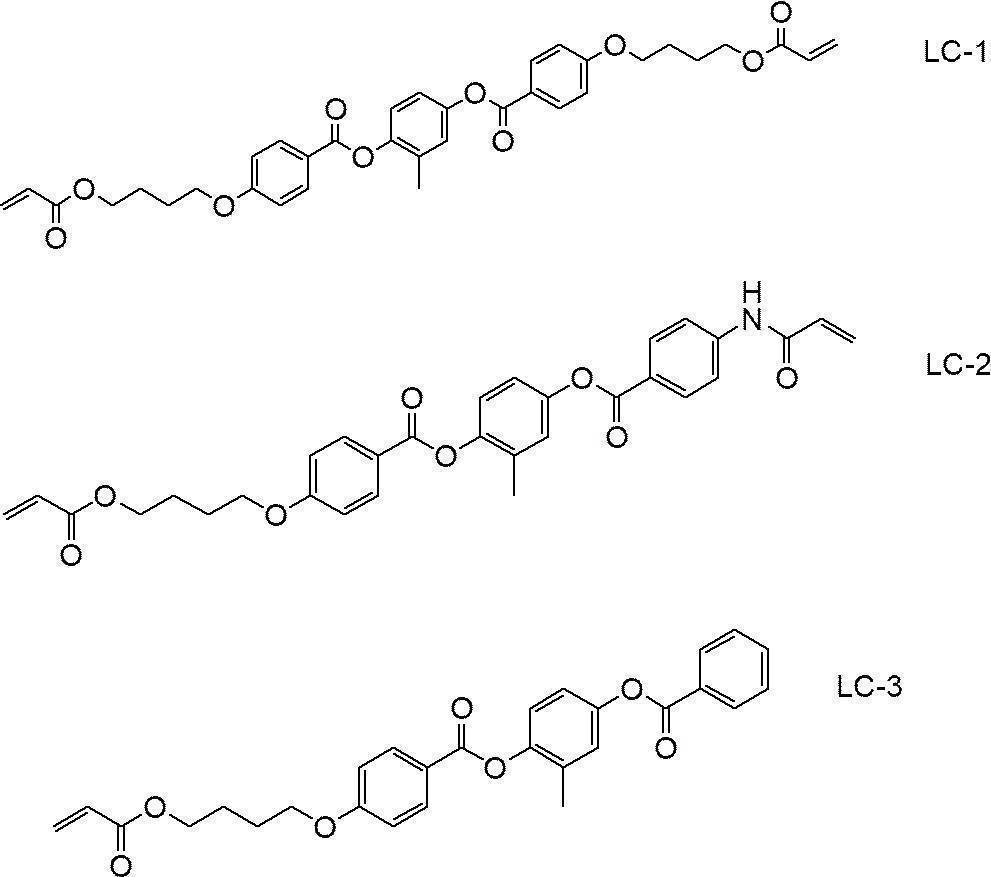
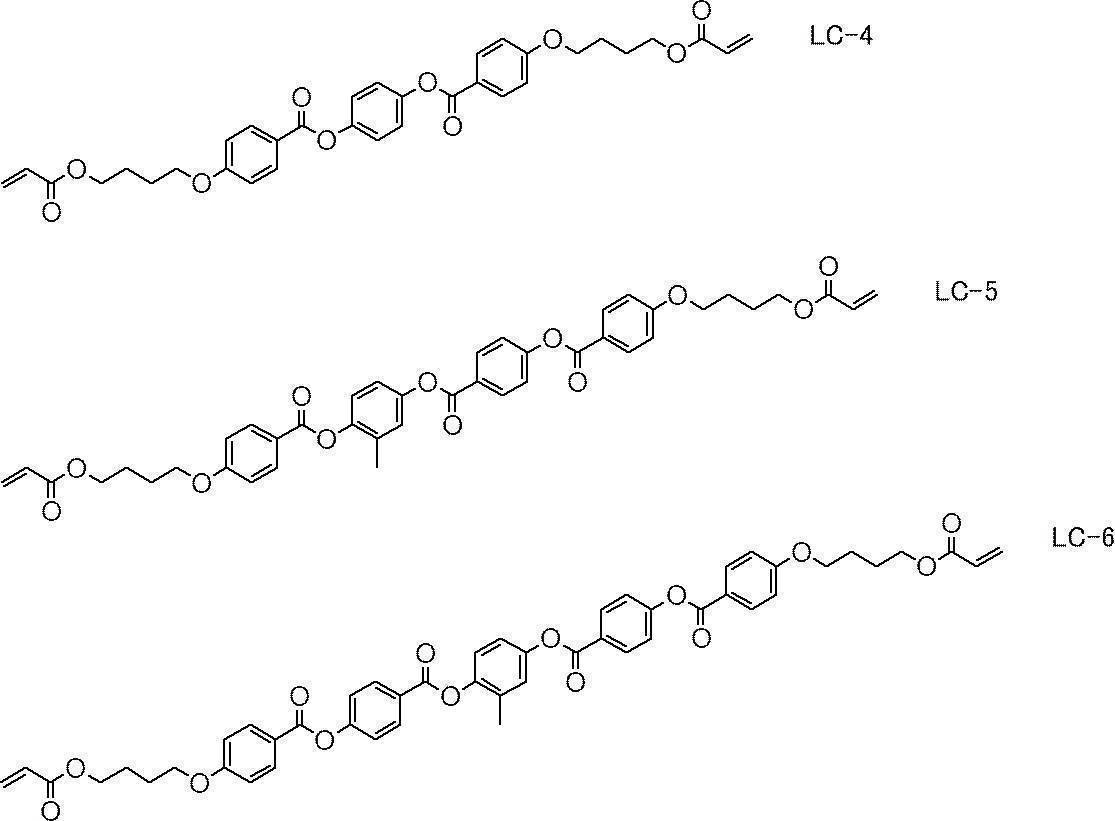
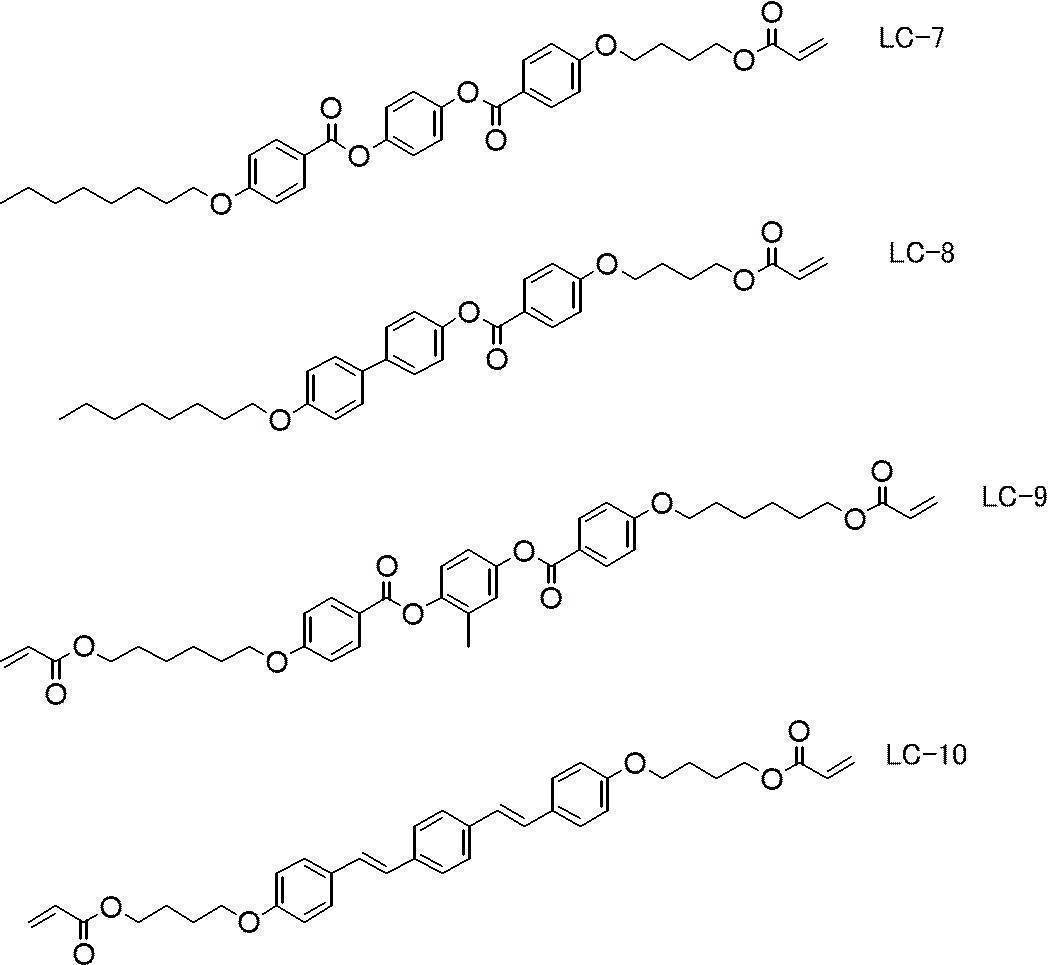
本発明の液晶組成物中の液晶性化合物の含有量は、液晶性組成物の全質量に対して、5~99質量%が好ましく、25~98質量%がより好ましく、65~98質量%が更に好ましく、70~98質量%が特に好ましい。
本発明の液晶組成物は、特定化合物又は混合物を含有する。特定化合物及び混合物は、上述したとおりである。なお、特定化合物は、単独で用いてもよく、複数を組み合わせて用いてもよい。
本発明の液晶組成物中の特定化合物又は混合物の含有量は、液晶性化合物の全質量に対して、1~20質量%が好ましく、2~15質量%がより好ましく、2~10質量%が更に好ましい。
液晶組成物は、重合開始剤を含んでいてもよい。
重合開始剤は、紫外線照射によって重合反応を開始可能な光重合開始剤であることが好ましい。光重合開始剤としては、例えば、α-カルボニル化合物、アシロインエーテル、α-炭化水素置換芳香族アシロイン化合物、多核キノン化合物、フェナジン化合物、及びオキサジアゾール化合物が挙げられる。
液晶組成物中での重合開始剤の含有量は特に制限されないが、液晶性化合物の全質量に対して、0.1~20質量%が好ましく、1~8質量%がより好ましい。
上記液晶組成物は、種々の用途に適用できる。例えば、液晶組成物を用いて、スクリーン、光学異方体、又は反射膜を形成できる。なお、例えば、液晶性化合物が重合性基を有する場合、硬化処理(光照射処理又は加熱処理など)を液晶性組成物に施すことにより、硬化物が得られ、硬化物は光学異方体又は反射膜に好適に適用できる。
なお、光学異方体とは、光学異方性を有する物質を意図する。
また、反射膜とは、コレステリック液晶相を固定してなる層に相当し、所定の反射帯域の光を反射できる。反射膜は、例えば、透明スクリーンに好適に適用できる。
液晶組成物を硬化(重合硬化)する方法は特に制限されず、公知の方法を採用できる。例えば、所定の基板と液晶組成物とを接触させて、基板上に組成物層を形成する工程Xと、組成物層に露光を行う工程Yと、組成物層に硬化処理を施す工程Zとを有する態様が挙げられる。
本態様によれば、液晶性化合物を配向させた状態で固定化することができ、いわゆる光学異方体、又はコレステリック液晶相を固定化してなる層を形成することができる。
以下、工程X~Zの手順について詳述する。
基板と液晶組成物とを接触させる方法は特に制限されず、例えば、基板上に液晶組成物を塗布する方法、及び液晶組成物中に基板を浸漬する方法が挙げられる。
なお、基板と液晶組成物とを接触させた後、必要に応じて、基板上の組成物層から溶剤を除去するために、乾燥処理を実施してもよい。また、液晶性化合物の配向を促し液晶相の状態とするために、加熱処理を実施してもよい。
露光処理によって上述した特定化合物は光異性化を生じ、HTPが増加する。この結果として、組成物層中の液晶性化合物が配向してコレステリック液晶相が形成される。
なお、露光処理において、露光量及び/又は露光波長等を適宜調整することで、HTPの変化の程度も調整できる。また、露光後は、更に、液晶性化合物の配向を促し液晶相の状態とするために、加熱処理を実施してもよい。
硬化処理の方法は特に制限されず、例えば、光硬化処理及び熱硬化処理が挙げられる。中でも、光硬化処理が好ましい。
硬化処理として光硬化処理を行う場合、液晶組成物は、光重合開始剤を含むことが好ましい。光硬化処理における照射光の波長は、上述の露光処理における照射光の波長とは異なっていることが好ましい。
上記硬化処理により、コレステリック液晶相を固定化してなる層が形成される。なお、コレステリック液晶相を固定化してなる層は、もはや液晶性を示す必要はない。より具体的には、例えば、コレステリック液晶相を「固定化した」状態は、コレステリック液晶相となっている液晶性化合物の配向が保持された状態が最も典型的、且つ好ましい態様である。より具体的には、通常0~50℃、より過酷な条件下では-30~70℃の温度範囲において、層に流動性が無く、また外場又は外力によって配向形態に変化を生じさせることなく、固定化された配向形態を安定に保ち続けることができる状態であることが好ましい。
〔化合物CD-1の合成〕
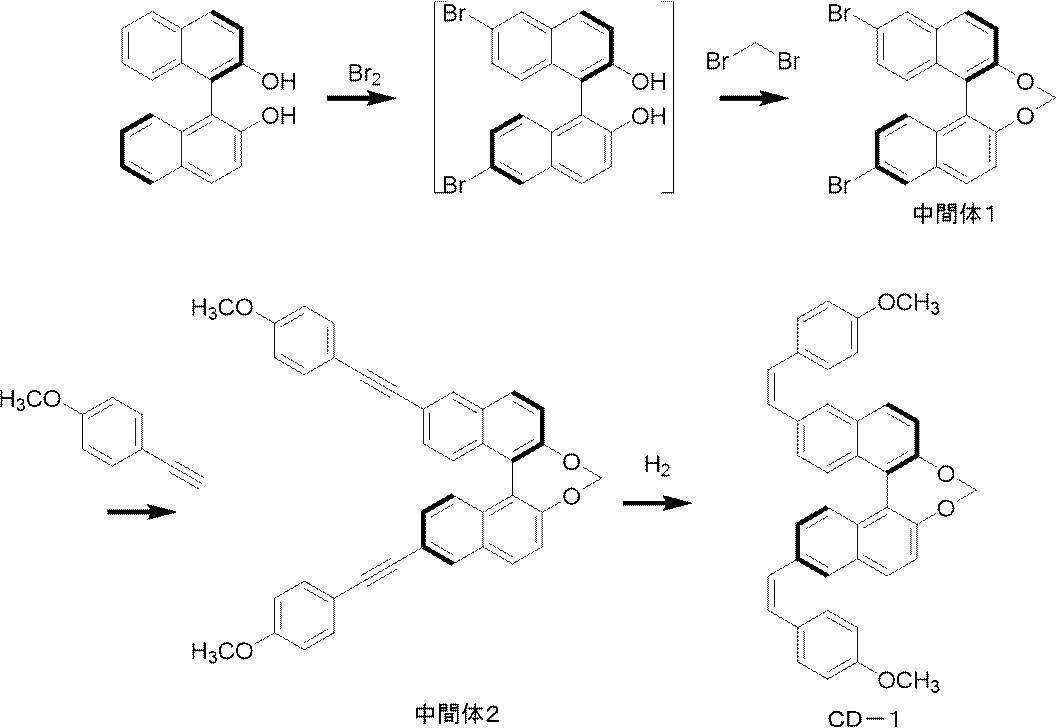
(R)-ビナフトール(関東化学製)65.0g、及び酢酸ブチル(和光純薬製)500mLを2L三口フラスコに入れた後、0℃にて臭素(和光純薬製)100gを滴下し5時間撹拌した。続いて、得られた反応液を、亜硫酸水素ナトリウム水(亜硫酸水素ナトリウム(和光純薬製)21.7g、水290mL)、水325mL、及び炭酸水素ナトリウム水(炭酸水素ナトリウム(和光純薬製)13.0g、水300mL)の順で洗浄した。洗浄後の溶液を硫酸マグネシウムで乾燥した後、溶媒を減圧留去し、三口フラスコに移した。
続いて、上記三口フラスコ内に、DMF(N,N-dimethylformamide、和光純薬製)80.2g、炭酸カリウム(和光純薬製)78.0g、酢酸ブチル(和光純薬製)75.0g、及びジブロモメタン(和光純薬製)43.5gを加え、90℃で4時間撹拌した。得られた反応液を室温に冷却した後、固体をろ別した。固体をろ別した後の溶液に、酢酸エチル(和光純薬製)170mL、及びメタノール(和光純薬製)550mLを加えて、生じた固体をろ取した。次いで、得られた固体を、40℃で12時間送風乾燥し、中間体1を得た(66.0g、収率:75%)。
中間体1 20.0g、エチニルアニソール(東京化成製)17.4g、ヨウ化銅(和光純薬製)0.08g、トリフェニルホスフィンパラジウムジクロリド(東京化成製)0.22g、トリエチルアミン(和光純薬製)120mL、及びピリジン(和光純薬製)40mLを500mL三口フラスコに入れ、90℃にて3時間撹拌した。続いて、得られた反応液を0°に冷却した後、メタノール(和光純薬製)400mLを添加し、生じた固体をろ取した。次いで、得られた固体を、40℃で12時間送風乾燥し、中間体2を得た(22.0g、収率:90%)。
中間体2 20.0g、リンドラー触媒(東京化成製)10.0g、キノリン(和光純薬製)9.2g、及び1,4-ジオキサン(和光純薬製)100mLを300mL三口フラスコに入れ、水素置換し80℃にて6時間撹拌した。セライトろ過にて固体をろ別し、得られた溶液をカラムクロマトグラフィーにて精製後、40℃で12時間送風乾燥し、化合物CD-1を得た(18.0g、収率:90%)。
化合物CD-1の1H NMRの測定結果から、化合物CD-1は、上述した一般式(2)で表される1価の置換基を含み、且つ上述した一般式(4)で表される1価の置換基を含んでいないことを確認した。
化合物CD-1を用いて、初期(未露光時)の螺旋捻じり力(初期HTP)、露光後の螺旋捻じり力(露光後HTP)、及び露光によるHTP増加率の評価を実施した。
下記構造で表される液晶性化合物LC-1と、化合物CD-1(キラル化合物)を混合した後、得られた混合物に溶剤を加えることにより、下記組成の試料溶液を調製した。
・下記構造で表される液晶性化合物LC 100質量部
・化合物CD-1 5質量部
・溶剤(MEK(メチルエチルケトン)/シクロヘキサノン=90/10(質量比))
溶質濃度が30質量%となる量
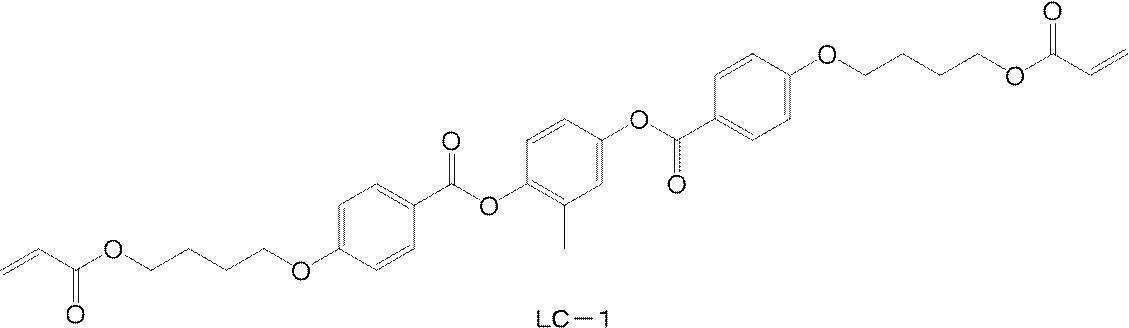
次に、洗浄したガラス基板上にポリイミド配向膜SE-130(日産化学社製)を塗布して塗膜を形成した。得られた塗膜を焼成した後、ラビング処理することにより、配向膜付き基板を作製した。この配向膜のラビング処理面に、30μLの上記試料溶液を回転数1000rpm、10秒間の条件でスピンコートした後、90℃で1分間熟成して液晶層1を得た。
(初期HTP)
液晶層1の中心反射波長を測定し、下記式(1)により初期HTPを求めた。
式(1):HTP =(液晶性化合物の平均屈折率)/{(液晶性化合物に対するキラル化合物の濃度(質量%))×(中心反射波長(nm))}[μm-1]
なお、上記式(1)中、「液晶性化合物の平均屈折率」は、1.55であると仮定して計算した。また、「中心反射波長」は、分光器(島津製UV-3100)を用いて測定した。
液晶層1に対して、波長365nmの光を露光量が100mJ/cm2となるように照射した後、露光後の液晶層1の中心反射波長を測定した。次いで、上述した式(1)により露光後HTPを求めた。
得られた初期HTP及び露光後HTPの各値から、下記式(2)によりHTP増加率を算出した。
式(2):HTP増加率={(露光後のHTP)-(露光前のHTP)}/(露光前のHTP)×100[%]
「A」:初期HTPが50[μm-1]以上である。
「B」:初期HTPが25[μm-1]以上50[μm-1]未満である。
「C」:初期HTPが25[μm-1]未満である。
「AA」:露光後HTPが70[μm-1]以上である。
「A」: 露光後HTPが50[μm-1]以上70[μm-1]未満である。
「B」: 露光後HTPが30[μm-1]以上50[μm-1]未満である。
「C」: 露光後HTPが30[μm-1]未満である。
「AA」:HTP増加率が200%以上である。
「A」: HTP増加率が150%以上200%未満である。
「B」: HTP増加率が100%以上150%未満である。
「C」: HTP増加率が100%未満である。
「D」: HTPが増加しない。
上述した式(1)により、液晶層1(未露光時)の40℃及び90℃における各HTPを算出した。
下記式(3)によりHTPの温度変化率を算出することにより、HTPの温度依存性を評価した。
式(3):温度変化率={(40℃におけるHTP)-(90℃におけるHTP)}/(40℃におけるHTP)×100[%]
≪評価基準(HTP温度依存性)≫
「A」: 温度変化率が2%未満である。
「B」: 温度変化率が2%以上5%未満である。
「C」: 温度変化率が5%以上である。
上述した化合物CD-1と同様の手法にて化合物CD-2を合成した。以下に化合物CD-2の合成手法を示す。

上述した化合物CD-1と同様の手法にて化合物CD-3~CD-13、及び比較用化合物CCD-1~CCD-2を合成した。次いで、上述した各化合物を用いて、実施例1と同様の評価を実施した。結果を表1に示す。
[実施例14]
〔化合物CD-14の合成〕
上述した化合物CD-1と同様の手法、及びAdvanced Synthesisand catalysis,356,179-188(2014)に記載の手法にて化合物CD-14を合成した。次いで、上述した各化合物を用いて、実施例1と同様の評価を実施した。結果を表1に示す。

〔化合物CD-15の合成〕
上述した化合物CD-1と同様の手法、Tetrahedron,72,1553-1540(2016)に記載の手法、及びOrganic Chemistry,9,1883-1890(2013)に記載の手法にて化合物CD-15を合成した。次いで、上述した各化合物を用いて、実施例1と同様の評価を実施した。結果を表1に示す。

〔化合物CCD-3の合成〕
上述した化合物CD-1及びCD-2と同様の手法にて化合物CCD-3を合成した。
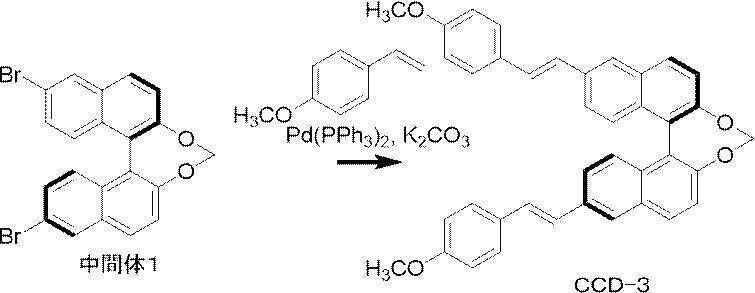
<試料溶液の調製>
上述した化合物CD-1及び化合物CD-2を表1の配合比で混合することで、混合物を調製した。次いで、上述した液晶性化合物LC-1と、2種のキラル化合物からなる上記混合物を混合した後、得られた混合物に溶剤を加えることにより、下記組成の試料溶液を調製した。
・液晶性化合物LC-1 100質量部
・化合物CD-1及び化合物CD-2の混合物 5質量部
・溶剤(MEK(メチルエチルケトン)/シクロヘキサノン=90/10(質量比))
溶質濃度が30質量%となる量
上述した化合物CD-1及び化合物CD-2を表1の配合比で混合した以外は、実施例16と同様の方法により液晶層を作製した。また、実施例1と同様の手法により評価を実施した。結果を表2に示す。
上述した化合物CD-1及び化合物CCD-3を表1の配合比で混合した以外は、実施例16と同様の方法により液晶層を作製した。また、実施例1と同様の手法により評価を実施した。結果を表2に示す。
表1中、「含有比X1/Y1」とは、化合物中における、一般式(2)で表される1価の置換基の含有量(X1モル)と一般式(4)で表される1価の置換基の含有量(Y1モル)の含有比であり、X1をY1で除した値を意図する。
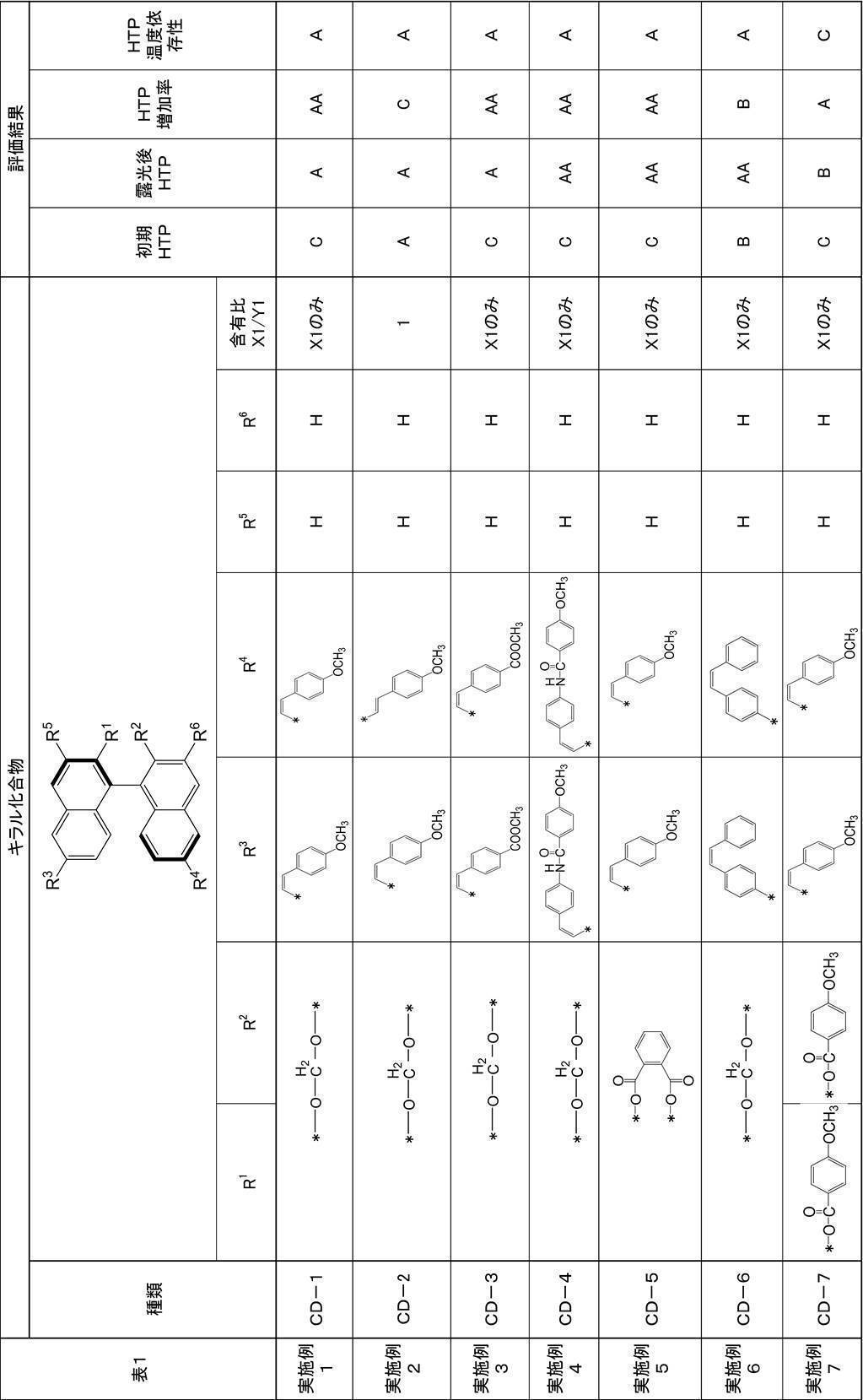
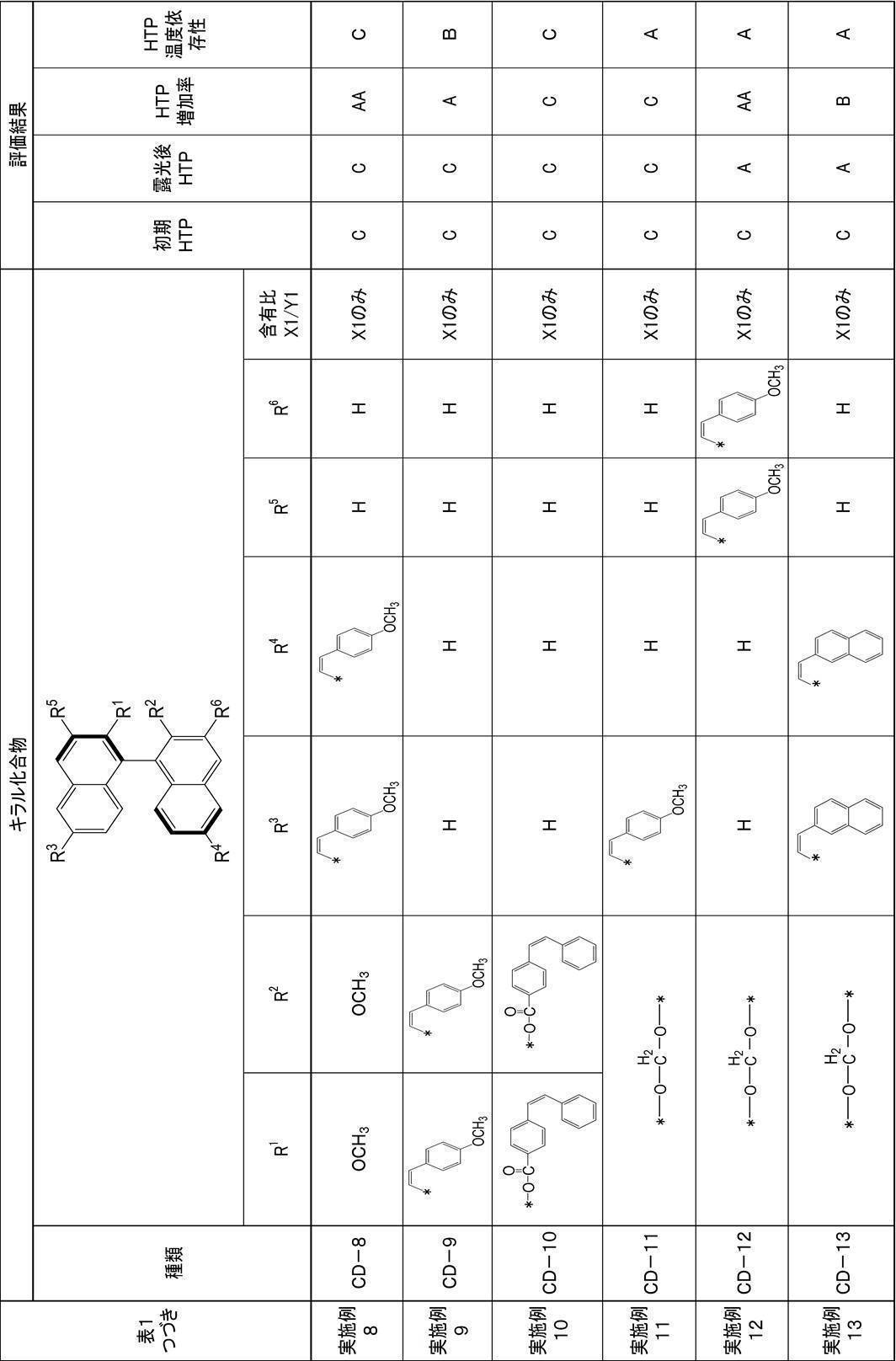

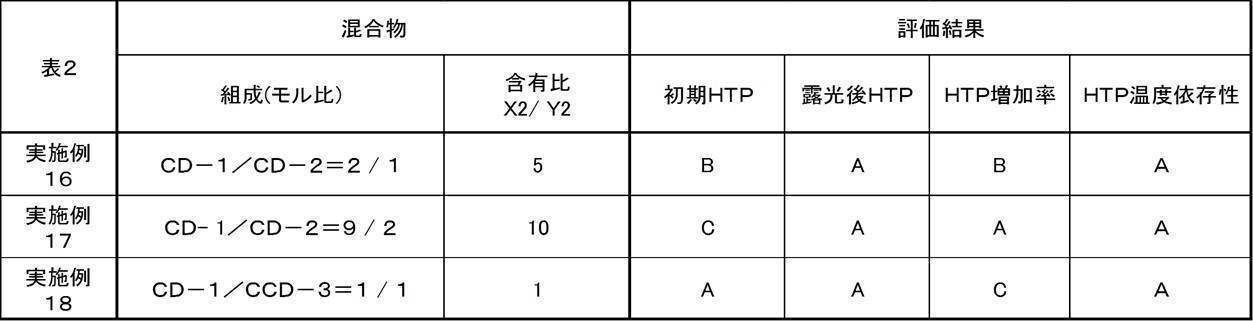
実施例1と実施例2の対比から、特定化合物が、一般式(4)で表される置換基を含まない場合、HTP増加率が大きいことが確認できる。
一方で、混合物においてX2/Y2の値が小さいほど、混合物の露光前HTPは大きいことも明らかである。したがって、一般式(4)で表される置換基を含まない特定化合物(上述した一般式(X1)で表される化合物に該当する。)と、一般式(Y1)で表される化合物とを任意の比率で混合した場合、得られる混合物は、所望の初期HTPとHTP増加率に設定が可能となる。
〔液晶組成物の調製〕
下記に示す配合で、液晶組成物を調製した。
・上述した液晶性化合物LC-1 100質量部
・化合物CD-1 5質量部
・下記に示す界面活性剤S-1 0.1質量部
・IRGACURE 907(BASF製) 3質量部
・溶剤(MEK(メチルエチルケトン)/シクロヘキサノン=90/10(質量比))
溶質濃度が30質量%となる量
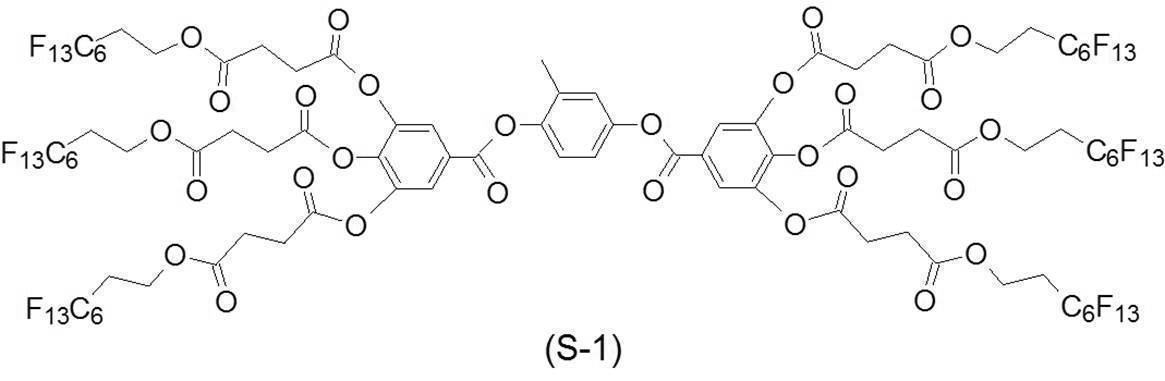
洗浄したガラス基板上にポリイミド配向膜材料SE-130(日産化学社製)を塗布して塗膜を形成した。得られた塗膜を焼成した後、ラビング処理することにより、配向膜付き基板を作製した。この配向膜のラビング処理面に、上記液晶組成物40μLを回転数1500rpm、10秒間の条件でスピンコートすることにより、組成物層を形成し、90℃で1分間乾燥(熟成)して、組成物層中の液晶性化合物を配向させた(言い換えると、コレステリック液晶相の状態とした)。
次に、液晶性化合物を配向させた組成物層に対して、開口部を有するマスクを介して、光源(UVP社製、2UV・トランスイルミネーター)より波長365nmの光を3.0mW/cm2の照射強度で30秒間照射した(CD-1のHTPを増加させる処理に該当)。マスクの開口部と非開口部との差異によって、組成物層は、波長365nmの光を照射された箇所と、照射されていない箇所とが存在する状態である。
続いて、組成物層に対して、マスクを外した状態で、25℃、窒素雰囲気下で500mJ/cm2の照射量で紫外線(HOYA-SCHOTT製、EXECURE 3000-W)を照射して硬化処理を実施し、反射膜(コレステリック液晶相を固定化してなる層に該当)とした。
得られた反射膜は、波長365nmの光を照射された箇所が短波長、照射されていない箇所が長波長反射を示し、選択反射波長が異なること(コレステリック層の螺旋のピッチが異なること)が確認された。
Claims (14)
- 一般式(1)で表される化合物。

一般式(1)中、R1~R6は、それぞれ独立に、水素原子、又は1価の置換基を表す。但し、R1~R6のうち少なくとも1つは、下記一般式(2)で表される1価の置換基を表す。実線と破線が平行している部分は、一重結合、又は二重結合を表す。R1とR2とは、互いに結合して環構造を形成してもよい。
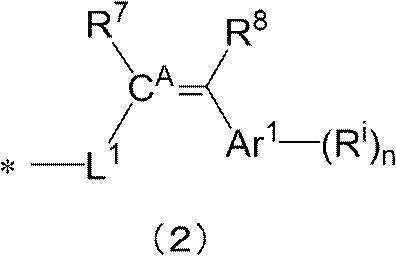
一般式(2)中、Ar1は、n+1価の芳香族炭化水素環基を表す。CAは、炭素原子を表す。R7及びR8は、それぞれ独立に、水素原子、シアノ基、置換ボリル基、置換シリル基、置換アルミニウム基、ハロゲン原子、アルコキシカルボニル基、アルキルカルボニル基、又は炭素数1~10の1価の脂肪族炭化水素基を表す。Riは、1価の置換基を表す。nは、0~5の整数を表す。L1は、単結合、又は下記一般式(3)で表される2価の連結基を表す。*は、前記一般式(1)中のビナフチル骨格との結合位置を表す。
なお、nが2以上である場合、複数存在するRiは、各々同一であっても異なっていてもよい。
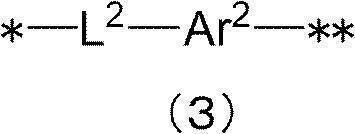
一般式(3)中、L2は、単結合、又は2価の連結基を表す。Ar2は、2価の芳香族炭化水素環基を表す。*は、前記一般式(1)中のビナフチル骨格との結合位置を表す。**は、前記一般式(2)中の前記CAとの結合部位を表す。 - 前記L1が、単結合を表す、請求項1に記載の化合物。
- 前記R1、前記R3、及び前記R5からなる群より選ばれる1つ以上が、前記一般式(2)で表される1価の置換基を表し、且つ、前記R2、前記R4、及び前記R6からなる群より選ばれる1つ以上が、前記一般式(2)で表される1価の置換基を表す、請求項1又は2に記載の化合物。
- 前記R1と前記R2とが互いに結合して環構造を形成している、請求項1~3のいずれか1項に記載の化合物。
- 前記L1が一般式(3)で表される2価の連結基を表すか、前記Riが*-LS1-芳香族炭化水素環基を表すか、又は前記R1及び前記R2が互いに結合して*-LS2-2価の芳香族炭化水素環基-LS2-*を表す、請求項1~4のいずれか1項に記載の化合物。なお、LS1及びLS2は、それぞれ独立に、単結合又は2価の連結基を表し、*は、結合位置を表す。
- 前記R7及び前記R8が、水素原子を表す、請求項1~5のいずれか1項に記載の化合物。
- 前記Ar1がベンゼン環基を表す、請求項1~6のいずれか1項に記載の化合物。
- 前記R1~前記R6が、いずれも、下記一般式(4)で表される1価の置換基以外の1価の置換基を表す、請求項1~7のいずれか1項に記載の化合物。

一般式(4)中、Ar3は、m+1価の芳香族炭化水素環基を表す。CBは、炭素原子を表す。R9及びR10は、それぞれ独立に、水素原子、シアノ基、置換ボリル基、置換シリル基、置換アルミニウム基、ハロゲン原子、アルコキシカルボニル基、アルキルカルボニル基、又は炭素数1~10の1価の脂肪族炭化水素基を表す。Rjは、1価の置換基を表す。mは、0~5の整数を表す。L3は、単結合、又は下記一般式(5)で表される2価の連結基を表す。*は、前記一般式(1)中のビナフチル骨格との結合位置を表す。
なお、mが2以上である場合、複数存在するRjは、各々同一であっても異なっていてもよい。
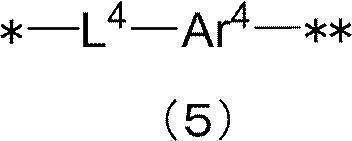
一般式(5)中、Ar4は、2価の芳香族炭化水素環基を表す。L4は、単結合、又は2価の連結基を表す。*は、前記一般式(1)中のビナフチル骨格との結合位置を表す。**は、前記一般式(4)中の前記CBとの結合部位を表す。 - 請求項8に記載の化合物と、下記一般式(Y1)で表される化合物と、からなる混合物。

一般式(Y1)中、R11~R16は、それぞれ独立に、水素原子、又は1価の置換基を表す。但し、R11~R16のうち少なくとも1つは、下記一般式(6)で表される1価の置換基を表す。実線と破線が平行している部分は、一重結合、又は二重結合を表す。R11とR12とは、互いに結合して環構造を形成してもよい。

一般式(6)中、Ar5は、l+1価の芳香族炭化水素環基を表す。CCは、炭素原子を表す。R17及びR18は、それぞれ独立に、水素原子、シアノ基、置換ボリル基、置換シリル基、置換アルミニウム基、ハロゲン原子、アルコキシカルボニル基、アルキルカルボニル基、又は炭素数1~10の1価の脂肪族炭化水素基を表す。Rkは、1価の置換基を表す。lは、0~5の整数を表す。L5は、単結合、又は下記一般式(7)で表される2価の連結基を表す。*は、前記一般式(Y1)中のビナフチル骨格との結合位置を表す。
なお、lが2以上である場合、複数存在するRkは、各々同一であっても異なっていてもよい。
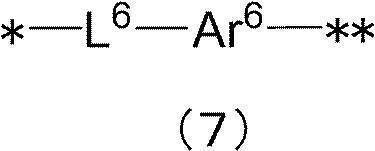
一般式(7)中、Ar6は、2価の芳香族炭化水素環基を表す。L6は、単結合、又は2価の連結基を表す。*は、前記一般式(Y1)中のビナフチル骨格との結合位置を表す。**は、前記一般式(6)中の前記CCとの結合部位を表す。 - 前記一般式(6)で表される1価の置換基の含有量に対する前記一般式(2)で表される1価の置換基の含有量の比が、5以上である、請求項9に記載の混合物。
- 液晶性化合物と、請求項1~8のいずれか1項に記載の化合物又は請求項9若しくは請求項10に記載の混合物と、を含む、液晶組成物。
- 請求項11に記載の液晶組成物を硬化してなる硬化物。
- 請求項11に記載の液晶組成物を用いて形成される、光学異方体。
- 請求項11に記載の液晶組成物を用いて形成される、反射膜。
Priority Applications (4)
| Application Number | Priority Date | Filing Date | Title |
|---|---|---|---|
| CN201980057326.9A CN112638862A (zh) | 2018-09-07 | 2019-09-04 | 化合物、混合物、液晶组合物、固化物、光学各向异性体、反射膜 |
| KR1020217005696A KR102541109B1 (ko) | 2018-09-07 | 2019-09-04 | 화합물, 혼합물, 액정 조성물, 경화물, 광학 이방체, 반사막 |
| JP2020541271A JP7141461B2 (ja) | 2018-09-07 | 2019-09-04 | 化合物、混合物、液晶組成物、硬化物、光学異方体、反射膜 |
| US17/193,392 US20210189243A1 (en) | 2018-09-07 | 2021-03-05 | Compound, mixture, liquid crystal composition, cured product, optically anisotropic body, and reflective film |
Applications Claiming Priority (2)
| Application Number | Priority Date | Filing Date | Title |
|---|---|---|---|
| JP2018-168305 | 2018-09-07 | ||
| JP2018168305 | 2018-09-07 |
Related Child Applications (1)
| Application Number | Title | Priority Date | Filing Date |
|---|---|---|---|
| US17/193,392 Continuation US20210189243A1 (en) | 2018-09-07 | 2021-03-05 | Compound, mixture, liquid crystal composition, cured product, optically anisotropic body, and reflective film |
Publications (1)
| Publication Number | Publication Date |
|---|---|
| WO2020050322A1 true WO2020050322A1 (ja) | 2020-03-12 |
Family
ID=69723210
Family Applications (1)
| Application Number | Title | Priority Date | Filing Date |
|---|---|---|---|
| PCT/JP2019/034809 Ceased WO2020050322A1 (ja) | 2018-09-07 | 2019-09-04 | 化合物、混合物、液晶組成物、硬化物、光学異方体、反射膜 |
Country Status (5)
| Country | Link |
|---|---|
| US (1) | US20210189243A1 (ja) |
| JP (1) | JP7141461B2 (ja) |
| KR (1) | KR102541109B1 (ja) |
| CN (1) | CN112638862A (ja) |
| WO (1) | WO2020050322A1 (ja) |
Cited By (1)
| Publication number | Priority date | Publication date | Assignee | Title |
|---|---|---|---|---|
| WO2026070956A1 (ja) * | 2024-09-30 | 2026-04-02 | 富士フイルム株式会社 | 組成物、反射膜、積層体、化合物 |
Families Citing this family (1)
| Publication number | Priority date | Publication date | Assignee | Title |
|---|---|---|---|---|
| CN114456051B (zh) * | 2022-02-09 | 2023-09-22 | 黑龙江大学 | 手性联萘基β-二酮稀土圆偏振发光螺旋体及其制备方法 |
Citations (5)
| Publication number | Priority date | Publication date | Assignee | Title |
|---|---|---|---|---|
| JP2003055315A (ja) * | 2001-08-15 | 2003-02-26 | Fuji Photo Film Co Ltd | ビナフトール誘導体及びその製造方法 |
| CN105154068A (zh) * | 2015-09-14 | 2015-12-16 | 陕西师范大学 | 基于联二萘酚的聚集诱导发光型手性荧光材料 |
| CN107903916A (zh) * | 2017-11-29 | 2018-04-13 | 北京化工大学 | 胆甾相液晶组合物在紫外光检测中的应用和紫外光检测器 |
| WO2018194157A1 (ja) * | 2017-04-20 | 2018-10-25 | 富士フイルム株式会社 | 化合物、液晶組成物、硬化物、光学異方体、及び反射膜 |
| WO2019181433A1 (ja) * | 2018-03-23 | 2019-09-26 | 富士フイルム株式会社 | 化合物、組成物、硬化物、光学異方体、反射膜 |
Family Cites Families (3)
| Publication number | Priority date | Publication date | Assignee | Title |
|---|---|---|---|---|
| JP2007271808A (ja) * | 2006-03-30 | 2007-10-18 | Fujifilm Corp | 液晶用キラル剤、液晶性組成物、及び重合体、並びに、光記録媒体用フィルタ、光記録媒体、及び液晶カラーフィルタ |
| KR102139875B1 (ko) * | 2015-11-26 | 2020-07-30 | 후지필름 가부시키가이샤 | 광학 필름, 편광판, 화상 표시 장치 및 중합성 화합물과 1,4-사이클로헥세인다이카복실산 모노아릴에스터의 제조 방법 |
| CN106588866B (zh) * | 2016-11-21 | 2018-12-04 | 北京化工大学 | 手性荧光分子光开关及其制备方法、胆甾相液晶组合物及其制备方法和液晶显示器 |
-
2019
- 2019-09-04 WO PCT/JP2019/034809 patent/WO2020050322A1/ja not_active Ceased
- 2019-09-04 JP JP2020541271A patent/JP7141461B2/ja active Active
- 2019-09-04 KR KR1020217005696A patent/KR102541109B1/ko active Active
- 2019-09-04 CN CN201980057326.9A patent/CN112638862A/zh active Pending
-
2021
- 2021-03-05 US US17/193,392 patent/US20210189243A1/en not_active Abandoned
Patent Citations (5)
| Publication number | Priority date | Publication date | Assignee | Title |
|---|---|---|---|---|
| JP2003055315A (ja) * | 2001-08-15 | 2003-02-26 | Fuji Photo Film Co Ltd | ビナフトール誘導体及びその製造方法 |
| CN105154068A (zh) * | 2015-09-14 | 2015-12-16 | 陕西师范大学 | 基于联二萘酚的聚集诱导发光型手性荧光材料 |
| WO2018194157A1 (ja) * | 2017-04-20 | 2018-10-25 | 富士フイルム株式会社 | 化合物、液晶組成物、硬化物、光学異方体、及び反射膜 |
| CN107903916A (zh) * | 2017-11-29 | 2018-04-13 | 北京化工大学 | 胆甾相液晶组合物在紫外光检测中的应用和紫外光检测器 |
| WO2019181433A1 (ja) * | 2018-03-23 | 2019-09-26 | 富士フイルム株式会社 | 化合物、組成物、硬化物、光学異方体、反射膜 |
Non-Patent Citations (1)
| Title |
|---|
| GAO, XIAOHUI ET AL.: "( R )-Binaphthyl derivatives as chiral dopants: substituent position controlled circularly polarized luminescence in liquid crystals", CHEMICAL COMMUNICATIONS, vol. 55, 24 April 2019 (2019-04-24), pages 5914 - 5917, XP055692648 * |
Cited By (1)
| Publication number | Priority date | Publication date | Assignee | Title |
|---|---|---|---|---|
| WO2026070956A1 (ja) * | 2024-09-30 | 2026-04-02 | 富士フイルム株式会社 | 組成物、反射膜、積層体、化合物 |
Also Published As
| Publication number | Publication date |
|---|---|
| CN112638862A (zh) | 2021-04-09 |
| JPWO2020050322A1 (ja) | 2021-09-16 |
| KR102541109B1 (ko) | 2023-06-08 |
| JP7141461B2 (ja) | 2022-09-22 |
| US20210189243A1 (en) | 2021-06-24 |
| KR20210038630A (ko) | 2021-04-07 |
Similar Documents
| Publication | Publication Date | Title |
|---|---|---|
| KR100845931B1 (ko) | 중합성 액정 화합물 및 광학 필름 | |
| JP5219583B2 (ja) | 組成物、光学フィルムとその製造方法、光学部材及び表示装置 | |
| JP6858251B2 (ja) | 化合物、液晶組成物、硬化物、光学異方体、及び反射膜 | |
| JP5219594B2 (ja) | 組成物、光学フィルム及びフラットパネル表示装置 | |
| JP7064575B2 (ja) | 化合物、組成物、硬化物、光学異方体、反射膜 | |
| JPH08245520A (ja) | 光架橋性ナフタレン誘導体 | |
| JP7141461B2 (ja) | 化合物、混合物、液晶組成物、硬化物、光学異方体、反射膜 | |
| KR101988338B1 (ko) | 중합성 액정 화합물, 중합성 액정 조성물 및 배향 필름 | |
| US10907099B2 (en) | Compound, composition, cured object, optically anisotropic body, and reflective film | |
| US12054468B2 (en) | Compound, composition, cured product, optically anisotropic body, and reflective film | |
| JP6937553B2 (ja) | 組成物、組成物を含む光学フィルム、光学フィルムの製造方法 | |
| JP7269317B2 (ja) | 化合物、液晶組成物、硬化物、光学異方体、反射膜 | |
| JP7402306B2 (ja) | 化合物、液晶組成物 | |
| JP7340608B2 (ja) | 化合物、液晶組成物、硬化物、光学異方体、反射膜 |
Legal Events
| Date | Code | Title | Description |
|---|---|---|---|
| 121 | Ep: the epo has been informed by wipo that ep was designated in this application |
Ref document number: 19857083 Country of ref document: EP Kind code of ref document: A1 |
|
| ENP | Entry into the national phase |
Ref document number: 20217005696 Country of ref document: KR Kind code of ref document: A |
|
| ENP | Entry into the national phase |
Ref document number: 2020541271 Country of ref document: JP Kind code of ref document: A |
|
| NENP | Non-entry into the national phase |
Ref country code: DE |
|
| 122 | Ep: pct application non-entry in european phase |
Ref document number: 19857083 Country of ref document: EP Kind code of ref document: A1 |