WO2020045644A1 - エッチング液 - Google Patents
エッチング液 Download PDFInfo
- Publication number
- WO2020045644A1 WO2020045644A1 PCT/JP2019/034193 JP2019034193W WO2020045644A1 WO 2020045644 A1 WO2020045644 A1 WO 2020045644A1 JP 2019034193 W JP2019034193 W JP 2019034193W WO 2020045644 A1 WO2020045644 A1 WO 2020045644A1
- Authority
- WO
- WIPO (PCT)
- Prior art keywords
- silica
- etching
- solution
- etching solution
- mass
- Prior art date
- Legal status (The legal status is an assumption and is not a legal conclusion. Google has not performed a legal analysis and makes no representation as to the accuracy of the status listed.)
- Ceased
Links
Classifications
-
- H—ELECTRICITY
- H10—SEMICONDUCTOR DEVICES; ELECTRIC SOLID-STATE DEVICES NOT OTHERWISE PROVIDED FOR
- H10P—GENERIC PROCESSES OR APPARATUS FOR THE MANUFACTURE OR TREATMENT OF DEVICES COVERED BY CLASS H10
- H10P50/00—Etching of wafers, substrates or parts of devices
-
- H—ELECTRICITY
- H10—SEMICONDUCTOR DEVICES; ELECTRIC SOLID-STATE DEVICES NOT OTHERWISE PROVIDED FOR
- H10P—GENERIC PROCESSES OR APPARATUS FOR THE MANUFACTURE OR TREATMENT OF DEVICES COVERED BY CLASS H10
- H10P50/00—Etching of wafers, substrates or parts of devices
- H10P50/69—Etching of wafers, substrates or parts of devices using masks for semiconductor materials
- H10P50/691—Etching of wafers, substrates or parts of devices using masks for semiconductor materials for Group V materials or Group III-V materials
Definitions
- the present disclosure relates to an etching solution for a silicon nitride film, an etching method using the same, and a method for manufacturing a semiconductor substrate.
- the SiN film is selectively etched from a substrate having a silicon nitride film (hereinafter also referred to as “SiN film”) and a silicon oxide film (hereinafter also referred to as “SiO 2 film”). Removal process is performed.
- SiN film silicon nitride film
- SiO 2 film silicon oxide film
- a method of etching a SiN film a method of etching using phosphoric acid at a high temperature of 150 ° C. or higher is known.
- Patent References 1 to 6 In the field of semiconductors in recent years, the degree of integration is increasing, and the complexity and miniaturization of wiring are required, and a method of increasing the ratio of the etching rate of the SiN film to the SiO 2 film has been proposed (eg, Patent References 1 to 6).
- Patent Document 1 proposes a method using an etchant for silicon nitride containing a quaternary ammonium, a basic compound, and an acid.
- Patent Document 2 proposes an etching method that uses an etching solution containing a phosphoric acid compound, a silicon-containing compound, and water by boiling.
- Patent Literature 3 proposes a method using an etchant containing an inorganic acid, a silane inorganic acid salt, and a solvent.
- Patent Document 4 discloses that a phosphoric acid, an acid having an acid dissociation index smaller than the first acid dissociation index pKa of phosphoric acid, a silicate compound, and water, and a mass ratio of phosphoric acid to the acid (phosphorus acid)
- An etching solution having an acid / acid ratio of 0.82 or more and 725 or less has been proposed.
- Patent Document 5 discloses that 3 to 20% by weight of hydrofluoric acid, 5 to 40% by weight of nitric acid, 10 to 60% by weight of acetic acid, 2 to 20% by weight of an accelerator, and the balance of water
- An etching solution for a semiconductor substrate has been proposed in which the accelerator is one or more selected from an ammonium compound and a sulfonic acid compound.
- Patent Document 6 proposes an etching solution containing a phosphoric acid aqueous solution containing water and phosphoric acid, and a salt of an organic compound soluble in the phosphoric acid aqueous solution.
- Patent Document 7 proposes an etching solution containing a phosphoric acid aqueous solution having water and phosphoric acid, and a salt of an organic compound soluble in the phosphoric acid aqueous solution.
- JP 2012-33561 A JP 2014-99480 A JP 2016-29717 A International Publication No. WO2018 / 168874 JP-A-2005-504247 JP, 2018-56185, A JP, 2018-56185, A
- the present disclosure in one aspect, is an etching solution for a step of removing a silicon nitride film from a substrate having a silicon nitride film and a silicon oxide film, wherein a solution containing silica and an alkali, phosphoric acid, and water are used.
- the present invention relates to an etching solution that is formulated.
- the present disclosure relates, in one aspect, to an etching method including a step of removing a silicon nitride film from a substrate having a silicon nitride film and a silicon oxide film using the etching solution of the present disclosure.
- the present disclosure relates, in one aspect, to a method for manufacturing a semiconductor substrate, including a step of removing a silicon nitride film from a substrate having a silicon nitride film and a silicon oxide film using the etching solution of the present disclosure.
- the present disclosure in one aspect, is an additive added to an etchant for a process of removing a silicon nitride film from a substrate having a silicon nitride film and a silicon oxide film,
- the present invention relates to an additive, which is a solution containing silica and an alkali.
- the present disclosure in one aspect, is a kit for producing an etchant for a process of removing a silicon nitride film from a substrate having a silicon nitride film and a silicon oxide film
- the present invention relates to a kit which contains a solution containing silica and an alkali (first solution) and a solution containing phosphoric acid (second solution) in a state where they are not mixed with each other, and these are mixed at the time of use.
- the present disclosure provides an etchant capable of improving the ratio of the etching rate of a silicon nitride film to a silicon oxide film, an etching method using the same, and a method of manufacturing a semiconductor substrate.
- the present disclosure is an etchant for a step of removing a silicon nitride film from a substrate having a silicon nitride film and a silicon oxide film, wherein the solution contains silica and an alkali, phosphoric acid, and water.
- etchant of the present embodiment 1 the ratio of the etching rate of the silicon nitride film to the silicon oxide film.
- “comprising a solution containing silica and alkali, phosphoric acid, and water” means not only a solution containing silica and alkali, phosphoric acid, and water, but also optional components as necessary. Can be compounded. Further, in the present disclosure, the compounding amount of each component in the etching solution can be read as the content in the etching solution.
- a solution containing silica and an alkali is blended in the etching solution of the first aspect.
- the solution containing silica and alkali used for preparing the etching solution of the first embodiment is at least part of silica from the viewpoint of improving the SiN / SiO 2 selectivity ratio, and preventing deposition and adhesion of silica to the SiO 2 film.
- the silica dissolving solution of the present disclosure is a silica dissolving solution in which silica is dissolved to below the detection limit in various particle size measuring devices and appearances in one or a plurality of embodiments.
- the silica solution may include undissolved silica.
- the silica solution of the present disclosure is obtained, for example, by mixing silica and an alkali and dissolving the silica.
- Examples of the method for dissolving silica include a heating treatment, a pressure treatment, and a mechanical pulverization treatment, and these may be used in combination.
- the heating conditions can be set, for example, to 60 to 100 ° C.
- the pressing condition can be set, for example, to 0 to 3 MPa.
- Mechanical pulverization can be performed, for example, using a ball mill or the like.
- ultrasonic vibration may be applied.
- the state of the silica before being mixed with the alkali is not particularly limited, and examples thereof include a powder, a sol, and a gel.
- silica silic before dissolution
- examples of the silica (silica before dissolution) used for preparing the silica solution of the present disclosure include crystalline silica, amorphous silica, fumed silica, wet silica, colloidal silica, and calcined silica obtained by calcining these. Is mentioned. Among them, at least one selected from fumed silica and colloidal silica from the viewpoints of improving the SiN / SiO 2 selection rate ratio, suppressing deposition of silica on the SiO 2 film, preventing adhesion, and suppressing filter clogging during circulating use. Species are preferred.
- the colloidal silica for example, a method by particle growth using an aqueous solution of alkali silicate as a raw material (hereinafter, also referred to as “water glass method”) and a method by condensation of a hydrolyzate of alkoxysilane (hereinafter, referred to as “sol-gel method”) ).
- the silica particles obtained by the water glass method and the sol-gel method can be produced by a conventionally known method.
- the crystallinity of silica is preferably 4% or less, more preferably 3% or less. The crystallinity can be measured, for example, by the method described in Examples.
- Silica can be used alone or in combination of two or more.
- the alkali used for preparing the silica solution of the present disclosure includes an organic alkali or an inorganic alkali.
- the alkalis can be used alone or in combination of two or more.
- the organic alkali used for preparing the silica solution of the present disclosure may be any one that can dissolve silica, and examples thereof include quaternary ammonium salts such as tetraalkylammonium hydroxide.
- quaternary ammonium salt examples include tetramethylammonium hydroxide (TMAH), tetraethylammonium hydroxide (TEAH), trimethylethylammonium hydroxide (ETMAH), benzyltrimethylammonium hydroxide, ethyltrimethylammonium hydroxide, methyl At least one selected from benzyltrimethylammonium hydroxide and tetraethylammonium hydroxide is exemplified.
- TMAH tetramethylammonium hydroxide
- TEAH tetraethylammonium hydroxide
- ETMAH trimethylethylammonium hydroxide
- benzyltrimethylammonium hydroxide ethyltrimethylammonium hydroxide
- methyl At least one selected from benzyltrimethylammonium hydroxide and tetraethylammonium hydroxide is exemplified.
- TMAH tetramethylammonium hydroxide
- ETMAH trimethyl ethyl ammonium hydroxide
- TMAH is more preferable.
- TMAH is preferable from the viewpoint of improving the SiN / SiO 2 selection speed ratio and suppressing blockage of the filter in circulating use.
- the inorganic alkali used for preparing the silica solution of the present disclosure may be any as long as it can dissolve silica, and examples thereof include sodium hydroxide and potassium hydroxide.
- the alkali used for preparing the silica solution of the present disclosure includes tetramethylammonium hydroxide (TMAH), tetraethylammonium hydroxide (TEAH), trimethylethylammonium hydroxide (ETMAH), benzyl At least one selected from trimethylammonium hydroxide, ethyltrimethylammonium hydroxide, methylbenzyltrimethylammonium hydroxide, tetraethylammonium hydroxide, sodium hydroxide, and potassium hydroxide is exemplified.
- TMAH tetramethylammonium hydroxide
- TEAH tetraethylammonium hydroxide
- ETMAH trimethylethylammonium hydroxide
- benzyl At least one selected from trimethylammonium hydroxide, ethyltrimethylammonium hydroxide, methylbenzyltrimethylammonium hydroxide, tetraethyl
- TMAH tetramethylammonium hydroxide
- ETMAH trimethylethylammonium hydroxide
- sodium hydroxide sodium hydroxide
- potassium hydroxide potassium hydroxide
- the silica solution of the present disclosure may contain silica that has not been dissolved in alkali. That is, in one or more embodiments, the etching solution of the first aspect may include undissolved silica.
- the undissolved silica is preferably fine silica from the viewpoint of suppressing clogging of the filter when the etching solution is circulated.
- the average particle diameter of the fine silica is, for example, 0.1 nm or more and 1000 nm or less.
- the average particle diameter of silica is an average particle diameter based on a scattering intensity distribution measured at a detection angle of 173 ° in a dynamic light scattering method. Specifically, it can be measured by the method described in Examples.
- the solution containing silica and alkali used for the preparation of the etching solution of the present embodiment 1 is used for the etching of the present embodiment 1 from the viewpoint of improving the SiN / SiO 2 selectivity ratio, and suppressing deposition and adhesion of silica to the SiO 2 film. It is preferred that the content of the dissolved silica in the liquid is from 0.0005% by mass to 1% by mass.
- the content of dissolved silica in the etching solution of the present embodiment 1 (hereinafter also referred to as “dissolved amount of silica”) is intended to improve the SiN / SiO 2 selection rate ratio and to prevent deposition and adhesion of silica to the SiO 2 film.
- the amount of silica dissolved in the etching solution of this embodiment 1 is preferably 0.0005% by mass or more and 1% by mass or less, more preferably 0.001% by mass or more and 0.5% by mass or less, and 0.01% by mass or less.
- the content is more preferably from 0.1% by mass to 0.1% by mass.
- the content of silica (total content of dissolved silica and undissolved silica) in the etching solution of this embodiment 1 improves the SiN / SiO 2 selection rate ratio, and suppresses deposition and adhesion of silica to the SiO 2 film. From the viewpoint, it is preferably 0.0005% by mass or more, more preferably 0.001% by mass or more, still more preferably 0.01% by mass or more, and from the same viewpoint, preferably 1% by mass or less, and 0.5% by mass. % Or less, more preferably 0.1% by mass or less.
- the content of silica in the etching solution of the first embodiment is preferably 0.0005% by mass or more and 1% by mass or less, more preferably 0.001% by mass or more and 0.5% by mass or less.
- the content is more preferably from 01% by mass to 0.1% by mass.
- phosphoric acid is blended in the etching solution of the first aspect.
- the amount of phosphoric acid in the etching solution of this embodiment 1 is preferably 50% by mass or more, more preferably 70% by mass or more, and still more preferably 80% by mass or more.
- 95 mass% or less is preferable, 90 mass% or less is more preferable, and 85 mass% or less is still more preferable.
- the compounding amount of phosphoric acid in the etching solution of this embodiment 1 is preferably from 50% by mass to 95% by mass, more preferably from 70% by mass to 90% by mass, and more preferably from 80% by mass to 85% by mass. % Is more preferable.
- water is mixed in the etching solution of the first aspect.
- Examples of the water contained in the etching solution of the first embodiment include distilled water, ion-exchanged water, pure water, and ultrapure water.
- the etchant of this aspect 1 further contains a high-temperature stabilizer from the viewpoint of suppressing clogging of the filter in circulating use while maintaining the SiN / SiO 2 selection speed ratio. It may be.
- the high-temperature stabilizer may be used alone or in combination of two or more.
- the high temperature stabilizer examples include a high temperature stabilizer having a pKa of 2 or less.
- the pKa of the high-temperature stabilizer is preferably 2 or less, more preferably 1.5 or less, and further preferably 1.0 or less from the viewpoint of suppressing clogging of the filter in circulating use while maintaining the SiN / SiO 2 selection speed ratio. preferable.
- pKa can be determined by the method described in Examples.
- Examples of the high-temperature stabilizer having a pKa of 2 or less include an organic acid having a pKa of 2 or less.
- Examples of the organic acid having a pKa of 2 or less include at least one selected from a sulfonic acid compound having a pKa of 2 or less, maleic acid (pKa: 1.87), and oxalic acid (pKa: 1.27).
- Examples of the sulfonic acid compound having a pKa of 2 or less include p-toluenesulfonic acid (pKa: -2.8), benzenesulfonic acid (pKa: 0.7) and the like.
- the high-temperature stabilizer having a pKa of 2 or less is preferably a sulfonic acid compound having a pKa of 2 or less. At least one of toluenesulfonic acid and benzenesulfonic acid is more preferred. These may be used alone or in combination of two or more.
- the ratio of the mass (M2) of phosphoric acid to the mass (M1) of the high-temperature stabilizer is one or more.
- the mass ratio M2 / M1 is preferably 800 or more and 82000 or less, more preferably 1000 or more and 41,000 or less, and still more preferably 1500 or more and 27000 or less.
- the ratio of the molar amount of phosphoric acid (m2) to the molar amount of high-temperature stabilizer (m1) is 1 or
- the number is preferably 1,000 or more, more preferably 2500 or more, still more preferably 4500 or more, and 140,000 or less. , Preferably 72,000 or less, more preferably 48,000 or less. More specifically, the molar ratio m2 / m1 is preferably 1,000 or more and 140000 or less, more preferably 2500 or more and 72,000 or less, and still more preferably 4500 or more and 48,000 or less.
- the amount of the high-temperature stabilizer in the etching solution of the first embodiment is improved in the selection speed ratio of SiN / SiO 2 , suppression of silica aggregation, and circulation.
- 0.001 mass% or more is preferable, 0.003 mass% or more is more preferable, 0.005 mass% or more is more preferable from a viewpoint of blockage suppression of the filter in use, and 1.0 mass is 1.0% from a similar viewpoint.
- % Preferably 0.5% by mass or less, more preferably 0.1% by mass or less, even more preferably less than 0.1% by mass.
- the compounding amount of the high-temperature stabilizer in the etching solution of the first embodiment is preferably from 0.001% by mass to 1.0% by mass, and more preferably from 0.003% by mass to 0.5% by mass. It is more preferably from 0.005% by mass to 0.1% by mass, and more preferably from 0.005% by mass to less than 0.1% by mass.
- the high-temperature stabilizer is a combination of two or more, the amount of the high-temperature stabilizer is the total amount thereof.
- the etchant of this aspect 1 contains an organic phosphonic acid compound from the viewpoint of improving the SiN / SiO 2 selection rate ratio and / or suppressing deposition and adhesion of silica to the SiO 2 film. It may be further compounded.
- the organic phosphonic acid compounds may be used alone or in combination of two or more.
- Examples of the organic phosphonic acid compound include phosphoric acid polymers, alkyl phosphonic acids, alkenyl phosphonic acids, and alkyl ether phosphonic acids from the viewpoint of improving the selection rate ratio of SiN / SiO 2 , and suppressing deposition and adhesion of silica to the SiO 2 film. And the like.
- Examples of the phosphoric acid polymer include polyvinylphosphonic acid (PVPA). The number of carbon atoms in the alkyl group of the alkylphosphonic acid is preferably 6 or more, more preferably 8 or more, from the viewpoint of improving the SiN / SiO 2 selection rate ratio, and suppressing deposition and adhesion of silica to the SiO 2 film.
- the number is preferably 18 or less, more preferably 16 or less.
- the alkyl group of the alkyl phosphonic acid may be linear or branched. Specific examples of the alkylphosphonic acid include hexylphosphonic acid, heptylphosphonic acid, octylphosphonic acid, caprylphosphonic acid, dodecylphosphonic acid, and tetradecacylphosphonic acid.
- the number of carbon atoms of the alkenyl group of the alkenyl phosphonic acid is preferably 6 or more, more preferably 8 or more, from the viewpoint of improving the SiN / SiO 2 selection rate ratio and suppressing deposition and adhesion of silica to the SiO 2 film.
- the number is preferably 18 or less, more preferably 16 or less.
- the alkenyl group of the alkenylphosphonic acid may be linear or branched.
- the number of carbon atoms of the alkyl group of the alkyl ether phosphonic acid is preferably 6 or more, more preferably 8 or more, from the viewpoints of improving the SiN / SiO 2 selection rate ratio and suppressing deposition and adhesion of silica to the SiO 2 film. From the viewpoint of solubility, it is preferably 20 or less, more preferably 18 or less.
- the alkyl group of the alkenylphosphonic acid may be linear or branched.
- the alkyl ether phosphonic acid examples include polyoxyethylene alkyl ether phosphonic acid.
- the organic phosphonic acid compounds include polyvinyl phosphonic acid, alkyl phosphonic acid, and alkyl ether phosphonic acid from the viewpoint of improving the selection rate ratio of SiN / SiO 2 and suppressing the deposition and adhesion of silica to the SiO 2 film. At least one selected from acids is preferred.
- the molecular weight of the organic phosphonic acid compound is preferably 1,000 or more, and more preferably 5,000 or more, from the viewpoints of improving the SiN / SiO 2 selection rate ratio, and suppressing deposition and adhesion of silica to the SiO 2 film. More preferably, 7000 or more is further preferable, and 100,000 or less is preferable, 50,000 or less is more preferable, and 20,000 or less is further preferable. More specifically, the molecular weight of the organic phosphonic acid compound is preferably from 1,000 to 100,000, more preferably from 5,000 to 50,000, even more preferably from 7000 to 20,000.
- the molecular weight of the organic phosphonic acid compound is preferably 150 or more, more preferably 200 or more, and still more preferably 300 or more, from the viewpoint of preventing silica from being deposited on the SiO 2 film and suppressing adhesion. And 100000 or less is preferable, 50,000 or less is more preferable, and 20,000 or less is still more preferable. More specifically, the molecular weight of the organic phosphonic acid compound is preferably from 150 to 100,000, more preferably from 200 to 50,000, even more preferably from 300 to 20,000.
- the weight average molecular weight of the organic phosphonic acid compound is 1000 from the viewpoint of improving the SiN / SiO 2 selection rate ratio and suppressing deposition and adhesion of silica to the SiO 2 film. It is preferably at least 5,000, more preferably at least 5,000, still more preferably at least 7000, and preferably at most 100,000, more preferably at most 50,000, even more preferably at most 20,000. More specifically, the molecular weight of the organic phosphonic acid compound is preferably from 1,000 to 100,000, more preferably from 5,000 to 50,000, even more preferably from 7000 to 20,000.
- the weight average molecular weight can be measured using gel permeation chromatography (GPC), for example, under the following conditions.
- GPC gel permeation chromatography
- Eluent: 0.2 M phosphate buffer / CH 3 CN 9/1 (volume ratio)
- Sample size 5 mg / mL
- the amount of the organic phosphonic acid compound in the etching solution of the first embodiment depends on the improvement of the SiN / SiO 2 selection speed ratio and the SiO 2 film of silica. 0.005 mass% or more is preferable, 0.01 mass% or more is more preferable, 0.03 mass% or more is more preferable from a viewpoint of precipitation and adhesion suppression to the surface, and 5.0 mass% from the same viewpoint. %, Preferably 1.0% by mass or less, more preferably 0.5% by mass or less.
- the compounding amount of the organic phosphonic acid compound in the etching solution of the first embodiment is preferably from 0.005% by mass to 5.0% by mass, and more preferably from 0.01% by mass to 1.0% by mass. It is more preferably from 0.03% by mass to 0.5% by mass.
- the organic phosphonic acid compound is a combination of two or more, the compounding amount of the organic phosphonic acid compound is the total compounding amount thereof.
- the etchant of this aspect 1 may further include a nonionic surfactant from the viewpoint of suppressing deposition and adhesion of silica to the SiO 2 film.
- the nonionic surfactant include polyoxyalkylene alkyl ethers from the viewpoint of preventing silica from depositing on the SiO 2 film and preventing adhesion.
- polyoxyethylene lauryl ether, polyoxyethylene oleyl ether, At least one selected from oxyethylene polyoxypropylene lauryl myristyl ether is exemplified.
- One type of nonionic surfactant may be used alone, or two or more types may be used in combination.
- the HLB of the nonionic surfactant in the etching solution of the first embodiment is preferably 8 or more, more preferably 12 or more, and still more preferably 15 or more, from the viewpoint of suppressing deposition and adhesion of silica to the SiO 2 film.
- HLB is defined as the number determined by the functional group described in Davis, JT; Proc. Intern. Congr. Surface Activity, 2nd, London, 1, 426 (1957), This is a value defined by "sum of bases-sum of bases of lipophilic groups.”
- the blending amount of the nonionic surfactant in the etching solution of the first embodiment is determined from the viewpoint of suppressing precipitation and adhesion of silica to the SiO 2 film. , Preferably 0.001% by mass or more, more preferably 0.01% by mass or more, still more preferably 0.03% by mass or more, and from the same viewpoint, preferably 10% by mass or less, more preferably 5% by mass or less. It is more preferably at most 1% by mass.
- the compounding amount of the nonionic surfactant in the etching solution of the first embodiment is preferably from 0.001% by mass to 10% by mass, more preferably from 0.01% by mass to 5% by mass, The content is more preferably from 0.03% by mass to 1% by mass.
- the blending amount of the nonionic surfactant is the total blending amount thereof.
- the etchant of this embodiment 1 may further contain other components as long as the effects of the present disclosure are not impaired.
- Other components include acids other than phosphoric acid, chelating agents, surfactants other than the nonionic surfactant described above, solubilizers, preservatives, rust preventives, bactericides, antibacterial agents, antioxidants, and the like. No.
- the solution containing silica and alkali, and the above-described optional components are additives added to the etching solution.
- the present disclosure in one aspect, is an additive that is added to an etchant for a process of removing a silicon nitride film from a substrate having a silicon nitride film and a silicon oxide film, and includes a solution containing silica and an alkali.
- Additives hereinafter, also referred to as “additives of the present disclosure”).
- the additive of the present disclosure can further include at least one selected from an organic phosphonic acid compound, a high-temperature stabilizer, and a nonionic surfactant.
- the additive of the present disclosure can further include phosphoric acid in one or more embodiments.
- the etching solution of this embodiment 1 includes, for example, a solution containing silica and alkali, phosphoric acid, water, and optionally the above-mentioned optional components (organic phosphonic acid compound, high-temperature stabilizer, nonionic surfactant, other components) )
- the present disclosure in one embodiment, includes a method of manufacturing an etching solution (hereinafter, referred to as “the compounding step”) including a step of mixing a solution containing at least silica and an alkali, phosphoric acid, and water (hereinafter, also referred to as a “combining step”). 1 etching liquid production method ”).
- the method for producing an etchant according to the first aspect may further include a step of preparing a silica solution by mixing silica and an alkali.
- “comprising a solution containing at least silica and an alkali, phosphoric acid and water” means, in one or more embodiments, a solution containing silica and an alkali, phosphoric acid, water, and if necessary, the above Including mixing the optional components simultaneously or sequentially.
- the order of mixing need not be particularly limited.
- the blending can be performed using a mixer such as a homomixer, a homogenizer, an ultrasonic disperser, and a wet ball mill.
- the solution containing silica and alkali has the above-mentioned content of dissolved silica in the etching solution according to the first embodiment, from the viewpoint of improving the selection rate ratio of SiN / SiO 2 . It is preferable to be blended so as to be within the range.
- the pH of the etching solution of this embodiment 1 is preferably 0.1 or more, more preferably 0.2 or more, still more preferably 0.3 or more, and 2 or less. Is preferably 1.5 or less, more preferably 1.0 or less. More specifically, the pH is preferably 0.1 or more and 2 or less, more preferably 0.2 or more and 1.5 or less, and even more preferably 0.3 or more and 1.0 or less.
- the pH of the etchant is a value at 25 ° C., and can be measured using a pH meter, and specifically, can be measured by the method described in Examples.
- the 0.2 ⁇ m filter passage amount of the etching solution of this embodiment 1 is preferably 10 g / 3 min or more, more preferably 20 g / 3 min or more, and 25 g / 3 min or more. Is more preferred.
- the 0.2 ⁇ m filter passage amount can be calculated by the method described in Examples.
- the etching solution of the first embodiment may be stored and supplied in a concentrated state as long as the stability is not impaired. This case is preferable in that manufacturing and transportation costs can be reduced.
- This concentrated solution can be appropriately diluted with water or a phosphoric acid aqueous solution as needed and used in the etching step.
- the dilution ratio is preferably 5 to 100 times.
- kits for producing the etching solution of the first aspect (hereinafter, also referred to as “kit of the first aspect”).
- kit of the first aspect includes, for example, a solution containing silica and alkali (first solution) and a solution containing phosphoric acid (second solution) in a state where they are not mixed with each other.
- a kit (two-part type etchant) that is sometimes mixed is exemplified. After the first liquid and the second liquid are mixed, they may be diluted with water or a phosphoric acid aqueous solution as needed.
- the first liquid or the second liquid may include all or a part of water used for preparing the etching liquid.
- the phosphoric acid contained in the second liquid may be the whole amount or a part of the phosphoric acid used for preparing the etching solution.
- the first liquid and the second liquid may each contain the above-described optional components as needed. According to the kit of the first embodiment, an etching solution capable of improving the SiN / SiO 2 selection speed ratio can be obtained.
- the substrate to be etched using the etching solution of the first aspect is a substrate having a silicon nitride film and a silicon oxide film in one or more embodiments.
- the substrate include a semiconductor and a substrate used for a flat panel display.
- the silicon nitride film include a nitride film formed by low-pressure chemical vapor deposition (LPCVD), plasma chemical vapor deposition (PECVD), atomic layer deposition (ALD), or the like.
- Examples of the silicon oxide film include an oxide film formed by a thermal oxidation method, an LPCVD method, a PECVD method, an ALD method, or the like.
- the present disclosure includes a step of removing a silicon nitride film from a substrate having a silicon nitride film and a silicon oxide film using the etching solution of the first embodiment (hereinafter, also referred to as “etching step of the present disclosure”).
- the present invention also relates to a method of manufacturing a semiconductor substrate (hereinafter, also referred to as a “method of manufacturing a semiconductor substrate of the first embodiment”).
- the semiconductor substrate manufacturing method of the first aspect it is possible to improve the SiN / SiO 2 selection speed ratio. Therefore, according to the semiconductor substrate manufacturing method of the first aspect, it is possible to produce an effect of efficiently manufacturing a semiconductor substrate having improved quality.
- examples of the etching method include immersion etching, single-wafer etching, and the like.
- the etching temperature of the etching solution is preferably 110 ° C. or higher, more preferably 120 ° C. or higher, still more preferably 140 ° C. or higher, and more preferably 150 ° C. or higher, from the viewpoint of improving the SiN / SiO 2 selection rate ratio. Is more preferably, and preferably 250 ° C. or lower, more preferably 230 ° C. or lower, still more preferably 200 ° C. or lower, and further preferably 180 ° C. or lower.
- the etching temperature of the etching solution is preferably from 120 ° C to 250 ° C, more preferably from 140 ° C to 230 ° C, and even more preferably from 150 ° C to 200 ° C. In one or more other embodiments, the etching temperature of the etching solution is preferably from 110 ° C. to 180 ° C.
- the etching time can be set to, for example, 30 minutes or more and 270 minutes or less.
- the etching rate of the silicon nitride film is preferably 40 ° / min or more, more preferably 50 ° / min or more, and still more preferably 60 ° / min or more from the viewpoint of improving productivity.
- the etching rate of the silicon oxide film is preferably equal to or less than 1.0 ° / min, more preferably equal to or less than 0.5 ° / min, and still more preferably equal to or less than 0.3 ° / min, from the viewpoint of improving productivity. .
- the SiN / SiO 2 selection speed ratio is preferably 150 or more, more preferably 200 or more, and still more preferably 300 or more, from the viewpoint of improving productivity.
- an etching method includes a step (etching step) of removing a silicon nitride film from a substrate having a silicon nitride film and a silicon oxide film using the etching solution of the first embodiment.
- Etching method of aspect 1 By using the etching method of the first aspect, the selection speed ratio of SiN / SiO 2 can be improved, so that the effect of improving the productivity of a semiconductor substrate having improved quality can be obtained.
- the specific etching method and conditions can be the same as those of the semiconductor substrate manufacturing method of the first aspect.
- the present disclosure provides an etchant capable of suppressing clogging of a filter in circulating use of the etchant, an etching method using the same, and a method for manufacturing a semiconductor substrate.
- the present disclosure is an etchant for a process of removing a silicon nitride film from a substrate having a silicon nitride film and a silicon oxide film, wherein the high temperature stabilizer has a pKa of 2 or less; And water and an etching solution (hereinafter, also referred to as “etching solution of the present embodiment 2”).
- etching solution of the present embodiment 2 water and an etching solution
- the ratio of the etching rate of the silicon nitride film to the silicon oxide film (hereinafter, also referred to as “SiN / SiO 2 selection rate ratio”) can be maintained. .
- the high-temperature stabilizer having a pKa of 2 or less blended in the etching solution is charged with ions on the surface of a precipitate (eg, silica) derived from silicic acid generated during the etching step.
- a precipitate eg, silica
- the present disclosure need not be construed as being limited to these mechanisms.
- the etching solution of the second aspect includes a high-temperature stabilizer.
- the high-temperature stabilizer in the second embodiment include the high-temperature stabilizer in the first embodiment.
- the high-temperature stabilizer may be used alone or in combination of two or more.
- the ratio of the mass (M2) of phosphoric acid to the mass (M1) of the high-temperature stabilizer (mass ratio M2 / M1), the molar ratio of phosphoric acid to the molar amount of the high-temperature stabilizer (m1) the amount (m2) ratio (mole ratio m @ 2 / m1), and blockage of the filter from the viewpoint of suppressing the high temperature compounding amount of the stabilizer, respectively, while maintaining the SiN / SiO 2 selected speed ratio recycled, the aspect It is preferable that the mass ratio M2 / M1, the molar ratio m2 / m1, and the amount of the high-temperature stabilizer are the same.
- phosphoric acid is blended in the etching solution of the second aspect.
- the amount of phosphoric acid in the etching solution of the second embodiment is preferably in the same range as the amount of phosphoric acid in the etching solution of the first embodiment from the viewpoint of improving the SiN / SiO 2 selection speed ratio.
- the etching solution of the second aspect contains water.
- Examples of the water in the second embodiment include the same water as in the first embodiment.
- the etchant of this aspect 2 further includes a solution containing a silicon compound from the viewpoint of improving the SiN / SiO 2 selection rate ratio and suppressing clogging of the filter in circulating use. Things.
- the silicon compound include an inorganic silicon compound containing silicon and an organic silicon compound containing silicon.
- the inorganic silicon compound include silica and an inorganic silane compound.
- the organic silicon compound include an organic silane compound.
- the solution containing a silicon compound is preferably a solution containing silica and an alkali, from the viewpoint of improving the SiN / SiO 2 selection speed ratio and suppressing clogging of the filter in circulating use. Therefore, in one or more embodiments, the etching solution of the second aspect may further include a solution containing silica and an alkali.
- Embodiment 2 when the solution containing a silicon compound is a solution containing silica and an alkali, the solution containing silica and alkali used for preparing the etching solution of this Embodiment 2 improves the SiN / SiO 2 selection rate ratio, From the viewpoint of suppressing clogging of the filter in circulating use, it is preferable to use a silica solution in which at least a part of silica is dissolved with an alkali.
- the silica dissolving solution in the second embodiment the silica dissolving solution in the first embodiment is exemplified.
- the solution containing silica and alkali used for preparing the etching solution of this Embodiment 2 improves the SiN / SiO 2 selection rate ratio
- the content of the dissolved silica in the etching solution of the second embodiment is 0.0005% by mass or more and 1% by mass or less.
- the content of dissolved silica (dissolved amount of silica) in the etching solution of the second embodiment is from the viewpoint of improving the SiN / SiO 2 selection speed ratio and suppressing clogging of the filter in circulating use. It is preferably within the same range as the amount of silica dissolved.
- the content of the silicon compound in the etching solution of the second embodiment is determined by improving the selection speed ratio of SiN / SiO 2 and blocking the filter in circulating use. Is preferably 0.0005% by mass or more, more preferably 0.001% by mass or more, still more preferably 0.01% by mass or more, and from the same viewpoint, preferably 1% by mass or less. 0.5 mass% or less is more preferable, and 0.1 mass% or less is still more preferable.
- the content of the silicon compound in the etching solution of this embodiment 2 is preferably 0.0005% by mass or more and 1% by mass or less, more preferably 0.001% by mass or more and 0.5% by mass or less.
- the content is more preferably from 0.01% by mass to 0.1% by mass.
- the content of silica (total content of dissolved silica and undissolved silica) in the etching solution of the present embodiment 2 improves the SiN / SiO 2 selection speed ratio, From the viewpoint of suppressing the clogging of the filter in circulation use, the content is preferably the same as the content of silica in the etching solution of the first embodiment.
- the etchant of this aspect 2 may further include an organic phosphonic acid compound.
- the organic phosphonic acid compound for example, the organic phosphonic acid compound of the above-mentioned embodiment 1 can be mentioned.
- One organic phosphonic acid compound may be used alone, or two or more organic phosphonic acid compounds may be used in combination.
- the organic phosphonic acid compound is blended in the etching solution of the second embodiment, the amount of the organic phosphonic acid compound in the second embodiment is improved in the selection speed ratio of SiN / SiO 2 and the deposition of silica on the SiO 2 film. From the viewpoint of suppression, the same range as the compounding amount of the organic phosphonic acid compound in the etching solution of the above aspect 1 is preferable.
- the etchant of the second aspect may further include other components as long as the effects of the present disclosure are not impaired.
- Other components include acids other than phosphoric acid, chelating agents, surfactants, solubilizers, preservatives, rust inhibitors, bactericides, antibacterial agents, antioxidants, and the like.
- the etchant of this embodiment 2 can be obtained, for example, by blending a high-temperature stabilizer, phosphoric acid, water, and, if desired, the optional components described above by a known method. Therefore, the present disclosure relates to a method for producing an etching solution (hereinafter, also referred to as “an etching solution producing method of the second embodiment”) including a step of mixing at least a high-temperature stabilizer, phosphoric acid, and water in another aspect. .
- "comprising at least a high-temperature stabilizer, phosphoric acid and water” means, in one or a plurality of embodiments, a high-temperature stabilizer, phosphoric acid, water, and, if necessary, the above-described optional components simultaneously. Or mixing in order.
- the order of mixing need not be particularly limited.
- the blending can be performed using a mixer such as a homomixer, a homogenizer, an ultrasonic disperser, and a wet ball mill.
- the solution containing silica and the alkali is mixed with the solution of the second embodiment from the viewpoint of improving the SiN / SiO 2 selection rate ratio. It is preferable that the content of the dissolved silica in the liquid is adjusted so as to be within the above range.
- the pH of the etching solution of the second embodiment is preferably the same as the pH of the etching solution of the first embodiment.
- the 0.2 ⁇ m filter passage amount of the etching solution in the second embodiment is preferably within the same range as in the first embodiment, from the viewpoint of suppressing blockage of the filter in circulating use.
- the etching solution of this embodiment 2 may be stored and supplied in a concentrated state as long as its stability is not impaired, similarly to the etching solution of embodiment 1, and the dilution method and the dilution ratio are the same as those of embodiment 1.
- kits for producing the etching solution of the second embodiment include, for example, a solution containing the high-temperature stabilizer (solution a) and a solution containing phosphoric acid (solution b) in a state where they are not mixed with each other, and these are used at the time of use.
- a kit (two-part type etchant) to be mixed is exemplified.
- the kit may be a solution further containing a solution (solution c) containing a silicon compound (three-liquid type), or the solution c may be mixed with either the solution a or the solution b.
- the liquid a and the liquid b may be diluted with water or a phosphoric acid aqueous solution as needed.
- the liquid a or the liquid b may contain all or a part of the water used for preparing the etching liquid.
- the phosphoric acid contained in the solution b may be the whole or a part of the phosphoric acid used for preparing the etching solution.
- the liquid a and the liquid b may each contain the above-mentioned optional components as necessary.
- an etching solution capable of suppressing clogging of a filter due to circulating use of the etching solution can be obtained.
- an etching solution capable of maintaining the SiN / SiO 2 selection speed ratio can be obtained.
- the substrate to be processed which is etched using the etching liquid of the second aspect includes the substrate to be processed in the first aspect.
- a method of manufacturing a semiconductor substrate including a step (etching step) of removing a silicon nitride film from a substrate having a silicon nitride film and a silicon oxide film using the etching solution of the second embodiment (etching step).
- the method is also referred to as “the semiconductor substrate manufacturing method of the second embodiment”.
- the semiconductor substrate manufacturing method of the second aspect it is possible to prevent the filter from being clogged when the etchant is circulated. Further, according to the semiconductor substrate manufacturing method of the second aspect, the SiN / SiO 2 selection speed ratio can be maintained. Therefore, according to the semiconductor substrate manufacturing method of the second aspect, it is possible to produce an effect of efficiently manufacturing a semiconductor substrate having improved quality.
- the specific etching method and conditions can be the same as those of the semiconductor substrate manufacturing method of the first aspect.
- an etching method including a step (etching step) of removing a silicon nitride film from a substrate having a silicon nitride film and a silicon oxide film using the etching solution of the second embodiment.
- the etching method of the second embodiment By using the etching method of the second aspect, it is possible to prevent the filter from being clogged when the etching solution is circulated. Further, by using the etching method of the second aspect, the SiN / SiO 2 selection speed ratio can be maintained. Therefore, according to the etching method of the second aspect, the effect that the productivity of the semiconductor substrate with improved quality can be improved can be achieved.
- the specific etching method and conditions can be the same as those of the semiconductor substrate manufacturing method of the first aspect.
- the present disclosure provides, in another aspect, an etching solution capable of suppressing precipitation and adhesion of silica generated during an etching step to a silicon oxide film, an etching method using the same, and a method for manufacturing a semiconductor substrate.
- the present disclosure in another aspect, is an etching solution for a process of removing a silicon nitride film from a substrate having a silicon nitride film and a silicon oxide film, and comprises an organic phosphonic acid compound, phosphoric acid, and water.
- the present invention relates to an etching solution (hereinafter, also referred to as “etching solution of the present embodiment 3”).
- etching solution of the present embodiment 3 an etching solution
- precipitation and adhesion of silica generated during the etching step to the SiO 2 film can be suppressed.
- organic phosphonic acid compound is adsorbed on silica or SiO 2 film surface formed during the etching process, SiO 2 It is considered that when adsorbed on the film surface, the deposition and adhesion of silica are suppressed by the protective film function, and when adhered to silica, the adhesion is suppressed by repulsion with the organic phosphonic acid compound adsorbed on the SiO 2 film surface.
- the present disclosure need not be construed as being limited to these mechanisms.
- an organic phosphonic acid compound is blended in the etchant of this aspect 3 from one or more embodiments, from the viewpoint of suppressing the deposition and adhesion of silica to the SiO 2 film.
- the organic phosphonic acid compound according to the third aspect the organic phosphonic acid compound according to the first aspect is exemplified.
- the organic phosphonic acid compounds may be used alone or in combination of two or more.
- the compounding amount of the organic phosphonic acid compound in the etching solution of the third embodiment is preferably selected from the viewpoints of improving the SiN / SiO 2 selection rate ratio and suppressing deposition and adhesion of silica to the SiO 2 film. It is preferable that the amount is in the same range as the amount of the phosphonic acid.
- the etching solution of the third aspect contains phosphoric acid.
- the amount of phosphoric acid in the etching solution of the third embodiment is preferably the same as the amount of phosphoric acid in the etching solution of the first embodiment from the viewpoint of improving the SiN / SiO 2 selection speed ratio.
- the etching solution of the third aspect contains water.
- the water in the third embodiment the same water as in the first embodiment can be used.
- the etching solution of the third aspect may further include a solution containing silica and an alkali.
- the solution containing silica and alkali used in the preparation of the etching solution of Embodiment 3 contains at least a part of silica from the viewpoints of improving the SiN / SiO 2 selection rate ratio, depositing silica on the SiO 2 film, and suppressing adhesion. It is preferably a silica solution dissolved with an alkali.
- the silica dissolving solution in the third embodiment the silica dissolving solution in the first embodiment is mentioned.
- the solution containing silica and alkali used in the preparation of the etching solution of the present embodiment 3 is used for the etching of the present embodiment 3 from the viewpoints of improving the SiN / SiO 2 selection rate ratio, and suppressing deposition and adhesion of silica to the SiO 2 film. It is preferred that the content of the dissolved silica in the liquid is from 0.0005% by mass to 1% by mass.
- the content of dissolved silica (dissolved amount of silica) in the etching solution of the present embodiment 3 is determined from the viewpoint of improving the selection rate ratio of SiN / SiO 2 , and preventing deposition and adhesion of silica to the SiO 2 film.
- the content of silica (total content of dissolved silica and undissolved silica) in the etching solution of Embodiment 3 is SiN / SiO. From the viewpoints of improving the two- selection speed ratio and suppressing deposition and adhesion of silica to the SiO 2 film, the content is preferably in the same range as the content of silica in the etching solution of the first embodiment.
- the etching solution of the third aspect further contains or mixes a sulfonic acid compound from the viewpoint of suppressing clogging of the filter in circulating use while maintaining the SiN / SiO 2 selection speed ratio. It may be something.
- the sulfonic acid compound in the third embodiment include the sulfonic acid compounds in the first embodiment.
- the sulfonic acid compounds may be used alone or in combination of two or more.
- the blending amount of the sulfonic acid compound in the etching solution of the third embodiment is such that the clogging of the filter in circulating use is maintained while maintaining the SiN / SiO 2 selection speed ratio.
- the blending amount of the sulfonic acid compound in the etching solution of the present disclosure is preferably from 0.001% by mass to 1.0% by mass, more preferably from 0.003% by mass to 0.5% by mass. , 0.005% by mass or more and 0.1% by mass or less.
- the compounding amount of the sulfonic acid compound is the total compounding amount thereof.
- the etchant of the third aspect may further contain other components as long as the effects of the present disclosure are not impaired.
- Other components include acids other than phosphoric acid, chelating agents, surfactants, solubilizers, preservatives, rust inhibitors, bactericides, antibacterial agents, antioxidants, and the like.
- the etching solution of this embodiment 3 is obtained by, for example, blending an organic phosphonic acid compound, phosphoric acid, and water. Therefore, the present disclosure relates to a method for producing an etching solution (hereinafter, also referred to as “a method for producing an etching solution of the third embodiment”) including a step of blending at least an organic phosphonic acid compound, phosphoric acid, and water in another aspect. .
- a method for producing an etching solution of the third embodiment including a step of blending at least an organic phosphonic acid compound, phosphoric acid, and water in another aspect.
- "comprising at least an organic phosphonic acid compound, phosphoric acid and water” means, in one or a plurality of embodiments, an organic phosphonic acid compound, phosphoric acid, water, and optionally the above-described optional components simultaneously. Or mixing in order. The order of mixing need not be particularly limited.
- the blending can be performed using a mixer such as a homomixer, a homogen
- the solution containing silica and the alkali is mixed with the solution of the third embodiment from the viewpoint of improving the SiN / SiO 2 selectivity ratio. It is preferable that the content of the dissolved silica in the liquid is adjusted so as to be within the above range.
- the pH of the etching solution of the third embodiment is preferably in the same range as the pH of the etching solution of the first embodiment.
- the 0.2 ⁇ m filter passage amount of the etching solution in the third embodiment is preferably within the same range as in the first embodiment, from the viewpoint of suppressing blockage of the filter in circulating use.
- the etching solution of this embodiment 3 may be stored and supplied in a concentrated state as long as its stability is not impaired, similarly to the etching solution of embodiment 1, and the dilution method and the dilution ratio are the same as those of embodiment 1.
- kits for producing the etching solution of the third embodiment include, for example, a solution containing an organic phosphonic acid compound (solution a ′) and a solution containing phosphoric acid (solution b ′) in a state where they are not mixed with each other.
- a kit (two-part type etching liquid) mixed at the time of use is exemplified.
- the kit may be a solution (three-pack type) further containing a solution containing silica and an alkali (solution c '), or a solution in which solution c' is mixed with either solution a 'or solution b'.
- liquids a ′ and b ′ may be diluted with water or a phosphoric acid aqueous solution as needed.
- the liquid a ′ or the liquid b ′ may contain the whole or a part of the water used for preparing the etching liquid.
- the phosphoric acid contained in the b ′ solution may be the whole or a part of the phosphoric acid used for preparing the etching solution.
- the a ′ liquid and the b ′ liquid may each contain the above-mentioned optional components as needed. According to the kit of the third embodiment, an etchant capable of suppressing deposition and adhesion of silica generated during the etching step to the SiO 2 film can be obtained.
- the substrate to be processed which is etched using the etching solution of the third embodiment includes the substrate to be processed in the first embodiment.
- a method of manufacturing a semiconductor substrate including a step of removing a silicon nitride film from a substrate having a silicon nitride film and a silicon oxide film using the etching solution of the third embodiment (etching step).
- the method is also referred to as “the semiconductor substrate manufacturing method according to the third embodiment”.
- the semiconductor substrate manufacturing method of the third aspect it is possible to suppress the deposition and adhesion of silica generated during the etching step to the SiO 2 film. Therefore, according to the semiconductor substrate manufacturing method of the third aspect, it is possible to produce an effect that a semiconductor substrate having improved quality can be efficiently manufactured.
- the specific etching method and conditions can be the same as those of the semiconductor substrate manufacturing method of the first aspect.
- the present disclosure provides an etching method (hereinafter, referred to as “etching step”) including a step (etching step) of removing a silicon nitride film from a substrate having a silicon nitride film and a silicon oxide film using the etching solution of the third embodiment. Also referred to as “the etching method of the third embodiment”).
- etching step a step of removing a silicon nitride film from a substrate having a silicon nitride film and a silicon oxide film using the etching solution of the third embodiment.
- the etching method of the third embodiment By using the etching method of the third embodiment, the deposition and adhesion of silica generated during the etching step to the SiO 2 film can be suppressed. Therefore, according to the etching method of the third aspect, the effect that the productivity of the semiconductor substrate with improved quality can be improved can be achieved.
- the specific etching method and conditions can be the same as those of the semiconductor substrate manufacturing method of the first
- An etching solution for a process of removing a silicon nitride film from a substrate having a silicon nitride film and a silicon oxide film comprising a high-temperature stabilizer having a pKa of 2 or less, phosphoric acid, and water.
- Etchant ⁇ 2> The etching solution according to ⁇ 1>, wherein the ratio of the mass (M2) of phosphoric acid to the mass (M1) of the high-temperature stabilizer (mass ratio M2 / M1) is 800 or more.
- etching solution according to ⁇ 3> wherein the solution is a solution containing silica and an alkali.
- ⁇ 5> The etching solution according to ⁇ 4>, wherein the solution is a silica solution obtained by dissolving at least a part of silica with an alkali.
- ⁇ 6> The etching solution according to any one of ⁇ 1> to ⁇ 5>, wherein the high-temperature stabilizer having a pKa of 2 or less is an organic acid having a pKa of 2 or less.
- etching solution according to any one of ⁇ 1> to ⁇ 7> wherein the etching temperature is 110 ° C or higher and 180 ° C or lower.
- etching solution according to any one of ⁇ 1> to ⁇ 8> wherein the amount of the etching solution passed through a filter is 10 g / 3 minutes or more.
- An etching method including a step of removing a silicon nitride film from a substrate having a silicon nitride film and a silicon oxide film using the etching solution according to any one of ⁇ 1> to ⁇ 9>.
- a method for manufacturing a semiconductor substrate comprising a step of removing a silicon nitride film from a substrate having a silicon nitride film and a silicon oxide film using the etching solution according to any one of ⁇ 1> to ⁇ 9>.
- An etching solution for a process of removing a silicon nitride film from a substrate having a silicon nitride film and a silicon oxide film An etching solution comprising an organic phosphonic acid compound, phosphoric acid, and water.
- etching solution according to ⁇ 13> wherein the solution is a silica solution obtained by dissolving at least a part of silica with an alkali.
- etching solution according to ⁇ 14> wherein the silica before being dissolved with an alkali is at least one selected from fumed silica and colloidal silica.
- etching solution according to ⁇ 14> or ⁇ 15> wherein the content of the dissolved silica in the etching solution is 0.0005% by mass or more and 1% by mass or less.
- ⁇ 17> The etching solution according to any one of ⁇ 13> to ⁇ 16>, wherein the alkali is an organic alkali or an inorganic alkali.
- ⁇ 18> The etching solution according to any one of ⁇ 12> to ⁇ 17>, wherein the molecular weight of the organic phosphonic acid compound is 150 or more.
- ⁇ 19> The etching solution according to any one of ⁇ 12> to ⁇ 18>, wherein the organic phosphonic acid compound is at least one selected from polyvinylphosphonic acid, alkylphosphonic acid, and alkyletherphosphonic acid.
- ⁇ 20> The etching solution according to any one of ⁇ 12> to ⁇ 19>, wherein the pH at 25 ° C is 2 or less.
- etching solution according to any one of ⁇ 12> to ⁇ 20>, wherein the etching temperature is 110 ° C or higher and 180 ° C or lower.
- An etching method including a step of removing a silicon nitride film from a substrate having a silicon nitride film and a silicon oxide film using the etching solution according to any one of ⁇ 12> to ⁇ 21>.
- a method for manufacturing a semiconductor substrate comprising removing a silicon nitride film from a substrate having a silicon nitride film and a silicon oxide film using the etching solution according to any one of ⁇ 12> to ⁇ 21>.
- Example 4 The same silica dissolving solution as in Example 1 was used. Then, a silica solution, a phosphoric acid aqueous solution, a phosphoric acid-based polymer aqueous solution (phosphoric acid-based polymer: PVPA) that is an organic phosphonic acid compound, and a sulfonic acid compound aqueous solution (a sulfonic acid compound: PTS) that is a high-temperature stabilizer are blended. Thus, an etching solution (pH 0.45) of Example 4 was obtained. Table 1 shows the amounts of phosphoric acid, alkali, PVPA and PTS (% by mass, effective components) and the amount of silica dissolved (% by mass) in the etching solution of Example 4.
- Example 5 The same silica dissolving solution as in Example 1 was used. Then, a silica solution, a phosphoric acid aqueous solution, a phosphoric acid-based polymer aqueous solution (phosphoric acid-based polymer: PVPA) that is an organic phosphonic acid compound, and a sulfonic acid compound aqueous solution (a sulfonic acid compound: PTS) that is a high-temperature stabilizer are blended. Thus, an etching solution (pH 0.45) of Example 5 was obtained. Table 1 shows the amounts of phosphoric acid, alkali, PVPA and PTS (% by mass, effective components) and the amount of silica dissolved (% by mass) in the etching solution of Example 5.
- Example 6 An aqueous silica solution (silica: A1 shown in Table 1), an aqueous alkaline solution (alkali: ETMAH) and water were mixed, and heated at 60 ° C. for 24 hours to obtain a silica solution of Example 6. Then, an etching solution (pH 0.45) of Example 6 was obtained in the same manner as in Example 1, except that the silica solution of Example 6 was used. Table 1 shows the amounts of phosphoric acid and alkali (mass%, effective component) and the amount of dissolved silica (mass%) in the etching solution of Example 6.
- Example 7 An aqueous silica solution (silica: A1 shown in Table 1), an aqueous alkali solution (alkali: NaOH) and water were mixed, and heated at 60 ° C. for 24 hours to obtain a silica solution of Example 7. Then, an etching solution (pH 0.45) of Example 7 was obtained in the same manner as in Example 1, except that the silica solution of Example 7 was used. Table 1 shows the amounts of phosphoric acid and alkali (% by mass, effective components) and the amount of silica dissolved (% by mass) in the etching solution of Example 7.
- Example 8 An aqueous silica solution (silica: A1 shown in Table 1), an aqueous alkaline solution (alkali: KOH) and water were mixed and heated at 60 ° C. for 24 hours to obtain a silica solution of Example 8. Then, an etching solution (pH 0.45) of Example 8 was obtained in the same manner as in Example 1, except that the silica solution of Example 8 was used. Table 1 shows the amounts of phosphoric acid and alkali (% by mass, effective components) and the amount of silica dissolved (% by mass) in the etching solution of Example 8.
- Example 9 An aqueous silica solution (silica: A6 to A7 shown in Table 1), an aqueous alkaline solution (alkali: TMAH) and water were mixed and heated at 60 ° C. for 24 hours to obtain a silica solution. Then, a silica solution and a phosphoric acid aqueous solution were blended to obtain etching solutions (pH 0.45) of Examples 9 to 10.
- Table 1 shows the amounts of phosphoric acid and alkali (% by mass, effective components) and the amount of silica dissolved (% by mass) in the etching solutions of Examples 9 and 10.
- Examples 11 to 15 The same silica dissolving solution as in Example 1 was used.
- an etching solution (pH 0.45) of Examples 11 to 15 was obtained by mixing the silica solution, the phosphoric acid aqueous solution, and the nonionic surfactant shown in Table 2.
- Table 2 shows the amounts (% by mass, effective components) of each component and the amount of silica dissolved (% by mass) in each etching solution.
- a silane compound (A4 shown in Table 1), an alkaline aqueous solution (alkali: TMAH) and a phosphoric acid aqueous solution were mixed, and heated at 60 ° C. for 24 hours to obtain an etching solution (pH 0.45) of Comparative Example 1. .
- the compounding amount (mass%, effective component) of each component in the etching solution of Comparative Example 1 was 83% by mass of phosphoric acid, 1.5% by mass of a silane compound, and 0.13% by mass of TMAH.
- Comparative Example 2 A phosphoric acid aqueous solution (manufactured by Rin Kagaku Kogyo KK) (pH 0.45) was used as the etching solution of Comparative Example 2.
- the blending amount of phosphoric acid in the etching solution of Comparative Example 2 was 83% by mass.
- Comparative Example 3 As the etching solution of Comparative Example 3, a mixed solution (pH 0.45) of an alkaline aqueous solution (alkali: tetramethylammonium chloride, manufactured by Fuji Film Wako Pure Chemical Industries, Ltd.) and a phosphoric acid aqueous solution was used.
- the compounding amount (mass%, effective component) of each component in the etching solution of Comparative Example 3 was 83% by mass of phosphoric acid and 0.13% by mass of alkali.
- Comparative Example 4 As the etching solution of Comparative Example 4, a mixed solution (pH 0.45) of an aqueous solution containing a silane compound (A5 shown in Table 1) and a phosphoric acid aqueous solution was used. The compounding amount (mass%, effective component) of each component in the etching solution of Comparative Example 4 was 83% by mass of phosphoric acid and 0.02% by mass of a silane compound.
- the etching solution of Comparative Example 5 is a mixture of an aqueous solution containing a silane compound A5 shown in Table 1 and an alkali shown in Table 1 (tetramethylammonium chloride manufactured by Fuji Film Wako Pure Chemical Industries, Ltd.) and a phosphoric acid aqueous solution. (PH 0.45).
- the compounding amounts (% by mass, effective components) of each component in the etching solution of Comparative Example 5 were: phosphoric acid: 83% by mass, silane compound: 0.02% by mass, and alkali: 0.13% by mass.
- Example 16 An aqueous silica solution (silica: A1 shown in Table 3), an aqueous alkaline solution (alkali: TMAH) and water were mixed and heated at 60 ° C. for 24 hours to obtain a silica solution. Then, the obtained silica solution, a phosphoric acid aqueous solution, and a sulfonic acid compound aqueous solution (sulfonic acid compound: PTS) as a high-temperature stabilizer were blended to obtain an etching solution (pH 0.45) of Example 16.
- aqueous silica solution sica: A1 shown in Table 3
- alkali: TMAH aqueous alkaline solution
- PTS sulfonic acid compound aqueous solution
- Table 3 shows the amounts (% by mass, effective components) and the amounts of silica dissolved (% by mass) of each component in the etching solution of Example 16.
- I got (Examples 20 to 22) Etching solutions (pH 0.45) of Examples 20 to 22 were obtained in the same manner as in Example 16, except that the type of the high-temperature stabilizer was changed to the high-temperature stabilizer shown in Table 3.
- Example 23 An aqueous silica solution (silica: A1 shown in Table 3), an aqueous alkaline solution (alkali: ETMAH) and water were mixed and heated at 60 ° C. for 24 hours to obtain a silica solution. Then, the obtained silica solution, a phosphoric acid aqueous solution, and a sulfonic acid compound aqueous solution (sulfonic acid compound: PTS) as a high-temperature stabilizer were blended to obtain an etching solution (pH 0.45) of Example 23.
- Example 24 An etching solution (pH 0.45) of Example 24 was obtained in the same manner as in Example 23, except that the amount of the high-temperature stabilizer was changed so that the mass ratio M2 / M1 became the mass ratio shown in Table 3.
- Example 25 An aqueous silica solution (silica: A1 shown in Table 3), an aqueous alkaline solution (alkali: NaOH) and water were mixed and heated at 60 ° C. for 24 hours to obtain a silica solution.
- silica solution silica: A1 shown in Table 3
- aqueous alkaline solution alkali: KOH
- Example 27 An aqueous silica solution (silica: A2 shown in Table 3), an aqueous alkaline solution (alkali: TMAH) and water were mixed and heated at 60 ° C. for 24 hours to obtain a silica solution.
- An etching solution (pH 0.45) of Example 27 was obtained in the same manner as in Example 16 except that the obtained silica solution was used.
- Example 28 A solution containing a silicate compound (silicate compound: A8 to 9 shown in Table 3), a phosphoric acid aqueous solution, and a sulfonic acid compound aqueous solution (sulfonic acid compound: PTS) as a high-temperature stabilizer were blended. ⁇ 29 etching solutions (pH 0.45) were obtained. (Examples 30 to 31) Except that the kind of the high-temperature stabilizer was changed as shown in Table 3, the etching solution (pH 0.45) of Examples 30 to 31 was obtained in the same manner as in Example 16.
- Comparative Examples 6 and 7 A solution containing a silicate compound (silicate compound: A8 to 9 shown in Table 3) and an aqueous phosphoric acid solution were blended to obtain etching solutions (pH 0.45) of Comparative Examples 6 and 7.
- etching solutions pH 0.45
- the blending amounts (% by mass, effective components) of each component, the amount of dissolved silica (% by mass) or the content of silicon compound (% by mass) the mass Table 3 shows the ratio M2 / M1 and the molar ratio m2 / m1.
- etching solutions of Examples 32 to 46 (Examples 32 to 33) The etching solutions of Examples 32 to 33 in which phosphoric acid and PVPA were blended in the blending amounts (% by mass, effective components) shown in Table 4 were obtained. (Examples 34 to 38) An aqueous silica solution (silica: A1 shown in Table 5), an aqueous alkaline solution (alkali: TMAH) and water were mixed, and heated at 60 ° C. for 24 hours to obtain a silica solution.
- etching solutions (pH 0.45) of Examples 34 to 38.
- Table 5 shows the amounts (% by mass, effective components) of each component and the amount of silica dissolved in the etching solutions of Examples 34 to 38.
- An aqueous silica solution (silica: A1 shown in Table 5), an aqueous alkaline solution (alkali: ETMAH) and water were mixed, and heated at 60 ° C. for 24 hours to obtain a silica solution.
- etching solutions (pH 0.45) of Examples 39 to 40.
- Table 5 shows the amounts (% by mass, effective components) of each component and the amount of silica dissolved in the etching solutions of Examples 39 to 40.
- An aqueous silica solution (silica: A1 shown in Table 5), an aqueous alkaline solution (alkali: NaOH) and water were mixed and heated at 60 ° C. for 24 hours to obtain a silica solution.
- Example 41 a silica solution, a phosphoric acid aqueous solution, and a phosphoric acid-based polymer aqueous solution (phosphoric acid-based polymer: PVPA) as an organic phosphonic acid compound were blended to obtain an etching solution (pH 0.45) of Example 41.
- Table 5 shows the blending amounts (% by mass, effective components) of each component and the amount of dissolved silica in the etching solution of Example 41.
- An aqueous silica solution (silica: A1 shown in Table 5), an aqueous alkaline solution (alkali: KOH), and water were mixed and heated at 60 ° C. for 24 hours to obtain a silica solution.
- Example 43 An aqueous silica solution (silica: A2 shown in Table 5), an aqueous alkaline solution (alkali: TMAH) and water were mixed and heated at 60 ° C. for 24 hours to obtain a silica solution.
- Example 43 a silica dissolving solution, a phosphoric acid aqueous solution, and a phosphoric acid-based polymer aqueous solution (phosphoric acid-based polymer: PVPA) as an organic phosphonic acid compound were blended to obtain an etching solution (pH 0.45) of Example 43.
- Table 5 shows the amounts of each component (% by mass, effective component) and the amount of silica dissolved in the etching solution of Example 43.
- An aqueous silica solution (silica: A1 shown in Table 5), an aqueous alkaline solution (alkali: TMAH) and water were mixed, and heated at 60 ° C. for 24 hours to obtain a silica solution.
- etching solutions (pH 0.45) of Examples 44 to 46.
- Table 5 shows the amounts (% by mass, effective components) of each component and the amount of silica dissolved in the etching solutions of Examples 44 to 46.
- A1 Fumed silica [average particle size 5 nm, “QS30” manufactured by Tokuyama Corporation]
- A2 Sol-gel method colloidal silica [Average particle size 6 nm, “PL-06” manufactured by Fuso Chemical Co., Ltd.]
- A3 Colloidal silica produced by water glass method [average particle size: 7 nm, “SI-550” manufactured by Nikki Shokubai Kasei Co., Ltd.]
- A6 Silica obtained by drying colloidal silica A3 and calcining at 600 ° C.
- A7 Silica (silane) obtained by drying colloidal silica A3 and calcining at 700 ° C. for 2 hours Compound)
- A4 TEOS (tetraethoxysilane) [Fujifilm Wako Pure Chemical Industries, Ltd. tetraethyl orthosilicate]
- A5 Silane inorganic acid salt [synthesized by mixing TEOS with phosphoric acid and heating at 90 ° C. for 15 hours.
- pH of etching solution The pH value of the etching solution at 25 ° C. is a value measured using a pH meter (manufactured by Toa DKK), and is a value one minute after immersing the electrode of the pH meter in the etching solution.
- a 1.5 cm ⁇ 1 cm LP-TEOS was used as the silicon oxide film (SiO 2 film), and the etching was performed under the same conditions as the silicon nitride film, and the etching amount of the silicon oxide film was obtained. Then, the etching rate of the silicon nitride film, the etching rate of the silicon oxide film, and the selection rate ratio were calculated by the following equations. The calculation results are shown in Tables 1 to 5.
- the etching solutions of Examples 1 to 10 in which the silica solution was blended were compared with Comparative Examples 1 to 5 in which the silica solution was not blended, in comparison with the SiN / SiO 2 selection speed ratio. Had improved. Further, as shown in Table 2, the etching solutions of Examples 11 to 15 in which the silica solution, phosphoric acid, and nonionic surfactant were mixed were the same as those in Example 1 in which no nonionic surfactant was mixed. In comparison, the amount of silica deposited and deposited on the SiO 2 film was suppressed.
- Examples 34 to 46 in which the organic phosphonic acid compound, the phosphoric acid, and the silica dissolving solution were blended were Comparative Examples 2 and 3, in which the organic phosphonic acid compound and the silica dissolving solution were not blended. Compared with Example 1 in which the phosphonic acid compound was not blended, precipitation and adhesion of silica to the SiO 2 film were further suppressed, and the SiN / SiO 2 selection speed ratio was further improved.
- the etchant of the present disclosure is useful in a method for manufacturing a semiconductor substrate for high density or high integration.
Landscapes
- Weting (AREA)
Abstract
一態様において、シリコン酸化膜に対するシリコン窒化膜のエッチング速度の比を向上可能なエッチング液を提供する。 本開示は、一態様において、シリコン窒化膜及びシリコン酸化膜を有する基板からシリコン窒化膜を除去する工程用のエッチング液であって、シリカ及びアルカリを含む溶液と、リン酸と、水とを配合してなる、エッチング液に関する。
Description
本開示は、シリコン窒化膜用のエッチング液、これを用いたエッチング方法及び半導体基板の製造方法に関する。
半導体装置の製造過程において、シリコン窒化膜(以下、「SiN膜」ともいう)とシリコン酸化膜(以下、「SiO2膜」ともいう)とを有する基板から、前記SiN膜を選択的にエッチングして除去する工程が行われている。従来、SiN膜のエッチング方法としては、150度以上の高温下でリン酸を使用してエッチングする方法が知られている。
近年の半導体分野においては高集積化が進んでおり、配線の複雑化や微細化が求められており、SiO2膜に対するSiN膜のエッチング速度の比を高める方法が提案されている(例えば、特許文献1~6)。
特許文献1には、第四級アンモニウム、塩基性化合物、酸を含む、窒化ケイ素用エッチング液を用いる方法が提案されている。
特許文献2には、リン酸化合物、ケイ素含有化合物、及び水を含むエッチング液を沸騰させて用いるエッチング方法が提案されている。
特許文献3には、無機酸と、シラン無機酸塩と、溶媒を含むエッチング液を用いる方法が提案されている。
特許文献4には、リン酸と、リン酸の第1酸解離指数pKaよりも小さい酸解離指数を有する酸と、ケイ酸化合物と、水とを含み、リン酸と酸との質量比(リン酸/酸)は0.82以上725以下であるエッチング液が提案されている。
特許文献5には、3~20重量%のフッ酸と、5~40重量%の硝酸と、10~60重量%の酢酸と、2~20重量%の促進剤と、残部の水と、を含み、促進剤は、アンモニウム系化合物及びスルホン酸系化合物から選択されるいずれか一つまたは二つ以上である、半導体基板用のエッチング液が提案されている。
特許文献6には、水とリン酸を有するリン酸水溶液と、該リン酸水溶液に可溶な有機化合物の塩と、を含有するエッチング液が提案されている。
特許文献2には、リン酸化合物、ケイ素含有化合物、及び水を含むエッチング液を沸騰させて用いるエッチング方法が提案されている。
特許文献3には、無機酸と、シラン無機酸塩と、溶媒を含むエッチング液を用いる方法が提案されている。
特許文献4には、リン酸と、リン酸の第1酸解離指数pKaよりも小さい酸解離指数を有する酸と、ケイ酸化合物と、水とを含み、リン酸と酸との質量比(リン酸/酸)は0.82以上725以下であるエッチング液が提案されている。
特許文献5には、3~20重量%のフッ酸と、5~40重量%の硝酸と、10~60重量%の酢酸と、2~20重量%の促進剤と、残部の水と、を含み、促進剤は、アンモニウム系化合物及びスルホン酸系化合物から選択されるいずれか一つまたは二つ以上である、半導体基板用のエッチング液が提案されている。
特許文献6には、水とリン酸を有するリン酸水溶液と、該リン酸水溶液に可溶な有機化合物の塩と、を含有するエッチング液が提案されている。
また、150℃以上の高温下でリン酸を使用する従来のエッチング方法では、SiN膜の一部がケイ酸(Si(OH)4)とリン酸アンモニウム((NH4)3PO4)に分解され、ケイ酸の一部が脱水反応することによりシリカ(SiO2)が生成され、このシリカがSiO2膜上に析出、付着するという問題がある。これに対し、例えば、特許文献7では、水とリン酸を有するリン酸水溶液と、該リン酸水溶液に可溶な有機化合物の塩と、を含有するエッチング液が提案されている。
本開示は、一態様において、シリコン窒化膜及びシリコン酸化膜を有する基板からシリコン窒化膜を除去する工程用のエッチング液であって、シリカ及びアルカリを含む溶液と、リン酸と、水とを、配合してなる、エッチング液に関する。
本開示は、一態様において、本開示のエッチング液を用いて、シリコン窒化膜及びシリコン酸化膜を有する基板からシリコン窒化膜を除去する工程を含む、エッチング方法に関する。
本開示は、一態様において、本開示のエッチング液を用いて、シリコン窒化膜及びシリコン酸化膜を有する基板からシリコン窒化膜を除去する工程を含む、半導体基板の製造方法に関する。
本開示は、一態様において、シリコン窒化膜及びシリコン酸化膜を有する基板からシリコン窒化膜を除去する工程用のエッチング液に添加される添加剤であって、
シリカ及びアルカリを含む溶液である、添加剤に関する。
シリカ及びアルカリを含む溶液である、添加剤に関する。
本開示は、一態様において、シリコン窒化膜及びシリコン酸化膜を有する基板からシリコン窒化膜を除去する工程用のエッチング液を製造するためのキットであって、
シリカ及びアルカリを含む溶液(第1液)と、リン酸を含む溶液(第2液)とを相互に混合されない状態で含み、これらが使用時に混合されるキットに関する。
シリカ及びアルカリを含む溶液(第1液)と、リン酸を含む溶液(第2液)とを相互に混合されない状態で含み、これらが使用時に混合されるキットに関する。
近年の半導体分野においては高集積化が進んでおり、配線の複雑化や微細化が求められており、シリコン窒化膜をより効率よく除去することが要求されている。特に、3次元NAND型フラッシュメモリ等のような3次元半導体装置の製造過程において、生産性、収率の観点よりSiO2膜に対するSiN膜のエッチング速度の比のさらなる向上が求められている。
そこで、本開示は、シリコン酸化膜に対するシリコン窒化膜のエッチング速度の比を向上できるエッチング液、これを用いたエッチング方法及び半導体基板の製造方法を提供する。
そこで、本開示は、シリコン酸化膜に対するシリコン窒化膜のエッチング速度の比を向上できるエッチング液、これを用いたエッチング方法及び半導体基板の製造方法を提供する。
すなわち、本開示は、一態様において、シリコン窒化膜及びシリコン酸化膜を有する基板からシリコン窒化膜を除去する工程用のエッチング液であって、シリカ及びアルカリを含む溶液と、リン酸と、水とを配合してなるエッチング液(以下、「本態様1のエッチング液」ともいう)に関する。本態様1のエッチング液によれば、シリコン酸化膜に対するシリコン窒化膜のエッチング速度の比(以下、「SiN/SiO2選択速度比」ともいう)を向上できる。
本態様1の効果発現のメカニズムの詳細は明らかではないが、以下のように推察される。
本態様1では、シリカ及びアルカリを含む溶液を配合したエッチング液を用いることで、シリコン酸化膜の溶解が抑制され、SiN/SiO2選択速度比が向上すると考えられる。
但し、本開示はこれらのメカニズムに限定して解釈されなくてもよい。
本態様1では、シリカ及びアルカリを含む溶液を配合したエッチング液を用いることで、シリコン酸化膜の溶解が抑制され、SiN/SiO2選択速度比が向上すると考えられる。
但し、本開示はこれらのメカニズムに限定して解釈されなくてもよい。
本開示において、「シリカ及びアルカリを含む溶液と、リン酸と、水とを配合してなる」とは、シリカ及びアルカリを含む溶液、リン酸、及び水だけでなく、必要に応じて任意成分を配合できることを意味する。
また、本開示において、エッチング液における各成分の配合量は、エッチング液中の含有量として読み替えることができる。
また、本開示において、エッチング液における各成分の配合量は、エッチング液中の含有量として読み替えることができる。
[シリカ及びアルカリを含む溶液]
本態様1のエッチング液は、一又は複数の実施形態において、シリカ及びアルカリを含む溶液が配合されている。
本態様1のエッチング液の調製に用いられるシリカ及びアルカリを含む溶液は、SiN/SiO2選択速度比の向上、及びシリカのSiO2膜への析出、付着抑制の観点から、シリカの少なくとも一部をアルカリで溶解したシリカ溶解液(以下、「本開示のシリカ溶解液」ともいう)であることが好ましい。本開示のシリカ溶解液は、一又は複数の実施形態において、シリカが各種粒径測定機や外観で検出限界以下まで溶解しているシリカ溶解液である。なお、後述するように、シリカ溶解液は、未溶解のシリカを含んでいてもよい。本開示のシリカ溶解液は、例えば、シリカとアルカリとを混合し、シリカを溶解させることにより得られる。シリカの溶解方法としては、例えば、加温処理、加圧処理、又は機械的粉砕処理等が挙げられ、これらを組み合わせて用いてもよい。加温条件としては、例えば、60~100℃と設定することができる。加圧条件としては、例えば、0~3MPaと設定することができる。機械的粉砕は、例えば、ボールミル等を用いて行うことができる。また、シリカをアルカリに溶解させる際に、超音波振動が付与されていてもよい。アルカリと混合される前のシリカの状態は、特に限定されなくてもよく、例えば、粉末状、ゾル状、又はゲル状が挙げられる。
本態様1のエッチング液は、一又は複数の実施形態において、シリカ及びアルカリを含む溶液が配合されている。
本態様1のエッチング液の調製に用いられるシリカ及びアルカリを含む溶液は、SiN/SiO2選択速度比の向上、及びシリカのSiO2膜への析出、付着抑制の観点から、シリカの少なくとも一部をアルカリで溶解したシリカ溶解液(以下、「本開示のシリカ溶解液」ともいう)であることが好ましい。本開示のシリカ溶解液は、一又は複数の実施形態において、シリカが各種粒径測定機や外観で検出限界以下まで溶解しているシリカ溶解液である。なお、後述するように、シリカ溶解液は、未溶解のシリカを含んでいてもよい。本開示のシリカ溶解液は、例えば、シリカとアルカリとを混合し、シリカを溶解させることにより得られる。シリカの溶解方法としては、例えば、加温処理、加圧処理、又は機械的粉砕処理等が挙げられ、これらを組み合わせて用いてもよい。加温条件としては、例えば、60~100℃と設定することができる。加圧条件としては、例えば、0~3MPaと設定することができる。機械的粉砕は、例えば、ボールミル等を用いて行うことができる。また、シリカをアルカリに溶解させる際に、超音波振動が付与されていてもよい。アルカリと混合される前のシリカの状態は、特に限定されなくてもよく、例えば、粉末状、ゾル状、又はゲル状が挙げられる。
<シリカ>
本開示のシリカ溶解液の調製に用いられるシリカ(溶解前のシリカ)としては、例えば、結晶性シリカ、非晶質シリカ、フュームドシリカ、湿式シリカ、コロイダルシリカ、又はこれらを焼成した焼成シリカ等が挙げられる。これらのなかでも、SiN/SiO2選択速度比の向上、シリカのSiO2膜への析出、付着抑制、及び循環使用におけるフィルタの閉塞抑制の観点から、フュームドシリカ及びコロイダルシリカから選ばれる少なくとも1種が好ましい。コロイダルシリカとしては、例えば、珪酸アルカリ水溶液を原料とした粒子成長による方法(以下、「水ガラス法」ともいう)、及び、アルコキシシランの加水分解物の縮合による方法(以下、「ゾルゲル法」ともいう)により得たものが挙げられる。水ガラス法及びゾルゲル法により得られるシリカ粒子は、従来から公知の方法によって製造できる。SiN/SiO2選択速度比の向上の観点から、シリカの結晶化度は4%以下が好ましく、3%以下がより好ましい。結晶化度は、例えば、実施例に記載の方法により測定できる。シリカは、1種又は2種以上を併用して用いることができる。
本開示のシリカ溶解液の調製に用いられるシリカ(溶解前のシリカ)としては、例えば、結晶性シリカ、非晶質シリカ、フュームドシリカ、湿式シリカ、コロイダルシリカ、又はこれらを焼成した焼成シリカ等が挙げられる。これらのなかでも、SiN/SiO2選択速度比の向上、シリカのSiO2膜への析出、付着抑制、及び循環使用におけるフィルタの閉塞抑制の観点から、フュームドシリカ及びコロイダルシリカから選ばれる少なくとも1種が好ましい。コロイダルシリカとしては、例えば、珪酸アルカリ水溶液を原料とした粒子成長による方法(以下、「水ガラス法」ともいう)、及び、アルコキシシランの加水分解物の縮合による方法(以下、「ゾルゲル法」ともいう)により得たものが挙げられる。水ガラス法及びゾルゲル法により得られるシリカ粒子は、従来から公知の方法によって製造できる。SiN/SiO2選択速度比の向上の観点から、シリカの結晶化度は4%以下が好ましく、3%以下がより好ましい。結晶化度は、例えば、実施例に記載の方法により測定できる。シリカは、1種又は2種以上を併用して用いることができる。
<アルカリ>
本開示のシリカ溶解液の調製に用いられるアルカリとしては、一又は複数の実施形態において、有機アルカリ又は無機アルカリが挙げられる。アルカリは、1種又は2種以上を併用して用いることができる。
本開示のシリカ溶解液の調製に用いられる有機アルカリは、シリカを溶解できるものであればよく、例えば、テトラアルキルアンモニウムヒドロキシド等の第四級アンモニウム塩が挙げられる。第四級アンモニウム塩の具体例としては、テトラメチルアンモニウムヒドロキシド(TMAH)、テトラエチルアンモニウムヒドロキシド(TEAH)、トリメチルエチルアンモニウムヒドロキシド(ETMAH)、ベンジルトリメチルアンモニウムヒドロキシド、エチルトリメチルアンモニウムヒドロキシド、メチルベンジルトリメチルアンモニウムヒドロキシド、及びテトラエチルアンモニウムヒドロキシドから選ばれる少なくとも1種が挙げられる。これらの中でも、SiN/SiO2選択速度比の向上の観点から、テトラメチルアンモニウムヒドロキシド(TMAH)及びトリメチルエチルアンモニウムヒドロキシド(ETMAH)の少なくとも一方が好ましく、TMAHがより好ましい。また、SiN/SiO2選択速度比の向上、及び循環使用におけるフィルタの閉塞抑制の観点から、TMAHが好ましい。
本開示のシリカ溶解液の調製に用いられる無機アルカリは、シリカを溶解できるものであればよく、例えば、水酸化ナトリウム、水酸化カリウム等が挙げられる。
一又は複数の実施形態において、本開示のシリカ溶解液の調製に用いられるアルカリとしては、テトラメチルアンモニウムヒドロキシド(TMAH)、テトラエチルアンモニウムヒドロキシド(TEAH)、トリメチルエチルアンモニウムヒドロキシド(ETMAH)、ベンジルトリメチルアンモニウムヒドロキシド、エチルトリメチルアンモニウムヒドロキシド、メチルベンジルトリメチルアンモニウムヒドロキシド、テトラエチルアンモニウムヒドロキシド、水酸化ナトリウム、及び水酸化カリウムから選ばれる少なくとも1種が挙げられる。SiN/SiO2選択速度比の向上の観点から、テトラメチルアンモニウムヒドロキシド(TMAH)、トリメチルエチルアンモニウムヒドロキシド(ETMAH)、水酸化ナトリウム、及び水酸化カリウムから選ばれる少なくとも1種が好ましい。
本開示のシリカ溶解液の調製に用いられるアルカリとしては、一又は複数の実施形態において、有機アルカリ又は無機アルカリが挙げられる。アルカリは、1種又は2種以上を併用して用いることができる。
本開示のシリカ溶解液の調製に用いられる有機アルカリは、シリカを溶解できるものであればよく、例えば、テトラアルキルアンモニウムヒドロキシド等の第四級アンモニウム塩が挙げられる。第四級アンモニウム塩の具体例としては、テトラメチルアンモニウムヒドロキシド(TMAH)、テトラエチルアンモニウムヒドロキシド(TEAH)、トリメチルエチルアンモニウムヒドロキシド(ETMAH)、ベンジルトリメチルアンモニウムヒドロキシド、エチルトリメチルアンモニウムヒドロキシド、メチルベンジルトリメチルアンモニウムヒドロキシド、及びテトラエチルアンモニウムヒドロキシドから選ばれる少なくとも1種が挙げられる。これらの中でも、SiN/SiO2選択速度比の向上の観点から、テトラメチルアンモニウムヒドロキシド(TMAH)及びトリメチルエチルアンモニウムヒドロキシド(ETMAH)の少なくとも一方が好ましく、TMAHがより好ましい。また、SiN/SiO2選択速度比の向上、及び循環使用におけるフィルタの閉塞抑制の観点から、TMAHが好ましい。
本開示のシリカ溶解液の調製に用いられる無機アルカリは、シリカを溶解できるものであればよく、例えば、水酸化ナトリウム、水酸化カリウム等が挙げられる。
一又は複数の実施形態において、本開示のシリカ溶解液の調製に用いられるアルカリとしては、テトラメチルアンモニウムヒドロキシド(TMAH)、テトラエチルアンモニウムヒドロキシド(TEAH)、トリメチルエチルアンモニウムヒドロキシド(ETMAH)、ベンジルトリメチルアンモニウムヒドロキシド、エチルトリメチルアンモニウムヒドロキシド、メチルベンジルトリメチルアンモニウムヒドロキシド、テトラエチルアンモニウムヒドロキシド、水酸化ナトリウム、及び水酸化カリウムから選ばれる少なくとも1種が挙げられる。SiN/SiO2選択速度比の向上の観点から、テトラメチルアンモニウムヒドロキシド(TMAH)、トリメチルエチルアンモニウムヒドロキシド(ETMAH)、水酸化ナトリウム、及び水酸化カリウムから選ばれる少なくとも1種が好ましい。
本開示のシリカ溶解液には、一又は複数の実施形態において、アルカリに溶解しなかったシリカが含まれていてもよい。すなわち、本態様1のエッチング液は、一又は複数の実施形態において、溶解していないシリカを含んでいてもよい。溶解していないシリカは、エッチング液の循環使用におけるフィルタの閉塞を抑制する観点から、微小シリカであることが好ましい。微小シリカの平均粒子径としては、例えば、0.1nm以上1000nm以下が挙げられる。本開示において、シリカの平均粒子径は、動的光散乱法において検出角173°で測定される散乱強度分布に基づく平均粒径である。具体的には実施例に記載の方法により測定できる。
本態様1のエッチング液の調製に用いられるシリカ及びアルカリを含む溶液は、SiN/SiO2選択速度比の向上、及びシリカのSiO2膜への析出、付着抑制の観点から、本態様1のエッチング液における溶解したシリカの含有量が0.0005質量%以上1質量%以下となるよう配合されることが好ましい。本態様1のエッチング液における溶解したシリカの含有量(以下、「シリカ溶解量」ともいう)は、SiN/SiO2選択速度比の向上、及びシリカのSiO2膜への析出、付着抑制の観点から、0.0005質量%以上が好ましく、0.001質量%以上がより好ましく、0.01質量%以上が更に好ましく、そして、同様の観点から、1質量%以下が好ましく、0.5質量%以下がより好ましく、0.1質量%以下が更に好ましい。より具体的には、本態様1のエッチング液におけるシリカ溶解量は、0.0005質量%以上1質量%以下が好ましく、0.001質量%以上0.5質量%以下がより好ましく、0.01質量%以上0.1質量%以下が更に好ましい。
本態様1のエッチング液におけるシリカの含有量(溶解したシリカ及び未溶解のシリカの合計含有量)は、SiN/SiO2選択速度比の向上、及びシリカのSiO2膜への析出、付着抑制の観点から、0.0005質量%以上が好ましく、0.001質量%以上がより好ましく、0.01質量%以上が更に好ましく、そして、同様の観点から、1質量%以下が好ましく、0.5質量%以下がより好ましく、0.1質量%以下が更に好ましい。より具体的には、本態様1のエッチング液におけるシリカの含有量は、0.0005質量%以上1質量%以下が好ましく、0.001質量%以上0.5質量%以下がより好ましく、0.01質量%以上0.1質量%以下が更に好ましい。
[リン酸]
本態様1のエッチング液は、一又は複数の実施形態において、リン酸が配合されている。
本態様1のエッチング液におけるリン酸の配合量は、SiN/SiO2選択速度比の向上の観点から、50質量%以上が好ましく、70質量%以上がより好ましく、80質量%以上が更に好ましく、そして、同様の観点から、95質量%以下が好ましく、90質量%以下がより好ましく、85質量%以下が更に好ましい。より具体的には、本態様1のエッチング液中におけるリン酸の配合量は、50質量%以上95質量%以下が好ましく、70質量%以上90質量%以下がより好ましく、80質量%以上85質量%以下が更に好ましい。
本態様1のエッチング液は、一又は複数の実施形態において、リン酸が配合されている。
本態様1のエッチング液におけるリン酸の配合量は、SiN/SiO2選択速度比の向上の観点から、50質量%以上が好ましく、70質量%以上がより好ましく、80質量%以上が更に好ましく、そして、同様の観点から、95質量%以下が好ましく、90質量%以下がより好ましく、85質量%以下が更に好ましい。より具体的には、本態様1のエッチング液中におけるリン酸の配合量は、50質量%以上95質量%以下が好ましく、70質量%以上90質量%以下がより好ましく、80質量%以上85質量%以下が更に好ましい。
[水]
本態様1のエッチング液は、一又は複数の実施形態において、水が配合されている。
本態様1のエッチング液に含まれる水としては、蒸留水、イオン交換水、純水及び超純水等が挙げられる。
本態様1のエッチング液は、一又は複数の実施形態において、水が配合されている。
本態様1のエッチング液に含まれる水としては、蒸留水、イオン交換水、純水及び超純水等が挙げられる。
[高温安定化剤]
本態様1のエッチング液は、一又は複数の実施形態において、SiN/SiO2選択速度比を維持しつつ循環使用におけるフィルタの閉塞を抑制する観点から、高温安定化剤をさらに配合してなるものであってもよい。高温安定化剤は、1種単独で用いてもよいし、2種以上を併用してもよい。
本態様1のエッチング液は、一又は複数の実施形態において、SiN/SiO2選択速度比を維持しつつ循環使用におけるフィルタの閉塞を抑制する観点から、高温安定化剤をさらに配合してなるものであってもよい。高温安定化剤は、1種単独で用いてもよいし、2種以上を併用してもよい。
高温安定化剤としては、例えば、pKaが2以下の高温安定化剤が挙げられる。高温安定化剤のpKaは、SiN/SiO2選択速度比を維持しつつ循環使用におけるフィルタの閉塞を抑制する観点から、2以下が好ましく、1.5以下がより好ましく、1.0以下が更に好ましい。pKaは、実施例に記載の方法により求めることができる。
pKaが2以下の高温安定化剤としては、例えば、pKaが2以下の有機酸が挙げられる。pKaが2以下の有機酸としては、pKaが2以下のスルホン酸化合物、マレイン酸(pKa:1.87)、及びシュウ酸(pKa:1.27)から選ばれる少なくとも1種が挙げられる。pKaが2以下のスルホン酸化合物としては、例えば、パラトルエンスルホン酸(pKa:-2.8)、ベンゼンスルホン酸(pKa:0.7)等が挙げられる。これらの中でも、SiN/SiO2選択速度比を維持しつつ循環使用におけるフィルタの閉塞を抑制する観点から、pKaが2以下の高温安定化剤は、pKaが2以下のスルホン酸化合物が好ましく、パラトルエンスルホン酸及びベンゼンスルホン酸の少なくとも一方がより好ましい。これらは1種単独でも用いてもよいし、2種以上を混合して用いてもよい。
本態様1のエッチング液に高温安定化剤が配合されている場合、高温安定化剤の質量(M1)に対するリン酸の質量(M2)の比(質量比M2/M1)は、一又は複数の実施形態において、SiN/SiO2選択速度比を維持しつつ循環使用におけるフィルタの閉塞を抑制する観点から、800以上が好ましく、1000以上がより好ましく、1500以上が更に好ましく、そして、82000以下が好ましく、41000以下がより好ましく、27000以下が更に好ましい。より具体的には、質量比M2/M1は、800以上82000以下が好ましく、1000以上41000以下がより好ましく、1500以上27000以下が更に好ましい。
本態様1のエッチング液に高温安定化剤が配合されている場合、高温安定化剤のモル量(m1)に対するリン酸のモル量(m2)の比(モル比m2/m1)は、一又は複数の実施形態において、SiN/SiO2選択速度比を維持しつつ循環使用におけるフィルタの閉塞を抑制する観点から、1000以上が好ましく、2500以上がより好ましく、4500以上が更に好ましく、そして、140000以下が好ましく、72000以下がより好ましく、48000以下が更に好ましい。より具体的には、モル比m2/m1は、1000以上140000以下が好ましく、2500以上72000以下がより好ましく、4500以上48000以下が更に好ましい。
本態様1のエッチング液に高温安定化剤が配合されている場合、本態様1のエッチング液における高温安定化剤の配合量は、SiN/SiO2選択速度比の向上、シリカ凝集抑制、及び循環使用におけるフィルタの閉塞抑制の観点から、0.001質量%以上が好ましく、0.003質量%以上がより好ましく、0.005質量%以上が更に好ましく、そして、同様の観点から、1.0質量%以下が好ましく、0.5質量%以下がより好ましく、0.1質量%以下が更に好ましく、0.1質量%未満が更に好ましい。より具体的には、本態様1のエッチング液における高温安定化剤の配合量は、0.001質量%以上1.0質量%以下が好ましく、0.003質量%以上0.5質量%以下がより好ましく、0.005質量%以上0.1質量%以下が更に好ましく、0.005質量%以上0.1質量%未満が更に好ましい。高温安定化剤が2種以上の組合せである場合、高温安定化剤の配合量はそれらの合計配合量である。
[有機ホスホン酸化合物]
本態様1のエッチング液は、一又は複数の実施形態において、SiN/SiO2選択速度比の向上、及び/又は、シリカのSiO2膜への析出、付着抑制の観点から、有機ホスホン酸化合物をさらに配合してなるものであってもよい。有機ホスホン酸化合物は、1種単独で用いてもよいし、2種以上を併用してもよい。
本態様1のエッチング液は、一又は複数の実施形態において、SiN/SiO2選択速度比の向上、及び/又は、シリカのSiO2膜への析出、付着抑制の観点から、有機ホスホン酸化合物をさらに配合してなるものであってもよい。有機ホスホン酸化合物は、1種単独で用いてもよいし、2種以上を併用してもよい。
有機ホスホン酸化合物としては、SiN/SiO2選択速度比の向上、及びシリカのSiO2膜への析出、付着抑制の観点から、リン酸系ポリマー、アルキルホスホン酸、アルケニルホスホン酸、アルキルエーテルホスホン酸等が挙げられる。
リン酸系ポリマーとしては、例えば、ポリビニルホスホン酸(PVPA)等が挙げられる。
アルキルホスホン酸のアルキル基の炭素数は、SiN/SiO2選択速度比の向上、及びシリカのSiO2膜への析出、付着抑制の観点から、6以上が好ましく、8以上がより好ましく、そして、溶解性の観点から、18以下が好ましく、16以下がより好ましい。アルキルホスホン酸のアルキル基は直鎖でも分岐鎖でもよい。アルキルホスホン酸の具体例としては、ヘキシルホスホン酸、ヘプチルホスホン酸、オクチルホスホン酸、カプリルホスホン酸、ドデシルホスホン酸、テトラデカシルホスホン酸等が挙げられる。
アルケニルホスホン酸のアルケニル基の炭素数は、SiN/SiO2選択速度比の向上、及びシリカのSiO2膜への析出、付着抑制の観点から、6以上が好ましく、8以上がより好ましく、そして、溶解性の観点から、18以下が好ましく、16以下がより好ましい。アルケニルホスホン酸のアルケニル基は直鎖でも分岐鎖でもよい。
アルキルエーテルホスホン酸のアルキル基の炭素数は、SiN/SiO2選択速度比の向上、及びシリカのSiO2膜への析出、付着抑制の観点から、6以上が好ましく、8以上がより好ましく、そして、溶解性の観点から、20以下が好ましく、18以下がより好ましい。アルケニルホスホン酸のアルキル基は直鎖でも分岐鎖でもよい。アルキルエーテルホスホン酸の具体例としては、ポリオキシエチレンアルキルエーテルホスホン酸等が挙げられる。
これらのなかでも、有機ホスホン酸化合物としては、SiN/SiO2選択速度比の向上、及びシリカのSiO2膜への析出、付着抑制の観点から、ポリビニルホスホン酸、アルキルホスホン酸、及びアルキルエーテルホスホン酸から選ばれる少なくとも1種が好ましい。
リン酸系ポリマーとしては、例えば、ポリビニルホスホン酸(PVPA)等が挙げられる。
アルキルホスホン酸のアルキル基の炭素数は、SiN/SiO2選択速度比の向上、及びシリカのSiO2膜への析出、付着抑制の観点から、6以上が好ましく、8以上がより好ましく、そして、溶解性の観点から、18以下が好ましく、16以下がより好ましい。アルキルホスホン酸のアルキル基は直鎖でも分岐鎖でもよい。アルキルホスホン酸の具体例としては、ヘキシルホスホン酸、ヘプチルホスホン酸、オクチルホスホン酸、カプリルホスホン酸、ドデシルホスホン酸、テトラデカシルホスホン酸等が挙げられる。
アルケニルホスホン酸のアルケニル基の炭素数は、SiN/SiO2選択速度比の向上、及びシリカのSiO2膜への析出、付着抑制の観点から、6以上が好ましく、8以上がより好ましく、そして、溶解性の観点から、18以下が好ましく、16以下がより好ましい。アルケニルホスホン酸のアルケニル基は直鎖でも分岐鎖でもよい。
アルキルエーテルホスホン酸のアルキル基の炭素数は、SiN/SiO2選択速度比の向上、及びシリカのSiO2膜への析出、付着抑制の観点から、6以上が好ましく、8以上がより好ましく、そして、溶解性の観点から、20以下が好ましく、18以下がより好ましい。アルケニルホスホン酸のアルキル基は直鎖でも分岐鎖でもよい。アルキルエーテルホスホン酸の具体例としては、ポリオキシエチレンアルキルエーテルホスホン酸等が挙げられる。
これらのなかでも、有機ホスホン酸化合物としては、SiN/SiO2選択速度比の向上、及びシリカのSiO2膜への析出、付着抑制の観点から、ポリビニルホスホン酸、アルキルホスホン酸、及びアルキルエーテルホスホン酸から選ばれる少なくとも1種が好ましい。
有機ホスホン酸化合物の分子量は、一又は複数の実施形態において、SiN/SiO2選択速度比の向上、及びシリカのSiO2膜への析出、付着抑制の観点から、1000以上が好ましく、5000以上がより好ましく、7000以上が更に好ましく、そして、100000以下が好ましく、50000以下がより好ましく、20000以下が更に好ましい。より具体的には、有機ホスホン酸化合物の分子量は、1000以上100000以下が好ましく、5000以上50000以下がより好ましく、7000以上20000以下が更に好ましい。有機ホスホン酸化合物の分子量は、その他の一又は複数の実施形態において、シリカのSiO2膜への析出、付着抑制の観点から、150以上が好ましく、200以上がより好ましく、300以上が更に好ましく、そして、100000以下が好ましく、50000以下がより好ましく、20000以下が更に好ましい。より具体的には、有機ホスホン酸化合物の分子量は、150以上100000以下が好ましく、200以上50000以下がより好ましく、300以上20000以下が更に好ましい。
有機ホスホン酸化合物がリン酸系ポリマーである場合、有機ホスホン酸化合物の重量平均分子量は、SiN/SiO2選択速度比の向上、及びシリカのSiO2膜への析出、付着抑制の観点から、1000以上が好ましく、5000以上がより好ましく、7000以上が更に好ましく、そして、100000以下が好ましく、50000以下がより好ましく、20000以下が更に好ましい。より具体的には、有機ホスホン酸化合物の分子量は、1000以上100000以下が好ましく、5000以上50000以下がより好ましく、7000以上20000以下が更に好ましい。本開示において、重量平均分子量は、ゲルパーミエーションクロマトグラフィー(GPC)を用いて、例えば下記条件で測定できる。
<測定条件>
カラム:G4000PWXL+G2500 PWXL(東ソー社製)
溶離液:0.2Mリン酸バッファー/CH3CN=9/1(体積比)
カラム温度:40℃
流速:1.0mL/分
試料サイズ:5mg/mL
検出器:RI
標準物質:ポリエチレングリコール
<測定条件>
カラム:G4000PWXL+G2500 PWXL(東ソー社製)
溶離液:0.2Mリン酸バッファー/CH3CN=9/1(体積比)
カラム温度:40℃
流速:1.0mL/分
試料サイズ:5mg/mL
検出器:RI
標準物質:ポリエチレングリコール
本態様1のエッチング液に有機ホスホン酸化合物が配合されている場合、本態様1のエッチング液における有機ホスホン酸化合物の配合量は、SiN/SiO2選択速度比の向上、及びシリカのSiO2膜への析出、付着抑制の観点から、0.005質量%以上が好ましく、0.01質量%以上がより好ましく、0.03質量%以上が更に好ましく、そして、同様の観点から、5.0質量%以下が好ましく、1.0質量%以下がより好ましく、0.5質量%以下が更に好ましい。より具体的には、本態様1のエッチング液における有機ホスホン酸化合物の配合量は、0.005質量%以上5.0質量%以下が好ましく、0.01質量%以上1.0質量%以下がより好ましく、0.03質量%以上0.5質量%以下が更に好ましい。有機ホスホン酸化合物が2種以上の組合せである場合、有機ホスホン酸化合物の配合量はそれらの合計配合量である。
[ノニオン性界面活性剤]
本態様1のエッチング液は、一又は複数の実施形態において、シリカのSiO2膜への析出、付着抑制の観点から、ノニオン性界面活性剤をさらに配合してなるものとすることができる。ノニオン性界面活性剤としては、シリカのSiO2膜への析出、付着抑制の観点から、ポリオキシアルキレンアルキルエーテルが挙げられ、具体的には、ポリオキシエチレンラウリルエーテル、ポリオキシエチレンオレイルエーテル、ポリオキシエチレンポリオキシプロピレンラウリルミリスチルエーテルから選ばれる少なくとも1種が挙げられる。ノニオン性界面活性剤は、1種単独で用いてもよいし、2種以上を併用してもよい。
本態様1のエッチング液は、一又は複数の実施形態において、シリカのSiO2膜への析出、付着抑制の観点から、ノニオン性界面活性剤をさらに配合してなるものとすることができる。ノニオン性界面活性剤としては、シリカのSiO2膜への析出、付着抑制の観点から、ポリオキシアルキレンアルキルエーテルが挙げられ、具体的には、ポリオキシエチレンラウリルエーテル、ポリオキシエチレンオレイルエーテル、ポリオキシエチレンポリオキシプロピレンラウリルミリスチルエーテルから選ばれる少なくとも1種が挙げられる。ノニオン性界面活性剤は、1種単独で用いてもよいし、2種以上を併用してもよい。
本態様1のエッチング液におけるノニオン性界面活性剤のHLBは、シリカのSiO2膜への析出、付着抑制の観点から、8以上が好ましく、12以上がより好ましく、15以上が更に好ましい。ここで、HLBとは、Davis, J. T.; Proc. Intern. Congr. Surface Activity, 2 nd, London, 1, 426 (1957)に記載の官能基によって決まる基数を用い、HLB値を「7+親水基の基数の総和-親油基の基数の総和」で定義する値である。
本態様1のエッチング液にノニオン性界面活性剤が配合されている場合、本態様1のエッチング液におけるノニオン性界面活性剤の配合量は、シリカのSiO2膜への析出、付着抑制の観点から、0.001質量%以上が好ましく、0.01質量%以上がより好ましく、0.03質量%以上が更に好ましく、そして、同様の観点から、10質量%以下が好ましく、5質量%以下がより好ましく、1質量%以下が更に好ましい。より具体的には、本態様1のエッチング液におけるノニオン性界面活性剤の配合量は、0.001質量%以上10質量%以下が好ましく、0.01質量%以上5質量%以下がより好ましく、0.03質量%以上1質量%以下が更に好ましい。ノニオン性界面活性剤が2種以上の組合せである場合、ノニオン性界面活性剤の配合量はそれらの合計配合量である。
[その他の成分]
本態様1のエッチング液は、本開示の効果が損なわれない範囲で、その他の成分をさらに配合してなるものであってもよい。その他の成分としては、リン酸以外の酸、キレート剤、上述したノニオン性界面活性剤以外の界面活性剤、可溶化剤、防腐剤、防錆剤、殺菌剤、抗菌剤、酸化防止剤等が挙げられる。
本態様1のエッチング液は、本開示の効果が損なわれない範囲で、その他の成分をさらに配合してなるものであってもよい。その他の成分としては、リン酸以外の酸、キレート剤、上述したノニオン性界面活性剤以外の界面活性剤、可溶化剤、防腐剤、防錆剤、殺菌剤、抗菌剤、酸化防止剤等が挙げられる。
本開示において、シリカ及びアルカリを含む溶液、及び上述した任意成分(有機ホスホン酸化合物、高温安定化剤、ノニオン性界面活性剤、その他の成分)は、エッチング液に添加される添加剤である。したがって、本開示は、一態様において、シリコン窒化膜及びシリコン酸化膜を有する基板からシリコン窒化膜を除去する工程用のエッチング液に添加される添加剤であって、シリカ及びアルカリを含む溶液を含む、添加剤(以下、「本開示の添加剤」ともいう)に関する。本開示の添加剤は、一又は複数の実施形態において、有機ホスホン酸化合物、高温安定化剤、及びノニオン性界面活性剤から選ばれる少なくとも1種をさらに含むことができる。本開示の添加剤は、一又は複数の実施形態において、リン酸をさらに含むことができる。
[エッチング液の製造方法]
本態様1のエッチング液は、例えば、シリカ及びアルカリを含む溶液、リン酸、水、並びに、所望により上述した任意成分(有機ホスホン酸化合物、高温安定化剤、ノニオン性界面活性剤、その他の成分)を公知の方法で配合することにより得られる。したがって、本開示は、一態様において、少なくともシリカ及びアルカリを含む溶液、リン酸及び水を配合する工程(以下、「配合工程」ともいう)を含む、エッチング液の製造方法(以下、「本態様1のエッチング液製造方法」ともいう)に関する。本態様1のエッチング液製造方法は、一又は複数の実施形態において、シリカとアルカリとを混合してシリカ溶解液を調製する工程をさらに含むことができる。
本開示において「少なくともシリカ及びアルカリを含む溶液、リン酸及び水を配合する」とは、一又は複数の実施形態において、シリカ及びアルカリを含む溶液、リン酸、水、並びに必要に応じて上述した任意成分を同時に又は順に混合することを含む。混合する順序は、特に限定されなくてもよい。前記配合は、例えば、ホモミキサー、ホモジナイザー、超音波分散機及び湿式ボールミル等の混合器を用いて行うことができる。
本態様1のエッチング液は、例えば、シリカ及びアルカリを含む溶液、リン酸、水、並びに、所望により上述した任意成分(有機ホスホン酸化合物、高温安定化剤、ノニオン性界面活性剤、その他の成分)を公知の方法で配合することにより得られる。したがって、本開示は、一態様において、少なくともシリカ及びアルカリを含む溶液、リン酸及び水を配合する工程(以下、「配合工程」ともいう)を含む、エッチング液の製造方法(以下、「本態様1のエッチング液製造方法」ともいう)に関する。本態様1のエッチング液製造方法は、一又は複数の実施形態において、シリカとアルカリとを混合してシリカ溶解液を調製する工程をさらに含むことができる。
本開示において「少なくともシリカ及びアルカリを含む溶液、リン酸及び水を配合する」とは、一又は複数の実施形態において、シリカ及びアルカリを含む溶液、リン酸、水、並びに必要に応じて上述した任意成分を同時に又は順に混合することを含む。混合する順序は、特に限定されなくてもよい。前記配合は、例えば、ホモミキサー、ホモジナイザー、超音波分散機及び湿式ボールミル等の混合器を用いて行うことができる。
本態様1のエッチング液製造方法の配合工程において、SiN/SiO2選択速度比の向上の観点から、シリカ及びアルカリを含む溶液が、本態様1のエッチング液における溶解したシリカの含有量が上述した範囲内となるように配合されることが好ましい。
本態様1のエッチング液のpHは、SiN/SiO2選択速度比の向上の観点から、0.1以上が好ましく、0.2以上がより好ましく、0.3以上が更に好ましく、そして、2以下が好ましく、1.5以下がより好ましく、1.0以下が更に好ましい。より具体的には、pHは、0.1以上2以下が好ましく、0.2以上1.5以下がより好ましく、0.3以上1.0以下が更に好ましい。本開示において、エッチング液のpHは、25℃における値であって、pHメータを用いて測定でき、具体的には、実施例に記載の方法で測定できる。
本態様1のエッチング液の0.2μmフィルタ通液量は、循環使用におけるフィルタの閉塞を抑制する観点から、10g/3分以上が好ましく、20g/3分以上がより好ましく、25g/3分以上が更に好ましい。本開示において、0.2μmフィルタ通液量は、実施例に記載の方法に算出できる。
本態様1のエッチング液は、その安定性が損なわれない範囲で濃縮された状態で保存および供給されてもよい。この場合、製造・輸送コストを低くできる点で好ましい。そしてこの濃縮液は、必要に応じて水やリン酸水溶液等を用いて適宜希釈してエッチング工程で使用することができる。希釈割合としては5~100倍が好ましい。
[キット]
本開示は、一態様において、本態様1のエッチング液を製造するためのキット(以下、「本態様1のキット」ともいう)に関する。
本態様1のキットの一実施形態としては、例えば、シリカ及びアルカリを含む溶液(第1液)と、リン酸を含む溶液(第2液)とを相互に混合されない状態で含み、これらが使用時に混合されるキット(2液型エッチング液)が挙げられる。前記第1液と前記第2液とが混合された後、必要に応じて水又はリン酸水溶液を用いて希釈されてもよい。前記第1液又は第2液には、エッチング液の調製に使用する水の全量又は一部が含まれていてもよい。第2液に含まれるリン酸は、エッチング液の調製に使用するリン酸の全量でもよいし、一部でもよい。前記第1液及び前記第2液にはそれぞれ必要に応じて、上述した任意成分が含まれていてもよい。本態様1のキットによれば、SiN/SiO2選択速度比を向上可能なエッチング液が得られうる。
本開示は、一態様において、本態様1のエッチング液を製造するためのキット(以下、「本態様1のキット」ともいう)に関する。
本態様1のキットの一実施形態としては、例えば、シリカ及びアルカリを含む溶液(第1液)と、リン酸を含む溶液(第2液)とを相互に混合されない状態で含み、これらが使用時に混合されるキット(2液型エッチング液)が挙げられる。前記第1液と前記第2液とが混合された後、必要に応じて水又はリン酸水溶液を用いて希釈されてもよい。前記第1液又は第2液には、エッチング液の調製に使用する水の全量又は一部が含まれていてもよい。第2液に含まれるリン酸は、エッチング液の調製に使用するリン酸の全量でもよいし、一部でもよい。前記第1液及び前記第2液にはそれぞれ必要に応じて、上述した任意成分が含まれていてもよい。本態様1のキットによれば、SiN/SiO2選択速度比を向上可能なエッチング液が得られうる。
[被処理基板]
本態様1のエッチング液を用いてエッチング処理される被処理基板は、一又は複数の実施形態において、シリコン窒化膜及びシリコン酸化膜を有する基板である。基板としては、例えば、半導体、フラットパネルディスプレイに使用される基板等が挙げられる。シリコン窒化膜としては、例えば、低圧化学気相成長法(LPCVD法)、プラズマ化学気相成長法(PECVD法)、原子層堆積法(ALD法)等により形成された窒化膜が挙げられる。シリコン酸化膜としては、例えば、熱酸化法、LPCVD法、PECVD法、ALD法等により形成された酸化膜が挙げられる。
本態様1のエッチング液を用いてエッチング処理される被処理基板は、一又は複数の実施形態において、シリコン窒化膜及びシリコン酸化膜を有する基板である。基板としては、例えば、半導体、フラットパネルディスプレイに使用される基板等が挙げられる。シリコン窒化膜としては、例えば、低圧化学気相成長法(LPCVD法)、プラズマ化学気相成長法(PECVD法)、原子層堆積法(ALD法)等により形成された窒化膜が挙げられる。シリコン酸化膜としては、例えば、熱酸化法、LPCVD法、PECVD法、ALD法等により形成された酸化膜が挙げられる。
[半導体基板の製造方法]
本開示は、一態様において、本態様1のエッチング液を用いて、シリコン窒化膜及びシリコン酸化膜を有する基板からシリコン窒化膜を除去する工程(以下、「本開示のエッチング工程」ともいう)を含む、半導体基板の製造方法(以下、「本態様1の半導体基板製造方法」ともいう)に関する。本態様1の半導体基板製造方法によれば、SiN/SiO2選択速度比の向上が可能である。したがって、本態様1の半導体基板製造方法によれば、品質が向上した半導体基板を効率よく製造できるという効果が奏されうる。
本開示は、一態様において、本態様1のエッチング液を用いて、シリコン窒化膜及びシリコン酸化膜を有する基板からシリコン窒化膜を除去する工程(以下、「本開示のエッチング工程」ともいう)を含む、半導体基板の製造方法(以下、「本態様1の半導体基板製造方法」ともいう)に関する。本態様1の半導体基板製造方法によれば、SiN/SiO2選択速度比の向上が可能である。したがって、本態様1の半導体基板製造方法によれば、品質が向上した半導体基板を効率よく製造できるという効果が奏されうる。
本開示のエッチング工程において、エッチング処理方法としては、例えば、浸漬式エッチング、枚葉式エッチング等が挙げられる。
本開示のエッチング工程において、エッチング液のエッチング温度は、SiN/SiO2選択速度比の向上の観点から、110℃以上が好ましく、120℃以上がより好ましく、140℃以上が更に好ましく、150℃以上が更に好ましく、そして、250℃以下が好ましく、230℃以下がより好ましく、200℃以下が更に好ましく、180℃以下が更に好ましい。より具体的には、一又は複数の実施形態において、エッチング液のエッチング温度は、120℃以上250℃以下が好ましく、140℃以上230℃以下がより好ましく、150℃以上200℃以下が更に好ましい。その他の一又は複数の実施形態において、エッチング液のエッチング温度は、110℃以上180℃以下が好ましい。
本開示のエッチング工程において、エッチング時間は、例えば、30分以上270分以下に設定できる。
本開示のエッチング工程において、シリコン窒化膜のエッチング速度は、生産性向上の観点から、40Å/分以上が好ましく、50Å/分以上がより好ましく、60Å/分以上が更に好ましい。
本開示のエッチング工程において、シリコン酸化膜のエッチング速度は、生産性向上の観点から、1.0Å/分以下が好ましく、0.5Å/分以下がより好ましく、0.3Å/分以下が更に好ましい。
本開示のエッチング工程において、SiN/SiO2選択速度比は、生産性向上の観点から、150以上が好ましく、200以上がより好ましく、300以上が更に好ましい。
[エッチング方法]
本開示は、一態様において、本態様1のエッチング液を用いて、シリコン窒化膜及びシリコン酸化膜を有する基板からシリコン窒化膜を除去する工程(エッチング工程)を含む、エッチング方法(以下、「本態様1のエッチング方法」ともいう)に関する。本態様1のエッチング方法を使用することにより、SiN/SiO2選択速度比の向上が可能であるため、品質が向上した半導体基板の生産性を向上できるという効果が奏されうる。
具体的なエッチングの方法及び条件は、上記態様1の半導体基板製造方法と同じようにすることができる。
本開示は、一態様において、本態様1のエッチング液を用いて、シリコン窒化膜及びシリコン酸化膜を有する基板からシリコン窒化膜を除去する工程(エッチング工程)を含む、エッチング方法(以下、「本態様1のエッチング方法」ともいう)に関する。本態様1のエッチング方法を使用することにより、SiN/SiO2選択速度比の向上が可能であるため、品質が向上した半導体基板の生産性を向上できるという効果が奏されうる。
具体的なエッチングの方法及び条件は、上記態様1の半導体基板製造方法と同じようにすることができる。
さらに、本開示は、その他の態様において、エッチング液の循環使用におけるフィルタの閉塞を抑制できるエッチング液、これを用いたエッチング方法及び半導体基板の製造方法を提供する。
すなわち、本開示は、その他の態様において、シリコン窒化膜及びシリコン酸化膜を有する基板からシリコン窒化膜を除去する工程用のエッチング液であって、pKaが2以下の高温安定化剤と、リン酸と、水とを配合してなる、エッチング液(以下、「本態様2のエッチング液」ともいう)に関する。本態様2のエッチング液によれば、一又は複数の実施形態において、エッチング液の循環使用におけるフィルタの閉塞を抑制できる。さらに、本態様2のエッチング液によれば、一又は複数の実施形態において、シリコン酸化膜に対するシリコン窒化膜のエッチング速度の比(以下、「SiN/SiO2選択速度比」ともいう)を維持できる。
本態様2の効果発現のメカニズムの詳細は明らかではないが、以下のように推察される。
本態様2では、一又は複数の実施形態において、エッチング液に配合されたpKa2以下の高温安定化剤が、エッチング工程中に生成されるケイ酸由来の析出物(例えば、シリカ)の表面にイオン結合することで、該ケイ酸由来の析出物の凝集が抑制され、エッチング液の循環使用におけるフィルタの閉塞を抑制できると考えられる。
但し、本開示はこれらのメカニズムに限定して解釈されなくてもよい。
本態様2では、一又は複数の実施形態において、エッチング液に配合されたpKa2以下の高温安定化剤が、エッチング工程中に生成されるケイ酸由来の析出物(例えば、シリカ)の表面にイオン結合することで、該ケイ酸由来の析出物の凝集が抑制され、エッチング液の循環使用におけるフィルタの閉塞を抑制できると考えられる。
但し、本開示はこれらのメカニズムに限定して解釈されなくてもよい。
本開示において、「高温安定化剤と、リン酸と、水とを配合してなる」とは、高温安定化剤、リン酸、及び水だけでなく、必要に応じて任意成分を配合できることを意味する。
本態様2のエッチング液は、一又は複数の実施形態において、高温安定化剤が配合されている。本態様2における高温安定化剤としては、上記態様1の高温安定化剤が挙げられる。高温安定化剤は、1種単独で用いてもよいし、2種以上を併用してもよい。
本態様2のエッチング液において、高温安定化剤の質量(M1)に対するリン酸の質量(M2)の比(質量比M2/M1)、高温安定化剤のモル量(m1)に対するリン酸のモル量(m2)の比(モル比m2/m1)、及び高温安定化剤の配合量はそれぞれ、SiN/SiO2選択速度比を維持しつつ循環使用におけるフィルタの閉塞を抑制する観点から、上記態様1における質量比M2/M1、モル比m2/m1、高温安定化剤の配合量と同じ範囲であることが好ましい。
本態様2のエッチング液において、高温安定化剤の質量(M1)に対するリン酸の質量(M2)の比(質量比M2/M1)、高温安定化剤のモル量(m1)に対するリン酸のモル量(m2)の比(モル比m2/m1)、及び高温安定化剤の配合量はそれぞれ、SiN/SiO2選択速度比を維持しつつ循環使用におけるフィルタの閉塞を抑制する観点から、上記態様1における質量比M2/M1、モル比m2/m1、高温安定化剤の配合量と同じ範囲であることが好ましい。
本態様2のエッチング液は、一または複数の実施形態において、リン酸が配合されている。本態様2のエッチング液におけるリン酸の配合量は、SiN/SiO2選択速度比の向上の観点から、上記態様1のエッチング液におけるリン酸の配合量と同じ範囲であることが好ましい。
本態様2のエッチング液は、一又は複数の実施形態において、水が配合されている。本態様2における水としては、上記態様1と同じものが挙げられる。
本態様2のエッチング液は、一又は複数の実施形態において、SiN/SiO2選択速度比の向上、及び循環使用におけるフィルタの閉塞を抑制する観点から、珪素化合物を含む溶液をさらに配合してなるものとすることができる。珪素化合物としては、珪素を含む無機珪素化合物、又は、珪素を含む有機珪素化合物が挙げられる。無機珪素化合物としては、例えば、シリカ、無機シラン化合物等が挙げられる。有機珪素化合物としては、例えば、有機シラン化合物等が挙げられる。SiN/SiO2選択速度比の向上、及び循環使用におけるフィルタの閉塞を抑制する観点から、珪素化合物を含む溶液は、シリカ及びアルカリを含む溶液が好ましい。したがって、本態様2のエッチング液は、一又は複数の実施形態において、シリカ及びアルカリを含む溶液をさらに配合してなるものとすることができる。
本態様2において、珪素化合物を含む溶液がシリカ及びアルカリを含む溶液である場合、本態様2のエッチング液の調製に用いられるシリカ及びアルカリを含む溶液は、SiN/SiO2選択速度比の向上、及び循環使用におけるフィルタの閉塞を抑制する観点から、シリカの少なくとも一部をアルカリで溶解したシリカ溶解液であることが好ましい。本態様2におけるシリカ溶解液としては、上記態様1のシリカ溶解液が挙げられる。
本態様2において、珪素化合物を含む溶液がシリカ及びアルカリを含む溶液である場合、本態様2のエッチング液の調製に用いられるシリカ及びアルカリを含む溶液は、SiN/SiO2選択速度比の向上、及び循環使用におけるフィルタの閉塞を抑制する観点から、本態様2のエッチング液における溶解したシリカの含有量が0.0005質量%以上1質量%以下となるよう配合されることが好ましい。本態様2のエッチング液における溶解したシリカの含有量(シリカ溶解量)は、SiN/SiO2選択速度比の向上、及び循環使用におけるフィルタの閉塞を抑制する観点から、上記態様1のエッチング液におけるシリカ溶解量と同じ範囲であることが好ましい。
本態様2のエッチング液に珪素化合物を含む溶液が配合されている場合、本態様2のエッチング液における珪素化合物の含有量は、SiN/SiO2選択速度比の向上、及び循環使用におけるフィルタの閉塞を抑制する観点から、0.0005質量%以上が好ましく、0.001質量%以上がより好ましく、0.01質量%以上が更に好ましく、そして、同様の観点から、1質量%以下が好ましく、0.5質量%以下がより好ましく、0.1質量%以下が更に好ましい。より具体的には、本態様2のエッチング液における珪素化合物の含有量は、0.0005質量%以上1質量%以下が好ましく、0.001質量%以上0.5質量%以下がより好ましく、0.01質量%以上0.1質量%以下が更に好ましい。
本態様2において、珪素化合物がシリカである場合、本態様2のエッチング液におけるシリカの含有量(溶解したシリカ及び未溶解のシリカの合計含有量)は、SiN/SiO2選択速度比の向上、及び循環使用におけるフィルタの閉塞を抑制する観点から、上記態様1のエッチング液におけるシリカの含有量と同じ範囲であることが好ましい。
本態様2のエッチング液は、一又は複数の実施形態において、有機ホスホン酸化合物をさらに配合してなるものであってもよい。有機ホスホン酸化合物としては、例えば、上記態様1の有機ホスホン酸化合物が挙げられる。有機ホスホン酸化合物は1種単独で用いてもよいし、2種以上を併用してもよい。
本態様2のエッチング液に有機ホスホン酸化合物が配合されている場合、本態様2における有機ホスホン酸化合物の配合量は、SiN/SiO2選択速度比の向上、及びシリカのSiO2膜への析出抑制の観点から、上記態様1のエッチング液における有機ホスホン酸化合物の配合量と同じ範囲が好ましい。
本態様2のエッチング液に有機ホスホン酸化合物が配合されている場合、本態様2における有機ホスホン酸化合物の配合量は、SiN/SiO2選択速度比の向上、及びシリカのSiO2膜への析出抑制の観点から、上記態様1のエッチング液における有機ホスホン酸化合物の配合量と同じ範囲が好ましい。
本態様2のエッチング液は、本開示の効果が損なわれない範囲で、その他の成分をさらに配合してなるものであってもよい。その他の成分としては、リン酸以外の酸、キレート剤、界面活性剤、可溶化剤、防腐剤、防錆剤、殺菌剤、抗菌剤、酸化防止剤等が挙げられる。
本態様2のエッチング液は、例えば、高温安定化剤、リン酸、水、並びに、所望により上述した任意成分を公知の方法で配合することにより得られる。したがって、本開示は、その他の態様において、少なくとも高温安定化剤、リン酸及び水を配合する工程を含む、エッチング液の製造方法(以下、「本態様2のエッチング液製造方法」ともいう)に関する。
本開示において「少なくとも高温安定化剤、リン酸及び水を配合する」とは、一又は複数の実施形態において、高温安定化剤、リン酸、水、並びに必要に応じて上述した任意成分を同時に又は順に混合することを含む。混合する順序は、特に限定されなくてもよい。前記配合は、例えば、ホモミキサー、ホモジナイザー、超音波分散機及び湿式ボールミル等の混合器を用いて行うことができる。
本開示において「少なくとも高温安定化剤、リン酸及び水を配合する」とは、一又は複数の実施形態において、高温安定化剤、リン酸、水、並びに必要に応じて上述した任意成分を同時に又は順に混合することを含む。混合する順序は、特に限定されなくてもよい。前記配合は、例えば、ホモミキサー、ホモジナイザー、超音波分散機及び湿式ボールミル等の混合器を用いて行うことができる。
本態様2のエッチング液製造方法の配合工程において、シリカ及びアルカリを含む溶液を配合する場合、SiN/SiO2選択速度比の向上の観点から、シリカ及びアルカリを含む溶液が、本態様2のエッチング液における溶解したシリカの含有量が上述した範囲内となるように配合されることが好ましい。
本態様2のエッチング液のpHは、SiN/SiO2選択速度比の向上の観点から、上記態様1のエッチング液のpHと同じ範囲であることが好ましい。
本態様2のエッチング液の0.2μmフィルタ通液量は、循環使用におけるフィルタの閉塞を抑制する観点から、上記態様1と同じ範囲内であることが好ましい。
本態様2のエッチング液は、上記態様1のエッチング液と同様、その安定性が損なわれない範囲で濃縮された状態で保存及び供給されてもよく、希釈方法や希釈割合は上記態様1と同じにすることができる。
本開示は、その他の態様において、本態様2のエッチング液を製造するためのキット(以下、「本態様2のキット」ともいう)に関する。
本態様2のキットの一実地形態としては、例えば、高温安定化剤を含む溶液(a液)と、リン酸を含む溶液(b液)とを相互に混合されない状態で含み、これらが使用時に混合されるキット(2液型エッチング液)が挙げられる。該キットは、珪素化合物を含む溶液(c液)をさらに含むもの(3液型)であってもよいし、a液又はb液のいずれかにc液が配合されていてもよい。a液とb液とが混合された後、必要に応じて水又はリン酸水溶液を用いて希釈されてもよい。a液又はb液には、エッチング液の調製に使用する水の全量又は一部が含まれていてもよい。b液に含まれるリン酸は、エッチング液の調製に使用するリン酸の全量でもよいし、一部でもよい。a液及びb液にはそれぞれ必要に応じて、上述した任意成分が含まれていてもよい。本態様2のキットによれば、エッチング液の循環使用におけるフィルタの閉塞を抑制可能なエッチング液が得られうる。さらに、本態様2のキットによれば、SiN/SiO2選択速度比を維持できるエッチング液が得られうる。
本態様2のキットの一実地形態としては、例えば、高温安定化剤を含む溶液(a液)と、リン酸を含む溶液(b液)とを相互に混合されない状態で含み、これらが使用時に混合されるキット(2液型エッチング液)が挙げられる。該キットは、珪素化合物を含む溶液(c液)をさらに含むもの(3液型)であってもよいし、a液又はb液のいずれかにc液が配合されていてもよい。a液とb液とが混合された後、必要に応じて水又はリン酸水溶液を用いて希釈されてもよい。a液又はb液には、エッチング液の調製に使用する水の全量又は一部が含まれていてもよい。b液に含まれるリン酸は、エッチング液の調製に使用するリン酸の全量でもよいし、一部でもよい。a液及びb液にはそれぞれ必要に応じて、上述した任意成分が含まれていてもよい。本態様2のキットによれば、エッチング液の循環使用におけるフィルタの閉塞を抑制可能なエッチング液が得られうる。さらに、本態様2のキットによれば、SiN/SiO2選択速度比を維持できるエッチング液が得られうる。
本態様2のエッチング液を用いてエッチング処理される被処理基板としては、上記態様1における被処理基板が挙げられる。
本開示は、その他の態様において、本態様2のエッチング液を用いて、シリコン窒化膜及びシリコン酸化膜を有する基板からシリコン窒化膜を除去する工程(エッチング工程)を含む、半導体基板の製造方法(以下、「本態様2の半導体基板製造方法」ともいう)に関する。本態様2の半導体基板製造方法によれば、エッチング液の循環使用におけるフィルタの閉塞を抑制可能である。さらに、本態様2の半導体基板製造方法によれば、SiN/SiO2選択速度比を維持できる。したがって、本態様2の半導体基板製造方法によれば、品質が向上した半導体基板を効率よく製造できるという効果が奏されうる。具体的なエッチングの方法及び条件は、上記態様1の半導体基板製造方法と同じようにすることができる。
本開示は、その他の態様において、本態様2のエッチング液を用いて、シリコン窒化膜及びシリコン酸化膜を有する基板からシリコン窒化膜を除去する工程(エッチング工程)を含む、エッチング方法(以下、「本態様2のエッチング方法」ともいう)に関する。本態様2のエッチング方法を使用することにより、エッチング液の循環使用におけるフィルタの閉塞を抑制可能である。さらに、本態様2のエッチング方法を使用することにより、SiN/SiO2選択速度比を維持できる。したがって、本態様2のエッチング方法によれば、品質が向上した半導体基板の生産性を向上できるという効果が奏されうる。具体的なエッチングの方法及び条件は、上記態様1の半導体基板製造方法と同じようにすることができる。
さらに、本開示は、その他の態様において、エッチング工程中に生成されるシリカのシリコン酸化膜への析出や付着を抑制できるエッチング液、これを用いたエッチング方法及び半導体基板の製造方法を提供する。
すなわち、本開示は、その他の態様において、シリコン窒化膜及びシリコン酸化膜を有する基板からシリコン窒化膜を除去する工程用のエッチング液であって、有機ホスホン酸化合物と、リン酸と、水とを配合してなるエッチング液(以下、「本態様3のエッチング液」ともいう)に関する。本態様3のエッチング液によれば、一又は複数の実施形態において、エッチング工程中に生成されるシリカのSiO2膜への析出や付着を抑制できる。
本態様3の効果発現のメカニズムの詳細は明らかではないが、以下のように推察される。
本態様3では、一又は複数の実施形態において、有機ホスホン酸化合物を配合したエッチング液を用いることで、有機ホスホン酸化合物がエッチング工程中に生成したシリカやSiO2膜表面に吸着し、SiO2膜表面に吸着した場合には保護膜作用によりシリカの析出や付着を抑制し、シリカに付着した場合にはSiO2膜表面に吸着した有機ホスホン酸化合物との反発により付着を抑制すると考えられる。
但し、本開示はこれらのメカニズムに限定して解釈されなくてもよい。
本態様3では、一又は複数の実施形態において、有機ホスホン酸化合物を配合したエッチング液を用いることで、有機ホスホン酸化合物がエッチング工程中に生成したシリカやSiO2膜表面に吸着し、SiO2膜表面に吸着した場合には保護膜作用によりシリカの析出や付着を抑制し、シリカに付着した場合にはSiO2膜表面に吸着した有機ホスホン酸化合物との反発により付着を抑制すると考えられる。
但し、本開示はこれらのメカニズムに限定して解釈されなくてもよい。
本開示において、「有機ホスホン酸化合物と、リン酸と、水とを配合してなる」とは、有機ホスホン酸化合物、リン酸、及び水だけでなく、必要に応じて任意成分を配合できることを意味する。
本態様3のエッチング液は、一又は複数の実施形態において、シリカのSiO2膜への析出、付着抑制の観点から、有機ホスホン酸化合物が配合されている。本態様3における有機ホスホン酸化合物としては、上記態様1の有機ホスホン酸化合物が挙げられる。有機ホスホン酸化合物は、1種単独で用いてもよいし、2種以上を併用してもよい。
本態様3のエッチング液における有機ホスホン酸化合物の配合量は、SiN/SiO2選択速度比の向上、及びシリカのSiO2膜への析出、付着抑制の観点から、上記態様1のエッチング液における有機ホスホン酸の配合量と同じ範囲であることが好ましい。
本態様3のエッチング液における有機ホスホン酸化合物の配合量は、SiN/SiO2選択速度比の向上、及びシリカのSiO2膜への析出、付着抑制の観点から、上記態様1のエッチング液における有機ホスホン酸の配合量と同じ範囲であることが好ましい。
本態様3のエッチング液は、一又は複数の実施形態において、リン酸が配合されている。本態様3のエッチング液におけるリン酸の配合量は、SiN/SiO2選択速度比の向上の観点から、上記態様1のエッチング液におけるリン酸の配合量と同じ範囲が好ましい。
本態様3のエッチング液は、一又は複数の実施形態において、水が配合されている。本態様3における水としては、上記態様1と同じものが挙げられる。
本態様3のエッチング液は、一又は複数の実施形態において、シリカ及びアルカリを含む溶液をさらに配合してなるものとすることができる。
本態様3のエッチング液の調製に用いられるシリカ及びアルカリを含む溶液は、SiN/SiO2選択速度比の向上、シリカのSiO2膜への析出、付着抑制の観点から、シリカの少なくとも一部をアルカリで溶解したシリカ溶解液であることが好ましい。本態様3におけるシリカ溶解液としては、上記態様1のシリカ溶解液が挙げられる。
本態様3のエッチング液の調製に用いられるシリカ及びアルカリを含む溶液は、SiN/SiO2選択速度比の向上、及びシリカのSiO2膜への析出、付着抑制の観点から、本態様3のエッチング液における溶解したシリカの含有量が0.0005質量%以上1質量%以下となるよう配合されることが好ましい。本態様3のエッチング液における溶解したシリカの含有量(シリカ溶解量)は、SiN/SiO2選択速度比の向上、及びシリカのSiO2膜への析出、付着抑制の観点から、上記態様1のエッチング液におけるシリカ溶解量と同じ範囲であることが好ましい。
本態様3のエッチング液にシリカ及びアルカリを含む溶液が配合されている場合、本態様3のエッチング液におけるシリカの含有量(溶解したシリカ及び未溶解のシリカの合計含有量)は、SiN/SiO2選択速度比の向上、及びシリカのSiO2膜への析出、付着抑制の観点から、上記態様1のエッチング液におけるシリカの含有量と同じ範囲であることが好ましい。
本態様3のエッチング液の調製に用いられるシリカ及びアルカリを含む溶液は、SiN/SiO2選択速度比の向上、シリカのSiO2膜への析出、付着抑制の観点から、シリカの少なくとも一部をアルカリで溶解したシリカ溶解液であることが好ましい。本態様3におけるシリカ溶解液としては、上記態様1のシリカ溶解液が挙げられる。
本態様3のエッチング液の調製に用いられるシリカ及びアルカリを含む溶液は、SiN/SiO2選択速度比の向上、及びシリカのSiO2膜への析出、付着抑制の観点から、本態様3のエッチング液における溶解したシリカの含有量が0.0005質量%以上1質量%以下となるよう配合されることが好ましい。本態様3のエッチング液における溶解したシリカの含有量(シリカ溶解量)は、SiN/SiO2選択速度比の向上、及びシリカのSiO2膜への析出、付着抑制の観点から、上記態様1のエッチング液におけるシリカ溶解量と同じ範囲であることが好ましい。
本態様3のエッチング液にシリカ及びアルカリを含む溶液が配合されている場合、本態様3のエッチング液におけるシリカの含有量(溶解したシリカ及び未溶解のシリカの合計含有量)は、SiN/SiO2選択速度比の向上、及びシリカのSiO2膜への析出、付着抑制の観点から、上記態様1のエッチング液におけるシリカの含有量と同じ範囲であることが好ましい。
本態様3のエッチング液は、一又は複数の実施形態において、SiN/SiO2選択速度比を維持しつつ循環使用におけるフィルタの閉塞を抑制する観点から、スルホン酸化合物をさらに含有又は配合してなるものであってもよい。本態様3におけるスルホン酸化合物としては、上記態様1のスルホン酸化合物が挙げられる。スルホン酸化合物は、1種単独でもよいし、2種以上を併合してもよい。
本態様3のエッチング液にスルホン酸化合物が配合されている場合、本態様3のエッチング液におけるスルホン酸化合物の配合量は、SiN/SiO2選択速度比を維持しつつ循環使用におけるフィルタの閉塞を抑制する観点から、0.001質量%以上が好ましく、0.003質量%以上がより好ましく、0.005質量%以上が更に好ましく、そして、同様の観点から、1.0質量%以下が好ましく、0.5質量%以下がより好ましく、0.1質量%以下が更に好ましい。より具体的には、本開示のエッチング液におけるスルホン酸化合物の配合量は、0.001質量%以上1.0質量%以下が好ましく、0.003質量%以上0.5質量%以下がより好ましく、0.005質量%以上0.1質量%以下が更に好ましい。スルホン酸化合物が2種以上の組合せである場合、スルホン酸化合物の配合量はそれらの合計配合量である。
本態様3のエッチング液にスルホン酸化合物が配合されている場合、本態様3のエッチング液におけるスルホン酸化合物の配合量は、SiN/SiO2選択速度比を維持しつつ循環使用におけるフィルタの閉塞を抑制する観点から、0.001質量%以上が好ましく、0.003質量%以上がより好ましく、0.005質量%以上が更に好ましく、そして、同様の観点から、1.0質量%以下が好ましく、0.5質量%以下がより好ましく、0.1質量%以下が更に好ましい。より具体的には、本開示のエッチング液におけるスルホン酸化合物の配合量は、0.001質量%以上1.0質量%以下が好ましく、0.003質量%以上0.5質量%以下がより好ましく、0.005質量%以上0.1質量%以下が更に好ましい。スルホン酸化合物が2種以上の組合せである場合、スルホン酸化合物の配合量はそれらの合計配合量である。
本態様3のエッチング液は、本開示の効果が損なわれない範囲で、その他の成分をさらに配合してなるものであってもよい。その他の成分としては、リン酸以外の酸、キレート剤、界面活性剤、可溶化剤、防腐剤、防錆剤、殺菌剤、抗菌剤、酸化防止剤等が挙げられる。
本態様3のエッチング液は、例えば、有機ホスホン酸化合物、リン酸、及び水を配合することにより得られる。したがって、本開示は、その他の態様において、少なくとも有機ホスホン酸化合物、リン酸及び水を配合する工程を含む、エッチング液の製造方法(以下、「本態様3のエッチング液製造方法」ともいう)に関する。
本開示において「少なくとも有機ホスホン酸化合物、リン酸及び水を配合する」とは、一又は複数の実施形態において、有機ホスホン酸化合物、リン酸、水、並びに必要に応じて上述した任意成分を同時に又は順に混合することを含む。混合する順序は、特に限定されなくてもよい。前記配合は、例えば、ホモミキサー、ホモジナイザー、超音波分散機及び湿式ボールミル等の混合器を用いて行うことができる。
本開示において「少なくとも有機ホスホン酸化合物、リン酸及び水を配合する」とは、一又は複数の実施形態において、有機ホスホン酸化合物、リン酸、水、並びに必要に応じて上述した任意成分を同時に又は順に混合することを含む。混合する順序は、特に限定されなくてもよい。前記配合は、例えば、ホモミキサー、ホモジナイザー、超音波分散機及び湿式ボールミル等の混合器を用いて行うことができる。
本態様3のエッチング液製造方法の配合工程において、シリカ及びアルカリを含む溶液を配合する場合、SiN/SiO2選択速度比の向上の観点から、シリカ及びアルカリを含む溶液が、本態様3のエッチング液における溶解したシリカの含有量が上述した範囲内となるように配合されることが好ましい。
本態様3のエッチング液のpHは、SiN/SiO2選択速度比の向上の観点から、上記態様1のエッチング液のpHと同じ範囲であることが好ましい。
本態様3のエッチング液の0.2μmフィルタ通液量は、、循環使用におけるフィルタの閉塞を抑制する観点から、上記態様1と同じ範囲内であることが好ましい。
本態様3のエッチング液は、上記態様1のエッチング液と同様、その安定性が損なわれない範囲で濃縮された状態で保存及び供給されてもよく、希釈方法や希釈割合は上記態様1と同じにすることができる。
本開示は、その他の態様において、本態様3のエッチング液を製造するためのキット(以下、「本態様3のキット」ともいう)に関する。
本態様3のキットの一実施形態としては、例えば、有機ホスホン酸化合物を含む溶液(a’液)と、リン酸を含む溶液(b’液)とを相互に混合されない状態で含み、これらが使用時に混合されるキット(2液型エッチング液)が挙げられる。該キットは、シリカ及びアルカリを含む溶液(c’液)をさらに含むもの(3液型)であってもよいし、a’液又はb’液のいずれかにc’液が配合されていてもよい。a’液とb’液とが混合された後、必要に応じて水又はリン酸水溶液を用いて希釈されてもよい。a’液又はb’液には、エッチング液の調製に使用する水の全量又は一部が含まれていてもよい。b’液に含まれるリン酸は、エッチング液の調製に使用するリン酸の全量でもよいし、一部でもよい。a’液及びb’液にはそれぞれ必要に応じて、上述した任意成分が含まれていてもよい。本態様3のキットによれば、エッチング工程中に生成されるシリカのSiO2膜への析出、付着を抑制可能なエッチング液が得られうる。
本態様3のキットの一実施形態としては、例えば、有機ホスホン酸化合物を含む溶液(a’液)と、リン酸を含む溶液(b’液)とを相互に混合されない状態で含み、これらが使用時に混合されるキット(2液型エッチング液)が挙げられる。該キットは、シリカ及びアルカリを含む溶液(c’液)をさらに含むもの(3液型)であってもよいし、a’液又はb’液のいずれかにc’液が配合されていてもよい。a’液とb’液とが混合された後、必要に応じて水又はリン酸水溶液を用いて希釈されてもよい。a’液又はb’液には、エッチング液の調製に使用する水の全量又は一部が含まれていてもよい。b’液に含まれるリン酸は、エッチング液の調製に使用するリン酸の全量でもよいし、一部でもよい。a’液及びb’液にはそれぞれ必要に応じて、上述した任意成分が含まれていてもよい。本態様3のキットによれば、エッチング工程中に生成されるシリカのSiO2膜への析出、付着を抑制可能なエッチング液が得られうる。
本態様3のエッチング液を用いてエッチング処理される被処理基板としては、上記態様1における被処理基板が挙げられる。
本開示は、その他の態様において、本態様3のエッチング液を用いて、シリコン窒化膜及びシリコン酸化膜を有する基板からシリコン窒化膜を除去する工程(エッチング工程)を含む、半導体基板の製造方法(以下、「本態様3の半導体基板製造方法」ともいう)に関する。本態様3の半導体基板製造方法によれば、エッチング工程中に生成されるシリカのSiO2膜への析出、付着を抑制できる。したがって、本態様3の半導体基板製造方法によれば、品質が向上した半導体基板を効率よく製造できるという効果が奏されうる。具体的なエッチングの方法及び条件は、上記態様1の半導体基板製造方法と同じようにすることができる。
本開示は、その他の態様において、本態様3のエッチング液を用いて、シリコン窒化膜及びシリコン酸化膜を有する基板からシリコン窒化膜を除去する工程(エッチング工程)を含む、エッチング方法(以下、「本態様3のエッチング方法」ともいう)に関する。本態様3のエッチング方法を使用することにより、エッチング工程中に生成されるシリカのSiO2膜への析出、付着を抑制できる。したがって、本態様3のエッチング方法によれば、品質が向上した半導体基板の生産性を向上できるという効果が奏されうる。具体的なエッチングの方法及び条件は、上記態様1の半導体基板製造方法と同じようにすることができる。
さらに、本開示は、以下の一又は複数の実施形態に関する。
<1> シリコン窒化膜及びシリコン酸化膜を有する基板からシリコン窒化膜を除去する工程用のエッチング液であって、pKaが2以下の高温安定化剤と、リン酸と、水とを配合してなる、エッチング液。
<2> 高温安定化剤の質量(M1)に対するリン酸の質量(M2)の比(質量比M2/M1)が800以上である、<1>に記載のエッチング液。
<3> 珪素化合物を含む溶液をさらに配合してなる、<1>又は<2>に記載のエッチング液。
<4> 前記溶液は、シリカ及びアルカリを含む溶液である、<3>に記載のエッチング液。
<5> 前記溶液は、シリカの少なくとも一部をアルカリで溶解したシリカ溶解液である、<4>に記載のエッチング液。
<6> pKaが2以下の高温安定化剤は、pKaが2以下の有機酸である、<1>から<5>のいずれかに記載のエッチング液。
<7> 25℃におけるpHが2以下である、<1>から<6>のいずれかに記載のエッチング液。
<8> エッチング温度が110℃以上180℃以下である、<1>から<7>のいずれかに記載のエッチング液。
<9> エッチング液のフィルタ通液量が10g/3分以上である、<1>から<8>のいずれかに記載のエッチング液。
<10> <1>から<9>のいずれかに記載のエッチング液を用いて、シリコン窒化膜及びシリコン酸化膜を有する基板からシリコン窒化膜を除去する工程を含む、エッチング方法。
<11> <1>から<9>のいずれかに記載のエッチング液を用いて、シリコン窒化膜及びシリコン酸化膜を有する基板からシリコン窒化膜を除去する工程を含む、半導体基板の製造方法。
<12> シリコン窒化膜及びシリコン酸化膜を有する基板からシリコン窒化膜を除去する工程用のエッチング液であって、
有機ホスホン酸化合物と、リン酸と、水とを配合してなる、エッチング液。
<13> シリカ及びアルカリを含む溶液をさらに配合してなる、<12>に記載のエッチング液。
<14> 前記溶液は、シリカの少なくとも一部をアルカリで溶解したシリカ溶解液である、<13>に記載のエッチング液。
<15> アルカリで溶解される前のシリカは、フュームドシリカ及びコロイダルシリカから選ばれる少なくとも1種である、<14>に記載のエッチング液。
<16> エッチング液における溶解したシリカの含有量が、0.0005質量%以上1質量%以下である、<14>又は<15>に記載のエッチング液。
<17> アルカリは、有機アルカリ又は無機アルカリである、<13>から<16>のいずれかに記載のエッチング液。
<18> 有機ホスホン酸化合物の分子量は、150以上である、<12>から<17>のいずれかに記載のエッチング液。
<19> 有機ホスホン酸化合物は、ポリビニルホスホン酸、アルキルホスホン酸、及びアルキルエーテルホスホン酸から選ばれる少なくとも1種である、<12>から<18>のいずれかに記載のエッチング液。
<20> 25℃におけるpHが2以下である、<12>から<19>のいずれかに記載のエッチング液。
<21> エッチング温度が110℃以上180℃以下である、<12>から<20>のいずれかに記載のエッチング液。
<22> <12>から<21>のいずれかに記載のエッチング液を用いて、シリコン窒化膜及びシリコン酸化膜を有する基板からシリコン窒化膜を除去する工程を含む、エッチング方法。
<23> <12>から<21>のいずれかに記載のエッチング液を用いて、シリコン窒化膜及びシリコン酸化膜を有する基板からシリコン窒化膜を除去する工程を含む、半導体基板の製造方法。
<1> シリコン窒化膜及びシリコン酸化膜を有する基板からシリコン窒化膜を除去する工程用のエッチング液であって、pKaが2以下の高温安定化剤と、リン酸と、水とを配合してなる、エッチング液。
<2> 高温安定化剤の質量(M1)に対するリン酸の質量(M2)の比(質量比M2/M1)が800以上である、<1>に記載のエッチング液。
<3> 珪素化合物を含む溶液をさらに配合してなる、<1>又は<2>に記載のエッチング液。
<4> 前記溶液は、シリカ及びアルカリを含む溶液である、<3>に記載のエッチング液。
<5> 前記溶液は、シリカの少なくとも一部をアルカリで溶解したシリカ溶解液である、<4>に記載のエッチング液。
<6> pKaが2以下の高温安定化剤は、pKaが2以下の有機酸である、<1>から<5>のいずれかに記載のエッチング液。
<7> 25℃におけるpHが2以下である、<1>から<6>のいずれかに記載のエッチング液。
<8> エッチング温度が110℃以上180℃以下である、<1>から<7>のいずれかに記載のエッチング液。
<9> エッチング液のフィルタ通液量が10g/3分以上である、<1>から<8>のいずれかに記載のエッチング液。
<10> <1>から<9>のいずれかに記載のエッチング液を用いて、シリコン窒化膜及びシリコン酸化膜を有する基板からシリコン窒化膜を除去する工程を含む、エッチング方法。
<11> <1>から<9>のいずれかに記載のエッチング液を用いて、シリコン窒化膜及びシリコン酸化膜を有する基板からシリコン窒化膜を除去する工程を含む、半導体基板の製造方法。
<12> シリコン窒化膜及びシリコン酸化膜を有する基板からシリコン窒化膜を除去する工程用のエッチング液であって、
有機ホスホン酸化合物と、リン酸と、水とを配合してなる、エッチング液。
<13> シリカ及びアルカリを含む溶液をさらに配合してなる、<12>に記載のエッチング液。
<14> 前記溶液は、シリカの少なくとも一部をアルカリで溶解したシリカ溶解液である、<13>に記載のエッチング液。
<15> アルカリで溶解される前のシリカは、フュームドシリカ及びコロイダルシリカから選ばれる少なくとも1種である、<14>に記載のエッチング液。
<16> エッチング液における溶解したシリカの含有量が、0.0005質量%以上1質量%以下である、<14>又は<15>に記載のエッチング液。
<17> アルカリは、有機アルカリ又は無機アルカリである、<13>から<16>のいずれかに記載のエッチング液。
<18> 有機ホスホン酸化合物の分子量は、150以上である、<12>から<17>のいずれかに記載のエッチング液。
<19> 有機ホスホン酸化合物は、ポリビニルホスホン酸、アルキルホスホン酸、及びアルキルエーテルホスホン酸から選ばれる少なくとも1種である、<12>から<18>のいずれかに記載のエッチング液。
<20> 25℃におけるpHが2以下である、<12>から<19>のいずれかに記載のエッチング液。
<21> エッチング温度が110℃以上180℃以下である、<12>から<20>のいずれかに記載のエッチング液。
<22> <12>から<21>のいずれかに記載のエッチング液を用いて、シリコン窒化膜及びシリコン酸化膜を有する基板からシリコン窒化膜を除去する工程を含む、エッチング方法。
<23> <12>から<21>のいずれかに記載のエッチング液を用いて、シリコン窒化膜及びシリコン酸化膜を有する基板からシリコン窒化膜を除去する工程を含む、半導体基板の製造方法。
以下に、実施例により本開示を具体的に説明するが、本開示はこれらの実施例によって何ら限定されるものではない。
1.実施例1~15及び比較例1~5のエッチング液の調製
(実施例1~3)
シリカ水溶液(シリカ:表1に示すA1~A3)とアルカリ水溶液(アルカリ:TMAH)と水を混合し、60℃で24時間加熱することにより、シリカ溶解液を得た。
そして、シリカ溶解液とリン酸水溶液とを配合して実施例1~3のエッチング液(pH0.45)を得た。実施例1~3のエッチング液におけるリン酸、アルカリの配合量(質量%、有効分)及びシリカ溶解量(質量%)を表1に示した。
(実施例4)
シリカ溶解液には、実施例1と同様のものを用いた。
そして、シリカ溶解液とリン酸水溶液と有機ホスホン酸化合物であるリン酸系ポリマー水溶液(リン酸系ポリマー:PVPA)と高温安定化剤であるスルホン酸化合物水溶液(スルホン酸化合物:PTS)とを配合して実施例4のエッチング液(pH0.45)を得た。実施例4のエッチング液におけるリン酸、アルカリ、PVPA及びPTSの配合量(質量%、有効分)及びシリカ溶解量(質量%)を表1に示した。
(実施例5)
シリカ溶解液には、実施例1と同様のものを用いた。
そして、シリカ溶解液とリン酸水溶液と有機ホスホン酸化合物であるリン酸系ポリマー水溶液(リン酸系ポリマー:PVPA)と高温安定化剤であるスルホン酸化合物水溶液(スルホン酸化合物:PTS)とを配合して実施例5のエッチング液(pH0.45)を得た。実施例5のエッチング液におけるリン酸、アルカリ、PVPA及びPTSの配合量(質量%、有効分)及びシリカ溶解量(質量%)を表1に示した。
(実施例6)
シリカ水溶液(シリカ:表1に示すA1)とアルカリ水溶液(アルカリ:ETMAH)と水を混合し、60℃で24時間加熱することにより、実施例6のシリカ溶解液を得た。
そして、実施例6のシリカ溶解液を用いたこと以外、実施例1と同様にして、実施例6のエッチング液(pH0.45)を得た。実施例6のエッチング液におけるリン酸、アルカリの配合量(質量%、有効分)及びシリカ溶解量(質量%)を表1に示した。
(実施例7)
シリカ水溶液(シリカ:表1に示すA1)とアルカリ水溶液(アルカリ:NaOH)と水を混合し、60℃で24時間加熱することにより、実施例7のシリカ溶解液を得た。
そして、実施例7のシリカ溶解液を用いたこと以外、実施例1と同様にして、実施例7のエッチング液(pH0.45)を得た。実施例7のエッチング液におけるリン酸、アルカリの配合量(質量%、有効分)及びシリカ溶解量(質量%)を表1に示した。
(実施例8)
シリカ水溶液(シリカ:表1に示すA1)とアルカリ水溶液(アルカリ:KOH)と水を混合し、60℃で24時間加熱することにより、実施例8のシリカ溶解液を得た。
そして、実施例8のシリカ溶解液を用いたこと以外、実施例1と同様にして、実施例8のエッチング液(pH0.45)を得た。実施例8のエッチング液におけるリン酸、アルカリの配合量(質量%、有効分)及びシリカ溶解量(質量%)を表1に示した。
(実施例9~10)
シリカ水溶液(シリカ:表1に示すA6~A7)とアルカリ水溶液(アルカリ:TMAH)と水を混合し、60℃で24時間加熱することにより、シリカ溶解液を得た。
そして、シリカ溶解液とリン酸水溶液とを配合して実施例9~10のエッチング液(pH0.45)を得た。実施例9~10のエッチング液におけるリン酸、アルカリの配合量(質量%、有効分)及びシリカ溶解量(質量%)を表1に示した。
(実施例11~15)
シリカ溶解液には、実施例1と同様のものを用いた。
そして、シリカ溶解液とリン酸水溶液と表2に示すノニオン性界面活性剤とを配合して実施例11~15のエッチング液(pH0.45)を得た。各エッチング液における各成分の配合量(質量%、有効分)及びシリカ溶解量(質量%)を表2に示した。
(比較例1)
シラン化合物(表1に示すA4)とアルカリ水溶液(アルカリ:TMAH)とリン酸水溶液を混合し、60℃で24時間加温することにより、比較例1のエッチング液(pH0.45)を得た。比較例1のエッチング液における各成分の配合量(質量%、有効分)は、リン酸:83質量%、シラン化合物:1.5質量%、TMAH:0.13質量%である。
(比較例2)
比較例2のエッチング液には、リン酸水溶液(燐化学工業(株)社製)(pH0.45)を用いた。比較例2のエッチング液におけるリン酸の配合量(質量%、有効分)は、83質量%である。
(比較例3)
比較例3のエッチング液には、アルカリ水溶液(アルカリ:塩化テトラメチルアンモニウム、富士フィルム和光純薬(株)社製)とリン酸水溶液との混合液(pH0.45)を用いた。比較例3のエッチング液における各成分の配合量(質量%、有効分)は、リン酸:83質量%、アルカリ:0.13質量%である。
(比較例4)
比較例4のエッチング液には、シラン化合物(表1に示すA5)を含む水溶液とリン酸水溶液との混合液(pH0.45)を用いた。比較例4のエッチング液における各成分の配合量(質量%、有効分)は、リン酸:83質量%、シラン化合物:0.02質量%である。
(比較例5)
比較例5のエッチング液には、表1に示すシラン化合物A5と表1に示すアルカリ(富士フィルム和光純薬(株)社製の塩化テトラメチルアンモニウム)を含む水溶液とリン酸水溶液との混合液(pH0.45)を用いた。比較例5のエッチング液における各成分の配合量(質量%、有効分)は、リン酸:83質量%、シラン化合物:0.02質量%、アルカリ:0.13質量%である。
(実施例1~3)
シリカ水溶液(シリカ:表1に示すA1~A3)とアルカリ水溶液(アルカリ:TMAH)と水を混合し、60℃で24時間加熱することにより、シリカ溶解液を得た。
そして、シリカ溶解液とリン酸水溶液とを配合して実施例1~3のエッチング液(pH0.45)を得た。実施例1~3のエッチング液におけるリン酸、アルカリの配合量(質量%、有効分)及びシリカ溶解量(質量%)を表1に示した。
(実施例4)
シリカ溶解液には、実施例1と同様のものを用いた。
そして、シリカ溶解液とリン酸水溶液と有機ホスホン酸化合物であるリン酸系ポリマー水溶液(リン酸系ポリマー:PVPA)と高温安定化剤であるスルホン酸化合物水溶液(スルホン酸化合物:PTS)とを配合して実施例4のエッチング液(pH0.45)を得た。実施例4のエッチング液におけるリン酸、アルカリ、PVPA及びPTSの配合量(質量%、有効分)及びシリカ溶解量(質量%)を表1に示した。
(実施例5)
シリカ溶解液には、実施例1と同様のものを用いた。
そして、シリカ溶解液とリン酸水溶液と有機ホスホン酸化合物であるリン酸系ポリマー水溶液(リン酸系ポリマー:PVPA)と高温安定化剤であるスルホン酸化合物水溶液(スルホン酸化合物:PTS)とを配合して実施例5のエッチング液(pH0.45)を得た。実施例5のエッチング液におけるリン酸、アルカリ、PVPA及びPTSの配合量(質量%、有効分)及びシリカ溶解量(質量%)を表1に示した。
(実施例6)
シリカ水溶液(シリカ:表1に示すA1)とアルカリ水溶液(アルカリ:ETMAH)と水を混合し、60℃で24時間加熱することにより、実施例6のシリカ溶解液を得た。
そして、実施例6のシリカ溶解液を用いたこと以外、実施例1と同様にして、実施例6のエッチング液(pH0.45)を得た。実施例6のエッチング液におけるリン酸、アルカリの配合量(質量%、有効分)及びシリカ溶解量(質量%)を表1に示した。
(実施例7)
シリカ水溶液(シリカ:表1に示すA1)とアルカリ水溶液(アルカリ:NaOH)と水を混合し、60℃で24時間加熱することにより、実施例7のシリカ溶解液を得た。
そして、実施例7のシリカ溶解液を用いたこと以外、実施例1と同様にして、実施例7のエッチング液(pH0.45)を得た。実施例7のエッチング液におけるリン酸、アルカリの配合量(質量%、有効分)及びシリカ溶解量(質量%)を表1に示した。
(実施例8)
シリカ水溶液(シリカ:表1に示すA1)とアルカリ水溶液(アルカリ:KOH)と水を混合し、60℃で24時間加熱することにより、実施例8のシリカ溶解液を得た。
そして、実施例8のシリカ溶解液を用いたこと以外、実施例1と同様にして、実施例8のエッチング液(pH0.45)を得た。実施例8のエッチング液におけるリン酸、アルカリの配合量(質量%、有効分)及びシリカ溶解量(質量%)を表1に示した。
(実施例9~10)
シリカ水溶液(シリカ:表1に示すA6~A7)とアルカリ水溶液(アルカリ:TMAH)と水を混合し、60℃で24時間加熱することにより、シリカ溶解液を得た。
そして、シリカ溶解液とリン酸水溶液とを配合して実施例9~10のエッチング液(pH0.45)を得た。実施例9~10のエッチング液におけるリン酸、アルカリの配合量(質量%、有効分)及びシリカ溶解量(質量%)を表1に示した。
(実施例11~15)
シリカ溶解液には、実施例1と同様のものを用いた。
そして、シリカ溶解液とリン酸水溶液と表2に示すノニオン性界面活性剤とを配合して実施例11~15のエッチング液(pH0.45)を得た。各エッチング液における各成分の配合量(質量%、有効分)及びシリカ溶解量(質量%)を表2に示した。
(比較例1)
シラン化合物(表1に示すA4)とアルカリ水溶液(アルカリ:TMAH)とリン酸水溶液を混合し、60℃で24時間加温することにより、比較例1のエッチング液(pH0.45)を得た。比較例1のエッチング液における各成分の配合量(質量%、有効分)は、リン酸:83質量%、シラン化合物:1.5質量%、TMAH:0.13質量%である。
(比較例2)
比較例2のエッチング液には、リン酸水溶液(燐化学工業(株)社製)(pH0.45)を用いた。比較例2のエッチング液におけるリン酸の配合量(質量%、有効分)は、83質量%である。
(比較例3)
比較例3のエッチング液には、アルカリ水溶液(アルカリ:塩化テトラメチルアンモニウム、富士フィルム和光純薬(株)社製)とリン酸水溶液との混合液(pH0.45)を用いた。比較例3のエッチング液における各成分の配合量(質量%、有効分)は、リン酸:83質量%、アルカリ:0.13質量%である。
(比較例4)
比較例4のエッチング液には、シラン化合物(表1に示すA5)を含む水溶液とリン酸水溶液との混合液(pH0.45)を用いた。比較例4のエッチング液における各成分の配合量(質量%、有効分)は、リン酸:83質量%、シラン化合物:0.02質量%である。
(比較例5)
比較例5のエッチング液には、表1に示すシラン化合物A5と表1に示すアルカリ(富士フィルム和光純薬(株)社製の塩化テトラメチルアンモニウム)を含む水溶液とリン酸水溶液との混合液(pH0.45)を用いた。比較例5のエッチング液における各成分の配合量(質量%、有効分)は、リン酸:83質量%、シラン化合物:0.02質量%、アルカリ:0.13質量%である。
2.実施例16~31、比較例6~7のエッチング液の調製
(実施例16)
シリカ水溶液(シリカ:表3に示すA1)とアルカリ水溶液(アルカリ:TMAH)と水を混合し、60℃で24時間加熱することにより、シリカ溶解液を得た。
そして、得られたシリカ溶解液とリン酸水溶液と高温安定化剤であるスルホン酸化合物水溶液(スルホン酸化合物:PTS)とを配合して実施例16のエッチング液(pH0.45)を得た。実施例16のエッチング液における各成分の配合量(質量%、有効分)及びシリカ溶解量(質量%)を表3に示した。
(実施例17~19)
質量比M2/M1が表3に示す質量比となるように高温安定化剤の配合量を変更したこと以外、実施例16と同様にして、実施例17~19のエッチング液(pH0.45)を得た。
(実施例20~22)
高温安定化剤の種類を、表3に示す高温安定化剤に変更したこと以外、実施例16と同様にして、実施例20~22のエッチング液(pH0.45)を得た。
(実施例23)
シリカ水溶液(シリカ:表3に示すA1)とアルカリ水溶液(アルカリ:ETMAH)と水を混合し、60℃で24時間加熱することにより、シリカ溶解液を得た。
そして、得られたシリカ溶解液とリン酸水溶液と高温安定化剤であるスルホン酸化合物水溶液(スルホン酸化合物:PTS)とを配合して実施例23のエッチング液(pH0.45)を得た。
(実施例24)
質量比M2/M1が表3に示す質量比となるように高温安定化剤の配合量を変更したこと以外、実施例23と同様にして、実施例24のエッチング液(pH0.45)を得た。
(実施例25)
シリカ水溶液(シリカ:表3に示すA1)とアルカリ水溶液(アルカリ:NaOH)と水を混合し、60℃で24時間加熱することにより、シリカ溶解液を得た。
そして、得られたシリカ溶解液とリン酸水溶液と高温安定化剤であるスルホン酸化合物水溶液(スルホン酸化合物:PTS)とを配合して実施例25のエッチング液(pH0.45)を得た。
(実施例26)
シリカ水溶液(シリカ:表3に示すA1)とアルカリ水溶液(アルカリ:KOH)と水を混合し、60℃で24時間加熱することにより、シリカ溶解液を得た。
そして、得られたシリカ溶解液とリン酸水溶液と高温安定化剤であるスルホン酸化合物水溶液(スルホン酸化合物:PTS)とを配合して実施例26のエッチング液(pH0.45)を得た。
(実施例27)
シリカ水溶液(シリカ:表3に示すA2)とアルカリ水溶液(アルカリ:TMAH)と水を混合し、60℃で24時間加熱することにより、シリカ溶解液を得た。
上記得られたシリカ溶解液を用いたこと以外、実施例16と同様にして、実施例27のエッチング液(pH0.45)を得た。
(実施例28~29)
珪酸化合物を含む溶液(珪酸化合物:表3に示すA8~9)と、リン酸水溶液と、高温安定化剤であるスルホン酸化合物水溶液(スルホン酸化合物:PTS)と、を配合して実施例28~29のエッチング液(pH0.45)を得た。
(実施例30~31)
高温安定化剤の種類を表3に示すように変更したこと以外、実施例16と同様にして、実施例30~31のエッチング液(pH0.45)を得た。
(比較例6~7)
珪酸化合物を含む溶液(珪酸化合物:表3に示すA8~9)と、リン酸水溶液と、を配合して比較例6~7のエッチング液(pH0.45)を得た。
調製した実施例16~31、及び比較例6~7のエッチング液における各成分の配合量(質量%、有効分)、シリカ溶解量(質量%)又は珪素化合物の含有量(質量%)、質量比M2/M1、モル比m2/m1を表3に示した。
(実施例16)
シリカ水溶液(シリカ:表3に示すA1)とアルカリ水溶液(アルカリ:TMAH)と水を混合し、60℃で24時間加熱することにより、シリカ溶解液を得た。
そして、得られたシリカ溶解液とリン酸水溶液と高温安定化剤であるスルホン酸化合物水溶液(スルホン酸化合物:PTS)とを配合して実施例16のエッチング液(pH0.45)を得た。実施例16のエッチング液における各成分の配合量(質量%、有効分)及びシリカ溶解量(質量%)を表3に示した。
(実施例17~19)
質量比M2/M1が表3に示す質量比となるように高温安定化剤の配合量を変更したこと以外、実施例16と同様にして、実施例17~19のエッチング液(pH0.45)を得た。
(実施例20~22)
高温安定化剤の種類を、表3に示す高温安定化剤に変更したこと以外、実施例16と同様にして、実施例20~22のエッチング液(pH0.45)を得た。
(実施例23)
シリカ水溶液(シリカ:表3に示すA1)とアルカリ水溶液(アルカリ:ETMAH)と水を混合し、60℃で24時間加熱することにより、シリカ溶解液を得た。
そして、得られたシリカ溶解液とリン酸水溶液と高温安定化剤であるスルホン酸化合物水溶液(スルホン酸化合物:PTS)とを配合して実施例23のエッチング液(pH0.45)を得た。
(実施例24)
質量比M2/M1が表3に示す質量比となるように高温安定化剤の配合量を変更したこと以外、実施例23と同様にして、実施例24のエッチング液(pH0.45)を得た。
(実施例25)
シリカ水溶液(シリカ:表3に示すA1)とアルカリ水溶液(アルカリ:NaOH)と水を混合し、60℃で24時間加熱することにより、シリカ溶解液を得た。
そして、得られたシリカ溶解液とリン酸水溶液と高温安定化剤であるスルホン酸化合物水溶液(スルホン酸化合物:PTS)とを配合して実施例25のエッチング液(pH0.45)を得た。
(実施例26)
シリカ水溶液(シリカ:表3に示すA1)とアルカリ水溶液(アルカリ:KOH)と水を混合し、60℃で24時間加熱することにより、シリカ溶解液を得た。
そして、得られたシリカ溶解液とリン酸水溶液と高温安定化剤であるスルホン酸化合物水溶液(スルホン酸化合物:PTS)とを配合して実施例26のエッチング液(pH0.45)を得た。
(実施例27)
シリカ水溶液(シリカ:表3に示すA2)とアルカリ水溶液(アルカリ:TMAH)と水を混合し、60℃で24時間加熱することにより、シリカ溶解液を得た。
上記得られたシリカ溶解液を用いたこと以外、実施例16と同様にして、実施例27のエッチング液(pH0.45)を得た。
(実施例28~29)
珪酸化合物を含む溶液(珪酸化合物:表3に示すA8~9)と、リン酸水溶液と、高温安定化剤であるスルホン酸化合物水溶液(スルホン酸化合物:PTS)と、を配合して実施例28~29のエッチング液(pH0.45)を得た。
(実施例30~31)
高温安定化剤の種類を表3に示すように変更したこと以外、実施例16と同様にして、実施例30~31のエッチング液(pH0.45)を得た。
(比較例6~7)
珪酸化合物を含む溶液(珪酸化合物:表3に示すA8~9)と、リン酸水溶液と、を配合して比較例6~7のエッチング液(pH0.45)を得た。
調製した実施例16~31、及び比較例6~7のエッチング液における各成分の配合量(質量%、有効分)、シリカ溶解量(質量%)又は珪素化合物の含有量(質量%)、質量比M2/M1、モル比m2/m1を表3に示した。
3.実施例32~46のエッチング液の調製
(実施例32~33)
リン酸及びPVPAが表4に示す配合量(質量%、有効分)で配合された実施例32~33のエッチング液を得た。
(実施例34~38)
シリカ水溶液(シリカ:表5に示すA1)とアルカリ水溶液(アルカリ:TMAH)と水を混合し、60℃で24時間加熱することにより、シリカ溶解液を得た。
そして、シリカ溶解液とリン酸水溶液と有機ホスホン酸化合物であるリン酸系ポリマー水溶液(リン酸系ポリマー:PVPA)とを配合して実施例34~38のエッチング液(pH0.45)を得た。実施例34~38のエッチング液における各成分の配合量(質量%、有効分)、シリカ溶解量を表5に示した。
(実施例39~40)
シリカ水溶液(シリカ:表5に示すA1)とアルカリ水溶液(アルカリ:ETMAH)と水とを混合し、60℃で24時間加熱することにより、シリカ溶解液を得た。
そして、シリカ溶解液とリン酸水溶液と有機ホスホン酸化合物であるリン酸系ポリマー水溶液(リン酸系ポリマー:PVPA)とを配合して実施例39~40のエッチング液(pH0.45)を得た。実施例39~40のエッチング液における各成分の配合量(質量%、有効分)、シリカ溶解量を表5に示した。
(実施例41)
シリカ水溶液(シリカ:表5に示すA1)とアルカリ水溶液(アルカリ:NaOH)と水とを混合し、60℃で24時間加熱することにより、シリカ溶解液を得た。
そして、シリカ溶解液とリン酸水溶液と有機ホスホン酸化合物であるリン酸系ポリマー水溶液(リン酸系ポリマー:PVPA)とを配合して実施例41のエッチング液(pH0.45)を得た。実施例41のエッチング液における各成分の配合量(質量%、有効分)、シリカ溶解量を表5に示した。
(実施例42)
シリカ水溶液(シリカ:表5に示すA1)とアルカリ水溶液(アルカリ:KOH)と水とを混合し、60℃で24時間加熱することにより、シリカ溶解液を得た。
そして、シリカ溶解液とリン酸水溶液と有機ホスホン酸化合物であるリン酸系ポリマー水溶液(リン酸系ポリマー:PVPA)とを配合して実施例42のエッチング液(pH0.45)を得た。実施例42のエッチング液における各成分の配合量(質量%、有効分)、シリカ溶解量を表5に示した。
(実施例43)
シリカ水溶液(シリカ:表5に示すA2)とアルカリ水溶液(アルカリ:TMAH)と水とを混合し、60℃で24時間加熱することにより、シリカ溶解液を得た。
そして、シリカ溶解液とリン酸水溶液と有機ホスホン酸化合物であるリン酸系ポリマー水溶液(リン酸系ポリマー:PVPA)とを配合して実施例43のエッチング液(pH0.45)を得た。実施例43のエッチング液における各成分の配合量(質量%、有効分)、シリカ溶解量を表5に示した。
(実施例44~46)
シリカ水溶液(シリカ:表5に示すA1)とアルカリ水溶液(アルカリ:TMAH)と水を混合し、60℃で24時間加熱することにより、シリカ溶解液を得た。
そして、シリカ溶解液とリン酸水溶液と表5に示す有機ホスホン酸化合物とを配合して実施例44~46のエッチング液(pH0.45)を得た。実施例44~46のエッチング液における各成分の配合量(質量%、有効分)、シリカ溶解量を表5に示した。
(実施例32~33)
リン酸及びPVPAが表4に示す配合量(質量%、有効分)で配合された実施例32~33のエッチング液を得た。
(実施例34~38)
シリカ水溶液(シリカ:表5に示すA1)とアルカリ水溶液(アルカリ:TMAH)と水を混合し、60℃で24時間加熱することにより、シリカ溶解液を得た。
そして、シリカ溶解液とリン酸水溶液と有機ホスホン酸化合物であるリン酸系ポリマー水溶液(リン酸系ポリマー:PVPA)とを配合して実施例34~38のエッチング液(pH0.45)を得た。実施例34~38のエッチング液における各成分の配合量(質量%、有効分)、シリカ溶解量を表5に示した。
(実施例39~40)
シリカ水溶液(シリカ:表5に示すA1)とアルカリ水溶液(アルカリ:ETMAH)と水とを混合し、60℃で24時間加熱することにより、シリカ溶解液を得た。
そして、シリカ溶解液とリン酸水溶液と有機ホスホン酸化合物であるリン酸系ポリマー水溶液(リン酸系ポリマー:PVPA)とを配合して実施例39~40のエッチング液(pH0.45)を得た。実施例39~40のエッチング液における各成分の配合量(質量%、有効分)、シリカ溶解量を表5に示した。
(実施例41)
シリカ水溶液(シリカ:表5に示すA1)とアルカリ水溶液(アルカリ:NaOH)と水とを混合し、60℃で24時間加熱することにより、シリカ溶解液を得た。
そして、シリカ溶解液とリン酸水溶液と有機ホスホン酸化合物であるリン酸系ポリマー水溶液(リン酸系ポリマー:PVPA)とを配合して実施例41のエッチング液(pH0.45)を得た。実施例41のエッチング液における各成分の配合量(質量%、有効分)、シリカ溶解量を表5に示した。
(実施例42)
シリカ水溶液(シリカ:表5に示すA1)とアルカリ水溶液(アルカリ:KOH)と水とを混合し、60℃で24時間加熱することにより、シリカ溶解液を得た。
そして、シリカ溶解液とリン酸水溶液と有機ホスホン酸化合物であるリン酸系ポリマー水溶液(リン酸系ポリマー:PVPA)とを配合して実施例42のエッチング液(pH0.45)を得た。実施例42のエッチング液における各成分の配合量(質量%、有効分)、シリカ溶解量を表5に示した。
(実施例43)
シリカ水溶液(シリカ:表5に示すA2)とアルカリ水溶液(アルカリ:TMAH)と水とを混合し、60℃で24時間加熱することにより、シリカ溶解液を得た。
そして、シリカ溶解液とリン酸水溶液と有機ホスホン酸化合物であるリン酸系ポリマー水溶液(リン酸系ポリマー:PVPA)とを配合して実施例43のエッチング液(pH0.45)を得た。実施例43のエッチング液における各成分の配合量(質量%、有効分)、シリカ溶解量を表5に示した。
(実施例44~46)
シリカ水溶液(シリカ:表5に示すA1)とアルカリ水溶液(アルカリ:TMAH)と水を混合し、60℃で24時間加熱することにより、シリカ溶解液を得た。
そして、シリカ溶解液とリン酸水溶液と表5に示す有機ホスホン酸化合物とを配合して実施例44~46のエッチング液(pH0.45)を得た。実施例44~46のエッチング液における各成分の配合量(質量%、有効分)、シリカ溶解量を表5に示した。
エッチング液の調製には、下記成分を用いた。
(シリカ源)
A1:フュームドシリカ[平均粒径5nm、トクヤマ社製の「QS30」]
A2:ゾルゲル法コロイダルシリカ[平均粒径6nm、扶桑化学社製の「PL-06」]
A3:水ガラス法コロイダルシリカ[平均粒径7nm、日揮触媒化成社製の「SI-550」]
A6:コロイダルシリカA3を乾燥させた後、600℃で2時間焼成させることにより得られたシリカ
A7:コロイダルシリカA3を乾燥させた後、700℃で2時間焼成させることにより得られたシリカ
(シラン化合物)
A4:TEOS(テトラエトキシシラン)[富士フィルム和光純薬社製のオルトけい酸テトラエチル]
A5:シラン無機酸塩[リン酸にTEOSを混合し90℃にて15時間加熱することで合成し得た。]
(珪素化合物)
A8:メチルシリケートオリゴマー[三菱ケミカル(株)社製]
A9:3-[[3-アミノプロピル(ジメチル)シリル]オキシ-ジメチルシリル]]プロパン-1-アミン[富士フィルム和光純薬(株)社製]
(リン酸)
リン酸水溶液[リン酸濃度85%、燐化学工業社製]
(高温安定化剤)
スルホン酸化合物[パラトルエンスルホン酸(PTS)、明友産業社製]
ベンゼンスルホン酸[富士フィルム和光純薬社製]
マレイン酸[富士フィルム和光純薬社製]
シュウ酸[富士フィルム和光純薬社製]
トルイル酸[富士フィルム和光純薬社製]
クレゾール[富士フィルム和光純薬社製]
(有機ホスホン酸化合物)
リン酸系ポリマー[ポリビニルホスホン酸(PVPA)、丸善石油化学社製、重量平均分子量10,000]
オクチルホスホン酸[富士フィルム和光純薬(株)、分子量190]
ドデシルホスホン酸[富士フィルム和光純薬(株)、分子量250]
ポリオキシエチレンアルキルエーテルホスホン酸〔東邦化学工業(株)社製のフォスファノールRS-610、分子量372〕
(ノニオン性界面活性剤)
B1:ポリオキシエチレンラウリルエーテル[花王社製、エマルゲン103、HLB:8.1]
B2:ポリオキシエチレンラウリルエーテル[花王社製、エマルゲン108、HLB:12.1]
B3:ポリオキシエチレンラウリルエーテル[花王社製、エマルゲン150、HLB:18.4]
B4:ポリオキシエチレンオレイルエーテル[花王社製、エマルゲン409PV、HLB:12]
B5:ポリオキシエチレンポリオキシプロピレンラウリルミリスチルエーテル[花王社製、エマルゲンLS-106、HLB:12.5]
(シリカ源)
A1:フュームドシリカ[平均粒径5nm、トクヤマ社製の「QS30」]
A2:ゾルゲル法コロイダルシリカ[平均粒径6nm、扶桑化学社製の「PL-06」]
A3:水ガラス法コロイダルシリカ[平均粒径7nm、日揮触媒化成社製の「SI-550」]
A6:コロイダルシリカA3を乾燥させた後、600℃で2時間焼成させることにより得られたシリカ
A7:コロイダルシリカA3を乾燥させた後、700℃で2時間焼成させることにより得られたシリカ
(シラン化合物)
A4:TEOS(テトラエトキシシラン)[富士フィルム和光純薬社製のオルトけい酸テトラエチル]
A5:シラン無機酸塩[リン酸にTEOSを混合し90℃にて15時間加熱することで合成し得た。]
(珪素化合物)
A8:メチルシリケートオリゴマー[三菱ケミカル(株)社製]
A9:3-[[3-アミノプロピル(ジメチル)シリル]オキシ-ジメチルシリル]]プロパン-1-アミン[富士フィルム和光純薬(株)社製]
(リン酸)
リン酸水溶液[リン酸濃度85%、燐化学工業社製]
(高温安定化剤)
スルホン酸化合物[パラトルエンスルホン酸(PTS)、明友産業社製]
ベンゼンスルホン酸[富士フィルム和光純薬社製]
マレイン酸[富士フィルム和光純薬社製]
シュウ酸[富士フィルム和光純薬社製]
トルイル酸[富士フィルム和光純薬社製]
クレゾール[富士フィルム和光純薬社製]
(有機ホスホン酸化合物)
リン酸系ポリマー[ポリビニルホスホン酸(PVPA)、丸善石油化学社製、重量平均分子量10,000]
オクチルホスホン酸[富士フィルム和光純薬(株)、分子量190]
ドデシルホスホン酸[富士フィルム和光純薬(株)、分子量250]
ポリオキシエチレンアルキルエーテルホスホン酸〔東邦化学工業(株)社製のフォスファノールRS-610、分子量372〕
(ノニオン性界面活性剤)
B1:ポリオキシエチレンラウリルエーテル[花王社製、エマルゲン103、HLB:8.1]
B2:ポリオキシエチレンラウリルエーテル[花王社製、エマルゲン108、HLB:12.1]
B3:ポリオキシエチレンラウリルエーテル[花王社製、エマルゲン150、HLB:18.4]
B4:ポリオキシエチレンオレイルエーテル[花王社製、エマルゲン409PV、HLB:12]
B5:ポリオキシエチレンポリオキシプロピレンラウリルミリスチルエーテル[花王社製、エマルゲンLS-106、HLB:12.5]
4.各パラメータの測定方法
(1)エッチング液のpH
エッチング液の25℃におけるpH値は、pHメータ(東亜ディーケーケー社製)を用いて測定した値であり、pHメータの電極をエッチング液へ浸漬して1分後の数値である。
(1)エッチング液のpH
エッチング液の25℃におけるpH値は、pHメータ(東亜ディーケーケー社製)を用いて測定した値であり、pHメータの電極をエッチング液へ浸漬して1分後の数値である。
(2)シリカの平均粒径
シリカをイオン交換水で希釈し、シリカ粒子を1質量%含有する分散液を作製した。そして、該分散液を下記測定装置内に投入し、シリカ粒子の体積粒度分布を得た。得られた体積粒度分布の累積体積頻度が50%となる粒径(Z-average値)を二次粒子径とした。
測定機器 :マルバーン ゼータサイザー ナノ「Nano S」
測定条件 :サンプル量 1.5mL
:レーザー He-Ne、3.0mW、633nm
:散乱光検出角 173°
シリカをイオン交換水で希釈し、シリカ粒子を1質量%含有する分散液を作製した。そして、該分散液を下記測定装置内に投入し、シリカ粒子の体積粒度分布を得た。得られた体積粒度分布の累積体積頻度が50%となる粒径(Z-average値)を二次粒子径とした。
測定機器 :マルバーン ゼータサイザー ナノ「Nano S」
測定条件 :サンプル量 1.5mL
:レーザー He-Ne、3.0mW、633nm
:散乱光検出角 173°
(3)シリカの結晶化度
粉末X線回折測定機(リガク社製、Mini Flex600)にて測定し、20~23°付近に出現するピークの半値幅、回折角度を用い、下記シェラー式より結晶子径を求めた。結晶化度は、シェラー式より得られた結晶子径を用いて下記式から求めた。
シェラー式:結晶子径(Å)=K×λ/(β×cosθ)
結晶化度=(得られた粉末の結晶子径)/(結晶性シリカの結晶子径47.8nm)×100
粉末X線回折測定機(リガク社製、Mini Flex600)にて測定し、20~23°付近に出現するピークの半値幅、回折角度を用い、下記シェラー式より結晶子径を求めた。結晶化度は、シェラー式より得られた結晶子径を用いて下記式から求めた。
シェラー式:結晶子径(Å)=K×λ/(β×cosθ)
結晶化度=(得られた粉末の結晶子径)/(結晶性シリカの結晶子径47.8nm)×100
(4)pKa
マレイン酸、シュウ酸、トルイル酸、クレゾールのpKa値は、京都電子工業株式会社製「MCU-710」を用いて全量滴定法により滴定曲線から求めた。滴定液として塩酸を用いて測定した。
パラトルエンスルホン酸、ベンゼンスルホン酸のpKa値は、公知文献(Chemicalbook等)を参照した。
マレイン酸、シュウ酸、トルイル酸、クレゾールのpKa値は、京都電子工業株式会社製「MCU-710」を用いて全量滴定法により滴定曲線から求めた。滴定液として塩酸を用いて測定した。
パラトルエンスルホン酸、ベンゼンスルホン酸のpKa値は、公知文献(Chemicalbook等)を参照した。
5.エッチング液の評価
[エッチング速度及び選択速度比]
各組成に調製したエッチング液(実施例1~46、比較例1~7)に、予めシリコン窒化膜(SiN膜)の厚みを測定した1cm×1cmのシリコン窒化膜ウエハを浸漬させ、160℃~170℃で90分間エッチングさせた。その後、冷却、水洗浄した後に再度、シリコン窒化膜の厚みを測定し、その差分をエッチング量とした。膜厚の測定には、光干渉式膜厚測定装置(SCREEN社、「ランダムエース VM-100」)を用いた。
また、シリコン酸化膜(SiO2膜)としては1.5cm×1cmのLP-TEOSを使用し、シリコン窒化膜と同条件で実施し、シリコン酸化膜のエッチング量を求めた。
そして、下記式により、シリコン窒化膜のエッチング速度、シリコン酸化膜のエッチング速度、選択速度比を算出した。算出結果を表1~5に示した。
シリコン窒化膜(SiN膜)のエッチング速度(Å/min)=シリコン窒化膜エッチング量(Å)/90(min)
シリコン酸化膜(SiO2膜)のエッチング速度(Å/min)=シリコン酸化膜エッチング量(Å)/90(min)
選択速度比=シリコン窒化膜エッチング速度/シリコン酸化膜エッチング速度
[エッチング速度及び選択速度比]
各組成に調製したエッチング液(実施例1~46、比較例1~7)に、予めシリコン窒化膜(SiN膜)の厚みを測定した1cm×1cmのシリコン窒化膜ウエハを浸漬させ、160℃~170℃で90分間エッチングさせた。その後、冷却、水洗浄した後に再度、シリコン窒化膜の厚みを測定し、その差分をエッチング量とした。膜厚の測定には、光干渉式膜厚測定装置(SCREEN社、「ランダムエース VM-100」)を用いた。
また、シリコン酸化膜(SiO2膜)としては1.5cm×1cmのLP-TEOSを使用し、シリコン窒化膜と同条件で実施し、シリコン酸化膜のエッチング量を求めた。
そして、下記式により、シリコン窒化膜のエッチング速度、シリコン酸化膜のエッチング速度、選択速度比を算出した。算出結果を表1~5に示した。
シリコン窒化膜(SiN膜)のエッチング速度(Å/min)=シリコン窒化膜エッチング量(Å)/90(min)
シリコン酸化膜(SiO2膜)のエッチング速度(Å/min)=シリコン酸化膜エッチング量(Å)/90(min)
選択速度比=シリコン窒化膜エッチング速度/シリコン酸化膜エッチング速度
[シリカのSiO2膜への析出、付着]
各組成に調製したエッチング液(実施例1、11~15、32~46、比較例2)に、シリコン窒化物粉(平均粒径:30nm、富士フィルム和光純薬社製)を600ppm添加し、超音波で分散させた後、予めSiO2酸化膜の厚みを測定した2cm×1cmの熱酸化膜ウエハを浸漬させる。次に、0.5%フッ酸水溶液で30秒間浸漬、水洗浄させた1cm×1cmのシリコン窒化膜ウエハを浸漬させ、160~170℃で90分間エッチングを行った。その後、冷却、水洗浄した後に、再度SiO2酸化膜の厚みを測定した。膜厚の測定には、光干渉式膜厚測定装置(SCREEN社、「ランダムエース VM-100」)を用いた。
そして、下記式により、シリカのSiO2膜への析出、付着量を算出した。算出結果を表2、4~5に示した。
シリカのシリコン酸化膜への析出、付着量(Å)=(シリコン酸化膜のエッチング液浸漬後の厚み)-(シリコン酸化膜のエッチング液浸漬前の厚み)
各組成に調製したエッチング液(実施例1、11~15、32~46、比較例2)に、シリコン窒化物粉(平均粒径:30nm、富士フィルム和光純薬社製)を600ppm添加し、超音波で分散させた後、予めSiO2酸化膜の厚みを測定した2cm×1cmの熱酸化膜ウエハを浸漬させる。次に、0.5%フッ酸水溶液で30秒間浸漬、水洗浄させた1cm×1cmのシリコン窒化膜ウエハを浸漬させ、160~170℃で90分間エッチングを行った。その後、冷却、水洗浄した後に、再度SiO2酸化膜の厚みを測定した。膜厚の測定には、光干渉式膜厚測定装置(SCREEN社、「ランダムエース VM-100」)を用いた。
そして、下記式により、シリカのSiO2膜への析出、付着量を算出した。算出結果を表2、4~5に示した。
シリカのシリコン酸化膜への析出、付着量(Å)=(シリコン酸化膜のエッチング液浸漬後の厚み)-(シリコン酸化膜のエッチング液浸漬前の厚み)
[循環安定性の評価]
実施例1、16~31、及び比較例6~7のエッチング液の循環安定性の評価を行った。
まず、各組成に調製したエッチング剤を160~170℃で120分間加熱し、その後室温まで冷却させる。そして、0.2μmフィルタ[ADVANTEC社製、「DISMIC」、シリンジフィルタ、材質:親水性ポリテトラフルオロエチレン(PTFE)]を用いて、0.25MPaの圧力下における3分間の通液量を測定した。測定結果を表3に示した。
実施例1、16~31、及び比較例6~7のエッチング液の循環安定性の評価を行った。
まず、各組成に調製したエッチング剤を160~170℃で120分間加熱し、その後室温まで冷却させる。そして、0.2μmフィルタ[ADVANTEC社製、「DISMIC」、シリンジフィルタ、材質:親水性ポリテトラフルオロエチレン(PTFE)]を用いて、0.25MPaの圧力下における3分間の通液量を測定した。測定結果を表3に示した。

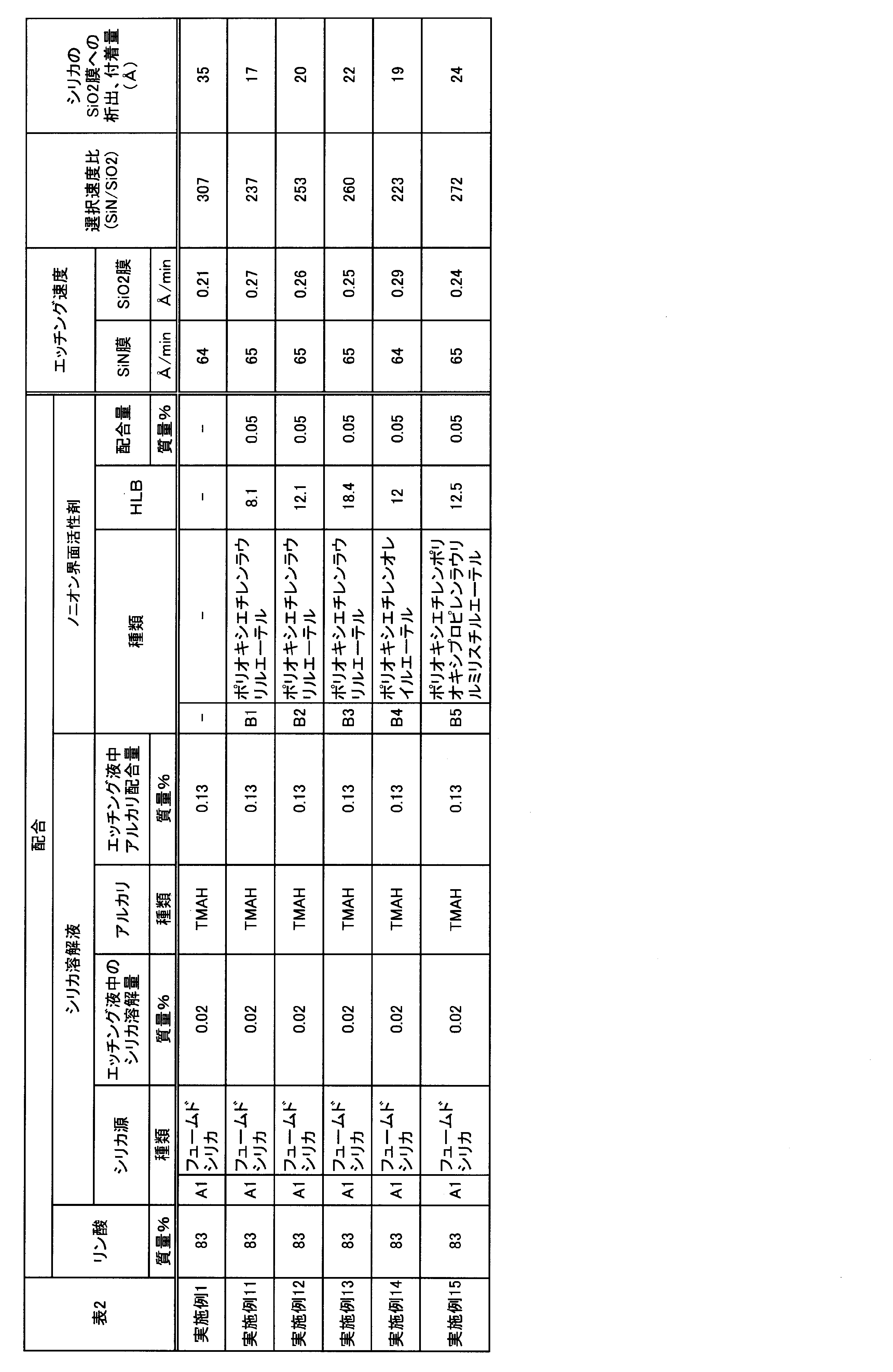
表1に示されるように、シリカ溶解液が配合されている実施例1~10のエッチング液は、シリカ溶解液が配合されていない比較例1~5に比べて、SiN/SiO2選択速度比が向上していた。
また、表2に示されるように、シリカ溶解液とリン酸とノニオン性界面活性剤が配合されている実施例11~15のエッチング液は、ノニオン界面活性剤が配合されていない実施例1に比べて、シリカのSiO2膜への析出、付着量が抑制されていた。
また、表2に示されるように、シリカ溶解液とリン酸とノニオン性界面活性剤が配合されている実施例11~15のエッチング液は、ノニオン界面活性剤が配合されていない実施例1に比べて、シリカのSiO2膜への析出、付着量が抑制されていた。
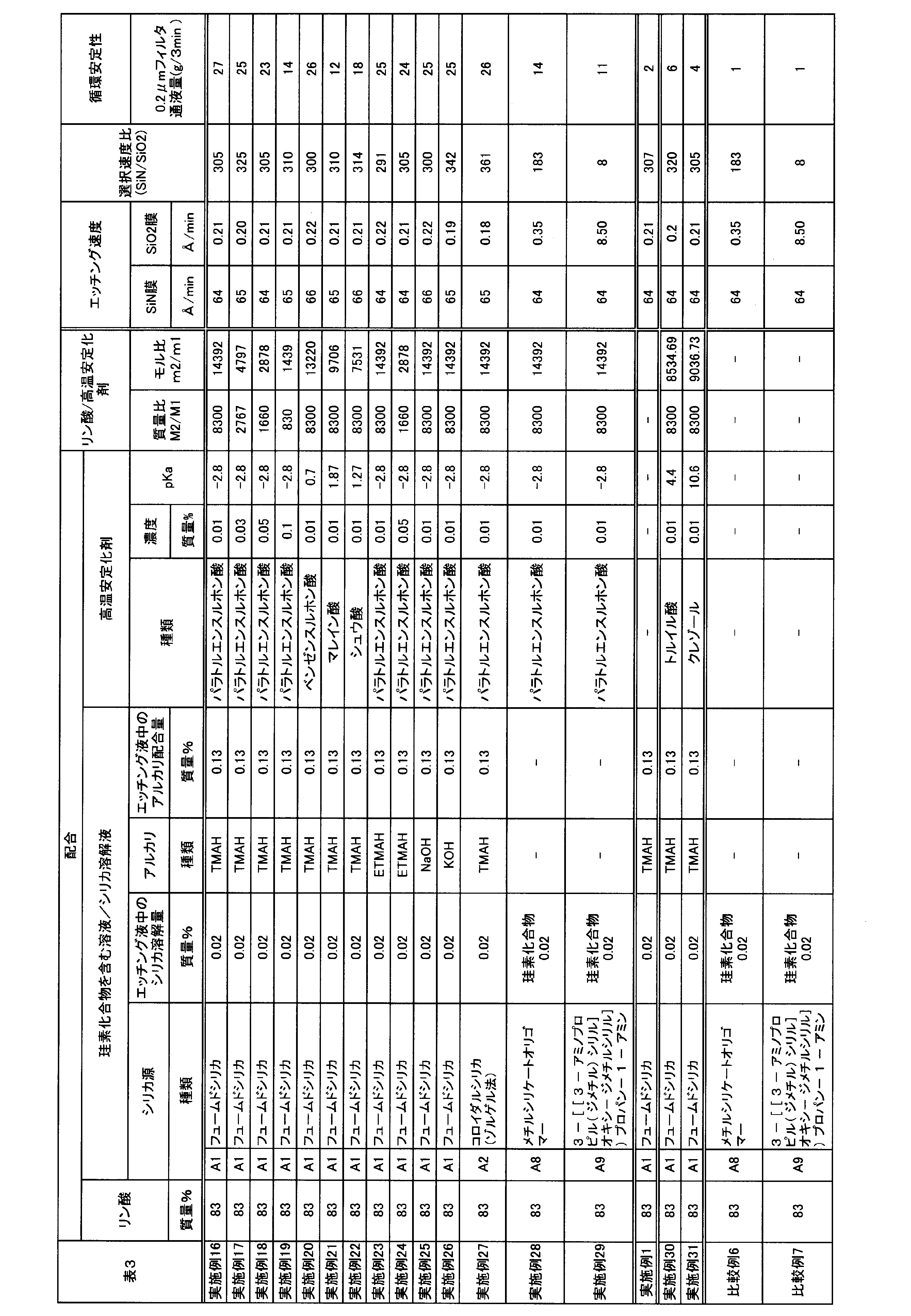
表3に示されるように、特定の高温安定化剤とリン酸とが配合されている実施例16~27はいずれも、SiN/SiO2選択速度比が良好であった。また、実施例16~27は、特定の高温安定化剤が配合されていない実施例1及び実施例30~31に比べて、0.2μmフィルタの通液量が多かったことから、循環使用におけるフィルタの閉塞を抑制できると考えられる。特定の高温安定化剤とリン酸とが配合されている実施例28~29は、特定の高温安定化剤が配合されていない比較例6~7に比べて、0.2μmフィルタの通液量が多かったことから、循環使用におけるフィルタの閉塞を抑制できると考えられる。
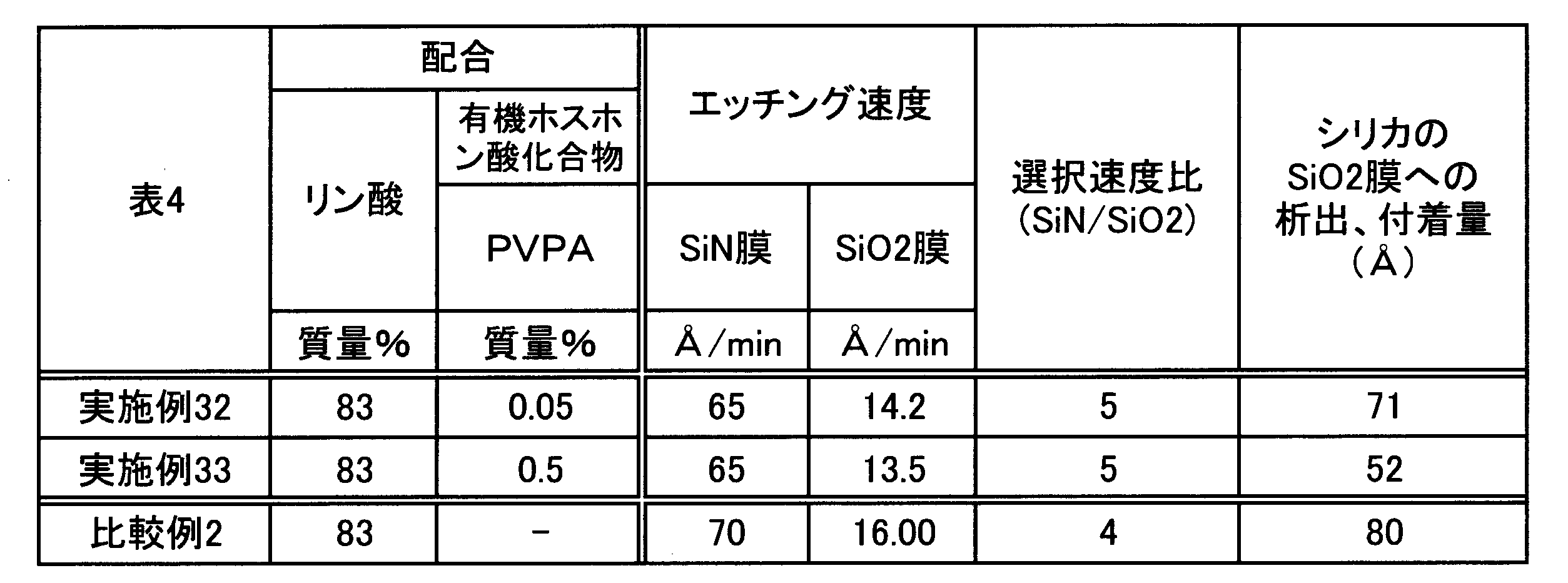
表4に示されるように、有機ホスホン酸化合物とリン酸とが配合されている実施例32~33は、有機ホスホン酸が配合されていない比較例2に比べて、シリカのSiO2膜への析出、付着が抑制されていた。
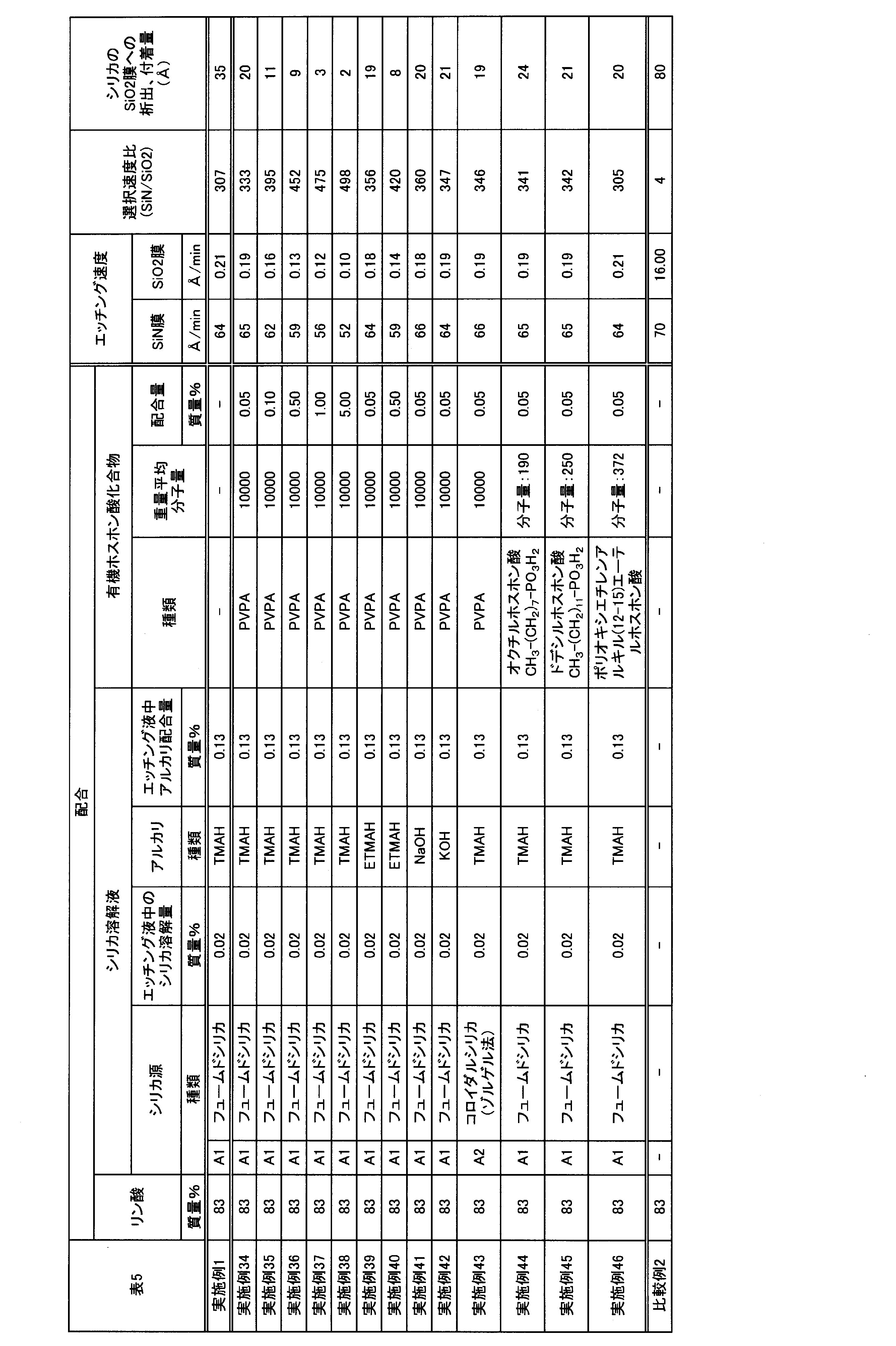
表5に示されるように、有機ホスホン酸化合物とリン酸とシリカ溶解液とが配合された実施例34~46は、有機ホスホン酸化合物とシリカ溶解液とが配合されていない比較例2、有機ホスホン酸化合物が配合されていない実施例1に比べて、シリカのSiO2膜への析出、付着がより抑制されつつ、SiN/SiO2選択速度比がより向上していた。
本開示のエッチング液は、高密度化又は高集積化用の半導体基板の製造方法において有用である。
Claims (20)
- シリコン窒化膜及びシリコン酸化膜を有する基板からシリコン窒化膜を除去する工程用のエッチング液であって、
シリカ及びアルカリを含む溶液と、リン酸と、水とを、配合してなる、エッチング液。 - 前記溶液は、シリカの少なくとも一部をアルカリで溶解したシリカ溶解液である、請求項1に記載のエッチング液。
- アルカリで溶解される前のシリカは、フュームドシリカ及びコロイダルシリカから選ばれる少なくとも1種である、請求項2に記載のエッチング液。
- エッチング液における溶解したシリカの含有量が、0.0005質量%以上1質量%以下である、請求項2又は3に記載のエッチング液。
- アルカリは、有機アルカリ又は無機アルカリである、請求項1から4のいずれかに記載のエッチング液。
- アルカリは、テトラメチルアンモニウムヒドロキシド、テトラエチルアンモニウムヒドロキシド、トリメチルエチルアンモニウムヒドロキシド、ベンジルトリメチルアンモニウムヒドロキシド、エチルトリメチルアンモニウムヒドロキシド、メチルベンジルトリメチルアンモニウムヒドロキシド、テトラエチルアンモニウムヒドロキシド、水酸化ナトリウム、及び水酸化カリウムから選ばれる少なくとも1種である、請求項1から5のいずれかに記載のエッチング液。
- pKaが2以下の高温安定化剤をさらに配合してなる、請求項1から6のいずれかに記載のエッチング液。
- 高温安定化剤の質量(M1)に対するリン酸の質量(M2)の比(質量比M2/M1)が800以上である、請求項7に記載のエッチング液。
- pKaが2以下の高温安定化剤は、pKaが2以下の有機酸である、請求項7又は8に記載のエッチング液。
- 有機ホスホン酸化合物をさらに配合してなる、請求項1から9のいずれかに記載のエッチング液。
- 有機ホスホン酸化合物の分子量は、150以上である、請求項10に記載のエッチング液。
- 有機ホスホン酸化合物は、ポリビニルホスホン酸、アルキルホスホン酸、及びアルキルエーテルホスホン酸から選ばれる少なくとも1種である、請求項10又は11に記載のエッチング液。
- 25℃におけるpHが2以下である、請求項1から12のいずれかに記載のエッチング液。
- エッチング温度が110℃以上180℃以下である、請求項1から13のいずれかに記載のエッチング液。
- エッチング液のフィルタ通液量が10g/3分以上である、請求項1から14のいずれかに記載のエッチング液。
- 請求項1から15のいずれかに記載のエッチング液を用いて、シリコン窒化膜及びシリコン酸化膜を有する基板からシリコン窒化膜を除去する工程を含む、エッチング方法。
- 請求項1から15のいずれかに記載のエッチング液を用いて、シリコン窒化膜及びシリコン酸化膜を有する基板からシリコン窒化膜を除去する工程を含む、半導体基板の製造方法。
- シリコン窒化膜及びシリコン酸化膜を有する基板からシリコン窒化膜を除去する工程用のエッチング液に添加される添加剤であって、
シリカ及びアルカリを含む溶液を含む、添加剤。 - リン酸をさらに含む、請求項18に記載の添加剤。
- シリコン窒化膜及びシリコン酸化膜を有する基板からシリコン窒化膜を除去する工程用のエッチング液を製造するためのキットであって、
シリカ及びアルカリを含む溶液(第1液)と、リン酸を含む溶液(第2液)とを相互に混合されない状態で含み、これらが使用時に混合されるキット。
Priority Applications (1)
| Application Number | Priority Date | Filing Date | Title |
|---|---|---|---|
| SG11202101593YA SG11202101593YA (en) | 2018-08-31 | 2019-08-30 | Etching liquid |
Applications Claiming Priority (14)
| Application Number | Priority Date | Filing Date | Title |
|---|---|---|---|
| JP2018-162917 | 2018-08-31 | ||
| JP2018162917 | 2018-08-31 | ||
| JP2018-225073 | 2018-11-30 | ||
| JP2018225075 | 2018-11-30 | ||
| JP2018225073 | 2018-11-30 | ||
| JP2018-225075 | 2018-11-30 | ||
| JP2018225074 | 2018-11-30 | ||
| JP2018-225074 | 2018-11-30 | ||
| JP2019-146518 | 2019-08-08 | ||
| JP2019-146509 | 2019-08-08 | ||
| JP2019146509A JP7096799B2 (ja) | 2018-08-31 | 2019-08-08 | エッチング液 |
| JP2019146518A JP7096801B2 (ja) | 2018-08-31 | 2019-08-08 | エッチング液 |
| JP2019146516A JP7096800B2 (ja) | 2018-08-31 | 2019-08-08 | エッチング液 |
| JP2019-146516 | 2019-08-08 |
Publications (1)
| Publication Number | Publication Date |
|---|---|
| WO2020045644A1 true WO2020045644A1 (ja) | 2020-03-05 |
Family
ID=69642741
Family Applications (1)
| Application Number | Title | Priority Date | Filing Date |
|---|---|---|---|
| PCT/JP2019/034193 Ceased WO2020045644A1 (ja) | 2018-08-31 | 2019-08-30 | エッチング液 |
Country Status (1)
| Country | Link |
|---|---|
| WO (1) | WO2020045644A1 (ja) |
Cited By (1)
| Publication number | Priority date | Publication date | Assignee | Title |
|---|---|---|---|---|
| JP2022018498A (ja) * | 2020-07-15 | 2022-01-27 | 花王株式会社 | エッチング液 |
Citations (3)
| Publication number | Priority date | Publication date | Assignee | Title |
|---|---|---|---|---|
| JP2000058500A (ja) * | 1998-08-07 | 2000-02-25 | Matsushita Electron Corp | エッチング液,その製造方法及びエッチング方法 |
| JP2006324452A (ja) * | 2005-05-19 | 2006-11-30 | Wako Pure Chem Ind Ltd | 半導体基板表面処理剤及び処理方法 |
| JP2012033561A (ja) * | 2010-07-28 | 2012-02-16 | Sanyo Chem Ind Ltd | 窒化ケイ素用エッチング液 |
-
2019
- 2019-08-30 WO PCT/JP2019/034193 patent/WO2020045644A1/ja not_active Ceased
Patent Citations (3)
| Publication number | Priority date | Publication date | Assignee | Title |
|---|---|---|---|---|
| JP2000058500A (ja) * | 1998-08-07 | 2000-02-25 | Matsushita Electron Corp | エッチング液,その製造方法及びエッチング方法 |
| JP2006324452A (ja) * | 2005-05-19 | 2006-11-30 | Wako Pure Chem Ind Ltd | 半導体基板表面処理剤及び処理方法 |
| JP2012033561A (ja) * | 2010-07-28 | 2012-02-16 | Sanyo Chem Ind Ltd | 窒化ケイ素用エッチング液 |
Cited By (2)
| Publication number | Priority date | Publication date | Assignee | Title |
|---|---|---|---|---|
| JP2022018498A (ja) * | 2020-07-15 | 2022-01-27 | 花王株式会社 | エッチング液 |
| JP7489250B2 (ja) | 2020-07-15 | 2024-05-23 | 花王株式会社 | エッチング液 |
Similar Documents
| Publication | Publication Date | Title |
|---|---|---|
| KR102436721B1 (ko) | 질화 규소를 포함하는 기판을 에칭하는 조성물 및 방법 | |
| CN103097476B (zh) | 化学机械抛光用于电子、机械和光学器件的衬底的含水抛光组合物和方法 | |
| KR101419156B1 (ko) | Cmp용 연마액 및 이것을 사용한 연마 방법 | |
| JP2021086943A (ja) | エッチング液 | |
| JP7096799B2 (ja) | エッチング液 | |
| CN103249790A (zh) | 用于化学机械抛光包含氧化硅电介质和多晶硅膜的基底的含水抛光组合物和方法 | |
| JP2019508880A (ja) | 低k基板の研磨方法 | |
| JP7096801B2 (ja) | エッチング液 | |
| JP7489250B2 (ja) | エッチング液 | |
| WO2020045644A1 (ja) | エッチング液 | |
| TWI765175B (zh) | 蝕刻液 | |
| JP2014130957A (ja) | 半導体基板用研磨液組成物 | |
| JP7096800B2 (ja) | エッチング液 | |
| JP2025539023A (ja) | 高ポリシリコンレートを有するcmpにおける使用のためのアミン系化合物組成物 | |
| TW202231843A (zh) | 矽蝕刻液、使用該蝕刻液之矽裝置的製造方法及基板處理方法 | |
| EP4337744A1 (en) | Selective etchant compositions and methods | |
| JP7768825B2 (ja) | エッチング液 | |
| JP2024055539A (ja) | エッチング液 | |
| JP2021116208A (ja) | シリカ粒子の製造方法、シリカゾルの製造方法、中間生成物の除去方法及び研磨方法 | |
| JP2021040095A (ja) | エッチング液 | |
| WO2026075173A1 (ja) | エッチング液 | |
| JP2026066219A (ja) | エッチング液 | |
| WO2022113775A1 (ja) | 酸化珪素膜用研磨液組成物 | |
| JP2022085857A (ja) | 酸化珪素膜用研磨液組成物 | |
| KR20200114727A (ko) | 실리콘 질화막 식각 조성물 |
Legal Events
| Date | Code | Title | Description |
|---|---|---|---|
| 121 | Ep: the epo has been informed by wipo that ep was designated in this application |
Ref document number: 19854639 Country of ref document: EP Kind code of ref document: A1 |
|
| NENP | Non-entry into the national phase |
Ref country code: DE |
|
| 122 | Ep: pct application non-entry in european phase |
Ref document number: 19854639 Country of ref document: EP Kind code of ref document: A1 |