WO2020039717A1 - 感光樹脂組成物、レジストパターンの形成方法、メッキ造形物の製造方法および半導体装置 - Google Patents
感光樹脂組成物、レジストパターンの形成方法、メッキ造形物の製造方法および半導体装置 Download PDFInfo
- Publication number
- WO2020039717A1 WO2020039717A1 PCT/JP2019/023766 JP2019023766W WO2020039717A1 WO 2020039717 A1 WO2020039717 A1 WO 2020039717A1 JP 2019023766 W JP2019023766 W JP 2019023766W WO 2020039717 A1 WO2020039717 A1 WO 2020039717A1
- Authority
- WO
- WIPO (PCT)
- Prior art keywords
- group
- structural unit
- polymer
- resin composition
- photosensitive resin
- Prior art date
- Legal status (The legal status is an assumption and is not a legal conclusion. Google has not performed a legal analysis and makes no representation as to the accuracy of the status listed.)
- Ceased
Links
Classifications
-
- G—PHYSICS
- G03—PHOTOGRAPHY; CINEMATOGRAPHY; ANALOGOUS TECHNIQUES USING WAVES OTHER THAN OPTICAL WAVES; ELECTROGRAPHY; HOLOGRAPHY
- G03F—PHOTOMECHANICAL PRODUCTION OF TEXTURED OR PATTERNED SURFACES, e.g. FOR PRINTING, FOR PROCESSING OF SEMICONDUCTOR DEVICES; MATERIALS THEREFOR; ORIGINALS THEREFOR; APPARATUS SPECIALLY ADAPTED THEREFOR
- G03F7/00—Photomechanical, e.g. photolithographic, production of textured or patterned surfaces, e.g. printing surfaces; Materials therefor, e.g. comprising photoresists; Apparatus specially adapted therefor
- G03F7/004—Photosensitive materials
- G03F7/038—Macromolecular compounds which are rendered insoluble or differentially wettable
- G03F7/0382—Macromolecular compounds which are rendered insoluble or differentially wettable the macromolecular compound being present in a chemically amplified negative photoresist composition
-
- G—PHYSICS
- G03—PHOTOGRAPHY; CINEMATOGRAPHY; ANALOGOUS TECHNIQUES USING WAVES OTHER THAN OPTICAL WAVES; ELECTROGRAPHY; HOLOGRAPHY
- G03F—PHOTOMECHANICAL PRODUCTION OF TEXTURED OR PATTERNED SURFACES, e.g. FOR PRINTING, FOR PROCESSING OF SEMICONDUCTOR DEVICES; MATERIALS THEREFOR; ORIGINALS THEREFOR; APPARATUS SPECIALLY ADAPTED THEREFOR
- G03F7/00—Photomechanical, e.g. photolithographic, production of textured or patterned surfaces, e.g. printing surfaces; Materials therefor, e.g. comprising photoresists; Apparatus specially adapted therefor
- G03F7/004—Photosensitive materials
- G03F7/039—Macromolecular compounds which are photodegradable, e.g. positive electron resists
- G03F7/0392—Macromolecular compounds which are photodegradable, e.g. positive electron resists the macromolecular compound being present in a chemically amplified positive photoresist composition
-
- G—PHYSICS
- G03—PHOTOGRAPHY; CINEMATOGRAPHY; ANALOGOUS TECHNIQUES USING WAVES OTHER THAN OPTICAL WAVES; ELECTROGRAPHY; HOLOGRAPHY
- G03F—PHOTOMECHANICAL PRODUCTION OF TEXTURED OR PATTERNED SURFACES, e.g. FOR PRINTING, FOR PROCESSING OF SEMICONDUCTOR DEVICES; MATERIALS THEREFOR; ORIGINALS THEREFOR; APPARATUS SPECIALLY ADAPTED THEREFOR
- G03F7/00—Photomechanical, e.g. photolithographic, production of textured or patterned surfaces, e.g. printing surfaces; Materials therefor, e.g. comprising photoresists; Apparatus specially adapted therefor
- G03F7/004—Photosensitive materials
- G03F7/039—Macromolecular compounds which are photodegradable, e.g. positive electron resists
-
- C—CHEMISTRY; METALLURGY
- C08—ORGANIC MACROMOLECULAR COMPOUNDS; THEIR PREPARATION OR CHEMICAL WORKING-UP; COMPOSITIONS BASED THEREON
- C08F—MACROMOLECULAR COMPOUNDS OBTAINED BY REACTIONS ONLY INVOLVING CARBON-TO-CARBON UNSATURATED BONDS
- C08F2/00—Processes of polymerisation
- C08F2/46—Polymerisation initiated by wave energy or particle radiation
- C08F2/48—Polymerisation initiated by wave energy or particle radiation by ultraviolet or visible light
- C08F2/50—Polymerisation initiated by wave energy or particle radiation by ultraviolet or visible light with sensitising agents
-
- C—CHEMISTRY; METALLURGY
- C08—ORGANIC MACROMOLECULAR COMPOUNDS; THEIR PREPARATION OR CHEMICAL WORKING-UP; COMPOSITIONS BASED THEREON
- C08F—MACROMOLECULAR COMPOUNDS OBTAINED BY REACTIONS ONLY INVOLVING CARBON-TO-CARBON UNSATURATED BONDS
- C08F220/00—Copolymers of compounds having one or more unsaturated aliphatic radicals, each having only one carbon-to-carbon double bond, and only one being terminated by only one carboxyl radical or a salt, anhydride ester, amide, imide or nitrile thereof
- C08F220/02—Monocarboxylic acids having less than ten carbon atoms; Derivatives thereof
- C08F220/10—Esters
- C08F220/12—Esters of monohydric alcohols or phenols
- C08F220/16—Esters of monohydric alcohols or phenols of phenols or of alcohols containing two or more carbon atoms
- C08F220/18—Esters of monohydric alcohols or phenols of phenols or of alcohols containing two or more carbon atoms with acrylic or methacrylic acids
-
- C—CHEMISTRY; METALLURGY
- C08—ORGANIC MACROMOLECULAR COMPOUNDS; THEIR PREPARATION OR CHEMICAL WORKING-UP; COMPOSITIONS BASED THEREON
- C08F—MACROMOLECULAR COMPOUNDS OBTAINED BY REACTIONS ONLY INVOLVING CARBON-TO-CARBON UNSATURATED BONDS
- C08F220/00—Copolymers of compounds having one or more unsaturated aliphatic radicals, each having only one carbon-to-carbon double bond, and only one being terminated by only one carboxyl radical or a salt, anhydride ester, amide, imide or nitrile thereof
- C08F220/02—Monocarboxylic acids having less than ten carbon atoms; Derivatives thereof
- C08F220/10—Esters
- C08F220/26—Esters containing oxygen in addition to the carboxy oxygen
- C08F220/28—Esters containing oxygen in addition to the carboxy oxygen containing no aromatic rings in the alcohol moiety
- C08F220/283—Esters containing oxygen in addition to the carboxy oxygen containing no aromatic rings in the alcohol moiety and containing one or more carboxylic moiety in the chain, e.g. acetoacetoxyethyl(meth)acrylate
-
- C—CHEMISTRY; METALLURGY
- C08—ORGANIC MACROMOLECULAR COMPOUNDS; THEIR PREPARATION OR CHEMICAL WORKING-UP; COMPOSITIONS BASED THEREON
- C08F—MACROMOLECULAR COMPOUNDS OBTAINED BY REACTIONS ONLY INVOLVING CARBON-TO-CARBON UNSATURATED BONDS
- C08F220/00—Copolymers of compounds having one or more unsaturated aliphatic radicals, each having only one carbon-to-carbon double bond, and only one being terminated by only one carboxyl radical or a salt, anhydride ester, amide, imide or nitrile thereof
- C08F220/02—Monocarboxylic acids having less than ten carbon atoms; Derivatives thereof
- C08F220/10—Esters
- C08F220/26—Esters containing oxygen in addition to the carboxy oxygen
- C08F220/30—Esters containing oxygen in addition to the carboxy oxygen containing aromatic rings in the alcohol moiety
- C08F220/301—Esters containing oxygen in addition to the carboxy oxygen containing aromatic rings in the alcohol moiety and one oxygen in the alcohol moiety
-
- C—CHEMISTRY; METALLURGY
- C08—ORGANIC MACROMOLECULAR COMPOUNDS; THEIR PREPARATION OR CHEMICAL WORKING-UP; COMPOSITIONS BASED THEREON
- C08F—MACROMOLECULAR COMPOUNDS OBTAINED BY REACTIONS ONLY INVOLVING CARBON-TO-CARBON UNSATURATED BONDS
- C08F220/00—Copolymers of compounds having one or more unsaturated aliphatic radicals, each having only one carbon-to-carbon double bond, and only one being terminated by only one carboxyl radical or a salt, anhydride ester, amide, imide or nitrile thereof
- C08F220/02—Monocarboxylic acids having less than ten carbon atoms; Derivatives thereof
- C08F220/10—Esters
- C08F220/34—Esters containing nitrogen, e.g. N,N-dimethylaminoethyl (meth)acrylate
- C08F220/36—Esters containing nitrogen, e.g. N,N-dimethylaminoethyl (meth)acrylate containing oxygen in addition to the carboxy oxygen, e.g. 2-N-morpholinoethyl (meth)acrylate or 2-isocyanatoethyl (meth)acrylate
- C08F220/365—Esters containing nitrogen, e.g. N,N-dimethylaminoethyl (meth)acrylate containing oxygen in addition to the carboxy oxygen, e.g. 2-N-morpholinoethyl (meth)acrylate or 2-isocyanatoethyl (meth)acrylate containing further carboxylic moieties
-
- C—CHEMISTRY; METALLURGY
- C09—DYES; PAINTS; POLISHES; NATURAL RESINS; ADHESIVES; COMPOSITIONS NOT OTHERWISE PROVIDED FOR; APPLICATIONS OF MATERIALS NOT OTHERWISE PROVIDED FOR
- C09D—COATING COMPOSITIONS, e.g. PAINTS, VARNISHES OR LACQUERS; FILLING PASTES; CHEMICAL PAINT OR INK REMOVERS; INKS; CORRECTING FLUIDS; WOODSTAINS; PASTES OR SOLIDS FOR COLOURING OR PRINTING; USE OF MATERIALS THEREFOR
- C09D4/00—Coating compositions, e.g. paints, varnishes or lacquers, based on organic non-macromolecular compounds having at least one polymerisable carbon-to-carbon unsaturated bond ; Coating compositions, based on monomers of macromolecular compounds of groups C09D183/00 - C09D183/16
-
- C—CHEMISTRY; METALLURGY
- C25—ELECTROLYTIC OR ELECTROPHORETIC PROCESSES; APPARATUS THEREFOR
- C25D—PROCESSES FOR THE ELECTROLYTIC OR ELECTROPHORETIC PRODUCTION OF COATINGS; ELECTROFORMING; APPARATUS THEREFOR
- C25D5/00—Electroplating characterised by the process; Pretreatment or after-treatment of workpieces
- C25D5/02—Electroplating of selected surface areas
- C25D5/022—Electroplating of selected surface areas using masking means
-
- C—CHEMISTRY; METALLURGY
- C25—ELECTROLYTIC OR ELECTROPHORETIC PROCESSES; APPARATUS THEREFOR
- C25D—PROCESSES FOR THE ELECTROLYTIC OR ELECTROPHORETIC PRODUCTION OF COATINGS; ELECTROFORMING; APPARATUS THEREFOR
- C25D7/00—Electroplating characterised by the article coated
- C25D7/12—Semiconductors
-
- G—PHYSICS
- G03—PHOTOGRAPHY; CINEMATOGRAPHY; ANALOGOUS TECHNIQUES USING WAVES OTHER THAN OPTICAL WAVES; ELECTROGRAPHY; HOLOGRAPHY
- G03F—PHOTOMECHANICAL PRODUCTION OF TEXTURED OR PATTERNED SURFACES, e.g. FOR PRINTING, FOR PROCESSING OF SEMICONDUCTOR DEVICES; MATERIALS THEREFOR; ORIGINALS THEREFOR; APPARATUS SPECIALLY ADAPTED THEREFOR
- G03F7/00—Photomechanical, e.g. photolithographic, production of textured or patterned surfaces, e.g. printing surfaces; Materials therefor, e.g. comprising photoresists; Apparatus specially adapted therefor
- G03F7/004—Photosensitive materials
- G03F7/0045—Photosensitive materials with organic non-macromolecular light-sensitive compounds not otherwise provided for, e.g. dissolution inhibitors
-
- G—PHYSICS
- G03—PHOTOGRAPHY; CINEMATOGRAPHY; ANALOGOUS TECHNIQUES USING WAVES OTHER THAN OPTICAL WAVES; ELECTROGRAPHY; HOLOGRAPHY
- G03F—PHOTOMECHANICAL PRODUCTION OF TEXTURED OR PATTERNED SURFACES, e.g. FOR PRINTING, FOR PROCESSING OF SEMICONDUCTOR DEVICES; MATERIALS THEREFOR; ORIGINALS THEREFOR; APPARATUS SPECIALLY ADAPTED THEREFOR
- G03F7/00—Photomechanical, e.g. photolithographic, production of textured or patterned surfaces, e.g. printing surfaces; Materials therefor, e.g. comprising photoresists; Apparatus specially adapted therefor
- G03F7/004—Photosensitive materials
- G03F7/039—Macromolecular compounds which are photodegradable, e.g. positive electron resists
- G03F7/0392—Macromolecular compounds which are photodegradable, e.g. positive electron resists the macromolecular compound being present in a chemically amplified positive photoresist composition
- G03F7/0397—Macromolecular compounds which are photodegradable, e.g. positive electron resists the macromolecular compound being present in a chemically amplified positive photoresist composition the macromolecular compound having an alicyclic moiety in a side chain
-
- G—PHYSICS
- G03—PHOTOGRAPHY; CINEMATOGRAPHY; ANALOGOUS TECHNIQUES USING WAVES OTHER THAN OPTICAL WAVES; ELECTROGRAPHY; HOLOGRAPHY
- G03F—PHOTOMECHANICAL PRODUCTION OF TEXTURED OR PATTERNED SURFACES, e.g. FOR PRINTING, FOR PROCESSING OF SEMICONDUCTOR DEVICES; MATERIALS THEREFOR; ORIGINALS THEREFOR; APPARATUS SPECIALLY ADAPTED THEREFOR
- G03F7/00—Photomechanical, e.g. photolithographic, production of textured or patterned surfaces, e.g. printing surfaces; Materials therefor, e.g. comprising photoresists; Apparatus specially adapted therefor
- G03F7/20—Exposure; Apparatus therefor
-
- G—PHYSICS
- G03—PHOTOGRAPHY; CINEMATOGRAPHY; ANALOGOUS TECHNIQUES USING WAVES OTHER THAN OPTICAL WAVES; ELECTROGRAPHY; HOLOGRAPHY
- G03F—PHOTOMECHANICAL PRODUCTION OF TEXTURED OR PATTERNED SURFACES, e.g. FOR PRINTING, FOR PROCESSING OF SEMICONDUCTOR DEVICES; MATERIALS THEREFOR; ORIGINALS THEREFOR; APPARATUS SPECIALLY ADAPTED THEREFOR
- G03F7/00—Photomechanical, e.g. photolithographic, production of textured or patterned surfaces, e.g. printing surfaces; Materials therefor, e.g. comprising photoresists; Apparatus specially adapted therefor
- G03F7/26—Processing photosensitive materials; Apparatus therefor
-
- G—PHYSICS
- G03—PHOTOGRAPHY; CINEMATOGRAPHY; ANALOGOUS TECHNIQUES USING WAVES OTHER THAN OPTICAL WAVES; ELECTROGRAPHY; HOLOGRAPHY
- G03F—PHOTOMECHANICAL PRODUCTION OF TEXTURED OR PATTERNED SURFACES, e.g. FOR PRINTING, FOR PROCESSING OF SEMICONDUCTOR DEVICES; MATERIALS THEREFOR; ORIGINALS THEREFOR; APPARATUS SPECIALLY ADAPTED THEREFOR
- G03F7/00—Photomechanical, e.g. photolithographic, production of textured or patterned surfaces, e.g. printing surfaces; Materials therefor, e.g. comprising photoresists; Apparatus specially adapted therefor
- G03F7/26—Processing photosensitive materials; Apparatus therefor
- G03F7/30—Imagewise removal using liquid means
- G03F7/32—Liquid compositions therefor, e.g. developers
- G03F7/325—Non-aqueous compositions
- G03F7/327—Non-aqueous alkaline compositions, e.g. anhydrous quaternary ammonium salts
-
- G—PHYSICS
- G03—PHOTOGRAPHY; CINEMATOGRAPHY; ANALOGOUS TECHNIQUES USING WAVES OTHER THAN OPTICAL WAVES; ELECTROGRAPHY; HOLOGRAPHY
- G03F—PHOTOMECHANICAL PRODUCTION OF TEXTURED OR PATTERNED SURFACES, e.g. FOR PRINTING, FOR PROCESSING OF SEMICONDUCTOR DEVICES; MATERIALS THEREFOR; ORIGINALS THEREFOR; APPARATUS SPECIALLY ADAPTED THEREFOR
- G03F7/00—Photomechanical, e.g. photolithographic, production of textured or patterned surfaces, e.g. printing surfaces; Materials therefor, e.g. comprising photoresists; Apparatus specially adapted therefor
- G03F7/26—Processing photosensitive materials; Apparatus therefor
- G03F7/40—Treatment after imagewise removal, e.g. baking
-
- C—CHEMISTRY; METALLURGY
- C25—ELECTROLYTIC OR ELECTROPHORETIC PROCESSES; APPARATUS THEREFOR
- C25D—PROCESSES FOR THE ELECTROLYTIC OR ELECTROPHORETIC PRODUCTION OF COATINGS; ELECTROFORMING; APPARATUS THEREFOR
- C25D3/00—Electroplating: Baths therefor
- C25D3/02—Electroplating: Baths therefor from solutions
- C25D3/12—Electroplating: Baths therefor from solutions of nickel or cobalt
-
- C—CHEMISTRY; METALLURGY
- C25—ELECTROLYTIC OR ELECTROPHORETIC PROCESSES; APPARATUS THEREFOR
- C25D—PROCESSES FOR THE ELECTROLYTIC OR ELECTROPHORETIC PRODUCTION OF COATINGS; ELECTROFORMING; APPARATUS THEREFOR
- C25D3/00—Electroplating: Baths therefor
- C25D3/02—Electroplating: Baths therefor from solutions
- C25D3/38—Electroplating: Baths therefor from solutions of copper
Definitions
- the present invention relates to a photosensitive resin composition, a method for forming a resist pattern, a method for manufacturing a plated molded product, and a semiconductor device.
- a copper column solder bump is used in accordance with high integration of the element.
- the solder is a lead-free solder, that is, a tin solder
- an intermetallic compound of copper-tin is very brittle, and therefore, the copper pillar solder bump is generally a diffusion containing nickel between the copper pillar and the tin solder.
- a barrier layer is provided.
- Such a copper pillar-nickel diffusion barrier layer-a copper pillar solder bump including a tin solder structure is usually formed by forming a resist pattern on a substrate including elements and the like, and forming a copper pillar by copper plating using the resist pattern as a template. It is manufactured by forming a diffusion barrier layer on a copper pillar by nickel plating, and finally forming a tin solder on the diffusion barrier layer (Patent Document 1).
- a resist that is applicable to both copper plating and nickel plating is required for a resist used for manufacturing a copper pillar solder bump.
- the present disclosure has been made in view of the above circumstances, has excellent resolution, does not swell the resist pattern even with a copper plating solution and a nickel plating solution, and after the copper plating solution treatment, and nickel plating Providing a photosensitive resin composition capable of forming a resist pattern that does not cause cracks in the resist pattern after liquid treatment, providing a method of forming a resist pattern using the photosensitive resin composition, providing the resist pattern Providing a manufacturing method of manufacturing a plated object such as a copper pillar solder bump using a resist pattern formed by the method of forming a semiconductor device having a plated object obtained by the method of manufacturing a plated object. The purpose is to provide.
- R 12 , R 22 and R 32 each independently represent an organic group having 1 to 10 carbon atoms;
- R 21 represents a substituted or unsubstituted alkyl group having 1 to 10 carbon atoms.
- R 31 represents a hydrogen atom, a substituted or unsubstituted alkyl group having 1 to 10 carbon atoms or a halogen atom;
- R 13 and R 23 each independently represent an acid dissociable group;
- R 33 represents hydroxy Represents an aryl group; l, m, and n each independently represent an integer of 0 to 10.
- the content of the structural unit (a3) contained in the polymer (A) is 5 to 70 when the total of all the structural units constituting the polymer (A) is 100 mol%.
- the total content ratio of the structural unit (a1) and the structural unit (a2) contained in the polymer (A) is 100 in total of all the structural units constituting the polymer (A).
- the content ratio of the total of the structural units (a1) to (a3) contained in the polymer (A) is 100 mol of the total of all the structural units constituting the polymer (A). %, The photosensitive resin composition according to any one of [1] to [3], which is 50 to 100 mol%.
- the content of the photoacid generator (B) contained in the photosensitive resin composition is 0.1 to 20 parts by mass with respect to 100 parts by mass of the polymer (A).
- the photosensitive resin composition according to any one of [4].
- the composition further contains an organic solvent (C), and the content ratio of the organic solvent (C) contained in the photosensitive resin composition is such that the solid content concentration becomes 10 to 60% by mass.
- the photosensitive resin composition according to any one of [5].
- the photosensitive resin composition of the present disclosure has excellent resolution, and the resist pattern does not swell even with respect to the copper plating solution and the nickel plating solution. After the plating solution treatment, a resist pattern in which cracks do not occur in the resist pattern can be formed.
- a photosensitive resin composition hereinafter, also referred to as “the present composition”
- the present composition a photosensitive resin composition
- a method for forming a resist pattern a method for manufacturing a plated molded product according to the present disclosure
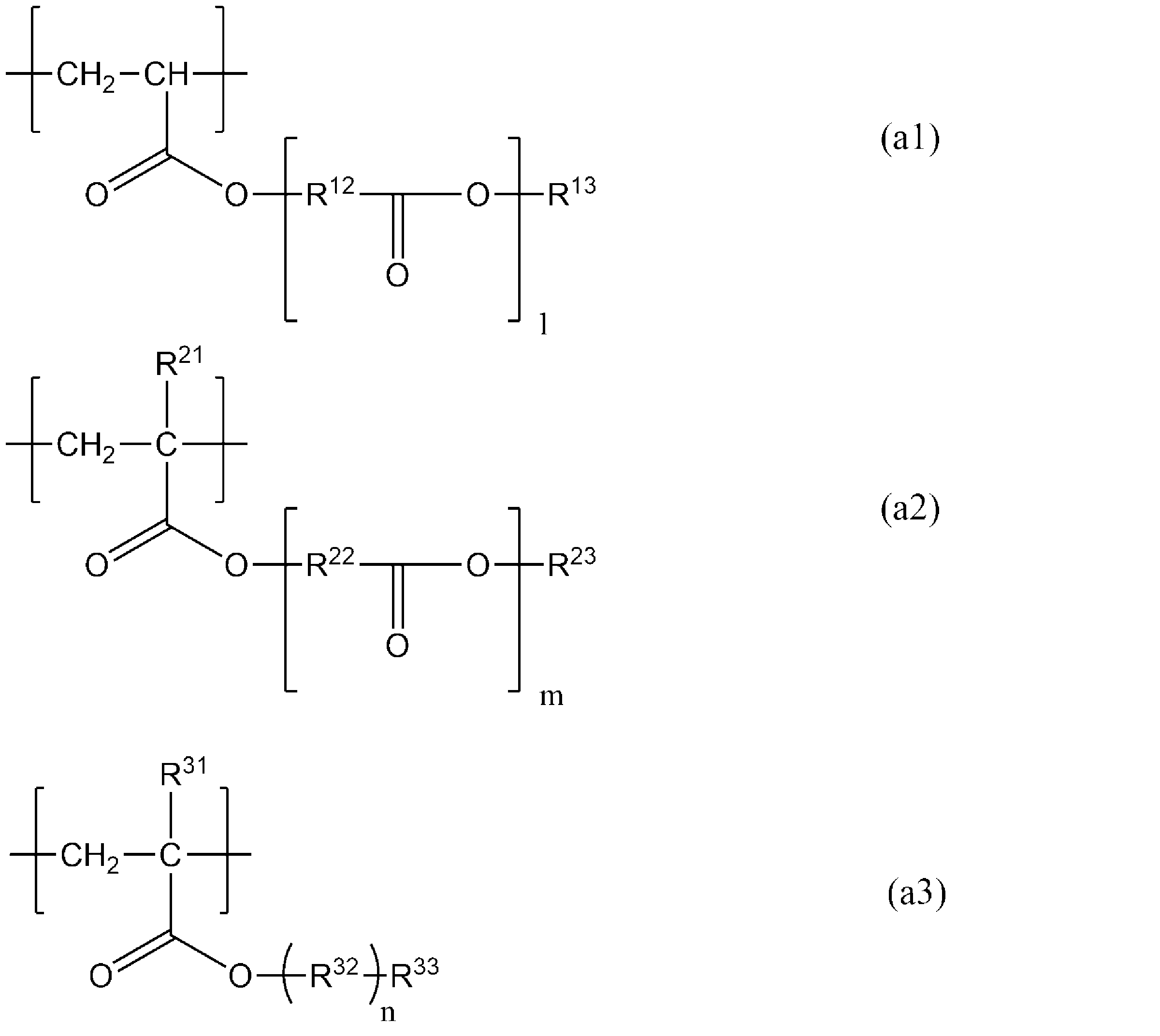
- Photosensitive resin composition comprises a polymer having a structural unit (a1) represented by the formula (a1), a structural unit (a2) represented by the formula (a2), and a structural unit (a3) represented by the formula (a3) ( A); and a photoacid generator (B).
- an organic solvent (C), a quencher (D), a surfactant (E), and other components can be contained, if necessary, as long as the effects of the present composition are not impaired.
- the polymer (A) has a structural unit (a1) derived from an acrylic monomer having an acid dissociable group, a structural unit (a2) derived from a methacrylic monomer having an acid dissociable group, and the structural unit (a3). .
- the polymer (A) includes, in addition to the structural units (a1) to (a3), a group that promotes solubility in an alkaline developer other than the structural unit (a3) (hereinafter, also referred to as a “solubility promoting group”). (Hereinafter, also referred to as “structural unit (a4)”) and other structural units (hereinafter, also referred to as “structural unit (a5)”).
- the structural units (a1) to (a3) can be contained in the same or different polymers, but it is preferable that the same polymer contains the structural units (a1) to (a3).
- the polymer (A) may contain one type alone or two or more types.
- the polymer (A) has an acid-dissociable group in the structural unit (a1) and the structural unit (a2).
- the acid dissociable group is dissociated by the action of an acid generated from the photoacid generator (B).
- a carboxy group is generated, and the solubility of the polymer (A) in an alkaline developer is changed, so that the present composition can form a resist pattern.
- the acid dissociation property contained in the photosensitive resin composition such as the polymer (A) is required. It becomes possible by increasing the dissolution rate of the acid-dissociable group of the polymer having a group in an alkali developer after dissociation.
- the swelling resistance of the resist pattern to the plating solution and the crack resistance of the resist pattern after the plating process are increased by increasing the glass transition temperature of the polymer having an acid-dissociable group, so that the resist pattern can be plated with the growth of the plating. It can be considered that the resistance can be improved because it can withstand the indentation.
- a polymer having an acid-dissociable group if an alkyl group such as a methyl group is present at the ⁇ -position, such as a methacrylic structure, the rotation of the side chain of the structural unit is inhibited. Although the glass transition temperature of the polymer can be increased, the dissolution rate of the polymer in an alkaline developer is decreased.
- a polymer having an acid dissociable group if there is no substituent such as an alkyl group such as a methyl group at the ⁇ -position, such as an acrylic structure, rotation of the side chain of the structural unit may be inhibited. Since the polymer has no acid-dissociable group, the dissolution rate of the polymer having an acid-dissociable group in an alkali developer can be increased, but the glass transition temperature is lowered.
- a polymer having an acid-dissociable group is used in order to improve the resolution of the photosensitive resin composition, and to improve the swelling resistance of the resist pattern to a plating solution and the crack resistance of the resist pattern after plating. It is thought that it is necessary to balance the glass transition temperature with the dissolution rate in an alkali developer.
- the composition comprises an acid-dissociable group and the structural unit (a1) derived from an acrylic monomer having a hydrogen atom at the ⁇ -position, a methacrylic group having an acid-dissociable group and a group other than a hydrogen atom represented by R 21 at the ⁇ -position.
- the structural unit (a2) and the structural unit (a3) derived from a monomer both the glass transition temperature of the polymer having an acid-dissociable group and the dissolution rate in an alkali developer can be achieved.
- Photosensitivity that excels in image quality, does not swell with copper plating solution and nickel plating solution, and can form a resist pattern that does not cause cracks in the resist pattern after copper plating solution treatment and nickel plating solution treatment It is estimated that the resin composition was obtained.
- the structural unit in this specification indicates a structure derived from a monomer used for synthesis of a polymer.
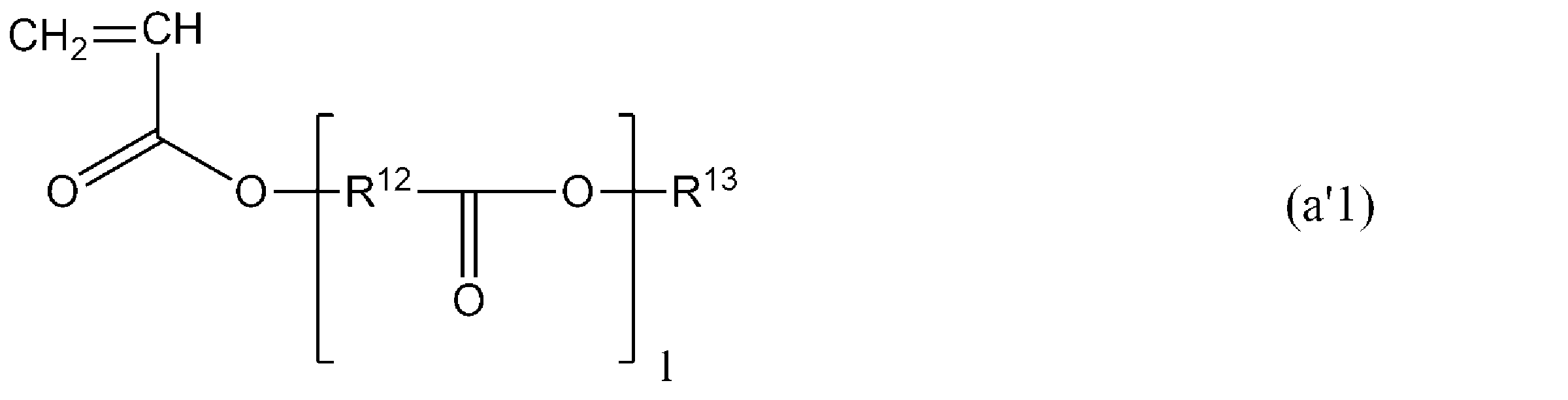
- a monomer having a polymerizable unsaturated double bond represented by the following formula (a1 ′) can be mentioned.
- R 12 , R 13 , and 1 have the same meanings as R 12 , R 13 , and 1 in formula (a1), respectively.
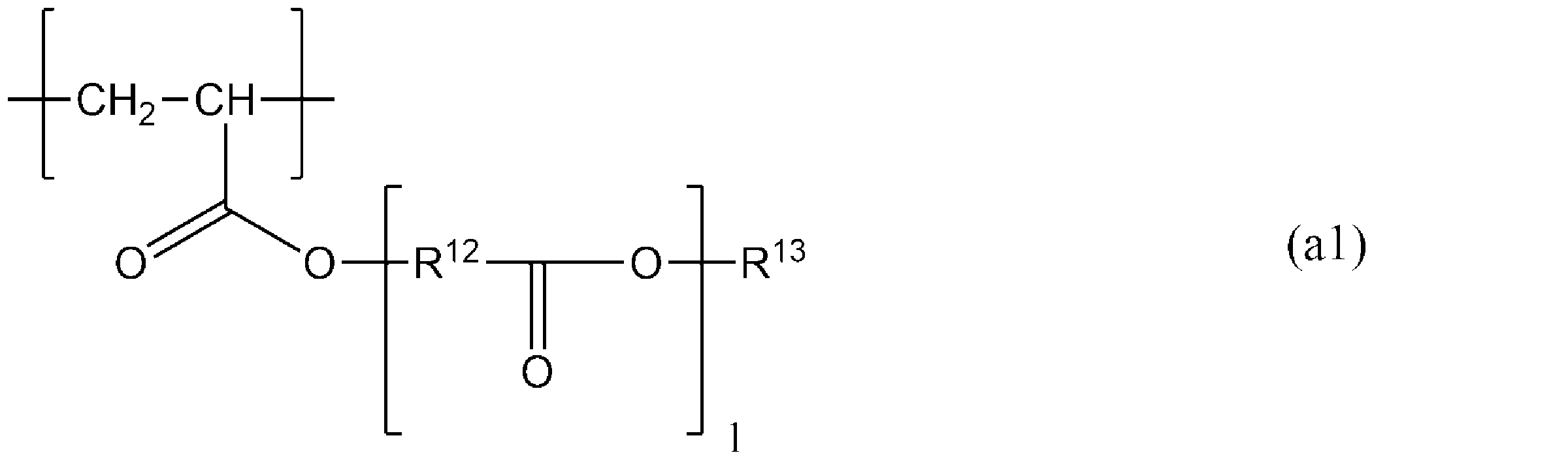
- the structural unit (a1) is a structural unit derived from an acrylic monomer having an acid dissociable group represented by the following formula (a1) and a hydrogen atom at the ⁇ -position.
- R 12 represents an organic group having 1 to 10 carbon atoms
- R 13 represents an acid dissociable group
- 1 represents an integer of 0 to 10.
- l is preferably from 0 to 5, more preferably from 0 to 3.
- Examples of the organic group having 1 to 10 carbon atoms for R 12 include alkanes such as a methylene group, an ethylene group, a propane-1,3-diyl group, a propane-1,2-diyl group, and a decane-1,10-diyl group.
- alkanes such as a methylene group, an ethylene group, a propane-1,3-diyl group, a propane-1,2-diyl group, and a decane-1,10-diyl group.
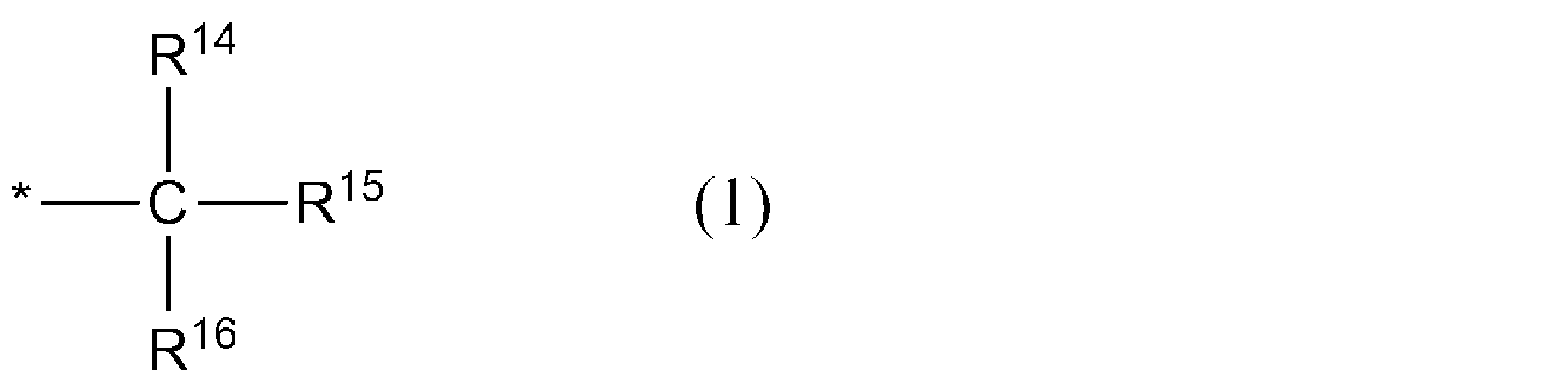
- Examples of the acid dissociable group for R 13 include a benzyl group and an acid represented by the following formula (1) such as a tert-butyl group, a 1-alkylcyclopentan-1-yl group, and a 2-alkyladamantan-2-yl group. And a dissociative group. Among these, an acid dissociable group represented by the following formula (1) is preferable.
- R 14 to R 16 each independently represent a substituted or unsubstituted alkyl group, or a substituted or unsubstituted alicyclic hydrocarbon group, or R 14 to R 16 together with a carbon atom to be bonded.
- the alicyclic structure to be formed is shown; * indicates a bond.
- Examples of the substituted or unsubstituted alkyl group of R 14 to R 16 include an unsubstituted alkyl group such as a methyl group, an ethyl group, an n-propyl group, an isopropyl group, a pentyl group, and a decyl group;
- a substituted alkyl group in which one or more hydrogen atoms have been substituted with another group such as a halogen atom such as a fluorine atom and a bromine atom, an aryl group such as a phenyl group, a hydroxyl group, and an alkoxy group;
- Examples of the substituted or unsubstituted alicyclic hydrocarbon group for R 14 to R 16 include a monocyclic saturated cyclic hydrocarbon group such as a cyclobutyl group, a cyclopentyl group, a cyclohexyl group, a cycloheptyl group, and a cyclooctyl group.
- Monocyclic unsaturated cyclic hydrocarbon groups such as cyclobutenyl group, cyclopentenyl group and cyclohexenyl group; polycyclic saturated cyclic hydrocarbon groups such as norbornyl group, adamantyl group, tricyclodecyl group and tetracyclododecyl group ;
- Examples of the alicyclic structure composed of R 14 to R 16 and carbon atoms include monocyclic saturated cyclic hydrocarbon structures such as cyclobutyl, cyclopentyl, cyclohexyl, cycloheptyl, and cyclooctyl; cyclobutenyl, cyclopentenyl, and cyclohexenyl And polycyclic saturated cyclic hydrocarbon structures such as norbornyl, adamantyl, tricyclodecyl, and tetracyclododecyl.
- Examples of the structural unit (a1) include a structural unit represented by the following chemical formula.
- One or more structural units (a1) can be contained in the polymer (A).
- the lower limit of the content ratio of the structural unit (a1) contained in the polymer (A) is preferably 1 mol%, when the total of all the structural units constituting the polymer (A) was 100 mol%. Is 5 mol%, more preferably 10 mol%, and the upper limit is 40 mol%, preferably 30 mol%, more preferably 20 mol%. Further, the content ratio of the structural unit (a1) may be any combination of upper and lower limits.
- the structural unit (a2) is a structural unit derived from a methacrylic monomer having an acid dissociable group represented by the following formula (a2) and a group other than a hydrogen atom represented by R 21 at the ⁇ -position.
- R 21 represents a substituted or unsubstituted alkyl group having 1 to 10 carbon atoms
- R 22 represents an organic group having 1 to 10 carbon atoms
- R 23 represents an acid dissociable group
- m is preferably from 0 to 5, more preferably from 0 to 3.
- Examples of the substituted or unsubstituted alkyl group having 1 to 10 carbon atoms for R 21 include an unsubstituted alkyl group such as a methyl group, an ethyl group, an n-propyl group, an isopropyl group, a pentyl group and a decyl group; A substituted alkyl group in which one or more hydrogen atoms of a group are substituted with another group such as a halogen atom such as a fluorine atom and a bromine atom, an aryl group such as a phenyl group, a hydroxyl group, and an alkoxy group; Among these, an unsubstituted alkyl group is preferable for adjusting the glass transition temperature of the polymer (A).
- Examples of the organic group having 1 to 10 carbon atoms for R 22 include the same groups as the organic groups having 1 to 10 carbon atoms for R 12 .
- Examples of the structural unit (a2) include a structural unit represented by the following chemical formula.
- One or more structural units (a2) can be contained in the polymer (A).
- the lower limit of the content ratio of the structural unit (a2) contained in the polymer (A) is 1 mol%, preferably 5 mol%, when the total of all the structural units constituting the polymer (A) is 100 mol%. Mol%, more preferably 10 mol%, and the upper limit is 40 mol%, preferably 30 mol%, more preferably 20 mol%.
- any combination of upper and lower limits can be used.
- the total content of the structural unit (a1) and the structural unit (a2) contained in the polymer (A) is the lower limit when the total of all the structural units constituting the polymer (A) is 100 mol%. Is 5 mol%, preferably 10 mol%, more preferably 15 mol%, and the upper limit is 60 mol%, preferably 50 mol%, more preferably 45 mol%. As for the total content ratio of the structural unit (a1) and the structural unit (a2), any combination of upper and lower limits can be used.
- the resist after the step (3) is used.
- the pattern may collapse, while if the content of the acid-dissociable group is too small, a thick resist pattern may not be formed.
- the structural unit (a3) is a structural unit represented by the following formula (a3) and has a hydroxyaryl group that is a solubility promoting group.
- the glass transition temperature of the polymer (A) can be increased, and the dissolution rate in an alkali developer can be increased.
- a thick film of the present composition can be obtained.
- a resist pattern compatible with both copper plating and nickel plating can be formed.
- R 31 each independently represents a hydrogen atom, a substituted or unsubstituted alkyl group having 1 to 10 carbon atoms, or a halogen atom
- R 32 represents an organic group having 1 to 10 carbon atoms
- R 33 represents a hydroxyaryl group
- n each independently represents an integer of 0 to 10.
- Examples of the substituted or unsubstituted alkyl group having 1 to 10 carbon atoms for R 31 include the groups described as the substituted or unsubstituted alkyl group having 1 to 10 carbon atoms for R 11 .
- Examples of the organic group having 1 to 10 carbon atoms for R 32 include the groups described for the organic group having 1 to 10 carbon atoms for R 12 .
- n is preferably from 0 to 4, more preferably 0.
- Examples of the hydroxyaryl group for R 33 include a 2-hydroxyphenyl group, a 3-hydroxyphenyl group, a 4-hydroxyphenyl group, a 3-methyl-4-hydroxyphenyl group, a trihydroxyphenyl group, a tetrahydroxyphenyl group, and a dihydroxy group.
- a hydroxyphenyl group such as a biphenyl group and a hydroxybenzenecarbonyl group; a hydroxynaphthyl group such as a hydroxynaphthyl group, a dihydroxynaphthyl group and a hydroxynaphthalenecarbonyl group; and a hydroxyanthryl group such as a hydroxyanthracenecarbonyl group.
- a hydroxyphenyl group corresponds to the plating treatment, so that a resist pattern having excellent plating solution resistance can be formed.
- a preferable structure of the structural unit (a3) includes a structural unit (a31) represented by the following formula (a31).
- R 3 has the same meaning as R 31 in the structural unit (a3);
- R 34 is bonded to a benzene ring and represents a halogen atom, an alkyl group or an aryl group;
- O represents an integer of 0 to 4;
- Examples of the monomer derived from the structural unit (a31) include a monomer (a31 ′) represented by the following formula (a31 ′).
- R 31, R 34, o, and p each structural unit (a3), the same meanings as R 34, o, and p of formula (a31).
- One or more structural units (a3) can be contained in the polymer (A).
- the lower limit of the content ratio of the structural unit (a3) contained in the polymer (A) is preferably 5 mol% when the total of all the structural units constituting the polymer (A) was 100 mol%. 20 mol%, more preferably 30 mol%, and the upper limit is 70 mol%, preferably 65 mol%, more preferably 60 mol%. Further, the content ratio of the structural unit (a3) may be any combination of upper and lower limits.
- the content ratio of the structural unit (a3) contained in the polymer (A) is within the above range, the glass transition temperature of the polymer (A) can be increased, and the dissolution rate in an alkali developer can be increased, As a result, it is possible to improve the resolution of the present composition in a thick film, and to form a resist pattern compatible with both copper plating and nickel plating.
- the content ratio of the total of the structural units (a1) to (a3) contained in the polymer (A) is based on the assumption that the total of all the structural units constituting the polymer (A) is 100 mol%.
- the lower limit is 50 mol%, preferably 55 mol%, more preferably 60 mol%, and the upper limit is 100 mol%, preferably 95 mol%, more preferably 90 mol%.
- any combination of upper and lower limits can be used.
- the glass transition temperature of the polymer (A) is increased, and the alkali developing solution is used.
- the resist pattern improves the resolution of a thick film of the present composition, and is applicable to both copper plating and nickel plating. Can be formed.
- the structural unit (a4) is a structural unit having a solubility-promoting group other than the structural unit (a3), and the polymer (A) has the structural unit (a4) to form a resin coating film formed from the present composition. Lithography such as resolution, sensitivity, depth of focus, and exposure latitude can be adjusted.
- Examples of the structural unit (a4) include a structural unit having a carboxy group, a hydroxyaryl group, a hydroxy group, a lactone structure, a cyclic carbonate structure, a sultone structure, and a fluoroalcohol structure.
- a structural unit having a hydroxyaryl group is preferred because it is resistant to intrusion from plating at the time of forming a plated molded article of a resist pattern formed from the present composition.
- Examples of the structural unit having a carboxy group include (meth) acrylic acid, crotonic acid, maleic acid, fumaric acid, cinnamic acid, 2-carboxyethyl (meth) acrylate, 2-carboxypropyl (meth) acrylate, and Structural units derived from monomers such as 3-carboxypropyl (meth) acrylate;
- Examples of the structural unit having a hydroxyaryl group include vinyl units such as 2-hydroxystyrene, 4-hydroxystyrene, 4-isopropenylphenol, 4-hydroxy-1-vinylnaphthalene, and 4-hydroxy-2-vinylnaphthalene.
- Examples of the structural unit having a hydroxy group include structural units derived from monomers such as 2-hydroxyethyl (meth) acrylate and 3- (meth) acryloyloxy-4-hydroxytetrahydrofuran; The structural unit described in paragraph [0030] of 276607;
- Examples of the structural unit having a lactone structure include the structural units described in paragraphs [0104] to [0107] of JP-A-2017-058421, and the paragraph [0028] of WO 2009/113228. , The structural units described in paragraphs [0133] to [0134] of JP-A-2010-138330, and the paragraphs [0064], [0093] and [0095] of JP-A-2010-275555. ], The structural unit derived from the monomer described in paragraph [0019] of JP-A-2016-098350, and the structural units described in paragraphs [0017] to [0023] of JP-A-2015-214634. A structural unit derived from the described monomer;
- Examples of the structural unit having a cyclic carbonate structure include the structural units described in paragraphs [0105] to [0106] of JP-A-2017-058421, and the paragraph [0034] of JP-A-2009-223294.
- Examples of the structural unit having a sultone structure include the structural units described in paragraph [0106] of JP-A-2017-058421, and the paragraphs [0024] to [0028] of JP-A-2014-029518.
- Examples of the structural unit having a fluoroalcohol structure include structural units derived from monomers described in paragraphs [0066], [0069] and [0071] of JP-A-2004-083900, and JP-A-2003-002925.
- the content ratio of the total of the structural unit (a3) and the structural unit (a4) contained in the polymer (A) is assuming that the total of all the structural units constituting the polymer (A) is 100 mol%. , Usually 10 to 80 mol%.
- the structural unit (a5) is a structural unit other than the structural units (a1) to (a4).
- Examples of the structural unit (a5) include structural units derived from vinyl compounds such as styrene, 2-methylstyrene, 3-methylstyrene, 4-methylstyrene, 2-methoxystyrene, 3-methoxystyrene, and 4-methoxystyrene.
- Aliphatic (meth) acrylic acid such as methyl (meth) acrylate, ethyl (meth) acrylate, n-pentyl (meth) acrylate, neopentyl (meth) acrylate, n-hexyl (meth) acrylate, 2-ethylhexyl (meth) acrylate Ester compounds; Cyclopentyl (meth) acrylate, norbornyl (meth) acrylate, isobornyl (meth) acrylate, tricyclodecanyl (meth) acrylate, dicyclopentenyl (meth) acrylate, tetrahydrofuranyl (meth) acrylate, and tetrahydropyranyl (meth) acrylate Structural units derived from an alicyclic (meth) acrylate compound such as Structural units derived from aromatic-containing (meth) acrylate compounds such as phenyl (meth)
- Structural units derived from unsaturated nitrile compounds such as (meth) acrylonitrile, crotonitrile, maleinitrile, fumaronitrile; Structural units derived from unsaturated amide compounds such as (meth) acrylamide and N, N-dimethyl (meth) acrylamide; and structural units derived from unsaturated imide compounds such as maleimide, N-phenylmaleimide and N-cyclohexylmaleimide.
- unsaturated nitrile compounds such as (meth) acrylonitrile, crotonitrile, maleinitrile, fumaronitrile
- Structural units derived from unsaturated amide compounds such as (meth) acrylamide and N, N-dimethyl (meth) acrylamide
- structural units derived from unsaturated imide compounds such as maleimide, N-phenylmaleimide and N-cyclohexylmaleimide.
- the content ratio of the structural unit (a5) contained in the polymer (A) is usually 40 mol% or less when the total of all the structural units constituting the polymer (A) is 100 mol%. is there.
- the polymer (A) can be produced from a monomer derived from each structural unit by a known polymerization method such as an ionic polymerization method or a radical polymerization method. Among these, from the viewpoint of mass productivity, it is preferable to produce the polymer by a radical polymerization method.
- radical polymerization initiator used in the radical polymerization method examples include azo compounds such as 2,2′-azobisisobutyronitrile and 2,2′-azobis- (2,4-dimethylvaleronitrile), benzoyl peroxide, Organic peroxides such as lauryl peroxide, t-butyl peroxide and the like can be mentioned.
- the polymerization solvent used in the radical polymerization method is not particularly limited as long as it does not react with the monomer component and dissolves the produced polymer (A).
- Examples include n-butyl acetate, methyl isobutyl ketone, 2-heptanone, cyclohexanone, propylene glycol monomethyl ether, propylene glycol monomethyl ether acetate, methyl 3-methoxypropionate, ethyl 3-ethoxypropionate, and ethyl lactate.
- the polymerization solvents can be used alone or in combination of two or more.
- the weight average molecular weight in terms of polystyrene (hereinafter, referred to as “Mw”) of the polymer (A) measured by gel permeation chromatography is generally 1,000 to 500,000, preferably 3,000 to 300,000. More preferably, it is 10,000 to 100,000, and still more preferably 20,000 to 60,000.
- the ratio (Mw / Mn) of the Mw of the polymer (A) to the number average molecular weight in terms of polystyrene (hereinafter, referred to as “Mn”) measured by gel permeation chromatography is usually 1 to 5, preferably 1 to 5. 3.
- a molecular weight regulator such as a mercaptan compound or a halogenated hydrocarbon can be used.
- the photoacid generator (B) is a compound that generates an acid upon exposure. By the action of this acid, the acid dissociable group in the polymer (A) is dissociated, and an acidic functional group such as a carboxy group or a hydroxyaryl group is generated. As a result, the exposed portion of the photosensitive resin coating film formed from the photosensitive resin composition becomes easily soluble in an alkali developing solution, and a positive resist pattern can be formed.
- Examples of the photoacid generator (B) include, for example, paragraph numbers [0017] to [0026], [0028] to [0039], [0042] to [0046], [0049], and paragraphs in JP-A-2004-317907.
- Compounds described in [0053] compounds described in paragraphs [0090] to [0106] of JP-A-2014-157252, and compounds described in paragraphs [0117] to [0123] of JP-A-2002-268223.
- the compounds described in paragraphs [0038] to [0041] of JP-A-2017-102260 are as described herein.
- Examples of the photoacid generator (B) include diphenyliodonium trifluoromethanesulfonate, diphenyliodonium-p-toluenesulfonate, diphenyliodonium hexafluoroantimonate, diphenyliodonium hexafluorophosphate, diphenyliodonium tetrafluoroborate, and triphenylsulfonium trifluoromethane Sulfonate, triphenylsulfonium hexafluoroantimonate, triphenylsulfonium hexafluorophosphate, 4-t-butylphenyl / diphenylsulfonium trifluoromethanesulfonate, 4-t-butylphenyl / diphenylsulfoniumbenzenesulfonate, 4,7-di-n- Butoxynaphthyl tetrahydrothioph
- 1,10-dibromo-n-decane 1,1-bis (4-chlorophenyl) -2,2,2-trichloroethane
- phenyl-bis trichloromethyl
- 4-methoxyphenyl-bis trichloro Halogen-containing compounds such as methyl) -s-triazine, styryl-bis (trichloromethyl) -s-triazine, and naphthyl-bis (trichloromethyl) -s-triazine
- 4-methoxyphenyl-bis (trichloro Halogen-containing compounds such as methyl) -s-triazine, styryl-bis (trichloromethyl) -s-triazine, and naphthyl-bis (trichloromethyl) -s-triazine
- @Sulfone compounds such as 4-trisphenacylsulfone, mesitylphenacylsulfone, and bis (phenylsulfonyl) methane;
- Sulfonic acid compounds such as benzoin tosylate, pyrogallol tristrifluoromethanesulfonate, o-nitrobenzyltrifluoromethanesulfonate, and o-nitrobenzyl-p-toluenesulfonate;
- Bis (trifluoromethylsulfonyl) diazomethane bis (cyclohexylsulfonyl) diazomethane, bis (phenylsulfonyl) diazomethane, bis (p-toluenesulfonyl) diazomethane, methylsulfonyl-p-toluenesulfonyldiazomethane, cyclohexylsulfonyl-1,1-dimethylethyl And diazomethane compounds such as sulfonyldiazomethane and bis (1,1-dimethylethylsulfonyl) diazomethane.
- the onium salt compound or the sulfonimide compound is preferable because it can form a resist pattern excellent in resolution and plating solution resistance.
- the photoacid generator (B) can be contained alone or in combination of two or more.
- the lower limit of the content of the photoacid generator (B) contained in the present composition is 0.1 part by mass, preferably 0.3 part by mass, more preferably 100 parts by mass of the polymer (A). Is 0.5 parts by mass, more preferably 1 part by mass, and the upper limit is 20 parts by mass, preferably 15 parts by mass, more preferably 10 parts by mass, and still more preferably 5 parts by mass.
- the content of the photoacid generator (B) can be any combination of the upper and lower limits. When the content of the photoacid generator (B) is within the above range, a resist pattern having a large thickness and excellent resolution can be obtained, and a pattern having an excellent shape can be obtained.
- Organic solvent (C) is a component used for uniformly mixing each component contained in the present composition.
- organic solvent (C) examples include alcohols such as ethylene glycol monomethyl ether, ethylene glycol monoethyl ether, diethylene glycol, diethylene glycol monoethyl ether, ethyl lactate, and propylene glycol monomethyl ether; ethyl acetate, ethyl 2-hydroxypropionate, Esters such as ethyl-hydroxy-2-methylpropionate, methyl acetoacetate and ethyl ethoxyacetate; ketones such as methylamyl ketone and cyclohexanone; diethylene glycol dimethyl ether, diethylene glycol diethyl ether, diethylene glycol di-n-propyl ether, and Alkylene glycol dialkyl ethers such as dipropylene glycol dimethyl ether; Glycol monomethyl ether acetate, ethylene glycol monoethyl ether acetate, propylene glycol monomethyl ether acetate, propylene glycol monoethy
- the organic solvent (C) can be used alone or in combination of two or more.
- the lower limit of the solid content concentration is 10% by mass, preferably 20% by mass, more preferably 25% by mass
- the upper limit is 60% by mass, preferably The amount is 55% by mass, more preferably 50% by mass.
- the content ratio of the organic solvent (C) any combination of upper and lower limits can be used.
- the thickness is within the above range, a thick resist pattern can be formed favorably.
- the said solid content concentration means the content rate of all components other than the organic solvent (C) contained in this composition.
- the quencher (D) is a component used for controlling the diffusion of the acid generated from the photoacid generator (B) in the resist film upon exposure, and as a result, improves the resolution of the present composition. Can be.
- Examples of the quencher (D) include a basic compound and a compound generating a base.
- Examples of the quencher include compounds described in paragraphs [0076], [0079], and [0081] of JP-A-2014-013381. And the compounds described in paragraphs [0101] to [0104] of JP-A-2016-099483, and the compounds described in paragraphs [0221] to [0224] of JP-A-2017-037320. These are as described herein.
- quencher (D) examples include alkylamines such as n-hexylamine, n-heptylamine, di-n-butylamine and triethylamine; aromatic amines such as aniline and 1-naphthylamine; triethanolamine and the like.
- Alkanolamines such as ethylenediamine, 1,3-bis [1- (4-aminophenyl) -1-methylethyl] benzene, and polyethyleneimine; amide compounds such as formamide; urea compounds such as urea and methylurea; Nitrogen-containing heterocyclic compounds such as imidazole and benzimidazole; N- (t-butoxycarbonyl) piperidine, N- (t-butoxycarbonyl) imidazole, N- (t-butoxycarbonyl) benzimidazole, N- (t-butoxy) Carbo Le) nitrogen-containing compound having a 2-phenyl-acid dissociable group benzimidazole, and the like.
- polyamino compounds such as ethylenediamine, 1,3-bis [1- (4-aminophenyl) -1-methylethyl] benzene, and polyethyleneimine
- amide compounds such as formamide
- urea compounds such as
- the quencher (D) can be used alone or in combination of two or more.
- the content of the quencher (D) contained in the present composition is usually 0.001 to 10 parts by mass based on 100 parts by mass of the polymer (A).
- the surfactant (E) has an effect of improving the coating properties, defoaming properties, etc. of the present composition.
- surfactant (E) a known surfactant can be used.
- examples of commercially available surfactants include NBX-15, FTX-204D, FTX-208D, FTX-212D (all manufactured by Neos Co., Ltd.), BM-1100 (all manufactured by BM Chemie), Mega Facque F142D (above, manufactured by Dainippon Ink and Chemicals, Inc.), Florado FC-135, FC-170C, FC-430, and FC-431 (above, manufactured by Sumitomo 3M Limited), Surflon S-112 And S-145 (all manufactured by Asahi Glass Co., Ltd.), SH-28PA and SH-190 (all manufactured by Toray Dow Corning Silicone Co., Ltd.).
- the surfactant (E) can be used alone or in combination of two or more.
- the content of the surfactant contained in the composition is usually 2 parts by mass or less based on 100 parts by mass of the polymer (A).
- Other components include, for example, a sensitizer that absorbs exposure light to improve the acid generation efficiency of the photoacid generator; and controls the dissolution rate of a resin coating film formed from the photosensitive resin composition in an alkali developer.
- Alkali-soluble resins such as phenol novolak resin and poly (hydroxystyrene) and low molecular weight phenol compounds; UV absorbers that block the light reaction caused by scattered light upon exposure to unexposed parts; Thermal polymerization that enhances storage stability Agents; antioxidants; adhesion aids; and inorganic fillers.
- the present composition can be produced by uniformly mixing the components. After the components are uniformly mixed to remove dust, the resulting mixture can be filtered with a filter or the like.
- the method for forming a resist pattern according to the present disclosure includes a step (1) of applying the present composition on a substrate to form a resin coating film; Exposing the resin coating film (2); (3) developing the exposed resin coating film.
- Step (1) is a step of forming a resin coating film of the present composition on a substrate.
- the substrate include a semiconductor substrate, a glass substrate, and a substrate provided with various metal films on the surface of the substrate.
- the shape of the substrate is not particularly limited, and the surface shape may be flat or uneven, and the shape of the substrate may be circular or square. There is no limit on the size of the substrate.
- the metal film examples include aluminum, copper, silver, gold, and palladium, and alloys of two or more of these metals.
- the metal layer can be formed by a sputtering method or the like.
- the thickness of the metal film is usually from 100 to 10,000 °, preferably from 500 to 2,000 °.
- Examples of the application method of the present composition include a spin coating method, a roll coating method, a screen printing method, and an applicator method. Among them, the spin coating method is preferable. In the case of the spin coating method, the rotation speed is usually 500 to 4000 rpm, preferably 800 to 3500 rpm.
- heat treatment can be performed.
- the conditions of the heat treatment are usually 50 to 200 ° C. and 0.5 to 20 minutes.
- the thickness of the resin coating is usually 1 to 100 ⁇ m, preferably 5 to 80 ⁇ m.
- Step (2) is a step of exposing the resin coating film formed in step (1).
- the exposure is usually performed selectively on the resin coating film by a reduced projection exposure through a photomask having a predetermined mask pattern.
- a laser beam having a wavelength of 150 to 600 nm preferably a laser beam having a wavelength of 200 to 500 nm is used.
- the light amount of the exposure is usually 100 to 20,000 mJ / cm 2 .
- a heat treatment can be performed.
- the condition of the heat treatment is usually at 70 to 180 ° C. for 1 to 10 minutes.
- Step (3) is a step of forming a resist pattern by developing the exposed resin coating film of step (2).
- the development is usually performed with an alkaline developer.
- Examples of the developing method include a shower developing method, a spray developing method, an immersion developing method, and a paddle developing method.
- the processing conditions for the development are usually at 23 ° C. for 1 to 30 minutes.
- alkaline developer examples include sodium hydroxide, potassium hydroxide, sodium carbonate, sodium silicate, aqueous ammonia, ethylamine, n-propylamine, diethylamine, triethylamine, monoethanolamine, diethanolamine, triethanolamine, and tetramethylamine.
- An aqueous solution containing one or more alkaline substances such as ammonium hydroxide, tetraethylammonium hydroxide, choline, pyrrole, and piperidine can be given.
- the alkaline developer may contain, for example, an organic solvent such as methanol or ethanol, a surfactant, or the like.
- the resist pattern can be washed with water or the like. Then, it can be dried by an air gun or a hot plate.
- the method for manufacturing a plated object according to the present disclosure uses a resist pattern formed by the method for forming a resist pattern as a mask to form a plated object. To manufacture.
- the method for producing a plated object includes a step (4) of performing plating using the resist pattern formed in the step (3) as a template.
- a plating model for example, an electrode material
- the resist pattern may be subjected to a hydrophilic treatment such as an ashing treatment using oxygen plasma.
- Examples of the plating solution used in the electrolytic plating process include those containing copper, gold, silver, or nickel.
- Examples of the electrolytic plating process include a copper plating process using copper sulfate and a nickel plating process using nickel sulfate.
- the conditions of the electroplating treatment vary depending on the composition of the plating solution and the like.
- the temperature is usually 10 to 90 ° C., preferably 20 to 70 ° C.
- the density is usually 0.3 to 30 A / dm 2 , preferably 0.5 to 20 A / dm 2 .
- the temperature is usually 20 to 90 ° C., preferably 40 to 70 ° C.
- the current density is usually 0.3 to 30 A / dm 2 , preferably 0.1 to 30 A / dm 2 . 5 to 20 A / dm 2 .
- the thickness of the plated object manufactured by the method of manufacturing the plated object can be appropriately selected depending on the use of the plated object. For example, when the plating object is used for bumps, the thickness is usually 5 to 100 ⁇ m, preferably 10 to 80 ⁇ m, and more preferably 20 to 60 ⁇ m. When the plating object is used for wiring, the thickness is usually 1 to 30 ⁇ m, preferably 3 to 20 ⁇ m, and more preferably 5 to 15 ⁇ m.
- the method for producing a plated object according to the present invention may further include a step (5) of removing the resist pattern after the step (4).
- the step (5) is a step of removing the resist pattern remaining on the substrate in the step (4) by stripping and removing the resist pattern. D) immersing the substrate having the resist pattern after 1) for 1 to 10 minutes, for example.
- the stripping solution examples include a solution containing tetramethylammonium hydroxide, dimethyl sulfoxide, and / or N, N-dimethylformamide.
- the method of manufacturing the plated object can include a step of removing a region other than the region where the plated object is formed by, for example, a wet etching method.
- the semiconductor device of the present disclosure includes a plated object obtained by the method of manufacturing a plated object.
- This semiconductor device uses the present resist pattern, which is useful as a mold for plating, performs plating to deposit plating components, and is equipped with a plated model that captures the resist pattern, improving reliability.
- a multilayer LSI see semiconductor integrated circuit http://www.jmq.jsr.co.jp/products.html can be given.
- Method of measuring physical properties (Method of measuring weight average molecular weight (Mw) of polymer) The weight average molecular weight (Mw) of the alkali-soluble resin was measured by gel permeation chromatography under the following conditions. -Column: TSK-M and TSK2500 manufactured by Tosoh Corporation connected in series-Solvent: tetrahydrofuran-Flow rate: 0.35 mL / min-Temperature: 40 ° C ⁇ Detection method: Refractive index method ⁇ Standard substance: polystyrene ⁇ GPC device: manufactured by Tosoh Corporation, device name “HLC-8220-GPC”
- E1 Trade name "NBX-15" (manufactured by Neos Corporation)
- C1 propylene glycol monomethyl ether acetate
- C2 methyl amyl ketone
- C3 ⁇ -butyrolactone
- C4 dipropylene glycol monomethyl ether acetate
- the resist patterns (hole patterns having a depth of 5 ⁇ m) of Examples 1B to 9B and Comparative Examples 1B to 3B were formed.
- the substrate on which the resist pattern has been formed is referred to as a “patterned substrate”. Using this patterned substrate, “resolution” and “plating solution resistance” were evaluated by the methods described below.
- a hole pattern of 0.7 ⁇ m length ⁇ 0.7 ⁇ m width can be resolved.
- B A hole pattern of 0.7 ⁇ m in length ⁇ 0.7 ⁇ m in width cannot be resolved, but a hole pattern of 1 ⁇ m in length ⁇ 1 ⁇ m in width can be resolved.
- C A 1 ⁇ m ⁇ 1 ⁇ m hole pattern cannot be resolved.
- plating solution resistance (swelling resistance)
- the patterned substrate was immersed in 300 mL of a copper plating solution (product name “CU8502”, manufactured by Dow Chemical) at 23 ° C. for 10 minutes, and the resist pattern before and after immersion was observed with an optical microscope and a scanning electron microscope.
- the plating solution resistance (swelling resistance) was evaluated according to the criteria of (1).
- the resist pattern was immersed in 300 mL of a nickel plating solution (product name “Ni200”, manufactured by EEJA) at 55 ° C. for 10 minutes, and the resist pattern before and after the immersion was observed with an optical microscope and a scanning electron microscope.
- Table 3 shows the evaluation results.
- C The reduction ratio of the size of the hole pattern before and after immersion is larger than 10%.
- Examples 1C to 9C, Comparative Examples 1C to 3C The patterned substrates of Examples 1B to 9B and Comparative Examples 1B to 3B were subjected to oxygen plasma ashing (output 100 W, oxygen flow rate 100 mL / min, processing time 60 seconds).
- the patterned substrate after the ashing process is immersed in 300 mL of a copper plating solution (product name “CU8502”, manufactured by Dow Chemical Company), and the plating bath temperature is set to 23 ° C., the current density is set to 2 A / dm 2 , and electroplating is performed for 9 minutes.
- a plated product metal pattern
- the resist pattern after the production of the plated object was observed with an optical microscope and a scanning electron microscope, and "plating solution resistance (crack resistance)" was evaluated based on the following criteria.
- the patterned substrate after the ashing process is immersed in 300 mL of a nickel plating solution (product name “Ni200”, manufactured by EEJA), set to a plating bath temperature of 55 ° C. and a current density of 3 A / dm 2, and set to 6.5. Electroplating was performed to produce a plated product (metal pattern), and the resist solution was similarly evaluated for plating solution resistance (crack resistance). Table 4 shows the evaluation results.
- B The resist pattern has 1 crack / ⁇ m 2 or more and less than 1,000 cracks / ⁇ m 2 .
- C There are 1,000 or more cracks / ⁇ m 2 in the resist pattern.
Landscapes
- Chemical & Material Sciences (AREA)
- Physics & Mathematics (AREA)
- Organic Chemistry (AREA)
- General Physics & Mathematics (AREA)
- Chemical Kinetics & Catalysis (AREA)
- Spectroscopy & Molecular Physics (AREA)
- Engineering & Computer Science (AREA)
- Materials Engineering (AREA)
- Metallurgy (AREA)
- Electrochemistry (AREA)
- Health & Medical Sciences (AREA)
- Medicinal Chemistry (AREA)
- Polymers & Plastics (AREA)
- Life Sciences & Earth Sciences (AREA)
- Wood Science & Technology (AREA)
- Materials For Photolithography (AREA)
- Exposure And Positioning Against Photoresist Photosensitive Materials (AREA)
- Photosensitive Polymer And Photoresist Processing (AREA)
Abstract
Description
ところで、はんだが無鉛はんだ、つまり、錫はんだの場合、銅-錫による金属間化合物は非常にもろいため、銅柱はんだバンプは、一般的に、銅柱と錫はんだとの間にニッケルを含む拡散バリア層が設けられている。
このような銅柱-ニッケル拡散バリア層-錫はんだ構造を含む銅柱はんだバンプは、通常、素子等を含む基板上に、レジストパターンを形成し、このレジストパターンを鋳型として銅メッキにより銅柱を形成し、次いで、ニッケルメッキにより銅柱上に拡散バリア層を形成し、最後に錫はんだを拡散バリア層上に形成することで製造する(特許文献1)。
本開示は上記実情を鑑みてなされたものであり、解像性に優れ、且つ銅メッキ液およびニッケルメッキ液に対してもレジストパターンが膨潤せず、且つ、銅メッキ液処理後、およびニッケルメッキ液処理後にレジストパターンにクラックが生じないレジストパターンを形成することができる感光性樹脂組成物を提供すること、前記感光性樹脂組成物を用いたレジストパターンの形成方法を提供すること、前記レジストパターンの形成方法により形成したレジストパターンを用いて銅柱はんだバンプのようなメッキ造形物を製造する製造方法を提供すること、および前記メッキ造形物の製造方法によって得られるメッキ造形物を有する半導体装置を提供することを目的とする。
〔1〕下記式(a1)に示す構造単位(a1)、下記式(a2)に示す構造単位(a2)、および下記式(a3)に示す構造単位(a3)を有する重合体(A);ならびに
光酸発生剤(B);を含有する感光性樹脂組成物。
〔3〕前記重合体(A)中に含まれる前記構造単位(a1)および前記構造単位(a2)の合計の含有割合が、前記重合体(A)を構成する全ての構造単位の合計を100モル%とした場合、5~60モル%である前記〔1〕または前記〔2〕に記載の感光性樹脂組成物。
前記樹脂塗膜を露光する工程(2);
露光後の前記樹脂塗膜を現像する工程(3);
を有する、レジストパターンの形成方法。
〔9〕前記〔8〕に記載のレジストパターンの形成方法によって形成したレジストパターンをマスクにしてメッキ処理を行う工程(4)を有する、メッキ造形物の製造方法。
本明細書中で例示する各成分、例えば本組成物中の各成分や、重合体(A)中の各構造単位は、特に言及しない限り、それぞれ1種単独で含有してもよく、2種以上を含有することができる。
本組成物は、式(a1)に示す構造単位(a1)、式(a2)に示す構造単位(a2)、および式(a3)に示す構造単位(a3)を有する重合体(A);ならびに光酸発生剤(B);を含有する。
重合体(A)は、酸解離性基を有するアクリル系モノマー由来の構造単位(a1)、酸解離性基を有するメタクリル系モノマー由来の構造単位(a2)、ならびに前記構造単位(a3)を有する。
構造単位(a1)は下記式(a1)に示す酸解離性基およびα位が水素原子であるアクリル系モノマー由来の構造単位である。
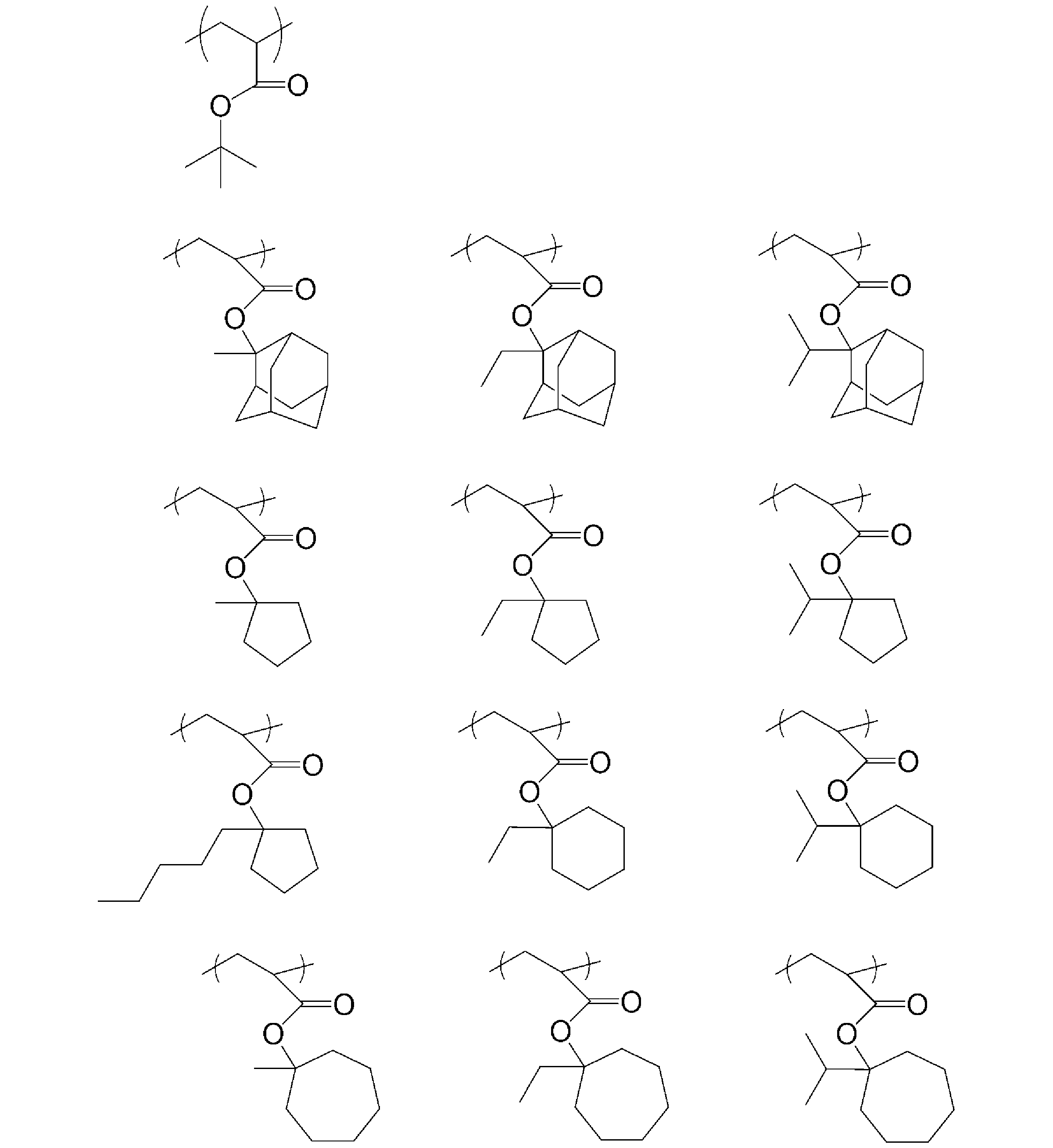


重合体(A)中に含まれる構造単位(a1)の含有割合は、前記重合体(A)を構成する全ての構造単位の合計を100モル%とした場合、下限は、1モル%、好ましくは5モル%、より好ましくは10モル%、上限は40モル%、好ましくは30モル%、より好ましくは20モル%である。また、構造単位(a1)の含有割合は、いずれの上下限の組合せも用いることができる。
構造単位(a2)は下記式(a2)に示す酸解離性基およびα位にR21に示す水素原子以外の基を有するメタクリル系モノマー由来の構造単位である。
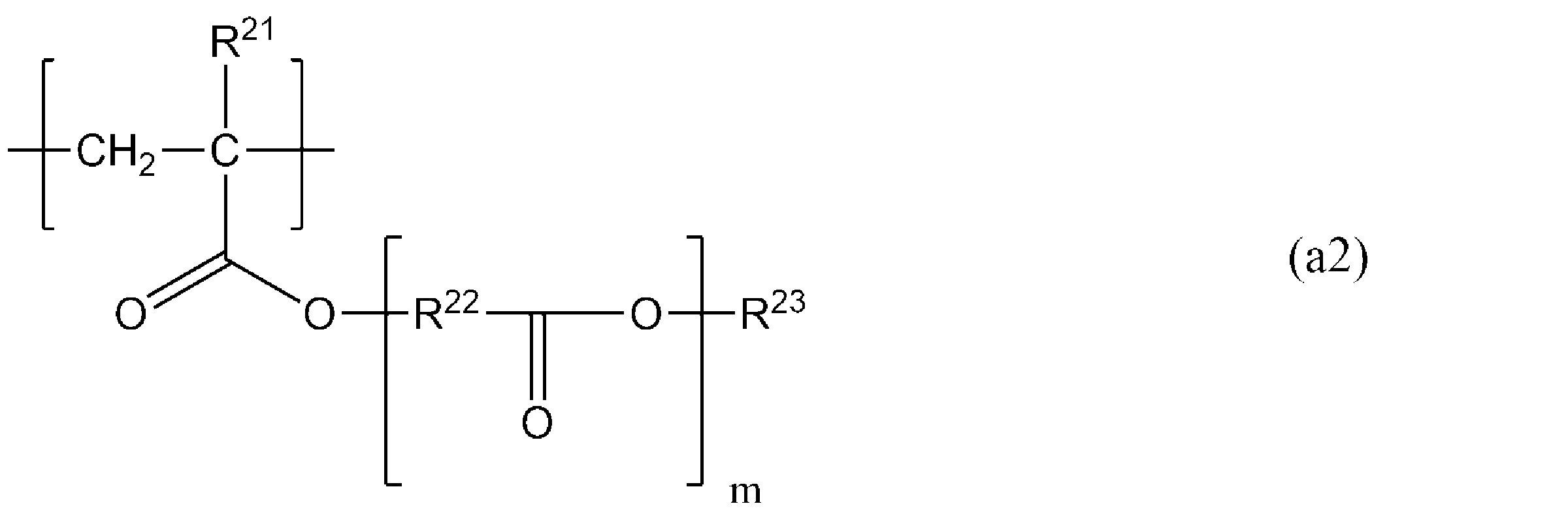
これらのなかでも非置換のアルキル基が、重合体(A)のガラス転移温度を調節するうえでは好ましい。
R23の酸解離性基としては、前記R13の酸解離性基と同じ基が挙げられる。

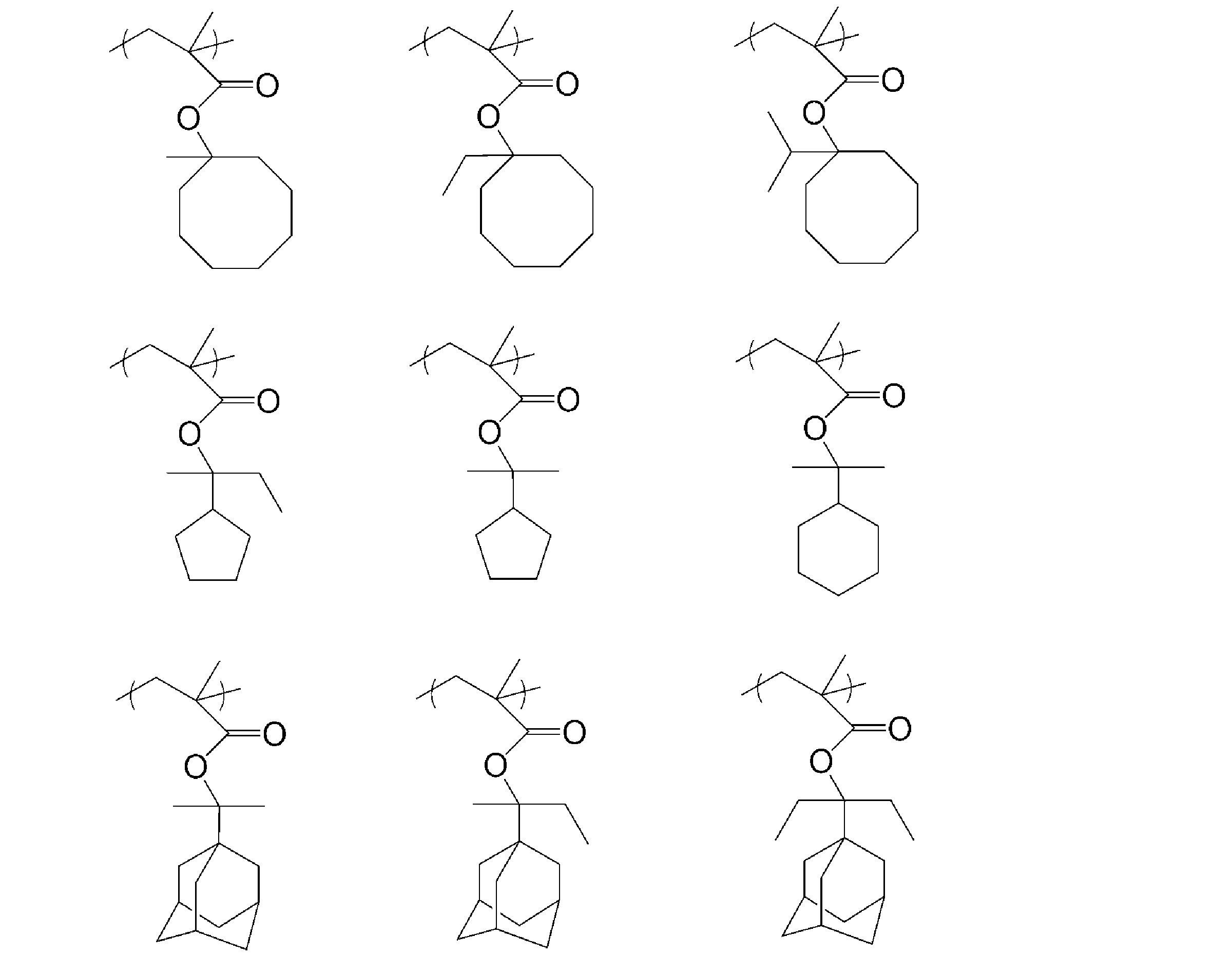

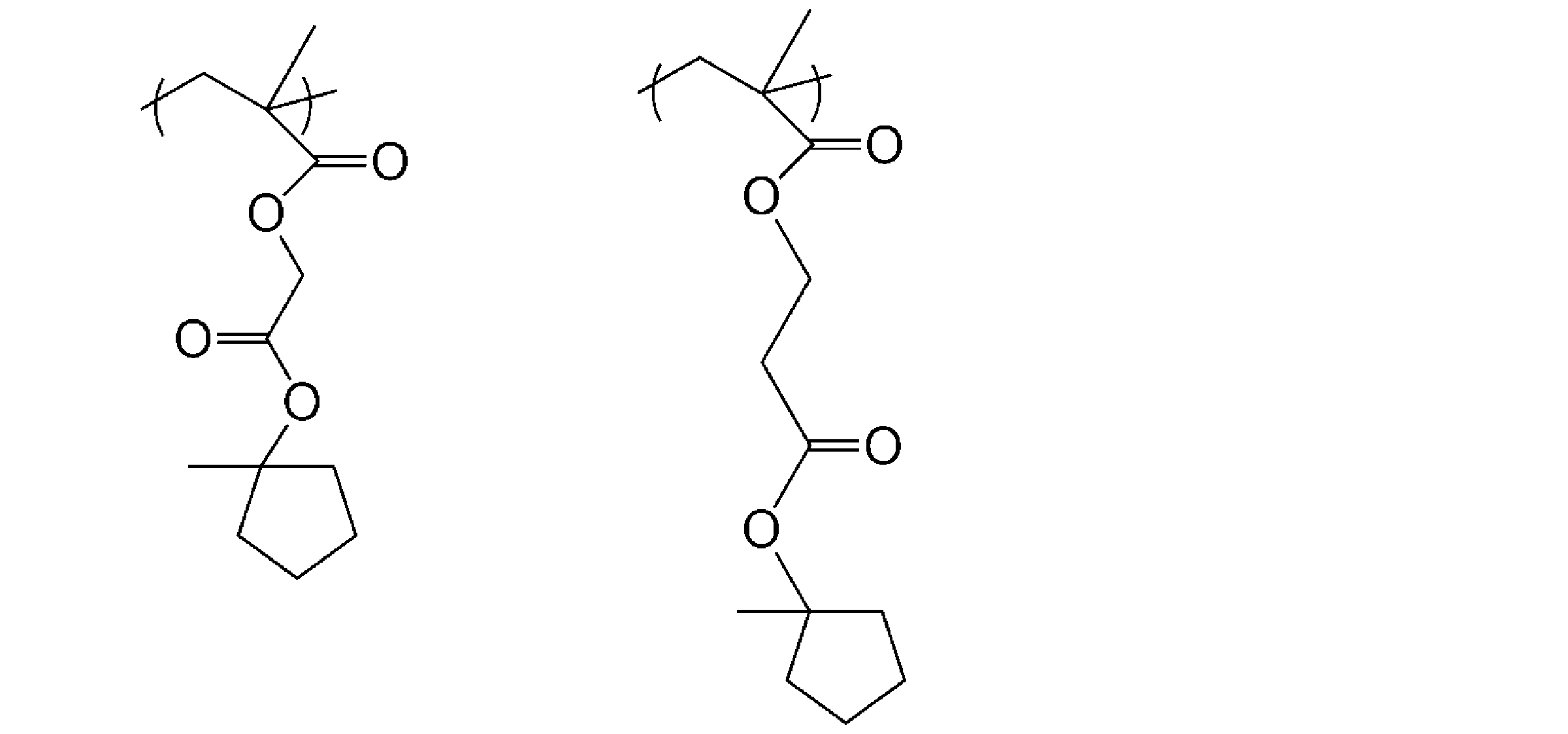
重合体(A)中に含まれる構造単位(a2)の含有割合は、重合体(A)を構成する全ての構造単位の合計を100モル%とした場合、下限は1モル%、好ましくは5モル%、より好ましくは10モル%、上限は40モル%、好ましくは30モル%、より好ましくは20モル%である。また、構造単位(a2)の含有割合は、いずれの上下限の組合せも用いることができる。
構造単位(a3)は下記式(a3)に示す構造単位であり、溶解性促進基であるヒドロキシアリール基を有する。重合体(A)が構造単位(a3)を有することで、重合体(A)のガラス転移温度を上げ、且つアルカリ現像液に対する溶解速度を上げることができ、その結果、本組成物の厚膜での解像性を向上させ、且つ銅メッキに対しても、ニッケルメッキに対しても、どちらにも対応可能なレジストパターンを形成することができる。
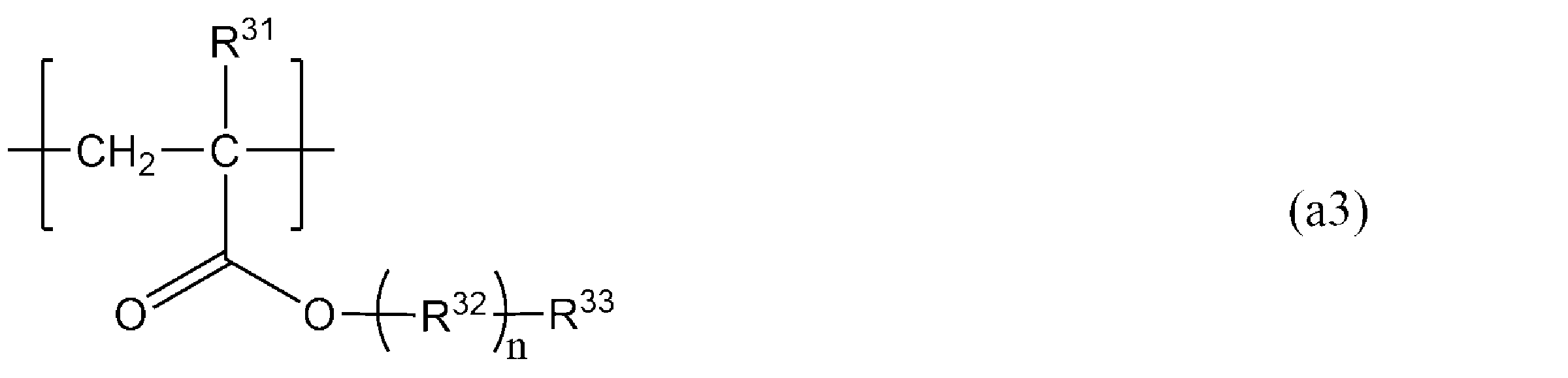
R32の炭素数1~10の有機基としては、R12の炭素数1~10の有機基に挙げた基が挙げられる。nは好ましくは0~4、より好ましくは0である。
これらの中でもヒドロキシフェニル基が、メッキ処理に対応するためメッキ液耐性に優れたレジストパターンを形成することができる。
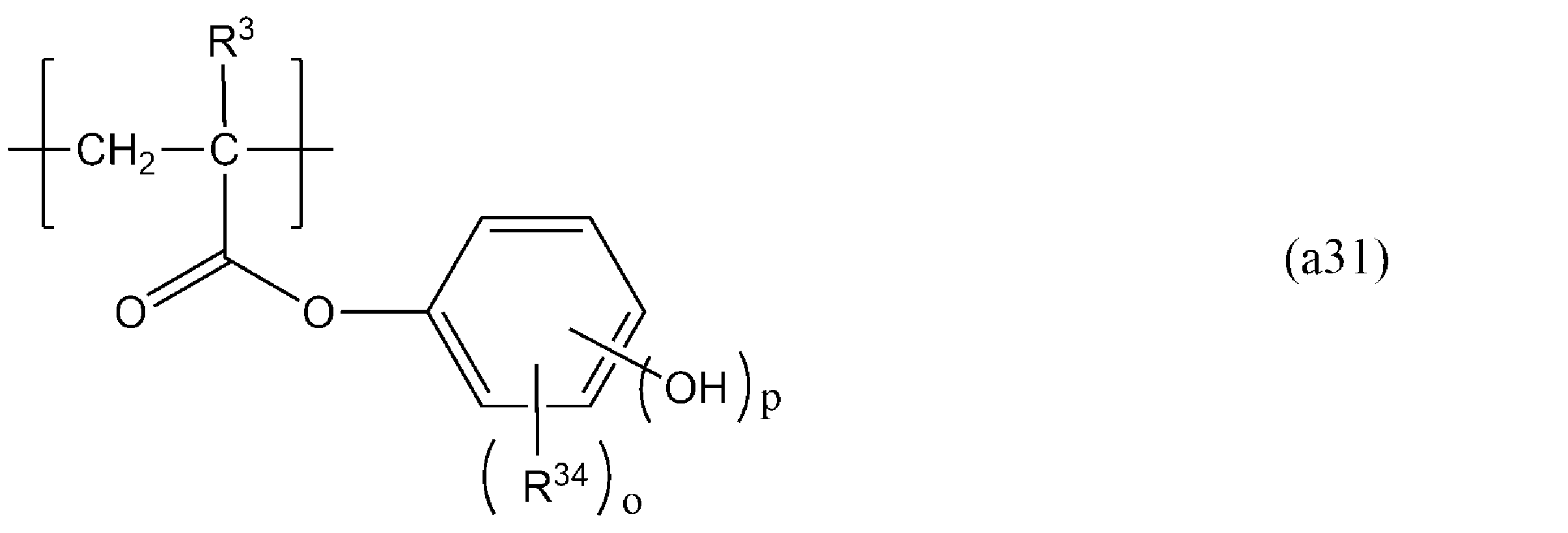

重合体(A)中に含まれる、構造単位(a3)の含有割合は、前記重合体(A)を構成する全ての構造単位の合計を100モル%とした場合、下限は5モル%、好ましく20モル%、より好ましくは30モル%、上限は70モル%、好ましくは65モル%、より好ましくは60モル%である。また、構造単位(a3)の含有割合は、いずれの上下限の組合せも用いることができる。
構造単位(a4)は、構造単位(a3)以外の溶解性促進基を有する構造単位であり、重合体(A)に構造単位(a4)を有することで、本組成物から形成する樹脂塗膜の解像性、感度、焦点深度、および露光ラチチュード等のリソ性を調節することができる。
なお、上記公知文献に記載の構造単位は本明細書に記載されているものとする。
構造単位(a5)は前記構造単位(a1)~(a4)以外の構造単位である。
メチル(メタ)アクリレート、エチル(メタ)アクリレート、n-ペンチル(メタ)アクリレート、ネオペンチル(メタ)アクリレート、n-ヘキシル(メタ)アクリレート、2-エチルヘキシル(メタ)アクリレート等の脂肪族(メタ)アクリル酸エステル化合物;
シクロペンチル(メタ)アクリレート、ノルボルニル(メタ)アクリレート、イソボルニル(メタ)アクリレート、トリシクロデカニル(メタ)アクリレート、ジシクロペンテニル(メタ)アクリレート、テトラヒドロフラニル(メタ)アクリレート、およびテトラヒドロピラニル(メタ)アクリレート等の脂環式(メタ)アクリル酸エステル化合物由来の構造単位;
フェニル(メタ)アクリレート、フェネチル(メタ)アクリレート等の芳香族含有(メタ)アクリル酸エステル化合物由来の構造単位;
(メタ)アクリルアミド、N,N-ジメチル(メタ)アクリルアミド、等の不飽和アミド化合物由来の構造単位;ならびに
マレイミド、N-フェニルマレイミド、N-シクロヘキシルマレイミド等の不飽和イミド化合物由来の構造単位;を挙げることができる。
重合体(A)は、各構造単位に由来する単量体を、イオン重合法またはラジカル重合法等の公知の重合方法により製造することができる。これらの中でも量産性の点から、ラジカル重合法により製造することが好ましい。
重合体(A)のMwとゲルパーミエーションクロマトグラフィーで測定したポリスチレン換算数平均分子量(以下、「Mn」という。)との比(Mw/Mn)は、通常、1~5、好ましくは1~3である。
光酸発生剤(B)は、露光により酸を発生する化合物である。この酸の作用により、重合体(A)中の酸解離性基が解離して、カルボキシ基やヒドロキシアリール基等の酸性官能基が生成する。その結果、感光性樹脂組成物から形成された感光性樹脂塗膜の露光部がアルカリ現像液に易溶性となり、ポジ型のレジストパターンを形成することができる。
本組成物中に含まれる光酸発生剤(B)の含有量は、重合体(A)100質量部に対して、下限が、0.1質量部、好ましくは0.3質量部、より好ましくは0.5質量部、さらに好ましくは1質量部、上限が、20質量部、好ましくは15質量部、より好ましくは10質量部、さらに好ましくは5質量部である。また、光酸発生剤(B)の含有量は、いずれの上下限の組合せも用いることができる。光酸発生剤(B)の含有量が上記範囲内であると、厚膜で解像性に優れたレジストパターンが得られるとともに、優れた形状のパターンが得られる。
有機溶剤(C)は、本組成物中に含まれる各成分を均一に混合するために用いる成分である。
本組成物中に含まれる有機溶剤(C)の含有割合は、固形分濃度の下限が、10質量%、好ましくは20質量%、さらに好ましくは25質量%、上限が、60質量%、好ましくは55質量%、さらに好ましくは50質量%となる量である。また、有機溶剤(C)の含有割合は、いずれの上下限の組合せも用いることができる。前記範囲内であると厚膜のレジストパターンを良好に形成することができる。なお、前記固形分濃度とは、本組成物に含まれる有機溶剤(C)以外の全成分の含有割合をいう。
クエンチャー(D)は、露光により光酸発生剤(B)から生じる酸のレジスト膜中での拡散を制御するために用いる成分であり、その結果、本組成物の解像性を向上することができる。
本組成物中に含まれるクエンチャー(D)の含有量は、重合体(A)100質量部に対して、通常、0.001~10質量部である。
界面活性剤(E)は、本組成物の塗布性、消泡性等を改良する作用を示す。
本組成物中に含まれる前記界面活性剤の含有量は、重合体(A)100質量部に対して、通常、2質量部以下である。
その他成分としては、例えば、露光光を吸収して光酸発生剤の酸発生効率を向上させる増感剤;感光性樹脂組成物から形成した樹脂塗膜のアルカリ現像液への溶解速度を制御するフェノールノボラック樹脂やポリ(ヒドロキシスチレン)などのアルカリ可溶性樹脂および低分子フェノール化合物;露光時の散乱光の未露光部への回り込みによる光反応を阻止する紫外線吸収剤;保存安定性を高める熱重合禁止剤;酸化防止剤;接着助剤;および無機フィラー;が挙げられる。
本組成物は、各成分を均一に混合することにより製造することができる。また、ゴミを取り除くために、各成分を均一に混合した後、得られた混合物をフィルター等で濾過することができる。
本開示のレジストパターンの形成方法(以下、「本レジストパターンの形成方法」)は、本組成物を基板上に塗布して樹脂塗膜を形成する工程(1);
前記樹脂塗膜を露光する工程(2);
露光後の樹脂塗膜を現像する工程(3);を有する。
工程(1)は、基板上に、本組成物の樹脂塗膜を形成する工程である。
前記基板としては、例えば、半導体基板、およびガラス基板ならびにこれら基板の表面に各種金属膜などを設けた基板を挙げることができる。基板の形状には特に制限はなく、表面形状は平坦状および凸凹状が挙げられ、基板の形状としては円形および正方形が挙げられる。また、基板の大きさに制限はない。
工程(2)は、工程(1)で形成した前記樹脂塗膜を露光する工程である。
前記露光は、通常、所定のマスクパターンを有するフォトマスクを介して、縮小投影露光で、前記樹脂塗膜に選択的に行う。
工程(3)は、工程(2)の露光後の樹脂塗膜を現像してレジストパターンを形成する工程である。
前記現像は、通常、アルカリ性現像液にて行う。前記現像の現像方法としては、シャワー現像法、スプレー現像法、浸漬現像法、およびパドル現像法等が挙げられる。前記現像の処理条件は、通常、23℃で1~30分間である。
本開示のメッキ造形物の製造方法(以下、「本メッキ造形物の製造方法」ともいう)は、本レジストパターンの形成方法によって形成するレジストパターンをマスクにしてメッキ造形物を製造する。
具体的には、前記レジストパターンを鋳型とし、電解メッキ処理によりメッキ造形物(例えば、電極材料)が形成される。この際、パターン表面とメッキ液との親和性を高めるため、前記レジストパターンを、例えば、酸素プラズマによるアッシング処理等の親水化処理することができる。
前記メッキ処理後、水洗して乾燥したのち、パターンの状態、メッキ造形物の厚さや状態等を観察し、必要に応じて再び電解メッキを行う。
本メッキ造形物の製造方法は、工程(4)の後に、更に、レジストパターンを除去する工程(5)を備えることができる。
工程(5)は、前記工程(4)において前記基板上に残存するレジストパターンを剥離して除去する工程であって、例えば、20~80℃にて攪拌している剥離液に、工程(4)の後の前記レジストパターンを有する基板を、例えば1~10分間浸漬する方法が挙げられる。
本開示の半導体装置は、本メッキ造形物の製造方法によって得られるメッキ造形物を備える。本半導体装置は、メッキ処理用の鋳型として有用である本レジストパターンを用い、メッキ成分を堆積させるメッキ処理を行い、レジストパターンを写しとったメッキ造形物を備えるものであるため、信頼性が高められる。本半導体装置として、具体的には、多層LSI(半導体集積回路 http://www.jmq.jsr.co.jp/products.html参照)を挙げることができる。
(重合体の重量平均分子量(Mw)の測定方法)
下記条件下でゲルパーミエーションクロマトグラフィー法にてアルカリ可溶性樹脂の重量平均分子量(Mw)を測定した。
・カラム:東ソー社製カラムのTSK-MおよびTSK2500を直列に接続
・溶媒:テトラヒドロフラン
・流速:0.35mL/分
・温度:40℃
・検出方法:屈折率法
・標準物質:ポリスチレン
・GPC装置:東ソー製、装置名「HLC-8220-GPC」
[合成例]
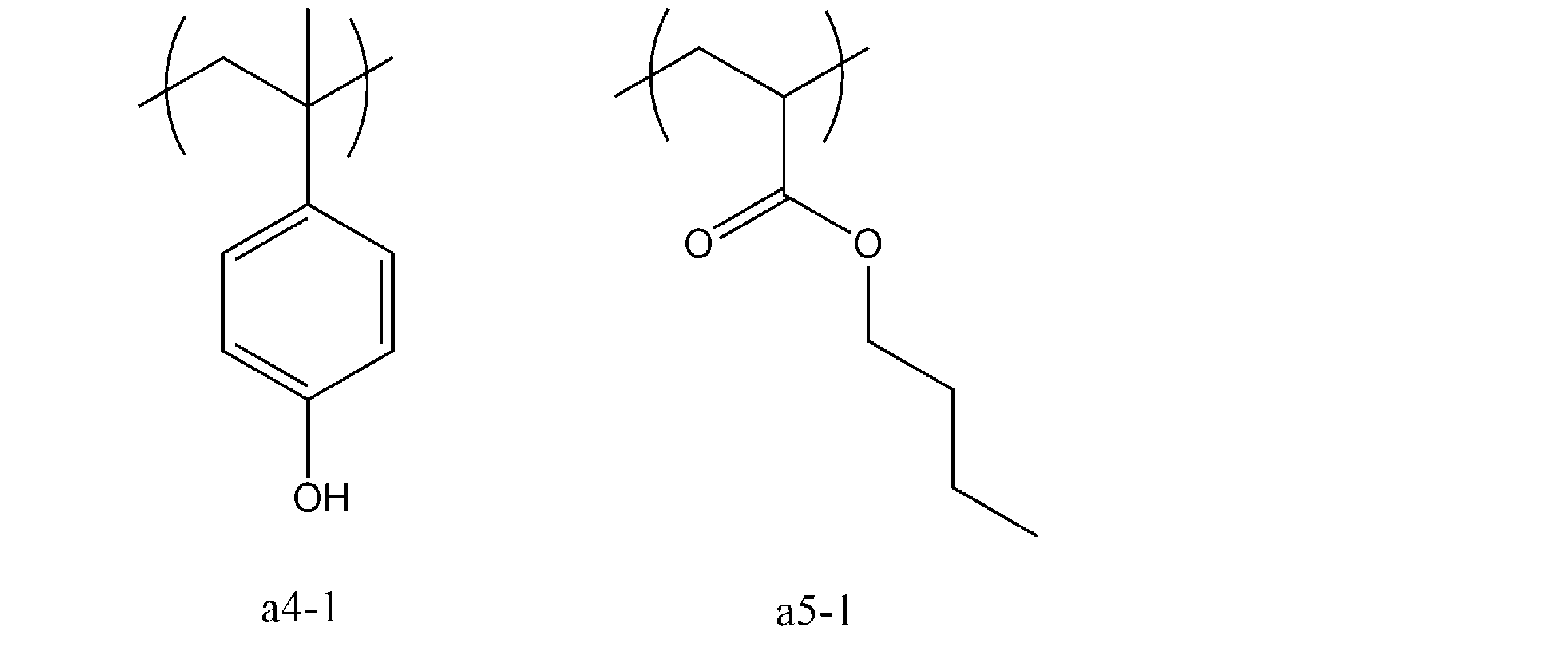
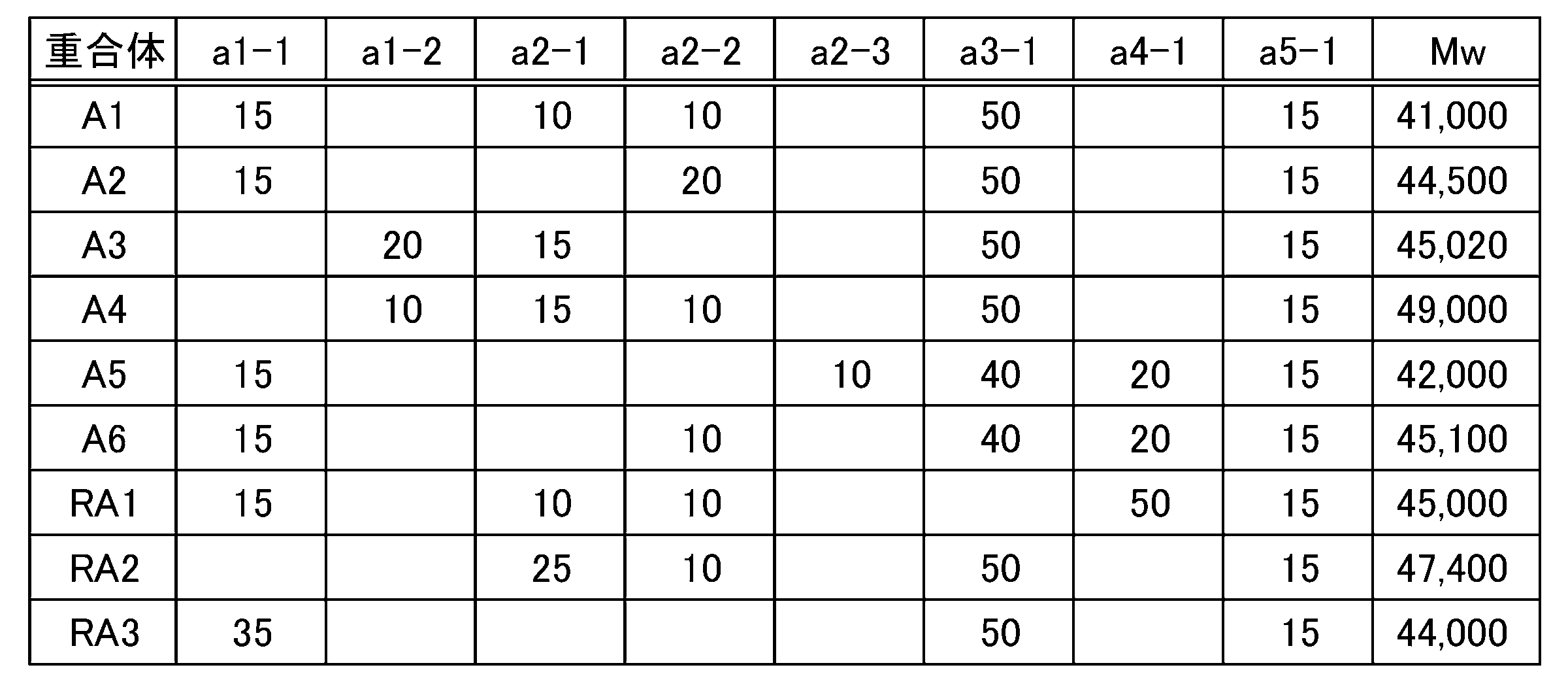
2,2’-アゾビス(イソ酪酸メチル)をラジカル重合開始剤として用いたラジカル重合により、表1に示す構造単位および含有割合を有する重合体(A1)~(A6)および(RA1)~(RA3)を製造した。表1中に示す構造単位の詳細を下記式(a1-1)~(a1-2)、(a2-1)~(a2-3)、(a3-1)、(a4-1)および(a5-1)に示す。なお、表1中の数値の単位はモル%である。

[実施例1A~9A、比較例1A~3A]感光性樹脂組成物の製造
下記表2に示す成分の種類および量を含有する感光樹脂組成物を、各成分を均一に混合することにより製造した。表2に示す重合体以外の成分の詳細は以下のとおりである。なお、表2中の数値の単位は質量部である。
B1:下記式(B1)に示す構造を有する化合物


C1:プロピレングリコールモノメチルエーテルアセテート
C2:メチルアミルケトン
C3:γ-ブチロラクトン
C4:ジプロピレングリコールモノメチルエーテルアセテート

[実施例1B~9B、比較例1B~3B]レジストパターンの形成
銅スパッタ膜を備えてなるシリコンウエハ基板の銅スパッタ膜上にスピンコーターを用いて、実施例1A~9A、比較例1A~3Aの感光性樹脂組成物を塗布し、ホットプレートにて120℃で60秒間加熱し、膜厚5μmの塗膜を形成した。塗膜を、ステッパー(ニコン社製、型式「NSR-i10D」)を用い、パターンマスクを介して、露光した。露光後の塗膜を、90℃で60秒間加熱し、次いで、2.38質量%のテトラメチルアンモニウムハイドロオキサイド水溶液に80秒間浸漬して現像したのち、流水洗浄し、窒素ブローして、基板上に実施例1B~9B、比較例1B~3Bのレジストパターン(深さ5μmのホールパターン)を形成した。このレジストパターンを形成した基板を、「パターニング基板」という。このパターニング基板を用いて、下記に示す方法にて、「解像性」、「メッキ液耐性」を評価した。
前記パターニング基板を走査型電子顕微鏡にて観察し、以下の基準にて解像性を評価した。評価結果を下記表3に示す。
A:縦0.7μm×横0.7μmのホールパターンを解像することができる。
B:縦0.7μm×横0.7μmのホールパターンは解像できないが、縦1μm×横1μmのホールパターンは解像できる。
C:縦1μm×横1μmのホールパターンが解像できない。
前記パターニング基板を銅メッキ液(製品名「CU8502」、Dow Chemical社製)300mL中に23℃で10分間浸漬し、浸漬前後のレジストパターン形状を光学顕微鏡および走査型電子顕微鏡にて観察し、以下の基準にてメッキ液耐性(膨潤耐性)を評価した。
A:浸漬前後のホールパターンのサイズの縮小率が1%以下である。
B:浸漬前後のホールパターンのサイズの縮小率が1%より大きく、10%以下である。
C:浸漬前後のホールパターンのサイズの縮小率が10%より大きい。

[実施例1C~9C、比較例1C~3C]
実施例1B~9B、比較例1B~3Bのパターニング基板を、酸素プラズマによるアッシング処理(出力100W、酸素流量100mL/分、処理時間60秒)を行った。アッシング処理後のパターニング基板を銅メッキ液(製品名「CU8502」、Dow Chemical社製)300mL中に浸漬し、メッキ浴温度23℃、電流密度2A/dm2に設定して、9分電界メッキを行い、メッキ造形物(金属パターン)を製造した。メッキ造形物を製造した後のレジストパターンを光学顕微鏡および走査型電子顕微鏡にて観察し、以下の基準にて「メッキ液耐性(クラック耐性)」を評価した。
A:レジストパターンにクラックがない。
B:レジストパターンにクラックが1個/μm2以上、1,000個未満/μm2ある。
C:レジストパターンにクラックが1,000個以上/μm2ある。

Claims (11)
- 下記式(a1)に示す構造単位(a1)、下記式(a2)に示す構造単位(a2)、および下記式(a3)に示す構造単位(a3)を有する重合体(A);ならびに
光酸発生剤(B);を
含有することを特徴とする感光性樹脂組成物。

- 前記重合体(A)中に含まれる前記構造単位(a3)の含有割合が、前記重合体(A)を構成する全ての構造単位の合計を100モル%とした場合、5~70モル%である、請求項1に記載の感光性樹脂組成物。
- 前記重合体(A)中に含まれる前記構造単位(a1)および前記構造単位(a2)の合計の含有割合が、前記重合体(A)を構成する全ての構造単位の合計を100モル%とした場合、5~60モル%である、請求項1または2に記載の感光性樹脂組成物。
- 前記重合体(A)中に含まれる、構造単位(a1)~構造単位(a3)の合計の含有割合は、前記重合体(A)を構成する全ての構造単位の合計を100モル%とした場合、50~100モル%である、請求項1~3のいずれか一項に記載の感光性樹脂組成物。
- 感光性樹脂組成物中に含まれる前記光酸発生剤(B)の含有量は、前記重合体(A)100質量部に対して0.1~20質量部である、請求項1~4のいずれか一項に記載の感光性樹脂組成物。
- さらに有機溶剤(C)を含有し、感光性樹脂組成物中に含まれる前記有機溶剤(C)の含有割合は、固形分濃度が10~60質量%となる量である、請求項1~5のいずれか一項に記載の感光性樹脂組成物。
- メッキ造形物製造用である、請求項1~6のいずれか一項に記載の感光性樹脂組成物。
- 請求項1乃至7のいずれか一項に記載の感光性樹脂組成物を基板上に塗布して樹脂塗膜を形成する工程(1);
前記樹脂塗膜を露光する工程(2);
露光後の前記樹脂塗膜を現像する工程(3);
を有することを特徴とするレジストパターンの形成方法。 - 請求項8に記載のレジストパターンの形成方法によって形成したレジストパターンをマスクにしてメッキ処理を行う工程(4)を有することを特徴とする、メッキ造形物の製造方法。
- 前記メッキ処理が、銅メッキ処理およびニッケルメッキ処理から選ばれる少なくとも1種である、請求項9に記載のメッキ造形物の製造方法。
- 請求項9または10に記載のメッキ造形物の製造方法によって得られるメッキ造形物を有することを特徴とする半導体装置。
Priority Applications (5)
| Application Number | Priority Date | Filing Date | Title |
|---|---|---|---|
| CN201980051934.9A CN112534353B (zh) | 2018-08-24 | 2019-06-14 | 感光性树脂组合物、抗蚀剂图案的形成方法、镀敷造形物的制造方法及半导体装置 |
| JP2020538198A JP7347429B2 (ja) | 2018-08-24 | 2019-06-14 | 感光樹脂組成物、レジストパターンの形成方法、メッキ造形物の製造方法および半導体装置 |
| US17/269,021 US12158700B2 (en) | 2018-08-24 | 2019-06-14 | Photosensitive resin composition, method for forming resist pattern, method for manufacturing plated molded article, and semiconductor apparatus |
| KR1020217006791A KR102700524B1 (ko) | 2018-08-24 | 2019-06-14 | 감광 수지 조성물, 레지스트 패턴의 형성 방법, 도금 조형물의 제조 방법 및 반도체 장치 |
| JP2023142473A JP7525024B2 (ja) | 2018-08-24 | 2023-09-01 | 感光樹脂組成物、レジストパターンの形成方法、およびメッキ造形物の製造方法 |
Applications Claiming Priority (2)
| Application Number | Priority Date | Filing Date | Title |
|---|---|---|---|
| JP2018157770 | 2018-08-24 | ||
| JP2018-157770 | 2018-08-24 |
Publications (1)
| Publication Number | Publication Date |
|---|---|
| WO2020039717A1 true WO2020039717A1 (ja) | 2020-02-27 |
Family
ID=69591978
Family Applications (1)
| Application Number | Title | Priority Date | Filing Date |
|---|---|---|---|
| PCT/JP2019/023766 Ceased WO2020039717A1 (ja) | 2018-08-24 | 2019-06-14 | 感光樹脂組成物、レジストパターンの形成方法、メッキ造形物の製造方法および半導体装置 |
Country Status (6)
| Country | Link |
|---|---|
| US (1) | US12158700B2 (ja) |
| JP (2) | JP7347429B2 (ja) |
| KR (1) | KR102700524B1 (ja) |
| CN (1) | CN112534353B (ja) |
| TW (1) | TWI866918B (ja) |
| WO (1) | WO2020039717A1 (ja) |
Families Citing this family (1)
| Publication number | Priority date | Publication date | Assignee | Title |
|---|---|---|---|---|
| US20250076758A1 (en) * | 2023-08-31 | 2025-03-06 | Taiwan Semiconductor Manufacturing Company, Ltd. | Photo acid generator |
Citations (5)
| Publication number | Priority date | Publication date | Assignee | Title |
|---|---|---|---|---|
| JP2004029437A (ja) * | 2002-06-26 | 2004-01-29 | Toray Ind Inc | ポジ型感放射線性組成物 |
| JP2008058710A (ja) * | 2006-08-31 | 2008-03-13 | Jsr Corp | ポジ型感放射線性樹脂組成物、転写フィルムおよびメッキ造形物の製造方法 |
| JP2011095662A (ja) * | 2009-11-02 | 2011-05-12 | Shin-Etsu Chemical Co Ltd | 化学増幅ポジ型レジスト材料、これを用いたレジストパターン形成方法及びメッキパターン形成方法 |
| JP2013137524A (ja) * | 2011-11-30 | 2013-07-11 | Fujifilm Corp | パターン形成方法、感活性光線性又は感放射線性樹脂組成物、レジスト膜、電子デバイスの製造方法及び電子デバイス |
| JP2015041098A (ja) * | 2013-08-23 | 2015-03-02 | 東京応化工業株式会社 | 化学増幅型ポジ型感光性樹脂組成物及びそれを用いたレジストパターンの製造方法 |
Family Cites Families (8)
| Publication number | Priority date | Publication date | Assignee | Title |
|---|---|---|---|---|
| US20070190465A1 (en) * | 2004-03-24 | 2007-08-16 | Jsr Corporation | Positively radiation-sensitive resin composition |
| JP2006078760A (ja) * | 2004-09-09 | 2006-03-23 | Tokyo Ohka Kogyo Co Ltd | 電子線またはeuv(極端紫外光)用レジスト組成物及びレジストパターン形成方法 |
| KR20070085160A (ko) | 2006-02-22 | 2007-08-27 | 제이에스알 가부시끼가이샤 | 도금 조형물 제조용 포지티브형 감방사선성 수지 조성물, 전사 필름 및 도금 조형물의 제조 방법 |
| US8592995B2 (en) | 2009-07-02 | 2013-11-26 | Taiwan Semiconductor Manufacturing Company, Ltd. | Method and structure for adhesion of intermetallic compound (IMC) on Cu pillar bump |
| US20120122029A1 (en) | 2010-11-11 | 2012-05-17 | Takanori Kudo | Underlayer Developable Coating Compositions and Processes Thereof |
| JP5708518B2 (ja) | 2011-02-09 | 2015-04-30 | 信越化学工業株式会社 | レジスト材料及びこれを用いたパターン形成方法 |
| JP2016148740A (ja) | 2015-02-10 | 2016-08-18 | 東京応化工業株式会社 | 厚膜用化学増幅型ポジ型感光性樹脂組成物 |
| JP6701363B2 (ja) * | 2016-09-29 | 2020-05-27 | 富士フイルム株式会社 | 感活性光線性又は感放射線性樹脂組成物、パターン形成方法及び電子デバイスの製造方法 |
-
2019
- 2019-06-14 KR KR1020217006791A patent/KR102700524B1/ko active Active
- 2019-06-14 CN CN201980051934.9A patent/CN112534353B/zh active Active
- 2019-06-14 US US17/269,021 patent/US12158700B2/en active Active
- 2019-06-14 JP JP2020538198A patent/JP7347429B2/ja active Active
- 2019-06-14 WO PCT/JP2019/023766 patent/WO2020039717A1/ja not_active Ceased
- 2019-07-01 TW TW108123061A patent/TWI866918B/zh active
-
2023
- 2023-09-01 JP JP2023142473A patent/JP7525024B2/ja active Active
Patent Citations (5)
| Publication number | Priority date | Publication date | Assignee | Title |
|---|---|---|---|---|
| JP2004029437A (ja) * | 2002-06-26 | 2004-01-29 | Toray Ind Inc | ポジ型感放射線性組成物 |
| JP2008058710A (ja) * | 2006-08-31 | 2008-03-13 | Jsr Corp | ポジ型感放射線性樹脂組成物、転写フィルムおよびメッキ造形物の製造方法 |
| JP2011095662A (ja) * | 2009-11-02 | 2011-05-12 | Shin-Etsu Chemical Co Ltd | 化学増幅ポジ型レジスト材料、これを用いたレジストパターン形成方法及びメッキパターン形成方法 |
| JP2013137524A (ja) * | 2011-11-30 | 2013-07-11 | Fujifilm Corp | パターン形成方法、感活性光線性又は感放射線性樹脂組成物、レジスト膜、電子デバイスの製造方法及び電子デバイス |
| JP2015041098A (ja) * | 2013-08-23 | 2015-03-02 | 東京応化工業株式会社 | 化学増幅型ポジ型感光性樹脂組成物及びそれを用いたレジストパターンの製造方法 |
Also Published As
| Publication number | Publication date |
|---|---|
| CN112534353B (zh) | 2024-12-24 |
| US20210325783A1 (en) | 2021-10-21 |
| JP7525024B2 (ja) | 2024-07-30 |
| US12158700B2 (en) | 2024-12-03 |
| JP7347429B2 (ja) | 2023-09-20 |
| KR102700524B1 (ko) | 2024-08-30 |
| TW202020560A (zh) | 2020-06-01 |
| TWI866918B (zh) | 2024-12-21 |
| JPWO2020039717A1 (ja) | 2021-09-24 |
| JP2023169213A (ja) | 2023-11-29 |
| CN112534353A (zh) | 2021-03-19 |
| KR20210047885A (ko) | 2021-04-30 |
Similar Documents
| Publication | Publication Date | Title |
|---|---|---|
| JP7477011B2 (ja) | 感光性樹脂組成物、レジストパターン膜の製造方法、およびメッキ造形物の製造方法 | |
| TWI643916B (zh) | 用於光微影之罩面層組合物及方法 | |
| JP7806403B2 (ja) | メッキ造形物の製造方法 | |
| JP7525024B2 (ja) | 感光樹脂組成物、レジストパターンの形成方法、およびメッキ造形物の製造方法 | |
| JP7347430B2 (ja) | 感光性樹脂組成物、レジストパターンの形成方法、メッキ造形物の製造方法、および半導体装置 | |
| JP7342945B2 (ja) | 感光性樹脂組成物、レジストパターン膜の製造方法、およびメッキ造形物の製造方法 | |
| JP7416052B2 (ja) | 感光性樹脂組成物、レジストパターン膜の製造方法、メッキ造形物の製造方法、および錫銀メッキ造形物の製造方法 | |
| TWI916323B (zh) | 感光性樹脂組成物、抗蝕劑圖案膜的製造方法、鍍敷造形物的製造方法及鍍錫銀造形物的製造方法 |
Legal Events
| Date | Code | Title | Description |
|---|---|---|---|
| 121 | Ep: the epo has been informed by wipo that ep was designated in this application |
Ref document number: 19851879 Country of ref document: EP Kind code of ref document: A1 |
|
| ENP | Entry into the national phase |
Ref document number: 2020538198 Country of ref document: JP Kind code of ref document: A |
|
| NENP | Non-entry into the national phase |
Ref country code: DE |
|
| ENP | Entry into the national phase |
Ref document number: 20217006791 Country of ref document: KR Kind code of ref document: A |
|
| 122 | Ep: pct application non-entry in european phase |
Ref document number: 19851879 Country of ref document: EP Kind code of ref document: A1 |