WO2020032238A1 - アルカリ土類金属炭酸塩微粉末とその製造方法、及びアルカリ土類金属炭酸塩微粉末含有ポリマー組成物とその製造方法 - Google Patents
アルカリ土類金属炭酸塩微粉末とその製造方法、及びアルカリ土類金属炭酸塩微粉末含有ポリマー組成物とその製造方法 Download PDFInfo
- Publication number
- WO2020032238A1 WO2020032238A1 PCT/JP2019/031574 JP2019031574W WO2020032238A1 WO 2020032238 A1 WO2020032238 A1 WO 2020032238A1 JP 2019031574 W JP2019031574 W JP 2019031574W WO 2020032238 A1 WO2020032238 A1 WO 2020032238A1
- Authority
- WO
- WIPO (PCT)
- Prior art keywords
- earth metal
- alkaline earth
- fine powder
- metal carbonate
- carbonate fine
- Prior art date
- Legal status (The legal status is an assumption and is not a legal conclusion. Google has not performed a legal analysis and makes no representation as to the accuracy of the status listed.)
- Ceased
Links
Images
Classifications
-
- C—CHEMISTRY; METALLURGY
- C01—INORGANIC CHEMISTRY
- C01F—COMPOUNDS OF THE METALS BERYLLIUM, MAGNESIUM, ALUMINIUM, CALCIUM, STRONTIUM, BARIUM, RADIUM, THORIUM, OR OF THE RARE-EARTH METALS
- C01F11/00—Compounds of calcium, strontium, or barium
- C01F11/18—Carbonates
-
- C—CHEMISTRY; METALLURGY
- C08—ORGANIC MACROMOLECULAR COMPOUNDS; THEIR PREPARATION OR CHEMICAL WORKING-UP; COMPOSITIONS BASED THEREON
- C08G—MACROMOLECULAR COMPOUNDS OBTAINED OTHERWISE THAN BY REACTIONS ONLY INVOLVING UNSATURATED CARBON-TO-CARBON BONDS
- C08G73/00—Macromolecular compounds obtained by reactions forming a linkage containing nitrogen with or without oxygen or carbon in the main chain of the macromolecule, not provided for in groups C08G12/00 - C08G71/00
- C08G73/06—Polycondensates having nitrogen-containing heterocyclic rings in the main chain of the macromolecule
- C08G73/10—Polyimides; Polyester-imides; Polyamide-imides; Polyamide acids or similar polyimide precursors
-
- C—CHEMISTRY; METALLURGY
- C08—ORGANIC MACROMOLECULAR COMPOUNDS; THEIR PREPARATION OR CHEMICAL WORKING-UP; COMPOSITIONS BASED THEREON
- C08K—Use of inorganic or non-macromolecular organic substances as compounding ingredients
- C08K3/00—Use of inorganic substances as compounding ingredients
- C08K3/18—Oxygen-containing compounds, e.g. metal carbonyls
- C08K3/24—Acids; Salts thereof
- C08K3/26—Carbonates; Bicarbonates
-
- C—CHEMISTRY; METALLURGY
- C08—ORGANIC MACROMOLECULAR COMPOUNDS; THEIR PREPARATION OR CHEMICAL WORKING-UP; COMPOSITIONS BASED THEREON
- C08L—COMPOSITIONS OF MACROMOLECULAR COMPOUNDS
- C08L67/00—Compositions of polyesters obtained by reactions forming a carboxylic ester link in the main chain; Compositions of derivatives of such polymers
-
- C—CHEMISTRY; METALLURGY
- C08—ORGANIC MACROMOLECULAR COMPOUNDS; THEIR PREPARATION OR CHEMICAL WORKING-UP; COMPOSITIONS BASED THEREON
- C08L—COMPOSITIONS OF MACROMOLECULAR COMPOUNDS
- C08L79/00—Compositions of macromolecular compounds obtained by reactions forming in the main chain of the macromolecule a linkage containing nitrogen with or without oxygen or carbon only, not provided for in groups C08L61/00 - C08L77/00
- C08L79/04—Polycondensates having nitrogen-containing heterocyclic rings in the main chain; Polyhydrazides; Polyamide acids or similar polyimide precursors
- C08L79/08—Polyimides; Polyester-imides; Polyamide-imides; Polyamide acids or similar polyimide precursors
Definitions
- the present invention relates to a fine alkaline earth metal carbonate powder and a method for producing the same, and a polymer composition containing fine alkaline earth metal carbonate powder and a method for producing the same.
- Alkaline earth metal carbonate fine powder is used as an additive for polymers.
- strontium carbonate fine powder is used as an additive for controlling the phase difference of a polymer composition used for an optical film.
- the strontium carbonate fine powder used for controlling the phase difference of the polymer composition usually comprises fine needle-like particles having an average major axis of 5 to 100 nm.
- Patent Document 1 discloses a method for producing strontium carbonate fine powder using a dicarboxylic acid containing one or more hydroxyl groups in a molecule as a crystal growth inhibitor.
- DL-tartaric acid is used as a dicarboxylic acid having one or more hydroxyl groups in the molecule.
- the strontium carbonate fine powder produced by using a dicarboxylic acid having at least one hydroxyl group in the molecule as the crystal growth inhibitor described in Patent Document 1 may contain the crystal growth inhibitor as a strontium salt. There is.
- strontium carbonate fine powder mixed with a strontium salt is added to a polymer at a high concentration, the obtained polymer composition may be colored to reduce the visible light transmittance or increase the haze.
- the present invention has been made in view of the above circumstances, and an object thereof is to provide an alkaline earth capable of obtaining a polymer composition having a high visible light transmittance and a low haze even when added to a polymer at a high concentration.
- An object of the present invention is to provide a metal-like carbonate fine powder and a method for producing the same.
- an object of the present invention is to provide a polymer composition containing fine alkaline earth metal carbonate powder having a high visible light transmittance and a low haze even when the alkaline earth metal carbonate fine powder is added at a high concentration, and a method for producing the same. There is also to provide.
- the present inventor has found that by using a monomer which is a raw material of a polymer to which an alkaline earth metal carbonate fine powder is added as a crystal growth inhibitor, a fine alkali It has been found that it is possible to produce an earth metal carbonate fine powder. By mixing and reacting the monomer and the alkaline earth metal carbonate fine powder coated with the monomer, visible light transmission is possible even when the alkaline earth metal carbonate fine powder is added at a high concentration. The present invention was completed by confirming that it was possible to obtain a polymer composition containing a fine alkaline earth metal carbonate powder having a high rate and a low haze.
- alkaline earth metal carbonate fine powder to be added to a polymer, the surface of which is coated with a monomer which is a raw material of the polymer.
- a method for producing an alkaline earth metal carbonate fine powder to be added to a polymer comprising reacting an alkaline earth metal hydroxide with carbon dioxide in the presence of a monomer which is a raw material of the polymer.
- a method for producing fine particles of alkaline earth metal carbonate which comprises a reaction step of producing alkaline earth metal carbonate particles.
- a reaction product of the alkaline earth metal carbonate fine powder according to any one of the above [1] to [8] and the monomer coating the alkaline earth metal carbonate fine powder is:
- an alkaline earth metal carbonate fine powder capable of obtaining a polymer composition having a high visible light transmittance and a low haze even when added to a polymer at a high concentration, and a method for producing the same. It becomes possible. Further, according to the present invention, even when the alkaline earth metal carbonate fine powder is added at a high concentration, the visible light transmittance is high and the haze is low, and the polymer composition containing the alkaline earth metal carbonate fine powder and the method for producing the same are provided. Can also be provided.
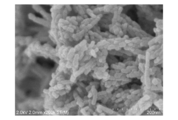
- Example 3 is an SEM photograph of the strontium carbonate fine powder obtained in Example 1.
- the alkaline earth metal carbonate fine powder of the present embodiment is an alkaline earth metal carbonate fine powder to be added to a polymer, the surface of which is coated with a monomer that is a raw material of the polymer.
- the alkaline earth metal carbonate fine powder includes magnesium carbonate fine powder, calcium carbonate fine powder, strontium carbonate fine powder, and barium carbonate fine powder.
- One type of these alkaline earth metal carbonate fine powders may be used alone, or two or more types may be used in combination.
- the alkaline earth metal carbonate fine powder is preferably strontium carbonate fine powder.
- the alkaline earth metal carbonate fine powder has an aspect ratio (ratio of average major axis / average minor axis) of preferably 1.1 or more, more preferably 1.2 or more and 5.0 or less. It is particularly preferred that the ratio be in the range of 1.3 to 4.0.
- the average major axis of the alkaline earth metal carbonate fine powder is preferably in the range of 5 nm to 100 nm, more preferably in the range of 10 nm to 80 nm, and more preferably in the range of 20 nm to 70 nm. Is particularly preferred.
- the average minor axis of the alkaline earth metal carbonate fine powder is not particularly limited, but is preferably in the range of 3 nm to 50 nm, and more preferably in the range of 8 nm to 40 nm.
- the average major axis and average minor axis of the alkaline earth metal carbonate fine powder can be measured by a method of visually or automatically image processing a SEM (scanning electron microscope) photograph of the alkaline earth metal carbonate fine powder. .
- the major axis of the alkaline earth metal carbonate fine powder can be measured as the length in the longitudinal direction (the length of the long side) when the alkaline earth metal carbonate particles are regarded as a rectangle.
- the minor axis of the alkaline earth metal carbonate fine powder can be measured as the length in the lateral direction (length of the short side) when the alkaline earth metal carbonate is regarded as a rectangle.
- a rectangle circumscribing the alkaline earth metal carbonate particles of the image and having a minimum area is calculated, and the major axis and minor axis are determined from the lengths of the major and minor sides.
- the “average” means an average value obtained by measuring the major axis and the minor axis of a statistically reliable number (N number) of alkaline earth metal carbonate particles. Is usually 100 or more, preferably 300 or more, more preferably 500 or more.
- the monomer that coats the alkaline earth metal carbonate fine powder is a monomer that is a raw material of the polymer to which the alkaline earth metal carbonate fine powder is added. Since this monomer becomes a part of the polymer during the production of the fine alkaline earth metal carbonate powder, no foreign matter is generated.
- the monomer is preferably a compound having a carboxyl group or an anhydride thereof.
- the carboxyl group has a high affinity for carbonates of alkaline earth metal carbonates. For this reason, the compound having a carboxyl group or an anhydride thereof easily adheres to the alkaline earth metal carbonate particles during the production of the fine alkaline earth metal carbonate powder, and effectively acts as a crystal growth inhibitor.
- the polymer to which the alkaline earth metal carbonate fine powder is added preferably has a carbonyl group (—C (-O) —) derived from a compound having a carboxyl group or an anhydride thereof.
- the polymer include polyester, polyimide, polyamide, polyamideimide, polyurethane, and polycarbonate.
- polyester include polyethylene terephthalate (PET), polytrimethylene terephthalate (PTT), polybutylene terephthalate (PBT), polyethylene naphthalate (PEN), and polybutylene naphthalate (PBN).
- PET polyethylene terephthalate
- PTT polytrimethylene terephthalate
- PBT polybutylene terephthalate
- PEN polyethylene naphthalate
- PBN polybutylene naphthalate
- Preferred among these polymers are polyesters or polyimides.
- terephthalic acid can be used as a monomer.
- polyimide tetracarboxylic acid or its anhydride can be used as a monomer.
- examples of the tetracarboxylic acid or its anhydride include biphenyl-3,3 ', 4,4'-tetracarboxylic dianhydride (s-BPDA), cyclohexane-1,2,4,5-tetracarboxylic dianhydride.
- Anhydrous (PMDA-HS) can be mentioned.
- the amount of the monomer coating the alkaline earth metal carbonate fine powder is preferably in the range of 3 parts by mass or more and 30 parts by mass or less with respect to 100 parts by mass of the alkaline earth metal carbonate fine powder, and is preferably 5 parts by mass. More preferably, the amount is in the range of not less than 20 parts by mass and not more than 20 parts by mass. If the amount of the monomer is too small, the effect of suppressing crystal growth is reduced during the production of the alkaline earth metal carbonate fine powder, and it may be difficult to obtain fine alkaline earth metal carbonate fine powder.
- the monomer content of the alkaline earth metal carbonate fine powder can be measured, for example, by TG-DTA (thermogravimetric differential thermal analyzer).
- the alkaline earth metal carbonate fine powder of the present embodiment may be further surface-treated with a surfactant.
- the dispersibility of the alkaline earth metal carbonate fine powder surface-treated with a surfactant is improved.
- the dispersibility of the fine alkaline earth metal carbonate powder itself may be reduced, for example, when the dispersion treatment of the fine alkaline earth metal carbonate powder is performed mechanically. Is not required, the alkaline earth metal carbonate fine powder may not be surface-treated with a surfactant.
- a compound having a hydrophilic group and a hydrophobic group and further having a group that forms an anion in water can be used.
- This compound is a compound in which a hydrophilic group is a polyoxyalkylene group, a hydrophobic group is bonded to one end of the polyoxyalkylene group, and a group that forms an anion in water is bonded to the other end.
- the hydrophobic group is preferably an alkyl group or an aryl group, and more preferably a phenyl group.
- the group forming an anion in water is preferably a carboxylic acid group, a sulfate group or a phosphate group.
- the surfactant is preferably a phosphate ester in which a group forming an anion in water is a phosphate group. Since phosphate esters have higher heat resistance than carboxylate esters and sulfate esters, the polymer composition to which the alkaline earth metal carbonate fine powder that has been surface-treated with phosphate esters is added as a surfactant Less coloring due to thermal decomposition.
- the phosphate ester include polyoxyethylene styrenated phenyl ether phosphate and polyoxyethylene alkyl ether phosphate.
- the amount of the surfactant adhering to the surface of the alkaline earth metal carbonate fine powder is generally in the range of 1 part by mass to 40 parts by mass with respect to 100 parts by mass of the alkaline earth metal carbonate fine powder, Preferably it is in the range of 3 parts by mass or more and 30 parts by mass or less. If the amount of the surfactant is too small, the effect of improving dispersibility may not be easily obtained. On the other hand, if the amount of the surfactant is too large, the surfactant becomes a foreign substance during the production of the polymer composition containing the fine alkaline earth metal carbonate, thereby causing the visible light transmittance of the polymer composition to be generated. May decrease or haze may increase.
- the surfactant content of the alkaline earth metal carbonate fine powder can be measured, for example, by TG-DTA (thermogravimetric differential thermal analyzer).
- the surface is coated with the monomer that is the raw material of the polymer to which the alkaline earth metal carbonate fine powder is added. Therefore, foreign matters are less likely to be mixed during the production of the polymer composition containing the fine alkaline earth metal carbonate powder. Therefore, by using the alkaline earth metal carbonate fine powder of the present embodiment, a polymer composition having a high visible light transmittance and a low haze can be obtained even when added to a polymer at a high concentration.
- the alkaline earth metal carbonate fine powder of the present embodiment when a surfactant is attached to the surface, since the dispersibility is improved during the production of the alkaline earth metal carbonate fine powder-containing polymer composition, The fine alkaline earth metal carbonate powder can be more uniformly dispersed in the polymer composition.
- the alkaline earth metal carbonate fine powder of the present embodiment is, for example, in the presence of a monomer, a reaction step of producing alkaline earth metal carbonate particles by reacting an alkaline earth metal hydroxide with carbon dioxide. And a ripening step of growing the alkaline earth metal carbonate particles in a needle shape; a surface treatment step of treating the alkaline earth metal carbonate particles with a surfactant; and a drying step of drying the alkaline earth metal carbonate particles. And a method having the following.
- reaction step In the reaction step, while stirring the raw material liquid containing the monomer and the alkaline earth metal hydroxide, carbon dioxide gas is introduced into the raw material liquid, and the alkaline earth metal hydroxide is carbonated to thereby form an alkali. It is preferred to produce earth metal carbonate particles.
- the raw material liquid may be an aqueous solution in which an alkaline earth metal hydroxide is dissolved, or may be an aqueous suspension in which an alkaline earth metal hydroxide is dispersed.
- concentration of the alkaline earth metal hydroxide in the raw material liquid is not particularly limited, but is usually in the range of 1% by mass to 20% by mass, preferably in the range of 2% by mass to 18% by mass. And more preferably within a range of 3% by mass or more and 15% by mass or less.
- the monomer adheres to the generated alkaline earth metal carbonate particles and acts as a crystal growth inhibitor for the alkaline earth metal carbonate particles.
- the monomer is a monomer that is a raw material of the polymer to which the above-mentioned alkaline earth metal carbonate fine powder is added.
- the content of the monomer in the raw material liquid is generally in the range of 0.1 to 20 parts by mass, preferably in the range of 1 to 10 parts by mass with respect to 100 parts by mass of the alkaline earth metal hydroxide. Is within.
- the liquid temperature of the raw material liquid is preferably in the range of 5 ° C. or more and 60 ° C. or less.
- the flow rate of the carbon dioxide gas introduced into the raw material liquid is generally in the range of 0.5 mL / min to 200 mL / min, preferably 0.5 mL / min or more, per 1 g of the alkaline earth metal hydroxide. It is within the range of 100 mL / min or less.
- the shape of the alkaline earth metal carbonate particles generated in the reaction step is not particularly limited, and may be granular or acicular.
- the shape and size of the alkaline earth metal carbonate particles are determined by conditions such as the temperature of the raw material liquid, the concentration of hydroxide and monomer of the alkaline earth metal in the raw material liquid, and the flow rate of carbon dioxide gas introduced into the raw material liquid. Can be adjusted by If the alkaline earth metal carbonate particles generated in the reaction step are acicular, the next aging step may be omitted.
- the aqueous suspension of the alkaline earth metal carbonate particles obtained in the reaction step is heated and aged at a temperature in the range of 75 ° C. or more and 115 ° C. or less, so that the alkaline earth metal carbonate particles are needled. It is preferable to grow grains in a shape.
- the heating temperature is lower than 75 ° C., the crystal of the long diameter of the alkaline earth metal carbonate particles is insufficiently grown, and the average aspect ratio tends to be low.
- the heating temperature exceeds 115 ° C., crystal growth of the short diameter of the alkaline earth metal carbonate particles is promoted, and the aspect ratio tends to decrease.
- the heating temperature is preferably in the range from 80 ° C to 110 ° C, and particularly preferably in the range from 85 ° C to 105 ° C. Heat aging is preferably performed with stirring.
- the heating time is not particularly limited, but is usually in the range of 1 hour to 100 hours, preferably in the range of 5 hours to 50 hours, and particularly preferably in the range of 10 hours to 30 hours. It is.
- a surfactant is added to the needle-like alkaline earth metal carbonate particles slurry obtained in the aging step, and the surface of the alkaline earth metal carbonate particles is treated with the surfactant. It is preferable to obtain an aqueous slurry of highly dispersible acicular alkaline earth metal carbonate particles. After adding the surfactant to the slurry, it is preferable to stir the slurry to make the concentration of the surfactant uniform, and then to apply a shearing force to the slurry.
- the surface of the alkaline earth metal carbonate particles can be uniformly treated with a surfactant by applying a shearing force to crush the aggregated particles of the alkaline earth metal carbonate particles.
- the amount of the surfactant to be added to the slurry is generally in the range of 1 to 40 parts by mass, preferably 3 to 30 parts by mass, based on 100 parts by mass of the alkaline earth metal carbonate particles in the slurry. Within the following range.
- the drying step the aqueous slurry of the highly dispersible acicular alkaline earth metal carbonate particles obtained in the surface treatment step is dried to obtain an alkaline earth metal carbonate.
- the drying step can be performed by a known drying method using a dryer such as a spray dryer or a drum dryer.
- the reaction step in the presence of the monomer, the alkaline earth metal hydroxide and carbon dioxide are converted.
- the reaction produces alkaline earth metal carbonate particles, so that the alkaline earth metal carbonate fine powder coated with the monomer can be industrially advantageously produced.
- the alkaline earth metal carbonate particles are grown into needle-like shapes, whereby an alkaline earth metal carbonate fine powder comprising needle-like particles useful for controlling the phase difference of the polymer composition is industrially produced. It can be advantageously manufactured.
- an alkaline earth metal carbonate fine powder having improved dispersibility can be industrially advantageously produced.
- the alkaline earth metal carbonate fine powder-containing polymer composition is a reaction product of the above alkaline earth metal carbonate fine powder and a monomer coating the alkaline earth metal carbonate fine powder, It can be produced by mixing and reacting a fine earth metal carbonate powder and a monomer. More specifically, the alkaline earth metal carbonate fine powder, the monomer coating the alkaline earth metal carbonate fine powder, and a solvent were mixed to obtain a precursor, and then the obtained precursor was obtained. It can be produced by reacting a monomer in a precursor.
- the precursor may include a monomer that reacts with the monomer coating the alkaline earth metal carbonate fine powder to form a polymer.
- PET polyethylene terephthalate
- PET is obtained by mixing an alkaline earth metal carbonate fine powder coated with terephthalic acid, ethylene glycol, terephthalic acid, and a solvent. Obtain a precursor. Next, the PET precursor is heated by a conventional method to react (polymerize) ethylene glycol with terephthalic acid to generate PET.
- the polymer of the polymer composition is a polyimide
- the alkaline earth metal carbonate fine powder coated with tetracarboxylic acid or its anhydride, and diamine, tetracarboxylic acid or its anhydride, and the solvent Mix to obtain a polyimide precursor (polyamic acid).
- the polyimide precursor is heated according to a conventional method to react (polymerize) the diamine with the tetracarboxylic acid or its anhydride, thereby producing a polyimide.
- the method for producing the alkaline earth metal carbonate fine powder-containing polymer composition as an optical film includes, for example, a method of applying a precursor on a substrate to obtain a coating film, and then heating the coating film. Injection molding or extrusion molding of the polymer composition can be used. It is preferable that the obtained film of the polymer composition containing the alkaline earth metal carbonate fine powder is subjected to a stretching treatment to orient the alkaline earth metal carbonate fine powder.
- the content of the alkaline earth metal carbonate fine powder in the polymer composition containing the alkaline earth metal carbonate fine powder varies depending on the use of the polymer composition, but is generally in the range of 0.1% by mass or more and 50% by mass or less. And preferably in the range of 1.0% by mass or more and 30% by mass or less.
- the method for producing a polymer composition containing an alkaline earth metal carbonate fine powder of the present embodiment having the above configuration, when the monomer is reacted to form a polymer, the alkaline earth metal carbonate fine powder is produced.
- the polymer composition containing the fine alkaline earth metal carbonate powder of the present embodiment has a high visible light transmittance and a low haze even when the fine alkaline earth metal carbonate powder is added at a high concentration.
- Example 1 (1) Production of strontium carbonate fine powder (a) Reaction step Biphenyl-3,3 ', 4,4'-tetracarboxylic dianhydride (s-BPDA) as a crystal growth inhibitor was added to 3 L of pure water at a water temperature of 10 ° C. 13.92 g) was added and stirred to prepare an aqueous s-BPDA solution. To the obtained aqueous s-BPDA solution, 366 g of strontium hydroxide octahydrate (special grade reagent, purity: 96% or more) is added, and stirred to prepare an aqueous suspension of strontium hydroxide having a concentration of 5.6% by mass. did.
- s-BPDA 4,4'-tetracarboxylic dianhydride
- the aqueous suspension was supplied with carbon dioxide gas at a flow rate of 0.5 L / min (22 mL / g of strontium hydroxide per 1 g). (Flow rate per minute) until the pH of the aqueous suspension becomes 7 to generate strontium carbonate fine particles. Thereafter, stirring was further continued for 30 minutes to obtain an aqueous suspension of strontium carbonate fine particles.
- FIG. 1 shows an SEM photograph of the strontium carbonate fine powder. From the photograph of FIG. 1, it was confirmed that the strontium carbonate fine powder was a fine powder of acicular particles. Further, when the image analysis of the SEM photograph was performed, the average major axis of the acicular particles was 50 nm, and the aspect ratio was 2.1.
- Strontium carbonate was prepared in the same manner as in Example 1 except that 7.1 g of DL-tartaric acid was added instead of s-BPDA as a crystal growth inhibitor in the (a) reaction step of the production of fine strontium carbonate powder. A fine powder was produced. The obtained strontium carbonate fine powder was observed using SEM. As a result, it was confirmed that the obtained strontium carbonate fine powder was fine powder composed of acicular strontium carbonate fine particles having an average major axis of 60 nm and an aspect ratio of 2.1.
- a strontium carbonate fine powder-containing polyimide composition film was prepared in the same manner as in Example 1 except that the obtained strontium carbonate fine powder was used, and the film thickness, visible light transmittance and haze were measured. Table 1 shows the results.
- strontium carbonate fine powder-containing polyimide composition film produced using the obtained strontium carbonate fine powder-containing polyamic acid solution was cloudy, and the visible light transmittance and haze could not be measured.
- the strontium carbonate fine powder-containing polyimide composition film of Example 1 to which strontium carbonate fine powder produced using s-BPDA, which is a monomer for polyimide synthesis was added as a crystal growth inhibitor.
- the strontium carbonate fine powder-containing polyimide composition film of Comparative Example 1 to which strontium carbonate fine powder produced by using DL-tartaric acid as a crystal growth inhibitor was added the visible light transmittance was higher and the haze was lower. Got lower.
Landscapes
- Chemical & Material Sciences (AREA)
- Organic Chemistry (AREA)
- Health & Medical Sciences (AREA)
- Chemical Kinetics & Catalysis (AREA)
- Medicinal Chemistry (AREA)
- Polymers & Plastics (AREA)
- Life Sciences & Earth Sciences (AREA)
- Geology (AREA)
- Inorganic Chemistry (AREA)
- Compounds Of Alkaline-Earth Elements, Aluminum Or Rare-Earth Metals (AREA)
- Compositions Of Macromolecular Compounds (AREA)
- Macromolecular Compounds Obtained By Forming Nitrogen-Containing Linkages In General (AREA)
Abstract
この発明は、ポリマーに添加するためのアルカリ土類金属炭酸塩微粉末であって、表面が、前記ポリマーの原料であるモノマーで被覆されている。
Description
本発明は、アルカリ土類金属炭酸塩微粉末とその製造方法、及びアルカリ土類金属炭酸塩微粉末含有ポリマー組成物とその製造方法に関する。
本願は、2018年8月9日に、日本に出願された特願2018-150378号に基づき優先権を主張し、その内容をここに援用する。
本願は、2018年8月9日に、日本に出願された特願2018-150378号に基づき優先権を主張し、その内容をここに援用する。
アルカリ土類金属炭酸塩微粉末は、ポリマーの添加剤として利用されている。例えば、炭酸ストロンチウム微粉末は、光学用フィルムに用いられるポリマー組成物の位相差制御用の添加剤として利用されている。ポリマー組成物の位相差制御用として用いられる炭酸ストロンチウム微粉末は、通常、平均長径が5~100nmの微細な針状粒子からなる。
針状粒子からなる炭酸ストロンチウム微粉末を製造する方法として、結晶成長抑制剤の存在下にて、水酸化ストロンチウムと二酸化炭素を反応させて炭酸ストロンチウム微粒子を生成させ、次いで、得られた炭酸ストロンチウム微粒子を加熱熟成して針状に粒成長させる方法が知られている。例えば、特許文献1には、結晶成長抑制剤として、分子内に水酸基を1つ以上含むジカルボン酸を用いる炭酸ストロンチウム微粉末の製造方法が開示されている。この特許文献1の実施例では、分子内に水酸基を1つ以上含むジカルボン酸としてDL-酒石酸が使用されている。
ところで、炭酸ストロンチウム微粉末をポリマーに添加して、ポリマー組成物の位相差を制御するためには、炭酸ストロンチウム微粉末をポリマーに対して均一かつ高濃度に分散させることが必要となる。
しかしながら、前記特許文献1に記載されている結晶成長抑制剤として、分子内に水酸基を1つ以上含むジカルボン酸を用いて製造した炭酸ストロンチウム微粉末は、結晶成長抑制剤がストロンチウム塩として混在するおそれがある。ストロンチウム塩が混在した炭酸ストロンチウム微粉末を、ポリマーに高濃度で添加すると、得られたポリマー組成物は、着色して可視光透過率が低下したり、ヘイズが高くなる場合がある。
しかしながら、前記特許文献1に記載されている結晶成長抑制剤として、分子内に水酸基を1つ以上含むジカルボン酸を用いて製造した炭酸ストロンチウム微粉末は、結晶成長抑制剤がストロンチウム塩として混在するおそれがある。ストロンチウム塩が混在した炭酸ストロンチウム微粉末を、ポリマーに高濃度で添加すると、得られたポリマー組成物は、着色して可視光透過率が低下したり、ヘイズが高くなる場合がある。
本発明は上記の事情に鑑みてなされたものであり、その目的は、ポリマーに高濃度で添加しても、可視光透過率が高く、ヘイズが低いポリマー組成物を得ることが可能なアルカリ土類金属炭酸塩微粉末とその製造方法を提供することにある。また、本発明の目的は、アルカリ土類金属炭酸塩微粉末を高濃度で添加しても可視光透過率が高く、ヘイズが低いアルカリ土類金属炭酸塩微粉末含有ポリマー組成物とその製造方法を提供することにもある。
本発明者は、上記の目的を達成するために検討を重ねた結果、結晶成長抑制剤として、アルカリ土類金属炭酸塩微粉末を添加するポリマーの原料であるモノマーを用いることによって、微細なアルカリ土類金属炭酸塩微粉末を製造することが可能となることを見出した。そして、そのモノマーで被覆されているアルカリ土類金属炭酸塩微粉末と、モノマーとを混合して、反応させることによって、アルカリ土類金属炭酸塩微粉末を高濃度で添加しても可視光透過率が高く、ヘイズが低いアルカリ土類金属炭酸塩微粉末含有ポリマー組成物を得ることが可能となることを確認して、本発明を完成させた。
[1]ポリマーに添加するためのアルカリ土類金属炭酸塩微粉末であって、表面が、前記ポリマーの原料であるモノマーで被覆されていることを特徴とするアルカリ土類金属炭酸塩微粉末。
[2]前記モノマーが、カルボキシル基を有する化合物又はその無水物である上記[1]に記載のアルカリ土類金属炭酸塩微粉末。
[3]前記ポリマーが、ポリエステル又はポリイミドである上記[1]又は[2]に記載のアルカリ土類金属炭酸塩微粉末。
[4]アルカリ土類金属炭酸塩微粉末が、炭酸ストロンチウム微粉末である上記[1]から[3]のいずれか1つに記載のアルカリ土類金属炭酸塩微粉末。
[5]さらに、表面に付着した界面活性剤を有する上記[1]から[4]のいずれか1つに記載のアルカリ土類金属炭酸塩微粉末。
[6]前記界面活性剤が、親水性基と疎水性基とを有し、更に水中でアニオンを形成する基を有する化合物である上記[5]に記載のアルカリ土類金属炭酸塩微粉末。
[7]前記疎水性基が、フェニル基である上記[6]に記載のアルカリ土類金属炭酸塩微粉末。
[8]前記界面活性剤が、ポリオキシエチレンスチレン化フェニルエーテルリン酸エステルである上記[7]に記載のアルカリ土類金属炭酸塩微粉末。
[2]前記モノマーが、カルボキシル基を有する化合物又はその無水物である上記[1]に記載のアルカリ土類金属炭酸塩微粉末。
[3]前記ポリマーが、ポリエステル又はポリイミドである上記[1]又は[2]に記載のアルカリ土類金属炭酸塩微粉末。
[4]アルカリ土類金属炭酸塩微粉末が、炭酸ストロンチウム微粉末である上記[1]から[3]のいずれか1つに記載のアルカリ土類金属炭酸塩微粉末。
[5]さらに、表面に付着した界面活性剤を有する上記[1]から[4]のいずれか1つに記載のアルカリ土類金属炭酸塩微粉末。
[6]前記界面活性剤が、親水性基と疎水性基とを有し、更に水中でアニオンを形成する基を有する化合物である上記[5]に記載のアルカリ土類金属炭酸塩微粉末。
[7]前記疎水性基が、フェニル基である上記[6]に記載のアルカリ土類金属炭酸塩微粉末。
[8]前記界面活性剤が、ポリオキシエチレンスチレン化フェニルエーテルリン酸エステルである上記[7]に記載のアルカリ土類金属炭酸塩微粉末。
[9]ポリマーに添加するためのアルカリ土類金属炭酸塩微粉末の製造方法であって、前記ポリマーの原料であるモノマーの存在下にて、アルカリ土類金属の水酸化物と二酸化炭素を反応させてアルカリ土類金属炭酸塩粒子を生成させる反応工程を含むことを特徴とするアルカリ土類金属炭酸塩微粉末の製造方法。
[10]さらに、前記反応工程で得られたアルカリ土類金属炭酸塩粒子を75℃以上115℃以下の範囲内で加熱熟成する熟成工程を備える上記[9]に記載のアルカリ土類金属炭酸塩微粉末の製造方法。
[10]さらに、前記反応工程で得られたアルカリ土類金属炭酸塩粒子を75℃以上115℃以下の範囲内で加熱熟成する熟成工程を備える上記[9]に記載のアルカリ土類金属炭酸塩微粉末の製造方法。
[11]上記[1]~[8]のいずれか1つに記載のアルカリ土類金属炭酸塩微粉末と、前記アルカリ土類金属炭酸塩微粉末を被覆している前記モノマーとの反応生成物であるアルカリ土類金属炭酸塩微粉末含有ポリマー組成物。
[12]上記[1]~[8]のいずれか1つに記載のアルカリ土類金属炭酸塩微粉末と、前記アルカリ土類金属炭酸塩微粉末を被覆している前記モノマーとを混合して、反応させるアルカリ土類金属炭酸塩微粉末含有ポリマー組成物の製造方法。
本発明によれば、ポリマーに高濃度で添加しても、可視光透過率が高く、ヘイズが低いポリマー組成物を得ることが可能なアルカリ土類金属炭酸塩微粉末とその製造方法を提供することが可能となる。また、本発明によれば、アルカリ土類金属炭酸塩微粉末を高濃度で添加しても可視光透過率が高く、ヘイズが低いアルカリ土類金属炭酸塩微粉末含有ポリマー組成物とその製造方法を提供することも可能となる。
以下、本発明のアルカリ土類金属炭酸塩微粉末とその製造方法、及びアルカリ土類金属炭酸塩微粉末含有ポリマー組成物とその製造方法の実施形態について説明する。
本実施形態のアルカリ土類金属炭酸塩微粉末は、ポリマーに添加するためのアルカリ土類金属炭酸塩微粉末であって、表面が、そのポリマーの原料であるモノマーで被覆されていることを特徴としている。
本実施形態のアルカリ土類金属炭酸塩微粉末は、ポリマーに添加するためのアルカリ土類金属炭酸塩微粉末であって、表面が、そのポリマーの原料であるモノマーで被覆されていることを特徴としている。
アルカリ土類金属炭酸塩微粉末は、炭酸マグネシウム微粉末、炭酸カルシウム微粉末、炭酸ストロンチウム微粉末、炭酸バリウム微粉末を含む。これらのアルカリ土類金属炭酸塩微粉末は1種を単独で使用してもよいし、2種以上を組み合わせて使用してもよい。アルカリ土類金属炭酸塩微粉末は、炭酸ストロンチウム微粉末であることが好ましい。
アルカリ土類金属炭酸塩微粉末は、アスペクト比(平均長径/平均短径の比)が1.1以上であることが好ましく、1.2以上5.0以下の範囲内にあることがより好ましく、1.3以上4.0以下の範囲内にあることが特に好ましい。アルカリ土類金属炭酸塩微粉末の平均長径は、5nm以上100nm以下の範囲内にあることが好ましく、10nm以上80nm以下の範囲内にあることがより好ましく、20nm以上70nm以下の範囲内にあることが特に好ましい。また、アルカリ土類金属炭酸塩微粉末の平均短径は、特に制限はないが、3nm以上50nm以下の範囲内にあることが好ましく、8nm以上40nm以下の範囲内にあることがより好ましい。
アルカリ土類金属炭酸塩微粉末の平均長径及び平均短径は、アルカリ土類金属炭酸塩微粉末のSEM(走査型電子顕微鏡)写真を目視又は自動的に画像処理する方法で測定することができる。アルカリ土類金属炭酸塩微粉末の長径は、アルカリ土類金属炭酸塩粒子を長方形とみなしたときの長手方向の長さ(長辺の長さ)として測定することができる。また、アルカリ土類金属炭酸塩微粉末の短径は、アルカリ土類金属炭酸塩を長方形と見立てたときの短手方向の長さ(短辺の長さ)として測定することができる。具体的には画像のアルカリ土類金属炭酸塩粒子に外接する、面積が最少となる長方形を算出し、その長辺と短辺の長さから長径と短径を求める。さらに、「平均」とは、統計学上の信頼性のある個数(N数)のアルカリ土類金属炭酸塩粒子の長径と短径を測定して得られた平均値を意味し、その個数としては通常は100個以上、好ましくは300個以上、より好ましくは500個以上である。
アルカリ土類金属炭酸塩微粉末を被覆するモノマーは、アルカリ土類金属炭酸塩微粉末が添加されるポリマーの原料となるモノマーである。このモノマーは、アルカリ土類金属炭酸塩微粉末の製造時において、ポリマーの一部となるため、異物が生じない。
モノマーは、カルボキシル基を有する化合物又はその無水物であることが好ましい。カルボキシル基は、アルカリ土類金属炭酸塩の炭酸塩との親和性が高い。このため、カルボキシル基を有する化合物又はその無水物は、アルカリ土類金属炭酸塩微粉末の製造時において、アルカリ土類金属炭酸塩粒子に付着しやすく、結晶成長抑制剤として有効に作用する。
アルカリ土類金属炭酸塩微粉末が添加されるポリマーは、カルボキシル基を有する化合物又はその無水物に由来するカルボニル基(-C(=O)-)を有するものであることが好ましい。ポリマーの例としては、ポリエステル、ポリイミド、ポリアミド、ポリアミドイミド、ポリウレタン、ポリカーボネートを挙げることができる。ポリエステルの例としては、ポリエチレンテレフタレート(PET)、ポリトリメチレンテレフタレート(PTT)、ポリブチレンテレフタレート(PBT)、ポリエチレンナフタレート(PEN)、ポリブチレンナフタレート(PBN)を挙げることができる。これらポリマーの中で好ましいのは、ポリエステル又はポリイミドである。
ポリマーがPETである場合は、モノマーとしてテレフタル酸を用いることができる。また、ポリマーがポリイミドである場合は、モノマーとしてテトラカルボン酸又はその無水物を用いることができる。テトラカルボン酸又はその無水物の例としては、ビフェニル-3,3’,4,4’-テトラカルボン酸二無水物(s-BPDA)、シクロヘキサン-1,2,4,5-テトラカルボン酸二無水和物(PMDA-HS)を挙げることができる。
アルカリ土類金属炭酸塩微粉末を被覆するモノマーの量は、アルカリ土類金属炭酸塩微粉末100質量部に対して、3質量部以上30質量部以下の範囲内にあることが好ましく、5質量部以上20質量部以下の範囲内にあることがより好ましい。モノマーの量が少なくなりすぎると、アルカリ土類金属炭酸塩微粉末製造時において結晶成長抑制効果が低下し、微粒子のアルカリ土類金属炭酸塩微粉末を得るのが難しくなるおそれがある。また、一方、モノマーの量が多くなりすぎると、アルカリ土類金属炭酸塩微粉末含有ポリマー組成物の製造時において、未反応のモノマーが残存し、これが異物となることによって、生成したポリマー組成物の可視光透過率が低下したり、ヘイズが高くなるおそれがある。アルカリ土類金属炭酸塩微粉末のモノマーの含有量は、例えば、TG-DTA(熱重量示差熱分析装置)によって測定することができる。
本実施形態のアルカリ土類金属炭酸塩微粉末は、さらに、界面活性剤で表面処理されていてもよい。界面活性剤で表面処理したアルカリ土類金属炭酸塩微粉末は、分散性が向上する。なお、アルカリ土類金属炭酸塩微粉末含有ポリマー組成物の製造時において、アルカリ土類金属炭酸塩微粉末の分散処理を機械的に行う場合など、アルカリ土類金属炭酸塩微粉末自体に分散性が要求されない場合には、アルカリ土類金属炭酸塩微粉末は界面活性剤で表面処理されていなくてもよい。
界面活性剤としては、親水性基と疎水性基とを有し、更に水中でアニオンを形成する基を有する化合物を用いることができる。この化合物は、親水性基がポリオキシアルキレン基であって、このポリオキシアルキレン基の一方の末端に疎水性基が結合し、他方の末端に水中でアニオンを形成する基が結合している化合物であることが好ましい。疎水性基は、アルキル基又はアリール基であることが好ましく、フェニル基であることがより好ましい。水中でアニオンを形成する基は、カルボン酸基、硫酸基又はリン酸基であることが好ましい。
界面活性剤は、水中でアニオンを形成する基がリン酸基であるリン酸エステルであることが好ましい。リン酸エステルは、カルボン酸エステルや硫酸エステルと比較して耐熱性が高いため、リン酸エステルで表面処理されているアルカリ土類金属炭酸塩微粉末を添加したポリマー組成物は、界面活性剤の熱分解による着色が起こりにくい。リン酸エステルの例としては、ポリオキシエチレンスチレン化フェニルエーテルリン酸エステルやポリオキシエチレンアルキルエーテルリン酸エステルを挙げることができる。
アルカリ土類金属炭酸塩微粉末の表面に付着している界面活性剤の量は、アルカリ土類金属炭酸塩微粉末100質量部に対して、一般に1質量部以上40質量部以下の範囲内、好ましくは3質量部以上30質量部以下の範囲内である。界面活性剤の量が少なくなりすぎると、分散性を向上させる効果が得られにくくなるおそれがある。一方、界面活性剤の量が多くなりすぎると、アルカリ土類金属炭酸塩微粉末含有ポリマー組成物の製造時において、界面活性剤が異物となることによって、生成したポリマー組成物の可視光透過率が低下したり、ヘイズが高くなるおそれがある。アルカリ土類金属炭酸塩微粉末の界面活性剤の含有量は、例えば、TG-DTA(熱重量示差熱分析装置)によって測定することができる。
以上のような構成とされた本実施形態のアルカリ土類金属炭酸塩微粉末によれば、表面が、そのアルカリ土類金属炭酸塩微粉末が添加されるポリマーの原料であるモノマーで被覆されているので、アルカリ土類金属炭酸塩微粉末含有ポリマー組成物の製造時において異物が混入しにくい。このため本実施形態のアルカリ土類金属炭酸塩微粉末を用いることによって、ポリマーに高濃度で添加しても、可視光透過率が高く、ヘイズが低いポリマー組成物を得ることが可能となる。
また、本実施形態のアルカリ土類金属炭酸塩微粉末において、表面に付着した界面活性剤を有する場合は、アルカリ土類金属炭酸塩微粉末含有ポリマー組成物の製造時において分散性が向上するので、ポリマー組成物中にアルカリ土類金属炭酸塩微粉末をより均一に分散させることができる。
次に、本実施形態のアルカリ土類金属炭酸塩微粉末の製造方法について説明する。
本実施形態のアルカリ土類金属炭酸塩微粉末は、例えば、モノマーの存在下にて、アルカリ土類金属の水酸化物と二酸化炭素を反応させてアルカリ土類金属炭酸塩粒子を生成させる反応工程と、アルカリ土類金属炭酸塩粒子を針状に成長させる熟成工程と、アルカリ土類金属炭酸塩粒子を界面活性剤で処理する表面処理工程と、アルカリ土類金属炭酸塩粒子を乾燥する乾燥工程とを有する方法によって製造することができる。
本実施形態のアルカリ土類金属炭酸塩微粉末は、例えば、モノマーの存在下にて、アルカリ土類金属の水酸化物と二酸化炭素を反応させてアルカリ土類金属炭酸塩粒子を生成させる反応工程と、アルカリ土類金属炭酸塩粒子を針状に成長させる熟成工程と、アルカリ土類金属炭酸塩粒子を界面活性剤で処理する表面処理工程と、アルカリ土類金属炭酸塩粒子を乾燥する乾燥工程とを有する方法によって製造することができる。
(反応工程)
反応工程では、モノマーとアルカリ土類金属の水酸化物とを含む原料液を撹拌しながら、この原料液に二酸化炭素ガスを導入し、アルカリ土類金属の水酸化物を炭酸化させることによってアルカリ土類金属炭酸塩粒子を生成させることが好ましい。原料液は、アルカリ土類金属の水酸化物が溶解した水溶液であってもよいし、アルカリ土類金属の水酸化物が分散した水性懸濁液であってもよい。原料液中のアルカリ土類金属の水酸化物の濃度は、特に制限はないが、通常は1質量%以上20質量%以下の範囲内であり、好ましくは2質量%以上18質量%以下の範囲内、より好ましくは3質量%以上15質量%以下の範囲内である。
反応工程では、モノマーとアルカリ土類金属の水酸化物とを含む原料液を撹拌しながら、この原料液に二酸化炭素ガスを導入し、アルカリ土類金属の水酸化物を炭酸化させることによってアルカリ土類金属炭酸塩粒子を生成させることが好ましい。原料液は、アルカリ土類金属の水酸化物が溶解した水溶液であってもよいし、アルカリ土類金属の水酸化物が分散した水性懸濁液であってもよい。原料液中のアルカリ土類金属の水酸化物の濃度は、特に制限はないが、通常は1質量%以上20質量%以下の範囲内であり、好ましくは2質量%以上18質量%以下の範囲内、より好ましくは3質量%以上15質量%以下の範囲内である。
モノマーは、生成したアルカリ土類金属炭酸塩粒子に付着し、アルカリ土類金属炭酸塩粒子の結晶成長抑制剤として作用する。モノマーとしては、上述したアルカリ土類金属炭酸塩微粉末が添加されるポリマーの原料となるモノマーである。原料液のモノマーの含有量は、アルカリ土類金属の水酸化物100質量部に対して一般に0.1質量部以上20質量部以下の範囲内、好ましくは1質量部以上10質量部以下の範囲内である。
原料液の液温は、5℃以上60℃以下の範囲内にあることが好ましい。また、原料液に導入する二酸化炭素ガスの流量は、アルカリ土類金属の水酸化物1gに対して、一般に0.5mL/分以上200mL/分以下の範囲内、好ましくは0.5mL/分以上100mL/分以下の範囲内である。
反応工程にて生成するアルカリ土類金属炭酸塩粒子の粒子形状は、特に制限はなく、粒状であってもよいし、針状であってもよい。アルカリ土類金属炭酸塩粒子の粒子形状やサイズは、原料液の液温、原料液のアルカリ土類金属の水酸化物及びモノマーの濃度、原料液に導入される二酸化炭素ガスの流量などの条件によって調整することができる。なお、反応工程にて生成するアルカリ土類金属炭酸塩粒子が針状である場合は、次の熟成工程は省略してもよい。
(熟成工程)
熟成工程では、反応工程で得られたアルカリ土類金属炭酸塩粒子の水性懸濁液を75℃以上115℃以下の範囲内の温度で加熱熟成することによって、アルカリ土類金属炭酸塩粒子を針状に粒成長させることが好ましい。加熱温度が75℃未満であると、アルカリ土類金属炭酸塩粒子の長径の結晶成長が不十分で平均アスペクト比が低くなる傾向がある。一方、加熱温度が115℃を超えると、アルカリ土類金属炭酸塩粒子の短径の結晶成長が促進されてアスペクト比が低くなる傾向がある。加熱温度は、好ましくは80℃以上110℃以下の範囲内であり、特に好ましくは85℃以上105℃以下の範囲内である。加熱熟成は、撹拌しながら行うことが好ましい。加熱時間は、特に限定はないが、通常は1時間以上100時間以下の範囲内であり、好ましくは5時間以上50時間以下の範囲内であり、特に好ましくは10時間以上30時間以下の範囲内である。
熟成工程では、反応工程で得られたアルカリ土類金属炭酸塩粒子の水性懸濁液を75℃以上115℃以下の範囲内の温度で加熱熟成することによって、アルカリ土類金属炭酸塩粒子を針状に粒成長させることが好ましい。加熱温度が75℃未満であると、アルカリ土類金属炭酸塩粒子の長径の結晶成長が不十分で平均アスペクト比が低くなる傾向がある。一方、加熱温度が115℃を超えると、アルカリ土類金属炭酸塩粒子の短径の結晶成長が促進されてアスペクト比が低くなる傾向がある。加熱温度は、好ましくは80℃以上110℃以下の範囲内であり、特に好ましくは85℃以上105℃以下の範囲内である。加熱熟成は、撹拌しながら行うことが好ましい。加熱時間は、特に限定はないが、通常は1時間以上100時間以下の範囲内であり、好ましくは5時間以上50時間以下の範囲内であり、特に好ましくは10時間以上30時間以下の範囲内である。
(表面処理工程)
表面処理工程では、熟成工程で得られた針状のアルカリ土類金属炭酸塩粒子のスラリーに界面活性剤を添加して、アルカリ土類金属炭酸塩粒子の表面を界面活性剤で処理することによって、高分散性針状アルカリ土類金属炭酸塩粒子の水性スラリーを得ることが好ましい。スラリーに界面活性剤を添加した後は、スラリーを撹拌して界面活性剤の濃度を均一にし、次いで、スラリーにせん断力を付与することが好ましい。せん断力を付与して、アルカリ土類金属炭酸塩粒子の凝集粒子を解砕することによって、アルカリ土類金属炭酸塩粒子(一次粒子)の表面を界面活性剤で均一に処理することができる。スラリーに添加する界面活性剤の量は、スラリー中のアルカリ土類金属炭酸塩粒子100質量部に対して、一般に1質量部以上40質量部以下の範囲内、好ましくは3質量部以上30質量部以下の範囲内である。
表面処理工程では、熟成工程で得られた針状のアルカリ土類金属炭酸塩粒子のスラリーに界面活性剤を添加して、アルカリ土類金属炭酸塩粒子の表面を界面活性剤で処理することによって、高分散性針状アルカリ土類金属炭酸塩粒子の水性スラリーを得ることが好ましい。スラリーに界面活性剤を添加した後は、スラリーを撹拌して界面活性剤の濃度を均一にし、次いで、スラリーにせん断力を付与することが好ましい。せん断力を付与して、アルカリ土類金属炭酸塩粒子の凝集粒子を解砕することによって、アルカリ土類金属炭酸塩粒子(一次粒子)の表面を界面活性剤で均一に処理することができる。スラリーに添加する界面活性剤の量は、スラリー中のアルカリ土類金属炭酸塩粒子100質量部に対して、一般に1質量部以上40質量部以下の範囲内、好ましくは3質量部以上30質量部以下の範囲内である。
(乾燥工程)
乾燥工程では、上記の表面処理工程で得られた高分散性針状アルカリ土類金属炭酸塩粒子の水性スラリーを乾燥してアルカリ土類金属炭酸塩を得る。乾燥工程は、スプレードライヤ及びドラムドライヤーなどの乾燥機を用いた公知の乾燥方法によって行なうことができる。
乾燥工程では、上記の表面処理工程で得られた高分散性針状アルカリ土類金属炭酸塩粒子の水性スラリーを乾燥してアルカリ土類金属炭酸塩を得る。乾燥工程は、スプレードライヤ及びドラムドライヤーなどの乾燥機を用いた公知の乾燥方法によって行なうことができる。
以上のような構成とされた本実施形態のアルカリ土類金属炭酸塩微粉末の製造方法によれば、反応工程において、モノマーの存在下にて、アルカリ土類金属の水酸化物と二酸化炭素を反応させてアルカリ土類金属炭酸塩粒子を生成させるので、モノマーで被覆されたアルカリ土類金属炭酸塩微粉末を工業的に有利に製造することができる。また、熟成工程において、アルカリ土類金属炭酸塩粒子を針状に成長させることによって、ポリマー組成物の位相差制御用として有用な針状粒子からなるアルカリ土類金属炭酸塩微粉末を工業的に有利に製造することができる。さらに、表面処理工程において、アルカリ土類金属炭酸塩粒子を界面活性剤で処理することによって、分散性が向上したアルカリ土類金属炭酸塩微粉末を工業的に有利に製造することができる。
次に、本実施形態のアルカリ土類金属炭酸塩微粉末を用いたアルカリ土類金属炭酸塩微粉末含有ポリマー組成物及びその製造方法について説明する。
アルカリ土類金属炭酸塩微粉末含有ポリマー組成物は、上述のアルカリ土類金属炭酸塩微粉末と、このアルカリ土類金属炭酸塩微粉末を被覆しているモノマーとの反応生成物であり、アルカリ土類金属炭酸塩微粉末とモノマーとを混合して、反応させることによって製造することができる。より具体的には、アルカリ土類金属炭酸塩微粉末と、このアルカリ土類金属炭酸塩微粉末を被覆しているモノマーと、溶媒とを混合して前駆体を得て、次いで、得られた前駆体中のモノマーを反応させることによって製造することができる。前駆体は、アルカリ土類金属炭酸塩微粉末を被覆しているモノマーと反応してポリマーを生成するモノマーを含んでいてもよい。
アルカリ土類金属炭酸塩微粉末含有ポリマー組成物は、上述のアルカリ土類金属炭酸塩微粉末と、このアルカリ土類金属炭酸塩微粉末を被覆しているモノマーとの反応生成物であり、アルカリ土類金属炭酸塩微粉末とモノマーとを混合して、反応させることによって製造することができる。より具体的には、アルカリ土類金属炭酸塩微粉末と、このアルカリ土類金属炭酸塩微粉末を被覆しているモノマーと、溶媒とを混合して前駆体を得て、次いで、得られた前駆体中のモノマーを反応させることによって製造することができる。前駆体は、アルカリ土類金属炭酸塩微粉末を被覆しているモノマーと反応してポリマーを生成するモノマーを含んでいてもよい。
例えば、ポリマー組成物のポリマーがポリエチレンテレフタレート(PET)である場合は、テレフタル酸で被覆されているアルカリ土類金属炭酸塩微粉末と、エチレングリコールと、テレフタル酸と、溶媒とを混合してPET前駆体を得る。次いで、PET前駆体を常法に従って加熱して、エチレングリコールとテレフタル酸とを反応(重合)させることによって、PETを生成させる。
また、ポリマー組成物のポリマーがポリイミドである場合は、テトラカルボン酸又はその無水物で被覆されているアルカリ土類金属炭酸塩微粉末と、ジアミンと、テトラカルボン酸又はその無水物と、溶媒を混合してポリイミド前駆体(ポリアミック酸)を得る。次いで、ポリイミド前駆体を常法に従って加熱して、ジアミンとテトラカルボン酸又はその無水物とを反応(重合)させることによって、ポリイミドを生成させる。
アルカリ土類金属炭酸塩微粉末含有ポリマー組成物を、光学用フィルムとして製造する方法としては、例えば、前駆体を基板の上に塗布して塗布膜を得て、次いで塗布膜を加熱する方法、ポリマー組成物を射出成形や押出成形する方法を用いることができる。得られたアルカリ土類金属炭酸塩微粉末含有ポリマー組成物のフィルムは、延伸処理を行って、アルカリ土類金属炭酸塩微粉末を配向させることが好ましい。
アルカリ土類金属炭酸塩微粉末含有ポリマー組成物のアルカリ土類金属炭酸塩微粉末の含有量は、ポリマー組成物の用途によっても異なるが、一般に0.1質量%以上50質量%以下の範囲内、好ましくは1.0質量%以上30質量%以下の範囲内である。
以上のような構成とされた本実施形態のアルカリ土類金属炭酸塩微粉末含有ポリマー組成物の製造方法によれば、モノマーを反応させてポリマーを生成させる際に、アルカリ土類金属炭酸塩微粉末を被覆しているモノマーとポリマー生成用のモノマーとが反応することによって、生成したポリマーとアルカリ土類金属炭酸塩粒子との間に異物が混入することが抑えられる。このため、本実施形態のアルカリ土類金属炭酸塩微粉末含有ポリマー組成物は、アルカリ土類金属炭酸塩微粉末を高濃度で添加しても可視光透過率が高く、ヘイズが低くなる。
以下、本発明を実施例に基づいて具体的に説明するが、これらは本発明を限定するものではない。
[実施例1]
(1)炭酸ストロンチウム微粉末の製造
(a)反応工程
水温10℃の純水3Lに、結晶成長抑制剤としてビフェニル-3,3’,4,4’-テトラカルボン酸二無水物(s-BPDA)13.92gを加えて撹拌してs-BPDA水溶液を調製した。得られたs-BPDA水溶液に、水酸化ストロンチウム八水和物(特級試薬、純度:96%以上)366gを投入し、撹拌して濃度5.6質量%の水酸化ストロンチウム水性懸濁液を調製した。得られた水酸化ストロンチウム水性懸濁液を10℃に維持しつつ、撹拌を続けながら、この水性懸濁液に二酸化炭素ガスを0.5L/分の流量(水酸化ストロンチウム1gに対して22mL/分の流量)にて、水性懸濁液のpHが7になるまで吹き込み、炭酸ストロンチウム微粒子を生成させた。その後、さらに30分間撹拌を続け、炭酸ストロンチウム微粒子水性懸濁液を得た。
(1)炭酸ストロンチウム微粉末の製造
(a)反応工程
水温10℃の純水3Lに、結晶成長抑制剤としてビフェニル-3,3’,4,4’-テトラカルボン酸二無水物(s-BPDA)13.92gを加えて撹拌してs-BPDA水溶液を調製した。得られたs-BPDA水溶液に、水酸化ストロンチウム八水和物(特級試薬、純度:96%以上)366gを投入し、撹拌して濃度5.6質量%の水酸化ストロンチウム水性懸濁液を調製した。得られた水酸化ストロンチウム水性懸濁液を10℃に維持しつつ、撹拌を続けながら、この水性懸濁液に二酸化炭素ガスを0.5L/分の流量(水酸化ストロンチウム1gに対して22mL/分の流量)にて、水性懸濁液のpHが7になるまで吹き込み、炭酸ストロンチウム微粒子を生成させた。その後、さらに30分間撹拌を続け、炭酸ストロンチウム微粒子水性懸濁液を得た。
(b)熟成工程
上記(a)で得られた炭酸ストロンチウム微粒子水性懸濁液を、周速2.5m/secで回転する撹拌羽を用いて撹拌しながら85℃の温度にて12時間加温処理して炭酸ストロンチウム微粒子を針状に成長させた。その後、室温まで放冷して、炭酸ストロンチウム微粒子の水性スラリーを製造した。
上記(a)で得られた炭酸ストロンチウム微粒子水性懸濁液を、周速2.5m/secで回転する撹拌羽を用いて撹拌しながら85℃の温度にて12時間加温処理して炭酸ストロンチウム微粒子を針状に成長させた。その後、室温まで放冷して、炭酸ストロンチウム微粒子の水性スラリーを製造した。
(c)表面処理工程
上記(b)で得られた炭酸ストロンチウム微粒子の水性スラリー(固形分濃度:6質量%)に、界面活性剤としてポリオキシエチレンスチレン化フェニルエーテルリン酸エステル(炭酸ストロンチウム微粒子100質量部に対して30質量部)を添加して溶解させ、次いでスターラーで5分間撹拌した後、クレアミックス(エム・テクニック株式会社製)を用いて、せん断力をかけて、分散処理を行った。
上記(b)で得られた炭酸ストロンチウム微粒子の水性スラリー(固形分濃度:6質量%)に、界面活性剤としてポリオキシエチレンスチレン化フェニルエーテルリン酸エステル(炭酸ストロンチウム微粒子100質量部に対して30質量部)を添加して溶解させ、次いでスターラーで5分間撹拌した後、クレアミックス(エム・テクニック株式会社製)を用いて、せん断力をかけて、分散処理を行った。
(d)乾燥工程(ドラムドライヤー)
上記(c)で得られた高分散性針状炭酸ストロンチウム微粒子の水性スラリーを110~120℃に加熱した回転式ドラムドライヤーに吹き付けて、炭酸ストロンチウム微粉末を得た。得られた炭酸ストロンチウム微粉末を、SEM(走査型電子顕微鏡)を用いて観察した。図1に、炭酸ストロンチウム微粉末のSEM写真を示す。図1の写真から、炭酸ストロンチウム微粉末は、針状粒子の微粉末であることが確認された。また、SEM写真の画像解析を行ったところ、針状粒子の平均長径は50nmで、アスペクト比は2.1であった。
上記(c)で得られた高分散性針状炭酸ストロンチウム微粒子の水性スラリーを110~120℃に加熱した回転式ドラムドライヤーに吹き付けて、炭酸ストロンチウム微粉末を得た。得られた炭酸ストロンチウム微粉末を、SEM(走査型電子顕微鏡)を用いて観察した。図1に、炭酸ストロンチウム微粉末のSEM写真を示す。図1の写真から、炭酸ストロンチウム微粉末は、針状粒子の微粉末であることが確認された。また、SEM写真の画像解析を行ったところ、針状粒子の平均長径は50nmで、アスペクト比は2.1であった。
(2)炭酸ストロンチウム微粉末含有ポリアミック酸の調製
上記(1)で製造した炭酸ストロンチウム微粉末0.28gとN-メチルピロリドン(NMP)25.0gを試験管に投入し、次いで超音波ホモジナイザーを用いて分散処理を行って、炭酸ストロンチウム分散液を得た。得られた炭酸ストロンチウム分散液に、シクロヘキシルジアミン(DACH)1.0gを添加して70℃に加温しながら15分間撹拌して溶解させた。次いで、炭酸ストロンチウム分散液に、さらにs-BPDA2.6gを添加して、70℃に維持しつつ6時間撹拌した後、さらに室温で20時間撹拌して溶解・重合を行い、炭酸ストロンチウム微粉末含有ポリアミック酸溶液を得た。
上記(1)で製造した炭酸ストロンチウム微粉末0.28gとN-メチルピロリドン(NMP)25.0gを試験管に投入し、次いで超音波ホモジナイザーを用いて分散処理を行って、炭酸ストロンチウム分散液を得た。得られた炭酸ストロンチウム分散液に、シクロヘキシルジアミン(DACH)1.0gを添加して70℃に加温しながら15分間撹拌して溶解させた。次いで、炭酸ストロンチウム分散液に、さらにs-BPDA2.6gを添加して、70℃に維持しつつ6時間撹拌した後、さらに室温で20時間撹拌して溶解・重合を行い、炭酸ストロンチウム微粉末含有ポリアミック酸溶液を得た。
(3)炭酸ストロンチウム微粉末含有ポリイミド組成物フィルムの作製
上記(2)で調製した炭酸ストロンチウム微粉末含有ポリアミック酸を、スピンコーターを用いてガラス板上に塗布して塗布膜を形成した。次いで、得られた塗布膜を、イナートオーブンを用いて窒素雰囲気下で30℃から2℃/minで350℃まで昇温し、350℃で10分間保持する熱処理により乾燥させた。得られた乾燥膜をガラス板から剥離して、炭酸ストロンチウム微粉末含有ポリイミド組成物フィルムを得た。得られた炭酸ストロンチウム微粉末含有ポリイミド組成物フィルムの膜厚は9.8μmであった。
上記(2)で調製した炭酸ストロンチウム微粉末含有ポリアミック酸を、スピンコーターを用いてガラス板上に塗布して塗布膜を形成した。次いで、得られた塗布膜を、イナートオーブンを用いて窒素雰囲気下で30℃から2℃/minで350℃まで昇温し、350℃で10分間保持する熱処理により乾燥させた。得られた乾燥膜をガラス板から剥離して、炭酸ストロンチウム微粉末含有ポリイミド組成物フィルムを得た。得られた炭酸ストロンチウム微粉末含有ポリイミド組成物フィルムの膜厚は9.8μmであった。
(4)炭酸ストロンチウム微粉末含有ポリイミド組成物フィルムの評価
得られた炭酸ストロンチウム微粉末含有ポリイミド組成物フィルムの可視光透過率とヘイズを、分光光度計(日本分光株式社製)を用いて測定した。その結果を、下記の表1に示す。なお、可視光透過率は、波長400nmの光を用いて測定した。
得られた炭酸ストロンチウム微粉末含有ポリイミド組成物フィルムの可視光透過率とヘイズを、分光光度計(日本分光株式社製)を用いて測定した。その結果を、下記の表1に示す。なお、可視光透過率は、波長400nmの光を用いて測定した。
[比較例1]
(1)炭酸ストロンチウム微粉末の製造の(a)反応工程において、結晶成長抑制剤としてs-BPDAの代わりにDL-酒石酸を7.1g添加したこと以外は、実施例1と同様にして炭酸ストロンチウム微粉末を製造した。得られた炭酸ストロンチウム微粉末を、SEMを用いて観察した。その結果、得られた炭酸ストロンチウム微粉末は、平均長径が60nmで、アスペクト比が2.1の針状炭酸ストロンチウム微粒子からなる微粉末であることが確認された。
次いで、得られた炭酸ストロンチウム微粉末を用いたこと以外は、実施例1と同様にして、炭酸ストロンチウム微粉末含有ポリイミド組成物フィルムを作製し、膜厚、可視光透過率及びヘイズを測定した。その結果を表1に示す。
(1)炭酸ストロンチウム微粉末の製造の(a)反応工程において、結晶成長抑制剤としてs-BPDAの代わりにDL-酒石酸を7.1g添加したこと以外は、実施例1と同様にして炭酸ストロンチウム微粉末を製造した。得られた炭酸ストロンチウム微粉末を、SEMを用いて観察した。その結果、得られた炭酸ストロンチウム微粉末は、平均長径が60nmで、アスペクト比が2.1の針状炭酸ストロンチウム微粒子からなる微粉末であることが確認された。
次いで、得られた炭酸ストロンチウム微粉末を用いたこと以外は、実施例1と同様にして、炭酸ストロンチウム微粉末含有ポリイミド組成物フィルムを作製し、膜厚、可視光透過率及びヘイズを測定した。その結果を表1に示す。
[比較例2]
(1)炭酸ストロンチウム微粉末の製造の(a)反応工程において、結晶成長抑制剤としてs-BPDAの代わりにテレフタル酸を7.1g添加したこと以外は、実施例1と同様にして炭酸ストロンチウム微粉末を製造した。得られた炭酸ストロンチウム微粉末を、SEMを用いて観察した。その結果、得られた炭酸ストロンチウム微粉末は、平均長径が55nmで、アスペクト比が2.1の針状炭酸ストロンチウム微粒子からなる微粉末であることが確認された。
次いで、得られた炭酸ストロンチウム微粉末を用いたこと以外は、実施例1と同様にして、炭酸ストロンチウム微粉末含有ポリアミック酸溶液を調製したところ、炭酸ストロンチウム微粉末の分散不良が発生した。これは、炭酸ストロンチウム微粉末の表面を被覆しているテレフタル酸とポリアミック酸との親和性が低いためであると考えられる。そして、その得られた炭酸ストロンチウム微粉末含有ポリアミック酸溶液を用いて作製した炭酸ストロンチウム微粉末含有ポリイミド組成物フィルムは、白濁しており、可視光透過率及びヘイズを測定できなかった。
(1)炭酸ストロンチウム微粉末の製造の(a)反応工程において、結晶成長抑制剤としてs-BPDAの代わりにテレフタル酸を7.1g添加したこと以外は、実施例1と同様にして炭酸ストロンチウム微粉末を製造した。得られた炭酸ストロンチウム微粉末を、SEMを用いて観察した。その結果、得られた炭酸ストロンチウム微粉末は、平均長径が55nmで、アスペクト比が2.1の針状炭酸ストロンチウム微粒子からなる微粉末であることが確認された。
次いで、得られた炭酸ストロンチウム微粉末を用いたこと以外は、実施例1と同様にして、炭酸ストロンチウム微粉末含有ポリアミック酸溶液を調製したところ、炭酸ストロンチウム微粉末の分散不良が発生した。これは、炭酸ストロンチウム微粉末の表面を被覆しているテレフタル酸とポリアミック酸との親和性が低いためであると考えられる。そして、その得られた炭酸ストロンチウム微粉末含有ポリアミック酸溶液を用いて作製した炭酸ストロンチウム微粉末含有ポリイミド組成物フィルムは、白濁しており、可視光透過率及びヘイズを測定できなかった。

上記の結果から明らかなように、結晶成長抑制剤としてポリイミド合成用のモノマーであるs-BPDAを使用して製造した炭酸ストロンチウム微粉末を添加した実施例1の炭酸ストロンチウム微粉末含有ポリイミド組成物フィルムは、結晶成長抑制剤としてDL-酒石酸を使用して製造した炭酸ストロンチウム微粉末を添加した比較例1の炭酸ストロンチウム微粉末含有ポリイミド組成物フィルムと比較して、可視光透過率が高く、ヘイズが低くなった。比較例1の炭酸ストロンチウム微粉末含有ポリイミド組成物フィルムの可視光透過率が低下し、ヘイズが高くなったのは、ポリイミドと炭酸ストロンチウム微粉末との間に異物(酒石酸)が残存したためであると考えられる。
以上の結果から、本実施例によれば、ポリマーに高濃度で添加しても、可視光透過率が高く、ヘイズが低いポリマー組成物を得ることが可能な炭酸ストロンチウム微粉末を得ることができることが確認された。
Claims (12)
- ポリマーに添加するためのアルカリ土類金属炭酸塩微粉末であって、
表面が、前記ポリマーの原料であるモノマーで被覆されていることを特徴とするアルカリ土類金属炭酸塩微粉末。 - 前記モノマーが、カルボキシル基を有する化合物又はその無水物である請求項1に記載のアルカリ土類金属炭酸塩微粉末。
- 前記ポリマーが、ポリエステル又はポリイミドである請求項1又は2に記載のアルカリ土類金属炭酸塩微粉末。
- アルカリ土類金属炭酸塩微粉末が、炭酸ストロンチウム微粉末である請求項1から3のいずれか1項に記載のアルカリ土類金属炭酸塩微粉末。
- さらに、表面に付着した界面活性剤を有する請求項1から4のいずれか1項に記載のアルカリ土類金属炭酸塩微粉末。
- 前記界面活性剤が、親水性基と疎水性基とを有し、更に水中でアニオンを形成する基を有する化合物である請求項5に記載のアルカリ土類金属炭酸塩微粉末。
- 前記疎水性基が、フェニル基である請求項6に記載のアルカリ土類金属炭酸塩微粉末。
- 前記界面活性剤が、ポリオキシエチレンスチレン化フェニルエーテルリン酸エステルである請求項7に記載のアルカリ土類金属炭酸塩微粉末。
- ポリマーに添加するためのアルカリ土類金属炭酸塩微粉末の製造方法であって、
前記ポリマーの原料であるモノマーの存在下にて、アルカリ土類金属の水酸化物と二酸化炭素を反応させてアルカリ土類金属炭酸塩粒子を生成させる反応工程を含むことを特徴とするアルカリ土類金属炭酸塩微粉末の製造方法。 - さらに、前記反応工程で得られたアルカリ土類金属炭酸塩粒子を75℃以上115℃以下の範囲内で加熱熟成する熟成工程を備える請求項9に記載のアルカリ土類金属炭酸塩微粉末の製造方法。
- 請求項1から8のいずれか1項に記載のアルカリ土類金属炭酸塩微粉末と、前記アルカリ土類金属炭酸塩微粉末を被覆している前記モノマーとの反応生成物であるアルカリ土類金属炭酸塩微粉末含有ポリマー組成物。
- 請求項1から8のいずれか1項に記載のアルカリ土類金属炭酸塩微粉末と、前記アルカリ土類金属炭酸塩微粉末を被覆している前記モノマーとを混合して、反応させるアルカリ土類金属炭酸塩微粉末含有ポリマー組成物の製造方法。
Priority Applications (1)
| Application Number | Priority Date | Filing Date | Title |
|---|---|---|---|
| JP2020535905A JP7439757B2 (ja) | 2018-08-09 | 2019-08-09 | アルカリ土類金属炭酸塩微粉末とその製造方法、及びアルカリ土類金属炭酸塩微粉末含有ポリマー組成物とその製造方法 |
Applications Claiming Priority (2)
| Application Number | Priority Date | Filing Date | Title |
|---|---|---|---|
| JP2018150378 | 2018-08-09 | ||
| JP2018-150378 | 2018-08-09 |
Publications (1)
| Publication Number | Publication Date |
|---|---|
| WO2020032238A1 true WO2020032238A1 (ja) | 2020-02-13 |
Family
ID=69415565
Family Applications (1)
| Application Number | Title | Priority Date | Filing Date |
|---|---|---|---|
| PCT/JP2019/031574 Ceased WO2020032238A1 (ja) | 2018-08-09 | 2019-08-09 | アルカリ土類金属炭酸塩微粉末とその製造方法、及びアルカリ土類金属炭酸塩微粉末含有ポリマー組成物とその製造方法 |
Country Status (3)
| Country | Link |
|---|---|
| JP (1) | JP7439757B2 (ja) |
| TW (1) | TW202016024A (ja) |
| WO (1) | WO2020032238A1 (ja) |
Citations (8)
| Publication number | Priority date | Publication date | Assignee | Title |
|---|---|---|---|---|
| JPS5328644A (en) * | 1976-08-31 | 1978-03-17 | Asahi Chem Ind Co Ltd | Drawn polyolefin composition |
| JPH1192141A (ja) * | 1997-09-12 | 1999-04-06 | Nitto Funka Kogyo Kk | 炭酸カルシウム粉粒体の製造方法および炭酸カルシウム粉粒体とこれを用いた高分子用添加剤 |
| JP2001266651A (ja) * | 2000-01-13 | 2001-09-28 | Maruo Calcium Co Ltd | コア/シェル状導電性有機−無機複合体とその製造方法、及び該複合体含有組成物 |
| JP2005231917A (ja) * | 2004-02-17 | 2005-09-02 | Ube Material Industries Ltd | 炭酸カルシウムの製造方法 |
| JP2009001475A (ja) * | 2006-12-14 | 2009-01-08 | Sony Corp | 炭酸ストロンチウム微粒子の製造方法 |
| JP2010023019A (ja) * | 2008-06-20 | 2010-02-04 | Maruo Calcium Co Ltd | 多孔質濾過膜用微孔形成剤、これを配合してなる多孔質濾過膜用樹脂組成物、及び多孔質濾過膜の製造方法 |
| WO2012111692A1 (ja) * | 2011-02-15 | 2012-08-23 | 宇部マテリアルズ株式会社 | アルカリ土類金属炭酸塩微粉末 |
| WO2015141817A1 (ja) * | 2014-03-20 | 2015-09-24 | 宇部マテリアルズ株式会社 | 針状炭酸ストロンチウム微粒子及びその分散液 |
-
2019
- 2019-08-08 TW TW108128373A patent/TW202016024A/zh unknown
- 2019-08-09 JP JP2020535905A patent/JP7439757B2/ja active Active
- 2019-08-09 WO PCT/JP2019/031574 patent/WO2020032238A1/ja not_active Ceased
Patent Citations (8)
| Publication number | Priority date | Publication date | Assignee | Title |
|---|---|---|---|---|
| JPS5328644A (en) * | 1976-08-31 | 1978-03-17 | Asahi Chem Ind Co Ltd | Drawn polyolefin composition |
| JPH1192141A (ja) * | 1997-09-12 | 1999-04-06 | Nitto Funka Kogyo Kk | 炭酸カルシウム粉粒体の製造方法および炭酸カルシウム粉粒体とこれを用いた高分子用添加剤 |
| JP2001266651A (ja) * | 2000-01-13 | 2001-09-28 | Maruo Calcium Co Ltd | コア/シェル状導電性有機−無機複合体とその製造方法、及び該複合体含有組成物 |
| JP2005231917A (ja) * | 2004-02-17 | 2005-09-02 | Ube Material Industries Ltd | 炭酸カルシウムの製造方法 |
| JP2009001475A (ja) * | 2006-12-14 | 2009-01-08 | Sony Corp | 炭酸ストロンチウム微粒子の製造方法 |
| JP2010023019A (ja) * | 2008-06-20 | 2010-02-04 | Maruo Calcium Co Ltd | 多孔質濾過膜用微孔形成剤、これを配合してなる多孔質濾過膜用樹脂組成物、及び多孔質濾過膜の製造方法 |
| WO2012111692A1 (ja) * | 2011-02-15 | 2012-08-23 | 宇部マテリアルズ株式会社 | アルカリ土類金属炭酸塩微粉末 |
| WO2015141817A1 (ja) * | 2014-03-20 | 2015-09-24 | 宇部マテリアルズ株式会社 | 針状炭酸ストロンチウム微粒子及びその分散液 |
Also Published As
| Publication number | Publication date |
|---|---|
| JPWO2020032238A1 (ja) | 2021-08-12 |
| TW202016024A (zh) | 2020-05-01 |
| JP7439757B2 (ja) | 2024-02-28 |
Similar Documents
| Publication | Publication Date | Title |
|---|---|---|
| CN108602687B (zh) | 被覆碱土金属化合物微粒、有机溶剂分散液、树脂组合物和图像显示装置 | |
| US9102810B2 (en) | Alkaline earth metal carbonate micropowder | |
| US10011705B2 (en) | Alumina compositions and methods for producing same | |
| EP3121151A1 (en) | Needle-shaped strontium carbonate microparticles and dispersion liquid thereof | |
| TWI552868B (zh) | Strontium carbonate fine powder and its manufacturing method | |
| TW201625726A (zh) | 高分散性鹼土類金屬化合物微粉末、光學膜、影像顯示裝置及高分散性鹼土類金屬化合物微粉末之製造方法以及微粉末分散性評價方法及微粉末分散性評價裝置 | |
| JP7439757B2 (ja) | アルカリ土類金属炭酸塩微粉末とその製造方法、及びアルカリ土類金属炭酸塩微粉末含有ポリマー組成物とその製造方法 | |
| JP7085325B2 (ja) | アラゴナイト型軽質炭酸カルシウム及びその製造方法 | |
| CN105658581B (zh) | 针状碳酸锶微粉及其制造方法 | |
| CN109971216A (zh) | 一种聚乙烯防雾膜专用纳米碳酸钙的制备方法 | |
| JP2008222496A (ja) | 高分散性炭酸ストロンチウム微粉末 | |
| JPH04139020A (ja) | 炭酸カルシウム組成物を含有する高分子組成物の製法 | |
| JP7786380B2 (ja) | アルカリ土類金属炭酸塩、樹脂組成物、光学フィルム、およびアルカリ土類金属炭酸塩の製造方法 | |
| JP3260881B2 (ja) | ポリエステル組成物 | |
| TW202216604A (zh) | 鈦酸鍶微粒子 | |
| JPH0797438A (ja) | 結晶質炭酸カルシウムのエチレングリコール分散体およびポリエステル組成物 | |
| KR100732456B1 (ko) | 바륨티타네이트 입자 제조방법 | |
| JP2024141926A (ja) | 射出成形品の製造方法 | |
| JPH05339394A (ja) | ポリエステルフィルム | |
| WO2025220448A1 (ja) | 複合体、複合体の製造方法、複合体を含む樹脂組成物、および、樹脂組成物の製造方法 | |
| WO2025248977A1 (ja) | 層状複水酸化物、層状複水酸化物を含む樹脂用添加剤、及び、層状複水酸化物を含む樹脂組成物 | |
| CN117304461A (zh) | 一种光触媒聚乳酸纳米复合材料及制备方法 | |
| TW202337941A (zh) | 被覆鹼土金屬碳酸鹽微粒子、樹脂組成物及影像顯示裝置 | |
| TW202216603A (zh) | 鈦酸鍶微粒子之製造方法 | |
| HK1231501B (en) | Alumina compositions and methods for producing same |
Legal Events
| Date | Code | Title | Description |
|---|---|---|---|
| 121 | Ep: the epo has been informed by wipo that ep was designated in this application |
Ref document number: 19847147 Country of ref document: EP Kind code of ref document: A1 |
|
| WWE | Wipo information: entry into national phase |
Ref document number: 2020535905 Country of ref document: JP |
|
| NENP | Non-entry into the national phase |
Ref country code: DE |
|
| 122 | Ep: pct application non-entry in european phase |
Ref document number: 19847147 Country of ref document: EP Kind code of ref document: A1 |