WO2020031986A1 - カルバモイルオキシム化合物並びに該化合物を含有する重合開始剤及び重合性組成物 - Google Patents
カルバモイルオキシム化合物並びに該化合物を含有する重合開始剤及び重合性組成物 Download PDFInfo
- Publication number
- WO2020031986A1 WO2020031986A1 PCT/JP2019/030785 JP2019030785W WO2020031986A1 WO 2020031986 A1 WO2020031986 A1 WO 2020031986A1 JP 2019030785 W JP2019030785 W JP 2019030785W WO 2020031986 A1 WO2020031986 A1 WO 2020031986A1
- Authority
- WO
- WIPO (PCT)
- Prior art keywords
- group
- carbon atoms
- compound
- atom
- hydrocarbon group
- Prior art date
- Legal status (The legal status is an assumption and is not a legal conclusion. Google has not performed a legal analysis and makes no representation as to the accuracy of the status listed.)
- Ceased
Links
Classifications
-
- C—CHEMISTRY; METALLURGY
- C07—ORGANIC CHEMISTRY
- C07C—ACYCLIC OR CARBOCYCLIC COMPOUNDS
- C07C271/00—Derivatives of carbamic acids, i.e. compounds containing any of the groups, the nitrogen atom not being part of nitro or nitroso groups
- C07C271/60—Derivatives of carbamic acids, i.e. compounds containing any of the groups, the nitrogen atom not being part of nitro or nitroso groups having oxygen atoms of carbamate groups bound to nitrogen atoms
-
- C—CHEMISTRY; METALLURGY
- C07—ORGANIC CHEMISTRY
- C07D—HETEROCYCLIC COMPOUNDS
- C07D211/00—Heterocyclic compounds containing hydrogenated pyridine rings, not condensed with other rings
- C07D211/04—Heterocyclic compounds containing hydrogenated pyridine rings, not condensed with other rings with only hydrogen or carbon atoms directly attached to the ring nitrogen atom
- C07D211/06—Heterocyclic compounds containing hydrogenated pyridine rings, not condensed with other rings with only hydrogen or carbon atoms directly attached to the ring nitrogen atom having no double bonds between ring members or between ring members and non-ring members
- C07D211/08—Heterocyclic compounds containing hydrogenated pyridine rings, not condensed with other rings with only hydrogen or carbon atoms directly attached to the ring nitrogen atom having no double bonds between ring members or between ring members and non-ring members with hydrocarbon or substituted hydrocarbon radicals directly attached to ring carbon atoms
- C07D211/18—Heterocyclic compounds containing hydrogenated pyridine rings, not condensed with other rings with only hydrogen or carbon atoms directly attached to the ring nitrogen atom having no double bonds between ring members or between ring members and non-ring members with hydrocarbon or substituted hydrocarbon radicals directly attached to ring carbon atoms with substituted hydrocarbon radicals attached to ring carbon atoms
- C07D211/30—Heterocyclic compounds containing hydrogenated pyridine rings, not condensed with other rings with only hydrogen or carbon atoms directly attached to the ring nitrogen atom having no double bonds between ring members or between ring members and non-ring members with hydrocarbon or substituted hydrocarbon radicals directly attached to ring carbon atoms with substituted hydrocarbon radicals attached to ring carbon atoms with hydrocarbon radicals, substituted by doubly bound oxygen or sulfur atoms or by two oxygen or sulfur atoms singly bound to the same carbon atom
- C07D211/32—Heterocyclic compounds containing hydrogenated pyridine rings, not condensed with other rings with only hydrogen or carbon atoms directly attached to the ring nitrogen atom having no double bonds between ring members or between ring members and non-ring members with hydrocarbon or substituted hydrocarbon radicals directly attached to ring carbon atoms with substituted hydrocarbon radicals attached to ring carbon atoms with hydrocarbon radicals, substituted by doubly bound oxygen or sulfur atoms or by two oxygen or sulfur atoms singly bound to the same carbon atom by oxygen atoms
-
- C—CHEMISTRY; METALLURGY
- C07—ORGANIC CHEMISTRY
- C07D—HETEROCYCLIC COMPOUNDS
- C07D233/00—Heterocyclic compounds containing 1,3-diazole or hydrogenated 1,3-diazole rings, not condensed with other rings
- C07D233/54—Heterocyclic compounds containing 1,3-diazole or hydrogenated 1,3-diazole rings, not condensed with other rings having two double bonds between ring members or between ring members and non-ring members
- C07D233/56—Heterocyclic compounds containing 1,3-diazole or hydrogenated 1,3-diazole rings, not condensed with other rings having two double bonds between ring members or between ring members and non-ring members with only hydrogen atoms or radicals containing only hydrogen and carbon atoms, attached to ring carbon atoms
- C07D233/60—Heterocyclic compounds containing 1,3-diazole or hydrogenated 1,3-diazole rings, not condensed with other rings having two double bonds between ring members or between ring members and non-ring members with only hydrogen atoms or radicals containing only hydrogen and carbon atoms, attached to ring carbon atoms with hydrocarbon radicals, substituted by oxygen or sulfur atoms, attached to ring nitrogen atoms
-
- C—CHEMISTRY; METALLURGY
- C07—ORGANIC CHEMISTRY
- C07D—HETEROCYCLIC COMPOUNDS
- C07D295/00—Heterocyclic compounds containing polymethylene-imine rings with at least five ring members, 3-azabicyclo [3.2.2] nonane, piperazine, morpholine or thiomorpholine rings, having only hydrogen atoms directly attached to the ring carbon atoms
- C07D295/16—Heterocyclic compounds containing polymethylene-imine rings with at least five ring members, 3-azabicyclo [3.2.2] nonane, piperazine, morpholine or thiomorpholine rings, having only hydrogen atoms directly attached to the ring carbon atoms acylated on ring nitrogen atoms
- C07D295/20—Heterocyclic compounds containing polymethylene-imine rings with at least five ring members, 3-azabicyclo [3.2.2] nonane, piperazine, morpholine or thiomorpholine rings, having only hydrogen atoms directly attached to the ring carbon atoms acylated on ring nitrogen atoms by radicals derived from carbonic acid, or sulfur or nitrogen analogues thereof
- C07D295/215—Radicals derived from nitrogen analogues of carbonic acid
-
- C—CHEMISTRY; METALLURGY
- C07—ORGANIC CHEMISTRY
- C07D—HETEROCYCLIC COMPOUNDS
- C07D401/00—Heterocyclic compounds containing two or more hetero rings, having nitrogen atoms as the only ring hetero atoms, at least one ring being a six-membered ring with only one nitrogen atom
- C07D401/02—Heterocyclic compounds containing two or more hetero rings, having nitrogen atoms as the only ring hetero atoms, at least one ring being a six-membered ring with only one nitrogen atom containing two hetero rings
- C07D401/12—Heterocyclic compounds containing two or more hetero rings, having nitrogen atoms as the only ring hetero atoms, at least one ring being a six-membered ring with only one nitrogen atom containing two hetero rings linked by a chain containing hetero atoms as chain links
-
- C—CHEMISTRY; METALLURGY
- C07—ORGANIC CHEMISTRY
- C07F—ACYCLIC, CARBOCYCLIC OR HETEROCYCLIC COMPOUNDS CONTAINING ELEMENTS OTHER THAN CARBON, HYDROGEN, HALOGEN, OXYGEN, NITROGEN, SULFUR, SELENIUM OR TELLURIUM
- C07F9/00—Compounds containing elements of Groups 5 or 15 of the Periodic Table
- C07F9/02—Phosphorus compounds
- C07F9/06—Phosphorus compounds without P—C bonds
- C07F9/062—Organo-phosphoranes without P-C bonds
- C07F9/065—Phosphoranes containing the structure P=N-
-
- C—CHEMISTRY; METALLURGY
- C08—ORGANIC MACROMOLECULAR COMPOUNDS; THEIR PREPARATION OR CHEMICAL WORKING-UP; COMPOSITIONS BASED THEREON
- C08F—MACROMOLECULAR COMPOUNDS OBTAINED BY REACTIONS ONLY INVOLVING CARBON-TO-CARBON UNSATURATED BONDS
- C08F220/00—Copolymers of compounds having one or more unsaturated aliphatic radicals, each having only one carbon-to-carbon double bond, and only one being terminated by only one carboxyl radical or a salt, anhydride ester, amide, imide or nitrile thereof
- C08F220/02—Monocarboxylic acids having less than ten carbon atoms; Derivatives thereof
- C08F220/10—Esters
- C08F220/26—Esters containing oxygen in addition to the carboxy oxygen
- C08F220/32—Esters containing oxygen in addition to the carboxy oxygen containing epoxy radicals
- C08F220/325—Esters containing oxygen in addition to the carboxy oxygen containing epoxy radicals containing glycidyl radical, e.g. glycidyl (meth)acrylate
-
- C—CHEMISTRY; METALLURGY
- C08—ORGANIC MACROMOLECULAR COMPOUNDS; THEIR PREPARATION OR CHEMICAL WORKING-UP; COMPOSITIONS BASED THEREON
- C08G—MACROMOLECULAR COMPOUNDS OBTAINED OTHERWISE THAN BY REACTIONS ONLY INVOLVING UNSATURATED CARBON-TO-CARBON BONDS
- C08G59/00—Polycondensates containing more than one epoxy group per molecule; Macromolecules obtained by polymerising compounds containing more than one epoxy group per molecule using curing agents or catalysts which react with the epoxy groups
- C08G59/18—Macromolecules obtained by polymerising compounds containing more than one epoxy group per molecule using curing agents or catalysts which react with the epoxy groups ; e.g. general methods of curing
- C08G59/40—Macromolecules obtained by polymerising compounds containing more than one epoxy group per molecule using curing agents or catalysts which react with the epoxy groups ; e.g. general methods of curing characterised by the curing agents used
-
- C—CHEMISTRY; METALLURGY
- C08—ORGANIC MACROMOLECULAR COMPOUNDS; THEIR PREPARATION OR CHEMICAL WORKING-UP; COMPOSITIONS BASED THEREON
- C08G—MACROMOLECULAR COMPOUNDS OBTAINED OTHERWISE THAN BY REACTIONS ONLY INVOLVING UNSATURATED CARBON-TO-CARBON BONDS
- C08G59/00—Polycondensates containing more than one epoxy group per molecule; Macromolecules obtained by polymerising compounds containing more than one epoxy group per molecule using curing agents or catalysts which react with the epoxy groups
- C08G59/18—Macromolecules obtained by polymerising compounds containing more than one epoxy group per molecule using curing agents or catalysts which react with the epoxy groups ; e.g. general methods of curing
- C08G59/68—Macromolecules obtained by polymerising compounds containing more than one epoxy group per molecule using curing agents or catalysts which react with the epoxy groups ; e.g. general methods of curing characterised by the catalysts used
-
- G—PHYSICS
- G03—PHOTOGRAPHY; CINEMATOGRAPHY; ANALOGOUS TECHNIQUES USING WAVES OTHER THAN OPTICAL WAVES; ELECTROGRAPHY; HOLOGRAPHY
- G03F—PHOTOMECHANICAL PRODUCTION OF TEXTURED OR PATTERNED SURFACES, e.g. FOR PRINTING, FOR PROCESSING OF SEMICONDUCTOR DEVICES; MATERIALS THEREFOR; ORIGINALS THEREFOR; APPARATUS SPECIALLY ADAPTED THEREFOR
- G03F7/00—Photomechanical, e.g. photolithographic, production of textured or patterned surfaces, e.g. printing surfaces; Materials therefor, e.g. comprising photoresists; Apparatus specially adapted therefor
- G03F7/0005—Production of optical devices or components in so far as characterised by the lithographic processes or materials used therefor
- G03F7/0007—Filters, e.g. additive colour filters; Components for display devices
-
- G—PHYSICS
- G03—PHOTOGRAPHY; CINEMATOGRAPHY; ANALOGOUS TECHNIQUES USING WAVES OTHER THAN OPTICAL WAVES; ELECTROGRAPHY; HOLOGRAPHY
- G03F—PHOTOMECHANICAL PRODUCTION OF TEXTURED OR PATTERNED SURFACES, e.g. FOR PRINTING, FOR PROCESSING OF SEMICONDUCTOR DEVICES; MATERIALS THEREFOR; ORIGINALS THEREFOR; APPARATUS SPECIALLY ADAPTED THEREFOR
- G03F7/00—Photomechanical, e.g. photolithographic, production of textured or patterned surfaces, e.g. printing surfaces; Materials therefor, e.g. comprising photoresists; Apparatus specially adapted therefor
- G03F7/004—Photosensitive materials
-
- G—PHYSICS
- G03—PHOTOGRAPHY; CINEMATOGRAPHY; ANALOGOUS TECHNIQUES USING WAVES OTHER THAN OPTICAL WAVES; ELECTROGRAPHY; HOLOGRAPHY
- G03F—PHOTOMECHANICAL PRODUCTION OF TEXTURED OR PATTERNED SURFACES, e.g. FOR PRINTING, FOR PROCESSING OF SEMICONDUCTOR DEVICES; MATERIALS THEREFOR; ORIGINALS THEREFOR; APPARATUS SPECIALLY ADAPTED THEREFOR
- G03F7/00—Photomechanical, e.g. photolithographic, production of textured or patterned surfaces, e.g. printing surfaces; Materials therefor, e.g. comprising photoresists; Apparatus specially adapted therefor
- G03F7/004—Photosensitive materials
- G03F7/038—Macromolecular compounds which are rendered insoluble or differentially wettable
-
- G—PHYSICS
- G03—PHOTOGRAPHY; CINEMATOGRAPHY; ANALOGOUS TECHNIQUES USING WAVES OTHER THAN OPTICAL WAVES; ELECTROGRAPHY; HOLOGRAPHY
- G03F—PHOTOMECHANICAL PRODUCTION OF TEXTURED OR PATTERNED SURFACES, e.g. FOR PRINTING, FOR PROCESSING OF SEMICONDUCTOR DEVICES; MATERIALS THEREFOR; ORIGINALS THEREFOR; APPARATUS SPECIALLY ADAPTED THEREFOR
- G03F7/00—Photomechanical, e.g. photolithographic, production of textured or patterned surfaces, e.g. printing surfaces; Materials therefor, e.g. comprising photoresists; Apparatus specially adapted therefor
- G03F7/20—Exposure; Apparatus therefor
Definitions
- the present invention relates to a compound useful as a polymerization initiator or the like used in a polymerizable composition, a polymerizable composition containing the compound in a polymerizable compound, and a cured product of the polymerizable composition.
- a polymerizable composition such as a photosensitive resin composition is obtained by adding a photopolymerization initiator to a polymerizable compound such as a photosensitive resin and can be polymerized and cured or developed by irradiation with energy rays (light). Because they can be used, they are used for photocurable inks, photosensitive printing plates, various photoresists, photocurable adhesives, and the like.
- Photopolymerization initiators are classified into photoradical generators, photoacid generators, and photobase generators depending on the type of active species generated by irradiation with energy rays (light).
- the photo-radical generator has advantages such as a high curing speed and no active species remaining after curing.On the other hand, it has a disadvantage in that a layer or the like that blocks oxygen must be provided when curing a thin film because curing is inhibited by oxygen. There is.
- the photoacid generator has the advantage of not being inhibited by oxygen, but has the disadvantage of corroding the metal substrate or denaturing the cured resin due to the remaining acid of the active species.
- Photobase generators are attracting attention because they hardly cause problems such as the above-described curing inhibition by oxygen and corrosion by residual active species, but generally have a problem of low sensitivity (low curability) as compared with photoacid generators. . Photobase generators are disclosed, for example, in Patent Documents 1 to 5.
- an object of the present invention is to provide a compound having high solubility in a solvent and having a satisfactory sensitivity (base generation ability), a polymerizable composition containing the compound as a polymerization initiator, and a cured product thereof. It is in.
- the present inventors have conducted intensive studies and found that a compound having a specific structure has high sensitivity (base generating ability) as a polymerization initiator.
- the present invention has achieved the above object by providing a carbamoyl oxime compound represented by the following formula (I).
- R 1 and R 2 each independently represent a hydrogen atom, an aliphatic hydrocarbon group having 1 to 20 carbon atoms or an aromatic hydrocarbon group having 6 to 20 carbon atoms
- R 3 , R 4 , R 5 , R 6 , R 7 , R 8 , R 9 and R 10 are each independently a hydrogen atom, a cyano group, a nitro group, —OR 11 , —COOR 11 , —CO—R 11 , —SR 11 , a halogen atom, an aliphatic hydrocarbon group having 1 to 20 carbon atoms, an aromatic hydrocarbon group having 6 to 20 carbon atoms, a group containing a heterocyclic ring having 2 to 20 carbon atoms, or the following: Represents a group represented by the formula (II), R 11 represents an aliphatic hydrocarbon group having 1 to 20 carbon atoms or an aromatic hydrocarbon group having 6 to 20 carbon atoms, One or more of the hydrogen atoms in the groups represented by R 1
- R 3 , R 4 , R 5 , R 6 , R 7 , R 8 , R 9 and R 10 is a group represented by the following formula (II).
- R 21 represents a hydrogen atom, a cyano group, a halogen atom, a nitro group, an aliphatic hydrocarbon group having 1 to 20 carbon atoms or an aromatic hydrocarbon group having 6 to 20 carbon atoms
- X 1 is —NR 22 R 23 , a group represented by the following formula (a) or the following formula (b)
- R 22 and R 23 each independently represent a hydrogen atom, an aliphatic hydrocarbon group having 1 to 20 carbon atoms or an aromatic hydrocarbon group having 6 to 20 carbon atoms
- R 22 and R 23 are connected to each other to form a ring consisting of a nitrogen atom and a carbon atom, or a ring consisting of an oxygen atom, a nitrogen atom and a carbon atom
- One or more of the hydrogen atoms in the groups represented by R 21 , R 22 and R 23 is a halogen atom, a nitro group, a cyano group, a hydroxyl group, an amino group,
- R 31 , R 32 , R 33 , R 34 , R 35 , R 36 , R 37 , R 38 , R 39 and R 40 are each independently a hydrogen atom, an aliphatic having 1 to 20 carbon atoms.
- a hydrocarbon group or an aromatic hydrocarbon group having 6 to 20 carbon atoms, R 31 and R 32 , R 33 and R 34 , R 35 and R 36 , R 37 and R 38 and R 39 and R 40 are connected to each other to form a ring composed of a nitrogen atom and a carbon atom, or an oxygen atom or a nitrogen atom.
- R 31 , R 32 , R 33 , R 34 , R 35 , R 36 , R 37 , R 38 , R 39 and R 40 are halogen atoms, nitro Group, cyano group, hydroxyl group, amino group, carboxyl group, methacryloyl group, acryloyl group, epoxy group, vinyl group, vinyl ether group, mercapto group, isocyanate group or a group containing a heterocyclic group having 2 to 20 carbon atoms. May be * Represents a bond.
- the present invention also provides a latent base compound containing at least one carbamoyl oxime compound represented by the above formula (I).
- the present invention also provides a polymerization initiator containing at least one carbamoyl oxime compound represented by the above formula (I).
- the present invention also provides a polymerizable composition containing the polymerization initiator (A) and the polymerizable compound (B), and a cured product obtained from the polymerizable composition.
- the present invention also provides a method for producing a cured product having a step of irradiating the polymerizable composition with an energy ray.
- the carbamoyl oxime compound of the present invention When used as a polymerization initiator, it can generate a base more efficiently than a conventional photobase generator, so that the polymerizable compound can be cured even at a low exposure dose. . Further, the carbamoyl oxime compound of the present invention has high solubility in a solvent and is easy to handle. Further, the polymerizable composition of the present invention shows high curability at a low exposure dose.
- the carbamoyl oxime compound of the present invention is represented by the above formula (I).
- the carbamoyl oxime compound represented by the formula (I) has geometric isomers due to a double bond of the oxime, but these are not distinguished. That is, in the present specification, the carbamoyl oxime compound represented by the above formula (I), and a compound and an exemplary compound which are preferred forms of the compound described later represent a mixture of either or one of the two, and areomers However, the present invention is not limited to this structure.
- the carbamoyl oxime compound represented by the formula (I) is also simply referred to as “the compound represented by the formula (I)” or “the compound of the present invention”.
- the groups represented by R 1 to R 11 , R 21 to R 23 and R 31 to R 40 in the formula (I) are interrupted or substituted by a group containing a carbon atom, those carbon atoms The number including the number is the specified number of carbon atoms.
- unsubstituted aliphatic hydrocarbon groups include, for example, Methyl, ethyl, propyl, isopropyl, butyl, isobutyl, s-butyl, t-butyl, amyl, isoamyl, t-amyl, hexyl, heptyl, octyl, isooctyl, 2-ethylhexyl, t-octyl, nonyl, isononyl, decyl, In addition to alkyl groups such as isodecyl, undecyl, dodecyl, tetradecyl, hexadecyl, octadecyl, icosyl, cyclopentyl, cyclohex
- one or more of the methylene groups in the group are represented by —O—, —COO—, —OCO—, —CO—, —CS—, —S—, —SO—. , —SO 2 —, —NR—, —NR—CO—, —CO—NR—, —NR—COO—, —OCO—NR—, or —SiRR′—.
- R and R ′ are a hydrogen atom or an aliphatic hydrocarbon group.
- Examples of the aliphatic hydrocarbon group represented by R and R ′ include R 1 to R 11 , R 21 to R 23 and R 31 to R The same groups as those exemplified as the aliphatic hydrocarbon group having 1 to 20 carbon atoms represented by 40 may be mentioned.
- the aromatic hydrocarbon group having 6 to 20 carbon atoms represented by R 1 to R 11 , R 21 to R 23 and R 31 to R 40 in the above formula (I) may be, for example, an unsubstituted aromatic hydrocarbon group.
- Phenyl, naphthyl, phenanthryl, pyrenyl and biphenyl hereinafter collectively also referred to as “phenyl etc.”
- phenyl etc. phenyl substituted by an aliphatic hydrocarbon group, and the like.
- the bond between the aromatic ring and the aliphatic hydrocarbon group is -O-, -COO-, -OCO-, -CO-, -CS-, -S-, -SO-, -SO 2- , -NR It may be interrupted by-, -NR-CO-, -CO-NR-, -NR-COO-, -OCO-NR- or -SiRR'-. However, these interrupted divalent groups are not adjacent to each other.
- Examples of the aliphatic hydrocarbon group for substituting phenyl or the like include the aliphatic hydrocarbon groups having 1 to 20 carbon atoms represented by R 1 to R 11 , R 21 to R 23 and R 31 to R 40. The same groups as those exemplified above may be mentioned.
- the aromatic hydrocarbon group having 6 to 20 carbon atoms represented by 40 has a substituent
- the aliphatic hydrocarbon group and the aromatic hydrocarbon group having the substituent include:
- the unsubstituted hydrogen atom described above is a halogen atom, nitro group, cyano group, hydroxyl group, amino group, carboxyl group, methacryloyl group, acryloyl group, epoxy group, vinyl group, vinyl ether group, mercapto group, isocyanate group or Those substituted with a group containing a heterocyclic ring having 2 to 20 carbon atoms can be mentioned.
- Examples of the group containing a heterocyclic ring having 2 to 20 carbon atoms are the same as the examples of the group containing an unsubstituted heterocyclic ring having 2 to 20 carbon atoms represented by R 3 to R 10 described below. Is mentioned.
- halogen atom represented by R 3 to R 11 and the halogen atom which may be substituted with a hydrogen atom in the groups represented by R 1 to R 11 , R 21 to R 23 and R 31 to R 40 include: Each atom of fluorine, chlorine, bromine and iodine can be mentioned.
- a ring composed of a nitrogen atom and a carbon atom means a ring in which the atoms forming the skeleton of the ring are composed only of a nitrogen atom and a carbon atom.
- ring comprising an oxygen atom, a nitrogen atom and a carbon atom means a ring wherein the atoms forming the skeleton of the ring consist only of an oxygen atom, a nitrogen atom and a carbon atom.
- R 22 and R 23, R 31 and R 32, consisting of R 33 and R 34, R 35 and R 36, R 37 and the nitrogen atom and the carbon atom R 38 and R 39 and R 40 are formed by linking each other to form a ring
- R 31 and R 32 consisting of R 33 and R 34, R 35 and R 36, R 37 and the nitrogen atom and the carbon atom
- R 38 and R 39 and R 40 are formed by linking each other to form a ring
- pyrrole ring Etc. groups in which these pyrrole rings and the like are substituted with aliphatic hydrocarbon groups.
- the aliphatic hydrocarbon group is the same as the aliphatic hydrocarbon group having 1 to 20 carbon atoms represented by R 1 to R 11 , R 21 to R 23 and R 31 to R 40. The group of is mentioned.
- One or more of the hydrogen atoms in the ring consisting of a nitrogen atom and a carbon atom may be a halogen atom, a nitro group, a cyano group, a hydroxyl group, an amino group, a carboxyl group, a methacryloyl group, an acryloyl group, an epoxy group, a vinyl group, a vinyl ether group. , A mercapto group, an isocyanate group or a group containing a heterocycle having 2 to 20 carbon atoms.
- Examples of the group containing a heterocyclic ring having 2 to 20 carbon atoms are the same as the examples of the group containing an unsubstituted heterocyclic ring having 2 to 20 carbon atoms represented by R 3 to R 10 described below. Is mentioned.
- R 22 and R 23, R 31 and R 32, R 33 and R 34, R 35 and R 36, R 37 and R 38 and R 39 and oxygen atoms R 40 is formed by linking together the nitrogen atom and carbon atoms
- the ring comprising a morpholine ring, an oxazole ring, an oxazoline ring, an oxadiazole ring, etc. (hereinafter collectively also referred to as “morpholine ring, etc.”) And the like are also substituted by an aliphatic hydrocarbon group.
- the aliphatic hydrocarbon group is the same as the aliphatic hydrocarbon group having 1 to 20 carbon atoms represented by R 1 to R 11 , R 21 to R 23 and R 31 to R 40. The group of is mentioned.
- One or more of the hydrogen atoms in the ring or the like comprising an oxygen atom, a nitrogen atom and a carbon atom may be a halogen atom, a nitro group, a cyano group, a hydroxyl group, an amino group, a carboxyl group, a methacryloyl group, an acryloyl group, an epoxy group, a vinyl group. It may be substituted by a group, a vinyl ether group, a mercapto group, an isocyanate group or a group containing a heterocyclic ring having 2 to 20 carbon atoms.
- Examples of the group containing a heterocyclic ring having 2 to 20 carbon atoms include the same as the following examples of the group containing an unsubstituted heterocyclic ring having 2 to 20 carbon atoms represented by R 3 to R 10 . Things.
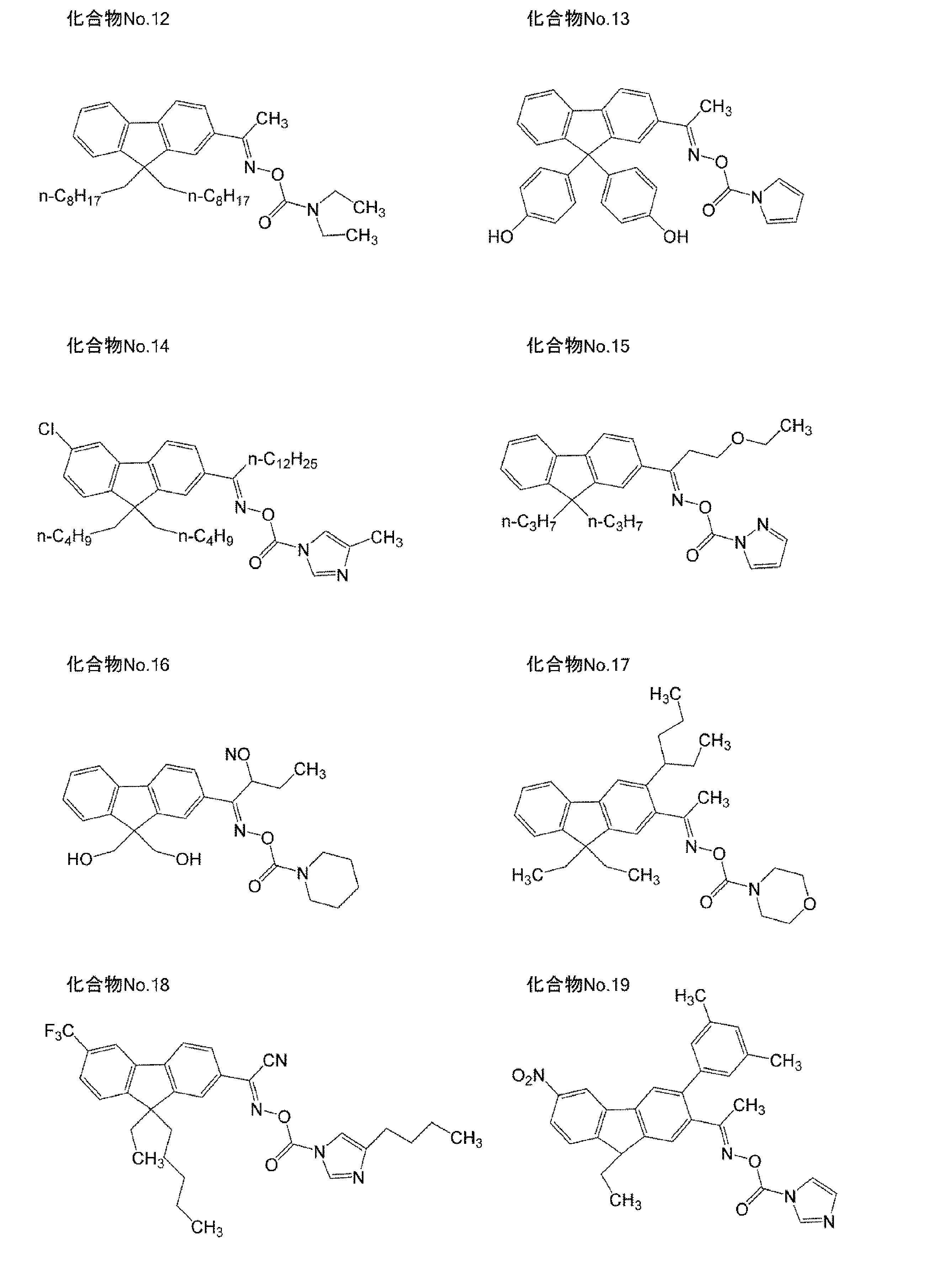
- Examples of the group containing a heterocyclic group having 2 to 20 carbon atoms represented by R 3 to R 10 in the above formula (I) include a tetrahydrofuran group, a dioxolanyl group, a tetrahydropyranyl group, Morpholylfuran group, thiophene group, methylthiophene group, hexylthiophene group, benzothiophene group, pyrrole group, pyrrolidine group, imidazole group, imidazolidine group, imidazoline group, pyrazole group, pyrazolidine group, piperidine group and piperazine group, and fat Tetrahydrofuran, dioxolanyl, tetrahydropyranyl, morpholylfuran, thiophene, methylthiophene, hexylthiophene, benzothiophene, pyrrole, pyrrolidine, imidazole, imidazolidine substituted
- the aliphatic hydrocarbon group is the same as the aliphatic hydrocarbon group having 1 to 20 carbon atoms represented by R 1 to R 11 , R 21 to R 23 and R 31 to R 40. The group of is mentioned.
- An alkyl group portion and a bonding portion between the heterocyclic ring and the aliphatic hydrocarbon group in the group containing a heterocyclic ring include —O—, —COO—, —OCO—, —CO——CS—, and —S—.
- interrupted divalent groups are not adjacent to each other.
- “2 to 20” in “a group containing a heterocyclic ring having 2 to 20 carbon atoms” is not a “heterocyclic ring” but a number of carbon atoms of the “group containing a heterocyclic ring”. I do.
- the group containing the heterocycle having the substituent includes:
- the hydrogen atom of the group containing an unsubstituted heterocyclic ring described above is a halogen atom, a nitro group, a cyano group, a hydroxyl group, an amino group, a carboxyl group, a methacryloyl group, an acryloyl group, an epoxy group, a vinyl group, a vinyl ether group, Those substituted with a mercapto group, an isocyanate group or a group containing a heterocyclic group having 2 to 20 carbon atoms can be mentioned.
- X 1 in the formula (I) represents -NR 22 R 23 ;
- R 22 and R 23 are each independently an aliphatic hydrocarbon group having 1 to 20 carbon atoms or an aromatic hydrocarbon group having 6 to 20 carbon atoms,
- R 22 is a hydrogen atom,
- R 23 is an aliphatic hydrocarbon group having 1 to 20 carbon atoms or an aromatic hydrocarbon group having 6 to 20 carbon atoms,
- R 22 and R 23 are connected to each other to form a ring composed of a nitrogen atom and a carbon atom, or a ring composed of an oxygen atom, a nitrogen atom and a carbon atom, is used as a polymerization initiator, It is preferable because it is excellent.
- X 1 in the above formula (I) represents -NR 22 R 23
- a compound in which R 22 and R 23 are linked to each other to form a ring consisting of a nitrogen atom and a carbon atom has high sensitivity when used as a polymerization initiator because of the high reactivity of the generated base species. Is preferred.
- a compound in which the ring composed of a nitrogen atom and a carbon atom is a 5-membered ring or a 6-membered ring and the number of nitrogen atoms contained in the ring is 1 or 2 is preferable.
- X 1 in the above formula (I) represents —NR 22 R 23 ;
- a compound in which R 22 and R 23 are each independently an aliphatic hydrocarbon group having 1 to 20 carbon atoms is preferable because of excellent solubility.
- the hydrocarbon group is preferably an alkyl group having 1 to 10 carbon atoms. Is preferred.
- X 1 in the above formula (I) represents —NR 22 R 23 ;
- Compounds in which R 22 is a hydrogen atom and R 23 is an aromatic hydrocarbon group having 6 to 20 carbon atoms are preferable because of excellent stability.
- the number of carbon atoms in the aromatic hydrocarbon group is preferably the number of carbon atoms. It is preferably from 1 to 10.
- the aromatic hydrocarbon group is a phenyl group.
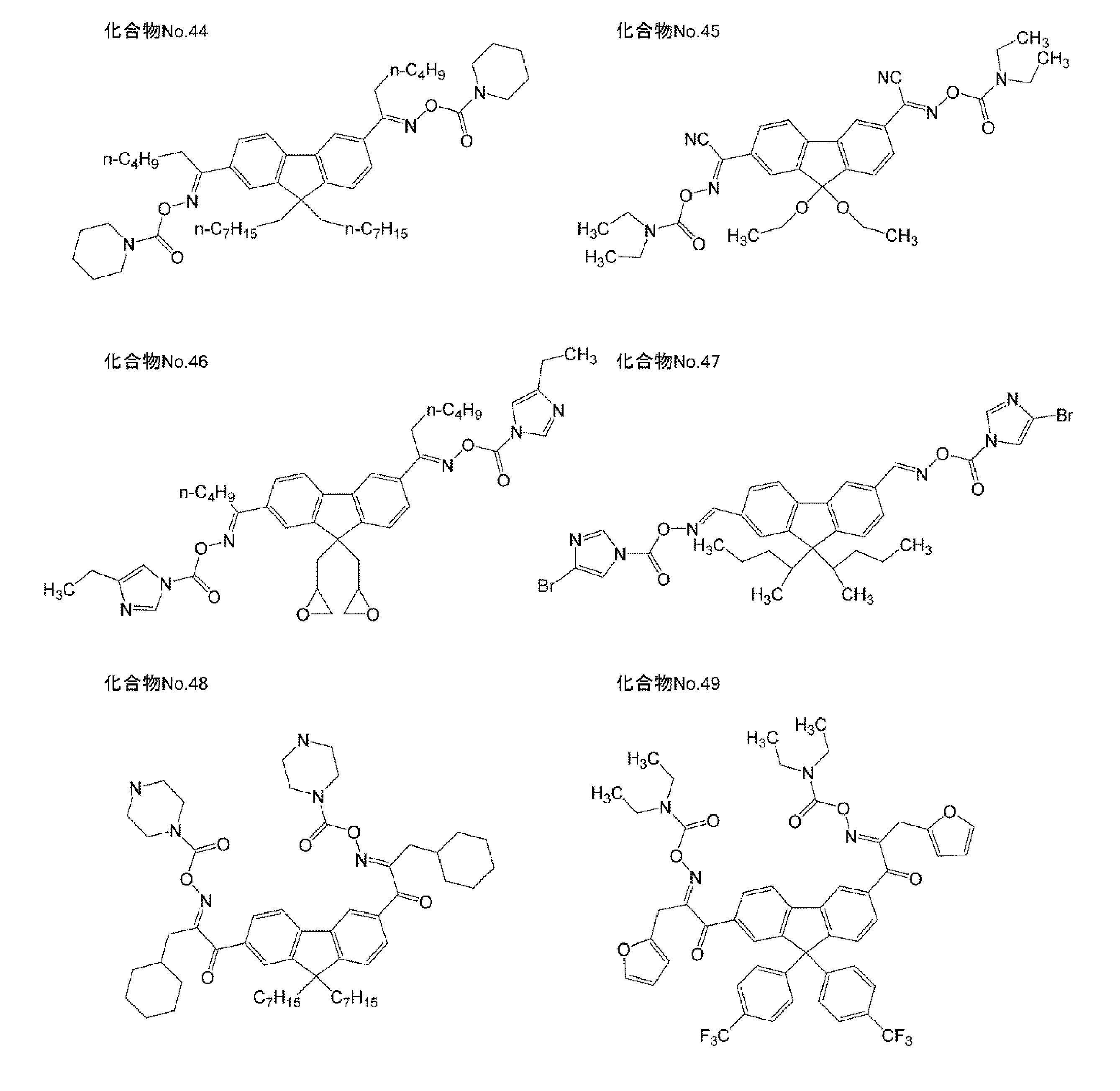
- a compound in which at least two of R 3 , R 4 , R 5 , R 6 , R 7 , R 8 , R 9 and R 10 in the above formula (I) are a group represented by the above formula (II)
- R 3 , R 4 , R 5 , R 6 , R 7 , R 8 , R 9, and R 10 Compounds in which two or three of them are groups represented by the above formula (II) are particularly preferred.
- At least one of R 3 , R 4 , R 5 and R 6 in the above formula (I) is a group represented by the above formula (II), and at least one of R 7 , R 8 , R 9 and R 10
- a compound in which R 4 or R 9 in the above formula (I) is a group represented by the above formula (II) is preferable because the stability of the compound is high and the productivity is excellent.
- R 3 , R 4 , R 5 , R 6 , R 7 , R 8 , R 9 and R 10 in the above formula (I) are groups represented by the above formula (II)
- two or more X 1 may be the same or different.
- two or more R 21 may be the same or different.
- n in two or more groups represented by the above formula (II) may be the same or different.
- R 3 , R 4 , R 5 and R 6 in the above formula (I) is a group represented by the above formula (II), and the other three are each independently a hydrogen atom A compound which is an unsubstituted or substituted aliphatic hydrocarbon group having 1 to 6 carbon atoms or an unsubstituted or substituted aromatic hydrocarbon group having 6 to 12 carbon atoms, Is preferred in that it is highly sensitive and easy to produce, and one of R 4 and R 6 is a group represented by the above formula (II), and the other and R 3 and R 5 are each independently A hydrogen atom, an unsubstituted or substituted aliphatic hydrocarbon group having 1 to 6 carbon atoms or an unsubstituted or substituted aromatic hydrocarbon group having 6 to 12 carbon atoms Compounds are particularly preferred.
- R 7 to R 10 in the above formula (I) is a group represented by the above formula (II), and the other has a hydrogen atom, an unsubstituted or substituted group.
- Compounds that are an aliphatic hydrocarbon group having 1 to 6 carbon atoms or an unsubstituted or substituted aromatic hydrocarbon group having 6 to 12 carbon atoms have high sensitivity and are easy to produce. preferable.
- R 3 , R 4 , R 5 and R 6 in the above formula (I) is a group represented by the above formula (II), and one of R 7 , R 8 , R 9 and R 10 A compound in which at least one of them is a hydrogen atom, a nitro group or an aromatic hydrocarbon group having 6 to 12 carbon atoms, preferably a nitro group or an aromatic hydrocarbon group having 6 to 12 carbon atoms, in particular, R 7 , A compound in which one of R 8 , R 9 and R 10 is a nitro group or an aromatic hydrocarbon group having 6 to 12 carbon atoms is preferred because it has high sensitivity and is easy to produce.
- the aromatic hydrocarbon group may be unsubstituted or may have a substituent, but the aromatic hydrocarbon group is preferably a benzoyl group.
- R 4 or R 9 in the above formula (I) is a nitro group, a trifluoromethyl group or a benzoyl group are preferred because of their excellent sensitivity.
- R 1 and R 2 may be the same as or different from each other, but are preferably the same because production is easy.
- R 1 and R 2 in the above formula (I) are aliphatic hydrocarbon groups having 2 or more carbon atoms are preferred because of their excellent solubility in solvents, and aliphatic compounds having 2 to 10 carbon atoms are preferred. Hydrocarbon groups are particularly preferred.
- R 1 and R 2 in the above formula (I) among the aliphatic hydrocarbon groups, an alkyl group is preferable because of its excellent solubility in solvents, sensitivity and transparency.
- R 1 and R 2 in the above formula (I) are an aliphatic hydrocarbon group having 1 to 4 carbon atoms are also preferable because of excellent solubility in a solvent.
- an alkyl group is preferable because of its excellent solubility in a solvent, sensitivity, and transparency.
- R 21 is an aliphatic hydrocarbon group having 2 or more carbon atoms
- an aliphatic hydrocarbon group having 2 to 10 carbon atoms is preferable.
- R 21 among aliphatic hydrocarbon groups, an alkyl group is preferable because of its excellent solubility in a solvent, sensitivity, and transparency.
- a compound in which n in formula (II) is 0 is preferable when used as a polymerization initiator because of its high stability to heat.
- a compound in which n in the formula (II) is 1 is preferable when used as a polymerization initiator because it cures at a low exposure dose.
- a ketone compound B is obtained by reacting a known and commercially available fluorene compound with an acid chloride in the presence of a Lewis acid such as aluminum chloride in accordance with the following reaction formula 2.
- both Reaction Formula 1 and Reaction Formula 2 show the case where X 1 is —NR 22 R 23
- X 1 can be represented by Formula (a) or Formula (b) by changing the amine used.
- Compounds that are represented groups can also be prepared.
- both Reaction Schemes 1 and 2 show the case where R 4 is a group represented by Formula (II)
- a group represented by Formula (II) is introduced at another position in fluorene. In this case, it can be obtained by a method of introducing a ketone group at the time of forming a fluorene ring.
- a compound in which at least two of R 3 , R 4 , R 5 , R 6 , R 7 , R 8 , R 9 and R 10 are a group represented by the formula (II) has a carbonyl group
- R 3 , R 4 , R 5 , R 6 , R 7 , R 8 , R 9 and R 10 are used as ketone bodies by using a diketone body as a ketone body. It can be manufactured by the method described above.
- Oxime compound A can also be produced by the method described in Japanese Patent No. 4230771.
- the compound of the present invention is excellent in curability of a photosensitive resin, and high in sensitivity to energy rays, and thus can be suitably used as a polymerization initiator which is a photobase generator described below, and a chemically amplified type. It can be used for a resist or the like.
- Compounds having a solubility in propylene glycol-1-monomethyl ether-2-acetate at 25 ° C. of 15% or more can be selected from many polymerizable compounds when preparing the polymerizable composition of the present invention. preferable.
- the solubility can be measured by the method described in Examples described later.
- the carbamoyl oxime compound represented by the above formula (I) is a latent base compound.
- the latent base compound is a compound that generates a base by irradiation with light such as ultraviolet rays or heating, and can be used as a polymerization initiator, a base catalyst, and a pH adjuster.
- a photolatent base compound that generates a base upon irradiation with light is more preferable because of its excellent operability.
- the polymerization initiator (A) contains at least one carbamoyl oxime compound represented by the above formula (I).
- the carbamoyl compound of the present invention efficiently generates a base and a radical by light irradiation or heating, and is therefore useful as a base generator and a radical polymerization initiator, and particularly useful as a base generator.
- base generators and radical polymerization initiators are useful as photobase generators and photoradical polymerization initiators because of their excellent operability, and particularly useful as photobase generators.
- the content of the compound represented by the above formula (I) in the polymerization initiator is preferably 1 to 100% by mass, more preferably 50 to 100% by mass.
- the content of the polymerization initiator (A) is preferably 1 to 20 parts by mass, more preferably 1 to 10 parts by mass with respect to 100 parts by mass of the polymerizable compound (B). is there.
- the content of the polymerization initiator (A) is at least 1 part by mass, it is easy to prevent poor curing due to insufficient sensitivity, and preferably at 20 parts by mass or less, volatile matter during light irradiation or heating is used. This is preferable because it can suppress
- Examples of the polymerizable compound (B) used in the present invention include a compound having an anionic polymerizable functional group, a compound cured by a reaction in which a base acts as a catalyst or a reaction in which a base is added, and a radical polymerizable compound. It is preferable to use a photosensitive resin that is polymerized and cured by irradiation with energy rays such as ultraviolet rays or a cured resin whose curing temperature is lowered.
- the above-mentioned anionic polymerizable functional group means a functional group which can be polymerized by a base generated from a photobase generator by energy rays such as ultraviolet rays, and includes, for example, an epoxy group, an episulfide group, a cyclic monomer ( ⁇ -valerolactone, ⁇ -Caprolactam), malonic esters and the like.
- Examples of the compound having an anionic polymerizable functional group include an epoxy resin, an oxetane resin, an episulfide resin, a cyclic amide (lactam-based compound), a cyclic ester (lactone-based compound), a cyclic carbonate-based compound, and a malonic ester.
- Examples of the compound which is cured by a reaction in which a base acts as a catalyst or a reaction in which a base is added include, for example, polyamide resin (polyimide reaction by dehydration cyclization), epoxy / hydroxyl group (ring-opening addition reaction), epoxy / carboxylic acid type (Ring-opening addition reaction), epoxy-thiol system (ring-opening addition reaction), epoxy-acid anhydride system (ring-opening polycondensation), cyanate ester (cyclization reaction), cyanate ester-epoxy system (cyclization reaction), Cyanate ester (cyclization reaction), cyanate ester / maleimide (crosslinking copolymerization), oxetane / hydroxyl group (ring-opening addition reaction), oxetane / carboxylic acid system (ring-opening addition reaction), oxetane / thiol system (ring-opening addition) Reaction), oxetane / acid anhydr
- Examples of the compound polymerized by a radical include an ethylenically unsaturated compound. It is preferable to use a compound which undergoes radical polymerization because of its high reactivity. These resins may be used alone or in combination of two or more. As a preferred combination, a combination of an epoxy resin and a thiol compound, a combination of an epoxy resin and a thiol compound, having high reactivity, because the reaction proceeds quickly and the adhesiveness is good, and a combination of an epoxy resin and a phenol resin is excellent in low-temperature curability. From this, a combination of an ethylenically unsaturated compound and a thiol compound can be mentioned.
- epoxy resin examples include polyglycidyl ether compounds of mononuclear polyhydric phenol compounds such as hydroquinone, resorcin, pyrocatechol, and phloroglucinol; dihydroxynaphthalene, biphenol, methylenebisphenol (bisphenol F), and methylenebis (orthocresol) , Ethylidene bisphenol, isopropylidene bisphenol (bisphenol A), 4,4'-dihydroxybenzophenone, isopropylidene bis (orthocresol), tetrabromobisphenol A, 1,3-bis (4-hydroxycumylbenzene), 1,4 -Bis (4-hydroxycumylbenzene), 1,1,3-tris (4-hydroxyphenyl) butane, 1,1,2,2-tetra (4-hydroxyphenyl) ethane, thiobi Polyglycidyl ether compounds of polynuclear polyphenol compounds such as sphenol, sulfobisphenol, thi
- epoxy resins may be those internally crosslinked by a prepolymer of terminal isocyanate or those having a high molecular weight with a polyvalent active hydrogen compound (polyhydric phenol, polyamine, carbonyl group-containing compound, polyphosphate ester, etc.). .
- a polyvalent active hydrogen compound polyhydric phenol, polyamine, carbonyl group-containing compound, polyphosphate ester, etc.
- those having a glycidyl group are preferable from the viewpoint of excellent curability, and those having a bifunctional or more glycidyl group are more preferable.
- phenol resin a phenol resin having two or more hydroxy groups in one molecule is preferable, and a generally known phenol resin can be used.
- the phenol resin include bisphenol A phenol resin, bisphenol E phenol resin, bisphenol F phenol resin, bisphenol S phenol resin, phenol novolak resin, bisphenol A novolak phenol resin, glycidyl ester phenol resin, and aralkyl novolak.
- the thiol compound is not particularly limited, and includes all thiol compounds, but those having two or more thiol groups in one molecule are preferable.
- Preferred specific examples of the thiol compound include bis (2-mercaptoethyl) sulfide, 2,5-dimercaptomethyl-1,4-dithiane, 1,3-bis (mercaptomethyl) benzene, 1,4-bis (mercaptomethyl) Methyl) benzene, 4-mercaptomethyl-1,8-dimercapto-3,6-dithiaoctane, 4,8-dimercaptomethyl-1,11-dimercapto-3,6,9-trithiaundecane, 4,7-di Mercaptomethyl-1,11-dimercapto-3,6,9-trithiaundecane, 5,7-dimercaptomethyl-1,11-dimercapto-3,6,9-trithiaundecane, 1,2,6,7 -Tetramer
- Particularly preferred compounds are 1,2,6,7-tetramercapto-4-thiaheptane, pentaerythrithiol, bis (2-mercaptoethyl) sulfide, 2,5-dimercaptomethyl-1,4-dithiane, and 4 -Mercaptomethyl-1,8-dimercapto-3,6-dithiaoctane.
- the thiol compounds can be used alone or in combination of two or more.
- acid dianhydrides include ethylene tetracarboxylic dianhydride, 1,2,3,4-benzenetetracarboxylic dianhydride, 1,2,3,4-cyclohexanetetracarboxylic dianhydride 2,2 ', 3,3'-benzophenonetetracarboxylic dianhydride, 2,2,3,3-biphenyltetracarboxylic anhydride, 1,4,5,8-naphthalenetetracarboxylic dianhydride And diamines such as (o-, m- or p-) phenylenediamine, (3,3'- or 4,4 '-) diaminodiphenyl ether, diaminobenzophenone, (3,3'- or 4,4'- ) Resins made from diaminodiphenylmethane or the like.
- diamines such as (o-, m- or p-) phenylenediamine, (3,3'- or 4,4 '
- polyurethane resin as a diisocyanate, a polyfunctional isocyanate such as tolylene diisocyanate, hexamethylene diisocyanate, diphenylmethane diisocyanate, isophorone diisocyanate, and a polyol (polyfunctional alcohol) such as polyether polyol, polyester polyol, and polycarbonate polyol are used as raw materials.
- a polyol (polyfunctional alcohol) such as polyether polyol, polyester polyol, and polycarbonate polyol are used as raw materials.
- the nylon resin include resins made from cyclic monomers such as ⁇ -caprolactam and lauryl lactam.
- polyester resin include resins made from cyclic monomers such as ⁇ -valerolactone and ⁇ -propiolactone.
- ethylenically unsaturated compound examples include unsaturated aliphatic hydrocarbons such as ethylene, propylene, butylene, isobutylene, vinyl chloride, vinylidene chloride, vinylidene fluoride, and tetrafluoroethylene; (meth) acrylic acid, ⁇ -chloro Acrylic acid, itaconic acid, maleic acid, citraconic acid, fumaric acid, hymic acid, crotonic acid, isocrotonic acid, vinyl acetic acid, allyl acetic acid, cinnamic acid, sorbic acid, mesaconic acid, mono [2- (meth) acryloyl succinate Roxyethyl], mono [2- (meth) acryloyloxyethyl] phthalate, ⁇ -carboxypolycaprolactone mono (meth) acrylate, etc., a polymer mono (meth) acrylate having a carboxy group and a hydroxyl group at
- ethylenically unsaturated compound commercially available products can be used.
- Kayarad DPHA, DPEA-12, PEG400DA, THE-330, RP-1040, NPGDA, PET30, R-684 all manufactured by Nippon Kayaku
- Aronix M-215, M-350 all manufactured by Toagosei
- NK esters A-DPH, A-TMPT, A-DCP, A-HD-N, TMPT, DCP, NPG and HD-N all, SPC-1000, SPC-3000 (all manufactured by Showa Denko); and the like.
- the content of the polymerizable composition (B) may be an amount suitable for the purpose of use, but in order to prevent poor curing, the content of the solid content (all components other than the solvent) in the polymerizable composition is limited. , 50 parts by mass or more, more preferably 60 parts by mass or more, and particularly preferably 70 parts by mass or more.
- additives such as an inorganic compound, a coloring material, a latent epoxy curing agent, a chain transfer agent, a sensitizer, and a solvent can be used as optional components.
- the inorganic compound examples include metal oxides such as nickel oxide, iron oxide, iridium oxide, titanium oxide, zinc oxide, magnesium oxide, calcium oxide, potassium oxide, silica, and alumina; layered clay minerals, milor blue, calcium carbonate, Magnesium carbonate, cobalt, manganese, glass powder (especially glass frit), mica, talc, kaolin, ferrocyanide, various metal sulfates, sulfides, selenides, aluminum silicate, calcium silicate, aluminum hydroxide, platinum, Gold, silver, copper and the like can be mentioned.
- metal oxides such as nickel oxide, iron oxide, iridium oxide, titanium oxide, zinc oxide, magnesium oxide, calcium oxide, potassium oxide, silica, and alumina
- layered clay minerals milor blue, calcium carbonate, Magnesium carbonate, cobalt, manganese, glass powder (especially glass frit), mica, talc, kaolin, ferrocyanide, various metal sulfates, sulfides,
- inorganic compounds are used, for example, as a filler, an antireflection agent, a conductive material, a stabilizer, a flame retardant, a mechanical strength improver, a special wavelength absorber, an ink generating agent, and the like.
- coloring material examples include pigments, dyes, and natural pigments. These coloring materials can be used alone or in combination of two or more.
- Examples of the above pigments include nitroso compounds; nitro compounds; azo compounds; diazo compounds; xanthene compounds; quinoline compounds; anthraquinone compounds; coumarin compounds; phthalocyanine compounds; isoindolinone compounds; isoindoline compounds; quinacridone compounds; Compound; perylene compound; diketopyrrolopyrrole compound; thioindigo compound; dioxazine compound; triphenylmethane compound; quinophthalone compound; naphthalenetetracarboxylic acid; metal complex compound of azo dye and cyanine dye; lake pigment; furnace method, channel method or thermal.
- Carbon black obtained by the method or carbon black such as acetylene black, Ketjen black or lamp black; Prepared or coated with an epoxy resin, carbon black previously dispersed in a solvent with a resin to adsorb 20 to 200 mg / g of resin, carbon black subjected to acidic or alkaline surface treatment, average Carbon black having a particle size of 8 nm or more and a DBP oil absorption of 90 ml / 100 g or less; carbon black having a total oxygen amount calculated from CO and CO 2 in volatile components at 950 ° C.
- pigments can also be used as the pigment, for example, Pigment Red 1, 2, 3, 9, 10, 14, 17, 22, 23, 31, 38, 41, 48, 49, 88, 90, 97, 112, 119, 122, 123, 144, 149, 166, 168, 169, 170, 171, 177, 179, 180, 184, 185, 192, 200, 202, 209, 215, 216, 217, 220, 223, 224, 226, 227, 228, 240, 254; Pigment Orange 13, 31, 34, 36, 38, 43, 46, 48, 49, 51, 52, 55, 59, 60, 61, 62, 64, 65, 71; Pigment Yellow 1, 3, 12, 13, 14, 16, 17, 20, 24, 55, 60, 73, 81, 83, 86, 93, 95, 9 , 98, 100, 109, 110, 113, 114, 117, 120, 125, 126, 127, 129, 137, 138, 139, 147,
- the dyes include azo dyes, anthraquinone dyes, indigoid dyes, triarylmethane dyes, xanthene dyes, alizarin dyes, acridine dyes stilbene dyes, thiazole dyes, naphthol dyes, quinoline dyes, nitro dyes, indamine dyes, oxazine dyes, and phthalocyanine dyes. And a dye such as a cyanine dye. These may be used as a mixture of two or more.
- latent epoxy curing agent examples include dicyandiamide, modified polyamine, hydrazides, 4,4′-diaminodiphenylsulfone, boron trifluoride amine complex, imidazoles, guanamines, imidazoles, ureas, and melamine. No.
- a sulfur atom-containing compound is generally used.
- Alkyl compound trimethylolpropane tris (3-mercaptoisobutyrate), butanediol bis (3-mercaptoisobutyrate), hexanedithiol, decanedithiol, 1,4- Methyl mercaptobenzene, butanediol bisthiopropionate, butanediol bisthioglycolate, ethylene glycol bisthioglycolate, trimethylolpropane tristhioglycolate, butanediol bisthiopropionate, trimethylolpropane tristhiopropionate , Trimethylolpropane tristhioglycolate, pentaerythritol tetrakisthiopropionate, pentaerythritol tetrakisthioglycolate, trishydroxyethyltristhiopropionate, diethylthioxanthone, diisopropyl
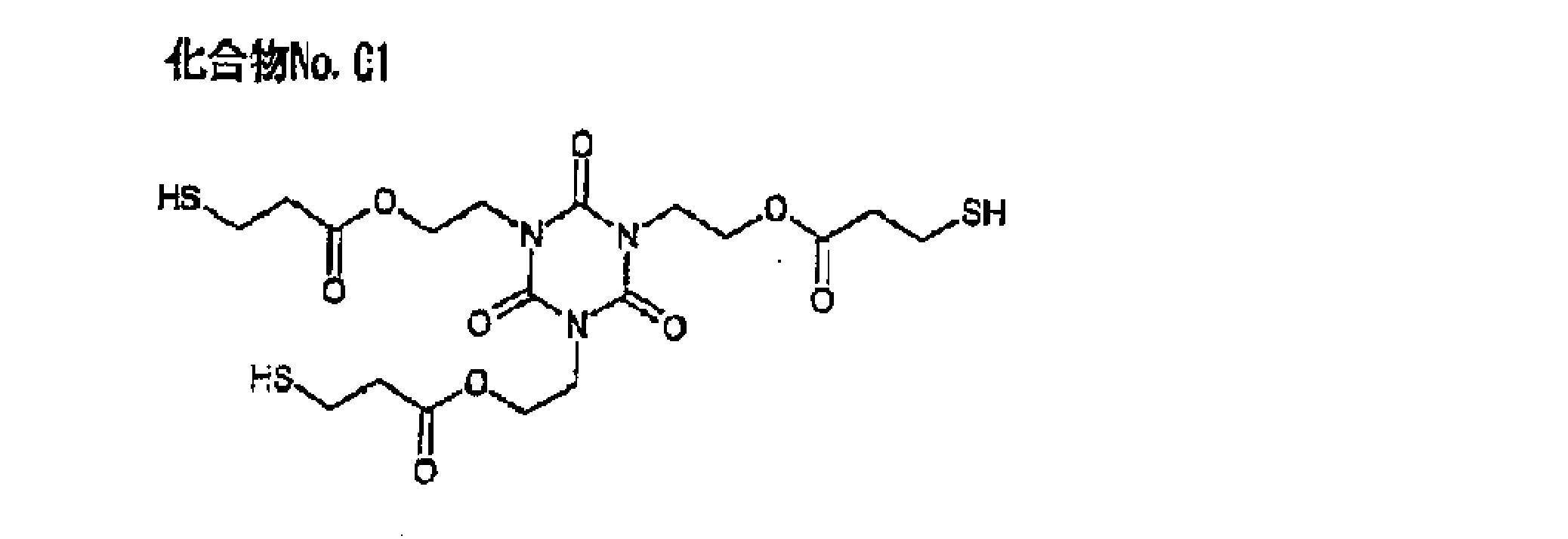
- C1 aliphatic polyfunctional thiol compounds such as tris (2-hydroxyethyl) isocyanurate trimercaptopropionate, Karenz MT @ BD1, PE1, NR1 manufactured by Showa Denko KK, and the like.
- a solvent that can dissolve or disperse the above-mentioned components for example, methyl ethyl ketone, methyl amyl ketone, diethyl ketone, acetone, methyl isopropyl Ketones such as ketone, methyl isobutyl ketone, cyclohexanone and 2-heptanone; ether solvents such as ethyl ether, dioxane, tetrahydrofuran, 1,2-dimethoxyethane, 1,2-diethoxyethane and dipropylene glycol dimethyl ether; methyl acetate Ester solvents such as ethyl acetate, ethyl acetate, n-propyl acetate, isopropyl acetate, n-butyl acetate, cyclohexyl acetate, ethyl lac
- ketones or ether ester solvents especially propylene glycol-1-monomethyl ether-2-acetate (hereinafter, also referred to as “PGMEA”) from the viewpoint of alkali developability, patterning property, film forming property, and solubility. .
- PGMEA propylene glycol-1-monomethyl ether-2-acetate
- cyclohexanone is preferably used.
- the content of the solvent is not particularly limited, and each component is uniformly dispersed or dissolved, and the polymerizable composition of the present invention exhibits a liquid or paste suitable for each use. Any amount may be used, but it is usually preferable that the solvent is contained in a range where the amount of the solid content (all components other than the solvent) in the polymerizable composition of the present invention is 10 to 90% by mass.
- the polymerizable composition of the present invention can improve the properties of a cured product by using an organic polymer.
- organic polymer include polystyrene, polymethyl methacrylate, methyl methacrylate-ethyl acrylate copolymer, poly (meth) acrylic acid, styrene- (meth) acrylic acid copolymer, and (meth) acrylic acid-methyl methacrylate.
- Copolymer ethylene-vinyl chloride copolymer, ethylene-vinyl copolymer, polyvinyl chloride resin, ABS resin, nylon 6, nylon 66, nylon 12, urethane resin, polycarbonate polyvinyl butyral, cellulose ester, polyacrylamide, saturated
- Examples include polyester, phenol resin, and phenoxy resin.
- its use amount is preferably 10 to 500 parts by mass based on 100 parts by mass of the polymerizable compound (B).
- the polymerizable composition of the present invention may further contain a surfactant, a silane coupling agent, a melamine compound and the like.
- the surfactant examples include fluorine surfactants such as perfluoroalkyl phosphates and perfluoroalkyl carboxylate; anionic surfactants such as higher fatty acid alkali salts, alkyl sulfonates and alkyl sulfates; Cationic surfactants such as amine halides and quaternary ammonium salts; nonionic surfactants such as polyethylene glycol alkyl ethers, polyethylene glycol fatty acid esters, sorbitan fatty acid esters, and fatty acid monoglycerides; amphoteric surfactants; Surfactants such as surfactants can be used, and these may be used in combination.
- fluorine surfactants such as perfluoroalkyl phosphates and perfluoroalkyl carboxylate
- anionic surfactants such as higher fatty acid alkali salts, alkyl sulfonates and alkyl sulfates
- Cationic surfactants such as
- silane coupling agent for example, a silane coupling agent manufactured by Shin-Etsu Chemical Co., Ltd. can be used. Among them, those having an isocyanate group, a methacryloyl group, or an epoxy group such as KBE-9007, KBM-502, and KBE-403 can be used. A silane coupling agent is preferably used.
- Examples of the melamine compound include all or part of active methylol groups (CH 2 OH groups) in nitrogen compounds such as (poly) methylol melamine, (poly) methylol glycoluril, (poly) methylol benzoguanamine, and (poly) methylol urea.
- Compounds in which (at least two) are alkyl etherified can be given.
- examples of the alkyl group constituting the alkyl ether include a methyl group, an ethyl group and a butyl group, which may be the same or different.
- the methylol group that has not been alkyletherified may be self-condensed in one molecule, or may be condensed between two molecules, and as a result, an oligomer component may be formed.
- hexamethoxymethylmelamine, hexabutoxymethylmelamine, tetramethoxymethylglycoluril, tetrabutoxymethylglycoluril, or the like can be used.
- alkyl etherified melamines such as hexamethoxymethyl melamine and hexabutoxymethyl melamine are preferable from the viewpoint of solubility in a solvent and difficulty in crystal precipitation from a polymerizable composition.
- the amount of optional components (excluding the inorganic compound, the coloring material and the solvent) other than the polymerization initiator (A) and the polymerizable compound (B) depends on the purpose of use. Although not particularly limited and appropriately selected, the total amount is preferably 50 parts by mass or less based on 100 parts by mass of the polymerizable compound (B).
- the polymerizable composition of the present invention can be cured by irradiation with energy rays.
- the cured product is formed in an appropriate shape according to the application.
- the present invention can be applied to a support substrate such as glass, quartz glass, a semiconductor substrate, metal, paper, and plastic. Also, once applied on a supporting substrate such as a film, it can be transferred onto another supporting substrate, and there is no limitation on the application method.
- an ultra-high pressure mercury lamp As a light source of energy rays used for curing the polymerizable composition of the present invention, an ultra-high pressure mercury lamp, a high pressure mercury lamp, a medium pressure mercury lamp, a low pressure mercury lamp, a mercury vapor arc lamp, a xenon arc lamp, a carbon arc High energy rays such as electromagnetic energy, electron beam, X-ray, and radiation having a wavelength of 2,000 ⁇ to 7000 ⁇ obtained from lamps, metal halide lamps, fluorescent lamps, tungsten lamps, excimer lamps, germicidal lamps, light emitting diodes, CRT light sources, etc.
- an ultrahigh pressure mercury lamp, a mercury vapor arc lamp, a carbon arc lamp, a xenon arc lamp, or the like that emits light having a wavelength of 300 to 450 nm is preferably used.
- the laser direct writing method which forms an image directly from digital information from a computer or the like without using a mask by using laser light as an exposure light source, has improved not only productivity but also resolution and positional accuracy.
- the laser light light having a wavelength of 340 to 430 nm is preferably used.
- those that emit light in the visible to infrared region such as various semiconductor lasers and YAG lasers, can be used.
- a sensitizing dye that absorbs the visible to infrared region is preferably added.
- the polymerizable composition of the present invention is a photocurable paint or varnish; a photocurable adhesive; a metal coating agent; a printed circuit board; a color liquid crystal display device such as a color television, a PC monitor, a portable information terminal, or a digital camera.
- the polymerizable composition of the present invention can be used for forming a spacer for a liquid crystal display panel and for forming a projection for a vertical alignment type liquid crystal display element. Particularly, it is useful as a photosensitive resin composition for simultaneously forming protrusions and spacers for a vertical alignment type liquid crystal display element.
- the above-mentioned spacer for a liquid crystal display panel comprises: (I) a step of forming a coating film of the polymerizable composition of the present invention on a substrate; and (2) an energy beam through a mask having a predetermined pattern on the coating film. Light), (3) a baking step after exposure, (4) a step of developing a film after exposure, and (5) a step of heating the film after development.
- the polymerizable composition of the present invention to which a coloring material is added is suitably used as a resist constituting each pixel such as RGB in a color filter or a black matrix resist forming a partition wall of each pixel. Further, in the case of a black matrix resist to which an ink repellent is added, it is preferably used for a partition for an inkjet color filter having a profile angle of 50 ° or more.
- a fluorine-containing surfactant and a composition containing the fluorine-containing surfactant are preferably used.
- the partition formed from the polymerizable composition of the present invention partitions the transfer-receiving body, and droplets are applied to the recesses on the partitioned transfer-receiving body by an inkjet method.
- the optical element is manufactured by a method of forming an image area.
- the droplet contains a coloring agent, and the image region is colored, in which case, the optical element manufactured by the above-described manufacturing method includes a plurality of colored regions on the substrate. At least a partition that separates the pixel group and the colored regions of the pixel group.
- the polymerizable composition of the present invention can also be used as a composition for a protective film or an insulating film.
- it may contain an ultraviolet absorber, an alkylated modified melamine and / or an acrylic modified melamine, a mono- or bifunctional (meth) acrylate monomer containing an alcoholic hydroxyl group in the molecule and / or a silica sol.
- the insulating film is used for an insulating resin layer in a laminate in which an insulating resin layer is provided on a peelable support base, and the laminate is capable of being developed with an alkaline aqueous solution. Is preferably 10 to 100 ⁇ m.
- the polymerizable composition of the present invention can be used as a photosensitive paste composition by containing an inorganic compound.
- the photosensitive paste composition can be used to form a fired pattern such as a partition pattern, a dielectric pattern, an electrode pattern, and a black matrix pattern of a plasma display panel.
- ketone compound 1 0.50 g of hydroxylamine hydrochloride, 9.30 g of dimethylformamide (DMF), and 0.62 g of pyridine were added in this order, followed by heating and stirring at 80 ° C. for 5 hours on an oil bath. After cooling to room temperature, the mixture was poured into 50 g of ionized water. Ethyl acetate was added, oil-water separation was performed, and the organic layer was washed three times with water. The organic layer was concentrated under reduced pressure using an evaporator to obtain the following oxime compound 1 in a yield of 3.10 g.
- DMF dimethylformamide
- the organic layer was washed twice with 5% by mass of hydrochloric acid, ion-exchanged water and a saturated aqueous solution of sodium hydrogencarbonate twice and then with ion-exchanged water three times, dried over magnesium sulfate and concentrated.
- oxime compound 5 was obtained as a light brown powdery compound in a yield of 65%.
- Example 1-1 Compound No. Synthesis of 1 In a 100 mL four-necked flask, 1.00 g of the oxime compound 1 and 6.00 g of acetonitrile were added and stirred at room temperature. A solution in which 0.41 g of 1,1′-carbonyldiimidazole was dispersed in 5 g of acetonitrile was added thereto over 10 minutes. After stirring for 3 hours, the precipitated crystals were removed, and the filtrate was concentrated. Further drying under reduced pressure was carried out for 3 hours to obtain a white powdery compound in a yield of 59%. The obtained solid was analyzed by TG-DTA (melting point / ° C.) and 1 H-NMR, and Compound No. It was confirmed that it was 1. The analysis results are shown in [Table 1] and [Table 2].
- Example 1-2 Compound No. Synthesis of 2 2.13 g of oxime compound 2 and 29.00 g of acetonitrile were placed in a 100 mL four-necked flask, and stirred at room temperature. A solution in which 0.86 g of 1,1′-carbonyldiimidazole was dispersed in 5 g of acetonitrile was added thereto over 10 minutes. After stirring for 1 hour, the precipitated crystals were removed, and the filtrate was concentrated. Further drying under reduced pressure was performed for 4 hours to obtain a white powdery compound in a yield of 51%. The obtained solid was analyzed by TG-DTA (melting point / ° C.) and 1 H-NMR, and Compound No. 2 was confirmed. The analysis results are shown in [Table 1] and [Table 2].
- Example 1-3 Compound No. Synthesis of 3
- 1.18 g of the oxime compound 3 1.17 g of 1,1'-carbonyldiimidazole and 1.04 g of tetrahydrofuran (THF) were added, and the mixture was stirred at room temperature for 2 hours. Thereto was added dropwise 0.61 g of piperidine, and the mixture was stirred at 60 ° C. for 6 hours on an oil bath. After cooling to room temperature, the solvent was distilled off under reduced pressure using an evaporator, chloroform was added to the residue, and the mixture was washed five times with ion-exchanged water.
- THF tetrahydrofuran
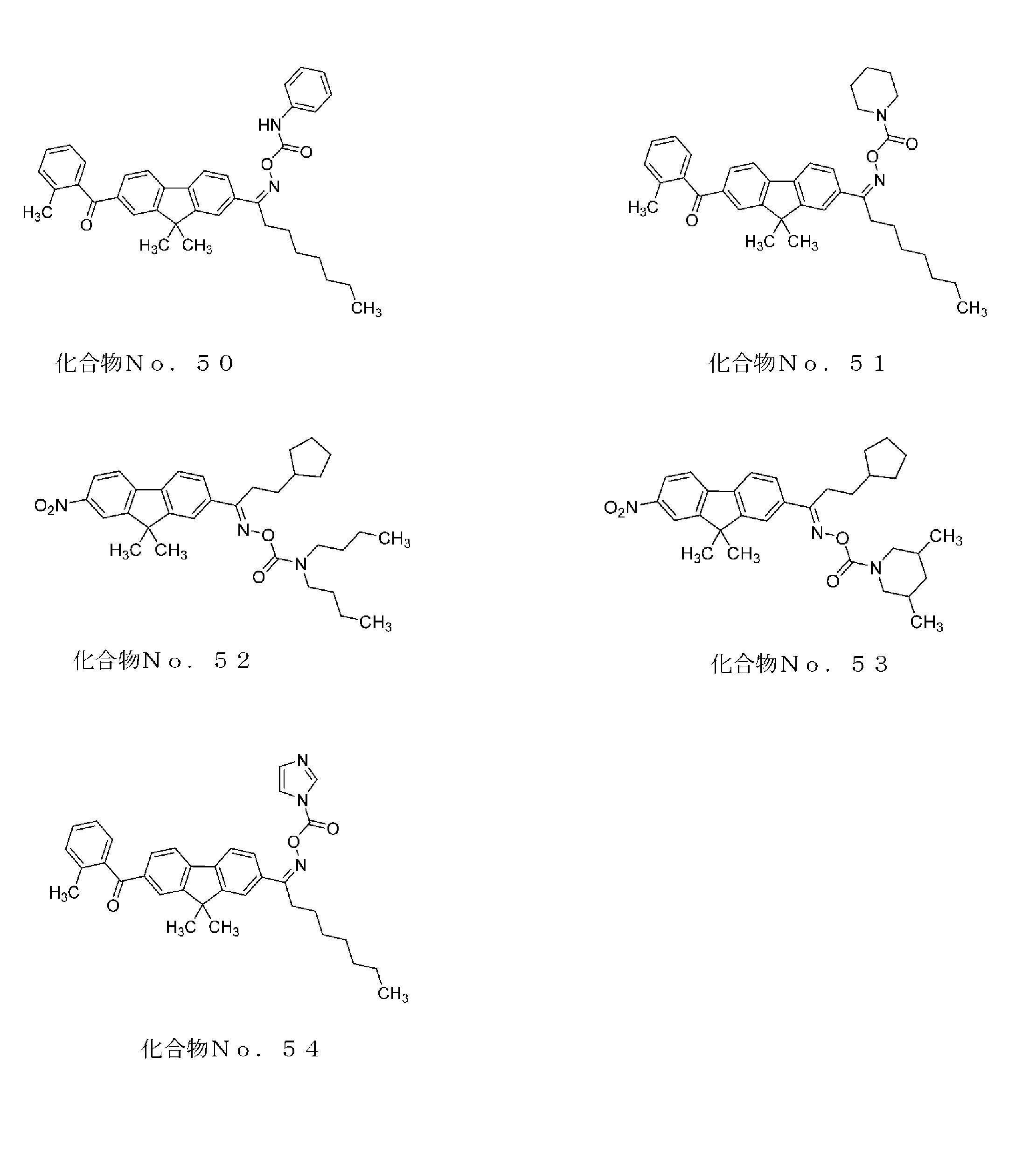
- Example 1-4 Compound No. Synthesis of 50 In a 100 ml four-necked flask, 1.0 eq. Of oxime compound 4 was added. , Dichloroethane (600% by weight of the theoretical yield), triethylamine 2.0 eq. was added and the mixture was stirred at 5 ° C. on an ice bath. There, 4-nitrophenyl chloroformate 1.5 eq. Was dissolved in dichloroethane and added dropwise. After the addition, the mixture was stirred at room temperature for 1 hour. After cooling again to 5 ° C. on an ice bath, aniline 1.5 eq. Was added dropwise. After stirring at room temperature for 1 hour, the solvent was distilled off under reduced pressure.
- Example 1-5 Compound No. Synthesis of Compound 51
- oxime compound 4 1.0 eq. Of oxime compound 4 was added.
- Dichloroethane (600% by weight of the theoretical yield), triethylamine 2.0 eq. was added and the mixture was stirred at 5 ° C. on an ice bath.
- 4-nitrophenyl chloroformate 1.5 eq. was dissolved in dichloroethane and added dropwise. After the addition, the mixture was stirred at room temperature for 1 hour. After cooling again to 5 ° C. on an ice bath, 1.5 eq. Was added dropwise. After stirring at room temperature for 1 hour, the solvent was distilled off under reduced pressure.
- Example 1-6 Compound No. Synthesis of 52 In a 100 ml four-necked flask, 1.0 eq. Of oxime compound 5 was added. , Dichloroethane (600% by weight of the theoretical yield), triethylamine 2.0 eq. was added and the mixture was stirred at 5 ° C. on an ice bath. There, 4-nitrophenyl chloroformate 1.5 eq. Was dissolved in dichloroethane and added dropwise. After the addition, the mixture was stirred at room temperature for 1 hour. After cooling again to 5 ° C. on an ice bath, 1.5 eq. Of dibutylamine was added. Was added dropwise.
- Example 1-7 Compound No. Synthesis of Oxime Compound 5 1.0 eq. , Dichloroethane (600% by weight of the theoretical yield), triethylamine 2.0 eq. Was added and the mixture was stirred at 5 ° C. on an ice bath. There, 4-nitrophenyl chloroformate 1.5 eq. Was dissolved in dichloroethane and added dropwise. After the addition, the mixture was stirred at room temperature for 1 hour. After cooling again to 5 ° C. on an ice bath, 1.5 eq. Of 3,5-dimethylpiperidine was added. Was added dropwise. After stirring at room temperature for 1 hour, the solvent was distilled off under reduced pressure.
- Example 2-1 to 2-3 and Comparative Example 2-1 Preparation of polymerizable composition Examples 2-1 to 2-3, which were prepared according to the formulation shown in Table 4 and were polymerizable compositions, A polymerizable composition of Comparative Example 2-1 was obtained.
- the symbols of each component in Table 4 represent the following components.
- A-1 Compound No. 1 A-2 Compound No. 2 A-3 Compound No. 3 A'-1 Comparative compound No.
- B-1 EPPN-201 Phhenol novolak type epoxy resin, epoxy equivalent 193 g / eq., Manufactured by Nippon Kayaku Co., Ltd.
- C-1 FZ-2122 Polyether-modified polysiloxane, manufactured by Dow Corning Toray
- the polymerizable composition of the present invention exhibited a large line width (high sensitivity) and a high residual film ratio (high curability) as compared with the comparative polymerizable composition. From this, it is clear that the compound of the present invention is excellent as a polymerization initiator.
- Decomposition rate (%) [(HPLC area without light irradiation) ⁇ (HPLC area after light irradiation)] / (HPLC area without light irradiation) x 100
Landscapes
- Chemical & Material Sciences (AREA)
- Organic Chemistry (AREA)
- Physics & Mathematics (AREA)
- General Physics & Mathematics (AREA)
- Health & Medical Sciences (AREA)
- Chemical Kinetics & Catalysis (AREA)
- Medicinal Chemistry (AREA)
- Polymers & Plastics (AREA)
- Spectroscopy & Molecular Physics (AREA)
- Life Sciences & Earth Sciences (AREA)
- Biochemistry (AREA)
- General Health & Medical Sciences (AREA)
- Molecular Biology (AREA)
- Materials For Photolithography (AREA)
- Organic Low-Molecular-Weight Compounds And Preparation Thereof (AREA)
- Polymerization Catalysts (AREA)
- Addition Polymer Or Copolymer, Post-Treatments, Or Chemical Modifications (AREA)
- Indole Compounds (AREA)
Abstract
Description
従って、本発明の目的は、溶剤への溶解性が高く、満足できる感度(塩基発生能)を有する化合物、該化合物を重合開始剤として含有してなる重合性組成物及びその硬化物を提供することにある。
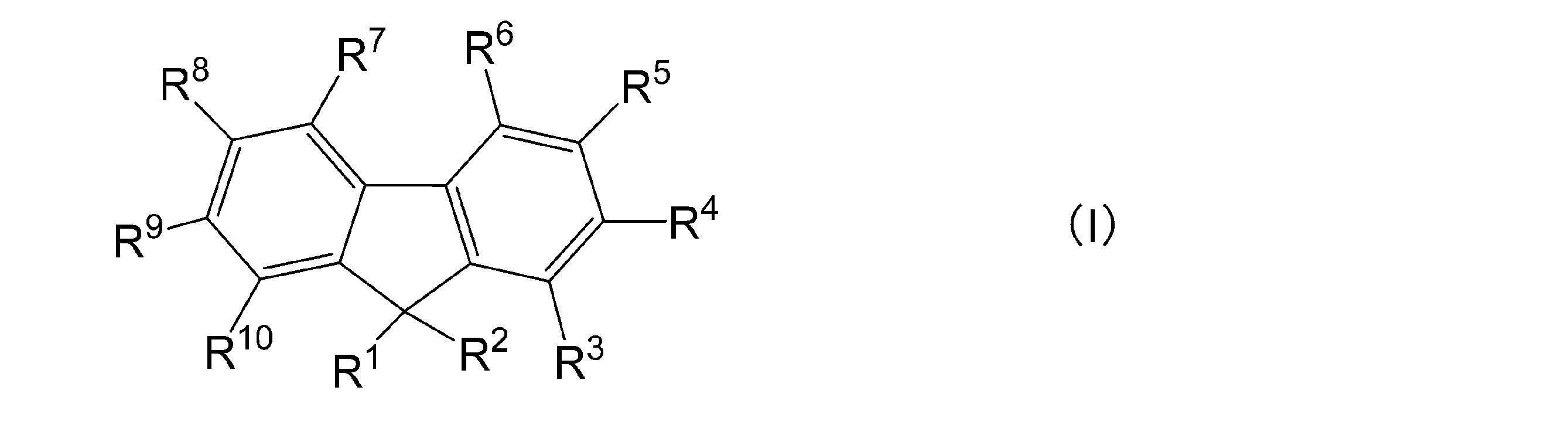
R3、R4、R5、R6、R7、R8、R9及びR10は、それぞれ独立に、水素原子、シアノ基、ニトロ基、-OR11、-COOR11、-CO-R11、-SR11、ハロゲン原子、炭素原子数1~20の脂肪族炭化水素基、炭素原子数6~20の芳香族炭化水素基、炭素原子数2~20の複素環を含有する基又は下記式(II)で表される基を表し、
R11は、炭素原子数1~20の脂肪族炭化水素基又は炭素原子数6~20の芳香族炭化水素基を表し、
R1、R2、R3、R4、R5、R6、R7、R8、R9、R10及びR11で表される基中の水素原子の1つ又は2つ以上はハロゲン原子、ニトロ基、シアノ基、水酸基、アミノ基、カルボキシル基、メタクリロイル基、アクリロイル基、エポキシ基、ビニル基、ビニルエーテル基、メルカプト基、イソシアネート基又は炭素原子数2~20の複素環を含有する基で置換される場合があり、
R3、R4、R5、R6、R7、R8、R9及びR10のうち一つ以上が下記式(II)で表される基である。

X1は、-NR22R23、下記式(a)又は下記式(b)で表される基であり、
R22及びR23は、それぞれ独立に、水素原子、炭素原子数1~20の脂肪族炭化水素基又は炭素原子数6~20の芳香族炭化水素基であるか、
R22とR23が、互いに連結して、窒素原子及び炭素原子からなる環、又は酸素原子、窒素原子及び炭素原子からなる環であり、
R21、R22及びR23で表される基中の水素原子の1つ又は2つ以上はハロゲン原子、ニトロ基、シアノ基、水酸基、アミノ基、カルボキシル基、メタクリロイル基、アクリロイル基、エポキシ基、ビニル基、ビニルエーテル基、メルカプト基、イソシアネート基又は炭素原子数2~20の複素環を含有する基で置換される場合があり、
nは、0又は1を表し、*は結合手を表す。

R31とR32、R33とR34、R35とR36、R37とR38及びR39とR40が、互いに連結して、窒素原子及び炭素原子からなる環、又は酸素原子、窒素原子及び炭素原子からなる環を形成する場合があり、
R31、R32、R33、R34、R35、R36、R37、R38、R39及びR40で表される基中の水素原子の1つ又は2つ以上はハロゲン原子、ニトロ基、シアノ基、水酸基、アミノ基、カルボキシル基、メタクリロイル基、アクリロイル基、エポキシ基、ビニル基、ビニルエーテル基、メルカプト基、イソシアネート基又は炭素原子数2~20の複素環を含有する基で置換される場合があり、
*は結合手を表す。
また、本発明の重合性組成物は、低露光量において高い硬化性を示す。
本発明のカルバモイルオキシム化合物は、上記式(I)で表されるものである。式(I)で表されるカルバモイルオキシム化合物には、オキシムの二重結合による幾何異性体が存在するが、これらを区別するものではない。
即ち、本明細書において、上記式(I)で表されるカルバモイルオキシム化合物、並びに後述する該化合物の好ましい形態である化合物及び例示化合物は両方の混合物又はどちらか一方を表すものであり、異性体を示した構造に限定するものではない。以下、式(I)で表されるカルバモイルオキシム化合物を単に、「式(I)で表される化合物」又は「本発明の化合物」ともいう。
なお、式(I)中のR1~R11、R21~R23及びR31~R40で表される基が、炭素原子を含む基により中断又は置換されている場合、それらの炭素原子数を含めた数が規定の炭素原子数となる。
R及びR’は、水素原子又は脂肪族炭化水素基であり、R及びR’で表される脂肪族炭化水素基としては、例えばR1~R11、R21~R23及びR31~R40で表される炭素原子数1~20の脂肪族炭化水素基として例示したものと同様の基が挙げられる。
上記フェニル等を置換する脂肪族炭化水素基としては、上記のR1~R11、R21~R23及びR31~R40で表される炭素原子数1~20の脂肪族炭化水素基として例示したものと同様の基が挙げられる。
R22とR23、R31とR32、R33とR34、R35とR36、R37とR38及びR39とR40が互いに連結して形成する窒素原子及び炭素原子からなる環としては、結合している窒素原子を含めた基として、ピロール環、ピロリジン環、イミダゾール環、イミダゾリジン環、イミダゾリン環、ピラゾール環、ピラゾリジン環、ピペリジン環、ピペラジン環等(以下まとめて「ピロール環等」ともいう)のほか、これらピロール環等が脂肪族炭化水素基で置換された基が挙げられる。この脂肪族炭化水素基としては、上記のR1~R11、R21~R23及びR31~R40で表される炭素原子数1~20の脂肪族炭化水素基として例示したものと同様の基が挙げられる。
これら窒素原子及び炭素原子からなる環における水素原子の1又は2以上は、ハロゲン原子、ニトロ基、シアノ基、水酸基、アミノ基、カルボキシル基、メタクリロイル基、アクリロイル基、エポキシ基、ビニル基、ビニルエーテル基、メルカプト基、イソシアネート基又は炭素原子数2~20の複素環を含有する基により置換されていてもよい。当該炭素原子数2~20の複素環を含有する基としては、後述するR3~R10で表される無置換の炭素原子数2~20の複素環を含有する基の例と同様のものが挙げられる。
これら酸素原子、窒素原子及び炭素原子からなる環等における水素原子の1又は2以上は、ハロゲン原子、ニトロ基、シアノ基、水酸基、アミノ基、カルボキシル基、メタクリロイル基、アクリロイル基、エポキシ基、ビニル基、ビニルエーテル基、メルカプト基、イソシアネート基又は炭素原子数2~20の複素環を含有する基により置換されていてもよい。
上記の炭素原子数2~20の複素環を含有する基としては、後述するR3~R10で表される無置換の炭素原子数2~20の複素環を含有する基の例と同様のものが挙げられる。
これらの複素環を含有する基中のアルキル基部分及び複素環と脂肪族炭化水素基との結合部は、-O-、-COO-、-OCO-、-CO--CS-、-S-、-SO-、-SO2-、-NR-、-NR-CO-、-CO-NR-、-NR-COO-、-OCO-NR-又は-SiRR’-で中断されていてもよい。但し、これら中断する2価の基は隣り合わないものとする。なお、本明細書において、「炭素原子数2~20の複素環を含有する基」における「2~20」は、「複素環」ではなく「複素環を含有する基」の炭素原子数を規定する。
R22及びR23が、それぞれ独立に、炭素原子数1~20の脂肪族炭化水素基又は炭素原子数6~20の芳香族炭化水素基であるか、
R22が水素原子であり、R23が炭素原子数1~20の脂肪族炭化水素基又は炭素原子数6~20の芳香族炭化水素基であるか、
R22とR23が、互いに連結して、窒素原子及び炭素原子からなる環、又は酸素原子、窒素原子及び炭素原子からなる環を形成している化合物は、重合開始剤として用いた場合、感度に優れることから好ましい。
R22とR23が、互いに連結して、窒素原子及び炭素原子からなる環を形成している化合物は、発生する塩基種の反応性が高いため重合開始剤として使用した場合、感度に優れることから好ましい。とりわけ、窒素原子及び炭素原子からなる環が5員環又は6員環であり、環に含まれる窒素原子数が1又は2である化合物が好ましい。
また、上記式(I)中のX1が-NR22R23を表し、
R22とR23が、それぞれ独立に、炭素原子数1~20の脂肪族炭化水素基である化合物は、溶解性に優れるため好ましい、該炭化水素基は、炭素原子数1~10のアルキル基が好ましい。
また、上記式(I)中のX1が-NR22R23を表し、
R22が水素原子であり、R23が炭素原子数6~20の芳香族炭化水素基である化合物は、安定性に優れるため好ましい、該芳香族炭化水素基の炭素原子数は、炭素原子数1~10であることが好ましい。該芳香族炭化水素基がフェニル基であることが好ましい。
同様に、上記式(I)中のR7~R10のうち、1つが上記式(II)で表される基であり、且つ、その他が水素原子、無置換若しくは置換基を有している炭素原子数1~6の脂肪族炭化水素基又は無置換若しくは置換基を有している炭素原子数6~12の芳香族炭化水素基である化合物は、感度が高い上に製造しやすい点で好ましい。
上記式(I)中のR1及びR2としては、脂肪族炭化水素基の中でも、溶剤への溶解性、感度及び透明性に優れることからアルキル基が好ましい。
R21としては、脂肪族炭化水素基の中でも、溶剤への溶解性、感度及び透明性に優れることからアルキル基が好ましい。




即ち、公知であり、市販されているフルオレン化合物と酸クロリドとを塩化アルミニウム等のルイス酸の存在下で反応させることによりケトン化合物Aを得、ケトン化合物Aと塩酸ヒドロキシルアミンとをピリジン等の塩基の存在下に反応させることにより、オキシム化合物Aを得る。続いて、オキシム化合物Aに、クロロギ酸4-ニトロフェニルを反応させ、次いで該当するアミンを反応させることにより、上記式(I)で表されn=0である本発明のカルバモイルオキシム化合物Aを得る。

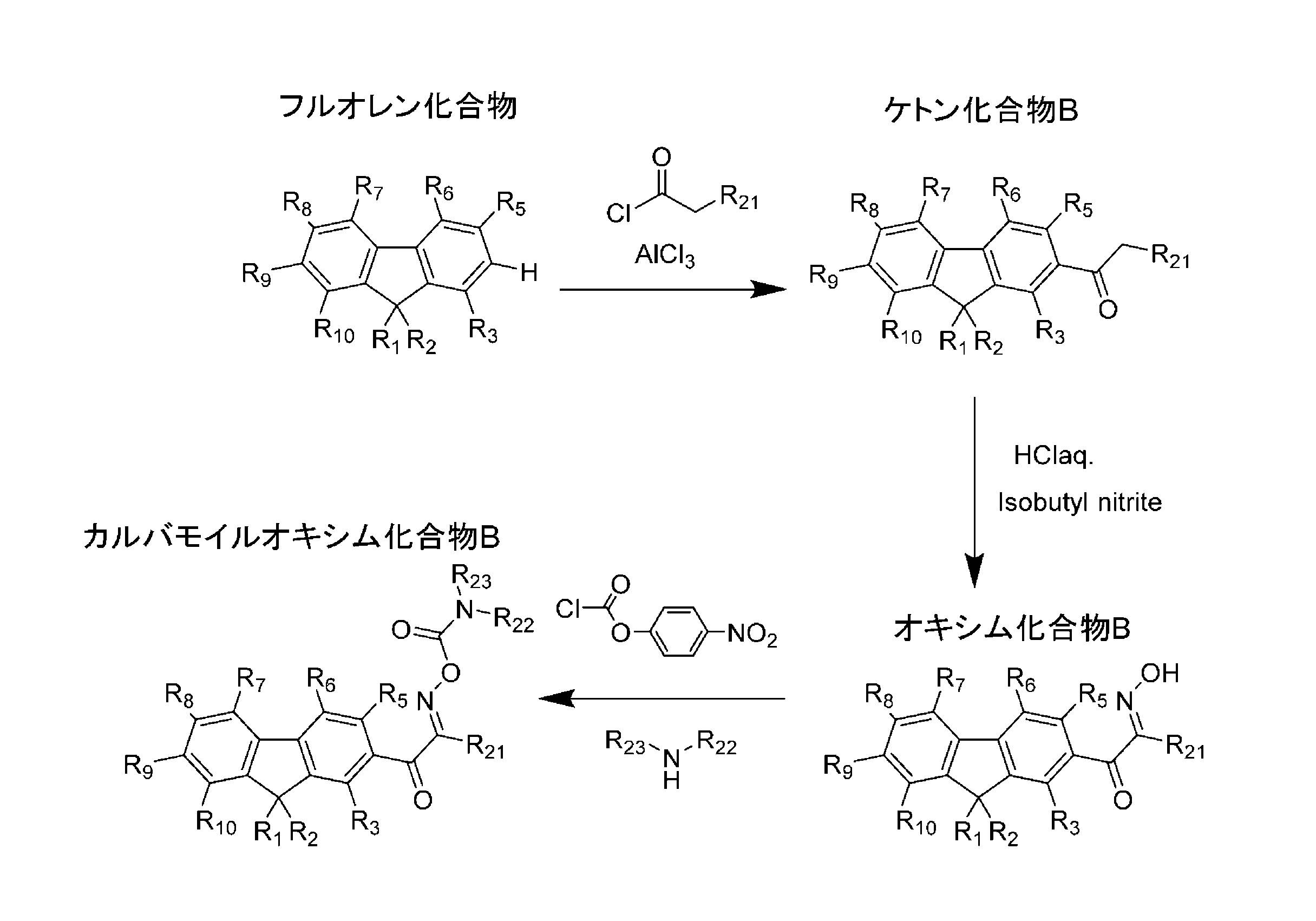
また上記反応式1及び反応式2は何れもX1が-NR22R23の場合を示しているが、使用するアミンを変更することで、X1が式(a)又は式(b)で表される基である化合物も製造できる。
上記反応式1及び反応式2は何れもR4が式(II)で表される基である場合を示しているが、フルオレンにおいて別の位置に式(II)で表される基を導入する場合には、フルオレン環形成時にケトン基を導入する方法で得られる。
更に、例えば、R3、R4、R5、R6、R7、R8、R9及びR10のうち2つ以上が式(II)で表される基である化合物は、カルボニル基が、R3、R4、R5、R6、R7、R8、R9及びR10の2つ以上に結合しているジケトン体をケトン体として用いることで上記反応式1及び2と同様の方法にて製造できる。
オキシム化合物Aは、特許4223071号報に記載の方法でも製造できる。
上記式(I)で表されるカルバモイルオキシム化合物は潜在性塩基化合物である。潜在性塩基化合物とは、紫外線等の光照射又は加熱によって塩基を発生する化合物であって、重合開始剤、塩基触媒、pH調整剤として使用することができる。操作性に優れることから光を照射することによって塩基を発生する光潜在性塩基化合物がより好ましい。
本発明の重合開始剤及び本発明の重合性組成物において、重合開始剤(A)は上記式(I)で表されるカルバモイルオキシム化合物を少なくとも1種含んでいるものである。本発明のカルバモイル化合物は、光の照射又は加熱によって効率的に塩基及びラジカルを発生することから、塩基発生剤及びラジカル重合開始剤として有用であり、特に塩基発生剤として有用である。
本発明の重合性組成物において、重合開始剤(A)の含有量は、重合性化合物(B)100質量部に対して、好ましくは1~20質量部、より好ましくは1~10質量部である。重合開始剤(A)の含有量が、1質量部以上であることで、感度不足による硬化不良を防止しやすいため好ましく、20質量部以下とすることで、光照射時又は加熱時の揮発物を抑制できるため好ましい。
本発明で用いられる重合性化合物(B)としては、アニオン重合性官能基を有する化合物、塩基が触媒として作用する反応又は塩基が付加する反応により硬化する化合物、及びラジカル重合性化合物が挙げられ、紫外線等のエネルギー線を照射することにより重合して硬化する感光性樹脂又は硬化温度が低温化する硬化樹脂であることが好ましい。上記アニオン重合性官能基とは、紫外線等のエネルギー線によって光塩基発生剤から発生する塩基により重合しうる官能基を意味し、例えば、エポキシ基、エピスルフィド基、環状モノマー(σ-バレロラクトン、ε-カプロラクタム)、マロン酸エステル等が挙げられる。塩基が触媒として作用する反応又は塩基が付加する反応としては、イソシアネートとアルコールによるウレタン結合形成反応、エポキシ樹脂と水酸基を含有する化合物の付加反応、エポキシ樹脂とカルボン酸基を含有する化合物の付加反応、エポキシ樹脂とチオール化合物の付加反応、(メタ)アクリル基のマイケル付加反応、ポリアミック酸の脱水縮合反応、アルコキシシランの加水分解・重縮合反応等が挙げられる。
上記エポキシ樹脂の中では、硬化性に優れる点から、グリシジル基を有するものが好ましく、2官能以上のグリシジル基を有するものがより好ましい。
チオール化合物の好ましい具体例としては、ビス(2-メルカプトエチル)スルフィド、2,5-ジメルカプトメチル-1,4-ジチアン、1,3-ビス(メルカプトメチル)ベンゼン、1,4-ビス(メルカプトメチル)ベンゼン、4-メルカプトメチル-1,8-ジメルカプト-3,6-ジチアオクタン、4,8-ジメルカプトメチル-1,11-ジメルカプト-3,6,9-トリチアウンデカン、4,7-ジメルカプトメチル-1,11-ジメルカプト-3,6,9-トリチアウンデカン、5,7-ジメルカプトメチル-1,11-ジメルカプト-3,6,9-トリチアウンデカン、1,2,6,7-テトラメルカプト-4-チアヘプタン、ペンタエリスリチオール、1,1,3,3-テトラキス(メルカプトメチルチオ)プロパン、ペンタエリスリトールテトラキスメルカプトプロピオネート、ペンタエリスリトールテトラキスチオグリコレート、トリメチロールプロパントリスチオグリコレート、及びトリメチロールプロパントリスメルカプトプロピオネートであり、より好ましくは、1,2,6,7-テトラメルカプト-4-チアヘプタン、ペンタエリスリチオール、ビス(2-メルカプトエチル)スルフィド、2,5-ビス(2-メルカプトメチル)-1,4-ジチアン、4-メルカプトメチル-1,8-ジメルカプト-3,6-ジチアオクタン、1,3-ビス(メルカプトメチル)ベンゼン、ペンタエリスリトールテトラキスメルカプトプロピオネート、及びペンタエリスリトールテトラキスチオグリコレートが挙げられる。
特に好ましい化合物は、1,2,6,7-テトラメルカプト-4-チアヘプタン、ペンタエリスリチオール、ビス(2-メルカプトエチル)スルフィド、2,5-ジメルカプトメチル-1,4-ジチアン、及び4-メルカプトメチル-1,8-ジメルカプト-3,6-ジチアオクタンである。
チオール化合物は1種を単独で又は2種以上を組合せて用いることができる。
また、上記ナイロン樹脂としては、ε-カプロラクタム、ラウリルラクタム等の環状モノマーを原料とした樹脂等が挙げられる。
また、上記ポリエステル樹脂としては、δ-バレロラクトン、β―プロピオラクトン等の環状モノマーを原料とした樹脂等が挙げられる。
エチレン性不飽和化合物は、単独で又は2種以上を混合して使用することができる。


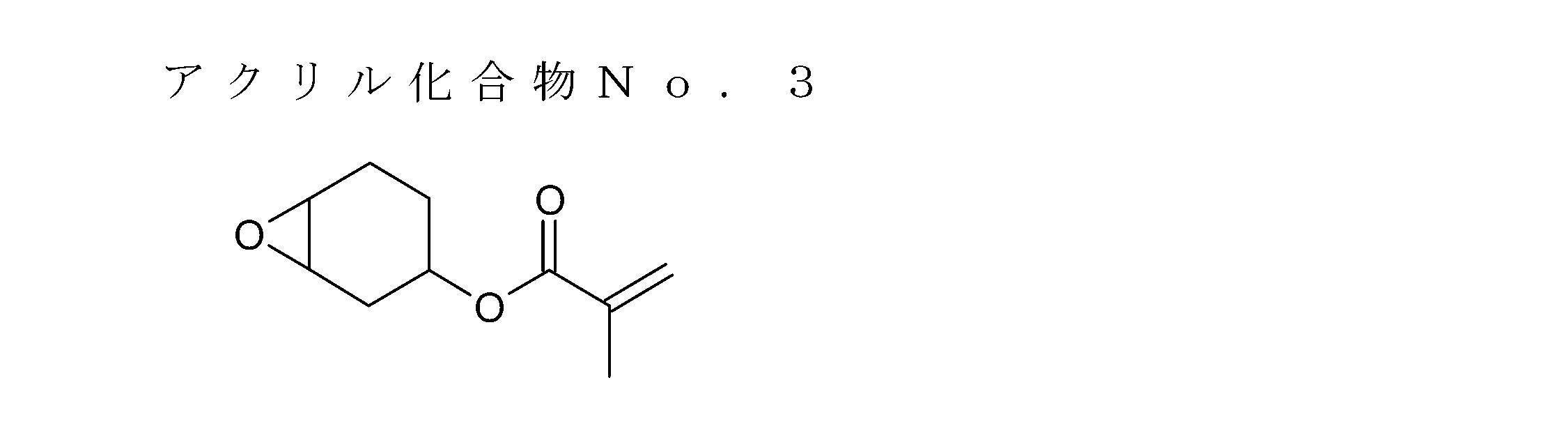

本発明の重合性組成物には、任意成分として、無機化合物、色材、潜在性エポキシ硬化剤、連鎖移動剤、増感剤、溶剤等の添加剤を用いることができる。
これらの中でも、アルカリ現像性、パターニング性、製膜性、溶解性の点から、ケトン類又はエーテルエステル系溶剤、特に、プロピレングリコール-1-モノメチルエーテル-2-アセテート(以下、「PGMEA」ともいう。)又はシクロヘキサノンが好ましく用いられる。
本発明の重合性組成物において、溶剤の含有量は、特に制限されず、各成分が均一に分散又は溶解され、また本発明の重合性組成物が各用途に適した液状ないしペースト状を呈する量であればよいが、通常、本発明の重合性組成物中の固形分(溶剤以外の全成分)の量が10~90質量%となる範囲で溶剤を含有させることが好ましい。
上記有機重合体を使用する場合、その使用量は、重合性化合物(B)100質量部に対して、好ましくは10~500質量部である。
ここで、アルキルエーテルを構成するアルキル基としては、メチル基、エチル基又はブチル基が挙げられ、互いに同一であってもよいし、異なっていてもよい。また、アルキルエーテル化されていないメチロール基は、一分子内で自己縮合していてもよく、二分子間で縮合して、その結果オリゴマー成分が形成されていてもよい。
具体的には、ヘキサメトキシメチルメラミン、ヘキサブトキシメチルメラミン、テトラメトキシメチルグリコールウリル、テトラブトキシメチルグリコールウリル等を用いることができる。
これらの中でも、溶剤への溶解性、重合性組成物から結晶析出しにくいという点から、ヘキサメトキシメチルメラミン、ヘキサブトキシメチルメラミン等のアルキルエーテル化されたメラミンが好ましい。
100mL四つ口フラスコに塩化アルミニウム2.40gと、ジクロロエタン(EDC)34.56gを入れ氷浴上-5℃で攪拌した。そこに9,9’-ジヘキシルフルオレン5.02g及びオクタノイルクロリド2.44gをジクロロエタン20g中に溶解させた溶液を滴下して加えた。室温まで昇温後3時間攪拌し、再び氷浴で冷却し、5質量%水酸化ナトリウム水溶液を20g滴下した。油水分離を行い、有機層を水で3回水洗した。有機層をエバポレータで減圧濃縮し、下記のケトン化合物1を収量6.91gで得た。

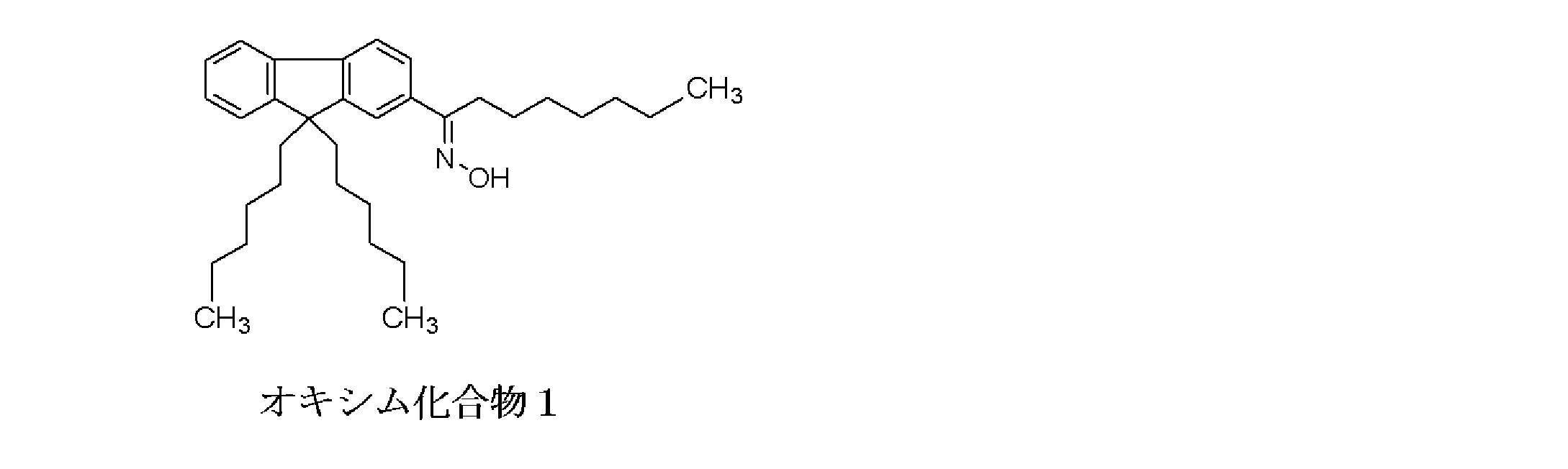
100mL四つ口フラスコにケトン化合物1を2.00g、DMF6.39g、35質量%塩酸0.45gの順で加え、氷浴上5℃で攪拌を行った。そこに亜硝酸イソブチル0.50gを滴下して加えた。室温まで昇温後、6時間攪拌した。その後イオン水50gにあけた。酢酸エチルを加え油水分離を行い、有機層を水で3回水洗した。有機層をエバポレータで減圧濃縮し、下記のオキシム化合物2を収量2.13gで得た。

100mL四つ口フラスコに下記ケトン化合物2を3.63g、塩酸ヒドロキシルアミン1.67g、DMF11.78g、ピリジン1.90gの順で加えオイルバス上80℃で5時間加熱攪拌した。室温まで冷却後イオン水50gにあけた。酢酸エチルを加え油水分離を行い、有機層を水で3回水洗した。有機層をエバポレータで減圧濃縮した。残渣にメタノールを加え晶析を行い、下記オキシム化合物3を収量3.13gで得た。

100ml四つ口フラスコに、1-(9,9-ジメチル-7-(2-メチルベンゾイル)-9H-フルオレン-2-イル)オクタン-1-オン1.0eq.を加え、ジメチルホルムアミド(理論収量の400重量%)に溶解した。溶液にヒドロキシアンモニウムクロリド1.2eq.及びピリジン1.2eq.を加えた。反応混合物を55℃で9時間加熱攪拌し、イオン交換水を加え、酢酸エチルで抽出した。有機層を5質量%塩酸、イオン交換水、飽和炭酸水素ナトリウム水溶液で2回、イオン交換水で3回、という順で洗浄し、硫酸マグネシウムにより乾燥させ、濃縮した。残渣をシリカゲルカラムクロマトグラフィー(溶離剤=酢酸エチル:ヘキサン=1:6)により精製し、オキシム化合物4を収率70%で得た。

100ml四つ口フラスコに、3-シクロペンチル-1-(9,9-ジメチル―7-ニトロ-9H-フルオレン-2-イル)プロパン-1-オン1.0eq.を加え、ジメチルホルムアミド(理論収量の400重量%)に溶解した。溶液にヒドロキシアンモニウムクロリド1.2eq.及びピリジン1.2eq.を加えた。反応混合物を55℃で7時間加熱攪拌し、イオン交換水を加え、酢酸エチルで抽出した。有機層をイオン交換水で3回洗浄し、硫酸マグネシウムにより乾燥させ、濃縮した。これにメタノール(理論収量の1700重量%)を加え晶析を行い、オキシム化合物5を淡褐色粉状化合物として収率65%で得た。

100mL四つ口フラスコにオキシム化合物1を1.00gと、アセトニトリル6.00gを入れ室温で攪拌した。そこに1,1’-カルボニルジイミダゾール0.41gをアセトニトリル5g中に分散させた溶液を10分かけて加えた。3時間攪拌後、析出した結晶を除き、ろ液を濃縮した。更に3時間減圧乾燥を行い、白色粉状化合物を収率59%で得た。得られた固体のTG-DTA(融点/℃)、1H-NMRを分析し、目的物である化合物No.1であることを確認した。分析結果を〔表1〕及び〔表2〕に示す。
100mL四つ口フラスコにオキシム化合物2を2.13gと、アセトニトリル29.00gを入れ室温で攪拌した。そこに1,1’-カルボニルジイミダゾール0.86gをアセトニトリル5g中に分散させた溶液を10分かけて加えた。1時間攪拌後、析出した結晶を除き、ろ液を濃縮した。更に4時間減圧乾燥を行い、白色粉状化合物を収率51%で得た。得られた固体のTG-DTA(融点/℃)、1H-NMRを分析し、目的物である化合物No.2であることを確認した。分析結果を〔表1〕及び〔表2〕に示す。
100mL四つ口フラスコに、オキシム化合物3を1.18g、1,1’-カルボニルジイミダゾール1.17g及びテトラヒドロフラン(THF)1.04gを入れ室温で2時間攪拌した。そこにピペリジン0.61gを滴下して加え、オイルバス上60℃で6時間攪拌した。室温まで冷却後、エバポレータで減圧溶媒留去し、残渣にクロロホルムを加え、イオン交換水で5回水洗を行った。有機層を減圧濃縮し、メタノールを加えて晶析を行い、薄黄色粉状物を収率74%で得た。得られた固体のTG-DTA(融点/℃)、1H-NMRを分析し、目的物である化合物No.3であることを確認した。分析結果を〔表1〕及び〔表2〕に示す。
100ml四つ口フラスコに、オキシム化合物4を1.0eq.、ジクロロエタン(理論収量の600重量%)、トリエチルアミン2.0eq.を加え、氷浴上5℃で攪拌を行った。そこにクロロギ酸4-ニトロフェニル1.5eq.をジクロロエタンに溶かしたものを滴下して加えた。滴下終了後、室温で1時間攪拌した。再び氷浴上5℃まで冷却後、アニリン1.5eq.を滴下して加えた。室温で1時間攪拌し、減圧溶媒留去した。そこに酢酸エチルとイオン交換水を加え、油水分離を行った。更に有機層を1質量%水酸化ナトリウム水溶液で2回、イオン交換水で2回洗浄し、硫酸マグネシウムにより乾燥させ、濃縮した。残渣をシリカゲルカラムクロマトグラフィー(溶離剤=酢酸エチル:トルエン=1:30)により精製し、化合物No.50を淡黄色透明固体として収率56%で得た。得られた化合物のTG-DTA(融点)、1H-NMRを分析した。結果を〔表2A〕及び〔表2B〕に示す。化合物No.50の合成の反応式は下記のとおりである。
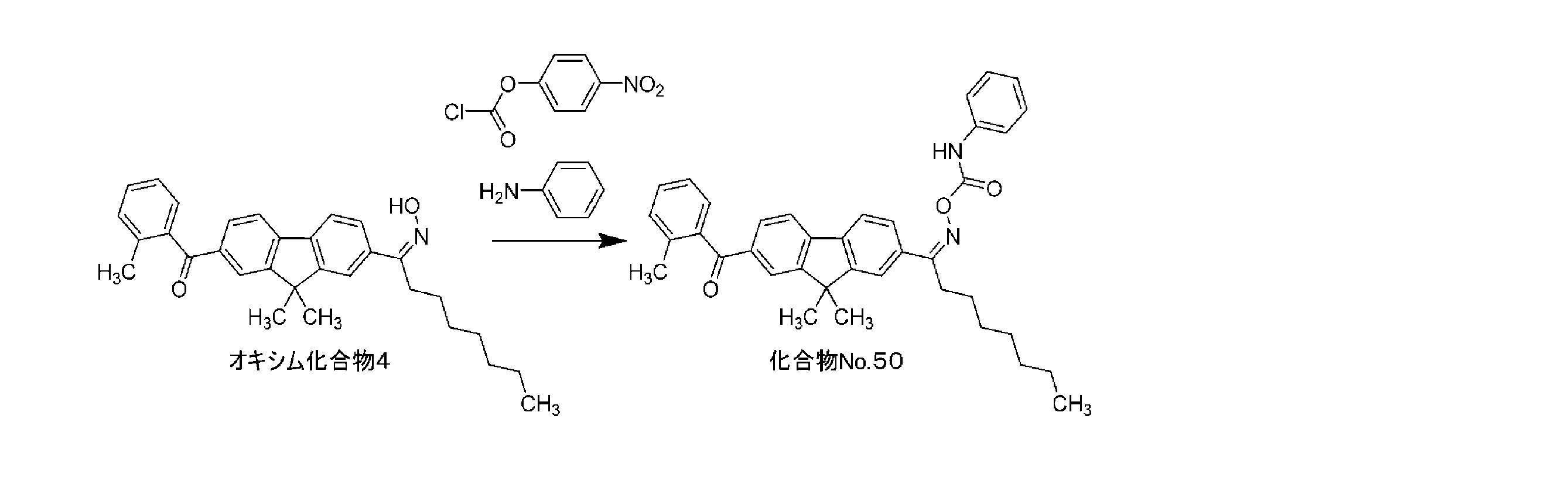
100ml四つ口フラスコに、オキシム化合物4を1.0eq.、ジクロロエタン(理論収量の600重量%)、トリエチルアミン2.0eq.を加え、氷浴上5℃で攪拌を行った。そこにクロロギ酸4-ニトロフェニル1.5eq.をジクロロエタンに溶かしたものを滴下して加えた。滴下終了後、室温で1時間攪拌した。再び氷浴上5℃まで冷却後、ピペリジン1.5eq.を滴下して加えた。室温で1時間攪拌し、減圧溶媒留去した。そこに酢酸エチルとイオン交換水を加え、油水分離を行った。更に有機層を1質量%水酸化ナトリウム水溶液で2回、イオン交換水で3回洗浄し、硫酸マグネシウムにより乾燥させ、濃縮した。残渣をシリカゲルカラムクロマトグラフィー(溶離剤=酢酸エチル:トルエン=1:10)により精製し、化合物No.51を淡黄色透明液体として収率67%で得た。得られた化合物のTG-DTA(融点)、1H-NMRを分析した。結果を〔表2B〕に示す。化合物No.51の合成の反応式は下記のとおりである。

100ml四つ口フラスコに、オキシム化合物5を1.0eq.、ジクロロエタン(理論収量の600重量%)、トリエチルアミン2.0eq.を加え、氷浴上5℃で攪拌を行った。そこにクロロギ酸4-ニトロフェニル1.5eq.をジクロロエタンに溶かしたものを滴下して加えた。滴下終了後、室温で1時間攪拌した。再び氷浴上5℃まで冷却後、ジブチルアミン1.5eq.を滴下して加えた。室温で1時間攪拌し、減圧溶媒留去した。そこに酢酸エチルとイオン交換水を加え、油水分離を行った。更に有機層を1質量%水酸化ナトリウム水溶液で2回、イオン交換水で3回洗浄し、硫酸マグネシウムにより乾燥させ、濃縮した。これにメタノール(理論収量の600重量%)を加え晶析を行い、化合物No.52を淡茶色固体として収率78%で得た。得られた化合物のTG-DTA(融点)、1H-NMRを分析した。結果を〔表2A〕及び〔表2B〕に示す。化合物No.52の合成の反応式は下記のとおりである。

100ml四つ口フラスコに、オキシム化合物5を1.0eq.、ジクロロエタン(理論収量の600重量%)、トリエチルアミン2.0eq.を加え、氷浴上5℃で攪拌を行った。そこにクロロギ酸4-ニトロフェニル1.5eq.をジクロロエタンに溶かしたものを滴下して加えた。滴下終了後、室温で1時間攪拌した。再び氷浴上5℃まで冷却後、3,5-ジメチルピペリジン1.5eq.を滴下して加えた。室温で1時間攪拌し、減圧溶媒留去した。そこに酢酸エチルとイオン交換水を加え、油水分離を行った。更に有機層を、イオン交換水で3回洗浄し、硫酸マグネシウムにより乾燥させ、濃縮した。これにエタノール(理論収量の7000重量%)を加え晶析を行い、化合物No.53を淡黄色固体として収率79%で得た。得られた化合物のTG-DTA(融点)、1H-NMRを分析した。結果を〔表2A〕及び〔表2B〕に示す。化合物No.53の合成の反応式は下記のとおりである。

100ml四つ口フラスコに、オキシム化合物4を1.0eq.、アセトニトリル(理論収量の200重量%)を加え、室温で攪拌を行った。そこに1,1’-カルボニルジイミダゾールを1.1eq.加え、室温で30分間攪拌し、減圧溶媒留去した。シリカゲルカラムクロマトグラフィー(溶離剤=酢酸エチル:ヘキサン=60:40)により精製し、化合物No.54を淡黄色固体として収率44%で得た。得られた化合物のTG-DTA(融点)、1H-NMRを分析した。結果を〔表2A〕及び〔表2B〕に示す。化合物No.54の合成の反応式は下記のとおりである。
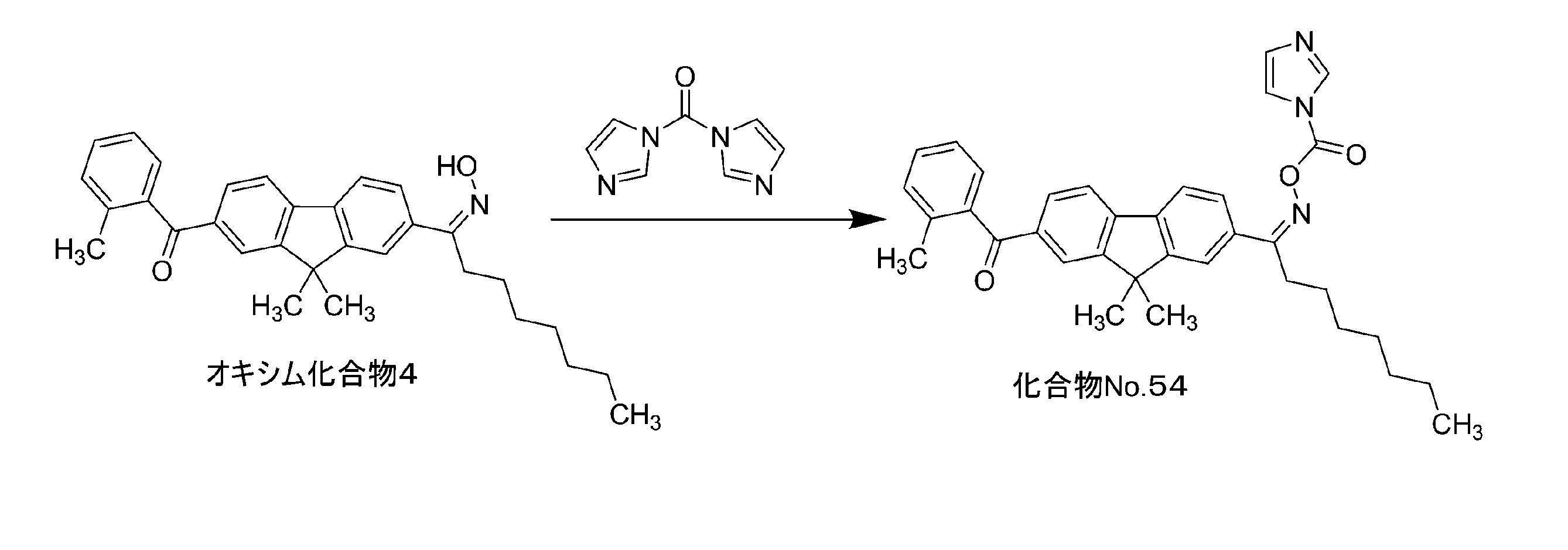

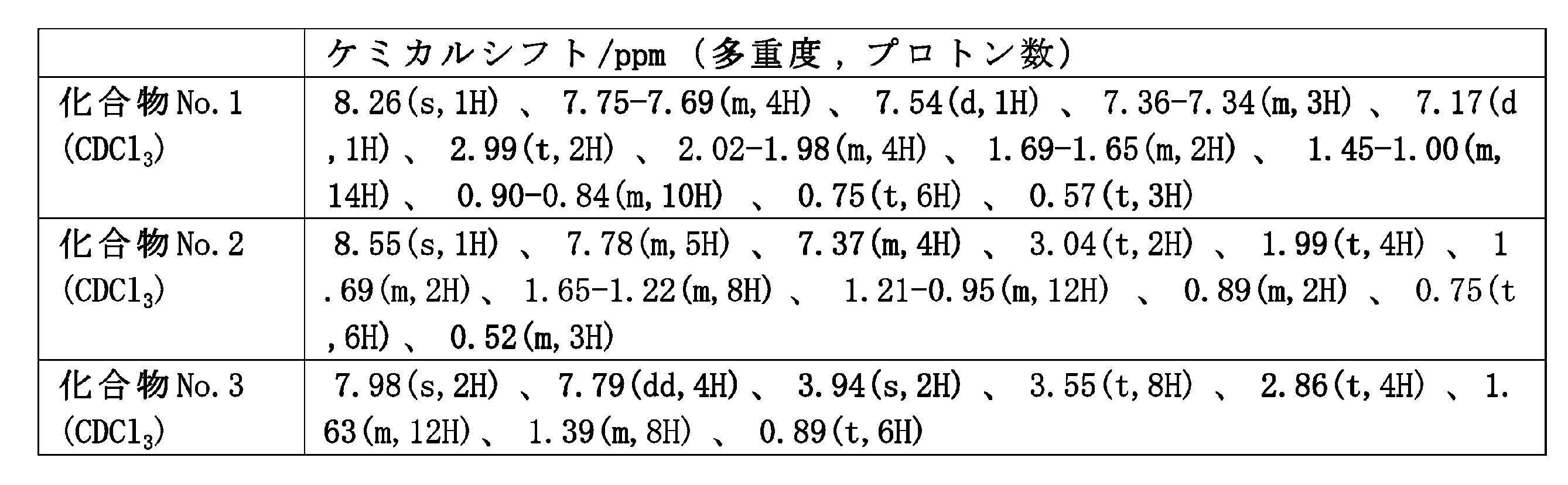


比較化合物No.1として、下記化合物を用いた。

上記化合物No.1~No.3及び比較化合物No.1を1.0g測り取り、そこに室温(25℃)で下記〔表3〕に示す各溶剤を加え、完全に溶解したときの溶剤の添加量を測定し、化合物の溶解性を下記計算式により算出した。結果を[表3]に示す。
化合物の各溶剤への溶解性(%)=1.0g/(1.0g+溶剤の添加量g)×100

〔表4〕に記載の配合を行い、重合性組成物である実施例2-1~2-3及び比較例2-1の重合性組成物を得た。〔表4〕中の各成分の符号は、下記の成分を表す。
A-1 化合物No.1
A-2 化合物No.2
A-3 化合物No.3
A’-1 比較化合物No.1
B-1 EPPN-201
(フェノールノボラック型エポキシ樹脂、エポキシ当量193g/eq.、日本化薬社製)
B-2 TRR-5010G
(クレゾールノボラック型フェノール樹脂、水酸基当量120g/eq.、Mw=8,000、旭有機材工業社製)
C-1 FZ-2122
(ポリエーテル変性ポリシロキサン、東レダウコーニング社製)
D-1 シクロペンタノン (溶剤)

上記で得られた実施例2-1~2-3及び比較例2-1の重合性組成物について、線幅感度、硬化物の残膜率の評価を、下記の手順で行った。結果を〔表5〕に併記する。
実施例2-1~2-3及び比較例2-1の重合性組成物(各組成物の塗布量約2.0cc)をそれぞれ、ガラス基材にスピンコーター(500rpm×2秒→1800rpm×15秒→slope×5秒)で塗膜し、ホットプレート上でプリベイクをした(90℃×120秒)。
その後、トプコン露光機を用い紫外光を分割露光した(60,120mJ/cm2、gap:20μm、照度:20.0mW/cm2)。
露光後、ホットプレート上でポストベイクを行った(120℃×5分)後、PGMEA(温度:23℃)で現像した:200rpm×10秒→IPA(イソプロピルアルコール)洗浄(200rpm×10秒→乾燥:500rpm×5秒)。
得られたサンプルについて、各露光量におけるマスク開口20μmのパターンの線幅・残膜率を測定した。
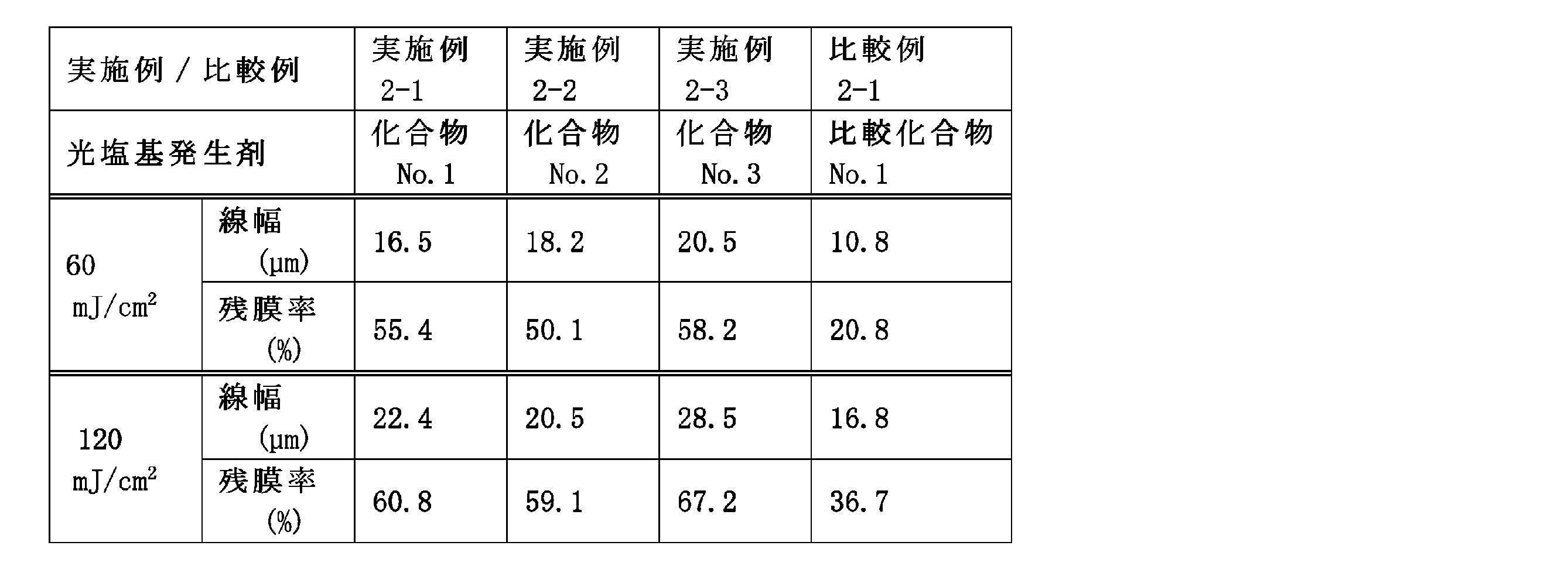
上記化合物No.1~No.3及び比較化合物No.1を、1.0×10⁻⁴mol濃度のアセトニトリル溶液に調製して蓋付き石英セルに入れた。これらのサンプルそれぞれに超高圧水銀ランプを光源とする光を100mJ/cm2、500mJ/cm2及び1000mJ/cm2(365nmにおける積算光量)の条件で照射し、分解性を調べた。分解性の評価には、HPLCを用いて該当化合物に由来する光未照射時のピーク面積と光照射後のピーク面積を測定し、下記の計算式より分解率を計算した。得られた分解率を下記〔表6〕に記載した。
分解率(%)=[(光未照射時のHPLC面積)―(光照射後のHPLC面積)]/
(光未照射時のHPLC面積)×100

Claims (17)
- 下記式(I)で表されるカルバモイルオキシム化合物。

R3、R4、R5、R6、R7、R8、R9及びR10は、それぞれ独立に、水素原子、シアノ基、ニトロ基、-OR11、-COOR11、-CO-R11、-SR11、ハロゲン原子、炭素原子数1~20の脂肪族炭化水素基、炭素原子数6~20の芳香族炭化水素基、炭素原子数2~20の複素環を含有する基又は下記式(II)で表される基を表し、
R11は、炭素原子数1~20の脂肪族炭化水素基又は炭素原子数6~20の芳香族炭化水素基を表し、
R1、R2、R3、R4、R5、R6、R7、R8、R9、R10及びR11で表される基中の水素原子の1つ又は2つ以上はハロゲン原子、ニトロ基、シアノ基、水酸基、アミノ基、カルボキシル基、メタクリロイル基、アクリロイル基、エポキシ基、ビニル基、ビニルエーテル基、メルカプト基、イソシアネート基又は炭素原子数2~20の複素環を含有する基で置換される場合があり、
R3、R4、R5、R6、R7、R8、R9及びR10のうち1つ以上が下記式(II)で表される基である。

X1は、-NR22R23、下記式(a)又は下記式(b)で表される基であり、
R22及びR23は、それぞれ独立に、水素原子、炭素原子数1~20の脂肪族炭化水素基又は炭素原子数6~20の芳香族炭化水素基であるか、
R22とR23が、互いに連結して、窒素原子及び炭素原子からなる環、又は酸素原子、窒素原子及び炭素原子からなる環であり、
R21、R22及びR23で表される基中の水素原子の1つ又は2つ以上はハロゲン原子、ニトロ基、シアノ基、水酸基、アミノ基、カルボキシル基、メタクリロイル基、アクリロイル基、エポキシ基、ビニル基、ビニルエーテル基、メルカプト基、イソシアネート基又は炭素原子数2~20の複素環を含有する基で置換される場合があり、
nは、0又は1を表し、*は結合手を表す。

R31とR32、R33とR34、R35とR36、R37とR38及びR39とR40が、互いに連結して、窒素原子及び炭素原子からなる環、又は酸素原子、窒素原子及び炭素原子からなる環を形成する場合があり、
R31、R32、R33、R34、R35、R36、R37、R38、R39及びR40で表される基中の水素原子の1つ又は2つ以上はハロゲン原子、ニトロ基、シアノ基、水酸基、アミノ基、カルボキシル基、メタクリロイル基、アクリロイル基、エポキシ基、ビニル基、ビニルエーテル基、メルカプト基、イソシアネート基又は炭素原子数2~20の複素環を含有する基で置換される場合があり、
*は結合手を表す。 - 上記式(I)中のX1が-NR22R23を表し、
R22及びR23が、それぞれ独立に、炭素原子数1~20の脂肪族炭化水素基又は炭素原子数6~20の芳香族炭化水素基であるか、
R22が水素原子であり、R23が炭素原子数1~20の脂肪族炭化水素基又は炭素原子数6~20の芳香族炭化水素基であるか、
R22とR23が、互いに連結して、窒素原子及び炭素原子からなる環、又は酸素原子、窒素原子及び炭素原子からなる環を形成している、請求項1に記載のカルバモイルオキシム化合物。 - 上記式(I)中のX1が-NR22R23を表し、
R22とR23が、互いに連結して、窒素原子及び炭素原子からなる環を形成している、請求項1に記載のカルバモイルオキシム化合物。 - 上記式(I)中のX1が-NR22R23を表し、
R22とR23が、それぞれ独立に、炭素原子数1~20の脂肪族炭化水素基である、請求項1又は2に記載のカルバモイルオキシム化合物。 - 上記式(I)中のX1が-NR22R23を表し、
R22が水素原子であり、R23が炭素原子数6~20の芳香族炭化水素基である、請求項1又は2に記載のカルバモイルオキシム化合物。 - 上記式(I)中のR3、R4、R5、R6、R7、R8、R9及びR10のうち2つ以上が上記式(II)で表される基である請求項1~5の何れか一項に記載のカルバモイルオキシム化合物。
- 上記式(I)中のR3、R4、R5及びR6のうちの1つが上記式(II)で表される基であり、且つ、R7、R8、R9及びR10のうちの少なくとも1つが、水素原子、ニトロ基又は炭素原子数6~12の芳香族炭化水素基である、請求項1又は2に記載のカルバモイルオキシム化合物。
- 上記式(I)中のR3、R4、R5及びR6のうちの1つが上記式(II)で表される基であり、且つ、R7、R8、R9及びR10のうちの少なくとも1つが、ニトロ基又は炭素原子数6~12の芳香族炭化水素基である、請求項1又は2に記載のカルバモイルオキシム化合物。
- 上記式(I)中のR3、R4、R5及びR6のうちの1つが上記式(II)で表される基であり、且つ、R7、R8、R9及びR10のうちの1つが、ニトロ基又は炭素原子数6~12の芳香族炭化水素基である、請求項8に記載のカルバモイルオキシム化合物。
- 上記式(I)中のR9がニトロ基又は炭素原子数6~12の芳香族炭化水素基である、請求項8又は9に記載のカルバモイルオキシム化合物。
- 上記式(I)中のR4が上記式(II)で表される基である、請求項6~10の何れか一項に記載のカルバモイルオキシム化合物。
- 請求項1~11の何れか一項に記載のカルバモイルオキシム化合物からなる潜在性塩基化合物。
- 請求項1~11の何れか一項に記載のカルバモイルオキシム化合物を少なくとも1種含む重合開始剤。
- 請求項13に記載の重合開始剤(A)及び重合性化合物(B)を含有する重合性組成物。
- 上記重合性化合物(B)が、エポキシ樹脂若しくはエチレン性不飽和化合物、又はエポキシ樹脂とフェノール樹脂とを含む混合物、エポキシ樹脂とチオール化合物とを含む混合物、若しくはエチレン性不飽和化合物とチオール化合物とを含む混合物である請求項14に記載の重合性組成物。
- 請求項14又は15に記載の重合性組成物の硬化物。
- 請求項14又は15に記載の重合性組成物にエネルギー線を照射する工程を有する硬化物の製造方法。
Priority Applications (3)
| Application Number | Priority Date | Filing Date | Title |
|---|---|---|---|
| KR1020207033227A KR102687488B1 (ko) | 2018-08-07 | 2019-08-05 | 카르바모일옥심 화합물 그리고 상기 화합물을 함유하는 중합 개시제 및 중합성 조성물 |
| JP2020535773A JP7460288B2 (ja) | 2018-08-07 | 2019-08-05 | カルバモイルオキシム化合物並びに該化合物を含有する重合開始剤及び重合性組成物 |
| CN201980033889.4A CN112189007B (zh) | 2018-08-07 | 2019-08-05 | 氨基甲酰肟化合物以及含有该化合物的聚合引发剂及聚合性组合物 |
Applications Claiming Priority (2)
| Application Number | Priority Date | Filing Date | Title |
|---|---|---|---|
| JP2018148806 | 2018-08-07 | ||
| JP2018-148806 | 2018-08-07 |
Publications (1)
| Publication Number | Publication Date |
|---|---|
| WO2020031986A1 true WO2020031986A1 (ja) | 2020-02-13 |
Family
ID=69414896
Family Applications (1)
| Application Number | Title | Priority Date | Filing Date |
|---|---|---|---|
| PCT/JP2019/030785 Ceased WO2020031986A1 (ja) | 2018-08-07 | 2019-08-05 | カルバモイルオキシム化合物並びに該化合物を含有する重合開始剤及び重合性組成物 |
Country Status (5)
| Country | Link |
|---|---|
| JP (1) | JP7460288B2 (ja) |
| KR (1) | KR102687488B1 (ja) |
| CN (1) | CN112189007B (ja) |
| TW (1) | TWI811419B (ja) |
| WO (1) | WO2020031986A1 (ja) |
Cited By (4)
| Publication number | Priority date | Publication date | Assignee | Title |
|---|---|---|---|---|
| JP2020139136A (ja) * | 2018-11-30 | 2020-09-03 | 株式会社Adeka | 組成物、硬化物及び硬化物の製造方法 |
| WO2020209205A1 (ja) * | 2019-04-08 | 2020-10-15 | 株式会社Adeka | カルバモイルオキシム化合物並びに該化合物を含有する重合開始剤及び重合性組成物 |
| WO2020241529A1 (ja) * | 2019-05-24 | 2020-12-03 | 株式会社Adeka | カルバモイルオキシム化合物並びに該化合物を含有する重合開始剤及び重合性組成物 |
| JP2021066807A (ja) * | 2019-10-23 | 2021-04-30 | 株式会社Adeka | 重合性組成物、レジスト用重合性組成物及び硬化物 |
Families Citing this family (2)
| Publication number | Priority date | Publication date | Assignee | Title |
|---|---|---|---|---|
| CN113121778B (zh) * | 2021-05-06 | 2022-08-05 | 福建师范大学泉港石化研究院 | 一种含有改性石墨烯的聚氨酯阻燃发泡材料及其制备方法 |
| CN115948101B (zh) * | 2023-01-06 | 2023-09-26 | 深圳市金川防水防腐装饰工程有限公司 | 一种耐水防腐的环氧树脂涂料及其制备方法 |
Citations (4)
| Publication number | Priority date | Publication date | Assignee | Title |
|---|---|---|---|---|
| KR20090008811A (ko) * | 2007-07-19 | 2009-01-22 | 한국화학연구원 | 신규한 옥심 카바메이트 화합물, 이를 함유하는 광중합개시제 및 광중합성 조성물 |
| WO2013141014A1 (ja) * | 2012-03-22 | 2013-09-26 | 株式会社Adeka | 新規化合物及び感光性樹脂組成物 |
| JP2015523318A (ja) * | 2012-05-03 | 2015-08-13 | コリア リサーチ インスティテュート オブ ケミカル テクノロジー | 新規のオキシムエステルフルオレン化合物、およびこれを含む光重合開始剤、並びにフォトレジスト組成物 |
| JP2018506532A (ja) * | 2015-02-06 | 2018-03-08 | コリア リサーチ インスティテュート オブ ケミカル テクノロジー | 新規のオキシムエステル誘導体化合物およびこれを含む光重合開始剤、ならびにフォトレジスト組成物 |
Family Cites Families (5)
| Publication number | Priority date | Publication date | Assignee | Title |
|---|---|---|---|---|
| US6551761B1 (en) | 1997-02-26 | 2003-04-22 | Ciba Specialty Chemical Corporation | Photoactivatable nitrogen-containing bases based on α-ammonium ketones, iminium ketones or amidinium ketones and aryl borates |
| US8957212B2 (en) | 2008-12-02 | 2015-02-17 | Wako Pure Chemical Industries, Ltd. | Photobase generator |
| WO2010064632A1 (ja) | 2008-12-02 | 2010-06-10 | 和光純薬工業株式会社 | 光塩基発生剤 |
| JP5912946B2 (ja) | 2012-01-11 | 2016-04-27 | 株式会社Adeka | 感光性樹脂組成物 |
| KR20170065111A (ko) * | 2015-12-03 | 2017-06-13 | 동우 화인켐 주식회사 | 착색 감광성 수지 조성물, 이를 이용하여 제조된 컬러필터 및 화상 표시 장치 |
-
2019
- 2019-08-05 WO PCT/JP2019/030785 patent/WO2020031986A1/ja not_active Ceased
- 2019-08-05 JP JP2020535773A patent/JP7460288B2/ja active Active
- 2019-08-05 KR KR1020207033227A patent/KR102687488B1/ko active Active
- 2019-08-05 CN CN201980033889.4A patent/CN112189007B/zh active Active
- 2019-08-06 TW TW108127905A patent/TWI811419B/zh active
Patent Citations (4)
| Publication number | Priority date | Publication date | Assignee | Title |
|---|---|---|---|---|
| KR20090008811A (ko) * | 2007-07-19 | 2009-01-22 | 한국화학연구원 | 신규한 옥심 카바메이트 화합물, 이를 함유하는 광중합개시제 및 광중합성 조성물 |
| WO2013141014A1 (ja) * | 2012-03-22 | 2013-09-26 | 株式会社Adeka | 新規化合物及び感光性樹脂組成物 |
| JP2015523318A (ja) * | 2012-05-03 | 2015-08-13 | コリア リサーチ インスティテュート オブ ケミカル テクノロジー | 新規のオキシムエステルフルオレン化合物、およびこれを含む光重合開始剤、並びにフォトレジスト組成物 |
| JP2018506532A (ja) * | 2015-02-06 | 2018-03-08 | コリア リサーチ インスティテュート オブ ケミカル テクノロジー | 新規のオキシムエステル誘導体化合物およびこれを含む光重合開始剤、ならびにフォトレジスト組成物 |
Non-Patent Citations (2)
| Title |
|---|
| TSUNOOKA, MASAHIRO ET AL.: "Development of Photoacid and Photobase Generators and Their Use for Design of Novel Photopolymers", JOURNAL OF THE SOCIETY OF PHOTOGRAPHIC SCIENCE AND TECHNOLOGY OF JAPAN, vol. 66, no. 4, 2003, pages 355 - 366, XP055618950 * |
| WALTON, J. C.: "Functionalised oximes: emergent precursors for carbon-, nitrogen- and oxygen- centred radicals", MOLECULES, vol. 21, no. 1, 7 January 2016 (2016-01-07), pages 63, XP055618949 * |
Cited By (6)
| Publication number | Priority date | Publication date | Assignee | Title |
|---|---|---|---|---|
| JP2020139136A (ja) * | 2018-11-30 | 2020-09-03 | 株式会社Adeka | 組成物、硬化物及び硬化物の製造方法 |
| JP7588463B2 (ja) | 2018-11-30 | 2024-11-22 | 株式会社Adeka | 光硬化性組成物 |
| WO2020209205A1 (ja) * | 2019-04-08 | 2020-10-15 | 株式会社Adeka | カルバモイルオキシム化合物並びに該化合物を含有する重合開始剤及び重合性組成物 |
| WO2020241529A1 (ja) * | 2019-05-24 | 2020-12-03 | 株式会社Adeka | カルバモイルオキシム化合物並びに該化合物を含有する重合開始剤及び重合性組成物 |
| JPWO2020241529A1 (ja) * | 2019-05-24 | 2020-12-03 | ||
| JP2021066807A (ja) * | 2019-10-23 | 2021-04-30 | 株式会社Adeka | 重合性組成物、レジスト用重合性組成物及び硬化物 |
Also Published As
| Publication number | Publication date |
|---|---|
| JPWO2020031986A1 (ja) | 2021-08-26 |
| CN112189007A (zh) | 2021-01-05 |
| TWI811419B (zh) | 2023-08-11 |
| KR20210040829A (ko) | 2021-04-14 |
| CN112189007B (zh) | 2023-07-04 |
| JP7460288B2 (ja) | 2024-04-02 |
| KR102687488B1 (ko) | 2024-07-23 |
| TW202014401A (zh) | 2020-04-16 |
Similar Documents
| Publication | Publication Date | Title |
|---|---|---|
| KR102687488B1 (ko) | 카르바모일옥심 화합물 그리고 상기 화합물을 함유하는 중합 개시제 및 중합성 조성물 | |
| US9594302B2 (en) | Compound and photosensitive resin composition | |
| KR102669269B1 (ko) | 화합물, 잠재성 염기 발생제, 상기 화합물을 함유하는 감광성 수지 조성물, 및 경화물 | |
| WO2019088055A1 (ja) | 化合物、組成物、硬化物及び硬化物の製造方法 | |
| WO2021125132A1 (ja) | カルバモイルオキシム化合物並びに該化合物を含有する重合開始剤及び重合性組成物 | |
| JPWO2018159265A1 (ja) | 重合性組成物及びブラックカラムスペーサー用感光性組成物 | |
| WO2018235664A1 (ja) | 重合性組成物、ブラックマトリクス用感光性組成物及びブラックカラムスペーサ用感光性組成物 | |
| WO2018235665A1 (ja) | 重合性組成物、ブラックマトリクス用感光性組成物及びブラックカラムスペーサ用感光性組成物 | |
| TWI858067B (zh) | 胺甲醯肟化合物以及含有該化合物之聚合起始劑及聚合性組合物 | |
| CN113302180A (zh) | 氨基甲酰肟化合物以及含有该化合物的聚合引发剂及聚合性组合物 | |
| KR20220019654A (ko) | 카르바모일옥심 화합물 그리고 상기 화합물을 함유하는 중합 개시제 및 중합성 조성물 | |
| JP7277226B2 (ja) | 化合物、重合開始剤、重合性樹脂組成物及び感光性樹脂組成物 | |
| KR102867377B1 (ko) | 카르바모일옥심 화합물 그리고 상기 화합물을 함유하는 중합 개시제 및 중합성 조성물 | |
| JP2020200272A (ja) | カルバモイルオキシム化合物並びに該化合物を含有する重合開始剤及び重合性組成物 | |
| JP2021066807A (ja) | 重合性組成物、レジスト用重合性組成物及び硬化物 |
Legal Events
| Date | Code | Title | Description |
|---|---|---|---|
| 121 | Ep: the epo has been informed by wipo that ep was designated in this application |
Ref document number: 19848441 Country of ref document: EP Kind code of ref document: A1 |
|
| ENP | Entry into the national phase |
Ref document number: 2020535773 Country of ref document: JP Kind code of ref document: A |
|
| ENP | Entry into the national phase |
Ref document number: 20207033227 Country of ref document: KR Kind code of ref document: A |
|
| NENP | Non-entry into the national phase |
Ref country code: DE |
|
| 122 | Ep: pct application non-entry in european phase |
Ref document number: 19848441 Country of ref document: EP Kind code of ref document: A1 |