WO2020031825A1 - フラックス組成物、はんだペースト、はんだ接合部及びはんだ接合方法 - Google Patents
フラックス組成物、はんだペースト、はんだ接合部及びはんだ接合方法 Download PDFInfo
- Publication number
- WO2020031825A1 WO2020031825A1 PCT/JP2019/030153 JP2019030153W WO2020031825A1 WO 2020031825 A1 WO2020031825 A1 WO 2020031825A1 JP 2019030153 W JP2019030153 W JP 2019030153W WO 2020031825 A1 WO2020031825 A1 WO 2020031825A1
- Authority
- WO
- WIPO (PCT)
- Prior art keywords
- acid
- present
- solder
- flux composition
- range specified
- Prior art date
- Legal status (The legal status is an assumption and is not a legal conclusion. Google has not performed a legal analysis and makes no representation as to the accuracy of the status listed.)
- Ceased
Links
Images




Classifications
-
- B—PERFORMING OPERATIONS; TRANSPORTING
- B23—MACHINE TOOLS; METAL-WORKING NOT OTHERWISE PROVIDED FOR
- B23K—SOLDERING OR UNSOLDERING; WELDING; CLADDING OR PLATING BY SOLDERING OR WELDING; CUTTING BY APPLYING HEAT LOCALLY, e.g. FLAME CUTTING; WORKING BY LASER BEAM
- B23K35/00—Rods, electrodes, materials, or media, for use in soldering, welding, or cutting
- B23K35/22—Rods, electrodes, materials, or media, for use in soldering, welding, or cutting characterised by the composition or nature of the material
- B23K35/36—Selection of non-metallic compositions, e.g. coatings or fluxes; Selection of soldering or welding materials, conjoint with selection of non-metallic compositions, both selections being of interest
- B23K35/3612—Selection of non-metallic compositions, e.g. coatings or fluxes; Selection of soldering or welding materials, conjoint with selection of non-metallic compositions, both selections being of interest with organic compounds as principal constituents
- B23K35/3613—Polymers, e.g. resins
-
- B—PERFORMING OPERATIONS; TRANSPORTING
- B23—MACHINE TOOLS; METAL-WORKING NOT OTHERWISE PROVIDED FOR
- B23K—SOLDERING OR UNSOLDERING; WELDING; CLADDING OR PLATING BY SOLDERING OR WELDING; CUTTING BY APPLYING HEAT LOCALLY, e.g. FLAME CUTTING; WORKING BY LASER BEAM
- B23K35/00—Rods, electrodes, materials, or media, for use in soldering, welding, or cutting
- B23K35/02—Rods, electrodes, materials, or media, for use in soldering, welding, or cutting characterised by mechanical features, e.g. shape
- B23K35/0222—Rods, electrodes, materials, or media, for use in soldering, welding, or cutting characterised by mechanical features, e.g. shape for use in soldering or brazing
- B23K35/0244—Powders, particles or spheres; Preforms made therefrom
- B23K35/025—Pastes, creams or slurries
-
- B—PERFORMING OPERATIONS; TRANSPORTING
- B23—MACHINE TOOLS; METAL-WORKING NOT OTHERWISE PROVIDED FOR
- B23K—SOLDERING OR UNSOLDERING; WELDING; CLADDING OR PLATING BY SOLDERING OR WELDING; CUTTING BY APPLYING HEAT LOCALLY, e.g. FLAME CUTTING; WORKING BY LASER BEAM
- B23K35/00—Rods, electrodes, materials, or media, for use in soldering, welding, or cutting
- B23K35/22—Rods, electrodes, materials, or media, for use in soldering, welding, or cutting characterised by the composition or nature of the material
- B23K35/36—Selection of non-metallic compositions, e.g. coatings or fluxes; Selection of soldering or welding materials, conjoint with selection of non-metallic compositions, both selections being of interest
- B23K35/362—Selection of compositions of fluxes
-
- B—PERFORMING OPERATIONS; TRANSPORTING
- B23—MACHINE TOOLS; METAL-WORKING NOT OTHERWISE PROVIDED FOR
- B23K—SOLDERING OR UNSOLDERING; WELDING; CLADDING OR PLATING BY SOLDERING OR WELDING; CUTTING BY APPLYING HEAT LOCALLY, e.g. FLAME CUTTING; WORKING BY LASER BEAM
- B23K35/00—Rods, electrodes, materials, or media, for use in soldering, welding, or cutting
- B23K35/22—Rods, electrodes, materials, or media, for use in soldering, welding, or cutting characterised by the composition or nature of the material
- B23K35/24—Selection of soldering or welding materials proper
- B23K35/26—Selection of soldering or welding materials proper with the principal constituent melting at less than 400°C
-
- C—CHEMISTRY; METALLURGY
- C22—METALLURGY; FERROUS OR NON-FERROUS ALLOYS; TREATMENT OF ALLOYS OR NON-FERROUS METALS
- C22C—ALLOYS
- C22C13/00—Alloys based on tin
Definitions
- the present invention relates to a flux composition used for soldering, a solder paste using the flux composition, a solder joint, and a solder joint method.
- the flux used for soldering chemically removes the metal oxides present on the metal surface of the solder and the joining object to be soldered, and enables the movement of metal elements at the boundary between the two. It has the effect of doing. Therefore, by performing soldering using a flux, an intermetallic compound can be formed between the solder and the metal surface of the object to be joined, and a strong joint can be obtained.
- a curing agent is added in order to accelerate the curing of the epoxy resin.
- curing agents such as imidazoles, amines, and phenol novolaks are known (for example, see Patent Documents 1 and 2).
- Patent Documents 1 and 2 a technique has been proposed in which a phenol-based curing agent having an activity of chemically removing a metal oxide is used as a curing agent to perform electrical connection without adding an activator (for example, Patent Reference 3).
- the activator reacts with the epoxy resin by heating the flux composition in the process of forming a film, thereby increasing the activity. There was a problem of being lost.
- the present invention has been made to solve such a problem, and a flux composition that can be applied to an electrode or the like without performing a film forming process, a solder paste using the flux composition, a solder joint And a solder joining method.
- Diallyl bisphenol A which functions as a curing agent to accelerate the curing of epoxy resin in the temperature range expected for soldering, and has an activity in the temperature range expected for soldering and functions as an activator, is used at room temperature. It has been found that the flux composition has a viscosity that allows application by printing, transfer, and the like.
- the present invention is a flux composition containing 20 wt% to 50 wt% of epoxy resin, 15 wt% to 45 wt% of diallyl bisphenol A, and 1 wt% to 30 wt% of organic acid.
- the present invention may further contain 0% to 10% by weight of another phenolic curing agent and 0% to 10% by weight of an amine and 0% to 20% by weight of a solvent.
- the present invention further provides an amine hydrohalide of 0 wt% to 2 wt%, an organic halogen compound of 0 wt% to 5 wt%, a thixotropic agent of 0 wt% to 10 wt%, and a silane coupling agent of 0 wt% to 2 wt%.
- an antifoaming agent may be contained in an amount of 0 wt% or more and 2 wt% or less.
- the present invention is also a solder paste in which the above-mentioned flux composition and a solder powder are mixed. Further, the present invention is a solder joint using the above-mentioned flux composition. Further, the present invention is a solder joining method using the above-mentioned flux composition.
- a flux composition containing diallyl bisphenol A at 15 wt% or more and 45 wt% or less, an epoxy resin at 20 wt% or more and 50 wt% or less, and an organic acid at 1 wt% or more and 30 wt% or less has a viscosity that can be applied by printing, transfer, and the like at room temperature. . Thereby, it is not necessary to heat the flux composition in the process of applying the flux composition, and the reaction between the organic acid and the epoxy resin can be suppressed.
- diallyl bisphenol A has activity in the temperature range expected for soldering and functions as an activator. Thereby, the solder can be spread by wetting a predetermined amount of diallyl bisphenol A and an organic acid in the flux composition.
- diallyl bisphenol A functions as a curing agent for accelerating the curing of the epoxy resin in a temperature range expected for soldering.
- the epoxy resin cures to become a flux residue, so that the soldered portion with the solder can be sealed with the flux residue containing the epoxy resin as a main component.
- the flux composition of the present embodiment contains diallyl bisphenol A as a phenolic curing agent. Further, the flux composition of the present embodiment contains an epoxy resin and an organic acid.
- Diallylbisphenol A is a compound having an allyl group and a phenolic hydroxyl group.
- Diallyl bisphenol A functions as a curing agent for accelerating the curing of the epoxy resin in a temperature range assumed for soldering.
- diallyl bisphenol A has activity in a temperature range assumed for soldering and functions as an activator.
- diallyl bisphenol A gives the flux composition a viscosity that allows it to be applied at normal temperature by printing, transfer, or the like.
- the flux composition of the present embodiment contains diallyl bisphenol A as a phenolic curing agent, when the total flux composition is 100, 15 wt% or more and 45 wt% or less, preferably 30 wt% or more and 40 wt% or less. .
- the flux composition of the present embodiment contains an epoxy resin in an amount of 20 wt% or more and 50 wt% or less, preferably 25 wt% or more and 45 wt% or less.
- the flux of the present embodiment contains an organic acid in a range of 1 wt% to 30 wt%, preferably 5 wt% to 20 wt%.
- the flux composition of the present embodiment may contain another phenol-based curing agent as long as it contains a predetermined amount of diallylbisphenol A, and contains 0% to 10% by weight of another phenol-based curing agent.
- the flux composition of the present embodiment has an amine of 0 wt% to 10 wt%, an amine halogen hydrochloride of 0 wt% to 2 wt%, an organic halogen compound of 0 wt% to 5 wt%, and a thixotropic agent of 0 wt%.
- other additives include a silane coupling agent at 0 wt% to 2 wt%, an antifoaming agent at 0 wt% to 2 wt%, and a solvent at 0 wt% to 20 wt%.
- epoxy resin examples include bisphenol A, bisphenol A, bisphenol AP, bisphenol AF, bisphenol B, bisphenol BP, bisphenol C, bisphenol E, bisphenol F, bisphenol G, bisphenol M, and bisphenol.
- S type bisphenol P type, bisphenol PH type, bisphenol TMC type, bisphenol Z type, biphenyl type epoxy resin, diphenyl ether type epoxy resin, naphthalene type epoxy resin, aminophenol type epoxy resin, 3 ', 4'-epoxycyclohexanecarboxylic acid 3,4-epoxycyclohexylmethyl and the like.
- Organic acids include glutaric acid, adipic acid, azelaic acid, eicosantioic acid, citric acid, glycolic acid, succinic acid, salicylic acid, diglycolic acid, dipicolinic acid, dibutylaniline diglycolic acid, suberic acid, sebacic acid, and thioglycol.
- Acid isophthalic acid, terephthalic acid, dodecanedioic acid, parahydroxyphenylacetic acid, picolinic acid, phenylsuccinic acid, phthalic acid, fumaric acid, maleic acid, malonic acid, lauric acid, benzoic acid, tartaric acid, tris isocyanurate (2- Carboxyethyl), glycine, 1,3-cyclohexanedicarboxylic acid, 2,2-bis (hydroxymethyl) propionic acid, 2,2-bis (hydroxymethyl) butanoic acid, 2,3-dihydroxybenzoic acid, 2,4- Diethylglutaric acid, 2-quinolinecarboxylic acid, 3-hydroxybenzoate Acid, malic acid, p- anisic acid, stearic acid, 12-hydroxystearic acid, oleic acid, linoleic acid, and linolenic acid.
- organic acid examples include dimer acid obtained by dimerizing a monocarboxylic acid, hydrogenated dimer acid which is a hydrogenated product obtained by adding hydrogen to dimer acid, trimer acid obtained by trimerizing a monocarboxylic acid, Hydrogenated trimer acid, which is a hydrogenated product obtained by adding hydrogen to trimer acid, may be used.
- dimer acid, trimer acid, and hydrogenated products thereof include, for example, dimer acid which is a reaction product of oleic acid and linoleic acid, trimer acid which is a reaction product of oleic acid and linoleic acid, and a reaction product of acrylic acid.
- Dimer acid trimer acid which is a reactant of acrylic acid, dimer acid which is a reactant of methacrylic acid, trimer acid which is a reactant of methacrylic acid, dimer acid which is a reactant of acrylic acid and methacrylic acid, acrylic acid and methacrylic acid Trimer acid which is a reactant of acid, dimer acid which is a reactant of oleic acid, trimer acid which is a reactant of oleic acid, dimer acid which is a reactant of linoleic acid, trimer acid which is a reactant of linoleic acid, perinolene Dimer acid which is a reaction product of acid, trimer acid which is a reaction product of linolenic acid, and dimer which is a reaction product of acrylic acid and oleic acid Acid, trimer acid which is a reaction product of acrylic acid and oleic acid, dimer acid which is a reaction product of acrylic acid and linoleic acid, trimer acid which is
- Dimer acid as a reaction product Trimer acid as a reaction product, trimer acid as a reaction product of linoleic acid and linolenic acid, hydrogenated dimer acid as a hydrogenated product of each of the above dimer acids, hydrogenated trimer acid as a hydrogenated product of each of the above trimer acids And the like.
- phenolic curing agents other than diallyl bisphenol A include phenol novolak type curing agents.
- amine examples include monoethanolamine, diphenylguanidine, ditolylguanidine, ethylamine, triethylamine, ethylenediamine, triethylenetetramine, 2-methylimidazole, 2-indesylimidazole, 2-undecylimidazole, 2-heptadecylimidazole, 2-dimethylimidazole, 2-ethyl-4-methylimidazole, 2-phenylimidazole, 2-phenyl-4-methylimidazole, 1-benzyl-2-methylimidazole, 1-benzyl-2-phenylimidazole, 1-cyanoethyl- 2-methylimidazole, 1-cyanoethyl-2-undecylimidazole, 1-cyanoethyl-2-ethyl-4-methylimidazole, 1-cyanoethyl-2-phenylimidazole, 1-cy Noethyl-2-undecylimidazolium
- ⁇ ⁇ ⁇ Amine hydrohalide as a halogen is a compound obtained by reacting an amine with hydrogen halide, and examples thereof include aniline hydrogen chloride and aniline hydrogen bromide.
- the amine of the amine hydrohalide the above-mentioned amines can be used, and examples thereof include ethylamine, ethylenediamine, triethylamine, methylimidazole, 2-ethyl-4-methylimidazole, and the like. Bromine, iodine, and hydrides of fluorine (hydrogen chloride, hydrogen bromide, hydrogen iodide, hydrogen fluoride) can be given.
- a borofluoride may be contained in place of the amine hydrohalide or in combination with the amine hydrohalide, and examples of the borofluoride include borofluoric acid.
- organic halogen compound as a halogen examples include trans-2,3-dibromo-2-butene-1,4-diol, trans-2,3-dibromo-1,4-butenediol, triallyl isocyanurate hexabromide, -Bromo-2-butanol, 1-bromo-2-propanol, 3-bromo-1-propanol, 3-bromo-1,2-propanediol, 1,4-dibromo-2-butanol, 1,3-dibromo- Examples thereof include 2-propanol, 2,3-dibromo-1-propanol, 2,3-dibromo-1,4-butanediol, and 2,3-dibromo-2-butene-1,4-diol.
- Thixotropic agents include wax-based thixotropic agents and amide-based thixotropic agents.
- Examples of the wax-type thixotropic agent include hardened castor oil and the like.
- Amide thixotropic agents include lauric amide, palmitic amide, stearic amide, behenic amide, hydroxystearic amide, saturated fatty amide, oleic amide, erucic amide, unsaturated fatty amide, p-toluene methane amide, Aromatic amide, methylenebisstearic acid amide, ethylenebislauric acid amide, ethylenebishydroxystearic acid amide, saturated fatty acid bisamide, methylenebisoleic acid amide, unsaturated fatty acid bisamide, m-xylylenebisstearic acid amide, aromatic bisamide , Saturated fatty acid amide, unsaturated fatty acid amide, aromatic polyamide, substituted amide, methylol ste
- silane coupling agent examples include vinyltrimethoxysilane, vinyltriethoxysilane, 2- (3,4-epoxycyclohexyl) ethyltrimethoxysilane, 3-glycidoxypropylmethyldimethoxysilane, and 3-glycidoxypropyltrimethoxysilane.
- antifoaming agent examples include an acrylic polymer, a vinyl ether polymer, and a butadiene polymer.
- Examples of the solvent include alcohol solvents, glycol ether solvents, terpineols and the like.
- the alcohol solvent include ethanol, industrial ethanol (a mixed solvent obtained by adding methanol and / or isopropyl alcohol to ethanol), isopropyl alcohol, 1,2-butanediol, isobornylcyclohexanol, 2,4-diethyl-1,2 5-pentanediol, 2,2-dimethyl-1,3-propanediol, 2,5-dimethyl-2,5-hexanediol, 2,5-dimethyl-3-hexyne-2,5-diol, 2,3 -Dimethyl-2,3-butanediol, 1,1,1-tris (hydroxymethyl) ethane, 2-ethyl-2-hydroxymethyl-1,3-propanediol, 2,2′-oxybis (methylene) bis ( 2-ethyl-1,3-propanediol
- glycol ether solvents include hexyl diglycol, diethylene glycol mono-2-ethylhexyl ether, ethylene glycol monophenyl ether, 2-methylpentane-2,4-diol, diethylene glycol monohexyl ether, diethylene glycol dibutyl ether, and triethylene glycol monobutyl ether. And diethyl diglycol ether.
- the solder paste of the present embodiment contains the above-mentioned flux composition and metal powder.
- the metal powder is preferably a solder containing no Pb.
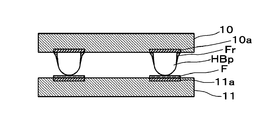
- FIG. 1 is a configuration diagram illustrating an example of a solder joint according to the present embodiment.
- the solder joint 1A of the present embodiment is one in which the electronic component 10 and the substrate 11 are joined with the solder H using the above-described flux composition.
- the epoxy resin is cured and remains after soldering, so that the soldered portion with the solder H is sealed with the flux residue Fr of the resin composition in which the epoxy resin is cured. You.
- the solder H may be composed of Sn alone, Sn-Ag, Sn-Cu, Sn-Ag-Cu, Sn-Bi, Sn-In, or the like, or Sb, Bi, In, Cu , Zn, As, Ag, Cd, Fe, Ni, Co, Au, Ge, P, etc. Solder balls made of solder, core balls made of Cu or the like coated with the above solder, flux composition and solder Using a solder paste containing metal powder.
- FIG. 2A, FIG. 2B, FIG. 2C, FIG. 2D, FIG. 2E, FIG. 2F, and FIG. 2G are explanatory views showing an example of the solder joining method of the present embodiment.
- the above-described flux composition F is applied to the electrode 10a of the electronic component 10 by transfer, printing, or the like.
- the solder ball HB made of the above-mentioned solder is placed on the flux composition F. Note that a core ball may be used.
- the solder is melted using a reflow device, and a solder bump HBp is formed on the electrode 10a of the electronic component 10.
- the epoxy resin in the flux composition F is cured to become flux residues Fr.
- the above-described flux composition F is applied to the electrode 11a of the substrate 11 by transfer, printing, or the like, and as shown in Step 5 of FIG.
- the solder bump HBp of the electronic component 10 is placed on the flux composition F applied to the electronic component 10.
- the solder is melted using a reflow device, and the electronic component 10 and the substrate 11 are joined with the solder H.
- the epoxy resin is cured and remains after the soldering, so that the soldered portion with the solder H is sealed with the flux residue Fr of the resin composition in which the epoxy resin is cured. You.
- thermosetting resin R such as an epoxy resin is filled between the electronic component 10 and the substrate 11, and the resin R is cured by heating, so that the electronic component 10 and the substrate 11 are hardened. 11 is sealed.
- a flux composition containing diallyl bisphenol A in an amount of 15 wt% to 45 wt%, an epoxy resin in an amount of 20 wt% to 50 wt%, and an organic acid in an amount of 1 wt% to 30 wt% has a viscosity that allows application by printing, transfer, or the like at room temperature. .
- the step of applying the flux composition to the electrode 10a of the electronic component 10 and the electrode 11a of the substrate 11 by the above-described solder joining method it is not necessary to heat the flux composition, and the reaction between the organic acid and the epoxy resin is prevented. Can be suppressed.
- diallyl bisphenol A has activity in the temperature range expected for soldering and functions as an activator. Accordingly, by including a predetermined amount of diallyl bisphenol A and an organic acid in the flux composition, the solder H can be spread on the electrode 10a of the electronic component 10 and the electrode 11a of the substrate 11 by the above-described solder joining method. .
- diallyl bisphenol A functions as a curing agent for accelerating the curing of the epoxy resin in a temperature range expected for soldering.
- the epoxy resin is hardened into the flux residue Fr by the above-described solder joining method, so that the soldered portion with the solder H can be sealed with the flux residue Fr containing the epoxy resin as a main component.
- compositions of Examples and Comparative Examples having the compositions shown in Table 1 below were prepared, and solderability, printability, and curability of flux residue were verified.
- the composition ratio in Table 1 is wt (weight)% when the total amount of the flux composition is 100.
- CAS No. No. of diallyl bisphenol A disclosed in Table 1 as a phenolic curing agent was used. Is 1745-89-7.
- solderability was evaluated by applying the flux compositions of Examples and Comparative Examples on a Cu plate, mounting solder balls on the flux composition applied on the Cu plate, and performing reflow. After performing, the solder wetting spread diameter was measured. In the reflow step, the temperature is increased from 35 ° C to 250 ° C in steps of 1 ° C per second using a reflow apparatus in which the peak temperature is set to 250 ° C, and after reaching 250 ° C, a heat treatment is performed for 30 seconds.
- the solder ball has a composition expressed as Sn-3Ag-0.5Cu, contains 3.0 wt% of Ag, 0.5 wt% of Cu, and the rest is Sn (96.5 wt%).
- the diameter of the solder ball is 0.3 mm.
- Judgment Criteria The amount of applied flux was 80% or more.
- X The amount of applied flux was less than 80%.
- Example 1 which contained 5 wt% within the range specified by the present invention and contained 5 wt% of hexyl diglycol as the solvent within the range specified by the present invention, the spread diameter of the solder satisfied the above-described criteria, and Sufficient effect was obtained on the attaching property.
- the application amount of the flux composition satisfied the criteria described above, and a sufficient effect on printability was obtained. Furthermore, the degree of hardening of the flux residue satisfied the above-mentioned criterion, and a sufficient effect on the curability of the flux residue was obtained.
- diallyl bisphenol A at an upper limit of 45 wt% within the range specified by the present invention, contains epoxy resin at 40 wt% within the range specified by the present invention, and glutaric acid as an organic acid is specified by the present invention. 5 wt% within the range, dimer acid as an organic acid is contained at 5 wt% within the range specified in the present invention, and the total of organic acids is within the range specified in the present invention, and ditolylguanidine is further used as an amine. 2% by weight within the range specified by the present invention and 3% by weight of hexyldiglycol as the solvent within the range specified by the present invention, the spread diameter of the solder also satisfies the above-described criteria.
- diallyl bisphenol A at a lower limit of 15 wt% within the range specified by the present invention, contains an epoxy resin at 35 wt% within the range specified by the present invention, and glutaric acid as an organic acid is specified by the present invention.
- 5% by weight in the range 10% by weight of dimer acid as the organic acid in the range specified in the present invention
- the total of the organic acids is in the range specified in the present invention
- ditolylguanidine as the amine Is contained in the range specified in the present invention 5% by weight of hydrogenated castor oil as a thixotropic agent, 5% by weight of a bisamide thixotropic agent, the total of the thixotropic agents is in the range specified in the present invention,
- Example 3 containing 20 wt% of hexyl diglycol as a solvent within the range specified in the present invention, the spread diameter of the solder satisfies the above-described criteria and the solderability is improved.
- diallyl bisphenol A within the range specified in the present invention, and as another phenolic curing agent, a phenol novolak type curing agent in an amount of 10% by weight within the range specified in the present invention, and an epoxy resin, It contains 40 wt% within the range specified by the present invention, contains glutaric acid as an organic acid, 5 wt% within the range specified by the present invention, and dimer acid as an organic acid, within 10 wt% within the range specified by the present invention.
- Example 4 containing 5 wt% within the range specified in the above, the spread diameter of the solder satisfies the above-described criterion, and a sufficient effect on the solderability is obtained. .
- the application amount of the flux composition satisfied the criteria described above, and a sufficient effect on printability was obtained.
- the degree of hardening of the flux residue satisfied the above-mentioned criterion, and a sufficient effect on the curability of the flux residue was obtained.
- Example 5 which contained 10 wt% of ditolylguanidine as a solvent within the range specified by the present invention and 3 wt% of hexyldiglycol within the range specified by the present invention, the spread diameter of the solder was as described above.
- the judgment criteria were satisfied, and a sufficient effect on the solderability was obtained.
- the application amount of the flux composition satisfied the criteria described above, and a sufficient effect on printability was obtained.
- the degree of hardening of the flux residue satisfied the above-mentioned criterion, and a sufficient effect on the curability of the flux residue was obtained.
- diallyl bisphenol A within the range specified by the present invention, 20% by weight of epoxy resin at the lower limit within the range specified by the present invention, and glutaric acid as the organic acid is specified by the present invention.
- 5% by weight in the range 10% by weight of dimer acid as the organic acid in the range specified in the present invention, the total of the organic acids is in the range specified in the present invention, and ditolylguanidine as the amine
- the spread diameter of the solder satisfied the above-described criteria, and a sufficient effect on the solderability was obtained.
- the application amount of the flux composition satisfied the criteria described above, and a sufficient effect on printability was obtained.
- the degree of hardening of the flux residue satisfied the above-mentioned criterion, and a sufficient effect on the curability of the flux residue was obtained.
- Example 7 containing 5 wt% in the range specified by the present invention and 5 wt% in the range specified by the present invention as a solvent, the spread diameter of the solder satisfies the above criterion, Sufficient effect was obtained on the attaching property.
- the application amount of the flux composition satisfied the criteria described above, and a sufficient effect on printability was obtained. Furthermore, the degree of hardening of the flux residue satisfied the above-mentioned criterion, and a sufficient effect on the curability of the flux residue was obtained.
- diallyl bisphenol A within the range specified by the present invention
- glutaric acid as the organic acid within the range specified by the present invention.
- dimer acid as an organic acid within the range specified in the present invention
- the total of organic acids is within the range specified in the present invention.
- ditolylguanidine is used as an amine.
- Example 8 containing 5 wt%, satisfies the criteria spread diameter of solder mentioned above, a sufficient effect was obtained for solderability.
- the application amount of the flux composition satisfied the criteria described above, and a sufficient effect on printability was obtained.
- the degree of hardening of the flux residue satisfied the above-mentioned criterion, and a sufficient effect on the curability of the flux residue was obtained.
- the spread diameter of the solder is in accordance with the aforementioned criterion. Tashi, a sufficient effect was obtained for the solderability.
- the application amount of the flux composition satisfied the criteria described above, and a sufficient effect on printability was obtained.
- the degree of hardening of the flux residue satisfied the above-mentioned criterion, and a sufficient effect on the curability of the flux residue was obtained.
- diallyl bisphenol A within the range specified by the present invention, 40% by weight of epoxy resin within the range specified by the present invention, and glutaric acid as the organic acid within the range specified by the present invention.
- dimer acid as an organic acid in the range defined in the present invention, and the total of organic acids is in the range specified in the present invention.
- ditolylguanidine is used as an amine.
- N-2- (aminoethyl) -3-aminopropyltrimethoxysilane as a silane coupling agent as an additive is contained within 5% by weight within the range specified in the present invention.
- the application amount of the flux composition satisfied the criteria described above, and a sufficient effect on printability was obtained. Furthermore, the degree of hardening of the flux residue satisfied the above-mentioned criterion, and a sufficient effect on the curability of the flux residue was obtained.
- diallyl bisphenol A contains 5 wt% below the range specified in the present invention
- epoxy resin contains 60 wt% exceeding the range specified in the present invention
- glutaric acid as an organic acid is used in the present invention. It contains 5 wt% within the specified range, contains 10% by weight of dimer acid as an organic acid within the range specified in the present invention, and the total of organic acids is within the range specified by the present invention.
- Comparative Example 1 in which ditolylguanidine was contained at 5 wt% within the range specified by the present invention and hexyl diglycol was used as a solvent at 15 wt% within the range specified by the present invention, the spread diameter of the solder was determined as described above.
- diallyl bisphenol A contains 60% by weight of epoxy resin beyond the range specified in the present invention, and contains glutaric acid as an organic acid in an amount of 5% by weight within the range specified in the present invention.
- Dimer acid is contained in the range defined by the present invention in an amount of 10 wt%, the total amount of organic acids is in the range defined in the present invention, and ditolylguanidine is further used as an amine in the range defined in the present invention.
- Comparative Example 2 containing 5 wt% as a solvent and 20 wt% of hexyl diglycol as a solvent within the range specified in the present invention, the spread diameter of the solder satisfies the above-described criterion, and has a sufficient effect on solderability. was gotten.
- the applied amount of the flux composition satisfied the above-described criteria, and a sufficient effect on printability was obtained.
- neither diallyl bisphenol A nor any other phenolic curing agent was included, the degree of curing of the flux residue did not satisfy the above-described criteria, and no effect was obtained on the flux residue curability.
- diallyl bisphenol A is contained in an amount of 60 wt% exceeding the range specified in the present invention, an epoxy resin in an amount of 20 wt% in the range specified in the present invention, and glutaric acid as an organic acid is specified in the present invention.
- the applied amount of the flux composition satisfied the above-described criteria, and a sufficient effect on printability was obtained.
- the amount of the curing agent is large relative to the epoxy resin, even when diallyl bisphenol A is included, the degree of curing of the flux residue does not satisfy the above-described criterion, and the effect on the flux residue curability is not improved. Can not be obtained.
- diallyl bisphenol A contains 35% by weight of a phenol novolak type curing agent as another phenolic curing agent in excess of the range specified in the present invention, and contains an epoxy resin in the range specified in the present invention.
- ditolylguanidine as an amine in an amount of 5 wt% in the range specified in the present invention, and hexyldiglycol as a solvent in an amount of 5 wt% in the range specified in the present invention.
Landscapes
- Engineering & Computer Science (AREA)
- Mechanical Engineering (AREA)
- Chemical & Material Sciences (AREA)
- Materials Engineering (AREA)
- Metallurgy (AREA)
- Organic Chemistry (AREA)
- Electric Connection Of Electric Components To Printed Circuits (AREA)
- Epoxy Resins (AREA)
Abstract
フィルム形成の工程を行うことなく塗布が可能なフラックス組成物、このフラックス組成物を用いたはんだペースト、はんだ接合部及びはんだ接合方法を提供する。 フラックス組成物は、エポキシ樹脂を20wt%以上50wt%以下、ジアリルビスフェノールAを15wt%以上45wt%以下、有機酸を1wt%以上30wt%以下含む。
Description
本発明は、はんだ付けに用いられるフラックス組成物、このフラックス組成物を用いたはんだペースト、はんだ接合部及びはんだ接合方法に関する。
一般的に、はんだ付けに用いられるフラックスは、はんだ及びはんだ付けの対象となる接合対象物の金属表面に存在する金属酸化物を化学的に除去し、両者の境界で金属元素の移動を可能にする効能を持つ。このため、フラックスを使用してはんだ付けを行うことで、はんだと接合対象物の金属表面との間に金属間化合物が形成できるようになり、強固な接合が得られる。
近年の電子部品の小型化の進展につれて、電子部品のはんだ付け部位である電極も小さくなってきている。そのため、はんだ合金で接合できる面積が小さくなり、はんだ合金だけでの接合強度では、接合信頼性に不十分な場合もある。
そこで、従来、フラックスを使用してはんだ付けを行い、その後、洗浄・乾燥工程を経て、アンダーフィル等の樹脂によって、はんだ付けの接合対象箇所を封止する実装技術が知られている。
更に、最近では、エポキシ樹脂に代表される熱硬化性樹脂を含有することで、はんだ付け後に残存する樹脂組成物を、樹脂封止と同等の効果を持たせるフラックス組成物が着目されている。
エポキシ樹脂を含有するフラックス組成物では、エポキシ樹脂の硬化を促進させるため、硬化剤が添加される。このような硬化剤として、イミダゾール類、アミン類、フェノールノボラック類等の硬化剤が知られている(例えば、特許文献1、2参照)。また、硬化剤として、金属酸化物を化学的に除去する活性を有するフェノール系硬化剤を用いることで、活性剤を添加することなく、電気的接続を行う技術が提案されている(例えば、特許文献3参照)。
しかし、エポキシ樹脂とイミダゾール類、アミン類、フェノールノボラック類等の硬化剤を含有する従来のフラックス組成物では、十分な量のフラックス組成物を塗布できるか否かの印刷性、このフラックス組成物を使用したはんだ付けではんだが十分に広がるか否かのはんだ付け性、このフラックス組成物を使用したはんだ付けでフラックス残渣が十分に硬化するか否かのフラックス残渣硬化性の全てについて、効果を得ることが難しかった。また、エポキシ樹脂と活性を有するフェノール系硬化剤を含有する従来のフラックス組成物では、フラックス組成物をフィルムの形態で電極等に転写する必要があり、事前にフィルム形成の工程が必要であった。
また、フラックス組成物の活性を高めるため、更に有機酸等の活性剤を添加しても、フィルム形成の工程でフラックス組成物が加熱されることで、活性剤とエポキシ樹脂が反応し、活性が失われるという問題があった。
本発明は、このような課題を解決するためなされたもので、フィルム形成の工程を行うことなく、電極等への塗布が可能なフラックス組成物、このフラックス組成物を用いたはんだペースト、はんだ接合部及びはんだ接合方法を提供することを目的とする。
はんだ付けで想定される温度域でエポキシ樹脂の硬化を促進させる硬化剤として機能し、また、はんだ付けで想定される温度域で活性を有して活性剤として機能するジアリルビスフェノールAは、常温で印刷、転写等による塗布が可能な粘性をフラックス組成物に持たせることを見出した。
そこで、本発明は、エポキシ樹脂を20wt%以上50wt%以下、ジアリルビスフェノールAを15wt%以上45wt%以下、有機酸を1wt%以上30wt%以下含むフラックス組成物である。
本発明は、さらにその他のフェノール系硬化剤を0wt%以上10wt%以下、アミンを0wt%以上10wt%以下溶剤を0wt%以上20wt%以下含んでも良い。
本発明は、さらにアミンハロゲン化水素酸塩を0wt%以上2wt%以下、有機ハロゲン化合物を0wt%以上5wt%以下、チキソ剤を0wt%以上10wt%以下、シランカップリング剤を0wt%以上2wt%以下、消泡剤を0wt%以上2wt%以下含んでも良い。
また、本発明は、上述したフラックス組成物と、はんだ粉末を混合したはんだペーストである。更に、本発明は、上述したフラックス組成物を用いたはんだ接合部である。また、本発明は、上述したフラックス組成物を用いたはんだ接合方法である。
ジアリルビスフェノールAを15wt%以上45wt%以下、エポキシ樹脂を20wt%以上50wt%以下、有機酸を1wt%以上30wt%以下含むフラックス組成物は、常温で印刷、転写等による塗布が可能な粘性を持つ。これにより、フラックス組成物を塗布する行程で、フラックス組成物を加熱する必要がなく、有機酸とエポキシ樹脂の反応を抑制することができる。
また、ジアリルビスフェノールAは、はんだ付けで想定される温度域で活性を有して活性剤として機能する。これにより、フラックス組成物に所定量のジアリルビスフェノールAと有機酸を含むことにより、はんだを濡れ広がらせることができる。
更に、ジアリルビスフェノールAは、はんだ付けで想定される温度域でエポキシ樹脂の硬化を促進させる硬化剤として機能する。これにより、エポキシ樹脂が硬化してフラックス残渣となることで、はんだによるはんだ付け箇所を、エポキシ樹脂を主成分としたフラックス残渣で封止することができる。
<本実施の形態のフラックス組成物の一例>
本実施の形態のフラックス組成物は、フェノール系硬化剤としてジアリルビスフェノールAを含む。また、本実施の形態のフラックス組成物は、エポキシ樹脂と有機酸を含む。
本実施の形態のフラックス組成物は、フェノール系硬化剤としてジアリルビスフェノールAを含む。また、本実施の形態のフラックス組成物は、エポキシ樹脂と有機酸を含む。
ジアリルビスフェノールAは、アリル基とフェノール性水酸基を有する化合物である。ジアリルビスフェノールAは、はんだ付けで想定される温度域でエポキシ樹脂の硬化を促進させる硬化剤として機能する。また、ジアリルビスフェノールAは、はんだ付けで想定される温度域で活性を有して活性剤として機能する。更に、ジアリルビスフェノールAは、常温で印刷、転写等による塗布が可能な粘性をフラックス組成物に持たせる。
ジアリルビスフェノールA以外のフェノール系硬化剤を、エポキシ樹脂の硬化剤として含むフラックス組成物では、基板等にフラックス組成物を塗布する行程で、フラックス組成物を加熱してフィルムを形成する必要がある。フラックス組成物が加熱されると、エポキシ樹脂と活性剤との反応が促進され、活性剤とエポキシ樹脂が反応すると、はんだが濡れる前にエポキシ樹脂が硬化する可能性がある。また、活性剤とエポキシ樹脂が反応すると、金属酸化物を化学的に除去する活性が十分でなくなり、はんだの濡れ性が悪化する。
そこで、本実施の形態のフラックス組成物は、フェノール系硬化剤としてジアリルビスフェノールAを、フラックス組成物の全体を100とした場合、15wt%以上45wt%以下、好ましくは、30wt%以上40wt%以下含む。
本実施の形態のフラックス組成物は、エポキシ樹脂を20wt%以上50wt%以下、好ましくは、25wt%以上45wt%以下含む。また、本実施の形態のフラックスは、有機酸を1wt%以上30wt%以下、好ましくは、5wt%以上20wt%以下含む。
更に、本実施の形態のフラックス組成物は、所定量のジアリルビスフェノールAを含むのであれば、他のフェノール系硬化剤を含んでも良く、他のフェノール系硬化剤を0wt%以上10wt%以下含む。
また、本実施の形態のフラックス組成物は、アミンを0wt%以上10wt%以下、アミンハロゲン水素酸塩を0wt%以上2wt%以下、有機ハロゲン化合物を0wt%以上5wt%以下、チキソ剤を0wt%以上10wt%以下、その他添加剤としてシランカップリング剤を0wt%以上2wt%以下、消泡剤を0wt%以上2wt%以下、溶剤を0wt%以上20wt%以下含む。
エポキシ樹脂としては、ビスフェノール型として、ビスフェノールA型、ビスフェノールAP型、ビスフェノールAF型、ビスフェノールB型、ビスフェノールBP型、ビスフェノールC型、ビスフェノールE型、ビスフェノールF型、ビスフェノールG型、ビスフェノールM型、ビスフェノールS型、ビスフェノールP型、ビスフェノールPH型、ビスフェノールTMC型、ビスフェノールZ型、ビフェニル型エポキシ樹脂、ジフェニルエーテル型エポキシ樹脂、ナフタレン型エポキシ樹脂、アミノフェノール型エポキシ樹脂、3′,4′-エポキシシクロヘキサンカルボン酸3,4-エポキシシクロヘキシルメチルなどが挙げられる。
有機酸としては、グルタル酸、アジピン酸、アゼライン酸、エイコサン二酸、クエン酸、グリコール酸、コハク酸、サリチル酸、ジグリコール酸、ジピコリン酸、ジブチルアニリンジグリコール酸、スベリン酸、セバシン酸、チオグリコール酸、イソフタル酸、テレフタル酸、ドデカン二酸、パラヒドロキシフェニル酢酸、ピコリン酸、フェニルコハク酸、フタル酸、フマル酸、マレイン酸、マロン酸、ラウリン酸、安息香酸、酒石酸、イソシアヌル酸トリス(2-カルボキシエチル)、グリシン、1,3-シクロヘキサンジカルボン酸、2,2-ビス(ヒドロキシメチル)プロピオン酸、2,2-ビス(ヒドロキシメチル)ブタン酸、2,3-ジヒドロキシ安息香酸、2,4-ジエチルグルタル酸、2-キノリンカルボン酸、3-ヒドロキシ安息香酸、リンゴ酸、p-アニス酸、ステアリン酸、12-ヒドロキシステアリン酸、オレイン酸、リノール酸、リノレン酸等が挙げられる。
また、有機酸としては、モノカルボン酸を2量体化させたダイマー酸、ダイマー酸に水素を添加した水添物である水添ダイマー酸、モノカルボン酸を3量体化させたトリマー酸、トリマー酸に水素を添加した水添物である水添トリマー酸が挙げられる。
ダイマー酸、トリマー酸、及びそれらの水添物としては、例えば、オレイン酸とリノール酸の反応物であるダイマー酸、オレイン酸とリノール酸の反応物であるトリマー酸、アクリル酸の反応物であるダイマー酸、アクリル酸の反応物であるトリマー酸、メタクリル酸の反応物であるダイマー酸、メタクリル酸の反応物であるトリマー酸、アクリル酸とメタクリル酸の反応物であるダイマー酸、アクリル酸とメタクリル酸の反応物であるトリマー酸、オレイン酸の反応物であるダイマー酸、オレイン酸の反応物であるトリマー酸、リノール酸の反応物であるダイマー酸、リノール酸の反応物であるトリマー酸、 リノレン酸の反応物であるダイマー酸、リノレン酸の反応物であるトリマー酸、アクリル酸とオレイン酸の反応物であるダイマー酸、アクリル酸とオレイン酸の反応物であるトリマー酸、アクリル酸とリノール酸の反応物であるダイマー酸、アクリル酸とリノール酸の反応物であるトリマー酸、アクリル酸とリノレン酸の反応物であるダイマー酸、アクリル酸とリノレン酸の反応物であるトリマー酸、メタクリル酸とオレイン酸の反応物であるダイマー酸、メタクリル酸とオレイン酸の反応物であるトリマー酸、メタクリル酸とリノール酸の反応物であるダイマー酸、メタクリル酸とリノール酸の反応物であるトリマー酸、メタクリル酸とリノレン酸の反応物であるダイマー酸、メタクリル酸とリノレン酸の反応物であるトリマー酸、オレイン酸とリノレン酸の反応物であるダイマー酸、オレイン酸とリノレン酸の反応物であるトリマー酸、リノール酸とリノレン酸の反応物であるダイマー酸、リノール酸とリノレン酸の反応物であるトリマー酸、上述した各ダイマー酸の水添物である水添ダイマー酸、上述した各トリマー酸の水添物である水添トリマー酸等が挙げられる。
ジアリルビスフェノールA以外のフェノール系硬化剤としては、フェノールノボラック型硬化剤等が挙げられる。
アミンとしては、モノエタノールアミン、ジフェニルグアニジン、ジトリルグアニジン、エチルアミン、トリエチルアミン、エチレンジアミン、トリエチレンテトラミン、2-メチルイミダゾール、2-インデシルイミダゾール、2-ウンデシルイミダゾール、2-ヘプタデシルイミダゾール、1,2-ジメチルイミダゾール、2-エチル-4-メチルイミダゾール、2-フェニルイミダゾール、2-フェニル-4-メチルイミダゾール、1-ベンジル-2-メチルイミダゾール、1-ベンジル-2-フェニルイミダゾール、1-シアノエチル-2-メチルイミダゾール、1-シアノエチル-2-ウンデシルイミダゾール、1-シアノエチル-2-エチル-4-メチルイミダゾール、1-シアノエチル-2-フェニルイミダゾール、1-シアノエチル-2-ウンデシルイミダゾリウムトリメリテイト、1-シアノエチル-2-フェニルイミダゾリウムトリメリテイト、2,4-ジアミノ-6-[2′-メチルイミダゾリル-(1′)]-エチル-s-トリアジン、2,4-ジアミノ-6-[2′-ウンデシルイミダゾリル-(1′)]-エチル-s-トリアジン、2,4-ジアミノ-6-[2′-エチル-4′-メチルイミダゾリル-(1′)]-エチル-s-トリアジン、2,4-ジアミノ-6-[2′-メチルイミダゾリル-(1′)]-エチル-s-トリアジンイソシアヌル酸付加物、2-フェニルイミダゾールイソシアヌル酸付加物、2-フェニル-4,5-ジヒドロキシメチルイミダゾール、2-フェニル-4-メチル-5-ヒドロキシメチルイミダゾール、2,3-ジヒドロ-1H-ピロロ[1,2-a]ベンズイミダゾール、1-ドデシル-2-メチル-3-ベンジルイミダゾリウムクロライド、2-メチルイミダゾリン、2-フェニルイミダゾリン、2,4-ジアミノ-6-ビニル-s-トリアジン、2,4-ジアミノ-6-ビニル-s-トリアジンイソシアヌル酸付加物、2,4-ジアミノ-6-メタクリロイルオキシエチル-s-トリアジン、エポキシ-イミダゾールアダクト、2-メチルベンゾイミダゾール、2-オクチルベンゾイミダゾール、2-ペンチルベンゾイミダゾール、2-(1-エチルペンチル)ベンゾイミダゾール、2-ノニルベンゾイミダゾール、2-(4-チアゾリル)ベンゾイミダゾール、ベンゾイミダゾール、2-(2′-ヒドロキシ-5′-メチルフェニル)ベンゾトリアゾール、2-(2′-ヒドロキシ-3′-tert-ブチル-5′-メチルフェニル)-5-クロロベンゾトリアゾール、2-(2′-ヒドロキシ-3′,5′-ジ-tert-アミルフェニル)ベンゾトリアゾール、2-(2′-ヒドロキシ-5′-tert-オクチルフェニル)ベンゾトリアゾール、2,2′-メチレンビス[6-(2H-ベンゾトリアゾール-2-イル)-4-tert-オクチルフェノール]、6-(2-ベンゾトリアゾリル)-4-tert-オクチル-6′-tert-ブチル-4′-メチル-2,2′-メチレンビスフェノール、1,2,3-ベンゾトリアゾール、1-[N,N-ビス(2-エチルヘキシル)アミノメチル]ベンゾトリアゾール、カルボキシベンゾトリアゾール、1-[N,N-ビス(2-エチルヘキシル)アミノメチル]メチルベンゾトリアゾール、2,2′-[[(メチル-1H-ベンゾトリアゾール-1-イル)メチル]イミノ]ビスエタノール、1-(1′,2′-ジカルボキシエチル)ベンゾトリアゾール、1-(2,3-ジカルボキシプロピル)ベンゾトリアゾール、1-[(2-エチルヘキシルアミノ)メチル]ベンゾトリアゾール、2,6-ビス[(1H-ベンゾトリアゾール-1-イル)メチル]-4-メチルフェノール、5-メチルベンゾトリアゾール、5-フェニルテトラゾール等が挙げられる。
ハロゲンとしてのアミンハロゲン化水素酸塩は、アミンとハロゲン化水素を反応させた化合物であり、アニリン塩化水素、アニリン臭化水素等が挙げられる。アミンハロゲン化水素酸塩のアミンとしては、上述したアミンを用いることができ、エチルアミン、エチレンジアミン、トリエチルアミン、メチルイミダゾール、2-エチル-4-メチルイミダゾール等が挙げられ、ハロゲン化水素としては、塩素、臭素、ヨウ素、フッ素の水素化物(塩化水素、臭化水素、ヨウ化水素、フッ化水素)が挙げられる。また、アミンハロゲン化水素酸塩に代えて、あるいはアミンハロゲン化水素酸塩と合わせてホウフッ化物を含んでも良く、ホウフッ化物としてホウフッ化水素酸等が挙げられる。
ハロゲンとしての有機ハロゲン化合物としては、trans-2,3-ジブロモ-2-ブテン-1,4-ジオール、trans-2,3-ジブロモ-1,4-ブテンジオール、トリアリルイソシアヌレート6臭化物、1-ブロモ-2-ブタノール、1-ブロモ-2-プロパノール、3-ブロモ-1-プロパノール、3-ブロモ-1,2-プロパンジオール、1,4-ジブロモ-2-ブタノール、1,3-ジブロモ-2-プロパノール、2,3-ジブロモ-1-プロパノール、2,3-ジブロモ-1,4-ブタンジオール、2,3-ジブロモ-2-ブテン-1,4-ジオール等が挙げられる。
チキソ剤としては、ワックス系チキソ剤、アマイド系チキソ剤が挙げられる。ワックス系チキソ剤としては例えば硬化ヒマシ油等が挙げられる。アマイド系チキソ剤としてはラウリン酸アマイド、パルミチン酸アマイド、ステアリン酸アマイド、ベヘン酸アマイド、ヒドロキシステアリン酸アマイド、飽和脂肪酸アマイド、オレイン酸アマイド、エルカ酸アマイド、不飽和脂肪酸アマイド、p-トルエンメタンアマイド、芳香族アマイド、メチレンビスステアリン酸アマイド、エチレンビスラウリン酸アマイド、エチレンビスヒドロキシステアリン酸アマイド、飽和脂肪酸ビスアマイド、メチレンビスオレイン酸アマイド、不飽和脂肪酸ビスアマイド、m-キシリレンビスステアリン酸アマイド、芳香族ビスアマイド、飽和脂肪酸ポリアマイド、不飽和脂肪酸ポリアマイド、芳香族ポリアマイド、置換アマイド、メチロールステアリン酸アマイド、メチロールアマイド、脂肪酸エステルアマイド等が挙げられる。
シランカップリング剤としては、ビニルトリメトキシシラン、ビニルトリエトキシシラン、2-(3,4-エポキシシクロヘキシル)エチルトリメトキシシラン、3-グリシドキシプロピルメチルジメトキシシラン、3-グリシドキシプロピルトリメトキシシラン、3-グリシドキシプロピルメチルジエトキシシラン、3-グリシドキシプロピルトリエトキシシラン、p-スチリルトリメトキシシラン、3-メタクリロキシプロピルメチルジメトキシシラン、3-メタクリロキシプロピルトリメトキシシラン、3-メタクリロキシプロピルメチルジエトキシシラン、3-メタクリロキシプロピルトリエトキシシラン、3-アクリロキシプロピルトリメトキシシラン、N-2-(アミノエチル)-3-アミノプロピルトリメトキシシシラン、N-2-(アミノエチル)-3-アミノプロピルメチルジメトキシシラン、N-2-(アミノエチル)-3-アミノプロピルトリメトキシシラン、3-アミノプロピルトリメトキシシラン、3-アミノプロピルトリエトキシシラン、3-トリエトキシシリル-N-(1,3-ジメチル-ブチリデン)プロピルアミン、N-フェニル-2-アミノプロピルトリメトキシシラン、トリス-(トリメトキシシリルプロピル)イソシアヌレート、3-ウレイドプロピルトリエトキシシラン、3-メルカプトプロピルメチルジメトキシシラン、3-メルカプトプロピルトリメトキシシラン、ビス(トリエトキシシリルプロピル)テトラスルフィド、3-イソシアネートプロピルトリエトキシシラン等が挙げられる。
消泡剤としては、アクリルポリマー、ビニルエーテルポリマー、ブタジエンポリマー等が挙げられる。
溶剤としては、アルコール系溶剤、グリコールエーテル系溶剤、テルピネオール類等が挙げられる。アルコール系溶剤としてはエタノール、工業用エタノール(エタノールにメタノール及び/またはイソプロピルアルコールを添加した混合溶剤)、イソプロピルアルコール、1,2-ブタンジオール、イソボルニルシクロヘキサノール、2,4-ジエチル-1,5-ペンタンジオール、2,2-ジメチル-1,3-プロパンジオール、2,5-ジメチル-2,5-ヘキサンジオール、2,5-ジメチル-3-ヘキシン-2,5-ジオール、2,3-ジメチル-2,3-ブタンジオール、1,1,1-トリス(ヒドロキシメチル)エタン、2-エチル-2-ヒドロキシメチル-1,3-プロパンジオール、2,2′-オキシビス(メチレン)ビス(2-エチル-1,3-プロパンジオール)、2,2-ビス(ヒドロキシメチル)-1,3-プロパンジオール、1,2,6-トリヒドロキシヘキサン、ビス[2,2,2-トリス(ヒドロキシメチル)エチル]エーテル、1-エチニル-1-シクロヘキサノール、1,4-シクロヘキサンジオール、1,4-シクロヘキサンジメタノール、エリトリトール、トレイトール、グアヤコールグリセロールエーテル、3,6-ジメチル-4-オクチン-3,6-ジオール、2,4,7,9-テトラメチル-5-デシン-4,7-ジオール等が挙げられる。グリコールエーテル系溶剤としては、ヘキシルジグリコール、ジエチレングリコールモノ-2-エチルヘキシルエーテル、エチレングリコールモノフェニルエーテル、2-メチルペンタン-2,4-ジオール、ジエチレングリコールモノヘキシルエーテル、ジエチレングリコールジブチルエーテル、トリエチレングリコールモノブチルエーテル、ジエチルジグリコールエーテル等が挙げられる。
<本実施の形態のはんだペーストの一例>
本実施の形態のはんだペーストは、上述したフラックス組成物と、金属粉を含む。金属粉は、Pbを含まないはんだであることが好ましく、Sn単体、または、Sn-Ag系、Sn-Cu系、Sn-Ag-Cu系、Sn-Bi系、Sn-In系等、あるいは、これらの合金にSb、Bi、In、Cu、Zn、As、Ag、Cd、Fe、Ni、Co、Au、Ge、P等を添加したはんだの粉体で構成される。
本実施の形態のはんだペーストは、上述したフラックス組成物と、金属粉を含む。金属粉は、Pbを含まないはんだであることが好ましく、Sn単体、または、Sn-Ag系、Sn-Cu系、Sn-Ag-Cu系、Sn-Bi系、Sn-In系等、あるいは、これらの合金にSb、Bi、In、Cu、Zn、As、Ag、Cd、Fe、Ni、Co、Au、Ge、P等を添加したはんだの粉体で構成される。
<本実施の形態のはんだ接合部の一例>
図1は、本実施の形態のはんだ接合部の一例を示す構成図である。本実施の形態のはんだ接合部1Aは、上述したフラックス組成物を用いて、電子部品10と基板11がはんだHで接合されたものである。上述した本実施の形態のフラックス組成物は、エポキシ樹脂が硬化してはんだ付け後に残存することで、はんだHによるはんだ付け箇所が、エポキシ樹脂が硬化した樹脂組成物によるフラックス残渣Frで封止される。
図1は、本実施の形態のはんだ接合部の一例を示す構成図である。本実施の形態のはんだ接合部1Aは、上述したフラックス組成物を用いて、電子部品10と基板11がはんだHで接合されたものである。上述した本実施の形態のフラックス組成物は、エポキシ樹脂が硬化してはんだ付け後に残存することで、はんだHによるはんだ付け箇所が、エポキシ樹脂が硬化した樹脂組成物によるフラックス残渣Frで封止される。
はんだHは、Sn単体、または、Sn-Ag系、Sn-Cu系、Sn-Ag-Cu系、Sn-Bi系、Sn-In系等、あるいは、これらの合金にSb、Bi、In、Cu、Zn、As、Ag、Cd、Fe、Ni、Co、Au、Ge、P等を添加したはんだによるはんだボール、Cu等の核を上述したはんだで被覆した核ボール、上述したフラックス組成物とはんだによる金属粉を含むはんだペースト等を用いたものである。
<本実施の形態のはんだ接合方法の一例>
図2A、図2B、図2C、図2D、図2E、図2F及び図2Gは、本実施の形態のはんだ接合方法の一例を示す説明図である。まず、図2Aの工程1に示すように、電子部品10の電極10aに、上述したフラックス組成物Fを転写、印刷等により塗布する。
図2A、図2B、図2C、図2D、図2E、図2F及び図2Gは、本実施の形態のはんだ接合方法の一例を示す説明図である。まず、図2Aの工程1に示すように、電子部品10の電極10aに、上述したフラックス組成物Fを転写、印刷等により塗布する。
次に、図2Bの工程2に示すように、フラックス組成物Fに、上述したはんだによるはんだボールHBを載せる。なお、核ボールを用いても良い。次に、図2Cの工程3に示すように、リフロー装置を用いてはんだを溶融させ、電子部品10の電極10aにはんだバンプHBpを形成する。はんだバンプHBpを形成する行程で、フラックス組成物F中のエポキシ樹脂が硬化してフラックス残渣Frとなる。
次に、図2Dの工程4に示すように、基板11の電極11aに、上述したフラックス組成物Fを転写、印刷等により塗布し、図2Eの工程5に示すように、基板11の電極11aに塗布したフラックス組成物Fに、電子部品10のはんだバンプHBpを載せる。
次に、図2Fの工程6に示すように、リフロー装置を用いてはんだを溶融させ、電子部品10と基板11をはんだHで接合する。上述した本実施の形態のフラックス組成物は、エポキシ樹脂が硬化してはんだ付け後に残存することで、はんだHによるはんだ付け箇所が、エポキシ樹脂が硬化した樹脂組成物によるフラックス残渣Frで封止される。
更に、図2Gの工程7に示すように、電子部品10と基板11との間にエポキシ樹脂等の熱硬化性の樹脂Rを充填し、加熱により樹脂Rを硬化させて、電子部品10と基板11との間を封止する。
<本実施の形態のフラックス組成物、はんだペースト、はんだ接合部及びはんだ接合方法の作用効果例>
ジアリルビスフェノールAを15wt%以上45wt%以下、エポキシ樹脂を20wt%以上50wt%以下、有機酸を1wt%以上30wt%以下含むフラックス組成物は、常温で印刷、転写等による塗布が可能な粘性を持つ。
ジアリルビスフェノールAを15wt%以上45wt%以下、エポキシ樹脂を20wt%以上50wt%以下、有機酸を1wt%以上30wt%以下含むフラックス組成物は、常温で印刷、転写等による塗布が可能な粘性を持つ。
これにより、上述したはんだ接合方法で、電子部品10の電極10a及び基板11の電極11aにフラックス組成物を塗布する行程で、フラックス組成物を加熱する必要がなく、有機酸とエポキシ樹脂の反応を抑制することができる。
また、ジアリルビスフェノールAは、はんだ付けで想定される温度域で活性を有して活性剤として機能する。これにより、フラックス組成物に所定量のジアリルビスフェノールAと有機酸を含むことにより、上述したはんだ接合方法で、はんだHを電子部品10の電極10a及び基板11の電極11aに濡れ広がらせることができる。
更に、ジアリルビスフェノールAは、はんだ付けで想定される温度域でエポキシ樹脂の硬化を促進させる硬化剤として機能する。これにより、上述したはんだ接合方法で、エポキシ樹脂が硬化してフラックス残渣Frとなることで、はんだHによるはんだ付け箇所を、エポキシ樹脂を主成分としたフラックス残渣Frで封止することができる。
以下の表1に示す組成で実施例と比較例のフラックス組成物を調合し、はんだ付け性、印刷性及びフラックス残渣硬化性について検証した。なお、表1における組成率は、フラックス組成物の全量を100とした場合のwt(重量)%である。また、表1においてフェノール系硬化剤として開示されたジアリルビスフェノールAのCAS No.は1745-89-7である。
<はんだ付け性の評価>
(1)検証方法
はんだ付け性の評価は、Cu板上に各実施例、各比較例のフラックス組成物を塗布し、Cu板上に塗布したフラックス組成物上にはんだボールを搭載し、リフローを行った後、はんだ濡れ広がり径を測定した。リフロー工程は、ピーク温度を250℃に設定したリフロー装置を用いて、35℃から1秒毎に1℃ずつ250℃まで温度を上昇させていき、250℃に達した後30秒間加熱処理を行った。はんだボールは、Sn-3Ag-0.5Cuと表記される組成であり、Agを3.0wt%、Cuを0.5wt%含み、残部がSn(96.5wt%)である。はんだボールの直径は、0.3mmである。
(1)検証方法
はんだ付け性の評価は、Cu板上に各実施例、各比較例のフラックス組成物を塗布し、Cu板上に塗布したフラックス組成物上にはんだボールを搭載し、リフローを行った後、はんだ濡れ広がり径を測定した。リフロー工程は、ピーク温度を250℃に設定したリフロー装置を用いて、35℃から1秒毎に1℃ずつ250℃まで温度を上昇させていき、250℃に達した後30秒間加熱処理を行った。はんだボールは、Sn-3Ag-0.5Cuと表記される組成であり、Agを3.0wt%、Cuを0.5wt%含み、残部がSn(96.5wt%)である。はんだボールの直径は、0.3mmである。
(2)判定基準
○:はんだの広がり径が510μm以上であった。
×:はんだの広がり径が510μm未満であった。
○:はんだの広がり径が510μm以上であった。
×:はんだの広がり径が510μm未満であった。
<印刷性の評価>
(1)検証方法
開口径0.24mm、厚さ0.1mmのメタルマスクとメタルスキージを用いて、Cu板上に各実施例、各比較例のフラックス組成物を塗布し、その後、フラックス組成物の塗布量を測定した。
(1)検証方法
開口径0.24mm、厚さ0.1mmのメタルマスクとメタルスキージを用いて、Cu板上に各実施例、各比較例のフラックス組成物を塗布し、その後、フラックス組成物の塗布量を測定した。
(2)判定基準
〇:フラックスの塗布量が80%以上であった。
×:フラックスの塗布量が80%未満であった。
〇:フラックスの塗布量が80%以上であった。
×:フラックスの塗布量が80%未満であった。
<フラックス残渣硬化性の評価>
(1)検証方法
Cu板上に各実施例、各比較例のフラックス組成物を塗布し、リフローを行った後、フラックス残渣硬化性を確認した。リフロー工程は、ピーク温度を250℃に設定したリフロー装置を用いて、35℃から1秒毎に1℃ずつ250℃まで温度を上昇させていき、250℃に達した後30秒間加熱処理を行った。
(1)検証方法
Cu板上に各実施例、各比較例のフラックス組成物を塗布し、リフローを行った後、フラックス残渣硬化性を確認した。リフロー工程は、ピーク温度を250℃に設定したリフロー装置を用いて、35℃から1秒毎に1℃ずつ250℃まで温度を上昇させていき、250℃に達した後30秒間加熱処理を行った。
(2)判定基準
〇:残渣が硬化していた(固体化)。
×:残渣が硬化していなかった(液状もしくはペースト状)。
〇:残渣が硬化していた(固体化)。
×:残渣が硬化していなかった(液状もしくはペースト状)。
<総合評価>
〇:はんだ付け性、印刷性及びフラックス残渣硬化性の評価の全てが〇であった。
×:はんだ付け性、印刷性及びフラックス残渣硬化性の評価の何れか、または全てが×であった。
〇:はんだ付け性、印刷性及びフラックス残渣硬化性の評価の全てが〇であった。
×:はんだ付け性、印刷性及びフラックス残渣硬化性の評価の何れか、または全てが×であった。
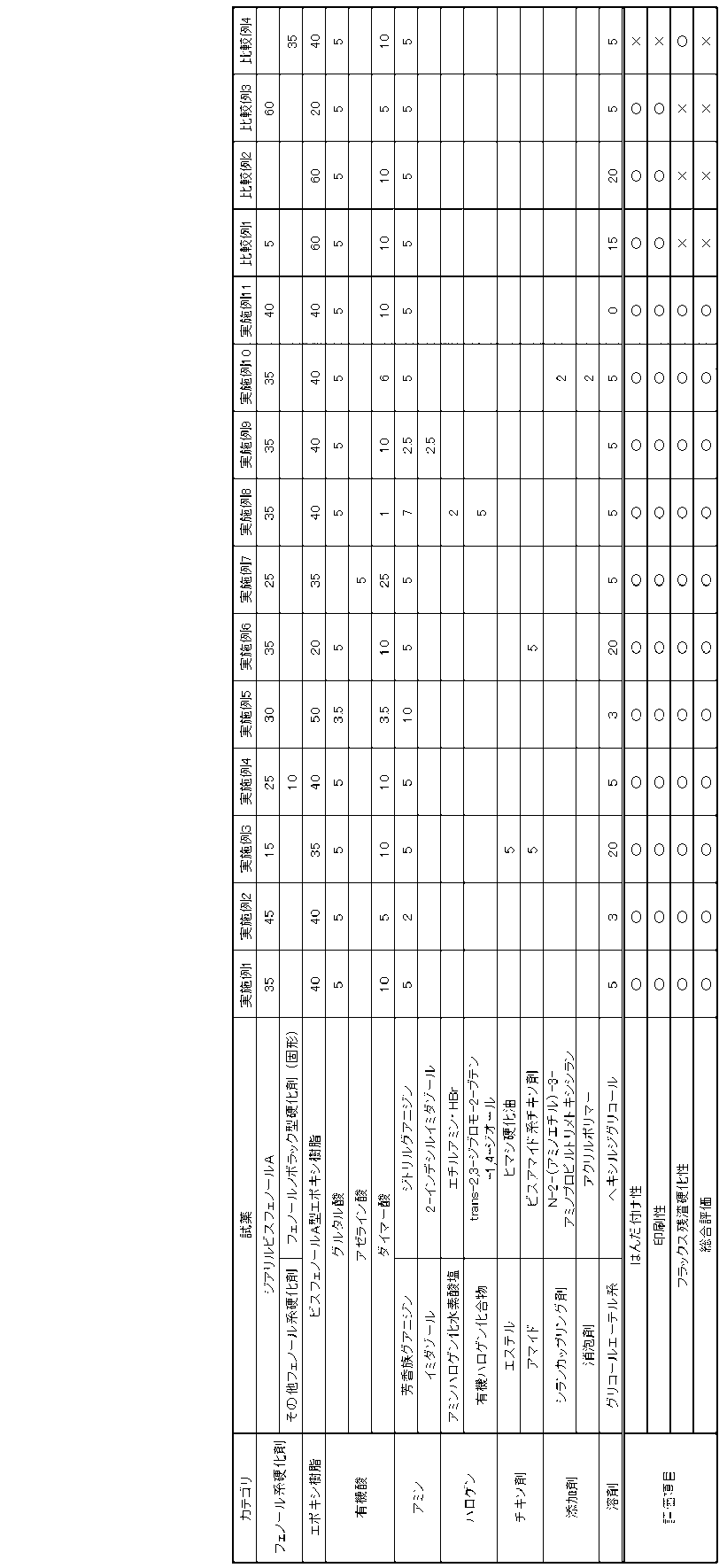
ジアリルビスフェノールAを、本発明で規定される範囲内で35wt%含み、エポキシ樹脂を、本発明で規定される範囲内で40wt%含み、有機酸としてグルタル酸を、本発明で規定される範囲内で5wt%含み、有機酸としてダイマー酸を、本発明で規定される範囲内で10wt%含み、有機酸の合計が本発明で規定される範囲内であり、更に、アミンとしてジトリルグアニジンを、本発明で規定される範囲内で5wt%含み、溶剤としてヘキシルジグリコールを、本発明で規定される範囲内で5wt%含む実施例1では、はんだの広がり径が上述した判定基準を満たし、はんだ付け性に対して十分な効果が得られた。また、フラックス組成物の塗布量が上述した判定基準を満たし、印刷性に対して十分な効果が得られた。更に、フラックス残渣の硬化の度合いが上述した判定基準を満たし、フラックス残渣硬化性に対して十分な効果が得られた。
ジアリルビスフェノールAを、本発明で規定される範囲内の上限で45wt%含み、エポキシ樹脂を、本発明で規定される範囲内で40wt%含み、有機酸としてグルタル酸を、本発明で規定される範囲内で5wt%含み、有機酸としてダイマー酸を、本発明で規定される範囲内で5wt%含み、有機酸の合計が本発明で規定される範囲内であり、更に、アミンとしてジトリルグアニジンを、本発明で規定される範囲内で2wt%含み、溶剤としてヘキシルジグリコールを、本発明で規定される範囲内で3wt%含む実施例2でも、はんだの広がり径が上述した判定基準を満たし、はんだ付け性に対して十分な効果が得られた。また、フラックス組成物の塗布量が上述した判定基準を満たし、印刷性に対して十分な効果が得られた。更に、フラックス残渣の硬化の度合いが上述した判定基準を満たし、フラックス残渣硬化性に対して十分な効果が得られた。
ジアリルビスフェノールAを、本発明で規定される範囲内の下限で15wt%含み、エポキシ樹脂を、本発明で規定される範囲内で35wt%含み、有機酸としてグルタル酸を、本発明で規定される範囲内で5wt%含み、有機酸としてダイマー酸を、本発明で規定される範囲内で10wt%含み、有機酸の合計が本発明で規定される範囲内であり、更に、アミンとしてジトリルグアニジンを、本発明で規定される範囲内で5wt%含み、チキソ剤として硬化ヒマシ油を5wt%、ビスアマイド系チキソ剤を5wt%含み、チキソ剤の合計が本発明で規定される範囲内であり、溶剤としてヘキシルジグリコールを、本発明で規定される範囲内で20wt%含む実施例3でも、はんだの広がり径が上述した判定基準を満たし、はんだ付け性に対して十分な効果が得られた。また、フラックス組成物の塗布量が上述した判定基準を満たし、印刷性に対して十分な効果が得られた。更に、フラックス残渣の硬化の度合いが上述した判定基準を満たし、フラックス残渣硬化性に対して十分な効果が得られた。
ジアリルビスフェノールAを、本発明で規定される範囲内で25wt%含み、その他のフェノール系硬化剤として、フェノールノボラック型硬化剤を、本発明で規定される範囲内で10wt%含み、エポキシ樹脂を、本発明で規定される範囲内で40wt%含み、有機酸としてグルタル酸を、本発明で規定される範囲内で5wt%含み、有機酸としてダイマー酸を、本発明で規定される範囲内で10wt%含み、有機酸の合計が本発明で規定される範囲内であり、更に、アミンとしてジトリルグアニジンを、本発明で規定される範囲内で5wt%含み、溶剤としてヘキシルジグリコールを、本発明で規定される範囲内で5wt%含む実施例4でも、はんだの広がり径が上述した判定基準を満たし、はんだ付け性に対して十分な効果が得られた。また、フラックス組成物の塗布量が上述した判定基準を満たし、印刷性に対して十分な効果が得られた。更に、フラックス残渣の硬化の度合いが上述した判定基準を満たし、フラックス残渣硬化性に対して十分な効果が得られた。
ジアリルビスフェノールAを、本発明で規定される範囲内で30wt%含み、エポキシ樹脂を、本発明で規定される範囲内の上限で50wt%含み、有機酸としてグルタル酸を、本発明で規定される範囲内で3.5wt%含み、有機酸としてダイマー酸を、本発明で規定される範囲内で3.5wt%含み、有機酸の合計が本発明で規定される範囲内であり、更に、アミンとしてジトリルグアニジンを、本発明で規定される範囲内で10wt%含み、溶剤としてヘキシルジグリコールを、本発明で規定される範囲内で3wt%含む実施例5でも、はんだの広がり径が上述した判定基準を満たし、はんだ付け性に対して十分な効果が得られた。また、フラックス組成物の塗布量が上述した判定基準を満たし、印刷性に対して十分な効果が得られた。更に、フラックス残渣の硬化の度合いが上述した判定基準を満たし、フラックス残渣硬化性に対して十分な効果が得られた。
ジアリルビスフェノールAを、本発明で規定される範囲内で35wt%含み、エポキシ樹脂を、本発明で規定される範囲内の下限で20wt%含み、有機酸としてグルタル酸を、本発明で規定される範囲内で5wt%含み、有機酸としてダイマー酸を、本発明で規定される範囲内で10wt%含み、有機酸の合計が本発明で規定される範囲内であり、更に、アミンとしてジトリルグアニジンを、本発明で規定される範囲内で5wt%含み、チキソ剤としてビスアマイド系チキソ剤を5wt%含み、溶剤としてヘキシルジグリコールを、本発明で規定される範囲内で20wt%含む実施例6でも、はんだの広がり径が上述した判定基準を満たし、はんだ付け性に対して十分な効果が得られた。また、フラックス組成物の塗布量が上述した判定基準を満たし、印刷性に対して十分な効果が得られた。更に、フラックス残渣の硬化の度合いが上述した判定基準を満たし、フラックス残渣硬化性に対して十分な効果が得られた。
ジアリルビスフェノールAを、本発明で規定される範囲内で25wt%含み、エポキシ樹脂を、本発明で規定される範囲内で35wt%含み、有機酸としてアゼライン酸を、本発明で規定される範囲内で5wt%含み、有機酸としてダイマー酸を、本発明で規定される範囲内で25wt%含み、有機酸の合計が本発明で規定される範囲内であり、更に、アミンとしてジトリルグアニジンを、本発明で規定される範囲内で5wt%含み、溶剤としてヘキシルジグリコールを、本発明で規定される範囲内で5wt%含む実施例7でも、はんだの広がり径が上述した判定基準を満たし、はんだ付け性に対して十分な効果が得られた。また、フラックス組成物の塗布量が上述した判定基準を満たし、印刷性に対して十分な効果が得られた。更に、フラックス残渣の硬化の度合いが上述した判定基準を満たし、フラックス残渣硬化性に対して十分な効果が得られた。
ジアリルビスフェノールAを、本発明で規定される範囲内で35wt%含み、エポキシ樹脂を、本発明で規定される範囲内で40wt%含み、有機酸としてグルタル酸を、本発明で規定される範囲内で5wt%含み、有機酸としてダイマー酸を、本発明で規定される範囲内で1wt%含み、有機酸の合計が本発明で規定される範囲内であり、更に、アミンとしてジトリルグアニジンを、本発明で規定される範囲内で7wt%含み、アミンハロゲン化水素酸塩としてエチルアミン・HBrを、本発明で規定される範囲内で2wt%含み、有機ハロゲン化合物として、trans-2,3-ジブロモ-2-ブテン-1,4-ジオールを、本発明で規定される範囲内で5wt%含み、溶剤としてヘキシルジグリコールを、本発明で規定される範囲内で5wt%含む実施例8でも、はんだの広がり径が上述した判定基準を満たし、はんだ付け性に対して十分な効果が得られた。また、フラックス組成物の塗布量が上述した判定基準を満たし、印刷性に対して十分な効果が得られた。更に、フラックス残渣の硬化の度合いが上述した判定基準を満たし、フラックス残渣硬化性に対して十分な効果が得られた。
ジアリルビスフェノールAを、本発明で規定される範囲内で35wt%含み、エポキシ樹脂を、本発明で規定される範囲内で40wt%含み、有機酸としてグルタル酸を、本発明で規定される範囲内で5wt%含み、有機酸としてダイマー酸を、本発明で規定される範囲内で10wt%含み、有機酸の合計が本発明で規定される範囲内であり、更に、アミンとしてジトリルグアニジンを、本発明で規定される範囲内で2.5wt%含み、アミンであるイミダゾールとして2-インデシルイミダゾールを、本発明で規定される範囲内で2.5wt%含み、アミンの合計が本発明で規定される範囲内であり、溶剤としてヘキシルジグリコールを、本発明で規定される範囲内で5wt%含む実施例9でも、はんだの広がり径が上述した判定基準を満たし、はんだ付け性に対して十分な効果が得られた。また、フラックス組成物の塗布量が上述した判定基準を満たし、印刷性に対して十分な効果が得られた。更に、フラックス残渣の硬化の度合いが上述した判定基準を満たし、フラックス残渣硬化性に対して十分な効果が得られた。
ジアリルビスフェノールAを、本発明で規定される範囲内で35wt%含み、エポキシ樹脂を、本発明で規定される範囲内で40wt%含み、有機酸としてグルタル酸を、本発明で規定される範囲内で5wt%含み、有機酸としてダイマー酸を、本発明で規定される範囲内で6wt%含み、有機酸の合計が本発明で規定される範囲内であり、更に、アミンとしてジトリルグアニジンを、本発明で規定される範囲内で5wt%含み、添加剤であるシランカップリング剤としてN-2-(アミノエチル)-3-アミノプロピルトリメトキシシシランを、本発明で規定される範囲内で2wt%含み、添加剤である泡消剤としてアクリルポリマーを、本発明で規定される範囲内で2wt%含み、添加剤の合計が本発明で規定される範囲内であり、溶剤としてヘキシルジグリコールを、本発明で規定される範囲内で5wt%含む実施例10でも、はんだの広がり径が上述した判定基準を満たし、はんだ付け性に対して十分な効果が得られた。また、フラックス組成物の塗布量が上述した判定基準を満たし、印刷性に対して十分な効果が得られた。更に、フラックス残渣の硬化の度合いが上述した判定基準を満たし、フラックス残渣硬化性に対して十分な効果が得られた。
ジアリルビスフェノールAを、本発明で規定される範囲内で40wt%含み、エポキシ樹脂を、本発明で規定される範囲内で40wt%含み、有機酸としてグルタル酸を、本発明で規定される範囲内で5wt%含み、有機酸としてダイマー酸を、本発明で規定される範囲内で10wt%含み、有機酸の合計が本発明で規定される範囲内であり、更に、アミンとしてジトリルグアニジンを、本発明で規定される範囲内で5wt%含み、溶剤を含まない実施例11でも、はんだの広がり径が上述した判定基準を満たし、はんだ付け性に対して十分な効果が得られた。また、フラックス組成物の塗布量が上述した判定基準を満たし、印刷性に対して十分な効果が得られた。更に、フラックス残渣の硬化の度合いが上述した判定基準を満たし、フラックス残渣硬化性に対して十分な効果が得られた。
これに対し、ジアリルビスフェノールAを、本発明で規定される範囲を下回る5wt%含み、エポキシ樹脂を、本発明で規定される範囲を超えて60wt%含み、有機酸としてグルタル酸を、本発明で規定される範囲内で5wt%含み、有機酸としてダイマー酸を、本発明で規定される範囲内で10wt%含み、有機酸の合計が本発明で規定される範囲内であり、更に、アミンとしてジトリルグアニジンを、本発明で規定される範囲内で5wt%含み、溶剤としてヘキシルジグリコールを、本発明で規定される範囲内で15wt%含む比較例1では、はんだの広がり径が上述した判定基準を満たし、はんだ付け性に対して十分な効果が得られた。また、他のフェノール系硬化剤を含まないため、フラックス組成物の塗布量が上述した判定基準を満たし、印刷性に対して十分な効果が得られた。しかし、エポキシ樹脂に対して硬化剤の量が少ないため、ジアリルビスフェノールAを含む場合であっても、フラックス残渣の硬化の度合いが上述した判定基準を満たさず、フラックス残渣硬化性に対して効果が得られなかった。
また、ジアリルビスフェノールAを含まず、エポキシ樹脂を、本発明で規定される範囲を超えて60wt%含み、有機酸としてグルタル酸を、本発明で規定される範囲内で5wt%含み、有機酸としてダイマー酸を、本発明で規定される範囲内で10wt%含み、有機酸の合計が本発明で規定される範囲内であり、更に、アミンとしてジトリルグアニジンを、本発明で規定される範囲内で5wt%含み、溶剤としてヘキシルジグリコールを、本発明で規定される範囲内で20wt%含む比較例2でも、はんだの広がり径が上述した判定基準を満たし、はんだ付け性に対して十分な効果が得られた。また、他のフェノール系硬化剤を含まないため、フラックス組成物の塗布量が上述した判定基準を満たし、印刷性に対して十分な効果が得られた。しかし、ジアリルビスフェノールA、他のフェノール系硬化剤の何れも含まないため、フラックス残渣の硬化の度合いが上述した判定基準を満たさず、フラックス残渣硬化性に対して効果が得られなかった。
更に、ジアリルビスフェノールAを、本発明で規定される範囲を超えて60wt%含み、エポキシ樹脂を、本発明で規定される範囲内で20wt%含み、有機酸としてグルタル酸を、本発明で規定される範囲内で5wt%含み、有機酸としてダイマー酸を、本発明で規定される範囲内で5wt%含み、有機酸の合計が本発明で規定される範囲内であり、更に、アミンとしてジトリルグアニジンを、本発明で規定される範囲内で5wt%含み、溶剤としてヘキシルジグリコールを、本発明で規定される範囲内で5wt%含む比較例3でも、はんだの広がり径が上述した判定基準を満たし、はんだ付け性に対して十分な効果が得られた。また、他のフェノール系硬化剤を含まないため、フラックス組成物の塗布量が上述した判定基準を満たし、印刷性に対して十分な効果が得られた。しかし、エポキシ樹脂に対して硬化剤の量が多いため、ジアリルビスフェノールAを含む場合であっても、フラックス残渣の硬化の度合いが上述した判定基準を満たさず、フラックス残渣硬化性に対して効果が得られなかった。
また、ジアリルビスフェノールAを含まず、その他のフェノール系硬化剤として、フェノールノボラック型硬化剤を、本発明で規定される範囲を超えて35wt%含み、エポキシ樹脂を、本発明で規定される範囲内で40wt%含み、有機酸としてグルタル酸を、本発明で規定される範囲内で5wt%含み、有機酸としてダイマー酸を、本発明で規定される範囲内で10wt%含み、有機酸の合計が本発明で規定される範囲内であり、更に、アミンとしてジトリルグアニジンを、本発明で規定される範囲内で5wt%含み、溶剤としてヘキシルジグリコールを、本発明で規定される範囲内で5wt%含む比較例4では、フラックス残渣の硬化の度合いが上述した判定基準を満たし、フラックス残渣硬化性に対して十分な効果が得られた。しかし、ジアリルビスフェノールAを含まないため、活性剤の量が不足し、はんだの広がり径が上述した判定基準を満たさず、はんだ付け性に対して効果が得られなかった。また、ジアリルビスフェノールAを含まないことで、他のフェノール系硬化剤の含有量を従来必要とされた量とすると、フラックス組成物の塗布量が上述した判定基準を満たさず、印刷性に対して効果が得られなかった。
以上のことから、ジアリルビスフェノールAを15wt%以上45wt%以下、エポキシ樹脂を20wt%以上50wt%以下、有機酸を1wt%以上30wt%以下含むフラックス組成物、及び、このフラックス組成物を用いたはんだペースト、はんだ接合部及びはんだ接合方法では、はんだ付け性に対して十分な効果が得られた。また、印刷性に対して十分な効果が得られた。更に、フラックス残渣硬化性に対して十分な効果が得られた。
これらの効果は、他のフェノール系硬化剤、アミン、アミンハロゲン化水素酸塩、有機ハロゲン化合物、チキソ剤、添加剤を、本発明で規定される範囲内で含むことでも阻害されなかった。
Claims (6)
- エポキシ樹脂を20wt%以上50wt%以下、
ジアリルビスフェノールAを15wt%以上45wt%以下、
有機酸を1wt%以上30wt%以下含む
ことを特徴とするフラックス組成物。 - さらにその他のフェノール系硬化剤を0wt%以上10wt%以下、
アミンを0wt%以上10wt%以下
溶剤を0wt%以上20wt%以下含む
ことを特徴とする請求項1に記載のフラックス組成物。 - さらにアミンハロゲン化水素酸塩を0wt%以上2wt%以下、
有機ハロゲン化合物を0wt%以上5wt%以下、
チキソ剤を0wt%以上10wt%以下、
シランカップリング剤を0wt%以上2wt%以下、
消泡剤を0wt%以上2wt%以下含む
ことを特徴とする請求項1または請求項2に記載のフラックス組成物。 - 請求項1~請求項3の何れか1項に記載のフラックス組成物とはんだ粉末を混合した
ことを特徴とするはんだペースト。 - 請求項1~請求項3の何れか1項に記載のフラックス組成物を用いた
ことを特徴とするはんだ接合部。 - 請求項1~請求項3の何れか1項に記載のフラックス組成物を用いた
ことを特徴とするはんだ接合方法。
Priority Applications (3)
| Application Number | Priority Date | Filing Date | Title |
|---|---|---|---|
| CN201980049545.2A CN112469532A (zh) | 2018-08-10 | 2019-08-01 | 助焊剂组合物、焊膏、钎焊接合部和钎焊接合方法 |
| US17/261,072 US11407068B2 (en) | 2018-08-10 | 2019-08-01 | Flux composition, solder paste, solder joint and solder joining method |
| KR1020217006820A KR102283897B1 (ko) | 2018-08-10 | 2019-08-01 | 플럭스 조성물, 땜납 페이스트, 땜납 접합부 및 땜납 접합 방법 |
Applications Claiming Priority (2)
| Application Number | Priority Date | Filing Date | Title |
|---|---|---|---|
| JP2018-151854 | 2018-08-10 | ||
| JP2018151854A JP6489274B1 (ja) | 2018-08-10 | 2018-08-10 | フラックス組成物、はんだペースト、はんだ接合部及びはんだ接合方法 |
Publications (1)
| Publication Number | Publication Date |
|---|---|
| WO2020031825A1 true WO2020031825A1 (ja) | 2020-02-13 |
Family
ID=65895211
Family Applications (1)
| Application Number | Title | Priority Date | Filing Date |
|---|---|---|---|
| PCT/JP2019/030153 Ceased WO2020031825A1 (ja) | 2018-08-10 | 2019-08-01 | フラックス組成物、はんだペースト、はんだ接合部及びはんだ接合方法 |
Country Status (6)
| Country | Link |
|---|---|
| US (1) | US11407068B2 (ja) |
| JP (1) | JP6489274B1 (ja) |
| KR (1) | KR102283897B1 (ja) |
| CN (1) | CN112469532A (ja) |
| TW (1) | TWI698485B (ja) |
| WO (1) | WO2020031825A1 (ja) |
Cited By (1)
| Publication number | Priority date | Publication date | Assignee | Title |
|---|---|---|---|---|
| WO2026042774A1 (ja) * | 2024-08-20 | 2026-02-26 | 積水化学工業株式会社 | フラックス組成物、接続構造体、及び接続構造体の製造方法 |
Families Citing this family (4)
| Publication number | Priority date | Publication date | Assignee | Title |
|---|---|---|---|---|
| JP6643744B1 (ja) * | 2019-05-27 | 2020-02-12 | 千住金属工業株式会社 | はんだペースト及びはんだペースト用フラックス |
| JP7620916B2 (ja) | 2020-12-17 | 2025-01-24 | パナソニックIpマネジメント株式会社 | フラックス用樹脂組成物、電子部品、電子部品の製造方法、実装構造体及び実装構造体の製造方法 |
| JP7702649B2 (ja) * | 2020-12-18 | 2025-07-04 | パナソニックIpマネジメント株式会社 | はんだ組成物 |
| JP7572657B1 (ja) | 2024-03-27 | 2024-10-24 | 千住金属工業株式会社 | フラックス及び接合体の製造方法 |
Citations (3)
| Publication number | Priority date | Publication date | Assignee | Title |
|---|---|---|---|---|
| JP2008300443A (ja) * | 2007-05-29 | 2008-12-11 | Sumitomo Bakelite Co Ltd | 半導体ウエハーの接合方法および半導体装置の製造方法 |
| JP2011171258A (ja) * | 2010-02-22 | 2011-09-01 | Sumitomo Bakelite Co Ltd | 導電接続シート、端子間の接続方法、接続端子の形成方法、半導体装置および電子機器 |
| JP2016043408A (ja) * | 2014-08-27 | 2016-04-04 | 富士通株式会社 | はんだペースト、電子部品、及び電子機器 |
Family Cites Families (27)
| Publication number | Priority date | Publication date | Assignee | Title |
|---|---|---|---|---|
| US5851311A (en) * | 1996-03-29 | 1998-12-22 | Sophia Systems Co., Ltd. | Polymerizable flux composition for encapsulating the solder in situ |
| US6367150B1 (en) * | 1997-09-05 | 2002-04-09 | Northrop Grumman Corporation | Solder flux compatible with flip-chip underfill material |
| US6402013B2 (en) * | 1999-12-03 | 2002-06-11 | Senju Metal Industry Co., Ltd | Thermosetting soldering flux and soldering process |
| JP4609617B2 (ja) * | 2000-08-01 | 2011-01-12 | 日本電気株式会社 | 半導体装置の実装方法及び実装構造体 |
| JP2002232123A (ja) | 2001-01-31 | 2002-08-16 | Mitsubishi Electric Corp | 複合回路基体の製造方法 |
| US7009009B1 (en) * | 2001-10-09 | 2006-03-07 | Henkel Corporation | Fluxing underfill compositions |
| ES2389215T3 (es) * | 2005-04-28 | 2012-10-24 | Cytec Technology Corp. | Sistema de resina de bismaleimida con propiedades de elaboración mejoradas |
| CN101232967B (zh) | 2005-08-11 | 2010-12-08 | 千住金属工业株式会社 | 电子部件用无铅焊膏、钎焊方法以及电子部件 |
| US8039305B2 (en) * | 2007-04-27 | 2011-10-18 | Sumitomo Bakelite Company, Ltd. | Method for bonding semiconductor wafers and method for manufacturing semiconductor device |
| JP2008274080A (ja) | 2007-04-27 | 2008-11-13 | Shin Etsu Chem Co Ltd | 液状エポキシ樹脂組成物及び半導体装置 |
| EP2296175A4 (en) * | 2008-05-16 | 2012-02-01 | Sumitomo Bakelite Co | METHOD FOR PRODUCING SEMICONDUCTOR COMPONENTS AND SEMICONDUCTOR COMPONENTS |
| EP2358813B1 (en) * | 2008-11-20 | 2018-08-22 | Henkel IP & Holding GmbH | Curing agents for epoxy resins |
| JP5310252B2 (ja) * | 2009-05-19 | 2013-10-09 | パナソニック株式会社 | 電子部品実装方法および電子部品実装構造 |
| CN101733585B (zh) * | 2010-02-10 | 2012-09-19 | 北京海斯迪克新材料有限公司 | 一种晶圆级芯片封装凸点保护层及其形成工艺 |
| JP2012089750A (ja) | 2010-10-21 | 2012-05-10 | Hitachi Chem Co Ltd | 半導体封止充てん用熱硬化性樹脂組成物及び半導体装置 |
| JP5780228B2 (ja) * | 2011-11-11 | 2015-09-16 | 住友ベークライト株式会社 | 半導体装置の製造方法 |
| JP2013155363A (ja) * | 2012-02-01 | 2013-08-15 | Shin-Etsu Chemical Co Ltd | 液状エポキシ樹脂組成物及び半導体装置 |
| CN103937433B (zh) * | 2014-04-01 | 2015-09-02 | 烟台德邦科技有限公司 | 一种高可靠性环保型底部填充材料及其制备方法 |
| JP2017080797A (ja) | 2015-10-30 | 2017-05-18 | パナソニックIpマネジメント株式会社 | はんだペースト及びはんだ付け用フラックス及びそれを用いた実装構造体 |
| CN105290648A (zh) * | 2015-11-24 | 2016-02-03 | 三友(天津)高分子技术有限公司 | 一种可返修的环氧树脂助焊剂及制备方法 |
| KR101818960B1 (ko) * | 2015-12-07 | 2018-01-17 | 덕산하이메탈(주) | 언더필용 에폭시 솔더링 플럭스, 에폭시 솔더 페이스트 및 이를 이용한 반도체 소자 실장 방법 |
| JP6534122B2 (ja) * | 2015-12-28 | 2019-06-26 | パナソニックIpマネジメント株式会社 | 樹脂フラックスはんだペースト及び実装構造体 |
| CN106281171B (zh) * | 2016-09-07 | 2019-08-06 | 深圳先进技术研究院 | 一种环氧树脂助焊剂、其制备方法及应用 |
| JP6530734B2 (ja) | 2016-09-28 | 2019-06-12 | 株式会社タムラ製作所 | 熱硬化性フラックス組成物および電子基板の製造方法 |
| JP2020507114A (ja) * | 2017-02-02 | 2020-03-05 | アレス マテリアルズ インコーポレイテッド | フレキシブルカラーフィルタおよび製造方法 |
| US20180229333A1 (en) * | 2017-02-10 | 2018-08-16 | Panasonic Intellectual Property Management Co., Ltd. | Solder paste and mount structure obtained by using same |
| CN107745202B (zh) * | 2017-06-23 | 2020-07-03 | 深圳市福英达工业技术有限公司 | 锡基膏状钎焊焊料及其制备方法 |
-
2018
- 2018-08-10 JP JP2018151854A patent/JP6489274B1/ja active Active
-
2019
- 2019-08-01 WO PCT/JP2019/030153 patent/WO2020031825A1/ja not_active Ceased
- 2019-08-01 US US17/261,072 patent/US11407068B2/en active Active
- 2019-08-01 CN CN201980049545.2A patent/CN112469532A/zh active Pending
- 2019-08-01 KR KR1020217006820A patent/KR102283897B1/ko active Active
- 2019-08-07 TW TW108128004A patent/TWI698485B/zh active
Patent Citations (3)
| Publication number | Priority date | Publication date | Assignee | Title |
|---|---|---|---|---|
| JP2008300443A (ja) * | 2007-05-29 | 2008-12-11 | Sumitomo Bakelite Co Ltd | 半導体ウエハーの接合方法および半導体装置の製造方法 |
| JP2011171258A (ja) * | 2010-02-22 | 2011-09-01 | Sumitomo Bakelite Co Ltd | 導電接続シート、端子間の接続方法、接続端子の形成方法、半導体装置および電子機器 |
| JP2016043408A (ja) * | 2014-08-27 | 2016-04-04 | 富士通株式会社 | はんだペースト、電子部品、及び電子機器 |
Cited By (1)
| Publication number | Priority date | Publication date | Assignee | Title |
|---|---|---|---|---|
| WO2026042774A1 (ja) * | 2024-08-20 | 2026-02-26 | 積水化学工業株式会社 | フラックス組成物、接続構造体、及び接続構造体の製造方法 |
Also Published As
| Publication number | Publication date |
|---|---|
| KR102283897B1 (ko) | 2021-07-29 |
| KR20210031528A (ko) | 2021-03-19 |
| TW202014467A (zh) | 2020-04-16 |
| JP6489274B1 (ja) | 2019-03-27 |
| US11407068B2 (en) | 2022-08-09 |
| US20210245306A1 (en) | 2021-08-12 |
| JP2020025973A (ja) | 2020-02-20 |
| TWI698485B (zh) | 2020-07-11 |
| CN112469532A (zh) | 2021-03-09 |
Similar Documents
| Publication | Publication Date | Title |
|---|---|---|
| KR102283897B1 (ko) | 플럭스 조성물, 땜납 페이스트, 땜납 접합부 및 땜납 접합 방법 | |
| TWI817980B (zh) | 助焊劑及焊膏 | |
| US11179813B2 (en) | Flux and solder paste | |
| CN111601678B (zh) | 助焊剂和焊膏 | |
| TWI751384B (zh) | 助焊劑及焊膏 | |
| CN111526967B (zh) | 助焊剂和焊膏 | |
| JP6544498B1 (ja) | フラックス及びソルダペースト | |
| CN110814576A (zh) | 助焊剂和焊膏 | |
| CN116096528A (zh) | 助焊剂和焊膏 | |
| HK40057684A (en) | Flux composition containing maleic acid-modified rosin ester or maleic acid-modified rosin amide, flux containing said composition, solder paste | |
| JP2022053501A (ja) | フラックス用組成物、フラックスおよびはんだペースト | |
| CN113811420A (zh) | 包含马来酸改性松香酯或马来酸改性松香酰胺的助焊剂用组合物、和包含其的助焊剂、以及焊膏 | |
| HK40057684B (en) | Flux composition containing maleic acid-modified rosin ester or maleic acid-modified rosin amide, flux containing said composition, solder paste |
Legal Events
| Date | Code | Title | Description |
|---|---|---|---|
| 121 | Ep: the epo has been informed by wipo that ep was designated in this application |
Ref document number: 19847765 Country of ref document: EP Kind code of ref document: A1 |
|
| NENP | Non-entry into the national phase |
Ref country code: DE |
|
| ENP | Entry into the national phase |
Ref document number: 20217006820 Country of ref document: KR Kind code of ref document: A |
|
| 122 | Ep: pct application non-entry in european phase |
Ref document number: 19847765 Country of ref document: EP Kind code of ref document: A1 |