WO2020017618A1 - 油中水型乳化化粧料 - Google Patents
油中水型乳化化粧料 Download PDFInfo
- Publication number
- WO2020017618A1 WO2020017618A1 PCT/JP2019/028378 JP2019028378W WO2020017618A1 WO 2020017618 A1 WO2020017618 A1 WO 2020017618A1 JP 2019028378 W JP2019028378 W JP 2019028378W WO 2020017618 A1 WO2020017618 A1 WO 2020017618A1
- Authority
- WO
- WIPO (PCT)
- Prior art keywords
- oil
- group
- water
- mass
- silicone
- Prior art date
- Legal status (The legal status is an assumption and is not a legal conclusion. Google has not performed a legal analysis and makes no representation as to the accuracy of the status listed.)
- Ceased
Links
Classifications
-
- A—HUMAN NECESSITIES
- A61—MEDICAL OR VETERINARY SCIENCE; HYGIENE
- A61K—PREPARATIONS FOR MEDICAL, DENTAL OR TOILETRY PURPOSES
- A61K8/00—Cosmetics or similar toiletry preparations
- A61K8/02—Cosmetics or similar toiletry preparations characterised by special physical form
- A61K8/04—Dispersions; Emulsions
- A61K8/06—Emulsions
-
- A—HUMAN NECESSITIES
- A61—MEDICAL OR VETERINARY SCIENCE; HYGIENE
- A61K—PREPARATIONS FOR MEDICAL, DENTAL OR TOILETRY PURPOSES
- A61K8/00—Cosmetics or similar toiletry preparations
- A61K8/18—Cosmetics or similar toiletry preparations characterised by the composition
- A61K8/19—Cosmetics or similar toiletry preparations characterised by the composition containing inorganic ingredients
- A61K8/25—Silicon; Compounds thereof
-
- A—HUMAN NECESSITIES
- A61—MEDICAL OR VETERINARY SCIENCE; HYGIENE
- A61K—PREPARATIONS FOR MEDICAL, DENTAL OR TOILETRY PURPOSES
- A61K8/00—Cosmetics or similar toiletry preparations
- A61K8/18—Cosmetics or similar toiletry preparations characterised by the composition
- A61K8/30—Cosmetics or similar toiletry preparations characterised by the composition containing organic compounds
- A61K8/31—Hydrocarbons
-
- A—HUMAN NECESSITIES
- A61—MEDICAL OR VETERINARY SCIENCE; HYGIENE
- A61K—PREPARATIONS FOR MEDICAL, DENTAL OR TOILETRY PURPOSES
- A61K8/00—Cosmetics or similar toiletry preparations
- A61K8/18—Cosmetics or similar toiletry preparations characterised by the composition
- A61K8/30—Cosmetics or similar toiletry preparations characterised by the composition containing organic compounds
- A61K8/33—Cosmetics or similar toiletry preparations characterised by the composition containing organic compounds containing oxygen
- A61K8/37—Esters of carboxylic acids
-
- A—HUMAN NECESSITIES
- A61—MEDICAL OR VETERINARY SCIENCE; HYGIENE
- A61K—PREPARATIONS FOR MEDICAL, DENTAL OR TOILETRY PURPOSES
- A61K8/00—Cosmetics or similar toiletry preparations
- A61K8/18—Cosmetics or similar toiletry preparations characterised by the composition
- A61K8/72—Cosmetics or similar toiletry preparations characterised by the composition containing organic macromolecular compounds
- A61K8/84—Cosmetics or similar toiletry preparations characterised by the composition containing organic macromolecular compounds obtained by reactions otherwise than those involving only carbon-carbon unsaturated bonds
- A61K8/89—Polysiloxanes
- A61K8/891—Polysiloxanes saturated, e.g. dimethicone, phenyl trimethicone, C24-C28 methicone or stearyl dimethicone
- A61K8/894—Polysiloxanes saturated, e.g. dimethicone, phenyl trimethicone, C24-C28 methicone or stearyl dimethicone modified by a polyoxyalkylene group, e.g. cetyl dimethicone copolyol
-
- A—HUMAN NECESSITIES
- A61—MEDICAL OR VETERINARY SCIENCE; HYGIENE
- A61Q—SPECIFIC USE OF COSMETICS OR SIMILAR TOILETRY PREPARATIONS
- A61Q19/00—Preparations for care of the skin
Definitions
- the present invention relates to a water-in-oil type emulsified cosmetic. More specifically, the present invention relates to a water-in-oil type emulsified cosmetic which can give a fresh feeling such that water overflows during application while having a rich feeling.
- a water-in-oil emulsion composition in which an oil phase is a continuous phase (outer phase) and an aqueous phase is a dispersed phase (inner phase) is an oil-soluble active ingredient such as an emollient, an oil-soluble drug, and an ultraviolet absorber. Since it can be spread on the skin, it is a dosage form suitable for external preparations for the skin. In the cosmetics field, it is widely used as a skin care cream or milky lotion, or a hair care cream.
- water-in-oil type emulsified cosmetics contain a solid oil such as a wax or a semi-solid oil for the purpose of giving a rich feeling at the time of application to the skin and imparting flexibility to the skin.
- a solid oil such as a wax or a semi-solid oil
- richness can be obtained by blending solid oil and the like, it has been extremely difficult to satisfy a fresh feeling at the same time.
- Patent Document 1 a microgel composed of (a) a synthetic polyelectrolyte (acrylamide-based copolymer) produced by reverse-phase microemulsion polymerization of a water-soluble ethylenically unsaturated monomer is used as a thickener, and at the same time, (b) hydrogenated castor oil It is said that an external preparation for skin containing an ester of a fatty acid and a higher fatty acid has a feeling of use having both freshness and richness. However, the freshness in Patent Document 1 is considered to be simply due to the water contained in the hydrophilic thickener microgel, and does not give a feeling that water overflows at the time of application.
- Patent Document 2 discloses a high-performance emulsifier comprising glucomannan, a polyether-modified silicone having a specific structure, and 50.0% by weight or more of water.
- An internal aqueous phase emulsified cosmetic is disclosed.
- Patent Document 3 discloses an emulsified cosmetic in which the same polyether-modified silicone as in Patent Document 2, silicone oil and / or non-polar oil, and water are blended.
- the high internal aqueous phase emulsified cosmetic described in Patent Literature 2 is a water-in-oil type emulsion, but when applied to the skin, gives an instantaneous phase change and gives a feeling that water overflows.
- the emulsified cosmetic described in Patent Document 3 is characterized in that it is lightly spreadable and moist and has no stickiness.
- these cosmetics lack the richness, and if solid oil is added to give the richness, the original freshness is lost.
- polyether-modified silicone is used as the only emulsifier, the emulsion stability tends to decrease when the oil content is increased.
- the present invention has been made in view of the above-mentioned disadvantages of the prior art, and has a rich feeling, while having a fresh feeling of use such as water inversion and overflow of water, and excellent in emulsion stability. It is intended to provide a water-type emulsified cosmetic.
- the present inventors have conducted intensive studies and found that in a high internal aqueous phase water-in-oil emulsion cosmetic containing a large amount of aqueous phase, a polyether-modified silicone having a specific structure, an organic-modified clay mineral, and a specific silicone interface
- a non-polar or low-polar hydrocarbon oil and silicone oil as an oil agent
- A represents a methyl group, a phenyl group and a general formula: —C 3 H 6 O (C 2 H 4 O) a (C 3 H 6 O) b R ′ (where R ′ is a hydrogen atom , An acyl group, and an alkyl group having 1 to 4 carbon atoms, a is an integer of 5 to 50, and b is an integer of 5 to 50)
- m is an integer of 50 to 1000, n is an integer of 1 to 40;
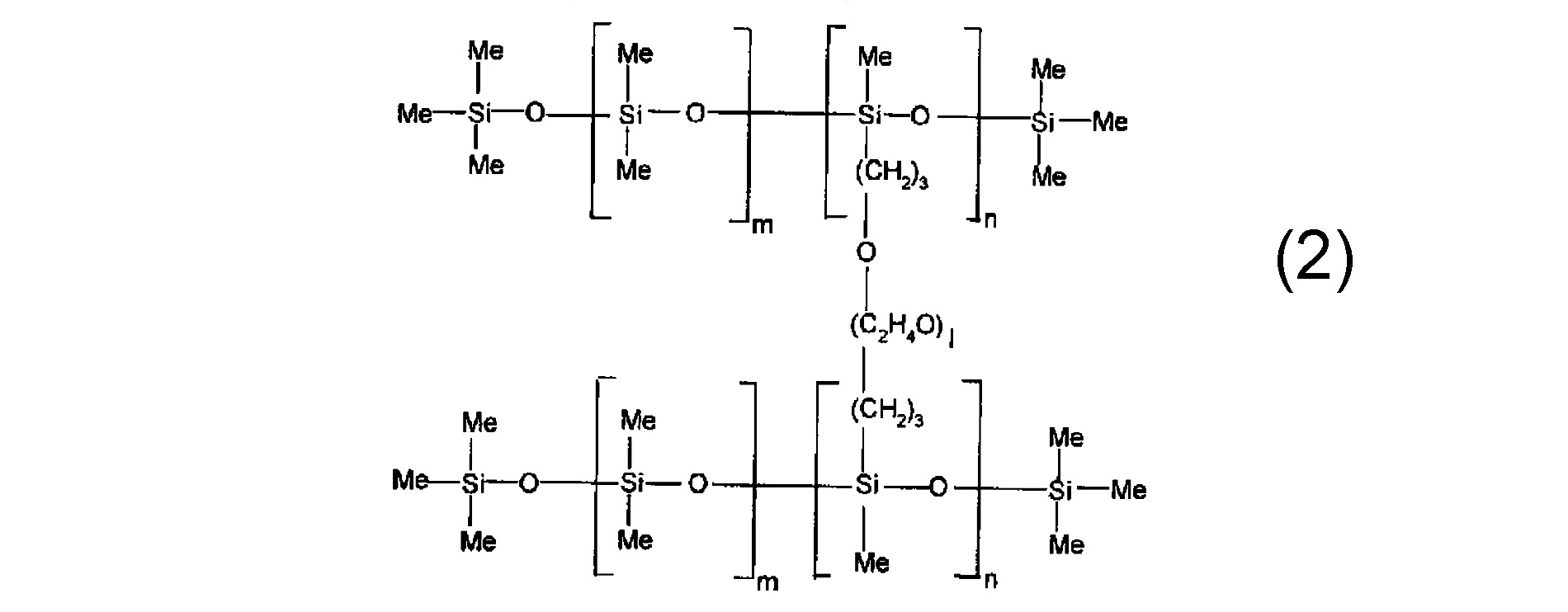
- a water-in-oil type emulsified cosmetic relates to a water-in-oil blended with at least one crosslinked polyether-modified silicone represented by the following formula (2) instead of or in addition to (A) the high-molecular-weight polyether-modified silicone described above. Including emulsified cosmetics.
- the water-in-oil type emulsified cosmetic of the present invention gives a rich feeling at the time of application to the skin, and has not only a freshness such that water overflows, but also an excellent emulsification stability, a non-stickiness, and a spreadability. Good and refreshing use feeling can be imparted.
- solid oil such as wax which has been used for imparting richness in conventional cosmetics, it can be manufactured by a simple method that does not include a heating step.
- rich feeling in the present specification means that after the preparation is adapted to the skin, the preparation has a feeling of remaining after covering the skin.
- the water-in-oil emulsified cosmetic of the present invention (hereinafter also simply referred to as “emulsified cosmetic”) is selected from (A) a high molecular weight polyether-modified silicone having a specific structure and a cross-linked polyether-modified silicone having a specific structure. It contains at least one polyether-modified silicone, (B) a silicone surfactant having an HLB of 2 to 5, (C) an organic-modified clay mineral, (D) an aqueous phase, and (E) an oil agent.
- emulsified cosmetic is selected from (A) a high molecular weight polyether-modified silicone having a specific structure and a cross-linked polyether-modified silicone having a specific structure. It contains at least one polyether-modified silicone, (B) a silicone surfactant having an HLB of 2 to 5, (C) an organic-modified clay mineral, (D) an aqueous phase, and (E) an oil agent.
- polyether-modified silicone blended in the emulsified cosmetic of the present invention is at least one selected from high molecular weight polyether-modified silicones represented by the following formula (1), and / or It is at least one selected from the cross-linked polyether-modified silicones represented by the following formula (2) (also referred to herein as “polyether-modified silicone having a specific structure” or “A component”).
- A represents a methyl group, a phenyl group and a general formula: —C 3 H 6 O (C 2 H 4 O) a (C 3 H 6 O) b R ′ (where R ′ is a hydrogen atom , An acyl group, and an alkyl group having 1 to 4 carbon atoms, a is an integer of 5 to 50, and b is an integer of 5 to 50)
- the molecule contains 40% by mass or more of a polyoxyalkylene group, and has a molecular weight of 30,000 or more.
- acyl group of R ′ in the formula (1) examples include a formyl group, an acetyl group, a propionyl group, a butyroyl group, an acryloyl group, a benzoyl group, a toluoyl group, Examples thereof include an alkyl group having 1 to 4 carbon atoms, and specific examples of the alkyl group include a methyl group, an ethyl group, an isopropyl group, an n-propyl group, a t-butyl group, and an n-butyl group.
- the polyether-modified silicone does not show a sufficient thickening effect, and when a or b exceeds 50, The resulting emulsified cosmetic has a sticky feeling.
- the content of the polyoxyalkylene group in one molecule is preferably 40% by mass or more, and particularly preferably in the range of 40 to 70% by mass.
- the emulsifying ability for non-polar oils other than silicone oil decreases, and when it exceeds 70% by mass, the obtained emulsified cosmetic becomes sticky. There are cases.
- m is less than 50 and n is less than 1
- the thickening effect becomes insufficient
- m exceeds 1000 and n exceeds 40 The emulsified cosmetic thus obtained has a sticky feel.
- the high molecular weight polyether-modified silicone (formula (1)) used in the present invention has a molecular weight of 30,000 or more, preferably 50,000 or more. This is because when the molecular weight of the polyether-modified silicone is less than 30,000, the emulsifying ability for non-polar oil components other than silicone oil is reduced.
- a particularly preferable specific example of the high molecular weight polyether-modified silicone corresponding to the above formula (1) is PEG / PPG-19 / 19, that is, a structure in which a methyl group of dimethicone is partially substituted with a polyoxyalkylene group. And compounds having an average degree of polymerization of 19 for each of the oxyethylene group and the oxypropylene group.
- the crosslinked polyether-modified silicone represented by the formula (2) is a crosslinked polymer obtained by crosslinking methylhydrogenpolysiloxane with diallyl polyether at both ends.
- 10 to 1000 parts by weight, preferably 20 to 500 parts by weight, of a low-viscosity silicone oil having a viscosity of 100 mPa ⁇ s or less at 25 ° C. is kneaded with 100 parts by weight of the crosslinked polymer under a shearing force. It is preferable to process and mix as a paste-like composition.
- the low-viscosity silicone oil used when preparing the paste-like composition may be linear or branched.
- methylpolysiloxane diimethicone
- methylphenylpolysiloxane diphenyldimethicone
- ethyl examples include polysiloxane, ethylmethylpolysiloxane, ethylphenylpolysiloxane, and cyclic dimethylpolysiloxane such as octamethylcyclotetrasiloxane and decamethylcyclopentasiloxane, and these may be used alone or as a mixture of two or more. .
- the emulsified cosmetic of the present invention comprises one or both of a high molecular weight polyether-modified silicone represented by the above formula (1) and a crosslinked polyether-modified silicone represented by the above formula (2) (that is, (Polyether-modified silicone having a specific structure) may be contained alone or in combination of two or more. In particular, it is preferable to contain at least one high molecular weight polyether-modified silicone represented by the formula (1).
- the blending amount of the polyether-modified silicone having a specific structure is preferably 0.3% by mass or more as a real matter. If the amount is less than 0.3% by mass, the emulsion stability may decrease.
- the preferred range of the compounding amount is 0.4 to 1.8% by mass, and particularly preferably 0.5 to 1.5% by mass.
- the component B in the emulsified cosmetic of the present invention is a silicone surfactant and has an HLB value in the range of 2 to 5.
- the “silicone surfactant” in the present invention is a nonionic surfactant having a silicone structure (hydrophobic portion) and a hydrophilic portion in a molecule.
- Copolymer alkyl chain branched polyoxyethylene methyl polysiloxane copolymer, alkyl chain / silicone chain branched polyoxyethylene methyl polysiloxane copolymer, crosslinked polyoxyethylene methyl polysiloxane, alkyl group-containing crosslinked polyoxyethylene Methyl polysiloxane, branched polyglycerin-modified silicone, crosslinked polyglycerin-modified silicone, alkyl group-containing crosslinked polyglycerin-modified silicone, alkyl group-branched polyglycerin-modified silicone, and the like. But it is not limited to.
- PEG-9 polydimethylsiloxyethyl dimethicone lauryl PEG-9 polydimethylsiloxyethyl dimethicone, cetyl PEG / PPG-10 / 1 dimethicone, PEG-9 methyl ether dimethicone, PEG-10 dimethicone, PEG- Examples include, but are not limited to, 3 dimethicone.
- the amount of the silicone surfactant (component B) in the emulsified cosmetic of the present invention is preferably 0.3% by mass or more. If the amount is less than 0.3% by mass, the emulsion stability may decrease.
- the preferred range of the compounding amount is 0.4 to 1.8% by mass, and particularly preferably 0.5 to 1.5% by mass.
- the organically modified clay mineral (component C) used in the emulsified cosmetic of the present invention is a kind of colloidal hydrous aluminum silicate having a three-layer structure, and is generally represented by the following general formula (3).
- the clay mineral is modified with a quaternary ammonium salt type cationic surfactant.
- X Al, Fe (III), Mn (III) or Cr (III)
- Y Mg, Fe (II), Ni, Zn or Li
- Z K, Na or Ca)
- montmorillonite groups in this case, those in which the (OH) group in the formula is replaced with fluorine
- montmorillonite, saponite and hectorite commercially available products include veegum, kunipia, laponite and the like.
- clay minerals such as sodium silicic mica and synthetic mica known in the name of sodium or lithium teniolite (commercially available products include dimonite: Topy Industries, Ltd.) and other quaternary ammonium salt-type cationic surfactants To obtain.
- the quaternary ammonium salt type cationic surfactant used here is represented by the following general formula (3).
- R 1 is an alkyl group or benzyl group having 10 to 22 carbon atoms
- R 2 is a methyl group or an alkyl group having 10 to 22 carbon atoms
- R 3 and R 4 are an alkyl group or hydroxy group having 1 to 3 carbon atoms
- An alkyl group, X represents a halogen atom or a methyl sulfate residue.
- Such quaternary ammonium salt type cationic surfactants include, for example, dodecyltrimethylammonium chloride, myristyltrimethylammonium chloride, cetyltrimethylammonium chloride, stearyltrimethylammonium chloride, aralkyltrimethylammonium chloride, behenyltrimethylammonium chloride, myristyldimethylethylammonium Chloride, cetyldimethylethylammonium chloride, stearyldimethylethylammonium chloride, aralkyldimethylethylammonium chloride, behenyldimethylethylammonium chloride, myristyldiethylmethylammonium chloride, cetyldiethylmethylammonium chloride, stearyldiethylmethylammonium chloride, ara Diethylmethylammonium chloride, behenyldiethylmethylammonium chloride
- organically modified clay mineral examples include dimethylalkylammonium hectorite, benzyldimethylstearylammonium hectorite, distearyldimethylammonium chloride-treated aluminum magnesium silicate, and the like.
- Benton 27 a hectorite treated with benzyldimethyl stearyl ammonium chloride: manufactured by National Red
- Benton 38 a hectorite modified with dimethyl distearyl ammonium: manufactured by National Red
- the compounding amount of the organically modified clay mineral (component C) in the emulsified cosmetic of the present invention is preferably larger than 0.5% by mass and smaller than 2.5% by mass. When the amount is 0.5% by mass or less or 2.5% by mass or more, the emulsion stability tends to decrease.
- the preferred compounding amount range is 0.8 to 2.2% by mass, and particularly preferably 1.0 to 2.0% by mass.
- the aqueous phase (D component) in the emulsified cosmetic of the present invention contains water and a water-soluble component.
- the water may be one commonly used in cosmetics, such as ion-exchanged water, purified water, natural water, and the like.
- the water-soluble component is a substance miscible with water, and typically includes lower alcohols and polyhydric alcohols.
- Lower alcohol means an alcohol having 5 or less carbon atoms, and examples thereof include methanol, ethanol, propanol, isopropanol, butanol, isobutanol, and t-butanol.
- polyhydric alcohol examples include dihydric alcohols (eg, ethylene glycol, propylene glycol, trimethylene glycol, 1,2-butylene glycol, 1,3-butylene glycol, tetramethylene glycol, 2,3-butylene glycol, Pentamethylene glycol, 2-butene-1,4-diol, hexylene glycol, octylene glycol, etc.); trihydric alcohols (eg, glycerin, trimethylolpropane, etc.); tetrahydric alcohols (eg, 1,2,6) Pentahydric alcohols (eg, xylitol (also belonging to sugar alcohols), etc.); hexavalent alcohols (eg, sorbitol, mannitol (all also belong to sugar alcohols, etc.)); Polyhydric alcohol polymer (Eg, diethylene glycol, dipropylene glycol, triethylene glycol, polypropylene glycol, tetraethylene glycol, dig
- water-soluble components include various salts and various water-soluble drugs (eg, humectants, preservatives, thickeners, etc.) and are not particularly limited.
- the compounding amount is in a range that does not impair the effects of the present invention.
- the emulsified cosmetic of the present invention is stable without blending glucomannan (one of water-soluble thickeners) essential in Patent Document 2 described above, and the phase is inverted to overflow water. Since such a feeling of use (a feeling of inversion) is obtained, the present invention also includes an embodiment in which glucomannan is not blended.
- the blending amount of the aqueous phase (D component) in the emulsified cosmetic of the present invention needs to be 72 to 83% by mass. If the amount of the aqueous phase is out of the above range, a feeling of phase inversion cannot be obtained or emulsification cannot be performed stably.
- the amount of the aqueous phase is preferably 72.5 to 82% by mass, more preferably 73 to 81% by mass. It is preferable that at least 80% by mass, preferably at least 90% by mass, more preferably at least 95% by mass of the water phase (D component) is occupied by water, polyhydric alcohol and humectant.
- the oil agent (E component) in the present invention contains (e1) at least one kind of hydrocarbon oil selected from non-polar hydrocarbon oil and low-polarity hydrocarbon oil, and (e2) at least one kind of silicone oil.
- the component (e1) in the present invention is a hydrocarbon oil which is liquid at normal temperature (25 ° C.) It may be what is known as a non-polar oil or a low-polar oil.
- a hydrocarbon oil which is liquid at normal temperature (25 ° C.) It may be what is known as a non-polar oil or a low-polar oil.
- hydrogenated polydecene, mineral oil, liquid paraffin, isoparaffin, isohexadecane, isododecane, squalane, squalene, hydrogenated polyisobutene, and the like are known as non-polar or low-polarity liquid oils.
- non-polar hydrocarbon oils at least one type of hydrocarbon oil (component e1) selected from non-polar hydrocarbon oils and low-polarity hydrocarbon oils.
- component e1 selected from non-polar hydrocarbon oils and low-polarity hydrocarbon oils
- Silicone oil (e2 component) is a silicone oil that is liquid at normal temperature, and is, for example, a chain silicone such as dimethylpolysiloxane (dimethicone), methylphenylpolysiloxane (diphenyldimethicone), and methylhydrogenpolysiloxane. Oils, cyclic silicone oils such as octamethylcyclotetrasiloxane, decamethylcyclopentasiloxane, dodecamethylcyclohexasiloxane and the like can be mentioned.
- the ratio of the blending amount of the (e1) hydrocarbon oil to the total blending amount of the (e1) nonpolar hydrocarbon oil and the (e2) silicone oil [(e1) / ⁇ (e1) + (E2) ⁇ ] is preferably adjusted in the range of 0.3 to 0.65, more preferably in the range of 0.32 to 0.64, and more preferably in the range of 0.34 to 0.62. Is particularly preferred.
- the ratio [(e1) / ⁇ (e1) + (e2) ⁇ ] can take any numerical value (range) within a range of 0.3 to 0.65. Is most preferable.
- oil agent (E component) in the present invention in addition to the essential components (e1) non-polar hydrocarbon oil and (e2) silicone oil, oils and fats, waxes, higher fatty acids, higher alcohols, and highly polar hydrocarbon oils (IOB) Any oil component selected from liquid hydrocarbon oils having a value exceeding 0.15) and the like can be blended as long as the effects of the present invention are not impaired.
- the compounding amount of the oil agent (component E) in the emulsified cosmetic of the present invention is usually 10 to 30% by mass, preferably 12 to 28% by mass, more preferably 15 to 24% by mass. Further, the total amount of (e1) the nonpolar hydrocarbon and (e2) the silicone oil preferably accounts for 80% by mass or more, more preferably 90% by mass or more, based on the total mass of the oil agent (E component). More preferably 95% by mass or more, and the oil agent (component (E)) may be composed of only (e1) a non-polar hydrocarbon and (e2) a silicone oil.
- emulsified cosmetic of the present invention other optional components usually used in cosmetics, such as, but not limited to, a sequestering agent, a powder component, a pH adjuster, and an ultraviolet ray, as long as the effects of the present invention are not impaired.
- a sequestering agent such as, but not limited to, a powder component, a pH adjuster, and an ultraviolet ray
- An absorbent, a skin nutrient, a vitamin, an antioxidant, an antioxidant aid, a fragrance and the like can be appropriately compounded as required.
- the emulsified cosmetic of the present invention can be produced using a conventional method of a water-in-oil emulsified cosmetic, and the emulsifying method is not particularly limited.
- the emulsifying method is not particularly limited.
- the heating step is not required, so that the step can be simplified.
- the emulsified cosmetic according to the present invention can be widely applied to various forms of cosmetics, for example, in the form of emulsions, creams, makeup bases, emulsified foundations and the like having a fresh feeling of use. Are suitable.
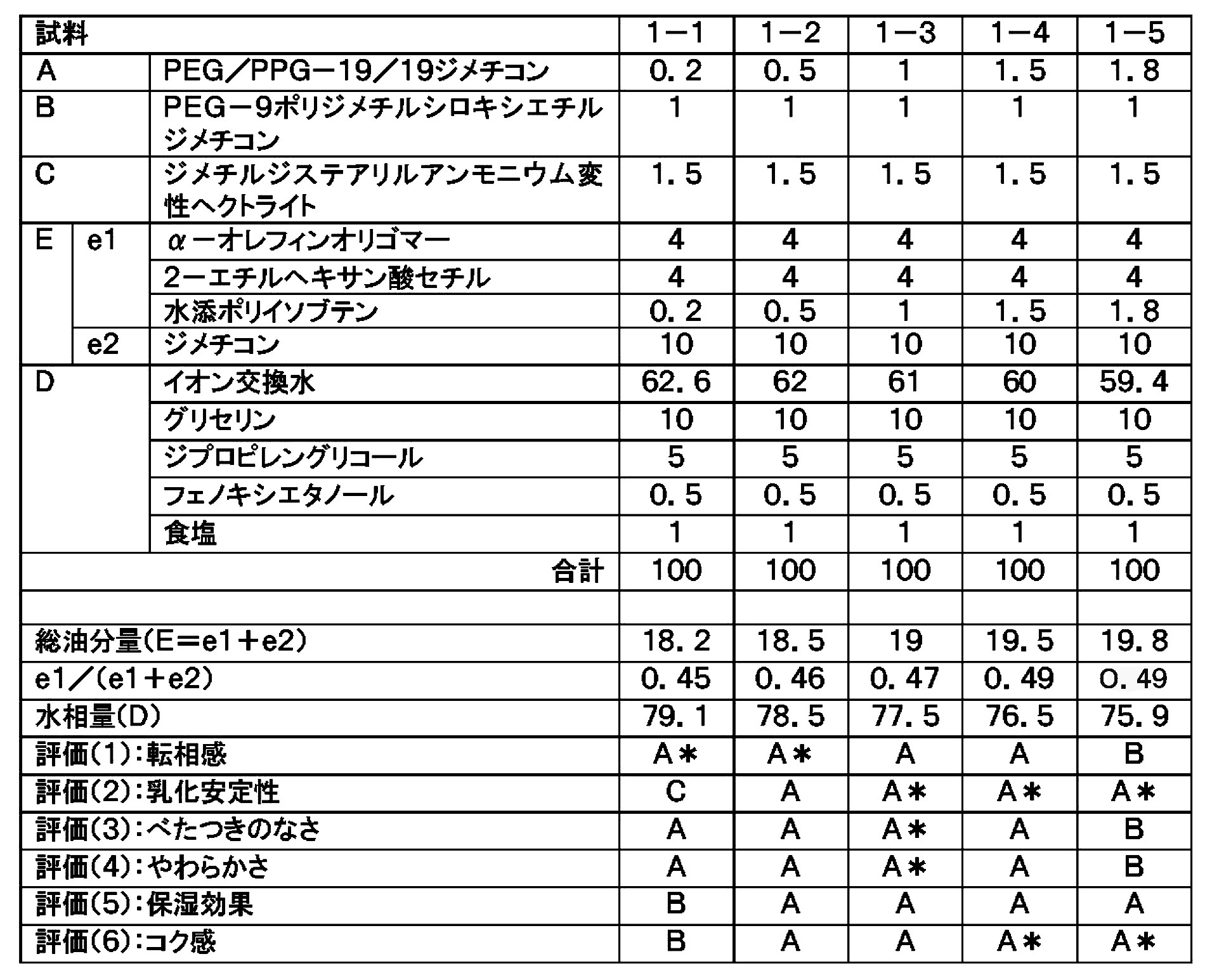
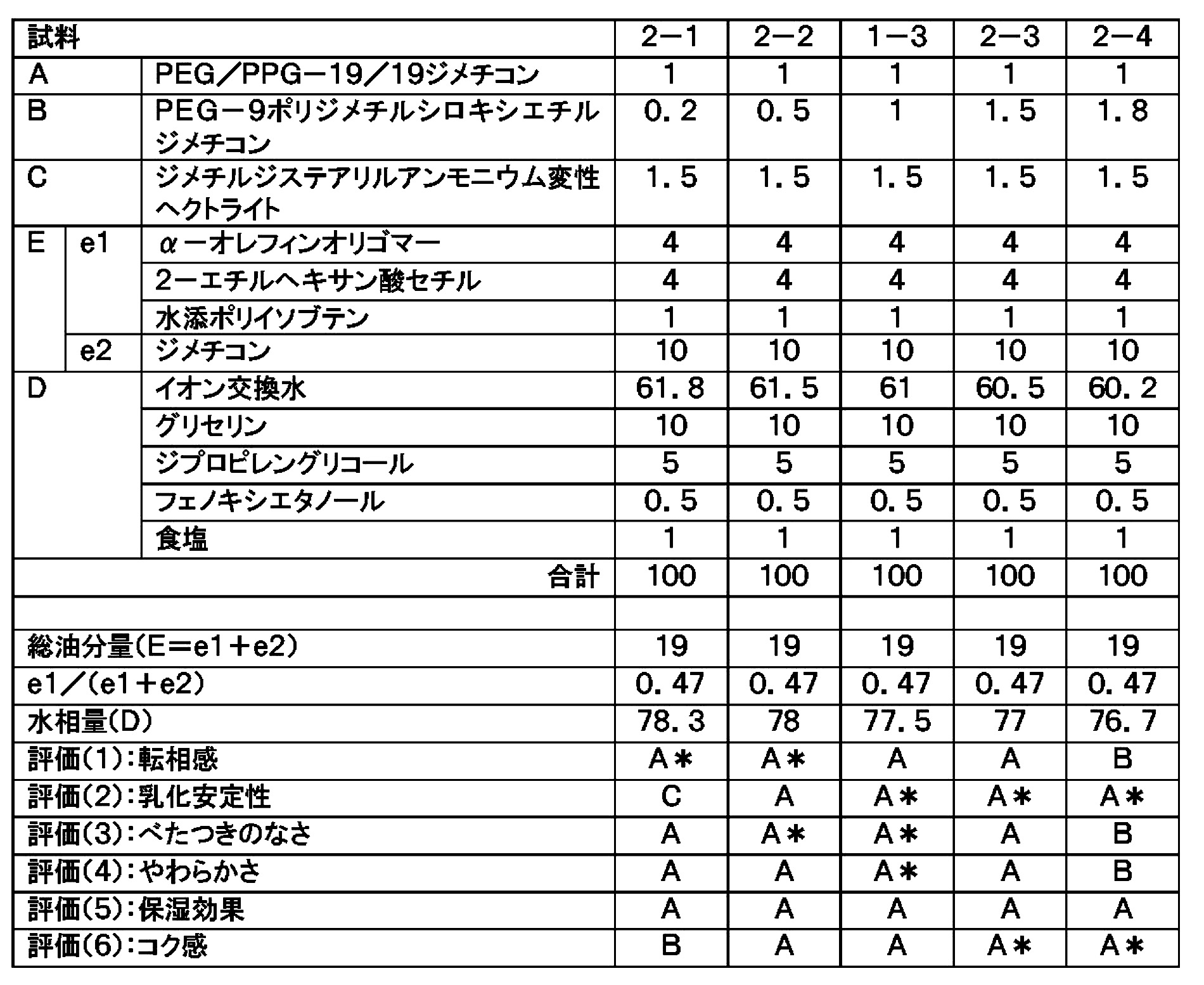
- Examples Water-in-oil type emulsified cosmetics (samples) were prepared according to the formulations shown in Tables 1 to 5 below, and each sample was evaluated. Evaluation items, evaluation methods, and evaluation criteria are as follows. The evaluation results are also shown in Tables 1 to 5.
- Evaluation item (2) Emulsion stability Evaluation method: The hardness and appearance of the sample stored at 25 ° C. and 40 ° C. for one month were compared with those immediately after preparation to evaluate the stability. Evaluation criteria: A *: Under any of the storage conditions, the decrease in hardness was 10% or less, and no change in appearance was observed. A: No change in appearance was observed under any of the storage conditions, but a decrease in hardness of 10% or more was observed only in those stored at 40 ° C. B *: No change in appearance was observed under any of the storage conditions, but a decrease in hardness of 10% or more was observed. B: Separation of water or oil was slightly observed in appearance. C: Separation of water or oil was observed in appearance within one month.
- Evaluation item (3) Non-stickiness Evaluation method: Ten professional panelists applied the sample to the face and evaluated the usability at the time of application. Evaluation criteria: A *: 9 or more panelists answered that there was no stickiness. A: 7 to less than 9 out of 10 panelists answered that there was no stickiness. B: Five or more and less than seven out of ten panelists answered that there was no stickiness. C: Less than 5 out of 10 panelists answered that there was no stickiness.
- Evaluation item (6) Richness Evaluation method: Ten professional panels applied the sample to the face and evaluated the feeling of use during application. Evaluation criteria: A *: 9 or more of the 10 panelists answered that there was a sense of richness. A: 7 or more and less than 9 out of 10 panelists answered that there was a sense of richness. B: Five or more and less than seven out of ten panelists answered that there was a sense of richness. C: Less than 5 out of 10 panelists answered that there was a sense of richness.
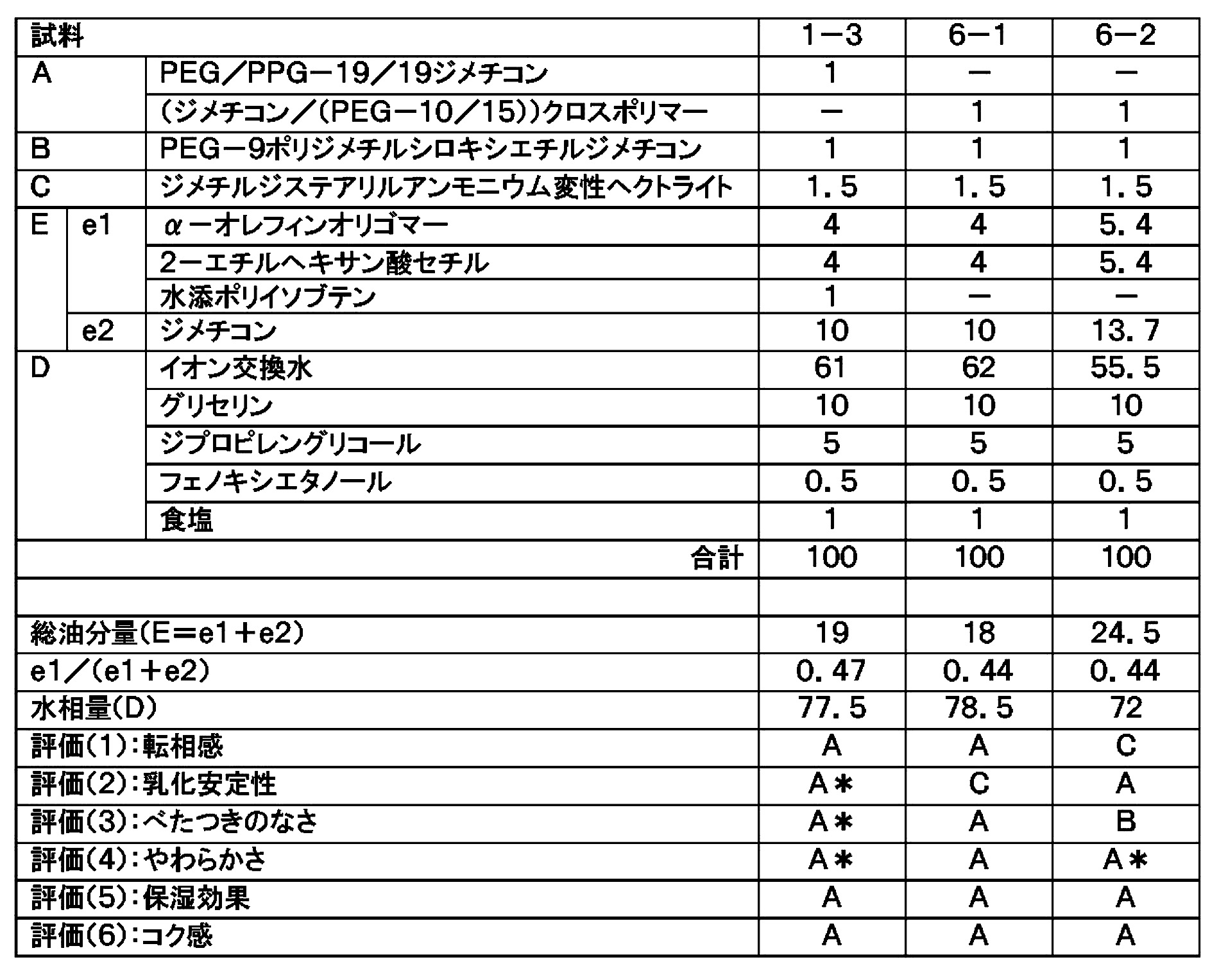
- the high molecular weight polyether-modified silicone of the formula (1) was replaced with a crosslinked polyether-modified silicone having a structure not corresponding to the formula (2) ((dimethicone / ( PEG-10 / 15))
- a cross-polymer; trade name: KSG210; manufactured by Shin-Etsu Chemical Co., Ltd.) was used to prepare a sample, and the same evaluation as described above was performed.
- sample “6-1” using a polyether-modified silicone having a structure that did not correspond to formula (1) or formula (2) could not be emulsified stably.
- the feeling of transferring and overflowing water (a phase change feeling) which is a feature of the present invention.
- the present invention is a unique effect obtained by selecting a polyether-modified silicone having a specific structure represented by the formula (1) or (2) among the polyether-modified silicones.
Landscapes
- Health & Medical Sciences (AREA)
- Life Sciences & Earth Sciences (AREA)
- Public Health (AREA)
- Veterinary Medicine (AREA)
- Animal Behavior & Ethology (AREA)
- General Health & Medical Sciences (AREA)
- Epidemiology (AREA)
- Birds (AREA)
- Chemical & Material Sciences (AREA)
- Inorganic Chemistry (AREA)
- Dispersion Chemistry (AREA)
- Emergency Medicine (AREA)
- Dermatology (AREA)
- Cosmetics (AREA)
Abstract
本発明は、コク感がありながら、転相して水があふれ出すようなみずみずしい使用感触を併せ持ち、なおかつ乳化安定性にも優れた油中水型乳化化粧料を提供することを目的とする。本発明は、特定構造の高分子量ポリエーテル変性シリコーンから選択される少なくとも1種;(B)HLBが2~5のシリコーン界面活性剤(ただし、前記(A)に該当するものは除く);(C)有機変性粘土鉱物;(D)72~83質量%の水相;及び(E)油剤、を含有し、前記(E)油剤が、(e1)非極性炭化水素油及び低極性炭化水素油から選択される少なくとも1種の炭化水素油と、(e2)少なくとも1種のシリコーン油と、を含むことを特徴とする油中水型乳化化粧料に関する。
Description
本発明は、油中水型乳化化粧料に関する。より詳しくは、コク感がありながら、塗布時に水があふれ出すようなみずみずしい感触を与えることのできる油中水型乳化化粧料に関する。
油相を連続相(外相)、水相を分散相(内相)とする油中水型乳化組成物は、油溶性の有効成分、例えばエモリエント剤、油溶性薬剤、紫外線吸収剤等を効率的に皮膚上に展開できることから、皮膚外用剤に適した剤型であり、化粧品分野ではスキンケアクリーム又は乳液、あるいはヘアケア用クリーム等に広く活用されている。
一般に、油中水型乳化化粧料においては、肌への塗布時のコク感を与え、皮膚への柔軟性を付与する等の目的でワックス等の固形油や半固形油が配合されていた。しかし、固形油等の配合でコク感は得られるが、同時にみずみずしい使用感を満足させることは極めて困難であった。
特許文献1では、(a)水溶性エチレン性不飽和モノマーを逆相マイクロエマルション重合により製造した合成高分子電解質(アクリルアミド系コポリマー)からなるミクロゲルを増粘剤とし、それと同時に(b)硬化ヒマシ油と高級脂肪酸とのエステルを配合した皮膚外用剤は、みずみずしさとコク感を併せ持つ使用感を有するとされている。しかし、特許文献1におけるみずみずしさは単に親水性増粘剤ミクロゲルに包含される水分に起因するものと考えられ、塗布時に水があふれ出すような感触を与えるものではない。
一方、みずみずしさに優れた油中水型乳化化粧料としては、特許文献2に、グルコマンナンと、特定構造のポリエーテル変性シリコーンからなる乳化剤と、50.0重量%以上の水を含有する高内水相乳化化粧料が開示されている。また、特許文献3には、特許文献2と同様のポリエーテル変性シリコーンと、シリコーン油及び/又は非極性油と、水を配合する乳化化粧料が開示されている。
前記特許文献2に記載されている高内水相乳化化粧料は、油中水型乳化物でありながら、肌に塗布した際に瞬時に転相して水があふれ出すような感触を与えるとされ、特許文献3に記載されている乳化化粧料は、のびが軽く、しっとりしてべたつきが無いことを特徴としている。しかしながら、これらの化粧料はコク感に欠け、コク感を付与するために固形油を配合すると本来のみずみずしさが失われてしまう。さらに、ポリエーテル変性シリコーンを唯一の乳化剤としているので、油分量を増やすと乳化安定性が低下する傾向があった。
本発明は、前記従来技術の欠点に鑑みてなされたものであり、コク感がありながら、転相して水があふれ出すようなみずみずしい使用感触を併せ持ち、なおかつ乳化安定性にも優れた油中水型乳化化粧料を提供することを目的とする。
本発明者らが鋭意検討を行ったところ、多量の水相を含有する高内水相油中水型乳化化粧料において、特定構造のポリエーテル変性シリコーン、有機変性粘土鉱物、さらに特定のシリコーン界面活性剤を組み合わせて配合し、油剤として非極性又は低極性の炭化水素油とシリコーン油を配合することにより、コク感、みずみずしさ、及び乳化安定性のすべてを満足することができることを見出し、本発明を完成するに至った。
すなわち、本発明は、
(A)下記式(1):
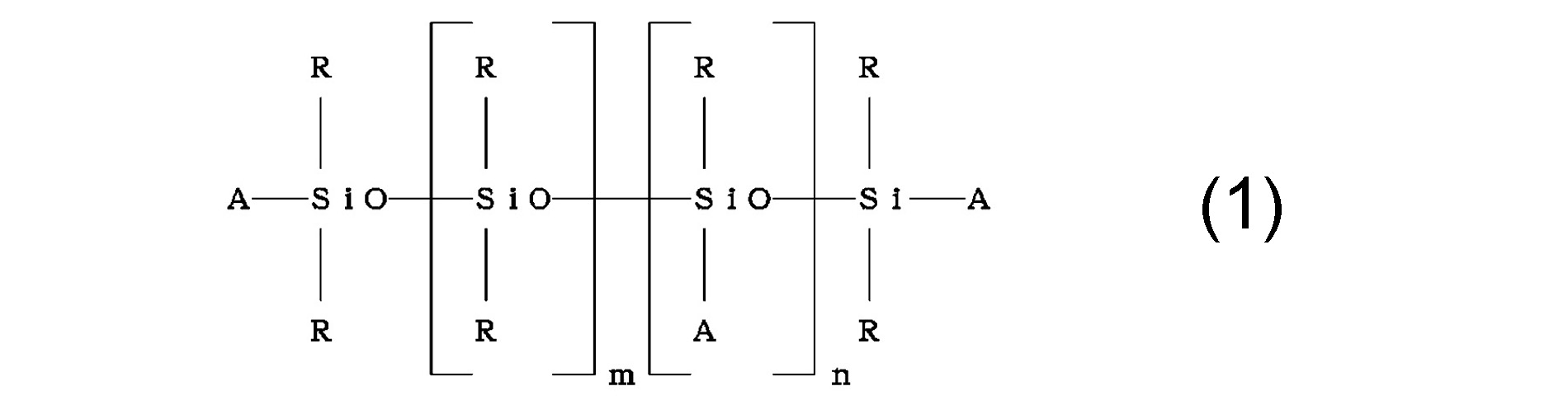
[式(1)中、Aはメチル基、フェニル基及び一般式:-C3H6O(C2H4O)a(C3H6O)bR’(但し、R’は水素原子、アシル基、および炭素数1~4のアルキル基からなる群から選択される基であり、aは5~50の整数であり、bは5~50の整数である)で示されるポリオキシアルキレン基からなる群から選択される基であり、3つのAのうち少なくとも1つはポリオキシアルキレン基であり、
Rはメチル基またはフェニル基であり、
mは50~1000の整数であり、
nは1~40の整数であり、
分子中にポリオキシアルキレン基を40質量%以上含有し、且つ分子量は30000以上である]
で示される高分子量ポリエーテル変性シリコーンから選択される少なくとも1種;
(B)HLBが2~5のシリコーン界面活性剤(ただし、前記(A)に該当するものは除く);
(C)有機変性粘土鉱物;
(D)72~83質量%の水相;及び
(E)油剤、を含有し、
前記(E)油剤が、(e1)非極性炭化水素油及び低極性炭化水素油から選択される少なくとも1種の炭化水素油と、(e2)少なくとも1種のシリコーン油とを含むことを特徴とする、油中水型乳化化粧料を提供する。
なお、本発明は、上記の(A)高分子量ポリエーテル変性シリコーンに代えて又はそれに加えて、下記式(2)で表される架橋型ポリエーテル変性シリコーンの少なくとも1種を配合した油中水型乳化化粧料も含む。
(A)下記式(1):
Rはメチル基またはフェニル基であり、
mは50~1000の整数であり、
nは1~40の整数であり、
分子中にポリオキシアルキレン基を40質量%以上含有し、且つ分子量は30000以上である]
で示される高分子量ポリエーテル変性シリコーンから選択される少なくとも1種;
(B)HLBが2~5のシリコーン界面活性剤(ただし、前記(A)に該当するものは除く);
(C)有機変性粘土鉱物;
(D)72~83質量%の水相;及び
(E)油剤、を含有し、
前記(E)油剤が、(e1)非極性炭化水素油及び低極性炭化水素油から選択される少なくとも1種の炭化水素油と、(e2)少なくとも1種のシリコーン油とを含むことを特徴とする、油中水型乳化化粧料を提供する。
なお、本発明は、上記の(A)高分子量ポリエーテル変性シリコーンに代えて又はそれに加えて、下記式(2)で表される架橋型ポリエーテル変性シリコーンの少なくとも1種を配合した油中水型乳化化粧料も含む。
本発明の油中水型乳化化粧料によれば、肌への塗布時にコク感を与え、なおかつ水があふれ出すようなみずみずしさがあるのみならず、乳化安定性に優れ、べたつかず、のびが良好でさっぱりした使用感触を付与することができる。しかも、従来の化粧料でコク感を付与するために用いられていたワックス等の固形油を配合する必要がないので、加熱工程を含まない簡便な方法で製造することができる。
本明細書における「コク感」とは、製剤を肌に馴染ませた後、製剤が肌を覆うような後残り感があることを意味する。
本明細書における「コク感」とは、製剤を肌に馴染ませた後、製剤が肌を覆うような後残り感があることを意味する。
本発明の油中水型乳化化粧料(以下、単に「乳化化粧料」とも称する)は、(A)特定構造の高分子量ポリエーテル変性シリコーン及び特定構造の架橋型ポリエーテル変性シリコーンから選択される少なくとも1種のポリエーテル変性シリコーン、(B)HLBが2~5のシリコーン界面活性剤、(C)有機変性粘土鉱物、(D)水相;及び(E)油剤を含有する。以下、各成分について詳細に説明する。
(A)ポリエーテル変性シリコーン
本発明の乳化化粧料に配合されるポリエーテル変性シリコーンは、下記式(1)で表される高分子量ポリエーテル変性シリコーンから選択される少なくとも1種、及び/又は、下記式(2)で表される架橋型ポリエーテル変性シリコーンから選択される少なくとも1種(本明細書では、「特定構造のポリエーテル変性シリコーン」又は「A成分」とも称する)である。
本発明の乳化化粧料に配合されるポリエーテル変性シリコーンは、下記式(1)で表される高分子量ポリエーテル変性シリコーンから選択される少なくとも1種、及び/又は、下記式(2)で表される架橋型ポリエーテル変性シリコーンから選択される少なくとも1種(本明細書では、「特定構造のポリエーテル変性シリコーン」又は「A成分」とも称する)である。

Rはメチル基またはフェニル基であり、
mは50~1000の整数であり、
nは1~40の整数であり、
分子中にポリオキシアルキレン基を40質量%以上含有し、且つ分子量は30000以上である。]
上記式(1)の高分子量ポリエーテル変性シリコーンについて、式(1)におけるR’のアシル基の具体例として、ホルミル基、アセチル基、プロピオニル基、ブチロイル基、アクリロイル基、ベンゾイル基、トルオイル基、炭素数1~4のアルキル基等が挙げられ、アルキル基の具体例には、メチル基、エチル基、イソプロピル基、n-プロピル基、t-ブチル基、n-ブチル基等が含まれる。
なお、式(1)におけるポリオキシアルキレン基の数について、aまたはbが5未満である場合には、ポリエーテル変性シリコーンが十分な増粘効果を示さなくなり、またaまたはbが50を超える場合には、得られた乳化化粧料がべとつき感を有するようになる。
また、1分子中のポリオキシアルキレン基の含有量は40質量%以上が好ましく、特に好ましくは40~70質量%の範囲である。ポリオキシアルキレン基の含有量が40質量%未満の場合には、シリコーン油以外の非極性油に対する乳化能が低下し、70質量%を超える場合には、得られた乳化化粧料にべたつきを生ずる場合がある。
式(1)における、mが50未満であり、かつnが1未満である場合には、増粘効果が不十分になり、mが1000を超え、かつnが40を超える場合には、得られた乳化化粧料がべたついた感触を有するようになる。
また、1分子中のポリオキシアルキレン基の含有量は40質量%以上が好ましく、特に好ましくは40~70質量%の範囲である。ポリオキシアルキレン基の含有量が40質量%未満の場合には、シリコーン油以外の非極性油に対する乳化能が低下し、70質量%を超える場合には、得られた乳化化粧料にべたつきを生ずる場合がある。
式(1)における、mが50未満であり、かつnが1未満である場合には、増粘効果が不十分になり、mが1000を超え、かつnが40を超える場合には、得られた乳化化粧料がべたついた感触を有するようになる。
本発明に用いられる高分子量ポリエーテル変性シリコーン(式(1))の分子量は30000以上であり、50000以上であるのが好ましい。これは、ポリエーテル変性シリコーンの分子量が30000未満であると、シリコーン油以外の非極性油分に対する乳化能が低下するためである。
上記式(1)に該当する高分子量ポリエーテル変性シリコーンとして特に好ましい具体例としては、PEG/PPG-19/19、即ち、ジメチコンのメチル基の一部をポリオキシアルキレン基で置換した構造を有し、オキシエチレン基及びオキシプロピレン基の平均重合度が各々19である化合物、を挙げることができる。当該化合物は、上記式(1)において、Rがメチル基であり、a=19かつb=19である化合物に相当する(ただし、ポリオキシアルキレン基におけるオキシエチレン基とオキシプロピレン基の結合順序は限定されず、交互に結合していてもよく、少なくとも一部がポリオキシエチレンブロック及び/又はポリオキシプロピレンブロックを形成していてもよい。また、R’は水素原子であるのが好ましい)。
式(2)で表される架橋型ポリエーテル変性シリコーンは、メチルハイドロジェンポリシロキサンを、両末端ジアリルポリエーテルで架橋した架橋高分子である。実使用においては、前記架橋高分子100重量部に対して、25℃における粘度が100mPa・s以下である低粘度シリコーン油10~1000重量部、好ましくは20~500重量部を剪断力下で混練処理してペースト状組成物として配合するのが好ましい。ペースト状組成物を調製する際に用いられる低粘度シリコーン油は、直鎖状、分岐状のいずれであってもよく、例えば、メチルポリシロキサン(ジメチコン)、メチルフェニルポリシロキサン(ジフェニルジメチコン)、エチルポリシロキサン、エチルメチルポリシロキサン、エチルフェニルポリシロキサン、またオクタメチルシクロテトラシロキサン、デカメチルシクロペンタシロキサン等の環状ジメチルポリシロキサンなどが挙げられ、これらは単独でも2種以上の混合物であってもよい。
本発明の乳化化粧料は、上記の式(1)で表される高分子量ポリエーテル変性シリコーン及び上記の式(2)で表される架橋型ポリエーテル変性シリコーンのいずれか一方または両方(即ち、特定構造のポリエーテル変性シリコーン)を1種又は2種以上を組み合わせて含有できる。特に、式(1)で表される高分子量ポリエーテル変性シリコーンを少なくとも1種含有するのが好ましい。
本発明の乳化化粧料における特定構造のポリエーテル変性シリコーン(A成分)の配合量は、実分で、0.3質量%以上とするのが好ましい。配合量が0.3質量%未満であると乳化安定性が低下する場合がある。好ましい配合量範囲は0.4~1.8質量%であり、0.5~1.5質量%が特に好ましい。
(B)HLBが2~5のシリコーン界面活性剤
本発明の乳化化粧料におけるB成分はシリコーン界面活性剤であり、そのHLB値が2~5の範囲内にあるものである。本発明における「シリコーン界面活性剤」とは、分子内にシリコーン構造(疎水性部分)と親水性部分とを有する非イオン性の界面活性剤である。
本発明の乳化化粧料におけるB成分はシリコーン界面活性剤であり、そのHLB値が2~5の範囲内にあるものである。本発明における「シリコーン界面活性剤」とは、分子内にシリコーン構造(疎水性部分)と親水性部分とを有する非イオン性の界面活性剤である。
本発明で好ましく用いられるシリコーン界面活性剤の具体例としては、ポリ(オキシエチレン・オキシプロピレン)メチルポリシロキサン共重合体、ポリオキシエチレンメチルポリシロキサン共重合体、シリコーン鎖分岐型メチルポリシロキサン共重合体、アルキル鎖分岐型ポリオキシエチレンメチルポリシロキサン共重合体、アルキル鎖・シリコーン鎖分岐型ポリオキシエチレンメチルポリシロキサン共重合体、架橋型ポリオキシエチレンメチルポリシロキサン、アルキル基含有架橋型ポリオキシエチレンメチルポリシロキサン、分岐型ポリグリセリン変性シリコーン、架橋型ポリグリセリン変性シリコーン、アルキル基含有架橋型ポリグリセリン変性シリコーン、アルキル基分岐型ポリグリセリン変性シリコーン等が挙げられるが、これらに限定されない。
なお、上記式(1)又は(2)で表される特定構造のポリエーテル変性シリコーンの中に、そのHLB値が2~5であるものが存在し得るが、本発明においては、式(1)又は(2)に該当するものは特定構造のポリエーテル変性シリコーン(A成分)とし、シリコーン界面活性剤(B成分)からは除外する。
なお、上記式(1)又は(2)で表される特定構造のポリエーテル変性シリコーンの中に、そのHLB値が2~5であるものが存在し得るが、本発明においては、式(1)又は(2)に該当するものは特定構造のポリエーテル変性シリコーン(A成分)とし、シリコーン界面活性剤(B成分)からは除外する。
より具体的な例として、PEG-9ポリジメチルシロキシエチルジメチコン、ラウリルPEG-9ポリジメチルシロキシエチルジメチコン、セチルPEG/PPG-10/1ジメチコン、PEG-9メチルエーテルジメチコン、PEG-10ジメチコン、PEG-3ジメチコン等が挙げられるが、これらに限定されない。
本発明の乳化化粧料におけるシリコーン界面活性剤(B成分)の配合量は、0.3質量%以上とするのが好ましい。配合量が0.3質量%未満であると乳化安定性が低下する場合がある。好ましい配合量範囲は0.4~1.8質量%であり、0.5~1.5質量%が特に好ましい。
(C)有機変性粘土鉱物
本発明の乳化化粧料に用いられる有機変性粘土鉱物(C成分)は、三層構造を有するコロイド性含水ケイ酸アルミニウムの一種で、一般に下記一般式(3)で表される粘土鉱物を第四級アンモニウム塩型カチオン界面活性剤で変性したものである。
(X,Y)2―3(Si,Al)4O10(OH)2Z1/3・nH2O (3)
(但し、X=Al、Fe(III)、Mn(III)又はCr(III)、Y=Mg、Fe(II)、Ni、Zn又はLi、Z=K、Na又はCa)
本発明の乳化化粧料に用いられる有機変性粘土鉱物(C成分)は、三層構造を有するコロイド性含水ケイ酸アルミニウムの一種で、一般に下記一般式(3)で表される粘土鉱物を第四級アンモニウム塩型カチオン界面活性剤で変性したものである。
(X,Y)2―3(Si,Al)4O10(OH)2Z1/3・nH2O (3)
(但し、X=Al、Fe(III)、Mn(III)又はCr(III)、Y=Mg、Fe(II)、Ni、Zn又はLi、Z=K、Na又はCa)
具体的にはモンモリロナイト、サポナイト、ヘクトライト等の天然または合成(この場合、式中の(OH)基がフッ素で置換されたもの)のモンモリロナイト群(市販品ではビーガム、クニピア、ラポナイト等がある。)およびナトリウムシリシックマイカやナトリウムまたはリチウムテニオライトの名で知られる合成雲母(市販品ではダイモナイト:トピー工業(株)等がある。)等の粘土鉱物を第四級アンモニウム塩型カチオン界面活性剤で処理して得られる。
ここで用いられる第四級アンモニウム塩型カチオン界面活性剤は、下記一般式(3)で表されるものである。

かかる第四級アンモニウム塩型カチオン界面活性剤としては、例えばドデシルトリメチルアンモニウムクロリド、ミリスチルトリメチルアンモニウムクロリド、セチルトリメチルアンモニウムクロリド、ステアリルトリメチルアンモニウムクロリド、アラキルトリメチルアンモニウムクロリド、ベヘニルトリメチルアンモニウムクロリド、ミリスチルジメチルエチルアンモニウムクロリド、セチルジメチルエチルアンモニウムクロリド、ステアリルジメチルエチルアンモニウムクロリド、アラキルジメチルエチルアンモニウムクロリド、ベヘニルジメチルエチルアンモニウムクロリド、ミリスチルジエチルメチルアンモニウムクロリド、セチルジエチルメチルアンモニウムクロリド、ステアリルジエチルメチルアンモニウムクロリド、アラキルジエチルメチルアンモニウムクロリド、ベヘニルジエチルメチルアンモニウムクロリド、ベンジルジメチルミリスチルアンモニウムクロリド、ベンジルジメチルセチルアンモニウムクロリド、ベンジルジメチルステアリルアンモニウムクロリド、ベンジルジメチルベヘニルアンモニウムクロリド、ベジルメチルエチルセチルアンモニウムクロリド、ベンジルメチルエチルステアリルアンモニウムクロリド、ジベヘニルジヒドロキシエチルアンモニウムクロリド、および相当するブロミド等、更にはジパルミチルプロピルエチルアンモニウムメチルサルフェート等が挙げられる。本発明の実施にあたっては、これらのうち1種または2種以上が任意に選択される。
有機変性粘土鉱物の代表的なものとしては、ジメチルアルキルアンモニウムヘクトライト、ベンジルジメチルステアリルアンモニウムヘクトライト、塩化ジステアリルジメチルアンモニウム処理ケイ酸アルミニウムマグネシウム等が挙げられる。市販品としては、ベントン27(ベンジルジメチルステアリルアンモニウムクロライド処理ヘクトライト:ナショナルレッド社製)およびベントン38(ジメチルジステアリルアンモニウム変性ヘクトライト:ナショナルレッド社製)が好ましい。
本発明の乳化化粧料における有機変性粘土鉱物(C成分)の配合量は、0.5質量%より大きく、かつ2.5質量%未満とするのが好ましい。配合量が0.5質量%以下又は2.5質量%以上であると乳化安定性が低下する傾向がある。好ましい配合量範囲は0.8~2.2質量%であり、1.0~2.0質量%が特に好ましい。
(D)水相
本発明の乳化化粧料における水相(D成分)は、水及び水溶性成分を含む。水は、イオン交換水、精製水、自然水等、化粧料に通常使用されているものでよい。水溶性成分は、水と混和可能な物質であり、典型例として、低級アルコール及び多価アルコールを挙げることができる。
本発明の乳化化粧料における水相(D成分)は、水及び水溶性成分を含む。水は、イオン交換水、精製水、自然水等、化粧料に通常使用されているものでよい。水溶性成分は、水と混和可能な物質であり、典型例として、低級アルコール及び多価アルコールを挙げることができる。
低級アルコールとは、炭素数5以下のアルコールを指し、メタノール、エタノール、プロパノール、イソプロパノール、ブタノール、イソブタノール、t-ブタノール等が例示される。
多価アルコールとしては、例えば、2価のアルコール(例えば、エチレングリコール、プロピレングリコール、トリメチレングリコール、1,2-ブチレングリコール、1,3-ブチレングリコール、テトラメチレングリコール、2,3-ブチレングリコール、ペンタメチレングリコール、2-ブテン-1,4-ジオール、ヘキシレングリコール、オクチレングリコール等);3価のアルコール(例えば、グリセリン、トリメチロールプロパン等);4価アルコール(例えば、1,2,6-へキサントリオール等のペンタエリスリトール等);5価アルコール(例えば、キシリトール(糖アルコールにも属する)等);6価アルコール(例えば、ソルビトール、マンニトール(いずれも糖アルコールにも属する)等);多価アルコール重合体(例えば、ジエチレングリコール、ジプロピレングリコール、トリエチレングリコール、ポリプロピレングリコール、テトラエチレングリコール、ジグリセリン、ポリエチレングリコール、トリグリセリン、テトラグリセリン、ポリグリセリン等);2価アルコールアルキルエーテル類(例えば、エチレングリコールモノメチルエーテル、エチレングリコールモノエチルエーテル、エチレングリコールモノブチルエーテル、エチレングリコールモノフェニルエーテル(フェノキシエタノール)、エチレングリコールモノヘキシルエーテル、エチレングリコールモノ2-メチルヘキシルエーテル、エチレングリコールイソアミルエーテル、エチレングリコールベンジルエーテル、エチレングリコールイソプロピルエーテル、エチレングリコールジメチルエーテル、エチレングリコールジエチルエーテル、エチレングリコールジブチルエーテル等);2価アルコール縮合体アルキルエーテル類(例えば、ジエチレングリコールモノメチルエーテル、ジエチレングリコールモノエチルエーテル、ジエチレングリコールモノブチルエーテル、ジエチレングリコールジメチルエーテル、ジエチレングリコールジエチルエーテル、ジエチレングリコールブチルエーテル、ジエチレングリコールメチルエチルエーテル、トリエチレングリコールモノメチルエーテル、トリエチレングリコールモノエチルエーテル、プロピレングリコールモノメチルエーテル、プロピレングリコールモノエチルエーテル、プロピレングリコールモノブチルエーテル、プロピレングリコールイソプロピルエーテル、ジプロピレングリコールメチルエーテル、ジプロピレングリコールエチルエーテル、ジプロピレングリコールブチルエーテル等);2価アルコールエーテルエステル(例えば、エチレングリコールモノメチルエーテルアセテート、エチレングリコールモノエチルエーテルアセテート、エチレングリコールモノブチルエーテルアセテート、エチレングリコールモノフェニルエーテルアセテート、エチレングリコールジアジベート、エチレングリコールジサクシネート、ジエチレングリコールモノエチルエーテルアセテート、ジエチレングリコールモノブチルエーテルアセテート、プロピレングリコールモノメチルエーテルアセテート、プロピレングリコールモノエチルエーテルアセテート、プロピレングリコールモノプロピルエーテルアセテート、プロピレングリコールモノフェニルエーテルアセテート等);グリセリンモノアルキルエーテル(例えば、キシルアルコール、セラキルアルコール、バチルアルコール等);糖アルコール(例えば、ソルビトール、マルチトール、マルトトリオース、マンニトール、ショ糖、エリトリトール、グルコース、フルクトース、デンプン分解糖、マルトース、キシリトール、デンプン分解等還元アルコール等);グリソリッド;テトラハイドロフルフリルアルコール;POE-テトラハイドロフルフリルアルコール、POP-ブチルエーテル;POP・POE-ブチルエーテル;トリポリオキシプロピレングリセリンエーテル;POP-グリセリンエーテル;POP-グリセリンエーテルリン酸;POP・POE-ペンタンエリスリトールエーテル、ポリグリセリン等が挙げられる。
その他の水溶性成分には、各種塩類、各種水溶性薬剤(例えば、保湿剤、防腐剤、増粘剤など)が含まれ、特に限定されない。但し、その配合量は本発明の効果を阻害しない範囲とする。また、本発明の乳化化粧料は、上記の特許文献2で必須とされているグルコマンナン(水溶性増粘剤の1種)を配合しなくても安定で、転相して水があふれ出すような使用感(転相感)が得られるので、本発明はグルコマンナンを配合しない態様も包含する。
本発明の乳化化粧料における水相(D成分)の配合量は72~83質量%であることを必要とする。水相の配合量を前記範囲外とすると転相感が得られないか、安定して乳化することができない。水相の配合量範囲は、好ましくは72.5~82質量%、さらに好ましくは73~81質量%である。
また、水相(D成分)の少なくとも80質量%、好ましくは少なくとも90質量%、より好ましくは少なくとも95質量%を、水と多価アルコールと保湿剤が占めるようにするのが好ましい。
また、水相(D成分)の少なくとも80質量%、好ましくは少なくとも90質量%、より好ましくは少なくとも95質量%を、水と多価アルコールと保湿剤が占めるようにするのが好ましい。
本発明における油剤(E成分)は、(e1)非極性炭化水素油及び低極性炭化水素油から選択される少なくとも1種の炭化水素油と、(e2)少なくとも1種のシリコーン油とを含む。
(e1)非極性炭化水素油及び低極性炭化水素油から選択される少なくとも1種の炭化水素油
本発明における(e1成分)は、常温(25℃)において液状の炭化水素油であって、一般に非極性油又は低極性油として知られたものでよい。化粧料分野では、例えば、水添ポリデセン、ミネラルオイル、流動パラフィン、イソパラフィン、イソヘキサデカン、イソドデカン、スクワラン、スクワレン、水添ポリイソブテン等が非極性又は低極性の液状油として知られている。
本発明における(e1成分)は、常温(25℃)において液状の炭化水素油であって、一般に非極性油又は低極性油として知られたものでよい。化粧料分野では、例えば、水添ポリデセン、ミネラルオイル、流動パラフィン、イソパラフィン、イソヘキサデカン、イソドデカン、スクワラン、スクワレン、水添ポリイソブテン等が非極性又は低極性の液状油として知られている。
本発明においては、非極性炭化水素油及び低極性炭化水素油から選択される少なくとも1種の炭化水素油(e1成分)を、以下では包括的に「非極性炭化水素油」とも称し、便宜的に、「常温で液状でありIOB値が0.15以下の炭化水素油」と定義する。IOB値とは、有機概念図(甲田善生ら著、「新版 有機概念図-基礎と応用-」、三共出版、2008年発行)における有機性値(Organic Value = OV)と無機性値(Inorganic Value = IV)との比から求めた値(IV / OV = IOB(Inorganic Organic Balance))である。
上記で定義した「非極性炭化水素油」(e1成分)には、前記の液状油に加えて、ステアリン酸ステアリル(IOB=0.08)、ミリスチン酸オクチルドデシル(IOB=0.09)、パルミチン酸オクチル(IOB=0.13)、2-エチルヘキサン酸セチル(IOB=0.13)、オクタン酸セチル(IOB=0.13)、トリイソステアリン酸トリメチロールプロパン(IOB=0.14)、イソノナン酸イソトリデシル(IOB=0.14)等のエステル油;軽質イソパラフィン、軽質流動イソパラフィン、流動イソパラフィン、流動パラフィン等のパラフィン系油剤;α-オレフィンオリゴマー等の炭化水素系油剤等が含まれる。
(e2)シリコーン油
シリコーン油(e2成分)は、常温で液状のシリコーン油であり、例えば、ジメチルポリシロキサン(ジメチコン)、メチルフェニルポリシロキサン(ジフェニルジメチコン)、メチルハイドロジェンポリシロキサンなどの鎖状シリコーン油、オクタメチルシクロテトラシロキサン、デカメチルシクロペンタシロキサン、ドデカメチルシクロヘキサシロキサンなどの環状シリコーン油等が挙げられる。
シリコーン油(e2成分)は、常温で液状のシリコーン油であり、例えば、ジメチルポリシロキサン(ジメチコン)、メチルフェニルポリシロキサン(ジフェニルジメチコン)、メチルハイドロジェンポリシロキサンなどの鎖状シリコーン油、オクタメチルシクロテトラシロキサン、デカメチルシクロペンタシロキサン、ドデカメチルシクロヘキサシロキサンなどの環状シリコーン油等が挙げられる。
本発明の乳化化粧料では、前記(e1)非極性炭化水素油と前記(e2)シリコーン油の合計配合量に対する(e1)炭化水素油の配合量の比率[(e1)/{(e1)+(e2)}]を0.3~0.65の範囲に調整するのが好ましく、0.32~0.64の範囲にするのがより好ましく、0.34~0.62の範囲内にするのが特に好ましい。比率[(e1)/{(e1)+(e2)}]は、0.3~0.65の範囲内であれば如何なる数値(範囲)も取り得るが、中でも、0.4~0.5の範囲にするのが最も好ましい。
本発明における油剤(E成分)には、必須成分である(e1)非極性炭化水素油及び(e2)シリコーン油以外に、油脂、ロウ類、高級脂肪酸、高級アルコール、高極性炭化水素油(IOB値が0.15を超える液状炭化水素油)等から選ばれる任意の油性成分を、本発明の効果を損なわない限りに配合することが可能である。
本発明の乳化化粧料における油剤(E成分)の配合量は、通常は10~30質量%、好ましくは12~28質量%、より好ましくは15~24質量%である。
また、(e1)非極性炭化水素及び(e2)シリコーン油の合計配合量が、油剤(E成分)の全質量に対して、80質量%以上を占めるのが好ましく、より好ましくは90質量%以上、さらに好ましくは95質量%以上を占め、油剤(E成分)が(e1)非極性炭化水素及び(e2)シリコーン油のみからなることもある。
また、(e1)非極性炭化水素及び(e2)シリコーン油の合計配合量が、油剤(E成分)の全質量に対して、80質量%以上を占めるのが好ましく、より好ましくは90質量%以上、さらに好ましくは95質量%以上を占め、油剤(E成分)が(e1)非極性炭化水素及び(e2)シリコーン油のみからなることもある。
本発明の乳化化粧料には、本発明の効果を損なわない範囲内で、化粧料に通常用いられる他の任意成分、例えば、限定されないが、金属イオン封鎖剤、粉末成分、pH調整剤、紫外線吸収剤、皮膚栄養剤、ビタミン、酸化防止剤、酸化防止助剤、香料等を必要に応じて適宜配合することができる。
本発明の乳化化粧料は、油中水型乳化化粧料の常法を用いて製造することができ、乳化の方法は特に限定されるものでない。例えば、水相と油相を、必要に応じて加温し、水相を油相に徐々に添加して乳化機で乳化し、加熱した場合には室温まで放冷する等の方法がある。特に、本発明の乳化化粧料で固形油分を含まない態様では、加熱工程が不要となるため工程が簡略化できる。
本発明に係る乳化化粧料は、様々な形態の化粧料に広く応用することが可能であり、例えば、みずみずしい使用感触を持った乳液、クリーム、化粧下地、乳化ファンデーション等の形態として提供するのに適している。
以下、実施例を挙げて本発明をさらに詳しく説明するが、本発明はこれらの実施例により限定されるものではない。配合量については特に断りのない限り質量%を示す。
下記の表1~5に示す処方にて油中水型乳化化粧料(試料)を調製し、各試料について評価した。評価項目、評価方法、及び評価基準は以下の通りである。評価結果を表1~5に併せて示す。
評価項目(1):転相感
評価方法:専門パネル10名が顔に試料を塗布し、塗布時の水が溢れ出す感触の有無(転相感)を評価した。
評価基準:
A*:パネル10名中9名以上が転相感があると回答した。
A:パネル10名中7名以上9名未満が転相感があると回答した。
B:パネル10名中5名以上7名未満が転相感があると回答した。
C:パネル10名中5名未満が転相感があると回答した。
評価方法:専門パネル10名が顔に試料を塗布し、塗布時の水が溢れ出す感触の有無(転相感)を評価した。
評価基準:
A*:パネル10名中9名以上が転相感があると回答した。
A:パネル10名中7名以上9名未満が転相感があると回答した。
B:パネル10名中5名以上7名未満が転相感があると回答した。
C:パネル10名中5名未満が転相感があると回答した。
評価項目(2):乳化安定性
評価方法:25℃および40℃で1ヶ月保存した試料の硬度および外観を、調製直後と比較し安定性を評価した。
評価基準:
A*:どの保存条件でも、硬度の低下が10%以下であり、外観の変化は認められなかった。
A:どの保存条件でも、外観の変化は認められなかったが、40℃で保存したもののみ10%以上の硬度低下が認められた。
B*:どの保存条件でも、外観の変化は認められなかったが、10%以上の硬度低下が認められた。
B:外観において、水または油の分離が若干認められた。
C:1ヶ月以内に、外観において水または油の分離が認められた。
評価方法:25℃および40℃で1ヶ月保存した試料の硬度および外観を、調製直後と比較し安定性を評価した。
評価基準:
A*:どの保存条件でも、硬度の低下が10%以下であり、外観の変化は認められなかった。
A:どの保存条件でも、外観の変化は認められなかったが、40℃で保存したもののみ10%以上の硬度低下が認められた。
B*:どの保存条件でも、外観の変化は認められなかったが、10%以上の硬度低下が認められた。
B:外観において、水または油の分離が若干認められた。
C:1ヶ月以内に、外観において水または油の分離が認められた。
評価項目(3):べたつきのなさ
評価方法:専門パネル10名が顔に試料を塗布し、塗布時の使用感を評価した。
評価基準:
A*:パネル10名中9名以上がべたつきがないと回答した。
A:パネル10名中7名以上9名未満がべたつきがないと回答した。
B:パネル10名中5名以上7名未満がべたつきがないと回答した。
C:パネル10名中5名未満がべたつきがないと回答した。
評価方法:専門パネル10名が顔に試料を塗布し、塗布時の使用感を評価した。
評価基準:
A*:パネル10名中9名以上がべたつきがないと回答した。
A:パネル10名中7名以上9名未満がべたつきがないと回答した。
B:パネル10名中5名以上7名未満がべたつきがないと回答した。
C:パネル10名中5名未満がべたつきがないと回答した。
評価項目(4):やわらかさ
評価方法:専門パネル10名が顔に試料を塗布し、塗布時の使用感を評価した。
評価基準:
A*:パネル10名中9名以上が肌がやわらかいと回答した。
A:パネル10名中7名以上9名未満が肌がやわらかいと回答した。
B:パネル10名中5名以上7名未満が肌がやわらかいと回答した。
C:パネル10名中5名未満が肌がやわらかいと回答した。
評価方法:専門パネル10名が顔に試料を塗布し、塗布時の使用感を評価した。
評価基準:
A*:パネル10名中9名以上が肌がやわらかいと回答した。
A:パネル10名中7名以上9名未満が肌がやわらかいと回答した。
B:パネル10名中5名以上7名未満が肌がやわらかいと回答した。
C:パネル10名中5名未満が肌がやわらかいと回答した。
評価項目(5):保湿効果
評価方法:専門パネル10名が顔に試料を塗布し、塗布時の使用感を評価した。
評価基準:
A*:パネル10名中9名以上が保湿効果があると回答した。
A:パネル10名中7名以上9名未満が保湿効果があると回答した。
B:パネル10名中5名以上7名未満が保湿効果があると回答した。
C:パネル10名中5名未満が保湿効果があると回答した。
評価方法:専門パネル10名が顔に試料を塗布し、塗布時の使用感を評価した。
評価基準:
A*:パネル10名中9名以上が保湿効果があると回答した。
A:パネル10名中7名以上9名未満が保湿効果があると回答した。
B:パネル10名中5名以上7名未満が保湿効果があると回答した。
C:パネル10名中5名未満が保湿効果があると回答した。
評価項目(6):コク感
評価方法:専門パネル10名が顔に試料を塗布し、塗布時の使用感を評価した。
評価基準:
A*:パネル10名中9名以上がコク感があると回答した。
A:パネル10名中7名以上9名未満がコク感があると回答した。
B:パネル10名中5名以上7名未満がコク感があると回答した。
C:パネル10名中5名未満がコク感があると回答した。
評価方法:専門パネル10名が顔に試料を塗布し、塗布時の使用感を評価した。
評価基準:
A*:パネル10名中9名以上がコク感があると回答した。
A:パネル10名中7名以上9名未満がコク感があると回答した。
B:パネル10名中5名以上7名未満がコク感があると回答した。
C:パネル10名中5名未満がコク感があると回答した。
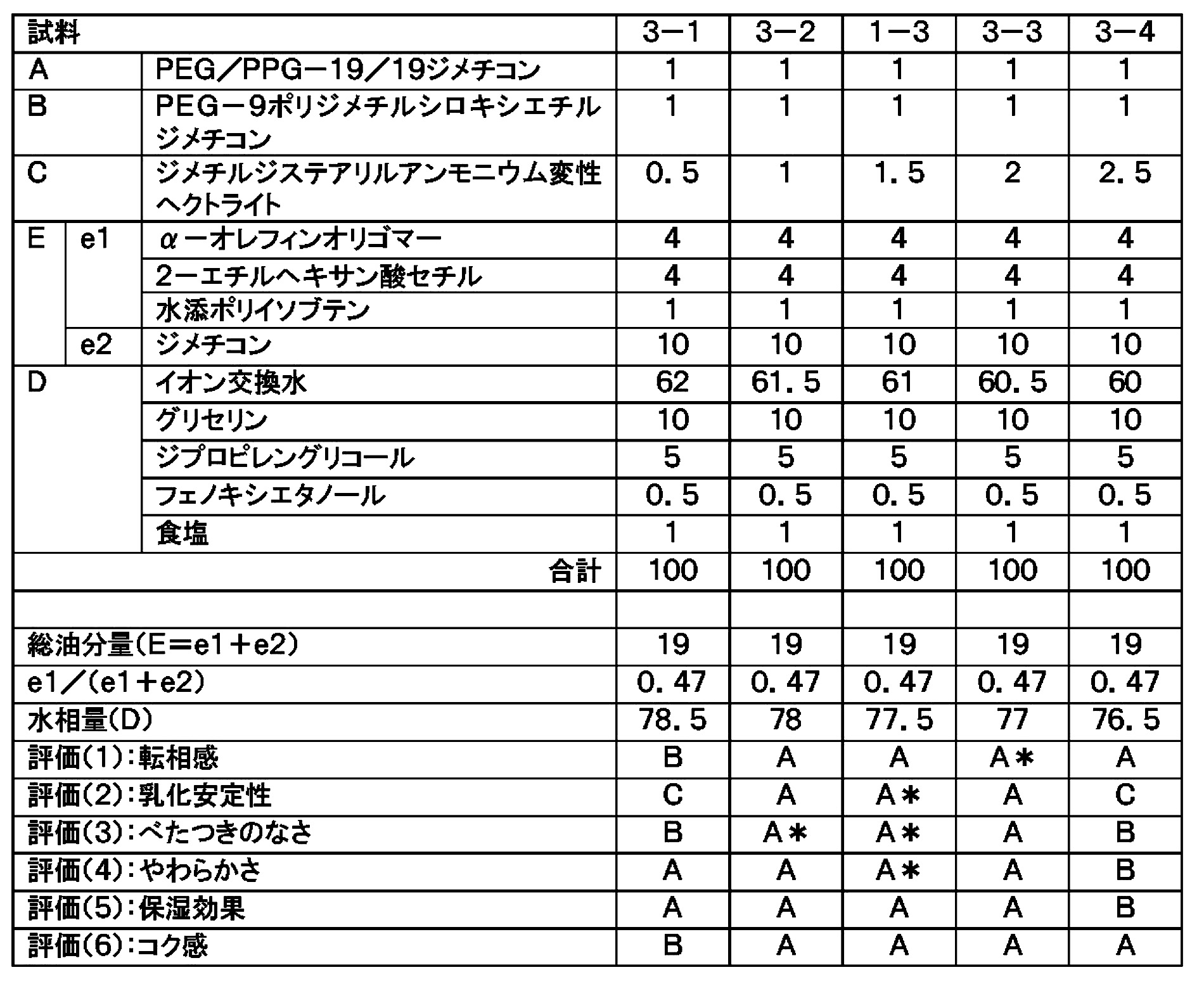
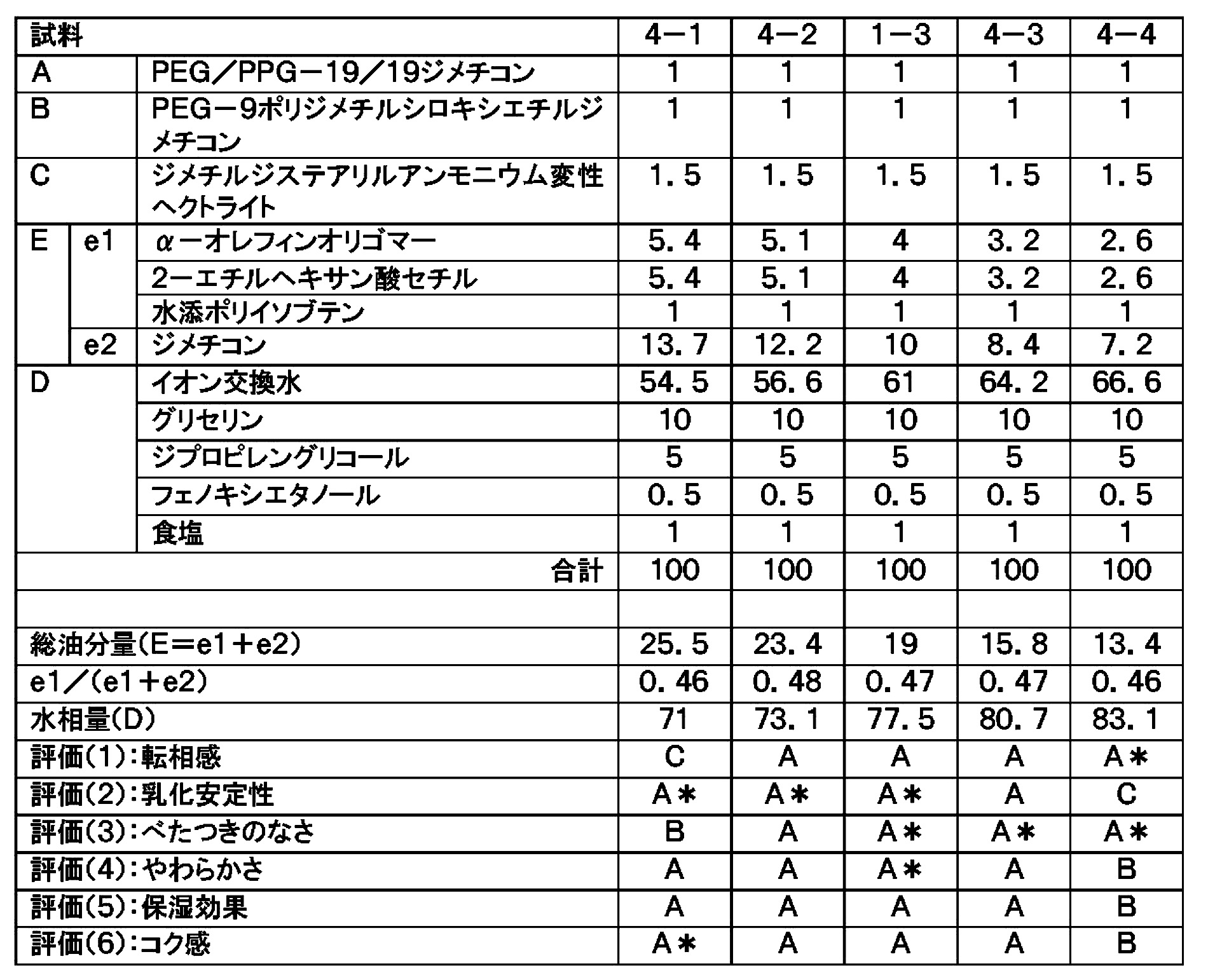
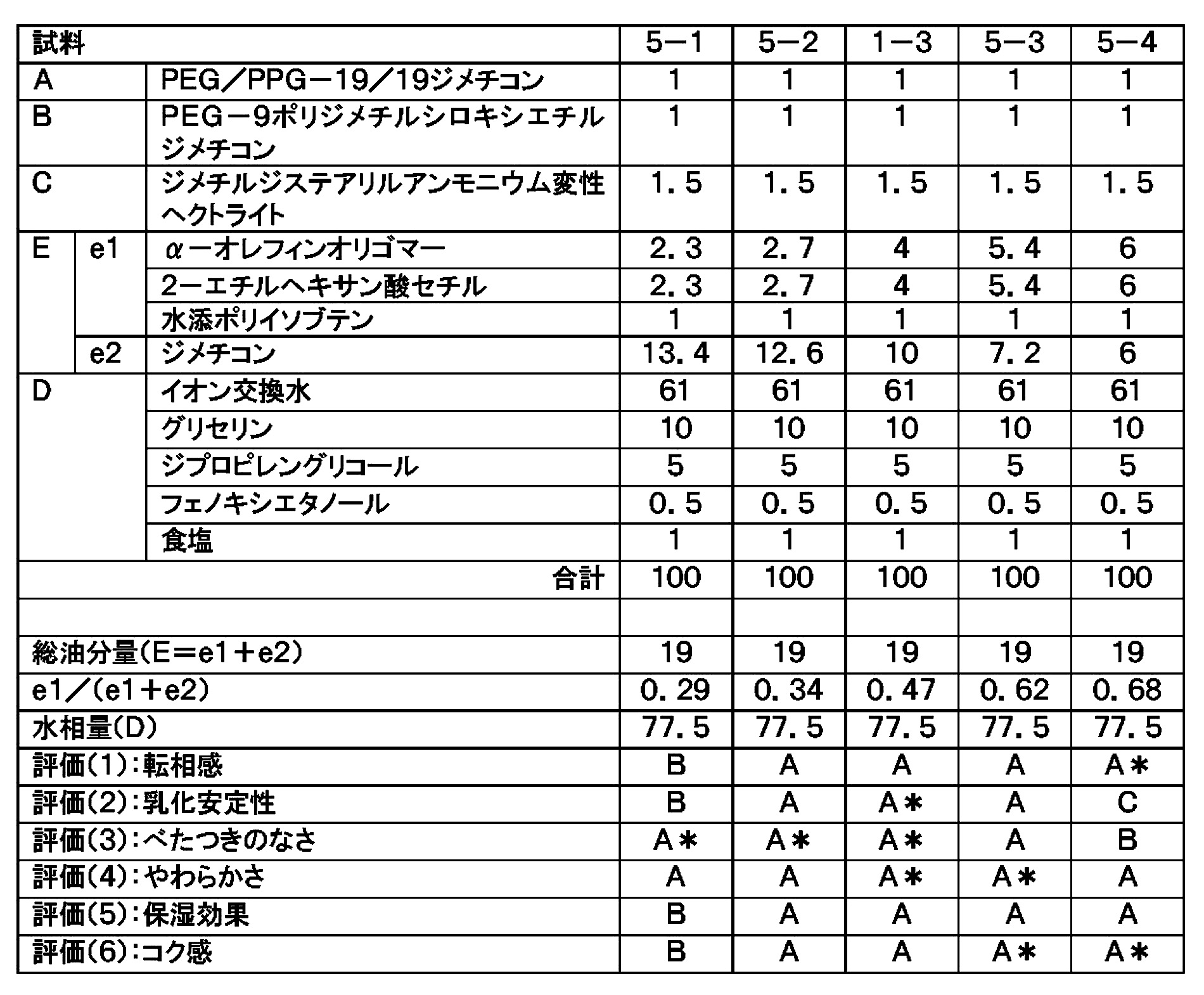
次いで、上記表1の試料「1-3」の処方において、式(1)の高分子量ポリエーテル変性シリコーンを、式(2)に該当しない構造を有する架橋型ポリエーテル変性シリコーン((ジメチコン/(PEG-10/15))クロスポリマー;商品名:KSG210;信越化学工業株式会社製)に置換した処方で試料を調製し、上記と同様の評価を実施した。
下記の表6に示すように、式(1)にも式(2)にも該当しない構造のポリエーテル変性シリコーンを用いた試料「6-1」は安定に乳化することができなかった。また、試料「6-1」における油分量と水分量を調整して乳化可能とした試料「6-2」では、本発明の特徴である転送して水があふれ出すような感触(転相感)を得ることができなかった。すなわち、本発明は、ポリエーテル変性シリコーンの中でも、式(1)又は(2)で表される特定構造のポリエーテル変性シリコーンを選択したことによって得られる特有の効果であることが裏付けられた。
Claims (5)
- (A)下記式(1):

Rはメチル基またはフェニル基であり、
mは50~1000の整数であり、
nは1~40の整数であり、
分子中にポリオキシアルキレン基を40質量%以上含有し、且つ分子量は30000以上である]
で示される高分子量ポリエーテル変性シリコーンから選択される少なくとも1種;
(B)HLBが2~5のシリコーン界面活性剤(ただし、前記(A)に該当するものは除く);
(C)有機変性粘土鉱物;
(D)72~83質量%の水相;及び
(E)油剤、を含有し、
前記(E)油剤が、(e1)非極性炭化水素油及び低極性炭化水素油から選択される少なくとも1種の炭化水素油と、(e2)少なくとも1種のシリコーン油とを含むことを特徴とする、油中水型乳化化粧料。 - 前記(e1)炭化水素油と前記(e2)シリコーン油の合計配合量に対する(e1)炭化水素油の配合量の比率[(e1)/{(e1)+(e2)}]が0.3~0.65の範囲内である、請求項1に記載の化粧料。
- 前記(A)高分子量ポリエーテル変性シリコーンの配合量が、0.5~1.5質量%である、請求項1又は2に記載の化粧料。
- 前記(B)シリコーン界面活性剤の配合量が、0.5~1.5質量%である、請求項1から3のいずれか一項に記載の化粧料。
- 前記(C)有機変性粘土鉱物の配合量が、1.0~2.0質量%である、請求項1から4のいずれか一項に記載の化粧料。
Priority Applications (2)
| Application Number | Priority Date | Filing Date | Title |
|---|---|---|---|
| JP2020531372A JP7342001B2 (ja) | 2018-07-20 | 2019-07-19 | 油中水型乳化化粧料 |
| CN201980046468.5A CN112399846A (zh) | 2018-07-20 | 2019-07-19 | 油包水型乳化化妆品 |
Applications Claiming Priority (2)
| Application Number | Priority Date | Filing Date | Title |
|---|---|---|---|
| JP2018-136276 | 2018-07-20 | ||
| JP2018136276 | 2018-07-20 |
Publications (1)
| Publication Number | Publication Date |
|---|---|
| WO2020017618A1 true WO2020017618A1 (ja) | 2020-01-23 |
Family
ID=69163815
Family Applications (1)
| Application Number | Title | Priority Date | Filing Date |
|---|---|---|---|
| PCT/JP2019/028378 Ceased WO2020017618A1 (ja) | 2018-07-20 | 2019-07-19 | 油中水型乳化化粧料 |
Country Status (4)
| Country | Link |
|---|---|
| JP (1) | JP7342001B2 (ja) |
| CN (1) | CN112399846A (ja) |
| TW (1) | TW202010487A (ja) |
| WO (1) | WO2020017618A1 (ja) |
Cited By (4)
| Publication number | Priority date | Publication date | Assignee | Title |
|---|---|---|---|---|
| JP2022167086A (ja) * | 2021-04-22 | 2022-11-04 | ポーラ化成工業株式会社 | W/o型乳化組成物 |
| JP2022167084A (ja) * | 2021-04-22 | 2022-11-04 | ポーラ化成工業株式会社 | W/o型乳化組成物 |
| WO2024142802A1 (ja) * | 2022-12-27 | 2024-07-04 | 株式会社 資生堂 | 化粧料 |
| WO2024142849A1 (ja) * | 2022-12-28 | 2024-07-04 | 株式会社 資生堂 | 油中水型乳化化粧料組成物 |
Citations (5)
| Publication number | Priority date | Publication date | Assignee | Title |
|---|---|---|---|---|
| JPH08268831A (ja) * | 1995-03-31 | 1996-10-15 | Shiseido Co Ltd | 乳化化粧料 |
| JP2000239119A (ja) * | 1999-02-18 | 2000-09-05 | Shiseido Co Ltd | 化粧料 |
| JP2012012351A (ja) * | 2010-07-02 | 2012-01-19 | Nikko Chemical Co Ltd | 油中水型乳化剤組成物及び該組成物を用いた油中水型乳化組成物並びに化粧料 |
| WO2012043614A1 (ja) * | 2010-09-29 | 2012-04-05 | 株式会社 資生堂 | 水中油型乳化化粧料 |
| WO2018117172A1 (ja) * | 2016-12-21 | 2018-06-28 | 株式会社 資生堂 | 油中水型乳化化粧料 |
Family Cites Families (7)
| Publication number | Priority date | Publication date | Assignee | Title |
|---|---|---|---|---|
| JP3782914B2 (ja) * | 2000-02-07 | 2006-06-07 | 株式会社資生堂 | 高内水相油中水型乳化化粧料 |
| JP2004269418A (ja) * | 2003-03-07 | 2004-09-30 | Shiseido Co Ltd | 化粧料 |
| CN102762193A (zh) | 2010-02-12 | 2012-10-31 | 株式会社资生堂 | W/o型乳化化妆品 |
| JP5533176B2 (ja) * | 2010-04-14 | 2014-06-25 | 信越化学工業株式会社 | ウォーターブレイクメイクアップ化粧料 |
| JP5957384B2 (ja) | 2010-12-21 | 2016-07-27 | 株式会社 資生堂 | W/o乳化化粧料 |
| US20160235652A1 (en) | 2013-10-31 | 2016-08-18 | L'oreal | Composition in form of an emulsion |
| JP6588345B2 (ja) | 2016-01-18 | 2019-10-09 | 株式会社 資生堂 | 油中水型乳化化粧料 |
-
2019
- 2019-07-19 CN CN201980046468.5A patent/CN112399846A/zh active Pending
- 2019-07-19 TW TW108125608A patent/TW202010487A/zh unknown
- 2019-07-19 JP JP2020531372A patent/JP7342001B2/ja active Active
- 2019-07-19 WO PCT/JP2019/028378 patent/WO2020017618A1/ja not_active Ceased
Patent Citations (5)
| Publication number | Priority date | Publication date | Assignee | Title |
|---|---|---|---|---|
| JPH08268831A (ja) * | 1995-03-31 | 1996-10-15 | Shiseido Co Ltd | 乳化化粧料 |
| JP2000239119A (ja) * | 1999-02-18 | 2000-09-05 | Shiseido Co Ltd | 化粧料 |
| JP2012012351A (ja) * | 2010-07-02 | 2012-01-19 | Nikko Chemical Co Ltd | 油中水型乳化剤組成物及び該組成物を用いた油中水型乳化組成物並びに化粧料 |
| WO2012043614A1 (ja) * | 2010-09-29 | 2012-04-05 | 株式会社 資生堂 | 水中油型乳化化粧料 |
| WO2018117172A1 (ja) * | 2016-12-21 | 2018-06-28 | 株式会社 資生堂 | 油中水型乳化化粧料 |
Cited By (6)
| Publication number | Priority date | Publication date | Assignee | Title |
|---|---|---|---|---|
| JP2022167086A (ja) * | 2021-04-22 | 2022-11-04 | ポーラ化成工業株式会社 | W/o型乳化組成物 |
| JP2022167084A (ja) * | 2021-04-22 | 2022-11-04 | ポーラ化成工業株式会社 | W/o型乳化組成物 |
| JP7820098B2 (ja) | 2021-04-22 | 2026-02-25 | ポーラ化成工業株式会社 | W/o型乳化組成物 |
| JP7820096B2 (ja) | 2021-04-22 | 2026-02-25 | ポーラ化成工業株式会社 | W/o型乳化組成物 |
| WO2024142802A1 (ja) * | 2022-12-27 | 2024-07-04 | 株式会社 資生堂 | 化粧料 |
| WO2024142849A1 (ja) * | 2022-12-28 | 2024-07-04 | 株式会社 資生堂 | 油中水型乳化化粧料組成物 |
Also Published As
| Publication number | Publication date |
|---|---|
| JP7342001B2 (ja) | 2023-09-11 |
| CN112399846A (zh) | 2021-02-23 |
| TW202010487A (zh) | 2020-03-16 |
| JPWO2020017618A1 (ja) | 2021-08-02 |
Similar Documents
| Publication | Publication Date | Title |
|---|---|---|
| EP3886788B1 (en) | Composition comprising two polyglyceryl fatty acid esters | |
| JP7342001B2 (ja) | 油中水型乳化化粧料 | |
| EP4337159B1 (en) | Composition comprising skin care active ingredient and two polyglyceryl fatty acid esters | |
| JP7438425B2 (ja) | 油中水型乳化化粧料 | |
| WO2011037123A1 (ja) | 油中水型乳化皮膚化粧料 | |
| EP2965743B1 (en) | Water-in-oil emulsion cosmetic composition | |
| JP2017125003A (ja) | エアゾール化粧料 | |
| CN114245736A (zh) | 适合于清洁的组合物 | |
| JP3782914B2 (ja) | 高内水相油中水型乳化化粧料 | |
| WO2019230579A1 (ja) | 温感化粧料 | |
| KR20160065658A (ko) | 유화제를 함유하지 않는 워셔블 클렌징 화장료 조성물 | |
| JP6041471B2 (ja) | 整髪剤用乳化組成物 | |
| JP2021001135A (ja) | 白濁液状組成物 | |
| JP7306802B2 (ja) | 水中油型乳化化粧料 | |
| WO2019230578A1 (ja) | 温感化粧料 | |
| JPH04312512A (ja) | 油中水型乳化化粧料 | |
| JP2003012476A (ja) | 半固形状毛髪化粧料 | |
| JP7308669B2 (ja) | 乳化化粧料 | |
| JP2003048813A (ja) | 油中水型乳化組成物および乳化化粧料 | |
| JP2000239119A (ja) | 化粧料 | |
| WO2021125051A1 (ja) | 水中油型乳化化粧料 | |
| WO2020022417A1 (ja) | 毛髪化粧料 | |
| CN114040747B (zh) | 水包油型乳化化妆品 | |
| WO2024142849A1 (ja) | 油中水型乳化化粧料組成物 | |
| JP2001158714A (ja) | 高内水相油中水型乳化化粧料 |
Legal Events
| Date | Code | Title | Description |
|---|---|---|---|
| 121 | Ep: the epo has been informed by wipo that ep was designated in this application |
Ref document number: 19837473 Country of ref document: EP Kind code of ref document: A1 |
|
| ENP | Entry into the national phase |
Ref document number: 2020531372 Country of ref document: JP Kind code of ref document: A |
|
| NENP | Non-entry into the national phase |
Ref country code: DE |
|
| 122 | Ep: pct application non-entry in european phase |
Ref document number: 19837473 Country of ref document: EP Kind code of ref document: A1 |