WO2020004597A1 - 樹脂金属複合体及びその製造方法 - Google Patents
樹脂金属複合体及びその製造方法 Download PDFInfo
- Publication number
- WO2020004597A1 WO2020004597A1 PCT/JP2019/025740 JP2019025740W WO2020004597A1 WO 2020004597 A1 WO2020004597 A1 WO 2020004597A1 JP 2019025740 W JP2019025740 W JP 2019025740W WO 2020004597 A1 WO2020004597 A1 WO 2020004597A1
- Authority
- WO
- WIPO (PCT)
- Prior art keywords
- resin
- metal composite
- metal
- mass
- acid
- Prior art date
- Legal status (The legal status is an assumption and is not a legal conclusion. Google has not performed a legal analysis and makes no representation as to the accuracy of the status listed.)
- Ceased
Links
Images




Classifications
-
- B—PERFORMING OPERATIONS; TRANSPORTING
- B29—WORKING OF PLASTICS; WORKING OF SUBSTANCES IN A PLASTIC STATE IN GENERAL
- B29C—SHAPING OR JOINING OF PLASTICS; SHAPING OF MATERIAL IN A PLASTIC STATE, NOT OTHERWISE PROVIDED FOR; AFTER-TREATMENT OF THE SHAPED PRODUCTS, e.g. REPAIRING
- B29C45/00—Injection moulding, i.e. forcing the required volume of moulding material through a nozzle into a closed mould; Apparatus therefor
- B29C45/14—Injection moulding, i.e. forcing the required volume of moulding material through a nozzle into a closed mould; Apparatus therefor incorporating preformed parts or layers, e.g. injection moulding around inserts or for coating articles
- B29C45/14311—Injection moulding, i.e. forcing the required volume of moulding material through a nozzle into a closed mould; Apparatus therefor incorporating preformed parts or layers, e.g. injection moulding around inserts or for coating articles using means for bonding the coating to the articles
-
- B—PERFORMING OPERATIONS; TRANSPORTING
- B32—LAYERED PRODUCTS
- B32B—LAYERED PRODUCTS, i.e. PRODUCTS BUILT-UP OF STRATA OF FLAT OR NON-FLAT, e.g. CELLULAR OR HONEYCOMB, FORM
- B32B15/00—Layered products comprising a layer of metal
- B32B15/20—Layered products comprising a layer of metal comprising aluminium or copper
-
- B—PERFORMING OPERATIONS; TRANSPORTING
- B29—WORKING OF PLASTICS; WORKING OF SUBSTANCES IN A PLASTIC STATE IN GENERAL
- B29C—SHAPING OR JOINING OF PLASTICS; SHAPING OF MATERIAL IN A PLASTIC STATE, NOT OTHERWISE PROVIDED FOR; AFTER-TREATMENT OF THE SHAPED PRODUCTS, e.g. REPAIRING
- B29C45/00—Injection moulding, i.e. forcing the required volume of moulding material through a nozzle into a closed mould; Apparatus therefor
- B29C45/0053—Injection moulding, i.e. forcing the required volume of moulding material through a nozzle into a closed mould; Apparatus therefor combined with a final operation, e.g. shaping
-
- B—PERFORMING OPERATIONS; TRANSPORTING
- B29—WORKING OF PLASTICS; WORKING OF SUBSTANCES IN A PLASTIC STATE IN GENERAL
- B29C—SHAPING OR JOINING OF PLASTICS; SHAPING OF MATERIAL IN A PLASTIC STATE, NOT OTHERWISE PROVIDED FOR; AFTER-TREATMENT OF THE SHAPED PRODUCTS, e.g. REPAIRING
- B29C45/00—Injection moulding, i.e. forcing the required volume of moulding material through a nozzle into a closed mould; Apparatus therefor
- B29C45/14—Injection moulding, i.e. forcing the required volume of moulding material through a nozzle into a closed mould; Apparatus therefor incorporating preformed parts or layers, e.g. injection moulding around inserts or for coating articles
-
- B—PERFORMING OPERATIONS; TRANSPORTING
- B29—WORKING OF PLASTICS; WORKING OF SUBSTANCES IN A PLASTIC STATE IN GENERAL
- B29C—SHAPING OR JOINING OF PLASTICS; SHAPING OF MATERIAL IN A PLASTIC STATE, NOT OTHERWISE PROVIDED FOR; AFTER-TREATMENT OF THE SHAPED PRODUCTS, e.g. REPAIRING
- B29C45/00—Injection moulding, i.e. forcing the required volume of moulding material through a nozzle into a closed mould; Apparatus therefor
- B29C45/14—Injection moulding, i.e. forcing the required volume of moulding material through a nozzle into a closed mould; Apparatus therefor incorporating preformed parts or layers, e.g. injection moulding around inserts or for coating articles
- B29C45/14336—Coating a portion of the article, e.g. the edge of the article
-
- B—PERFORMING OPERATIONS; TRANSPORTING
- B29—WORKING OF PLASTICS; WORKING OF SUBSTANCES IN A PLASTIC STATE IN GENERAL
- B29C—SHAPING OR JOINING OF PLASTICS; SHAPING OF MATERIAL IN A PLASTIC STATE, NOT OTHERWISE PROVIDED FOR; AFTER-TREATMENT OF THE SHAPED PRODUCTS, e.g. REPAIRING
- B29C66/00—General aspects of processes or apparatus for joining preformed parts
- B29C66/01—General aspects dealing with the joint area or with the area to be joined
- B29C66/02—Preparation of the material, in the area to be joined, prior to joining or welding
-
- B—PERFORMING OPERATIONS; TRANSPORTING
- B29—WORKING OF PLASTICS; WORKING OF SUBSTANCES IN A PLASTIC STATE IN GENERAL
- B29C—SHAPING OR JOINING OF PLASTICS; SHAPING OF MATERIAL IN A PLASTIC STATE, NOT OTHERWISE PROVIDED FOR; AFTER-TREATMENT OF THE SHAPED PRODUCTS, e.g. REPAIRING
- B29C66/00—General aspects of processes or apparatus for joining preformed parts
- B29C66/01—General aspects dealing with the joint area or with the area to be joined
- B29C66/02—Preparation of the material, in the area to be joined, prior to joining or welding
- B29C66/026—Chemical pre-treatments
-
- B—PERFORMING OPERATIONS; TRANSPORTING
- B29—WORKING OF PLASTICS; WORKING OF SUBSTANCES IN A PLASTIC STATE IN GENERAL
- B29C—SHAPING OR JOINING OF PLASTICS; SHAPING OF MATERIAL IN A PLASTIC STATE, NOT OTHERWISE PROVIDED FOR; AFTER-TREATMENT OF THE SHAPED PRODUCTS, e.g. REPAIRING
- B29C66/00—General aspects of processes or apparatus for joining preformed parts
- B29C66/01—General aspects dealing with the joint area or with the area to be joined
- B29C66/03—After-treatments in the joint area
-
- B—PERFORMING OPERATIONS; TRANSPORTING
- B29—WORKING OF PLASTICS; WORKING OF SUBSTANCES IN A PLASTIC STATE IN GENERAL
- B29C—SHAPING OR JOINING OF PLASTICS; SHAPING OF MATERIAL IN A PLASTIC STATE, NOT OTHERWISE PROVIDED FOR; AFTER-TREATMENT OF THE SHAPED PRODUCTS, e.g. REPAIRING
- B29C66/00—General aspects of processes or apparatus for joining preformed parts
- B29C66/01—General aspects dealing with the joint area or with the area to be joined
- B29C66/03—After-treatments in the joint area
- B29C66/032—Mechanical after-treatments
-
- B—PERFORMING OPERATIONS; TRANSPORTING
- B29—WORKING OF PLASTICS; WORKING OF SUBSTANCES IN A PLASTIC STATE IN GENERAL
- B29C—SHAPING OR JOINING OF PLASTICS; SHAPING OF MATERIAL IN A PLASTIC STATE, NOT OTHERWISE PROVIDED FOR; AFTER-TREATMENT OF THE SHAPED PRODUCTS, e.g. REPAIRING
- B29C66/00—General aspects of processes or apparatus for joining preformed parts
- B29C66/70—General aspects of processes or apparatus for joining preformed parts characterised by the composition, physical properties or the structure of the material of the parts to be joined; Joining with non-plastics material
- B29C66/72—General aspects of processes or apparatus for joining preformed parts characterised by the composition, physical properties or the structure of the material of the parts to be joined; Joining with non-plastics material characterised by the structure of the material of the parts to be joined
- B29C66/723—General aspects of processes or apparatus for joining preformed parts characterised by the composition, physical properties or the structure of the material of the parts to be joined; Joining with non-plastics material characterised by the structure of the material of the parts to be joined being multi-layered
- B29C66/7232—General aspects of processes or apparatus for joining preformed parts characterised by the composition, physical properties or the structure of the material of the parts to be joined; Joining with non-plastics material characterised by the structure of the material of the parts to be joined being multi-layered comprising a non-plastics layer
- B29C66/72321—General aspects of processes or apparatus for joining preformed parts characterised by the composition, physical properties or the structure of the material of the parts to be joined; Joining with non-plastics material characterised by the structure of the material of the parts to be joined being multi-layered comprising a non-plastics layer consisting of metals or their alloys
-
- B—PERFORMING OPERATIONS; TRANSPORTING
- B29—WORKING OF PLASTICS; WORKING OF SUBSTANCES IN A PLASTIC STATE IN GENERAL
- B29C—SHAPING OR JOINING OF PLASTICS; SHAPING OF MATERIAL IN A PLASTIC STATE, NOT OTHERWISE PROVIDED FOR; AFTER-TREATMENT OF THE SHAPED PRODUCTS, e.g. REPAIRING
- B29C70/00—Shaping composites, i.e. plastics material comprising reinforcements, fillers or preformed parts, e.g. inserts
- B29C70/58—Shaping composites, i.e. plastics material comprising reinforcements, fillers or preformed parts, e.g. inserts comprising fillers only, e.g. particles, powder, beads, flakes, spheres
-
- B—PERFORMING OPERATIONS; TRANSPORTING
- B32—LAYERED PRODUCTS
- B32B—LAYERED PRODUCTS, i.e. PRODUCTS BUILT-UP OF STRATA OF FLAT OR NON-FLAT, e.g. CELLULAR OR HONEYCOMB, FORM
- B32B15/00—Layered products comprising a layer of metal
- B32B15/04—Layered products comprising a layer of metal comprising metal as the main or only constituent of a layer, which is next to another layer of the same or of a different material
- B32B15/08—Layered products comprising a layer of metal comprising metal as the main or only constituent of a layer, which is next to another layer of the same or of a different material of synthetic resin
- B32B15/09—Layered products comprising a layer of metal comprising metal as the main or only constituent of a layer, which is next to another layer of the same or of a different material of synthetic resin comprising polyesters
-
- B—PERFORMING OPERATIONS; TRANSPORTING
- B32—LAYERED PRODUCTS
- B32B—LAYERED PRODUCTS, i.e. PRODUCTS BUILT-UP OF STRATA OF FLAT OR NON-FLAT, e.g. CELLULAR OR HONEYCOMB, FORM
- B32B27/00—Layered products comprising a layer of synthetic resin
- B32B27/18—Layered products comprising a layer of synthetic resin characterised by the use of special additives
- B32B27/20—Layered products comprising a layer of synthetic resin characterised by the use of special additives using fillers, pigments, thixotroping agents
-
- B—PERFORMING OPERATIONS; TRANSPORTING
- B32—LAYERED PRODUCTS
- B32B—LAYERED PRODUCTS, i.e. PRODUCTS BUILT-UP OF STRATA OF FLAT OR NON-FLAT, e.g. CELLULAR OR HONEYCOMB, FORM
- B32B27/00—Layered products comprising a layer of synthetic resin
- B32B27/36—Layered products comprising a layer of synthetic resin comprising polyesters
-
- C—CHEMISTRY; METALLURGY
- C08—ORGANIC MACROMOLECULAR COMPOUNDS; THEIR PREPARATION OR CHEMICAL WORKING-UP; COMPOSITIONS BASED THEREON
- C08L—COMPOSITIONS OF MACROMOLECULAR COMPOUNDS
- C08L101/00—Compositions of unspecified macromolecular compounds
-
- C—CHEMISTRY; METALLURGY
- C08—ORGANIC MACROMOLECULAR COMPOUNDS; THEIR PREPARATION OR CHEMICAL WORKING-UP; COMPOSITIONS BASED THEREON
- C08L—COMPOSITIONS OF MACROMOLECULAR COMPOUNDS
- C08L25/00—Compositions of, homopolymers or copolymers of compounds having one or more unsaturated aliphatic radicals, each having only one carbon-to-carbon double bond, and at least one being terminated by an aromatic carbocyclic ring; Compositions of derivatives of such polymers
- C08L25/02—Homopolymers or copolymers of hydrocarbons
- C08L25/04—Homopolymers or copolymers of styrene
- C08L25/06—Polystyrene
-
- C—CHEMISTRY; METALLURGY
- C08—ORGANIC MACROMOLECULAR COMPOUNDS; THEIR PREPARATION OR CHEMICAL WORKING-UP; COMPOSITIONS BASED THEREON
- C08L—COMPOSITIONS OF MACROMOLECULAR COMPOUNDS
- C08L67/00—Compositions of polyesters obtained by reactions forming a carboxylic ester link in the main chain; Compositions of derivatives of such polymers
-
- C—CHEMISTRY; METALLURGY
- C08—ORGANIC MACROMOLECULAR COMPOUNDS; THEIR PREPARATION OR CHEMICAL WORKING-UP; COMPOSITIONS BASED THEREON
- C08L—COMPOSITIONS OF MACROMOLECULAR COMPOUNDS
- C08L67/00—Compositions of polyesters obtained by reactions forming a carboxylic ester link in the main chain; Compositions of derivatives of such polymers
- C08L67/02—Polyesters derived from dicarboxylic acids and dihydroxy compounds
-
- C—CHEMISTRY; METALLURGY
- C08—ORGANIC MACROMOLECULAR COMPOUNDS; THEIR PREPARATION OR CHEMICAL WORKING-UP; COMPOSITIONS BASED THEREON
- C08L—COMPOSITIONS OF MACROMOLECULAR COMPOUNDS
- C08L71/00—Compositions of polyethers obtained by reactions forming an ether link in the main chain; Compositions of derivatives of such polymers
- C08L71/08—Polyethers derived from hydroxy compounds or from their metallic derivatives
- C08L71/10—Polyethers derived from hydroxy compounds or from their metallic derivatives from phenols
- C08L71/12—Polyphenylene oxides
-
- C—CHEMISTRY; METALLURGY
- C08—ORGANIC MACROMOLECULAR COMPOUNDS; THEIR PREPARATION OR CHEMICAL WORKING-UP; COMPOSITIONS BASED THEREON
- C08L—COMPOSITIONS OF MACROMOLECULAR COMPOUNDS
- C08L71/00—Compositions of polyethers obtained by reactions forming an ether link in the main chain; Compositions of derivatives of such polymers
- C08L71/08—Polyethers derived from hydroxy compounds or from their metallic derivatives
- C08L71/10—Polyethers derived from hydroxy compounds or from their metallic derivatives from phenols
- C08L71/12—Polyphenylene oxides
- C08L71/126—Polyphenylene oxides modified by chemical after-treatment
-
- C—CHEMISTRY; METALLURGY
- C08—ORGANIC MACROMOLECULAR COMPOUNDS; THEIR PREPARATION OR CHEMICAL WORKING-UP; COMPOSITIONS BASED THEREON
- C08L—COMPOSITIONS OF MACROMOLECULAR COMPOUNDS
- C08L77/00—Compositions of polyamides obtained by reactions forming a carboxylic amide link in the main chain; Compositions of derivatives of such polymers
-
- C—CHEMISTRY; METALLURGY
- C08—ORGANIC MACROMOLECULAR COMPOUNDS; THEIR PREPARATION OR CHEMICAL WORKING-UP; COMPOSITIONS BASED THEREON
- C08L—COMPOSITIONS OF MACROMOLECULAR COMPOUNDS
- C08L77/00—Compositions of polyamides obtained by reactions forming a carboxylic amide link in the main chain; Compositions of derivatives of such polymers
- C08L77/06—Polyamides derived from polyamines and polycarboxylic acids
-
- C—CHEMISTRY; METALLURGY
- C08—ORGANIC MACROMOLECULAR COMPOUNDS; THEIR PREPARATION OR CHEMICAL WORKING-UP; COMPOSITIONS BASED THEREON
- C08L—COMPOSITIONS OF MACROMOLECULAR COMPOUNDS
- C08L81/00—Compositions of macromolecular compounds obtained by reactions forming in the main chain of the macromolecule a linkage containing sulfur with or without nitrogen, oxygen or carbon only; Compositions of polysulfones; Compositions of derivatives of such polymers
- C08L81/02—Polythioethers; Polythioether-ethers
-
- B—PERFORMING OPERATIONS; TRANSPORTING
- B29—WORKING OF PLASTICS; WORKING OF SUBSTANCES IN A PLASTIC STATE IN GENERAL
- B29C—SHAPING OR JOINING OF PLASTICS; SHAPING OF MATERIAL IN A PLASTIC STATE, NOT OTHERWISE PROVIDED FOR; AFTER-TREATMENT OF THE SHAPED PRODUCTS, e.g. REPAIRING
- B29C45/00—Injection moulding, i.e. forcing the required volume of moulding material through a nozzle into a closed mould; Apparatus therefor
- B29C45/0053—Injection moulding, i.e. forcing the required volume of moulding material through a nozzle into a closed mould; Apparatus therefor combined with a final operation, e.g. shaping
- B29C2045/0079—Injection moulding, i.e. forcing the required volume of moulding material through a nozzle into a closed mould; Apparatus therefor combined with a final operation, e.g. shaping applying a coating or covering
-
- B—PERFORMING OPERATIONS; TRANSPORTING
- B29—WORKING OF PLASTICS; WORKING OF SUBSTANCES IN A PLASTIC STATE IN GENERAL
- B29C—SHAPING OR JOINING OF PLASTICS; SHAPING OF MATERIAL IN A PLASTIC STATE, NOT OTHERWISE PROVIDED FOR; AFTER-TREATMENT OF THE SHAPED PRODUCTS, e.g. REPAIRING
- B29C45/00—Injection moulding, i.e. forcing the required volume of moulding material through a nozzle into a closed mould; Apparatus therefor
- B29C45/14—Injection moulding, i.e. forcing the required volume of moulding material through a nozzle into a closed mould; Apparatus therefor incorporating preformed parts or layers, e.g. injection moulding around inserts or for coating articles
- B29C2045/1486—Details, accessories and auxiliary operations
- B29C2045/14868—Pretreatment of the insert, e.g. etching, cleaning
-
- B—PERFORMING OPERATIONS; TRANSPORTING
- B29—WORKING OF PLASTICS; WORKING OF SUBSTANCES IN A PLASTIC STATE IN GENERAL
- B29C—SHAPING OR JOINING OF PLASTICS; SHAPING OF MATERIAL IN A PLASTIC STATE, NOT OTHERWISE PROVIDED FOR; AFTER-TREATMENT OF THE SHAPED PRODUCTS, e.g. REPAIRING
- B29C65/00—Joining or sealing of preformed parts, e.g. welding of plastics materials; Apparatus therefor
- B29C65/02—Joining or sealing of preformed parts, e.g. welding of plastics materials; Apparatus therefor by heating, with or without pressure
- B29C65/06—Joining or sealing of preformed parts, e.g. welding of plastics materials; Apparatus therefor by heating, with or without pressure using friction, e.g. spin welding
-
- B—PERFORMING OPERATIONS; TRANSPORTING
- B29—WORKING OF PLASTICS; WORKING OF SUBSTANCES IN A PLASTIC STATE IN GENERAL
- B29C—SHAPING OR JOINING OF PLASTICS; SHAPING OF MATERIAL IN A PLASTIC STATE, NOT OTHERWISE PROVIDED FOR; AFTER-TREATMENT OF THE SHAPED PRODUCTS, e.g. REPAIRING
- B29C65/00—Joining or sealing of preformed parts, e.g. welding of plastics materials; Apparatus therefor
- B29C65/02—Joining or sealing of preformed parts, e.g. welding of plastics materials; Apparatus therefor by heating, with or without pressure
- B29C65/06—Joining or sealing of preformed parts, e.g. welding of plastics materials; Apparatus therefor by heating, with or without pressure using friction, e.g. spin welding
- B29C65/0672—Spin welding
-
- B—PERFORMING OPERATIONS; TRANSPORTING
- B29—WORKING OF PLASTICS; WORKING OF SUBSTANCES IN A PLASTIC STATE IN GENERAL
- B29C—SHAPING OR JOINING OF PLASTICS; SHAPING OF MATERIAL IN A PLASTIC STATE, NOT OTHERWISE PROVIDED FOR; AFTER-TREATMENT OF THE SHAPED PRODUCTS, e.g. REPAIRING
- B29C65/00—Joining or sealing of preformed parts, e.g. welding of plastics materials; Apparatus therefor
- B29C65/02—Joining or sealing of preformed parts, e.g. welding of plastics materials; Apparatus therefor by heating, with or without pressure
- B29C65/08—Joining or sealing of preformed parts, e.g. welding of plastics materials; Apparatus therefor by heating, with or without pressure using ultrasonic vibrations
-
- B—PERFORMING OPERATIONS; TRANSPORTING
- B29—WORKING OF PLASTICS; WORKING OF SUBSTANCES IN A PLASTIC STATE IN GENERAL
- B29C—SHAPING OR JOINING OF PLASTICS; SHAPING OF MATERIAL IN A PLASTIC STATE, NOT OTHERWISE PROVIDED FOR; AFTER-TREATMENT OF THE SHAPED PRODUCTS, e.g. REPAIRING
- B29C65/00—Joining or sealing of preformed parts, e.g. welding of plastics materials; Apparatus therefor
- B29C65/02—Joining or sealing of preformed parts, e.g. welding of plastics materials; Apparatus therefor by heating, with or without pressure
- B29C65/18—Joining or sealing of preformed parts, e.g. welding of plastics materials; Apparatus therefor by heating, with or without pressure using heated tools
-
- B—PERFORMING OPERATIONS; TRANSPORTING
- B29—WORKING OF PLASTICS; WORKING OF SUBSTANCES IN A PLASTIC STATE IN GENERAL
- B29C—SHAPING OR JOINING OF PLASTICS; SHAPING OF MATERIAL IN A PLASTIC STATE, NOT OTHERWISE PROVIDED FOR; AFTER-TREATMENT OF THE SHAPED PRODUCTS, e.g. REPAIRING
- B29C66/00—General aspects of processes or apparatus for joining preformed parts
- B29C66/70—General aspects of processes or apparatus for joining preformed parts characterised by the composition, physical properties or the structure of the material of the parts to be joined; Joining with non-plastics material
- B29C66/74—Joining plastics material to non-plastics material
- B29C66/742—Joining plastics material to non-plastics material to metals or their alloys
-
- B—PERFORMING OPERATIONS; TRANSPORTING
- B29—WORKING OF PLASTICS; WORKING OF SUBSTANCES IN A PLASTIC STATE IN GENERAL
- B29K—INDEXING SCHEME ASSOCIATED WITH SUBCLASSES B29B, B29C OR B29D, RELATING TO MOULDING MATERIALS OR TO MATERIALS FOR MOULDS, REINFORCEMENTS, FILLERS OR PREFORMED PARTS, e.g. INSERTS
- B29K2025/00—Use of polymers of vinyl-aromatic compounds or derivatives thereof as moulding material
- B29K2025/04—Polymers of styrene
-
- B—PERFORMING OPERATIONS; TRANSPORTING
- B29—WORKING OF PLASTICS; WORKING OF SUBSTANCES IN A PLASTIC STATE IN GENERAL
- B29K—INDEXING SCHEME ASSOCIATED WITH SUBCLASSES B29B, B29C OR B29D, RELATING TO MOULDING MATERIALS OR TO MATERIALS FOR MOULDS, REINFORCEMENTS, FILLERS OR PREFORMED PARTS, e.g. INSERTS
- B29K2025/00—Use of polymers of vinyl-aromatic compounds or derivatives thereof as moulding material
- B29K2025/04—Polymers of styrene
- B29K2025/06—PS, i.e. polystyrene
-
- B—PERFORMING OPERATIONS; TRANSPORTING
- B29—WORKING OF PLASTICS; WORKING OF SUBSTANCES IN A PLASTIC STATE IN GENERAL
- B29K—INDEXING SCHEME ASSOCIATED WITH SUBCLASSES B29B, B29C OR B29D, RELATING TO MOULDING MATERIALS OR TO MATERIALS FOR MOULDS, REINFORCEMENTS, FILLERS OR PREFORMED PARTS, e.g. INSERTS
- B29K2065/00—Use of polyphenylenes or polyxylylenes as moulding material
-
- B—PERFORMING OPERATIONS; TRANSPORTING
- B29—WORKING OF PLASTICS; WORKING OF SUBSTANCES IN A PLASTIC STATE IN GENERAL
- B29K—INDEXING SCHEME ASSOCIATED WITH SUBCLASSES B29B, B29C OR B29D, RELATING TO MOULDING MATERIALS OR TO MATERIALS FOR MOULDS, REINFORCEMENTS, FILLERS OR PREFORMED PARTS, e.g. INSERTS
- B29K2067/00—Use of polyesters or derivatives thereof, as moulding material
-
- B—PERFORMING OPERATIONS; TRANSPORTING
- B29—WORKING OF PLASTICS; WORKING OF SUBSTANCES IN A PLASTIC STATE IN GENERAL
- B29K—INDEXING SCHEME ASSOCIATED WITH SUBCLASSES B29B, B29C OR B29D, RELATING TO MOULDING MATERIALS OR TO MATERIALS FOR MOULDS, REINFORCEMENTS, FILLERS OR PREFORMED PARTS, e.g. INSERTS
- B29K2071/00—Use of polyethers, e.g. PEEK, i.e. polyether-etherketone or PEK, i.e. polyetherketone or derivatives thereof, as moulding material
-
- B—PERFORMING OPERATIONS; TRANSPORTING
- B29—WORKING OF PLASTICS; WORKING OF SUBSTANCES IN A PLASTIC STATE IN GENERAL
- B29K—INDEXING SCHEME ASSOCIATED WITH SUBCLASSES B29B, B29C OR B29D, RELATING TO MOULDING MATERIALS OR TO MATERIALS FOR MOULDS, REINFORCEMENTS, FILLERS OR PREFORMED PARTS, e.g. INSERTS
- B29K2077/00—Use of PA, i.e. polyamides, e.g. polyesteramides or derivatives thereof, as moulding material
-
- B—PERFORMING OPERATIONS; TRANSPORTING
- B29—WORKING OF PLASTICS; WORKING OF SUBSTANCES IN A PLASTIC STATE IN GENERAL
- B29K—INDEXING SCHEME ASSOCIATED WITH SUBCLASSES B29B, B29C OR B29D, RELATING TO MOULDING MATERIALS OR TO MATERIALS FOR MOULDS, REINFORCEMENTS, FILLERS OR PREFORMED PARTS, e.g. INSERTS
- B29K2509/00—Use of inorganic materials not provided for in groups B29K2503/00 - B29K2507/00, as filler
- B29K2509/08—Glass
-
- B—PERFORMING OPERATIONS; TRANSPORTING
- B29—WORKING OF PLASTICS; WORKING OF SUBSTANCES IN A PLASTIC STATE IN GENERAL
- B29K—INDEXING SCHEME ASSOCIATED WITH SUBCLASSES B29B, B29C OR B29D, RELATING TO MOULDING MATERIALS OR TO MATERIALS FOR MOULDS, REINFORCEMENTS, FILLERS OR PREFORMED PARTS, e.g. INSERTS
- B29K2705/00—Use of metals, their alloys or their compounds, for preformed parts, e.g. for inserts
-
- B—PERFORMING OPERATIONS; TRANSPORTING
- B29—WORKING OF PLASTICS; WORKING OF SUBSTANCES IN A PLASTIC STATE IN GENERAL
- B29L—INDEXING SCHEME ASSOCIATED WITH SUBCLASS B29C, RELATING TO PARTICULAR ARTICLES
- B29L2031/00—Other particular articles
- B29L2031/34—Electrical apparatus, e.g. sparking plugs or parts thereof
- B29L2031/3431—Telephones, Earphones
- B29L2031/3437—Cellular phones
-
- B—PERFORMING OPERATIONS; TRANSPORTING
- B32—LAYERED PRODUCTS
- B32B—LAYERED PRODUCTS, i.e. PRODUCTS BUILT-UP OF STRATA OF FLAT OR NON-FLAT, e.g. CELLULAR OR HONEYCOMB, FORM
- B32B2264/00—Composition or properties of particles which form a particulate layer or are present as additives
- B32B2264/10—Inorganic particles
- B32B2264/101—Glass
-
- B—PERFORMING OPERATIONS; TRANSPORTING
- B32—LAYERED PRODUCTS
- B32B—LAYERED PRODUCTS, i.e. PRODUCTS BUILT-UP OF STRATA OF FLAT OR NON-FLAT, e.g. CELLULAR OR HONEYCOMB, FORM
- B32B2307/00—Properties of the layers or laminate
- B32B2307/50—Properties of the layers or laminate having particular mechanical properties
- B32B2307/54—Yield strength; Tensile strength
-
- B—PERFORMING OPERATIONS; TRANSPORTING
- B32—LAYERED PRODUCTS
- B32B—LAYERED PRODUCTS, i.e. PRODUCTS BUILT-UP OF STRATA OF FLAT OR NON-FLAT, e.g. CELLULAR OR HONEYCOMB, FORM
- B32B2307/00—Properties of the layers or laminate
- B32B2307/50—Properties of the layers or laminate having particular mechanical properties
- B32B2307/558—Impact strength, toughness
-
- B—PERFORMING OPERATIONS; TRANSPORTING
- B32—LAYERED PRODUCTS
- B32B—LAYERED PRODUCTS, i.e. PRODUCTS BUILT-UP OF STRATA OF FLAT OR NON-FLAT, e.g. CELLULAR OR HONEYCOMB, FORM
- B32B2457/00—Electrical equipment
-
- C—CHEMISTRY; METALLURGY
- C08—ORGANIC MACROMOLECULAR COMPOUNDS; THEIR PREPARATION OR CHEMICAL WORKING-UP; COMPOSITIONS BASED THEREON
- C08L—COMPOSITIONS OF MACROMOLECULAR COMPOUNDS
- C08L2203/00—Applications
- C08L2203/30—Applications used for thermoforming
-
- C—CHEMISTRY; METALLURGY
- C08—ORGANIC MACROMOLECULAR COMPOUNDS; THEIR PREPARATION OR CHEMICAL WORKING-UP; COMPOSITIONS BASED THEREON
- C08L—COMPOSITIONS OF MACROMOLECULAR COMPOUNDS
- C08L2205/00—Polymer mixtures characterised by other features
- C08L2205/02—Polymer mixtures characterised by other features containing two or more polymers of the same C08L -group
- C08L2205/025—Polymer mixtures characterised by other features containing two or more polymers of the same C08L -group containing two or more polymers of the same hierarchy C08L, and differing only in parameters such as density, comonomer content, molecular weight, structure
-
- C—CHEMISTRY; METALLURGY
- C08—ORGANIC MACROMOLECULAR COMPOUNDS; THEIR PREPARATION OR CHEMICAL WORKING-UP; COMPOSITIONS BASED THEREON
- C08L—COMPOSITIONS OF MACROMOLECULAR COMPOUNDS
- C08L2205/00—Polymer mixtures characterised by other features
- C08L2205/03—Polymer mixtures characterised by other features containing three or more polymers in a blend
-
- C—CHEMISTRY; METALLURGY
- C08—ORGANIC MACROMOLECULAR COMPOUNDS; THEIR PREPARATION OR CHEMICAL WORKING-UP; COMPOSITIONS BASED THEREON
- C08L—COMPOSITIONS OF MACROMOLECULAR COMPOUNDS
- C08L2205/00—Polymer mixtures characterised by other features
- C08L2205/03—Polymer mixtures characterised by other features containing three or more polymers in a blend
- C08L2205/035—Polymer mixtures characterised by other features containing three or more polymers in a blend containing four or more polymers in a blend
Definitions
- the present invention relates to a resin-metal composite and a method for producing the same.
- Cited Document 1 discloses a resin composition for insert molding on a metal member, and describes that the resin composition is excellent in impact resistance and low dielectric properties. In Patent Document 1, it is also an issue to increase the bonding strength between the metal member and the resin member, and the shear bonding strength is evaluated.
- the "joining strength” is a force that pushes the metal member to the joining surface of the resin member, that is, a resin composition having a high joining strength when a shear stress is applied is designed and evaluated. I have. In the test in which a shear stress is applied, a uniform stress is applied to the entire joint surface to evaluate the joint strength. However, in a case where the resin-metal composite is actually used as a housing of an information communication device, stress such as splitting or peeling is applied to one or the end of the joint surface, resulting in breakage in many cases.
- the present inventors have studied to obtain a resin-metal composite that does not easily break even when stress is applied to one or the end of the joint surface such as splitting or peeling, and that can cope with a high-frequency band. As a result, they have found that the above-mentioned problem is solved by the resin member satisfying specific requirements. That is, the present invention relates to the following [1] to [14].
- a resin-metal composite including a resin member made of a resin molding material containing a resin mixture (a1) and an inorganic filler (a2), and a metal member, Resin metal having a stress-strain curve having a yield point and a tensile yield stress of 25 MPa or more in a tensile test of a test piece composed of the resin mixture (a1) in accordance with ISO 527-1, 2: 2012. Complex.
- a tensile test of the test piece composed of the resin mixture (a1) is 2.5% or more in a tensile test based on ISO 527-1, 2: 2012. Resin-metal composite.
- the resin molding material contains the inorganic filler (a2) in an amount of from 13.0% by mass to 37.0% by mass.
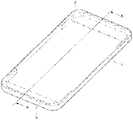
- FIG. 3 is a perspective view of a metal resin composite molded for a drop impact test in Examples and Comparative Examples.
- FIG. 4 is a cross-sectional view of the metal resin composite formed for a drop impact test in Examples and Comparative Examples, taken along AA in FIG. 3.
- the present inventor has conducted intensive studies and, assuming that a metal composite is actually used, considers that fracture such as splitting or peeling of the metal composite occurs at the interface between the metal member and the resin member. It has been found that a resin-metal composite having excellent bonding strength can be obtained by giving a resin member existing near an interface a specific strength. The details will be described below.
- the description “XX to YY” means “XX or more and YY or less”.
- a rule defined as preferable can be arbitrarily adopted, and a combination of preferable ones is more preferable.
- the resin-metal composite of the present invention is a resin-metal composite including a resin member made of a resin molding material containing a resin mixture (a1) and an inorganic filler (a2), and a metal member.
- a stress-strain curve has a yield point and a tensile yield stress is 25 MPa or more. .
- the resin member constituting the metal composite of the present invention is made of a resin molding material containing a resin mixture (a1) containing a resin as a main component and an inorganic filler (a2).
- the expression "mainly as a main component” means that the content of at least one selected from the following resins (1) to (5) is 60% by mass or more in the resin mixture (a1).
- the resin mixture (a1) preferably contains at least one selected from syndiotactic polystyrene, polyester, polyphenylene sulfide, polyamide, and polyetheretherketone, and preferably contains these resins as main components. Among them, it is more preferable to use syndiotactic polystyrene, polyphenylene sulfide, polyester, and polyamide. Each resin will be described below.
- Syndiotactic polystyrene as used in the present invention means a styrene-based resin having an advanced syndiotactic structure (hereinafter sometimes abbreviated as SPS).
- SPS advanced syndiotactic structure
- “syndiotactic” means that phenyl rings in adjacent styrene units are alternately arranged with respect to a plane formed by a main chain of a polymer block (hereinafter, referred to as syndiotacticity). Means that the percentage is high.
- Tacticity can be quantitatively identified by nuclear magnetic resonance ( 13 C-NMR) using isotope carbon.
- the abundance ratio of a plurality of continuous constituent units for example, two continuous monomer units as a dyad, three monomer units as a triad, and five monomer units as a pentad can be determined.
- a styrenic resin having a high syndiotactic structure refers to a racemic dyad (r) that is usually 75 mol% or more, preferably 85 mol% or more, or a racemic pentad (rrrr) that is usually 30 mol% or more.
- Vinyl benzoate a hydrogenated polymer or mixture thereof, or a copolymer containing these as a main component.
- Poly (hydrocarbon-substituted styrene) includes poly (methylstyrene), poly (ethylstyrene), poly (isopropylstyrene), poly (tert-butylstyrene), poly (phenyl) styrene, poly (vinylnaphthalene) and poly (vinylnaphthalene). Vinyl styrene) and the like.
- Examples of poly (halogenated styrene) include poly (chlorostyrene), poly (bromostyrene), and poly (fluorostyrene), and examples of poly (halogenated alkylstyrene) include poly (chloromethylstyrene). it can.
- poly (alkoxystyrene) examples include poly (methoxystyrene) and poly (ethoxystyrene).
- the comonomer component of the copolymer containing the above structural unit include, in addition to the monomers of the styrene-based polymer, olefin monomers such as ethylene, propylene, butene, hexene and octene; diene monomers such as butadiene and isoprene; cyclic olefin monomers And polar vinyl monomers such as cyclic diene monomers, methyl methacrylate, maleic anhydride and acrylonitrile.
- olefin monomers such as ethylene, propylene, butene, hexene and octene
- diene monomers such as butadiene and isoprene
- polar vinyl monomers such as cyclic diene monomers
- styrene resins particularly preferred are polystyrene, poly (p-methylstyrene), poly (m-methylstyrene), poly (p-tert-butylstyrene), poly (p-chlorostyrene) and poly (m-styrene). -Chlorostyrene) and poly (p-fluorostyrene).
- a copolymer of styrene and p-methylstyrene, a copolymer of styrene and p-tert-butylstyrene, a copolymer of styrene and divinylbenzene, and the like can be given.
- the weight average molecular weight of SPS is 1 ⁇ 10 4 or more and 1 ⁇ 10 6 or less from the viewpoint of the fluidity of the resin at the time of molding and the mechanical properties of the obtained molded article. , 50,000 to 500,000, more preferably 50,000 to 300,000.
- the weight average molecular weight is 1 ⁇ 10 4 or more, a molded article having sufficient mechanical properties can be obtained. If the weight average molecular weight is 1 ⁇ 10 6 or less, there is no problem in fluidity of the resin at the time of molding.
- melt flow rate (MFR) of SPS is measured under the conditions of a temperature of 300 ° C. and a load of 1.2 kgf, it is preferably 2 g / 10 min or more, and more preferably 4 g / 10 min or more.
- MFR value is in the above range, there is no problem in the fluidity of the resin at the time of molding.
- a molded article having sufficient mechanical properties can be obtained at 50 g / 10 min or less, preferably 30 g / min or less.
- an SPS can be manufactured with reference to, for example, the technology disclosed in Japanese Patent Application Laid-Open No. 62-187708. Specifically, a titanium compound and a condensation product of water and a trialkylaluminum are used as a catalyst in an inert hydrocarbon solvent or in the absence of a solvent to form a styrene monomer (a unit corresponding to the styrene polymer). ) Can be produced by polymerizing Poly (halogenated alkylstyrene) can be produced by the method described in JP-A-1-146912, and its hydrogenated polymer can be produced by the method described in JP-A-1-178505.
- Polyester Polyester is preferably a thermoplastic resin obtained by polycondensation of a dicarboxylic acid compound and a dihydroxy compound, polycondensation of an oxycarboxylic acid compound, or polycondensation of these compounds. Any of these may be used.
- an aromatic dicarboxylic acid or an ester-forming derivative thereof is preferably used as the dicarboxylic acid compound constituting the polyester.
- the aromatic dicarboxylic acid include terephthalic acid, isophthalic acid, orthophthalic acid, 1,5-naphthalenedicarboxylic acid, 2,5-naphthalenedicarboxylic acid, 2,6-naphthalenedicarboxylic acid, biphenyl-2,2′-dicarboxylic acid, Biphenyl-3,3'-dicarboxylic acid, biphenyl-4,4'-dicarboxylic acid, diphenylether-4,4'-dicarboxylic acid, diphenylmethane-4,4'-dicarboxylic acid, diphenylsulfone-4,4'-dicarboxylic acid Diphenylisopropylidene-4,4'-dicarboxylic acid, 1,2-bis (phenoxy) ethane-4,4'-dicarboxylic acid, an
- aromatic dicarboxylic acids may be used as a mixture of two or more kinds.
- dimethyl esters and the like can be used in the polycondensation reaction as ester-forming derivatives in addition to free acids.
- an aliphatic dicarboxylic acid such as adipic acid, azelaic acid, dodecandioic acid, sebacic acid, 1,2-cyclohexanedicarboxylic acid, 1,3-cyclohexanedicarboxylic acid and
- One or more alicyclic dicarboxylic acids such as 1,4-cyclohexanedicarboxylic acid can be used in combination.
- dihydroxy compound constituting the polyester examples include aliphatic diols such as ethylene glycol, propylene glycol, butanediol, hexylene glycol, neopentyl glycol, 2-methylpropane-1,3-diol, diethylene glycol and triethylene glycol, and cyclohexane.
- Alicyclic diols such as 1,4-dimethanol and the like, and mixtures thereof; If the amount is small, one or more long-chain diols having a molecular weight of 400 to 6,000, that is, polyethylene glycol, poly-1,3-propylene glycol, polytetramethylene glycol or the like may be copolymerized.
- Aromatic diols such as hydroquinone, resorcinol, naphthalene diol, dihydroxydiphenyl ether, and 2,2-bis (4-hydroxyphenyl) propane can also be used.
- bifunctional monomers such as trimellitic acid, trimesic acid, pyromellitic acid, pentaerythritol, and trimethylolpropane for introducing a branched structure, and monofunctional such as fatty acids for controlling the molecular weight.
- monofunctional such as fatty acids for controlling the molecular weight.
- a small amount of the active compound may be used in combination.
- polyester a polyester mainly composed of a polycondensation of a dicarboxylic acid and a diol, that is, a polyester composed of 50% by mass, preferably 70% by mass or more of the entire resin is used.
- dicarboxylic acid an aromatic carboxylic acid is preferable, and as the diol, an aliphatic diol is preferable.
- polyalkylene terephthalate in which 95 mol% or more of the acid component is terephthalic acid and 95 mass% or more of the alcohol component is an aliphatic diol.
- Particularly preferred is polybutylene terephthalate comprising terephthalic acid and 1,4-butanediol (hereinafter sometimes abbreviated as PBT).
- a modified polybutylene terephthalate obtained by copolymerizing a polyalkylene glycol such as isophthalic acid, dimer acid, or polytetramethylene glycol (PTMG) is also preferable.
- the proportion of the isophthalic acid component in the total carboxylic acid component is preferably 1 to 30 mol% as a carboxylic acid group, and is preferably 2 to 20 mol%. More preferably, the molar percentage is more preferably 3 to 15 mol%.
- the proportion of the tetramethylene glycol component in the copolymer is preferably from 3 to 40% by mass, and preferably from 5 to 30% by mass. More preferably, the content is 10 to 25% by mass. With such a copolymerization ratio, the balance between the bonding property and the heat resistance tends to be excellent, which is preferable.
- the ratio of the dimer acid component to the total carboxylic acid component is preferably 0.5 to 30 mol% as a carboxylic acid group, and 1 to 20 mol% is more preferable, and 3 to 15 mol% is still more preferable. With such a copolymerization ratio, the balance between bondability, long-term heat resistance and toughness tends to be excellent, which is preferable.
- the polyester a polyester containing polybutylene terephthalate and / or the above-mentioned modified polybutylene terephthalate is also preferable.
- the content of the modified polybutylene terephthalate is 10% by mass based on 100% by mass of the total of polybutylene terephthalate and modified polybutylene terephthalate. It is preferably at least 20 mass%, more preferably 20 to 90 mass%, further preferably 25 to 80 mass%, particularly preferably 30 to 70 mass%.
- the content of the modified polybutylene terephthalate is less than 10% by mass, the bonding strength of the resin-metal composite tends to decrease, which is not preferable.
- the intrinsic viscosity of the polyester is preferably 0.5 to 2 dl / g. From the viewpoint of moldability and mechanical properties, those having an intrinsic viscosity in the range of 0.6 to 1.5 dl / g are preferred. When a resin having an intrinsic viscosity lower than 0.5 dl / g is used, the resin mixture (a1) tends to have low mechanical strength. On the other hand, if it is higher than 2 dl / g, the fluidity of the resin mixture (a1) may be deteriorated to deteriorate the moldability, or the bonding strength of the obtained resin-metal composite may be reduced.
- the melt flow rate (MFR) of the polyester measured at a temperature of 250 ° C.
- a load of 2.16 kgf is preferably 5 g / 10 min or more, more preferably 8 g / 10 min or more, and further preferably 10 g / 10 min. That is all. If the MFR value of the polyester is within the above range, no problem occurs in the fluidity of the resin mixture during molding. If the MFR value of the polyester is 20 g / 10 min or less, or 15 g / 10 min or less, a molded article having sufficient mechanical properties can be obtained.
- Resin (3) polyphenylene sulfide
- a repeating unit has a general formula:-(Ph-S)-(where Ph represents a phenylene group and S represents sulfur) Can be used.
- (Ph-S) of the repeating unit is defined as 1 mol (basic mol)
- the polyphenylene sulfide which can be used in the resin mixture (a1) of the present invention contains the repeating unit in an amount of usually 50 mol% or more, preferably 70 mol% or more.
- the polymer contains 90 mol% or more of the above.
- phenylene group examples include p-phenylene, m-phenylene, o-phenylene, alkyl-substituted phenylene (preferably an alkyl group having 1 to 6 carbon atoms), phenyl-substituted phenylene, halogen-substituted phenylene, amino-substituted phenylene, and amide-substituted phenylene , P, p'-diphenylene sulfone, p, p'-biphenylene, p, p'-biphenylene ether, p, p'-biphenylenecarbonyl and naphthalene.
- the polyphenylene sulfide comprising these phenylene groups may be a homopolymer composed of the same repeating units, a copolymer composed of two or more different phenylene groups, or a mixture thereof.
- polyphenylene sulfide containing p-phenylene sulfide as a main component of the repeating unit is particularly preferable because of its excellent processability and industrial availability.
- polyphenylene ketone sulfide, polyphenylene ketone ketone sulfide, and the like can be used.
- copolymer examples include random or block copolymers having a repeating unit of p-phenylene sulfide and m-phenylene sulfide, random or block copolymers having a repeating unit of phenylene sulfide and phenylene ketone sulfide, phenylene sulfide And a random or block copolymer having a phenylene ketone sulfide repeating unit and a phenylene sulfide repeating unit and a phenylene sulfone sulfide repeating unit.
- These polyphenylene sulfides are preferably crystalline polymers
- Such a polyphenylene sulfide can be produced by a known method, for example, a method described in WO 2008/038512.
- the polyphenylene sulfide may be heated in the air to increase the molecular weight, or may be chemically modified using a compound such as an acid anhydride.
- the melt viscosity at 300 ° C. (shear rate 1216 / sec) of polyphenylene sulfide is preferably 100 to 1500 poise, and more preferably 350 to 700 poise.
- Resin (4) Polyamide
- any known polyamide can be used. Suitable polyamides include, for example, polyamide-4, polyamide-6, polyamide-6,6; polyamide-3,4; polyamide-12; polyamide-11; polyamide-6,10; terephthalic acid and 4,4'-diamino. Examples thereof include polyamide obtained from hexylmethane, polyamide obtained from azelaic acid, adipic acid and 2,2-bis (p-cyclohexyl) propane, and polyamide obtained from adipic acid and m-xylylenediamine.
- Aromatic polyamide is a polyamide polymer containing an amide bond having an aromatic ring in the main chain as a repeating structural unit, a polymer obtained by reacting an aromatic diamine component and a dicarboxylic acid component by a conventional method, and The diamine component and the dicarboxylic acid component having an aromatic ring are appropriately selected from polymers obtained by reacting them by a conventional method.
- aromatic diamine component examples include 1,4-diaminobenzene; 1,3-diaminobenzene; 1,2-diaminobenzene; 2,4-diaminotoluene; 2,3-diaminotoluene; 2,5-diaminotoluene; 2,6-diaminotoluene; ortho, meta, para xylylenediamine; ortho, meta, para 2,2'-diaminodiethylbenzene; 4,4'-diaminobiphenyl; 4,4'-diaminodiphenylmethane; 4,4'-diaminodiphenylthioether; 4,4'-diaminodiphenylketone; and diamines having a benzene ring such as 4,4'-diaminodiphenylsulfone.
- the aromatic diamine component may be the above-mentioned diamine having an aromatic ring alone, or may be a mixture with another diamine, for example, an aliphatic diamine as long as it contains an aromatic ring. Diamines having an aromatic ring may be used in combination of two or more.
- dicarboxylic acid component examples include aliphatic dicarboxylic acids such as glutaric acid, adipic acid, pimelic acid, suberic acid, azelaic acid, and sebacic acid; aromatic dicarboxylic acids such as phthalic acid, isophthalic acid, terephthalic acid, and naphthalenedicarboxylic acid; Esters and acid chlorides of these dicarboxylic acids can be exemplified. These may be used alone or in combination of two or more.
- An aromatic polyamide resin can also be obtained by polymerizing an ⁇ -amino- ⁇ ′-carboxyl compound having an aromatic ring.
- Examples of such an ⁇ -amino- ⁇ ′-carboxyl compound having an aromatic ring include 4-amino Phenylcarboxylmethane, 1- (4-aminophenyl) -2-carboxylethane, 3- (4-aminophenyl) -1-carboxylpropane, p- (3-amino-3′-carboxy) dipropylbenzene, etc. be able to.
- Preferred aromatic polyamides are polyamides derived from diamines having a benzene ring and aliphatic dicarboxylic acids, and more preferred are polyamides derived from xylylenediamine and adipic acid. These polyamides may be used alone or in a combination of two or more.
- the resin mixture (a1) contains at least one selected from the group consisting of resin (1) SPS, resin (2) polyester, resin (3) polyphenylene sulfide, resin (4) polyamide, and resin (5) polyether ether ketone. Contains the selected resin as the main component.
- the phrase “mainly as a main component” means that the content of at least one selected from the resins (1) to (5) in the resin mixture (a1) is 60% by mass or more.
- the content of the resin as the main component is more preferably 62% by mass or more, further preferably 65% by mass or more, and still more preferably 70% by mass or more.
- the resin mixture (a1) in the resin molding material constituting the resin member portion of the resin-metal composite of the present invention may contain components other than the above-mentioned main component, if desired.
- the resin serving as the main component, the rubber-like elastic body (component (1) below) and the acid-modified polyphenylene ether (component (2) below) are referred to as “resin mixture (a1)”. )).
- the resin mixture (a1) can further include a rubbery elastic body.
- the rubber-like elastic body is preferable because by giving elasticity and viscosity to the resin member, extremely high durability can be given to the resin-metal composite. Specifically, by providing elasticity and viscosity to the resin member, the resin-metal composite exhibits high vibration and shock absorption properties, and disperses the internal pressure to eliminate the distortion. High bonding strength at the bonding interface with the member can be realized.
- Examples of the rubbery elastic material include natural rubber, polybutadiene rubber, polyisoprene, polyisobutylene rubber, neoprene rubber, polysulfide rubber, thiochol rubber, acrylic rubber, urethane rubber, silicone rubber, epichlorohydrin rubber, and styrene-butadiene block copolymer.
- Styrene-butadiene-styrene block copolymer hydrogenated styrene-butadiene-styrene block copolymer, styrene-isoprene block copolymer, ethylene propylene rubber, ethylene propylene diene rubber or a rubber modified from these, and ethylene Glycidyl methacrylate copolymer, styrene-butadiene block copolymer, styrene-isoprene block copolymer, styrene-butadiene-styrene block copolymer, styrene-a Prene-styrene block copolymer, styrene-ethylene-propylene-styrene block copolymer, styrene-ethylene-ethylene-propylene-styrene block copolymer, styrene-ethylene-butylene-styrene block
- styrene-ethylene-butylene-styrene block copolymer hydrogenated styrene-butadiene-styrene block copolymer, styrene-butadiene block copolymer, ethylene-glycidyl methacrylate copolymer and styrene-butadiene-styrene block copolymer
- At least one styrene-based polymer selected from coalescing is preferred, and a styrene-ethylene-butylene-styrene block copolymer is more preferred.
- two or more styrene-ethylene-butylene-styrene block copolymers are used.
- the range of adjustment of the molecular weight and the styrene content is widened, and a resin member excellent in toughness and strength is obtained from the balance in the resin mixture (a1). be able to.
- the MFR of the rubber-like elastic body is preferably 0.0 (No Flow) to 10.0 g / 10 min under the measurement conditions of a temperature of 230 ° C. and a load of 2.16 kgf.
- the MFR is 10.0 g / 10 min or less, sufficient strength can be obtained.
- the MFR is at least 0.0 g / 10 min, the dispersibility of the rubber-like elastic body in the resin mixture can be maintained well.
- the styrene content is preferably from 25% by mass to 35% by mass. When the styrene content is 35% by mass or less, sufficient toughness can be imparted. When the styrene content is 25% by mass or more, compatibility with the styrene-based polymer having a syndiotactic structure is excellent.
- the content of the rubber-like elastic body in the resin mixture (a1) is preferably from 12.0% by mass to 37.0% by mass. When the content of the rubber-like elastic body is 12.0% by mass or more, both high viscosity and elasticity can be achieved. If the content of the rubber-like elastic body is 37.0% by mass or less, plastic deformation due to distortion of the resin member can be suppressed.
- the content of the rubber-like elastic body in the resin mixture (a1) is more preferably 15% by mass or more, still more preferably 18% by mass or more, even more preferably 20% by mass or more, and more preferably 35% by mass or less. , More preferably 33% by mass or less, and even more preferably 30% by mass or less. When a plurality of types of rubber-like elastic bodies are contained, the total amount falls within the above range.
- Component (2) Acid-modified polyphenylene ether
- the acid-modified polyphenylene ether can increase the strength of the resin member in order to increase the interfacial strength with the inorganic filler (a2) described below, particularly with the glass filler.
- Acid-modified polyphenylene ether is a compound obtained by acid-modifying polyphenylene ether.
- polyphenylene ether known compounds can be used. Preferred examples thereof include poly (2,3-dimethyl-6-ethyl-1,4-phenylene ether) and poly (2-methyl-6-chloromethyl-1).
- Polyphenylene ethers can be prepared by an oxidative coupling reaction, usually to form a homopolymer or copolymer, in the presence of a copper amine complex, a substituted phenol having one or more substituents.
- a copper amine complex a copper amine complex derived from primary, secondary and tertiary amines can be used.
- maleic anhydride-modified or fumaric acid-modified polyphenylene ether can be preferably used as the acid-modified polyphenylene ether (C).
- the acid used for the acid modification include maleic anhydride and its derivatives, and fumaric acid and its derivatives.
- a derivative of maleic anhydride is a compound having an ethylenic double bond and a polar group such as a carboxyl group or an acid anhydride group in the same molecule.
- maleic acid, maleic acid monoester, maleic acid diester, maleimide and N-substituted products thereof eg, N-substituted maleimide, maleic acid monoamide, maleic acid diamide, etc.
- ammonium salt of maleic acid maleic acid Metal salts, acrylic acid, methacrylic acid, methacrylic acid esters, glycidyl methacrylate and the like
- the fumaric acid derivative include fumaric acid diester, metal fumarate, ammonium fumarate, and fumaric acid halide. Of these, fumaric acid or maleic anhydride is particularly preferred.
- the content of the acid-modified polyphenylene ether in the resin mixture (a1) is preferably from 0.1% by mass to 3.9% by mass. When the content is 0.1% by mass or more, the interface strength between the main component resin and the inorganic filler is sufficient, and the strength of the resin member is excellent. When the content is 3.9% by mass or less, the hue of the resin member is not adversely affected, and the resin member has a high degree of coloring freedom, which is preferable.
- the compounding amount of the acid-modified polyphenylene ether in the resin mixture (a1) is more preferably 1.0% by mass or more, still more preferably 1.5% by mass or more, more preferably 3.0% by mass or less, and still more preferably. Is 2.5% by mass or less.
- the acid-modified polyphenylene ether one kind may be used alone, or two or more kinds may be used in combination.
- Component (3) Antioxidant
- the antioxidant known ones can be used, but in the present invention, it is desirable not to include a phosphorus-based antioxidant. When a phosphorus-based antioxidant is used, phosphoric acid gas is generated at the time of molding, and metal corrosion is promoted.
- the phrase "does not contain a phosphorus-based antioxidant” specifically means that the phosphorus-based antioxidant is 5,000 ppm by mass or less, more preferably 1,000 ppm by mass, based on 100 parts by mass of the resin component in the resin mixture (a1). It means that it is at most 500 ppm by mass, more preferably at most 500 ppm by mass, even more preferably at most 50 ppm by mass.
- a phenolic antioxidant as the antioxidant.
- the phenolic antioxidant include triethylene glycol bis [3- (3-tert-butyl-5-methyl-4-hydroxyphenyl) propionate] and 1,6-hexanediol bis [3- (3 , 5-di-tert-butyl-4-hydroxyphenyl) propionate], pentaerythrityl-tetrakis [3- (3,5-di-tert-butyl-4-hydroxyphenyl) propionate], octadecyl-3- (3 , 5-Di-tert-butyl-4-hydroxyphenyl) propionate, 3,5-di-tert-butyl-4-hydroxybenzylphosphonate-diethyl ester, N, N'-hexamethylenebis (3,5- Di-tert-butyl-4-hydroxy-hydrocinnamamide), 1,3,5-trimethyl-2,4,6-tris (3
- the amount of the antioxidant to be added is preferably at least 0.05 part by mass, more preferably at least 0.10 part by mass, and preferably at least 0.50 part by mass, per 100 parts by mass of the resin component in the resin mixture (a1). It is preferable that the amount is not more than 30 parts by mass, more preferably not more than 0.30 part by mass. When plural kinds of antioxidants are contained, the total amount falls within the above range.
- nucleating agent By including the nucleating agent (crystallization nucleating agent) in the resin mixture (a1), it is possible to appropriately maintain the crystallization speed at the time of molding the resin pellets and to ensure mass productivity of the pellets.
- nucleating agents can be used, for example, metal salts of carboxylic acids such as aluminum di (p-tert-butylbenzoate), sodium-2,2′-methylenebis (4,6-di-tert.
- Metal salts of phosphoric acid such as -butylphenyl) phosphate and sodium methylenebis (2,4-di-tert-butylphenol) acid phosphate, phthalocyanine derivatives, phosphate ester compounds, and the like.
- the nucleating agent can be used alone or in combination of two or more.
- the addition amount of the nucleating agent is preferably 0.2 parts by mass or more, more preferably 0.5 parts by mass or more, and preferably 2.0 parts by mass, based on 100 parts by mass of the resin component in the resin mixture (a1). Parts by weight, more preferably 1.5 parts by weight or less.
- the amount is 0.2 parts by mass or more, the mass productivity of the resin pellets can be kept good, and when the amount is 2.0 parts by mass or less, the relative permittivity and the dielectric loss tangent of the resin-metal composite are not adversely affected.
- the metal member is put into a mold for injection molding and injection molding is performed.
- the mold release resistance between the mold and the resin is reduced, so that a mold release agent is not required.
- a mold release agent is not included.
- the resin molding material forming the resin member contains a release agent, the release agent is present near the interface between the resin member and the metal member, and thus affects the adhesive strength.
- not containing a release agent specifically means that the amount of the release agent is 100% by mass in the resin molding material (that is, the total of the resin mixture (a1) and the inorganic filler (a2)). It means that it is 0.6% by mass or less.
- a release agent include polyethylene wax, silicone oil, long-chain carboxylic acid, and metal salt of long-chain carboxylic acid. Trade names include SH-200-13000CS, SH-550 (Dow Corning Toray), KF-53 (Shin-Etsu Silicone), LicoWaxOP (Clariant Japan K.K.) and the like.
- the neutralizing agent is not included in the resin molding material.
- the need for a neutralizing agent is low because the present invention does not contain a phosphorus-based antioxidant that desirably generates an acid component.
- a neutralizing agent is not preferred because it tends to increase the dielectric constant of the resin-metal composite.
- Specific examples of the neutralizing agent include basic metal salts, in particular, at least one neutralizing agent selected from the group consisting of compounds containing a calcium element, compounds containing an aluminum element, and compounds containing a magnesium element. be able to.
- not including also includes “neutralizing agent”, specifically, when the neutralizing agent is contained in 100% by mass of the resin molding material (that is, the total of the resin mixture (a1) and the inorganic filler (a2)). It means not more than 0.30% by mass.
- the inorganic filler includes a fibrous material, a granular material, and a powdery material.
- the fibrous filler include glass filler, carbon fiber, whisker, and mica.
- the shape include a cross shape, a mat shape, a cut bundle shape, a short fiber, a filament shape, and a whisker. In the case of the cut cut shape, those having a length of 0.05 mm to 50 mm and a fiber diameter of 5 to 20 ⁇ m are preferable. .
- the granular or powdery filler for example, talc, carbon black, graphite, titanium dioxide, silica, mica, calcium sulfate, calcium carbonate, barium carbonate, magnesium carbonate, magnesium sulfate, barium sulfate, oxysulfate, tin oxide,
- the granular or powdery filler for example, talc, carbon black, graphite, titanium dioxide, silica, mica, calcium sulfate, calcium carbonate, barium carbonate, magnesium carbonate, magnesium sulfate, barium sulfate, oxysulfate, tin oxide.
- the inorganic filler a glass filler is particularly preferred.
- the glass filler is preferable because it gives strength to the resin member and can reduce the molding shrinkage of the resin during molding.
- the molding shrinkage can be reduced, in the case of a resin-metal composite, residual stress at the interface between the resin member and the metal member can be reduced, and problems such as separation and deformation of the resin-metal composite can be suppressed. be able to.
- the elastic modulus of the resin member can be improved by including the glass filler. In the case of a resin-metal composite, since the concentration of stress on the interface is reduced as the elastic modulus of the resin member and the metal member is closer, the drop impact characteristic of the resin-metal composite is increased by increasing the elastic modulus of the resin member. improves.
- the form of the glass filler is not particularly limited as described above, and various forms such as a fibrous, granular, plate-like, or powdery form can be used.
- a glass filler flat glass fiber
- TD Transverse Direction: a direction perpendicular to the flow direction of the resin
- glass powder, glass flake, glass beads, glass filament, glass fiber, glass roving, and glass mat can be preferably used.
- a coupling agent can be used for the surface treatment of the glass filler, and a known coupling agent such as a silane coupling agent such as an aminosilane, an epoxysilane, a vinylsilane, or a methacrylsilane, or a titanium coupling agent can be used. It can be arbitrarily selected and used.
- Amino silanes such as silane, epoxy silane, isopropyl tri (N-amidoethyl, aminoethyl) titanate and the like are preferably used as the surface treatment agent.
- the surface treatment method of the glass filler may be a known method, and is not particularly limited.
- Examples of the type of glass include E glass, C glass, S glass, D glass, ECR glass, A glass, and AR glass.
- E glass or D glass As the E glass, for example, SiO 2 is 52% to 56% by mass, Al 2 O 3 is 12% to 16% by mass, CaO is 15% to 25% by mass, and MgO is 0% by mass or more. Glass having a composition of 6% by mass or less, B 2 O 3 of 5% by mass or more and 13% by mass or less, and a total amount of Na 2 O and K 2 O of 0% by mass or more and 2% by mass or less can be given.
- D glass for example, SiO 2 is 72% by mass to 76% by mass, Al 2 O 3 is 0% by mass to 5% by mass, B 2 O 3 is 20% by mass to 25% by mass, and Na 2 O is used. And a glass having a composition in which the total amount of K 2 O and K 2 O is 3% by mass or more and 5% by mass or less.
- the content of the inorganic filler (a2) in the resin molding material constituting the resin member is 13.0% by mass or more to 37.0% by mass in 100% by mass of the total of the resin mixture (a1) and the inorganic filler (a2). It is preferable that the content is not more than mass%. If the content of the inorganic filler (a2) is less than 13.0% by mass, the internal strength of the resin member is inferior, and the molding shrinkage of the resin at the time of molding is increased, so that the bonding with the metal becomes insufficient. When the content of the inorganic filler (a2) exceeds 37.0% by mass, the dielectric constant of the obtained resin-metal composite is undesirably increased.
- the content of the inorganic filler (a2) is preferably 15.0% by mass or more, more preferably 18.0% by mass or more, preferably 35.0% by mass or less, more preferably 33.0% by mass or less. It is.
- the resin member constituting the resin-metal composite of the present invention is prepared by mixing the above essential components and optional components used as desired in a predetermined ratio, and using a Banbury mixer, a single screw extruder, a twin screw extruder, or the like. It can be prepared by sufficiently kneading at an appropriate temperature, for example, a temperature in the range of 270 to 320 ° C. This resin member can be formed into a desired shape, for example, a pellet by various forming methods.
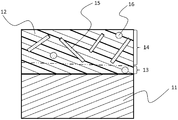
- the resin-metal composite of the present invention is a resin mixture assumed to be present near the interface between the resin member and the metal member, as a result of examining the mechanism of destruction in a case where the resin-metal composite is actually used. Paying attention to (a1), by giving the resin mixture (a1) a specific strength, the resin mixture (a1) is excellent in bonding strength. This will be specifically described with reference to FIG. It is considered that the resin member 12 bonded to the metal member 11 is composed of a skin layer 13 and a core layer 14 near the interface with the metal member, as shown in FIG.
- the resin member includes an inorganic filler 15 and a rubber-like elastic body 16.
- the inorganic filler (a2) 15 having a low specific gravity is included in the core layer 14 during the molding of the resin member, and the skin layer referred to in the present invention is substantially free of the inorganic filler (a2). . “Almost not included” means that the inorganic filler (a2) in the skin layer is 0.3% by mass or less based on the total amount of the resin molding material. More preferably, it is 0.2% by mass or less, substantially 0.0% by mass.
- the inorganic filler (a2) having a low specific gravity in the resin member is considered to move to the core layer. It is assumed that the inorganic filler (a2) is not substantially contained in the skin layer near the interface in contact with as described above. In a situation where the metal composite is actually used as a housing for electronic and electric parts, etc., the destruction of the metal composite is caused by first cracking in the skin layer, and this crack propagates to the core layer, and finally the composite Often leads to the destruction of Therefore, the physical properties of the skin layer are considered to be important.
- the tensile yield stress of the molded article made of the resin mixture (a1) is preferably at least 28 MPa, more preferably at least 30 MPa, even more preferably at least 35 MPa.
- the molded article made of the resin mixture (a1) preferably exhibits plastic deformation behavior, the point at which plastic deformation starts is the yield point, and the stress at the yield point is the tensile yield. Stress.
- the nominal tensile strain at break can be mentioned. It is preferable to design the strength so that the nominal tensile strain at break obtained in a tensile test according to ISO 527-1, 2: 2012 is 2.5% or more.
- the resin mixture (a1) is excellent in viscoelasticity, and the strength of the finally obtained resin-metal composite can be increased.
- the nominal tensile strain at break is more preferably 2.7% or more, still more preferably 2.8 or more, and even more preferably 3.0% or more.
- the resin mixture (a1) was measured using a test piece having a thickness of 20 mm ⁇ 5 mm ⁇ 0.8 mm in accordance with ISO 6721-4: 1994 under conditions of a frequency of 1 Hz and around room temperature.
- (Tan ⁇ ) is preferably 0.0200 or more, and more preferably 0.0220 or more.
- the loss tangent (tan ⁇ ) measured under the above conditions is 0.0200 or more, it is excellent against splitting and peeling caused by biased stress applied to one or the end of the joining surface between the metal member and the resin member. It is possible to maintain the joint strength.
- the resin composition is a viscoelastic body having both viscosity and elasticity, and a loss tangent (tan ⁇ ) of solid viscoelasticity can be used as an index indicating such viscoelasticity.
- a loss tangent (tan ⁇ ) of solid viscoelasticity can be used as an index indicating such viscoelasticity.
- stress and strain are observed in the same phase.
- the phase of the strain is delayed by 90 degrees with respect to the phase of the stress.
- the viscoelastic body shows an intermediate behavior, and the phase difference is a value between 0 degrees and 90 degrees.
- the loss tangent (tan ⁇ ) of the solid viscoelasticity is obtained by dividing the contribution of the viscosity to the mechanical properties of the material by the contribution of the elasticity. The closer it is to a viscous body.
- a material having a large loss tangent has a syrupy property and has a high viscosity when deformed.
- the elastic modulus can be expressed as a ratio of stress ( ⁇ * ) to strain ( ⁇ * ) as a complex elastic modulus G * by a complex number as in the following equation (F1).
- the loss tangent (tan ⁇ ) of the solid viscoelasticity of the molded body made of the resin mixture (a1) is 0.0200 or more, and that the resin member made of the resin molding material and the metal member It has been found that in the composite in which is bonded, the bonding strength is increased and the peeling becomes more difficult.
- the resin member constituting the resin-metal composite of the present invention has a further low dielectric constant. Specifically, using a test piece made of a resin molding material having a thickness of 1.5 mm ⁇ 1.5 mm ⁇ 80 mm, the dielectric constant ( ⁇ r ) of the resin molding material was measured at a frequency of 10 GHz in accordance with ASTM D2520. ) Is preferably 3.50 or less, more preferably 3.10 or less. In addition, one of the features is that the resin molding material constituting the resin-metal composite of the present invention has a low dielectric loss tangent.
- the dielectric loss tangent measured according to ASTM D2520 at a frequency of 10 GHz using a test piece of the resin molding material of 1.5 mm ⁇ 1.5 mm ⁇ 80 mm is 0.0100 or less. Is preferred. More preferably, it is 0.0050 or less.
- the relative permittivity ( ⁇ r ) and the dielectric loss tangent are in the above ranges, there is an advantage that a signal transmission speed in a high frequency band is not delayed and a signal strength is not reduced.
- Metal Member It is preferable to use at least one selected from the group consisting of aluminum, stainless steel, copper, titanium and alloys thereof as the metal member constituting the resin-metal composite of the present invention. These metals can be selected according to the intended use and physical properties, and it is more preferable to use aluminum or an aluminum alloy.
- aluminum and aluminum alloys containing aluminum include A1050 and A1100, A1200 of industrial pure aluminum, A2017 and A2024 of Al—Cu system, A3003 and A3004 of Al—Mn system, A4032 of Al—Si system, Al -Mg-based A5005, A5052, A5083, Al-Mg-Si-based A6061 and A6063, and Al-Zn-based A7075.
- aluminum and stainless steel are preferable in terms of processing.
- the shape of the metal member is not particularly limited as long as it can be joined to the resin member, and may be, for example, a flat plate, a curved plate, a bar, a tube, a block, or the like. A structure composed of these combinations may be used.
- the shape of the surface of the joint portion to be joined to the resin member is not particularly limited, and may be a flat surface, a curved surface, or the like. On the other hand, in order to maintain the bonding strength, it is more preferable to make the shape less likely to cause stress concentration.
- the metal member can be obtained by performing a die casting molding, an extrusion molding, or the like on a metal material. After the metal material obtained by the above molding or the like is cut into a predetermined shape by cutting, plastic working by press or the like, blanking such as punching, cutting, polishing, electric discharge machining, a surface treatment described later may be performed. preferable.
- the metal member may have been subjected to a surface treatment such as surface roughening physically, chemically or electrically, and it is preferable that at least one selected from a physical treatment and a chemical treatment has been performed.
- a surface treatment such as surface roughening physically, chemically or electrically
- at least one selected from a physical treatment and a chemical treatment has been performed.
- the physical treatment and the chemical treatment are not particularly limited, and known physical treatments and chemical treatments can be used. Due to the physical treatment, the surface of the metal member is roughened, and the resin mixture constituting the resin member enters into the holes formed in the roughened region to generate an anchor effect, and the interface between the metal member and the resin member is generated. , The adhesion is easily improved.
- the chemical treatment imparts a chemical bonding effect such as a covalent bond, a hydrogen bond, or an intermolecular force between the metal member and the integrally molded resin member. The adhesion at the interface is easily improved.
- the chemical treatment may involve roughening the surface of the metal member. In this case, an anchor effect similar to that of the physical treatment occurs, and the adhesion at the interface between the metal member and the resin member is increased. Is further improved.
- ⁇ ⁇ Various methods can be adopted for the surface treatment.
- Examples of the physical treatment include laser treatment and sand blasting (Japanese Patent Application Laid-Open No. 2001-225346). A plurality of physical processes may be performed in combination.
- Examples of the chemical treatment include dry treatment such as corona discharge, triazine treatment (see JP-A-2000-218935), chemical etching (JP-A-2001-225352), and anodic oxidation treatment (JP-A-2010-64496). Gazette) and hydrazine treatment.
- hot water treatment Japanese Patent Application Laid-Open No. 8-142110
- the warm water treatment includes immersion in 100 ° C. water for 3 to 5 minutes.
- a plurality of chemical treatments may be performed in combination. These surface treatment methods may be used alone or in combination of two or more.
- a hole is formed in at least a part of a surface where the metal member contacts the resin member. Specifically, it is preferable to form a large hole in the surface of the metal member and further form a fine hole in the hole.
- the metal member is aluminum or an aluminum alloy (hereinafter sometimes referred to as aluminum (alloy)) will be specifically described.
- aluminum (alloy) is machined from metal material to sawing, milling, electric discharge, drilling, forging, pressing, grinding, polishing, etc.
- it is processed into a desired shape, and can be finished into a shape required as an insert part into an injection mold.
- Many metal members finished to a required shape generally have an oil material used during processing adhered to the surface. Therefore, it is preferable to perform a degreasing treatment before performing a treatment for forming fine pores on the surface.
- a step of removing a processing oil using a solvent degreasing apparatus using a solvent such as trichlene, methylene chloride, kerosene, or a paraffinic oil is preferable.
- a degreasing and washing step it is preferable to further perform a degreasing and washing step in the solution. It is an object of the present invention to remove processing oil such as cutting and grinding for machining, adhering to the surface of aluminum (alloy), and dirt due to finger oil. When a large amount of machining oil is attached, it is preferable that the oil is once passed through the above-described solvent degreasing apparatus and then charged into this step.
- a commercially available degreasing agent for aluminum alloys can be used as the degreasing agent.
- the aluminum (alloy) member When a commercially available degreasing agent for aluminum alloy is used, it is necessary to dissolve it in water and immerse the aluminum (alloy) member in the aqueous solution of the degreasing agent at a specified temperature and time, for example, at about 50 to 80 ° C. for about 5 minutes. preferable. After immersion, the aluminum (alloy) member is washed with water.
- the aluminum (alloy) member is immersed in an acid-base solution for several minutes, roughly etched, and after the surface layer film is chemically removed, anodizing treatment or the like for forming fine pores is performed.
- an acidic aqueous solution is preferably mainly used, and an aqueous solution containing hydrofluoric acid or a derivative of hydrofluoric acid can be used as the acidic solution.
- the aluminum (alloy) member is immersed in the acid-base liquid for several minutes and then roughly etched to chemically remove the surface layer film so as to be suitable for the subsequent processing. After washing with water, a process for forming fine holes in the aluminum (alloy) member is performed.
- the metal member preferably has a plurality of holes having a diameter of 0.01 ⁇ m or more and 1000 ⁇ m or less formed on the surface in contact with the resin member.
- a resin-metal composite having more excellent bonding properties between the metal member and the resin member is manufactured. More preferably, the hole has a size of 0.01 ⁇ m or more and 100 ⁇ m or less.
- a resin-metal composite can be obtained by integrally molding the above-described metal member and resin member.
- Examples of the integral molding method include insert molding, welding, outsert molding, and overlap molding.
- Insert molding '' is a method of obtaining a molded product in which the metal member and the resin member are integrated by inserting the metal member into a mold having a predetermined shape and then filling the resin member.
- a conventionally known method can be adopted.
- the method is not particularly limited as long as the resin-metal composite can be obtained by applying pressure or the like to the molten resin to allow the resin to enter the holes formed on the metal member and then cooling and solidifying the resin.
- Injection molding and compression molding, as well as injection compression molding can be used as the resin filling method, and injection molding is more preferred.
- An insert molded body obtained by insert molding has a joint between a resin member and a metal member, and its shape is not limited. For example, a shape in which a resin member and a metal member overlap, a shape in which a metal member is wrapped in a resin member, and the like are also included.
- the temperature of the metal member at the time of insert molding is preferably set to a temperature higher by 50 ° C. to 80 ° C. than the glass transition temperature of the resins (1) to (5), which are the main components of the resin mixture (a1).
- the temperature is preferably 150 ° C. or more and 180 ° C. or less, and when using polybutylene terephthalate in the resin (2) polyester, it is 110 ° C. or more and 140 ° C. or less. Is preferred.
- the temperature of the metal member is higher than the glass transition temperature of the resin which is the main component of the resin mixture (a1) by 50 ° C.
- the resin member is sufficiently filled in the holes formed on the metal member, and the bonding strength is excellent. Can be obtained.
- the temperature of the metal member exceeds a temperature of 80 ° C. from the glass transition temperature of the resin that is the main component of the resin mixture (a1), the shrinkage / deformation of the resin member in the cooling process increases, and the desired shape is obtained.
- the energy required for heating and cooling increases, and the molding cycle time increases.
- the method for controlling the temperature of the metal member to the above-described temperature range is not particularly limited, and examples thereof include a method in which the temperature is controlled via a temperature control mechanism of a mold.
- a resin member is welded on a metal member by vibration welding, ultrasonic welding, hot plate welding or spin welding.
- the welding conditions for performing these weldings are not particularly limited, and can be appropriately set according to the shape of the molded product.
- a method in which a metal member and a resin member are brought into contact with each other to generate frictional heat on the contact surface and perform welding is preferable.
- a method of welding by generating frictional heat on the contact surface there are a vibration welding method, an ultrasonic welding method, and a spin welding method.
- the size, shape, thickness, and the like of the obtained resin-metal composite are not particularly limited, and may be any of a plate shape (a disk, a polygon, and the like), a column shape, a box shape, a bowl shape, a tray shape, and the like. In the case of a large composite or a complex composite, the thickness of all parts of the composite does not need to be uniform, and a reinforcing rib may be provided on the composite.
- the obtained resin-metal composite can be further processed by cutting, polishing, or the like.
- the cutting process include turning, milling, boring, drilling (drilling, tapping, reaming), gear cutting, planing, shaping, upright cutting, broaching, and gear shaping.
- a known processing oil at the time of cutting is preferable to use a known processing oil at the time of cutting.
- the processing oil can be suitably used for both wet processing and near-dry processing.
- the method of supplying the processing oil may be a circulation supply type in which the processing oil is supplied to the processing point in a large amount, or a so-called MQL (ultra-minimum amount lubricating oil) in which the carrier gas and the metal processing oil composition are supplied in a mist form to the processing point Supply).
- MQL ultra-minimum amount lubricating oil
- the surface of the resin-metal composite before processing or the surface of the resin-metal composite after processing is further subjected to a physical treatment and / or a chemical treatment.
- a physical treatment and / or a chemical treatment By performing these treatments, it is possible to impart design properties such as coloring to the resin-metal composite, and to protect and strengthen the surface of the resin-metal composite.
- the same method as described above can be employed.
- the processing oil used for processing the resin-metal composite is degreased, and roughly etched with an acid-base solution as a pretreatment, and then fine holes are formed on the surface.
- a forming method can be adopted.
- an anodic oxidation method is preferable. The conditions and the like are as described above.
- the resin-metal composite after the anodizing treatment can be used for various applications without further treatment, but the anodized film formed after the anodizing treatment is relatively inferior in electric insulation and corrosion resistance. Therefore, it is preferable to further perform a sealing treatment on the portion of the resin-metal composite exposed to the outside air.
- the sealing treatment include a sealing treatment with a hydrate. More specifically, a steam treatment, a hot water treatment, or the like, which is applied to an anodic oxide film having fine pores formed by the anodic oxidation treatment, may be mentioned.
- the resin-metal composite When coloring the resin-metal composite, various known dyes such as acid dyes, mordant dyes, and basic dyes are used, for example, a well-known desired coloring means such as using a dyeing bath at a bath temperature of 50 to 70 ° C. To perform a sealing treatment. Since the resin used for the resin member of the resin-metal composite of the present invention has excellent chemical resistance and hot water resistance, it can withstand such processing and is preferable in terms of processing.
- a well-known desired coloring means such as using a dyeing bath at a bath temperature of 50 to 70 ° C.
- a hard coat layer can be provided on the surface layer of the resin-metal composite of the present invention for the purpose of preventing scratches, preventing fingerprints, preventing static electricity, and the like. Any material can be used as the hard coat layer. For example, even when a film made of a photocurable composition comprising a photopolymerizable polyfunctional compound and urethane (meth) acrylate is formed on the metal resin composite, Good.
- Acid-modified polyphenylene ether 1 kg of polyphenylene ether (intrinsic viscosity: 0.45 dl / g, in chloroform at 25 ° C.), 40 g of fumaric acid, 2,3-dimethyl-2,3-diphenylbutane as a radical generator (trade name: NOFMER, manufactured by NOF CORPORATION) BC), and melt-kneading is performed using a twin-screw kneading extruder TEX44 ⁇ II (manufactured by Nippon Seiko Steel Co., Ltd.) at a barrel temperature of 300 to 330 ° C., a screw rotation speed of 360 rpm, and a discharge rate of 110 kg / hr.
- NOFMER 2,3-dimethyl-2,3-diphenylbutane
- melt-kneading is performed using a twin-screw kneading extruder TEX44 ⁇ II
- a pellet of fumaric acid-modified polyphenylene ether was obtained.
- 1 g of the resulting modified polyphenylene ether pellet was dissolved in ethylbenzene, reprecipitated in methanol, the recovered polymer was subjected to Soxhlet extraction with methanol, dried, and then subjected to IR spectrum carbonyl absorption intensity and titration to determine the modification rate. I asked. At this time, the modification ratio was 1.25% by mass.
- the fumaric acid-modified polyphenylene ether obtained above was used.
- Nucleating agent sodium-2,2'-methylenebis (4,6-di-tert-butylphenyl) phosphate, manufactured by ADEKA Corporation, trade name: ADK STAB NA-11 Phenolic antioxidant: trade name IRGANOX1010 manufactured by BASF Japan Ltd.
- Inorganic filler (a2) Glass filler (1): ECS03T-249H ⁇ E glass manufactured by Nippon Electric Glass Co., Ltd., fibrous (chopped strand length: 3 mm), fiber cross section substantially round ( ⁇ 10.5 ⁇ m)> Glass filler (2): CSG3PA-820 ⁇ Nitto Boseki Co., Ltd., E glass, fibrous (chopped strand length 3 mm), elliptical fiber cross section (minor axis 7 ⁇ m, major axis 28 ⁇ m)> Glass filler (3): ECS03T-187H ⁇ E-glass, fibrous (chopped strand length 3 mm), approximately circular shape ( ⁇ 10.5 ⁇ m), manufactured by NEC Corporation> Glass filler (4): CSG3PA-830 ⁇ Nitto Boseki Co., Ltd., E glass, fibrous (chopped strand length 3 mm), elliptical fiber cross section (minor axis 7 ⁇ m, major axis 28 ⁇ m)> Glass fill
- the mixture was melt-kneaded at a screw rotation speed of 220 rpm and a discharge rate of 25 kg / hr to produce pellets.
- the pellets obtained by melt-kneading were dried at 120 ° C. for 5 hours using a hot air drier and evaluated.
- the evaluation method of the obtained pellet is as follows.
- Resin molding material containing inorganic filler (a2) is obtained by dry blending resin mixture (a1) as described in I above. After that, using a twin screw extruder TEM-35B (manufactured by Toshiba Machine Co., Ltd.), while feeding the inorganic filler in the amount shown in the table, in the case of SPS resin, the barrel temperature is 270 to 290 ° C. In the case of a resin, the resin was melt-kneaded at a barrel temperature of 240 to 260 ° C.
- the obtained pellet was dried at 120 ° C. for 5 hours using a hot air drier.
- the obtained pellets were evaluated as follows.
- the mold surface temperature is 160 ° C.
- the PBT resin is Under the conditions of a resin temperature of 260 ° C. and a mold surface temperature of 120 ° C., a 1.5 mm ⁇ 1.5 mm ⁇ 80 mm test piece made of the pellet obtained in the above (II) was molded, and Agilent Technology was used in accordance with ASTM D2520.
- the relative dielectric constant ( ⁇ r ) and the dielectric loss tangent at 10 GHz were measured by a cavity resonance perturbation method using a network analyzer 8557D manufactured by K.K. and a cavity resonator for 10 GHz manufactured by Kanto Applied Electronics Co., Ltd. The results are shown in Tables 1 to 5.
- Examples 1-26, Comparative Examples 1-3 The surface of an A6063 aluminum alloy (size: length 50 mm ⁇ width 10 mm ⁇ thickness 2 mm) was immersed in an alkali degreasing solution (aqueous solution: AS-165F (manufactured by JCU) 50 ml / L) for 5 minutes to perform a degreasing treatment. Subsequently, pretreatment for acid etching was performed. Thereafter, anodizing treatment was performed to prepare a metal member having a plurality of holes. The obtained aluminum member is placed in a mold, and using an injection molding machine SE100EV (manufactured by Sumitomo Heavy Industries, Ltd.), the resin temperature is 290 ° C.
- SE100EV injection molding machine SE100EV
- the mold surface temperature is 160 ° C.
- the PBT resin is The resin molding materials (pellets) listed in Tables 1 to 5 are injection-molded under the conditions of a resin temperature of 260 ° C., a mold surface temperature of 120 ° C., an injection speed: 100 mm / s, a holding pressure: 80 MPa, and a holding pressure time: 5 seconds. Then, an integration step with the resin member was performed to obtain a test piece of the resin metal molded body. The test piece was produced in accordance with ISO 19095: 2015 (FIG. 2). In FIG.
- l 1 indicates the length of the test piece
- l 2 indicates the length of the metal member
- l 3 indicates the length of the resin member
- l 4 indicates the width of the test piece
- t indicates the thickness of the test piece.
- l 1 is 100 mm
- l 2 and l 3 are 50 mm
- l 4 is 10 mm
- t is 2 mm.
- the obtained test piece was annealed at 160 ° C. for 1 hour, and thereafter, the following pretreatment, anodizing treatment and sealing treatment were performed on the obtained test piece.
- alkali degreasing was performed, immersed in a 2.0% by mass aqueous sodium hydroxide solution at 50 ° C.
- a test piece for drop impact was prepared as follows by changing the dimensions of the metal member and some of the molding conditions of the metal-resin composite in the method of preparing the test piece used for the tensile bonding strength measurement.
- A6063 aluminum alloy compact (size: 160 ⁇ 100 ⁇ 10 mm in thickness) is subjected to a cutting process using a processing oil (Alpha Cool WA-K manufactured by Idemitsu Kosan Co., Ltd.) to remove a portion to be filled with a resin member.
- the surface was immersed in an alkaline degreasing solution (aqueous solution: AS-165F (manufactured by JCU) 50 ml / L) for 5 minutes to perform a degreasing treatment. Subsequently, pretreatment for acid etching was performed. Thereafter, an insert metal member having a plurality of holes on the surface was produced by an anodizing method. The obtained insert metal member is placed in a mold, and an injection molding machine SE100EV (manufactured by Sumitomo Heavy Industries, Ltd.) is used.
- SPS resin the resin temperature is 290 ° C.
- the mold surface temperature is 160 ° C.
- PBT resin in the case of PBT resin.
- alkali degreasing was performed, immersed in a 2.0% by mass aqueous sodium hydroxide solution at 50 ° C. for 1 minute, and then neutralized with 6.0% by mass of dilute nitric acid (normal temperature, 30 seconds).
- desmutting was performed with 6.0% by mass diluted nitric acid.
- the pretreated molded body was subjected to anodizing treatment (18% by mass sulfuric acid, 18 ° C., 39 minutes, 1 A / dm 2 ), subjected to hot water treatment (sealing treatment), and then air blown.
- a sample for a drop impact test is obtained by combining a mass-adjusting component (glass in the present embodiment and the comparative example) with the resin-metal composite simulating a smartphone housing obtained in this manner so that the total mass is 150 g without bias.
- a mass-adjusting component glass in the present embodiment and the comparative example
- the resin-metal composite simulating a smartphone housing obtained in this manner so that the total mass is 150 g without bias.
- FIG. 7 Specifically, as shown in FIG. 7, a glass plate 4 is fitted as a mass adjusting component into a metal-resin composite imitating a smartphone case, and a drop impact having a rear surface shown in FIG. 5 and a front surface shown in FIG. 6 is provided. This was used as a test sample.
- FIG. 8 is a side view of the sample. As shown in this figure, portions indicated by reference numerals 2 and 3 are resin member portions joined to the metal member 1.
- each of the six sides of the obtained drop test sample was dropped on a concrete plate from a height of 1 m to separate the resin-metal joint surface. It was visually confirmed whether any troubles such as breakage of the resin and the resin part occurred.
- the contents (% by mass) of the resin (1), the resin (2), the rubber-like elastic body (B) and the acid-modified polyphenylene ether (C) are based on 100 parts by mass of the resin component in the resin mixture (a1). Represents the percentage in%.
- the contents (parts by mass) of the nucleating agent and the antioxidant represent the contents with respect to 100 parts by mass of the resin component in the resin mixture (a1).
- the content (% by mass) of the inorganic filler (a2) represents a ratio of the resin mixture (a1) and the inorganic filler (a2) in a total of 100% by mass.
Landscapes
- Chemical & Material Sciences (AREA)
- Engineering & Computer Science (AREA)
- Mechanical Engineering (AREA)
- Chemical Kinetics & Catalysis (AREA)
- Medicinal Chemistry (AREA)
- Organic Chemistry (AREA)
- Polymers & Plastics (AREA)
- Health & Medical Sciences (AREA)
- Manufacturing & Machinery (AREA)
- General Chemical & Material Sciences (AREA)
- Composite Materials (AREA)
- Compositions Of Macromolecular Compounds (AREA)
- Injection Moulding Of Plastics Or The Like (AREA)
- Laminated Bodies (AREA)
Abstract
Description
このような高周波帯域に対応した通信機器の小型化、軽量化のためには、信号の伝送速度を遅延させず信号の強度を低下させない、低誘電正接と低誘電率を有する樹脂部材を有する樹脂金属複合体の開発が必要とされる。
しかしながら、情報通信機器の筐体等として樹脂金属複合体を実際に用いる場面では、割裂や剥離といった、接合面の一方又は端部に応力が偏ってかかり、破壊に至るケースが多い。
すなわち、本発明は下記[1]~[14]に関する。
前記樹脂混合物(a1)からなる試験片の、ISO 527-1,2:2012に準拠した引張試験において、応力-歪曲線が降伏点を有し、かつ引張降伏応力が25MPa以上である、樹脂金属複合体。
[2]前記樹脂混合物(a1)からなる試験片の、ISO 527-1,2:2012に準拠した引張試験において、引張破壊呼びひずみが2.5%以上である、上記[1]に記載の樹脂金属複合体。
[3]前記樹脂混合物(a1)からなる20mm×5mm×0.8mm厚の試験片を用いて、ISO 6721-4:1994に準拠し、周波数1Hz、室温付近の条件下で測定した固体粘弾性の損失正接(tanδ)が、0.0200以上である、上記[1]又は[2]に記載の樹脂金属複合体。
[4]前記樹脂混合物(a1)が、シンジオタクチックポリスチレン、ポリエステル、ポリフェニレンサルファイド、ポリアミド及びポリエーテルエーテルケトンから選ばれる少なくとも1種を含む、上記[1]~[3]のいずれか1つに記載の樹脂金属複合体。
[5]樹脂混合物(a1)と無機充填材(a2)の合計を100質量%としたとき、前記樹脂成形材料は、無機充填材(a2)を13.0質量%以上37.0質量%以下含有する、上記[1]~[4]のいずれか1つに記載の樹脂金属複合体。
[6]前記無機充填材(a2)としてガラスフィラーを含む、上記[1]~[5]のいずれか1つに記載の樹脂金属複合体。
[8]前記金属部材が、アルミニウム、ステンレス鋼、銅、チタン及びこれらの合金からなる群から選択される少なくとも1種である、上記[1]~[7]のいずれか1つに記載の樹脂金属複合体。
[9]前記金属部材がアルミニウムまたはアルミニウム合金である、上記[8]に記載の樹脂金属複合体。
[10]前記金属部材の表面に、化学的処理及び物理的処理から選ばれる少なくとも一方がなされている、上記[1]~[9]のいずれか1つに記載の樹脂金属複合体。
[11]直径0.01μm以上1000μm以下の孔が、前記金属部材の樹脂部材と接する面の少なくとも一部に形成されている、上記[1]~[10]のいずれか1つに記載の樹脂金属複合体。
[12]前記金属部材に前記樹脂成形材料を射出成形する、上記[1]~[11]のいずれか1つに記載の樹脂金属複合体の製造方法。
[13]加工油を用いて、射出成形後に得られる樹脂金属複合体を切削加工する、上記[12]に記載の樹脂金属複合体の製造方法。
[14]上記[1]~[11]のいずれか1つに記載の樹脂金属複合体に陽極酸化処理及び封孔処理を行う、樹脂金属複合体の製造方法。
本明細書において、「XX~YY」の記載は、「XX以上YY以下」を意味する。本明細書において、好ましいとされている規定は任意に採用することができ、好ましいもの同士の組み合わせはより好ましい。
本発明の金属複合体を構成する樹脂部材は、樹脂を主成分とする樹脂混合物(a1)と無機充填材(a2)とを含有する樹脂成形材料からなる。「主成分とする」とは、下記樹脂(1)~樹脂(5)から選択される少なくとも1種の含有量が、樹脂混合物(a1)中60質量%以上であることを意味する。
樹脂混合物(a1)は、シンジオタクチックポリスチレン、ポリエステル、ポリフェニレンサルファイド、ポリアミド及びポリエーテルエーテルケトンから選ばれる少なくとも1種を含むことが好ましく、これらの樹脂を主成分とすることが好ましい。中でも、シンジオタクチックポリスチレン、ポリフェニレンサルファイド、ポリエステル及びポリアミドを用いることがさらに好ましい。それぞれの樹脂について以下説明する。
本発明でいうシンジオタクチックポリスチレンとは、高度なシンジオタクチック構造を有するスチレン系樹脂(以下、SPSと略記することがある)を意味する。本明細書において「シンジオタクチック」とは、隣り合うスチレン単位におけるフェニル環が、重合体ブロックの主鎖によって形成される平面に対して交互に配置(以下において、シンジオタクティシティと記載する)されている割合が高いことを意味する。
タクティシティは、同位体炭素による核磁気共鳴法(13C-NMR法)により定量同定できる。13C-NMR法により、連続する複数の構成単位、例えば連続した2つのモノマーユニットをダイアッド、3つのモノマーユニットをトリアッド、5つのモノマーユニットをペンタッドとしてその存在割合を定量することができる。
上記の構成単位を含む共重合体のコモノマー成分としては、上記スチレン系重合体のモノマーの他、エチレン、プロピレン、ブテン、ヘキセン及びオクテン等のオレフィンモノマー;ブタジエン、イソプレン等のジエンモノマー;環状オレフィンモノマー、環状ジエンモノマー、メタクリル酸メチル、無水マレイン酸及びアクリロニトリル等の極性ビニルモノマーが挙げられる。
さらにはスチレンとp-メチルスチレンとの共重合体、スチレンとp-tert-ブチルスチレンとの共重合体、スチレンとジビニルベンゼンとの共重合体等を挙げることができる。
ポリエステルは、好ましくはジカルボン酸化合物とジヒドロキシ化合物の重縮合、オキシカルボン酸化合物の重縮合あるいはこれらの化合物の重縮合等によって得られる熱可塑性樹脂であり、ホモポリエステル、コポリエステルのいずれであってもよい。
芳香族ジカルボン酸としては、テレフタル酸、イソフタル酸、オルトフタル酸、1,5-ナフタレンジカルボン酸、2,5-ナフタレンジカルボン酸、2,6-ナフタレンジカルボン酸、ビフェニル-2,2’-ジカルボン酸、ビフェニル-3,3’-ジカルボン酸、ビフェニル-4,4’-ジカルボン酸、ジフェニルエーテル-4,4’-ジカルボン酸、ジフェニルメタン-4,4’-ジカルボン酸、ジフェニルスルフォン-4,4’-ジカルボン酸、ジフェニルイソプロピリデン-4,4’-ジカルボン酸、1,2-ビス(フェノキシ)エタン-4,4’-ジカルボン酸、アントラセン-2,5-ジカルボン酸、アントラセン-2,6-ジカルボン酸、p-ターフェニレン-4,4’-ジカルボン酸、ピリジン-2,5-ジカルボン酸等が挙げられ、テレフタル酸が好ましく使用できる。
上記のような二官能性モノマー以外に、分岐構造を導入するためトリメリット酸、トリメシン酸、ピロメリット酸、ペンタエリスリトール、トリメチロールプロパン等の三官能性モノマーや分子量調節のため脂肪酸等の単官能性化合物を少量併用することもできる。
中でも好ましいのは、酸成分の95モル%以上がテレフタル酸であり、アルコール成分の95質量%以上が脂肪族ジオールであるポリアルキレンテレフタレートである。テレフタル酸と1,4-ブタンジオールからなるポリブチレンテレフタレート(以下PBTと略記することがある)であることが特に好ましい。
変性ポリブチレンテレフタレートとして、ポリテトラメチレングリコールを共重合したポリエステルエーテルを用いる場合は、共重合体中のテトラメチレングリコール成分の割合は3~40質量%であることが好ましく、5~30質量%がより好ましく、10~25質量%がさらに好ましい。このような共重合割合とすることにより、接合性と耐熱性とのバランスに優れる傾向となり好ましい。
変性ポリブチレンテレフタレートとして、ダイマー酸共重合ポリブチレンテレフタレートを用いる場合は、全カルボン酸成分に占めるダイマー酸成分の割合は、カルボン酸基として0.5~30モル%であることが好ましく、1~20モル%がより好ましく、3~15モル%がさらに好ましい。このような共重合割合とすることにより、接合性、長期耐熱性及び靭性のバランスに優れる傾向となり好ましい。
温度250℃、荷重2.16kgfの条件下で測定された、ポリエステルのメルトフローレート(MFR)は、好ましくは5g/10分以上、より好ましくは8g/10分以上、さらに好ましくは10g/10分以上である。ポリエステルのMFR値が上記範囲にあれば、成形時の樹脂混合物の流動性に問題が生じない。ポリエステルのMFR値が20g/10分以下、15g/10分以下であれば、十分な機械的性質を有する成形体を得ることができる。
ポリフェニレンサルファイド(以下PPSと略記することがある)としては、繰り返し単位が一般式:-(Ph-S)-(式中、Phはフェニレン基、Sは硫黄を示す)で示されるポリマーを用いることができる。
繰り返し単位の(Ph-S)を1モル(基本モル)と定義すると、本発明の樹脂混合物(a1)で用いられ得るポリフェニレンサルファイドは、この繰り返し単位を通常50モル%以上、好ましくは70モル%以上、より好ましくは90モル%以上含有するポリマーであることが好ましい。
ポリフェニレンサルファイドの300℃における溶融粘度(せん断速度1216/秒)は、100~1500ポイズであることが好ましく、350~700ポイズであることがより好ましい。
ポリアミドとしては、公知の任意のポリアミドが使用可能である。適切なポリアミドとしては、例えばポリアミド-4,ポリアミド-6,ポリアミド-6,6;ポリアミド-3,4;ポリアミド-12;ポリアミド-11;ポリアミド-6,10;テレフタル酸及び4,4’-ジアミノヘキシルメタンから得られるポリアミド,アゼライン酸,アジピン酸及び2,2-ビス(p-シクロヘキシル)プロパンから得られるポリアミド,アジピン酸及びm-キシリレンジアミンから得られるポリアミド等が挙げられる。
芳香環を有するω-アミノ-ω’-カルボキシル化合物を重合させることによっても芳香族ポリアミド樹脂が得られ、このような芳香環を有するω-アミノ-ω’-カルボキシル化合物としては、例えば4-アミノフェニルカルボキシルメタン、1-(4-アミノフェニル)-2-カルボキシルエタン、3-(4-アミノフェニル)-1-カルボキシルプロパン,p-(3-アミノ-3’-カルボキシ)ジプロピルベンゼン等を挙げることができる。
本発明の樹脂金属複合体の樹脂部材部分を構成する樹脂成形材料中の樹脂混合物(a1)には、所望により上記主成分となる樹脂以外の成分を含めることができる。以下、さらに詳述する。なお、本明細書において、樹脂混合物(a1)中、上記主成分となる樹脂、ゴム状弾性体(下記成分(1))及び酸変性ポリフェニレンエーテル(下記成分(2))を「樹脂混合物(a1)中の樹脂成分」という。
上記樹脂混合物(a1)は、ゴム状弾性体をさらに含むことができる。ゴム状弾性体は樹脂部材に弾性と粘性とを付与することにより、樹脂金属複合体に極めて高い耐久性を付与することができるため好ましい。具体的には、弾性と粘性とを樹脂部材に付与することにより、樹脂金属複合体は高い振動及び衝撃吸収性を示し、かつ内部圧力を分散させることにより歪みを解消する結果、金属部材と樹脂部材との接着界面における高い接合強度を実現することができる。
ゴム状弾性体がスチレン系重合体を含む場合のスチレン含有量は25質量%以上35質量%以下であることが好ましい。スチレン含有量が35質量%以下であれば十分な靭性を付与することができ、25質量%以上であればシンジオタクチック構造を有するスチレン系重合体との相溶性が優れる。
ゴム状弾性体の含有量は、樹脂混合物(a1)中、より好ましくは15質量%以上、さらに好ましくは18質量%以上、よりさらに好ましくは20質量%以上であり、より好ましくは35質量%以下、さらに好ましくは33質量%以下、よりさらに好ましくは30質量%以下である。複数種のゴム状弾性体を含有する場合は合計量が上記範囲となる。
酸変性ポリフェニレンエーテルは、後述する無機充填材(a2)、特にガラスフィラーとの界面強度を高めるため、樹脂部材の強度を高めることができる。
酸変性に用いられる酸としては、無水マレイン酸及びその誘導体、フマル酸およびその誘導体が挙げられる。無水マレイン酸の誘導体は、エチレン性二重結合とカルボキシル基または酸無水物基のような極性基を同一分子内に持つ化合物である。具体的には、例えばマレイン酸,マレイン酸モノエステル,マレイン酸ジエステル,マレイミド及びそのN置換体(例えばN-置換マレイミド,マレイン酸モノアミド,マレイン酸ジアミド等),マレイン酸のアンモニウム塩,マレイン酸の金属塩,アクリル酸,メタクリル酸,メタクリル酸エステル,グリシジルメタクリレート等が挙げられる。フマル酸誘導体の具体例としては、フマル酸ジエステル,フマル酸金属塩,フマル酸アンモニウム塩,フマル酸ハロゲン化物等が挙げられる。これらの中でもフマル酸または無水マレイン酸が特に好ましい。
酸変性ポリフェニレンエーテルの配合量は、樹脂混合物(a1)中、より好ましくは1.0質量%以上、さらに好ましくは1.5質量%以上であり、より好ましくは3.0質量%以下、さらに好ましくは2.5質量%以下である。酸変性ポリフェニレンエーテルは一種を単独で用いても、二種以上を組み合わせて用いてもよい。
酸化防止剤としては公知のものを使用することができるが、本発明においては、リン系酸化防止剤は含まないことを望ましい。リン系酸化防止剤を用いると、成形時にリン酸ガスを生じ、金属腐食を促すため除外することが望ましい。「リン系酸化防止剤を含まない」とは、具体的には、リン系酸化防止剤が、樹脂混合物(a1)中の樹脂成分100質量部に対して、5000質量ppm以下、より好ましくは1000質量ppm以下、さらに好ましくは500質量ppm以下、よりさらに好ましくは50質量ppm以下であることをいう。
酸化防止剤の添加量は、樹脂混合物(a1)中の樹脂成分100質量部に対して、好ましくは0.05質量部以上、より好ましくは0.10質量部以上であり、好ましくは0.50質量部以下、より好ましくは0.30質量部以下であることが好ましい。複数種の酸化防止剤を含有する場合は合計量が上記範囲となる。
樹脂混合物(a1)が核剤(結晶化核剤)を含むことにより、樹脂ペレット成形時の結晶化速度を適切に保ち、ペレットの量産性を担保することができる。
核剤としては公知のものを使用することができ、例えば、アルミニウムジ(p-tert-ブチルベンゾエート)等のカルボン酸の金属塩、ナトリウム-2,2’-メチレンビス(4,6-ジ-tert-ブチルフェニル)ホスフェート、メチレンビス(2,4-ジ-tert-ブチルフェノール)アシッドホスフェートナトリウム等のリン酸の金属塩、フタロシアニン誘導体、リン酸エステル系化合物などを挙げることができる。
核剤の添加量は、樹脂混合物(a1)中の樹脂成分100質量部に対して、好ましくは0.2質量部以上、より好ましくは0.5質量部以上であり、好ましくは2.0質量部以下、より好ましくは1.5質量部以下である。0.2質量部以上であれば、樹脂ペレットの量産性を良好に保つことができ、2.0質量部以下であれば樹脂金属複合体の比誘電率及び誘電正接に悪影響を与えない。
無機充填材としては繊維状のものと、粒状、粉状のものがある。繊維状充填材としては、例えば、ガラスフィラー、炭素繊維、ウィスカー、マイカ等が挙げられる。形状としてはクロス状、マット状、集束切断状、短繊維、フィラメント状、ウィスカー等があるが、集束切断状の場合、長さが0.05mm~50mm、繊維径が5~20μmのものが好ましい。一方、粒状、粉状充填材としては、例えばタルク、カーボンブラック、グラファイト、二酸化チタン、シリカ、マイカ、硫酸カルシウム、炭酸カルシウム、炭酸バリウム、炭酸マグネシウム、硫酸マグネシウム、硫酸バリウム、オキシサルフェート、酸化スズ、アルミナ、カオリン、炭化ケイ素、金属粉末、ガラスパウダー、ガラスフレーク、ガラスビーズ等が挙げられる。
無機充填材としては、ガラスフィラーが特に好ましい。
ガラスフィラーは樹脂部材に強度を与えると共に、成形時における樹脂の成形収縮率を下げることができるため好ましい。成形収縮率を下げることができると、樹脂金属複合体とした場合に、樹脂部材と金属部材との界面における残留応力を低減させることができ、樹脂金属複合体の剥離や変形等の問題を抑えることができる。さらに、ガラスフィラーを含むことにより、樹脂部材の弾性率を向上させることができる。樹脂金属複合体とした場合、樹脂部材と金属部材の弾性率が近いほどその界面への応力の集中が軽減されるため、樹脂部材の弾性率が上がることによって樹脂金属複合体の落下衝撃特性が向上する。ガラスフィラーの形態は上記した通り特に限定されず、繊維状,粒状,板状または粉状のものなど様々な形態のものを使用することができる。中でも、繊維状で、かつ断面が楕円形状(扁平状)のガラスフィラー(扁平ガラス繊維)を用いることが、樹脂部材としたときのTD(Transverse Direction:樹脂の流動方向に対して垂直な方向)の成形収縮率、曲げ弾性率の点でより好ましい。
中でも、γ-アミノプロピルトリメトキシシラン,N-β-(アミノエチル)-γ-アミノプロピルトリメトキシシラン,γ-グリシドキシプロピルトリメトキシシラン,β-(3,4-エポキシシクロヘキシル)エチルトリメトキシシラン等のアミノシラン、エポキシシラン、イソプロピルトリ(N-アミドエチル,アミノエチル)チタネート等が表面処理剤として好ましく用いられる。ガラスフィラーの表面処理方法は公知の方法を用いて処理すればよく、特に限定されない。
無機充填材(a2)の含有量は、好ましくは15.0質量%以上、より好ましくは18.0質量%以上であり、好ましくは35.0質量%以下、より好ましくは33.0質量%以下である。
図1を用いて具体的に説明する。金属部材11と接合する樹脂部材12は、図1に示すように、金属部材との界面付近に存在するスキン層13とコア層14とからなると考えられる。樹脂部材には無機充填材15とゴム状弾性体16等が含まれる。樹脂部材の成形中に比重の軽い無機充填材(a2)15はコア層14に含まれると考えられ、本発明でいうスキン層は無機充填材(a2)を実質的に含まないと想定される。「ほぼ含まない」とはスキン層中に無機充填材(a2)は樹脂成形材料全量に基づき0.3質量%以下であることを意味する。より好ましくは0.2質量%以下、実質的には0.0質量%である。
金属複合体が電子・電気部品の筐体等として実際に使用される場面において、金属複合体の破壊は、スキン層にまず亀裂が入り、この亀裂がコア層に伝播して最終的に複合体の破壊につながるケースが多い。そのため、スキン層の物性が重要となると考えらえる。
本発明においては、無機充填材(a2)を実質的に含まない樹脂混合物(a1)からなる樹脂成形体の機械強度にフォーカスをあてて、特定の物性を持たせることにより、結果として優れた接合強度を有する樹金属複合体が得られることを見出した。
(I):降伏点及び引張降伏応力
樹脂混合物(a1)からなる成形体が、ISO 527-1,2:2012に準拠した引張試験で得られる応力-歪曲線が降伏点を有し、引張降伏応力が25MPa以上であることを要する。理由は明らかではないが、樹脂混合物(a1)からなる成形体が降伏点を有する、すなわち弾性破壊でなく、塑性変形する場合に、優れた剥離強度等の接合強度を有することを本発明者等は見出した。また、引張降伏応力が25MPa未満であると、最終的に得られる樹脂金属複合体の強度に劣るため好ましくない。樹脂混合物(a1)からなる成形体の引張降伏応力は、好ましくは28MPa以上、より好ましくは30MPa以上、さらに好ましくは35MPa以上である。
上述した通り、樹脂混合物(a1)からなる成形体は、塑性変形挙動を示すことが好ましく、塑性変形が始まる点が降伏点であり、降伏点における応力が引張降伏応力である。降伏強さの目安として、降伏点及び引張降伏応力のほかに、引張破壊呼びひずみを挙げることができる。ISO 527-1,2:2012に準拠した引張試験において得られる引張破壊呼びひずみが2.5%以上となるように強度設計をすることが好ましい。引張破壊呼びひずみが2.5%以上であれば樹脂混合物(a1)は粘弾性に優れ、最終的に得られる樹脂金属複合体の強度を高めることができる。
上記引張破壊呼びひずみは、より好ましくは2.7%以上、さらに好ましくは2.8以上、よりさらに好ましくは3.0%以上である。
樹脂混合物(a1)は、20mm×5mm×0.8mm厚の試験片を用いて、ISO 6721-4:1994に準拠し、周波数1Hz、室温付近の条件下で、測定した固体粘弾性の損失正接(tanδ)が0.0200以上であることが好ましく、0.0220以上であることがより好ましい。上記条件で測定した損失正接(tanδ)が0.0200以上であれば、金属部材と樹脂部材との接合面の一方又は端部に応力が偏ってかかることにより生じる割裂や剥離に対して、優れた接合強度を維持することができる。
固体粘弾性の損失正接(tanδ)は以下詳述する通り、材料の力学物性に対する粘性の寄与を、弾性の寄与で除したものであり、0に近いほど弾性体に近く、逆に値が大きいほど粘性体に近い。損失正接が大きい材料は水あめ的な性質を兼ね備えていて、変形時の粘性が高い。

G*=G’+iG” ・・・(F2)
としたとき、実数部分のG’は粘弾性のうち弾性部分、G”はそれより90度遅れた位相にあるので粘性部分を表す。G’は貯蔵弾性率、G”は損失弾性率と呼ばれ、損失正接(tanδ)はtanδ=G”/G’で表される。
本発明者等は、樹脂混合物(a1)からなる成形体の固体粘弾性の損失正接(tanδ)を測定した場合に0.0200以上となることで、樹脂成形材料からなる樹脂部材と金属部材とを接合させた複合体で、接合強度が強まり、より剥離しにくくなることを見出した。
加えて、本発明の樹脂金属複合体を構成する樹脂成形材料は、低誘電正接を有することも特徴の1つである。具体的には、1.5mm×1.5mm×80mmの前記樹脂成形材料からなる試験片を用いて、10GHzの周波数にてASTM D2520に準拠して測定した誘電正接が0.0100以下であることが好ましい。より好ましくは、0.0050以下である。比誘電率(εr)及び誘電正接が上記範囲であれば、高周波帯域における信号の伝送速度を遅延させず、かつ信号の強度を低下さないという利点を有する。
本発明の樹脂金属複合体を構成する金属部材としては、アルミニウム、ステンレス鋼、銅、チタン及びこれらの合金からなる群から選択される少なくとも一種を用いることが好ましい。これらの金属は、目的の用途、物性に応じて選択することが可能であり、アルミニウムまたはアルミニウム合金を用いることがより好ましい。例えば、アルミニウムおよび、アルミニウムを含むアルミニウム合金としては、工業用純アルミニウムのA1050やA1100、A1200、Al-Cu系のA2017、A2024、Al-Mn系のA3003、A3004、Al-Si系のA4032、Al-Mg系のA5005、A5052、A5083、Al-Mg-Si系のA6061、A6063、Al-Zn系のA7075等が挙げられる。樹脂金属複合体を携帯電話等の情報通信機器の筐体として用いる場合には、アルミニウム及びステンレス鋼が加工の面からも好ましい。
金属部材は、金属材料をダイキャスト成形、押し出し成形等を行うことで得ることができる。上記成形等により得た金属材料を切断、プレス等による塑性加工、打ち抜き加工、切削、研磨、放電加工等の除肉加工によって所定の形状に加工された後に、後述する表面処理がなされることが好ましい。
上記金属部材がアルミニウムまたはアルミニウム合金(以下、アルミニウム(合金)と記載することがある)である場合について、具体的に説明する。
上述した金属部材と樹脂部材とを一体成形することにより、樹脂金属複合体を得ることができる。一体成形法としては、例えばインサート成形、溶着法、アウトサート成形及び重ね合わせ成形等を挙げることができる。
金属部材を金型内に保持する方法に特に制限は無く、公知の方法を採用することができ、例えばピンなどを使用して固定する方法、真空ラインにより固定する方法が挙げられる。インサート成形により得られるインサート成形体は、樹脂部材と金属部材とが接合部を有しているものであり、その形状は問わない。例えば、樹脂部材と金属部材とが重なっている形状や、樹脂部材中に金属部材が包まれている形状なども含まれる。
金属部材を上記温度範囲にする方法は特に限定されないが、金型の温度調節機構を介して行う方法を挙げることができる。
上記の溶着法の中でも、金属部材と樹脂部材とを当接して、当接面に摩擦熱を発生させて溶着する方法が好ましい。当接面に摩擦熱を発生させて溶着する方法としては、振動溶着法、超音波溶着法、スピン溶着法が挙げられる。
加工油は、湿式加工及びニアドライ加工のいずれにも好適に使用することができる。加工油の供給方法は、加工油を加工点に多量に供給する循環供給型でもよいし、キャリアガスと金属加工油組成物とを加工点にミスト状で供給する、いわゆるMQL(極微量潤滑油供給)でもよい。
樹脂金属複合体の表面の加工処理は、上述した方法と同じ方法を採用することができる。例えば化学的処理を行う場合には、上述した通り、樹脂金属複合体の加工に用いた加工油を脱脂処理し、前処理として酸塩基性溶液でおおまかにエッチングした後、微細な孔を表面に形成する方法を採用することができる。ここでも微細な孔を表面に形成する方法としては、陽極酸化法が好ましい。条件等は上述した通りである。
<樹脂混合物(a1)>
樹脂(1)シンジオタクチック構造を有するポリスチレン重合体(SPS)
(1-1):出光興産株式会社製、シンジオタクチックポリスチレンホモポリマー、商品名90ZC、融点270℃、ラセミペンタッドタクティシティ98%、MFR:9.0g/10分(温度300℃、荷重1.2kgf)
(1-2):出光興産株式会社製、シンジオタクチックポリスチレンホモポリマー、商品名60ZC、融点270℃、ラセミペンタッドタクティシティ98%、MFR:6.0g/10分(温度300℃、荷重1.2kgf)
(1-3):出光興産株式会社製、シンジオタクチックポリスチレンホモポリマー、商品名30ZC、融点270℃、ラセミペンタッドタクティシティ98%、MFR:3.0g/10分(温度300℃、荷重1.2kgf)
樹脂(2)ポリエステル:東レ株式会社製、ポリブチレンテレフタレート(PBT)、商品名トレコン1401 X06、MFR:11.6g/10分(温度250℃、荷重2.16kgf)
ゴム状弾性体(1):スチレン-エチレン・ブチレン-スチレンブロック共重合体、スチレン含有量33質量%、クラレ株式会社製、商品名セプトン8006、MFR:0.0g/10分(No Flow)(温度230℃、荷重2.16kgf)
ゴム状弾性体(2):スチレン-エチレン・ブチレン-スチレンブロック共重合体、スチレン含有量30質量%、旭化成株式会社製、商品名タフテックH1041、MFR:5.0g/10分(温度230℃、荷重2.16kgf)
ゴム状弾性体(3):エチレン・グリシジルメタクリレート共重合体,住友化学株式会社製,商品名ボンドファーストE
ポリフェニレンエーテル(固有粘度0.45dl/g、クロロホルム中、25℃)1kg、フマル酸40g、ラジカル発生剤として2,3-ジメチル-2,3-ジフェニルブタン(日油株式会社製、商品名:ノフマーBC)20gをドライブレンドし、二軸混錬押出機TEX44αII(株式会社日本精鋼製)を用いて、バレル温度300~330℃、スクリュー回転数360rpm、吐出量110kg/hrで溶融混練を行い、フマル酸変性ポリフェニレンエーテルのペレットを得た。変性率測定のため、得られた変性ポリフェニレンエーテルペレット1gをエチルベンゼンに溶解後、メタノールに再沈し、回収したポリマーをメタノールでソックスレー抽出し、乾燥後IRスペクトルのカルボニル吸収の強度及び滴定により変性率を求めた。この時、変性率は1.25質量%であった。
上記で得られたフマル酸変性ポリフェニレンエーテルを用いた。
フェノール系酸化防止剤:BASFジャパン株式会社製,商品名 IRGANOX1010
無機充填材(a2)
ガラスフィラー(1):ECS03T-249H<日本電気硝子株式会社製,Eガラス,繊維状(チョップドストランド長さ3mm),繊維断面略真円形状(φ10.5μm)>
ガラスフィラー(2):CSG3PA-820<日東紡績株式会社製,Eガラス,繊維状(チョップドストランド長さ3mm),繊維断面楕円形状(短径7μm,長径28μm)>
ガラスフィラー(3):ECS03T-187H<日本電気硝子株式会社製,Eガラス,繊維状(チョップドストランド長さ3mm),繊維断面略真円形状(φ10.5μm)>
ガラスフィラー(4):CSG3PA-830<日東紡績株式会社製,Eガラス,繊維状(チョップドストランド長さ3mm),繊維断面楕円形状(短径7μm,長径28μm)>
ガラスフィラー(5):CS(HL)303N-3<CPIC社製,Dガラス,繊維状(チョップドストランド長さ3mm),繊維断面略真円形状(φ13μm)>
I.樹脂混合物(a1)のペレット作製
表1~5に記載の樹脂混合物(a1)(無機充填材以外の樹脂部材構成成分)を配合して、ヘンシェルミキサーでドライブレンドした。続いて、二軸混練押出機TEM-35B(東芝機械株式会社製)を用いて、ドライブレンドした樹脂混合物(a1)を、SPS樹脂の場合はバレル温度270~290℃、PBT樹脂の場合はバレル温度240~260℃の条件にて、スクリュー回転数220rpm、吐出量25kg/hrで溶融混練し、ペレットを作製した。溶融混練して得られたペレットを、熱風乾燥機を用いて120℃で5時間乾燥し、評価した。得られたペレットの評価方法は以下の通りである。
無機充填材(a2)を含有する樹脂成形材料は、上記Iで記載したように樹脂混合物(a1)をドライブレンドした後、二軸混練押出機TEM-35B(東芝機械株式会社製)を用いて、無機充填材を表に記載の量にてフィードしながら、SPS樹脂の場合はバレル温度270~290℃、PBT樹脂の場合はバレル温度240~260℃の条件にて、スクリュー回転数220rpm、吐出量25kg/hrで溶融混練し、樹脂成形材料のペレットを作製した。得られたペレットを、熱風乾燥機を用いて120℃で5時間乾燥した。得られたペレットは以下の評価を行った。
射出成形機SE100EV(住友重機械工業株式会社製)を用い、SPS樹脂の場合は樹脂温度290℃、金型表面温度160℃、PBT樹脂の場合は樹脂温度260℃、金型表面温度120℃の条件で、上記(I)(II)で得られたペレットからなる厚み4mmのダンベル状試験片を成形し、ISO 527-1,2:2012に準拠して、試験速度50mm/分で引張試験を行い、応力-歪曲線を得て降伏点の有無、引張降伏応力、引張破壊呼びひずみを測定した。結果を表1~5に示す。
射出成形機SE100EV(住友重機械工業株式会社製)を用い、SPS樹脂の場合は樹脂温度290℃、金型表面温度160℃、PBT樹脂の場合は樹脂温度260℃、金型表面温度120℃の条件で、上記(I)(II)で得られたペレットからなる100mm×10mm×厚み4mmを成形し、ノッチングマシーンにてノッチ加工し、ISO 180:2000に準拠してIzod衝撃強度(ノッチ有り)を測定した。結果を表1~5に示す。
射出成形機SE100EV(住友重機械工業株式会社製)を用い、SPS樹脂の場合は樹脂温度290℃、金型表面温度160℃、PBT樹脂の場合は樹脂温度260℃、金型表面温度120℃の条件で、上記(I)で得られたペレットからなる20mm×5mm×厚み0.8mmの評価用サンプルを成形した。ISO 6721-4:1994に準拠して、セイコーインスツルメンツ社製DMS6100を用いて、固体粘弾性の損失正接(tanδ)を測定した。測定は、昇温速度2℃/min、温度範囲-40~200℃で、周波数1Hzの条件下にて行った。25~35℃のデータの平均値を算出した。結果を表1~5に示す。
4.TD曲げ試験
射出成形機SE100EV(住友重機械工業株式会社製)を用い、SPS樹脂の場合は樹脂温度290℃、金型表面温度160℃、PBT樹脂の場合は樹脂温度260℃、金型表面温度120℃の条件で、上記(II)で得られたペレットからなる80mm×80mm×厚み3mmを成形した後、樹脂の流動方向に対して垂直な方向(TD)に80mm×10mm×厚み3mmの試験片を切り出しISO 178:2010に準拠してTD曲げ弾性率を測定した。結果を表1~5に示す。
5.誘電特性(比誘電率、誘電正接)の評価
射出成形機SE100EV(住友重機械工業株式会社製)を用い、SPS樹脂の場合は樹脂温度290℃、金型表面温度160℃、PBT樹脂の場合は樹脂温度260℃、金型表面温度120℃の条件で、上記(II)で得られたペレットからなる1.5mm×1.5mm×80mmの試験片を成形し、ASTM D2520に準拠してアジレントテクノロジー株式会社製ネットワークアナライザ 8757D及び株式会社関東応用電子開発製 10GHz用空洞共振器を用いて、空洞共振摂動法にて10GHzにおける比誘電率(εr)及び誘電正接を測定した。結果を表1~5に示す。
A6063アルミニウム合金(サイズ:長さ50mm×幅10mm×厚み2mm)の表面をアルカリ脱脂液(水溶液:AS-165F(株式会社JCU製)50ml/L)に5分間浸漬して脱脂処理を行った。続いて酸エッチングの前処理を行った。その後、陽極酸化処理を施して複数の孔がある金属部材を作成した。得られたアルミニウム部材を金型に配置し、射出成形機SE100EV(住友重機械工業株式会社製)を用い、SPS樹脂の場合は樹脂温度290℃、金型表面温度160℃、PBT樹脂の場合は樹脂温度260℃、金型表面温度120℃、射出速度:100mm/s、保持圧力:80MPa、保持圧力時間:5秒の条件で、表1~5に記載の樹脂成形材料(ペレット)を射出成形して樹脂部材との一体化工程を行い、樹脂金属成形体の試験片を得た。試験片は、ISO 19095:2015に準拠して作製した(図2)。図2において、l1は試験片の長さ、l2は金属部材21の長さ、l3は樹脂部材22の長さ、l4は試験片の幅、tは試験片の厚みをそれぞれ示す。l1は100mm、l2及びl3は50mm、l4は10mm、tは2mmである。得られた試験片は160℃1時間のアニーリングを行い、その後、以下の前処理と、陽極酸化処理と封孔処理を、得られた試験片に行った。まず前処理として、アルカリ脱脂をし、50℃の2.0質量%水酸化ナトリウム水溶液に1分間浸漬した後、6.0質量%の希硝酸により中和した(常温、30秒間)。次いで90質量%リン酸/10質量%硫酸系で86℃、2分間の化学研磨を行った後、6.0質量%希硝酸によってデスマットした。前処理された試験片を陽極酸化処理(18質量%硫酸、18℃、39分、1A/dm2)した後、熱水処理(封孔処理)、エアーブローを行った。
6.引張接合強度
実施例及び比較例で得られた金属樹脂複合体のサンプルを用いて、ISO 19095:2015に準拠して引張接合強度測定を行った。結果を表1~5に示す。
さらに、本発明の樹脂金属複合体をスマートフォン筐体として用いる場合を想定して、実機に近い条件での接合強度を評価した。
落下衝撃用の試験片は、前記引張接合強度測定に用いた試験片の作製方法で、金属部材の寸法と、金属樹脂複合体の成形条件の一部とを変更して以下の通り作製した。
A6063アルミニウム合金成形体(サイズ:160×100×厚み10mm)を加工油(出光興産株式会社製アルファクールWA-K)を用いて、樹脂部材を充填させる部分を除去するための切削加工を行い、表面をアルカリ脱脂液(水溶液:AS-165F(株式会社JCU製)50ml/L)に5分間浸漬して脱脂処理を行った。続いて酸エッチングの前処理を行った。その後、陽極酸化法により複数の孔を表面に有するインサート金属部材を作製した。得られたインサート金属部材を金型に配置し、射出成形機SE100EV(住友重機械工業株式会社製)を用い、SPS樹脂の場合は樹脂温度290℃、金型表面温度160℃、PBT樹脂の場合は樹脂温度260℃、金型表面温度120℃、射出速度:100mm/s、保持圧力:80MPa、保持圧力時間:5秒の条件で射出成形し、表1~5に記載の樹脂成形材料(ペレット)と樹脂部材との一体化工程を行い、樹脂金属成形体を得た。得られた樹脂金属成形体から、加工油(出光興産株式会社製アルファクールWA-K)を用いて、樹脂及び金属不要部分を除去するための切削加工を行い、スマートフォン筐体を模した成形体を得た(図3~4)。
得られたスマートフォン筐体を模した成形体の表面処理をさらに行った。前処理として、アルカリ脱脂をし、50℃の2.0質量%水酸化ナトリウム水溶液に1分間浸漬した後、6.0質量%の希硝酸により中和した(常温、30秒間)。次いで90質量%リン酸/10質量%硫酸系で86℃、2分間の化学研磨を行った後、6.0質量%希硝酸によってデスマットした。前処理された成形体を陽極酸化処理(18質量%硫酸、18℃、39分、1A/dm2)し、熱水処理(封孔処理)した後、エアーブローを行った。
このようにして得られたスマートフォン筐体を模した樹脂金属複合体に、偏りなく、総質量150gになるよう質量調整用部品(本実施例及び比較例ではガラス)を組合せて落下衝撃試験用サンプルを得た(図5~8)。具体的には、図7に示すように、スマートフォン筐体を模した金属樹脂複合体に質量調整用部品としてガラス板4をはめ込み、図5に示す背面と図6に示す正面とを有する落下衝撃試験用サンプルとした。図8は該サンプルの側面図であり、本図が示すように、符号2及び3で示す部分が金属部材1と接合している樹脂部材部分である。
得られた落下試験用サンプルの六面各々について、軽量落下試験機DT-205H(神栄テクノロジー株式会社製)を用いて、高さ1mの位置からコンクリート製板に落下させ、樹脂金属接合面の剥離や樹脂部の破損など、何らかの不具合が生じたか目視で確認した。
A:落下衝撃試験にて破損が目視で確認されなかった。
B:落下衝撃試験にて破損が目視で確認された。
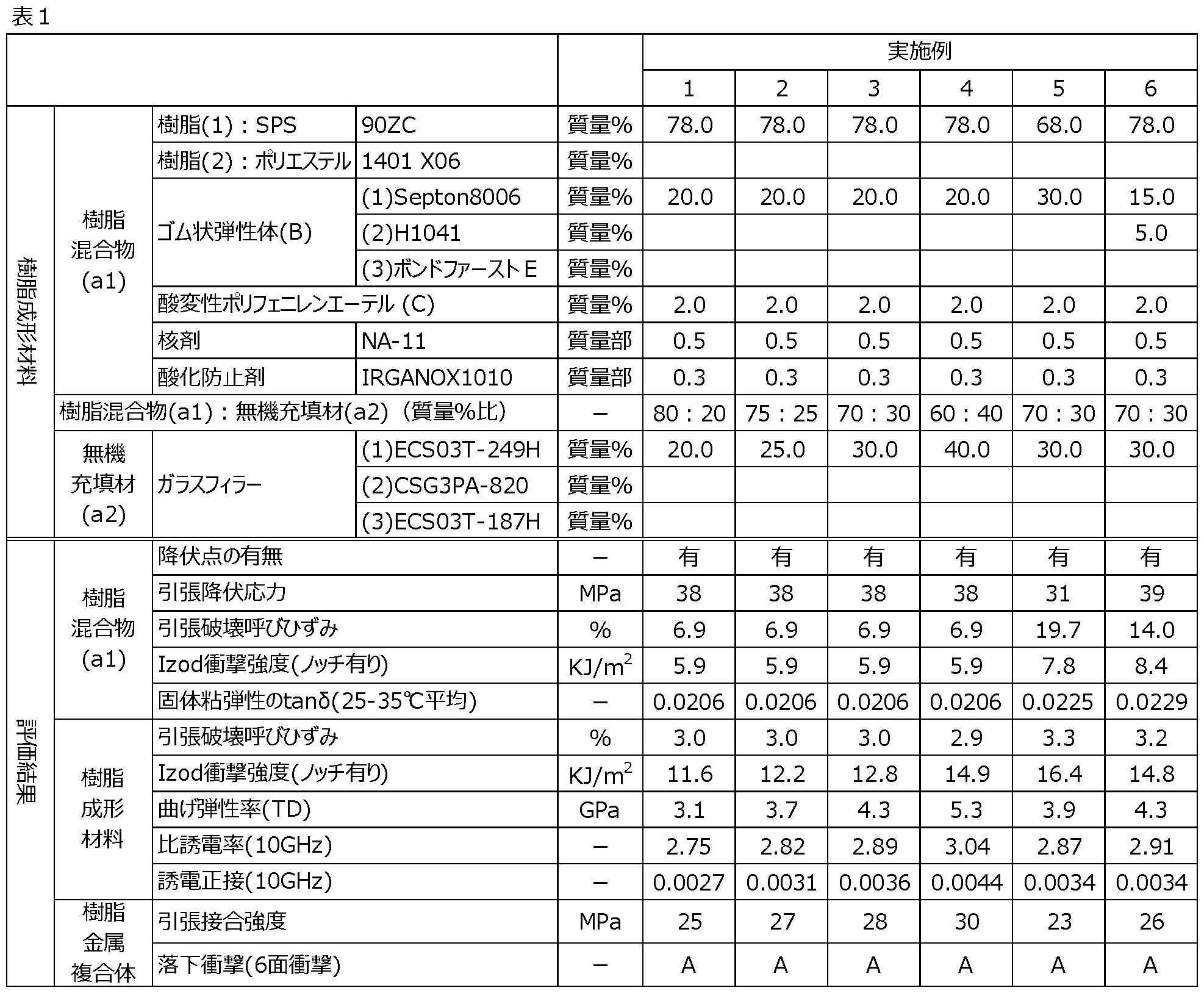
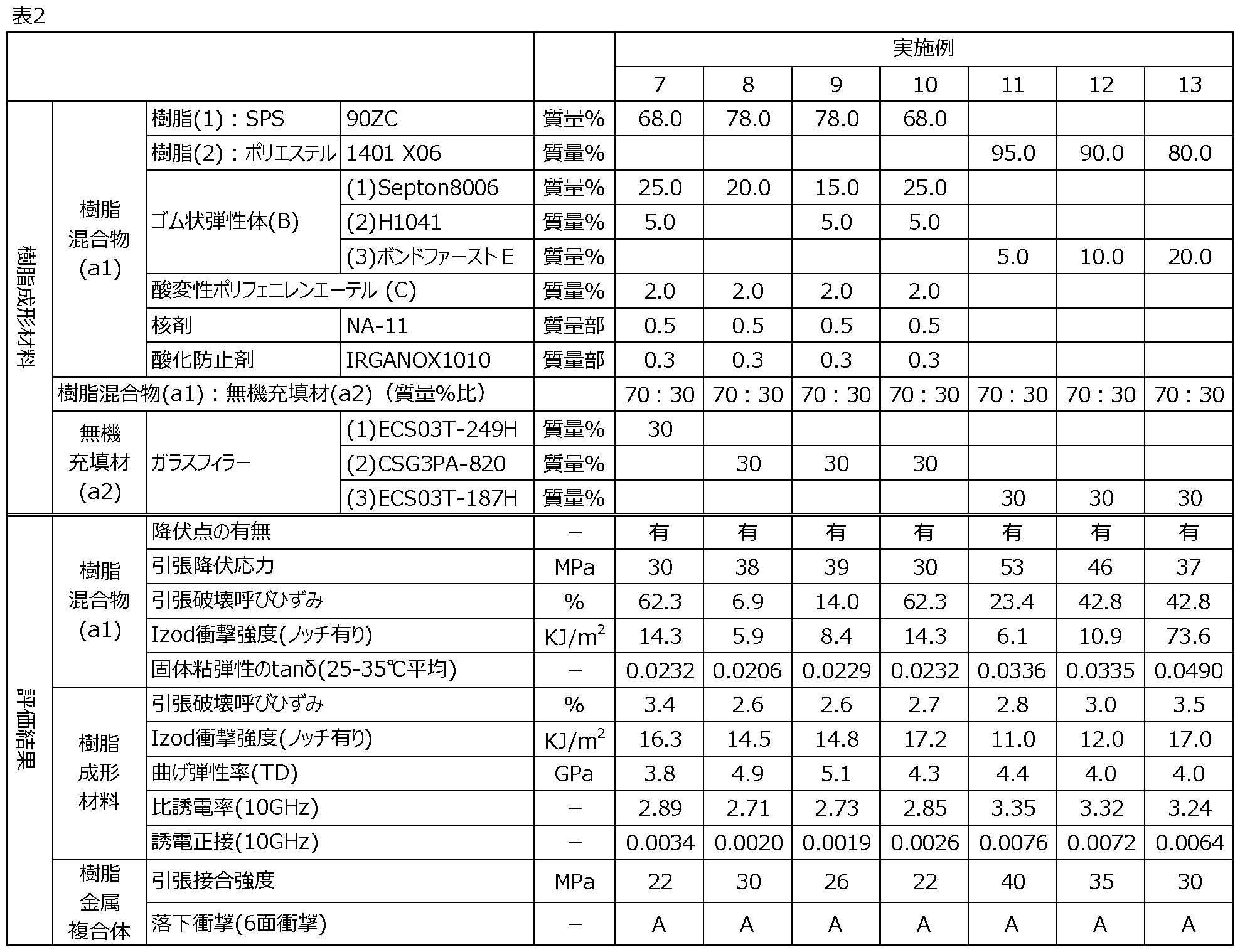
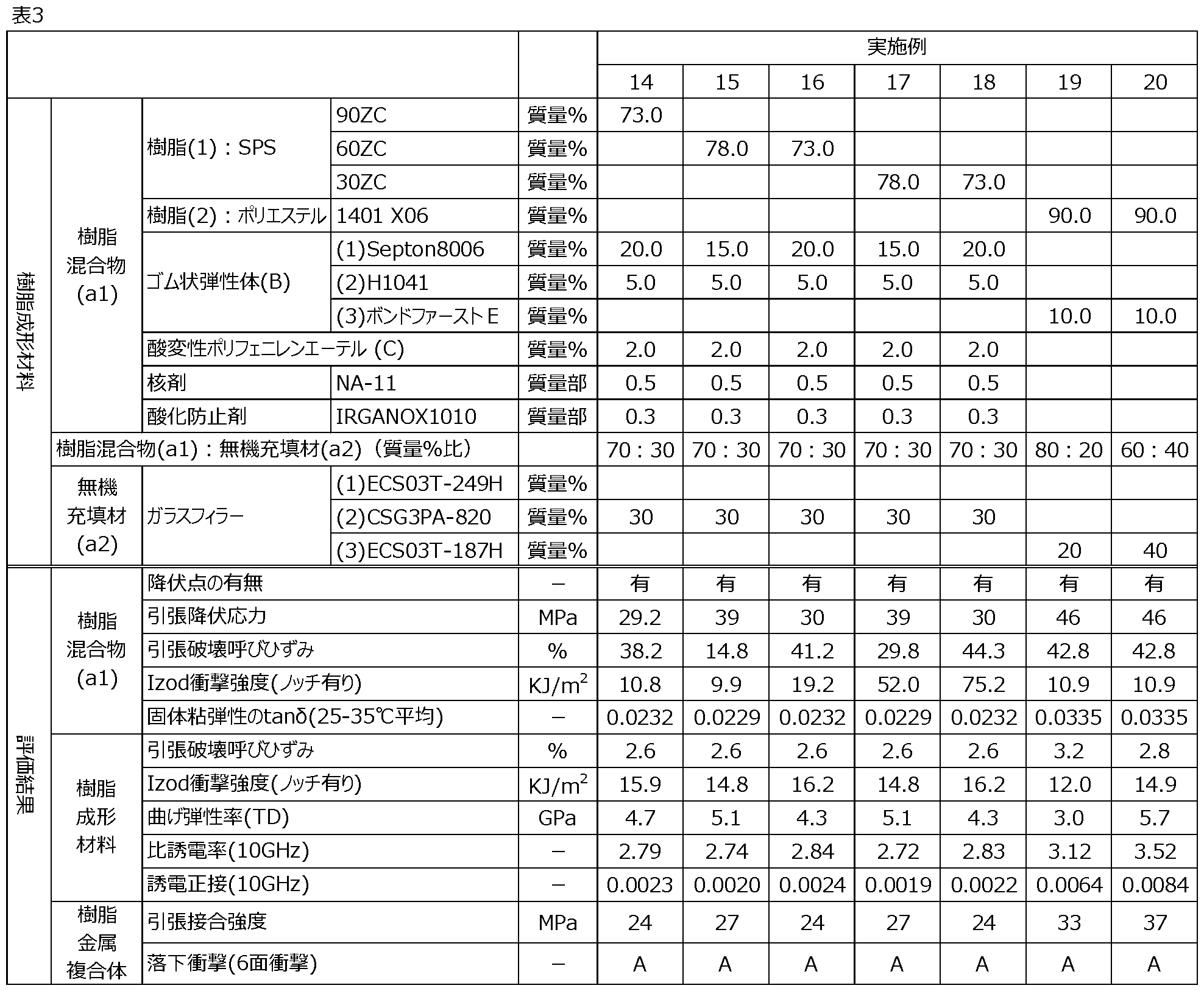
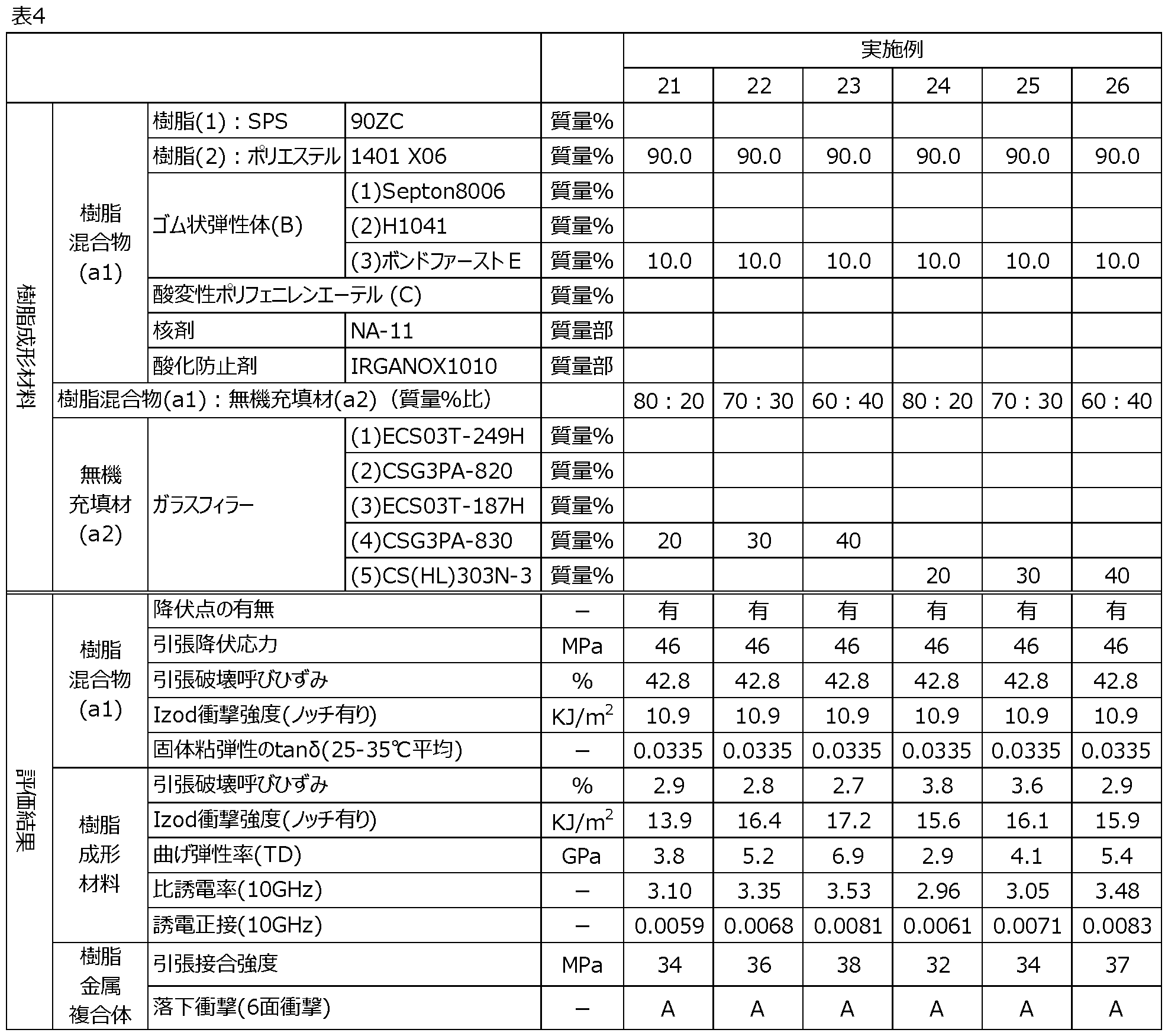
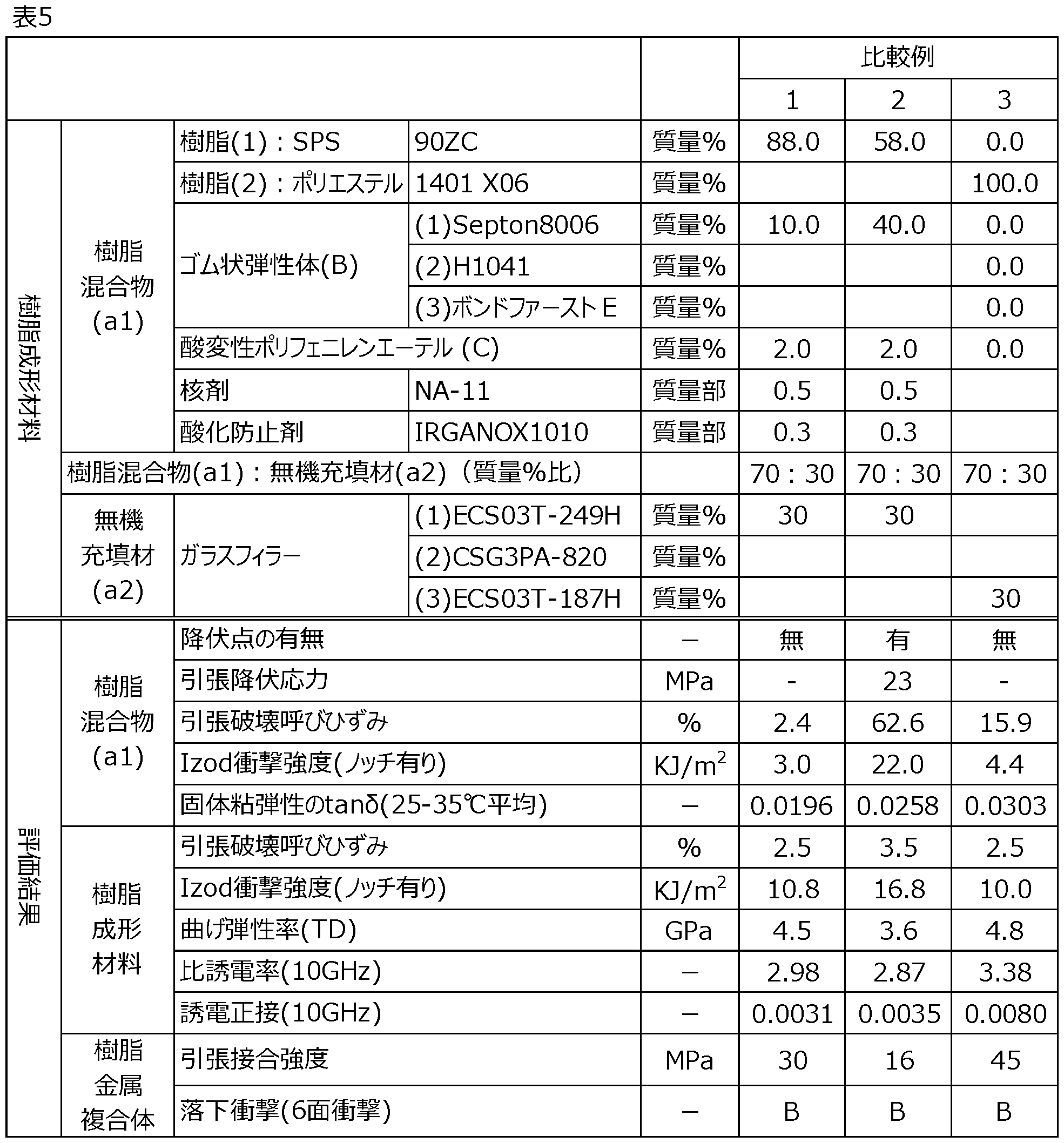
12・・・樹脂部材
13・・・スキン層
14・・・コア層
15・・・無機充填材
16・・・ゴム状弾性体
21・・・金属部材
22・・・樹脂部材
1・・・金属部材
2・・・樹脂部材
3・・・樹脂部材
4・・・ガラス
Claims (14)
- 樹脂混合物(a1)と、無機充填材(a2)とを含有する樹脂成形材料からなる樹脂部材と、金属部材とを備える樹脂金属複合体であって、
前記樹脂混合物(a1)からなる試験片の、ISO 527-1,2:2012に準拠した引張試験において、応力-歪曲線が降伏点を有し、かつ引張降伏応力が25MPa以上である、樹脂金属複合体。 - 前記樹脂混合物(a1)からなる試験片の、ISO 527-1,2:2012に準拠した引張試験において、引張破壊呼びひずみが2.5%以上である、請求項1に記載の樹脂金属複合体。
- 前記樹脂混合物(a1)からなる20mm×5mm×0.8mm厚の試験片を用いて、ISO 6721-4:1994に準拠し、周波数1Hz、室温付近の条件下で測定した固体粘弾性の損失正接(tanδ)が、0.0200以上である、請求項1又は2に記載の樹脂金属複合体。
- 前記樹脂混合物(a1)が、シンジオタクチックポリスチレン、ポリエステル、ポリフェニレンサルファイド、ポリアミド及びポリエーテルエーテルケトンから選ばれる少なくとも1種を含む、請求項1~3のいずれか一項に記載の樹脂金属複合体。
- 樹脂混合物(a1)と無機充填材(a2)の合計を100質量%としたとき、前記樹脂成形材料は、無機充填材(a2)を13.0質量%以上37.0質量%以下含有する、請求項1~4のいずれか一項に記載の樹脂金属複合体。
- 前記無機充填材(a2)としてガラスフィラーを含む、請求項1~5のいずれか一項に記載の樹脂金属複合体。
- 前記樹脂金属複合体がインサート成形体である、請求項1~6のいずれか一項に記載の樹脂金属複合体。
- 前記金属部材が、アルミニウム、ステンレス鋼、銅、チタン及びこれらの合金からなる群から選択される少なくとも1種である、請求項1~7のいずれか一項に記載の樹脂金属複合体。
- 前記金属部材がアルミニウムまたはアルミニウム合金である、請求項8に記載の樹脂金属複合体。
- 前記金属部材の表面に、化学的処理及び物理的処理から選ばれる少なくとも一方がなされている、請求項1~9のいずれか一項に記載の樹脂金属複合体。
- 直径0.01μm以上1000μm以下の孔が、前記金属部材の樹脂部材と接する面の少なくとも一部に形成されている、請求項1~10のいずれか一項に記載の樹脂金属複合体。
- 前記金属部材に前記樹脂成形材料を射出成形する、請求項1~11のいずれか一項に記載の樹脂金属複合体の製造方法。
- 加工油を用いて、射出成形後に得られる樹脂金属複合体を切削加工する、請求項12に記載の樹脂金属複合体の製造方法。
- 請求項1~11のいずれか一項に記載の樹脂金属複合体に陽極酸化処理及び封孔処理を行う、樹脂金属複合体の製造方法。
Priority Applications (5)
| Application Number | Priority Date | Filing Date | Title |
|---|---|---|---|
| JP2020527666A JP7335879B2 (ja) | 2018-06-29 | 2019-06-27 | 樹脂金属複合体及びその製造方法 |
| US17/255,957 US20210268771A1 (en) | 2018-06-29 | 2019-06-27 | Resin metal composite body and method for producing same |
| KR1020207037212A KR102802985B1 (ko) | 2018-06-29 | 2019-06-27 | 수지 금속 복합체 및 그의 제조 방법 |
| CN201980042710.1A CN112368121B (zh) | 2018-06-29 | 2019-06-27 | 树脂金属复合体及其制造方法 |
| DE112019003308.5T DE112019003308T5 (de) | 2018-06-29 | 2019-06-27 | Harz-metall-verbundkörper und verfahren zu seiner herstellung |
Applications Claiming Priority (2)
| Application Number | Priority Date | Filing Date | Title |
|---|---|---|---|
| JP2018-125557 | 2018-06-29 | ||
| JP2018125557 | 2018-06-29 |
Publications (1)
| Publication Number | Publication Date |
|---|---|
| WO2020004597A1 true WO2020004597A1 (ja) | 2020-01-02 |
Family
ID=68984921
Family Applications (1)
| Application Number | Title | Priority Date | Filing Date |
|---|---|---|---|
| PCT/JP2019/025740 Ceased WO2020004597A1 (ja) | 2018-06-29 | 2019-06-27 | 樹脂金属複合体及びその製造方法 |
Country Status (7)
| Country | Link |
|---|---|
| US (1) | US20210268771A1 (ja) |
| JP (1) | JP7335879B2 (ja) |
| KR (1) | KR102802985B1 (ja) |
| CN (1) | CN112368121B (ja) |
| DE (1) | DE112019003308T5 (ja) |
| TW (1) | TWI881946B (ja) |
| WO (1) | WO2020004597A1 (ja) |
Cited By (8)
| Publication number | Priority date | Publication date | Assignee | Title |
|---|---|---|---|---|
| CN111504817A (zh) * | 2020-04-20 | 2020-08-07 | 哈尔滨工程大学 | 一种爆炸载荷下钢材断裂应变测试装置及其测试方法 |
| JPWO2021205892A1 (ja) * | 2020-04-07 | 2021-10-14 | ||
| JP2021194782A (ja) * | 2020-06-09 | 2021-12-27 | 旭化成株式会社 | 複合体及びその製造方法 |
| JP2022018470A (ja) * | 2020-07-15 | 2022-01-27 | 日本製鉄株式会社 | 電磁鋼板積層鉄心用接着剤、および電磁鋼板積層鉄心 |
| US20220201877A1 (en) * | 2020-12-19 | 2022-06-23 | Shenzhenshi Yuzhan Precision Technology Co., Ltd. | Housing and method for processing a housing |
| WO2023248493A1 (ja) * | 2022-06-22 | 2023-12-28 | 日東紡績株式会社 | 金属-ガラス繊維強化熱可塑性樹脂複合材料 |
| EP4119610A4 (en) * | 2020-09-11 | 2024-04-10 | Nitto Boseki Co., Ltd. | GLASS FIBER REINFORCED RESIN BOARD |
| WO2025127026A1 (ja) * | 2023-12-11 | 2025-06-19 | 出光興産株式会社 | 繊維強化熱可塑性樹脂組成物及び樹脂金属複合体 |
Citations (2)
| Publication number | Priority date | Publication date | Assignee | Title |
|---|---|---|---|---|
| JP2012045920A (ja) * | 2010-07-30 | 2012-03-08 | Mitsubishi Plastics Inc | 樹脂・金属複合積層体、樹脂・金属複合射出成形体、及びその製造方法 |
| JP2017039280A (ja) * | 2015-08-20 | 2017-02-23 | 大成プラス株式会社 | 金属とポリスチレン樹脂との複合体 |
Family Cites Families (12)
| Publication number | Priority date | Publication date | Assignee | Title |
|---|---|---|---|---|
| JPH08302117A (ja) * | 1995-05-08 | 1996-11-19 | Idemitsu Kosan Co Ltd | ポリスチレン系樹脂組成物 |
| US6027817A (en) * | 1995-07-28 | 2000-02-22 | Idemitsu Petrochemical Co., Ltd. | Plated molded article and process for producing a plated molded article |
| JP3805105B2 (ja) * | 1998-01-29 | 2006-08-02 | 出光興産株式会社 | スチレン系樹脂組成物及びその製造方法、スチレン系樹脂成形品の製造方法 |
| CN102056724A (zh) * | 2008-06-12 | 2011-05-11 | 日本轻金属株式会社 | 铝-树脂注塑一体成形品及其制造方法 |
| CN102442028A (zh) * | 2010-10-13 | 2012-05-09 | 鸿富锦精密工业(深圳)有限公司 | 金属与树脂的复合体的制造方法 |
| CN103286996B (zh) * | 2012-02-24 | 2015-03-25 | 比亚迪股份有限公司 | 一种铝合金树脂复合体的制备方法及其制备的铝合金树脂复合体 |
| WO2013146900A1 (ja) * | 2012-03-29 | 2013-10-03 | 帝人株式会社 | 接合部材の製造方法及び接合部材 |
| TWI475132B (zh) * | 2012-05-28 | 2015-03-01 | Byd Co Ltd | 表面處理的金屬、金屬樹脂複合體及其製備方法 |
| JP6325295B2 (ja) | 2013-04-09 | 2018-05-16 | ポリプラスチックス株式会社 | インサート成形用樹脂組成物、それを用いた金属樹脂複合成形体、及びその製造方法 |
| US20150225567A1 (en) * | 2014-02-11 | 2015-08-13 | Ticona Llc | Toughened Polyarylene Sulfide Composition |
| JP2016049649A (ja) * | 2014-08-29 | 2016-04-11 | 東レ株式会社 | 一体化成形体及びその製造方法 |
| KR102367267B1 (ko) | 2015-12-28 | 2022-02-24 | 포리프라스틱 가부시키가이샤 | 폴리부틸렌테레프탈레이트 수지 조성물, 및 금속 복합 부품 |
-
2019
- 2019-06-27 WO PCT/JP2019/025740 patent/WO2020004597A1/ja not_active Ceased
- 2019-06-27 US US17/255,957 patent/US20210268771A1/en active Pending
- 2019-06-27 KR KR1020207037212A patent/KR102802985B1/ko active Active
- 2019-06-27 JP JP2020527666A patent/JP7335879B2/ja active Active
- 2019-06-27 DE DE112019003308.5T patent/DE112019003308T5/de active Pending
- 2019-06-27 CN CN201980042710.1A patent/CN112368121B/zh active Active
- 2019-06-28 TW TW108122970A patent/TWI881946B/zh active
Patent Citations (2)
| Publication number | Priority date | Publication date | Assignee | Title |
|---|---|---|---|---|
| JP2012045920A (ja) * | 2010-07-30 | 2012-03-08 | Mitsubishi Plastics Inc | 樹脂・金属複合積層体、樹脂・金属複合射出成形体、及びその製造方法 |
| JP2017039280A (ja) * | 2015-08-20 | 2017-02-23 | 大成プラス株式会社 | 金属とポリスチレン樹脂との複合体 |
Cited By (11)
| Publication number | Priority date | Publication date | Assignee | Title |
|---|---|---|---|---|
| JPWO2021205892A1 (ja) * | 2020-04-07 | 2021-10-14 | ||
| CN111504817A (zh) * | 2020-04-20 | 2020-08-07 | 哈尔滨工程大学 | 一种爆炸载荷下钢材断裂应变测试装置及其测试方法 |
| JP2021194782A (ja) * | 2020-06-09 | 2021-12-27 | 旭化成株式会社 | 複合体及びその製造方法 |
| JP7469147B2 (ja) | 2020-06-09 | 2024-04-16 | 旭化成株式会社 | 複合体及びその製造方法 |
| JP2022018470A (ja) * | 2020-07-15 | 2022-01-27 | 日本製鉄株式会社 | 電磁鋼板積層鉄心用接着剤、および電磁鋼板積層鉄心 |
| JP7820905B2 (ja) | 2020-07-15 | 2026-02-26 | 日本製鉄株式会社 | 電磁鋼板積層鉄心用接着剤、および電磁鋼板積層鉄心 |
| EP4119610A4 (en) * | 2020-09-11 | 2024-04-10 | Nitto Boseki Co., Ltd. | GLASS FIBER REINFORCED RESIN BOARD |
| US20220201877A1 (en) * | 2020-12-19 | 2022-06-23 | Shenzhenshi Yuzhan Precision Technology Co., Ltd. | Housing and method for processing a housing |
| WO2023248493A1 (ja) * | 2022-06-22 | 2023-12-28 | 日東紡績株式会社 | 金属-ガラス繊維強化熱可塑性樹脂複合材料 |
| JPWO2023248493A1 (ja) * | 2022-06-22 | 2023-12-28 | ||
| WO2025127026A1 (ja) * | 2023-12-11 | 2025-06-19 | 出光興産株式会社 | 繊維強化熱可塑性樹脂組成物及び樹脂金属複合体 |
Also Published As
| Publication number | Publication date |
|---|---|
| TW202015906A (zh) | 2020-05-01 |
| KR102802985B1 (ko) | 2025-05-02 |
| TWI881946B (zh) | 2025-05-01 |
| US20210268771A1 (en) | 2021-09-02 |
| JPWO2020004597A1 (ja) | 2021-07-15 |
| CN112368121A (zh) | 2021-02-12 |
| CN112368121B (zh) | 2023-09-19 |
| JP7335879B2 (ja) | 2023-08-30 |
| KR20210023886A (ko) | 2021-03-04 |
| DE112019003308T5 (de) | 2021-04-22 |
Similar Documents
| Publication | Publication Date | Title |
|---|---|---|
| JP7335879B2 (ja) | 樹脂金属複合体及びその製造方法 | |
| JP6325295B2 (ja) | インサート成形用樹脂組成物、それを用いた金属樹脂複合成形体、及びその製造方法 | |
| CN110959026A (zh) | 用于纳米成型技术(nmt)的低介电常数(dk)和耗散系数(df)材料 | |
| JP7139027B2 (ja) | 樹脂金属複合体及びその製造方法 | |
| CN106029366A (zh) | 移动电子零件 | |
| JPWO2011118617A1 (ja) | 摺動部品用ポリアミド樹脂組成物、摺動部品並びに摺動部品及び自動車の製造方法 | |
| EP0771833B1 (en) | Process of producing acid-modified polyphenylene ether and polystyrenic resin composition | |
| JP2018164988A (ja) | 金属部材−ポリアリーレンスルフィド樹脂部材複合体 | |
| BR112020009999B1 (pt) | Composição de poliamida termoplástica, método de fabricação da composição de poliamida termoplástica e uso da composição de poliamida termoplástica | |
| JP2004155928A (ja) | 熱可塑性樹脂組成物及びその成形体 | |
| WO2024024653A1 (ja) | 繊維強化熱可塑性樹脂組成物及び樹脂金属複合体 | |
| JP2003128944A (ja) | 樹脂組成物及び成形品 | |
| JP2005235948A (ja) | フレキシブル配線板用カバーレイ及びそれを用いたフレキシブル配線板 | |
| JP2003173848A (ja) | コネクター | |
| JP3875061B2 (ja) | 樹脂組成物及び成形品 | |
| JP2025185856A (ja) | ポリアリーレンスルフィド樹脂組成物、成形品及び複合体並びにそれらの製造方法 | |
| TW202543833A (zh) | 附設有表面處理層之樹脂片、底漆組成物、及附設有表面處理層之樹脂片之製造方法 | |
| JP2023101325A (ja) | ポリアリーレンサルファイド樹脂組成物、並びに金属樹脂複合成形体及びその製造方法 | |
| WO2022107873A1 (ja) | 樹脂金属複合体 | |
| TW200530330A (en) | Lead free solder friendly thermoplastic blends and methods of manufacture thereof | |
| JP2008055679A (ja) | 金属箔積層フィルム | |
| JP2003213125A (ja) | スチレン系樹脂組成物及びその成形体 |
Legal Events
| Date | Code | Title | Description |
|---|---|---|---|
| 121 | Ep: the epo has been informed by wipo that ep was designated in this application |
Ref document number: 19825990 Country of ref document: EP Kind code of ref document: A1 |
|
| ENP | Entry into the national phase |
Ref document number: 2020527666 Country of ref document: JP Kind code of ref document: A |
|
| ENP | Entry into the national phase |
Ref document number: 20207037212 Country of ref document: KR Kind code of ref document: A |
|
| 122 | Ep: pct application non-entry in european phase |
Ref document number: 19825990 Country of ref document: EP Kind code of ref document: A1 |