WO2019244921A1 - 機能徐放性組成物及び成形体 - Google Patents
機能徐放性組成物及び成形体 Download PDFInfo
- Publication number
- WO2019244921A1 WO2019244921A1 PCT/JP2019/024261 JP2019024261W WO2019244921A1 WO 2019244921 A1 WO2019244921 A1 WO 2019244921A1 JP 2019024261 W JP2019024261 W JP 2019024261W WO 2019244921 A1 WO2019244921 A1 WO 2019244921A1
- Authority
- WO
- WIPO (PCT)
- Prior art keywords
- sustained
- content
- resin
- acid
- function
- Prior art date
- Legal status (The legal status is an assumption and is not a legal conclusion. Google has not performed a legal analysis and makes no representation as to the accuracy of the status listed.)
- Ceased
Links
Images

Classifications
-
- A—HUMAN NECESSITIES
- A01—AGRICULTURE; FORESTRY; ANIMAL HUSBANDRY; HUNTING; TRAPPING; FISHING
- A01M—CATCHING, TRAPPING OR SCARING OF ANIMALS; APPARATUS FOR THE DESTRUCTION OF NOXIOUS ANIMALS OR NOXIOUS PLANTS
- A01M1/00—Stationary means for catching or killing insects
- A01M1/20—Poisoning, narcotising, or burning insects
-
- A—HUMAN NECESSITIES
- A01—AGRICULTURE; FORESTRY; ANIMAL HUSBANDRY; HUNTING; TRAPPING; FISHING
- A01N—PRESERVATION OF BODIES OF HUMANS OR ANIMALS OR PLANTS OR PARTS THEREOF; BIOCIDES, e.g. AS DISINFECTANTS, AS PESTICIDES OR AS HERBICIDES; PEST REPELLANTS OR ATTRACTANTS; PLANT GROWTH REGULATORS
- A01N25/00—Biocides, pest repellants or attractants, or plant growth regulators, characterised by their forms, or by their non-active ingredients or by their methods of application, e.g. seed treatment or sequential application; Substances for reducing the noxious effect of the active ingredients to organisms other than pests
- A01N25/08—Biocides, pest repellants or attractants, or plant growth regulators, characterised by their forms, or by their non-active ingredients or by their methods of application, e.g. seed treatment or sequential application; Substances for reducing the noxious effect of the active ingredients to organisms other than pests containing solids as carriers or diluents
- A01N25/10—Macromolecular compounds
-
- A—HUMAN NECESSITIES
- A01—AGRICULTURE; FORESTRY; ANIMAL HUSBANDRY; HUNTING; TRAPPING; FISHING
- A01N—PRESERVATION OF BODIES OF HUMANS OR ANIMALS OR PLANTS OR PARTS THEREOF; BIOCIDES, e.g. AS DISINFECTANTS, AS PESTICIDES OR AS HERBICIDES; PEST REPELLANTS OR ATTRACTANTS; PLANT GROWTH REGULATORS
- A01N31/00—Biocides, pest repellants or attractants, or plant growth regulators containing organic oxygen or sulfur compounds
- A01N31/08—Oxygen or sulfur directly attached to an aromatic ring system
- A01N31/14—Ethers
-
- A—HUMAN NECESSITIES
- A01—AGRICULTURE; FORESTRY; ANIMAL HUSBANDRY; HUNTING; TRAPPING; FISHING
- A01N—PRESERVATION OF BODIES OF HUMANS OR ANIMALS OR PLANTS OR PARTS THEREOF; BIOCIDES, e.g. AS DISINFECTANTS, AS PESTICIDES OR AS HERBICIDES; PEST REPELLANTS OR ATTRACTANTS; PLANT GROWTH REGULATORS
- A01N37/00—Biocides, pest repellants or attractants, or plant growth regulators containing organic compounds containing a carbon atom having three bonds to hetero atoms with at the most two bonds to halogen, e.g. carboxylic acids
- A01N37/36—Biocides, pest repellants or attractants, or plant growth regulators containing organic compounds containing a carbon atom having three bonds to hetero atoms with at the most two bonds to halogen, e.g. carboxylic acids containing at least one carboxylic group or a thio analogue, or a derivative thereof, and a singly bound oxygen or sulfur atom attached to the same carbon skeleton, this oxygen or sulfur atom not being a member of a carboxylic group or of a thio analogue, or of a derivative thereof, e.g. hydroxy-carboxylic acids
-
- A—HUMAN NECESSITIES
- A01—AGRICULTURE; FORESTRY; ANIMAL HUSBANDRY; HUNTING; TRAPPING; FISHING
- A01N—PRESERVATION OF BODIES OF HUMANS OR ANIMALS OR PLANTS OR PARTS THEREOF; BIOCIDES, e.g. AS DISINFECTANTS, AS PESTICIDES OR AS HERBICIDES; PEST REPELLANTS OR ATTRACTANTS; PLANT GROWTH REGULATORS
- A01N43/00—Biocides, pest repellants or attractants, or plant growth regulators containing heterocyclic compounds
- A01N43/02—Biocides, pest repellants or attractants, or plant growth regulators containing heterocyclic compounds having rings with one or more oxygen or sulfur atoms as the only ring hetero atoms
- A01N43/04—Biocides, pest repellants or attractants, or plant growth regulators containing heterocyclic compounds having rings with one or more oxygen or sulfur atoms as the only ring hetero atoms with one hetero atom
- A01N43/14—Biocides, pest repellants or attractants, or plant growth regulators containing heterocyclic compounds having rings with one or more oxygen or sulfur atoms as the only ring hetero atoms with one hetero atom six-membered rings
- A01N43/16—Biocides, pest repellants or attractants, or plant growth regulators containing heterocyclic compounds having rings with one or more oxygen or sulfur atoms as the only ring hetero atoms with one hetero atom six-membered rings with oxygen as the ring hetero atom
-
- A—HUMAN NECESSITIES
- A01—AGRICULTURE; FORESTRY; ANIMAL HUSBANDRY; HUNTING; TRAPPING; FISHING
- A01N—PRESERVATION OF BODIES OF HUMANS OR ANIMALS OR PLANTS OR PARTS THEREOF; BIOCIDES, e.g. AS DISINFECTANTS, AS PESTICIDES OR AS HERBICIDES; PEST REPELLANTS OR ATTRACTANTS; PLANT GROWTH REGULATORS
- A01N43/00—Biocides, pest repellants or attractants, or plant growth regulators containing heterocyclic compounds
- A01N43/34—Biocides, pest repellants or attractants, or plant growth regulators containing heterocyclic compounds having rings with one nitrogen atom as the only ring hetero atom
- A01N43/36—Biocides, pest repellants or attractants, or plant growth regulators containing heterocyclic compounds having rings with one nitrogen atom as the only ring hetero atom five-membered rings
- A01N43/38—Biocides, pest repellants or attractants, or plant growth regulators containing heterocyclic compounds having rings with one nitrogen atom as the only ring hetero atom five-membered rings condensed with carbocyclic rings
-
- A—HUMAN NECESSITIES
- A01—AGRICULTURE; FORESTRY; ANIMAL HUSBANDRY; HUNTING; TRAPPING; FISHING
- A01N—PRESERVATION OF BODIES OF HUMANS OR ANIMALS OR PLANTS OR PARTS THEREOF; BIOCIDES, e.g. AS DISINFECTANTS, AS PESTICIDES OR AS HERBICIDES; PEST REPELLANTS OR ATTRACTANTS; PLANT GROWTH REGULATORS
- A01N43/00—Biocides, pest repellants or attractants, or plant growth regulators containing heterocyclic compounds
- A01N43/72—Biocides, pest repellants or attractants, or plant growth regulators containing heterocyclic compounds having rings with nitrogen atoms and oxygen or sulfur atoms as ring hetero atoms
- A01N43/74—Biocides, pest repellants or attractants, or plant growth regulators containing heterocyclic compounds having rings with nitrogen atoms and oxygen or sulfur atoms as ring hetero atoms five-membered rings with one nitrogen atom and either one oxygen atom or one sulfur atom in positions 1,3
- A01N43/78—1,3-Thiazoles; Hydrogenated 1,3-thiazoles
-
- A—HUMAN NECESSITIES
- A61—MEDICAL OR VETERINARY SCIENCE; HYGIENE
- A61L—METHODS OR APPARATUS FOR STERILISING MATERIALS OR OBJECTS IN GENERAL; DISINFECTION, STERILISATION OR DEODORISATION OF AIR; CHEMICAL ASPECTS OF BANDAGES, DRESSINGS, ABSORBENT PADS OR SURGICAL ARTICLES; MATERIALS FOR BANDAGES, DRESSINGS, ABSORBENT PADS OR SURGICAL ARTICLES
- A61L9/00—Disinfection, sterilisation or deodorisation of air
- A61L9/015—Disinfection, sterilisation or deodorisation of air using gaseous or vaporous substances, e.g. ozone
- A61L9/04—Disinfection, sterilisation or deodorisation of air using gaseous or vaporous substances, e.g. ozone using substances evaporated in the air without heating
-
- C—CHEMISTRY; METALLURGY
- C07—ORGANIC CHEMISTRY
- C07C—ACYCLIC OR CARBOCYCLIC COMPOUNDS
- C07C311/00—Amides of sulfonic acids, i.e. compounds having singly-bound oxygen atoms of sulfo groups replaced by nitrogen atoms, not being part of nitro or nitroso groups
- C07C311/15—Sulfonamides having sulfur atoms of sulfonamide groups bound to carbon atoms of six-membered aromatic rings
- C07C311/16—Sulfonamides having sulfur atoms of sulfonamide groups bound to carbon atoms of six-membered aromatic rings having the nitrogen atom of at least one of the sulfonamide groups bound to hydrogen atoms or to an acyclic carbon atom
-
- C—CHEMISTRY; METALLURGY
- C07—ORGANIC CHEMISTRY
- C07C—ACYCLIC OR CARBOCYCLIC COMPOUNDS
- C07C63/00—Compounds having carboxyl groups bound to a carbon atoms of six-membered aromatic rings
- C07C63/14—Monocyclic dicarboxylic acids
- C07C63/15—Monocyclic dicarboxylic acids all carboxyl groups bound to carbon atoms of the six-membered aromatic ring
- C07C63/26—1,4 - Benzenedicarboxylic acid
-
- C—CHEMISTRY; METALLURGY
- C07—ORGANIC CHEMISTRY
- C07C—ACYCLIC OR CARBOCYCLIC COMPOUNDS
- C07C63/00—Compounds having carboxyl groups bound to a carbon atoms of six-membered aromatic rings
- C07C63/307—Monocyclic tricarboxylic acids
-
- C—CHEMISTRY; METALLURGY
- C07—ORGANIC CHEMISTRY
- C07C—ACYCLIC OR CARBOCYCLIC COMPOUNDS
- C07C63/00—Compounds having carboxyl groups bound to a carbon atoms of six-membered aromatic rings
- C07C63/33—Polycyclic acids
- C07C63/331—Polycyclic acids with all carboxyl groups bound to non-condensed rings
- C07C63/333—4,4' - Diphenyldicarboxylic acids
-
- C—CHEMISTRY; METALLURGY
- C07—ORGANIC CHEMISTRY
- C07C—ACYCLIC OR CARBOCYCLIC COMPOUNDS
- C07C69/00—Esters of carboxylic acids; Esters of carbonic or haloformic acids
- C07C69/76—Esters of carboxylic acids having a carboxyl group bound to a carbon atom of a six-membered aromatic ring
-
- C—CHEMISTRY; METALLURGY
- C08—ORGANIC MACROMOLECULAR COMPOUNDS; THEIR PREPARATION OR CHEMICAL WORKING-UP; COMPOSITIONS BASED THEREON
- C08K—Use of inorganic or non-macromolecular organic substances as compounding ingredients
- C08K5/00—Use of organic ingredients
-
- C—CHEMISTRY; METALLURGY
- C08—ORGANIC MACROMOLECULAR COMPOUNDS; THEIR PREPARATION OR CHEMICAL WORKING-UP; COMPOSITIONS BASED THEREON
- C08L—COMPOSITIONS OF MACROMOLECULAR COMPOUNDS
- C08L101/00—Compositions of unspecified macromolecular compounds
-
- C—CHEMISTRY; METALLURGY
- C09—DYES; PAINTS; POLISHES; NATURAL RESINS; ADHESIVES; COMPOSITIONS NOT OTHERWISE PROVIDED FOR; APPLICATIONS OF MATERIALS NOT OTHERWISE PROVIDED FOR
- C09K—MATERIALS FOR MISCELLANEOUS APPLICATIONS, NOT PROVIDED FOR ELSEWHERE
- C09K3/00—Materials not provided for elsewhere
Definitions
- the present invention relates to a sustained-release composition and a molded article.
- the sustainability of the effect can be expected by releasing a predetermined amount of the functional component for a long period of time in the functional component such as small animal control.
- a molded article using a small animal control composite material in which the small animal control function component is spread on a matrix resin has been devised (eg, Patent Documents 1 to 3).
- the molded articles described in Patent Literatures 1 to 3 gradually release the small animal control component on the surface of the molded article (hereinafter, referred to as “sustained release”), so that the surface of the molded article that comes into contact with small animals such as pests can be obtained.
- the small animal control function can be maintained.
- the amount of the functional component developed in the matrix resin In order to maintain such sustained release for a long period of time, it is conceivable to increase the amount of the functional component developed in the matrix resin. Increasing the amount of the functional component is effective from the viewpoint of further enhancing the function.
- the functional component in order to increase the affinity between the functional component and the matrix resin, the functional component is modified with a functional group, the polarity of the matrix resin is increased, or the functional component is made porous.
- a method of carrying the substance on a body can be mentioned (for example, Patent Document 4).
- the functional component In order to deploy the liquid functional component to the matrix resin, the functional component is placed in the space of the free volume in the matrix resin, or the functional component is placed in the space between the resin and the space between the resins. It is possible to do. At this time, the higher the affinity between the functional component and the matrix resin is, the easier the functional component is arranged, and a larger amount of the functional component can be developed in the matrix resin.
- the free volume in the matrix resin is limited by the type of the resin, thermal vibration due to temperature, and the like.
- the distance between the resins must be equal to or less than a predetermined distance in order to maintain the shape of the molded body, and the free volume has an upper limit.
- the amount of the functional component in the whole molded body is generally limited to about 20% by mass even if the resin is modified by adjusting the polarity of the matrix resin. It is. Therefore, such a molded article cannot maintain the sustained release effect for a long time.
- Zeolite or the like (silica, alumina, molecular sieve, activated carbon, or the like) is usually considered as the porous body supporting the functional component.
- a porous body has a low degree of freedom in controlling the affinity of the surface of the pores with the functional component, and cannot carry many functional components. For this reason, the method of modifying the matrix resin seems to be more effective than the method using a porous body.
- matrix resins having high affinity with the functional components are different from each other.
- the selection of the matrix resin is limited according to the performance required at the time of use, such as the service temperature, the strength, and the material unit price, and the price. As described above, it is extremely difficult to design a material of a molded article in consideration of affinity with a functional component.
- an object of the present invention is to provide a functional sustained-release composition and a molded article that can maintain an excellent sustained-release effect over a long period of time.
- the present inventors have conducted intensive studies to solve the above problems, as a result, a specific function sustained-release liquid, and a filler containing a specific porous coordination polymer, when combined with a matrix resin,
- the obtained sustained-release composition for function has been found to be able to solve the above problems, and has completed the present invention.
- the present invention is as follows.
- a functional sustained release composition comprising a functional sustained release liquid, a porous coordination polymer having a metal ion and an organic ligand, a specific surface area of at least 900 m 2 / g, and a matrix resin.
- the functional sustained release composition according to (1) wherein the functional sustained release liquid has a molecular weight of 600 or less and a melting point of 10 ° C. or more.
- (3) (1) or (2), wherein the average pore diameter of the porous coordination polymer is not less than the molecular diameter of the sustained release liquid.
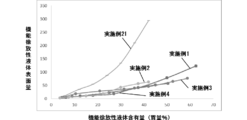
- FIG. 6 is a graph showing the relationship between the content of the function-releasing liquid in the function-releasing composite molded article and the surface amount of the function-releasing composite molding in Examples 1 to 4 and 21.
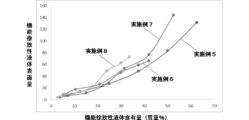
- FIG. 9 is a graph showing the relationship between the content of the function-releasing liquid in the function-releasing composite molding and the surface amount of the function-releasing composite molding in Examples 5 to 8.
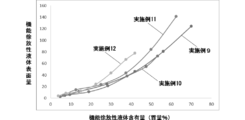
- FIG. 9 is a graph showing the relationship between the content of the function-releasing liquid in the function-releasing composite molded article and the surface amount of the function-releasing composite molding in Examples 9 to 12.
- FIG. 9 is a graph showing the relationship between the content of a function-releasing liquid in a function-releasing composite article and the surface amount of the function-releasing composite article in Examples 13 to 16.
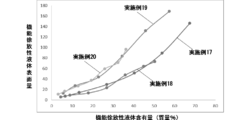
- FIG. 9 is a graph showing the relationship between the concentration of the function-releasing liquid in the function-releasing composite molding and the surface amount of the function-releasing composite molding in Examples 17 to 20.
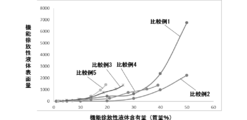
- FIG. 7 is a graph showing the relationship between the content of a function-releasing liquid in a function-releasing composite article and the surface amount of the function-releasing composite article in Comparative Examples 1 to 5.
- the present embodiment is an exemplification for describing the present invention, and the present invention is not limited to only the embodiment.
- the sustained-release composition of this embodiment comprises a sustained-release liquid, a porous coordination polymer having a metal ion and an organic ligand, and having a specific surface area of 900 m 2 / g or more, and a matrix resin.
- the functional sustained release composition of the present embodiment can maintain an excellent sustained release effect over a long period of time by combining a functional sustained release liquid, a porous coordination polymer, and a matrix resin. For this reason, the sustained-release composition of this embodiment has advantages such as improvement of product performance and cost reduction by reducing maintenance frequency.
- the term “functional sustained release” in a functional sustained release liquid includes, for example, a function of controlling small animals, a function of controlling plant growth, an antibacterial function, an antifungal function, a function of imparting plasticity to resin, a sliding function, and a self-control function. It has a function such as a repair function, a catalytic function, and a medical function, and has a sustained release property.
- the function sustained release liquid may be a liquid component having a function sustained release property, or may be a liquid form of a solid component having a function sustained release property. May be liquefied by dissolving in water.
- Examples of the functional liquid having a small animal control function include, for example, various agricultural pests, sanitary pests and other insects, spiders, mites, drugs having a controlling activity for small animals such as rats, or liquids obtained by dissolving a drug in a solvent.
- small animal control agent for example, a compound having small animal repellent activity, a compound having small animal activity such as insecticidal activity, acaricidal activity, spidericidal activity or rodenticidal activity.
- small animal control agents include metadiamide-based insecticides such as brofuranilide, piperidine-based insecticides such as Icarizine, chloronicotinyl-based insecticides such as imidacloprid, compounds consisting of silicon-containing neophyl radicals such as silafluofen, benflacarb , Alanicarb, methoxydiazone, carbosphan, fenobcarb, carbaryl, mesomil, propoxer, carbamate compounds such as phenoxycarb, pyrethrin, allethrin, dl, d-T80-allethrin, d-T80-resmethrin, bioarethrin, d-T80 -Phthalthrine, phthalthrine, resmethrin, framethrin, propasulin, permethrin, acrinatrine, etofenprox, tralomethrin, pheno
- Examples of the compound having small animal growth control activity include methoprene, pyriproxyfen, quinoprene, hydroprene, deohenolan, NC-170, flufenoxuron, diflubenzuron, lufenuron, chlorfluazuron, and the like.
- Compounds having a pesticidal activity include, for example, kelsen, chlorfenavir, debufenpyradopyridabene, milbemectin, acaricides such as fenpyroximate, silyloside, norbomide, zinc phosphide, thallium sulfate, yellow phosphorus, antu, warfarin, And rodenticides such as endside, coumarin, coumatetralin, promadiolone, and diffetialone.
- small animal controlling agent examples include hinokitiol contained in Taiwan cypress, asunaro, hinoki asunaro (Aomori Hiba), causal derivatives ( ⁇ -casinol, T-casinol) contained in herbs and hinoki, clove, nutmeg, coriander And geraniol, pinene, caryophyllene, borneol, eugenol, ogisugi, and other known naturally-occurring perfumes having a small animal-controlling property, which are often contained in perfume plants such as cumin.
- pheromone agents such as insects having an attraction effect, a communication inhibition effect and the like are used as the small animal control agent.
- Examples of the pheromone agent include “Confuser R”, “Confuser AA”, “Confuser N”, “Confuser MM”, “Hamakikon-N”, “Sukashibacon L”, “Shinicon-L”, “Shinicon-L” of Shin-Etsu Chemical products.
- Pheromone agents used in fruit trees such as “Nashihimekon”, “Bokutokon-H”, “Hetakokon” and “Confuser V", “Yotokon-H”, “Yotokon-S”, “Konagakon-Plus", products of Shin-Etsu Chemical Co., Ltd.
- Pheromone agent used for vegetables such as "Shin-Etsu Konagakon”
- pheromone agent used for tea such as "Hamakikon-N” manufactured by Shin-Etsu Chemical Co., Ltd., "Ochimercon”, “Yotokon-I”, " Pheromone agents used for sugarcane such as "Kevkakon”.
- the small animal controlling agent may be a wasp repellent, and the wasp repellent contains, for example, a compound represented by the following general formula (I) as an active ingredient.
- R 1 represents a hydrogen atom, a C 1-4 alkyl group optionally having a substituent ⁇ , a C 2-4 alkenyl group optionally having a substituent ⁇ , or a substituent represents a C 1-4 alkyl-carbonyl group optionally having ⁇
- X is a C 1-4 alkylene group optionally having substituent ⁇ , or optionally having substituent ⁇
- ⁇ is a C 1-4 alkyl group optionally having a substituent ⁇
- a C 1-4 alkoxy group which may have a C 1-4 alkyl-carbonyl group which may have a substituent ⁇ , a C 1-4 alkyl-carbonyloxy which may have a substituent ⁇
- And represents one or more substituents selected from a group, a halogeno group and a hydroxyl group.
- Substituents ⁇ , ⁇ and ⁇ are each independently selected from the group consisting of C 1-4 alkoxy, C 1-4 alkyl-carbonyl, C 1-4 alkyl-carbonyloxy, halogeno and hydroxyl. And n represents an integer of 0 or more and 5 or less.
- wasp repellents include, for example, repellents described in JP-A-2017-88548.
- Sustained-release liquids include, for example, plant hormones.
- plant hormones include natural or synthetic auxins such as indole-3-acetic acid, 2,4-dichlorophenoxyacetic acid, 2,6-dichlorobenzoic acid, naphthaleneacetic acid, zeatin, kinetin, 4-benzylaminobenzimidazole, Natural or synthetic cytokinins such as benzyladenine; gibberellins; brassinosteroids such as brassinolide and castosterone; abscisic acid; These plant hormones are used alone or in combination of two or more.
- the sustained-release liquid examples include known antibacterial agents having a sustained release property and fungicides having a sustained release property.
- examples of the antibacterial agent and the fungicide include natural organic compounds such as hinokitiol compounds, chitosan compounds, mustard extract compounds, eucalyptus compounds, synthetic organic compounds, and organic complexing agents. These compounds are used alone or in combination of two or more. Among these, synthetic organic compounds are preferred from the viewpoint of effectively acting on both bacteria and mold.
- Examples of the synthetic organic compound include a nitrogen-containing heterocyclic compound, an aldehyde compound, a phenol compound, a biguanide compound, a nitrile compound, a halogen compound, an anilide compound, a disulfide compound, a thiocarbamate compound, and an organic compound.
- Examples include silicon quaternary ammonium salt compounds, quaternary ammonium salt compounds, amino acid compounds, organometallic compounds, alcohol compounds, carboxylic acid compounds, ester compounds, thiazoline compounds, and cationic polymers. These synthetic organic compounds are used alone or in combination of two or more.
- Examples of the function sustained-release liquid having a function of imparting plasticity to the resin include a carboxylate derivative, a phosphate derivative, a phosphazene derivative, a carboxylic acid amide derivative, a sulfonic acid ester derivative, and a sulfonamide derivative.
- the plasticizer may be used alone or in combination of two or more.
- carboxylic acid ester derivatives examples include alkyl esters of various carboxylic acids which may be substituted with a hydroxyl group, a nitro group, an amino group, an epoxy group, a halogen, and the like, and aromatic esters.
- carboxylic acid ester derivatives include, for example, dimethyl phthalate, diethyl phthalate, di-n-octyl phthalate, diphenyl phthalate, benzyl phthalate, dimethoxyethyl phthalate, di (2-ethylhexyl) 4,5-epoxyhexahydrophthalate 4,5-epoxycyclohexahydrophthalic acid di (7,8-epoxy-2-octenyl), 4,5-epoxycyclohexahydrophthalic acid di (9,10-epoxyoctadecyl), 4,5-epoxycyclohexyl Phthalate ester derivatives such as di (10,11-epoxyundecyl) sahydrophthalate, di (tetrahydrofurfuroxyethyl) phthalate, mixed esters of various phthalic acids and ethylene oxide adducts of mixed esters of phthalic acid, isophthal
- Examples of the phosphoric ester derivative include trimethyl phosphate, triethyl phosphate, tributyl phosphate, tri- (2-ethylhexyl) phosphate, 2-ethylhexyl diphenyl phosphate, tributoxyethyl phosphate, triphenyl phosphate, cresyl diphenyl phosphate, and isodecyl.
- Examples of the phosphazene derivative include a cyclic phosphazene compound represented by the following general formula (1).
- m represents an integer of 3 to 25
- R 1 and R 2 may be the same or different from each other, and may be an alkyl group having 1 to 8 carbon atoms, or an alkyl group having 1 to 8 carbon atoms.
- the phosphazene derivative may be composed of one kind of the linear phosphazene compound represented by the formula (1), or may be composed of a mixture of two or more kinds.
- phosphazene derivative for example, a linear phosphazene compound represented by the following general formula (2) may also be mentioned.
- n an integer of 3 to 1000, and R 3 and R 4 may be the same or different from each other, and may be an alkyl group having 1 to 8 carbon atoms, or an alkyl group having 1 to 8 carbon atoms.
- Y represents a group —P (OR 3 ) 4 , a group —P (OR 4 ) 4 , a group —P (O) (OR 3 ) 2 or a group -P (O) (OR 4 ) 2 .
- the phosphazene derivative may be composed of one kind of the linear phosphazene compound represented by the formula (2),
- an alkyl group is eliminated from R 1 , R 2 , R 3 , and R 4 in the formula (1) or the formula (2) by a crosslinking group represented by the following formula (3), and two oxygens are removed.
- a phosphazene compound in which atoms are cross-linked may be used.
- r represents 0 or 1
- A represents a group —SO 2 —, —S—, —O—, or —C (CH 3 ) 2 —.
- cyclic phosphazene compound represented by the formula (1) examples include hexaphenoxycyclotriphosphazene, octaphenoxycyclotetraphosphazene, decafenoxycyclopentaphosphazene, hexapropoxycyclotriphosphazene, octapropoxycyclocyclotetraphosphazene, and decapropoxy. And cyclopentaphosphazene.
- linear phosphazene compound represented by the formula (2) include a linear phosphazene compound in which a linear dichlorophosphazene is substituted with a propoxy group and / or a phenoxy group.
- crosslinked structure represented by the formula (3) examples include 4,4′-sulfonyldiphenylene (bisphenol-S residue), 4,4′-oxydiphenylene group, and 4,4′-thiodiphenylene And 4,4'-diphenylene groups.
- These phosphazene derivatives may have an amino group and / or a phenylamino group substituted at an arbitrary position. These phosphazene derivatives may be used alone or in combination of two or more.
- carboxylic acid amide derivatives include, for example, N-cyclohexylbenzoic acid amide.
- the sulfonamide derivative include N-methyl-benzenesulfonamide, N-ethyl-benzenesulfonamide, N-butyl-benzenesulfonamide, N-cyclohexyl-benzenesulfonamide, N-ethyl-P-toluenesulfonamide, Examples include N-butyl-toluenesulfonamide and N-cyclohexyl-toluenesulfonamide.
- Examples of the sulfonate derivative include ethyl benzenesulfonate.
- Examples of the sulfonic acid amide derivative include 2-methoxyethyl methanesulfonate, 2,2,2-trifluoroethyl methanesulfonate, methyl p-toluenesulfonate, ethyl p-toluenesulfonate, and p-toluenesulfonic acid n -Propyl and the like.
- a known sliding agent having a sustained-release property may be mentioned.
- Known sliding agents include, for example, mineral oil, synthetic oil, wax, paraffin and the like.
- Examples of the function sustained-release liquid having a self-healing function include known self-healing agents having a sustained release property.
- known self-healing agents include polyrotaxane, self-healing clear (product of Natco Corporation), and the like.
- Examples of the function sustained-release liquid having a catalytic function include known catalysts having sustained-release properties.
- Known catalysts include ionic liquids, tertiary amines (eg, “PZETA” manufactured by Tosoh Corporation), organic titanium compounds (eg, tetra-i-propoxytitanium, tetra-n-butoxytitanium, tetrakis (2- Ethylhexyloxine) titanium (for example, a product of Nippon Soda Co., Ltd.) and the like.
- Examples of the functional sustained release liquid having a medical function include known medical products having sustained release properties.
- the solvent is preferably a solvent having high compatibility with the matrix resin and having little influence on the shape stability of the molded article.
- the solvent include water, methanol, ethanol, dimethyl sulfoxide, polyethylene glycol, a sulfonamide derivative, a sulfonate ester derivative, a carboxylic acid amide derivative, a carboxylate ester derivative, a phosphate ester derivative, a hydrocarbon compound, and a silicone compound.
- sulfonamide derivative examples include N-methyl-benzenesulfonamide, N-ethyl-benzenesulfonamide, N-butyl-benzenesulfonamide, N-cyclohexyl-benzenesulfonamide, N-ethyl-P-toluenesulfonamide, N-butyl-toluenesulfonamide and N-cyclohexyl-toluenesulfonamide.
- Examples of the sulfonic ester derivatives include 2-methoxyethyl methanesulfonate, 2,2,2-trifluoroethyl methanesulfonate, methyl p-toluenesulfonate, ethyl p-toluenesulfonate, and n-p-toluenesulfonic acid n -Propyl and the like.
- Examples of the carboxylic amide derivative include N-cyclohexylbenzoic acid amide.
- carboxylate derivatives examples include dimethyl phthalate, diethyl phthalate, di-n-octyl phthalate, diphenyl phthalate, benzyl phthalate, dimethoxyethyl phthalate, di (2-ethylhexyl) 4,5-epoxyhexahydrophthalate, 4,4 5-epoxycyclohexahydrophthalic acid di (7,8-epoxy-2-octenyl), 4,5-epoxycyclohexahydrophthalic acid di (9,10-epoxyoctadecyl), 4,5-epoxycyclohexahydrophthalic Acid derivatives such as di (10,11-epoxyundecyl) acid, di (tetrahydrofurfuroxyethyl) phthalate, various phthalic acid mixed esters and ethylene oxide adducts of phthalic acid mixed esters, isophthalic acid ester derivatives, Drophthalic acid ester derivative,
- phosphate derivative examples include trimethyl phosphate, triethyl phosphate, tributyl phosphate, tri- (2-ethylhexyl) phosphate, 2-ethylhexyl diphenyl phosphate, tributoxyethyl phosphate, triphenyl phosphate, cresyl diphenyl phosphate, and isodecyl.
- hydrocarbon compound examples include a chain saturated hydrocarbon compound (paraffins), a chain unsaturated hydrocarbon compound (olefins), an alicyclic hydrocarbon compound (cycloalkane, cycloalkene, cycloalkyne, etc.), And aromatic hydrocarbon compounds.
- paraffin oil having a molecular weight of 330 to 530 and a kinematic viscosity of 10 to 120 cSt is particularly preferably used.
- a hydrocarbon compound having a molecular weight of 330 to 530 is preferable from the viewpoint of easily penetrating the body of a small animal from the body hole of the small animal.
- a hydrocarbon compound having a kinematic viscosity of 10 to 120 cSt is preferable from the viewpoint of easily adhering to the body surface of a small animal.
- paraffin oil from the viewpoint of being inexpensive and easily available.
- the silicone compound include dimethyl silicone, methylphenyl silicone, polyether-modified silicone, long-chain alkyl-modified silicone, and higher fatty acid ester-modified silicone.
- the function-release liquid preferably has a molecular weight of 600 or less and a melting point of 10 ° C or more from the viewpoint of the processing temperature of the matrix resin.
- the porous coordination polymer is a porous material containing a metal ion and an organic ligand.
- the porous coordination polymer has, for example, a form in which a metal ion is adsorbed on an organic ligand.
- the organic ligand is, for example, an organic ligand that can bind to a metal ion.
- the porous coordination polymer is also referred to as MOF (Metal-Organic Framework) or PCP (Porous Coordination Polymer).
- the porous coordination polymer has, for example, a large number of pores in a macropore or mesopore region, and has a uniform pore diameter because the pore diameter (pore diameter) is determined based on the crystal structure. .
- the porous coordination polymer can increase the holding power of the functional liquid component and can be finely packed by controlling the affinity depending on the length and chemical structure of the organic ligand.
- the average pore diameter of the porous coordination polymer is preferably equal to or larger than the molecular diameter of the sustained-release liquid, and the specific surface area of the porous coordination polymer measured by the BET method is 900 m 2 / g. or more (e.g., 900 meters 2 / g or more 10400m 2 / g or less), and preferably at 1000 m 2 / g or more, further preferably 1200 m 2 / g or more, it is 1500 m 2 / g or more Particularly preferred.
- the porous coordinating polymer is more functional liquid than the case where a functional liquid component is directly kneaded into a matrix resin to form a composite molded body. Can be more effectively developed by the matrix resin.
- the average pore diameter of the porous coordination polymer is determined by the BET method.
- the molecular diameter of the sustained-release liquid can be determined by the following procedure using open-source “Mol-view”. First, a molecule is drawn, and the major axis and minor axis of the molecule are measured in software.
- the major axis is the distance between branches of a long part when the molecule is extended linearly
- the minor axis is the distance between branches of a short part when the molecule is similarly extended.
- the “molecular diameter” corresponds to the minor axis.
- the average pore diameter of the porous coordination polymer is preferably from 0.1 to 5.0 nm from the viewpoint of enabling the function sustained-release liquid to be effectively developed by the matrix resin and further improving the long-term sustained-release property, More preferably, the thickness is 0.5 to 3.0 nm.
- Metal ions examples include silver, aluminum, beryllium, calcium, cadmium, cerium, cobalt, chromium, copper, dysprosium, erbium, europium, iron, gallium, and gadolinium.
- the organic ligand is preferably a cross-linkable ligand capable of cross-linking a metal ion.
- the bridging ligand include 2-methylimidazole, terephthalic acid, 2,5-dihydroxyterephthalic acid, 1,4-naphthalenedicarboxylic acid, 1,3,5-benzenetricarboxylic acid, and 4,4′-biphenyldicarboxylic acid Acid, 4,4 ′′ -p-terphenyldicarboxylic acid, isophthalic acid, 1,3,5-benzenetricarboxylic acid, 1,3,5-tri-4-carboxylphenylbenzene, methylimidazole, 4,4 ′ -Biphenyldicarboxylic acid, fumaric acid, naphthalenedicarboxylic acid, hexaazatriphenylene, 2,5-dihydroxybenzoic acid, trimesic acid, 5-cyano-benzenedicarbox
- the porous coordination polymer is subjected to porous coordination after removing residual substances attached to or present in the surface and / or pores of the porous coordination polymer. It is desirable that the polymer hold a function sustained release liquid.
- the residual substance is present, when the porous coordination polymer and the functional liquid are complexed, the pores are narrowed or completely closed by the residual substance, and the functional liquid is transferred to the porous coordination polymer. May be difficult to inject into the fine pores.
- the residual substance is mixed into the functional liquid as an impurity, the physical properties of the function sustained release liquid may change, and the desired effect may not be obtained.
- Examples of the method for removing the residual substance include a method for washing the porous coordination polymer with a solvent.
- the solvent used for washing include water, methanol, THF, and DMF, and the solvent is preferably water and / or methanol. If the solvent is water and / or methanol, the solvent has a small molecular diameter, so that the solvent easily enters the pores of the porous coordination polymer, and the residual substances in the pores can be easily removed.
- the porous coordination polymer may be immersed in the solvent for a long time. The immersion time is preferably at least 12 hours, more preferably at least 24 hours.
- a method for removing residual substances by heat treatment is given.
- the heat treatment is preferably performed in air or an oxygen atmosphere.
- the unreacted substance or the impurity is a volatile substance and it is desired to remove the volatile substance, it is preferable to perform a vacuum heat treatment.
- the heating temperature is preferably from 100 to 300 ° C.
- the matrix resin contains one or more resins.
- the resin include a thermoplastic resin and a thermosetting resin.
- the thermoplastic resin polyethylene resin, polypropylene resin, polyvinyl chloride resin, polyvinylidene chloride resin, polyvinyl acetate resin, polystyrene resin, AS resin, ABS resin, methacrylic resin, polyvinyl alcohol resin, EVA resin, polyamide resin, polyacetal Resin, polycarbonate resin, polyphenylene ether resin, polyethylene terephthalate resin, polybutylene terephthalate resin, fluorine resin, polyphenylene sulfide resin, polysulfone resin, polyarylate resin, polyetherimide resin, polyethersulfone resin, polyetherketone resin, liquid crystal polyester Resins, thermoplastic polyimide resins, and thermoplastic polyurethane resins.
- thermosetting resin examples include epoxy resin, unsaturated polyester resin, phenol resin, urea resin, melamine resin, alkyd resin, silicone resin, polyimide resin, polyurethane resin, vinyl ester resin, diallyl phthalate resin, furan resin, and polyaminobismaleimide.
- the ratio of the content of the sustained-release liquid to the content of the porous coordination polymer is, for example, 1.0 to 5.0, and from the viewpoint of more effectively and surely achieving the effects of the present invention, 1 It is preferably from 0.5 to 3.0.
- the content of the matrix resin in the sustained-release composition may be, for example, about 10 to 95% by mass.
- the functional sustained release composition may contain an inorganic filler from the viewpoint of improving mechanical properties.
- an inorganic filler a known inorganic filler is used, and examples thereof include a particulate inorganic filler, a fibrous inorganic filler, and a scaly or plate-like inorganic filler.
- the particulate inorganic filler may be, for example, a micron-sized particulate inorganic filler or a nano-sized particulate inorganic filler.
- the particulate inorganic filler having a micron size examples include, for example, calcium carbonate particles, silica particles, glass beads, titanium oxide particles, zinc oxide particles, potassium titanate particles, titania particles, monoclinic titania particles, calcium phosphate particles, Examples include wollastonite, vermiculite, shirasu balloon, glass balloon and the like.
- the nano-sized particulate inorganic filler include nano titanium oxide, nano silica, carbon black, carbon filler and the like.
- the inorganic filler may be used alone or in combination of two or more. Among them, the particulate inorganic filler is preferably potassium titanate particles from the viewpoint of further improving the sustained release of a function sustained release liquid (particularly, a small animal control agent).
- the fibrous inorganic filler is preferably a fibrous inorganic filler having an average fiber diameter of 0.05 to 10 ⁇ m and an average fiber length of 3 to 150 ⁇ m, from the viewpoint of not adversely affecting the appearance of the molded article, More preferably, it is a fibrous inorganic filler having an average fiber diameter of 0.1 to 7 ⁇ m and an average fiber length of 5 to 50 ⁇ m.
- the fibrous inorganic filler may be, for example, a micron-sized fibrous inorganic filler or a nano-sized fibrous inorganic filler.
- fibrous inorganic filler having a micron size examples include glass fiber, carbon fiber, graphite fiber, aramid fiber, vinylon fiber, polyamide fiber, polyester fiber, cotton, hemp fiber, kenaf fiber, bamboo fiber, rayon, and steel fiber. , Aluminum fiber, gypsum fiber, potassium titanate fiber, potassium hexatitanate fiber, potassium octa titanate fiber, titania fiber, monoclinic titania fiber, silica fiber, wollastonite, zonotolite and the like.
- fibrous inorganic filler having a nano size examples include carbon fibers, carbon nanotubes, fullerene, cotton fibrils, silicon nitride whiskers, alumina whiskers, silicon carbide whiskers, nickel whiskers, and the like. These fibrous inorganic fillers may be used alone or in combination of two or more.
- the scaly or plate-like inorganic filler may be, for example, a micron-sized scaly or plate-like inorganic filler, or a nano-sized scaly or plate-like inorganic filler.
- Examples of the scaly or plate-like inorganic filler having a micron size include talc, kaolin clay, mica (synthetic mica or natural mica), glass flake, aragonite, calcium sulfate, aluminum hydroxide, potassium titanate, potassium titanate Examples include lithium, potassium magnesium titanate, sericite, plate-like alumina, boron nitride, and the like.
- Examples of the nano-sized scaly or plate-like inorganic filler include organic montmorillonite, swellable synthetic mica, graphite, graphite, and the like. The scaly inorganic filler is used alone or in combination of two or more.
- the inorganic filler may be used as it is, and from the viewpoint of improving the interfacial adhesion to the resin or further improving the mechanical properties, a silane coupling agent such as aminosilane, epoxysilane, or acrylicsilane or a titanate cup. It may be used in the form of surface treatment with a surface treatment agent such as a ring agent.
- the functional sustained release composition may contain a weather resistance imparting additive from the viewpoint of further improving the weather resistance when left outdoors.
- a weather resistance imparting additive include one selected from the group consisting of a hindered phenolic antioxidant, a phosphorus-based antioxidant, an ultraviolet light absorbing light stabilizer, a hindered amine light stabilizer, and carbon.
- hindered phenolic antioxidants include pentaerythritol tetrakis [3- (3,5-di-tert-butyl-4-hydroxyphenyl) propionate], N, N'-hexane-1,6-diylbis [ 3- (3,5-di-tert-butyl-4-hydroxyphenylpropionamide)], bis- [3,3-bis- (4′-hydroxy-3′-tert-butylphenyl) -butanoic acid ] -Glycol ester, tris (3,5-di-tert-butyl-4-hydroxybenzyl) isocyanurate, thiodiethylenebis [3- (3,5-di-tert-butyl-4-hydroxyphenyl) propionate], Octadecyl-3- (3,5-di-tert-butyl-4-hydroxyphenyl) propionate 3,3 ′, 3 ′′, 5,5 ′, 5 ′′ -hexa-
- Examples of the phosphorus-based antioxidant include tris (2,4-di-tert-butylphenyl) phosphite and tris [2-[[2,4,8,10-tetra-tert-butylbenzo [d, f]].
- Examples of the ultraviolet absorber include 2- (2H-benzotriazol-2-yl) -4,6-bis (1-methyl-1-phenylethyl) phenol and 2- (2H-benzotriazol-2-yl) phenol -4,6-di-tert-pentylphenol, propandioic acid, and [(4-methoxyphenyl) -methylene] -dimethyl ester.
- hindered amine light stabilizer examples include, for example, N, N ′, N ′′, N ′ ′′-tetrakis- (4,6-bis- (butyl- (N-methyl-2,2,6,6-tetramethyl) Piperidin-4-yl) amino) -triazin-2-yl) -4,7-diazadecane-1,10-diamine, poly [(6- (1,1,3,3-tetramethylbutyl) amino-1, 3,5-Triazine-2,4-diyl) (2,2,6,6-tetramethyl-4-piperidyl) imino] hexamethylene ((2,2,6,6-tetramethyl-4-piperidyl) imino )), Bis (2,2,6,6-tetramethyl-4-piperidyl) sebacate, 2,2,4,4-tetramethyl-7-oxa-3,20-diaza-dispiro- [5.1.
- the weatherability imparting additive is used alone or in combination of two or more.
- the weatherability-imparting additives include pentaerythritol tetrakis [3- (3,5-di-tert-butyl-4-hydroxyphenyl) propionate], N, N'-hexane-1,6-diylbis [3 -(3,5-di-tert-butyl-4-hydroxyphenylpropionamide)], tris (3,5-di-tert-butyl-4-hydroxybenzyl) isocyanurate, tris (2,4-di-tert) -Butylphenyl) phosphite, tetrakis (2,4-di-tert-butylphenyl) [1,1-biphenyl] -4,4′-diylbisphosphonite, bis (2,4-di-tert-butyl) Phenyl) pentaerythritol pho
- the functional sustained-release composition of the present embodiment preferably has a surface concentration of the liquid component of less than 1.0 mg / cm 2 when compressed at 10 MPa or more.
- the surface concentration is 1000 ⁇ g / cm 2 or more, when processing the functional sustained release composition by injection molding or the like, there is a possibility that a problem such as clogging of material pellets due to stickiness of the surface or the like may occur.
- the functional sustained-release composition can be used not only after being processed into a molded article having a predetermined shape but also as it is, for example, as a paint, a sealing agent, a cushion material, or a filler.
- a function sustained release composition for example, an appropriate matrix resin is selected, and the amount of the porous coordination polymer to which the function sustained release liquid is adsorbed and the amount of the filler, the plasticizer, etc. are appropriately adjusted. By doing so, a molded article having fluidity, semi-fluidity or rubber-like elasticity can be produced.
- the present invention also includes a molded article molded from the sustained-release composition of the present embodiment.
- Those having fluidity can be used, for example, as paints, and those having semi-fluidity can be used, for example, as sealing agents. In addition, those having rubber-like elasticity can be used, for example, as cushioning materials and padding.
- a coloring material such as a coloring agent or a pigment can be added to the matrix resin as needed.
- the functional sustained-release composition for example, injection molding, compression molding, transfer molding, extrusion molding, blow molding, calendar molding, FRP molding, lamination molding, casting molding, solution casting, vacuum / pressure molding
- An appropriate molding method belonging to the public domain such as extrusion composite molding, foam molding, thermoforming, insert molding, and melt impregnation, can be applied.
- the shape of the molded product which may be any shape such as a flat plate, a rod, a cylinder, a comb, and a sphere.
- molding of two or more colors in combination with a metal or the like can also be performed.
- Etofenprox (melting point 37 ° C, boiling point 200 ° C, molecular weight 376.49, molecular diameter (major axis) 1.748 nm, molecular diameter (minor axis) 0.5 nm, Mitsui Chemicals Agro product) as a function sustained release liquid, metal ion And a porous coordination polymer composed of terephthalic acid as an organic ligand (“HUST-1”, specific surface area by BET method: 2800 m 2 / g, average pore diameter: 2.0 to 2.7 nm) ) was used.
- the sustained-release liquid was adsorbed to the porous coordination polymer so as to have the composition shown in composition A1 in Table 1 below.
- a porous coordinating polymer As an adsorption method, a porous coordinating polymer is placed in a vacuum bell jar, the pressure of the porous coordinating polymer is reduced to 0.01 MPa or less, and etofenprox is dropped in this state.
- the porous coordination polymer having adsorbed etofenprox is compounded and mixed with a polyethylene resin (“Novatic UJ310” made by Nippon Polyethylene) as a matrix resin to obtain a functional sustained release composition (molded material).
- the content of the polyethylene resin is determined by the content of the matrix resin (polyethylene resin), the content of the sustained-release liquid (etofenprox) and the content of the PCP (porous coordination polymer) in the composition shown in Table 1 below.
- compositions A2 to A6 having different contents were prepared.
- a compound processing method a method of compounding at a processing temperature of 120 ° C. for 10 minutes using a lab plast mill device (manufactured by Toyo Seiki Seisakusho) was used.
- a heating press (“IMC180C” manufactured by Imoto Manufacturing Co., Ltd.)
- each molded body material was pressed at 120 ° C. for 5 tons to produce a plate-shaped molded body having a size of 50 mm ⁇ 50 mm and a thickness of 1.2 mm. This was designated as Example 1.
- Example 2 A porous coordination polymer composed of iron ion as a metal ion and trimesic acid as an organic ligand (specific surface area by BET method: 1754 m 2 / g, average pore diameter: 2.4 to 2.9 nm) was used. Except for the above, a functional sustained-release composition (molded material) was prepared in the same manner as in Example 1. The content of the polyethylene resin is determined by the content of the matrix resin (polyethylene resin), the content of the sustained-release liquid (etofenprox), and the content of the PCP (porous coordination polymer) in the composition shown in Table 2 below. The amount was as shown in the article B1. Similarly, compositions B2 to B7 having the above-mentioned different contents were prepared. Thereafter, a molded body was produced from each molded body material in the same manner as in Example 1, and this was designated as Example 2.
- Example 3 Example except that a porous coordination polymer (specific surface area by BET method: 2100 m 2 / g, average pore diameter: 0.9 nm) composed of copper ion as a metal ion and trimesic acid as an organic ligand was used.
- a function sustained release composition (molded material) was produced.
- the content of the polyethylene resin is as follows: the content of the matrix resin (polyethylene resin), the content of the sustained-release liquid (etofenprox), and the content of the PCP (porous coordination polymer) are shown in Table 3 below. The amount was as shown in the object C1. Similarly, compositions C2 to C7 having different contents were prepared. Thereafter, a molded body was produced from each molded body material in the same manner as in Example 1, and this was designated as Example 3.
- Example 4 Porous coordination polymer (“UIO-67”) composed of zinc ion as metal ion and 4,4′-biphenyldicarboxylic acid as organic ligand, specific surface area by BET method: 1530 m 2 / g, average fineness Except for using a pore size of 0.6 nm), a function sustained release composition (molded material) was prepared in the same manner as in Example 1.
- the content of the polyethylene resin is determined by the content of the matrix resin (polyethylene resin), the content of the sustained-release liquid (etofenprox), and the content of the PCP (porous coordination polymer) in the composition shown in Table 4 below. The amount was as shown in the article D1.
- compositions D2 to D7 having different contents were prepared. Thereafter, a molded body was produced from each molded body material in the same manner as in Example 1, and this was designated as Example 4.
- Example 5 Same as Example 1 except that permethrin (melting point: 34 ° C., boiling point: 200 ° C., molecular weight: 391.29, molecular diameter (major axis): 1.431 nm, molecular diameter (minor axis): 0.5 nm) was used as the sustained-release liquid.
- a functional sustained release composition (molded material) was prepared.
- the content of the polyethylene resin is such that the content of the matrix resin (polyethylene resin), the content of the sustained-release liquid and the content of the PCP (porous coordination polymer) are as shown in the composition E1 in Table 5 below. Amount.
- compositions E2 to E6 having different contents were prepared. Thereafter, a molded body was produced from each molded body material in the same manner as in Example 1, and this was designated as Example 5.
- Example 6 Porous coordination polymer (“UIO-67”) composed of zinc ion as metal ion and 4,4′-biphenyldicarboxylic acid as organic ligand, specific surface area by BET method: 1530 m 2 / g, average fineness Except for using (pore diameter: 0.6 nm), a function sustained release composition (molded material) was prepared in the same manner as in Example 5.
- the content of the polyethylene resin is such that the content of the matrix resin (polyethylene resin), the content of the sustained-release liquid and the content of the PCP (porous coordination polymer) are as shown in the composition F1 in Table 6 below. Amount.
- compositions F2 to F7 having the above-mentioned different contents were prepared. Thereafter, a molded body was prepared from each molded body material in the same manner as in Example 5, and this was designated as Example 6.
- Example 7 The function was the same as in Example 1 except that trimellitic acid ester (boiling point: 414 ° C., molecular weight: 547, molecular diameter (major axis): 1.326 nm, molecular diameter (minor axis): 1.304 nm) was used as the sustained-release liquid.
- a sustained release composition (molded material) was prepared.
- the content of the polyethylene resin is such that the content of the matrix resin (polyethylene resin), the content of the sustained-release liquid and the content of the PCP (porous coordination polymer) are as shown in the composition G1 in Table 7 below. Amount.
- compositions G2 to G6 having the above-mentioned different contents were prepared. Thereafter, a molded body was produced from each molded body material in the same manner as in Example 1, and this was designated as Example 7.
- Example 8 Porous coordination polymer (“UIO-67”) composed of zinc ion as metal ion and 4,4′-biphenyldicarboxylic acid as organic ligand, specific surface area by BET method: 1530 m 2 / g, average fineness Except for using (pore size: 0.6 nm), a function sustained release composition (molded material) was prepared in the same manner as in Example 7.
- the content of the polyethylene resin was such that the content of the matrix resin (polyethylene resin), the content of the sustained-release liquid and the content of the PCP (porous coordination polymer) were as shown in the composition H1 in Table 8 below. Amount.
- compositions H2 to H7 having different contents were prepared. Thereafter, a molded body was produced from each molded body material in the same manner as in Example 5, and this was designated as Example 8.
- Example 9 Same as Example 1 except that sulfonic acid amide (boiling point: 314 ° C., molecular weight: 213.3, molecular diameter (major axis): 1.081 nm, molecular diameter (minor axis): 0.5 nm) was used as the function sustained-release liquid.
- a functional sustained release composition (molded material) was prepared.
- the content of the polyethylene resin is such that the content of the matrix resin (polyethylene resin), the content of the sustained-release liquid and the content of the PCP (porous coordination polymer) are as shown in the composition I1 in Table 9 below. Amount.
- compositions I2 to I6 having the above contents different from each other were produced. Thereafter, a molded body was produced from each molded body material in the same manner as in Example 1, and this was designated as Example 9.
- Example 10 Porous coordination polymer (“UIO-67”) composed of zinc ion as metal ion and 4,4′-biphenyldicarboxylic acid as organic ligand, specific surface area by BET method: 1530 m 2 / g, average fineness Except for using a pore diameter of 0.6 nm), a function sustained release composition (molded material) was prepared in the same manner as in Example 9.
- the content of the polyethylene resin is such that the content of the matrix resin (polyethylene resin), the content of the sustained-release liquid and the content of the PCP (porous coordination polymer) are as shown in the composition J1 in Table 10 below. Amount.
- compositions J2 to J7 having the above-mentioned different contents were prepared. Thereafter, a molded body was produced from each molded body material in the same manner as in Example 9, and this was designated as Example 10.
- Example 11 Except for using methoprene (boiling point: 100 ° C., molecular weight: 310.48, molecular diameter (major axis): 1.426 nm, molecular diameter (minor axis): 0.434 nm) as the function sustained-release liquid, the function was gradually reduced in the same manner as in Example 1.
- a release composition (molded material) was prepared.
- the content of the polyethylene resin is such that the content of the matrix resin (polyethylene resin), the content of the sustained-release liquid and the content of the PCP (porous coordination polymer) are as shown in the composition K1 in Table 11 below. Amount.
- compositions K2 to K6 having the above-mentioned different contents were prepared. Thereafter, a molded body was prepared from each molded body material in the same manner as in Example 1, and this was designated as Example 11.
- Example 12 Porous coordination polymer (“UIO-67”) composed of zinc ion as metal ion and 4,4′-biphenyldicarboxylic acid as organic ligand, specific surface area by BET method: 1530 m 2 / g, average fineness
- a functional sustained-release composition (molded material) was prepared in the same manner as in Example 11 except that the pore size was 0.6 nm.
- the content of the polyethylene resin is such that the content of the matrix resin (polyethylene resin), the content of the sustained-release liquid and the content of the PCP (porous coordination polymer) are as shown in the composition L1 in Table 12 below. Amount.
- compositions L2 to L7 having the above-mentioned different contents were prepared. Thereafter, a molded body was produced from each molded body material in the same manner as in Example 11, and this was designated as Example 12.
- Example 13 Performed with the exception that Olfuralua (boiling point: 300 ° C., molecular weight: 226.36, molecular diameter (major axis): 1.645 nm, molecular diameter (minor axis): 0.18 nm) dissolved in polyethylene glycol was used as the function sustained-release liquid.
- a function sustained-release composition (molded material) was produced.
- the content of the polyethylene resin is such that the content of the matrix resin (polyethylene resin), the content of the sustained-release liquid and the content of the PCP (porous coordination polymer) are as shown in the composition M1 in Table 13 below. Amount.
- compositions M2 to M6 having the above-mentioned different contents were prepared. Thereafter, a molded body was prepared from each molded body material in the same manner as in Example 1, and this was designated as Example 13.
- Example 14 Porous coordination polymer (“UIO-67”) composed of zinc ion as metal ion and 4,4′-biphenyldicarboxylic acid as organic ligand, specific surface area by BET method: 1530 m 2 / g, average fineness Except for using (pore diameter: 0.6 nm), a function sustained release composition (molded material) was prepared in the same manner as in Example 13.
- the content of the polyethylene resin is such that the content of the matrix resin (polyethylene resin), the content of the sustained-release liquid and the content of the PCP (porous coordination polymer) are as shown in the composition N1 in Table 14 below. Amount.
- compositions N2 to N7 having the above-mentioned different contents were prepared. Thereafter, a molded body was produced from each molded body material in the same manner as in Example 13, and this was designated as Example 14.
- Example 15 Except for using indole triacetic acid (melting point: 168 ° C., molecular weight: 175.18, molecular diameter (major axis): 0.882 nm, molecular diameter (minor axis): 0.5 nm) dissolved in DMSO as a function sustained-release liquid
- a function sustained release composition (molded material) was produced.
- the content of the polyethylene resin is such that the content of the matrix resin (polyethylene resin), the content of the sustained-release liquid and the content of the PCP (porous coordination polymer) are as shown in the composition O1 in Table 15 below. Amount.
- compositions O2 to O6 having the above-mentioned different contents were prepared. Thereafter, a molded body was produced from each molded body material in the same manner as in Example 1, and this was designated as Example 15.
- Example 16 Porous coordination polymer (“UIO-67”) composed of zinc ion as metal ion and 4,4′-biphenyldicarboxylic acid as organic ligand, specific surface area by BET method: 1530 m 2 / g, average fineness Except for using a pore size of 0.6 nm), a function sustained release composition (molded material) was produced in the same manner as in Example 15.
- the content of the polyethylene resin is such that the content of the matrix resin (polyethylene resin), the content of the sustained-release liquid and the content of the PCP (porous coordination polymer) are as shown in the composition P1 in Table 16 below. Amount.
- compositions P2 to P7 having the above-mentioned different contents were prepared. Thereafter, a molded body was produced from each molded body material in the same manner as in Example 13, and this was designated as Example 16.
- Example 17 Example 1 except that thiabendazole (melting point: 305 ° C., molecular weight: 201.25, molecular diameter (major axis): 1.004 nm, molecular diameter (minor axis): 0.5 nm) dissolved in methanol was used as the function sustained-release liquid.
- a function sustained release composition (molded material) was produced.
- the content of the polyethylene resin is such that the content of the matrix resin (polyethylene resin), the content of the sustained-release liquid and the content of the PCP (porous coordination polymer) are as shown in the composition Q1 in Table 17 below. Amount.
- compositions Q2 to Q6 having different contents were prepared. Thereafter, a molded body was produced from each molded body material in the same manner as in Example 1, and this was designated as Example 17.
- Example 18 Porous coordination polymer (“UIO-67”) composed of zinc ion as metal ion and 4,4′-biphenyldicarboxylic acid as organic ligand, specific surface area by BET method: 1530 m 2 / g, average fineness Except for using (pore size: 0.6 nm), a function sustained release composition (molded material) was prepared in the same manner as in Example 17.
- the content of the polyethylene resin is such that the content of the matrix resin (polyethylene resin), the content of the sustained-release liquid and the content of the PCP (porous coordination polymer) are as shown in the composition R1 in Table 18 below. Amount.
- compositions R2 to R7 having the above-mentioned different contents were prepared. Thereafter, a molded body was produced from each molded body material in the same manner as in Example 17, and this was designated as Example 18.
- Example 19 Example 1 except that catechin (melting point: 175 ° C., molecular weight: 290.27, molecular diameter (major axis): 1.195 nm, molecular diameter (minor axis): 0.524 nm) dissolved in ethanol was used as the functional sustained-release liquid.
- a function sustained release composition (molded material) was produced.
- the content of the polyethylene resin is such that the content of the matrix resin (polyethylene resin), the content of the sustained-release liquid and the content of the PCP (porous coordination polymer) are as shown in the composition S1 in Table 19 below. Amount.
- compositions S2 to S6 having different contents were prepared. Thereafter, a molded body was produced from each molded body material in the same manner as in Example 1, and this was designated as Example 19.
- Example 20 Porous coordination polymer (“UIO-67”) composed of zinc ion as metal ion and 4,4′-biphenyldicarboxylic acid as organic ligand, specific surface area by BET method: 1530 m 2 / g, average fineness Except for using a pore size of 0.6 nm), a function sustained release composition (molded material) was produced in the same manner as in Example 19.
- the content of the polyethylene resin is such that the content of the matrix resin (polyethylene resin), the content of the sustained-release liquid and the content of the PCP (porous coordination polymer) are as shown in the composition T1 of Table 20 below. Amount.
- compositions T2 to T7 having different contents were prepared. Thereafter, a molded body was produced from each molded body material in the same manner as in Example 19, and this was designated as Example 20.
- Example 21 A porous coordination polymer (“Al-PCP”, specific surface area by BET method: 1100 m 2 / g, average pore diameter: 0.7 nm) composed of aluminum ion as a metal ion and terephthalic acid as an organic ligand Except for using, a functional sustained-release composition (molded material) was prepared in the same manner as in Example 1.
- the content of the polyethylene resin is such that the content of the matrix resin (polyethylene resin), the content of the sustained-release liquid and the content of the PCP (porous coordination polymer) are as shown in the composition U1 of Table 21 below. Amount.
- compositions U2 to U7 having the above-mentioned different contents were prepared. Thereafter, a molded body was produced from each molded body material in the same manner as in Example 1, and this was designated as Example 21.
- Example 1 Etofenprox used in Example 1 as a functional sustained-release liquid was compounded and mixed with a polyethylene resin (LDPE not modified with a polar group and a functional group) as a matrix resin, and a composition (molded material) was formed.
- the mixing amount of the polyethylene resin was such that the content of the matrix resin (polyethylene resin) and the content of the sustained-release liquid were as shown in the composition a1 in Table 22 below.
- compositions a2 to a7 having the above contents different from each other were produced.
- the method described in Example 1 was used as the compounding method.
- the mixed molded body material was formed into a plate-shaped molded body having a size of 50 ⁇ 50 mm and a thickness of 1.2 mm.
- Example 2 Etofenprox used in Example 1 as a functional sustained-release liquid was compounded into a polyethylene resin having been modified with a polar group and a functional group as a matrix resin, as described in Example 6 of Patent Document 4, and By mixing, a composition (molded material) was prepared.
- the compounding amount of the polyethylene resin was such that the content of the matrix resin (polyethylene resin) and the content of the sustained-release liquid were as shown in composition b1 in Table 23 below.
- compositions b2 to b7 having different contents were prepared.
- the method described in Example 1 was used as the compounding method.
- the mixed molded body material was formed into a plate-shaped molded body having a size of 50 ⁇ 50 mm and a thickness of 1.2 mm.
- Example 3 A porous coordination polymer (“MIL-88A", specific surface area by BET method: 170 m 2 / g, average pore diameter: 0.6 nm) composed of iron ion as a metal ion and fumaric acid as an organic ligand was prepared. Except for using, a functional sustained-release composition (molded material) was prepared in the same manner as in Example 1. The content of the polyethylene resin is such that the content of the matrix resin (polyethylene resin), the content of the sustained-release liquid and the content of the PCP (porous coordination polymer) are as shown in the composition c1 in Table 24 below. Amount. Similarly, compositions c2 to c7 having the above-mentioned different contents were prepared. Thereafter, a molded body was produced from each molded body material in the same manner as in Example 1, and this was designated as Comparative Example 3.
- MIL-88A specific surface area by BET method: 170 m 2 / g, average pore diameter: 0.6 nm
- Example 4 A porous coordination polymer composed of zirconium ion as a metal ion and terephthalic acid as an organic ligand (“UiO-66”, specific surface area by BET method: 740 m 2 / g, average pore diameter: 0.6 nm) Except for using, a functional sustained-release composition (molded material) was prepared in the same manner as in Example 1.
- the content of the polyethylene resin is such that the content of the matrix resin (polyethylene resin), the content of the sustained-release liquid and the content of the PCP (porous coordination polymer) are as shown in the composition d1 in Table 25 below. Amount.
- compositions d2 to d7 having different contents were prepared. Thereafter, a molded body was produced from each molded body material in the same manner as in Example 1, and this was designated as Comparative Example 4.
- a function sustained release composition (molded material) was prepared in the same manner as in Example 1.
- the content of the polyethylene resin is such that the content of the matrix resin (polyethylene resin), the content of the sustained-release liquid and the content of the PCP (porous coordination polymer) are as shown in the composition e1 in Table 26 below. Amount.
- compositions e2 to e7 having different contents were prepared. Thereafter, a molded body was produced from each molded body material in the same manner as in Example 1, and this was designated as Comparative Example 5.
- the surface amount of the function sustained release liquid was measured by the following method.
- each sample (molded product) was immersed in 50 mL of tetrahydrofuran in a 20 ° C. environment to wash the function sustained release liquid deposited on the surface.
- the surface amount (surface concentration) ( ⁇ g / cm 2 ) of the functional sustained-release liquid per unit area of the sample in the washed liquid was measured using high performance liquid chromatography.
- concentration of the functional sustained-release liquid in the sample increases, but when the concentration exceeds the allowable concentration, the upper limit is reached, which is a critical point at which the amount increases extremely. Even if the content concentration of the functional sustained-release liquid is increased, if the surface amount does not show a tendency to increase extremely, it indicates that the long-term sustained-release property is excellent.
- the example and the comparative example were evaluated in consideration of these two points.
- the evaluation results are shown in Tables 1 to 26 and FIGS. 1 to 6.
- the graphs shown in FIGS. 1 to 6 show the relationship between the concentration of the function-releasing liquid in the function-releasing composite molding and the surface amount of the function-releasing composite molding.
- the surface amount tends to increase as the concentration of the functional sustained-release liquid increases, but in each Comparative Example, It was found that when the concentration of the functional sustained-release liquid exceeds 20% by mass, the surface amount sharply increases. Thereby, it turned out that the upper limit of each comparative example is 20 weight%.
- the concentration of the functional sustained-release liquid exceeds 40% by weight, it does not reach the critical point where the surface amount increases extremely, and further, the processing upper limit of 1000 ⁇ g / cm 2.
- the functional sustained-release composition of the present embodiment is used, for example, for molded articles provided with functional components such as a small animal control function, a sliding function, an antibacterial function, an antifungal function, a self-healing function, a catalytic function, and a medical function. it can.
- the functional sustained release composite molded article of the present embodiment can be used in the industrial fields such as automobiles and electric appliances, the amenity field such as sanitary services, and the medical field such as pharmaceuticals.
Landscapes
- Life Sciences & Earth Sciences (AREA)
- Chemical & Material Sciences (AREA)
- Organic Chemistry (AREA)
- Health & Medical Sciences (AREA)
- General Health & Medical Sciences (AREA)
- Pest Control & Pesticides (AREA)
- Engineering & Computer Science (AREA)
- Environmental Sciences (AREA)
- Zoology (AREA)
- Wood Science & Technology (AREA)
- Agronomy & Crop Science (AREA)
- Plant Pathology (AREA)
- Dentistry (AREA)
- Toxicology (AREA)
- Chemical Kinetics & Catalysis (AREA)
- Polymers & Plastics (AREA)
- Medicinal Chemistry (AREA)
- Animal Behavior & Ethology (AREA)
- Epidemiology (AREA)
- Materials Engineering (AREA)
- Public Health (AREA)
- Veterinary Medicine (AREA)
- Insects & Arthropods (AREA)
- Compositions Of Macromolecular Compounds (AREA)
- Catching Or Destruction (AREA)
- Disinfection, Sterilisation Or Deodorisation Of Air (AREA)
- Organic Low-Molecular-Weight Compounds And Preparation Thereof (AREA)
- Agricultural Chemicals And Associated Chemicals (AREA)
Applications Claiming Priority (2)
| Application Number | Priority Date | Filing Date | Title |
|---|---|---|---|
| JP2018-117392 | 2018-06-20 | ||
| JP2018117392A JP7150305B2 (ja) | 2018-06-20 | 2018-06-20 | 機能徐放性組成物及び成形体 |
Publications (1)
| Publication Number | Publication Date |
|---|---|
| WO2019244921A1 true WO2019244921A1 (ja) | 2019-12-26 |
Family
ID=68984077
Family Applications (1)
| Application Number | Title | Priority Date | Filing Date |
|---|---|---|---|
| PCT/JP2019/024261 Ceased WO2019244921A1 (ja) | 2018-06-20 | 2019-06-19 | 機能徐放性組成物及び成形体 |
Country Status (2)
| Country | Link |
|---|---|
| JP (1) | JP7150305B2 (cg-RX-API-DMAC7.html) |
| WO (1) | WO2019244921A1 (cg-RX-API-DMAC7.html) |
Cited By (3)
| Publication number | Priority date | Publication date | Assignee | Title |
|---|---|---|---|---|
| JP2022029172A (ja) * | 2020-08-04 | 2022-02-17 | エステー株式会社 | 有効成分放出材料、有効成分放出材料の製造方法、有効成分の放出方法 |
| CN114753016A (zh) * | 2022-04-26 | 2022-07-15 | 扬州锦茂新材料科技有限公司 | 一种高色彩稳定度抗菌纤维的制备方法 |
| JP7520634B2 (ja) | 2020-08-04 | 2024-07-23 | エステー株式会社 | 有効成分放出材料、有効成分放出材料の製造方法、有効成分の放出方法 |
Families Citing this family (4)
| Publication number | Priority date | Publication date | Assignee | Title |
|---|---|---|---|---|
| JP7671484B2 (ja) * | 2020-09-17 | 2025-05-02 | 株式会社ニックス | 機能徐放性組成物およびその成形体 |
| JP2022050208A (ja) * | 2020-09-17 | 2022-03-30 | 株式会社ニックス | 成形用組成物、成形体、およびガス発生抑制方法 |
| JP7851009B2 (ja) * | 2022-03-08 | 2026-04-24 | 株式会社ニックス | 機能性液体担持物、機能徐放性組成物、及び成型体 |
| JP2024034293A (ja) * | 2022-08-31 | 2024-03-13 | 日本ゼオン株式会社 | フィルム、偏光子保護フィルム、及び有機エレクトロルミネッセンスディスプレイ |
Citations (2)
| Publication number | Priority date | Publication date | Assignee | Title |
|---|---|---|---|---|
| KR20150029460A (ko) * | 2013-09-10 | 2015-03-18 | 한국화학연구원 | 금속 유기 골격체에 방향제 활성 성분이 포집된 서방형 방향제 복합체 |
| JP2016017055A (ja) * | 2014-07-09 | 2016-02-01 | 独立行政法人国立高等専門学校機構 | 多孔性配位高分子複合体およびその製造方法 |
Family Cites Families (7)
| Publication number | Priority date | Publication date | Assignee | Title |
|---|---|---|---|---|
| JP2010084050A (ja) | 2008-10-01 | 2010-04-15 | Sumitomo Chemical Co Ltd | 薬剤含有樹脂成形体の製造方法および薬剤含有樹脂成形体 |
| JP6237059B2 (ja) | 2013-09-30 | 2017-11-29 | 東洋紡株式会社 | 多孔性金属錯体を含有する成形体、および、それを用いたフィルタ |
| JP2015078141A (ja) | 2013-10-15 | 2015-04-23 | 株式会社ニックス | 徐放性樹脂組成物 |
| EP3112395A4 (en) | 2014-02-26 | 2017-10-11 | Kyoto University | Porous coordination polymer and application therefor |
| GB2532947A (en) | 2014-12-01 | 2016-06-08 | Blue Wave Co Sa | Nanoporous materials for high pressure gas storage |
| CN106423071B (zh) | 2016-09-09 | 2019-08-02 | 广西大学 | 一种高比表面蚕沙多孔炭MOFs复合材料及其制备方法与应用 |
| JP7020833B2 (ja) | 2017-09-21 | 2022-02-16 | 積水化学工業株式会社 | 成形体及びその製造方法 |
-
2018
- 2018-06-20 JP JP2018117392A patent/JP7150305B2/ja active Active
-
2019
- 2019-06-19 WO PCT/JP2019/024261 patent/WO2019244921A1/ja not_active Ceased
Patent Citations (2)
| Publication number | Priority date | Publication date | Assignee | Title |
|---|---|---|---|---|
| KR20150029460A (ko) * | 2013-09-10 | 2015-03-18 | 한국화학연구원 | 금속 유기 골격체에 방향제 활성 성분이 포집된 서방형 방향제 복합체 |
| JP2016017055A (ja) * | 2014-07-09 | 2016-02-01 | 独立行政法人国立高等専門学校機構 | 多孔性配位高分子複合体およびその製造方法 |
Cited By (3)
| Publication number | Priority date | Publication date | Assignee | Title |
|---|---|---|---|---|
| JP2022029172A (ja) * | 2020-08-04 | 2022-02-17 | エステー株式会社 | 有効成分放出材料、有効成分放出材料の製造方法、有効成分の放出方法 |
| JP7520634B2 (ja) | 2020-08-04 | 2024-07-23 | エステー株式会社 | 有効成分放出材料、有効成分放出材料の製造方法、有効成分の放出方法 |
| CN114753016A (zh) * | 2022-04-26 | 2022-07-15 | 扬州锦茂新材料科技有限公司 | 一种高色彩稳定度抗菌纤维的制备方法 |
Also Published As
| Publication number | Publication date |
|---|---|
| JP7150305B2 (ja) | 2022-10-11 |
| JP2019218310A (ja) | 2019-12-26 |
Similar Documents
| Publication | Publication Date | Title |
|---|---|---|
| JP7150305B2 (ja) | 機能徐放性組成物及び成形体 | |
| CN103781351B (zh) | 含挥发性药剂的结构体 | |
| CN102655741A (zh) | 控制虫害的树脂组合物 | |
| JP2025066142A (ja) | 機能徐放性組成物およびその成形体 | |
| JP2025066803A (ja) | 成形用組成物、成形体、およびガス発生抑制方法 | |
| KR102125415B1 (ko) | 해충 기피용 비닐의 제조방법 | |
| JP7851009B2 (ja) | 機能性液体担持物、機能徐放性組成物、及び成型体 | |
| JP5973750B2 (ja) | 新規防虫剤 | |
| WO2019244922A1 (ja) | 成形用組成物及び成形体 | |
| US20190014769A1 (en) | Insect pest control product and insect pest control method | |
| CN105197408B (zh) | 药剂包装体 | |
| RU2738477C1 (ru) | Противомикробная полимерная композиция | |
| JP2020059674A (ja) | 農業用資材及び農業用資材の製造方法 | |
| JP5648280B2 (ja) | 重合体組成物およびそれからなる成形体 | |
| JP5604861B2 (ja) | 重合体組成物からなる成形体 | |
| WO2019208796A1 (ja) | 小動物防除組成物 | |
| JP2011127019A (ja) | 重合体組成物およびそれからなる成形体 | |
| TW200845905A (en) | Pest control device | |
| JP6750869B2 (ja) | 小動物防除性樹脂組成物及びこれを用いた小動物防除性樹脂成形体 | |
| RU2463789C2 (ru) | Инсектицидная композиция и изделия, полученные из нее | |
| JP2000212005A (ja) | 小動物防除性樹脂組成物及び該樹脂組成物を成形してなる小動物防除性部材 | |
| JP2020055764A (ja) | 防虫剤組成物 | |
| JP2011127017A (ja) | 重合体組成物およびそれからなる成形体 | |
| CN1849067A (zh) | 凝胶材料 | |
| JP2013216770A (ja) | トランスフルトリン含有樹脂ペレット及びそれを用いた防虫製品 |
Legal Events
| Date | Code | Title | Description |
|---|---|---|---|
| 121 | Ep: the epo has been informed by wipo that ep was designated in this application |
Ref document number: 19823226 Country of ref document: EP Kind code of ref document: A1 |
|
| NENP | Non-entry into the national phase |
Ref country code: DE |
|
| 122 | Ep: pct application non-entry in european phase |
Ref document number: 19823226 Country of ref document: EP Kind code of ref document: A1 |