WO2019230448A1 - 車載通信システム、車載中継装置、通信プログラム及び通信方法 - Google Patents
車載通信システム、車載中継装置、通信プログラム及び通信方法 Download PDFInfo
- Publication number
- WO2019230448A1 WO2019230448A1 PCT/JP2019/019694 JP2019019694W WO2019230448A1 WO 2019230448 A1 WO2019230448 A1 WO 2019230448A1 JP 2019019694 W JP2019019694 W JP 2019019694W WO 2019230448 A1 WO2019230448 A1 WO 2019230448A1
- Authority
- WO
- WIPO (PCT)
- Prior art keywords
- communication
- vehicle
- message
- connection
- processing unit
- Prior art date
- Legal status (The legal status is an assumption and is not a legal conclusion. Google has not performed a legal analysis and makes no representation as to the accuracy of the status listed.)
- Ceased
Links
Images




Classifications
-
- H—ELECTRICITY
- H04—ELECTRIC COMMUNICATION TECHNIQUE
- H04L—TRANSMISSION OF DIGITAL INFORMATION, e.g. TELEGRAPHIC COMMUNICATION
- H04L12/00—Data switching networks
- H04L12/28—Data switching networks characterised by path configuration, e.g. LAN [Local Area Networks] or WAN [Wide Area Networks]
-
- H—ELECTRICITY
- H04—ELECTRIC COMMUNICATION TECHNIQUE
- H04L—TRANSMISSION OF DIGITAL INFORMATION, e.g. TELEGRAPHIC COMMUNICATION
- H04L12/00—Data switching networks
- H04L12/28—Data switching networks characterised by path configuration, e.g. LAN [Local Area Networks] or WAN [Wide Area Networks]
- H04L12/40—Bus networks
- H04L12/40169—Flexible bus arrangements
- H04L12/40176—Flexible bus arrangements involving redundancy
- H04L12/40182—Flexible bus arrangements involving redundancy by using a plurality of communication lines
-
- B—PERFORMING OPERATIONS; TRANSPORTING
- B60—VEHICLES IN GENERAL
- B60R—VEHICLES, VEHICLE FITTINGS, OR VEHICLE PARTS, NOT OTHERWISE PROVIDED FOR
- B60R16/00—Electric or fluid circuits specially adapted for vehicles and not otherwise provided for; Arrangement of elements of electric or fluid circuits specially adapted for vehicles and not otherwise provided for
- B60R16/02—Electric or fluid circuits specially adapted for vehicles and not otherwise provided for; Arrangement of elements of electric or fluid circuits specially adapted for vehicles and not otherwise provided for electric constitutive elements
- B60R16/023—Electric or fluid circuits specially adapted for vehicles and not otherwise provided for; Arrangement of elements of electric or fluid circuits specially adapted for vehicles and not otherwise provided for electric constitutive elements for transmission of signals between vehicle parts or subsystems
-
- H—ELECTRICITY
- H04—ELECTRIC COMMUNICATION TECHNIQUE
- H04L—TRANSMISSION OF DIGITAL INFORMATION, e.g. TELEGRAPHIC COMMUNICATION
- H04L12/00—Data switching networks
- H04L12/66—Arrangements for connecting between networks having differing types of switching systems, e.g. gateways
-
- H—ELECTRICITY
- H04—ELECTRIC COMMUNICATION TECHNIQUE
- H04L—TRANSMISSION OF DIGITAL INFORMATION, e.g. TELEGRAPHIC COMMUNICATION
- H04L67/00—Network arrangements or protocols for supporting network services or applications
- H04L67/01—Protocols
- H04L67/12—Protocols specially adapted for proprietary or special-purpose networking environments, e.g. medical networks, sensor networks, networks in vehicles or remote metering networks
-
- B—PERFORMING OPERATIONS; TRANSPORTING
- B60—VEHICLES IN GENERAL
- B60R—VEHICLES, VEHICLE FITTINGS, OR VEHICLE PARTS, NOT OTHERWISE PROVIDED FOR
- B60R16/00—Electric or fluid circuits specially adapted for vehicles and not otherwise provided for; Arrangement of elements of electric or fluid circuits specially adapted for vehicles and not otherwise provided for
- B60R16/02—Electric or fluid circuits specially adapted for vehicles and not otherwise provided for; Arrangement of elements of electric or fluid circuits specially adapted for vehicles and not otherwise provided for electric constitutive elements
- B60R16/03—Electric or fluid circuits specially adapted for vehicles and not otherwise provided for; Arrangement of elements of electric or fluid circuits specially adapted for vehicles and not otherwise provided for electric constitutive elements for supply of electrical power to vehicle subsystems or for
- B60R16/0315—Electric or fluid circuits specially adapted for vehicles and not otherwise provided for; Arrangement of elements of electric or fluid circuits specially adapted for vehicles and not otherwise provided for electric constitutive elements for supply of electrical power to vehicle subsystems or for using multiplexing techniques
-
- H—ELECTRICITY
- H04—ELECTRIC COMMUNICATION TECHNIQUE
- H04L—TRANSMISSION OF DIGITAL INFORMATION, e.g. TELEGRAPHIC COMMUNICATION
- H04L12/00—Data switching networks
- H04L12/28—Data switching networks characterised by path configuration, e.g. LAN [Local Area Networks] or WAN [Wide Area Networks]
- H04L12/40—Bus networks
- H04L2012/40267—Bus for use in transportation systems
- H04L2012/40273—Bus for use in transportation systems the transportation system being a vehicle
Definitions
- the present disclosure relates to an in-vehicle communication system, an in-vehicle relay device, a communication program, and a communication method that relay messages transmitted and received by a plurality of in-vehicle communication devices mounted on a vehicle.
- ECUs Electronic Control Units
- the vehicle control has a configuration in which the inside of a vehicle is divided into a plurality of regions, and a plurality of functional ECUs are connected to the relay ECUs in the first network in each region, and the plurality of relay ECUs are connected in the second network. The system is described.
- the present disclosure has been made in view of such circumstances, and an object of the present disclosure is to reduce the amount of communication lines provided in the vehicle and to prevent in-vehicle communication from occurring.
- a system, an in-vehicle relay device, a communication program, and a communication method are provided.
- the in-vehicle communication system is connected to the plurality of first connection units to which the in-vehicle communication device is connected, the plurality of second connection units to which the other in-vehicle relay device is connected, and the first connection unit.
- a plurality of in-vehicle relay devices including a relay processing unit that performs processing for relaying a message between the in-vehicle communication device and the other in-vehicle relay device connected to the second connection unit; They are connected via two or more communication lines.
- the in-vehicle relay device is connected to the plurality of first connection portions to which the in-vehicle communication device is connected, the plurality of second connection portions to which the other in-vehicle relay device is connected, and the first connection portion.
- a relay processing unit that performs processing of relaying a message between the in-vehicle communication device and the other in-vehicle relay device connected to the second connection unit.
- the communication program includes a plurality of first connection units to which an in-vehicle communication device is connected and a plurality of second connection units to which another in-vehicle relay device is connected, and two or more second connections.
- the unit receives a message from the in-vehicle communication device via the first connection unit to the in-vehicle relay device connected to the other in-vehicle relay device, and the received message is one or a plurality of the second connections.
- the process which relays to said other vehicle-mounted relay apparatus via a part is performed.
- the communication method includes a plurality of first connection parts to which an in-vehicle communication device is connected and a plurality of second connection parts to which another in-vehicle relay device is connected, and two or more second connections.
- a vehicle-mounted relay device connected to the other vehicle-mounted relay device having one unit receives a message from the vehicle-mounted communication device via the first connection unit, and receives the received message as one or a plurality of the second connections. Relay to the other in-vehicle relay device via the unit.
- this application is not only realizable as a vehicle-mounted communication system provided with such a characteristic process part, but it implement
- it can be realized as a semiconductor integrated circuit that realizes part or all of the in-vehicle communication system, or can be realized as another system including the in-vehicle communication system.
- FIG. 7 is a schematic diagram illustrating an example of a destination map update process performed by the GW according to Embodiment 1.
- FIG. 7 is a flowchart illustrating a procedure of a transmission destination map update process performed by the GW according to the first embodiment.
- FIG. 10 is a schematic diagram illustrating an example of a destination map update process performed by the GW according to Embodiment 2.
- FIG. 14 is a flowchart illustrating a procedure of a destination map update process performed by a GW according to the third embodiment.
- the in-vehicle communication system includes a plurality of first connection units to which an in-vehicle communication device is connected, a plurality of second connection units to which other in-vehicle relay devices are connected, and the first connection unit.
- a plurality of in-vehicle relay devices including a plurality of relay processing units that perform processing for relaying a message between the connected in-vehicle communication device and the other in-vehicle relay device connected to the second connection unit;
- the relay device is connected via two or more communication lines.
- the plurality of communication lines connected to the in-vehicle communication device are connected to the in-vehicle relay device, and the in-vehicle relay device relays transmission / reception of messages between the communication lines.
- a plurality of in-vehicle relay devices are mounted on the vehicle, and the plurality of in-vehicle relay devices are connected via communication lines.
- a plurality of in-vehicle relay apparatuses mounted on a vehicle can connect two in-vehicle relay apparatuses via two or more communication lines, and can transmit and receive messages via the plurality of communication lines.
- the two or more communication lines connecting the two in-vehicle relay devices are communication lines conforming to the same communication standard.
- two or more communication lines connecting two in-vehicle relay devices are communication lines that follow the same communication standard.
- the in-vehicle relay device it is not necessary for the in-vehicle relay device to perform processing such as conversion of the message format according to the communication standard, and communication delay due to the conversion processing does not occur.
- the complexity of the configuration of the in-vehicle relay device can be suppressed, and the increase in the cost of the in-vehicle relay device can be suppressed.
- the in-vehicle relay device stores the identification information attached to the message received via the first connection unit, and the correspondence relationship of the second connection unit to be the transmission destination of the message
- a monitoring processing unit that performs processing for monitoring a communication status of communication via the second connection unit, and an update processing unit that performs processing for updating the correspondence according to the communication status monitored by the monitoring processing unit It is preferable to have.
- the in-vehicle relay device stores the correspondence between the identification information attached to the message and the communication line that should be the transmission destination of the message in the storage unit.
- the in-vehicle relay device receives a message to be transmitted to another in-vehicle relay device, the in-vehicle relay device selects a communication line based on the stored correspondence relationship, and outputs the message to the selected communication line, so that the other in-vehicle relay device Send to.
- the in-vehicle relay device monitors the communication status in a plurality of communication lines connected to other in-vehicle relay devices.
- the communication status for example, a data amount of a message transmitted / received through a communication line, a power consumption amount of a communication IC (Integrated Circuit) that performs communication, or the like can be employed.
- the in-vehicle relay device performs a process of updating the correspondence stored in the storage unit based on the monitoring result of the communication status.
- the correspondence between the message and the communication line that transmits the message can be changed according to the communication status, and the communication bandwidth can be effectively utilized by eliminating the imbalance or imbalance of the communication amount between the communication lines. It becomes possible.
- the said update process part performs the process which updates the said correspondence, whenever predetermined time passes.
- the in-vehicle relay device every time a predetermined time elapses, the in-vehicle relay device performs a process of updating the correspondence stored in the storage unit. As a result, the correspondence relationship is reviewed every time the predetermined time elapses, and the correspondence relationship suitable for the communication status at that time is updated.
- the update processing unit performs a process of updating the correspondence relationship when a degree of unbalance in a communication state of communication via the second connection unit exceeds a threshold value.
- the in-vehicle relay device when the degree of unbalance in the communication status of the plurality of communication lines exceeds the threshold, the in-vehicle relay device performs a process of updating the correspondence relationship stored in the storage unit.
- the frequency of the update process can be reduced, and a reduction in the processing load and power consumption of the in-vehicle relay device can be expected.
- the update processing unit updates the correspondence relationship so that a message assigned to the second connection unit having a large traffic volume is allocated to the second connection unit having a small traffic volume.
- the in-vehicle relay device updates the correspondence stored in the storage unit so that the message assigned to the communication line with a large communication amount by monitoring is assigned to the communication line with a small communication amount.
- the communication band can be effectively used by eliminating the unbalance or unbalance of the communication amount between the plurality of communication lines provided between the plurality of in-vehicle relay devices.
- the update processing unit may update the correspondence so that a message of predetermined identification information allocated to the second connection unit with a large amount of communication is transmitted via the plurality of second connection units. preferable.
- the in-vehicle relay device assigns a message of predetermined identification information assigned to a communication line that has been determined to have a large communication amount by monitoring to a plurality of communication lines.
- the in-vehicle relay device appropriately selects a communication line from a plurality of communication lines and transmits the message.
- a communication line for example, an alternating or random method may be employed.
- the communication load can be distributed from the communication line with a large amount of communication to the communication line with a small amount of communication, and the communication band is made effective by eliminating the imbalance or imbalance of the communication amount between multiple communication lines. Available.
- the in-vehicle relay device includes a plurality of first connection portions to which the in-vehicle communication device is connected, a plurality of second connection portions to which other in-vehicle relay devices are connected, and the first connection portion.
- a relay processing unit that performs a process of relaying a message between the connected in-vehicle communication device and the other in-vehicle relay device connected to the second connection unit.
- a communication program includes a plurality of first connection units to which an in-vehicle communication device is connected and a plurality of second connection units to which another in-vehicle relay device is connected.
- a second connection unit receives a message from the in-vehicle communication device via the first connection unit to the in-vehicle relay device connected to one of the other in-vehicle relay devices, and receives the received message as one or a plurality of the A process of relaying to the other in-vehicle relay device via the second connection unit is performed.
- a communication method includes a plurality of first connection units to which an in-vehicle communication device is connected and a plurality of second connection units to which another in-vehicle relay device is connected.
- the in-vehicle relay device connected to the other in-vehicle relay device having one second connection unit receives a message from the in-vehicle communication device through the first connection unit, and receives one or more of the received messages. Relay to the other in-vehicle relay device via the second connection unit.
- FIG. 1 is a block diagram showing a configuration of an in-vehicle communication system according to the present embodiment.
- An in-vehicle communication system 1 according to the present embodiment includes a plurality of ECUs 3 and a plurality of GWs (Gate Ways) 10 in a vehicle 100, and the plurality of ECUs 3 and GWs 10 transmit and receive messages via communication lines 5 and 6. It is a system to do.
- two GWs 10 are mounted on the vehicle 100, two GWs 10 are connected via two communication lines 6, three communication lines 5 are connected to each GW 10, and three communication lines are connected to each communication line.
- a configuration of the in-vehicle communication system 1 to which the ECU 3 is connected is shown.
- one is a GW 10a and the other is a GW 10b as shown in FIG.
- the number of ECUs 3, the number of GCWs 10, the number of communication lines 5 and 6, the connection mode of the devices, the network configuration, and the like included in the in-vehicle communication system 1 are not limited to those illustrated.
- the ECU 3 mounted on the vehicle 100 includes, for example, an ECU that controls the operation of the engine of the vehicle 100, an ECU that controls the locking / unlocking of the door, an ECU that controls the turning on / off of the light, and an ECU that controls the operation of the airbag.
- Various ECUs such as an ECU that controls the operation of an ABS (Antilock Brake System) may be included.
- Each ECU 3 is connected to one of the communication lines 5 arranged in the vehicle 100 and can send and receive messages to and from other ECUs 3 via the communication line 5 and the GW 10.
- Each GW 10 is connected to a plurality of communication lines 5, and can send and receive messages to and from the plurality of ECUs 3 via the communication lines 5.
- the GW 10 that has received the message transmitted by the ECU 3 determines whether or not relaying is necessary based on the ID attached to the received message, and transmits the message that needs to be relayed from the communication line 5 different from the reception source. For this reason, the GW 10 has a transmission destination map that stores the correspondence between the ID attached to the message and the communication line 5 that is the transmission destination of the message.
- the in-vehicle communication system 1 it is possible to transmit a message from the ECU 3 connected to one GW 10a to the ECU 3 connected to the other GW 10b.
- the GW 10 a that has received the message from the ECU 3 determines that it should be relayed to the other GW 10 b based on the ID attached to this message, and transmits this message to the GW 10 b by outputting it from the communication line 6.
- the GW 10b that has received the message from the GW 10a via the communication line 6 determines which of the relay destination communication lines 5 is based on the ID attached to the received message, and uses this message as the relay destination communication line. Sent from 5. The same applies when a message is transmitted from the GW 10b to the GW 10a.
- two GWs 10 are connected via two communication lines 6.
- the two communication lines 6 conform to the same communication standard.
- a communication standard such as CAN (Controller Area Network) or Ethernet (registered trademark) can be adopted.
- the communication speed is the same regardless of which communication line 6 is used.
- the two communication lines 6 may conform to different communication standards, and the communication speeds may be different.
- the GW 10 selects one of the two communication lines 6 when transmitting a message to another GW 10. By outputting a message to the selected communication line 6, the GW 10 transmits the message to another GW 10 via the communication line 6. At this time, the GW 10 selects the communication line 6 to which this message is to be transmitted based on the ID attached to the message. For this reason, the GW 10 stores the correspondence relationship between the ID attached to the message and the communication line 6 that transmits the message in the transmission destination map.
- each GW 10 monitors the communication status of the communication line 6.
- the communication status monitored by the GW 10 for example, the transmission data amount or the reception data amount for each communication line 6, or the power consumption amount of a communication IC such as a transceiver that performs communication processing for the communication line 6 can be adopted. It is not limited to these.
- the GW 10 according to the present embodiment performs a process of updating the correspondence between the message ID stored in the transmission destination map and the transmission destination based on the monitoring result of the communication status. Details of the destination map update processing will be described later.
- FIG. 2 is a block diagram showing a configuration of the GW 10 according to the present embodiment. Note that, since the two GWs 10 included in the in-vehicle communication system 1 according to the present embodiment have substantially the same configuration, only one GW 10 is illustrated in detail in FIG. 2, and the other GW 10 is illustrated in detail. Is omitted.
- the GW 10 according to the present embodiment includes a processing unit (processor) 11, a storage unit (storage) 12, communication units (transceivers) 13, 14, connection units (connectors) 15, 16 and a communication buffer 17. ing.
- the processing unit 11 is configured using an arithmetic processing device such as a CPU (Central Processing Unit) or an MPU (Micro-Processing Unit).
- the processing unit 11 can perform various processes by reading and executing the program stored in the storage unit 12.
- the processing unit 11 reads and executes the communication program 12a stored in the storage unit 12, thereby relaying messages, monitoring the communication status of the communication line 6, and the storage unit 12.
- stored in are performed.
- the storage unit 12 is configured using a non-volatile memory element such as a flash memory or an EEPROM (Electrically-Erasable-Programmable-Read-Only-Memory).
- the storage unit 12 stores various programs executed by the processing unit 11 and various data necessary for the processing of the processing unit 11.
- the storage unit 12 stores a communication program 12a executed by the processing unit 11 and a transmission destination map 12b used when the processing unit 11 relays a message.
- the communication program 12a may be written in the storage unit 12 at the manufacturing stage of the GW 10, for example, and the GW 10 may acquire by communication, for example, what is distributed by a remote server device.
- the GW 10 may read out a program recorded on a recording medium such as an optical disk and store it in the storage unit 12.
- connection parts 15 and 16 are for connecting the communication lines 5 and 6 detachably, and are so-called connectors.
- the connection parts 15 and 16 are configured to be suitable for the shape and standards of the communication lines 5 and 6 to be connected.
- FIG. 2 three connection parts 15 for connecting the communication line 5 for communicating with the ECU 3 and two connection parts 16 for connecting the communication line 6 for communicating with the other GW 10 are used.
- the connection parts 15 and 16 are substantially the same. It may be.
- the communication units 13 and 14 perform processing related to transmission and reception of messages via the communication lines 5 and 6 connected to the connection units 15 and 16.
- the communication units 13 and 14 transmit and receive messages according to a communication standard such as CAN or Ethernet.
- the communication units 13 and 14 may be configured by using a communication IC such as a CAN transceiver if it is a CAN communication standard, for example.
- the communication units 13 and 14 convert the electrical signals on the communication lines 5 and 6 into digital data by periodically sampling and acquiring the potentials of the communication lines 5 and 6 connected to the connection units 15 and 16. The digital data is given to the processing unit 11 as a received message.
- the communication units 13 and 14 convert the message given as digital data from the processing unit 11 into an electrical signal, and output the converted electrical signal to the communication lines 5 and 6 connected to the connection units 15 and 16. Send a message.
- FIG. 2 three communication units 13 that communicate with the ECU 3 and two communication units 14 that communicate with other GWs 10 are illustrated with different reference numerals. However, when the communication between the GW 10 and the ECU 3 and the communication between the two GWs 10 are the same communication standard, the communication units 13 and 14 may be substantially the same.
- the communication buffer 17 is configured by using a data rewritable memory element such as SRAM (Static Random Access Memory) or DRAM (Dynamic Random Access Memory).
- SRAM Static Random Access Memory
- DRAM Dynamic Random Access Memory
- the processing unit 11 reads and executes the communication program 12a stored in the storage unit 12 so that the relay processing unit 21, the monitoring processing unit 22, the update processing unit 23, and the like are processing units.
- 11 is realized as a software functional block.
- the relay processing unit 21 performs processing for relaying the message from the ECU 3 received by the communication unit 13 to another ECU 3.
- the relay processing unit 21 acquires the ID attached to the message received by the communication unit 13, refers to the transmission destination map 12b of the storage unit 12, and transmits the transmission destination associated with the ID in the transmission destination map 12b. Check out.
- the relay processing unit 21 gives a message to the communication units 13 and 14 of the transmission destination specified in the transmission destination map 12b, and causes the communication units 13 and 14 to transmit messages to the communication lines 5 and 6.
- the monitoring processing unit 22 performs processing for monitoring the communication status of the communication line 6 connected to the connection unit 16.
- the monitoring processing unit 22 monitors the communication status by various methods such as calculating the transmission data amount of each communication line 6 per unit time or detecting the power consumption amount of each communication unit 14. Can do. However, in the present embodiment, the monitoring processor 22 calculates the amount of transmission data per unit time and monitors the communication status. Note that the communication load on each communication line 6 can be measured by detecting the power consumption of the communication unit 14. However, when the monitoring processing unit 22 detects the power consumption of the communication unit 14, for example, cooperation with hardware such as a sensor that measures a voltage value applied to the communication unit 14 or a current value flowing through the communication unit 14 or the like. These hardwares are not shown in FIG.
- the update processing unit 23 performs processing to update the contents of the transmission destination map 12b stored in the storage unit 12 based on the monitoring result of the communication status of each communication line 6 by the monitoring processing unit 22.
- the update processing unit 23 acquires the transmission data amount per unit time of each communication line 6 and assigns a part of the message assigned to the communication line 6 having a large transmission data amount to the communication line 6 having a small transmission data amount.
- the communication volume unbalance or unbalance between the communication lines 6 is eliminated.
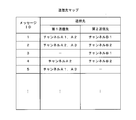
- FIG. 3 is a schematic diagram illustrating an example of the transmission destination map 12b.
- the transmission destination map 12b of the GW 10 according to the present embodiment, the correspondence between the ID attached to the message and the transmission destination of this message is stored.
- the ID attached to the message for example, in the case of a message conforming to the CAN communication standard, a CAN-ID can be adopted.
- numerical values 1, 2, 3, 4, 5,... are shown as examples of IDs.
- channels A1, A2, A3, B1, and B2 are described as the transmission destinations of the transmission destination map 12b.
- the channels A1, A2, and A3 correspond to the three communication units 13 of the GW 10, and indicate any one of the communication lines 5 to which the ECU 3 is connected as a transmission destination.
- Channels B1 and B2 correspond to the two communication units 14 of the GW 10, and indicate one of the communication lines 6 to which another GW 10 is connected as a transmission destination.
- the transmission destination of the message stored in the transmission destination map 12b is further divided into two, the first transmission destination and the second transmission destination.
- One or two of the three channels A1, A2, and A3 corresponding to the communication unit 13 can be set as the first transmission destination.
- As the second transmission destination any one of the two channels B1 and B2 corresponding to the communication unit 14 can be set.
- this is indicated by a symbol “ ⁇ ”.
- channels A1 and A2 are set as the first transmission destination, and channel B1 is set as the second transmission destination.
- channels A2 and A3 are set as the first transmission destination, and channel B2 is set as the second transmission destination.
- the message with ID “3” has no first transmission destination, and channel B1 is set as the second transmission destination.
- channel A2 is set as the first transmission destination, and channel B2 is set as the second transmission destination.
- channels A1 and A3 are set as the first transmission destination, and there is no second transmission destination.
- the relay processing unit 21 of the GW 10 acquires the ID attached to the message, and refers to the transmission destination map 12b of the storage unit 12 based on the acquired ID. For example, when the ID is “1”, the relay processing unit 21 acquires channels A1 and A2 as the first transmission destination of this message from the transmission destination map 12b, and sends this message to the communication unit 13 corresponding to the channels A1 and A2. Give and send. Further, the relay processing unit 21 acquires the channel B1 from the transmission destination map 12b as the second transmission destination of the message whose ID is “1”, and transmits this message to the communication unit 14 corresponding to the channel B1.
- the transmission destination map 12b of this example stores a channel corresponding to the communication line 5 to which the ECU 3 is connected as the first transmission destination, but the first transmission destination is not necessarily stored in the transmission destination map 12b. There is no need. For example, when the GW 10 receives a message on any one of the communication lines 5, if the message is relayed to all the communication lines 5 other than the communication line 5, the first transmission is made to the transmission destination map 12b. There is no need to remember the destination.
- the update processing unit 23 of the GW 10 updates the second transmission destination of the transmission destination map 12b according to the communication status of the communication line 6 monitored by the monitoring processing unit 22.
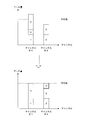
- FIG. 4 is a schematic diagram illustrating an example of update processing of the transmission destination map 12b performed by the GW 10 according to the first embodiment.
- the monitoring processing unit 22 monitors the communication status of each communication line 6 by measuring the amount of transmission data of each communication line 6 in a unit time of, for example, several hundred milliseconds to several seconds.
- the two graphs shown at the top and bottom of FIG. 4 are bar graphs showing the transmission data amounts of the channels B1 and B2 per unit time. Numerical values 1 to 5 in each bar graph indicate message IDs, and the transmission data amount for each ID is shown separately. Further, the average value of the transmission data amount of the channels B1 and B2 is indicated by a broken line.
- the example shown in FIG. 4 is an example different from the contents of the transmission destination map 12b shown in FIG.
- a message with ID “1”, “3”, “4” is set to channel B1 as the second destination, and a message with ID “2”, “5” is second.
- Channel B2 is set as the transmission destination, and the amount of transmission data per unit time is larger in channel B1.
- the update processing unit 23 acquires the transmission data amount of each channel (communication line 6) measured by the monitoring processing unit 22, and calculates the average value of the transmission data amounts of the two channels. .
- the update processing unit 23 assigns a message assigned to the communication line 6 having a large amount of transmission data to the communication line 6 having a small amount of transmission data so that the acquired transmission data amount of each channel approaches an average value. Change message assignments.
- the update processing unit 23 changes the assignment of the message with ID “3” from the channel B1 to the channel B2, thereby smoothing the transmission data amount of the two channels. Yes.
- the update processing unit 23 updates the second transmission destination of the message whose ID is “3” included in the transmission destination map 12b of the storage unit 12 from the channel B1 to the channel B2.
- the update processing unit 23 assigns a message assigned to the communication line 6 having a large transmission data amount to the communication line 6 having a small transmission data amount, and a message assigned to the communication line 6 having a small transmission data amount has a transmission data amount.
- the transmission data amount may be smoothed by allocating to many communication lines 6. For example, when the monitoring result shown in the upper part of FIG. 4 is obtained, the update processing unit 23 assigns a message with an ID “4” to the channel B2 and assigns a message with an ID “5” to the channel B1.
- the map 12b may be updated. Further, for example, the update processing unit 23 may assign the message with the ID “4” to the channel B2 and may assign the message with the ID “2” to the channel B1 to update the transmission destination map 12b.
- FIG. 5 is a flowchart illustrating a procedure of update processing of the transmission destination map 12b performed by the GW 10 according to the first embodiment.
- the monitoring processing unit 22 of the processing unit 11 of the GW 10 according to the first embodiment measures the amount of transmission data for two channels (communication line 6) that communicate with other GWs 10, and firstly transmits a measurement result as a transmission result.
- the data amount is initialized (step S1).
- the monitoring processing unit 22 determines whether or not the unit time has elapsed from the initialization of the transmission data amount using the timer function in the processing unit 11 (step S2). When the unit time has not elapsed (S2: NO), the monitoring processing unit 22 adds the transmission data amount for each channel according to the message transmission from each channel (step S3), and returns the process to step S2. .
- the update processing unit 23 of the processing unit 11 calculates the average value of the transmission data amount of the channels measured by the monitoring processing unit 22 (step S4).
- the update processing unit 23 changes the correspondence of messages to each channel so that the transmission data amount of each channel approaches the average value (step S5).
- the update processing unit 23 updates the transmission destination map 12b of the storage unit 12 so that the changed correspondence relationship is obtained (step S6), and returns the process to step S1.
- the update processing unit 23 calculates the average value in step S4, but this process is not always necessary.
- the update processing unit 23 may be configured to change the correspondence between the message and the channel so as to reduce or minimize the difference in the transmission data amount between the two channels.
- the plurality of communication lines 5 to which the ECU 3 is connected are connected to the GW 10, and the GW 10 relays transmission / reception of messages between the communication lines 5.
- a plurality (two) of GWs 10 are mounted on the vehicle 100, and the two GWs 10 are connected via the communication line 6. With this configuration, it can be expected that the amount of the communication line 5 provided in the vehicle 100 is reduced as compared with a configuration in which all ECUs 3 are connected to one GW 10.
- the two GWs 10 mounted on the vehicle 100 are connected via two or more communication lines 6 and can transmit and receive messages via the plurality of communication lines 6.
- the communication capacity of the communication between the GWs 10 that are likely to become a bottleneck can be increased, so that the occurrence of a communication delay can be prevented.
- the two communication lines 6 that connect the two GWs 10 are communication lines that conform to the same communication standard.
- the GW 10 it is not necessary for the GW 10 to perform processing such as conversion of a message format to a different communication standard, and it is possible to prevent a communication delay associated with the conversion processing from occurring.
- complication of the structure of GW10 can be suppressed and the increase in the cost of GW10 can be suppressed.
- the GW 10 stores the correspondence relationship between the ID attached to the message and the communication line 6 to which the message is to be transmitted in the transmission destination map 12b of the storage unit 12. ing.
- the GW 10 receives a message to be transmitted to another GW 10, the GW 10 selects the destination communication line 6 based on the correspondence stored in the destination map 12 b, and outputs the message to the selected communication line 6. It transmits to other GW10. Further, the GW 10 monitors the communication status of the plurality of communication lines 6 connected to the other GW 10. As the communication status to be monitored, for example, the data amount of a message transmitted / received via the communication line 6 or the power consumption amount of the communication unit 14 can be adopted.
- the GW 10 performs a process of updating the correspondence stored in the transmission destination map 12b of the storage unit 12 based on the monitoring result of the communication status. As a result, the GW 10 can change the correspondence between the message and the communication line 6 that transmits the message according to the communication status, and the communication amount 6 between the communication lines 6 can be resolved by eliminating the imbalance or imbalance of the communication amount. Effective use of bandwidth is possible.
- the GW 10 performs a process of updating the correspondence stored in the transmission destination map 12b of the storage unit 12 every time a predetermined unit time elapses. As a result, the correspondence relationship is reviewed every time the unit time elapses, and the correspondence relationship suitable for the communication status at that time is updated.
- the GW 10 according to Embodiment 1 stores the correspondence relationship stored in the transmission destination map 12b of the storage unit 12 so that the message allocated to the communication line 6 having a large transmission data amount is allocated to the communication line 6 having a small transmission data amount. Update. As a result, it is possible to effectively use the communication band by eliminating the imbalance or the imbalance of the transmission data amount between the two communication lines provided between the two GWs 10.
- the in-vehicle communication system 1 includes two GWs 10 and the two GWs 10 are connected by the two communication lines 6.
- the in-vehicle communication system 1 may include three or more GWs 10, and a plurality of GWs 10 may be connected by three or more communication lines 6.
- FIG. 6 is a schematic diagram illustrating a configuration of the in-vehicle communication system 1 according to the modification.
- the in-vehicle communication system 1 according to the modification includes three GWs 10.
- a plurality of communication lines 5 are connected to each GW 10, and one or a plurality of ECUs 3 are connected to the communication lines 5.
- the three GWs 10 are connected via the three communication lines 6.
- the three communication lines 6 conform to, for example, the CAN communication standard, and the three GWs 10 are connected via the communication line 6 by a bus type connection method.
- the connection method of the plurality of GWs 10 may be other than the bus type, for example, a ring type or a star type.
- FIG. 7 is a schematic diagram illustrating an example of update processing of the transmission destination map 12b performed by the GW 10 according to the second embodiment.
- channel B1 is set as the second transmission destination for messages with IDs “1”, “3”, and “4”, and messages with IDs “2” and “5” are second.
- Channel B2 is set as the transmission destination, and the amount of transmission data per unit time is larger in channel B1.
- both the channels B1 and B2 can be set as the second transmission destination of the message.
- the relay processing unit 21 of the GW 10 according to the second embodiment does not transmit this message from both the channels B1 and B2. Then, one of the channels B1 and B2 is selected to send a message.
- the relay processing unit 21 can alternately select the channels B1 and B2 as transmission destinations, and can select one of them by generating a random number, for example.
- the update processing unit 23 of the GW 10 acquires the transmission data amount of each channel measured by the monitoring processing unit 22 every time the unit time elapses, and averages the transmission data amount of the two channels. Is calculated.
- the update processing unit 23 selects one of the messages assigned to the channel with the larger transmission data amount, and sets the second transmission destination of the selected message as both the channels B1 and B2. At this time, the update processing unit 23 can select a message having the largest amount of transmission data among a plurality of messages assigned to a channel having a large amount of transmission data.
- a message with ID “4” having the largest amount of transmission data is selected by the update processing unit 23 from among messages assigned to the channel B1 having a large amount of transmission data.
- the second transmission destination is both channels B1 and B2.
- the update processing unit 23 updates the second transmission destination of the message whose ID is “4” included in the transmission destination map 12b of the storage unit 12 to the channels B1 and B2.
- the transmission data amount of the message whose ID is “4” is distributed to the channels B1 and B2, and the transmission data amounts of the two channels are smoothed.
- the GW 10 assigns a message having a predetermined ID assigned to the communication line 6 having a large transmission data amount to the plurality of communication lines 6.
- the communication load can be distributed from the communication line 6 having a large amount of transmission data to the communication line 6 having a small amount of transmission data, and the unbalance or unbalance of the transmission data amount among the plurality of communication lines 6 is eliminated. be able to.
- the relay processing unit 21 When transmitting a message to which both channels B1 and B2 are assigned as the second transmission destination, the relay processing unit 21 does not need to transmit the message using the two channels B1 and B2 equally.
- a message may be transmitted by selecting a channel with a bias at a ratio of 1 or the like.
- the in-vehicle communication system 1 according to the third embodiment is different from the in-vehicle communication system 1 according to the first embodiment in that the update processing unit 23 of the GW 10 performs the update process of the transmission destination map 12b.
- the in-vehicle communication system 1 according to the third embodiment does not perform the update process every unit time, but the imbalance degree of the transmission data amount of the two communication lines 6 connecting the two GWs 10 exceeds the threshold value. Update processing is performed in case.
- the GW 10 according to the third embodiment does not perform update processing when the degree of imbalance does not exceed the threshold value.
- the monitoring processing unit 22 of the GW 10 measures the amount of transmission data of each communication line 6 in a unit time of several hundred milliseconds to several seconds, for example, and calculates the degree of unbalance between the communication lines 6. .
- the unbalance degree can be calculated based on, for example, the following equation (1).
- “UB” is the degree of imbalance
- “Da” is the average value of the amount of transmission data in the plurality of communication lines 6
- “D” is the communication having the largest difference from the average value D. This is the transmission data amount of the line 6.
- “D” may be the transmission data amount of one of the communication lines 6.
- the update processing unit 23 of the GW 10 displays the correspondence stored in the transmission destination map 12b of the storage unit 12 when the unbalance degree calculated by the monitoring processing unit 22 exceeds a preset threshold value ⁇ . Perform the update process.
- the threshold value ⁇ is determined in advance, for example, at the design stage of the in-vehicle communication system 1.
- the update process performed by the update processing unit 23 is the same as the update process of the first embodiment or the second embodiment described above.
- FIG. 8 is a flowchart showing a procedure for updating the transmission destination map 12b performed by the GW 10 according to the third embodiment.
- the monitoring processing unit 22 of the processing unit 11 of the GW 10 according to the third embodiment measures the amount of transmission data for two channels that communicate with other GWs 10, and first initializes the amount of transmission data that is a measurement result. (Step S11). Next, the monitoring processing unit 22 adds the amount of transmission data for each channel in response to message transmission from each channel (step S12). The monitoring processor 22 calculates the degree of unbalance using the above equation (1) based on the transmission data amount of each channel (step S13). The monitoring processor 22 determines whether or not the calculated degree of imbalance exceeds a predetermined threshold (step S14). When the unbalance degree does not exceed the threshold value (S14: NO), the monitoring processing unit 22 returns the process to step S12.
- the update processing unit 23 of the processing unit 11 changes the correspondence of the message to each channel so that the transmission data amount of each channel approaches the average value (Ste S15).
- the update processing unit 23 updates the transmission destination map 12b of the storage unit 12 so that the changed correspondence relationship is obtained (step S16), and returns the process to step S11.
- the in-vehicle communication system 1 calculates the degree of unbalance of the communication status for the plurality of communication lines 6 connecting the plurality of GWs 10, and the update processing unit when the degree of unbalance exceeds the threshold value 23 performs a process of updating the correspondence stored in the transmission destination map 12b.
- the update process is not performed if the communication status is in a balanced state, it is possible to reduce the execution frequency of the update process and reduce the processing load and power consumption of the GW 10.
- the equation (1) for calculating the unbalance degree shown in the third embodiment is an example, and the unbalance degree may be calculated by a calculation method other than this.
- the determination as to whether or not to perform the update process may be performed by calculating another value instead of performing the determination based on the degree of imbalance.
- the GW 10 may perform the update process when the degree of balance of the communication status is equal to or lower than the threshold value, and for example, performs the update process when the difference between the maximum value and the minimum value of the transmission data amount exceeds the threshold value.
- the update process may be performed based on values other than these.
- Each device in the in-vehicle communication system includes a computer including a microprocessor, a ROM, a RAM, and the like.
- An arithmetic processing unit such as a microprocessor reads and executes a computer program including a part or all of each step of a sequence diagram or flowchart as shown in FIGS. 5 and 8 from a storage unit such as a ROM or a RAM.
- Each of the computer programs of the plurality of apparatuses can be installed from an external server apparatus or the like.
- the computer programs of the plurality of devices are distributed in a state where they are stored in a recording medium such as a CD-ROM, a DVD-ROM, or a semiconductor memory.
- In-vehicle communication system 3 ECU 5 communication line 6 communication line 10, 10a, 10b GW (in-vehicle relay device) DESCRIPTION OF SYMBOLS 11 Processing part 12 Memory
Landscapes
- Engineering & Computer Science (AREA)
- Computer Networks & Wireless Communication (AREA)
- Signal Processing (AREA)
- Mechanical Engineering (AREA)
- Health & Medical Sciences (AREA)
- Computing Systems (AREA)
- General Health & Medical Sciences (AREA)
- Medical Informatics (AREA)
- Small-Scale Networks (AREA)
- Data Exchanges In Wide-Area Networks (AREA)
Priority Applications (2)
| Application Number | Priority Date | Filing Date | Title |
|---|---|---|---|
| CN201980031202.3A CN112106331A (zh) | 2018-05-29 | 2019-05-17 | 车载通信系统、车载中继装置、通信程序以及通信方法 |
| US17/044,496 US20210119819A1 (en) | 2018-05-29 | 2019-05-17 | In-vehicle communication system, in-vehicle relay device, communication program, and communication method |
Applications Claiming Priority (2)
| Application Number | Priority Date | Filing Date | Title |
|---|---|---|---|
| JP2018102626A JP7059806B2 (ja) | 2018-05-29 | 2018-05-29 | 車載通信システム、車載中継装置、通信プログラム及び通信方法 |
| JP2018-102626 | 2018-05-29 |
Publications (1)
| Publication Number | Publication Date |
|---|---|
| WO2019230448A1 true WO2019230448A1 (ja) | 2019-12-05 |
Family
ID=68696980
Family Applications (1)
| Application Number | Title | Priority Date | Filing Date |
|---|---|---|---|
| PCT/JP2019/019694 Ceased WO2019230448A1 (ja) | 2018-05-29 | 2019-05-17 | 車載通信システム、車載中継装置、通信プログラム及び通信方法 |
Country Status (4)
| Country | Link |
|---|---|
| US (1) | US20210119819A1 (https=) |
| JP (1) | JP7059806B2 (https=) |
| CN (1) | CN112106331A (https=) |
| WO (1) | WO2019230448A1 (https=) |
Families Citing this family (1)
| Publication number | Priority date | Publication date | Assignee | Title |
|---|---|---|---|---|
| JP7042417B2 (ja) * | 2018-09-03 | 2022-03-28 | 株式会社オートネットワーク技術研究所 | 通信装置、送信方法及びコンピュータプログラム |
Citations (3)
| Publication number | Priority date | Publication date | Assignee | Title |
|---|---|---|---|---|
| JPH07162442A (ja) * | 1993-12-10 | 1995-06-23 | Oki Electric Ind Co Ltd | Lan中継装置 |
| JP2015067187A (ja) * | 2013-09-30 | 2015-04-13 | 株式会社デンソー | 車両制御システム |
| JP2017005617A (ja) * | 2015-06-15 | 2017-01-05 | 株式会社デンソー | 中継装置、電子装置および通信システム |
Family Cites Families (11)
| Publication number | Priority date | Publication date | Assignee | Title |
|---|---|---|---|---|
| WO2007048003A2 (en) * | 2005-10-21 | 2007-04-26 | Deere & Company | Versatile robotic control module |
| JP5095130B2 (ja) * | 2006-05-26 | 2012-12-12 | 株式会社オートネットワーク技術研究所 | 中継接続ユニット |
| JP6024564B2 (ja) * | 2013-03-28 | 2016-11-16 | 株式会社オートネットワーク技術研究所 | 車載通信システム |
| WO2014199606A1 (ja) * | 2013-06-13 | 2014-12-18 | 日本電気株式会社 | 負荷分散装置、負荷分散方法および記憶媒体ならびにイベント処理システム |
| JP2016086374A (ja) * | 2014-10-29 | 2016-05-19 | 株式会社日立製作所 | 通信装置および通信方法 |
| JP6451546B2 (ja) * | 2015-08-05 | 2019-01-16 | 株式会社デンソー | 通信ネットワーク及び中継装置 |
| JP6879789B2 (ja) * | 2016-05-27 | 2021-06-02 | パナソニック インテレクチュアル プロパティ コーポレーション オブ アメリカPanasonic Intellectual Property Corporation of America | ゲートウェイ装置、車載ネットワークシステム、転送方法及びプログラム |
| JP6427144B2 (ja) * | 2016-06-29 | 2018-11-21 | 矢崎総業株式会社 | ワイヤハーネス |
| JP6784178B2 (ja) * | 2017-01-27 | 2020-11-11 | 住友電気工業株式会社 | 車載通信システム、ゲートウェイ、スイッチ装置、通信制御方法および通信制御プログラム |
| JP6881231B2 (ja) * | 2017-10-25 | 2021-06-02 | トヨタ自動車株式会社 | 車載中継装置、情報処理方法、プログラム、中継装置、及び情報処理システム |
| US20190305983A1 (en) * | 2018-03-29 | 2019-10-03 | Hyundai Motor Company | Method and apparatus for configuring backup path in vehicle network |
-
2018
- 2018-05-29 JP JP2018102626A patent/JP7059806B2/ja active Active
-
2019
- 2019-05-17 CN CN201980031202.3A patent/CN112106331A/zh active Pending
- 2019-05-17 WO PCT/JP2019/019694 patent/WO2019230448A1/ja not_active Ceased
- 2019-05-17 US US17/044,496 patent/US20210119819A1/en not_active Abandoned
Patent Citations (3)
| Publication number | Priority date | Publication date | Assignee | Title |
|---|---|---|---|---|
| JPH07162442A (ja) * | 1993-12-10 | 1995-06-23 | Oki Electric Ind Co Ltd | Lan中継装置 |
| JP2015067187A (ja) * | 2013-09-30 | 2015-04-13 | 株式会社デンソー | 車両制御システム |
| JP2017005617A (ja) * | 2015-06-15 | 2017-01-05 | 株式会社デンソー | 中継装置、電子装置および通信システム |
Also Published As
| Publication number | Publication date |
|---|---|
| CN112106331A (zh) | 2020-12-18 |
| US20210119819A1 (en) | 2021-04-22 |
| JP2019208139A (ja) | 2019-12-05 |
| JP7059806B2 (ja) | 2022-04-26 |
Similar Documents
| Publication | Publication Date | Title |
|---|---|---|
| JP5046345B2 (ja) | 通信装置、及び通信システム | |
| JP5454517B2 (ja) | ゲートウェイ装置 | |
| CN103946830B (zh) | 传感器传输设备和用于从多个传感器向车辆的总线控制设备传输有用数据的方法 | |
| US12316519B2 (en) | Vehicle-mounted relay device and information processing method | |
| US20120290753A1 (en) | Connection method for bus controllers and communication system | |
| JP2014072673A (ja) | 中継装置 | |
| JP2018074244A (ja) | 通信制御装置、スイッチ装置、車外通信装置、通信制御方法および通信制御プログラム | |
| WO2018225513A1 (ja) | 中継装置、中継方法及び中継プログラム | |
| WO2019230448A1 (ja) | 車載通信システム、車載中継装置、通信プログラム及び通信方法 | |
| RU2540807C2 (ru) | Способ и система для автоматического выбора среды передачи | |
| CN113545012A (zh) | 通信装置、通信系统及消息仲裁方法 | |
| CN112438036B (zh) | 车载通信装置、记录介质及消息发送方法 | |
| JP2007336267A (ja) | 車載通信システム | |
| CN112470433A (zh) | 车载通信装置、通信程序及消息发送方法 | |
| CN112118275B (zh) | 过载处理方法、物联网平台及计算机可读存储介质 | |
| WO2019193963A1 (ja) | 車載通信システム、車載通信装置、通信プログラム及び通信方法 | |
| JP5099755B2 (ja) | 通信方法、通信システム及び通信装置 | |
| JP2009089286A (ja) | 中継接続ユニット | |
| KR20070027324A (ko) | 차량 내부 통신 시스템 및 게이트웨이 | |
| US9485139B2 (en) | Communication node, communication system, and method for performing a communication | |
| JP4839140B2 (ja) | 中継接続ユニット | |
| JP2020025192A (ja) | 車載通信システム、車載中継装置、通信プログラム及び通信方法 | |
| JP2009213097A (ja) | 情報記録システムおよび情報記録方法 | |
| JP2008172709A (ja) | 車載通信装置、車載通信システム及び車載通信方法 | |
| JP2024131757A (ja) | 車載中継装置、中継方法および中継プログラム |
Legal Events
| Date | Code | Title | Description |
|---|---|---|---|
| 121 | Ep: the epo has been informed by wipo that ep was designated in this application |
Ref document number: 19812273 Country of ref document: EP Kind code of ref document: A1 |
|
| NENP | Non-entry into the national phase |
Ref country code: DE |
|
| 122 | Ep: pct application non-entry in european phase |
Ref document number: 19812273 Country of ref document: EP Kind code of ref document: A1 |