WO2019208243A1 - 粒子線治療システム - Google Patents
粒子線治療システム Download PDFInfo
- Publication number
- WO2019208243A1 WO2019208243A1 PCT/JP2019/015812 JP2019015812W WO2019208243A1 WO 2019208243 A1 WO2019208243 A1 WO 2019208243A1 JP 2019015812 W JP2019015812 W JP 2019015812W WO 2019208243 A1 WO2019208243 A1 WO 2019208243A1
- Authority
- WO
- WIPO (PCT)
- Prior art keywords
- particle beam
- irradiation
- therapy system
- beam therapy
- mri apparatus
- Prior art date
- Legal status (The legal status is an assumption and is not a legal conclusion. Google has not performed a legal analysis and makes no representation as to the accuracy of the status listed.)
- Ceased
Links
Images




Classifications
-
- A—HUMAN NECESSITIES
- A61—MEDICAL OR VETERINARY SCIENCE; HYGIENE
- A61N—ELECTROTHERAPY; MAGNETOTHERAPY; RADIATION THERAPY; ULTRASOUND THERAPY
- A61N5/00—Radiation therapy
- A61N5/10—X-ray therapy; Gamma-ray therapy; Particle-irradiation therapy
- A61N5/103—Treatment planning systems
- A61N5/1039—Treatment planning systems using functional images, e.g. PET or MRI
-
- A—HUMAN NECESSITIES
- A61—MEDICAL OR VETERINARY SCIENCE; HYGIENE
- A61N—ELECTROTHERAPY; MAGNETOTHERAPY; RADIATION THERAPY; ULTRASOUND THERAPY
- A61N5/00—Radiation therapy
- A61N5/10—X-ray therapy; Gamma-ray therapy; Particle-irradiation therapy
- A61N5/1048—Monitoring, verifying, controlling systems and methods
-
- A—HUMAN NECESSITIES
- A61—MEDICAL OR VETERINARY SCIENCE; HYGIENE
- A61B—DIAGNOSIS; SURGERY; IDENTIFICATION
- A61B5/00—Measuring for diagnostic purposes; Identification of persons
- A61B5/05—Detecting, measuring or recording for diagnosis by means of electric currents or magnetic fields; Measuring using microwaves or radio waves
- A61B5/055—Detecting, measuring or recording for diagnosis by means of electric currents or magnetic fields; Measuring using microwaves or radio waves involving electronic [EMR] or nuclear [NMR] magnetic resonance, e.g. magnetic resonance imaging
-
- A—HUMAN NECESSITIES
- A61—MEDICAL OR VETERINARY SCIENCE; HYGIENE
- A61B—DIAGNOSIS; SURGERY; IDENTIFICATION
- A61B5/00—Measuring for diagnostic purposes; Identification of persons
- A61B5/70—Means for positioning the patient in relation to the detecting, measuring or recording means
- A61B5/704—Tables
-
- A—HUMAN NECESSITIES
- A61—MEDICAL OR VETERINARY SCIENCE; HYGIENE
- A61B—DIAGNOSIS; SURGERY; IDENTIFICATION
- A61B6/00—Apparatus or devices for radiation diagnosis; Apparatus or devices for radiation diagnosis combined with radiation therapy equipment
- A61B6/02—Arrangements for diagnosis sequentially in different planes; Stereoscopic radiation diagnosis
-
- A—HUMAN NECESSITIES
- A61—MEDICAL OR VETERINARY SCIENCE; HYGIENE
- A61N—ELECTROTHERAPY; MAGNETOTHERAPY; RADIATION THERAPY; ULTRASOUND THERAPY
- A61N5/00—Radiation therapy
- A61N5/10—X-ray therapy; Gamma-ray therapy; Particle-irradiation therapy
- A61N5/1048—Monitoring, verifying, controlling systems and methods
- A61N5/1049—Monitoring, verifying, controlling systems and methods for verifying the position of the patient with respect to the radiation beam
-
- G—PHYSICS
- G01—MEASURING; TESTING
- G01R—MEASURING ELECTRIC VARIABLES; MEASURING MAGNETIC VARIABLES
- G01R33/00—Arrangements or instruments for measuring magnetic variables
- G01R33/20—Arrangements or instruments for measuring magnetic variables involving magnetic resonance
- G01R33/28—Details of apparatus provided for in groups G01R33/44 - G01R33/64
- G01R33/42—Screening
- G01R33/421—Screening of main or gradient magnetic field
-
- G—PHYSICS
- G01—MEASURING; TESTING
- G01R—MEASURING ELECTRIC VARIABLES; MEASURING MAGNETIC VARIABLES
- G01R33/00—Arrangements or instruments for measuring magnetic variables
- G01R33/20—Arrangements or instruments for measuring magnetic variables involving magnetic resonance
- G01R33/28—Details of apparatus provided for in groups G01R33/44 - G01R33/64
- G01R33/42—Screening
- G01R33/421—Screening of main or gradient magnetic field
- G01R33/4215—Screening of main or gradient magnetic field of the gradient magnetic field, e.g. using passive or active shielding of the gradient magnetic field
-
- H—ELECTRICITY
- H01—ELECTRIC ELEMENTS
- H01F—MAGNETS; INDUCTANCES; TRANSFORMERS; SELECTION OF MATERIALS FOR THEIR MAGNETIC PROPERTIES
- H01F7/00—Magnets
- H01F7/06—Electromagnets; Actuators including electromagnets
- H01F7/20—Electromagnets; Actuators including electromagnets without armatures
-
- A—HUMAN NECESSITIES
- A61—MEDICAL OR VETERINARY SCIENCE; HYGIENE
- A61B—DIAGNOSIS; SURGERY; IDENTIFICATION
- A61B5/00—Measuring for diagnostic purposes; Identification of persons
- A61B5/0033—Features or image-related aspects of imaging apparatus, e.g. for MRI, optical tomography or impedance tomography apparatus; Arrangements of imaging apparatus in a room
- A61B5/0035—Features or image-related aspects of imaging apparatus, e.g. for MRI, optical tomography or impedance tomography apparatus; Arrangements of imaging apparatus in a room adapted for acquisition of images from more than one imaging mode, e.g. combining MRI and optical tomography
-
- A—HUMAN NECESSITIES
- A61—MEDICAL OR VETERINARY SCIENCE; HYGIENE
- A61B—DIAGNOSIS; SURGERY; IDENTIFICATION
- A61B6/00—Apparatus or devices for radiation diagnosis; Apparatus or devices for radiation diagnosis combined with radiation therapy equipment
- A61B6/02—Arrangements for diagnosis sequentially in different planes; Stereoscopic radiation diagnosis
- A61B6/03—Computed tomography [CT]
- A61B6/032—Transmission computed tomography [CT]
-
- A—HUMAN NECESSITIES
- A61—MEDICAL OR VETERINARY SCIENCE; HYGIENE
- A61N—ELECTROTHERAPY; MAGNETOTHERAPY; RADIATION THERAPY; ULTRASOUND THERAPY
- A61N5/00—Radiation therapy
- A61N5/10—X-ray therapy; Gamma-ray therapy; Particle-irradiation therapy
- A61N5/1048—Monitoring, verifying, controlling systems and methods
- A61N5/1049—Monitoring, verifying, controlling systems and methods for verifying the position of the patient with respect to the radiation beam
- A61N2005/1055—Monitoring, verifying, controlling systems and methods for verifying the position of the patient with respect to the radiation beam using magnetic resonance imaging [MRI]
-
- A—HUMAN NECESSITIES
- A61—MEDICAL OR VETERINARY SCIENCE; HYGIENE
- A61N—ELECTROTHERAPY; MAGNETOTHERAPY; RADIATION THERAPY; ULTRASOUND THERAPY
- A61N5/00—Radiation therapy
- A61N5/10—X-ray therapy; Gamma-ray therapy; Particle-irradiation therapy
- A61N5/1048—Monitoring, verifying, controlling systems and methods
- A61N5/1049—Monitoring, verifying, controlling systems and methods for verifying the position of the patient with respect to the radiation beam
- A61N2005/1061—Monitoring, verifying, controlling systems and methods for verifying the position of the patient with respect to the radiation beam using an x-ray imaging system having a separate imaging source
-
- A—HUMAN NECESSITIES
- A61—MEDICAL OR VETERINARY SCIENCE; HYGIENE
- A61N—ELECTROTHERAPY; MAGNETOTHERAPY; RADIATION THERAPY; ULTRASOUND THERAPY
- A61N5/00—Radiation therapy
- A61N5/10—X-ray therapy; Gamma-ray therapy; Particle-irradiation therapy
- A61N2005/1085—X-ray therapy; Gamma-ray therapy; Particle-irradiation therapy characterised by the type of particles applied to the patient
- A61N2005/1087—Ions; Protons
-
- A—HUMAN NECESSITIES
- A61—MEDICAL OR VETERINARY SCIENCE; HYGIENE
- A61N—ELECTROTHERAPY; MAGNETOTHERAPY; RADIATION THERAPY; ULTRASOUND THERAPY
- A61N5/00—Radiation therapy
- A61N5/10—X-ray therapy; Gamma-ray therapy; Particle-irradiation therapy
- A61N2005/1092—Details
-
- A—HUMAN NECESSITIES
- A61—MEDICAL OR VETERINARY SCIENCE; HYGIENE
- A61N—ELECTROTHERAPY; MAGNETOTHERAPY; RADIATION THERAPY; ULTRASOUND THERAPY
- A61N5/00—Radiation therapy
- A61N5/10—X-ray therapy; Gamma-ray therapy; Particle-irradiation therapy
- A61N5/1048—Monitoring, verifying, controlling systems and methods
- A61N5/1071—Monitoring, verifying, controlling systems and methods for verifying the dose delivered by the treatment plan
-
- A—HUMAN NECESSITIES
- A61—MEDICAL OR VETERINARY SCIENCE; HYGIENE
- A61N—ELECTROTHERAPY; MAGNETOTHERAPY; RADIATION THERAPY; ULTRASOUND THERAPY
- A61N5/00—Radiation therapy
- A61N5/10—X-ray therapy; Gamma-ray therapy; Particle-irradiation therapy
- A61N5/1077—Beam delivery systems
- A61N5/1081—Rotating beam systems with a specific mechanical construction, e.g. gantries
-
- G—PHYSICS
- G01—MEASURING; TESTING
- G01R—MEASURING ELECTRIC VARIABLES; MEASURING MAGNETIC VARIABLES
- G01R33/00—Arrangements or instruments for measuring magnetic variables
- G01R33/20—Arrangements or instruments for measuring magnetic variables involving magnetic resonance
- G01R33/28—Details of apparatus provided for in groups G01R33/44 - G01R33/64
- G01R33/38—Systems for generation, homogenisation or stabilisation of the main or gradient magnetic field
- G01R33/3806—Open magnet assemblies for improved access to the sample, e.g. C-type or U-type magnets
-
- G—PHYSICS
- G01—MEASURING; TESTING
- G01R—MEASURING ELECTRIC VARIABLES; MEASURING MAGNETIC VARIABLES
- G01R33/00—Arrangements or instruments for measuring magnetic variables
- G01R33/20—Arrangements or instruments for measuring magnetic variables involving magnetic resonance
- G01R33/44—Arrangements or instruments for measuring magnetic variables involving magnetic resonance using nuclear magnetic resonance [NMR]
- G01R33/48—NMR imaging systems
- G01R33/4808—Multimodal MR, e.g. MR combined with positron emission tomography [PET], MR combined with ultrasound or MR combined with computed tomography [CT]
- G01R33/4812—MR combined with X-ray or computed tomography [CT]
Definitions
- the present invention relates to a particle beam treatment system for irradiating an affected area with a charged particle beam (hereinafter also referred to as particle beam) such as heavy particles such as carbon and helium, protons, and the like.
- a charged particle beam hereinafter also referred to as particle beam
- heavy particles such as carbon and helium, protons, and the like.
- Patent Document 1 is configured to direct the charged particle beam in a predetermined direction.
- Non-Patent Document 1 the position of a target is measured using an MRI mounted on a gantry that rotates around a patient, and a particle beam is irradiated when the target is in a predetermined position (emission permission range).
- a particle beam therapy system that performs gate irradiation is disclosed.
- a method for irradiating a patient with cancer or the like with a particle beam is known.
- a particle beam therapy system that irradiates a particle beam includes a charged particle generator, a beam transport system, and a treatment room.
- the particle beam generated and accelerated by the accelerator reaches the irradiation device in the treatment room through the beam transport system, and is scanned by the scanning electromagnet of the irradiation device to be affected in the patient's body.
- a dose distribution suitable for the shape is formed.
- Non-Patent Document 1 the position of the target using MRI (Magnetic Resonance Imaging) mounted on a gantry that rotates around the patient as in Non-Patent Document 1 described above.
- MRI Magnetic Resonance Imaging
- particle beam therapy system that performs gate irradiation for irradiating particle beam when the target is in a predetermined position (extraction permission range).
- Non-Patent Document 1 magnetic field lines pass through the air outside the MRI, so that the magnetic field strength outside the MRI increases. That is, it has a large leakage magnetic field.
- the particle beam monitor for measuring the position and irradiation amount of the particle beam is easily affected by the magnetic field due to its characteristics. For this reason, the subject that it became difficult to install a particle beam monitor near a patient under the big leakage magnetic field occurred.
- Patent Document 1 discloses a particle beam therapy system equipped with an MRI equipped with an iron core as a magnetic path for returning magnetic flux.
- Patent Document 1 in order to avoid this, a structure for making the direction of the magnetic field generated by the MRI apparatus parallel to the incident direction of the particle beam is also disclosed.
- the structure is complicated and the leakage magnetic field becomes large.
- the present invention provides a particle beam therapy system having a simple structure and capable of measuring the position of a target with an MRI apparatus and evaluating the position and dose of the particle beam with high accuracy using a particle beam monitor.
- the present invention includes a plurality of means for solving the above-mentioned problems.
- an accelerator that generates and emits a charged particle beam and an irradiation apparatus that irradiates the charged particle beam toward an irradiation target.
- a gantry that rotates together with the irradiation device, and an MRI device that rotates together with the gantry.
- the MRI device includes a magnetic circuit including a core and a plurality of coils that are magnetic flux generation sources. Two magnetic poles arranged opposite to each other and a member that connects the magnetic poles, at least one of the magnetic poles has a cavity, and the charged particle beam passes through the cavity to irradiate the irradiation target. It is characterized by that.
- the position of a target can be measured with a simple structure by an MRI apparatus, and the position and dose of a particle beam can be evaluated with high accuracy by a particle beam monitor.
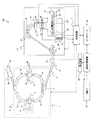
- FIG. 1 It is a figure which shows the whole schematic structure of the particle beam therapy system of this invention. It is a figure which illustrates the structure of the treatment room disclosed in FIG. It is a figure which shows the dose distribution of the depth direction obtained when a single particle beam is irradiated to irradiation object. It is a figure which shows dose distribution of the depth direction obtained when the irradiation object is irradiated with a plurality of particle beams. It is a figure which shows dose distribution of the horizontal direction obtained when a particle beam is irradiated to irradiation object. It is a figure showing the middle condition of the operation
- Embodiments of the particle beam therapy system according to the present invention will be described with reference to FIGS.
- the particle beam therapy system includes an accelerator 1, a beam transport system 2, a treatment room 17, and a control device 7.
- the accelerator 1 is a device that generates a particle beam and emits it to the irradiation device 21, and includes an ion source 3 a, a linac 3 b that is a preceding charged particle beam acceleration device, and a synchrotron 4.
- the synchrotron 4 includes a deflecting electromagnet 7a, a high-frequency applying device 5, and an accelerating device 6.
- the deflection electromagnet 7a is arranged on the beam orbit of the synchrotron 4.
- the high-frequency application device 5 includes a high-frequency application electrode 8 and a high-frequency application power source 9 arranged in the beam orbit, and the high-frequency application electrode 8 and the high-frequency application power source 9 are connected by a switch.
- the acceleration device 6 includes a high-frequency acceleration cavity 6a disposed in a beam orbit and a high-frequency power source 6b that applies high-frequency power to the high-frequency acceleration cavity 6a.
- An exit deflector 11 connects the synchrotron 4 and the beam transport system 2.
- the beam transport system 2 includes a beam path 12, a quadrupole electromagnet, and deflection electromagnets 13, 14, 15, and 16.
- the beam path 12 is connected to an irradiation device 21 installed in the treatment room 17.
- a substantially cylindrical gantry 18 is installed in the treatment room 17.
- the gantry 18 includes a deflecting electromagnets 15 and 16 that are part of the beam transport system 2, an irradiation device 21 that irradiates a particle beam toward the irradiation target 26, an MRI device 50, an X-ray generator 35, and an X-ray detector 37. Is installed.
- a treatment bed called a couch 24 is installed inside the gantry 18 in order to install the irradiation target 25.
- the gantry 18 has a structure that can be rotated by a motor 18A. As the gantry 18 rotates, the deflecting electromagnets 15 and 16, the irradiation device 21, the MRI device 50, the X-ray generator 35, and the X-ray detector 37 rotate. The rotation of the gantry 18 and each device are linked to this movement, so that the irradiation target 26 of the irradiation target 25 can be irradiated with the particle beam from any direction within the plane perpendicular to the rotation axis of the gantry 18. it can.
- the irradiation device 21 provided in the gantry 18 includes a scanning electromagnet 31, a scanning electromagnet 32, and a particle beam monitor.
- the particle beam monitor includes a position monitor 34 and a dose monitor 33.
- the particle beam therapy system 100 of the present embodiment includes two scanning electromagnets 31 and 32 in the irradiation device 21. Accordingly, so-called scanning irradiation can be performed in which the particle beam is deflected in two directions (X direction and Y direction) in a plane perpendicular to the beam traveling direction to change the irradiation position.
- the position monitor 34 measures the position of the scanned particle beam and the spread of the particle beam.
- the dose monitor 33 measures the amount of irradiated particle beam.
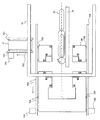
- the MRI apparatus 50 is installed in the gantry 18 as shown in FIG.
- the MRI apparatus 50 includes a passive shield magnet that returns a magnetic flux generated by a plurality of coils 61, which are magnetic flux generation sources, by an iron core 60, a gradient magnetic field coil 62a that causes a magnetic resonance phenomenon and collects signals thereof. From the member 62 in which the high-frequency transmission / reception system 62b is stored, and the processing unit 51 that generates the MRI image from the detection value of the high-frequency transmission / reception system 62b and outputs the MRI image to the control device 7 Composed.
- the MRI apparatus 50 is demagnetized when a signal from the MRI apparatus 50 is not used on the control apparatus 7 side, when rotating with the gantry 18 or when the MRI apparatus 50 is retreated in the gantry 18 described later. It is configured to be possible.
- the magnetic field generated by the MRI apparatus 50 is installed so as to be generated in the same direction (parallel) as the beam axis of the particle beam.
- the irradiation target 25 is set so that the irradiation target 26 enters the uniform magnetic field generated by the coil 61 of the MRI apparatus 50, and an MRI image around the irradiation target 26 is taken.
- the iron core 60 of the MRI apparatus 50 is composed of two magnetic poles 63A and 63B arranged opposite to each other and a return yoke 64 that connects the magnetic poles 63A and 63B to each other on the back side of the gantry 18.
- the return yoke 64 and the magnetic poles 63A and 63B form a magnetic flux passage, that is, a magnetic circuit.
- the magnetic poles 63A and 63B have the same shape and are made of the same material.
- a cavity 65A is formed at the center of the magnetic pole 63A, and the particle beam from the irradiation device 21 can pass through the vicinity of the center of the magnetic pole 63A.
- the cavity 65 ⁇ / b> A having a size that can accommodate the irradiation device 21 is illustrated, but the cavity 65 ⁇ / b> A provided in the magnetic pole 63 ⁇ / b> A only needs to have a size that allows at least the scanned beam to pass.
- a cavity 65B having the same size and shape as the cavity 65A provided in the magnetic pole 63A is also formed at the center of the magnetic pole 63B, and the magnetic field generated by the coil 61 by increasing the symmetry of the upper and lower magnetic poles 63A and 63B. To increase.
- the main magnetic flux is not necessarily limited to the coil 61, but the main magnetic flux is generated by a permanent magnet. It is obvious that the generated configuration may be used.
- the X-ray generator 35 and the flat panel X-ray detector 37 generate X-rays in a direction perpendicular to the direction of the magnetic field in the gantry 18 generated by the MRI apparatus 50. It is installed on both sides of the irradiation object 25.
- the X-ray generator 35 generates X-rays for fluoroscopy.
- the X-ray detector 37 detects an X-ray signal generated from the X-ray generator 35 and passed around the irradiation target 26 of the irradiation target 25.
- the irradiation target 26 is a person, and the irradiation target 26 is a tumor.
- control device 7 provided in the particle beam therapy system 100 of the present embodiment will be described with reference to FIG.
- the control device 7 is connected to a database 42 that is a storage device, and the database 42 is connected to an irradiation planning device 41.
- the irradiation planning device 41 is connected to the X-ray CT device 40 and the display device 43. Data necessary for irradiation (treatment plan) created by the irradiation planning device 41 is recorded in the database 42.
- the control device 7 is also connected to the accelerator 1, the beam transport system 2, the gantry 18, the irradiation device 21, the MRI device 50, the X-ray generator 35, and the X-ray detector 37.
- the control device 7 is a device that controls the operation of each device constituting the accelerator 1, the irradiation device 21, the beam transport system 2, the MRI device 50, the X-ray generation device 35, and the X-ray detector 37. Further, the control device 7 outputs the amount of excitation of the scanning electromagnets 31 and 32 and receives the detection value input by each monitor in the irradiation device 21.
- control device 7 performs ON / OFF control of particle beam irradiation based on a signal of an MRI image periodically acquired from the processing unit 51 of the MRI device 50, and a position before irradiation.
- the movement of the couch 24 at the time of matching is controlled.
- the particle beam is being irradiated, it is determined whether or not the three-dimensional position of the real-time irradiation target 26 acquired during the irradiation is within a predetermined region, and is determined to be within the region.
- the output high-frequency application command signal is output to the high-frequency application device 5, and when it is determined that it is not within the region, no signal is output.
- the difference between the irradiation target 26 and the irradiation position is obtained from the X-ray fluoroscopic image or MRI image acquired when the irradiation target 26 is positioned at the irradiation position at the time of treatment planning, and the couch 24 is moved. The amount is calculated and the couch 24 is moved.
- control device 7 and the processing unit 51 described above are configured by one or a plurality of processors, CPUs, and the like. Control of the operation of each device by the control device 7 and the processing unit 51 is executed by various programs. This program is stored in an internal recording medium or an external recording medium in the control device 7 and the database 42, and is read and executed by the CPU.
- each may be divided into several programs, and those combinations may be sufficient. Further, part or all of the program may be realized by dedicated hardware or may be modularized. Furthermore, various programs may be installed in each computer by a program distribution server or a storage medium.
- the horizontal axis represents the depth of the irradiation target 26, and the vertical axis represents the particle beam dose.
- FIG. 3 shows the dose distribution formed by a single energy particle beam in the irradiation object as a function of depth.
- the peak in FIG. 3 is called a Bragg peak.
- the position of the Bragg peak depends on the energy of the particle beam. Therefore, the position of the Bragg peak can be adjusted by adjusting the energy of the particle beam, and an appropriate dose of particle beam can be irradiated to the desired depth of the irradiation target 26.
- the irradiation target 26 has a thickness in the depth direction, but the Bragg peak is a sharp peak. Therefore, by irradiating several energy particle beams at an appropriate intensity ratio and superimposing the Bragg peaks, as shown in FIG. 4, the uniform thickness having the same thickness as the irradiation target 26 is obtained in the depth direction.
- a high-dose region (SOBP: spread-out Bragg peak, enlarged Bragg peak) is formed.
- the relationship between the lateral extent of the irradiation target 26 in the direction perpendicular to the beam axis (the direction of the XY plane) and the particle beam will be described.
- the horizontal axis indicates the lateral extent of the irradiation target 26, and the vertical axis indicates the dose at the irradiation spot.
- the direction perpendicular to the beam axis is called the transverse direction.
- the particle beam After reaching the irradiation device 21, the particle beam is scanned by two scanning electromagnets 31 and 32 installed perpendicular to each other to reach a desired position in the lateral direction.
- the lateral spread of the particle beam can be approximated by a Gaussian distribution shape. Therefore, by arranging the Gaussian distributions at equal intervals and setting the distance between them to about the standard deviation of the Gaussian distribution, the added distribution has a uniform region as shown in FIG.
- the Gaussian distribution dose distribution arranged in this way is called a spot.
- a uniform irradiation field can be formed by the beam scanning in the horizontal direction by the scanning electromagnets 31 and 32 and the movement of the Bragg peak in the depth direction by changing the beam energy.
- the unit of the irradiation field that is irradiated with the same energy and spreads in the horizontal direction by scanning the particle beam by the scanning electromagnets 31 and 32 is called a slice.
- the irradiation planning device 41 determines irradiation parameters, gantry angles, and irradiation target position information necessary for irradiation before irradiating the irradiation target 26 with particle beams.
- the irradiation parameter is composed of N slices and N slice data.
- the slice represents a set of spots irradiated with the same energy.
- the slice data includes spot data of slice number i, energy Ei, number of spots N i and N i .
- the spot data includes a spot number j, an irradiation position (X ij , Y ij ), and a target irradiation amount D ij .
- the irradiation object 25 is imaged with the X-ray CT apparatus 40.
- the X-ray CT apparatus 40 has a function of creating a CT image for each phase of movement when the irradiation target 26 periodically moves. In particular, when imaging a patient, a CT image for each respiratory phase can be acquired.
- the X-ray CT apparatus images the irradiation target and creates a CT image of the irradiation target 25 for n phases.
- the X-ray CT apparatus transmits the created CT image to the irradiation planning apparatus 41.
- the irradiation planning device 41 displays the received image data on the screen of the display device 43.
- the operator selects a CT image having a reference phase from the CT images for each phase. For example, when considering movement of an affected part due to respiration, an expiration phase is selected.
- a region to be irradiated is designated so as to cover the irradiation target 26 on the CT image selected by the operator.
- the irradiation planning device 41 determines and determines the installation position, gantry angle, and irradiation parameters of the irradiation target that can form a dose distribution in the designated area. In other words, the irradiation planning device 41 determines the irradiation target installation position and the gantry irradiation angle based on the irradiation target information input by the operator, and then divides the irradiation target 26 (affected part) into a plurality of slices in the depth direction. The number of slices N to be determined is determined.
- the irradiation planning device 41 calculates an image projected on the X-ray detector 37 when the irradiation target is installed at the irradiation target installation position, and uses it as irradiation target position information.
- the irradiation plan apparatus 41 calculates
- the irradiation planning device 41 further includes the number of irradiation spots N i , the spot number j, the irradiation position of each spot (X ij , Y ij ), and the target irradiation amount of each spot according to the shape of each slice.
- D ij is determined in consideration of the magnetic field distribution generated by the MRI apparatus 50.
- the irradiation planning device 41 calculates a dose distribution when the irradiation target is irradiated with each determined value in consideration of the magnetic field of the MRI apparatus 50, and displays the calculated dose distribution on the display device 43.
- the data created in this way is created for the number of rotation angles of the gantry 18.
- the created irradiation parameter, gantry angle and irradiation target position information are transmitted to the database 42 and recorded.
- the particle beam monitor (dose monitor 33 and position monitor 34) is susceptible to a magnetic field due to its specifications.
- the particle beam monitor has a parallel plate type electrode, and voltage is applied to both sides of the electrode. As the particle beam passes through the electrode of the particle beam monitor, the gas existing between the parallel plates is ionized. Ionized electrons and ions are moved by the electric field and collected by both electrodes.
- the dose monitor 33 collects signals with one electrode, and the position monitor 34 has a structure in which the electrodes are divided into a plurality of parts.
- the magnetic field intensity around the MRI apparatus 50 can be lowered, and the particle beam monitor can be installed near the irradiation target 25.
- the position and amount of the particle beam that has reached the irradiation target 26 of the irradiation target 25 can be measured with higher accuracy as the measurement is performed closer to the irradiation target 25.
- the X-ray generator 35 is also susceptible to magnetic fields due to its specifications. Specifically, the X-ray generator 35 generates an electron beam inside and generates X-rays by colliding the electron beam with a target. For this reason, when placed in a magnetic field, the trajectory of the electron beam is bent, and the electron beam cannot collide with the target.
- the magnetic field intensity around the X-ray generator 35 can be reduced by using the return yoke 64 as in the present embodiment.
- an X-ray fluoroscopic image can be acquired by the X-ray generator 35 in the absence of a magnetic field.
- the irradiation target 26 When focusing on the irradiation target 26 in such a case, the irradiation target 26 can be imaged even in a narrow imaging region, but it may be difficult to sufficiently measure the structure around the irradiation target 26. However, since the X-ray generation device 35 is provided, the surrounding structure from the body surface of the irradiation target 25 to the irradiation target 26 can be confirmed before treatment, so that the MRI apparatus 50 can be downsized. Can do.
- the MRI apparatus 50 is configured to move in the direction toward the back of the gantry 18, an operation in which the MRI apparatus 50 is used only when necessary is possible.
- the MRI apparatus 50 When the MRI apparatus 50 is used, there is an advantage that an image near the irradiation target can be acquired. However, on the other hand, there arises a problem that the irradiation field of the particle beam is limited by the size of the cavity 65A at the center of the magnetic pole 63A.
- a large particle beam irradiation field can be realized by retracting the MRI apparatus 50 to the back side in the rotation axis direction of the gantry 18.
- the irradiation apparatus 21 is operated in a state where it is partially inserted into the MRI apparatus 50. Therefore, first, as shown in FIG. 6, the irradiation apparatus 21 is pulled out from the MRI apparatus 50. After that, the MRI apparatus 50 is drawn into the back of the gantry 18.
- the MRI apparatus 50 After the MRI apparatus 50 is pulled into the back of the gantry 18, the position of the irradiation apparatus 21 is returned again as shown in FIG. With such a structure and operation, the MRI apparatus 50 can be extended from the particle beam irradiation field by removing it from the gantry 18 when unnecessary.
- the retraction operation of the MRI apparatus 50 as shown in FIGS. 6 and 7 is performed by providing a plurality of wheels 72A and 72B on the outer surfaces of the magnetic poles 63A and 63B of the MRI apparatus 50, and using the wheels 72A and 72B as motors 74A and 74B.
- the present invention is not limited to this.
- the retracting operation of the irradiation device 21 is performed by providing the irradiation device 21 with a plurality of wheels 72C and driving the wheels 72C by the motor 74C to run on the rail 70C, but is not limited thereto. .
- the irradiation device 21 is evacuated until just before the particle beam monitor, and a vacuum window is arranged downstream of the particle beam monitor.
- the particle beam monitor can irradiate the particle beam with higher accuracy near the irradiation target, and can irradiate the fine particle beam as the vacuum region is closer to the patient. The thinner the particle beam, the more concentrated the irradiation target 26 can be irradiated with the particle beam.
- the vacuum window and the particle beam monitor have a structure that can move in the beam axis direction of the particle beam.
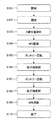
- FIG. 8 shows an example in which the particle beam is irradiated from two directions.
- step S101 the patient enters the treatment room 17 and starts a series of treatments.
- step S102 the patient is fixed on the couch 24 outside the gantry 18 (step S102), and then the couch 24 is moved into the gantry 18.
- step S103 positioning using the X-ray generator 35 and the X-ray detector 37 is performed (step S103).
- X-ray fluoroscopic images preferably in two orthogonal directions, are acquired using the X-ray generator 35.
- a horizontal X-ray fluoroscopic image is acquired first, the gantry 18 is rotated 90 degrees, and then a vertical X-ray fluoroscopic image is acquired.
- the X-ray fluoroscopic image thus obtained is compared with the image of the irradiation target installation information recorded in the database 42, and the couch 24 is moved so that the patient is installed at the planned position.
- step S103 the MRI apparatus 50 can be used instead of the X-ray positioning. In this case, the order of step S104 described later and step S103 is switched.
- a fluoroscopic image is acquired from a plurality of directions by acquiring a fluoroscopic image while rotating at the same speed, and the fluoroscopic image is obtained. It is also possible to reconstruct a cone beam CT image. More accurate positioning is possible by comparing the cone beam CT image and the image of the irradiation target installation information to determine the installation position of the patient.
- step S104 the MRI apparatus 50 is excited (step S104), and the gantry 18 is rotated together with the MRI apparatus 50 in accordance with the direction in which the particle beam is first irradiated (step S105).
- step S106 the particle beam is irradiated.
- the particle beam irradiation flow will be described later.
- step S107 When the irradiation of the particle beam is completed, the irradiation direction is then changed (step S107), and the particle beam is irradiated again (step S108).
- step S109 the magnetic field of the MRI apparatus 50 is demagnetized (step S109), and the couch 24 is pulled out from the gantry 18. The patient gets out of the couch 24 and exits from the treatment room 17, and the irradiation ends (step S110).
- the operator presses the irradiation preparation start button on the console connected to the control device 7.
- control device 7 When the control device 7 recognizes that the irradiation preparation start button has been pressed, it receives irradiation target installation information from the database 42 and prepares excitation patterns for each electromagnet for emitting a particle beam of the specified energy. To do. As irradiation control, irradiation parameters are set, and an excitation current value obtained from the irradiation position and energy is output to the scanning electromagnet power source.
- the control apparatus 7 acquires an MRI image from the MRI apparatus 50 with a fixed period, and calculates the position (target coordinate) of the irradiation target 26 from the acquired image.
- the controller 7 controls the ion source 3a, linac 3b, and synchrotron 4 to accelerate the particle beam (step S202).
- the particle beam generated by the ion source 3a is introduced into the linac 3b, accelerated to an energy suitable for being incident on the synchrotron 4 by the linac 3b, and incident on the synchrotron 4.
- the particle beam incident on the synchrotron 4 is accelerated to the energy E ⁇ b> 1 for irradiating the first slice number by applying a high frequency every time it passes through the acceleration device 6 while orbiting the orbit of the synchrotron 4.
- control device 7 determines whether or not the three-dimensional position of the irradiation target 26 obtained from the MRI image matches or approaches the position when the irradiation parameter is created by the irradiation planning device 41. When it is determined, the irradiation of the particle beam is started (S204). If it is determined that they do not match or are not approaching, step S204 is executed again after a predetermined time has elapsed.
- control device 7 controls the high-frequency application device 5 to apply a high frequency to the particle beam that circulates in the synchrotron 4.
- the particle beam to which the high frequency is applied passes through the deflector for emission 11, passes through the beam path 12, and reaches the irradiation device 21 in the treatment room 17.
- the particle beam is scanned by the scanning electromagnets 31 and 32 in the irradiation device 21, passes through the position monitor 34 and the dose monitor 33, reaches the irradiation target 25, and gives a dose to the irradiation target 26.
- the amount of particle beam reaching the irradiation target 26 is detected by the dose monitor 33.
- control device 7 decelerates the particle beam (step S206), makes a new particle beam incident from the linac 3b, and waits.
- the particle beam can be irradiated concentratedly on the irradiation target 26.
- the particle beam therapy system 100 of the present embodiment described above includes an accelerator 1 that generates and emits a particle beam, an irradiation device 21 that irradiates the particle beam toward the irradiation target 26, and a gantry 18 that rotates together with the irradiation device 21.
- an MRI apparatus 50 that rotates together with the gantry 18, and the MRI apparatus 50 has a magnetic circuit composed of an iron core 60 and a plurality of coils 61 that are magnetic flux generation sources, and the iron core 60 has two magnetic poles arranged opposite to each other.
- the magnetic poles 63A, 63B and the return yoke 64 connecting the magnetic poles 63A, 63B, the magnetic poles 63A, 63B have cavities 65A, 65B, and irradiate the irradiation target 26 with the particle beam passing through the cavities 65A. .
- the path of the magnetic field lines passes through the iron core 60, the magnetic field intensity outside the MRI apparatus 50 can be reduced, and the dose monitor 33 and the position monitor 34 can be installed near the irradiation target 25. it can. For this reason, the 3D position of the irradiation target 26 can be measured in real time by the MRI apparatus 50 during particle beam irradiation without adopting a complicated structure. Further, the particle beam can be irradiated with high accuracy from an arbitrary angle via the cavity 65A while measuring the position and irradiation amount of the particle beam with high accuracy by the particle beam monitor.
- the area where the irradiation planning apparatus 41 considers the magnetic field can be minimized. That is, the influence of the magnetic field caused by the MRI apparatus 50 on the path of the particle beam needs to be taken into account when calculating the dose distribution by the irradiation planning apparatus 41. If the region of the magnetic field is small, the region in which the irradiation planning device 41 considers the magnetic field can be minimized, the time required for calculating the treatment plan can be shortened, and the amount of memory used for calculation can be reduced.
- the irradiation target 26 during particle beam irradiation can be imaged using the MRI image, and not only the position of the irradiation target 26 but also the shape of the irradiation target 26 can be measured. By being able to measure up to the change in shape, the effect that the particle beam can be irradiated with high accuracy is obtained.
- an image obtained by the MRI apparatus 50 it is possible to measure changes in the irradiation target for each irradiation, such as changes in the body shape of the irradiation target 25.
- An image taken by the above-described MRI apparatus 50 can also be used for adaptive treatment in which a treatment plan is recreated using an MRI image. Note that the MRI image may be an image taken before particle beam irradiation or an image taken during irradiation.
- control device 7 that controls ON / OFF of the irradiation of the particle beam based on the signal from the MRI apparatus 50 is further provided, even when the irradiation target 26 moves, the particles with high accuracy with respect to the irradiation target 26. Can be irradiated.
- the irradiation target 26 can be positioned at the irradiation position with high accuracy. Irradiation accuracy can be further improved.
- the traveling direction of the particle beam and the direction of the magnetic field generated by the MRI apparatus 50 are parallel, the particle beam can be incident in parallel to the magnetic field. For this reason, the beam trajectory can be made less susceptible to the influence of the magnetic field, and the irradiation accuracy of the particle beam can be further improved.
- the MRI apparatus 50 is further provided with an X-ray generator 35 that generates X-rays that are seen through the irradiation target 26 and an X-ray detector 37 that detects X-rays generated by the X-ray generator 35.
- the size can be reduced, and the size of the gantry 18 can be reduced. If the MRI apparatus 50 is made smaller, the region where the MRI apparatus 50 can form a uniform magnetic field becomes smaller and the imaging area becomes smaller. Therefore, the couch 24 is positioned by the X-ray generator 35 and the X-ray detector 37. Is desirable.
- the straight line connecting the X-ray generator 35 and the X-ray detector 37 is orthogonal to the direction of the magnetic field generated by the MRI apparatus 50, thereby increasing the magnetic field intensity around the X-ray generator 35 that is easily affected by the magnetic field. Can be reduced. Thereby, the position detection of the irradiation target 26 by the X-ray generator 35 and the X-ray detector 37 can be performed with high accuracy.
- an X-ray fluoroscopic image can be acquired by the X-ray generator 35 in the absence of a magnetic field.
- the MRI apparatus 50 can move in the direction of the rotation axis of the gantry 18, thereby realizing a large particle beam irradiation field and realizing both high-precision particle beam irradiation with a single system.
- the MRI apparatus 50 can demagnetize when not using a signal from the MRI apparatus 50 or when moving in the gantry 18, thereby exciting the MRI apparatus 50 only at a necessary timing and demagnetizing it when unnecessary. And the influence of the magnetic field can be further reduced.
- the magnetic poles 63A and 63B arranged opposite to each other have cavities 65A and 65B having the same shape at the same position, thereby improving the symmetry of the upper and lower magnetic poles 63A and 63B and increasing the magnetic field generated by the coil 61. It can be made accurate.
- the irradiation device 21 can perform scanning irradiation, the irradiation target 26 can be irradiated with a particle beam with high accuracy.
- the return yoke 64 included in the iron core 60 is described as being disposed on the back side of the gantry 18, but this is not necessarily the case.
- the return yoke 64 may be disposed on the floor surface or ceiling surface of the gantry 18.
- the beam incident direction and the space for the X-ray generator can be rearranged in accordance with the spirit of the present invention.
- the scanning method using the scanning electromagnets 31 and 32 has been described as the irradiation method. However, after expanding the particle beam distribution such as the wobbler method and the double scatterer method, the shape of the irradiation target 26 is formed using a collimator or a bolus.
- the present invention can also be applied to an irradiation method for forming a dose distribution adapted to the above.
- the gate irradiation that irradiates the particle beam only when the irradiation target 26 comes to the target position has been described.
- the tracking irradiation that changes the excitation amount of the scanning magnet according to the position of the irradiation target 26 can also be performed. . It is also possible to combine gate irradiation and tracking irradiation.
- spot scanning for stopping the emission of particle beams for each spot has been described as an example.
- the present invention can also be applied to raster scanning and line scanning that do not stop the emission of particle beams.
- the irradiation target 26 was directly detected by the MRI apparatus 50
- the alternative of the irradiation target 26 or the marker embedded beforehand is detected, and the position of the irradiation target 26 is detected. Can also be detected indirectly.
- the accelerator has been described by taking the synchrotron as an example, other types of accelerators such as a cyclotron and a synchrocyclotron can be used.
- the emission means that the beam is emitted from the cyclotron toward the beam transport system.
- particle beams can be directly transported from the accelerator to the irradiation device without providing a beam transport system.
Landscapes
- Health & Medical Sciences (AREA)
- Life Sciences & Earth Sciences (AREA)
- Engineering & Computer Science (AREA)
- Biomedical Technology (AREA)
- Physics & Mathematics (AREA)
- Nuclear Medicine, Radiotherapy & Molecular Imaging (AREA)
- General Health & Medical Sciences (AREA)
- Animal Behavior & Ethology (AREA)
- Pathology (AREA)
- Public Health (AREA)
- Veterinary Medicine (AREA)
- Radiology & Medical Imaging (AREA)
- Medical Informatics (AREA)
- Biophysics (AREA)
- Molecular Biology (AREA)
- Surgery (AREA)
- Heart & Thoracic Surgery (AREA)
- High Energy & Nuclear Physics (AREA)
- Electromagnetism (AREA)
- General Physics & Mathematics (AREA)
- Condensed Matter Physics & Semiconductors (AREA)
- Epidemiology (AREA)
- Optics & Photonics (AREA)
- Power Engineering (AREA)
- Radiation-Therapy Devices (AREA)
- Apparatus For Radiation Diagnosis (AREA)
- Magnetic Resonance Imaging Apparatus (AREA)
Priority Applications (1)
| Application Number | Priority Date | Filing Date | Title |
|---|---|---|---|
| US17/048,639 US11883683B2 (en) | 2018-04-27 | 2019-04-11 | Particle therapy system |
Applications Claiming Priority (2)
| Application Number | Priority Date | Filing Date | Title |
|---|---|---|---|
| JP2018-086846 | 2018-04-27 | ||
| JP2018086846A JP7125047B2 (ja) | 2018-04-27 | 2018-04-27 | 粒子線治療システム |
Publications (1)
| Publication Number | Publication Date |
|---|---|
| WO2019208243A1 true WO2019208243A1 (ja) | 2019-10-31 |
Family
ID=68295386
Family Applications (1)
| Application Number | Title | Priority Date | Filing Date |
|---|---|---|---|
| PCT/JP2019/015812 Ceased WO2019208243A1 (ja) | 2018-04-27 | 2019-04-11 | 粒子線治療システム |
Country Status (3)
| Country | Link |
|---|---|
| US (1) | US11883683B2 (https=) |
| JP (1) | JP7125047B2 (https=) |
| WO (1) | WO2019208243A1 (https=) |
Families Citing this family (3)
| Publication number | Priority date | Publication date | Assignee | Title |
|---|---|---|---|---|
| JP7212601B2 (ja) * | 2019-09-24 | 2023-01-25 | 株式会社日立製作所 | 粒子線治療システム、および、磁気共鳴イメージング装置 |
| JP2023140712A (ja) * | 2022-03-23 | 2023-10-05 | 住友重機械工業株式会社 | 粒子線治療装置 |
| US20250135230A1 (en) * | 2023-10-30 | 2025-05-01 | Our United Corporation | Magnetic Resonance Imaging Guided Radiotherapy System and Magnetic Resonance Imaging Apparatus |
Citations (5)
| Publication number | Priority date | Publication date | Assignee | Title |
|---|---|---|---|---|
| JPH10192268A (ja) * | 1997-01-13 | 1998-07-28 | Hitachi Medical Corp | 医療用画像診断装置 |
| JP2010012056A (ja) * | 2008-07-04 | 2010-01-21 | Hitachi Ltd | 荷電粒子ビーム照射システム |
| US20100239066A1 (en) * | 2009-03-13 | 2010-09-23 | Rebecca Fahrig | Configurations for integrated MRI-linear accelerators |
| JP2018061838A (ja) * | 2016-10-11 | 2018-04-19 | イオン ビーム アプリケーションズIon Beam Applications | Mriを備える粒子治療装置 |
| US20190004131A1 (en) * | 2017-06-28 | 2019-01-03 | Alberta Health Services | Image guided radiation therapy system |
Family Cites Families (9)
| Publication number | Priority date | Publication date | Assignee | Title |
|---|---|---|---|---|
| GB2427479B (en) | 2005-06-22 | 2007-11-14 | Siemens Magnet Technology Ltd | Particle Radiation Therapy Equipment and method for performing particle radiation therapy |
| EP3306335A1 (en) | 2016-10-07 | 2018-04-11 | Ion Beam Applications S.A. | Apparatus and method for localizing the bragg peak of a hadron beam traversing a target tissue by magnetic resonance imaging |
| EP3305368A1 (en) | 2016-10-07 | 2018-04-11 | Ion Beam Applications | Particle therapy apparatus comprising an mri |
| EP3305366A1 (en) | 2016-10-07 | 2018-04-11 | Ion Beam Applications S.A. | Hadron therapy apparatus for adaptive treatment in non-supine position |
| EP3306334A1 (en) | 2016-10-07 | 2018-04-11 | Ion Beam Applications S.A. | Apparatus and method for visualizing a hadron beam path traversing a target tissue by magnetic resonance imaging |
| EP3306336A1 (en) | 2016-10-07 | 2018-04-11 | Ion Beam Applications S.A. | Hadron therapy device and mri device having magnetic field correcting means |
| EP3305367A1 (en) | 2016-10-07 | 2018-04-11 | Ion Beam Applications S.A. | Medical apparatus comprising a hadron therapy device, a mri, and a hadron radiography system |
| EP3305200A1 (en) | 2016-10-07 | 2018-04-11 | Ion Beam Applications S.A. | Medical apparatus comprising a hadron therapy device, a mri, and a prompt-gamma system |
| WO2019027947A1 (en) * | 2017-07-31 | 2019-02-07 | The Regents Of The Univesity Of California | RESPIRATORY SYNCHRONIZATION RADIATION THERAPY SYSTEM AND METHOD |
-
2018
- 2018-04-27 JP JP2018086846A patent/JP7125047B2/ja active Active
-
2019
- 2019-04-11 US US17/048,639 patent/US11883683B2/en active Active
- 2019-04-11 WO PCT/JP2019/015812 patent/WO2019208243A1/ja not_active Ceased
Patent Citations (5)
| Publication number | Priority date | Publication date | Assignee | Title |
|---|---|---|---|---|
| JPH10192268A (ja) * | 1997-01-13 | 1998-07-28 | Hitachi Medical Corp | 医療用画像診断装置 |
| JP2010012056A (ja) * | 2008-07-04 | 2010-01-21 | Hitachi Ltd | 荷電粒子ビーム照射システム |
| US20100239066A1 (en) * | 2009-03-13 | 2010-09-23 | Rebecca Fahrig | Configurations for integrated MRI-linear accelerators |
| JP2018061838A (ja) * | 2016-10-11 | 2018-04-19 | イオン ビーム アプリケーションズIon Beam Applications | Mriを備える粒子治療装置 |
| US20190004131A1 (en) * | 2017-06-28 | 2019-01-03 | Alberta Health Services | Image guided radiation therapy system |
Also Published As
| Publication number | Publication date |
|---|---|
| JP2019187993A (ja) | 2019-10-31 |
| JP7125047B2 (ja) | 2022-08-24 |
| US11883683B2 (en) | 2024-01-30 |
| US20210154495A1 (en) | 2021-05-27 |
Similar Documents
| Publication | Publication Date | Title |
|---|---|---|
| US12201855B2 (en) | Particle beam therapy system and magnetic resonance imaging apparatus | |
| US7939809B2 (en) | Charged particle beam extraction method and apparatus used in conjunction with a charged particle cancer therapy system | |
| JP5450602B2 (ja) | シンクロトロンによって加速された荷電粒子を用いて腫瘍を治療する腫瘍治療装置 | |
| JP5497750B2 (ja) | 荷電粒子癌治療システムと併用されるx線方法及び装置 | |
| US10076675B2 (en) | Beam delivery system for proton therapy for laser-accelerated protons | |
| JPH10118204A (ja) | 荷電粒子ビーム装置およびその運転方法 | |
| JP6126153B2 (ja) | 荷電粒子癌治療システムの一部としての荷電粒子ビーム加速方法及び装置 | |
| JP5976353B2 (ja) | 荷電粒子照射システムおよび照射計画装置 | |
| JP7125047B2 (ja) | 粒子線治療システム | |
| JP2012254146A (ja) | 荷電粒子ビーム照射システム | |
| JP5193132B2 (ja) | 荷電粒子ビーム照射システム | |
| JP2010253000A (ja) | 放射線照射システム | |
| JP5976474B2 (ja) | 粒子線照射システムおよび治療計画装置 | |
| JP5130175B2 (ja) | 粒子線照射システム及びこの制御方法 | |
| JP6659171B2 (ja) | 粒子線照射装置 | |
| CN112334187B (zh) | 用于放射治疗系统的束传输线及其放射治疗系统 | |
| JP2009261634A (ja) | 荷電粒子ビーム照射システム | |
| US20180104513A1 (en) | Method and apparatus for an ion beam accelerator and beam delivery system integrated on a rotating gantry | |
| JP2013138774A (ja) | 放射線治療システム | |
| US20200047004A1 (en) | Beam Delivery System For Proton Therapy For Laser-Accelerated Protons | |
| JP2016007456A (ja) | 粒子線治療システム及び電磁石の初期化方法 | |
| Klimpki | Pre-report on the dissertation Development of a treatment verification system for continuous scanning in proton therapy | |
| WO2019163291A1 (ja) | 粒子線照射システムおよび照射計画装置 |
Legal Events
| Date | Code | Title | Description |
|---|---|---|---|
| 121 | Ep: the epo has been informed by wipo that ep was designated in this application |
Ref document number: 19793027 Country of ref document: EP Kind code of ref document: A1 |
|
| NENP | Non-entry into the national phase |
Ref country code: DE |
|
| 122 | Ep: pct application non-entry in european phase |
Ref document number: 19793027 Country of ref document: EP Kind code of ref document: A1 |