WO2019189124A1 - 研磨用組成物 - Google Patents
研磨用組成物 Download PDFInfo
- Publication number
- WO2019189124A1 WO2019189124A1 PCT/JP2019/012773 JP2019012773W WO2019189124A1 WO 2019189124 A1 WO2019189124 A1 WO 2019189124A1 JP 2019012773 W JP2019012773 W JP 2019012773W WO 2019189124 A1 WO2019189124 A1 WO 2019189124A1
- Authority
- WO
- WIPO (PCT)
- Prior art keywords
- surfactant
- polishing
- polishing composition
- weight
- less
- Prior art date
- Legal status (The legal status is an assumption and is not a legal conclusion. Google has not performed a legal analysis and makes no representation as to the accuracy of the status listed.)
- Ceased
Links
Classifications
-
- B—PERFORMING OPERATIONS; TRANSPORTING
- B24—GRINDING; POLISHING
- B24B—MACHINES, DEVICES, OR PROCESSES FOR GRINDING OR POLISHING; DRESSING OR CONDITIONING OF ABRADING SURFACES; FEEDING OF GRINDING, POLISHING, OR LAPPING AGENTS
- B24B37/00—Lapping machines or devices; Accessories
-
- C—CHEMISTRY; METALLURGY
- C09—DYES; PAINTS; POLISHES; NATURAL RESINS; ADHESIVES; COMPOSITIONS NOT OTHERWISE PROVIDED FOR; APPLICATIONS OF MATERIALS NOT OTHERWISE PROVIDED FOR
- C09K—MATERIALS FOR MISCELLANEOUS APPLICATIONS, NOT PROVIDED FOR ELSEWHERE
- C09K3/00—Materials not provided for elsewhere
- C09K3/14—Anti-slip materials; Abrasives
-
- H—ELECTRICITY
- H10—SEMICONDUCTOR DEVICES; ELECTRIC SOLID-STATE DEVICES NOT OTHERWISE PROVIDED FOR
- H10P—GENERIC PROCESSES OR APPARATUS FOR THE MANUFACTURE OR TREATMENT OF DEVICES COVERED BY CLASS H10
- H10P52/00—Grinding, lapping or polishing of wafers, substrates or parts of devices
Definitions
- the present invention relates to a polishing composition. Specifically, the present invention relates to a polishing composition for prepolishing a silicon substrate.
- This application claims priority based on Japanese Patent Application No. 2018-61125 filed on Mar. 28, 2018 and Japanese Patent Application No. 2018-61126 filed on Mar. 28, 2018. The entire contents of these applications are hereby incorporated by reference.
- the polishing process typically includes a preliminary polishing process (preliminary polishing process) and a final polishing process (final polishing process).
- the preliminary polishing step typically includes a rough polishing step (primary polishing step) and an intermediate polishing step (secondary polishing step).
- the silicon substrate is irradiated with laser light on the front surface or back surface of the silicon substrate, whereby marks such as barcodes, numbers, symbols, etc. (hard laser marks; hereinafter referred to as “HLM”) may be used. May be added).
- HLM hard laser marks
- the application of the HLM is generally performed after the lapping process of the silicon substrate is finished and before the polishing process is started.
- an altered layer is formed on the surface of the silicon substrate at the periphery of the HLM by irradiation with laser light for attaching the HLM.
- the HLM portion of the silicon substrate itself is not used in the final product, but if the above-mentioned deteriorated layer is not properly polished in the polishing process after the HLM is applied, it may be raised and the yield may be reduced more than necessary. .
- the deteriorated layer is changed into polysilicon or the like by the energy of the laser beam and is difficult to be polished, the conventional general polishing composition for a silicon substrate effectively suppresses the occurrence of the bulge. It was difficult.
- Patent Document 1 is cited as a technical document related to eliminating the HLM peripheral bulge (hereinafter also simply referred to as “bulge”).
- bulge a technical document related to eliminating the HLM peripheral bulge
- This invention is made
- the polishing composition provided by the present invention contains abrasive grains, a basic compound, a surfactant and water.
- the polishing composition contains a surfactant having a quaternary ammonium salt structure as the surfactant.
- As the surfactant having the quaternary ammonium salt structure one or two or more surfactants corresponding to at least one of surfactant A1 and surfactant A2 described below are used.
- the polishing composition is suitable as a polishing composition for use in a preliminary polishing step for a silicon substrate.
- the polishing composition contains a surfactant A1 having a quaternary ammonium type betaine structure as the surfactant. According to the polishing composition having such a configuration, it is used in the preliminary polishing step of the silicon substrate, and the bulge at the periphery of the HLM can be preferably eliminated.
- eliminating the bulge at the periphery of the HLM means reducing the height from the reference plane (reference plane) around the HLM of the silicon substrate to the highest point of the bulge.
- the height from the reference surface around the HLM of the silicon substrate to the highest point of the bulge can be measured, for example, by the method described in the examples described later.
- the surfactant A1 contains a linear or branched alkyl group having 1 to 15 carbon atoms. According to the polishing composition containing the surfactant A1, the bulge around the HLM edge can be more preferably eliminated.
- the surfactant A1 contains one or more selected from the group consisting of alkyldimethylaminoacetic acid betaine, alkylaminodimethylsulfopropyl betaine and fatty acid amidopropyl betaine. According to the polishing composition containing the surfactant A1, the bulge around the HLM edge can be more preferably eliminated.
- the content of the surfactant A1 is 0.0035 parts by weight or more and 3.5 parts by weight or less with respect to 100 parts by weight of the abrasive grains. . According to the polishing composition containing the surfactant A1 with such a content, it is possible to suitably eliminate the bulge at the periphery of the HLM while suppressing a decrease in polishing efficiency (polishing rate).
- the polishing composition contains a surfactant A2 containing a quaternary ammonium salt structure and no oxyalkylene structure as the surfactant. According to the polishing composition having such a configuration, it is used in the preliminary polishing step of the silicon substrate, and the bulge at the periphery of the hard laser mark (HLM) can be preferably eliminated.
- HLM hard laser mark
- the surfactant A2 includes an amphoteric surfactant. According to the polishing composition containing the surfactant A2, the bulge at the periphery of the HLM can be more preferably eliminated.
- the surfactant A2 contains a cationic surfactant. According to the polishing composition containing the surfactant A2, it is possible to suitably eliminate the bulge at the periphery of the HLM while suppressing a decrease in the polishing rate.
- the surfactant A2 contains a linear or branched alkyl group having 1 to 15 carbon atoms. According to the polishing composition containing the surfactant A2, the bulge at the periphery of the HLM can be more preferably eliminated.
- the content of the surfactant A2 is 0.0035 parts by weight or more and 3.5 parts by weight or less with respect to 100 parts by weight of the abrasive grains. . According to the polishing composition containing the surfactant A2 with such a content, it is possible to suitably eliminate the bulge at the periphery of the HLM while suppressing a decrease in polishing efficiency (polishing rate).
- a polishing composition according to another preferred embodiment includes quaternary ammonium hydroxide or a salt thereof as the basic compound. According to the polishing composition having such a configuration, the polishing rate can be improved.
- the abrasive grains are silica particles.
- the effect of eliminating the bulge at the periphery of the HLM by the surfactant can be more effectively exhibited.
- the polishing composition according to another preferred embodiment further contains a weak acid salt. Since the polishing composition having such a configuration has little pH fluctuation during polishing and can be excellent in maintenance efficiency of polishing efficiency, it is possible to more appropriately achieve both improvement of bulge elimination and maintenance of the polishing rate. .
- the weak acid salt is potassium carbonate. According to the polishing composition containing such a weak acid salt, it tends to exhibit a good buffering action in a pH range suitable for polishing a silicon substrate, so that both improvement of bulge elimination and maintenance of the polishing rate are more appropriately achieved. be able to.
- the particle diameter calculated by the equation of value (m 2 / g)).
- the specific surface area can be measured using, for example, a surface area measuring device manufactured by Micromeritex Corporation, a trade name “Flow Sorb II 2300”.
- the aspect ratio of each particle constituting an abrasive grain is the length of the short side of the same rectangle as the length of the smallest rectangle that circumscribes the image of the particle by a scanning electron microscope (SEM). It can be obtained by dividing by.
- the average aspect ratio of the abrasive grains and the standard deviation of the aspect ratio are average values and standard deviations of the aspect ratios of a plurality of particles within the field of view of the scanning electron microscope, and these are calculated using general image analysis software. Can be obtained.
- the circle equivalent diameter of a particle refers to a value obtained by measuring the area of the image of the particle with a scanning electron microscope (SEM) and determining the diameter of the circle having the same area.
- the average circle-converted diameter and standard deviation of the circle-converted diameter of the particles constituting the abrasive grains are the average value and standard deviation of the circle-converted diameters of a plurality of particles within the field of view of the scanning electron microscope. It can be obtained using a simple image analysis software.
- the polishing composition disclosed herein contains abrasive grains.
- the abrasive grains serve to mechanically polish the surface of the object to be polished.
- the material and properties of the abrasive grains are not particularly limited, and can be appropriately selected according to the purpose of use and usage.
- An abrasive grain may be used individually by 1 type, and may be used in combination of 2 or more type.
- the abrasive grains include inorganic particles, organic particles, and organic-inorganic composite particles.
- the inorganic particles include silicon compound particles such as silica particles, silicon nitride particles, and silicon carbide particles, and diamond particles.
- Specific examples of the organic particles include polymethyl methacrylate (PMMA) particles and polyacrylonitrile particles. Of these, inorganic particles are preferable.
- silica particles are exemplified.
- the technique disclosed here can be preferably implemented, for example, in a mode in which the abrasive grains are substantially composed of silica particles.
- substantially means 95% by weight or more (preferably 98% by weight or more, more preferably 99% by weight or more, or 100% by weight) of the particles constituting the abrasive grains. It means silica particles.
- the silica particles include colloidal silica, fumed silica, precipitated silica and the like.
- Silica particles can be used alone or in combination of two or more.
- Colloidal silica is particularly preferable because scratches are unlikely to occur on the surface of the object to be polished and good polishing performance (performance for reducing surface roughness, bulge elimination, etc.) can be exhibited.
- colloidal silica for example, colloidal silica produced using water glass (Na silicate) as a raw material by an ion exchange method or alkoxide colloidal silica can be preferably used.
- the alkoxide colloidal silica is colloidal silica produced by hydrolysis condensation reaction of alkoxysilane. Colloidal silica can be used alone or in combination of two or more.
- the true specific gravity of silica constituting the silica particles is preferably 1.5 or more, more preferably 1.6 or more, and even more preferably 1.7 or more. As the true specific gravity of silica increases, the polishing rate tends to increase. From this viewpoint, silica particles having a true specific gravity of 2.0 or more (for example, 2.1 or more) are particularly preferable.
- the upper limit of the true specific gravity of silica is not particularly limited, but is typically 2.3 or less, for example, 2.2 or less.
- a measured value by a liquid substitution method using ethanol as a substitution liquid can be adopted.
- the average primary particle diameter of the abrasive grains is not particularly limited, and can be appropriately selected from a range of about 10 nm to 200 nm, for example. From the viewpoint of improving the bulge elimination, the average primary particle size is preferably 20 nm or more, and more preferably 30 nm or more. In some embodiments, the average primary particle size may be, for example, greater than 40 nm, greater than 45 nm, and greater than 50 nm. From the viewpoint of preventing the occurrence of scratches, the average primary particle size is usually advantageously 150 nm or less, preferably 120 nm or less, and more preferably 100 nm or less. In some embodiments, the average primary particle size may be 75 nm or less, or 60 nm or less.
- the shape (outer shape) of the abrasive grains may be spherical or non-spherical.
- specific examples of the non-spherical particles include a peanut shape (that is, a peanut shell shape), a bowl shape, a confetti shape, a rugby ball shape, and the like.
- the average aspect ratio of the abrasive grains is not particularly limited.
- the average aspect ratio of the abrasive grains is theoretically 1.0 or more, and can be 1.05 or more and 1.1 or more. As the average aspect ratio increases, bulge resolution generally tends to improve.
- the average aspect ratio of the abrasive grains is preferably 3.0 or less, more preferably 2.0 or less, from the viewpoint of reducing scratches and improving polishing stability. In some embodiments, the average aspect ratio of the abrasive grains may be, for example, 1.5 or less, 1.4 or less, or 1.3 or less.
- the abrasive grains those having a volume ratio of particles having a circle-equivalent diameter of 50 nm or more and an aspect ratio of 1.2 or more can be employed.
- the volume ratio may be 60% or more.
- the abrasive grains may contain a relatively large number of particles having a size and aspect ratio that are particularly effective for eliminating the bulge. For this reason, it is possible to further improve the bulge elimination due to the mechanical action of the abrasive grains.
- the average circular equivalent diameter of the abrasive grains may be, for example, 25 nm or more, 40 nm or more, 55 nm or more, or 70 nm or more.
- the average circle-converted diameter of the abrasive grains may be, for example, 300 nm or less, 200 nm or less, 150 nm or less, or 100 nm or less.
- the polishing composition disclosed herein can be suitably implemented using abrasive grains having such an average circle-equivalent diameter.
- the content of the abrasive grains is not particularly limited and can be appropriately set depending on the purpose.
- the content of the abrasive grains relative to the total weight of the polishing composition may be, for example, 0.01% by weight or more, 0.05% by weight or more, or 0.1% by weight or more. Due to the increase in the content of abrasive grains, the bulge resolution tends to generally improve.
- the abrasive content may be 0.2 wt% or more, 0.5 wt% or more, 0.6 wt% or more, 0.8 wt% or more, It may be 0.0% by weight or more, or 1.2% by weight or more.
- the content of abrasive grains may be, for example, 10% by weight or less, 5% by weight or less, or 3% by weight or less. It may be 2% by weight or less. These contents can be preferably applied to the contents in the polishing liquid (working slurry) supplied to the object to be polished, for example.
- the content of abrasive grains is usually 50% by weight or less from the viewpoint of storage stability, filterability, and the like. It is suitable and it is more preferable that it is 40 weight% or less. Further, from the viewpoint of taking advantage of the concentrated liquid, the content of the abrasive grains is preferably 1% by weight or more, more preferably 5% by weight or more.
- the polishing composition disclosed herein contains a surfactant.
- the surfactant as used herein refers to a compound having at least one hydrophilic site (typically a hydrophilic group) and one or more hydrophobic sites (typically a hydrophobic group) in one molecule.
- the polishing composition disclosed herein contains a compound having a quaternary ammonium type betaine structure (hereinafter also referred to as surfactant A1) as a surfactant.
- the quaternary ammonium type betaine in the present specification refers to a betaine compound having a quaternary ammonium cation structure (or a quaternary ammonium salt structure).
- the quaternary ammonium type betaine has a quaternary ammonium cation structure in the molecule, but has a negative charge at a position not adjacent to the nitrogen atom in the quaternary ammonium cation structure.
- it is a compound (inner salt) having no charge as a whole molecule.
- Surfactant A1 is a surfactant having a quaternary ammonium type betaine structure, and is typically a quaternary ammonium type betaine.
- Surfactant A1 is typically an amphoteric surfactant.
- the performance of eliminating the bulge at the periphery of the HLM is likely to be improved.
- the surfactant A1 contributes to the improvement of the bulge removal property of the HLM periphery, but according to the surfactant A1, the periphery of the HLM in the silicon substrate is not required.
- the surface of the object to be polished is selectively protected at a portion to which no HLM is applied and polishing is suppressed.
- the surfactant A1 in the technique disclosed herein is not particularly limited, but a surfactant containing a linear or branched alkyl group having 1 to 20 carbon atoms in the molecule is preferably used.
- the lower limit of the number of carbon atoms of the alkyl group in the molecule of the surfactant A1 is preferably 1 or more, more preferably 6 or more, for example 8 or more.
- the alkyl group in the molecule of surfactant A1 may have 10 or more carbon atoms. In some other embodiments, the alkyl group in the molecule of the surfactant A1 may have 11 or more carbon atoms.
- the upper limit of the number of carbon atoms of the alkyl group in the molecule of the surfactant A1 is preferably 20 or less, more preferably 15 or less, further preferably 14 or less, for example, 12 or less. is there. More preferably, the surfactant A1 is a surfactant containing a linear or branched alkyl group having 1 to 15 carbon atoms (for example, 1 to 14 carbon atoms) in the molecule. Particularly preferably, the surfactant A1 includes a linear or branched alkyl group having 6 to 12 carbon atoms (for example, 8 to 12 carbon atoms or 10 to 12 carbon atoms) in the molecule. It is an activator. According to the surfactant A1 in which the number of carbon atoms in the alkyl group is in the above range, the bulge elimination is more likely to be improved.
- alkyl betaine surfactants include alkyl betaine surfactants and fatty acid amidopropyl betaine surfactants.
- alkylbetaine surfactants include alkyldimethylaminoacetic acid betaines such as lauryldimethylaminoacetic acid betaine and stearyldimethylaminoacetic acid betaine; dodecylaminomethyldimethylsulfopropylbetaine, octadecylaminomethyldimethylsulfopropylbetaine, Examples include octylaminodimethylsulfopropylbetaine, caprylylaminodimethylsulfopropylbetaine, laurylaminodimethylsulfopropylbetaine, alkylaminodimethylsulfopropylbetaine such as myristylaminodimethylsulfopropylbetaine; anhydrous betaine and the
- Non-limiting examples of fatty acid amidopropyl betaine surfactants include fatty acid amidopropyl betaines such as cocamidopropyl betaine, cocamidopropyl hydroxysultain, lauric acid amidopropyl betaine, octanoic acid amidopropyl betaine.
- an alkylbetaine surfactant containing a linear or branched alkyl group having 1 to 20 carbon atoms in the molecule can be used as the surfactant A1.
- the lower limit of the number of carbon atoms in the alkyl group in the alkylbetaine surfactant molecule is preferably 1 or more, more preferably 6 or more, further preferably 8 or more, for example 10 or more. is there.
- the upper limit of the number of carbon atoms of the alkyl group in the molecule of the alkylbetaine surfactant is preferably 20 or less, more preferably 15 or less, still more preferably 14 or less, for example, 12 It is as follows.
- the surfactant A1 is a straight-chain or molecular compound having 8 to 15 carbon atoms (for example, 8 to 14 carbon atoms) in the molecule from the viewpoint of achieving both reduction in polishing rate and relieving bulge. It is an alkylbetaine-type surfactant containing a branched alkyl group. Particularly preferably, the surfactant A1 is an alkylbetaine surfactant containing a linear or branched alkyl group having 10 to 12 carbon atoms (for example, 12 carbon atoms) in the molecule.
- lauryldimethylaminoacetic acid betaine can be preferably used as surfactant A1.
- the surfactant A1 is more preferably an alkyl containing a linear or branched alkyl group having 8 to 15 carbon atoms (for example, 8 to 14 carbon atoms) in the molecule.
- Betaine type surfactant is more preferably an alkyl containing a linear or branched alkyl group having 8 to 15 carbon atoms (for example, 8 to 14 carbon atoms) in the molecule.
- the surfactant A1 is an alkylbetaine type surfactant containing a linear or branched alkyl group having 10 to 14 carbon atoms (for example, 14 carbon atoms) in the molecule.
- the surfactant A1 caprylylaminodimethylsulfopropylbetaine or myristylaminodimethylsulfopropylbetaine can be preferably used.
- a fatty acid amidopropyl betaine type surfactant containing a linear or branched alkyl group having 1 to 20 carbon atoms in the molecule can be used as the surfactant A1.
- the lower limit of the number of carbon atoms of the alkyl group in the molecule of the fatty acid amidopropyl betaine surfactant is preferably 1 or more, more preferably 6 or more, still more preferably 8 or more, for example 10 That's it.
- the upper limit of the number of carbon atoms of the alkyl group in the molecule of the fatty acid amidopropyl betaine surfactant is preferably 20 or less, more preferably 15 or less, further preferably 14 or less, For example, it is 12 or less. More preferably, the surfactant A1 is a fatty acid amidopropyl betaine type surfactant containing a linear or branched alkyl group having 8 to 15 carbon atoms (for example, 8 to 12 carbon atoms) in the molecule.
- the surfactant A1 is a fatty acid amidopropyl betaine type surfactant containing a linear or branched alkyl group having 11 to 12 carbon atoms (for example, 12 carbon atoms) in the molecule. is there.
- the surfactant A1 it is possible to realize a polishing composition having improved bulge elimination while suppressing a decrease in the polishing rate.
- lauric acid amidopropyl betaine and octanoic acid amidopropyl betaine can be preferably used as the surfactant A1.
- lauric acid amidopropyl betaine is particularly preferable.
- the surfactant A1 in the technology disclosed herein may be any one of the above-described compounds, or may be a mixture of two or more.
- the content of the surfactant A1 in the polishing composition (the total amount thereof when a plurality of types of the surfactant A1 is contained) is not particularly limited, and a desired effect depending on the purpose of use and the use mode It can set suitably so that can be obtained.
- the content of the surfactant A1 in the polishing composition can be, for example, 0.00005% by weight or more, and may be 0.0001% by weight or more from the viewpoint of better exhibiting the bulge eliminating effect. It is preferably 0.0005% by weight or more, more preferably 0.0008% by weight or more.
- the content of the surfactant A1 in the polishing composition can be, for example, 0.05% by weight or less, and may be 0.01% by weight or less from the viewpoint of polishing efficiency or the like, or 0.005% by weight.
- the following is preferable, 0.003% by weight or less is more preferable, and 0.0015% by weight or less (for example, 0.0012% by weight or less) is further preferable.
- These contents can be preferably applied to the contents in the polishing liquid (working slurry) supplied to the object to be polished, for example.
- the content of the surfactant A1 is usually 0.5% by weight or less from the viewpoint of storage stability, filterability, and the like. It is appropriate that it is 0.2 wt% or less. For example, it may be 0.1% by weight or less, or 0.05% by weight or less. Further, from the viewpoint of taking advantage of the concentrated liquid, the content of the surfactant A1 is preferably 0.0001% by weight or more, more preferably 0.0002% by weight or more, and further preferably 0.0005% by weight. That's it.
- the content of the surfactant A1 in the polishing composition disclosed herein can be 0.0035 parts by weight or more with respect to 100 parts by weight of the abrasive grains, thereby eliminating the bulge. From the viewpoint of better exhibiting the effect, it may be 0.0075 parts by weight or more, preferably 0.035 parts by weight or more, and more preferably 0.06 parts by weight or more.
- the content of the surfactant A1 in the polishing composition can be 3.5 parts by weight or less with respect to 100 parts by weight of the abrasive grains. It is preferably 0.35 parts by weight or less, more preferably 0.15 parts by weight or less (for example, 0.1 parts by weight or less).
- the polishing composition disclosed herein may or may not contain a surfactant other than the surfactant A1 (hereinafter also referred to as a surfactant B1) as the surfactant.
- the other surfactant B1 refers to a surfactant that does not meet the definition of the surfactant A1 (that is, a surfactant having a quaternary ammonium type betaine structure).
- the surfactant B1 is not particularly limited as long as it does not have a quaternary ammonium type betaine structure, and any of amphoteric surfactants, cationic surfactants, anionic surfactants and nonionic surfactants is used. Is possible.
- this surfactant B1 can be used individually by 1 type or in combination of 2 or more types.
- anionic surfactant that can be used as the surfactant B1 include polyoxyethylene alkyl ether acetic acid, polyoxyethylene alkyl sulfate, alkyl sulfate, polyoxyethylene alkyl sulfate, alkyl sulfate, alkyl benzene sulfonic acid, Alkyl phosphate ester, polyoxyethylene alkyl phosphate ester, polyoxyethylene sulfosuccinic acid, alkyl sulfosuccinic acid, alkyl naphthalene sulfonic acid, alkyl diphenyl ether disulfonic acid, polyacrylic acid, sodium lauryl sulfate, ammonium lauryl sulfate, sodium dodecylbenzene sulfonate, Sodium polyoxyethylene alkyl ether sulfate, ammonium polyoxyethylene alkyl phenyl ether sulfate, polyoxyethylene Sodium
- anionic surfactant that can be used as the surfactant B1 include naphthalene sulfonic acid formaldehyde condensate, methyl naphthalene sulfonic acid formaldehyde condensate, anthracene sulfonic acid formaldehyde condensate, benzene sulfonic acid formaldehyde condensate, etc.
- Polyalkylaryl sulfonic acid compounds such as: melamine formalin resin sulfonic acid compounds such as melamine sulfonic acid formaldehyde condensates; lignin sulfonic acid compounds such as lignin sulfonic acid and modified lignin sulfonic acid; aminoaryl sulfonic acid-phenol-formaldehyde condensation Aromatic aminosulfonic acid compounds such as products.
- the salt include alkali metal salts such as sodium salt and potassium salt.
- polyoxyethylene alkyl ethers such as polyoxyethylene decyl ether, polyoxyethylene polyoxypropylene derivatives (eg, PEO-PPO-PEO, PPO-PEO).
- -PPO polyoxyethylene polyoxypropylene derivatives
- sorbitan fatty acid esters glycerin fatty acid esters
- polyoxyethylene fatty acid esters polyoxyethylene alkylamines
- amphoteric surfactant that can be used as the surfactant B1 include alkylamine oxide.
- the content of the surfactant B1 is not particularly limited as long as the effects of the present invention are not significantly impaired.
- the content of the surfactant B1 (the total amount when a plurality of types of the surfactant B1 is contained) is less than 50% by weight with respect to the total amount of the surfactant contained in the polishing composition. Alternatively, it may be 35% by weight or less, 10% by weight or less, or 1% by weight or less.
- the polishing composition in which the content of the surfactant B1 is less than (or below) the above upper limit value while suppressing an increase in the blending amount of the surfactant containing the surfactant A1 and the surfactant B1, Since the compounding amount of the surfactant A1 can be increased, it is possible to improve the bulge resolution while suppressing a decrease in the polishing rate.
- the polishing composition is substantially free of surfactant B1 as a surfactant.
- the fact that the polishing composition does not substantially contain the surfactant B1 means that the surfactant B1 is not contained at least intentionally. Therefore, a trace amount (for example, the molar concentration of the surfactant B1 in the polishing composition is 0.0005 mol / L or less, preferably 0.0001 mol / L or less, more preferably 0.00 or less, derived from the raw material or the production method.
- the polishing composition unavoidably containing the surfactant B1 in an amount of 100001 mol / L or less, particularly preferably 0.000001 mol / L or less, is a polishing substantially free of the surfactant B1. It can be included in the concept of a pharmaceutical composition. According to the polishing composition that does not contain the surfactant B1 as the surfactant, it is possible to further improve the bulge eliminating property while suppressing a decrease in the polishing rate.
- the total content of the surfactant including the surfactant A1 and the surfactant B1 as an optional component is not particularly limited, and is desired depending on the purpose of use, the mode of use, and the like. It can set suitably so that the effect of this may be acquired.
- the total content of the surfactant with respect to the total amount of the polishing composition can be set to, for example, 0.00005% by weight or more, and 0.0001% by weight or more from the viewpoint of better exhibiting the bulge eliminating effect. 0.0005% by weight or more is preferable, and 0.0008% by weight or more is more preferable.
- the total content of the surfactant with respect to the total amount of the polishing composition can be, for example, 0.05% by weight or less, and may be 0.01% by weight or less from the viewpoint of polishing efficiency, etc. % Or less is preferable, and 0.003% by weight or less (for example, 0.002% by weight or less) is more preferable.
- These contents can be preferably applied to the contents in the polishing liquid (working slurry) supplied to the object to be polished, for example.
- surfactant A2 a compound satisfying both of the following conditions (a) and (b) (hereinafter also referred to as surfactant A2) can be used.
- the surfactant A2 used in the present invention is a surfactant containing a quaternary ammonium salt structure and no oxyalkylene structure.
- the surfactant A2 has a structure derived from a quaternary ammonium cation represented by the following general formula (1).
- R 1 , R 2 , R 3 , and R 4 are all substituents that are not hydrogen atoms.
- each of R 1 , R 2 , R 3 , and R 4 is a hydrocarbon group that does not include an oxyalkylene structure, or a substituent in which a characteristic group is added to a hydrocarbon group that does not include an oxyalkylene structure. is there.
- a compound having a structure in which two of R 1 , R 2 , R 3 and R 4 are bonded to each other and form a ring together with the nitrogen atom to which they are bonded may be used.
- a quaternary ammonium cation structure having a positive charge at the position of the nitrogen atom is shown, but the charged state of the surfactant A2 is not limited thereto.
- the oxyalkylene structure that the surfactant A2 does not have is a structure derived from an oxyalkylene group or a polyoxyalkylene group.
- the oxyalkylene structure is a structure represented by the following general formula (2).
- m and n are each an integer of 1 or more.
- the value of m is 2 or 3, but the value of m is not limited to this.
- the performance of eliminating the bulge at the periphery of the HLM is likely to be improved.
- the surfactant A2 contributes to the improvement of the bulge elimination of the HLM periphery, but according to the surfactant A2, the periphery of the HLM in the silicon substrate is not required.
- the surface of the object to be polished is selectively protected at a portion to which no HLM is applied and polishing is suppressed.
- it is not limited to this mechanism.
- any type of surfactants such as amphoteric surfactants, cationic surfactants, anionic surfactants, and nonionic surfactants may be used. It can.
- an amphoteric surfactant can be preferably used as the surfactant A2 from the viewpoint of improving the ridge elimination property.
- surfactant A2 which is a cationic surfactant may be preferably used from a viewpoint of making the improvement of a ridge elimination property and suppression of a polishing rate fall suitable suitably.
- Amphoteric surfactants preferably used as surfactant A2 include lauryldimethylaminoacetic acid betaine, stearyldimethylaminoacetic acid betaine, dodecylaminomethyldimethylsulfopropylbetaine, octadecylaminomethyldimethylsulfopropylbetaine, octylaminodimethylsulfopropylbetaine Alkylbetaines such as caprylylaminodimethylsulfopropylbetaine, laurylaminodimethylsulfopropylbetaine, myristylaminodimethylsulfopropylbetaine; anhydrous betaine; octanoic acid amidopropyl betaine, lauric acid amidopropyl betaine, coconut oil fatty acid amidopropyl betaine, coca Fatty acid amidopropyl betaines such as midpropyl betaine and cocamidoprop
- alkylbetaines and fatty acid amidopropylbetaines can be preferably used.
- the polishing compositions disclosed herein include lauryl dimethylaminoacetic acid betaine, lauric acid amidopropyl betaine, octoamidopropyl betaine, octylaminodimethylsulfopropyl betaine, caprylylaminodimethylsulfopropyl betaine, laurylaminodimethyl.
- Sulfopropyl betaine, myristylaminodimethylsulfopropyl betaine and the like can be preferably used.
- Examples of the cationic surfactant suitably used as the surfactant A2 include alkyltrimethylammonium salts such as lauryltrimethylammonium salt, stearyltrimethylammonium salt, and cetyltrimethylammonium salt; dialkyldimethylammonium salts such as distearyldimethylammonium salt; Examples include alkyldimethylethylammonium salts such as octyldimethylethylammonium ethyl salt; alkyldimethylbenzylammonium salts. Of these, alkyldimethylethylammonium salts can be preferably used. Examples of the alkyldimethylethylammonium salt that can be preferably used include octyldimethylethylammonium ethyl sulfate.
- a surfactant containing a linear or branched alkyl group having 1 to 20 carbon atoms (for example, 1 to 15 carbon atoms) in the molecule is preferable.
- the surfactant A2 is a surfactant containing a linear or branched alkyl group having 8 to 15 carbon atoms (for example, 8 to 12 carbon atoms) in the molecule, and is particularly preferable.
- the surfactant A2 is a surfactant containing a linear or branched alkyl group having 11 to 12 carbon atoms (for example, 12 carbon atoms) in the molecule. According to the surfactant A2 in which the number of carbon atoms in the alkyl group is in the above range, the bulge elimination is more likely to be improved.
- an amphoteric surfactant containing a linear or branched alkyl group having 6 to 20 carbon atoms in the molecule can be preferably used. More preferably, the surfactant A2 is an amphoteric surfactant containing a linear or branched alkyl group having 8 to 15 carbon atoms (for example, 8 to 12 carbon atoms) in the molecule, and is particularly preferable.
- the surfactant A2 is an amphoteric surfactant containing a linear or branched alkyl group having 11 to 12 carbon atoms (for example, 12 carbon atoms) in the molecule. According to the surfactant A2, a polishing composition having excellent bulge eliminating properties can be realized.
- the surfactant A2 a cationic surfactant containing a linear or branched alkyl group having 6 to 20 carbon atoms in the molecule can be used. More preferably, the surfactant A2 is a cationic surfactant containing a linear or branched alkyl group having 8 to 15 carbon atoms (for example, 8 to 12 carbon atoms) in the molecule. For example, it may be a cationic surfactant containing a linear or branched alkyl group having 8 carbon atoms in the molecule. According to the surfactant A2, it is possible to realize a polishing composition having improved bulge elimination while suppressing a decrease in the polishing rate.
- the surfactant A2 in the technique disclosed herein may be any one of the above-described compounds, or may be a mixture of two or more.
- the content of the surfactant A2 in the polishing composition (the total amount thereof when a plurality of types of the surfactant A2 is contained) is not particularly limited, and a desired effect depending on the purpose of use, use mode, and the like. It can set suitably so that can be obtained.
- the content of the surfactant A2 in the polishing composition can be, for example, 0.00005% by weight or more, and 0.0001% by weight or more from the viewpoint of better exerting the bulge eliminating effect. It is preferably 0.0005% by weight or more, more preferably 0.0008% by weight or more.
- the content of the surfactant A2 in the polishing composition can be, for example, 0.05% by weight or less, and may be 0.01% by weight or less from the viewpoint of polishing efficiency and the like, and may be 0.005% by weight.
- the following is preferable, and 0.0015 weight% or less (for example, 0.0012 weight% or less) is more preferable.
- These contents can be preferably applied to the contents in the polishing liquid (working slurry) supplied to the object to be polished, for example.
- the content of surfactant A2 is usually 0.5% by weight or less from the viewpoint of storage stability, filterability, and the like. It is appropriate that it is 0.2 wt% or less. Further, from the viewpoint of taking advantage of the concentrated liquid, the content of the surfactant A2 is preferably 0.0001% by weight or more, more preferably 0.0002% by weight or more, and further preferably 0.0005% by weight. That's it.
- the content of the surfactant A2 in the polishing composition disclosed herein can be 0.0035 parts by weight or more with respect to 100 parts by weight of the abrasive grains, thereby eliminating the bulge. From the viewpoint of better exhibiting the effect, it may be 0.0075 parts by weight or more, preferably 0.035 parts by weight or more, and more preferably 0.06 parts by weight or more. Further, the content of the surfactant A2 in the polishing composition can be 3.5 parts by weight or less with respect to 100 parts by weight of the abrasive grains, and can be 0.75 parts by weight or less from the viewpoint of polishing efficiency and the like. It is preferably 0.35 parts by weight or less, more preferably 0.1 parts by weight or less (for example, 0.09 parts by weight or less).
- the polishing composition disclosed herein may contain a surfactant B2 other than the surfactant A2 as the surfactant. Or polishing composition indicated here does not need to contain surfactant B2 other than surfactant A2 as surfactant.
- the other surfactant B2 is a surfactant that does not meet the definition of the surfactant A2, and specifically, a surfactant that does not satisfy at least one of the following conditions (a) and (b): It is an agent.
- A) The molecule contains at least one quaternary ammonium salt structure.
- B) No oxyalkylene structure is contained in the molecule.
- any of an amphoteric surfactant, a cationic surfactant, an anionic surfactant and a nonionic surfactant can be used.
- this surfactant B2 can be used individually by 1 type or in combination of 2 or more types.
- amphoteric surfactants such as amino acid type surfactants; cationic surfactants such as alkylamine salts and surfactants having a pyridine ring; Polyoxyethylene alkyl ether acetic acid, polyoxyethylene alkyl sulfate ester, alkyl sulfate ester, polyoxyethylene alkyl sulfate, alkyl sulfate, alkylbenzene sulfonic acid, alkyl phosphate ester, polyoxyethylene alkyl phosphate ester, polyoxyethylene sulfosuccinic acid, Alkyl sulfosuccinic acid, alkyl naphthalene sulfonic acid, alkyl diphenyl ether disulfonic acid, polyacrylic acid, sodium lauryl sulfate, ammonium lauryl sulfate, sodium dodecylbenzene
- surfactant B2 having an oxyalkylene structure examples include cationic surfactants such as stearyldimethylhydroxyethylammonium p-toluenesulfonate; polyoxyethylene alkyl ether, polyoxyalkylphenyl ether, polyoxyethylene polyoxypropylene glycol and the like.
- cationic surfactants such as stearyldimethylhydroxyethylammonium p-toluenesulfonate
- polyoxyethylene alkyl ether examples include polyoxyethylene alkyl ether, polyoxyalkylphenyl ether, polyoxyethylene polyoxypropylene glycol and the like.
- ether type nonionic surfactants such as oxyethylene polyoxypropylene derivatives (for example, PEO-PPO-PEO, PPO-PEO-PPO);
- surfactant B2 may be any one of the above-described compounds. It may be a mixture of two or more.
- the content of the surfactant B2 is not particularly limited as long as the effects of the present invention are not significantly impaired.
- the content of surfactant B2 (the total amount of surfactants B2 when plural types of surfactants B2 are contained) is less than 50% by weight with respect to the total amount of surfactants contained in the polishing composition. Alternatively, it may be 35% by weight or less, 10% by weight or less, or 1% by weight or less.
- the polishing composition in which the content of the surfactant B2 is less than (or below) the above upper limit value while suppressing an increase in the total amount of the surfactant including the surfactant A2 and the surfactant B2.
- the blending amount of the surfactant A2 can be increased, it is possible to improve the bulge eliminating property while suppressing a decrease in the polishing rate.
- the polishing composition is substantially free of surfactant B2 as a surfactant.
- the fact that the polishing composition does not substantially contain the surfactant B2 means that the surfactant B2 is not contained at least intentionally. Therefore, a trace amount (for example, the molar concentration of the surfactant B2 in the polishing composition is 0.0005 mol / L or less, preferably 0.0001 mol / L or less, more preferably 0.00 or less, derived from the raw material or the production method.
- the polishing composition unavoidably containing the surfactant B2 of 00001 mol / L or less, particularly preferably 0.000001 mol / L or less) is a polishing substantially free of the surfactant B2 referred to herein. It can be included in the concept of a pharmaceutical composition. According to the polishing composition that does not contain the surfactant B2 as the surfactant, it is possible to further improve the bulge eliminating property while suppressing a decrease in the polishing rate.
- the polishing composition disclosed herein does not substantially contain surfactant B2 containing an oxyalkylene structure as a surfactant. According to the polishing composition containing the surfactant B2, the performance for eliminating the bulge at the periphery of the HLM is inferior, and the polishing rate tends to decrease.
- the polishing composition disclosed herein is substantially free of surfactant B2 that does not contain a quaternary ammonium salt structure as a surfactant. According to the polishing composition containing such surfactant B2, there is a tendency to be inferior in the performance of eliminating the bulge at the periphery of the HLM.
- the total content of the surfactant including the surfactant A2 and the surfactant B2 as an optional component is not particularly limited, and is desired depending on the purpose of use, the mode of use, and the like. It can set suitably so that the effect of this may be acquired.
- the total content of the surfactant with respect to the total amount of the polishing composition can be set to, for example, 0.00005% by weight or more, and 0.0001% by weight or more from the viewpoint of better exhibiting the bulge eliminating effect. 0.0005% by weight or more is preferable, and 0.0008% by weight or more is more preferable.
- the total content of the surfactant with respect to the total amount of the polishing composition can be, for example, 0.05% by weight or less, and may be 0.01% by weight or less from the viewpoint of polishing efficiency, etc. % Or less is preferable, and 0.003% by weight or less (for example, 0.002% by weight or less) is more preferable.
- These contents can be preferably applied to the contents in the polishing liquid (working slurry) supplied to the object to be polished, for example.
- the total content of the surfactant is usually 0.5% by weight or less from the viewpoint of storage stability, filterability, and the like. It is appropriate that the content is 0.2% by weight or less. For example, it may be 0.1% by weight or less, or 0.05% by weight or less. From the viewpoint of taking advantage of the concentrated solution, the total content of the surfactant is preferably 0.0001% by weight or more, more preferably 0.0002% by weight or more, and further preferably 0.0005% by weight. That's it.
- the total content of the surfactant in the polishing composition disclosed herein can be 0.0035 parts by weight or more with respect to 100 parts by weight of the abrasive grains, thereby eliminating the bulge. From the viewpoint of better exhibiting the effect, it may be 0.0075 parts by weight or more, preferably 0.035 parts by weight or more, and more preferably 0.06 parts by weight or more. Further, the total content of the surfactant in the polishing composition can be 5 parts by weight or less with respect to 100 parts by weight of the abrasive grains, and may be 3.5 parts by weight or less. It may be less than or equal to parts by weight, and may be less than or equal to 0.75 parts by weight. Preferably it is 0.5 weight part or less, More preferably, it is 0.35 weight part or less, More preferably, it is 0.15 weight part or less (for example, 0.1 weight part or less).
- the polishing composition according to the present invention contains a basic compound.
- the basic compound refers to a compound having a function of increasing the pH of the composition when added to the polishing composition.
- the basic compound functions to chemically polish the surface to be polished, and can contribute to the improvement of the polishing rate.
- an organic or inorganic basic compound containing nitrogen, an alkali metal or alkaline earth metal hydroxide, or the like can be used.
- alkali metal hydroxide, quaternary ammonium hydroxide or a salt thereof, ammonia, amine and the like can be mentioned.
- Specific examples of the alkali metal hydroxide include potassium hydroxide and sodium hydroxide.
- Specific examples of the quaternary ammonium hydroxide or a salt thereof include tetramethylammonium hydroxide, tetraethylammonium hydroxide, tetrabutylammonium hydroxide and the like.
- amines include methylamine, dimethylamine, trimethylamine, ethylamine, diethylamine, triethylamine, ethylenediamine, monoethanolamine, N- ( ⁇ -aminoethyl) ethanolamine, hexamethylenediamine, diethylenetriamine, triethylenetetramine, anhydrous piperazine , Piperazine hexahydrate, 1- (2-aminoethyl) piperazine, N-methylpiperazine, guanidine, azoles such as imidazole and triazole, and the like.
- quaternary ammonium hydroxide or a salt thereof can be mentioned. Particularly preferably used is tetramethylammonium hydroxide.
- the said basic compound can be used individually by 1 type or in combination of 2 or more types.
- the content of the basic compound with respect to the total amount of the polishing composition is preferably 0.01% by weight or more, more preferably 0.03% by weight or more, and still more preferably 0.05% by weight, from the viewpoints of the polishing rate and bulge elimination. % Or more. Stability can also be improved by increasing the content of the basic compound.
- the upper limit of the content of the basic compound is suitably 1% by weight or less, and is preferably 0.5% by weight or less, more preferably 0.1% by weight or less from the viewpoint of surface quality and the like. It is.
- the said content points out the total content of 2 or more types of basic compounds.
- the content of the basic compound is usually 10% by weight or less from the viewpoint of storage stability, filterability, and the like. Is suitable, and is more preferably 5% by weight or less. Further, from the viewpoint of taking advantage of the concentrated liquid, the content of the basic compound is preferably 0.1% by weight or more, more preferably 0.5% by weight or more, and further preferably 0.9% by weight or more. It is.
- the polishing composition disclosed herein may contain a weak acid salt as necessary.
- the weak acid salt those capable of exhibiting a buffering action in combination with a basic compound are preferable. Since the polishing composition configured to exhibit such a buffering action has less pH fluctuation of the polishing composition during polishing and can be excellent in maintainability of polishing efficiency, The improvement and the maintenance of the polishing rate can both be more suitably achieved.
- weak acid salts include sodium carbonate, potassium carbonate, sodium bicarbonate, potassium bicarbonate, sodium orthosilicate, potassium orthosilicate, sodium acetate, potassium acetate, sodium propionate, potassium propionate, calcium carbonate, calcium bicarbonate , Calcium acetate, calcium propionate, magnesium acetate, magnesium propionate, zinc propionate, manganese acetate, cobalt acetate and the like.
- Weak acid salts in which the anion component is carbonate ion or hydrogen carbonate ion are preferred, and weak acid salts in which the anion component is carbonate ion are particularly preferred.
- alkali metal ions such as potassium and sodium, are suitable.
- the weak acid salts can be used alone or in combination of two or more.
- At least one of the acid dissociation constants (pKa) values is 8.0 to 11.8 (eg, 8.0 to Weak acid salts in the range 11.5) are preferred.
- Suitable examples include carbonates, bicarbonates, borates, phosphates and phenol salts.
- Particularly preferred weak acid salts include sodium carbonate, potassium carbonate, sodium bicarbonate and potassium bicarbonate. Of these, potassium carbonate (K 2 CO 3 ) is preferable.
- the value of pKa the value of the acid dissociation constant at 25 ° C. described in known materials can be adopted.
- the content of the weak acid salt is not particularly limited, but may be, for example, 0.001% by weight or more, 0.005% by weight or more, and 0.01% by weight based on the total weight of the polishing composition. % By weight or 0.03% by weight or more may be used. Further, from the viewpoint of easily obtaining higher bulge elimination, in some embodiments, the total content may be, for example, 5% by weight or less, 2% by weight or less, or 1% by weight or less, It may be 0.5% by weight or less, or 0.1% by weight or less. These contents can be preferably applied to the contents in the polishing liquid (working slurry) supplied to the object to be polished, for example.
- the content of the weak acid salt is usually 10% by weight or less from the viewpoint of storage stability, filterability, and the like. It is appropriate and more preferably 5% by weight or less. Further, from the viewpoint of taking advantage of the concentrated solution, the content of the weak acid salt is preferably 0.1% by weight or more, more preferably 0.5% by weight or more, and further preferably 0.9% by weight or more. is there.
- the polishing composition disclosed herein contains water.
- water ion exchange water (deionized water), pure water, ultrapure water, distilled water and the like can be preferably used.
- the water to be used preferably has, for example, a total content of transition metal ions of 100 ppb or less in order to avoid as much as possible the action of other components contained in the polishing composition.
- the purity of water can be increased by operations such as removal of impurity ions with an ion exchange resin, removal of foreign matter with a filter, distillation, and the like.
- the polishing composition disclosed herein may further contain an organic solvent (lower alcohol, lower ketone, etc.) that can be uniformly mixed with water, if necessary.
- 90% by volume or more of the solvent contained in the polishing composition is preferably water, and more preferably 95% by volume or more (typically 99 to 100% by volume) is water.
- the polishing composition disclosed herein is a polishing composition (typically a water-soluble polymer, an acid, a chelating agent, an antiseptic, an antifungal agent, etc.) as long as the effects of the present invention are not significantly hindered. May further contain a known additive that can be used in a polishing composition used in a polishing process of a silicon substrate, if necessary.
- water-soluble polymer examples include cellulose derivatives, starch derivatives, polymers containing oxyalkylene units, polymers containing nitrogen atoms, vinyl alcohol polymers, and the like. Specific examples include hydroxyethyl cellulose, pullulan, random copolymer or block copolymer of ethylene oxide and propylene oxide, polyvinyl alcohol, polyisoprene sulfonic acid, polyvinyl sulfonic acid, polyallyl sulfonic acid, polyisoamylene sulfonic acid.
- a water-soluble polymer can be used singly or in combination of two or more.
- the polishing composition disclosed herein can also be preferably implemented in an embodiment that does not substantially contain a water-soluble polymer, that is, an embodiment that does not at least intentionally contain a water-soluble polymer.
- the acids include inorganic acids such as hydrochloric acid, phosphoric acid, sulfuric acid, phosphonic acid, nitric acid, phosphinic acid, boric acid; acetic acid, itaconic acid, succinic acid, tartaric acid, citric acid, maleic acid, glycolic acid, malonic acid , Organic acids such as methanesulfonic acid, formic acid, malic acid, gluconic acid, alanine, glycine, lactic acid, hydroxyethylidene diphosphonic acid (HEDP), nitrilotris [methylene phosphonic acid] (NTMP), phosphonobutane tricarboxylic acid (PBTC); It is done.
- the acid may be used in the form of a salt of the acid.
- the acid salt may be, for example, an alkali metal salt such as a sodium salt or a potassium salt, or an ammonium salt.
- Examples of the chelating agent include aminocarboxylic acid chelating agents and organic phosphonic acid chelating agents.
- aminocarboxylic acid chelating agents include ethylenediaminetetraacetic acid, ethylenediaminetetraacetic acid sodium, nitrilotriacetic acid, nitrilotriacetic acid sodium, nitrilotriacetic acid ammonium, hydroxyethylethylenediaminetriacetic acid, hydroxyethylethylenediamine sodium triacetate, diethylenetriaminepentaacetic acid Diethylenetriamine sodium pentaacetate, triethylenetetramine hexaacetic acid and sodium triethylenetetramine hexaacetate.
- organic phosphonic acid chelating agents examples include 2-aminoethylphosphonic acid, 1-hydroxyethylidene-1,1-diphosphonic acid, aminotri (methylenephosphonic acid), ethylenediaminetetrakis (methylenephosphonic acid), diethylenetriaminepenta (methylenephosphonic).
- ethylenediaminetetrakis methylenephosphonic acid
- diethylenetriaminepenta methylenephosphonic acid
- diethylenetriaminepentaacetic acid are preferable.
- Particularly preferred chelating agents include ethylenediaminetetrakis (methylenephosphonic acid) and diethylenetriaminepenta (methylenephosphonic acid).
- a chelating agent can be used individually by 1 type or in combination of 2 or more types.
- the amount of the chelating agent used is, for example, that the content of the chelating agent in the working slurry is about 0.0001 to 1% by weight, about 0.001 to 0.5% by weight, or about 0.005 to 0.1% by weight.
- the present invention is not limited to this.
- the content of the chelating agent is usually 1.5% by weight or less from the viewpoint of storage stability, filterability, and the like. It is appropriate that it is 1% by weight or less. From the viewpoint of taking advantage of the concentrated solution, the content of the chelating agent is preferably 0.003% by weight or more, more preferably 0.005% by weight or more, and further preferably 0.01% by weight or more. is there.
- preservatives and fungicides examples include isothiazoline compounds, paraoxybenzoates, phenoxyethanol, and the like.
- the polishing composition disclosed herein does not substantially contain an oxidizing agent. If the polishing composition contains an oxidizing agent, the supply of the composition may oxidize the surface of the silicon substrate to produce an oxide film, which may reduce the polishing rate. Because.
- that the polishing composition substantially does not contain an oxidant means that at least intentionally no oxidant is blended, and a trace amount of oxidant is inevitably contained due to raw materials and manufacturing methods. It can be tolerated.
- the trace amount means that the molar concentration of the oxidizing agent in the polishing composition is 0.0005 mol / L or less (preferably 0.0001 mol / L or less, more preferably 0.00001 mol / L or less, particularly preferably 0.00.
- the polishing composition according to a preferred embodiment does not contain an oxidizing agent.
- the polishing composition disclosed herein can be preferably implemented in an embodiment that does not contain, for example, hydrogen peroxide, sodium persulfate, ammonium persulfate, and sodium dichloroisocyanurate.
- the polishing composition disclosed herein is typically supplied to a polishing object in the form of a polishing liquid (working slurry) containing the polishing composition and used for polishing the polishing object.
- the polishing composition disclosed herein may be used, for example, as a polishing liquid after being diluted (typically diluted with water) or as it is as a polishing liquid. Also good. That is, the concept of the polishing composition in the technology disclosed herein includes both a working slurry that is supplied to a polishing object and used for polishing the polishing object, and a concentrated solution (stock solution) of the working slurry. Is included.
- the concentration ratio of the concentrated solution may be, for example, about 2 to 100 times on a volume basis, and usually about 5 to 50 times is appropriate.
- the pH of the polishing composition is typically 8.0 or more, preferably 8.5 or more, more preferably 9.0 or more, still more preferably 9.5 or more, for example 10.0 or more.
- pH becomes high it exists in the tendency for a polishing rate and a bulge elimination property to improve.
- the pH of the polishing liquid is usually 12.0 or less. It is preferably 11.8 or less, more preferably 11.5 or less, and even more preferably 11.0 or less.
- the pH of the polishing composition was measured using a pH meter (for example, a glass electrode type hydrogen ion concentration indicator (Model No. F-23) manufactured by Horiba, Ltd.) and a standard buffer solution (phthalate pH buffer solution pH: 4.01 (25 ° C), neutral phosphate pH buffer pH: 6.86 (25 ° C), carbonate pH buffer pH: 10.01 (25 ° C)) It can be grasped by putting the glass electrode into the polishing composition and measuring the value after 2 minutes or more has been stabilized.
- a pH meter for example, a glass electrode type hydrogen ion concentration indicator (Model No. F-23) manufactured by Horiba, Ltd.
- a standard buffer solution phthalate pH buffer solution pH: 4.01 (25 ° C), neutral phosphate pH buffer pH: 6.86 (25 ° C), carbonate pH buffer pH: 10.01 (25 ° C)
- the polishing composition disclosed herein may be a one-part type or a multi-part type including a two-part type.
- the polishing liquid may be prepared by mixing Part A containing at least abrasive grains and Part B containing the remaining components and diluting at an appropriate timing as necessary.
- each component contained in the polishing composition may be mixed using a well-known mixing device such as a blade-type stirrer, an ultrasonic disperser, or a homomixer.
- a well-known mixing device such as a blade-type stirrer, an ultrasonic disperser, or a homomixer.
- the aspect which mixes these components is not specifically limited, For example, all the components may be mixed at once and may be mixed in the order set suitably.
- the polishing composition disclosed herein can be used for polishing a polishing object, for example, in an embodiment including the following operations. That is, a working slurry containing any of the polishing compositions disclosed herein is prepared. Next, the polishing composition is supplied to the object to be polished and polished by a conventional method. For example, a polishing object is set in a general polishing apparatus, and the polishing composition is supplied to the surface (polishing object surface) of the polishing object through a polishing pad of the polishing apparatus. Typically, while continuously supplying the polishing composition, the polishing pad is pressed against the surface of the object to be polished, and both are relatively moved (for example, rotated). The polishing of the object to be polished is completed through this polishing step.
- the polishing pad used in the above polishing process is not particularly limited.
- any of polyurethane foam type, non-woven fabric type, suede type, those containing abrasive grains, and those not containing abrasive grains may be used.
- the polishing apparatus a double-side polishing apparatus that simultaneously polishes both surfaces of an object to be polished, or a single-side polishing apparatus that polishes only one surface of the object to be polished may be used.
- the above polishing composition may be used in a disposable form (so-called “flowing”) once used for polishing, or may be repeatedly used after circulation.
- a method of circulating and using the polishing composition there is a method of collecting a used polishing composition discharged from the polishing apparatus in a tank and supplying the recovered polishing composition to the polishing apparatus again. .
- the polishing composition disclosed here is excellent in the performance (uplift-removability) of eliminating the bulge at the periphery of the HLM. Taking advantage of such features, the polishing composition can be preferably applied to polishing of a surface to be polished including a surface to which an HLM is applied.
- the polishing composition disclosed herein can be particularly preferably used in the preliminary polishing step, that is, the first polishing step (primary polishing step) in the polishing step or the subsequent intermediate polishing step (secondary polishing step).
- the silicon substrate Prior to the polishing step using the polishing composition disclosed herein, the silicon substrate has been subjected to general treatments that can be applied to the silicon substrate, such as lapping, etching, and HLM application as described above. Also good.
- the silicon substrate typically has a surface made of silicon.
- a typical example of such a silicon substrate is a silicon single crystal wafer, for example, a silicon single crystal wafer obtained by slicing a silicon single crystal ingot.
- the polishing composition disclosed herein is suitable for use in polishing a silicon single crystal wafer to which an HLM has been applied.
- the polishing composition disclosed herein can be suitably used for polishing a polishing object having no HLM, and can effectively reduce the surface roughness of the surface of the polishing object.
- a polishing composition for use in a preliminary polishing step of a silicon substrate Containing abrasive grains, basic compounds, surfactants and water, Polishing composition containing surfactant A1 which has quaternary ammonium type betaine structure as said surfactant.
- the polishing composition according to (1) wherein the surfactant A1 contains a linear or branched alkyl group having 8 to 15 carbon atoms.
- Polishing as described in said (1) or (2) whose content of said surfactant A1 is 0.0035 weight part or more and 3.5 weight part or less with respect to 100 weight part of said abrasive grains. Composition.
- the content of the surfactant A2 is 0.0035 parts by weight or more and 3.5 parts by weight or less based on 100 parts by weight of the abrasive grains.
- the polishing composition as described.
- the polishing composition according to (11), wherein the weak acid salt is potassium carbonate.
- A-1 Lauryldimethylaminoacetic acid betaine
- A-2 Amidopropyl betaine laurate
- A-3 Amidopropyl betaine octoate
- A-4 Octylaminodimethylsulfopropyl betaine
- A-5 Caprylylaminodimethylsulfopropyl betaine
- A- 6 Laurylaminodimethylsulfopropylbetaine
- A-7 Myristylaminodimethylsulfopropylbetaine
- A-8 Anhydrous betaine
- A-9 Octyldimethylethylammonium ethyl sulfate
- B-1 Stearyldimethylhydroxyethylammonium paratoluenesulfonate
- B-2 Polyoxyethylene polyoxypropylene derivative (PEO-PPO-PEO)
- B-3 Polyoxyethylene decyl ether
- the surfactants A-1 to A-8 are surfactants having a quaternary ammonium type betaine structure. Furthermore, surfactants A-1, A-2, and A-6 are surfactants having a quaternary ammonium type betaine structure containing an alkyl group having 12 carbon atoms. Surfactants A-1 to A-8 are amphoteric surfactants containing a quaternary ammonium salt structure and no oxyalkylene structure. Surfactant A-9 is a cationic surfactant containing a quaternary ammonium salt structure and no oxyalkylene structure. Surfactants B-1 to B-3 are surfactants having no quaternary ammonium type betaine structure.
- Surfactant B-1 is a cationic surfactant containing a quaternary ammonium salt structure and an oxyalkylene structure.
- Surfactants B-2 and B-3 are nonionic surfactants that do not contain a quaternary ammonium salt structure and contain an oxyalkylene structure.
- Example 1 The content of colloidal silica as abrasive grains is 1.4% by weight, the content of potassium carbonate (K 2 CO 3 ) is 0.04% by weight, and the content of tetramethylammonium hydroxide (TMAH) is 0.07% by weight. %, And the surfactant and the ion-exchanged water were stirred and mixed at room temperature of about 25 ° C. for about 30 minutes so that the content of the surfactant was 0.001% by weight.
- Example 2 The content of colloidal silica as abrasive grains is 1.4% by weight
- the content of potassium carbonate (K 2 CO 3 ) is 0.04% by weight
- TMAH tetramethylammonium hydroxide
- the colloidal silica has an average primary particle diameter of 55 nm, an average circle conversion diameter by SEM observation of 93 nm, a standard deviation of the circle conversion diameter of 38.5, an average aspect ratio of 1.3, an aspect ratio The standard deviation of the ratio is 0.320, the volume ratio of particles having a circle-converted diameter of 50 nm or more and an aspect ratio of 1.2 or more is 77%, and the volume content of particles having a circle-converted diameter of 1 to 300 nm is 100%. %Met. Moreover, pH of the polishing composition which concerns on Example 1 was 10.4.
- polishing compositions according to Examples 2 to 12 were prepared in the same manner as the polishing composition according to Example 1, except that the surfactant type was changed to that shown in Table 1.
- Example 13 A polishing composition according to Example 13 was prepared in the same manner as the polishing composition according to Example 1 except that the surfactant was not used.
- test piece a commercially available silicon single crystal wafer having a diameter of 100 mm after finishing lapping and etching (thickness: 525 ⁇ m, conductivity type: P type, crystal orientation: ⁇ 100>, resistivity: 0.1 ⁇ ⁇ cm to 100 ⁇ ⁇ cm Less).
- the wafer is provided with an HLM.
- Polishing device Single-side polishing device manufactured by Nippon Engis Co., Ltd. Model “EJ-380IN” Polishing pressure: 12 kPa Plate rotation speed: 50 rpm Head rotation speed: 40rpm Polishing pad: Product name "SUBA800", manufactured by Nitta Haas Polishing liquid supply rate: 100 mL / min (using pouring) Polishing environment holding temperature: 25 ° C Polishing allowance: 4 ⁇ m
- ⁇ Uplift erasure evaluation> For the polished silicon wafer, the surface shape of the site including the HLM is measured using a stylus type surface roughness profile measuring machine (SURFCOM 1500DX, manufactured by Tokyo Seimitsu Co., Ltd.), and the highest rise from the reference surface around the HLM The height to the point was measured. The higher the bulge height, the worse the bulge resolution. The obtained results are shown in the column of “bump height” in Table 1.
- ⁇ Polishing rate evaluation> The polishing rate [nm / min] in each example was calculated based on the time required for the polishing, that is, the time required for the polishing allowance to reach 4 ⁇ m. The obtained result was converted into a relative value (relative polishing rate) with the polishing rate of Example 13 as 100%. The obtained results are shown in the column of “Relative polishing rate” in Table 1.
Landscapes
- Engineering & Computer Science (AREA)
- Chemical & Material Sciences (AREA)
- Mechanical Engineering (AREA)
- Materials Engineering (AREA)
- Organic Chemistry (AREA)
- Mechanical Treatment Of Semiconductor (AREA)
- Finish Polishing, Edge Sharpening, And Grinding By Specific Grinding Devices (AREA)
Abstract
HLM周縁の隆起を解消する性能に優れた研磨用組成物を提供する。本発明により提供される研磨用組成物は、シリコン基板の予備研磨工程に用いられる。上記研磨用組成物は、砥粒、塩基性化合物、界面活性剤および水を含み、好ましい一態様において、上記界面活性剤として、第四級アンモニウム型ベタイン構造を有する界面活性剤A1を含む。また、好ましい他の一態様において、上記研磨用組成物は上記界面活性剤として第四級アンモニウム塩構造を含みかつオキシアルキレン構造を含まない界面活性剤A2を含む。
Description
本発明は、研磨用組成物に関する。詳しくはシリコン基板を予備研磨するための研磨用組成物に関する。本出願は、2018年3月28日に出願された日本国特許出願2018-61125号および2018年3月28日に出願された日本国特許出願2018-61126号に基づく優先権を主張しており、それらの出願の全内容は本明細書中に参照として組み入れられている。
従来、金属や半金属、非金属、その酸化物等の材料表面に対して研磨用組成物を用いた精密研磨が行われている。例えば、半導体製品の構成要素等として用いられるシリコン基板の表面は、一般的にラッピング工程やポリシング工程を経て高品位の鏡面に仕上げられる。上記ポリシング工程は、典型的には、予備ポリシング工程(予備研磨工程)とファイナルポリシング工程(最終研磨工程)とを含む。上記予備ポリシング工程は、典型的には、粗研磨工程(一次研磨工程)および中間研磨工程(二次研磨工程)を含んでいる。
シリコン基板には、識別等の目的で、該シリコン基板の表面や裏面にレーザー光を照射することによって、バーコード、数字、記号等のマーク(ハードレーザーマーク;以下「HLM」と表記することがある。)が付されることがある。HLMの付与は、一般に、シリコン基板のラッピング工程を終えた後、ポリシング工程を開始する前に行われる。通常、HLMを付すためのレーザー光の照射によって、HLM周縁のシリコン基板表面には変質層が生じる。シリコン基板のうちHLMの部分自体は最終製品には用いられないが、HLM付与後のポリシング工程において上記変質層が適切に研磨されないと、隆起となって必要以上に歩留まりが低下することがあり得る。しかし、上記変質層はレーザー光のエネルギーによりポリシリコン等に変質して研磨されにくくなっているため、従来の一般的なシリコン基板用の研磨用組成物では上記隆起の発生を効果的に抑制することが困難であった。
HLM周縁の隆起(以下、単に「隆起」ともいう。)を解消することに関連する技術文献として、特許文献1が挙げられる。しかし、上記先行技術文献に開示された技術では不十分であり、より効果的に上記隆起を解消したいとの要望が依然として存在している。
本発明は、かかる点に鑑みてなされたものであり、HLM周縁の隆起を解消する性能に優れた研磨用組成物を提供することを目的とする。
本発明により提供される研磨用組成物は、砥粒、塩基性化合物、界面活性剤および水を含む。上記研磨用組成物は、上記界面活性剤として、第四級アンモニウム塩構造を有する界面活性剤を含む。上記第四級アンモニウム塩構造を有する界面活性剤としては、以下で説明する界面活性剤A1および界面活性剤A2の少なくとも一方に該当する一種または二種以上の界面活性剤が用いられる。上記研磨用組成物は、シリコン基板の予備研磨工程に使用するための研磨用組成物として好適である。
本発明のいくつかの態様において、上記研磨用組成物は、上記界面活性剤として、第四級アンモニウム型ベタイン構造を有する界面活性剤A1を含む。かかる構成の研磨用組成物によると、シリコン基板の予備研磨工程に使用されて、HLM周縁の隆起を好適に解消することができる。
なお、本明細書においてHLM周縁の隆起を解消するとは、シリコン基板のHLM周辺の基準面(基準平面)から上記隆起の最高点までの高さを小さくすることをいう。シリコン基板のHLM周辺の基準面から上記隆起の最高点までの高さは、例えば、後述する実施例に記載の方法により測定することができる。
好ましい一態様において、上記界面活性剤A1は、炭素原子数1~15の直鎖状または分枝状のアルキル基を含む。かかる界面活性剤A1を含む研磨用組成物によると、HLM周縁の隆起をより好適に解消することができる。
好ましい一態様において、上記界面活性剤A1は、アルキルジメチルアミノ酢酸ベタイン、アルキルアミノジメチルスルホプロピルベタインおよび脂肪酸アミドプロピルベタインからなる群から選ばれる一種または二種以上を含む。かかる界面活性剤A1を含む研磨用組成物によると、HLM周縁の隆起をより好適に解消することができる。
ここに開示される研磨用組成物の好ましい他の一態様では、上記界面活性剤A1の含有量は、上記砥粒100重量部に対して0.0035重量部以上3.5重量部以下である。かかる含有量で界面活性剤A1を含む研磨用組成物によると、研磨効率(研磨レート)の低下を抑制しつつ、HLM周縁の隆起を好適に解消することができる。
本発明のいくつかの態様において、上記研磨用組成物は、上記界面活性剤として、第四級アンモニウム塩構造を含みかつオキシアルキレン構造を含まない界面活性剤A2を含む。かかる構成の研磨用組成物によると、シリコン基板の予備研磨工程に使用されて、ハードレーザーマーク(HLM)周縁の隆起を好適に解消することができる。
好ましい一態様において、上記界面活性剤A2は、両性界面活性剤を含む。かかる界面活性剤A2を含む研磨用組成物によると、HLM周縁の隆起をより好適に解消することができる。
好ましい他の一態様において、上記界面活性剤A2は、カチオン性界面活性剤を含む。かかる界面活性剤A2を含む研磨用組成物によると、研磨レートの低下を抑制しつつ、HLM周縁の隆起を好適に解消することができる。
好ましい他の一態様において、上記界面活性剤A2は、炭素原子数1~15の直鎖状または分枝状のアルキル基を含む。かかる界面活性剤A2を含む研磨用組成物によると、HLM周縁の隆起をより好適に解消することができる。
ここに開示される研磨用組成物の好ましい他の一態様では、上記界面活性剤A2の含有量は、上記砥粒100重量部に対して0.0035重量部以上3.5重量部以下である。かかる含有量で界面活性剤A2を含む研磨用組成物によると、研磨効率(研磨レート)の低下を抑制しつつ、HLM周縁の隆起を好適に解消することができる。
好ましい他の一態様に係る研磨用組成物は、上記塩基性化合物として、水酸化第四級アンモニウムまたはその塩を含む。かかる構成の研磨用組成物によると、研磨レートが向上し得る。
ここに開示される研磨用組成物の好ましい他の一態様では、上記砥粒はシリカ粒子である。砥粒としてシリカ粒子を用いる研磨において、上記界面活性剤によるHLM周縁の隆起解消効果がより効果的に発揮され得る。
好ましい他の一態様に係る研磨用組成物は、さらに弱酸塩を含む。かかる構成の研磨用組成物は、研磨中におけるpH変動が少なく、研磨効率の維持性に優れたものとなり得るため、隆起解消性の向上と研磨レートの維持とをより好適に両立することができる。
好ましい一態様において、上記弱酸塩は、炭酸カリウムである。かかる弱酸塩を含む研磨用組成物によると、シリコン基板の研磨に適したpH域において良好な緩衝作用を示すものとなりやすいため、隆起解消性の向上と研磨レートの維持とをより好適に両立することができる。
以下、本発明の好適な実施形態を説明する。なお、本明細書において特に言及している事項以外の事柄であって本発明の実施に必要な事柄は、当該分野における従来技術に基づく当業者の設計事項として把握され得る。本発明は、本明細書に開示されている内容と当該分野における技術常識とに基づいて実施することができる。
本明細書において、範囲を示す「X~Y」は「X以上Y以下」を意味する。
本明細書において、範囲を示す「X~Y」は「X以上Y以下」を意味する。
この明細書において、砥粒の平均一次粒子径とは、BET法により測定される比表面積(BET値)から、平均一次粒子径(nm)=6000/(真密度(g/cm3)×BET値(m2/g))の式により算出される粒子径をいう。例えばシリカ粒子の場合、平均一次粒子径(nm)=2727/BET値(m2/g)により平均一次粒子径を算出することができる。比表面積の測定は、例えば、マイクロメリテックス社製の表面積測定装置、商品名「Flow Sorb II 2300」を用いて行うことができる。
この明細書において、砥粒を構成する各粒子のアスペクト比は、走査型電子顕微鏡(SEM)による当該粒子の画像に外接する最小の長方形の長辺の長さを同じ長方形の短辺の長さで除することにより求めることができる。砥粒の平均アスペクト比およびアスペクト比の標準偏差は、走査型電子顕微鏡の視野範囲内にある複数の粒子のアスペクト比の平均値および標準偏差であり、これらは一般的な画像解析ソフトウエアを用いて求めることができる。
この明細書において、粒子の円換算径とは、走査型電子顕微鏡(SEM)による当該粒子の画像の面積を計測し、それと同じ面積の円の直径を求めることにより得られる値をいう。砥粒を構成する粒子の平均円換算径および円換算径の標準偏差は、走査型電子顕微鏡の視野範囲内にある複数の粒子の円換算径の平均値および標準偏差であり、これらも一般的な画像解析ソフトウエアを用いて求めることができる。
<砥粒>
ここに開示される研磨用組成物は、砥粒を含む。砥粒は、研磨対象物の表面を機械的に研磨する働きをする。
ここに開示される研磨用組成物は、砥粒を含む。砥粒は、研磨対象物の表面を機械的に研磨する働きをする。
砥粒の材質や性状は特に制限されず、使用目的や使用態様等に応じて適宜選択することができる。砥粒は、1種を単独で用いてもよく、2種以上を組み合わせて用いてもよい。砥粒の例としては、無機粒子、有機粒子、および有機無機複合粒子が挙げられる。無機粒子の具体例としては、シリカ粒子、窒化ケイ素粒子、炭化ケイ素粒子等のシリコン化合物粒子や、ダイヤモンド粒子等が挙げられる。有機粒子の具体例としては、ポリメタクリル酸メチル(PMMA)粒子、ポリアクリロニトリル粒子等が挙げられる。なかでも無機粒子が好ましい。
ここに開示される技術において特に好ましい砥粒として、シリカ粒子が挙げられる。ここに開示される技術は、例えば、上記砥粒が実質的にシリカ粒子からなる態様で好ましく実施され得る。ここで「実質的に」とは、砥粒を構成する粒子の95重量%以上(好ましくは98重量%以上、より好ましくは99重量%以上であり、100重量%であってもよい。)がシリカ粒子であることをいう。
シリカ粒子の具体例としては、コロイダルシリカ、フュームドシリカ、沈降シリカ等が挙げられる。シリカ粒子は、1種を単独でまたは2種以上を組み合わせて用いることができる。研磨対象物表面にスクラッチを生じにくく、かつ良好な研磨性能(表面粗さを低下させる性能や隆起解消性等)を発揮し得ることから、コロイダルシリカが特に好ましい。コロイダルシリカとしては、例えば、イオン交換法により水ガラス(珪酸Na)を原料として作製されたコロイダルシリカや、アルコキシド法コロイダルシリカを好ましく採用することができる。ここでアルコキシド法コロイダルシリカとは、アルコキシシランの加水分解縮合反応により製造されたコロイダルシリカである。コロイダルシリカは、1種を単独でまたは2種以上を組み合わせて用いることができる。
シリカ粒子を構成するシリカの真比重は、1.5以上であることが好ましく、より好ましくは1.6以上、さらに好ましくは1.7以上である。シリカの真比重の増大により、研磨レートは高くなる傾向にある。かかる観点から、真比重が2.0以上(例えば2.1以上)のシリカ粒子が特に好ましい。シリカの真比重の上限は特に限定されないが、典型的には2.3以下、例えば2.2以下である。シリカの真比重としては、置換液としてエタノールを用いた液体置換法による測定値を採用し得る。
砥粒の平均一次粒子径は特に限定されず、例えば10nm~200nm程度の範囲から適宜選択し得る。隆起解消性向上の観点から、平均一次粒子径は、20nm以上であることが好ましく、30nm以上であることがより好ましい。いくつかの態様において、平均一次粒子径は、例えば40nm超であってよく、45nm超でもよく、50nm超でもよい。また、スクラッチの発生防止の観点から、平均一次粒子径は、通常、150nm以下であることが有利であり、120nm以下であることが好ましく、100nm以下であることがより好ましい。いくつかの態様において、平均一次粒子径は、75nm以下でもよく、60nm以下でもよい。
砥粒の形状(外形)は、球形であってもよく、非球形であってもよい。非球形をなす粒子の具体例としては、ピーナッツ形状(すなわち、落花生の殻の形状)、繭型形状、金平糖形状、ラグビーボール形状等が挙げられる。
砥粒の平均アスペクト比は特に限定されない。砥粒の平均アスペクト比は、原理的に1.0以上であり、1.05以上、1.1以上とすることができる。平均アスペクト比の増大により、隆起解消性は概して向上する傾向にある。また、砥粒の平均アスペクト比は、スクラッチ低減や研磨の安定性向上等の観点から、好ましくは3.0以下であり、より好ましくは2.0以下である。いくつかの態様において、砥粒の平均アスペクト比は、例えば1.5以下であってよく、1.4以下でもよく、1.3以下でもよい。
いくつかの態様において、砥粒としては、円換算径が50nm以上でかつアスペクト比が1.2以上である粒子の体積割合が50%以上であるものを採用することができる。上記体積割合は、60%以上とすることもできる。上記体積割合の値が50%以上である場合、さらに言えば60%以上である場合には、隆起の解消に特に有効なサイズおよびアスペクト比の粒子が砥粒中に比較的多く含まれることが理由で、砥粒の機械的作用による隆起解消性をより向上させることができる。
いくつかの態様において、砥粒の平均円換算径は、例えば25nm以上であってよく、40nm以上でもよく、55nm以上でもよく、70nm以上でもよい。また、砥粒の平均円換算径は、例えば300nm以下であってよく、200nm以下でもよく、150nm以下でもよく、100nm以下でもよい。ここに開示される研磨用組成物は、このような平均円換算径を有する砥粒を用いて好適に実施され得る。
砥粒の含有量は、特に限定されず、目的に応じて適宜設定し得る。研磨用組成物の全重量に対する砥粒の含有量は、例えば0.01重量%以上であってよく、0.05重量%以上でもよく、0.1重量%以上でもよい。砥粒の含有量の増大により、隆起解消性は概して向上する傾向にある。いくつかの態様において、砥粒の含有量は、0.2重量%以上でもよく、0.5重量%以上でもよく、0.6重量%以上でもよく、0.8重量%以上でもよく、1.0重量%以上でもよく、1.2重量%以上でもよい。また、スクラッチ防止や砥粒の使用量節約の観点から、いくつかの態様において、砥粒の含有量は、例えば10重量%以下であってよく、5重量%以下でもよく、3重量%以下でもよく、2重量%以下でもよい。これらの含有量は、例えば、研磨対象物に供給される研磨液(ワーキングスラリー)における含有量に好ましく適用され得る。
また、希釈して研磨に用いられる研磨用組成物(すなわち濃縮液)の場合、砥粒の含有量は、保存安定性や濾過性等の観点から、通常は、50重量%以下であることが適当であり、40重量%以下であることがより好ましい。また、濃縮液とすることの利点を活かす観点から、砥粒の含有量は、好ましくは1重量%以上、より好ましくは5重量%以上である。
<界面活性剤>
ここに開示される研磨用組成物は、界面活性剤を含む。ここでいう界面活性剤とは、1分子中に少なくとも一つ以上の親水部位(典型的には親水基)と一つ以上の疎水部位(典型的には疎水基)とを有する化合物をいう。
ここに開示される研磨用組成物は、界面活性剤を含む。ここでいう界面活性剤とは、1分子中に少なくとも一つ以上の親水部位(典型的には親水基)と一つ以上の疎水部位(典型的には疎水基)とを有する化合物をいう。
(界面活性剤A1)
好ましい一態様において、ここに開示される研磨用組成物は、界面活性剤として第四級アンモニウム型ベタイン構造を有する化合物(以下、界面活性剤A1ともいう。)を含む。
好ましい一態様において、ここに開示される研磨用組成物は、界面活性剤として第四級アンモニウム型ベタイン構造を有する化合物(以下、界面活性剤A1ともいう。)を含む。
ここで、本明細書でいう第四級アンモニウム型ベタインとは、第四級アンモニウムカチオン構造(または第四級アンモニウム塩構造)を有するベタイン化合物のことを指す。具体的には、上記第四級アンモニウム型ベタインは、分子中に第四級アンモニウムカチオン構造を有しつつ、該第四級アンモニウムカチオン構造中の窒素原子とは隣り合わない位置に負電荷を持ち、かつ、分子全体としては電荷を持たない化合物(分子内塩)である。界面活性剤A1は、第四級アンモニウム型ベタイン構造を有する界面活性剤であり、典型的には第四級アンモニウム型ベタインである。また、界面活性剤A1は、典型的には、両性界面活性剤である。
上記界面活性剤A1を含む研磨用組成物によると、HLM周縁の隆起を解消する性能が向上しやすい。ここに開示される技術を実施するにあたり、界面活性剤A1がHLM周縁の隆起解消性向上に寄与するメカニズムを解明することは必要とされないが、かかる界面活性剤A1によると、シリコン基板におけるHLM周縁に比べて、HLMが付与されていない部位において選択的に研磨対象物の表面が保護されて研磨が抑制されることが考えられる。ただし、このメカニズムのみに限定解釈されるものではない。
ここに開示される技術における界面活性剤A1としては、特に限定されないが、分子内に炭素原子数1~20の直鎖状または分枝状のアルキル基を含む界面活性剤が好ましく用いられる。界面活性剤A1の分子内のアルキル基の炭素原子数の下限は、1以上であることが好ましく、より好ましくは6以上であり、例えば8以上である。いくつかの態様において、界面活性剤A1の分子内のアルキル基の炭素原子数は10以上であってもよい。また、他のいくつかの態様において、界面活性剤A1の分子内のアルキル基の炭素原子数は11以上であってもよい。また、界面活性剤A1の分子内のアルキル基の炭素原子数の上限は、20以下であることが好ましく、15以下であることがより好ましく、14以下であることがさらに好ましく、例えば12以下である。より好ましくは、界面活性剤A1は、分子内に炭素原子数1~15(例えば、炭素原子数1~14)の直鎖状または分枝状のアルキル基を含む界面活性剤である。特に好ましくは、界面活性剤A1は、分子内に炭素原子数6~12(例えば、炭素原子数8~12または炭素原子数10~12)の直鎖状または分枝状のアルキル基を含む界面活性剤である。アルキル基の炭素原子数が上記範囲である界面活性剤A1によると、隆起解消性がより向上しやすい。
ここに開示される技術に用いられる界面活性剤A1の具体例としては、アルキルベタイン型界面活性剤および脂肪酸アミドプロピルベタイン型界面活性剤が挙げられる。アルキルベタイン型界面活性剤の非限定的な例としては、ラウリルジメチルアミノ酢酸ベタイン、ステアリルジメチルアミノ酢酸ベタイン等のアルキルジメチルアミノ酢酸ベタイン;ドデシルアミノメチルジメチルスルホプロピルベタイン、オクタデシルアミノメチルジメチルスルホプロピルベタイン、オクチルアミノジメチルスルホプロピルベタイン、カプリリルアミノジメチルスルホプロピルベタイン、ラウリルアミノジメチルスルホプロピルベタイン、ミリスチルアミノジメチルスルホプロピルベタイン等のアルキルアミノジメチルスルホプロピルベタイン;無水ベタイン等が挙げられる。脂肪酸アミドプロピルベタイン型界面活性剤の非限定的な例としては、コカミドプロピルベタイン、コカミドプロピルヒドロキシスルタイン、ラウリン酸アミドプロピルベタイン、オクタン酸アミドプロピルベタイン等の脂肪酸アミドプロピルベタインが挙げられる。
好ましい一態様において、上記界面活性剤A1として、分子内に炭素原子数1~20の直鎖状または分枝状のアルキル基を含むアルキルベタイン型界面活性剤が用いられ得る。アルキルベタイン型界面活性剤の分子内のアルキル基の炭素原子数の下限は、1以上であることが好ましく、6以上であることがより好ましく、8以上であることがさらに好ましく、例えば10以上である。また、アルキルベタイン型界面活性剤の分子内のアルキル基の炭素原子数の上限は、20以下であることが好ましく、15以下であることがより好ましく、14以下であることがさらに好ましく、例えば12以下である。
研磨レートの低下抑制と隆起解消性の両立の観点から、より好ましくは、界面活性剤A1は、分子内に炭素原子数8~15(例えば、炭素原子数8~14)の直鎖状または分枝状のアルキル基を含むアルキルベタイン型界面活性剤である。特に好ましくは、界面活性剤A1は、分子内に炭素原子数10~12(例えば、炭素原子数12)の直鎖状または分枝状のアルキル基を含むアルキルベタイン型界面活性剤である。例えば、界面活性剤A1として、ラウリルジメチルアミノ酢酸ベタイン、カプリリルアミノジメチルスルホプロピルベタイン、ラウリルアミノジメチルスルホプロピルベタインが好ましく用いられ得る。
隆起解消性の観点から、より好ましくは、界面活性剤A1は、分子内に炭素原子数8~15(例えば、炭素原子数8~14)の直鎖状または分枝状のアルキル基を含むアルキルベタイン型界面活性剤である。特に好ましくは、界面活性剤A1は、分子内に炭素原子数10~14(例えば、炭素原子数14)の直鎖状または分枝状のアルキル基を含むアルキルベタイン型界面活性剤である。例えば、界面活性剤A1として、カプリリルアミノジメチルスルホプロピルベタイン、ミリスチルアミノジメチルスルホプロピルベタインが好ましく用いられ得る。
研磨レートの低下抑制と隆起解消性の両立の観点から、より好ましくは、界面活性剤A1は、分子内に炭素原子数8~15(例えば、炭素原子数8~14)の直鎖状または分枝状のアルキル基を含むアルキルベタイン型界面活性剤である。特に好ましくは、界面活性剤A1は、分子内に炭素原子数10~12(例えば、炭素原子数12)の直鎖状または分枝状のアルキル基を含むアルキルベタイン型界面活性剤である。例えば、界面活性剤A1として、ラウリルジメチルアミノ酢酸ベタイン、カプリリルアミノジメチルスルホプロピルベタイン、ラウリルアミノジメチルスルホプロピルベタインが好ましく用いられ得る。
隆起解消性の観点から、より好ましくは、界面活性剤A1は、分子内に炭素原子数8~15(例えば、炭素原子数8~14)の直鎖状または分枝状のアルキル基を含むアルキルベタイン型界面活性剤である。特に好ましくは、界面活性剤A1は、分子内に炭素原子数10~14(例えば、炭素原子数14)の直鎖状または分枝状のアルキル基を含むアルキルベタイン型界面活性剤である。例えば、界面活性剤A1として、カプリリルアミノジメチルスルホプロピルベタイン、ミリスチルアミノジメチルスルホプロピルベタインが好ましく用いられ得る。
また、好ましい他の一態様において、上記界面活性剤A1として、分子内に炭素原子数1~20の直鎖状または分枝状のアルキル基を含む脂肪酸アミドプロピルベタイン型界面活性剤が用いられ得る。脂肪酸アミドプロピルベタイン型界面活性剤の分子内のアルキル基の炭素原子数の下限は、1以上であることが好ましく、6以上であることがより好ましく、8以上であることがさらに好ましく、例えば10以上である。また、脂肪酸アミドプロピルベタイン型界面活性剤の分子内のアルキル基の炭素原子数の上限は、20以下であることが好ましく、15以下であることがより好ましく、14以下であることがさらに好ましく、例えば12以下である。より好ましくは、界面活性剤A1は分子内に炭素原子数8~15(例えば、炭素原子数8~12)の直鎖状または分枝状のアルキル基を含む脂肪酸アミドプロピルベタイン型界面活性剤であり、特に好ましくは、界面活性剤A1は分子内に炭素原子数11~12(例えば、炭素原子数12)の直鎖状または分枝状のアルキル基を含む脂肪酸アミドプロピルベタイン型界面活性剤である。かかる界面活性剤A1によると、研磨レートの低下を抑制しつつ隆起解消性が向上した研磨用組成物が実現し得る。例えば、界面活性剤A1として、ラウリン酸アミドプロピルベタインおよびオクタン酸アミドプロピルベタインが好ましく用いられ得る。なかでも、ラウリン酸アミドプロピルベタインが特に好ましい。
ここに開示される技術における界面活性剤A1は、上述のような化合物のいずれか1種であってもよく、2種以上の混合物であってもよい。
上記研磨用組成物における界面活性剤A1の含有量(複数種類の界面活性剤A1を含有する場合にはそれらの合計量)は特に限定されず、使用目的や使用態様等に応じて所望の効果が得られるように適宜設定することができる。好ましい一態様において、研磨用組成物における界面活性剤A1の含有量は、例えば0.00005重量%以上とすることができ、隆起解消効果をよりよく発揮する観点から0.0001重量%以上としてもよく、0.0005重量%以上が好ましく、0.0008重量%以上がより好ましい。また、研磨用組成物における界面活性剤A1の含有量は、例えば0.05重量%以下とすることができ、研磨効率等の観点から0.01重量%以下としてもよく、0.005重量%以下が好ましく、0.003重量%以下がより好ましく、0.0015重量%以下(例えば0.0012重量%以下)がさらに好ましい。これらの含有量は、例えば、研磨対象物に供給される研磨液(ワーキングスラリー)における含有量に好ましく適用され得る。
また、希釈して研磨に用いられる研磨用組成物(すなわち濃縮液)の場合、界面活性剤A1の含有量は、保存安定性や濾過性等の観点から、通常は、0.5重量%以下であることが適当であり、0.2重量%以下であることがより好ましい。例えば、0.1重量%以下であってもよく、0.05重量%以下であってもよい。また、濃縮液とすることの利点を活かす観点から、界面活性剤A1の含有量は、好ましくは0.0001重量%以上、より好ましくは0.0002重量%以上、さらに好ましくは0.0005重量%以上である。
特に限定されるものではないが、ここに開示される研磨用組成物における界面活性剤A1の含有量は、砥粒100重量部に対して0.0035重量部以上とすることができ、隆起解消効果をよりよく発揮する観点から0.0075重量部以上としてもよく、好ましくは0.035重量部以上であり、より好ましくは0.06重量部以上である。また、研磨用組成物における界面活性剤A1の含有量は、砥粒100重量部に対して3.5重量部以下とすることができ、研磨効率等の観点から0.75重量部以下としてもよく、好ましくは0.35重量部以下であり、より好ましくは0.15重量部以下(例えば0.1重量部以下)である。
(界面活性剤B1)
ここに開示される研磨用組成物は、界面活性剤として、界面活性剤A1以外の他の界面活性剤(以下、界面活性剤B1ともいう。)を含んでもよいし、含まなくてもよい。ここで、上記他の界面活性剤B1とは、界面活性剤A1(即ち、第四級アンモニウム型ベタイン構造を有する界面活性剤)の定義に当てはまらない界面活性剤のことを指す。界面活性剤B1としては、第四級アンモニウム型ベタイン構造を有しない限りにおいて特に限定されず、両性界面活性剤、カチオン性界面活性剤、アニオン性界面活性剤およびノニオン性界面活性剤のいずれも使用可能である。上記研磨用組成物が界面活性剤B1を含む場合、該界面活性剤B1は、1種を単独でまたは2種以上を組み合わせて用いることができる。
ここに開示される研磨用組成物は、界面活性剤として、界面活性剤A1以外の他の界面活性剤(以下、界面活性剤B1ともいう。)を含んでもよいし、含まなくてもよい。ここで、上記他の界面活性剤B1とは、界面活性剤A1(即ち、第四級アンモニウム型ベタイン構造を有する界面活性剤)の定義に当てはまらない界面活性剤のことを指す。界面活性剤B1としては、第四級アンモニウム型ベタイン構造を有しない限りにおいて特に限定されず、両性界面活性剤、カチオン性界面活性剤、アニオン性界面活性剤およびノニオン性界面活性剤のいずれも使用可能である。上記研磨用組成物が界面活性剤B1を含む場合、該界面活性剤B1は、1種を単独でまたは2種以上を組み合わせて用いることができる。
界面活性剤B1として用いられ得るアニオン性界面活性剤の具体例としては、ポリオキシエチレンアルキルエーテル酢酸、ポリオキシエチレンアルキル硫酸エステル、アルキル硫酸エステル、ポリオキシエチレンアルキル硫酸、アルキル硫酸、アルキルベンゼンスルホン酸、アルキルリン酸エステル、ポリオキシエチレンアルキルリン酸エステル、ポリオキシエチレンスルホコハク酸、アルキルスルホコハク酸、アルキルナフタレンスルホン酸、アルキルジフェニルエーテルジスルホン酸、ポリアクリル酸、ラウリル硫酸ナトリウム、ラウリル硫酸アンモニウム、ドデシルベンゼンスルホン酸ナトリウム、ポリオキシエチレンアルキルエーテル硫酸ナトリウム、ポリオキシエチレンアルキルフェニルエーテル硫酸アンモニウム、ポリオキシエチレンアルキルフェニルエーテル硫酸ナトリウム等が挙げられる。
界面活性剤B1として用いられ得るアニオン性界面活性剤の他の具体例としては、ナフタレンスルホン酸ホルムアルデヒド縮合物、メチルナフタレンスルホン酸ホルムアルデヒド縮合物、アントラセンスルホン酸ホルムアルデヒド縮合物、ベンゼンスルホン酸ホルムアルデヒド縮合物等のポリアルキルアリールスルホン酸系化合物;メラミンスルホン酸ホルムアルデヒド縮合物等のメラミンホルマリン樹脂スルホン酸系化合物;リグニンスルホン酸、変成リグニンスルホン酸等のリグニンスルホン酸系化合物;アミノアリールスルホン酸-フェノール-ホルムアルデヒド縮合物等の芳香族アミノスルホン酸系化合物等が挙げられる。塩としては、ナトリウム塩、カリウム塩等のアルカリ金属塩が挙げられる。
界面活性剤B1として用いられ得るノニオン性界面活性剤の具体例としては、ポリオキシエチレンデシルエーテル等のポリオキシエチレンアルキルエーテル、ポリオキシエチレンポリオキシプロピレン誘導体(例えばPEO-PPO-PEO、PPO-PEO-PPO)等のポリオキシアルキレンアルキルエーテル、ソルビタン脂肪酸エステル、グリセリン脂肪酸エステル、ポリオキシエチレン脂肪酸エステル、ポリオキシエチレンアルキルアミン、アルキルアルカノールアミド等が挙げられる。
界面活性剤B1として用いられ得るカチオン性界面活性剤の具体例としては、アルキルトリメチルアンモニウム塩、ステアリルジメチルヒドロキシエチルアンモニウムパラトルエンスルホネート等のアルキルジメチルアンモニウム塩、アルキルベンジルジメチルアンモニウム塩、アルキルアミン塩等が挙げられる。
界面活性剤B1として用いられ得る両性界面活性剤の具体例としては、アルキルアミンオキシド等が挙げられる。
界面活性剤B1として用いられ得るアニオン性界面活性剤の他の具体例としては、ナフタレンスルホン酸ホルムアルデヒド縮合物、メチルナフタレンスルホン酸ホルムアルデヒド縮合物、アントラセンスルホン酸ホルムアルデヒド縮合物、ベンゼンスルホン酸ホルムアルデヒド縮合物等のポリアルキルアリールスルホン酸系化合物;メラミンスルホン酸ホルムアルデヒド縮合物等のメラミンホルマリン樹脂スルホン酸系化合物;リグニンスルホン酸、変成リグニンスルホン酸等のリグニンスルホン酸系化合物;アミノアリールスルホン酸-フェノール-ホルムアルデヒド縮合物等の芳香族アミノスルホン酸系化合物等が挙げられる。塩としては、ナトリウム塩、カリウム塩等のアルカリ金属塩が挙げられる。
界面活性剤B1として用いられ得るノニオン性界面活性剤の具体例としては、ポリオキシエチレンデシルエーテル等のポリオキシエチレンアルキルエーテル、ポリオキシエチレンポリオキシプロピレン誘導体(例えばPEO-PPO-PEO、PPO-PEO-PPO)等のポリオキシアルキレンアルキルエーテル、ソルビタン脂肪酸エステル、グリセリン脂肪酸エステル、ポリオキシエチレン脂肪酸エステル、ポリオキシエチレンアルキルアミン、アルキルアルカノールアミド等が挙げられる。
界面活性剤B1として用いられ得るカチオン性界面活性剤の具体例としては、アルキルトリメチルアンモニウム塩、ステアリルジメチルヒドロキシエチルアンモニウムパラトルエンスルホネート等のアルキルジメチルアンモニウム塩、アルキルベンジルジメチルアンモニウム塩、アルキルアミン塩等が挙げられる。
界面活性剤B1として用いられ得る両性界面活性剤の具体例としては、アルキルアミンオキシド等が挙げられる。
ここに開示される研磨用組成物が界面活性剤B1を含む場合、界面活性剤B1の含有量は、本発明の効果を著しく損なわない限度において、特に限定されない。界面活性剤B1の含有量(複数種類の界面活性剤B1を含有する場合にはそれらの合計量)は、上記研磨用組成物に含まれる界面活性剤の全量に対して、50重量%未満としてもよく、35重量%以下としてもよく、10重量%以下としてもよく、1重量%以下としてもよい。界面活性剤B1の含有量を上記の上限値未満(または以下)とする研磨用組成物によると、界面活性剤A1および界面活性剤B1を含む界面活性剤の配合量の増大を抑制しつつ、界面活性剤A1の配合量を増加させることができるため、研磨レートの低下を抑制しつつ隆起解消性を向上させることができる。
好ましい一態様によると、研磨用組成物は界面活性剤として界面活性剤B1を実質的に含まない。ここで、研磨用組成物が界面活性剤B1を実質的に含有しないとは、少なくとも意図的には界面活性剤B1を含有させないことをいう。したがって、原料や製法に由来して微量(例えば、研磨用組成物中における界面活性剤B1のモル濃度が0.0005モル/L以下、好ましくは0.0001モル/L以下、より好ましくは0.00001モル/L以下、特に好ましくは0.000001モル/L以下)の界面活性剤B1が不可避的に含まれている研磨用組成物は、ここでいう界面活性剤B1を実質的に含有しない研磨用組成物の概念に包含され得る。界面活性剤として界面活性剤B1を含まない研磨用組成物によると、研磨レートの低下を抑制しながら隆起解消性をより向上させることができる。
界面活性剤A1と任意成分としての界面活性剤B1とを含む界面活性剤全体の含有量(以下、総含有量ともいう。)は、特に限定されず、使用目的や使用態様等に応じて所望の効果が得られるように適宜設定することができる。好ましい一態様において、研磨用組成物全量に対する界面活性剤の総含有量は、例えば0.00005重量%以上とすることができ、隆起解消効果をよりよく発揮する観点から0.0001重量%以上としてもよく、0.0005重量%以上が好ましく、0.0008重量%以上がより好ましい。また、研磨用組成物全量に対する界面活性剤の総含有量は、例えば0.05重量%以下とすることができ、研磨効率等の観点から0.01重量%以下としてもよく、0.005重量%以下が好ましく、0.003重量%以下(例えば0.002重量%以下)がより好ましい。これらの含有量は、例えば、研磨対象物に供給される研磨液(ワーキングスラリー)における含有量に好ましく適用され得る。
(界面活性剤A2)
好ましい一態様において、上記界面活性剤としては、以下の条件(a)および(b)の両方を満たす化合物(以下、界面活性剤A2ともいう)を用いることができる。
(a):分子中に少なくとも一つの第四級アンモニウム塩構造を含む。
(b):分子中にオキシアルキレン構造を含まない。
好ましい一態様において、上記界面活性剤としては、以下の条件(a)および(b)の両方を満たす化合物(以下、界面活性剤A2ともいう)を用いることができる。
(a):分子中に少なくとも一つの第四級アンモニウム塩構造を含む。
(b):分子中にオキシアルキレン構造を含まない。
換言すると、本発明で用いられる界面活性剤A2は、第四級アンモニウム塩構造を含みかつオキシアルキレン構造を含まない界面活性剤である。具体的には、界面活性剤A2は、下記一般式(1)で表される第四級アンモニウムカチオン由来の構造を有する。ここで、下記一般式(1)において、R1,R2,R3、R4はいずれも水素原子ではない置換基である。具体的には、R1,R2,R3、R4はそれぞれ、オキシアルキレン構造を含まない炭化水素基であるか、オキシアルキレン構造を含まない炭化水素基に特性基が付加した置換基である。R1、R2、R3,R4のうちの2つが互いに結合してこれらが結合する窒素原子とともに環を形成している構造の化合物であってもよい。なお、下記一般式(1)には、窒素原子の位置に正電荷を有する第四級アンモニウムカチオン構造が示されているが、界面活性剤A2の荷電状態はこれに限定されない。

ここで、界面活性剤A2が有しないオキシアルキレン構造とは、オキシアルキレン基またはポリオキシアルキレン基由来の構造である。典型的には、上記オキシアルキレン構造とは、下記一般式(2)で表される構造である。一般式(2)において、mとnはそれぞれ1以上の整数である。通常、mの値は2または3であるが、mの値はこれに限定されない。
-(OCmH2m)n- (2)
-(OCmH2m)n- (2)
上記条件(a)および(b)の両方を満たす界面活性剤A2を含む研磨用組成物によると、HLM周縁の隆起を解消する性能が向上しやすい。ここに開示される技術を実施するにあたり、界面活性剤A2がHLM周縁の隆起解消性向上に寄与するメカニズムを解明することは必要とされないが、かかる界面活性剤A2によると、シリコン基板におけるHLM周縁に比べて、HLMが付与されていない部位において選択的に研磨対象物の表面が保護されて研磨が抑制されることが考えられる。ただし、このメカニズムのみに限定解釈されるものではない。
ここに開示される技術に用いられる界面活性剤A2としては、両性界面活性剤、カチオン性界面活性剤、アニオン性界面活性剤、ノニオン性界面活性剤のいずれの種類の界面活性剤も用いることができる。なかでも、隆起解消性を向上させる観点から、界面活性剤A2として両性界面活性剤が好ましく用いられ得る。あるいは、隆起解消性向上と研磨レート低下抑制とを好適に両立させる観点からは、カチオン性界面活性剤である界面活性剤A2が好ましく用いられ得る。
界面活性剤A2として好適に用いられる両性界面活性剤としては、ラウリルジメチルアミノ酢酸ベタイン、ステアリルジメチルアミノ酢酸ベタイン、ドデシルアミノメチルジメチルスルホプロピルベタイン、オクタデシルアミノメチルジメチルスルホプロピルベタイン、オクチルアミノジメチルスルホプロピルベタイン、カプリリルアミノジメチルスルホプロピルベタイン、ラウリルアミノジメチルスルホプロピルベタイン、ミリスチルアミノジメチルスルホプロピルベタイン等のアルキルベタイン;無水ベタイン;オクタン酸アミドプロピルベタイン、ラウリン酸アミドプロピルベタイン、ヤシ油脂肪酸アミドプロピルベタイン、コカミドプロピルベタイン、コカミドプロピルヒドロキシスルタイン等の脂肪酸アミドプロピルベタイン;2-アルキル-N-カルボキシメチル-N-ヒドロキシエテルイミダゾリニウムベタイン等のアルキルイミダゾリウム;が例示される。なかでも、アルキルベタインおよび脂肪酸アミドプロピルベタインが好ましく用いられ得る。例えば、ここに開示される研磨用組成物には、ラウリルジメチルアミノ酢酸ベタイン、ラウリン酸アミドプロピルベタイン、オクタン酸アミドプロピルベタイン、オクチルアミノジメチルスルホプロピルベタイン、カプリリルアミノジメチルスルホプロピルベタイン、ラウリルアミノジメチルスルホプロピルベタイン、ミリスチルアミノジメチルスルホプロピルベタイン等が好ましく用いられ得る。
界面活性剤A2として好適に用いられるカチオン性界面活性剤としては、ラウリルトリメチルアンモニウム塩、ステアリルトリメチルアンモニウム塩、セチルトリメチルアンモニウム塩等のアルキルトリメチルアンモニウム塩;ジステアリルジメチルアンモニウム塩等のジアルキルジメチルアンモニウム塩;オクチルジメチルエチルアンモニウムエチル塩等のアルキルジメチルエチルアンモニウム塩;アルキルジメチルベンジルアンモニウム塩;が例示される。なかでも、アルキルジメチルエチルアンモニウム塩が好ましく用いられ得る。好ましく用いられ得るアルキルジメチルエチルアンモニウム塩としては、例えば、オクチルジメチルエチルアンモニウムエチルサルフェートが挙げられる。
ここに開示される技術における界面活性剤A2としては、分子内に炭素原子数1~20(例えば炭素原子数1~15)の直鎖状または分枝状のアルキル基を含む界面活性剤が好ましく用いられる。より好ましくは、界面活性剤A2は、分子内に炭素原子数8~15(例えば、炭素原子数8~12)の直鎖状または分枝状のアルキル基を含む界面活性剤であり、特に好ましくは、界面活性剤A2は、分子内に炭素原子数11~12(例えば炭素原子数12)の直鎖状または分枝状のアルキル基を含む界面活性剤である。アルキル基の炭素原子数が上記範囲である界面活性剤A2によると、隆起解消性がより向上しやすい。
例えば、上記界面活性剤A2として、分子内に炭素原子数6~20の直鎖状または分枝状のアルキル基を含む両性界面活性剤が好ましく用いられ得る。より好ましくは、界面活性剤A2は分子内に炭素原子数8~15(例えば、炭素原子数8~12)の直鎖状または分枝状のアルキル基を含む両性界面活性剤であり、特に好ましくは、界面活性剤A2は分子内に炭素原子数11~12(例えば炭素原子数12)の直鎖状または分枝状のアルキル基を含む両性界面活性剤である。かかる界面活性剤A2によると、隆起解消性が優れた研磨用組成物が実現し得る。
また、好ましい他の一態様において、上記界面活性剤A2として、分子内に炭素原子数6~20の直鎖状または分枝状のアルキル基を含むカチオン性界面活性剤が用いられ得る。より好ましくは、界面活性剤A2は分子内に炭素原子数8~15(例えば、炭素原子数8~12)の直鎖状または分枝状のアルキル基を含むカチオン性界面活性剤である。例えば、分子内に炭素原子数8の直鎖状または分枝状のアルキル基を含むカチオン性界面活性剤であってもよい。かかる界面活性剤A2によると、研磨レートの低下を抑制しつつ隆起解消性が向上した研磨用組成物が実現し得る。
ここに開示される技術における界面活性剤A2は、上述のような化合物のいずれか1種であってもよく、2種以上の混合物であってもよい。
上記研磨用組成物における界面活性剤A2の含有量(複数種類の界面活性剤A2を含有する場合にはそれらの合計量)は特に限定されず、使用目的や使用態様等に応じて所望の効果が得られるように適宜設定することができる。好ましい一態様において、研磨用組成物における界面活性剤A2の含有量は、例えば0.00005重量%以上とすることができ、隆起解消効果をよりよく発揮する観点から0.0001重量%以上としてもよく、0.0005重量%以上が好ましく、0.0008重量%以上がより好ましい。また、研磨用組成物における界面活性剤A2の含有量は、例えば0.05重量%以下とすることができ、研磨効率等の観点から0.01重量%以下としてもよく、0.005重量%以下が好ましく、0.0015重量%以下(例えば0.0012重量%以下)がより好ましい。これらの含有量は、例えば、研磨対象物に供給される研磨液(ワーキングスラリー)における含有量に好ましく適用され得る。
また、希釈して研磨に用いられる研磨用組成物(すなわち濃縮液)の場合、界面活性剤A2の含有量は、保存安定性や濾過性等の観点から、通常は、0.5重量%以下であることが適当であり、0.2重量%以下であることがより好ましい。また、濃縮液とすることの利点を活かす観点から、界面活性剤A2の含有量は、好ましくは0.0001重量%以上、より好ましくは0.0002重量%以上、さらに好ましくは0.0005重量%以上である。
特に限定されるものではないが、ここに開示される研磨用組成物における界面活性剤A2の含有量は、砥粒100重量部に対して0.0035重量部以上とすることができ、隆起解消効果をよりよく発揮する観点から0.0075重量部以上としてもよく、好ましくは0.035重量部以上であり、より好ましくは0.06重量部以上である。また、研磨用組成物における界面活性剤A2の含有量は、砥粒100重量部に対して3.5重量部以下とすることができ、研磨効率等の観点から0.75重量部以下としてもよく、好ましくは0.35重量部以下であり、より好ましくは0.1重量部以下(例えば0.09重量部以下)である。
(界面活性剤B2)
ここに開示される研磨用組成物は、界面活性剤として、界面活性剤A2以外の他の界面活性剤B2を含んでもよい。あるいは、ここに開示される研磨用組成物は、界面活性剤として、界面活性剤A2以外の他の界面活性剤B2を含まなくてもよい。ここで、上記他の界面活性剤B2とは、界面活性剤A2の定義に当てはまらない界面活性剤であり、具体的には以下の条件(a)および(b)の少なくとも一方を満たさない界面活性剤である。
(a):分子中に少なくとも一つの第四級アンモニウム塩構造を含む。
(b):分子中にオキシアルキレン構造を含まない。
界面活性剤B2としては、両性界面活性剤、カチオン性界面活性剤、アニオン性界面活性剤およびノニオン性界面活性剤のいずれも使用可能である。上記研磨用組成物が界面活性剤B2を含む場合、該界面活性剤B2は、1種を単独でまたは2種以上を組み合わせて用いることができる。
ここに開示される研磨用組成物は、界面活性剤として、界面活性剤A2以外の他の界面活性剤B2を含んでもよい。あるいは、ここに開示される研磨用組成物は、界面活性剤として、界面活性剤A2以外の他の界面活性剤B2を含まなくてもよい。ここで、上記他の界面活性剤B2とは、界面活性剤A2の定義に当てはまらない界面活性剤であり、具体的には以下の条件(a)および(b)の少なくとも一方を満たさない界面活性剤である。
(a):分子中に少なくとも一つの第四級アンモニウム塩構造を含む。
(b):分子中にオキシアルキレン構造を含まない。
界面活性剤B2としては、両性界面活性剤、カチオン性界面活性剤、アニオン性界面活性剤およびノニオン性界面活性剤のいずれも使用可能である。上記研磨用組成物が界面活性剤B2を含む場合、該界面活性剤B2は、1種を単独でまたは2種以上を組み合わせて用いることができる。
ここで、第四級アンモニウム塩構造を含まない界面活性剤B2としては、アミノ酸型界面活性剤等の両性界面活性剤;アルキルアミン塩、ピリジン環を有する界面活性剤等のカチオン性界面活性剤;ポリオキシエチレンアルキルエーテル酢酸、ポリオキシエチレンアルキル硫酸エステル、アルキル硫酸エステル、ポリオキシエチレンアルキル硫酸、アルキル硫酸、アルキルベンゼンスルホン酸、アルキルリン酸エステル、ポリオキシエチレンアルキルリン酸エステル、ポリオキシエチレンスルホコハク酸、アルキルスルホコハク酸、アルキルナフタレンスルホン酸、アルキルジフェニルエーテルジスルホン酸、ポリアクリル酸、ラウリル硫酸ナトリウム、ラウリル硫酸アンモニウム、ドデシルベンゼンスルホン酸ナトリウム、ポリオキシエチレンアルキルエーテル硫酸ナトリウム、ポリオキシエチレンアルキルフェニルエーテル硫酸アンモニウム、ポリオキシエチレンアルキルフェニルエーテル硫酸ナトリウム、ナフタレンスルホン酸ホルムアルデヒド縮合物、メチルナフタレンスルホン酸ホルムアルデヒド縮合物、アントラセンスルホン酸ホルムアルデヒド縮合物、ベンゼンスルホン酸ホルムアルデヒド縮合物等のポリアルキルアリールスルホン酸系化合物;メラミンスルホン酸ホルムアルデヒド縮合物等のメラミンホルマリン樹脂スルホン酸系化合物;リグニンスルホン酸、変成リグニンスルホン酸等のリグニンスルホン酸系化合物;アミノアリールスルホン酸-フェノール-ホルムアルデヒド縮合物等の芳香族アミノスルホン酸系化合物等のアニオン性界面活性剤;ポリオキシエチレンアルキルエーテル、ポリオキシアルキレンアルキルエーテル、ソルビタン脂肪酸エステル、グリセリン脂肪酸エステル、ポリオキシエチレン脂肪酸エステル、ポリオキシエチレンアルキルアミン、アルキルアルカノールアミド等のノニオン性界面活性剤;等が例示される。
オキシアルキレン構造を含む界面活性剤B2としては、ステアリルジメチルヒドロキシエチルアンモニウムパラトルエンスルホネート等のカチオン性界面活性剤;ポリオキシエチレンアルキルエーテル、ポリオキシアルキルフェニルエーテル、ポリオキシエチレンポリオキシプロピレングリコール等のポリオキシエチレンポリオキシプロピレン誘導体(例えばPEO-PPO-PEO、PPO-PEO-PPO)等のエーテル型ノニオン性界面活性剤;等が例示される。
ここに開示される研磨用組成物が、界面活性剤として、界面活性剤A2と界面活性剤B2とを含む場合、界面活性剤B2は、上述のような化合物のいずれか1種であってもよく、2種以上の混合物であってもよい。上記界面活性剤B2の含有量は、本発明の効果を著しく損なわない限度において、特に限定されない。界面活性剤B2の含有量(複数種類の界面活性剤B2を含有する場合にはそれらの合計量)は、上記研磨用組成物に含まれる界面活性剤の全量に対して、50重量%未満としてもよく、35重量%以下としてもよく、10重量%以下としてもよく、1重量%以下としてもよい。界面活性剤B2の含有量を上記の上限値未満(または以下)とする研磨用組成物によると、界面活性剤A2および界面活性剤B2を含む界面活性剤全体の配合量の増大を抑制しつつ、界面活性剤A2の配合量を増加させることができるため、研磨レートの低下を抑制しつつ隆起解消性を向上させることができる。
好ましい一態様によると、研磨用組成物は界面活性剤として界面活性剤B2を実質的に含まない。ここで、研磨用組成物が界面活性剤B2を実質的に含有しないとは、少なくとも意図的には界面活性剤B2を含有させないことをいう。したがって、原料や製法に由来して微量(例えば、研磨用組成物中における界面活性剤B2のモル濃度が0.0005モル/L以下、好ましくは0.0001モル/L以下、より好ましくは0.00001モル/L以下、特に好ましくは0.000001モル/L以下)の界面活性剤B2が不可避的に含まれている研磨用組成物は、ここでいう界面活性剤B2を実質的に含有しない研磨用組成物の概念に包含され得る。界面活性剤として界面活性剤B2を含まない研磨用組成物によると、研磨レートの低下を抑制しながら隆起解消性をより向上させることができる。
好ましい一態様において、ここに開示される研磨用組成物は、界面活性剤として、オキシアルキレン構造を含む界面活性剤B2を実質的に含まない。かかる界面活性剤B2を含む研磨用組成物によると、HLM周縁の隆起を解消する性能に劣り、かつ研磨レートが低下する傾向がある。
他の好ましい一態様において、ここに開示される研磨用組成物は、界面活性剤として、第四級アンモニウム塩構造を含まない界面活性剤B2を実質的に含まない。かかる界面活性剤B2を含む研磨用組成物によると、HLM周縁の隆起を解消する性能に劣る傾向がある。
界面活性剤A2と任意成分としての界面活性剤B2とを含む界面活性剤全体の含有量(以下、総含有量ともいう。)は、特に限定されず、使用目的や使用態様等に応じて所望の効果が得られるように適宜設定することができる。好ましい一態様において、研磨用組成物全量に対する界面活性剤の総含有量は、例えば0.00005重量%以上とすることができ、隆起解消効果をよりよく発揮する観点から0.0001重量%以上としてもよく、0.0005重量%以上が好ましく、0.0008重量%以上がより好ましい。また、研磨用組成物全量に対する界面活性剤の総含有量は、例えば0.05重量%以下とすることができ、研磨効率等の観点から0.01重量%以下としてもよく、0.005重量%以下が好ましく、0.003重量%以下(例えば0.002重量%以下)がより好ましい。これらの含有量は、例えば、研磨対象物に供給される研磨液(ワーキングスラリー)における含有量に好ましく適用され得る。
希釈して研磨に用いられる研磨用組成物(すなわち濃縮液)の場合、界面活性剤の総含有量は、保存安定性や濾過性等の観点から、通常は、0.5重量%以下であることが適当であり、0.2重量%以下であることがより好ましい。例えば、0.1重量%以下であってもよく、0.05重量%以下であってもよい。また、濃縮液とすることの利点を活かす観点から、界面活性剤の総含有量は、好ましくは0.0001重量%以上、より好ましくは0.0002重量%以上、さらに好ましくは0.0005重量%以上である。
特に限定されるものではないが、ここに開示される研磨用組成物における界面活性剤の総含有量は、砥粒100重量部に対して0.0035重量部以上とすることができ、隆起解消効果をよりよく発揮する観点から0.0075重量部以上としてもよく、好ましくは0.035重量部以上であり、より好ましくは0.06重量部以上である。また、研磨用組成物における界面活性剤の総含有量は、砥粒100重量部に対して5重量部以下とすることができ、3.5重量部以下でもよく、研磨効率等の観点から1重量部以下としてもよく、0.75重量部以下としてもよい。好ましくは0.5重量部以下であり、より好ましくは0.35重量部以下であり、さらに好ましくは0.15重量部以下(例えば0.1重量部以下)である。
<塩基性化合物>
本発明に係る研磨用組成物は、塩基性化合物を含む。ここで塩基性化合物とは、研磨用組成物に添加されることによって該組成物のpHを上昇させる機能を有する化合物を指す。塩基性化合物は、研磨対象となる面を化学的に研磨する働きをし、研磨レートの向上に寄与し得る。
本発明に係る研磨用組成物は、塩基性化合物を含む。ここで塩基性化合物とは、研磨用組成物に添加されることによって該組成物のpHを上昇させる機能を有する化合物を指す。塩基性化合物は、研磨対象となる面を化学的に研磨する働きをし、研磨レートの向上に寄与し得る。
塩基性化合物としては、窒素を含む有機または無機の塩基性化合物、アルカリ金属またはアルカリ土類金属の水酸化物等を用いることができる。例えば、アルカリ金属の水酸化物、水酸化第四級アンモニウムまたはその塩、アンモニア、アミン等が挙げられる。アルカリ金属の水酸化物の具体例としては、水酸化カリウム、水酸化ナトリウム等が挙げられる。水酸化第四級アンモニウムまたはその塩の具体例としては、水酸化テトラメチルアンモニウム、水酸化テトラエチルアンモニウム、水酸化テトラブチルアンモニウム等が挙げられる。アミンの具体例としては、メチルアミン、ジメチルアミン、トリメチルアミン、エチルアミン、ジエチルアミン、トリエチルアミン、エチレンジアミン、モノエタノールアミン、N-(β-アミノエチル)エタノールアミン、ヘキサメチレンジアミン、ジエチレントリアミン、トリエチレンテトラミン、無水ピペラジン、ピペラジン六水和物、1-(2-アミノエチル)ピペラジン、N-メチルピペラジン、グアニジン、イミダゾールやトリアゾール等のアゾール類等が挙げられる。
隆起解消性向上等の観点から好ましい塩基性化合物として、水酸化第四級アンモニウムまたはその塩が挙げられる。特に好ましく用いられるものとして水酸化テトラメチルアンモニウムが挙げられる。上記塩基性化合物は、1種を単独でまたは2種以上を組み合わせて用いることができる。
研磨用組成物全量に対する塩基性化合物の含有量は、研磨レートおよび隆起解消性の観点から、好ましくは0.01重量%以上、より好ましくは0.03重量%以上、さらに好ましくは0.05重量%以上である。塩基性化合物の含有量の増加によって、安定性も向上し得る。上記塩基性化合物の含有量の上限は、1重量%以下とすることが適当であり、表面品質等の観点から、好ましくは0.5重量%以下であり、より好ましくは0.1重量%以下である。また、2種以上を組み合わせて用いる場合は、上記含有量は2種以上の塩基性化合物の合計含有量を指す。これらの含有量は、例えば、研磨対象物に供給される研磨液(ワーキングスラリー)における含有量に好ましく適用され得る。
また、希釈して研磨に用いられる研磨用組成物(すなわち濃縮液)の場合、塩基性化合物の含有量は、保存安定性や濾過性等の観点から、通常は、10重量%以下であることが適当であり、5重量%以下であることがより好ましい。また、濃縮液とすることの利点を活かす観点から、塩基性化合物の含有量は、好ましくは0.1重量%以上、より好ましくは0.5重量%以上、さらに好ましくは0.9重量%以上である。
<弱酸塩>
ここに開示される研磨用組成物には、必要に応じて弱酸塩を含有させることができる。弱酸塩としては、塩基性化合物との組み合せで、緩衝作用を発揮し得るものが好ましい。このような緩衝作用が発揮されるように構成された研磨用組成物は、研磨中における研磨用組成物のpH変動が少なく、研磨能率の維持性に優れたものとなり得るため、隆起解消性の向上と研磨レートの維持とをより好適に両立することができる。
ここに開示される研磨用組成物には、必要に応じて弱酸塩を含有させることができる。弱酸塩としては、塩基性化合物との組み合せで、緩衝作用を発揮し得るものが好ましい。このような緩衝作用が発揮されるように構成された研磨用組成物は、研磨中における研磨用組成物のpH変動が少なく、研磨能率の維持性に優れたものとなり得るため、隆起解消性の向上と研磨レートの維持とをより好適に両立することができる。
弱酸塩の具体例としては、炭酸ナトリウム、炭酸カリウム、炭酸水素ナトリウム、炭酸水素カリウム、オルト珪酸ナトリウム、オルト珪酸カリウム、酢酸ナトリウム、酢酸カリウム、プロピオン酸ナトリウム、プロピオン酸カリウム、炭酸カルシウム、炭酸水素カルシウム、酢酸カルシウム、プロピオン酸カルシウム、酢酸マグネシウム、プロピオン酸マグネシウム、プロピオン酸亜鉛、酢酸マンガン、酢酸コバルト等が挙げられる。アニオン成分が炭酸イオンまたは炭酸水素イオンである弱酸塩が好ましく、アニオン成分が炭酸イオンである弱酸塩が特に好ましい。また、カチオン成分としては、カリウム、ナトリウム等のアルカリ金属イオンが好適である。弱酸塩は、1種を単独でまたは2種以上を組み合わせて用いることができる。
シリコン基板の研磨に適したpH域において良好な緩衝作用を示す研磨用組成物を得る観点から、酸解離定数(pKa)値の少なくとも一つが8.0~11.8(例えば、8.0~11.5)の範囲にある弱酸塩が有利である。好適例として、炭酸塩、炭酸水素塩、ホウ酸塩、リン酸塩およびフェノール塩が挙げられる。特に好ましい弱酸塩として、炭酸ナトリウム、炭酸カリウム、炭酸水素ナトリウムおよび炭酸水素カリウムが挙げられる。なかでも炭酸カリウム(K2CO3)が好ましい。pKaの値としては、公知資料に記載された25℃における酸解離定数の値を採用することができる。
弱酸塩の含有量は、特に限定するものではないが、研磨用組成物の全重量に対して、例えば0.001重量%以上であってよく、0.005重量%以上でもよく、0.01重量%以上でもよく、0.03重量%以上でもよい。また、より高い隆起解消性を得やすくする観点から、いくつかの態様において、上記合計含有量は、例えば5重量%以下であってよく、2重量%以下でもよく、1重量%以下でもよく、0.5重量%以下でもよく、0.1重量%以下でもよい。これらの含有量は、例えば、研磨対象物に供給される研磨液(ワーキングスラリー)における含有量に好ましく適用され得る。
また、希釈して研磨に用いられる研磨用組成物(すなわち濃縮液)の場合、弱酸塩の含有量は、保存安定性や濾過性等の観点から、通常は、10重量%以下であることが適当であり、5重量%以下であることがより好ましい。また、濃縮液とすることの利点を活かす観点から、弱酸塩の含有量は、好ましくは0.1重量%以上、より好ましくは0.5重量%以上、さらに好ましくは0.9重量%以上である。
<水>
ここに開示される研磨用組成物は、水を含む。水としては、イオン交換水(脱イオン水)、純水、超純水、蒸留水等を好ましく用いることができる。使用する水は、研磨用組成物に含有される他の成分の働きが阻害されることを極力回避するため、例えば遷移金属イオンの合計含有量が100ppb以下であることが好ましい。例えば、イオン交換樹脂による不純物イオンの除去、フィルタによる異物の除去、蒸留等の操作によって水の純度を高めることができる。
ここに開示される研磨用組成物は、必要に応じて、水と均一に混合し得る有機溶剤(低級アルコール、低級ケトン等)をさらに含有してもよい。通常は、研磨用組成物に含まれる溶媒の90体積%以上が水であることが好ましく、95体積%以上(典型的には99~100体積%)が水であることがより好ましい。
ここに開示される研磨用組成物は、水を含む。水としては、イオン交換水(脱イオン水)、純水、超純水、蒸留水等を好ましく用いることができる。使用する水は、研磨用組成物に含有される他の成分の働きが阻害されることを極力回避するため、例えば遷移金属イオンの合計含有量が100ppb以下であることが好ましい。例えば、イオン交換樹脂による不純物イオンの除去、フィルタによる異物の除去、蒸留等の操作によって水の純度を高めることができる。
ここに開示される研磨用組成物は、必要に応じて、水と均一に混合し得る有機溶剤(低級アルコール、低級ケトン等)をさらに含有してもよい。通常は、研磨用組成物に含まれる溶媒の90体積%以上が水であることが好ましく、95体積%以上(典型的には99~100体積%)が水であることがより好ましい。
<その他の成分>
ここに開示される研磨用組成物は、本発明の効果が著しく妨げられない範囲で、水溶性高分子、酸、キレート剤、防腐剤、防カビ剤等の、研磨用組成物(典型的には、シリコン基板のポリシング工程に用いられる研磨用組成物)に用いられ得る公知の添加剤を、必要に応じてさらに含有してもよい。
ここに開示される研磨用組成物は、本発明の効果が著しく妨げられない範囲で、水溶性高分子、酸、キレート剤、防腐剤、防カビ剤等の、研磨用組成物(典型的には、シリコン基板のポリシング工程に用いられる研磨用組成物)に用いられ得る公知の添加剤を、必要に応じてさらに含有してもよい。
上記水溶性高分子の例としては、セルロース誘導体、デンプン誘導体、オキシアルキレン単位を含むポリマー、窒素原子を含有するポリマー、ビニルアルコール系ポリマー等が挙げられる。具体例としては、ヒドロキシエチルセルロース、プルラン、エチレンオキサイドとプロピレンオキサイドとのランダム共重合体やブロック共重合体、ポリビニルアルコール、ポリイソプレンスルホン酸、ポリビニルスルホン酸、ポリアリルスルホン酸、ポリイソアミレンスルホン酸、ポリスチレンスルホン酸塩、ポリアクリル酸塩、ポリ酢酸ビニル、ポリエチレングリコール、ポリビニルイミダゾール、ポリビニルカルバゾール、ポリビニルピロリドン、ポリビニルカプロラクタム、ポリビニルピペリジン等が挙げられる。水溶性高分子は、1種を単独でまたは2種以上を組み合わせて用いることができる。ここに開示される研磨用組成物は、水溶性高分子を実質的に含まない態様、すなわち、少なくとも意図的には水溶性高分子を含有させない態様でも好ましく実施され得る。
上記酸の例としては、塩酸、リン酸、硫酸、ホスホン酸、硝酸、ホスフィン酸、ホウ酸等の無機酸;酢酸、イタコン酸、コハク酸、酒石酸、クエン酸、マレイン酸、グリコール酸、マロン酸、メタンスルホン酸、ギ酸、リンゴ酸、グルコン酸、アラニン、グリシン、乳酸、hydroxyethylidene diphosphonic acid(HEDP)、nitrilotris[methylene phosphonic acid](NTMP)、phosphonobutane tricarboxylic acid(PBTC)等の有機酸;等が挙げられる。酸は、該酸の塩の形態で用いられてもよい。上記酸の塩は、例えば、ナトリウム塩やカリウム塩等のアルカリ金属塩や、アンモニウム塩等であり得る。
上記キレート剤の例としては、アミノカルボン酸系キレート剤および有機ホスホン酸系キレート剤が挙げられる。アミノカルボン酸系キレート剤の例には、エチレンジアミン四酢酸、エチレンジアミン四酢酸ナトリウム、ニトリロ三酢酸、ニトリロ三酢酸ナトリウム、ニトリロ三酢酸アンモニウム、ヒドロキシエチルエチレンジアミン三酢酸、ヒドロキシエチルエチレンジアミン三酢酸ナトリウム、ジエチレントリアミン五酢酸、ジエチレントリアミン五酢酸ナトリウム、トリエチレンテトラミン六酢酸およびトリエチレンテトラミン六酢酸ナトリウムが含まれる。有機ホスホン酸系キレート剤の例には、2-アミノエチルホスホン酸、1-ヒドロキシエチリデン-1,1-ジホスホン酸、アミノトリ(メチレンホスホン酸)、エチレンジアミンテトラキス(メチレンホスホン酸)、ジエチレントリアミンペンタ(メチレンホスホン酸)、エタン-1,1-ジホスホン酸、エタン-1,1,2-トリホスホン酸、エタン-1-ヒドロキシ-1,1-ジホスホン酸、エタン-1-ヒドロキシ-1,1,2-トリホスホン酸、エタン-1,2-ジカルボキシ-1,2-ジホスホン酸、メタンヒドロキシホスホン酸、2-ホスホノブタン-1,2-ジカルボン酸、1-ホスホノブタン-2,3,4-トリカルボン酸およびα-メチルホスホノコハク酸が含まれる。これらのうち有機ホスホン酸系キレート剤がより好ましい。なかでも好ましいものとして、エチレンジアミンテトラキス(メチレンホスホン酸)、ジエチレントリアミンペンタ(メチレンホスホン酸)およびジエチレントリアミン五酢酸が挙げられる。特に好ましいキレート剤として、エチレンジアミンテトラキス(メチレンホスホン酸)およびジエチレントリアミンペンタ(メチレンホスホン酸)が挙げられる。キレート剤は、1種を単独でまたは2種以上を組み合わせて用いることができる。キレート剤の使用量は、例えば、ワーキングスラリーにおけるキレート剤の含有量が0.0001~1重量%程度、0.001~0.5重量%程度、または0.005~0.1重量%程度となるように設定することができるが、これに限定されない。
また、希釈して研磨に用いられる研磨用組成物(すなわち濃縮液)の場合、キレート剤の含有量は、保存安定性や濾過性等の観点から、通常は、1.5重量%以下であることが適当であり、1重量%以下であることがより好ましい。また、濃縮液とすることの利点を活かす観点から、キレート剤の含有量は、好ましくは0.003重量%以上、より好ましくは0.005重量%以上、さらに好ましくは0.01重量%以上である。
上記防腐剤および防カビ剤の例としては、イソチアゾリン系化合物、パラオキシ安息香酸エステル類、フェノキシエタノール等が挙げられる。
ここに開示される研磨用組成物は、酸化剤を実質的に含まないことが好ましい。研磨用組成物中に酸化剤が含まれていると、当該組成物が供給されることでシリコン基板の表面が酸化されて酸化膜が生じ、これにより研磨レートが低下してしまうことがあり得るためである。ここで、研磨用組成物が酸化剤を実質的に含有しないとは、少なくとも意図的には酸化剤を配合しないことをいい、原料や製法等に由来して微量の酸化剤が不可避的に含まれることは許容され得る。上記微量とは、研磨用組成物における酸化剤のモル濃度が0.0005モル/L以下(好ましくは0.0001モル/L以下、より好ましくは0.00001モル/L以下、特に好ましくは0.000001モル/L以下)であることをいう。好ましい一態様に係る研磨用組成物は、酸化剤を含有しない。ここに開示される研磨用組成物は、例えば、過酸化水素、過硫酸ナトリウム、過硫酸アンモニウムおよびジクロロイソシアヌル酸ナトリウムをいずれも含有しない態様で好ましく実施され得る。
<研磨用組成物>
ここに開示される研磨用組成物は、典型的には該研磨用組成物を含む研磨液(ワーキングスラリー)の形態で研磨対象物に供給されて、その研磨対象物の研磨に用いられる。ここに開示される研磨用組成物は、例えば、希釈(典型的には、水により希釈)して研磨液として使用されるものであってもよく、そのまま研磨液として使用されるものであってもよい。すなわち、ここに開示される技術における研磨用組成物の概念には、研磨対象物に供給されて該研磨対象物の研磨に用いられるワーキングスラリーと、かかるワーキングスラリーの濃縮液(原液)との双方が包含される。上記濃縮液の濃縮倍率は、例えば、体積基準で2倍~100倍程度であってよく、通常は5倍~50倍程度が適当である。
ここに開示される研磨用組成物は、典型的には該研磨用組成物を含む研磨液(ワーキングスラリー)の形態で研磨対象物に供給されて、その研磨対象物の研磨に用いられる。ここに開示される研磨用組成物は、例えば、希釈(典型的には、水により希釈)して研磨液として使用されるものであってもよく、そのまま研磨液として使用されるものであってもよい。すなわち、ここに開示される技術における研磨用組成物の概念には、研磨対象物に供給されて該研磨対象物の研磨に用いられるワーキングスラリーと、かかるワーキングスラリーの濃縮液(原液)との双方が包含される。上記濃縮液の濃縮倍率は、例えば、体積基準で2倍~100倍程度であってよく、通常は5倍~50倍程度が適当である。
研磨用組成物のpHは、典型的には8.0以上であり、好ましくは8.5以上、より好ましくは9.0以上、さらに好ましくは9.5以上、例えば10.0以上である。pHが高くなると、研磨レートや隆起解消性が向上する傾向にある。一方、砥粒(例えばシリカ粒子)の溶解を防ぎ、該砥粒による機械的な研磨作用の低下を抑制する観点から、研磨液のpHは、通常、12.0以下であることが適当であり、11.8以下であることが好ましく、11.5以下であることがより好ましく、11.0以下であることがさらに好ましい。これらのpHは、研磨対象物に供給される研磨液(ワーキングスラリー)およびその濃縮液のpHのいずれにも好ましく適用され得る。
なお、研磨用組成物のpHは、pHメーター(例えば、堀場製作所製のガラス電極式水素イオン濃度指示計(型番F-23))を使用し、標準緩衝液(フタル酸塩pH緩衝液 pH:4.01(25℃)、中性リン酸塩pH緩衝液 pH:6.86(25℃)、炭酸塩pH緩衝液 pH:10.01(25℃))を用いて3点校正した後で、ガラス電極を研磨用組成物に入れて、2分以上経過して安定した後の値を測定することにより把握することができる。
ここに開示される研磨用組成物は、一剤型であってもよく、二剤型を始めとする多剤型であってもよい。例えば、少なくとも砥粒を含むパートAと、残りの成分を含むパートBとを混合し、必要に応じて適切なタイミングで希釈することによって研磨液が調製されるように構成されていてもよい。
ここに開示される研磨用組成物の製造方法は特に限定されない。例えば、翼式攪拌機、超音波分散機、ホモミキサー等の周知の混合装置を用いて、研磨用組成物に含まれる各成分を混合するとよい。これらの成分を混合する態様は特に限定されず、例えば全成分を一度に混合してもよく、適宜設定した順序で混合してもよい。
<研磨>
ここに開示される研磨用組成物は、例えば以下の操作を含む態様で、研磨対象物の研磨に使用することができる。
すなわち、ここに開示されるいずれかの研磨用組成物を含むワーキングスラリーを用意する。次いで、その研磨用組成物を研磨対象物に供給し、常法により研磨する。例えば、一般的な研磨装置に研磨対象物をセットし、該研磨装置の研磨パッドを通じて該研磨対象物の表面(研磨対象面)に研磨用組成物を供給する。典型的には、上記研磨用組成物を連続的に供給しつつ、研磨対象物の表面に研磨パッドを押しつけて両者を相対的に移動(例えば回転移動)させる。かかる研磨工程を経て研磨対象物の研磨が完了する。
ここに開示される研磨用組成物は、例えば以下の操作を含む態様で、研磨対象物の研磨に使用することができる。
すなわち、ここに開示されるいずれかの研磨用組成物を含むワーキングスラリーを用意する。次いで、その研磨用組成物を研磨対象物に供給し、常法により研磨する。例えば、一般的な研磨装置に研磨対象物をセットし、該研磨装置の研磨パッドを通じて該研磨対象物の表面(研磨対象面)に研磨用組成物を供給する。典型的には、上記研磨用組成物を連続的に供給しつつ、研磨対象物の表面に研磨パッドを押しつけて両者を相対的に移動(例えば回転移動)させる。かかる研磨工程を経て研磨対象物の研磨が完了する。
上記研磨工程で使用される研磨パッドは特に限定されない。例えば、発泡ポリウレタンタイプ、不織布タイプ、スウェードタイプ、砥粒を含むもの、砥粒を含まないもの等のいずれを用いてもよい。また、上記研磨装置としては、研磨対象物の両面を同時に研磨する両面研磨装置を用いてもよく、研磨対象物の片面のみを研磨する片面研磨装置を用いてもよい。
上記研磨用組成物は、いったん研磨に使用したら使い捨てにする態様(いわゆる「かけ流し」)で使用されてもよいし、循環して繰り返し使用されてもよい。研磨用組成物を循環使用する方法の一例として、研磨装置から排出される使用済みの研磨用組成物をタンク内に回収し、回収した研磨用組成物を再度研磨装置に供給する方法が挙げられる。
<用途>
ここに開示される研磨用組成物は、HLM周縁の隆起を解消する性能(隆起解消性)に優れる。かかる特長を活かして、上記研磨用組成物は、HLMの付された表面を含む研磨対象面の研磨に好ましく適用することができる。ここに開示される研磨用組成物は、予備研磨工程、すなわちポリシング工程における最初の研磨工程(一次研磨工程)あるいはその次の中間研磨工程(二次研磨工程)において特に好ましく使用され得る。
ここに開示される研磨用組成物は、HLM周縁の隆起を解消する性能(隆起解消性)に優れる。かかる特長を活かして、上記研磨用組成物は、HLMの付された表面を含む研磨対象面の研磨に好ましく適用することができる。ここに開示される研磨用組成物は、予備研磨工程、すなわちポリシング工程における最初の研磨工程(一次研磨工程)あるいはその次の中間研磨工程(二次研磨工程)において特に好ましく使用され得る。
上記シリコン基板には、ここに開示される研磨用組成物を用いる研磨工程の前に、ラッピングやエッチング、上述したHLMの付与等の、シリコン基板に適用され得る一般的な処理が施されていてもよい。
上記シリコン基板は、典型的には、シリコンからなる表面を有する。このようなシリコン基板の典型的はシリコン単結晶ウェーハであり、例えば、シリコン単結晶インゴットをスライスして得られたシリコン単結晶ウェーハである。ここに開示される研磨用組成物は、HLMが付されたシリコン単結晶ウェーハを研磨する用途に好適である。
また、ここに開示される研磨用組成物は、HLMを有しない研磨対象物の研磨にも好適に使用することができ、該研磨対象物表面の表面粗さを効率よく低減し得る。
上記シリコン基板は、典型的には、シリコンからなる表面を有する。このようなシリコン基板の典型的はシリコン単結晶ウェーハであり、例えば、シリコン単結晶インゴットをスライスして得られたシリコン単結晶ウェーハである。ここに開示される研磨用組成物は、HLMが付されたシリコン単結晶ウェーハを研磨する用途に好適である。
また、ここに開示される研磨用組成物は、HLMを有しない研磨対象物の研磨にも好適に使用することができ、該研磨対象物表面の表面粗さを効率よく低減し得る。
この明細書により開示される事項には以下のものが含まれる。
(1) シリコン基板の予備研磨工程に使用するための研磨用組成物であって、
砥粒、塩基性化合物、界面活性剤および水を含み、
前記界面活性剤として、第四級アンモニウム型ベタイン構造を有する界面活性剤A1を含む、研磨用組成物。
(2) 前記界面活性剤A1は、炭素原子数8~15の直鎖状または分枝状のアルキル基を含む、上記(1)に記載の研磨用組成物。
(3) 前記界面活性剤A1の含有量は、前記砥粒100重量部に対して、0.0035重量部以上3.5重量部以下である、上記(1)または(2)に記載の研磨用組成物。
(4) シリコン基板の予備研磨工程に使用するための研磨用組成物であって、
砥粒、塩基性化合物、界面活性剤および水を含み、
前記界面活性剤として、第四級アンモニウム塩構造を含みかつオキシアルキレン構造を含まない界面活性剤A2を含む、研磨用組成物。
(5) 前記界面活性剤A2は、両性界面活性剤を含む、上記(4)に記載の研磨用組成物。
(6) 前記界面活性剤A2は、カチオン性界面活性剤を含む、上記(4)に記載の研磨用組成物。
(7) 前記界面活性剤A2は、炭素原子数8~15の直鎖状または分枝状のアルキル基を含む、上記(4)から(6)のいずれかに記載の研磨用組成物。
(8) 前記界面活性剤A2の含有量は、前記砥粒100重量部に対して、0.0035重量部以上3.5重量部以下である、上記(4)から(7)のいずれかに記載の研磨用組成物。
(9) 前記塩基性化合物として、水酸化第四級アンモニウムまたはその塩を含む、上記(1)から(8)のいずれかに記載の研磨用組成物。
(10) 前記砥粒はシリカ粒子である、上記(1)から(9)のいずれかに記載の研磨用組成物。
(11) さらに弱酸塩を含む、上記(1)から(10)のいずれかに記載の研磨用組成物。
(12) 前記弱酸塩は炭酸カリウムである、上記(11)に記載の研磨用組成物。
(1) シリコン基板の予備研磨工程に使用するための研磨用組成物であって、
砥粒、塩基性化合物、界面活性剤および水を含み、
前記界面活性剤として、第四級アンモニウム型ベタイン構造を有する界面活性剤A1を含む、研磨用組成物。
(2) 前記界面活性剤A1は、炭素原子数8~15の直鎖状または分枝状のアルキル基を含む、上記(1)に記載の研磨用組成物。
(3) 前記界面活性剤A1の含有量は、前記砥粒100重量部に対して、0.0035重量部以上3.5重量部以下である、上記(1)または(2)に記載の研磨用組成物。
(4) シリコン基板の予備研磨工程に使用するための研磨用組成物であって、
砥粒、塩基性化合物、界面活性剤および水を含み、
前記界面活性剤として、第四級アンモニウム塩構造を含みかつオキシアルキレン構造を含まない界面活性剤A2を含む、研磨用組成物。
(5) 前記界面活性剤A2は、両性界面活性剤を含む、上記(4)に記載の研磨用組成物。
(6) 前記界面活性剤A2は、カチオン性界面活性剤を含む、上記(4)に記載の研磨用組成物。
(7) 前記界面活性剤A2は、炭素原子数8~15の直鎖状または分枝状のアルキル基を含む、上記(4)から(6)のいずれかに記載の研磨用組成物。
(8) 前記界面活性剤A2の含有量は、前記砥粒100重量部に対して、0.0035重量部以上3.5重量部以下である、上記(4)から(7)のいずれかに記載の研磨用組成物。
(9) 前記塩基性化合物として、水酸化第四級アンモニウムまたはその塩を含む、上記(1)から(8)のいずれかに記載の研磨用組成物。
(10) 前記砥粒はシリカ粒子である、上記(1)から(9)のいずれかに記載の研磨用組成物。
(11) さらに弱酸塩を含む、上記(1)から(10)のいずれかに記載の研磨用組成物。
(12) 前記弱酸塩は炭酸カリウムである、上記(11)に記載の研磨用組成物。
以下、本発明に関するいくつかの実施例を説明するが、本発明をかかる実施例に示すものに限定することを意図したものではない。
<界面活性剤>
以下の各例において用いた界面活性剤は、以下の通りである:
A-1:ラウリルジメチルアミノ酢酸ベタイン
A-2:ラウリン酸アミドプロピルベタイン
A-3:オクタン酸アミドプロピルベタイン
A-4:オクチルアミノジメチルスルホプロピルベタイン
A-5:カプリリルアミノジメチルスルホプロピルベタイン
A-6:ラウリルアミノジメチルスルホプロピルベタイン
A-7:ミリスチルアミノジメチルスルホプロピルベタイン
A-8:無水ベタイン
A-9:オクチルジメチルエチルアンモニウムエチルサルフェート
B-1:ステアリルジメチルヒドロキシエチルアンモニウムパラトルエンスルホネート
B-2:ポリオキシエチレンポリオキシプロピレン誘導体(PEO-PPO-PEO)
B-3:ポリオキシエチレンデシルエーテル
以下の各例において用いた界面活性剤は、以下の通りである:
A-1:ラウリルジメチルアミノ酢酸ベタイン
A-2:ラウリン酸アミドプロピルベタイン
A-3:オクタン酸アミドプロピルベタイン
A-4:オクチルアミノジメチルスルホプロピルベタイン
A-5:カプリリルアミノジメチルスルホプロピルベタイン
A-6:ラウリルアミノジメチルスルホプロピルベタイン
A-7:ミリスチルアミノジメチルスルホプロピルベタイン
A-8:無水ベタイン
A-9:オクチルジメチルエチルアンモニウムエチルサルフェート
B-1:ステアリルジメチルヒドロキシエチルアンモニウムパラトルエンスルホネート
B-2:ポリオキシエチレンポリオキシプロピレン誘導体(PEO-PPO-PEO)
B-3:ポリオキシエチレンデシルエーテル
なお、界面活性剤A-1~A-8は、第四級アンモニウム型ベタイン構造を有する界面活性剤である。さらに、界面活性剤A-1、A-2、およびA-6は、炭素原子数12のアルキル基を含む第四級アンモニウム型ベタイン構造を有する界面活性剤である。また、界面活性剤A-1~A-8は、第四級アンモニウム塩構造を含みかつオキシアルキレン構造を含まない両性界面活性剤である。界面活性剤A-9は、第四級アンモニウム塩構造を含みかつオキシアルキレン構造を含まないカチオン性界面活性剤である。界面活性剤B-1~B-3は、第四級アンモニウム型ベタイン構造を有しない界面活性剤である。また、界面活性剤B-1は、第四級アンモニウム塩構造を含みかつオキシアルキレン構造を含むカチオン性界面活性剤である。界面活性剤B-2およびB-3は、第四級アンモニウム塩構造を含まずかつオキシアルキレン構造を含むノニオン性界面活性剤である。
<研磨用組成物の調製>
(例1)
砥粒としてのコロイダルシリカの含有量が1.4重量%、炭酸カリウム(K2CO3)の含有量が0.04重量%、水酸化テトラメチルアンモニウム(TMAH)の含有量が0.07重量%、界面活性剤の含有量が0.001重量%になるように、上記各成分およびイオン交換水を、室温25℃程度で約30分間攪拌混合することにより、例1に係る研磨用組成物を調製した。上記コロイダルシリカは、平均一次粒子径が55nmであり、SEM観察による平均円換算径が93nmであり、円換算径の標準偏差が38.5であり、平均アスペクト比が1.3であり、アスペクト比の標準偏差が0.320であり、円換算径50nm以上かつアスペクト比1.2以上の粒子の体積割合が77%であり、円換算径が1~300nmである粒子の体積含有率が100%であった。また、例1に係る研磨用組成物のpHは10.4であった。
(例1)
砥粒としてのコロイダルシリカの含有量が1.4重量%、炭酸カリウム(K2CO3)の含有量が0.04重量%、水酸化テトラメチルアンモニウム(TMAH)の含有量が0.07重量%、界面活性剤の含有量が0.001重量%になるように、上記各成分およびイオン交換水を、室温25℃程度で約30分間攪拌混合することにより、例1に係る研磨用組成物を調製した。上記コロイダルシリカは、平均一次粒子径が55nmであり、SEM観察による平均円換算径が93nmであり、円換算径の標準偏差が38.5であり、平均アスペクト比が1.3であり、アスペクト比の標準偏差が0.320であり、円換算径50nm以上かつアスペクト比1.2以上の粒子の体積割合が77%であり、円換算径が1~300nmである粒子の体積含有率が100%であった。また、例1に係る研磨用組成物のpHは10.4であった。
(例2~12)
界面活性剤の種類を表1に記載したものに変えたこと以外は、例1に係る研磨用組成物と同様な方法で、例2~12に係る研磨用組成物を調製した。
界面活性剤の種類を表1に記載したものに変えたこと以外は、例1に係る研磨用組成物と同様な方法で、例2~12に係る研磨用組成物を調製した。
(例13)
界面活性剤を用いなかったこと以外は、例1に係る研磨用組成物と同様な方法で、例13に係る研磨用組成物を調製した。
界面活性剤を用いなかったこと以外は、例1に係る研磨用組成物と同様な方法で、例13に係る研磨用組成物を調製した。
<シリコン基板の研磨>
各例に係る研磨液をそのままワーキングスラリーとして使用して、研磨対象物(試験片)の表面を下記の条件で研磨した。試験片としては、ラッピングおよびエッチングを終えた直径100mmの市販シリコン単結晶ウェーハ(厚さ:525μm、伝導型:P型、結晶方位:<100>、抵抗率:0.1Ω・cm以上100Ω・cm未満)を使用した。上記ウェーハにはHLMが付されている。
各例に係る研磨液をそのままワーキングスラリーとして使用して、研磨対象物(試験片)の表面を下記の条件で研磨した。試験片としては、ラッピングおよびエッチングを終えた直径100mmの市販シリコン単結晶ウェーハ(厚さ:525μm、伝導型:P型、結晶方位:<100>、抵抗率:0.1Ω・cm以上100Ω・cm未満)を使用した。上記ウェーハにはHLMが付されている。
(研磨条件)
研磨装置:日本エンギス株式会社製の片面研磨装置、型式「EJ-380IN」
研磨圧力:12kPa
定盤回転数:50rpm
ヘッド回転数:40rpm
研磨パッド:ニッタハース社製、商品名「SUBA800」
研磨液供給レート:100mL/分(かけ流し使用)
研磨環境の保持温度:25℃
研磨取り代:4μm
研磨装置:日本エンギス株式会社製の片面研磨装置、型式「EJ-380IN」
研磨圧力:12kPa
定盤回転数:50rpm
ヘッド回転数:40rpm
研磨パッド:ニッタハース社製、商品名「SUBA800」
研磨液供給レート:100mL/分(かけ流し使用)
研磨環境の保持温度:25℃
研磨取り代:4μm
<隆起解消性評価>
研磨後のシリコンウェーハについて、触針式表面粗さ形状測定機(SURFCOM 1500DX、株式会社東京精密製)を使用してHLMを含むサイトの表面形状を測定し、HLM周辺の基準面から隆起の最高点までの高さを計測した。隆起高さが大きいほど、隆起解消性が悪いとの評価結果になる。得られた結果を表1の「隆起高さ」の欄に示す。
<研磨レート評価>
上記研磨に要した時間、すなわち研磨取り代が4μmに到達するまでの所要時間に基づいて、各例における研磨レート[nm/分]を算出した。得られた結果を、例13の研磨レートを100%とする相対値(相対研磨レート)に換算した。得られた結果を表1の「相対研磨レート」の欄に示す。
研磨後のシリコンウェーハについて、触針式表面粗さ形状測定機(SURFCOM 1500DX、株式会社東京精密製)を使用してHLMを含むサイトの表面形状を測定し、HLM周辺の基準面から隆起の最高点までの高さを計測した。隆起高さが大きいほど、隆起解消性が悪いとの評価結果になる。得られた結果を表1の「隆起高さ」の欄に示す。
<研磨レート評価>
上記研磨に要した時間、すなわち研磨取り代が4μmに到達するまでの所要時間に基づいて、各例における研磨レート[nm/分]を算出した。得られた結果を、例13の研磨レートを100%とする相対値(相対研磨レート)に換算した。得られた結果を表1の「相対研磨レート」の欄に示す。
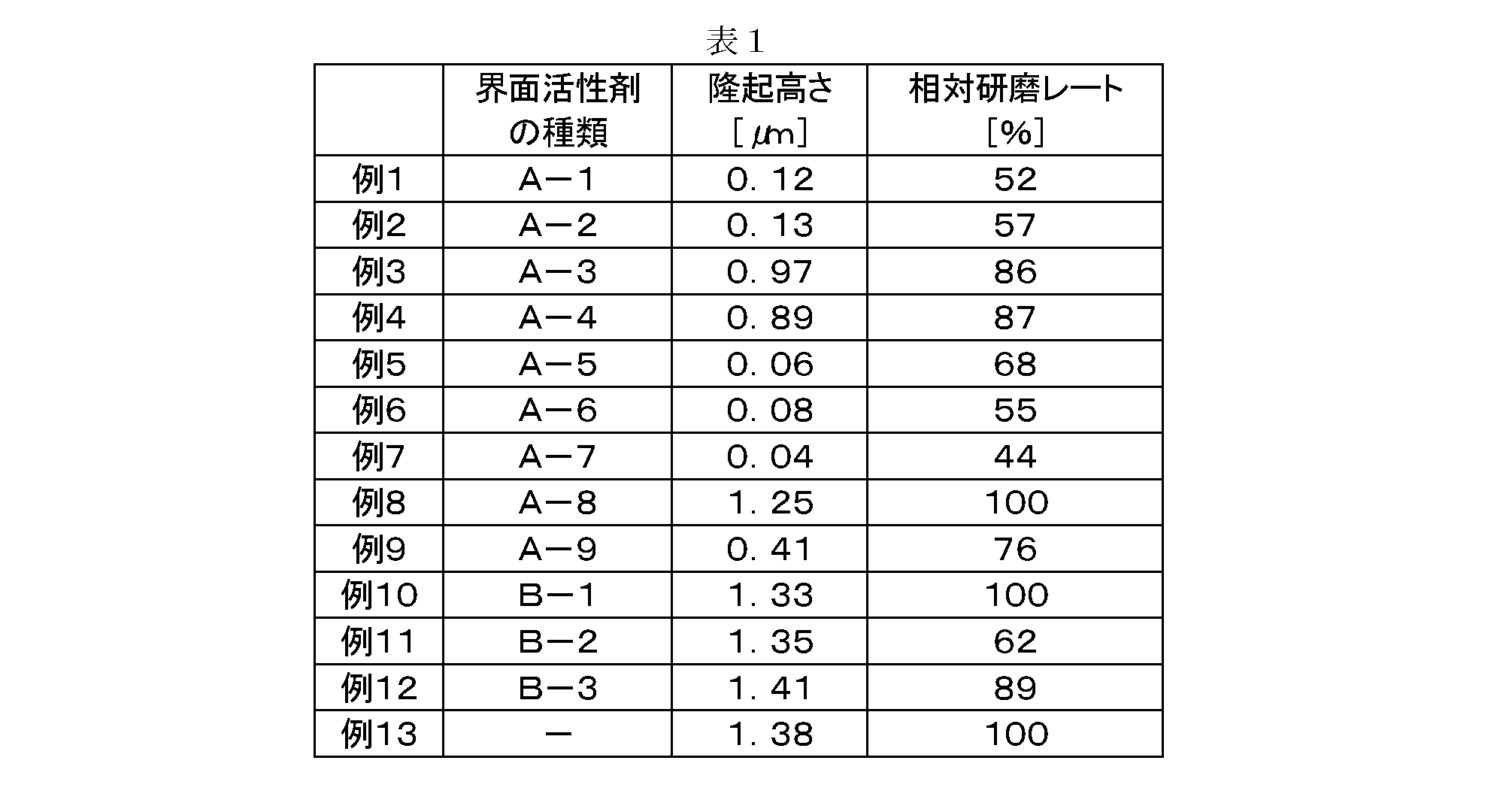
表1に示されるように、界面活性剤A-1~A-8を用いた例1~8に係る研磨用組成物によると、界面活性剤を含まない例13の研磨用組成物に比べて、いずれも隆起解消性が改善された。また、界面活性剤A-1、A-2、およびA-5~A-7を用いた例1、2、および5~7に係る研磨用組成物によると、特に優れた隆起解消性が発揮されることが明らかとなった。また、界面活性剤A-9を用いた例9に係る研磨用組成物によると、研磨レートの減少を抑制しつつ優れた隆起解消性が発揮されることが明らかとなった。
一方、界面活性剤B-1~B-3を用いた例10~12に係る研磨用組成物では、例13に係る研磨用組成物に比べて、隆起解消性を向上させる効果はほとんど認められず、あるいはむしろ隆起解消性が低下した。また、例10と例13の対比から、少なくとも隆起解消性および研磨レートに関しては、界面活性剤B-1を添加した効果はほとんど見られないことがわかった。
以上、本発明の具体例を詳細に説明したが、これらは例示にすぎず、請求の範囲を限定するものではない。特許請求の範囲に記載の技術には、以上に例示した具体例を様々に変形、変更したものが含まれる。
Claims (15)
- シリコン基板の予備研磨工程に使用するための研磨用組成物であって、
砥粒、塩基性化合物、界面活性剤および水を含み、
前記界面活性剤として、第四級アンモニウム型ベタイン構造を有する界面活性剤A1を含む、研磨用組成物。 - 前記界面活性剤A1は、炭素原子数1~15の直鎖状または分枝状のアルキル基を含む、請求項1に記載の研磨用組成物。
- 前記界面活性剤A1は、炭素原子数10~12の直鎖状または分枝状のアルキル基を含む、請求項1または2に記載の研磨用組成物。
- 前記界面活性剤A1は、アルキルジメチルアミノ酢酸ベタイン、アルキルアミノジメチルスルホプロピルベタインおよび脂肪酸アミドプロピルベタインからなる群から選ばれる一種または二種以上を含む、請求項1から3のいずれか一項に記載の研磨用組成物。
- 前記界面活性剤A1の含有量は、前記砥粒100重量部に対して、0.0035重量部以上3.5重量部以下である、請求項1から4のいずれか一項に記載の研磨用組成物。
- 前記界面活性剤A1の含有量は、前記砥粒100重量部に対して、0.0035重量部以上0.15重量部以下である、請求項1から5のいずれか一項に記載の研磨用組成物。
- シリコン基板の予備研磨工程に使用するための研磨用組成物であって、
砥粒、塩基性化合物、界面活性剤および水を含み、
前記界面活性剤として、第四級アンモニウム塩構造を含みかつオキシアルキレン構造を含まない界面活性剤A2を含む、研磨用組成物。 - 前記界面活性剤A2は、両性界面活性剤を含む、請求項7に記載の研磨用組成物。
- 前記界面活性剤A2は、カチオン性界面活性剤を含む、請求項7に記載の研磨用組成物。
- 前記界面活性剤A2は、炭素原子数1~15の直鎖状または分枝状のアルキル基を含む、請求項7から9のいずれか一項に記載の研磨用組成物。
- 前記界面活性剤A2の含有量は、前記砥粒100重量部に対して、0.0035重量部以上3.5重量部以下である、請求項7から10のいずれか一項に記載の研磨用組成物。
- 前記塩基性化合物として、水酸化第四級アンモニウムまたはその塩を含む、請求項1から11のいずれか一項に記載の研磨用組成物。
- 前記砥粒はシリカ粒子である、請求項1から12のいずれか一項に記載の研磨用組成物。
- さらに弱酸塩を含む、請求項1から13のいずれか一項に記載の研磨用組成物。
- 前記弱酸塩は炭酸カリウムである、請求項14に記載の研磨用組成物。
Priority Applications (1)
| Application Number | Priority Date | Filing Date | Title |
|---|---|---|---|
| JP2020510875A JP7237933B2 (ja) | 2018-03-28 | 2019-03-26 | 研磨用組成物 |
Applications Claiming Priority (4)
| Application Number | Priority Date | Filing Date | Title |
|---|---|---|---|
| JP2018061126 | 2018-03-28 | ||
| JP2018-061125 | 2018-03-28 | ||
| JP2018061125 | 2018-03-28 | ||
| JP2018-061126 | 2018-03-28 |
Publications (1)
| Publication Number | Publication Date |
|---|---|
| WO2019189124A1 true WO2019189124A1 (ja) | 2019-10-03 |
Family
ID=68061767
Family Applications (1)
| Application Number | Title | Priority Date | Filing Date |
|---|---|---|---|
| PCT/JP2019/012773 Ceased WO2019189124A1 (ja) | 2018-03-28 | 2019-03-26 | 研磨用組成物 |
Country Status (3)
| Country | Link |
|---|---|
| JP (1) | JP7237933B2 (ja) |
| TW (1) | TW201942322A (ja) |
| WO (1) | WO2019189124A1 (ja) |
Cited By (2)
| Publication number | Priority date | Publication date | Assignee | Title |
|---|---|---|---|---|
| JP2021064749A (ja) * | 2019-10-17 | 2021-04-22 | Jsr株式会社 | 半導体処理用組成物及び処理方法 |
| WO2022154016A1 (ja) | 2021-01-18 | 2022-07-21 | 株式会社フジミインコーポレーテッド | 研磨用組成物 |
Families Citing this family (1)
| Publication number | Priority date | Publication date | Assignee | Title |
|---|---|---|---|---|
| CN121495540B (zh) * | 2025-11-24 | 2026-04-17 | 上海凯锐恩半导体科技有限公司 | 一种用于14纳米cmp制程的研磨液及其制备方法与应用 |
Citations (4)
| Publication number | Priority date | Publication date | Assignee | Title |
|---|---|---|---|---|
| JP2013251561A (ja) * | 2008-02-01 | 2013-12-12 | Fujimi Inc | 研磨用組成物及びそれを用いた研磨方法 |
| JP2016215336A (ja) * | 2015-05-22 | 2016-12-22 | 株式会社フジミインコーポレーテッド | 研磨方法及び組成調整剤 |
| JP2017190363A (ja) * | 2016-04-11 | 2017-10-19 | 花王株式会社 | サファイア板用研磨液組成物 |
| WO2018193916A1 (ja) * | 2017-04-17 | 2018-10-25 | 日産化学株式会社 | 両性界面活性剤を含む研磨用組成物 |
-
2019
- 2019-03-26 WO PCT/JP2019/012773 patent/WO2019189124A1/ja not_active Ceased
- 2019-03-26 JP JP2020510875A patent/JP7237933B2/ja active Active
- 2019-03-28 TW TW108110841A patent/TW201942322A/zh unknown
Patent Citations (4)
| Publication number | Priority date | Publication date | Assignee | Title |
|---|---|---|---|---|
| JP2013251561A (ja) * | 2008-02-01 | 2013-12-12 | Fujimi Inc | 研磨用組成物及びそれを用いた研磨方法 |
| JP2016215336A (ja) * | 2015-05-22 | 2016-12-22 | 株式会社フジミインコーポレーテッド | 研磨方法及び組成調整剤 |
| JP2017190363A (ja) * | 2016-04-11 | 2017-10-19 | 花王株式会社 | サファイア板用研磨液組成物 |
| WO2018193916A1 (ja) * | 2017-04-17 | 2018-10-25 | 日産化学株式会社 | 両性界面活性剤を含む研磨用組成物 |
Cited By (4)
| Publication number | Priority date | Publication date | Assignee | Title |
|---|---|---|---|---|
| JP2021064749A (ja) * | 2019-10-17 | 2021-04-22 | Jsr株式会社 | 半導体処理用組成物及び処理方法 |
| JP7375450B2 (ja) | 2019-10-17 | 2023-11-08 | Jsr株式会社 | 半導体処理用組成物及び処理方法 |
| WO2022154016A1 (ja) | 2021-01-18 | 2022-07-21 | 株式会社フジミインコーポレーテッド | 研磨用組成物 |
| KR20230134132A (ko) | 2021-01-18 | 2023-09-20 | 가부시키가이샤 후지미인코퍼레이티드 | 연마용 조성물 |
Also Published As
| Publication number | Publication date |
|---|---|
| JPWO2019189124A1 (ja) | 2021-03-18 |
| JP7237933B2 (ja) | 2023-03-13 |
| TW201942322A (zh) | 2019-11-01 |
Similar Documents
| Publication | Publication Date | Title |
|---|---|---|
| TWI658132B (zh) | 研磨用組成物、研磨用組成物之製造方法及矽晶圓製造方法 | |
| JP6250454B2 (ja) | シリコン材料研磨用組成物 | |
| KR102575250B1 (ko) | 연마용 조성물, 그 제조 방법 및 연마용 조성물을 사용한 연마 방법 | |
| JP7677898B2 (ja) | 研磨用組成物 | |
| WO2019189124A1 (ja) | 研磨用組成物 | |
| JP6482200B2 (ja) | 研磨用組成物 | |
| TW201518488A (zh) | 研磨用組成物及其製造方法 | |
| JP7440423B2 (ja) | 研磨用組成物 | |
| JP2015189829A (ja) | 研磨用組成物 | |
| JP7253335B2 (ja) | 研磨用組成物、その製造方法および研磨用組成物を用いた研磨方法 | |
| JP2025096507A (ja) | 研磨用組成物 | |
| JP7550771B2 (ja) | 研磨用組成物 | |
| JP6373029B2 (ja) | 研磨用組成物 | |
| JP7319190B2 (ja) | 研磨用組成物 | |
| JP2020035870A (ja) | 研磨用組成物 | |
| JP6436638B2 (ja) | 研磨用組成物 | |
| JP6572288B2 (ja) | シリコン材料研磨用組成物 | |
| JP2018129397A (ja) | 研磨用組成物 | |
| WO2025037542A1 (ja) | 研磨用組成物 | |
| TW202328394A (zh) | 研磨用組成物 |
Legal Events
| Date | Code | Title | Description |
|---|---|---|---|
| 121 | Ep: the epo has been informed by wipo that ep was designated in this application |
Ref document number: 19776494 Country of ref document: EP Kind code of ref document: A1 |
|
| ENP | Entry into the national phase |
Ref document number: 2020510875 Country of ref document: JP Kind code of ref document: A |
|
| NENP | Non-entry into the national phase |
Ref country code: DE |
|
| 122 | Ep: pct application non-entry in european phase |
Ref document number: 19776494 Country of ref document: EP Kind code of ref document: A1 |