WO2019167481A1 - 感活性光線性又は感放射線性樹脂組成物、感活性光線性又は感放射線性膜、パターン形成方法、及び電子デバイスの製造方法 - Google Patents
感活性光線性又は感放射線性樹脂組成物、感活性光線性又は感放射線性膜、パターン形成方法、及び電子デバイスの製造方法 Download PDFInfo
- Publication number
- WO2019167481A1 WO2019167481A1 PCT/JP2019/001941 JP2019001941W WO2019167481A1 WO 2019167481 A1 WO2019167481 A1 WO 2019167481A1 JP 2019001941 W JP2019001941 W JP 2019001941W WO 2019167481 A1 WO2019167481 A1 WO 2019167481A1
- Authority
- WO
- WIPO (PCT)
- Prior art keywords
- group
- sensitive
- radiation
- actinic ray
- resin composition
- Prior art date
- Legal status (The legal status is an assumption and is not a legal conclusion. Google has not performed a legal analysis and makes no representation as to the accuracy of the status listed.)
- Ceased
Links
Classifications
-
- G—PHYSICS
- G03—PHOTOGRAPHY; CINEMATOGRAPHY; ANALOGOUS TECHNIQUES USING WAVES OTHER THAN OPTICAL WAVES; ELECTROGRAPHY; HOLOGRAPHY
- G03F—PHOTOMECHANICAL PRODUCTION OF TEXTURED OR PATTERNED SURFACES, e.g. FOR PRINTING, FOR PROCESSING OF SEMICONDUCTOR DEVICES; MATERIALS THEREFOR; ORIGINALS THEREFOR; APPARATUS SPECIALLY ADAPTED THEREFOR
- G03F7/00—Photomechanical, e.g. photolithographic, production of textured or patterned surfaces, e.g. printing surfaces; Materials therefor, e.g. comprising photoresists; Apparatus specially adapted therefor
- G03F7/004—Photosensitive materials
-
- G—PHYSICS
- G03—PHOTOGRAPHY; CINEMATOGRAPHY; ANALOGOUS TECHNIQUES USING WAVES OTHER THAN OPTICAL WAVES; ELECTROGRAPHY; HOLOGRAPHY
- G03F—PHOTOMECHANICAL PRODUCTION OF TEXTURED OR PATTERNED SURFACES, e.g. FOR PRINTING, FOR PROCESSING OF SEMICONDUCTOR DEVICES; MATERIALS THEREFOR; ORIGINALS THEREFOR; APPARATUS SPECIALLY ADAPTED THEREFOR
- G03F7/00—Photomechanical, e.g. photolithographic, production of textured or patterned surfaces, e.g. printing surfaces; Materials therefor, e.g. comprising photoresists; Apparatus specially adapted therefor
- G03F7/20—Exposure; Apparatus therefor
Definitions
- the present invention relates to an actinic ray-sensitive or radiation-sensitive resin composition, an actinic ray-sensitive or radiation-sensitive film, a pattern formation method, and an electronic device manufacturing method.
- a pattern formation method using chemical amplification has been used to compensate for the sensitivity reduction due to light absorption.
- a photoacid generator contained in an exposed portion is decomposed by light irradiation to generate an acid.
- PEB Post Exposure Bake
- the alkali-insoluble group contained in the photosensitive composition is changed to an alkali-soluble group by the catalytic action of the generated acid.
- development is performed using, for example, an alkaline solution.
- an exposed part is removed and a desired pattern is obtained.
- various alkali developers have been proposed.
- this alkaline developer a 2.38 mass% TMAH (tetramethylammonium hydroxide aqueous solution) aqueous alkaline developer is generally used.
- the exposure light source has become shorter and the projection lens has a higher numerical aperture (high NA).
- high NA numerical aperture
- an exposure machine using an ArF excimer laser having a wavelength of 193 nm as a light source has been developed.
- a method of filling a liquid having a high refractive index (hereinafter also referred to as “immersion liquid”) between the projection lens and the sample has been proposed.
- Patent Document 1 discloses a resist composition that generates an acid upon exposure and changes its solubility in a developer due to the action of an acid, and includes a base material component whose solubility in a developer changes due to the action of an acid.
- a resist composition containing a nitrogen-containing compound having a boiling point of 50 to 200 ° C. and a pKa of a conjugate acid of 0 to 7 and a photobase deactivator is described.
- Patent Document 2 discloses a polymer compound having a repeating unit in which a hydroxy group is substituted with an acid labile group and an acid generator, or a repeating unit in which a hydroxy group is substituted with an acid labile group and a repeating unit that generates an acid upon exposure.
- a resist composition containing a polymer compound having a unit, a sulfonium salt or an iodonium salt of fluoroalkylsulfonamide, and an organic solvent is applied on a substrate, and after the heat treatment, the resist film is exposed with a high energy ray, and the heat treatment is performed.
- a pattern forming method for obtaining a negative pattern in which an unexposed portion is dissolved by using a developer with an organic solvent later and the exposed portion is not dissolved is described.
- the problem to be solved by the present invention is excellent in the LWR performance and the rectangular shape of the cross-sectional shape of the pattern, and at the time of forming a blank pattern (for example, an isolated hole pattern) and a remaining pattern (for example, an isolated dot pattern).
- a blank pattern for example, an isolated hole pattern
- a remaining pattern for example, an isolated dot pattern.
- the present inventors have intensively studied and found that the above problem can be solved by using an onium salt having an amide structure (onium salt (C)) in a counter cation having a specific structure.
- the onium salt (C) used in the present invention has an amide structure and has a weaker basicity than a basic compound (typically amines) usually used in a resist composition.
- the portion hardly inhibits the action of the acid generated from the photoacid generator, and the unexposed portion functions sufficiently as an acid quencher (trap agent). Thereby, it is considered that the LWR performance can be improved.
- the onium salt (C) used in the present invention has a low volatility by having a salt structure, and can suppress volatilization from the film surface that occurs when an actinic ray-sensitive or radiation-sensitive film is formed.
- the presence of the onium salt (C) as a quencher at the upper part of the pattern can obtain a desired pattern shape, so that the rectangularity of the cross-sectional shape of the pattern and the LWR performance can be improved. it is conceivable that.
- the onium salt (C) was able to improve the common DOF performance because it has an appropriate diffusivity in addition to the above-described characteristics.
- the present inventors have found that the above problem can be solved by the following configuration.
- An actinic ray-sensitive or radiation-sensitive resin composition containing The onium salt (C) is represented by the following general formula (1), The actinic ray-sensitive or radiation-sensitive resin composition, wherein the content of the onium salt (C) in the actinic ray-sensitive or radiation-sensitive resin composition is less than the content of the compound (B) in terms of mole.
- X 1 represents a sulfur atom, an iodine atom, or a nitrogen atom
- Q 1 represents a group having an amide structure
- Q 2 represents an alkyl group, a cycloalkyl group, or an aryl group.
- at least one of Q 1 and k Q 2 represents an alkyl group or a cycloalkyl group.
- X 1 represents a sulfur atom
- k 2
- X 1 represents an iodine atom
- Y 1 represents an organic counter anion.
- Q 1 and at least one of k Q 2 may be bonded to each other to form a ring structure.
- Q 3 and Q 4 each independently represents an alkyl group or a cycloalkyl group
- L 1 represents an alkylene group or a cycloalkylene group
- Q 5 and Q 6 each independently represent a hydrogen atom
- an alkyl group Represents a group, a cycloalkyl group, an alkenyl group, a cycloalkenyl group, an alkynyl group, a cycloalkynyl group, an aryl group, or a heteroaryl group.
- At least two of Q 3 to Q 6 and L 1 may be bonded to each other to form a ring structure.
- Y 2 is an organic counter anion.
- the actinic ray-sensitive or radiation-sensitive resin composition according to item 1. [8] The actinic ray according to any one of [1] to [7], further comprising (D) a hydrophobic resin having at least one of a fluorine atom and a silicon atom, which is different from the resin (A). Or radiation sensitive resin composition. [9] The actinic ray-sensitive or radiation-sensitive resin composition according to [8], wherein the hydrophobic resin (D) is a fluorine-containing (meth) acrylate resin. [10] The content of the hydrophobic resin (D) in the actinic ray-sensitive or radiation-sensitive resin composition is 1 to 10% by mass based on the total solid content of the actinic ray-sensitive or radiation-sensitive resin composition.
- the actinic ray-sensitive or radiation-sensitive resin composition according to [8] or [9].
- the LWR performance and the rectangular shape of the cross-sectional shape of the pattern are excellent, and a large common DOF is felt when forming a blank pattern (for example, an isolated hole pattern) and a remaining pattern (for example, an isolated dot pattern).
- An actinic ray-sensitive or radiation-sensitive resin composition, an actinic ray-sensitive or radiation-sensitive film using the same, a pattern formation method, and an electronic device manufacturing method can be provided.
- the description of group (atomic group) in this specification the description which has not described substitution and non-substitution includes what has a substituent with what does not have a substituent.
- the “alkyl group” includes not only an alkyl group having no substituent (unsubstituted alkyl group) but also an alkyl group having a substituent (substituted alkyl group).
- the “organic group” refers to a group containing at least one carbon atom.
- active light refers to, for example, an emission line spectrum of a mercury lamp, far ultraviolet rays represented by an excimer laser, extreme ultraviolet rays (EUV), X-rays, and electron beams (EB: Electron Beam) or the like.
- light means actinic rays or radiation.
- exposure in the present specification is not only exposure by the emission line spectrum of a mercury lamp, deep ultraviolet rays represented by excimer laser, extreme ultraviolet rays, X-rays, EUV, etc., but also electron beams and ions. This includes drawing with particle beams such as beams.
- “to” is used to mean that the numerical values described before and after it are included as a lower limit value and an upper limit value.
- (meth) acrylate represents acrylate and methacrylate
- (meth) acryl represents acryl and methacryl
- the weight average molecular weight (Mw), number average molecular weight (Mn), and dispersity (also referred to as molecular weight distribution) (Mw / Mn) of the resin are GPC (Gel Permeation Chromatography) apparatus (HLC-produced by Tosoh Corporation).
- the actinic ray-sensitive or radiation-sensitive resin composition of the present invention (hereinafter also referred to as “the composition of the present invention”) will be described.
- the composition of the present invention comprises (A) a resin whose polarity is increased by the action of an acid to change its solubility in a developer, (B) a compound that generates an acid upon irradiation with actinic rays or radiation, and (C) a counter cation. It contains an onium salt having an amide structure.
- the actinic ray-sensitive or radiation-sensitive resin composition of the present invention is preferably a resist composition, and may be a positive resist composition or a negative resist composition. Further, it may be a resist composition for alkali development or a resist composition for organic solvent development.
- the resist composition of the present invention is typically a chemically amplified resist composition.
- the actinic ray-sensitive or radiation-sensitive resin composition of the present invention is also referred to as a resin ("acid-decomposable resin” or "resin (A)") whose polarity is increased by the action of an acid and its solubility in a developer is changed. ).
- the resin (A) preferably has a group (hereinafter also referred to as “acid-decomposable group”) that is decomposed by the action of an acid to increase the polarity.
- the resin (A) is a resin that increases in polarity by the action of an acid and increases in solubility in an alkaline developer, and is preferably a resin that decreases in solubility in an organic developer.
- a positive pattern is suitably formed, and when an organic developer is used as the developer, a negative pattern is formed.
- a mold pattern is suitably formed.
- Resin (A) preferably has a repeating unit having an acid-decomposable group.
- the acid-decomposable group preferably has a structure in which a polar group is protected with a group capable of decomposing and leaving by the action of an acid (leaving group).
- polar groups carboxyl group, phenolic hydroxyl group, fluorinated alcohol group, sulfonic acid group, sulfonamide group, sulfonylimide group, (alkylsulfonyl) (alkylcarbonyl) methylene group, (alkylsulfonyl) (alkylcarbonyl) imide group Bis (alkylcarbonyl) methylene group, bis (alkylcarbonyl) imide group, bis (alkylsulfonyl) methylene group, bis (alkylsulfonyl) imide group, tris (alkylcarbonyl) methylene group, tris (alkylsulfonyl) methylene group, etc. Acid groups (groups dissociating in an aqueous 2.38 mass
- the alcoholic hydroxyl group is a hydroxyl group bonded to a hydrocarbon group and means a hydroxyl group other than a hydroxyl group directly bonded on an aromatic ring (phenolic hydroxyl group). Excludes aliphatic alcohols substituted with sexual groups (for example, hexafluoroisopropanol groups).
- the alcoholic hydroxyl group is preferably a hydroxyl group having a pKa (acid dissociation constant) of 12 or more and 20 or less.
- Preferred polar groups include carboxyl groups, phenolic hydroxyl groups, fluorinated alcohol groups (preferably hexafluoroisopropanol groups), and sulfonic acid groups.
- a preferable group as the acid-decomposable group is a group in which the hydrogen atom of these groups is substituted with a group capable of leaving by the action of an acid (leaving group).
- Examples of the group (leaving group) leaving by the action of an acid include —C (R 36 ) (R 37 ) (R 38 ), —C (R 36 ) (R 37 ) (OR 39 ), and — And C (R 01 ) (R 02 ) (OR 39 ).
- R 36 to R 39 each independently represents an alkyl group, a cycloalkyl group, an aryl group, an aralkyl group or an alkenyl group.
- R 36 and R 37 may be bonded to each other to form a ring.
- R 01 and R 02 each independently represents a hydrogen atom, an alkyl group, a cycloalkyl group, an aryl group, an aralkyl group or an alkenyl group.
- the alkyl group of R 36 to R 39 , R 01 and R 02 is preferably an alkyl group having 1 to 8 carbon atoms, for example, methyl group, ethyl group, propyl group, n-butyl group, sec-butyl group, hexyl Group, and octyl group.
- the cycloalkyl group of R 36 to R 39 , R 01 and R 02 may be monocyclic or polycyclic.
- the monocyclic type is preferably a cycloalkyl group having 3 to 8 carbon atoms, and examples thereof include a cyclopropyl group, a cyclobutyl group, a cyclopentyl group, a cyclohexyl group, and a cyclooctyl group.
- a cycloalkyl group having 6 to 20 carbon atoms is preferable.
- the aryl group of R 36 to R 39 , R 01 and R 02 is preferably an aryl group having 6 to 10 carbon atoms, and examples thereof include a phenyl group, a naphthyl group, and an anthryl group.
- the aralkyl group of R 36 to R 39 , R 01 and R 02 is preferably an aralkyl group having 7 to 12 carbon atoms, and examples thereof include a benzyl group, a phenethyl group, and a naphthylmethyl group.
- the alkenyl group of R 36 to R 39 , R 01 and R 02 is preferably an alkenyl group having 2 to 8 carbon atoms, and examples thereof include a vinyl group, an allyl group, a butenyl group, and a cyclohexenyl group.
- the ring formed by combining R 36 and R 37 with each other is preferably a cycloalkyl group (monocyclic or polycyclic).
- cycloalkyl group a monocyclic cycloalkyl group such as a cyclopentyl group and a cyclohexyl group, or a polycyclic cycloalkyl group such as a norbornyl group, a tetracyclodecanyl group, a tetracyclododecanyl group, and an adamantyl group is preferable. .
- a cumyl ester group, an enol ester group, an acetal ester group, or a tertiary alkyl ester group is preferable, and an acetal ester group or a tertiary alkyl ester group is more preferable.
- the resin (A) preferably has a repeating unit represented by the following general formula (AI) as a repeating unit having an acid-decomposable group.
- Xa 1 represents a hydrogen atom, a halogen atom, or a monovalent organic group.
- T represents a single bond or a divalent linking group.
- Rx 1 to Rx 3 each independently represents an alkyl group or a cycloalkyl group. Any two of Rx 1 to Rx 3 may be bonded to form a ring structure, or may not be formed.
- Examples of the divalent linking group for T include an alkylene group, an arylene group, —COO—Rt—, —O—Rt—, and the like.
- Rt represents an alkylene group, a cycloalkylene group, or an arylene group.
- T is preferably a single bond or —COO—Rt—.
- Rt is preferably a chain alkylene group having 1 to 5 carbon atoms, more preferably —CH 2 —, — (CH 2 ) 2 —, or — (CH 2 ) 3 —. More preferably, T is a single bond.
- Xa 1 is preferably a hydrogen atom or an alkyl group.
- the alkyl group of Xa 1 may have a substituent, and examples of the substituent include a hydroxyl group and a halogen atom (preferably a fluorine atom).
- the alkyl group of Xa 1 preferably has 1 to 4 carbon atoms, and examples thereof include a methyl group, an ethyl group, a propyl group, a hydroxymethyl group, and a trifluoromethyl group.
- the alkyl group of Xa 1 is preferably a methyl group.
- the alkyl group of Rx 1 , Rx 2 and Rx 3 may be linear or branched, and is a methyl group, ethyl group, n-propyl group, isopropyl group, n-butyl group, isobutyl. Group, t-butyl group and the like are preferable.
- the number of carbon atoms of the alkyl group is preferably 1 to 10, more preferably 1 to 5, and still more preferably 1 to 3.
- a part of the carbon-carbon bond may be a double bond.
- Examples of the cycloalkyl group represented by Rx 1 , Rx 2 and Rx 3 include a monocyclic cycloalkyl group such as a cyclopentyl group and a cyclohexyl group, or a norbornyl group, a tetracyclodecanyl group, a tetracyclododecanyl group, an adamantyl group, and the like.
- the polycyclic cycloalkyl group is preferable.
- the ring structure formed by combining two of Rx 1 , Rx 2 and Rx 3 includes a monocyclic cycloalkane ring such as a cyclopentyl ring, a cyclohexyl ring, a cycloheptyl ring, and a cyclooctane ring, a norbornane ring, a tetracyclo ring, or the like.
- a polycyclic cycloalkyl ring such as a decane ring, a tetracyclododecane ring and an adamantane ring is preferred.
- a cyclopentyl ring, a cyclohexyl ring, or an adamantane ring is more preferable.
- the ring structure formed by combining two of Rx 1 , Rx 2 and Rx 3 the structures shown below are also preferable.
- the resin (A) preferably has a repeating unit described in paragraphs ⁇ 0336> to ⁇ 0369> of US Patent Application Publication No. 2016 / 0070167A1 as a repeating unit having an acid-decomposable group.
- Resin (A) is decomposed by the action of an acid described in paragraphs ⁇ 0363> to ⁇ 0364> of US Patent Application Publication No. 2016 / 0070167A1 as a repeating unit having an acid-decomposable group. You may have a repeating unit containing the group which produces
- Resin (A) may contain one type of repeating unit having an acid-decomposable group, or two or more types in combination.
- the content of the repeating unit having an acid-decomposable group contained in the resin (A) (when there are a plurality of repeating units having an acid-decomposable group, the total) is based on the total repeating units of the resin (A), 10 to 90 mol% is preferable, 20 to 80 mol% is more preferable, and 30 to 70 mol% is still more preferable.
- Resin (A) preferably has a repeating unit having at least one selected from the group consisting of a lactone structure, a sultone structure, and a carbonate structure.
- Any lactone structure or sultone structure can be used as long as it has a lactone structure or sultone structure, but a 5- to 7-membered ring lactone structure or a 5- to 7-membered ring sultone structure is preferable.
- lactone structure represented by any of the following general formulas (LC1-1) to (LC1-21) or a sultone structure represented by any of the following general formulas (SL1-1) to (SL1-3) More preferably, it has a repeating unit.
- a lactone structure or a sultone structure may be directly bonded to the main chain. Preferred structures are (LC1-1), (LC1-4), (LC1-5), (LC1-8), (LC1-16), (LC1-21) and (SL1-1).
- the lactone structure portion or the sultone structure portion may or may not have a substituent (Rb 2 ).
- Preferred substituents (Rb 2 ) include alkyl groups having 1 to 8 carbon atoms, cycloalkyl groups having 4 to 7 carbon atoms, alkoxy groups having 1 to 8 carbon atoms, alkoxycarbonyl groups having 2 to 8 carbon atoms, and carboxyl groups.
- n 2 represents an integer of 0 to 4. When n 2 is 2 or more, the plurality of substituents (Rb 2 ) may be the same or different. A plurality of substituents (Rb 2 ) may be bonded to form a ring.
- the repeating unit having a lactone structure or a sultone structure is preferably a repeating unit represented by the following general formula (III).
- A represents an ester bond (a group represented by —COO—) or an amide bond (a group represented by —CONH—).
- n is the number of repetitions of the structure represented by —R 0 —Z—, and represents an integer of 0 to 5, preferably 0 or 1, and more preferably 0.
- R 0 represents an alkylene group, a cycloalkylene group, or a combination thereof.
- each R 0 independently represents an alkylene group, a cycloalkylene group, or a combination thereof.
- Z represents a single bond, an ether bond, an ester bond, an amide bond, a urethane bond or a urea bond.
- each independently represents a single bond, an ether bond, an ester bond, an amide bond, a urethane bond or a urea bond.
- R 8 represents a monovalent organic group having a lactone structure or a sultone structure.
- R 7 represents a hydrogen atom, a halogen atom or a monovalent organic group (preferably a methyl group).
- the alkylene group or cycloalkylene group of R 0 may have a substituent.
- Z is preferably an ether bond or an ester bond, and more preferably an ester bond.
- the following monomers are also suitably used as the raw material for the resin (A).
- the resin (A) may have a repeating unit having a carbonate structure.
- the carbonate structure is preferably a cyclic carbonate structure.
- the repeating unit having a cyclic carbonate structure is preferably a repeating unit represented by the following general formula (A-1).
- R A 1 represents a hydrogen atom, a halogen atom or a monovalent organic group (preferably a methyl group).
- n represents an integer of 0 or more.
- R A 2 represents a substituent.
- R A 2 each independently represents a substituent when n is 2 or more.
- A represents a single bond or a divalent linking group.
- Z represents an atomic group that forms a monocyclic structure or a polycyclic structure together with a group represented by —O—C ( ⁇ O) —O— in the formula.
- the resin (A) is a repeating unit having at least one selected from the group consisting of a lactone structure, a sultone structure, and a carbonate structure, and paragraphs ⁇ 0370> to ⁇ 0414> of US Patent Application Publication No. 2016 / 0070167A1. It is also preferable to have the repeating unit described in 1.
- Resin (A) may contain one or more repeating units having at least one selected from the group consisting of a lactone structure, a sultone structure, and a carbonate structure, or may contain two or more kinds in combination.
- the total (when there are a plurality of repeating units having at least one kind) is preferably 5 to 70 mol%, and preferably 10 to 65 mol%, based on all the repeating units of the resin (A). More preferably, it is more preferably 20 to 60 mol%.
- the resin (A) preferably has a repeating unit having a polar group.
- the polar group include a hydroxyl group, a cyano group, a carboxyl group, and a fluorinated alcohol group.
- the repeating unit having a polar group is preferably a repeating unit having an alicyclic hydrocarbon structure substituted with a polar group.
- the repeating unit which has a polar group does not have an acid-decomposable group.
- the alicyclic hydrocarbon structure in the alicyclic hydrocarbon structure substituted with a polar group is preferably an adamantyl group or a norbornane group.
- Resin (A) may contain the repeating unit which has a polar group individually by 1 type, and may contain 2 or more types together.
- the content of the repeating unit having a polar group is preferably from 5 to 40 mol%, more preferably from 5 to 30 mol%, still more preferably from 10 to 25 mol%, based on all repeating units in the resin (A).
- Resin (A) can further have a repeating unit having neither an acid-decomposable group nor a polar group.
- the repeating unit having neither an acid-decomposable group nor a polar group preferably has an alicyclic hydrocarbon structure.
- Examples of the repeating unit having neither an acid-decomposable group nor a polar group include the repeating units described in paragraphs ⁇ 0236> to ⁇ 0237> of US Patent Application Publication No. 2016 / 0026083A1.
- Preferred examples of the monomer corresponding to the repeating unit having neither an acid-decomposable group nor a polar group are shown below.
- Resin (A) may contain the repeating unit which has neither an acid-decomposable group nor a polar group individually by 1 type, and may contain 2 or more types together.
- the content of the repeating unit having neither an acid-decomposable group nor a polar group is preferably from 5 to 40 mol%, more preferably from 5 to 30 mol%, based on all repeating units in the resin (A). 5 to 25 mol% is more preferable.
- Resin (A) adjusts dry etching resistance, standard developer suitability, substrate adhesion, resist profile, and resolution, heat resistance, sensitivity, etc., which are general required properties of resist, in addition to the above repeating structural units.
- various repeating structural units can be included. Examples of such a repeating structural unit include, but are not limited to, a repeating structural unit corresponding to a monomer.
- the monomer examples include compounds having one addition polymerizable unsaturated bond selected from acrylic esters, methacrylic esters, acrylamides, methacrylamides, allyl compounds, vinyl ethers, vinyl esters, and the like. Can be mentioned. In addition, any addition-polymerizable unsaturated compound that can be copolymerized with monomers corresponding to the above various repeating structural units may be copolymerized. In the resin (A), the content molar ratio of each repeating structural unit is appropriately set in order to adjust various performances.
- the resin (A) preferably has substantially no aromatic group from the viewpoint of ArF light transmittance. More specifically, the repeating unit having an aromatic group in all the repeating units of the resin (A) is preferably 5 mol% or less, more preferably 3 mol% or less, ideally Is more preferably 0 mol%, that is, it does not have a repeating unit having an aromatic group.
- the resin (A) preferably has a monocyclic or polycyclic alicyclic hydrocarbon structure.
- all of the repeating units are composed of (meth) acrylate-based repeating units.
- all of the repeating units are methacrylate repeating units, all of the repeating units are acrylate repeating units, or all of the repeating units are methacrylate repeating units and acrylate repeating units.
- the acrylate-based repeating unit is 50 mol% or less with respect to all the repeating units of the resin (A).
- the resin (A) preferably contains a repeating unit having an aromatic hydrocarbon group. It is more preferable that the resin (A) contains a repeating unit containing a phenolic hydroxyl group. Examples of the repeating unit containing a phenolic hydroxyl group include a hydroxystyrene repeating unit and a hydroxystyrene (meth) acrylate repeating unit.
- the resin (A) is a group (leaving group) in which the hydrogen atom of the phenolic hydroxyl group is decomposed and eliminated by the action of an acid.
- the content of the repeating unit having an aromatic hydrocarbon group contained in the resin (A) is preferably from 30 to 100 mol%, more preferably from 40 to 100 mol%, based on all repeating units in the resin (A). 50 to 100 mol% is more preferable.
- the weight average molecular weight of the resin (A) is preferably 1,000 to 200,000, more preferably 2,000 to 20,000, still more preferably 3,000 to 15,000, and more preferably 3,000 to 11,000. Particularly preferred.
- the degree of dispersion (Mw / Mn) is usually 1.0 to 3.0, preferably 1.0 to 2.6, more preferably 1.0 to 2.0, and even more preferably 1.1 to 2.0. preferable.
- Resin (A) may be used individually by 1 type, and may use 2 or more types together.
- the content of the resin (A) in the total solid content of the composition of the present invention is generally 20% by mass or more. 40 mass% or more is preferable, 60 mass% or more is more preferable, and 80 mass% or more is still more preferable. Although an upper limit in particular is not restrict
- the total solid content in the composition represents all components other than the solvent in the composition.
- composition of the present invention contains a compound (also referred to as “compound (B)”, “photoacid generator”, or “acid generator”) that generates an acid upon irradiation with actinic rays or radiation.
- a photo-acid generator the compound which generate
- Examples thereof include sulfonium salt compounds, iodonium salt compounds, diazonium salt compounds, phosphonium salt compounds, imide sulfonate compounds, oxime sulfonate compounds, diazodisulfone compounds, disulfone compounds, and o-nitrobenzyl sulfonate compounds.
- photoacid generator known compounds that generate an acid upon irradiation with actinic rays or radiation can be appropriately selected and used alone or as a mixture thereof.
- known compounds that generate an acid upon irradiation with actinic rays or radiation can be appropriately selected and used alone or as a mixture thereof.
- Paragraphs ⁇ 0125> to ⁇ 0319> of US Patent Application Publication No. 2016 / 0070167A1 Paragraphs ⁇ 0086> to ⁇ 0094> of US Patent Application Publication No. 2015 / 0004544A1
- US Patent Application Publication No. 2016 / 0237190A1 US Patent Application Publication No. 2016 / 0237190A1.
- Known compounds disclosed in paragraphs ⁇ 0323> to ⁇ 0402> of the specification can be suitably used as the photoacid generator.
- R 201 , R 202 and R 203 each independently represents an organic group.
- the organic group as R 201 , R 202 and R 203 generally has 1 to 30 carbon atoms, preferably 1 to 20 carbon atoms.
- Two of R 201 to R 203 may be bonded to form a ring structure, and the ring may contain an oxygen atom, a sulfur atom, an ester bond, an amide bond, or a carbonyl group.
- Examples of the group formed by combining two members out of R 201 to R 203 include an alkylene group (eg, butylene group, pentylene group) and —CH 2 —CH 2 —O—CH 2 —CH 2 —. it can.
- Z ⁇ represents an anion.
- the photoacid generator may be a compound having a plurality of structures represented by the general formula (ZI). For example, at least one of R 201 ⁇ R 203 of the compound represented by formula (ZI), and at least one of R 201 ⁇ R 203 of another compound represented by formula (ZI), a single bond Alternatively, it may be a compound having a structure bonded through a linking group.
- Compound (ZI-1) is an arylsulfonium compound in which at least one of R 201 to R 203 in formula (ZI) is an aryl group, that is, a compound having arylsulfonium as a cation.
- R 201 to R 203 may be an aryl group
- a part of R 201 to R 203 may be an aryl group
- the rest may be an alkyl group or a cycloalkyl group.
- arylsulfonium compound examples include triarylsulfonium compounds, diarylalkylsulfonium compounds, aryldialkylsulfonium compounds, diarylcycloalkylsulfonium compounds, and aryldicycloalkylsulfonium compounds.
- the aryl group of the arylsulfonium compound is preferably a phenyl group or a naphthyl group, and more preferably a phenyl group.
- the aryl group may be an aryl group having a heterocyclic structure having an oxygen atom, a nitrogen atom, or a sulfur atom. Examples of the heterocyclic structure include a pyrrole residue, a furan residue, a thiophene residue, an indole residue, a benzofuran residue, and a benzothiophene residue.
- the two or more aryl groups may be the same or different.
- the alkyl group or cycloalkyl group optionally contained in the arylsulfonium compound is a linear alkyl group having 1 to 15 carbon atoms, a branched alkyl group having 3 to 15 carbon atoms, or a cycloalkyl group having 3 to 15 carbon atoms.
- a group is preferred, and examples thereof include a methyl group, an ethyl group, a propyl group, an n-butyl group, a sec-butyl group, a t-butyl group, a cyclopropyl group, a cyclobutyl group, and a cyclohexyl group.
- the aryl group, alkyl group, and cycloalkyl group of R 201 to R 203 are each independently an alkyl group (for example, having 1 to 15 carbon atoms), a cycloalkyl group (for example, having 3 to 15 carbon atoms), an aryl group (for example, having a carbon number) 6 to 14), an alkoxy group (for example, 1 to 15 carbon atoms), a halogen atom, a hydroxyl group, or a phenylthio group may be substituted.
- Compound (ZI-2) is a compound in which R 201 to R 203 in formula (ZI) each independently represents an organic group having no aromatic ring.
- the aromatic ring includes an aromatic ring containing a hetero atom.
- the organic group having no aromatic ring as R 201 to R 203 generally has 1 to 30 carbon atoms, and preferably 1 to 20 carbon atoms.
- R 201 to R 203 are each independently preferably an alkyl group, a cycloalkyl group, an allyl group, or a vinyl group, more preferably a linear or branched 2-oxoalkyl group, 2-oxocycloalkyl group, Or an alkoxycarbonylmethyl group, more preferably a linear or branched 2-oxoalkyl group.
- the alkyl group and cycloalkyl group represented by R 201 to R 203 are preferably a linear alkyl group having 1 to 10 carbon atoms or a branched alkyl group having 3 to 10 carbon atoms (for example, a methyl group, an ethyl group, a propyl group, Butyl group and pentyl group), and cycloalkyl groups having 3 to 10 carbon atoms (for example, cyclopentyl group, cyclohexyl group, and norbornyl group).
- R 201 to R 203 may be further substituted with a halogen atom, an alkoxy group (eg, having 1 to 5 carbon atoms), a hydroxyl group, a cyano group, or a nitro group.
- the compound (ZI-3) is a compound represented by the following general formula (ZI-3) and having a phenacylsulfonium salt structure.
- R 1c to R 5c each independently represents a hydrogen atom, an alkyl group, a cycloalkyl group, an aryl group, an alkoxy group, an aryloxy group, an alkoxycarbonyl group, an alkylcarbonyloxy group, a cyclo Represents an alkylcarbonyloxy group, a halogen atom, a hydroxyl group, a nitro group, an alkylthio group or an arylthio group; R 6c and R 7c each independently represents a hydrogen atom, an alkyl group, a cycloalkyl group, a halogen atom, a cyano group or an aryl group.
- R x and R y each independently represents an alkyl group, a cycloalkyl group, a 2-oxoalkyl group, a 2-oxocycloalkyl group, an alkoxycarbonylalkyl group, an allyl group, or a vinyl group.
- R 1c to R 5c , R 5c and R 6c , R 6c and R 7c , R 5c and R x , and R x and R y may be bonded to form a ring structure.
- the ring structure may each independently contain an oxygen atom, a sulfur atom, a ketone group, an ester bond, or an amide bond.
- Examples of the ring structure include aromatic or non-aromatic hydrocarbon rings, aromatic or non-aromatic heterocycles, and polycyclic condensed rings formed by combining two or more of these rings.
- Examples of the ring structure include a 3- to 10-membered ring, a 4- to 8-membered ring is preferable, and a 5- or 6-membered ring is more preferable.
- Examples of the group formed by combining any two or more of R 1c to R 5c , R 6c and R 7c , and R x and R y include a butylene group and a pentylene group.
- the group formed by combining R 5c and R 6c , and R 5c and R x is preferably a single bond or an alkylene group.
- Examples of the alkylene group include a methylene group and an ethylene group.
- Zc - represents an anion.
- the compound (ZI-4) is represented by the following general formula (ZI-4).
- l represents an integer of 0 to 2.
- r represents an integer of 0 to 8.
- R 13 represents a hydrogen atom, a fluorine atom, a hydroxyl group, an alkyl group, a cycloalkyl group, an alkoxy group, an alkoxycarbonyl group, or a group having a cycloalkyl group. These groups may have a substituent.
- R 14 represents a group having a hydroxyl group, an alkyl group, a cycloalkyl group, an alkoxy group, an alkoxycarbonyl group, an alkylcarbonyl group, an alkylsulfonyl group, a cycloalkylsulfonyl group, or a cycloalkyl group. These groups may have a substituent.
- R 15 each independently represents an alkyl group, a cycloalkyl group or a naphthyl group. These groups may have a substituent.
- Two R 15 may be bonded to each other to form a ring.
- the ring skeleton may contain an oxygen atom or a heteroatom such as a nitrogen atom.
- Z ⁇ represents an anion.
- the alkyl groups of R 13 , R 14 and R 15 are linear or branched and preferably have 1 to 10 carbon atoms, and may be a methyl group, an ethyl group, n- A butyl group or a t-butyl group is more preferable.
- R 204 to R 207 each independently represents an aryl group, an alkyl group, or a cycloalkyl group.
- the aryl group for R 204 to R 207 is preferably a phenyl group or a naphthyl group, and more preferably a phenyl group.
- the aryl group represented by R 204 to R 207 may be an aryl group having a heterocyclic structure having an oxygen atom, a nitrogen atom, a sulfur atom, or the like.
- Examples of the skeleton of the aryl group having a heterocyclic structure include pyrrole, furan, thiophene, indole, benzofuran, and benzothiophene.
- the alkyl group and cycloalkyl group represented by R 204 to R 207 are preferably a linear alkyl group having 1 to 10 carbon atoms or a branched alkyl group having 3 to 10 carbon atoms (for example, a methyl group, an ethyl group, a propyl group, Butyl group and pentyl group) and cycloalkyl groups having 3 to 10 carbon atoms (for example, cyclopentyl group, cyclohexyl group, and norbornyl group).
- the aryl group, alkyl group, and cycloalkyl group of R 204 to R 207 may each independently have a substituent.
- substituents that the aryl group, alkyl group, and cycloalkyl group of R 204 to R 207 may have include, for example, an alkyl group (for example, 1 to 15 carbon atoms), a cycloalkyl group (for example, 3 to 3 carbon atoms). 15), aryl groups (for example, having 6 to 15 carbon atoms), alkoxy groups (for example, having 1 to 15 carbon atoms), halogen atoms, hydroxyl groups, and phenylthio groups.
- Z ⁇ represents an anion.
- the anion represented is preferred.
- o represents an integer of 1 to 3.
- p represents an integer of 0 to 10.
- q represents an integer of 0 to 10.
- Xf each independently represents a fluorine atom or an alkyl group substituted with at least one fluorine atom.
- R 4 and R 5 each independently represent a hydrogen atom, a fluorine atom, an alkyl group, or an alkyl group substituted with at least one fluorine atom, and when there are a plurality of R 4 and R 5 , R 4 and R 5 are the same But it can be different.
- L represents a divalent linking group, and when there are a plurality of L, Ls may be the same or different.
- W represents an organic group containing a cyclic structure.
- o represents an integer of 1 to 3.
- p represents an integer of 0 to 10.
- q represents an integer of 0 to 10.
- Xf represents a fluorine atom or an alkyl group substituted with at least one fluorine atom.
- the alkyl group preferably has 1 to 10 carbon atoms, and more preferably 1 to 4 carbon atoms.
- the alkyl group substituted with at least one fluorine atom is preferably a perfluoroalkyl group.
- Xf is preferably a fluorine atom or a perfluoroalkyl group having 1 to 4 carbon atoms.
- Xf is more preferably a fluorine atom or CF 3 . In particular, it is preferable that both Xf are fluorine atoms.
- R 4 and R 5 each independently represents a hydrogen atom, a fluorine atom, an alkyl group, or an alkyl group substituted with at least one fluorine atom. When there are a plurality of R 4 and R 5 , they may be the same or different.
- the alkyl group as R 4 and R 5 may have a substituent, and preferably has 1 to 4 carbon atoms.
- R 4 and R 5 are preferably a hydrogen atom.
- Specific examples and preferred embodiments of the alkyl group substituted with at least one fluorine atom are the same as the specific examples and preferred embodiments of Xf in formula (3).
- L represents a divalent linking group, and when there are a plurality of L, Ls may be the same or different.
- the divalent linking group include —COO — (— C ( ⁇ O) —O—), —OCO—, —CONH—, —NHCO—, —CO—, —O—, —S—, — SO—, —SO 2 —, an alkylene group (preferably having 1 to 6 carbon atoms), a cycloalkylene group (preferably having 3 to 15 carbon atoms), an alkenylene group (preferably having 2 to 6 carbon atoms), and combinations thereof And divalent linking groups.
- —COO—, —OCO—, —CONH—, —NHCO—, —CO—, —O—, —SO 2 —, —COO-alkylene group—, —OCO-alkylene group—, —CONH— alkylene group - or -NHCO- alkylene group - are preferred, -COO -, - OCO -, - CONH -, - SO 2 -, - COO- alkylene group - or -OCO- alkylene group - is more preferable.
- W represents an organic group containing a cyclic structure.
- a cyclic organic group is preferable.
- the cyclic organic group include an alicyclic group, an aryl group, and a heterocyclic group.
- the alicyclic group may be monocyclic or polycyclic.
- the monocyclic alicyclic group include monocyclic cycloalkyl groups such as a cyclopentyl group, a cyclohexyl group, and a cyclooctyl group.
- polycyclic alicyclic group examples include polycyclic cycloalkyl groups such as a norbornyl group, a tricyclodecanyl group, a tetracyclodecanyl group, a tetracyclododecanyl group, and an adamantyl group.
- polycyclic cycloalkyl groups such as a norbornyl group, a tricyclodecanyl group, a tetracyclodecanyl group, a tetracyclododecanyl group, and an adamantyl group.
- the aryl group may be monocyclic or polycyclic.
- Examples of the aryl group include a phenyl group, a naphthyl group, a phenanthryl group, and an anthryl group.
- the heterocyclic group may be monocyclic or polycyclic.
- the polycyclic type can suppress acid diffusion more.
- the heterocyclic group may have aromaticity or may not have aromaticity. Examples of the heterocyclic ring having aromaticity include a furan ring, a thiophene ring, a benzofuran ring, a benzothiophene ring, a dibenzofuran ring, a dibenzothiophene ring, and a pyridine ring.
- heterocyclic ring examples include a tetrahydropyran ring, a lactone ring, a sultone ring, and a decahydroisoquinoline ring.
- lactone ring and sultone ring examples include the lactone structure and sultone structure exemplified in the aforementioned resin.
- a heterocyclic ring in the heterocyclic group a furan ring, a thiophene ring, a pyridine ring, or a decahydroisoquinoline ring is particularly preferable.
- the cyclic organic group may have a substituent.
- substituents include an alkyl group (which may be linear or branched, preferably 1 to 12 carbon atoms), and a cycloalkyl group (monocyclic, polycyclic or spirocyclic).
- alkyl group which may be linear or branched, preferably 1 to 12 carbon atoms
- a cycloalkyl group monocyclic, polycyclic or spirocyclic.
- Well preferably having 3 to 20 carbon atoms
- aryl group preferably having 6 to 14 carbon atoms
- hydroxyl group alkoxy group
- ester group amide group, urethane group, ureido group, thioether group, sulfonamide group, and sulfonic acid
- An ester group is mentioned.
- the carbon constituting the cyclic organic group may be a carbonyl carbon.
- Formula (3) As the anion represented by, SO 3 - -CF 2 -CH 2 -OCO- (L) q'-W, SO 3 - -CF 2 -CHF-CH 2 -OCO- (L) q'-W, SO 3 - -CF 2 -COO- (L) q'-W, SO 3 - -CF 2 -CF 2 -CH 2 -CH 2 - (L) q-W, SO 3 - -CF 2- CH (CF 3 ) —OCO— (L) q′—W is preferred.
- L, q, and W are the same as those in the general formula (3).
- q ′ represents an integer of 0 to 10.
- X B1 and X B2 each independently represent a hydrogen atom or a monovalent organic group having no fluorine atom.
- X B1 and X B2 are preferably hydrogen atoms.
- X B3 and X B4 each independently represent a hydrogen atom or a monovalent organic group.
- at least one of X B3 and X B4 is a fluorine atom or a monovalent organic group having a fluorine atom
- both X B3 and X B4 are a monovalent organic group having a fluorine atom or a fluorine atom. Is more preferable.
- both X B3 and X B4 are alkyl groups substituted with fluorine.
- L, q and W are the same as those in the general formula (3).
- the anion represented is preferred.
- each Xa independently represents a fluorine atom or an alkyl group substituted with at least one fluorine atom.
- Xb each independently represents an organic group having no hydrogen atom or fluorine atom.
- Z in the general formula (ZI) -, Z in the general formula (ZII) -, Zc in formula (ZI-3) -, and Z in the general formula (ZI-4) - may be a benzenesulfonic acid anion Often, a benzenesulfonate anion substituted with a branched alkyl group or a cycloalkyl group is preferred.
- Ar represents an aryl group, and may further have a substituent other than the sulfonate anion and the — (DB) group. Further, examples of the substituent that may be included include a fluorine atom and a hydroxyl group.
- N represents an integer of 0 or more.
- n is preferably 1 to 4, more preferably 2 to 3, and most preferably 3.
- D represents a single bond or a divalent linking group.
- the divalent linking group include an ether group, a thioether group, a carbonyl group, a sulfoxide group, a sulfone group, a sulfonate ester group, an ester group, and a group composed of a combination of two or more thereof.
- B represents a hydrocarbon group
- D is a single bond and B is an aliphatic hydrocarbon structure.
- B is more preferably an isopropyl group or a cyclohexyl group.
- Any of the above cations and anions can be used in combination as a photoacid generator.
- the photoacid generator may be in the form of a low molecular compound or may be incorporated in a part of the polymer. Moreover, you may use together the form incorporated in a part of polymer and the form of a low molecular compound.
- the photoacid generator is preferably in the form of a low molecular compound.
- the molecular weight is preferably 3,000 or less, more preferably 2,000 or less, and even more preferably 1,000 or less.
- the photoacid generator is in a form incorporated in a part of the polymer, it may be incorporated in a part of the resin (A) described above or may be incorporated in a resin different from the resin (A). .
- a photo-acid generator may be used individually by 1 type, and may use 2 or more types together.
- the content of the photoacid generator in the composition of the present invention (when there are a plurality of types) is preferably 0.1 to 35% by mass based on the total solid content of the composition of the present invention, and 0 It is more preferably 5 to 25% by mass, further preferably 3 to 20% by mass, and particularly preferably 3 to 15% by mass.
- the photoacid generator includes a compound represented by the above general formula (ZI-3) or (ZI-4)
- the content of the photoacid generator contained in the composition (if there are multiple types, The total) is preferably 5 to 35% by mass, more preferably 7 to 30% by mass, based on the total solid content of the composition.
- the composition of the present invention contains an onium salt (C) represented by the general formula (1) and having an amide structure in the counter cation (also referred to as “onium salt (C)”).
- the onium salt (C) can act as an acid diffusion control agent or a quencher in the actinic ray-sensitive or radiation-sensitive film formed from the composition of the present invention.
- X 1 represents a sulfur atom, an iodine atom, or a nitrogen atom
- Q 1 represents a group having an amide structure
- Q 2 represents an alkyl group, a cycloalkyl group, or an aryl group.
- at least one of Q 1 and k Q 2 represents an alkyl group or a cycloalkyl group.
- X 1 represents a sulfur atom
- k 2
- X 1 represents an iodine atom
- Y 1 represents an organic counter anion.
- Q 1 and at least one of k Q 2 may be bonded to each other to form a ring structure.
- k represents 2 or 3
- at least two Q 2 may be bonded to each other to form a ring structure.
- Q 1 represents a group having an amide structure.
- the amide structure represents a group represented by the following formula (am).
- * 1 to * 3 represent a bond.
- * 1 to * 3 each represent a bond to another atom, and examples of the other atom include, but are not limited to, a hydrogen atom and a carbon atom.
- the group having an amide structure of Q 1 is preferably an alkyl group, cycloalkyl group, alkenyl group, cycloalkenyl group, alkynyl group, cycloalkynyl group, aryl group, heteroaryl group, or these having an amide structure A group consisting of a combination.
- Q 1 is an alkyl group, a cycloalkyl group, an alkenyl group, a cycloalkenyl group, an alkynyl group, a cycloalkynyl group, an aryl group, a heteroaryl group, or a combination thereof having an amide structure
- the above formula ( an alkyl group, a cycloalkyl group, an alkenyl group, a cycloalkenyl group, an alkynyl group, a cycloalkynyl group, an aryl group, a heteroaryl group, wherein the group represented by am) is bonded by any of the bonds * 1 to * 3 Or a group consisting of a combination thereof.
- the alkyl group may be linear or branched, preferably an alkyl group having 1 to 30 carbon atoms, more preferably an alkyl group having 1 to 12 carbon atoms, and still more preferably Is an alkyl group having 1 to 8 carbon atoms.
- the cycloalkyl group is preferably a cycloalkyl group having 3 to 30 carbon atoms, more preferably a cycloalkyl group having 3 to 12 carbon atoms, and further preferably a cycloalkyl group having 3 to 8 carbon atoms.
- Specific examples include a cyclopropyl group, a cyclopentyl group, a cyclohexyl group, an adamantyl group, a norbornyl group, and a bornyl group.
- the alkenyl group may be linear or branched and is preferably an alkenyl group having 2 to 15 carbon atoms.
- the cycloalkenyl group is preferably a cycloalkenyl group having 3 to 15 carbon atoms. Specific examples include a cyclopentylene group, a cyclohexylene group, a cyclopentylene group, a cyclohexylene group, and a norbornene group.
- an alkynyl group having 1 to 15 carbon atoms is preferable, and specifically, an acetylene group, propynyl, butynyl group, pentynyl group, hexynyl group, 3,3-dimethyl-1-butynyl group, heptynyl group, octynyl group , Nonyl group, decynyl group, undecynyl group, dodecynyl group, tridecynyl group, tetradecynyl group, pentadecynyl group, and the like.
- the aryl group is preferably an aryl group having 6 to 15 carbon atoms, and specific examples thereof include a phenyl group, a tolyl group, a naphthyl group, and an anthryl group.
- the heteroaryl group include pyridyl group, pyrazyl group, pyranyl group, pyrazolyl group, thiazolyl group, indole group, imidazolyl group, benzimidazolyl group, thiazolyl group, benzthiazolyl group, benzoxazolyl group, chromanyl group, quinolyl group, Examples thereof include an isoquinolyl group, a pyrimidyl group, and a furanyl group.
- Q 1 is a group (for example, an aralkyl group) formed by combining two or more selected from an alkyl group, a cycloalkyl group, an alkenyl group, a cycloalkenyl group, an alkynyl group, a cycloalkynyl group, an aryl group, and a heteroaryl group. And a group having an amide structure. Q 1 may further have a substituent.
- substituents examples include a hydroxyl group, an alkoxy group, a nitro group, a halogen atom (a fluorine atom, a chlorine atom, a bromine atom, and an iodine atom), a carboxy group, an amino group, and a cyano group.
- Q 2 represents an alkyl group, a cycloalkyl group, or an aryl group.
- the alkyl group, cycloalkyl group, or aryl group as Q 2 is the same as that described as the alkyl group, cycloalkyl group, or aryl group in Q 1 .
- the alkyl group, cycloalkyl group, or aryl group as Q 2 may further have a substituent.
- the alkyl group may have an aryl group as a substituent (that is, it may be an aralkyl group).
- It is preferable that at least one of k Q 2 is an alkyl group or a cycloalkyl group, and it is more preferable that all are an alkyl group or a cycloalkyl group.
- At least one of Q 1 and k Q 2 represents an alkyl group or a cycloalkyl group.
- Q 1 is an alkyl group or a cycloalkyl group, and thus representing a cycloalkyl group having an alkyl group or an amide structure having an amide structure.
- at least one of Q 1 and k Q 2 in the general formula (1) represents an alkyl group or a cycloalkyl group, whereby the transparency of the onium salt (C) is improved and further improved.
- Various pattern shapes can be formed.
- Q 1 and at least one of k Q 2 may be bonded to each other to form a ring structure.
- k represents 2 or 3
- at least two Q 2 may be bonded to each other to form a ring structure.
- the ring structure is not particularly limited, for example, an aliphatic ring or an aromatic ring containing a X 1 and the carbon atom as ring members.
- the ring may contain a hetero atom (for example, an oxygen atom, a sulfur atom, or a nitrogen atom) as a ring member.
- the said ring may have a substituent.
- the ring has preferably 3 to 20 carbon atoms, more preferably 4 to 15 carbon atoms.
- Y 1 represents an organic counter anion.
- Y 1 is not particularly limited, specific examples and preferred ranges are, Z in formula (ZI) as the aforementioned photoacid generator -, Z in the general formula (ZII) -, in formula (ZI-3) Zc ⁇ and Z in formula (ZI-4) are the same as those described above.
- the onium salt (C) preferably does not have a structure in which an aromatic group is directly connected to a nitrogen atom of an amide structure.
- X 1 represents a sulfur atom and two Q 2 each independently represents an alkyl group or a cycloalkyl group, and more preferably represents an alkyl group. preferable.
- Q 1 and at least one of the two Q 2 may be bonded to each other to form a ring structure.
- two Q 2 is may be bonded to form a ring structure.
- the onium salt (C) is preferably represented by the following general formula (2).
- Q 3 and Q 4 each independently represents an alkyl group or a cycloalkyl group
- L 1 represents an alkylene group or a cycloalkylene group
- Q 5 and Q 6 each independently represent a hydrogen atom
- an alkyl group Represents a group, a cycloalkyl group, an alkenyl group, a cycloalkenyl group, an alkynyl group, a cycloalkynyl group, an aryl group, or a heteroaryl group.
- At least two of Q 3 to Q 6 and L 1 may be bonded to each other to form a ring structure.
- Y 2 is an organic counter anion.
- Q 3 and Q 4 each independently represent an alkyl group or a cycloalkyl group, and are the same as those described as the alkyl group or cycloalkyl group as Q 2 . It is particularly preferable that Q 3 and Q 4 each independently represent an alkyl group.
- Q 5 and Q 6 each independently represent a hydrogen atom, an alkyl group, a cycloalkyl group, an alkenyl group, a cycloalkenyl group, an alkynyl group, a cycloalkynyl group, an aryl group, or a heteroaryl group.
- the alkyl group, cycloalkyl group, alkenyl group, cycloalkenyl group, alkynyl group, cycloalkynyl group, aryl group or heteroaryl group as Q 5 and Q 6 is an alkyl group, a cycloalkyl group, an alkenyl group in Q 1 , The same as those described as the cycloalkenyl group, alkynyl group, cycloalkynyl group, aryl group, or heteroaryl group.
- Q 5 and Q 6 preferably each independently represent a hydrogen atom or an alkyl group.
- L 1 represents an alkylene group or a cycloalkylene group.
- the alkylene group as L 1 is preferably an alkylene group having 1 to 12 carbon atoms, more preferably an alkylene group having 1 to 8 carbon atoms, and specific examples include a methylene group, an ethylene group, and a propylene group.
- the cycloalkylene group as L 1 is preferably a cycloalkylene group having 3 to 12 carbon atoms, and more preferably a cycloalkylene group having 3 to 8 carbon atoms.
- the alkylene group or cycloalkylene group may have a substituent.
- At least two of Q 3 to Q 6 and L 1 may be bonded to each other to form a ring structure.
- Q 1 in the general formula (1) and at least one of k Q 2 are bonded to each other to form a ring structure, and at least two Q 2 are bonded to each other to form a ring structure. It is the same as that described as the ring structure when forming.
- Y 2 represents an organic counter anion and is the same as Y 1 in General Formula (1) described above.
- the molecular weight of the cation portion of the onium salt (C) is preferably from 100 to 500, and more preferably from 120 to 350.
- the cation portion of the onium salt (C) refers to a structure other than the organic counter anion represented by Y 1 in the general formula (1), for example.
- onium salt (C) Specific examples of the onium salt (C) are shown below, but are not limited thereto.
- the onium salt (C) can be synthesized using a known method (for example, the method described in JP-A-2003-307839).
- An onium salt (C) may be used individually by 1 type, and may use 2 or more types together.
- the content of the onium salt (C) in the composition of the present invention (when there are a plurality of types) is preferably 0.05 to 30% by mass based on the total solid content of the composition of the present invention, 0.1 to 20% by mass is more preferable, 0.2 to 15% by mass is further preferable, and 0.2 to 10% by mass is particularly preferable.
- the content of the onium salt (C) in the composition of the present invention is less than the content of the photoacid generator in terms of mole. This is because the onium salt (C) has a structure that acts as a quencher, so if the content is higher than that of the photoacid generator, the acid generated by exposure is quenched before it acts sufficiently. This is because pattern formation becomes insufficient.
- the content of the onium salt (C) in the composition of the present invention is preferably 50% or less of the content of the photoacid generator in terms of mole, more preferably 1 to 40%, particularly preferably 5 to 30%. preferable.
- the composition of the present invention may further contain (D) a hydrophobic resin (“hydrophobic resin (D)”) having at least one of a fluorine atom and a silicon atom, which is different from the resin (A). preferable.
- a hydrophobic resin (“hydrophobic resin (D)”) having at least one of a fluorine atom and a silicon atom, which is different from the resin (A).
- the composition of the present invention contains the hydrophobic resin (D)
- the static / dynamic contact angle on the surface of the actinic ray-sensitive or radiation-sensitive film can be controlled. This makes it possible to improve development characteristics, suppress outgassing, improve immersion liquid follow-up in immersion exposure, reduce immersion defects, and the like.
- the hydrophobic resin (D) is preferably designed to be unevenly distributed on the surface of the resist film.
- the hydrophobic resin (D) is not necessarily required to have a hydrophilic group in the molecule. There is no need to contribute to uniform mixing.
- the hydrophobic resin (D) is selected from the group consisting of “fluorine atom”, “silicon atom”, and “CH 3 partial structure contained in the side chain portion of the resin” from the viewpoint of uneven distribution in the membrane surface layer. It is preferable that it is resin containing the repeating unit which has at least 1 type.
- the hydrophobic resin (D) contains a fluorine atom and / or a silicon atom
- the fluorine atom and / or silicon atom in the hydrophobic resin (D) may be contained in the main chain of the resin. It may be contained in the chain.
- the hydrophobic resin (D) contains a fluorine atom
- it may be a resin having an alkyl group having a fluorine atom, a cycloalkyl group having a fluorine atom, or an aryl group having a fluorine atom as a partial structure having a fluorine atom.
- the hydrophobic resin (D) is preferably a fluorine-containing (meth) acrylate resin.
- the hydrophobic resin (D) preferably has at least one group selected from the following groups (x) to (z).
- Examples of the acid group (x) include a phenolic hydroxyl group, a carboxylic acid group, a fluorinated alcohol group, a sulfonic acid group, a sulfonamide group, a sulfonylimide group, an (alkylsulfonyl) (alkylcarbonyl) methylene group, and an (alkylsulfonyl) (alkyl Carbonyl) imide group, bis (alkylcarbonyl) methylene group, bis (alkylcarbonyl) imide group, bis (alkylsulfonyl) methylene group, bis (alkylsulfonyl) imide group, tris (alkylcarbonyl) methylene group, and tris (alkylsulfonyl) ) And a methylene group.
- the acid group is preferably a fluorinated alcohol group (preferably hexafluoroisopropanol), a sulf
- Examples of the group (y) which is decomposed by the action of the alkali developer and increases the solubility in the alkali developer include a lactone group, a carboxylic acid ester group (—COO—), and an acid anhydride group (—C (O) OC. (O)-), acid imide group (—NHCONH—), carboxylic acid thioester group (—COS—), carbonate ester group (—OC (O) O—), sulfate ester group (—OSO 2 O—), and Examples thereof include a sulfonic acid ester group (—SO 2 O—), and a lactone group or a carboxylic acid ester group (—COO—) is preferable.
- the repeating unit containing these groups is a repeating unit in which these groups are directly bonded to the main chain of the resin, and examples thereof include a repeating unit of an acrylate ester and a methacrylate ester.
- these groups may be bonded to the main chain of the resin via a linking group.
- this repeating unit may be introduce
- Examples of the repeating unit having a lactone group include those similar to the repeating unit having a lactone structure described above in the section of the resin (A).
- the content of the repeating unit having a group (y) that is decomposed by the action of the alkali developer and increases the solubility in the alkali developer is 1 to 100 mol% based on all repeating units in the hydrophobic resin (D). 3 to 98 mol% is more preferable, and 5 to 95 mol% is still more preferable.
- Examples of the repeating unit having a group (z) that is decomposed by the action of an acid in the hydrophobic resin (D) include the same repeating units as those having an acid-decomposable group described for the resin (A).
- the repeating unit having a group (z) that decomposes by the action of an acid may have at least one of a fluorine atom and a silicon atom.
- the content of the repeating unit having a group (z) that is decomposed by the action of an acid is preferably 1 to 80 mol%, more preferably 10 to 80 mol%, based on all repeating units in the resin (D). More preferred is ⁇ 60 mol%.
- the hydrophobic resin (D) may further have a repeating unit different from the above-described repeating unit.
- the repeating unit containing a fluorine atom is preferably 10 to 100 mol%, more preferably 30 to 100 mol%, based on all repeating units contained in the hydrophobic resin (D).
- the repeating unit containing a silicon atom is preferably 10 to 100 mol%, more preferably 20 to 100 mol%, based on all repeating units contained in the hydrophobic resin (D).
- hydrophobic resin (D) contains a CH 3 partial structure in the side chain portion
- a mode in which the hydrophobic resin (D) does not substantially contain a fluorine atom and a silicon atom is also preferable.
- hydrophobic resin (D) is substantially comprised only by the repeating unit comprised only by the atom chosen from a carbon atom, an oxygen atom, a hydrogen atom, a nitrogen atom, and a sulfur atom.
- the weight average molecular weight in terms of standard polystyrene of the hydrophobic resin (D) is preferably 1,000 to 100,000, more preferably 1,000 to 50,000.
- the total content of residual monomers and / or oligomer components contained in the hydrophobic resin (D) is preferably 0.01 to 5% by mass, more preferably 0.01 to 3% by mass.
- the dispersity (Mw / Mn) is preferably in the range of 1 to 5, more preferably in the range of 1 to 3.
- hydrophobic resin (D) known resins can be used by being appropriately selected alone or as a mixture thereof.
- known resins disclosed in paragraphs ⁇ 0451> to ⁇ 0704> of U.S. Patent Application Publication No. 2015 / 0168830A1 and paragraphs ⁇ 0340> to ⁇ 0356> of United States Patent Application Publication No. 2016 / 0274458A1 are hydrophobic.
- the repeating units disclosed in paragraphs ⁇ 0177> to ⁇ 0258> of US Patent Application Publication No. 2016 / 0237190A1 are also preferable as the repeating units constituting the hydrophobic resin (D).
- Hydrophobic resin (D) may be used individually by 1 type, and may use 2 or more types together. It is preferable to use a mixture of two or more kinds of hydrophobic resins (D) having different surface energies from the viewpoint of achieving both immersion liquid followability and development characteristics in immersion exposure.
- the content of the hydrophobic resin (D) in the composition is preferably 0.01 to 10% by mass, more preferably 0.05 to 10% by mass with respect to the total solid content in the composition of the present invention. More preferred is 10% by mass.
- a content of the hydrophobic resin (D) in the composition of 0.01% by mass or more is preferable from the viewpoint of easy control of surface characteristics, and a content of 10% by mass or less is preferable from the viewpoint of lithography performance.
- composition of this invention contains onium salt (C), you may use an acid diffusion control agent together further.
- the acid diffusion controller acts as a quencher that traps the acid generated from the acid generator or the like during exposure and suppresses the reaction of the acid-decomposable resin in the unexposed area due to excess generated acid.
- a basic compound (DA), a basic compound (DB) whose basicity is reduced or disappeared by irradiation with actinic rays or radiation, an onium salt (DC) that becomes a weak acid relative to an acid generator, a nitrogen atom And a low molecular compound (DD) having a group capable of leaving by the action of an acid, an onium salt compound (DE) having a nitrogen atom in the cation moiety, or the like can be used as an acid diffusion controller.
- a known acid diffusion controller can be used as appropriate.
- the basic compound (DA) is preferably a compound having a structure represented by the following formulas (A) to (E).
- R 200 , R 201 and R 202 may be the same or different and each independently represents a hydrogen atom, an alkyl group (preferably having a carbon number of 1 to 20), or a cycloalkyl group. (Preferably having 3 to 20 carbon atoms) or an aryl group (6 to 20 carbon atoms).
- R 201 and R 202 may combine with each other to form a ring.
- R 203 , R 204 , R 205 and R 206 may be the same or different and each independently represents an alkyl group having 1 to 20 carbon atoms.
- the alkyl group in the general formulas (A) and (E) may have a substituent or may be unsubstituted.
- the alkyl group having a substituent is preferably an aminoalkyl group having 1 to 20 carbon atoms, a hydroxyalkyl group having 1 to 20 carbon atoms, or a cyanoalkyl group having 1 to 20 carbon atoms.
- the alkyl groups in general formulas (A) and (E) are more preferably unsubstituted.
- guanidine As the basic compound (DA), guanidine, aminopyrrolidine, pyrazole, pyrazoline, piperazine, aminomorpholine, aminoalkylmorpholine, piperidine and the like are preferable, imidazole structure, diazabicyclo structure, onium hydroxide structure, onium carboxylate structure, A compound having a trialkylamine structure, an aniline structure or a pyridine structure, an alkylamine derivative having a hydroxyl group and / or an ether bond, an aniline derivative having a hydroxyl group and / or an ether bond, or the like is more preferable.
- a basic compound (DB) whose basicity decreases or disappears upon irradiation with actinic rays or radiation (hereinafter also referred to as “compound (DB)”) has a proton acceptor functional group, and has an actinic ray or It is a compound that decomposes upon irradiation with radiation and whose proton acceptor property is lowered, disappears, or changes from proton acceptor property to acidity.
- the proton acceptor functional group is a functional group having an electron or a group capable of electrostatically interacting with a proton, for example, a functional group having a macrocyclic structure such as a cyclic polyether, or a ⁇ conjugate. It means a functional group having a nitrogen atom with an unshared electron pair that does not contribute.
- the nitrogen atom having an unshared electron pair that does not contribute to ⁇ conjugation is, for example, a nitrogen atom having a partial structure represented by the following formula.
- Preferred partial structures of the proton acceptor functional group include, for example, crown ether, azacrown ether, primary to tertiary amine, pyridine, imidazole, and pyrazine structures.
- the compound (DB) is decomposed by irradiation with actinic rays or radiation to generate a compound in which the proton acceptor property is reduced or lost, or the proton acceptor property is changed to acidic.
- the decrease or disappearance of the proton acceptor property or the change from the proton acceptor property to the acid property is a change in the proton acceptor property caused by the addition of a proton to the proton acceptor functional group.
- the acid dissociation constant pKa of the compound generated by decomposition of the compound (DB) upon irradiation with actinic rays or radiation preferably satisfies pKa ⁇ 1, more preferably ⁇ 13 ⁇ pKa ⁇ 1, and ⁇ 13 ⁇ pKa. ⁇ -3 is more preferred.
- the acid dissociation constant pKa represents the acid dissociation constant pKa in an aqueous solution, and is defined in, for example, Chemical Handbook (II) (4th revised edition, 1993, edited by the Chemical Society of Japan, Maruzen Co., Ltd.). It shows that acid strength is so large that the value of acid dissociation constant pKa is low.
- the acid dissociation constant pKa in the aqueous solution can be actually measured by measuring the acid dissociation constant at 25 ° C. using an infinitely diluted aqueous solution.
- the following software package 1 can be used to calculate a value based on a Hammett substituent constant and a database of known literature values.
- the values of pKa described in this specification all indicate values obtained by calculation using this software package.
- an onium salt (DC) that is a weak acid relative to the acid generator can be used as an acid diffusion controller.
- DC an onium salt
- an acid generator and an onium salt that generates an acid that is a relatively weak acid with respect to the acid generated from the acid generator are mixed and used, it is generated from the acid generator by irradiation with actinic rays or radiation.
- an onium salt having an unreacted weak acid anion a weak acid is released by salt exchange to yield an onium salt having a strong acid anion.
- the strong acid is exchanged with a weak acid having a lower catalytic ability, so that the acid is apparently deactivated and the acid diffusion can be controlled.
- the onium salt that is a weak acid relative to the acid generator is preferably a compound represented by the following general formulas (d1-1) to (d1-3).
- R 51 represents a hydrocarbon group which may have a substituent
- Z 2c represents a hydrocarbon group having 1 to 30 carbon atoms which may have a substituent (however, a carbon adjacent to S).
- R 52 is an organic group
- Y 3 is a linear, branched or cyclic alkylene group or an arylene group
- Rf is a fluorine atom.
- Each of the M + is independently an ammonium cation, a sulfonium cation or an iodonium cation.
- sulfonium cation or iodonium cation represented by M + include a sulfonium cation exemplified by the general formula (ZI) and an iodonium cation exemplified by the general formula (ZII).
- the compound (DCA) is preferably a compound represented by any one of the following general formulas (C-1) to (C-3).
- R 1 , R 2 , and R 3 each independently represent a substituent having 1 or more carbon atoms.
- L 1 represents a divalent linking group or a single bond linking the cation moiety and the anion moiety.
- -X - it is, -COO -, -SO 3 - represents an anion portion selected from -R 4 -, -SO 2 -, and -N.
- R 4 has a carbonyl group (—C ( ⁇ O) —), a sulfonyl group (—S ( ⁇ O) 2 —), and a sulfinyl group (—S ( ⁇ O) — at the linking site with the adjacent N atom.
- R 1 , R 2 , R 3 , R 4 , and L 1 may be bonded to each other to form a ring structure.
- R 1 to R 3 may be combined to represent one divalent substituent and may be bonded to the N atom by a double bond.
- Examples of the substituent having 1 or more carbon atoms in R 1 to R 3 include alkyl group, cycloalkyl group, aryl group, alkyloxycarbonyl group, cycloalkyloxycarbonyl group, aryloxycarbonyl group, alkylaminocarbonyl group, cycloalkylamino A carbonyl group, an arylaminocarbonyl group, etc. are mentioned.
- An alkyl group, a cycloalkyl group, or an aryl group is preferable.
- L 1 as the divalent linking group is a linear or branched alkylene group, cycloalkylene group, arylene group, carbonyl group, ether bond, ester bond, amide bond, urethane bond, urea bond, and two types thereof. Examples include groups formed by combining the above. L 1 is preferably an alkylene group, an arylene group, an ether bond, an ester bond, or a group formed by combining two or more thereof.
- a low molecular compound (DD) having a nitrogen atom and a group capable of leaving by the action of an acid has a group leaving on the nitrogen atom by the action of an acid. It is preferable that it is an amine derivative having.
- the group capable of leaving by the action of an acid is preferably an acetal group, a carbonate group, a carbamate group, a tertiary ester group, a tertiary hydroxyl group, or a hemiaminal ether group, and more preferably a carbamate group or a hemiaminal ether group.
- the molecular weight of the compound (DD) is preferably 100 to 1000, more preferably 100 to 700, and still more preferably 100 to 500.
- Compound (DD) may have a carbamate group having a protecting group on the nitrogen atom.
- the protecting group constituting the carbamate group can be represented by the following general formula (d-1).
- each R b independently represents a hydrogen atom, an alkyl group (preferably 1 to 10 carbon atoms), a cycloalkyl group (preferably 3 to 30 carbon atoms), an aryl group (preferably Represents an aralkyl group (preferably 1 to 10 carbon atoms), or an alkoxyalkyl group (preferably 1 to 10 carbon atoms).
- Rb may be connected to each other to form a ring.
- the alkyl group, cycloalkyl group, aryl group, and aralkyl group represented by R b are each independently a functional group such as a hydroxyl group, a cyano group, an amino group, a pyrrolidino group, a piperidino group, a morpholino group, an oxo group, an alkoxy group, Alternatively, it may be substituted with a halogen atom.
- Rb The same applies to the alkoxyalkyl group represented by Rb .
- R b is preferably a linear or branched alkyl group, a cycloalkyl group, or an aryl group, more preferably a linear or branched alkyl group or a cycloalkyl group.
- Examples of the ring formed by connecting two R b to each other include alicyclic hydrocarbons, aromatic hydrocarbons, heterocyclic hydrocarbons and derivatives thereof.
- Specific examples of the group represented by the general formula (d-1) include, but are not limited to, the structures disclosed in paragraph ⁇ 0466> of US Patent Publication US2012 / 0135348A1. .
- the compound (DD) preferably has a structure represented by the following general formula (6).
- R a represents a hydrogen atom, an alkyl group, a cycloalkyl group, an aryl group or an aralkyl group.
- the alkyl group as R a, a cycloalkyl group, an aryl group and aralkyl group is each independently an alkyl group as R b, cycloalkyl group, aryl group and aralkyl group, is substituted
- the group which may be substituted may be the same as the group described above.
- R a alkyl group, cycloalkyl group, aryl group, and aralkyl group are the same groups as the specific examples described above for R b. Is mentioned.
- Specific examples of the particularly preferable compound (DD) in the present invention include compounds disclosed in paragraph ⁇ 0475> of US Patent Application Publication No. 2012 / 0135348A1, but are not limited thereto. is not.
- the onium salt compound (DE) having a nitrogen atom in the cation part is preferably a compound having a basic site containing a nitrogen atom in the cation part.
- the basic moiety is preferably an amino group, and more preferably an aliphatic amino group. More preferably, all of the atoms adjacent to the nitrogen atom in the basic moiety are hydrogen atoms or carbon atoms. From the viewpoint of improving basicity, it is preferable that an electron-withdrawing functional group (such as a carbonyl group, a sulfonyl group, a cyano group, and a halogen atom) is not directly connected to the nitrogen atom.
- a preferred specific structure of the compound (DE) includes, but is not limited to, the compound disclosed in paragraph ⁇ 0203> of US Patent Application Publication No. 2015 / 03009408A1.
- the composition of the present invention may or may not contain an acid diffusion controller, but when it is included, it may be used alone or in combination of two or more.
- the content of the acid diffusion control agent in the composition (the total when there are multiple types) is 0. 0 based on the total solid content of the composition. 1 to 10% by mass is preferable, and 0.1 to 5% by mass is more preferable.
- the composition of the present invention usually contains a solvent.
- a known resist solvent can be appropriately used.
- paragraphs ⁇ 0665> to ⁇ 0670> of U.S. Patent Application Publication No. 2016 / 0070167A1 paragraphs ⁇ 0210> to ⁇ 0235> of U.S. Patent Application Publication No. 2015 / 0004544A1, and Patent Publication No. 2016 / 0237190A1.
- Known solvents disclosed in paragraphs ⁇ 0424> to ⁇ 0426> of the specification and paragraphs ⁇ 0357> to ⁇ 0366> of U.S. Patent Application Publication No. 2016 / 0274458A1 can be preferably used.
- Examples of the solvent that can be used in preparing the composition include alkylene glycol monoalkyl ether carboxylate, alkylene glycol monoalkyl ether, alkyl lactate ester, alkyl alkoxypropionate, cyclic lactone (preferably having 4 to 10 carbon atoms), Examples thereof include an organic solvent such as a monoketone compound (preferably having 4 to 10 carbon atoms) which may have a ring, alkylene carbonate, alkyl alkoxyacetate, and alkyl pyruvate.
- a monoketone compound preferably having 4 to 10 carbon atoms
- the mixed solvent which mixed the solvent which contains a hydroxyl group in a structure may be used as an organic solvent, you may use the mixed solvent which mixed the solvent which contains a hydroxyl group in a structure, and the solvent which does not contain a hydroxyl group.
- the solvent containing a hydroxyl group and the solvent not containing a hydroxyl group the above-mentioned exemplary compounds can be selected as appropriate, but the solvent containing a hydroxyl group is preferably an alkylene glycol monoalkyl ether or alkyl lactate, and propylene glycol monomethyl ether. (PGME), propylene glycol monoethyl ether (PGEE), methyl 2-hydroxyisobutyrate, or ethyl lactate is more preferable.
- alkylene glycol monoalkyl ether acetate alkyl alkoxypropionate
- a monoketone compound which may contain a ring alkyl alkoxypropionate
- a monoketone compound which may contain a ring alkyl acetate, etc.
- propylene glycol monomethyl Ether acetate PGMEA
- ethyl ethoxypropionate 2-heptanone
- ⁇ -butyrolactone cyclohexanone
- cyclopentanone or butyl acetate propylene glycol monomethyl ether acetate
- ⁇ -butyrolactone propylene glycol monomethyl ether acetate
- ethyl ethoxypropionate cyclohexanone
- More preferred is cyclopentanone or 2-heptanone.
- propylene carbonate is also preferable.
- the mixing ratio (mass ratio) of the solvent containing a hydroxyl group and the solvent not containing a hydroxyl group is 1/99 to 99/1, preferably 10/90 to 90/10, more preferably 20/80 to 60/40. preferable.
- a mixed solvent containing 50% by mass or more of a solvent not containing a hydroxyl group is preferable from the viewpoint of coating uniformity.
- the solvent preferably contains propylene glycol monomethyl ether acetate, may be a propylene glycol monomethyl ether acetate single solvent, or may be two or more mixed solvents containing propylene glycol monomethyl ether acetate.
- the composition of the present invention may or may not contain a surfactant.
- a surfactant a fluorine-based and / or silicon-based surfactant (specifically, a fluorine-based surfactant, a silicon-based surfactant, or a surfactant having both a fluorine atom and a silicon atom) ) Is preferred.
- composition of the present invention contains a surfactant
- a surfactant when an exposure light source of 250 nm or less, particularly 220 nm or less is used, it is possible to obtain a resist pattern with good sensitivity and resolution and less adhesion and development defects. it can.
- the fluorine-based and / or silicon-based surfactant include surfactants described in paragraph ⁇ 0276> of US Patent Application Publication No. 2008/0248425.
- surfactants other than the fluorine-based and / or silicon-based surfactants described in paragraph ⁇ 0280> of US Patent Application Publication No. 2008/0248425 can also be used.
- surfactants may be used alone or in combination of two or more.
- the content of the surfactant is preferably 0.0001 to 2% by mass, and 0.0005 to 1% by mass with respect to the total solid content of the composition. More preferred.
- the surfactant content is 10 ppm (parts per million) or more with respect to the total solid content of the composition, the surface unevenness of the hydrophobic resin is increased. Thereby, the surface of the actinic ray-sensitive or radiation-sensitive film can be made more hydrophobic, and water followability at the time of immersion exposure is improved.
- composition of the present invention may further contain an acid proliferator, a dye, a plasticizer, a photosensitizer, a light absorber, an alkali-soluble resin, a dissolution inhibitor, a dissolution accelerator, or the like.
- the film thickness of the actinic ray-sensitive film or radiation-sensitive film made of the composition of the present invention is preferably 90 nm or less, and more preferably 85 nm or less, from the viewpoint of improving resolution. Such a film thickness can be obtained by setting the solid content concentration in the composition to an appropriate range to give an appropriate viscosity and improving the coating property or film forming property.
- the solid content concentration of the composition of the present invention is usually 1.0 to 10% by mass, preferably 2.0 to 5.7% by mass, and more preferably 2.0 to 5.3% by mass.
- the solid content concentration is a mass percentage of the mass of other resist components excluding the solvent with respect to the total mass of the composition.
- the composition of the present invention is used by dissolving the above components in a predetermined organic solvent, preferably the above mixed solvent, filtering the solution, and applying the solution on a predetermined support (substrate).
- the pore size of the filter used for filter filtration is preferably 0.1 ⁇ m or less, more preferably 0.05 ⁇ m or less, and further preferably 0.03 ⁇ m or less.
- This filter is preferably made of polytetrafluoroethylene, polyethylene, or nylon.
- a cyclic filtration may be performed, and a plurality of types of filters are connected in series. Alternatively, filtration may be performed in parallel.
- the composition may be filtered multiple times. Furthermore, you may perform a deaeration process etc. with respect to a composition before and after filter filtration.
- the composition of the present invention relates to an actinic ray-sensitive or radiation-sensitive resin composition that changes its properties upon reaction with irradiation with actinic rays or radiation. More specifically, the composition of the present invention can be used in semiconductor manufacturing processes such as IC (Integrated Circuit), circuit boards such as liquid crystals or thermal heads, fabrication of imprint mold structures, other photofabrication processes, or The present invention relates to an actinic ray-sensitive or radiation-sensitive resin composition used for producing a lithographic printing plate or an acid-curable composition.
- the resist pattern formed in the present invention can be used in an etching process, an ion implantation process, a bump electrode forming process, a rewiring forming process, a MEMS (Micro Electro Mechanical Systems), and the like.
- the present invention also relates to a pattern forming method using the actinic ray-sensitive or radiation-sensitive resin composition.
- the pattern formation method of this invention is demonstrated.
- the actinic ray-sensitive or radiation-sensitive film (typically a resist film) of the present invention will also be described.
- the pattern forming method of the present invention comprises: (I) a step of forming an actinic ray-sensitive or radiation-sensitive film on the support with the above-mentioned actinic ray-sensitive or radiation-sensitive resin composition (film formation step); (Ii) a step of exposing the actinic ray-sensitive or radiation-sensitive film to an actinic ray or radiation (exposure step); and (Iii) a step of developing the actinic ray-sensitive or radiation-sensitive film irradiated with the actinic ray or radiation with a developer (development step),
- the pattern forming method of the present invention is not particularly limited as long as it includes the steps (i) to (iii), and may further include the following steps.
- the exposure method in the exposure step may be immersion exposure.
- the pattern forming method of the present invention preferably includes (ii) a pre-heating (PB) step before the exposure step.
- the pattern forming method of the present invention preferably includes (v) a post-exposure bake (PEB) step after (ii) the exposure step and before (iii) the development step.
- the pattern forming method of the present invention may include (ii) an exposure step a plurality of times.
- the pattern forming method of the present invention may include (iv) a preheating step a plurality of times.
- the pattern forming method of the present invention may include (v) a post-exposure heating step a plurality of times.
- the above-described (i) film formation step, (ii) exposure step, and (iii) development step can be performed by a generally known method.
- a resist underlayer film for example, SOG (Spin On Glass), SOC (Spin On Carbon), antireflection film
- SOG Spin On Glass
- SOC Spin On Carbon
- antireflection film is formed between the actinic ray-sensitive or radiation-sensitive film and the support. May be.
- As the resist underlayer film a known organic or inorganic material can be appropriately used.
- a protective film (topcoat) may be formed on the actinic ray-sensitive or radiation-sensitive film.
- a known material can be appropriately used.
- composition for forming a protective film disclosed in US Patent Application Publication No. 2013/0244438 and International Patent Application Publication No. 2016 / 157988A can be suitably used.
- a composition for protective film formation what contains the acid diffusion control agent mentioned above is preferable.
- a protective film may be formed on the actinic ray-sensitive or radiation-sensitive film containing the hydrophobic resin described above.
- the support is not particularly limited, and is generally used in a manufacturing process of a semiconductor such as an IC, or a manufacturing process of a circuit board such as a liquid crystal or a thermal head, and other photofabrication lithography processes.
- a substrate can be used.
- Specific examples of the support include inorganic substrates such as silicon, SiO 2 , and SiN.
- the heating temperature is preferably 70 to 130 ° C., more preferably 80 to 120 ° C. in both (iv) the preheating step and (v) the post-exposure heating step.
- the heating time is preferably 30 to 300 seconds, more preferably 30 to 180 seconds, and further preferably 30 to 90 seconds in both (iv) the preheating step and (v) the post-exposure heating step.
- the heating can be performed by means provided in the exposure apparatus and the developing apparatus, and may be performed using a hot plate or the like.
- the wavelength is preferably 250 nm or less, more preferably 220 nm or less, and further preferably 1 to 200 nm.
- KrF excimer laser (248 nm), ArF excimer laser (193 nm), F 2 excimer laser (157 nm), X-ray, EUV (13 nm), electron beam, etc.
- KrF excimer laser, ArF excimer laser, EUV or electron beam is preferred.
- the alkaline developer a quaternary ammonium salt typified by tetramethylammonium hydroxide is usually used.
- an alkaline aqueous solution such as an inorganic alkali, a primary to tertiary amine, an alcohol amine, and a cyclic amine can also be used. It can be used.
- the alkaline developer may contain an appropriate amount of alcohol and / or surfactant.
- the alkali concentration of the alkali developer is usually from 0.1 to 20% by mass.
- the pH of the alkaline developer is usually 10-15.
- the development time using an alkali developer is usually 10 to 300 seconds. The alkali concentration, pH, and development time of the alkali developer can be appropriately adjusted according to the pattern to be formed.
- the organic developer is a developer containing at least one organic solvent selected from the group consisting of ketone solvents, ester solvents, alcohol solvents, amide solvents, ether solvents, and hydrocarbon solvents. Preferably there is.
- ketone solvents include 1-octanone, 2-octanone, 1-nonanone, 2-nonanone, acetone, 2-heptanone (methyl amyl ketone), 4-heptanone, 1-hexanone, 2-hexanone, diisobutyl ketone, Examples include cyclohexanone, methylcyclohexanone, phenylacetone, methylethylketone, methylisobutylketone, acetylacetone, acetonylacetone, ionone, diacetylalcohol, acetylcarbinol, acetophenone, methylnaphthylketone, isophorone, and propylene carbonate.
- ester solvents include methyl acetate, butyl acetate, ethyl acetate, isopropyl acetate, pentyl acetate, isopentyl acetate, amyl acetate, propylene glycol monomethyl ether acetate, ethylene glycol monoethyl ether acetate, diethylene glycol monobutyl ether acetate, diethylene glycol monoethyl.
- Examples include butyl, methyl 2-hydroxyisobutyrate, isoamyl acetate, isobutyl isobutyrate, and butyl propionate.
- the solvents disclosed in paragraphs ⁇ 0715> to ⁇ 0718> of US Patent Application Publication No. 2016 / 0070167A1 can be used.
- a plurality of the above solvents may be mixed, or may be mixed with a solvent other than the above or water.
- the water content of the developer as a whole is preferably less than 50% by mass, more preferably less than 20% by mass, still more preferably less than 10% by mass, and particularly preferably substantially free of moisture.
- the content of the organic solvent in the organic developer is preferably 50% by mass to 100% by mass, more preferably 80% by mass to 100% by mass, and more preferably 90% by mass to 100% by mass with respect to the total amount of the developer. The following is more preferable, and 95% by mass or more and 100% by mass or less is particularly preferable.
- the organic developer can contain an appropriate amount of a known surfactant as required.
- the surfactant content is usually from 0.001 to 5 mass%, preferably from 0.005 to 2 mass%, more preferably from 0.01 to 0.5 mass%, based on the total amount of the developer.
- the organic developer may contain the acid diffusion control agent described above.
- a developing method for example, a method in which a substrate is immersed in a tank filled with a developer for a certain period of time (dip method), a method in which the developer is raised on the surface of the substrate by surface tension and left stationary for a certain time (paddle method), a substrate A method of spraying the developer on the surface (spray method) or a method of continuously discharging the developer while scanning the developer discharge nozzle at a constant speed on the substrate rotating at a constant speed (dynamic dispensing method) is applied.
- dip method a method in which a substrate is immersed in a tank filled with a developer for a certain period of time
- paddle method a method in which the developer is raised on the surface of the substrate by surface tension and left stationary for a certain time
- a substrate A method of spraying the developer on the surface spray method
- a method of continuously discharging the developer while scanning the developer discharge nozzle at a constant speed on the substrate rotating at a constant speed dynamic dispensing method
- a step of developing using an alkaline aqueous solution (alkali developing step) and a step of developing using a developer containing an organic solvent (organic solvent developing step) may be combined.
- alkali developing step alkaline aqueous solution
- organic solvent developing step organic solvent developing step
- pure water can be used as the rinsing solution used in the rinsing step after the developing step using the alkaline developer.
- Pure water may contain an appropriate amount of a surfactant.
- a process for removing the developing solution or the rinsing liquid adhering to the pattern with a supercritical fluid may be added.
- a heat treatment may be performed in order to remove moisture remaining in the pattern.
- the rinsing solution used in the rinsing step after the developing step using the developing solution containing an organic solvent is not particularly limited as long as it does not dissolve the resist pattern, and a solution containing a general organic solvent can be used.
- a rinse liquid a rinse liquid containing at least one organic solvent selected from the group consisting of hydrocarbon solvents, ketone solvents, ester solvents, alcohol solvents, amide solvents, and ether solvents is used. It is preferable. Specific examples of the hydrocarbon solvent, ketone solvent, ester solvent, alcohol solvent, amide solvent, and ether solvent are the same as those described in the developer containing an organic solvent.
- a rinse liquid containing a monohydric alcohol is more preferable.
- Examples of the monohydric alcohol used in the rinsing step include linear, branched, or cyclic monohydric alcohols. Specifically, 1-butanol, 2-butanol, 3-methyl-1-butanol, tert-butyl alcohol, 1-pentanol, 2-pentanol, 1-hexanol, 4-methyl-2-pentanol, 1 -Heptanol, 1-octanol, 2-hexanol, cyclopentanol, 2-heptanol, 2-octanol, 3-hexanol, 3-heptanol, 3-octanol, 4-octanol and methyl isobutyl carbinol.
- Examples of monohydric alcohols having 5 or more carbon atoms include 1-hexanol, 2-hexanol, 4-methyl-2-pentanol, 1-pentanol, 3-methyl-1-butanol, and methyl isobutyl carbinol. .
- a plurality of each component may be mixed, or may be used by mixing with an organic solvent other than the above.
- the water content in the rinse liquid is preferably 10% by mass or less, more preferably 5% by mass or less, and still more preferably 3% by mass or less. By setting the water content to 10% by mass or less, good development characteristics can be obtained.
- the rinse solution may contain an appropriate amount of a surfactant.
- the substrate that has been developed using the organic developer is washed with a rinse containing an organic solvent.
- the method of the cleaning process is not particularly limited. For example, a method of continuing to discharge the rinse liquid onto the substrate rotating at a constant speed (rotary coating method), and immersing the substrate in a bath filled with the rinse liquid for a certain period of time. A method (dip method), a method of spraying a rinsing liquid onto the substrate surface (spray method), or the like can be applied.
- the heating temperature is usually 40 to 160 ° C., preferably 70 to 95 ° C.
- the heating time is usually 10 seconds to 3 minutes, preferably 30 seconds to 90 seconds.
- the actinic ray-sensitive or radiation-sensitive resin composition of the present invention and various materials used in the pattern forming method of the present invention preferably does not contain impurities such as metal components, isomers, and residual monomers.
- the content of these impurities contained in the above various materials is preferably 1 ppm or less, more preferably 100 ppt (parts per trillation) or less, still more preferably 10 ppt or less (substantially no detection limit). Is particularly preferred).
- Examples of a method for removing impurities such as metals from the various materials include filtration using a filter.
- the pore size of the filter is preferably 10 nm or less, more preferably 5 nm or less, and still more preferably 3 nm or less.
- a filter made of polytetrafluoroethylene, polyethylene, or nylon is preferable.
- a filter that has been washed in advance with an organic solvent may be used.
- a plurality of types of filters may be connected in series or in parallel. When a plurality of types of filters are used, filters having different pore diameters and / or materials may be used in combination.
- various materials may be filtered a plurality of times, and the step of filtering a plurality of times may be a circulating filtration step.
- the filter is preferably a filter with reduced eluate as disclosed in Japanese Patent Application Publication No. 2016-201426 (Japanese Patent Laid-Open No. 2016-201426).
- impurities may be removed with an adsorbent, or a combination of filter filtration and adsorbent may be used.
- the adsorbent a known adsorbent can be used.
- an inorganic adsorbent such as silica gel or zeolite, or an organic adsorbent such as activated carbon can be used.
- Examples of the metal adsorbent include those disclosed in Japanese Patent Application Publication No. 2016-206500 (Japanese Patent Laid-Open No. 2016-206500).
- a raw material having a low metal content is selected as a raw material constituting the various materials, and filter filtration is performed on the raw materials constituting the various materials.
- a method of performing distillation under a condition in which contamination is suppressed as much as possible by lining the inside of the apparatus with Teflon (registered trademark) or the like can be mentioned. It is also possible to apply glass lining to all processes of manufacturing equipment that synthesizes various resist component materials (binders, photoacid generators, etc.). The preferred conditions for filter filtration performed in the same manner are the same as those described above.
- a method for improving the surface roughness of the pattern may be applied to the pattern formed by the pattern forming method of the present invention.
- a method for improving the surface roughness of the pattern for example, a method of treating a resist pattern by plasma of hydrogen-containing gas disclosed in US Patent Application Publication No. 2015/0104957 can be cited.
- Japanese Patent Application Publication No. 2004-235468 JP 2004-2354608
- US Patent Application Publication No. 2010/0020297 Proc. of SPIE Vol. 8328 83280N-1 "EUV Resist Curing Technique for LWR Reduction and Etch Selectivity Known methods such as those described in “Enhancement” may be applied.
- the resist pattern formed by the above-described method is, for example, a spacer disclosed in Japanese Patent Application Publication No. 1991-270227 (JP-A-3-270227) and US Patent Application Publication No. 2013/0209941. It can be used as a process core.
- the present invention also relates to an electronic device manufacturing method including the pattern forming method described above.
- the electronic device manufactured by the method for manufacturing an electronic device of the present invention is suitably mounted on an electric / electronic device (for example, home appliances, OA (Office Automation) -related devices, media-related devices, optical devices, communication devices, etc.). Is done.
- an electric / electronic device for example, home appliances, OA (Office Automation) -related devices, media-related devices, optical devices, communication devices, etc.
- the reaction solution was allowed to cool and then added dropwise to a mixture of 900 ml of methanol / 100 ml of water over 20 minutes, and the precipitated powder was collected by filtration and dried to obtain 27.2 g of resin (RA-1).
- the weight average molecular weight (Mw) of the obtained resin was 8500 in terms of standard polystyrene, and the dispersity (Mw / Mn) was 1.72.
- the photoacid generator used is as follows.
- the onium salt (C) used is as follows. The following (QX-1) to (QX-5) are not onium salts (C), but are listed in the column of “onium salts (C)” for convenience in Table 1 below.
- W-1 Megafac F176 (Dainippon Ink Chemical Co., Ltd.) (Fluorine)
- W-2 Megafuck R08 (Dainippon Ink Chemical Co., Ltd.) (fluorine and silicon)
- ⁇ solvent ⁇ S1 Propylene glycol monomethyl ether acetate (PGMEA)
- S2 2-Heptanone
- S3 cyclohexanone
- S4 ⁇ -butyrolactone
- S5 Propylene glycol monomethyl ether (PGME)
- ⁇ Preparation of resist composition> The components shown in Table 1 below are dissolved in the amount shown in Table 1 in the solvent shown in Table 1 to prepare a solution having a solid content concentration of 5% by mass, and this is filtered through a polyethylene filter having a pore size of 0.03 ⁇ m. Thus, positive resist compositions (solutions) for the examples and comparative examples were prepared. Further, Table 1 below shows the molar ratio of the content of the onium salt (C) to the content of the photoacid generator in each resist composition (the content of the onium salt (C) is a photoacid in terms of mol. % Of the content of the generator).
- the prepared positive resist composition was evaluated by the following method, and the results are shown in Table 2.
- An antireflection film ARC29A (manufactured by Nissan Chemical Industries, Ltd.) was applied on a silicon wafer (12 inches in diameter) and baked at 205 ° C. for 60 seconds to form an antireflection film having a thickness of 86 nm.
- the resist composition prepared thereon was applied and baked at 100 ° C. for 60 seconds to form a photosensitive film (resist film) having a thickness of 100 nm. One inch is 0.0254 m.
- the obtained wafer was used with an ArF excimer laser immersion scanner (XT1700i, NA1.20, Annular, outer sigma 0.700, inner sigma 0.400, XY deflection manufactured by ASML), and the opening was 100 nm, and Exposure was made through a 6% halftone mask with a hole-to-hole pitch of 800 nm. Ultra pure water was used as the immersion liquid. After heating at 100 ° C. for 60 seconds, developing with an aqueous tetramethylammonium hydroxide solution (2.38 mass%) for 30 seconds, rinsing with pure water, and spin drying, an isolated hole pattern with a diameter of 85 nm was obtained. .
Landscapes
- Physics & Mathematics (AREA)
- General Physics & Mathematics (AREA)
- Materials For Photolithography (AREA)
- Exposure And Positioning Against Photoresist Photosensitive Materials (AREA)
Abstract
LWR性能及びパターンの断面形状の矩形性に優れ、かつ抜きパターン(例えば、孤立ホールパターンなど)及び残しパターン(例えば、孤立ドットパターンなど)の形成時における共通DOFの大きい感活性光線性又は感放射線性樹脂組成物、並びに、これを用いた、感活性光線性又は感放射線性膜、パターン形成方法、及び、電子デバイスの製造方法を提供する。感活性光線性又は感放射線性樹脂組成物は、(A)酸の作用により極性が増大して現像液に対する溶解性が変化する樹脂、(B)光酸発生剤、(C)明細書に記載の一般式(1)で表される対カチオン中にアミド構造を有するオニウム塩を含有し、オニウム塩(C)の含有量がモル換算で化合物(B)の含有量よりも少ない。
Description
本発明は、感活性光線性又は感放射線性樹脂組成物、感活性光線性又は感放射線性膜、パターン形成方法、及び電子デバイスの製造方法に関する。
KrFエキシマレーザー(248nm)用レジスト以降、光吸収による感度低下を補うべく、化学増幅を利用したパターン形成方法が用いられている。例えば、ポジ型の化学増幅法では、まず、露光部に含まれる光酸発生剤が、光照射により分解して酸を発生する。そして、露光後のベーク(PEB:Post Exposure Bake)過程等において、発生した酸の触媒作用により、感光性組成物に含まれるアルカリ不溶性の基をアルカリ可溶性の基に変化させる。その後、例えばアルカリ溶液を用いて、現像を行う。これにより、露光部を除去して、所望のパターンを得る。
上記方法において、アルカリ現像液としては、種々のものが提案されている。例えば、このアルカリ現像液として、2.38質量%TMAH(テトラメチルアンモニウムヒドロキシド水溶液)の水系アルカリ現像液が汎用的に用いられている。
上記方法において、アルカリ現像液としては、種々のものが提案されている。例えば、このアルカリ現像液として、2.38質量%TMAH(テトラメチルアンモニウムヒドロキシド水溶液)の水系アルカリ現像液が汎用的に用いられている。
半導体素子の微細化のために、露光光源の短波長化及び投影レンズの高開口数(高NA)化が進み、現在では、193nmの波長を有するArFエキシマレーザーを光源とする露光機が開発されている。解像力を更に高める技術として、投影レンズと試料との間に高屈折率の液体(以下、「液浸液」ともいう)を満たす方法(即ち、液浸法)が提唱されている。
例えば、特許文献1には、露光により酸を発生し、酸の作用により現像液に対する溶解性が変化するレジスト組成物であって、酸の作用により現像液に対する溶解性が変化する基材成分と、沸点が50~200℃で、かつ、共役酸のpKaが0~7である含窒素化合物と、光塩基失活剤とを含有するレジスト組成物が記載されている。
特許文献2は、ヒドロキシ基が酸不安定基で置換された繰り返し単位を有する高分子化合物及び酸発生剤、又はヒドロキシ基が酸不安定基で置換された繰り返し単位と露光により酸を発生する繰り返し単位を有する高分子化合物と、フルオロアルキルスルホンアミドのスルホニウム塩又はヨードニウム塩と、有機溶剤とを含むレジスト組成物を基板上に塗布し、加熱処理後に高エネルギー線でレジスト膜を露光し、加熱処理後に有機溶剤による現像液を用いて未露光部を溶解させ、露光部が溶解しないネガ型パターンを得るパターン形成方法が記載されている。
レジスト組成物を用いて露光を行う場合に、歩留まりの向上のために、プロセスマージンの改善が求められている。
上記プロセスマージンの改善のためには、焦点深度(DOF、depth of focus)の許容度が大きいことが重要であり、より高い集積度が求められる中で、特に孤立ホールパターン及び孤立ドットパターンの焦点深度(共通DOF)を大きくする(共通DOF性能を向上させる)ことが求められている。また、共通DOF性能の向上に加え、更にLWR(Line Width Roughness)性能(LWRが小さいこと)とパターンの断面形状にも優れる(パターンの断面形状の矩形性に優れる)ことが求められている。
本発明者らの検討により、従来の感活性光線性又は感放射線性樹脂組成物では上記の性能を全て十分に満たすことができないことが分かった。
そこで、本発明が解決しようとする課題は、LWR性能及びパターンの断面形状の矩形性に優れ、かつ抜きパターン(例えば、孤立ホールパターンなど)及び残しパターン(例えば、孤立ドットパターンなど)の形成時における共通DOFの大きい感活性光線性又は感放射線性樹脂組成物、並びに、これを用いた、感活性光線性又は感放射線性膜、パターン形成方法、及び、電子デバイスの製造方法を提供することにある。
上記プロセスマージンの改善のためには、焦点深度(DOF、depth of focus)の許容度が大きいことが重要であり、より高い集積度が求められる中で、特に孤立ホールパターン及び孤立ドットパターンの焦点深度(共通DOF)を大きくする(共通DOF性能を向上させる)ことが求められている。また、共通DOF性能の向上に加え、更にLWR(Line Width Roughness)性能(LWRが小さいこと)とパターンの断面形状にも優れる(パターンの断面形状の矩形性に優れる)ことが求められている。
本発明者らの検討により、従来の感活性光線性又は感放射線性樹脂組成物では上記の性能を全て十分に満たすことができないことが分かった。
そこで、本発明が解決しようとする課題は、LWR性能及びパターンの断面形状の矩形性に優れ、かつ抜きパターン(例えば、孤立ホールパターンなど)及び残しパターン(例えば、孤立ドットパターンなど)の形成時における共通DOFの大きい感活性光線性又は感放射線性樹脂組成物、並びに、これを用いた、感活性光線性又は感放射線性膜、パターン形成方法、及び、電子デバイスの製造方法を提供することにある。
本発明者らは、鋭意検討し、特定の構造を有する対カチオン中にアミド構造を有するオニウム塩(オニウム塩(C))を用いることで、上記課題を解決できることを見出した。
本発明で用いられるオニウム塩(C)は、アミド構造を有しており、レジスト組成物において通常用いられている塩基性化合物(典型的にはアミン類)よりも弱い塩基性を有するため、露光部においては光酸発生剤から発生する酸の作用を阻害しにくく、かつ、未露光部においては酸のクエンチャー(トラップ剤)として十分機能する。これにより、LWR性能を向上させることができるものと考えられる。
また、本発明で用いられるオニウム塩(C)は、塩構造を有することにより低揮発性を示し、感活性光線性又は感放射線性膜の製膜時に起こる膜表面からの揮発を抑えることができ、特にパターンの上部にクエンチャーとしてのオニウム塩(C)が存在することで、所望のパターン形状を得ることができるため、パターンの断面形状の矩形性、及びLWR性能を向上させることができるものと考えられる。
さらに、オニウム塩(C)は上述の特性に加え、適度な拡散性を有するためか、共通DOF性能を向上することができたと考えられる。
本発明者らは、以下の構成により上記課題が解決できることを見出した。
本発明で用いられるオニウム塩(C)は、アミド構造を有しており、レジスト組成物において通常用いられている塩基性化合物(典型的にはアミン類)よりも弱い塩基性を有するため、露光部においては光酸発生剤から発生する酸の作用を阻害しにくく、かつ、未露光部においては酸のクエンチャー(トラップ剤)として十分機能する。これにより、LWR性能を向上させることができるものと考えられる。
また、本発明で用いられるオニウム塩(C)は、塩構造を有することにより低揮発性を示し、感活性光線性又は感放射線性膜の製膜時に起こる膜表面からの揮発を抑えることができ、特にパターンの上部にクエンチャーとしてのオニウム塩(C)が存在することで、所望のパターン形状を得ることができるため、パターンの断面形状の矩形性、及びLWR性能を向上させることができるものと考えられる。
さらに、オニウム塩(C)は上述の特性に加え、適度な拡散性を有するためか、共通DOF性能を向上することができたと考えられる。
本発明者らは、以下の構成により上記課題が解決できることを見出した。
[1]
(A)酸の作用により極性が増大して現像液に対する溶解性が変化する樹脂、
(B)活性光線又は放射線の照射により酸を発生する化合物、
(C)対カチオン中にアミド構造を有するオニウム塩、
を含有する感活性光線性又は感放射線性樹脂組成物であって、
上記オニウム塩(C)が下記一般式(1)で表され、
上記感活性光線性又は感放射線性樹脂組成物中のオニウム塩(C)の含有量がモル換算で上記化合物(B)の含有量よりも少ない、感活性光線性又は感放射線性樹脂組成物。
(A)酸の作用により極性が増大して現像液に対する溶解性が変化する樹脂、
(B)活性光線又は放射線の照射により酸を発生する化合物、
(C)対カチオン中にアミド構造を有するオニウム塩、
を含有する感活性光線性又は感放射線性樹脂組成物であって、
上記オニウム塩(C)が下記一般式(1)で表され、
上記感活性光線性又は感放射線性樹脂組成物中のオニウム塩(C)の含有量がモル換算で上記化合物(B)の含有量よりも少ない、感活性光線性又は感放射線性樹脂組成物。

一般式(1)中、X1は硫黄原子、ヨウ素原子、又は窒素原子を表し、Q1はアミド構造を有する基を表し、Q2はアルキル基、シクロアルキル基、又はアリール基を表す。ただし、Q1及びk個のQ2のうち少なくとも1つはアルキル基又はシクロアルキル基を表す。X1が硫黄原子を表す場合はk=2であり、X1がヨウ素原子を表す場合はk=1であり、X1が窒素原子を表す場合はk=3である。Y1は有機対アニオンを表す。Q1とk個のQ2のうち少なくとも1つとは互いに結合して環構造を形成していても良い。kが2又は3を表す場合、少なくとも2つのQ2は互いに結合して環構造を形成していても良い。
[2]
上記オニウム塩(C)が、上記アミド構造の窒素原子に芳香族基が直結した構造を有さない、[1]に記載の感活性光線性又は感放射線性樹脂組成物。
[3]
上記一般式(1)中、X1が硫黄原子を表し、かつ2つのQ2がそれぞれ独立にアルキル基又はシクロアルキル基を表す[1]又は[2]に記載の感活性光線性又は感放射線性樹脂組成物。
ただし、Q1と2つのQ2のうち少なくとも1つとは互いに結合して環構造を形成していても良い。また、2つのQ2は互いに結合して環構造を形成していても良い。
[4]
上記オニウム塩(C)が、下記一般式(2)で表される、[1]~[3]のいずれか1項に記載の感活性光線性又は感放射線性樹脂組成物。
[2]
上記オニウム塩(C)が、上記アミド構造の窒素原子に芳香族基が直結した構造を有さない、[1]に記載の感活性光線性又は感放射線性樹脂組成物。
[3]
上記一般式(1)中、X1が硫黄原子を表し、かつ2つのQ2がそれぞれ独立にアルキル基又はシクロアルキル基を表す[1]又は[2]に記載の感活性光線性又は感放射線性樹脂組成物。
ただし、Q1と2つのQ2のうち少なくとも1つとは互いに結合して環構造を形成していても良い。また、2つのQ2は互いに結合して環構造を形成していても良い。
[4]
上記オニウム塩(C)が、下記一般式(2)で表される、[1]~[3]のいずれか1項に記載の感活性光線性又は感放射線性樹脂組成物。

一般式(2)中、Q3及びQ4は各々独立にアルキル基又はシクロアルキル基を表し、L1はアルキレン基又はシクロアルキレン基を表し、Q5及びQ6は各々独立に水素原子、アルキル基、シクロアルキル基、アルケニル基、シクロアルケニル基、アルキニル基、シクロアルキニル基、アリール基、又はヘテロアリール基を表す。Q3~Q6及びL1のうち少なくとも2つは互いに結合して環構造を形成していても良い。Y2は有機対アニオンである。
[5]
上記オニウム塩(C)のカチオン部の分子量が、100以上500以下である[1]~[4]のいずれか1項に記載の感活性光線性又は感放射線性樹脂組成物。
[6]
上記オニウム塩(C)のカチオン部の分子量が、120以上350以下である[1]~[5]のいずれか1項に記載の感活性光線性又は感放射線性樹脂組成物。
[7]
上記感活性光線性又は感放射線性樹脂組成物中の上記オニウム塩(C)の含有量がモル換算で上記化合物(B)の含有量の50%以下である[1]~[6]のいずれか1項に記載の感活性光線性又は感放射線性樹脂組成物。
[8]
更に、(D)フッ素原子及び珪素原子の少なくともいずれかを有する、上記樹脂(A)とは異なる疎水性樹脂、を含有する[1]~[7]のいずれか1項に記載の感活性光線性又は感放射線性樹脂組成物。
[9]
上記疎水性樹脂(D)が、含フッ素(メタ)アクリレート系樹脂である[8]に記載の感活性光線性又は感放射線性樹脂組成物。
[10]
上記感活性光線性又は感放射線性樹脂組成物中の上記疎水性樹脂(D)の含有量が、上記感活性光線性又は感放射線性樹脂組成物の全固形分に対して1~10質量%である、[8]又は[9]に記載の感活性光線性又は感放射線性樹脂組成物。
[11]
[1]~[10]のいずれか1項に記載の感活性光線性又は感放射線性樹脂組成物により形成された感活性光線性又は感放射線性膜。
[12]
[1]~[10]のいずれか1項に記載の感活性光線性又は感放射線性樹脂組成物によって感活性光線性又は感放射線性膜を形成する工程、
上記感活性光線性又は感放射線性膜に活性光線又は放射線を照射する工程、及び、
上記活性光線又は放射線が照射された感活性光線性又は感放射線性膜を、現像液を用いて現像する工程、を有するパターン形成方法。
[13]
[12]に記載のパターン形成方法を含む、電子デバイスの製造方法。
[5]
上記オニウム塩(C)のカチオン部の分子量が、100以上500以下である[1]~[4]のいずれか1項に記載の感活性光線性又は感放射線性樹脂組成物。
[6]
上記オニウム塩(C)のカチオン部の分子量が、120以上350以下である[1]~[5]のいずれか1項に記載の感活性光線性又は感放射線性樹脂組成物。
[7]
上記感活性光線性又は感放射線性樹脂組成物中の上記オニウム塩(C)の含有量がモル換算で上記化合物(B)の含有量の50%以下である[1]~[6]のいずれか1項に記載の感活性光線性又は感放射線性樹脂組成物。
[8]
更に、(D)フッ素原子及び珪素原子の少なくともいずれかを有する、上記樹脂(A)とは異なる疎水性樹脂、を含有する[1]~[7]のいずれか1項に記載の感活性光線性又は感放射線性樹脂組成物。
[9]
上記疎水性樹脂(D)が、含フッ素(メタ)アクリレート系樹脂である[8]に記載の感活性光線性又は感放射線性樹脂組成物。
[10]
上記感活性光線性又は感放射線性樹脂組成物中の上記疎水性樹脂(D)の含有量が、上記感活性光線性又は感放射線性樹脂組成物の全固形分に対して1~10質量%である、[8]又は[9]に記載の感活性光線性又は感放射線性樹脂組成物。
[11]
[1]~[10]のいずれか1項に記載の感活性光線性又は感放射線性樹脂組成物により形成された感活性光線性又は感放射線性膜。
[12]
[1]~[10]のいずれか1項に記載の感活性光線性又は感放射線性樹脂組成物によって感活性光線性又は感放射線性膜を形成する工程、
上記感活性光線性又は感放射線性膜に活性光線又は放射線を照射する工程、及び、
上記活性光線又は放射線が照射された感活性光線性又は感放射線性膜を、現像液を用いて現像する工程、を有するパターン形成方法。
[13]
[12]に記載のパターン形成方法を含む、電子デバイスの製造方法。
本発明によれば、LWR性能及びパターンの断面形状の矩形性に優れ、かつ抜きパターン(例えば、孤立ホールパターンなど)及び残しパターン(例えば、孤立ドットパターンなど)の形成時における共通DOFの大きい感活性光線性又は感放射線性樹脂組成物、並びに、これを用いた、感活性光線性又は感放射線性膜、パターン形成方法、及び、電子デバイスの製造方法を提供できる。
以下、本発明について詳細に説明する。
以下に記載する構成要件の説明は、本発明の代表的な実施態様に基づいてなされることがあるが、本発明はそのような実施態様に限定されない。
本明細書中における基(原子団)の表記について、置換及び無置換を記していない表記は、置換基を有さないものと共に置換基を有するものをも包含する。例えば、「アルキル基」とは、置換基を有さないアルキル基(無置換アルキル基)のみならず、置換基を有するアルキル基(置換アルキル基)をも包含する。また、本明細書中における「有機基」とは、少なくとも1個の炭素原子を含む基をいう。
本明細書中における「活性光線」又は「放射線」とは、例えば、水銀灯の輝線スペクトル、エキシマレーザーに代表される遠紫外線、極紫外線(EUV:Extreme Ultraviolet)、X線、及び電子線(EB:Electron Beam)等を意味する。本明細書中における「光」とは、活性光線又は放射線を意味する。
本明細書中における「露光」とは、特に断らない限り、水銀灯の輝線スペクトル、エキシマレーザーに代表される遠紫外線、極紫外線、X線、及びEUV等による露光のみならず、電子線、及びイオンビーム等の粒子線による描画も含む。
本明細書において、「~」とはその前後に記載される数値を下限値及び上限値として含む意味で使用される。
以下に記載する構成要件の説明は、本発明の代表的な実施態様に基づいてなされることがあるが、本発明はそのような実施態様に限定されない。
本明細書中における基(原子団)の表記について、置換及び無置換を記していない表記は、置換基を有さないものと共に置換基を有するものをも包含する。例えば、「アルキル基」とは、置換基を有さないアルキル基(無置換アルキル基)のみならず、置換基を有するアルキル基(置換アルキル基)をも包含する。また、本明細書中における「有機基」とは、少なくとも1個の炭素原子を含む基をいう。
本明細書中における「活性光線」又は「放射線」とは、例えば、水銀灯の輝線スペクトル、エキシマレーザーに代表される遠紫外線、極紫外線(EUV:Extreme Ultraviolet)、X線、及び電子線(EB:Electron Beam)等を意味する。本明細書中における「光」とは、活性光線又は放射線を意味する。
本明細書中における「露光」とは、特に断らない限り、水銀灯の輝線スペクトル、エキシマレーザーに代表される遠紫外線、極紫外線、X線、及びEUV等による露光のみならず、電子線、及びイオンビーム等の粒子線による描画も含む。
本明細書において、「~」とはその前後に記載される数値を下限値及び上限値として含む意味で使用される。
本明細書において、(メタ)アクリレートはアクリレート及びメタクリレートを表し、(メタ)アクリルはアクリル及びメタクリルを表す。
本明細書において、樹脂の重量平均分子量(Mw)、数平均分子量(Mn)、及び分散度(分子量分布ともいう)(Mw/Mn)は、GPC(Gel Permeation Chromatography)装置(東ソー社製HLC-8120GPC)によるGPC測定(溶媒:テトラヒドロフラン、流量(サンプル注入量):10μL、カラム:東ソー社製TSK gel Multipore HXL-M、カラム温度:40℃、流速:1.0mL/分、検出器:示差屈折率検出器(Refractive Index Detector))によるポリスチレン換算値として定義される。
本明細書において、樹脂の重量平均分子量(Mw)、数平均分子量(Mn)、及び分散度(分子量分布ともいう)(Mw/Mn)は、GPC(Gel Permeation Chromatography)装置(東ソー社製HLC-8120GPC)によるGPC測定(溶媒:テトラヒドロフラン、流量(サンプル注入量):10μL、カラム:東ソー社製TSK gel Multipore HXL-M、カラム温度:40℃、流速:1.0mL/分、検出器:示差屈折率検出器(Refractive Index Detector))によるポリスチレン換算値として定義される。
〔感活性光線性又は感放射線性樹脂組成物〕
本発明の感活性光線性又は感放射線性樹脂組成物(以下、「本発明の組成物」ともいう)について説明する。
本発明の組成物は、(A)酸の作用により極性が増大して現像液に対する溶解性が変化する樹脂、(B)活性光線又は放射線の照射により酸を発生する化合物、(C)対カチオン中にアミド構造を有するオニウム塩を含有する。
本発明の感活性光線性又は感放射線性樹脂組成物(以下、「本発明の組成物」ともいう)について説明する。
本発明の組成物は、(A)酸の作用により極性が増大して現像液に対する溶解性が変化する樹脂、(B)活性光線又は放射線の照射により酸を発生する化合物、(C)対カチオン中にアミド構造を有するオニウム塩を含有する。
本発明の感活性光線性又は感放射線性樹脂組成物は、レジスト組成物であることが好ましく、ポジ型のレジスト組成物であっても、ネガ型のレジスト組成物であってもよい。また、アルカリ現像用のレジスト組成物であっても、有機溶剤現像用のレジスト組成物であってもよい。
本発明のレジスト組成物は、典型的には、化学増幅型のレジスト組成物である。
以下、本発明の感活性光線性又は感放射線性樹脂組成物に含まれる成分について詳述する。
本発明のレジスト組成物は、典型的には、化学増幅型のレジスト組成物である。
以下、本発明の感活性光線性又は感放射線性樹脂組成物に含まれる成分について詳述する。
<樹脂(A)>
本発明の感活性光線性又は感放射線性樹脂組成物は、酸の作用により極性が増大して現像液に対する溶解性が変化する樹脂(「酸分解性樹脂」又は「樹脂(A)」ともいう)を含有する。
樹脂(A)は、酸の作用により分解し極性が増大する基(以下、「酸分解性基」ともいう)を有することが好ましい。
樹脂(A)は、酸の作用により極性が増大して、アルカリ現像液に対する溶解性が増大する樹脂であり、有機系現像液に対する溶解性が減少する樹脂であることが好ましい。
本発明のパターン形成方法において、典型的には、現像液としてアルカリ現像液を採用した場合には、ポジ型パターンが好適に形成され、現像液として有機系現像液を採用した場合には、ネガ型パターンが好適に形成される。
本発明の感活性光線性又は感放射線性樹脂組成物は、酸の作用により極性が増大して現像液に対する溶解性が変化する樹脂(「酸分解性樹脂」又は「樹脂(A)」ともいう)を含有する。
樹脂(A)は、酸の作用により分解し極性が増大する基(以下、「酸分解性基」ともいう)を有することが好ましい。
樹脂(A)は、酸の作用により極性が増大して、アルカリ現像液に対する溶解性が増大する樹脂であり、有機系現像液に対する溶解性が減少する樹脂であることが好ましい。
本発明のパターン形成方法において、典型的には、現像液としてアルカリ現像液を採用した場合には、ポジ型パターンが好適に形成され、現像液として有機系現像液を採用した場合には、ネガ型パターンが好適に形成される。
樹脂(A)は、酸分解性基を有する繰り返し単位を有することが好ましい。
樹脂(A)としては、公知の樹脂を適宜使用することができる。例えば、米国特許出願公開2016/0274458A1号明細書の段落<0055>~<0191>、米国特許出願公開2015/0004544A1号明細書の段落<0035>~<0085>、米国特許出願公開2016/0147150A1号明細書の段落<0045>~<0090>に開示された公知の樹脂を樹脂(A)として好適に使用できる。
酸分解性基は、極性基が酸の作用により分解し脱離する基(脱離基)で保護された構造を有することが好ましい。
極性基としては、カルボキシル基、フェノール性水酸基、フッ素化アルコール基、スルホン酸基、スルホンアミド基、スルホニルイミド基、(アルキルスルホニル)(アルキルカルボニル)メチレン基、(アルキルスルホニル)(アルキルカルボニル)イミド基、ビス(アルキルカルボニル)メチレン基、ビス(アルキルカルボニル)イミド基、ビス(アルキルスルホニル)メチレン基、ビス(アルキルスルホニル)イミド基、トリス(アルキルカルボニル)メチレン基、及びトリス(アルキルスルホニル)メチレン基等の酸性基(2.38質量%テトラメチルアンモニウムヒドロキシド水溶液中で解離する基)、ならびにアルコール性水酸基等が挙げられる。
極性基としては、カルボキシル基、フェノール性水酸基、フッ素化アルコール基、スルホン酸基、スルホンアミド基、スルホニルイミド基、(アルキルスルホニル)(アルキルカルボニル)メチレン基、(アルキルスルホニル)(アルキルカルボニル)イミド基、ビス(アルキルカルボニル)メチレン基、ビス(アルキルカルボニル)イミド基、ビス(アルキルスルホニル)メチレン基、ビス(アルキルスルホニル)イミド基、トリス(アルキルカルボニル)メチレン基、及びトリス(アルキルスルホニル)メチレン基等の酸性基(2.38質量%テトラメチルアンモニウムヒドロキシド水溶液中で解離する基)、ならびにアルコール性水酸基等が挙げられる。
なお、アルコール性水酸基とは、炭化水素基に結合した水酸基であって、芳香環上に直接結合した水酸基(フェノール性水酸基)以外の水酸基をいい、水酸基としてα位がフッ素原子などの電子求引性基で置換された脂肪族アルコール(例えば、ヘキサフルオロイソプロパノール基など)は除く。アルコール性水酸基としては、pKa(酸解離定数)が12以上20以下の水酸基であることが好ましい。
好ましい極性基としては、カルボキシル基、フェノール性水酸基、フッ素化アルコール基(好ましくはヘキサフルオロイソプロパノール基)、及びスルホン酸基が挙げられる。
酸分解性基として好ましい基は、これらの基の水素原子を酸の作用により脱離する基(脱離基)で置換した基である。
酸の作用により脱離する基(脱離基)としては、例えば、-C(R36)(R37)(R38)、-C(R36)(R37)(OR39)、及び-C(R01)(R02)(OR39)等を挙げることができる。
式中、R36~R39は、各々独立に、アルキル基、シクロアルキル基、アリール基、アラルキル基又はアルケニル基を表す。R36とR37とは、互いに結合して環を形成してもよい。
R01及びR02は、各々独立に、水素原子、アルキル基、シクロアルキル基、アリール基、アラルキル基又はアルケニル基を表す。
酸の作用により脱離する基(脱離基)としては、例えば、-C(R36)(R37)(R38)、-C(R36)(R37)(OR39)、及び-C(R01)(R02)(OR39)等を挙げることができる。
式中、R36~R39は、各々独立に、アルキル基、シクロアルキル基、アリール基、アラルキル基又はアルケニル基を表す。R36とR37とは、互いに結合して環を形成してもよい。
R01及びR02は、各々独立に、水素原子、アルキル基、シクロアルキル基、アリール基、アラルキル基又はアルケニル基を表す。
R36~R39、R01及びR02のアルキル基は、炭素数1~8のアルキル基が好ましく、例えば、メチル基、エチル基、プロピル基、n-ブチル基、sec-ブチル基、へキシル基、及びオクチル基等を挙げることができる。
R36~R39、R01及びR02のシクロアルキル基は、単環型でも、多環型でもよい。単環型としては、炭素数3~8のシクロアルキル基が好ましく、例えば、シクロプロピル基、シクロブチル基、シクロペンチル基、シクロへキシル基、及びシクロオクチル基等を挙げることができる。多環型としては、炭素数6~20のシクロアルキル基が好ましく、例えば、アダマンチル基、ノルボルニル基、イソボルニル基、カンファニル基、ジシクロペンチル基、α-ピネル基、トリシクロデカニル基、テトラシクロドデシル基、及びアンドロスタニル基等を挙げることができる。なお、シクロアルキル基中の少なくとも1つの炭素原子が酸素原子等のヘテロ原子によって置換されていてもよい。
R36~R39、R01及びR02のアリール基は、炭素数6~10のアリール基が好ましく、例えば、フェニル基、ナフチル基、及びアントリル基等を挙げることができる。
R36~R39、R01及びR02のアラルキル基は、炭素数7~12のアラルキル基が好ましく、例えば、ベンジル基、フェネチル基、及びナフチルメチル基等を挙げることができる。
R36~R39、R01及びR02のアルケニル基は、炭素数2~8のアルケニル基が好ましく、例えば、ビニル基、アリル基、ブテニル基、及びシクロへキセニル基等を挙げることができる。
R36とR37とが互いに結合して形成される環としては、シクロアルキル基(単環又は多環)であることが好ましい。シクロアルキル基としては、シクロペンチル基、及びシクロヘキシル基などの単環のシクロアルキル基、又はノルボルニル基、テトラシクロデカニル基、テトラシクロドデカニル基、及びアダマンチル基などの多環のシクロアルキル基が好ましい。
R36~R39、R01及びR02のシクロアルキル基は、単環型でも、多環型でもよい。単環型としては、炭素数3~8のシクロアルキル基が好ましく、例えば、シクロプロピル基、シクロブチル基、シクロペンチル基、シクロへキシル基、及びシクロオクチル基等を挙げることができる。多環型としては、炭素数6~20のシクロアルキル基が好ましく、例えば、アダマンチル基、ノルボルニル基、イソボルニル基、カンファニル基、ジシクロペンチル基、α-ピネル基、トリシクロデカニル基、テトラシクロドデシル基、及びアンドロスタニル基等を挙げることができる。なお、シクロアルキル基中の少なくとも1つの炭素原子が酸素原子等のヘテロ原子によって置換されていてもよい。
R36~R39、R01及びR02のアリール基は、炭素数6~10のアリール基が好ましく、例えば、フェニル基、ナフチル基、及びアントリル基等を挙げることができる。
R36~R39、R01及びR02のアラルキル基は、炭素数7~12のアラルキル基が好ましく、例えば、ベンジル基、フェネチル基、及びナフチルメチル基等を挙げることができる。
R36~R39、R01及びR02のアルケニル基は、炭素数2~8のアルケニル基が好ましく、例えば、ビニル基、アリル基、ブテニル基、及びシクロへキセニル基等を挙げることができる。
R36とR37とが互いに結合して形成される環としては、シクロアルキル基(単環又は多環)であることが好ましい。シクロアルキル基としては、シクロペンチル基、及びシクロヘキシル基などの単環のシクロアルキル基、又はノルボルニル基、テトラシクロデカニル基、テトラシクロドデカニル基、及びアダマンチル基などの多環のシクロアルキル基が好ましい。
酸分解性基として、クミルエステル基、エノールエステル基、アセタールエステル基、又は第3級のアルキルエステル基等が好ましく、アセタールエステル基、又は第3級アルキルエステル基がより好ましい。
樹脂(A)は、酸分解性基を有する繰り返し単位として、下記一般式(AI)で表される繰り返し単位を有することが好ましい。

一般式(AI)に於いて、Xa1は、水素原子、ハロゲン原子、又は1価の有機基を表す。
Tは、単結合又は2価の連結基を表す。
Rx1~Rx3は、それぞれ独立に、アルキル基又はシクロアルキル基を表す。
Rx1~Rx3のいずれか2つが結合して環構造を形成してもよく、形成しなくてもよい。
Tは、単結合又は2価の連結基を表す。
Rx1~Rx3は、それぞれ独立に、アルキル基又はシクロアルキル基を表す。
Rx1~Rx3のいずれか2つが結合して環構造を形成してもよく、形成しなくてもよい。
Tの2価の連結基としては、アルキレン基、アリーレン基、-COO-Rt-、及び-O-Rt-等が挙げられる。式中、Rtは、アルキレン基、シクロアルキレン基又はアリーレン基を表す。
Tは、単結合又は-COO-Rt-が好ましい。Rtは、炭素数1~5の鎖状アルキレン基が好ましく、-CH2-、-(CH2)2-、又は-(CH2)3-がより好ましい。Tは、単結合であることがより好ましい。
Tは、単結合又は-COO-Rt-が好ましい。Rtは、炭素数1~5の鎖状アルキレン基が好ましく、-CH2-、-(CH2)2-、又は-(CH2)3-がより好ましい。Tは、単結合であることがより好ましい。
Xa1は、水素原子又はアルキル基であることが好ましい。
Xa1のアルキル基は、置換基を有していてもよく、置換基としては、例えば、水酸基、及びハロゲン原子(好ましくは、フッ素原子)が挙げられる。
Xa1のアルキル基は、炭素数1~4が好ましく、メチル基、エチル基、プロピル基、ヒドロキシメチル基及びトリフルオロメチル基等が挙げられる。Xa1のアルキル基は、メチル基であることが好ましい。
Xa1のアルキル基は、置換基を有していてもよく、置換基としては、例えば、水酸基、及びハロゲン原子(好ましくは、フッ素原子)が挙げられる。
Xa1のアルキル基は、炭素数1~4が好ましく、メチル基、エチル基、プロピル基、ヒドロキシメチル基及びトリフルオロメチル基等が挙げられる。Xa1のアルキル基は、メチル基であることが好ましい。
Rx1、Rx2及びRx3のアルキル基としては、直鎖状であっても、分岐状であってもよく、メチル基、エチル基、n-プロピル基、イソプロピル基、n-ブチル基、イソブチル基、及びt-ブチル基などが好ましく挙げられる。アルキル基の炭素数としては、1~10が好ましく、1~5がより好ましく、1~3が更に好ましい。Rx1、Rx2及びRx3のアルキル基は、炭素間結合の一部が二重結合であってもよい。
Rx1、Rx2及びRx3のシクロアルキル基としては、シクロペンチル基、及びシクロヘキシル基などの単環のシクロアルキル基、又はノルボルニル基、テトラシクロデカニル基、テトラシクロドデカニル基、及びアダマンチル基などの多環のシクロアルキル基が好ましい。
Rx1、Rx2及びRx3のシクロアルキル基としては、シクロペンチル基、及びシクロヘキシル基などの単環のシクロアルキル基、又はノルボルニル基、テトラシクロデカニル基、テトラシクロドデカニル基、及びアダマンチル基などの多環のシクロアルキル基が好ましい。
Rx1、Rx2及びRx3の2つが結合して形成する環構造としては、シクロペンチル環、シクロヘキシル環、シクロヘプチル環、及びシクロオクタン環などの単環のシクロアルカン環、又はノルボルナン環、テトラシクロデカン環、テトラシクロドデカン環、及びアダマンタン環などの多環のシクロアルキル環が好ましい。シクロペンチル環、シクロヘキシル環、又はアダマンタン環がより好ましい。Rx1、Rx2及びRx3の2つが結合して形成する環構造としては、下記に示す構造も好ましい。
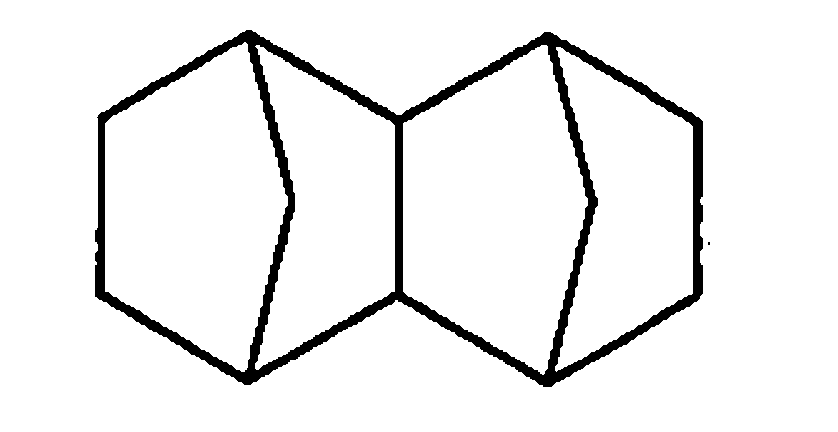
以下に一般式(AI)で表される繰り返し単位に相当するモノマーの具体例を挙げるが、本発明は、これらの具体例に限定されない。下記の具体例は、一般式(AI)におけるXa1がメチル基である場合に相当するが、Xa1は、水素原子、ハロゲン原子、又は1価の有機基に任意に置換することができる。
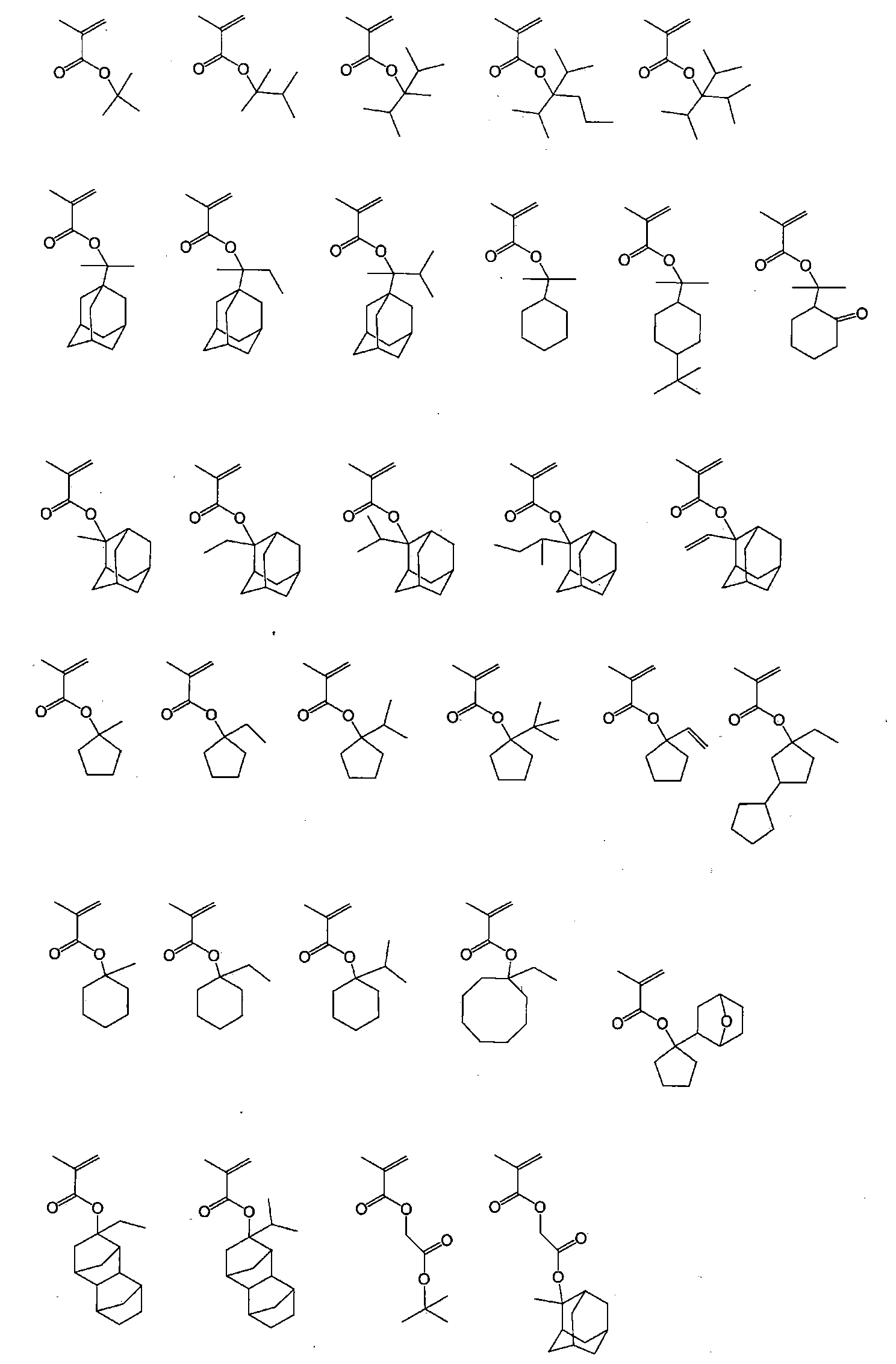
樹脂(A)は、酸分解性基を有する繰り返し単位として、米国特許出願公開2016/0070167A1号明細書の段落<0336>~<0369>に記載の繰り返し単位を有することも好ましい。
また、樹脂(A)は、酸分解性基を有する繰り返し単位として、米国特許出願公開2016/0070167A1号明細書の段落<0363>~<0364>に記載された酸の作用により分解してアルコール性水酸基を生じる基を含む繰り返し単位を有していてもよい。
樹脂(A)は、酸分解性基を有する繰り返し単位を、1種単独で含んでもよく、2種以上を併用して含んでもよい。
樹脂(A)に含まれる酸分解性基を有する繰り返し単位の含有量(酸分解性基を有する繰り返し単位が複数存在する場合はその合計)は、樹脂(A)の全繰り返し単位に対して、10~90モル%が好ましく、20~80モル%がより好ましく、30~70モル%が更に好ましい。
樹脂(A)は、ラクトン構造、スルトン構造、及びカーボネート構造からなる群から選択される少なくとも1種を有する繰り返し単位を有することが好ましい。
ラクトン構造又はスルトン構造としては、ラクトン構造又はスルトン構造を有していればいずれでも用いることができるが、好ましくは5~7員環ラクトン構造又は5~7員環スルトン構造であり、5~7員環ラクトン構造にビシクロ構造、スピロ構造を形成する形で他の環構造が縮環しているもの、又は5~7員環スルトン構造にビシクロ構造、スピロ構造を形成する形で他の環構造が縮環しているもの、がより好ましい。下記一般式(LC1-1)~(LC1-21)のいずれかで表されるラクトン構造、又は下記一般式(SL1-1)~(SL1-3)のいずれかで表されるスルトン構造を有する繰り返し単位を有することがさらに好ましい。また、ラクトン構造又はスルトン構造が主鎖に直接結合していてもよい。好ましい構造としては(LC1-1)、(LC1-4)、(LC1-5)、(LC1-8)、(LC1-16)、(LC1-21)、(SL1-1)である。

ラクトン構造部分又はスルトン構造部分は、置換基(Rb2)を有していても有していなくてもよい。好ましい置換基(Rb2)としては、炭素数1~8のアルキル基、炭素数4~7のシクロアルキル基、炭素数1~8のアルコキシ基、炭素数2~8のアルコキシカルボニル基、カルボキシル基、ハロゲン原子、水酸基、シアノ基、及び酸分解性基などが挙げられる。より好ましくは炭素数1~4のアルキル基、シアノ基、及び酸分解性基である。n2は、0~4の整数を表す。n2が2以上の時、複数存在する置換基(Rb2)は、同一でも異なっていてもよい。また、複数存在する置換基(Rb2)同士が結合して環を形成してもよい。
ラクトン構造又はスルトン構造を有する繰り返し単位は、下記一般式(III)で表される繰り返し単位であることが好ましい。

上記一般式(III)中、Aは、エステル結合(-COO-で表される基)又はアミド結合(-CONH-で表される基)を表す。
nは、-R0-Z-で表される構造の繰り返し数であり、0~5の整数を表し、0又は1であることが好ましく、0であることがより好ましい。nが0である場合、-R0-Z-は存在せず、単結合となる。
R0は、アルキレン基、シクロアルキレン基、又はその組み合わせを表す。R0は、複数個ある場合には各々独立にアルキレン基、シクロアルキレン基、又はその組み合わせを表す。
Zは、単結合、エーテル結合、エステル結合、アミド結合、ウレタン結合又はウレア結合を表す。Zは、複数個ある場合には各々独立に、単結合、エーテル結合、エステル結合、アミド結合、ウレタン結合又はウレア結合を表す。
R8は、ラクトン構造又はスルトン構造を有する1価の有機基を表す。
R7は、水素原子、ハロゲン原子又は1価の有機基(好ましくはメチル基)を表す。
nは、-R0-Z-で表される構造の繰り返し数であり、0~5の整数を表し、0又は1であることが好ましく、0であることがより好ましい。nが0である場合、-R0-Z-は存在せず、単結合となる。
R0は、アルキレン基、シクロアルキレン基、又はその組み合わせを表す。R0は、複数個ある場合には各々独立にアルキレン基、シクロアルキレン基、又はその組み合わせを表す。
Zは、単結合、エーテル結合、エステル結合、アミド結合、ウレタン結合又はウレア結合を表す。Zは、複数個ある場合には各々独立に、単結合、エーテル結合、エステル結合、アミド結合、ウレタン結合又はウレア結合を表す。
R8は、ラクトン構造又はスルトン構造を有する1価の有機基を表す。
R7は、水素原子、ハロゲン原子又は1価の有機基(好ましくはメチル基)を表す。
R0のアルキレン基又はシクロアルキレン基は置換基を有してもよい。
Zは好ましくは、エーテル結合、又はエステル結合であり、より好ましくはエステル結合である。
Zは好ましくは、エーテル結合、又はエステル結合であり、より好ましくはエステル結合である。
以下に一般式(III)で表される繰り返し単位に相当するモノマーの具体例、及び一般式(A-1)で表される繰り返し単位に相当するモノマーの具体例を挙げるが、本発明は、これらの具体例に限定されない。下記の具体例は、一般式(III))におけるR7及び一般式(A-1)におけるRA
1がメチル基である場合に相当するが、R7及びRA
1は、水素原子、ハロゲン原子、又は1価の有機基に任意に置換することができる。

上記モノマーの他に、下記に示すモノマーも樹脂(A)の原料として好適に用いられる。

樹脂(A)は、カーボネート構造を有する繰り返し単位を有していてもよい。カーボネート構造は、環状炭酸エステル構造であることが好ましい。
環状炭酸エステル構造を有する繰り返し単位は、下記一般式(A-1)で表される繰り返し単位であることが好ましい。
環状炭酸エステル構造を有する繰り返し単位は、下記一般式(A-1)で表される繰り返し単位であることが好ましい。
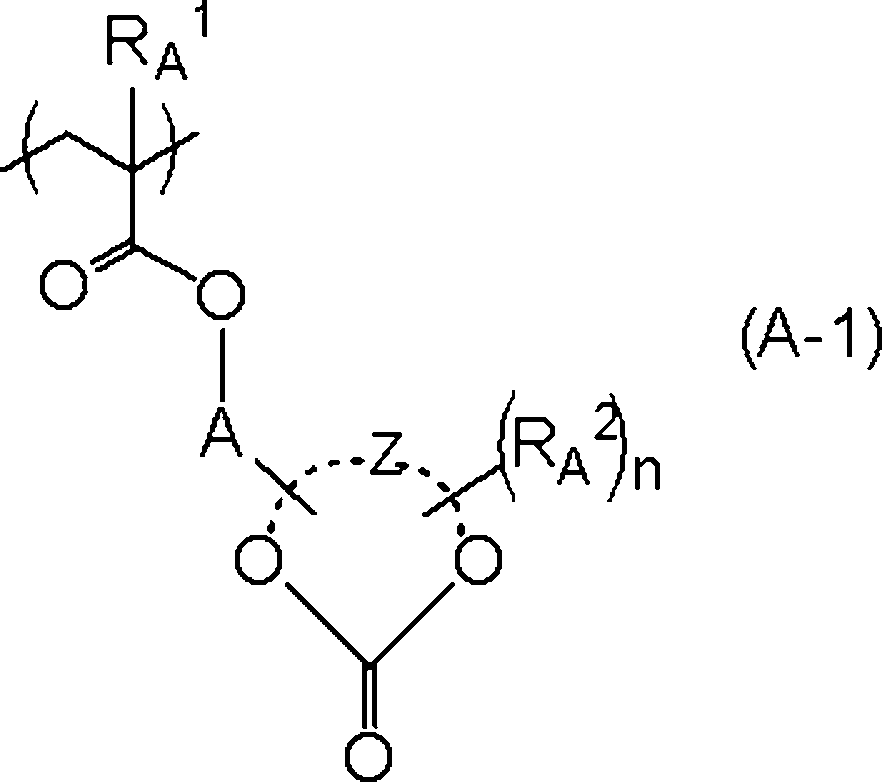
一般式(A-1)中、RA
1は、水素原子、ハロゲン原子又は1価の有機基(好ましくはメチル基)を表す。
nは0以上の整数を表す。
RA 2は、置換基を表す。RA 2は、nが2以上の場合は各々独立して、置換基を表す。
Aは、単結合、又は2価の連結基を表す。
Zは、式中の-O-C(=O)-O-で表される基と共に単環構造又は多環構造を形成する原子団を表す。
nは0以上の整数を表す。
RA 2は、置換基を表す。RA 2は、nが2以上の場合は各々独立して、置換基を表す。
Aは、単結合、又は2価の連結基を表す。
Zは、式中の-O-C(=O)-O-で表される基と共に単環構造又は多環構造を形成する原子団を表す。
樹脂(A)は、ラクトン構造、スルトン構造、及びカーボネート構造からなる群から選択される少なくとも1種を有する繰り返し単位として、米国特許出願公開2016/0070167A1号明細書の段落<0370>~<0414>に記載の繰り返し単位を有することも好ましい。
樹脂(A)は、ラクトン構造、スルトン構造、及びカーボネート構造からなる群から選択される少なくとも1種を有する繰り返し単位を、1種単独で含んでもよく、2種以上を併用して含んでもよい。
樹脂(A)に含まれるラクトン構造、スルトン構造、及びカーボネート構造からなる群から選択される少なくとも1種を有する繰り返し単位の含有量(ラクトン構造、スルトン構造、及びカーボネート構造からなる群から選択される少なくとも1種を有する繰り返し単位が複数存在する場合はその合計)は、樹脂(A)の全繰り返し単位に対して、5~70モル%であることが好ましく、10~65モル%であることがより好ましく、20~60モル%であることが更に好ましい
樹脂(A)は、極性基を有する繰り返し単位を有することが好ましい。
極性基としては、水酸基、シアノ基、カルボキシル基、及びフッ素化アルコール基等が挙げられる。
極性基を有する繰り返し単位は、極性基で置換された脂環炭化水素構造を有する繰り返し単位であることが好ましい。また、極性基を有する繰り返し単位は、酸分解性基を有さないことが好ましい。極性基で置換された脂環炭化水素構造における、脂環炭化水素構造としては、アダマンチル基、又はノルボルナン基が好ましい。
極性基としては、水酸基、シアノ基、カルボキシル基、及びフッ素化アルコール基等が挙げられる。
極性基を有する繰り返し単位は、極性基で置換された脂環炭化水素構造を有する繰り返し単位であることが好ましい。また、極性基を有する繰り返し単位は、酸分解性基を有さないことが好ましい。極性基で置換された脂環炭化水素構造における、脂環炭化水素構造としては、アダマンチル基、又はノルボルナン基が好ましい。
以下に極性基を有する繰り返し単位に相当するモノマーの具体例を挙げるが、本発明は、これらの具体例に限定されない。

この他にも、極性基を有する繰り返し単位の具体例としては、米国特許出願公開2016/0070167A1号明細書の段落<0415>~<0433>に開示された繰り返し単位を挙げることができる。
樹脂(A)は、極性基を有する繰り返し単位を、1種単独で含んでもよく、2種以上を併用して含んでもよい。
極性基を有する繰り返し単位の含有量は、樹脂(A)中の全繰り返し単位に対して、5~40モル%が好ましく、5~30モル%がより好ましく、10~25モル%が更に好ましい。
樹脂(A)は、極性基を有する繰り返し単位を、1種単独で含んでもよく、2種以上を併用して含んでもよい。
極性基を有する繰り返し単位の含有量は、樹脂(A)中の全繰り返し単位に対して、5~40モル%が好ましく、5~30モル%がより好ましく、10~25モル%が更に好ましい。
樹脂(A)は、更に、酸分解性基及び極性基のいずれも有さない繰り返し単位を有することができる。酸分解性基及び極性基のいずれも有さない繰り返し単位は、脂環炭化水素構造を有することが好ましい。酸分解性基及び極性基のいずれも有さない繰り返し単位としては、例えば、米国特許出願公開2016/0026083A1号明細書の段落<0236>~<0237>に記載された繰り返し単位が挙げられる。酸分解性基及び極性基のいずれも有さない繰り返し単位に相当するモノマーの好ましい例を以下に示す。

この他にも、酸分解性基及び極性基のいずれも有さない繰り返し単位の具体例としては、米国特許出願公開2016/0070167A1号明細書の段落<0433>に開示された繰り返し単位を挙げることができる。
樹脂(A)は、酸分解性基及び極性基のいずれも有さない繰り返し単位を、1種単独で含んでもよく、2種以上を併用して含んでもよい。
酸分解性基及び極性基のいずれも有さない繰り返し単位の含有量は、樹脂(A)中の全繰り返し単位に対して、5~40モル%が好ましく、5~30モル%がより好ましく、5~25モル%が更に好ましい。
樹脂(A)は、酸分解性基及び極性基のいずれも有さない繰り返し単位を、1種単独で含んでもよく、2種以上を併用して含んでもよい。
酸分解性基及び極性基のいずれも有さない繰り返し単位の含有量は、樹脂(A)中の全繰り返し単位に対して、5~40モル%が好ましく、5~30モル%がより好ましく、5~25モル%が更に好ましい。
樹脂(A)は、上記の繰り返し構造単位以外に、ドライエッチング耐性、標準現像液適性、基板密着性、レジストプロファイル、更にレジストの一般的な必要な特性である解像力、耐熱性、感度等を調節する目的で様々な繰り返し構造単位を有することができる。このような繰り返し構造単位としては、単量体に相当する繰り返し構造単位を挙げることができるが、これらに限定されない。
単量体としては、例えばアクリル酸エステル類、メタクリル酸エステル類、アクリルアミド類、メタクリルアミド類、アリル化合物、ビニルエーテル類、及びビニルエステル類等から選ばれる付加重合性不飽和結合を1個有する化合物等を挙げることができる。
その他にも、上記種々の繰り返し構造単位に相当する単量体と共重合可能である付加重合性の不飽和化合物であれば、共重合されていてもよい。
樹脂(A)において、各繰り返し構造単位の含有モル比は、種々の性能を調節するために適宜設定される。
その他にも、上記種々の繰り返し構造単位に相当する単量体と共重合可能である付加重合性の不飽和化合物であれば、共重合されていてもよい。
樹脂(A)において、各繰り返し構造単位の含有モル比は、種々の性能を調節するために適宜設定される。
本発明の組成物が、ArF露光用であるとき、ArF光の透過性の観点から樹脂(A)は実質的には芳香族基を有さないことが好ましい。より具体的には、樹脂(A)の全繰り返し単位中、芳香族基を有する繰り返し単位が全体の5モル%以下であることが好ましく、3モル%以下であることがより好ましく、理想的には0モル%、すなわち芳香族基を有する繰り返し単位を有さないことが更に好ましい。また、樹脂(A)は単環又は多環の脂環炭化水素構造を有することが好ましい。
樹脂(A)は、繰り返し単位のすべてが(メタ)アクリレート系繰り返し単位で構成されることが好ましい。この場合、繰り返し単位のすべてがメタクリレート系繰り返し単位であるもの、繰り返し単位のすべてがアクリレート系繰り返し単位であるもの、繰り返し単位のすべてがメタクリレート系繰り返し単位とアクリレート系繰り返し単位とによるもののいずれのものでも用いることができるが、アクリレート系繰り返し単位が樹脂(A)の全繰り返し単位に対して50モル%以下であることが好ましい。
本発明の組成物が、KrF露光用、EB露光用又はEUV露光用であるとき、樹脂(A)は芳香族炭化水素基を有する繰り返し単位を含むことが好ましい。樹脂(A)がフェノール性水酸基を含む繰り返し単位を含むことがより好ましい。フェノール性水酸基を含む繰り返し単位としては、ヒドロキシスチレン繰り返し単位やヒドロキシスチレン(メタ)アクリレート繰り返し単位を挙げることができる。
本発明の組成物が、KrF露光用、EB露光用又はEUV露光用であるとき、樹脂(A)は、フェノール性水酸基の水素原子が酸の作用により分解し脱離する基(脱離基)で保護された構造を有することが好ましい。
樹脂(A)に含まれる芳香族炭化水素基を有する繰り返し単位の含有量は、樹脂(A)中の全繰り返し単位に対して、30~100モル%が好ましく、40~100モル%がより好ましく、50~100モル%が更に好ましい。
本発明の組成物が、KrF露光用、EB露光用又はEUV露光用であるとき、樹脂(A)は、フェノール性水酸基の水素原子が酸の作用により分解し脱離する基(脱離基)で保護された構造を有することが好ましい。
樹脂(A)に含まれる芳香族炭化水素基を有する繰り返し単位の含有量は、樹脂(A)中の全繰り返し単位に対して、30~100モル%が好ましく、40~100モル%がより好ましく、50~100モル%が更に好ましい。
樹脂(A)の重量平均分子量は、1,000~200,000が好ましく、2,000~20,000がより好ましく、3,000~15,000が更に好ましく、3,000~11,000が特に好ましい。分散度(Mw/Mn)は、通常1.0~3.0であり、1.0~2.6が好ましく、1.0~2.0がより好ましく、1.1~2.0が更に好ましい。
樹脂(A)は、1種単独で使用してもよいし、2種以上を併用してもよい。
本発明の組成物の全固形分中の樹脂(A)の含有量は、一般的に20質量%以上である。40質量%以上が好ましく、60質量%以上がより好ましく、80質量%以上が更に好ましい。上限は特に制限されないが、99.5質量%以下が好ましく、99質量%以下がより好ましく、97質量%以下が更に好ましい。なお、組成物中の全固形分とは、組成物中の溶剤以外の全成分を表す。
本発明の組成物の全固形分中の樹脂(A)の含有量は、一般的に20質量%以上である。40質量%以上が好ましく、60質量%以上がより好ましく、80質量%以上が更に好ましい。上限は特に制限されないが、99.5質量%以下が好ましく、99質量%以下がより好ましく、97質量%以下が更に好ましい。なお、組成物中の全固形分とは、組成物中の溶剤以外の全成分を表す。
<活性光線又は放射線の照射により酸を発生する化合物(B)>
本発明の組成物は、活性光線又は放射線の照射により酸を発生する化合物(「化合物(B)」、「光酸発生剤」又は「酸発生剤」ともいう)を含有する。
光酸発生剤としては、活性光線又は放射線の照射により有機酸を発生する化合物が好ましい。例えば、スルホニウム塩化合物、ヨードニウム塩化合物、ジアゾニウム塩化合物、ホスホニウム塩化合物、イミドスルホネート化合物、オキシムスルホネート化合物、ジアゾジスルホン化合物、ジスルホン化合物、及びo-ニトロベンジルスルホネート化合物を挙げることができる。
本発明の組成物は、活性光線又は放射線の照射により酸を発生する化合物(「化合物(B)」、「光酸発生剤」又は「酸発生剤」ともいう)を含有する。
光酸発生剤としては、活性光線又は放射線の照射により有機酸を発生する化合物が好ましい。例えば、スルホニウム塩化合物、ヨードニウム塩化合物、ジアゾニウム塩化合物、ホスホニウム塩化合物、イミドスルホネート化合物、オキシムスルホネート化合物、ジアゾジスルホン化合物、ジスルホン化合物、及びo-ニトロベンジルスルホネート化合物を挙げることができる。
光酸発生剤としては、活性光線又は放射線の照射により酸を発生する公知の化合物を、単独又はそれらの混合物として適宜選択して使用することができる。例えば、米国特許出願公開2016/0070167A1号明細書の段落<0125>~<0319>、米国特許出願公開2015/0004544A1号明細書の段落<0086>~<0094>、米国特許出願公開2016/0237190A1号明細書の段落<0323>~<0402>に開示された公知の化合物を光酸発生剤として好適に使用できる。
光酸発生剤の好適な態様としては、例えば、下記一般式(ZI)、(ZII)又は(ZIII)で表される化合物が挙げられる。

上記一般式(ZI)において、R201、R202及びR203は、各々独立に、有機基を表す。
R201、R202及びR203としての有機基の炭素数は、一般的に1~30であり、好ましくは1~20である。
また、R201~R203のうち2つが結合して環構造を形成してもよく、環内に酸素原子、硫黄原子、エステル結合、アミド結合、又はカルボニル基を含んでいてもよい。R201~R203の内の2つが結合して形成する基としては、アルキレン基(例えば、ブチレン基、ペンチレン基)及び-CH2-CH2-O-CH2-CH2-を挙げることができる。
Z-は、アニオンを表す。
R201、R202及びR203としての有機基の炭素数は、一般的に1~30であり、好ましくは1~20である。
また、R201~R203のうち2つが結合して環構造を形成してもよく、環内に酸素原子、硫黄原子、エステル結合、アミド結合、又はカルボニル基を含んでいてもよい。R201~R203の内の2つが結合して形成する基としては、アルキレン基(例えば、ブチレン基、ペンチレン基)及び-CH2-CH2-O-CH2-CH2-を挙げることができる。
Z-は、アニオンを表す。
一般式(ZI)におけるカチオンの好適な態様としては、後述する化合物(ZI-1)、(ZI-2)、(ZI-3)及び(ZI-4)における対応する基を挙げることができる。
なお、光酸発生剤は、一般式(ZI)で表される構造を複数有する化合物であってもよい。例えば、一般式(ZI)で表される化合物のR201~R203の少なくとも1つと、一般式(ZI)で表されるもうひとつの化合物のR201~R203の少なくとも一つとが、単結合又は連結基を介して結合した構造を有する化合物であってもよい。
なお、光酸発生剤は、一般式(ZI)で表される構造を複数有する化合物であってもよい。例えば、一般式(ZI)で表される化合物のR201~R203の少なくとも1つと、一般式(ZI)で表されるもうひとつの化合物のR201~R203の少なくとも一つとが、単結合又は連結基を介して結合した構造を有する化合物であってもよい。
まず、化合物(ZI-1)について説明する。
化合物(ZI-1)は、上記一般式(ZI)のR201~R203の少なくとも1つがアリール基である、アリールスルホニウム化合物、すなわち、アリールスルホニウムをカチオンとする化合物である。
アリールスルホニウム化合物は、R201~R203の全てがアリール基でもよいし、R201~R203の一部がアリール基であり、残りがアルキル基又はシクロアルキル基であってもよい。
アリールスルホニウム化合物としては、例えば、トリアリールスルホニウム化合物、ジアリールアルキルスルホニウム化合物、アリールジアルキルスルホニウム化合物、ジアリールシクロアルキルスルホニウム化合物、及びアリールジシクロアルキルスルホニウム化合物を挙げることができる。
化合物(ZI-1)は、上記一般式(ZI)のR201~R203の少なくとも1つがアリール基である、アリールスルホニウム化合物、すなわち、アリールスルホニウムをカチオンとする化合物である。
アリールスルホニウム化合物は、R201~R203の全てがアリール基でもよいし、R201~R203の一部がアリール基であり、残りがアルキル基又はシクロアルキル基であってもよい。
アリールスルホニウム化合物としては、例えば、トリアリールスルホニウム化合物、ジアリールアルキルスルホニウム化合物、アリールジアルキルスルホニウム化合物、ジアリールシクロアルキルスルホニウム化合物、及びアリールジシクロアルキルスルホニウム化合物を挙げることができる。
アリールスルホニウム化合物のアリール基としてはフェニル基、又はナフチル基が好ましく、フェニル基がより好ましい。アリール基は、酸素原子、窒素原子、又は硫黄原子等を有する複素環構造を有するアリール基であってもよい。複素環構造としては、ピロール残基、フラン残基、チオフェン残基、インドール残基、ベンゾフラン残基、及びベンゾチオフェン残基等が挙げられる。アリールスルホニウム化合物が2つ以上のアリール基を有する場合に、2つ以上あるアリール基は同一であっても異なっていてもよい。
アリールスルホニウム化合物が必要に応じて有しているアルキル基又はシクロアルキル基は、炭素数1~15の直鎖アルキル基、炭素数3~15の分岐アルキル基、又は炭素数3~15のシクロアルキル基が好ましく、例えば、メチル基、エチル基、プロピル基、n-ブチル基、sec-ブチル基、t-ブチル基、シクロプロピル基、シクロブチル基、及びシクロヘキシル基等を挙げることができる。
アリールスルホニウム化合物が必要に応じて有しているアルキル基又はシクロアルキル基は、炭素数1~15の直鎖アルキル基、炭素数3~15の分岐アルキル基、又は炭素数3~15のシクロアルキル基が好ましく、例えば、メチル基、エチル基、プロピル基、n-ブチル基、sec-ブチル基、t-ブチル基、シクロプロピル基、シクロブチル基、及びシクロヘキシル基等を挙げることができる。
R201~R203のアリール基、アルキル基、及びシクロアルキル基は、各々独立にアルキル基(例えば炭素数1~15)、シクロアルキル基(例えば炭素数3~15)、アリール基(例えば炭素数6~14)、アルコキシ基(例えば炭素数1~15)、ハロゲン原子、水酸基、又はフェニルチオ基を置換基として有してもよい。
次に、化合物(ZI-2)について説明する。
化合物(ZI-2)は、式(ZI)におけるR201~R203が、各々独立に、芳香環を有さない有機基を表す化合物である。ここで芳香環とは、ヘテロ原子を含有する芳香族環も包含する。
R201~R203としての芳香環を有さない有機基は、一般的に炭素数1~30であり、好ましくは炭素数1~20である。
R201~R203は、各々独立に、好ましくはアルキル基、シクロアルキル基、アリル基、又はビニル基であり、より好ましくは直鎖又は分岐の2-オキソアルキル基、2-オキソシクロアルキル基、又はアルコキシカルボニルメチル基、さらに好ましくは直鎖又は分岐2-オキソアルキル基である。
化合物(ZI-2)は、式(ZI)におけるR201~R203が、各々独立に、芳香環を有さない有機基を表す化合物である。ここで芳香環とは、ヘテロ原子を含有する芳香族環も包含する。
R201~R203としての芳香環を有さない有機基は、一般的に炭素数1~30であり、好ましくは炭素数1~20である。
R201~R203は、各々独立に、好ましくはアルキル基、シクロアルキル基、アリル基、又はビニル基であり、より好ましくは直鎖又は分岐の2-オキソアルキル基、2-オキソシクロアルキル基、又はアルコキシカルボニルメチル基、さらに好ましくは直鎖又は分岐2-オキソアルキル基である。
R201~R203のアルキル基及びシクロアルキル基としては、好ましくは、炭素数1~10の直鎖アルキル基又は炭素数3~10の分岐アルキル基(例えば、メチル基、エチル基、プロピル基、ブチル基、及びペンチル基)、ならびに炭素数3~10のシクロアルキル基(例えばシクロペンチル基、シクロヘキシル基、及びノルボルニル基)を挙げることができる。
R201~R203は、ハロゲン原子、アルコキシ基(例えば炭素数1~5)、水酸基、シアノ基、又はニトロ基によって更に置換されていてもよい。
R201~R203は、ハロゲン原子、アルコキシ基(例えば炭素数1~5)、水酸基、シアノ基、又はニトロ基によって更に置換されていてもよい。
次に、化合物(ZI-3)について説明する。
化合物(ZI-3)は、下記一般式(ZI-3)で表され、フェナシルスルフォニウム塩構造を有する化合物である。
化合物(ZI-3)は、下記一般式(ZI-3)で表され、フェナシルスルフォニウム塩構造を有する化合物である。
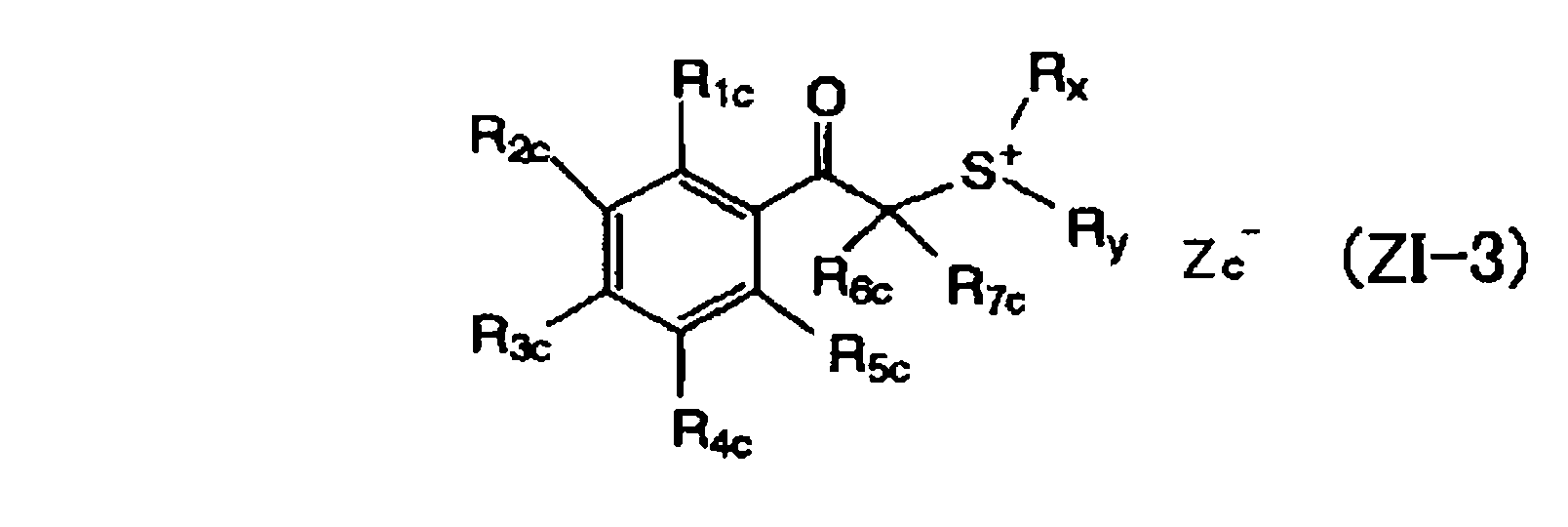
一般式(ZI-3)中、R1c~R5cは、各々独立に、水素原子、アルキル基、シクロアルキル基、アリール基、アルコキシ基、アリールオキシ基、アルコキシカルボニル基、アルキルカルボニルオキシ基、シクロアルキルカルボニルオキシ基、ハロゲン原子、水酸基、ニトロ基、アルキルチオ基又はアリールチオ基を表す。
R6c及びR7cは、各々独立に、水素原子、アルキル基、シクロアルキル基、ハロゲン原子、シアノ基又はアリール基を表す。
Rx及びRyは、各々独立に、アルキル基、シクロアルキル基、2-オキソアルキル基、2-オキソシクロアルキル基、アルコキシカルボニルアルキル基、アリル基又はビニル基を表す。
R6c及びR7cは、各々独立に、水素原子、アルキル基、シクロアルキル基、ハロゲン原子、シアノ基又はアリール基を表す。
Rx及びRyは、各々独立に、アルキル基、シクロアルキル基、2-オキソアルキル基、2-オキソシクロアルキル基、アルコキシカルボニルアルキル基、アリル基又はビニル基を表す。
R1c~R5c中のいずれか2つ以上、R5cとR6c、R6cとR7c、R5cとRx、及びRxとRyは、各々結合して環構造を形成してもよく、この環構造は、各々独立に酸素原子、硫黄原子、ケトン基、エステル結合、又はアミド結合を含んでいてもよい。
上記環構造としては、芳香族若しくは非芳香族の炭化水素環、芳香族若しくは非芳香族の複素環、及びこれらの環が2つ以上組み合わされてなる多環縮合環を挙げることができる。環構造としては、3~10員環を挙げることができ、4~8員環が好ましく、5又は6員環がより好ましい。
上記環構造としては、芳香族若しくは非芳香族の炭化水素環、芳香族若しくは非芳香族の複素環、及びこれらの環が2つ以上組み合わされてなる多環縮合環を挙げることができる。環構造としては、3~10員環を挙げることができ、4~8員環が好ましく、5又は6員環がより好ましい。
R1c~R5c中のいずれか2つ以上、R6cとR7c、及びRxとRyが結合して形成する基としては、ブチレン基、及びペンチレン基等を挙げることができる。
R5cとR6c、及びR5cとRxが結合して形成する基としては、単結合又はアルキレン基であることが好ましい。アルキレン基としては、メチレン基、及びエチレン基等を挙げることができる。
Zc-は、アニオンを表す。
R5cとR6c、及びR5cとRxが結合して形成する基としては、単結合又はアルキレン基であることが好ましい。アルキレン基としては、メチレン基、及びエチレン基等を挙げることができる。
Zc-は、アニオンを表す。
次に、化合物(ZI-4)について説明する。
化合物(ZI-4)は、下記一般式(ZI-4)で表される。
化合物(ZI-4)は、下記一般式(ZI-4)で表される。

一般式(ZI-4)中、lは0~2の整数を表す。
rは0~8の整数を表す。
R13は水素原子、フッ素原子、水酸基、アルキル基、シクロアルキル基、アルコキシ基、アルコキシカルボニル基、又はシクロアルキル基を有する基を表す。これらの基は置換基を有してもよい。
R14は、水酸基、アルキル基、シクロアルキル基、アルコキシ基、アルコキシカルボニル基、アルキルカルボニル基、アルキルスルホニル基、シクロアルキルスルホニル基、又はシクロアルキル基を有する基を表す。これらの基は置換基を有してもよい。R14は、複数存在する場合は各々独立して、水酸基などの上記基を表す。
R15は各々独立して、アルキル基、シクロアルキル基又はナフチル基を表す。これらの基は置換基を有してもよい。2つのR15が互いに結合して環を形成してもよい。2つのR15が互いに結合して環を形成するとき、環骨格内に、酸素原子、又は窒素原子などのヘテロ原子を含んでもよい。一態様において、2つのR15がアルキレン基であり、互いに結合して環構造を形成することが好ましい。
Z-は、アニオンを表す。
rは0~8の整数を表す。
R13は水素原子、フッ素原子、水酸基、アルキル基、シクロアルキル基、アルコキシ基、アルコキシカルボニル基、又はシクロアルキル基を有する基を表す。これらの基は置換基を有してもよい。
R14は、水酸基、アルキル基、シクロアルキル基、アルコキシ基、アルコキシカルボニル基、アルキルカルボニル基、アルキルスルホニル基、シクロアルキルスルホニル基、又はシクロアルキル基を有する基を表す。これらの基は置換基を有してもよい。R14は、複数存在する場合は各々独立して、水酸基などの上記基を表す。
R15は各々独立して、アルキル基、シクロアルキル基又はナフチル基を表す。これらの基は置換基を有してもよい。2つのR15が互いに結合して環を形成してもよい。2つのR15が互いに結合して環を形成するとき、環骨格内に、酸素原子、又は窒素原子などのヘテロ原子を含んでもよい。一態様において、2つのR15がアルキレン基であり、互いに結合して環構造を形成することが好ましい。
Z-は、アニオンを表す。
一般式(ZI-4)において、R13、R14及びR15のアルキル基は、直鎖状若しくは分岐状であり、炭素原子数1~10のものが好ましく、メチル基、エチル基、n-ブチル基、又はt-ブチル基等がより好ましい。
次に、一般式(ZII)、及び(ZIII)について説明する。
一般式(ZII)、及び(ZIII)中、R204~R207は、各々独立に、アリール基、アルキル基又はシクロアルキル基を表す。
R204~R207のアリール基としてはフェニル基、又はナフチル基が好ましく、フェニル基がより好ましい。R204~R207のアリール基は、酸素原子、窒素原子、又は硫黄原子等を有する複素環構造を有するアリール基であってもよい。複素環構造を有するアリール基の骨格としては、例えば、ピロール、フラン、チオフェン、インドール、ベンゾフラン、及びベンゾチオフェン等を挙げることができる。
R204~R207のアルキル基及びシクロアルキル基としては、好ましくは、炭素数1~10の直鎖アルキル基又は炭素数3~10の分岐アルキル基(例えば、メチル基、エチル基、プロピル基、ブチル基、及びペンチル基)、炭素数3~10のシクロアルキル基(例えばシクロペンチル基、シクロヘキシル基、及びノルボルニル基)を挙げることができる。
一般式(ZII)、及び(ZIII)中、R204~R207は、各々独立に、アリール基、アルキル基又はシクロアルキル基を表す。
R204~R207のアリール基としてはフェニル基、又はナフチル基が好ましく、フェニル基がより好ましい。R204~R207のアリール基は、酸素原子、窒素原子、又は硫黄原子等を有する複素環構造を有するアリール基であってもよい。複素環構造を有するアリール基の骨格としては、例えば、ピロール、フラン、チオフェン、インドール、ベンゾフラン、及びベンゾチオフェン等を挙げることができる。
R204~R207のアルキル基及びシクロアルキル基としては、好ましくは、炭素数1~10の直鎖アルキル基又は炭素数3~10の分岐アルキル基(例えば、メチル基、エチル基、プロピル基、ブチル基、及びペンチル基)、炭素数3~10のシクロアルキル基(例えばシクロペンチル基、シクロヘキシル基、及びノルボルニル基)を挙げることができる。
R204~R207のアリール基、アルキル基、及びシクロアルキル基は、各々独立に置換基を有していてもよい。R204~R207のアリール基、アルキル基、及びシクロアルキル基が有していてもよい置換基としては、例えば、アルキル基(例えば炭素数1~15)、シクロアルキル基(例えば炭素数3~15)、アリール基(例えば炭素数6~15)、アルコキシ基(例えば炭素数1~15)、ハロゲン原子、水酸基、及びフェニルチオ基等を挙げることができる。
Z-は、アニオンを表す。
Z-は、アニオンを表す。
一般式(ZI)におけるZ-、一般式(ZII)におけるZ-、一般式(ZI-3)におけるZc-、及び一般式(ZI-4)におけるZ-としては、下記一般式(3)で表されるアニオンが好ましい。

一般式(3)中、oは、1~3の整数を表す。pは、0~10の整数を表す。qは、0~10の整数を表す。
Xfは、各々独立に、フッ素原子、又は、少なくとも一つのフッ素原子で置換されたアルキル基を表す。
R4及びR5は、各々独立に、水素原子、フッ素原子、アルキル基、又は、少なくとも一つのフッ素原子で置換されたアルキル基を表し、複数存在する場合のR4、R5は、それぞれ同一でも異なっていてもよい。
Lは、2価の連結基を表し、複数存在する場合のLは、それぞれ同一でも異なっていてもよい。
Wは、環状構造を含む有機基を表す。
oは、1~3の整数を表す。pは、0~10の整数を表す。qは、0~10の整数を表す。
Xfは、各々独立に、フッ素原子、又は、少なくとも一つのフッ素原子で置換されたアルキル基を表す。
R4及びR5は、各々独立に、水素原子、フッ素原子、アルキル基、又は、少なくとも一つのフッ素原子で置換されたアルキル基を表し、複数存在する場合のR4、R5は、それぞれ同一でも異なっていてもよい。
Lは、2価の連結基を表し、複数存在する場合のLは、それぞれ同一でも異なっていてもよい。
Wは、環状構造を含む有機基を表す。
oは、1~3の整数を表す。pは、0~10の整数を表す。qは、0~10の整数を表す。
Xfは、フッ素原子、又は少なくとも1つのフッ素原子で置換されたアルキル基を表す。このアルキル基の炭素数は、1~10が好ましく、1~4がより好ましい。また、少なくとも1つのフッ素原子で置換されたアルキル基は、パーフルオロアルキル基が好ましい。
Xfは、好ましくは、フッ素原子又は炭素数1~4のパーフルオロアルキル基である。Xfは、フッ素原子又はCF3であることがより好ましい。特に、双方のXfがフッ素原子であることが好ましい。
Xfは、好ましくは、フッ素原子又は炭素数1~4のパーフルオロアルキル基である。Xfは、フッ素原子又はCF3であることがより好ましい。特に、双方のXfがフッ素原子であることが好ましい。
R4及びR5は、各々独立に、水素原子、フッ素原子、アルキル基、又は少なくとも一つのフッ素原子で置換されたアルキル基を表す。複数存在する場合のR4及びR5は、それぞれ同一でも異なっていてもよい。
R4及びR5としてのアルキル基は、置換基を有していてもよく、炭素数1~4が好ましい。R4及びR5は、好ましくは水素原子である。
少なくとも一つのフッ素原子で置換されたアルキル基の具体例および好適な態様は一般式(3)中のXfの具体例および好適な態様と同じである。
R4及びR5としてのアルキル基は、置換基を有していてもよく、炭素数1~4が好ましい。R4及びR5は、好ましくは水素原子である。
少なくとも一つのフッ素原子で置換されたアルキル基の具体例および好適な態様は一般式(3)中のXfの具体例および好適な態様と同じである。
Lは、2価の連結基を表し、複数存在する場合のLは、それぞれ同一でも異なっていてもよい。
2価の連結基としては、例えば、-COO-(-C(=O)-O-)、-OCO-、-CONH-、-NHCO-、-CO-、-O-、-S-、-SO-、-SO2-、アルキレン基(好ましくは炭素数1~6)、シクロアルキレン基(好ましくは炭素数3~15)、アルケニレン基(好ましくは炭素数2~6)及びこれらの複数を組み合わせた2価の連結基などが挙げられる。これらの中でも、-COO-、-OCO-、-CONH-、-NHCO-、-CO-、-O-、-SO2-、-COO-アルキレン基-、-OCO-アルキレン基-、-CONH-アルキレン基-又は-NHCO-アルキレン基-が好ましく、-COO-、-OCO-、-CONH-、-SO2-、-COO-アルキレン基-又は-OCO-アルキレン基-がより好ましい。
2価の連結基としては、例えば、-COO-(-C(=O)-O-)、-OCO-、-CONH-、-NHCO-、-CO-、-O-、-S-、-SO-、-SO2-、アルキレン基(好ましくは炭素数1~6)、シクロアルキレン基(好ましくは炭素数3~15)、アルケニレン基(好ましくは炭素数2~6)及びこれらの複数を組み合わせた2価の連結基などが挙げられる。これらの中でも、-COO-、-OCO-、-CONH-、-NHCO-、-CO-、-O-、-SO2-、-COO-アルキレン基-、-OCO-アルキレン基-、-CONH-アルキレン基-又は-NHCO-アルキレン基-が好ましく、-COO-、-OCO-、-CONH-、-SO2-、-COO-アルキレン基-又は-OCO-アルキレン基-がより好ましい。
Wは、環状構造を含む有機基を表す。これらの中でも、環状の有機基であることが好ましい。
環状の有機基としては、例えば、脂環基、アリール基、及び複素環基が挙げられる。
脂環基は、単環式であってもよく、多環式であってもよい。単環式の脂環基としては、例えば、シクロペンチル基、シクロヘキシル基、及びシクロオクチル基などの単環のシクロアルキル基が挙げられる。多環式の脂環基としては、例えば、ノルボルニル基、トリシクロデカニル基、テトラシクロデカニル基、テトラシクロドデカニル基、及びアダマンチル基などの多環のシクロアルキル基が挙げられる。中でも、ノルボルニル基、トリシクロデカニル基、テトラシクロデカニル基、テトラシクロドデカニル基、及びアダマンチル基などの炭素数7以上のかさ高い構造を有する脂環基が好ましい。
環状の有機基としては、例えば、脂環基、アリール基、及び複素環基が挙げられる。
脂環基は、単環式であってもよく、多環式であってもよい。単環式の脂環基としては、例えば、シクロペンチル基、シクロヘキシル基、及びシクロオクチル基などの単環のシクロアルキル基が挙げられる。多環式の脂環基としては、例えば、ノルボルニル基、トリシクロデカニル基、テトラシクロデカニル基、テトラシクロドデカニル基、及びアダマンチル基などの多環のシクロアルキル基が挙げられる。中でも、ノルボルニル基、トリシクロデカニル基、テトラシクロデカニル基、テトラシクロドデカニル基、及びアダマンチル基などの炭素数7以上のかさ高い構造を有する脂環基が好ましい。
アリール基は、単環式であってもよく、多環式であってもよい。このアリール基としては、例えば、フェニル基、ナフチル基、フェナントリル基及びアントリル基が挙げられる。
複素環基は、単環式であってもよく、多環式であってもよい。多環式の方がより酸の拡散を抑制可能である。また、複素環基は、芳香族性を有していてもよいし、芳香族性を有していなくてもよい。芳香族性を有している複素環としては、例えば、フラン環、チオフェン環、ベンゾフラン環、ベンゾチオフェン環、ジベンゾフラン環、ジベンゾチオフェン環、及びピリジン環が挙げられる。芳香族性を有していない複素環としては、例えば、テトラヒドロピラン環、ラクトン環、スルトン環及びデカヒドロイソキノリン環が挙げられる。ラクトン環及びスルトン環の例としては、前述の樹脂において例示したラクトン構造及びスルトン構造が挙げられる。複素環基における複素環としては、フラン環、チオフェン環、ピリジン環、又はデカヒドロイソキノリン環が特に好ましい。
複素環基は、単環式であってもよく、多環式であってもよい。多環式の方がより酸の拡散を抑制可能である。また、複素環基は、芳香族性を有していてもよいし、芳香族性を有していなくてもよい。芳香族性を有している複素環としては、例えば、フラン環、チオフェン環、ベンゾフラン環、ベンゾチオフェン環、ジベンゾフラン環、ジベンゾチオフェン環、及びピリジン環が挙げられる。芳香族性を有していない複素環としては、例えば、テトラヒドロピラン環、ラクトン環、スルトン環及びデカヒドロイソキノリン環が挙げられる。ラクトン環及びスルトン環の例としては、前述の樹脂において例示したラクトン構造及びスルトン構造が挙げられる。複素環基における複素環としては、フラン環、チオフェン環、ピリジン環、又はデカヒドロイソキノリン環が特に好ましい。
上記環状の有機基は、置換基を有していてもよい。この置換基としては、例えば、アルキル基(直鎖、分岐のいずれであってもよく、炭素数1~12が好ましい)、シクロアルキル基(単環、多環、スピロ環のいずれであってもよく、炭素数3~20が好ましい)、アリール基(炭素数6~14が好ましい)、水酸基、アルコキシ基、エステル基、アミド基、ウレタン基、ウレイド基、チオエーテル基、スルホンアミド基、及びスルホン酸エステル基が挙げられる。なお、環状の有機基を構成する炭素(環形成に寄与する炭素)はカルボニル炭素であってもよい。
一般式(3)で表されるアニオンとしては、SO3
--CF2-CH2-OCO-(L)q’-W、SO3
--CF2-CHF-CH2-OCO-(L)q’-W、SO3
--CF2-COO-(L)q’-W、SO3
--CF2-CF2-CH2-CH2-(L)q-W、SO3
--CF2-CH(CF3)-OCO-(L)q’-Wが好ましいものとして挙げられる。ここで、L、q及びWは、一般式(3)と同様である。q’は、0~10の整数を表す。
一態様において、一般式(ZI)におけるZ-、一般式(ZII)におけるZ-、一般式(ZI-3)におけるZc-、及び一般式(ZI-4)におけるZ-としては、下記の一般式(4)で表されるアニオンも好ましい。

一般式(4)中、XB1及びXB2は、各々独立に、水素原子、又はフッ素原子を有さない1価の有機基を表す。XB1及びXB2は、水素原子であることが好ましい。
XB3及びXB4は、各々独立に、水素原子、又は1価の有機基を表す。XB3及びXB4の少なくとも一方がフッ素原子又はフッ素原子を有する1価の有機基であることが好ましく、XB3及びXB4の両方がフッ素原子又はフッ素原子を有する1価の有機基であることがより好ましい。XB3及びXB4の両方が、フッ素で置換されたアルキル基であることが更に好ましい。
L、q及びWは、一般式(3)と同様である。
XB3及びXB4は、各々独立に、水素原子、又は1価の有機基を表す。XB3及びXB4の少なくとも一方がフッ素原子又はフッ素原子を有する1価の有機基であることが好ましく、XB3及びXB4の両方がフッ素原子又はフッ素原子を有する1価の有機基であることがより好ましい。XB3及びXB4の両方が、フッ素で置換されたアルキル基であることが更に好ましい。
L、q及びWは、一般式(3)と同様である。
一般式(ZI)におけるZ-、一般式(ZII)におけるZ-、一般式(ZI-3)におけるZc-、及び一般式(ZI-4)におけるZ-としては、下記一般式(5)で表されるアニオンが好ましい。

一般式(5)において、Xaは、各々独立に、フッ素原子、又は、少なくとも一つのフッ素原子で置換されたアルキル基を表す。Xbは、各々独立に、水素原子又はフッ素原子を有さない有機基を表す。o、p、q、R4、R5、L、及びWの定義及び好ましい態様は、一般式(3)と同様である。
一般式(ZI)におけるZ-、一般式(ZII)におけるZ-、一般式(ZI-3)におけるZc-、及び一般式(ZI-4)におけるZ-は、ベンゼンスルホン酸アニオンであってもよく、分岐アルキル基又はシクロアルキル基によって置換されたベンゼンスルホン酸アニオンであることが好ましい。
一般式(ZI)におけるZ-、一般式(ZII)におけるZ-、一般式(ZI-3)におけるZc-、及び一般式(ZI-4)におけるZ-としては、下記の一般式(SA1)で表される芳香族スルホン酸アニオンも好ましい。
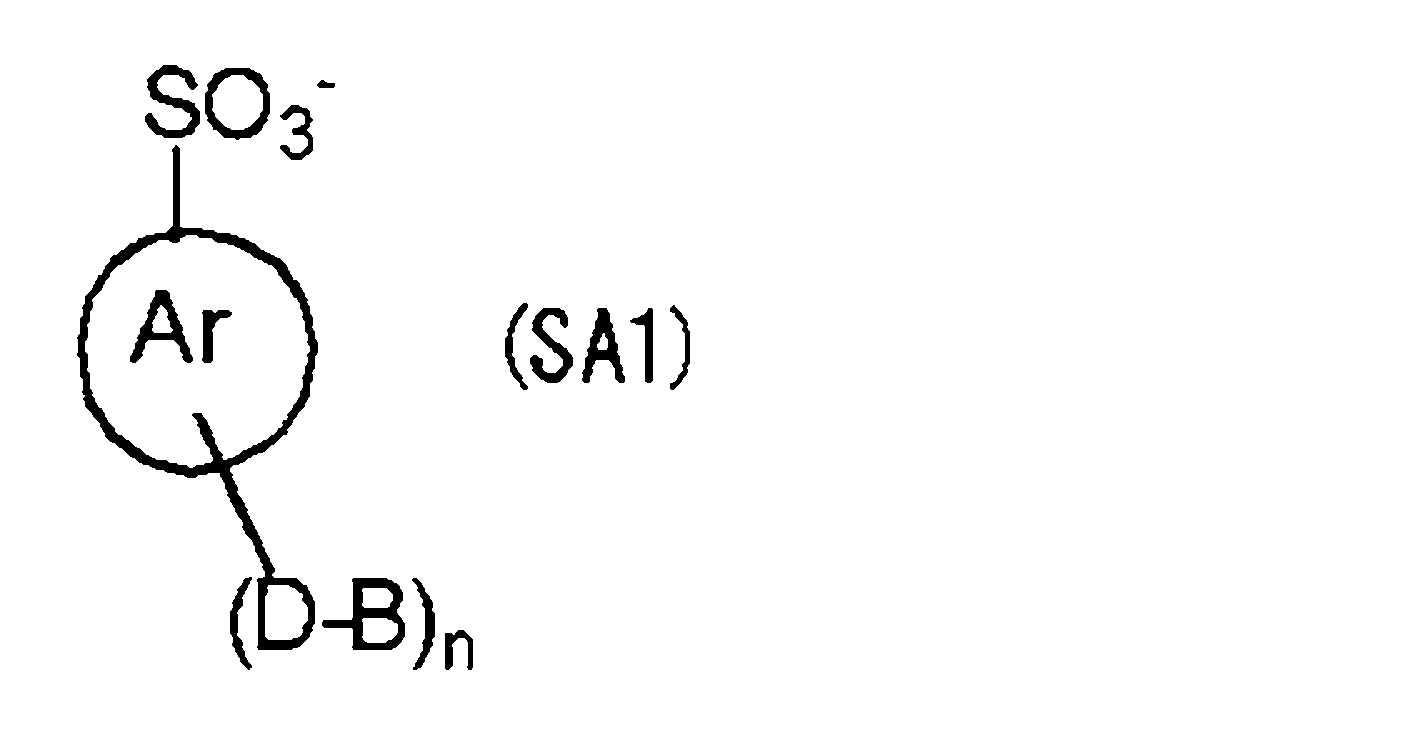
式(SA1)中、Arは、アリール基を表し、スルホン酸アニオン及び-(D-B)基以外の置換基を更に有していてもよい。更に有しても良い置換基としては、フッ素原子、水酸基などが挙げられる。
nは、0以上の整数を表す。nは、好ましくは1~4であり、より好ましくは2~3であり、最も好ましくは3である。
Dは、単結合又は2価の連結基を表す。この2価の連結基としては、エーテル基、チオエーテル基、カルボニル基、スルホキシド基、スルホン基、スルホン酸エステル基、エステル基、及び、これらの2種以上の組み合わせからなる基等を挙げることができる。
Bは、炭化水素基を表す。
好ましくは、Dは単結合であり、Bは脂肪族炭化水素構造である。Bは、イソプロピル基又はシクロヘキシル基がより好ましい。
一般式(ZI)におけるスルホニウムカチオン、及び一般式(ZII)におけるヨードニウムカチオンの好ましい例を以下に示す。

一般式(ZI)、一般式(ZII)におけるアニオンZ-、一般式(ZI-3)におけるZc-、及び一般式(ZI-4)におけるZ-の好ましい例を以下に示す。

上記のカチオン及びアニオンを任意に組みわせて光酸発生剤として使用することができる。
光酸発生剤は、低分子化合物の形態であってもよく、重合体の一部に組み込まれた形態であってもよい。また、低分子化合物の形態と重合体の一部に組み込まれた形態を併用してもよい。
光酸発生剤は、低分子化合物の形態であることが好ましい。
光酸発生剤が、低分子化合物の形態である場合、分子量は3,000以下が好ましく、2,000以下がより好ましく、1,000以下が更に好ましい。
光酸発生剤が、重合体の一部に組み込まれた形態である場合、前述した樹脂(A)の一部に組み込まれてもよく、樹脂(A)とは異なる樹脂に組み込まれてもよい。
光酸発生剤は、1種単独で使用してもよいし、2種以上を併用してもよい。
光酸発生剤の本発明の組成物中の含有量(複数種存在する場合はその合計)は、本発明の組成物の全固形分を基準として、0.1~35質量%が好ましく、0.5~25質量%がより好ましく、3~20質量%が更に好ましく、3~15質量%が特に好ましい。
光酸発生剤として、上記一般式(ZI-3)又は(ZI-4)で表される化合物を含む場合、組成物中に含まれる光酸発生剤の含有量(複数種存在する場合はその合計)は、組成物の全固形分を基準として、5~35質量%が好ましく、7~30質量%がより好ましい。
光酸発生剤は、低分子化合物の形態であることが好ましい。
光酸発生剤が、低分子化合物の形態である場合、分子量は3,000以下が好ましく、2,000以下がより好ましく、1,000以下が更に好ましい。
光酸発生剤が、重合体の一部に組み込まれた形態である場合、前述した樹脂(A)の一部に組み込まれてもよく、樹脂(A)とは異なる樹脂に組み込まれてもよい。
光酸発生剤は、1種単独で使用してもよいし、2種以上を併用してもよい。
光酸発生剤の本発明の組成物中の含有量(複数種存在する場合はその合計)は、本発明の組成物の全固形分を基準として、0.1~35質量%が好ましく、0.5~25質量%がより好ましく、3~20質量%が更に好ましく、3~15質量%が特に好ましい。
光酸発生剤として、上記一般式(ZI-3)又は(ZI-4)で表される化合物を含む場合、組成物中に含まれる光酸発生剤の含有量(複数種存在する場合はその合計)は、組成物の全固形分を基準として、5~35質量%が好ましく、7~30質量%がより好ましい。
<オニウム塩(C)>
本発明の組成物は、一般式(1)で表される、対カチオン中にアミド構造を有するオニウム塩(C)(「オニウム塩(C)」ともいう)を含有する。
オニウム塩(C)は、本発明の組成物から形成される感活性光線性又は感放射線性膜中において、酸拡散制御剤又はクエンチャーとして作用することができる。
本発明の組成物は、一般式(1)で表される、対カチオン中にアミド構造を有するオニウム塩(C)(「オニウム塩(C)」ともいう)を含有する。
オニウム塩(C)は、本発明の組成物から形成される感活性光線性又は感放射線性膜中において、酸拡散制御剤又はクエンチャーとして作用することができる。

一般式(1)中、X1は硫黄原子、ヨウ素原子、又は窒素原子を表し、Q1はアミド構造を有する基を表し、Q2はアルキル基、シクロアルキル基、又はアリール基を表す。ただし、Q1及びk個のQ2のうち少なくとも1つはアルキル基又はシクロアルキル基を表す。X1が硫黄原子を表す場合はk=2であり、X1がヨウ素原子を表す場合はk=1であり、X1が窒素原子を表す場合はk=3である。Y1は有機対アニオンを表す。Q1とk個のQ2のうち少なくとも1つとは互いに結合して環構造を形成していても良い。kが2又は3を表す場合、少なくとも2つのQ2は互いに結合して環構造を形成していても良い。
一般式(1)中、Q1はアミド構造を有する基を表す。アミド構造とは下記式(am)で表される基を表す。
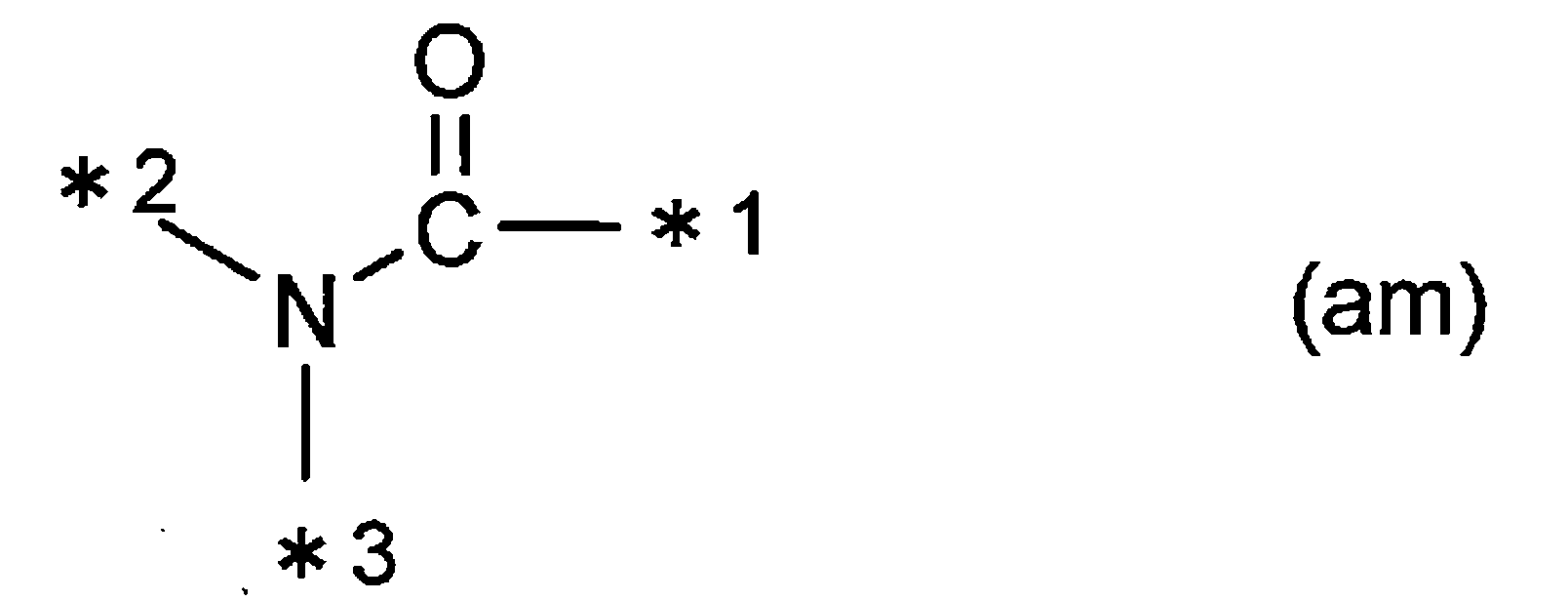
式(am)中、*1~*3は結合手を表す。
*1~*3はそれぞれ他の原子への結合手を表し、他の原子としては水素原子、炭素原子などが挙げられるが、これらに限定されるものではない。
Q1のアミド構造を有する基としては、好ましくは、アミド構造を有する、アルキル基、シクロアルキル基、アルケニル基、シクロアルケニル基、アルキニル基、シクロアルキニル基、アリール基、ヘテロアリール基、又はこれらの組み合わせからなる基である。
Q1がアミド構造を有する、アルキル基、シクロアルキル基、アルケニル基、シクロアルケニル基、アルキニル基、シクロアルキニル基、アリール基、ヘテロアリール基、又はこれらの組み合わせからなる基である場合、上記式(am)で表される基が*1~*3のいずれかの結合手で結合した、アルキル基、シクロアルキル基、アルケニル基、シクロアルケニル基、アルキニル基、シクロアルキニル基、アリール基、ヘテロアリール基、又はこれらの組み合わせからなる基であることが好ましい。この場合、*1~*3のうち、上記アルキル基、シクロアルキル基、アルケニル基、シクロアルケニル基、アルキニル基、シクロアルキニル基、アリール基、ヘテロアリール基、又はこれらの組み合わせからなる基とは結合していない結合手には、水素原子、又は、上記とは別のアルキル基、シクロアルキル基、アルケニル基、シクロアルケニル基、アルキニル基、シクロアルキニル基、アリール基、ヘテロアリール基、又はこれらの組み合わせからなる基が結合することが好ましい。
*1~*3はそれぞれ他の原子への結合手を表し、他の原子としては水素原子、炭素原子などが挙げられるが、これらに限定されるものではない。
Q1のアミド構造を有する基としては、好ましくは、アミド構造を有する、アルキル基、シクロアルキル基、アルケニル基、シクロアルケニル基、アルキニル基、シクロアルキニル基、アリール基、ヘテロアリール基、又はこれらの組み合わせからなる基である。
Q1がアミド構造を有する、アルキル基、シクロアルキル基、アルケニル基、シクロアルケニル基、アルキニル基、シクロアルキニル基、アリール基、ヘテロアリール基、又はこれらの組み合わせからなる基である場合、上記式(am)で表される基が*1~*3のいずれかの結合手で結合した、アルキル基、シクロアルキル基、アルケニル基、シクロアルケニル基、アルキニル基、シクロアルキニル基、アリール基、ヘテロアリール基、又はこれらの組み合わせからなる基であることが好ましい。この場合、*1~*3のうち、上記アルキル基、シクロアルキル基、アルケニル基、シクロアルケニル基、アルキニル基、シクロアルキニル基、アリール基、ヘテロアリール基、又はこれらの組み合わせからなる基とは結合していない結合手には、水素原子、又は、上記とは別のアルキル基、シクロアルキル基、アルケニル基、シクロアルケニル基、アルキニル基、シクロアルキニル基、アリール基、ヘテロアリール基、又はこれらの組み合わせからなる基が結合することが好ましい。
上記アルキル基としては、直鎖状であっても分岐状であってもよく、好ましくは炭素数1~30のアルキル基であり、より好ましくは炭素数1~12のアルキル基であり、更に好ましくは炭素数1~8のアルキル基である。具体的には、メチル基、エチル基、プロピル基、イソプロピル基、n-ブチル基、イソブチル基、sec-ブチル基、ペンチル基、ネオペンチル基、ヘキシル基、ヘプチル基、オクチル基、ノニル基、デシル基、ウンデシル基、ドデシル基、トリデシル基、テトラデシル基、ペンタデシル基、ヘキサデシル基、ヘプタデシル基、オクタデシル基、ノナデシル基、エイコシル基等を挙げることができる。
上記シクロアルキル基としては、好ましくは炭素数3~30のシクロアルキル基であり、より好ましくは炭素数3~12のシクロアルキル基であり、更に好ましくは炭素数3~8のシクロアルキル基である。具体的には、シクロプロピル基、シクロペンチル基、シクロヘキシル基、アダマンチル基、ノルボルニル基、ボルニル基等を挙げることができる。
上記アルケニル基としては、直鎖状でも分岐状でもよく、炭素数2~15のアルケニル基であることが好ましい。具体的には、エチレン基、プロピレン気、イソプロピレン基、ブチレン基、ペンチレン基、ヘキシレン基、ヘプチレン基、オクチレン基、ノレン基、デシレン基、ウンデシレン基、ドデシレン基、トリデシレン基、テトラデシレン基、ペンタデシレン基等を挙げることができる。
上記シクロアルケニル基としては、炭素数3~15のシクロアルケニル基であることが好ましい。具体的には、シクロペンチレン基、ソクロヘキシレン基、シクロペンチレン基、シクロヘキシレン基、ノルボルネン基などが挙げられる。
アルキニル基としては、炭素数1~15のアルキニル基が好ましく、具体的にはアセチレン基、プロピニル、ブチニル基、ペンチニル基、ヘキシニル基、3,3-ジメチル-1-ブニチル基、ヘプチニル基、オクチニル基、ノニル基、デシニル基、ウンデシニル基、ドデシニル基、トリデシニル基、テトラデシニル基、ペンタデシニル基等を挙げることができる。
上記アリール基としては、炭素数6~15のアリール基であることが好ましく、具体的には、フェニル基、トリル基、ナフチル基、アントリル基等を好ましい例として挙げることができる。
上記ヘテロアリール基としては、ピリジル基、ピラジル基、ピラニル基、ピラゾリル基、チアゾリル基、インドール基、イミダゾリル基、ベンズイミダゾリル基、チアゾリル基、ベンズチアゾリル基、ベンズオキサゾリル基、クロマニル基、キノリル基、イソキノリル基、ピリミジル基、フラニル基等を挙げることができる。
上記シクロアルキル基としては、好ましくは炭素数3~30のシクロアルキル基であり、より好ましくは炭素数3~12のシクロアルキル基であり、更に好ましくは炭素数3~8のシクロアルキル基である。具体的には、シクロプロピル基、シクロペンチル基、シクロヘキシル基、アダマンチル基、ノルボルニル基、ボルニル基等を挙げることができる。
上記アルケニル基としては、直鎖状でも分岐状でもよく、炭素数2~15のアルケニル基であることが好ましい。具体的には、エチレン基、プロピレン気、イソプロピレン基、ブチレン基、ペンチレン基、ヘキシレン基、ヘプチレン基、オクチレン基、ノレン基、デシレン基、ウンデシレン基、ドデシレン基、トリデシレン基、テトラデシレン基、ペンタデシレン基等を挙げることができる。
上記シクロアルケニル基としては、炭素数3~15のシクロアルケニル基であることが好ましい。具体的には、シクロペンチレン基、ソクロヘキシレン基、シクロペンチレン基、シクロヘキシレン基、ノルボルネン基などが挙げられる。
アルキニル基としては、炭素数1~15のアルキニル基が好ましく、具体的にはアセチレン基、プロピニル、ブチニル基、ペンチニル基、ヘキシニル基、3,3-ジメチル-1-ブニチル基、ヘプチニル基、オクチニル基、ノニル基、デシニル基、ウンデシニル基、ドデシニル基、トリデシニル基、テトラデシニル基、ペンタデシニル基等を挙げることができる。
上記アリール基としては、炭素数6~15のアリール基であることが好ましく、具体的には、フェニル基、トリル基、ナフチル基、アントリル基等を好ましい例として挙げることができる。
上記ヘテロアリール基としては、ピリジル基、ピラジル基、ピラニル基、ピラゾリル基、チアゾリル基、インドール基、イミダゾリル基、ベンズイミダゾリル基、チアゾリル基、ベンズチアゾリル基、ベンズオキサゾリル基、クロマニル基、キノリル基、イソキノリル基、ピリミジル基、フラニル基等を挙げることができる。
Q1は、アルキル基、シクロアルキル基、アルケニル基、シクロアルケニル基、アルキニル基、シクロアルキニル基、アリール基、及びヘテロアリール基から選ばれる2種以上を組み合わせてなる基(例えばアラルキル基)であって、かつアミド構造を有する基であっても良い。また、Q1は更に置換基を有していてもよい。置換基としては例えばヒドロキシル基、アルコキシ基、ニトロ基、ハロゲン原子(フッ素原子、塩素原子、臭素原子、沃素原子)、カルボキシ基、アミノ基、シアノ基などが挙げられる。
一般式(1)中、Q2はアルキル基、シクロアルキル基、又はアリール基を表す。
Q2としてのアルキル基、シクロアルキル基、又はアリール基は、Q1におけるアルキル基、シクロアルキル基、又はアリール基として説明したものと同様である。
Q2としてのアルキル基、シクロアルキル基、又はアリール基は、更に置換基を有していてもよい。例えばアルキル基は、置換基としてアリール基を有していても良い(すなわち、アラルキル基であっても良い)。
k個のQ2のうち少なくとも1つがアルキル基又はシクロアルキル基であることが好ましく、全てがアルキル基又はシクロアルキル基であることがより好ましい。
Q2としてのアルキル基、シクロアルキル基、又はアリール基は、Q1におけるアルキル基、シクロアルキル基、又はアリール基として説明したものと同様である。
Q2としてのアルキル基、シクロアルキル基、又はアリール基は、更に置換基を有していてもよい。例えばアルキル基は、置換基としてアリール基を有していても良い(すなわち、アラルキル基であっても良い)。
k個のQ2のうち少なくとも1つがアルキル基又はシクロアルキル基であることが好ましく、全てがアルキル基又はシクロアルキル基であることがより好ましい。
一般式(1)中、Q1及びk個のQ2のうち少なくとも1つはアルキル基又はシクロアルキル基を表す。
なお、Q1がアルキル基又はシクロアルキル基を表す場合は、アミド構造を有するアルキル基又はアミド構造を有するシクロアルキル基を表すこととなる。
本発明において、一般式(1)中のQ1及びk個のQ2のうち少なくとも1つはアルキル基又はシクロアルキル基を表すことで、オニウム塩(C)の透明性が向上し、更に良好なパターン形状を形成できる。
なお、Q1がアルキル基又はシクロアルキル基を表す場合は、アミド構造を有するアルキル基又はアミド構造を有するシクロアルキル基を表すこととなる。
本発明において、一般式(1)中のQ1及びk個のQ2のうち少なくとも1つはアルキル基又はシクロアルキル基を表すことで、オニウム塩(C)の透明性が向上し、更に良好なパターン形状を形成できる。
一般式(1)中、X1が硫黄原子を表す場合はk=2であり、X1がヨウ素原子を表す場合はk=1であり、X1が窒素原子を表す場合はk=3である。
Q1とk個のQ2のうち少なくとも1つとは互いに結合して環構造を形成していても良い。kが2又は3を表す場合、少なくとも2つのQ2は互いに結合して環構造を形成していても良い。上記環構造としては、特に限定されないが、例えば、環員としてX1と炭素原子とを含む脂肪族環又は芳香族環が挙げられる。上記環は環員としてヘテロ原子(例えば酸素原子、硫黄原子、又は窒素原子)を含んでいてもよい。また、上記環は置換基を有していてもよい。上記環の炭素数は3~20であることが好ましく、4~15であることがより好ましい。
Q1とk個のQ2のうち少なくとも1つとは互いに結合して環構造を形成していても良い。kが2又は3を表す場合、少なくとも2つのQ2は互いに結合して環構造を形成していても良い。上記環構造としては、特に限定されないが、例えば、環員としてX1と炭素原子とを含む脂肪族環又は芳香族環が挙げられる。上記環は環員としてヘテロ原子(例えば酸素原子、硫黄原子、又は窒素原子)を含んでいてもよい。また、上記環は置換基を有していてもよい。上記環の炭素数は3~20であることが好ましく、4~15であることがより好ましい。
一般式(1)中、Y1は有機対アニオンを表す。
Y1は、特に限定されないが、具体例及び好ましい範囲は、前述の光酸発生剤としての一般式(ZI)におけるZ-、一般式(ZII)におけるZ-、一般式(ZI-3)におけるZc-、及び一般式(ZI-4)におけるZはと同様である。
Y1は、特に限定されないが、具体例及び好ましい範囲は、前述の光酸発生剤としての一般式(ZI)におけるZ-、一般式(ZII)におけるZ-、一般式(ZI-3)におけるZc-、及び一般式(ZI-4)におけるZはと同様である。
酸をトラップする性能の観点から、オニウム塩(C)は、アミド構造の窒素原子に芳香族基が直結した構造を有さないことが好ましい。
透明性等の観点から、一般式(1)中、X1が硫黄原子を表し、かつ2つのQ2がそれぞれ独立にアルキル基又はシクロアルキル基を表すことが好ましく、アルキル基を表すことがより好ましい。ただし、Q1と2つのQ2のうち少なくとも1つとは互いに結合して環構造を形成していても良い。また、2つのQ2は互いに結合して環構造を形成していても良い。
本発明では、オニウム塩(C)が、下記一般式(2)で表されることが好ましい。

一般式(2)中、Q3及びQ4は各々独立にアルキル基又はシクロアルキル基を表し、L1はアルキレン基又はシクロアルキレン基を表し、Q5及びQ6は各々独立に水素原子、アルキル基、シクロアルキル基、アルケニル基、シクロアルケニル基、アルキニル基、シクロアルキニル基、アリール基、又はヘテロアリール基を表す。Q3~Q6及びL1のうち少なくとも2つは互いに結合して環構造を形成していても良い。Y2は有機対アニオンである。
一般式(2)中、Q3及びQ4は各々独立にアルキル基又はシクロアルキル基を表し、Q2としてのアルキル基又はシクロアルキル基として説明したものと同様である。Q3及びQ4は各々独立にアルキル基を表すことが特に好ましい。
一般式(2)中、Q5及びQ6は各々独立に水素原子、アルキル基、シクロアルキル基、アルケニル基、シクロアルケニル基、アルキニル基、シクロアルキニル基、アリール基、又はヘテロアリール基を表す。Q5及びQ6としてのアルキル基、シクロアルキル基、アルケニル基、シクロアルケニル基、アルキニル基、シクロアルキニル基、アリール基、又はヘテロアリール基は、Q1におけるアルキル基、シクロアルキル基、アルケニル基、シクロアルケニル基、アルキニル基、シクロアルキニル基、アリール基、又はヘテロアリール基として説明したものと同様である。Q5及びQ6は各々独立に水素原子又はアルキル基を表すことが好ましい。
一般式(2)中、Q5及びQ6は各々独立に水素原子、アルキル基、シクロアルキル基、アルケニル基、シクロアルケニル基、アルキニル基、シクロアルキニル基、アリール基、又はヘテロアリール基を表す。Q5及びQ6としてのアルキル基、シクロアルキル基、アルケニル基、シクロアルケニル基、アルキニル基、シクロアルキニル基、アリール基、又はヘテロアリール基は、Q1におけるアルキル基、シクロアルキル基、アルケニル基、シクロアルケニル基、アルキニル基、シクロアルキニル基、アリール基、又はヘテロアリール基として説明したものと同様である。Q5及びQ6は各々独立に水素原子又はアルキル基を表すことが好ましい。
一般式(2)中、L1はアルキレン基又はシクロアルキレン基を表す。
L1としてのアルキレン基は、炭素数1~12のアルキレン基が好ましく、炭素数1~8のアルキレン基がより好ましく、具体的には、メチレン基、エチレン基、プロピレン基等が挙げられる。
L1としてのシクロアルキレン基は、炭素数3~12のシクロアルキレン基が好ましく、炭素数3~8のシクロアルキレン基がより好ましい。
上記アルキレン基又はシクロアルキレン基は置換基を有していてもよい。
L1としてのアルキレン基は、炭素数1~12のアルキレン基が好ましく、炭素数1~8のアルキレン基がより好ましく、具体的には、メチレン基、エチレン基、プロピレン基等が挙げられる。
L1としてのシクロアルキレン基は、炭素数3~12のシクロアルキレン基が好ましく、炭素数3~8のシクロアルキレン基がより好ましい。
上記アルキレン基又はシクロアルキレン基は置換基を有していてもよい。
一般式(2)中、Q3~Q6及びL1のうち少なくとも2つは互いに結合して環構造を形成していても良い。上記環構造としては、一般式(1)のQ1とk個のQ2のうち少なくとも1つとが互いに結合して環構造を形成する場合、及び少なくとも2つのQ2が互いに結合して環構造を形成する場合の環構造として説明したものと同様である。
一般式(2)中、Y2は有機対アニオンを表し、前述の一般式(1)中のY1と同様である。
オニウム塩(C)のカチオン部の分子量は、100以上500以下であることが好ましく、120以上350以下であることがより好ましい。オニウム塩(C)のカチオン部とは、例えば一般式(1)においてはY1で表される有機対アニオン以外の構造を指す。オニウム塩(C)のカチオン部の分子量が上記範囲であると、オニウム塩(C)の拡散性が高くなり、共通DOF性能、及びLWR性能が特に優れたものとなるため好ましい。
以下に、オニウム塩(C)の具体例を示すが、これらに限定されるものではない。
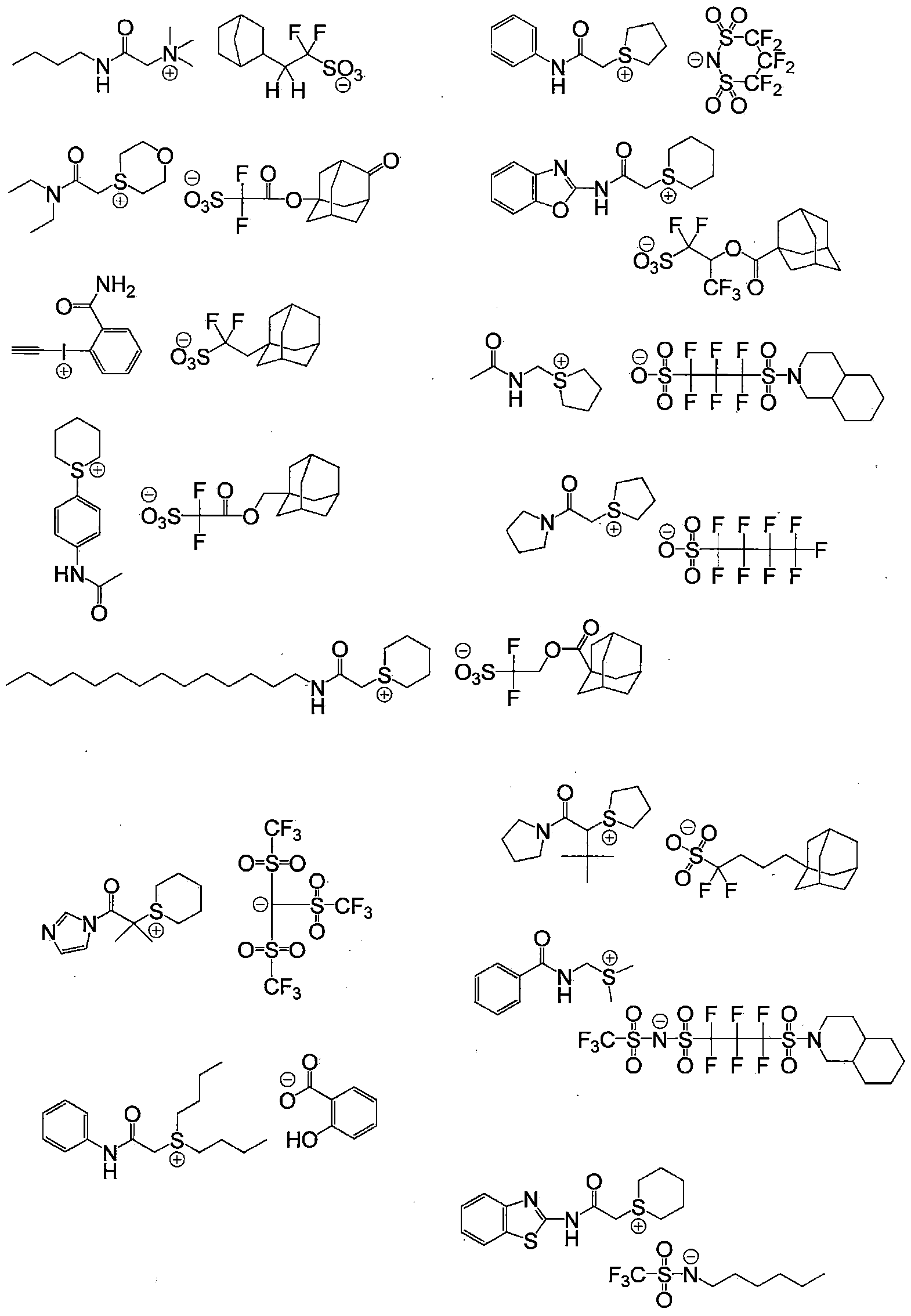
オニウム塩(C)は、公知の方法(例えば、特開2003-307839号公報に記載の方法)を用いて合成することができる。
オニウム塩(C)は、1種単独で使用してもよいし、2種以上を併用してもよい。
オニウム塩(C)の本発明の組成物中の含有量(複数種存在する場合はその合計)は、本発明の組成物の全固形分を基準として、0.05~30質量%が好ましく、0.1~20質量%がより好ましく、0.2~15質量%がさらに好ましく、0.2~10質量%が特に好ましい。
オニウム塩(C)の本発明の組成物中の含有量(複数種存在する場合はその合計)は、本発明の組成物の全固形分を基準として、0.05~30質量%が好ましく、0.1~20質量%がより好ましく、0.2~15質量%がさらに好ましく、0.2~10質量%が特に好ましい。
本発明の組成物中のオニウム塩(C)の含有量は、モル換算で光酸発生剤の含有量よりも少ない。これは、オニウム塩(C)はクエンチャーとして作用する構造を有しているため、光酸発生剤よりも含有量が多いと、露光により生じた酸が充分に作用する前にクエンチされてしまい、パターン形成が不十分となってしまうためである。本発明の組成物中のオニウム塩(C)の含有量がモル換算で光酸発生剤の含有量の50%以下であることが好ましく、1~40%がより好ましく、5~30%が特に好ましい。
<疎水性樹脂(D)>
本発明の組成物は、更に、(D)フッ素原子及び珪素原子の少なくともいずれかを有する、上記樹脂(A)とは異なる疎水性樹脂(「疎水性樹脂(D)」)を含有することが好ましい。
本発明の組成物が、疎水性樹脂(D)を含有することにより、感活性光線性又は感放射線性膜の表面における静的/動的な接触角を制御することができる。これにより、現像特性の改善、アウトガスの抑制、液浸露光における液浸液追随性の向上、及び液浸欠陥の低減等が可能となる。
疎水性樹脂(D)は、レジスト膜の表面に偏在するように設計されることが好ましいが、界面活性剤とは異なり、必ずしも分子内に親水基を有する必要はなく、極性/非極性物質を均一に混合することに寄与しなくてもよい。
本発明の組成物は、更に、(D)フッ素原子及び珪素原子の少なくともいずれかを有する、上記樹脂(A)とは異なる疎水性樹脂(「疎水性樹脂(D)」)を含有することが好ましい。
本発明の組成物が、疎水性樹脂(D)を含有することにより、感活性光線性又は感放射線性膜の表面における静的/動的な接触角を制御することができる。これにより、現像特性の改善、アウトガスの抑制、液浸露光における液浸液追随性の向上、及び液浸欠陥の低減等が可能となる。
疎水性樹脂(D)は、レジスト膜の表面に偏在するように設計されることが好ましいが、界面活性剤とは異なり、必ずしも分子内に親水基を有する必要はなく、極性/非極性物質を均一に混合することに寄与しなくてもよい。
疎水性樹脂(D)は、膜表層への偏在化の観点から、“フッ素原子”、“ケイ素原子”、及び“樹脂の側鎖部分に含有されたCH3部分構造”からなる群から選択される少なくとも1種を有する繰り返し単位を含む樹脂であることが好ましい。
疎水性樹脂(D)が、フッ素原子及び/又はケイ素原子を含む場合、疎水性樹脂(D)における上記フッ素原子及び/又はケイ素原子は、樹脂の主鎖中に含まれていてもよく、側鎖中に含まれていてもよい。
疎水性樹脂(D)が、フッ素原子及び/又はケイ素原子を含む場合、疎水性樹脂(D)における上記フッ素原子及び/又はケイ素原子は、樹脂の主鎖中に含まれていてもよく、側鎖中に含まれていてもよい。
疎水性樹脂(D)がフッ素原子を含む場合、フッ素原子を有する部分構造として、フッ素原子を有するアルキル基、フッ素原子を有するシクロアルキル基、又はフッ素原子を有するアリール基を有する樹脂であることが好ましい。
疎水性樹脂(D)は、含フッ素(メタ)アクリレート系樹脂であることが好ましい。
疎水性樹脂(D)は、含フッ素(メタ)アクリレート系樹脂であることが好ましい。
疎水性樹脂(D)は、下記(x)~(z)の群から選ばれる基を少なくとも1つを有することが好ましい。
(x)酸基
(y)アルカリ現像液の作用により分解してアルカリ現像液に対する溶解度が増大する基(以下、極性変換基ともいう)
(z)酸の作用により分解する基
(x)酸基
(y)アルカリ現像液の作用により分解してアルカリ現像液に対する溶解度が増大する基(以下、極性変換基ともいう)
(z)酸の作用により分解する基
酸基(x)としては、フェノール性水酸基、カルボン酸基、フッ素化アルコール基、スルホン酸基、スルホンアミド基、スルホニルイミド基、(アルキルスルホニル)(アルキルカルボニル)メチレン基、(アルキルスルホニル)(アルキルカルボニル)イミド基、ビス(アルキルカルボニル)メチレン基、ビス(アルキルカルボニル)イミド基、ビス(アルキルスルホニル)メチレン基、ビス(アルキルスルホニル)イミド基、トリス(アルキルカルボニル)メチレン基、及びトリス(アルキルスルホニル)メチレン基等が挙げられる。
酸基としては、フッ素化アルコール基(好ましくはヘキサフルオロイソプロパノール)、スルホンイミド基、又はビス(アルキルカルボニル)メチレン基が好ましい。
酸基としては、フッ素化アルコール基(好ましくはヘキサフルオロイソプロパノール)、スルホンイミド基、又はビス(アルキルカルボニル)メチレン基が好ましい。
アルカリ現像液の作用により分解してアルカリ現像液に対する溶解度が増大する基(y)としては、例えば、ラクトン基、カルボン酸エステル基(-COO-)、酸無水物基(-C(O)OC(O)-)、酸イミド基(-NHCONH-)、カルボン酸チオエステル基(-COS-)、炭酸エステル基(-OC(O)O-)、硫酸エステル基(-OSO2O-)、及びスルホン酸エステル基(-SO2O-)などが挙げられ、ラクトン基又はカルボン酸エステル基(-COO-)が好ましい。
これらの基を含んだ繰り返し単位は、樹脂の主鎖にこれらの基が直接結合している繰り返し単位であり、例えば、アクリル酸エステル及びメタクリル酸エステルによる繰り返し単位等が挙げられる。この繰り返し単位は、これらの基が連結基を介して樹脂の主鎖に結合していてもよい。あるいは、この繰り返し単位は、これらの基を有する重合開始剤又は連鎖移動剤を重合時に用いて、樹脂の末端に導入されていてもよい。
ラクトン基を有する繰り返し単位としては、例えば、先に樹脂(A)の項で説明したラクトン構造を有する繰り返し単位と同様のものが挙げられる。
これらの基を含んだ繰り返し単位は、樹脂の主鎖にこれらの基が直接結合している繰り返し単位であり、例えば、アクリル酸エステル及びメタクリル酸エステルによる繰り返し単位等が挙げられる。この繰り返し単位は、これらの基が連結基を介して樹脂の主鎖に結合していてもよい。あるいは、この繰り返し単位は、これらの基を有する重合開始剤又は連鎖移動剤を重合時に用いて、樹脂の末端に導入されていてもよい。
ラクトン基を有する繰り返し単位としては、例えば、先に樹脂(A)の項で説明したラクトン構造を有する繰り返し単位と同様のものが挙げられる。
アルカリ現像液の作用により分解してアルカリ現像液に対する溶解度が増大する基(y)を有する繰り返し単位の含有量は、疎水性樹脂(D)中の全繰り返し単位を基準として、1~100モル%が好ましく、3~98モル%がより好ましく、5~95モル%が更に好ましい。
疎水性樹脂(D)における、酸の作用により分解する基(z)を有する繰り返し単位は、樹脂(A)で挙げた酸分解性基を有する繰り返し単位と同様のものが挙げられる。酸の作用により分解する基(z)を有する繰り返し単位は、フッ素原子及びケイ素原子の少なくともいずれかを有していてもよい。酸の作用により分解する基(z)を有する繰り返し単位の含有量は、樹脂(D)中の全繰り返し単位に対して、1~80モル%が好ましく、10~80モル%がより好ましく、20~60モル%が更に好ましい。
疎水性樹脂(D)は、更に、上述した繰り返し単位とは別の繰り返し単位を有していてもよい。
疎水性樹脂(D)は、更に、上述した繰り返し単位とは別の繰り返し単位を有していてもよい。
フッ素原子を含む繰り返し単位は、疎水性樹脂(D)に含まれる全繰り返し単位に対して、10~100モル%が好ましく、30~100モル%がより好ましい。また、ケイ素原子を含む繰り返し単位は、疎水性樹脂(D)に含まれる全繰り返し単位に対して、10~100モル%が好ましく、20~100モル%がより好ましい。
一方、特に疎水性樹脂(D)が側鎖部分にCH3部分構造を含む場合においては、疎水性樹脂(D)が、フッ素原子及びケイ素原子を実質的に含有しない形態も好ましい。また、疎水性樹脂(D)は、炭素原子、酸素原子、水素原子、窒素原子及び硫黄原子から選ばれる原子のみによって構成された繰り返し単位のみで実質的に構成されることが好ましい。
疎水性樹脂(D)の標準ポリスチレン換算の重量平均分子量は、1,000~100,000が好ましく、1,000~50,000がより好ましい。
疎水性樹脂(D)に含まれる残存モノマー及び/又はオリゴマー成分の合計含有量は、0.01~5質量%が好ましく、0.01~3質量%がより好ましい。また、分散度(Mw/Mn)は、1~5の範囲が好ましく、より好ましくは1~3の範囲である。
疎水性樹脂(D)としては、公知の樹脂を、単独又はそれらの混合物として適宜に選択して使用することができる。例えば、米国特許出願公開2015/0168830A1号明細書の段落<0451>~<0704>、米国特許出願公開2016/0274458A1号明細書の段落<0340>~<0356>に開示された公知の樹脂を疎水性樹脂(D)として好適に使用できる。また、米国特許出願公開2016/0237190A1号明細書の段落<0177>~<0258>に開示された繰り返し単位も、疎水性樹脂(D)を構成する繰り返し単位として好ましい。
疎水性樹脂(D)を構成する繰り返し単位の好ましい例を以下に示す。
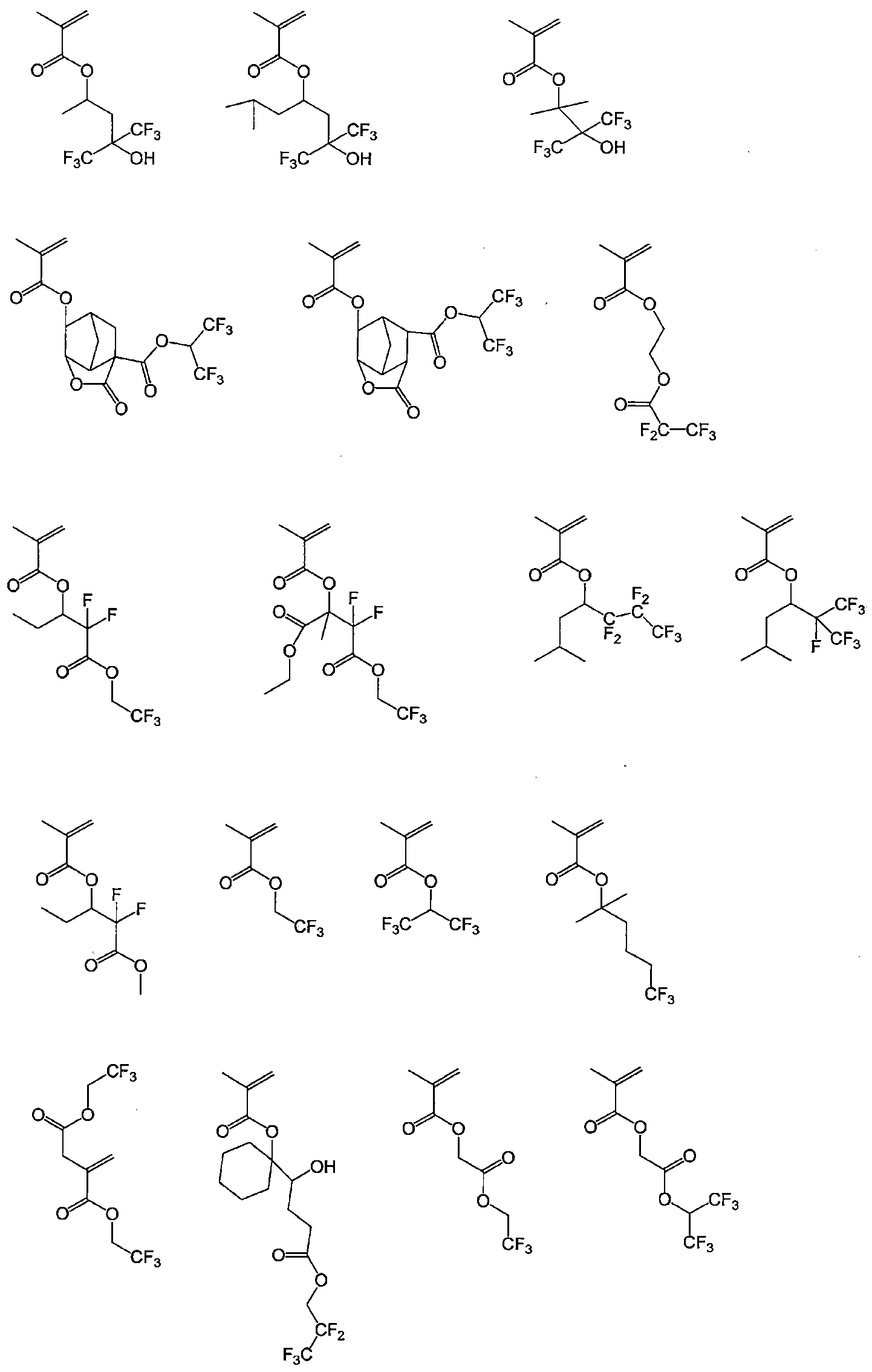
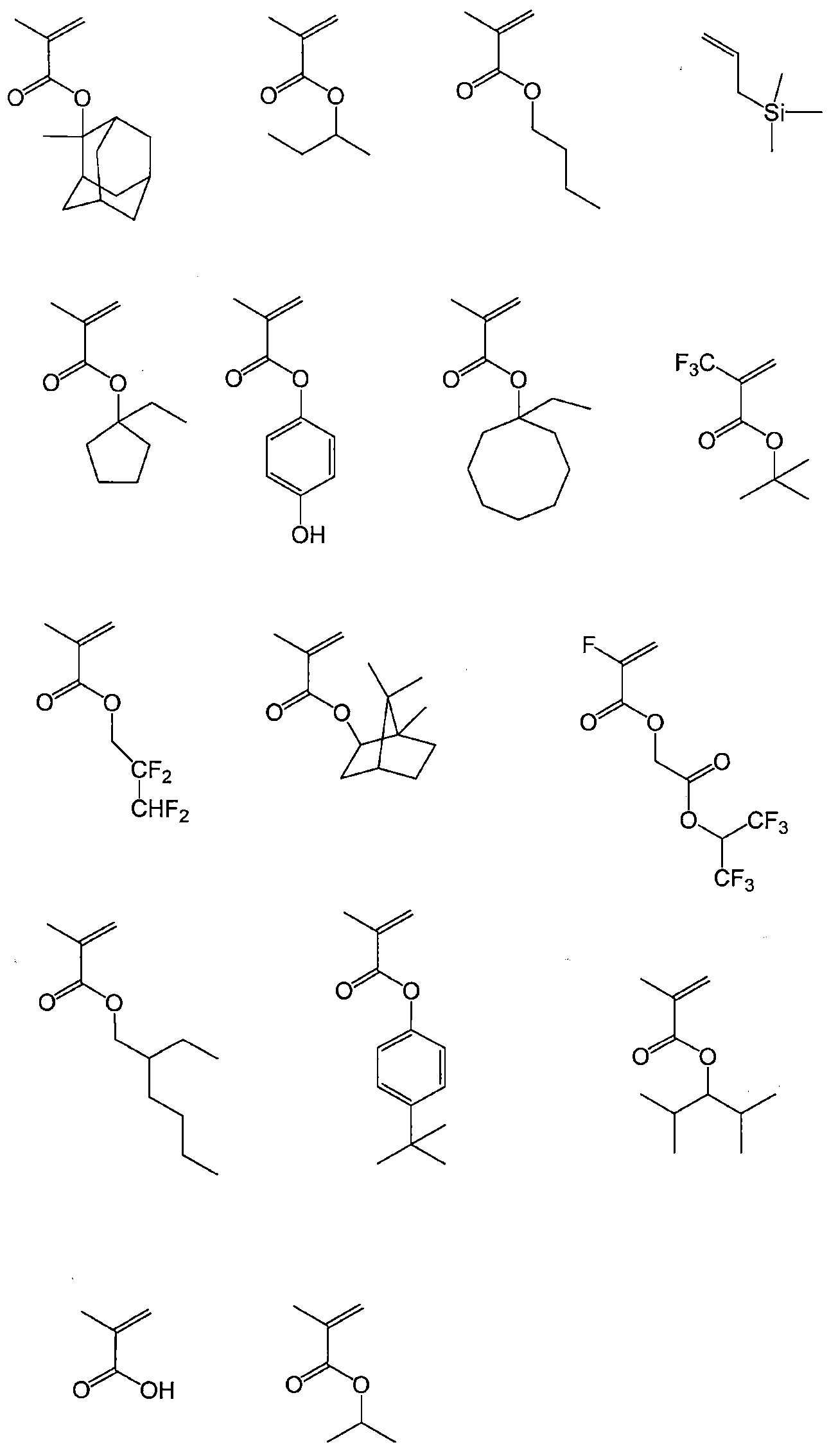
疎水性樹脂(D)は、1種単独で使用してもよいし、2種以上を併用してもよい。表面エネルギーが異なる2種以上の疎水性樹脂(D)を混合して使用することが、液浸露光における液浸液追随性と現像特性の両立の観点から好ましい。
疎水性樹脂(D)の組成物中の含有量は、本発明の組成物中の全固形分に対し、0.01~10質量%が好ましく、0.05~10質量%がより好ましく、1~10質量%が更に好ましい。疎水性樹脂(D)の組成物中の含有量が0.01質量%以上であると表面特性が制御しやすいという観点で好ましく、10質量%以下であるとリソグラフィ性能の観点で好ましい。
疎水性樹脂(D)の組成物中の含有量は、本発明の組成物中の全固形分に対し、0.01~10質量%が好ましく、0.05~10質量%がより好ましく、1~10質量%が更に好ましい。疎水性樹脂(D)の組成物中の含有量が0.01質量%以上であると表面特性が制御しやすいという観点で好ましく、10質量%以下であるとリソグラフィ性能の観点で好ましい。
<酸拡散制御剤>
本発明の組成物は、オニウム塩(C)を含有するものであるが、更に酸拡散制御剤を併用してもよい。酸拡散制御剤は、露光時に酸発生剤等から発生する酸をトラップし、余分な発生酸による、未露光部における酸分解性樹脂の反応を抑制するクエンチャーとして作用するものである。例えば、塩基性化合物(DA)、活性光線又は放射線の照射により塩基性が低下又は消失する塩基性化合物(DB)、酸発生剤に対して相対的に弱酸となるオニウム塩(DC)、窒素原子を有し、酸の作用により脱離する基を有する低分子化合物(DD)、又はカチオン部に窒素原子を有するオニウム塩化合物(DE)等を酸拡散制御剤として使用することができる。本発明の組成物においては、公知の酸拡散制御剤を適宜使用することができる。例えば、米国特許出願公開2016/0070167A1号明細書の段落<0627>~<0664>、米国特許出願公開2015/0004544A1号明細書の段落<0095>~<0187>、米国特許出願公開2016/0237190A1号明細書の段落<0403>~<0423>、米国特許出願公開2016/0274458A1号明細書の段落<0259>~<0328>に開示された公知の化合物を酸拡散制御剤として好適に使用できる。
本発明の組成物は、オニウム塩(C)を含有するものであるが、更に酸拡散制御剤を併用してもよい。酸拡散制御剤は、露光時に酸発生剤等から発生する酸をトラップし、余分な発生酸による、未露光部における酸分解性樹脂の反応を抑制するクエンチャーとして作用するものである。例えば、塩基性化合物(DA)、活性光線又は放射線の照射により塩基性が低下又は消失する塩基性化合物(DB)、酸発生剤に対して相対的に弱酸となるオニウム塩(DC)、窒素原子を有し、酸の作用により脱離する基を有する低分子化合物(DD)、又はカチオン部に窒素原子を有するオニウム塩化合物(DE)等を酸拡散制御剤として使用することができる。本発明の組成物においては、公知の酸拡散制御剤を適宜使用することができる。例えば、米国特許出願公開2016/0070167A1号明細書の段落<0627>~<0664>、米国特許出願公開2015/0004544A1号明細書の段落<0095>~<0187>、米国特許出願公開2016/0237190A1号明細書の段落<0403>~<0423>、米国特許出願公開2016/0274458A1号明細書の段落<0259>~<0328>に開示された公知の化合物を酸拡散制御剤として好適に使用できる。
塩基性化合物(DA)としては、好ましくは、下記式(A)~(E)で示される構造を有する化合物を挙げることができる。

一般式(A)及び(E)中、R200、R201及びR202は、同一でも異なってもよく、各々独立に、水素原子、アルキル基(好ましくは炭素数1~20)、シクロアルキル基(好ましくは炭素数3~20)又はアリール基(炭素数6~20)を表す。R201とR202は、互いに結合して環を形成してもよい。
R203、R204、R205及びR206は、同一でも異なってもよく、各々独立に、炭素数1~20個のアルキル基を表す。
R203、R204、R205及びR206は、同一でも異なってもよく、各々独立に、炭素数1~20個のアルキル基を表す。
一般式(A)及び(E)中のアルキル基は、置換基を有していても無置換であってもよい。
上記アルキル基について、置換基を有するアルキル基としては、炭素数1~20のアミノアルキル基、炭素数1~20のヒドロキシアルキル基、又は炭素数1~20のシアノアルキル基が好ましい。
一般式(A)及び(E)中のアルキル基は、無置換であることがより好ましい。
上記アルキル基について、置換基を有するアルキル基としては、炭素数1~20のアミノアルキル基、炭素数1~20のヒドロキシアルキル基、又は炭素数1~20のシアノアルキル基が好ましい。
一般式(A)及び(E)中のアルキル基は、無置換であることがより好ましい。
塩基性化合物(DA)としては、グアニジン、アミノピロリジン、ピラゾール、ピラゾリン、ピペラジン、アミノモルホリン、アミノアルキルモルフォリン、又はピペリジン等が好ましく、イミダゾール構造、ジアザビシクロ構造、オニウムヒドロキシド構造、オニウムカルボキシレート構造、トリアルキルアミン構造、アニリン構造若しくはピリジン構造を有する化合物、水酸基及び/若しくはエーテル結合を有するアルキルアミン誘導体、又は水酸基及び/若しくはエーテル結合を有するアニリン誘導体等がより好ましい。
活性光線又は放射線の照射により塩基性が低下又は消失する塩基性化合物(DB)(以下、「化合物(DB)」ともいう。)は、プロトンアクセプター性官能基を有し、かつ、活性光線又は放射線の照射により分解して、プロトンアクセプター性が低下、消失、又はプロトンアクセプター性から酸性に変化する化合物である。
プロトンアクセプター性官能基とは、プロトンと静電的に相互作用し得る基又は電子を有する官能基であって、例えば、環状ポリエーテル等のマクロサイクリック構造を有する官能基や、π共役に寄与しない非共有電子対をもった窒素原子を有する官能基を意味する。π共役に寄与しない非共有電子対を有する窒素原子とは、例えば、下記式に示す部分構造を有する窒素原子である。

プロトンアクセプター性官能基の好ましい部分構造として、例えば、クラウンエーテル、アザクラウンエーテル、1~3級アミン、ピリジン、イミダゾール、及びピラジン構造などを挙げることができる。
化合物(DB)は、活性光線又は放射線の照射により分解してプロトンアクセプター性が低下若しくは消失し、又はプロトンアクセプター性から酸性に変化した化合物を発生する。ここでプロトンアクセプター性の低下若しくは消失、又はプロトンアクセプター性から酸性への変化とは、プロトンアクセプター性官能基にプロトンが付加することに起因するプロトンアクセプター性の変化であり、具体的には、プロトンアクセプター性官能基を有する化合物(DB)とプロトンとからプロトン付加体が生成するとき、その化学平衡における平衡定数が減少することを意味する。
プロトンアクセプター性は、pH測定を行うことによって確認することができる。
プロトンアクセプター性は、pH測定を行うことによって確認することができる。
活性光線又は放射線の照射により化合物(DB)が分解して発生する化合物の酸解離定数pKaは、pKa<-1を満たすことが好ましく、-13<pKa<-1がより好ましく、-13<pKa<-3が更に好ましい。
酸解離定数pKaとは、水溶液中での酸解離定数pKaのことを表し、例えば、化学便覧(II)(改訂4版、1993年、日本化学会編、丸善株式会社)に定義される。酸解離定数pKaの値が低いほど酸強度が大きいことを示す。水溶液中での酸解離定数pKaは、具体的には、無限希釈水溶液を用い、25℃での酸解離定数を測定することにより実測できる。あるいは、下記ソフトウェアパッケージ1を用いて、ハメットの置換基定数及び公知文献値のデータベースに基づいた値を、計算により求めることもできる。本明細書中に記載したpKaの値は、全て、このソフトウェアパッケージを用いて計算により求めた値を示す。
ソフトウェアパッケージ1: Advanced Chemistry Development (ACD/Labs) Software V8.14 for Solaris (1994-2007 ACD/Labs)。
本発明の組成物では、酸発生剤に対して相対的に弱酸となるオニウム塩(DC)を酸拡散制御剤として使用することができる。
酸発生剤と、酸発生剤から生じた酸に対して相対的に弱酸である酸を発生するオニウム塩とを混合して用いた場合、活性光線性又は放射線の照射により酸発生剤から生じた酸が未反応の弱酸アニオンを有するオニウム塩と衝突すると、塩交換により弱酸を放出して強酸アニオンを有するオニウム塩を生じる。この過程で強酸がより触媒能の低い弱酸に交換されるため、見かけ上、酸が失活して酸拡散の制御を行うことができる。
酸発生剤と、酸発生剤から生じた酸に対して相対的に弱酸である酸を発生するオニウム塩とを混合して用いた場合、活性光線性又は放射線の照射により酸発生剤から生じた酸が未反応の弱酸アニオンを有するオニウム塩と衝突すると、塩交換により弱酸を放出して強酸アニオンを有するオニウム塩を生じる。この過程で強酸がより触媒能の低い弱酸に交換されるため、見かけ上、酸が失活して酸拡散の制御を行うことができる。
酸発生剤に対して相対的に弱酸となるオニウム塩としては、下記一般式(d1-1)~(d1-3)で表される化合物であることが好ましい。
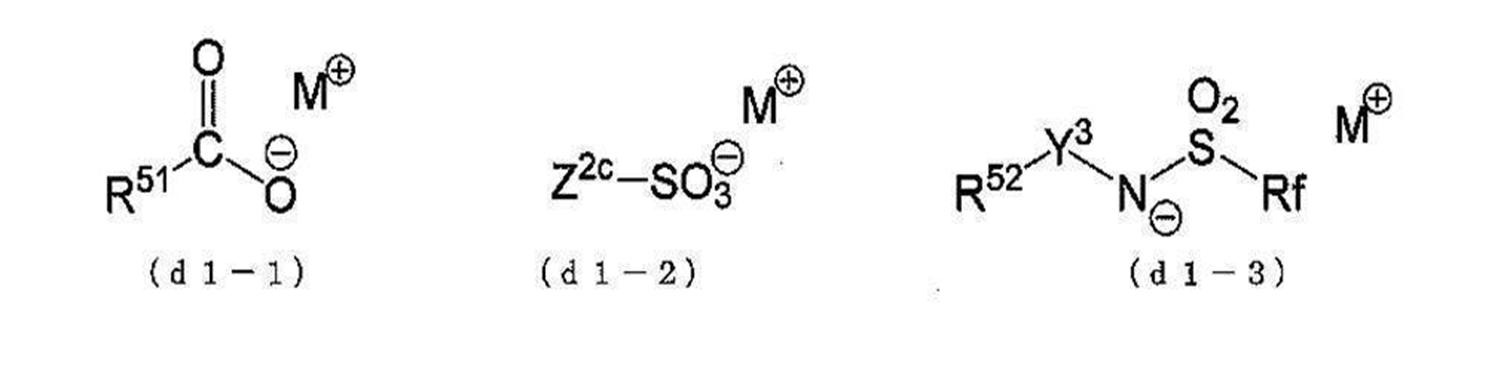
式中、R51は置換基を有していてもよい炭化水素基であり、Z2cは置換基を有していてもよい炭素数1~30の炭化水素基(ただし、Sに隣接する炭素にはフッ素原子は置換されていないものとする)であり、R52は有機基であり、Y3は直鎖状、分岐鎖状若しくは環状のアルキレン基又はアリーレン基であり、Rfはフッ素原子を含む炭化水素基であり、M+は各々独立に、アンモニウムカチオン、スルホニウムカチオン又はヨードニウムカチオンである。
M+として表されるスルホニウムカチオン又はヨードニウムカチオンの好ましい例としては、一般式(ZI)で例示したスルホニウムカチオン及び一般式(ZII)で例示したヨードニウムカチオンを挙げることができる。
酸発生剤に対して相対的に弱酸となるオニウム塩(DC)は、カチオン部位とアニオン部位を同一分子内に有し、かつ、カチオン部位とアニオン部位が共有結合により連結している化合物(以下、「化合物(DCA)」ともいう。)であってもよい。
化合物(DCA)としては、下記一般式(C-1)~(C-3)のいずれかで表される化合物であることが好ましい。
化合物(DCA)としては、下記一般式(C-1)~(C-3)のいずれかで表される化合物であることが好ましい。
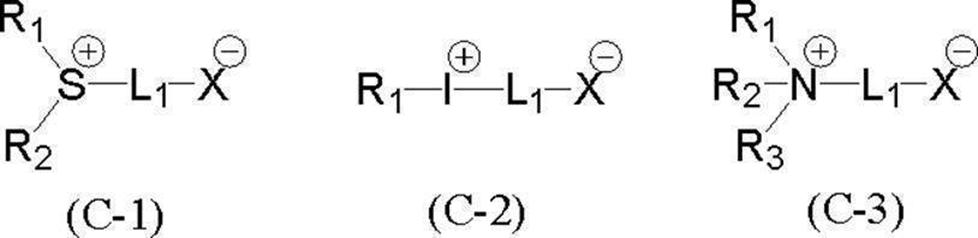
一般式(C-1)~(C-3)中、R1、R2、及びR3は、各々独立に炭素数1以上の置換基を表す。
L1は、カチオン部位とアニオン部位とを連結する2価の連結基又は単結合を表す。
-X-は、-COO-、-SO3 -、-SO2 -、及び-N--R4から選択されるアニオン部位を表す。R4は、隣接するN原子との連結部位に、カルボニル基(-C(=O)-)、スルホニル基(-S(=O)2-)、及びスルフィニル基(-S(=O)-)のうち少なくとも1つを有する1価の置換基を表す。
R1、R2、R3、R4、及びL1は、互いに結合して環構造を形成してもよい。また、一般式(C-3)において、R1~R3のうち2つを合わせて1つの2価の置換基を表し、N原子と2重結合により結合していてもよい。
L1は、カチオン部位とアニオン部位とを連結する2価の連結基又は単結合を表す。
-X-は、-COO-、-SO3 -、-SO2 -、及び-N--R4から選択されるアニオン部位を表す。R4は、隣接するN原子との連結部位に、カルボニル基(-C(=O)-)、スルホニル基(-S(=O)2-)、及びスルフィニル基(-S(=O)-)のうち少なくとも1つを有する1価の置換基を表す。
R1、R2、R3、R4、及びL1は、互いに結合して環構造を形成してもよい。また、一般式(C-3)において、R1~R3のうち2つを合わせて1つの2価の置換基を表し、N原子と2重結合により結合していてもよい。
R1~R3における炭素数1以上の置換基としては、アルキル基、シクロアルキル基、アリール基、アルキルオキシカルボニル基、シクロアルキルオキシカルボニル基、アリールオキシカルボニル基、アルキルアミノカルボニル基、シクロアルキルアミノカルボニル基、及びアリールアミノカルボニル基などが挙げられる。好ましくは、アルキル基、シクロアルキル基、又はアリール基である。
2価の連結基としてのL1は、直鎖若しくは分岐鎖状アルキレン基、シクロアルキレン基、アリーレン基、カルボニル基、エーテル結合、エステル結合、アミド結合、ウレタン結合、ウレア結合、及びこれらの2種以上を組み合わせてなる基等が挙げられる。L1は、好ましくは、アルキレン基、アリーレン基、エーテル結合、エステル結合、又はこれらの2種以上を組み合わせてなる基である。
窒素原子を有し、酸の作用により脱離する基を有する低分子化合物(DD)(以下、「化合物(DD)」ともいう。)は、酸の作用により脱離する基を窒素原子上に有するアミン誘導体であることが好ましい。
酸の作用により脱離する基としては、アセタール基、カルボネート基、カルバメート基、3級エステル基、3級水酸基、又はヘミアミナールエーテル基が好ましく、カルバメート基、又はヘミアミナールエーテル基がより好ましい。
化合物(DD)の分子量は、100~1000が好ましく、100~700がより好ましく、100~500が更に好ましい。
化合物(DD)は、窒素原子上に保護基を有するカルバメート基を有してもよい。カルバメート基を構成する保護基としては、下記一般式(d-1)で表すことができる。
酸の作用により脱離する基としては、アセタール基、カルボネート基、カルバメート基、3級エステル基、3級水酸基、又はヘミアミナールエーテル基が好ましく、カルバメート基、又はヘミアミナールエーテル基がより好ましい。
化合物(DD)の分子量は、100~1000が好ましく、100~700がより好ましく、100~500が更に好ましい。
化合物(DD)は、窒素原子上に保護基を有するカルバメート基を有してもよい。カルバメート基を構成する保護基としては、下記一般式(d-1)で表すことができる。
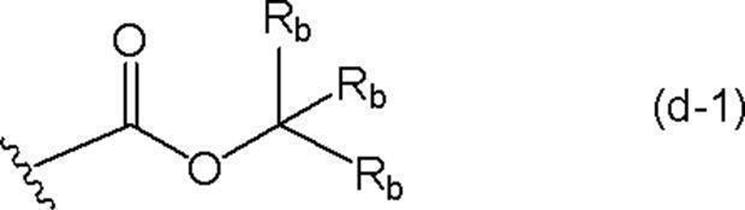
一般式(d-1)において、Rbは、各々独立に、水素原子、アルキル基(好ましくは炭素数1~10)、シクロアルキル基(好ましくは炭素数3~30)、アリール基(好ましくは炭素数3~30)、アラルキル基(好ましくは炭素数1~10)、又はアルコキシアルキル基(好ましくは炭素数1~10)を表す。Rbは相互に連結して環を形成していてもよい。
Rbが示すアルキル基、シクロアルキル基、アリール基、及びアラルキル基は、各々独立にヒドロキシル基、シアノ基、アミノ基、ピロリジノ基、ピペリジノ基、モルホリノ基、オキソ基等の官能基、アルコキシ基、又はハロゲン原子で置換されていてもよい。Rbが示すアルコキシアルキル基についても同様である。
Rbが示すアルキル基、シクロアルキル基、アリール基、及びアラルキル基は、各々独立にヒドロキシル基、シアノ基、アミノ基、ピロリジノ基、ピペリジノ基、モルホリノ基、オキソ基等の官能基、アルコキシ基、又はハロゲン原子で置換されていてもよい。Rbが示すアルコキシアルキル基についても同様である。
Rbとしては、直鎖状若しくは分岐状のアルキル基、シクロアルキル基、又はアリール基が好ましく、直鎖状若しくは分岐状のアルキル基、又はシクロアルキル基がより好ましい。
2つのRbが相互に連結して形成する環としては、脂環式炭化水素、芳香族炭化水素、複素環式炭化水素及びその誘導体等が挙げられる。
一般式(d-1)で表される基の具体的な構造としては、米国特許公報US2012/0135348A1号明細書の段落<0466>に開示された構造を挙げることができるが、これに限定されない。
2つのRbが相互に連結して形成する環としては、脂環式炭化水素、芳香族炭化水素、複素環式炭化水素及びその誘導体等が挙げられる。
一般式(d-1)で表される基の具体的な構造としては、米国特許公報US2012/0135348A1号明細書の段落<0466>に開示された構造を挙げることができるが、これに限定されない。
化合物(DD)は、下記一般式(6)で表される構造を有するものであることが好ましい。
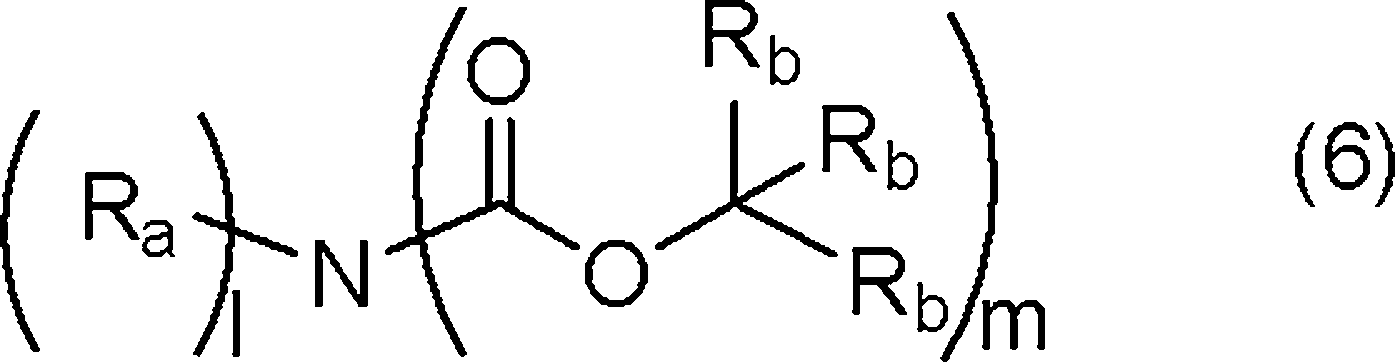
一般式(6)において、lは0~2の整数を表し、mは1~3の整数を表し、l+m=3を満たす。
Raは、水素原子、アルキル基、シクロアルキル基、アリール基又はアラルキル基を表す。lが2のとき、2つのRaは同じでも異なっていてもよく、2つのRaは相互に連結して式中の窒素原子と共に複素環を形成していてもよい。この複素環には式中の窒素原子以外のヘテロ原子を含んでいてもよい。
Rbは、上記一般式(d-1)におけるRbと同義であり、好ましい例も同様である。
一般式(6)において、Raとしてのアルキル基、シクロアルキル基、アリール基、及びアラルキル基は、各々独立にRbとしてのアルキル基、シクロアルキル基、アリール基、及びアラルキル基が置換されていてもよい基として前述した基と同様な基で置換されていてもよい。
Raは、水素原子、アルキル基、シクロアルキル基、アリール基又はアラルキル基を表す。lが2のとき、2つのRaは同じでも異なっていてもよく、2つのRaは相互に連結して式中の窒素原子と共に複素環を形成していてもよい。この複素環には式中の窒素原子以外のヘテロ原子を含んでいてもよい。
Rbは、上記一般式(d-1)におけるRbと同義であり、好ましい例も同様である。
一般式(6)において、Raとしてのアルキル基、シクロアルキル基、アリール基、及びアラルキル基は、各々独立にRbとしてのアルキル基、シクロアルキル基、アリール基、及びアラルキル基が置換されていてもよい基として前述した基と同様な基で置換されていてもよい。
上記Raのアルキル基、シクロアルキル基、アリール基、及びアラルキル基(これらの基は、上記基で置換されていてもよい)の具体例としては、Rbについて前述した具体例と同様な基が挙げられる。
本発明における特に好ましい化合物(DD)の具体的な構造としては、米国特許出願公開2012/0135348A1号明細書の段落<0475>に開示された化合物を挙げることができるが、これに限定されるものではない。
本発明における特に好ましい化合物(DD)の具体的な構造としては、米国特許出願公開2012/0135348A1号明細書の段落<0475>に開示された化合物を挙げることができるが、これに限定されるものではない。
カチオン部に窒素原子を有するオニウム塩化合物(DE)(以下、「化合物(DE)」ともいう。)は、カチオン部に窒素原子を含む塩基性部位を有する化合物であることが好ましい。塩基性部位は、アミノ基であることが好ましく、脂肪族アミノ基であることがより好ましい。塩基性部位中の窒素原子に隣接する原子の全てが、水素原子又は炭素原子であることが更に好ましい。また、塩基性向上の観点から、窒素原子に対して、電子求引性の官能基(カルボニル基、スルホニル基、シアノ基、及びハロゲン原子など)が直結していないことが好ましい。
化合物(DE)の好ましい具体的な構造としては、米国特許出願公開2015/0309408A1号明細書の段落<0203>に開示された化合物を挙げることができるが、これに限定されない。
化合物(DE)の好ましい具体的な構造としては、米国特許出願公開2015/0309408A1号明細書の段落<0203>に開示された化合物を挙げることができるが、これに限定されない。
酸拡散制御剤の好ましい例を以下に示す。
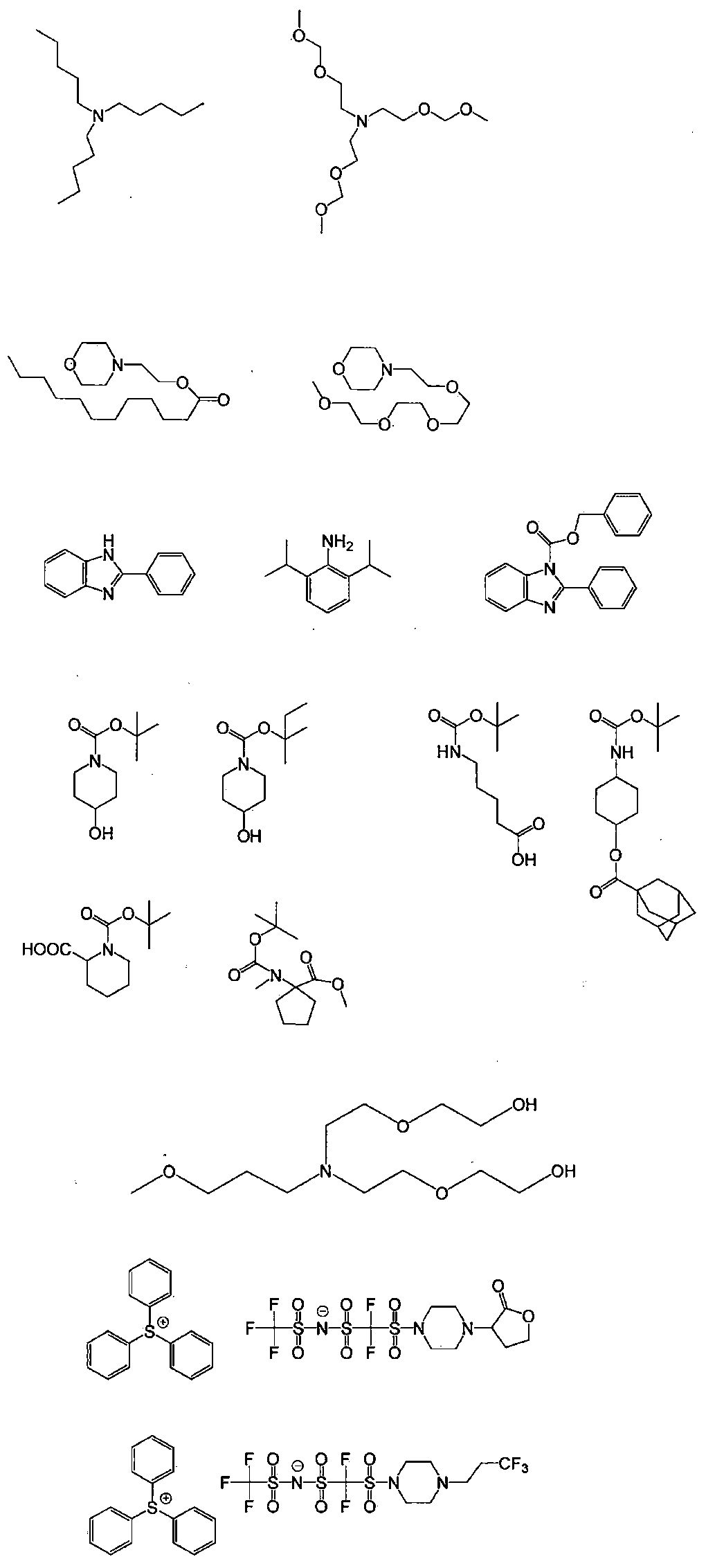
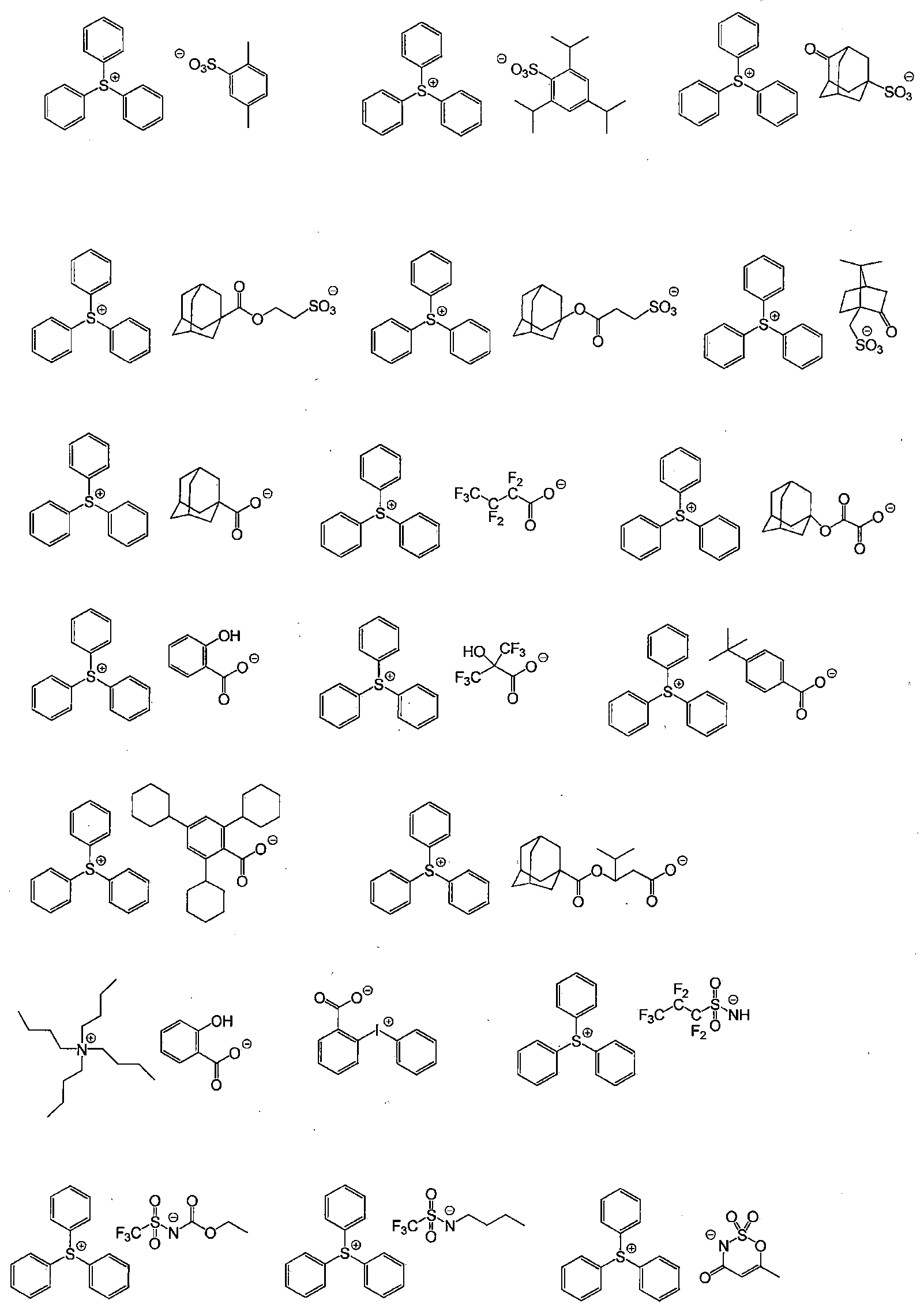
本発明の組成物は、酸拡散制御剤を含んでいてもよいし、含まなくてもよいが、含む場合は1種単独で使用してもよいし、2種以上を併用してもよい。
本発明の組成物が酸拡散制御剤を含む場合は、酸拡散制御剤の組成物中の含有量(複数種存在する場合はその合計)は、組成物の全固形分を基準として、0.1~10質量%が好ましく、0.1~5質量%がより好ましい。
本発明の組成物が酸拡散制御剤を含む場合は、酸拡散制御剤の組成物中の含有量(複数種存在する場合はその合計)は、組成物の全固形分を基準として、0.1~10質量%が好ましく、0.1~5質量%がより好ましい。
<溶剤(F)>
本発明の組成物は、通常、溶剤を含有する。
本発明の組成物においては、公知のレジスト溶剤を適宜使用することができる。例えば、米国特許出願公開2016/0070167A1号明細書の段落<0665>~<0670>、米国特許出願公開2015/0004544A1号明細書の段落<0210>~<0235>、米国特許出願公開2016/0237190A1号明細書の段落<0424>~<0426>、米国特許出願公開2016/0274458A1号明細書の段落<0357>~<0366>に開示された公知の溶剤を好適に使用できる。
組成物を調製する際に使用できる溶剤としては、例えば、アルキレングリコールモノアルキルエーテルカルボキシレート、アルキレングリコールモノアルキルエーテル、乳酸アルキルエステル、アルコキシプロピオン酸アルキル、環状ラクトン(好ましくは炭素数4~10)、環を有してもよいモノケトン化合物(好ましくは炭素数4~10)、アルキレンカーボネート、アルコキシ酢酸アルキル、及びピルビン酸アルキル等の有機溶剤が挙げられる。
本発明の組成物は、通常、溶剤を含有する。
本発明の組成物においては、公知のレジスト溶剤を適宜使用することができる。例えば、米国特許出願公開2016/0070167A1号明細書の段落<0665>~<0670>、米国特許出願公開2015/0004544A1号明細書の段落<0210>~<0235>、米国特許出願公開2016/0237190A1号明細書の段落<0424>~<0426>、米国特許出願公開2016/0274458A1号明細書の段落<0357>~<0366>に開示された公知の溶剤を好適に使用できる。
組成物を調製する際に使用できる溶剤としては、例えば、アルキレングリコールモノアルキルエーテルカルボキシレート、アルキレングリコールモノアルキルエーテル、乳酸アルキルエステル、アルコキシプロピオン酸アルキル、環状ラクトン(好ましくは炭素数4~10)、環を有してもよいモノケトン化合物(好ましくは炭素数4~10)、アルキレンカーボネート、アルコキシ酢酸アルキル、及びピルビン酸アルキル等の有機溶剤が挙げられる。
有機溶剤として、構造中に水酸基を含有する溶剤と、水酸基を含有しない溶剤とを混合した混合溶剤を使用してもよい。
水酸基を含有する溶剤、及び水酸基を含有しない溶剤としては、前述の例示化合物を適宜選択できるが、水酸基を含有する溶剤としては、アルキレングリコールモノアルキルエーテル、又は乳酸アルキル等が好ましく、プロピレングリコールモノメチルエーテル(PGME)、プロピレングリコールモノエチルエーテル(PGEE)、2-ヒドロキシイソ酪酸メチル、又は乳酸エチルがより好ましい。また、水酸基を含有しない溶剤としては、アルキレングリコールモノアルキルエーテルアセテート、アルキルアルコキシプロピオネート、環を含有してもよいモノケトン化合物、環状ラクトン、又は酢酸アルキル等が好ましく、これらの中でも、プロピレングリコールモノメチルエーテルアセテート(PGMEA)、エチルエトキシプロピオネート、2-ヘプタノン、γ-ブチロラクトン、シクロヘキサノン、シクロペンタノン又は酢酸ブチルがより好ましく、プロピレングリコールモノメチルエーテルアセテート、γ-ブチロラクトン、エチルエトキシプロピオネート、シクロヘキサノン、シクロペンタノン又は2-ヘプタノンが更に好ましい。水酸基を含有しない溶剤としては、プロピレンカーボネートも好ましい。
水酸基を含有する溶剤と水酸基を含有しない溶剤との混合比(質量比)は、1/99~99/1であり、10/90~90/10が好ましく、20/80~60/40がより好ましい。水酸基を含有しない溶剤を50質量%以上含有する混合溶剤が、塗布均一性の点で好ましい。
溶剤は、プロピレングリコールモノメチルエーテルアセテートを含むことが好ましく、プロピレングリコールモノメチルエーテルアセテート単独溶剤でもよいし、プロピレングリコールモノメチルエーテルアセテートを含有する2種類以上の混合溶剤でもよい。
水酸基を含有する溶剤、及び水酸基を含有しない溶剤としては、前述の例示化合物を適宜選択できるが、水酸基を含有する溶剤としては、アルキレングリコールモノアルキルエーテル、又は乳酸アルキル等が好ましく、プロピレングリコールモノメチルエーテル(PGME)、プロピレングリコールモノエチルエーテル(PGEE)、2-ヒドロキシイソ酪酸メチル、又は乳酸エチルがより好ましい。また、水酸基を含有しない溶剤としては、アルキレングリコールモノアルキルエーテルアセテート、アルキルアルコキシプロピオネート、環を含有してもよいモノケトン化合物、環状ラクトン、又は酢酸アルキル等が好ましく、これらの中でも、プロピレングリコールモノメチルエーテルアセテート(PGMEA)、エチルエトキシプロピオネート、2-ヘプタノン、γ-ブチロラクトン、シクロヘキサノン、シクロペンタノン又は酢酸ブチルがより好ましく、プロピレングリコールモノメチルエーテルアセテート、γ-ブチロラクトン、エチルエトキシプロピオネート、シクロヘキサノン、シクロペンタノン又は2-ヘプタノンが更に好ましい。水酸基を含有しない溶剤としては、プロピレンカーボネートも好ましい。
水酸基を含有する溶剤と水酸基を含有しない溶剤との混合比(質量比)は、1/99~99/1であり、10/90~90/10が好ましく、20/80~60/40がより好ましい。水酸基を含有しない溶剤を50質量%以上含有する混合溶剤が、塗布均一性の点で好ましい。
溶剤は、プロピレングリコールモノメチルエーテルアセテートを含むことが好ましく、プロピレングリコールモノメチルエーテルアセテート単独溶剤でもよいし、プロピレングリコールモノメチルエーテルアセテートを含有する2種類以上の混合溶剤でもよい。
<界面活性剤(H)>
本発明の組成物は、界面活性剤を含有してもよいし、含有しなくてもよい。界面活性剤を含有する場合、フッ素系及び/又はシリコン系界面活性剤(具体的には、フッ素系界面活性剤、シリコン系界面活性剤、又はフッ素原子とケイ素原子との両方を有する界面活性剤)が好ましい。
本発明の組成物は、界面活性剤を含有してもよいし、含有しなくてもよい。界面活性剤を含有する場合、フッ素系及び/又はシリコン系界面活性剤(具体的には、フッ素系界面活性剤、シリコン系界面活性剤、又はフッ素原子とケイ素原子との両方を有する界面活性剤)が好ましい。
本発明の組成物が界面活性剤を含有することにより、250nm以下、特に220nm以下の露光光源を使用した場合に、良好な感度及び解像度で、密着性及び現像欠陥の少ないレジストパターンを得ることができる。
フッ素系及び/又はシリコン系界面活性剤として、米国特許出願公開第2008/0248425号明細書の段落<0276>に記載の界面活性剤が挙げることができる。
また、米国特許出願公開第2008/0248425号明細書の段落<0280>に記載の、フッ素系及び/又はシリコン系界面活性剤以外の他の界面活性剤を使用することもできる。
フッ素系及び/又はシリコン系界面活性剤として、米国特許出願公開第2008/0248425号明細書の段落<0276>に記載の界面活性剤が挙げることができる。
また、米国特許出願公開第2008/0248425号明細書の段落<0280>に記載の、フッ素系及び/又はシリコン系界面活性剤以外の他の界面活性剤を使用することもできる。
これらの界面活性剤は1種単独で用いてもよく、2種以上を併用してもよい。
本発明の組成物が界面活性剤を含有する場合、界面活性剤の含有量は、組成物の全固形分に対して、0.0001~2質量%が好ましく、0.0005~1質量%がより好ましい。
一方、界面活性剤の含有量が、組成物の全固形分に対して10ppm(parts per million)以上とすることにより、疎水性樹脂の表面偏在性が上がる。それにより、感活性光線性又は感放射線性膜の表面をより疎水的にすることができ、液浸露光時の水追随性が向上する。
本発明の組成物が界面活性剤を含有する場合、界面活性剤の含有量は、組成物の全固形分に対して、0.0001~2質量%が好ましく、0.0005~1質量%がより好ましい。
一方、界面活性剤の含有量が、組成物の全固形分に対して10ppm(parts per million)以上とすることにより、疎水性樹脂の表面偏在性が上がる。それにより、感活性光線性又は感放射線性膜の表面をより疎水的にすることができ、液浸露光時の水追随性が向上する。
(その他の添加剤)
本発明の組成物は、更に、酸増殖剤、染料、可塑剤、光増感剤、光吸収剤、アルカリ可溶性樹脂、溶解阻止剤、又は溶解促進剤等を含有してもよい。
本発明の組成物は、更に、酸増殖剤、染料、可塑剤、光増感剤、光吸収剤、アルカリ可溶性樹脂、溶解阻止剤、又は溶解促進剤等を含有してもよい。
<調製方法>
本発明の組成物からなる感活性光線性膜又は感放射線性膜の膜厚は、解像力向上の観点から、90nm以下が好ましく、85nm以下がより好ましい。組成物中の固形分濃度を適切な範囲に設定して適度な粘度をもたせ、塗布性又は製膜性を向上させることにより、このような膜厚とすることができる。
本発明の組成物の固形分濃度は、通常1.0~10質量%であり、2.0~5.7質量%が好ましく、2.0~5.3質量%がより好ましい。固形分濃度とは、組成物の総質量に対する、溶剤を除く他のレジスト成分の質量の質量百分率である。
本発明の組成物からなる感活性光線性膜又は感放射線性膜の膜厚は、解像力向上の観点から、90nm以下が好ましく、85nm以下がより好ましい。組成物中の固形分濃度を適切な範囲に設定して適度な粘度をもたせ、塗布性又は製膜性を向上させることにより、このような膜厚とすることができる。
本発明の組成物の固形分濃度は、通常1.0~10質量%であり、2.0~5.7質量%が好ましく、2.0~5.3質量%がより好ましい。固形分濃度とは、組成物の総質量に対する、溶剤を除く他のレジスト成分の質量の質量百分率である。
本発明の組成物は、上記の成分を所定の有機溶剤、好ましくは上記混合溶剤に溶解し、これをフィルター濾過した後、所定の支持体(基板)上に塗布して用いる。フィルター濾過に用いるフィルターのポアサイズは0.1μm以下が好ましく、0.05μm以下がより好ましく、0.03μm以下が更に好ましい。このフィルターは、ポリテトラフルオロエチレン製、ポリエチレン製、又はナイロン製のものが好ましい。フィルター濾過においては、例えば日本国特許出願公開第2002-62667号明細書(特開2002-62667号公報)に開示されるように、循環的な濾過を行ってもよく、複数種類のフィルターを直列又は並列に接続して濾過を行ってもよい。また、組成物を複数回濾過してもよい。更に、フィルター濾過の前後で、組成物に対して脱気処理等を行ってもよい。
<用途>
本発明の組成物は、活性光線又は放射線の照射により反応して性質が変化する感活性光線性又は感放射線性樹脂組成物に関する。更に詳しくは、本発明の組成物は、IC(Integrated Circuit)等の半導体製造工程、液晶若しくはサーマルヘッド等の回路基板の製造、インプリント用モールド構造体の作製、その他のフォトファブリケーション工程、又は平版印刷版、若しくは酸硬化性組成物の製造に使用される感活性光線性又は感放射線性樹脂組成物に関する。本発明において形成されるレジストパターンは、エッチング工程、イオンインプランテーション工程、バンプ電極形成工程、再配線形成工程、及びMEMS(Micro Electro Mechanical Systems)等において使用することができる。
本発明の組成物は、活性光線又は放射線の照射により反応して性質が変化する感活性光線性又は感放射線性樹脂組成物に関する。更に詳しくは、本発明の組成物は、IC(Integrated Circuit)等の半導体製造工程、液晶若しくはサーマルヘッド等の回路基板の製造、インプリント用モールド構造体の作製、その他のフォトファブリケーション工程、又は平版印刷版、若しくは酸硬化性組成物の製造に使用される感活性光線性又は感放射線性樹脂組成物に関する。本発明において形成されるレジストパターンは、エッチング工程、イオンインプランテーション工程、バンプ電極形成工程、再配線形成工程、及びMEMS(Micro Electro Mechanical Systems)等において使用することができる。
〔感活性光線性又は感放射線性膜、パターン形成方法〕
本発明は上記感活性光線性又は感放射線性樹脂組成物を用いたパターン形成方法にも関する。以下、本発明のパターン形成方法について説明する。また、パターン形成方法の説明と併せて、本発明の感活性光線性又は感放射線性膜(典型的には、レジスト膜)についても説明する。
本発明は上記感活性光線性又は感放射線性樹脂組成物を用いたパターン形成方法にも関する。以下、本発明のパターン形成方法について説明する。また、パターン形成方法の説明と併せて、本発明の感活性光線性又は感放射線性膜(典型的には、レジスト膜)についても説明する。
本発明のパターン形成方法は、
(i)上述した感活性光線性又は感放射線性樹脂組成物によって感活性光線性又は感放射線性膜を支持体上に形成する工程(成膜工程)、
(ii)上記感活性光線性又は感放射線性膜に活性光線又は放射線を照射する工程(露光工程)、及び、
(iii)上記活性光線又は放射線が照射された感活性光線性又は感放射線性膜を、現像液を用いて現像する工程(現像工程)、
を有する。
(i)上述した感活性光線性又は感放射線性樹脂組成物によって感活性光線性又は感放射線性膜を支持体上に形成する工程(成膜工程)、
(ii)上記感活性光線性又は感放射線性膜に活性光線又は放射線を照射する工程(露光工程)、及び、
(iii)上記活性光線又は放射線が照射された感活性光線性又は感放射線性膜を、現像液を用いて現像する工程(現像工程)、
を有する。
本発明のパターン形成方法は、上記(i)~(iii)の工程を含んでいれば特に限定されず、更に下記の工程を有していてもよい。
本発明のパターン形成方法は、(ii)露光工程における露光方法が、液浸露光であってもよい。
本発明のパターン形成方法は、(ii)露光工程の前に、(iv)前加熱(PB:PreBake)工程を含むことが好ましい。
本発明のパターン形成方法は、(ii)露光工程の後、かつ、(iii)現像工程の前に、(v)露光後加熱(PEB:Post Exposure Bake)工程を含むことが好ましい。
本発明のパターン形成方法は、(ii)露光工程を、複数回含んでいてもよい。
本発明のパターン形成方法は、(iv)前加熱工程を、複数回含んでいてもよい。
本発明のパターン形成方法は、(v)露光後加熱工程を、複数回含んでいてもよい。
本発明のパターン形成方法は、(ii)露光工程における露光方法が、液浸露光であってもよい。
本発明のパターン形成方法は、(ii)露光工程の前に、(iv)前加熱(PB:PreBake)工程を含むことが好ましい。
本発明のパターン形成方法は、(ii)露光工程の後、かつ、(iii)現像工程の前に、(v)露光後加熱(PEB:Post Exposure Bake)工程を含むことが好ましい。
本発明のパターン形成方法は、(ii)露光工程を、複数回含んでいてもよい。
本発明のパターン形成方法は、(iv)前加熱工程を、複数回含んでいてもよい。
本発明のパターン形成方法は、(v)露光後加熱工程を、複数回含んでいてもよい。
本発明のパターン形成方法において、上述した(i)成膜工程、(ii)露光工程、及び(iii)現像工程は、一般的に知られている方法により行うことができる。
また、必要に応じて、感活性光線性又は感放射線性膜と支持体との間にレジスト下層膜(例えば、SOG(Spin On Glass)、SOC(Spin On Carbon)、反射防止膜)を形成してもよい。レジスト下層膜としては、公知の有機系又は無機系の材料を適宜用いることができる。
感活性光線性又は感放射線性膜の上層に、保護膜(トップコート)を形成してもよい。保護膜としては、公知の材料を適宜用いることができる。例えば、米国特許出願公開第2007/0178407号明細書、米国特許出願公開第2008/0085466号明細書、米国特許出願公開第2007/0275326号明細書、米国特許出願公開第2016/0299432号明細書、米国特許出願公開第2013/0244438号明細書、国際特許出願公開第2016/157988A号明細書に開示された保護膜形成用組成物を好適に使用することができる。保護膜形成用組成物としては、上述した酸拡散制御剤を含むものが好ましい。
上述した疎水性樹脂を含有する感活性光線性又は感放射線性膜の上層に保護膜を形成してもよい
また、必要に応じて、感活性光線性又は感放射線性膜と支持体との間にレジスト下層膜(例えば、SOG(Spin On Glass)、SOC(Spin On Carbon)、反射防止膜)を形成してもよい。レジスト下層膜としては、公知の有機系又は無機系の材料を適宜用いることができる。
感活性光線性又は感放射線性膜の上層に、保護膜(トップコート)を形成してもよい。保護膜としては、公知の材料を適宜用いることができる。例えば、米国特許出願公開第2007/0178407号明細書、米国特許出願公開第2008/0085466号明細書、米国特許出願公開第2007/0275326号明細書、米国特許出願公開第2016/0299432号明細書、米国特許出願公開第2013/0244438号明細書、国際特許出願公開第2016/157988A号明細書に開示された保護膜形成用組成物を好適に使用することができる。保護膜形成用組成物としては、上述した酸拡散制御剤を含むものが好ましい。
上述した疎水性樹脂を含有する感活性光線性又は感放射線性膜の上層に保護膜を形成してもよい
支持体は、特に限定されるものではなく、IC等の半導体の製造工程、又は液晶若しくはサーマルヘッド等の回路基板の製造工程のほか、その他のフォトファブリケーションのリソグラフィー工程等で一般的に用いられる基板を用いることができる。支持体の具体例としては、シリコン、SiO2、及びSiN等の無機基板等が挙げられる。
加熱温度は、(iv)前加熱工程及び(v)露光後加熱工程のいずれにおいても、70~130℃が好ましく、80~120℃がより好ましい。
加熱時間は、(iv)前加熱工程及び(v)露光後加熱工程のいずれにおいても、30~300秒が好ましく、30~180秒がより好ましく、30~90秒が更に好ましい。
加熱は、露光装置及び現像装置に備わっている手段で行うことができ、ホットプレート等を用いて行ってもよい。
加熱時間は、(iv)前加熱工程及び(v)露光後加熱工程のいずれにおいても、30~300秒が好ましく、30~180秒がより好ましく、30~90秒が更に好ましい。
加熱は、露光装置及び現像装置に備わっている手段で行うことができ、ホットプレート等を用いて行ってもよい。
露光工程に用いられる光源波長に制限はないが、赤外光、可視光、紫外光、遠紫外光、極紫外光(EUV)、X線、及び電子線等を挙げることができる。これらの中でも遠紫外光が好ましく、その波長は250nm以下が好ましく、220nm以下がより好ましく、1~200nmが更に好ましい。具体的には、KrFエキシマレーザー(248nm)、ArFエキシマレーザー(193nm)、F2エキシマレーザー(157nm)、X線、EUV(13nm)、又は電子線等であり、KrFエキシマレーザー、ArFエキシマレーザー、EUV又は電子線が好ましい。
(iii)現像工程においては、アルカリ現像液であっても、有機溶剤を含有する現像液(以下、有機系現像液ともいう)であってもよい。
アルカリ現像液としては、通常、テトラメチルアンモニウムヒドロキシドに代表される4級アンモニウム塩が用いられるが、これ以外にも無機アルカリ、1~3級アミン、アルコールアミン、及び環状アミン等のアルカリ水溶液も使用可能である。
さらに、上記アルカリ現像液は、アルコール類、及び/又は界面活性剤を適当量含有してもよい。アルカリ現像液のアルカリ濃度は、通常0.1~20質量%である。アルカリ現像液のpHは、通常10~15である。
アルカリ現像液を用いて現像を行う時間は、通常10~300秒である。
アルカリ現像液のアルカリ濃度、pH、及び現像時間は、形成するパターンに応じて、適宜調整することができる。
さらに、上記アルカリ現像液は、アルコール類、及び/又は界面活性剤を適当量含有してもよい。アルカリ現像液のアルカリ濃度は、通常0.1~20質量%である。アルカリ現像液のpHは、通常10~15である。
アルカリ現像液を用いて現像を行う時間は、通常10~300秒である。
アルカリ現像液のアルカリ濃度、pH、及び現像時間は、形成するパターンに応じて、適宜調整することができる。
有機系現像液は、ケトン系溶剤、エステル系溶剤、アルコール系溶剤、アミド系溶剤、エーテル系溶剤、及び炭化水素系溶剤からなる群より選択される少なくとも1種の有機溶剤を含有する現像液であるのが好ましい。
ケトン系溶剤としては、例えば、1-オクタノン、2-オクタノン、1-ノナノン、2-ノナノン、アセトン、2-ヘプタノン(メチルアミルケトン)、4-ヘプタノン、1-ヘキサノン、2-ヘキサノン、ジイソブチルケトン、シクロヘキサノン、メチルシクロヘキサノン、フェニルアセトン、メチルエチルケトン、メチルイソブチルケトン、アセチルアセトン、アセトニルアセトン、イオノン、ジアセトニルアルコール、アセチルカービノール、アセトフェノン、メチルナフチルケトン、イソホロン、及びプロピレンカーボネート等を挙げることができる。
エステル系溶剤としては、例えば、酢酸メチル、酢酸ブチル、酢酸エチル、酢酸イソプロピル、酢酸ペンチル、酢酸イソペンチル、酢酸アミル、プロピレングリコールモノメチルエーテルアセテート、エチレングリコールモノエチルエーテルアセテート、ジエチレングリコールモノブチルエーテルアセテート、ジエチレングリコールモノエチルエーテルアセテート、エチルー3-エトキシプロピオネート、3-メトキシブチルアセテート、3-メチル-3-メトキシブチルアセテート、蟻酸メチル、蟻酸エチル、蟻酸ブチル、蟻酸プロピル、乳酸エチル、乳酸ブチル、乳酸プロピル、ブタン酸ブチル、2-ヒドロキシイソ酪酸メチル、酢酸イソアミル、イソ酪酸イソブチル、及びプロピオン酸ブチル等を挙げることができる。
アルコール系溶剤、アミド系溶剤、エーテル系溶剤、及び炭化水素系溶剤としては、米国特許出願公開2016/0070167A1号明細書の段落<0715>~<0718>に開示された溶剤を使用できる。
上記の溶剤は、複数混合してもよいし、上記以外の溶剤又は水と混合してもよい。現像液全体としての含水率は、50質量%未満が好ましく、20質量%未満がより好ましく、10質量%未満であることが更に好ましく、実質的に水分を含有しないことが特に好ましい。
有機系現像液に対する有機溶剤の含有量は、現像液の全量に対して、50質量%以上100質量%以下が好ましく、80質量%以上100質量%以下がより好ましく、90質量%以上100質量%以下が更に好ましく、95質量%以上100質量%以下が特に好ましい。
有機系現像液に対する有機溶剤の含有量は、現像液の全量に対して、50質量%以上100質量%以下が好ましく、80質量%以上100質量%以下がより好ましく、90質量%以上100質量%以下が更に好ましく、95質量%以上100質量%以下が特に好ましい。
有機系現像液は、必要に応じて公知の界面活性剤を適当量含有できる。
界面活性剤の含有量は現像液の全量に対して、通常0.001~5質量%であり、0.005~2質量%が好ましく、0.01~0.5質量%がより好ましい。
有機系現像液は、上述した酸拡散制御剤を含んでいてもよい。
現像方法としては、例えば、現像液が満たされた槽中に基板を一定時間浸漬する方法(ディップ法)、基板表面に現像液を表面張力によって盛り上げて一定時間静止する方法(パドル法)、基板表面に現像液を噴霧する方法(スプレー法)、又は一定速度で回転している基板上に一定速度で現像液吐出ノズルをスキャンしながら現像液を吐出しつづける方法(ダイナミックディスペンス法)等を適用することができる。
アルカリ水溶液を用いて現像を行う工程(アルカリ現像工程)、及び有機溶剤を含む現像液を用いて現像する工程(有機溶剤現像工程)を組み合わせてもよい。これにより、中間的な露光強度の領域のみを溶解させずにパターン形成が行えるので、より微細なパターンを形成することができる。
(iii)現像工程の後に、リンス液を用いて洗浄する工程(リンス工程)を含むことが好ましい。
アルカリ現像液を用いた現像工程の後のリンス工程に用いるリンス液は、例えば純水を使用できる。純水は、界面活性剤を適当量含有してもよい。この場合、現像工程又はリンス工程の後に、パターン上に付着している現像液又はリンス液を超臨界流体により除去する処理を追加してもよい。更に、リンス処理又は超臨界流体による処理の後、パターン中に残存する水分を除去するために加熱処理を行ってもよい。
有機溶剤を含む現像液を用いた現像工程の後のリンス工程に用いるリンス液は、レジストパターンを溶解しないものであれば特に制限はなく、一般的な有機溶剤を含む溶液を使用できる。リンス液としては、炭化水素系溶剤、ケトン系溶剤、エステル系溶剤、アルコール系溶剤、アミド系溶剤、及びエーテル系溶剤からなる群より選択される少なくとも1種の有機溶剤を含有するリンス液を用いることが好ましい。
炭化水素系溶剤、ケトン系溶剤、エステル系溶剤、アルコール系溶剤、アミド系溶剤、及びエーテル系溶剤の具体例としては、有機溶剤を含む現像液において説明したものと同様のものが挙げられる。
この場合のリンス工程に用いるリンス液としては、1価アルコールを含有するリンス液がより好ましい。
炭化水素系溶剤、ケトン系溶剤、エステル系溶剤、アルコール系溶剤、アミド系溶剤、及びエーテル系溶剤の具体例としては、有機溶剤を含む現像液において説明したものと同様のものが挙げられる。
この場合のリンス工程に用いるリンス液としては、1価アルコールを含有するリンス液がより好ましい。
リンス工程で用いられる1価アルコールとしては、直鎖状、分岐状、又は環状の1価アルコールが挙げられる。具体的には、1-ブタノール、2-ブタノール、3-メチル-1-ブタノール、tert―ブチルアルコール、1-ペンタノール、2-ペンタノール、1-ヘキサノール、4-メチル-2-ペンタノール、1-ヘプタノール、1-オクタノール、2-ヘキサノール、シクロペンタノール、2-ヘプタノール、2-オクタノール、3-ヘキサノール、3-ヘプタノール、3-オクタノール、4-オクタノール、及びメチルイソブチルカルビノールが挙げられる。炭素数5以上の1価アルコールとしては、1-ヘキサノール、2-ヘキサノール、4-メチル-2-ペンタノール、1-ペンタノール、3-メチル-1-ブタノール、及びメチルイソブチルカルビノール等が挙げられる。
各成分は、複数混合してもよいし、上記以外の有機溶剤と混合して使用してもよい。
リンス液中の含水率は、10質量%以下が好ましく、5質量%以下がより好ましく、3質量%以下が更に好ましい。含水率を10質量%以下とすることで、良好な現像特性が得られる。
リンス液中の含水率は、10質量%以下が好ましく、5質量%以下がより好ましく、3質量%以下が更に好ましい。含水率を10質量%以下とすることで、良好な現像特性が得られる。
リンス液は、界面活性剤を適当量含有してもよい。
リンス工程においては、有機系現像液を用いる現像を行った基板を有機溶剤を含むリンス液を用いて洗浄処理する。洗浄処理の方法は特に限定されないが、例えば、一定速度で回転している基板上にリンス液を吐出しつづける方法(回転塗布法)、リンス液が満たされた槽中に基板を一定時間浸漬する方法(ディップ法)、又は基板表面にリンス液を噴霧する方法(スプレー法)等を適用することができる。中でも、回転塗布法で洗浄処理を行い、洗浄後に基板を2,000~4,000rpmの回転数で回転させ、リンス液を基板上から除去することが好ましい。また、リンス工程の後に加熱工程(Post Bake)を含むことも好ましい。この加熱工程によりパターン間及びパターン内部に残留した現像液及びリンス液が除去される。リンス工程の後の加熱工程において、加熱温度は通常40~160℃であり、70~95℃が好ましく、加熱時間は通常10秒~3分であり、30秒~90秒が好ましい。
リンス工程においては、有機系現像液を用いる現像を行った基板を有機溶剤を含むリンス液を用いて洗浄処理する。洗浄処理の方法は特に限定されないが、例えば、一定速度で回転している基板上にリンス液を吐出しつづける方法(回転塗布法)、リンス液が満たされた槽中に基板を一定時間浸漬する方法(ディップ法)、又は基板表面にリンス液を噴霧する方法(スプレー法)等を適用することができる。中でも、回転塗布法で洗浄処理を行い、洗浄後に基板を2,000~4,000rpmの回転数で回転させ、リンス液を基板上から除去することが好ましい。また、リンス工程の後に加熱工程(Post Bake)を含むことも好ましい。この加熱工程によりパターン間及びパターン内部に残留した現像液及びリンス液が除去される。リンス工程の後の加熱工程において、加熱温度は通常40~160℃であり、70~95℃が好ましく、加熱時間は通常10秒~3分であり、30秒~90秒が好ましい。
本発明の感活性光線性又は感放射線性樹脂組成物、及び、本発明のパターン形成方法において使用される各種材料(例えば、レジスト溶剤、現像液、リンス液、反射防止膜形成用組成物、又はトップコート形成用組成物等)は、金属成分、異性体、及び残存モノマー等の不純物を含まないことが好ましい。上記の各種材料に含まれるこれらの不純物の含有量としては、1ppm以下が好ましく、100ppt(parts per trillion)以下がより好ましく、10ppt以下が更に好ましく、実質的に含まないこと(測定装置の検出限界以下であること)が特に好ましい。
上記各種材料から金属等の不純物を除去する方法としては、例えば、フィルターを用いた濾過を挙げることができる。フィルター孔径としては、ポアサイズ10nm以下が好ましく、5nm以下がより好ましく、3nm以下が更に好ましい。フィルターの材質としては、ポリテトラフルオロエチレン製、ポリエチレン製、又はナイロン製のフィルターが好ましい。フィルターは、有機溶剤であらかじめ洗浄したものを用いてもよい。フィルター濾過工程では、複数種類のフィルターを直列又は並列に接続して用いてもよい。複数種類のフィルターを使用する場合は、孔径及び/又は材質が異なるフィルターを組み合わせて使用してもよい。また、各種材料を複数回濾過してもよく、複数回濾過する工程が循環濾過工程であってもよい。フィルターとしては、日本国特許出願公開第2016-201426号明細書(特開2016-201426)に開示されるような溶出物が低減されたものが好ましい。
フィルター濾過のほか、吸着材による不純物の除去を行ってもよく、フィルター濾過と吸着材を組み合わせて使用してもよい。吸着材としては、公知の吸着材を用いることができ、例えば、シリカゲル若しくはゼオライト等の無機系吸着材、又は活性炭等の有機系吸着材を使用することができる。金属吸着剤としては、例えば、日本国特許出願公開第2016-206500号明細書(特開2016-206500)に開示されるものを挙げることができる。
また、上記各種材料に含まれる金属等の不純物を低減する方法としては、各種材料を構成する原料として金属含有量が少ない原料を選択する、各種材料を構成する原料に対してフィルター濾過を行う、又は装置内をテフロン(登録商標)でライニングする等してコンタミネーションを可能な限り抑制した条件下で蒸留を行う等の方法が挙げられる。レジスト成分の各種材料(バインダー、光酸発生剤等) を合成する製造設備の全工程にグラスライニングの処理を施すことも、pptオーダーまでメタルを低減するために好ましい各種材料を構成する原料に対して行うフィルター濾過における好ましい条件は、上記した条件と同様である。
フィルター濾過のほか、吸着材による不純物の除去を行ってもよく、フィルター濾過と吸着材を組み合わせて使用してもよい。吸着材としては、公知の吸着材を用いることができ、例えば、シリカゲル若しくはゼオライト等の無機系吸着材、又は活性炭等の有機系吸着材を使用することができる。金属吸着剤としては、例えば、日本国特許出願公開第2016-206500号明細書(特開2016-206500)に開示されるものを挙げることができる。
また、上記各種材料に含まれる金属等の不純物を低減する方法としては、各種材料を構成する原料として金属含有量が少ない原料を選択する、各種材料を構成する原料に対してフィルター濾過を行う、又は装置内をテフロン(登録商標)でライニングする等してコンタミネーションを可能な限り抑制した条件下で蒸留を行う等の方法が挙げられる。レジスト成分の各種材料(バインダー、光酸発生剤等) を合成する製造設備の全工程にグラスライニングの処理を施すことも、pptオーダーまでメタルを低減するために好ましい各種材料を構成する原料に対して行うフィルター濾過における好ましい条件は、上記した条件と同様である。
上記の各種材料は、不純物の混入を防止するために、米国特許出願公開第2015/0227049号明細書、日本国特許出願公開第2015-123351号明細書(特開2015-123351)、日本国特許出願公開第2017-13804号明細書(特開2017-13804)等に記載された容器に保存されることが好ましい。
本発明のパターン形成方法により形成されるパターンに、パターンの表面荒れを改善する方法を適用してもよい。パターンの表面荒れを改善する方法としては、例えば、米国特許出願公開第2015/0104957号明細書に開示された、水素を含有するガスのプラズマによってレジストパターンを処理する方法が挙げられる。その他にも、日本国特許出願公開第2004-235468号明細書(特開2004-235468)、米国特許出願公開第2010/0020297号明細書、Proc. of SPIE Vol.8328 83280N-1“EUV Resist Curing Technique for LWR Reduction and Etch Selectivity
Enhancement”に記載されるような公知の方法を適用してもよい。
また、上記の方法によって形成されたレジストパターンは、例えば日本国特許出願公開第1991-270227号明細書(特開平3-270227)及び米国特許出願公開第2013/0209941号明細書に開示されたスペーサープロセスの芯材(Core)として使用できる。
Enhancement”に記載されるような公知の方法を適用してもよい。
また、上記の方法によって形成されたレジストパターンは、例えば日本国特許出願公開第1991-270227号明細書(特開平3-270227)及び米国特許出願公開第2013/0209941号明細書に開示されたスペーサープロセスの芯材(Core)として使用できる。
〔電子デバイスの製造方法〕
また、本発明は、上記したパターン形成方法を含む、電子デバイスの製造方法にも関する。本発明の電子デバイスの製造方法により製造された電子デバイスは、電気電子機器(例えば、家電、OA(Office Automation)関連機器、メディア関連機器、光学用機器、及び通信機器等)に、好適に搭載される。
また、本発明は、上記したパターン形成方法を含む、電子デバイスの製造方法にも関する。本発明の電子デバイスの製造方法により製造された電子デバイスは、電気電子機器(例えば、家電、OA(Office Automation)関連機器、メディア関連機器、光学用機器、及び通信機器等)に、好適に搭載される。
以下に、実施例に基づいて本発明を更に詳細に説明する。以下の実施例に示す材料、使用量、割合、処理内容、処理手順等は、本発明の趣旨を逸脱しない限り適宜変更することができる。本発明の範囲は以下に示す実施例により限定的に解釈されない。
<樹脂RA-1の合成>
窒素気流下シクロヘキサノン37.5gを3つ口フラスコに入れ、これを85℃に加熱した。これにモノマーAを9.61g、モノマーBを5.05g、モノマーCを2.67、モノマーDを14.65gおよび開始剤V-601(和光純薬工業(株)製)1.79g(モノマーに対し5.0mol%)をシクロヘキサノン69.6gに溶解させた溶液を6時間かけて滴下した。滴下終了後、さらに85℃で2時間反応させた。反応液を放冷後、メタノール900ml/水100mlの混合液に20分かけて滴下し、析出した粉体をろ取、乾燥すると樹脂(RA-1)が27.2g得られた。得られた樹脂の重量平均分子量(Mw)は標準ポリスチレン換算で8500、分散度(Mw/Mn)は1.72であった。
窒素気流下シクロヘキサノン37.5gを3つ口フラスコに入れ、これを85℃に加熱した。これにモノマーAを9.61g、モノマーBを5.05g、モノマーCを2.67、モノマーDを14.65gおよび開始剤V-601(和光純薬工業(株)製)1.79g(モノマーに対し5.0mol%)をシクロヘキサノン69.6gに溶解させた溶液を6時間かけて滴下した。滴下終了後、さらに85℃で2時間反応させた。反応液を放冷後、メタノール900ml/水100mlの混合液に20分かけて滴下し、析出した粉体をろ取、乾燥すると樹脂(RA-1)が27.2g得られた。得られた樹脂の重量平均分子量(Mw)は標準ポリスチレン換算で8500、分散度(Mw/Mn)は1.72であった。
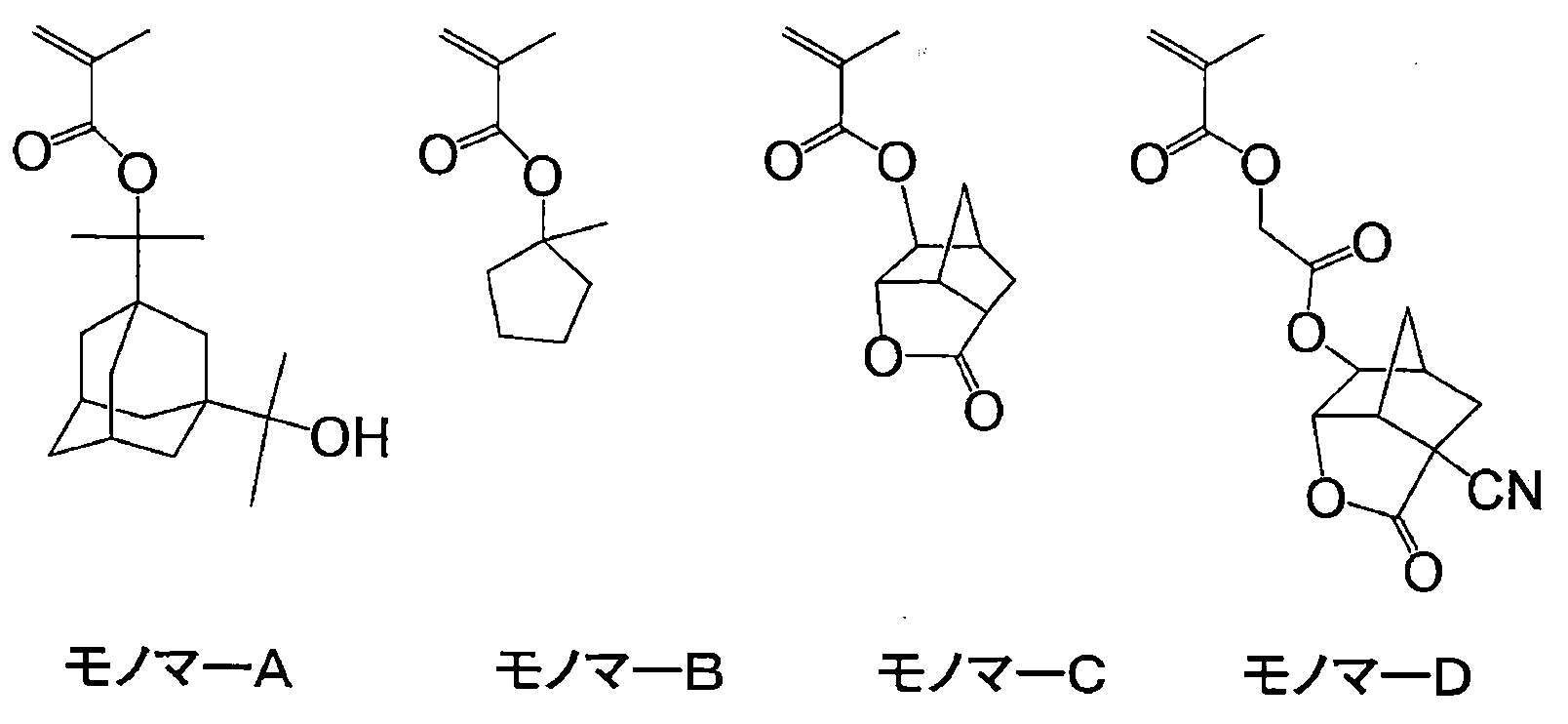
他の樹脂(RA-2~RA-6)についても同様の手法を用いて合成した。重量平均分子量は開始剤の量を変更することで調整した。
以下に各樹脂における繰り返し単位(繰り返し単位の比はモル比)、重量平均分子量(Mw)、分散度(Mw/Mn)を示す。
以下に各樹脂における繰り返し単位(繰り返し単位の比はモル比)、重量平均分子量(Mw)、分散度(Mw/Mn)を示す。
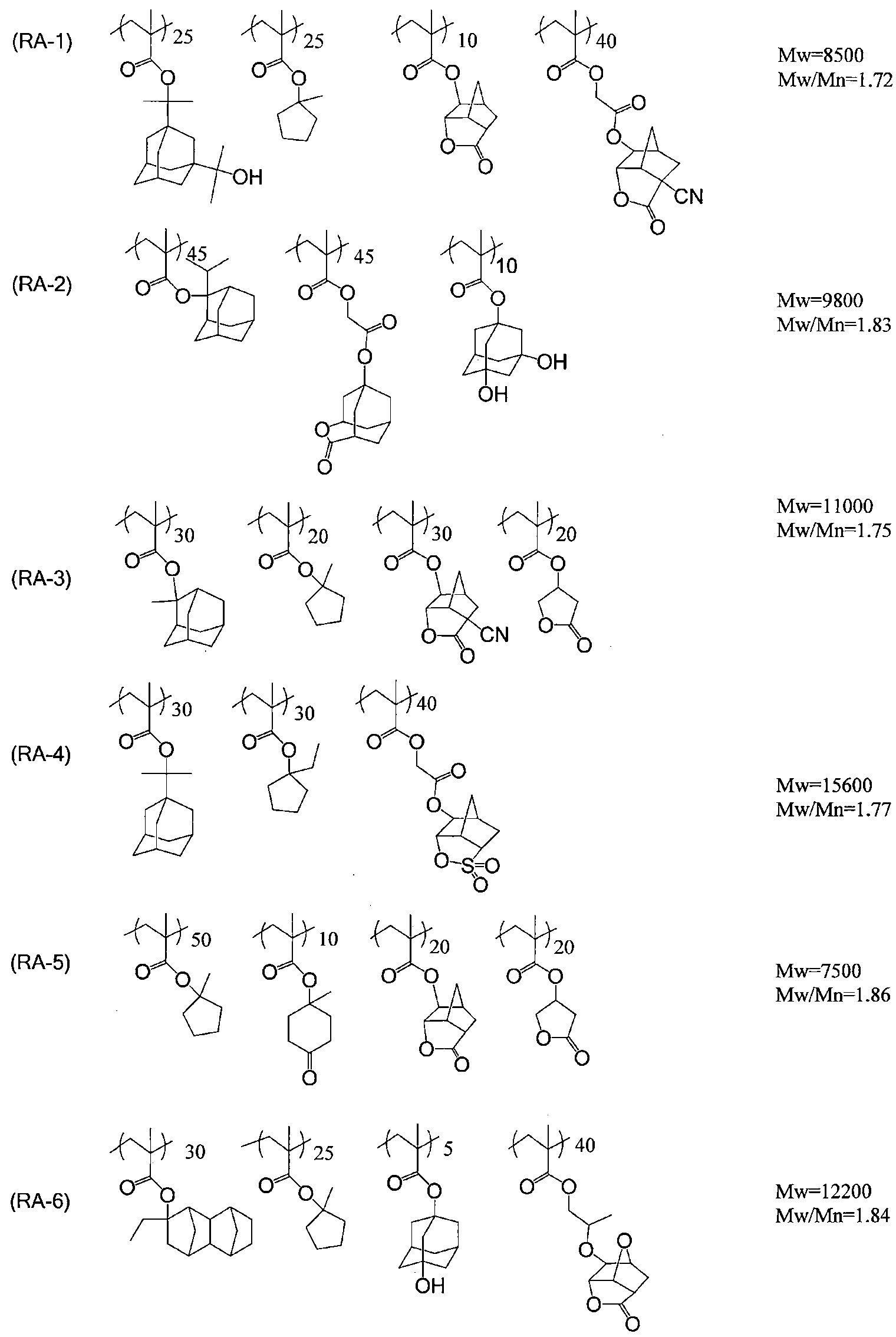
使用した光酸発生剤は下記の通りである。
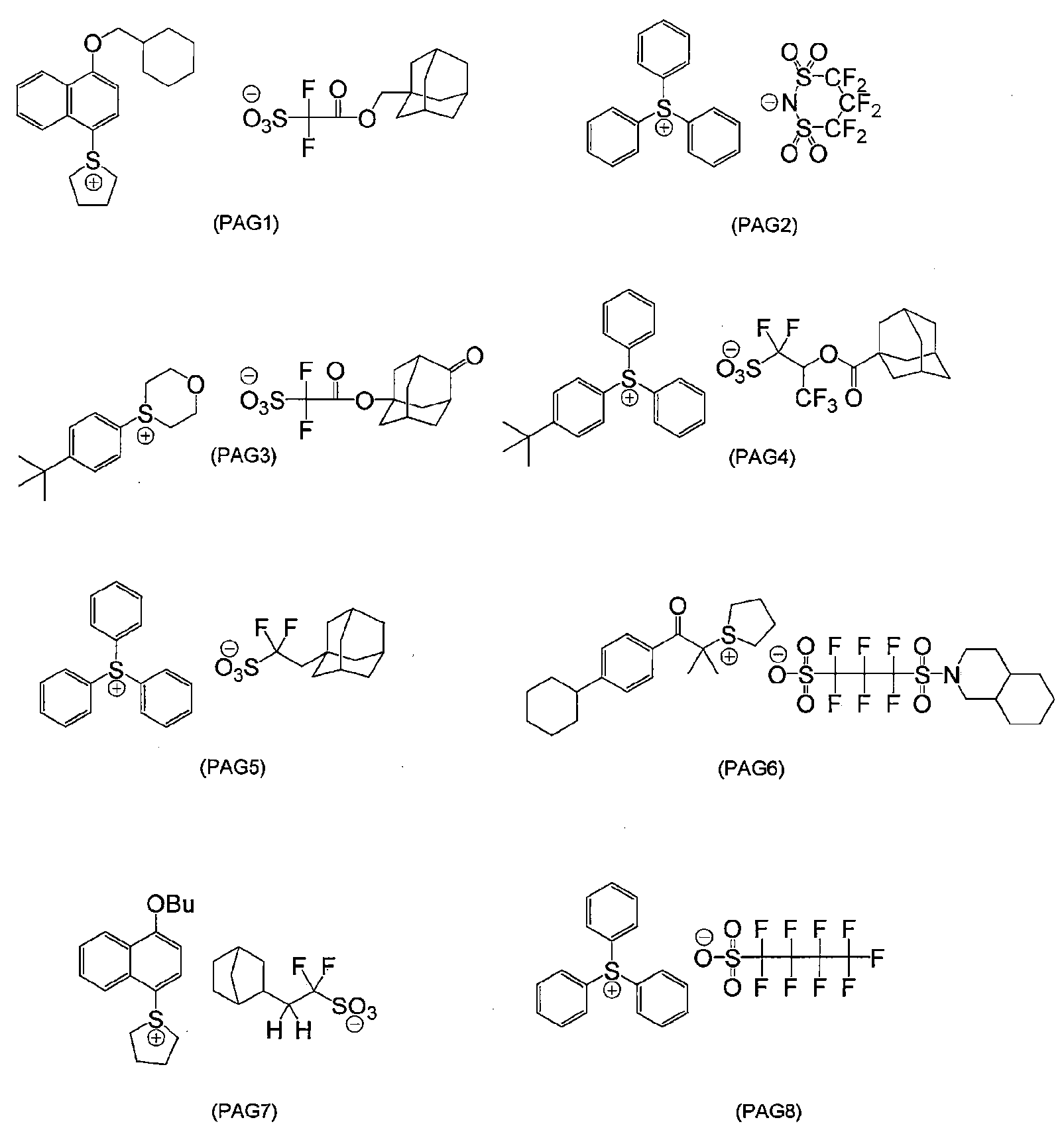
使用したオニウム塩(C)は下記の通りである。なお、下記(QX-1)~(QX-5)はオニウム塩(C)ではないが、下記表1では便宜的に「オニウム塩(C)」の欄に記載した。
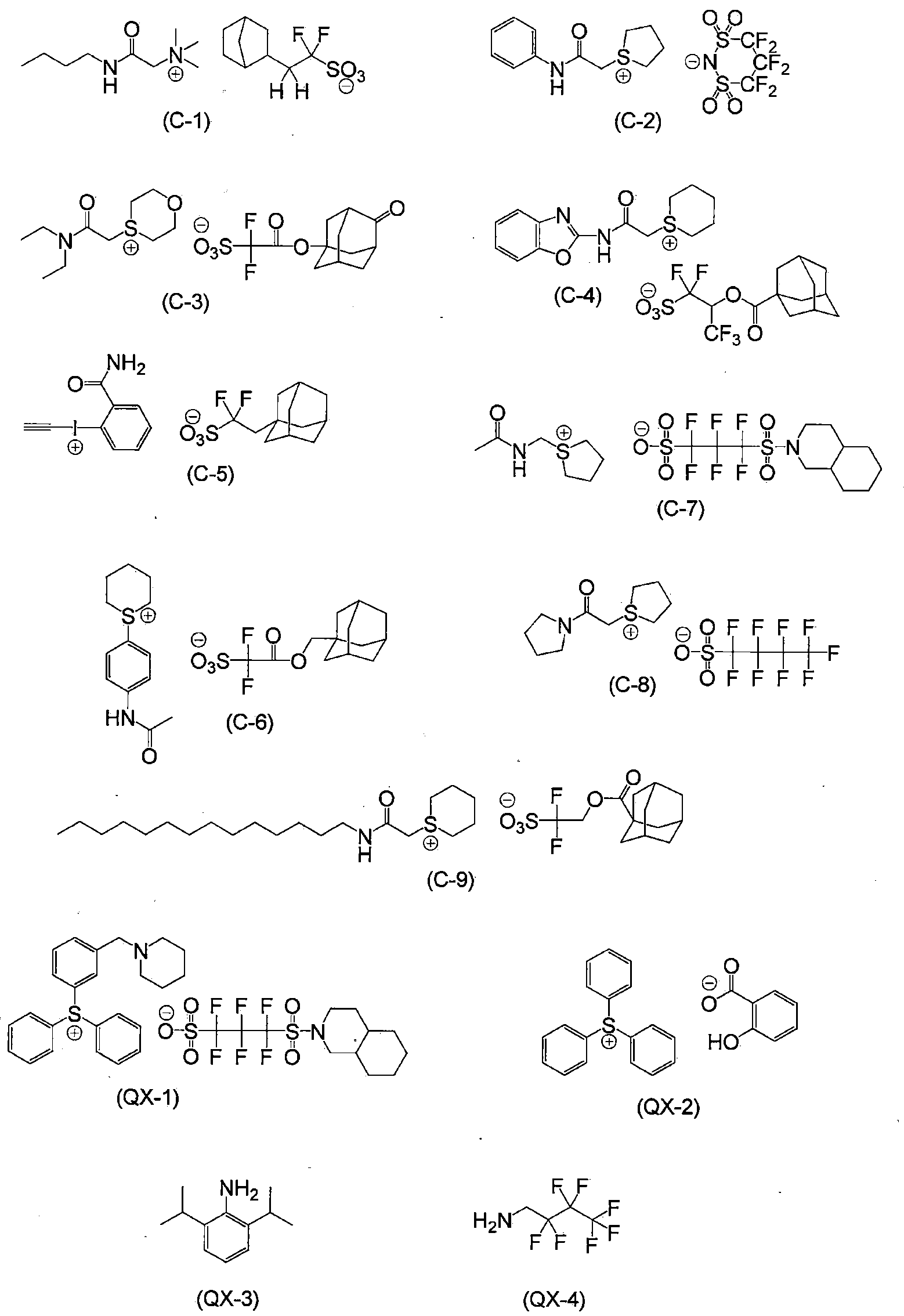

〔界面活性剤〕
W-1:メガファックF176(大日本インキ化学工業(株)製)(フッ素系)
W-2:メガファックR08(大日本インキ化学工業(株)製)(フッ素及びシリコン系)
W-1:メガファックF176(大日本インキ化学工業(株)製)(フッ素系)
W-2:メガファックR08(大日本インキ化学工業(株)製)(フッ素及びシリコン系)
〔溶剤〕
S1:プロピレングリコールモノメチルエーテルアセテート(PGMEA)
S2:2-ヘプタノン
S3:シクロヘキサノン
S4:γ-ブチロラクトン
S5:プロピレングリコールモノメチルエーテル(PGME)
S1:プロピレングリコールモノメチルエーテルアセテート(PGMEA)
S2:2-ヘプタノン
S3:シクロヘキサノン
S4:γ-ブチロラクトン
S5:プロピレングリコールモノメチルエーテル(PGME)
〔疎水性樹脂〕
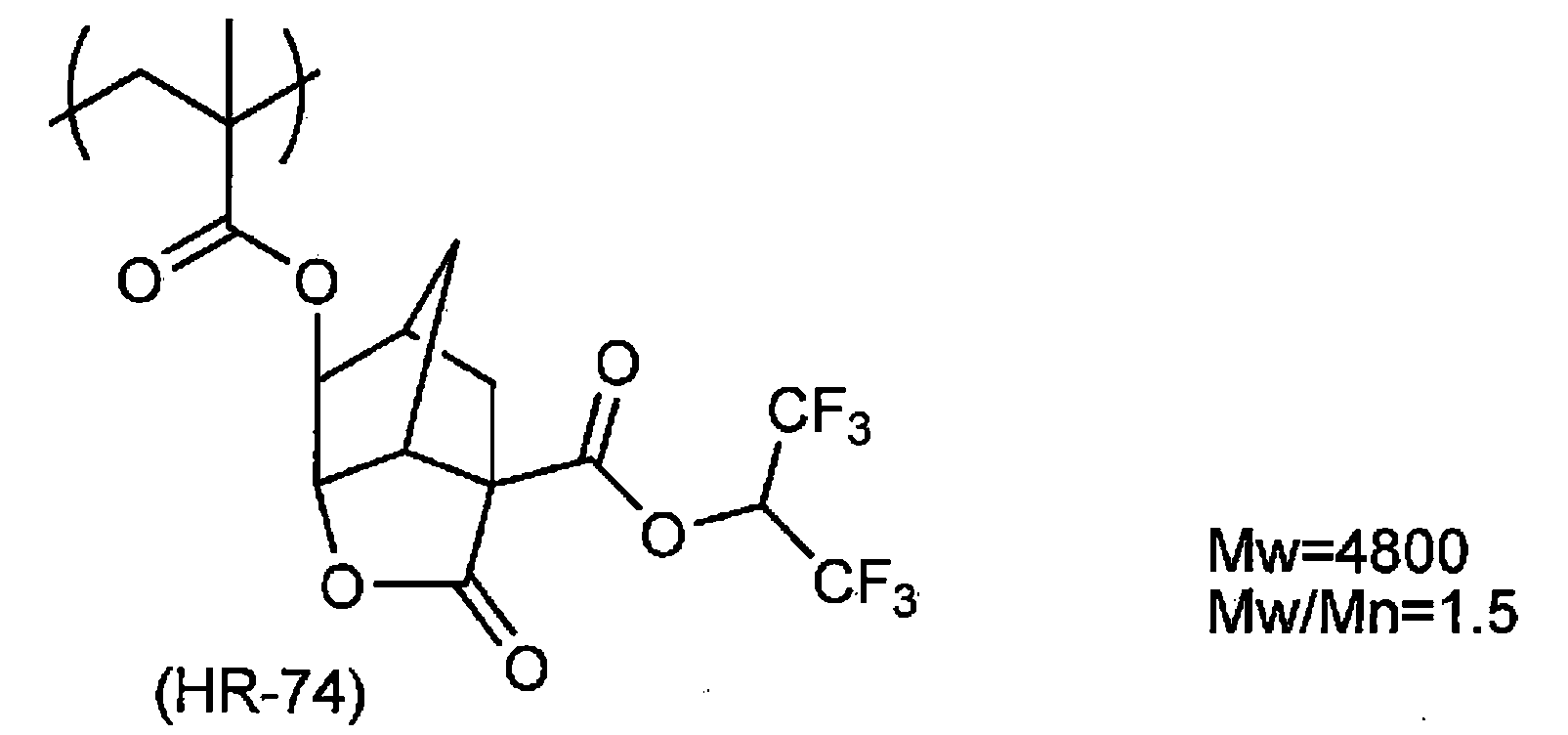
<レジスト組成物の調製>
下記表1に示す成分を表1に示す添加量で、表1に示す溶剤に溶解させて固形分濃度5質量%の溶液を調製し、これを0.03μmのポアサイズを有するポリエチレンフィルターでろ過して、各実施例及び比較例のポジ型レジスト組成物(溶液)を調製した。
また、下記表1には、各レジスト組成物中の光酸発生剤の含有量に対するオニウム塩(C)の含有量のモル換算の比率(オニウム塩(C)の含有量がモル換算で光酸発生剤の含有量の何%であるか)を記載した。
下記表1に示す成分を表1に示す添加量で、表1に示す溶剤に溶解させて固形分濃度5質量%の溶液を調製し、これを0.03μmのポアサイズを有するポリエチレンフィルターでろ過して、各実施例及び比較例のポジ型レジスト組成物(溶液)を調製した。
また、下記表1には、各レジスト組成物中の光酸発生剤の含有量に対するオニウム塩(C)の含有量のモル換算の比率(オニウム塩(C)の含有量がモル換算で光酸発生剤の含有量の何%であるか)を記載した。
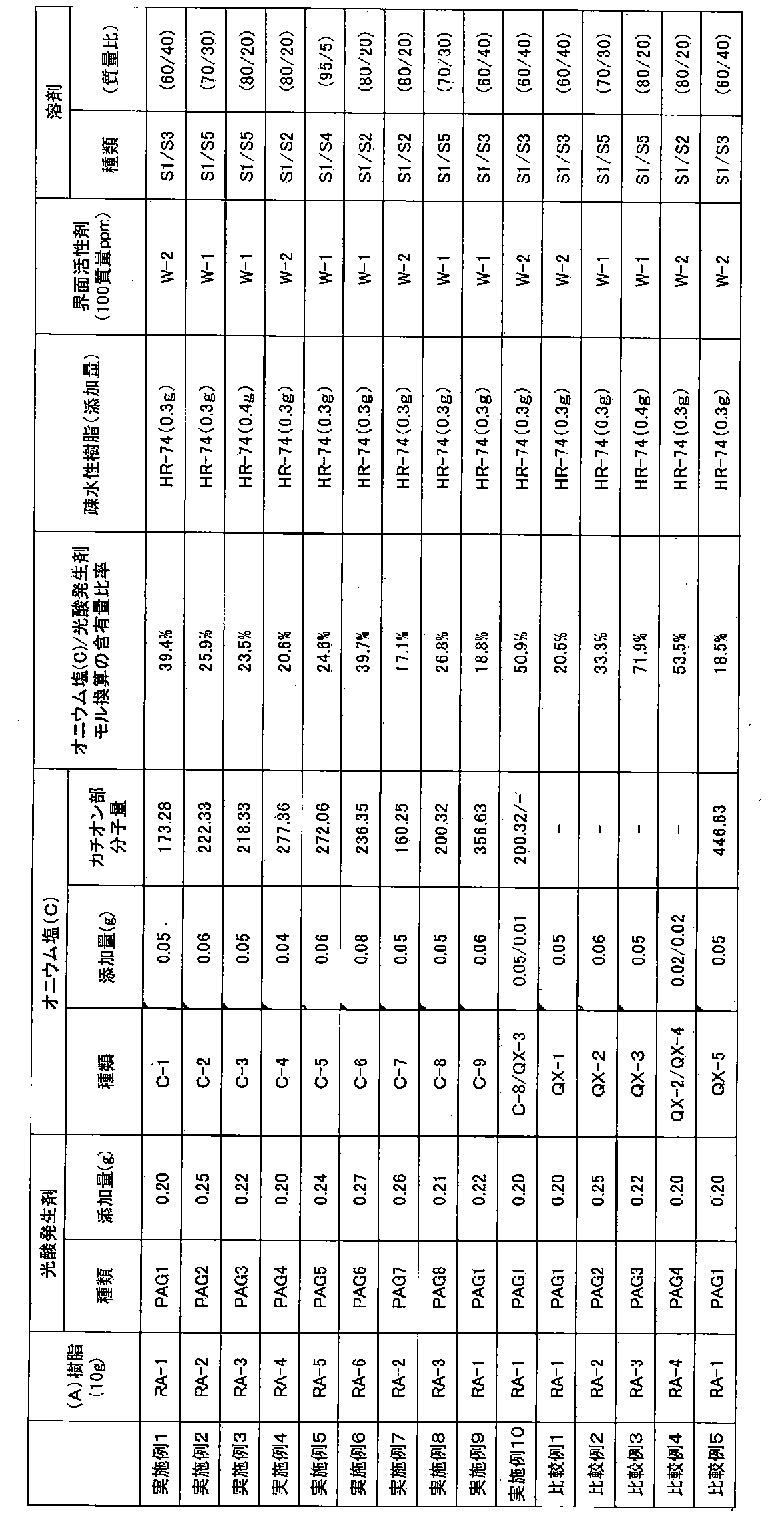
調製したポジ型レジスト組成物を下記の方法で評価し、結果を表2に示した。
-パターン形成-
シリコンウエハ(直径12インチ)上に反射防止膜ARC29A(日産化学工業(株)製)を塗布し、205℃で、60秒間ベークを行い、膜厚86nmの反射防止膜を形成した。その上に調製したレジスト組成物を塗布し、100℃で、60秒間ベークを行い、膜厚100nmの感光性膜(レジスト膜)を形成した。なお、1インチは、0.0254mである。得られたウエハをArFエキシマレーザー液浸スキャナー(ASML社製XT1700i、NA1.20、Annular、アウターシグマ0.700、インナーシグマ0.400、XY偏向)を用い、開口部分が100nmであり、かつ、ホール間のピッチが800nmである6%ハーフトーンマスクを通して露光した。液浸液としては超純水を使用した。その後100℃で、60秒間加熱した後、テトラメチルアンモニウムハイドロオキサイド水溶液(2.38質量%)で30秒間現像し、純水でリンスした後、スピン乾燥して直径85nmの孤立ホールパターンを得た。
また、閉口部分が115nmであり、かつ、ドット間のピッチが800nmである6%ハーフトーンマスクを通して露光した以外は、上記と同様の手順に従って、露光処理および現像処理を実施し、直径90nmの孤立ドットパターンを得た。
シリコンウエハ(直径12インチ)上に反射防止膜ARC29A(日産化学工業(株)製)を塗布し、205℃で、60秒間ベークを行い、膜厚86nmの反射防止膜を形成した。その上に調製したレジスト組成物を塗布し、100℃で、60秒間ベークを行い、膜厚100nmの感光性膜(レジスト膜)を形成した。なお、1インチは、0.0254mである。得られたウエハをArFエキシマレーザー液浸スキャナー(ASML社製XT1700i、NA1.20、Annular、アウターシグマ0.700、インナーシグマ0.400、XY偏向)を用い、開口部分が100nmであり、かつ、ホール間のピッチが800nmである6%ハーフトーンマスクを通して露光した。液浸液としては超純水を使用した。その後100℃で、60秒間加熱した後、テトラメチルアンモニウムハイドロオキサイド水溶液(2.38質量%)で30秒間現像し、純水でリンスした後、スピン乾燥して直径85nmの孤立ホールパターンを得た。
また、閉口部分が115nmであり、かつ、ドット間のピッチが800nmである6%ハーフトーンマスクを通して露光した以外は、上記と同様の手順に従って、露光処理および現像処理を実施し、直径90nmの孤立ドットパターンを得た。
-焦点深度の共通許容度評価(共通DOF性能試験)-
直径85nmの孤立ホールパターンを再現する露光量及び焦点深度をそれぞれ最適露光量及び最適焦点深度とし、露光量を最適露光量としたまま、焦点深度を、最適焦点深度から変化(デフォーカス)させた際に、上記直径の±10%(すなわち85nm±10%)の直径を許容する焦点深度幅(nm)を観測した。同様に直径90nmの孤立ドットパターンについても、直径の±10%(すなわち90nm±10%)の直径を許容する焦点深度幅(nm)を観測した。
上記ホールパターンおよびドットパターン共に直径の±10%を許容する焦点深度の変動幅である領域を、共通焦点深度許容度(共通DOF)とした。上記変動幅の値は大きいほど良好な性能であることを示す。
直径85nmの孤立ホールパターンを再現する露光量及び焦点深度をそれぞれ最適露光量及び最適焦点深度とし、露光量を最適露光量としたまま、焦点深度を、最適焦点深度から変化(デフォーカス)させた際に、上記直径の±10%(すなわち85nm±10%)の直径を許容する焦点深度幅(nm)を観測した。同様に直径90nmの孤立ドットパターンについても、直径の±10%(すなわち90nm±10%)の直径を許容する焦点深度幅(nm)を観測した。
上記ホールパターンおよびドットパターン共に直径の±10%を許容する焦点深度の変動幅である領域を、共通焦点深度許容度(共通DOF)とした。上記変動幅の値は大きいほど良好な性能であることを示す。
-ラインウィズスラフネス(LWR)-
線幅75nmの1:1ラインアンドスペースパターンの6%ハーフトーンマスクを通して露光した以外は、上記と同じ条件でラインアンドスペースパターンを得た。ラインサイズが平均75nmのラインパターンを解像する露光量を最適露光量とし、最適露光量にて解像した75nm(1:1)のラインアンドスペースのレジストパターンに対して、測長走査型電子顕微鏡(SEM、(株)日立製作所製S-9380II)を使用してパターン上部から観察する際、線幅を任意の32ポイントで観測し、その測定ばらつきを3σ(単位:nm)で評価した。3σの値が小さいほど良好な性能であることを示す。
線幅75nmの1:1ラインアンドスペースパターンの6%ハーフトーンマスクを通して露光した以外は、上記と同じ条件でラインアンドスペースパターンを得た。ラインサイズが平均75nmのラインパターンを解像する露光量を最適露光量とし、最適露光量にて解像した75nm(1:1)のラインアンドスペースのレジストパターンに対して、測長走査型電子顕微鏡(SEM、(株)日立製作所製S-9380II)を使用してパターン上部から観察する際、線幅を任意の32ポイントで観測し、その測定ばらつきを3σ(単位:nm)で評価した。3σの値が小さいほど良好な性能であることを示す。
-パターンの断面形状の矩形性-
線幅100nmの1:1ラインアンドスペースパターンの6%ハーフトーンマスクを通して露光した以外は、上記と同じ条件でラインアンドスペースパターンを得た。
ラインサイズが平均100nmのラインパターンを解像する露光量における線幅100nmのラインパターン(ライン/スペース=1/1)の断面形状を測長走査型電子顕微鏡(SEM、(株)日立製作所製S-9380II)を用いて観察した。ラインパターンの断面形状において、[ラインパターンのトップ部(表面部)における線幅/ラインパターンの中部(ラインパターンの高さの半分の高さ位置)における線幅]を求めた。上記比の値が1.0に近いほど矩形性に優れ良好な性能であることを示す。
線幅100nmの1:1ラインアンドスペースパターンの6%ハーフトーンマスクを通して露光した以外は、上記と同じ条件でラインアンドスペースパターンを得た。
ラインサイズが平均100nmのラインパターンを解像する露光量における線幅100nmのラインパターン(ライン/スペース=1/1)の断面形状を測長走査型電子顕微鏡(SEM、(株)日立製作所製S-9380II)を用いて観察した。ラインパターンの断面形状において、[ラインパターンのトップ部(表面部)における線幅/ラインパターンの中部(ラインパターンの高さの半分の高さ位置)における線幅]を求めた。上記比の値が1.0に近いほど矩形性に優れ良好な性能であることを示す。

表2より、実施例1~10のレジスト組成物は、LWR性能及び断面形状の矩形性に優れたパターンが形成でき、かつ共通DOF性能も優れていることが分かった。
Claims (13)
- (A)酸の作用により極性が増大して現像液に対する溶解性が変化する樹脂、
(B)活性光線又は放射線の照射により酸を発生する化合物、
(C)対カチオン中にアミド構造を有するオニウム塩、
を含有する感活性光線性又は感放射線性樹脂組成物であって、
前記オニウム塩(C)が下記一般式(1)で表され、
前記感活性光線性又は感放射線性樹脂組成物中のオニウム塩(C)の含有量がモル換算で前記化合物(B)の含有量よりも少ない、感活性光線性又は感放射線性樹脂組成物。

- 前記オニウム塩(C)が、前記アミド構造の窒素原子に芳香族基が直結した構造を有さない、請求項1に記載の感活性光線性又は感放射線性樹脂組成物。
- 前記一般式(1)中、X1が硫黄原子を表し、かつ2つのQ2がそれぞれ独立にアルキル基又はシクロアルキル基を表す請求項1又は2に記載の感活性光線性又は感放射線性樹脂組成物。
ただし、Q1と2つのQ2のうち少なくとも1つとは互いに結合して環構造を形成していても良い。また、2つのQ2は互いに結合して環構造を形成していても良い。 - 前記オニウム塩(C)が、下記一般式(2)で表される、請求項1~3のいずれか1項に記載の感活性光線性又は感放射線性樹脂組成物。
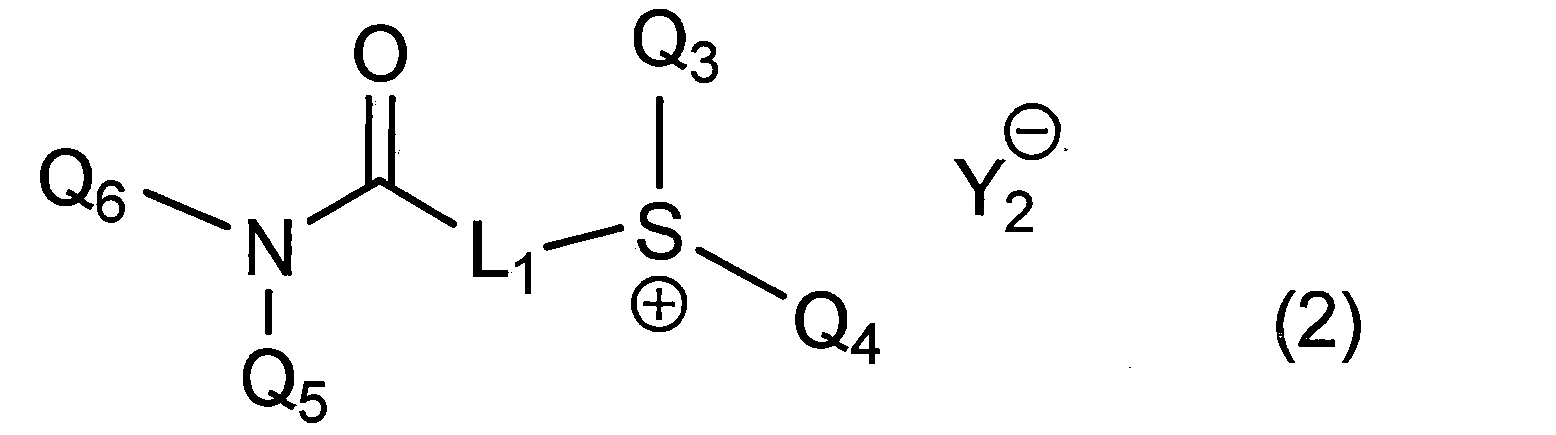
- 前記オニウム塩(C)のカチオン部の分子量が、100以上500以下である請求項1~4のいずれか1項に記載の感活性光線性又は感放射線性樹脂組成物。
- 前記オニウム塩(C)のカチオン部の分子量が、120以上350以下である請求項1~5のいずれか1項に記載の感活性光線性又は感放射線性樹脂組成物。
- 前記感活性光線性又は感放射線性樹脂組成物中の前記オニウム塩(C)の含有量がモル換算で前記化合物(B)の含有量の50%以下である請求項1~6のいずれか1項に記載の感活性光線性又は感放射線性樹脂組成物。
- 更に、(D)フッ素原子及び珪素原子の少なくともいずれかを有する、前記樹脂(A)とは異なる疎水性樹脂、を含有する請求項1~7のいずれか1項に記載の感活性光線性又は感放射線性樹脂組成物。
- 前記疎水性樹脂(D)が、含フッ素(メタ)アクリレート系樹脂である請求項8に記載の感活性光線性又は感放射線性樹脂組成物。
- 前記感活性光線性又は感放射線性樹脂組成物中の前記疎水性樹脂(D)の含有量が、前記感活性光線性又は感放射線性樹脂組成物の全固形分に対して1~10質量%である、請求項8又は9に記載の感活性光線性又は感放射線性樹脂組成物。
- 請求項1~10のいずれか1項に記載の感活性光線性又は感放射線性樹脂組成物により形成された感活性光線性又は感放射線性膜。
- 請求項1~10のいずれか1項に記載の感活性光線性又は感放射線性樹脂組成物によって感活性光線性又は感放射線性膜を形成する工程、
前記感活性光線性又は感放射線性膜に活性光線又は放射線を照射する工程、及び、
前記活性光線又は放射線が照射された感活性光線性又は感放射線性膜を、現像液を用いて現像する工程、を有するパターン形成方法。 - 請求項12に記載のパターン形成方法を含む、電子デバイスの製造方法。
Priority Applications (1)
| Application Number | Priority Date | Filing Date | Title |
|---|---|---|---|
| JP2020502861A JP6967655B2 (ja) | 2018-02-28 | 2019-01-23 | 感活性光線性又は感放射線性樹脂組成物、感活性光線性又は感放射線性膜、パターン形成方法、及び電子デバイスの製造方法 |
Applications Claiming Priority (2)
| Application Number | Priority Date | Filing Date | Title |
|---|---|---|---|
| JP2018036002 | 2018-02-28 | ||
| JP2018-036002 | 2018-02-28 |
Publications (1)
| Publication Number | Publication Date |
|---|---|
| WO2019167481A1 true WO2019167481A1 (ja) | 2019-09-06 |
Family
ID=67805791
Family Applications (1)
| Application Number | Title | Priority Date | Filing Date |
|---|---|---|---|
| PCT/JP2019/001941 Ceased WO2019167481A1 (ja) | 2018-02-28 | 2019-01-23 | 感活性光線性又は感放射線性樹脂組成物、感活性光線性又は感放射線性膜、パターン形成方法、及び電子デバイスの製造方法 |
Country Status (3)
| Country | Link |
|---|---|
| JP (1) | JP6967655B2 (ja) |
| TW (1) | TWI779159B (ja) |
| WO (1) | WO2019167481A1 (ja) |
Cited By (1)
| Publication number | Priority date | Publication date | Assignee | Title |
|---|---|---|---|---|
| WO2021172111A1 (ja) * | 2020-02-27 | 2021-09-02 | 富士フイルム株式会社 | パターン形成方法、電子デバイスの製造方法、及び感活性光線性又は感放射線性樹脂組成物 |
Citations (4)
| Publication number | Priority date | Publication date | Assignee | Title |
|---|---|---|---|---|
| JP2014026102A (ja) * | 2012-07-26 | 2014-02-06 | Fujifilm Corp | パターン形成方法及び該方法に使用するための感活性光線性又は感放射線性樹脂組成物 |
| JP2015027992A (ja) * | 2013-06-26 | 2015-02-12 | 住友化学株式会社 | 塩、レジスト組成物及びレジストパターンの製造方法 |
| JP2015068860A (ja) * | 2013-09-26 | 2015-04-13 | 富士フイルム株式会社 | 感活性光線性又は感放射線性組成物、並びに、これを用いた、レジスト膜、パターン形成方法、レジスト塗布マスクブランクス、フォトマスクの製造方法、フォトマスク、電子デバイスの製造方法、及び、電子デバイス |
| JP2018013751A (ja) * | 2015-10-23 | 2018-01-25 | 信越化学工業株式会社 | レジスト材料、パターン形成方法、並びにバリウム塩、セシウム塩及びセリウム塩 |
Family Cites Families (5)
| Publication number | Priority date | Publication date | Assignee | Title |
|---|---|---|---|---|
| JP5848869B2 (ja) * | 2010-08-25 | 2016-01-27 | 富士フイルム株式会社 | パターン形成方法 |
| JP5712099B2 (ja) * | 2010-09-28 | 2015-05-07 | 富士フイルム株式会社 | レジスト組成物、並びに、それを用いたレジスト膜及びパターン形成方法 |
| JP6159746B2 (ja) * | 2014-02-28 | 2017-07-05 | 富士フイルム株式会社 | パターン形成方法、処理剤、電子デバイス及びその製造方法 |
| JP6379293B2 (ja) * | 2015-06-23 | 2018-08-22 | 富士フイルム株式会社 | パターン形成方法、及び電子デバイスの製造方法 |
| JP6583126B2 (ja) * | 2016-04-28 | 2019-10-02 | 信越化学工業株式会社 | 新規カルボン酸オニウム塩、化学増幅レジスト組成物、及びパターン形成方法 |
-
2019
- 2019-01-23 JP JP2020502861A patent/JP6967655B2/ja active Active
- 2019-01-23 WO PCT/JP2019/001941 patent/WO2019167481A1/ja not_active Ceased
- 2019-01-24 TW TW108102643A patent/TWI779159B/zh active
Patent Citations (4)
| Publication number | Priority date | Publication date | Assignee | Title |
|---|---|---|---|---|
| JP2014026102A (ja) * | 2012-07-26 | 2014-02-06 | Fujifilm Corp | パターン形成方法及び該方法に使用するための感活性光線性又は感放射線性樹脂組成物 |
| JP2015027992A (ja) * | 2013-06-26 | 2015-02-12 | 住友化学株式会社 | 塩、レジスト組成物及びレジストパターンの製造方法 |
| JP2015068860A (ja) * | 2013-09-26 | 2015-04-13 | 富士フイルム株式会社 | 感活性光線性又は感放射線性組成物、並びに、これを用いた、レジスト膜、パターン形成方法、レジスト塗布マスクブランクス、フォトマスクの製造方法、フォトマスク、電子デバイスの製造方法、及び、電子デバイス |
| JP2018013751A (ja) * | 2015-10-23 | 2018-01-25 | 信越化学工業株式会社 | レジスト材料、パターン形成方法、並びにバリウム塩、セシウム塩及びセリウム塩 |
Cited By (4)
| Publication number | Priority date | Publication date | Assignee | Title |
|---|---|---|---|---|
| WO2021172111A1 (ja) * | 2020-02-27 | 2021-09-02 | 富士フイルム株式会社 | パターン形成方法、電子デバイスの製造方法、及び感活性光線性又は感放射線性樹脂組成物 |
| JPWO2021172111A1 (ja) * | 2020-02-27 | 2021-09-02 | ||
| CN114945868A (zh) * | 2020-02-27 | 2022-08-26 | 富士胶片株式会社 | 图案形成方法、电子器件的制造方法及感光化射线性或感放射线性树脂组合物 |
| JP7336018B2 (ja) | 2020-02-27 | 2023-08-30 | 富士フイルム株式会社 | パターン形成方法、電子デバイスの製造方法、及び感活性光線性又は感放射線性樹脂組成物 |
Also Published As
| Publication number | Publication date |
|---|---|
| TWI779159B (zh) | 2022-10-01 |
| JPWO2019167481A1 (ja) | 2021-01-07 |
| JP6967655B2 (ja) | 2021-11-17 |
| TW201939159A (zh) | 2019-10-01 |
Similar Documents
| Publication | Publication Date | Title |
|---|---|---|
| JP7212029B2 (ja) | 感活性光線性又は感放射線性樹脂組成物、レジスト膜、パターン形成方法、電子デバイスの製造方法 | |
| JP2023016886A (ja) | 感光性樹脂組成物及びその製造方法、レジスト膜、パターン形成方法、並びに、電子デバイスの製造方法 | |
| WO2020066824A1 (ja) | 感活性光線性又は感放射線性樹脂組成物、レジスト膜、パターン形成方法、電子デバイスの製造方法 | |
| WO2018212079A1 (ja) | 感活性光線性又は感放射線性樹脂組成物、レジスト膜、パターン形成方法、及び電子デバイスの製造方法 | |
| JP6997803B2 (ja) | 感活性光線性又は感放射線性樹脂組成物、レジスト膜、パターン形成方法、電子デバイスの製造方法、化合物 | |
| JP6818600B2 (ja) | 感活性光線性又は感放射線性樹脂組成物、レジスト膜、パターン形成方法、電子デバイスの製造方法 | |
| US11886113B2 (en) | Actinic ray-sensitive or radiation-sensitive resin composition, resist film, pattern forming method, and method for manufacturing electronic device | |
| JP7076473B2 (ja) | 感活性光線性又は感放射線性樹脂組成物、レジスト膜、パターン形成方法、電子デバイスの製造方法、化合物 | |
| JP6727402B2 (ja) | 感活性光線性又は感放射線性樹脂組成物、レジスト膜、パターン形成方法、電子デバイスの製造方法 | |
| JP7333325B2 (ja) | 感活性光線性又は感放射線性樹脂組成物、レジスト膜、パターン形成方法、電子デバイスの製造方法 | |
| JPWO2019064961A1 (ja) | 感光性樹脂組成物、レジスト膜、パターン形成方法及び電子デバイスの製造方法 | |
| JP6780092B2 (ja) | 感活性光線性又は感放射線性樹脂組成物、レジスト膜、パターン形成方法、電子デバイスの製造方法 | |
| WO2022024856A1 (ja) | 感活性光線性又は感放射線性樹脂組成物、電子デバイス製造方法、及び化合物 | |
| WO2019064976A1 (ja) | 感光性樹脂組成物、レジスト膜、パターン形成方法及び電子デバイスの製造方法 | |
| WO2020049939A1 (ja) | 感活性光線性又は感放射線性樹脂組成物、レジスト膜、パターン形成方法、電子デバイスの製造方法 | |
| WO2019216118A1 (ja) | レジスト組成物、レジスト膜、パターン形成方法、電子デバイスの製造方法 | |
| WO2020049859A1 (ja) | 感活性光線性又は感放射線性樹脂組成物、レジスト膜、パターン形成方法、及び電子デバイスの製造方法 | |
| JP7191981B2 (ja) | 感活性光線性又は感放射線性樹脂組成物、レジスト膜、パターン形成方法、及び電子デバイスの製造方法 | |
| WO2020129683A1 (ja) | 感活性光線性又は感放射線性樹脂組成物、レジスト膜、パターン形成方法、及び電子デバイスの製造方法 | |
| WO2019187632A1 (ja) | 感活性光線性又は感放射線性樹脂組成物、感活性光線性又は感放射線性膜、パターン形成方法、電子デバイスの製造方法、及びポリエステル | |
| JP7084995B2 (ja) | 感活性光線性又は感放射線性樹脂組成物、レジスト膜、パターン形成方法、電子デバイスの製造方法、樹脂 | |
| JP6967655B2 (ja) | 感活性光線性又は感放射線性樹脂組成物、感活性光線性又は感放射線性膜、パターン形成方法、及び電子デバイスの製造方法 | |
| WO2019167451A1 (ja) | 感活性光線性又は感放射線性樹脂組成物、感活性光線性又は感放射線性膜、パターン形成方法、電子デバイスの製造方法 | |
| JP7309888B2 (ja) | 感活性光線性又は感放射線性樹脂組成物、感活性光線性又は感放射線性膜、パターン形成方法、及び電子デバイスの製造方法 | |
| WO2019187804A1 (ja) | 感活性光線性又は感放射線性樹脂組成物、感活性光線性又は感放射線性膜、パターン形成方法、及び電子デバイスの製造方法、並びにポリエステル |
Legal Events
| Date | Code | Title | Description |
|---|---|---|---|
| 121 | Ep: the epo has been informed by wipo that ep was designated in this application |
Ref document number: 19761121 Country of ref document: EP Kind code of ref document: A1 |
|
| ENP | Entry into the national phase |
Ref document number: 2020502861 Country of ref document: JP Kind code of ref document: A |
|
| NENP | Non-entry into the national phase |
Ref country code: DE |
|
| 122 | Ep: pct application non-entry in european phase |
Ref document number: 19761121 Country of ref document: EP Kind code of ref document: A1 |