WO2019163489A1 - 二次電池用積層体の製造方法 - Google Patents
二次電池用積層体の製造方法 Download PDFInfo
- Publication number
- WO2019163489A1 WO2019163489A1 PCT/JP2019/003729 JP2019003729W WO2019163489A1 WO 2019163489 A1 WO2019163489 A1 WO 2019163489A1 JP 2019003729 W JP2019003729 W JP 2019003729W WO 2019163489 A1 WO2019163489 A1 WO 2019163489A1
- Authority
- WO
- WIPO (PCT)
- Prior art keywords
- separator
- adhesive material
- secondary battery
- electrode
- laminate
- Prior art date
- Legal status (The legal status is an assumption and is not a legal conclusion. Google has not performed a legal analysis and makes no representation as to the accuracy of the status listed.)
- Ceased
Links
Images
Classifications
-
- H—ELECTRICITY
- H01—ELECTRIC ELEMENTS
- H01M—PROCESSES OR MEANS, e.g. BATTERIES, FOR THE DIRECT CONVERSION OF CHEMICAL ENERGY INTO ELECTRICAL ENERGY
- H01M50/00—Constructional details or processes of manufacture of the non-active parts of electrochemical cells other than fuel cells, e.g. hybrid cells
- H01M50/40—Separators; Membranes; Diaphragms; Spacing elements inside cells
- H01M50/46—Separators, membranes or diaphragms characterised by their combination with electrodes
- H01M50/461—Separators, membranes or diaphragms characterised by their combination with electrodes with adhesive layers between electrodes and separators
-
- H—ELECTRICITY
- H01—ELECTRIC ELEMENTS
- H01M—PROCESSES OR MEANS, e.g. BATTERIES, FOR THE DIRECT CONVERSION OF CHEMICAL ENERGY INTO ELECTRICAL ENERGY
- H01M10/00—Secondary cells; Manufacture thereof
- H01M10/05—Accumulators with non-aqueous electrolyte
- H01M10/058—Construction or manufacture
- H01M10/0585—Construction or manufacture of accumulators having only flat construction elements, i.e. flat positive electrodes, flat negative electrodes and flat separators
-
- H—ELECTRICITY
- H01—ELECTRIC ELEMENTS
- H01M—PROCESSES OR MEANS, e.g. BATTERIES, FOR THE DIRECT CONVERSION OF CHEMICAL ENERGY INTO ELECTRICAL ENERGY
- H01M10/00—Secondary cells; Manufacture thereof
- H01M10/04—Construction or manufacture in general
-
- H—ELECTRICITY
- H01—ELECTRIC ELEMENTS
- H01M—PROCESSES OR MEANS, e.g. BATTERIES, FOR THE DIRECT CONVERSION OF CHEMICAL ENERGY INTO ELECTRICAL ENERGY
- H01M10/00—Secondary cells; Manufacture thereof
- H01M10/05—Accumulators with non-aqueous electrolyte
- H01M10/052—Li-accumulators
- H01M10/0525—Rocking-chair batteries, i.e. batteries with lithium insertion or intercalation in both electrodes; Lithium-ion batteries
-
- H—ELECTRICITY
- H01—ELECTRIC ELEMENTS
- H01M—PROCESSES OR MEANS, e.g. BATTERIES, FOR THE DIRECT CONVERSION OF CHEMICAL ENERGY INTO ELECTRICAL ENERGY
- H01M10/00—Secondary cells; Manufacture thereof
- H01M10/05—Accumulators with non-aqueous electrolyte
- H01M10/058—Construction or manufacture
-
- H—ELECTRICITY
- H01—ELECTRIC ELEMENTS
- H01M—PROCESSES OR MEANS, e.g. BATTERIES, FOR THE DIRECT CONVERSION OF CHEMICAL ENERGY INTO ELECTRICAL ENERGY
- H01M4/00—Electrodes
- H01M4/02—Electrodes composed of, or comprising, active material
- H01M4/04—Processes of manufacture in general
-
- Y—GENERAL TAGGING OF NEW TECHNOLOGICAL DEVELOPMENTS; GENERAL TAGGING OF CROSS-SECTIONAL TECHNOLOGIES SPANNING OVER SEVERAL SECTIONS OF THE IPC; TECHNICAL SUBJECTS COVERED BY FORMER USPC CROSS-REFERENCE ART COLLECTIONS [XRACs] AND DIGESTS
- Y02—TECHNOLOGIES OR APPLICATIONS FOR MITIGATION OR ADAPTATION AGAINST CLIMATE CHANGE
- Y02E—REDUCTION OF GREENHOUSE GAS [GHG] EMISSIONS, RELATED TO ENERGY GENERATION, TRANSMISSION OR DISTRIBUTION
- Y02E60/00—Enabling technologies; Technologies with a potential or indirect contribution to GHG emissions mitigation
- Y02E60/10—Energy storage using batteries
-
- Y—GENERAL TAGGING OF NEW TECHNOLOGICAL DEVELOPMENTS; GENERAL TAGGING OF CROSS-SECTIONAL TECHNOLOGIES SPANNING OVER SEVERAL SECTIONS OF THE IPC; TECHNICAL SUBJECTS COVERED BY FORMER USPC CROSS-REFERENCE ART COLLECTIONS [XRACs] AND DIGESTS
- Y02—TECHNOLOGIES OR APPLICATIONS FOR MITIGATION OR ADAPTATION AGAINST CLIMATE CHANGE
- Y02P—CLIMATE CHANGE MITIGATION TECHNOLOGIES IN THE PRODUCTION OR PROCESSING OF GOODS
- Y02P70/00—Climate change mitigation technologies in the production process for final industrial or consumer products
- Y02P70/50—Manufacturing or production processes characterised by the final manufactured product
Definitions
- the present invention relates to a method for manufacturing a laminate for a secondary battery.
- Secondary batteries such as lithium ion secondary batteries are small and light, have high energy density, and can be repeatedly charged and discharged, and are used in a wide range of applications.
- the secondary battery generally includes a battery member such as a positive electrode, a negative electrode, and a separator that separates the positive electrode and the negative electrode and prevents a short circuit between the positive electrode and the negative electrode.
- the electrode before being immersed in the electrolyte and the separator are pressure-bonded to form a laminated body (hereinafter sometimes referred to as “secondary battery laminated body”), which is necessary.
- secondary battery laminated body a laminated body
- it may be cut to a desired size, or laminated, folded or wound.
- the crimped electrode and the separator may be misaligned, which may cause problems such as generation of defects and reduced productivity.
- a separator having an adhesive layer on the surface thereof is used to favorably bond an electrode and a separator in a secondary battery manufacturing process.
- Patent Document 1 after forming a porous coating layer by applying a coating solution containing inorganic particles and a binder polymer on a porous substrate and drying the coating solution, A separator having a porous coating layer and an adhesive layer is produced on a porous substrate by applying a binder solution having a predetermined surface energy and contact angle on the surface and drying, and used for assembling a secondary battery.
- a battery member having an adhesive layer such as a separator having an adhesive layer is stored in a rolled state until it is used to form a laminate for a secondary battery after the adhesive layer is formed.
- an adhesive layer such as a separator having an adhesive layer
- the battery members adjacent to each other through the adhesive layer may be stuck (blocked). And when battery members adhere, when the battery member which has an adhesion layer is drawn out from a roll and manufacturing the laminated body for secondary batteries, the operation
- an object of the present invention is to provide a method capable of efficiently producing a laminate for a secondary battery in which an electrode and a separator are bonded together while ensuring the adhesive force between the electrode and the separator.
- the present inventor has intensively studied for the purpose of solving the above problems. Then, the inventor makes the amount of the adhesive material formed on the bonding surface within a predetermined range and forms the adhesive material when manufacturing the laminated body for the secondary battery in which the electrode and the separator are bonded together. After that, if the electrode and the separator are bonded together without bringing other members into contact with the bonding surface on which the adhesive material is formed, the laminated body for the secondary battery can be efficiently obtained while ensuring the adhesive force between the electrode and the separator.
- the present invention has been completed by finding that it can be produced.
- this invention aims at solving the said subject advantageously, and the manufacturing method of the laminated body for secondary batteries of this invention is for secondary batteries formed by bonding an electrode and a separator.
- a method for manufacturing a laminate the step (A) of forming an adhesive material on at least one bonding surface of the electrode and the separator, and the bonding in which the adhesive material is formed after the step (A)
- the step (C) of bonding wherein the formation amount of the adhesive material in the step (A) is 0.1 g / m 2 or more and 100 g / m 2 or less.
- the “lamination start position” refers to a position where the bonding surface of the electrode and the bonding surface of the separator are brought into contact with each other when bonding the electrode and the separator.
- the “formation amount of the adhesive material” refers to the amount of the adhesive material formed per unit area of the bonding surface, and the mass of the adhesive material formed on the bonding surface is defined as the bonding material. It can be calculated by dividing by the area of the bonding surface on which the material is formed. Note that the “area of the bonding surface” refers to the area of the portions that contact each other when the electrode and the separator are bonded together (that is, when one of the electrode and the separator is smaller than the other) The area of the bonding surface is equal to the area of the smaller bonding surface).
- the adhesive material is preferably made of a polymer. If the adhesive material which consists of a polymer is used, an electrode and a separator can be adhere
- the manufacturing method of the laminated body for secondary batteries of this invention WHEREIN:
- the said polymer contains the low Tg polymer whose glass transition temperature is 25 degrees C or less. If a polymer containing a low Tg polymer is used as an adhesive material, the adhesive strength between the electrode and the separator can be further increased.
- the “glass transition temperature” can be measured according to JIS K7121.
- the manufacturing method of the laminated body for secondary batteries of this invention supplies the adhesive composition containing the said adhesive material and a solvent to the said bonding surface in the said process (A), and is used for the said adhesive composition.
- the amount of coarse particles having a diameter of 10 ⁇ m or more is preferably 100 ppm or less. If the amount of coarse particles is not more than the above upper limit value, the energy density of the secondary battery produced using the secondary battery laminate can be increased.
- the “amount of coarse particles” can be measured using the measuring method described in the examples of the present specification.
- the manufacturing method of the laminated body for secondary batteries of this invention WHEREIN: In the said process (A), the said adhesive material is formed in one place or more on a bonding surface, and the formation area of the said adhesive material is 1 place. is preferably 25 [mu] m 2 or more 250000Myuemu 2 hereinafter. If the formation area per location of the adhesive material is within the above range, the laminate for a secondary battery can be efficiently produced while the electrode and the separator are favorably bonded.
- the manufacturing method of the laminated body for secondary batteries of this invention forms the said adhesive material by the inkjet method in the said process (A). If the adhesive material is formed by the ink jet method, the electrode and the separator can be bonded more satisfactorily.
- the manufacturing method of the laminated body for secondary batteries of this invention is used when manufacturing the laminated body for secondary batteries formed by bonding an electrode (a positive electrode and / or a negative electrode) and a separator.
- the secondary battery laminate produced using the method for producing a secondary battery laminate of the present invention produces a secondary battery such as a non-aqueous secondary battery (for example, a lithium ion secondary battery). Can be used.
- the manufacturing method of the laminated body for secondary batteries of this invention can be used especially suitably, when manufacturing the laminated body for secondary batteries continuously.
- the manufacturing method of the laminated body for secondary batteries of this invention is a method of bonding an electrode and a separator and manufacturing the laminated body for secondary batteries. Then, in the manufacturing method of the secondary battery laminate of the present invention, the electrodes and separators of at least one of the bonding step of the bonding material to form an amount of 0.1 g / m 2 or more 100 g / m 2 or less on the surface (A ), The step (B) of transporting the electrode and the separator to the bonding start position is performed without bringing other members into contact with the bonding surface on which the adhesive material is formed.
- the step (C) for bonding the electrode and the separator is performed to produce a laminate for a secondary battery.
- the battery member (electrode and / or Or separator) does not cause blocking.
- the amount of the adhesive material formed is within a predetermined range, the electrode and the separator are sufficiently connected even when the battery member (electrode and / or separator) on which the adhesive material is formed is used for bonding as it is. Can be glued. Therefore, the laminated body for secondary batteries can be manufactured efficiently.
- the laminate for a secondary battery produced by the production method of the present invention is one in which an electrode and a separator are bonded together via a bonding surface.
- the electrode which is bonded to the separator to form the secondary battery laminate may be only the positive electrode, only the negative electrode, or both the positive electrode and the negative electrode.
- the number of positive electrodes, negative electrodes, and separators included in the secondary battery laminate may be one. Two or more may be sufficient. That is, the structure of the laminate for a secondary battery manufactured using the manufacturing method of the present invention may be any of the following (1) to (6).
- Separator / positive electrode / separator / negative electrode (6) Multiple positive and negative electrodes are separators (For example, “separator / negative electrode / separator / positive electrode / separator / negative electrode.. ./Separator/positive electrode”) Note that a laminate for a secondary battery having a plurality of electrodes and / or separators can be produced by repeatedly performing the steps (A) to (C) described above.
- the electrode is not particularly limited, and for example, an electrode composed of an electrode base material formed by forming an electrode composite layer on one side or both sides of a current collector, or an electrode composite layer of an electrode base material An electrode obtained by further forming a porous film layer thereon can be used.
- the current collector, the electrode mixture layer and the porous membrane layer are not particularly limited, and may be any collector that can be used in the field of secondary batteries, such as those described in JP2013-145663A.
- An electrical conductor, an electrode mixture layer and a porous membrane layer can be used.
- the porous membrane layer refers to a layer containing non-conductive particles as described in, for example, JP-A-2013-145663.
- the electrode used for manufacture of the laminated body for secondary batteries may be wound by roll shape, and may be cut
- the separator which consists of a separator base material, or the separator which forms a porous film layer in the single side
- the separator substrate and the porous membrane layer are not particularly limited, and can be used in the field of secondary batteries such as those described in JP 2012-204303 A and JP 2013-145863 A, for example. Any separator substrate and porous membrane layer may be used.
- the separator used for manufacture of the laminated body for secondary batteries may be wound by roll shape, and may be cut
- the adhesive material for bonding the electrode and the separator is not particularly limited as long as it can bond the electrode and the separator and does not inhibit the battery reaction, and is used in the field of secondary batteries. Any adhesive material that has been described can be used. Especially, it is preferable to use the adhesive material which consists of a polymer as an adhesive material from a viewpoint of adhere
- the polymer which comprises an adhesive material may be only one type, and may be two or more types.
- the polymer that can be used as the adhesive material is not particularly limited, and is a fluorine-based polymer such as polyvinylidene fluoride, polyvinylidene fluoride-hexafluoropropylene (PVdF-HFP) copolymer; styrene- Conjugated diene polymers such as butadiene copolymer (SBR) and acrylonitrile-butadiene copolymer (NBR); hydrides of conjugated diene polymers; polymers containing (meth) acrylic acid alkyl ester monomer units ( Acrylic polymer); polyvinyl alcohol polymers such as polyvinyl alcohol (PVA); and the like.
- “(meth) acrylic acid” means acrylic acid and / or methacrylic acid.
- the shape of the adhesive material made of a polymer is not particularly limited, and may be particulate, non-particulate, or a combination of particulate and non-particulate. Also good.
- the adhesive material made of a polymer is particulate, the particulate adhesive material may be a single-phase particle formed from a single polymer, or two or more different from each other. It may be a particle having a different phase structure formed by physically or chemically bonding the polymer.
- the heterophasic structure a core-shell structure in which spherical particles are formed from a polymer having a central part (core part) and an outer shell part (shell part) different from each other; two or more polymers Side-by-side structure in which are arranged side by side.
- the “core shell structure” includes not only a structure in which the shell part completely covers the outer surface of the core part but also a structure in which the shell part partially covers the outer surface of the core part.
- the shell The part is a shell part that partially covers the outer surface of the core part.
- the volume average particle diameter of the particulate adhesive material is preferably 0.1 ⁇ m or more, more preferably 0.15 ⁇ m or more, and 0 More preferably, it is 18 ⁇ m or more, preferably 5 ⁇ m or less, more preferably 3 ⁇ m or less, and further preferably 2 ⁇ m or less. If the volume average particle diameter of the particulate adhesive material is not less than the above lower limit value, the adhesive force between the electrode and the separator can be increased. Moreover, if the volume average particle diameter of the particulate adhesive material is not more than the above upper limit value, the energy density of the secondary battery produced using the secondary battery laminate can be increased.
- the “volume average particle diameter” means a particle diameter at which the cumulative volume calculated from the small diameter side is 50% in the volume-based particle diameter distribution measured by the laser diffraction method.
- the volume-average particle diameter of the polymer having the core-shell structure is preferably 0.1 ⁇ m or more, and preferably 0.15 ⁇ m or more. More preferably, it is 0.2 ⁇ m or more, more preferably 5 ⁇ m or less, more preferably 3 ⁇ m or less, and further preferably 2 ⁇ m or less. If the volume average particle diameter of the adhesive material made of a polymer having a core-shell structure is not less than the above lower limit value, the adhesive force between the electrode and the separator can be increased.
- the volume average particle diameter of the adhesive material made of the polymer having a core-shell structure is equal to or less than the above upper limit value, the energy density of the secondary battery produced using the secondary battery laminate can be increased.
- the adhesive material made of the polymer having a core-shell structure is calculated from the smaller diameter side in the volume-based particle size distribution with respect to the volume average particle size (D50).
- the ratio (D10 / D50) of the particle diameter (D10) at which the accumulated volume is 10% is preferably 0.5 or more and 1.0 or less, more preferably 0.55 or more and 1.0 or less, More preferably, it is 0.6 or more and 1.0 or less.
- the adhesive force of an electrode and a separator can be improved.
- the adhesive material made of the polymer having a core-shell structure is calculated from the smaller diameter side in the volume-based particle size distribution with respect to the volume average particle size (D50).
- the ratio (D90 / D50) of the particle diameter (D90) at which the accumulated volume becomes 90% is preferably 1.5 or less, more preferably 1.45 or less, and 1.4 or less. Is more preferable.
- D90 / D50 is not more than the above upper limit value, the adhesive force between the electrode and the separator can be increased.
- the polymer having the core-shell structure has a core part diameter of 100% of the volume average particle diameter of the polymer having the core-shell structure.
- they are 5% or more and less than 100%, More preferably, they are 10% or more and less than 100%, More preferably, they are 20% or more and less than 100%. If the diameter of the core part is not less than the above lower limit value, the particle shape can be kept good even after being supplied to the bonding surface, and the electrode and the separator can be adhered well.
- the polymer constituting the adhesive material preferably contains a low Tg polymer having a glass transition temperature of 25 ° C. or lower. If the polymer constituting the adhesive material contains a low Tg polymer, the adhesive force between the electrode and the separator can be increased.
- the glass transition temperature of the low Tg polymer is preferably ⁇ 120 ° C. or higher.
- the polymer having the core-shell structure preferably has a glass transition temperature of the core portion higher than the glass transition temperature of the shell portion. If the glass transition temperature of the core part is higher than the glass transition temperature of the shell part, the electrode and separator are made to exhibit a sufficiently high adhesive force on the shell part while maintaining a good particle shape even after being supplied to the bonding surface. Can be bonded well.
- the glass transition temperature of the core portion of the polymer having a core-shell structure is preferably ⁇ 40 ° C. or higher and 110 ° C. or lower, more preferably ⁇ 40 ° C. or higher and 60 ° C. or lower, and ⁇ 40 ° C. or higher and 25 ° C. or lower.
- the glass transition temperature of the shell portion of the polymer having a core-shell structure is preferably ⁇ 40 ° C. or higher, more preferably ⁇ 35 ° C. or higher, still more preferably ⁇ 30 ° C. or higher, and 50 It is preferably at most 0 ° C, more preferably at most 40 ° C, further preferably at most 30 ° C, particularly preferably at most 25 ° C.
- the polymer having a core-shell structure preferably has at least one glass transition temperature at 25 ° C. or lower.
- the amount of the adhesive material formed on the bonding surface needs to be 0.1 g / m 2 or more and 100 g / m 2 or less, and is 0.1 g / m 2 or more and 50 g / m 2 or less. Is more preferably 0.1 g / m 2 or more and 10 g / m 2 or less, and further preferably 0.1 g / m 2 or more and 1 g / m 2 or less. If the formation amount of the adhesive material is 0.1 g / m 2 or more, the electrode and the separator can be sufficiently bonded. Moreover, if the formation amount of the adhesive material is 100 g / m 2 or less, the laminate for a secondary battery can be efficiently produced.
- the amount of adhesive material formed on each bonded surface is 0.1 g / m 2.
- the amount may be 100 g / m 2 or less.
- the adhesive material can be supplied to the bonding surface in any state such as a solid state, a molten state, a state dissolved in a solvent, or a state dispersed in a solvent.
- the adhesive material is preferably supplied in a state dissolved in a solvent or dispersed in a solvent, and more preferably supplied in a state dispersed in a solvent.
- step (A) when the adhesive material is supplied to the bonding surface in a state dissolved in the solvent or dispersed in the solvent, that is, an adhesive composition containing the adhesive material and the solvent is applied to the bonding surface.
- an adhesive composition containing the adhesive material and the solvent is applied to the bonding surface.
- attachment For example, water, an organic solvent, and mixtures thereof can be used.
- the solvent is preferably water and alcohol, and more preferably water.
- the concentration of the adhesive material in the adhesive composition is preferably 1% by mass or more and 40% by mass or less, more preferably 1% by mass or more and 30% by mass or less, and more preferably 1% by mass or more and 15% by mass. More preferably, it is as follows. If the density
- the viscosity of the adhesive composition is preferably 1 mPa ⁇ s or more and 50 mPa ⁇ s or less, more preferably 1 mPa ⁇ s or more and 40 mPa ⁇ s or less, and 1 mPa ⁇ s or more and 30 mPa ⁇ s or less. Is more preferable. If the viscosity of the adhesive composition is within the above range, the adhesive composition can be easily supplied to a desired position on the bonding surface to achieve a desired formation amount, so that the electrode and the separator are good. Can be adhered to.
- “viscosity” refers to the value of static viscosity at a temperature of 20 ° C. measured using a Brookfield viscometer (B-type viscometer).
- the surface tension of the adhesive composition is preferably 10 mN / m or more, more preferably 15 mN / m or more, further preferably 20 mN / m or more, and 72 mN / m or less. Is preferably 70 mN / m or less, and more preferably 65 mN / m or less. If the surface tension of the bonding composition is equal to or higher than the above lower limit value, the bonding composition can be supplied in a desired shape on the bonding surface to obtain a desired formation amount. Furthermore, it can manufacture efficiently.
- the bonding composition can be supplied to a desired position on the bonding surface, and the electrode and the separator can be favorably bonded.
- surface tension refers to a value measured in accordance with JIS K2241.
- the amount of coarse particles having a diameter of 10 ⁇ m or more contained in the adhesive composition is preferably 100 ppm or less, more preferably 50 ppm or less, and even more preferably 10 ppm or less. If the amount of coarse particles is not more than the above upper limit value, the energy density of the secondary battery produced using the secondary battery laminate can be increased.
- the coarse particles contained in the adhesive composition are usually made of a particulate adhesive material made of a polymer.
- the formation of the adhesive material on the bonding surface is not particularly limited, and can be performed by using a method such as an inkjet method, a spray method, a dispenser method, a gravure coating method, or a screen printing method.
- a method for forming the adhesive material is preferably an ink jet method.
- the adhesive material may be formed on the entire bonding surface or only on a part of the bonding surface.
- the adhesive material is not particularly limited, and is formed to have an arbitrary plan view shape such as a stripe shape, a dot shape, or a lattice shape. Can do.
- the dot-shaped adhesive material may be uniformly disposed (formed) on the entire bonding surface, or arranged (formed) in a predetermined pattern such as a stripe shape, a dot shape, or a lattice shape.
- the dot-shaped adhesive material may be arranged (formed) in a stripe shape.
- the adhesive composition is applied in a desired pattern by an ink jet method from the viewpoint of easy formation and arrangement of the adhesive material. It is preferable to form an adhesive material.
- the cross-sectional shape of the adhesive material is not particularly limited, and can be a convex shape, a concave-convex shape, or a concave shape.
- the electrode and the separator it is a concave-convex shape. It is preferable.
- the cross-sectional shape of the adhesive material can be changed, for example, by adjusting the drying conditions when the adhesive material is formed using the adhesive composition.
- the formation area of the adhesive material formed on the bonding surface is preferably 25 ⁇ m 2 or more per location. , more preferably 50 [mu] m 2 or more, further preferably 100 [mu] m 2 or more, preferably 250000Myuemu 2 or less, more preferably 200000Myuemu 2 or less, still more preferably 100000 2 or less.
- the formation area of the adhesive material per location is 25 ⁇ m 2 or more, the electrode and the separator can be sufficiently bonded. Moreover, if the formation area of the adhesive material per location is 250,000 ⁇ m 2 or less, the laminate for a secondary battery can be efficiently produced.
- said formation area can be adjusted by changing the quantity, shape, and range which apply an adhesive material or an adhesive composition to a bonding surface. Specifically, for example, when forming an adhesive material by an inkjet method using an adhesive composition, the formation area is a gradation of discharge of the adhesive composition from the nozzles of the inkjet head (discharged at the same point). It can be adjusted by changing the number of times.
- Step (B)> the electrode and the separator are transported to the bonding start position without bringing other members into contact with the bonding surface on which the adhesive material is formed. In this way, if other members are not brought into contact with the bonding surface on which the adhesive material is formed, problems such as blocking do not occur. Therefore, an adhesive material having excellent adhesiveness can be used, and a laminate for a secondary battery can be used. The body can be manufactured efficiently.
- the conveyance of an electrode and a separator is not specifically limited, For example, it can carry out using arbitrary conveyance mechanisms, such as a roller, a belt conveyor, a manipulator, and an adsorption
- the adhesive composition on the bonding surface may be dried during conveyance in the step (B).
- drying is not particularly limited, and can be performed using a heating device such as a heater, a dryer, or a heat roller.
- the temperature at the time of drying of the electrode and / or separator supplied with the adhesive composition is not particularly limited and is preferably 0 ° C. or higher, more preferably 10 ° C. or higher, and 15 ° C. More preferably, it is set to 200 ° C. or less, more preferably 150 ° C. or less, and further preferably 100 ° C. or less.
- the drying rate can be sufficiently increased and the secondary battery laminate can be efficiently produced. Moreover, if the temperature at the time of drying shall be below the said upper limit, the shape of the adhesive material after drying can be made favorable, and an electrode and a separator can be adhere
- the electrode and the separator are bonded through the bonding surface.
- the bonding is not particularly limited, and can be performed, for example, by pressurizing and / or heating the laminated body of the electrode and the separator superimposed via the bonding surface.
- step (C) the pressure applied to the laminate in step (C), the temperature at which the electrodes and the separator are bonded together, and the time for pressing and / or heating the laminate depend on the type and amount of the adhesive material used. Can be adjusted accordingly.
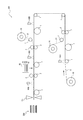
- the manufacturing of the laminated body for secondary batteries using the manufacturing method of the laminated body for secondary batteries of this invention is not specifically limited, For example, it can carry out using the manufacturing apparatus 100 as shown in FIG. it can.
- the manufacturing apparatus 100 shown in FIG. 1 includes a laminate for a secondary battery in which electrodes (positive electrode and negative electrode) and a separator are laminated in the order of “positive electrode / separator / negative electrode / separator” from the upper side to the lower side.
- 200 is an apparatus for manufacturing 200.
- the obtained secondary battery laminate 200 is cut into an appropriate size and then further overlapped before being used for manufacturing a secondary battery.
- the manufacturing apparatus 100 is cut
- the manufacturing apparatus 100 includes a plurality (nine in the illustrated example) of the conveying rollers 1, a plurality (three in the illustrated example) of the press rollers 2, and a plurality of (four in the illustrated example) adhesive material supply machines 60A. , 60B, 60C, 60D and a cutting machine 50 are further provided.
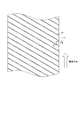
- an oblique stripe shape as shown in FIG. 2 is applied to the surface of the negative electrode 11 (the upper surface in the illustrated example) that is fed from the negative electrode roll 10 and conveyed via the conveying roller 1.
- An adhesive composition 61 containing an adhesive material is supplied from the adhesive material supply machine 60A so as to form a coating pattern (step (A)).
- the angle formed with the direction orthogonal to the transport direction in plan view is ⁇ measured from the narrow angle side, and the arrangement pitch is P.
- the width is W.
- the negative electrode 11 supplied with the adhesive material and the separator 21 fed from the first separator roll 20 are conveyed to the bonding start position where the press roller 2 is positioned (step (B)), and are bonded by the press roller 2. (Step (C)).
- the manufacturing apparatus 100 uses the transport roller 1 positioned between the adhesive material supply machine 60A and the press roller 2 as a heat roller, and the adhesive composition.
- the product may be dried.
- an oblique stripe-shaped coating pattern as shown in FIG. 2 is formed on the surface of the laminate of the negative electrode 11 and the separator 21 bonded together using an adhesive material on the negative electrode 11 side.
- the adhesive composition 61 containing the adhesive material is supplied from the adhesive material supplier 60B (step (A)).
- the laminate of the negative electrode 11 and the separator 21 supplied with the adhesive material and the separator 31 fed out from the second separator roll 30 are conveyed to the bonding start position where the press roller 2 is positioned (step (B)).
- the press roller 2 step (C)).
- the manufacturing apparatus 100 uses the conveying roller 1 positioned between the adhesive material supply machine 60B and the press roller 2 as a heat roller, and the adhesive composition.
- the product may be dried.
- the application of an oblique stripe shape similar to that shown in FIG. 2 is applied to the surface on the separator 31 side of the laminate of the negative electrode 11 and the separators 21 and 31 bonded together using an adhesive material.
- Adhesive composition 61 containing an adhesive material is supplied from adhesive material supply machine 60C so as to form a pattern (step (A)).
- the positive electrode 41 is placed on the separator 31 of the laminate of the negative electrode 11 and the separators 21 and 31 to which the adhesive material is supplied (step (B)) and bonded by the press roller 2.
- the manufacturing apparatus 100 uses the conveying roller 1 positioned between the adhesive material supply machine 60C and the press roller 2 as a heat roller, and the adhesive composition.
- the product may be dried.
- the manufacturing apparatus 100 shows, for example in FIG. 2 with respect to the surface at the side of the positive electrode of the laminated body 200 for secondary batteries laminated
- the adhesive composition 61 containing the adhesive material is supplied from the adhesive material supply machine 60D so that the application pattern of the diagonal stripe shape is the same as the above, the laminate 200 for the secondary battery is cut by the cutting machine 50. .
- the laminate obtained by cutting the secondary battery laminate 200 with the cutting machine 50 is used for manufacturing a secondary battery after further overlapping.
- the secondary battery manufacturing method using the secondary battery laminate includes the steps of manufacturing the secondary battery laminate using the above-described secondary battery laminate manufacturing method of the present invention, and a secondary battery manufacturing method.
- a step of assembling a secondary battery using the laminate and the electrolytic solution (an assembling step).
- the electrolytic solution an organic electrolytic solution in which a supporting electrolyte is dissolved in an organic solvent is usually used.
- a lithium salt is used as the supporting electrolyte.
- the lithium salt include LiPF 6 , LiAsF 6 , LiBF 4 , LiSbF 6 , LiAlCl 4 , LiClO 4 , CF 3 SO 3 Li, C 4 F 9 SO 3 Li, CF 3 COOLi, (CF 3 CO) 2 NLi , (CF 3 SO 2 ) 2 NLi, (C 2 F 5 SO 2 ) NLi, and the like.
- LiPF 6 , LiClO 4 , and CF 3 SO 3 Li are preferable, and LiPF 6 is particularly preferable because it is easily dissolved in a solvent and exhibits a high degree of dissociation.
- electrolyte may be used individually by 1 type and may be used combining two or more types by arbitrary ratios. Usually, the lithium ion conductivity tends to increase as the supporting electrolyte having a higher degree of dissociation is used, so that the lithium ion conductivity can be adjusted depending on the type of the supporting electrolyte.
- the organic solvent used in the electrolytic solution is not particularly limited as long as it can dissolve the supporting electrolyte.
- carbonates because they have a high dielectric constant and a wide stable potential region.
- the lower the viscosity of the solvent used the higher the lithium ion conductivity tends to be, so the lithium ion conductivity can be adjusted depending on the type of solvent.
- the concentration of the electrolyte in the electrolytic solution can be adjusted as appropriate.
- the secondary battery is further laminated with additional battery members (electrodes and / or separators, etc.) as necessary with respect to the secondary battery laminate produced according to the method for producing a secondary battery laminate of the present invention.
- the obtained laminate can be assembled according to need by winding or folding it into the battery container according to the shape of the battery, pouring the electrolyte into the battery container and sealing it.
- an overcurrent prevention element such as a fuse or a PTC element, an expanded metal, a lead plate, etc. may be provided as necessary.
- the shape of the secondary battery may be any of a coin type, a button type, a sheet type, a cylindrical type, a square type, a flat type, and the like.
- ⁇ Glass transition temperature> According to JIS K7121, the measurement was carried out using a differential scanning calorimeter (DSC 6220SII, manufactured by Nanotechnology Co., Ltd.) at a measurement temperature of ⁇ 100 ° C. to 180 ° C. and a heating rate of 5 ° C./min.
- DSC 6220SII differential scanning calorimeter
- ⁇ Volume average particle size D50 and particle size distribution> The particle size distribution (volume basis) of the aqueous dispersion of the particulate polymer was measured with a laser diffraction type particle size distribution measuring device (manufactured by Shimadzu Corporation, product name “SALD-3100”).
- the particle diameter at which the cumulative volume calculated from the small diameter side becomes 50% was defined as the volume average particle diameter (D50) of each particle. Further, using the measured particle size distribution, the particle diameter (D10) at which the cumulative volume calculated from the small diameter side becomes 10% and the particle diameter (D90) at which the cumulative volume calculated from the small diameter side becomes 90% are obtained, D10 / D50 and D90 / D50 were calculated.
- D50 volume average particle diameter
- D10 / D50 and D90 / D50 were calculated.
- ⁇ Content of coarse particles The mass (B) of a nylon mesh having an average pore diameter of 10 ⁇ m was measured and set in a funnel. Thereto, 100 g of the adhesive composition was poured and filtered. Here, ion-exchanged water was poured, washed until it became cloudy, and dried in an oven at 90 ° C. for 60 minutes or more. After standing to cool, the mass (A) of the nylon mesh was measured and the amount of mesh residue was measured. The amount of mesh residue, that is, the amount of coarse particles having a particle diameter of 10 ⁇ m or more in the bonding composition was determined by the following formula.
- Coarse particle content (ppm) (AB) / (C ⁇ D / 100) ⁇ 1000000
- the formation area S 50 per one part of the adhesive material is determined by using a laser microscope (manufactured by Keyence Corporation, VR-3100), the major axis diameter x and minor axis of the dot-like adhesive material formed in a 2 mm 2 region.
- ⁇ Dry adhesive strength> The positive electrode, the negative electrode, and the separator created in the examples and comparative examples were cut into a width of 10 mm and a length of 50 mm, respectively, and the positive electrode and the separator, and the negative electrode and the separator were laminated, and a roll with a temperature corresponding to a temperature of 70 ° C. and a load of 1 MPa. The laminate was pressed at 10 m / min with a press to obtain a test piece.
- a cellophane tape was affixed on the surface of the electrode of the test piece with the current collector side of the electrode (positive electrode or negative electrode) facing down. At this time, a cellophane tape defined in JIS Z1522 was used. The cellophane tape was fixed on a horizontal test bench. And the stress when one end of the separator was pulled vertically upward at a pulling speed of 50 mm / min and peeled was measured. This measurement was performed three times for each of the laminate including the positive electrode and the separator, and the laminate including the negative electrode and the separator, for a total of 6 times, and the average value of the stress was obtained as the peel strength to determine the adhesion between the electrode and the separator. Evaluation was made according to the following criteria.
- the shortest injection time during which the electrolyte did not spill during the injection was determined and evaluated according to the following criteria. It shows that it is excellent in electrolyte solution pouring property, so that the shortest pouring time is short.
- the produced secondary battery was charged at a constant current and a constant voltage (CCCV) up to 4.3 V in an atmosphere at a temperature of 25 ° C.
- CCCV constant voltage
- the manufactured secondary battery was charged to 4.4 V by a constant current method of 0.5 C in an atmosphere at a temperature of 45 ° C., and charging / discharging to discharge to 3.0 V was repeated 200 cycles.
- the charge / discharge capacity retention rate was determined.
- High voltage cycle characteristic is 95% or more
- B High voltage cycle characteristic is 90% or more and less than 95%
- C High voltage cycle characteristic is less than 90%
- Example 1 ⁇ Preparation of adhesive material>
- a particulate first adhesive material made of a polymer having a core-shell structure a core part made of a polymer having a glass transition temperature of 108 ° C. and a glass transition temperature of ⁇ 17 ° C. partially covering the outer surface of the core part.
- An aqueous dispersion of core-shell particles having a shell portion made of the above polymer was prepared.
- an aqueous dispersion of styrene-butadiene copolymer (SBR) was prepared as a particulate second adhesive material made of a polymer having a single phase structure.
- SBR styrene-butadiene copolymer
- a 5% aqueous sodium hydroxide solution was added to the mixture containing the binder for the negative electrode mixture layer to adjust to pH 8, and then the unreacted monomer was removed by heating under reduced pressure. Then, it cooled to 30 degrees C or less, and obtained the water dispersion liquid containing the binder for desired negative mix layers.
- 100 parts of artificial graphite (volume average particle diameter: 15.6 ⁇ m) as a negative electrode active material and a 2% aqueous solution of carboxymethylcellulose sodium salt (product name “MAC350HC” manufactured by Nippon Paper Industries Co., Ltd.) as a viscosity modifier are solidified.
- the mixture was adjusted to a solid content concentration of 68% by mixing 1 part and ion-exchanged water corresponding to the minute, and further mixed at 25 ° C. for 60 minutes. Furthermore, after adjusting solid content concentration to 62% with ion-exchange water, it further mixed for 15 minutes at 25 degreeC.
- 1.5 parts of the aqueous dispersion containing the binder for the negative electrode mixture layer and solid ion equivalent water and ion-exchanged water are added so that the final solid content concentration is 52%. Adjust and mix for an additional 10 minutes. This was defoamed under reduced pressure to obtain a slurry composition for a secondary battery negative electrode having good fluidity.
- the obtained slurry composition for secondary battery negative electrode was applied on a copper foil having a thickness of 20 ⁇ m as a current collector by a comma coater so that the film thickness after drying was about 150 ⁇ m and dried. .
- This drying was performed by conveying the copper foil in an oven at 60 ° C. at a speed of 0.5 m / min for 2 minutes. Thereafter, heat treatment was performed at 120 ° C. for 2 minutes to obtain a negative electrode raw material before pressing.
- the negative electrode raw material before pressing was rolled with a roll press to obtain a negative electrode after pressing with a negative electrode mixture layer thickness of 80 ⁇ m.
- the obtained slurry composition for a secondary battery positive electrode was applied with a comma coater onto an aluminum foil having a thickness of 20 ⁇ m as a current collector so that the film thickness after drying was about 150 ⁇ m and dried. .
- This drying was performed by transporting the aluminum foil in an oven at 60 ° C. at a speed of 0.5 m / min for 2 minutes. Thereafter, heat treatment was performed at 120 ° C. for 2 minutes to obtain a positive electrode raw material.
- the positive electrode provided with the positive electrode compound material layer was obtained by rolling the obtained positive electrode original fabric using a roll press machine.
- a laminate for a lithium ion secondary battery was manufactured and cut with the manufacturing apparatus shown in FIG.
- an adhesive material supply machine an inkjet type adhesive material supply machine including an inkjet head (manufactured by Konica, KM1024 (shear mode type)) was used.
- the conveying speed was 10 m / min, and the adhesive composition was supplied in a stripe pattern ( ⁇ : 45 °, P: 200 ⁇ m, W: 30 ⁇ m) as shown in FIG.
- the supplied adhesive composition was dried by using a heat roller as a part of the transport roller.
- the adhesive material after drying was observed with the laser microscope, the adhesive material was a fine dot shape. That is, a plurality of minute dot-like adhesive materials are arranged in an oblique stripe pattern on the bonding surface.
- the cross section was observed with a laser microscope and the average height (thickness) and maximum height (thickness) of the adhesive material were confirmed, the cross section had an uneven shape, the average height was 1 ⁇ m, and the maximum height The thickness was 3 ⁇ m.
- the dry adhesive force of the laminated body for secondary batteries was evaluated. The results are shown in Table 1. ⁇ Manufacture of secondary batteries> Five cut laminates for a secondary battery were stacked and pressed at a temperature of 70 ° C.
- Example 2 In the same manner as in Example 1 except that the adhesive composition was supplied in a dot-shaped coating pattern (diameter: 50 ⁇ m, distance between dots: 200 ⁇ m) during the production of the secondary battery laminate, the adhesive material and adhesive Composition, negative electrode, positive electrode, separator, laminate for secondary battery, and secondary battery were prepared or manufactured.
- the adhesive material was in the form of minute dots. That is, there are a plurality of large dots formed by aggregating a plurality of minute dot-like adhesive materials on the bonding surface. Moreover, when the cross section of the adhesive material was observed with a laser microscope, the cross section had an uneven shape. Then, evaluation was performed in the same manner as in Example 1. The results are shown in Table 1.
- Example 3 Adhesive material, adhesive composition, negative electrode, positive electrode, separator, secondary battery laminate, except that production conditions were changed as shown in Table 1 during production of the secondary battery laminate.
- the body and the secondary battery were prepared or manufactured.
- the adhesive material was in the form of minute dots. That is, a plurality of minute dot-like adhesive materials are arranged in an oblique stripe pattern on the bonding surface. When the cross section of the adhesive material was observed with a laser microscope, the cross section had a convex shape. Then, evaluation was performed in the same manner as in Example 1. The results are shown in Table 1.
- Example 4 A particulate polymer having a single phase structure with a glass transition temperature of 15 ° C. is used as the first adhesive material, and a stripe shape ( ⁇ : 45 °, P: 400 ⁇ m, W: 30 ⁇ m) and the manufacturing conditions were changed as shown in Table 1, and at the time of manufacturing the secondary battery, five cut secondary battery laminates were stacked and pressed at a temperature of 40 ° C. and a pressure of 1 MPa for 5 seconds.
- An adhesive material, an adhesive composition, a negative electrode, a positive electrode, a separator, a secondary battery laminate, and a secondary battery were prepared or manufactured in the same manner as in Example 1 except that the body was used.
- the adhesive material was in the form of minute dots.
- the adhesive composition is applied to a dot-like coating pattern with a gravure roll on one side (for separator 21) or both sides (for separator 31) of a polypropylene (PP) separator (product name “Celguard 2500”). 1 except that it is dried with hot air at a temperature of 70 ° C. (drying time: 6 seconds) and has no adhesive material feeders 60A to 60D and a heat roll.
- the adhesive material was in the form of minute dots.
Landscapes
- Chemical & Material Sciences (AREA)
- Engineering & Computer Science (AREA)
- Chemical Kinetics & Catalysis (AREA)
- Electrochemistry (AREA)
- General Chemical & Material Sciences (AREA)
- Manufacturing & Machinery (AREA)
- Materials Engineering (AREA)
- Secondary Cells (AREA)
- Cell Separators (AREA)
- Battery Electrode And Active Subsutance (AREA)
Priority Applications (10)
| Application Number | Priority Date | Filing Date | Title |
|---|---|---|---|
| EP25157288.9A EP4531190A3 (en) | 2018-02-26 | 2019-02-01 | Method of producing laminate for secondary battery |
| CN201980011351.3A CN111670512A (zh) | 2018-02-26 | 2019-02-01 | 二次电池用层叠体的制造方法 |
| EP19756683.9A EP3764449B1 (en) | 2018-02-26 | 2019-02-01 | Method of producing laminate for secondary battery |
| CN202411889003.5A CN119742411A (zh) | 2018-02-26 | 2019-02-01 | 二次电池用层叠体的制造方法 |
| PL19756683.9T PL3764449T3 (pl) | 2018-02-26 | 2019-02-01 | Sposób wytwarzania laminatu do akumulatora |
| KR1020257010337A KR20250048148A (ko) | 2018-02-26 | 2019-02-01 | 이차 전지용 적층체의 제조 방법 |
| US16/975,392 US12230765B2 (en) | 2018-02-26 | 2019-02-01 | Method of producing laminate for secondary battery |
| KR1020207022731A KR20200124223A (ko) | 2018-02-26 | 2019-02-01 | 이차 전지용 적층체의 제조 방법 |
| JP2020501645A JP7517146B2 (ja) | 2018-02-26 | 2019-02-01 | 二次電池用積層体の製造方法 |
| US19/016,125 US20250149644A1 (en) | 2018-02-26 | 2025-01-10 | Method of producing laminate for secondary battery |
Applications Claiming Priority (2)
| Application Number | Priority Date | Filing Date | Title |
|---|---|---|---|
| JP2018032347 | 2018-02-26 | ||
| JP2018-032347 | 2018-02-26 |
Related Child Applications (2)
| Application Number | Title | Priority Date | Filing Date |
|---|---|---|---|
| US16/975,392 A-371-Of-International US12230765B2 (en) | 2018-02-26 | 2019-02-01 | Method of producing laminate for secondary battery |
| US19/016,125 Continuation US20250149644A1 (en) | 2018-02-26 | 2025-01-10 | Method of producing laminate for secondary battery |
Publications (1)
| Publication Number | Publication Date |
|---|---|
| WO2019163489A1 true WO2019163489A1 (ja) | 2019-08-29 |
Family
ID=67687067
Family Applications (1)
| Application Number | Title | Priority Date | Filing Date |
|---|---|---|---|
| PCT/JP2019/003729 Ceased WO2019163489A1 (ja) | 2018-02-26 | 2019-02-01 | 二次電池用積層体の製造方法 |
Country Status (8)
| Country | Link |
|---|---|
| US (2) | US12230765B2 (https=) |
| EP (2) | EP3764449B1 (https=) |
| JP (1) | JP7517146B2 (https=) |
| KR (2) | KR20250048148A (https=) |
| CN (2) | CN111670512A (https=) |
| HU (1) | HUE070862T2 (https=) |
| PL (1) | PL3764449T3 (https=) |
| WO (1) | WO2019163489A1 (https=) |
Cited By (6)
| Publication number | Priority date | Publication date | Assignee | Title |
|---|---|---|---|---|
| CN113632274A (zh) * | 2019-12-10 | 2021-11-09 | 株式会社Lg新能源 | 单元电池以及制造该单元电池的方法和设备 |
| KR20220133880A (ko) | 2020-01-31 | 2022-10-05 | 니폰 제온 가부시키가이샤 | 이차 전지용 적층체 및 이차 전지 |
| JPWO2023008165A1 (https=) * | 2021-07-30 | 2023-02-02 | ||
| JP2023517079A (ja) * | 2020-03-25 | 2023-04-21 | エルジー エナジー ソリューション リミテッド | 単位セルの製造装置および方法 |
| JP2023517563A (ja) * | 2020-03-25 | 2023-04-26 | エルジー エナジー ソリューション リミテッド | 単位セル製造装置及び方法 |
| JP2024530303A (ja) * | 2022-04-08 | 2024-08-16 | 寧徳時代新能源科技股▲分▼有限公司 | ずれ検出方法、ずれ検出装置、輸送装置、記憶媒体 |
Families Citing this family (9)
| Publication number | Priority date | Publication date | Assignee | Title |
|---|---|---|---|---|
| CN118867568A (zh) * | 2017-08-21 | 2024-10-29 | 日本瑞翁株式会社 | 非水系二次电池用层叠体及其制造方法、非水系二次电池用卷绕体、以及非水系二次电池构件的制造方法 |
| KR102354261B1 (ko) * | 2018-06-12 | 2022-01-20 | 주식회사 엘지화학 | 패턴화 전극접착층이 구비된 전기화학소자용 분리막 및 상기 분리막의 제조방법 |
| JP7732448B2 (ja) * | 2020-02-27 | 2025-09-02 | 日本ゼオン株式会社 | 検査方法、並びに二次電池用積層体の製造方法及び二次電池の製造方法 |
| CN115149108B (zh) * | 2021-03-30 | 2025-04-22 | 宁德新能源科技有限公司 | 电化学装置及电子装置 |
| EP4089824A4 (en) | 2021-03-30 | 2023-05-10 | Ningde Amperex Technology Ltd. | ELECTROCHEMICAL DEVICE AND ELECTRONIC DEVICE |
| JP2023072260A (ja) * | 2021-11-12 | 2023-05-24 | プライムプラネットエナジー&ソリューションズ株式会社 | セパレータおよびこれを備える非水電解液二次電池 |
| US20240014475A1 (en) * | 2022-07-06 | 2024-01-11 | Rivian Ip Holdings, Llc | Battery cell |
| JP7638246B2 (ja) * | 2022-09-08 | 2025-03-03 | プライムプラネットエナジー&ソリューションズ株式会社 | 電池の製造方法 |
| US12444807B2 (en) * | 2023-04-13 | 2025-10-14 | Jiangsu University | Modified polyphenylene sulfide (PPS) and PPS modification method, PPS solid separator, prefabricated zinc salt separator and manufacturing method thereof, to-be-filled zinc-manganese secondary battery, and manufacturing and application methods thereof |
Citations (10)
| Publication number | Priority date | Publication date | Assignee | Title |
|---|---|---|---|---|
| JP2001345115A (ja) * | 2000-06-01 | 2001-12-14 | Mitsubishi Electric Corp | 電 池 |
| JP2009072794A (ja) * | 2007-09-18 | 2009-04-09 | Jfe Steel Kk | 積層コアの製造装置 |
| WO2010087123A1 (ja) * | 2009-01-28 | 2010-08-05 | 株式会社村田製作所 | 電池とその製造方法 |
| JP2012160352A (ja) * | 2011-02-01 | 2012-08-23 | Ihi Corp | 電極積層体の製造装置および製造方法 |
| JP2012204303A (ja) | 2011-03-28 | 2012-10-22 | Nippon Zeon Co Ltd | 二次電池用電極、二次電池電極用バインダー、製造方法及び二次電池 |
| JP2013503456A (ja) * | 2009-08-31 | 2013-01-31 | ポーラス パワー テクノロジーズ,エルエルシー | 積層アセンブリを用いる電池の製造 |
| JP2013145763A (ja) | 2013-04-30 | 2013-07-25 | Nippon Zeon Co Ltd | 二次電池多孔膜用スラリー組成物、二次電池用電極、二次電池用セパレータおよび二次電池 |
| JP2014534570A (ja) | 2011-12-27 | 2014-12-18 | エルジー・ケム・リミテッド | セパレータの製造方法、その方法によって製造されたセパレータ、及びそれを備える電気化学素子 |
| JP2015041603A (ja) | 2013-08-23 | 2015-03-02 | 日本ゼオン株式会社 | リチウムイオン二次電池用の接着剤、接着層付きセパレータ、接着層付き電極、及びリチウムイオン二次電池 |
| JP2016107642A (ja) * | 2014-12-09 | 2016-06-20 | 旭化成イーマテリアルズ株式会社 | 多層多孔膜及び蓄電デバイス用セパレータ |
Family Cites Families (9)
| Publication number | Priority date | Publication date | Assignee | Title |
|---|---|---|---|---|
| US6967183B2 (en) * | 1998-08-27 | 2005-11-22 | Cabot Corporation | Electrocatalyst powders, methods for producing powders and devices fabricated from same |
| KR100388648B1 (ko) | 2001-05-23 | 2003-06-25 | 주식회사 코캄엔지니어링 | 자동화된 리튬 2차전지 제조 시스템 |
| US6610353B1 (en) * | 2002-09-23 | 2003-08-26 | The Gillette Co. | Method of applying adhesive to electrochemical cell components |
| JP5401756B2 (ja) * | 2006-11-28 | 2014-01-29 | 日産自動車株式会社 | 二次電池 |
| KR101602867B1 (ko) * | 2012-07-30 | 2016-03-11 | 데이진 가부시키가이샤 | 비수 전해질 전지용 세퍼레이터 및 비수 전해질 전지 |
| JP6314832B2 (ja) * | 2012-11-26 | 2018-04-25 | 日本ゼオン株式会社 | 電極/セパレータ積層体の製造方法およびリチウムイオン二次電池 |
| JP5877213B2 (ja) * | 2014-01-24 | 2016-03-02 | 旭化成イーマテリアルズ株式会社 | 積層体、蓄電デバイス用セパレータ、蓄電デバイス、リチウムイオン二次電池および共重合体 |
| WO2016017066A1 (ja) * | 2014-07-30 | 2016-02-04 | 日本ゼオン株式会社 | 非水系二次電池機能層用組成物、非水系二次電池用機能層付き基材、非水系二次電池用積層体の製造方法および非水系二次電池 |
| US11189860B2 (en) | 2016-07-28 | 2021-11-30 | Sanyo Electric Co., Ltd. | Method of manufacturing secondary battery |
-
2019
- 2019-02-01 US US16/975,392 patent/US12230765B2/en active Active
- 2019-02-01 CN CN201980011351.3A patent/CN111670512A/zh active Pending
- 2019-02-01 KR KR1020257010337A patent/KR20250048148A/ko active Pending
- 2019-02-01 CN CN202411889003.5A patent/CN119742411A/zh active Pending
- 2019-02-01 PL PL19756683.9T patent/PL3764449T3/pl unknown
- 2019-02-01 EP EP19756683.9A patent/EP3764449B1/en active Active
- 2019-02-01 HU HUE19756683A patent/HUE070862T2/hu unknown
- 2019-02-01 WO PCT/JP2019/003729 patent/WO2019163489A1/ja not_active Ceased
- 2019-02-01 KR KR1020207022731A patent/KR20200124223A/ko not_active Ceased
- 2019-02-01 JP JP2020501645A patent/JP7517146B2/ja active Active
- 2019-02-01 EP EP25157288.9A patent/EP4531190A3/en active Pending
-
2025
- 2025-01-10 US US19/016,125 patent/US20250149644A1/en active Pending
Patent Citations (10)
| Publication number | Priority date | Publication date | Assignee | Title |
|---|---|---|---|---|
| JP2001345115A (ja) * | 2000-06-01 | 2001-12-14 | Mitsubishi Electric Corp | 電 池 |
| JP2009072794A (ja) * | 2007-09-18 | 2009-04-09 | Jfe Steel Kk | 積層コアの製造装置 |
| WO2010087123A1 (ja) * | 2009-01-28 | 2010-08-05 | 株式会社村田製作所 | 電池とその製造方法 |
| JP2013503456A (ja) * | 2009-08-31 | 2013-01-31 | ポーラス パワー テクノロジーズ,エルエルシー | 積層アセンブリを用いる電池の製造 |
| JP2012160352A (ja) * | 2011-02-01 | 2012-08-23 | Ihi Corp | 電極積層体の製造装置および製造方法 |
| JP2012204303A (ja) | 2011-03-28 | 2012-10-22 | Nippon Zeon Co Ltd | 二次電池用電極、二次電池電極用バインダー、製造方法及び二次電池 |
| JP2014534570A (ja) | 2011-12-27 | 2014-12-18 | エルジー・ケム・リミテッド | セパレータの製造方法、その方法によって製造されたセパレータ、及びそれを備える電気化学素子 |
| JP2013145763A (ja) | 2013-04-30 | 2013-07-25 | Nippon Zeon Co Ltd | 二次電池多孔膜用スラリー組成物、二次電池用電極、二次電池用セパレータおよび二次電池 |
| JP2015041603A (ja) | 2013-08-23 | 2015-03-02 | 日本ゼオン株式会社 | リチウムイオン二次電池用の接着剤、接着層付きセパレータ、接着層付き電極、及びリチウムイオン二次電池 |
| JP2016107642A (ja) * | 2014-12-09 | 2016-06-20 | 旭化成イーマテリアルズ株式会社 | 多層多孔膜及び蓄電デバイス用セパレータ |
Non-Patent Citations (1)
| Title |
|---|
| See also references of EP3764449A4 |
Cited By (11)
| Publication number | Priority date | Publication date | Assignee | Title |
|---|---|---|---|---|
| CN113632274A (zh) * | 2019-12-10 | 2021-11-09 | 株式会社Lg新能源 | 单元电池以及制造该单元电池的方法和设备 |
| KR20220133880A (ko) | 2020-01-31 | 2022-10-05 | 니폰 제온 가부시키가이샤 | 이차 전지용 적층체 및 이차 전지 |
| US12580274B2 (en) | 2020-01-31 | 2026-03-17 | Zeon Corporation | Laminate for secondary battery and secondary battery |
| JP2023517079A (ja) * | 2020-03-25 | 2023-04-21 | エルジー エナジー ソリューション リミテッド | 単位セルの製造装置および方法 |
| JP2023517563A (ja) * | 2020-03-25 | 2023-04-26 | エルジー エナジー ソリューション リミテッド | 単位セル製造装置及び方法 |
| JP7392870B2 (ja) | 2020-03-25 | 2023-12-06 | エルジー エナジー ソリューション リミテッド | 単位セル製造装置及び方法 |
| JP7463638B2 (ja) | 2020-03-25 | 2024-04-09 | エルジー エナジー ソリューション リミテッド | 単位セルの製造装置および方法 |
| JPWO2023008165A1 (https=) * | 2021-07-30 | 2023-02-02 | ||
| WO2023008165A1 (ja) * | 2021-07-30 | 2023-02-02 | 日本ゼオン株式会社 | 非水系二次電池用積層体、非水系二次電池用積層体の製造方法及び非水系二次電池 |
| JP2024530303A (ja) * | 2022-04-08 | 2024-08-16 | 寧徳時代新能源科技股▲分▼有限公司 | ずれ検出方法、ずれ検出装置、輸送装置、記憶媒体 |
| JP7810789B2 (ja) | 2022-04-08 | 2026-02-03 | 香港時代新能源科技有限公司 | ずれ検出方法、ずれ検出装置、輸送装置、記憶媒体 |
Also Published As
| Publication number | Publication date |
|---|---|
| US20210036375A1 (en) | 2021-02-04 |
| JP7517146B2 (ja) | 2024-07-17 |
| US20250149644A1 (en) | 2025-05-08 |
| EP3764449B1 (en) | 2025-02-19 |
| PL3764449T3 (pl) | 2025-05-12 |
| KR20250048148A (ko) | 2025-04-07 |
| EP3764449A4 (en) | 2021-11-24 |
| EP4531190A2 (en) | 2025-04-02 |
| CN119742411A (zh) | 2025-04-01 |
| KR20200124223A (ko) | 2020-11-02 |
| JPWO2019163489A1 (ja) | 2021-02-04 |
| US12230765B2 (en) | 2025-02-18 |
| EP3764449A1 (en) | 2021-01-13 |
| CN111670512A (zh) | 2020-09-15 |
| HUE070862T2 (hu) | 2025-07-28 |
| EP4531190A3 (en) | 2025-06-04 |
Similar Documents
| Publication | Publication Date | Title |
|---|---|---|
| JP7517146B2 (ja) | 二次電池用積層体の製造方法 | |
| CN112534616B (zh) | 二次电池用层叠体及二次电池以及其制造方法 | |
| US10297815B2 (en) | Method for producing electrode for lithium ion secondary batteries | |
| WO2019221056A1 (ja) | 非水系二次電池用スラリー、非水系二次電池用セパレータ、非水系二次電池用電極、非水系二次電池用積層体および非水系二次電池 | |
| JP7380581B2 (ja) | 二次電池およびその製造方法 | |
| JP7268675B2 (ja) | 非水系二次電池用積層体の製造方法および非水系二次電池の製造方法 | |
| CN114830397B (zh) | 二次电池及其制造方法 | |
| WO2022230621A1 (ja) | 非水系二次電池用積層体、接着用組成物及び非水系二次電池 | |
| JP7652083B2 (ja) | 二次電池およびその製造方法 | |
| WO2021153516A1 (ja) | 二次電池用積層体及び二次電池 | |
| WO2022209997A1 (ja) | 非水系二次電池接着層用組成物、非水系二次電池用接着層およびその製造方法、非水系二次電池用積層体およびその製造方法、ならびに、非水系二次電池 | |
| KR20240050326A (ko) | 비수계 이차 전지 접착층용 조성물, 비수계 이차 전지용 접착층 및 그 제조 방법, 비수계 이차 전지용 적층체 및 그 제조 방법, 그리고, 비수계 이차 전지 | |
| CN117642879A (zh) | 非水系二次电池用层叠体、非水系二次电池用层叠体的制造方法以及非水系二次电池 |
Legal Events
| Date | Code | Title | Description |
|---|---|---|---|
| 121 | Ep: the epo has been informed by wipo that ep was designated in this application |
Ref document number: 19756683 Country of ref document: EP Kind code of ref document: A1 |
|
| ENP | Entry into the national phase |
Ref document number: 2020501645 Country of ref document: JP Kind code of ref document: A |
|
| NENP | Non-entry into the national phase |
Ref country code: DE |
|
| ENP | Entry into the national phase |
Ref document number: 2019756683 Country of ref document: EP Effective date: 20200928 |
|
| WWD | Wipo information: divisional of initial pct application |
Ref document number: 1020257010337 Country of ref document: KR |
|
| WWP | Wipo information: published in national office |
Ref document number: 1020257010337 Country of ref document: KR |