WO2019151007A1 - フライ調理用油脂組成物の着色の抑制方法 - Google Patents
フライ調理用油脂組成物の着色の抑制方法 Download PDFInfo
- Publication number
- WO2019151007A1 WO2019151007A1 PCT/JP2019/001617 JP2019001617W WO2019151007A1 WO 2019151007 A1 WO2019151007 A1 WO 2019151007A1 JP 2019001617 W JP2019001617 W JP 2019001617W WO 2019151007 A1 WO2019151007 A1 WO 2019151007A1
- Authority
- WO
- WIPO (PCT)
- Prior art keywords
- oil
- prepared
- mass
- frying
- absorbance
- Prior art date
- Legal status (The legal status is an assumption and is not a legal conclusion. Google has not performed a legal analysis and makes no representation as to the accuracy of the status listed.)
- Ceased
Links
Classifications
-
- C—CHEMISTRY; METALLURGY
- C11—ANIMAL OR VEGETABLE OILS, FATS, FATTY SUBSTANCES OR WAXES; FATTY ACIDS THEREFROM; DETERGENTS; CANDLES
- C11B—PRODUCING, e.g. BY PRESSING RAW MATERIALS OR BY EXTRACTION FROM WASTE MATERIALS, REFINING OR PRESERVING FATS, FATTY SUBSTANCES, e.g. LANOLIN, FATTY OILS OR WAXES; ESSENTIAL OILS; PERFUMES
- C11B3/00—Refining fats or fatty oils
- C11B3/001—Refining fats or fatty oils by a combination of two or more of the means hereafter
-
- A—HUMAN NECESSITIES
- A23—FOODS OR FOODSTUFFS; TREATMENT THEREOF, NOT COVERED BY OTHER CLASSES
- A23D—EDIBLE OILS OR FATS, e.g. MARGARINES, SHORTENINGS OR COOKING OILS
- A23D9/00—Other edible oils or fats, e.g. shortenings or cooking oils
-
- A—HUMAN NECESSITIES
- A23—FOODS OR FOODSTUFFS; TREATMENT THEREOF, NOT COVERED BY OTHER CLASSES
- A23D—EDIBLE OILS OR FATS, e.g. MARGARINES, SHORTENINGS OR COOKING OILS
- A23D9/00—Other edible oils or fats, e.g. shortenings or cooking oils
- A23D9/02—Other edible oils or fats, e.g. shortenings or cooking oils characterised by the production or working-up
-
- A—HUMAN NECESSITIES
- A23—FOODS OR FOODSTUFFS; TREATMENT THEREOF, NOT COVERED BY OTHER CLASSES
- A23D—EDIBLE OILS OR FATS, e.g. MARGARINES, SHORTENINGS OR COOKING OILS
- A23D9/00—Other edible oils or fats, e.g. shortenings or cooking oils
- A23D9/02—Other edible oils or fats, e.g. shortenings or cooking oils characterised by the production or working-up
- A23D9/04—Working-up
-
- C—CHEMISTRY; METALLURGY
- C11—ANIMAL OR VEGETABLE OILS, FATS, FATTY SUBSTANCES OR WAXES; FATTY ACIDS THEREFROM; DETERGENTS; CANDLES
- C11B—PRODUCING, e.g. BY PRESSING RAW MATERIALS OR BY EXTRACTION FROM WASTE MATERIALS, REFINING OR PRESERVING FATS, FATTY SUBSTANCES, e.g. LANOLIN, FATTY OILS OR WAXES; ESSENTIAL OILS; PERFUMES
- C11B3/00—Refining fats or fatty oils
- C11B3/006—Refining fats or fatty oils by extraction
-
- C—CHEMISTRY; METALLURGY
- C11—ANIMAL OR VEGETABLE OILS, FATS, FATTY SUBSTANCES OR WAXES; FATTY ACIDS THEREFROM; DETERGENTS; CANDLES
- C11B—PRODUCING, e.g. BY PRESSING RAW MATERIALS OR BY EXTRACTION FROM WASTE MATERIALS, REFINING OR PRESERVING FATS, FATTY SUBSTANCES, e.g. LANOLIN, FATTY OILS OR WAXES; ESSENTIAL OILS; PERFUMES
- C11B3/00—Refining fats or fatty oils
- C11B3/02—Refining fats or fatty oils by chemical reaction
- C11B3/06—Refining fats or fatty oils by chemical reaction with bases
-
- C—CHEMISTRY; METALLURGY
- C11—ANIMAL OR VEGETABLE OILS, FATS, FATTY SUBSTANCES OR WAXES; FATTY ACIDS THEREFROM; DETERGENTS; CANDLES
- C11B—PRODUCING, e.g. BY PRESSING RAW MATERIALS OR BY EXTRACTION FROM WASTE MATERIALS, REFINING OR PRESERVING FATS, FATTY SUBSTANCES, e.g. LANOLIN, FATTY OILS OR WAXES; ESSENTIAL OILS; PERFUMES
- C11B3/00—Refining fats or fatty oils
- C11B3/02—Refining fats or fatty oils by chemical reaction
- C11B3/08—Refining fats or fatty oils by chemical reaction with oxidising agents
-
- C—CHEMISTRY; METALLURGY
- C11—ANIMAL OR VEGETABLE OILS, FATS, FATTY SUBSTANCES OR WAXES; FATTY ACIDS THEREFROM; DETERGENTS; CANDLES
- C11B—PRODUCING, e.g. BY PRESSING RAW MATERIALS OR BY EXTRACTION FROM WASTE MATERIALS, REFINING OR PRESERVING FATS, FATTY SUBSTANCES, e.g. LANOLIN, FATTY OILS OR WAXES; ESSENTIAL OILS; PERFUMES
- C11B3/00—Refining fats or fatty oils
- C11B3/10—Refining fats or fatty oils by adsorption
-
- C—CHEMISTRY; METALLURGY
- C11—ANIMAL OR VEGETABLE OILS, FATS, FATTY SUBSTANCES OR WAXES; FATTY ACIDS THEREFROM; DETERGENTS; CANDLES
- C11B—PRODUCING, e.g. BY PRESSING RAW MATERIALS OR BY EXTRACTION FROM WASTE MATERIALS, REFINING OR PRESERVING FATS, FATTY SUBSTANCES, e.g. LANOLIN, FATTY OILS OR WAXES; ESSENTIAL OILS; PERFUMES
- C11B3/00—Refining fats or fatty oils
- C11B3/12—Refining fats or fatty oils by distillation
- C11B3/14—Refining fats or fatty oils by distillation with the use of indifferent gases or vapours, e.g. steam
-
- C—CHEMISTRY; METALLURGY
- C11—ANIMAL OR VEGETABLE OILS, FATS, FATTY SUBSTANCES OR WAXES; FATTY ACIDS THEREFROM; DETERGENTS; CANDLES
- C11B—PRODUCING, e.g. BY PRESSING RAW MATERIALS OR BY EXTRACTION FROM WASTE MATERIALS, REFINING OR PRESERVING FATS, FATTY SUBSTANCES, e.g. LANOLIN, FATTY OILS OR WAXES; ESSENTIAL OILS; PERFUMES
- C11B3/00—Refining fats or fatty oils
- C11B3/12—Refining fats or fatty oils by distillation
Definitions
- the present invention relates to a method for suppressing coloration of a frying oil composition, and more particularly to the suppression method, characterized in that a prepared oil prepared by adjusting a crude crude oil refining process is used.
- cooking oils and fats are colored by the effects of heating operation, oxygen and moisture in the foods and atmosphere.
- the coloring of edible oils and fats progresses, the quality of the fried product deteriorates, so that the edible oils and fats cannot be used for a long time.
- patent document 1 is by adding phosphorus origin components, such as pressing oil and / or extraction oil, degummed oil, to refined edible fats and oils.
- a method for improving the heat resistance of a fried oil composition is proposed. According to invention of patent document 1, the heat stability of the fats and oils composition for deep-fried foods can be improved, and especially heating coloring and a heating odor can be suppressed.
- JP 2009-050234 A Metal for producing an oil and fat composition for deep-fried food having excellent heat resistance
- This invention is providing the method of suppressing coloring of the oil-fat composition when a foodstuff is fried with an oil-fat composition by a method different from the method using the phosphorus content of patent document 1.
- the present invention is a method for suppressing the coloring of a frying oil composition, Including the step of adding the prepared oil to the edible oil and fat, In the refining process of crude crude oil obtained from oil raw materials, (1) degumming step, (2) Deoxidation step performed or not performed, (3) It has undergone a decoloring process that has been or has not been implemented, and (4) a deodorizing process, After the step (3) of the prepared oil, the absorbance difference obtained by subtracting the absorbance at a wavelength of 750 nm from the absorbance at a wavelength of 660 nm with reference to isooctane is 0.030 or more.
- Patent Document 1 describes intermediate oils and fats such as crude oils such as compressed oils and extracted oils, degummed oils, and crude refined oils excluding only the deoxidation step, but the difference in absorbance as defined in the present invention. There is no disclosure of a prepared oil exhibiting
- the absorbance difference is preferably 0.045 or more.
- the deodorizing step is preferably performed under the conditions that the amount of water vapor used is 0.1 mass% or more and 10 mass% or less, the deodorization temperature is 180 ° C or more and 300 ° C or less, and the deodorization time is 10 minutes or more and 240 minutes or less. .
- the oil material is preferably at least one selected from soybeans, rapeseed, and palm pulp.
- the edible oil / fat preferably contains at least one selected from soybean oil, rapeseed oil, palm oil / fat, corn oil, sunflower oil, olive oil, cottonseed oil, rice oil and safflower oil.
- the prepared oil in the frying oil composition is 0.05% by mass or more and 20% by mass or less.
- the phosphorus content derived from the prepared oil may be added to the edible fat so that the fat content in the fry cooking oil composition is 0.01 mass ppm or more and 10 mass ppm or less.
- (3) is a decoloring step in particular.
- the oil composition for frying cooking contains silicone.
- the present invention is also a coloring inhibitor for frying oil composition
- the coloring inhibitor includes a prepared oil
- the prepared oil is In the refining process of crude crude oil obtained from oil raw materials, (1) degumming step, (2) Deoxidation step performed or not performed, (3) It has undergone a decoloring process that has been or has not been implemented, and (4) a deodorizing process,
- the coloring inhibitor wherein the difference in absorbance obtained by subtracting the absorbance at a wavelength of 750 nm from the absorbance at 660 nm with respect to isooctane after the step (3) of the prepared oil is 0.030 or more. I will provide a.
- the oil composition for frying is used for a long time, such as 20 hours, for cooking the ingredients. Even if it uses for, coloring of an oil-fat composition is suppressed significantly compared with coloring of the control oil which does not add the said preparation oil. This suppression of coloring greatly contributes to the life extension of the oil and fat composition.
- the coloring suppression method (henceforth the method of this invention) of the oil-fat composition for frying cooking at the time of the heating of this invention includes the process of adding prepared oil to edible oil-fat.
- the edible fat / oil serves as a base oil for a frying oil / fat composition.
- Edible fats and oils are usually refined oils. Examples of the edible oils and fats are soybean oil, rapeseed oil, palm oil, palm kernel oil, corn oil, sunflower oil, olive oil, grape seed oil, cottonseed oil, safflower oil, linseed oil, sesame oil, rice oil, peanut oil, coconut oil, etc.
- Animal fats and oils such as vegetable oil, pork fat, beef tallow, chicken fat and milk fat, medium chain fatty acid triglycerides, and processed fats and oils subjected to fractionation, hydrogenation, transesterification and the like. These edible fats and oils may be used alone or in combination of two or more.
- the edible oil / fat preferably contains at least one selected from soybean oil, rapeseed oil, palm oil / fat, corn oil, sunflower oil, olive oil, cottonseed oil, rice oil and safflower oil, and is selected from soybean oil, rapeseed oil and palm oil / fat. More preferably, at least one kind is included.
- the edible oil / fat preferably has a total content of soybean oil, rapeseed oil, palm oil / fat, corn oil, sunflower oil, olive oil, cottonseed oil, rice oil and safflower oil of 60% by mass to 100% by mass, 75 More preferably, it is more than 100 mass%, More preferably, it is 90 mass% or more and 100 mass% or less, It is especially preferable that it is 100 mass%. Palm oil and fat here means palm oil and processed oil of palm oil.
- the edible oil / fat preferably has a melting point of 10 ° C. or lower, more preferably 0 ° C. or lower.
- the melting point means an ascending melting point.
- the rising melting point can be measured in accordance with the standard oil and fat analysis test method 2.2.4.2-1996.
- the content of the edible oil / fat with respect to the frying oil / fat composition is usually 80% by mass or more, preferably 88% by mass or more, more preferably 90% by mass or more, and particularly preferably 93% by mass. That's it. Although there is no upper limit of content of edible oil and fat, the sum total of edible oil and fat and prepared oil is 100 mass% or less.
- the prepared oil is, in order, (1) a degumming process, (2) a deoxidation process that has been performed or not performed, (3) a decolorization process that has been performed or not yet performed, And (4) It passed through the deodorizing process.
- oil raw materials examples include soybean, rapeseed, palm pulp, corn, olive, grape seed, sesame, safflower, sunflower, cottonseed, rice, peanut, palm kernel, palm, flaxseed and the like.
- the oil raw material is preferably at least one selected from soybean, rapeseed, and palm pulp, and more preferably at least one selected from soybean and rapeseed.
- the crude crude oil is obtained by subjecting the oil raw material to compression extraction and / or solvent extraction.
- the compression extraction is performed by applying high pressure to the oil raw material to squeeze out the oil in the cells.
- Squeezed extraction is suitable for oily raw materials with relatively high oil content such as sesame.
- the solvent extraction is performed by bringing the oil raw material into contact with the residue after pressing or extracting the oil, extracting the oil as a solvent solution, and distilling off the solvent from the resulting solution to obtain the oil.
- Solvent extraction is suitable for oily raw materials with low oil content such as soybeans. An organic solvent such as hexane is used as the solvent.
- the degumming step is a step of hydrating and removing the gums mainly composed of phospholipids contained in the oil.
- the treatment conditions of the degumming step are not particularly limited, and general-purpose conditions can be used.
- the amount of water used is usually 1% by mass or more and 5% by mass or less, and preferably 1.5% by mass or more and 3% by mass or less with respect to the crude crude oil.
- a degumming assistant comprising an aqueous solution of an acid such as oxalic acid, citric acid, phosphoric acid or the like may be added.
- the degumming temperature may usually be 40 ° C. or higher and 95 ° C. or lower, and preferably 60 ° C.
- the deoxidation step is a step of removing free fatty acids contained in the oil as soap by treating with an alkaline aqueous solution such as sodium carbonate or caustic soda.
- the treatment conditions for the deoxidation step are not particularly limited, and general-purpose conditions can be used.
- an alkaline aqueous solution of 3% by mass to 40% by mass is usually 0.1% by mass to 5% by mass, preferably 0.5% by mass to 3% by mass, with respect to the degummed oil.
- the deoxidation temperature may usually be 20 ° C. or higher and 120 ° C. or lower, preferably 35 ° C. or higher and 95 ° C. or lower.
- the soap that is insoluble in fats and oils is separated and removed by a centrifugal separator or the like to obtain deoxidized oil.
- the deoxidation step (2) is not performed.
- the deoxidation step may be a physical purification method that does not use an alkali.
- Physical purification methods include steam distillation and molecular distillation.
- the decoloring step is a step of removing the pigment contained in the oil by adsorbing it to activated clay, activated carbon or the like under reduced pressure.
- the decolorization step is usually performed under anhydrous conditions, but may be performed in the presence of water.
- the conditions of the decoloring step in the normal refining step are as follows: the amount of activated clay used is 0.05% by mass or more and 5% by mass or less, and the decolorization temperature is 60 ° C. or higher and 120 ° C. or lower. The time is from 5 minutes to 120 minutes.
- the activated clay or the like to which the pigment is attached in the decolorization step is removed by filtration under reduced pressure or the like to obtain a decolorized oil.
- the usage-amount of activated clay is 0.05 to 2 mass% with respect to degummed oil or deoxidized oil, and is 0.05 to 1 mass%. Is more preferably 0.05% by mass or more and 0.7% by mass or less, and further more preferably 0.05% by mass or more and 0.6% by mass or less.
- the decolorization temperature is preferably 70 ° C. or higher and 120 ° C. or lower, and more preferably 75 ° C. or higher and 110 ° C. or lower.
- the decolorization time is preferably 5 minutes or more and 80 minutes or less, and more preferably 5 minutes or more and 60 minutes or less. When a mild decolorization step is performed or not performed under such conditions, a prepared oil having an absorbance difference within the range specified in the present invention can be easily obtained.
- the deodorizing step is a step of removing odorous components contained in the oil by steam distillation under reduced pressure.
- the deodorizing step under normal refining conditions is that the amount of water vapor used is 0.1 to 10% by mass, the deodorizing temperature is 180 to 300 ° C., the degree of vacuum is 150 to 1000 Pa, and the deodorizing time is 10 minutes. It is performed in 240 minutes or less.
- the amount of water vapor used is preferably 0.3% by mass or more and 8% by mass or less, more preferably 0.3% by mass or more and 5% by mass with respect to the degummed oil, deoxidized oil or decolorized oil. % Or less.
- the deodorization temperature is preferably 200 ° C. or higher and 300 ° C.
- the degree of vacuum depends on the temperature, but is preferably 200 Pa or more and 800 Pa or less.
- the deodorization time depends on the deodorization temperature and the degree of reduced pressure, but is preferably 20 minutes or more and 240 minutes or less. In particular, in the deodorization step, the amount of water vapor used is 0.3% by mass or more and 5% by mass or less, the deodorization temperature is 240 ° C. or more and 280 ° C. or less with respect to the degummed oil, deoxidized oil or decolorized oil, and the deodorization time.
- the absorbance difference obtained by subtracting the absorbance at a wavelength of 750 nm from the absorbance at a wavelength of 660 nm with respect to isooctane is 0.030 or more, preferably 0.045 or more, More preferably, it is 0.065 or more.
- the upper limit of the absorbance difference is usually 2.0 or less, preferably 1.5 or less, and more preferably 1.0 or less.
- the absorbance difference means a calculated value of the decolorized oil.
- the difference in absorbance means a calculated value of the deoxidized oil.
- the prepared oil in the frying oil composition is usually 0.05% by mass or more and 20% by mass or less, preferably 0.05% by mass or more and 12% by mass or less, more preferably 0.1% by mass.
- the content is not less than 12% by mass and not more than 12% by mass, more preferably not less than 0.1% by mass and not more than 10% by mass, and still more preferably not less than 0.25% by mass and not more than 7% by mass.
- the prepared oil is added such that the phosphorus content derived from the prepared oil is 0.01 mass ppm or more and 10 mass ppm or less, more preferably 0.1 mass ppm or more and 10 mass ppm or less in the oil or fat composition. Also good.
- the oil composition for frying cooking contains silicone.
- silicone a type of silicone that is usually blended in edible fats and oils for frying can be used.
- the kinematic viscosity at 25 ° C. of the silicone is preferably 10 cSt or more and 1200 cSt or less, more preferably 80 cSt or more and 1200 cSt or less, further preferably 400 cSt or more and 1200 cSt or less, and particularly preferably 900 cSt or more and 1100 cSt or less. preferable.
- the silicone is preferably contained in the oil composition for frying in an amount of 0.5 ppm to 10 ppm, more preferably 1 ppm to 5 ppm, more preferably 2 ppm to 4 ppm. More preferably, it is contained below, and 3 mass ppm is especially preferable.
- auxiliaries added to edible fats and oils can be added to the frying oil composition for frying as long as the effects of the present invention are not impaired.
- auxiliaries include antioxidants such as tocopherol; fragrances; emulsifiers and the like.
- the above-described oil composition for frying can be used for frying, for example, at a temperature of 140 ° C. or higher and 200 ° C. or lower, depending on the ingredients and the cooking method.
- fried foods include fried chicken, croquettes, tempura, deep-fried vegetables and seafood, cutlets, fritters, fried sweets or fried bread, fried noodles, and the like.
- the present invention is also a coloring inhibitor for frying oil composition
- the coloring inhibitor includes a prepared oil
- the prepared oil is In the refining process of crude crude oil obtained from oil raw materials, (1) degumming step, (2) Deoxidation step performed or not performed, (3) It has undergone a decoloring process that has been or has not been implemented, and (4) a deodorizing process,
- the coloring inhibitor wherein the difference in absorbance obtained by subtracting the absorbance at a wavelength of 750 nm from the absorbance at 660 nm with respect to isooctane after the step (3) of the prepared oil is 0.030 or more. I will provide a. Since the content of the prepared oil is the same as that described in the suppression method, the description is omitted.
- the carrier (diluent) of the prepared oil in the colorant inhibitor is usually an edible oil and fat, and specific examples thereof are the same as those exemplified for the base oil of the frying oil and fat composition.
- auxiliaries that are appropriately added to the coloring inhibitor include antioxidants, antifoaming agents, emulsifiers, fragrances, and physiologically active substances.
- the content of the prepared oil in the coloring inhibitor is usually 5% by mass or more and 100% by mass or less, preferably 10% by mass or more and 100% by mass or less, more preferably 20% by mass or more and 100% by mass or less. It is as follows.
- the coloring suppression effect according to the present invention can be evaluated, for example, by the following method.
- Measurement of color tone According to AOCS Cc13j-97, the chromaticity of the test oil or control oil placed in the Lobibond cell is measured at room temperature using a Lobibond automatic colorimeter. A color tone (Y + 10R) is obtained from the obtained chromaticity Y value and R value.
- the coloration inhibition rate based on the control oil not containing the prepared oil according to the present invention varies depending on the amount of the prepared oil added, the ingredients, the frying temperature, etc., but is usually about 5 to 40%. It becomes.
- test fat was diluted with xylene and analyzed with an ICP emission spectroscopic analyzer (manufactured by Hitachi High-Tech Science Co., Ltd.). For quantification, CONOSTAN (registered trademark) Oil Analysis Standard (manufactured by SCP SCIENCE) was used.
- Examples 1 to 4 Decoloration process change test of prepared oil (1) Preparation of oil composition for frying cooking The above-mentioned refined rapeseed oil used as a base oil was adjusted to 2 or 3% by mass of the prepared oil shown in Table 2 The oil composition for frying cooking was prepared by adding.
- the base oil is referred to as a control oil
- the fat composition obtained by adding a prepared oil to the base oil is referred to as a test oil.
- Deep-fried chicken Product name “Fried chicken (GX388)” (Ajinomoto Frozen Foods Co., Ltd.)
- Potato croquette A product name “NEW potato croquette 60 (GC080)” (about 60 g / piece, manufactured by Ajinomoto Frozen Foods Co., Ltd.) was prepared.
- An electric fryer (product name: FM-3HR, manufactured by Mach Equipment Co., Ltd.) was charged with 3.4 kg of test oil or control oil and heated to a frying temperature of 180 ° C. After raising the temperature, deep-fried or potato croquettes were added to the electric fryer as shown below, and fried cooking was performed for 10 hours per day for a total of 20 hours.
- Deep-fried food Deep-fried mass 400g / time, deep-fried time 5 minutes / time, deep-fried 5 times / day (implemented on the first and second days), Potato croquette: 5 fries / time, 5 minutes / time, 2 times / day (only on the first day)
- Example 1 In Comparative Example 1 using the control oil (refined rapeseed oil in which the degumming step, deoxidation step, decolorization step and deodorization step were performed under normal conditions), the color tone after the 20-hour fry cooking test was 28. On the other hand, in Example 1 using the test oil to which the preparation oil 1 according to the present invention was added, the color tone was suppressed to 25. That is, according to the present invention, coloring is suppressed by 10.7%. In Examples 2 to 4 using the test oil to which Preparation Oils 2, 3 or 5 according to the present invention was added, a coloration inhibition rate of 14.7 to 20.6% was also achieved.
- the coloring suppression effect of the examples is not due to the phosphorus content as shown in Patent Document 1. From the above, according to the present invention, it was found that the prepared oil prepared so as to have a difference in absorbance after the decolorization step performed or not performed has an effect of suppressing coloring of the fat composition during frying. did.
- Example 5 Deodorizing process change test of prepared oil (1)
- the preparation oil 4 that has not undergone the decolorization and deodorization processes (Comparative Example 4)
- the decolorization process A test oil was prepared by adding the prepared oil 6 (Example 5), which was not subjected to the deodorization process, to the base oil so as to be 1.6% by mass.
- the fry cooking test and evaluation of these test oils were carried out in the same procedure as in Example 1. The results are shown in Table 3.
- the test oil containing the prepared oil 4 that is prepared to have the difference in absorbance specified in the present invention but has not undergone the deodorization step is colored after the frying test compared to the control oil.
- the promotion was recognized.
- Example 5 in the test oil containing the prepared oil 6 prepared to have the difference in absorbance specified in the present invention and subjected to the deodorization process, coloring after the frying cooking test is remarkably suppressed. It was done. From the above, it was found that the prepared oil used in the present invention needs to undergo a deodorization step.
- Examples 6-9 Deodorizing process change test of prepared oil (2)
- the prepared oil 9 that has undergone a mild deodorizing step the prepared oil 10 that has undergone a normal deodorizing step
- the prepared oil 11 that has undergone an enhanced deodorizing step And 12 were added to the base oil so as to be 2.0% by mass.
- the fry cooking test and evaluation of these test oils were carried out in the same procedure as in Example 1. The results are shown in Table 4.
- Example 10 to 12 Deoxidation process change test of prepared oil
- Test oils were prepared by adding prepared oils 13 to 15 having a difference in absorbance but not undergoing a deoxidation step to the base oil to 2% by mass.
- the fry cooking test and evaluation of these test oils were carried out in the same procedure as in Example 1. The results are shown in Table 5.
- Example 7 As shown in Table 5, the effect of the present invention was obtained with a prepared oil having a certain difference in absorbance according to the present invention regardless of whether or not the deoxidation step was performed.
- Example 7 and Example 11 are compared, it turns out that the coloring suppression effect is higher by not performing a deoxidation process.
- the high coloration inhibition rates of Examples 10 to 12 are considered to reflect the effect of phosphorus contained in the prepared oil.
- Test for changing addition amount of prepared oil A test was conducted to change the addition amount of the prepared oil in the oil composition for frying of the present invention. Specifically, a test oil was prepared by adding the prepared oil 7 that was not subjected to the decolorization process in the refining process of the crude crude oil to the base oil in the addition amount shown in Table 6. The fry cooking test and evaluation of these test oils were carried out in the same procedure as in Example 1. The results are shown in Table 6.
- Examples 17 to 20 Base oil change test In Examples 13 to 16, a test to change the base oil was performed. Specifically, a test oil was prepared by adding Preparation Oil 7 or 8 to the base oil shown in Table 7 so as to be 2.0% by mass. The fry cooking test and evaluation of these test oils were carried out in the same procedure as in Example 1. The results are shown in Table 7.
- Example 18 As shown in Table 7, even when the base oil was changed from rapeseed oil to soybean oil, palm olein, or these blended oils, coloring of the fat composition after the frying cooking test could be suppressed.
- Example 18 and Example 19 are compared, it can be seen that a remarkable coloring suppression effect is obtained in the oil composition for frying cooking containing silicone.
- Example 21 Change test of oil raw material of preparation oil (1) A test was conducted in which the oil source of the prepared oil was changed from rapeseed to soybean. A test oil was prepared by adding 10% by mass of the prepared oil 17 derived from soybean and having not been subjected to the decolorization step to the base oil. Moreover, the control oil of the comparative example 14 which added soybean oil (preparation oil 16) which passed through the normal refinement
- Example 22 Combined addition test of prepared oil and chlorophyll pigment A test was conducted in which chlorophyll pigment was further added to the formulated oil according to the present invention.
- a test oil was prepared by adding the prepared oil 13 having the difference in absorbance specified by the present invention but not undergoing the deoxidation step to the base oil so as to be 2% by mass (Example 22). 2% by mass of the prepared oil 13 having the difference in absorbance specified by the present invention but not subjected to the deoxidation step is added to the base oil, and further, a chlorophyll pigment (product name “Nichino Color G-AO”, Nichino Chemical Co., Ltd.) A test oil was prepared by adding 8.4 mass ppm to the base oil (Example 23).
- Example 15 a control oil consisting of refined rapeseed oil was prepared (Comparative Example 15).
- the frying cooking test and evaluation were performed in the same manner as in Example 1. The results are shown in Table 9.
- Example 24 Change test of oil raw material of preparation oil (2) Experiments were conducted using extra virgin olive oil as the oil type of the prepared oil according to the present invention.
- extra virgin olive oil “AJINOMOTO olive oil extra virgin” (manufactured by J-Oil Mills Co., Ltd.) was used.
- This prepared oil was subjected to the degumming, deoxidation and deodorization steps, but not the decolorization step, and the absorbance difference defined by the present invention was 0.178.
- a test oil was prepared by adding this prepared oil to a base oil (refined rapeseed oil) so as to be 3% by mass.
- a control oil composed of refined rapeseed oil was prepared (Comparative Example 16).
- Example 24 For the test oil of Example 24 and the control oil of Comparative Example 16, a fry cooking test was performed for 10 hours a day for a total of 30 hours under the following frying conditions.
- Deep-fried food fried mass 400g / time, deep-fried time 5 minutes / time, deep-fried 5 times / day (1st to 3rd day)
- Potato croquette 5 fries / time, 5 minutes / time, 2 times / day (only on the first day)
- Other frying cooking tests and evaluation conditions were the same as in Example 1. The results are shown in Table 10.
- the color tone of the oil and fat composition after the frying cooking test was 78 in Comparative Example 16 and 65 in Example 24. That is, the coloring of the fat and oil composition after the frying cooking test of Example 24 was suppressed by 7.1% as compared with Comparative Example 16. From this result, it was found that even test oils containing prepared oils whose olive oils are olive oil have the effect of suppressing the coloration of the oil and fat composition after the frying cooking test.
- Example 25 Oil raw material change test for prepared oil (3) Experiments were conducted using grape seed oil as the seed oil of the prepared oil.
- grape seed oil “COOP grape seed oil” (manufactured by J-Oil Mills Co., Ltd.) was used.
- the grape seed oil was subjected to degumming, deoxidation, decolorization, and deodorization steps, and the absorbance difference after the deodorization step was 0.322, and the phosphorus content was 0.1 mass ppm.
- the difference in absorbance of the grape seed oil after the deodorization step is smaller than that before the deodorization step due to the deodorization treatment. Therefore, the absorbance difference defined by the present invention was 0.322 or more.
- a test oil was prepared by adding the prepared oil to a base oil (refined rapeseed oil) at a blending ratio of 1.5 mass% (Example 25). The phosphorus content of this test oil was 0.001 mass ppm.
- a control oil (Comparative Example 17) made of refined rapeseed oil was prepared.
- a fry cooking test was performed on the control oil of Comparative Example 17 and the test oil of Example 25 for 8 hours a day for 32 hours under the following frying conditions.
- Deep-fried food Deep-fried mass 400g / time, deep-fried time 5 minutes / time, deep-fried 4 times / day (1st to 4th day)
- Potato croquette 5 fries / time, 5 minutes / time, 2 times / day (only on the first day)
- Other frying cooking tests and evaluation conditions were the same as in Example 1.
- Example 25 the color tone of the oil and fat composition after the frying cooking test was 87. That is, the test oil of Example 25 was found to have a coloring suppression effect of 15.5% with respect to the control oil of Comparative Example 17. From this result, it was found that the grape seed oil has an effect of suppressing coloring after the frying cooking test of the oil composition for frying containing the grape seed oil.
Landscapes
- Chemical & Material Sciences (AREA)
- Life Sciences & Earth Sciences (AREA)
- Oil, Petroleum & Natural Gas (AREA)
- Engineering & Computer Science (AREA)
- Chemical Kinetics & Catalysis (AREA)
- Microbiology (AREA)
- Wood Science & Technology (AREA)
- Organic Chemistry (AREA)
- Polymers & Plastics (AREA)
- Food Science & Technology (AREA)
- General Chemical & Material Sciences (AREA)
- Edible Oils And Fats (AREA)
- Fats And Perfumes (AREA)
Abstract
【課題】フライ調理時における油脂の着色の抑制方法、及び着色抑制剤を提供する。 【解決手段】本発明は、食用油脂に調製油を添加する工程を含み、調製油は、油糧原料から得られる粗原油の精製工程において、順に、(1)脱ガム工程、(2)実施又は未実施の脱酸工程、(3)実施又は未実施の脱色工程、及び(4)脱臭工程を経たものであり、調製油の(3)の工程後の、イソオクタンを対照とした波長660nmの吸光度から波長750nmの吸光度を引いた吸光度差が、0.030以上であることを特徴とするフライ調理用油脂組成物の着色の抑制方法である。本発明の着色抑制剤は、前記調製油を含むことを特徴とする。
Description
本発明は、フライ調理用油脂組成物の着色の抑制方法に関し、より詳細には粗原油の精製工程を調整した調製油を使用することを特徴とする前記抑制方法に関する。
大豆油、菜種油等の食用油脂を用いて食材をフライ調理すると、加熱操作、食材や雰囲気中の酸素や水分の影響によって、食用油脂が着色する。食用油脂の着色が進行すると、フライ品の品質が悪化するため、食用油脂を長時間使用することができない。
食用油脂で揚げ物を調理する際の加熱着色を抑制する先行技術として、特許文献1は、精製された食用油脂に圧搾油及び/又は抽出油、脱ガム油などのリン由来成分を添加することにより揚げ物用油脂組成物の加熱耐性を向上させる方法を提案する。特許文献1の発明によれば、揚げ物用油脂組成物の加熱安定性を向上させ、特に加熱着色及び加熱臭の抑制をすることができる。
本発明は、特許文献1のリン分を用いる方法とは異なる方法で、食材を油脂組成物でフライ調理した時の油脂組成物の着色を抑制する方法を新規に提供することにある。
本発明者等は、上記課題を鋭意検討した結果、精製工程を特定の条件に調整して得られる調製油を食用油脂に添加することにより上記課題を解決できることを見出した。すなわち、本発明は、フライ調理用油脂組成物の着色の抑制方法であって、
食用油脂に調製油を添加する工程を含み、
前記調製油は、油糧原料から得られる粗原油の精製工程において、順に、
(1)脱ガム工程、
(2)実施又は未実施の脱酸工程、
(3)実施又は未実施の脱色工程、及び
(4)脱臭工程
を経たものであり、
前記調製油の前記(3)の工程後の、イソオクタンを対照とした波長660nmの吸光度から波長750nmの吸光度を引いた吸光度差が0.030以上であることを特徴とする、前記抑制方法に関する。
食用油脂に調製油を添加する工程を含み、
前記調製油は、油糧原料から得られる粗原油の精製工程において、順に、
(1)脱ガム工程、
(2)実施又は未実施の脱酸工程、
(3)実施又は未実施の脱色工程、及び
(4)脱臭工程
を経たものであり、
前記調製油の前記(3)の工程後の、イソオクタンを対照とした波長660nmの吸光度から波長750nmの吸光度を引いた吸光度差が0.030以上であることを特徴とする、前記抑制方法に関する。
特許文献1は、圧搾油や抽出油のような粗原油、脱ガム油、脱酸工程のみを除いた粗精製油のような中間的油脂を記載するものの、本発明で規定するような吸光度差を示す調製油は全く開示されていない。
前記吸光度差は、0.045以上であることが好ましい。
前記脱臭工程は、水蒸気の使用量が0.1質量%以上10質量%以下、脱臭温度が180℃以上300℃以下、及び脱臭時間が10分以上240分以下の条件で実施されることが好ましい。
前記油糧原料は、大豆、菜種、及びパーム果肉から選ばれる少なくとも一種であることが好ましい。
前記食用油脂は、大豆油、菜種油、パーム系油脂、コーン油、ヒマワリ油、オリーブ油、綿実油、米油及び紅花油から選ばれる少なくとも一種を含むことが好ましい。
前記フライ調理用油脂組成物中の前記調製油は、0.05質量%以上20質量%以下であることが好ましい。
前記抑制方法において、前記調製油由来のリン分が前記フライ調理用油脂組成物中0.01質量ppm以上10質量ppm以下となるように前記食用油脂に添加してもよい。
前記(3)は、特に実施の脱色工程である。
前記フライ調理用油脂組成物が、シリコーンを含むことが好ましい。
本発明は、また、フライ調理用油脂組成物の着色抑制剤であって、
前記着色抑制剤は、調製油を含み、
前記調製油は、
油糧原料から得られる粗原油の精製工程において、順に、
(1)脱ガム工程、
(2)実施又は未実施の脱酸工程、
(3)実施又は未実施の脱色工程、及び
(4)脱臭工程
を経たものであり、
前記調製油の前記(3)の工程後の、イソオクタンを対照とした波長660nmの吸光度から波長750nmの吸光度を引いた吸光度差が、0.030以上であることを特徴とする、前記着色抑制剤を提供する。
前記着色抑制剤は、調製油を含み、
前記調製油は、
油糧原料から得られる粗原油の精製工程において、順に、
(1)脱ガム工程、
(2)実施又は未実施の脱酸工程、
(3)実施又は未実施の脱色工程、及び
(4)脱臭工程
を経たものであり、
前記調製油の前記(3)の工程後の、イソオクタンを対照とした波長660nmの吸光度から波長750nmの吸光度を引いた吸光度差が、0.030以上であることを特徴とする、前記着色抑制剤を提供する。
本発明のフライ調理用油脂組成物の着色の抑制方法、及びフライ調理用油脂組成物の着色抑制剤によれば、フライ調理用油脂組成物を例えば20時間のような長時間、食材のフライ調理に用いても、油脂組成物の着色は、前記調製油を添加していない対照油の着色と比べて有意に抑制される。この着色の抑制は、油脂組成物の延命に大いに寄与する。
以下に、本発明の実施の形態を説明する。本発明の加熱時におけるフライ調理用油脂組成物の着色の抑制方法(以下、本発明の方法という)は、食用油脂に調製油を添加する工程を含む。前記食用油脂は、フライ調理用油脂組成物のベース油となるものである。食用油脂は、通常、精製油である。前記食用油脂の例は、大豆油、菜種油、パーム油、パーム核油、コーン油、ヒマワリ油、オリーブ油、グレープシード油、綿実油、紅花油、亜麻仁油、ゴマ油、米油、落花生油、ヤシ油等の植物油脂、豚脂、牛脂、鶏脂、乳脂等の動物油脂、中鎖脂肪酸トリグリセリド並びにこれらに分別、水素添加、エステル交換等を施した加工油脂が挙げられる。これらの食用油脂は、一種単独でも二種以上の併用でもよい。食用油脂は、大豆油、菜種油、パーム系油脂、コーン油、ヒマワリ油、オリーブ油、綿実油、米油及び紅花油から選ばれる少なくとも一種を含むことが好ましく、大豆油、菜種油及びパーム系油脂から選ばれる少なくとも一種を含むことがより好ましい。食用油脂は、大豆油、菜種油、パーム系油脂、コーン油、ヒマワリ油、オリーブ油、綿実油、米油及び紅花油の含有量の合計が、60質量%以上100質量%以下であることが好ましく、75質量%以上100質量%以下であることがより好ましく、90質量%以上100質量%以下であることがさらに好ましく、100質量%であることが特に好ましい。ここでいうパーム系油脂とは、パーム油及びパーム油の加工油脂を意味する。
前記食用油脂は、好ましくは融点が10℃以下、より好ましくは0℃以下である。なお、本明細書で、融点は、上昇融点を意味する。上昇融点は、基準油脂分析試験法2.2.4.2-1996に則って測定することができる。
前記食用油脂の前記フライ調理用油脂組成物に対する含有量は、通常、80質量%以上でよく、好ましくは88質量%以上であり、より好ましくは90質量%以上であり、特に好ましくは93質量%以上である。食用油脂の含有量の上限は特にないが、食用油脂と調製油の合計が100質量%以下である。
前記調製油は、油糧原料から得られる粗原油の精製工程において、順に、(1)脱ガム工程、(2)実施又は未実施の脱酸工程、(3)実施又は未実施の脱色工程、及び(4)脱臭工程を経たものである。
前記油糧原料の例は、大豆、菜種、パーム果肉、コーン、オリーブ、グレープシード、ゴマ、紅花、ひまわり、綿実、米、落花生、パーム核、ヤシ、亜麻仁等を含む。前記油糧原料は、大豆、菜種、及びパーム果肉から選ばれる少なくとも一種であることが好ましく、大豆及び菜種から選ばれる少なくとも一種であることがより好ましい。
上記粗原油は、上記油糧原料を圧搾抽出及び/又は溶剤抽出にかけることにより得られる。圧搾抽出は、油糧原料に高圧を加えて細胞中の油分を搾り取ることにより行うものである。圧搾抽出は、ゴマのような比較的油分の高い油糧原料に向いている。溶剤抽出は、油糧原料を圧扁もしくは圧搾抽出後の残渣に溶剤を接触させ、油分を溶剤溶液として抽出し、得られる溶液から溶剤を留去して油分を得ることにより行う。溶剤抽出は、大豆のような油分の少ない油糧原料に向いている。溶剤には、ヘキサン等の有機溶剤が使用される。
(1)の脱ガム工程は、油分中に含まれるリン脂質を主成分とするガム質を水和除去する工程である。本発明において、脱ガム工程の処理条件は、特に制限されず、汎用の条件を使用可能である。例えば、水の使用量は、粗原油に対して、通常、1質量%以上5質量%以下、好ましくは1.5質量%以上3質量%以下である。適宜、シュウ酸、クエン酸、リン酸等の酸の水溶液からなる脱ガム助剤を添加してもよい。脱ガム温度は、通常、40℃以上95℃以下でよく、好ましくは60℃以上95℃以下である。粗原油に水蒸気又は水を加えて攪拌することにより、ガム質が水和して水溶性となり、水層へ移る。撹拌時間は、通常、1分以上60分以下である。この水層は遠心分離機等で分離除去され、脱ガム油が得られる。
(2)の脱酸工程は、炭酸ナトリウムや苛性ソーダといったアルカリの水溶液で処理することにより油分中に含まれる遊離脂肪酸をセッケン分として除去する工程である。本発明において、脱酸工程の処理条件は、特に制限されず、汎用の条件を使用可能である。例えば、3質量%以上40質量%以下のアルカリ水溶液を、脱ガム油に対して、通常、0.1質量%以上5質量%以下、好ましくは0.5質量%以上3質量%以下となるように添加する。脱酸温度は、通常、20℃以上120℃以下でよく、好ましくは35℃以上95℃以下である。油脂に不溶の上記セッケン分は、遠心分離機等で分離除去され、脱酸油が得られる。
好ましくは、(2)の脱酸工程は、実施しないことである。
前記脱酸工程は、アルカリを用いない物理的精製法でもよい。物理的精製法には、水蒸気蒸留法や分子蒸留法がある。
(3)の脱色工程は、油分中に含まれる色素を減圧下で、活性白土、活性炭等へ吸着させて除去する工程である。脱色工程は、通常、無水下で行われるが、水の存在下で行ってもよい。通常の精製工程における脱色工程の条件は、活性白土の使用量が油脂に対して、0.05質量%以上5質量%以下であり、脱色温度が60℃以上120℃以下であり、そして、脱色時間が5分以上120分以下である。脱色工程で色素の付着した活性白土等は、減圧濾過等により除去され、脱色油が得られる。
本発明においては、活性白土の使用量が脱ガム油又は脱酸油に対して0.05質量%以上2質量%以下であることが好ましく、0.05質量%以上1質量%以下であることがより好ましく、0.05質量%以上0.7質量%以下であることがさらに好ましく、0.05質量%以上0.6質量%以下であることがさらにより好ましい。また、脱色温度は、70℃以上120℃以下であることが好ましく、75℃以上110℃以下であることがより好ましい。またさらに、脱色時間は、5分以上80分以下であることが好ましく、5分以上60分以下であることがより好ましい。このような条件下で緩和な脱色工程を実施するか、又は未実施とすると、本発明で規定する範囲の吸光度差を有する調製油が容易に得られる。
(4)の脱臭工程は、減圧下で水蒸気蒸留することによって油分中に含まれる有臭成分を除去する工程である。通常の精製条件の脱臭工程は、油脂に対して水蒸気の使用量が0.1質量%以上10質量%以下、脱臭温度が180℃以上300℃以下、減圧度150Pa以上1000Pa以下、脱臭時間10分以上240分以下で行う。なお、本発明においては水蒸気の使用量は、脱ガム油、脱酸油又は脱色油に対して、好ましくは0.3質量%以上8質量%以下、さらに好ましくは0.3質量%以上5質量%以下である。脱臭温度は、好ましくは200℃以上300℃以下、より好ましくは230℃以上300℃以下、さらに好ましくは240℃以上280℃以下である。減圧度は、温度に依存するが、好ましくは200Pa以上800Pa以下である。また、脱臭時間は、脱臭温度及び減圧度に依存するが、好ましくは20分以上240分以下である。特に、脱臭工程は、水蒸気の使用量が脱ガム油、脱酸油又は脱色油に対して、0.3質量%以上5質量%以下、脱臭温度が240℃以上280℃以下、そして脱臭時間が20分以上240分以下の強化した精製条件にて行うことにより、フライ調理用油脂組成物の加熱時のにおいを抑制することができる。
前記調製油の前記(3)の工程後の、イソオクタンを対照とした波長660nmの吸光度から波長750nmの吸光度を引いた吸光度差が0.030以上であり、0.045以上であることが好ましく、0.065以上であることがより好ましい。前記吸光度差が0.030以上であることにより、高い着色の抑制効果が得られるとともに食用油脂に対する調製油の添加量を抑えることができる。前記吸光度差の上限は、通常、2.0以下であり、好ましくは1.5以下であり、より好ましくは1.0以下である。
なお、(2)が実施又は未実施の脱酸工程、且つ、(3)が実施の脱色工程の場合、前記吸光度差は、前記脱色油の算出値を意味する。(2)が実施の脱酸工程、且つ、(3)が未実施の脱色工程の場合、前記吸光度差は、前記脱酸油の算出値を意味する。(2)が未実施の脱酸工程、且つ、(3)が未実施の脱色工程の場合、前記吸光度差は、前記脱ガム油の算出値を意味する。
前記フライ調理用油脂組成物中の前記調製油は、通常、0.05質量%以上20質量%以下でよく、好ましくは0.05質量%以上12質量%以下であり、より好ましくは0.1質量%以上12質量%以下であり、さらに好ましくは0.1質量%以上10質量%以下であり、さらにより好ましくは0.25質量%以上7質量%以下である。
前記調製油は、調製油由来のリン分が油脂組成物中、好ましくは0.01質量ppm以上10質量ppm以下、さらに好ましくは0.1質量ppm以上10質量ppm以下となるように添加されてもよい。
上記フライ調理用油脂組成物は、シリコーンを含むことが好ましい。シリコーンは、通常、フライ調理用の食用油脂に配合される種類のシリコーンを用いることができる。シリコーンの25℃における動粘度は、10cSt以上1200cSt以下であることが好ましく、80cSt以上1200cSt以下であることがより好ましく、400cSt以上1200cSt以下であることがさらに好ましく、900cSt以上1100cSt以下であることが特に好ましい。前記シリコーンは、フライ調理用油脂組成物中に0.5質量ppm以上10質量ppm以下含まれることが好ましく、1質量ppm以上5質量ppm以下含まれることがより好ましく、2質量ppm以上4質量ppm以下含まれることがさらに好ましく、3質量ppm含まれることが特に好ましい。
上記フライ調理用油脂組成物には、本発明の効果を阻害しない限り、食用油脂に添加される汎用の助剤を添加することができる。そのような助剤の例には、トコフェロール等の抗酸化剤;香料;乳化剤等が挙げられる。
上記フライ調理用油脂組成物は、食材や調理方法に応じて、例えば140℃以上200℃以下の温度にて、フライ調理に用いることができる。フライ食品の例として、唐揚げ、コロッケ、天ぷら、野菜や魚介類の素揚げ、カツ、フリッター、揚げ菓子又は揚げパン、揚げ麺等が挙げられる。
本発明は、また、フライ調理用油脂組成物の着色抑制剤であって、
前記着色抑制剤は、調製油を含み、
前記調製油は、
油糧原料から得られる粗原油の精製工程において、順に、
(1)脱ガム工程、
(2)実施又は未実施の脱酸工程、
(3)実施又は未実施の脱色工程、及び
(4)脱臭工程
を経たものであり、
前記調製油の前記(3)の工程後の、イソオクタンを対照とした波長660nmの吸光度から波長750nmの吸光度を引いた吸光度差が、0.030以上であることを特徴とする、前記着色抑制剤を提供する。前記調製油の内容は、上記抑制方法で説明したものと同じなので、説明を省略する。
前記着色抑制剤は、調製油を含み、
前記調製油は、
油糧原料から得られる粗原油の精製工程において、順に、
(1)脱ガム工程、
(2)実施又は未実施の脱酸工程、
(3)実施又は未実施の脱色工程、及び
(4)脱臭工程
を経たものであり、
前記調製油の前記(3)の工程後の、イソオクタンを対照とした波長660nmの吸光度から波長750nmの吸光度を引いた吸光度差が、0.030以上であることを特徴とする、前記着色抑制剤を提供する。前記調製油の内容は、上記抑制方法で説明したものと同じなので、説明を省略する。
前記着色剤抑制剤中の前記調製油の担体(希釈剤)は、通常、食用油脂であり、その具体例は、前記フライ調理用油脂組成物のベース油で例示したものと同様である。前記着色抑制剤に適宜添加される助剤の例には、酸化防止剤、消泡剤、乳化剤、香料、生理活性物質等が挙げられる。
前記着色抑制剤中の前記調製油の含有量は、通常、5質量%以上100質量%以下でよく、好ましくは10質量%以上100質量%以下であり、より好ましくは20質量%以上100質量%以下である。
本発明による着色の抑制効果は、例えば以下の方法で評価可能である。
1.色調の測定
AOCS Cc13j-97に準じて、ロビボンド自動比色計を用いてロビボンドセルに入れた試験油又は対照油の色度を室温下で測定する。得られた色度Y値とR値から色調(Y+10R)を求める。
1.色調の測定
AOCS Cc13j-97に準じて、ロビボンド自動比色計を用いてロビボンドセルに入れた試験油又は対照油の色度を室温下で測定する。得られた色度Y値とR値から色調(Y+10R)を求める。
2.着色抑制率の算定
対照油の色調を基準とした試験油の着色抑制率を、以下に示す式:

で算出する。
対照油の色調を基準とした試験油の着色抑制率を、以下に示す式:
本発明によれば、本発明に従う調製油を含まない対照油を基準とした着色抑制率は、調製油の添加量、食材、フライ調理温度等に応じて変わるが、通常、5~40%程度となる。
以下に、本発明の実施例を示すことにより、本発明をより詳細に説明する。しかし、本発明は、以下の実施例に限定されるものではない。なお、各表のリン分(質量ppm)については、検出限界未満を「0」と表記した。また、各表の油脂組成物リン分(質量ppm)は、調製油のリン分と添加量から算出した値である。
〔調製例〕精製油及び調製油の調製
表1に示す精製油を用意し、そして表1に示す精製工程の特徴に従って調製油を調製した。
〔調製例〕精製油及び調製油の調製
表1に示す精製油を用意し、そして表1に示す精製工程の特徴に従って調製油を調製した。
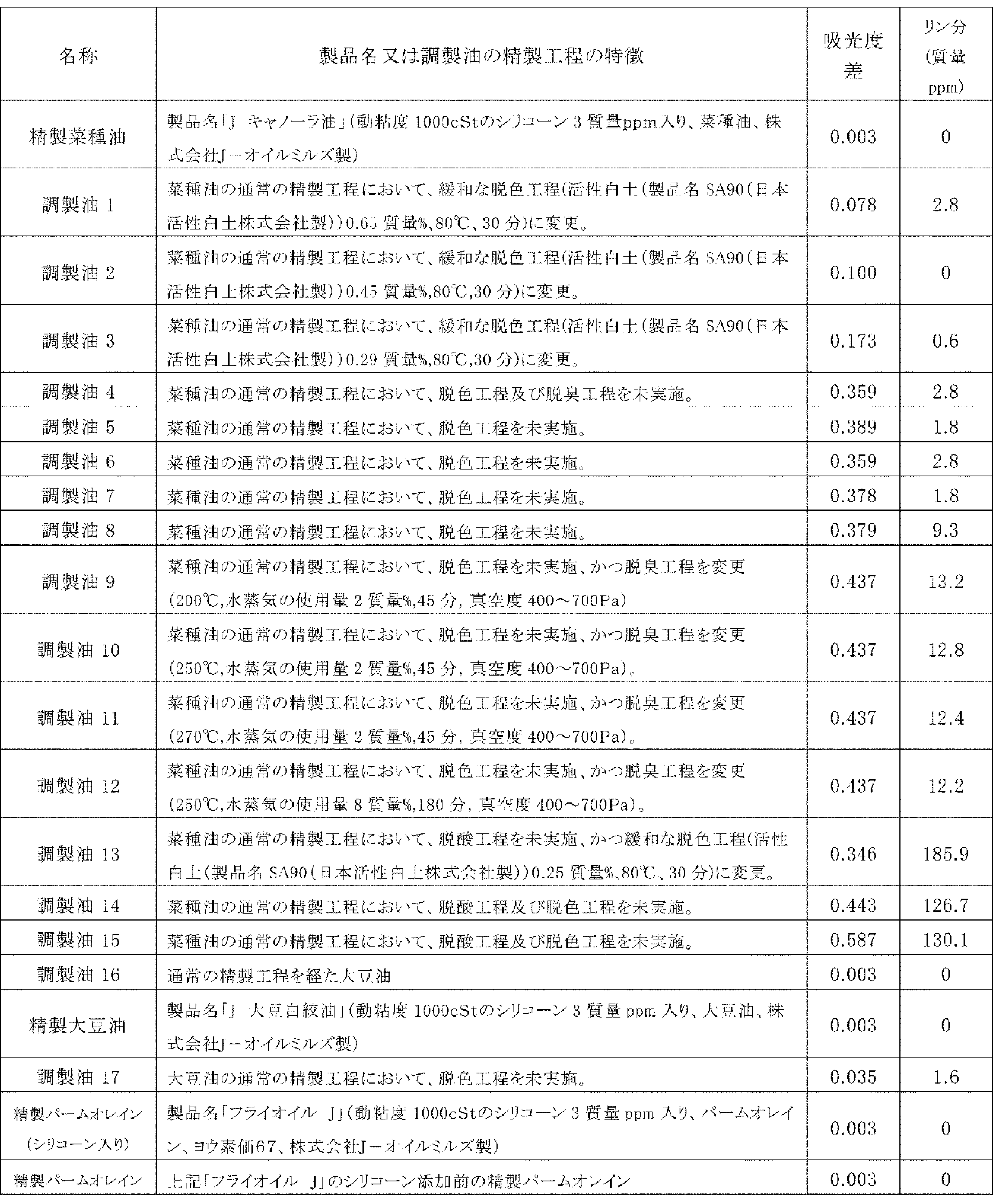
上記精製油及び調製油の吸光度差の算出及びリン分の測定は、以下の方法により行った。
(吸光度差)
対照用及び測定用石英セル(1cm)にイソオクタン(分光分析用試薬、和光純薬工業株式会社製)を入れ、紫外可視分光光度計(製品名「SHIMADZU UV-2450」、株式会社島津製作所製)を用いて600~750nmの範囲でベースライン補正を行った。次に、測定用石英セルに試験油脂を入れ吸光度を測定した。750nmにおける吸光度をゼロとしたときの660nmにおける吸光度(吸光度差)を記載した。
(吸光度差)
対照用及び測定用石英セル(1cm)にイソオクタン(分光分析用試薬、和光純薬工業株式会社製)を入れ、紫外可視分光光度計(製品名「SHIMADZU UV-2450」、株式会社島津製作所製)を用いて600~750nmの範囲でベースライン補正を行った。次に、測定用石英セルに試験油脂を入れ吸光度を測定した。750nmにおける吸光度をゼロとしたときの660nmにおける吸光度(吸光度差)を記載した。
(リン分)
試験油脂をキシレンで希釈し、ICP発光分光分析装置(株式会社日立ハイテクサイエンス製)で分析した。また、定量にあたっては、CONOSTAN(登録商標) Oil Analysis Standard(SCP SCIENCE社製)を使用した。
試験油脂をキシレンで希釈し、ICP発光分光分析装置(株式会社日立ハイテクサイエンス製)で分析した。また、定量にあたっては、CONOSTAN(登録商標) Oil Analysis Standard(SCP SCIENCE社製)を使用した。
〔実施例1~4〕調製油の脱色工程変更試験
(1)フライ調理用油脂組成物の調製
ベース油となる上記精製菜種油に、表2に示す調製油を2又は3質量%となるように添加することによりフライ調理用油脂組成物を調製した。以降、ベース油を対照油といい、ベース油に調製油を添加した油脂組成物を試験油という。
(1)フライ調理用油脂組成物の調製
ベース油となる上記精製菜種油に、表2に示す調製油を2又は3質量%となるように添加することによりフライ調理用油脂組成物を調製した。以降、ベース油を対照油といい、ベース油に調製油を添加した油脂組成物を試験油という。
(2)フライ調理試験
上記試験油及び対照油のフライ調理試験を以下の手順で行った。なお、対照油のフライ調理試験も試験毎に行った。他の実施例でも同様である。
上記試験油及び対照油のフライ調理試験を以下の手順で行った。なお、対照油のフライ調理試験も試験毎に行った。他の実施例でも同様である。
まず、フライ調理試験の揚げ種として、以下の加工食品:
唐揚げ:製品名「若鶏唐揚げ(GX388)」(味の素冷凍食品株式会社製)、
ポテトコロッケ:製品名「NEWポテトコロッケ60(GC080)」(約60g/個、味の素冷凍食品株式会社製)を用意した。
唐揚げ:製品名「若鶏唐揚げ(GX388)」(味の素冷凍食品株式会社製)、
ポテトコロッケ:製品名「NEWポテトコロッケ60(GC080)」(約60g/個、味の素冷凍食品株式会社製)を用意した。
電気フライヤー(製品名:FM-3HR、マッハ機器株式会社製)に、試験油又は対照油を3.4kg投入し、180℃の揚げ温度まで昇温した。昇温後、電気フライヤーに、唐揚げ又はポテトコロッケを以下に示す要領で投入して、揚げ調理を1日10時間で延べ20時間行った。
(フライ条件)
唐揚げ:揚げ質量400g/回、揚げ時間5分/回、揚げ回数5回/日(1日目及び2日目に実施)、
ポテトコロッケ:揚げ数量5個/回、揚げ時間5分/回、揚げ回数2回/日(1日目のみ実施)
唐揚げ:揚げ質量400g/回、揚げ時間5分/回、揚げ回数5回/日(1日目及び2日目に実施)、
ポテトコロッケ:揚げ数量5個/回、揚げ時間5分/回、揚げ回数2回/日(1日目のみ実施)
(3)油脂組成物の着色抑制の効果の評価
フライ調理試験後の試験油及び対照油をサンプリングして、以下の方法で着色抑制の効果を評価した。
1.色調の測定
AOCS Cc13j-97に準じて、ロビボンド自動比色計(Lovibond(登録商標)PFXi-880、The Tintometer Ltd.製)を用いて、ロビボンドセル(W600/OG/1 inch)に入れた試験油又は対照油の色度を室温下で測定した。得られた色度Y値とR値から色調(Y+10R)を求めた。
フライ調理試験後の試験油及び対照油をサンプリングして、以下の方法で着色抑制の効果を評価した。
1.色調の測定
AOCS Cc13j-97に準じて、ロビボンド自動比色計(Lovibond(登録商標)PFXi-880、The Tintometer Ltd.製)を用いて、ロビボンドセル(W600/OG/1 inch)に入れた試験油又は対照油の色度を室温下で測定した。得られた色度Y値とR値から色調(Y+10R)を求めた。
2.着色抑制率の算定
対照油の色調を基準とした試験油の着色抑制率を、以下に示す式:

で算出した。結果を表2に示す。
対照油の色調を基準とした試験油の着色抑制率を、以下に示す式:

対照油(脱ガム工程、脱酸工程、脱色工程及び脱臭工程を通常の条件で行った精製菜種油)を用いた比較例1では、20時間のフライ調理試験後の色調が28であった。一方、本発明に従う調製油1を添加した試験油を用いた実施例1では、色調が25に抑えられた。すなわち、本発明により、着色が10.7%抑制されたことになる。本発明に従う調製油2、3又は5を添加した試験油を用いた実施例2~4でも、14.7~20.6%の着色抑制率が達成された。これらの実施例の油脂組成物のリン分が0~0.084質量ppmと極めて低いことから、実施例の着色抑制効果は、特許文献1に示すようなリン分によるものではない。以上のことから、本発明に従って、実施又は未実施の脱色工程後の吸光度差を有するように調製された調製油には、フライ調理時の油脂組成物の着色を抑制する効果があることが判明した。
〔実施例5〕調製油の脱臭工程変更試験(1)
本発明に使用する調製油が、その精製工程において脱臭工程を経ることが必須か否かを試験するために、脱色及び脱臭工程を経ていない調製油4(比較例4)、及び脱色工程を経ていないが脱臭工程を経ている調製油6(実施例5)をベース油に1.6質量%になるよう添加した試験油を調製した。これらの試験油のフライ調理試験及び評価を実施例1と同じ手順で実施した。結果を表3に示す。
本発明に使用する調製油が、その精製工程において脱臭工程を経ることが必須か否かを試験するために、脱色及び脱臭工程を経ていない調製油4(比較例4)、及び脱色工程を経ていないが脱臭工程を経ている調製油6(実施例5)をベース油に1.6質量%になるよう添加した試験油を調製した。これらの試験油のフライ調理試験及び評価を実施例1と同じ手順で実施した。結果を表3に示す。
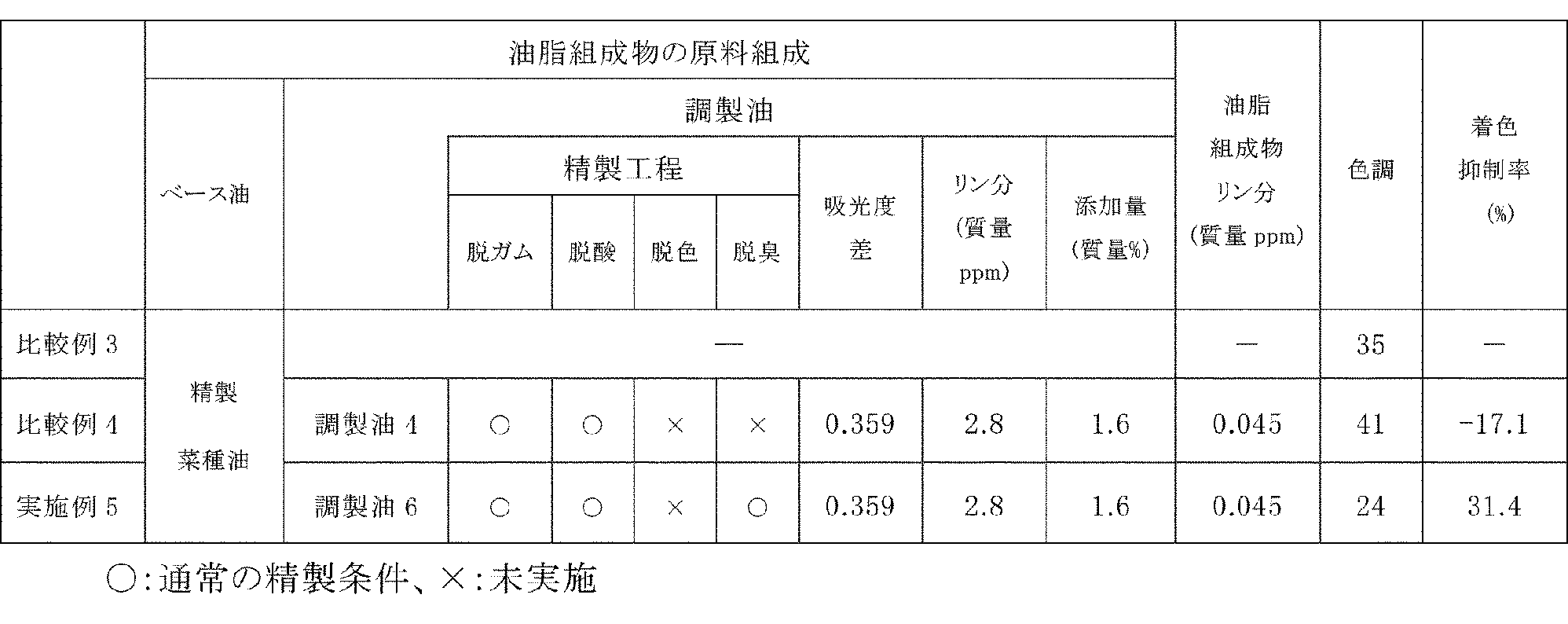
比較例4に示すように、本発明で規定する吸光度差を有するように調製されているが、脱臭工程を経ていない調製油4を含む試験油では、対照油に比べてフライ調理試験後の着色の促進が認められた。一方、実施例5に示すように、本発明で規定する吸光度差を有するように調製され、かつ脱臭工程にかけられている調製油6を含む試験油では、フライ調理試験後の着色が顕著に抑制された。以上のことから、本発明に用いる調製油は、脱臭工程を経ていることが必要であることが判明した。
〔実施例6~9〕調製油の脱臭工程変更試験(2)
本発明に使用する調製油の脱臭工程における精製条件を検討するために、緩和な脱臭工程を経た調製油9、通常の脱臭工程を経た調製油10、及び、強化した脱臭工程を経た調製油11及び12をベース油に2.0質量%になるように添加した試験油を調製した。これらの試験油のフライ調理試験及び評価を実施例1と同じ手順で実施した。結果を表4に示す。
本発明に使用する調製油の脱臭工程における精製条件を検討するために、緩和な脱臭工程を経た調製油9、通常の脱臭工程を経た調製油10、及び、強化した脱臭工程を経た調製油11及び12をベース油に2.0質量%になるように添加した試験油を調製した。これらの試験油のフライ調理試験及び評価を実施例1と同じ手順で実施した。結果を表4に示す。
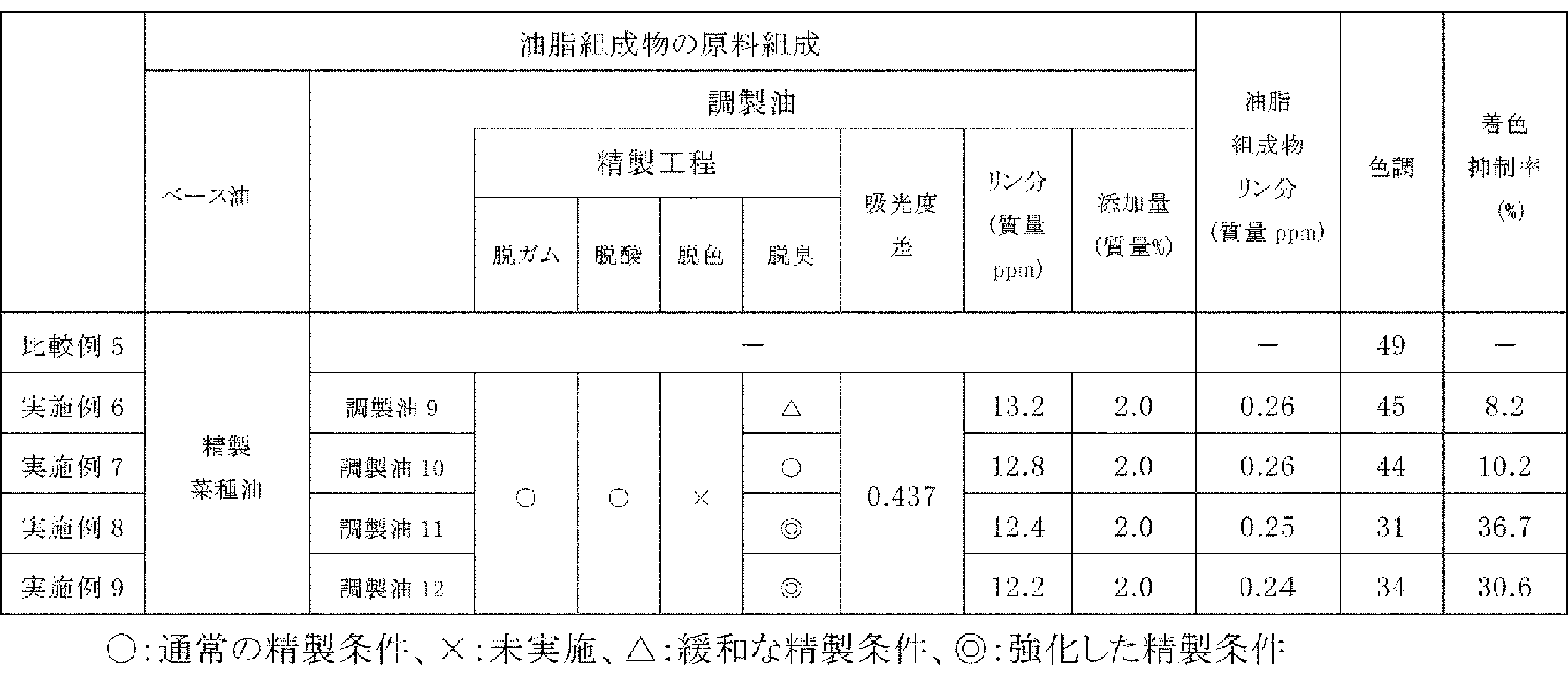
表4に示すように、いずれの脱臭条件においても、フライ調理試験後の試験油の着色は抑制された。また、精製工程の脱臭工程条件を強化するほど、試験油の着色抑制率が良化した。
〔実施例10~12〕調製油の脱酸工程変更試験
本発明に使用する調製油が、その精製工程において脱酸工程を経ることが必須か否かを試験するために、本発明が規定する吸光度差を有するが脱酸工程を経ていない調製油13~15をベース油に2質量%になるよう添加した試験油を調製した。これらの試験油のフライ調理試験及び評価を実施例1と同じ手順で実施した。結果を表5に示す。
本発明に使用する調製油が、その精製工程において脱酸工程を経ることが必須か否かを試験するために、本発明が規定する吸光度差を有するが脱酸工程を経ていない調製油13~15をベース油に2質量%になるよう添加した試験油を調製した。これらの試験油のフライ調理試験及び評価を実施例1と同じ手順で実施した。結果を表5に示す。
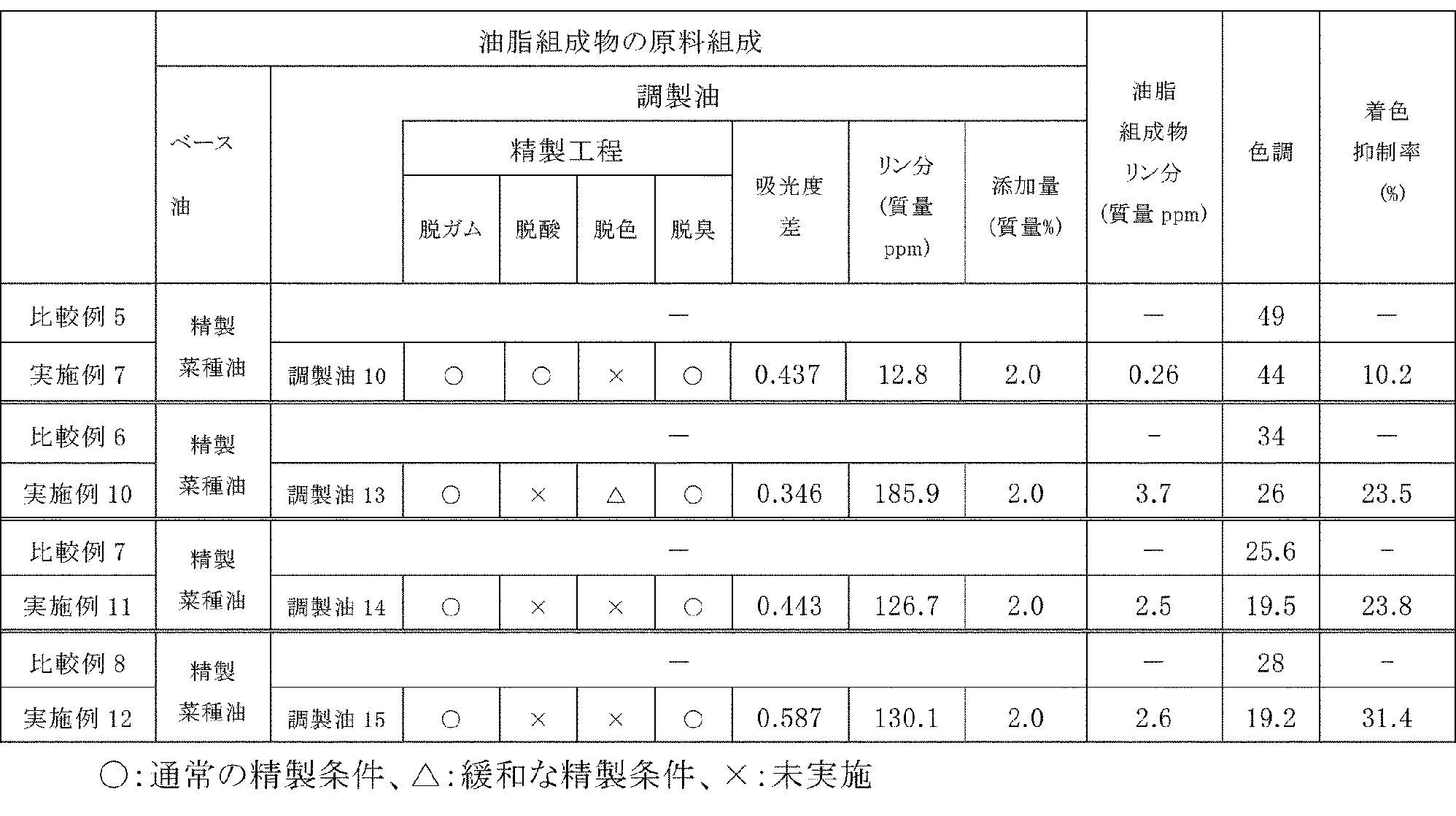
表5に示すように、本発明に従って一定の吸光度差を有する調製油であれば、脱酸工程の実施の有無に関わらず本発明の効果は得られた。実施例7と実施例11を比較すると脱酸工程を未実施とすることでより着色抑制効果が高いことがわかる。実施例10~12の高い着色抑制率には、調製油に含まれるリン分による効果も反映されたものと考えられる。
〔実施例13~16〕調製油の添加量変更試験
本発明のフライ調理用油脂組成物中の調製油の添加量を変更する試験を行った。具体的には、粗原油の精製工程において脱色工程を実施しない調製油7を表6に示す添加量でベース油に添加した試験油を調製した。これらの試験油のフライ調理試験及び評価を実施例1と同じ手順で実施した。結果を表6に示す。
本発明のフライ調理用油脂組成物中の調製油の添加量を変更する試験を行った。具体的には、粗原油の精製工程において脱色工程を実施しない調製油7を表6に示す添加量でベース油に添加した試験油を調製した。これらの試験油のフライ調理試験及び評価を実施例1と同じ手順で実施した。結果を表6に示す。
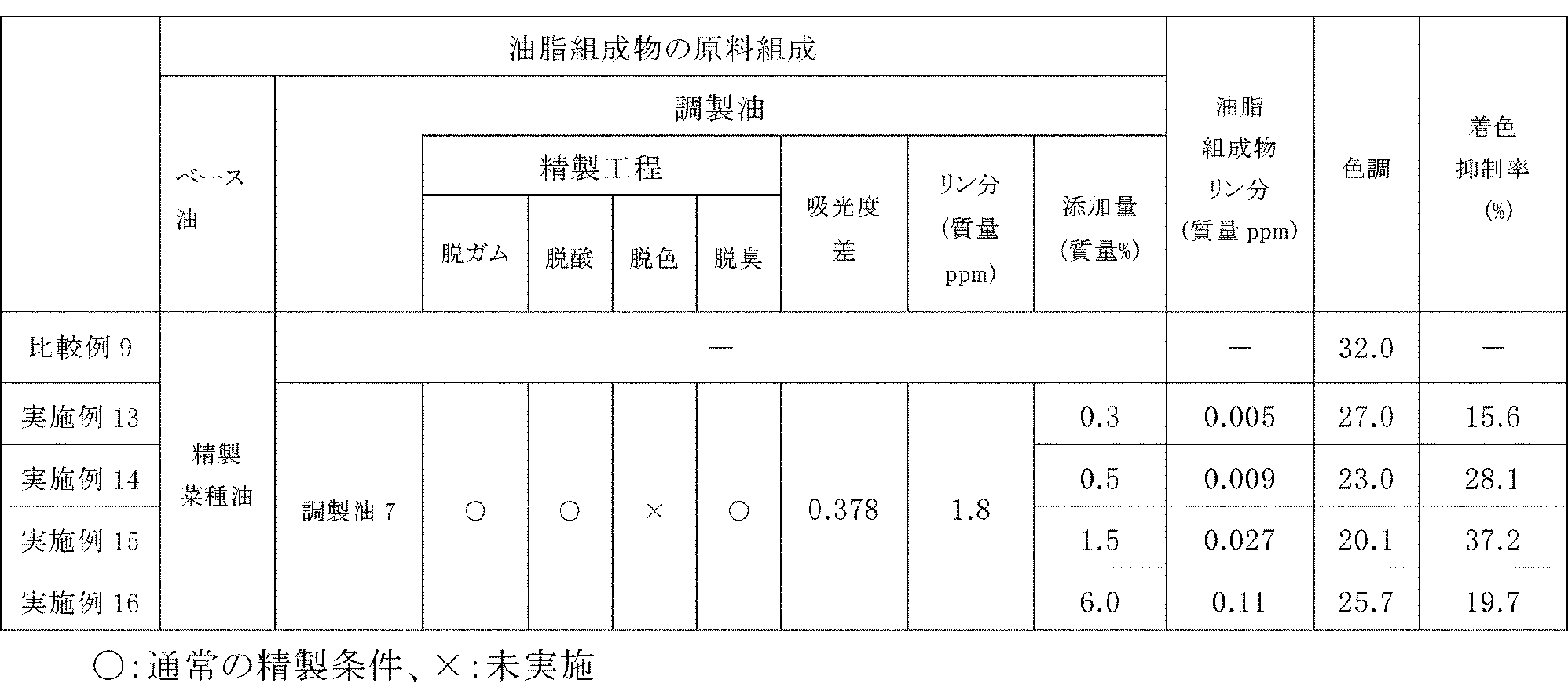
表6に示すように、本発明に従う調製油を添加した試験油を用いてフライ調理を行うと、フライ調理試験後の油脂組成物の着色は、対照油と比べて有意に抑制された。実施例13~16の結果から、フライ調理用油脂組成物中の調製油は0.3質量%以上6質量%以下で効果が得られ、特に、0.5質量%以上6質量%以下でより高い効果が得られ、0.5質量%以上1.5質量%以下で特に高い効果が得られた。
〔実施例17~20〕ベース油変更試験
実施例13~16において、ベース油を変更する試験を行った。具体的には、調製油7又は8を表7に示すベース油に2.0質量%となるように添加した試験油を調製した。これらの試験油のフライ調理試験及び評価を実施例1と同じ手順で実施した。結果を表7に示す。
実施例13~16において、ベース油を変更する試験を行った。具体的には、調製油7又は8を表7に示すベース油に2.0質量%となるように添加した試験油を調製した。これらの試験油のフライ調理試験及び評価を実施例1と同じ手順で実施した。結果を表7に示す。
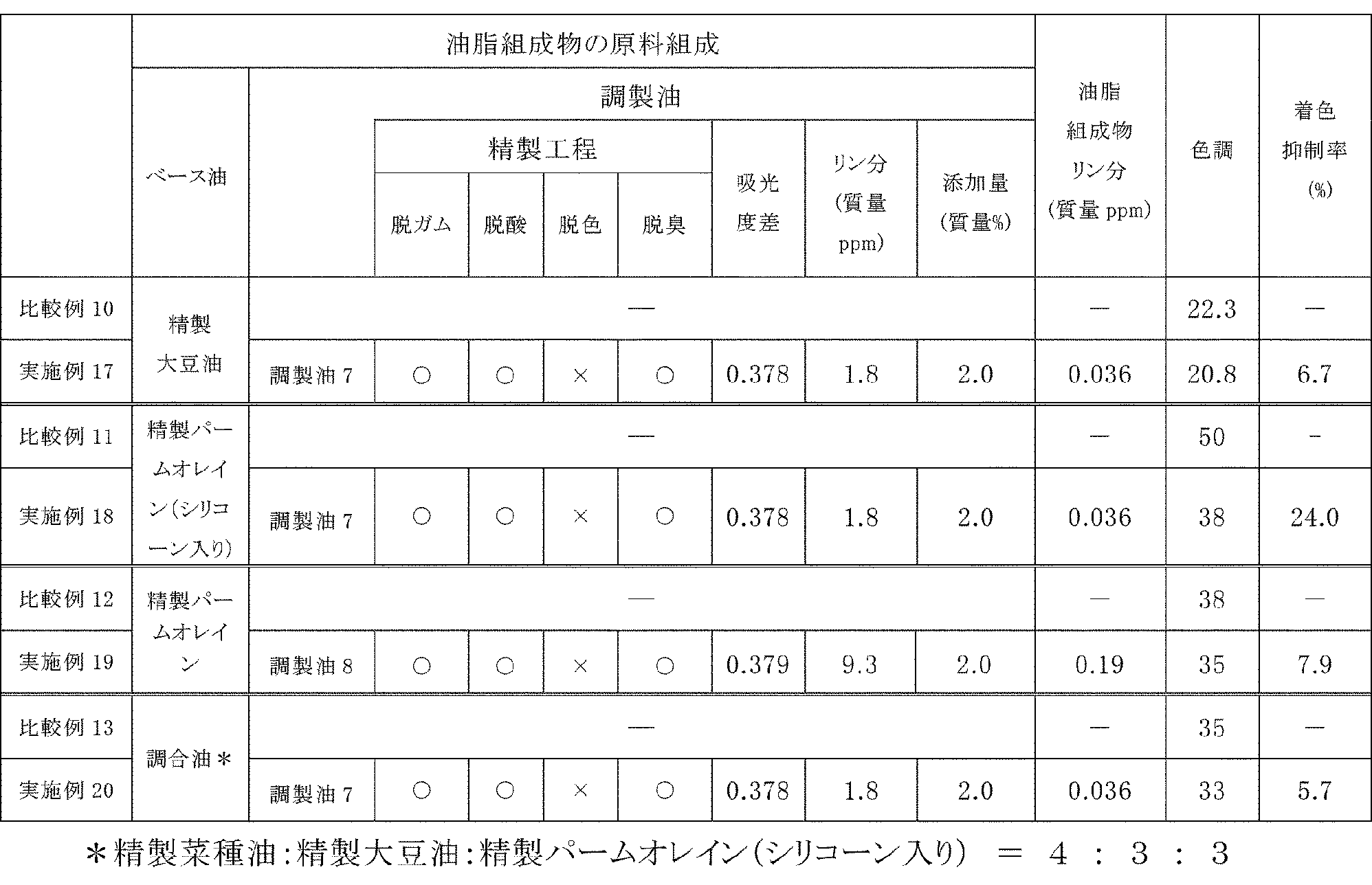
表7に示すように、ベース油を菜種油から、大豆油、パームオレイン、又は、これらの調合油に変更しても、フライ調理試験後の油脂組成物の着色を抑制することができた。実施例18と実施例19を比較すると、シリコーンを含むフライ調理用油脂組成物において、顕著な着色の抑制効果が得られることがわかる。
〔実施例21〕調製油の油糧原料の変更試験(1)
調製油の油糧原料を菜種から大豆に変更する試験を行った。大豆由来で脱色工程未実施の調製油17をベース油に10質量%となるように添加した試験油を調製した。また、通常の精製工程を経た大豆油(調製油16)を精製菜種油に10質量%となるように添加した比較例14の対照油を調製した。この試験油及び対照油のフライ調理試験及び評価を実施例1と同じ手順で実施した。結果を表8に示す。
調製油の油糧原料を菜種から大豆に変更する試験を行った。大豆由来で脱色工程未実施の調製油17をベース油に10質量%となるように添加した試験油を調製した。また、通常の精製工程を経た大豆油(調製油16)を精製菜種油に10質量%となるように添加した比較例14の対照油を調製した。この試験油及び対照油のフライ調理試験及び評価を実施例1と同じ手順で実施した。結果を表8に示す。
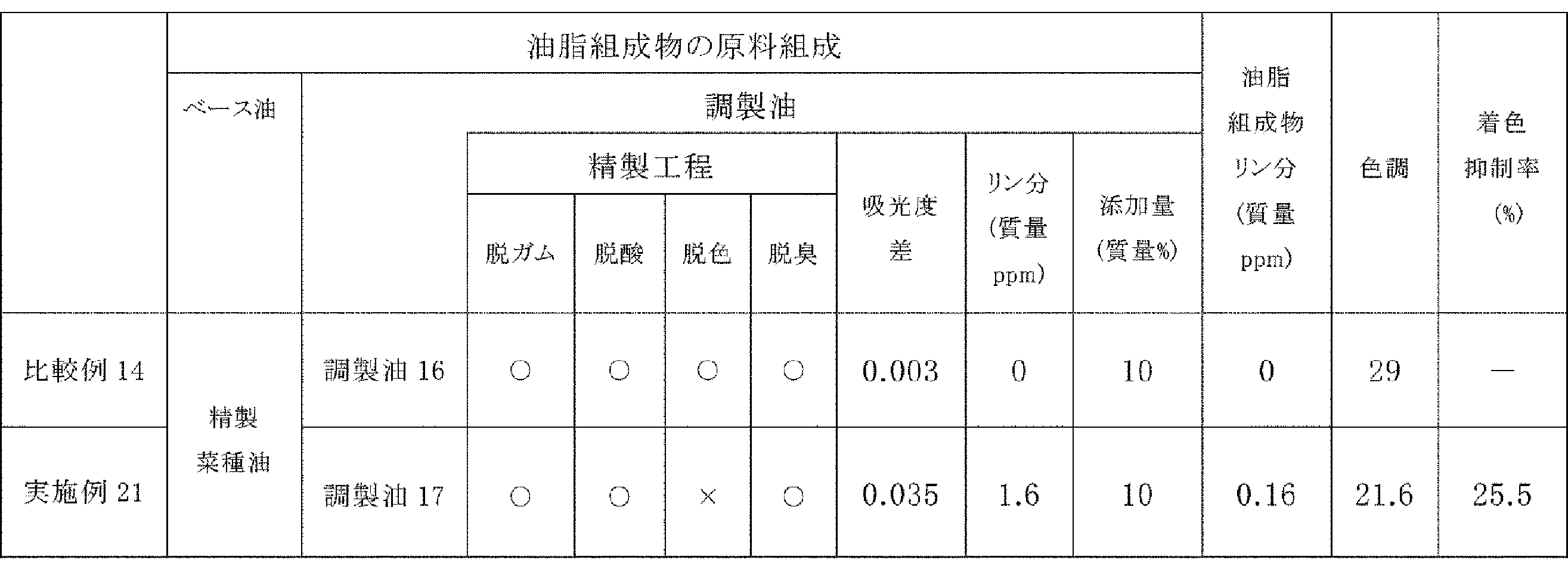
表8に示すように、調製油の油糧原料を菜種から大豆に変更しても、フライ調理試験後の油脂組成物の着色を抑制することができた。
〔実施例22~23〕調製油とクロロフィル色素の併用添加試験
本発明に従う調製油にさらにクロロフィル色素を添加した試験を行った。本発明が規定する吸光度差を有するが脱酸工程を経ていない調製油13をベース油に2質量%になるよう添加した試験油を調製した(実施例22)。本発明が規定する吸光度差を有するが脱酸工程を経ていない調製油13をベース油に2質量%添加し、さらにクロロフィル色素(製品名「ニチノーカラーG-AO」、日農化学工業株式会社製)をベース油に8.4質量ppmになるよう添加した試験油を調製した(実施例23)。対照として、精製菜種油からなる対照油を用意した(比較例15)。実施例の試験油、及び比較例の対照油について、フライ調理試験及び評価を実施例1と同一の操作で行った。結果を表9に示す。
本発明に従う調製油にさらにクロロフィル色素を添加した試験を行った。本発明が規定する吸光度差を有するが脱酸工程を経ていない調製油13をベース油に2質量%になるよう添加した試験油を調製した(実施例22)。本発明が規定する吸光度差を有するが脱酸工程を経ていない調製油13をベース油に2質量%添加し、さらにクロロフィル色素(製品名「ニチノーカラーG-AO」、日農化学工業株式会社製)をベース油に8.4質量ppmになるよう添加した試験油を調製した(実施例23)。対照として、精製菜種油からなる対照油を用意した(比較例15)。実施例の試験油、及び比較例の対照油について、フライ調理試験及び評価を実施例1と同一の操作で行った。結果を表9に示す。

表9の実施例22と実施例23との対比から、本発明に従う調製油とクロロフィル色素を併用添加することで、フライ調理試験後の油脂組成物の着色がより顕著に抑制された。
〔実施例24〕調製油の油糧原料の変更試験(2)
本発明に従う調製油の油種としてエキストラヴァージンオリーブオイルを用いて実験を行った。エキストラヴァージンオリーブオイルは、「AJINOMOTOオリーブオイルエクストラバージン」(株式会社J-オイルミルズ製)を用いた。この調製油は、脱ガム、脱酸及び脱臭工程を実施するが、脱色工程を実施せず、そして本発明が規定する吸光度差は0.178であった。この調製油をベース油(精製菜種油)に3質量%となるように添加することにより試験油を調製した。対照として、精製菜種油からなる対照油を用意した(比較例16)。実施例24の試験油、及び比較例16の対照油に対して、フライ調理試験を以下のフライ条件にて1日10時間で延べ30時間行った。
(フライ条件)
唐揚げ:揚げ質量400g/回、揚げ時間5分/回、揚げ回数5回/日(1~3日目)
ポテトコロッケ:揚げ数量5個/回、揚げ時間5分/回、揚げ回数2回/日(1日目のみ実施)
その他のフライ調理試験及び評価の条件は、実施例1と同一の操作とした。結果を表10に示す。
本発明に従う調製油の油種としてエキストラヴァージンオリーブオイルを用いて実験を行った。エキストラヴァージンオリーブオイルは、「AJINOMOTOオリーブオイルエクストラバージン」(株式会社J-オイルミルズ製)を用いた。この調製油は、脱ガム、脱酸及び脱臭工程を実施するが、脱色工程を実施せず、そして本発明が規定する吸光度差は0.178であった。この調製油をベース油(精製菜種油)に3質量%となるように添加することにより試験油を調製した。対照として、精製菜種油からなる対照油を用意した(比較例16)。実施例24の試験油、及び比較例16の対照油に対して、フライ調理試験を以下のフライ条件にて1日10時間で延べ30時間行った。
(フライ条件)
唐揚げ:揚げ質量400g/回、揚げ時間5分/回、揚げ回数5回/日(1~3日目)
ポテトコロッケ:揚げ数量5個/回、揚げ時間5分/回、揚げ回数2回/日(1日目のみ実施)
その他のフライ調理試験及び評価の条件は、実施例1と同一の操作とした。結果を表10に示す。
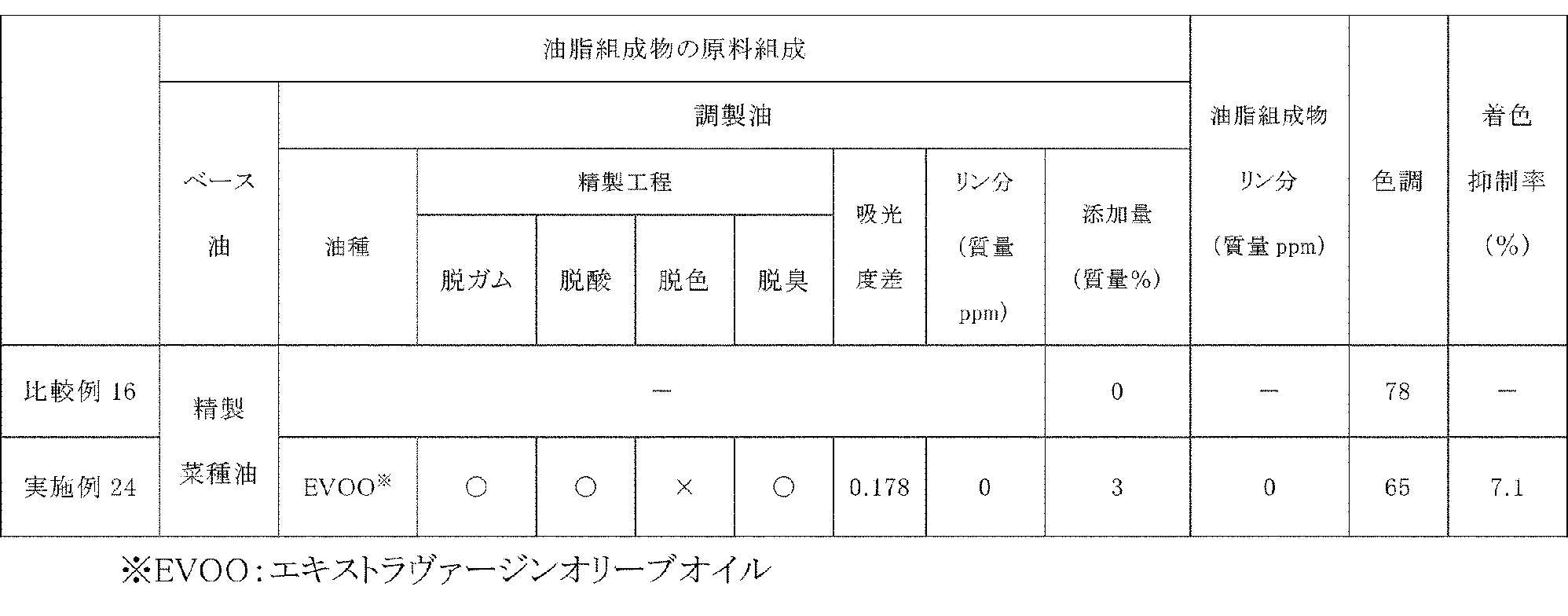
表10に示すように、フライ調理試験後の油脂組成物の色調は、比較例16で78、そして実施例24で65となった。すなわち、実施例24のフライ調理試験後の油脂組成物の着色は、比較例16よりも7.1%抑制された。この結果から、油種がオリーブオイルからなる調製油を含む試験油においても、フライ調理試験後の油脂組成物の着色を抑制する効果があることが判明した。
〔実施例25〕調製油の油糧原料の変更試験(3)
調製油の油種としてグレープシードオイルを用いて実験を行った。グレープシードオイルは、「COOPグレープシードオイル」(株式会社J-オイルミルズ製)を用いた。該グレープシードオイルは、脱ガム、脱酸、脱色、及び脱臭工程を経ており、脱臭工程後の前記吸光度差が0.322、そしてリン分が0.1質量ppmであった。該グレープシードオイルの脱臭工程後の吸光度差は、脱臭処理によって脱臭工程前よりも小さくなる。したがって、本発明が規定する吸光度差は0.322以上であった。ベース油(精製菜種油)に前記調製油を1.5質量%の配合比にて添加することにより試験油を調製した(実施例25)。この試験油のリン分は、0.001質量ppmであった。対照として、精製菜種油からなる対照油(比較例17)を用意した。比較例17の対照油、及び実施例25の試験油に対して、フライ調理試験を以下のフライ条件にて1日8時間で延べ32時間行った。
(フライ条件)
唐揚げ:揚げ質量400g/回、揚げ時間5分/回、揚げ回数4回/日(1~4日目)
ポテトコロッケ:揚げ数量5個/回、揚げ時間5分/回、揚げ回数2回/日(1日目のみ実施)
その他のフライ調理試験及び評価の条件は、実施例1と同一の操作とした。
調製油の油種としてグレープシードオイルを用いて実験を行った。グレープシードオイルは、「COOPグレープシードオイル」(株式会社J-オイルミルズ製)を用いた。該グレープシードオイルは、脱ガム、脱酸、脱色、及び脱臭工程を経ており、脱臭工程後の前記吸光度差が0.322、そしてリン分が0.1質量ppmであった。該グレープシードオイルの脱臭工程後の吸光度差は、脱臭処理によって脱臭工程前よりも小さくなる。したがって、本発明が規定する吸光度差は0.322以上であった。ベース油(精製菜種油)に前記調製油を1.5質量%の配合比にて添加することにより試験油を調製した(実施例25)。この試験油のリン分は、0.001質量ppmであった。対照として、精製菜種油からなる対照油(比較例17)を用意した。比較例17の対照油、及び実施例25の試験油に対して、フライ調理試験を以下のフライ条件にて1日8時間で延べ32時間行った。
(フライ条件)
唐揚げ:揚げ質量400g/回、揚げ時間5分/回、揚げ回数4回/日(1~4日目)
ポテトコロッケ:揚げ数量5個/回、揚げ時間5分/回、揚げ回数2回/日(1日目のみ実施)
その他のフライ調理試験及び評価の条件は、実施例1と同一の操作とした。
比較例17では、フライ調理試験後の油脂組成物の色調は103となったが、実施例25では、フライ調理試験後の油脂組成物の色調は87となった。すなわち、実施例25の試験油は、比較例17の対照油に対して15.5%の着色抑制効果が認められた。この結果から、グレープシードオイルは、それを含むフライ用油脂組成物のフライ調理試験後の着色を抑制する効果があることが判明した。
Claims (10)
- フライ調理用油脂組成物の着色の抑制方法であって、
食用油脂に調製油を添加する工程を含み、
前記調製油は、
油糧原料から得られる粗原油の精製工程において、順に、
(1)脱ガム工程、
(2)実施又は未実施の脱酸工程、
(3)実施又は未実施の脱色工程、及び
(4)脱臭工程
を経たものであり、
前記調製油の前記(3)の工程後の、イソオクタンを対照とした波長660nmの吸光度から波長750nmの吸光度を引いた吸光度差が、0.030以上であることを特徴とする、前記抑制方法。 - 前記吸光度差が0.045以上である、請求項1に記載の抑制方法。
- 前記脱臭工程は、
水蒸気の使用量が0.1質量%以上10質量%以下、
脱臭温度が180℃以上300℃以下、及び
脱臭時間が10分以上240分以下
の条件で実施されることを特徴とする、請求項1に記載の抑制方法。 - 前記油糧原料は、大豆、菜種、及びパーム果肉から選ばれる少なくとも一種である、請求項1に記載の抑制方法。
- 前記食用油脂は、大豆油、菜種油、パーム系油脂、コーン油、ヒマワリ油、オリーブ油、綿実油、米油及び紅花油から選ばれる少なくとも一種を含む、請求項1に記載の抑制方法。
- 前記フライ調理用油脂組成物中の前記調製油が、0.05質量%以上20質量%以下である、請求項1に記載の抑制方法。
- 前記調製油由来のリン分が前記フライ調理用油脂組成物中0.01質量ppm以上10質量ppm以下となるように前記食用油脂に添加することを特徴とする、請求項1に記載の抑制方法。
- 前記(3)が実施の脱色工程である、請求項1に記載の抑制方法。
- 前記フライ調理用油脂組成物が、シリコーンを含む、請求項1に記載の抑制方法。
- フライ調理用油脂組成物の着色抑制剤であって、
前記着色抑制剤は、調製油を含み、
前記調製油は、
油糧原料から得られる粗原油の精製工程において、順に、
(1)脱ガム工程、
(2)実施又は未実施の脱酸工程、
(3)実施又は未実施の脱色工程、及び
(4)脱臭工程
を経たものであり、
前記調製油の前記(3)の工程後の、イソオクタンを対照とした波長660nmの吸光度から波長750nmの吸光度を引いた吸光度差が、0.030以上であることを特徴とする、前記着色抑制剤。
Priority Applications (3)
| Application Number | Priority Date | Filing Date | Title |
|---|---|---|---|
| US16/964,620 US11118132B2 (en) | 2018-01-31 | 2019-01-21 | Method for suppressing coloration of frying fats and oils composition |
| JP2019569010A JP7222928B2 (ja) | 2018-01-31 | 2019-01-21 | フライ調理用油脂組成物の着色の抑制方法 |
| MYPI2020003677A MY200141A (en) | 2018-01-31 | 2019-01-21 | Method for suppressing coloration of frying fats and oils composition |
Applications Claiming Priority (2)
| Application Number | Priority Date | Filing Date | Title |
|---|---|---|---|
| JP2018015952 | 2018-01-31 | ||
| JP2018-015952 | 2018-01-31 |
Publications (1)
| Publication Number | Publication Date |
|---|---|
| WO2019151007A1 true WO2019151007A1 (ja) | 2019-08-08 |
Family
ID=67479053
Family Applications (1)
| Application Number | Title | Priority Date | Filing Date |
|---|---|---|---|
| PCT/JP2019/001617 Ceased WO2019151007A1 (ja) | 2018-01-31 | 2019-01-21 | フライ調理用油脂組成物の着色の抑制方法 |
Country Status (5)
| Country | Link |
|---|---|
| US (1) | US11118132B2 (ja) |
| JP (1) | JP7222928B2 (ja) |
| MY (1) | MY200141A (ja) |
| TW (1) | TWI788507B (ja) |
| WO (1) | WO2019151007A1 (ja) |
Cited By (2)
| Publication number | Priority date | Publication date | Assignee | Title |
|---|---|---|---|---|
| WO2020166422A1 (ja) * | 2019-02-13 | 2020-08-20 | 株式会社J-オイルミルズ | フライ調理用油脂組成物の着色抑制方法、フライ調理用油脂組成物の製造方法及び着色抑制剤 |
| JP2023122717A (ja) * | 2022-02-24 | 2023-09-05 | 昭和産業株式会社 | フライ用油脂組成物 |
Citations (5)
| Publication number | Priority date | Publication date | Assignee | Title |
|---|---|---|---|---|
| JP2002238455A (ja) * | 2001-02-15 | 2002-08-27 | Oriza Yuka Kk | 米油およびその製造方法 |
| JP2006316254A (ja) * | 2005-04-13 | 2006-11-24 | J-Oil Mills Inc | 加熱着色を抑制したパーム油類およびその製造方法 |
| WO2010050449A1 (ja) * | 2008-10-28 | 2010-05-06 | 日清オイリオグループ株式会社 | パーム油、脱臭留出物及びそれらの製造方法 |
| WO2015064569A1 (ja) * | 2013-10-31 | 2015-05-07 | 不二製油株式会社 | 加熱調理用油脂 |
| JP2015119728A (ja) * | 2015-03-18 | 2015-07-02 | 株式会社J−オイルミルズ | 揚げ物用油脂組成物の製造方法 |
Family Cites Families (3)
| Publication number | Priority date | Publication date | Assignee | Title |
|---|---|---|---|---|
| AR006830A1 (es) * | 1996-04-26 | 1999-09-29 | Du Pont | Aceite de soja con alta estabilidad oxidativa |
| JP2000282080A (ja) * | 1999-03-31 | 2000-10-10 | Yoshihara Oil Mill Ltd | 配合食用油およびその利用 |
| JP4095111B1 (ja) | 2007-08-29 | 2008-06-04 | 株式会社J−オイルミルズ | 加熱耐性に優れた揚げ物用油脂組成物の製造方法 |
-
2019
- 2019-01-17 TW TW108101773A patent/TWI788507B/zh active
- 2019-01-21 MY MYPI2020003677A patent/MY200141A/en unknown
- 2019-01-21 JP JP2019569010A patent/JP7222928B2/ja active Active
- 2019-01-21 WO PCT/JP2019/001617 patent/WO2019151007A1/ja not_active Ceased
- 2019-01-21 US US16/964,620 patent/US11118132B2/en active Active
Patent Citations (5)
| Publication number | Priority date | Publication date | Assignee | Title |
|---|---|---|---|---|
| JP2002238455A (ja) * | 2001-02-15 | 2002-08-27 | Oriza Yuka Kk | 米油およびその製造方法 |
| JP2006316254A (ja) * | 2005-04-13 | 2006-11-24 | J-Oil Mills Inc | 加熱着色を抑制したパーム油類およびその製造方法 |
| WO2010050449A1 (ja) * | 2008-10-28 | 2010-05-06 | 日清オイリオグループ株式会社 | パーム油、脱臭留出物及びそれらの製造方法 |
| WO2015064569A1 (ja) * | 2013-10-31 | 2015-05-07 | 不二製油株式会社 | 加熱調理用油脂 |
| JP2015119728A (ja) * | 2015-03-18 | 2015-07-02 | 株式会社J−オイルミルズ | 揚げ物用油脂組成物の製造方法 |
Non-Patent Citations (2)
| Title |
|---|
| ICHIKAWA KAZUAKI: "Outline: assessment of oxidative deterioration in oils and fats", JOURNAL OF NAGOYA BUNRI UNIVERSITY, vol. 9, 2009, pages 101 - 108 * |
| KAJIMOTO GORRO: "Methods for assessing edible oil deteriorationand future development", JOURNAL OF JAPAN OIL CHEMISTS SOCIETY, vol. 47, no. 10, 1998, pages 143 - 153 * |
Cited By (2)
| Publication number | Priority date | Publication date | Assignee | Title |
|---|---|---|---|---|
| WO2020166422A1 (ja) * | 2019-02-13 | 2020-08-20 | 株式会社J-オイルミルズ | フライ調理用油脂組成物の着色抑制方法、フライ調理用油脂組成物の製造方法及び着色抑制剤 |
| JP2023122717A (ja) * | 2022-02-24 | 2023-09-05 | 昭和産業株式会社 | フライ用油脂組成物 |
Also Published As
| Publication number | Publication date |
|---|---|
| MY200141A (en) | 2023-12-08 |
| JP7222928B2 (ja) | 2023-02-15 |
| US20210054304A1 (en) | 2021-02-25 |
| TW201934011A (zh) | 2019-09-01 |
| US11118132B2 (en) | 2021-09-14 |
| TWI788507B (zh) | 2023-01-01 |
| JPWO2019151007A1 (ja) | 2021-01-28 |
Similar Documents
| Publication | Publication Date | Title |
|---|---|---|
| JP6161289B2 (ja) | 種子油組成物 | |
| KR101510712B1 (ko) | 가열내성이 우수한 튀김용 유지 조성물의 제조방법 | |
| JP6216599B2 (ja) | 食用油脂の製造方法および食用油脂 | |
| JP2017029044A (ja) | 食用油脂 | |
| JP7222929B2 (ja) | フライ調理用油脂組成物のアニシジン価上昇及びトコフェロール類減少の抑制方法 | |
| JP7222928B2 (ja) | フライ調理用油脂組成物の着色の抑制方法 | |
| JP2025090860A (ja) | 油脂組成物及びその製造方法 | |
| JP2015119728A (ja) | 揚げ物用油脂組成物の製造方法 | |
| JP7436397B2 (ja) | フライ調理用油脂組成物の着色抑制方法、フライ調理用油脂組成物の製造方法及び着色抑制剤 | |
| JP2021010361A (ja) | 加熱調理用油脂組成物の製造方法、及び加熱調理用油脂組成物 | |
| JP7761384B2 (ja) | 油脂組成物及びその製造方法 | |
| JP7759379B2 (ja) | 食用油脂の製造方法及びその食用油脂の使用 | |
| WO2015114915A1 (ja) | 油脂組成物 | |
| WO2022163370A1 (ja) | 着色抑制剤、着色抑制剤の製造方法、食用油脂組成物、及び食品の着色抑制方法 | |
| CA3214462A1 (en) | Edible oil and fat composition, method for inhibiting unpleasant taste, agent for inhibiting unpleasant taste, and method for producing deep-fried food | |
| JP6986886B2 (ja) | 油脂組成物の明所臭抑制方法 | |
| WO2025205059A1 (ja) | 調製油の製造方法、油脂組成物の製造方法、及びフライ調理用油脂組成物の着色の抑制方法 |
Legal Events
| Date | Code | Title | Description |
|---|---|---|---|
| 121 | Ep: the epo has been informed by wipo that ep was designated in this application |
Ref document number: 19747646 Country of ref document: EP Kind code of ref document: A1 |
|
| ENP | Entry into the national phase |
Ref document number: 2019569010 Country of ref document: JP Kind code of ref document: A |
|
| NENP | Non-entry into the national phase |
Ref country code: DE |
|
| 122 | Ep: pct application non-entry in european phase |
Ref document number: 19747646 Country of ref document: EP Kind code of ref document: A1 |