WO2019132015A1 - 樹脂組成物及びはんだ付け用フラックス - Google Patents
樹脂組成物及びはんだ付け用フラックス Download PDFInfo
- Publication number
- WO2019132015A1 WO2019132015A1 PCT/JP2018/048520 JP2018048520W WO2019132015A1 WO 2019132015 A1 WO2019132015 A1 WO 2019132015A1 JP 2018048520 W JP2018048520 W JP 2018048520W WO 2019132015 A1 WO2019132015 A1 WO 2019132015A1
- Authority
- WO
- WIPO (PCT)
- Prior art keywords
- acid
- reaction product
- linoleic
- dimer
- trimer
- Prior art date
- Legal status (The legal status is an assumption and is not a legal conclusion. Google has not performed a legal analysis and makes no representation as to the accuracy of the status listed.)
- Ceased
Links
Classifications
-
- C—CHEMISTRY; METALLURGY
- C08—ORGANIC MACROMOLECULAR COMPOUNDS; THEIR PREPARATION OR CHEMICAL WORKING-UP; COMPOSITIONS BASED THEREON
- C08K—Use of inorganic or non-macromolecular organic substances as compounding ingredients
- C08K5/00—Use of organic ingredients
- C08K5/04—Oxygen-containing compounds
- C08K5/10—Esters; Ether-esters
- C08K5/11—Esters; Ether-esters of acyclic polycarboxylic acids
-
- C—CHEMISTRY; METALLURGY
- C22—METALLURGY; FERROUS OR NON-FERROUS ALLOYS; TREATMENT OF ALLOYS OR NON-FERROUS METALS
- C22C—ALLOYS
- C22C13/00—Alloys based on tin
-
- B—PERFORMING OPERATIONS; TRANSPORTING
- B23—MACHINE TOOLS; METAL-WORKING NOT OTHERWISE PROVIDED FOR
- B23K—SOLDERING OR UNSOLDERING; WELDING; CLADDING OR PLATING BY SOLDERING OR WELDING; CUTTING BY APPLYING HEAT LOCALLY, e.g. FLAME CUTTING; WORKING BY LASER BEAM
- B23K35/00—Rods, electrodes, materials, or media, for use in soldering, welding, or cutting
- B23K35/22—Rods, electrodes, materials, or media, for use in soldering, welding, or cutting characterised by the composition or nature of the material
- B23K35/24—Selection of soldering or welding materials proper
- B23K35/26—Selection of soldering or welding materials proper with the principal constituent melting at less than 400°C
-
- B—PERFORMING OPERATIONS; TRANSPORTING
- B23—MACHINE TOOLS; METAL-WORKING NOT OTHERWISE PROVIDED FOR
- B23K—SOLDERING OR UNSOLDERING; WELDING; CLADDING OR PLATING BY SOLDERING OR WELDING; CUTTING BY APPLYING HEAT LOCALLY, e.g. FLAME CUTTING; WORKING BY LASER BEAM
- B23K35/00—Rods, electrodes, materials, or media, for use in soldering, welding, or cutting
- B23K35/22—Rods, electrodes, materials, or media, for use in soldering, welding, or cutting characterised by the composition or nature of the material
- B23K35/24—Selection of soldering or welding materials proper
- B23K35/26—Selection of soldering or welding materials proper with the principal constituent melting at less than 400°C
- B23K35/262—Sn as the principal constituent
-
- B—PERFORMING OPERATIONS; TRANSPORTING
- B23—MACHINE TOOLS; METAL-WORKING NOT OTHERWISE PROVIDED FOR
- B23K—SOLDERING OR UNSOLDERING; WELDING; CLADDING OR PLATING BY SOLDERING OR WELDING; CUTTING BY APPLYING HEAT LOCALLY, e.g. FLAME CUTTING; WORKING BY LASER BEAM
- B23K35/00—Rods, electrodes, materials, or media, for use in soldering, welding, or cutting
- B23K35/22—Rods, electrodes, materials, or media, for use in soldering, welding, or cutting characterised by the composition or nature of the material
- B23K35/36—Selection of non-metallic compositions, e.g. coatings or fluxes; Selection of soldering or welding materials, conjoint with selection of non-metallic compositions, both selections being of interest
- B23K35/3612—Selection of non-metallic compositions, e.g. coatings or fluxes; Selection of soldering or welding materials, conjoint with selection of non-metallic compositions, both selections being of interest with organic compounds as principal constituents
- B23K35/3613—Polymers, e.g. resins
-
- B—PERFORMING OPERATIONS; TRANSPORTING
- B23—MACHINE TOOLS; METAL-WORKING NOT OTHERWISE PROVIDED FOR
- B23K—SOLDERING OR UNSOLDERING; WELDING; CLADDING OR PLATING BY SOLDERING OR WELDING; CUTTING BY APPLYING HEAT LOCALLY, e.g. FLAME CUTTING; WORKING BY LASER BEAM
- B23K35/00—Rods, electrodes, materials, or media, for use in soldering, welding, or cutting
- B23K35/22—Rods, electrodes, materials, or media, for use in soldering, welding, or cutting characterised by the composition or nature of the material
- B23K35/36—Selection of non-metallic compositions, e.g. coatings or fluxes; Selection of soldering or welding materials, conjoint with selection of non-metallic compositions, both selections being of interest
- B23K35/362—Selection of compositions of fluxes
-
- C—CHEMISTRY; METALLURGY
- C08—ORGANIC MACROMOLECULAR COMPOUNDS; THEIR PREPARATION OR CHEMICAL WORKING-UP; COMPOSITIONS BASED THEREON
- C08K—Use of inorganic or non-macromolecular organic substances as compounding ingredients
- C08K5/00—Use of organic ingredients
- C08K5/04—Oxygen-containing compounds
- C08K5/09—Carboxylic acids; Metal salts thereof; Anhydrides thereof
- C08K5/092—Polycarboxylic acids
-
- C—CHEMISTRY; METALLURGY
- C08—ORGANIC MACROMOLECULAR COMPOUNDS; THEIR PREPARATION OR CHEMICAL WORKING-UP; COMPOSITIONS BASED THEREON
- C08L—COMPOSITIONS OF MACROMOLECULAR COMPOUNDS
- C08L93/00—Compositions of natural resins; Compositions of derivatives thereof
- C08L93/04—Rosin
Definitions
- the present invention relates to a resin composition and a flux for soldering using the resin composition.
- the flux used for soldering chemically removes the metal oxides present on the metal surface of the soldering object to be soldered and allows the movement of metal elements at the boundary between the two.
- soldering using a flux an intermetallic compound can be formed between the solder and the metal surface of the bonding object, and a strong bonding can be obtained.
- a residue mainly composed of rosin remains after soldering.
- residues mainly containing rosin are susceptible to cracking. If the residue is cracked, moisture is likely to be adsorbed due to the influence of moisture absorption over time. Since this causes a decrease in reliability such as migration, the residue in which a crack is generated is not preferable. Therefore, a soldering flux has been proposed in which the content of the abietic acid type resin acid contained in the rosin is adjusted to ensure the visibility of the visual inspection of the crack (for example, see Patent Document 1). .
- the present invention has been made to solve such problems, and an object of the present invention is to provide a resin composition and a flux for soldering, which can suppress cracking of the residue.
- the dimer acid which is the reaction product of oleic acid and linoleic acid, and the hydrogenated product thereof, the trimer acid which is the reaction product of oleic acid and linoleic acid, and the hydrogenated product thereof make the rosin flexible and crack the residue I found that I can suppress
- the present invention relates to a dimer acid which is a reaction product of oleic acid and linoleic acid, a trimer acid which is a reaction product of oleic acid and linoleic acid, and water obtained by adding hydrogen to a dimer acid which is a reaction product of oleic acid and linoleic acid.
- the present invention also relates to a dimer acid which is a reaction product of oleic acid and linoleic acid, a trimer acid which is a reaction product of oleic acid and linoleic acid, and water obtained by adding hydrogen to a dimer acid which is a reaction product of oleic acid and linoleic acid.
- the ratio of the amount of the total of two or more types of hydrogenated trimer acids obtained by adding hydrogen to trimer acid which is a reaction product of an acid and oleic acid and linoleic acid, and the amount of rosin is at least 0.15 based on rosin. It is a soldering flux which is less than 00.
- dimer acid which is a reaction product of oleic acid and linoleic acid trimer acid which is a reaction product of oleic acid and linoleic acid
- water obtained by adding hydrogen to dimer acid which is a reaction product of oleic acid and linoleic acid
- dimer acid or a hydrogenated trimer acid obtained by adding hydrogen to trimer acid which is a reactant of oleic acid and linoleic acid
- the flux for soldering contains 5.0 wt% or more and 10.0 wt% or less of rosin and 80.0 wt% or more and 90.0 wt% or less of a solvent.
- 0 wt% or more and 5.0 wt% or less of another organic acid as an activator 0 wt% or more and 1.0 wt% or less of an organic halogen compound, and 0 wt% or more and 1.0 wt% or less of an amine hydrohalide salt
- the resin composition of the present invention adds hydrogen to a dimer acid which is a reactant of oleic acid and linoleic acid, a trimer acid which is a reactant of oleic acid and linoleic acid, and a dimer acid which is a reactant of oleic acid and linoleic acid
- the soldering flux of the present invention is a dimer acid obtained by diluting the resin composition of the present invention with a solvent, which is a reaction product of oleic acid and linoleic acid, and a trimer acid which is a reaction product of oleic acid and linoleic acid,
- the resin composition of the present embodiment includes a dimer acid which is a reaction product of oleic acid and linoleic acid, a trimer acid which is a reaction product of oleic acid and linoleic acid, and a dimer acid which is a reaction product of oleic acid and linoleic acid.
- the resin composition includes a dimer acid which is a reaction product of oleic acid and linoleic acid, a trimer acid which is a reaction product of oleic acid and linoleic acid, and a hydrogenation obtained by adding hydrogen to a dimer acid which is a reaction product of oleic acid and linoleic acid.
- the ratio of the total amount of two or more acids to the amount of rosin is 0.15 or more and 1.00 or less based on rosin.
- the soldering flux of this embodiment is obtained by diluting the resin composition with a solvent, and a dimer acid which is a reaction product of oleic acid and linoleic acid, and a trimer acid which is a reaction product of oleic acid and linoleic acid, Either hydrogenated dimer acid in which hydrogen is added to dimer acid which is a reactant of oleic acid and linoleic acid or hydrogenated trimer acid in which hydrogen is added to trimer acid which is a reactant of oleic acid and linoleic acid, or olein Dimer acid which is a reaction product of acid and linoleic acid, trimer acid which is a reaction product of oleic acid and linoleic acid, hydrogenated dimer acid and oleic acid in which hydrogen is added to dimer acid which is a reaction product of oleic acid and linoleic acid It contains two or more kinds of hydrogenated trimer acids obtained by adding hydrogen to
- the soldering flux consists of dimer acid which is a reaction product of oleic acid and linoleic acid, trimer acid which is a reaction product of oleic acid and linoleic acid, water obtained by adding hydrogen to dimer acid which is a reaction product of oleic acid and linoleic acid
- the ratio of the total amount of two or more trimer acids and the amount of rosin is 0.
- the dimer acid of the present embodiment is a reactant of oleic acid and linoleic acid, and is a dimer having 36 carbon atoms.
- the trimer acid of the present embodiment is a reaction product of oleic acid and linoleic acid, and is a trimer having 54 carbon atoms.
- the dimer acid and trimer acid of the present embodiment which are the reaction products of oleic acid and linoleic acid, have heat resistance in the temperature range assumed for soldering, and function as an activator during soldering.
- the rosin is given flexibility in the residue to suppress cracking of the rosin.
- Dimer acid which is the reaction product of oleic acid and linoleic acid trimer acid which is the reaction product of oleic acid and linoleic acid, hydrogenated dimer acid or oleic acid in which hydrogen is added to the dimer acid which is the reaction product of oleic acid and linoleic acid
- the hydrogenated trimer acid obtained by adding hydrogen to trimer acid, which is a reaction product of linoleic acid and linoleic acid decreases in amount by functioning as an activator.
- dimer acid which is a reaction product of oleic acid and linoleic acid trimer acid which is a reaction product of oleic acid and linoleic acid
- hydrogenated dimer acid obtained by adding hydrogen to a dimer acid which is a reaction product of oleic acid and linoleic acid Or when the amount of addition of hydrogenated trimer acid obtained by adding hydrogen to trimer acid which is a reaction product of oleic acid and linoleic acid is small, reaction of oleic acid and linoleic acid which is a reaction product of oleic acid and linoleic acid Products, trimer acid, hydrogenated dimer acid in which hydrogen is added to dimer acid which is a reactant of oleic acid and linoleic acid, or hydrogenated trimer acid in which hydrogen is added to trimer acid which is a reactant of oleic acid and linoleic acid, The amount remaining in the residue decreases.
- a dimer acid as a reaction product of oleic acid and linoleic acid a trimer acid as a reaction product of oleic acid and linoleic acid
- the ratio of hydrogenated trimer acid to rosin in which hydrogen is added to trimer acid which is a reaction product of oleic acid and linoleic acid is low, and the effect of suppressing the cracking of rosin in the residue can not be obtained.
- the soldering flux contains hydrogen added to the dimer acid which is the reaction product of oleic acid and linoleic acid, the trimer acid which is the reaction product of oleic acid and linoleic acid, and the dimer acid which is the reaction product of oleic acid and linoleic acid Either hydrogenated dimer acid or hydrogenated trimer acid obtained by adding hydrogen to trimer acid which is a reaction product of oleic acid and linoleic acid.
- Dimer acid which is the reaction product of oleic acid and linoleic acid trimer acid which is the reaction product of oleic acid and linoleic acid, hydrogenated dimer acid or oleic acid in which hydrogen is added to the dimer acid which is the reaction product of oleic acid and linoleic acid And 1.5 wt% or more and 10.0 wt% or less of a total of two or more kinds of hydrogenated trimer acids obtained by adding hydrogen to trimer acid which is a reaction product of linoleic acid and linoleic acid.
- the soldering flux of the present embodiment is 5.0 wt% or more and 10.0 wt% or less of rosin, and 80.0 wt% or more of a solvent. Contained in wt% or less. Further, the flux for soldering according to the present embodiment contains 0 wt% or more and 5.0 wt% or less of another organic acid as an activator, 0 wt% or more and 1.0 wt% or less of an organic halogen compound, and an amine hydrohalide salt And 0 wt% or more and 1.0 wt% or less. The soldering flux of the present embodiment further contains 0 wt% or more and 1.0 wt% or less of an amine as an activator.
- the rosin examples include raw material rosins such as gum rosin, wood rosin and tall oil rosin, and derivatives obtained from the raw material rosin.
- examples of such derivatives include purified rosin, hydrogenated rosin, disproportionated rosin, polymerized rosin, acid modified rosin, phenol modified rosin and ⁇ , ⁇ unsaturated carboxylic acid modified product (acrylated rosin, maleated rosin, fumarized Rosins, etc.), and purified products, hydrides and disproportionates of the polymerized rosins, and purified products, hydrides and disproportionates of the ⁇ , ⁇ -unsaturated carboxylic acid modified products, etc. Two or more types can be used.
- the soldering flux of the present embodiment may further contain other resins in addition to rosin, and as the other resins, terpene resin, modified terpene resin, terpene phenol resin, modified terpene phenol resin, styrene resin, modified resin It may further contain at least one or more resins selected from styrene resins, xylene resins, and modified xylene resins.
- terpene resin aromatic modified terpene resin, hydrogenated terpene resin, hydrogenated aromatic modified terpene resin etc. can be used.
- a hydrogenated terpene phenol resin etc. can be used as a modified terpene phenol resin.
- modified styrene resin styrene acrylic resin, styrene maleic acid resin and the like can be used.
- modified xylene resin a phenol modified xylene resin, an alkylphenol modified xylene resin, a phenol modified resol type xylene resin, a polyol modified xylene resin, a polyoxyethylene addition xylene resin, and the like can be used.
- the amount of other resins is preferably 40 wt% or less, more preferably 20 wt% or less.
- organic acids include glutaric acid, adipic acid, azelaic acid, eicosane diacid, citric acid, glycolic acid, succinic acid, salicylic acid, diglycolic acid, dipicolinic acid, dibutyl aniline diglycolic acid, suberic acid, sebacic acid, Thioglycolic acid, phthalic acid, isophthalic acid, terephthalic acid, dodecanedioic acid, parahydroxyphenylacetic acid, picolinic acid, phenylsuccinic acid, fumaric acid, maleic acid, malonic acid, lauric acid, benzoic acid, tartaric acid, trisocyanate isocyanurate 2-Carboxyethyl), glycine, 1,3-cyclohexanedicarboxylic acid, 2,2-bis (hydroxymethyl) propionic acid, 2,2-bis (hydroxymethyl) butanoic acid, 4-tert-butylbenzoic acid, 2, 3-Dihydroxybenzo
- trimer acid other than the reaction product of oleic acid and linoleic acid hydrogen to dimer acid other than the reaction product of oleic acid and linoleic acid
- amines include monoethanolamine, diphenylguanidine, ethylamine, triethylamine, ethylenediamine, triethylenetetramine, 2-methylimidazole, 2-undecylimidazole, 2-heptadecylimidazole, 1,2-dimethylimidazole, 2-ethyl-4 -Methylimidazole, 2-phenylimidazole, 2-phenyl-4-methylimidazole, 1-benzyl-2-methylimidazole, 1-benzyl-2-phenylimidazole, 1-cyanoethyl-2-methylimidazole, 1-cyanoethyl-2 -Undecylimidazole, 1-cyanoethyl-2-ethyl-4-methylimidazole, 1-cyanoethyl-2-phenylimidazole, 1-cyanoethyl-2-undecylimidazolium trimery 1-cyanoethyl-2-phenyl
- organic halogen compounds include trans-2,3-dibromo-1,4-butenediol which is an organic bromo compound, triallyl isocyanurate hexabromide, 1-bromo-2-butanol, 1-bromo-2-propanol, 3 -Bromo-1-propanol, 3-bromo-1,2-propanediol, 1,4-dibromo-2-butanol, 1,3-dibromo-2-propanol, 2,3-dibromo-1-propanol, 2, 3-Dibromo-1,4-butanediol, 2,3-dibromo-2-butene-1,4-diol, trans-2,3-dibromo-2-butene-1,4-diol, cis-2,3 Dibromo-2-butene-1,4-diol, tetrabromophthalic acid, bromosuccinic acid and
- the amine hydrohalide is a compound obtained by reacting an amine with a hydrogen halide, and includes aniline hydrogen chloride, aniline hydrogen bromide and the like.
- the amine of the amine hydrohalide salt the above-mentioned amine can be used, and ethylamine, ethylenediamine, triethylamine, methylimidazole, 2-ethyl-4-methylimidazole and the like can be mentioned, and as the hydrogen halide, chlorine, Examples thereof include bromine, iodine and hydrides of fluorine (hydrogen chloride, hydrogen bromide, hydrogen iodide, hydrogen fluoride).
- it may replace with an amine hydrohalide salt, or it may combine with an amine hydrohalide salt, and a borofluoride may be included, and boro hydrofluoric acid etc. are mentioned as a borofluoride.
- the solvent examples include water, alcohol solvents, glycol ether solvents, terpineols and the like.
- alcohol solvents ethanol, industrial ethanol (a mixed solvent obtained by adding methanol and / or isopropyl alcohol to ethanol), isopropyl alcohol, 1,2-butanediol, isobornylcyclohexanol, 2,4-diethyl-1, 5-Pentanediol, 2,2-dimethyl-1,3-propanediol, 2,5-dimethyl-2,5-hexanediol, 2,5-dimethyl-3-hexyne-2,5-diol, 2,3 -Dimethyl-2,3-butanediol, 1,1,1-tris (hydroxymethyl) ethane, 2-ethyl-2-hydroxymethyl-1,3-propanediol, 2,2'-oxybis (methylene) bis ( 2-ethyl-1,3-propanediol),
- glycol ether solvents include hexyl diglycol, diethylene glycol mono-2-ethyl hexyl ether, ethylene glycol monophenyl ether, 2-methylpentane-2,4-diol, diethylene glycol monohexyl ether, diethylene glycol dibutyl ether, triethylene glycol monobutyl ether Etc.
- the solvent is preferably ethanol which is an alcohol solvent, industrial ethanol (a mixed solvent obtained by adding methanol and / or isopropyl alcohol to ethanol), and isopropyl alcohol.
- Dimer acid which is the reaction product of oleic acid and linoleic acid trimer acid which is the reaction product of oleic acid and linoleic acid, hydrogenated dimer acid or oleic acid in which hydrogen is added to the dimer acid which is the reaction product of oleic acid and linoleic acid
- a soldering flux prepared by diluting a resin composition having a ratio of the ratio to the rosin within a predetermined range, which contains two or more of hydrogenated trimer acids in which hydrogen is added to trimer acid which is a reaction product of linoleic acid and linoleic acid Cracking of the residue after soldering can be suppressed. In addition, the occurrence of precipitation can be suppressed.
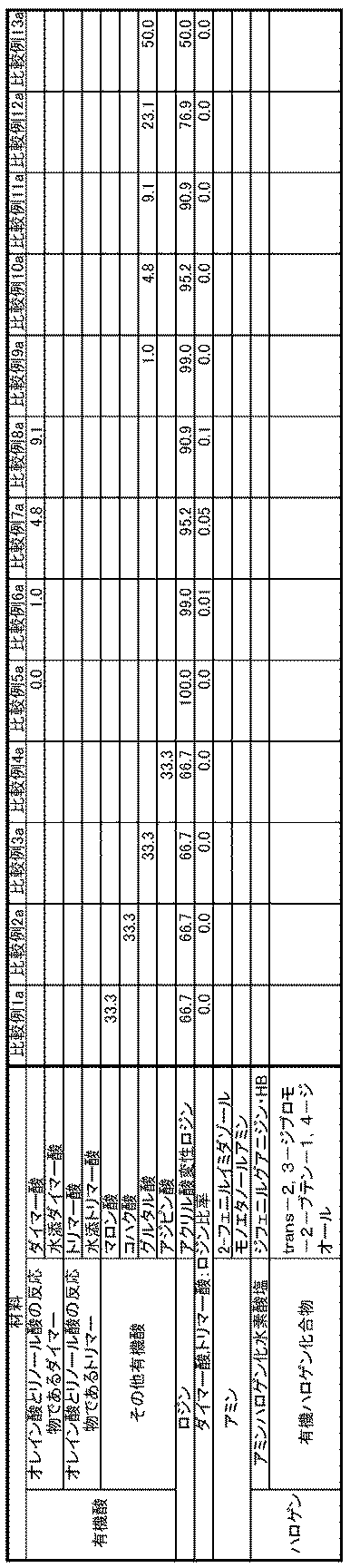
- the resin compositions of the examples and comparative examples are prepared with the compositions shown in Table 1, Table 2 and Table 3 below, and the resin compositions of the examples shown in Table 1 are diluted with a solvent to carry out the compositions shown in Table 4
- the soldering flux of the example is prepared, and the resin composition of the example shown in Table 2 is diluted with a solvent to formulate the soldering flux of the example with the composition shown in Table 5, and the comparative example shown in Table 3
- the resin composition was diluted with a solvent
- the soldering flux of the comparative example was prepared with the composition shown in Table 6, and the soldering flux of each example and each comparative example was used to verify the presence or absence of cracks in the residue.
- the composition ratio in Table 1, Table 2 and Table 3 is wt (wt)% when the total amount of the resin composition is 100, and the composition ratio in Table 4, Table 5 and Table 6 is the total amount of flux. Is 100% based on wt.
- Verification method The flux for soldering of an example and a comparative example is applied to Cu board.
- the size of the Cu plate is 30 ⁇ 30 ⁇ 0.3 mm.
- the amount of soldering flux is 0.05 ml.
- the solder sample has a composition represented as Sn-3Ag-0.5Cu, containing 3.0 wt% of Ag, 0.5 wt% of Cu, and the balance being Sn.
- a 0.3 g solder ring was used to make this solder annular.
- test piece is placed on a hot plate, heated to 250 ° C., held for 20 seconds after melting the solder, and then cooled to room temperature. And the presence or absence of the crack of the residue was confirmed by making the magnification
- Example 1a it contains 33.3 wt% of dimer acid which is a reaction product of oleic acid and linoleic acid, 67.7 wt% of rosin, and the ratio of dimer acid to rosin is 0.5, as defined in the present invention.
- the soldering flux prepared by diluting the resin composition within the above range with a solvent is a dimer acid, which is a reaction product of oleic acid and linoleic acid, as shown in Example 1b. .0% by weight, 10.0% by weight of rosin, the ratio of dimer acid to rosin is 0.5, within the range specified in the present invention, and the balance is a solvent.
- the soldering flux of Example 1b a sufficient effect on suppression of cracking of the residue after soldering was obtained.
- Example 2a 33.3 wt% of hydrogenated dimer acid obtained by adding hydrogen to dimer acid which is a reaction product of oleic acid and linoleic acid, 67.7 wt% of rosin, and hydrogenated dimer acid to rosin
- the soldering flux prepared by diluting the resin composition having a ratio of 0.5 and within the range defined in the present invention with a solvent is a dimer which is a reactant of oleic acid and linoleic acid as shown in Example 2b.
- Example 3a it contains 33.3 wt% of trimer acid which is a reaction product of oleic acid and linoleic acid, 67.7 wt% of rosin, and has a ratio of trimer acid to rosin of 0.5, which is defined in the present invention.
- the soldering flux prepared by diluting the resin composition within the above range with a solvent contains 5.0 wt% of trimer acid which is a reaction product of oleic acid and linoleic acid, and rosin 10.3. It contains 0 wt%, the ratio of trimer acid to rosin is 0.5, within the range specified in the present invention, and the balance is a solvent. Even with the soldering flux of Example 3b, a sufficient effect was obtained on suppression of cracking of residues after soldering.
- Example 4a 33.3 wt% of hydrogenated trimer acid obtained by adding hydrogen to trimer acid which is a reaction product of oleic acid and linoleic acid, 67.7 wt% of rosin, and hydrogenated trimer acid to rosin
- the soldering flux prepared by diluting the resin composition having a ratio of 0.5 and within the range defined in the present invention with a solvent is a trimer which is a reaction product of oleic acid and linoleic acid as shown in Example 4b.
- Example 5a 16.7 wt% of dimer acid which is a reaction product of oleic acid and linoleic acid, 16.7 wt% of trimer acid which is a reaction product of oleic acid and linoleic acid, and 67.7 wt% of rosin
- the soldering flux prepared by diluting the resin composition containing a ratio of the total amount of dimer acid and trimer acid to rosin, which is within the range specified in the present invention, as shown in Example 5b.
- dimer acid which is a reaction product of oleic acid and linoleic acid
- trimer acid which is a reaction product of oleic acid and linoleic acid
- 10.0 wt% of rosin 10.0 wt% of rosin
- dimer acid for rosin The ratio of the total amount of trimeric acid to trimeric acid is 0.5, which is within the range specified in the present invention, with the balance being the solvent. Also with the soldering flux of Example 5b, a sufficient effect was obtained on suppression of cracking of the residue after soldering.
- Example 6a 16.7 wt% of hydrogenated dimer acid obtained by adding hydrogen to dimer acid which is a reaction product of oleic acid and linoleic acid, and hydrogen to trimer acid which is a reaction product of oleic acid and linoleic acid
- the ratio of the total amount of hydrogenated dimer acid and hydrogenated trimer acid to rosin is 0.5, containing 16.7 wt% of hydrogenated trimer acid and 67.7 wt% of rosin.
- the soldering flux prepared by diluting the resin composition with a solvent is, as shown in Example 6b, 2.5 wt% of hydrogenated dimer acid obtained by adding hydrogen to dimer acid which is a reaction product of oleic acid and linoleic acid.
- a hydrogenated trimer acid which is obtained by adding hydrogen to trimer acid which is a reaction product of oleic acid and linoleic acid and which contains 10.0 wt% of rosin A total amount of ratio 0.5 mer acid in the range defined in the present invention, the remainder being solvent.
- a sufficient effect was obtained on suppression of cracking of residues after soldering.
- Example 7a it contains 50.0 wt% of dimer acid which is a reaction product of oleic acid and linoleic acid, 50.0 wt% of rosin, and the ratio of dimer acid to rosin is 1.0, as defined in the present invention.
- the soldering flux prepared by diluting the resin composition within the above range with a solvent contains 5.0 wt% of dimer acid which is a reaction product of oleic acid and linoleic acid, and rosin 5. It contains 0 wt%, the ratio of dimer acid to rosin is 1.0, within the range specified in the present invention, and the balance is a solvent. Also with the soldering flux of Example 7b, a sufficient effect was obtained on suppression of cracking of residues after soldering.
- Example 8a 13.0 wt% of dimer acid which is a reaction product of oleic acid and linoleic acid, 87.0 wt% of rosin, the ratio of dimer acid to rosin is 0.15, which is defined in the present invention
- the soldering flux prepared by diluting the resin composition within the above range with a solvent contains 1.5 wt% of dimer acid which is a reaction product of oleic acid and linoleic acid, and rosin 10.3. It contains 0 wt%, the ratio of dimer acid to rosin is 0.15, within the range specified in the present invention, and the balance is a solvent. Also with the soldering flux of Example 8b, a sufficient effect was obtained on suppression of cracking of residues after soldering.
- Example 9a it contains 9.1 wt% of dimer acid which is a reaction product of oleic acid and linoleic acid, 66.6 wt% of rosin, and the ratio of dimer acid to rosin is 0.15, as defined in the present invention.
- the soldering flux prepared by diluting the resin composition containing adipic acid as an organic acid with a solvent is, as shown in Example 9b, a dimer acid which is a reaction product of oleic acid and linoleic acid.
- Example 10a 16.7 wt% of dimer acid which is a reaction product of oleic acid and linoleic acid, 83.3 wt% of rosin, the ratio of dimer acid to rosin is 0.2, which is defined in the present invention
- the soldering flux prepared by diluting the resin composition within the above range with a solvent contains 2.0 wt% of dimer acid which is a reaction product of oleic acid and linoleic acid, and rosin 10.3.
- the composition contains 0 wt%, the ratio of dimer acid to rosin is 0.2, within the range specified in the present invention, and the balance is a solvent.
- the soldering flux of Example 10b a sufficient effect was obtained on suppression of cracking of the residue after soldering.
- Example 11a it contains 23.1 wt% of dimer acid which is a reaction product of oleic acid and linoleic acid, 76.9 wt% of rosin, and the ratio of dimer acid to rosin is 0.3, as defined in the present invention.
- the soldering flux prepared by diluting the resin composition within the above range with a solvent, 3.0 wt% of dimer acid which is a reaction product of oleic acid and linoleic acid, and rosin as shown in Example 11b.
- the composition contains 0 wt%, the ratio of dimer acid to rosin is 0.3, within the range specified in the present invention, and the balance is a solvent.
- the soldering flux of Example 11b a sufficient effect was obtained on suppression of cracking of residues after soldering.
- Example 12a 41.2 wt% of dimer acid which is a reaction product of oleic acid and linoleic acid, 58.8 wt% of rosin, the ratio of dimer acid to rosin is 0.7, defined in the present invention
- the soldering flux prepared by diluting the resin composition within the above range with a solvent contains 7.0 wt% of dimer acid which is a reaction product of oleic acid and linoleic acid, and rosin 10.3. It contains 0 wt%, the ratio of dimer acid to rosin is 0.7, which is within the range specified in the present invention, and the balance is a solvent. Also with the soldering flux of Example 12b, a sufficient effect on suppression of cracking of the residue after soldering was obtained.
- Example 13a it contains 50.0 wt% of dimer acid which is a reaction product of oleic acid and linoleic acid, 50.0 wt% of rosin, and the ratio of dimer acid to rosin is 1.0, as defined in the present invention.
- the soldering flux prepared by diluting the resin composition within the above range with a solvent 10.0 wt% of dimer acid which is a reaction product of oleic acid and linoleic acid, and rosin as shown in Example 13b. It contains 0 wt%, the ratio of dimer acid to rosin is 1.0, within the range specified in the present invention, and the balance is a solvent. Also with the soldering flux of Example 13b, a sufficient effect on suppression of cracking of residues after soldering was obtained.
- Example 14a 14.7 wt% of dimer acid which is a reaction product of oleic acid and linoleic acid, and hydrogenated trimer acid in which hydrogen is added to trimer acid which is a reaction product of oleic acid and linoleic acid is 14.
- a soldering flux prepared by diluting a resin composition containing succinic acid, glutaric acid and adipic acid with a solvent was 2.5 wt% of dimer acid which is a reaction product of oleic acid and linoleic acid, as shown in Example 14b.
- trimer acid which is a reactant of oleic acid and linoleic acid, 10.0 wt% of rosin, and a dimer acid for rosin
- the ratio of the total amount of added trimer acid is 0.5, which is within the range defined in the present invention, and further, as the organic acid, malonic acid, succinic acid, glutaric acid, adipic acid is within the range defined in the present invention And the remainder is the solvent. Even with the soldering flux of Example 14b, a sufficient effect was obtained on suppression of cracking of residues after soldering.
- Example 15a 29.4 wt% of dimer acid which is a reaction product of oleic acid and linoleic acid, 58.8 wt% of rosin, the ratio of dimer acid to rosin is 0.5, which is defined in the present invention
- the soldering flux was obtained by diluting a resin composition containing glutaric acid as an organic acid and 2-phenylimidazole as an amine with a solvent, as shown in Example 15b.
- dimer acid which is a reactant of linoleic acid, 10.0 wt% of rosin, the ratio of dimer acid to rosin is 0.5, which is within the range specified in the present invention, and further, organic acid
- 2-phenylimidazole as an amine within the range specified in the present invention, the balance being a solventAlso with the soldering flux of Example 15b, a sufficient effect was obtained on suppression of cracking of residues after soldering.
- Example 16a 29.4 wt% of dimer acid which is a reaction product of oleic acid and linoleic acid, 58.8 wt% of rosin, the ratio of dimer acid to rosin is 0.5, which is defined in the present invention
- the soldering flux prepared by diluting a resin composition containing glutaric acid as an organic acid and monoethanolamine as an amine with a solvent is oleic acid and linole as shown in Example 16b.
- the reaction product of acid is 5.0 wt% of dimer acid, 10.0 wt% of rosin, the ratio of dimer acid to rosin is 0.5, which is within the range specified in the present invention, and further, as an organic acid Glutaric acid is contained in the range specified in the present invention, monoethanolamine is contained in the range specified in the present invention as an amine, and the balance is a solvent. Also with the soldering flux of Example 16b, a sufficient effect was obtained on suppression of cracking of residues after soldering.
- Example 17a 29.4 wt% of dimer acid which is a reaction product of oleic acid and linoleic acid, 58.8 wt% of rosin, the ratio of dimer acid to rosin is 0.5, which is defined in the present invention
- the soldering flux prepared by diluting a resin composition containing glutaric acid as an organic acid and containing an amine hydrohalide salt as a halogen with a solvent is olein as shown in Example 17b.
- dimer acid which is a reaction product of acid and linoleic acid, 10.0 wt% of rosin, the ratio of dimer acid to rosin being 0.5, which is within the range defined in the present invention, It contains glutaric acid as the organic acid within the range specified in the present invention, contains amine hydrohalide as the halogen within the range specified in the present invention, and the balance is a solvent. That. Even with the soldering flux of Example 17b, a sufficient effect was obtained on suppression of cracking of residues after soldering.
- Example 18a 29.4 wt% of dimer acid which is a reaction product of oleic acid and linoleic acid, 58.8 wt% of rosin, the ratio of dimer acid to rosin is 0.5, which is defined in the present invention
- the soldering flux prepared by diluting a resin composition containing glutaric acid as an organic acid and containing an organic halogen compound as a halogen with a solvent is oleic acid and linole as shown in Example 18b.
- the reaction product of acid is 5.0 wt% of dimer acid, 10.0 wt% of rosin, the ratio of dimer acid to rosin is 0.5, which is within the range specified in the present invention, and further, as an organic acid Glutaric acid is contained in the range specified in the present invention, an organic halogen compound is contained as the halogen in the range specified in the present invention, and the balance is a solvent. Also with the soldering flux of Example 18b, a sufficient effect was obtained on suppression of cracking of residues after soldering.
- Example 19a 29.1 wt% of dimer acid which is a reaction product of oleic acid and linoleic acid, 58.1 wt% of rosin, the ratio of dimer acid to rosin is 0.5, which is defined in the present invention
- a flux for soldering which is obtained by diluting a resin composition containing glutaric acid as an organic acid, 2-phenylimidazole as an amine and an amine hydrohalide as a halogen with a solvent, As shown in Example 19b, it contains 5.0 wt% of dimer acid which is a reaction product of oleic acid and linoleic acid, 10.0 wt% of rosin, and the ratio of dimer acid to rosin is 0.5, as defined in the present invention.
- the bright contains glutaric acid as an organic acid within the range specified in the present invention, and 2-phenylimidazole as an amine.
- glutaric acid as an organic acid within the range specified in the present invention
- 2-phenylimidazole as an amine.
- within the range specified in the bright comprises amine hydrohalides as halogen within the specified range of the present invention, the remainder being solvent.
- Example 20a 27.8 wt% of dimer acid which is a reaction product of oleic acid and linoleic acid, 55.6 wt% of rosin, the ratio of dimer acid to rosin is 0.5, which is defined in the present invention
- the flux for soldering which is obtained by diluting the resin composition containing a glutaric acid as an organic acid, 2-phenylimidazole as an amine and an organic halogen compound as a halogen with a solvent is the same as Example 20b.
- the range defined in the present invention is 5.0 wt% of dimer acid which is a reaction product of oleic acid and linoleic acid, 10.0 wt% of rosin, and the ratio of dimer acid to rosin is 0.5, as defined in the present invention
- the organic acid contains glutaric acid as an organic acid within the scope defined in the present invention, and 2-phenylimidazole as an amine according to the present invention.
- the organic halogen compound include within the specified range of the present invention as a halogen, the remainder being solvent. Also with the soldering flux of Example 20b, a sufficient effect was obtained on suppression of cracking of residues after soldering.
- isopropyl alcohol was used as the solvent in each of the examples, the same effect was obtained by using industrial ethanol (a mixed solvent obtained by adding methanol and / or isopropyl alcohol to ethanol).
- a dimer acid which is a reaction product of oleic acid and linoleic acid a trimer acid which is a reaction product of oleic acid and linoleic acid
- a dimer which is a reaction product of oleic acid and linoleic acid a dimer which is a reaction product of oleic acid and linoleic acid.
- the soldering flux prepared by diluting the resin composition with a solvent is a dimer acid which is a reaction product of oleic acid and linoleic acid, a trimer acid which is a reaction product of oleic acid and linoleic acid, and oleic acid.
- soldering flux of Comparative Example 1b cracking of the residue after soldering was observed, and a sufficient effect on suppression of cracking of the residue was not obtained.
- the resin composition does not contain either hydrogenated dimer acid or hydrogenated trimer acid obtained by adding hydrogen to trimer acid which is a reaction product of oleic acid and linoleic acid, and contains succinic acid as an organic acid, and further contains rosin as a solvent
- the soldering flux diluted with water contained dimer acid which is a reaction product of oleic acid and linoleic acid, trimer acid which is a reaction product of oleic acid and linoleic acid, and a reaction of oleic acid and linoleic acid.
- the resin composition does not contain either hydrogenated dimer acid or hydrogenated trimer acid obtained by adding hydrogen to trimer acid which is a reaction product of oleic acid and linoleic acid, contains glutaric acid as an organic acid, and further contains rosin as a solvent
- the soldering flux diluted with water contained dimer acid which is a reaction product of oleic acid and linoleic acid, trimer acid which is a reaction product of oleic acid and linoleic acid, and a reaction of oleic acid and linoleic acid.
- the resin composition does not contain either hydrogenated dimer acid or hydrogenated trimer acid obtained by adding hydrogen to trimer acid which is a reaction product of oleic acid and linoleic acid, and contains adipic acid as an organic acid, and further contains a rosin as a solvent
- the soldering flux diluted with water contained dimer acid which is a reaction product of oleic acid and linoleic acid, trimer acid which is a reaction product of oleic acid and linoleic acid, and a reaction of oleic acid and linoleic acid.
- the resin composition does not contain either hydrogenated dimer acid or hydrogenated trimer acid obtained by adding hydrogen to trimer acid which is a reaction product of oleic acid and linoleic acid, and does not contain other organic acids, and contains only rosin as a solvent
- the soldering flux diluted with water contained dimer acid which is a reaction product of oleic acid and linoleic acid, trimer acid which is a reaction product of oleic acid and linoleic acid, and a reaction of oleic acid and linoleic acid.
- Comparative Example 6a even when containing dimer acid which is a reaction product of oleic acid and linoleic acid, it contains 1.0 wt% of dimer acid which is a reaction product of oleic acid and linoleic acid, and 99.0 wt% of rosin
- the soldering flux prepared by diluting the resin composition below the range specified in the present invention at a ratio of dimer acid to rosin of 0.01 with a solvent is, as shown in Comparative Example 6b, of oleic acid and linoleic acid.
- the reaction product contains 0.1 wt% of dimer acid, 10.0 wt% of rosin, the balance is a solvent, the amount of dimer acid falls below the range specified in the present invention, and the ratio of dimer acid to rosin is 0. At 01, it falls below the range defined in the present invention.
- the soldering flux of Comparative Example 6b cracking of the residue after soldering was observed, and a sufficient effect on suppression of cracking of the residue was not obtained.
- Comparative Example 7a even when containing dimer acid which is a reaction product of oleic acid and linoleic acid, it contains 4.8 wt% of dimer acid which is a reaction product of oleic acid and linoleic acid and 95.2 wt% of rosin
- a soldering flux prepared by diluting a resin composition having a ratio of dimer acid to rosin of less than the range specified in the present invention with a solvent is 0.05%, as shown in Comparative Example 7b, of oleic acid and linoleic acid.
- the reaction product contains 0.5 wt% of dimer acid, 10.0 wt% of rosin, the balance is a solvent, the amount of dimer acid falls below the range defined in the present invention, and the ratio of dimer acid to rosin is 0. At 05, it falls below the range defined in the present invention.
- the soldering flux of Comparative Example 7b cracking of the residue after soldering was observed, and a sufficient effect on suppression of cracking of the residue was not obtained.
- Comparative Example 8a even when containing dimer acid which is a reaction product of oleic acid and linoleic acid, it contains 9.1 wt% of a dimer acid which is a reaction product of oleic acid and linoleic acid and 90.9 wt% of rosin
- the soldering flux prepared by diluting a resin composition having a ratio of dimer acid to rosin of 0.1 and below the range specified in the present invention with a solvent is, as shown in Comparative Example 8b, of oleic acid and linoleic acid
- the reaction product contains 1.0 wt% of dimer acid, 10.0 wt% of rosin, the balance is a solvent, the amount of dimer acid falls below the range defined in the present invention, and the ratio of dimer acid to rosin is 0. 1 below the range defined in the present invention.
- the soldering flux of Comparative Example 8b cracking of the residue after soldering was observed, and a sufficient effect on suppression of
- a dimer acid which is a reactant of oleic acid and linoleic acid As shown in Comparative Examples 9a to 12a, a dimer acid which is a reactant of oleic acid and linoleic acid, a trimer acid which is a reactant of oleic acid and linoleic acid, a dimer acid which is a reactant of oleic acid and linoleic acid Resin containing neither glutaric acid nor hydrogenated hydrogenated dimer acid or hydrogenated trimer acid obtained by adding hydrogen to trimer acid which is a reaction product of oleic acid and linoleic acid, and further containing rosin as an organic acid
- the soldering flux prepared by diluting the composition with a solvent is a dimer acid which is a reactant of oleic acid and linoleic acid, and a trimer acid which is a reactant of oleic acid and linoleic acid.
- hydrogenated dimer acid obtained by adding hydrogen to dimer acid which is a reactant of oleic acid and linoleic acid, or toluene which is a reactant of oleic acid and linoleic acid not contain any in-mer acids hydrogenated trimer acid with the addition of hydrogen include glutaric acid as the organic acid, further comprises a rosin.
- soldering fluxes of Comparative Example 9b to Comparative Example 12b even if the amount of the organic acid is changed within the range defined in the present invention, cracking of the residue after soldering is observed, and suppression of cracking of the residue is carried out. The effect was not enough.
- Comparative Example 13a As shown in Comparative Example 13a, a dimer acid which is a reactant of oleic acid and linoleic acid, a trimer acid which is a reactant of oleic acid and linoleic acid, a hydrogen of a dimer acid which is a reactant of oleic acid and linoleic acid
- a resin composition containing neither hydrogenated dimer acid to which is added nor hydrogenated trimer acid in which hydrogen is added to trimer acid which is a reaction product of oleic acid and linoleic acid contains glutaric acid as an organic acid, and further contains rosin
- the soldering flux prepared by diluting the solvent with a solvent is a dimer acid which is a reaction product of oleic acid and linoleic acid, a trimer acid which is a reaction product of oleic acid and linoleic acid, oleic acid and linoleic acid.
- Hydrogen is added to hydrogenated dimer acid obtained by adding hydrogen to the dimer acid which is a reactant of the above, or to trimer acid which is a reactant of oleic acid and linoleic acid Not contain any was hydrogenated trimer acid, it contains more than a specified range in the present invention glutaric acid as the organic acid, further comprises a rosin.
- glutaric acid as the organic acid, further comprises a rosin.
- dimer acid which is a reaction product of oleic acid and linoleic acid
- trimer acid which is a reaction product of oleic acid and linoleic acid
- dimer acid which is a reaction product of oleic acid and linoleic acid
- trimer acid Either dimer acid or hydrogenated trimer acid obtained by adding hydrogen to trimer acid which is a reactant of oleic acid and linoleic acid, or reaction of dimer acid, oleic acid and linoleic acid which is a reactant of oleic acid and linoleic acid Products, trimer acid, hydrogenated dimer acid in which hydrogen is added to dimer acid which is a reactant of oleic acid and linoleic acid, and hydrogenated trimer acid in which hydrogen is added to trimer acid which is a reactant of oleic acid and linoleic acid Dimer acid which is a reaction product of oleic acid and linoleic acid, which is a reaction product of oleic acid and linoleic acid, which is a reaction product of oleic acid and linoleic acid Either a hydrogenated dimer acid obtained by adding hydrogen to a dimer acid which is a reactant of oleic
- the above effects are obtained by adding hydrogen to a dimer acid which is a reactant of oleic acid and linoleic acid, a trimer acid which is a reactant of oleic acid and linoleic acid, and a dimer acid which is a reactant of oleic acid and linoleic acid.
- a dimer acid as a reaction product of oleic acid and linoleic acid a trimer acid as a reaction product of oleic acid and linoleic acid
- a hydrogenated dimer acid obtained by adding hydrogen to a dimer acid as a reaction product of oleic acid and linoleic acid Or any amount of hydrogenated trimer acid obtained by adding hydrogen to trimer acid which is a reactant of oleic acid and linoleic acid, or a reaction of dimer acid, oleic acid and linoleic acid which is a reactant of oleic acid and linoleic acid Products, trimer acid, hydrogenated dimer acid in which hydrogen is added to dimer acid which is a reactant of oleic acid and linoleic acid, and hydrogenated trimer acid in which hydrogen is added to trimer acid which is a reactant of oleic acid and linoleic acid
Landscapes
- Chemical & Material Sciences (AREA)
- Engineering & Computer Science (AREA)
- Mechanical Engineering (AREA)
- Organic Chemistry (AREA)
- Health & Medical Sciences (AREA)
- Chemical Kinetics & Catalysis (AREA)
- Medicinal Chemistry (AREA)
- Polymers & Plastics (AREA)
- Materials Engineering (AREA)
- Metallurgy (AREA)
- Electric Connection Of Electric Components To Printed Circuits (AREA)
- Compositions Of Macromolecular Compounds (AREA)
Abstract
残渣のひび割れを抑制できるようにした樹脂組成物及びはんだ付け用フラックスを提供する。 樹脂組成物は、オレイン酸とリノール酸の反応物であるダイマー酸、オレイン酸とリノール酸の反応物であるトリマー酸、オレイン酸とリノール酸の反応物であるダイマー酸に水素を添加した水添ダイマー酸またはオレイン酸とリノール酸の反応物であるトリマー酸に水素を添加した水添トリマー酸のいずれかの量、あるいは、オレイン酸とリノール酸の反応物であるダイマー酸、オレイン酸とリノール酸の反応物であるトリマー酸、オレイン酸とリノール酸の反応物であるダイマー酸に水素を添加した水添ダイマー酸及びオレイン酸とリノール酸の反応物であるトリマー酸に水素を添加した水添トリマー酸の2種以上の合計の量と、ロジンの量の比率が、ロジンを基準として0.15以上1.00以下である。はんだ付け用フラックスは、樹脂組成物を溶剤で希釈したものである。
Description
本発明は、樹脂組成物及びこの樹脂組成物を用いたはんだ付け用フラックスに関する。
一般的に、はんだ付けに用いられるフラックスは、はんだ及びはんだ付けの対象となる接合対象物の金属表面に存在する金属酸化物を化学的に除去し、両者の境界で金属元素の移動を可能にする効能を持つ。このため、フラックスを使用してはんだ付けを行うことで、はんだと接合対象物の金属表面との間に金属間化合物が形成できるようになり、強固な接合が得られる。
ロジン等の樹脂を含むフラックスでは、はんだ付け後にロジンを主とした残渣が残存する。しかし、ロジンを主とした残渣はひび割れが発生しやすい。残渣にひび割れがあると、時間の経過に伴う吸湿の影響で水分が吸着されやすくなる。これにより、マイグレーション等の信頼性低下が発生するため、ひび割れが発生している残渣は好ましくない。このため、ロジンに含まれるアビエチン酸型樹脂酸の含有率を調整して、ひび割れの目視検査の視認性を確保できるようにしたはんだ付け用フラックスが提案されている(例えば、特許文献1参照)。
しかし、アビエチン酸型樹脂酸の含有率を低下させるようにロジンを調製するには、コストが掛かり、簡便な手法で残渣のひび割れを抑制できるようにすることが望まれる。
本発明は、このような課題を解決するためなされたもので、残渣のひび割れを抑制できるようにした樹脂組成物及びはんだ付け用フラックスを提供することを目的とする。
オレイン酸とリノール酸の反応物であるダイマー酸、及びその水添物、オレイン酸とリノール酸の反応物であるトリマー酸、及びその水添物は、ロジンに柔軟性を持たせて残渣のひび割れを抑制できることを見出した。
そこで、本発明は、オレイン酸とリノール酸の反応物であるダイマー酸、オレイン酸とリノール酸の反応物であるトリマー酸、オレイン酸とリノール酸の反応物であるダイマー酸に水素を添加した水添ダイマー酸またはオレイン酸とリノール酸の反応物であるトリマー酸に水素を添加した水添トリマー酸のいずれか、あるいは、オレイン酸とリノール酸の反応物であるダイマー酸、オレイン酸とリノール酸の反応物であるトリマー酸、オレイン酸とリノール酸の反応物であるダイマー酸に水素を添加した水添ダイマー酸及びオレイン酸とリノール酸の反応物であるトリマー酸に水素を添加した水添トリマー酸の2種以上とロジンとを含み、オレイン酸とリノール酸の反応物であるダイマー酸、オレイン酸とリノール酸の反応物であるトリマー酸、オレイン酸とリノール酸の反応物であるダイマー酸に水素を添加した水添ダイマー酸またはオレイン酸とリノール酸の反応物であるトリマー酸に水素を添加した水添トリマー酸のいずれかの量、あるいは、オレイン酸とリノール酸の反応物であるダイマー酸、オレイン酸とリノール酸の反応物であるトリマー酸、オレイン酸とリノール酸の反応物であるダイマー酸に水素を添加した水添ダイマー酸及びオレイン酸とリノール酸の反応物であるトリマー酸に水素を添加した水添トリマー酸の2種以上の合計の量と、ロジンの量の比率が、ロジンを基準として0.15以上1.00以下である樹脂組成物である。
また、本発明は、オレイン酸とリノール酸の反応物であるダイマー酸、オレイン酸とリノール酸の反応物であるトリマー酸、オレイン酸とリノール酸の反応物であるダイマー酸に水素を添加した水添ダイマー酸またはオレイン酸とリノール酸の反応物であるトリマー酸に水素を添加した水添トリマー酸のいずれか、あるいは、オレイン酸とリノール酸の反応物であるダイマー酸、オレイン酸とリノール酸の反応物であるトリマー酸、オレイン酸とリノール酸の反応物であるダイマー酸に水素を添加した水添ダイマー酸及びオレイン酸とリノール酸の反応物であるトリマー酸に水素を添加した水添トリマー酸の2種以上とロジンと溶剤とを含み、オレイン酸とリノール酸の反応物であるダイマー酸、オレイン酸とリノール酸の反応物であるトリマー酸、オレイン酸とリノール酸の反応物であるダイマー酸に水素を添加した水添ダイマー酸またはオレイン酸とリノール酸の反応物であるトリマー酸に水素を添加した水添トリマー酸のいずれかの量、あるいは、オレイン酸とリノール酸の反応物であるダイマー酸、オレイン酸とリノール酸の反応物であるトリマー酸、オレイン酸とリノール酸の反応物であるダイマー酸に水素を添加した水添ダイマー酸及びオレイン酸とリノール酸の反応物であるトリマー酸に水素を添加した水添トリマー酸の2種以上の合計の量と、ロジンの量の比率が、ロジンを基準として0.15以上1.00以下であるはんだ付け用フラックスである。
はんだ付け用フラックスにおいて、オレイン酸とリノール酸の反応物であるダイマー酸、オレイン酸とリノール酸の反応物であるトリマー酸、オレイン酸とリノール酸の反応物であるダイマー酸に水素を添加した水添ダイマー酸またはオレイン酸とリノール酸の反応物であるトリマー酸に水素を添加した水添トリマー酸のいずれか、あるいは、オレイン酸とリノール酸の反応物であるダイマー酸、オレイン酸とリノール酸の反応物であるトリマー酸、オレイン酸とリノール酸の反応物であるダイマー酸に水素を添加した水添ダイマー酸及びオレイン酸とリノール酸の反応物であるトリマー酸に水素を添加した水添トリマー酸の2種以上の合計を、1.5wt%以上10.0wt%以下含むことが好ましい。
また、はんだ付け用フラックスにおいて、ロジンを5.0wt%以上10.0wt%以下、溶剤を80.0wt%以上90.0wt%以下含むことが好ましい。また、活性剤としてさらに他の有機酸を0wt%以上5.0wt%以下、有機ハロゲン化合物を0wt%以上1.0wt%以下、アミンハロゲン化水素酸塩を0wt%以上1.0wt%以下含むことが好ましく、活性剤としてさらにアミンを0wt%以上1.0wt%以下含むことが好ましい。
本発明の樹脂組成物は、オレイン酸とリノール酸の反応物であるダイマー酸、オレイン酸とリノール酸の反応物であるトリマー酸、オレイン酸とリノール酸の反応物であるダイマー酸に水素を添加した水添ダイマー酸またはオレイン酸とリノール酸の反応物であるトリマー酸に水素を添加した水添トリマー酸のいずれかの量、あるいは、オレイン酸とリノール酸の反応物であるダイマー酸、オレイン酸とリノール酸の反応物であるトリマー酸、オレイン酸とリノール酸の反応物であるダイマー酸に水素を添加した水添ダイマー酸及びオレイン酸とリノール酸の反応物であるトリマー酸に水素を添加した水添トリマー酸の2種以上の合計の量と、ロジンの量の比率が、ロジンを基準として0.15以上1.00以下である。
本発明のはんだ付け用フラックスは、本発明の樹脂組成物が溶剤で希釈されたもので、オレイン酸とリノール酸の反応物であるダイマー酸、オレイン酸とリノール酸の反応物であるトリマー酸、オレイン酸とリノール酸の反応物であるダイマー酸に水素を添加した水添ダイマー酸またはオレイン酸とリノール酸の反応物であるトリマー酸に水素を添加した水添トリマー酸のいずれかの量、あるいは、オレイン酸とリノール酸の反応物であるダイマー酸、オレイン酸とリノール酸の反応物であるトリマー酸、オレイン酸とリノール酸の反応物であるダイマー酸に水素を添加した水添ダイマー酸及びオレイン酸とリノール酸の反応物であるトリマー酸に水素を添加した水添トリマー酸の2種以上の合計の量と、ロジンの量の比率が、ロジンを基準として0.15以上1.00以下であることで、はんだ付け後の残渣のひび割れを抑制することができる。
<本実施の形態の樹脂組成物及びはんだ付け用フラックスの一例>
本実施の形態の樹脂組成物は、オレイン酸とリノール酸の反応物であるダイマー酸、オレイン酸とリノール酸の反応物であるトリマー酸、オレイン酸とリノール酸の反応物であるダイマー酸に水素を添加した水添ダイマー酸またはオレイン酸とリノール酸の反応物であるトリマー酸に水素を添加した水添トリマー酸のいずれか、あるいは、オレイン酸とリノール酸の反応物であるダイマー酸、オレイン酸とリノール酸の反応物であるトリマー酸、オレイン酸とリノール酸の反応物であるダイマー酸に水素を添加した水添ダイマー酸及びオレイン酸とリノール酸の反応物であるトリマー酸に水素を添加した水添トリマー酸の2種以上とロジンとを含む。
本実施の形態の樹脂組成物は、オレイン酸とリノール酸の反応物であるダイマー酸、オレイン酸とリノール酸の反応物であるトリマー酸、オレイン酸とリノール酸の反応物であるダイマー酸に水素を添加した水添ダイマー酸またはオレイン酸とリノール酸の反応物であるトリマー酸に水素を添加した水添トリマー酸のいずれか、あるいは、オレイン酸とリノール酸の反応物であるダイマー酸、オレイン酸とリノール酸の反応物であるトリマー酸、オレイン酸とリノール酸の反応物であるダイマー酸に水素を添加した水添ダイマー酸及びオレイン酸とリノール酸の反応物であるトリマー酸に水素を添加した水添トリマー酸の2種以上とロジンとを含む。
樹脂組成物は、オレイン酸とリノール酸の反応物であるダイマー酸、オレイン酸とリノール酸の反応物であるトリマー酸、オレイン酸とリノール酸の反応物であるダイマー酸に水素を添加した水添ダイマー酸またはオレイン酸とリノール酸の反応物であるトリマー酸に水素を添加した水添トリマー酸のいずれかの量、あるいは、オレイン酸とリノール酸の反応物であるダイマー酸、オレイン酸とリノール酸の反応物であるトリマー酸、オレイン酸とリノール酸の反応物であるダイマー酸に水素を添加した水添ダイマー酸及びオレイン酸とリノール酸の反応物であるトリマー酸に水素を添加した水添トリマー酸の2種以上の合計の量と、ロジンの量の比率が、ロジンを基準として0.15以上1.00以下である。
本実施の形態のはんだ付け用フラックスは、この樹脂組成物を溶剤で希釈したものであり、オレイン酸とリノール酸の反応物であるダイマー酸、オレイン酸とリノール酸の反応物であるトリマー酸、オレイン酸とリノール酸の反応物であるダイマー酸に水素を添加した水添ダイマー酸またはオレイン酸とリノール酸の反応物であるトリマー酸に水素を添加した水添トリマー酸のいずれか、あるいは、オレイン酸とリノール酸の反応物であるダイマー酸、オレイン酸とリノール酸の反応物であるトリマー酸、オレイン酸とリノール酸の反応物であるダイマー酸に水素を添加した水添ダイマー酸及びオレイン酸とリノール酸の反応物であるトリマー酸に水素を添加した水添トリマー酸の2種以上とロジンと溶剤とを含む。
はんだ付け用フラックスは、オレイン酸とリノール酸の反応物であるダイマー酸、オレイン酸とリノール酸の反応物であるトリマー酸、オレイン酸とリノール酸の反応物であるダイマー酸に水素を添加した水添ダイマー酸またはオレイン酸とリノール酸の反応物であるトリマー酸に水素を添加した水添トリマー酸のいずれかの量、あるいは、オレイン酸とリノール酸の反応物であるダイマー酸、オレイン酸とリノール酸の反応物であるトリマー酸、オレイン酸とリノール酸の反応物であるダイマー酸に水素を添加した水添ダイマー酸及びオレイン酸とリノール酸の反応物であるトリマー酸に水素を添加した水添トリマー酸の2種以上の合計の量と、ロジンの量の比率が、ロジンを基準として0.15以上1.00以下である。
本実施の形態のダイマー酸は、オレイン酸とリノール酸の反応物で、炭素数が36の2量体である。また、本実施の形態のトリマー酸は、オレイン酸とリノール酸の反応物で、炭素数が54の3量体である。オレイン酸とリノール酸の反応物である本実施の形態のダイマー酸及びトリマー酸は、はんだ付けで想定される温度域での耐熱性を有し、はんだ付け時に活性剤として機能する。また、残渣中でロジンに柔軟性を持たせてロジンのひび割れを抑制する。
オレイン酸とリノール酸の反応物であるダイマー酸、オレイン酸とリノール酸の反応物であるトリマー酸、オレイン酸とリノール酸の反応物であるダイマー酸に水素を添加した水添ダイマー酸またはオレイン酸とリノール酸の反応物であるトリマー酸に水素を添加した水添トリマー酸は、活性剤として機能することで、量が減少する。このため、オレイン酸とリノール酸の反応物であるダイマー酸、オレイン酸とリノール酸の反応物であるトリマー酸、オレイン酸とリノール酸の反応物であるダイマー酸に水素を添加した水添ダイマー酸またはオレイン酸とリノール酸の反応物であるトリマー酸に水素を添加した水添トリマー酸を添加する量が少ないと、オレイン酸とリノール酸の反応物であるダイマー酸、オレイン酸とリノール酸の反応物であるトリマー酸、オレイン酸とリノール酸の反応物であるダイマー酸に水素を添加した水添ダイマー酸またはオレイン酸とリノール酸の反応物であるトリマー酸に水素を添加した水添トリマー酸が残渣中に残る量が少なくなる。これにより、オレイン酸とリノール酸の反応物であるダイマー酸、オレイン酸とリノール酸の反応物であるトリマー酸、オレイン酸とリノール酸の反応物であるダイマー酸に水素を添加した水添ダイマー酸またはオレイン酸とリノール酸の反応物であるトリマー酸に水素を添加した水添トリマー酸のロジンに対する比率が低くなり、残渣中でロジンのひび割れを抑制する効果が得られない。
そこで、はんだ付け用フラックスは、オレイン酸とリノール酸の反応物であるダイマー酸、オレイン酸とリノール酸の反応物であるトリマー酸、オレイン酸とリノール酸の反応物であるダイマー酸に水素を添加した水添ダイマー酸またはオレイン酸とリノール酸の反応物であるトリマー酸に水素を添加した水添トリマー酸のいずれか、あるいは。オレイン酸とリノール酸の反応物であるダイマー酸、オレイン酸とリノール酸の反応物であるトリマー酸、オレイン酸とリノール酸の反応物であるダイマー酸に水素を添加した水添ダイマー酸またはオレイン酸とリノール酸の反応物であるトリマー酸に水素を添加した水添トリマー酸の2種以上の合計を、1.5wt%以上10.0wt%以下含む。
本実施の形態のはんだ付け用フラックスは、ロジンを5.0wt%以上10.0wt%以下、溶剤を80.0wt%以上90.wt%以下含む。また、本実施の形態のはんだ付け用フラックスは、活性剤としてさらに他の有機酸を0wt%以上5.0wt%以下、有機ハロゲン化合物を0wt%以上1.0wt%以下、アミンハロゲン化水素酸塩を0wt%以上1.0wt%以下含む。本実施の形態のはんだ付け用フラックスは、活性剤としてさらにアミンを0wt%以上1.0wt%以下含む。
ロジンとしては、例えば、ガムロジン、ウッドロジン及びトール油ロジン等の原料ロジン、並びに該原料ロジンから得られる誘導体が挙げられる。該誘導体としては、例えば、精製ロジン、水添ロジン、不均化ロジン、重合ロジン、酸変性ロジン、フェノール変性ロジン及びα,β不飽和カルボン酸変性物(アクリル化ロジン、マレイン化ロジン、フマル化ロジン等)、並びに該重合ロジンの精製物、水素化物及び不均化物、並びに該α,β不飽和カルボン酸変性物の精製物、水素化物及び不均化物等が挙げられ、これらの1種または2種以上を使用することができる。
本実施の形態のはんだ付け用フラックスは、ロジンに加えてさらに他の樹脂を含んでも良く、他の樹脂としては、テルペン樹脂、変性テルペン樹脂、テルペンフェノール樹脂、変性テルペンフェノール樹脂、スチレン樹脂、変性スチレン樹脂、キシレン樹脂、及び変性キシレン樹脂から選択される少なくとも一種以上の樹脂をさらに含むことができる。変性テルペン樹脂としては、芳香族変性テルペン樹脂、水添テルペン樹脂、水添芳香族変性テルペン樹脂等を使用することができる。変性テルペンフェノール樹脂としては、水添テルペンフェノール樹脂等を使用することができる。変性スチレン樹脂としては、スチレンアクリル樹脂、スチレンマレイン酸樹脂等を使用することができる。変性キシレン樹脂としては、フェノール変性キシレン樹脂、アルキルフェノール変性キシレン樹脂、フェノール変性レゾール型キシレン樹脂、ポリオール変性キシレン樹脂、ポリオキシエチレン付加キシレン樹脂等を使用することができる。なお、ロジンの全量を100とした場合、他の樹脂の量は40wt%以下であることが好ましく、より好ましくは20wt%以下である。
他の有機酸としては、グルタル酸、アジピン酸、アゼライン酸、エイコサン二酸、クエン酸、グリコール酸、コハク酸、サリチル酸、ジグリコール酸、ジピコリン酸、ジブチルアニリンジグリコール酸、スベリン酸、セバシン酸、チオグリコール酸、フタル酸、イソフタル酸、テレフタル酸、ドデカン二酸、パラヒドロキシフェニル酢酸、ピコリン酸、フェニルコハク酸、フマル酸、マレイン酸、マロン酸、ラウリン酸、安息香酸、酒石酸、イソシアヌル酸トリス(2-カルボキシエチル)、グリシン、1,3-シクロヘキサンジカルボン酸、2,2-ビス(ヒドロキシメチル)プロピオン酸、2,2-ビス(ヒドロキシメチル)ブタン酸、4-tert-ブチル安息香酸、2,3-ジヒドロキシ安息香酸、2,4-ジエチルグルタル酸、2-キノリンカルボン酸、3-ヒドロキシ安息香酸、リンゴ酸、p-アニス酸、パルミチン酸、ステアリン酸、12-ヒドロキシステアリン酸、オレイン酸、リノール酸、リノレン酸等が挙げられる。
また、他の有機酸としては、オレイン酸とリノール酸の反応物以外のダイマー酸、オレイン酸とリノール酸の反応物以外のトリマー酸、オレイン酸とリノール酸の反応物以外のダイマー酸に水素を添加した水添ダイマー酸またはオレイン酸とリノール酸の反応物以外のトリマー酸に水素を添加した水添トリマー酸として、アクリル酸の反応物であるダイマー酸、アクリル酸の反応物であるトリマー酸、メタクリル酸の反応物であるダイマー酸、メタクリル酸の反応物であるトリマー酸、アクリル酸とメタクリル酸の反応物であるダイマー酸、アクリル酸とメタクリル酸の反応物であるトリマー酸、オレイン酸の反応物であるダイマー酸、オレイン酸の反応物であるトリマー酸、リノール酸の反応物であるダイマー酸、リノール酸の反応物であるトリマー酸、リノレン酸の反応物であるダイマー酸、リノレン酸の反応物であるトリマー酸、アクリル酸とオレイン酸の反応物であるダイマー酸、アクリル酸とオレイン酸の反応物であるトリマー酸、アクリル酸とリノール酸の反応物であるダイマー酸、アクリル酸とリノール酸の反応物であるトリマー酸、アクリル酸とリノレン酸の反応物であるダイマー酸、アクリル酸とリノレン酸の反応物であるトリマー酸、メタクリル酸とオレイン酸の反応物であるダイマー酸、メタクリル酸とオレイン酸の反応物であるトリマー酸、メタクリル酸とリノール酸の反応物であるダイマー酸、メタクリル酸とリノール酸の反応物であるトリマー酸、メタクリル酸とリノレン酸の反応物であるダイマー酸、メタクリル酸とリノレン酸の反応物であるトリマー酸、オレイン酸とリノレン酸の反応物であるダイマー酸、オレイン酸とリノレン酸の反応物であるトリマー酸、リノール酸とリノレン酸の反応物であるダイマー酸、リノール酸とリノレン酸の反応物であるトリマー酸、上述したオレイン酸とリノール酸の反応物以外のダイマー酸に水素を添加した水添ダイマー酸、オレイン酸とリノール酸の反応物以外のトリマー酸に水素を添加した水添トリマー酸等が挙げられる。
アミンとしては、モノエタノールアミン、ジフェニルグアニジン、エチルアミン、トリエチルアミン、エチレンジアミン、トリエチレンテトラミン、2-メチルイミダゾール、2-ウンデシルイミダゾール、2-ヘプタデシルイミダゾール、1,2-ジメチルイミダゾール、2-エチル-4-メチルイミダゾール、2-フェニルイミダゾール、2-フェニル-4-メチルイミダゾール、1-ベンジル-2-メチルイミダゾール、1-ベンジル-2-フェニルイミダゾール、1-シアノエチル-2-メチルイミダゾール、1-シアノエチル-2-ウンデシルイミダゾール、1-シアノエチル-2-エチル-4-メチルイミダゾール、1-シアノエチル-2-フェニルイミダゾール、1-シアノエチル-2-ウンデシルイミダゾリウムトリメリテイト、1-シアノエチル-2-フェニルイミダゾリウムトリメリテイト、2,4-ジアミノ-6-[2′-メチルイミダゾリル-(1′)]-エチル-s-トリアジン、2,4-ジアミノ-6-[2′-ウンデシルイミダゾリル-(1′)]-エチル-s-トリアジン、2,4-ジアミノ-6-[2′-エチル-4′-メチルイミダゾリル-(1′)]-エチル-s-トリアジン、2,4-ジアミノ-6-[2′-メチルイミダゾリル-(1′)]-エチル-s-トリアジンイソシアヌル酸付加物、2-フェニルイミダゾールイソシアヌル酸付加物、2-フェニル-4,5-ジヒドロキシメチルイミダゾール、2-フェニル-4-メチル-5-ヒドロキシメチルイミダゾール、2,3-ジヒドロ-1H-ピロロ[1,2-a]ベンズイミダゾール、1-ドデシル-2-メチル-3-ベンジルイミダゾリウムクロライド、2-メチルイミダゾリン、2-フェニルイミダゾリン、2,4-ジアミノ-6-ビニル-s-トリアジン、2,4-ジアミノ-6-ビニル-s-トリアジンイソシアヌル酸付加物、2,4-ジアミノ-6-メタクリロイルオキシエチル-s-トリアジン、エポキシ-イミダゾールアダクト、2-メチルベンゾイミダゾール、2-オクチルベンゾイミダゾール、2-ペンチルベンゾイミダゾール、2-(1-エチルペンチル)ベンゾイミダゾール、2-ノニルベンゾイミダゾール、2-(4-チアゾリル)ベンゾイミダゾール、ベンゾイミダゾール、2-(2′-ヒドロキシ-5′-メチルフェニル)ベンゾトリアゾール、2-(2′-ヒドロキシ-3′-tert-ブチル-5′-メチルフェニル)-5-クロロベンゾトリアゾール、2-(2′-ヒドロキシ-3′,5′-ジ-tert-アミルフェニル)ベンゾトリアゾール、2-(2′-ヒドロキシ-5′-tert-オクチルフェニル)ベンゾトリアゾール、2,2′-メチレンビス[6-(2H-ベンゾトリアゾール-2-イル)-4-tert-オクチルフェノール]、6-(2-ベンゾトリアゾリル)-4-tert-オクチル-6′-tert-ブチル-4′-メチル-2,2′-メチレンビスフェノール、1,2,3-ベンゾトリアゾール、1-[N,N-ビス(2-エチルヘキシル)アミノメチル]ベンゾトリアゾール、カルボキシベンゾトリアゾール、1-[N,N-ビス(2-エチルヘキシル)アミノメチル]メチルベンゾトリアゾール、2,2′-[[(メチル-1H-ベンゾトリアゾール-1-イル)メチル]イミノ]ビスエタノール、1-(1′,2′-ジカルボキシエチル)ベンゾトリアゾール、1-(2,3-ジカルボキシプロピル)ベンゾトリアゾール、1-[(2-エチルヘキシルアミノ)メチル]ベンゾトリアゾール、2,6-ビス[(1H-ベンゾトリアゾール-1-イル)メチル]-4-メチルフェノール、5-メチルベンゾトリアゾール、5-フェニルテトラゾール等が挙げられる。
有機ハロゲン化合物としては、有機ブロモ化合物であるtrans-2,3-ジブロモ-1,4-ブテンジオール、トリアリルイソシアヌレート6臭化物、1-ブロモ-2-ブタノール、1-ブロモ-2-プロパノール、3-ブロモ-1-プロパノール、3-ブロモ-1,2-プロパンジオール、1,4-ジブロモ-2-ブタノール、1,3-ジブロモ-2-プロパノール、2,3-ジブロモ-1-プロパノール、2,3-ジブロモ-1,4-ブタンジオール、2,3-ジブロモ-2-ブテン-1,4-ジオール、trans-2,3-ジブロモ-2-ブテン-1,4-ジオール、cis-2,3-ジブロモ-2-ブテン-1,4-ジオール、テトラブロモフタル酸、ブロモコハク酸等が挙げられる。また、有機クロロ化合物であるクロロアルカン、塩素化脂肪酸エステル、ヘット酸、ヘット酸無水物等が挙げられる。
アミンハロゲン化水素酸塩は、アミンとハロゲン化水素を反応させた化合物であり、アニリン塩化水素、アニリン臭化水素等が挙げられる。アミンハロゲン化水素酸塩のアミンとしては、上述したアミンを用いることができ、エチルアミン、エチレンジアミン、トリエチルアミン、メチルイミダゾール、2-エチル-4-メチルイミダゾール等が挙げられ、ハロゲン化水素としては、塩素、臭素、ヨウ素、フッ素の水素化物(塩化水素、臭化水素、ヨウ化水素、フッ化水素)が挙げられる。また、アミンハロゲン化水素酸塩に代えて、あるいはアミンハロゲン化水素酸塩と合わせてホウフッ化物を含んでも良く、ホウフッ化物としてホウフッ化水素酸等が挙げられる。
溶剤としては、水、アルコール系溶剤、グリコールエーテル系溶剤、テルピネオール類等が挙げられる。アルコール系溶剤としてはエタノール、工業用エタノール(エタノールにメタノール及び/またはイソプロピルアルコールを添加した混合溶剤)、イソプロピルアルコール、1,2-ブタンジオール、イソボルニルシクロヘキサノール、2,4-ジエチル-1,5-ペンタンジオール、2,2-ジメチル-1,3-プロパンジオール、2,5-ジメチル-2,5-ヘキサンジオール、2,5-ジメチル-3-ヘキシン-2,5-ジオール、2,3-ジメチル-2,3-ブタンジオール、1,1,1-トリス(ヒドロキシメチル)エタン、2-エチル-2-ヒドロキシメチル-1,3-プロパンジオール、2,2′-オキシビス(メチレン)ビス(2-エチル-1,3-プロパンジオール)、2,2-ビス(ヒドロキシメチル)-1,3-プロパンジオール、1,2,6-トリヒドロキシヘキサン、ビス[2,2,2-トリス(ヒドロキシメチル)エチル]エーテル、1-エチニル-1-シクロヘキサノール、1,4-シクロヘキサンジオール、1,4-シクロヘキサンジメタノール、エリトリトール、トレイトール、グアヤコールグリセロールエーテル、3,6-ジメチル-4-オクチン-3,6-ジオール、2,4,7,9-テトラメチル-5-デシン-4,7-ジオール等が挙げられる。グリコールエーテル系溶剤としては、ヘキシルジグリコール、ジエチレングリコールモノ-2-エチルヘキシルエーテル、エチレングリコールモノフェニルエーテル、2-メチルペンタン-2,4-ジオール、ジエチレングリコールモノヘキシルエーテル、ジエチレングリコールジブチルエーテル、トリエチレングリコールモノブチルエーテル等が挙げられる。溶剤は、好ましくはアルコール系溶剤であるエタノール、工業用エタノール(エタノールにメタノール及び/またはイソプロピルアルコールを添加した混合溶剤)、イソプロピルアルコールである。
<本実施の形態の樹脂組成物及びはんだ付け用フラックスの作用効果例>
オレイン酸とリノール酸の反応物であるダイマー酸、オレイン酸とリノール酸の反応物であるトリマー酸、オレイン酸とリノール酸の反応物であるダイマー酸に水素を添加した水添ダイマー酸またはオレイン酸とリノール酸の反応物であるトリマー酸に水素を添加した水添トリマー酸のいずれか、あるいは。オレイン酸とリノール酸の反応物であるダイマー酸、オレイン酸とリノール酸の反応物であるトリマー酸、オレイン酸とリノール酸の反応物であるダイマー酸に水素を添加した水添ダイマー酸またはオレイン酸とリノール酸の反応物であるトリマー酸に水素を添加した水添トリマー酸の2種以上を含み、ロジンとの比率が所定の範囲内の樹脂組成物を溶剤で希釈したはんだ付け用フラックスでは、はんだ付け後の残渣のひび割れを抑制することができる。また、析出の発生を抑制することができる。
オレイン酸とリノール酸の反応物であるダイマー酸、オレイン酸とリノール酸の反応物であるトリマー酸、オレイン酸とリノール酸の反応物であるダイマー酸に水素を添加した水添ダイマー酸またはオレイン酸とリノール酸の反応物であるトリマー酸に水素を添加した水添トリマー酸のいずれか、あるいは。オレイン酸とリノール酸の反応物であるダイマー酸、オレイン酸とリノール酸の反応物であるトリマー酸、オレイン酸とリノール酸の反応物であるダイマー酸に水素を添加した水添ダイマー酸またはオレイン酸とリノール酸の反応物であるトリマー酸に水素を添加した水添トリマー酸の2種以上を含み、ロジンとの比率が所定の範囲内の樹脂組成物を溶剤で希釈したはんだ付け用フラックスでは、はんだ付け後の残渣のひび割れを抑制することができる。また、析出の発生を抑制することができる。
以下の表1、表2、表3に示す組成で実施例と比較例の樹脂組成物を調合し、表1に示す実施例の樹脂組成物を溶剤で希釈して表4に示す組成で実施例のはんだ付け用フラックスを調合し、表2に示す実施例の樹脂組成物を溶剤で希釈して表5に示す組成で実施例のはんだ付け用フラックスを調合し、表3に示す比較例の樹脂組成物を溶剤で希釈して表6に示す組成で比較例のはんだ付け用フラックスを調合して、各実施例及び各比較例のはんだ付け用フラックスで残渣のひび割れの有無について検証した。なお、表1、表2、表3における組成率は、樹脂組成物の全量を100とした場合のwt(重量)%であり、表4、表5、表6における組成率は、フラックスの全量を100とした場合のwt(重量)%である。
<はんだ付け後の残渣のひび割れの評価>
(1)検証方法
実施例、比較例に記載のはんだ付け用フラックスを、Cu板に塗布する。Cu板のサイズは、30×30×0.3mmである。はんだ付け用フラックスの量は、0.05mlである。Cu板に塗布されたはんだ付け用フラックスにはんだ試料を載せ、試験片とする。はんだ試料は、Sn-3Ag-0.5Cuと表記される組成であり、Agを3.0wt%、Cuを0.5wt%含み、残部がSnである。このはんだを環状としたはんだリング0.3gを用いた。試験片をホットプレートに載せ、250℃まで加熱し、はんだ溶融後、20秒間保持し、その後、室温まで冷却する。そして、残渣のひび割れの有無を実体顕微鏡で倍率を40倍として確認した。
(1)検証方法
実施例、比較例に記載のはんだ付け用フラックスを、Cu板に塗布する。Cu板のサイズは、30×30×0.3mmである。はんだ付け用フラックスの量は、0.05mlである。Cu板に塗布されたはんだ付け用フラックスにはんだ試料を載せ、試験片とする。はんだ試料は、Sn-3Ag-0.5Cuと表記される組成であり、Agを3.0wt%、Cuを0.5wt%含み、残部がSnである。このはんだを環状としたはんだリング0.3gを用いた。試験片をホットプレートに載せ、250℃まで加熱し、はんだ溶融後、20秒間保持し、その後、室温まで冷却する。そして、残渣のひび割れの有無を実体顕微鏡で倍率を40倍として確認した。
(2)判定基準
〇:ひび割れが確認されなかった
×:ひび割れが確認された
〇:ひび割れが確認されなかった
×:ひび割れが確認された

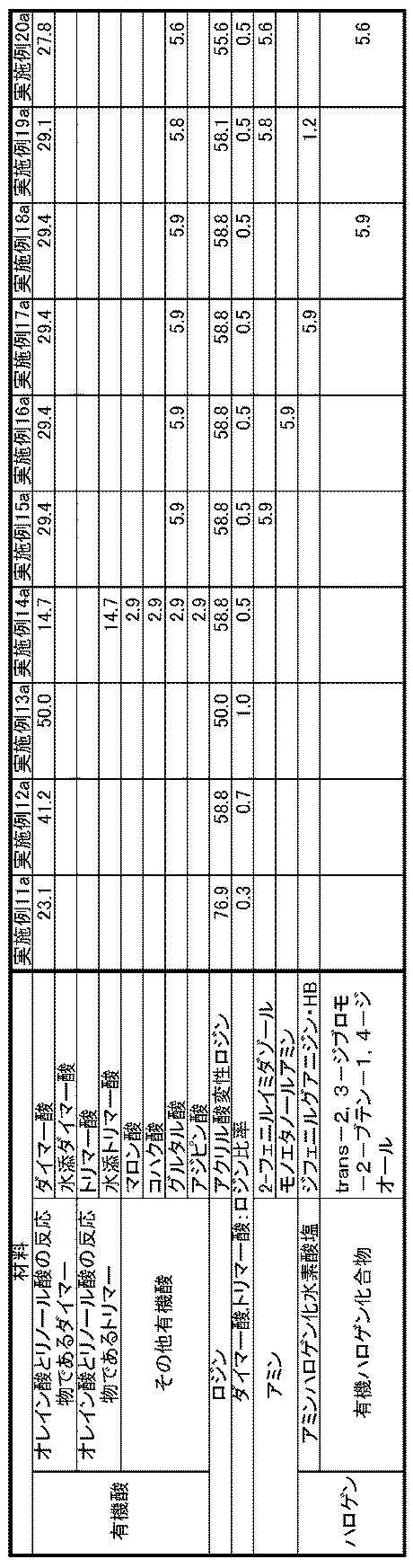
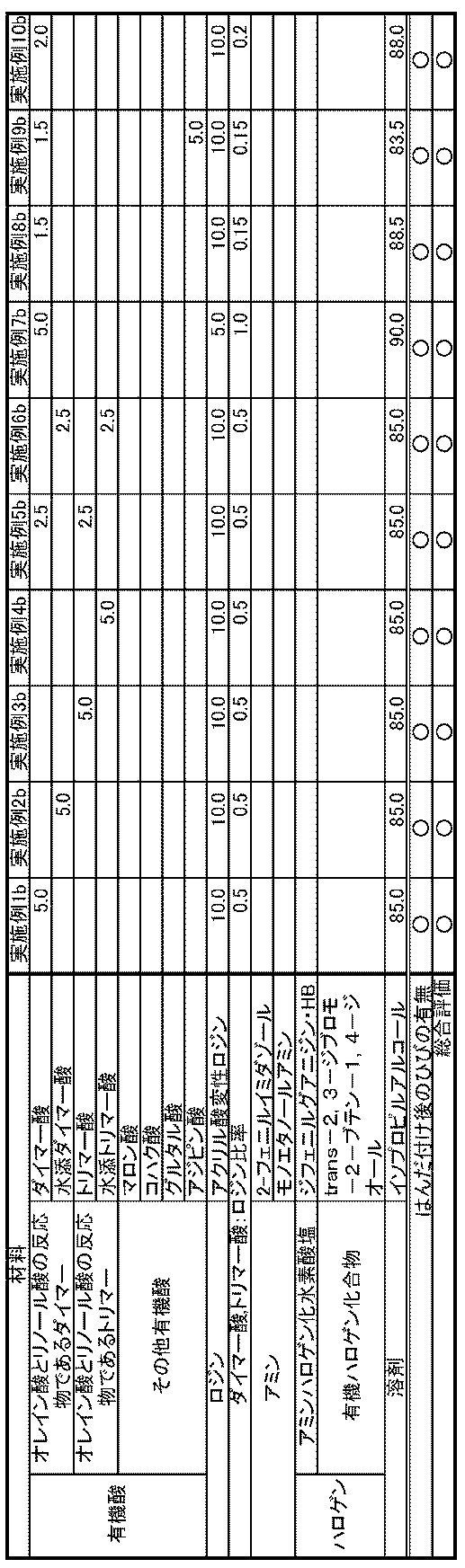


実施例1aに示すように、オレイン酸とリノール酸の反応物であるダイマー酸を33.3wt%、ロジンを67.7wt%含み、ロジンに対するダイマー酸の比率が0.5で、本発明で規定される範囲内である樹脂組成物を溶剤で希釈したはんだ付け用フラックスは、実施例1bに示すように、実施例1bに示すように、オレイン酸とリノール酸の反応物であるダイマー酸を5.0wt%、ロジンを10.0wt%含み、ロジンに対するダイマー酸の比率が0.5で、本発明で規定される範囲内であり、残部が溶剤である。実施例1bのはんだ付け用フラックスでは、はんだ付け後の残渣のひび割れの抑制に対して十分な効果が得られた。
実施例2aに示すように、オレイン酸とリノール酸の反応物であるダイマー酸に水素を添加した水添ダイマー酸を33.3wt%、ロジンを67.7wt%含み、ロジンに対する水添ダイマー酸の比率が0.5で、本発明で規定される範囲内である樹脂組成物を溶剤で希釈したはんだ付け用フラックスは、実施例2bに示すように、オレイン酸とリノール酸の反応物であるダイマー酸に水素を添加した水添ダイマー酸を5.0wt%、ロジンを10.0wt%含み、ロジンに対する水添ダイマー酸の比率が0.5で、本発明で規定される範囲内であり、残部が溶剤である。実施例2bのはんだ付け用フラックスでも、はんだ付け後の残渣のひび割れの抑制に対して十分な効果が得られた。
実施例3aに示すように、オレイン酸とリノール酸の反応物であるトリマー酸を33.3wt%、ロジンを67.7wt%含み、ロジンに対するトリマー酸の比率が0.5で、本発明で規定される範囲内である樹脂組成物を溶剤で希釈したはんだ付け用フラックスは、実施例3bに示すように、オレイン酸とリノール酸の反応物であるトリマー酸を5.0wt%、ロジンを10.0wt%含み、ロジンに対するトリマー酸の比率が0.5で、本発明で規定される範囲内であり、残部が溶剤である。実施例3bのはんだ付け用フラックスでも、はんだ付け後の残渣のひび割れの抑制に対して十分な効果が得られた。
実施例4aに示すように、オレイン酸とリノール酸の反応物であるトリマー酸に水素を添加した水添トリマー酸を33.3wt%、ロジンを67.7wt%含み、ロジンに対する水添トリマー酸の比率が0.5で、本発明で規定される範囲内である樹脂組成物を溶剤で希釈したはんだ付け用フラックスは、実施例4bに示すように、オレイン酸とリノール酸の反応物であるトリマー酸に水素を添加した水添トリマー酸を5.0wt%、ロジンを10.0wt%含み、ロジンに対する水添トリマー酸の比率が0.5で、本発明で規定される範囲内であり、残部が溶剤である。実施例4bのはんだ付け用フラックスでも、はんだ付け後の残渣のひび割れの抑制に対して十分な効果が得られた。
実施例5aに示すように、オレイン酸とリノール酸の反応物であるダイマー酸を16.7wt%、オレイン酸とリノール酸の反応物であるトリマー酸を16.7wt%、ロジンを67.7wt%含み、ロジンに対するダイマー酸とトリマー酸の合計量の比率が0.5で、本発明で規定される範囲内である樹脂組成物を溶剤で希釈したはんだ付け用フラックスは、実施例5bに示すように、オレイン酸とリノール酸の反応物であるダイマー酸を2.5wt%、オレイン酸とリノール酸の反応物であるトリマー酸を2.5wt%、ロジンを10.0wt%含み、ロジンに対するダイマー酸とトリマー酸の合計量の比率が0.5で、本発明で規定される範囲内であり、残部が溶剤である。実施例5bのはんだ付け用フラックスでも、はんだ付け後の残渣のひび割れの抑制に対して十分な効果が得られた。
実施例6aに示すように、オレイン酸とリノール酸の反応物であるダイマー酸に水素を添加した水添ダイマー酸を16.7wt%、オレイン酸とリノール酸の反応物であるトリマー酸に水素を添加した水添トリマー酸を16.7wt%、ロジンを67.7wt%含み、ロジンに対する水添ダイマー酸と水添トリマー酸の合計量の比率が0.5で、本発明で規定される範囲内である樹脂組成物を溶剤で希釈したはんだ付け用フラックスは、実施例6bに示すように、オレイン酸とリノール酸の反応物であるダイマー酸に水素を添加した水添ダイマー酸を2.5wt%、オレイン酸とリノール酸の反応物であるトリマー酸に水素を添加した水添トリマー酸を2.5wt%、ロジンを10.0wt%含み、ロジンに対する水添ダイマー酸と水添トリマー酸の合計量の比率が0.5で、本発明で規定される範囲内であり、残部が溶剤である。実施例6bのはんだ付け用フラックスでも、はんだ付け後の残渣のひび割れの抑制に対して十分な効果が得られた。
実施例7aに示すように、オレイン酸とリノール酸の反応物であるダイマー酸を50.0wt%、ロジンを50.0wt%含み、ロジンに対するダイマー酸の比率が1.0で、本発明で規定される範囲内である樹脂組成物を溶剤で希釈したはんだ付け用フラックスは、実施例7bに示すように、オレイン酸とリノール酸の反応物であるダイマー酸を5.0wt%、ロジンを5.0wt%含み、ロジンに対するダイマー酸の比率が1.0で、本発明で規定される範囲内であり、残部が溶剤である。実施例7bのはんだ付け用フラックスでも、はんだ付け後の残渣のひび割れの抑制に対して十分な効果が得られた。
実施例8aに示すように、オレイン酸とリノール酸の反応物であるダイマー酸を13.0wt%、ロジンを87.0wt%含み、ロジンに対するダイマー酸の比率が0.15で、本発明で規定される範囲内である樹脂組成物を溶剤で希釈したはんだ付け用フラックスは、実施例8bに示すように、オレイン酸とリノール酸の反応物であるダイマー酸を1.5wt%、ロジンを10.0wt%含み、ロジンに対するダイマー酸の比率が0.15で、本発明で規定される範囲内であり、残部が溶剤である。実施例8bのはんだ付け用フラックスでも、はんだ付け後の残渣のひび割れの抑制に対して十分な効果が得られた。
実施例9aに示すように、オレイン酸とリノール酸の反応物であるダイマー酸を9.1wt%、ロジンを66.6wt%含み、ロジンに対するダイマー酸の比率が0.15で、本発明で規定される範囲内であり、さらに有機酸としてアジピン酸を含む樹脂組成物を溶剤で希釈したはんだ付け用フラックスは、実施例9bに示すように、オレイン酸とリノール酸の反応物であるダイマー酸を1.5wt%、ロジンを10.0wt%含み、ロジンに対するダイマー酸の比率が0.15で、本発明で規定される範囲内であり、さらに、有機酸としてアジピン酸を本発明で規定された範囲内で含み、残部が溶剤である。実施例9bのはんだ付け用フラックスでも、はんだ付け後の残渣のひび割れの抑制に対して十分な効果が得られた。
実施例10aに示すように、オレイン酸とリノール酸の反応物であるダイマー酸を16.7wt%、ロジンを83.3wt%含み、ロジンに対するダイマー酸の比率が0.2で、本発明で規定される範囲内である樹脂組成物を溶剤で希釈したはんだ付け用フラックスは、実施例10bに示すように、オレイン酸とリノール酸の反応物であるダイマー酸を2.0wt%、ロジンを10.0wt%含み、ロジンに対するダイマー酸の比率が0.2で、本発明で規定される範囲内であり、残部が溶剤である。実施例10bのはんだ付け用フラックスでも、はんだ付け後の残渣のひび割れの抑制に対して十分な効果が得られた。
実施例11aに示すように、オレイン酸とリノール酸の反応物であるダイマー酸を23.1wt%、ロジンを76.9wt%含み、ロジンに対するダイマー酸の比率が0.3で、本発明で規定される範囲内である樹脂組成物を溶剤で希釈したはんだ付け用フラックスは、実施例11bに示すように、オレイン酸とリノール酸の反応物であるダイマー酸を3.0wt%、ロジンを10.0wt%含み、ロジンに対するダイマー酸の比率が0.3で、本発明で規定される範囲内であり、残部が溶剤である。実施例11bのはんだ付け用フラックスでも、はんだ付け後の残渣のひび割れの抑制に対して十分な効果が得られた。
実施例12aに示すように、オレイン酸とリノール酸の反応物であるダイマー酸を41.2wt%、ロジンを58.8wt%含み、ロジンに対するダイマー酸の比率が0.7で、本発明で規定される範囲内である樹脂組成物を溶剤で希釈したはんだ付け用フラックスは、実施例12bに示すように、オレイン酸とリノール酸の反応物であるダイマー酸を7.0wt%、ロジンを10.0wt%含み、ロジンに対するダイマー酸の比率が0.7で、本発明で規定される範囲内であり、残部が溶剤である。実施例12bのはんだ付け用フラックスでも、はんだ付け後の残渣のひび割れの抑制に対して十分な効果が得られた。
実施例13aに示すように、オレイン酸とリノール酸の反応物であるダイマー酸を50.0wt%、ロジンを50.0wt%含み、ロジンに対するダイマー酸の比率が1.0で、本発明で規定される範囲内である樹脂組成物を溶剤で希釈したはんだ付け用フラックスは、実施例13bに示すように、オレイン酸とリノール酸の反応物であるダイマー酸を10.0wt%、ロジンを10.0wt%含み、ロジンに対するダイマー酸の比率が1.0で、本発明で規定される範囲内であり、残部が溶剤である。実施例13bのはんだ付け用フラックスでも、はんだ付け後の残渣のひび割れの抑制に対して十分な効果が得られた。
実施例14aに示すように、オレイン酸とリノール酸の反応物であるダイマー酸を14.7wt%、オレイン酸とリノール酸の反応物であるトリマー酸に水素を添加した水添トリマー酸を14.7wt%、ロジンを58.8wt%含み、ロジンに対するダイマー酸と水添トリマー酸の合計量の比率が0.5で、本発明で規定される範囲内であり、さらに、有機酸としてマロン酸、コハク酸、グルタル酸、アジピン酸を含む樹脂組成物を溶剤で希釈したはんだ付け用フラックスは、実施例14bに示すように、オレイン酸とリノール酸の反応物であるダイマー酸を2.5wt%、オレイン酸とリノール酸の反応物であるトリマー酸に水素を添加した水添トリマー酸を2.5wt%、ロジンを10.0wt%含み、ロジンに対するダイマー酸と水添トリマー酸の合計量の比率が0.5で、本発明で規定される範囲内であり、さらに、有機酸としてマロン酸、コハク酸、グルタル酸、アジピン酸を本発明で規定された範囲内で含み、残部が溶剤である。実施例14bのはんだ付け用フラックスでも、はんだ付け後の残渣のひび割れの抑制に対して十分な効果が得られた。
実施例15aに示すように、オレイン酸とリノール酸の反応物であるダイマー酸を29.4wt%、ロジンを58.8wt%含み、ロジンに対するダイマー酸の比率が0.5で、本発明で規定される範囲内であり、さらに、有機酸としてグルタル酸を含み、アミンとして2-フェニルイミダゾールを含む樹脂組成物を溶剤で希釈したはんだ付け用フラックスは、実施例15bに示すように、オレイン酸とリノール酸の反応物であるダイマー酸を5.0wt%、ロジンを10.0wt%含み、ロジンに対するダイマー酸の比率が0.5で、本発明で規定される範囲内であり、さらに、有機酸としてグルタル酸を本発明で規定された範囲内で含み、アミンとして2-フェニルイミダゾールを本発明で規定された範囲内で含み、残部が溶剤である。実施例15bのはんだ付け用フラックスでも、はんだ付け後の残渣のひび割れの抑制に対して十分な効果が得られた。
実施例16aに示すように、オレイン酸とリノール酸の反応物であるダイマー酸を29.4wt%、ロジンを58.8wt%含み、ロジンに対するダイマー酸の比率が0.5で、本発明で規定される範囲内であり、さらに、有機酸としてグルタル酸を含み、アミンとしてモノエタノールアミンを含む樹脂組成物を溶剤で希釈したはんだ付け用フラックスは、実施例16bに示すように、オレイン酸とリノール酸の反応物であるダイマー酸を5.0wt%、ロジンを10.0wt%含み、ロジンに対するダイマー酸の比率が0.5で、本発明で規定される範囲内であり、さらに、有機酸としてグルタル酸を本発明で規定された範囲内で含み、アミンとしてモノエタノールアミンを本発明で規定された範囲内で含み、残部が溶剤である。実施例16bのはんだ付け用フラックスでも、はんだ付け後の残渣のひび割れの抑制に対して十分な効果が得られた。
実施例17aに示すように、オレイン酸とリノール酸の反応物であるダイマー酸を29.4wt%、ロジンを58.8wt%含み、ロジンに対するダイマー酸の比率が0.5で、本発明で規定される範囲内であり、さらに、有機酸としてグルタル酸を含み、ハロゲンとしてアミンハロゲン化水素酸塩を含む樹脂組成物を溶剤で希釈したはんだ付け用フラックスは、実施例17bに示すように、オレイン酸とリノール酸の反応物であるダイマー酸を5.0wt%、ロジンを10.0wt%含み、ロジンに対するダイマー酸の比率が0.5で、本発明で規定される範囲内であり、さらに、有機酸としてグルタル酸を本発明で規定された範囲内で含み、ハロゲンとしてアミンハロゲン化水素酸塩を本発明で規定された範囲内で含み、残部が溶剤である。実施例17bのはんだ付け用フラックスでも、はんだ付け後の残渣のひび割れの抑制に対して十分な効果が得られた。
実施例18aに示すように、オレイン酸とリノール酸の反応物であるダイマー酸を29.4wt%、ロジンを58.8wt%含み、ロジンに対するダイマー酸の比率が0.5で、本発明で規定される範囲内であり、さらに、有機酸としてグルタル酸を含み、ハロゲンとして有機ハロゲン化合物を含む樹脂組成物を溶剤で希釈したはんだ付け用フラックスは、実施例18bに示すように、オレイン酸とリノール酸の反応物であるダイマー酸を5.0wt%、ロジンを10.0wt%含み、ロジンに対するダイマー酸の比率が0.5で、本発明で規定される範囲内であり、さらに、有機酸としてグルタル酸を本発明で規定された範囲内で含み、ハロゲンとして有機ハロゲン化合物を本発明で規定された範囲内で含み、残部が溶剤である。実施例18bのはんだ付け用フラックスでも、はんだ付け後の残渣のひび割れの抑制に対して十分な効果が得られた。
実施例19aに示すように、オレイン酸とリノール酸の反応物であるダイマー酸を29.1wt%、ロジンを58.1wt%含み、ロジンに対するダイマー酸の比率が0.5で、本発明で規定される範囲内であり、さらに、有機酸としてグルタル酸を含み、アミンとして2-フェニルイミダゾールを含み、ハロゲンとしてアミンハロゲン化水素酸塩を含む樹脂組成物を溶剤で希釈したはんだ付け用フラックスは、実施例19bに示すように、オレイン酸とリノール酸の反応物であるダイマー酸を5.0wt%、ロジンを10.0wt%含み、ロジンに対するダイマー酸の比率が0.5で、本発明で規定される範囲内であり、さらに、有機酸としてグルタル酸を本発明で規定された範囲内で含み、アミンとして2-フェニルイミダゾールを本発明で規定された範囲内で含み、ハロゲンとしてアミンハロゲン化水素酸塩を本発明で規定された範囲内で含み、残部が溶剤である。実施例19bのはんだ付け用フラックスでも、はんだ付け後の残渣のひび割れの抑制に対して十分な効果が得られた。
実施例20aに示すように、オレイン酸とリノール酸の反応物であるダイマー酸を27.8wt%、ロジンを55.6wt%含み、ロジンに対するダイマー酸の比率が0.5で、本発明で規定される範囲内であり、さらに、有機酸としてグルタル酸を含み、アミンとして2-フェニルイミダゾールを含み、ハロゲンとして有機ハロゲン化合物を含む樹脂組成物を溶剤で希釈したはんだ付け用フラックスは、実施例20bに示すように、オレイン酸とリノール酸の反応物であるダイマー酸を5.0wt%、ロジンを10.0wt%含み、ロジンに対するダイマー酸の比率が0.5で、本発明で規定される範囲内であり、さらに、有機酸としてグルタル酸を本発明で規定された範囲内で含み、アミンとして2-フェニルイミダゾールを本発明で規定された範囲内で含み、ハロゲンとして有機ハロゲン化合物を本発明で規定された範囲内で含み、残部が溶剤である。実施例20bのはんだ付け用フラックスでも、はんだ付け後の残渣のひび割れの抑制に対して十分な効果が得られた。
なお、各実施例では、溶剤としてイソプロピルアルコールを使用したが、工業用エタノール(エタノールにメタノール及び/またはイソプロピルアルコールを添加した混合溶剤)を使用しても同様の効果が得られた。
これに対して、比較例1aに示すように、オレイン酸とリノール酸の反応物であるダイマー酸、オレイン酸とリノール酸の反応物であるトリマー酸、オレイン酸とリノール酸の反応物であるダイマー酸に水素を添加した水添ダイマー酸またはオレイン酸とリノール酸の反応物であるトリマー酸に水素を添加した水添トリマー酸のいずれも含まず、有機酸としてマロン酸を含み、さらにロジンを含む樹脂組成物を溶剤で希釈したはんだ付け用フラックスは、比較例1bに示すように、オレイン酸とリノール酸の反応物であるダイマー酸、オレイン酸とリノール酸の反応物であるトリマー酸、オレイン酸とリノール酸の反応物であるダイマー酸に水素を添加した水添ダイマー酸またはオレイン酸とリノール酸の反応物であるトリマー酸に水素を添加した水添トリマー酸のいずれも含まず、有機酸としてマロン酸を本発明で規定された範囲内で含み、さらにロジンを本発明で規定された範囲内で含み、残部が溶剤である。比較例1bのはんだ付け用フラックスでは、はんだ付け後の残渣のひび割れが見られ、残渣のひび割れの抑制に対して十分な効果が得られなかった。
比較例2aに示すように、オレイン酸とリノール酸の反応物であるダイマー酸、オレイン酸とリノール酸の反応物であるトリマー酸、オレイン酸とリノール酸の反応物であるダイマー酸に水素を添加した水添ダイマー酸またはオレイン酸とリノール酸の反応物であるトリマー酸に水素を添加した水添トリマー酸のいずれも含まず、有機酸としてコハク酸を含み、さらにロジンを含む樹脂組成物を溶剤で希釈したはんだ付け用フラックスは、比較例2bに示すように、オレイン酸とリノール酸の反応物であるダイマー酸、オレイン酸とリノール酸の反応物であるトリマー酸、オレイン酸とリノール酸の反応物であるダイマー酸に水素を添加した水添ダイマー酸またはオレイン酸とリノール酸の反応物であるトリマー酸に水素を添加した水添トリマー酸のいずれも含まず、有機酸としてコハク酸を本発明で規定された範囲内で含み、さらにロジンを本発明で規定された範囲内で含み、残部が溶剤である。比較例2bのはんだ付け用フラックスでも、はんだ付け後の残渣のひび割れが見られ、残渣のひび割れの抑制に対して十分な効果が得られなかった。
比較例3aに示すように、オレイン酸とリノール酸の反応物であるダイマー酸、オレイン酸とリノール酸の反応物であるトリマー酸、オレイン酸とリノール酸の反応物であるダイマー酸に水素を添加した水添ダイマー酸またはオレイン酸とリノール酸の反応物であるトリマー酸に水素を添加した水添トリマー酸のいずれも含まず、有機酸としてグルタル酸を含み、さらにロジンを含む樹脂組成物を溶剤で希釈したはんだ付け用フラックスは、比較例3bに示すように、オレイン酸とリノール酸の反応物であるダイマー酸、オレイン酸とリノール酸の反応物であるトリマー酸、オレイン酸とリノール酸の反応物であるダイマー酸に水素を添加した水添ダイマー酸またはオレイン酸とリノール酸の反応物であるトリマー酸に水素を添加した水添トリマー酸のいずれも含まず、有機酸としてグルタル酸を本発明で規定された範囲内で含み、さらにロジンを本発明で規定された範囲内で含み、残部が溶剤である。比較例3bのはんだ付け用フラックスでも、はんだ付け後の残渣のひび割れが見られ、残渣のひび割れの抑制に対して十分な効果が得られなかった。
比較例4aに示すように、オレイン酸とリノール酸の反応物であるダイマー酸、オレイン酸とリノール酸の反応物であるトリマー酸、オレイン酸とリノール酸の反応物であるダイマー酸に水素を添加した水添ダイマー酸またはオレイン酸とリノール酸の反応物であるトリマー酸に水素を添加した水添トリマー酸のいずれも含まず、有機酸としてアジピン酸を含み、さらにロジンを含む樹脂組成物を溶剤で希釈したはんだ付け用フラックスは、比較例4bに示すように、オレイン酸とリノール酸の反応物であるダイマー酸、オレイン酸とリノール酸の反応物であるトリマー酸、オレイン酸とリノール酸の反応物であるダイマー酸に水素を添加した水添ダイマー酸またはオレイン酸とリノール酸の反応物であるトリマー酸に水素を添加した水添トリマー酸のいずれも含まず、有機酸としてアジピン酸を本発明で規定された範囲内で含み、さらにロジンを本発明で規定された範囲内で含み、残部が溶剤である。比較例4bのはんだ付け用フラックスでも、はんだ付け後の残渣のひび割れが見られ、残渣のひび割れの抑制に対して十分な効果が得られなかった。
比較例5aに示すように、オレイン酸とリノール酸の反応物であるダイマー酸、オレイン酸とリノール酸の反応物であるトリマー酸、オレイン酸とリノール酸の反応物であるダイマー酸に水素を添加した水添ダイマー酸またはオレイン酸とリノール酸の反応物であるトリマー酸に水素を添加した水添トリマー酸のいずれも含まず、その他の有機酸も含まず、ロジンのみを含む樹脂組成物を溶剤で希釈したはんだ付け用フラックスは、比較例5bに示すように、オレイン酸とリノール酸の反応物であるダイマー酸、オレイン酸とリノール酸の反応物であるトリマー酸、オレイン酸とリノール酸の反応物であるダイマー酸に水素を添加した水添ダイマー酸またはオレイン酸とリノール酸の反応物であるトリマー酸に水素を添加した水添トリマー酸のいずれも含まず、その他の有機酸も含まず、ロジンのみを含む。比較例5bのはんだ付け用フラックスでも、はんだ付け後の残渣のひび割れが見られ、残渣のひび割れの抑制に対して十分な効果が得られなかった。
比較例6aに示すように、オレイン酸とリノール酸の反応物であるダイマー酸を含む場合でも、オレイン酸とリノール酸の反応物であるダイマー酸を1.0wt%、ロジンを99.0wt%含み、ロジンに対するダイマー酸の比率が0.01で、本発明で規定される範囲を下回る樹脂組成物を溶剤で希釈したはんだ付け用フラックスは、比較例6bに示すように、オレイン酸とリノール酸の反応物であるダイマー酸を0.1wt%、ロジンを10.0wt%含み、残部が溶剤であり、ダイマー酸の量が本発明で規定された範囲を下回り、ロジンに対するダイマー酸の比率が0.01で、本発明で規定された範囲を下回る。比較例6bのはんだ付け用フラックスでは、はんだ付け後の残渣のひび割れが見られ、残渣のひび割れの抑制に対して十分な効果が得られなかった。
比較例7aに示すように、オレイン酸とリノール酸の反応物であるダイマー酸を含む場合でも、オレイン酸とリノール酸の反応物であるダイマー酸を4.8wt%、ロジンを95.2wt%含み、ロジンに対するダイマー酸の比率が0.05で、本発明で規定される範囲を下回る樹脂組成物を溶剤で希釈したはんだ付け用フラックスは、比較例7bに示すように、オレイン酸とリノール酸の反応物であるダイマー酸を0.5wt%、ロジンを10.0wt%含み、残部が溶剤であり、ダイマー酸の量が本発明で規定された範囲を下回り、ロジンに対するダイマー酸の比率が0.05で、本発明で規定された範囲を下回る。比較例7bのはんだ付け用フラックスでは、はんだ付け後の残渣のひび割れが見られ、残渣のひび割れの抑制に対して十分な効果が得られなかった。
比較例8aに示すように、オレイン酸とリノール酸の反応物であるダイマー酸を含む場合でも、オレイン酸とリノール酸の反応物であるダイマー酸を9.1wt%、ロジンを90.9wt%含み、ロジンに対するダイマー酸の比率が0.1で、本発明で規定される範囲を下回る樹脂組成物を溶剤で希釈したはんだ付け用フラックスは、比較例8bに示すように、オレイン酸とリノール酸の反応物であるダイマー酸を1.0wt%、ロジンを10.0wt%含み、残部が溶剤であり、ダイマー酸の量が本発明で規定された範囲を下回り、ロジンに対するダイマー酸の比率が0.1で、本発明で規定された範囲を下回る。比較例8bのはんだ付け用フラックスでは、はんだ付け後の残渣のひび割れが見られ、残渣のひび割れの抑制に対して十分な効果が得られなかった。
比較例9a~比較例12aに示すように、オレイン酸とリノール酸の反応物であるダイマー酸、オレイン酸とリノール酸の反応物であるトリマー酸、オレイン酸とリノール酸の反応物であるダイマー酸に水素を添加した水添ダイマー酸またはオレイン酸とリノール酸の反応物であるトリマー酸に水素を添加した水添トリマー酸のいずれも含まず、有機酸としてグルタル酸を含み、さらにロジンを含む樹脂組成物を溶剤で希釈したはんだ付け用フラックスは、比較例9b~比較例12bに示すように、オレイン酸とリノール酸の反応物であるダイマー酸、オレイン酸とリノール酸の反応物であるトリマー酸、オレイン酸とリノール酸の反応物であるダイマー酸に水素を添加した水添ダイマー酸またはオレイン酸とリノール酸の反応物であるトリマー酸に水素を添加した水添トリマー酸のいずれも含まず、有機酸としてグルタル酸を含み、さらにロジンを含む。比較例9b~比較例12bのはんだ付け用フラックスでは、本発明で規定される範囲内で有機酸の量を変えても、はんだ付け後の残渣のひび割れが見られ、残渣のひび割れの抑制に対して十分な効果が得られなかった。
比較例比較例13aに示すように、オレイン酸とリノール酸の反応物であるダイマー酸、オレイン酸とリノール酸の反応物であるトリマー酸、オレイン酸とリノール酸の反応物であるダイマー酸に水素を添加した水添ダイマー酸またはオレイン酸とリノール酸の反応物であるトリマー酸に水素を添加した水添トリマー酸のいずれも含まず、有機酸としてグルタル酸を含み、さらにロジンを含む樹脂組成物を溶剤で希釈したはんだ付け用フラックスは、比較例13bに示すように、オレイン酸とリノール酸の反応物であるダイマー酸、オレイン酸とリノール酸の反応物であるトリマー酸、オレイン酸とリノール酸の反応物であるダイマー酸に水素を添加した水添ダイマー酸またはオレイン酸とリノール酸の反応物であるトリマー酸に水素を添加した水添トリマー酸のいずれも含まず、有機酸としてグルタル酸を本発明で規定された範囲を超えて含み、さらにロジンを含む。比較例13bのはんだ付け用フラックスでは、はんだ付け後の残渣のひび割れが見られ、残渣のひび割れの抑制に対して十分な効果が得られなかった。
以上のことから、オレイン酸とリノール酸の反応物であるダイマー酸、オレイン酸とリノール酸の反応物であるトリマー酸、オレイン酸とリノール酸の反応物であるダイマー酸に水素を添加した水添ダイマー酸またはオレイン酸とリノール酸の反応物であるトリマー酸に水素を添加した水添トリマー酸のいずれか、あるいは、オレイン酸とリノール酸の反応物であるダイマー酸、オレイン酸とリノール酸の反応物であるトリマー酸、オレイン酸とリノール酸の反応物であるダイマー酸に水素を添加した水添ダイマー酸及びオレイン酸とリノール酸の反応物であるトリマー酸に水素を添加した水添トリマー酸の2種以上とロジンと溶剤とを含み、オレイン酸とリノール酸の反応物であるダイマー酸、オレイン酸とリノール酸の反応物であるトリマー酸、オレイン酸とリノール酸の反応物であるダイマー酸に水素を添加した水添ダイマー酸またはオレイン酸とリノール酸の反応物であるトリマー酸に水素を添加した水添トリマー酸のいずれかの量、あるいは、オレイン酸とリノール酸の反応物であるダイマー酸、オレイン酸とリノール酸の反応物であるトリマー酸、オレイン酸とリノール酸の反応物であるダイマー酸に水素を添加した水添ダイマー酸及びオレイン酸とリノール酸の反応物であるトリマー酸に水素を添加した水添トリマー酸の2種以上の合計の量と、ロジンの量の比率が、ロジンを基準として0.15以上1.00以下であるはんだ付け用フラックスでは、はんだ付け後の残渣のひび割れが抑制された。
以上の効果は、オレイン酸とリノール酸の反応物であるダイマー酸、オレイン酸とリノール酸の反応物であるトリマー酸、オレイン酸とリノール酸の反応物であるダイマー酸に水素を添加した水添ダイマー酸またはオレイン酸とリノール酸の反応物であるトリマー酸に水素を添加した水添トリマー酸のいずれか、あるいは、オレイン酸とリノール酸の反応物であるダイマー酸、オレイン酸とリノール酸の反応物であるトリマー酸、オレイン酸とリノール酸の反応物であるダイマー酸に水素を添加した水添ダイマー酸及びオレイン酸とリノール酸の反応物であるトリマー酸に水素を添加した水添トリマー酸の2種以上とロジンとを含み、オレイン酸とリノール酸の反応物であるダイマー酸、オレイン酸とリノール酸の反応物であるトリマー酸、オレイン酸とリノール酸の反応物であるダイマー酸に水素を添加した水添ダイマー酸またはオレイン酸とリノール酸の反応物であるトリマー酸に水素を添加した水添トリマー酸のいずれかの量、あるいは、オレイン酸とリノール酸の反応物であるダイマー酸、オレイン酸とリノール酸の反応物であるトリマー酸、オレイン酸とリノール酸の反応物であるダイマー酸に水素を添加した水添ダイマー酸及びオレイン酸とリノール酸の反応物であるトリマー酸に水素を添加した水添トリマー酸の2種以上の合計の量と、ロジンの量の比率が、ロジンを基準として0.15以上1.00以下である樹脂組成物を溶剤で希釈したはんだ付け用フラックスで得られた。
これにより、オレイン酸とリノール酸の反応物であるダイマー酸、オレイン酸とリノール酸の反応物であるトリマー酸、オレイン酸とリノール酸の反応物であるダイマー酸に水素を添加した水添ダイマー酸またはオレイン酸とリノール酸の反応物であるトリマー酸に水素を添加した水添トリマー酸のいずれかの量、あるいは、オレイン酸とリノール酸の反応物であるダイマー酸、オレイン酸とリノール酸の反応物であるトリマー酸、オレイン酸とリノール酸の反応物であるダイマー酸に水素を添加した水添ダイマー酸及びオレイン酸とリノール酸の反応物であるトリマー酸に水素を添加した水添トリマー酸の2種以上の合計の量と、ロジンの量の比率に、発明の効果が起因することが判った。
Claims (6)
- オレイン酸とリノール酸の反応物であるダイマー酸、オレイン酸とリノール酸の反応物であるトリマー酸、オレイン酸とリノール酸の反応物であるダイマー酸に水素を添加した水添ダイマー酸またはオレイン酸とリノール酸の反応物であるトリマー酸に水素を添加した水添トリマー酸のいずれか、あるいは、オレイン酸とリノール酸の反応物であるダイマー酸、オレイン酸とリノール酸の反応物であるトリマー酸、オレイン酸とリノール酸の反応物であるダイマー酸に水素を添加した水添ダイマー酸及びオレイン酸とリノール酸の反応物であるトリマー酸に水素を添加した水添トリマー酸の2種以上とロジンとを含み、
オレイン酸とリノール酸の反応物であるダイマー酸、オレイン酸とリノール酸の反応物であるトリマー酸、オレイン酸とリノール酸の反応物であるダイマー酸に水素を添加した水添ダイマー酸またはオレイン酸とリノール酸の反応物であるトリマー酸に水素を添加した水添トリマー酸のいずれかの量、あるいは、オレイン酸とリノール酸の反応物であるダイマー酸、オレイン酸とリノール酸の反応物であるトリマー酸、オレイン酸とリノール酸の反応物であるダイマー酸に水素を添加した水添ダイマー酸及びオレイン酸とリノール酸の反応物であるトリマー酸に水素を添加した水添トリマー酸の2種以上の合計の量と、ロジンの量の比率が、ロジンを基準として0.15以上1.00以下である
ことを特徴とする樹脂組成物。 - オレイン酸とリノール酸の反応物であるダイマー酸、オレイン酸とリノール酸の反応物であるトリマー酸、オレイン酸とリノール酸の反応物であるダイマー酸に水素を添加した水添ダイマー酸またはオレイン酸とリノール酸の反応物であるトリマー酸に水素を添加した水添トリマー酸のいずれか、あるいは、オレイン酸とリノール酸の反応物であるダイマー酸、オレイン酸とリノール酸の反応物であるトリマー酸、オレイン酸とリノール酸の反応物であるダイマー酸に水素を添加した水添ダイマー酸及びオレイン酸とリノール酸の反応物であるトリマー酸に水素を添加した水添トリマー酸の2種以上とロジンと溶剤とを含み、
オレイン酸とリノール酸の反応物であるダイマー酸、オレイン酸とリノール酸の反応物であるトリマー酸、オレイン酸とリノール酸の反応物であるダイマー酸に水素を添加した水添ダイマー酸またはオレイン酸とリノール酸の反応物であるトリマー酸に水素を添加した水添トリマー酸のいずれかの量、あるいは、オレイン酸とリノール酸の反応物であるダイマー酸、オレイン酸とリノール酸の反応物であるトリマー酸、オレイン酸とリノール酸の反応物であるダイマー酸に水素を添加した水添ダイマー酸及びオレイン酸とリノール酸の反応物であるトリマー酸に水素を添加した水添トリマー酸の2種以上の合計の量と、ロジンの量の比率が、ロジンを基準として0.15以上1.00以下である
ことを特徴とするはんだ付け用フラックス。 - オレイン酸とリノール酸の反応物であるダイマー酸、オレイン酸とリノール酸の反応物であるトリマー酸、オレイン酸とリノール酸の反応物であるダイマー酸に水素を添加した水添ダイマー酸またはオレイン酸とリノール酸の反応物であるトリマー酸に水素を添加した水添トリマー酸のいずれか、あるいは、オレイン酸とリノール酸の反応物であるダイマー酸、オレイン酸とリノール酸の反応物であるトリマー酸、オレイン酸とリノール酸の反応物であるダイマー酸に水素を添加した水添ダイマー酸及びオレイン酸とリノール酸の反応物であるトリマー酸に水素を添加した水添トリマー酸の2種以上の合計を、1.5wt%以上10.0wt%以下含む
ことを特徴とする請求項2に記載のはんだ付け用フラックス。 - ロジンを5.0wt%以上10.0wt%以下、
溶剤を80.0wt%以上90.0wt%以下含む
ことを特徴とする請求項2または請求項3に記載のはんだ付け用フラックス。 - 活性剤としてさらに他の有機酸を0wt%以上5.0wt%以下、
有機ハロゲン化合物を0wt%以上1.0wt%以下、
アミンハロゲン化水素酸塩を0wt%以上1.0wt%以下含む
ことを特徴とする請求項2~請求項4の何れか1項に記載のはんだ付け用フラックス。 - 活性剤としてさらにアミンを0wt%以上1.0wt%以下含む
ことを特徴とする請求項2~請求項5の何れか1項に記載のはんだ付け用フラックス。
Priority Applications (4)
| Application Number | Priority Date | Filing Date | Title |
|---|---|---|---|
| KR1020207021689A KR20200096302A (ko) | 2017-12-29 | 2018-12-28 | 수지 조성물 및 납땜용 플럭스 |
| CN201880084769.2A CN111587163B (zh) | 2017-12-29 | 2018-12-28 | 树脂组合物和软钎焊用助焊剂 |
| MYPI2020003136A MY185940A (en) | 2017-12-29 | 2018-12-28 | Resin composition and soldering flux |
| US16/957,827 US11772208B2 (en) | 2017-12-29 | 2018-12-28 | Resin composition and soldering flux |
Applications Claiming Priority (2)
| Application Number | Priority Date | Filing Date | Title |
|---|---|---|---|
| JP2017-255177 | 2017-12-29 | ||
| JP2017255177A JP6540789B1 (ja) | 2017-12-29 | 2017-12-29 | 樹脂組成物及びはんだ付け用フラックス |
Publications (1)
| Publication Number | Publication Date |
|---|---|
| WO2019132015A1 true WO2019132015A1 (ja) | 2019-07-04 |
Family
ID=67063796
Family Applications (1)
| Application Number | Title | Priority Date | Filing Date |
|---|---|---|---|
| PCT/JP2018/048520 Ceased WO2019132015A1 (ja) | 2017-12-29 | 2018-12-28 | 樹脂組成物及びはんだ付け用フラックス |
Country Status (6)
| Country | Link |
|---|---|
| US (1) | US11772208B2 (ja) |
| JP (1) | JP6540789B1 (ja) |
| KR (1) | KR20200096302A (ja) |
| CN (1) | CN111587163B (ja) |
| MY (1) | MY185940A (ja) |
| WO (1) | WO2019132015A1 (ja) |
Families Citing this family (6)
| Publication number | Priority date | Publication date | Assignee | Title |
|---|---|---|---|---|
| JP6540789B1 (ja) | 2017-12-29 | 2019-07-10 | 千住金属工業株式会社 | 樹脂組成物及びはんだ付け用フラックス |
| JP6540788B1 (ja) * | 2017-12-29 | 2019-07-10 | 千住金属工業株式会社 | フラックス及びソルダペースト |
| JP6501003B1 (ja) * | 2018-01-17 | 2019-04-17 | 千住金属工業株式会社 | はんだ付け用樹脂組成物、やに入りはんだ、フラックスコートはんだ及び液状フラックス |
| JP6700570B1 (ja) * | 2019-09-18 | 2020-05-27 | 千住金属工業株式会社 | フラックスおよびソルダペースト |
| JP7252504B1 (ja) * | 2022-08-26 | 2023-04-05 | 千住金属工業株式会社 | フラックス及び電子部品の製造方法 |
| JP7808574B2 (ja) * | 2023-07-25 | 2026-01-29 | 株式会社タムラ製作所 | はんだ付け用フラックス組成物 |
Citations (4)
| Publication number | Priority date | Publication date | Assignee | Title |
|---|---|---|---|---|
| JP2005144518A (ja) * | 2003-11-18 | 2005-06-09 | Matsushita Electric Ind Co Ltd | はんだ付け用フラックス |
| WO2006025224A1 (ja) * | 2004-08-31 | 2006-03-09 | Senju Metal Industry Co., Ltd | はんだ付け用フラックス |
| JP2007532321A (ja) * | 2004-04-16 | 2007-11-15 | ピー.ケイ メタル,インコーポレイティド | はんだ付け方法および装置 |
| JP2013188761A (ja) * | 2012-03-12 | 2013-09-26 | Koki:Kk | フラックス、はんだ組成物および電子回路実装基板の製造方法 |
Family Cites Families (10)
| Publication number | Priority date | Publication date | Assignee | Title |
|---|---|---|---|---|
| US4561913A (en) * | 1984-03-12 | 1985-12-31 | At&T Technologies, Inc. | Soldering flux additive |
| US6852814B2 (en) * | 1994-09-02 | 2005-02-08 | Henkel Corporation | Thermosetting resin compositions containing maleimide and/or vinyl compounds |
| JP2002120090A (ja) * | 2000-10-17 | 2002-04-23 | Topy Ind Ltd | クリームはんだ |
| US7861915B2 (en) | 2004-04-16 | 2011-01-04 | Ms2 Technologies, Llc | Soldering process |
| WO2005118213A2 (en) | 2004-05-28 | 2005-12-15 | P. Kay Metal, Inc. | Solder paste and process |
| JP2008110392A (ja) | 2006-10-31 | 2008-05-15 | Harima Chem Inc | はんだ付け用フラックスおよびはんだペースト組成物 |
| JP5415640B2 (ja) | 2013-05-02 | 2014-02-12 | ハリマ化成株式会社 | はんだペースト用フラックスおよびはんだペースト組成物 |
| CN105855749B (zh) * | 2016-04-27 | 2017-02-22 | 深圳市晨日科技股份有限公司 | 一种水洗芯片固晶锡膏及其制备方法 |
| JP6540789B1 (ja) | 2017-12-29 | 2019-07-10 | 千住金属工業株式会社 | 樹脂組成物及びはんだ付け用フラックス |
| JP6540788B1 (ja) * | 2017-12-29 | 2019-07-10 | 千住金属工業株式会社 | フラックス及びソルダペースト |
-
2017
- 2017-12-29 JP JP2017255177A patent/JP6540789B1/ja active Active
-
2018
- 2018-12-28 KR KR1020207021689A patent/KR20200096302A/ko not_active Ceased
- 2018-12-28 WO PCT/JP2018/048520 patent/WO2019132015A1/ja not_active Ceased
- 2018-12-28 US US16/957,827 patent/US11772208B2/en active Active
- 2018-12-28 MY MYPI2020003136A patent/MY185940A/en unknown
- 2018-12-28 CN CN201880084769.2A patent/CN111587163B/zh active Active
Patent Citations (4)
| Publication number | Priority date | Publication date | Assignee | Title |
|---|---|---|---|---|
| JP2005144518A (ja) * | 2003-11-18 | 2005-06-09 | Matsushita Electric Ind Co Ltd | はんだ付け用フラックス |
| JP2007532321A (ja) * | 2004-04-16 | 2007-11-15 | ピー.ケイ メタル,インコーポレイティド | はんだ付け方法および装置 |
| WO2006025224A1 (ja) * | 2004-08-31 | 2006-03-09 | Senju Metal Industry Co., Ltd | はんだ付け用フラックス |
| JP2013188761A (ja) * | 2012-03-12 | 2013-09-26 | Koki:Kk | フラックス、はんだ組成物および電子回路実装基板の製造方法 |
Also Published As
| Publication number | Publication date |
|---|---|
| US20210060714A1 (en) | 2021-03-04 |
| US11772208B2 (en) | 2023-10-03 |
| CN111587163B (zh) | 2022-03-25 |
| JP2019118929A (ja) | 2019-07-22 |
| MY185940A (en) | 2021-06-14 |
| KR20200096302A (ko) | 2020-08-11 |
| JP6540789B1 (ja) | 2019-07-10 |
| CN111587163A (zh) | 2020-08-25 |
Similar Documents
| Publication | Publication Date | Title |
|---|---|---|
| JP6540789B1 (ja) | 樹脂組成物及びはんだ付け用フラックス | |
| JP6460198B1 (ja) | フラックス及びソルダペースト | |
| CN111587162B (zh) | 焊接用树脂组合物、树脂芯焊料、焊剂皮焊料及液态焊剂 | |
| KR102167480B1 (ko) | 플럭스 및 솔더 페이스트 | |
| JP6458894B1 (ja) | フラックス及びソルダペースト | |
| WO2019142772A1 (ja) | フラックス及びソルダペースト | |
| CN110814576B (zh) | 助焊剂和焊膏 | |
| JP6836090B1 (ja) | フラックス組成物、及びそれを用いたはんだペースト | |
| JP2019084549A (ja) | フラックス及びソルダペースト | |
| JP2020163456A (ja) | フラックス及びソルダペースト | |
| JP6414314B1 (ja) | はんだ付け用フラックスに用いられる樹脂組成物及びはんだ付け用フラックス | |
| JP6676244B1 (ja) | フラックス及びはんだペースト | |
| WO2020241687A1 (ja) | マレイン酸変性ロジンエステル又はマレイン酸変性ロジンアミドを含むフラックス用組成物、及びそれを含むフラックス、並びにはんだペースト | |
| JP2020192557A (ja) | フラックス及びはんだペースト | |
| JP2021079442A (ja) | マレイン酸変性ロジンエステル又はマレイン酸変性ロジンアミドを含むフラックス用組成物、及びそれを含むフラックス、並びにはんだペースト | |
| JP2021079443A (ja) | マレイン酸変性ロジンエステル又はマレイン酸変性ロジンアミドを含むフラックス用組成物、及びそれを含むフラックス、並びにはんだペースト | |
| HK40057684A (en) | Flux composition containing maleic acid-modified rosin ester or maleic acid-modified rosin amide, flux containing said composition, solder paste |
Legal Events
| Date | Code | Title | Description |
|---|---|---|---|
| 121 | Ep: the epo has been informed by wipo that ep was designated in this application |
Ref document number: 18895334 Country of ref document: EP Kind code of ref document: A1 |
|
| NENP | Non-entry into the national phase |
Ref country code: DE |
|
| ENP | Entry into the national phase |
Ref document number: 20207021689 Country of ref document: KR Kind code of ref document: A |
|
| 122 | Ep: pct application non-entry in european phase |
Ref document number: 18895334 Country of ref document: EP Kind code of ref document: A1 |