WO2019131105A1 - 吸収性物品 - Google Patents
吸収性物品 Download PDFInfo
- Publication number
- WO2019131105A1 WO2019131105A1 PCT/JP2018/045468 JP2018045468W WO2019131105A1 WO 2019131105 A1 WO2019131105 A1 WO 2019131105A1 JP 2018045468 W JP2018045468 W JP 2018045468W WO 2019131105 A1 WO2019131105 A1 WO 2019131105A1
- Authority
- WO
- WIPO (PCT)
- Prior art keywords
- absorbent article
- tape member
- skin
- main body
- area
- Prior art date
- Legal status (The legal status is an assumption and is not a legal conclusion. Google has not performed a legal analysis and makes no representation as to the accuracy of the status listed.)
- Ceased
Links
Images



Classifications
-
- A—HUMAN NECESSITIES
- A61—MEDICAL OR VETERINARY SCIENCE; HYGIENE
- A61F—FILTERS IMPLANTABLE INTO BLOOD VESSELS; PROSTHESES; DEVICES PROVIDING PATENCY TO, OR PREVENTING COLLAPSING OF, TUBULAR STRUCTURES OF THE BODY, e.g. STENTS; ORTHOPAEDIC, NURSING OR CONTRACEPTIVE DEVICES; FOMENTATION; TREATMENT OR PROTECTION OF EYES OR EARS; BANDAGES, DRESSINGS OR ABSORBENT PADS; FIRST-AID KITS
- A61F13/00—Bandages or dressings; Absorbent pads
- A61F13/15—Absorbent pads, e.g. sanitary towels, swabs or tampons for external or internal application to the body; Supporting or fastening means therefor; Tampon applicators
- A61F13/551—Packaging before or after use
- A61F13/5513—Packaging before or after use packaging of feminine sanitary napkins
- A61F13/5515—Packaging before or after use packaging of feminine sanitary napkins after use
-
- A—HUMAN NECESSITIES
- A61—MEDICAL OR VETERINARY SCIENCE; HYGIENE
- A61F—FILTERS IMPLANTABLE INTO BLOOD VESSELS; PROSTHESES; DEVICES PROVIDING PATENCY TO, OR PREVENTING COLLAPSING OF, TUBULAR STRUCTURES OF THE BODY, e.g. STENTS; ORTHOPAEDIC, NURSING OR CONTRACEPTIVE DEVICES; FOMENTATION; TREATMENT OR PROTECTION OF EYES OR EARS; BANDAGES, DRESSINGS OR ABSORBENT PADS; FIRST-AID KITS
- A61F13/00—Bandages or dressings; Absorbent pads
- A61F13/15—Absorbent pads, e.g. sanitary towels, swabs or tampons for external or internal application to the body; Supporting or fastening means therefor; Tampon applicators
-
- A—HUMAN NECESSITIES
- A61—MEDICAL OR VETERINARY SCIENCE; HYGIENE
- A61F—FILTERS IMPLANTABLE INTO BLOOD VESSELS; PROSTHESES; DEVICES PROVIDING PATENCY TO, OR PREVENTING COLLAPSING OF, TUBULAR STRUCTURES OF THE BODY, e.g. STENTS; ORTHOPAEDIC, NURSING OR CONTRACEPTIVE DEVICES; FOMENTATION; TREATMENT OR PROTECTION OF EYES OR EARS; BANDAGES, DRESSINGS OR ABSORBENT PADS; FIRST-AID KITS
- A61F13/00—Bandages or dressings; Absorbent pads
- A61F13/15—Absorbent pads, e.g. sanitary towels, swabs or tampons for external or internal application to the body; Supporting or fastening means therefor; Tampon applicators
- A61F13/45—Absorbent pads, e.g. sanitary towels, swabs or tampons for external or internal application to the body; Supporting or fastening means therefor; Tampon applicators characterised by the shape
- A61F13/47—Sanitary towels, incontinence pads or napkins
- A61F13/4704—Sanitary towels, incontinence pads or napkins having preferential bending zones, e.g. fold lines or grooves
-
- A—HUMAN NECESSITIES
- A61—MEDICAL OR VETERINARY SCIENCE; HYGIENE
- A61F—FILTERS IMPLANTABLE INTO BLOOD VESSELS; PROSTHESES; DEVICES PROVIDING PATENCY TO, OR PREVENTING COLLAPSING OF, TUBULAR STRUCTURES OF THE BODY, e.g. STENTS; ORTHOPAEDIC, NURSING OR CONTRACEPTIVE DEVICES; FOMENTATION; TREATMENT OR PROTECTION OF EYES OR EARS; BANDAGES, DRESSINGS OR ABSORBENT PADS; FIRST-AID KITS
- A61F13/00—Bandages or dressings; Absorbent pads
- A61F13/15—Absorbent pads, e.g. sanitary towels, swabs or tampons for external or internal application to the body; Supporting or fastening means therefor; Tampon applicators
- A61F13/45—Absorbent pads, e.g. sanitary towels, swabs or tampons for external or internal application to the body; Supporting or fastening means therefor; Tampon applicators characterised by the shape
- A61F13/47—Sanitary towels, incontinence pads or napkins
- A61F13/472—Sanitary towels, incontinence pads or napkins specially adapted for female use
-
- A—HUMAN NECESSITIES
- A61—MEDICAL OR VETERINARY SCIENCE; HYGIENE
- A61F—FILTERS IMPLANTABLE INTO BLOOD VESSELS; PROSTHESES; DEVICES PROVIDING PATENCY TO, OR PREVENTING COLLAPSING OF, TUBULAR STRUCTURES OF THE BODY, e.g. STENTS; ORTHOPAEDIC, NURSING OR CONTRACEPTIVE DEVICES; FOMENTATION; TREATMENT OR PROTECTION OF EYES OR EARS; BANDAGES, DRESSINGS OR ABSORBENT PADS; FIRST-AID KITS
- A61F13/00—Bandages or dressings; Absorbent pads
- A61F13/15—Absorbent pads, e.g. sanitary towels, swabs or tampons for external or internal application to the body; Supporting or fastening means therefor; Tampon applicators
- A61F13/51—Absorbent pads, e.g. sanitary towels, swabs or tampons for external or internal application to the body; Supporting or fastening means therefor; Tampon applicators characterised by the outer layers of the pads
- A61F13/511—Topsheet, i.e. the permeable cover or layer facing the skin
-
- A—HUMAN NECESSITIES
- A61—MEDICAL OR VETERINARY SCIENCE; HYGIENE
- A61F—FILTERS IMPLANTABLE INTO BLOOD VESSELS; PROSTHESES; DEVICES PROVIDING PATENCY TO, OR PREVENTING COLLAPSING OF, TUBULAR STRUCTURES OF THE BODY, e.g. STENTS; ORTHOPAEDIC, NURSING OR CONTRACEPTIVE DEVICES; FOMENTATION; TREATMENT OR PROTECTION OF EYES OR EARS; BANDAGES, DRESSINGS OR ABSORBENT PADS; FIRST-AID KITS
- A61F13/00—Bandages or dressings; Absorbent pads
- A61F13/15—Absorbent pads, e.g. sanitary towels, swabs or tampons for external or internal application to the body; Supporting or fastening means therefor; Tampon applicators
- A61F13/551—Packaging before or after use
-
- A—HUMAN NECESSITIES
- A61—MEDICAL OR VETERINARY SCIENCE; HYGIENE
- A61F—FILTERS IMPLANTABLE INTO BLOOD VESSELS; PROSTHESES; DEVICES PROVIDING PATENCY TO, OR PREVENTING COLLAPSING OF, TUBULAR STRUCTURES OF THE BODY, e.g. STENTS; ORTHOPAEDIC, NURSING OR CONTRACEPTIVE DEVICES; FOMENTATION; TREATMENT OR PROTECTION OF EYES OR EARS; BANDAGES, DRESSINGS OR ABSORBENT PADS; FIRST-AID KITS
- A61F13/00—Bandages or dressings; Absorbent pads
- A61F13/15—Absorbent pads, e.g. sanitary towels, swabs or tampons for external or internal application to the body; Supporting or fastening means therefor; Tampon applicators
- A61F13/551—Packaging before or after use
- A61F13/55105—Packaging before or after use packaging of diapers
- A61F13/5512—Packaging before or after use packaging of diapers after use
-
- A—HUMAN NECESSITIES
- A61—MEDICAL OR VETERINARY SCIENCE; HYGIENE
- A61F—FILTERS IMPLANTABLE INTO BLOOD VESSELS; PROSTHESES; DEVICES PROVIDING PATENCY TO, OR PREVENTING COLLAPSING OF, TUBULAR STRUCTURES OF THE BODY, e.g. STENTS; ORTHOPAEDIC, NURSING OR CONTRACEPTIVE DEVICES; FOMENTATION; TREATMENT OR PROTECTION OF EYES OR EARS; BANDAGES, DRESSINGS OR ABSORBENT PADS; FIRST-AID KITS
- A61F13/00—Bandages or dressings; Absorbent pads
- A61F13/15—Absorbent pads, e.g. sanitary towels, swabs or tampons for external or internal application to the body; Supporting or fastening means therefor; Tampon applicators
- A61F13/56—Supporting or fastening means
- A61F13/5605—Supporting or fastening means specially adapted for sanitary napkins or the like
- A61F13/5611—Supporting or fastening means specially adapted for sanitary napkins or the like using fastening strips, e.g. adhesive, on the undergarment-facing side
-
- A—HUMAN NECESSITIES
- A61—MEDICAL OR VETERINARY SCIENCE; HYGIENE
- A61F—FILTERS IMPLANTABLE INTO BLOOD VESSELS; PROSTHESES; DEVICES PROVIDING PATENCY TO, OR PREVENTING COLLAPSING OF, TUBULAR STRUCTURES OF THE BODY, e.g. STENTS; ORTHOPAEDIC, NURSING OR CONTRACEPTIVE DEVICES; FOMENTATION; TREATMENT OR PROTECTION OF EYES OR EARS; BANDAGES, DRESSINGS OR ABSORBENT PADS; FIRST-AID KITS
- A61F13/00—Bandages or dressings; Absorbent pads
- A61F13/15—Absorbent pads, e.g. sanitary towels, swabs or tampons for external or internal application to the body; Supporting or fastening means therefor; Tampon applicators
- A61F13/56—Supporting or fastening means
- A61F13/58—Adhesive tab fastener elements
Definitions
- the present invention relates to an absorbent article used in a state of being attached to a wearing article such as underwear.
- Patent Documents 1 and 2 disclose absorbent articles such as disposable diapers provided with a tape member for post-treatment. One end of the tape member is fixed to the back sheet, and the other end of the tape member is a portion to be gripped in use. When discarding an absorbent article having such a tape member, the user holds the other end of the tape member in a gripped state, and fixes the absorbent article in a rolled state by the tape member.
- Patent Document 3 discloses an absorbent article such as a sanitary napkin provided with a tape member for post-treatment. Such an absorbent article is attached to the inside of the wearing article worn by the user when worn.
- the tape member is fixed to the back sheet and is disposed to face the worn article when worn.
- JP 2013-244127 A Unexamined-Japanese-Patent No. 2001-258938 Japanese Utility Model Application Publication No. 2-94533
- the back sheet is disposed on the outer side of the absorbent article, and the tape member can be visually recognized from the outer side of the absorbent article. Therefore, the user can easily recognize the presence of the tape member, and can be smoothly rounded and discarded using the tape member at the time of disposal.
- an absorbent article used in a state of being attached to a wearing article such as underwear as in Patent Document 3 has a back sheet disposed inside the wearing article when worn, and a tape member from the outside of the wearing article Can not see. Therefore, the user may have difficulty in recognizing the presence of the tape member.
- an absorbent article to be used in a state of being attached to a worn article which is easy to recognize a tape member for post-treatment, is desired.
- the absorbent article according to one aspect is disposed on the non-skin opposing surface side of the main body portion including the front-rear direction, the width direction orthogonal to the front-rear direction, the top sheet, the back sheet, and the absorbent core.
- the color difference ⁇ E between the adjacent region adjacent to the tape member and the identification region of at least a part of the tape member in the non-skin facing surface of the above is 3.0 or more.
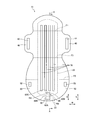
- FIG. 1 is a plan view of the absorbent article according to the embodiment viewed from the skin facing surface side.
- FIG. 2 is a top view of the absorbent article which concerns on embodiment seen from the non-skin opposing surface side.
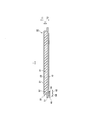
- FIG. 3 is a cross-sectional view of the absorbent article along the line AA shown in FIG.
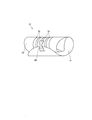
- FIG. 4 is a perspective view of the absorbent article in a state of being wound in the front-rear direction.
- FIG. 5 shows a part of a plane viewed from the non-skin facing surface side of the absorbent article according to the first modification and the second modification.
- FIG. 6 shows a part of a plane viewed from the non-skin facing surface side of the absorbent article according to the third modification and the fourth modification.
- the absorbent article according to one aspect is disposed on the non-skin opposing surface side of the main body portion including the front-rear direction, the width direction orthogonal to the front-rear direction, the top sheet, the back sheet, and the absorbent core.
- the color difference ⁇ E between the adjacent region adjacent to the tape member and the identification region of at least a part of the tape member in the non-skin facing surface of the above is 3.0 or more.
- the color difference ⁇ E between the adjacent area of the main body and the identification area of the tape member is 3.0 or more, the user can easily recognize the main body and the tape member as separate bodies, and can easily recognize the presence of the tape member. .
- the absorbent article is provided with a fold along the width direction for folding the absorbent article with the skin-facing surface side of the absorbent article facing inside.
- the member is disposed on the outer side in the front-rear direction than the fold.
- the area outside the folds of the absorbent article in the front-rear direction is likely to rise to the skin-facing surface side from the folds by the folds.
- the region outside the front and rear direction of the fold is raised by folds, so that the non-skin facing surface of the absorbent article is viewed from the side of the absorbent article or the like rather than when the entire absorbent article has a flat shape. It will be easier. Therefore, it becomes easy for a user to visually recognize the tape member located in the non-skin opposing surface side of a main-body part in the state which removed an absorptive article from wearing articles.
- a plurality of the folds are provided at intervals in the front-rear direction, and a first fold closest to the front end edge of the absorbent article and a first fold closest to the rear end edge of the absorbent article
- the tape member has at least one of a front area between the first fold and the front end edge and a rear area between the second fold and the rear end edge. Is located in
- the front end edge and the rear end edge of the absorbent article are likely to be lifted from the first fold and the second fold located at the outermost side in the front-rear direction by the fold. . Since the tape member is disposed in at least one of the front side area and the rear side area, the user can easily recognize the tape member when the front side area and the rear side area are lifted by the fold.
- the non-skin facing surface of the back sheet is provided with an adhesive part for stopping the absorbent article on the wearing article, and the identification area is the front-back direction of the adhesive part. It is arrange
- region in which the adhesion part was provided is stopped by a wearing article at the time of wear, and it is hard to be visually recognized from the skin opposing surface side of an absorbent article.
- the area outside the area where the adhesive part is provided is not stopped by the wearing article when worn, and is visually recognized from the skin facing surface side by the absorbent article being curled up or floating up Sometimes. Since the identification region is disposed outside the front-rear direction outer edge of the adhesive portion in the front-rear direction, the user can easily recognize the presence of the tape member while wearing the tape member.
- the tape member has a grip portion that can be gripped by a user, and the identification area is disposed in the grip portion.
- the wearer can easily recognize the grip portion of the tape member.
- the user can smoothly perform the discarding operation by grasping the place to be grasped at the time of the discarding operation.
- the grip portion includes one end of the tape member and extends to a region sandwiched by a pair of side edges extending from the one end to the other end side of the tape member, the adjacent region
- the region includes a region adjacent to the one end in the non-skin facing surface of the main body portion and a region adjacent to the side edge in the non-skin facing surface of the main body portion.
- the three regions arranged around the grip on the non-skin facing surface of the main body, the grip, and the color difference ⁇ E of 3.0 or more make it easier for the user to recognize the grip and smooth disposal. You can do the operation.
- a colored portion is provided in at least one of the identification region and the adjacent region, and the colored portion has a shape in which the main body portion is seen from the skin-facing surface side of the absorbent article. It is visible at.
- the user can recognize the presence of the tape member when worn, since the colored portion is visible from the skin-facing surface side of the absorbent article.
- the tape member has a base layer and a print layer overlapping the base layer in the thickness direction, and the print layer is disposed on the skin facing surface side of the base layer. And it is visible in the form which opened the above-mentioned base layer from the non-skin opposed side of the above-mentioned absorptive article.
- the print layer is disposed on the skin-facing surface side of the base layer, when viewed from the skin-facing surface side of the absorbent article, the print layer can be viewed without passing through the base layer, and the tape member is present when worn It becomes easy to recognize.
- the base layer is arrange
- At least one of the identification area and the adjacent area is provided with a colored portion, and the colored portion has a guide for guiding the operation of the tape member.
- the user can grasp the operation of the tape member by the guide portion, and can perform the smooth disposal operation.
- the absorbent article may be an absorbent article such as a sanitary napkin, panty liner, breast milk pad, adult incontinence pad, fecal pad or sweat sheet.
- the absorbent article may be an article attached to and used on the inside of a wearing article such as underwear.
- FIG. 1 is a plan view of the absorbent article 10 according to the first embodiment as viewed from the skin facing surface side.
- FIG. 2 is a top view of the absorbent article 10 which concerns on 1st Embodiment seen from the non-skin opposing surface side.
- the "skin facing surface side” corresponds to the side facing the wearer's skin during use.
- the “non-skin facing side” corresponds to the side that is turned away from the wearer's skin during use.
- FIG. 3 is a cross-sectional view taken along the line AA shown in FIG. 1, and
- FIG. 4 is a perspective view of the absorbent article in a state of being wound in the front-rear direction.
- the absorbent article 10 has a longitudinal direction L and a width direction W.
- the front-rear direction L is a direction extending from the front side (ventral side) to the rear side (back side) of the wearer, or a direction extending from the rear side to the front side of the wearer.
- the width direction W is a direction orthogonal to the front-rear direction L.
- the absorbent article 10 has a main body 20 and a tape member 60 for post-processing.
- the main body portion 20 includes a top sheet 21 directed to the skin of the wearer, a back sheet 22 directed to the side opposite to the skin of the wearer, and an absorbent core 23 disposed between the top sheet 21 and the back sheet 22. ,including.
- the top sheet 21 faces the wearer's skin during use.
- the backsheet 22 is directed away from the wearer's skin during use.
- the absorbent core 23 includes an absorbent material that absorbs body fluid, and extends along the front-rear direction L of the absorbent article.
- the main body 20 may have a wing 40 and a hip flap 50.
- the wings 40 are folded back to the non-skin facing side of the crotch portion of the worn article during use.
- the hip flap 50 is a portion that bulges in the width direction W behind the wing 40.
- the hip flap 50 is a portion that bulges outward beyond the outer edge of the absorbent core 23 in the width direction W.
- the main body portion 20 has a discharge port facing area S1 that faces the discharge port (for example, the vaginal opening) of the wearer during use.
- the discharge port facing area S1 corresponds to a crotch of the wearer, that is, an area disposed between the legs of the wearer and in which the absorbent core 23 is present.
- the excretion opening facing area S1 is between the wings 40 and corresponds to an area where the absorbent core 23 is present.
- the main body portion 20 may have adhesive portions 42, 52, 70 provided on the non-skin facing surface side of the back sheet 22.
- the adhesive portions 42, 52, 70 are regions provided with an adhesive for stopping the absorbent article 10 on the wearing article.
- the adhesive unit may include a main unit adhesive unit 70, a wing adhesive unit 42, and a flap adhesive unit 52.
- Absorbent article 10 can be fixed to wearing articles, such as underwear, by adhesion parts 42, 52, and 70 provided in the non-skin opposing side of back sheet 22.
- the adhesive members 42, 52, 70 can hold the tape member 60 in a wound state of the absorbent article 10 and maintain the wound state.
- the adhesive portions 42, 52, 70 can be used in two ways: application to fix to clothes and application to fasten the post-processing tape member.
- the main body adhesive portion 70 is provided in a region overlapping with the absorbent core 23 in the thickness direction of the absorbent article 10. It is preferable that the main body adhesive portion 70 extends continuously or intermittently to the rear of the absorbent article 10 at least from the discharge port facing area S1.
- the main body adhesive portion 70 extends in the front-rear direction L, and a plurality of main body adhesive portions 70 may be provided at intervals in the width direction W. In another embodiment, a plurality of main body adhesive portions 70 may be provided, extending in the width direction W and spaced in the front-rear direction.
- the wing adhesion portion 42 is provided on the wing 40.
- the wing 40 is folded back to the worn article of the wearer during use, and attached to the non-skin facing side of the worn article by the wing adhesive portion 42.
- the flap adhesive portion 52 is provided on the hip flap 50.
- the absorbent article 10 may have a fold extending along the width direction W.
- the folds of the absorbent article 10 have a first fold F1, a second fold F2, and a third fold F3.
- the first fold F1 is the fold closest to the front end edge E1 of the absorbent article 10.
- the second fold line F2 is the fold line closest to the rear end edge E2 of the absorbent article 10.
- the third fold line F3 is disposed between the first fold line F1 and the second fold line F2.
- four or more creases may be provided.
- the fold is a line for folding the absorbent article 10 with the skin-facing side T1 of the absorbent article inside when the absorbent article is packaged.
- the tape member 60 is fixed to the main body 20.
- the tape member 60 may have a fixing portion 62 fixed to the main body portion 20, as shown in FIG.
- the fixing portion 62 may be provided at one end of the tape member 60.
- the fixing portion 62 may be fixed to the main body portion 20 by an adhesion means such as an adhesive.
- the fixing portion 62 may be fixed to the back sheet 22 that constitutes the non-skin facing surface of the main body portion 20.
- the tape member 60 may have a non-fixed portion 64 which is not fixed to the main body portion 20.
- the non-fixed portion 64 is a portion that is not fixed to the back sheet 22 and the user operates the tape member 60. More specifically, when using the tape member 60, the user holds the non-fixed portion and pulls the non-fixed portion 64 or fastens the non-fixed portion 64 to the main body portion 20. At least a portion of the non-fixed portion 64 constitutes a grip portion 65 which can be gripped by the user.
- the grip portion 65 may be the entire non-fixed portion 64 or may be provided on one end side of the non-fixed portion 64 opposite to the fixed portion 62.
- the tape member of the present embodiment has one end 60A opposite to the fixing portion, the other end 60C on the fixing portion side, and a pair of side edges 60B extending from the one end 60A to the other end 60C.
- the gripping portion 65 includes one end 60A of the tape member 60 and extends to a region sandwiched by a pair of side edges 60B extending from the one end 60A to the other end 60C of the tape member.
- the holding part 65 should just be comprised so that a user can hold it.
- the non-fixed portion 64 may be configured to be extensible in the extension direction.
- the extension direction D of the non-fixed portion 64 may be a direction from the fixed portion 62 toward the non-fixed portion 64. In the configuration in which the fixed portion 62 and the non-fixed portion 64 are adjacent in the front-rear direction L, the extension direction D may be the front-rear direction L.
- the tape member 60 is fixed to the main body portion 20 in a state of being wound with the skin facing surface side of the absorbent article facing inward when the absorbent article 10 is discarded, and the absorbent article 10 is maintained in a wound state. It may be configured as follows.
- the non-fixed portion 64 of the tape member 60 is configured to be attachable to the main body portion 20.
- the configuration in which the non-fixed portion 64 is fixed to the main body portion 20 may be an adhesive portion of the main body portion 20, or may be a fixing means such as an adhesive or a hook member provided on the tape member 60.
- the fixing portion 62 of the tape member 60 may be configured to be attachable to the main body portion 20.
- the configuration in which the fixing portion 62 is fixed to the main body portion 20 may be an adhesive portion of the main body portion 20 or may be a fixing means such as an adhesive provided on the tape member 60 or a hook member.
- the non-fixed portion 64 of the tape member 60 of the present embodiment is fixed to the main body portion 20 at the time of disposal via the main body adhesive portion 70.
- the non-fixed portion 64 may not be provided with a fixing means such as an adhesive.
- At least the non-fixed portion 64 of the tape member 60 is configured to be extensible in the extension direction D. Since at least the non-fixed portion 64 of the tape member 60 is configured to be extensible in the extension direction D, when the wound absorbent article 10 is fixed by the tape member 60, the absorbent article 10 is fixed by the tape member 60. It becomes easy (see FIG. 4).
- the tape member 60 may be configured to be entirely extensible in the extension direction D including the fixing portion 62, or only the non-fixing portion 64 may be extensible.
- “extension” includes extension by "elastic deformation” or "plastic deformation”.
- the tape member 60 may be composed of a stretchable sheet or a film.
- the tape member 60 may be disposed inside the outer edge 20E of the main body 20 in a non-extended state (natural state).
- the tape member 60 may be hidden by the main body 20 when viewed from the skin facing surface side.
- the tape member 60 may extend outward beyond the outer edge 20E of the main body 20 in an extended state (extended state). After the user winds the main body 20 in the front-rear direction L after use of the absorbent article 10, the tape member 60 is extended outside the outer edge 20E of the main body 20, and the tape member 60 is fixed to the main body 20. It can be worn (see FIG. 4).
- the tape member 60 is disposed inside the outer edge 20E of the main body portion 20 on the non-skin facing surface side of the back sheet 22. No body fluids like blood.
- the user can maintain the absorbent article 10 in a rolled state by fastening the tape member 60 extended outward to the main body adhesive portion 70 or the like after use of the absorbent article 10.
- no body fluid such as menstrual blood adheres to the tape member 60, it is possible to prevent a decrease in the bonding strength between the tape member 60 and the main adhesive unit 70 or a reduction in the bonding strength of the fastening means of the tape member. it can.
- the tape member 60 is provided on the non-skin facing surface side of the back sheet 22 and does not extend outside the outer edge 20E of the main body 20, so the tape member 60 is worn Does not hit the person's skin directly. Therefore, discomfort and discomfort during use can be reduced.
- the tape member 60 may extend outward beyond the outer edge 20E of the main body 20 in a non-extended state (natural state).
- the tape member 60 may be visible when viewed from the skin facing surface side.
- the tape member 60 may be comprised of a sheet folded in a Z-shape. At least a part of the surface of the tape member 60 facing the main body 20 may be fixed to the main body 20 in the Z-folded state. In the area
- the tape member 60 is preferably provided on the rear side of the center of the main body portion 20 in the front-rear direction L.
- the user usually starts to roll in the front-rear direction L from the front end edge E1 or the rear end edge E2 of the absorbent article 10 when the absorbent article 10 is rolled up.
- the tape member 60 be provided in a region located on the rear side with respect to the center in the front-rear direction L. At least a portion of the tape member 60 may be disposed across the rear end edge of the absorbent core 23 or on the rear side of the rear end edge of the absorbent core.
- the tape member 60 may be disposed outside the first fold F1 to the third fold F3 in the front-rear direction.
- the area outside the folds of the absorbent article in the front-rear direction is likely to rise to the skin-facing surface side from the folds by the folds.
- the region on the front side of the fold is gripped and the skin facing surface side of the absorbent article is When viewed visually, the region between the fold and the rear end edge of the absorbent article floats on the skin-facing surface side from the fold starting point.
- the non-skin facing surface of the absorbent article is viewed from the side of the absorbent article or the like by raising the area between the fold and the rear end edge of the absorbent article than when the entire absorbent article has a flat shape. It becomes easy to do. Therefore, it becomes easy for a user to visually recognize the tape member 60 located in the non-skin opposing surface side of a main-body part in the state which removed the absorbent article from the wearing article.
- the tape member 60 may be disposed apart from the fold in the front-rear direction L, not on the fold. Further, in the configuration with a plurality of fold lines, the tape member 60 has a front side area R1 between the first fold line F1 and the front end edge E1, and a rear side area R2 between the second fold line F2 and the rear end edge E2. And / or may be arranged.
- the tape member 60 of the present embodiment is disposed in the rear area R2 between the second fold line F2 and the rear end edge E2.
- the front end edge E1 and the rear end edge E2 of the absorbent article 10 are the first fold F1 and the second fold which are located on the outer most in the front-rear direction L by folds. It is easy to rise from F2 as a starting point. Since the tape member 60 is disposed in at least one of the front side region R1 and the rear side region R2, the user recognizes the tape member 60 when the front side region R1 and the rear side region R2 are lifted by a fold. It will be easier.
- the tape member 60 is provided on the rear side of the rearmost second fold line F2 among the first fold line F1 to the third fold line F3. About 80% of users start winding the used absorbent article 10 from the front side. By providing the tape member 60 behind the second fold line F 2, many users can start rounding from the front end edge E 1 of the absorbent article 10 and fasten the wound end portion with the tape member 60.
- the non-fixed portion 64 may be releasably joined to the non-skin facing surface of the main body by a temporary fixing portion (not shown).
- a temporary fixing portion By providing the temporary fixing portion, it is possible to prevent the non-fixed portion 64 from being twisted or the non-fixed portion 64 from being broken before using the tape member 60 (during manufacturing and wearing).
- the bonding force of the temporary fixing portion may be lower than the bonding force of the fixing portion 62. Since the joining force of the temporary fixing part is lower than the joining force of the fixing part 62, the user can easily peel off the temporary fixing part when using the tape member 60 and grip the non-fixed part 64 to operate the tape member 60. Can.
- fixing means for the temporary fixing part include adhesives, embossing, thermal welding, and ultrasonic welding, and the amount (area, basis weight) of the adhesive applied is smaller than that of the fixing part 62, or more than the fixing part 62.
- the temporary fixing portion may be configured by embossing the outer edge of the main body portion.
- the top sheet may be constituted by an air through non-woven fabric (PE / PET) having a basis weight of 30 g / m 2 .
- a second sheet may be provided between the top sheet and the absorbent core.
- the second sheet may be made of the same material as the top sheet.
- a surface sheet may not be arrange
- the side sheet may be constituted by an SMS nonwoven fabric (PP) having a basis weight of 13 g / m 2 .
- the absorbent material of the absorbent core may be composed of softwood kraft pulp and a superabsorbent polymer.
- the ratio of the weight of superabsorbent polymer to the weight of the whole absorbent material may be 10%.
- the basis weight of the absorbent core in the area including the excretion port facing area S1 may be higher than the basis weight of the surrounding absorbent core.
- the basis weight of the absorbent core in the area including the excretion port facing area S1 may be 950 g / m 2
- the basis weight of the surrounding absorbent core may be 300 g / m 2 .
- the back sheet may be constituted by a polyethylene film (non-air-permeable type) with a basis weight of 23.5 g / m 2 .
- the absorbent article may have a pressing portion in which the top sheet and the absorbent core are pressed in the thickness direction.
- the main body adhesive portion may be made of a rubber-based hot melt adhesive.
- the basis weight of the adhesive part of the main body may be 27 g / m 2 .
- the length in the width direction of each main-body adhesive portion may be 5 mm, and the length in the front-rear direction of each main-body adhesive portion may be 320 mm.
- the length of the absorbent article in the front-rear direction may be 420 mm, and the length of the absorbent article in the width direction may be 200 mm.
- the tape member for post-treatment may be composed of a polyethylene film having a basis weight of 35 g / m 2 .
- the longitudinal length of the tape member may be 45 mm, and the lateral length of the tape member may be 25 mm.
- the tape member may be fixed to the main body by a rubber-based hot melt adhesive with a weight of 100 g / m 2 .
- the adhesive may be applied in the range of 21 mm wide and 5 mm long.
- Printing may be applied to the surface on the back sheet side of the tape member. The printing may use a pink urethane ink.
- the identification area RA and the adjacent area RB of the tape member 60 have a function of making it easy for the user to recognize the main body 20 and the tape member 60 as separate bodies. For example, if the user does not recognize the presence of the tape member 60, the tape member 60 can not be used to cleanly discard the absorbent article. Also, if it is difficult for the user to recognize the presence of the tape member 60, it is necessary for the user to thoroughly check the entire used absorbent article, which may cause discomfort or the hands may be soiled by body fluid. There is a risk of problems. Since the user can easily recognize the main body portion 20 and the tape member 60 as separate bodies, the user can easily recognize the presence of the tape member 60, and the absorbent article 10 can be discarded cleanly by the tape member 60. it can.
- the identification area RA may be configured so as to be conspicuous with respect to the adjacent area RB adjacent to the tape member 60 on the non-skin facing surface of the main body 20.
- the color difference ⁇ E between the identification area RA and the adjacent area RB may be 3.0 or more.
- the color difference ⁇ E between the adjacent region RB of the main body 20 and the identification area RA of the tape member 60 is 3.0 or more, the user can easily recognize the main body 20 and the tape member 60 as separate members, and the tape member It becomes easy to recognize the existence of 60.
- the adjacent region RB may be a region adjacent to the outer edge (including the one end 60A, the side edge 60B, and the other end 60C) of the tape member 60 in the non-skin facing surface of the main body portion 20. It is an area having a range from the outer edge of any one of the tape members 60 to the outside of the tape member 60. In FIG. 2, the adjacent regions RB are indicated by hatching. In the configuration in which adjacent regions are provided on four sides of the tape member, the color difference ⁇ E between at least one adjacent region RB and the identification region RA may be 3.0 or more.
- a colored portion may be provided in the identification area RA of the tape member 60, or a colored portion is provided on the back sheet 22 constituting the non-skin facing surface of the main body 20.
- a colored portion may be provided on a member (for example, the absorbent core 23) positioned on the skin facing surface T1 side of the back surface sheet 22 of the main body portion 20 so that the colored portion can be viewed through the back surface sheet 22
- the colored portion may be provided on both the tape member 60 and the main body portion 20.
- the colored portion may have at least one of a main colored portion 91 provided in the main portion 20 and a tape colored portion 92 (see FIG. 5) provided in the tape member 60.
- the colored portion may be configured by a sheet itself such as a tape member colored by a pigment or the like, or may be configured by a printing layer.
- the illuminance (lx) is visible in an environment of 100 (lx) to 1000 (lx).
- the absorbent article 10 of the present embodiment has a tape-colored portion 92 provided in the identification area RA.
- the tape member 60 has a base layer 66 and a print layer 67 overlapping the base layer 66 in the thickness direction.
- the print layer 67 constitutes a tape coloring unit 92.
- the tape coloring unit 92 configured by the printing layer 67 is provided in the entire area of the tape member 60. Therefore, the identification area RA is provided in the entire area of the tape member 60. Note that, as in the first modification described later, the identification area RA may be provided in part of the tape member 60.
- the stretchable tape member 60 it is preferable not to provide the print layer 67 in the entire area of the side edge along the stretch direction D of the tape member 60.
- the area in which the printing layer is disposed and the area in which the printing layer is not disposed are different in ease of stretching when the substrate is affected due to the printing ink, and a portion provided with the printing layer 67 Is less extensible. Therefore, for example, when the print layer 67 whose extensibility is partially reduced is disposed at the side edge along the extension direction D of the tape member 60, the side edge of the tape member 60 may be cracked. In particular, the side edge along the extension direction of the tape member 60 is easily subjected to a force at the time of extension, and a crack is more likely to occur. However, by not providing the print layer 67 in the entire area of the side edge along the extension direction D of the tape member 60, the difference in the ease of extension due to the presence or absence of the print layer 67 does not occur, and the crack can be suppressed.
- the print layer 67 may be disposed on the skin facing surface T1 of the base layer 66. Since the printing layer 67 is disposed on the skin facing side T1 of the base layer 66, the printing layer 67 is not disposed toward the worn article when the absorbent article 10 is used, but is disposed toward the back sheet 22. Ru. When the absorbent article 10 is used, the worn article and the print layer 67 do not easily rub, and it is possible to suppress the print layer 67 from being unintentionally viewed.
- the print layer 67 may be configured to be visible from the non-skin facing surface side of the absorbent article with the base layer 66 being transparent.
- the base layer 66 may be transparent or translucent.
- the printed layer 67 can be more easily viewed from the non-skin facing surface T2 of the absorbent article via the base layer 66.
- the print layer 67 may be disposed on the non-skin facing surface T2 of the base layer 66.
- the print layer 67 can be visually recognized without the base layer 66, and the identification effect by the identification area RA is more exhibited. Easy to do.
- the colored portion may be visible in a form in which the main body portion 20 is seen through from the skin facing surface T1 of the absorbent article 10.
- the skin facing surface of the main body portion 20, that is, the top sheet 21 is directed to the wearer's body. Therefore, there are many opportunities for the user to visually recognize the skin facing surface of the main body 20. The user can recognize the presence of the tape member 60 at the time of wearing since the colored portion is visible from the skin facing surface T1.
- the colored portion is visible in the form in which the top sheet 21 and the back sheet 22 are seen through in the area where the absorbent core 23 is not arranged, and in the area where the absorbent core 23 is arranged, the top sheet 21 and the back sheet 22 and the absorbent core 23 may be visible in a watermarked manner.
- the colored portion may be provided in a region not overlapping with the absorbent core 23. It may be visible in the form in which the main body 20 is seen through from the skin facing surface T1 of the absorbent article 10.
- the base layer is viewed from the skin facing surface T1 of the absorbent article.
- the print layer 67 can be visually recognized without passing through 66, and the presence of the tape member 60 can be more easily recognized when worn.
- the identification area RA is provided on the entire area of the tape member 60 in a plan view, and is disposed in the grip portion 65.
- the gripping portion 65 is more noticeable in the area adjacent to the gripping portion 65.
- the user can easily recognize the gripping portion 65.
- the user can perform a smooth discarding operation by grasping the place to be grasped at the time of the discarding operation.
- the gripping portion 65 may be configured so as to be conspicuous with respect to the adjacent region adjacent to the end 60A of the tape member 60 and the adjacent region adjacent to the side edge 60B of the tape member 60.
- the color difference with respect to the identification area RA may be ⁇ 3.0 or more in both the adjacent region adjacent to the end 60A of the tape member 60 and the adjacent region adjacent to the side edge 60B of the tape member 60.
- the three adjacent areas disposed surrounding the gripping portion 65 on the non-skin facing surface of the main body portion 20 and the gripping portion 65 and the color difference ⁇ E of 3.0 or more make it easier for the user to recognize the gripping portion 65 Smooth disposal operations.
- Identification area RA may be arranged outside the front-rear direction outer edge of adhesion parts 70, 42, 52 in the front-rear direction.
- the identification area RA may be disposed outside the front-rear direction outer end edge of the main body adhesive portion 70 in the front-rear direction.
- region in which the adhesion part was provided is stopped by a wearing article at the time of wear, and it is hard to be visually recognized from the skin opposing surface side of an absorbent article.
- the area outside the area where the adhesive part is provided is not stopped by the wearing article when worn, and is visually recognized from the skin facing surface side by the absorbent article being curled up or floating up Sometimes. Since the identification region is disposed outside the front-rear direction outer edge of the adhesive part in the front-rear direction, the user can easily recognize the presence of the tape member 60 while wearing the tape member 60.
- FIG. 5 shows a part of a plane viewed from the non-skin facing surface side of the absorbent article 10A according to the first modification and the absorbent article 10B according to the second modification.
- Fig. 5 (A) shows an absorbent article 10A according to the first modification
- Fig. 5 (B) shows an absorbent article 10B according to the second modification.
- the identification area RA is not disposed in the entire tape member, and the identification area RA is disposed in a part of the tape member 60. Specifically, the identification area RA is disposed in the grip portion 65 of the tape member 60.
- the user can not grip and operate the fixing portion 62, and grips and operates the grip portion 65. More preferably, the user operates with one end 60A of the tape member (the end opposite to the fixed part). Since the user can easily recognize the gripping portion 65, the gripping portion can be smoothly gripped at the time of operation, and the absorbent article can be cleanly discarded using the tape member 60.
- the tape coloring portion 92 may be provided only in the region where the grip portion 65 is disposed. Further, as in the absorbent article 10B according to the second modification, the main body colored portion 91 is provided in the adjacent region RB adjacent to the gripping portion 65, and the tape colored portion 92 is provided in the region R3 other than the gripping portion 65 of the tape member 60. May be In the absorbent article 10B according to the second modification, the region R3 other than the grip portion 65 of the tape member 60 is less noticeable with respect to the non-skin facing surface of the main body portion 20, and is easily visible with respect to the grip portion 65. Good.
- the color difference between the region R3 other than the gripping portion of the tape member and the gripping portion 65 may be higher than the color difference between the region R3 other than the gripping portion of the tape member and the adjacent region RB.
- the user can grasp not only the target member (tape member) on which the operation is performed but also the part on which the operation is performed in the target member. The user can smoothly perform the discarding operation by grasping the place to be grasped at the time of the discarding operation.
- FIG. 6 shows a part of plane seen from non-skin opposing side T2 of absorptive article 10C concerning modification 3 and absorptive article 10D concerning modification 4.
- Fig. 6 (A) shows an absorbent article 10C according to the third modification
- Fig. 6 (B) shows an absorbent article 10D according to the fourth modification.
- the identification area RA is not disposed in the entire tape member 60, and the identification area RA is disposed in a part of the tape member 60. .
- a tape coloring unit 92 is provided in the identification area RA.
- the tape coloring unit 92 may have a guide unit 95 for guiding the operation of the tape member 60.
- the guide part 95 should just guide operation of the tape member 60.
- it may be an arrow indicating the pulling direction.
- the absorbent article used in a state where the tape member 60 is stretched as in the absorbent article 10D according to the fourth modification, it is a character of "stretching" which indicates that the tape member 60 has an extending property
- the user may be prompted to extend the tape member 60.
- the colored portion may constitute only the guide portion 95 or may have a portion other than the guide portion 95.
- the tape coloring unit 92 according to the fourth modification may have a guiding unit 95 and a background unit 96.
- the guide part 95 can be made more conspicuous and smooth operation can be promoted.
- the color difference between the guide portion 95 and the adjacent region RB may be ⁇ 3.0 or more, or the color difference between the background portion 96 and the adjacent region RB may be ⁇ 3.0 or more.
- the main-body coloring part 91 may have a guide part.
- the present invention has been described above in detail using the above embodiments, it is obvious for those skilled in the art that the present invention is not limited to the embodiments described herein.
- the present invention can be embodied as modifications and alterations without departing from the spirit and scope of the present invention defined by the description of the claims. Accordingly, the description in the present specification is for the purpose of illustration and does not have any limiting meaning on the present invention.
- the identification area RA and the adjacent area RB according to the embodiment and the modification are not limited to the configuration of the colored portion.
Landscapes
- Health & Medical Sciences (AREA)
- Epidemiology (AREA)
- Life Sciences & Earth Sciences (AREA)
- Biomedical Technology (AREA)
- Heart & Thoracic Surgery (AREA)
- Vascular Medicine (AREA)
- Engineering & Computer Science (AREA)
- Animal Behavior & Ethology (AREA)
- General Health & Medical Sciences (AREA)
- Public Health (AREA)
- Veterinary Medicine (AREA)
- Absorbent Articles And Supports Therefor (AREA)
- Orthopedics, Nursing, And Contraception (AREA)
Priority Applications (4)
| Application Number | Priority Date | Filing Date | Title |
|---|---|---|---|
| MYPI2020003071A MY203826A (en) | 2017-12-27 | 2018-12-11 | Absorbent article |
| CN201880083179.8A CN111511329A (zh) | 2017-12-27 | 2018-12-11 | 吸收性物品 |
| KR1020207017504A KR102686113B1 (ko) | 2017-12-27 | 2018-12-11 | 흡수성 물품 |
| TW107146715A TWI828645B (zh) | 2017-12-27 | 2018-12-24 | 吸收性物品 |
Applications Claiming Priority (2)
| Application Number | Priority Date | Filing Date | Title |
|---|---|---|---|
| JP2017-252522 | 2017-12-27 | ||
| JP2017252522A JP2019115588A (ja) | 2017-12-27 | 2017-12-27 | 吸収性物品 |
Publications (1)
| Publication Number | Publication Date |
|---|---|
| WO2019131105A1 true WO2019131105A1 (ja) | 2019-07-04 |
Family
ID=67063475
Family Applications (1)
| Application Number | Title | Priority Date | Filing Date |
|---|---|---|---|
| PCT/JP2018/045468 Ceased WO2019131105A1 (ja) | 2017-12-27 | 2018-12-11 | 吸収性物品 |
Country Status (6)
| Country | Link |
|---|---|
| JP (1) | JP2019115588A (enExample) |
| KR (1) | KR102686113B1 (enExample) |
| CN (1) | CN111511329A (enExample) |
| MY (1) | MY203826A (enExample) |
| TW (1) | TWI828645B (enExample) |
| WO (1) | WO2019131105A1 (enExample) |
Cited By (1)
| Publication number | Priority date | Publication date | Assignee | Title |
|---|---|---|---|---|
| WO2019235316A1 (ja) * | 2018-06-05 | 2019-12-12 | ユニ・チャーム株式会社 | 吸収性物品の包装体、及び吸収性物品の包装体の製造方法 |
Families Citing this family (2)
| Publication number | Priority date | Publication date | Assignee | Title |
|---|---|---|---|---|
| JP7335846B2 (ja) * | 2020-03-27 | 2023-08-30 | 大王製紙株式会社 | 個装吸収性物品 |
| WO2022176330A1 (ja) * | 2021-02-22 | 2022-08-25 | トタニ技研工業株式会社 | 製袋機、および、製袋方法 |
Citations (6)
| Publication number | Priority date | Publication date | Assignee | Title |
|---|---|---|---|---|
| JP2002526164A (ja) * | 1998-10-05 | 2002-08-20 | ザ、プロクター、エンド、ギャンブル、カンパニー | 個装吸収体 |
| JP2003527928A (ja) * | 2000-03-25 | 2003-09-24 | ザ、プロクター、エンド、ギャンブル、カンパニー | 透明な吸収性物品 |
| JP2007029351A (ja) * | 2005-07-26 | 2007-02-08 | Kao Corp | 吸収性物品 |
| JP2010220747A (ja) * | 2009-03-23 | 2010-10-07 | Daio Paper Corp | 吸収パッド |
| JP2013226382A (ja) * | 2012-03-30 | 2013-11-07 | Unicharm Corp | 使い捨て着用物品 |
| JP6236569B1 (ja) * | 2017-07-28 | 2017-11-22 | ユニ・チャーム株式会社 | 吸収性物品及び吸収性物品のパッケージ |
Family Cites Families (9)
| Publication number | Priority date | Publication date | Assignee | Title |
|---|---|---|---|---|
| JPS56168220A (en) * | 1980-12-19 | 1981-12-24 | Idec Izumi Corp | Process step-forward type sequence controller |
| JPH0294533A (ja) | 1988-09-30 | 1990-04-05 | Citizen Watch Co Ltd | 半導体装置及びその製造方法 |
| JP2001258938A (ja) | 2001-02-19 | 2001-09-25 | Daio Paper Corp | 後処理テープを有するパンツ型おむつ |
| JP2005054135A (ja) * | 2003-08-07 | 2005-03-03 | Nitto Lifetech Kk | 粘着テープ又はシート、および紙おむつ |
| US20110087184A1 (en) * | 2009-10-13 | 2011-04-14 | Woehlke Jonathan | Disposable absorbent article including functional benefit and a plurality of visually distinct fibers indicative of the functional benefit |
| CN102764181A (zh) * | 2011-05-06 | 2012-11-07 | 麦克内尔-Ppc股份有限公司 | 包括传达深度感的视觉信号的制品 |
| JP5922970B2 (ja) * | 2012-03-30 | 2016-05-24 | ユニ・チャーム株式会社 | 吸収性物品の包装体 |
| JP2013244127A (ja) | 2012-05-25 | 2013-12-09 | Fujipatsuku Kk | 廃棄用テープ |
| JP6067340B2 (ja) * | 2012-11-15 | 2017-01-25 | 花王株式会社 | 吸収性物品 |
-
2017
- 2017-12-27 JP JP2017252522A patent/JP2019115588A/ja active Pending
-
2018
- 2018-12-11 KR KR1020207017504A patent/KR102686113B1/ko active Active
- 2018-12-11 WO PCT/JP2018/045468 patent/WO2019131105A1/ja not_active Ceased
- 2018-12-11 CN CN201880083179.8A patent/CN111511329A/zh active Pending
- 2018-12-11 MY MYPI2020003071A patent/MY203826A/en unknown
- 2018-12-24 TW TW107146715A patent/TWI828645B/zh active
Patent Citations (6)
| Publication number | Priority date | Publication date | Assignee | Title |
|---|---|---|---|---|
| JP2002526164A (ja) * | 1998-10-05 | 2002-08-20 | ザ、プロクター、エンド、ギャンブル、カンパニー | 個装吸収体 |
| JP2003527928A (ja) * | 2000-03-25 | 2003-09-24 | ザ、プロクター、エンド、ギャンブル、カンパニー | 透明な吸収性物品 |
| JP2007029351A (ja) * | 2005-07-26 | 2007-02-08 | Kao Corp | 吸収性物品 |
| JP2010220747A (ja) * | 2009-03-23 | 2010-10-07 | Daio Paper Corp | 吸収パッド |
| JP2013226382A (ja) * | 2012-03-30 | 2013-11-07 | Unicharm Corp | 使い捨て着用物品 |
| JP6236569B1 (ja) * | 2017-07-28 | 2017-11-22 | ユニ・チャーム株式会社 | 吸収性物品及び吸収性物品のパッケージ |
Cited By (1)
| Publication number | Priority date | Publication date | Assignee | Title |
|---|---|---|---|---|
| WO2019235316A1 (ja) * | 2018-06-05 | 2019-12-12 | ユニ・チャーム株式会社 | 吸収性物品の包装体、及び吸収性物品の包装体の製造方法 |
Also Published As
| Publication number | Publication date |
|---|---|
| KR102686113B1 (ko) | 2024-07-17 |
| TW201929808A (zh) | 2019-08-01 |
| CN111511329A (zh) | 2020-08-07 |
| MY203826A (en) | 2024-07-19 |
| TWI828645B (zh) | 2024-01-11 |
| JP2019115588A (ja) | 2019-07-18 |
| KR20200103664A (ko) | 2020-09-02 |
Similar Documents
| Publication | Publication Date | Title |
|---|---|---|
| CN101495076A (zh) | 吸收性物品 | |
| WO2019131105A1 (ja) | 吸収性物品 | |
| RU2770852C2 (ru) | Впитывающее изделие | |
| JP3237449U (ja) | 吸収性物品 | |
| JP6857117B2 (ja) | 吸収性物品 | |
| WO2019131182A1 (ja) | 吸収性物品 | |
| WO2016152209A1 (ja) | 使い捨て着用物品 | |
| WO2019198515A1 (ja) | 吸収性物品 | |
| JP2019115592A (ja) | 吸収性物品 | |
| JP3237902U (ja) | 吸収性物品 | |
| WO2020130040A1 (ja) | 吸収性物品 | |
| JP7083640B2 (ja) | 吸収性物品 | |
| JP7083638B2 (ja) | 吸収性物品 | |
| JP2020103650A (ja) | 吸収性物品 | |
| JP6857116B2 (ja) | 吸収性物品 | |
| JP6755535B2 (ja) | 吸収性物品 | |
| CN111511330B (zh) | 吸收性物品 | |
| JPWO2020130040A1 (ja) | 吸収性物品 | |
| WO2020130041A1 (ja) | 吸収性物品 | |
| WO2019131107A1 (ja) | 吸収性物品 | |
| TW201936141A (zh) | 吸收性物品 | |
| CN110368192A (zh) | 吸收性物品 | |
| JP2019115584A (ja) | 吸収性物品 |
Legal Events
| Date | Code | Title | Description |
|---|---|---|---|
| 121 | Ep: the epo has been informed by wipo that ep was designated in this application |
Ref document number: 18893764 Country of ref document: EP Kind code of ref document: A1 |
|
| NENP | Non-entry into the national phase |
Ref country code: DE |
|
| 122 | Ep: pct application non-entry in european phase |
Ref document number: 18893764 Country of ref document: EP Kind code of ref document: A1 |