WO2019088190A1 - 熱間鍛造鋼材 - Google Patents
熱間鍛造鋼材 Download PDFInfo
- Publication number
- WO2019088190A1 WO2019088190A1 PCT/JP2018/040570 JP2018040570W WO2019088190A1 WO 2019088190 A1 WO2019088190 A1 WO 2019088190A1 JP 2018040570 W JP2018040570 W JP 2018040570W WO 2019088190 A1 WO2019088190 A1 WO 2019088190A1
- Authority
- WO
- WIPO (PCT)
- Prior art keywords
- steel material
- hot forged
- forged steel
- content
- ferrite
- Prior art date
- Legal status (The legal status is an assumption and is not a legal conclusion. Google has not performed a legal analysis and makes no representation as to the accuracy of the status listed.)
- Ceased
Links
Classifications
-
- C—CHEMISTRY; METALLURGY
- C22—METALLURGY; FERROUS OR NON-FERROUS ALLOYS; TREATMENT OF ALLOYS OR NON-FERROUS METALS
- C22C—ALLOYS
- C22C38/00—Ferrous alloys, e.g. steel alloys
- C22C38/18—Ferrous alloys, e.g. steel alloys containing chromium
- C22C38/38—Ferrous alloys, e.g. steel alloys containing chromium with more than 1.5% by weight of manganese
-
- C—CHEMISTRY; METALLURGY
- C22—METALLURGY; FERROUS OR NON-FERROUS ALLOYS; TREATMENT OF ALLOYS OR NON-FERROUS METALS
- C22C—ALLOYS
- C22C38/00—Ferrous alloys, e.g. steel alloys
- C22C38/06—Ferrous alloys, e.g. steel alloys containing aluminium
-
- C—CHEMISTRY; METALLURGY
- C21—METALLURGY OF IRON
- C21D—MODIFYING THE PHYSICAL STRUCTURE OF FERROUS METALS; GENERAL DEVICES FOR HEAT TREATMENT OF FERROUS OR NON-FERROUS METALS OR ALLOYS; MAKING METAL MALLEABLE, e.g. BY DECARBURISATION OR TEMPERING
- C21D8/00—Modifying the physical properties of ferrous metals or ferrous alloys by deformation combined with, or followed by, heat treatment
-
- C—CHEMISTRY; METALLURGY
- C22—METALLURGY; FERROUS OR NON-FERROUS ALLOYS; TREATMENT OF ALLOYS OR NON-FERROUS METALS
- C22C—ALLOYS
- C22C38/00—Ferrous alloys, e.g. steel alloys
-
- C—CHEMISTRY; METALLURGY
- C22—METALLURGY; FERROUS OR NON-FERROUS ALLOYS; TREATMENT OF ALLOYS OR NON-FERROUS METALS
- C22C—ALLOYS
- C22C38/00—Ferrous alloys, e.g. steel alloys
- C22C38/001—Ferrous alloys, e.g. steel alloys containing N
-
- C—CHEMISTRY; METALLURGY
- C22—METALLURGY; FERROUS OR NON-FERROUS ALLOYS; TREATMENT OF ALLOYS OR NON-FERROUS METALS
- C22C—ALLOYS
- C22C38/00—Ferrous alloys, e.g. steel alloys
- C22C38/02—Ferrous alloys, e.g. steel alloys containing silicon
-
- C—CHEMISTRY; METALLURGY
- C22—METALLURGY; FERROUS OR NON-FERROUS ALLOYS; TREATMENT OF ALLOYS OR NON-FERROUS METALS
- C22C—ALLOYS
- C22C38/00—Ferrous alloys, e.g. steel alloys
- C22C38/18—Ferrous alloys, e.g. steel alloys containing chromium
- C22C38/20—Ferrous alloys, e.g. steel alloys containing chromium with copper
-
- C—CHEMISTRY; METALLURGY
- C22—METALLURGY; FERROUS OR NON-FERROUS ALLOYS; TREATMENT OF ALLOYS OR NON-FERROUS METALS
- C22C—ALLOYS
- C22C38/00—Ferrous alloys, e.g. steel alloys
- C22C38/18—Ferrous alloys, e.g. steel alloys containing chromium
- C22C38/24—Ferrous alloys, e.g. steel alloys containing chromium with vanadium
-
- C—CHEMISTRY; METALLURGY
- C22—METALLURGY; FERROUS OR NON-FERROUS ALLOYS; TREATMENT OF ALLOYS OR NON-FERROUS METALS
- C22C—ALLOYS
- C22C38/00—Ferrous alloys, e.g. steel alloys
- C22C38/18—Ferrous alloys, e.g. steel alloys containing chromium
- C22C38/26—Ferrous alloys, e.g. steel alloys containing chromium with niobium or tantalum
-
- C—CHEMISTRY; METALLURGY
- C21—METALLURGY OF IRON
- C21D—MODIFYING THE PHYSICAL STRUCTURE OF FERROUS METALS; GENERAL DEVICES FOR HEAT TREATMENT OF FERROUS OR NON-FERROUS METALS OR ALLOYS; MAKING METAL MALLEABLE, e.g. BY DECARBURISATION OR TEMPERING
- C21D2211/00—Microstructure comprising significant phases
- C21D2211/005—Ferrite
Definitions
- the present disclosure relates to steel products, and more particularly to hot forged steel products that are hot forged steel products.
- Such large steel parts are usually manufactured by the following manufacturing method.
- a cutting process is performed on the prepared thick steel plate to manufacture a plurality of intermediate steel products.
- a support rib is sandwiched between a plurality of intermediate steels manufactured by cutting a thick steel plate, and the plurality of intermediate steels are joined together by welding the support ribs and the intermediate steel.
- Steel parts are manufactured by the above steps.
- the intermediate steel material and the support rib are welded to manufacture a steel component. In this case, the number of welding steps is increased.
- the intermediate steel material when using a hot forged steel material obtained by hot forging steel material as the intermediate steel material, it is possible to manufacture a hot forged steel material in which the support rib is integrally formed with the intermediate steel material.
- the process of welding the support rib and the intermediate steel material can be reduced, and the number of welding steps can be reduced in the production of the steel component.
- the support rib is integrally formed with the intermediate steel material, the strength of the joint between the support rib and the intermediate steel material is enhanced. Therefore, it is more preferable to manufacture steel parts using hot forging steel materials manufactured by hot forging.
- Patent Document 1 Japanese Patent Application Laid-Open Nos. 11-256267
- Patent Document 2 Japanese Patent Application Laid-Open No. 60-262941
- Patent Document 1 The structural steel materials described in Patent Document 1 are, by weight%, C: 0.04 to 0.18%, Si: 0.60% or less, Mn: 0.80 to 1.80%, P: 0. 030% or less, S: 0.015% or less, V: 0.04 to 0.15%, N: 0.0050 to 0.0150%, Al: 0.005 to 0.050% and Ti: contains one or two of 0.005 to 0.050%, and the balance is Fe and impurities, and has a chemical composition satisfying the following formula. 0.34 ⁇ C + Si / 24 + Mn / 6 + V / 14 + Ni / 40 + Cr / 5 + Mo / 4 ⁇ 0.48%.
- This structural steel material further contains 0.02 to 0.07% of VN precipitates, and has a structure in which 10 6 to 10 10 pieces / mm 3 of VN precipitates having a particle diameter of 5 to 200 nm are precipitated.
- the grain size of ferrite of this structural steel material is No. 5 or more in the grain size number specified by JIS G 0552, and the area ratio of ferrite grains is 50 to 100%. According to the above-mentioned configuration, this structural steel material can have excellent fracture toughness under high speed deformation, as described in Patent Document 1.
- the warm forging steel described in Patent Document 2 is, by weight%, C: 0.1 to 0.5%, Si: 0.03 to 1.0%, Mn: 0.2 to 2.0% , Al: 0.015 to 0.07%, N: 0.009 to 0.03%, the balance comprising Fe and impurities, and hot worked after warm forging at 300 to 950 ° C.
- the crystal grains at the time of reheating such as normalizing, carburizing or carbonitriding are the fine grains of No. 6 or more in grain size number. According to the above-mentioned configuration, this warm forging steel can enhance the strength of parts, as described in Patent Document 2.
- the grain size number of the ferrite of the structural steel material of Patent Document 1 is as low as 7.5 or less, as long as the examples (see Tables 2-1 and 2-2) in Patent Document 1 are referred to. Therefore, low temperature toughness may be low. Furthermore, in patent document 1, when the deformation speed of a tension test is about 0.2 mm / s of usual, high tensile strength may not be obtained.
- the forging temperature is as low as 950 ° C. or less. Therefore, high tensile strength and high low temperature toughness may not be obtained.
- An object of the present disclosure is to provide a hot forged steel material having high strength and excellent low temperature toughness.
- the hot forged steel material according to the present disclosure is, by mass%, C: 0.14 to 0.20%, Si: 0.20 to 1.00%, Mn: 1.00 to 1.90%, P: 0. 030% or less, S: 0.030% or less, V: 0.16 to 0.30%, Al: 0.015 to 0.050%, N: 0.0050 to 0.0250%, Cr: 0.10 0.300.30%, Cu: 0 to 0.10%, Nb: 0 to 0.10%, and the balance is Fe and impurities, and has a chemical composition satisfying the formulas (1) and (2)
- the ferrite grain size number in the hot forged steel material is 9.0 or more, and in the Charpy impact test using the V-notch test piece, the absorbed energy at ⁇ 30 ° C.
- the hot forged steel material according to the present disclosure has high strength and high low temperature toughness.
- the present inventors conducted investigations and studies in order to enhance the strength and low temperature toughness of hot forged steel materials used for large steel parts. As a result, the present inventors initially considered that the weldability of the steel material would be improved if the C content was lowered. And as a result of further examination, the present inventors are C: 0.14 to 0.20%, Si: 0.20 to 1.00%, Mn: 1.00 to 1.90% by mass%.
- F1 C + (Si + Mn) / 6 + (Cr + V) / 5 + Cu / 15.
- F1 is an index of weldability and strength, and corresponds to carbon equivalent. If F1 is 0.36 or more, sufficient strength can be obtained also in the above-mentioned chemical composition. In addition, it is generally known that the weldability is excellent when the carbon equivalent is lower. So, in the steel material of this embodiment of the above-mentioned chemical composition, F1 was made into less than 0.68. In this case, it is considered that better weldability can be obtained than in the case where F1 is 0.68 or more. In addition, if F1 is less than 0.68, bainite is less likely to be formed in the microstructure, so the low temperature toughness is enhanced.
- the hot forged steel material 0.16 to 0.30% of V is contained, and fine V carbonitrides and the like (VC, VN, and V ( C, N), or a composite precipitate of these with other elements) is deposited.
- the tensile strength TS of a hot forged steel material is satisfied by satisfying the formula (1) and depositing fine V carbonitrides or the like with a V content of 0.16 to 0.30% as shown in the above chemical composition.
- the inventors of the present invention considered that the high strength was obtained, because
- F2 51/12 x CV.
- F2 is an index of the amount of C (hereinafter, referred to as the amount of solid solution C) remaining in a solid solution state after precipitation of V carbonitride in the hot forged steel material.
- F2 exceeds 0.52
- the amount of solid solution C in the steel material is too large even after V carbonitride and the like are precipitated.
- the low temperature toughness of the hot forged steel material is reduced.
- the formula (1) is satisfied and F2 is 0.52 or less, the amount of solid solution C after the precipitation of V carbonitride etc. is sufficiently suppressed, and as a result, it is hot The low temperature toughness of the forged steel increases.
- the grain size number of ferrite grains according to JIS G 0551 (2013) described later is 9.0 or more, at -30 ° C. in a Charpy impact test using a V-notch test piece Absorbed energy of more than 100J.
- the low temperature toughness is further enhanced. Specifically, excellent low temperature toughness can be obtained if the grain size number of ferrite grains according to JIS G 0551 (2013) is 9.0 or more.
- the hot forged steel material of the present invention contains 0.015 to 0.050% of Al and 0.0050 to 0.0250% of N as shown in the above-mentioned chemical composition, and for example, it is fired at 875 to 950 ° C. Perform quasi-processing. In this case, not only the ferrite particles are refined by the normalizing treatment, but the ferrite particles are further refined by the pinning effect of AlN formed at the time of the normalizing treatment. In addition, since TiN, V carbonitrides, etc. are very fine, the pinning effect is not exhibited. The pinning effect of AlN is effective to refine the ferrite grains during the normalizing process.
- Ti and Mo are impurities.
- Ti forms TiN and lowers the low temperature toughness of the hot forged steel material.
- Mo forms bainite in the steel and reduces the low temperature toughness of the hot forged steel. Therefore, Ti and Mo are impurities.
- the hot forged steel material according to the present embodiment which is completed based on the above findings, has C: 0.14 to 0.20%, Si: 0.20 to 1.00%, Mn: 1.00 to C in mass%. 1.90%, P: 0.030% or less, S: 0.030% or less, V: 0.16 to 0.30%, Al: 0.015 to 0.050%, N: 0.0050 to 0 0.150%, Cr: 0.10 to 0.30%, Cu: 0 to 0.10%, Nb: 0 to 0.10%, and the balance being Fe and impurities, the formula (1) and the formula 2), the grain size number of ferrite in the hot forged steel material is 9.0 or more, and the Charpy impact test using the V-notch test specimen shows that the absorbed energy at -30 ° C.
- the chemical composition may contain one or more selected from the group consisting of Cu: 0.01 to 0.10% and Nb: 0.01 to 0.10%.
- the tensile strength TS may be 600 MPa or more.
- the chemical composition of the hot forged steel material according to the present embodiment contains the following elements.
- C 0.14 to 0.20% Carbon (C) enhances the tensile strength of the steel material. If the C content is less than 0.14%, this effect can not be sufficiently obtained even if the content of other elements is within the range of the present embodiment. On the other hand, if the C content exceeds 0.20%, the weldability and low temperature toughness of the steel material are degraded even if the content of other elements is within the range of the present embodiment. Therefore, the C content is 0.14 to 0.20%.
- the lower limit of the C content is preferably 0.14%, more preferably 0.15%, and still more preferably 0.16%.
- the upper limit of the C content is preferably 0.19%, more preferably 0.18%, and still more preferably 0.17%.
- Si 0.20 to 1.00% Silicon (Si) deoxidizes the steel. Furthermore, Si dissolves in ferrite in the steel material to strengthen the ferrite and increase the strength of the steel material. If the Si content is less than 0.20%, these effects can not be sufficiently obtained even if the content of other elements is within the range of the present embodiment. On the other hand, if the Si content exceeds 1.00%, scale tends to remain on the surface of the hot forged steel material, and the appearance of the hot forged steel material is degraded. Therefore, the Si content is 0.20 to 1.00%.
- the lower limit of the Si content is preferably 0.30%, more preferably 0.40%, and still more preferably 0.50%.
- the upper limit of the Si content is preferably 0.90%, more preferably 0.80%, and still more preferably 0.70%.
- Mn 1.00 to 1.90%
- Manganese (Mn) deoxidizes the steel. Mn further dissolves in the steel material to increase the strength of the steel material. If the Mn content is less than 1.00%, these effects can not be sufficiently obtained even if the content of other elements is within the range of the present embodiment. On the other hand, if the Mn content exceeds 1.90%, bainite is formed in the steel material even if other elements are within the range of the present embodiment, and the low temperature toughness of the hot forged steel material is lowered. Therefore, the Mn content is 1.00 to 1.90%.
- the lower limit of the Mn content is preferably 1.20%, more preferably 1.30%, and still more preferably 1.40%.
- the upper limit of the Mn content is preferably less than 1.90%, more preferably 1.80%, still more preferably 1.70%, and still more preferably 1.60%.
- Phosphorus (P) is an inevitable impurity. That is, the P content is more than 0%. If the P content exceeds 0.030%, P segregates at the grain boundaries of the steel and embrittles the steel even if the content of other elements is within the range of this embodiment. Therefore, the P content is 0.030% or less.
- the upper limit of the P content is preferably 0.020%, more preferably 0.015%, and still more preferably 0.010%.
- the P content is preferably as low as possible. However, if the P content is extremely reduced in the steelmaking process, the manufacturing cost is increased and the productivity is also reduced. Therefore, the lower limit of the P content is preferably 0.001%, more preferably 0.002%.
- S 0.030% or less Sulfur (S) is an unavoidable impurity. That is, the S content is more than 0%. If the S content exceeds 0.030%, S degrades the hot workability of the steel material even if the content of other elements is within the range of this embodiment. Therefore, the S content is 0.030% or less.
- the upper limit of the S content is preferably 0.020%, more preferably 0.015%, and still more preferably 0.013%.
- the S content is preferably as low as possible. However, if the S content is extremely reduced in the steel making process, the manufacturing cost is increased and the productivity is also reduced. Therefore, the lower limit of the preferable S content is 0.001%, more preferably 0.002%.
- V 0.16 to 0.30% Vanadium (V) combines with carbon and / or nitrogen to form fine V carbonitride etc. (VC, VN, and V (C, N), or a composite precipitate of these with other elements) , Enhance the strength of hot forging steel. If the V content is less than 0.16%, this effect can not be sufficiently obtained even if the content of other elements is within the range of the present embodiment. On the other hand, when the V content exceeds 0.30%, coarse V carbonitrides and the like are formed even if the content of other elements is within the range of the present embodiment. Coarse V carbonitrides and the like lower the low temperature toughness of the hot forged steel. Therefore, the V content is 0.16 to 0.30%.
- the lower limit of the V content is preferably 0.17%, more preferably 0.18%, still more preferably 0.19%, and still more preferably 0.20%.
- the upper limit of the V content is preferably 0.29%, more preferably 0.28%, still more preferably 0.27%, and still more preferably 0.26%.
- Al 0.015 to 0.050%
- Aluminum (Al) deoxidizes the steel.
- Al further forms AlN to refine the ferrite grains of the hot forged steel material by the pinning effect. Thereby, the low temperature toughness of the hot forged steel material is enhanced.
- the Al content is less than 0.015%, these effects can not be sufficiently obtained even if the content of other elements is within the range of the present embodiment.
- the Al content exceeds 0.050%, coarse Al 2 O 3 inclusions and coarse AlN are easily generated even if the content of other elements is within the range of the present embodiment.
- Coarse Al 2 O 3 inclusions and coarse AlN lower the low temperature toughness of the hot forged steel material. Therefore, the Al content is 0.015 to 0.050%.
- the lower limit of the Al content is preferably 0.016%, more preferably 0.018%, and still more preferably 0.020%.
- the upper limit of the Al content is preferably 0.040%, more preferably 0.035%, and still more preferably 0.030%.
- the "Al” content referred to herein means the content of "acid-soluble Al", that is, "sol. Al”.
- N 0.0050 to 0.0250%
- Nitrogen (N) combines with Al and V to form AlN, V carbonitride, etc.
- AIN refines ferrite grains of a hot forged steel material by a pinning effect to enhance low temperature toughness of the hot forged steel material.
- V carbonitrides and the like increase the strength of the hot forged steel material by precipitation strengthening. If the N content is less than 0.0050%, these effects can not be sufficiently obtained even if the content of other elements is within the range of the present embodiment.
- the N content exceeds 0.0250%, coarse AlN and coarse V carbonitrides are formed, and the low temperature toughness of the hot forged steel material is lowered. Therefore, the N content is 0.0050 to 0.0250%.
- the lower limit of the N content is preferably 0.0060%, more preferably 0.0070%, still more preferably 0.0080%, and still more preferably 0.0090%.
- the upper limit of the N content is preferably 0.0220%, more preferably 0.0210%, still more preferably 0.0200%, still more preferably 0.0190%, further preferably 0.0180. %.
- Chromium (Cr) enhances the strength of the steel. If the Cr content is less than 0.10%, this effect can not be sufficiently obtained even if the content of other elements is within the range of the present embodiment. On the other hand, if the Cr content exceeds 0.30%, the low temperature toughness and the weldability of the steel material are lowered even if the content of other elements is within the range of the present embodiment. Therefore, the Cr content is 0.10 to 0.30%.
- the lower limit of the Cr content is preferably 0.12%, more preferably 0.15%, and still more preferably 0.16%.
- the upper limit of the Cr content is preferably 0.25%, more preferably 0.22%, and still more preferably 0.20%.
- the balance of the chemical composition of the hot forged steel material according to the present embodiment consists of Fe and impurities.
- an impurity is mixed from the ore as a raw material, scrap, or a manufacturing environment etc., and has a bad influence on the hot forging steel materials of this invention. It means what is permitted without giving it.
- the impurities are, for example, Ti and Mo.
- Ti forms TiN.
- TiN significantly reduces the low temperature toughness of hot forged steel. If Mo is contained, bainite is easily generated in the steel after normalizing treatment. As a result, the low temperature toughness of the steel material is reduced.
- Ti and Mo lower the low temperature toughness of the hot forged steel material. Therefore, the lower the Ti and Mo content, the better, and the Ti content and the Mo content may be 0%. In the present embodiment, the Ti content is 0.010% or less. Mo content is 0.10% or less.
- the Ti content and the Mo content can be adjusted within the above-mentioned range if they are manufactured by a person having ordinary technical common knowledge in this field in the manufacturing process described later.
- the upper limit of the Ti content is preferably 0.008%, more preferably 0.005%, and still more preferably less than 0.003%.
- the preferred upper limit of the Mo content is 0.09%, more preferably 0.08%.
- the chemical composition of the above-described hot forged steel material may further contain one or more selected from the group consisting of Cu and Nb, instead of part of Fe. All of these elements are optional elements, and all enhance the strength of the hot forged steel material.
- Cu 0 to 0.10% Copper (Cu) is an optional element and may not be contained. That is, the Cu content may be 0%. When it is contained, Cu enhances the strength of the hot forged steel material. The above effect can be obtained to some extent if Cu is contained even in small amounts. However, if the Cu content exceeds 0.10%, the hot workability of the hot forged steel material is degraded even if the content of other elements is within the range of the present embodiment. Therefore, the Cu content is 0 to 0.10%.
- the lower limit of the Cu content is preferably more than 0%, more preferably 0.01%, and still more preferably 0.02%.
- the upper limit of the Cu content is preferably 0.08%, more preferably 0.07%, and still more preferably 0.05%.
- Niobium (Nb) is an optional element and may not be contained. That is, the Nb content may be 0%.
- Nb combines with carbon and / or nitrogen in the crystal grains to form fine Nb carbonitrides etc. (NbC, NbN, and Nb (C, N), or a composite of these with other elements) Precipitates) and strengthen the hot forged steel by precipitation strengthening.
- NbC, NbN, and Nb (C, N), or a composite of these with other elements Precipitates
- the above effect can be obtained to some extent if Nb is contained in a small amount.
- the above-described Nb carbonitrides and the like hardly contribute to the grain refinement of ferrite grains.
- the Nb content is 0 to 0.10%.
- the preferable lower limit of the Nb content is more than 0%, more preferably 0.01%, and still more preferably 0.02%.
- the upper limit of the Nb content is preferably 0.08%, more preferably 0.05%.
- F1 C + (Si + Mn) / 6 + (Cr + V) / 5 + Cu / 15.
- F1 is an index of the strength of the hot forged steel material and corresponds to the carbon equivalent.
- F1 is less than 0.36, the strength of the hot forged steel material is insufficient.
- the tensile strength of the hot forged steel material is less than 600 MPa.
- the upper limit of F1 is set to less than 0.68 so that the weldability is not excessively reduced.
- F2 51/12 x CV.
- F2 is an index relating to the amount of solid solution C remaining in the steel after precipitation of V carbonitride in the hot forged steel. "51” in F2 means atomic weight of V, "12” means atomic weight of C. If F2 exceeds 0.52, the amount of solid solution C remaining in the steel is too large even after V carbonitride and the like are precipitated. In this case, the low temperature toughness of the hot forged steel material is reduced. In the above-described chemical composition, if the formula (1) is satisfied and F2 is 0.52 or less, the amount of solid solution C in the steel material after precipitation of V carbonitride and the like is sufficiently low. The low temperature toughness of the forged steel increases.
- the content of each element in the chemical composition is within the range of the present embodiment, and the chemical composition satisfies the formula (1), and the grain size number of ferrite in the microstructure becomes 9.0 or more.
- the absorbed energy at -30 ° C. is 100 J or more.
- the upper limit of F2 is preferably 0.50, more preferably 0.49, and still more preferably 0.48.
- the lower limit of F2 is not particularly limited. However, in consideration of the lower limit value of the C content and the upper limit value of the V content in the above-mentioned chemical composition, the preferable lower limit of F2 is 0.30, more preferably 0.32.
- the microstructure (matrix structure) of the hot forged steel material of the present invention is composed of ferrite and pearlite.
- Ferrite as used herein means proeutectoid ferrite unless otherwise noted. If the microstructure is composed of ferrite and pearlite, the thermal content of each element within the chemical composition is within the range of the present embodiment, and the chemical composition satisfies the formulas (1) and (2). Excellent low temperature toughness is obtained in inter-forged steel.
- the manufacturing method described later It is possible to obtain a microstructure consisting of ferrite and pearlite on the premise that
- the microstructure in the present specification means the structure of a so-called matrix (base material) excluding precipitates and inclusions.
- the microstructure consisting of ferrite and pearlite means that the total area ratio of ferrite and pearlite obtained by the measurement method of each phase of the microstructure described later is 95.0% or more.
- Each phase (ferrite, pearlite, etc.) in the microstructure can be identified by the following method.
- a sample is taken from an arbitrary portion of a depth of 5 mm or more from the surface of the hot forged steel material.
- the size of the sample is not particularly limited as long as the observation visual field described later can be secured.
- After mirror-polishing the surface (viewing surface) of the sample it is etched with an ethanol solution (Nital corrosion solution) containing nitric acid of 2% by volume fraction. Tissue observation is performed on the etched observation surface.
- a 100 ⁇ optical microscope is used for tissue observation, and the observation field of view is 200 ⁇ m ⁇ 200 ⁇ m. Observe any one field of view in the observation plane. In the observation field of view, the contrast of each phase (ferrite, perlite, bainite, etc.) is different.
- the phase is identified based on the contrast.
- the total area of ferrite and the total area of pearlite are determined.
- the ratio of the total area of the total of ferrite and pearlite to the total area of the observation field (hereinafter referred to as the total area ratio of ferrite and pearlite) is determined. If the total area ratio of ferrite and pearlite is 95.0% or more, it is determined that the microstructure is a microstructure consisting of ferrite and pearlite.
- the grain size number specified in JIS G 0551 (2013) is 9.0 or more.
- the grain size number of the ferrite is as fine as 9.0 or more, the low temperature toughness is excellent.
- the absorbed energy at -30 ° C. is 100 J or more.
- the preferable lower limit of the grain size number of ferrite in the microstructure according to JIS G 0551 (2013) is 9.5, and more preferably 10.0.
- the upper limit of the grain size number of ferrite in the microstructure according to JIS G 0551 (2013) is not particularly limited, but in the case of the above-mentioned chemical composition satisfying the formulas (1) and (2), the upper limit of the grain size number is For example, it may be 15.0 or 14.5.
- the grain size number of ferrite specified in the present embodiment means the grain size number of pro-eutectoid ferrite and is not the grain size number of ferrite in pearlite.
- the grain size number of ferrite in the microstructure is determined by the following method. From the surface of the hot forged steel material, a sample is taken from within a region ranging from 3.0 mm in depth to 20.0 mm in depth. The size of the sample is not particularly limited as long as the field of view described later can be secured. One of the surface of the sample is identified as the observation surface, and the observation surface is mirror-polished, and then etched with an ethanol solution (Nital caustic solution) containing 2% nitric acid in volume fraction, and ferrite grain crystals are observed on the observation surface Make grain boundaries appear.
- an ethanol solution Nital caustic solution
- the grain size number of the ferrite grain of each view is determined in any 10 views (the area of each view is 40 mm 2 ) including ferrite. Specifically, the grain size number of ferrite grains in each field of view is determined by comparison with the grain size standard diagram defined in 7.2 of JIS G 0551 (2013). The average of the grain size number of each view is defined as the grain size number of the hot forged steel material of the present embodiment. The grain size number is a value obtained by rounding off the second decimal place (that is, the numerical value of the grain size number of ferrite grains is first decimal place).
- the absorbed energy at -30 ° C. is 100 J or more.
- the hot forged steel material of the present embodiment has a microstructure composed of ferrite and pearlite, and the grain size number of ferrite in the microstructure according to JIS G 0551 (2013) is 9.0 or more.
- the absorbed energy at ⁇ 30 ° C. is 100 J or more, and excellent low temperature toughness is obtained.
- the lower limit of the absorbed energy at -30 ° C is preferably 105 J or more, more preferably 115 J or more.
- the low temperature toughness of the hot forged steel material of the present embodiment can be measured by the following method.
- a V-notch test specimen defined in JIS Z 2242 (2005) is collected from the surface in the range of depth 3.0 mm to depth 20.0 mm.
- the cross section of the V-notch test piece is a square of 10 mm ⁇ 10 mm, and the longitudinal length of the V-notch test piece is 55 mm. That is, the V-notch test piece is a so-called full-size test piece. That is, the full-size test specimen is collected from the surface of the above-described hot forged steel material from within a region of 3.0 mm in depth to 20.0 mm in depth.
- V-notch test piece The longitudinal direction of the V-notch test piece is parallel to the axial direction (longitudinal direction) of the hot forged steel material.
- V-notch A V-notch is formed at the center of the length of the test specimen (that is, at the center of 55 mm in length).
- the V notch angle is 45 °
- the notch depth is 2 mm
- the notch base radius is 0.25 mm.
- Charpy impact test according to JIS Z 2242 (2005) is performed using the V-notch test piece to determine the absorbed energy at -30.degree. Specifically, the Charpy impact test according to JIS Z 2242 (2005) was carried out in the atmosphere on three V-notch test pieces cooled to -30 ° C., and the average of the obtained absorbed energy was obtained. Is defined as the absorbed energy (J) at -30.degree. Absorbed energy (J) is an integer value rounded to the first decimal place.
- the tensile strength of the hot forged steel material of the present embodiment is 600 MPa or more.
- a large number of fine V carbonitrides and the like are precipitated in the ferrite due to phase interface precipitation. Therefore, the hot forged steel material of the present embodiment has high tensile strength.
- the size of fine V carbonitrides and the like in the ferrite is at the nano level, it is necessary to quantitatively measure the number density (number / ⁇ m 2 ) and the like of the fine V carbonitrides and the like in the ferrite. Is extremely difficult. Therefore, in the hot forged steel material of the present embodiment, the degree of precipitation of fine V carbonitrides and the like is replaced by the definition of tensile strength.
- the preferable lower limit of the tensile strength of the hot forged steel material of the present embodiment is 605 MPa, more preferably 610 MPa.
- the upper limit of the tensile strength of the hot forged steel materials of this embodiment is not specifically limited, In the case of the above-mentioned chemical composition, the upper limit of tensile strength is 750 Mpa, for example.
- the tensile strength of the hot forged steel material of the present embodiment can be measured by the following method. From the surface of the hot forged steel material, a round bar tensile test piece having a diameter of 6.35 mm and a parallel part length of 35 mm is produced from an area in the range of 3.0 mm in depth to 20.0 mm in depth. The parallel portion of the round bar tensile test piece is parallel to the axial direction (longitudinal direction) of the hot forged steel material.
- a tensile test is carried out in the atmosphere at normal temperature (10 to 35 ° C.) in accordance with JIS Z 2241 (2011) to obtain a tensile strength (MPa).
- MPa tensile strength
- the deformation rate in the tensile test is 0.2 mm / s.
- Hot forged steel materials are applied, for example, as steel parts manufactured by welding.
- the steel component is, for example, a frame member of an industrial machine represented by a plunger pump.
- a hot forged steel material is applied as a frame member of an industrial machine, for example, a frame of an industrial machine by combining a plurality of hot forged steel materials and fixing adjacent hot forged steel materials by welding or the like Can be manufactured.
- the step of preparing the material (preparing step), the step of hot forging the material (hot forging step), and the standardizing treatment on the material subjected to the hot forging And a step of producing a hot forged steel material (normalizing step).
- preparing step the step of preparing the material
- hot forging step the step of hot forging the material
- standardizing treatment on the material subjected to the hot forging And a step of producing a hot forged steel material (normalizing step).
- a molten steel having a chemical composition in which each element content satisfies the range of the present embodiment described above and satisfies the formulas (1) and (2) is manufactured.
- the material is manufactured using molten steel.
- a slab or bloom is manufactured by continuous casting using molten steel.
- An ingot may be produced by ingot casting method using molten steel. If necessary, slabs or blooms and ingots may be rolled into billets.
- a raw material (slab, bloom, ingot or billet) is manufactured by the above process.
- the heating temperature of the slab, bloom, and ingot before the mass rolling may be in a known temperature range (for example, 1050 to 1300 ° C.).
- the prepared material is hot forged to produce a roughly shaped intermediate product.
- the heating temperature during hot forging is set to 1200 to 1300.degree.
- the material is heated, for example, in a heating furnace.
- the heating temperature at the time of hot forging corresponds to the surface temperature of the material at the start of the hot forging.
- the heating temperature at the time of hot forging can be measured, for example, by a thermometer installed at the extraction port of the heating furnace.
- V carbonitride and the like in the material can be sufficiently dissolved. If V carbonitride in the raw material can be sufficiently dissolved by heating at the time of hot forging, fine V carbonitride etc. in ferrite (proeutectoid ferrite) by phase interface precipitation in the cooling process after hot forging Can be dispersed and precipitated. If the heating temperature at the time of hot forging is less than 1200 ° C., V carbonitrides and the like will not fully dissolve in the steel material after heating at the time of hot forging.
- the V carbonitrides and the like remaining in the material are coarsened.
- the low temperature toughness of the hot forged steel material is lowered, and in the Charpy impact test using the V-notch test piece, the absorbed energy at -30 ° C. is less than 100 J.
- the hot forging temperature is 1200 to 1300.degree.
- Hot forging may be performed multiple times. When the hot forging is performed a plurality of times, it is sufficient that the final hot forging temperature at the time of hot forging is 1200 to 1300.degree.
- the intermediate product after hot forging is allowed to cool.
- the cooling rate is, for example, 3 to 50 ° C./minute.
- coarsening of V carbonitride or the like can be suppressed at the time of cooling, and generation of hard structure such as bainite can be suppressed in the microstructure.
- the normalizing step the intermediate product after hot forging is subjected to normalizing treatment.
- the grain size number of ferrite in the steel material is made to be 9.0 or more by normalizing treatment.
- the temperature (normalization temperature) in the normalizing treatment is equal to or higher than the A c3 transformation point, and specifically, 875 to 950 ° C.
- the normalizing temperature is set to the above-mentioned range, a part of V carbonitride etc. is dissolved again at the time of normalizing treatment, and phase interface precipitation is caused again at the time of cooling. In this case, fine V carbonitrides and the like are generated, and the growth of coarse V carbonitrides and the like is suppressed.
- the tensile strength TS of the hot forged steel material becomes 600 MPa or more.
- the holding time at the normalizing temperature is not particularly limited, and is, for example, 40 to 150 minutes.
- the ferrite particles become finer. Furthermore, in the hot forged steel material having the chemical composition of the present embodiment, fine AlN is generated in the above-described normalizing temperature range. Therefore, not only the normalizing process but also the pinning effect of AlN generated during the normalizing process makes the ferrite grains finer. Specifically, by the above-described normalizing treatment, the grain size number of the ferrite grains becomes 9.0 or more, and the hot forged steel material having the chemical composition satisfying the above-mentioned formulas (1) and (2) is excellent. Low temperature toughness is obtained, and specifically, in Charpy impact test using a V-notch test piece, absorbed energy at ⁇ 30 ° C. becomes 100 J or more.
- the hot forging steel material of this embodiment is manufactured by the above process.
- the above-mentioned manufacturing method is an example of the manufacturing method of the hot forging steel materials of this embodiment, and the hot forging steel materials of this embodiment are not limited to the said manufacturing method.
- the hot forged steel material of the present embodiment having the above configuration may be manufactured by another method different from the above manufacturing method.
- Hot forging was performed on the round bar as the above-mentioned material to produce an intermediate product (round bar with a diameter of 60 mm).
- the heating temperature (corresponding to the temperature at the start of hot forging) of the material (round bar) at the time of hot forging was as shown in Table 1.
- the intermediate product after completion of the hot forging was allowed to cool to room temperature at 3 to 50 ° C./minute.
- the intermediate product after cooling was subjected to a normalizing treatment.
- the temperature (normalization temperature) in the normalizing treatment was 875 to 950 ° C., and the holding time was 60 to 120 minutes.
- a hot forged steel material was manufactured by the above process.
- the phase was identified based on the contrast.
- the total area of ferrite and the total area of perlite were determined.
- the ratio of the total area of the total of ferrite and pearlite to the total area of the observation field was determined.
- the microstructure was determined to be a microstructure consisting of ferrite and pearlite.
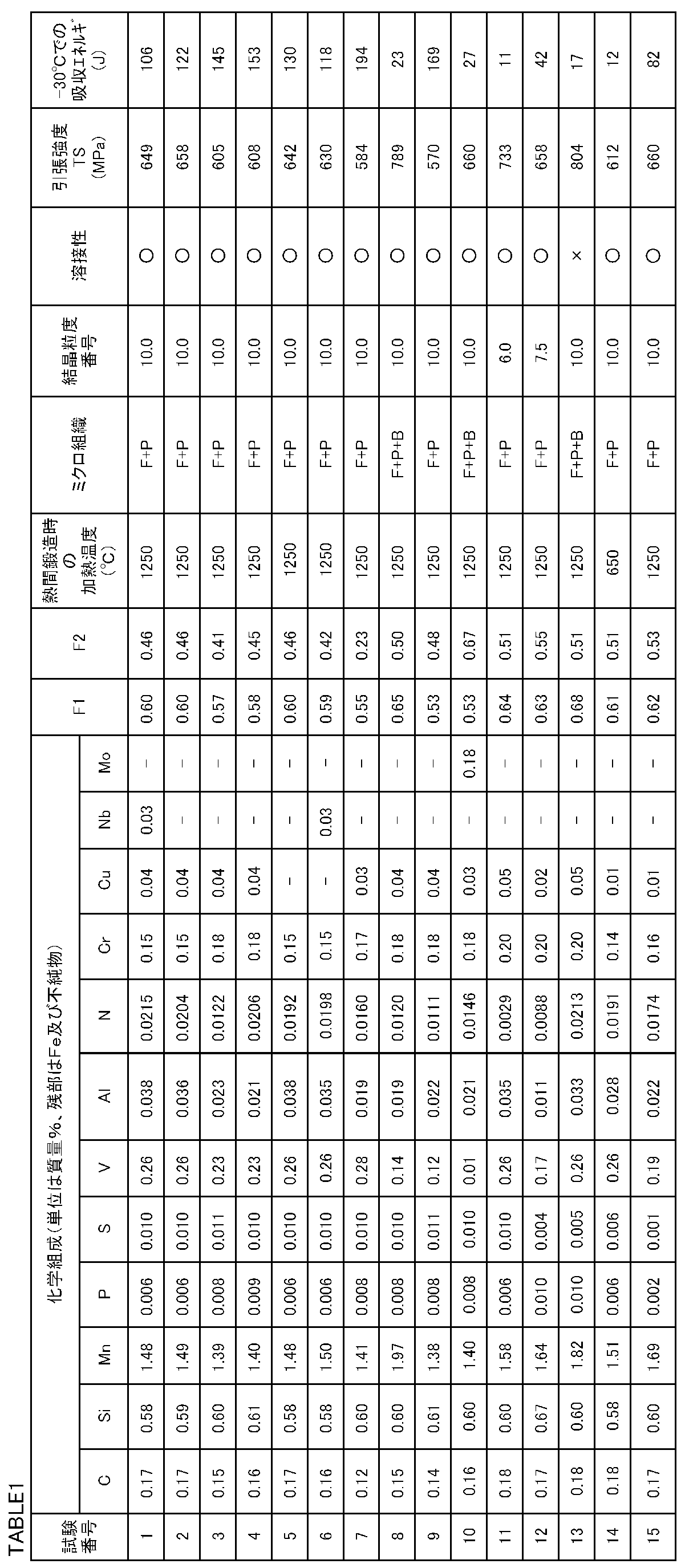
- "F + P" in the "microstructure” column in Table 1 indicates that the microstructure was a structure consisting of ferrite and pearlite.
- the grain size number of the ferrite in each field of view was determined by comparison with the grain size standard diagram defined in 7.2 of JIS G 0551 (2013).
- the average of the grain size number of each view is defined as the grain size number of the hot forged steel material of the present embodiment.
- the grain size number is a value obtained by rounding off the second decimal place.
- V-notch test piece defined in JIS Z 2242 (2005) was produced from an area in a range of 3.0 mm in depth to 20.0 mm in depth.
- the cross section of the V-notch test piece was a square of 10 mm ⁇ 10 mm, and the longitudinal length of the V-notch test piece was 55 mm.
- the longitudinal direction of the V-notch test piece was parallel to the axial direction (longitudinal direction) of the hot forged steel material.
- V-notch A V-notch was formed at the center of the length of the test specimen (that is, at the center of 55 mm in length).
- the V-notch angle was 45 °, the notch depth was 2 mm, and the notch base radius was 0.25 mm.
- Charpy impact test according to JIS Z 2242 (2005) was performed using a V-notch test piece to determine the absorbed energy at -30.degree. Specifically, the Charpy impact test according to JIS Z 2242 (2005) was carried out in the atmosphere on three V-notch test pieces cooled to -30 ° C., and the average of the obtained absorbed energy was obtained. Was defined as the absorbed energy (J) at -30.degree. The absorbed energy (J) was an integer value rounded to the first decimal place.
- Table 1 shows the test results.
- the chemical compositions of the hot forged steel materials of Test No. 1 to Test No. 6 were appropriate. Furthermore, F1 was 0.36 to less than 0.68. Furthermore, F2 was 0.52 or less, and the grain size number of the ferrite in steel materials was 9.0 or more. Therefore, the tensile strength TS showed a high strength of 600 MPa or more, and further, the absorbed energy at ⁇ 30 ° C. was 100 J or more, and showed excellent low temperature toughness.
- the hot forged steel material of test No. 11 had a low N content. Therefore, the grain size number of the ferrite grain is less than 9.0. As a result, the absorbed energy at ⁇ 30 ° C. was less than 100 J, and the low temperature toughness was low.
- F1 was 0.68 or more. Therefore, the weldability was considered to be low.
- bainite was formed in the microstructure. As a result, the absorbed energy at ⁇ 30 ° C. was less than 100 J, and the low temperature toughness was low.
- the heating temperature at the time of hot forging was less than 1200 ° C.
- the absorbed energy at ⁇ 30 ° C. was less than 100 J. Since the heating temperature at the time of hot forging was low, it is thought that the V carbonitrides and the like remaining after heating at the hot forging coarsened in the normalizing treatment step, and as a result, the low temperature toughness decreased.
Landscapes
- Chemical & Material Sciences (AREA)
- Engineering & Computer Science (AREA)
- Mechanical Engineering (AREA)
- Materials Engineering (AREA)
- Metallurgy (AREA)
- Organic Chemistry (AREA)
- Physics & Mathematics (AREA)
- Thermal Sciences (AREA)
- Crystallography & Structural Chemistry (AREA)
- Heat Treatment Of Steel (AREA)
Abstract
Description
0.36≦C+(Si+Mn)/6+(Cr+V)/5+Cu/15<0.68 (1)
51/12×C-V≦0.52 (2)
ここで、式(1)及び式(2)中の各元素記号には、対応する元素の含有量(質量%)が代入される。
0.36≦C+(Si+Mn)/6+(Cr+V)/5+Cu/15<0.68 (1)
ここで、式(1)中の各元素記号には、対応する元素の含有量(質量%)が代入される。
51/12×C-V≦0.52 (2)
ここで、式(2)中の各元素記号には、対応する元素の含有量(質量%)が代入される。
0.36≦C+(Si+Mn)/6+(Cr+V)/5+Cu/15<0.68 (1)
51/12×C-V≦0.52 (2)
ここで、式(1)及び式(2)中の各元素記号には、対応する元素の含有量(質量%)が代入される。
本実施形態による熱間鍛造鋼材の化学組成は、次の元素を含有する。
炭素(C)は、鋼材の引張強度を高める。C含有量が0.14%未満であれば、他の元素含有量が本実施形態の範囲内であっても、この効果が十分に得られない。一方、C含有量が0.20%を超えれば、他の元素含有量が本実施形態の範囲内であっても、鋼材の溶接性及び低温靱性が低下する。したがって、C含有量は0.14~0.20%である。C含有量の好ましい下限は0.14%超であり、さらに好ましくは0.15%であり、さらに好ましくは0.16%である。C含有量の好ましい上限は0.19%であり、さらに好ましくは0.18%であり、さらに好ましくは0.17%である。
シリコン(Si)は、鋼を脱酸する。Siはさらに、鋼材中のフェライトに固溶して、フェライトを強化し、鋼材の強度を高める。Si含有量が0.20%未満であれば、他の元素含有量が本実施形態の範囲内であっても、これらの効果が十分に得られない。一方、Si含有量が1.00%を超えれば、熱間鍛造鋼材の表面にスケールが残りやすくなり、熱間鍛造鋼材の外観性が低下する。したがって、Si含有量は、0.20~1.00%である。Si含有量の好ましい下限は0.30%であり、さらに好ましくは0.40%であり、さらに好ましくは0.50%である。Si含有量の好ましい上限は0.90%であり、さらに好ましくは0.80%であり、さらに好ましくは0.70%である。
マンガン(Mn)は、鋼を脱酸する。Mnはさらに、鋼材に固溶して鋼材の強度を高める。Mn含有量が1.00%未満であれば、他の元素含有量が本実施形態の範囲内であっても、これらの効果が十分に得られない。一方、Mn含有量が1.90%を超えれば、他の元素が本実施形態の範囲内であっても、鋼材中にベイナイトが生成して熱間鍛造鋼材の低温靱性が低下する。したがって、Mn含有量は、1.00~1.90%である。Mn含有量の好ましい下限は1.20%であり、さらに好ましくは1.30%であり、さらに好ましくは1.40%である。Mn含有量の好ましい上限は1.90%未満であり、さらに好ましくは1.80%であり、さらに好ましくは1.70%であり、さらに好ましくは1.60%である。
燐(P)は不可避に含有される不純物である。つまり、P含有量は0%超である。P含有量が0.030%を超えれば、他の元素含有量が本実施形態の範囲内であっても、Pが鋼材の粒界に偏析して鋼材を脆化する。したがって、P含有量は、0.030%以下である。P含有量の好ましい上限は0.020%であり、さらに好ましくは0.015%であり、さらに好ましくは0.010%である。P含有量はなるべく低い方が好ましい。しかしながら、製鋼工程においてP含有量を極度に低減すれば製造コストが掛かり、生産性も低下する。したがって、好ましいP含有量の下限は0.001%であり、さらに好ましくは0.002%である。
硫黄(S)は不可避に含有される不純物である。つまり、S含有量は0%超である。S含有量が0.030%を超えれば、他の元素含有量が本実施形態の範囲内であっても、Sが鋼材の熱間加工性を低下する。したがって、S含有量は0.030%以下である。S含有量の好ましい上限は0.020%であり、さらに好ましくは0.015%であり、さらに好ましくは0.013%である。S含有量はなるべく低い方が好ましい。しかしながら、製鋼工程においてS含有量を極度に低減すれば製造コストが掛かり、生産性も低下する。したがって、好ましいS含有量の下限は0.001%であり、さらに好ましくは0.002%である。
バナジウム(V)は、炭素及び/又は窒素と結合して微細なV炭窒化物等(VC、VN、及びV(C、N)、又はこれらと他の元素との複合析出物)を形成し、熱間鍛造鋼材の強度を高める。V含有量が0.16%未満であれば、他の元素含有量が本実施形態の範囲内であっても、この効果が十分に得られない。一方、V含有量が0.30%を超えれば、他の元素含有量が本実施形態の範囲内であっても、粗大なV炭窒化物等が生成する。粗大なV炭窒化物等は熱間鍛造鋼材の低温靱性を低下する。したがって、V含有量は0.16~0.30%である。V含有量の好ましい下限は0.17%であり、さらに好ましくは0.18%であり、さらに好ましくは0.19%であり、さらに好ましくは0.20%である。V含有量の好ましい上限は0.29%であり、さらに好ましくは0.28%であり、さらに好ましくは0.27%であり、さらに好ましくは0.26%である。
アルミニウム(Al)は、鋼を脱酸する。Alはさらに、AlNを形成して、ピンニング効果により熱間鍛造鋼材のフェライト粒を微細化する。これにより、熱間鍛造鋼材の低温靱性が高まる。Al含有量が0.015%未満であれば、他の元素含有量が本実施形態の範囲内であっても、これらの効果が十分に得られない。一方、Al含有量が0.050%を超えれば、他の元素含有量が本実施形態の範囲内であっても、粗大なAl2O3系介在物及び粗大なAlNが生成しやすくなる。粗大なAl2O3系介在物及び粗大なAlNは、熱間鍛造鋼材の低温靱性を低下する。したがって、Al含有量は0.015~0.050%である。Al含有量の好ましい下限は0.016%であり、さらに好ましくは0.018%であり、さらに好ましくは0.020%である。Al含有量の好ましい上限は0.040%であり、さらに好ましくは0.035%であり、さらに好ましくは0.030%である。本明細書にいう「Al」含有量は「酸可溶Al」、つまり、「sol.Al」の含有量を意味する。
窒素(N)は、Al及びVと結合して、AlN及びV炭窒化物等を形成する。AlNは、ピンニング効果により熱間鍛造鋼材のフェライト粒を微細化して、熱間鍛造鋼材の低温靱性を高める。V炭窒化物等は、析出強化により、熱間鍛造鋼材の強度を高める。N含有量が0.0050%未満であれば、他の元素含有量が本実施形態の範囲内であっても、これらの効果が十分に得られない。一方、N含有量が0.0250%を超えれば、粗大なAlN及び粗大なV炭窒化物が生成して、熱間鍛造鋼材の低温靱性が低下する。したがって、N含有量は、0.0050~0.0250%である。N含有量の好ましい下限は0.0060%であり、さらに好ましくは0.0070%であり、さらに好ましくは0.0080%であり、さらに好ましくは0.0090%である。N含有量の好ましい上限は0.0220%であり、さらに好ましくは0.0210%であり、さらに好ましくは0.0200%であり、さらに好ましくは0.0190%であり、さらに好ましくは0.0180%である。
クロム(Cr)は、鋼材の強度を高める。Cr含有量が0.10%未満であれば、他の元素含有量が本実施形態の範囲内であっても、この効果が十分に得られない。一方、Cr含有量が0.30%を超えれば、他の元素含有量が本実施形態の範囲内であっても、鋼材の低温靱性及び溶接性が低下する。したがって、Cr含有量は0.10~0.30%である。Cr含有量の好ましい下限は0.12%であり、さらに好ましくは0.15%であり、さらに好ましくは0.16%である。Cr含有量の好ましい上限は0.25%であり、さらに好ましくは0.22%であり、さらに好ましくは0.20%である。
上述の熱間鍛造鋼材の化学組成はさらに、Feの一部に代えて、Cu及びNbからなる群から選択される1種以上を含有してもよい。これらの元素はいずれも任意元素であり、いずれも熱間鍛造鋼材の強度を高める。
銅(Cu)は任意元素であり、含有されなくてもよい。つまり、Cu含有量は0%であってもよい。含有される場合、Cuは熱間鍛造鋼材の強度を高める。Cuが少しでも含有されれば、上記効果がある程度得られる。しかしながら、Cu含有量が0.10%を超えれば、他の元素含有量が本実施形態の範囲内であっても、熱間鍛造鋼材の熱間加工性が低下する。したがって、Cu含有量は0~0.10%である。Cu含有量の好ましい下限は0%超であり、さらに好ましくは0.01%であり、さらに好ましくは0.02%である。Cu含有量の好ましい上限は0.08%であり、さらに好ましくは0.07%であり、さらに好ましくは0.05%である。
ニオブ(Nb)は任意元素であり、含有されなくてもよい。つまり、Nb含有量は0%であってもよい。含有される場合、Nbは、結晶粒内で炭素及び/又は窒素と結合して微細なNb炭窒化物等(NbC、NbN、及びNb(C、N)、又はこれらと他の元素との複合析出物)を形成し、析出強化により熱間鍛造鋼材の強度を高める。Nbが少しでも含有されれば、上記効果がある程度得られる。ただし、本実施形態の熱間鍛造鋼材の化学組成において、上述のNb炭窒化物等はフェライト粒の細粒化には寄与しにくい。一方、Nb含有量が0.10%を超えれば、他の元素含有量が本実施形態の範囲内であっても、粗大なNb炭窒化物等が生成して、熱間鍛造鋼材の低温靱性を低下する。したがって、Nb含有量は0~0.10%である。Nb含有量の好ましい下限は0%超であり、さらに好ましくは0.01%であり、さらに好ましくは0.02%である。Nb含有量の好ましい上限は0.08%であり、さらに好ましくは0.05%である。
本実施形態の熱間鍛造鋼材の化学組成ではさらに、式(1)を満たす。
0.36≦C+(Si+Mn)/6+(Cr+V)/5+Cu/15<0.68 (1)
ここで、式(1)中の各元素記号には、対応する元素の含有量(質量%)が代入される。
本実施形態の熱間鍛造鋼材の化学組成ではさらに、式(2)を満たす。
51/12×C-V≦0.52 (2)
ここで、式(2)中の各元素記号には、対応する元素の含有量(質量%)が代入される。
本発明の熱間鍛造鋼材のミクロ組織(マトリクス組織)は、フェライト及びパーライトからなる。本明細書でいうフェライトは、特に断りがない限り、初析フェライトを意味する。ミクロ組織がフェライト及びパーライトからなれば、化学組成中の各元素含有量が本実施形態の範囲内であり、かつ、化学組成が式(1)及び式(2)を満たすことを前提として、熱間鍛造鋼材において優れた低温靱性が得られる。本実施形態の熱間鍛造鋼材において、化学組成中の各元素含有量が本実施形態の範囲内であり、かつ、化学組成が式(1)及び式(2)を満たせば、後述の製造方法を実施することを前提として、フェライト及びパーライトからなるミクロ組織を得ることができる。なお、本明細書におけるミクロ組織は、析出物及び介在物を除いた、いわゆるマトリクス(母材)の組織を意味する。ミクロ組織がフェライト及びパーライトからなる、とは、後述のミクロ組織の各相の測定方法で得られたフェライト及びパーライトの総面積率が95.0%以上であることを意味する。
ミクロ組織中の各相(フェライト、パーライト等)は、次の方法で特定可能である。
本実施形態の熱間鍛造鋼材ではさらに、ミクロ組織中のフェライトにおいて、JIS G 0551(2013)で規定される結晶粒度番号が9.0以上である。本実施形態の熱間鍛造鋼材では、フェライトの結晶粒度番号が9.0以上と微細であるため、低温靱性に優れる。具体的には、Vノッチ試験片を用いたシャルピー衝撃試験において、-30℃での吸収エネルギが100J以上になる。
ミクロ組織中のフェライトの結晶粒度番号は、次の方法により決定される。熱間鍛造鋼材の表面から深さ3.0mm~深さ20.0mmの範囲の領域内からサンプルを採取する。サンプルのサイズは、後述の視野が確保できれば、特に限定されない。サンプルの表面の一つを観察面と特定し、観察面を鏡面研磨した後、体積分率で2%の硝酸を含むエタノール溶液(ナイタル腐食液)でエッチングして、観察面においてフェライト粒の結晶粒界を現出させる。エッチングされた観察面のうち、フェライトを含む任意の10視野(各視野の面積は40mm2)において、各視野のフェライト粒の結晶粒度番号を求める。具体的には、JIS G 0551(2013)の7.2に規定された結晶粒度標準図との比較により、各視野におけるフェライト粒の結晶粒度番号を決定する。各視野の結晶粒度番号の平均を、本実施形態の熱間鍛造鋼材の結晶粒度番号と定義する。結晶粒度番号は、小数第2位を四捨五入して得た値とする(つまり、フェライト粒の結晶粒度番号の数値は、小数第1位とする)。
本実施形態の熱間鍛造鋼材において、JIS Z 2242(2005)に準拠したVノッチ試験片を用いたシャルピー衝撃試験において、-30℃での吸収エネルギは100J以上である。本実施形態の熱間鍛造鋼材は、フェライト及びパーライトからなるミクロ組織を有し、かつ、ミクロ組織中のフェライトのJIS G 0551(2013)に準拠した結晶粒度番号が9.0以上であるため、上述のシャルピー衝撃試験において、-30℃での吸収エネルギが100J以上となり、優れた低温靱性が得られる。本実施形態の熱間鍛造鋼材において、JIS Z 2242(2005)に準拠したVノッチ試験片を用いたシャルピー衝撃試験において、-30℃での吸収エネルギの好ましい下限は105J以上であり、さらに好ましくは115J以上である。
本実施形態の熱間鍛造鋼材の低温靱性は次の方法で測定できる。熱間鍛造鋼材において、表面から深さ3.0mm~深さ20.0mmの範囲の領域内からJIS Z 2242(2005)に規定されるVノッチ試験片を採取する。Vノッチ試験片の断面は10mm×10mmの正方形とし、Vノッチ試験片の長手方向の長さは55mmとする。つまり、Vノッチ試験片は、いわゆるフルサイズ試験片とする。つまり、フルサイズ試験片は、上述の熱間鍛造鋼材の表面から深さ3.0mm~深さ20.0mmの領域内から採取する。Vノッチ試験片の長手方向は、熱間鍛造鋼材の軸方向(長手方向)に平行とする。Vノッチ試験片の長さ中央位置(つまり、長さ55mmの中央位置)に、Vノッチを形成する。Vノッチ角度を45°とし、ノッチ深さを2mmとし、ノッチ底半径を0.25mmとする。Vノッチ試験片を用いて、JIS Z 2242(2005)に準拠したシャルピー衝撃試験を実施して、-30℃での吸収エネルギを求める。具体的には、-30℃に冷却した3個のVノッチ試験片に対して、大気中にて、JIS Z 2242(2005)に準拠したシャルピー衝撃試験を実施し、得られた吸収エネルギの平均を、-30℃での吸収エネルギ(J)と定義する。吸収エネルギ(J)は、小数第1位を四捨五入する整数値とする。
本実施形態の熱間鍛造鋼材の引張強度は600MPa以上である。本実施形態の熱間鍛造鋼材では、相界面析出により、フェライト中に微細なV炭窒化物等が多数析出している。そのため、本実施形態の熱間鍛造鋼材では、高い引張強度を有する。なお、フェライト中の微細なV炭窒化物等の大きさはナノレベルであるため、フェライト中の微細なV炭窒化物等の面数密度(個/μm2)等を定量的に測定することは極めて困難である。そこで、本実施形態の熱間鍛造鋼材では、微細なV炭窒化物等の析出度合いを引張強度の規定により代替する。
本実施形態の熱間鍛造鋼材の引張強度は、次の方法により測定できる。熱間鍛造鋼材の表面から深さ3.0mm~深さ20.0mmの範囲の領域内から、直径6.35mm、平行部長さ35mmの丸棒引張試験片を作製する。丸棒引張試験片の平行部は、熱間鍛造鋼材の軸方向(長手方向)に平行とする。丸棒引張試験片を用いて、JIS Z 2241(2011)に準拠して、常温(10~35℃)、大気中にて引張試験を実施して、引張強度(MPa)を得る。なお、引張試験の変形速度は0.2mm/sとする。
本実施形態の熱間鍛造鋼材は、強度及び低温靱性が求められる用途に広く適用可能である。熱間鍛造鋼材はたとえば、溶接して製造される鋼製部品として適用される。鋼製部品はたとえば、プランジャーポンプに代表される、産業機械のフレーム部材である。熱間鍛造鋼材が産業機械のフレーム部材として適用される場合、たとえば、複数の熱間鍛造鋼材を組合せて、隣り合う熱間鍛造鋼材を溶接等により固定することにより、産業機械のフレーム(筐体)を製造することができる。
本実施形態の熱間鍛造鋼材の製造方法の一例を説明する。なお、本実施形態の熱間鍛造鋼材は、上記構成を有すれば、製造方法は以下の製造方法に限定されない。ただし、以下に説明する製造方法は、本実施形態の熱間鍛造鋼材を製造する好適な一例である。
各元素含有量が上述の本実施形態の範囲を満たし、かつ、式(1)及び式(2)を満たす化学組成を有する溶鋼を製造する。溶鋼を用いて素材を製造する。具体的には、溶鋼を用いて連続鋳造法によりスラブ又はブルームを製造する。溶鋼を用いて造塊法によりインゴットを製造してもよい。必要に応じて、スラブ又はブルーム、インゴットを分塊圧延して、ビレットとしてもよい。以上の工程により素材(スラブ、ブルーム、インゴット、又は、ビレット)を製造する。分塊圧延を実施する場合、分塊圧延前のスラブ、ブルーム、インゴットの加熱温度は、周知の温度範囲(たとえば、1050~1300℃)でよい。
準備された素材を熱間鍛造して、粗形状の中間品を製造する。熱間鍛造時の加熱温度は1200~1300℃とする。素材はたとえば、加熱炉で加熱される。ここで、熱間鍛造時の加熱温度は、熱間鍛造開始時の素材の表面温度に相当する。熱間鍛造時の加熱温度はたとえば、加熱炉の抽出口に設置された測温計で測温可能である。
焼準処理工程では、熱間鍛造後の中間品に対して、焼準処理を実施する。焼準処理により、鋼材中のフェライトの結晶粒度番号を9.0以上にする。焼準処理での温度(焼準温度)はAc3変態点以上であり、具体的には、875~950℃である。焼準温度を上記範囲とすることにより、焼準処理時にV炭窒化物等の一部が再固溶して、冷却時に再び相界面析出させる。この場合、微細なV炭窒化物等が生成して、粗大なV炭窒化物等の成長が抑制される。その結果、熱間鍛造鋼材の引張強度TSが600MPa以上になる。上記焼準温度での保持時間は特に限定されないが、たとえば、40~150分である。
[ミクロ組織観察試験]
各試験番号の熱間鍛造鋼材の表面から深さ3.0mm~深さ20.0mmの範囲の領域内からサンプルを採取した。サンプルの表面(観察面)を鏡面研磨した後、体積分率で2%の硝酸を含むエタノール溶液(ナイタル腐食液)でエッチングした。エッチングされた観察面にて組織観察を実施した。組織観察には100倍の光学顕微鏡を用い、視野は200μm×200μmとした。観察面内の任意の1視野を観察した。観察視野において、各相(フェライト、パーライト、ベイナイト等)のコントラストは異なる。そのため、コントラストに基づいて相を特定した。特定された相のうち、フェライトの総面積と、パーライトの総面積とを求めた。観察視野の総面積に対する、フェライト及びパーライトの合計の総面積の割合(フェライト及びパーライト総面積率)を求めた。フェライト及びパーライト総面積率が95.0%以上であれば、ミクロ組織がフェライト及びパーライトからなるミクロ組織であると認定した。表1中の「ミクロ組織」欄の「F+P」は、ミクロ組織がフェライト及びパーライトからなる組織であったことを示す。一方、フェライト及びパーライト総面積率が95.0%未満であり、フェライト及びパーライトの他に、ベイナイトが観察された場合、ミクロ組織はフェライト及びパーライトからなる組織ではないと判断した。表1中の「ミクロ組織」欄の「F+P+B」は、ミクロ組織においてフェライト及びパーライトの総面積率が95.0%未満であり、ミクロ組織がフェライト、パーライト及びベイナイトを含む組織であったことを示す。
各試験番号の熱間鍛造鋼材の表面から深さ3.0mm~深さ20.0mmの範囲の領域内からサンプルを採取した。サンプルの観察面を鏡面研磨した後、体積分率で2%の硝酸を含むエタノール溶液(ナイタル腐食液)でエッチングして、観察面においてフェライトの結晶粒界を現出させた。エッチングされた観察面内のうち、フェライトを含む任意の10視野(各視野の面積は40mm2)において、各視野のフェライトの結晶粒度番号を求めた。具体的には、JIS G 0551(2013)の7.2に規定された結晶粒度標準図との比較により、各視野におけるフェライトの結晶粒度番号を決定した。各視野の結晶粒度番号の平均を、本実施形態の熱間鍛造鋼材の結晶粒度番号と定義した。なお、結晶粒度番号は、小数第2位を四捨五入して得た値とした。
各試験番号の熱間鍛造鋼材の表面から深さ3.0mm~深さ20.0mmの範囲の領域内から、直径6.35mm、平行部長さ35mmの丸棒引張試験片を作製した。丸棒引張試験片の平行部は、熱間鍛造鋼材の軸方向に平行であった。丸棒引張試験片を用いて、JIS Z 2241(2011)に準拠して、常温(10~35℃)、大気中にて引張試験を実施して、引張強度TS(MPa)を得た。なお、引張試験の変形速度は0.2mm/sとした。引張強度TSが600MPa以上である場合、高い引張強度を有する、と評価した。
各試験番号の熱間鍛造鋼材の表面から深さ3.0mm~深さ20.0mmの範囲の領域内から、JIS Z 2242(2005)に規定されるVノッチ試験片を作製した。Vノッチ試験片の断面は10mm×10mmの正方形とし、Vノッチ試験片の長手方向の長さは55mmとした。Vノッチ試験片の長手方向は、熱間鍛造鋼材の軸方向(長手方向)に平行とした。Vノッチ試験片の長さ中央位置(つまり、長さ55mmの中央位置)に、Vノッチを形成した。Vノッチ角度を45°とし、ノッチ深さを2mmとし、ノッチ底半径を0.25mmとした。Vノッチ試験片を用いて、JIS Z 2242(2005)に準拠したシャルピー衝撃試験を実施して、-30℃での吸収エネルギを求めた。具体的には、-30℃に冷却した3個のVノッチ試験片に対して、大気中にて、JIS Z 2242(2005)に準拠したシャルピー衝撃試験を実施し、得られた吸収エネルギの平均を、-30℃での吸収エネルギ(J)と定義した。吸収エネルギ(J)は、小数第1位を四捨五入する整数値とした。
表1に試験結果を示す。
Claims (3)
- 熱間鍛造鋼材であって、
質量%で、
C:0.14~0.20%、
Si:0.20~1.00%、
Mn:1.00~1.90%、
P:0.030%以下、
S:0.030%以下、
V:0.16~0.30%、
Al:0.015~0.050%、
N:0.0050~0.0250%、
Cr:0.10~0.30%、
Cu:0~0.10%、
Nb:0~0.10%、及び、
残部がFe及び不純物からなり、式(1)及び式(2)を満たす化学組成を有し、
前記熱間鍛造鋼材中のフェライトの結晶粒度番号が9.0以上であり、
Vノッチ試験片を用いたシャルピー衝撃試験において、-30℃での吸収エネルギが100J以上である、
熱間鍛造鋼材。
0.36≦C+(Si+Mn)/6+(Cr+V)/5+Cu/15<0.68 (1)
51/12×C-V≦0.52 (2)
ここで、式(1)及び式(2)中の各元素記号には、対応する元素の含有量(質量%)が代入される。 - 請求項1に記載の熱間鍛造鋼材であって、
前記化学組成は、
Cu:0.01~0.10%、及び、
Nb:0.01~0.10%からなる群から選択される1種以上を含有する、
熱間鍛造鋼材。 - 請求項1又は請求項2に記載の熱間鍛造鋼材であって、
引張強度TSが600MPa以上である、
熱間鍛造鋼材。
Priority Applications (5)
| Application Number | Priority Date | Filing Date | Title |
|---|---|---|---|
| CN201880069835.9A CN111295457A (zh) | 2017-10-31 | 2018-10-31 | 热锻钢材 |
| US16/758,592 US11261511B2 (en) | 2017-10-31 | 2018-10-31 | Hot forged steel material |
| MX2020004500A MX2020004500A (es) | 2017-10-31 | 2018-10-31 | Material de acero forjado en caliente. |
| JP2019550466A JP7010298B2 (ja) | 2017-10-31 | 2018-10-31 | 熱間鍛造鋼材 |
| CA3080313A CA3080313C (en) | 2017-10-31 | 2018-10-31 | Hot forged steel material |
Applications Claiming Priority (2)
| Application Number | Priority Date | Filing Date | Title |
|---|---|---|---|
| JP2017-209869 | 2017-10-31 | ||
| JP2017209869 | 2017-10-31 |
Publications (1)
| Publication Number | Publication Date |
|---|---|
| WO2019088190A1 true WO2019088190A1 (ja) | 2019-05-09 |
Family
ID=66332601
Family Applications (1)
| Application Number | Title | Priority Date | Filing Date |
|---|---|---|---|
| PCT/JP2018/040570 Ceased WO2019088190A1 (ja) | 2017-10-31 | 2018-10-31 | 熱間鍛造鋼材 |
Country Status (6)
| Country | Link |
|---|---|
| US (1) | US11261511B2 (ja) |
| JP (1) | JP7010298B2 (ja) |
| CN (1) | CN111295457A (ja) |
| CA (1) | CA3080313C (ja) |
| MX (1) | MX2020004500A (ja) |
| WO (1) | WO2019088190A1 (ja) |
Cited By (1)
| Publication number | Priority date | Publication date | Assignee | Title |
|---|---|---|---|---|
| JPWO2024019135A1 (ja) * | 2022-07-22 | 2024-01-25 |
Citations (8)
| Publication number | Priority date | Publication date | Assignee | Title |
|---|---|---|---|---|
| JPS58107474A (ja) * | 1981-12-21 | 1983-06-27 | Nippon Steel Corp | 熱間鍛造用機械構造用鋼 |
| JPS6357742A (ja) * | 1986-08-29 | 1988-03-12 | Nippon Steel Corp | 高靭性熱間鍛造用非調質鋼 |
| JPH03211227A (ja) * | 1990-01-17 | 1991-09-17 | Nippon Steel Corp | 高強度高靭性熱間鍛造非調質鋼の製造方法 |
| JPH04210449A (ja) * | 1990-12-12 | 1992-07-31 | Toa Steel Co Ltd | 高靱性熱間鍛造用非調質鋼 |
| EP0572246A1 (en) * | 1992-05-29 | 1993-12-01 | Imatra Steel Oy Ab | Forging and a method for its manufacture |
| JP2004346415A (ja) * | 2003-05-26 | 2004-12-09 | Nippon Steel Corp | 超高温熱間鍛造非調質部品とその製造方法 |
| JP2008274393A (ja) * | 2007-03-30 | 2008-11-13 | Daido Steel Co Ltd | 高強度及び高靭性フェライト+パーライト型非調質鋼鍛造部材の製造方法 |
| US20150144233A1 (en) * | 2013-11-27 | 2015-05-28 | Doosan Heavy Industries & Construction Co., Ltd. | Hybrid mold steel and manufacturing method thereof |
Family Cites Families (7)
| Publication number | Priority date | Publication date | Assignee | Title |
|---|---|---|---|---|
| JPS60262941A (ja) | 1984-06-08 | 1985-12-26 | Daido Steel Co Ltd | 温間鍛造用鋼 |
| JP3241897B2 (ja) * | 1993-10-12 | 2001-12-25 | 新日本製鐵株式会社 | 引張強度、疲労強度および被削性に優れる熱間鍛造用非調質鋼 |
| JP3567726B2 (ja) | 1998-03-09 | 2004-09-22 | Jfeスチール株式会社 | 耐地震特性に優れた構造用鋼材およびその製造方法 |
| WO2009057731A1 (ja) * | 2007-10-29 | 2009-05-07 | Nippon Steel Corporation | マルテンサイト型熱間鍛造用非調質鋼及び熱間鍛造非調質鋼部品 |
| CN101883874B (zh) * | 2008-07-29 | 2012-01-18 | 新日本制铁株式会社 | 高强度断裂分割用非调质钢和断裂分割用钢部件 |
| JP5716640B2 (ja) * | 2011-11-21 | 2015-05-13 | 新日鐵住金株式会社 | 熱間鍛造用圧延棒鋼 |
| US9869009B2 (en) * | 2013-11-15 | 2018-01-16 | Gregory Vartanov | High strength low alloy steel and method of manufacturing |
-
2018
- 2018-10-31 CN CN201880069835.9A patent/CN111295457A/zh active Pending
- 2018-10-31 CA CA3080313A patent/CA3080313C/en active Active
- 2018-10-31 MX MX2020004500A patent/MX2020004500A/es unknown
- 2018-10-31 WO PCT/JP2018/040570 patent/WO2019088190A1/ja not_active Ceased
- 2018-10-31 JP JP2019550466A patent/JP7010298B2/ja active Active
- 2018-10-31 US US16/758,592 patent/US11261511B2/en active Active
Patent Citations (8)
| Publication number | Priority date | Publication date | Assignee | Title |
|---|---|---|---|---|
| JPS58107474A (ja) * | 1981-12-21 | 1983-06-27 | Nippon Steel Corp | 熱間鍛造用機械構造用鋼 |
| JPS6357742A (ja) * | 1986-08-29 | 1988-03-12 | Nippon Steel Corp | 高靭性熱間鍛造用非調質鋼 |
| JPH03211227A (ja) * | 1990-01-17 | 1991-09-17 | Nippon Steel Corp | 高強度高靭性熱間鍛造非調質鋼の製造方法 |
| JPH04210449A (ja) * | 1990-12-12 | 1992-07-31 | Toa Steel Co Ltd | 高靱性熱間鍛造用非調質鋼 |
| EP0572246A1 (en) * | 1992-05-29 | 1993-12-01 | Imatra Steel Oy Ab | Forging and a method for its manufacture |
| JP2004346415A (ja) * | 2003-05-26 | 2004-12-09 | Nippon Steel Corp | 超高温熱間鍛造非調質部品とその製造方法 |
| JP2008274393A (ja) * | 2007-03-30 | 2008-11-13 | Daido Steel Co Ltd | 高強度及び高靭性フェライト+パーライト型非調質鋼鍛造部材の製造方法 |
| US20150144233A1 (en) * | 2013-11-27 | 2015-05-28 | Doosan Heavy Industries & Construction Co., Ltd. | Hybrid mold steel and manufacturing method thereof |
Cited By (2)
| Publication number | Priority date | Publication date | Assignee | Title |
|---|---|---|---|---|
| JPWO2024019135A1 (ja) * | 2022-07-22 | 2024-01-25 | ||
| JP7754324B2 (ja) | 2022-07-22 | 2025-10-15 | 株式会社村田製作所 | 電解質および電解質を備える電池 |
Also Published As
| Publication number | Publication date |
|---|---|
| CN111295457A (zh) | 2020-06-16 |
| US11261511B2 (en) | 2022-03-01 |
| JPWO2019088190A1 (ja) | 2020-11-12 |
| MX2020004500A (es) | 2020-08-13 |
| CA3080313C (en) | 2023-01-10 |
| JP7010298B2 (ja) | 2022-02-10 |
| CA3080313A1 (en) | 2019-05-09 |
| US20210189532A1 (en) | 2021-06-24 |
Similar Documents
| Publication | Publication Date | Title |
|---|---|---|
| JP5811282B2 (ja) | 冷間鍛造用丸鋼材 | |
| JP7425360B2 (ja) | マルテンサイト系ステンレス鋼材、及び、マルテンサイト系ステンレス鋼材の製造方法 | |
| WO2014156078A1 (ja) | 低温靭性および耐水素脆性を有する耐磨耗厚鋼板およびその製造方法 | |
| CN108368575B (zh) | 冷锻调质品用轧制线棒 | |
| WO2015088040A1 (ja) | 鋼板およびその製造方法 | |
| JP5716640B2 (ja) | 熱間鍛造用圧延棒鋼 | |
| JP6384626B2 (ja) | 高周波焼入れ用鋼 | |
| JP5699940B2 (ja) | 熱間圧延棒鋼または線材 | |
| JP6819198B2 (ja) | 冷間鍛造調質品用圧延棒線 | |
| JP5368830B2 (ja) | 機械構造用鋼およびその製造方法ならびに機械構造用部品 | |
| WO2018025778A1 (ja) | 継目無鋼管およびその製造方法 | |
| KR20190028781A (ko) | 고주파 담금질용 강 | |
| KR20190028757A (ko) | 고주파 담금질용 강 | |
| WO2018016503A1 (ja) | 高周波焼入れ用鋼 | |
| JP2022160634A (ja) | 鋼材 | |
| JP6555345B2 (ja) | 熱間鍛造用鋼材 | |
| JP7010298B2 (ja) | 熱間鍛造鋼材 | |
| JPH0949020A (ja) | 低温鉄筋用鋼材の製造方法 | |
| JP6673320B2 (ja) | 厚鋼板および厚鋼板の製造方法 | |
| JP2010280967A (ja) | 機械構造用鋼、および、その製造方法、並びに、機械構造用鋼を用いた加工部品製造方法 | |
| WO2020194653A1 (ja) | 高周波焼入れが実施される鋼 | |
| JP3077568B2 (ja) | 低温鉄筋用鋼材の製造方法 | |
| EP2985361A1 (en) | Age-hardening steel | |
| JP2001011571A (ja) | 被削性、冷間鍛造性および焼入れ性に優れた機械構造用鋼材 | |
| JP7205066B2 (ja) | 高周波焼入れ用非調質鋼 |
Legal Events
| Date | Code | Title | Description |
|---|---|---|---|
| 121 | Ep: the epo has been informed by wipo that ep was designated in this application |
Ref document number: 18871900 Country of ref document: EP Kind code of ref document: A1 |
|
| ENP | Entry into the national phase |
Ref document number: 2019550466 Country of ref document: JP Kind code of ref document: A |
|
| ENP | Entry into the national phase |
Ref document number: 3080313 Country of ref document: CA |
|
| NENP | Non-entry into the national phase |
Ref country code: DE |
|
| 122 | Ep: pct application non-entry in european phase |
Ref document number: 18871900 Country of ref document: EP Kind code of ref document: A1 |